Philippians 4:2
Philippians 4:3
Philippians 4:4
Philippians 4:5
Philippians 4:6
Philippians 4:7
Philippians 4:8
Philippians 4:9
Philippians 4:10
Philippians 4:11
Philippians 4:12
Philippians 4:13
Philippians 4:14
Philippians 4:15
Philippians 4:16
Philippians 4:17
Philippians 4:18
Philippians 4:19
Philippians 4:20
Philippians 4:21
Philippians 4:22
Philippians 4:23

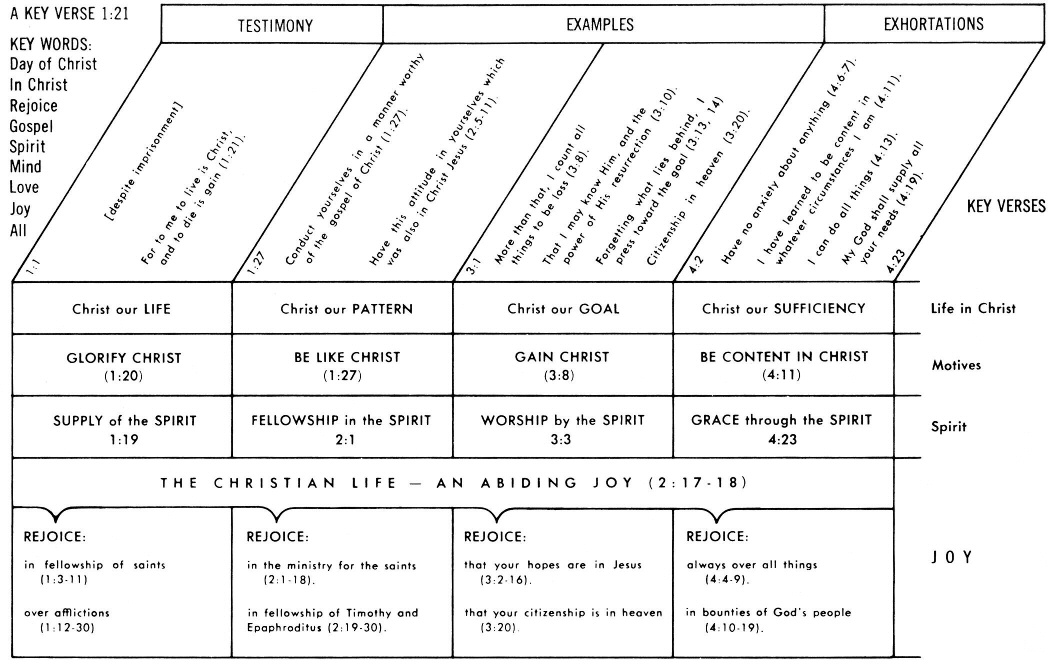
LIFE IN CHRIST
Click chart to enlarge
Charts from Jensen's Survey of the NT - used by permission
Philippians - Charles Swindoll = Chart on right side of page
| Account of Paul's Circumstances Php 1:1-30 |
Have the Mind of Christ Php 2:1-30 |
Have the Knowledge of Christ Php 3:1-21 |
Have |
| Partakers of Christ | People of Christ | Pursuit of Christ | Power of Christ |
| Suffering | Submission | Salvation | Sanctification |
| Experience | Examples | Exhortation | |
Philippians 4:9 The things you have learned and received and heard and seen in me, practice these things, and the God of peace will be with you (NASB: Lockman)
Greek: a kai emathete (2PAAI) kai parelabete (2PAAI) kai ekousate (2PAAI) kai eidete (2PAAI) en emoi, tauta prassete; (2PPAM ) kai o theos tes eirenes estai (3SPAI) meth' humon
Amplified: Practice what you have learned and received and heard and seen in me, and model your way of living on it, and the God of peace (of untroubled, undisturbed well-being) will be with you (Amplified Bible - Lockman)
NLT: Keep putting into practice all you learned from me and heard from me and saw me doing, and the God of peace will be with you. (NLT - Tyndale House)
Phillips: Model your conduct on what you have learned from me, on what I have told you and shown you, and you will find the God of peace will be with you (Phillips: Touchstone)
Wuest: The things also which you learned and received and heard and saw in me, these things habitually practice, and the God of peace shall be with you.
Young's Literal: the things that also ye did learn, and receive, and hear, and saw in me, those do, and the God of the peace shall be with you.
THE THINGS YOU HAVE LEARNED AND RECEIVED AND HEARD AND SEEN IN ME: a kai emathete (2PAAI) kai parelabete (2PAAI) kai ekousate (2PAAI) kai eidete (2PAAI) en emoi:
- Phil 3:17; 1Co 10:31, 32, 33; 11:1; 1Th 1:6; 2:2-12,14; 4:1-8; 2Th 3:6, 7, 8, 9, 10
- Philippians 4 Resources - Multiple sermons and commentaries
- Philippians 4:9 The Importance of Christian Conduct - Steven Cole
- Philippians 4:9 Model of Spiritual Stability - Obedience - John MacArthur
FOLLOW MY
EXAMPLE!
In essence Paul repeats the exhortation of Php 3:17
Brethren, join in following my example
Paul's repetition highlights how important it is that we have godly examples to imitate. O, how we all need godly examples! Children need godly fathers and mothers. Young fathers and mothers need godly older men and women to imitate.
Pentecost writes that "In Scripture, a man who knows what he ought to do and does not do it is called a hypocrite. The sin of hypocrisy is constantly dealt with as one of the cardinal sins with which believers must come to grips. It is that which the apostle has uppermost in his mind as he pens the words of Philippians 4:9 (The Joy of Living: A study of Philippians)
I would add the one who knows what he ought to do and who follows a godly example is called a disciple (mathetes). Paul is calling the Philippians to practice discipleship. From Php 3:17NLT we see some were already following Paul's lead and in essence were disciples of Paul ("learn from those who follow our example")). Paul's desire for the entire church at Philippi was to be actively involved in making disciples. And should not this be the ultimate goal of every church of Jesus Christ, Who in His great commission said "Go therefore and make disciples (the only command in His final instructions) of all the nations, baptizing them in the name of the Father and the Son and the Holy Spirit, teaching them to observe (EXACTLY WHAT PAUL IS DOING IN THIS PASSAGE) all that I commanded you; and lo, I am with you always (HOW? HIS INDWELLING SPIRIT, THE SPIRIT OF JESUS), even to the end of the age.” (Mt 28:19-20)
Steven Cole - Once we are converted through faith in Christ, we begin the process of sanctification, or growth in holiness, through the renewal of our minds through Scripture, and the corresponding changes in our conduct, so that we learn to please God with our lives. In verse Phil 4:9, Paul shows us how this process works and why it is of vital importance, namely, that the sense of God’s presence as the God of peace is linked with it. He mentions four components: (1) The intellectual--“What you have learned”; (2) The volitional--“What you received”; (3) The behavioral--“What you have heard and seen, which you must practice”; (4) The emotional--“The God of peace shall be with you.” The intellectual component: The Christian faith has content that must be taught and learned. The word learned implies that the Christian faith has content which must be taught by someone who understands it and mentally grasped by those he teaches. Of course, the Christian faith is much more than mere intellectual understanding, as we will see. And even on the intellectual level, Scripture teaches that “the god of this world [Satan] has blinded the minds of the unbelieving, that they might not see the light of the gospel of the glory of Christ, who is the image of God” (2 Co 4:4). Thus God must open the minds of unbelievers to respond to the gospel, as Paul goes on to say, “For God, who said, ‘Light shall shine out of darkness,’ is the One who has shone in our hearts to give the light of the knowledge of the glory of God in the face of Christ” (2 Co 4:6). God shines into our hearts to give us knowledge, and such knowledge is grasped with the mind....Note the importance of teaching in Paul’s ministry: In Acts 11:26, Barnabas brought Paul (then called Saul) to Antioch, “And it came about that for an entire year they met with the church, and taught considerable numbers; ...” In Acts 17:2-3, Paul “reasoned with [the Jews] from the Scriptures, explaining and giving evidence that the Christ had to suffer and rise again from the dead, and saying, ‘This Jesus whom I am proclaiming to you is the Christ.’” Paul’s evangelistic efforts were not based on emotional appeals, but on a reasonable appeal to their minds. We see the same thing in Ac 19:8-10, where Paul was in the synagogue in Ephesus for three months, “reasoning and persuading them about the kingdom of God.” But when some became hardened and disobedient, he withdrew with the disciples, and continued to reason with them daily from the Word of God. In Ac 20:20, Ac 20:27 he reminds the Ephesian elders how he “did not shrink from declaring to [them] anything that was profitable, and teaching [them] publicly and from house to house,” how he “did not shrink from declaring to [them] the whole purpose of God.” In Col 1:28, Paul describes his ministry: “And we proclaim Him, admonishing every man and teaching every man with all wisdom, that we may present every man complete in Christ.” In his pastoral letters to Timothy and Titus, Paul repeatedly emphasizes the theme of “sound doctrine.” In the final chapter he wrote before his death, he exhorted Timothy with what must have been of utmost importance (2Ti 4:2-3), “Preach the word; be ready in season and out of season; reprove, rebuke, exhort, with great patience and instruction. For the time will come when they will not endure sound doctrine; ...” Thus the Christian faith has content that must be learned and taught. The question is, Are you studying and learning God’s Word? It doesn’t happen without diligence and effort. I encourage you to apply yourself to learn the great truths of God’s Word with a view to obedient application.
The things - Referring to those things mentioned in Php 4:8.
Learned (3129) (manthano related to the noun mathetes = disciple, literally a learner! The shut mind is the end of discipleship!) has the basic meaning of directing one’s mind to something and producing an external effect. Manthano refers to teaching, learning, instructing, and discipling. Manthano to genuinely understand and accept a teaching, to accept it as true and to apply it in one’s life. It was sometimes used of acquiring a life-long habit.
Paul used manthano again in Php 4:11 explaining he had "learned to be content in whatever circumstances" he was.
Zuck writes that according to manthano "learning is a matter of a pupil acquiring knowledge of content through a teacher to the extent that such knowledge is experienced in the life." (Bibliotheca Sacra).
MacArthur adds that manthano "refers to teaching, learning, instructing, and discipling. Paul is referring here to his personal instruction and discipling of the Philippians." (MacArthur, J. Philippians. Chicago: Moody Press)
In another note MacArthur writes that manthano conveys "the idea of accepting something as true and applying it to one’s life." (Mark Commentary)
Eadie says that manthano "refers to instruction. Ro 16:17; Col. 1:7. The next term, parela/bete, denotes the result of instruction, the appropriation of the knowledge conveyed, or the fact that they had assented to it or had embraced it. 1Cor. 15:1; Gal. 1:12; 1Th 2:13. They had been instructed, and they had accepted the instruction, and therefore were they bound to abide by it." (A Commentary on the Greek Text - Online)
Richards has an informative note on manthano and the related word mathetes…
In Greek culture prior to Socrates, manthano described the process by which a person sought theoretical knowledge. A mathetes was one who attached himself to another to gain some practical or theoretical knowledge, whether by instruction or by experience. The word came to be used both of apprentices who were learning a trade and of adherents of various philosophical schools. After the time of Socrates, the word lost favor with the philosophers, who were not at all happy with its association with labor.
But the concept of discipleship was most popular in the Judaism of Jesus' day. Rabbis had disciples who studied with them in a well-defined and special relationship. The need for training was intensely felt in the Jewish community, which believed that no one could understand Scripture without a teacher's guidance. A disciple in Judaism had to master--in addition to the Scriptures of the OT--the oral and written traditions that had grown up around the Scriptures. Only after being so taught might a person become a rabbi himself or teach with any authority. This notion is expressed in the Jews' amazed reaction to Jesus' public teaching: "How did this man get such learning without having studied?" (Jn 7:15). Jesus taught with authority without having gone through the only process that the Jews felt could qualify anyone to teach.
Several aspects of the rabbi-disciple relationship in first-century Judaism are significant. The disciple left his home and moved in with his teacher. He served the teacher in the most servile ways, treating him as an absolute authority. The disciple was expected not only to learn all that his rabbi knew but also to become like him in character and piety (Mt 10:24; Lk 6:40). The rabbi in return provided food and lodging and saw his own distinctive interpretations transmitted through his disciples to future generations. So when Mark says that Jesus chose twelve men "that they might be with him" (Mk 3:14), he accurately reflects contemporary understanding of how future leaders should be trained. (Richards, L O: Expository Dictionary of Bible Words: Regency)
Detzler writes that "The emphasis on discipleship in Greek is not formal school learning, but rather fellowship with the teacher. It is seen in two situations. First, it refers to the followers of a certain philosopher. They derived not just information from their teacher but also inspiration. Disciples learned the teacher's entire outlook on life, not just the facts which he taught. Second, discipleship had a religious context. It was seen in the pre-Christian mystery religions and in the Greek schools of the Epicureans and Stoics. Discipleship involved two principles. First, it meant that the disciples had fellowship with their teacher. They lived with him as Jesus' disciples lived with Him. Second, disciples carried on the tradition of their teacher. After he died they taught the same things that he did. Disciples were the main means of perpetuating teaching in the ancient world, since many great teachers wrote no books. (Detzler, Wayne E: New Testament Words in Today's Language. Victor. 1986)
Manthano is used 25 times in the NT…
Matthew 9:13 "But go and learn (aorist imperative) what this means, 'I desire compassion, and not sacrifice,' for I did not come to call the righteous, but sinners."
Matthew 11:29 "Take My yoke upon you, and learn (aorist imperative) from Me, for I am gentle and humble in heart; and you shall find rest for your souls.
Matthew 24:32 "Now learn (aorist imperative) the parable from the fig tree: when its branch has already become tender, and puts forth its leaves, you know that summer is near (Comment: Jesus wanted the disciples to learn in their inmost beings what He was teaching, to understand and receive it with regard to its great importance.)
Mark 13:28 "Now learn (aorist imperative) the parable from the fig tree: when its branch has already become tender, and puts forth its leaves, you know that summer is near.
John 6:45 "It is written in the prophets, 'And they shall all be taught of God.' Everyone who has heard and learned from the Father, comes to Me.
John 7:15 The Jews therefore were marveling, saying, "How has this man become learned, having never been educated?"
Acts 23:27 "When this man was arrested by the Jews and was about to be slain by them, I came upon them with the troops and rescued him, having learned that he was a Roman.
Romans 16:17 (note) Now I urge you, brethren, keep your eye on those who cause dissensions and hindrances contrary to the teaching which you learned, and turn away from them.
1 Corinthians 4:6 Now these things, brethren, I have figuratively applied to myself and Apollos for your sakes, that in us you might learn not to exceed what is written, in order that no one of you might become arrogant in behalf of one against the other.
1 Corinthians 14:31 For you can all prophesy one by one, so that all may learn and all may be exhorted;
1 Corinthians 14:35 And if they desire to learn anything, let them ask their own husbands at home; for it is improper for a woman to speak in church.
Galatians 3:2 This is the only thing I want to find out (learn - manthano) from you: did you receive the Spirit by the works of the Law, or by hearing with faith?
Ephesians 4:20 (note) But you did not learn Christ in this way,
Philippians 4:9 (note) The things you have learned and received and heard and seen in me, practice these things; and the God of peace shall be with you.
Philippians 4:11 (note) Not that I speak from want; for I have learned to be content in whatever circumstances I am. (Comment: John MacArthur writes that learning in this context "is much more than mere head knowledge; it involves genuine acceptance of a truth and determination to live a life consistent with it")
Colossians 1:7 (note) just as you learned it from Epaphras, our beloved fellow bond-servant, who is a faithful servant of Christ on our behalf,
1 Timothy 2:11 Let a woman quietly receive instruction (present imperative) with entire submissiveness.
1 Timothy 5:4 but if any widow has children or grandchildren, let them first learn (present imperative) to practice piety in regard to their own family, and to make some return to their parents; for this is acceptable in the sight of God.
1 Timothy 5:13 And at the same time they also learn to be idle, as they go around from house to house; and not merely idle, but also gossips and busybodies, talking about things not proper to mention.
2 Timothy 3:7 (note) always learning and never able to come to the knowledge of the truth.
2 Timothy 3:14 (note) You, however, continue in the things you have learned and become convinced of, knowing from whom you have learned them;
Titus 3:14 (note) And let our people also learn to engage in good deeds to meet pressing needs, that they may not be unfruitful.
Hebrews 5:8 (note) Although He was a Son, He learned obedience from the things which He suffered.
Revelation 14:3 (note) And they sang a new song before the throne and before the four living creatures and the elders; and no one could learn the song except the one hundred and forty-four thousand who had been purchased from the earth.
There are 24 uses of manthano in the Septuagint (LXX)
Exod. 2:4; Deut. 4:10; 5:1; 14:23; 17:19; 18:9; 31:12f; 1 Chr. 25:8; Est. 1:1; 4:5; Job 34:36; Ps. 106:35; 119:7, 71, 73; Prov. 6:8; 17:16; 22:25; Isa. 1:17; 2:4; 8:16; 26:9f; 28:19; 29:24; 32:4; 47:12; Jer. 9:5; 10:2; 12:16; 13:23; Ezek. 19:3, 6; Mic. 4:3)
Many instances refer to learning to fear the LORD.
Deuteronomy 4:10 Remember the day you stood before the LORD your God at Horeb, when the LORD said to me, 'Assemble the people to Me, that I may let them hear My words so they may learn (Hebrew = lamad = accept, learn, be taught; Lxx = manthano) to fear Me all the days they live on the earth, and that they may teach their children.'
Deuteronomy 17:19 And it (a copy of the Law) shall be with him (the king of Israel - he was to write for himself a copy of the law on a scroll in the presence of the Levitical priests), and he shall read it all the days of his life, that he may learn (Hebrew = lamad = accept, learn, be taught; Lxx = manthano) to fear the LORD his God, by carefully observing all the words of this law and these statutes,
Deuteronomy 18:9 When you enter the land which the LORD your God gives you, you shall not learn (Hebrew = lamad = accept, learn, be taught; Lxx = manthano) to imitate the detestable things of those nations.
Psalm 106:35 (Spurgeon's note) But they mingled with the nations, And learned (Hebrew = lamad = accept, learn, be taught; Lxx = manthano) their practices,
Psalm 119:7 (Spurgeon's note) I shall give thanks to Thee with uprightness of heart, When I learn Thy righteous judgments.
Psalm 119:71 (Spurgeon's note) It is good for me that I was afflicted, That I may learn Thy statutes.
Psalm 119:73 (Spurgeon's note) Thy hands made me and fashioned me; Give me understanding, that I may learn Thy commandments.
Isaiah 1:17 Learn to do good; Seek justice, Reprove the ruthless; Defend the orphan, Plead for the widow.
Received (3880) (paralambano [word study] from pará = from or alongside, beside + lambáno = take, receive) basically means to take to oneself. In the Greek paralambano was regularly used of receiving truth from a teacher. In the present context, paralambano then stands for the accepted teaching which Paul had handed on to the saints at Philippi. In other words, the Philippians not only understand it clearly, but also accepted it and given assent to it and in so doing they were now responsible to live out the truth. This is always the principle when we learn and receive truth from a pastor or a teacher. God will hold us responsible to live according to the light we have received.
Receiving truth should always accompany learning truth. It is one thing to learn a truth, but quite another to receive it inwardly and take it to ourselves so that it becomes a part of our inner man. Facts in our head are not enough; we must also have truths in our heart. Paul used this inner receipt of the Word to describe the saints at Thessalonica, writing
And for this reason we also constantly thank God that when you received (paralambano) from us the word of God's message, you accepted (dechomai - accepted deliberately and readily = you put out the welcome mat for the Word!) it not as the word of men, but for what it really is, the word of God, which also performs its work in you who believe. (1 Th 2:13)
Heard (191) (akouo) means to hear with attention or hear effectually as to perform or grant what is spoken. This could refer to what they heard Paul teach and also what they heard about Paul's impeccable reputation from others.
Eadie writes that and heard and saw in me…
… is connected with both verbs. The apostle has referred to his public instructions, and now he concludes with his personal example. What they heard in connection with him is the report about him circulating in the church—the character which was usually given him. Php 3:17…
“And saw in me”—what they had witnessed in his conduct and character. His appeal is as in 1Th 2:9, 10, 11, 12. The two first verbs seem to refer to his official conduct, and the two last to his private demeanor…
It is not simply Paul the teacher, but Paul the man, how he was reported of, nay, how he demeaned himself. It is not, do as I taught you, but also do as ye heard of me doing and saw me doing, in reference to all the elements of virtue and praise. (A Commentary on the Greek Text - Online)
Paul demonstrated the truth he declared.
Seen (3708) (horao) describes not merely the act of seeing, but also the actual perception of the object. They had observed Paul's character during his time in Philippi, and they knew his walk matched his talk! Personal example is an essential element of effective teaching. The teacher must demonstrate in action the truth he expresses in words. Lips and life should match.
A T Robertson reminds us "The preacher is the interpreter of the spiritual life and should be an example of it."
Remember that before the completion of the New Testament Scriptures, the lives of the apostles was one of the main sources of divine truth. The apostles were the source of doctrinal truth and also modeled the standards of Christian behavior (compare Paul's exhortation "join in following my example" Php 3:17)
The saints at Philippi literally "read" the book of Paul's life. This dynamic is the essence of multiplication of disciples which Paul outlined for his young protégé Timothy emphasizing that…
the things which you have heard from me in the presence of many witnesses, these entrust to faithful men, who will be able to teach others also. (2Ti 2:2)
Edwards adds that "Paul now covers the spectrum of things he wants them to do. We see Paul's great heart for discipleship here as well as his total commitment of life to Christ… The truth is first demonstrated, then declared. From that point the Philippians accept it and then finally embrace it. This ought to be our pattern of discipleship. We are responsible that the men we are working with see and hear the truth in us. Then they must respond by accepting and embracing the truth we have transmitted. The goal of all this, though, is that they do the truth they have embraced. It is not enough for us to accept and embrace the truth, we must be equally zealous to do it also.
PRACTICE THESE THINGS AND THE GOD OF PEACE SHALL BE WITH YOU: tauta prassete (2PPAM): kai o theos tes eirenes estai (2SFMI) mete humon :
- Dt 5:1; Mt 5:19,20; 7:21,24, 25, 26, 27; Lk 6:46; 8:21; Jn 2:5; 13:17; 15:14; Ac 9:6; 2Th 3:4; Jas 1:22; 2Pe 1:10; 1Jn 3:22
- God of peace = Php 4:7; Ro 15:33; 16:20; 1 Co 14:33; 2Co 5:19,20; 13:11; 1Th 5:23; Heb 13:20,21
- With you = Is 8:10; 41:10; Mt 1:23; 28:20; 2Ti 4:22)
- Philippians 4 Resources - Multiple sermons and commentaries
- Philippians 4:9 The Importance of Christian Conduct - Steven Cole
- Philippians 4:9 Model of Spiritual Stability - Obedience - John MacArthur
FOLLOW MY
EXAMPLE
The saints at Philippi had been blessed to have one of the greatest teachers in the history of the church and from him they had learned and received and heard the Word of God. And they had seen the Word of life modeled in Paul's life (the things...seen in me). Now it is time for them to practice what he preached. So Paul commands them much like he did the saints at Corinth "Be (present imperative/) imitators of me just as I am of Christ." (1 Cor 11:1). This is the second exhortation to follow him for in Php 3 17 he had commanded them to "join (present imperative/) in following my example, and observe those who walk according to the pattern you have in us (so here Paul says they are also to learn from those saints who were following his example indicating some were doing so.)." And so just as James had written in his letter, Paul calls them in essence to "prove yourselves doers of the word, and not merely hearers who delude themselves. (James 1:21). The verb practice or "do" is the key word in this passage, for to hear truth and not to do it is to delude one's self.
H C G Moule paraphrases this passage - The things you learnt of me, and received as revealed truth from me, and heard and saw in me, these things practice, make them the habits of your lives; and so the God of peace, Author and Giver of peace within, and of harmony around, shall be with you; your Companion and Guardian, “Lord of the Sabbath” of the soul, secret of the true unity of the group, and of the Church.
Practice (4238) (prasso) refers to repetition or continuous action. Practice as a habit. Paul uses the present imperative thus commanding believers to continually practice these things as their normal way of life. Notice all the present imperatives used by Paul in calling the saints to follow his example, imitating him by practicing or becoming doers of the Word of God. This is not to be a momentary emotional response but is to become the saints way of life. Are you imitating Paul who imitated Jesus? That is REAL CHRISTIANITY! This is disciples making disciples and living the supernatural Christ life in the power of and dependence on the indwelling Spirit of Christ. Our English word "practice" has a similar connotation for we speak of a doctor as having a practice, because his profession maintains a normal routine. Christians are to make it their practice to lead godly, obedient lives.
Caution: Do not attempt to "practice" this relying solely on your own strength, but surrender to the sufficiency of the Holy Spirit, Who will enable you to obey this command. See discussion of the Need for the Holy Spirit to obey NT commands.
Truth must be into practice to achieve its intended purpose as Pentecost emphasizes writing that…
Truth is communicated to a person through the channel of his mind, and truth is grasped by the mind. But unless that which is received by the mind is loved with the heart and translated into action by the will, the truth has not done its proper work. Truth is designed to possess the total person. Truth is not designed simply to teach the mind; truth is communicated so the heart might respond in love for the truth and the will might respond in obedience to the truth… Blessing does not come on the believer by saturating his mind with the truth; blessing comes on the believer as he translates into action the truth that his mind has received… maturity in the Christian life is not measured by what a man knows but by what he does. Let that be indelibly impressed upon your mind. (Ibid)
God of peace is one of Paul's favorite titles for God (Romans 16:20; 1Corinthians 14:33; 1Th 5:23) Who is characterized by peace and Who is the only Source of true peace, which believers experience when they walk in fellowship with Him.
Eadie - The phrase God of peace is parallel to the preceding one—peace of God. In the former case the peace is described in its connection with God, and now God is pointed out as the inworker of this peace. It characterizes Him… The presence and operations of the God of peace are like the peace of God —they pass all understanding. And this sounds like the apostle's farewell—a pledge of peace to those who were aiming at the high Christian excellence described in the two previous verses, in whom the faith of the gospel had wrought a change which might ripen at length into the perfection of ethical symmetry and beauty. (A Commentary on the Greek Text - Online)
MacDonald - Those who are faithful in following the example of the apostle are promised that the God of peace will be with them. In verse 7, the peace of God is the portion of those who are prayerful; here the God of peace is the Companion of those who are holy. The thought here is that God will make Himself very near and dear in present experience to all whose lives are embodiments of the truth. (MacDonald, W., & Farstad, A. Believer's Bible Commentary : Old and New Testaments. Nashville: Thomas Nelson)
Swindoll on the God of peace - This is the crowning achievement of recovering from anxiety addiction. Instead of living in the grip of fear, held captive by the chains of tension and dread, when we release our preoccupation with worry, we find God’s hand at work on our behalf. He, our “God of peace,” comes to our aid, changing people, relieving tension, altering difficult circumstances. The more you practice giving your mental burdens to the Lord, the more exciting it gets to see how God will handle the things that are impossible for you to do anything about. And as a result—you guessed it—you will begin to laugh again.
Warren Wiersbe - THE RIGHT BALANCE - Philippians 4:8-9
Paul balances four activities: "learned and received" and "heard and seen." It is one thing to learn a truth, but quite another to receive it inwardly and make it a part of our inner self. Facts in the head are not enough; we must also have truths in the heart. In Paul's ministry, he not only taught the Word but also lived it so that his listeners could see the truth in his life. Paul's experience ought to be our experience. We must learn the Word, receive it, hear it, and do it. The peace of God is one test of whether or not we are in the will of God. If we are walking with the Lord, then the peace of God and the God of peace exercise their influence over our hearts. Whenever we disobey, we lose that peace and we know we have done something wrong. Right praying, right thinking, and right living: these are the conditions for having the secure mind and victory over worry.
Spurgeon has the following devotional entitled "To Others, An Example" - IT is well when a man can with advantage be so minutely copied, as Paul might have been. Oh, for grace to imitate him this day and every day! Should we, through divine grace, carry into practice the Pauline teaching, we may claim the promise which is now open before us; and what a promise it is! God, who loves peace, makes peace, and breathes peace, will be with us. “Peace be with you” is a sweet benediction; but for the God of peace to be with us is far more. Thus we have the fountain as well as the streams, the sun as well as his beams. If the God of peace be with us, we shall enjoy the peace of God which passeth all understanding, even though outward circumstances should threaten to disturb. If men quarrel, we shall be sure to be peacemakers, if the Maker of peace be with us. It is in the way of truth that real peace is found. If we quit the faith or leave the path of righteousness under the notion of promoting peace, we shall be greatly mistaken. First pure, then peaceable, is the order of wisdom and of fact. Let us keep to Paul’s line, and we shall have the God of peace with us as He was with the apostle. (Faith's Checkbook)
Read: Matthew 8:23-27
The God of peace will be with you. —Philippians 4:9
I laugh every time I hear the radio commercial that has a woman shouting to her friend in conversation. She’s trying to talk above the sounds of the thunderstorm in her own head. Ever since a storm damaged part of her home, that’s all she hears because her insurance company isn’t taking care of her claims.
I’ve heard thunderstorms in my head, and maybe you have too. It happens when a tragedy occurs—to us, to someone close to us, or to someone we hear about in the news. Our minds become a tempest of “what if” questions. We focus on all the possible bad outcomes. Our fear, worry, and trust in God fluctuate as we wait, we pray, we grieve, and we wonder what the Lord will do.
It’s natural for us to be fearful in a storm (literal or figurative). The disciples had Jesus right there in the boat with them, yet they were afraid (Matt. 8:23-27). He used the calming of the storm as a lesson to show them who He was—a powerful God who also cares for them.
We wish that Jesus would always calm the storms of our life as He calmed the storm for the disciples that day. But we can find moments of peace when we’re anchored to the truth that He’s in the boat with us and He cares.
Fierce drives the storm, but wind and waves Within His hand are held, And trusting His omnipotence My fears are sweetly quelled. —Brown
To realize the worth of the anchor, we need to feel the stress of the storm.
By Anne Cetas
Read: Philippians 4:1-9
The things which you learned and received and heard and saw in me, these do, and the God of peace will be with you. —Philippians 4:9
Francis Allen led me to Jesus, and now it was nearly time for Francis to meet Jesus face to face. I was at his home as it grew time for him to say goodbye. I wanted to say something memorable and meaningful.
For nearly an hour I stood by his bed. He laughed hard at the stories I told on myself. Then he got tired, we got serious, and he spent his energy rounding off some rough edges he still saw in my life. I listened, even as I tried to sort out how to say goodbye.
He stopped me before I got the chance. “You remember, Randy, what I’ve always told you. We have nothing to fear from the story of life because we know how it ends. I’m not afraid. You go do what I’ve taught you.” Those challenging words reminded me of what the apostle Paul said to the believers in Philippi: “The things which you learned and received and heard and saw in me, these do” (Phil. 4:9).
Francis had the same twinkle in his eye this last day I saw him as he had the first day I met him. He had no fear in his heart.
So many of the words I write, stories I tell, and people I serve are touched by Francis. As we journey through life, may we remember those who have encouraged us spiritually.
Who has been your mentor? Are you mentoring others?
Live so that when people get to know you, they will want to know Christ.
By Randy Kilgore
INSIGHT: Paul often showed his appreciation for people who had worked with him, and he often singled out individuals for special mention in his letters (see Rom. 16; Col. 4; 2 Tim. 1:16-18; Titus 3:12-13). It is estimated that he designates some 80-90 people as his “fellow workers” in the book of Acts and in his letters. Included are fellow missionaries and interns, independent ministry associates, traveling companions, fellow prisoners, and supporters. In today’s passage, he urges two women to reconcile and lovingly acknowledges that these women, together with Clement (not mentioned anywhere else in the New Testament) and an unnamed list of fellow workers, have labored with him in spreading the gospel (vv. 2-3).
Walking Our Faith - Often we Christians are urged not just to "talk the talk" but to "walk the talk." The same advice may be expressed in these words: Don't let your behavior contradict your professed belief. At other times we are admonished to be sure that life and lip agree. If our conduct doesn't harmonize with our confession of faith, however, that discrepancy nullifies the testimony of the gospel which we proclaim.
As far as we can know, Mahatma Gandhi never became a Christian, but he made a statement that we who follow Jesus would do well to ponder. When asked to put his message into one short sentence, he replied, "My life is my message."
Certainly we should explain the gospel message as clearly as possible. Yet the clearest explanation isn't going to win hearts for our Lord unless His love is embodied in our lives. To quote the apostle Paul in 1Corinthians 11:1, "Imitate me, just as I also imitate Christ." And holding himself up as a pattern, he wrote in Philippians 4:9, "The things which you learned and received and heard and saw in me, these do, and the God of peace will be with you."
Pray, then, that like Paul we may live out our saving faith before the watching world.—Vernon C Grounds (Copyright RBC Ministries, Grand Rapids, MI. Reprinted by permission. All rights reserved)
Let the beauty of Jesus be seen in me—
All His wonderful passion and purity!
O Thou Spirit divine, all my nature refine,
Till the beauty of Jesus be seen in me. —Orsborn
The world is watching us—do they see Jesus
Finally, brethren, whatsoever things are true, whatsoever things are honest, whatsoever things are just, whatsoever things are pure, whatsoever things are lovely, whatsoever things are of good report; if there be any virtue, and if there be any praise, think on these things.
Those things, which ye have both learned, and received, and heard, and seen in me, do: and the God of peace shall be with you.
The God of Peace. We last spoke about the peace of God which, like a white-robed sentry, keeps the heart with its affections, and thoughts, with all their busy and sometimes too promiscuous crowd. We have now to speak about the God of peace; and blessed though the peace of God may be, to have the God from whose nature peace emanates is infinitely preferable. One main constituent of our text is the word think; another the word do.
Thinking and doing are the conditions on which the God of peace will tarry in the heart. To think rightly, and to do rightly--these will bring the blessed dove of heaven to brood in the nest of your soul. Almost everything in life depends on the thoughts, as the forest lies in the acorn, and Scripture itself lays stress upon this. The wise may says: "Keep thy heart with all diligence; for out of it are the issues of life;" and, again, we have it: "As a man thinketh in his heart so is he." In this context we notice that the peace of God is to keep our thoughts; and, again, our text says: "Think on these things." The control of your thought, the government of your mind, this is all important for three reasons.
THINKING AND DOING.
(1) Because thinking about things prepares you for doing them. If you allow a matter to revolve in your mind, if you turn it over and over and consider it from every aspect, and dwell upon it, it becomes comparatively easy to do it. It is as though the thoughts lay down the tram lines, upon which presently the car of action proceeds. The thoughts lay the wires which presently convey the message. No doubt many of you have again and again experienced this, that when you have come to some great crisis in your life, you have passed through it with perfect ease, because you had so often rehearsed the matter. When you came to act, it was as though you had passed through the experience before, your thought had so entirely prepared you for it. It is of the utmost importance therefore that you take care what you think, because thought is the precursor, herald, and forerunner of action.
THOUGHT AND CHARACTER
(2) Thought is also important, because it has a reflex effect upon the whole character. As you think, so you are almost without knowing it. Wordsworth refers to this; he says:
"We live by admiration, love, and hope;
As these are well and wisely fixed,
In dignity of being we ascend."
If a man cherishes bad thoughts, almost unwittingly he deteriorates; he cannot help it. There is a profound philosophy in Rom. 1, where it says that because they refused to retain God in their minds but cherished their vile lusts, God gave them up to their passions to defile themselves. If a man is perpetually cherishing unholy, impure, and untrue thoughts, he will become an unholy, impure, and untrue man. Our character takes on the complexion and hue of our inward thinking. If a man is ever cherishing noble thoughts, he cannot help becoming noble; if he is generous in his thought, he will be in his act; if he is loving and tender in his thought, he will be loving and tender in his bearing. Thoughts are the looms in the wonderful machinery of the inner life, which are running day and night, and weaving the garments in which the soul shall be arrayed. If you will care for your thoughts, the thought will mould character reflexively and unconsciously.
THOUGHT AND IDEALS
(3) Thought affects us because we naturally pursue our ideals. Columbus, after long thinking, came to the conclusion that the earth was round, and that conviction determined him to launch his little boat and steer westward. Washington thought that government must be based on universal suffrage and free vote of the people, and this led to the formation of the United States. Wilberforce thought that every man was equally free in the sight of God, created and redeemed to be responsible to God only, apart from the holding of his fellow-man. Young men and women may read these words in whom great thoughts are formulating themselves, and if they are not to be mere enthusiasts, mere weak dreamers, the time must come when they will yoke the car of their thought to the star of their ideal, and presently a life will tower up before their fellows that shall leave a definite impression for blessing upon the race. If you are to be any more than a dreamer and enthusiast, young friend, your thought must, sooner or later, take shape in your industry and energy, even in the sweat of your brow, and the suffering of martyrdom.
Thought Often Unnoticed. It is a remarkable touch in John Bunyan's description of Ignorance, as he walks beside the two elder pilgrims, that he says: "My heart is as good as any man's heart"--and adds, "As to my thoughts, I take no notice of them." Probably there are scores of people who take no notice of their thoughts. They leave the castle gate of their soul perfectly open for any intruder that may wish to enter, either from heaven or hell; and so it befalls that the thoughts of the world, of vanity, of impurity, thoughts which are inspired by demons, but which are arrayed in the garb of respectable citizens, pour into the great gateway of the soul, filling the courtyard with their tumultuous uproar. Without discrimination, thought, or care on their part, they allow themselves to be occupied and possessed with thoughts of which they have every reason to be ashamed; they teem in and out, and do just as they will. This is the reason why you sometimes find your heart filled with passion; it is because Guy Fawkes has entered in disguise with his fellow-conspirators, and under long flowing robes has introduced explosives. This is why our hearts become filled with hatred, malice, and all uncharitableness, with thoughts against God, and against our fellows. We do not watch the great courtyard gate.
Think Reverently. Think carefully, think reverently, says the Apostle; take care how you think. We might almost say you can live as you like, if you are only careful how you think. At the great dock gates they will feel down the casual labourers before permitting them to enter the great warehouse, and again when they come out. We are told that in some of the great hospitals they will search the visitors, especially on Sunday afternoon, lest they should introduce deleterious food, which might neutralise the physicians' treatment. When there was the dynamite scare in London, how carefully the policeman examined everybody who had business in the House of Commons, lest a bomb might be introduced. If only we had a scrutator standing at the door of our heart to examine every thought as it entered; nay, if we could have there the Angel Ithuriel, of whom Milton speaks, and the touch of whose spear showed that the devil lurked in the toad that squatted by Eve's ear and whispered her his secret, how often in what seems a respectable thought entering the courtyard gate we should discover a traitor, who had come from the very pit to set our heart on fire with sin.
The Conflict of Thoughts. It would appear that to arrest the tide of evil thoughts that threatens us is what St. Paul means when he says he is crucified with Christ. When newly converted there is nothing that we suffer from so much as the collision between the intrusion of those thoughts and the new divine principle, which has entered us. Just for a few hours watch carefully at the gateway of your hearts, and see if it be not sometimes almost an agony to exclude those which you must suspect. In beginning to do this, many would learn, perhaps for the first time, what the Cross of Christ means. It might bring the very perspiration to your forehead, in the awful conflict against certain fascinating thoughts, so winsome, so bright, so attractive, that offer themselves with the most insinuating grace. In earlier days, when one's standard was not quite so high, when one was less aware of the insidious temptation that lurks in the most graceful and attractive thoughts, one would have permitted them to enter, but now how great a fight goes on at the great gate of the soul, not only against bold bad thoughts, but against the more pleasing and seductive ones.
But supposing we were left merely with this constant watching and antagonising of evil thoughts, life would be almost intolerable.
Remember, therefore, that not the negative only but the positive, not destruction only but construction, is the law of the Christian life. Not the grave of Christ, but the resurrection power, is our hope; and hence St. Paul says, "Think on these things"--and he gives you six standards of thoughts.
Let these six sisters stand at the gateway of your soul, and challenge every thought
(1) Think on the True.
"Whatsoever things are true." Keep out of your mind the false, but admit the true, because every life, every government, all politics, all business, all great commercial undertakings, all books and systems, which are not founded upon truth crumble sooner or later. If you could visit this world in the future, you would find that the falsehoods which now stalk across its arena, and seem as strong as thistles in spring, will have passed away. Consider things that are true.
(2) On the Honourable.
"Whatsoever things are honourable." The word in the Greek is grave--reverent--respect-compelling--every-thing which is respectable, which makes for itself a court of respect. Exclude from your mind all that is dishonourable, and admit only what is worthy of God.
(3) On the Just.
"Whatsoever things are just." Be absolutely just to other people in your estimate, in giving them their dues. If they be above you, criticise them justly; if on your level, deal with them as you would wish them to deal with you; if beneath you, be just. Everything unjust in speech or habit prohibit; everything which is just foster.
(4) On the Pure.
"Whatsoever things are pure." Here is the fight for a young man's life, to arrest the impure, however bedizened and bedecked, and to admit into his heart only that which is perfectly pure, pure as the lily, as God's ether, as the light.
(5) "Whatsoever things are lovely."
That conduct which is consistent with 1 Cor. 13, which proceeds from the heart of love and thaws the ice of selfishness, which has accumulated upon others.
(6) And on the Things of Good Report.
"Whatsoever things are of good report." Like the elders who obtained a good report; like Mary, of whom Jesus said, "She hath clone what she could"; like the man with his ten talents, to whom the Lord said, "Well done, good and faithful servant." Anything, the Apostle says, which is virtuous, and anything which wins praise of God or man, think on these things.
Let these six sisters stand at the gateway of your soul, and challenge every thought as it offers itself, admitting only those thoughts which approve themselves as true, just, pure, lovely, and of good report. O God, let these six angels come into our souls, and from now until we meet Thee, let us give the entire control of our nature up to their serene, strong, wholesome restraint, that all that is inconsistent with them may be abashed, and everything which is consistent with them admitted to infill and dwell within us.
A High Ideal. You say the ideal is high. Yes, but listen; we must believe that each of these attributes was won by Christ for us all--won by Him. They were native to Him but they were won because He pursued them through temptation. He kept them as His own, face to face with the most terrific temptations ever presented to a moral being. Having endured all, He died, rose, and bore to God's right hand a humanity in which these things were eternal and inherent. Thence he sent down the Holy Spirit to reproduce His risen humanity in every one who believes.
But Attainable by Faith. Faith is the power with which we receive through the Holy Ghost the nature of Jesus Christ into our hearts; so that instead of talking about justice, purity, and self-restraint as so many abstract qualities, we speak about Him in whom those attributes are incarnated. By faith we receive Him, and having received Him, we receive them. Let the Holy Spirit reproduce Him.
Just now we said, Let those six sisters stand at the gateway and test all our thoughts. But it is better to say, Let Jesus Christ stand at the gateway and test them, because He can not only test but roll back the tide of evil thought, as easily as He could make Niagara leap back, did He choose. It is mere stoicism and stoical philosophy to say: Watch your thought. It is Christian philosophy to say: Let Christ keep your thoughts, testing them, hurling back the evil, and filling the soul with His glorious presence.
This is the secret of the indwelling presence of the God of Peace. He abides where the heart is kept free from evil thoughts, and filled with the Spirit of the Son. "The God of Peace shall be with you." (F. B. Meyer. The Epistle to the Philippians)
Devotional Sermon by George Morrison (circa 1900)…
How to Control Your Thoughts
"Those things…do"— Philippians 4:9
The Power of Our Thoughts
We are all familiar with the difference that is made by the thoughts that arise within our hearts. Often they cast a shadow on our universe. A man may waken in the morning singing and address himself cheerfully to duty, and then, suddenly, some unbidden thought may creep or flash into his mind—and in a moment the heavens become cloudy and the music of the morning vanishes and there is fret and bitterness within.
Things have not altered in the least. Everything is as it was an hour ago. The burden of the day has not grown heavier, nor has anybody ceased to love us. Yet all the world seems different, and the brightness has vanished from the sky under the tyranny of intruding thoughts.
No one can achieve serenity who does not practice the control of thought. You cannot build a lovely house out of dirty or discolored bricks. The power of our thoughts is so tremendous over health and happiness and character that to master them is moral victory.
A Moral Task
This mastery of our thoughts is difficult, but then everything beautiful is difficult. The kind of person I have no patience with is the person who wants everything made easy. When an artist paints a lovely picture, he does that by a process of selection. Certain features of the landscape he rejects; other aspects he welcomes and embraces. And if to do that even the man of genius has to scorn delights and live laborious days, how can we hope without the sternest discipline to paint beautiful pictures in the mind?
So is it with the musician when he plays for us some lovely piece of music. Years of training are behind the melody that seems to come rippling from his fingers. And if he has to practice through hard hours to produce such melody without, how can we hope, without an equal effort, to create a like melody within?
There are two moral tasks that seem to me supremely difficult and yet supremely necessary. One is the redemption of our time; the other is the mastery of our thoughts. Probably most of us, right on to the end, are haunted by a sense of failure in these matters. But the great thing is to keep on struggling.
We see, too, how difficult this task is when we compare it with mastery of speech. If it be hard to set a watch upon our lips, it is harder to set a watch upon our thoughts. All speech has social reactions, and social prudence is a great deterrent. If you speak your mind, you may lose your position, possibly you may lose your friend. But thought is hidden—it is shrouded—it moves in dark and impenetrable places; it has no apparent social reactions. A man may be thinking bitter thoughts of you, yet meet you with a smile upon his face. A typist may inwardly despise her boss, yet outwardly be a model of obedience. It is this secrecy, this surrounding darkness, that has led men to say that thought is free, and that makes the mastery of thought so difficult.
Think on These Things
Now, the fine thing in the New Testament is this, that while it never calls that easy which is difficult, it yet proclaims that the mastery of thought is within the power of everybody. Think, for instance, of the Beatitude "Blessed are the pure in heart." Whenever our Lord says that anything is blessed, He wants us to understand that it is possible. Yet no man can have purity of heart, as distinguished from purity of conduct, who is not able to grapple with his thoughts. Again by our thoughts we shall be judged—that is always implied in the New Testament. Christ came and is going to come again, "that the thoughts of many hearts may be revealed."
But I refuse to believe that men are to be judged by anything that lies beyond their power—to credit that would make the judge immoral. Then does not the great apostle say, "If there be any virtue… think on these things?" It would be mockery to command us to think if the controlling of our thoughts were quite beyond us. It may be difficult, as fine things always are, but the clear voice of the Word of God proclaims that it is within the capacity of all.
If, then, someone were to ask me how is a man to practice this great discipline, remembering the experience of the saints, I think I should answer in some such way as this: You must summon up the resources of your will. You must resist beginnings. You must remember the most hideous of sins is to debauch the mind.
You must fill your being so full of higher interests that when the devil comes and clamors for admission, he will find there is not a chair for him to sit on. Above all, you must endeavor daily to walk in a closer fellowship with Christ. It is always easier to have lovely thoughts when walking with the Altogether Lovely One.
Philippians 4:10 But I rejoiced in the Lord greatly, that now at last you have revived your concern for me; indeed, you were concerned before, but you lacked opportunity (NASB: Lockman)
Greek: Echaren (1SAPI) de en kurio megalos hoti ede pote anethalete (2PAAI) to huper emou phronein, (PAN) eph o kai ephroneite (2PIAI) ekaireisthe (2PIMI) de
Amplified: I was made very happy in the Lord that now you have revived your interest in my welfare after so long a time; you were indeed thinking of me, but you had no opportunity to show it. (Amplified Bible - Lockman)
Lightfoot: It was a matter of great and holy joy to me that after so long an interval your care on my behalf revived and flourished again. I do not mean that you ever relaxed your care, but the opportunity was wanting.
NLT: How grateful I am, and how I praise the Lord that you are concerned about me again. I know you have always been concerned for me, but for a while you didn't have the chance to help me. (NLT - Tyndale House)
Phillips: It has been a great joy to me that after all this time you have shown such interest in my welfare. I don't mean that you had forgotten me, but up till now you had no opportunity of expressing your concern. (Phillips: Touchstone)
Wuest: But I rejoiced in the Lord greatly that already once more you let your concern for my welfare blossom into activity again, in which matter you were all along thoughtful, but you never had an opportunity.
Young's Literal: And I rejoiced in the Lord greatly, that now at length ye flourished again in caring for me, for which also ye were caring, and lacked opportunity;
BUT I REJOICED IN THE LORD GREATLY THAT NOW AT LAST YOU HAVE REVIVED YOUR CONCERN FOR ME INDEED, YOU WERE CONCERNED BEFORE BUT YOU LACKED OPPORTUNITY: Echaren (1SAPI) de en kurio megalos hoti ede pote anethalete (2PAAI) to huper emou phronein (PAN) eph o kai ephroneite (2PIAI) ekaireisthe (2PIMI) de:
- 2 Corinthians 7:6,7
- 2 Corinthians 11:9; Galatians 6:6
- Ps 85:6; Hosea 14:7
- 2 Corinthians 6:7; Galatians 6:10
- Philippians 4 Resources - Multiple sermons and commentaries
- Philippians 4:10-13 The Secret for Contentment - Steven Cole
- Philippians 4:10-12 Secret of Contentment 1 - John MacArthur
John MacArthur provides the background to help understand this verse writing that…
Ten years had passed since Paul’s ministry in Philippi had resulted in the founding of the church in that city. The Philippians had generously supported him when he left Philippi to minister in the Macedonian cities of Thessalonica and Berea (Acts 17:1-13). When Paul moved south into Achaia, the Philippians continued their support as he ministered in Athens and Corinth (Acts 17:14-18:18). As the years passed they had consistently been concerned about Paul, but lacked any opportunity to provide support for him… But recently opportunity arose when Epaphroditus arrived in Rome, bringing with him a generous gift from the Philippians (Php 4:18) for which Paul rejoiced in the Lord greatly. He did so not primarily because the gift met his need, but because it gave evidence of their love for him. (MacArthur, J. Philippians. Chicago: Moody Press)
Eadie - The apostle with the metabatic de (but) passes to the business part of the letter—a personal subject which seems to have in part suggested the composition of the epistle. A gift had been brought to him, and he acknowledges it. The style of acknowledgment is quite like himself. In the fulness of his heart he first pours out a variety of suggestive and momentous counsels, and towards the conclusion he adds a passing word on the boon which Epaphroditus had brought him. He rejoiced over the gift in no selfish spirit; his joy was en Kurio, in the Lord, Php 3:1, 4:1. That is to say, his was a Christian gladness. The gift was contributed in the Lord, and in a like spirit he exulted in the reception of it. It was a proof to him, not simply that personally he was not forgotten, but also that his converts still realized their special and tender obligations to him as their spiritual father… In the past tense of the verb, the apostle refers to his emotion when he first touched the gift… The language implies that some time had elapsed since the state expressed by the first verb had been previously witnessed.
But (de) is a bit misleading for it does not imply a contrast with what precedes but simply introduces a new idea. Paul now stops directly exhorting the believers and begins his final conclusion of the letter
The phrase "in the Lord" emphasizes again Paul's understanding and dependence on the fact that real life (in this case shown by his great joy) as a believer is due to the fact that we are in union with the Lord Jesus Christ.
Paul tells the Philippians that their gift has caused him to greatly rejoice in the Lord. It is not the gift he is so joyful for, but the spiritual concern that the gift demonstrates.
Revived (330) (anathallo from aná = again + thállo = to thrive, flourish) means to thrive or flourish again as trees which though seemingly dead in winter revive and flourish in spring. Paul using this horticultural term describing a plant flowering again picture Philippians’ generous affection for him blooming once again after lying dormant for almost ten years.
Concern (5426) (phroneo [words study]) means to have regard for.
The saints at Philippi were concerned for Paul previously, but it was through the gift that Paul says their concern for him was revived or brought to bloom again.
Lacked opportunity (170) (akaireomai related to akairos = inopportunely, unseasonably from a = without + kairos = opportunity) means to lack an opportune time for doing something, to have no opportunity or to lack a suitable time for something.
Let me tell you about a great church we attended while we were on vacation. When we pulled into the parking lot we saw a bunch of cars and were immediately struck by the smiles on people’s faces as they were walking into the building. When we got inside we were greeted by a number of gregarious members and heard the sounds of laughter coming down the hallway. As we made our way to the sanctuary we were greeted again and sat near the back where several others smiled and shook our hands. The music catapulted us into a time of rejoicing and reverence. The pastor then delivered one of the most creative and practical messages I have heard in a long time. When the service ended we met some more people and were again struck by their friendliness and obvious joy for the Lord. As we pulled out of the parking lot, I looked once more at the church sign just so I could recommend it to you. Perhaps you’ve already been there. It’s called Pontiac Bible Church!
One member came up to me after the service and made the statement that the church had two great speakers when I was gone. His only complaint was that they were so good he missed his normal sermon naptime! He must have thought this was pretty funny because he guffawed uncontrollably. Those around him joined in his jubilation. Without a doubt this is a church that likes to laugh, even if it’s at my expense.
Before we jump into Philippians 4:4-9, let me make the obvious observation that these verses come right after Philippians 4:2-3 that deal with getting along with others. See how a vacation has made me more astute? In other words, if you’re in the midst of conflict, or you’re trying to be a peacemaker in a situation, the principles we will study today have tremendous application to you. While I believe that these verses certainly are related to getting along with others, I think they have a much wider application and speak to any and all situations we find ourselves in, whether its conflict or a crisis or other complications.
In this well-known passage, Paul challenges us to develop three attitudes. These attitudes must be demonstrated in three actions. And when we act, God gives us two assurances.
Attitudes to Develop
1. Be joyful always (Philippians 4:4). The first attitude is to make the choice to rejoice. Look at verse 4: “Rejoice in the Lord always. I will say it again: Rejoice!” It’s as if Paul knows that the Philippians are not going to get this right away so he repeats the requirement to rejoice. Interestingly, the command to rejoice is in the present tense and the active voice. We could translate it this way: “Go on being glad in the Lord.” Let’s notice a few other things.
• Joy is the theme of Philippians, being stated or implied 16 times in this short book.
• Joy is different than happiness. Happiness is situational and often superficial; joy is sustained and secure. You might not have anything to be happy about today; but if you are redeemed there are always reasons to rejoice.
• Joy is centered in the Lord, not in circumstances. People change, situations change, bad news comes, but the Lord remains the same. Psalm 37:4: “Delight yourself in the LORD…” You can’t always change your circumstances but you can know that underneath everything lie the everlasting arms of God.
• Joy is possible 24/7. We are to rejoice in the Lord always. This command is similar to 1 Thessalonians 5:16: “Be joyful always.”
• Rejoicing in the Lord is an action, not a feeling. Practice praising God when you don’t feel like it. When things are falling apart run to the Rock and rejoice in the Lord. God chooses what we go through; we choose how we go through it.
• Joy is a fruit of the Spirit (Galatians 5:22). If you want to be more joyful, get closer to Jesus. In John 15:11, Jesus says that His joy is in us so that our joy may be “made full.”
We’re in for a treat when Pastor Dick begins in two weeks because he loves to laugh – he’ll fit in well here. Almost all of the twelve references we checked said that he exhibits the joy of Jesus. The joy of the Lord, according to Nehemiah 8:10, is our strength. I witnessed this first-hand on Wednesday when a woman from another church called and said that she had an SUV filled with boxes of books and Bibles for Love Packages. She pulled into the parking lot and Mike Dicks and I unloaded 24 boxes! Mike was grinning from ear to ear. After she left, Mike brought a cart into church and began boxing up all the Bibles that were on the communion table and then checked the collection box in the lobby area. As he bent over to look, he saw a pile of books on the floor and let out a joyful belly laugh. His joy just spilled out and he couldn’t stop smiling. As he made a number of trips to the semi trailer that afternoon I heard him giggling with delight. That’s what it means to rejoice in the Lord.
2. Be gentle to everyone (Philippians 4:5). Philippians 4:5 gives us the second attitude to cultivate, which incidentally, is also a fruit of the Spirit: “Let your gentleness be evident to all.” This word is variously translated as “forbearance,” “mildness,” “moderation,” “large-heartedness,” and “inner calmness.” This attitude is especially important when you’re in the midst of conflict because it’s easy to get defensive or go into attack mode. Eugene Peterson offers this helpful paraphrase: “Make it as clear as you can to all you meet that you’re on their side, working with them and not against them.” To be gentle has the idea of yielding to others. It’s the opposite of contentiousness. Gentleness breathes grace into the midst of tension. Remember the truth of Proverbs 15:1: “A gentle answer turns away wrath, but a harsh word stirs up anger.”
When people think of you, do they consider you to be gentle or gruff? Are you abrupt and abrasive in your conversations with Christians? Are you intolerant with those who are still investigating Christianity? This same word is used in 2 Corinthians 10:1 to describe the gentleness of Jesus: “By the meekness and gentleness of Christ…” Mark Roberts says, “The more Christ is alive in you, the more you will be known as a gentle person.”
3. Jettison anxiety (Philippians 4:6a). An attitude of joy and gentleness will go a long way in helping resolve outward conflict and will provide the foundation for inner peace. Verse 6a describes the third attitude we are to develop: “Do not be anxious about anything…” This provides a helpful corrective to what might be the number one sin of Christians today – anxious worry. Someone has said that there are more people addicted to anxiety than to all the other addictions combined. This verse commands us to not worry. The King James says it even stronger: “Be anxious for nothing.” The construction in the original language forbids the continuance of an action already habitually going on. It literally means, “Not even one thing.” The word “anxious” means, “to divide or be drawn in different directions.”
I heard about a woman who for many years couldn’t sleep at night because she worried that her home would be burglarized. One night her husband heard a noise in the house, so he went downstairs to investigate. When he got there he found a burglar and said to him, “Could you come upstairs and meet my wife? She’s been waiting for you for 10 years!” A real burglar can steal your stuff once; but worry can steal your soul night after night, for many years. I’m told that over 100 diseases can be directly attributed to worry!
Charlie Brown once said to Linus: “I worry about school a lot.” He thought a little longer and then said, “I worry about worrying so much about school.” He reflected some more and then concluded, “Even my anxieties have anxieties!” Friends, worry is wasting today’s time to clutter up tomorrow’s opportunities with yesterday’s troubles.
I encourage you to take a piece of paper and answer these three questions:
• What did I worry about this week?
• How much time did I spend worrying? 30 minutes? An hour? All day? All week?
• What did my worrying accomplish?
Some years ago a professor at a leading American university studied the things people worry about. His research discovered that:
• 40% never happens
• 30% concerns the past
• 12% are needless worries about health
• 10% are about petty issues
• 8% are legitimate concerns
That means that 92% of our “worry time” is wasted energy. But Paul is saying that we are not to even worry about the 8%. Why is that? Because when we worry we’re really saying that God can’t take care of us, that our problems are bigger than His promises. R.H. Mounce once said, “Worry is practical atheism and an affront to God.” Rick Warren writes, “Worry is the warning light that God is not really first in my life at this particular moment because worry says that God is not big enough to handle my troubles.” Jill Briscoe adds, “We can worry or we can worship.” It’s like the weary Christian who was awake all night trying to hold the world together by his worrying. Then he heard the Lord gently say to him, “You go to sleep now, Jim; I’ll sit up.” Said the robin to the sparrow, “I would really like to know why these anxious human beings rush about and hurry so.” Said the sparrow to the robin, “I think that it must be, that they have no Heavenly Father, such as cares for you and me.”
In Matthew 6, Jesus spends 10 verses analyzing the addiction of anxiety and urges us to not act like the pagans who do not believe in God. Worry is the ultimate act of rebellion against God because when we worry we’re really saying that God is dead; and if He’s alive, then He’s not able to do anything about our situations. When we worry we are assuming responsibility for things God never intended us to have. Let me read some of the phrases from Mt 6:25-34:
“Do not worry about your life…”
“Who of you by worrying can add a single hour to his life?
“And why do you worry about clothes?”
“Oh, you of little faith. So do not worry…”
“But seek first His kingdom and his righteousness and all these things will be added to you as well. Therefore do not worry about tomorrow, for tomorrow will worry about itself. Each day has enough trouble of its own.”
Jesus doesn’t want us to be saturated with stress. In Luke 21:34, He warns, “Be careful, or your hearts will be weighed down with dissipation, drunkenness and the anxieties of life…” Worry can weigh us down, and like an anchor, anxiety can cause us to sink spiritually. Even worse, stress can strangle us. Anxiety comes from an old English word that means “to strangle.” It was used to refer to the practice of wolves killing sheep by biting them around the neck, strangling their prey to death. That’s the picture Jesus paints of how worry can wipe us out in Matthew 13:22: “The one who received the seed that fell among the thorns is the man who hears the word, but the worries of this life and the deceitfulness of wealth choke it, making it unfruitful.”
If you’re sinking with stress today, follow the clear teaching of 1 Peter 5:7: “Cast all your anxiety on him because he cares for you.” We’re told to not be anxious but we’re also given something to replace the attitude of anxiety. That leads to the three action steps we’re to take.
Actions to Demonstrate
1. Pray about everything (6b). Paul’s a realist so he knows that we can’t just determine to not be anxious and suddenly be flooded with peace. It doesn’t work that way. You can’t will yourself to worry-free living. The path to inner peace passes through prayer, in everything – big things, the small things, our needs, wants, and worries. Look at the last part of Philippians 4:6: “But in everything, by prayer and petition, with thanksgiving, present your requests to God.” Chuck Swindoll offers an easy-to-remember sure-cure antidote to anxiety that we need to repeat over and over again in order to get it in our minds:
WORRY ABOUT NOTHING,
PRAY ABOUT EVERYTHING
Our lives are to be saturated with prayer. One pastor put it this way: “Pray so much that worry has to take a number and stand in line.” Let’s look at these three different words that are closely related and yet distinct.
• Prayer. This means “to humbly prostrate yourself before someone” and has the idea of adoration and worship. As Americans we can celebrate our independence this weekend; but as Christians we must declare our complete dependence upon God. To pray means to focus on the character of God by adoring His attributes and His names (that’s why we’ve left the banners up on the wall). It’s amazing how meditating on the magnitude of God will put your problems into their proper perspective.
• Petition. The word for “petition” refers to the earnest sharing of our problems and needs. If you’re worried or anxious, let God know what is pulling you in different directions. Spell out what is strangling you.
• Requests. When we make a request we are asking God’s direct help regarding our specific needs. Make your requests as detailed as possible.
Notice that we’re to enter His presence with “thanksgiving,” being careful to have an attitude of gratitude for what God has already done for us. Thankfulness helps us keep our problems in perspective. This phrase could be translated, “after gratitude.” We’re not only to pray with thanksgiving, but only after we’ve given thanks, is it time to make our requests.
2. Prepare your mind (Philippians 4:8). Some of us are stressed out simply because we’ve been allowing our minds to focus on things that bring us down. Wrong thinking leads to wrong feelings which can lead to wrong living. Conversely, right thinking leads to right living. What we put into our minds determines what comes out in attitudes and actions. What we believe determines how we behave. Warren Wiersbe offers a helpful saying: “Sow a thought, reap an action. Sow an action, reap a habit. Sow a habit, reap a character. Sow a character, reap a destiny.” Proverbs 23:7 in the King James version puts it this way: “For as he thinketh in his heart, so is he.”
Some of us are neither joyful nor peaceful because we allow our thoughts to control our behavior. Did you know that the average person has 10,000 separate thoughts each day? That works out to 3.5 million thoughts a year. I read an article in WORLD magazine recently that captures how easily our thoughts can head south. Here are some highlights, or lowlights, from just 17 minutes in one woman’s day as she drove home from a convenience store:
- She conjures up three comebacks she could have hurled at Ellen…
- She spots the baby shower invitation on the dashboard and schemes a way to be out of town…
- She sizes up a woman standing at the bus stop and judges her…
- She stews over a comment her brother made behind her back, and crafts a letter telling him off—and sounding righteous in the process.
- She reviews the morning’s argument with her husband, and plans the evening installment.
- She replays memory tapes going back to the ‘60s, trying to change the endings.
- Somebody drives up the road shoulder and budges to the head of the traffic jam, and she hates the driver with a perfect hatred.
- She passes Audrey in her garden and waves—but thinks, “If Audrey’s sick, I’m a flying Wallenda.”
- An inner voice tells her to turn off the radio and pray, but she decides it’s the voice of legalism.
- She is angry at God because here she is a Christian and broke, while her good-for-nothing heathen of a brother is rolling in dough.
- She tries to pray but doesn’t get past “Our Father.”
The article concludes, “If you were to ask the lady… what she had been thinking about on the drive from town, she would say, ‘Oh, nothing in particular.’ And she would not be lying. Imagine believing we don’t need a Savior” (WORLD, 6/11/05, Page 35). What kinds of things do you think about? It’s a choice you make. Someone once said that you may not be able to keep the birds from flying over your head, but you can keep them from building a nest in your hair.
Philippians 4:8 provides us with eight filters to help us keep out the bad and let in only the good: “Finally, brothers, whatever is true, whatever is noble, whatever is right, whatever is pure, whatever is lovely, whatever is admirable-if anything is excellent or praiseworthy-think about such things.” We are to think about these 8 kinds of things, which mean we are to continuously ponder them in a detailed and logical manner. Notice that these categories are broad and not necessarily religious. We’re told to ponder “whatever” is true and right and pure. This word is repeated six times and with each time, the circle of appreciation grows. One commentator has said that this can include Bach to bluegrass to big bands to the blues. As C. S. Lewis put it, “This world is not our final destination, but it is a merry inn along the way.” God has packed a lot of good into his world and we need to fill our minds with that which is praiseworthy. Be deliberate about what you allow yourself to think about. Just as good food is necessary for our body’s health, good thoughts are necessary for spiritual health.
Many of you remember Dr. Wong, his wife Stella and their three beautiful children. They were involved at PBC for a number of years before moving to California last year. I received an email from Stella this week that shows the importance of thinking about that which is true, noble, right, pure, lovely, admirable, excellent and praiseworthy. 2 Corinthians 10:5: “We demolish arguments and every pretension that sets itself up against the knowledge of God, and we take captive every thought to make it obedient to Christ.”
Last year we came here with dreams for our family and visions for a Chinese church. We went through a difficult time and it seemed that our dreams were shattered, but our vision is becoming more and more clear. God revealed our weaknesses through our shattered dreams, but it is ever clear that He has opened doors before us for a Chinese ministry. This week we are very excited that Calvary Chapel is opening their facilities to our use for the Chinese ministry. We had the blessings from their pastor, Brian Bell. Our bi-weekly Chinese meeting has been growing. This Saturday David will speak in English and I will translate into Chinese just as Pastor Brian Bill had prayer for us before we left Pontiac.
Let me suggest some practical ways to deliberately let your mind dwell on the positive:
• Fill your mind with the Bible by reading it daily, memorizing it, and meditating upon its truths.
• Commit to regular Sunday worship.
• Regularly expose yourself to things that reflect the goodness of God.
• Make fellowship with believers a priority by joining a small group.
• Listen to Christian radio.
• Watch what you watch on TV.
3. Practice what you know (Philippians 4:9). The real key for us is not more information; it’s application. We must start living out what we know to be true. If you want peace you can’t be passive about it – pray and prepare your mind. We can nod our heads in agreement about the truthfulness of Scripture but until we practice what’s been preached we’re just going through the motions. Some of us find ourselves saying something like this: “I know what the Bible says, but…” Look at verse 9: “Whatever you have learned or received or heard from me, or seen in me-put it into practice.”
When we were on vacation we spent a couple days at a beach. One day we went for a walk on the sand. As we were walking, our six-year-old Megan called out from behind us, “Mommy, I’m following your footsteps” as she placed her little foot inside the impressions Beth was leaving behind. I turned to Megan and said, “Oh Megan, I hope you follow your mom’s steps the rest of your life!” Friend, are you putting into practice what you’ve learned and received and heard and seen in those who are following the steps of Jesus? Remember the words of Jesus in John 13:17: “Now that you know these things, you will be blessed if you do them.”
Two Assurances - After we cultivate the attitudes of joy and gentleness and jettison anxiety, and when we pray about everything, prepare our minds and practice what we know, we can count on two assurances.
1. The Peace of God will protect us (Philippians 4:7). Once we present our requests to God, His peace will come flooding into our lives. Go back to Philippians 4:7: “And the peace of God, which transcends all understanding, will guard your hearts and your minds in Christ Jesus.” I want you to notice that it’s God’s peace and only He can give it to us. Instead of stressing, we can begin singing again. Psalm 94:19: “When anxiety was great within me, your consolation brought joy to my soul.”
This peace “transcends all understanding” which means that it goes way beyond all that we can even ask or imagine; it excels and surpasses everything we could have hoped for. In fact, we can’t even put it into words. Our minds cannot even fathom this kind of supernatural peace. In John 14:27 Jesus said: “Peace I leave with you; my peace I give you. I do not give to you as the world gives. Do not let your hearts be troubled and do not be afraid.” Isaiah 26:3 echoes this truth: “You will keep in perfect peace him whose mind is steadfast, because he trusts in you.” When our minds focus on the right things, God’s perfect peace keeps us steady.
The word “guard” is a military term meaning to protect a camp or castle, as they marched around securing that which was valuable and strategic. When God’s peace floods our lives, it will protect our valuable hearts from wrong feelings and our strategic minds from wrong thoughts. The enemy is unable to get in when God’s peace protects us.
This past week Beth and I went over to Victor Yaccoub and Mai Faig’s house to celebrate the birth of their new baby Lydia. She is beautiful. When we were leaving Victor told me that in Sudan, the country they are from, everyone can tell who the Christians are because of the peace that is evident on their faces. In fact, he told me that it is so clear that you can see it from the pictures that appear in the obituaries. Even before reading the eulogy, he can tell if the person was a Christian. I wonder if the same can be said of American Christians.
2. The God of Peace will be with us (Philippians 4:9). We do not live the Christian life in our own strength. Jehovah Shalom is with us. Look at Philippians 4:9: “And the God of peace will be with you.”
When you came in this morning you were given a rubber band. Please slip it on one of your wrists and whenever you find yourself worrying or stressing out this week, take the band and snap it. If you hear someone else filled with anxiety ask them permission to snap their wrist. When you do, say this outloud:
WORRY ABOUT NOTHING,
PRAY ABOUT EVERYTHING
Do you remember that obnoxious song from years ago called, “Don’t Worry, Be Happy?” I’m not so sure that worry will flee if we just work at being happy but I do like one of the lines from the song: “In every life we have some trouble but when you worry you make it double.” You’ve probably noticed that I left out one of the most important phrases in this passage. It contains only four words but they are packed with meaning. They’re really the key to everything. Look again at verse 5: “The Lord is near.”
This has two meanings. First, the Lord is close by, not far away. Psalm 73:28: “But as for me, it is good to be near God.” Psalm 145:18 declares that the “Lord is near to all who call on Him” and somehow He is even closer to us when we go through tough times as stated in Psalm 34:18: “The LORD is close to the brokenhearted and saves those who are crushed in spirit.” Friend, if you know Jesus He is as close as your heart. Second, the Lord is coming back. Because the Lord’s return could happen at anytime, we should not allow anxiety to control us or conflict to define us. James 5:8-9 says, “You too, be patient and stand firm, because the Lord’s coming is near. Don’t grumble against each other, brothers, or you will be judged. The Judge is standing at the door!”
As we celebrate communion, let’s remember that the Lord is near. Because Christ is close by, we can be joyful always, gentle to everyone, and we can jettison anxiety. And since He’s coming back soon, let’s pray about everything, prepare our minds and practice what we know to be true.
We spent the 4th of July at my parent’s house, and because it was raining, my mom brought out some old files that she wanted to get rid of. As I went through the one with my name on it, I came across a paper I wrote when I was much younger. Here’s what it said:
“How To Be a Pest”
First you step on your sister’s toe until she can’t move at all. Then you read your sister’s diary and hide her bike. For more information about being a pest write to:
Me
000 Dumb Drive
Dork City, Wierdtown 00001
Sometimes I can still be a pest. This past week one of our daughters wanted her hair put up in a pony tail and asked for some help. I told her that I would do it for her. She had a look of horror on her face and started to run away. I chased her and then she stopped, turned towards me and began snapping the rubber band on her wrist! If you were here last Sunday, you’ll recall that we gave rubber bands out to everyone and told people to snap the band whenever they get anxious and to repeat this phrase that comes out of Philippians 4:4-9: WORRY ABOUT NOTHING, PRAY ABOUT EVERYTHING. By the way, someone emailed me this week and mentioned that his rubber band broke because he had to snap it so much! My hope of being a hairdresser apparently caused some significant stress to my daughter. I guess I still have a lot to learn about not being a pest.
A day later I came out of the house and asked one of our other daughters to go for a walk. My entire family gave me one of those looks that really says: “Are you going to go out wearing that?” I don’t know how they did this but they even raised their eyebrows in unison! One daughter saw how I was dressed and started snapping her rubber band repeatedly! My wife said my basic philosophy is that “I don’t care how I look.” I guess it showed that night. I haven’t learned much about fashion over the years.
When I was going down memory lane on Monday, I found an “Order of Suspension of Operating Privileges” from the Wisconsin Division of Motor Vehicles. I lost my license for two months when I was 18 for getting caught speeding twice within the same month. I think I’ve learned a bit about driving since then. At least I haven’t been pulled over for speeding again…yet. I also came across some old report cards. I knew I didn’t have the best grades but I had forgotten how bad they really were. My lowest grades in Junior High were in Band and Spanish – I haven’t made much improvement in language or the arts over the years. In High School it was Spanish and Zoology that caused me much distress. You might get a kick out of one of my report cards from college. In one semester, my lowest grade was in Public Speaking! Some of you are not surprised by this one.
Aren’t you glad that what happened in the past doesn’t have to mark us forever? We can learn from our losses and be taught truth that can set us free. In fact, we should always be learning and growing. As we come to Philippians 4:10-13, we will see that Paul learned a few things over the years as well. Follow along as I read: “I rejoice greatly in the Lord that at last you have renewed your concern for me. Indeed, you have been concerned, but you had no opportunity to show it. I am not saying this because I am in need, for I have learned to be content whatever the circumstances. I know what it is to be in need, and I know what it is to have plenty. I have learned the secret of being content in any and every situation, whether well fed or hungry, whether living in plenty or in want. I can do everything through him who gives me strength.”
These verses deal with learning and knowing how to be content. Notice the phrases Paul uses:
Verse 11: “For I have learned to be content…”
Verse 12: “I know what it is be in need, and I know what it is to have plenty. I have learned the secret of being content…”
Even the great Apostle Paul had to be taught how to be content. If you and I are going to grow in this area we need to learn a few things as well. Before we look at how we can become more content, let’s give ourselves a progress report. Teachers like to tell their students how they’re doing in the middle of a semester so they have time to get their grades up before the end of the term. What kind of grade do you think God would give you right now? Perhaps you could use this scale:
A – Extremely Content
B – Mostly Content
C – Somewhat Content
D – Mostly Discontent
F – Very Discontent
You don’t have to tell anyone your grade, but keep this letter in mind and we’ll come back to it later. It’s not easy to become content, is it? I’m reminded of the airline pilot who was flying over a Tennessee lake and pointed out to his copilot: “See that little lake? When I was a kid I used to sit in a rowboat down there, fishing, Every time a plane would fly overhead, I’d look up and wish I was flying it. Now I look down and wish I was in a rowboat, fishing.” We often go after those things that we think will bring us satisfaction only to be left feeling empty and disappointed. It’s like the story of two teardrops floating down the river of life. One teardrop said to the other, “Who are you?” The other one answered, “I’m a teardrop from a girl who loved a man and lost him. Who are you?” To which the first one responded, “I’m a teardrop from the girl who got him.”
It’s amazing to me that Paul was one of the most learned men of his day and yet he had to study how to be satisfied. Let’s take a look at four classes in Paul’s Contentment Curriculum.
Contentment 101: Being Confident that God is in Control
Remember that Paul is in prison, chained to guards, and once again he can’t help but break out into rejoicing. Look at the first part of verse 10: “I rejoice greatly in the Lord.” Paul had great joy because he passed the first class called “Contentment 101: Being Confident that God is in Control.” I like how the Puritan writer Jeremiah Burroughs defined contentment: “Christian contentment is that sweet inward quiet, that gracious frame of spirit which freely submits to and delights in God’s wise and fatherly disposal in every condition.” Another definition adds, “An inner sense of rest or peace that comes from being right with God and knowing that He is in control of all that happens to us.”
Notice that Paul rejoices “in the Lord.” Everything is under God’s sweet sovereignty and because His ways are always wise we can find delight in every condition. This is fleshed out in Joseph’s response to his brothers after they had mistreated him in Genesis 50:20: “You intended to harm me, but God intended it for good to accomplish what is now being done, the saving of many lives.” He understood that God was behind everything and that He was working out His purposes, even in the midst of Joseph’s problems.
We must hold on to God’s sovereignty as we process what happened in London on Thursday. One pastor puts it this way: “God is in charge of all the details of life-the good and the bad, the positive and the negative-and he has ordained not only what happens to us, but when it happens, how it happens, where it happens, what happens before it happens, and what happens after it happens.”
If you’re struggling with discontent today, it may well be because you are not allowing God to be God. He’s in charge and He is working all things together according to the counsel of His divine will. If you are serious about becoming content, you must believe this. Proverbs 16:9: “In his heart a man plans his course, but the LORD determines his steps.” Proverbs 16:33 attests to God’s sovereignty in all things: “The lot is cast into the lap, but its every decision is from the LORD.” Hold on to the truth of Psalm 23:1: “The LORD is my shepherd; I shall not be in want.” Because He is our shepherd he will satisfy us. Psalm 145:16: “You open your hand and satisfy the desires of every living thing.”
Friends, as bad as things get, as disappointed as you might be, let’s not question the truth that God is in control. Don’t forget that the very first temptation in the Garden of Eden involved Satan sowing seeds of discontent in Eve’s heart. Once she doubted God’s goodness, it was a short step down the slippery slope of sin. In addition, some of you are not experiencing contentment simply because you are looking in other places for that which only God can provide. Proverbs 10:23: “The fear of the LORD leads to life: Then one rests content, untouched by trouble.” In Isaiah 55:2 God wonders why we don’t come to Him for contentment while we persist in pursuing those things that were never designed to satisfy: “Why spend money on what is not bread, and your labor on what does not satisfy? Listen, listen to me, and eat what is good, and your soul will delight in the richest of fare.”
Possessions don’t satisfy and ultimately people can’t provide what we’re looking for either.
Contentment 201: Developing a Proper Expectation of Others
Let’s look at the second half of verse 10: “…That at last you have renewed your concern for me. Indeed, you have been concerned, but you had no opportunity to show it.” Paul had founded the Philippian church about 12 years earlier and it had been about 10 years since they were able to send any support to him. The phrase “at last” doesn’t refer to impatience on Paul’s part, but rather that after this many years, they are now able to give again. Responding to the money they had just sent along with Epaphroditus, Paul expresses gratefulness. The word “renewed” was used of plants and flowers blossoming again. Paul feels honored that they are thinking of him and that they cared enough to send a gift to him.
It strikes me that we can do a better job with the missionaries that we support. Sure, we send regular checks from our budget, but we should do some other things to keep them encouraged and blossoming. Here are some ideas:
• Pick up copies of recent prayer letters in the hallway and get to know their ministry.
• Go to www.pontiacbible.org to see pictures and use the links to send emails to them.
• Send birthday cards.
• Ask them about their work.
• Pray for a different missionary each day.
Notice how content Paul is with these Christians. He cut them some slack, mentioning that they were always concerned but just had no opportunity to express it until now. How could Paul do this? It goes back to the lessons learned in Contentment 101 – he trusted that God would order the circumstances so his needs could be met. Knowing this truth kept him from anger towards others. It also gave him the freedom to not manipulate the masses just to get their money. He’s well aware that when God gives the opportunity we should respond as stated in Galatians 6:10: “Therefore, as we have opportunity, let us do good to all people, especially to those who belong to the family of believers.”
Some of us are way too tough on other people. We expect them to meet our needs, and when they don’t do everything we expect (because they can’t); we get upset and become more discontent. Are you irritated with others? Are you bitter toward someone because they let you down? I’m reminded of the man who lived in Hungary and complained to his rabbi, “Life is unbearable. There are nine people living in one room and they’re getting on my nerves. I can’t take it anymore. What can I do?” The rabbi answered simply, “Take your goat in the room with you.” The man couldn’t believe it but the rabbi insisted, “Do as I say and come back in a week.” A week later the man returned looking more distraught and discontent than before. “We can’t stand it,” he told the rabbi. “That goat is filthy.” The rabbi said, “Go home and let the goat out, and come back in a week.” A week later the man returned, radiant, exclaiming, “Life is beautiful. I like the people around me. We enjoy every minute of every day because now there’s no goat – only the nine of us.”
When we come to the third class in God’s contentment curriculum, we see that Paul would have been content with a goat in the room or with gold in his pocket. It didn’t really matter to him.
Contentment 301: Learning to be Satisfied in Every Situation
Look at verses 11-12: “I am not saying this because I am in need, for I have learned to be content whatever the circumstances. I know what it is to be in need, and I know what it is to have plenty. I have learned the secret of being content in any and every situation, whether well fed or hungry, whether living in plenty or in want.”
How could Paul say that he was “content whatever the circumstances?” It’s because he knew, and we should as well, that circumstances are always changing. Life is all about change. If we expect everything to stay the same, we will be disappointed and discontent. Paul not only recognized that circumstances are unstable; he was also able to see through, or beyond what had happened to God’s sovereign purposes. Simply put, he was content because he could see life from God’s point of view, focusing on what he should do, not what he felt he should have. In other words, in plenty or in poverty, God was still in control and was weaving his ways through both of these conditions. Paul chose to be content “in any and every situation.” This is a sweeping statement that covers every condition of life. He uses three pairs of extreme opposites to make his point.
Need Plenty
Well Fed Hungry
Plenty Want
The phrase, “to learn” means to discover by experience, to enter into a new condition. We could translate it this way: “I have come to learn.” In the yo-yo of shifting circumstances, Chuck Swindoll says that it’s important to flex. A quick search of a Bible concordance reveals four contentment principles from Scripture.
• Be satisfied with your salary. In Luke 3:14, John the Baptist gave some soldiers a practical way to know if they had truly repented: “Be content with your pay.” The comedy film “Cool Runnings” is about the first Jamaican bobsled team to go to the Winter Olympics. John Candy plays a former American gold medalist who becomes a coach for the Jamaican team. Late in the story the coach’s dark history comes out. In an Olympics following his gold medal performance, he broke the rules by weighting the U.S. sled, bringing disgrace on himself and his team. One of the Jamaican bobsledders could not understand why anyone who had already won a gold medal would cheat to get another one. Finally he nervously asked the coach to explain. Here’s what he said: “I thought I had to win. But I learned something. If you are not happy without a gold medal, you won’t be happy with it, either.” Jesus said it best in Luke 12:15: “Watch out! Be on your guard against all kinds of greed; a man’s life does not consist in the abundance of his possessions.” If you’re not happy without something; you won’t be happy with it either. Or, as someone has said, “If you can’t be happy with what you already have, why should God trust you with anything else?”
• Be thankful for the basics of life. 1 Timothy 6:8: “But if we have food and clothing, we will be content with that.” Some of us need to have our needs reduced not our possessions increased. F.B. Meyer put it this way: “Contentment consists not in adding more fuel, but in taking away some fire.” Let me give you a practical suggestion. When contemplating the purchase of another possession or attending some activity, ask yourself this question: “Is this a need or a greed?” This is important to do because in our culture today almost everything is presented as a need. The multimillionaire John D. Rockefeller was once asked how much money would be enough for him. He thought for a moment and said, “Just one more dollar.”
• Want what you have even if you don’t have everything you want. I first heard this statement about 15 years ago and I’ve never forgotten it. Let me say it differently. The key to contentment is not having everything you want but wanting everything you already have. This is stated clearly in Hebrews 13:5: “Keep your lives free from the love of money and be content with what you have, because God has said, ‘Never will I leave you; never will I forsake you.’” Ahab didn’t learn this truth when he decided to take Naboth’s vineyard (see 1 Kings 21). He had everything he could think of, but since nothing satisfied, he decided to steal from someone else. His greed led him not only to take the vineyard but to kill Naboth. And when he got the grapes, he still wasn’t satisfied.
• To grow in godliness you must become content. 1 Timothy 6:6: “But godliness with contentment is great gain.” We should be content with our God-given circumstances but never satisfied with our spiritual growth. Unfortunately our tendency is to do just the opposite. Many of us are content with where we are spiritually and very discontent with our circumstances. Are you ready to settle for less if it means experiencing greater spiritual growth?
How do we do this? What’s the secret Paul is referring to? How can we become satisfied in every situation? I think we could state the secret this way. Are you ready for this? It may jar you but I believe it’s true. You might want to lean forward to hear it because it’s a secret. I’m going to whisper it to you: God has so ordered the world and your personal circumstances that no matter what situation you are in right now, you have everything you truly need to be content. You might have plenty today and tomorrow be in poverty or you may abound today and tomorrow be abased, and not understand why, but as F.B. Meyer says, “He has a reason, though He may not tell it to you, and because you know that the reason satisfies Him, you may be content!”
Tough times teach us what really matters and what we really need. Let me remind you of some of Paul’s circumstances. In 1 Corinthians 4:11, he states: “To this very hour we go hungry and thirsty, we are in rags, we are brutally treated, we are homeless.” What he went through makes my misery seem like a walk in the park. Listen to 2 Corinthians 11:27: “I have labored and toiled and have often gone without sleep; I have known hunger and thirst and have often gone without food; I have been cold and naked.”
And yet, somehow he could say in 2 Corinthians 6:10: “Sorrowful, yet always rejoicing; poor, yet making many rich; having nothing, and yet possessing everything.” Contentment does not emerge out of what we do; it grows up out of what we go through. We see this in 2 Corinthians 12:10 from the New Living Translation: “Since I know it is all for Christ’s good, I am quite content with my weaknesses and with insults, hardships, persecutions, and calamities. For when I am weak, then I am strong.” Paul was a contented Christian. Are you? Our deepest satisfaction can only come from God, not from a change in our circumstances. As C.S. Lewis has said, “God cannot give us peace and happiness apart from Himself, because it is not there. There is no such thing.”
I talked to someone this week who told me that one of his parents is never happy. In fact, he can never remember this parent ever being satisfied, because nothing is ever enough. That’s a sad commentary and a poor heritage to leave children. If you’re a parent, give the gift of contentment to your kids, letting them know that it really is OK to have less, and want less. Often less is really more.
Contentment 401: Finding Strength in Christ
The fourth offering in God’s contentment curriculum must be completed in order to graduate to the next growth level. Philippians 4:13 may be one of the most quoted verses in the Bible, and maybe the most misused as well: “I can do everything through him who gives me strength.” Sometimes this Scripture is used almost like a magical formula to say that we can do whatever we want to do. This passage is not promoting positive mental attitude or a selfish “name it, claim it” theology. In the context, the meaning is this: I can be content in whatever circumstance because of the strengthening work of Christ in my life. Or, we could say it this way: I will only be content if Christ gives me the strength to do so. A literal translation would read: “I am strong for all things in the One who constantly infuses strength into me.” Phillips paraphrases it this way: “I am ready for anything through the strength of the One who lives within me.” Remember the promise of Isaiah 41:10: “So do not fear, for I am with you; do not be dismayed, for I am your God. I will strengthen you and help you; I will uphold you with my righteous right hand.”
We can do everything, and be content in all things, because of Christ. I can endure all that happens on the outside because I am strengthened by Christ on the inside. Notice the balance between my part and God’s part: “I can do everything.” This doesn’t necessarily mean that I will ever get an “A” in Zoology or Spanish. Motivational speakers often say things like this: “You can do whatever you put your mind to do. Just believe in yourself.” This verse does not mean we can be successful or content on our own, but we do need to be engaged. “Through Him” shows us the source of our power. We can be content only through Christ. This same truth is stated in the negative in John 15:5: “Apart from me you can do nothing.” There is no trouble or problem or difficulty that cannot be overcome by the sustaining power of Christ. This verse does not promise that you can do anything you want but it does promise that you can do everything that God wants you to do.
Homework Assignment
Every good curriculum involves homework. What grade for contentment did you give yourself at the beginning? Do you want your grade to go up? Here’s an assignment to help improve your CPA – Contentment Point Average.
1. When something bad happens this week say outloud: “God, since you are in control I will be content.”
2. Tell someone that you’ve been too tough on them.
3. Confess your self-sufficiency and turn every part of your life over to the Lord.
4. Step out in faith and do what God wants you to do, relying on His power to do so.
Sometimes we need some remedial work. When I went to college I had a year to get my math average up so they put me in Math 99. I had to pass this class before I could even take the regular classes. Likewise, there’s a class that you and I have to pass before we will ever be content. The only way to pass is to admit that you’ve failed. And then you must take the grade of another who sat in for you and aced the exam. His name is Jesus. 2 Corinthians 5:21: “God made him who had no sin to be sin for us, so that in him we might become the righteousness of God.” Are you ready to receive His perfect marks? Do you want them credited to your report card?