How blessed is the man who finds wisdom,
And the man who gains understanding.
Proverbs 3:13
| Proverbs Overview | ||||||
| Purpose of Proverbs 1:1-7 |
Proverbs to Youth 1:8-9:18 |
Proverbs of Solomon 10:1-24:34 |
Proverbs of Solomon (Hezekiah) 25:1-29:27 |
Words of Agur 30:1-30:33 |
Words of Lemuel 31:1-31:31 |
|
| Father's Exhortations |
First Collection of Solomon |
Second Collection of Solomon |
Numerical Proverbs |
Wisdom for Leaders 31:1-9 |
Virtuous Wife 31:10-31 |
|
| Title: Proverbs 1:1 |
Precepts of Wisdom |
Proverbs of Solomon |
Proverbs Copied by Hezekiah's Men | Proverbs of Agur |
Proverbs of Lemuel 31:1-9 |
Capable Wife 31:10-31 |
| Theme: Proverbs 1:7 |
Wisdom for Young Men |
Proverbs for Everyone |
Personal Notes from Agur & Lemuel |
|||
| Prologue | Principles of Wisdom | Epilogue | ||||
| Commend Wisdom |
Counsel of Wisdom |
Comparisons of Wisdom |
||||
What is a proverb? First, what it is not - a proverb is not a promise or saying definitely guaranteeing the outcome that is being discussed (See MacArthur below). Second, proverb is the Hebrew word mashal which means comparison, similar, parallel. In short, a proverb is a figure of speech in which the author uses comparison in order to present a pithy, poignant observation or instruction. A proverb is a timeless truth in the form of a simple illustration that exposes a fundamental reality of life. Proverbs are practical (not theoretical), easy to memorize (Are you practicing the discipline of Biblical memorization?) and imminently applicable to real life situations.
Are the Proverbs guaranteed Promises? No. John MacArthur offers a good perspective: A final area of challenge comes in understanding that proverbs are divine guidelines and wise observations, i.e., teaching underlying principles (Pr 24:3, 4) which are not always inflexible laws or absolute promises. These expressions of general truth (cf. Pr 10:27; 22:4) generally do have “exceptions,” due to the uncertainty of life and unpredictable behavior of fallen men. God does not guarantee uniform outcome or application for each proverb, but in studying them and applying them, one comes to contemplate the mind of God, His character, His attributes, His works, and His blessings. All of the treasures of wisdom and knowledge expressed in Proverbs are hidden in Christ (Col. 2:3).
MacArthur adds: The word “proverb” means “to be like,” thus Proverbs is a book of comparisons between common, concrete images and life’s most profound truths. Proverbs are simple, moral statements (or illustrations) that highlight and teach fundamental realities about life. Solomon sought God’s wisdom (2Chr 1:8–12) and offered “pithy sayings” designed to make men contemplate 1) the fear of God and 2) living by His wisdom (Pr 1:7; 9:10). The sum of this wisdom is personified in the Lord Jesus Christ (1Cor. 1:30).
Wilkinson: Proverbs is the most intensely practical book in the Old Testament because it teaches skillful living in the multiple aspects of everyday life. Its specific precepts include instruction on wisdom and folly, the righteous and the wicked, the tongue, pride and humility, justice and vengeance, the family, laziness and work, poverty and wealth, friends and neighbors, love and lust, anger and strife, masters and servants, life and death. Proverbs touches upon every facet of human relationships, and its principles transcend the bounds of time and culture. (Talk thru the Bible)
Theme of Proverbs: fear of the LORD is the beginning of....
The fear of the LORD is the beginning of knowledge. Fools despise wisdom and instruction. (Pr 1:7).
The Septuagint rendering amplifies the meaning of Pr 1:7 - The Greek emphasizes wisdom instead of knowledge. Notice that "fools" are equated with the ungodly.
"The fear of the Lord is the beginning of wisdom (sophia); and there is good understanding (sunesis = "putting together the pieces") to all that practice it: and piety (eusebeia) toward God is the beginning of discernment (aisthesis); but the ungodly (asebes) will set at naught wisdom and instruction (paideia = "child training")."
The fear of the LORD is the beginning of wisdom, and the knowledge of the Holy One is understanding. (Pr 9:10)
Note that this fear is not "shaking fear" but a reverential awe. It is like a child who fears disappointing their father or losing his approval and thus it is a "healthy" fear, good for our "spiritual health!"
G. Campbell Morgan wrote that there are two kinds of fear:
- The fear that God will hurt me; but that is a selfish fear.
- The fear that I will hurt Him; a fear founded in love and producing holiness of character and righteousness of conduct. (See Ezekiel 6:9+).
Swindoll - Why is Proverbs so important? Proverbs accomplishes something no other biblical book does: it simply compiles numerous short instructions for living an effective life on earth. While other books articulate profound theological truths, lengthy narratives of triumph and failure, or prophetic preaching to a disobedient people, Proverbs concerns itself completely with instructing people in the path of wisdom. The writers of the book recognized the varied circumstances of a person’s life and provided principles to apply in a variety of situations rather than instructions to follow in only a few specific instances.
What's the big idea? Proverbs states its theme explicitly very early in the book: “The fear of the Lord is the beginning of knowledge” (Proverbs 1:7). The fear of the Lord refers to our viewing Him with the respect He deserves. It means living our lives in light of what we know of Him, holding Him in the highest estimation, and depending on Him with humble trust. Only then, Proverbs teaches, will we discover knowledge and wisdom (see also Pr 9:10).
In writing the Proverbs, Solomon hoped that his readers would attain practical righteousness in all things and that we would do this by living our lives under the authority and direction of God. He specifically explained the book’s purpose in Pr 1:2–6, focusing on imparting understanding that would impact every facet of our lives. Much of the book emphasizes listening to others so that we might learn from them and apply the combined knowledge of those who have gone before us—such as parents and elders—to the unique circumstances of our own lives (Pr 1:5, 8). Wisdom then involves appropriating a measure of humility, first before God and then before others. If instead, we decide to speak rashly rather than listen attentively . . . well, Proverbs deals with that too (Pr 12:15; 13:3).
How do I apply this? Read it! Then live it! Proverbs contains some of the most applicable nuggets of truth in all of the Bible. Most of the proverbs are pithy statements brimming over with imagery from the real world. This approach allows us to see very clearly how any particular proverb might be applied to any number of everyday situations we encounter—from getting out of bed in the morning to building a strong foundation in our relationships with others. Proverbs reminds us that God concerns Himself not just with the big, cataclysmic events of life but even those mundane, “invisible” moments in our lives as well. Are you following God, even in those seemingly “small” circumstances? Allow Proverbs to refocus your attention on all the hidden moments of your life.
- Proverbs Introduction - Same as in the study Bible - John MacArthur
The title in the Hebrew Bible is “The Proverbs of Solomon“ (Pr 1:1), as also in the Greek Septuagint (LXX). Proverbs pulls together the most important 513 of the over 3,000 proverbs pondered by Solomon (1 Kin. 4:32; Eccl. 12:9), along with some proverbs of others whom Solomon likely influenced. The word “proverb” means “to be like,” thus Proverbs is a book of comparisons between common, concrete images and life’s most profound truths. Proverbs are simple, moral statements (or illustrations) that highlight and teach fundamental realities about life. Solomon sought God’s wisdom (2 Chr. 1:8–12) and offered “pithy sayings” designed to make men contemplate 1) the fear of God and 2) living by His wisdom (1:7; 9:10). The sum of this wisdom is personified in the Lord Jesus Christ (1 Cor. 1:30).The phrase “Proverbs of Solomon” is more a title than an absolute statement of authorship (Pr 1:1). While King Solomon, who ruled Israel from 971–931 B.C. and was granted great wisdom by God (see 1 Ki 4:29–34), is the author of the didactic section (Proverbs 1:1-9:18) and the proverbs of Pr 10:1–22:16, he is likely only the compiler of the “sayings of the wise” in Pr 22:17–24:34, which are of an uncertain date before Solomon’s reign. The collection in Proverbs 25:1-29:27 was originally composed by Solomon (Pr 25:1) but copied and included later by Judah’s king Hezekiah (ca. 715–686 B.C.). Proverbs 30:1-33 reflects the words of Agur and Proverbs 31:1-31 the words of Lemuel, who perhaps was Solomon. Proverbs was not assembled in its final form until Hezekiah’s day or after. Solomon authored his proverbs before his heart was turned away from God (1 Ki 11:1–11), since the book reveals a godly perspective and is addressed to the “naive” and “young” who need to learn the fear of God.....
Since Proverbs is Wisdom literature, by nature it is sometimes difficult to understand (Pr 1:6)....In Proverbs, Solomon the Sage gives insight into the “knotty” issues of life (1:6) which are not directly addressed in the Law or the Prophets. Though it is practical, Proverbs is not superficial or external because it contains moral and ethical elements stressing upright living which flow out of a right relationship with God. In Pr 4:1–4, Solomon connected 3 generations as he entrusted to his son Rehoboam what he learned at the feet of David and Bathsheba. Proverbs is both a pattern for the tender impartation of truth from generation to generation, as well as a vast resource for the content of the truth to be imparted. Proverbs contains the principles and applications of Scripture which the godly characters of the Bible illustrate in their lives.
Interpretive Challenges
The first challenge is the generally elusive nature of Wisdom literature itself. Like the parables, the intended truths are often veiled from understanding if given only a cursory glance, and thus must be pondered in the heart (Pr 1:6; 2:1–4; 4:4–9).
Another challenge is the extensive use of parallelism, which is the placing of truths side by side so that the second line expands, completes, defines, emphasizes, or reaches the logical conclusion, the ultimate end, or, in some cases, the contrasting point of view. Often the actual parallel is only implied. For example, 12:13 contains an unstated, but clearly implied parallel, in that the righteous one comes through trouble because of his virtuous speech (cf. 28:7). In interpreting the Proverbs, one must: 1) determine the parallelism and often complete what is assumed and not stated by the author; 2) identify the figures of speech and rephrase the thought without those figures; 3) summarize the lesson or principle of the proverb in a few words; 4) describe the behavior that is taught; and 5) find examples inside Scripture.
Challenges are also found in the various contexts of Proverbs, all of which affect interpretation and understanding. First, there is the setting in which they were spoken; this is largely the context of the young men in the royal court of the king. Second, there is the setting of the book as a whole and how its teachings are to be understood in light of the rest of Scripture. For example, there is much to be gained by comparing the wisdom Solomon taught with the wisdom Christ personified. Third, there is the historical context in which the principles and truths draw on illustrations from their own day.
A final area of challenge comes in understanding that proverbs are divine guidelines and wise observations, i.e., teaching underlying principles (Pr 24:3, 4) which are not always inflexible laws or absolute promises. These expressions of general truth (cf. Pr 10:27; 22:4) generally do have “exceptions,” due to the uncertainty of life and unpredictable behavior of fallen men. God does not guarantee uniform outcome or application for each proverb, but in studying them and applying them, one comes to contemplate the mind of God, His character, His attributes, His works, and His blessings. All of the treasures of wisdom and knowledge expressed in Proverbs are hidden in Christ (Col. 2:3).
- Book of Proverbs Overview - Insight for Living Ministries - Charles Swindoll
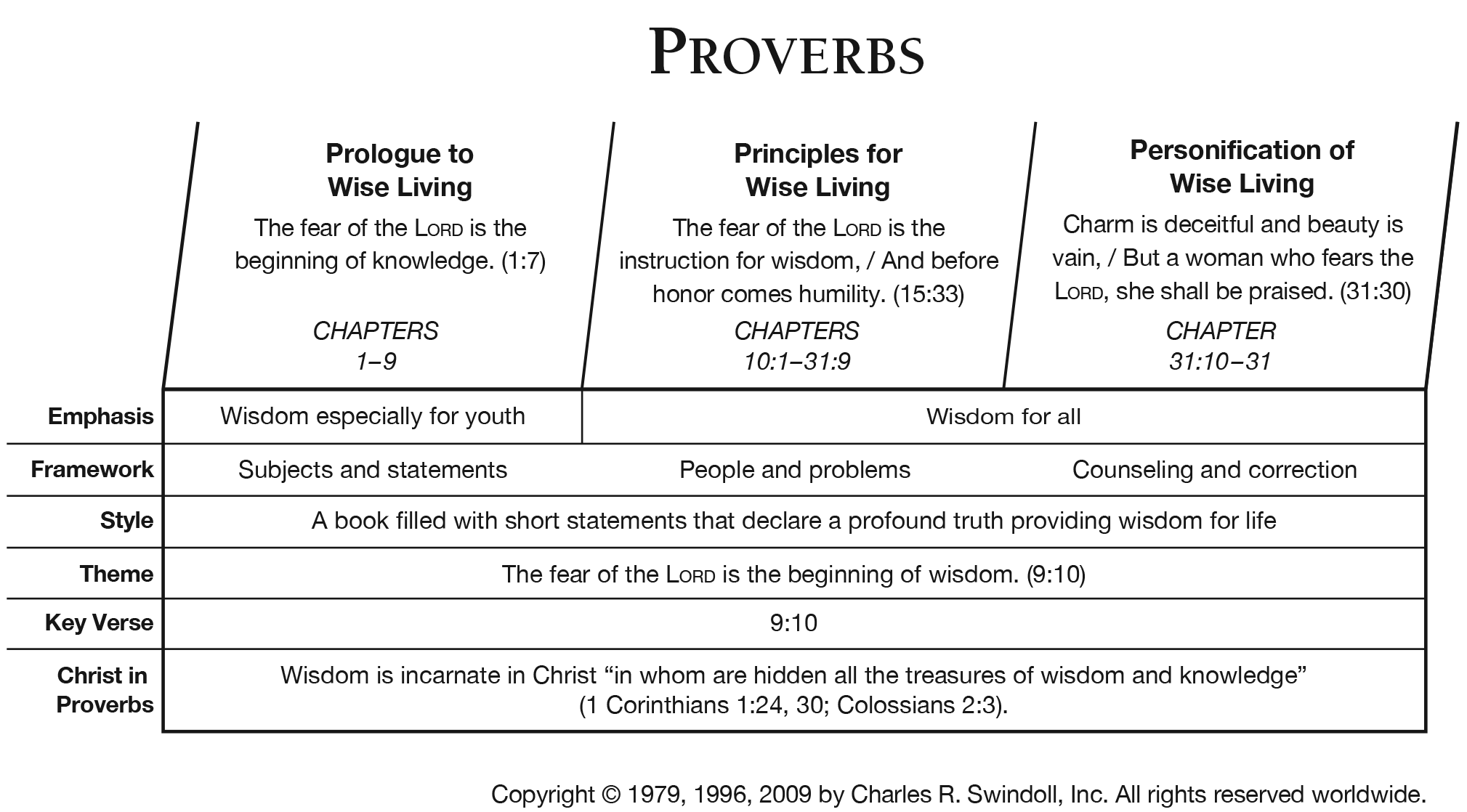
- Click for chart on Proverbs - Charles Swindoll
Why is Proverbs so important? Proverbs accomplishes something no other biblical book does: it simply compiles numerous short instructions for living an effective life on earth. While other books articulate profound theological truths, lengthy narratives of triumph and failure, or prophetic preaching to a disobedient people, Proverbs concerns itself completely with instructing people in the path of wisdom. The writers of the book recognized the varied circumstances of a person’s life and provided principles to apply in a variety of situations rather than instructions to follow in only a few specific instances.
What's the big idea? Proverbs states its theme explicitly very early in the book: “The fear of the Lord is the beginning of knowledge” (Proverbs 1:7). The fear of the Lord refers to our viewing Him with the respect He deserves. It means living our lives in light of what we know of Him, holding Him in the highest estimation, and depending on Him with humble trust. Only then, Proverbs teaches, will we discover knowledge and wisdom (see also Pr 9:10).
In writing the Proverbs, Solomon hoped that his readers would attain practical righteousness in all things and that we would do this by living our lives under the authority and direction of God. He specifically explained the book’s purpose in Pr 1:2–6, focusing on imparting understanding that would impact every facet of our lives. Much of the book emphasizes listening to others so that we might learn from them and apply the combined knowledge of those who have gone before us—such as parents and elders—to the unique circumstances of our own lives (Pr 1:5, 8). Wisdom then involves appropriating a measure of humility, first before God and then before others. If instead, we decide to speak rashly rather than listen attentively . . . well, Proverbs deals with that too (Pr 12:15; 13:3).
How do I apply this? Read it! Then live it! Proverbs contains some of the most applicable nuggets of truth in all of the Bible. Most of the proverbs are pithy statements brimming over with imagery from the real world. This approach allows us to see very clearly how any particular proverb might be applied to any number of everyday situations we encounter—from getting out of bed in the morning to building a strong foundation in our relationships with others. Proverbs reminds us that God concerns Himself not just with the big, cataclysmic events of life but even those mundane, “invisible” moments in our lives as well. Are you following God, even in those seemingly “small” circumstances? Allow Proverbs to refocus your attention on all the hidden moments of your life.
- Proverbs Overview - J Vernon McGee
- Analysis of Proverbs - James Van Dine
- OT Reflections of Christ in Proverbs - Paul Van Gorder
Excerpt - The divine origin of the book is attested to by the fact that after 3,000 years its counsels still stand, undaunted by modern psychology and education. The keynote of Proverbs is expressed in chapter 1, verse 7, ''The fear of the Lord is the beginning of knowledge.'' That distinguishes this book from all of the wisdom literature of the world. It starts with an affirmation, a fundamental truth, that no educator should ignore. The Hebrew philosophers believed there could be no discovery of ultimate truth apart from revelation. And the revelation with which they began was the existence of God. He filled their vision. Modern philosophy has developed a system that is godless and foolish because there is ''no fear of God before their eyes'' (Romans 3:18).
- Knowing God Through Proverbs - Radio Bible Class
- Proverbs - Keys To Proverbs - William Orr
- Proverbs - Through the Bible Book by Book - Myer Pearlman
- An Introduction to the Book of Proverbs - David Malick
- An Argument of the Book of Proverbs - David Malick
- Selected Bibliography of the Book of Proverbs - David Malick
- Major Characteristics of Hebrew Poetry: Parallelism - Asbury Bible Commentary
- Proverbs, Theology of - Baker's Evangelical Dictionary of Biblical Theology
- Bridgeway Bible Dictionary Proverbs
- Hastings' Dictionary of the NT Proverbs
- Easton's Bible Dictionary Proverbs, Book of
- Fausset Bible Dictionary Proverbs, the Book of
- Holman Bible Dictionary Proverbs, Book of
- Hastings' Dictionary of the Bible Proverbs, Book of
- International Standard Bible Encyclopedia Proverbs, Book of
- McClintock and Strong's Bible Encyclopedia Proverbs, Book Of
- The Nuttall Encyclopedia Proverbs, Book of
- Morrish Bible Dictionary Proverbs, Book of
- Hawker's Poor Man's Dictionary Proverbs
- People's Dictionary of the Bible Proverbs book of
- Watson's Theological Dictionary Proverbs
- 1911 Encyclopedia Britannica Book of Proverbs
- Kitto Biblical Cyclopedia Proverbs the book of
- The Jewish Encyclopedia Proverbs, Book of Proverbs
Key Words -- Key Words -- see importance of key words - learn how to mark key words and the associated discipline of how to interrogate them with 5W/H questions. Practice "interrogating" key words as well as term of conclusion (therefore), term of explanation (for), terms of purpose or result (so that, in order that, that, as a result), terms of contrast (but, yet), expressions of time (including then; until, after) and terms of comparison (like, as). You will be amazed at how your Teacher, the Holy Spirit, will illuminate your understanding, a spiritual blessing that will grow the more you practice! Be diligent! Consider the "5P's" - Pause to Ponder the Passage then Practice it in the Power of the Spirit. See also inductive Bible study - observation (Observe With a Purpose), Interpretation (Keep Context King, Read Literally, Compare Scripture with Scripture, Consult Conservative Commentaries), and then be a doer of the Word with Application. Do not overlook "doing the word" for if you do you are deluding yourself, and are just a "smarter sinner," but not more like the Savior! As Jesus said "blessed are those who hear the word of God, and observe it." (Lk 11:28+, cf James 1:22+)
Key Words (NAS95):
Fear of the LORD (14x),
Prov. 1:7,29; 2:5; 8:13; 9:10; 10:27; 14:26-27; 15:16,33; 16:6; 19:23; 22:4; 23:17
Wisdom (48x/47v),
Prov. 1:2,7,20; 2:2,6-7,10; 3:13,19,21; 4:5,7,11; 5:1; 7:4; 8:1,5,11-12,14; 9:1,10; 10:13,23,31; 11:2; 13:10; 14:6,8,33; 15:33; 16:16; 17:16,24; 18:1,4; 19:8; 21:30; 23:9,23; 24:3,7,14; 29:3,15; 30:3; 31:26
Wise (62x/58v),
Prov. 1:3,5-6; 3:7,35; 6:6; 8:33; 9:8-9,12; 10:1,8,14,19; 11:30; 12:15,18; 13:1,14,20; 14:1,3,16,24; 15:2,7,12,20,24,31; 16:14,21,23; 17:28; 18:15; 19:20; 20:1,18,26; 21:11,20,22; 22:17; 23:15,19,24; 24:5-6,23; 25:12; 26:5,12; 27:11; 28:11; 29:8-9,11; 30:24
Fool(s) (58x),
Fool - Prov. 7:22; 10:8,10,18,23; 12:15; 13:16; 14:7,16; 15:5; 17:7,10,12,16,21,24,28; 18:2; 19:1,10; 20:3; 23:9; 24:7; 26:1,4-6,8,10-12; 27:3,22; 28:26; 29:11,20; 30:22
Fools - Prov. 1:7,22,32; 3:35; 8:5; 10:21; 12:23; 13:19-20; 14:8-9,24,33; 15:2,7,14; 16:22; 19:29; 26:3,7,9
Folly (17x/17v)
Prov. 5:23; 9:6,13; 12:23; 13:16; 14:24,29; 15:2,14,21; 16:22; 17:12; 18:13; 24:9; 26:4-5,11
Foolish (12x/11v),
Prov. 10:1,14; 11:29; 14:1,3; 15:20; 17:25; 19:13; 21:20; 29:9; 30:32
My son (23x),
Prov. 1:8,10,15; 2:1; 3:1,11,21; 4:10,20; 5:1,20; 6:1,3,20; 7:1; 19:27; 23:15,19,26; 24:13,21; 27:11; 31:2
Guidance (3x),
Prov. 11:14; 20:18; 24:6
Knowledge (40x/39v),
Prov. 1:4,7,22,29; 2:5-6,10; 3:20; 5:2; 8:9-10,12; 9:10; 10:14; 11:9; 12:1,23; 13:16; 14:6-7,18; 15:2,7,14; 17:27; 18:15; 19:2,25,27; 20:15; 21:11; 22:12,17,20; 23:12; 24:4-5; 28:2; 30:3
Understand(ing) (56x/55v),
Prov. 1:2,5-6; 2:2-3,6,11; 3:5,13,19; 4:1,5,7; 5:1; 7:4; 8:1,5,9,14; 9:4,6,10,16; 10:13,21,23; 11:12; 13:15; 14:6,8,29,33; 15:21,32; 16:16,21-22; 17:10,24,27; 18:2; 19:8,25; 20:5,24; 21:16,30; 23:23; 24:3; 28:2,5,11,16; 29:7,19; 30:2,18
Instruction (16x),
Prov. 1:2-3,7-8; 4:1-2,13; 5:12,23; 8:10,33; 9:9; 10:17; 15:33; 23:23; 24:32
Discipline (17x),
Prov. 3:11; 6:23; 7:22; 12:1; 13:1,18,24; 15:5,32; 16:22; 19:18,20,27; 22:15; 23:12-13
Commandment/command (11x),
Prov. 2:1; 3:1; 4:4; 6:20,23; 7:1-2; 8:29; 10:8; 13:13; 19:16
Truth (12x/12v)
Prov. 3:3; 8:7; 12:17,19; 14:22,25; 16:6; 20:28; 21:28; 22:21; 23:23; 29:14
Righteous(ness)(90x/89v),
Prov. 1:3; 2:9,20; 3:33; 4:18; 8:8,18,20; 9:9; 10:2-3,6-7,11,16,20-21,24-25,28,30-32; 11:4-6,8-10,18-19,21,23,28,30-31; 12:3,5,7,10,12-13,21,26,28; 13:5-6,9,21-22,25; 14:19,32,34; 15:6,9,28-29; 16:8,12-13,31; 17:15,26; 18:5,10; 20:7,28; 21:3,12,15,18,21,26; 23:24; 24:15-16,24; 25:5,26; 28:1,12,28; 29:2,6-7,16,27; 31:9
Evil (59x/55v),
Prov. 1:16,33; 2:12,14; 3:7; 4:14,16,27; 6:14,18,24; 8:13; 11:19,21,27; 12:2,12-13,20; 13:19; 14:16-17,19,22; 15:3,26,28; 16:4,6,17,27,30; 17:4,11,13,20; 19:23; 20:8,22,30; 21:10,27; 22:3; 24:1,8,19-20; 25:10; 27:12; 28:5,10,22; 29:6; 30:32; 31:12
Wicked(ness) (91x/89v),
Prov. 2:22; 3:25,33; 4:14,17,19; 5:22; 6:12,18; 8:7; 9:7; 10:3,6-7,11,16,20,23-25,27-28,30,32; 11:5,7-8,10-11,18,23,31; 12:3,5-7,10,12,21,26; 13:5-6,9,17,25; 14:11,19,32; 15:6,8-9,28-29; 16:4,12; 17:4,15,23; 18:3,5; 19:28; 20:26; 21:4,7,10,12,18,27,29; 24:15-16,19-20,24-25; 25:5,26; 26:23,26; 28:1,4,12,15,28; 29:2,7,12,16,27
Life (46x),
Prov. 1:19; 2:19; 3:2,16,18,22; 4:10,13,22-23; 5:6; 6:23,26; 7:23; 8:35; 9:11; 10:11,16-17,27; 11:19,30; 12:10,28; 13:3,8,12,14; 14:27,30; 15:4,24,31; 16:15,17,22; 18:21; 19:23; 20:2; 21:21; 22:4,23; 29:10,24; 31:6,12
Live (14x/14v)
Prov. 1:18,33; 2:21; 3:29; 4:4; 7:2,23; 9:6; 14:25; 15:27; 21:9,19; 23:17; 25:24
Death (20x/20v)
Prov. 2:18; 5:5; 7:27; 8:36; 10:2; 11:4,19; 12:28; 13:14; 14:12,27; 16:14,25; 18:21; 19:18; 21:6,25; 24:11; 26:18; 28:17
Tongue (18x),
Prov. 6:17,24; 10:20,31; 12:18-19; 15:2,4; 16:1; 17:4; 18:21; 21:6,23; 25:15,23; 26:28; 28:23; 31:26
Way (80x/74v)
Prov. 1:15,19,31-32; 2:8,12-13,15,20; 3:6,17,23,31; 4:11,14,19,26; 5:6,8,21; 6:6,23; 7:8,25,27; 8:2,13,20,22,32; 9:6; 10:9,29; 11:5; 12:15,26,28; 13:6,15; 14:2,8,12,14; 15:9-10,19; 16:2,7,9,17,25,29,31; 17:23; 19:3; 20:14,24; 21:2,8,16,29; 22:5-6,25; 23:19,26; 25:26; 28:10; 29:15,27; 30:19-20; 31:3,27
But (246x/242v) - The frequency of this conjunction highlights the importance of terms of contrast in the Proverbs. It also furnishes the careful read a "hinge" to aid opening the door of meaning to that specific proverb. Always seek to discern what (why, how, where, etc) is being contrasted. "The two major themes which are interwoven and overlapping throughout Proverbs are wisdom and folly. Wisdom, which includes knowledge, understanding, instruction, discretion, and obedience, is built on the fear of the Lord and the Word of God. Folly is everything opposite to wisdom." (MacArthur)
Prov. 1:18,28,33; 2:22; 3:1,32-33,35; 4:18; 5:4; 6:31; 8:36; 9:18; 10:1ff,11-14,17,19,21,24-25,27ff; 11:1ff,8-9,11ff,17-18,20-21,23,26-28; 12:1ff,10-13,15ff; 13:1-2,4ff,15ff,23-25; 14:1ff,8-9,11-12,14-16,18,20ff,28ff; 15:1-2,4ff,13-15,18ff,25ff,32; 16:1-2,9,14,22,25,33; 17:3,9,22,24; 18:2,12,14,23-24; 19:4,7,12,14,16,21,24-25; 20:3,5-6,14-15,17; 21:2,5,8,11,15,20,28-29,31; 22:3,12; 23:7,17,35; 24:16,25; 25:2; 26:24; 27:3-4,6-7; 28:1-2,4-5,7,10ff,16,18-20,25-28; 29:2-4,6,8,10-11,15-16,18,23-26; 30:24-25; 31:29-30
Verse by Verse Exposition
- Proverbs 1:1 Commentary
- Proverbs 1:2 Commentary
- Proverbs 1:3 Commentary
- Proverbs 1:4 Commentary
- Proverbs 1:5 Commentary
- Proverbs 1:6 Commentary
- Proverbs 1:7 Commentary
- Proverbs 1:8 Commentary
- Proverbs 1:9 Commentary
- Proverbs 1:10 Commentary
- Proverbs 1:11 Commentary
- Proverbs 1:12 Commentary
- Proverbs 1:13 Commentary
- Proverbs 1:14 Commentary
- Proverbs 1:15 Commentary
- Proverbs 1:16 Commentary
- Proverbs 1:17 Commentary
- Proverbs 1:18 Commentary
- Proverbs 1:19 Commentary
- Proverbs 1:20 Commentary
- Proverbs 1:21 Commentary
- Proverbs 1:22 Commentary
- Proverbs 1:23 Commentary
- Proverbs 1:24 Commentary
- Proverbs 1:25 Commentary
- Proverbs 1:26 Commentary
- Proverbs 1:27 Commentary
- Proverbs 1:28 Commentary
- Proverbs 1:29 Commentary
- Proverbs 1:30 Commentary
- Proverbs 1:31 Commentary
- Proverbs 1:32 Commentary
- Proverbs 1:33 Commentary
- Proverbs 2:1 Commentary
- Proverbs 2:2 Commentary
- Proverbs 2:3 Commentary
- Proverbs 2:4 Commentary
- Proverbs 2:5 Commentary
- Proverbs 2:6 Commentary
- Proverbs 2:7 Commentary
- Proverbs 2:8 Commentary
- Proverbs 2:9 Commentary
- Proverbs 2:10 Commentary
- Proverbs 2:11 Commentary
- Proverbs 2:12 Commentary
- Proverbs 2:13 Commentary
- Proverbs 2:14 Commentary
- Proverbs 2:15 Commentary
- Proverbs 2:16 Commentary
- Proverbs 2:17 Commentary
- Proverbs 2:18 Commentary
- Proverbs 2:19 Commentary
- Proverbs 2:20 Commentary
- Proverbs 2:21 Commentary
- Proverbs 2:22 Commentary
- Proverbs 3:1 Commentary
- Proverbs 3:2 Commentary
- Proverbs 3:3 Commentary
- Proverbs 3:4 Commentary
- Proverbs 3:5 Commentary
- Proverbs 3:6 Commentary
- Proverbs 3:7 Commentary
- Proverbs 3:8 Commentary
- Proverbs 3:9 Commentary
- Proverbs 3:10 Commentary
- Proverbs 3:11 Commentary
- Proverbs 3:12 Commentary
- Proverbs 3:13 Commentary
- Proverbs 3:14 Commentary
- Proverbs 3:15 Commentary
- Proverbs 3:16 Commentary
- Proverbs 3:17 Commentary
- Proverbs 3:18 Commentary
- Proverbs 3:19 Commentary
- Proverbs 3:20 Commentary
- Proverbs 3:21 Commentary
- Proverbs 3:22 Commentary
- Proverbs 3:23 Commentary
- Proverbs 3:24 Commentary
- Proverbs 3:25 Commentary
- Proverbs 3:26 Commentary
- Proverbs 3:27 Commentary
- Proverbs 3:28 Commentary
- Proverbs 3:29 Commentary
- Proverbs 3:30 Commentary
- Proverbs 3:31 Commentary
- Proverbs 3:32 Commentary
- Proverbs 3:33 Commentary
- Proverbs 3:34 Commentary
- Proverbs 3:35 Commentary
- Proverbs 4:1 Commentary
- Proverbs 4:2 Commentary
- Proverbs 4:3 Commentary
- Proverbs 4:4 Commentary
- Proverbs 4:5 Commentary
- Proverbs 4:6 Commentary
- Proverbs 4:7 Commentary
- Proverbs 4:8 Commentary
- Proverbs 4:9 Commentary
- Proverbs 4:10 Commentary
- Proverbs 4:11 Commentary
- Proverbs 4:12 Commentary
- Proverbs 4:13 Commentary
- Proverbs 4:14 Commentary
- Proverbs 4:15 Commentary
- Proverbs 4:16 Commentary
- Proverbs 4:17 Commentary
- Proverbs 4:18 Commentary
- Proverbs 4:19 Commentary
- Proverbs 4:20 Commentary
- Proverbs 4:21 Commentary
- Proverbs 4:22 Commentary
- Proverbs 4:23 Commentary
- Proverbs 4:24 Commentary
- Proverbs 4:25 Commentary
- Proverbs 4:26 Commentary
- Proverbs 4:27 Commentary
- Proverbs 5:1 Commentary
- Proverbs 5:2 Commentary
- Proverbs 5:3 Commentary
- Proverbs 5:4 Commentary
- Proverbs 5:5 Commentary
- Proverbs 5:6 Commentary
- Proverbs 5:7 Commentary
- Proverbs 5:8 Commentary
- Proverbs 5:9 Commentary
- Proverbs 5:10 Commentary
- Proverbs 5:11 Commentary
- Proverbs 5:12 Commentary
- Proverbs 5:13 Commentary
- Proverbs 5:14 Commentary
- Proverbs 5:15 Commentary
- Proverbs 5:16 Commentary
- Proverbs 5:17 Commentary
- Proverbs 5:18 Commentary
- Proverbs 5:19 Commentary
- Proverbs 5:20 Commentary
- Proverbs 5:21 Commentary
- Proverbs 5:22 Commentary
- Proverbs 5:23 Commentary
- Proverbs 6:1 Commentary
- Proverbs 6:2 Commentary
- Proverbs 6:3 Commentary
- Proverbs 6:4 Commentary
- Proverbs 6:5 Commentary
- Proverbs 6:6 Commentary
- Proverbs 6:7 Commentary
- Proverbs 6:8 Commentary
- Proverbs 6:9 Commentary
- Proverbs 6:10 Commentary
- Proverbs 6:11 Commentary
- Proverbs 6:12 Commentary
- Proverbs 6:13 Commentary
- Proverbs 6:14 Commentary
- Proverbs 6:15 Commentary
- Proverbs 6:16 Commentary
- Proverbs 6:17 Commentary
- Proverbs 6:18 Commentary
- Proverbs 6:19 Commentary
- Proverbs 6:20 Commentary
- Proverbs 6:21 Commentary
- Proverbs 6:22 Commentary
- Proverbs 6:23 Commentary
- Proverbs 6:24 Commentary
- Proverbs 6:25 Commentary
- Proverbs 6:26 Commentary
- Proverbs 6:27 Commentary
- Proverbs 6:28 Commentary
- Proverbs 6:29 Commentary
- Proverbs 6:30 Commentary
- Proverbs 6:31 Commentary
- Proverbs 6:32 Commentary
- Proverbs 6:33 Commentary
- Proverbs 6:34 Commentary
- Proverbs 6:35 Commentary
- Proverbs 7:1 Commentary
- Proverbs 7:2 Commentary
- Proverbs 7:3 Commentary
- Proverbs 7:4 Commentary
- Proverbs 7:5 Commentary
- Proverbs 7:6 Commentary
- Proverbs 7:7 Commentary
- Proverbs 7:8 Commentary
- Proverbs 7:9 Commentary
- Proverbs 7:10 Commentary
- Proverbs 7:11 Commentary
- Proverbs 7:12 Commentary
- Proverbs 7:13 Commentary
- Proverbs 7:14 Commentary
- Proverbs 7:15 Commentary
- Proverbs 7:16 Commentary
- Proverbs 7:17 Commentary
- Proverbs 7:18 Commentary
- Proverbs 7:19 Commentary
- Proverbs 7:20 Commentary
- Proverbs 7:21 Commentary
- Proverbs 7:22 Commentary
- Proverbs 7:23 Commentary
- Proverbs 7:24 Commentary
- Proverbs 7:25 Commentary
- Proverbs 7:26 Commentary
- Proverbs 7:27 Commentary
- Proverbs 15:1 Commentary
- Proverbs 15:2 Commentary
- Proverbs 15:3 Commentary
- Proverbs 15:4 Commentary
- Proverbs 15:5 Commentary
- Proverbs 15:6 Commentary
- Proverbs 15:7 Commentary
- Proverbs 15:8 Commentary
- Proverbs 15:9 Commentary
- Proverbs 15:10 Commentary
- Proverbs 15:11 Commentary
- Proverbs 15:12 Commentary
- Proverbs 15:13 Commentary
- Proverbs 15:14 Commentary
- Proverbs 15:15 Commentary
- Proverbs 15:16 Commentary
- Proverbs 15:17 Commentary
- Proverbs 15:18 Commentary
- Proverbs 15:19 Commentary
- Proverbs 15:20 Commentary
- Proverbs 15:21 Commentary
- Proverbs 15:22 Commentary
- Proverbs 15:23 Commentary
- Proverbs 15:24 Commentary
- Proverbs 15:25 Commentary
- Proverbs 15:26 Commentary
- Proverbs 15:27 Commentary
- Proverbs 15:28 Commentary
- Proverbs 15:29 Commentary
- Proverbs 15:30 Commentary
- Proverbs 15:31 Commentary
- Proverbs 15:32 Commentary
- Proverbs 15:33 Commentary
- Proverbs 4:23 Commentary
- Proverbs 13:13 Commentary
- Proverbs 18:10 Commentary
- Proverbs 18:11 Commentary
- Proverbs 28:13 Commentary
- Proverbs 29:18 Commentary
Explanation - The following list includes not only commentaries but other Christian works by well known evangelical writers. Most of the resources below are newer works (written after 1970) which previously were available only for purchase in book form or in a Bible computer program. The resources are made freely available by archive.org but have several caveats - (1) they do not allow copy and paste, (2) they can only be checked out for one hour (but can be checked out immediately when your hour expires giving you time to read or take notes on a lengthy section) and (3) they require creating an account which allows you to check out the books free of charge. To set up an account click archive.org and then click the picture of the person in right upper corner and enter email and a password. That's all you have to do. Then you can read these more modern resources free of charge! I have read or used many of these resources but not all of them so ultimately you will need to be a Berean (Acts 17:11+) as you use them. I have also selected works that are conservative and Biblically sound. If you find one that you think does not meet those criteria please send an email at https://www.preceptaustin.org/
NOTE: If a book you select says "UNAVAILABLE" at the top of the page that usually means someone has it "checked out". You can try going back later to see if it is available, but I have noticed some books stay "unavailable" for a prolonged time so this can be frustrating!
The Book of Proverbs Chapters 1-15 by Waltke, Bruce
The Book of Proverbs Chapters 15-31 by Waltke, Bruce
Cyril Barber - Within these covers readers are treated to an exposition that lays bare a lifetime of scholarship. Waltke elucidates the structure, authorship, and theology of the book of Proverbs, giving prominence to the contribution of exegesis to exposition. He then carefully applies the teaching of each verse and section to the life of the believer. This is a work that Bible students will treasure!
The wisdom of Proverbs, Job, and Ecclesiastes : an introduction to wisdom literature by Kidner, Derek (1985) 180 pages 70 ratings
James Rosscup - An introduction to wisdom writings, touching on themes, and treating readers to recent thought on wisdom literature. He looks at the biblical material alongside apocryphal wisdom sources and parallels in ancient Near Eastern works. He often helps on proverbs that seem to clash, and has insights on how to view the ones that generalize and do not work in some cases. Chapters of this evangelical effort deal with Old Testament wisdom literature, Proverbs, Job, Ecclesiastes, recent thought and evaluation of higher critical studies, and the correlation of Proverbs, Job and Ecclesiastes in certain ways. Three appendices treat each Old Testament wisdom writing in relation to Near Eastern works. Kidner also shows comparisons and differences between Ecclesiasticus, Wisdom of Solomon and the Old Testament books. Cf. Bullock under Job for another outstanding study of the Old Testament poetic literature.
Cornerstone Biblical Commentary - Psalms, Proverbs Read some of the 13 ratings
Proverbs : Wisdom for Everyday Life by Kaiser, Walter C
Learning from the Sages. Baker, 1995.Zuck, Roy B.
Part 1 - Overview and Themes in the Book of Proverbs (10 chapters - e.g., "The Vocabulary of Wealth and Poverty in the Book of Proverbs Pr 10:1-22:16 and Pr 25-29 by Whybray, Guidelines for Understanding and Proclaiming the Book of Proverbs - 20 pages by Greg W Parsons) Part 2 - Exposition of Specific Passages in the Book of Proverbs - 21 chapters) 449 pages (1995)
Proverbs : God's guide for life's choices by Kroll, Woodrow Michael
The ABC's of wisdom : building character with Solomon by Pritchard, Ray
Windows of Wisdom : Devotional Studies in Proverbs by Olford, Stephen
Exploring Proverbs (only Volume 2 = Pr 9:6-31:31)- John Phillips - he is always worth checking as he often as excellent illustrations in addition to his pithy style.
James Rosscup - A writer of popular exposition is profitable here to many due to sermonic points, outlines, and illustrations in a book of 1,230 pp. Preachers can find it a catalyst, so can church class teachers and lay readers looking for food given in an easy flow. Phillips has much about wise choices, trust (cf. 3:5–6), purity as in 4:23, dealing with temptation (7:5–21), and such themes. This is at least one of the best recent detailed devotional products on Proverbs. Verses are usually taken in their traditional sense, as 22:6 is on training a child, and 31:10–31 is in assuming godly women who live this way.
Be Skillful : God's Guidebook to Wise Living : OT Commentary : Proverbs by Wiersbe, Warren W
James Rosscup - The “Be” series deals with Prov. 1–9, giving frequent illustrations and terse Wiersbe maxims, in chapters contrasting wisdom/folly, wealth/poverty, also dealing with speech, righteousness, guidance, besetting sins such as disrespect, greed, pride, etc. Preachers, students, and lay users will gain some enrichment.
Bible Exposition Commentary - Old Testament - scroll to page 1054
With the Word - Devotional Commentary - Warren Wiersbe - 428 ratings
Wiersbe's Expository Outlines on the Old Testament by Wiersbe, Warren W 113 ratings
"Even the most difficult Scriptures come alive as Warren Wiersbe leads you book-by-book through the Old Testament and helps you to see the "big picture" of God's revelation. In this unique volume, you will find: • Introductions and/or outlines for every Old Testament book • Practical expositions of strategic chapters • Special studies on key topics, relating the Old Testament to the New Testament • Easy-to-understand expositions that are practical, preachable, and teachable If you have used Dr. Wiersbe's popular BE series, you know how simple and practical his Bible studies are, with outlines that almost teach themselves. If not, you can now discover a wonderful new resource. This work is a unique commentary on every book of the Old Testament. It contains new material not to be found in the BE series.
The Communicator's Commentary. Proverbs by Hubbard, David Allan (Now published as Preacher's Commentary)
Proverbs by Aitken, Kenneth T
James Rosscup - Though Aitken late-dates the present form of Proverbs to fifth/fourth century B. C., he furnishes many insights of value on possible renderings of phrases. He looks at Proverbs 1–9 in sequence, then in 10–31 switches to a topical method, dealing with the scoffer, drunkard, liar and other characters. He also devotes parts to honoring parents, old age, false witnesses, sadness vs. gladness, prayer, etc. All in all it is a very profitable work, and time will be spent well here.
Proverbs : from Biblical Text-- to Contemporary Life by Koptak, Paul E.,
Selected Studies from Proverbs by Swindoll, Charles
Thru the Bible with J. Vernon McGee - Proverbs - Malachi Proverbs by McGee, J. Vernon
Proverbs : a Commentary on an Ancient book of Timeless Advice by Alden, Robert L
James Rosscup - Alden was Professor of Old Testament at Denver Conservative Baptist Seminary, and also author of a 3-volume commentary on the Psalms and a good work on Job. The present work is based on specialized study into canonical wisdom literature. The commentary deals in capsule style with each verse based on analysis of the Hebrew, but mentions the Hebrew words only occasionally. Alden seeks to relate the message to 20th century life.
Living Wisely in a Foolish World - PROVERBS - by House, H. Wayne
Walking in Wisdom : Studying the Proverbs of Solomon by Mouser, William
Proverbs : Learning to Live Wisely : 10 studies for individuals or groups by Mouser, William
Cyril Barber - "Here is a highly recommended book-a gold-miner's manual for all who want to become spiritually wealthy" (Roy B. Zuck).
James Rosscup - A fairly lucid book that can prime the thought and set it running in productive paths as one prepares a message, or as any Christian seeks help from wise counsel.
Proverbs, Ecclesiastes, Song of songs by Garrett, Duane
Proverbs by Garrett, Duane - Briefer than above, but with hints for preaching and teaching
Cyril Barber - Works on the Bible’s wisdom literature is growing, and this volume deserves special consideration as an outstanding, detailed exposition of these three canonical books. Conservative in theology and thorough in scope, Garrett interacts with the different approaches to these books, comments on each verse, and treats technical matters in footnotes. The contents is readable and will be particularly apropos to pastors, Bible class teachers, and lay people desiring to study these seldom read portions of God’s Word.
James Rosscup - A Professor of OT at Gordon-Conwell Theological Seminary did this evangelical survey. It gives 252 pp. to Prov., 253–345 to Eccles., and 347–432 to the Song. Garrett opts for Solomonic authorship of much in Prov., of Eccles., and of the Song. He sees the Song as fitting the last of 7 views he surveys, that of a love song, not on historical events, the “Solomon” being a poetic symbol for the splendor of the bridegroom (365). This will not commend itself to all as being necessary. He sees Eccles. as teaching readers to realize they are mortals who must put away illusions of self-importance, face death and life firmly, accept with humility their human limitations, rely on God, enjoy life as His gift, and revere Him (278). He explains some proverbs, skips some in generalizing summaries of several. But he brings well-informed perceptions to supply the main ideas, often syntheses, but often as well details on salient points in verses. Overall the work gives frequent and valuable helps, and is usable for scholars, pastoral workers, church teachers, students, and Christians in devotional times.
Proverbs and Ecclesiastes; introduction and commentary by Jones, Edgar,
The Practical Wisdom of Proverbs by Goldberg, Louis, Proverbs 1-9
Cyril Barber - Provides a commentary on chapters 1—9 with subsequent chapters devoted to “God and Man,” “The Believer and His Emotions,” etc. As Joseph M. Stowell points out in his Foreword, ‘There is a core of common-sense principles that keeps us safe and sane in the challenging enterprise of life itself,” and these principles are explained by Goldberg in his book. Stowell continues, “After studying Proverbs through the lens of this book, your heart will be equipped to live wisely to the glory of God.”
The Bible Commentary : Proverbs-Ezekiel abridged and edited by J M Fuller
How to Read Proverbs by Longman, Tremper
New Bible Commentary - J A Motyer authored Psalms. (1994) See user reviews
Proverbs : a Self-study Guide by Jensen, Irving
James Rosscup - (This note is on his commentary not the self-study guide above) In the Everyman’s Bible Commentary series, this is a 116-page simple layman’s help geared to provoke application to life. Several charts and a detailed outline printed at the outset and followed in the sweeping survey help in this. Of course many verses are passed over, but the survey draws many things together in perspective and can be a catalyst used along with more detailed works in preparation to preach or teach or just to enjoy a brief sketch that can refresh.
Understanding the Old Testament Proverbs, Isaiah, Jeremiah by Scripture Union
Wycliffe Bible Commentary - Charles Pfeiffer - 1560 pages (1962). Less detailed than the KJV Bible Commentary below.
Proverbs section written by Harris, R. Laird in Wycliffe Bible Commentary - A competent, well-studied and often contributing treatment by a top Old Testament conservative scholar. One of the best brief commentaries, offering considerable insight.
Rosscup - Conservative and premillennial scholars here have been experts in their fields. The work contains brief introductions and attempts to give a verse-by-verse exposition, though it does skip over some verses. The treatments vary with the authors, but as a whole it is a fine one-volume commentary for pastors and students to use or give to a layman. Outstanding sections include, for example: Whitcomb on Ezra-Nehemiah-Esther; Culver on Daniel; Ladd on Acts; Harrison on Galatians; Johnson on I Corinthians; and Ryrie on the Johannine Epistles.
Bible Knowledge Commentary - Old Testament - 1608 pages. Dallas Theological Seminary Faculty - Proverbs by Sid Buzzell
James Rosscup - A former teacher at the Dallas Theological Seminary has done this concise, clear, adept work. He shows a fine grasp of Hebrew exegesis and word meaning, use of context where it is pertinent, parallelism, customs, etc. The pastor, other church worker or layperson who uses this for preparation to speak or to live in God’s values will benefit much.
Wise Words : Family Stories that bring the Proverbs to life by Leithart, Peter J
The Complete Guide to the Book of Proverbs by Jones, Cody L.
James Rosscup - Jones uses 566 large pp. to compile brief (a paragraph or page) synopses of what selected proverbs convey on dozens of topics. Some themes are: wisdom, kindness, violence, watching the heart, smooth talk, wrongs to shun, drinking from one’s own well, etc. Often, entries reflect on customs (as substances for eye make-up, 6:25b, p. 59). One section gives six popular translations in six parallel cols. (328–545), another prints NT references to Proverbs. An index helps users find topics. As is clear, the work is not a complete guide but a partial one.
Proverbs and Ecclesiastes; introduction and commentary by Jones, Edgar,
James Rosscup - The Professor of Hebrew and Old Testament at the Northern Congregational College, Manchester, England did this. He feels that some parts of Proverbs linked with Solomon’s name may be due to Solomon, but the majority of the material comes from later times (8th to 3rd centuries). In his theorizing Solomon did not write Ecclesiastes; rather more than one teacher in the wisdom school wrote parts of the book, taking the pseudonym of Solomon ca. 250 B. C. Verse by verse this is usually a fair, though quite concise commentary touching on some of the most crucial aspects and based on use of modern critical scholarship on the liberal side. The brevity results in passing over many verses with generalized comments too sparse to be of serious help (cf. Prov. 3:5, 6; 22:6). His lists of sources do not reflect use of evangelical works available when he wrote.
Queen of Hearts : the Role of Today's Woman, Based on Proverbs 31 by Briscoe, Jill
Cyril Barber - Delightful devotional messages. It is hard to imagine anyone's not being blessed by what Mrs. Briscoe relates
STUDY BIBLES - ONE VOLUME COMMENTARIES OF ENTIRE BIBLE, BIBLE DICTIONARIES, GENERAL REFERENCE WORKS
Note: The first 3 resources have no time restriction and allow copy and paste function:
(1) KJV Bible Commentary - Hindson, Edward E; Kroll, Woodrow Michael. Over 3000 pages of the entire OT/NT. Well done conservative commentary that interprets Scripture from a literal perspective. Pre-millennial. User reviews - it generally gets 4/5 stars from users. - 372 ratings
Very well done conservative commentary that interprets Scripture from a literal perspective user reviews
The King James Version Bible Commentary is a complete verse-by-verse commentary. It is comprehensive in scope, reliable in scholarship, and easy to use. Its authors are leading evangelical theologians who provide practical truths and biblical principles. Any Bible student will gain new insights through this one-volume commentary based on the timeless King James Version of the Bible.
(2) The King James Study Bible Second Edition 2240 pages (2013) (Thomas Nelson) General Editor - Edward Hindson with multiple contributing editors. . 3,194 ratings. Pre-millennial. See introduction on How to Use this Study Bible.
(3) NKJV Study Bible: New King James Version Study Bible (formerly "The Nelson Study Bible - NKJV") by Earl D Radmacher; Ronald Barclay Allen; Wayne H House. 2345 pages. (1997, 2007). Very helpful notes. Conservative. Pre-millennial. 917 ratings
Believer's Bible Commentary - OT and NT - MacDonald, William (1995) 2480 pages. Conservative. Literal. Often has very insightful comments. John MacArthur, says "Concise yet comprehensive - the most complete single-volume commentary I have seen." Warren Wiersbe adds "For the student who is serious about seeing Christ in the Word." One hour limit.
Rosscup - This work, originally issued in 1983, is conservative and premillennial, written to help teachers, preachers and people in every walk of life with different views, explanation and application. The 2-column format runs verse by verse for the most part, usually in a helpfully knowledgeable manner, and there are several special sections such as “Prayer” in Acts and “Legalism” in Galatians. The premillennial view is evident on Acts 1:6, 3:20, Romans 11:26, Galatians 6:16, Revelation 20, etc.
Evangelical Commentary on the Bible - editor Walter Elwell (1989) 1239 pages. User reviews.
HCSB Study Bible : Holman Christian Standard Bible - General Editor Jeremy Royal Howard (2010) 2360 pages. Conservative. Good notes. Include Holmans excellent maps. One hour limit
Life Application Study Bible: Old Testament and New Testament: New Living Translation. Has some very helpful notes especially with application of texts. 4,445 ratings One hour limit
The MacArthur Study Bible - John MacArthur. Brief but well done notes for conservative, literal perspective. 1,275 ratings
ESV Study Bible - Excellent resource but not always literal in eschatology and the nation of Israel 6,004 ratings
Ryrie Study Bible Expanded Edition (1994) 2232 pages
The David Jeremiah Study Bible - (2013) 2208 pages. 2,272 ratings Logos.com - "Drawing on more than 40 years of study, Dr. David Jeremiah has compiled a legacy resource that will make an eternal impact on generations to come. 8,000 study notes. Hundreds of enriching word studies"50+ Essentials of the Christian Faith" articles."
The Experiencing God Study Bible: the Bible for knowing and doing the will of God - Blackaby, Henry (1996) 1968 pages - CHECK THIS ONE! Each chapter begins with several questions under the title "PREPARE TO MEET GOD." Then you will interesting symbols before many of the passages. The chapter ends with a "DID YOU NOTICE?" question. This might make a "dry chapter" jump off the page! Read some of the 48 ratings
The Defender's Study Bible : King James Version by Morris, Henry M. Excellent notes by well known creationist. 45 ratings
Zondervan NIV Study Bible - (2011) 2570 pages - Use this one if available as it has more notes than edition below. One hour limit
NIV Study Bible by Barker, Kenneth L; Burdick, Donald W (1995) 2250 pages. This is the first edition. This resource has been fully revised in 2020. One hour limit
NLT Study Bible (Illustration Version)
Disciple's Study Bible: New international version 54 ratings Not that helpful for verse by verse study. Focuses on application of Christian doctrines. 10,000 annotations; doctrinal summaries, "Life Helps" section relate doctrine to everyday discipleship.
The Living Insights Study Bible : New International Version - Charles Swindoll. Notes are good but somewhat sparse and not verse by verse.
NIV Cultural Backgrounds Study Bible. Bringing to Life the Ancient World of Scripture Keener, Craig and Walton, John. Editors (2017)
The Holman Illustrated Study Bible 120 ratings Includes the excellent Holman maps but otherwise of little help in serious study.
MISCELLANEOUS RESOURCES
Halley's Bible Handbook Henry H. Halley - (2000) 2720 pages (much larger than original edition in 1965 and no time limit on use). (Halley's Bible handbook : an abbreviated Bible commentary - one hour limit 1965 872 pages)
Rosscup - A much-used older evangelical handbook bringing together a brief commentary on Bible books, some key archaeological findings, historical background, maps, quotes, etc. It is helpful to a lay Bible teacher, Sunday School leader, or pastor looking for quick, pertinent information on a Bible book. This is the 72nd printing somewhat revised. Halley packed in much information. Unger’s is better overall, but that is not to say that Halley’s will not provide much help on basic information.
The Shaw Pocket Bible Handbook - Editor - Walter Elwell (1984) 408 pages.
"This hardback is small in size but packed full of content: Brief summaries of every book of the bible, cultural, archaeological and historical info, word definitions, pictures, maps and charts." Worth checking!
The New Unger's Bible Dictionary by Unger, Merrill Frederick, 1909-
Every prophecy of the Bible: Walvoord, John F
IVP Background Commentary - OT - John Walton
Zondervan Atlas of The Bible By: Umair Mirza
Dictionary of Biblical Imagery - free for use online with no restrictions (i.e., you do not need to borrow this book). Editors Leland Ryken, J C Wilhoit, Tremper Longman III - This is a potential treasure chest to aid your preaching and teaching as it analyzes the meaning of a host of Biblical figures of speech. Clue - use the "One-page view" which then allows you to copy and paste text. One downside is there is no index, so you need to search 3291 pages for entries which are alphabetical.
Dictionary of deities and demons in the Bible (DDD) - 950 pages (1995) Read some of the 65 ratings (4.8/5 Stars). A definitive in depth resource on this subject. Very expensive to purchase.
APOLOGETICS
The Apologetics Study Bible Understand Why You Believe - Comments from over 90 leading apologists, including: Ted Cabal, Lee Strobel, Chuck Colson, Norm Geisler, Josh McDowell, Albert Mohler, J.P. Moreland, see reviews. Here is a review from The Christian Reviewer.
Baker Encyclopedia of Christian Apologetics by Geisler, Norman
Cyril Barber - This is a goldmine of valuable information! Well-indexed. Covers everything from “Absolute Truth” to “Zen Buddhism.” Extensive articles on such topics as “Agnosticism,” “Annihilationism,” “Bible, Alleged Errors in,” “Gnosticism,” “Miracles in the Bible,” “New Testament Manuscripts,” and “Objections to Resurrection,” “Big Bang Theory,” “Edward John Carnell,” “Christ, Death of,” are only a few of the insightful essays in this masterful work. Each article has been written in an understandable way, and a 28 page bibliography forms a valuable source for further research. An excellent resource.
Evidence That Demands A Verdict - Josh McDowell
The New Evidence that Demands a Verdict - Josh McDowell
More Than A Carpenter - A modern classic by Josh McDowell - Great resource for those who are skeptical that Jesus is fully God, fully Man.
Encyclopedia of Bible difficulties by Archer, Gleason L - or here with no restrictions
Hard Sayings of the Bible - Walter Kaiser
When Critics Ask - Norman Geisler
MANNERS AND CUSTOMS IN THE BIBLE
Today's Handbook of Bible Times & Customs by Coleman, William L
Nelson's New Illustrated Bible Manners & Customs : How the People of the Bible Really Lived by Vos, Howard Frederic
Manners & Customs of the Bible (The New Manners and Customs) Freeman, James M., 1827-1900 Published 1998
The New Manners and Customs of Bible Times: Gower, Ralph, 1933- Published 1987
Manners and Customs of Bible lands By: Wight, Fred Published 1983
Manners and Customs in the Bible By: Matthews, Victor Harold Published 1991
Handbook of life in Bible times By: Thompson, J. A. (John Arthur), 1913-2002 Published 1986
Illustrated dictionary of Bible manners and customs By: Deursen, A. van (Arie), 1891-1963 Published 1982
The Illustrated Guide to Bible Customs & Curiosities by Knight, George W.
Orientalisms in Bible lands, giving light from customs, habits, manners, imagery, thought and life in the East for Bible students By: Rice, Edwin Wilbur, 1831-1929 Published 1910
Bible manners and customs By: Mackie, G. M. 1854-1922 Published 1898
Teach it to your children : how kids lived in Bible days By: Vamosh, Miriam Feinberg, author
Everyday life in Bible times : work, worship, and war By: Embry, Margaret Published 1994
Everyday living : Bible life and times : fascinating, everyday customs and traditions from the people of the Bible Published 2006
The Land and the Book; or, Biblical illustrations drawn from the manners and customs, the scenes and scenery, of the Holy land By: Thomson, William M. (William McClure), 1806-1894 Published 1880
Eastern manners illustrative of the Old Testament history By: Jamieson, Robert, 1802-1880 Published 1838
Scripture manners and customs : being an account of the domestic habits, arts, etc., of Eastern nations mentioned in Holy Scripture Published 1895
HEBREW WORD STUDY
RESOURCES
Theological Wordbook of the Old Testament by Harris, R. Laird - (5/5 Stars) One of the best OT lexicons for studying Hebrew words.
Here is another link to the TWOT which has no time limit on use and does allow copy and paste. Can be downloaded as PDF.
Vine's Expository Dictionary of Old Testament and New Testament Words - Online pdf
Hebrew Honey: a simple and deep word study of the Old Testament - 330 pages. The definitions have more of a devotional flavor. For example, see the descriptive definition for "Abide" (Hebrew - gur).
Expository Dictionary of Bible Words by Richards, Larry, It does not go into great depth on the Greek or Hebrew words but does have some excellent insights.
So That's What it Means (Theological Wordbook) - Formerly titled "Theological Wordbook" edited by Charles Swindoll. It is now under this new title So That's What it Means and can be borrowed - it is more like a dictionary than a lexicon but the comments are superb! The contributors include Donald Campbell, Wendell Johnston, John Witmer, John Walvoord
Nelson's Expository Dictionary of the Old Testament by Unger, Merrill. Indexed by English word and then any related Hebrew nouns or verbs. Definitions are solid and geared to the lay person.
Synonyms of the Old Testament-Robert Girdlestone
100's of devotionals for preaching, teaching and pondering.
- Proverbs 1
- Proverbs 2
- Proverbs 3
- Proverbs 4
- Proverbs 5
- Proverbs 6
- Proverbs 7
- Proverbs 8
- Proverbs 9
- Proverbs 10
- Proverbs 11
- Proverbs 12
- Proverbs 13
- Proverbs 14
- Proverbs 15
- Proverbs 16
- Proverbs 17
- Proverbs 18
- Proverbs 19
- Proverbs 20
- Proverbs 21
- Proverbs 22
- Proverbs 23
- Proverbs 24
- Proverbs 25
- Proverbs 26
- Proverbs 27
- Proverbs 28
- Proverbs 29
- Proverbs 30
- Proverbs 31
From Paul Apple's Introduction - 53 page resource in outline format with frequent quotes from respected sources. Here are some helpful general comments on the significance and usefulness of Proverbs for our daily life....
Goldberg: The teachings of Chapters 1-9 are considered: to understand the goal of wisdom in her outreach; why the fruits of wisdom are so important; how the disciple can be wise in the ways of the Lord, as well as in the practicalities of life; the burden the father carries in his spiritual leadership of the family; the call for chastity, with good instruction in how to avoid the temptation of immorality; the abundant folly we run into and how we can avoid it; and why and how we should respond to the call of wisdom to avoid "folly's cursed crumbs."
Lane: Job and Ecclesiastes are speculative wisdom, for they investigate why things are as they are and how we can make sense of them. Proverbs is practical wisdom, showing us what we can do to get on in this puzzling world without losing our way and ending in disaster. Whether or not we ever come to solve the problems aired in the other two books, we can still come to terms with this world. We don't have to opt out and spend the whole of our lives thinking. We can get on with living in the real world, conquer our limitations and get along with other people. No book gives us more help in this than Proverbs.
House and Durham: By God's grace, the book of Proverbs enables each of us to have God's insight on how to live lives that will glorify Him; how to build up others; and how to be at peace with ourselves. Following its precepts will bring success in business and in the home. Through heeding its advice, we can avoid those regrettable pitfalls that can make life so difficult. If we listen to God's wisdom, we will experience joy and laughter rather than feeling the sorrow and despair that are so much a part of those who heed the "spirit of the age." Proverbs speaks to every area of life we will ever encounter. No stone is left unturned; no path not taken. The only issue in question is whether we will consider its ways and follow its advice.
Stedman: Life is simply too big for us to handle by ourselves. No matter how good the advice seems to be, if it isn't consistent with what God has told us, it is not to be trusted. And that is the conclusion that is reached through these opening chapters. Chapters 8 and 9 personify the two ways of life. Wisdom is seen as a beautiful woman, calling those who follow her to come away into the place of victory and achievement and success in life, while folly, or foolishness, which thinks everything it does is right in its own eyes, is personified as an evil woman -- attractive, alluring, tempting us to step aside into death. It is a marvelously-beautiful poetic passage.
Mouser: Two mistakes Christians make in interpreting proverbs: 1) Some Christians read the proverbs as if they were inflexible laws of God's creation, admitting no exceptions and 2) Christians will sometimes confuse proverbs with promises... However, proverbs in Solomon's collection are not promises made by God, but are guides which are to direct people in living successful and productive lives. (All of the above are from Paul Apple's introduction to proverbs)
Highly Recommended-Wonderful Illustrations of Scriptural Truths
Suggestion: Read it As A Devotional as you spend a month in Proverbs.
James Rosscup - These homilies were originally issued in 1857 as Illustrations of the Book of Proverbs, later as Laws from Heaven for Life on Earth (1878). There is much rich material, but Arnot skips Proverbs 7 and 21, and various verses in the other chapters. The work is famous for the grasp of spiritual truths and the easy-flowing style.
Charles Haddon Spurgeon -- "We wish Dr. Arnot had gone steadily through the whole book, for his mind was of an order peculiarly adapted for such a task. Those passages which he dilates upon are set in a clear and beautiful light. For a happy blending of illustrative faculty, practical sound sense, and spirituality, Dr. Arnot was almost unrivalled." (Spurgeon, C. H. Lectures to my Students, Vol. 4: Commenting and Commentaries; Lectures Addressed to the students of the Pastors' College, Metropolitan Tabernacle)
Following links are on preceptaustin.org
- I. THE PREACHER - Proverbs 1:1
- II. THE BOOK—PROVERBS - Proverbs 1:6
- III. THE ROOT OF KNOWLEDGE - Proverbs 1:7
- IV. THE FAMILY - Proverbs 1:8
- V. FILIAL LOVE A BLOSSOM OF BEAUTY - Proverbs 1:9
- VI. THE FOE AND THE FIGHT - Proverbs 1:10
- VII. FILTHY LUCRE - Proverbs 1:19
- VIII. THE CRY OF WISDOM - Proverbs 1:20-22
- IX. A REVIVAL - Proverbs 1:23
- X. SOWING DISOBEDIENCE, REAPING JUDGMENT - Proverbs 1:24-28
- XI. SEEK AND YE SHALL FIND - Proverbs 2:4-5
- XII. PERILS IN THE DEEP - Proverbs 2:12-19
- XIII. WISDOM RECEIVED AND RETAINED - Proverbs 2:10-11
- XIV. THE ART OF PRINTING - Proverbs 3:3
- XV. TRUST - Proverbs 3:5
- XVI. THE HEALTH OF HOLINESS - Proverbs 3:7-8
- XVII. CAPITAL AND PROFIT - Proverbs 3:9
- XVIII. A FATHERLY WORD ON FATHERLY CORRECTION - Proverbs 3:11-12
- XIX. MAKING A FORTUNE - Proverbs 3:13-15
- XX. A LENGTHENED DAY, AND A PLEASANT PATH - Proverbs 3:16-17
- XXI. WISDOM MAKING AND MANAGING WORLDS - Proverbs 3:19-20
- XXII. CONFIDENCE IN GOD THE TRUE SAFEGUARD FROM TEMPTATION - Proverbs 3:26
- XXIII. THE RIGHT THING DONE AT THE RIGHT TIME - Proverbs 3:27-28
- XXIV. THE CURSE AND THE BLESSING UPON THE HOUSE - Proverbs 3:33
- XXV. PRECEPT AND EXAMPLE - Proverbs 4:10-11
- XXVI. HOLD FAST - Proverbs 4:13
- XXVII. THE PATH OF THE JUST - Proverbs 4:18-19
- XXVIII. THE FOUNTAIN AND ITS STREAMS - Proverbs 4:23-27
- XXIX. FAMILY JOYS - Proverbs 5:15
- XXX. THE METHOD OF PROVIDENCE FOR RESTRAINING EVIL - Proverbs 5:21-22
- XXXI. SEVEN HATEFUL THINGS - Proverbs 6:16-19
- XXXII. MOTHER’S LAW - Proverbs 6:20-24
- XXXIII. THE WORTH OF WISDOM AND THE FEAR OF THE LORD - Proverbs 8:10, 13
- XXXIV. RANK AND RICHES - Proverbs 8:18,21
- XXXV. THE REDEEMER ANTICIPATING REDEMPTION - Proverbs 8:22-31
- XXXVI. THE MARRIAGE SUPPER FOR THE KING’S SON - Proverbs 9:1-6
- XXXVII. REPROOF - Proverbs 9:7, 9, 12
- XXXVIII. THE PLEASURES OF SIN - Proverbs 9:13-18
- XXXIX. THE PLACE AND POWER OF A SON - Proverbs 10:1
- XL. DILIGENT IN BUSINESS - Proverbs 10:4
- XLI. POSTHUMOUS FAME - Proverbs 10:7
- XLII. THE WISE ARE TEACHABLE, THE UPRIGHT STRONG - Proverbs 10:8-9
- XLIII. THE WELL OF LIFE, AND THE TREASURES OF WISDOM - Proverbs 10:11, 14
- XLIV. THE MONEY POWER - Proverbs 10:15
- XLV. THE LIPS AND TONGUE - Proverbs 10:19-21
- XLVI. THE BLESSING OF THE LORD MAKETH RICH - Proverbs 10:22
- XLVII. A FOOL’S SPORT - Proverbs 10:23, 14:9
- XLVIII. FEARS REALIZED AND HOPES FULFILLED - Proverbs 10:24-25
- XLIX. THE GREATNESS OF LITTLE THINGS - Proverbs 10:26
- L. HONESTY IS THE BEST POLICY - Proverbs 11:1
- LI. ASSORTED PAIRS - Proverbs 11:2-3
- LII. HYPOCRITES AND TALE-BEARERS - Proverbs 11:9,13
- LIII. DEBTS AND SURETIES - Proverbs 11:15
- LIV. AS WE SOW, WE REAP - Proverbs 11:17, 18, 20
- LV. A JEWEL ILL SET - Proverbs 11:22
- LVI. THE DESIRE OF THE RIGHTEOUS - Proverbs 11:23
- LVII. SCATTERING TO KEEP, AND KEEPING TO SCATTER - Proverbs 11:24
- LVIII. THE WATERER IS WATERED - Proverbs 11:25
- LIX. RAISING THE MARKET—THE PRACTICE AND THE PENALTY - Proverbs 11:26
- LX. ;THE TREE AND ITS BRANCH - Proverbs 11:28
- LXI. THE WISDOM OF WINNING SOULS - Proverbs 11:30
- LXII. A BITTER BUT HEALTHFUL MORSEL - Proverbs 12:1
- LXIII. A HUSBAND’S CROWN - Proverbs 12:4
- LXIV. THE WICKED ARE CRUEL—THE LIARS ARE CAUGHT - Proverbs 12:10,13
- LXV. HOPE DEFERRED - Proverbs 13:12
- LXVI. GOD’S WORD THE PRESERVER OF NATIONS - Proverbs 13:13
- LXVII. THE HARD WAY - Proverbs 13:15
- LXVIII. THE CHOICE OF COMPANIONS - Proverbs 13:20
- LXIX. THE FATHER WHO HATES HIS SON - Proverbs 13:24
- LXX. SECULARISM - Proverbs 14:6
- LXXI. WISDOM MODEST, AND FOLLY RASH - Proverbs 14:7, 16
- LXXII. SYMPATHY - Proverbs 14:10
- LXXIII. A MAN IS RESPONSIBLE FOR HIS BELIEF - Proverbs 14:12
- LXXIV. THE BACKSLIDER - Proverbs 14:14
- LXXV. THE TRUSTFUL AND THE TRUTHFUL - Proverbs 14:15
- LXXVI. WITNESSES - Proverbs 14:25
- LXXVII. THE PLACE OF REFUGE - Proverbs 14:26
- LXXVIII. ENVY—THE DISEASE AND THE CURE - Proverbs 14:30
- LXXIX. THE MERCIFUL - Proverbs 14:31
- LXXX. THE TWO DEPARTURES—THE HOPEFUL AND THE HOPELESS - Proverbs 14:32
- LXXXI. THE TRUTH IN LOVE - Proverbs 15:1
- LXXXII. THE ALL-SEEING - Proverbs 15:3,11
- LXXXIII. A WHOLESOME TONGUE - Proverbs 15:4
- LXXXIV. MIRTH A MEDICINE - Proverbs 15:13
- LXXXV. TASTES DIFFER - Proverbs 15:14, 21
- LXXXVI. HUMILITY BEFORE HONOUR - Proverbs 15:33
- LXXXVII. THE MAKER AND THE BREAKER OF A FAMILY’S PEACE - Proverbs 15:16, 17, 27
- LXXXVIII. THE FALSE BALANCE DETECTED BY THE TRUE - Proverbs 16:2,3
- LXXXIX. MERCY AND TRUTH - Proverbs 16:6
- XC. PROVIDENCE - Proverbs 16:9
- XCI. WISDOM AND WEALTH—THEIR COMPARATIVE WORTH - Proverbs 16:16
- XCII. THE HIGHWAY OF THE UPRIGHT - Proverbs 16:17
- XCIII. THE WELL-SPRING OF LIFE - Proverbs 16:22
- XCIV. THE CRUELTY OF FOOLS - Proverbs 17:12
- XCV. FRIENDSHIP - Proverbs 17:17
- XCVI. THE BIAS ON THE SIDE OF SELF - Proverbs 18:17
- XCVII. A WIFE - Proverbs 18:22
- XCVIII. ANGER - Proverbs 19:11
- XCIX. A POOR MAN IS BETTER THAN A LIAR - Proverbs 19:22
- C. THE DECEITFULNESS OF STRONG DRINK - Proverbs 20:1
- CI. THE SLUGGARD SHALL COME TO WANT - Proverbs 20:4
- CII. WISDOM MODEST, FOLLY OBTRUSIVE - Proverbs 20:5,6
- CIII. TWO WITNESSES—THE HEARING EAR AND THE SEEING EYE - Proverbs 20:12
- CIV. BUYERS AND SELLERS - Proverbs 20:14
- CV. A GOOD NAME - Proverbs 22:1
- CVI. THE RICH AND THE POOR MEET TOGETHER - Proverbs 22:2
- CVII. HIDING-PLACES FOR THE PRUDENT - Proverbs 22:3
- CVIII. EDUCATION - Proverbs 22:6
- CIX. THE BONDAGE OF THE BORROWER - Proverbs 22:7
- CX. CONVENIENT FOOD - Proverbs 23:1-3
- CXI. THE RIGHTS OF MAN - Proverbs 23:10,11, 22:22, 23
- CXII. A FAITHFUL FATHER - Proverbs 23:15-35
- CXIII. THE PROSPERITY OF THE WICKED - Proverbs 24:1, 19, 20
- CXIV. A BROTHER’S KEEPER - Proverbs 24:11, 12
- CXV. PIETY AND PATRIOTISM - Proverbs 24:21
- CXVI. THE SLUGGARD’S GARDEN - Proverbs 24:30-34
- CXVII. MONARCHS, UNDER GOD AND OVER MEN - Proverbs 25:1-5
- CXVIII. A FAITHFUL MESSENGER - Proverbs 25:13, 19
- CXIX. THE FIRE THAT MELTS AN ENEMY - Proverbs 25:21,22
- CXX. A TIME TO FROWN AND A TIME TO SMILE - Proverbs 25:23
- CXXI. COLD WATERS TO THE THIRSTY SOUL - Proverbs 25:25
- CXXII. AN IMPURE APPETITE SEEKS IMPURE FOOD - Proverbs 26:11
- CXXIII. NOW, OR TO-MORROW - Proverbs 27:1
- CXXIV. THE COUNTENANCE OF A FRIEND- Proverbs 27:17
- CXXV. CONSCIENCE - Proverbs 28:
- CXXVI. SIN COVERED AND SIN CONFESSED - Proverbs 28:13
- CXXVII. THE FEAR OF MAN BRINGETH A SNARE - Proverbs 29:25
- CXXVIII. PHILOSOPHY AND FAITH - Proverbs 30:1-9
- CXXIX. LEMUEL AND HIS MOTHER - Proverbs 31:1
- CXXX. A HEROINE - Proverbs 31:10-31
- CXXXI. FAITH AND OBEDIENCE—WORK AND REST - Proverbs 30:30, 31
- Proverbs 1
- Proverbs 2
- Proverbs 3
- Proverbs 4
- Proverbs 5
- Proverbs 6
- Proverbs 7
- Proverbs 8
- Proverbs 9
- Proverbs 10
- Proverbs 11
- Proverbs 12
- Proverbs 13
- Proverbs 14
- Proverbs 15
- Proverbs 16
- Proverbs 17
- Proverbs 18
- Proverbs 19
- Proverbs 20
- Proverbs 21
- Proverbs 22
- Proverbs 23
- Proverbs 24
- Proverbs 25
- Proverbs 26
- Proverbs 27
- Proverbs 28
- Proverbs 29
- Proverbs 30
- Proverbs 31
Hint: Do a "control + find" when you open a "hit" and search Pr as well as Proverbs. This may take some practice but is guaranteed to yield some "gems"!
- Proverbs 1
- Proverbs 2
- Proverbs 3
- Proverbs 4
- Proverbs 5
- Proverbs 6
- Proverbs 7
- Proverbs 8
- Proverbs 9
- Proverbs 10
- Proverbs 11
- Proverbs 12
- Proverbs 13
- Proverbs 14
- Proverbs 15
- Proverbs 16
- Proverbs 17
- Proverbs 18
- Proverbs 19
- Proverbs 20
- Proverbs 21
- Proverbs 22
- Proverbs 23
- Proverbs 24
- Proverbs 25
- Proverbs 26
- Proverbs 27
- Proverbs 28
- Proverbs 29
- Proverbs 30
- Proverbs 31
- Introduction
- Introduction
- Proverbs 1
- Proverbs 2
- Proverbs 3
- Proverbs 4
- Proverbs 5
- Proverbs 6
- Proverbs 7
- Proverbs 8
- Proverbs 9
- Proverbs 10
- Proverbs 11
- Proverbs 12
- Proverbs 13
- Proverbs 14
- Proverbs 15
- Proverbs 16
- Proverbs 17
- Proverbs 18
- Proverbs 19
- Proverbs 20
- Proverbs 21
- Proverbs 22
- Proverbs 23
- Proverbs 24
- Proverbs 25
- Proverbs 26
- Proverbs 27
- Proverbs 28
- Proverbs 29
- Proverbs 30
- Proverbs 31
James Rosscup comments - "Originally issued in 1850, this conservative work is still valuable. Spurgeon called it the best book on Proverbs in his day. About one page, sometimes more, is devoted to each proverb. There is some good exposition, and the emphasis of the work is mainly practical...Bridges also did the famous work on Psalm 119." (Commentaries for Biblical Expositors: An Annotated Bibliography of Selected Works
Charles Haddon Spurgeon -- "The best work on the Proverbs. The Scriptural method of exposition so well carried out by Bridges renders all his writings very suggestive to ministers. While explaining the passage in hand, he sets other portions of the word in new lights." (Spurgeon, C. H. Lectures to my Students, Vol. 4: Commenting and Commentaries; Lectures Addressed to the students of the Pastors' College, Metropolitan Tabernacle)
- Preface
- Proverbs 1
- Proverbs 2
- Proverbs 3
- Proverbs 4
- Proverbs 5
- Proverbs 6
- Proverbs 7
- Proverbs 8
- Proverbs 9
- Proverbs 10
- Proverbs 11
- Proverbs 12
- Proverbs 13
- Proverbs 14
- Proverbs 15
- Proverbs 16
- Proverbs 17
- Proverbs 18
- Proverbs 19
- Proverbs 20
- Proverbs 21
- Proverbs 22
- Proverbs 23
- Proverbs 24
- Proverbs 25
- Proverbs 26
- Proverbs 27
- Proverbs 28
- Proverbs 29
- Proverbs 30
- Proverbs 31
- Proverbs 1
- Proverbs 2
- Proverbs 3
- Proverbs 4
- Proverbs 5
- Proverbs 6
- Proverbs 7
- Proverbs 8
- Proverbs 9
- Proverbs 10
- Proverbs 11
- Proverbs 12
- Proverbs 13
- Proverbs 14
- Proverbs 15
- Proverbs 16
- Proverbs 17
- Proverbs 18
- Proverbs 19
- Proverbs 20
- Proverbs 21
- Proverbs 22
- Proverbs 23
- Proverbs 24
- Proverbs 25
- Proverbs 26
- Proverbs 27
- Proverbs 28
- Proverbs 29
- Proverbs 30
- Proverbs 31
- Proverbs 1 Commentary
- Proverbs 2 Commentary
- Proverbs 3 Commentary
- Proverbs 4 Commentary
- Proverbs 5 Commentary
- Proverbs 6 Commentary
- Proverbs 7 Commentary
- Proverbs 8 Commentary
- Proverbs 9 Commentary
- Proverbs 10 Commentary
- Proverbs 11 Commentary
- Proverbs 12 Commentary
- Proverbs 13 Commentary
- Proverbs 14 Commentary
- Proverbs 15 Commentary
- Proverbs 16 Commentary
- Proverbs 17 Commentary
- Proverbs 18 Commentary
- Proverbs 19 Commentary
- Proverbs 20 Commentary
- Proverbs 21 Commentary
- Proverbs 22 Commentary
- Proverbs 23 Commentary
- Proverbs 24 Commentary
- Proverbs 25 Commentary
- Proverbs 26 Commentary
- Proverbs 27 Commentary
- Proverbs 28 Commentary
- Proverbs 29 Commentary
- Proverbs 30 Commentary
- Proverbs 31 Commentary
Note: Brief comments on many but not all verses, usually on individual words or phrases.
- Proverbs 1 Commentary
- Proverbs 2 Commentary
- Proverbs 3 Commentary
- Proverbs 4 Commentary
- Proverbs 5 Commentary
- Proverbs 6 Commentary
- Proverbs 7 Commentary
- Proverbs 8 Commentary
- Proverbs 9 Commentary
- Proverbs 10 Commentary
- Proverbs 11 Commentary
- Proverbs 12 Commentary
- Proverbs 13 Commentary
- Proverbs 14 Commentary
- Proverbs 15 Commentary
- Proverbs 16 Commentary
- Proverbs 17 Commentary
- Proverbs 18 Commentary
- Proverbs 19 Commentary
- Proverbs 20 Commentary
- Proverbs 21 Commentary
- Proverbs 22 Commentary
- Proverbs 23 Commentary
- Proverbs 24 Commentary
- Proverbs 25 Commentary
- Proverbs 26 Commentary
- Proverbs 27 Commentary
- Proverbs 28 Commentary
- Proverbs 29 Commentary
- Proverbs 30 Commentary
- Proverbs 31 Commentary
- Proverbs 1
- Proverbs 2
- Proverbs 3
- Proverbs 4
- Proverbs 5
- Proverbs 6
- Proverbs 7
- Proverbs 8
- Proverbs 9
- Proverbs 10
- Proverbs 11
- Proverbs 12
- Proverbs 13
- Proverbs 14
- Proverbs 15
- Proverbs 16
- Proverbs 17
- Proverbs 18
- Proverbs 19
- Proverbs 20
- Proverbs 21
- Proverbs 22
- Proverbs 23
- Proverbs 24
- Proverbs 25
- Proverbs 26
- Proverbs 27
- Proverbs 28
- Proverbs 29
- Proverbs 30
- Proverbs 31
- Proverbs 1
- Proverbs 2
- Proverbs 3
- Proverbs 4
- Proverbs 5
- Proverbs 6
- Proverbs 8
- Proverbs 9
- Proverbs 10
- Proverbs 11
- Proverbs 12
- Proverbs 13
- Proverbs 14
- Proverbs 15
- Proverbs 16
- Proverbs 17
- Proverbs 18
- Proverbs 19
- Proverbs 20
- Proverbs 21
- Proverbs 22
- Proverbs 23
- Proverbs 24
- Proverbs 25
- Proverbs 26
- Proverbs 27
- Proverbs 28
- Proverbs 29
- Proverbs 30
- Proverbs 31
- Proverbs 1:1-7 The Beginning Of Wisdom
- Proverbs 1:7 Christian Education
- Proverbs 1:7 The Beginning of Wisdom (Woodrow Wilson Baccalaureate)
- Proverbs 11:30 The Soul Winner
- Proverbs 14:34 The Family And The Nation
- Proverbs 23:29-32 Drink, Drugs, And Destruction
- Proverbs 25:11 In Pictures of Silver (25th Anniversary)
- Proverbs 25:11 In Pictures of Silver
- Wisdom Literature: Proverbs
- Preface to Proverbs
- Introduction to Proverbs
- Proverbs 1:7-33 The Two Ways
- Proverbs 7-9 The Two Women: Madam Folly and Dame Wisdom
- Proverbs 7:1-27 The Seduction of Sir Simple
- Proverbs 26:1-11 The Fool
- The Sluggard, Various Passages
- God and Man in Proverbs, Various Passages
- Wisdom and Wealth (Part I)
- Wisdom and Wealth (Part II)
- Proverbs and Politics
- The Words of the Wise
- The Qualities of a Godly Mate
- A Model For Marriage
- Wisdom and Child-Rearing (Part I)
- Wisdom and Child-Rearing (Part II)
- Wisdom and Child-Rearing (Part III)
- Wisdom and Child-Rearing (Part IV)
- Wisdom and Child-Rearing (Part V)
- Wisdom and Child-Rearing (Part VI)
- Wisdom and the Will of God
Click here for messages listed below
- Proverbs 1:1-7 The Beginning of Knowledge
- Proverbs 1:8-19 Life or Death
- Proverbs 1:20-23 Wisdom's Sermon
- Proverbs 2:1-22 Searching for Treasure
- Proverbs 3:1-12 The Invisible Hand
- Proverbs 3:13-35 Wisdom's Reward
- Proverbs 4:1-27 The Godly Home
- Proverbs 5:1-23 Avoiding Scandal
- Proverbs 6:1-35 Things God Hates
- Proverbs 7:1-27 Seduction
- Proverbs 8:1-36 Success
- Proverbs 9:1-18 Rival Houses
- Proverbs 10:1-32 Wealth and Words
- Proverbs 11:1-31 Security
- Proverbs 12:1-28 The Good and the Bad
- Proverbs 13:1-25 A Divine Feast
- Proverbs 14:1-35 Home Builders
- Proverbs 15:1-33 Teaching and Learning
- Proverbs 16:1-33 Our Sovereign God
- Proverbs 17:1-28 Fools and Friends
- Proverbs 18:1-24 The Social and Antisocial
- Proverbs 19:1-29 Wealth and Poverty
- Proverbs 20:1-21:31 Control
- Proverbs 22:1-16 Education
- Proverbs 22:17-23:21 Worldliness
- Proverbs 23:12-35 Discipline or Death
- Proverbs 24:1-24 Strength and Sloth
- Proverbs 25:1-28 Advice for Court and Conflicts
- Proverbs 26:1-28 A Rogues Gallery
- Proverbs 27:1-27 Fellowship
- Proverbs 28:1-28 The Wicked and the Righteous, part I
- Proverbs 29:1-27 The Wicked and the Righteous, part II
- Proverbs 30:1-33 Against Arrogance
- Proverbs 31:1-31 A Just Man and a Strong Woman
- Introduction
- Proverbs 1
- Proverbs 2
- Proverbs 3
- Proverbs 4
- Proverbs 5
- Proverbs 6
- Proverbs 7
- Proverbs 8
- Proverbs 9
- Proverbs 10
- Proverbs 11
- Proverbs 12
- Proverbs 13
- Proverbs 14
- Proverbs 15
- Proverbs 16
- Proverbs 17
- Proverbs 18
- Proverbs 19
- Proverbs 20
- Proverbs 21
- Proverbs 22
- Proverbs 23
- Proverbs 24
- Proverbs 25
- Proverbs 26
- Proverbs 27
- Proverbs 28
- Proverbs 29
- Proverbs 30
- Proverbs 31
Alternate Online Source
"one of the greatest Christian books of all time"
from review by Ron Maness
- Proverbs 4:23, The Text Explained
- Duties Included in Keeping the Heart
- Reasons Why this Should be the Great Business of Life
- The Time of Prosperity
- Keeping the Heart in the Time of Adversity
- Keeping the Heart in the Time of Zion's Troubles
- Keeping the Heart in Time of danger and Public Distraction
- Keeping the Heart in the Time of Outward Wants
- Keeping the Heart in the Time of Duty
- Keeping the Heart When We Meet With Great Trials
- Keeping the Heart When the Hour of Temptation Comes
- Keeping the Heart in the Time of Doubting and Spiritual Darkness
- Keeping the Heart When Sufferings for Religion are Laid on Us
- Keeping the Heart When Sickness Warns of Death Approaching
- A Special Warning to Hypocrites and Formal Professors
- A Special Encouragement to the People of God
- Ten Motives Exhorting to a Hearty Engagement in Keeping the Heart
- Proverbs - Christ in Proverbs
- CLICK FOR LINKS TO STUDIES BELOW
- Proverbs 3:5-6 Is it really safe to trust the Lord.
- Proverbs 3:17 Ways of Pleasantness
- Proverbs 10:24 The Desire of the Righteous
- Proverbs 1
- Proverbs 2
- Proverbs 3
- Proverbs 4
- Proverbs 5
- Proverbs 6
- Proverbs 7
- Proverbs 8
- Proverbs 9
- Proverbs 10
- Proverbs 11
- Proverbs 12
- Proverbs 13
- Proverbs 14
- Proverbs 15
- Proverbs 16
- Proverbs 17
- Proverbs 18
- Proverbs 19
- Proverbs 20
- Proverbs 21
- Proverbs 22
- Proverbs 23
- Proverbs 24
- Proverbs 25
- Proverbs 26
- Proverbs 27
- Proverbs 28
- Proverbs 29
- Proverbs 30
- Proverbs 31
- Book of Proverbs - Bible Survey
- What should we learn from the life of Solomon?
- What is a proverb in the Bible?
- What is synonymous parallelism in Hebrew poetry?
- What is antithetical parallelism in Hebrew poetry?
- What is synthetic parallelism in Hebrew poetry?
- What is emblematic parallelism in Hebrew poetry?
- How is the fear of the Lord the beginning of wisdom?
- What is wisdom? What is the difference between wisdom and knowledge?
- What is a fool according to the book of Proverbs?
- Why is wisdom referred to as a she in Proverbs?
- Does the Bible teach that Sophia is the goddess of wisdom?
- Why are both wisdom and foolishness pictured as women in Proverbs?
- Why didn't Solomon follow his own advice on women?
- What does it mean to lean not on your own understanding (Proverbs 3:5-6)?
- What is a sluggard? What does Proverbs teach about sluggards?
- What are the seven things God hates?
- What does the Bible mean when it speaks against haughty eyes?
- What are the seven pillars of wisdom in Proverbs 9:1?
- How does love cover all wrongs (Proverbs 10:12)?
- How does fearing God add length to a person’s life (Proverbs 10:27)?
- What does it mean that a righteous person cares for the needs of animals (Proverbs 12:10)?
- How does oppressing the poor show contempt for their Maker (Proverbs 14:31)?
- How can we commit our work to the Lord and have our plans established (Proverbs 16:3)?
- How can a friend stick closer than a brother (Proverbs 18:24)?
- How and when should we overlook an offense (Proverbs 19:11)?
- Does the Bible promise that godly parenting will always result in godly children (Proverbs 22:6)?
- Do Proverbs 26:4 and 26:5 contradict? How can both verses be true?
- What does it mean that iron sharpens iron?
- What does it mean to train up a child in the way he should go?
- What does it mean to fear God?
- Is it true that life and death is in the power of the tongue?
- Who was Agur son of Jakeh (Proverbs 30)?
- Who was King Lemuel in Proverbs 31?
- What should we learn from the virtuous woman in Proverbs 31?
- Introduction
- Proverbs 1
- Proverbs 2
- Proverbs 3
- Proverbs 4
- Proverbs 5
- Proverbs 6
- Proverbs 7
- Proverbs 8
- Proverbs 9
- Proverbs 10
- Proverbs 11
- Proverbs 12
- Proverbs 13
- Proverbs 14
- Proverbs 15
- Proverbs 16
- Proverbs 17
- Proverbs 18
- Proverbs 19
- Proverbs 20
- Proverbs 21
- Proverbs 22
- Proverbs 23
- Proverbs 24
- Proverbs 25
- Proverbs 26
- Proverbs 27
- Proverbs 28
- Proverbs 29
- Proverbs 30
- Proverbs 31
Interesting Resource - Homilies, Outlines, Illustration &
comments & notes from many other writers
- Introduction
- Proverbs 1
- Proverbs 2
- Proverbs 3
- Proverbs 4
- Proverbs 5
- Proverbs 6
- Proverbs 7
- Proverbs 8
- Proverbs 9
- Proverbs 10
- Proverbs 11
- Proverbs 12
- Proverbs 13
- Proverbs 14
- Proverbs 15
- Proverbs 16
- Proverbs 17
- Proverbs 18
- Proverbs 19
- Proverbs 20
- Proverbs 21
- Proverbs 22
- Proverbs 23
- Proverbs 24
- Proverbs 25
- Proverbs 26
- Proverbs 27
- Proverbs 28
- Proverbs 29
- Proverbs 30
- Proverbs 31
- Introduction
- Proverbs 1
- Proverbs 2
- Proverbs 3
- Proverbs 4
- Proverbs 5
- Proverbs 6
- Proverbs 7
- Proverbs 8
- Proverbs 9
- Proverbs 10
- Proverbs 11
- Proverbs 12
- Proverbs 13
- Proverbs 14
- Proverbs 15
- Proverbs 16
- Proverbs 17
- Proverbs 18
- Proverbs 19
- Proverbs 20
- Proverbs 21
- Proverbs 22
- Proverbs 23
- Proverbs 24
- Proverbs 25
- Proverbs 26
- Proverbs 27
- Proverbs 28
- Proverbs 29
- Proverbs 30
- Proverbs 31
Click Proverbs eSources for additional Material
- Baltes, Paul B. and Staudinger, U. M. "Wisdom: A Metaheuristic (Pragmatic) to Orchestrate Mind and Virtue Toward Excellence," American Psychologist 55 (2000) 122-36. Paper found at the Max Planck Institute. available online http://www.mpib-berlin.mpg.de/en/institut/dok/full/Baltes/wisdomam/
- The Sovereignty of Yahweh in the Book of Proverbs: An Exercise in Theological Exegesis," M. Div. Thesis, Talbot Theological Seminary, 1983 (83 pgs). html pdf
- Bellis, Alice Ogden. "The Gender and Motives of the Wisdom Teacher in Proverbs 7." Bulletin for Biblical Research 6 (1996) 15-22. Html
- Bricker, Daniel."The Doctrine of the 'Two Ways' in Proverbs," Journal of the Evangelical Theological Society 38.4 (1995) 501-18. Pdf
- Bland, Dave. "Formation of Character in the Book of Proverbs."Restoration Quarterly 40.4 (1998) 221-237. Pdf
- Byargeon, Rick W. "The Structure and Significance of Prov 9:7-12," Journal of the Evangelical Theological Society 40.3 (1997) 367-375. Pdf
- Burdett, David. "Wisdom Literature and the Promise Doctrine." Trinity Journal 3 (Spring 1974):1-13. Pdf
- Chisholm, Robert B. "'Drink Water from Your Own Cistern': A Literary Study of Proverbs -23." Bibliotheca Sacra 157 (628) (2000) 397-409. Pdf
- Curtis, Edward M. "Old Testament Wisdom: A Model for Faith-Learning Integration," Christian Scholars Review 15.3 (1986) 213-27. Pdf
- Davis, John J. "The Rhetorical Use of Numbers in the Old Testament." Grace Journal 8 (1967): 40-48.Pdf
- Franklin, Benjamin. "The Way of Wealth" [1758]." Pdf
- Frost, Robert "Mending Wall [Poem, 1914]. Pdf
- Finkbeiner, Douglas. "An Analysis of the Structure of Proverbs 28 and 29."
Calvary Baptist Theol Journal 11.2 (1995) 1-14. Pdf - Godbey, Allen Howard. "The Hebrew Masal." The American Journal of
Semitic Languages and Literature 39 (1922-23) 89-108. Pdf - Hawkins, Tom R. "The Wife of Noble Character in Proverbs 31:10-31." Bibliotheca Sacra 153 (1995) 12-23. Pdf
- Hildebrandt, Ted. "Proverbs 22:6a: Train Up a Child?" Grace Theo Journ 9.1 (1988) 3-19. Pdf
- ________. "Justifying the Fear of God" [short version] (ETS Meeting, Atlanta, Nov. 18, 2010) .pdf
- ________. "Motivation and Antithetic Parallelism in Proverbs 10-15. J of the Evangelical Theological Society 35.4 (1992) 433-444. Pdf
- _______. "Proverbial Strings: Cohesion in Proverbs 10." Grace Theological Journal 11.2 (1990) 171-185. Pdf
- _______. "The Proverb: an interdisciplinary approach to a biblical genre," Tenure Paper, 70 pages. Gordon College, Sept. 1, 2005. Pdf
- Johnson, John E. "An Analysis of Proverbs 1:1-7." Bib Sac 144 (576) (1987) 419-432. Pdf (another source)
- Millard, A. R. "In Praise of Ancient Scribes." Bible & Spade 2.2-4 (Spring-Autumn, 1982): 33‑46. Pdf
Moore - Parsons, Greg W. "Guidelines for Understanding and Proclaiming the Book of Proverbs," BibSac 150 (April-June, 1993) 151-70. Pdf
- Paterson, W. P. "The Fools of the Bible." ExpTimes 11 (1899): 13-16. Pdf
- Patterson, Richard D. "The Widow, the Orphan and the Poor in the Old Testament and Extra-Biblical Literature." BibSac 130 (1973): 223-34. Pdf
- Smith, Gary. "The Concept of God/the Gods as King in the Ancient Near East and the Bible." Trinity Journal 3 (1982): 18-38. Pdf
- Farrar, F. W. Solomon: His Life and His Times (New York: Anson D. F. Randolph & Co., 1886/9?) (217 pgs). pdf
- Spurgeon, Charles H. Spurgeon on Proverbs (online book constructed by Ted Hildebandt from the website and generosity of Tony Capoccia www.biblebb.com pdf
- Steinmann, Andrew E. "Proverbs 1-9 as a Solomonic Composition," Journal of the Evangelical Theological Society 43.4 (2000) 659-674. Pdf
- Stek, John. "Proverbs: An Introduction." Calvin Theological Journal 36.1 (2001) 342-371. Pdf
- Waltke, Bruce K. "The Book of Proverbs and Ancient Wisdom Literature." Bibliotheca Sacra 136 (July-September 1979): 221-38.Pdf
- ________. "The Book of Proverbs and Old Testament Theology." Bibliotheca Sacra 136 (October-December 1979):302-17. Pdf
- ________. "Does Proverbs Promise Too Much."
Andrews University - Wilbanks, Pete F. "Non-Proverb Proverbial Bookends: A Possible Lens for Viewing the Book of Proverbs," Evangelical Theological Society Southwest Regional, March 26, 1999; New Orleans, LA. 45 pgs. Pdf
- Wilbanks, Pete F. "The Persuasion of Form: A Rhetorical Analysis of Pr. 31:10-31," Evangelical Theological Society Southeast Regional, March 2001; Toccoa Falls, GA. 14 pgs. Pdf
- Wiles, John Keating. The "Enemy" in Israelite Wisdom Literature (Ph. D. dissertation, Southern Baptist Theological Seminary, 1982). 360 pgs.). html pdf
- Wolters, Al. "Nature and Grace in the Interpretation of Proverbs 31:10-31." Calvin Theo Journ 19 (1984): 153-166. Pdf
- Zuck, Roy B. "Hebrew Words of 'Teach'." Bib Sac 121 (1964): 228-235. Pdf
- Proverbs 1
- Proverbs 2
- Proverbs 3
- Proverbs 4
- Proverbs 5
- Proverbs 6
- Proverbs 7
- Proverbs 8
- Proverbs 9
- Proverbs 10
- Proverbs 11
- Proverbs 12
- Proverbs 13
- Proverbs 14
- Proverbs 15
- Proverbs 16
- Proverbs 17
- Proverbs 18
- Proverbs 19
- Proverbs 20
- Proverbs 21
- Proverbs 22
- Proverbs 23
- Proverbs 24
- Proverbs 25
- Proverbs 26
- Proverbs 27
- Proverbs 28
- Proverbs 29
- Proverbs 30
- Proverbs 31
- Introduction
- Proverbs 1
- Proverbs 2
- Proverbs 3
- Proverbs 4
- Proverbs 5
- Proverbs 6
- Proverbs 7
- Proverbs 8
- Proverbs 9
- Proverbs 10
- Proverbs 11
- Proverbs 12
- Proverbs 13
- Proverbs 14
- Proverbs 15
- Proverbs 16
- Proverbs 17
- Proverbs 18
- Proverbs 19
- Proverbs 20
- Proverbs 21
- Proverbs 22
- Proverbs 23
- Proverbs 24
- Proverbs 25
- Proverbs 26
- Proverbs 27
- Proverbs 28
- Proverbs 29
- Proverbs 30
- Proverbs 31
See also the index to the Unabridged Version
- Introduction
- Proverbs 1
- Proverbs 2
- Proverbs 3
- Proverbs 4
- Proverbs 5
- Proverbs 6
- Proverbs 7
- Proverbs 8
- Proverbs 9
- Proverbs 10
- Proverbs 11
- Proverbs 12
- Proverbs 13
- Proverbs 14
- Proverbs 15
- Proverbs 16
- Proverbs 17
- Proverbs 18
- Proverbs 19
- Proverbs 20
- Proverbs 21
- Proverbs 22
- Proverbs 23
- Proverbs 24
- Proverbs 25
- Proverbs 26
- Proverbs 27
- Proverbs 28
- Proverbs 29
- Proverbs 30
- Proverbs 31
Jim Rosscup comments: From the standpoint of Hebrew exegesis and careful detailed scholarship this is very good. (Commentaries for Biblical Expositors: An annotated bibliography of selected works)
- Introduction (Or longer intro)
- Proverbs 1
- Proverbs 2
- Proverbs 3
- Proverbs 4
- Proverbs 5
- Proverbs 6
- Proverbs 7
- Proverbs 8
- Proverbs 9
- Proverbs 10
- Proverbs 11
- Proverbs 12
- Proverbs 13
- Proverbs 14
- Proverbs 15
- Proverbs 16
- Proverbs 17
- Proverbs 18
- Proverbs 19
- Proverbs 20
- Proverbs 21
- Proverbs 22
- Proverbs 23
- Proverbs 24
- Proverbs 25
- Proverbs 26
- Proverbs 27
- Proverbs 28
- Proverbs 29
- Proverbs 30
- Proverbs 31
Zockler writes: While other parts of Scripture show us the glory of our high calling, this may instruct in all minuteness of detail how to “walk worthy of it.” Elsewhere we learn our completeness in Christ (Col 2:10); and most justly we glory in our high exaltation as “joint heirs with Christ,” etc. (Ro 8:17; Eph. 2:6). We look into this book, and, as by the aid of the microscope, we see the minuteness of our Christian obligations; that there is not a temper, a look, a word, a movement, the most important action of the day, the smallest relative duty, in which we do not either deface or adorn the image of our Lord, and the profession of His Name."
- Proverbs 1
- Proverbs 2
- Proverbs 3
- Proverbs 4
- Proverbs 5
- Proverbs 6
- Proverbs 7
- Proverbs 8
- Proverbs 9
- Proverbs 10
- Proverbs 11
- Proverbs 12
- Proverbs 13
- Proverbs 14
- Proverbs 15
- Proverbs 16
- Proverbs 17
- Proverbs 18
- Proverbs 19
- Proverbs 20
- Proverbs 21
- Proverbs 22
- Proverbs 23
- Proverbs 24
- Proverbs 25
- Proverbs 26
- Proverbs 27
- Proverbs 28
- Proverbs 29
- Proverbs 30
- Proverbs 31
James Rosscup writes that "Lawson was a Scottish clergyman (1749–1820) who learned exegesis at the University of Edinburgh and later became Professor of Theology there for 33 years as the successor of John Brown. His 890 pages here are not of a critical nature but seek only to explain the verses with simple, practical, judicious comments flavored with pertinent quotes, illustrations or thoughts that suggest illustrations. His definition of the fear of the Lord in Pr 1:7 is choice, and he gives good food for counsel in Pr 3:5, 6; 4:18; 6:25, 26; 7:6-27; 8:14-32 applied to Christ; Pr 22:6; 26:4, 5; 31:10 ff., and many others. This has to rate as one of the most helpful older works in reference to the main task of explaining the English sense of verses, often quite well." (Commentaries for Biblical Expositors: An Annotated Bibliography of Selected Works)
C H Spurgeon: A thoroughly sound and useful commentary. Lawson wrote popularly and vigorously.
Instructions: Proverbs 1-18 click link and enter the page number in parenthesis. Proverbs 19-31 links go directly to the respective chapter.
- Proverbs 1
- Proverbs 2
- Proverbs 3
- Proverbs 4
- Proverbs 5
- Proverbs 6
- Proverbs 7
- Proverbs 8
- Proverbs 9
- Proverbs 10
- Proverbs 11
- Proverbs 12
- Proverbs 13
- Proverbs 14
- Proverbs 15
- Proverbs 16
- Proverbs 17
- Proverbs 18
- Proverbs 19
- Proverbs 20
- Proverbs 21
- Proverbs 22
- Proverbs 23
- Proverbs 24
- Proverbs 25
- Proverbs 26
- Proverbs 27
- Proverbs 28
- Proverbs 29
- Proverbs 30
- Proverbs 31
- Proverbs 1:1-19: A Young Man's Best Counselor
- Proverbs 1:20-33: Wisdom's Call
- Proverbs 3:1-10: The Secret of Well Being
- Proverbs 3:11-24: The Gifts of Heavenly Wisdom
- Proverbs 4:10-19 The Two Paths
- Proverbs 4:12 Monotony and Crisis
- Proverbs 4:18 From Dawn to Noon
- Proverbs 4:23: Keeping and Kept
- Proverbs 5:22 The Cords of Sin
- Proverbs 8:21: Wisdom's Gift
- Proverbs 8:30-31 Wisdom and Christ
- Proverbs 10:29 The Two-Fold Aspect of Diving Working
- Proverbs 12:1-15 The Many-Sided Contrast of Wisdom & Folly
- Proverbs 13:7: The Poor Rich and the Rich Poor
- Proverbs 13:23: The Tillage of the Poor
- Proverbs 14:9 Sin the Mocker
- Proverbs 14:13: Hollow Laughter, Solid Joy
- Proverbs 14:14: Satisfied From Self
- Proverbs 16:2 What I Think of Myself & What God Thinks of Me
- Proverbs 16:22-33 A Bundle of Proverbs
- Proverbs 18:10-11 Two Fortresses
- Proverbs 20:1-7: A String of Pearls
- Proverbs 20:4 The Sluggard in Harvest
- Proverbs 20:17 Bread and Gravel
- Proverbs 23:15-23 A Condensed Guide For Life
- Proverbs 23:17-18 The Afterwards and Our Hope
- Proverbs 23:29-35 The Portrait of a Drunkard
- Proverbs 24:11-12 The Crime of Negligence
- Proverbs 24:30-31: The Sluggard's Garden
- Proverbs 25:28 An Unwalled City
- Proverbs 27:3 The Weight of Sand
- Proverbs 31:10-31 Portrait of a Matron
- Introduction
- Proverbs 1
- Proverbs 2
- Proverbs 3
- Proverbs 4
- Proverbs 5
- Proverbs 6
- Proverbs 7
- Proverbs 8
- Proverbs 9
- Proverbs 10
- Proverbs 11
- Proverbs 12
- Proverbs 13
- Proverbs 14
- Proverbs 15
- Proverbs 16
- Proverbs 17
- Proverbs 18
- Proverbs 19
- Proverbs 20
- Proverbs 21
- Proverbs 22
- Proverbs 23
- Proverbs 24
- Proverbs 25
- Proverbs 26
- Proverbs 27
- Proverbs 28
- Proverbs 29
- Proverbs 30
- Proverbs 31
- Proverbs 1:33a
- Proverbs 2:4–5
- Proverbs 3:6
- Proverbs 4:18a
- Proverbs 5:6, 21
- Proverbs 6:21
- Proverbs 7:4
- Proverbs 8:22
- Proverbs 9:4, 16
- Proverbs 10:17
- Proverbs 11:24
- Proverbs 12:13
- Proverbs 13:3a
- Proverbs 14:30a
- Proverbs 15:3a
- Proverbs 16:3
- Proverbs 17:27
- Proverbs 18:17
- Proverbs 19:17a
- Proverbs 20:27
- Proverbs 21:1
- Proverbs 22:5
- Proverbs 23:17
- Proverbs 24:11–12
- Proverbs 25:21–22
- Proverbs 26:20
- Proverbs 27:7
- Proverbs 28:13a
- Proverbs 29:18
- Proverbs 30:8a
- Proverbs 31:11a
- Introduction: Did You Hear God in the Street?
- How to Get On and Stay On the Right Road
- Proverbs 6 (et al) The Sluggard
- The Fool
- Friend and Companion
- The Words of Our Mouth
- Parents
- Life or Death
- Poverty and Riches
- The Bottle and You
- Love or Lust? (Part 1)
- Love or Lust? (Part 2)
- Choosing the Way of Wisdom
Related Resources:
A $50 yearly or $5 monthly fee (click here) is required to view the entire article but will give you access to literally thousands of conservative articles Below are a few select articles to give you an idea of what is available...
- Fundamentals for Preaching the Book of Proverbs, Pt 1 - Bruce Waltke (Bib Sacra 165:657, 2008)
- Fundamentals for Preaching the Book of Proverbs, Pt 2 - Bruce Waltke (Bib Sacra 165:658, 2008)
- Fundamentals for Preaching the Book of Proverbs, Pt 3 - Bruce Waltke (Bib Sacra 165:659, 2008)
- Fundamentals for Preaching the Book of Proverbs, Pt 4 - Bruce Waltke (Bib Sacra 165:660, 2008)
- The Doctrine Of The ‘Two Ways’ In Proverbs - Daniel Bricker (JETS 38:4, 1995)
- See extensive list compiled by Ted Hildebrandt
- The Fear of the Lord as the 'Principle' of Wisdom - Henri Blocher
- Proverbs and Wisdom Books of the Ancient Near East: The Factual History of a Literary Form - K A Kitchen.
- Best Commentaries on Proverbs - Tim Challies
- Top 5 Commentaries on the Book of Proverbs - Ligonier
- Best Commentaries on Proverbs'
- Proverbs- A Mentor Commentary by John Kitchen is also an excellent resource I would recommend
DANNY AKIN - SERMONS
- The Ways of the Fool – Proverbs 18:1-9
- God’s Portrait of a Wonderful Wife and Marvelous Mother – Proverbs 31:10-31
- Search Biblegateway Devotionals - e.g, in the parenthesis in the search box enter Proverbs 1 (You search should look like this = site:https://www.biblegateway.com/devotionals/ "proverbs 1" - Click enter and examine the hits retrieved -- you can do the same for other chapters).
Mp3 Only
- Proverbs - Wisdom for the Ambitious
- Proverbs - A Final Word: On Life and Death
- Proverbs - A Word to the Friend
- Proverbs - A Word to the Sluggard
- Proverbs - First Words: About God and Us
- Proverbs 1:1-7 Fear the Lord
- Proverbs 1:8-19 Listen to Your Parents
- Proverbs 1:20-33 Welcome Rebuke
- Proverbs 2 Follow Good Examples
- Proverbs 3 Trust the Lord
- Proverbs 4 Guard Your Heart
- Proverbs 5 Be Captivated by Love
- Proverbs 6:20-35 Be Faithful
- Proverbs 7 Avoid Temptation
- Proverbs 8 Find Wisdom
- Proverbs 9 Learn to Tell the Difference
TED HILDEBRANDT
The Book of Esther closed the historical books of the Old Testament. Between these and the Prophets, we have a series of writings which have been said to deal with the exercises of the hearts of God's people as to sanctification.
In Job, we have the death of the self-life.
In Psalms, the resurrection-life and the idea of worship.
In Proverbs, ''Laws from Heaven for life on Earth'' (Dr. Arnot).
In Ecclesiastes, the powerlessness of the world to satisfy the soul.
In the Song of Songs, the satisfaction of the soul in the Beloved.
- Proverbs Overview-5 pages
Defender's Study Bible - Excellent, conservative, literal study Bible notes from a leading Creationist.
- The Precepts and Understanding - Proverbs 1:5, 2:11, 16:16, 16:22, 19:8
DR BOB UTLEY - word/phrase studies on proverbs
- A Commentary on Proverbs - C. H. Spurgeon called this book "The best work on the Proverbs", for "while explaining the passage in hand, he sets other portions of the Word of God in new lights."
All Chapters covered - links below to help you go to a specific chapter faster
Spurgeon comments: These translators endeavor to produce faithful renderings of the text, giving to each word the same sense in all places. They are calm, dispassionate, judicious, and able.
Spurgeon comments: Home says of this work:—“It is one of the most valuable helps to the critical understanding of this book.” It is certainly one of the best of Holden’s productions. We may be wrong, but we could not conscientiously subscribe to Horne’s opinion.
- Pondering the Proverbs (>500 Pages) College Press - 1974
- Topical Index of Proverbs - extensive- go to Pdf page 449
Spurgeon comments: This work illustrates many of the proverbs scattered throughout the Scriptures, and some of those collected by Solomon. Mr. Jacox seems to have read everything good and bad, and hence he pours forth a medley of fact and fiction more entertaining than edifying. He reminds us of the elder Disraeli and his “Curiosities of Literature.”
- Proverbs 1
- Proverbs 2
- Proverbs 3
- Proverbs 4
- Proverbs 5
- Proverbs 6
- Proverbs 7
- Proverbs 8
- Proverbs 9
- Proverbs 10
- Proverbs 11
- Proverbs 12
- Proverbs 13
- Proverbs 14
- Proverbs 15
- Proverbs 16
- Proverbs 17
- Proverbs 18
- Proverbs 19
- Proverbs 20
- Proverbs 21
- Proverbs 22
- Proverbs 23
- Proverbs 24
- Proverbs 25
- Proverbs 26
- Proverbs 27
- Proverbs 28
- Proverbs 29
- Proverbs 30
- Proverbs 31
Spurgeon comments: A thoroughly sound and useful commentary. Lawson wrote popularly and vigorously.
Spurgeon comments: Homely, but not very striking. Mr. Nichol’s choice of commentators for reprinting was not a wise one.
- Wisdom- The Ultimate Acquisition -- Denton Bible Church
- Proverbs 1:1-19 The Art of Living Blessedly - audio
- Proverbs 8:22-31 The Nature and Need of Revival --audio
- Proverbs 13:12 The Biblical Basis for Resolutions- audio
- Proverbs 14:1 The Standard of The Godly Wife - audio
- Proverbs 14:4 Flexibility - audio
- Proverbs 18:21 The Might of the Mouth - audio
- Proverbs 27:14 Sensitivity -- audio
- Proverbs 24:1-12 The Theology of Courage -- audio
- Proverbs 30:24-28 Success -- audio
- Proverbs 30:1-6 The Theological Wanderings of “The Gatherer” -audio
- The Proverbs 31 Woman -- audio
Spurgeon comments: Contains very sensible suggestions for the interpretation of proverbs, and gives instances of explanations by geography, natural history, etc. It is a somewhat helpful work.
- Introduction
- Proverbs 1
- Proverbs 2
- Proverbs 3
- Proverbs 4
- Proverbs 5
- Proverbs 6
- Proverbs 7
- Proverbs 8
- Proverbs 9
- Proverbs 10
- Proverbs 11
- Proverbs 12
- Proverbs 13
- Proverbs 14
- Proverbs 15
- Proverbs 16
- Proverbs 17
- Proverbs 18
- Proverbs 19
- Proverbs 20
- Proverbs 21
- Proverbs 22
- Proverbs 23
- Proverbs 24
- Proverbs 25
- Proverbs 26
- Proverbs 27
- Proverbs 28
- Proverbs 30
- Proverbs 31
- Counsels of the Wise King or Proverbs of Solomon Applied to Daily Life v1
- Counsels of the Wise King or Proverbs of Solomon Applied to Daily Life v2
Devotional Style but not in chapter/verse order
Each of the links below opens a Pdf commentary of about 6-7 pages (well done)...
- Proverbs The Course of Wisdom
- Proverbs 1 The Source of Wisdom
- Proverbs 3 The Force of Wisdom
- Proverbs 8 The Value of Wisdom
- Proverbs 3 Wisdom is Family Friendly
- Proverbs Wisdom is Not Cool
- Proverbs Wisdom in Speech (1 of 6)
- Proverbs Wisdom in Speech (2 of 6)
- Proverbs Wisdom in Speech (3 of 6)
- Proverbs Wisdom in Speech (4 of 6)
- Proverbs Wisdom in Speech (5 of 6)
- Proverbs Wisdom in Speech (6 of 6)
- Proverbs 24:3-7 Wisdom Transforms
- Proverbs 2:7 Integrity of Wisdom
- Proverbs Sermons - 74 messages - Scroll down for all sermons.
Spurgeon comments: Stuart’s introductory matter is highly instructive, though no reader should blindly accept it all.
- Lectures on the book of Proverbs - Volume 1
- Lectures on the book of Proverbs - Volume 2
- Lectures on the book of Proverbs - Volume 3
Spurgeon comments: Wardlaw is diffuse, and his views upon “wisdom” are peculiar; but he always repays the reader and neither Bridges nor Arnot have rendered him obsolete, for he works a different vein, and expounds in a manner peculiar to himself.
Cyril Barber - Highly esteemed by C. H. Spurgeon and other expository preachers, this choice set makes rich, rewarding reading. Buy it while it is still in print
Wightman seeks to re-string Proverb’s pearls of insight according to a more systematic classification, joining the book of Proverbs with a portion of the book of Ecclesiastes.
Verse by verse Commentary -
Retrieve Proverbs commentaries by chapter and verse - For example...
The following link will retrieve "versified" comments on Proverbs 1:1
If you want to see the versified commentaries on Proverbs 1:7 change the last part of the address to "...proverbs/1-7.html" or to go to another chapter like Proverbs 31:10 change the last part of the address to "...proverbs/31-10.html".
Sermons by Chapter and Verse (from Biblical Illustrator)
Retrieve sermons by chapter and verse - simply change the last part of the address below just as in the examples noted above...
Proverbs 1 Homilies - click and scroll for following titles
- Proverbs 1:1-6 Design and Character of Proverbial Wisdom
- Proverbs 1:1-6 The Ideal Teacher
- Proverbs 1:6 Proverbs
- Proverbs 1:7 The Relation of Religion to Knowledge
- Proverbs 1:7 Religion the True Beginning
- Proverbs 1:7 The Foundation - Truth
- Proverbs 1:8-9 Filial Piety
- Proverbs 1:10-19 Warnings Against the Evils of the Time
- Proverbs 1:10-19 The Perils and the Wisdom of Youth
- Proverbs 1:8-9 The Duty and Beauty of Filial Piety
- Proverbs 1:10 Temptation
- Proverbs 1:20-23 The Gospel Call
- Proverbs 1:20-33 Warning Cry of Wisdom
- Proverbs 1:20-33 The Voice of Wisdom
- Proverbs 1:24-30 Left to their Doom
- Proverbs 1:24-33 The Divine Ultimatum
- Proverbs 1:31 Punishment The Natural Fruit Of Sin
- Proverbs 1:32 Fatal Prosperity
- Proverbs 1:32 The Prosperity of Fools
- Proverbs 3:6 Counsel and Promise
- Proverbs 3:14-18 True Wisdom Incomparable
- Proverbs 3:14-18 The transcendent excellency divine wisdom
- Proverbs 3:5-6 Instrument-rated Living - Strength for the Journey
- Proverbs 3:5-6 Watch What You Lean On - Strength for the Journey
- Proverbs 3:1-6: The Trusting Heart
- Proverbs 4: Wisdom And Where It Leads Pt 1
- Proverbs 4: Wisdom And Where It Leads Pt 2
- Proverbs 4:23 In Depth Commentary - Watch Over Your Heart! -- Note that this page is about 76 (8" x 11" pages) pages in length so is more in depth than the Proverbs 4:23 commentary (about 26 pages long), but there may be some duplication.
STEVE ANDERSON Sermon series: Guarding Your Heart
- Guard Your Heart
- Blinders of the Heart
- Battle for the Heart
- Reigning with a New Heart
- Following the Heart of God
- Proverbs 4:23 Keeping the Heart - Entire Book Online
- Alternate Online Source - Recommended Read
- Review of John Flavel's great book on Pr 4:23
Ron Maness says "This book has been called by some one of the greatest Christian books of all time....Flavel carefully and exhaustively unfolds all that is involved in “keeping” the heart, and how that should be the “great business” of every Christian. Keeping the heart, Flavel would have us to understand, involves the “diligent and constant use and improvement of all holy means and duties to preserve the soul from sin and maintain its sweet and free communion with God” At the beginning, Flavel sets forth the doctrine: “The keeping and right managing of the heart in every condition is the great business of a Christian’s life” (page 3). He lists six acts to help keep the heart carefully: 1) “frequent observation” of the state of the heart (self-examination, self-conferences, etc.), 2) “ deep humiliation for heart-evils and disorders”, 3) “earnest supplications and instant prayer for heart-purifying and rectifying grace”, 4) “imposing strong engagements and bonds upon ourselves to walk more earnestly with God and avoid the occasions whereby the heart may be induced to sin” (page 8) (including for example vows, or Job’s “covenant with mine eyes”), 5) “a constant holy jealousy over our own hearts”, and 6) the “realizing of God’s presence with us and setting the Lord always before us” (page 8).He cautions that heart-work is not easy work: “Heart-work is hard work, indeed. To shuffle over religious duties with a loose and heedless spirit will cost no great pains. But to set yourself before the Lord, and tie up your loose and vain thoughts to a constant and serious attendance upon Him, will cost you something”...All that I beg for is that you would step aside a little more often to talk with God and your own heart…(and) demand this of your own heart, at least every evening, ‘Oh, my heart, where have you been today? Where have you made a road today’” This is a book to be read or consulted frequently. (Review)
- Proverbs 4:23 Secret Storage - Strength for the Journey
- Proverbs 4:24 Stretching the Truth - Strength for the Journey
- Proverbs 4:10-12 What to Do Until the Stars Fall - Strength for the Journey
- Proverbs 4:23 Heart Work - Recommended
Verse by Verse Commentary on God's "Manual for Men" giving instructions on how to Battle Sexual Temptation - Suggestion - Read Proverbs 5-7 Once Each Year (at least!)
- Proverbs 5:1-14 Commentary
- Proverbs 5:15-23 Commentary
- Proverbs 6:20-35 Commentary
- Proverbs 7:1-27 Commentary
- Proverbs 15:1-5 The Power of the Tongue
- Proverbs 15:6-10 The Right Way
- Proverbs 15:11-15 A Cheerful Heart
- Proverbs 15:16-19 Something Better
- Proverbs 15:20-24 Good Joy.
- Proverbs 15:25-29 Wicked Troubles
- Proverbs 15:30-33 Good Learning
- Proverbs 16:1-5 Best Laid Plans
- Proverbs 16:6-9 A Pleasing Life
- Proverbs 16:16-19 Traveling Life's Highway
- Proverbs 16:20-24 Sweet Talker
- Proverbs 16:20-24 He Will Not Fail Them
- Proverbs 16:25-30 "Bad Breath"
- Proverbs 16:31-33 The Peaceful Life
- Proverbs 16:31 A special privilege and comfort of old-age- as I am age 70 this strikes home!
- Proverbs 18:10 - a simple inductive study
- Proverbs 18:10 The Safety Zone - Strength for the Journey
- Proverbs 18:11 Your Brilliance Factor - Strength for the Journey
- Proverbs 22:6 Raising Young Champions
- Proverbs 22:6 Raising Young Champions - 2
- Proverbs 22:6 Train Up a Child
- Raising Kids that Count
- Proverbs 23:1 Dangerous Dainties
- Proverbs 23:26 Give Me your heat - interesting list of passages related to our heart
- Proverbs 23:23 Buying
- Proverbs 27:21 - The only way we can prevent the nectar of praise from becoming the poison of pride is by following the Lord with a humble heart.
Humility’s a slippery prize
That seldom can be won;
We’re only humble in God’s eyes
When serving like His Son.
—Gustafson
- Proverbs 30:24-28 Little and Wise - clever and wise
Proverbs 30 Homilies - click and scroll for following titles
- Proverbs 30:1-6 Agur’s Sayings: God’s Word The Fountain Of All Wisdom
- Proverbs 30:1-6 Reverence And Docility
- Proverbs 30:5-6 The Purity Of God’s Words
- Proverbs 30:7-9 The Golden Mean
- Proverbs 30:7-9 A New Year's Prayer
- Proverbs 30:8-9 Neither Poverty Nor Riches
- Proverbs 30:10 Caution In The Use Of The Tongue
- Proverbs 30:11 Detestable Phases Of Human Character
- Proverbs 30:12-13 Self-Deception
- Proverbs 30:14 From Cruelty to Kindness
- Proverbs 30:15-16 Reflections On The Insatiable
- Proverbs 30:15-16 The Unsatisfied Human Heart
- Proverbs 30:17 The Punishment Of Unfilial Conduct
- Proverbs 30:18-19 The Mystery Of Love
- Proverbs 30:18-20 The Mystery Of Actions
- Proverbs 30:21-23 Intolerable Things
- Proverbs 30:24 Four Weak Things, And The Greatness Of Them
- Proverbs 30:24-28 The Significance Of Little Things
- Proverbs 30:24-28 Success Within Success
- Proverbs 30:24-28 The Wisdom of Small Creatures (Audio)
- Proverbs 30:29-31 Fourfold Triumph
- Proverbs 30:29-31 Grandeur In Natural Objects
- Proverbs 30:29-31 Spiritual Comeliness
- Proverbs 30:32 Self-Suppression
Proverbs 31 Homilies - click and scroll for following titles
- Proverbs 31:1 A Mother's Counsel
- Proverbs 31:1-3 Motherhood
- Proverbs 31:2-9 A Mother's Maxims
- Proverbs 31:6 The Allowable As The Exceptional
- Proverbs 31:8-9 The Function And The Privilege Of Power
- Proverbs 31:10-31 The Typical Woman
- Proverbs 31:10-31 The Virtuous Housewife
- Proverbs 31:10-31 Christian Womanhood
- Proverbs 31:30 Rival Attractions
- Proverbs 31:30 Woman's Rights
- Invitation to Proverbs
- Structure
- Authorship
- Literature
- Wisdom Defined
- Purpose
- Key Verses
- Outline
- Introduction (1:1–7)
- Title (1:1)
- Preamble (1:2–7)
- Collection 1: The Prologue (1:8–9:18)
- Lecture 1: Stay Away from Gangs! (1:8–19)
- Wisdom’s First Call to the Uncommitted (1:20–33)
- Lecture 2: The Benefits of Wisdom (2:1–22)
- Lecture 3: The Admonitions and Promises of Obedience (3:1–12)
- Lecture 4: The Blessings of Wisdom (3:13–35)
- Lecture 5: Acquiring the Heritage of Wisdom (4:1–9)
- Lecture 6: The Two Ways (4:10–19)
- Lecture 7: Do Not Deviate from the Straight Path (4:20–27)
- Lecture 8: On the Absurdity of Adultery and the Wisdom of Marriage (5:1–23)
- Appendix: Three More Follies to Avoid (6:1–19)
- Lecture 9: The High Cost of Adultery (6:20–35)
- Lecture 10: Beware the Seductive Tactics of the Adulteress (7:1–27)
- Wisdom’s Second Call to the Uncommitted (8:1–36)
- Epilogue: The Rival Invitations of Wisdom and Folly (9:1–18)
- Collection II: The Proverbs of Solomon (10:1–22:16)
- The Importance of Wise Children to the Family’s Wellbeing (10:1–5)
- The Importance of Speech (10:6–14)
- The Wicked and the Righteous in Relation to Wealth (10:15–16)
- The Effects of Speech on Others (10:17–21)
- The Security and Destiny of the Righteous contrasted with Those of the Wicked (10:22–30)
- The Destinies of Righteous and Wicked Speakers (10:31–32)
- Honesty in Business and in Character (11:1–2)
- The Destinies of the Righteous and the Wicked (11:3–8)
- The Powerful Effect of Good and Bad Speech on Neighbor and Community (11:9–15)
- The Rewards for Being Righteous or Wicked (11:16–22)
- Generosity and Miserliness (11:23–27)
- The Certainty of Reward and Punishment (11:28–30)
- On Words and Actions (12:1–28)
- Speech and Character (13:2–6)
- Wise Wealth (13:7–11)
- Wisdom’s Attributes and their Rewards (13:12–19)
- Righteousness and Its Rewards (13:20–25)
- Living in Wisdom, Not Folly (14:1–33)
- The Effects of Wise and Foolish Speech (15:1–4)
- On Accepting or Rejecting Instruction (15:5–12)
- The Triumphant Heart (15:13–19)
- The Joy of Education in Wisdom (15:20–24)
- The LORD’s Response to the Righteous and the Wicked (15:25–29)
- Listening to Character-Forming Instruction (15:30–33)
- Divine Sovereignty and Human Responsibility (16:1–9)
- God’s Justice Exercised through the King (16:10–15)
- Wisdom’s Profits (16:16–19)
- Effective Speech (16:20–24)
- Foolish Behaviors (16:25–30)
- The Glorious Crown of Old Age and the Character That Bestows It (16:31–17:6)
- Three Depraved Types (17:7–9)
- Fools and Other Dangers to Avoid (17:10–16)
- Friendship and Its Limits (17:17–20)
- The Pain Fools Cause Their Parents (17:21–26)
- The Speech of the Wise and the Speech of Fools (17:27–18:8)
- The Sources of True and False Security (18:9–12)
- The Fool and the Wise Contrasted (18:13–15)
- Behavior in Matters of Justice and the Courts (18:16–19)
- The Power of Speech (18:20–21)
- The Danger of Wealth and Poverty (18:22–19:8)
- Wisdom in the Palace and in the Home (19:9–15)
- On Showing Compassion to the Needy (19:16–23)
- Fools and How to Treat Them (19:24–20:4)
- The Need for Discernment in Dealing with People (20:5–8)
- Human Depravity, Justice, and Grace (20:9–11)
- Discernment and Speech (20:12–19)
- On Honoring Authority (20:20–28)
- On Educating the Youth (20:29–30)
- God Blesses the Righteous and Punishes the Wickedness (21:1–31)
- On Wealth and Speech (22:1–16)
- Collection III: The Thirty Sayings of the Wise (22:17–24:22)
- Saying 1 (22:17–21)
- Sayings 2–11 (22:22–23:11)
- Sayings 12–18 (23:12–28)
- Sayings 19 and 20 (23:29–24:2)
- Sayings 21 to 25 (24:3–24:12)
- Sayings 26 to 30 (24:13–24:22)
- Collection IV: The Further Sayings of the Wise (24:23–34)
- Collection V: The Proverbs of Solomon Compiled by Hezekiah’s Men (25:1–29:27)
- Wise Behavior in the Court (25:2–15)
- A Catalogue of Human Conflicts to Avoid (25:16–27)
- Seven Types of Wicked People (25:28–26:28)
- Wisdom in Friendship (27:1–22)
- On Managing Resources Wisely (27:23–27)
- The Importance of Instruction to Being a Discerning Person (28:1–12)
- The Contrasting Characteristics of the Righteous and the Wicked, Especially in Relation to Acquiring Wealth (28:13–28)
- The Destruction of the Incorrigible (29:1)
- The Importance of Wise Rearing and Ruling for Dealing with the Wicked (29:2–15)
- On the Importance of Discipline and Trusting in the LORD (29:16–27)
- Collection VI: The Sayings of Agur, Son of Jakeh (30:1–33)
- Introduction: How Agur Attained Wisdom (30:1–9)
- Body: Agur’s Seven Numerical Sayings (10–31)
- Conclusion: Agur’s Wise Advice to Disciples (30:32–33)
- Collection VII: The Sayings of Lemuel (31:1–31)
- Superscription (30:1)
- The Noble King (31:2–9)
- The Valiant Wife (31:10–31)
- Bibliography
- Endnotes & Permissions
- SEE MORE PROVERBS RESOURCES
- Treasures-from-Proverbs-Volume-1 - 384 pages - see list of illustrations on page 382
Note: Rob Morgan's sermons have many helpful illustrations and are packed with practical applications!
- Portable Wisdom - Proverbs
- To Be Wise, Ask God for Wisdom - Proverbs 1:1
- Proverbs 1:7, 15:1
- Staying Moral in an Immoral World - Proverbs 7
- Depth: Honoring God in Everyday Life - Proverbs
- Diligence: Maturity Means Paying Attention to Things Large and Small
- Demeanor: Maturity Means Learning the Fine Art of Refreshing Others
- Discretion: Maturity Means Knowing What to Say and When to Say It
- Discipline: Maturity is Mastering the Secret of Self-Control
- Decisions: Maturity Means Knowing How to Choose Wisely
- Dealings: Maturity Means Treating Others Well
- Desires: Maturity Means Knowing What's Most Important
- Difficulties: Maturity Means Immunizing Yourself Against Discouragement
- Destiny: Maturity Means Always Anticipating the Future with Confidence
- How Scripture Memory Can Maintain Your Mental Equilibrium
- Six Habits of Highly Effective Dads
- Six Promises
- Eight Ways to Make Wise Decisions
- Conflict Management: How to Iron Out Your Differences Without Being Burned
- Righteousness Exalts a Nation - Proverbs 14:34
- Seven Ways to Break Bad Habits - Proverbs 5:21-23
- Aging Gracefully: Grandest People of All - Proverbs 17:6
Note: NETBible notes are in the right panel. You can also select the tab for "Constable's Notes." As you scroll the Bible text in the left panel, the notes are synchronized and will scroll to the same passage. This is a very helpful feature. The NET Notes are generally somewhat technical, but these notes on Proverbs are excellent and will yield some rich insights for preaching or teaching on individual verses, phrases or Hebrew words.
- Proverbs 1
- Proverbs 2
- Proverbs 3
- Proverbs 4
- Proverbs 5
- Proverbs 6
- Proverbs 7
- Proverbs 8
- Proverbs 9
- Proverbs 10
- Proverbs 11
- Proverbs 12
- Proverbs 13
- Proverbs 14
- Proverbs 15
- Proverbs 16
- Proverbs 17
- Proverbs 18
- Proverbs 19
- Proverbs 20
- Proverbs 21
- Proverbs 22
- Proverbs 23
- Proverbs 24
- Proverbs 25
- Proverbs 26
- Proverbs 27
- Proverbs 28
- Proverbs 29
- Proverbs 30
- Proverbs 31
Click for following titles Proverbs 1-12
- Proverbs 1:1-9 Focus on Fairness
- Proverbs 1:1-9 Advice For The Groom
- Proverbs 1:5 Wise Counsel
- Proverbs 1:1-9 Do The Right Thing
- Proverbs 1:1-9 Mother's Influence
- Proverbs 1:1-33 Beyond Information
- Proverbs 1:1-7 Fear Escape
- Proverbs 1:5 Listen And Learn
- Proverbs 1:5 The Circle of the Wise
- Proverbs 1:7 In God's Presence
- Proverbs 1:7, 8, 9,20-33 In Honor Of Barking Dogs
- Proverbs 1:7 The Cost Of Rebellion
- Proverbs 1:20-33 Common Sense
- Proverbs 1:8-19 Cardboard Kids
- Proverbs 1:20-33 A Storm Is Coming!
- Proverbs 2 Searching For A Rare Jewel
- Proverbs 2:1-9 What Should I Do?
- Proverbs 2:1-9 Information Isn't Wisdom
- Proverbs 2:1-6 Seek And You Will Find
- Proverbs 2:1-9 Treasure Hunt
- Proverbs 2:1-9 Treasure Hunter
- Proverbs 2:1-9 Digging For Treasure
- Proverbs 2:1, 5 Starting Young
- Proverbs 2:1-9 A Teachable Spirit
- Proverbs 2:1-9 Pole-Sitting Hermit
- Proverbs 2:1-9b Discover The Treasures
- Proverbs 2:1-12 One Tough Job
- Proverbs 2:6 Are You Searching for Wisdom
- Proverbs 2:6-20 Tempting Outside
- Proverbs 2:10-11 Real Motivation
- Proverbs 2:13-14 Bedlam
- Proverbs 3:1-18 They're After Our Children
- Proverbs 3:1-8 Learning from Lincoln
- Proverbs 3:1-12 The Joy Of Disappointment
- Proverbs 3:1-6 Directions-from-above
- Proverbs 3:1-12 Why- Why- Oh, Why
- Proverbs 3:1-8 Rerouting . . . Rerouting
- Proverbs 3:1-12 We Thank The Lord
- Proverbs 3:1-12 Don't Forget Your Children
- Proverbs 3:1-12 The High Cost Of Sin
- Proverbs 3:1-12 Alternate Route
- Proverbs 3:1-12 A Huge Difference
- Proverbs 3:1-6 Lost In The Fog
- Proverbs 3:3 Let's Talk About It!
- Proverbs 3:5 O God, Why?
- Proverbs 3:5-6 Directions From Above
- Proverbs 3:5 The Forgotten Man
- Proverbs 3:6 Guided Tour
- Proverbs 3:6 A Mere Happening
- Proverbs 3:1-8 God's Direction
- Proverbs 3:5-18 When God Corrects Us
- Proverbs 3:7-8 The High Cost Of Sin
- Proverbs 3:11 Roughed Up To Grow Up
- Proverbs 3:11-12 What Good is Evil?
- Proverbs 3:12 What's Your Motivation?
- Proverbs 3:13-18 Word Search
- Proverbs 3:13-26 What We Really Need
- Proverbs 3:18 The Tree
- Proverbs 3:19-26 Get Rid Of The Grubs
- Proverbs 3:25 Stay at Your Post
- Proverbs 3:25 A Bad Dream
- Proverbs 3:27 Have We Learned
- Proverbs 3:27 My Two Cents
- Proverbs 3:33 Family First
- Proverbs 4:1-7| Cutting A Trail
- Proverbs 4:5-13 The World Wide Web
- Proverbs 4:1-13 A Dad Looks Back
- Proverbs 4:1-13 Foolish Knowledge
- Proverbs 4:7 First Things First
- Proverbs 4:10-19 The Dalton Gang
- Proverbs 4:10-27 The Path Of Wisdom
- Proverbs 4:14-27 Healthy Ingredients
- Proverbs 4:14-27 Ponder Your Path
- Proverbs 4:14-27 Smart Dad
- Proverbs 4:14-15 Watch Out For Pebbles
- Proverbs 4:5-13 The World Wide Web
- Proverbs 4:14-27 Sand In Your Shoes
- Proverbs 4:18 Treadmill
- Proverbs 4:20-27 Spiritual Checkup
- Proverbs 4:20-27 Healthcare For The Heart
- Proverbs 4:23 Spiritual Heart Care -
- Proverbs 4:23 Transformed Hearts
- Proverbs 4:23 The Secret Garden
- Proverbs 4:23 Heart Matters
- Proverbs 4:23,26 The Cost Of Neglect
- Proverbs 4:23 Care Of The Heart
- Proverbs 4:23 Spiritual Heart Care
- Proverbs 4:23 Health Care for the Heart
- Proverbs 4:20-27 Hostile Heart
- Proverbs 4:23, 26 The Cost Of Neglect
- Proverbs 5:22 How to Be Free
- Proverbs 6:1-11 A Little Trouble
- Proverbs 6:6-11 Slacker?
- Proverbs 6:6-11 The Wise Ant
- Proverbs 6:12-19 The Fine Art Of Slander
- Proverbs 6:12-19 The Poison Of Suspicion
- Proverbs 6:6-11 Ants And Elephant Seals.
- Proverbs 6:16-19 Risk
- Proverbs 6:23 Warning Labels
- Proverbs 6:16-19 Promoting Unity
- Proverbs 6:19 One Tough Command
- Proverbs 6:20 Mother's Law
- Proverbs 6:20-35 The Scorpion’s Sting
- Proverbs 6:27 A Deadly Pet
- Proverbs 8:1-14 God Has No Big Shots
- Proverbs 8:1-11 The Forest and the Tree
- Proverbs 8:12-21 The Wisdom In God's Word
- Proverbs 8:1-14 God Has No Big Shots
- Proverbs 8:36 Death Wish
- Proverbs 9:1-10 Welcome Criticism
- Proverbs 9:1-10 Welcome Criticism
- Proverbs 9:1-12 Helped by Fear
- Proverbs 9:10 Good Fear
- Proverbs 9:10 The Path Of Wisdom
- Proverbs 10:1-6 Understanding Parents
- Proverbs 10:1-9 Are You Searching for Wisdom
- Proverbs 10:1-7 A Good Name
- Proverbs 10:2-15 A Good Name
- Proverbs 10:1-17 Making A Name
- Proverbs 10:7 How To Treat Halloween
- Proverbs 10:8-21 Don't Say It!
- Proverbs 10:9 Integrity League
- Proverbs 10:11-21 A Lot to Remember
- Proverbs 10:18-19 Finger-Pointing
- Proverbs 10:19 Words—Do They Matter
- Proverbs 10:19 Taming The Tongue
- Proverbs 10:11-21 Words Of Life
- Proverbs 10:11-23 Whispering Gallery
- Proverbs 10:11-21 From Intake to Output
- Proverbs 10:18-22 Out of Work
- Proverbs 10:18 Subtle Slander
- Proverbs 10:19 The Sounds of Silence
- Proverbs 11:1 Honest People
- Proverbs 11:1-6 Does Honesty Really Pay?
- Proverbs 11:2 The Horse And His Boy
- Proverbs 11:14; 12:15; 27:9 Multitude Of Counselors
- Proverbs 11:3 Danger!
- Proverbs 11:14 The Wisdom Of Crowds
- Proverbs 11:16-26 Giving Away Happiness
- Proverbs 11:17-25 Stretching Our Souls
- Proverbs 11:18 Sow What?
- Proverbs 11:19 A String Of Bad Choices
- Proverbs 11:19 Don't Get Stung!
- Proverbs 11:24 Who Killed the Dead Sea?
- Proverbs 11:24-31 Gain By Giving
- Proverbs 11:24-31 What Can We Give?
- Proverbs 11:24-31 Have A Wonderful Day
- Proverbs 11:30 The Price of a Soul
- Proverbs 12:1-7 Tall Trees, Deep Roots
- Proverbs 12:10 Her Father’s Zoo
- Proverbs 12:13-22 Singing Liars
- Proverbs 12:17-25 Speak That Word
- Proverbs 12:17-22 Honestly
- Proverbs 12:17-28 A Good Word
- Proverbs 12:15 The Critic
- Proverbs 12:11 God Provides, But How?
- Proverbs 12:22 How Honest Are You
- Proverbs 12:17-22 Nothing But The Truth
- Proverbs 12:17-22 To Tell The Truth
- Proverbs 12:17-25 Who's Got Your Tongue?
- Proverbs 12:18 Cutting Remarks
- Proverbs 12:13-25 Watch Your Mouth
- Proverbs 12:18 The Problem With Critics
- Proverbs 12:20 ARE YOU DECEITFUL?
- Proverbs 12:22 When To Speak Up
- Proverbs 12:26 Best Friends
Click for following titles Proverbs 13-19
- Proverbs 13:1-14 Warnings In The Word
- Proverbs 13:3 Words That Defile
- Proverbs 14:8-21 Make It Right
- Proverbs 14:12 SINCERELY WRONG!
- Proverbs 14:13 Mixed Emotions
- Proverbs 14:12 Alternate Route
- Proverbs 14:12 When Right Seems Wrong
- Proverbs 14:31 A Sense Of Concern
- Proverbs 14:12-19 Get Proverbial
- Proverbs 14:13 Trust And Sadness
- Proverbs 14:15-21 Givers And Takers
- Proverbs 14:15 Don't Be Deceived!
- Proverbs 14:24 Are You Prepared?
- Proverbs 14:26 Legacy
- Proverbs 14:26 The Law Of Confidence
- Proverbs 14:27 Showing Respect
- Proverbs 14:30 Beware Of Envy!
- Proverbs 14:33 Words of the Wise
- Proverbs 14:34 China's Wall
- Proverbs 15:1 A Soft Answer
- Proverbs 15:1-18 Cross Word Puzzle
- Proverbs 15:1-23 A War Of Words
- Proverbs 15:1 Talk Low, Talk Slow
- Proverbs 15:1 A Time to Keep Silence
- Proverbs 15:1b Calm In An Age Of Rage
- Proverbs 15:1-4 The Lockhorns
- Proverbs 15:1-7 Mouth Guard
- Proverbs 15:1-7 Reverse The Trend
- Proverbs 15:1-4 The Power Of Soft Answers
- Proverbs 15:1-7,23-28 A Kind Word
- Proverbs 15:1-18 Sinless Anger
- Proverbs 15:1-12 The Critic
- Proverbs 15:3 He's Watching
- Proverbs 15:12-15 Laughter
- Proverbs 15:13-33 Living Every Day
- Proverbs 15:13 Something’s Wrong With Harry
- Proverbs 15:13-20 Mom's Dream Home
- Proverbs 15:13-30 A Merry Heart
- Proverbs 15:21-33 A Man Of Warmth And Wisdom
- Proverbs 15:16-23 Many Advisors
- Proverbs 15:21 Beware Of Open Doors
- Proverbs 15:23 A Timely Word
- Proverbs 15:27 Gripped By Greed
- Proverbs 15:29 Trust Him With Your Heart
- Proverbs 15:33a Is Fear Healthy?
- Proverbs 16:1-9 Plans And Realities
- Proverbs 16:1-9 The Unexpected
- Proverbs 16:1-9 Right Place
- Proverbs 16:1-9 Change Of Plans
- Proverbs 16:1-9 God's Appointments
- Proverbs 16:5-19 I'm The Best!
- Proverbs 16:9 God Had Other Plans
- Proverbs 16:9 Marching Off The Map
- Proverbs 16:9 Redirected
- Proverbs 16:9 “That Ain’t It!”
- Proverbs 16:9 Never Say Never
- Proverbs 16:16-20 Listen And Live
- Proverbs 16:16-32 This Is Better
- Proverbs 16:16-20 Listen And Live
- Proverbs 16:16-33 How to Be Free
- Proverbs 16:16-23 Listen And Learn
- Proverbs 16:19 People Pressure
- Proverbs 16:20-30 Free Compliments
- Proverbs 16:20 Happy Inside
- Proverbs 16:20 How To Be Happy
- Proverbs 16:20-25 My Way?
- Proverbs 16:20-31 The Beautiful Years
- Proverbs 16:21-33 Ike’s Anger Problem
- Proverbs 16:23 A Wall Of Words
- Proverbs 16:24 Insensitive Thomas
- Proverbs 16:25 Which Wisdom?
- Proverbs 16:27 Fiery Words
- Proverbs 16:28 It Takes Just One
- Proverbs 16:31 Growing Old; Growing Up
- Proverbs 16:33a He Is In Control
- Proverbs 17:14 History Of A Murder
- Proverbs 17:17-22 Good Medicine
- Proverbs 17:17 FRIENDS
- Proverbs 17:17 Friendship with God
- Proverbs 17:17 Friendship
- Proverbs 17:17b Time For Friendship
- Proverbs 17:17 A Faithful Friend
- Proverbs 17:17 What is a Friend
- Proverbs 17:17 Be A Stander
- Proverbs 17:17 Three Friends
- Proverbs 17:22-28 Cooler Heads
- Proverbs 17:22 A Reason For Optimism
- Proverbs 17:22b
- Proverbs 17:27 Careless Speech
- Proverbs 17:28
- Proverbs 18:1-8 A Stone In The Mouth
- Proverbs 18:1-7 Grumblers
- Proverbs 18:9 No Vacancy
- Proverbs 18:10 Taking Refuge
- Proverbs 18:10 True Shelter
- Proverbs 18:9-12 Safe Room
- Proverbs 18:12
- Proverbs 18:13 A Way Of Loving
- Proverbs 18:14-24 A Friend To The End
- Proverbs 19:15-25 What’s At Stake?
- Proverbs 18:19-24 A Sticky Friend
- Proverbs 18:21 Life Words
- Proverbs 18:21 Small Thing, Big Impact
- Proverbs 18:24 Shallow Friendliness
- Proverbs 18:24 To Have One, Be One
- Proverbs 19:1-9 Nothing But The Truth
- Proverbs 19:11 Danger: Explosives
- Proverbs 19:11 - “No Grace”
- Proverbs 19:17-22 What Would You Do?
- Proverbs 19:22 A Wonderful Pair
Click for following titles Proverbs 20-31
- Proverbs 20:3-7 A Perfect Father
- Proverbs 20:3 Silly Arguments
- Proverbs 20:5 Understand One Another
- Proverbs 20:6 Tried And True
- Proverbs 20:7-17 A Mouthful Of Gravel
- Proverbs 20:11 By Our Deeds
- Proverbs 20:14-24 Don't Be Deceived!
- Proverbs 21:1 God Still Reigns
- Proverbs 21:2
- Proverbs 21:23 A Word From The Wise
- Proverbs 22:1 Just A Moment
- Proverbs 22:1-5 The Barking Lion
- Proverbs 22:1 A Priceless Possession
- Proverbs 22:1-8 Connected Actions
- Proverbs 22:4 True Satisfaction
- Proverbs 22:6 No Pain, No Gain
- Proverbs 22:1-6 A Child’s Potential
- Proverbs 22:1-16 Lessons for Little Ones
- Proverbs 22:6 Looking And Learning
- Proverbs 23:1-5 For Profit
- Proverbs 23:4-12 Less Work, More Fun
- Proverbs 23:15-24 Happy Fathers
- Proverbs 23:15-22
- Proverbs 23:29-30 Auto Safety
- Proverbs 24:10-12 Will you tell them?
- Proverbs 22:27 Money Talk
- Proverbs 23:1-18 The Best Things In Life
- Proverbs 23:7 Common Ground
- Proverbs 23:1-5 For Profit
- Proverbs 23:12 There’s An “App” For That
- Proverbs 23:15-24 Happy Fathers
- Proverbs 24:13-20 Looking Ahead
- Proverbs 24:27-34 Garden Lesson
- Proverbs 24:30-34 The Little Enemy
- Proverbs 24:30-34 Lazy Man's Lawn
- Proverbs 24:30-34 The Cost Of Neglect
- Proverbs 24:30-34 Care Of The Heart
- Proverbs 25:8-18 Gossip-Free Zone
- Proverbs 25:11-15 Timely Words
- Proverbs 25:12 Real Help When We Do Wrong
- Proverbs 25:14-16, 27-28
- Proverbs 25:25 What's The Good News?
- Proverbs 25:15 The Nudge Lady
- Proverbs 25:16 Eating As Worship
- Proverbs 25:28 Cupcake Self-Discipline
- Proverbs 26:12
- Proverbs 26:1-12 Web Wisdom
- Proverbs 26:13-19 Helpful Humor
- Proverbs 26:17-28 When The Fire Goes Out
- Proverbs 26:17-21 Stop At The Start
- Proverbs 26:20-28 Delivering The Dirt
- Proverbs 26:20 Put Out the Fire
- Proverbs 26:28 Assault And Flattery
- Proverbs 27:1 Will You Be Around?
- Proverbs 27:1-6 Boast Roast
- Proverbs 27:2 Keep Your Mouth Shut
- Proverbs 27:4
- Proverbs 27:5 Friend or Enemy
- Proverbs 27:6 The Tests Of Criticism
- Proverbs 27:6 Turn Yourself In
- Proverbs 27:6-17 How To Be A Friend
- Proverbs 27:6 The Wounds Of A Friend
- Proverbs 27:6 The Rebuke From A Friend
- Proverbs 27:9 We Need One Another
- Proverbs 27:17 Sharpening One Another
- Proverbs 27:17 Do You Care?
- Proverbs 27:21 The Tragic Flaw
- Proverbs 27:24 The “What Then?” Test
- Proverbs 28:13 Exaggeration
- Proverbs 28:13 Rubbish Piles
- Proverbs 28:13 Cover-up
- Proverbs 28:13 Hide Or Seek?
- Proverbs 28:20 A Faithful Servant
- Proverbs 28:20 Rewards of Faithfulness
- Proverbs 28:26 The Storm Will Pass
- Proverbs 29:1 It's A Long Story
- Proverbs 29:3 Smart Dad
- Proverbs 29:1-6
- Proverbs 29:11-17 A Sermon From Nature
- Proverbs 29:7 Consider the Poor
- Proverbs 29:7 A House For A Car
- Proverbs 29:11 Angry Prayers
- Proverbs 29:18
- Proverbs 29:22 Volcanic Activity
- Proverbs 29:25 You're Afraid Of Whom?
- Proverbs 29:25 Fear Escape
- Proverbs 29:23 Self-Made?
- Proverbs 29:23 The Hidden Rattler
- Proverbs 29:25 Healthy Fear
- Proverbs 29:25 You're Afraid Of Whom?
- Proverbs 29:25 Household Security
- Proverbs 30:1-6 Test The Teachers
- Proverbs 30:1-9 A Wise Way To Pray
- Proverbs 30:1-4 I’m Stumped
- Proverbs 30:1-9 Prosperity And Adversity
- Proverbs 30:1-9 Riches Of The Soul
- Proverbs 30:2 Absolutely Nobody
- Proverbs 30:1-6 Test The Teachers
- Proverbs 30:5-9 Servant Or Master?
- Proverbs 30:6 Misquote
- Proverbs 30:7-9 Five Cs Or Two Gs
- Proverbs 30:8-9 The Good And Bad Of Wealth
- Proverbs 30:8-9 Bad and Good of Wealth
- Proverbs 30:8-9 Bad and Good of Poverty
- Proverbs 30:1-9 Windfall
- Proverbs 30:11-17 Someone Special
- Proverbs 30:25 THE WISDOM OF ANTS
- Proverbs 30:24-28 The Bug Zoo
- Proverbs 30:26 Weak And Wise
- Proverbs 30:26 BADGER BRAINS
- Proverbs 30:27 Grasshopper Sense
- Proverbs 30:28 ROYAL LIZARDS
- Proverbs 31:26-31 A Mother’s Strength
- Proverbs 31:10-20 A Helping Hand
- Proverbs 31:30 Who Then Is Beautiful?
- Proverbs 31:10-31 In Word And Deed
- Proverbs 31:10-31 What Dad Can Do For Mom
- Proverbs 31:26-31 Magnets And Mothers
- Proverbs 31:10,25-31 Influence Of Godly Moms
- Proverbs 31:30 Beautiful People
- Proverbs 1:1-19 The Proverbs of Solomon
- Proverbs 1:20-23 The Complaint of Wisdom
- Proverbs 2 The Promises of Wisdom
- Proverbs 3:1-12 The Programme of Life
- Proverbs 3:13-30 The Preciousness of Wisdom
- Proverbs 4 A Parental Exhortation
- Proverbs 5 The Strange Woman
- Proverbs 6:6-11 A Secular Sermon on Foresight
- Proverbs 6:1-5 On Suretyship
- Proverbs 6:12-14 The Naughty Person
- Proverbs 6:16-19 Seven Things Hateful to God
- Proverbs 7 A Pitiable Picture
- Proverbs 8 The Cry of Wisdom
- Proverbs 8:36 The Self Destroyer
- Proverbs 9 Wisdom and Folly
- Proverbs 10:1-2 A Wise Son
- Proverbs 10:3 A Wonderful Promise
- Proverbs 10:5 Religious Forethought
- Proverbs 10:7 The Memory of the Just
- Proverbs 10:10 A Grim Monitor
- Proverbs 10:11-32 The Righteous and the Wicked, etc
- Proverbs 11:1-16 False Weights; Pride; etc
- Proverbs 11:17-29 The Spirit of Cruelty, etc
- Proverbs 11:24 Scattering and Withholding
- Proverbs 11:30 Soul Winning
- Proverbs 12:1-11 The Discipline of Knowledge, etc
- Proverbs 12:12-24 The Root of the Righteous, etc
- Proverbs 13:1-11 The Heedless Scorner, etc
- Proverbs 13:15-24 The Way of Transgressors, etc
- Proverbs 14:1-12 Women: Wise and Foolish, etc
- Proverbs 14:14-34 The Backsliding Heart
- Proverbs 15:1, 3, 10 A Soft Answer
- Proverbs 16 The Answer of the Tongue, etc
- Proverbs 16:16 Wisdom Better than Gold
- Proverbs 16:18 Pride
- Proverbs 16:31 The Hoary Head
- Proverbs 17:7, 9, 17 Excellent Speech, etc
- Proverbs 18 The Evils of Narrow-Mindedness, etc
- Proverbs 19:8, 11, 18, 22, 27 Man's Chief Business, etc
- Proverbs 20:3, 4, 6, 10, 12, 19, 25, 26 The Folly of Strife, etc
- Proverbs 20:9 A Gospel Question
- Proverbs 20:23 False Balances
- Proverbs 20:24 Divine Care of Life
- Proverbs 20:24 The Ways of Man
- Proverbs 20:27 The Scriptural Doctrine of Conscience
- Proverbs 21:4, 5, 8, 12, 15, 27 The Plowing of the Wicked, etc
- Proverbs 21:10, 15 Nature and Practice
- Proverbs 21:28-31 The False Witness, etc
- Proverbs 22:1-11 A Good Name Better Than Riches, etc
- Proverbs 22:11, 13, 16, 26-29 The Pure in Heart, etc
- Proverbs 23 Self Restraint, etc
- Proverbs 24:1-9 Mischievous Lips, etc
- Proverbs 24:10 Strength of Character
- Proverbs 24:11-20 Opportunity and Obligation, etc
- Proverbs 24:21-29 Intellectual Conflict, etc
- Proverbs 24:30-32 The Fool's Vineyard
- Proverbs 25:1-13 Observations About Kings
- Proverbs 25:16 Pleasures and Penalties
- Proverbs 25:16-28 The Law Concerning Excess, etc
- Proverbs 26 Observations about Fools, etc
- Proverbs 27:1 Uncertainty of Tomorrow
- Proverbs 27:2-22 Self Boasting, etc
- Proverbs 28 The Flight of the Wicked, etc
- Proverbs 29:1,2, 9, 13, 18, 23 A Stiff-necked People, etc
- Proverbs 30 The Prayer of Agur
- Proverbs 30:24-28 Little but Wise
- Proverbs 31 The Perfect Woman
- Proverbs 1:7-9 Do Not Forsake Your Mother's Teaching
- Proverbs 4:1-13 Get Wisdom
- Proverbs 10:11 The Mouth of the Righteous Is a Fountain of Life
- Proverbs 11:1 The Pleasure of God in Public Justice
- Proverbs 15:8 The Pleasure of God in the Prayers of the Upright
- Proverbs 20:15 The Lips of Knowledge Are a Precious Jewel
- Proverbs 24:10-12 Rescuing Unborn Children: Required and Right
- Proverbs 28:1 The Righteous Are Bold As A Lion
- Proverbs 31:30 A Woman Who Fears the Lord Is to Be Praised
Other Resources Related to Proverbs 5-7
- A N T H E M Strategies for Fighting Lust
- Battling the Unbelief of Lust
- How Dead People do Battle with Sin
- Strategies for Fighting Sexual Sin
- The Enthronement of Desire
- Avoiding Sexual Sin, Part 1; Avoiding Sexual Sin, Part 2
- Satan Uses Sexual Desire
- Missions and Masturbation
- Avoiding Sexual Sin
- How to Deal with the Guilt of Sexual Failure for the Glory of Christ
- Sex and the Supremacy of Christ, Part 1 or Part 2
- Online Book - Sex and the Supremacy of Christ
- Introduction
- Proverbs 1
- Proverbs 2
- Proverbs 3
- Proverbs 4
- Proverbs 5
- Proverbs 6
- Proverbs 7
- Proverbs 8
- Proverbs 9
- Proverbs 10
- Proverbs 11
- Proverbs 12
- Proverbs 13
- Proverbs 14
- Proverbs 15
- Proverbs 16
- Proverbs 17
- Proverbs 18
- Proverbs 19
- Proverbs 20
- Proverbs 21
- Proverbs 22
- Proverbs 23
- Proverbs 24
- Proverbs 25
- Proverbs 26
- Proverbs 27
- Proverbs 28
- Proverbs 29
- Proverbs 30
- Proverbs 31
The ABC’s of Wisdom- Building Character with Solomon (links updated Dec, 2022) Suggestion - These devotionals on the ABC's of Wisdom would make a great supplement taking one month of your life to read through a chapter of Solomon's character building Proverbs each day (or slower if you prefer). You won't be the same when you finish! (Read Isa 55:6, 7, 8, 9, 10, 11). You can also purchase these devotionals in Kindle or book format.
Here are the links (on one page) to all of the devotionals and sermons listed below
- Proverbs 1
- Proverbs 2
- Proverbs 3
- Proverbs 4
- Proverbs 5
- Proverbs 6
- Proverbs 7
- Proverbs 8
- Proverbs 9
- Proverbs 10
- Proverbs 11
- Proverbs 12
- Proverbs 13
- Proverbs 14
- Proverbs 15
- Proverbs 16
- Proverbs 17
- Proverbs 18
- Proverbs 19
- Proverbs 20
- Proverbs 21
- Proverbs 22
- Proverbs 23
- Proverbs 24
- Proverbs 25
- Proverbs 26
- Proverbs 27
- Proverbs 28
- Proverbs 29
- Proverbs 30
- Proverbs 31
The ABC’s of Wisdom- Building Character with Solomon – Introduction
Proverbs 1: Diary of a Wise Old Man
Proverbs 1:4 ABC’s of Wisdom- – Prudence - Street Smarts
Proverbs 1:7a The ABC’s of Wisdom- with Solomon – Fear of the Lord - Where Knowledge Begins
Proverbs 1:10 The ABC’s of Wisdom- – Temptation - Just Say No (Another Message)
Proverbs 3:5-6 The ABC’s of Wisdom- – Trust - Learning to Lean on the Lord
Proverbs 3:27-28 The ABC’s of Wisdom- – Initiative - No More Excuses
Proverbs 4:7-9 The ABC’s of Wisdom- – Wisdom - The Art of Skillful Living
Proverbs 4:18 The ABC’s of Wisdom- – Progress - Walking Toward the Light
Proverbs 4:23 The ABC’s of Wisdom- – Heart - Where Life Makes Up Its Mind
Proverbs 5: Purity: Staying Clean In A Dirty World
Proverbs 5:19 he ABC’s of Wisdom- – Passion -- The Flame That Keeps a Marriage Burning
Proverbs 6:6 Cooperation- Working With Others on a Common Goal
Proverbs 6:6-11 Hard Work: The Reason We Get Out of Bed
Proverbs 6:20, 30:17 The ABC’s of Wisdom- – Parents - Treat Them with Respect
Proverbs 7:4-5 The ABC’s of Wisdom- – Purity - Staying Clean in a Dirty World
Proverbs 8:32 The ABC’s of Wisdom- – Obedience - The Benefits of Playing by the Rules
Proverbs 10:4 The ABC’s of Wisdom- – Diligence - Staying by the Stuff
Proverbs 10:8 The ABC’s of Wisdom- – Submission - How God Works Through Others
Proverbs 10:9 The ABC’s of Wisdom- – Integrity - The Ultimate Virtue (Another Message)
Proverbs 10:26 The ABC’s of Wisdom- – Punctuality - On Time Every Time
Proverbs 11:2 The ABC’s of Wisdom- – Humility - The Way Up Is Down
Proverbs 11:17a, 14:31b, 19:17 The ABC’s of Wisdom- – Mercy - Doing unto Others As God Has Done unto You
Proverbs 11:13 The ABC’s of Wisdom- – Confidentiality - How to Say Nothing Nicely
Proverbs 11:25 The ABC’s of Wisdom- – Generosity - What Size Is Your Shovel?
Proverbs 11:30 The ABC’s of Wisdom- – Evangelism - He Who Wins Souls Is Wise
Proverbs 12:11 The ABC’s of Wisdom- – Hard Work - The Reason We Get Out of Bed (Another Message)
Proverbs 12:20 The ABC’s of Wisdom- – Peacemaking - The Mark of the Children of God
Proverbs 12:25 The ABC’s of Wisdom- – Affirmation - Finding Something Good to Say
Proverbs 13:11 The ABC’s of Wisdom- – Thrift - How the Poor Become Rich
Proverbs 13:24, 29:17 The ABC’s of Wisdom- – Discipline - Spare the Rod and Spoil the Child
Proverbs 14:4 The ABC’s of Wisdom- – Perspective - No Milk Without Manure
Proverbs 14:17 The ABC’s of Wisdom- – Self-Control - Learn This or Else!
Proverbs 14:30 The ABC’s of Wisdom- – Envy - The Green-Eyed Monster (Another Message)
Proverbs 14:32 The ABC’s of Wisdom- – Security - Hope Beyond the Grave
Proverbs 15:1 The ABC’s of Wisdom- – Gentleness - Power Under Control
Proverbs 15:22 The ABC’s of Wisdom- – Counsel - God’s Gift to Fools
Proverbs 15:27 The ABC’s of Wisdom- – Bribery - A Fast Train to Destruction
Proverbs 16:1 The ABC’s of Wisdom- – Sovereignty - God Has the Last Word
Proverbs 16:3 The ABC’s of Wisdom- – Success - It All Begins with God
Proverbs 16:8 The ABC’s of Wisdom- – Simplicity - Learning to Live with Less
Proverbs 16:9 How Can I Discover God's Will For My Life
Proverbs 16:9 The ABC’s of Wisdom- – Guidance - Higher Hands Are Leading Me
Proverbs 16:18 The ABC’s of Wisdom- – Pride - The First Deadly Sin
Proverbs 16:22 The ABC’s of Wisdom- – Understanding - Learning from Your Mistakes
Proverbs 16:32 The ABC’s of Wisdom- – Patience - The Waiting Game
Proverbs 16:32 Self-Control: The Fine Art of Keeping Your Cool
Proverbs 17:1: Contentment: A “Better” Way to Live
Proverbs 17:1 The ABC’s of Wisdom- – Contentment - Learning to Love Lima Beans
Proverbs 17:3 The ABC’s of Wisdom- – Trials - From Ashes to Gold
Proverbs 17:22 Cheerfulness- The Healing Power of a Merry Heart
Proverbs 17:22: The Healing Power of a Merry Heart
Proverbs 17:24 The ABC’s of Wisdom- – Discernment - When You’re in a Hole, Stop Digging
Proverbs 17:28 The ABC’s of Wisdom- – Silence - A Fool’s Best Friend
Proverbs 18:8, 20:19 The ABC’s of Wisdom- – Gossip - Feathers in the Wind
Proverbs 18:17 The ABC’s of Wisdom- – Open-Mindedness - Take Time to Hear Both Sides
Proverbs 18:20-21: The Tongue: Life and Death Are In Your Mouth!
Proverbs 18:21 The ABC’s of Wisdom- – The Tongue - Life and Death Are in Your Mouth! (Another Message)
Proverbs 18:22 The ABC’s of Wisdom- – Marriage - A Gift from God
Proverbs 19:3 The ABC’s of Wisdom- – Complaining - Don’t Blame God for Your Problems
Proverbs 19:11 The ABC’s of Wisdom- – Forgiveness - Letting Go of the Past
Proverbs 19:11 The ABC’s of Wisdom- – Tolerance - A Misunderstood Virtue
Proverbs 19:21 The ABC’s of Wisdom- – Flexibility - Shifting Gears Without Changing Direction
Proverbs 19:23 The ABC’s of Wisdom- – Satisfaction - Living Above Your Circumstances
Proverbs 19:24 The ABC’s of Wisdom- – Sloth - An Underestimated Sin
Proverbs 20:1 The ABC’s of Wisdom- - Sobriety - Knowing When to Say No
Proverbs 20:22 The ABC’s of Wisdom- – Waiting - Give God Time to Work
Proverbs 20:27 The ABC’s of Wisdom- – Conscience - It Can Be the Voice of God
Proverbs 21:2 The ABC’s of Wisdom- – Motives - It’s the Thought That Counts
Proverbs 21:21 The ABC’s of Wisdom- – Righteousness - If You Want It, You Can Have It
Proverbs 22:1 The ABC’s of Wisdom- – Character - More Precious than Gold
Proverbs 22:2 The ABC’s of Wisdom- – Equality - We’re All in This Together
Proverbs 22:6 The ABC’s of Wisdom- – Children - Planting Seeds for God to Harvest
Proverbs 22:6 Discipline: Coaching Your Children to Greatness
Proverbs 22:7 The ABC’s of Wisdom- – Borrowing - It’s Not Wrong, but It Can Be Dangerous
Proverbs 22:26-27 The ABC’s of Wisdom- – Cosigning - A Really Bad Idea
Proverbs 22:29 The ABC’s of Wisdom- – Excellence - Doing Your Best All the Time
Proverbs 23:17-18 The ABC’s of Wisdom- – Hope - Future-Tense Living
Proverbs 24:26 (also Pr 10:9, 11:3, 13:6, 29:10, et al): Integrity: The Ultimate Virtue
Proverbs 24:10 The ABC’s of Wisdom- – Endurance - Hanging Tough in Hard Times
Proverbs 24:11-12 The ABC’s of Wisdom- – Involvement - You Can’t Pretend You Didn’t Know
Proverbs 24:11-12: Justice: The Real American Dream
Proverbs 24:11-12 Life: What a Beautiful Choice
Proverbs 24:21 The ABC’s of Wisdom- – Patriotism - Fear the Lord and the King
Proverbs 24:26 The ABC’s of Wisdom- – Honesty - The Best Defense for a Bad Memory
Proverbs 24:29 The ABC’s of Wisdom- – Revenge - Let God Get Even
Proverbs 25:8, Proverbs 19:2 The ABC’s of Wisdom- – Caution - Look Before You Leap
Proverbs 25:15 The ABC’s of Wisdom- – Tact - Making a Point Without Making an Enemy
Proverbs 25:16 The ABC’s of Wisdom- – Overindulgence - Too Much of a Good Thing
Proverbs 25:21-22 The ABC’s of Wisdom- – Kindness - The Ministry of Burning Coals
Proverbs 26:4-5 The ABC’s of Wisdom- – Insight - A Time to Answer and a Time to Walk Away
Proverbs 27:1 The ABC’s of Wisdom- – Boasting - The Loud Sound of an Empty Mind
Proverbs 27:5-6 The ABC’s of Wisdom- – Rebuke - Caring Enough to Tell the Truth
Proverbs 27:8 The ABC’s of Wisdom- – Restlessness - Running Away from Your Problems
Proverbs 27:14 The ABC’s of Wisdom- – Courtesy - The Milk of Human Kindness
Proverbs 27:17 The ABC’s of Wisdom- – Accountability - How to Reach Your Full Potential
Proverbs 27:18 The ABC’s of Wisdom- – Dependability - How Old Faithful Got Its Name
Proverbs 27:23-27 The ABC’s of Wisdom- – Thoroughness - Taking Care of Business
Proverbs 28:1: The ABC’s of Wisdom- – Courage - How to Face Down Your Fears (Another Message)
Proverbs 28:13 The ABC’s of Wisdom- – Confession - Telling the Truth About Yourself
Proverbs 29:7 The ABC’s of Wisdom- – Justice - The Real American Dream (Another Message)
Proverbs 29:22 The ABC’s of Wisdom- – Anger - A Warning for Hotheads
Proverbs 29:25 The ABC’s of Wisdom- – Conviction - Do Right Though the Stars Fall
Proverbs 30: 7-9 The ABC’s of Wisdom- – Moderation - A Happy Middle-Class Life
Proverbs 30:24-28 The ABC’s of Wisdom- – Perseverance - The Lost Art of Stick-to-it-ivity
Proverbs 31:10 The ABC’s of Wisdom- – Nobility - The Legacy of a Godly Wife
Proverbs 31:2-5 The ABC’s of Wisdom- – Leadership - Paying the Price to Lead the Way
Proverbs 31:30 The ABC’s of Wisdom- – Beauty - Enjoy It, But Don’t Bank On It
Note: Scroll down each page for the corresponding homilies.
- Introduction
- Proverbs 1
- Proverbs 2
- Proverbs 3
- Proverbs 4
- Proverbs 5
- Proverbs 6
- Proverbs 7
- Proverbs 8
- Proverbs 9
- Proverbs 10
- Proverbs 11
- Proverbs 12
- Proverbs 13
- Proverbs 14
- Proverbs 15
- Proverbs 16
- Proverbs 17
- Proverbs 18
- Proverbs 19
- Proverbs 20
- Proverbs 21
- Proverbs 22
- Proverbs 23
- Proverbs 24
- Proverbs 25
- Proverbs 26
- Proverbs 27
- Proverbs 28
- Proverbs 29
- Proverbs 30
- Proverbs 31
- Proverbs 1:1-7 Introduction to the Book of Proverbs - Faith Presbyterian Church
- Proverbs 1:8-19 Introduction to the Book of Proverbs, Part 2 - Faith Presbyterian Church
- Proverbs 4:20-27 The Place of the Heart in Godly Living - Faith Presbyterian Church
- Proverbs 5:1-19 The Romantic Sexual Life, No. 1 - Faith Presbyterian Church
- Proverbs 7:6-27 The Romantic Sexual Life, No. 2 - Faith Presbyterian Church
- Proverbs - Marriage - Faith Presbyterian Church
- Proverbs Death - Faith Presbyterian Church
- Proverbs Money - Faith Presbyterian Church
- Proverbs -Speaking and Listening - Faith Presbyterian Church
- Proverbs - Hard Work - Faith Presbyterian Church
- Proverbs - Controversy - Faith Presbyterian Church
- Proverbs - Raising Children No. 1 - Faith Presbyterian Church
- Proverbs - Raising Children No. 2 - Faith Presbyterian Church
- Proverbs - Guidance No. 1 - Faith Presbyterian Church
- Proverbs - Guidance No. 2 - Faith Presbyterian Church
- Proverbs - Pride and Humility - Faith Presbyterian Church
- Proverbs - Anger - Faith Presbyterian Church
- Proverbs 31:10-31 The Virtuous Woman - Faith Presbyterian Church
- Proverbs - Miscellany - Faith Presbyterian Church
- Proverbs 8:1-23 Jesus Christ in Proverbs - Faith Presbyterian Church
- Pr 1:1
- Pr 1:2–4
- Pr 1:2
- Pr 1:3
- Pr 1:4
- Pr 1:5
- Pr 1:6
- Pr 1:7
- Pr 1:8–9
- Pr 1:8
- Pr 1:9
- Pr 1:10–19
- Pr 1:12
- Pr 1:13
- Pr 1:15
- Pr 1:16
- Pr 1:17
- Pr 1:19
- Pr 1:20
- Pr 1:21
- Pr 1:22
- Pr 1:23
- Pr 1:24
- Pr 1:25
- Pr 1:28
- Pr 1:29
- Pr 1:31
- Pr 1:32
- Pr 1:33
- Pr 2
- Pr 2:2
- Pr 2:3
- Pr 2:4
- Pr 2:5
- Pr 2:6
- Pr 2:7
- Pr 2:8
- Pr 2:9
- Pr 2:11
- Pr 2:12
- Pr 2:16
- Pr 2:17
- Pr 2:18
- Pr 2:19
- Pr 2:20–22
- Pr 3:1–12
- Pr 3:1
- Pr 3:2
- Pr 3:3
- Pr 3:5
- Pr 3:6
- Pr 3:7
- Pr 3:8
- Pr 3:9–10
- Pr 3:9
- Pr 3:11
- Pr 3:12
- Pr 3:13–20
- Pr 3:13
- Pr 3:14–15
- Pr 3:16–17
- Pr 3:18
- Pr 3:19–20
- Pr 3:21–26
- Pr 3:21
- Pr 3:22
- Pr 3:23
- Pr 3:24
- Pr 3:27–35
- Pr 3:32
- Pr 3:33
- Pr 4
- Pr 4:2
- Pr 4:3–4
- Pr 4:4
- Pr 4:6
- Pr 4:7
- Pr 4:9
- Pr 4:10
- Pr 4:11
- Pr 4:13
- Pr 4:14
- Pr 4:16
- Pr 4:17
- Pr 4:18–19
- Pr 4:20–27
- Pr 4:21
- Pr 4:22
- Pr 4:23
- Pr 4:25–27
- Pr 5
- Pr 5:1–6
- Pr 5:2
- Pr 5:3
- Pr 5:4
- Pr 5:5
- Pr 5:6
- Pr 5:7–14
- Pr 5:8
- Pr 5:9–11
- Pr 5:9
- Pr 5:10
- Pr 5:11
- Pr 5:12–13
- Pr 5:14
- Pr 5:15
- Pr 5:16
- Pr 5:18
- Pr 5:19
- Pr 5:21–23
- Pr 5:21
- Pr 5:23
- Pr 6:1
- Pr 6:2
- Pr 6:3
- Pr 6:4
- Pr 6:5
- Pr 6:6–11
- Pr 6:6
- Pr 6:10–11
- Pr 6:11
- Pr 6:12–15
- Pr 6:12
- Pr 6:13
- Pr 6:15
- Pr 6:16–19
- Pr 6:16
- Pr 6:20–35
- Pr 6:20
- Pr 6:21
- Pr 6:22
- Pr 6:23
- Pr 6:24
- Pr 6:25
- Pr 6:26
- Pr 6:27–29
- Pr 6:29
- Pr 6:30–33
- Pr 6:34–35
- Pr 7
- Pr 7:1
- Pr 7:2
- Pr 7:3
- Pr 7:4
- Pr 7:7
- Pr 7:10
- Pr 7:14
- Pr 7:15
- Pr 7:17
- Pr 7:18
- Pr 7:19–20
- Pr 7:21
- Pr 7:22
- Pr 7:23
- Pr 7:25
- Pr 7:26–27
- Pr 7:27
- Pr 8
- Pr 8:1–3
- Pr 8:4
- Pr 8:5
- Pr 8:6
- Pr 8:7
- Pr 8:8
- Pr 8:9
- Pr 8:10–11
- Pr 8:12
- Pr 8:13
- Pr 8:14
- Pr 8:15–16
- Pr 8:17
- Pr 8:18
- Pr 8:19
- Pr 8:22–31
- Pr 8:22
- Pr 8:23
- Pr 8:24–31
- Pr 8:24
- Pr 8:27
- Pr 8:28
- Pr 8:30
- Pr 8:31
- Pr 8:32
- Pr 8:34
- Pr 8:35
- Pr 8:36
- Pr 9
- Pr 9:1
- Pr 9:2
- Pr 9:3
- Pr 9:4
- Pr 9:5
- Pr 9:6
- Pr 9:7–12
- Pr 9:7
- Pr 9:8
- Pr 9:9
- Pr 9:10
- Pr 9:11
- Pr 9:12
- Pr 9:13–18
- Pr 9:13
- Pr 9:14
- Pr 9:15–16
- Pr 9:17
- Pr 9:18
- Pr 10:1–22:16
- Pr 10
- Pr 10:1
- Pr 10:2
- Pr 10:3
- Pr 10:4–5
- Pr 10:5
- Pr 10:6
- Pr 10:7
- Pr 10:8
- Pr 10:9
- Pr 10:10
- Pr 10:11
- Pr 10:12
- Pr 10:13
- Pr 10:14
- Pr 10:15
- Pr 10:16
- Pr 10:18
- Pr 10:20
- Pr 10:21
- Pr 10:22
- Pr 10:24
- Pr 10:26
- Pr 10:27
- Pr 10:29
- Pr 10:30
- Pr 10:31–32
- Pr 10:31
- Pr 11
- Pr 11:1
- Pr 11:2
- Pr 11:3
- Pr 11:4
- Pr 11:5–6
- Pr 11:8
- Pr 11:9
- Pr 11:10
- Pr 11:11
- Pr 11:12
- Pr 11:13
- Pr 11:14
- Pr 11:15
- Pr 11:16
- Pr 11:17
- Pr 11:18
- Pr 11:19
- Pr 11:21
- Pr 11:23
- Pr 11:24–26
- Pr 11:26
- Pr 11:27
- Pr 11:28
- Pr 11:29
- Pr 11:30
- Pr 11:31
- Pr 12:1
- Pr 12:2
- Pr 12:4
- Pr 12:5
- Pr 12:6
- Pr 12:7
- Pr 12:8
- Pr 12:9
- Pr 12:10
- Pr 12:11
- Pr 12:12
- Pr 12:13
- Pr 12:14
- Pr 12:15
- Pr 12:16
- Pr 12:17
- Pr 12:18–19
- Pr 12:20
- Pr 12:21
- Pr 12:22
- Pr 12:23
- Pr 12:25
- Pr 12:27
- Pr 12:28
- Pr 13:1
- Pr 13:2
- Pr 13:3
- Pr 13:4
- Pr 13:5
- Pr 13:6
- Pr 13:7
- Pr 13:8
- Pr 13:9
- Pr 13:11
- Pr 13:12
- Pr 13:13
- Pr 13:15
- Pr 13:16
- Pr 13:17
- Pr 13:19
- Pr 13:20
- Pr 13:21
- Pr 13:22
- Pr 13:23
- Pr 13:24
- Pr 13:25
- Pr 14:1
- Pr 14:2
- Pr 14:3
- Pr 14:4
- Pr 14:5
- Pr 14:6
- Pr 14:8
- Pr 14:9
- Pr 14:10
- Pr 14:12
- Pr 14:13
- Pr 14:14
- Pr 14:15
- Pr 14:17
- Pr 14:18
- Pr 14:19
- Pr 14:20
- Pr 14:21
- Pr 14:22
- Pr 14:23
- Pr 14:24
- Pr 14:25
- Pr 14:26
- Pr 14:27
- Pr 14:29
- Pr 14:30
- Pr 14:32
- Pr 14:33
- Pr 14:34
- Pr 14:35
- Pr 15:1
- Pr 15:2
- Pr 15:3
- Pr 15:4
- Pr 15:5
- Pr 15:6
- Pr 15:7
- Pr 15:8
- Pr 15:10
- Pr 15:11
- Pr 15:12
- Pr 15:13
- Pr 15:15
- Pr 15:16
- Pr 15:17
- Pr 15:18
- Pr 15:19
- Pr 15:23
- Pr 15:24
- Pr 15:25
- Pr 15:26
- Pr 15:27
- Pr 15:28
- Pr 15:29
- Pr 15:30
- Pr 15:32
- Pr 15:33
- Pr 16:1
- Pr 16:2
- Pr 16:3
- Pr 16:4
- Pr 16:5
- Pr 16:6
- Pr 16:7
- Pr 16:8
- Pr 16:9
- Pr 16:10
- Pr 16:11
- Pr 16:12–15
- Pr 16:15
- Pr 16:16
- Pr 16:18
- Pr 16:19
- Pr 16:21
- Pr 16:22
- Pr 16:23
- Pr 16:24
- Pr 16:26
- Pr 16:27
- Pr 16:30
- Pr 16:31
- Pr 16:32
- Pr 16:33
- Pr 17:1
- Pr 17:2
- Pr 17:3
- Pr 17:4
- Pr 17:5
- Pr 17:6
- Pr 17:7
- Pr 17:8
- Pr 17:10
- Pr 17:11
- Pr 17:16
- Pr 17:18
- Pr 17:19
- Pr 17:21
- Pr 17:22
- Pr 17:23
- Pr 17:24
- Pr 17:25
- Pr 17:27
- Pr 17:28
- Pr 18:1
- Pr 18:3
- Pr 18:4
- Pr 18:6–7
- Pr 18:7
- Pr 18:8
- Pr 18:9
- Pr 18:10
- Pr 18:11
- Pr 18:13
- Pr 18:14
- Pr 18:16
- Pr 18:17
- Pr 18:18
- Pr 18:19
- Pr 18:20
- Pr 18:21
- Pr 18:22
- Pr 18:23
- Pr 18:24
- Pr 19:2
- Pr 19:3
- Pr 19:4
- Pr 19:5
- Pr 19:6–7
- Pr 19:8
- Pr 19:9
- Pr 19:10
- Pr 19:11
- Pr 19:13
- Pr 19:14
- Pr 19:15
- Pr 19:16
- Pr 19:17
- Pr 19:18
- Pr 19:21
- Pr 19:22
- Pr 19:23
- Pr 19:24
- Pr 19:25
- Pr 19:26
- Pr 19:28
- Pr 19:29
- Pr 20:1
- Pr 20:2
- Pr 20:3
- Pr 20:4
- Pr 20:5
- Pr 20:6
- Pr 20:7
- Pr 20:8
- Pr 20:9
- Pr 20:10
- Pr 20:11
- Pr 20:12
- Pr 20:13
- Pr 20:14
- Pr 20:15
- Pr 20:16
- Pr 20:17
- Pr 20:18
- Pr 20:20
- Pr 20:21
- Pr 20:22
- Pr 20:23
- Pr 20:24
- Pr 20:25
- Pr 20:26
- Pr 20:27
- Pr 20:28
- Pr 20:29
- Pr 20:30
- Pr 21:1
- Pr 21:3
- Pr 21:4
- Pr 21:5
- Pr 21:6
- Pr 21:7
- Pr 21:8
- Pr 21:9
- Pr 21:10
- Pr 21:12
- Pr 21:14
- Pr 21:15
- Pr 21:16
- Pr 21:17
- Pr 21:18
- Pr 21:19
- Pr 21:21
- Pr 21:22
- Pr 21:23
- Pr 21:24
- Pr 21:25
- Pr 21:26
- Pr 21:27
- Pr 21:28
- Pr 21:29
- Pr 21:30
- Pr 21:31
- Pr 22:1
- Pr 22:2
- Pr 22:3
- Pr 22:4
- Pr 22:5
- Pr 22:6
- Pr 22:7
- Pr 22:8
- Pr 22:9
- Pr 22:10
- Pr 22:11
- Pr 22:12
- Pr 22:13
- Pr 22:14
- Pr 22:15
- Pr 22:16
- Pr 22:17–24:22
- Pr 22:17–21
- Pr 22:17
- Pr 22:18
- Pr 22:19
- Pr 22:20
- Pr 22:22–23
- Pr 22:24–25
- Pr 22:24
- Pr 22:26–27
- Pr 22:28
- Pr 22:29
- Pr 23:1–3
- Pr 23:1
- Pr 23:3
- Pr 23:4–5
- Pr 23:6
- Pr 23:8
- Pr 23:9
- Pr 23:10–11
- Pr 23:11
- Pr 23:13–14
- Pr 23:13
- Pr 23:14
- Pr 23:17–18
- Pr 23:17
- Pr 23:18
- Pr 23:19–21
- Pr 23:22–25
- Pr 23:26–28
- Pr 23:26
- Pr 23:27
- Pr 23:28
- Pr 23:29–35
- Pr 23:30
- Pr 23:31
- Pr 23:32
- Pr 23:33
- Pr 23:34
- Pr 23:35
- Pr 24:1–2
- Pr 24:2
- Pr 24:3–4
- Pr 24:3
- Pr 24:4
- Pr 24:5–6
- Pr 24:7
- Pr 24:8
- Pr 24:9
- Pr 24:10
- Pr 24:11–12
- Pr 24:12
- Pr 24:13
- Pr 24:14
- Pr 24:15–16
- Pr 24:17
- Pr 24:19
- Pr 24:20
- Pr 24:21
- Pr 24:22
- Pr 24:23–25
- Pr 24:26
- Pr 24:27
- Pr 24:28–29
- Pr 24:30–34
- Pr 25:1
- Pr 25:2
- Pr 25:3
- Pr 25:4–5
- Pr 25:6–7
- Pr 25:8
- Pr 25:9
- Pr 25:10
- Pr 25:11
- Pr 25:12
- Pr 25:13
- Pr 25:14
- Pr 25:15
- Pr 25:16–17
- Pr 25:18
- Pr 25:20
- Pr 25:22
- Pr 25:23
- Pr 25:24
- Pr 25:25
- Pr 25:26
- Pr 25:28
- Pr 26:1
- Pr 26:2
- Pr 26:4–5
- Pr 26:6
- Pr 26:7
- Pr 26:8
- Pr 26:9
- Pr 26:11
- Pr 26:12
- Pr 26:13–16
- Pr 26:13
- Pr 26:14
- Pr 26:16
- Pr 26:17
- Pr 26:18–19
- Pr 26:20
- Pr 26:21
- Pr 26:22
- Pr 26:23
- Pr 26:25–26
- Pr 26:27
- Pr 26:28
- Pr 27:1
- Pr 27:2
- Pr 27:3–4
- Pr 27:5
- Pr 27:6
- Pr 27:7
- Pr 27:8
- Pr 27:10
- Pr 27:11
- Pr 27:12
- Pr 27:13
- Pr 27:14
- Pr 27:17
- Pr 27:18
- Pr 27:19
- Pr 27:20
- Pr 27:21
- Pr 27:22
- Pr 27:23–27
- Pr 28
- Pr 28:2
- Pr 28:3
- Pr 28:4
- Pr 28:5
- Pr 28:6
- Pr 28:7
- Pr 28:8
- Pr 28:9
- Pr 28:10
- Pr 28:11
- Pr 28:12
- Pr 28:13
- Pr 28:14
- Pr 28:15
- Pr 28:16
- Pr 28:18
- Pr 28:20
- Pr 28:21
- Pr 28:22
- Pr 28:23
- Pr 28:24
- Pr 28:25
- Pr 28:26
- Pr 28:27
- Pr 28:28
- Pr 29:1
- Pr 29:3
- Pr 29:4
- Pr 29:5
- Pr 29:7
- Pr 29:8
- Pr 29:9
- Pr 29:12
- Pr 29:13
- Pr 29:14
- Pr 29:15
- Pr 29:16
- Pr 29:17
- Pr 29:18
- Pr 29:19
- Pr 29:21
- Pr 29:22
- Pr 29:23
- Pr 29:24
- Pr 29:26
- Pr 30:1
- Pr 30:2–3
- Pr 30:4
- Pr 30:5–6
- Pr 30:5
- Pr 30:6
- Pr 30:7–9
- Pr 30:8
- Pr 30:9
- Pr 30:10
- Pr 30:12
- Pr 30:15–31
- Pr 30:15
- Pr 30:17
- Pr 30:18–19
- Pr 30:20
- Pr 30:21
- Pr 30:24–28
- Pr 30:29–31
- Pr 30:32
- Pr 30:33
- Pr 31:1
- Pr 31:2
- Pr 31:3
- Pr 31:4
- Pr 31:6
- Pr 31:8–9
- Pr 31:10–31
- Pr 31:10
- Pr 31:11
- Pr 31:12
- Pr 31:14
- Pr 31:15
- Pr 31:16
- Pr 31:18
- Pr 31:19
- Pr 31:21
- Pr 31:22
- Pr 31:23
- Pr 31:25
- Pr 31:28–29
- Pr 31:30–31
- The Men of Proverbs- The Wise Man
- The Men of Proverbs- The Simple Man
- The Men of Proverbs- The Prudent Man
- Men of Proverbs- Slothful Man vs. Diligent Man
- Proverbs 1:5 The Men of Proverbs
- Proverbs 3:9 God's Purposes for Money
- Proverbs 3:5-6 God's Unfailing Success Formula
- Proverbs 10:4 Choose Productivity
- Proverbs 16:25 Excuses That Will Not Do
- Proverbs 18:24 Practical Christianity Series - Friends
- Proverbs 20:22 Saved From What
- Proverbs 23:26 God Wants Your Heart
- Proverbs 25:28 Developing Self-Control
- Proverbs 28:25 FAT Christians
- Proverbs 29:18 Why No Ministry
- Proverbs 30:8-9 The Balanced Christian Life
- Proverbs 31:10-31 M & M's of Godly Motherhood
Click for pdf with following sermons
- Raising Kids that Count—Proverbs 1:7–9
- How to Be the Father of a Wise Child—Proverbs 1:20–22
- Your Child: Wise or Otherwise?—Proverbs 1:20–22
- Wisdom’s Final Call—Proverbs 1:20–33
- How Not to Raise a Fool—Proverbs 1:22–23
- Wisdom: What It Is and How to Have It—Proverbs 2:1–9
- Finding God’s Way in a Dark Day—Proverbs 3:5–6
- Finding God’s Will for Your Life—Proverbs 3:5–6
- How Can I Know the Will of God?—Proverbs 3:5–6
- Lighting the Future—Proverbs 3:5–6
- Success, God’s Way, Part 2—Proverbs 3:5–10
- Financial Freedom—Proverbs 3:7–10
- Guard Your Thought Life—Proverbs 4:23–27
- The Playboy’s Payday—Proverbs 5
- The Peril of Pride—Proverbs 6:16–19
- Why God Hates Pride—Proverbs 6:16
- Innocent Blood—Proverbs 6:16–19
- God’s Miracle Medicine—Proverbs 12:25; 15:13–15; 17:22
- True Riches—Proverbs 13:7
- The Backslider—Proverbs 14:14
- God’s Grace in the Workplace—Proverbs 14:23
- Freedom Is Not Free—Proverbs 14:34
- The Only Hope for America—Proverbs 14:34
- The Only Hope for America—Proverbs 14:34
- What Does the Word of God Say About Government?—Proverbs 14:34
- When the String Snaps—Proverbs 15:13–22
- The Peril of Pride—Proverbs 16:18
- The Problem with Pride—Proverbs 16:18
- The Care and Cultivation of a Friendship—Proverbs 17:17
- Friends—Proverbs 17:17
- Making Friends Forever—Proverbs 17:17
- The Friendship Factor—Proverbs 17:17
- Don’t Disintegrate; Communicate—Proverbs 18:21–22
- God’s Answer to Anger—Proverbs 19:11–12
- Cardboard Christians—Proverbs 21:28
- How to Train Up a Child—Proverbs 22:6
- Raising Young Champions—Proverbs 22:6
- The Techniques of Training Children—Proverbs 22:6
- Training Up a Child in the Way He Should Go—Proverbs 22:6
- Treasuring Truth—Proverbs 23:23
- Treasuring Truth—Proverbs 23:23
- The Sin of Silence—Proverbs 24:10–12
- Six Ways to Handle Anger—Proverbs 25:8–28
- The Perils of Postponement—Proverbs 27:1
- God’s Plan for Prosperity—Proverbs 28:13–14
- Broken Beyond Repair—Proverbs 29:1
- Crossing God’s Deadline—Proverbs 29:1
- Crossing God’s Deadline—Proverbs 29:1
- The Leadership Crisis in America—Proverbs 29:2
- Maximum Mom—Proverbs 31:10–31
- The Maximum Mom—Proverbs 31:10–31
- The Bionic Woman—Proverbs 31:10–31
- Proverbs 1
- Proverbs 2
- Proverbs 3
- Proverbs 4
- Proverbs 6
- Proverbs 7
- Proverbs 8
- Proverbs 9
- Proverbs 10
- Proverbs 11
- Proverbs 12
- Proverbs 13
- Proverbs 14
- Proverbs 15
- Proverbs 16
- Proverbs 17
- Proverbs 18
- Proverbs 19
- Proverbs 20
- Proverbs 22
- Proverbs 23
- Proverbs 24
- Proverbs 25
- Proverbs 26
- Proverbs 27
- Proverbs 28
- Proverbs 29
- Proverbs 30
If you are not familiar with the great saint Charles Simeon see Dr John Piper's discussion of Simeon's life - you will want to read Simeon's sermons after meeting him! Brothers We Must Not Mind a Little Suffering
Proverbs Sermons - all 74 messages on one page - Scroll down for all sermons listed below
- Proverbs 1:20-31 The Need of Attending to God's Gracious Invitations
- Proverbs 2:1-6 The Way of Attaining Divine Knowledge
- Proverbs 2:10,11 Piety a Preservative from Evil
- Proverbs 2:10-22 Benefits of True Wisdom
- Proverbs 3:5,6 Confidence in God Encouraged
- Proverbs 3:9,10 The Reward of Charity
- Proverbs 3:17 The Pleasantness of Religion
- Proverbs 3:21-24 True Religion Delineated
- Proverbs 3:35 The Rewards of Wisdom and of Folly
- Proverbs 4:7 The Nature and Excellence of True Wisdom
- Proverbs 4:18 The Christian's Path Compared to the Light
- Proverbs 4:23 Keeping the Heart
- Proverbs 5:12,13 Sinner's Retrospect
- Proverbs 5:22 The Captivating Power of Sin
- Proverbs 6:6-10 The Sluggard Reproved
- Proverbs 7:1-4 Love to the Holy Scriptures Inculcated
- Proverbs 8:17 Address Preparatory to Confirmation
- Proverbs 8:29-32 Wisdom's Address to Men
- Proverbs 8:35-36 The Value of True Wisdom
- Proverbs 9:1-6 Wisdom's Feast
- Proverbs 10:3 God's Care for the Righteous
- Proverbs 10:4 Effects of Sloth and Diligence Compared
- Proverbs 10:22 God's Blessing, the Greatest Riches
- Proverbs 11:18 Portion of the Wicked and the Righteous Contrasted
- Proverbs 11:25 Christian Liberality Encouraged
- Proverbs 11:30 The Wisdom of Winning Souls
- Proverbs 12:26 The Excellency of the Righteous
- Proverbs 13:5 The Character and End of the Wicked
- Proverbs 13:15 The Way of Transgressors Hard
- Proverbs 14:9 The Folly of Making a Mock of Sin
- Proverbs 14:10 Man's Experience Known to Himself Alone
- Proverbs 14:12 Misconception About the Way of Salvation
- Proverbs 14:13 The Vanity of Carnal Mirth
- Proverbs 14:14 The Danger of Backsliding
- Proverbs 14:26 The Fear of the Lord A Source of Much Good
- Proverbs 15:3 The Omnipresence of God
- Proverbs 15:8 The Upright Alone Acceptable to God
- Proverbs 15:32 Instruction to be Obeyed
- Proverbs 16:2 Man's Estimate of Himself and God's Contrasted
- Proverbs 16:3 Trusting in God
- Proverbs 16:23 The Benefit of Experimental Religion
- Proverbs 16:25 Erroneous Views of Religion Refuted
- Proverbs 16:33 God is the Disposer of All Events
- Proverbs 18:10 The Name of the LORD A Strong Tower
- Proverbs 18:14 A Wounded Spirit
- Proverbs 19:2 Divine Knowledge Most Desirable
- Proverbs 19:3 The Sinfulness of Murmuring Against God
- Proverbs 20:4 The Consequence of Sloth
- Proverbs 20:6 True Piety is Rare
- Proverbs 20:9 No Absolute Perfection Here Below
- Proverbs 21:25 Desire is Nothing Without Labour
- Proverbs 23:17, 18 The Fear of God All the Day
- Proverbs 23:23 Buying the Truth
- Proverbs 23:26 The Duty of Giving the Heart to God
- Proverbs 24:11, 12 The Folly of Vain Excuses
- Proverbs 24:30-34 The Sluggard's Vineyard
- Proverbs 25:21, 22 Returning Good for Evil
- Proverbs 26:12 The Danger of Conceit
- Proverbs 27:1 A Caution Against Depending Upon Future Time
- Proverbs 27:4 Envy
- Proverbs 27:19 The Hearts of Men Alike
- Proverbs 28:4 The Effects of Piety and Impiety in the World
- Proverbs 28:5 The Light Enjoyed by the Godly
- Proverbs 28:11 Advantages of the Rich and of the Poor Compared
- Proverbs 28:13 True Repentance Recommended
- Proverbs 28:20 A Faithful Man Shall Abound With Blessings
- Proverbs 28:26 Self-Confidence Reproved
- Proverbs 29:1 Danger of Obstinacy in Sin
- Proverbs 29:18 The Importance of Gospel Ministrations
- Proverbs 29:25 The Fear of Man
- Proverbs 30:1,2 A Saint's Views of Himself
- Proverbs 30:7-9 Agur's Wish
- Proverbs 30:12 The Self-Deceiver Exposed
- Proverbs 31:10 Usefulness of Schools of Industry
- Proverbs 1
- Proverbs 2
- Proverbs 3
- Proverbs 4
- Proverbs 5
- Proverbs 6
- Proverbs 7
- Proverbs 8
- Proverbs 9
- Proverbs 10
- Proverbs 11
- Proverbs 12
- Proverbs 13
- Proverbs 14
- Proverbs 15
- Proverbs 16
- Proverbs 17
- Proverbs 18
- Proverbs 19
- Proverbs 20
- Proverbs 21
- Proverbs 22
- Proverbs 23
- Proverbs 24
- Proverbs 25
- Proverbs 26
- Proverbs 27
- Proverbs 28
- Proverbs 29
- Proverbs 30
- Proverbs 31
- Sermon Notes for Proverbs 1:7
- Sermon Notes for Proverbs 3:4-6
- Sermon Notes for Proverbs 3:5-6
- Sermon Notes for Proverbs 4:23
- Sermon Notes for Proverbs 4:23
- Sermon Notes for Proverbs 9:10
- Sermon Notes for Proverbs 9:10
- Sermon Notes for Proverbs 13:7
- Sermon Notes for Proverbs 18:10
- Sermon Notes for Proverbs 18:10
- Sermon Notes for Proverbs 18:10
- Sermon Notes for Proverbs 18:10
- Sermon Notes for Proverbs 18:10
- Sermon Notes for Proverbs 22:13
- Sermon Notes for Proverbs 22:20
- Sermon Notes for Proverbs 29:1
- Sermon Notes for Proverbs 29:1
- Sermon Notes for Proverbs 29:1
- Sermon Notes for Proverbs 29:25
- Sermon Notes for Proverbs 30:24-28
- Sermon Notes for Proverbs 30:24-28
- Sermon Notes for Proverbs 30:24-28
- Sermon Notes for Proverbs 31:30
C2000 Series Same as Commentary below but also allows one to listen to his audio
Proverbs Commentary - Identical to C2000 but has Scripture Pop-ups
- Proverbs 1
- Proverbs 2
- Proverbs 3
- Proverbs 4
- Proverbs 5
- Proverbs 6
- Proverbs 7
- Proverbs 8
- Proverbs 9
- Proverbs 10
- Proverbs 11
- Proverbs 12
- Proverbs 13
- Proverbs 14
- Proverbs 15
- Proverbs 16
- Proverbs 17
- Proverbs 18
- Proverbs 19
- Proverbs 20
- Proverbs 21
- Proverbs 22
- Proverbs 23
- Proverbs 24
- Proverbs 25
- Proverbs 26
- Proverbs 27
- Proverbs 28
- Proverbs 29
- Proverbs 30
- Proverbs 31
- Proverbs 1
- Proverbs 2
- Proverbs 3
- Proverbs 4
- Proverbs 5
- Proverbs 6
- Proverbs 7
- Proverbs 8
- Proverbs 9
- Proverbs 10
- Proverbs 11
- Proverbs 12
- Proverbs 13
- Proverbs 14
- Proverbs 15
- Proverbs 16
- Proverbs 17
- Proverbs 18
- Proverbs 19
- Proverbs 20
- Proverbs 21
- Proverbs 22
- Proverbs 23
- Proverbs 24
- Proverbs 25
- Proverbs 26
- Proverbs 27
- Proverbs 28
- Proverbs 29
- Proverbs 30
- Proverbs 31
- Proverbs 1:33
- Proverbs 3:23
- Proverbs 3:24
- Proverbs 3:25-26
- Proverbs 3:33
- Proverbs 8:17
- Proverbs 10:9
- Proverbs 10:24
- Proverbs 10:27
- Proverbs 11:25
- Proverbs 11:25a
- Proverbs 11:25b
- Proverbs 12:19
- Proverbs 13:13
- Proverbs 15:8
- Proverbs 15:33
- Proverbs 16:7
- Proverbs 16:20
- Proverbs 16:33
- Proverbs 18:12
- Proverbs 19:17
- Proverbs 20:7
- Proverbs 20:22
- Proverbs 23:17-18
- Proverbs 24:33-34
- Proverbs 27:18
- Proverbs 27:23
- Proverbs 28:10
- Proverbs 28:13
- Proverbs 28:14
- Proverbs 30:8
- Proverbs 30:26
- Proverbs 15:19 The Thorn Hedge
- Proverbs 16:2 Things Are Not What They Seem
- Proverbs 21:2. Pondering Hearts
- Proverbs 23:23 To Heavenly Merchantmen
- Proverbs 23:26. Wisdom's Request to Her Son
- Proverbs 25:2 God's Glory In Hiding Sin
- Proverbs 25:25 Good News
- Proverbs 27:10 The Best Friend
- Proverbs 27:18 The Honored Servant
- Proverbs 29:25 Fear of Man Destroyed by Trust in God
- Proverbs 4:13 The Hold Fast
- Proverbs 4:23 The Great Reservoir
- Proverbs 4:23 Wisdom Guards the Heart
- Proverbs 4:25 Eyes Right
- Proverbs 5:11 At the End of Your Life
- Proverbs 5:22 Sinners Bound with Cords of Sin
- Proverbs 6:20-23 An Appeal to Children of Godly Parents
- Proverbs 6:22 The Talking Book
- Proverbs 11:25 The Waterer Watered
- Proverbs 11:26 Withholding Corn
- Proverbs 11:30 The Soul Winner
- Proverbs 11:30 Soul Winning
- Proverbs 14:10 Man Unknown to Man
- Proverbs 14:14 How a Man's Conduct Comes Home to Him
- Proverbs 14:26 Godly Fear and its Goodly Consequence
- Proverbs 15:11 God, the All-Seeing One
- Proverbs 15:19 The Hedge of Thorns and the Plain Way
- Proverbs 16:2 Unsound Spiritual Trading
- Proverbs 16:20 Trust in God--True Wisdom
- Proverbs 17:17 The Unrivalled Friend
- Proverbs 18:10 Our Stronghold
- Proverbs 18:12 Pride and Humility
- Proverbs 18:14 The Cause and Cure of a Wounded Spirit
- Proverbs 18:24 A Faithful Friend
- Proverbs 20:4 The Sluggard's Reproof
- Proverbs 22:13 One Lion, Two Lions, No Lions at All
- Proverbs 23:17-18 All the Day Long
- Proverbs 23:19 Three Important Precepts
- Proverbs 23:23 Buying the Truth
- Proverbs 23:26 The Heart: A Gift from God
- Proverbs 24:30-32 The Broken Fence
- Proverbs 24:30-32 The Sluggard's Farm
- Proverbs 25:2 God's Glory in Hiding Sin
- Proverbs 25:25 Good News
- Proverbs 27:1 Tomorrow
- Proverbs 27:1 Cheer for Despondency
- Proverbs 27:6 Faithful Wounds
- Proverbs 27:7 Spiritual Appetite
- Proverbs 27:8 The Wandering Bird
- Proverbs 27:10 The Best Friend
- Proverbs 27:18 The Way to Honor
- Proverbs 27:18 The Honored Servant
- Proverbs 28:13 Two Coverings and Two Consequences
- Proverbs 28:14 The Right Kind of Fear
- Proverbs 29:25 Two Ancient Proverbs
- Proverbs 30:2 A Homily for Humble Folks
- Proverbs 31:6-7 The Gospel Cordial
- Proverbs: That Men May Know Wisdom The Searchings of Mind and Will: Proverbs
- Proverbs 1-9 What every Child should Know
See Additional Devotionals & Illustrations
Devotionals from April, 2013 on Proverbs - has the 31 devotionals listed below
- Proverbs 1 Purpose of the Book: “For Attaining Wisdom and Discipline”
- Proverbs 2 Wisdom Enables a Righteous Walk
- Proverbs 3 Wisdom Is a Tree of Life
- Proverbs 4 Wisdom Is a Way of Life
- Proverbs 5 Wisdom Urges Faithfulness in Marriage
- Proverbs 7 Portrait of a Foolish Young Adulterer
- Proverbs 8 Wisdom Is from the Lord
- Proverbs 9 Contrasting Invitations of Wisdom and Foolishness
- Proverbs 10 The Wise in Heart Accept Commands
- Proverbs 11 With Humility Comes Wisdom
- Proverbs 12 The House of the Righteous Stands Firm
- Proverbs 13 Walk with the Wise and Become Wise
- Proverbs 14 Whoever Fears the Lord Walks Uprightly
- Proverbs 15 The Path of Life Leads Upward for the Wise
- Proverbs 16 The Lord Works Out Everything for His Own Ends
- Proverbs 17 A Discerning Person Keeps Wisdom in View
- Proverbs 18 A Friend Who Sticks Closer Than a Brother
- Proverbs 19 The One Who Loves Wisdom Loves Life
- Proverbs 20 Even Small Children Are Known by Their Actions
- Proverbs 21 The Lord Weighs the Heart
- Proverbs 22:1-16 Humility and the Fear of the Lord
- Proverbs 22:17-24:34 By Wisdom a House Is Built
- Proverbs 25 Apples of Gold in Settings of Silver
- Proverbs 26 As a Door Turns on Its Hinges
- Proverbs 27 Wounds from a Friend Can Be Trusted
- Proverbs 28 A Driving Rain That Leaves No Crops
- Proverbs 29 Wise People Keep Themselves Under Control
- Proverbs 30 Every Word of God Is Flawless
- Proverbs 31 Woman Who Fears the Lord
- Proverbs 1 The Wisdom of Holy Fear
- Proverbs 1:1-19
- Proverbs 1:10
- Proverbs 2
- Proverbs 2:1-11
- Proverbs 2:6
- Proverbs 3:1-2
- Proverbs 3:34
- Proverbs 6:6-11
- Proverbs 8:1-36
- Proverbs 10:4-5
- Proverbs 14:29
- Proverbs 15:18-23
- Proverbs 16:9 Pharaoh and His Dream
- Proverbs 16:23 Not By Chance
- Proverbs 20:22 The Martyrs' Cry
- Proverbs 22:6 (Proverbs 1:1-19)
- Proverbs 30:7-9
- Proverbs 30:7-9
Note: Pages link to the archived files and thus may open slowly. Please persevere!
Outline & References
Notes on the Text
Proverbs 1
- A Father's Wisdom - Proverbs 1:1-9:18
- Prologue: The Purpose of Studying Proverbs - Proverbs 1:1-7
- Fatherly Lessons - Proverbs 1:8-9:18
- Lesson One: Rival Paths - Proverbs 1:8-19
- Let Wisdom Entice Ye - Proverbs 1:8-9
- If Sinners Entice Ye - Proverbs 1:10-19
- First Interlude: Wisdom's Rebuke of the Gullible - Proverbs 1:20-33
- Wisdom Calls Aloud - Proverbs 1:20-21
- Wisdom Laughs Aloud - Proverbs 1:22-27
- Wisdom is Silent - Proverbs 1:28-33
Proverbs 2
- Lesson Two: Wisdom's Morality - Proverbs 2:1-22
- Maturity in the Son - Proverbs 2:1-11
- Deliverance of the Son - Proverbs 2:12-22
Proverbs 3
- Lesson Three: Material Benefits of Wisdom - Proverbs 3:1-12
- Persevere in Wisdom - Proverbs 3:1-2
- Persevere in Piety - Proverbs 3:3-10
- Persevere in Discipline - Proverbs 3:11-12
- Lesson Four: The Value of Wisdom - Proverbs 3:13-35
- Seek Wisdom for Its Value - Proverbs 3:13-26
- Seek Wisdom to Assist Others - Proverbs 3:27-35
Proverbs 4
- Lesson Five: Obtain Wisdom - Proverbs 4:1-9
- Hear Proven Wisdom - Proverbs 4:1-2
- The Grandfather's Lesson - Proverbs 4:3-9
- Lesson Six: Avoid the Wrong Way - Proverbs 4:10-19
- The Way of Wisdom - Proverbs 4:10-13
- The Way of the Wicked - Proverbs 4:14-17
- The Conclusion of the Matter - Proverbs 4:18-19
- Lesson Seven: Walk in the Straight Path - Proverbs 4:20-27
- The Life and Health of Wisdom - Proverbs 4:20-22
- Devotion to the Right Path - Proverbs 4:23-27
Proverbs 5
- Lesson Eight: The Folly of Adultery and the Wisdom of Marriage - Proverbs 5:1-23
- Warning Against Adultery - Proverbs 5:1-6
- Sexual Folly and Wisdom - Proverbs 5:7-20
- Follow or Folly - Proverbs 5:21-23
Proverbs 6
- Lesson Nine: Three Inferior Types of People - Proverbs 6:1-19
- Surety for Another's Debt - Proverbs 6:1-5
- The Sluggard - Proverbs 6:6-11
- The Troublemaker - Proverbs 6:12-19
- Lesson Ten: The High Price of an Adulteress - Proverbs 6:20-35
- Trust and Obey for There is No Other Way - Proverbs 6:20-24
- A Price to Pay - Proverbs 6:25-35
Proverbs 7
- Lesson Eleven: The Seductive Tactics of the Adulteress - Proverbs 7:1-27
- Pay Close Attention - Proverbs 7:1-5
- Seduction by an Adulteress - Proverbs 7:6-23
- Pay Close Attention - Proverbs 7:24-27
Proverbs 8
- Second Interlude: Wisdom's Self-Praise to the Gullible - Proverbs 8:1-36
- Wisdom Deserves an Audience - Proverbs 8:1-11
- Wisdom in Historical and Primordial Time - Proverbs 8:12-31
- Wisdom's Invitation and Warning - Proverbs 8:32-36
Proverbs 9
- Lesson Twelve: The Rival Banquets of Wisdom and Folly - Proverbs 9:1-18
- Woman Wisdom - Proverbs 9:1-6
- The Father's Instructions - Proverbs 9:7-12
- Woman Folly - Proverbs 9:13-18
Proverbs 10
Proverbs 11
Proverbs 12
- Speech and Deeds - Proverbs 12:1-28
- One Look at Speech and Deeds - Proverbs 12:1-14
- The Fundamental Elements - Proverbs 12:1-3
- Two Kinds of Speech - Proverbs 12:4-7
- Two Kinds of Deeds - Proverbs 12:8-12
- Conclusion - Proverbs 12:13-14
- Another Look at Speech and Deeds - Proverbs 12:15-28
- An Educational Aphorism - Proverbs 12:15-16
- Two Kinds of Speech - Proverbs 12:17-23
- Two Kinds of Deeds - Proverbs 12:24-27
- Conclusion - Proverbs 12:28
Proverbs 13
Proverbs 14
Proverbs 15
- The Importance of Instruction - Proverbs 15:5-19
- The Consequences of Accepting or Rejecting Instruction - Proverbs 15:5-12
- The Triumph of the Heart Over Circumstances - Proverbs 15:13-19
- The Consequences of Righteousness and Wickedness - Proverbs 15:20-29
- Wisdom and Ruling - Proverbs 15:30-22:16
- The Relationship Between the People, the Lord, and the King - Proverbs 15:30-16:15
- An Introduction - Proverbs 15:30-33
Proverbs 16
- The Lord's Sovereign Rule - Proverbs 16:1-8
- The King's Rule - Proverbs 16:10-15
- Wise and Foolish Speech - Proverbs 16:16-30
- Security in Wisdom - Proverbs 16:16-19
- Winsome Speech - Proverbs 16:20-24
- Destructive Speech - Proverbs 16:25-30
- Old Age Through Righteousness - Proverbs 16:31-17:6
Proverbs 17
Proverbs 18
- Foolish and Wise Speech - Proverbs 18:1-21
- Speech of Fools - Proverbs 18:1-11
- Speech of the Wise - Proverbs 18:12-21
- Wealth and Wisdom in the Court and in the Home - Proverbs 18:22-19:22
- Wealth and Friends - Proverbs 18:22-19:7
Proverbs 19
- Wisdom, Wealth, and Friends in Court and at Home - Proverbs 19:8-15
- Wisdom and Instruction - Proverbs 19:16-22
- Kings and Fools - Proverbs 19:23-20:11
- Catalog of Fools - Proverbs 19:23-20:1
Proverbs 20
- Cleansing the Realm of Fools - Proverbs 20:2-11
- Speech and Commerce - Proverbs 20:12-19
- Trusting the Lord - Proverbs 20:20-28
- Doing Righteousness and Justice - Proverbs 20:29-21:31
- Incorrigible Young People - Proverbs 20:29-21:2
Proverbs 21
- The Righteous Over the Wicked - Proverbs 21:3-29
- Behavior - Proverbs 21:3
- Defeat for the Wicked - Proverbs 21:4-8
- The Righteous Triumph Over the Wicked - Proverbs 21:9-18
- Endurance and Death - Proverbs 21:19-29
- Conclusion - Proverbs 21:30-31
Proverbs 22
- Wealth and Moral Instruction - Proverbs 22:1-16
- The Lord's Sovereignty Over Wealth - Proverbs 22:1-9
- Moral Instruction About Wealth - Proverbs 22:10-16
- Anonymous Sayings - Proverbs 22:17-24:34
- Thirty Sayings of the Wise - Proverbs 22:17-24:22
- Prologue - Proverbs 22:17-21
- A Decalogue of Sayings - Proverbs 22:22-23:11
Proverbs 23
Proverbs 24
- Wisdom, Strategy, and Strength - Proverbs 24:3-12
- Prohibitions Against Involvement With the Wicked - Proverbs 24:13-22
- Further Sayings of the Wise - Proverbs 24:23-34
Proverbs 25
- Hezekiah's Collection of Solomon's Proverbs - Proverbs 25:1-29:27
- God and the King, the Righteous, and Wicked - Proverbs 25:1-27
- Authorship - Proverbs 25:1
- God and the King - Proverbs 25:2-3
- The Righteous and Wicked - Proverbs 25:4-5
- Etiquette in the Royal Court - Proverbs 25:6-15
- Conflict Outside and Inside the Court - Proverbs 25:16-27
- Seven Moral Inferiors - Proverbs 25:28-26:28
Proverbs 27
Proverbs 28
Proverbs 30
Proverbs 31
- The Sayings of Lemuel - Proverbs 31:1-31
- Superscription - Proverbs 31:1
- The Noble King - Proverbs 31:2-9
- The Noble Wife - Proverbs 31:10-31
- Proverbs 1
- Proverbs 2
- Proverbs 3
- Proverbs 4
- Proverbs 5
- Proverbs 6
- Proverbs 7
- Proverbs 8
- Proverbs 9
- Proverbs 10
- Proverbs 11
- Proverbs 12
- Proverbs 13
- Proverbs 14
- Proverbs 15
- Proverbs 16
- Proverbs 17
- Proverbs 18
- Proverbs 19
- Proverbs 20
- Proverbs 21
- Proverbs 22
- Proverbs 23
- Proverbs 24
- Proverbs 25
- Proverbs 26
- Proverbs 27
- Proverbs 28
- Proverbs 29
- Proverbs 30
- Proverbs 31
- Proverbs 1:1-7: Introduction and Overview
- Proverbs 1:8-33 Two Invitations and Two Refusals
- Proverbs 2:1-22 The Benefits of Seeking Wisdom
- Proverbs 2 The Blessings of Wisdom
- Proverbs 3 How to Be Truly Wise and Successful in Life
- Proverbs 4 Wisdom's Inheritance
- Proverbs 4:20-27, Proverbs 5: Admonition Against Harlotry
- Proverbs 6:1-19 Three Follies and Seven Abominations to the Lord
- Proverbs 6:20-35, Proverbs 7: The Folly of Adultery
- Proverbs 8: The Call of Wisdom
- Proverbs 9: Two Rival Feasts - Two Rival Minds
- Proverbs, Various: Child Training (Walter Bodine)
- Proverbs, Various: How to Have Money
- Proverbs, Various: Characteristics of a Wise Man - in His Speech
- Characteristics of a Wise Man - in His Character
- Proverbs, Various: The Theology of the Book of Proverbs
- Proverbs, Various: Proverbs on the Wise Man and on the Nation
SEE ALSO DR WALTKE'S YOUTUBE VIDEOS - they vary from 36 to 52 minutes long
| Sermon | Scripture References | Speaker |
|---|---|---|
| Wisdom Feast | Proverbs 9:1-6 | Grant, Scott |
| Words of Life | Proverbs | Westman, Dan |
| Falling, Broken Dreams, and Hope | Proverbs 24:15-20 | Louie, Jeff |
| Be Humbled to Be Wise | Proverbs 15:31-33 | Gustafson, Corrie |
| Choosing Life in a Sex Addicted Culture | Proverbs 5:1-19 | Taylor, Paul |
| Drunkenness and Other Dangers | Proverbs 23:29-35 | Burnham, Andy |
| A Sovereign, Just God Rules | Proverbs 16:1-9 | Holmlund, Steve |
| Wisdom Cries Out | Proverbs 1:1-33 | Grant, Scott |
| Wisdom at Work | Proverbs | Soderberg, Eric |
| Husbands & Wives | Proverbs 5:15-23, 31:10-11, 31:28-31 | Zeisler, Steve |
| Resisting Seduction | Proverbs 5:1-14, 7:1-27 | Zeisler, Steve |
| The Fear of the Lord is the Beginning | Proverbs 1:1-7, 8:1-36 | Zeisler, Steve |
| Mother Knows Best | Proverbs 31:1-31 | Zeisler, Steve |
| Diary of a Wise Old Man | Proverbs 30:1-33 | Zeisler, Steve |
| He Who Finds Me Finds Life | Proverbs 8:1-36 | Zeisler, Steve |
| Remarkable Discovery! Sexual Sin Destroys Life! | Proverbs 7:1-27 | Zeisler, Steve |
| Love, Marriage, and Ecstasy | Proverbs 5:1-23 | Zeisler, Steve |
| The Heart of Wisdom | Proverbs 2:1-22, 3:1-35 | Zeisler, Steve |
| Father Knows Best | Proverbs 1:1-33 | Zeisler, Steve |
| What every Child should Know | Proverbs 1:1-33, 2:1-22, 3:1-35, 4:1-27, 5:1-23, 6:1-35, 7:1-27, 8:1-36, 9:1-18 | Stedman, Ray |
| Proverbs: That Men may know Wisdom | Proverbs | Stedman, Ray |
SERMONS BY VERSE - OLDER SERMONS - PROVERBS 3