James 1:2 Commentary
James 1:3 Commentary
James 1:4 Commentary
James 1:5 Commentary
James 1:6 Commentary
James 1:7 Commentary
James 1:8 Commentary
James 1:9 Commentary
James 1:10 Commentary
James 1:11 Commentary
James 1:12 Commentary
James 1:13 Commentary
James 1:14 Commentary
James 1:15 Commentary
James 1:16 Commentary
James 1:17 Commentary
James 1:18 Commentary
James 1:19 Commentary
James 1:20 Commentary
James 1:21 Commentary
James 1:22 Commentary
James 1:23 Commentary
James 1:24 Commentary
James 1:25 Commentary
James 1:26 Commentary
James 1:27 Commentary
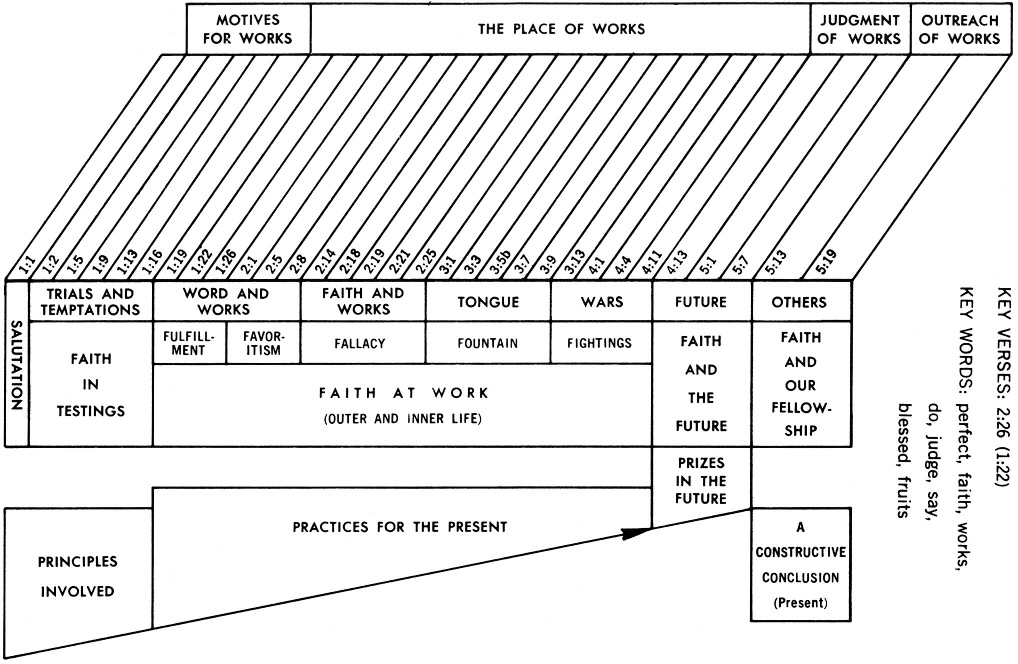
Click chart to enlarge
Chart from recommended resource Jensen's Survey of the NT - used by permission
See also Overview Chart by Charles Swindoll
|
JAMES |
|||||||
| Motives for Works |
The Place of Works: Outward Demonstration of Inner Faith |
Outreach of Works |
|||||
| Jas 1:1-18 | Jas 1:19-2:13 | Jas 2:14-25 | Jas 3:1-12 | Jas 3:13-4:12 | Jas 4:13-5:12 | Jas 5:13-19 | |
| Trials & Temptations |
Word & Works |
Faith & Works |
Tongue | Wars | Future | Others | |
|
Faith |
Fulfill |
Favor |
Fallacy |
Fountain |
Factions |
Faith |
Faith |
|
FAITH AT WORK |
|||||||
The Theme: The Testings of Personal Faith
The trials of the believer (James 1:2–12)
A. The proper attitude toward trials (James 1:2–4)
1. The attitude commanded (James 1:2)
2. The reason indicated (James 1:3)
3. The outcome to be realized (James 1:4)
B. The use of prayer amid trials (James 1:5–8)
1. The need for wisdom (James 1:5a)
2. The request for wisdom (James 1:5b)
3. The bestowal of wisdom (James 1:5c–8)
a. The divine response (James 1:5c)
b. The human obligation (James 1:6–8)
(1) The necessary attitude (James 1:6a)
(2) The rejected character (James 1:6b–8)
C. The correct attitude toward life by the tried (James 1:9–11)
1. The attitude of the lowly brother (James 1:9)
2. The attitude of the rich (James 1:10–11)
a. The reason for the attitude (James 1:10a)
b. The illustration from the flower (James 1:11a)
c. The application to the rich (James 1:11b)
D. The result of enduring trials (James 1:12)
1. The blessedness of endurance (v 12a)
2. The reward of endurance (James 1:12b)
The nature of human temptation (James 1:13–16)
A. The source of human temptation (James 1:13–14)
1. The repudiation of a divine source (James 1:13)
a. The rejection stated (James 1:13a)
b. The rejection vindicated (James 1:13b)
2. The reality of the human source (James 1:14)
B. The consequences of yielding to temptation (James 1:15)
C. The warning against being deceived (James 1:16)
The activity of God in human affairs (James 1:17–18)
A. The Giver of all good gifts (James 1:17)
B. The Author of the believer’s regeneration (James 1:18)
The Test Marks of a Living Faith
Faith tested by its response to the Word of God (James 1:19–27)
A. The reactions to the Word (James 1:19–20)
1. The knowledge possessed (James 1:19a)
2. The reaction demanded (James 1:19b)
3. The reason stated (James 1:20)
B. The reception of the Word (James 1:21)
1. The stripping off of sins (James 1:21a)
2. The appropriation of the Word (James 1:21b)
C. The obedience to the Word (James 1:22–27)
1. The demand for active obedience (James 1:22–25)
a. The statement of the requirement (James 1:22)
b. The illustration of the requirement (James 1:23–25)
(1) The negative portrayal (James 1:23–24)
(2) The positive portrayal (James 1:25)
2. The nature of acceptable obedience (James 1:26–27)
a. The futility of activity without inner control (James 1:26)
b. Acceptable service with inner control (James 1:27) (from Hiebert - James Commentary)
James 1:22 But prove yourselves doers of the word, and not merely hearers who delude themselves. (NASB: Lockman)
Greek: Ginesthe (2PPMM) de poietai logou kai me monon akroatai paralogizomenoi (PMPMPN) heautous.
BGT Γίνεσθε δὲ ποιηταὶ λόγου καὶ μὴ μόνον ἀκροαταὶ παραλογιζόμενοι ἑαυτούς.
Amplified: But be doers of the Word [obey the message], and not merely listeners to it, betraying yourselves [into deception by reasoning contrary to the Truth]. (Amplified Bible - Lockman)
ASV: But be ye doers of the word, and not hearers only, deluding your own selves.
CSB But be doers of the word and not hearers only, deceiving yourselves.
ESV But be doers of the word, and not hearers only, deceiving yourselves.
Hiebert: Do not merely listen to the word, and so deceive yourselves. Do what it says.
KJV: But be ye doers of the word, and not hearers only, deceiving your own selves.
NET But be sure you live out the message and do not merely listen to it and so deceive yourselves.
NIV Do not merely listen to the word, and so deceive yourselves. Do what it says.
NLT: And remember, it is a message to obey, not just to listen to. If you don't obey, you are only fooling yourself. (NLT - Tyndale House)
NLT But don't just listen to God's word. You must do what it says. Otherwise, you are only fooling yourselves. (Revised)
Phillips: Don't I beg you, only hear the message, but put it into practice; otherwise you are merely deluding yourselves. (Phillips: Touchstone)
Young's Literal: and become ye doers of the word, and not hearers only, deceiving yourselves,
- James 4:17; Mt 7:21-25; 12:50; 28:20; Luke 6:46, 47, 48; 11:28; 12:47,48; John 13:17; Ro 2:13; Phil 4:8; Colossians 3:17; 1 John 2:3; 3:7; 3 John 1:11; Rev 22:7
- James 1 Resources - Multiple Sermons and Commentaries
Related Passages:
Luke 6:46 “Why do you call Me, ‘Lord, Lord,’ and do not do what I say? 47 “Everyone who comes to Me and hears My words and acts on them (DOING DOES NOT SAVE BUT SHOWS WE ARE SAVED), I will show you whom he is like: 48 he is like a man building a house, who dug deep and laid a foundation on the rock; and when a flood occurred, the torrent burst against that house and could not shake it, because it had been well built.
Luke 11:28 But He said, “On the contrary, blessed are those who hear the word of God and observe it.”
1 John 2:3 By this we know that we have come to know Him, if we keep His commandments.
1 John 3:7 Little children, make sure no one deceives you; the one who practices righteousness is righteous, just as He is righteous;
Matthew 7:21-25 "Not everyone who says to Me, ‘Lord, Lord,’ will enter the kingdom of heaven, but he who does (present tense - not perfectio but direction!) the will of My Father who is in heaven will enter. 22 “Many will say to Me on that day, ‘Lord, Lord, did we not prophesy in Your name, and in Your name cast out demons, and in Your name perform many miracles?’ 23 “And then I will declare to them, ‘I never knew you; DEPART FROM ME, YOU WHO PRACTICE LAWLESSNESS.’ 24 “Therefore everyone who hears these words of Mine and acts on them, may be compared to a wise man who built his house on the rock. 25 “And the rain fell, and the floods came, and the winds blew and slammed against that house; and yet it did not fall, for it had been founded on the rock.
BECOME DOERS
NOT JUST HEARERS
But (term of constrast) introduces the contrast between hearing and doing. Don't just receive the Word, but respond to it. Active obedience should follow. James contrasts those who only hear God’s Word with those who obey it. Hearing is good, but without obedience it becomes self-deception. James uses the “but” to draw a line between passive religious listening and genuine, obedient faith. A person may appear religious because they listen to Scripture, but James says that without obedience the person is “deceiving” themselves (James 1:22). The contrast exposes the difference between seeming righteous and being righteous. Jesus taught the same principle that hearing without obedience is worthless. (Mt 7:24-27)
But prove yourselves doers (poietes) of the word, and not merely hearers who delude themselves.
Prove yourselves is present imperative calling for the reader to keep on becoming doers (it is not one and done! doing is to be a lifestyle) of the Word (positive) and to stop being simply hearers of the Word (negative). See our need to depend on the Holy Spirit to obey this command. The upshot is that only believers can truly obey this command and those who are unbelievers are unable to obey this command.
James has just charged his readers to welcome the Word of Truth and in this section he elaborates on what it means to receive the Word, showing that genuine acceptance of the Word is marked by doing of the Word. To fall short of achieving that objective is to delude one's self into the attitude "I'm okay." To the contrary, the reality of one's faith (that he really is "Okay" with God!) is demonstrated by one's obedient life! In short, James says that our hearing must be balanced with and backed up by our doing.
ILLUSTRATION - As a doctor I have known folks who got a prescription which would have helped them but they refused to take it. And so this verse in like a man goes to a skilled physician because he has a life-threatening illness. The doctor carefully examines him, diagnoses the problem, and writes a prescription that will completely cure him. The man thanks the doctor, frames the prescription, hangs it on the wall, memorizes every word on it, tells his friends what an excellent doctor he has, and even carries a copy of the prescription in his wallet. But he never fills the prescription. He dies, not because the doctor failed to give the right remedy, but because he never acted on it. God's Word is like a divine prescription from the Great Physician! Hearing it, admiring it, studying it, and even memorizing it cannot save one from the penalty of sin. It must be obeyed (enabled by the Spirit, not legalism!) The blessing is not in possessing the prescription but in taking the medicine.
"Not the expounding [of the law] is the chief thing,
but the doing [of it]."
-- Jewish rabb Gamaliel
Later in this same epistle James makes a parallel statement…
Therefore, to one who knows the right thing to do, and does not do it, to him it is sin. (Jas 4:17)
Jesus linked hearing (or knowing) and doing multiple times...
whoever does the will of My Father who is in heaven, he is My brother and sister and mother. (Mt 12:50)
But He said, "On the contrary (see Lk 11:27), blessed are those who hear (present tense = continually) the word of God, and observe (present tense = continually) it." (Lk 11:28)
If you know these things, you are blessed if you do (poieo - present tense = continually) them. (John 13:17)
In His the great commission Jesus reiterated the importance of hearing and doing charging His followers to go and make disciples…
teaching (present tense = continually) them to observe (present tense = continually) all that I commanded you; and lo, I am with you always (the Spirit of Christ enables them to continually observe!), even to the end of the age. (Mt 28:20)
Paul taught this same truth emphasizing that…
It is not the hearers of the Law are just before God, but the doers (poietes - same word James uses in this verse) of the Law will be justified. (Ro 2:13)
Comment: Paul was not teaching that a man is justified (declared righteous) by keeping the Law but that the one who is genuinely justified will show himself or herself to be justified by the fact that they are "doers of the Law." (cf Abraham was "justified [shown to be] righteous by works" in Jas 2:24) They "do" the Law, because it is now written in their hearts and they have the Holy Spirit abiding within to enable them to keep the Law. Their keeping of the Law does not save them but shows they are genuinely saved.
John also emphasized doing of the Word of Truth as a clear marker that one truly belongs to Christ, writing that…
by this we know that we have come to know Him, if we keep (present tense = continually, not perfectly for no man can do that in this life, but "keeping" as the general direction of one's life) His commandments. The one who says, "I have come to know Him," and does not keep (present tense = continually) His commandments, is a liar, and the truth is (present tense = continually) not in him. (1Jn 2:3, 4)
Comment: Beloved, could it have stated any more plainly?! Beware of false teachers who claim you can "ask Jesus into your heart" and then go along your merry way for the rest of your life and never have a desire (or power) to obey the Word of Truth. Pithily put - The Truth is not in this person according to the apostle John! Do not be deceived by "another gospel" which is really not "good news" at all! (cp 1Jn 3:7 and Gal 1:6, 7, 8, 9).
Hiebert introduces this section of James with the comment that…
Wholehearted acceptance of the Word must result in active obedience to the Word. Such obeying of the Word constitutes the essence of a living faith. These verses express James's central concern. Jas 1:22, 23, 24, 25 state and illustrate the need for active obedience to the Word, and Jas 1:26, 27 portray the true nature of religious obedience. (Commentary on James)
Vance Havner quipped that "We need an outbreak of holy heartburn, when hearers shall be doers, when congregations shall go out from meetings to do things for God."
Illustration of Doers Not Just Hearers - Europe is legendary for its beautiful cathedrals. The problem with many of these magnificent structures is that, while they possess physical grandeur, they are not inhabited by congregations that are spiritually vibrant. In reality, most of these edifices are nothing more than museums visited by gawking tourists. This phenomenon should remind us that the spiritual life is about internals, not externals (John MacArthur-Nehemiah)
Barclay - James presents us with two of the vivid pictures of which he is such a master. First of all, he speaks of the man who goes to the church meeting and listens to the reading and expounding of the word, and who thinks that that listening has made him a Christian. He has shut his eyes to the fact that what is read and heard in Church must then be lived out. It is still possible to identify Church attendance and Bible reading with Christianity but this is to take ourselves less than half the way; the really important thing is to turn that to which we have listened into action. Second, James says such a man is like one who looks in a mirror--ancient mirrors were made, not of glass, but of highly polished metal--sees the smuts which disfigure his face and the dishevelment of his hair, and goes away and forgets what he looks like, and so omits to do anything about it. In his listening to the true word a man has revealed to him that which he is and that which he ought to be. He sees what is wrong and what must be done to put it right; but, if he is only a hearer, he remains just as he is, and all his hearing has gone for nothing. James does well to remind us that what is heard in the holy place must be lived in the market place--or there is no point in hearing at all. (Borrow James 1 - Barclay's Daily Study Bible or here)
But (1161) (de) normally identifies a contrast but in this case functions to indicate that something must be added to what James has just said -- he is not interested in his readers just being hearers but also becoming doers of the Word of Truth.
THOUGHT: Whenever you encounter a "but" or other contrast word (see note), take the opportunity to pause and ponder the text and ask at least one 5W/H question - what is being contrasted? why? why now? etc. This will slow you down (cp Ps 46:10) and will allow your indwelling resident Teacher the Holy Spirit (1Cor 2:10-16, 1John 2:20, 27) to illuminate the sense of the passage and to speak to you.
MacArthur - Those who consistently disobey God’s Word give evidence that they are without His life within them. Those who consistently obey the Word give evidence of the life of God in their souls. As noted several times in earlier chapters, that is the central theme of James’s epistle… a true believer will not be inwardly satisfied with merely knowing the Word. His conscience and the prompting of the indwelling Holy Spirit will keep convicting him of his failure until he becomes obedient. (SEE James MacArthur New Testament Commentary - Page 79)
A R Fausset writes that in this verse James gives the "Qualification of the precept, “Be swift to hear”: “Be ye doers … not hearers only”; not merely “Do the word,” but “Be doers” systematically and continually, as if this was your regular business. James here again refers to the Sermon on the Mount (Mt 7:21, Mt 7:22, 23, Mt 7:24, 25, Mt 7:26, 27, Mt 7:28, 29).
Prove (1096)(ginomai) means to become or to come into or bring into existence and in this verse the idea is we are to continually become doers or as Rotherham renders it "Become ye doers." Doing always supercedes simply hearing. Hear and heed is the point. Don't be a Word hearing, non-doing hypocrite - intellectually stuffed, but falling short of spiritual impact.
The present imperative calls for doing of the word to be the habitual practice or lifestyle of his readers. James demands that doing be their continual practice. Believers are never to stop being doers of the Word! Keep on striving to be doers. The middle voice adds a reflexive sense ("you prove yourselves"). The verb is second person plural so that he is speaking not just to individuals.
There is a deceptive danger in churches where the Word of Truth is faithfully preached, for many walk away with the mistaken concept that simply sitting under a godly, gifted pastor and listening to his message will automatically result in their spiritual growth. As someone has well said, too many believers mark their Bibles but fail to allow their Bible to mark them and direct their life. This is a dangerous deception in the modern day church. Never think you are "safe" and spiritually maturing simply because you are hearing the Word.
Robby Gallaty asks "Does Preaching Produce Disciples? Unfortunately, preaching alone will not produce disciples. Several years ago, I emailed disciple-maker Avery Willis, creator of Masterlife, inquiring about the role of preaching in making disciples. He graciously replied, “I really don’t believe much discipling is done through preaching, Robby. Yes, you can impart information and emotion in preaching, but discipleship is more relational, more one on one… preaching to make disciples is like going to the nursery and spraying the crying babies with milk and saying that you just fed the kids.” He went on to say, “I am not against preaching; I do it all the time. But Jesus chose twelve and lived with them, explained to them, gave them assignments, debriefed them… to shape and mold them to be like Him. His sermons no doubt helped convey the truth, but He had to follow up most of it with what I call discipling.” Do not misunderstand me. I am not minimizing the importance of preaching. I have devoted my life to it. However, discipleship involves more than preaching and listening. It integrates intimate, accountable relationships that are rooted in the Word of God, which cultivates enduring, fruitful lives. After surveying the preaching in the New Testament, observing the practices of great preachers, and considering modern ministries today, Peter Adam came to this same realization. He determined that “while preaching… is one form of the ministry of the Word, many other forms are reflected in the Bible and in contemporary Christian church life. It is important to grasp this point clearly, or we shall try and make preaching carry a load which it cannot bear, that is, the burden of doing all that the Bible expects of every form of ministry of the Word.” (Growing Up- How to Be a Disciple Who Makes Disciples- Robby Gallaty - Recommended)
In His concluding remarks to the greatest sermon ever preached Jesus emphasized hearing and doing declaring…
Therefore everyone who hears these words of Mine, and acts upon them, may be compared to a wise man, who built his house upon the rock. And the rain descended, and the floods came, and the winds blew, and burst against that house; and yet it did not fall, for it had been founded upon the rock. And everyone who hears these words of Mine, and does not act upon them, will be like a foolish man, who built his house upon the sand. And the rain descended, and the floods came, and the winds blew, and burst against that house; and it fell, and great was its fall." (Mt 7:24, 25, Mt 7:26, 27).
MacArthur writes that here James "is describing characteristic behavior, not occasional activity. It is one thing to fight; it is something else to be a soldier. It is one thing to build a shed; it is something else to be a builder. James is not merely challenging his readers to do the Word; he is telling them that real Christians are doers of the Word. That describes the basic disposition of those who believe unto salvation. (Faith According To The Apostle James. In Journal of the Evangelical Theological Society, Volume 33, 1990)
Doers (4163)(poietes from poieo = to do, to make, to accomplish) describes one who does something as his occupation such as a producer, a poet or an author. The other sense describes a doer or a performer, speaking of one who does what is prescribed, such as one who keeps the law (Ro 2:13)
Rick Renner - The word "doers" is taken from the Greek word poietes, the same Greek word used for a poet. This word carries with it the idea of creativity, such as a poet whose personality includes a creative flair. James is telling us that if we can't easily think of a way to do what has been preached to us, we must get creative! We must find ways to do the Word....Whether the word poietes is used to depict a poet, as mentioned above or (in another form - poiema) to describe God's creative power, as in Ephesians 2:10, it always depicts someone putting forth his fullest creative abilities to achieve something. Now James uses this word poietes in James 1:22 to tell us that we must put forth our fullest efforts and most creative abilities in doing what we have heard preached! We cannot passively hope that the Word becomes a part of our lives; we have to get creative and find ways to make the Word a practical part of our lives.
Those who belong to Jesus are marked in ear and foot, for not only do they hear God's voice in His Word of truth but they walk in His way. Doers thus emphasizes what they are rather than just what they do. One commentator describes a doer as "a person whose life is characterized by holy energy."
As Martin Luther once said "The world does not need a definition of religion as much as it needs a demonstration."
It's easier to SAY what we believe
than BE what we believe.
-- Robert Anthony
Steven Cole makes the point that "Obedience should always be the bottom line of Bible study or biblical preaching. Correct application (see Application) must always be built on correct interpretation (see Interpretation). But to study the word just to fill your head with knowledge, without applying the word, short-circuits God’s purpose in giving it. Even seemingly irrelevant matters, such as biblical genealogies, are “profitable for teaching, for reproof, for correction, for training in righteousness” (2Ti 3:16). (James 1:22-27 Doers of the Word)
There are seven NT uses of poietes (and none in the non-apocryphal Septuagint) most of the uses being by James…
Acts 17:28 for in Him we live and move and exist, as even some of your own poets have said, 'For we also are His offspring.' (Comment: Obviously here poietes has the special classical sense of "poets.")
Romans 2:13 for not the hearers of the Law are just before God, but the doers of the Law will be justified.
James 1:22 But prove yourselves doers of the word, and not merely hearers who delude themselves.
James 1:23 For if anyone is a hearer of the word and not a doer, he is like a man who looks at his natural face in a mirror;
James 1:25 But one who looks intently at the perfect law, the law of liberty, and abides by it, not having become a forgetful hearer but an effectual doer, this man shall be blessed in what he does.
James 4:11 Do not speak against one another, brethren. He who speaks against a brother, or judges his brother, speaks against the law, and judges the law; but if you judge the law, you are not a doer of the law, but a judge of it.
Paul R VanGorder observed that…
Many Christians have allowed their knowledge of the truth to outdistance their practice. They remind me of a story in Glad Tidings by James Kallam. He tells of a young book salesman who was assigned to a rural area. Seeing a former seated in a rocking chair on his front porch, the young man approached him with all the zeal of a newly trained salesman. “Sir,” he said, “I have here a book that will tell you how to farm 10 times better than you are doing it now.” The farmer continued to rock. After a few seconds he stopped, looked at the young fellow and said, “Son, I don’t need your book. I already know how to farm 10 times better than I’m doing it now.”
Pastor Steven Cole has an amusing story related doers of the word…
Pastor Stuart Briscoe was teaching the principles of Bible study. He showed how to pick out the promises and the commands in Scripture, and what to do with them. Finally, he reviewed and asked, “Now, what do you do with the commands?” A little old lady raised her hand and said, “I underline them in blue.”
Underlining the Bible’s commands in blue might make for a colorful Bible, but the point of the commands is that we obey them. Unfortunately, there are many people in evangelical churches who have their heads filled with information from the Bible, but they don’t obey what the Bible commands. That may sound harsh, but surveys commonly show that there is substantially no difference between evangelical Christians and the population at large on most moral and social beliefs and behavior.
For example, pollster George Barna (in World [12/6/03], p. 33) found that one out of three “born-again Christians” (defined as “those who report having made a personal commitment to Christ and expect to get to heaven because they accepted Jesus”) accept same-sex unions. Thirty-nine percent believe it is morally acceptable for couples to live together before marriage. And, born-again Christians are more likely than non-Christians to have experienced divorce (27 to 24 %)! James would be aghast! Although the readers to whom he wrote differ from the modern church, his message is just as relevant now as it was when he wrote it. He’s saying, To hear the word and not do it leads to deception, but to hear the word and do it leads to blessing. (James 1:22-27 Doers of the Word)
Word (3056) (logos from légō = to speak with words; English = logic, logical) means something said and describes a communication whereby the mind finds expression in words. Although Lógos is most often translated word which Webster defines as "something that is said, a statement, an utterance", the Greek understanding of lógos is somewhat more complex. In the Greek mind and as used by secular and philosophical Greek writers, lógos did not mean merely the name of an object but was an expression of the thought behind that object's name. Let me illustrate this somewhat subtle nuance in the meaning of lógos with an example from the Septuagint (LXX) (Greek of the Hebrew OT) in which lógos is used in the well known phrase the Ten Commandments.
Lógos then is a general term for speaking, but always used for speaking with rational content. Lógos is a word uttered by the human voice which embodies an underlying concept or idea. When one has spoken the sum total of their thoughts concerning something, they have given to their hearer a total concept of that thing. Thus the word lógos conveys the idea of “a total concept” of anything. Lógos means the word or outward form by which the inward thought is expressed and made known. It can also refer to the inward thought or reason itself. Note then that lógos does not refer merely to a part of speech but to a concept or idea. In other words, in classical Greek, lógos never meant just a word in the grammatical sense as the mere name of a thing, but rather the thing referred to, the material, not the formal part. In fact, the Greek language has 3 other words (rhema, onoma, epos) which designate a word in its grammatical sense. Lógos refers to the total expression whereas rhema (see word study) for example is used of a part of speech in a sentence. In other words rhema, emphasizes the parts rather than the whole.
The story is told of King Edward VI of England who attended worship service and stood while the Word of God was read taking notes which he later studied with great care. Throughout the week King Edward earnestly tried to apply them to his life. That’s the kind of serious-minded response to truth the James means when he says "Be doers of the Word… ". A single revealed fact cherished in the heart and acted upon is more vital to our growth than a head filled with lofty ideas about God.
ILLUSTRATION - Recall the parishioner who met the preacher at the door after the service and said, “Pastor, that was a wonderful sermon.” To which the pastor replied, “Well, that remains to be seen, doesn’t it?” This should be our approach, not just to learn it but to live it! How are you doing dear follower of Jesus?
Adrian Rogers - One of the finest psychological truths that I've ever learned in my life is this—are you ready for it? Impression without expression leads to depression. Now, what does that mean? If you come and listen to me preach, and you get these things in your notebook—you get these things in your head—but you do not practice them in your life, it's not going to make you a better person—it's going to make you a worse person. You're going to have more and more guilt, and more and more despair, because you're hearing these things, and you're not doing them. Jesus, in the Bible, says, "If ye know these things, happy are ye if ye do them" (John 13:17)
Henry Blackaby - Do What It Says!
Do not merely listen to the word, and so deceive yourselves. Do what it says. James 1:22
James had a knack for getting right to the heart of things. The great thing about the letter of James is its down-to-earth message. He gives sound, practical advice that is useful for living everyday life. Here, James warns us about something that we’re probably all a little guilty of—that is, substituting good intentions in place of actually delivering the goods.
We often spend our time going to church, attending Bible studies, reading Christian books and magazines, and listening to Christian music. We may think that in doing those things we are living the Christian life. We are deceived! Although each of these activities is a worthy pursuit, they are all for nothing if we never put into practice the knowledge we gain. Our generation has access to more biblical information than ever before, but we’re not necessarily the most skilled at living out the truths of that information.
We may very well understand what God wants us to do, yet choose to do something else. Many times what we need is not another conference teaching us more things; we simply need to put into practice what we’ve already learned. The fact is, just knowing the right things to do is not the same as doing them, and promising to do them is not the same thing as doing them. God is not interested in our knowledge or our intentions; he is interested in our obedience.
Today, consider if there is anything you know God wants you to do that you have been putting off until you’ve gained more knowledge. Then, be a doer of the word, not just a listener.
What Will I Do? - A man who has been my mentor and friend for many years often says that his goal in studying the Bible is always personal application. I appreciate his emphasis on putting learning into practice, because it’s too easy for those of us who study, discuss, teach, and write about the Bible to take a merely intellectual approach to the Word.
Oswald Chambers said: “There is a danger with the children of God of getting too familiar with sublime things. We talk so much about these wonderful realities, and forget that we have to exhibit them in our lives. It is perilously possible to mistake the exposition of the truth for the truth; to run away with the idea that because we are able to expound these things, we are living them too.”
James reminds us that the person “who looks into the perfect law of liberty and continues in it, and is not a forgetful hearer but a doer of the work, this one will be blessed in what he does” (1:25). The key issue is not what is preached or written, but what is done.
When I study God’s Word, my first question should not be, “What am I going to say about this?” but “What am I going to do about this?” By David C. McCasland (Reprinted by permission from Our Daily Bread Ministries. Please do not repost the full devotional without their permission.)
We take delight to teach God’s Word,
We say, “Amen, it’s true!”
But it’s of little use to us
Unless His will we do. —D. De Haan
One step forward in obedience is worth years of study about it. —Chambers
Vance Havner writes…
'Take Heed How Ye Hear It is important that we hear. It is important what we hear. It is important how we hear what we hear.
1. Consider the privilege of hearing the Word of God. We take it for granted in America. Few people would want to live where there are no churches but millions live as though there were no churches. Multitudes the world around cannot hear the truth of God for various reasons. As lightly as we regard it now, this privilege cost aplenty in days gone by. And how grateful we ought to be that God has spoken both in His Book and in His Son! What if He had remained silent and there were no word from heaven!
2. Along with privilege goes responsibility. Where much is given, much shall be required. Today sees a famine of the hearing of God's Word, not because we cannot hear it, but because we do not listen to it. Moreover, as the text declares, there is the duty of doing it when we hear it. Throughout the Bible runs the note, "My commandments to do them"; "Ye are my friends, if ye do whatsoever I command you."
3. Often overlooked in our text and almost never quoted is the penalty for not doing the Word we hear, "Deceiving your own selves." Away with the notion that it does not matter much how we hear! The man who hears and refuses to obey walks out of church having betrayed himself into deception. One cannot hear the truth and remain the same. (Vance Havner)
D L Moody's example of doing…
While D. L. Moody was attending a convention in Indianapolis on mass evangelism, he asked his song leader Ira Sankey to meet him at 6 o’clock one evening at a certain street corner. When Sankey arrived, Mr. Moody asked him to stand on a box and sing. Once a crowd had gathered, Moody spoke briefly and then invited the people to follow him to the nearby convention hall. Soon the auditorium was filled with spiritually hungry people, and the great evangelist preached the gospel to them. Then the convention delegates began to arrive. Moody stopped preaching and said, “Now we must close, as the brethren of the convention wish to come and discuss the topic, ‘How to reach the masses.’“ And thus the "uneducated" Moody graphically illustrated the difference between talking about doing something and going out and doing it.
Superficial hearing without sincere doing is like the breezes that ripple the surface of the ocean, but do not affect the tides or the gulf stream.
AND NOT MERELY HEARERS WHO DELUDE THEMSELVES: kai me monon akroatai paralogizomenoi (PMPMPN) heautous:
- Jas 1:26; Is 44:20; Obadiah 1:3; 1Co 3:18; 6:9; 15:33; Gal 6:3,7; 2Ti 3:13; Titus 3:3; 2Pe 2:13; 1Jn 1:8; Rev 12:9
- James 1 Resources - Multiple Sermons and Commentaries
"DEAF" DELUDED
HEARERS
Not (3361) (me) is the relative negative
Augustine - The hearer of God's Word ought to be like those animals that chew the cud; he ought not only to feed upon it, but to ruminate upon it.
Hearers (202) (akroates from akroaomai = to listen or hear) first describes one who hears referring primarily to the perception of sounds by the sense of hearing. The use of this term by James again implies that in ancient times their was frequent public reading of the Scriptures along with oral instruction.
Recalling that James is addressing his Jewish brethren, Rogers' note is interesting - In the Jewish home, the education process, and in the synagogue worship, the hearing of the Law read aloud played an important part in Jewish life. The rabbis also stressed very strongly the necessity of keeping the Law (Ed note: But of course they were forced to rely on faulty human power, whereas believers are to rely solely on the Spirit power.) (Rogers, C L - originally by Fritz Rienecker: New Linguistic and Exegetical Key to the Greek New Testament. Zondervan. 1998)
Akroates is used 3 times by James here in chapter 1 (see notes James 1:22; 1:23 ; 1:25)
Romans 2:13 (note) for not (ou = absolute negation = no exceptions!) the hearers (akroates) of the Law are just (dikaios = rightly related to God) before God, but the doers of the Law will be justified (declared righteous).
Vincent comments on akroates in Romans 2:13: Like the Jews, who heard it (the Law) regularly in the synagogues… It brings out… the characteristic feature; those whose business is hearing. (The "business" of the Jews was to listen to the Word of God.)
Hiebert - Among the Greeks, akroates was a common term for persons who were attendants at a lecture but not disciples of the lecturer. They were hearers who in life did not follow the instructions given. It is a common human failing from which Christians are not exempt. If all who are auditors of the Word on Sunday would put it into practice during the week, what a difference that would make! Roberts tartly remarks, "Our churches are filled with spiritual sponges who soak up the information, sit, sour, and eventually stink!" (Ibid)
MacArthur writes that akroates was "a term used to describe students who audited a class. An auditor usually listens to the lectures, but is permitted to treat assignments and exams as optional. Many people in the church today approach spiritual truth with an auditor’s mentality, receiving God’s Word only passively. But James’ point, shown by his illustrations in James 1:23, 24, 25, 26, 27 (see notes Js 1:23; 24; 25; 26; 27) is that merely hearing God’s Word results in worthless religion (see note James 1:26). In other words, mere hearing is no better than unbelief or outright rejection. In fact, it’s worse! The hearer-only is enlightened but unregenerate. James is reiterating truth he undoubtedly heard firsthand from the Lord Himself. Jesus warned powerfully against the error of hearing without doing (Mt 7:21, 22, 23, 24, 25, 26, 27 -see notes Mt 7:21; 22; 23; 24; 25; 26; 27), as did the apostle Paul (Ro 2:5). (SEE The Gospel According to the Apostles: The Roll of Works in a ...)
One source notes that "In Classical Greek, the alternate akroázomai, to hear and the derivative akróama meant something heard, especially with pleasure, such as a piece read, recited, played, or sung. In the NT, it has the meaning of one just listening without practicing what one hears. (Zodhiates, S.BORROW The Complete Word Study Dictionary: New Testament)
Merely (only) (3440) (monos) means without accompaniment. Hearing is the only reaction. Hearing is unaccompanied by doing.
Scriptures related to this topic…
One that only hears and does nothing – Acts 26:22,23, 24, 25, 26, 27, 28, 29
An example of hearers and one doer – Mt 13:1-23
An example of two doers and one hearer – Mt 25:14, 15, 16, 17, 18, 19, 20, 21, 22, 23, 24, 25, 26, 27, 28, 29, 30
John Blanchard - The man who is not prepared to heed the Word of God obediently will not even be able to hear it correctly. This is why the parables become windows to some people and walls to others. (The Complete Gathered Gold- highly recommended resource for quotes) (Bolding added)
Delude (3884) (paralogizomai from para = beside, alongside + logizomai = to reason, to count) is literally to reason beside the point, to reason alongside (think about it as reasoning with words "alongside, beside or against" the Truth), to beguile by mere probability that something is true and so to mislead. To misjudge. To miscalculate. To cheat in reckoning. It pictures skewed logic and thus primarily means to reckon wrong, to reason falsely, and so to deceive by false reasoning.
Note the present tense indicates that they are continually reasoning themselves into a false premise and thus deceiving themselves, this state of spiritual deception, a dangerous place in which to be. The present tense further describes a process of self-deception by means of fallacious reasoning. This fearful state brings to mind Paul's charge in his second epistle to the Corinthians…
Test (peirazo- present imperative = calls for this be our habitual practice) yourselves (not others but yourself!) to see if you are in the faith; examine (dokimazo - present imperative = calls for this be our habitual practice) yourselves! Or do you not recognize this about yourselves, that Jesus Christ is in you-- unless indeed you fail the test (adokimos - word study)?
Comment: So what is the "test"? How do you "examine" yourself? He is not saying to "look within yourself" per se, but to look at the One Who is in you and look at the evidence that He is in you. What does that mean practically? Believer's Study Bible (Ref) explains that "this verse is not intended to rob believers of the assurance and security of their salvation. It is, however, intended as a warning to those who would follow false teaching and adopt a life-style that is inconsistent with the message of reconciliation (cf. 2Co 12:20, 21). To persist in either activity is a cause for serious introspection and a testing to see whether or not one is truly "in the faith."
THOUGHT -Beloved, the Word of God is not meant to make us smarter sinners but to make us more like the Savior. And so it follows that it is not how much one is "in" the Word but really how much of the Word is "in" us, renewing and transforming our mind (cp Ro 12:2; Col 3:10; Ep 4:23), as demonstrated by our changed behavior (not just hearing but doing) (cp 2Co 5:17).
Notice that James mentions the idea of self deception (using a different verb) again in verse 26…
If anyone thinks himself to be religious, and yet does not bridle his tongue (not a "doer") but deceives his own heart, this man's religion is worthless. (See note)
Cole makes a good point emphasizing that "There is an inherent danger in attending a church where God’s word is proclaimed week to week: If you hear the word often, but do not put it into practice, you delude yourself. The solution is not to avoid hearing the word, but rather to apply it to the problems in your life that the word uncovers. (James 1:22-27 Doers of the Word)
Hiebert explains that those who believed "that attentive hearing of the Word was the fulfillment of all that was required, had been led astray from the path of truth. In resting satisfied with possessing the means of grace without applying it, they were the victims of their own deception. "It is sad to be deceived, most miserable to be self-deceived. Many still determine their godliness by the quality of hearing (for instance sermons) or reading (even God's word) instead of action and obedience." Jesus warns explicitly against this error (Mt 7:21-27; cf. Ro 2:17-25). (Ibid)
Paul used paralogizomai in his warning to the saints at Colossae emphasizing that in Christ…
are hidden all (how many?) the treasures of wisdom and knowledge. (Why is this truth so vitally important?) I say this in order that no one may delude (paralogizomai) you with persuasive argument (plausible, but false, speech ="believable" speech resulting from the use of well-constructed, probable arguments). (Col 2:3, Col 2:4)
Vincent notes that paralogizomai is "from para, beside, contrary to, and logizomai, to reckon, and hence to conclude by reasoning. The deception referred to is, therefore, that into which one betrays himself by false reasoning — reasoning beside the truth.
THOUGHT - How important is this truth in modern America where up to 50% of individuals surveyed profess to have had a "born again" experience? Beloved, it is a life or death matter (eternally speaking) and so it is crucial to understand what James is clearly stating.
Douglas Moo writes that "The idea of “deceive” in these contexts is clear: to be “deceived” is to be blinded to the reality of one’s true religious state. People can think that they are right with God when they really are not. And so it is for those people who “hear” the word—regular church attenders, seminary students (!), and even seminary professors (!!) — but do not “do” it. They are mistaken in thinking that they are truly right with God. For God’s word cannot be divided into parts. If one wants the benefits of its saving power, one must also embrace it as a guide for life. The person who fails to do the word, James therefore suggests (in an anticipation of his argument in Jas 2:14-26see notes), is a person who has not truly accepted God’s word at all. (SEE The Letter of James)
John MacArthur adds that paralogizomai was a term used in mathematics meaning a miscalculation and concludes that…
"spiritual miscalculation", which causes them to delude themselves. Such a man does not delude anyone but himself! They are self-deceived. An old Scottish expression speaks of such deluded professors as “sermon tasters who never tasted the grace of God.” Any response to the gospel that does not include obedience is self-deception. (Ed note: See related discussion - relationship of faith and obedience) If a profession of faith in Christ does not result in a changed life that hungers and thirsts for God’s Word and desires to obey that Word, the profession is only that - a mere profession. Satan, of course, loves such professions, because they give church members the damning notion that they are saved when they are not! They still belong to him, not God. (SEE The MacArthur New Testament Commentary)
Comment: MacArthur's explanation helps us understand Jesus' stern and even frightening warning that "not everyone who says to Me Lord, Lord will enter the kingdom of heaven, but he who does (present tense = continually, not perfectly for no man can do that in this life, but "keeping" as the general direction of one's life) the will of My Father who is in heaven." (Mt 7:21, 22, 23 -see notes - Mt 7:21; 22; 23)
Jesus says that one reason why so few enter the narrow gate of salvation (cp Mt 7:13, 14) is because of self-deception. As J. C. Ryle said
The Lord Jesus winds up the Sermon on the Mount by a passage of heart-piercing application. He turns from false prophets to false professors, from unsound teachers to unsound hearers
Not only can false prophets deceive us about the way of salvation, but we can deceive ourselves. After warning us about false prophets, the Lord now warns men about themselves. Sinful man is biased in his own favor and, because of pride, tends to reject the true gospel. The two categories of self-deception are those of mere verbal profession and of mere intellectual knowledge. The first, described in Mt 7:21, 22, 23, involves those who say but do not do, and the second, described in Mt 7:24, 25, 26, 27, involves those who hear but do not do. (For more discussion on the dangers of self-deception see MacArthur's message entitled Empty Words and Empty Hearts, Mt 7:21-23)
Augustine made a similar statement regarding self deception declaring that…
If you believe what you like in the Bible, and reject what you like, it is not the Bible you believe but yourself.
Robert Johnstone - Knowing that the study of divine truth, through reading the Bible, giving attendance on the public ordinances of grace, and otherwise, is a most important duty, is, indeed, the road leading toward the gate of everlasting life, they allow themselves, through man’s natural aversion to all genuine spirituality, to be persuaded by the wicked one that this is the sum of all Christian duty, and itself the gate of life, so that in mere “hearing” they enter in, and all is well with them. To rest satisfied with the means of grace, without yielding up our hearts to their power as means, so as to receive the grace and exhibit its working in our lives, is manifestly folly of the same class as that of a workman who should content himself with possessing tools, without using them, madness of the same class as that of a man perishing with hunger, who should exult in having bread in his hands, without eating it, but folly and madness as immeasurably greater than these, as the “work of God” (John 6:29) transcends in importance the work of an earthly artisan, and “life with Christ in God” (Col 3:3) the perishable existence of earth. (Robert Johnstone, Lectures Exegetical and Practical on the Epistle of James. reprint, Minneapolis: Klock & Klock, 1978)
Andrew Murray - What a terrible delusion to be content with, to delight in hearing the word, and yet not do it. And how prevalent the sight of multitudes… listening to the Word of God most regularly and earnestly, and yet not doing it! If a servant were to hear but not do, how quickly the judgment would be given… Why are we deluded in this way? For one thing people mistake the pleasure they have in hearing the Word of God for Christianity and worship. The mind delights in having the truth presented clearly; the imagination is gratified by its illustration; the feelings are stirred by its application. To an active mind knowledge gives pleasure. A person may study some branch of science—say electricity—for the enjoyment the knowledge gives him, without the least intention of applying it practically. So people go to church, and enjoy the preaching, and yet do not do what God asks.
John Calvin reminds us that…
We must observe that the knowledge of God which we are invited to cultivate is not that which, resting satisfied with empty speculation (cp Col 2:8), only flutters in the brain, but a knowledge which will prove substantial and fruitful whenever it is duly perceived and rooted in the heart (cp Lk 8:15).
Spurgeon - What did they deceive (delude) themselves about? Why, probably, they thought they were considerably better for being hearers: much to be commended and sure to get a blessing. They would not have been happy if they had not heard the word on Sunday, and they look with disgust upon their neighbors who make nothing of the Sabbath. They themselves are very superior people because they are regular church-goers or chapel-goers. They have a sitting, and a hymn-book, and a Bible: is not that a good deal? If they stayed away from a place of worship for a month they would be very uneasy; but though they do not believe that going to a place of worship will save them, yet it quiets their conscience, and they feel themselves more at ease. I should tike to feed you for a month on your theory. I would rattle the plates in your ears, and see whether you would be fed. I would not accommodate you with a bed at night. Why should I? I would preach you a discourse upon the benefit of sleep. Nor need I even give you a room to occupy: I would read you an eloquent dissertation upon domestic architecture, and show you what a house should be. You would very soon quit my door, and call me inhospitable, if I gave you music instead of meat; and yet you deceive yourselves with the notion that merely hearing about Jesus and his great salvation has made you better men. Or, perhaps, the deceit; runs in another line: you foster the idea that the stern truths which you hear do not apply to you. Sinners? Yes, certainly, the preacher addresses sinners, and may they get good out of it; but you are not a sinner, at least not in any special sense, so as to need looking after. Repentance? Most people ought to repent, but you do not see any reason why you should repent. Looking to Christ for salvation? “Excellent doctrine,” you say, “Excellent doctrine!” But, somehow, you do not look to Him for salvation. Here is the scriptural verdict upon this opinion of yours - “Deceiving your own selves.” The gospel does not deceive you; it tells you “Ye must be born again, ye must believe in Jesus Christ, or be lost.” The preacher does not; deceive you; he never said half a word to support the notion that coming to this place would be of any service to you unless you would yield your hearts to Christ. No, he has learnt to speak plain English about such matters. You deceive your own selves if, being hearers and not doers, you derive comfort from that which you hear. (James 1:22-25 Two Sorts of Hearers)
Hearing with Doing - A "Titanic" Mistake - This anecdotal story concerning the great praised ship Titanic reminds of the vanity (and tragedy) of hearing without doing. It was 1912 and the mighty seemingly invincible Titanic was on her maiden voyage. The ships radio man received a message from another ship that there were icebergs in area. Unfortunately the radio operator placed the message under a weight next to his elbow and went on with his work. And thus the word of imminent danger never reached the captain, and this small miscue led to the loss of 1500 lives when the Titanic struck an iceberg and suffered a mortal bowl. Information without action can result in destruction.
Richard De Haan - a man in New York City who died at the age of 63 without ever having had a job. He spent his entire adult life in college. During those years he acquired so many academic degrees that they “looked like the alphabet” behind his name. Why did this man spend his entire life in college? When he was a child, a wealthy relative died who had named him as a beneficiary in his will. It stated that he was to be given enough money to support him every year as long as he stayed in school. And it was to be discontinued when he had completed his education. The man met the terms of the will, but by remaining in school indefinitely he turned a technicality into a steady income for life—something his benefactor never intended. Unfortunately, he spent thousands of hours listening to professors and reading books but never “doing.” He acquired more and more knowledge but didn’t put it into practice. This reminds me of what James said: “Be doers of the Word, and not hearers only” (Jas 1:22). If we read the Bible or listen as it is taught but fail to put to work what we have learned, we are as bad as that man with his string of degrees. His education was of no practical benefit to anyone. Hearing must be matched by doing. (Reprinted by permission from Our Daily Bread Ministries. Please do not repost the full devotional without their permission.)
An unknown author captured eloquently the way in which we so practice religion but fall short of truly being "doers of the Word"…
I was hungry and you formed a humanities club and discussed my hunger.
I was imprisoned and you crept off quietly to your chapel and prayed for my release.
I was naked and in your mind you debated the morality of my appearance.
I was sick and you knelt and thanked God for your health.
I was homeless and you preached to me of the spiritual shelter of the love of God. I was lonely and you left me alone to pray for me. You seem so holy, so close to God.
But I’m still very hungry and lonely and cold.
We must hear again the words of James: “But be ye doers of the word, and not hearers only” (James 1:22).
P. R. Van Gorder wrote that…
Many Christians have allowed their knowledge of the truth to outdistance their practice. They remind me of a story in Glad Tidings by James Kallam. He tells of a young book salesman who was assigned to a rural area. Seeing a former seated in a rocking chair on his front porch, the young man approached him with all the zeal of a newly trained salesman. “Sir,” he said, “I have here a book that will tell you how to farm 10 times better than you are doing it now.” The farmer continued to rock. After a few seconds he stopped, looked at the young fellow and said, “Son, I don’t need your book. I already know how to farm 10 times better than I’m doing it now.” (Reprinted by permission from Our Daily Bread Ministries. Please do not repost the full devotional without their permission.)
Do not merely listen to the word . . . . Do what it says. James 1:22
TODAY'S SCRIPTURE James 1:19–27
The scene in the parking lot might have been funny if it wasn’t so tragic. Two drivers were arguing loudly over one of their cars that was blocking the passage of the other, and harsh words were being exchanged.
What made it especially painful to watch was that this quarrel was taking place in the parking lot of a church. The two men had possibly just heard a sermon about love, patience, or forgiveness, but it was all forgotten in the heat of the moment.
Passing by, I shook my head—then quickly realized I was no better. How many times had I read the Bible, only to fall into sin moments later with an uncharitable thought? How many times had I behaved like the person who “looks at his face in a mirror and, after looking at himself, goes away and immediately forgets what he looks like” (James 1:23–24)?
James was calling on his readers not only to read and reflect on God’s instruction, but also to do what it says (v. 22). A complete faith, he noted, means both knowing Scripture and putting it into action.
Life’s circumstances can make it hard to apply what Scripture reveals. But if we ask the Father, He’ll surely help us obey His words and please Him with our actions. - Leslie Koh (Reprinted by permission from Our Daily Bread Ministries. Please do not repost the full devotional without their permission.)
Reflect & Pray
What have you read in Scripture that you can do today? What might you stop doing?
Dear God, forgive me for the times I haven’t done what You’ve instructed. Give me the strength and the willingness to obey You with words, actions, and thoughts that please You.
Today's Insights
The book of James is often referred to as the Proverbs of the New Testament because its message centers around wise living in light of the Scriptures. The middle paragraph of today’s passage (James 1:22–25) highlights this focus.
Though in our English translations James 1:22 seems to contain two commands—“do not” and “do”—in Greek there’s only a single imperative verb (present imperative), ginesthe, which means “to be.” (NASB = "PROVE") It indicates continuing action—“continue to be”—rather than a single completed action. Be is also the first word in the Greek, which emphasizes its significance in the verse. So James’ command in James 1:22 would literally read: “Be, and continue to be, doers of the word and not merely hearers, deceiving yourselves.” James is emphasizing that actions guided by the Scriptures and the enabling of the Spirit are to define the believer in Jesus.
Authenticity as a Christian Imperative
In today's world, the need for authenticity among Christians is more critical than ever. The modern society is characterized by pervasive skepticism, widespread misinformation, and a growing disillusionment with institutions, including the church. Amid this climate, genuine Christian living can stand out as a reason for hope and integrity. Authenticity counters the prevalent culture of superficiality and pretense, offering a refreshing alternative that resonates with a world hungry for real, transparent, and meaningful relationships. It bridges the gap between belief and practice, demonstrating the transformative power of the Gospel in tangible ways. By living authentically, Christians can effectively witness to the truth of Christ, build trust within their communities, and inspire others to seek a deeper, more honest engagement with their faith.
Authenticity, in the Christian context, refers to living a life that genuinely reflects one's faith, beliefs, and values without pretense or hypocrisy. It involves being true to who we are in Christ, maintaining integrity, and exhibiting transparency in our actions and relationships.
The importance of authenticity in the Christian life cannot be overstated. It fosters trust, strengthens relationships, and provides a compelling witness to the transformative power of the Gospel. Authentic Christians draw others to Christ through their sincere love, humility, and commitment to the truth. When believers are authentic, they reflect the character of Jesus, who was consistently genuine in His interactions and teachings.
A pivotal biblical passage that addresses authenticity is found in the book of James:
"But be doers of the word, and not hearers only, deceiving yourselves. For if anyone is a hearer of the word and not a doer, he is like a man who looks intently at his natural face in a mirror. For he looks at himself and goes away and at once forgets what he was like. But the one who looks into the perfect law, the law of liberty, and perseveres, being no hearer who forgets but a doer who acts, he will be blessed in his doing." — James 1:22-25 (ESV)
James, the brother of Jesus and a leader in the early church, addresses the crucial issue of genuine faith versus mere lip service. He contrasts two types of people: those who only hear the word and those who both hear and do. James emphasizes that merely listening to God's word without acting upon it is self-deceptive.
The metaphor of looking into a mirror illustrates this point vividly. A person who hears the word but does not act is like someone who glances at their reflection, then immediately forgets what they look like. This fleeting glance signifies superficial engagement with the truth, leading to no real transformation.
In contrast, the one who peers into the "perfect law, the law of liberty," and continues in it is likened to someone who internalizes and practices the truth. This law of liberty is not a set of restrictive rules but the liberating truth of the Gospel that brings freedom from sin. Perseverance in practicing this truth brings blessings, as it results in a life that is congruent with God's will.
The call to authenticity in this passage is clear: true faith manifests in action. Christians are not merely to assent to doctrinal truths but to embody them in their daily lives. This authenticity is evident in several practical ways:
Integrity in conduct: Our actions should consistently reflect our beliefs. This means being honest, ethical, and upright in all our dealings, whether in personal relationships, work, or public life.
Transparency in relationships: Authenticity requires vulnerability and openness. We should strive to be genuine with others, sharing our struggles and triumphs, and fostering communities where truth and grace abound.
Consistency in witness: Our testimony of Christ should be evident in both word and deed. Authentic Christians live out their faith visibly, providing a powerful witness to the world.
Faithfulness in devotion: Regular engagement with God's word and prayer is essential. This commitment to spiritual disciplines ensures that our actions are rooted in a deep, personal relationship with God.
Authenticity is a cornerstone of Christian living, reflecting a heart truly transformed by the Gospel. As James exhorts us, we must be doers of the word, living out our faith with integrity, transparency, and consistency. In doing so, we not only experience the blessings of a genuine relationship with God but also become powerful witnesses of His grace and truth to the world.
Embrace authenticity. Be who God created you to be, and let your life be a testament to His transformative power -- Ishaya Inuwa Durkwa (Reprinted by permission from Our Daily Bread Ministries. Please do not repost the full devotional without their permission.)
Your Word is a lamp to my feet and a light to my path. —Psalm 119:105
Iwoke up one morning and discovered that my internet connection was not working. My service provider did some tests and concluded that my modem needed to be replaced, but the earliest they could do so was the next day. I panicked a little when I thought about being without an internet connection for 24 hours! I thought, How am I going to survive without it?
Then I asked myself, Would I also panic if my connection with God was disrupted for a day? We keep our connection with God alive by spending time in His Word and in prayer. Then we are to be “doers of the Word” (James 1:22-24).
The writer of Psalm 119 recognised the importance of a connection to God. He asked God to teach him His ways and give him understanding of His law (vv.33-34). Then he prayed that he would observe it with his whole heart (v.34), walk in the path of God’s commandments (v.35) and turn away his eyes from looking at worthless things (v.37). By meditating on God’s Word and then applying it, the psalmist stayed ‘connected’ to God.
God has given us His Word as a lamp to our feet and a light to our path to lead us to Him. --- C. P. Hia (Reprinted by permission from Our Daily Bread Ministries. Please do not repost the full devotional without their permission.)
SPEND TIME WITH GOD IN HIS WORD AND IN PRAYER, AND GET TO KNOW HIM MORE EACH DAY.
Use It Or Lose (Read: Luke 12:41, 42, 43, 44, 45, 46, 47, 48) It I once came across an article that was titled "National Geographic, The Doomsday Machine." It humorously stated that National Geographic magazine will soon doom the American continent to a watery grave because no one ever throws it away. Issue after issue piles up in attics and basements all over America. In time, the accumulation of heavy paper will trigger earthquakes in California, sink coal-mining towns, and precipitate mud slides. Especially hard hit will be large cities where subscribers cluster.
This lighthearted idea has a serious spiritual counterpart in people who accumulate God's Word in their minds. The tendency is to store up and file scriptural truth in our heads, but that isn't enough. James reminded us that we must be doers of the Word, not just hearers (Jas 1:22). Jesus spoke of the need to put His words into practice (Lk 12:41-48). Understanding the Scriptures makes us responsible to put its truths into action. It's all too easy to have a "save it" rather than a "use it" attitude.
The Lord hasn't made His Word available just to give us interesting reading. He's preparing us for action. If we ignore this truth, we'll find out on judgment day that taking God's Word lightly carries weighty consequences. — Mart De Haan (Reprinted by permission from Our Daily Bread Ministries. Please do not repost the full devotional without their permission.)
No truth of God stored in the mind
Will ever meet our needs
Until that truth gives birth to faith
And faith gives birth to deeds. --DJD
It's a heavy responsibility to own a Bible.
Be ye doers of the word, and not hearers only, deceiving yourselves. JAMES 1:22, Eph 6:10-12, 1Pet 5:8
General George Patton of World War II fame was seldom at a loss for words. During a battle in North Africa, his troops and tanks were engaged in a successful counterattack of German forces under General Erwin Rommel. Patton is reported to have shouted in the thick of the battle, "I read your book Rommel! I read your book!" And that he did. In Rommel's book Infantry Attach-s, the famed "Desert Fox" carefully detailed his military strategy. And Patton, having read it and knowing what to expect, planned his moves accordingly Satan has authored no book, but God has clearly outlined our enemy's tactics in His Holy Word. By studying God's Word we can understand our enemy and plan our defense. By being alert to Satan's tactics and submitting to God's will we can resist the evil one. Victory is ours! —D. J. D. (Reprinted by permission from Our Daily Bread Ministries. Please do not repost the full devotional without their permission.)
SATAN'S PLOYS ARE NO MATCH FOR THE SAVIOR'S POWER.
JAMES 1:22
A young Christian came into a mission station in Korea to visit the man who had led him to Christ. After the customary greetings, the missionary asked the reason for his coming. "I have been memorizing verses in the Bible," he said, "and I want to quote them to you." He had walked hundreds of miles to recite these verses to his father in the faith.
The missionary listened as he recited without error the entire Sermon on the Mount. He commended the young man for his remarkable feat, then cautioned that he must not only "say" the Scriptures but also practice them. With glowing face, the man responded, "Oh, that is the way I learned them. I tried to memorize them but they wouldn't stick, so I hit on this plan. First, I would learn a verse. Then I would practice what the verse said on a neighbor. After that I found I could remember it."
Could this be the secret of retaining the Word of God? —P R. V.(Reprinted by permission from Our Daily Bread Ministries. Please do not repost the full devotional without their permission.)
To GET AHOLD OF SCRIPTURE, LET SCRIPTURE GET AHOLD OF YOU.
Train up a child in the way he should go, and when he is old he will not depart from it.
JAMES 1:22
READ: James 1:21-27
A CHRISTIAN who memorizes a lot of Scripture verses can remain spiritually ignorant, while a believer who can hardly remember a text but who applies it becomes, by comparison, a spiritual giant. There is a difference between storing biblical facts in our heads and knowing God's truth because we have lived it. That's why when we hear a sermon, read a devotional message, or get a fresh insight from a book, we must immediately practice what we have learned. Only then does God's truth become a personal possession.
Historical records indicate that when King Edward VI of England attended church, he stood as the Word of God was being read. He took notes and later studied them with great care. Throughout the week he tried to apply them to his life.
Such an attentive response to truth is what the apostle James called for when he told us to "be doers of the word, and not hearers only." A single truth acted on is more vital to spiritual growth than a head full of lofty ideas that remain on the shelves of our minds.
When we feel as if we have reached a spiritual plateau, there may be a biblical promise we've not claimed, a command we've not obeyed, or a truth we've doubted. New light is given only to those who walk in the light they already have. Spiritual growth occurs when doing follows hearing.—DJD (Reprinted by permission from Our Daily Bread Ministries. Please do not repost the full devotional without their permission.)
Lord, I am always eager to learn more about You, but I am slow to let my knowledge change my behavior. I realize however that I cannot claim to believe what I am unwilling to do. Give me the strength today to raise my behavior to the level of my beliefs.
DO SOMETHING ABOUT IT!
But be ye doers of the word and not hearers only, deceiving your own selves. James 1:22
There is much talk in church circles about the plight of the world and the need for reaching the multitudes with the Gospel. Yet what is being done to remedy the situation? The book Point and Purpose in Story and Saying relates this incident concerning the late Thomas Corwin, former Governor of Ohio. "One evening he dropped into a church where a meeting of the local Bible society was being held. The order of business was handled in a very lifeless way. After the secretary reported that 200 families in the county were without the Word of God, only one man arose to deplore the shameful fact. Deeply disturbed, Governor Corwin stood and said, 'I'm afraid you folks are not sincere. Two hundred families in this county would not be without a Bible if you were in earnest about your spiritual duty. In the great presidential contest just past, many of us in government gave our entire salaries to carry the election. We felt the salvation of the country depended upon it. If you really believe that each home should have a Bible, you should go to work and give one to every man!' The meeting was electrified. Thomas Corwin was named president of the group, and he responded by saying, `If I accept the office, it will be on one condition, that you get busy and that no such report as this ever be made again! When we meet three months from today, every home in Warren County must have a copy of the Scriptures.' " Suiting action to the word, the work was done!
What about your church? Is there some similar "unfinished business" that sorely needs such practical attention? If so, why not do something about it! (Reprinted by permission from Our Daily Bread Ministries. Please do not repost the full devotional without their permission.)
Lord Christ, we humbly ask
Of Thee the power and will,
With zeal and readiness of mind,
Each duty to fulfill.
—Montgomery, alt.
If a man really believes the Gospel, it will soon give him a "GO-spell"! —Burress
More Than Know-How - On one occasion while Sir Henry Brackenbury (1837-1914) was a military attaché in Paris, he was talking with the distinguished French statesman Leon Gambetta. "In these days," said Gambetta, "there are only two things a soldier needs to know. He must know how to march, and he must know how to shoot!"
The Englishman quickly responded, "I beg your pardon, Excellency, but you have forgotten the most important thing of all!"
"What's that?" asked Gambetta.
Brackenbury replied, "He must know how to obey!"
This truth also applies to followers of Jesus Christ. It's not enough for us to know the facts about Christianity so that we can look like a soldier of Christ. What's most important is that we accept the Word of God by faith and then obey it (Jas. 1:22).
We should never be satisfied with only an intellectual awareness of how to live. We should not study the Scriptures merely to acquaint ourselves with knowledge about God. It takes more than know-how to please our Lord and Master--He expects obedience.
Put your knowledge into action. Submit to the supreme authority--Christ the Lord. — Richard De Haan (Reprinted by permission from Our Daily Bread Ministries. Please do not repost the full devotional without their permission.)
It is God's will that we should read
His Word from day to day,
Not just for knowledge, but much more--
To love Him and obey. --Hess
One step forward in obedience
is worth years of study about it.
--Chambers
Voice-Activated - Some technology experts believe that computer keyboards will become obsolete in the next few years as more and more functions become voice-activated. Instead of typing a letter to a friend, we will speak the words to a computer that will print them on paper or send them as e-mail. Voice-activation will so permeate daily life that instead of pressing buttons and twisting dials, we will give verbal instructions to everything from the television to the toaster. When we speak, it will be done.
Voice-activated devices are programmed to do what they are told. God could have made us that way, but instead He gave us the choice of whether or not we'll listen and obey.
James urged us to obey God every time He speaks to us through His Word. He wrote, "Be doers of the Word, and not hearers only, deceiving yourselves" (James 1:22). Self-deception comes when we listen to God's Word without doing what it says. We quickly forget what the Lord shows us about ourselves and wander along our way unchanged.
It is natural to want God to hear and answer us, but the greater issue is whether we listen and respond to Him. Does God have our attention today? Are we choosing to be voice-activated by every word from Him? — David C. McCasland (Reprinted by permission from Our Daily Bread Ministries. Please do not repost the full devotional without their permission.)
God who formed worlds by the power of His word
Speaks through the Scriptures His truth to be heard;
And if we read with the will to obey,
He by His Spirit will show us His way. —D. De Haan
When you open your Bible, ask the Author to open your heart.
Mom’s Translation
Read: Ezra 9:5-15
Ezra had prepared his heart to seek the Law of the Lord, and to do it, and to teach statutes and ordinances in Israel. —Ezra 7:10
Four pastors were discussing the merits of the various translations of the Bible. One liked a particular version best because of its simple, beautiful English. Another preferred a more scholarly edition because it was closer to the original Hebrew and Greek. Still another liked a contemporary version because of its up-to-date vocabulary.
The fourth minister was silent for a moment, then said, “I like my mother’s translation best.” Surprised, the other three men said they didn’t know his mother had translated the Bible. “Yes,” he replied. “She translated it into life, and it was the most convincing translation I ever saw.”
Instead of discussing translation preferences, this pastor reminded them that the most important focus should be learning God’s Word and doing it. That was the top priority of Ezra’s life. As a scribe, he studied the Law, obeyed it, and taught it to the Israelites (Ezra 7:10). For example, God commanded His people not to intermarry with neighboring nations who served pagan gods (Ezra 9:1-2). Ezra confessed the nation’s sin to God (9:10-12) and corrected the people, who then repented (Ezra 10:10-12).
Let’s follow Ezra’s example by seeking the Word of God and translating it into life. (Reprinted by permission from Our Daily Bread Ministries. Please do not repost the full devotional without their permission.)
When we take time to read God's Word,
Our heart is filled with pleasure;
So let's relate the truth we've heard-
With others share the treasure.
-Hess
The best commentary on the Bible
is a person who puts it into practice.
Learn And Live - A church had a new pastor who preached the same sermon every Sunday. When people started complaining, he told the congregation, "I'll preach a new sermon when you act on this one."
That pastor's statement reminds me of the words of the apostle James: "Be doers of the Word, and not hearers only" (Jas 1:22). As followers of Christ, we are to live what we learn.
Michael Baughen, a speaker at a Bible conference in England, stated, "James wants you to have a holy faith--worked out in the world." Baughen pointed out that some people, though involved in the church and regular in giving, never care for anybody. "The world calls that hypocrisy," he said. Indeed, our empty lip service never fools the world. James said we fool only ourselves. Our faith is "pure and undefiled" when it overflows in service to others (Jas 1:27).
Baughen lamented, "Too many times at a funeral I hear, 'He never did any harm,' and I want to scream, 'Did he ever do any good?'"
Some Christians are little more than "harmless" citizens in the world, for they are hearers only. Others are compelling witnesses, for they are both hearers and doers.
Let's not just learn what God says. Let's live it! — Joanie Yoder (Reprinted by permission from Our Daily Bread Ministries. Please do not repost the full devotional without their permission.)
A faith that is vibrant, impassioned, alive,
Will certainly work itself out;
A faith that is eager to roll up its sleeves
Will find that there's no room for doubt. --Gustafson
You haven't really learned the Word until you live the Word.
Read: James 1:22–27
Look after orphans and widows in their distress. James 1:27
The phone rang in the night for my husband, a minister. One of the prayer warriors in our church, a woman in her seventies who lived alone, was being taken to the hospital. She was so ill that she was no longer eating or drinking, nor could she see or walk. Not knowing if she would live or die, we asked God for His help and mercy, feeling particularly concerned for her welfare. The church sprang into action with a round-the-clock schedule of visitors who not only ministered to her but showed Christian love to the other patients, visitors, and medical staff.
James’s letter to the early Jewish Christians encouraged the church to care for the needy. James wanted the believers to go beyond just listening to the Word of God and to put their beliefs into action (1:22–25). By citing the need to care for orphans and widows (v. 27), he named a vulnerable group, for in the ancient world the family would have been responsible for their care.
Help us to love Your people as You love them, for we are made in Your image.
How do we respond to those who are at risk in our church and community? Do we see caring for the widows and orphans as a vital part of the exercise of our faith? May God open our eyes to the opportunities to serve people in need everywhere.
Father God, Your heart beats for the vulnerable and for those who are alone. Help us to love Your people as You love them, for we are made in Your image. By Amy Boucher Pye
True faith demands not only our words, but our actions.
INSIGHT: The Bible consistently portrays God as the defender of the weak, the poor, the outcast, and the marginalized. Solomon says, “Whoever oppresses the poor shows contempt for their Maker, but whoever is kind to the needy honors God. Whoever is kind to the poor lends to the Lord, and he will reward them for what they have done” (Prov. 14:31; 19:17). In today’s reading, James encourages believers to care for those in need and to “look after orphans and widows in their distress” (James 1:27). How would the church be different if all believers tried to provide for each other’s needs? (Reprinted by permission from Our Daily Bread Ministries. Please do not repost the full devotional without their permission.)
Let's Not Kid Ourselves - A child was told by his mother, "Go look in the mirror and wash your face." He insisted, "I already have!" But she replied, "You're only kidding yourself!" His dirty face proved to her that if he really had looked in the mirror, he ignored what it revealed. He may have seen the truth about himself, but he didn't act on it.
The apostle James taught that anyone who hears God's Word but does not obey it is kidding himself. He is like someone who looks at himself in a mirror but goes his way unchanged (James 1:22, 22, 23, 24). He hears and reads God's Word, but then dismisses it, not letting the Scriptures change him. The person who looks into the mirror of God's Word, however, longing to be transformed by it, "is not a forgetful hearer" (Jas 1:25). He wants the Word to reveal his true needs and show him truths to obey. As he obeys, he progressively becomes more like Jesus. James said that kind of person "will be blessed in what he does" (Jas 1:25).
If we honestly want to become more like Christ in our attitudes, actions, and reactions, we must look into God's mirror, the Bible, regularly. But let's not kid ourselves—just looking isn't enough. God's Word will transform us, but only if we obey it. — Joanie Yoder (Reprinted by permission from Our Daily Bread Ministries. Please do not repost the full devotional without their permission.)
Lord, help me heed Your every word,
Commands that I have read or heard;
As You reveal Your will each day,
Help me to follow and obey. —Fitzhugh
Open your Bible prayerfully,
read it carefully, and obey it joyfully.
Be doers of the Word, and not hearers only. — James 1:22
Today's Scripture : James 1:22-27
My son Steven’s Little League baseball coach has to be the most patient man alive.
“Okay, team,” he yells to the Tigers as they stand at their positions. “How many outs?”
“One!” a couple of them reply.
“Where’s the runner?”
“On first,” one or two others offer.
“Okay, if it’s a ground ball, throw it to second,” the coach reminds the 8- and 9-year-olds.
So, the batter grounds the ball to the third baseman, who seems paralyzed with the idea of knowing what to do. By the time he decides, it’s too late. Everybody’s safe.
Once again, the players were hearers but not doers. Time after time, the coach reminds his players what to do. Time after time, they do something else.
There’s a bit of this tendency in all of us. God has told us what He expects of us, yet we so often fail to do it. For instance, in James 1:13-16, we are told that temptation can lead to sin and its consequences. Yet how many times do we ignore that warning?
James tells us that if we are doers, we will “be blessed” in what we do (1:25). That’s a pretty good reason to be a doer of the Word and not merely a hearer. By: Dave Branon (Reprinted by permission from Our Daily Bread Ministries. Please do not repost the full devotional without their permission.)
Reflect & Pray
We must be doers of the Word,
Not merely those who hear;
For when we listen and obey,
God's blessings will appear.
—Sper
The way of obedience is the way of blessing.
James 1:22 Be doers of the Word, and not hearers only, deceiving yourselves.
Nurses in English composition teach us to avoid the use of the pronoun I as much as possible when we write. After all, it's neither good style nor good manners to make ourselves the center of attention. But there are times when the softening of the pronoun I can be bad spiritual grammar. For example, the next time you're talking with friends about living for Christ, avoid using we or us when you point out how Christians can be more effective in serving Christ.
It's easy and vague to say "We suffer from apathy We need a new devotion to the Lord." It tougher to confess, "I suffer from apathy I need greater devotion to the Lord." Too often we—oops, excuse me—I have said, "We should be doing something about our Sunday school." Or, "We need to get busy about evangelism." What a difference it might make if we were a bit less modest about saying "I."
Changing pronouns may not be the best writing style, but it can lead to a more Christ-honoring lifestyle.—H. W R.
Be doers of the Word, and not hearers only, deceiving yourselves. — James 1:22
Today's Scripture : James 1:19-27
I read about a man in New York City who died at the age of 63 without ever having had a job. He spent his entire adult life in college. He had acquired so many academic degrees that they looked like the alphabet behind his name.
Why did this man spend his entire life in college? When he was a child, a wealthy relative died who had named him as a beneficiary in his will. It stated that he was to be given enough money to support him every year as long as he stayed in school. And it was to be discontinued when he had completed his education.
The man met the terms of the will, but by staying in school indefinitely he turned a technicality into a steady income for life—something his benefactor never intended. Unfortunately, he spent thousands of hours listening to professors and reading books but never “doing.” He acquired more and more knowledge but didn’t put it into practice.
This reminds me of what James said: “Be doers of the Word, and not hearers only” (1:22). If we read the Bible or listen as it is taught but fail to put to work what we have learned, we are as bad as that man with his string of degrees. His education was of no practical benefit to anyone.
Hearing must be matched by doing By: Richard DeHaan (Reprinted by permission from Our Daily Bread Ministries. Please do not repost the full devotional without their permission.)
Reflect & Pray
We take delight to read God's Word
And say, "Oh, yes, it's true!"
But it's of little use to us
Unless we hear and do.
—D. De Haan
Open your Bible prayerfully, read it carefully, obey it joyfully.
Stay Home And Keep Them - A church member told his pastor that he was going to the Holy Land. He said that it was his intention to visit Mount Sinai. "In fact," he told the minister, "I plan to climb to the top of that mountain, and read the Ten Commandments aloud when I get there."
Thinking this would please the pastor, he was surprised to hear, "You know, I can think of something even better than that." The man responded, "You can, Pastor? And what might that be?"
He replied rather bluntly, "Instead of traveling thousands of miles to read the Ten Commandments on Mount Sinai, why not stay right here at home and keep them?"
God wants us to read His Word, of course. But more important, He wants us to obey it. So, as we open the Bible each day, we should pray not only for illumination to understand it but also for a willingness to obey it. Hearing and doing must go hand-in-hand (James 1:22).
When Saul heard Jesus speaking to him on the road to Damascus, he asked, "Lord, what do You want me to do?" (Acts 9:6). That's a good question for us to ask whenever we read the Bible or hear it read. (Reprinted by permission from Our Daily Bread Ministries. Please do not repost the full devotional without their permission.)
Let's be "doers of the Word."— Richard De Haan
We take delight to read God's Word,
We say, "Ah, yes, it's true!"
But we must go beyond mere words
And seek His will to do. —D. De Haan
The Spirit of God enables us to obey the Word of God.
- The Spirit of God never leads contrary to the Word of God.
- The Word of God is the sword the Spirit of God wields.
- The Spirit of God illuminates the Word of God.
- The Spirit of God empowers what the Word of God commands.
- The Spirit of God applies the Word of God to the heart.
- The Spirit of God never blesses disobedience to the Word of God.
- The Spirit of God uses the Word of God to transform the child of God.
- The Spirit of God produces the life the Word of God prescribes.
- The Spirit of God makes the Word of God come alive.
Be doers of the Word, and not hearers only. — James 1:22
Today's Scripture : James 1:19-27
When Megan was in third grade, she kept coming home from school without her winter gloves. It drove her mom crazy because she had to keep buying new ones, which the family couldn’t afford. One day Mom got angry and said, “Megan, you’ve got to be more responsible. This can’t go on!”
Megan began to cry. Through her tears she told her mom that as long as she kept getting new gloves, she could give hers away to kids who didn’t have any.
Now at age 18, Megan’s hobbies include volunteering in the community and mentoring inner-city kids. Referring to her desire to help people, she said that it “felt like that was the kind of thing I was supposed to be doing.”
As Christians, we too are to have a heart of giving. James tells us to listen to the Word and do what it says (1:22-23). But he doesn’t stop with just telling us to obey. He gives us specific instructions about what we must do. Then he gives us a practical way we can give of ourselves: “Visit orphans and widows in their trouble” (v.27).
Ask God for a heart like Megan’s. Out of love for God, obey what He tells you to do. It’s what we’re “supposed to be doing.” By: Anne Cetas (Reprinted by permission from Our Daily Bread Ministries. Please do not repost the full devotional without their permission.)
Use It Or Lose It
Be doers of the Word, and not hearers only, deceiving yourselves. — James 1:22
Today's Scripture : Luke 12:41-48
I once came across an article that was titled “National Geographic, The Doomsday Machine.” It humorously stated that National Geographic magazine will soon doom the American continent to a watery grave because no one ever throws it away. Issue after issue piles up in attics and basements all over America. In time, the accumulation of heavy paper will trigger earthquakes in California, sink coal-mining towns, and precipitate mud slides. Especially hard hit will be large cities where subscribers cluster.
This lighthearted idea has a serious spiritual counterpart in people who accumulate God’s Word in their minds. The tendency is to store up and file scriptural truth in our heads, but that isn’t enough. James reminded us that we must be doers of the Word, not just hearers (1:22). Jesus spoke of the need to put His words into practice (Lk. 12:41-48). Understanding the Scriptures makes us responsible to put its truths into action. It’s all too easy to have a “save it” rather than a “use it” attitude.
The Lord hasn’t made His Word available just to give us interesting reading. He’s preparing us for action. If we ignore this truth, we’ll find out on judgment day that taking God’s Word lightly carries weighty consequences. By: Mart DeHaan (Reprinted by permission from Our Daily Bread Ministries. Please do not repost the full devotional without their permission.)
Reflect & Pray
No truth of God stored in the mind
Will ever meet our needs
Until that truth gives birth to faith
And faith gives birth to deeds.
—DJD
It's a heavy responsibility to own a Bible.
- The greatest privilege on earth is to hear God's voice in His Word.
- A dusty Bible usually belongs to a distracted Christian.
- The Bible unread is a treasure unopened.
- Every neglected Bible verse is a neglected opportunity for growth.
- God gave us His Word to transform us, not merely to inform us.
- The Bible is not meant merely to be admired but obeyed.
- The pages of Scripture become a mirror before they become a window.
- You cannot cherish Christ while neglecting His Word.
- The condition of your Bible often reflects the condition of your soul.
- We are accountable not only for the light we reject but for the light we ignore.
- A closed Bible produces an open door for deception.
- The greatest famine is not for Bibles, but for Bible readers.
- The Bible changes the person who lets it.
- Owning a Bible is common; obeying it is uncommon.
- Every Bible is a stewardship entrusted by God.
- The measure of your Bible knowledge is seen in your Bible obedience.
- A Bible on the shelf cannot change a life.
- God speaks through every page to every willing heart.
- The Bible is God's letter to man—don't leave it unopened.
- A neglected Bible leads to a neglected soul.
- Every day away from God's Word is a day of unnecessary weakness.
- Scripture ignored today becomes regret tomorrow.
- The Bible is food for the soul, not furniture for the home.
- Your spiritual health rises and falls with your intake of God's Word.
- The Bible is not difficult to understand; it is difficult to obey.
- The Word of God never grows old because its Author never does.
- God's promises are only comforting when they are known.
- Read the Bible until the Bible begins to read you.
- The more you know the Scriptures, the more you know the Savior.
- The best-worn Bible usually belongs to the best-equipped believer.
- Every open Bible is an invitation from God.
- The Bible was written for transformation, not information.
- A Bible without obedience is a witness against its owner.
- God's Word is never outdated because truth never expires.
- Time spent in Scripture is never time wasted.
Let us not love in word or in tongue, but in deed and in truth. — 1 John 3:18
Today's Scripture : 1 John 3:16-24
Every so often when I walk into my office in the morning, I find a surprise on my desk. Not long ago the item was a sunflower coffee mug dropped off by a fellow employee. She had seen it in a shop and knew it would cheer up my wife—so she bought it and left it on my desk with an encouraging note.
It was my pleasure to take that gift home to my wife Sue and to give it to her in the name of the woman who wanted to encourage her.
This person could have simply thought about my wife. She could have talked to someone about her in a positive way. But those things don’t come close to providing the encouragement that comes from taking action.
In 1 John 3:18, John talked about what we are to do when we see others in need. He told us to have active compassion: “Let us not love in word or in tongue, but in deed.” When we see a need, it’s good to talk about it, but we must also do something about it. We are instructed: “Be doers of the Word, and not hearers only” (James 1:22).
Ask the Holy Spirit to place someone on your heart to help in Jesus’ name. Then take action. Make a difference today. Send a card. Give a gift. Offer a ride. Make a call. Love in deed is love indeed. By: Dave Branon
Reflect & Pray
Lord, when I learn that someone is hurting,
Help me know what to do and to say;
Speak to my heart and give me compassion,
Let Your great love flow through me today.
—K. De Haan
Compassion is love in action.
Be doers of the Word, and not hearers only, deceiving yourselves. — James 1:22
Today's Scripture : Psalm 119:41-48
A fascinating film made in 1950, The Next Voice You Hear, tells a story of a family with a typical amount of trials and tensions. Then, one night, the voice of God speaks on the radio. But not just their radio—God’s voice is heard throughout the world on every radio, saying the same thing at the same time.
At first people react with disbelief, then fear. After several days of hearing “The Voice,” however, people’s attitudes, actions, and priorities begin to change. The impact of what God is saying directly affects how they live their lives.
I have heard people say, “If only God would talk to me! If He would just tell me what to do, I would do it.” The simple fact is that God has already spoken to us through His Word, the Bible. Do we listen to Him as He speaks?
The psalmist desired to obey God’s Word “continually, forever and ever” (Ps 119:44). And James warned about ignoring it when he said, “Be doers of the Word, and not hearers only, deceiving yourselves” (James 1:22).
How would you respond if God began to speak to you on your radio? We can be thankful that God does speak to us—not on the radio but in the Scriptures. May we be wise enough to listen and obey. By: Bill Crowder (Reprinted by permission from Our Daily Bread Ministries. Please do not repost the full devotional without their permission.)
Reflect & Pray
Instill within my heart, dear Lord,
A deep desire to know Your Word;
I want to learn to hear Your voice
So that Your will becomes my choice.
—D. De Haan
In God’s works we see His hand; in His Word we hear His heart.
Be doers of the Word. — James 1:22
Today's Scripture : James 1:19-25
All of the students at a school in Florida—2,550 in total—were in trouble. A message system notified every parent that their child (or children) had detention that weekend for bad behavior. Many kids pleaded their innocence, yet some parents meted out punishment anyway. One mother, Amy, admitted that she yelled at her son and made sure he showed up for his detention on Saturday.
To the relief of 2,534 kids, and to the embarrassment of some parents, they discovered that the automated message was sent in error to the entire student body when only 16 kids actually deserved detention! Amy felt so bad about not listening to and believing her son that she took him out for breakfast that Saturday morning.
We all have stories to tell about circumstances that have shown us our need to listen before we speak. We’re naturally tempted to come to quick judgments and react angrily. The book of James gives us these three practical exhortations to deal with life’s stressful situations: “Be swift to hear, slow to speak, slow to wrath” (James 1:19).
In life’s stresses, let’s be “doers of the Word” (v.22), and take the time to listen and show restraint with our words and anger today. By: Anne Cetas (Reprinted by permission from Our Daily Bread Ministries. Please do not repost the full devotional without their permission.)
Reflect & Pray
A judgment made without the facts
Is sure to be unfair,
So always listen to both sides—
You’ll find the answer there.
—Branon
Listen to understand, then speak with love.
CONSISTENCY
It only took a few seconds for a father's pride to turn into concern. Gabriel, his four-year old was practicing his memory verse after getting home from Christian preschool. Without hesitation, he said: "Be ye kind one to another." Ephesians 4:32
Before his Dad could respond with "That's a great job Son," Gabriel said, "Now I'm going to beat [hit] Michael."
How often are we like Gabriel, quoting Scripture one minute, but doing the opposite of what it says the next? I can understand a four-year-old doing it, but what about mature Christians?
—submitted by Glenn Hawkins
James 1:22 KJV "But be ye doers of the word, and not hearers only"
Do what [the word] says. James 1:22
James 1:22-25
On my desk is a memo board of reminders. Pinned on it is a list, “10 Habits for Great Health,” that I cut out of a nutrition magazine years ago. Recently, I was stunned that even though I see this list every day, I could only remember four items. The list was such a familiar part of my daily surroundings that I’d glance at it without really seeing it or following what it said.
James describes something similar in the attitude of many believers toward the Scriptures: “Anyone who listens to the word but does not do what it says is like someone who looks at his face in a mirror and . . . goes away and immediately forgets what he looks like” (James 1:23-24). Many followers of Christ are aware of what the Bible says. However, we may “merely listen to the word” (v. 22), and the extent to which we submit to it ends there. In this way, we deceive ourselves about the power and authority of Scripture, failing to see it as providing the “perfect law that gives [us] freedom” (v. 25).
James tells us to be “doers of the word” (v. 22 nasb). A “doer” looks “intently into” Scripture and “[continues] in it” (v. 25), consistently doing “what it says” (v. 22). Obeying God should be not just something we do, but something that flows from who we are. By His strength, we can live out His Word in our world.
Reflect & Pray
Why do we need to be “doers of the word”? What Scriptural teaching could you ask God’s help for in obeying?
Dear God, thank You for the truth of the Scriptures. Please help me let obedience to You be who I am.
Karen Huang (Reprinted by permission from Our Daily Bread Ministries. Please do not repost the full devotional without their permission.)
Blessed rather are those who hear the word of God and obey it. Luke 11:28
Brian was scheduled to be an usher at his brother’s wedding, but he was a no-show. Understandably, family members were disappointed, including his sister Jasmine who was the Scripture reader for the occasion. At the ceremony she flawlessly read from the well-known Scripture passage about love in 1 Corinthians 13. But after the wedding when her father asked her to deliver a birthday gift to Brian, she hesitated. She found it harder to live the words about love than to read them. Before the evening was over, however, she had a change of mind and admitted, “I can’t stand and read Scripture about love and not practice it.”
Have you ever been convicted by Scripture that you read or heard but found it difficult to carry out? You’re not alone. It’s easier to read and listen to God’s Word than to obey it. That’s why James’s challenge is so fitting: “Do not merely listen to the word, and so deceive yourselves. Do what it says” (James 1:22). His mirror illustration makes us smile because we know what it means to observe something about ourselves that needs attention. But we’re deceived if we think that observing alone is enough. When James nudges us to “[look] intently into” and “[continue] in” God’s truth (v. 25), he encourages us to do what Jasmine was compelled to do—live it. God’s Word calls for it, and He deserves nothing less.
Reflect & Pray
When did you make a change in your life after looking intently into the Scriptures? How was your life enriched?
Heavenly Father, help me to better understand what it means to look intently into Your Word and live out what I read.
Today's Insights
In the Bible, various metaphors are used to describe the truth of the Scriptures: a mirror (James 1:23); fire and a hammer (Jeremiah 23:29), a lamp (Psalm 119:105), water (Ephesians 5:26), a seed (1 Peter 1:23), food (Job 23:12), and milk (1 Peter 2:2). Scripture reveals, consumes, breaks, illuminates, purifies, convicts, regenerates, satisfies, and nourishes the believer. It’s not enough to know the Bible; we need to obey it (James 1:22–25).
Arthur Jackson (Reprinted by permission from Our Daily Bread Ministries. Please do not repost the full devotional without their permission.)
Be doers of the word, and not hearers only, deceiving yourselves. James 1:22
James 1:19-27
Reporter Jacob Riis’s vivid descriptions of poverty in 19th-century New York City horrified a generally complacent public. His book How the Other Half Lives combined his writing with his own photographs to paint a picture so vivid that the public could not escape the certainty of poverty’s desperate existence. The third of fifteen children himself, Riis wrote so effectively because he had lived in that world of terrible despair.
Shortly after the release of his book, he received a card from a young man just beginning his political career. The note read simply, “I have read your book, and I have come to help. Theodore Roosevelt.” (This politician later became a US President.)
True faith responds to the needs of others, according to James (1:19-27). May our hearts be moved from inaction to action, from words alone to deeds that back them up. Compassionate action not only aids those mired in life’s difficulties, but it may also make them open to the greater message from our Savior who sees their need and can do so much more for them.
Reflect & Pray
O Lord, it is so easy to be overwhelmed, or to judge and therefore to refrain from helping others. Lift our eyes above our own thoughts and circumstances, and let us care as You care.
Others will know what the words “God is love” mean when they see it in our lives.
Today's Insights
James’s letter was written to people enduring difficult times. In James 1:1 we read, “James, a bondservant of God and of the Lord Jesus Christ, to the twelve tribes which are scattered abroad: Greetings.” The “twelve tribes which are scattered abroad” were Jewish followers of Christ who had been driven from their homes in Jerusalem by persecution. Many of them had lost everything because of their faith in Christ, and they were struggling. Perhaps that is why James spoke so passionately about caring for orphans and widows (1:27) and the poor (ch.2). Because the believers had suffered so much themselves, they should have understood the importance of responding to the needs of others. Bill Crowder
Randy Kilgore (Reprinted by permission from Our Daily Bread Ministries. Please do not repost the full devotional without their permission.)
Do not merely listen to the word, and so deceive yourselves. Do what it says. James 1:22
I started reading the Bible to my sons when my youngest, Xavier, entered kindergarten. I would look for teachable moments and share verses that would apply to our circumstances and encourage them to pray with me. Xavier memorized Scripture without even trying. If we were in a predicament in which we needed wisdom, he’d blurt out verses that shined a light on God’s truth.
One day, I got angry and spoke harshly within his earshot. My son hugged me and said, “Practice what you preach, Mama.”
Xavier’s gentle reminder echoes the wise counsel of James as he addressed Jewish believers in Jesus scattered in various countries (James 1:1). Highlighting the various ways sin can interfere with our witness for Christ, James encouraged them to “humbly accept the word planted in them” (v. 21). By hearing but not obeying Scripture, we’re like people who look in the mirror and forget what we look like (vv. 23–24). We can lose sight of the privilege we’ve been given as image-bearers made right with God through the blood of Christ.
Believers in Jesus are commanded to share the gospel. The Holy Spirit changes us while empowering us to become better representatives and therefore messengers of the good news. As our loving obedience helps us reflect the light of God’s truth and love wherever He sends us, we can point others to Jesus by practicing what we preach.
Reflect & Pray
In what ways have you struggled to obey Scripture? In what ways has God transformed you?
Loving God, please make me more like You so I can use every opportunity You give me to share Your love with others.
Today's Insights
When we think of the Beatitudes, we rightly think of the sayings in Matthew where Jesus declared that certain kinds of people are “blessed” (see Matthew 5:3–12). The word translated “blessed” is the word makários, which means “fortunate, favored, well-off.” The word is sometimes rendered “happy.” Three times in the book of James some form of the word makários is used (1:12, 25; 5:11). In 1:12, a blessing is pronounced on those who persevere under trial. In 1:25, those who hear and act upon the words of God are declared blessed: “Whoever looks intently into the perfect law . . . will be blessed in what they do.” This echoes the words of Jesus in Luke 11:28: “Blessed rather are those who hear the word of God and obey it.” And, finally, in James 5:11, the verb form of the word blessed is used.
Xochitl Dixon (Reprinted by permission from Our Daily Bread Ministries. Please do not repost the full devotional without their permission.)
See full discussion of Real or Fake: How to Tell a True Disciple of Christ - Excerpt - A counterfeit has the appearance of the original but differs significantly from the original in quality and performance. Whether it is a relationship, an electronic device or a Ponzi scheme, we feel deceived when we invest our time and resources into something that turns out to be a counterfeit. The superficial qualities and resemblance with the original trick us into believing it is genuine, only to disappoint us when it falls short of our expectations. If we are not discerning, we can fall victim to counterfeits, specifically when we concentrate on the similarities instead of the differences.
According to Matthew 7:21, there are two types of disciples: false and true. False disciples can also be called mere, fake, or counterfeit Christians. Mere Christians and true disciples have similarities, a major one being that they confess Christ as the Lord. You may also find them driving out demons, working miracles, and prophesying in Jesus' name, as described in Matthew 7: 22-23.
Do not merely listen to the word, and so deceive yourselves. Do what it says. James 1:22
James 1:19–27
Hartley’s Jam. Perhaps you’ve seen it in the supermarket or have a jar in your cupboard. Strawberry is my favourite! But the nineteenth-century origins of this British household name may surprise you.
William Hartley built his successful business on principles from God’s word. “Religion” Hartley said, “is a life to be lived.” He didn’t just read his Bible, he responded by following James’ teaching to “Do what it says” (James 1:22). As Hartley humbly let “the word planted in” him take hold of his heart (v. 21), it shaped his lifestyle and perspective and affected how he ran his business. His integrity led to quality products at a reasonable price. And he worked hard to serve his staff by investing his profits into their needs and community.
Religion isn’t just a knowledge of God, it’s a personal relationship with Jesus that shows itself in how we live. James describes God’s word as a “mirror” that reflects the image of God’s grace and compassion to us, which in turn transforms our responses to others (see vv. 23–24). Like Hartley, we can see each new venture as an opportunity to serve others with the love we have received.
Whether we’re leaders or followers, owners or employees, and whether we have an upfront or unseen role, faith is something we live out. Our relationship with Jesus can bless those we encounter today (see v. 27).
Reflect & Pray
When are you tempted to keep your faith hidden? How does Hartley’s integrity, work ethic and care for others’ needs inspire you to put your faith into action?
Creator God, inspire me to respond to what I read in your word, that I will convey Your presence and truth to the lives that connect with mine.
Today's Insights
Writing to believers in Jesus who were “scattered among the nations” (James 1:1), James offers practical instruction on what a life lived for Christ looks like. He covers attitudes, such as favouritism and love of money (2:1–12; 5:1–6); and actions, such as giving to the needy and patience in suffering (2:14–26; 5:7–11).
In today’s reading, James 1:19–27, the author puts together a bit of an encouragement sandwich. In verses 19–21 and 26–27, he gives specific examples of how to live righteously: keep one’s temper in check; keep a rein on one’s tongue; take care of the needy. The meat of the sandwich is in the middle section (vv. 22–25), where James explains that the ritual of hearing (or reading) Scripture isn’t enough to lead to the righteousness that God desires. We need to obey what it tells us to do.
Anne Le Tissier (Reprinted by permission from Our Daily Bread Ministries. Please do not repost the full devotional without their permission.)
“Be ye doers of the word, and not hearers only, deceiving your own selves.” (James 1:22) - William MacDonald
There is a subtle deception that attending meetings, conferences and seminars is doing the work of God. We listen to messages and talk about what we know we should be doing, and the delusion creeps over us that we are accomplishing His will. What we are actually doing is increasing our responsibility and deceiving ourselves. We deceive ourselves that we are spiritual when actually we might be quite carnal. We deceive ourselves that we are growing when the truth is that we are stagnant. We deceive ourselves that we are wise when we are pathetically foolish.
Jesus said that the wise man is the one who hears His words and does them. The foolish man also hears His words but does nothing about them.
It is not enough to listen to a sermon and walk away saying “What a marvelous message.” The true test is when we go away saying, “I will do something about what I heard.” Someone has said that a good sermon not only stretches the mind, warms the heart, and tans the hide but it also provokes the will to action.
In the middle of his message, a preacher once asked his audience the name of the first hymn they had sung. No one knew. He asked the text of Scripture that had been read. No one knew. He asked what announcements had been made. No one could remember. The people were playing church.
Before every meeting, we might well ask ourselves the following questions. Why did I come? Am I willing to have God speak to me personally? Will I obey Him if He does?
The Dead Sea justly earned its name by constant input without corresponding outflow. In our lives, information without application leads to stagnation. The Savior’s persistent question comes home to us, “Why call ye me Lord, Lord and do not the things that I say?”
Adrian Rogers - When you welcome the Word, why do you welcome the Word? Just so you can get more facts? Oh, no! Once you get the Word in your heart, then you become a doer of the Word. What we really believe, we live by. The rest of it is just religious talk. Listen. Be a doer of The Word. If you’re not a doer of the Word, then you deceive yourself. If you come and sit here in church, and listen to me preach, and think you understand what I say, and yet you don’t practice what I say; or, if you do your morning devotions, and you say, “Well, I got a nugget from the Word,” but you don’t live by it; you are guilty of one grand self-deception, and you’re deceiving your own selves. And therefore, you’re losing your psyche, rather than saving your psyche.
A W Tozer - The Fruit of Obedience
But be ye doers of the word, and not hearers only, deceiving your own selves. —James 1:22
Look at the fruits of obedience as described in the New Testament: The house of the obedient man is builded upon a rock (Matthew 7:24).
He shall be loved by the Father and shall have the manifestation of the Father and the Son, who will come unto him and make their abode with him (John 14:21, 23).
He shall abide in the love of Christ (15:10).… He is set free from sin and made a servant of righteousness (Romans 6:17–18). The Holy Spirit is given to him (Acts 5:32).
He is delivered from self-deception and blessed in his deeds (James 1:22–25). His faith is perfected (Jas 2:22).
He is confirmed in his assurance toward God and given confidence in prayer, so that what he asks is given to him (1 John 3:18–22).…
What does all this add up to?… Just that the power of God is at our disposal, waiting for us to call it into action by meeting the conditions which are plainly laid down. PTP028–029
We … have a power within us to do what we are commanded to do. What is it we lack? The power? No; the will.
GET OFF THE BENCH!
Be doers of the word, and not hearers only, deceiving yourselves. JAMES 1:22
Imagine paying $1,000 or more for a ticket to the Super Bowl. You arrive at the stadium, brimming with excitement about the big game. Everywhere around you, the pieces are in place for the big showdown. Vendors hawk food of every kind, the crowd is enthusiastic, and the television crews are prepped and waiting for the kickoff. You anticipate victory for your favorite team, and you’re even sporting their colors to show your loyalty.
The teams come out to the roar of wild cheers and complete their pregame rituals with boisterous confidence. Everything is ready for the contest to begin, but no one takes the field. Both teams remain on the sidelines. The crowd begins to jeer and taunt, but the players remain seated.
The teams have prepared for this day. The athletes have all they need to go out and play the biggest game of the year. But they are content to stay on the bench.
Think of your church as the Super Bowl. God wants to win a great victory in your community and in the world, but He needs you to become a dedicated and serious player first. Are you sitting on the bench? If so, it’s time to stand up and get in the game!
A Formula for Growth
SCRIPTURE READING: James 1:1–25
KEY VERSE: James 1:22
Be doers of the word, and not hearers only, deceiving yourselves.
James used the word scattered in James 1:1 to indicate the plight of early Christians living outside Palestine. God used Nero’s persecution to scatter thousands of believers throughout Asia Minor so the gospel message would continue to grow and spread.
However, instead of carrying the Word of God to new converts, believers became spiritually bogged down by sin. Gossip, selfishness, and the pursuit of material gain caused deep division within the church. Almost overnight their focus had changed from the deeper things of God to envy and strife.
At the center of their problems was a lack of spiritual maturity. They had learned to talk the talk, but failed to walk the Christian walk of faith. We face this same problem. Too many go to church, give of their resources, and even read their Bibles, but fail to grow spiritually.
James admonished the early church to be more than mere hearers of the Word; he urged them to be doers of the Word. The formula for personal, spiritual growth is applying God’s truth to every area of your life. Practice this, and the seed He plants within your heart will yield a great and mighty harvest.
Lord, I want to grow spiritually. Plant the seed of Your Word in my heart.
Doers of the Word
But be ye doers of the word, and not hearers only, deceiving your own selves.—James 1:22.
Learn to be working Christians. “Be ye doers of the word, and not hearers only, deceiving your own selves.” It is very striking to see the usefulness of many Christians. Are there none of you who know what it is to be selfish in your Christianity? You have seen a selfish child go into a secret place to enjoy some delicious morsel undisturbed by his companions. So it is with some Christians. They feed upon Christ and forgiveness; but it is alone and for themselves. Are there not some of you who can enjoy being a Christian while your dearest friend is not, and yet will not speak to him? See, here you have got work to do. When Christ found you he said, “Go, work in my vineyard.” What were you hired for, if it was not to spread salvation? What blessed for? O, my Christian friends, how little you live as though you were the servants of Christ! How much idle time and idle talk you have! This is not like a good servant. How many things you have to do for yourself! how few for Christ and his people! This is not like a servant.—McCheyne.
Henry Blackaby - DOERS OF THE WORD
Be doers of the word, and not hearers only, deceiving yourselves JAMES 1 : 22
It’s been pointed out that just as sitting in a garage doesn’t make you a car, sitting in church doesn’t make you a Christian. In the same vein, listening to solidly biblical sermons doesn’t make you a follower of Jesus. Neither does reading God’s Word religiously.
After all, as James points out, knowledge without action is useless. Knowing who God is and how much He loves you without loving Him and obeying Him in return is empty. Knowing what God demands and desires from His people but not doing any of those things is meaningless. Knowing calls for a practical response. The person who truly believes God’s Word is not the one who studies it the longest or who argues most eloquently on its behalf. The person who truly believes God’s Word is the one who incorporates it into his or her life.
We are to do what God’s Word tells us to do, and we are to shun all that His Word designates as sin. That is how we express our faith. We deceive ourselves when we merely nod along in agreement with God’s truth but do nothing in response.
Auditor Only
Do not merely listen to the word, and so deceive yourselves. Do what it says. JAMES 1:22
A couple years ago I took a class at our local university. I paid my tuition and bought the books, but I registered as an auditor. I went to class, took notes and most of the time didn’t have the foggiest idea what the professor was talking about. Anyone looking in on that class would have thought I was a real student, but on exam days I didn’t show up. When semester projects were due, I didn’t hand one in. When the grades came out, my report said, “No honor points, no academic credit, auditor only.”
It’s possible to go to church or a Bible study or to read a devotional book to hear God’s Word and just be an auditor. What you hear doesn’t really change your life. Auditors are never really involved in doing the assignments that God gives. Auditors never graduate.
ACT: How can you enter fully into discipleship today?
Douglas Connelly
D L Moody - Be ye doers of the word, and not hearers only, deceiving your own selves.—James 1:22.
A MAN may preach with the eloquence of an angel, but if he don’t live what he preaches, and act out in his home and his business what he professes, his testimony goes for naught, and the people say it is all hypocrisy, it is all a sham. Words are very empty if there is nothing back of them. Your testimony is poor and worthless if there is not a record back of it consistent with what you profess.
What we need is to pray to God to lift us up out of this low, cold, formal state that we have been living in, that we may live in the atmosphere of God continually, and that the Lord may lift upon us the light of His countenance, and that we may shine in this world, reflecting His grace and glory.
John MacArthur - AVOIDING SPIRITUAL DELUSION
“Prove yourselves doers of the word, and not merely hearers who delude themselves” (James 1:22).
✧✧✧
It’s a delusion to think you can hear God’s Word, then disobey it without cost.
Matthew 7:21–23 records the tragic results of spiritual delusion. Jesus says, “Not every one who says to Me, ‘Lord, Lord,’ will enter the kingdom of heaven; but he who does the will of My Father, who is in heaven. Many will say to Me on that day, ‘Lord, Lord, did we not prophesy in Your name, and in Your name cast out demons, and in Your name perform many miracles?’ And then I will declare to them, ‘I never knew you; depart from Me, you who practice lawlessness.’”
Jesus made a clear distinction between those who merely claim to be Christians and those who truly are. The difference is, true believers do the will of the Father. In the words of James, they are doers of the Word, not merely hearers who delude themselves.
“Hearers” in James 1:22 translates a Greek word that speaks of auditing a class. Auditing students attend class and listen to the instructor but don’t do any work. Consequently, they don’t receive credit for the course. The phrase “delude themselves” speaks of being victimized by one’s own faulty reasoning.
People who listen to God’s Word but never obey it are spiritual auditors who delude themselves by thinking that hearing the Word is all God requires of them. Unfortunately, many churches are full of such people. They attend services and hear the sermons, but their lives never seem to change. They’re content to hear the Word but never apply it. Like those whom Jesus condemned in Matthew 7, they’ve chosen religious activities over true faith in Christ.
How tragic to think you’re saved, only to hear, “I never knew you; depart from Me, you who practice lawlessness” (Matt. 7:23). That will never happen if you’re a doer of the Word.
✧✧✧
Suggestions for Prayer: Take advantage of every opportunity to respond to the Word in specific ways. Ask God for His grace to keep you faithful to that goal.
For Further Study: Read Matthew 7:13–29. ✧ How did Jesus describe false prophets? ✧ How can you discern a false from a true prophet? ✧ To what did Jesus liken those who hear His words and act on them? Why?
Listening to the Word is immensely profitable, but it can be dangerously deceptive as well. When we hear the Word, we often make the mistake of believing it has become a part of our lives. That’s an illusion. The Word is only effective when we’ve allowed God to move it from our minds into our hearts, and then outward into our actions. Anything else will lull us into a false sense of security. Do not be deceived. “Do what it says.”
On Being Deceived (James 1:22)
A man is DECEIVED if he is a hearer and not a doer of the Word (James 1:22). A man is DECEIVED if he says that he has no sin (1 John 1:8). A man is DECEIVED when he thinks himself to be something when he is nothing (Gal. 6:3). A man is DECEIVED when he thinks himself to be wise with worldly wisdom (1 Cor. 3:18). A man is DECEIVED when he seems to be religious and does not bridle his tongue (James 1:26). A man is DECEIVED when he thinks that he will not reap what he sows (Gal. 6:7). A man is DECEIVED when he thinks that evil company will not corrupt good morals (1 Cor. 15:33). A man is DECEIVED when he thinks that the unrighteous will inherit the kingdom of God (heaven) (1 Cor. 6:9). Now Satan will try to DECEIVE you to not pay attention to the above. Will you let him?
"Be Ye Doers of the Word" James 1:22
There is a story of a missionary in Korea who had a visit from a native convert who lived a hundred miles away, and who walked four days to reach the mission station. The pilgrim recited proudly, without a single mistake, the whole of the Sermon on the Mount. The missionary was delighted, but he felt that he ought to warn the man that memorizing was not enough—that it was necessary to practice the words as well as to memorize them.
The Korean's face lit up with happy smiles. "That is the way I learned it," he said. "I tried to memorize it, but it wouldn't stick. So I hit upon this plan—I would memorize a verse and then find a heathen neighbor of mine and practice it on him. Then I found it would stick."—Earnest Worker
Vance Havner - 'TAKE HEED HOW YE HEAR"
But be ye doers of the word, and not hearers only, deceiving your own selves (James 1:22).
It is important that we hear. It is important what we hear. It is important how we hear what we hear.
1. Consider the privilege of hearing the Word of God.
We take it for granted in America. Few people would want to live where there are no churches but millions live as though there were no churches. Multitudes the world around cannot hear the truth of God for various reasons. As lightly as we regard it now, this privilege cost aplenty in days gone by. And how grateful we ought to be that God has spoken both in His Book and in His Son! What if He had remained silent and there were no word from heaven!
2. Along with privilege goes responsibility.
Where much is given, much shall be required. Today sees a famine of the hearing of God's Word, not because we cannot hear it, but because we do not listen to it. Moreover, as the text declares, there is the duty of doing it when we hear it. Throughout the Bible runs the note, "My commandments to do them"; "Ye are my friends, if ye do whatsoever I command you."
3. Often overlooked in our text and almost never quoted is the penalty for not doing the Word we hear, "Deceiving your own selves."
Away with the notion that it does not matter much how we hear! The man who hears and refuses to obey walks out of church having betrayed himself into deception. One cannot hear the truth and remain the same.
And if to hear the Word and not do it is to deceive oneself (James 1:22), then twice deceived is he who not only hears but dares to preach what he himself has never practiced. No sermon is so powerful as the preacher's life, and without it the testimony of lip is but sounding brass and clanging cymbal.
James Smith - ON BEING DECEIVED. James 1:16, 22, 26.
Three times over in this chapter does James warn God's people upon the possibility and danger of being deceived. Wise are we if we take heed to the warning.
I. About God (1:16). "Be not deceived" is the R.V. At first sight we are not sure whether this is a warning against (13) blaming God for our temptations to evil, or imagining changefulness in Him (17). On a second sight we decide that it has to do with verses 17 to 21.
1. God's Gifts are:
a. "Good."
b. "Perfect."
c. "From above" (17)
2. God Himself.
a. Source of all Light—like the sun, the centre and chief of all the glories of the visible universe.
b. Free from variableness—is to be relied upon.
c. "Free from shadow cast by turning" (R.).
II. About Ourselves (1:22).
1. If only a hearer and not a doer of the Word, we shall deceive ourselves (1:22).
2. Such are like most of us who have a habit of looking into the mirror in an absent-minded sort of way (1:23, 24).
III. About Religion (1:26).
1. The religion that does not influence the tongue is not a true or vital one.
2. True vital godliness leads to, and includes:
a. Control of tongue.
b. Purity of life—"Unspotted from the world."
c. Usefulness in life—"Visit the fatherless and widows."
James Scudder - Cloning Christians
But be ye doers of the word, and not hearers only, deceiving your own selves. James 1:22
Often we should reflect on what the body of Christ would be like if every believer was exactly like us. How effective would the church be in reaching the lost?
Throughout my ministry, I've had people comment to me on how dedicated to Christ the members of our church are. "How dedicated the members are! How faithful to Christ!" But, I often wonder to myself, why aren't these people so dedicated?
We often have the tendency to talk about a lot of wonderful things that can be done for Christ, but we fail to carry through on those lofty goals. We sit around and scheme how wonderful things will be rather than attending to the things that are already going on. Talking, however, doesn't constitute service. Doing does.
What if everybody had the same level of dedication to Christ as you have? What if every believer in your church put family gatherings, business appointments, or sports activities ahead of church? What would the church be like? Who would build the body of Christ?
We don't usually look at life from that perspective. Oh, sure, we are thrilled to observe everyone else's dedication, but we are hesitant to roll up our sleeves and get into the thick of it. Our lives will never yield a maximum for the Lord until we get off the bench and into the game.
God will only bless our lives according to what we do for Him. There aren't many rewards for those who stay on the bench.
Satan is never too busy to rock the cradle of a sleeping Christian.
Just do it! - Peter Kennedy
"Do not merely listen to the worn; and so deceive yourselves. Do what it says."—James 1:22
Mike Singletary was one of professional football's greatest linebackers. Once while watching a highlight film prior to a championship game other players were dozing. But Mike was so excited that he knocked over a table, shouting "Let's play now! Let's play now!" His infectious enthusiasm spilled over to his teammates and into the following day's game.
During his pro football career Mike got serious about his walk with Jesus Christ. "It was in 1985, the first year of my marriage to Kim, that I discovered I couldn't be the great husband, man of his word, and man of God that I wanted to be unless I chose to serve God wholeheartedly. I suddenly realized I couldn't do it on my own." Mike turned to the Bible as the playbook for his life. He let God coach him instead of calling his own game. "I realized I was going to have to deal with some hurt for awhile but the most important thing was I learned to live life the way God meant it to be lived. And the Bible is so important because it is the book of life.... It has all the answers in there that anybody could ever possibly want to know."
Even a tough Hall of Fame middle linebacker admits that the correction of God's Word can be difficult. Today in prayer ask the Lord to instruct you from the Bible and then just do it!
"And I can also heartily testify that the safe guidebook by which one may be led to Christ is the Bible, the Word of God, which is inspired by the Holy Ghost."—George Williams
James Scudder - DOERS
But be ye doers of the word, and not hearers only, deceiving your own selves. James 1:22
St. Louis police chief was once delivering a speech to bank executives at a local Savings and Loan institution. In the conference room, he outlined his strategy to make the city a safer place to live. His talk, however, was interrupted by an employee who burst into the meeting and announced that the bank had been robbed. At first, the business leaders thought it was a funny skit designed to grab their attention. But the news was true.
A robber had made off with a bag full of cash while the authorities were discussing that very crime.
As Christians, we are often guilty of having great discussions about preaching the Gospel, but doing little action. We dream of worldwide evangelism, but ignore the neighbor next door. We argue for family values, but neglect our family and loved ones. It is easy to talk, but another thing to do.
God didn't intend for us to merely absorb the Scripture, but to act it out in daily life. We need to get off the couch and get involved. James exhorts Christians to not only be effective listeners, but to be "doers" as well. The Lord isn't impressed with fancy Christian talk, but with action.
Inactivity is a dangerous tool of the devil. He isn't concerned with us, even if we talk about the Lord. He only starts to sweat when we roll up our sleeves and get involved in the work.
I challenge you today to be less of a talker and more of a doer.
We must not sit still and look for miracles; up and be doing, and the Lord will be with thee. - John Eliot
Be doers of the Word, and not hearers only. — James 1:22
Today's Scripture : Titus 3:1-8
My grandfathers were both gardeners and so are many of my friends. I love visiting beautiful gardens—they inspire me. They make me want to create something equally beautiful in my own yard. But I have trouble moving from the inspiration to the perspiration part of gardening. My great ideas don’t become reality because I don’t spend the time and energy to make them happen.
This can be true in our spiritual lives as well. We can listen to the testimonies of other people and marvel at the work God is doing in their lives. We can hear uplifting music and great preaching and feel inspired to follow God more diligently. But soon after we walk out of church, we have trouble finding the time or making the effort to follow through.
James described such Christians as being like those who look in a mirror, see themselves, but do nothing to fix what is wrong (James 1:23-24). They hear the Word, but it doesn’t lead to action. James says we need to do—not just hear.
When we move from the inspiration of simply “hearing” about the good being done by others to the perspiration of actually “doing” good works ourselves, the implanted Word of God (1:21) will bloom into a beautiful garden of spiritual fruit. By: Julie Ackerman Link
Reflect & Pray
I’d rather see a Christian Than to hear one merely talk; I’d rather see his actions And behold his daily walk. —Herrell
Life works best when we do.
DOCTORS AND FAST FOOD
Topics: Character; Christian Life; Example; Hypocrisy; Imitation of Christ
References: Matthew 5:13–16; 1 Corinthians 11:1; 1 Timothy 4:16; James 1:22
At the 1993 annual meeting of the American Heart Association in Atlanta, three hundred thousand doctors, nurses, and researchers came together to discuss, among other things, the importance a low-fat diet plays in keeping our hearts healthy.
Yet during mealtimes, they consumed fat-filled fast food, such as bacon cheeseburgers and fries, at about the same rate as people from other conventions. When one cardiologist was asked whether or not his partaking in high-fat meals set a bad example, he replied, "Not me; I took my name tag off."—Stephen Nordbye, "Always an Example," PreachingToday.com
Truth Divorced from Life - A W Tozer
But be ye doers of the word, and not hearers only, deceiving your own selves.—James 1:22
There is scarcely anything so dull and meaningless as Bible doctrine taught for its own sake. Truth divorced from life is not truth in its biblical sense, but something else and something less.…
No man is better for knowing that God in the beginning created the heaven and the earth. The devil knows that, and so did Ahab and Judas Iscariot. No man is better for knowing that God so loved the world of men that He gave His only begotten Son to die for their redemption. In hell there are millions who know that. Theological truth is useless until it is obeyed. The purpose behind all doctrine is to secure moral action.…
Any man with fair pulpit gifts can get on with the average congregation if he just “feeds” them and lets them alone. Give them plenty of objective truth and never hint that they are wrong and should be set right, and they will be content.
On the other hand, the man who preaches truth and applies it to the lives of his hearers will feel the nails and the thorns. He will lead a hard life, but a glorious one. May God raise up many such prophets. The church needs them badly.
Lord, I want to be one of those bold prophets, faithfully declaring Your word, no matter the consequences. Enable me by Your Spirit, I pray in Jesus’ name. Amen.
Chuck Swindoll - JUST DO IT James 1:22–25
We Christians have too many meetings! Where did we get the idea that our goal in the family of faith should be seeing who can absorb the most information? Since when do we equate spirituality with a numb posterior?
Now, don’t jump to the conclusion that I’m questioning the value of meeting together. Some of the most helpful and meaningful times in my life have taken place in a gathering of believers. But when I review our Lord’s style of instruction, I cannot help but see how different it was from ours. He never suggested that the Twelve write anything down or repeat His words verbatim. And when He did exhort them, He used simple words, vivid illustrations, everyday examples, and easily understood applications—prompting them to action.
Words. Words. Words. We have become “too wordy” in our faith, which explains our excessive interest in meetings. When did we get the idea that more information leads to deeper consecration?
Jesus’ arch enemies, the Pharisees, were great on loud, dogmatic commands, lengthy requirements, and drawn-out demands. Oh, how they loved the sound of their own words! But when it came to doing, they struck out.
James exhorts us to be “doers of the word, and not merely hearers who delude themselves” (James 1:22). In other words, don’t talk compassion; lend a hand. Don’t pound a pulpit about generosity; give. Just do it.
We won’t be met at the portals of heaven by some angel with a clipboard who asks, “And how many meetings did you attend in your lifetime on earth?” But while we’re on earth, there is a question we do need to answer: “Why call ye Me, ‘Lord, Lord,’ and do not the things which I say?”
What do you think would happen if, instead of going to some meeting or conference, you spent that time alone with the Father?
THE BLESSING THAT COMES ON THE PATH OF OBEDIENCE - NIV, Once a Day
Do not merely listen to the word, and so deceive yourselves. Do what it says. JAMES 1:22
The casual reader of The Adventures of Tom Sawyer might conclude that the boy had a severe hearing problem, for if he had heard Aunt Polly calling, surely he would have responded … wouldn’t he?
But the problem is that Tom did hear and respond—though not in the way his Aunt Polly wanted!
John Henry Jowett explores James’s teaching that to hear and not to do is simply not to hear.
WALK WITH JOHN HENRY JOWETT
“When we hear the Word but do not do it, there has been a defect in our hearing. We may listen to the Word for mere entertainment. Or we may attach a virtue to the mere act of listening to the Word. We may assume that some magical power belongs to the mere reading of the Word. All this is perverse and delusive, for no listening is healthy which is not mentally referred to obedience.
“We are to listen with a view to obedience, with our eyes upon the very road where the obedient feet will travel. That is to say, we are to listen with purpose, as though we were ambassadors receiving instructions from the king concerning some momentous mission.
“ ‘Doing’ makes a new thing of ‘hearing.’ The statute obeyed becomes a song. The commandment is found to be a beatitude. The decree discloses riches of grace. The hidden things of God are not discovered until we are treading the path of obedience.”
WALK CLOSER TO GOD
Many excuses are offered for hearing but not obeying the King’s command: “I didn’t pay attention to it.” “I heard it, but I didn’t believe it.” “I forgot.”
In each case, these excuses reveal that a person has lost sight of their marching orders: to represent the King by responding to his commands. Will you tune your ears—and actions—to the one who speaks words of life?
Self-Deception - W. Glyn Evans
I am told that the greatest of all deceptions is self-deception, and that is true. But God will not allow any of His disciples the privilege of self-deception forever. Sooner or later He will force the mask off and let us see ourselves as we really are. He is the great mask remover.
I remember the story of Naaman and Elisha quite well. But do I remember the story of Gehazi? He is just as much a part of the picture as the other two (2 Kings 5). Naaman, the Syrian leper, came to Elisha to be cured. Elisha told him to dip seven times in the Jordan River, which he did, and his flesh became as the flesh of a child. He wanted to reward Elisha for his cure, but Elisha refused. Gehazi, Elisha’s servant, ran after Naaman and asked for the silver and clothing that had been refused. Elisha rebuked Gehazi for his disobedience and he became, as Naaman had been, leprous.
The tragedy of Gehazi was that he never recognized he was first a leper in heart. He assumed that because his environment was right, he was right. Elisha was always before him, the prophetic school always around him, and the service of the Lord always by his side. With such surroundings, who could possibly be ungodly?
The truth is, with such surroundings it is easier to be self-deceived! Self-deception always works on the principle that God is as fuzzy-eyed as people are; we think that because they do not see, He does not see. However, Gehazi reminds me that God sees all too well, and sooner or later people will see what He has been seeing all along.
What is God telling me here? I must root out inward leprosy lest God make it painfully public. He will help me to do it, for what I voluntarily expose to Him, He will never expose to the world (1 John 1:9).
“But prove yourselves doers of the word, and not merely hearers who delude themselves” (James 1:22).
Six Myths
In discipling others, avoid these six myths about spiritual maturity
1. Spiritual maturity is automatic:
We should not assume that people will mature simply because they show up at church or religious activities: “By this time you ought to be teachers, you need someone to teach you the elementary truths of God’s Word all over again. You need milk, not solid food!” (Hebrews 5:12)
2. Spiritual maturity is mystical:
Some retain the idea that maturity is beyond the reach of the average person, and is reserved for a select few. Not so: “That the Body of Christ may be built up until we all reach unity in the faith and in the knowledge of the Son of God and become mature …” (Ephesians 4:12b, 13a)
3. Spiritual maturity is instant:
Certain people believe maturity is bound up in a single experience, conference, person, etc. Rather, spiritual maturity is a process that takes time and involves a multiplicity of exposures. Mushrooms sprout over night. Redwood trees take a bit longer!
4. Spiritual maturity is knowledge:
While Biblical knowledge is indispensable, it must be weighted along with righteous behavior: “Do not merely listen to the word, and so deceive yourselves. Do what it says.” (James 1:22)
5. Spiritual maturity is personal and private:
True spiritual maturity does not occur in isolation. There is no allowance in Scripture for an independent spirit, as God intends for us to engage in fellowship and accountability with other believers: “Spur one another on toward love and good deeds. Let us not give up meeting together … but let us encourage one another … Teach and admonish one another with all wisdom …” (Hebrews 10:24, 25a; Colossians 3:16b)
6. Spiritual maturity is Bible study:
While Bible study is vital, the process of growth also encompasses loving relationships, an appreciation of the gifts, and genuine worship.
Conclusion: Growing toward spiritual maturity is a process that starts with commitment, but also entails the development of spiritual disciplines, a Biblical perspective on life, Scripturally rooted convictions, Christlike character, and the skills necessary to help others find and mature in Christ.
Are You a Good Listener? - Charles Stanley
SCRIPTURE READING: James 1:21–25
KEY VERSE: James 1:22
Be doers of the word, and not hearers only, deceiving yourselves.
Are you a good listener? One young man became so perplexed over his inability to remember, he decided to tape much of what was told to him. He even went so far as to keep a tape recorder in the car to record his thoughts and prayers to God. In our fast-paced world, many of us may find ourselves desiring to follow his example.
However, the mind’s ability to remember, process, and code information is amazing. Yet researchers tell us we use very little of the brain’s capacity to think, reason, and recall past events. Even if you feel that you are a poor listener, God can change that.
Your brain is like a muscle; the more you use it, the stronger it becomes. Memorizing Scripture increases your ability to think and reason. Doctors agree that when you force the brain to activity, even if it has been injured, it will seek a way to get the task done. Truly we are fearfully and wonderfully made.
An important part of being a good listener is making sure you have a teachable spirit. If you have a closed mind to God’s Word, or if you are passive in your spiritual outlook, chances are, you will retain very little of what God is saying.
Ask the Lord to make you sensitive to His voice. Plan your spiritual activity to include times spent in prayer and seeking His will for your life. If your greatest desire is to know Him, He will give you the desires of your heart.
Father God, make me a good listener. Give me a teachable spirit that is open to Your Word. Make me sensitive to Your voice. Deliver me from spiritual passivity.
More than Hearing
Be ye doers of the Word, and not hearers only, deceiving your own selves, says St. James; and, to take that example, though some may think they are religious because they read the Scriptures daily, religion does not consist in reading God’s Word, nor in going to church to hear it preached, Sabbath by Sabbath. I say nothing against hearing; God forbid. We are not to neglect the assembling of ourselves together. It is well to hear; to pitch our tent where manna falls; to sit by the pool where an angel stirs the waters, and descends to heal; to go up to the mountain of the Lord, that, surmounted by the Cross, and trodden by the feet of saints, has conducted many to the skies; and on which, like mountain ranges that attract the clouds, and are watered by many showers that never fall in the valleys, the blessing most frequently and fully descends—God loveth the gates of Zion more than all the tabernacles of Jacob. But will hearing a discourse on fire warm a man? on meat, feed him? on medicine, cure him? If not, no more will it save us to know all about the Savior. It will no more take a man to heaven than it will take him to France, or Rome, or Jerusalem, that he knows the way. We must go, as well as know—travel, as well as be able to trace out the route.—Thomas Guthrie, 19th Century Scottish preacher
With All Your Strength - Walk Thru the Bible
Be doers of the word and not hearers only, deceiving yourselves. (James 1:22)
The Missing Ingredient
Author Paul Coughlin believes there is a significant and disturbing lack of courage in many Christian men today. He argues that an overemphasis on the mind and heart while largely ignoring the will has left us with a lot of passive men waiting around for God to do something. That’s not how the life of faith is designed to work.
Faith does things. It doesn’t earn things, of course, but it does do things. We men sense this, and we know it by experience. We know that we come alive when we’re out there sacrificing for others and making our little corner of the earth look a little bit more like the kingdom of God. And while we must overcome some fears if we’re going to act courageously, we were made to do just that. God designed us to crave a redemptive adventure that costs us something. Otherwise, we go through life half dead, and the world and our families suffer.
Strength of Will
While we can do nothing spiritually significant apart from Christ, God probably won’t do anything spiritually significant through us apart from us—that is, apart from our cooperation. Seems obvious, right? Mark 12:30 says we’re to love God with all of our strength, not God’s strength. Granted, He gives us whatever strength we have, but He also calls us to use it to love Him and others. The time to act is now.
Bottom Line
God has given us a will as well as the strength to exercise it. Let’s stop waiting around and start taking action.
H A Ironsides - James 1:21, 22.
The Epistle of James occupies a unique place in the New Testament. It is addressed specifically to the twelve tribes of Israel. Thus it is God’s last message in this age to Israel as such. But this does not mean that it is not for all the children of God. It abounds in practical truth which rises above all dispensational distinctions. Closely allied in substance to the teaching of our Lord in the Sermon on the Mount, which was primarily addressed to the disciples as waiting for the setting up of the kingdom, it stresses the behavior that should ever characterize those who own Jesus Christ as the anointed Saviour, while waiting for His return.
“Not what we have, but what we use;
Not what we see, but what we choose—
These are the things that mar or bless
The sum of human happiness.
The things near by, not things afar;
Not what we seem, but what we are—
These are the things that make or break,
That give the heart its joy or ache.
Not what seems fair, but what is true;
Not what we dream, but good we do—
These are the things that shine like gems,
Like stars, in fortune’s diadems.
Not as we take, but as we give;
Not as we pray, but as we live—
These are the things that make for peace
Both now and after time shall cease.
James 1:22 “The Practice of the Word” - Allen Ross
There is an advertisement for sporting equipment that says, “Just do it.” That is what James has to say to all of us in his epistle: “Do not merely listen to the word, and so deceive yourselves. Do what it says.”
American Christians have the luxury of opportunities for spiritual instruction: lots of churches, lots of literature, many Bible studies, and whatever is on the radio or television. There is so much information about the Bible available that one could easily overload, and like a computer shut down. One wonders if that has not happened, or if perhaps it is the age-old problem of being hearers only. Given the amount of material that is available today, Christianity should be much more influential and powerful than it is. Third-world Christianity is making tremendous inroads into their world for Christ, and they have almost nothing. Perhaps our people should slow down on their intake of information and Bible studies, at least until they can do some of the things the Bible instructs them to do.
The main point of being doers of the word in James’ context has to do with purging out evil that is so prevalent (v. 21). One could say that a good sign of proper Bible study would be the changed life—or, if you can be in Bible study after Bible study and you are not becoming more and more righteous, then something is wrong. If however you hear the word of God and do not forget it but do it, James says in verse 25, you will be blessed in what you do.
There is nothing deep or profound in this devotion. You have heard the word, time and time again. Just do it. Perhaps it would be helpful to take stock, to make a list of things that in recent weeks we have heard from the word, and ask how many of them we have genuinely tried to implement in our lives. Revelation demands a response; and God will hold us accountable for the amount of revelation we have been given and what we have done with it.
What Matters Most - When I was a young man, I spent time pondering deep theological problems, like the source of evil in a world created by a perfectly holy God. I expected that by the time I reached a ripe old age I would know all the answers. Even though I'm much older, I feel as if I know less now than I thought I did then.
Long ago I came to the realization that as a finite human being I do not have the mental capacity to grasp fully what is infinite and eternal. I also have learned that what matters most is not gaining more knowledge about life's mysteries but putting into practice what God has clearly told me. As I do that, I will become the kind of person He wants me to be.
James 1:12-27, for example, tells us how to respond when tempted. We are to see the benefits of resisting temptation (Jas 1:12), take responsibility for our actions (Jas 1:13, 14, 15), acknowledge God's goodness (Jas 1:13,17), see ourselves as the recipients of His grace (Jas 1:17), exercise patience (Jas 1:19), listen submissively to Him (Jas 1:21), and put off all moral filth and evil (Jas 1:21). These words are not hard to understand. Our problem is that being "doers of the Word" (Jas 1:22) is not our highest priority. How different we would be if we did what we know matters most! — Herbert Vander Lugt (Reprinted by permission from Our Daily Bread Ministries. Please do not repost the full devotional without their permission.)
It is God's will that we should read
His Word from day to day,
Not just for knowledge, but much more —
To love Him and obey. —Hess
We don't really know the Bible unless we obey the Bible.
James 1:23 For if anyone is a hearer of the word and not a doer, he is like a man who looks at his natural face in a mirror; (NASB: Lockman)
Greek: hoti ei tis akroates logou estin (3SPAI) kai ou poietes, houtos eoiken (3SRAI) andri katanoounti (PAPMSD) to prosopon tes geneseos autou en esoptro;
Amplified: For if anyone only listens to the Word without obeying it and being a doer of it, he is like a man who looks carefully at his [own] natural face in a mirror; (Amplified Bible - Lockman)
ASV: For if any one is a hearer of the word and not a doer, he is like unto a man beholding his natural face in a mirror:
Hiebert: Anyone who listens to the word, but does not do what it says is like a man who looks at his face in a mirror
KJV: For if any be a hearer of the word, and not a doer, he is like unto a man beholding his natural face in a glass:
NLT: For if you just listen and don't obey, it is like looking at your face in a mirror but doing nothing to improve your appearance. (NLT - Tyndale House)
Phillips: The man who simply hears and does nothing about it is like a man catching the reflection of his own face in a mirror. (Phillips: Touchstone)
Young's Literal: because, if any one is a hearer of the word and not a doer, this one hath been like to a man viewing his natural face in a mirror,
FOR IF ANYONE IS A HEARER OF THE WORD AND NOT A DOER: hoti ei tis akroates logou estin (3SPAI) kai ou poietes:
- Jas 2:14, 15, 16, 17, 18, 19, 20, 21, 22, 23, 24, 25, 26; Je 44:16; Ezek 33:31,32; Mt 7:26,27; Lk 6:47, 48, 49, Lk 7:1-16
- James 1 Resources - Multiple Sermons and Commentaries
DANGEROUS DELUSION
OF NOT BEING A DOER
For (3754)(hoti) is a conjunction that in this context has a causal meaning and could be translated "because" (see term of explanation). Remember when you see a "for" or "because" (term of explanation) determine what the writer is explaining and what is his explanation. James explains what a non-doing hearer of God's Word is like to press home this important point and uses the familiar illustration of a man or woman who looks at their face in a mirror, where the mirror is metaphorically speaking the Word of God. James gives a second illustration of the deception of a non-doing hearer in James 1:26 using the picture of a person with an unbridled tongue.
For if anyone -- If (1487) introduces a conditional statement. See notes on conditional clauses which are usually identified in the English translation by beginning with the preposition "If". Here the if is a first class conditional statement which assumes the existence of an unnamed individual whose hearing of the Word is not united with doing of the Word. James characterizes the individual as a hearer and not a doer and in so doing speaks not only of his conduct but also of his character as revealed by his conduct.
Anyone (5100) (tis) means someone in this case who is identified by the action of listening to the Word but failing to obey what he or she has heard. This individual is a personal illustration of the danger James warns about in the preceding verse.
is a hearer of the word and not a doer, he is like a man who looks at his natural face in a mirror;
Hearer (202) (akroates from akroaomai = to listen or hear) first describes one who hears referring primarily to the perception of sounds by the sense of hearing.
AKROATES - 4V - Rom. 2:13; Jas. 1:22; Jas. 1:23; Jas. 1:25
Word (3056) (logos from légō = to speak with words; English = logic, logical) means something said and describes a communication whereby the mind finds expression in words. Although Lógos is most often translated word which Webster defines as "something that is said, a statement, an utterance", the Greek understanding of lógos is somewhat more complex. In the present context word is used to stand for Scripture in general.
Not (3756) (ou) absolutely not. All hearing but absolutely no doing of spiritual truth that is heard.
Doer (4163)(poietes from poieo = to do) describes a maker, producer, performer, in short, one who does what is prescribed in the Word (cp Ro 2:13 "doer of the Law")
Hiebert rightly remarks that this man's not doing is potentially his "undoing" as it…
marks his fatal failure to let the message find active operation in daily life. His inaction brings his faith into question. Jesus told His followers, "If you love me, you will obey what I command" (Jn 14:15). "The Christian faith," Kistemaker notes, "is always active and stands in sharp contrast to other religions that practice mediation and general inactivity." (Ibid)
Spurgeon observes that…
James has no speculations. “By their fruits ye shall know them,” seems to have taken possession of his mind, and he is always demanding practical holiness. He is not satisfied with the buds of hearing, he wants the fruits of obedience. We need more of his practical spirit in this age, for there are certain ministers who are not content with sowing the old seed, the selfsame seed which, from the hand of apostles, confessors, fathers, reformers, and martyrs, produced a harvest unto God; but they spend their time in speculating as to whether the seed of tares grown under certain circumstances may not bring forth wheat; whether, at any rate, good wheat would not be the better for the admixture of just a little sprinkling of tare seed. We want somebody to take these various preachments, put them into a cauldron, boil them down, and see what is the essential practical product of them.
Some of you may have seen in the newspapers a short time ago an article which fastened itself upon my mind - an article with regard to the moral state of Germany. The writer, himself a German, says that the skepticism of the professed preachers of the word, the continual doubts which have been suggested by scientific men and more especially by professedly religious men as to revelation, have now produced upon the German nation the most frightful consequences. The picture which he gives makes us fear that our Germanic friends are treading upon a volcano which may explode beneath their feet. (Written before WWI & WWII) The authority of the government has been so severely exercised that men begin to be weary of it; and, meanwhile, the authority of God has been put so much out of the question that the basis of society is undermined. I need not, however, ground my remarks upon that article, for the French revolution at the end of the last century remains in history as an enduring warning as to the dread effects of philosophy when it has cast suspicion upon all religion and created a ration of infidels. I pray God that the like may not happen here; but the party of “modern thought” seem resolved upon repeating the experiment. So greatly is the just severity of God ignored, and so trifling an evil is sin made out to be, that if men were to be doers of what they hear, and to carry out what has been taught from certain professedly Christian pulpits, anarchy would be the result. Free-thinking always leads that way. God keep us from it.
While preachers too often toy with preaching, how much there is among hearers of the same fashion. Hearing is often merely a critical exercise, and the question after a sermon is not “How was that truth fitted to your case?” but “How did you like him?” as if that had anything to do with it. When you hear music, do you ask, “How did you like the trumpet?” No, it is the music - not the instrument, that your mind thinks about; yet will persons always consider the minister rather than his message. Many contrast one preacher with another, when they had better contrast themselves with the divine law. Thus hearing the gospel is degraded into a pastime, and judged to be little better than a theatrical entertainment. Such things must not be. Preachers must preach as for eternity, and look for fruit; and hearers must, carry out what they hear, or otherwise the sacred ordinance of preaching will cease to be the channel of blessing, and will rather be an insult to God and a mockery to the souls of men. I shall, not; at any very great length, but I hope with much earnest ,speak of two classes of hearers, the unblessed class, and the second, the class who according to the text, are blessed in their deed. (James 1:22-25 Two Sorts of Hearers)
HE IS LIKE A MAN WHO LOOKS AT HIS NATURAL FACE IN A MIRROR: houtos eoiken (3SRAI) andri katanoounti (PAPMSD) to prosopon tes geneseos autou en esoptro:
- James 1 Resources - Multiple Sermons and Commentaries
THE MAN IN
THE MIRROR
He is like (1503) (eiko) means to resemble and the perfect tense pictures this as his permanent condition and vividly places this man before the gaze of the reader.
Man (435) (aner) is the word for an adult male but can be used generically for all persons or mankind in general (which is clearly the use in this context). He is attentively considering his natural face (the one with which he was born).
A man who looks at his natural face in a mirror - He perceives clearly who he is, flaws and all, but turns and walks away.
Looks at (2657) (katanoeo from kata = down [kata can be used to intensify the meaning] + noéo = to perceive or think) means literally to put the mind down on something and so to observe or consider carefully and attentively. It means to fix one’s eyes or mind upon and to perceive clearly. To take note of. Katanoeo in the present tense means he looks carefully, cautiously and even observantly. The idea inherent in this verb is to think about something very carefully or consider closely which denotes the action of one's mind apprehending certain facts about a thing so as to give one the proper and decisive thought about the thing considered. The point is that this man does not just make a passing glance. Katanoeo indicates that this person took note of what he saw and even implies that his looking in the mirror revealed something that needed attention! This picture indeed is worth a thousand words!
Vine writes that katanoeo "denotes the action of the mind in apprehending certain facts about a thing." (Vine's Expository Dictionary of Old Testament and New Testament Words)
TDNT writes that katanoeo - is closely related to the simple noeo, whose literal meaning is intensified, “to direct one’s whole mind to an object,” also from a higher standpoint to immerse oneself in it and hence to apprehend it in its whole compass… It can also denote 2. critical observation of an object: “to consider reflectively,” “to study,” “to examine,”… 3. In literary Greek katanoeo… means especially apprehension of a subject by intellectual absorption in it: “to consider,” “to ponder,” “to come to know,” “to grasp,” “to understand”… The emphasis in NT usage lies in the visual sphere. As a verb of seeing… especially in Luke… denotes perception by the eyes (Mt 7:3 = Lk 6:41, here paradoxically impossible; Acts 27:39), attentive scrutiny of an object (James 1:23, 24), the observation or consideration of a fact or process, whether natural or miraculous (Lk. 12:24, 27; Ro 4:19; Acts 7:31 f.; Acts 11:6). (BORROW Kittel's Theological Dictionary of the New Testament : abridged in one volume)
As Spurgeon observes…
He really does see himself; for he cannot help doing so. He is not such a careless hearer as to be utterly blind to the revelation of God: he beholds, he beholds himself he beholds the face of his birth. He is thoughtful during the discourse he spies out the application of the truth to himself, and marks his own spots and blemishes.
Oftentimes he sees himself so plainly that he grows astonished at what he aces. He cries, like the woman of Samaria, — “Come, see a man that told me all things that ever I did.” Barbarous people, when they first of all see looking-glasses, are quite taken aback. “How can these things be?” is their first question. Now, have not you, dear hearers, who are unconverted, been often staggered at the home-thrusts of the Word? You have seen yourselves so unmistakably that you have been unable to escape from the truth, but have been filled with wonder at it. But what is the use of this, if it goes no farther?
Such observers have been known to praise the excellence of the mirror, and speak well of its faithfulness. You may hear them say, “The man is a true servant of God, and preaches in all honesty and courage.” So far so good. Alas! there are many preachers who will win no such praise. As I have seen glasses which have elongated my face or broadened it, so that it was by no means my true image, so have I known ministers whose description of human nature is flattering and false. But after all, if the face is not to be washed, to what purpose is it that the mirror faithfully shows the smuts and stains which are upon it? O my hearers, I desire to be always faithful to you, but how will my faithfulness benefit you if you are not faithful to yourselves? Why should I show you your blots if you do not seek to the Lord Jesus to have them removed?
Many of our hearers go somewhat further, for they are driven to make solemn resolves after looking at themselves. Yes, they will break off their sins by righteousness; they will repent; they will believe on the Lord Jesus — and yet their firm resolves are blown away like smoke, and come to nothing. The sight of their natural face leads to a natural resolve but the strength of nature suffices not to carry the resolution into practice. O sirs, ye must be born again; and for lack of that new birth your goodness is as a morning cloud and as the early dew; both of these vanish soon, and so do your fine feelings and resolvings. What a multitude of dead resolves fall in this house of prayer! The blossoms upon our fruit-trees give great promise of a heavy crop of fruit, but, alas! the most of them do not knit, but drop from the tree and powder the ground as with snow; SO the flowers of promise are upon our hearers, but they come not to real soul-fruit. O Spirit of God, make it otherwise with my congregation! Save them from their own inconstancy! Let them not resolve and re-resolve, and yet die in their sins! (Ref)
His natural face - Literally this reads "the face of his genesis".
Natural (1078) (genesis from the verb ginomai = to come into existence) speaks of origin, lineage or birth. In this context the idea is the face of our birth or origin, as the way it has turned out to be or the way it really looks.
Face (4383) (prosopon from pros = before, towards + ops = eye, face) literally depicts one's face before or towards and means one's countenance.
Mirror (2072)(esoptron from from eisópsomai = to look into) is that which ones looks into and thus a "looking glass" but actually a piece of flat metal, often bronze, sometimes silver (P.Oxy. 1449, 19) or even gold, with a handle of metal, ivory, or enamel, the metal being polished to reflect an image. Corinth was famous for manufacturing these "two part" instruments. Glass mirrors were not available until late Roman times. Pliny mentions precious stone mirrors made of agate and emerald. Obviously the reflected image was not perfect compared to modern glass mirrors. Figuratively esoptron depicts the imperfect image believers have on earth of things in heaven, which can only be "seen" indirectly by faith as we look into God's word (1 Cor 13:12, cf 2 Cor 4:18). Only other use in James 1:23 "For if anyone is a hearer of the word and not a doer, he is like a man who looks at his natural face in a mirror."
Vincent, "The mirrors in NT times were usually so small as to be carried in the hand, though there are allusions to larger ones which reflected the entire person. The figure of the mirror, illustrating the partial vision of divine things, is frequent in the rabbinical writings, applied, for instance, to Moses and the prophets. Plato says: 'There is light in the earthly copies of justice or temperance or any of the higher qualities which are precious to souls: they are seen through a glass, dimly' (Phaedrus, 250). Compare Republic, vii, 516" (WS, 796).
James' main point in his illustration of the man and the mirror is that this man quickly forgets what he saw in the mirror. The mirror is not at fault. It does not give a false impression but shows the man what he really looks like. Figuratively, it speaks of showing what his heart, his inner person, his character looks like, something a literal mirror cannot visualize. (cp Heb 4:12, He 4:13)
John Bunyan wrote of a magnificent mirror that the Shepherds of the Delectable Mountains showed to Christiana and Mercy
Now the glass was one of a thousand. It would present a man, one way with his own features exactly; and turn it but another way, and it would show one the very face and similitude of the Prince of pilgrims Himself. Yea, I have talked with those that can tell, and have said they have seen the very crown of thorns upon His head by looking into this glass; they have therein also seen the holes in His hands, in His feet, and His side. The man who continues looking into the mirror of God’s Word sees in it things far more wonderful than his own face. He sees not only his filthy garments, not only the spots and stains on his life; he sees in it Christ, the Christ of the thorn-crowned brow, the Christ of the Cross, his Saviour, whose blood cleanses him from all sin. Page:The pilgrim's progress by John Bunyan
MacArthur - Bunyan’s point is that, when a person honestly and humbly looks into the Word of God, he will see two things—his own sin and the sinless Savior and Lord. When such a person sees and responds to Christ and then lives out the Word, he is blessed in the doing. (SEE James MacArthur New Testament Commentary - Page 82)
Hiebert - The reflection of ancient mirrors was often imperfect, as Paul implies in 1Co 13:12, but generally they were adequate for an individual to gain a good view of himself.
Spurgeon says that…
to every hearer, the true Word of God is as a mirror. Certain preachers dream that it is their business to paint pretty pictures, but it is not so. We are not to design and sketch, but simply to give the reflection of the Truth of God. We are to hold up the mirror to nature, in a moral and spiritual sense, and let men see themselves. We have not even to make the mirror, but only to hold it up! The thoughts of God—not our own thoughts—are to be set before our hearers’ minds—these allow a man to discover himself. The Word of the Lord is a revealer of secrets—it shows a man his life, his thoughts, his heart, his inmost self.
A large proportion of hearers only look upon the surface of the gospel, and upon their minds the surface alone is operative. Yet, even that surface is sufficiently effectual to reflect the natural face which looks upon it, and this may be of lasting service if rightly followed up. Brethren, the chief blessing cannot come to us by surface-work; he that would be enriched by the gospel must dig for it, and must dig deep. He must sink shafts into its fathomless mines, that he may bring up “the much fine gold.” (Ps 19:10Spurgeon's note) Let not our thoughts glide over the surface of the Word like swift birds that touch the crests of the waves; but let us plunge into the depths of Scripture like pearl-fishers who seek for hid treasures.
The Scripture gives a truthful reflection of man’s nature: it lets the man see himself, not as others see him, for others make mistakes, nor as he would see himself, for he is very apt to be partial to his own soul; but the Scripture makes him see himself as God sees him. Look at the scriptural portrait of a sinner. That art thou, O man! Look at the depraved heart, the rebellious will, the darkened understanding: that heart, will, and understanding are thine, O my brother! What a sight it is which meets the sinner’s eye when he is hearing the faithful Word! “I thought,” saith he, as he looks into the Word, “that I was much more, comely than this. I had never dreamed of these freckles and spots. I was not aware that I suffered from such a twist of features, such an exaggeration of one and such a deficiency in another.”
The holy Book does not flatter human nature, neither does the true preacher attempt so base a work; but in plain and downright honesty of truth the witness is given, “They are all gone out of the way, they are together become unprofitable; there is none that doeth good, no, not one. When conscience is aroused, and the man sees himself as the revelation of God declares him to be, he can hardly think that this can be the same self with which he was upon such excellent terms. If God blesses the sight, he is led to abhor himself, and to seek for cleansing and renewal; but if not, the man has at least seen himself, and has had the opportunity of knowing his two state.
The reflection of self in the Word is very like life. You have, perhaps, seen a dog so astonished at his image in the glass that he has barked fiercely at himself. A parrot will mistake its reflection for a rival. Well may the creature wonder, since every one of its movements is so accurately copied; it thinks itself to be mocked. Under a true preacher men are often so thoroughly unearthed and laid bare that even the details of their lives are reported. Not only is the portrait drawn to the life, but it is an actually living portrait which is given in the mirror of the Word. There is little need to point with the finger, and say, “thou art the man,” for the hearer perceives of his own accord that he is spoken of. As the image in the glass moves, and alters its countenance, and changes its appearance, so doth the Word of the Lord set forth man in his many phases, and moods, and conditions. The Scripture of truth knows all about him, and it tells him what it knows. Many a time the hearer has said, “Somebody has told the preacher.” Yes, somebody has told him: that which thou doest in thy bedchamber the Lord hath revealed unto his servant. The Holy Spirit “aides our hands wittingly, so that we lay them upon the right heads. I have sometimes said to you that people frequently wish that the preacher knew their experience, in order that he could preach to it; but it is not necessary to tell God’s sent servant anything about it, for he will speak to you with all the more power because he does not know. You may go in to hear the sermon, and be wearing a disguise, but even a blind prophet will find you out, and say, “Come in, thou wife of Jeroboam, wherefore feignest thou thyself to be another woman? I have heavy tidings from the Lord for thee.” The Chaldean soothsayers said to King Nebuchadnezzar, “Tell thy servants the dream, and we will shew the interpretation”; but Daniel knew the dream and the interpretation also, and that marked him out as being sent of God. When the preacher’s description of the man’s heart is true to the life, and yet no human mouth has whispered it into his ears, then the man cries, “This is the finger of God.” A great part of the self-evidencing power of the gospel lies in the way in which it discovers to our minds that which aforetime lay within our bosoms, hidden even from ourselves.
The glass of the Word is not like our ordinary looking-glass, which merely shows us our external features; but, according to the Greek of our text, the man sees in it “the face of his birth”; that is, the face of his nature. He that reads and hears the Word may see not only his actions there, but his motives, his desires, his inward condition. As the butcher cuts down the carcass, and reveals all the inwards, which never could have been seen but for his knife, so is the Word of God “quick and powerful, and sharper than any two-edged sword, piercing even to the dividing asunder of soul and spirit, and of the joints and marrow, and is a discerner of the thoughts and intents of the heart.” (He 4:12, 13see notes) The secrets of the man are opened up to himself, and he is astonished to see his inward depravity, his carnal tendencies, and his corrupt inclinations. As a man sees his outward self in the looking-glass, so may he see his inward self in the Word; but if this be all, to what purpose, is it? (Ref)
A hearer of the word … a doer of the work James 1:23, 25
Religion may be learned on Sunday, but it is lived in the weekday’s work. The torch of religion may be lit in the church, but it does its burning in the shop and on the street. Religion seeks its life in prayer, but it lives its life in deeds. It is planted in the closet, but it does its growing out in the world. It plumes itself for flight in songs of praise, but its actual flights are in works of love. It resolves and meditates on faithfulness as it reads its Christian lesson in the Book of Truth, but “faithful is that faithful does.” It puts its armor on in all the aids and helps of the sanctuary as its dressingroom, but it combats for the right, the noble, and the good in all the activities of practical existence, and its battle ground is the whole broad field of life. -- John Doughty
Obedience
In March of 1986, a twenty-five-year-old man named Roger Moore was given a traffic ticket for not having his toddler secured in a car seat. The young man grumbled about the ticket and fastened his son into the appropriate restraint. The ticket was begrudgingly stuffed in the glove compartment. Nineteen minutes later, Mr. Moore and his young son were involved in an accident. The little toddler sustained a few minor injuries but was protected by the restraints of his car seat. Unfortunately, the father was killed. Although he heeded the warning to fasten his son’s seat belt, Moore never buckled his own. James 1:23 paraphrased: “For if anyone is a hearer of the word and not a doer, he is like a man who … died in Bel Air, Maryland, in 1986.” Reader’s Digest, May 1988, p. 105–109
Mirror, Mirror - How often do you see your reflection in a mirror? Some studies say that the average person looks in a mirror 8 to 10 times a day. Other surveys say it could be as many as 60 to 70 times a day, if glancing at our reflection in store windows and smart phone screens is included.
Why do we look so often? Most experts agree that it’s to check our appearance, especially before meetings or social gatherings. If something is amiss, we want to fix it. Why look if we don’t plan to change what’s wrong?
The apostle James said that reading or hearing God’s Word without acting on it is like looking in a mirror and forgetting what we’ve seen (1Pe 1:22-24). But the better alternative is to look closely and act on what we see. James said, “He who looks into the perfect law of liberty and continues in it, and is not a forgetful hearer but a doer of the work, this one will be blessed in what he does” (1Pe 1:25).
If we hear God’s Word without taking action, we fool only ourselves (1Pe 1:22). But when we examine ourselves in light of God’s Word and obey His instructions, God liberates us from all that keeps us from looking more and more like Him each day. (Reprinted by permission from Our Daily Bread Ministries. Please do not repost the full devotional without their permission.)
Thank You, Lord, for the Bible, Your Word to us.
Give us wisdom and guidance as we
read its pages. Make us sensitive to Your
voice and give us hearts to obey.
The Bible is a mirror that lets us see ourselves as God sees us.
INSIGHT: Various metaphors are used in Scripture to describe God’s Word: a mirror (James 1:23); fire and a hammer (Jer. 23:29), a lamp (Ps. 119:105), water (Eph. 5:26), a two-edged sword (Heb. 4:12), a seed (1 Peter 1:23), food (Job 23:12), and milk (1 Peter 2:2). The Word of God reveals, consumes, breaks, illuminates, purifies, convicts, regenerates, satisfies, and nourishes the believer. It is not enough to know God’s Word; we need to obey it (James 1:22-25).
The Mirror - Years ago, Walter A. Maier, an eloquent radio preacher, told about an African tribal chief who was presented with a mirror by a visitor. He peered curiously into the glass and commented on the ugliness of the person he saw. When he realized he was looking at himself, he became enraged and smashed the mirror on a rock.
The apostle James described God's Word as a mirror in which we can see ourselves reflected (1:23-24). It shows us that although we were created to reflect God's character, in our fallen condition we are spiritually ugly and marred by sin.
But when we put our faith in Jesus Christ, we are spiritually reborn (John 3:3-8). Then, as we look into God's Word, we see ourselves as God sees us—our ugliness has been transformed into the beauty of Christ's likeness. And we grow in His likeness from that point on.
What do you see as you look into the mirror of Scripture? Do you hesitate to read the Bible because it shows you the ugly appearance of your unbelief? Or do you read it gratefully, seeing yourself as God the Father sees you—as His spiritually reborn child, who is becoming more and more like His beloved Son? (2 Corinthians 3:18). Having Jesus in your life makes the difference. — Vernon C. Grounds
The Bible, O Lord, is just like a mirror
That shows me the need of my heart,
For in it I see an accurate image,
A portrait of me—every part.
—HessThe Word of God is the only mirror that can transform our appearance.
Unbelief, indifference, busyness, and laziness are some of the excuses people give for not reading the Bible. Gamaliel
Bradford, a renowned American biographer who explored the lives and motives of famous individuals, candidly admitted, "I do not read the New Testament for fear of its awakening a storm of anxiety and self-reproach and doubt and dread of having taken the wrong path, of having been traitor to the plain and simple God."
Fear of facing up to failure, guilt and sin is not a very reasonable reason to avoid reading the Bible! It's about as irrational as refusing to see a doctor because there's a suspicion that cancer has started to develop in one's body.
Yes, the Bible does indeed compel us to face ourselves. It is like an x-ray machine that penetrates below the facade of goodness and shows up any spiritual malignancy. It enables us to see how God views all the worst diseases of the soul. But the Bible does more than expose a fatal condition. It introduces us to the Great Physician, who can cure our sin and bring spiritual healing.
If you read the Bible with a willingness to obey the truth, you will find life's greatest cure. - Vernon Grounds (Reprinted by permission from Our Daily Bread Ministries. Please do not repost the full devotional without their permission.)
Instill within our hearts, dear Lord,
A deep desire to know Your voice;
We need to learn to hear
Your Word That we may make
Your will our choice. -Dennis De HaanMany people criticize the Bible
because the bible criticizes them.
Whoever looks intently into the perfect law that gives freedom, and continues in it . . . will be blessed in what they do. James 1:25
“Who’s in the mirror?” the psychologists conducting the self-recognition test asked children. At eighteen months or younger, children don't usually associate themselves with the image in the mirror. But as kids grow, they can understand they’re looking at themselves. Self-recognition is an important mark of healthy growth and maturation.
It’s also important to the growth of believers in Jesus. James outlines a mirror recognition test. The mirror is “the word of truth” from God (James 1:18). When we read the Scriptures, what do we see? Do we recognize ourselves when they describe love and humility? Do we see our own actions when we read what God commands us to do? When we look into our hearts and test our actions, Scripture can help us recognize if our actions are in line with what God desires for us or if we need to seek repentance and make a change.
James cautions us not to just read Scripture and turn away “and so deceive [ourselves]” (v. 22), forgetting what we’ve taken in. The Bible provides us with the map to live wisely according to God’s plans. As we read it, meditate on it, and digest it, we can ask Him to give us the eyes to see into our heart and the strength to make necessary changes. Katara Patton (Reprinted by permission from Our Daily Bread Ministries. Please do not repost the full devotional without their permission.)
Reflect & Pray
What do you see when you look into the mirror of Scripture? What changes do you need to make?
Dear God, please help me use Scripture as a mirror into my life, my motives, and my actions.
To better understand who you are, click here.
Today's Insights James calls his readers to not just hear the words of the law—most likely referring to the laws given through Moses—but to put them into practice. In Matthew 7, Jesus reminds us that everyone who “hears [His]words . . . and puts them into practice” is like the man who builds on a solid foundation (vv. 24–27). In James 1:27, the writer describes how we put what we hear into action when we “look after orphans and widows.” James, like the prophets before him, is calling believers in Jesus to care for those who are vulnerable (see Isaiah 1:16–17). This is the practice of God Himself: “He defends the cause of the fatherless and the widow, and loves the foreigner residing among you, giving them food and clothing” (Deuteronomy 10:18). James is calling us to be like God our Father in the same way that Jesus calls us to be perfect like our heavenly Father is perfect (Matthew 5:48).
MIRRORS - D L Moody
The laver made of mirrors. Ex. 38:8.
The Word a mirror—
1. In which we see ourselves. James 1:23, 24.
2. In which we see Him. 1 Cor. 13:12.
Believers are mirrors to reflect his image. 2 Cor. 3:18.
Peter Kennedy - Taking the Word to Heart
"How can a young man keep his way pure? By living according to your word. I seek you with all my heart; do not let me stray from your commands. I have hidden your word in my heart that I might not sin against you."—Psalm 119:9-11
Some years ago, the respected Christian leader D. J. De Pree of Zeeland, Michigan, addressed the annual Gideon convention in Washington, D.C. In his message he pointed out the top ten spiritual activities we must fully engage in order to fully realize the revitalizing power of the Word of God. They are:
- Read it (1 Timothy 4:13);
- Eat it—that is, take it into our very being (Job 23:12; Jeremiah 15:16);
- Bathe in it for spiritual cleansing (John 15:3);
- Look into it as a mirror to see our true self (James 1:23-25);
- Meditate on it (Psalm 1:2; 1 Timothy 4:15);
- Memorize it (Deuteronomy 11:18; Psalm 119:11);
- Study it (2 Timothy 2:15; Hebrews 5:12-14);
- Teach it to others (Deuteronomy 11:19; Colossians 3:16);
- Talk about it (Joshua 1:8);
- Sow its seeds of truth in the field of the world (Matthew 13:3-9; Luke 8:11).
Are you taking the Word of God to heart? Are you passing its joy on to the children in your life? Today in prayer thank Christ for His Word. Remember that the final resting place for the Word of God is not the head but the heart.
"The Bible will keep you from sin, or sin will keep you from the Bible."—D. L. Moody
Mirror, mirror … - Martin Manser
‘Anyone who listens to the word but does not do what it says is like a man who looks at his face in a mirror and, after looking at himself, goes away and immediately forgets what he looks like. But the man who looks intently into the perfect law that gives freedom, and continues to do this, not forgetting what he has heard, but doing it—he will be blessed in what he does.’ (James 1:23–25)
‘Mirror, mirror on the wall, who is the fairest of them all?’ asked the Queen in the story of Snow White. The mirror always gave her the answer she wanted to hear: ‘Why, you, O Queen!’ But then came the day when a more beautiful woman appeared on the scene—Snow White—and the Queen was furious to hear what the mirror said. But then, that’s what mirrors do: they tell the truth.
When we stand before a mirror, we see ourselves as we really are. Mirrors don’t lie (except those at funfairs that deliberately aim to distort!); and our mirror, the Bible, is no different. It shows us things exactly as they are. We see God exactly as he is, and ourselves exactly as we are. Of course, we have to trust that the mirror is a true reflection. If we start doubting its reliability or accuracy, how we will ever be sure about what we see? How will we ever face up to its truth and its challenges if we explain away things that are hard or that challenge us? Like the Queen in Snow White, we will want to get rid of the problem rather than see the problem in ourselves.
Today’s text brings home the truth that, not only is the Bible a mirror, but that we need to act on what we see there. We don’t look into a mirror and then forget what we see; we act on it, adjusting our hair or our clothes. Likewise, the Bible calls us not to be casual, passive listeners or admirers of the word, but doers of it; to act on what we see.
If you have been putting off obeying something in God’s word, just do it—you will be blessed as you do!
‘Do not merely listen to the word, and so deceive yourselves. Do what it says.’ (James 1:22)
Vance Havner - Doing Something About It
“They hear thy words but they will not do them”—Ezekiel 33:31.
“But be ye doers of the word, and not hearers only, deceiving your own selves.”—James 1:22.
The prophet Ezekiel ministered in an evil time. It was his lot to prophesy to a generation that listened after a fashion, likened him unto one having a pleasant voice, told others about his preaching, but did nothing about his message. They heard his words but did them not.
Ezekiel was not the only man of God whose sermons fell on unresponsive ears. Earlier, God had advised Isaiah well in advance that his message would blind eyes and shut ears and harden hearts lest the hearers convert and be healed. And those words show up later in each of the four Gospels and still later in Acts and Romans to explain the poor response of Israel to the ministry of our Lord and of Paul. Israel heard but did nothing.
James warns against the same evil. Invariably we do not quote the entire verse. We say, “But be ye doers of the word, and not hearers only,” and there we stop. But there is a most solemn further word, “deceiving your own selves.” That is the worst thing about it: hearing and not doing, we delude ourselves.
Our Lord constantly warned against doing nothing about it. “Everyone that heareth these sayings of mine and doeth them not, shall be likened unto a foolish man, which built his house upon the sand.” “If ye know these things, happy are ye if ye do them.” “Ye are my friends, if ye do whatsoever I command you.” “Why call ye me Lord, Lord, and do not the things which I say?” In the Great Commission, we are told to go “teaching them TO OBSERVE” the things commanded.
Chief among the besetting sins of the saints is hearing without doing. And it is a grievous sin, for “to him that knoweth to do good and doeth it not, to him it is sin.” In Ezekiel’s day they heard the preacher, complimented him, told others about him, but did nothing about the message. The centuries have passed, and today we listen to preachers, invite others to hear them, congratulate them with that very doubtful compliment, “I enjoyed your sermon.” But we do nothing about it.
Let it never be forgotten that, although we may do nothing about the Word we hear, the Word will do something to us. The same sun melts ice and hardens clay, and the Word of God humbles or hardens the human heart. Truth heard and not acted upon is a dangerous thing. Spiritual impulses which are not translated into action have a disastrous reaction.
It is well known that many movie-goers who are continually being excited and stirred in the world of make-believe become emotional drunkards. But there are also religious drunkards and Bible-conference drunkards and church drunkards, who go from meeting to meeting, constantly being stirred but doing nothing about it, until their souls become fed-up, their moral muscles deteriorate and they lose their capacity for being aroused. Presently they suffer from a moral let-down, a religious hangover. They delude themselves. They have heard the best preachers, they have read the best books, they have had their ears tickled and their emotions thrilled, but as with a stimulant the doses have to be increased and after awhile there is no effect, no matter what they read or hear. An alarm clock that fairly blasts us out of bed on the first morning may eventually fail to arouse us if we continually ignore it. Something like that happens to those who hear and do not.
It is a serious thing to trifle with any emotion and not carry it through to its proper and legitimate conclusion. And it is most dangerous to play with the holy stirrings of God’s Spirit through His Word. I had rather take chances with forked lightning any time. For the Word of God is dynamite, it is a hammer, a fire, a sword; messengers of the Word are a savour of life unto life and of death unto death. The man who habitually hears the Word of God and does nothing about it is the greatest of fools, for he fools himself.
Americans are a generation of spectators. They sit, thousands strong, in a football stadium and watch twenty-two men strive for the mastery down below. Then they go to the movies and thrill to the sham of Hollywood. On Sunday some of them go to church, and once again they are spectators before whom the minister is expected to perform. Many of them have no more intention of doing anything about the sermon than they intend to act out the movies. They are spectators, not participants.
Modern Christians find it easy to hear the Word and do nothing about it. Preaching may be had on every hand, at church, at the turn of a radio dial. Sermons have become so commonplace that we take the truth for granted. But where much has been given, much shall be required. God forbid that we should go out of our churches merely comparing one minister with another; like the listeners of Ezekiel’s day, complimenting the messenger without conforming to the message, passing it up as just another sermon, “enjoying” it when God meant that our consciences should be pricked by it. The task of the preacher is “to comfort the afflicted and afflict the comfortable” and we are comfortable enough. God help us if we let the fowls of the air snatch up the seed which should produce thirty-, sixty-, an hundredfold; if we behold ourselves in the mirror of the Word and straightway forget what manner of persons we are!
The great and holy themes of Scripture are always joined with a call to do something about it. The first part of Ephesians shows us our exalted position in Christ, but right out of those heavenly glories we move from doctrine to duty, to the believer’s vocation, which too often is regarded as a vacation. There are those who enjoy a dissertation on “The Lord knoweth them that are his” but who resent an application of the rest of the verse, “And let every one that nameth the name of Christ depart from iniquity.” It is possible to revel in prophetic lectures, “seeing that all these things shall be dissolved,” without going on to do something about what manner of persons we ought to be. The coming of our Lord is a certainty, a coming certainty, a comforting certainty, and a challenging certainty, and if we hold properly this hope we shall do something about it, we shall purify ourselves even as He is pure. Alas, it is too often the case that the same brother who shouts “amen”—and well he may!—through the fifteenth chapter of First Corinthians, the resurrection chapter, shuts his mouth as tightly as his pocketbook on the sixteenth chapter, the collection chapter!
From start to finish, the Word of God joins creed with deed, and if “cursed be he that handleth the word of God deceitfully,” let us remember that one way we can do that is by hearing it and not doing it. “Sin will keep us from the Book and the Book will keep us from sin,” and it is not the Word hidden in the head but in the heart that keeps us from sin. You can have a head full of Scripture and a heart full of sin! You can backslide with a Bible under your arm!
It is possible to mistake a familiarity with Bible terms for a knowledge of Bible truth. We are not suffering from a lack of sermons. Maybe we have too many sermons. There is enough of the Word of God stored in the heads of Christians, if it were obeyed, to set America on fire and set off enough Divine power to put atomic bombs to shame in comparison.
But something has to be done about the Word. It is true, gloriously true, that God’s Word will not return unto Him void. Ezekiel was assured that although the people would not heed his message, they would know that a prophet had been among them. Many a preacher, in an unresponsive day, has encouraged himself with that blessed truth. But that God’s Word will not return void is no lollipop to roll under our tongues while we evade personal responsibility. The preacher has a responsibility to preach the Word, but his hearers have a responsibility to heed it. There is another verse about the Word not profiting Israel long ago, “not being mixed with faith in them that heard it.” There must be a volitional response, “faith taking hold of the word.”
We may have faith, but is it OBEDIENT faith? “By faith Abraham OBEYED.” Are you obedient to the truth you know? Let me confine myself to the book of James and ask you a few pointed questions from that brief letter whence came our text about being doers of the Word and not hearers only, deceiving our own selves. And don’t put these verses in a dispensational cubbyhole, they are for us all!
“Draw nigh to God and he will draw nigh to you. Cleanse your hands, ye sinners; and purify your hearts, ye double minded.” This is to Christians. Have you done anything about that lately?
“Ye ask and receive not, because ye ask amiss, that ye may consume it upon your lusts.” Have your prayers been unanswered because of sin?
“Let every man be slow to hear, slow to speak, slow to wrath.” Have you done anything about your tongue and temper lately?
“Humble yourselves in the sight of the Lord, and he shall lift you up.” Have you been proud? We want to have a revival and still save our faces, but the first thing we lose in a revival is our face!
“Speak not evil one of another, brethren.… Confess your faults one to another, and pray one for another, that ye may be healed.” Are you critical? Is there someone to whom you owe an apology?
These are only a few verses, chosen almost at random. Think what would happen if the Church did something about one little book, the book of James!
God help us to do something about it, lest we hear God’s words and do them not, deceiving our own selves. “If ye know these things, happy are ye if ye do them.”
C H Spurgeon - Two sorts of hearers
‘But be ye doers of the word, and not hearers only, deceiving your own selves.’ James 1:22
Certain ministers are not content with sowing the old seed, which, from the hand of apostles, confessors, fathers, reformers and martyrs, produced a harvest unto God; they spend time speculating whether the seed of the tares grown under certain circumstances may not bring forth wheat, and whether good wheat would not be the better for the admixture of just a little sprinkling of tare seed. We want somebody to take these bits of preaching, put them into a cauldron, boil them down, and see what is the essential practical product of them. A short time ago an article in the newspapers fastened itself upon my mind, with regard to the moral state of Germany. The writer, a German, says that the scepticism of the professed preachers of the word, the continual doubts which have been suggested by scientific men and more especially by professedly religious men as to revelation, have now produced upon the German nation the most frightful consequences. The picture which he gives makes us fear that our Germanic friends are treading upon a volcano which may explode beneath their feet. The authority of the government has been so severely exercised that men begin to be weary of it, and the authority of God has been put so much out of the question that the basis of society is undermined. I need not, however, ground my remarks upon that article, for the French revolution at the end of the eighteenth century remains in history as an enduring warning of the dread effects of philosophy when it has cast suspicion upon all religion and created a nation of infidels. I pray God that the like may not happen here; but the party of ‘modern thought’ seem resolved upon repeating the experiment. So greatly is the just severity of God ignored, and so trifling an evil is sin made out to be, that if men were to be doers of what they hear and to carry out what is taught from certain professedly Christian pulpits, anarchy would result. Free-thinking always leads that way.
Constant Companion - When my wife and I are preparing for a trip, one of the first things we do is get out the road atlas. We study it intensely to learn the best routes, determine the number of miles we’ll have to travel, pick out interesting places to visit, decide how far we can get in a day, and estimate expenses. On the journey, the atlas is our constant companion, and we consult it many times a day. We couldn’t get along without it.
For Christians, the Bible is an atlas for their spiritual journey, but it is much more. It is described as:
- sweeter than honey (Psalm 19:10; Ps 119:103)
- a lamp (Psalm 119:105)
- rain and snow (Isaiah 55:10,11)
- a fire (Jeremiah 23:29)
- a hammer (Jeremiah 23:29)
- water (Ephesians 5:26)
- a sword (Ephesians 6:17)
- solid food (Hebrews 5:12, He 5:14)
- a mirror (James 1:23)
- milk (1Peter 2:2)
Like the highway traveler, we as Christians are on a long and sometimes hazardous journey. We face many decisions and will have many needs on our pilgrimage to paradise. The Bible has been given to us to help us make those decisions and to meet those needs. It should be our constant companion–studied diligently and consulted often along the way. We can’t do without it. (Reprinted by permission from Our Daily Bread Ministries. Please do not repost the full devotional without their permission.)
I have a companion, a dear, faithful friend,
A union of blessing that never shall end;
Till Jesus returns with His saints from on high
We'll travel together, my Bible and I. —Anon
The Bible is like a compass—
it always points the believer in the right direction.
James 1:24 for once he has looked at himself and gone away, he has immediately forgotten what kind of person he was. (NASB: Lockman)
Greek: katenoesen (3SAAI) gar heauton kai apeleluthen (3SRAI) kai eutheos epelatheto (3SAMI) hopoios en. (3SIAI)
Amplified: For he thoughtfully observes himself, and then goes off and promptly forgets what he was like. (Amplified Bible - Lockman)
ASV: for he beholdeth himself, and goeth away, and straightway forgetteth what manner of man he was.
Hiebert: and, after looking at himself, goes away and immediately forgets what he looks like.
KJV: For he beholdeth himself, and goeth his way, and straightway forgetteth what manner of man he was.
NLT: You see yourself, walk away, and forget what you look like. (NLT - Tyndale House)
Phillips: He sees himself, it is true, but he goes on with whatever he was doing without the slightest recollection of what sort of person he saw in the mirror. (Phillips: Touchstone)
Young's Literal: for he did view himself, and hath gone away, and immediately he did forget of what kind he was;
- Jdg 8:18; Matthew 8:27; Luke 1:66; 7:39; 1Th 1:5; 2Pe 3:11
- James 1 Resources - Multiple Sermons and Commentaries
JUST ONE LOOK
AND HE'S GONE
For (gar) once he has looked (katanoeo) himself and gone away (aperchomai), he has immediately (eutheos) forgotten (epilanthanomai) what kind of person he was - For introduces an explanation, explaining how one is a hearer only and not a doer of the Word heard. This is the tragedy of a superficial encounter with God's Word. The man glances into the mirror of Scripture, catches an accurate glimpse of his true spiritual condition, but then walks away without responding in obedience to what he has seen. The impression is brief and fleeting. The mirror has done its work by exposing reality, but the man refuses to act on what he has seen.
As soon as he leaves the mirror, he begins to lose sight of the convicting truth it revealed. The searching exposure of God's Word quickly fades from his mind, and he returns to life as though nothing has happened. He forgets not merely the details of what he saw, but the kind of person he really is, a sinner in need of continual cleansing, correction, and transformation by God's grace.
His problem is not a poor memory but an unresponsive heart. He has heard the truth without allowing it to penetrate his life. The Word has informed his mind but has not transformed his conduct. The result is self-deception, a dangerous condition, for hearing without obeying always produces spiritual blindness.
James' point is clear as he goes on to explain in the next verse that the blessing of God's Word belongs not to those who merely glance at it, but to those who gaze intently into it, remember what they have seen, and respond with obedient action.
What is important is not how many times you have been through the Bible, but how many times and how thoroughly the Bible has been through you! Are you looking but not letting it go through you?
Spurgeon - It is a good thing for him to do that, to see himself as others see him. “Beholding his natural face,” even as men in looking into the Word of God, behold the face of their nature; they see what they are like as they look into the glass… The best thing to do when you look into a glass, and spy a spot on your face, is to wash it off directly. The true use of hearing the Word, or reading it, is to amend one’s self at once in those points in which the Word discovers us to be faulty. To look in the glass, and not to wash off the spots, is but a piece of vanity; and to hear a sermon, or read a chapter, and not to put into practice what we are taught, is a sad waste of time. (James)
Richison writes that "The idea of “goes away” carries the thought of leaving permanently. He does not want to return to the Word because it exposes him for what he is.
Spurgeon comments that
He heard the Word, and there was an end of it; no echoes lingered in his soul. The sermon was over when it was over. Many a man, having seen himself in the glass of the Word, has no time for any further thought about himself. To-morrow morning he will be over head and ears in business; the shutters will be down from his shop-windows, but they will be put up to the windows of his soul. His office needs him, and therefore his prayer-closet cannot have him; his ledger falls like an avalanche over his Bible. The man has no time to seek the true riches; passing trifles monopolize his mind. Sirs, ye call earthly things “business”; but the salvation or the damnation of your souls is such a biding matter that any stray hour will suffice for it. Is it not so? Do you not propose to put off the Lord till your last gasp? The Lord deliver you from this madness! Oh, that you would no more allow your earthly business to crush your souls!
Others have no particular business to engross them, but having seen themselves in the glass of the Word with some degree of interest, they go their way to their amusements. Their principal difficulty is how to kill time, and spin the weary hours away. What will become of some of you who are going down to perdition with all your time to spare? You will not be able to say that you went your way to your farm, and to your merchandise, for you have neither farm nor merchandise, and do not know what to do with your time; and yet for all that you cannot spare an hour to think upon your souls and upon your God. Oh, that it were not so! May infinite mercy make men wiser than to go their way while their souls are going down to hell!
Alas! there are some who go their way to sin. It is not mere pleasure, or business, but it is an overt act of transgression to which they go. It is an awful thing to my mind that men go from hearing the Word of God to speaking the word of the devil; they go from God’s house to the house of sin; they go straight away from the holy to the profane, from the pure to the foul. They go from the mercy-seat to the seat of the scorner. I do not wonder that no good comes of such hearing as this. When a man seeth his face in the glass, and then goeth his way to defile that face more and more, of what use is the glass to him? If you return to sin, to procrastinate, to live in willful neglect of God and eternity, you would derive no benefit from such hearing, though all the apostles should in turn preach to you, or even their Master himself. (Ref)
HOW QUICKLY WE FORGET
HOW FALLEN OUR FLESH IS!
he has immediately (eutheos) forgotten (epilanthanomai) what kind of person he was - James emphasizes how quickly the impact of merely hearing God's Word can disappear. The adverb eutheōs ("immediately," "at once") underscores the astonishing speed with which spiritual truth evaporates from the mind of the hearer who fails to act upon it. No sooner has he turned away from the mirror of God's Word than its searching conviction begins to fade. The verb epilanthanomai ("to forget," "to neglect," "to lose from one's mind") does not suggest a momentary lapse of memory but a failure to retain the truth in such a way that it governs one's life. He does not forget because his memory is deficient; he forgets because his will is disengaged. Since he has not responded in obedient faith, the truth slips away without leaving a lasting imprint on his character.
The mirror of Scripture gave him an accurate picture of his true spiritual condition, exposing both his need and God's remedy. Yet because he merely glanced at it and walked away unchanged, he quickly lost sight of the person God had revealed him to be. The Word convicted him, but it did not transform him because he failed to put it into practice. James' warning is that hearing without obeying inevitably leads to forgetting, while obedience fixes the truth in the heart and produces lasting spiritual transformation.
Warren Wiersbe observes that "They fail to obey what the Word tells them to do. They think that hearing is the same as doing, and it is not. We Christians enjoy substituting reading for doing, or even talking for doing. We hold endless committee meetings and conferences about topics like evangelism and church growth, and think we have made progress. While there is certainly nothing wrong with conferences and committee meetings, they are sinful if they are a substitute for service. (Bible Exposition Commentary)
Popular author Jerry Bridges wrote that "As we search the Scriptures, we must allow them to search us, to sit in judgement upon our character and conduct."
Tragically forgetfulness has always plagued fallen men as the large numbers of uses of epilanthano in the Septuagint (LXX) testify (98 uses versus only 8 NT uses - Mt 16:5; Mk 8:14; Lk 12:6; Php 3:13; He 6:10; 13:2, 16; Jas 1:24). If you have time, study through these OT Scriptures, most of which deal with Israel, and let their forgetfulness spur you on to not repeat their mistake -
Ge 27:45; 40:23; 41:30, 51; Dt. 4:9, 23, 31; 6:12; 8:11, 14, 19; 9:7; 24:19; 25:19; 26:13; 31:21; 32:18; Jdg. 3:7; 1Sa 12:9; 2 Ki. 17:38; Job 8:13; 9:27; 11:16; 19:14; 28:4; 39:15; Ps 9:12, 17, 18; 10:11, 12; 13:1; 31:12; 42:9; 44:17, 20, 24; 45:10; 50:22; 59:11; 74:19, 23; 77:9; 78:7, 11; 88:12; 102:4; 103:2; 106:13, 21; 119:16, 30, 61, 83, 93, 109, 139, 141, 153, 176; 137:5; Pr 2:17; 3:1; 4:5; 31:5, 7; Eccl 2:16; 9:5; Is 23:16; 44:21; 49:14, 15; 51:13; 54:4; 65:11, 16; Je 2:32; 3:21; 13:25; 14:9; 18:15; 20:11; 23:27, 40; 30:14; 44:9; 50:5, 6; La 2:6; 3:17; 5:20; Ezek 22:12; 23:35; Ho 2:13; 4:6; 8:14; 13:6; Amos 8:7.
Note especially the resolve of the godly man to not forget God's Word (law, precept, etc) in Ps 119:16, 6183, 93, 109, 141, 153, 176
I agree with Steven Cole's interpretation of the forgetfulness…
I think that James is not describing a man with a poor memory, but rather a man with poor priorities. He doesn’t remember what he saw in the mirror because he doesn’t regard it as very important. God, heaven, eternal life, and all of the other doctrines in the Bible are interesting and nice, but this guy has a career to pursue. He’s got money to make. He’s got his hobbies and toys that are his passion on his days off. He forgets what God’s word says about his sins because, really, it just isn’t all that important compared to these other priorities in his life.
The problem of forgetting God is a frequent theme in the Old Testament. Moses warned Israel (Dt. 6:12), after they got into the land, “then watch yourself, that you do not forget the Lord who brought you from the land of Egypt, out of the house of slavery.”
Just two chapters later (Dt 8:2), he repeats, “You shall remember all the way which the Lord your God has led you in the wilderness these forty years, that He might humble you ….”
Ps 103:2 warns God’s people to “forget none of His benefits.” It promises that the Lord’s lovingkindness is on those who “remember His precepts to do them” (Ps 103:18b).
Psalm 106:7 warns of how “our fathers in Egypt … did not remember Your abundant kindnesses ….”
In Ps 106:13 he states, “They quickly forgot His works; …”
He adds in Ps 106:21, “They forgot God their Savior, who had done great things in Egypt”
One of the last commands in the Old Testament is (Mal 4:4), “Remember the law of Moses My servant, …”
Israel didn’t have a memory problem. They had a priority problem. God’s commandments just weren’t all that important to them. They had other things that were more pressing. All parents have experienced this with their children. You ask them to clean their room. You come back in an hour, and they’re playing, but their room hasn’t been touched. You say, “I told you to clean your room,” and they reply, “I forgot!” Right! It’s not that your child has a memory problem. Cleaning his room just isn’t very high on his priority list, until you impose a stiff enough penalty to push it up to the top! So hearers-only take a quick glance in the mirror of the word, but they don’t do anything to fix the problems that they see. They forget what they see because other things are more important (James 1:22-27 Doers of the Word) (Bolding added for emphasis)
Spurgeon (The Looking-Glass) comments that
This going alway is followed by forgetting all they have seen. This forgetfulness is indeed very mischievous. How different is this from that word of David, “I will never forget thy precepts”! (Ps 119:93, note the author of Ps 119 is not known with certainty) The wicked forget God; but the favored of the Lord “remember his commandments to do them.” (Ps 103:18)
Forget the words of man, but be zealous to remember the Word of the Lord; for forgetfulness leads to inaction. Those who forget, forget to do. They follow not the Lord’s command in the Book of Numbers:
“Remember to do all my commandments.”
(Nu 15:39, 40)
In Purchas’s Pilgrim we read of certain Spaniards of the olden time who were often pinched with hunger, and yet immense shoals of fish passed along their shores. They saw the fish, but were too idle to take them. Are there not many hearers of that kind? The truth passes by them unappropriated, unused, unpracticed, and all because they take no earnest heed to make it their own by personal obedience to it. They say, “I go, sir,” but they forget to go. They see the pearl of great price, but forget to buy it. They are mere players with the Lord’s message, and never come to honest dealing with it.
Forgetfulness of the Word leads to self-satisfaction. Looking in the glass the man felt a little startled that he was such an ugly fellow, but he went his way and mingled with the crowd, and forgot what manner of man he was, and therefore he felt quite easy again. The sweep thinks he is as clean as his neighbors, for he has forgotten the soot upon his face. By the force of sheer ignorance a man can climb to a desperately false assurance of his own excellence. He can cry “Peace, peace,” when there is no peace (Je 6:14, 8:11), till at length a blast of trumpets will not alarm him. What can be more fatal than this? One may as well not know, as only learn and straightway forget.
This forgetfulness leads to a growing carelessness. A man who has once looked in the glass, and afterwards has not washed, is very apt to go and look in the glass again, and continue in his filthiness. He who thinks his conscience has cried “wolf” in mere sport, will think the same till he takes no heed when it cries in earnest. When men get to play with the Word of God they are near to destruction. Beware of hearing the gospel as a pastime: it is the next stage to eternal ruin. When that which God designs to be to our salvation becomes a pastime to us, then all likelihood that it will save us is gone. He who sports with heaven and hell will soon lose all hope of the one, and be hurried downward to the other.
Yes, but let me remark that this forgetfulness of the Word leads to increased sin; for we do not hear the Word of God without venue result coming of it. As I am responsible for preaching, so are you for hearing. O unconverted hearers, you to whom the gospel has come as a revealer of yourselves, but not as a renewer of your hearts, you have grown harder in sin, and you have sinned against more light and against more knowledge, and thus your sin grows blacker! The Looking-Glass
In another sermon on this Verse Spurgeon says
One other thing is said about them, namely, that they are very forgetful hearers - they forget what manner of men they are. They have heard the discourse, and there is an end of it.
You know the story of Donald’s coming home a little sooner from kirk than usual, and his wife enquiring, “What! Donald! is the sermon all done?” He replied, “No, no; it is all said, but it has not begun to be done yet.” But while it has not begun to be done, it often happens that the sermon has ended with many hearers. They have listened to it, but it has ran through them like water through a sieve, and they will recollect no more of it till the judgment-day.
There is no sin in having a bad memory, but there is great sin in refusing at once to obey the gospel. If you cannot recollect the text, or even remember the subject to-morrow morning, I shall not blame you; but the recollection of the spirit of the whole thing, the drinking in and absorption into yourself of the truth, - that is the main matter, and the carrying of the truth into practice is the essence of the business. That travelling dealer did well who, while listening to Mr. William Dawson, when he was speaking about dishonesty, stood up in the midst of the congregation and broke a certain yard measure with which he had been in the habit of cheating his customers. That woman did well who said that she forgot what the preacher talked about, but she remembered to burn her bushel when she got home, for that too had been short in measure. Never mind about remembering the sermon, if you remember at once to practice it. You may forget the words in which the truth was couched, if you will, but let it purify your life. It reminds me of the gracious woman who used to earn her living by washing wool. When her minister called upon her and asked her about his sermon, and she confessed that she had forgotten the text, he said, “What good could it have done you?” She took him into her back place, where she was carrying on her trade. She put the wool into a sieve, and then pumped on it. “There, sir,” she said, “your sermon is like that water. It runs through my mind, sir, just as the water runs through the sieve; but, then the water washes the wool, sir, and so the good word washes my soul.” David in the hundred and third psalm speaks of those who remember the Lord’s commandments to do them, and that is the best of memory. Mind that you have it. (James 1:22-25 Two Sorts of Hearers)
What kind of (3697) means what sort of (speaks of quality).
Ronald Blue observes that "It is interesting that James cited a man (andri) in this illustration. A woman would probably not give just a cursory glance, and if she saw a flaw she would probably do what she could to cover it or correct it. Not so this man who sees the “face of his birth” (prosōpon tēs geneseōs) and then forgets about it." (The Bible Knowledge Commentary - Page 28)
As Richison says "This man looked into the mirror and saw clearly he had a character flaw but he neglected the Word and moved on. He does not allow the Word to make any impact on his character. He does not want to change his character because it might affect some value he holds dearly, contrary to God’s plan for his life. The only way we can truly see ourselves through God’s eyes is to carefully look into the mirror of God’s Word. If we do not know we have cancer, we will not go for surgery. If a non-Christian does not see herself as sinful, she will see no need for a Saviour. If a Christian does not see her sin, she will not confess sin."
He was (2258) (eimi) is the imperfect tense of eimi.
D Edmond Hiebert - With the revelation in the mirror no longer before him, his mind centered its interest on other things and "immediately" (eutheos) he forgot what he had seen. This failure to act demonstrated the evanescent nature of the impression made by the view in the mirror. This picture of inaction in the physical realm aptly illustrates the superficial and temporary effect of his listening to God's Word without letting it direct his conduct. (Ibid)
C H Spurgeon writes that "The best thing to do when you look into a glass, and spy a spot on your face, is to wash it off directly. The true use of hearing the Word, or reading it, is to amend one’s self at once in those points in which the Word discovers us to be faulty. To look in the glass, and not to wash off the spots, is but a piece of vanity; and to hear a sermon, or read a chapter, and not to put into practice what we are taught, is a sad waste of time. (Spurgeon's Verse Expositions)
Simon Kistemaker sums up this section noting that "Here is the point of comparison. The person who looks into the mirror to see his own image and promptly forgets is like a person who hears the Word of God proclaimed but fails to respond to it. He sees his reflection in the mirror, quickly adjusts his external appearance, and walks away. He hears the gospel preached, makes minor adjustments, and goes his own way. But the gospel is unable to penetrate his heart and cannot change the internal disposition of man. The mirror is an object used to alter man’s external appearance; the Word, however, confronts man internally and demands a response. Why does a person forget what he looks like almost as soon as he walks away from the mirror? That seems incredible and yet it is true. Many people hear a sermon on a given Sunday and a week later cannot remember a single word of that sermon. The person who only listens to the Word goes away and fails to respond to its demands. (Exposition of James and the Epistles of John)
Himself (heautou) is a reflexive pronoun referring the action in the verb back to its own subject. The idea is brought out more emphatically that this person is looking at his face, even if someone else is in the room. The idea when coupled with the verb katanoeo is that this is not just a glance but more of a gaze and that the object of the gaze is me, myself, I.
Looked (2657) (katanoeo from kata = down [kata can be used to intensify the meaning] + noéo = to perceive or think) means literally to put the mind down on something and so to observe or consider carefully and attentively. It means to fix one’s eyes or mind upon and to perceive clearly. Katanoeo means to look carefully, cautiously, observantly. The idea is to think about something very carefully or consider closely which denotes the action of one's mind apprehending certain facts about a thing so as to give one the proper and decisive thought about the thing considered.
Gone away (565) (aperchomai) means to depart or move away from a point of reference, in this case picturing him walking away from the mirror.
Immediately (2112) (eutheos from euthus = straight) means at once, straightway, forthwith.
Forgotten (1950) (epilanthanomai from epi = in or upon - intensifies meaning of following verb + lanthano = to escape notice, to lie hidden) means to not remember something. It conveys 2 basic nuances in the NT, to forget (not recall information concerning something) or to neglect (give little attention to, to omit by carelessness or design). The epi- preposition intensifies the meaning as noted and thus the idea is not just forgetting but "completely forgetting." The present tense indicates that this is to be the Spirit filled believer's continual exercise - forget and forget completely! In Philippians 3:13 Paul makes a conscious (Spirit empowered) choice to not recall information concerning things in his past that would only encumber his running with endurance. Paul uses an illustration of a Greek runner completely forgetting his opponents he is leading in a race (see Athletic Metaphor). Paul knew if the runner began to think of the men behind him, the pounding of their pace, his speed might slacken. So Paul presses home the lesson that when a child of God remembers his past failures, the things he should have done and failed to do, the things he did which he should not have done -- all of these have the potential to impede or hinder our forward progress in the Christian life. When a Christian has confessed and sought the gift of repentance and made things "right" with God and his fellow-man, the next step is to completely forget them. The man described here by James is the antithesis of Paul's example. This man needed to remember who he was in his fleshly state that he might get right with God.
Spurgeon Study Bible - “Like someone looking at his own face in a mirror.” Scripture gives a truthful reflection of a person’s nature. It lets a man see himself but not as others see him, for others make mistakes. Nor does it show a person what he would see himself, for he is apt to be partial to his own soul. Rather, Scripture makes him see himself as God sees him. The Holy Book does not flatter human nature. When conscience is awakened and a person sees himself as the revelation of God declares him to be, he can hardly think that this can be the same self with which he was on such excellent terms.
The Bible a Mirror Jas. 1:23, 24
I ran across an illustration the other day that I think pictures this admirably. An elderly gentleman, who was very nearsighted, prided himself on his ability as an art critic. On one occasion he was accompanying some friends through a large gallery and was seeking to display his real or fancied knowledge of pictures to these friends. He had left his glasses at home and was not able to see things very clearly. Standing before a large frame, he began to point out the inartistic features of the picture there revealed. “The frame,” he said, “is altogether out of keeping with the subject and as for the subject itself (it was that of a man) it is altogether too homely, in fact, too ugly, ever to make a good picture. It is a great mistake for any artist to choose so homely a subject for a picture if he expects it to be a masterpiece.”
The old gentleman was going on like this when his wife managed to get near enough to interrupt. She exclaimed, “My dear, you are looking into a mirror.” He was quite taken back to realize that he had been criticizing his own face.
Now the Word of God is such a mirror. It does not hide our deformities. It shows us up just as we are. But we are not to be occupied with our old selves. The Spirit of God would turn us away from self altogether to occupation with the risen Christ, and as we are taken up with Him, we are kept from sin. It is when we get our eyes off Christ and become self-occupied or taken up with the world around us that we fail. And who of us does not so fail? We all have to confess our failures from day to day, but our ever living Saviour is not only our High Priest to minister all needed grace and help, but even when we fail to avail ourselves of that as we should, He is our Advocate still and the moment we fail, He takes up our case with the Father. Mark, it does not say, “If any man confess his sin, we have an advocate,” but rather, “If any man sin, we have an advocate.” The moment we fail He is in the Father’s presence about us, and as a result of His gracious advocacy, the Spirit continues His work in our hearts, bringing us to repentance and confession, and “If we confess our sins, he is faithful and just to forgive us our sins, and to cleanse us from all unrighteousness.”
Greg Laurie - LISTEN, LEARN, LIVE
For if anyone is a hearer of the word and not a doer, he is like a man observing his natural face in a mirror; for he observes himself, goes away, and immediately forgets what kind of man he was. (James 1:23–34)
If you have ever looked at yourself carefully in a magnifying mirror, then you know what it is like to see every pore and every imperfection. But imagine walking away and immediately forgetting what you just saw. That would be difficult to do. But according to James 1:23–24, this is what it is like to hear God’s Word, yet fail to apply it to our lives.
As you are reading your Bible or listening to a message, maybe a certain truth really speaks to you. It’s as though the Holy Spirit has said, “You have been wondering about this, so this is for you.” It seems as though it is being directed to you and you alone.
Here is what it comes down to: What are you going to do about it? You might have thought, “That really spoke to me. I need to do something.” But then you close your Bible or leave the church service and forget about it. God has spoken to you through His Word and you know that you should do something, but you basically ignore it.
This is what James is speaking of. We look at ourselves in the mirror of God’s Word and realize we need to do something, but then we don’t take action. But unless God’s Word has made a change in our lives, then it has not really entered our lives. We need to act on what we see in God’s Word. It is not enough to just hear it. We also need to apply it.
APPLYING THE WORD WITHOUT DELAY
“If any one is a hearer of the word and not a doer, he is like a man who looks at his natural face in a mirror; for once he has looked at himself and gone away, he has immediately forgotten what kind of person he was” (James 1:23–24).
✧✧✧
Always respond immediately to what you know to be God’s will for you.
Men, have you ever been at work and touched your face, only to realize that you forgot to shave? Perhaps you were distracted by your wife’s call to breakfast or by one of the kids. Ladies, have you ever been out in public and suddenly realized that you forgot to apply some of your makeup? Those are common occurrences that illustrate what it means to hear God’s Word but fail to respond.
James 1:23 says, “If any one is a hearer of the word and not a doer, he is like a man who looks at his natural face in a mirror.” “Looks” doesn’t refer to a casual glance but to a careful, cautious, observant stare. This person is taking a good, long look at himself. Hearers of the Word are not necessarily superficial or casual in their approach to Scripture. They can be serious students of the Word. And yet, the fact is, some seminary professors or Sunday school teachers are not true believers. Some even write commentaries and other Bible reference works. Your response to the Word—not your depth of study alone—is the issue with God.
Despite the hearer’s lingering look, he failed to respond, and the image reflected in the mirror soon faded. That’s reminiscent of Jesus saying, “When any one hears the word of the kingdom, and does not understand it, the evil one comes and snatches away what has been sown in his heart” (Matt. 13:19). The Word was sown, but it bore no fruit. The man looked into the mirror, but he made no corrections.
Perhaps there’s something God’s Word is instructing you to do that you’ve been putting off. If so, delay no longer. Don’t be a forgetful hearer!
✧✧✧
Suggestions for Prayer: Ask God to teach you to be more disciplined in responding to the dictates of His Word.
For Further Study: Read Matthew 13:1–23, noting the various soils and what they represent.
Spurgeon - “For he looks at himself, goes away, and immediately forgets what kind of person he was.” Looking in the mirror and noticing a black mark on our forehead is mere child’s play if we do not wash the spot away. To see ourselves as God would have us see ourselves in the mirror of Scripture is something. But we must afterwards go to Christ for washing, or our looking is superficial work.
THROUGH A GLASS, DARKLY - Dennis Rainey
Once he has looked at himself and gone away, he has immediately forgotten what kind of person he was. JAMES 1:24
“I’m writing this letter to tell you about someone I used to know.”
In her letter, the woman described a man she greatly admired as she grew up. She had worked as a babysitter for this man’s three sons. She was treated like a member of the family, often going with them on trips and vacations.
This husband and father became her model of the type of man she wanted to marry. “During college, I dreamed of meeting and falling in love with someone like him—smart, generous, fun to be with, committed to helping others, a true godly man. By some miracle, God gave me just what I was looking for.”
Now she was dismayed, because this man she had admired was about to walk away from his marriage and his children. “I’m trying to figure out what happened to this person I used to know,” she wrote. “I can only hope he realizes that he’s about to make the biggest mistake of his life.”
As you might guess, she sent this letter to the man she was describing. But it didn’t work. He left his family and married another woman, and only while he was on his honeymoon did he stop to reflect on what he had done. And he wept as he realized what had become of this man that had once been so influential in a young girl’s life.
Sometimes we lose our way. We forget who we really are. And thank God, He inspires some of the people around us to hold up a mirror and let us see who we’ve become.
If or when this ever happens to you, promise you’ll look carefully at the reflection they offer. It might just save your life.
DISCUSS
What can keep us from stepping into the lives of those we love and speaking the truth to them? Is God leading you to hold up a mirror to someone you care about?
PRAY
Pray for the courage to speak the truth in love, while at the same time having the humility to embrace the truth about yourself.
KNOWING AND DOING
For if anyone is a hearer of the word and not a doer, he is like a man observing his natural face in a mirror. JAMES 1:23
A well-known seminary professor spent a summer studying in Jerusalem. In his apartment building lived an orthodox Jewish rabbi, with whom he studied Hebrew throughout the summer. One day the professor sat and listened to his Jewish friend recite the entire Book of Psalms, in Hebrew, without missing so much as a jot or a tittle.
The lesson he brought back was the same lesson Jesus taught in Matthew 7:24–27: It is not the hearers and “knowers” of God’s Word who will be blessed, but the doers. The knowledge of God’s Word is important—without it, God’s people have been known to suffer (Hosea 4:6). But great knowledge can also water the root of pride in the sinful human heart (1 Corinthians 8:1).
One man said that to consume the Bible without putting it into practice is the equivalent of going into a fine restaurant and eating the menu while ignoring the meal. Which are you more focused on in your Christian life: knowing the Word for the sake of knowing it, or knowing it in order to put it into practice?
Knowing the Bible should lead to living the Bible, which leads to honoring the Author of the Bible.