James 1:2 Commentary
James 1:3 Commentary
James 1:4 Commentary
James 1:5 Commentary
James 1:6 Commentary
James 1:7 Commentary
James 1:8 Commentary
James 1:9 Commentary
James 1:10 Commentary
James 1:11 Commentary
James 1:12 Commentary
James 1:13 Commentary
James 1:14 Commentary
James 1:15 Commentary
James 1:16 Commentary
James 1:17 Commentary
James 1:18 Commentary
James 1:19 Commentary
James 1:20 Commentary
James 1:21 Commentary
James 1:22 Commentary
James 1:23 Commentary
James 1:24 Commentary
James 1:25 Commentary
James 1:26 Commentary
James 1:27 Commentary
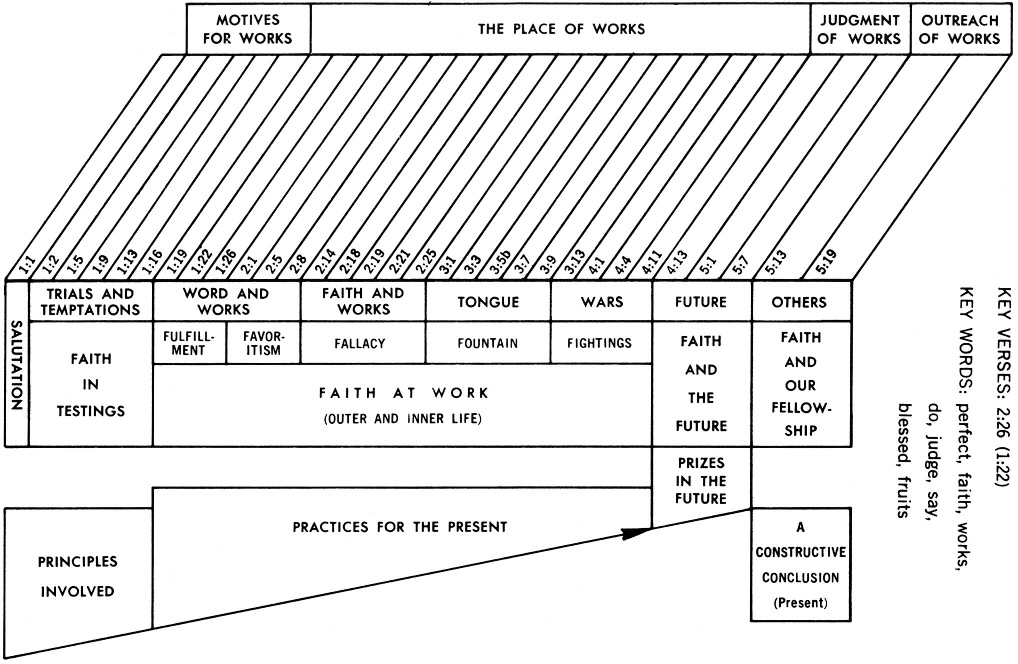 Click chart to enlarge
Chart from recommended resource Jensen's Survey of the NT - used by permission
See also Overview Chart by Charles Swindoll
|
JAMES |
|||||||
| Motives for Works |
The Place of Works: Outward Demonstration of Inner Faith |
Outreach of Works |
|||||
| Jas 1:1-18 | Jas 1:19-2:13 | Jas 2:14-25 | Jas 3:1-12 | Jas 3:13-4:12 | Jas 4:13-5:12 | Jas 5:13-19 | |
| Trials & Temptations |
Word & Works |
Faith & Works |
Tongue | Wars | Future | Others | |
|
Faith |
Fulfill |
Favor |
Fallacy |
Fountain |
Factions |
Faith |
Faith |
|
FAITH AT WORK |
|||||||
The Theme: The Testings of Personal Faith
The trials of the believer (James 1:2–12)
A. The proper attitude toward trials (James 1:2–4)
1. The attitude commanded (James 1:2)
2. The reason indicated (James 1:3)
3. The outcome to be realized (James 1:4)
B. The use of prayer amid trials (James 1:5–8)
1. The need for wisdom (James 1:5a)
2. The request for wisdom (James 1:5b)
3. The bestowal of wisdom (James 1:5c–8)
a. The divine response (James 1:5c)
b. The human obligation (James 1:6–8)
(1) The necessary attitude (James 1:6a)
(2) The rejected character (James 1:6b–8)
C. The correct attitude toward life by the tried (James 1:9–11)
1. The attitude of the lowly brother (James 1:9)
2. The attitude of the rich (James 1:10–11)
a. The reason for the attitude (James 1:10a)
b. The illustration from the flower (James 1:11a)
c. The application to the rich (James 1:11b)
D. The result of enduring trials (James 1:12)
1. The blessedness of endurance (v 12a)
2. The reward of endurance (James 1:12b)
The nature of human temptation (James 1:13–16)
A. The source of human temptation (James 1:13–14)
1. The repudiation of a divine source (James 1:13)
a. The rejection stated (James 1:13a)
b. The rejection vindicated (James 1:13b)
2. The reality of the human source (James 1:14)
B. The consequences of yielding to temptation (James 1:15)
C. The warning against being deceived (James 1:16)
The activity of God in human affairs (James 1:17–18)
A. The Giver of all good gifts (James 1:17)
B. The Author of the believer’s regeneration (James 1:18)
The Test Marks of a Living Faith
Faith tested by its response to the Word of God (James 1:19–27)
A. The reactions to the Word (James 1:19–20)
1. The knowledge possessed (James 1:19a)
2. The reaction demanded (James 1:19b)
3. The reason stated (James 1:20)
B. The reception of the Word (James 1:21)
1. The stripping off of sins (James 1:21a)
2. The appropriation of the Word (James 1:21b)
C. The obedience to the Word (James 1:22–27)
1. The demand for active obedience (James 1:22–25)
a. The statement of the requirement (James 1:22)
b. The illustration of the requirement (James 1:23–25)
(1) The negative portrayal (James 1:23–24)
(2) The positive portrayal (James 1:25)
2. The nature of acceptable obedience (James 1:26–27)
a. The futility of activity without inner control (James 1:26)
b. Acceptable service with inner control (James 1:27) (from Hiebert - James Commentary)
James 1:12 Blessed is a man who perseveres under trial; for once he has been approved, he will receive the crown of life which the Lord has promised to those who love Him (NASB: Lockman)
Greek: Makarios aner os hupomenei (3SPAI) peirasmon, hoti dokimos genomenos (AMPMSN) lempsetai (3SFMI) ton stephanon tes zoes, on epeggeilato (3SAMI) tois agaposin (PAPMPD) auton.
BGT Μακάριος ἀνὴρ ὃς ὑπομένει πειρασμόν, ὅτι δόκιμος γενόμενος λήμψεται τὸν στέφανον τῆς ζωῆς ὃν ἐπηγγείλατο τοῖς ἀγαπῶσιν αὐτόν.
Amplified: Blessed (happy, to be envied) is the man who is patient under trial and stands up under temptation, for when he has stood the test and been approved, he will receive [the victor’s] crown of life which God has promised to those who love Him. (Amplified Bible - Lockman)
KJV: Blessed is the man that endureth temptation: for when he is tried, he shall receive the crown of life, which the Lord hath promised to them that love him.
CSB A man who endures trials is blessed, because when he passes the test he will receive the crown of life that God has promised to those who love Him.
ESV Blessed is the man who remains steadfast under trial, for when he has stood the test he will receive the crown of life, which God has promised to those who love him.
NET Happy is the one who endures testing, because when he has proven to be genuine, he will receive the crown of life that God promised to those who love him.
NIV Blessed is the man who perseveres under trial, because when he has stood the test, he will receive the crown of life that God has promised to those who love him.
NLT God blesses those who patiently endure testing and temptation. Afterward they will receive the crown of life that God has promised to those who love him. (Revised)
NLT: God blesses the people who patiently endure testing. Afterward they will receive the crown of life that God has promised to those who love him. (NLT - Tyndale House)
Phillips: The man who patiently endures the temptations and trials that come to him is the truly happy man. For once his testing is complete he will receive the crown of life which the Lord has promised to all who love him. (Phillips: Touchstone)
WBC: Blessed is the man who endures in time of testing because when he has stood the test he will receive the crown that offers the life [God] has promised to those who love Him.
Wuest: Spiritually prosperous is the man who remains steadfast under trial, because after he has met the test and has been approved, he shall receive the crown, namely, that crown which has to do with the life, which He promised to those who love Him.
Young's Literal: Happy the man who doth endure temptation, because, becoming approved, he shall receive the crown of the life, which the Lord did promise to those loving Him.
- The man who perseveres - Jas 1:2-4; 5:11; Job 5:17; Ps 94:12; Ps 119:67,71,75; Pr 3:11,12; He 6:15; 10:32; 12:5; Re 3:19
- James 1 Resources
Related Passages:
James 1:2-4 Consider it all joy, my brethren, when you encounter various trials, 3knowing that the testing of your faith produces endurance. 4And let endurance have its perfect result, so that you may be perfect and complete, lacking in nothing.
James 5:11 We count those blessed who endured. You have heard of the endurance of Job and have seen the outcome of the Lord’s dealings, that the Lord is full of compassion and is merciful.
Job 5:17 “Behold, how happy is the man whom God reproves, So do not despise the discipline of the Almighty.
THE REWARD FOR
PERSEVERING
Blessed (makarios) is a man who perseveres (hupomeno) under trial (peirasmos); for (term of explanation) once he has been approved (dokimos), he will receive (lambano) the crown (stephanos) of life (zoe) which the Lord has promised (epaggello) to those who love (agapao) Him - One could also translate it way and it would also be true - "Blessed is the man who endures temptation." There is no verb "is" in the Greek, so that it reads more literally "Blessed the man" similar to the beatitudes of Jesus which also lack the Greek verb for "is" (cp Mt 5:3-11, Lk 6:20-22, cf "blessed is the man" motif in - Ps 1:1-6, Job 5:17, Ps 32:2; 34:8; 40:4; 65:4; 84:5; 94:12; 112:1; Pr. 8:34; Is 56:2; Je 17:7; Ro 4:8). Not "Blessed is one who is never tried"! To be sure there is an element of this blessing which is experienced in this present life (cp 1Ti 4:8) but the "bulk" of the blessing looks toward our future life with Christ. Trust your loving, sovereign Father to use the trials as faith-growing tests now and source of a reward in the future.
Who perseverses - Hupomeno is in the present tense which calls for this perseverance to be one's lifestyle. It is not about perfection, but about direction! Bearing up under the trying ordeal is to be our habitual practice. How can we do this? We can't but He can and He always said He would. Some say "Let go and let God" but that absolves the believer of personal responsibility. We still need to make a volitional choice to bear up but even this motivation to please God is initiated by the indwelling Holy Spirit (Php 2:12, Php 2:13NLT), Who also provides the power, energizing us to be able to endure as more than conquerors in Christ Jesus our Lord. Don't misunderstand. We will fail to bear up from time to time, for we are human. But when we do, we can return and repent and then press on in the test. Although some theologians argue against this truth, the Biblical truth is that perseverance is one of the signs of genuine faith. Our perseverance does not save us but demonstrates that we are genuinely saved.
2Timothy 2:12 If we endure (hupomeno in the present tense), we shall also reign with Him… (cp same idea of "perseverance of the saints" in a number of NT passages - He 3:6, He 3:14, , Mt 24:13, Mt 10:22, Lu 8:15, 2Jn 9, 1Co 15:2)
Hebrews 3:6 but Christ was faithful as a Son over His house–whose house we are, if we hold fast our confidence and the boast of our hope firm until the end.
Hebrews 3:14 For we have become partakers of Christ, if we hold fast the beginning of our assurance firm until the end,
Hebrews 10:35-36 Therefore, do not throw away your confidence, which has a great reward. 36 For you have need of endurance, so that when you have done the will of God, you may receive what was promised.
Matthew 24:13 “But the one who endures to the end, he will be saved.
Matthew 10:22 “You will be hated by all because of My name, but it is the one who has endured to the end who will be saved.
Luke 8:15 “But the seed in the good soil, these are the ones who have heard the word in an honest and good heart, and hold it fast, and bear fruit with perseverance.
2 John 1:9 Anyone who goes too far and does not abide in the teaching of Christ, does not have God; the one who abides in the teaching, he has both the Father and the Son.
1 Corinthians 15:2 by which also you are saved, if you hold fast the word which I preached to you, unless you believed in vain.
Related Resources:
- Perseverance of the Saints - is it biblical? | GotQuestions.org
- What does the Bible say about perseverance? | GotQuestions.org
- What are some Bible verses about perseverance? | GotQuestions.org
Warren Wiersbe writes that James "started (Jas 1:2) and ended with joy. Outlook determines outcome. This beatitude is a great encouragement because it promises a crown to those who patiently endure trials. Paul often used athletic illustrations in his letters, and James does so here. He is not saying that the sinner is saved by enduring trials. He is saying that the believer is rewarded by enduring trials. (Bible Exposition Commentary)
Who but God could bring blessing out of trials? When you are in the next trial, remember that it has a blessing if we persevere. And don't try to persevere in your own strength but by leaning on Jesus and His indwelling Spirit to empower you. (Watch the Youtube Video "Bring the Rain" related to James 1:12)
Although some commentators think this verse is a solitary disconnected statement by James others such as Hiebert feel that "This verse crowns the whole discussion with the promise of reward in the future life. The teaching in Jas 1:2 to count their trials as joy is here completed with the assurance concerning the ultimate effect of trials bravely endured. It assures a blessedness both here and hereafter. Therefore, it is better to conclude the paragraph with Jas 1:12 or make a separate paragraph of it. (D Edmond Hiebert - James. Moody)
Charles Simeon introduces this section noting that…Under the afflictions with which we are visited in this vale of tears, philosophy has suggested many grounds for resignation and submission: but to find in them matter for self-congratulation and joy, was beyond the reach of unassisted reason. To that however are we led by the voice of revelation, which teaches us to look with confidence to a future state, wherein all that we endure for God, and in meek submission to his will, shall be compensated with a weight of glory, proportioned to the trials we have here sustained for his sake, and the spiritual improvement which we have derived from them. St. James, who wrote to “his Jewish brethren who were scattered abroad” through the violence of persecution, frequently repeats this consolatory idea. He begins with bidding them to “count it all joy when they fall into divers temptations.” Towards the close of his epistle he declares this to be at least the persuasion of his own mind; “Behold, we count them happy that endure.” But in the text he does not hesitate to affirm it as an unquestionable truth, that such persons are truly blessed (James 1 - Charles Simeon's Horae Homileticae - Commentaries)
Blessed (3107)(makarios) is derived from a root makar, (others say from "mak" which means large or lengthy) which means to be happy, but not in the usual sense of happiness based on positive circumstances. Makarios describes the person who is free from daily cares and worries because his every breath and circumstance is in the hands of His Maker Who gives him such an assurance (such a "blessing"). As discussed below makarios was used to describe the kind of happiness that comes from receiving divine favor. Ultimately, the supremely blessed man or woman is the one who finds their complete happiness in God.
Makarios is found 50 times in the NT - Mt 5:3, 4, 5, 6, 7,8, 9, 10, 11; 11:6; 13:16; 16:17; 24:46; Lk. 1:45; 6:20, 21, 22; 7:23; 10:23; 11:27, 28; 12:37, 38, 43; 14:14, 15; 23:29; Jn. 13:17; 20:29; Acts 20:35; 26:2; Ro 4:7, 8; 14:22; 1Co. 7:40; 1Ti 1:11; 6:15; Titus 2:13; Jas. 1:12, 25; 1Pe 3:14; 4:14; Re 1:3; 14:13; 16:15; 19:9; 20:6; 22:7, 14.
Hiebert comments that in the NT makarios is…always a strongly religious concept denoting an inner quality of life, a joy and happiness not dependent upon favorable external circumstances. It commonly denotes "the distinctive religious joy which accrues to man from his share in the salvation of the kingdom of God."' It points to a state of soul that the believer begins to experience in his life, even amid adverse outward circumstances, but its full bliss will be realized only in the future life. The blessedness consists not in being free from trials, or yet in the fact that he is being subjected to testing, but that he "perseveres" under trial in the manner indicated in Jas 1:2, 3, 4. (Ibid)
Greek used makarios to refer to their gods and thus "the blessed ones" were the gods. They were "blessed" because they had achieved a state of happiness and contentment in life that was beyond all cares, labors, and even death. The blessed ones were beings who lived in some other world away from the cares and problems and worries of ordinary people. To be blessed, you had to be a god. Homer used makarios to describe a state unaffected by the world of men, who were subject to poverty, weakness, and death.
The Greeks also used makarios in reference to the dead who were "the blessed ones", men and women who, through death, had reached the other world of the gods and so were now beyond the cares and problems and worries of earthly life. To be blessed, you had to be dead, a state many of us have felt like we would just as well experience because of the nature of our manifold troubles and afflictions at the time.
Finally, the Greeks used makarios to refer to the socioeconomic elite, the wealthy, the idea being (completely false I might add) that their riches and power put them above the normal cares and problems and worries of the lower socioeconomic strata, who constantly struggled to make it in life.
In short, the Greeks felt that one had to be either a god, dead or filthy rich to be blessed (makarios)! And so we see another one of the words (like doulos, charis, etc) that the Bible elevated in status and meaning, as described below in a compilation from many different resources.
MacArthur writes that makarios "means to be happy, blissful. That happiness is a divine pronouncement, the assured benefit of those who meet the conditions God requires. (See Matthew Commentary - Page 157)
Makarios is a state of existence in relationship to God in which a person is “blessed” from God’s perspective even when he or she doesn’t feel happy or isn’t presently experiencing good fortune. This does not mean a conferral of blessing or an exhortation to live a life worthy of blessing; rather, it is an acknowledgment that the ones indicated are blessed. Negative feelings, absence of feelings, or adverse conditions cannot take away the blessedness of those who exist in such a relationship with God!
Makarios ultimately describes the state those who believe in Christ and in so possessing God, possess everything. In addition since they are indwelt by the Holy Spirit, they are fully satisfied no matter what their circumstances. It is interesting that Aristotle contrasted makarios with the Greek word endees which means "the needy one".
Friedrich Hauck says that the Greek word Makarios "refers overwhelmingly to the distinctive religious joy which accrues to man form his share in the salvation of the kingdom of God."
Makarios means possessing the favor of God, experiencing "spiritual prosperity". It describes a state of being marked by fullness from God. And so what Jesus is saying in the "Beatitudes" is "Spiritually prosperous (blessed) are the poor in spirit… ", etc (Mt 5:3) And thus some of the translators like Wuest pick up this definition "Spiritually prosperous are the destitute and helpless in the realm of the spirit, (Wuest)
Perseveres (5278)(hupomeno from hupó = under, as in under the rule of someone + méno = to abide or remain - see study of noun hupomone) means literally to remain under but not simply with resignation, but with a vibrant hope. The idea of persevering is not just to "grin and bear it" but to remain under trials in a such a way that we glorify God as we learn the lessons the trials are meant to teach us, instead of seeking ways to get out from under (cf the prefix preposition "hupo" = under) the trials and be relieved of the pressure.
Trench defined hupomeno (hupomone) as manifesting the "temper of spirit in which we accept God’s dealings with us as good, and therefore without disputing or resisting."
Hupomeno has the following meanings depending on the context - (1) Stay behind, to tarry behind (beyond an expected time), to remain (as in Acts 17:14, Luke 2:43). (2) To stand fast, endure or remain in the sense of persevering so that under affliction, trouble, opposition or trial one holds fast to one's belief or faith (Mt 10:22, 24:13, Mark 13:13, James 5:11, et al). The idea is to be patient under, to persevere and to do so bear bravely and calmly (from Thayer).
Wayne Detzler recounts an amazing true life example of Christian perseverance writing that "True Christian perseverance is not tied to tenacity. It is rather the work of God the Holy Spirit in a believer's life. The starch in a saint's spine is shown by Scripture to be nothing less than the sanctifying work of the Holy Spirit. Only in this way can one explain the work of Gladys Aylward, a London parlor maid. Societies scorned her missionary application. She seemed too dull to master Chinese and fulfill her vision of serving in China. Realizing this, she scoured up her own fare to China and sailed in 1930. After slogging her way across Siberia she reached her field in remote Yangcheng. When the Japanese invaded in 1940 she led 100 children on an epic journey that caught the imagination of Hollywood (Ed: Watch the movie about her life - The Inn of the Sixth Happiness or DVD). In 1947 failing health forced her back to England where she crusaded for missions until her death in 1970. That was tenacity, not just British grit. It is God's persevering grace. (borrow New Testament Words in Today's Language )
Another great example of a Christian who endured (persevered) under trials in a God honoring way is William Wilberforce (biography in Wikipedia or short bio in Christian History), even better read Eric Metaxas' great biography! - Amazing Grace: William Wilberforce and the Heroic Campaign to End Slavery) the 19th-century parliamentarian, who was moved by the Lord to oppose the lucrative but humanly degrading slave trade. In 1807 Wilberforce brought about the banning of the slave trade in England but it was not until 1833 was slavery as an institution abolished, this news reaching Wilberforce even as he lay on his deathbed. Talk about persevering!
On the other hand take the life of British author Samuel Coleridge, who was undisciplined and so did not persevere. Here's how William Barclay described it…
Nothing was ever achieved without discipline; and many an athlete and many a man has been ruined because he abandoned discipline and let himself grow slack. Coleridge is the supreme tragedy of undiscipline. Never did so great a mind produce so little. He left Cambridge University to join the army; but he left the army because, in spite of all his erudition, he could not rub down a horse; he returned to Oxford and left without a degree. He began a paper called The Watchman which lived for ten numbers and then died. It has been said of him: "He lost himself in visions of work to be done, that always remained to be done.”
Coleridge had every poetic gift but one—the gift of sustained and concentrated effort. In his head and in his mind he had all kinds of books, as he said himself, “completed save for transcription. I am on the eve," he said, "of sending the press two octavo volumes." But the books were never composed outside Coleridge's mind, because he would not face the discipline of sitting down to write them out. No one ever reached any eminence, and no one having reached it ever maintained it, without discipline. (William Barclay, The Gospel of Matthew, (Philadelphia, PA: Westminster, 1958), vol. 1, 284.)
Perseverance is also illustrated in nature for today's mighty oak is just yesterday's little nut that held its ground
Coleman Cox offered another example from nature noting that "Even the woodpecker owes his success to the fact that he uses his head and keeps pecking away until he finishes the job he starts."
Samuel Johnson - Great works are performed not by strength but by perseverance.
William Secker put it well when he said that "Though Christians be not kept altogether from falling, yet they are kept from falling altogether."
Hupomeno was a military term used of an army’s holding a vital position at all costs. Every hardship and every suffering was to be endured in order to hold fast.
Endurance is a critical Christian virtue. Unless we have endurance , we can never learn many of the truths that God wants us to learn, truths that will lead us into a deeper life and a more fruitful ministry. Children are usually impatient; they cannot sit still long enough to get the things done that need to be done. “How long do we have to wait?” is the stock question of the child. Impatience is a mark of immaturity. Impatience is also a mark of unbelief.
Trials (3986) (peirasmos from peirazo = to make trial of, try, tempt, prove in either a good or bad sense) describes first the idea of putting to the test and then refers to the tests or pressures that come in order to discover a person’s nature or the quality of some thing. In short, the word peirasmos has a "double meaning" depending on the context and depending on how one responds to the trial/test. In the present context the primary meaning is trial or test which in itself is not an enticement to evil, for he states we are not to resist (as one would if the intent were evil) but to endure (which supports the meaning of a "neutral" trial).
Peirasmos connotes trouble or something that breaks the pattern of peace, comfort, joy, and happiness in someone’s life. Trials rightly faced are harmless and in fact beneficial to the saint as Peter (and James 1 explain), but wrongly met become temptations to evil.
Vincent adds that in regard to the meaning of peirasmos it "is a mistake to define this word as only solicitation to evil. It means trial of any kind, without reference to its moral quality." The context determines whether the intended purpose of the "temptation" is for good or for evil. This distinction is brought out in chapter 1 of James.
James first use of peirasmos refers to "trials for good" (as in 1 Peter1:6), where he exhorted the saints to "Consider it (aorist imperative ~ do it now once and for all!) all (wholly) joy ("whole joy", unmixed joy, without admixture of sorrow, not just "some joy" along with much grief! How is this possible? The Spirit produces His joy in you - Gal 5:22), my brethren, when (implies temptations are to be expected) you encounter (fall into the midst of so as to be totally surrounded by) various (poikilos - all "shapes and sizes" of) trials (peirasmos), knowing that the testing of your faith produces endurance. (James 1:2-3).
Later James uses the root verb form (peirazo) explaining that no one should "say when he is tempted (peirazo), “I am being tempted (peirazo) by God”; for God cannot be tempted (apeirastos from a = without + peirazo = tempt > incapable of being tempted) by evil, and He Himself does not tempt (peirazo) anyone." (James 1:13)
God brings (allows) such tests (peirasmos) to prove and increase the strength and quality of one’s faith and to demonstrate its validity (read all of James 1 for full context). Every trial becomes a test designed to strengthen the believer's faith, but if the believer fails the test by wrongly responding, then that test may become a temptation or a solicitation to evil.
The KJV has "temptations" instead of "trials". The English word "temptation" originally referred to trials, whether good or bad, but the evil sense has monopolized the word in modern English.
Think of yourself as a tube of "spiritual toothpaste". Pressure brings out what's really on the inside! Or as another has said Christians are a lot like tea bags. You don’t know what’s inside of them until you drop them in hot water. Your faith develops when things don’t go as planned. It purifies your faith.
Thomas Manton - Afflictions do not make the people of God miserable. There's a great deal of difference between a Christian and a man of the world: his best estate is vanity (Ps. 39:5), and a Christian's worst is happiness. He that loveth God is like a die; cast him high or low, he is still upon a square: he may be sometimes afflicted, but he is always happy.
John Legge - The most durable and precious metal in the ancient arts was the Corinthian bronze, which was said to have first been caused by the fusing of all the precious metals when Corinth was burned. The most precious products of experience are got in the fire of trial.
Dean Stanley - An old sailor was asked for what purpose shoals and rocks were created, and the reply was, "That sailors may avoid them." A Christian philosopher, using that axiom, upon being asked for what purpose trials and temptations are sent, answered, "That we may overcome and use them." The true dignity of life is not found in escaping difficulties, but in mastering them for Christ's sake and in Christ's strength.
As Simon Kistemaker says…God tests man’s faith to learn whether it is genuine and true. For instance, we test the purity of a bowl made of lead crystal by lightly tapping the outer edge. Immediately we know its genuineness when we hear a reverberating, almost musical sound. We also know that the lead crystal bowl went through the fire when it was made. Similarly, God tests the faith of man as, for example, in the case of Job. Faith that is not tried and true is worthless. God wants the believer to come to him in a time of trial so that he may give him the strength to endure. God is not interested in seeing the believer falter and fail; he wants him to endure, overcome, and triumph. See how Peter encourages his readers to persevere: “But how is it to your credit if you receive a beating for doing wrong and endure it? But if you suffer for doing good and you endure it, this is commendable before God” (1Pe 2:20). (Kistemaker, S. J., & Hendriksen, W. Vol. 14: New Testament commentary : Exposition of James and the Epistles of John)
J C Ryle - Trials are intended to make us think, to wean us from the world, to send us to the Bible, to drive us to our knees.
G M Stulac - James the Just, with his deep moral earnestness, wants to help suffering Christians find the strength to make tough moral choices. He therefore calls us to face the issue of worth. Persevering is worth doing, because the crown of life is worth more than avoiding the trial. James calls for courageous applications of this principle. Giving up on a difficult ministry, retaliating against people who are mistreating you, withdrawing from active participation in worship and fellowship, compromising moral standards, interrupting your life of obedience, turning away from a walk of fellowship with the Lord—all these responses to adversity assume that escaping the trial is of more value than gaining the crown of life. The Christian is called to place greater value on the goal of becoming mature and complete in Christ. With such applications, the Christian life is taken out of the realm of sentimentality and placed in the realm of significant moral choice. When a Christian’s spouse is unfaithful and abandons the marriage, is Christ still worth obeying? When a Christian’s financial security is threatened or wrecked, is Christ still worth trusting? When a Christian’s physical health is crippled, is Christ still worth adoring? When a Christian’s family member is killed, is Christ still worth serving? When a Christian’s actions are misunderstood or slandered, is Christ still worth devotion? Even if the Christian loses everything else, is Christ still worth honoring, and is the crown of life still worth the perseverance in faith? The answer is decisively yes! “Afflictions are but as a dark entry into our Father’s house,” wrote Thomas Brooks. Christians through the generations of the church have borne testimony to this experience. In the midst of the suffering we are able to see little or no point to it all. So we cry to God, “Why?” Afterward, whether very soon or much later, we find such good resulting from the suffering that we reach the point of being able to say sincerely, “The good I have seen coming out of the trial, especially the benefit of my knowing God far better now, is worth the suffering it took to get me here.” Because we value the Lord and his kingdom and the crown of life more than we value ease or comfort, it becomes the choice of realism and wisdom to consider it pure joy whenever we face trials of many kinds. “However reluctant we may be to embrace it, we know that suffering rightly received is one of the Christian’s supreme means of grace” (Wenham 1974:79). (Called to Joy James 1:1-18)
Spurgeon said "By perseverance the snail reached the ark." He also said "'A poor woman had a supply of coal laid at her door by a charitable neighbor. A very little girl came out with a small fire-shovel, and began to take up a shovelful at a time, and carry it to a sort of bin in the cellar. I said to the child, 'Do you expect to get all that coal in with that little shovel?' She was quite confused at my question, but her answer was very striking, 'Yes, sir, if I work long enough.' Humble worker, make up for your want of ability by abundant continuance in well-doing, and your life-work will not be trivial. The repetition of small efforts will effect more than the occasional use of great talents.
Spurgeon explains the great value of his personal trials writing…
I am afraid that all the grace that I have got out of my comfortable and easy times and happy hours might almost lie on a penny. But the good that I have received from my sorrows, and pains, and griefs, is altogether incalculable. What do I not owe to the crucible and the furnace, the bellows that have blown up the coals, and the hand which has thrust me into the heat?… I bear my witness that the worst days I have ever had have turned out to be my best days… I can bear my personal testimony that the best piece of furniture that I ever had in the house was a cross. I do not mean a material cross; I mean the cross of affliction and trouble… In shunning a trial we are seeking to avoid a blessing. (The Trial of Your Faith)
C H Spurgeon in his sermon notes (James 1:12 The Tried Man the Blessed Man) has this to say about blessed…
I. THE BLESSED IN THIS LIFE.
1. Blessedness is not in our text connected with ease, freedom from trial, or absence of temptation.
Untested treasures may be worthless; not so those which have endured the fire. No man may reckon himself blessed if he has to fear that a trial would wither all his excellence.
2. Blessedness belongs to those who endure tests.
These have faith, or it would not be tried; faith is blessed.
These have life which bears trials, the spiritual life is blessed.
These possess uprightness, purity, truth, patience; all these are blessed things.
3. Blessedness belongs to those who endure trials out of love to God. The text speaks of "them that love him."
He that has love to God finds joy in that love.
He also finds blessedness in suffering for that love.
4. Blessedness belongs to those who are proved true by trial.
After the test comes approval. "When he hath been approved" is the rendering of the Revised Version.
After the test comes assurance of our being right. Certainty is a most precious commodity.
5. Blessedness comes out of patient experience.
Blessedness of thankfulness for being sustained.
Blessedness of holy dependence under conscious weakness.
Blessedness of peace and submission under God's hand.
Blessedness of fearlessness as to result of further trial.
Blessedness of familiarity with God enjoyed in the affliction.
Blessedness of growth in grace through the trial.
He who, being tested, is supported in the ordeal, and comes out of the trial approved, is the blessed man.
II. THE BLESSED IN THE LIFE TO COME.
Those who have endured trial inherit the peculiar blessedness—
1. Of being crowned. How crowned if never in the wars?
Crowned because victorious over enemies.
Crowned because appreciated by their God.
Crowned because honored of their fellows.
Crowned because they have kept the conditions of the award.
2. Of attaining the glory and "crown of life" by enduring trial, thus only can life be developed till its flower and crown appear.
By trial brought to purest health of mind.
By trial trained to utmost vigor of grace.
By trial developed in every part of their nature.
By trial made capable of the highest glory in eternity.
3. Of possessing a living crown of endless joy. "Crown of life" or living crown: amaranthine, unfading.
If such fierce trials do not kill them, nothing will.
If they have spiritual bliss, it can never die.
If they have heavenly life, it will always be at its crowning point.
4. Of receiving this lift-crown from God.
His own promise reveals and displays it.
His peculiar regard to those who love him doubly ensures it.
His own hand shall give it. Let us encounter trial cheerfully.
Let us wait for the time of approval patiently.
Let us expect the crown of life most joyfully and gather courage from the assurance of it.
What the Clutch Player Wins - In the 1996 Olympics in Atlanta, Kerri Strug faced the trial of her life. She had injured her ankle on the vault and was in great pain as she approached her final attempt to determine whether the U.S. gymnastics team would win the gold medal. She moved the crowd with an incredible performance in spite of the pain she was enduring, and the United States won gold. When asked how she did it, she said she focused on her coach, who kept telling her she could do it and who reminded her of what was at stake. When we are hurting during a trial, we need to put our focus on the right place. The payoff for being a faithful clutch player is found in James 1:12: "Blessed is a man who perseveres under trial; for once he has been approved, he will receive the crown of life which the Lord has promised to those who love Him." A little-known fact about Michael Jordan is that in addition to his numerous buzzer beaters, he also missed over three hundred last-second shots during his career. It takes a lot of pain and frustration to become a great clutch player. Yet over time your perseverance will bring great victory, a crown of life as a reward you can enjoy today and for eternity. (Tony Evans)
Joyful Trials - The Bible tells us to respond to difficult circumstances in a way that is directly opposed to our natural tendency. One of the most challenging of those commands is this: “Count it all joy when you fall into various trials” (James 1:2).
Other translations speak of viewing our difficulties with pure joy, considering ourselves happy—not resisting trials and temptations as intruders but welcoming them as friends. I don’t know about you, but that’s not the first thing that pops into my mind.
This outlook would seem absurd and unattainable if not for the reason behind it: “knowing that the testing of your faith produces patience” (James 1:3). An attitude of joy is not based on what we feel but on what we know of God and His work in our lives. Therefore, a painful process that yields a desired goal can be welcomed as a friend.
It’s not the testing of our strength but the trying of our faith in Almighty God that develops our endurance. Through it all, the Lord promises wisdom for today (James 1:5) and a crown of life for those who persevere (James 1:12).
My natural response to difficult circumstances is “Oh, no!” The Lord wants me to see what He can accomplish through them and say, “Oh, yes!” --By David C. McCasland (Our Daily Bread, Copyright RBC Ministries, Grand Rapids, MI. Reprinted by permission. All rights reserved)
The deeper meaning of my trials
O Lord, You've kept from me;
But some small part of Your great plan
I pray, Lord, help me see.
—D. De Haan
Joy in trials comes from
knowing that the outcome will be good.
Count It All Joy - A pastor placed this sign on his door: "If you have problems, come in and tell me all about them. If you don't have any problems, come in and tell me how you avoid them."
What do we do when problems come unannounced and with great intensity? James told us to "count it all joy," because trials do not happen without a reason. He said, "The testing of your faith produces patience. But let patience have its perfect work, that you may be perfect and complete" (James 1:3, 4). Armed with this understanding, our prayer changes from asking God "why" to thanking Him for what He is doing.
Having endured many trials and facing a new struggle with cancer, Our Daily Bread author Joanie Yoder shared her thoughts in a letter: "I have relinquished my destiny to God's will. Nothing, praise God, not even cancer, can thwart His will. I may have cancer, but cancer doesn't have me—God alone has me. So in this light, I would value your prayers that Christ may be magnified in my body, whether by life or by death."
Trials are unavoidable and unpredictable, and they come in an unimaginable variety. Knowing that our sovereign God will walk with us and use trials to deepen our maturity, we can count them "all joy." — Albert Lee (Our Daily Bread, Copyright RBC Ministries, Grand Rapids, MI. Reprinted by permission. All rights reserved)
Heavenly peace, divinest comfort,
Here by faith in Him to dwell!
For I know, whatever befall me,
Jesus doeth all things well.
—Crosby
We can endure trials in this life because of the joys in the life to come.
- Whom God chooses -Psalms 65:4; Ephesians 1:3,4
- Whom God calls -Isaiah 51:2; Revelation 19:9
- Who know Christ -Matthew 16:16,17
- Who know the gospel -Psalms 89:15
- Who are not offended at Christ -Matthew 11:6
- Who believe -Luke 1:45; Galatians 3:9
- Whose sins are forgiven -Psalms 32:1,2; Romans 4:7
- To whom God imputes righteousness without works -Romans 4:6-9
- Whom God chastens -Job 5:17; Psalms 94:12
- Who suffer for Christ -Luke 6:22
- Who have the Lord for their God -Psalms 144:15
- Who trust in God -Psalms 2:12; 34:8; 40:4; 84:12; Jeremiah 17:7
- Who fear God -Psalms 112:1; 128:1,4
- Who hear and keep the word of God -Ps 119:2; James 1:24; Mt 13:16; Lk 11:28; Re 1:3; 22:7
- Who delight in the commandments of God -Psalms 112:1
- Who keep the commandments of God -Revelation 22:14
- Who wait for the Lord -Isaiah 30:18
- Whose strength is in the Lord -Psalms 84:5
- Who hunger and thirst after righteousness -Matthew 5:6
- Who frequent the house of God -Psalms 65:4; 84:5
- Who avoid the wicked -Psalms 1:1
- Who endure temptation -James 1:12
- Who watch against sin -Revelation 16:15
- Who rebuke sinners -Proverbs 24:25
- Who watch for the Lord -Luke 12:37
- Who die in the Lord -Revelation 14:13
- Who have part in the first resurrection -Revelation 20:6
- Who favour saints -Genesis 12:3; Ruth 2:10
- The undefiled -Psalms 119:1
- The pure in heart -Matthew 5:8
- The just -Psalms 106:3; 10:6
- The children of the just -Proverbs 20:7
- The righteous -Psalms 5:12
- The generation of the upright -Psalms 112:2
- The faithful -Proverbs 28:20
- The poor in spirit -Matthew 5:3
- The meek -Matthew 5:5
- The merciful -Matthew 5:7
- The bountiful -Deuteronomy 15:10; Psalms 41:1; Pr 22:9; Lk 14:13,14
- The peace-makers -Matthew 5:9
- Holy mourners -Matthew 5:4; Luke 6:21
- Saints at the judgment day -Matthew 25:34
Who shall eat bread in the kingdom of God -Luke 14:15; Re 19:9
FOR ONCE HE HAS BEEN APPROVED: hoti dokimos genomenos (AMPMSN):
- For once - Deuteronomy 8:2; 13:3; Pr 17:3; Zech 13:9; Mal 3:2,3; Heb 11:17; 1Pe 1:6,7; 1Pe 5:10
- James 1 Resources - Multiple Sermons and Commentaries
PASSING THE
DIVINE TEST
For once (hoti) is used here as a subordinating conjunction as a marker of causality and could also be translated because. James is explaining the reason for the beatitude associated with perseverance. Wuest renders it "because after he has met the test and has been approved." The point is that the promised beatitude will be given after we have completed the test. It follows that if we are to receive a reward, we must be tested, must submit to the test and must endure the test to the end. This process proves we are genuine ("approved").
For (term of explanation) once he has been approved (dokimos) - NET = "because when he has proven to be genuine" This explains the purpose of the trial.
Approved (1384) (dokimos from dokime = test, proof, trial = idea is that when you put metal through a fiery testing and it comes out on the other side enduring it "proven", "authentic" or "genuine" Click discussion of related word dokimazo and the antonym = adokimos) describes one who has stood the test. Dokimos conveys the idea of being tested and passing the test, so that God’s “Good (God) Housekeeping” stamp of approval is on your life.
Dokimos occurs 7 times in the NT (Ro 14:18; 16:10; 1Co 11:19; 2Co 10:18; 13:7; 2Ti 2:15; Jas 1:12) and 6 times in the Septuagint (LXX) primarily referring to precious metals - refined or pure - Ge 23:16; 1Ki 10:18; 1Chr 28:18; 29:4; 2Chr 9:17; Zech 11:13
Vine writes that dokimos signifies "that which is approved by being proved, that which stands the test (Collected writings of W. E. Vine) In his lexicon Vine adds " The word is used of coins and metals in the Sept.; in Ge 23:16 (this is Brenton's English translation of the Septuagint), "four hundred shekels of silver approved with merchants (Hebrew = "passing for the merchant." The final clause affirms that the measurement of silver was according to the standards used by the merchants of the time);" in Zech 11:13 , in regard to the 30 pieces of silver, "Cast them into a furnace and I will see if it is good (approved) metal."
Donald Barnhouse illustrates dokimos - In the ancient world there was no banking system as we know it today, and no paper money. All money was made from metal, heated until liquid, poured into moulds and allowed to cool. When the coins were cooled, it was necessary to smooth off the uneven edges. The coins were comparatively soft and of course many people shaved them closely. In one century, more than eighty laws were passed in Athens, to stop the practice of shaving down the coins then in circulation. But some money changers were men of integrity, who would accept no counterfeit money. They were men of honour who put only genuine full weighted money into circulation. Such men were called "dokimos" or "approved"
Wuest adds this description that dokimos means to "put to the test for the purpose of being approved, and having met specifications, having the stamp of approval placed upon one. (Eerdmans Publishing - used by permission)
A dokimos man or dokimos character is like metal which has been cleansed of all alloy and impurity. In James 1:12 (see below) the weaknesses of such a one have been eradicated and he emerges strong and pure. That which is dokimos is shown to be trustworthy and genuine.
Approved describes anything tested and fit for service. As alluded to above, this term was used of gold and silver which has been purified by fire of all alloy.
Dokimos is the word describing money which is genuine or as we would say sterling (silver) [sterling = conforming to the highest standard]. In other words, a persons must first be "proved" before being "approved". One so approved is assayed by the One Who has eyes like flames of fire (see note Revelation 1:14) yet passes this scrutiny and is counted as worthy.
Dokimos is a word which motivates one to have a "God consciousness" (cp "Coram Deo" - before the face of God!), a consciousness of His presence and of living and acting in His sight, so as to please Him in all things. (e.g., see the use by James below)
Sometimes it is helpful to get a sense of the meaning of a word by observing uses of its antonym and here Isaiah 1:22 presents us with a clear picture, where God is speaking to faithless Israel declaring…
Your silver has become dross (Hebrew = siyg = literally that which is turned away or skimmed off in the refining process, the waste or impurity, the refuse after smelting precious metal and figuratively that which is base or worthless), Your drink diluted with water. (Note: The Septuagint -LXX translates siyg with the Greek word adokimos, essentially the opposite of dokimos).
Richards writes that dokimos "is used in the NT in the sense of recognition, of being officially approved and accepted."
William Barclay - The Greek for one who has stood the test is dokimos, which describes anything which has been tested and is fit for service. For instance, it describes gold or silver which has been purified of all alloy in the fire. It is therefore the word for money which is genuine, or, as we would say, sterling. It is the word used for a stone which is fit to be fitted into its place in a building. A stone with a flaw in it was marked with a capital A, standing for adokimastos, which means tested and found wanting. Timothy was to be tested that he might be a fit weapon for the work of Christ, and therefore a workman who had no need to be ashamed. (Barclay's comments on 2Timothy 2:15 from The Daily Study Bible) Barclay adds that "To the man who meets trials in the right way there is joy here and hereafter. In this life he becomes a man of sterling worth. He is dokimos; he is like metal which is cleansed of all alloy. The weaknesses of his character are eradicated; and he emerges strong and pure." (James 1 - Barclay's Daily Study Bible)
NIDNTT - The root dek-, dechomai, accept, gives two verbal derivatives dokeo and dokao. The former means (intrans.) to appear, have the appearance, (trans.) to think, believe, consider right; the latter means expect. Derivatives of the former are: (a) dokimos, trustworthy, reliable, tested, recognized, used as a technical term for genuine, current coinage, but also applied to persons enjoying general esteem; (b) adokimos, untested, not respected; (c) indirectly also dokimion, test, probation; (d) from dokimos are also derived dokimazo, test, pronounce good, establish by trial, recognize, and apodokimazo, disapprove of, reject, blame; dokimasis and dokimasia, investigation, testing (preparatory to installing in an office); dokime, approved character, trial. (Brown, Colin, Editor. New International Dictionary of NT Theology. 1986. Zondervan See this page for a few instructions on how to most efficiently utilize this incredible resource.)
HE WILL RECEIVE THE CROWN OF LIFE WHICH THE LORD HAS PROMISED TO THOSE WHO LOVE HIM: lempsetai (3SFMI) ton stephanon tes zoes, on epeggeilato (3SAMI) tois agaposin (PAPMPD) auton:
- Crown of life - Mt 25:34; Lk 22:28-30; Ro 2:7-10; 1Co 9:25; 2Ti 4:8; 1Pe 1:7; 4:13; 1Pe 5:4; Re 2:10; 3:21
- Which the Lord has promised - James 2:5; Is 64:4; Mt 10:22; 19:28,29
- To those who love Him - James 2:5; Ex 20:6; Deut 7:9; Neh 1:5; Ps 5:11; Ro 8:28; 1Co 2:9; 8:3; 1Pe 1:8; 1Jn 4:19
- James 1 Resources - Multiple Sermons and Commentaries
Related Passages:
1 Corinthians 9:24-27 Do you not know that those who run in a race all run, but only one receives the prize? Run in such a way that you may win. 25 Everyone who competes in the games exercises self-control in all things. They then do it to receive a perishable wreath, but we an imperishable. 26 Therefore I run in such a way, as not without aim; I box in such a way, as not beating the air; 27 but I discipline my body and make it my slave, so that, after I have preached to others, I myself will not be disqualified.
2 Timothy 4:8 in the future there is laid up for me the crown of righteousness, which the Lord, the righteous Judge, will award to me on that day; and not only to me, but also to all who have loved His appearing.
THE CROWN
OF LIFE
He will receive (lambano) the crown (stephanos) of life (zoe) which the Lord has promised (epaggello) to those who love (agapao) Him - While the crown itself awaits the future, those who endure trials correctly experience God’s blessing in the present and experience a sense of inner peace even amid ongoing hardship. No one competing in the Olympic games received a crown until the race was over. In this present life we are charged to "run with endurance" (cp He 12:1, 2) and not to shrink back (cp He 10:38, 39) when the trials come. James sets before us the grand reward that awaits those who persevere, loving God.
Paul speaks of a similar reward in his last letter to Timothy explaining that "in the future there is laid up for me the crown of righteousness, which the Lord, the righteous Judge, will award to me on that day; and not only to me, but also to all who have loved His appearing." (2Ti 4:8)
Will receive (2983) (lambano) means to take hold of, to grasp, to seize. Lambano can indicate either benevolent and hostile actions, and have as object either people or things; e.g. take a wife, collect taxes, accept a verdict, take a road, and figuratively take courage. It is used with a material subject, as when, for example, fear or terror seizes men. In the present context clearly James is speaking of a benevolent action, the crown of life. Note that it is one that we receive as a gift from a gracious God, not one that we earn by our works/merit.
The crown of life (see note below) - Note that the tested and approved (dokimos) believer will not receive life, but the crown of life, which Hiebert explains as "Eternal life as the final consummation of our salvation in eternity. The genitive "of life" is best taken as an appositional genitive, the crown which consists of eternal life in the full, final sense of the term. It is God's gracious reward to those who have been rendered fit for that life by their approved character. The article with "life" (tes zoes) points to that eternal life in all its fullness awaiting the attested believer. Burdick remarks, "Since it is a reward for an accomplishment subsequent to initial faith, it must refer to a still higher quality of life." It is not merely escape from eternal condemnation, but the believer's eternal enjoyment of life as the approved of God in His presence." (Ibid)
Douglas Moo - The crown is the emblem of spiritual success, given by the King of the universe to those who 'keep their faith' in the midst of suffering and temptation. Life should be taken as identifying the reward—`the reward that is life. (See The Letter of James - Pillar New Testament commentary or borrow Moo's Tyndale commentary on James)
COUNT IT JOY
by Susan Peterson
Count it joy, and never be discouraged,
When by trials your life is sorely pressed.
For you know that when your faith is tested,
Your endurance then develops best.
Perseverance must complete its working;
You will need to let it have its way.
When it’s done, you’ll be complete and perfect,
Having all you need to meet each day.
So if any one of you lacks wisdom,
Ask of God, who always hears and cares.
He gives freely without asking questions;
His abundance will become your share.
But when asking, you must never falter,
Like a wave that’s blown and tossed about.
If you do, you’ll never gain God’s blessing;
Double-minded, you’ll succumb to doubt.
Blest the man who perseveres in trial;
For you know the testing soon will pass.
When it’s o’er and you have stood unmoving,
You’ll receive the crown of life at last.
But when tempted, never be accusing;
It’s not God who leads you from the path.
Your own lusts seduce you and entice you,
Giving birth to sin, and sin to death.
Do not let yourself yield to deception;
God’s the source of every perfect gift.
He’s the Maker of the stars in heaven,
Changing not as shadows move and shift.
For He chose a spirit birth to give you,
Through the Word of truth that you believed.
Thus are you the firstfruits of His labors;
By His grace, salvation is achieved.
William Barclay comments on the crown of life…
In the life to come he receives the crown of life. There is far more than one thought here. In the ancient world the crown (stephanos) had at least four great associations.
(a) The crown of flowers was worn at times of joy, at weddings and at feasts (compare Isaiah 28:1-2; SS 3:11). The crown was the sign of festive joy.
(b) The crown was the mark of royalty. It was worn by kings and by those in authority. Sometimes this was the crown of gold; sometimes it was the linen band, or fillet, worn around the brows (compare Psalms 21:3; Jeremiah 13:18).
(c) The crown of laurel leaves was the victor's crown in the games, the prize which the athlete coveted above all (compare 2 Timothy 4:8).
(d) The crown was the mark of honour and of dignity. The instructions of parents can bring a crown of grace to those who listen to them (Proverbs 1:9); Wisdom provides a man with a crown of glory (Proverbs 4:9); in a time of disaster and dishonor it can be said, "The crown has fallen from our head" (Lamentations 5:16).
We do not need to choose between these meanings. They are all included. The Christian has a joy that no other man can ever have. Life for him is like being for ever at a feast. He has a royalty that other men have never realized for, however humble his earthly circumstances, he is the child of God. He has a victory which others cannot win, for he meets life and all its demands in the conquering power of the presence of Jesus Christ. He has a new dignity for he is ever conscious that God thought him worth the life and death of Jesus Christ.
What is the crown? It is the crown of life; and that phrase means that it is the crown which consists of life. The crown of the Christian is a new kind of living which is life indeed; through Jesus Christ he has entered into life more abundant.
James says that if the Christian meets the testings of life in the steadfast constancy which Christ can give, life becomes infinitely more splendid than ever it was before. The struggle is the way to glory, and the very struggle itself is a glory. (James 1 - Barclay's Daily Study Bible)
O the friends that now are waiting,
In the cloudless realms of day,
Who are calling me to follow
Where their steps have led the way;They have laid aside their armor,
And their earthly course is run;
They have kept the faith with patience
And their crown of life is won.
Crown (4735) (stephanos from stepho = to encircle, twine or wreathe) was a wreath made of foliage or designed to resemble foliage and worn by one of high status or held in high regard. The stephanos was literally an adornment worn around the head as a crown of victory in the Greek athletic games, this reward being given to the runner who crossed the goal first, to the disc thrower with the longest toss, etc. Apart from recognition of athletes and winners of various kinds of competitions, in the Greco-Roman world, the awarding of a crown or wreath signified appreciation for exceptional contributions to the state or groups within it. The recipients were usually public officials or civic-minded persons serving at their own expense
The stephanos was the only prize ancient Olympic athletes received and thus it was cherished as a great treasure. How much more should we as believers "run with endurance the race that is set before" (Heb 12:1) us, knowing that the Olympic athletes do it to receive a perishable wreath (stephanos) but we an imperishable." (1Co 9:25)
Stephanos 25x - Mt. 27:29; Mk. 15:17; Jn. 19:2, 5; Acts 6:5, 8f; 7:59; 8:2; 11:19; 22:20; 1Co. 9:25; Phil. 4:1; 1Th 2:19; 2Ti 4:8; Jas 1:12; 1Pe 5:4; Re 2:10; 3:11; 4:4, 10; 6:2; 9:7; 12:1; 14:14. Note the concentration of uses in the Revelation.
Stephanos in the non-apocryphal Septuagint (LXX) - 25X - 2Sa 12:30; 1 Chr. 20:2; Est. 8:15; Job 19:9; 31:36; Ps. 21:3; 65:10; Prov. 1:9; 4:9; 12:4; 14:24; 16:31; 17:6; Cant. 3:11; Isa. 22:18, 21; 28:1, 3, 5; 62:3; Jer. 13:18; Lam. 2:15; 5:16; Ezek. 16:12; 21:26; 23:42; 28:12; Zech. 6:11, 14. Note that in the Septuagint, stephanos in some contexts symbolizes a special honor or as representative of happiness and prosperity (Ps 21:3; Pr 12:4; 16:31; Lam 5:16; Ezek.16:12) and also of a royal crown (2Sa 12:30; 1Chr 20:2 Zech. 6:11).
Many were the sorts of crowns which were in use amongst the Roman victors:
(1) Corona civica, a crown made of oaken boughs, which was given by the Romans to him that saved the life of any citizen in battle against his enemies.
(2) Obsidionalis, which was of grass, given to him that delivered a town or city from siege.
3) Muralis, which was of gold, given to him that first scaled the wall of any town or castle.
(4) Castralis, which was likewise of gold, given to him that first entered the camp of the enemy.
(5) Navalis, and that also of gold, given to him that first boarded the ship of an enemy.
(6) Ovalis (and that of myrtle), which was given to those captains that subdued any town or city, or that won any field easily, without blood.
(7) Triumphalis, which was of laurel, given to the chief general or consul who, after some signal victory, came home triumphing.
These, with many others, as imperial, regal, and princely crowns (rather garlands or coronets than crowns), are not to be compared to the crown of glory which God hath prepared for those that love him. Who is able to express the glory of it; or to what glorious thing shall it be likened? If I had the tongue of men and angels, I should be unable to decipher it as it worthily deserveth. It is not only a crown of glory, but hath divers other titles of pre-eminency given unto it, of which all shall be true partakers that are godly; a crown of righteousness, by the imputation of Christ's righteousness; a crown of life, because those that have it shall be made capable of life eternal; a crown of stars, because they that receive it shall shine as stars for ever and ever. — John Spencer
William Barclay adds that stephanos had the following associations in the ancient world…
(a) the victor's crown in the games. Smyrna had annual games which were famous all over Asia. As in the Olympic Games, the reward of the victorious athlete was the laurel crown. The Christian can win the crown of victory in the contest of life.
(b) When a man had faithfully performed the work of a magistrate, at the end of his term of office he was granted a crown. He who throughout life faithfully serves Christ and his fellow-men will receive his crown.
(c) The heathen world was in the habit of wearing crowns, chaplets of flowers, at banquets. At the end of the day, if the Christian is loyal, he will have the joy of sitting as a guest at the banquet of God.
(d) The heathen worshippers were in the habit of wearing crowns when they approached the temples of their gods. At the end of the day, if he has been faithful, the Christian will have the joy of entering into the nearer presence of God.
(e) Some scholars have seen in this crown a reference to the halo or the nimbus which is round the head of divine beings in pictures. If that is so, it means that the Christian, if he is faithful, will be crowned with the life which belongs to God himself. (The Daily Study Bible Series Comments on Revelation 2:8-11 The Letter to Smyrna)
TDNT has a lengthy note on stephanos…
The crown, as a wreath placed around the head, is a sign of life and fertility, and perhaps also a symbol of light. It has a place in the cultus and supposedly wards off evil. The closed crown is used in magic. The crown expresses joy and honor, but also sorrow. It acknowledges excellence.
II. Nature. The simplest crown consists of a bent twig or of two twigs tied together. Wreaths of grass, leaves, or flowers also occur. The Dionysus cult uses ivy, oak, and acanthus, Neptune and Pan wear wreaths of fig leaves, and Zeus of laurel. Soldiers wear crowns at triumphs, and victors wear laurel or olive wreaths. The myrtle signifies love. Roman magistrates wear gold crowns, and Etruscan crowns, also used at Rome, are of precious stones and golden oak
III. Use.
1. The Cultus. In cultic acts priests wear various forms of crowns. Aeneas crowns his brow with twigs when he first treads Roman soil and prays. Crowns are placed on sacrifices and altars, and are even offered in sacrifice. Images are crowned when dedicated to cultic use and on the feasts of the gods. The crown expresses reverence; Empedocles takes it as a mark of veneration when crowned.
2. Oracles. Crowns evoke true dreams. The person who delivers the oracle wears a crown. When Creon comes back crowned after consulting the oracle he is hailed as a messenger of joy. Roman frescoes depict crowned prophetesses.
3. Processions and Feasts. Crowning takes place in relation to prayer-processions. On the New Year feast at Rome houses are adorned with crowns or wreaths. Animals are also crowned or garlanded at various feasts.
4. A Sign of Salvation and Protection. Various examples show that crowns are viewed as signs of protection. Thus Tiberius wears a laurel wreath during thunderstorms. Wreaths are put at the entrances to houses. Crowns also serve as a means of power and protection in the invocation of gods or demons in magic.
5. The Mysteries. Mystagogues bear myrtle branches in the Eleusinian mysteries, and neophytes in the Isis mysteries. A crown is handed to the mystagogue in the dedication ceremonies of Mithras.
6. Political Life. Cultic and political life are closely related, hence it is natural that those who hold national office should he crowned. When politicians give orations in Athens they wear wreaths as a sign of immunity. The Roman emperor, his family, the priests, and state officials all wear crowns in processions.
7. The Games. Held in honor of the gods, sporting festivals culminate when the victors, who struggle hard to win, are crowned with wreaths of laurel, olive, or ivy. The herald calls their names, and the names of their fathers and towns, and then hands over the wreaths. The ceremony ends in their homes, which also bear wreaths. In the final rites they offer their wreaths to the deity.
8. The Army. The Spartans put on crowns before doing battle, perhaps in connection with sacrifice and as a sign of protection. In the Roman army the general wears a crown to purify the troops before battle. The goddess of victory is depicted with a crown, and there are crowns for the victors, whether of grass, oak leaves, or laurel. An ancient Roman custom is to offer prisoners for sale with crowns on; this possibly derives from a Germanic practice of sacrificing prisoners.
9. Private Life.
a. A Sign of Joy and Respect. Various examples illustrate the use of the crown or wreath as a mark of joy or respect.
b. Weddings. It is natural that there should be crownings at weddings. Thus we have depictions of brides with crowns, and the guests at the wedding feast also wear crowns.
c. Symposia. Wreaths adorn the participants at banquets and the ensuing symposia, which are held in honor of various gods. The wreaths express festal joy but also serve to cool the head during drinking. Wreaths are also placed on the bowls and vessels and on the walls of the rooms where the feasts are held.
10. The Cult of the Dead. A common custom is to put wreaths on the dead, on the bier, and on the grave. Permanent wreaths are carved on gravestones and funds are set up for regular adornment with wreaths. The wreaths honor the dead but also protect them against demons. Plato hands down an idea that in Hades there will be a symposium for the righteous at which they will be adorned with crowns. The mysteries promise initiates that in the hereafter they will be adorned with crowns and will enjoy the company of the blessed. (borrow Kittel's Theological Dictionary of the New Testament : abridged in one volume)
Life (2222) (zoe) in Scripture is used (1) to refer to physical life (Ro 8:38, 1Co 3:22, Php 1:20, James 4:14, etc) but more often to (2) to supernatural life in contrast to a life subject to eternal death (Jn 3:36, see all 43 uses of "eternal life" below). This quality of life speaks of fullness of life which alone belongs to God the Giver of life and is available to His children now (Ro 6:4, Ep 4:18) as well as in eternity future (Mk 10:30, Titus 1:2 on Eternal Life) for those who have received the gift of life found in Christ Jesus, the Way, the Truth and the Life (Jn 14:6).
Richards writes that "Zoe in classical Greek refers to natural life--the principle that enables living things to move and to grow. In the NT, zoe focuses on the theological meaning rather than on the biological. From the perspective of the NT, in every respect life is the counterpart of death. Each book of the NT speaks of zoe. In each, the principle of life lifts our vision beyond our earthly existence to reveal a unique quality of life that spans time and eternity and that has its roots in God. It is the biblical use and meaning of zoe that most concerns us as we examine what the NT says about life. (Richards, L O: Expository Dictionary of Bible Words: Regency)
Wuest (in comments on 2Pe 1:3) writes that zoe…speaks of life in the sense of one who is possessed of vitality and animation. It is used of the absolute fulness of life, both essential and ethical, which belongs to God. It is used to designate the life which God gives to the believing sinner, a vital, animating, spiritual, ethical dynamic which transforms his inner being and as a result, his behavior.
(In comments on 1Jn 1:2 Wuest adds) here used as Thayer indicates, as “the absolute fulness of life, both essential and ethical, which belongs to God.” Thus, this life that God is, is not to be defined as merely animation, but as definitely ethical in its content. God is not the mere reason for the universe, as the Greeks thought, but a Person with the characteristics and qualities of a divine Person. The ethical and spiritual qualities of this life which God is, are communicated to the sinner when the latter places his faith in the Lord Jesus as Saviour, and this becomes the new, animating, energizing, motivating principle which transforms the experience of that individual, and the saint thus lives a Christian life. The message of John is that since the believer is a partaker of this life, it is an absolute necessity that he show the ethical and spiritual qualities that are part of the essential nature of God, in his own life. If these are entirely absent, John says, that person is devoid of the life of God, and is unsaved. The ethical and spiritual qualities of this life were exhibited to the human race in the earthly life of the Lord Jesus. His life thus becomes the pattern of what our lives should be in holiness, self-sacrifice, humility, and love. (Eerdmans Publishing - used by permission)
Promised (1861) (epaggello from epí = intensifies meaning + aggéllo = tell, declare) means to announce with certainty as to what one will do. In Classic Greek it was used of announcing a summons or issuing a command. To promise is to make a declaration that one will do or refrain from doing something specified. The non-lying God makes a legally binding declaration of what He will give the person who loves endures trials and love him and therefore who has a right to expect the reception of this glorious beatitude, the crown of life. The aorist tense records the historical fact that the promise was given and thus stated by the non-lying God, stands firm and sure regarding its consummation. There is no "gamble" involved in this promise.
Those who love God - This phrase or a similar phrase is a common designation for God's people both in the OT (Ex 20:6; Ps 97:10; Ps 145:20) and the NT (Ro 8:28; 1Co 2:9; 2Ti 4:8; 1Pe 1:7, 8-notes).
Love (verb) (25) (agapao-see related study of noun agape) means to love unconditionally and sacrificially as God Himself loves sinful men (John 3:16), the way He loves the Son (John 3:35, 15:9, 17:23, 24). Note that agapao is a verb and by its verbal nature calls for action. This quality of love is not an emotion but is an action initiated by a volitional choice. And the present tense signifies that his reader's (verb is plural) have a continuing love for God.
How do believers love God? Certainly they can say it and pray it, but ultimately the aphorism still applies that actions speak louder than words. If we love God with our lips, we should demonstrate it with our life. Let's listen to our Lord's words to those who call themselves His disciples (cp Mk 8:34, 35, 36, Lk 9:23)…
Jn 14:15 If you love Me, you will keep (tereo) My commandments.
Comment: The key verb explaining love is "keep" = keep an eye on, keep something in view, to attend carefully, or to watch over it. Tereo speaks of guarding something which is in one’s possession. It means to watch as one would some precious thing.
Jn 14:21 "He who has My commandments and keeps (tereo in present tense = not perfectly but as the general "tenor" of their life) them, he it is who loves Me; and he who loves Me shall be loved by My Father, and I will love him, and will disclose Myself to him." 22 Judas (not Iscariot) said to Him, "Lord, what then has happened that You are going to disclose Yourself to us, and not to the world?" 23 Jesus answered and said to him, "If anyone loves Me, he will keep My word; and My Father will love him, and We will come to him, and make Our abode with him. 24 "He who does not love Me does not keep My words; and the word which you hear is not Mine, but the Father's who sent Me.
Jn 15:10 "If you keep (tereo) My commandments, you will abide in My love; just as I have kept My Father's commandments, and abide in His love. 11 "These things I have spoken to you, that My joy may be in you, and that your joy may be made full. 12 "This is My commandment, that you love one another, just as I have loved you. 13 "Greater love has no one than this, that one lay down his life for his friends.
Jn 21:15 So when they had finished breakfast, Jesus said to Simon Peter, "Simon, son of John, do you love (agapao) Me more than these?" He said to Him, "Yes, Lord; You know that I love (phileo) You." He said to him, "Tend My lambs." 16 He said to him again a second time, "Simon, son of John, do you love (agapao) Me?" He said to Him, "Yes, Lord; You know that I love (agapao) You." He said to him, "Shepherd My sheep." 17 He said to him the third time, "Simon, son of John, do you love (phileo) Me?" Peter was grieved because He said to him the third time, "Do you love (phileo) Me?" And he said to Him, "Lord, You know all things; You know that I love You." Jesus said to him, "Tend My sheep.
1Jn 2:5 but whoever keeps His word, in him the love of God has truly been perfected. By this we know that we are in Him: 6 the one who says he abides in Him ought himself to walk in the same manner as He walked.
1Jn 5:3 For this is the love of God, that we keep (tereo) His commandments; and His commandments are not burdensome.
These Johannine passages clearly teach that love is an action based on a choice, which for a disciple is first and foremost manifest by the choice to obey the good and acceptable and perfect will of the Father and the Son. Don't hypocritically say "I love God" on Sunday in worship service and then spend the next 6 days doing your will on earth instead of His. No, we cannot live in perfect obedience but every waking moment should be marked by a sincere heart desire to please our Father Who art in heaven (cp 2Co 5:9, 2Ti 2:4). With such a mindset, obedience is seen less as a duty and more as a privilege and pleasure. When we live this way our joy will be made full beloved (Jn 15:11). Why do we far too often grovel in the pig sties of this passing evil age when we could be continually dining at the Father's table, Whose banner over us is love.
Hiebert remarks that "Their love for God is the outcome of their faith in Him, which produces willing endurance for Him (Jas 1:2, 3, 4). Love is the essence of true faith. Where there is no love for God, death reigns…The promised reward cannot be earned. It is God's gift to those who truly love Him. Indeed, "it is unattainable by those who do not serve God from a heart of love and devotion."' An obedience that is motivated by a personal desire to win a reward is the very antithesis of Christian spirituality. The rewards that God promises to those who love Him are of such a nature that only someone prompted by unselfish love for the Lord would be able to appreciate them. (Ibid)
Steven Cole - You might expect James to say, “the crown of life, which the Lord has promised to those who persevere,” or “to those who obey,” or “to those who believe in Him.” But rather, he says, “to those who love Him.” Why does he say this? I think it is because love for Christ keeps us from loving the world. Love for Christ motivates us to persevere under trials. Note that love for Christ does not exempt us from trials. Rather, it gives us the strength to persevere. Love for Christ is the inevitable result of belief in Him. If we don’t love Him, we don’t know Him (1Jn 4:8). When Jesus restored Peter after his denials, He asked him three times, “Simon, son of John, do you love Me?” (See John 21:15, 16, 17.) Why? Because love for Jesus Christ is the necessary motivation to serve Him, especially when serving Him causes hardship and persecution. If you’re struggling with perseverance in trials, examine the quality of your love for Christ. (James 1:9-12 Perspective for Perseverance)
Douglas Moo explains that in this verse "Clearly James’s overall purpose in this verse is to encourage believers to endure trials faithfully so that we might receive the reward that God has promised. Some Christians have a difficulty with rewards, objecting that our obedience to Christ should be pure and disinterested, unmotivated by any such crass consideration as future reward. This objection is understandable, and it is certainly the case that far too many Christians bring a selfish and calculating “bottom line” mentality into their service of the Lord, asking “What’s in it for me?” at every step. But the contemplation of heaven’s rewards is found throughout the NT as a spur to our faithfulness in difficult circumstances here on earth. Keeping our eyes on the prize can help motivate us to maintain spiritual integrity when faced with the temptations and sufferings of earthly life. Moreover, as Mitton aptly observes, “the rewards are of a kind that only a true Christian would be able to appreciate.” (See The Letter of James - Pillar New Testament commentarys or borrow Moo's shorter commentary - Tyndale commentary on James)
Roy Gingrich writes that "If we trustingly and prayerfully endure our trials, we prove the genuineness of our faith toward God and of our love for God and then in the world to come, we will be given a victor’s crown, a crown consisting of eternal life and its fulness. The award is given, not to trials or to endurance of trials, but to faith tested and proved to be genuine through trials. (Gingrich, R. E. The Book of James. Memphis, TN.: Riverside Printing)
F B Meyer writes that…
At His judgment-seat He (Christ) will weigh up the worth of our individual mortal life, and He is doing so day by day. Not only when we pass the threshold of death, but on this side, our Lord is judging our character and adjudicating our reward. Let us strive to be as well-pleasing to Him in this life, as we hope to be in the next.
Give us grace, O Lord, to work while it is day, fulfilling diligently and patiently whatever duty Thou appointest us; doing small things in the day of small things, and great labours if Thou summon us to any; rising and working, sitting still and suffering, according to Thy word. AMEN.
To review note that James 1:1-12 expounds four truths which should encourage us when we experience trials -- God uses trials to produce staying power in those who endure. God provides wisdom to understand trials. Believers, whether rich or poor, find encouragement to rejoice over their position in life. God promises a reward to fill the believer with a sure, steadfast hope.
O THAT WILL BE GLORY
by Charles Gabriel
When all my labors and trials are o’er,
And I am safe on that beautiful shore,
Just to be near the dear Lord I adore,
Will through the ages be glory for me.
O that will be glory for me, glory for me!
When by His grace I shall look on His face,
That will be glory, be glory for me!
QUESTION - What is the crown of life (James 1:12)? | GotQuestions.org - VIDEO
ANSWER - The Bible references five crowns that await believers in heaven. One of these crowns—the crown of life—is a gift from God that will be awarded to those who, because of their love for Him, faithfully endured trials and tests on earth: “Blessed is the one who perseveres under trial because, having stood the test, that person will receive the crown of life that the Lord has promised to those who love him” (James 1:12).
The crown of life is not an actual ornamental headdress but a symbolic representation of God’s recognition for having spiritually triumphed in this life. In the original Greek, the word rendered “crown” in James 1:12 denotes a prize. The term does not refer to a royal crown like those worn by kings and rulers. This crown describes a garland or wreath of laurel foliage that, in ancient times, was placed upon the head of a victorious athlete as an emblem of honor and triumph in a contest.
The crown of life is God’s reward for those who love Him
and loyally persevere under trial.
The crown of life is God’s reward for those who love Him and loyally persevere under trial. It does not signify any royal position or authority over others but is indicative of everlasting joy in the life to come (1 John 2:25; Matthew 10:22; James 2:5). Jesus announced this divine privilege in His Sermon on the Mount: “Blessed are those who are persecuted because of righteousness, for theirs is the kingdom of heaven. Blessed are you when people insult you, persecute you and falsely say all kinds of evil against you because of me. Rejoice and be glad, because great is your reward in heaven” (Matthew 5:10–12). As we face trials and tribulations, we can endure them for God’s glory, trusting that they will bring us spiritual fulfillment and demonstrate our love for Him.
The apostle Paul stressed the need for steadfast persistence and self-discipline to finish the race and receive the crown of life: “Do you not know that in a race all the runners run, but only one gets the prize? Run in such a way as to get the prize. Everyone who competes in the games goes into strict training. They do it to get a crown that will not last, but we do it to get a crown that will last forever. Therefore I do not run like someone running aimlessly; I do not fight like a boxer beating the air. No, I strike a blow to my body and make it my slave so that after I have preached to others, I myself will not be disqualified for the prize” (1 Corinthians 9:24–27). No matter what challenges we confront, we can take comfort in knowing that God has prepared incredible blessings (both now and in the future) for those who suffer hardship because of their love for Him (2 Corinthians 4:7–15).
The crown of life is reserved for believers who leave behind the safety and shelter of Christian infancy in search of spiritual maturity (1 John 2:12–14). They discover that the battlefields of this life are training grounds as they “press on toward the goal to win the prize” (see Philippians 3:12–14). They endure hardship for Jesus, knowing abundant life awaits them. The world may perceive them as losing out on the pleasures of this world, but these believers have come to understand that their kingdom is not of this earthly realm (John 8:23; 17:14, 16; 18:36). Future crown-bearers know this life is only temporary (1 Corinthians 7:31) and, therefore, choose to pursue the will of God and endure suffering for Christ (1 John 2:17). They set their hearts on things above (Colossians 3:1), fixing their eyes on the prize—the crown of life by which God will bless them with victory, joy, and the matchless reward of eternity spent with Him.
Christians of every age have faced suffering and persecution (2 Timothy 3:12; 1 Thessalonians 3:4), but not without the promise of an eternal reward (Mark 10:29–30). Jesus assured the church in Smyrna, “Do not be afraid of what you are about to suffer. I tell you, the devil will put some of you in prison to test you, and you will suffer persecution for ten days. Be faithful, even to the point of death, and I will give you life as your victor’s crown” (Revelation 2:10). While trials and tests are frightening and unpleasant as we go through them, Jesus guarantees they will result in a worthy prize—the crown of life.
QUESTION - What are the five heavenly crowns that believers can receive in heaven? GotQuestions.org
ANSWER - There are five heavenly crowns mentioned in the New Testament that will be awarded to believers. They are the imperishable crown, the crown of rejoicing, the crown of righteousness, the crown of glory, and the crown of life. The Greek word translated “crown” is stephanos (the source for the name Stephen the martyr) and means “a badge of royalty, a prize in the public games or a symbol of honor generally.” Used during the ancient Greek games, it referred to a wreath or garland of leaves placed on a victor’s head as a reward for winning an athletic contest. As such, this word is used figuratively in the New Testament of the rewards of heaven God promises those who are faithful. Paul’s passage in 1 Corinthians 9:24-25 best defines for us how these crowns are awarded.
1) The Imperishable Crown – (1 Corinthians 9:24-25) “Do you not know that those who run in a race all run, but one receives the prize? Run in such a way that you may obtain it. And everyone who competes for the prize is temperate [disciplined] in all things. Now they do it to obtain a perishable crown, but we for an imperishable crown” (NKJV). All things on this earth are subject to decay and will perish. Jesus urges us to not store our treasures on earth “where moth and rust destroy, and where thieves break in and steal” (Matthew 6:19). This is analogous to what Paul was saying about that wreath of leaves that was soon to turn brittle and fall apart. But not so the heavenly crown; faithful endurance wins a heavenly reward which is “an inheritance incorruptible and undefiled and that does not fade away, reserved in heaven for you” (1 Peter 1:4).
2) The Crown of Rejoicing – (1 Thessalonians 2:19) “For what is our hope, or joy, or crown of rejoicing? Is it not even you in the presence of our Lord Jesus Christ at His coming?” The apostle Paul tells us in Philippians 4:4 to “rejoice always in the Lord” for all the bountiful blessings our gracious God has showered upon us. As Christians we have more in this life to rejoice about than anyone else. Luke tells us there is rejoicing even now in heaven (Luke 15:7). The crown of rejoicing will be our reward where “God will wipe away every tear . . . there shall be no more death, nor sorrow, nor crying. There shall be no more pain, for the former things have passed away” (Revelation 21:4).
EDITORIAL COMMENT - If we compare 1Th 2:20 Paul explains "For you are our glory and joy." This would suggest that the converts in Thessalonica were his "crown of exultation" and were the reason he would rejoice. William MacDonald says "In verse 19 Paul speaks of his children in the faith as being his crown." John Phillips adds "What greater anticipation or joy could Paul have than to see his converts stepping forward at the judgment seat of Christ to receive their reward? Apart from anything else, that would crown the apostle's own efforts. Oh! how he was going to rejoice." Robert L Thomas agrees that "Paul's rhetorical questions tie the Thessalonians into Paul's anticipation of the Lord Jesus' coming and presence. They will bring him joy and be a victor's wreath for him to glory in at that future moment of truth."
3) The Crown of Righteousness – (2 Timothy 4:8) “Finally, there is laid up for me the crown of righteousness, which the Lord, the righteous Judge, will give to me on that Day, and not to me only but also to all who have loved His appearing.” We inherit this crown through the righteousness of Christ which is what gives us a right to it, and without which it cannot be obtained. Because it is obtained and possessed in a righteous way, and not by force and deceit as earthly crowns sometimes are, it is an everlasting crown, promised to all who love the Lord and eagerly wait for His return. Through our enduring discouragements, persecutions, sufferings, or even death, we know assuredly our reward is with Christ in eternity (Philippians 3:20). This crown is not for those who depend upon their own sense of righteousness or of their own works. Such an attitude breeds only arrogance and pride, not a longing, a fervent desire to be with the Lord.
4) The Crown of Glory – (1 Peter 5:4) “And when the Chief Shepherd appears, you will receive the crown of glory that does not fade away.” Though Peter is addressing the elders, we must also remember that the crown will be awarded to all those who long for or love His appearing. This word “glory” is an interesting word referring to the very nature of God and His actions. It entails His great splendor and brightness. Recall Stephen who, while being stoned to death, was able to look into the heavens and see the glory of God (Acts 7:55-56). This word also means that the praise and honor we bestow to God alone is due Him because of who He is (Isaiah 42:8, 48:11; Galatians 1:5). It also recognizes that believers are incredibly blessed to enter into the kingdom, into the very likeness of Christ Himself. For as Paul so eloquently put it, “For I consider that the sufferings of this present time are not worthy to be compared with the glory which shall be revealed in us” (Romans 8:18NKJV).
5) The Crown of Life – (Revelation 2:10) “Do not fear any of those things which you are about to suffer. Indeed, the devil is about to throw some of you into prison, that you may be tested, and you will have tribulation ten days. Be faithful until death, and I will give you the crown of life.” This crown is for all believers, but is especially dear to those who endure sufferings, who bravely confront persecution for Jesus, even to the point of death. In Scripture the word “life” is often used to show a relationship that is right with God. It was Jesus who said, “I have come that they may have life and that they may have it more abundantly” (John 10:10). Just as things such as air, food, and water are vital for our physical lives, Jesus provides us what is required for our spiritual lives. He is the One who provides “living water.” He is the “bread of life” (John 4:10, 6:35). We know that our earthly lives will end. But we have the amazing promise that comes only to those who come to God through Jesus: “And this is the promise that He has promised us—eternal life” (1 John 2:25).
James tells us that this crown of life is for all those who love God (James 1:12). The question then is how do we demonstrate our love for God? The apostle John answers this for us: “For this is the love of God, that we keep His commandments. And His commandments are not burdensome” (1 John 5:3). As His children we must keep His commandments, obeying Him, always remaining faithful. So, as we endure the inevitable trials, pains, heartaches, and tribulations—as long as we live—may we ever move forward, always “looking unto Jesus, the author and finisher of our faith” (Hebrews 12:2) and receive the crown of life that awaits us.
ANSWER - Often when we are suffering through a difficult season, we can’t see the forest for the trees. We lose sight of the bigger picture. James urged us to open our eyes to God’s perspective so we might see the divine purpose behind the trials we face. That is why he wrote, “Blessed is the man who perseveres under trial, because when he has stood the test, he will receive the crown of life that God has promised to those who love him” (James 1:12, NIV).
The Greek word James chose (makarios), translated as “blessed,” means more than simply being happy or fortunate. It speaks of someone who has been highly favored with grace from God. The adjective describes an inner joy that is undisturbed by outward circumstances because it comes from resting and trusting in the Lord (Romans 15:13). Jesus used the same term repeatedly throughout the Beatitudes to describe the life of a citizen in God’s kingdom (Matthew 5:3–12). This person’s life is blessed and fulfilling because it is lived under the King’s rule and according to His kingdom’s precepts.
The verb perseveres in James 1:12 means “faces and withstands with courage, endures.” James is not saying that experiencing a trial is a blessing in itself. Instead, it is steadfast endurance through the ordeal that brings God’s blessed gift—“the crown of life.” God has reserved an extraordinary blessing for those who serve Him faithfully and suffer for Him (2 Timothy 4:8; 1 Peter 5:4; Revelation 3:11). Jesus Himself promised to give the crown of life to those who suffer persecution “even to the point of death” (Revelation 2:10).
The blessings gained through trials are not only for the distant future but also for the here and now. When we embrace problems from heaven’s viewpoint, we recognize the opportunities for personal growth and spiritual enrichment they can produce in us. Earlier in his letter, James wrote, “Dear brothers and sisters, when troubles of any kind come your way, consider it an opportunity for great joy. For you know that when your faith is tested, your endurance has a chance to grow. So let it grow, for when your endurance is fully developed, you will be perfect and complete, needing nothing” (James 1:2–4, NLT).
The author of Hebrews considered trials God’s way of disciplining us “for our good, in order that we may share in his holiness” (Hebrews 12:10). Discipline is unpleasant, but “later it yields the peaceful fruit of righteousness to those who have been trained by it” (verse 11, ESV).
We can persevere through trials with a better, more positive attitude when we keep God’s end goal in view. The apostle Peter offered a similar incentive to persist: “So be truly glad. There is wonderful joy ahead, even though you must endure many trials for a little while. These trials will show that your faith is genuine. It is being tested as fire tests and purifies gold—though your faith is far more precious than mere gold. So when your faith remains strong through many trials, it will bring you much praise and glory and honor on the day when Jesus Christ is revealed to the whole world” (1 Peter 1:6–8, NLT).
The apostle Paul encouraged us by example to preserve through trials: “We patiently endure troubles and hardships and calamities of every kind. We have been beaten, been put in prison, faced angry mobs, worked to exhaustion, endured sleepless nights, and gone without food. We prove ourselves by our purity, our understanding, our patience, our kindness, by the Holy Spirit within us, and by our sincere love. We faithfully preach the truth. God’s power is working in us” (2 Corinthians 6:4–7, NLT). With the laser-focused determination of an Olympian athlete, Paul set his sights on the goal of finishing the race and winning the heavenly prize (Philippians 3:12–14; 1 Corinthians 9:24–25; 2 Corinthians 4:8–12; 11:23–27).
As we struggle through hardships, we will do well to remember that “blessed is the man who perseveres under trial.” God is at work in us, imparting strength, character, endurance, and divine graces as He leads us toward the ultimate blessing of the crown of life in our eternal home with Him.
Don Robinson (Reasons for Trials) sums up this section…
God is trying to produce in us an enduring overcoming faith. We need to accept our trials; learn from them; pray for wisdom; rejoice in our trials; and thank God for them.
Trials and testings happen in our life to produce real Christian joy
Trials and testing happen in our life to produce in you an enduring faith
Trials and testings happen in our life to mature us as a Christian
Trials and testings happen in our life to drive us to prayer
Trials and testings happen to bring equality among the brethren
Trials and testings happen to bring us reward in heaven
C H Spurgeon - A discourse upon true blessedness here and herafter James 1:12
The text is a beatitude. It begins with BLESSED. We should all like to be blessed. What a more than golden word ‘blessed’ is! It begins the Psalms of David: there is sweetest poetry in it. It begins the sermon of the Son of David; it is the end of all holy teaching. ‘Happiness’ is the earthly word, ‘blessedness’ the heavenly one. Happiness may prove to be a superficial appearance; blessedness is deep as the abyss. Happiness ripples like a flowing brook; blessedness is a springing well. Happiness may be wholly human; blessedness has the divine element in it. Happiness is transient; blessedness is eternal. Happiness may lie in our own conception of things; blessedness is God’s verdict, God’s truthful statement of a man’s condition. Happiness may prove but tinsel; blessedness is solid gold. Oh to be ‘blessed of the LORD which made heaven and earth’! Where are these blessed men? There are such still upon the earth, for the text says, ‘Blessed is the man’: it speaks not of a phantom, but of a man, not of an ideal man, but of one who is tried and made to endure temptation. I hear in this verse the echo of many a psalm chanted by the saints hundreds of years before. James took pen in hand concerning blessed men; of the like persons David long before had sung. There are such people as blessed men, or the eminently practical James would not have written concerning them. It is true the curse has fallen on the world and man is born to endure toil and suffering in tilling a thorn-bearing earth and earning his bread with the sweat of his face, but, for all that, there are men so blessed that the wilderness and solitary place are glad for them and by their presence the desert is made to rejoice and blossom as the rose.
Charnock - Let Satan’s fiery darts inflame your love rather than your lust, and, like a skillful pilot, make use of the violence of the winds and raging of the sea to further you in your spiritual voyage.
John MacArthur - ENDURING TO THE END JAMES 1:12
The word endurance in today’s verse speaks of patiently and triumphantly enduring. It connotes passive or even painful survival and focuses on the outcome of being victorious. The person who goes through trials and comes out a winner never gives up his faith or abandons God. He is shown to be the genuine article.
Some people come to church, profess Christ, and even get baptized. Yet when trouble comes into their lives, they’re gone. And they may never come back. Maybe they encountered a broken relationship, the death of a loved one, or some other struggle, and the circumstances were so overpowering that they blamed God and walked away, convinced that Christianity doesn’t work.
As believers, we may experience times of struggle and doubt, but our faith will never be destroyed. We cling to the Lord despite our trials because we love Him. That kind of loving perseverance results in true blessing. (SEE Truth for Today: A Daily Touch of God's Grace - Page 306)
Billy Graham - Coronation Day JAMES 1:12 RSV Hope for Each Day Deluxe: Words of Wisdom and Faith - Page 120
To the Christian, death is said in the Bible to be a coronation. The picture here is that of a regal prince who, after his struggles and conquests in an alien land, returns to his native country and court to be crowned and honored for his deeds.
The Bible says we are pilgrims and strangers in a foreign land. This world is not our home; our citizenship is in Heaven. And someday all our battles on this Earth will be over, and we will enter that Heavenly home.
To the one who has been faithful, Christ will give a crown of life. Paul said, “There is laid up for me the crown of righteousness, which the Lord, the righteous Judge, will give to me on that Day, and not to me only but also to all who have loved His appearing” (2 Timothy 4:8).
When D. L. Moody was dying, he looked up to Heaven and said, “Earth is receding, heaven is opening, this is my coronation day.” Never forget: if you are a Christian, you are a child of the King!
D L Moody - Five crowns for believers:—
1. A crown of life, for endurance. James 1:12; Rev. 2:10.
2. A crown of righteousness, for the good fight of faith. 2 Tim. 4:8.
3. A crown of rejoicing, for winning souls. 1 Thess. 2:19.
4. A crown of glory, for those who edify the church, and for feeding souls. 1 Pet. 5:4.
5. A crown of reward, for those who successfully run the race. 1 Cor. 9:25.
C H Spurgeon —James 1:12.
YES, he is blessed while he is enduring the trial. No eye can see this till it has been anointed with heavenly eye-salve. But he must endure it, and neither rebel against God, nor turn aside from his integrity. He is blessed who has gone through the fire, and has not been consumed as a counterfeit.
When the test is over, then comes the hallmark of divine approval—“the crown of life.” As if the Lord said, “Let him live; he has been weighed in the balances, and he is not found wanting.” Life is the reward: not mere being; but holy, happy, true existence, the realization of the divine purpose concerning us. Already a higher form of spiritual life and enjoyment crowns those who have safely passed through fiercest trials of faith and love.
The Lord hath promised the crown of life to those who love him. Only lovers of the Lord will hold out in the hour of trial; the rest will either sink, or sulk, or slink back to the world. Come, my heart, dost thou love thy Lord? Truly? Deeply? Wholly? Then that love will be tried; but many waters will not quench it, neither will the floods drown it. Lord, let thy love nourish mine to the end.
David Jeremiah - FROM POINT A TO POINT B JAMES 1:12 Your Daily Journey with God: 365 Daily Devotions - Page 210
If you see a large brown truck with yellow lettering in your neighborhood, you know why it’s there. UPS is delivering. Delivery is the process of moving something or someone from point A to point B in the physical world. And it means almost the same in the spiritual world.
The members of the “deliver” family of words appear 553 times in the New King James Version of the Bible. It would not be unfair to say that the Bible is all about deliverance. In the largest sense, every Christian has experienced the ultimate form of moving from point A (“the power of darkness”) to point B (“the kingdom of the Son of His love”) (Colossians 1:13). But think of all the other ways we continually need God’s deliverance after being saved: deliverance from enemies, disease, Satan’s attacks, temptation, lethargy, carnality. That’s why Jesus taught His disciples to continually pray for deliverance from Satan and all his attempts to derail our walk with Christ.
When was the last time you prayed for God to deliver you from the evil one? If it wasn’t today, you may want to stop and pray.
Salvation is not deliverance from hell alone, it is deliverance from sin. C. H. SPURGEON
ROYAL MARTYR
Blessed is the man who perseveres under trial, because when he has stood the test, he will receive the crown of life that God has promised to those who love him. JAMES 1:12
869: Kings have often been the persecutors of Christianity not the persecuted, but there are a few shining exceptions to that rule, and some kings paid the ultimate price for their faith. One of these was Edmund, king of East Anglia, one of the small kingdoms that England was divided into in the Dark Ages. Edmund was only fifteen when he was crowned king in 855, but he had wise and devout advisors, and he himself was deeply devoted to his faith. During one long spiritual retreat in his royal lodge, he memorized the entire book of Psalms and was afterward able to recite it by heart. Like any statesman, Edmund knew that being religious is not enough, for a king also has to be worldly wise, able to discern flattery and malicious gossip from the people of his court.
The biggest challenge of Edmund’s reign was foreign not domestic. The great threat of that age came from Denmark with its seafaring plunderers, pagans who had no qualms about looting churches as well as castles. East Anglia lay on the coast, and Edmund led his armies to repulse the troops of two Danish warlords, but the Danes were soon back, and they captured EJames 1:12dmund, carrying him off in chains to their chieftain, Ingvar, who ordered him to renounce and curse his religion. Edmund claimed that his faith was dearer than his life to him. The Danes beat him mercilessly with cudgels, bound him to a tree, and lashed him with whips, but he would not renounce his faith. Finally the exasperated Danes shot him with dozens of arrows and beheaded him with a sword. His death occurred on November 20, 869, and English churches have for centuries observed November 20 as the Feast of St. Edmund the Martyr.
Prayer: Father, thank you for wise and faithful statesmen who value your kingdom above all earthly possessions. Amen.
John Bennett - James 1:12 ENDURING TEMPTATION
Here is a surprising verse! Who would think that enduring temptation, or trial, would be a source of true blessedness? Earlier in the chapter, James has urged his readers to count themselves most happy when trials of different kinds suddenly come into their lives. He is not saying that a face should be worn that is different from the heart, but that the whole question of trial should be considered from a biblical perspective. This new, unnatural perspective would make them realize that nothing befalls the people of God but that which is allowed by God in order that there may be produced in them that refinement of character that will bring more glory to Him.
If trial is to be enjoyed, in the sense that it makes us to know that God is dealing with us, it is also to be endured. This carries the thought of not seeking to escape the trial at the first opportunity, so belittling the purpose for which it has been sent. It also means not despairing, becoming so weighed down with it that it is forgotten that there is a purpose which God has in view. Accordingly, the word has the meaning of ‘abiding under’ something, of ‘bearing up’ in a thing.
What does God have in view in all this? It is that those who have become approved by the process of enduring trial may receive life’s crown. This is the acknowledgement, at the judgement seat of Christ, of all that has been accomplished in life. Whilst at that day, service will undoubtedly be reviewed, examination will also be made as to the character that has been produced through the period of living as a Christian.
It has often been said, that God has more to do in us than through us. Thus, we learn that the Father’s chastening hand is a loving one, though at times its effect causes considerable pain.
There is a basic condition to all of this. It is that the crown of life is promised only to those that love Him. These are not members of a super class of Christians who have reached a certain level of attainment in love for God: rather, such love is characteristic of all who are His people in contrast to those who are not, see Rom. 8:28 and 1 Cor. 2:9. One way that love for Him will be evidenced is in enduring the trials He allows.
Daily Light on the Daily Path - “Those who honor me I will honor.”
“Everyone who acknowledges me before men, I also will acknowledge before my Father who is in heaven.”—“Whoever loves father or mother more than me is not worthy of me, and whoever loves son or daughter more than me is not worthy of me. And whoever does not take his cross and follow me is not worthy of me. Whoever finds his life will lose it, and whoever loses his life for my sake will find it.”
Blessed is the man who remains steadfast under trial, for when he has stood the test he will receive the crown of life, which God has promised to those who love him.
“Do not fear what you are about to suffer. . . . Be faithful unto death, and I will give you the crown of life.”
This light momentary affliction is preparing for us an eternal weight of glory beyond all comparison.—Praise and glory and honor at the revelation of Jesus Christ.
1 Sam. 2:30; Matt. 10:32; Matt. 10:37–39; James 1:12; Rev. 2:10; 2 Cor. 4:17; 1 Pet. 1:7
One who in every respect has been tempted as we are, yet without sin.
So when the woman saw that the tree was good for food, and that it was a delight to the eyes, and that the tree was to be desired to make one wise, she took of its fruit and ate, and she also gave some to her husband who was with her, and he ate.
And the tempter came and said to him, “If you are the Son of God, command these stones to become loaves of bread.” But he answered, “It is written, ‘Man shall not live by bread alone, but by every word that comes from the mouth of God.’” . . . Again, the devil . . . showed him all the kingdoms of the world and their glory. And he said to him, “All these I will give you, if you will fall down and worship me.” Then Jesus said to him, “Be gone, Satan!”
For because he himself has suffered when tempted, he is able to help those who are being tempted.
Blessed is the man who remains steadfast under trial.
Heb. 4:15; Gen. 3:6; Matt. 4:3–4, 8–10; Heb. 2:18; James 1:12
The prize of the upward call of God in Christ Jesus.
“You will have treasure in heaven; . . . come, follow me.”—“Fear not, Abram, I am your shield; your reward shall be very great.”
“Well done, good and faithful servant. You have been faithful over a little; I will set you over much. Enter into the joy of your master.”—And they will reign forever and ever.
You will receive the unfading crown of glory.—The crown of life.—The crown of righteousness.—They do it to receive a perishable wreath, but we an imperishable.
“Father, I desire that they also, whom you have given me, may be with me where I am, to see my glory that you have given me.”—So we will always be with the Lord.
For I consider that the sufferings of this present time are not worth comparing with the glory that is to be revealed to us.
Phil. 3:14; Matt. 19:21; Gen. 15:1; Matt. 25:21; Rev. 22:5; 1 Pet. 5:4; James 1:12; 2 Tim. 4:8; 1 Cor. 9:25; John 17:24; 1 Thess. 4:17; Rom. 8:18
Behold, we consider those blessed who remained steadfast.
We rejoice in our sufferings, knowing that suffering produces endurance, and endurance produces character, and character produces hope, and hope does not put us to shame, because God’s love has been poured into our hearts through the Holy Spirit who has been given to us.—For the moment all discipline seems painful rather than pleasant, but later it yields the peaceful fruit of righteousness to those who have been trained by it.—Count it all joy, my brothers, when you meet trials of various kinds, for you know that the testing of your faith produces steadfastness. And let steadfastness have its full effect, that you may be perfect and complete, lacking in nothing. . . . Blessed is the man who remains steadfast under trial, for when he has stood the test he will receive the crown of life, which God has promised to those who love him.—Therefore I will boast all the more gladly of my weaknesses, so that the power of Christ may rest upon me. . . . For when I am weak, then I am strong.
James 5:11; Rom. 5:3–5; Heb. 12:11; James 1:2–4, 12; 2 Cor. 12:9–10
Greg Laurie - DIVINE DISCIPLINE
God blesses the people who patiently endure testing. Afterward they will receive the crown of life that God has promised to those who love him. (James 1:12)
Why does God bring tests into our lives? Is it because He wants to give us a hard time or embarrass us? No. It is because God wants us to learn. He wants us to mature spiritually. God wants us to learn to trust Him even when we don’t understand Him. He wants us to be patient with Him even when He doesn’t work according to our schedules.
The Bible says, “For whom the Lord loves He chastens …” (Hebrews 12:6). Although God will discipline you when necessary, the word chasten also means “to train.” God wants to teach you. He wants you to grow. He loves you so much that He will bring a series of tests and lessons into your life to whip you into shape. Those very tests, those very difficulties, and those very obstacles all can be indications of God’s love for you.
When you start to cross the line and do something you shouldn’t, God’s Holy Spirit will be there to convict you. When you try to do something that you know is wrong and God puts an obstacle in your path, it is because He loves you.
The times you should be concerned are when you can do things that you know are wrong and feel no remorse. But when you know something is wrong and struggle with it, that is a sign you are a child of God and He loves you enough to show you when you are going astray. Instead of seeing God’s chastening as an intrusion in your life, welcome it. And be thankful He is looking out for you.
Rick Renner - Five Different Crowns of Reward
Henceforth there is laid up for me a crown of righteousness, which the Lord, the righteous judge, shall give me at that day: and not to me only, but unto all them also that love his appearing.—2 Timothy 4:8
At the time that the apostle Paul wrote Second Timothy, he was imprisoned in Rome, awaiting the moment of his own execution, which would be death by decapitation. However, when we read his final words in Second Timothy 4:8, we discover that Paul wasn’t focused on his own death, which would indeed be gruesome. He looked beyond that event to that glorious moment when Jesus would personally step forward to give him a “crown of righteousness” as a reward for his faithful service.
Today I want us to look at this word “crown.” The New Testament mentions five different types of crowns that will be given to Christians as rewards for the various ways they ran their race of faith. But before we look at all five different types of crowns, first let’s look at the word “crown” to see exactly what kind of crown the New Testament is talking about. In each instance where it is mentioned, it is the same Greek word. The Greek word for a “crown” in these verses is not the word for a royal diadem, as a king would wear. Rather, it is the Greek word stephanos, which describes the crown given to athletes—most notably, runners—after they had run their race or finished their contest victoriously. It was generally referred to as a victor’s crown.
At the conclusion of a contest or race, a winner was declared, and a “crown” was placed on the champion’s brow that was made of pine or olive branches and leaves. Although the crown wasn’t made of expensive material, it was highly valued as a public recognition of the skill, commitment, discipline, endurance, self-control, self-mastery, and training that had enabled the athlete to win the competition. Being awarded the victor’s crown brought a person great acclaim, honor, and respect in the eyes of an adoring public. Therefore, it was every athlete’s chief aim to obtain this crown.
For Christians who ran their race of faith, wholly giving themselves to pursuing God’s plan for their lives, there could be no greater reward than Jesus Christ Himself personally placing this victor’s crown on their brow. This is in fact the promise that Christ makes to Christians who have endured to the end and victoriously finished their race of faith. A day is coming when Jesus will step forward, dressed in the regal splendor of the exalted King of kings, and He will place a victor’s crown upon the heads of those who had steadfastly run their race to the very end. The Savior Himself will personally place this priceless reward upon the brows of the faithful.
As noted previously, there are five different types of crowns mentioned in the New Testament. Each of these crowns is a specific and distinct reward for Christians who have faithfully fulfilled God’s call on their lives.
1. First Corinthians 9:25 refers to a crown of incorruption. Paul described this as a special crown given to believers who practiced physical self-governance and therefore ran a successful race in life. Those who practiced self-discipline and refused to let the flesh hinder their race of faith can look forward to receiving this precious reward.
2. First Thessalonians 2:19 refers to the crown of rejoicing. Theologians often refer to this as the soul-winner’s crown, as it is a crown given to those who brought others to Jesus Christ. Oh, think of the joy those who have brought others to Christ will experience when they receive a crown of rejoicing or a soul-winner’s crown.
3. Second Timothy 4:8 refers to the crown of righteousness. This crown is specially designated for those who longed for Jesus’ appearing and lived holy lives in anticipation of His return. This is the crown that Paul referred to when he wrote about his own death and the crown that Jesus would give to him.
4. First Peter 5:4 refers to the crown of glory. This is often called the pastor’s crown because it is a special reward that will be given to shepherds who faithfully pastored and taught God’s people. You would do well to read First Peter 5:4 and to personally see this special crown that will be given to faithful pastors.
5. James 1:12 and Revelation 2:10 refer to the crown of life. This crown is often referred to as the martyr’s crown because it is given to those who suffered for their faith, those who died for Christ, or those who were committed to finishing their race of faith regardless of the difficulties they encountered in this life.
Athletes who prepared, trained, and won their competitions were highly regarded. Likewise, Christ will give special honor to those who victoriously ran their race of faith to its conclusion. On that day in our future, Jesus Christ will stand, step forward to us as we bow before Him, and place one of these respective crowns on our brows if He has found us faithful to the task that was assigned to us.
There are believers who are still in that fight right now, and their struggle has been great. Paul was still in his race when he wrote Second Timothy 4:8. But rather than focus on his imminent execution by decapitation, Paul chose instead to focus on the crown of righteousness that the Lord would soon be placing upon his brow.
Similarly, if you are running in a fierce race of faith that is requiring every ounce of your spiritual, mental, and physical strength, I encourage you to lift your eyes to Heaven and see Jesus with your crown in His hands. One day your race will be finished, and if you made it all the way to the end, He’ll place that crown on your head—a victor’s crown for one who finished his race of faith!
To be honest, sometimes I am tempted to yield to weariness or to wonder if the fight has been worth it. Other times I know I’m looking at difficult times on the road directly before me. In these vulnerable moments, I often lift the eyes of my faith and focus on the moment when the King of kings will place a victor’s crown on my own head because He found me faithful. Thinking of that makes me want to stay in the race and finish it all the way to the end! How about you?
MY PRAYER FOR TODAY
Father, Your Word clearly teaches that when we see Jesus in Heaven, He will have a special “reward” in His hand—a victor’s crown—to place upon our heads. But more important to me than receiving a crown is that I please You. To receive a crown from You will be a blessing, as it is Your recognition of what I have done, and it will be a treasure that I can lay at Jesus’ feet on that day. But the greatest reward for me will be knowing I have run a race that brought You pleasure!
I pray this in Jesus’ name!
Bill Bright - Crown of Life
“Blessed is the man that endureth temptation: for when he is tried, he shall receive the crown of life, which the Lord hath promised to them that love Him.” JAMES 1:12, KJV
In Christian art, the crown is usually pictured entwined with the cross. This suggests that endurance of trial leads to victory, as the above verse indicates.
Temptation often comes at our weakest—rather than our strongest—moments. When we have reached the limit of our love and our patience, for example, we are tempted to be unlike Christ in one way or another. Remember, Jesus’ temptation began after forty days of fasting.
People usually are impressed—favorably or unfavorably—when they see how we act under pressure. It is possible for one weak act to spoil a whole lifetime of witness.
The beatitude, or blessing, in Matthew 5:10 says, “Blessed are they which are persecuted for righteousness’ sake: for theirs is the kingdom of heaven” (KJV). The crown of life is promised to those who successfully stand up under the testing of their faith. The Christian life is a spiritual conflict from the moment of birth until we go to be with the Lord. The flesh wars against the Spirit and the Spirit against the flesh. There is absolutely no hope for victory until one discovers the availability of the supernatural resources of the indwelling Holy Spirit.
A young student who came to me for counsel said, “I have given up. I can’t live the Christian life. There is no hope for me.”
“Good,” I replied. “At last you have recognized that you cannot live the Christian life. Now there is hope for you, for the Christian life is a supernatural life and the only one who can live it is Jesus Christ Himself.”
Surrender your life totally, completely to Him and recognize moment by moment, day by day, that the Holy Spirit is the only one who will enable you to endure temptation. By faith you must draw upon His supernatural resources to live a supernatural life. Only then will you be victorious and fruitful for the glory of God.
The Test of Faith - Charles Stanley
SCRIPTURE READING: James 1:2–8
KEY VERSE: James 1:12
Blessed is the man who endures temptation; for when he has been approved, he will receive the crown of life which the Lord has promised to those who love Him.
Most of us know the story of Joseph and the depth of his faith. Genesis 39–50 records the events of his life and how God provided emotional strength for him to rise above discouragement. The principle involved in Joseph’s life is one of extreme faith.
He didn’t enjoy being sold into bondage. Like any of us, he probably fought feelings of rejection, loneliness, and fear. He had worshiped and trusted God. Yet he ended up in a foreign land with no immediate hope of returning home to his family. Even there, Joseph held fast to his conviction—God had a plan for his life. He had been given a vision, and he refused to fall prey to sin and discontentment.
Each of us will face times of trial and discouragement. But it is here among life’s darker moments that God exposes the depth of our faith.
For the psalmist to write about his victorious journey through the valley of the shadow of death, there had to be a valley experience. For Joseph to testify to God’s faithfulness, there had to be an Egyptian encounter. For you to affirm the eternal love and strength of God, there must be a test of faith in your life as well. Remember, God will never abandon you. Just as He was with Joseph, He is with you—forever!
Precious Lord, despite the feelings of rejection, loneliness, and fear that sometimes flood my soul, I know You have a plan for me. Through all my trials, expose and then strengthen the depth of my faith.
LIFE
“Thou wilt shew me the path of life: in thy presence is fulness of joy” (Ps. 16:11a). “The Lord is the strength of my life; of whom shall I be afraid?” (Ps. 27:1b). “Bless the Lord, O my soul … who redeemeth thy life from destruction” (Ps. 103:2a, 4a). “Enter ye in at the strait gate … because strait is the gate, and narrow is the way, which leadeth unto life, and few there be that find it” (Matt. 7:13–14). “In the beginning was the Word… . In him was life; and the life was the light of men” (John 1:1a, 4). “The gift of God is eternal life through Jesus Christ our Lord” (Rom. 6:23b). “Your life is hid with Christ in God” (Col. 3:3b). “Blessed is the man that endureth temptation: for when he is tried, he shall receive the crown of life, which the Lord hath promised to them that love him” (James 1:12). “And this is the record, that God hath given to us eternal life, and this life is in his Son”(I John 5:11).
John MacArthur - OUR FUTURE CROWN - JAMES 1:12
Eternal life is the crown that God has promised to those who love Him. It is the believer’s ultimate reward. Although we presently experience some of the benefits of eternal life, we possess it on promise; some day we will receive it in its fullness. We are still waiting to enter into our future reward. At the Lord’s coming, He will grant to us the fullness of eternal life.
The apostle Paul expressed a similar thought: “Finally, there is laid up for me the crown of righteousness, which the Lord, the righteous Judge, will give to me on that Day, and not to me only but also to all who have loved His appearing” (2 Tim. 4:8). When Christ returns for the church, Christians will be granted a life of eternal righteousness. We will all receive the same crown consisting of the rewards of eternal life, righteousness, and glory.
Endurance does not earn eternal life. However, endurance is the proof of true faith and love, and that is rewarded by the fullness of eternal life. (See Truth for Today: A Daily Touch of God's Grace - Page 308)
Blessed Perseverance
Scripture: James 1:12 Blessed is the man who perseveres under trial, because when he has stood the test, he will receive the crown of life that God has promised to those who love him (NIV).
Introduction: The great tenth-century ruler in Spain, Abd Er-Rashman III, is famous for his quotation about happiness: “I have now reigned about fifty years in victory or peace, beloved by my subjects, dreaded by my enemies, and respected by my allies. Riches and honors, power and pleasure, have waited on my call, nor does any earthly blessing appear to have been waiting to my felicity. In this situation, I have diligently numbered the days of pure and genuine happiness which have fallen my lot. They amount to fourteen.” The words “happy” and “happiness” come from the old Middle English word hap which means “luck.” We get happen, happening, haphazard, happenstance, mishap, and hapless from this term. But the Bible uses a different and better word—“blessed,” which is the English translation of a Greek word found fifty times in the New Testament—makarios. The simplest definition is this—it is God’s kind of happiness. James 1:12 gives us one of the secrets to this “blessed life.”
1. The Reality: Blessed Are Those Who Persevere Under Trial. The first part of the verse gives us the reality of tests and trials. In this life we must learn to persevere. Romans 5:3–4 indicates this is the very core of character. Tenacity and perseverance is foundational to the success of all our other attitudes and actions. Robert Louis Stevenson said, “Saints are sinners who keep on going.” William Barclay used the British author, Samuel Coleridge, as a negative example of this: “Nothing was ever achieved without discipline; and many an athlete and many a man has been ruined because he abandoned discipline and let himself grow slack. Coleridge is the supreme tragedy of undiscipline. Never did so great a mind produce so little. He left Cambridge University to join the army; but he left the army because, in spite of all his erudition, he could not rub down a horse; he returned to Oxford and left without a degree. He began a paper called The Watchman which lived for ten numbers and then died. It has been said of him: ‘He lost himself in visions of work to be done, that always remained to be done.’ Coleridge had every poetic gift but one—the gift of sustained and concentrated effort. In his head and in his mind he had all kinds of books, as he said himself, ‘completed save for transcription. I am on the eve,’ he said, ‘of sending the press two octavo volumes.’ But the books were never composed outside Coleridge’s mind, because he would not face the discipline of sitting down to write them out. No one ever reached any eminence, and no one having reached it ever maintained it, without discipline.”1
Life is hard, but we’ve got to trust the Lord and keep going. We can’t give up. Temptations come, but we’ve got to keep resisting. Disappointments come, but we’ve got to keep believing. Failures appear, but we’ve got to keep trying. Hardships come, but we’ve got to keep moving forward.
2. The Reward: They Will Receive the Crown of Life. The reward of perseverance is given in the middle part of the verse—the crown of life. Commentators are divided about what this means. James may be using the symbol of a crown as a picture of heaven and eternal life. Other commentators believe the “crown of life” is a special reward God will give those who persevere through adversity or persecution (Rev. 2:10). The New Testament speaks of various crowns to be awarded in heaven. There’s the crown of life, the crown of glory, the crown of righteousness, etc. In either case, it bears out the message of that old song that says, “When all my labors and trials are o’er, / And I am safe on that beautiful shore, / Just to be near the dear Lord I adore, / Will through the ages be glory for me.”
3. The Reason: To Those Who Love Him. The final part of the verse gives us the reason we persevere. What’s the driving force behind it all? It’s our love for the Lord Jesus Christ. It isn’t just that we’re stubborn people, or that we’re superhuman, or that we’re strong-willed. It’s that we’re filled with a love for Him that bears us along, sustains our spirits, and triggers our songs.
Conclusion: If we love the Lord Jesus above all else, He will give us day by day the persevering grace we need and crown of life we seek, and we can say, “Oh, that will be glory for me!”
Russell Spray - You Can Win over Temptation
“Blessed is the man that endureth temptation: for when he is tried, he shall receive the crown of life …” (James 1:12).
I. With Decision
“… every man is tempted, when he is drawn away of his own lust, and enticed” (James 1:14).
A. First, you must decide which way you are going to take—the right or the wrong way. Indecision never wins.
B. Firmness and determination are always necessary if temptation is to be resisted successfully (1 Thess. 5:21).
II. With Devotion
“… [God] will not suffer you to be tempted above that ye are able …” (1 Cor. 10:13).
A. The prayers of the righteous prevail. Ask God to help you overcome temptation. Believe that He is doing it—now.
B. The promises of God never fail. Jesus overcame temptation by using them. You can overcome by doing likewise (Ps. 119:11).
III. With Discipline
“Blessed is the man that endureth temptation” (James 1:12).
A. Sinful pleasures, pursuits, and practices must be avoided. Stay away from Satan’s territory.
B. Set rules and limits for yourself. Practice self-control and restraint. With discipline you can win over much temptation. (1 Thess. 5:22).
IV. With Denouncement
“Then saith Jesus unto him, Get thee hence, Satan …” (Matt. 4:10).
A. When Jesus was tempted, He denounced Satan, saying, “Get thee behind me, Satan” (Luke 4:8).
B. When tempted, we need to do as Jesus did. “Resist the devil, and he will flee from you” (James 4:7).
V. With Diligence
“… lust … bringeth forth sin: and sin … bringeth forth death. Do not err, my beloved brethren” (James 1:15, 16).
A. You win over temptation by paying careful attention, by becoming aware of Satan’s strategies.
B. You win over temptation through action for God. Become engaged in helping the needy and witnessing to the lost (1 Peter 5:8).
John Butler - OVERCOMING TEMPTATION James 1:12 - Sermon Starters
“Blessed is the man that endureth temptation; for when he is tried, he shall receive the crown of life, which the Lord hath promised to them that love him” (James 1:12).
God has a way for man to live that brings the most happiness and satisfaction. Temptation says it has a better idea but temptation is wrong and victory is in defeating temptation.
FIRST—THE HAPPINESS IN HOLINESS
“Blessed is the man that endureth temptation.” The word translated “blessed” can be and sometimes is translated happy. It is the same word used in the beatitudes in the Sermon on the Mount. It means to be fully satisfied. Our text tells us that happiness comes from holiness, for it is the person who “endureth,” that is, does not yield to temptation, but remains faithful, who is “Blessed.” Satan tries to tell us that sin is the way to pleasure, but it is not lasting pleasure (Hebrews 11:25), for it often has a hangover with it that comes rather quickly. There are hooks in the bait of Satan lies. If you want a satisfied and happy life, live a holy life. No one has ever yet regretted living holy instead of yielding to Satan’s temptation. But how often people express their regret for having taken Satan’s bait in the temptation.
SECOND—THE HURT FOR HOLINESS
“Endureth … tried.” The whole text, but especially these two words, tell us that adversity is involved here. Holiness has its opposition and opposition will strike frequently and forcefully to try and ruin and remove holiness. So the holy person will be targeted for temptation, persecution, and pressure of all kinds to yield to sinful conduct. To live a holy life invites hurt. “Yea all that will live godly in Christ Jesus shall suffer persecution” (2 Timothy 3:12). Job was assaulted by Satan because Job was living a holy life. If Job had been living an unholy life, Satan would not have bothered him, but Job would not have been a favorite of God’s. And that is what matters.
THIRD—THE HONORS FOR HOLINESS
“Shall receive a crown of life.” God honors holiness. Satan gives no rewards for holiness, and the world will not exalt the holy man but will more likely criticize him. The reward indicates “that we shall reign together with Jesus Christ and with Him shall judge the world … those who now persecute us, revile us, tempt us, try us, and speak all manner of evil against us, shall one day be judged by us” (Zodhiates). The rewards that God gives for holy living are far greater than any reward we could obtain for dipping our colors into the slime of compromise and corruption. Temptation my hurt and try us severely but the reward is adequate compensation. Nothing compares to this “crown of life.” The world has nothing that would equal it. When you are tempted to yield and do evil keep the reward of holiness before your eyes. Do not lose your reward nor the blessedness that comes
Perseverance
American journalist Jacob Riis said, "When nothing seems to help, I go to look at a stonecutter, hammering away at his rock, perhaps a hundred times, without as much as a crack showing in it. Yet after the one hundred and first blow, it will split in two; and I know that it was not that blow that did it, but all that had gone before.
The great American poet Carl Sandburg flunked English. The great inventor Thomas Edison did not do well in school either. His teachers thought he was stupid. Einstein could not speak until he was four and did not read until he was seven. Beethoven's music teacher said, "As a composer he's hopeless." F. W. Woolworth couldn't get a job. Merchants said he didn't have enough sense to wait on customers. Walt Disney was fired by a newspaper editor who said Disney didn't have any good ideas. Caruso was told by a voice coach, "You can't sing. You have no voice at all." An editor told Louisa May Alcott she was not capable of writing anything that would appeal to a popular audience. They were all wrong.
More than a century ago, in Edinburgh, Scotland, there lived a minister. His beloved wife died, and he had no picture of her. Though he was untrained in art, he bought eight china plates and the materials for miniature painting. He was determined to paint a picture of her from memory. He shut himself in a room and remained there almost constantly for fourteen days. At the end of those two weeks, he emerged tired and worn. On the floor were seven broken plates. But the eighth bore a very good likeness of the woman he loved.
A great athlete gave credit for his success to a coach who had shown him the basic lesson of competition. His track coach had said that he must run until it hurt. Anyone who has ever competed in track events knows that it's true. Anyone who has ever thought about life knows that it's true.
Unchanging God
God blesses those who patiently endure testing and temptation. James 1:12NLT
TODAY'S SCRIPTURE James 1:2–8, 12–18
An iconic photo shows the tread of a boot against a gray background. It’s astronaut Buzz Aldrin’s footprint, which he left on the moon in 1969. Scientists say that footprint is likely still there, unchanged after all these years. Without wind or water, nothing on the moon gets eroded, so what happens on the lunar landscape stays there.
It’s even more awesome to reflect on the constant presence of God Himself. James writes, “Every good and perfect gift is from above, coming down from the Father of the heavenly lights, who does not change like shifting shadows” (James 1:17). The apostle puts this in the context of our own struggles: “When troubles of any kind come your way, consider it an opportunity for great joy” (v. 2 nlt). Why? Because we’re loved by a great and unchanging God!
In times of trouble, we need to remember God’s constant provision. Perhaps we might recall the words of the great hymn “Great Is Thy Faithfulness”: “There is no shadow of turning with thee; / thou changest not, thy compassions, they fail not; / as thou hast been thou forever wilt be.” Yes, our God has left His permanent footprint on our world. He will always be there for us. Great is His faithfulness.
Reflect & Pray
What kind of troubles are you facing today? How does understanding God’s unchanging presence help you in your struggles?
Dear God, I’m discouraged because of these hardships of late. I worry about how things will turn out. Yet I know You’re there and will provide. Help me to rest in that assurance.
Today's Insights - The letter of James is written to “the twelve tribes scattered among the nations” (James 1:1). “Twelve tribes” alerts the reader that the recipients are Jewish. Everything we know about ancient Israelite culture, society, and identity applies to the readers. “Scattered among the nations,” identifies them as immigrants who were dispersed because of persecution. Perhaps forced, perhaps not. They were living in a place and among a people that were not their own. They were the minority group, culturally and religiously. Phrases like “trials of many kinds” (v. 2) take on new significance when we think about the kinds of trials an ethnic and religious minority might face. -- Kenneth Petersen (Reprinted by permission from Our Daily Bread Ministries. Please do not repost the full devotional without their permission.)
Robert Neighbour - Rewards an Inspiration for Service
"And he that reapeth receiveth wages, and gathereth fruit unto life eternal: that both he that soweth and he that reapeth may rejoice together" (John 4:36).
If all that has been set forth concerning rewards, is true, we have certainly found a tremendous inspiration for fidelity in life and faithfulness in service.
No wonder that Paul said "I therefore so run * * so fight I", that I may obtain.
No wonder he said, "I press * * for the prize".
Surely, if there is to be a crown of life given to those who love Him, we will seek to endure temptation that we may obtain (James 1:12).
Surely, if there is a possibility of our losing the things which we have wrought, we will look to ourselves that we may receive a full reward (II John 1:8).
Surely, if our God is coming to judge every man's work, without any respect of persons, we should pass the time of our sojourning here with fear (I Peter 1:17).
We read of Christ, "Who for the joy that was set before Him endured the Cross, despising the shame, and is set down at the right hand of the throne of God" (Heb. 12:2).
If Christ "endured the Cross" and despised the shame, inspired with the blessed joy of seeing the redeemed, set before Him: should not we also keep before us the joy of seeing those who may be won for Christ, through us? Thus, it was that Paul said in substance, concerning the Thessalonian Christians, "Ye shall be my joy and crown of rejoicing at the coming of the Lord".
Moses forsook Egypt not fearing the wrath of the King; Moses suffered affliction with the children of God, because he saw the "recompense of the reward" and "he endured, as seeing Him who is invisible" (Heb. 11:26, 27).
Should we not then also be inspired to serve and to sacrifice, with the same blessed "recompense of reward," inspiring us?
Let us so run that we may obtain.
Puritan Daily Readings - Happy Perseverance
Blessed is the man that endureth temptation: for when he is tried, he shall receive the crown of life, which the Lord hath promised to them that love him.James 1:12
If God be unchangeable in doing us good, it is reason we should be unchangeable in doing Him service; if He assures us that He is our God, our “I am,” He would also that we should be His people. His we are. If He declare Himself constant in His promises, He expects we should be so in our obedience. As a spouse, we should be unchangeably faithful to Him as a husband; as subjects, have an unchangeable allegiance to Him as our Prince. He would not have us faithful to Him for an hour or a day, but to the death (Rev. 2:10). And it is reason we should be His; and if we be His children, imitate Him in His constancy of His holy purposes. It is our glory and interest. To be a reed shaken with every wind, is no commendation among men, and it is less a ground of praise with God. It was Job’s glory that he held fast his integrity: “In all this Job sinned not” (Job 1:22). In all this, which whole cities and kingdoms would have thought ground enough of high exclamations against God. And also against the temptation of his wife, he retained his integrity: “Dost thou still retain thine integrity?” (Job 2:9). The devil, who by God’s permission stripped him of his goods and health, yet could not strip him of his grace. As a traveller, when the wind and snow beat in his face, wraps his cloak more closely about him to preserve that and himself. Better we had never made profession, than afterwards to abandon it; such a withering profession serves for no other use than to aggravate the crime if any of us fly like a coward or revolt like a traitor. What profit will it be to a soldier, if he has withstood many assaults and turn his back at last? If we would have God crown us with immutable glory, we must crown our beginnings with happy perseverance.
When Matthias Corvinus was made king of Hungary, he declared that his first objective was the protection of his country's borders. His second objective was the recovery of the historic crown of St. Stephen, worn by most of his predecessors. As Christians our first objective is to win the crown of life.
Warren Wiersbe - Faith transforms tribulation into eternal glory. “We walk by faith, not by sight” (2 Cor. 5:7). When Christ’s glory is revealed we will be glad with exceeding joy (1 Pet. 4:13). “Blessed are you when they revile and persecute you, and say all kinds of evil against you falsely for My sake,” Jesus said. “Rejoice and be exceedingly glad, for great is your reward in heaven” (Matt. 5:11–12). Faith and patience in tribulation are investments today that will pay great dividends in eternity. The believer who triumphs over trials will receive the crown of life (James 1:12).
James Henry Jowett - THE SUBTLETY OF TEMPTATION
James 1:12, Jas 1:13, 14, 15-note, Jas 1:16, 17, 18-note, Jas 1:19, 20-note.
EVIL enticements always come to us in borrowed attire. In the Boer War ammunition was carried out in piano cases, and military advices were transmitted in the skins of melons. And that is the way of the enemy of our souls. He makes us think we are receiving music when he is sending explosives; he promises life, but his gift is laden with the seeds of death. He offers us liberty, and he hides his chains in dazzling flowers. “Things are not what they seem.”
And so our enemy uses mirages, and will-o’-the-wisps and tinselled crowns. He lights friendly fires on perilous coasts to snare us to our ruin. And therefore we need clear, sure eyes. We need a refined moral sense which can discriminate between the true and the false, and which can discern the enemy even when he comes as “an angel of light.” And we may have this wisdom from “the God of all wisdom.” By His grace we may be kept morally sensitive, and we shall know our foe even when he is a long way off.
True Riches
A tax assessor came one day to a poor minister of the gospel to determine the amount of taxes he would have to pay. “What do you possess?” he questioned. “Oh, I am very wealthy,” replied the minister. “List your possessions, please,” the assessor instructed. The man of God replied, “First, I have everlasting life—John 3:16. Second, I have a mansion in Heaven—John 14:2. Thirdly, I have peace that passeth understanding—Philippians 4:7. Fourth, I have joy unspeakable—1 Peter 1:8. Fifth, I have divine love that never faileth—1 Corinthians 13:8. Sixth, I have a faithful, pious wife—Proverbs 31:10. Seventh, I have healthy, happy, obedient children—Exodus 20:12. Eighth, I have true, loyal friends—Proverbs 18:24. Ninth, I have songs in the night—Psalm 42:8. Tenth, I have a crown of life awaiting—James 1:12.” The tax collector closed his book and said, “Truly, you are a very rich man, but your property is not subject to taxation.”
Testing Reveals Your Heart —Deuteronomy 8:2–3 - Henry Blackaby
God allows us to suffer difficulties and hardships for a purpose. God led the children of Israel to wander through the wilderness for forty years in order to humble them and test them. When they refused to obey Him and enter the Promised Land, the Israelites revealed that they did not really know Him. If they had, they would have had more faith. God spent the next forty years testing the hearts of His people to see if they were prepared for His next assignment.
Testing reveals what is in your heart and produces a robust faith (James 1:3, 12). God allowed His people to hunger so they could experience His provision and develop a deeper level of trust in Him. As the people walked with God they came to understand that their lives depended upon His Word. They learned that God's Word was the most important thing they had. After depending on God for forty years while living in the desert, the people listened when God spoke, and they believed. When they finally entered the Promised Land and waged war against their enemies, the Israelites knew that God's word meant life and death. They were prepared to listen to Him, and as a result He led them to an astounding victory.
Is God presently testing you in some area of your life? What has His testing revealed? Have you become bitter toward God because of where He has led you? Or have you come to trust Him more as a result of what you have gone through?
Genesis 3:17-24 The Forest And The Tree— by Mart De Haan
Blessed is the man who endures temptation. —James 1:12
All of us have been so close to a temptation that we’ve lost our perspective. It may have involved something as small as a rumor that we knew shouldn’t be passed along, but the urge to gossip blocked out our sense of love and good judgment.
Adam and Eve faced a similar problem. They became so preoccupied with one plant in their garden paradise that they couldn’t see the forest for the tree.
Just look at what it cost them. The Garden of Eden had been created especially for them. In it they knew no evil, no trials, no sickness, no death. They enjoyed the company of the Creator Himself. Yet they gave up everything they had—just to eat the fruit of that one forbidden tree.
Their mistake still plagues us. How often do we miss the whole forest of God’s goodness for a single tree of testing? The moment of temptation seems so overwhelming, the idea so irresistible, our twisted logic so justifiable.
Think about all that Adam and Eve left behind in the Garden. Fill your mind with the truths of God’s Word and rely on the Holy Spirit’s moment-by-moment guidance and strength. Then you’ll experience the lasting joy of God’s blessing rather than temporary pleasure. (Reprinted by permission from Our Daily Bread Ministries. Please do not repost the full devotional without their permission.)
How To Handle Temptation
- Seek God with your whole heart (Psalm 119:9-16).
- Listen to wisdom (Proverbs 8:1-11).
- Resist the devil; draw near to God (James 4:7-8).
Your response to temptation will make you or break you.
James Smith - THE CHRISTIAN'S CROWNS,
"And round about the throne... I saw four and twenty elders sitting, clothed in white raiment, and they had on their heads crowns o gold" (Rev. 4:4).
"And the four and twenty elders... cast their crowns before the throne, saying, Thou art worthy, O Lord, to receive glory, and honour, and power" (Rev. 4:10, 11).
These "four and twenty elders" seem to represent the company of the redeemed in Heaven. They evidently bear all the characteristics of the glorified Church. 1. They are clothed with white raiment. 2. They worship the Lamb (Rev. 5:8). 3. They have been redeemed by the blood. 4. They are round about the throne. 5. They are crowned with glory and honour. 6. They are kings and priests unto God. 7. They hope to reign on the earth (Rev. 5:8-10).
I. What these Crowns Signify.
The elders cast their crowns at the Redeemer's feet, saying, "Thou art worthy to receive glory, and honour, and power." Then these crowns are symbolic of "glory, honour, and power," put upon them through the grace of God their Saviour as a reward for their faithfulness and the fulfilment of His promise, "Enter thou into the joy of thy Lord." But this "glory, and honour, and power," represented in the crowns, those redeemed ones seek to lay at Jesus' feet, saying, "Thou art worthy," etc.
II. What these Crowns are, and How they are Won.
1. INCORRUPTIBLE CROWN. "Now they do it (practise temperance) to obtain a corruptible crown, but we an incorruptible" (1 Cor. 9:25). Much self-denial was practised by the Olympic runners to gain the glory and the honour of being crowned with a wreath of parsley, which faded and withered in a few hours. But we deny self and keep the body under, "bringing it into subjection" (v. 27), that we might obtain a glory, and an honour, and a power (crown) that is as incorruptible as the Word of Him who hath promised. We are to strive for the mastery, not in our own strength, but panoplied with the "whole armour of God" (Eph. 6:12). This crown of glory and honour is within the reach of all the saints (Heb. 12:1).
2. CROWN OF LIFE. "Blessed is the man that endureth temptation, for when he hath been approved he shall receive the crown of life, which the Lord hath promised to them that love Him" (James 1:12, R.V.). We may have life through faith in Christ without ever having the crown of life. This crown, or the "glory, and honour, and power," of life is only given to those who have been tried and approved, and who love Him. Faithfulness to God in times of testing, because of sincere and whole-hearted love for Himself, will win the crown of life (Rev. 2:10).....
3. CROWN OF RIGHTEOUSNESS. "There is laid up for me the crown of righteousness, which the Lord, the righteous Judge, shall give to me at that day, and not only to me, but also to all them that have loved His appearing" (2 Tim. 4:8, R.V.). We win the crown of righteousness, rightness in out daily life, by "loving His appearing." The coming of our Lord is a most practical doctrine. No truth has a mightier influence in righting our lives. "He that hath this hope in him purifieth himself as He is pure."The soul that loves the Lord will long for His appearing, and will daily seek to be like Him. Many do not love His appearing, because their own lives are not right. Such will not "at that day" receive the "glory, and honour, and power" (crown) that belongs to those whose lives here have been righted by the hope and love of His coming. This constraining love was no factor in their earthly spiritual history, so the fruit of it cannot be reaped by them.
4. CROWN OF REJOICING. "For what is our hope, or joy, or crown of rejoicing (glorying, R.V.). Are not even ye in the presence of our Lord Jesus Christ at His coming? For ye are our glory and joy" (1 Thess. 2:19, 20). This crown of glorying is won through soul-winning (Phil. 4:1). What a glory and honour it is to be used of the Holy Spirit to lead others into a saving knowledge of the Son of God. This is the end of your faith, "even the salvation of souls" (1 Peter 1:6). This crown is given when the soul-winner and the soul won meet together "in the presence of the Lord Jesus Christ at His coming." "Behold, I and the children whom the Lord hath given me" (Isa. 8:18).
5. CROWN OF GLORY. "When the chief Shepherd shall appear ye shall receive the everlasting crown of His glory" (1 Peter 5:4, Alford). To be blessed with the everlasting crown of His glory is to be made a partaker of that "glory, and honour, and power" which is eternally His. The glory which Thou gavest Me, I have given them" (John 17:22). We shall be like Him when He, the chief Shepherd, shall appear, crowned with glory, and honour, and eternal life.
III. How these Crowns were Used.
"They fell down before Him, and cast their crowns before the throne, saying, Thou art worthy, O Lord, to receive," etc. (Rev. 4:10, 11). They are thankful for the crowns, that they might have something wherewith to honour Him who redeemed them and who sits upon the throne. We don't labour and strive to win crowns for the grandisement of ourselves in the kingdom of Heaven, but that we might have something to lay at His feet, whereby His glory and honour may be exalted. "Crown Him Lord of all." "Worthy is the Lamb that was slain to receive power, and riches, and wisdom, and strength, and honour, and glory, and blessing" (Rev. 5:12). This is He who once was crowned with thorns, but now "on His head are many crowns" (Rev. 19:12).
Matthew Henry - Crown of Life
Many are the afflictions of the righteous, but the Lord delivers him out of them all. Psalm 34:19
Afflictions cannot make us miserable, if they are not our own fault. A blessing may arise from them, and we may be blessed in them. They are so far from taking away a good man’s happiness that they really increase it. Sufferings and temptations are the way to eternal blessedness: “When he is tried, he shall receive the crown of life” (James 1:12) – when he is approved, when his graces are found to be true and of the highest worth (so metals are tried as to their excellence by the fire), and when his integrity is manifested, and all is approved of the great Judge. To be approved of God is the great aim of a Christian in all his trials; and it will be his blessedness at last, when he shall receive the crown of life. The tried Christian shall be a crowned one; and the crown he shall wear will be a crown of life. It will be life and bliss to him, and will last forever. We only bear the cross for a while, but we shall wear the crown to eternity. This blessedness, involved in a crown of life, is a promised thing to the righteous sufferer. It is therefore what we may most surely depend upon: for, when heaven and earth shall pass away, this word of God shall not fail of being fulfilled … The crown of life is promised not only to great and eminent saints, but to all those who have the love of God reigning in their hearts. Every soul that truly loves God shall have its trials in this world fully recompensed in that world above where love is made perfect.
John Wesley's Diary
A page from John Wesley's Diary reads as follows:
Sunday morning, May 5, preached in St. Ann's, was asked not to come back anymore.
Sunday p.m., May 5, preached at St. John's, deacons said, "Get out and stay out."
Sunday a.m., May 12, preached at St. Jude's, can't go back there either.
Sunday p.m., May 12, preached at St. George's, kicked out again.
Sunday a.m., May 19, preached at St. somebody else's, deacons called special meeting and said I couldn't return.
Sunday p.m., May 19, preached on the street, kicked off the street.
Sunday a.m., May 26, preached in meadow, chased out of meadow as a bull was turned loose during the services.
Sunday a.m., June 2, preached out at the edge of town, kicked off the highway.
Sunday p.m., June 2, afternoon service, preached in a pasture, 10,000 people came to hear me.
Blessed is the one who perseveres under trial. James 1:12
Approximately ten Lego pieces are sold for every person on earth each year—more than seventy-five billion of the little plastic bricks. But if it wasn’t for the perseverance of Danish toymaker Ole Kirk Christiansen, there wouldn’t be any Legos to snap together.
Christiansen toiled away in Billund, Denmark, for decades before creating Leg Godt, which means “play well.” His workshop was destroyed by fire twice. He endured bankruptcy and a world war that caused a shortage of materials. Finally, in the late 1940s, he landed on the idea for self-locking plastic bricks. By the time Ole Kirk died in 1958, Legos was on the verge of becoming a household word.
Persevering in the challenges of work and life can be difficult. That’s also true in our spiritual life as we strive to grow to be more like Jesus. Trouble hits us, and we need God’s strength to persevere. James wrote: “Blessed is the one who perseveres under trial” (James 1:12). Sometimes the trials we face are setbacks in relationships or finances or health. Sometimes they’re temptations that slow us down in our goal of honoring God with our lives.
But God promises wisdom for such times (v. 5), and He asks us to trust Him as He provides what we need (v. 6). Through it all, when we allow Him to help us persevere in honoring Him with our lives, we find true blessing (v. 12).
Reflect & Pray
What trials are you facing these days? How can God help you live wholeheartedly for Him?
Dear Jesus, I know about perseverance from studying Your life. May Your example be my guide when trials come my way.
For further study, read How to Read the Bible: The General Epistles.
Today's Insights - James’ letter (most likely written by James the half-brother of Jesus) doesn’t address a specific church but “the twelve tribes scattered among the nations” (v. 1)—suggesting its primary audience was Jewish believers in Jesus, perhaps those who left Judea fleeing persecution (see Acts 11:19).
James often calls believers in Jesus “brothers and sisters” (Greek adelphoi) in his letter (1:2, 16, 19; 2:1, 5, 14, 3:10, 12; 4:11; 5:7, 9, 10, 12, 19). Some scholars suggest that James’ frequent use of this term would connect well to a Jewish audience who saw fellow Jews as brothers and sisters in their shared faith and heritage (adelphoi refers to fellow Jews in Acts 2:29 and Romans 9:3). In early Christianity, this language expanded to include all believers, including gentiles (see Romans 12:10). (Reprinted by permission from Our Daily Bread Ministries. Please do not repost the full devotional without their permission.)
Trial by Fire
Blessed is the one who perseveres under trial because, having stood the test, that person will receive the crown of life. James 1:12
Read: James 1:1–12
Last winter while visiting a natural history museum in Colorado, I learned some remarkable facts about the aspen tree. An entire grove of slender, white-trunked aspens can grow from a single seed and share the same root system. These root systems can exist for thousands of years whether or not they produce trees. They sleep underground, waiting for fire, flood, or avalanche to clear a space for them in the shady forest. After a natural disaster has cleared the land, aspen roots can sense the sun at last. The roots send up saplings, which become trees.
For aspens, new growth is made possible by the devastation of a natural disaster. James writes that our growth in faith is also made possible by difficulties. “Consider it pure joy,” he writes, “whenever you face trials of many kinds, because you know that the testing of your faith produces perseverance. Let perseverance finish its work so that you may be mature and complete, not lacking anything” (James 1:2–4).
It’s difficult to be joyful during trials, but we can take hope from the fact that God will use difficult circumstances to help us reach maturity. Like aspen trees, faith can grow in times of trial when difficulty clears space in our hearts for the light of God to touch us. —Amy Peterson (Reprinted by permission from Our Daily Bread Ministries. Please do not repost the full devotional without their permission.)
Thank You, God, for being with us in our trials, and for helping us to grow through difficult circumstances.
Trials and tests can draw us closer to Christ.
Insight James says trials will reveal whether our faith is genuine (James 1:3), and will strengthen and mature us (v. 4). The apostle Paul also believed that suffering is beneficial. He said, “we can rejoice . . . when we run into problems and trials, for we know that they help us develop endurance. And endurance develops strength of character, and character strengthens our confident hope of salvation. And this hope will not lead to disappointment” (Romans 5:3–5 NLT). Read James 1:12 and consider what’s in store for those who endure testing through faith in Jesus.
Bob Gass - The “Rest House" (James 1:12, NIV) A Fresh Word for Today: 365 Insights for Daily Living - Page 87
About halfway up one of the mountains in the Alps, there’s a popular “Rest House.” It’s a good day’s climb from the bottom to the top, but you can usually get to the “Rest House” by lunchtime. That’s where you “separate the men from the boys.” When some of the amateur climbers feel the warmth of the fire and smell the good cooking, they say to their companions, “I’ll just wait here while you go on to the top. When you come back down, I’ll join you, and we’ll go to the base together.” A glaze of satisfaction comes over them as they sit by the fire or play the piano and sing mountain-climbing songs. But about 3:30 in the afternoon, everything changes. They start looking toward the top of the mountain, as their friends reach the goal. Suddenly the atmosphere in the house changes, and they realize—they settled for second best.
What happened? Comfort caused them to lose sight of their purpose! It can happen to any of us. We all have those sheltered places in our lives, where we retreat from the climb. Child of God, are you discouraged? Are you thinking of retreating? Don’t do it! Listen: “Hold fast to the Lord your God, as you have until now” (Joshua 23:8, NIV).
HANG IN THERE, FOR THE CROWN GOES TO THE MAN
WHO PERSEVERES UNDER TRIAL. JUST KEEP CLIMBING!
Bob Gass - Commitment (James 1:12NIV) A Fresh Word for Today: 365 Insights for Daily Living
Terry Fox ran from one end of Canada to the other and raised $24 million to fight cancer, the disease that finally took his life. What’s amazing is he did it with one leg—cancer had taken the other. He planned to run twenty-six miles each day, but because of severe headaches, heavy rain, snow, and icy roads, after a month he had only managed to struggle an average of eight miles a day. So why did he keep going? Because the purpose in his heart was greater than the pain in his body! They can amputate your leg, but they can’t amputate your spirit!
Commitment is the willingness to do whatever it takes; it is a heartfelt promise to yourself from which you refuse to back down. There’s a difference between interest and commitment. When you are interested in doing something, you do it only when it is convenient. When you’re committed, you accept no excuses—only results. Only you can decide whether the rewards are worth the effort, for the truth is that there are “trade-offs.” You can’t have a healthy body and live on junk food. The security of a guaranteed salary is non-existent when you step out to start your own business. Television and straight A’s are a rare combination. Commitment means “paying your dues.” Listen to these words: “If anyone would come after Me, he must deny himself and take up his cross and follow Me” (Matthew 16:24, NIV).
TODAY ASK YOURSELF,
“TO WHAT AM I REALLY COMMITTED?”
Greg Laurie - THERE’S NO ESCAPING IT
Blessed is the man who endures temptation; for when he has been approved, he will receive the crown of life which the Lord has promised to those who love Him. (James 1:12)
It was Martin Luther who said, “One Christian who has been tempted is worth a thousand who haven’t been.” Temptation is a subject we are all familiar with. None of us enjoy it, but it is a reality of the Christian life. No doubt we would rather there were no such thing as temptation. But it may surprise you to know that testing—even temptation—can have a positive effect in the life of a Christian.
It has been said, “Christians are a lot like tea bags. You don’t know what they are made of until you put them into hot water.” It is in the hot water of testing and temptation that we see what we are really made of. Everyone faces temptation in their lives. As James 1:13 says, “Let no one say when he is tempted. …” This verse does not say if one is tempted, but when. Temptation is inevitable. There is no escaping it.
The word “tempt” means “to entice to do wrong by a promise of pleasure or gain.” We must realize that it is not a sin to be tempted. Jesus himself was tempted, after all. Paul certainly grappled with it as well. But it is a sin when we give in to the temptation.
We don’t want to underestimate the seductive power and pull of temptation. We make a big mistake when we say, “I can handle this.” Famous last words. Even the strongest Christians are vulnerable to the enticements of the devil. Even those who have known the Lord for years are still susceptible to enemy’s attacks.