Romans 15:2
Romans 15:3
Romans 15:4
Romans 15:5
Romans 15:6
Romans 15:7
Romans 15:8
Romans 15:9
Romans 15:10
Romans 15:11
Romans 15:12
Romans 15:13
Romans 15:14
Romans 15:15
Romans 15:16
Romans 15:17
Romans 15:18
Romans 15:19
Romans 15:20
Romans 15:21
Romans 15:22
Romans 15:23
Romans 15:24
Romans 15:25
Romans 15:26
Romans 15:27
Romans 15:28
Romans 15:29
Romans 15:30
Romans 15:31
Romans 15:32
Romans 15:33

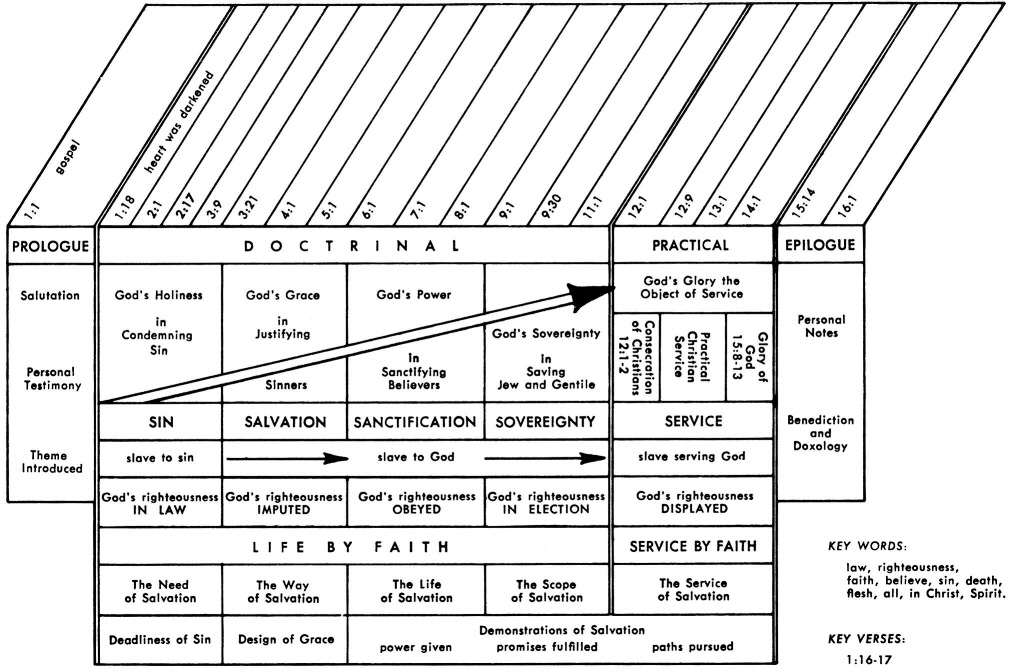
Click chart to enlarge
Chart from recommended resource Jensen's Survey of the NT - used by permission
Romans Overview Chart - Charles Swindoll
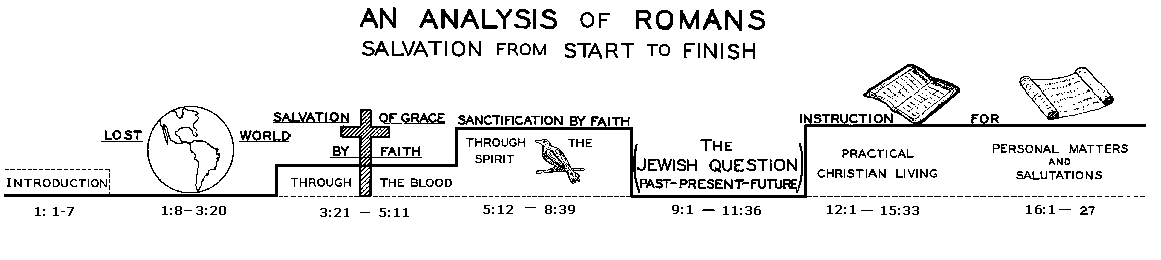
Source: Dr David Cooper
Click to Enlarge
R Ruin (Romans 1:17 – 3:20) – The utter sinfulness of humanity
O Offer (Romans 3:21-31) – God’s offer of justification by grace
M Model (Romans 4:1-25) – Abraham as a model for saving faith
A Access (Romans 5:1-11) – The benefits of justification
N New Adam (Romans 5:12-21) – We are children of two “Adams”
S Struggle w/ Sin (Romans 6-8) Struggle, sanctification, and victory
|
ROMANS ROAD |
||||
| Romans 1:18-3:20 | Romans 3:21-5:21 | Romans 6:1-8:39 | Romans 9:1-11:36 | Romans 12:1-16:27 |
| SIN | SALVATION | SANCTIFICATION | SOVEREIGNTY | SERVICE |
| NEED FOR SALVATION |
WAY OF SALVATION |
LIFE OF SALVATION |
SCOPE OF SALVATION |
SERVICE OF SALVATION |
| God's Holiness In Condemning Sin |
God's Grace In Justifying Sinners |
God's Power In Sanctifying Believers |
God's Sovereignty In Saving Jew and Gentile |
Gods Glory The Object of Service |
| Deadliness of Sin |
Design of Grace |
Demonstration of Salvation | ||
| Power Given | Promises Fulfilled | Paths Pursued | ||
| Righteousness Needed |
Righteousness Credited |
Righteousness Demonstrated |
Righteousness Restored to Israel |
Righteousness Applied |
| God's Righteousness IN LAW |
God's Righteousness IMPUTED |
God's Righteousness OBEYED |
God's Righteousness IN ELECTION |
God's Righteousness DISPLAYED |
| Slaves to Sin | Slaves to God | Slaves Serving God | ||
| Doctrine | Duty | |||
| Life by Faith | Service by Faith | |||
|
Modified from Irving L. Jensen's chart above |
||||
Romans 15:4 For whatever was written in earlier times was written for our instruction, so that through perseverance and the encouragement of the Scriptures we might have hope. (NASB: Lockman)
Greek: hosa gar proegraphe (3SAPI) eis ten hemeteran didaskalian egraphe (3SAPI) hina dia tes hupomones kai dia tes parakleseos ton graphon ten elpida echomen (1PPAS)
Amplified: For whatever was thus written in former days was written for our instruction, that by [our steadfast and patient] endurance and the encouragement [drawn] from the Scriptures we might hold fast to and cherish hope. (Amplified Bible - Lockman)
NCV: Everything that was written in the past was written to teach us. The Scriptures give us patience and encouragement so that we can have hope. (NCV)
NET: For everything that was written in former times was written for our instruction, so that through endurance and through encouragement of the scriptures we may have hope (NET Bible)
NLT: Such things were written in the Scriptures long ago to teach us. They give us hope and encouragement as we wait patiently for God's promises. (NLT - Tyndale House)
Phillips: For all those words which were written long ago are meant to teach us today; that when we read in the scriptures of the endurance of men and of all the help that God gave them in those days, we may be encouraged to go on hoping in our own time. (Phillips: Touchstone)
TEV: Everything written in the Scriptures was written to teach us, in order that we might have hope through the patience and encouragement which the Scriptures give us.
TLB: These things that were written in the Scriptures so long ago are to teach us patience and to encourage us so that we will look forward expectantly to the time when God will conquer sin and death.
Wuest: For whatever things were written aforetime with a view to our learning were written, in order that through the patience and through the encouragement arising from the scriptures we might be having hope. (Eerdmans Publishing - used by permission)
Young's Literal: for, as many things as were written before, for our instruction were written before, that through the endurance, and the exhortation of the Writings, we might have the hope.
FOR WHATEVER WAS WRITTEN IN EARLIER TIMES: hosa gar proegraphe (3SAPI ):
- Romans 15 Resources - Multiple Sermons and Commentaries
Related Passages:
1Cor 10:6+ Now these things happened (Always stop and ask "What things?" See 1Cor 10:1, 2, 3, 4,5) as examples for us, that we should not crave evil things, as they also craved.
1Cor 10:11+ Now these things (Always stop and ask "What things?") happened to them as an example, and they were written for our instruction, upon whom the ends of the ages have come.
2Tim 3:16+ All Scripture (Paul is speaking especially of the OT for the NT had not yet been written - but of course all Scripture is inspired and inerrant - 2Pet 3:16 places Paul's writings on a par with Scripture, this word in NT always referring to the OT) is inspired by God and profitable for teaching, for reproof, for correction, for training in righteousness; 17 that (hina = introduces the purpose of the Scriptures) the man of God may be adequate, equipped for every good work. (The question then is this - How adequate are many today in the modern church which tends to minimize the importance of the OT. I occasionally mention someone like Haggai to a saint and they say they have never read his book!)
For - Whenever you observe a term of explanation like "for" always take a moment and ask the natural question "What is the "for" there for?" You will usually be led to read the surrounding verses (the immediate context) to discern the answer. As you practice the inductive approach, you will grow in confidence, your interpretation will be more accurate and you will be prepared to more apply the transforming truth to your daily life. In addition, you will be forced to slow down and ponder the text. In short, you will be practicing the blessed discipline of Biblical Meditation (see benefits in Ps 1:1-note, Ps 1:2-note, Ps 1:3-note, Joshua 1:8-note).
For (gar) is a causative particle (term of explanation) which expresses or explains the reason for what has been stated just prior, in this case, Paul is defending his application of (Psalm 69:9 [note] which reads "For zeal for Thy house has consumed me, and the reproaches of those who reproach Thee have fallen on me.") to Christ and by extension to believers. In other words, Paul is explaining how that specific Old Testament quotation was not just a prophecy about the coming Messiah but also was meant to give us sustenance for our daily lives and motivation to carry out the instructions and exhortations he had just presented.
J. E. Toews explains the "for" by noting that "Paul has just made a very radical assertion. The strong people in the church shall act like Messiah Jesus, they shall absorb and carry the shame of the weak. To make sure they take his biblical interpretation seriously, Paul adds that the Scriptures (here specifically Psalm 69:9) were written before hand for the instruction of contemporary believers." (Toews, J. E.. Romans. Believers Church Bible commentary. Page 340. Scottdale, Pa.: Herald Press)
Denney - the whole OT was written to teach us, and therefore has abiding value… Paul meant to speak only of bearing the infirmities of the weak, but with the quotation of Ps. 69:9 there came in the idea of the Christian’s sufferings generally, and it is amid them that God’s purpose is to be fulfilled. (Romans 15:4-6 Commentary - Expositor's Greek Testament)
The covenant, so long revealed
to those of faith in former time,
Christ by his own example sealed,
the Lord of love, in love sublime.
Written in earlier times (Marked out, publicly display) (4270) prographo from pró = before, openly, plainly + grapho = to scratch on or engrave and thus to write) means literally to write (engrave or inscribe with a pen or stylus characters or letters on a surface which can be wood, wax, metal, leather, stone, parchment, dirt, paper, et) for public reading, publicly portrayed, announced on a poster. To write previously or before. Figuratively prographo means to announce or prescribe. Prographo is used of posting important official notices on a placard in the marketplace or other public location for citizens to read (Gal 3:1). The word is found in early secular documents where a father posted a proclamation that he would no longer be responsible for his son’s debts. It is also used for putting up the announcement of an auction sale. Those who were summoned before courts of justice were said to be progegramménoi, posted up ahead of time, because they were cited by posting up their names in some public place. Even in our day the cases to be heard by a judge are written beforehand and appended in a public place in the courthouse. Prographo is used only 4x in NT - Ro 15:4; Gal. 3:1; Eph 3:3; Jude 1:4.
RELATED PHRASE - It is written occurs 76 times in the (Click for these uses). When we were children and our parents told us to do something and we questioned "Why?", the answer was usually "Because I said so!". Why are we commanded to be holy? Because God said so! A popular saying is "God said it, I believe it, that settles it." This sounds good but isn't accurate because God's Word is true, irregardless of whether we believe it or not. A more accurate "saying" would be
God said it, that settles it!
It is written should put a stop to every complaint or excuse. Paul is saying don't judge but remember you will appear before Me to give an account (as the next verse clarifies). This sobering thought should motivate us to obey this injunction.
Cranfield notes that here Paul "justifies the use for the purpose of exhortation of the Christologically understood OT passage just quoted. All Scripture has its relevance and applicability to us—though of course it must be applied intelligently. (Cf Application) (Cranfield, C. E. B. A Critical and Exegetical commentary on the Epistle to the Romans. London; New York: TandT Clark International)
Cottrell explains that verse 4 "is a parenthesis in which Paul reminds us of the validity of citing OT texts as a basis for ethical exhortation to Christians: For everything that was written in the past was written to teach us, … “Everything that was written” refers to OT Scripture, and declares that every part of it has meaning and value for those living under the New Covenant. It was written not just to teach us theological truths, but also to be a source of practical instruction for Christians concerning how to live. (Cottrell, J. Romans : Volume 2. College Press NIV commentary Joplin, Mo.: College Press Pub) (Bolding added)
S Lewis Johnson says that…
The appropriateness of the Old Testament citation is supported by a reference to the general purpose, and the more specific moral purposes, of the Scriptures. Instruction with a view to hope is his point. As Liddon says,
"The Old Testament is not merely archaeologically precious as a record of the past, but has enduring and spiritual value."
The Old Covenant was designed to instruct us, to the end that we might through endurance and encouragement cling to our hope of an enduring future. (Cf. Ro 8:28-30)
The practical value of the Word of God cannot be more strongly emphasized. They (the Words of Scripture) give us the power to endure affliction and temptation, and too often contemporary believers have neglected these benefits. In difficulty we flee to our counselors, some amateur and others professional, but they can never do the work of the Word of God. It is possible through the Scriptures to have the Lord Jesus Christ as our constant companion and permanent, moment by moment Counselor. Let us not run to men, but to Him. (Johnson, S. L. Romans Sermons)
Comment: Johnson is correct - we have the Spirit of Christ within us (Ro 8:9), which is the fulfillment of His promise in Mt 28:20 to remain with us even to the end of the age! The Spirit is our Counselor and our Guide, enabling us to live the victorious Christian life.
Peter reminds us of the divine plenary (complete in every respect) inspiration of the Old Testament (as well as the New Testament) writing that…
that no prophecy of Scripture is a matter of one's own interpretation (NLT "no prophecy in Scripture ever came from the prophets themselves" - i.e. the Scripture did not originate from any private explanation held by the writer) for no prophecy was ever made by an act of human will, but men moved by the Holy Spirit spoke from God. (2Pe 1:20-21-note)
Comment: In short, when Scripture "speaks", God speaks! Do you believe that is true?
The Pulpit Commentary notes that "The psalm quoted (quoted verbatim from last half of Septuagint (LXX) of Psalm 69:9) was peculiarly one of endurance and comfort under vexations and reproaches, and of hope beyond them. It was written afore-time for our instruction, that so it may be with us, as it was with Christ.
Denney - Here Paul justifies his use of the whole OT… (It) was written to teach us, and therefore has abiding value. (Romans 15:4-6 Commentary - Expositor's Greek Testament)
The NIV Study Bible agrees writing that "Here Paul defends his application of Ps 69:9 to Christ. In so doing, he states a great truth concerning the purpose of Scripture: It was written for our instruction, so that as we patiently endure we might be encouraged to hold fast our hope in Christ (see 1Co 10:6, 11).
The Wycliffe Bible Commentary asks "What value does the OT have for the Christian? It has instruction to give to Christian believers. In reading and responding to the OT Scriptures, the Christian learns both endurance and consolation. Instruction, endurance, and consolation are all essential elements for the Christian who has hope (v. 4). The OT can do this because it is a book about God and His people rather than about ideas. (Pfeiffer, C F: Wycliffe Bible Commentary. 1981. Moody)
John MacArthur agrees that "Whatever was written in earlier times obviously refers to the divinely-revealed truths we now call the Old Testament. They were written for the times in which they were recorded but also for our instruction, for God’s people in the present age. As we have seen, beginning with Romans 14:1, Paul emphasizes that the ceremonial requirements of the Old Covenant are no longer binding on believers, Jews or Gentiles. But even though we are not bound to obey all of the commands of that covenant, every part of God’s revelation written in earlier times is still valuable for our instruction. Knowledge of all Scripture had spiritual benefit for Christians in Paul’s day and still has benefit for Christians for all time. (MacArthur, J: Romans 9-16. Chicago: Moody Press)
Barnes takes an interesting perspective on the phrase whatever was written in earlier times commenting that "This is a general observation which struck the mind of the apostle, from the particular case which he had just specified. He had just made use of a striking passage in the Psalms to his purpose. The thought seems suddenly to have occurred to him that all the Old Testament was admirably adapted to express Christian duties and doctrine, and he therefore turned aside from his direct argument to express this sentiment. It should be read as a parenthesis.
Adam Clarke writes that here Paul "refers not only to the quotation from the 69th Psalm, but to all the Old Testament scriptures; for it can be to no other scriptures that the apostle alludes. And, from what he says here of them, we learn that God had not intended them merely for those generations in which they were first delivered, but for the instruction of all the succeeding generations of mankind.
Mounce writes that Romans 15:4 "contains a principle of great significance for the twentieth-century believer. Everything that was written in Scripture in days gone by was written for us. Not only did it serve the needs of its own day but it is still relevant in the modern world. Scripture is relevant because it speaks to our deepest needs. It is through the endurance taught in Scripture and the encouragement it brings that we are enabled to live in hope. (Mounce, R. H. Romans: The New American Commentary. Broadman and Holman Publishers)
The Reformation Study Bible clearly states that "It is basic New Testament teaching that the Old Testament Scriptures were written by divine inspiration for the benefit of Christians (Whitlock, L. G., Sproul, R. C., Waltke, B. K., and Silva, M.. Reformation Study Bible. Nashville: T. Nelson)
J Vernon McGee forthrightly states that…
The Old Testament, therefore, does have a definite application to believers today. I frequently receive letters from folk who say, “I didn’t know the Old Testament was so practical,” or, “I had not realized that the Old Testament had such meaning for us today. I did not know it spoke of Christ as it does.” Paul here says that it was written for “our learning.”
In my opinion, the greatest sin in the church of Jesus Christ in this generation is ignorance of the Word of God. Many times I have heard a church officer say, “Well, I don’t know much about the Bible, but …” and then he gives his opinion, which often actually contradicts the Word of God! Why doesn’t he know much about the Bible? These things were written aforetime for our learning. God wants you to know His Word. As an officer of the church, are you boasting that you are ignorant of the Word of God? Well, you had better get down to business and find out what God has said to you in His Word. Ignorance of the Bible is the greatest sin of the hour—in and out of the church. Paul says these things were written for your learning.
What will a knowledge of the Bible do for you? “That we through patience and comfort of the scriptures might have hope.” The Word of God imparts patience, comfort, and hope.
You won’t find any hope in the daily newspaper. You won’t find any hope in modern literature. Look at any field and see if you can find any hope. There is none whatsoever. It is dark and dismal when you look out at this world today. My friend, the only place you can find real hope is in the Word of God.
I was in the state of Washington, speaking at a Bible conference, and it rained and rained and rained. Then it rained some more. Oh, how dark and dismal the days were! For our flight back home we went to the airport, and it was still raining. The plane took off and went up through a heavy layer of cloud. In a few moments we broke out into the light—the sun was shining up there. Oh, how beautiful it was. Less than a mile up, the sun was shining. Here we had been living like a bunch of gophers in all that rain. Now, don’t misunderstand me—Washington needs all that rain to grow that lush vegetation and beautiful trees. But because I live in Southern California, I am used to sunshine, and I love it.
There are a great many Christians today who are living down beneath the clouds. The Lord says, “Come on up here and get in the sunshine of hope!” That is what the Bible will do for you, my friend. Paul wrote to the Corinthians: “Now all these things happened unto them for ensamples: and they are written for our admonition, upon whom the ends of the world are come” (1 Cor. 10:11). When I was teaching the life of David, scores of people told me what an encouragement David was to them. One person said that he was going through a very dark period in his life and that the study in the life of David delivered him from suicide. Well, that is the reason God put these things in His Word. God put David’s sin on display—and it wasn’t very nice—but God paints mankind exactly as he is for our learning. Everything in the Old Testament is written for our learning and to give us patience and to give us comfort and to bring hope into our lives. (McGee, J V: Thru the Bible Commentary: Thomas Nelson)
John Calvin wrote that "This is an interesting passage, by which we understand that there is nothing vain and unprofitable contained in the oracles of God (Ed note: Calvin is clearly includes the OT); and we are at the same time taught that it is by the reading of the Scripture that we make progress in piety and holiness of life. Whatever then is delivered in Scripture we ought to strive to learn; for it were a reproach offered to the Holy Spirit to think, that he has taught anything which it does not concern us to know; let us also know, that whatever is taught us conduces to the advancement of religion. And though he speaks of the Old Testament, the same thing is also true of the writings of the Apostles; for since the Spirit of Christ is everywhere like itself, there is no doubt but that he has adapted his teaching by the Apostles, as formerly by the Prophets, to the edification of his people. Moreover, we find here a most striking condemnation of those fanatics who vaunt that the Old Testament is abolished, and that it belongs not in any degree to Christians; for with what front can they turn away Christians from those things which, as Paul testifies, have been appointed by God for their salvation? (Romans 15)
Expositor's Bible Commentary notes that Paul…
Having cited Psalm 69, a portion evidently regarded in the early church as messianic, the apostle is led to refer to the Scriptures in a more general way as useful for the instruction of NT believers--in fact, as deliberately planned for their edification. The very phenomenon of quoting from the OT speaks loudly of the dependence of the church on the course of redemption history reflected there. Things both new and old enter into Christian faith. The example of Christ was bound to influence the church to revere and use the OT, and this was made easier because at the beginning its constituency was largely Jewish-Christian. As for the Gentiles, in many cases at least, they had become familiar with the OT in the synagogue (Acts 13:44-48) before hearing the gospel and putting their trust in the Lord Jesus. (Gaebelein, F, Editor: Expositor's Bible Commentary 6-Volume New Testament. Zondervan Publishing)
MacDonald writes that "This quotation from the Psalms (referring to Romans 15:3) reminds us that the OT Scriptures were written for our learning. While they were not written directly to us, they contain invaluable lessons for us. As we encounter problems, conflicts, tribulations, and troubles, the Scriptures teach us to be steadfast, and they impart comfort. (Believer's Bible Commentary: Thomas Nelson)
In sum, the phrase Whatever was written in earlier times obviously refers to the Old Testament Scripture. They were written for the times in which they were recorded but they are timeless and so are also for our instruction, so that as we patiently endure we might be encouraged to hold fast our hope in Christ.
Writing to the Corinthians Paul reminds them that the Old Testament passages…
happened as examples (in context they were warnings and admonitions) for us, that we should not crave evil things, as they also craved (Nu 11:4,34)… and they were written for our instruction, upon whom the ends of the ages have come. (1Cor 10:6,11).
Ray Stedman adds his keen insight on this verse: "The Old Testament is really the richest commentary ever written on the New Testament. If you are coming to a place where faith is beginning to fail and your heart finds itself in the grasp of doubt, then turn to the record of God at work with men of the Old Testament. You will find, as you read thoughtfully, that your faith will begin to flame up again because "faith comes by hearing and hearing by the word of God," {cf, Ro 10:17-note}. It's as the Word of God rings in our ears that faith is created in our hearts to lay hold of the truth we hear, and to make it available in our lives." (Power to Please) (bolding added)
Harry Ironside wrote that Romans 15:4 "stresses the importance of Old Testament Scripture. "Whatsoever things were written aforetime were written for our learning, that we through patience and comfort of the scriptures might have hope." Link with this 1Cor 10:6,11 . "All Scripture is not about me, but all Scripture is for me" is a quotation well worth remembering. (Romans 15 Commentary)
Robert Haldane wrote that "Some persons have blasphemously said that the Old Testament is now out of date. But the writers of the New Testament give no such view of the Old. Instead of this, they refer to it as proof, and treat it as of constant use to the people of God. All that is therein written, whether history, types, prophecies, precepts, or examples, although under another dispensation, is intended for the instruction of believers, to train them to patience, and to impart the consolation which the Scriptures provide for those that have hope in God. “Take, my brethren,” says James (James 5:10), “the prophets, who have spoken in the name of the Lord, for an example of suffering affliction, and of patience.” The passage quoted in the preceding verse (see note Romans 15:3) is not only useful to us, as applicable to Christ, but it is, as the Apostle shows, useful as an example. If the reproaches of those who reproached God fell upon Christ, the people of God ought to live and act in such a manner as the Apostle elsewhere enjoins, when he says “Let us go forth, therefore, unto Him without the camp, bearing His reproach.” If Christ did not please Himself, neither ought His people to please themselves, but to please Him and His people for their edification. (Haldane, R. An Exposition on the Epistle to the Romans)
H G C Moule offers sage comments on why we should not neglect the Old Testament…
For all the things forewritten, written in the Scriptures of the elder time, in the age that both preceded the Gospel and prepared for it, for our instruction were written — with an emphasis upon “our” — that through the patience and through the encouragement of the Scriptures we might hold our hope, the hope “sure and steadfast” of glorification in the glory of our conquering Lord. That is to say, the true “Author behind the authors” of that mysterious Book watched, guided, effected its construction, from end to end, with the purpose full in His view of instructing for all time the developed Church of Christ. And in particular, He adjusted thus the Old Testament records and precepts of “patience,” the patience which “suffers and is strong,” suffers and goes forward, and of “encouragement,” paraklesis, the word which is more than “consolation,” while it includes it; for it means the voice of positive and enlivening appeal.
Rich indeed are Pentateuch, and Prophets, and Hagiographa, alike in commands to persevere and be of good courage, and in examples of men who were made brave and patient by the power of God in them, as they took Him at His word. And all this, says the Apostle, was on purpose, on God’s purpose. That multifarious Book is indeed in this sense one. Not only is it, in its Author’s intention, full of Christ; in the same intention it is full of Him for us. Immortal indeed is its preciousness, if this was His design. Confidently may we explore its pages, looking in them first for Christ, then for ourselves, in our need of peace, and strength, and hope. Let us add one word, in view of the anxious controversy of our day, within the Church, over the structure and nature of those “divine Scriptures,” as the Christian Fathers love to call them. The use of the Holy Book in the spirit of this verse, the persistent searching of it for the perceptive mind of God in it, with the belief that it was “written for our instruction,” will be the surest and deepest means to give us “perseverance” and “encouragement” about the Book itself. The more we really know the Bible, at first hand, before God, with the knowledge both of acquaintance and reverent sympathy, the more shall we be able with intelligent spiritual conviction, to “persist” and “be of good cheer” in the conviction that it is indeed not of man (though through man), but of God. The more shall we use it as the Lord and the Apostles used it, as being not only of God, but of God for us; His Word, and for us. The more shall we make it our divine daily Manual for a life of patient and cheerful sympathies, holy fidelity, and “that blessed Hope” — which draws “nearer now than when we believed.” But may the God of the patience and the encouragement. He who is Author and Giver of the graces unfolded in His Word, He without whom even that Word is but a sound without significance in the soul, grant you, in His own sovereign way of acting on and in human wills and affections, to be of one mind mutually, according to Christ Jesus; “Christwise,” in His steps, in His temper, under His precepts; having towards one another, not necessarily an identity of opinion on all details, but a community of sympathetic kindness. No comment here is better than this same Writer’s later words, from Rome (Philippians 2:2-5); “Be of one mind; having the same love; nothing by strife, or vainglory; esteeming others better than yourselves; looking on the things of others; with the same mind which was also in Christ Jesus,” when He humbled Himself for us. And all this, not only for the comfort of the community, but for the glory of God: that unanimously, with one mouth, you may glorify the God and Father of our Lord Jesus Christ; turning from the sorrowful friction worked by selfwill when it intrudes into the things of heaven, to an antidote, holy and effectual, found in adoring Him who is equally near to all His true people, in His Son. Wherefore welcome one another into fellowship, even as our Christ welcomed you, all the individuals of your company, and all the groups of it, to our God’s glory. These last words may mean either that the Lord’s welcome of “you glorified” His Father’s grace; or that that grace will he “glorified” by the holy victory of love over prejudice among the Roman saints. Perhaps this latter explanation is to be preferred, as it echoes and enforces the last words of the previous verse. But why should not both references reside in the one phrase, where the actions of the Lord and His disciples are seen in their deep harmony? For I say that Christ stands constituted Servant of the Circumcision, Minister of divine blessings to Israel, on behalf of God’s truth, so as to ratify in act the promises belonging to the Fathers, so as to secure and vindicate their fulfilment, by His coming as Son of David, Son of Abraham, but (a “but” which, by its slight correction, reminds the Jew that the Promise, given wholly through him, was not given wholly for him) so that the Nations, on mercy’s behalf, should glorify God, blessing and adoring Him on account of a salvation which, in their case, was less of “truth” than of “mercy,” because it was less explicitly and immediately of covenant; as it stands written (Psalm 18:49), “For this I will confess to Thee, will own Thee, among the Nations, and will strike the harp to Thy Name”; Messiah confessing His Eternal Father’s glory in the midst of His redeemed Gentile subjects, who sing their “lower part” with Him. And again it, the Scripture, says (Deuteronomy 32:43), “Be jubilant, Nations, with His people.” And again Psalm 117:1), “Praise the Lord, all the Nations, and let all the peoples praise Him again.” And again Isaiah says (Isaiah 11:10), “There shall come (literally, “shall be”) the Root of Jesse, and He who rises up — “rises,” in the present tense of the divine decree to rule [the] Nations; on Him [the] Nations shall hope” with the hope which is in fact faith, looking from the sure present to the promised future. Now may the God of that hope, “the Hope” just cited from the Prophet, the expectation of all blessing, up to its crown and flower in glory, on the basis of Messiah’s work, fill you with all joy and peace in your believing, so that you may overflow in that hope, in the Holy Spirit’s power: “in His power,” clasped as it were within His divine embrace, and thus energised to look upward, heavenward, away from embittering and dividing temptations to the unifying as well as beatifying prospect of your Lord’s Return. (Romans 15 Expositor's Bible Commentary - The Epistle of St Paul to the Romans)
Alexander Maclaren addresses the question of whether the OT Scriptures are still "relevant" to us today in view of the fact that we possess the NT…
Scripture (Maclaren is referring to the Old Testament)… encourages us by its records and by its revelation of principles.
Who can tell how many struggling souls have taken heart again, as they pondered over the sweet stories of sorrow subdued which stud its pages, like stars in its firmament? The tears shed long ago which God has put ‘in His bottle,’ and recorded in ‘His book,’ have truly been turned into pearls. That long gallery of portraits of sufferers, who have all trodden the same rough road, and been sustained by the same hand, and reached the same home, speaks cheer to all who follow them. Hearts wrung by cruel partings from those dearer to them than their own souls, turn to the pages which tell how Abraham, with calm sorrow, laid his Sarah in the cave at Macpelah; or how, when Jacob’s eyes were dim that he could not see, his memory still turned to the hour of agony when Rachael died by him, and he sees clear in its light her lonely grave, where so much of himself was laid; or to the still more sacred page which records the struggle of grief and faith in the hearts of the sisters of Bethany. All who are anyways afflicted in mind, body, or estate find in the Psalms men speaking their deepest experiences before them; and the grand majesty of sorrow that marks ‘the patience of Job,’ and the flood of sunshine that bathes him, revealing the ‘end of the Lord,’ have strengthened countless sufferers to bear and to hold fast, and to hope. We are all enough of children to be more affected by living examples than by dissertations, however true, and so Scripture is mainly history, revealing God by the record of His acts, and disclosing the secret of human life by telling us the experiences of living men.
But Scripture has another method of ministering encouragement to our often fainting and faithless hearts. It cuts down through all the complications of human affairs, and lays bare the innermost motive power. It not only shows us in its narratives the working of sorrow, and the power of faith, but it distinctly lays down the source and the purpose, the whence and the whither of all suffering. No man need quail or faint before the most torturing pains or most disastrous strokes of evil, who holds firmly the plain teaching of Scripture on these two points. They all come from my Father, and they all come for my good. It is a short and simple creed, easily apprehended. It pretends to no recondite wisdom. It is a homely philosophy which common intellects can grasp, which children can understand, and hearts half paralysed by sorrow can take in. So much the better. Grief and pain are so common that their cure had need to be easily obtained. Ignorant and stupid people have to writhe in agony as well as wise and clever ones, and until grief is the portion only of the cultivated classes, its healing must come from something more universal than philosophy; or else the nettle would be more plentiful than the dock; and many a poor heart would be stung to death. Blessed be God! the Christian view of sorrow, while it leaves much unexplained, focuses a steady light on these two points; its origin and its end. ‘He for our profit, that we may be partakers of His holiness,’ is enough to calm all agitation, and to make the faintest heart take fresh courage. With that double certitude clear before us, we can face anything. The slings and arrows which strike are no more flung blindly by an ‘outrageous fortune,’ but each bears an inscription, like the fabled bolts, which tells what hand drew the bow, and they come with His love. (Maclaren. Expositions of the Holy Scripture)
Middletown Bible…
If the strong are going to be what they ought to be to the weak (Ro 15:1, 2), then they must have the mind of Christ (Ro 15:3). The only way to have the mind of Christ is through understanding the Scriptures, those things which have been "WRITTEN BEFORE."
How thankful we can be that these things have been written for us:
"But these are written that ye might believe… " (John 20:31)
"These things have I written unto you… that ye may know… " (1John 5:13).
"For our sakes, no doubt, (this) is written… " (1Cor. 9:10).
"They are written for our admonition… " (1Cor. 10:11). (ROMANS CHAPTER 15)
FOR OUR INSTRUCTION: eis tên hêmeteran didaskalian:
- Romans 15 Resources - Multiple Sermons and Commentaries
WHY WE SHOULD STUDY
THE OLD TESTAMENT
For our instruction - unto our instruction. The preposition eis expresses purpose = with a view to instruction.
Observe three truths from this verse:
1. All the Scriptures are for our instruction - We must be willing to learn what the scriptures teach if we expect to be encouraged by the truth of scripture rather than by an accidental sound of words or reflections of our own ideas and desires. We need a systematic diet of instruction, not just a few crumbs a day, if we are going to fight successfully to maintain the full assurance of hope to the end.
2. All the Scriptures are intended by God to give perseverance and encouragement. - When the instructions of the scriptures are properly understood, they produce perseverance and encouragement. Perseverance is what you have to have to keep on going in a path of obedience when you feel miserable and when you encounter all manner of opposition. Perseverance comes from the scriptures which is exceedingly practical! Again and again the we find that meditating on the Word of God will give you God's perspective on things and that Biblical perspective will make a hard situation endurable. How foolish we are if we neglect them. If you want to have staying power, if you want to endure to the end in the path of costly obedience, then turn off the television, the mp3 player, and the internet and meditate on the Word of Truth.
3. All the Scriptures have as one of their goals the sustenance of our Christian hope when we read of others who have persevered. And these Old Testament examples of perseverance make a difference in our lives by sustaining our hope, a hope that keeps us going in tough situations, when you are battling to cope with the daily temptations to disobey and throw in the towel on your responsibilities.
We frequently see hope linked with perseverance as in Ro 15:4. In Ro 5 Paul writes that we exult in our tribulations which work out the fruit of perseverance which in turn grows our character which in turn "strengthens our confident expectation" (Hope) (Ro 5:3-4). As we bear the affliction, our ability to bear up increases (link muscles that are exercised by weight lifting) and as we "pass the test" of the affliction, it stabilizes our hope which began this "cascade" of attributes (Ro 5:2 "exult in hope of the glory of God"). Our sure future with Jesus and like Jesus fuels our present life for Jesus which is even now lived of the sphere of in Christ (in His power, the power of His Spirit). Ro 8:25 says "if we hope for what we do not see, with perseverance we wait eagerly for it." See 2Cor 1:6 which mentions "patient enduring" and notice juxtaposition of "hope" in 2Cor 1:7. See 1Thes 1:3 "steadfastness (patience) of hope" (NLT = "your continual anticipation of the return of our Lord Jesus Christ.")
In sum, clearly the Old Testament is profitable for New Testament saints. In the OT we find the record of how God taught men to live not to please themselves, but to please Him.
Instruction (1319) (didaskalia [word study]) is a general term referring to instruction or “doctrine” which is used by God's Spirit to shape our will and renew our minds. Instruction then indicates far more than impartation of intellectual knowledge. The emphasis, in fact, is on practical knowledge, knowledge that can be, and should be, applied to living the supernatural, (Spirit, grace enabled) transformed life that should characterize a follower of Christ.
THOUGHT - How are you doing? Are you in the Word of Truth that the Truth might get "into" you, renew your mind, transform you into the image of God's Son, set you apart from the corrupt lusts of the world? (2Ti 2:15-note, 1Pe 2:1,2-note, Ro 12:2-note, 2Cor 3:18-note, 2Pe 1:4-note, Jn 17:17)
If you are an elder or church leader are you applying Titus 1:9-note? Titus 1:9 holding fast (present tense = continually - Jesus uses this word in Mt 6:24-note where it is translated "devoted" - Are you devoted to the Word?) the faithful word which is in accordance with the teaching (didache), that he may be able both to exhort in sound (hugiaino ~ "hygienic" ~ "healthy") doctrine (didaskalia) and to refute those who contradict.
Didaskalia - 21x in NAS translated as doctrine(9), doctrines(3), instruction(1), teaching(7), teachings(1).- Mt 15:9; Mark 7:7; Ro 12:7; 15:4; Eph 4:14; Col 2:22; 1 Tim 1:10; 4:1, 6, 13, 16; 5:17; 6:1, 3; 2Ti 3:10, 16; 4:3; Titus 1:9; 2:1, 7, 10
Didaskalia appears 15x in the Pastoral Epistles where it implies the systematic explanation of the Word of God. It could embody developing a means of teaching people individually, or in small groups meeting in homes. The point is that an excellent minister is to disseminate sound teaching to all people at all times through all means. That is the heart and soul of the ministry, since the Word is the only source of life and truth. It is no surprise, then, that an elder was required to be able to teach (1Ti 3:2; Titus 1:9-note).
Didaskalia is derived from didasko, to teach which describes instruction given meant to shape one's will by the content of what is taught. Didasko speaks less of the method of teaching and more of the actual content.
The Biblical concept of teaching differed quite radically from secular Greek teaching in the matter of its goal. Whereas the Greek teacher sought to impart knowledge and skills, teaching for the Jew sought to change one’s entire life. The ministry of teaching in the OT sense that carried over to the early Church was therefore concerned “with the whole man and his education in the deepest sense.” It included the intellect, but its final goal was the will. Rengstorf says that “to the Jewish ear didaskein suggests the successful and total molding of the will of another by one’s own.”
Paul wrote to Timothy that
All Scripture is inspired by God and profitable for teaching (didaskalia), for reproof, for correction, for training in righteousness (2Ti 3:16-note) (Why? What for?) SO THAT (hina - [There are 663 "hina's" in NT - many divine opportunities for the Spirit to teach us!] purpose clause - always pause and ponder "What's the purpose? You will be forced to read the context. You will be practicing the discipline of ["mini"] meditation on Scripture - cf Josh 1:8, Ps 1:1-3) the man of God may be adequate (has everything he needs - supernatural supplies so to speak - the Word and the Spirit Who takes that Word and uses it in our lives), equipped for every good work.
Spurgeon has this summary in his notes on Romans 15:4
This is the text from which old Hugh Latimer was wont to preach continually in his latter days. Certainly it gave him plenty of sea room.
The apostle declares that the Old Testament Scriptures are meant to teach New Testament believers.
Things written aforetime were written for our time.
The Old Testament is not outworn; apostles learned from it.
Nor has its authority ceased; it still teaches with certainty.
Nor has its divine power departed; for it works the graces of the Spirit in those who receive it: patience, comfort, hope.
In this verse the Holy Ghost sets his seal upon the Old Testament, and for ever enters his protest against all undervaluing of that sacred volume.
The Holy Scriptures produce and ripen the noblest graces.
Let us carefully consider—
I. The patience of the scriptures.
1. Such as they inculcate.
- Patience under every appointment of the divine will.
- Patience under human persecution and satanic opposition.
- Patience under brotherly burdens. Gal. 6:2.
- Patience in waiting for divine promises to be fulfilled.
2. Such as they exhibit in examples.
- Job under divers afflictions triumphantly patient.
- Abraham, Isaac and Jacob patiently waiting as sojourners with God, embracing the covenant promise in a strange land.
- Joseph patiently forgiving the unkindness of his brethren, and bearing the false accusation of his master.
- David in many trials and under many reproaches, patiently waiting for the crown, and refusing to injure his persecutor.
- Our Saviour patient under all the many forms of trial.
3. Such as they produce by their influence.
- By calling us to the holiness which involves trial.
- By revealing the design of God in our tribulations, and so sustaining the soul in steadfast resolve.
- By declaring to us promises as to the future which make us cheerfully endure present griefs.
II. The comfort of the scriptures.
1. Such as they inculcate.
- They bid us rise above fear. Ps. 46:1–3.
- They urge us to think little of all transient things.
- They command us to find our joy in God.
- They stimulate us to rejoice under tribulations, because they make us like the prophets of old.
2. Such as they exhibit.
- Enoch walking with God.
- Abraham finding God his shield and exceeding great reward.
- David strengthening himself in God.
- Hezekiah spreading his letter before the Lord.
- Many other cases are recorded, and these stimulate our courage.
3. Such as they produce.
- The Holy Spirit as the Comforter uses them to that end.
- Their own character adapts them to that end.
- They comfort us by their gentleness, certainty, fulness, graciousness, adaptation, personality, etc.
- Our joyous experience is the best testimony to the consoling power of the Holy Scriptures.
III. The hope of the scriptures.
Scripture is intended to work in us a good hope.
A people with a hope will purify themselves, and will in many other ways rise to a high and noble character.
By the hope of the Scriptures we understand—
1. Such a hope as they hold forth.
- The hope of salvation. 1 Thess. 5:8.
- “The blessed hope, and the appearing of our Lord”: Titus 2:13.
- The hope of the resurrection of the dead. Acts 23:6.
- The hope of glory. Col. 1:27.
- This is a good hope, a lively hope, the hope set before us in the gospel.
2. Such a hope as they exhibit in the lives of saints. A whole martyrology will be found in Heb. 11.
3. Such a hope as they produce.
- We see what God has done for his people, and therefore hope.
- We believe the promises through the Word, and therefore hope.
- We enjoy present blessing, and therefore hope.
Let us hold constant fellowship with the God of patience and consolation, who is also the God of hope; and let us rise from stage to stage of joy as the order of the words suggests.
Comforts
How much important matter do we find condensed in this single verse! What a light and glory does it throw on the Word of God! It has been well noted, that we have here its authority, as it is a written word; its antiquity, as it was written aforetime; its utility, as it is written for our learning. We may also infer from what immediately follows, its Divine origin; for, if by means of the Holy Scriptures, and the accompanying lively power of the Holy Spirit (Isaiah 59:21), God imparts to our soul patience, and comfort, and hope, it is because he is himself, as the apostle here expressly teaches, the God of patience and comfort, and the God of hope (verse 13). He is the fountain of these gifts and graces, which by the channel of his inspired Word flow down into our hearts and lives, to strengthen them for his service. Nor must we fail to notice the gracious method of their communication, their regular development within us, as we find this to be the order of their course—1, patience; 2, comfort; 3, hope. From a calm sense of inward peace and comfort we are led by the same Spirit to feel a blessed, and, it may be, a joyous hope. But, in order to this, there must always be in us the ground-work of patience, in our suffering or doing the will of God. James Ford.
Oliver Cromwell once read aloud Phil. 4:11–13, and then remarked, “There, in the day when my poor child died, this Scripture did go nigh to save my life.”
When George Peabody was staying at Sir Charles Reed’s house, he saw the youngest child bringing to his father a large Bible for family prayers. Mr. Peabody said, “Ah! my boy, you carry the Bible now; but the time is coming when you will find that the Bible must carry you.”
“Speak to me now in Scripture language alone,” said a dying Christian. “I can trust the words of God; but when they are the words of man, it costs me an effort to think whether I may trust them.”—G. S. Bowes.
As an instance of the patience, comfort and hope, which come from the gospel, note the following from Dr. Payson:—Christians might avoid much trouble if they would believe that God is able to make them happy without anything else. God has been depriving me of one blessing after another; but as every one was removed, he has come in and filled up its place; and now, when I am a cripple, and not able to move, I am happier than ever I was in my life before, or ever expected to be. If I had believed this twenty years ago, I might have been spared much anxiety.
WAS WRITTEN THAT THROUGH THE PERSEVERANCE: egraphe ( 3SAPI) hina dia tes hupomones kai dia tes parakleseos ton graphon ten elpida echomen (1PPAS ):
- Jas 5:10,11 Heb 6:11,12
- Romans 15 Resources - Multiple Sermons and Commentaries
Was written (1125)(grapho from root graph- = primarily means to scratch on or engrave as on an ornament, reports, letters, etc; English = graph, graphic, etc) means to engrave or inscribe with a pen or stylus characters or letters on a surface which can be wood, wax, metal, leather, stone, parchment, dirt (John ), paper, etc..
That through (hina dia) is a purpose clause. What is the purpose? See the importance of pausing to ponder these strategic terms of purpose or result (so that, in order that, that, as a result).
The Scriptures, the Word of God written in the Old Testament, give us "perseverance and encouragement". How so? The OT stories of Abraham, Jacob, Joseph, David, Job, et al were written so that we might see how God worked in their lives, controlling their circumstances for their good and His glory. These OT examples are meant to encourage us to believe that God controls our circumstances as well (Read Ro 10:17-note), even though we may not always recognize His hand in our circumstances. For example, Job never understood that behind his trials was the hand of Satan allowed by the all controlling hand of God. Job however did understand that the trials had purpose (Job 23:10-note) and he came to the point of accepting them even though he did not fully understand them (James 5:11). The endurance (perseverance) of Job resulted in a greater personal revelation of God. (Job 42:5, 6)
And so we are encouraged by "so great a cloud of witnesses surrounding us", encouraged that against all "human odds" they were able to "run the race," to bear witness of the power of the Lord enabling them to bear up under the trials of life with a Godward attitude. They did not just grin and bear it, but endured and persevered as "more than conquerors". These real events in the lives of real people happened to give us real encouragement! Are you reading the Old Testament stories so that you might be encouraged?
May we not shrink back (Heb 10:38, 39-note; 2Ti 2:12, 13-note) from our trials, afflictions and sufferings for our Savior, but instead, enabled by the Scriptures and the Spirit, may we persevere and hold fast to the end (Heb 3:6-note, Heb 3:14-note).
Jerry Bridges makes a slight distinction between endurance and perseverance - Endurance is the ability to stand up under adversity; perseverance is the ability to progress in spite of it. These two English words are translations of the same Greek word and simply represent two different views of the same quality: a godly response to adversity. (The Fruitful Life- The Overflow of God's Love Through You)
Perseverance (patience, Ro 15:4KJV) (hupomone [word study] from hupo = under + meno = abide) is the word which speaks of patience in respect to things or circumstances. It is a God-honoring endurance which undergoes life's fiery trials because of the glory that lies ahead. It is this character quality which will determine whether we finish our course or not. (Heb 10:36-note; He 12:1-note ).
The difficulties in our lives,
The obstacles we face,
Give God the opportunity
To show His power and grace.
Hupomone is graphically described by William Barclay as that "lithe spirit which can bear all things, not simply with resignation, but with blazing hope; it is not the spirit which sits statically enduring in the one place, but the spirit which bears things because it knows that these things are leading to a goal of glory; it is not the patience which grimly waits for the end, but the patience which radiantly hopes for the dawn. It is the quality which keeps a man on his feet with his face to the wind. It is the virtue which can transmute the hardest trial into glory because beyond the pain it sees the goal… it is the triumphant adequacy which can cope with life; it is the strength which does not only accept things, but which, in accepting them, transmutes them into glory. (Barclay, W: The Daily Study Bible Series. The Westminster Press)
Barnes commenting on the KJV word patience that "This does not mean, as our translation might seem to suppose, patience of the Scriptures; but it means, that by patiently enduring sufferings, in connexion with the consolation which the Scriptures furnish, we might have hope. The tendency of patience, the apostle tells us, (Romans 5:4,) is to produce hope.
Charles Hodge on "through perseverance (endurance) and encouragement (consolation) writes that these two words "may be taken together and mean “through that endurance and consolation which the Scriptures produce.” Alternatively, the words through endurance may be separated from the word Scriptures, so that the sense is, “that we, through endurance and through the encouragement of the Scriptures …” The former explanation is the one most often adopted and is the most natural. (Romans 15 Commentary)
AND THE ENCOURAGEMENT: kai dia tes parakleseos:
- 1 Thess 5:11-note Therefore encourage (present imperative = Enabled by the Spirit, make this your daily practice to come alongside) one another, and build up (This is not a suggestion but another command in the present imperative! Something that you can accomplish only as you jettison "self" reliance and instead surrender to the enabling power of the Spirit, because otherwise our "natural" tendency is to tear down and not build up) one another (Eph 4:29-note is a good verse to keep in mind here! As the Spirit enables you, set a guard over your tongue! cp Acts 20:32-note - What builds up? What should we encourage others with?), just as you also are doing (You are doing it, but don't "rest on your laurels" so to speak. Keep at it. It is very needful for all saints to have daily encouragement - see warning in Heb 3:13-note).
- Romans 15 Resources - Multiple Sermons and Commentaries
Encouragement (3874) (paraklesis from pará = side of + kaleo = call) means literally the calling to one's side and so refers can refer to exhortation, solace, comfort (that which gives strength and hope and which eases the grief or trouble of another) and consolation (that which alleviates grief, sense of loss, or trouble of another).
Kenneth Wuest notes that paraklesis "has various meanings; “a calling near, a summons, imploration, supplication, entreaty, exhortation, admonition, encouragement, consolation, solace.” The well-rounded all-inclusive idea is that of encouragement, of aid given the needy person, whether it be consolation, exhortation, or supplication.(Wuest Word Studies - Eerdman Publishing Company Volume 1, Volume 2, Volume 3 - used by permission) (Bolding added)
Webster defines encouragement as the act of raising of one’s confidence especially by an external agency (in the presence context that "agency" being the Scriptures, God's Word of truth and life).
Marvin Vincent has this note on paraklesis, writing that "Consolation (paraklesis). From para, to the side of, and kaleo, to call or summon. Literally, a calling to one’s side to help; and therefore entreaty, passing on into the sense of exhortation, and thence into that of consolatory exhortation; and so coming round to mean that which one is summoned to give to a suppliant — consolation. Thus it embodies the call for help, and the response to the call. Its use corresponds with that of the kindred verb parakaleo, to exhort or console." (Vincent, M. R. Word studies in the New Testament: Vol. 1, Page 3-313)
H C G Moule adds that paraklesis is a "word which is more than “consolation,” while it includes it; for it means the voice of positive and enlivening appeal. Rich indeed are Pentateuch, and Prophets, and Hagiographa, alike in commands to persevere and be of good courage, and in examples of men who were made brave and patient by the power of God in them, as they took Him at His word. And all this, says the Apostle, was on purpose, on God’s purpose. That multifarious Book is indeed in this sense one. Not only is it, in its Author’s intention, full of Christ; in the same intention it is full of Him for us. Immortal indeed is its preciousness, if this was His design. Confidently may we explore its pages, looking in them first for Christ, then for ourselves, in our need of peace, and strength, and hope. Let us add one word, in view of the anxious controversy of our day, within the Church, over the structure and nature of those “divine Scriptures,” as the Christian Fathers love to call them. The use of the Holy Book in the spirit of this verse, the persistent searching of it for the preceptive mind of God in it, with the belief that it was “written for our instruction,” will be the surest and deepest means to give us “perseverance” and “encouragement” about the Book itself. The more we really know the Bible, at first hand, before God, with the knowledge both of acquaintance and reverent sympathy, the more shall we be able with intelligent spiritual conviction, to “persist” and “be of good cheer” in the conviction that it is indeed not of man (though through man), but of God. The more shall we use it as the Lord and the Apostles used it, as being not only of God, but of God for us; His Word, and for us. The more shall we make it our divine daily Manual for a life of patient and cheerful sympathies, holy fidelity, and “that blessed Hope” — which draws “nearer now than when we believed." (The Epistle of St Paul to the Romans)
Barnes writes that encouragement of the Scriptures signifies "By means of the consolation which the writings of the Old Testament furnish. The word rendered comfort means also exhortation or admonition. If this is its meaning here, it refers to the admonitions which the Scriptures suggest, instructions which they impart, and the exhortations to patience in trials. If it means comfort, then the reference is to the examples of the saints in affliction; to their recorded expressions of confidence in God in their trials, as of Job, Daniel, David, etc. Which is the precise meaning of the word here, it is not easy to determine.
William Barclay writes that the Christian who studies and applies the Old Testament Scriptures is the one who "draws encouragement. Scripture, from this point of view, provides us with two things. (a) It gives us the record of God’s dealing with a nation, a record which is the demonstration that it is always better to be right with God and to suffer, than to be wrong with men and to avoid trouble. The history of Israel is the demonstration in the events of history that ultimately it is well with good and evil with the wicked. Scripture demonstrates, not that God’s way is ever an easy way, but in the end it is the only way to everything that makes life worth while in time and in eternity. (b) It gives us the great and precious promises of God. It is said that Alexander Whyte sometimes had a habit of uttering one text when he left some home during his pastoral visitation; and, as he uttered it, he would say: “Put that under your tongue and suck it like a sweetie.” These promises are the promises of a God Who never breaks His word. In these ways Scripture gives to the man who studies it, comfort in his sorrow and encouragement in his struggle. (Romans 15 Commentary - William Barclay's Daily Study Bible)
The words "through perseverance and the encouragement of the Scriptures" may be taken together and mean “through that perseverance and consolation which the Scriptures produce.”
Alternatively, the words "through perseverance" may be separated from the word "Scriptures", so that the sense is, “that we, through perseverance and through the encouragement of the Scriptures …” The former explanation is the one most often adopted and is the most natural.
For example Kenneth Wuest translates this verse "For whatever things were written aforetime with a view to our learning were written, in order that through the patience and through the encouragement arising from the scriptures we might be having hope. (Eerdmans Publishing - used by permission)
Middletown Bible…
This verse shows us that the Scriptures bring two things to the believing heart—patience and comfort: "that we through patience and comfort of the Scriptures might have hope" ["of the Scriptures" is a genitive or ablative of SOURCE, see Dana and Mantey Grammar, p.82].
The patience and comfort comes from the Scriptures. The Scriptures are the SOURCE of patience and comfort. PATIENCE involves endurance, perseverance in the midst of great difficulties and trials and affliction. Literally it means "to abide under," thus it means to remain steadfast under the intense trials of life. COMFORT means encouragement. The believer whose mind is saturated with the Scriptures and whose mind is baptized in the Word of God will find from this source every kind of encouragement to persevere and remain faithful to God, even under the most difficult of circumstances. What is the result? "that we might have HOPE"! By means of the Scriptures we are encouraged to trust God and persevere through the greatest of difficulties with the great EXPECTATION and certain HOPE that God will successfully get us through and the future can only be bright!
Running illustration: The Christian life has been compared to a race (Heb. 12:1-note, Heb 12:2-note; 1Cor 9:24; 2Ti. 4:7-note). As we run the race there are certain difficulties and trials and obstacles that we face along the way. However, we must keep running no matter how difficult it gets, no matter how tired we are, and no matter how much our body hurts. We must hang in there (patience, compare Heb 12:1-note), endure and persevere. We must not give up. We must finish the race. Along the way we receive comfort and encouragement. Spectators may cheer us on, we may get a second wind, and most importantly we remember the One who already has run the race successfully (Heb 12:2-note). Moreover we run with the great hope and sure expectation of the finish line. We know the joys and blessings that await us there, and we look forward with great expectation to the "Well Done!" that we will hear upon the completion of the race. Thus it is that through patience and comfort [encouragement] we might have hope [happy expectation]. (ROMANS CHAPTER 15)
OF THE SCRIPTURES: ton graphon:
- Romans 15 Resources - Multiple Sermons and Commentaries
Scriptures (1124) (graphe from grapho = to write; English = graphite - the lead in a pencil!) means first a writing or thing written, a document. (see in depth study of graphe)
With few exceptions (Ro 16:26-note; 2Pe 3:16-note), the NT references to Scripture signify the OT. And so the majority of the NT uses refer to the Old Testament writings, in a general sense of the whole collection when the plural (= Scriptures - Matt. 21:42; 22:29; 26:54; Mk. 12:24; 14:49; Lk. 24:27, 32, 45; Jn. 5:39; Acts 17:2, 11; 18:24, 28; Rom. 15:4; 2Pe 3:16) is used and other times of a particular passage when the singular is used (= the Scripture - Mk. 12:10; 15:28; Lk. 4:21; Jn. 13:18; 19:24, 36, 37; Acts 1:16; 8:35; Ro 11:2; Jas. 2:8, 23) and is used in such a way that quoting Scripture is understood to be the same as quoting God!
My soul languishes for Thy salvation; I wait for Thy word.
My eyes fail with longing for Thy word, While I say, "When wilt Thou comfort me?"
Though I have become like a wineskin in the smoke, I do not forget Thy statutes. (Psalm 119:81-83)
God gives us encouragement to persevere. He provides this impetus by means of the Scriptures, which chronicle all the reasons to keep believing. They give us reason to sustain hope for our glorious future.
Jeremiah speaks of God, the author of Scripture, as the
“Hope of Israel, its Savior in time of distress” (Jer 14:8 cp La 3:21, 22, 23, 24).
The psalmists repeatedly speak of their hope in the Lord (Ps 42:5 Ps 62:5 Ps 119:49, Ps 119:116, Ps 119:166 Ps 119:130:5).
Robert Mounce notes that Romans 15:4 teaches us "Everything that was written in Scripture in days gone by was written for us. Not only did it serve the needs of its own day but it is still relevant in the modern world. Scripture is relevant because it speaks to our deepest needs. (Mounce, R H: Vol. 27: Romans The New American Commentary. Page 260. Nashville: Broadman and Holman Publishers)
The application is inescapable:
Believers are to be well acquainted with the Old Testament Scriptures.
Beloved, are you?
Preachers should preach not just from the New Testament but from the Old.
Dear pastor: are you?
Dr. Henry Morris in his excellent, literal, creationistic study Bible, agrees writing that "The Old Testament Scriptures were all written for our benefit today, as well as for the pre-Christian Israelites. Paul very frequently quotes from the Old Testament as authoritative (as in the preceding verse, for example), and clearly believed all of it to be divinely inspired and in every way profitable for Christians (2 Ti 3:15, 16, 17-see notes 2Ti 3:15; 16; 17). By no means should Christians limit their Bible study to the New Testament. (Defender's Study Bible) (Bolding added)
The result will be “hope,” which strikingly distinguishes a believer from an unbeliever, for the latter has no true Biblical hope outside of Christ and His Words of truth and life.
Expositor's Bible Commentary adds that "The use of the Scriptures promotes "endurance" and supplies "encouragement." Both may be learned by precept and example from these records of the past. These two elements are intimately connected with hope, for the endurance is worthwhile if it takes place on a course that leads to a glorious future, and the encouragement provides exactly that assurance.
William Newell has provoking observation calling us to…
Note these four words that God has joined together: "learning … patience … comfort of the Scriptures … hope":
"learning" is heart knowledge, as our Lord said: "Every one that hath heard from the Father, and hath learned, cometh unto Me" (John 6:45).
"Patience" follows, for, knowing God, we can wait for Him to work.
Next is "comfort of the Scriptures." It is astonishing-something beyond human conception, this "comfort of the Scriptures"! We have all seen saints poor in purse, accounted nothing at all by men, and perhaps suffering constant physical pain, sad bereavement of loved ones, and complete lack of understanding by other professing Christians: yet comforted by poring over the Scriptures! Hearts happy and hopeful, despite it all! You can step from any state of earthly misery into the glorious halls of heavenly peace and comfort! Praise God for this! "Be ye comforted, " writes Paul in 2Corinthians 13:11.
It is ever good to be going over God's dealings, not only with Christ, but with His Old Testament saints; marking how He is continually bringing them into hard places, where they learn to trust Him more! Joseph, in prison for righteousness; David, anointed of God, but hunted for years "like a partridge in the mountains"; Jeremiah in the miry dungeon; the three in Nebuchadnezzar's furnace, and Daniel in the den of lions: not to speak of the New Testament story-James and Stephen killed, the apostles in prison.
You may ask, How does "hope" spring out of such trials? We do not ask such a question if we have learned the lesson of Romans Five (see exposition of Romans 5): "Knowing that tribulation worketh steadfastness; and steadfastness, approvedness; and approvedness, hope, " -- witnessed to by the shedding abroad of God's love for us in our hearts! Therefore let us seek that comfort and hope which this verse tells us the Scriptures work in us if we patiently learn them. When we get thus learningly to verse 13 in this chapter (Ro 15:13-note), we shall find ourselves abounding in hope!" (Newell, W: Romans Verse by Verse). (Bolding added)
Middletown Bible…
God’s Word is FOR US! Precious Book! [See tract, What Can God’s Precious Word Do For Me?] God has not left us in the dark. God has not left us without instruction. God has not left us without comfort and hope. God has not left us without a compass and map. He has given us precise instructions for how to live for His glory here in time. These things are written FOR US, for our learning (Ro 15:4), for our instruction, for our doctrine, that we might be taught. Compare 2Timothy 3:16--"all Scripture is profitable for DOCTRINE." (ROMANS CHAPTER 15)
David Jeremiah - THERE’S NO SUBSTITUTE FOR GOD’S WORD ROMANS 15:4
The Bible is filled with encouraging truths. There’s no need to find substitutes from other sources. God’s Word is filled with truth, given to us for the sole purpose of encouraging our hearts. In Romans 15, Paul reminds us that one of the purposes of the Old Testament was to provide encouragement for us today: “For whatever things were written before were written for our learning, that we through the patience and comfort [encouragement] of the Scriptures might have hope” (v. 4). Everything from Genesis to Malachi was written for our learning so that we, through the encouragement of the Scriptures, might have hope. If you don’t get your encouragement from God’s Word, you may find its benefit sadly temporary.
In the New Testament, the theme of encouragement is everywhere, especially in Paul’s writings. When Paul wrote to Timothy and Titus, he reminded those young pastors of the critical importance of using God’s Word as a tool of encouragement. “Preach the word! Be ready in season and out of season. Convince, rebuke, exhort [encourage], with all longsuffering and teaching” (2 Timothy 4:2). (Morning and Evening)
Charles Swindoll - Enjoy the Whole Word of God Romans 15:4
WHEN I’M READING AN obscure passage in the Old Testament, I sometimes think of Paul’s words to the believers in Rome:
“Such things were written in the Scriptures long ago to teach us. And the Scriptures give us hope and encouragement as we wait patiently for God’s promises to be fulfilled.” ROMANS 15:4
Did you know that verse was in the Bible? How gracious of God that from ancient times, He ordained that His Word would minister to future believers for generations to come. That passages tucked in the obscure corners of Genesis or Job or Ezekiel or Zephaniah can be as real and refreshing to us today as the uplifting expressions in Philippians or Colossians or Hebrews.
Whatever God preserved in those ancient days was written for our instruction today. It is worthy of our time, deep reflection, prayerful application, and, yes, obedience.
Paul reminded Timothy of the sacredness of God’s words for us, whether we’re reading the Old Testament or the New Testament:
All Scripture is inspired by God and is useful to teach us what is true and to make us realize what is wrong in our lives. It corrects us when we are wrong and teaches us to do what is right. God uses it to prepare and equip his people to do every good work. 2 TIMOTHY 3:16-17
Did you catch that? All Scripture is inspired by God. Not just the newest texts. Every word is God-breathed and can be used to teach us.
The Bible is worth building your life upon. We all have favorite passages with well-worn pages holding familiar words of comfort.
Enjoy the whole Word of God —it’s filled with the wisdom and treasures of God for you! (Good Morning, Lord . . . Can We Talk?:)
WE MIGHT HAVE HOPE: ten elpida echomen (1PPAS ):
- Col 1:5 1Ti 1:1 Heb 6:11,12, 18, 19, 20
- Romans 15 Resources - Multiple Sermons and Commentaries
The object of the believer's hope is not an principle as much as it is a person "Christ Jesus our Hope" (1Ti 1:1)
In Colossians Paul reminds us that hope is like a "spiritual retirement fund" for believers describing it as…
the hope laid up for you in heaven, of which you previously heard in the word of truth, the Gospel (Don't miss this great "definition" of the Gospel! There's nothing else like it in the world!) (Col 1:5)
Might have (2192) (echo) means to hold or possess the truth about Biblical "hope", so that ultimately this truth exerts its "hold" on us and effects a transformation by the renewing of our minds. The present tense emphasizes that "We might keep on having hope" as a lifestyle or as our habitual practice. What we believe does effect how we behave and respond to the manifold trials and adverse circumstances of life.
Bearing up under (trials, tribulations, afflictions, tests, etc) is a discipline (enabled by the Spirit, NOT self effort) which yields increased certainty in a steadfast hope (Note the progression from Ro 5:3-note to Ro 5:4-note; compare Heb 6:19-note). And so as we look at what the OT saints (e.g., Heb 11:1-40 saints) had to endure in faith (seeing the unseeable, like Noah building an ark having never seen rain and knowing the unknowable, taking God at His Word, cp Moses Heb 11:24-26-note, Heb 11:27-note) we see the result of their faith and patience -- they inherited the promises of God (Heb 6:11, 12-note, Heb 6:15-note) Every believer is given the charge to imitate the faith of these great OT saints (He 6:12-note; Heb 13:7-note).
The OT Words of God come alongside us and give us a firm foundation on which to base our conviction to which we can then surrender our wills out of which flows a conduct and lifestyle that brings glory to the Father (Mt 5:14-note).
We gain hope from Scripture (OT). By no means should Christians limit their Bible study to the NT. Through it we find strength to endure life's disappointments, crises, and hardships.
Scripture (OT) encourages (and by the Spirit "energizes") us to hope in Christ in spite of life's circumstances.
Scripture (OT) does not merely provide information about the past, but by the Spirit enables transformation in the present!
Scripture (OT) is not designed for us to read selectively, "cafeteria style," choosing parts to obey and ignoring those sections that don't seem as "relevant" or "practical" (forgetting that ALL SCRIPTURE IS PROFITABLE!). Ultimately Jesus is the Word, so it follows that all of the OT in some way is about Him and points to Him. So as we read the OT, we discover more about Jesus Christ and the Spirit uses that truth to grow as more and more into His image as His disciples (2Cor 3:18-note).
Hope (1680) (elpis) (Click discussion of hope) as used most often in the New Testament refers to the desire of some good with the expectation of obtaining it. Hope is that glorious Biblical truth which strikingly distinguishes the true Christian from his hopeless (or "hope so") pagan neighbors. Beloved do those in your sphere of influence who are otherwise hopelessly lost see the truth of this blessed hope in your life and hear it on your lips?
Romans unpacks the meaning of the Gospel and thus it is not surprisingly that there are many (17x in 12v) uses of hope (noun and verb) in this great treatise - Rom 4:18 Rom 5:2 Rom 5:4 Rom 5:5 Rom 8:20 Rom 8:24 Rom 8:25 Rom 12:12 Rom 15:4 Rom 15:12 Rom 15:13 Rom 15:24
Denney says that hope here "is the Christian hope, the hope of the glory of God; and the Christian has it as he is able, through the help of God’s Word in the Scriptures, to maintain a brave and cheerful spirit amid all the sufferings and reproaches of life. Cf. Ro 5:2–5-note. This is, if not a digression, at least an expansion of his original idea, and at Ro 15:5 Paul returns to his point in a prayer. (Romans 15:4-6 Commentary - Expositor's Greek Testament)
Later in this chapter also Paul prays
Now may the God of hope fill you with all joy and peace in believing, that you may abound (overflowing) in hope by the power (dunamis) of the Holy Spirit (Who "energizes" a believer's hope?). (Ro 15:13-note)
Comment: As John Piper says ABOUNDING HOPE pushes “out all contrary emotions-discouragement, depression, fear, anxiety, grumbling, bitterness. Hope does not coexist well with these things. And when hope is abounding and overflowing, it pushes out these contrary emotions!” (Gentiles Rejoice in the Root of Jesse)
Supernatural, Spirit-given Biblically-based Hope is a mighty power to promote personal PERSEVERANCE IN TRIBULATION! And as Spurgeon once quipped it was “by PERSEVERANCE (that) the snail reached the ark!”
As an aside Jerry Bridges makes an interesting distinction: “ENDURANCE is the ability to stand up under adversity; PERSEVERANCE is the ability to progress in spite of it. These two English words are translations of the same Greek word and simply represent two different views of the same quality: a godly response to adversity.”
So whereas hope in the present verse is associated with intake of the Word, it is the Holy Spirit Who takes the Holy Word and renews our mind and transforms our thinking producing hope. Our Lord indeed taught that…
It is the Spirit Who gives life; the flesh profits nothing. The words that I have spoken to you are spirit and are life. (John 6:63) (Ed: Beloved, we should all memorize these poignant, powerful words of Jesus, asking the Spirit of Jesus to drop this spiritual "plumb line" [the Truth in Jn 6:63] on everything we do, secular and sacred [as "priests" {1Pe 2:9} it's all sacred for us!], cp Jn 15:5).
Hope in Scripture is the absolute certainty of future good. It is full assurance (see this "definition" in Heb 6:11-note, compare other uses in Hebrews = He 6:18, 19-note, He 7:19-note, Heb 10:23-note), a strong confidence that God is going to do good to us in future.
Hope, like an anchor,
is fixed on the unseen,
stabilized by the Rock.
Unseen by natural eyes yes,
but seen supernaturally by eyes of faith!
How's your spiritual vision?
Can you read the letters "H.O.P.E."?
(2Cor 5:7-note, 2Cor 4:18-note)
THOUGHT - If you need a "vision correction," God's corrective lens is His Word, for it grows our faith and faith feeds "20/20" Spiritual Vision, even as Paul has taught us - Faith comes by hearing and hearing by the Word of Christ (Ro 10:17-note). Are you in the Word of Truth? Better yet, is this precious Word of Life in you, renewing your mind, taking your natural eyes off of the world which is passing away (and even its lusts) and allowing you to focus on the things above where Jesus is seated at the right hand of the Father?
Robert Haldane thus exhorts believers to "read the Scriptures with a view not to gratify our curiosity, but to increase and nourish our hope of future glory. This passage teaches that we should encourage ourselves by the example of those who, amidst similar temptations, have overcome. For this purpose, the conduct of those who obtained a good report through faith is set before us, that we may not be slothful, but followers of them who, through faith and patience, inherit the promises.” (Hebrews 6:12) (Romans 15 Commentary)
Charles Hodge on hope - This may mean that the purpose of the divine instructions is to prevent all despondency, to sustain us under our present trials; or the sense may be that they are intended to secure the attainment of the great object of our hopes, the blessedness of heaven. Either interpretation of the word hope is consistent with the context, and both make sense. The former is more natural. (Romans 15 Commentary)
Matthew Poole writes that Paul "Lest any should think, that the testimony before (Ps 69:9 quoted in Ro 15:3) alleged concerns only David or Christ, he shows that it belongs also to us; that we may learn by their example to bear the infirmities of the weak, and not to please ourselves. Yea, he takes occasion from hence to inform us of the general use of the Scriptures, that whatsoever is written, in this or any other place, is written for our learning and instruction; we are concerned not only by all the precepts, but in all the promises, Hebrews 13:5, menaces, Acts 13:40,41, rewards, Romans 4:24, and punishments, 1 Corinthians 10:11, therein mentioned and declared: and though this passage is more especially to be understood of the Scriptures of the Old Testament, yet it is true also of the Scriptures of the New Testament; they, being written by the same Spirit, are profitable for the same ends: see 2 Timothy 3:16. (Matthew Poole's English Annotations on the Holy Bible)
Matthew Henry agrees "That which is written in the scriptures of the Old Testament in the general is written for our learning. What David had said in his own person Paul had just now applied to Christ. Now lest this should look like a straining of the scripture, he gives us this excellent rule in general, that all the scriptures of the Old Testament (much more those of the New) were written for our learning, and are not to be looked upon as of private interpretation. What happened to the Old-Testament saint happened to them for ensample; and the scriptures of the Old Testament have many fulfillings. The scriptures are left for a standing rule to us: they are written, that they might remain for our use and benefit. (Matthew Henry's Complete Commentary on the Bible)
Barton says that…
All of Scripture (here referring to the Old Testament) was written and preserved for future generations. Our scriptural knowledge affects our attitude toward the present and the future. The more we know about what God has done in years past, the greater will be our confidence in what he will do in the days ahead. We should read our Bible diligently to increase our trust that God’s will is best for us…
How does the Bible encourage us? (1) God’s attributes and character constantly remind us in whom our hope is based (Psalm 46:1, 2). (2) The biographies of saints who overcame great obstacles give us examples of what can be done with God’s help (Hebrews 11:1-40). (3) The direct exhortation of Scripture calls for endurance and speaks encouragement (James 1:2, 3, 4; Hebrews 12:1, 2). (4) The prophetic statements support our hope for a wonderful future planned for us in eternity (Romans 5:1, 2, 3, 4, 5). Paul admonishes strong believers not to please themselves but to please God and others. Scripture records stories of those who pleased God, those who didn’t, and those who failed but learned from their mistakes. We are to endure as Christ endured and be encouraged by the examples of other believers. This gives us hope as we look toward the future. (Barton, B, et al: The NIV Life Application Commentary Series: Tyndale)
William Barclay has an excellent description of a believer who has Biblical hope writing that "The Christian is always a realist, but never a pessimist. The Christian hope is not a cheap hope. It is not the immature hope which is optimistic because it does not see the difficulties and has not encountered the experiences of life. It might be thought that hope is the prerogative of the young; but the great artists did not think that. When Watts drew “Hope” he drew her as a battered and bowed figure with one string left upon her lyre. The Christian hope has seen everything and endured everything, and still has not despaired, because it believes in God. It is not hope in the human spirit, in human goodness, in human achievement; it is hope in the power of God. (Romans 15 Commentary - William Barclay's Daily Study Bible)
The cynical editor H L Mencken defined hope (as does much of the modern, unregenerate world) as “a pathological belief in the occurrence of the impossible.” H L Mencken's cynical definition does not even agree with Webster's Collegiate Dictionary which defines "Hope" much like the NT -- "cherish a desire with anticipation, desire with expectation of obtainment, expect with confidence".
Resources on Hope:
- The Blessed Hope: Part 1
- The Blessed Hope: Definition
- The Blessed Hope: Source of
- The Blessed Hope: Part 2
- The Blessed Hope: Stabilizing Effect
- The Blessed Hope: Sanctifying Effect
- Other resources on the Blessed Hope
The Gift of Hope—Romans 15:4
On October 8, 1997, Hurricane Pauline ripped into the southwest coast of Mexico. It was the worst hurricane to hit Mexico in over twenty years. Its 115-mph winds ravaged the city of Acapulco and the surrounding area. Over 230 people were killed and thousands were left homeless. After the storm subsided food, water, and clothing poured in to the area.
Three weeks after the storm subsided the Bible Society of Mexico, assisted by the United Bible Societies (UBS), distributed over one million Bibles to the people affected by the hurricane. Why bring Bibles to storm victims? Steven Downey of UBS explains: "God speaks to people in crisis, and in crisis people turn to God. They need spiritual, not just material support. That is why we are here."
Luis Romero was one of those who gained encouragement from the Scriptures during this time. The seventy-one year-old man was forced from his flooded home. At a Red Cross shelter he eagerly read the Bible. He had lost most of his personal possessions, but found hope in the Word of God.
Difficult times will come to everyone. The Bible teaches that through such times we may come to know God. Are you spending enough time reading your Bible? Today thank Christ that he has provided the Bible to comfort and give you hope.
"Read the Scripture, not as an attorney may read a will, merely to know the sense, but as the heir reads it, as a description and proof of his interest."—John Newton (Generation to Generation)
So that (2443)(hina) is a conjunction which is used as a marker of purpose, definition or result and is rendered in order that, that, so that. With the result or consequence that. With the particular aim or purpose of; in order that. See also Dana-Mantey Greek Grammar page 264
“So that” means “in order to” which answers the question “Why?” We use it to begin adverb clauses of purpose. Let’s hear an example: It helps to lower blood sugar so that you feel less hungry. The adverb clause is “so that you feel less hungry.” It shows the purpose for the action in the main clause. Why does it help to lower blood sugar? To feel less hungry. (LearnEnglish)
Gilbrant -
In classical Greek hina is an adverb, expressing where or in what place, and a final conjunction. The usage develops from local direction as an adverb to mental direction or intention as a conjunction meaning “in order that.” As a conjunction it is used to introduce clauses expressing purpose or the end in view.
In the Septuagint hina usually introduces purpose clauses and simply means “why.” There may be some evidence of a weakening of its exclusive connection to purpose clauses in the apocryphal book Wisdom of Solomon 13:9 where A.T. Robertson detects a consecutive sense (Grammar of the Greek New Testament, p.997ff.).
In the New Testament hina is most commonly used to introduce a purpose clause as in Matthew 1:22: “Now all this was done, that it might be fulfilled.” It is also used to introduce the object of a verb as in Matthew 5:29, “for it is profitable for thee that one of thy members should perish.” Rare uses of hina in the New Testament include the introduction of result clauses as in Galatians 5:17 (“These are contrary the one to the other, so that ye cannot do …”) and the introduction of clauses that further explain a noun (apposition) as in John 13:34 (“A new commandment I give unto you, That ye love one another”). The intended meaning of hina in a given passage must be determined by the context and includes some subjective interpretation. As a result there is occasional disagreement among authorities on a given passage. (Complete Biblical Library - Incredible Resource)
Gingrich -
- denoting purpose, aim, or goal in order that, that Mt 1:22; Mk 4:21; Lk 20:10; J 5:20; Ac 5:15; Ro 14:9; Gal 2:4; Eph 6:22; Rv 3:9.
- as a substitute for the infinitive, as used in Greek and English - it is enough for the disciple to become Mt 10:25.- he gave orders to the doorkeeper to be on the alert Mk 13:34. - I begged the disciples to cast it out Lk 9:40. Cf. Mt 7:12; Mk 9:30; 11:16; Lk 7:6; J 6:29; 16:30; 1 Cor 1:10; 4:2; Rv 2:21; 9:5.
- indicating result so that Lk 9:45; J 9:2; Gal 5:17; Rv 9:20. Sometimes purpose and result cannot be clearly differentiated Lk 11:50; J 4:36; Ro 3:19; 8:17.
- as a periphrasis for the imperative - (please) lay your hands on her Mk 5:23.- the wife is to respect her husband Eph 5:33. - let them rest Rv 14:13. Cf. Mt 20:33; Mk 10:51; 2 Cor 8:7; Gal 2:10.
Friberg -
- used to introduce clauses that show a purpose or goal that, in order that, so that; (a) predominately with the present or aorist subjunctive (JN 10:10; RO 1:11); (b) occasionally with the future indicative ἵ. ἐρεῖ σοι (LU 14:10); ἵ. δώσουσι (LU 20:10); (c) rarely with the optative;
- used to introduce the content of a discourse, especially when a purpose or command is implied; (a) as introducing the subjunctive clause of impersonal verbs that (MT 5:29; 1C 4:3); (b) as introducing the objective clause after verbs of saying, desiring, requesting, praying, etc. that (MT 14:36; MK 14:35);
- elliptically, with the preceding verb to be supplied from the context; (a) used to introduce a purpose so that, in order that (JN 9:3); (b) used to introduce the content of a command (MK 5:23 ἵ. ἐπιθῇς … (please) come and put your hands on (her)!);
- used to introduce a result clause, especially when a purpose was implied in the background so that, with the result that (JN 9:2; RO 11:11);
- used to introduce an identifying or explanatory clause after a demonstrative, such as οὕτος, αὕτη, τοῦτο (this) namely, that is (JN 15:13; 18:37) (Analytical Lexicon of the Greek New Testament)
Hina - 340v - Matt. 7:1; Matt. 9:6; Matt. 12:10; Matt. 17:27; Matt. 18:16; Matt. 19:13; Matt. 23:26; Matt. 26:5; Mk. 1:38; Mk. 2:10; Mk. 3:2; Mk. 3:9; Mk. 3:10; Mk. 3:14; Mk. 4:12; Mk. 5:12; Mk. 5:23; Mk. 6:36; Mk. 7:9; Mk. 10:13; Mk. 11:25; Mk. 12:2; Mk. 12:13; Mk. 14:10; Mk. 15:32; Mk. 16:1; Lk. 1:4; Lk. 5:24; Lk. 6:7; Lk. 6:34; Lk. 8:10; Lk. 8:12; Lk. 8:16; Lk. 9:45; Lk. 11:33; Lk. 11:50; Lk. 12:36; Lk. 14:10; Lk. 14:23; Lk. 14:29; Lk. 16:4; Lk. 16:9; Lk. 16:24; Lk. 16:28; Lk. 18:5; Lk. 18:15; Lk. 19:4; Lk. 19:15; Lk. 20:10; Lk. 20:14; Lk. 20:20; Lk. 22:8; Jn. 1:7; Jn. 1:22; Jn. 1:31; Jn. 3:15; Jn. 3:20; Jn. 3:21; Jn. 4:15; Jn. 4:36; Jn. 5:14; Jn. 5:20; Jn. 5:23; Jn. 5:34; Jn. 5:40; Jn. 6:12; Jn. 6:50; Jn. 7:23; Jn. 8:6; Jn. 9:3; Jn. 9:39; Jn. 10:17; Jn. 10:38; Jn. 11:4; Jn. 11:11; Jn. 11:15; Jn. 11:42; Jn. 11:52; Jn. 12:7; Jn. 12:35; Jn. 12:36; Jn. 12:40; Jn. 12:42; Jn. 12:46; Jn. 13:19; Jn. 14:13; Jn. 14:29; Jn. 15:2; Jn. 15:11; Jn. 15:16; Jn. 16:1; Jn. 16:4; Jn. 16:24; Jn. 16:33; Jn. 17:12; Jn. 17:13; Jn. 17:21; Jn. 17:23; Jn. 17:24; Jn. 17:26; Jn. 18:28; Jn. 18:36; Jn. 19:4; Jn. 19:31; Jn. 19:35; Jn. 20:31; Acts 2:25; Acts 4:17; Acts 4:25; Acts 5:15; Acts 7:26; Acts 8:19; Acts 21:24; Acts 22:24; Rom. 1:11; Rom. 1:13; Rom. 3:19; Rom. 4:16; Rom. 5:20; Rom. 6:1; Rom. 6:6; Rom. 7:4; Rom. 7:13; Rom. 8:4; Rom. 8:17; Rom. 9:11; Rom. 11:11; Rom. 11:19; Rom. 11:25; Rom. 11:32; Rom. 15:4; Rom. 15:6; Rom. 15:16; Rom. 15:20; Rom. 15:32; 1 Co. 1:15; 1 Co. 1:17; 1 Co. 1:28; 1 Co. 1:31; 1 Co. 2:5; 1 Co. 2:12; 1 Co. 3:18; 1 Co. 4:6; 1 Co. 4:8; 1 Co. 5:2; 1 Co. 5:5; 1 Co. 5:7; 1 Co. 7:5; 1 Co. 7:29; 1 Co. 8:13; 1 Co. 9:12; 1 Co. 9:19; 1 Co. 9:20; 1 Co. 9:21; 1 Co. 9:22; 1 Co. 9:23; 1 Co. 10:29; 1 Co. 10:33; 1 Co. 11:19; 1 Co. 11:32; 1 Co. 11:34; 1 Co. 12:25; 1 Co. 14:5; 1 Co. 14:19; 1 Co. 14:31; 1 Co. 15:28; 1 Co. 16:2; 1 Co. 16:6; 1 Co. 16:11; 2 Co. 1:9; 2 Co. 1:11; 2 Co. 1:15; 2 Co. 1:17; 2 Co. 2:3; 2 Co. 2:4; 2 Co. 2:5; 2 Co. 2:9; 2 Co. 2:11; 2 Co. 4:7; 2 Co. 4:10; 2 Co. 4:11; 2 Co. 4:15; 2 Co. 5:4; 2 Co. 5:10; 2 Co. 5:12; 2 Co. 5:15; 2 Co. 5:21; 2 Co. 6:3; 2 Co. 7:9; 2 Co. 8:9; 2 Co. 8:14; 2 Co. 9:3; 2 Co. 9:8; 2 Co. 11:7; 2 Co. 11:12; 2 Co. 11:16; 2 Co. 12:9; 2 Co. 13:10; Gal. 1:16; Gal. 2:4; Gal. 2:5; Gal. 2:9; Gal. 2:16; Gal. 2:19; Gal. 3:14; Gal. 3:22; Gal. 3:24; Gal. 4:5; Gal. 4:17; Gal. 5:17; Gal. 6:12; Gal. 6:13; Eph. 2:7; Eph. 2:9; Eph. 2:10; Eph. 2:15; Eph. 3:10; Eph. 4:10; Eph. 4:14; Eph. 4:28; Eph. 4:29; Eph. 5:26; Eph. 6:3; Eph. 6:13; Eph. 6:22; Phil. 1:10; Phil. 1:26; Phil. 1:27; Phil. 2:10; Phil. 2:15; Phil. 2:19; Phil. 2:27; Phil. 2:28; Phil. 3:8; Col. 1:18; Col. 1:28; Col. 2:4; Col. 3:21; 1 Thess. 2:16; 1 Thess. 4:12; 1 Thess. 4:13; 1 Thess. 5:10; 2 Thess. 2:12; 2 Thess. 3:9; 2 Thess. 3:14; 1 Tim. 1:3; 1 Tim. 1:16; 1 Tim. 1:20; 1 Tim. 2:2; 1 Tim. 3:6; 1 Tim. 3:7; 1 Tim. 3:15; 1 Tim. 4:15; 1 Tim. 5:7; 1 Tim. 5:16; 1 Tim. 5:20; 1 Tim. 6:1; 1 Tim. 6:19; 2 Tim. 1:4; 2 Tim. 2:4; 2 Tim. 2:10; 2 Tim. 3:17; 2 Tim. 4:17; Tit. 1:9; Tit. 1:13; Tit. 2:4; Tit. 2:5; Tit. 2:8; Tit. 2:10; Tit. 3:7; Tit. 3:8; Tit. 3:13; Tit. 3:14; Phlm. 1:13; Phlm. 1:14; Heb. 2:17; Heb. 3:13; Heb. 4:11; Heb. 4:16; Heb. 5:1; Heb. 6:12; Heb. 6:18; Heb. 10:9; Heb. 10:36; Heb. 11:28; Heb. 11:35; Heb. 11:40; Heb. 12:3; Heb. 12:13; Heb. 12:27; Heb. 13:19; Jas. 1:4; Jas. 4:3; Jas. 5:9; Jas. 5:12; 1 Pet. 1:7; 1 Pet. 2:2; 1 Pet. 2:12; 1 Pet. 2:24; 1 Pet. 3:1; 1 Pet. 3:16; 1 Pet. 3:18; 1 Pet. 4:11; 1 Pet. 4:13; 2 Pet. 1:4; 2 Pet. 3:17; 1 Jn. 1:3; 1 Jn. 1:4; 1 Jn. 2:1; 1 Jn. 2:19; 1 Jn. 2:28; 1 Jn. 3:5; 1 Jn. 4:9; 1 Jn. 5:13; 1 Jn. 5:20; 2 Jn. 1:12; 3 Jn. 1:8; Rev. 2:10; Rev. 3:11; Rev. 3:18; Rev. 7:1; Rev. 8:3; Rev. 8:12; Rev. 9:15; Rev. 9:20; Rev. 11:6; Rev. 12:4; Rev. 12:6; Rev. 12:14; Rev. 12:15; Rev. 13:13; Rev. 13:15; Rev. 14:13; Rev. 16:12; Rev. 16:15; Rev. 18:4; Rev. 19:15; Rev. 19:18; Rev. 20:3; Rev. 22:14
Romans 15:5 Now may the God who gives perseverance and encouragement grant you to be of the same mind with one another according to Christ Jesus, (NASB: Lockman)
Greek: ho de theos tes hupomones kai tes parakleseos doe (3SAAO) humin to auto phronein (PAN) en allelois kata Christon Iesoun
Amplified: Now may the God Who gives the power of patient endurance (steadfastness) and Who supplies encouragement, grant you to live in such mutual harmony and such full sympathy with one another, in accord with Christ Jesus, (Amplified Bible - Lockman)
NET Now may the God of endurance and comfort give you unity with one another in accordance with Christ Jesus,
NLT: May God, who gives this patience and encouragement, help you live in complete harmony with each other--each with the attitude of Christ Jesus toward the other. (NLT - Tyndale House)
Phillips: May the God who inspires men to endure, and gives them a Father's care, give you a mind united towards one another because of your common loyalty to Jesus Christ. (Phillips: Touchstone)
Wuest: Now, the God of the patience and the encouragement give to you to be thinking the same thing among one another according to Christ Jesus (Eerdmans Publishing - used by permission)
Young's Literal: And may the God of the endurance, and of the exhortation, give to you to have the same mind toward one another, according to Christ Jesus;
NOW MAY THE GOD WHO GIVES PERSEVERANCE: ho de theos tes hupomones:
- Romans 15 Resources - Multiple Sermons and Commentaries
Ro 15:13 Now may the God of hope fill you with all joy and peace in believing, that you may abound in hope by the power of the Holy Spirit.
Truth for Life - Believers are commanded to "pursue (present imperative = continually "chase after")… perseverance" (1Ti 6:11-note) and yet in Ro 15:5a the clear implication is that we, in our own strength, our own energy, cannot achieve this objective. We must continually make the choice to discard our Adam tainted human tendency toward SELF RELIANCE and instead continually choose to rely on the SPIRIT'S ENABLEMENT to obey this command (or for that matter any of the 900+ commands in the NT!!!). Here Paul says perseverance is a "gift," (Amplified Version = "Now may the God Who gives the power of patient endurance [steadfastness]") but as with any gift, this divine gift has to be acknowledged, appropriated and acted upon!
There is no Greek word for "gives" so a more literal rendering would be "may the God of the endurance and of the encouragement". God is the source of perseverance in His people. So clearly He is the "Giver".
In the preceding verse (Ro 15:4) Paul holds out the OT Scriptures as useful to the saints but he knows that Scripture is ineffectual without the direct help of the self-same Spirit Who inspired those Scriptures. It is therefore to the Giver of "every perfect gift" (James 1:17-note) that he appeals in intercessory prayer for the saints at Rome.
Grant is in the optative mood which is used to express a wish and of the 35 uses in the NT is almost always used in the context of prayer. Paul is not exhorting the believer to "pull himself together" and manifest these qualities. The point is that the things that God demands of us He gives to us by His sovereign grace. And so as discussed ablve, it is God who gives the perseverance He requires as well as the encouragement.
Barnes writes that the phrase the God of patience refers to…
The God who is Himself long-suffering, who bears patiently with the errors and faults of his children, and who can give patience, may he give you of his Spirit, that you may bear patiently the infirmities and errors of each other. The example of God here, who bears long with his children, and is not angry soon at their offences, is a strong argument why Christians should bear with each other. If God bears long and patiently with our infirmities, we ought to bear with each other.
Just as (Ro 15:4-note) is a call to rely on God’s power through His Word, (Ro 15:5) is a call to rely on His power through prayer.
He gives more grace when the burdens grow greater.
He sends more strength when the labors increase,
To added affliction He addeth His mercy,
To multiplied trials, His multiplied peace.
When we have exhausted our store of endurance,
When our strength has failed 'ere the day is half done;
When we reach the end of our hoarded resources
Our Father's full giving is only begun.
His love has no limit, His grace has no measure.
His power no boundary known unto men;
For out of His infinite riches in Jesus
He giveth and giveth and giveth again.
--Annie Johnson Flint
Perseverance (5281) (hupomone [word study] from hupo = under + meno = to stay, remain, abide) means literally abiding under. The root idea of hupomone is that of remaining under some discipline, subjecting one’s self to something which demands the acquiescence of the will to something against which one naturally would rebel. It portrays a picture of steadfastly and unflinchingly bearing up under a heavy load and describes that quality of character which does not allow one to surrender to circumstances or succumb under trial. The picture is that of steadfastness, constancy and endurance. It has in it a forward look, the ability to focus on what is beyond the current pressures (eg Jesus
"Who for the joy set before Him endured [verb form hupomeno] the Cross despising the shame" Heb 12:2-note).
And so hupomone does not describe a grim resignation or a passive "grin and bear" attitude but a triumphant facing of difficult circumstances knowing that even out of evil God guarantees good. It is courageous gallantry which accepts suffering and hardship and turns them into grace and glory.
Hupomone speaks of patience in respect to things or circumstances. It describes the ability to abide under or bear up under a "load" with a courageous attitude in the face of the real suffering experienced.
Morris says hupomone is "the attitude of the soldier who in the thick of battle is not dismayed but fights on stoutly whatever the difficulties."
This is clearly not natural but a supernatural work of God's Spirit (Ro 15:13-note). If something happens in your life that is hard and painful and frustrating and disappointing, and, by grace, your faith looks to God's Word (in context here referring to the OT) and to Christ and to His power and His sufficiency and His fellowship and His wisdom and His love, and you don't give in to bitterness and resentment and complaining, then your faith endures and perseveres. Someone has well said it is better to go through the storm with Christ than to have smooth sailing without Him.
Perseverance is the ability to bear up under and does not deal as much with PEOPLE (Longsuffering (3115) makrothumia] deals more with people) but with CIRCUMSTANCES. Certainly circumstances can be initiated by people and so the two are closely linked.
Hupomone means to get up under the circumstance and be to bear up under it. [Ro5:3] You don't have to ask God for patience -- you've already got it within. You are completely equipped with the potential to live the abundant life in Christ. The key is learning to release the Spirit's power, learning to walk in the Spirit, learning to be lead by the Spirit. The key agent God uses to "work out" the perseverance that is within us is TRIBULATION. [Ro 5:3, 4, 5-notes] When you begin to discover who you are in Christ and understand that you have everything you need for life and godliness (2Pe 1:3-notes), it takes away the excuse you and I have used so often for living carnally. When we use the lame excuse 'I'm only human', we are showing our ignorance of what God has already put within us. We have Christ in us the hope of glory and as such yes we may be ordinary people but we are capable of extraordinary things. To often the only reason this truth is not being worked out in our life is because of our hard-headed rebellion and unwillingness to just obey the truth we already know. The person who says 'I can't" is really saying 'I won't'."
Howard Hendricks, a well-known conference speaker, teacher at Dallas Seminary, and leader of men, once looked out over a audience of young Campus Crusade for Christ trainees and commented,
“Gentlemen, I’m not impressed.”
His point, as he went on to explain, was that he would only be impressed if they were still committed to ministry and the service of the Savior forty years later. The race God has called us to is tough. One hundred yard "dashers" won’t make it.
|
THREE BEAUTIFUL "TITLES" |
|
| God Who gives perseverance and encouragement |
Romans 15:5 |
| God of hope | Romans 15:13 |
| God of peace | Romans 15:33 |
ENCOURAGEMENT: kai tes parakleseos:
Note the source of encouragement in Ro15:4. It is interesting to see Paul's pattern for prayer in Scripture. Thus we often see a fact given that is true of believers and then we see Paul pray that for the actualization (so to speak) of that fact the believer's life! Our prayers for one another should likewise be driven by the truth of Scripture, and not by our natural tendency which is more man centered than God centered.
Encouragement (3874) (paraklesis from pará = side of, beside + kaleo = call) literally describes a calling near or to one's side for admonition, encouragement, exhortation, consolation or comfort.
Recall that paraklesis has the root idea of calling to one side to give aid and thus represents an act of encouragement or comfort. God calls us to His side and exhorts, consoles, comforts us. One of His great names is "God of all comfort." (2Cor 1:3)
THOUGHT - Do you need comfort today? To whom are you going to go to receive comfort? While God certainly will use Spirit filled (controlled), empowered believers to give you comfort (cf 1Thes 4:18-note, Heb 3:13-note), don't forget to cry out to the "God of all comfort" (see notes on Heb 2:18-note, especially the verb boetheo = "come to the aid") for God alone is the ULTIMATE source of comfort.
Webster says that encouragement is the act of inspiring with courage or giving one support, confidence or hope.
Spurgeon -"Comfort" is really the word he used, turning into prayer the thought which had been suggested by his use of the words "patience and comfort." "Now the God of patience and comfort"— (COMPARE NET translation = Romans 15:5NET Now may the God of endurance and comfort give you unity with one another in accordance with Christ Jesus." Of the 29 uses of paraklesis in NAS, comfort is by far the most common translation - 13 times with encouragement 6x and exhortation 7x)
Gloag has an interesting note on paraklesis in the present context writing that…This word has a twofold signification, denoting both “exhortation” and “consolation;” when it refers to the moral conduct it denotes exhortation, but when it is an address to a sufferer it denotes consolation. (The Pulpit Commentary)
Godet comments that "By the double description of God as the God of patience and of consolation, He is characterized as the true source of these two graces which are communicated to us through the channel of the Scriptures. To get them we must therefore go not only to the Scriptures, but to Himself.—There is a close relation in a church between the consolation and the union of its members. When all are inwardly consoled from above, the way is paved for communion of hearts, all together aspiring vehemently after the same supreme good. It is this common impulse which is expressed by Paul's term (fronei'n ejn ajll). He thus returns to the principal idea of the passage, which he had left for an instant to speak of the Scriptures.—On the difference between Christ Jesus and Jesus Christ, see at 1:1 (The Epistle of St Paul to the Romans)
GRANT YOU: doe ( 3SAAO ) humin:
- 2Th 3:16 Ep 1:17 2Ti 1:16,18, 2:25
Paul has a similar prayer for the saints in Thessalonica
2Thess 3:16 Now may the Lord of peace Himself continually grant you peace in every circumstance. The Lord be with you all!
THOUGHT - As an aside, do you use these Biblical prayers to intercede for one another? You should begin to pray the Scriptures, so that it becomes your habitual practice. Why is this so important? Because Paul's prayers are always in line with God's will on earth as it is in heaven. Read what John says about this genre of prayer in 1Jn 5:14, 15.
Grant is in the Optative Mood (2SAAO), the mood used in Greek to express a WISH and therefore usually conveying the sense of a PRAYER REQUEST. Paul is praying for the believers at Rome because he knows that external teaching alone is not enough. We need the inner renewal by our Teacher, the Holy Spirit (1Jn 2:20, 27, Jn 14:26, 16:13, 2Co 3:18 Ro 12:2-note) to enable us to be transformed by the truth of Scriptures.
Ray Stedman tells this illustrative story: This very week I learned of a situation of two brothers in Christ who had a serious difference of viewpoint. Not only did it bring them to a deadlock where they were not able to resolve it (for both felt they were right, and neither was able or willing to give in), but it affected a whole program that God was putting together, one that depended upon their working together. It looked as though the whole thing would come to an ignoble end; nothing could be worked out. But when others heard about this, and the two men involved began to pray, asking God to intervene, then, at the final meeting that was scheduled to try and work this out, one of the men said, "There is no need for us to talk about this, because God has already been talking to me. He showed me that I had been stubborn and obstinate about this, and I'm sorry. Let's go on to other things now; let's get the program started." The whole difficulty just faded away because God is able to change situations and bring about unity. So prayer for unity is one of the most important things we can do when there is this kind of disagreement among us. (Our Great Example)
TO BE OF THE SAME MIND WITH ONE ANOTHER ACCORDING TO CHRIST JESUS: to auto phronein ( PAN ) en allelois kata Christon Iesoun:
- Romans 15 Resources - Multiple Sermons and Commentaries
Middletown Bible - The Law of Love (Romans 14:1-15:3) - For further help in understanding how to live so as to not cause a brother to stumble, see our paper entitled, "Guidance: 67 Biblical Tests to Use in Deciding Upon a Course of Action."
Related Resource:
- Several articles under the Topic THE WILL OF GOD.
Spurgeon -Make you to be unanimous, not concerning that which is evil, but that you may be of one mind in your likeness to Christ Jesus." What a blessed harmony it would be if, not only all in any one church, but all in the whole of the churches were likeminded one toward another according to Christ Jesus! It will be so when he gathers those who are now scattered; but may we never hope to have it so here on earth? I cannot tell; but, at any rate, let us all strive after it. Let us all endeavor to pitch our tune according to Christ's keynote; and the nearer we get to that, the less discord there will be in the psalmody of the church. We shall be likeminded with one another when we become likeminded with Christ; but not till then.
So in the invigorating atmosphere of "perseverance" and "encouragement" which come from God through His Scriptures, Paul's prays for a spirit of unity and harmony in the body of Christ composed of strong and weak brothers. Paul had earlier commanded the stronger to "accept" the weaker. And now here, just as with perseverance and encouragement, the harmony God commands and desires in His body, He Alone provides.
Be of the… mind (5426) (phroneo from phren = literally the diaphragm and thus that which curbs or restrains. Figuratively, phren is the supposed seat of all mental and emotional activity) refers to the basic orientation, bent, and thought patterns of the mind, rather than to the mind or intellect itself (that is the Greek word nous). Phroneo includes a person’s affections and will as well as his reasoning. In other words phroneo refers not simply to intellectual activity but also to direction and purpose of heart.
Richards writes that phroneo "in particular expresses the idea of thinking or judging in a neutral way. The context indicates the content of what is being thought." ( Expository Dictionary of Bible Words: Regency)
It means to to give careful consideration to something and thus to set one’s mind on, to be intent on or to have a mental disposition for, to keep on giving serious consideration to something, to ponder, to let one’s mind dwell on, to keep thinking about, to fix one’s attention on. (Col 3:2-note)
Phroneo means to employ one’s faculty for thoughtful planning, with emphasis upon the underlying disposition or attitude. Phroneo leads one through the process of evaluating a situation and, on the basis of our evaluation, adopting an attitude or disposition to act (Php 2:5-note)
Phroneo can mean to have an opinion with regard to something, to think or to judge (1Cor 13:11, Acts 28:22).
Vincent remarks that phroneo "denotes a general disposition of the mind rather than a specific act of thought directed at a given point.
Vine writes that phroneo means "“to think,” “to form a judgment”; but in the New Testament never merely “to hold an opinion,” always it is contemplated that action will be taken upon the judgment formed, cp. Philippians 4:10 (note)… (phroneo) implies moral interest or reflection, not mere unreasoning opinion. (Ibid )
The same mind was a frequent exhortation from Paul to the churches. Paul alone used this exact phrase in the NT -- see all his uses in the following verses (Ro 12:16-note; Php 2:2-note; Php 4:2-note; 2Cor 13:11). His exhortation does not mean that we must become Christian clones and all see eye to eye on nonessential matters. It is not so much uniformity of mind as harmony of relationships. It is showing equal regard for others.
THOUGHT - Challenge: Beloved, just try in your own strength to "be of the same mind" with other believers! In fact Paul uses the present tense (be of the same mind continually) indicating that this is to be our habitual practice! There is no believer who can accomplish this objective in their own power (Jn 15:5). Clearly then, this exhortation is an "invitation" for us to reject self-reliance and receive Spirit-enablement in order to accomplish oneness with other believers.
The analogy is like spokes in a wheel that converge at the hub, the closer we are to God the closer we come to one another and the more accepting we will become of each other over differences that we have on non essentials.
ILLUSTRATION: The power expressed in the importance of being "of the same mind" is illustrated by the giant sequoia trees of California which tower as much as 300 feet above the ground. These giants have unusually shallow root systems that reach out in all directions to capture the greatest amount of surface moisture. Their intertwining roots from adjacent trees provide support for each other against the storms. That's why these gentle giants usually grow in clusters. Seldom will you see a redwood standing alone, because high winds would quickly uproot it! Think how the world would begin to glorify God if His church was manifesting a growth like these marvelous sequoia trees!
Barnes comments that according to Christ Jesus means "According to the example and spirit of Christ; his was a spirit of peace. Or, according to what his religion requires. The name of Christ is sometimes thus put for his religion, 2Corinthians 11:4; Eph 4:20-note. If all Christians would imitate the example of Christ, and follow his instructions, there would be no contentions among them. He earnestly sought in his parting prayer their unity and peace, John 17:21, 22, 23.
John MacArthur - In his call for believers to be of the same mind with one another according to Christ Jesus, the apostle is speaking of unity in regard to matters on which the Bible is silent or which are no longer valid. It is disagreement about nonessential issues that causes the conflict between strong and weak believers. Paul therefore continues to call on believers, despite their differing views, to be in loving, spiritual, and brotherly harmony with one another according to their common Savior and Lord, Christ Jesus. The fulfillment of this command is by God’s power.
Romans 15:6 so that with one accord you may with one voice glorify the God and Father of our Lord Jesus Christ. (NASB: Lockman)
Greek: hina homothumadon en eni stomati doxazete (2PPAS) ton theon kai patera tou kuriou hemon Iesou Christou
Amplified: Now may the God Who gives the power of patient endurance (steadfastness) and Who supplies encouragement, grant you to live in such mutual harmony and such full sympathy with one another, in accord with Christ Jesus, (Amplified Bible - Lockman)
KJV: That ye may with one mind and one mouth glorify God, even the Father of our Lord Jesus Christ.
NLT: Then all of you can join together with one voice, giving praise and glory to God, the Father of our Lord Jesus Christ. (NLT - Tyndale House)
Phillips: And then, as one man, you will sing from the heart the praises of God the Father of our Lord Jesus Christ. (Phillips: Touchstone)
Wuest: in order that with one mind and one mouth you may keep on glorifying the God and Father of our Lord Jesus Christ. (Eerdmans Publishing - used by permission)
Young's Literal: that with one accord -- with one mouth -- ye may glorify the God and Father of our Lord Jesus Christ;
THAT WITH ONE ACCORD YOU MAY WITH ONE VOICE GLORIFY (give a proper opinion of) THE GOD AND FATHER OF OUR LORD JESUS CHRIST: hina homothumadon en eni stomati doxazete ( 2PPAS ) ton theon kai patera tou kuriou hemon Iesou Christou:
- Isa 61:3 1Pe 2:12, Jn 15:8, 2Th 1:12, 3:1, Jn 17:4, Jn 17:21, 22, 23
- Romans 15 Resources - Multiple Sermons and Commentaries
A PRAYER TO BE
OF ONE ACCORD
Spurgeon - Among Christians there must be unity, and especially in Christian families, so that all our powers may be undividedly employed in praising God. If we are jealous one of another, or use angry language, and quarrelsome words, we cannot glorify God as we ought.
That (hina) which introduces a purpose clause = the purpose of Paul's prayer - "In order that… " that they be of one mind. This is the goal of the unity called for. See discussion on the importance of observing for terms of purpose or result.
One accord (3661) (homothumadon/homothymadon from a combination of homos = same + thumos/thymos = temperament or mind) means with one mind, unity of mind, with one purpose, with unanimous consent, of one accord. In a word it means together (Webster says "together" means "in company, in union, in the same place, in the same time, in concert, as the allies made war upon France together.") One lexicon says homothumadon means "to be of one soul." It speaks of an action agreed upon unanimously (with one impulse) or by common consent. Homothumadon was frequently used in secular settings to describe the unanimity of a synod, of creditors, of a husband and wife, of brother (TLNT, Moulton and Milligan)
Webster defines unanimity as "Agreement of a number of persons in opinion or determination; as, there was perfect unanimity among the members of the council."
Webster defines accord as "1. Agreement; harmony of minds; consent or concurrence of opinions or wills. 2. Concert; harmony of sounds; the union of different sounds, which is agreeable to the ear; agreement in pitch and tone; as the accord of notes; but in this sense, it is more usual to employ concord or chord.
NIDNTT - homothymadon is compounded of homo-, together and thymos (derived from thyō,rage, seethe), the principle of life, feeling and thought. homothymadon thus means unanimous, but is later weakened to mean together. It is first found in the 5th and 4th cent. B.C. (Aristophanes, Plato, Demosthenes) and in the political sphere is used especially for the visible, inner unity of a group faced by a common duty or danger. The unanimity is not based on common personal feelings but on a cause greater than the individual.
Was it not the essence of homothumadon for which Jesus prayed - “And the glory which Thou hast given Me I have given to them; that they may be one, just as We are one." (John 17:22)
TDNT notes that homothumadon "denotes the unity of a group and may be translated “with one mind.” It often occurs with words denoting number (eg, "all" in Acts 1:14) and place (Acts 2:1). The thymos (thumos) may be anger, fear, or gratitude, but the most common use later is political (cf Acts 15:25) or, in Judaism, religious. The term denotes common interest rather than personal feeling and expresses reaction to some outside event. In the NT it stresses inner unanimity in response to teaching (Acts 8:6) or in prayer (Acts 1:14). Tensions exist, but unanimity is achieved in the magnifying of the one Lord (Ro 15:6) It is a response to God's action for the community and the world (cf. Acts 1:4, 4:24). It is thus a gift of God to the praise of God. (Kittel, G., Friedrich, G., and Bromiley, G. W. Theological Dictionary of the New Testament. Eerdmans)
Ray Pritchard - The word is homothumadon, which the King James translates with the lovely phrase “in one accord.” It’s a musical term that means to strike the same notes together (Ed: More accurately it is the word "accord" which is the meaning of homothumadon which is a musical term. But Pritchard's application is still appropriate.). We all know what it is to listen to a choir sing and the music is lovely and lilting and then without warning, someone hits a wrong note. The discordant sound sticks out like a sore thumb. When the early church prayed, there were no “wrong notes"–no ugly attitudes, no pointing fingers, no pity parties, no gossipy stories, no secrets told behind closed doors. When people don’t like each other, they can’t pray together very long. Either you’ll stop criticizing or you’ll stop praying because you can’t do both at the same time."
Lawrence Richards - Homothumadon: One Accord. A unique Greek word, used 10 of its 11 New Testament occurrences in the Book of Acts, helps us understand the uniqueness of Christian community. Homothumadon is a compound of two words meaning to “rush along” (thumos/thymos) and “in unison” (homos). The image is almost musical; a number of notes are sounded which, while different, harmonize in pitch and tone. As the instruments of a great orchestra blend under the direction of a concertmaster, so the Holy Spirit blends together the lives of members of Christ’s church. (The Teacher's Commentary)
You can mark it down that where there is homothumadon among believers, the Holy Spirit is present and active! (Cp Eph 4:4-note, see also Acts 15:25 and Acts 15:28 where being of one mind is associated with the Spirit) And the converse also applies - without the Holy Spirit energizes saints, uniting hearts, there is the potential for discord and disharmony because of our fallen flesh. "Harmonious" saints are surely Spirit filled saints!
Theological Lexicon of the New Testament - Homothymadon, which occurs especially in Job (14 times) and in Acts (10 times) and corresponds to the Hebrew yahad, yahdāw, has as least three meanings:
(a) “Together,” when said of people, a crowd, a mass of individuals: “They threw themselves all together” upon Steven (Acts 7:57); at the silversmiths’ riot at Ephesus, “They rushed all together to the theater.” As the adverb yahad often means “also, likewise” (cf. Job 6:2; 17:16; 31:38; 34:15), homothymadon expresses simultaneity: “All the people answered at once,” as one person.
(b) Conformably to its etymology (homos, “same,” and thymos, “soul” or “heart”), homothymadon designates not only a gathering of persons, but their agreement together, even their unanimity. The authorities at the Jerusalem Council decide: “It seemed good to us, being of one accord, to chose men and send them to you with our beloved Barnabas and Paul.” When approaching someone “together,” whether “to sympathize with him and comfort him,” as when Job’s friends come (Job 2:11), or to offer congratulations (Jdt 15:9), the point is that the feelings of the participants are in harmony. Thus the apostles and the believers are “together” at Solomon’s Portico (Acts 5:12), and thus the Samaritan crowds follow Philip’s preaching (8:6).
(c) Homothymadon expresses in a unique way the brotherly communion of believers praying to God. Unity of hearts in one and the same movement is the characteristic of prayer, so much so that the prayer of a “discordant” Christian will not be heard. Homothymadon became a technical term for the unity of the Jerusalemites in calling upon the Lord and for the unity required of all disciples by Ro 15:5–6: they must try to have a common mind (to auto phronein) in Christ, “so that with one heart and one mouth you may glorify the God and Father of our Lord Jesus Christ.”
This oneness of heart is described as brotherly harmony by 1Pe 3:8—“Finally, be of one mind (homophron - homos = one and same + phren = mind, understanding), sympathetic, brotherly, with motherly tenderness” (pantes homophrones, sympatheis, philadelphoi, eusplanchnoi). As early as Homer, homophrosynē is praised as a virtue, establishing accord and harmony of thoughts and feelings, among fellow-citizens or members of a group, between spouses, especially between brothers. This is precisely the nuance of 1Pet 3:8-note. According to Strabo, “The Lacedaemonians thought it difficult to face the Parthians head on, because of their numbers, their perfect harmony, and the fact that they regarded each other as brothers” (pantes homophronas, hōs an allēlōn adelphous nomizomenous, 6.3.3). In a funerary epigram for the two brothers Letoios and Paulos: “Farewell, two brothers with one heart (ō glykerō kai homophrōne)! On your tomb there should be erected an altar to Concord (bōmos Homophrosynēs).” Philo thought that Moses in his legislation envisaged “agreement, community feeling, concord (homophrosynē), a balance of temperaments, all that could bring homes and cities, peoples and countries, and the whole human race to supreme happiness” (Virtues 119). Christian harmony will be more intimate and more binding: “that they may be one” (hina ōsin hen, John 17:22).
Homothumadon is found 11 of 12 times in Acts, five times describing the mindset of the early church, a thought the modern church needs to ponder (study the uses in Acts 2:46, 4:24, 5:12, 8:6, 15:25) NAS translates homothumadon as one accord (7), one impulse (1), one mind (3).
Acts 1:14 These all with one mind were continually devoting (proskartereo) themselves to prayer (Ed: A "concert of voices" to God), along with the women, and Mary the mother of Jesus, and with His brothers.
Comment: A veritable spiritual concert of prayer!
Lawrence Richards - The first use of homothumadon is found in Acts 1:14. There, in the Upper Room, the 11 disciples and a few women were united in prayer. Earlier strife and jealousies that marred their relationships were gone; the disciples were one, waiting for the Spirit’s promised coming. (Ibid)
David Peterson - Luke’s description of the activity of the apostles and those with them at this stage (they all joined together constantly in prayer) is quite emphatic in Greek (houtoi pantes ēsan proskarterountes homothymadon tē proseuchē). As they continually devoted themselves to prayer, they did so together (homothymadon), as a fellowship of like-minded believers. (Pillar NT Commentary) (Bolding added)
Acts 2:46 And day by day continuing with one mind in the temple, and breaking bread from house to house, they were taking their meals together with gladness and sincerity of heart,
E D Schmitz - When the local church lives and works homothymadon, it is living and working in harmony with its origin (Ed: Christ is our unifying Head - Cp Col 2:19-note remove the "not" from this passage and it describes what saints should be doing - "and not holding fast to the head, from Whom the entire body, being supplied and held together by the joints and ligaments, grows with a growth which is from God."). That is why it is repeatedly stressed by Luke. If he plays down almost all the elements that militated against such unanimity in his picture of the primitive church (see Acts 6:1-7.; Acts 15:37-40.; cf. Acts 8:1), it was hardly because he wanted to idealize it. It had its tensions and controversies (cf. 1 and 2 Cor., Gal., Epistles of John). Rather, Luke wanted to show the essential unanimity of the church, an expression of its nature and therefore a pattern for later generations. Its realization is continually offered and promised to it, so that it may carry out its work of witness (Acts 1:8) in a world that rejects the salvation offered to it. The same goal, the unanimous praise of God "with one voice," (en heni stomati), is also envisaged by Paul in Ro. 15:5-6., when he prays to God for the unanimity in service that comes from Christ Jesus and that surmounts all differences in understanding and knowledge. (NIDNTT)
Peterson - (Luke) uses the verb found in Acts 2:42 (‘devoted’ = proskartereo) and the adverb employed in Acts 1:14; 4:24; 5:12 (‘together’ = homothymadon) to stress the degree to which they were committed to practical expressions of their common life.
Acts 4:24 And when they heard this, they lifted their voices to God with one accord and said, "O Lord, it is Thou who didst make the heaven and the earth and the sea, and all that is in them,
Comment: It is no surprise that since they prayed together or with one accord, "the congregation of those who believed were of one heart and soul."! (Acts 4:32)
Richards - As those who are Jesus’ own make Him the common focus of their lives and seek to help each other find the Holy Spirit’s freedom in their lives, homothumadon becomes the mark of Christian community. Sometimes we look back on these early chapters of Acts as though they picture a church that has been lost—as though unity and love and the experience of Jesus’ presence are things that cannot really be ours today. Let’s not make this mistake. God’s Spirit is still a present reality. Homothumadon is still possible in today’s shattered and impersonal world. If we look for a reason for emptiness in our own experience, let’s look first to our hesitancy to share ourselves with our brothers and sisters. Or look to our failure to let others pick up the burdens of our lives, and bring them in confident prayer to God. The church, the new community Christ formed, is here today. We are the church. And God, the Spirit, is able to take our 11s, and our 120s and our 3,000s and, as we joyfully focus our shared life on Jesus, to orchestrate our lives to His wondrous “one accord.”… The early church was a dynamic fellowship. It was rooted in faith in Christ, and relationships between Christians were marked by homothumadon, that vital principle of “one accord.” (The Teacher's Commentary)
Acts 5:12 And at the hands of the apostles many signs and wonders were taking place among the people; and they were all with one accord in Solomon's portico.
Acts 7:57 But they cried out with a loud voice, and covered their ears, and they rushed upon him with one impulse.
Comment: When the Spirit worked in believers in Acts 1:14 and Acts 4:24 there was a "CONCERT OF PRAYER." But when the spirit of this age (Satan and his minions) worked in the non-believers there was a "CONCERT OF ANGER!"
NIDNTT - There is thus a double kind of unanimity shown us in Acts, (Acts 1:14, 2:46, 4:24, 5:12, 8:6, 15:25) of the church and of its enemies (Acts 7:57, 12:20, 18:12, 19:29) . The cause is the same, viz. the preaching of Christ as Saviour and Lord. The reaction can be either faith and worship or hatred and rejection. His enemies found themselves united for the first time when they rejected the claims of Christ. Similarly the unanimity of the church was not based on the sharing of the same human or religious feelings and convictions, but on the reality of Christ which had brought together both Jews and Gentiles (Acts 15:11). The unanimity of their enemies stemmed from seeing their religious (Acts 7:56f.; 18:13) and commercial traditions challenged and their wish to maintain them at all costs.
Acts 8:6 And the multitudes with one accord were giving attention to what was said by Philip, as they heard and saw the signs which he was performing.
Acts 12:20 Now he was very angry with the people of Tyre and Sidon; and with one accord they came to him, and having won over Blastus the king's chamberlain, they were asking for peace, because their country was fed by the king's country.
Acts 15:25 (cp Acts 15:28) it seemed good to us, having become of one mind, to select men to send to you with our beloved Barnabas and Paul,
Acts 18:12 But while Gallio was proconsul of Achaia, the Jews with one accord rose up against Paul and brought him before the judgment seat,
Acts 19:29 And the city was filled with the confusion, and they rushed with one accord into the theater, dragging along Gaius and Aristarchus, Paul's traveling companions from Macedonia.
Romans 15:6 that with one accord you may with one voice glorify the God and Father of our Lord Jesus Christ.
Homothumadon - 20v in Septuagint - Ex 19:8; Num 24:24; 27:21; Job 2:11; 3:18; 6:2; 9:32; 16:10; 17:16; 19:12; 21:26; 24:4, 17; 31:38; 34:15; 38:33; 40:13; Jer 5:5; 46:21; Lam 2:8;
Ex 19:8 And all the people answered together (Heb = yachdav = together; Lxx = homothumadon) and said, “All that the LORD has spoken we will do!” And Moses brought back the words of the people to the LORD.
The consummate purpose of Christian unity is not to please other believers but to please the Lord, both inwardly and outwardly, individually and corporately. It is only when His people are in one accord and worship Him with one voice that they truly and fully glorify the God and Father of our Lord Jesus Christ.
With one voice (one mouth) - Paul's desire for the brethren is to be unified in one voice with the ultimate purpose of their unity and mutual acceptance being to glorify or "give a proper opinion" of their heavenly Father (cp Mt 5:16-note 1Co 6:20).
Warren Wiersbe says the phrase with one accord " is a wonderful little statement. You find it at least six times in the Book of the Acts. In Acts 1:14, they were in one accord in supplication. Acts 2:1says, "When the day of Pentecost was fully come, they were all with one accord in one place.? Here they were in one accord in anticipation. Acts 2:46 says, "And they, continuing daily with one accord in the temple, and breaking bread from house to house, did eat their food with gladness and singleness of heart.? Here the church was in one accord in continuation'they continued together in serving the Lord. In Acts 4:24 we have the local church in prayer: "And when they heard that, they lifted up their voice to God with one accord, and said, Lord, thou art God.? They were in one accord in adoration, worshiping and praising God and praying. In Acts 2:43 we read: "And by the hands of the apostles were many signs and wonders wrought among the people (and they were all with one accord in Solomon's porch).? They were in one accord in their association; no divisions, no backbiting, no criticizing. Acts 15:25 contains another reference to "one accord?: "It seemed good unto us, being assembled with one accord, to send chosen men unto you with our beloved Barnabas and Paul.? They were in one accord in their determination. (Something Happens When Churches Pray, W. Wiersbe, pp. 18ff)
Godet eloquently explains that…When one common aspiration reigns in the church, secondary diversities no longer separate hearts; and from the internal communion there results common adoration like pure harmony from a concert of well-tuned instruments. All hearts being melted in one, all mouths become only one. And how so? Because one Being only appears henceforth to all as worthy of being glorified.—It seems obvious to us, since the two words God and Father are joined in Greek by one and the same article, that the complement: of our Lord Jesus Christ, must depend on both. Comp. Eph 1:17-note (“the God of Jesus Christ”); Mt. 27:46 (“my God, my God”); John 20:17 (“my Father and your Father, my God and your God”). The expression: God of Jesus Christ, denotes the relation of complete dependence; and the expression: Father of Jesus Christ, the relation of perfect intimacy. The ideal here described by the apostle, and which is the supreme object of the prayer which he has just formed, verse 5, is therefore that of the union of the entire church, composed of Jews and Gentiles, in the adoration of the God and Father Who has redeemed and sanctified it by Jesus Christ. This union was in a sense His personal work, and the prize of His apostolic labors. How His heart must have leaped, hearing already by the anticipation of faith, the hymn of saved humanity! It is the part of every believer, therefore, to make all the advances and all the sacrifices which love demands in order to work for so magnificent a result. (The Epistle of St Paul to the Romans)