Romans 5:2
Romans 5:3
Romans 5:4
Romans 5:5
Romans 5:6
Romans 5:7
Romans 5:8
Romans 5:9
Romans 5:10
Romans 5:11
Romans 5:12
Romans 5:13
Romans 5:14
Romans 5:15
Romans 5:16
Romans 5:17
Romans 5:18
Romans 5:19
Romans 5:20
Romans 5:21

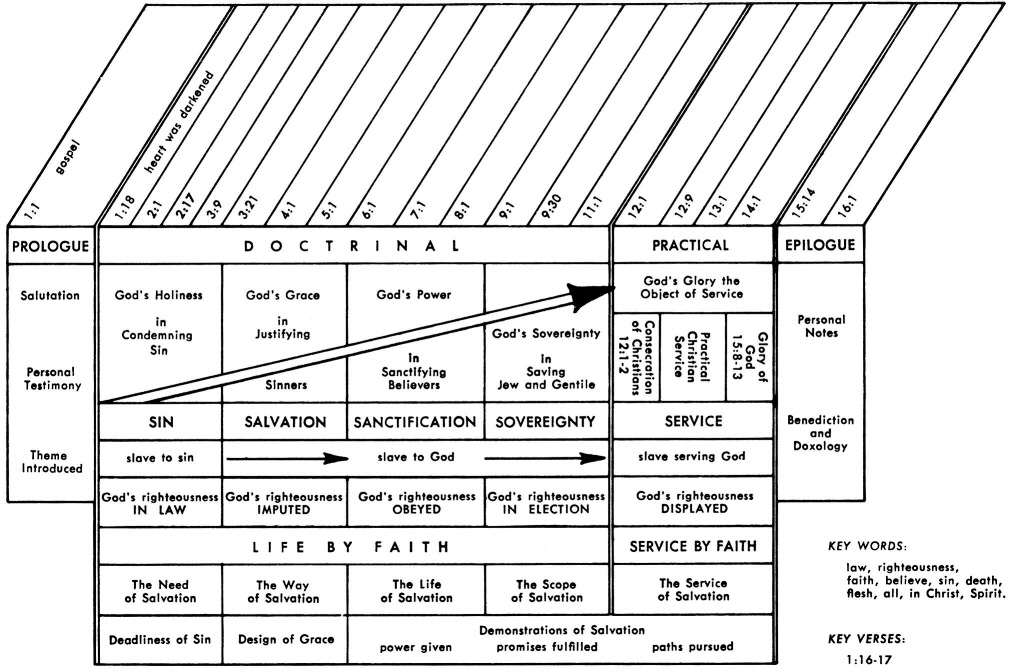
Click chart to enlarge
Chart from recommended resource Jensen's Survey of the NT - used by permission
Romans Overview Chart - Charles Swindoll
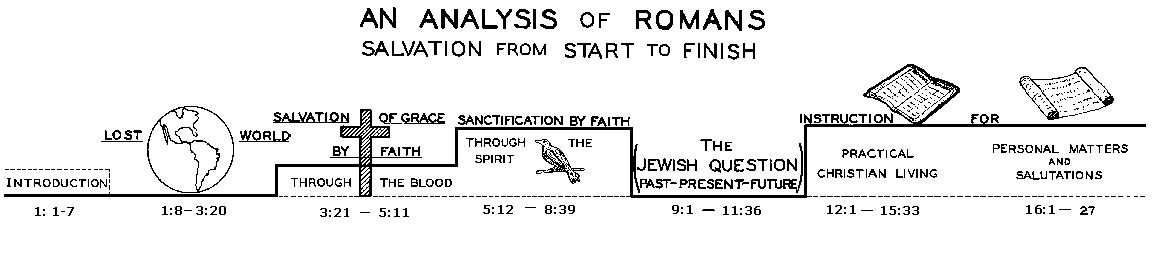
Source: Dr David Cooper
Click to Enlarge
| ROMANS ROAD to RIGHTEOUSNESS |
||||
| Romans 1:18-3:20 | Romans 3:21-5:21 | Romans 6:1-8:39 | Romans 9:1-11:36 | Romans 12:1-16:27 |
| SIN | SALVATION | SANCTIFICATION | SOVEREIGNTY | SERVICE |
| NEED FOR SALVATION |
WAY OF SALVATION |
LIFE OF SALVATION |
SCOPE OF SALVATION |
SERVICE OF SALVATION |
| God's Holiness In Condemning Sin |
God's Grace In Justifying Sinners |
God's Power In Sanctifying Believers |
God's Sovereignty In Saving Jew and Gentile |
Gods Glory The Object of Service |
| Deadliness of Sin |
Design of Grace |
Demonstration of Salvation | ||
| Power Given | Promises Fulfilled | Paths Pursued | ||
| Righteousness Needed |
Righteousness Credited |
Righteousness Demonstrated |
Righteousness Restored to Israel |
Righteousness Applied |
| God's Righteousness IN LAW |
God's Righteousness IMPUTED |
God's Righteousness OBEYED |
God's Righteousness IN ELECTION |
God's Righteousness DISPLAYED |
| Slaves to Sin | Slaves to God | Slaves Serving God | ||
| Doctrine | Duty | |||
| Life by Faith | Service by Faith | |||
|
Modified from Irving L. Jensen's chart above |
||||
Romans 5:8 But God demonstrates His own love toward us, in that while we were yet sinners, Christ died for (instead of, in place of) us. (NASB: Lockman)
Greek: sunistesin (3SPAI) de ten heautou agaphen eis hemas o theos hoti eti hamartolon onton (PAPMPG) hemon Christos huper hemon apethanen. (3SAAI)
Amplified: But God shows and clearly proves His [own] love for us by the fact that while we were still sinners, Christ (the Messiah, the Anointed One) died for us. (Amplified Bible - Lockman)
Barclay: But God proves his love to us by the fact that while we were still sinners Christ died for us.
NIV: But God demonstrates his own love for us in this: While we were still sinners, Christ died for us. (NIV - IBS)
NLT: But God showed his great love for us by sending Christ to die for us while we were still sinners. (NLT - Tyndale House)
Phillips: Yet the proof of God's amazing love is this: that it was while we were sinners that Christ died for us. (Phillips: Touchstone)
Wuest: But God is constantly proving His own love to us, because while we were yet sinners, Christ in behalf of us died. (Eerdmans Publishing - used by permission)
Young's Literal: and God doth commend His own love to us, that, in our being still sinners, Christ did die for us;
BUT GOD DEMONSTRATES (gives proof of, renders conspicuous, shows openly) HIS OWN LOVE TOWARD US: sunistesin (3SPAI) de ten heautou agaphen eis hemas o theos:
- Ro 5:20; 3:5; Jn 15:13; Eph 1:6, 7, 8; 2:7; 1Ti 1:16
THE GREAT CONTRAST
BUT GOD....
But God - He is contrasting the love of man and the love of God. A bold contrast! God did much more than men would ever dare to do by laying down His life for His enemies! Compare this contrast with the other great "but now's" in Romans - Ro 3:21, 6:22, 7:6, 11:30, 16:26 - see notes on Ro 3:21, 6:22, 7:6, 11:30, 16:26.
Godet writes that...What man hardly does for what is most worthy of admiration and love, God has done for that which merited only His indignation and abhorrence. (Romans 5:1-11 The Certainty of Final Salvation for Believers)
James Denney writes that God...commends, or rather makes good, presents in its true and unmistakable character, His own love toward us... His (emphatic), not as opposed to Christ's (as some have strangely taken it), but as opposed to anything that we can point to as love among men: His spontaneous and characteristic love. (Expositor's Greek Testament)
Demonstrates (4921) (sunistemi/sunistao from sún = together with + hístemi = set, place, stand) means literally to set, place or put together. To set in the same place, this literal meaning being found in Luke 9:32 (below). To bring together. When one brings together a person with another person, it is a way of presenting or introducing them. This gives sunistemi the meaning of commend, which means to recommend as worthy of confidence (the implication being that others adopt a similar attitude) or to present to one’s acquaintance for favorable notice. (9/16 NT uses)
Sunistemi can mean to put together by way of composition or combination, to teach by combining and comparing, and hence, make known by action, to demonstrate (to prove or make clear by putting together reasoning or evidence), to show, to prove, to establish, to exhibit. This is the primary meaning in Romans 5:8 (and in Ro 3:5-note) BDAG says the idea is "to provide evidence of a personal characteristic or claim through action". Vine adds that the idea is "to give proof of". It is the act whereby God establishes beyond question the reality of His love.
Finally, sunistemi can mean to put, bring or hold together something in its proper or appropriate place or relationship as when one unites parts into a whole (2Pe 3:5-note). It can convey the idea of to cohere or hold together (Col 1:17-note)
Hodge writes that demonstrate in Romans 5:8 means...“proves” or “renders conspicuous”. What renders the love of God so especially conspicuous is his sending His Son to die, not for the good, nor even for the righteous, but for sinners, for those who deserve wrath instead of love. (Commentary on Romans)
Here are the 16 NT uses of the predominantly Pauline verb sunistemi...
Luke 9:32 Now Peter and his companions had been overcome with sleep; but when they were fully awake, they saw His glory and the two men standing with Him.
Romans 3:5 (note) But if our unrighteousness demonstrates the righteousness of God, what shall we say? The God who inflicts wrath is not unrighteous, is He? (I am speaking in human terms.)
Romans 5:8 (note) But God demonstrates His own love toward us, in that while we were yet sinners, Christ died for us.
Romans 16:1 (note) I commend to you our sister Phoebe, who is a servant of the church which is at Cenchrea;
2 Corinthians 3:1+ Are we beginning to commend ourselves again? Or do we need, as some, letters of commendation to you or from you?
2 Corinthians 4:2+ but we have renounced the things hidden because of shame, not walking in craftiness or adulterating the word of God, but by the manifestation of truth commending ourselves to every man's conscience in the sight of God.
2 Corinthians 5:12+ We are not again commending ourselves to you but are giving you an occasion to be proud of us, that you may have an answer for those who take pride in appearance, and not in heart.
2 Corinthians 6:4+ but in everything commending ourselves as servants of God, in much endurance, in afflictions, in hardships, in distresses,
2 Corinthians 7:11+ For behold what earnestness this very thing, this godly sorrow, has produced in you: what vindication of yourselves, what indignation, what fear, what longing, what zeal, what avenging of wrong! In everything you demonstrated yourselves to be innocent in the matter.
2 Corinthians 10:12+ For we are not bold to class or compare ourselves with some of those who commend themselves; but when they measure themselves by themselves, and compare themselves with themselves, they are without understanding.
2 Corinthians 10:18+ For not he who commends himself is approved, but whom the Lord commends.
2 Corinthians 12:11+ I have become foolish; you yourselves compelled me. Actually I should have been commended by you, for in no respect was I inferior to the most eminent apostles, even though I am a nobody.
Galatians 2:18+ "For if I rebuild what I have once destroyed, I prove myself to be a transgressor.
Colossians 1:17 (note) And He is before all things, and in Him all things hold together.
2 Peter 3:5 (note) For when they maintain this, it escapes their notice that by the word of God the heavens existed long ago and the earth was formed out of water and by water
There are 15 uses of sunistao/sunistemi in the Septuagint (LXX) (Ge 40:4; Ex 7:19; 32:1; Lev 15:3; Nu 16:3; 27:23; 32:28; Job 28:23; Ps. 39:1; 107:36; 118:27; 141:9; Pr. 6:14; 26:26; Da 7:21)
To reiterate, in Romans 5:8 Paul uses sunistao in the sense of putting together with a view to showing, proving, or establishing. God gives proof of or renders conspicuous His great love for sinners.
Notice Paul's interesting choice of verb tenses in this verse. In the phrase Christ died for us, died is in the aorist tense indicating a past, action completed on the Cross and thus indicating a historical event which is fixed, objective and unchanging. How natural it would have been, then, for Paul to write: In this historical act, God demonstrated his own love toward us. But instead Paul used the present tense for sunistao/sunistemi which conveys the idea not of a past tense completed event but an ongoing demonstration of God's love. One could paraphrase it "God continually demonstrates (present tense - He keeps on showing) His own love toward us." : In other words God’s love for us is not limited to the past, but has relevance for the present as well. Kenneth Wuest tries to convey this sense rendering it "God is constantly proving His own love to us".)
Leon Morris commenting on Paul's use of the present tense writes that..."The Cross is an event of the past but it keeps showing the love of God. (Borrow The Epistle to the Romans)
His own love toward us - There is extra emphasis for it is not just His love, but His OWN love! Who is "His"? Obviously the Father, not the Son. Sanday & Headlam note that ‘His own love,’ is emphatic, prompted from within not from without."
Leon Morris offers a beautiful explanation of the significance of His own love writing that...Paul says that the cross shows us God’s own love. One might expect him to say that the cross shows us the love of Christ. It does that, of course, but own puts the emphasis on the love of the Father (cf. 1John 4:10). “Christ’s action is God’s action. Christ’s love is God’s love” (Nygren). It would be easy to see the cross as demonstrating the indifference of God, a God who let the innocent Jesus be taken by wicked men, tortured, and crucified while he did nothing. And that would indeed be the case were it not that “God was in Christ, reconciling the world to himself” (2Co 5:19). Unless there is a sense in which the Father and Christ are one, it is not the love of God that the cross shows. But because Christ is one with God, Paul can speak of the cross as a demonstration of the love of God. There is no opposition between the Father and the Son in the means of our salvation. (Borrow The Epistle to the Romans - page 224)
Romans 5:8 is history’s clearest and greatest “I love you!” Let this certainty of God’s own love give you a new perspective on all aspects of your present life. Such a quality of love is distinctive, unexpected, and unheard of in human relations. As one person has well said the nails could never have kept Jesus on the Cross had love not held Him there!
God's supernatural love is demonstrated irrespective of merit which is totally unlike natural love which is given to those who are lovable. How amazing that God’s love embraces even the unlovely. Natural human love is almost invariably based on the attractiveness of the object of love, and we are inclined to love people who love us. Consequently, we tend to attribute that same kind of love to God. We think that His love for us is dependent on how good we are or on how much we love Him, but such "logic" does not apply to God's love.
What renders the love of God so especially conspicuous is his sending His Son to die, not for the good, nor even for the righteous, but for sinners, who truly deserve wrath not love. Can you see the much more aspect of our salvation here? He didn't save us when we were lovely and lovable but when we were helpless, ungodly sinners which makes our salvation a much more salvation. This quality (and quantity) of divine self-less, undeserved love is completely beyond human comprehension. And yet this is the very love that the just and infinitely holy God had toward us even while we were yet sinners. The God Who hates every sinful thought and every sinful deed nevertheless loves the sinners who think and do those things, even while they are still hopelessly enmeshed in their sin.
Cranfield explains that...For Paul the death of Christ is the proof of the fact, and the revelation of the nature, of God’s love. (Borrow Cranfield, C. E. B Exegetical Commentary on the Epistle to the Romans. Vol 1: Ro 1-8.; Borrow Volume 2: Romans 9-16)
Love (26)(agape) describes a love which is foremost an unconditional and sacrificial love. As such it is ultimately a love that God is (1Jn 4:8,16) and that God demonstrates (Jn 3:16, 1Jn 4:9), the supreme demonstration being God's gift of Jesus on the Cross. Agape love seeks the highest good for another no matter what the cost, as demonstrated by Christ’s sacrifice on our behalf. It is therefore not surprising that pagan Greek literature throws little light on the distinctive New Testament meaning of agape love.
Agape love is the love of choice (intentional, volitional, conscious choice), the love of serving with humility, the highest kind of love, the noblest kind of devotion.
Agape love is not motivated by the recipient's appearance, by an emotional attraction, or by a sentimental relationship.
The perfect expression of this sacrificial love on earth is the Lord Jesus Christ for He left heaven, came to earth, took on a human form, was spit on and mocked, was crowned with a crown of thorns, nailed to a cross, abused, and had a spear thrust into His side and yet through all this suffering, His agape love did not waver nor dissipate. He loved the church unto death and that is sacrificial love.
Constable observes that...Paul here was contrasting the worth of the life laid down, Jesus Christ’s, and the unworthiness of those who benefit from His sacrifice. Whereas people may look at one another as meriting love because they are righteous or good, God views them as sinners. Nevertheless God loves them. His provision of His own Son as our Savior demonstrated the depth of His love (John 3:16). (Expository 5 Notes)
Charles Hodge observed, “If [God] loved us because we loved him, He would love us only so long as we love Him, and on that condition; and then our salvation would depend on the constancy of our treacherous hearts. But as God loved us as sinners, as Christ died for us as ungodly, our salvation depends, as the apostle argues, not on our loveliness, but on the constancy of the love of God” (Commentary on Romans)
O the Deep, Deep Love of Jesus
Vast, unmeasured, boundless, free!
Rolling as a mighty ocean
In its fullness over me!
Underneath me, all around me,
Is the current of Thy love
Leading onward, leading homeward
To Thy glorious rest above!
IN THAT WHILE WE WERE YET SINNERS CHRIST DIED FOR US : hoti eti hamartolon onton (PAPMPG) hemon Christos huper hemon apethanen (3SAAI):
- Isa 53:6; 1Pe 3:18; 1Jn 3:16; 4:9,10
FOR US - OUR SUBSTITUTE!
IN OUR PLACE
Were (5607) (on) means being and refers to our existence. This verb is in the present tense which indicates our very lifestyle was characterized by sin. We did not simply sin a little here and a little there. Our every thought, word and deed was contaminated by sin.
Yet (2089) (eti) means still and is used here as a function word to indicate the continuance of an action or condition. Leon Morris adds that yet or...
Still points to our state at the time. God did not make some indication that we were ready to amend our lives a precondition of bringing about our salvation. It was for people who had sinned and were still sinners that Christ died. (Borrow The Epistle to the Romans)
Sinners (268) (hamartolos from hamartáno = deviate, miss the mark which some lexicons say is from a = negative + meiromai = attain -- not to attain, not to arrive at the goal) is an adjective (e.g., "that through the commandment sin might become utterly sinful" - see Ro 7:13 -note) that is often used as a noun (as in this verse and Ro 5:19 [note]) to describe those who are continually erring from the way, constantly missing God's mark, living in opposition to His good and acceptable and perfect will. Thus a sinner is one who lives in opposition to the divine will. In a more selective use, in the view of the Pharisees a sinner was a Jew who is one not careful in the observance of ceremonial duties (Mt 9:10ff, Lk 15:1ff, Mk 2.16). Finally,the Jews called the Gentiles sinners or despisers of God and considered them heathen or pagan, tá éthne = the nations (Mt 26:45). Jesus' purpose for coming into the world was to save sinners (Mt 9:13 1Ti 1:15)
Sinners were frequently placed in the same category as despised tax-collectors - Mt 9:10, 11, Mt 11:19, Mk 2:15, 16, Lk 5:30, Lk 7:34, Lk 15:1, Lk 18:13.
- a sinful generation Mk 8:38
- a sinful man, a sinner Lu 5:8; 19:7; 24:7; Jn 9:16, 24
- a sinful woman Lu 7:37, 39; Nu 32:14; Isa1:4
- a sinner Lu 8:13; Ro 3:7
- sinful, sinners Ro 5:8; Ga 2:17; Jas 4:8
BDAG says hamartolos pertains "to behavior or activity that does not measure up to standard moral or cultic expectations (being considered an outsider because of failure to conform to certain standards is a freq. semantic component. Persons engaged in certain occupations, e.g. herding and tanning, that jeopardized cultic purity, would be considered by some as ‘sinners’, a term tantamount to ‘outsider’. Non-Israelites were esp. considered out of bounds [cp. Ac 10:28]).
Hodge says that the "word sinners expresses the idea of moral wickedness and consequent exposure to divine displeasure." (Commentary on Romans)
Hamartolos in Classic Greek - Hamartōlos occurs extensively in our literature and functions both adjectivally (“sinful”) and substantivally (“sinner, the one who commits sin”). In the secular writings of Aristophanes (ca. 450-385 B.C.) the substantive appears as a barbarism and carries a disparaging and sarcastic nuance
Hamartolos is translated (NAS) as sinful (3), sinner (12), sinners (31). Hamartolos is used 47 times in the NAS Mt. 9:10, 11, 13; 11:19; 26:45; Mark. 2:15, 16, 17; 8:38; 14:41; {note concentrated use in Luke} Lk. 5:8, 30, 32; 6:32, 33, 34; 7:34, 37, 39; 13:2; 15:1, 2, 7, 10; 18:13; 19:7; 24:7; Jn. 9:16, 24, 25, 31; Ro 3:7; 5:8, 19; 7:13; Gal. 2:15, 17; 1Ti 1:9, 15; Heb 7:26; 12:3; James 4:8; 5:20; 1Pe 4:18; Jude 1:15)
Hamartolos 85 times in the Septuagint (LXX) - Hamartolos is used 10 times in Ps 37 - this would make a good study of "sinners"! Many of the OT uses of hamartolos speak of the divine judgment that will fall on sinners. Ge 13:13; Nu 16:38; 32:14; Deut. 29:19; 1Ki. 1:21; 2Chr. 19:2; Ps 1:1, 5; Ps 3:7; 7:9; 9:16, 17; 10:3, 15; 11:2, 6; 28:3; 32:10; 34:21; 36:11; 37:10, 12, 14, 16, 17, 20, 21, 32, 34, 40; 39:1; 50:16; 55:3; 58:3, 10; 68:2; 71:4; 73:3, 12; 75:8, 10; 82:2, 4; 84:10; 91:8; 92:7; 94:3, 13; 97:10; 101:8; 104:35; 106:18; 109:2, 6; 112:10; 119:53, 61, 95, 110, 119, 155; 125:3; 129:3, 4; 139:19; 140:4, 8; 141:5, 10; 145:20; 146:9; 147:6; Pr 11:31; 12:13; 23:17; 24:19; Is 1:4, 28, 31; 13:9; 14:5; 65:20; Ezek 33:8, 19; Da 12:10; Amos 9:8, 10) Note that in the Septuagint (LXX), hamartolos is frequently used to translate the Hebrew words for wicked or ungodly persons
Genesis 13:13 Now the men of Sodom were wicked exceedingly and sinners against the LORD. (THEIR SIN = AGAINST GOD)
Psalm 1:1 How blessed is the man who does not walk in the counsel of the wicked, Nor stand in the path of sinners, Nor sit in the seat of scoffers! (THEY ARE NOT TO BE FOLLOWED)
Psalm 1:5 Therefore the wicked will not stand in the judgment, Nor sinners in the assembly of the righteous. (THEY WILL NOT STAND WITH THE RIGHTEOUS WHICH SPEAKS OF SEPARATION ON JUDGMENT DAY).
Ps 9:17 The wicked (hamartolos) will return to Sheol, Even all the nations who forget God. (THEIR FATE = SHEOL, cp THEIR FATE IN Ps 11:6)
Ps 32:10 Many are the sorrows (LXX = WHIPS, TORMENT) of the wicked, But he who trusts in the LORD, lovingkindness shall surround him.
Throughout the Old Testament there is a clearly drawn distinction between the righteous and the sinful (sinners).
Hamartolos is used by Homer of missing the mark in shooting. From Homer on it carried the moral sense, "to miss the right, to go wrong, to sin". In the Septuagint it means missing the divinely appointed goal, deviation from what is pleasing to God. A sinner then, is not necessarily one who has gone far astray in wicked living. Rather, every man without Christ is a sinner because he has missed the goal of God's purpose for us as human beings; namely, that we should live holy lives in fellowship with a holy God.
The Jews used hamartolos to describe those who had no respect for Mosaic law or rabbinic traditions and were therefore the most vile and worthless of people. In their spiritual arrogance the Jews applied hamartolos to the Gentiles to express the contempt in which they held them. And now in the light of the life and death of Christ the Jew discovered himself to be in exactly the same case (under [the power and dominion of] sin - Ro 3:9+)
The Pharisees felt sinners or hamartolos were inferior because they had no interest in scribal tradition and did not eat food in a state of ceremonial cleanness (see Mark 2:16+ "...Why is He [Jesus] eating and drinking with the tax-gatherers and sinners?"). In sum, hamartolos was thus used not only to describe man's natural relationship to God (not hitting His mark) or as a value judgment for a class of people.
In Luke our Lord tells the story of the prideful Pharisee and the humble tax gatherer (noting the irony in the Mark 2:16 passage above that the Jews often grouped tax gatherers with "sinners")...
The Pharisee stood and was praying thus to himself (to whom? "to himself," rather than God, merely congratulating himself on his own self-righteousness and thus received no forgiveness), 'God, I thank Thee that I am not like other people: swindlers, unjust, adulterers, or even like this tax-gatherer. 'I fast twice a week; I pay tithes of all that I get.'
But the tax-gatherer, standing some distance away, was even unwilling to lift up his eyes to heaven, but was beating his breast, saying, 'God, be merciful to me, the sinner!'
I tell you, this man went down to his house justified (acquitted, vindicated, declared righteous) rather than the other; for everyone who exalts himself shall be humbled, but he who humbles himself shall be exalted. (Luke 18:11, 12, 13, 14+)
Comment: Paul W. Powell once observed, “Pride is so subtle that if we aren’t careful we’ll be proud of our humility. When this happens our goodness becomes badness. Our virtues become vices. We can easily become like the Sunday School teacher who, having told the story of the Pharisee and the publican, said, ‘Children, let’s bow our heads and thank God we are not like the Pharisee!’“
A common use of hamartolos in Paul's day is interesting, BDAG explaining that it pertained "to behavior or activity that does not measure up to standard moral or cultic expectations -- being considered an outsider because of failure to conform to certain standards is a freq. semantic component. Persons engaged in certain occupations, e.g. herding and tanning, that jeopardized cultic purity, would be considered by some as ‘sinners’, a term tantamount to ‘outsider’. Non-Israelites were esp. considered out of bounds. (E.g., Gal 2:15 "We are Jews by nature, and not sinners from among the Gentiles") (Arndt, W., Danker, F. W., & Bauer, W. A Greek-English Lexicon of the New Testament and Other Early Christian Literature)
Moulton and Milligan record that hamartolos was frequently found in a common phrase in pagan sepulchral epitaphs in Asia Minor, the epitaph serving as a threat against anyone who would desecrate the tomb. A typical epitaph read “Let him be as a sinner (hamartolos) before the subterranean gods”.
Newell adds that "sinning" (hamartolos - sinners) is a stronger word than "strengthless": but it is strong in the wrong direction! Strengthless indeed toward God and holiness, we were all; yet vigorous and active in sin. And what did God do? What does God here say? It was while we were thus sinning that Christ died for us! (Verse by Verse Exposition)
Christ (5547) (Christos From chrio = to rub or anoint as with oil, consecrate or set apart for sacred work) is a transliteration of the Greek word Christos which in turn is used in the Septuagint (LXX) to translate the Hebrew word Messiah or Anointed One. Messiah was a term applied to the OT priests who were anointed with the holy oil, particularly the high priest (Lev 4:3, 5, 16) In the LXX, the prophets are called the anointed of God (LXX = hoi christoi Theou, Ps 105:15). A king of Israel was described upon occasion as “the anointed of the Lord” (LXX = christos tou Kuriou, 1Sa 2:10). In the Gospels the Christ is not a personal name but an official designation for the expected Messiah (see Matthew 2:4, Luke 3:15). As by faith the human Jesus was recognized and accepted as the personal Messiah, the definite article ("the") was dropped and the designation Christ came to be used as a personal name. The name Christ speaks of His Messianic dignity and emphasizes that He is the fulfillment of all the Old Testament promises concerning the coming Messiah (see Messianic Prophecies).
Died (599) (apothnesko from apo = intensifies or means away from + thnesko = die) is literally to die off, to die a natural death in a sense stronger than thnesko. As noted the aorist tense speaks of a past completed action, and in context is specifically the Crucifixion of Christ, which is not a figment of Paul's but a definite historical event, which in fact constitutes the most profound event in all eternity.
For (5228) (huper) means “for the sake of, in behalf of, instead of.” Click for synopsis of huper used in the NT to convey the idea of the doctrine of substitution. Isaiah 53 vividly describes some of what Jesus did when He took our place:
Surely our griefs He Himself bore, And our sorrows He carried; Yet we ourselves esteemed Him stricken, Smitten of God, and afflicted. But He was pierced through for our transgressions, He was crushed for our iniquities; The chastening for our well-being fell upon Him (NIV = "the punishment that brought us peace was upon Him"), And by His scourging we are healed. (Isaiah 53:4, 5+)
Play this modern song - By His Wounds
John uses huper in recording the high priest Caiaphas' "prophecy"
“It is expedient for you that one man should die instead of (huper) the people, and not that the whole nation perish” (Jn 11:50)
In Galatians 3:13+ Paul writes that,
“Christ has redeemed us from the curse of the law, having become a curse instead of (huper) us.”
Dana and Mantey in their A Manual Grammar of the Greek New Testament (ONLINE) say,
In both of these passages the context clearly indicates that substitution is meant.
Thus our Lord died instead of us, taking our penalty, and in behalf of us, in that His death was in our interest.
Notice the downward progression of Paul's description of humanity: "helpless;" "ungodly;" "sinners;" "enemies." The gulf between the preciousness of God's gift and our unworthiness is humanly inconceivable. Only a love way beyond our own would do such a thing. Yet this is exactly what God has done! And he did it for us "while we were yet" this way. He did not extend his love to you only after you turned to him; he extended his greatest gift of love to you even while you were headed the other way (Luke 23:33,34+).
C H Spurgeon has the following expositional notes on Romans 5:8...
He did the utmost for us when we were the least deserving of it. Oh, what a love is this. Let it be shed abroad in our poor stony hearts, and commended by us to others.
When we were not even just, much less good, “Christ died for us.”
It is under that aspect that Christ is to be regarded as dying for the ungodly, dying for sinners. Ungodly man, guilty sinner, is there not hope for you in this blessed truth? Does anyone say, “I shall be lost, for I am ungodly; I must necessarily perish, for I am a sinner”? Your logic is at fault, dear friend. “Christ died for the ungodly;” “while we were yet sinners, Christ died for us;” therefore, the ungodly,—sinners—be saved because of his death, and all who trust him shall be saved.
Certainly we were not “good” men, we were not even “just” men, but we are included in this black description “sinners”; and “while we were yet sinners, Christ died for us.” He died for us as sinners, he did not come to save saints, but to save sinners; and it was for sinners that he died.
We were without any attraction, without any righteousness, without any goodness, yet Christ loved us. Out of the graciousness of his own heart he loved us, according to that text, “I will love them freely.”
While we were neither righteous nor good, “while we were yet sinners, Christ” did the most he ever could, or ever can do for us, he “died for us.” this is the best gift for the worst of men, and that best gift given to them when they are at their worst state: “While we were yet sinners, Christ died for us.”
When we were not righteous, when we certainly were not good, when the whole description of our character could be summed up in that one word “sinners” — rebels offending against God: “while we were yet sinners, Christ died for us.”
We were neither righteous nor yet good, yet Christ died for us. “Oh!” said a little boy once to his mother, “I do not think so much of Christ dying for men, I think I would be willing to die if I could save a hundred men by dying.” But his mother said,” Suppose it was a hundred mosquitoes, — would you die for them?” “Oh, no!” he said, “I would let the whole lot of them die.” Well, we were much less, in comparison with Christ than mosquitoes are in relation to men, yet he died for us, good-for-nothing creatures that we are. Well does one say, “God shows part of his love to us in many different ways, but he shows the whole of his love in giving Christ to die for us.” Here you see his heart laid bare, the very heart of God laid open for the inspection of every believing soul. To die for saints would be great love; but to die for sinners, while they are yet sinners, and regarding them as sinners, — this is love with emphasis, the very highest commendation that even divine dove can have
Here is an illustration...They tell the story about a great Russian tribal leader in the early days who had two laws. The first was that all the tribe were to love their parents and the second was they were not to steal. This man's leadership and these laws made his tribe the greatest in all of Russia. Now one day they discovered that someone was stealing. This angered the leader greatly and he brought all the people together. He said, "Let the thief come forward and receive 10 lashes for his crime." No one came and he upped the ante to 20 lashes. Then 30, then 40 lashes. He stopped there for he knew that it would take a strong man to survive 40 lashes with the whip. The crowd dispersed and the leader sent his men to find the thief. Within a week they brought the thief to him and the leader gasped, for the thief was his own mother. The guards were wagering among themselves as to what this great and wise leader would do. Would he keep his word, obey his second law and whip his mother? Or would he obey the first law, love his mother and let her go free, thus disgracing himself and the laws he sought to enforce? If the crime went unpunished, surely everyone would steal. The leader gathered the tribe together. They brought his mother forward and bared her frail back. "Ah, ha," thought the people, "he's going to whip her." Then, just before the whip master brought the whip to bear, the leader strode over to his mother, tearing his shirt off as he went and draped himself over her frail body, taking the 40 lashes himself. That's exactly what Jesus did for us. Jesus took our punishment on the cross. We should have rightly died for our sins, but Jesus took our place. "But God shows his love for us in that while we were yet sinners, Christ died for us."
Beyond Labels
But God demonstrates his own love for us in this: While we were still sinners, Christ died for us. Romans 5:8
Today's Scripture & Insight:Romans 5:1–11
A church in my city has a unique welcome card that captures the love and grace of God for everyone. It says, “If You Are A . . . saint, sinner, loser, winner”—followed by many other terms used to describe struggling people—“alcoholic, hypocrite, cheater, fearful, misfit . . . . You are welcome here.” One of the pastors told me, “We read the card aloud together in our worship services every Sunday.”
How often we accept labels and allow them to define who we are. And how easily we assign them to others. But God’s grace defies labels because it is rooted in His love, not in our self-perception. Whether we see ourselves as wonderful or terrible, capable or helpless, we can receive eternal life as a gift from Him. The apostle Paul reminded the followers of Jesus in Rome that “at just the right time, when we were still powerless, Christ died for the ungodly” (Rom. 5:6).
The Lord does not require us to change by our own power. Instead He invites us to come as we are to find hope, healing, and freedom in Him. “But God demonstrates his own love for us in this: While we were still sinners, Christ died for us” (v. 8). The Lord is ready and willing to receive us just as we are. By: David C. McCasland (Our Daily Bread, Copyright RBC Ministries, Grand Rapids, MI. Reprinted by permission. All rights reserved)
Heavenly Father, thank You for Your amazing love in Jesus.
God’s forgiveness defies our labels of failure or pride.
This Love Is Real
While we were still sinners, Christ died for us. Romans 5:8
Today's Scripture & Insight: Romans 5:6−8
“I felt like the rug had been pulled from under me,” Jojie said. “The shock of the discovery was like a physical blow.” She’d found out that her fiancé was seeing someone else. Jojie’s previous relationship had ended similarly. So when she later heard about God’s love at a Bible study, she couldn’t help wondering: Is this another scam? Will I get hurt if I believe God when He says He loves me?
Like Jojie, we may have experienced troubled relationships that left us feeling wary—or even afraid—of trusting someone’s promise of love. We may even feel this way about God’s love, wondering where the catch is. There is, however, no catch. “God demonstrates his own love for us in this: While we were still sinners, Christ died for us” (Romans 5:8).
“Eventually, I realized God had already proven His love,” Jojie says, “by dying for me.” My friend discovered that since our sinful state separated us from God, He reached out to us by giving Jesus to die on our behalf (Romans 5:10; 1 John 2:2). Because of this, our sins are forgiven, and we can look forward to eternity with Him (John 3:16).
Whenever we wonder whether we can truly trust God’s love, let’s remember what Christ did for us on the cross. We can trust His promises of love, knowing that He’s faithful. By: Karen Huang (Our Daily Bread, Copyright RBC Ministries, Grand Rapids, MI. Reprinted by permission. All rights reserved)
When or why have you found it difficult to trust God’s love? How can knowing Jesus died for you change your response?
Dear Jesus, thank You for the great love You showed me by dying for me. Let Your love change me, heal me, and direct my relationships.
Will You Still Love Me?
While we were still sinners, Christ died for us. Romans 5:8
Today's Scripture & Insight: Romans 5:6–11
Ten-year-old Lyn-Lyn had finally been adopted, but she was afraid. In the orphanage where she’d grown up, she was punished over the slightest mistake. Lyn-Lyn asked her adoptive mom, who was a friend of mine: “Mommy, do you love me?” When my friend replied yes, Lyn-Lyn asked, “If I make a mistake, will you still love me?”
Although unspoken, some of us might ask that same question when we feel we’ve disappointed God: “Will You still love me?” We know that as long as we live in this world, we’ll fail and sin at times. And we wonder, Do my mistakes affect God’s love for me?
John 3:16 assures us of God’s love. He gave His Son, Jesus, to die on our behalf so that if we believe in Him, we’ll receive eternal life. But what if we fail Him even after we place our trust in Him? That’s when we need to remember that “Christ died for us” even when we were still sinners (Romans 5:8). If He could love us at our worst, how can we doubt His love today when we’re His children?
When we sin, our Father lovingly corrects and disciplines us. That’s not rejection (8:1); that’s love (Hebrews 12:6). Let’s live as God’s beloved children, resting in the blessed assurance that His love for us is steadfast and everlasting. By: Karen Huang (Our Daily Bread, Copyright RBC Ministries, Grand Rapids, MI. Reprinted by permission. All rights reserved)
How does understanding God’s love for you strengthen you to obey Him? How does it impact your view of sin?
Heavenly Father, thank You for Your steadfast and unchanging love.
The Language of the Cross
God demonstrates his own love for us in this: While we were still sinners, Christ died for us. Romans 5:8
Today's Scripture & Insight: Romans 5:1–10
Pastor Tim Keller said, “Nobody ever learns who they are by being told. They must be shown.” In a sense, it’s one application of the adage, “Actions speak louder than words.” Spouses show their mates that they’re appreciated by listening to them and loving them. Parents show their children they’re valued by lovingly caring for them. Coaches show athletes they have potential by investing in their development. And on it goes. By the same token, a different kind of action can show people painful things that communicate much darker messages.
Of all the action-based messages in the universe, there’s one that matters most. When we want to be shown who we are in God’s eyes, we need look no further than His actions on the cross. In Romans 5:8, Paul wrote, “God demonstrates his own love for us in this: While we were still sinners, Christ died for us.” The cross shows us who we are: those whom God so loved that He gave His one and only Son for us (John 3:16).
Against the mixed messages and confusing actions of broken people in a broken culture, the message of God’s heart rings clear. Who are you? You’re the one so loved by God that He gave His Son for Your rescue. Consider the price He paid for you and the wonderful reality that, to Him, you were always worth it. By: Bill Crowder (Our Daily Bread, Copyright RBC Ministries, Grand Rapids, MI. Reprinted by permission. All rights reserved)
How have you been defining your worth? What false messages might you need to discard or reject in exchange for comprehending the value that God places on you?
Father, I can never understand why You would love me so much or give Your Son for my forgiveness. Your love is unsearchable and Your grace is amazing. Thank You for making me Your child!
See The 4-D Love of God at DiscoverTheWord.org/series/the-4-d-love-of-god.
Graded with Grace
While we were still sinners, Christ died for us. Romans 5:8
Today's Scripture & Insight: Romans 5:6–15
My son’s blue eyes sparkled with excitement as he showed me a paper he had brought home from school. It was a math test, marked with a red star and a grade of 100 percent. As we looked at the exam, he said he had three questions left to answer when the teacher said time was up. Puzzled, I asked how he could have received a perfect score. He replied, “My teacher gave me grace. She let me finish the test although I had run out of time.”
As my son and I discussed the meaning of grace, I pointed out that God has given us more than we deserve through Christ. We deserve death because of our sin (Rom. 3:23). Yet, “while we were still sinners, Christ died for us” (5:8). We were unworthy, yet Jesus—sinless and holy—gave up His life so we could escape the penalty for our sin and one day live forever in heaven.
Eternal life is a gift from God. It’s not something we earn by working for it. We are saved by God’s grace, through faith in Christ (Eph. 2:8–9).By: Jennifer Benson Schuldt (Our Daily Bread, Copyright RBC Ministries, Grand Rapids, MI. Reprinted by permission. All rights reserved)
Dear God, Your undeserved favor has made it possible for us to be saved from our sin. You have shown us amazing grace. Thank You for
the gift You gave. Use me to tell others about You and what You have done.
Grace and mercy are unearned blessings.
Deeper Love
God demonstrates his own love for us in this: While we were still sinners, Christ died for us. Romans 5:8
Today's Scripture & Insight: 1 Peter 4:7–11
When they first met, Edwin Stanton snubbed US president Abraham Lincoln personally and professionally—even referring to him as a “long-armed creature.” But Lincoln appreciated Stanton’s abilities and chose to forgive him, eventually appointing Stanton to a vital cabinet position during the Civil War. Stanton later grew to love Lincoln as a friend. It was Stanton who sat by Lincoln’s bed throughout the night after the president was shot at Ford’s Theater and whispered through tears on his passing, “Now he belongs to the ages.”
Reconciliation is a beautiful thing. The apostle Peter pointed followers of Jesus there when he wrote, “Above all, love each other deeply, because love covers over a multitude of sins” (1 Peter 4:8). Peter’s words cause me to wonder if he was thinking of his own denial of Jesus (Luke 22:54–62) and the forgiveness Jesus offered him (and us) through the cross.
The deep love Jesus demonstrated through His death on the cross frees us from the debt for our sins and opens the way for our reconciliation with God (Colossians 1:19–20). His forgiveness empowers us to forgive others as we realize we can’t forgive in our own strength and ask Him to help us. When we love others because our Savior loves them and forgive because He has forgiven us, God gives us strength to let go of the past and walk forward with Him into beautiful new places of grace. By: James Banks (Our Daily Bread, Copyright RBC Ministries, Grand Rapids, MI. Reprinted by permission. All rights reserved)
SECOND BEST?
While we were still sinners, Christ died for us. —Romans 5:8
Leah must have laid awake all night thinking of the moment when her new husband would awaken. She knew that it was not her face he expected to see, but Rachel’s. Jacob had been a victim of lies and deceit. When he realised that a ‘switch’ had occurred, he quickly made a new deal with Laban to marry the woman he had been promised (Gen. 29:25-27).
Have you ever felt insignificant or second best? Leah felt that way. It’s seen in the names she chose for her first three sons (vv.31-35). Reuben means “See, a Son”; Simeon means “Heard”; and Levi means “Attached”. Their names were all plays on words that indicated the lack of love she felt from Jacob. With each son’s birth, she desperately hoped she would move up in Jacob’s affections and earn his love. But slowly Leah’s attitude changed, and she named her fourth son Judah, which means “Praise” (v.35). Though she felt unloved by her husband, perhaps she now realised she was greatly loved by God.
We can never ‘earn’ God’s love, because it’s not dependent on what we do. The Bible tells us that “while we were still sinners, Christ died for us” (Rom. 5:8). In God’s eyes we are worth the best that heaven could offer—the gift of His precious Son. Cindy Hess Kasper (Our Daily Bread, Copyright RBC Ministries, Grand Rapids, MI. Reprinted by permission. All rights reserved)
NOTHING SPEAKS MORE CLEARLY OF GOD’S LOVE THAN THE CROSS.
Imperfect, Yet Loved
God demonstrates his own love for us in this: While we were still sinners, Christ died for us. Romans 5:8
Today's Scripture: Luke 7:36–50
In Japan, food products are immaculately prepared and packaged. Not only must they taste good but they must look good too. Often I wonder if I am purchasing the food or the packaging! Because of the Japanese emphasis on good quality, products with slight defects are often discarded. However, in recent years wakeari products have gained popularity. Wakeari means “there is a reason” in Japanese. These products are not thrown away but are sold at a cheap price “for a reason”—for example, a crack in a rice cracker.
My friend who lives in Japan tells me that wakeari is also a catchphrase for people who are obviously less than perfect.
Jesus loves all people—including the wakeari who society casts aside. When a woman who had lived a sinful life learned that Jesus was eating at a Pharisee’s house, she went there and knelt behind Jesus at His feet, weeping (Luke 7:37–38). The Pharisee labeled her “a sinner” (v. 39), but Jesus accepted her. He spoke gently to her, assuring her that her sins were forgiven (v. 48).
Jesus loves imperfect, wakeari people—which includes you and me. And the greatest demonstration of His love for us is that “while we were still sinners, Christ died for us” (Rom. 5:8). As recipients of His love, may we be conduits of His love to the flawed people around us so they too may know that they can receive God’s love despite their imperfections. By: Albert Lee
I know I’m not perfect, Lord, so help me not to be hypocritical and pretend I have it all together. Open my heart to others in acceptance and love so that they might know Jesus’s concern for them. (Our Daily Bread, Copyright RBC Ministries, Grand Rapids, MI. Reprinted by permission. All rights reserved)
Broken people are made whole by God’s love.
UNCHAINED BY THE CROSS
God demonstrates His own love towards us, in that while we were still sinners, Christ died for us. —Romans 5:8
In Greek mythology the hero Pro- metheus was captured and chained to a mountain peak where he was sentenced to stay forever. Each day a giant eagle arrived to feast on his liver. Hermes came to him and said, “Do not hope for an end to your suffering until a god appears as your substitute in torment, ready to descend for you into the realm of Hades.” According to the myth this was done by the wise and just god Chiron, who sacrificed himself for Prometheus and delivered him from torment.
This story is in some ways a picture of what happened for us the day Jesus died on the cross. Mankind was bound by sin, and there was no hope of escape unless God took our place. And that’s exactly what happened. Jesus Christ, the Son of God, died on our behalf and paid the penalty for our sin. He provided a way of releasing us from eternal punishment. Were we to write for a thousand days, we still could not express the meaning of Christ’s sacrifice for the sins of mankind. Its full significance is beyond our comprehension.
Have you confessed your sin and asked Jesus Christ to be your personal Saviour? If not, there’s no better time than today. Trust in Him, and you will know what it means to be ‘unchained’ by the cross. David C. Egner (Our Daily Bread, Copyright RBC Ministries, Grand Rapids, MI. Reprinted by permission. All rights reserved)
STEP OUT OF SIN’S SLAVERY AND INTO SALVATION’S FREEDOM—TRUST CHRIST.
Loving And Knowing
God demonstrates His own love toward us, in that while we were still sinners, Christ died for us. —Romans 5:8
Today's Scripture: Romans 5:6-11
In a novel by Jonathan Safran Foer, one of the characters, speaking of New York’s Empire State Building, said, “I know this building because I love this building.”
That statement caused me to think about the relationship between love and knowledge. Whenever we love something, we want to know everything about it. When we love a place, we want to explore every inch of it. When we love a person, we want to know every detail of his or her life. We want to know what he likes, how she spends her time, where he grew up, who her friends are, what he believes. The list is endless. But some of us want to be loved without allowing ourselves to be known. We’re afraid that we won’t be loved if we are truly known.
We don’t have to worry about that with God. His love is far superior to ours: “God demonstrates His own love toward us, in that while we were still sinners, Christ died for us” (Rom. 5:8). Furthermore, He makes Himself known to us. Through creation, Scripture, and Christ, God reveals His character and His love. Because God loves us in spite of our imperfections, we can safely confess our faults to Him. With God, we need not fear being known. That’s why to know God is to love Him. By: Julie Ackerman Link (Our Daily Bread, Copyright RBC Ministries, Grand Rapids, MI. Reprinted by permission. All rights reserved)
Be still and know that He is God
For pathways steep and rough,
Not what He brings, but what He is
Will always be enough.
—Anon.
There is no greater joy than to know that God loves us.
Solving The Mystery
But God demonstrates His own love toward us, in that while we were still sinners, Christ died for us. —Romans 5:8
Today's Scripture & Insight: Romans 5:1-11
One of the most popular tourist attractions in England is the giant stone pillars of Stonehenge. These massive pieces of granite are also a great source of mystery. Every year, people travel to Stonehenge with questions such as: Why were they erected? Who accomplished this extraordinary engineering marvel? And perhaps we wonder most of all how they did it. But visitors leave having received no answers from the silent stones. The mystery remains.
The Scriptures speak of a greater mystery—the fact that God came to live among us as a man. Paul wrote in 1 Timothy 3:16, “Great is the mystery of godliness: God was manifested in the flesh, justified in the Spirit, seen by angels, preached among the Gentiles, believed on in the world, received up in glory.”
This brief overview of the life of Christ—the mystery of godliness—is remarkable. What prompted the Creator of the universe to come and live and die for His creation, however, is not a mystery. “But God demonstrates His own love toward us, in that while we were still sinners, Christ died for us” (Rom. 5:8). God’s great love for us is at the root of the mystery of godliness, and the cross has made it plain for all to see. By: Bill Crowder (Our Daily Bread, Copyright RBC Ministries, Grand Rapids, MI. Reprinted by permission. All rights reserved)
Lord, we may not understand everything You have done for us, or how You have done it. But we know You love us and sent Jesus to die for us, and that is all we need to know.
How Christ became a human being may be a mystery, but God’s love isn’t.
God’s Love And Ours
While we were still sinners, Christ died for us. —Romans 5:8
Today's Scripture: Romans 5:1-11
Franklin Graham regrets it now, but in his youth he was wild and rebellious. One day he went roaring up to his dad’s house on his Harley Davidson motorcycle to ask for some money. Dressed in his leathers, dusty and bearded, he burst into his father’s living room—and walked right into a meeting of Billy’s executive board.
Without hesitation, Billy Graham identified Franklin as his son. Then he proudly introduced him to every member of the board. Billy did not apologize for his son or show any shame or guilt. Franklin wrote later in his autobiography, Rebel With a Cause, that the love and respect his father gave him that day never left him, even during his rebellious years.
Our children don’t have to earn our love. To withhold love for our own selfish purposes is to follow the enemy, not God. God’s love for us is undeserved. We did nothing to earn it; no good in us merited it. “God demonstrates His own love toward us, in that while we were still sinners, Christ died for us” (Rom. 5:8). In all our relationships, especially with our children, we must genuinely show that same kind of love.
We are called to treat our children, and all people, with love and respect. It helps to remember what we were when Christ died for us. By: David C. Egner (Our Daily Bread, Copyright RBC Ministries, Grand Rapids, MI. Reprinted by permission. All rights reserved)
Help me, Lord, to show respect and love to others, always mindful of the fact that each of us is created in Your image. May Your love shine through my life and bring praise and honor to You. Amen.
God’s love changes prodigal sons into precious saints.
What Love Is
God demonstrates His own love toward us, in that while we were still sinners, Christ died for us. —Romans 5:8
Today's Scripture & Insight: Romans 5:1-8
Years ago I asked a young man who was engaged to be married, “How do you know that you love her?” It was a loaded question, intended to help him look at his heart’s motives for the upcoming marriage. After several thoughtful moments, he responded, “I know I love her because I want to spend the rest of my life making her happy.”
We discussed what that meant—and the price tag attached to the selflessness of constantly seeking the best for the other person, rather than putting ourselves first. Real love has a lot to do with sacrifice.
That idea is in line with the wisdom of the Bible. In the Scriptures there are several Greek words for love but the highest form is agape love—love that is defined and driven by self-sacrifice. Nowhere is this more true than in the love our heavenly Father has shown us in Christ. We are deeply valued by Him. Paul stated, “God demonstrates His own love toward us, in that while we were still sinners, Christ died for us” (Rom. 5:8).
If sacrifice is the true measure of love, there could be no more precious gift than Jesus: “For God loved the world so much that he gave his one and only Son” (John 3:16 nlt). By: Bill Crowder (Our Daily Bread, Copyright RBC Ministries, Grand Rapids, MI. Reprinted by permission. All rights reserved)
Amazing love!
How can it be
That Thou, my God,
Shouldst die for me?
—Wesley
The measure of love is what you are willing to give up for it.
Why Me? (READ: Romans 5:6, 7, 8, 9, 10,.11) - British pastor Joseph Parker was asked, "Why did Jesus choose Judas to be one of His disciples?" He thought deeply about the question for a while but could not come up with an answer. He said that he kept running into an even more baffling question: "Why did He choose me?"
That's a question that has been asked throughout the centuries. When people become painfully aware of their sin and are overcome with guilt, they cry out to Jesus for mercy. In joyous wonder they experience the truth that God loves them, that Jesus died for them, and that they are forgiven of all their sins. It's incomprehensible!
I too have asked, "Why me?" I know that the dark and sinful deeds of my life were motivated by a heart even darker, and yet God loved me! (Romans 5:8). I was undeserving, wretched, and helpless, yet He opened His arms and His heart to me. I could almost hear Him whisper, "I love you even more than you loved your sin."
It's true! I cherished my sin. I protected it. I denied its wrongdoing. Yet God loved me enough to forgive me and set me free.
"Why me?" It's beyond my understanding. Yet I know He loves me—and He loves you too! — David C. Egner (Our Daily Bread, Copyright RBC Ministries, Grand Rapids, MI. Reprinted by permission. All rights reserved)
Love sent the Savior to die in my stead.
Why should He love me so?
Meekly to Calvary's cross He was led.
Why should He love me so? —Harkness
(c) Renewal 1952 Broadman Press
God loves us not because of who we are, but because of who He is.
Loving the Unlovely (John 8:1, 2, 3, 4, 5, 6, 7, 8, 9, 10, 11) - An inner-city mission worker longed to show Christ’s love to others, but she found it difficult to give genuine affection to one particular vagrant. One day the sickly and unkempt woman to whom she had been witnessing was sentenced to jail. When the Christian worker saw her sobbing bitterly, she was filled with compassion. Quickly going to her side, she tenderly put her arm around her. Never having felt such love, the distressed woman was deeply moved, and later she accepted Jesus as her Savior.
After being released from prison, the woman was nursed back to health by the mission worker. Not only had a needy sinner been rescued, but a Christian had been brought into a deeper experience of Christlike compassion.
God doesn’t love us because we’re lovable but because of His grace. We freely receive His undeserved favor through the Savior, who loved us “while we were still sinners” (Ro 5:8). We are to reflect this new relationship with Christ in our daily lives by showing His compassion to those who are difficult to love.
As one who has been saved by God’s grace, are you showing His love to the unlovely?— Henry G. Bosch (Our Daily Bread, Copyright RBC Ministries, Grand Rapids, MI. Reprinted by permission. All rights reserved)
Give to the needy a warm helping hand,
And lift up the fallen today;
Filled with God’s Spirit, love all who are lost,
And point them to Jesus, the Way!
—H G Bosch
Loving the lost is the first step in leading the lost to Christ.
Robert Morgan - Borrow From this verse : 365 inspiring stories about the power of God's word - “You Take Over”
Years ago while in college, I worked in several Billy Graham crusades as a “grunt.” One of my more pleasant tasks was serving as chauffeur for the actress Jeannette Clift, who had just played the part of Corrie ten Boom in the film The Hiding Place. I found her to be so kind and pleasant that I was eager later to read her personal testimony of finding Christ as her Savior.
Jeannette was raised in a Christian home, but arrived on Broadway with little Christian influence. The exception was a small white Bible wrapped in cellophane that she always placed on her dressing room table whenever she opened a show. Though she seldom read it, she panicked if she couldn’t find it. At length, however, she started reading it. She got bogged down in Leviticus, but asked the Lord to show her if he had any message for her other than what to do should her neighbor’s ox fall into the ditch.
A few weeks later, she was waiting at a bus stop on her way to an audition when a burst of rain drenched the street. She ducked into a nearby bookstore, and as the rain worsened, Jeannette made her way into an adjacent auditorium. A man was speaking, and Jeannette, disinterested, stepped back onto the street under an awning. But then they rolled up the awning. Jeannette dashed back into the auditorium just as the speaker, Major Ian Thomas, was getting warmed up. She listened, and her heart creaked opened a little more.
One day shortly afterward, Jeannette discovered Romans 5:8, and suddenly she saw herself as a sinner whom God loved and for whom Christ died. Alone in her apartment, she cried out, “All right! Jesus Christ, whoever you are, you take over.”
He did.
Love Undeserved - Years ago in North Carolina, Judge Clara Warren served in the juvenile court system. She was known for her strict interpretation of the law, but also for her love and compassion.
One day Judge Warren took reporter Phyllis Hobe on a tour of a correctional facility. Hobe was surprised by the judge's sincere concern for many of the inmates. She was helping them to get into schools and find jobs when they were released. She even continued to care for them if they were readmitted. "How can you keep on loving them?" the reporter asked. "They don't seem to appreciate all you've done for them." The judge explained that she didn't love them because she wanted to receive their thanks. She simply loved them, expecting nothing in return.
Isn't that how God loves us? The Bible tells us that He loved the world so much that He gave His Son to die for us (John 3:16; Romans 5:8). Though sinful and ungrateful, every man, woman, and child is the object of His love. Yes, He longs for our loving obedience. But when that doesn't happen, He continues to love us no matter how unlovable we are.
Dear Father, enable us to love others the way that You love us. —Vernon Grounds (Our Daily Bread, Copyright RBC Ministries, Grand Rapids, MI. Reprinted by permission. All rights reserved)
O Love that wilt not let me go,
I rest my weary soul in Thee;
I give Thee back the life I owe,
That in Thine ocean depths its flow
May richer, fuller be. —Matheson
Nothing is more powerful than God's love.
W.D.J.D. - Have you seen the W.W.J.D. bracelets? They remind us to ask "What Would Jesus Do?" A few years ago, a Holland, Michigan, youth group was reading the classic In His Steps by Charles Sheldon. One person came up with the idea of making W.W.J.D. bracelets to remind believers of the key question in that book: What would Jesus do in any given situation? Those bracelets have prompted thousands to pause and ponder that question.
As I think about the importance of this question in living a God-pleasing life, I wonder how many people need to ask a more basic question: W.D.J.D.--What Did Jesus Do?
Before contemplating the W.W.J.D. questions of life, we must first understand what Jesus did. He died on the cross to provide a sacrifice for us. Although innocent of any wrongdoing, He was crucified, taking upon Himself the punishment for our sin. He provided the only way to establish a relationship with a holy God.
What did Jesus do? He gave His life to give us life. Even if we were to live perfectly by the maxim W.W.J.D., we could never be good enough to reach heaven without Jesus' sacrifice. For that, we have to depend on what Jesus did.
Have you put your faith in what Jesus did? — Dave Branon (Our Daily Bread, Copyright RBC Ministries, Grand Rapids, MI. Reprinted by permission. All rights reserved)
To follow Christ in all we do
Can be a worthy goal
If first we've put our trust in Him
To save our sinful soul. --Sper
If you've never met Christ, you can't follow Him
The Power Of Demonstration- "If I can make a point with an explosion, I do." That's the motto of chemistry teacher Susan Willson, 1995 Science Teacher of the Year in Texas. Al Balmer, her colleague at McNeil High School in Round Rock, won the same award in 1996. His classroom ceiling bears the marks of numerous soda-bottle "missile" launches, and the walls are pockmarked from being struck by mousetrap-propelled cars.
These enthusiastic educators use creative ways to demonstrate the scientific principles they're trying to teach. "I've tried to show these kids how I fell in love with physics," Balmer says, and "how it relates to their life."
A true passion doesn't confine itself to words alone. We see this vividly in God's dealings with us. Paul wrote, "God demonstrates His own love toward us, in that while we were still sinners, Christ died for us" (Rom. 5:8). God gave us His Son to show us the extent of His love. Jesus Christ came into this world to die on the cross, freely giving His life to pay the penalty for our sin. God said, "I love you!" and showed it through the most remarkable demonstration the world has ever seen. Has it moved your heart to trust Him as your Savior? — David C. McCasland (Our Daily Bread, Copyright RBC Ministries, Grand Rapids, MI. Reprinted by permission. All rights reserved)
God sent His Son to die for us;
No other life would do.
So why not trust in Christ today--
Accept His gift to you.
-J D Branon
Nails could not have kept Jesus on the cross had love not held Him there.
Why Did Jesus Die? (Read Isa 53:1, 2, 3, 4, 5, 6, 7, 8, 9, 10, 11, 12) - The atoning death of Christ is a truth so profound that scholars have been unable to fully plumb its depths. Think of it—Jesus, God's Son, died to pay the penalty for our sins! Various theories have been advanced to explain what happened, but Scripture teaches that substitution lies closest to the heart of this great mystery. One innocent man bore the sins of all humanity.
Cliff Barrows tells of the time his two young children did something wrong. Although they were gently warned, they repeated the offense and needed to be disciplined. Cliff's tender heart was pained at the thought of having to punish the ones he loved. So he called Bobby and Bettie into his room, removed his belt and shirt, and with bare back he knelt by his bed. He told each child to whip him 10 times. Oh, how they cried! But the penalty had to be paid. The children sobbed as they lashed their daddy's back. Then Cliff hugged and kissed them, and they prayed together. "It hurt," he recalls, "but I never had to spank them again."
Are you haunted by the memory of some cowardly, selfish, or shameful acts? Jesus took the lashes for all our sins. Now He invites us to accept His forgiveness and devote the rest of our lives to Him. He wants us to know the greatness of His Father's love. That's why He died! — Dennis J. De Haan (Our Daily Bread, Copyright RBC Ministries, Grand Rapids, MI. Reprinted by permission. All rights reserved)
The Lamb of God was crucified,
The penalty for sin was paid,
God's holiness was satisfied,
For all our sins on Christ were laid. —Sper
God the judge not only declared us guilty but also paid our penalty.
Everybody Needs Love - From the cradle to the grave, we all need love. How vividly this is illustrated in the song "Jesus Loves Me" by Anna B. Warner (1824-1915). She and her sister Susan were gifted novelists. Anna also published many poems. The familiar lines of "Jesus Loves Me" were penned in 1860 as a poem of comfort spoken to a dying child in one of Susan's stories. Today it's sung by children and adults around the world.
When a famous theologian visited a leading US seminary, a student asked him, "What is the greatest single thought that ever crossed your mind?" Expecting a profound theological answer, the class waited breathlessly for his reply. He bowed his head in thought and then slowly lifted his head and said, "Jesus loves me, this I know, for the Bible tells me so."
But why is Jesus' love so important? Because His love is not some sentimental, easygoing acceptance of sinners. It's a sacrificial love that absolved us from our guilt and took the burden of our sins when He died on the cross for us (Romans 5:8).
Jesus' love is so important because He is God in the flesh. And only He can meet our deepest longing—our lifelong need for love. — Dennis J. De Haan (Our Daily Bread, Copyright RBC Ministries, Grand Rapids, MI. Reprinted by permission. All rights reserved)
Jesus loves me! He who died
Heaven's gate to open wide;
He will wash away my sin,
Let His little child come in. —Warner
The cross of Jesus is the supreme evidence of the love of God.
—Oswald Chambers
How Much Are You Worth? - When a baseball player signed a huge contract that would pay him $8 million a year, he unashamedly declared that he was worth that much. Most of us would disagree. It's hard to understand how anyone can feel he is worth that much money to hit and catch a ball for 6 months.
Yet there is a sense in which this rich outfielder really is worth $8 million--and more. It's not because of his skills, but because of the value that God in His love places on each person. When we consider the worth our God sees in us as His image-bearers for whom He sent Jesus to suffer and die, it's easy to see that we are worth at least that much.
We often estimate our value by how much money we make or by the titles we hold. Or we measure our value by the important things we do for others. Instead, we must realize that our value lies in the importance God places on us. And that value is based on two facts: God created us in His image (Ge 1:27), and God loves us so much that He sent His Son Jesus to earth to die for us (Ro 5:8).
That makes each of us far more valuable than a mere $8 million. When God sees us in His Son, you can't put a price tag on our worth! — Dave Branon (Our Daily Bread, Copyright RBC Ministries, Grand Rapids, MI. Reprinted by permission. All rights reserved)
Redeemed--how I love to proclaim it!
Redeemed by the blood of the Lamb;
Redeemed through His infinite mercy,
His child, and forever, I am. --Crosby
Our value is not in what we own but to whom we belong.
C H Spurgeon writes...
If you do not know Jesus Christ, troubles may force you to face a stern reality. Have you ever been on the edge of death? Have you ever had your body racked with pain and the chance of recovery only one in ninety-nine? Have you ever felt that death was near? Have you ever peered into eternity with anxious eyes? Have you ever pictured hell and thought you were there? Have you ever thought of being shut out of heaven?
It is in these times that God’s Holy Spirit works great things. Christ is pleased when you are brought low and forced to cry to God. He is pleased because this is the stepping stone to genuine trust in Him. It is much better to lose an eye or a hand than to lose your soul (Mark 9:47). It is better to go to heaven poor and ragged than to enter hell rich. It is better to melt into heaven with cancer than go down to hell with your bones full of marrow and your muscles full of strength. To God be the glory when trials and troubles bring us to Christ.
Once you prevail with God and believe in Him you will have deliverance. Remember this: the one thing necessary for eternal life is to trust in the Lord Jesus Christ (John 3:16). You know the story. Christ came down from heaven and took your sins on His shoulders (Heb 9:26-note). He died as your substitute (Ro 5:8), and if Christ suffered for you, you cannot suffer that way. Jesus paid your debts, and you are free (Heb 9:28-note). If you believe this, then you are as pure as the angels in heaven.
May God bring you to faith for Jesus’ sake. Amen
NO GREATER LOVE: A young British soldier, Alexander Russell, was on his way to join his regiment in India when the ship on which he was sailing was torpedoed. Within minutes the lifeboats were crowded to capacity. On the one that Mr. Russell boarded was a young mother with her newborn infant. Anxiously looking for her husband, she suddenly spied him struggling helplessly in the water. Becoming hysterical, she cried out for someone to save him. Exhibiting great courage, Alexander Russell dove overboard, rescued the drowning man, and placed him in the boat. Not one of the frail barks bobbing on the waves could possibly bear the weight of another man, so with strong vigorous strokes the young man swam away to his death.
Alexander Russell died for a fine young husband and father. His heroic act reminds us of what Paul says in Ro 5:7- note, ". . . yet perhaps for a good man some would even dare to die." We admire such selfless courage. What feelings would we entertain, however, if this promising young man had given his life to save a drunkard, a gangster, or a murderer? We might be inclined to say, "That type of person is not worth such a sacrifice!" Yet that was not the attitude displayed by the Lord Jesus. He died for the very people who mocked Him and nailed Him to the cross!
You and I, like those who hated Christ when He was here on earth, are sinners; but despite our enmity, God loved us so much that He was willing to send His Son to die in ignominy and shame to save us. Such compassion surpasses our limited capacity for heroism. It requires a divine love which goes "beyond all human measure." (Our Daily Bread, Copyright RBC Ministries, Grand Rapids, MI. Reprinted by permission. All rights reserved)
There’s a Wideness in God’s Mercy
For the love of God is broader
Than the measure of man's mind,
And the heart of the Eternal
Is most wonderfully kind!
—Faber
The wonder of it all is that God loves us out of His own nature, and not on conditions.—Beecher
GOD LOVES NAUGHTY BOYS: The love of God goes beyond all human comprehension. With our finite minds we cannot fully grasp the significance of this truth. It is impossible to fathom how a holy God should so love sinners that He would actually give His very own Son to die that they might be saved. Who of us would ever give one of our precious children to die that the world's worst criminal might be spared from paying his just debt to society?
God's love for sinners is beautifully emphasized in a story told by the late Dr. H. A. Ironside. When he was a lad he attended a missionary meeting where the speaker displayed many interesting curios which he had brought back from the field. Right in the middle of his talk, however, he stopped abruptly, and said, "Boys, I'd like to tell you what kind of Gospel we preach to the people in Africa. But, first of all, this one question: How many good boys do we have in the room today?" All of those present wanted to raise their hands, but not a one dared — their mothers were there and they knew better! Since not a hand was lifted, the missionary continued, "If that's the case, then the message I have for you is exactly the same that we give to the heathen in Africa, for God loves naughty boys!" Dr. Ironside says that as a lad he first rebelled against that statement, since he had always heard that the Lord loved you if you were good. But then, as the speaker continued, he discovered that the missionary was right after all. God did not wait for people to become good before He decided to save them. Rather, "God commendeth his love toward us, in that, while we were yet sinners, Christ died for us."
Yes, God hates sin, but He loves the sinner. Have you taken time to thank Him for His love today? (Our Daily Bread, Copyright RBC Ministries, Grand Rapids, MI. Reprinted by permission. All rights reserved)
The Love of God
The love of God is greater far
Than tongue or pen can ever tell;
It goes beyond the highest star,
And reaches to the lowest Hell.
—F. M. Lehman
God loves us out of His own nature, and not on conditions. —Beecher
James Smith -CHRIST DIED FOR US ROMANS 5:6–11
I. The Object of His Death.
1. UNGODLY (Ro 5:6).
2. SINNERS (Ro 5:8).
3. ENEMIES (Ro 5:10).
II. The Purpose of His Death.
1. TO SAVE (Ro 5:9).
2. TO JUSTIFY (Ro 5:9).
3. TO RECONCILE (Ro 5:10)
4. TO SATISFY (Ro 5:11).
Robert Hawker - Poor Man's Evening Portion -
But God commendeth his love towards us, in that while we were yet sinners, Christ died for us.—Romans 5:8.
It is a very blessed heightening of divine mercies, when we behold them as not only bestowed upon those that deserved them not, but upon those that deserved the reverse of them. It is not enough, in our account of God’s love, to say that God was gracious when we had done nothings to merit his favour, but that God was gracious when we had done every thing to merit his displeasure. This is among the sweet features of the gospel. And the reason is very plain. God himself is an infinite being, and therefore his love must be an infinite love. All the properties of it are infinite; it must be exercised to suit an infinite power; it must be such as corresponds to infinite wisdom; and its effects must be such as shall be suited to infinite goodness. Hence, therefore, in the display of it, such manifestations must be given as shall set forth that the love of God, as an infinite being, totally differs from the love of man, who is but a finite creature. Our love is bounded, like ourselves, by circumstances of a finite, limited perishing, dying nature, such as ourselves, and all the creatures around us, partake of. But in the love of God, there are “breadths, and lengths, and depths, and heights, passing knowledge!” Now God commendeth his love towards us by those properties; that is, he bids us to take notice of it by those special marks and characters. And when the Lord surpriseth the souls of his people by the same astonishing instance of his grace, in those acts of goodness, he speaks as in these solemn words: “If it be marvellous in the eyes of the remnant of this people in these days, should it also be marvellous in mine eyes, saith the Lord of hosts?” (Zech. 8:6.) How sweetly is this shown to us in the gift of his dear Son Jesus Christ! When was Christ given? When we were enemies. On what account was he given? Purely on account of God’s love. And to whom was he given? Not to his friends; not to those who had never offended him; not to those who, by their affection, or by their services, could make some return of acknowledgment for such blessings; but to poor, helpless, barren, unprofitable sinners. So that the love of God in Christ is particularly recommended, sent home, pressed upon our hearts, by this rich display of it. To have blessed us, or to have loved us, if we had never offended God, would have been a stream too shallow, too trifling, to show forth divine love. No! “God commendeth his love toward us, in that while we were yet sinners, Christ died for us.” Pause, my soul! mark these properties, admire divine goodness, and learn how to put a proper value upon the unparalleled love of God in Jesus Christ. So God commended his love towards us!
Spurgeon - excerpt Love's Commendation (or Listen to this sermon) I SHALL have nothing new to tell you. It will be as old as the everlasting hills and so simple that a child may understand it. Love’s commendation, “God commendeth his love toward us, in that, while we were yet sinners, Christ died for us.” God’s commendation of Himself and of His love is not in words, but in deeds. When the Almighty God would commend His love to poor man, it is not written, “God commendeth his love towards us in an eloquent oration.” It is not written that He commended His love by winning professions. But He commended his love toward us by an act, by a deed—a surprising deed, the unutterable grace of which eternity itself shall scarce discover. He “commendeth his love toward us, in that, while we were yet sinners, Christ died for us.” Let us learn, then, upon the threshold of our text, that if we would commend ourselves it must be by deeds and not by words. Men may talk fairly and think that thus they shall win esteem. They may order their words aright and think that they shall command respect. But let them remember, it is not the wordy oratory of the tongue, but the more powerful eloquence of the hand which wins the affection of “the world’s great heart.” If you would commend yourself to your fellows, go and do—not go and say. If you would win honor from the excellent, talk not, but act. And if before God you would show that your faith is sincere and your love to Him real, remember, it is no fawning words, uttered either in prayer or praise, but it is the pious deed, the holy act, which is the justification of your faith and the proof that it is the faith of God’s elect. Doing, not saying—acting, not talking—these are the things which commend a man.
“No big words of ready talkers,
No fine boastings will suffice;
Broken hearts and humble walkers,
These are dear in Jesus’ eyes.”
Let us imitate God, then, in this. If we would commend our religion to mankind, we cannot do it by mere formalities, but by gracious acts of integrity, charity, and forgiveness, which are the proper discoveries of grace within. “Let your light so shine before men that they may see your good works, and glorify your Father which is in heaven.” “Let your conversation be such as becometh the gospel of Christ;” and so shall you honour him, and “adorn the doctrine” which you profess.
D L Moody - God commendeth His love toward us, in that, while we were yet sinners, Christ died for us.—Romans 5:8.
I KNOW of no truth in the whole Bible that ought to come home to us with such power and tenderness as that of the Love of God. There is no truth in the Bible that Satan would so much like to blot out. For more than six thousand years he has been trying to persuade men that God does not love them. He succeeded in making our first parents believe this lie; and too often he succeeds with their children.
The idea that God does not love us often comes from false teaching. Mothers make a mistake in teaching children that God does not love them when they do wrong, but only when they do right. That is not taught in Scripture. You do not teach your children that when they do wrong you hate them. Their wrongdoing does not change your love to hate; if it did, you would change your love a great many times. Because your child is fretful, or has committed some act of disobedience, you do not cast him out as though he did not belong to you! No! he is still your child; and you love him. And if men have gone astray from God it does not follow that He hates them. It is the sin that He hates.
Make It Known
God demonstrates His own love toward us, in that while we were still sinners, Christ died for us. —Romans 5:8
Today's Scripture: 2 Timothy 4:1-5
I told my doctor who is an agnostic that he should be glad God created us. Seeing a needle in his hands, I wondered, Perhaps I should keep quiet. But I added, “If we are still evolving, then you wouldn’t know the exact spots to place those needles.” He asked, “Do you really believe in God?” I replied, “Of course. Aren’t we intricately made?” I was thankful for this opportunity to begin to witness to my doctor.
In today’s Bible reading, Paul charged Timothy to point people to the Savior. “Preach the Word” (2 Tim. 4:2) is not addressed only to preachers, however. The word preach means “to make it known.” God’s people can do this over a cup of coffee or in school with friends. We can make known the good news of what God has done for us wherever, whenever, and to anyone who is open and seeking. We can let them know that God loves us and sees our hurts, failures, and weaknesses. Through the death and resurrection of Christ Jesus, God broke the stranglehold of sin over us. And to all those who will open their heart to the Savior, He will come to live in them.
Let’s not be afraid to make known what God has done for us. By: Albert Lee (Our Daily Bread, Copyright RBC Ministries, Grand Rapids, MI. Reprinted by permission. All rights reserved)
We who rejoice to know You
Renew before Your throne
The solemn pledge we owe You—
To go and make You known.
—Houghton
Sharing the gospel is one person telling another good news.
Where Sinners Go
God demonstrates His own love toward us, in that while we were still sinners, Christ died for us. —Romans 5:8
Today's Scripture: Romans 5:6-15
My friend was having a conversation with a man who didn’t have much good to say about the Christian faith. My friend knew that if he were to sound too “religious,” he would jeopardize any chance to witness. So, in the middle of their discussion, he said, “Hey, Bob, do you know where sinners go?”
“That’s easy,” he replied. “You’re going to tell me they go to hell.”
“No,” my friend responded. “They go to church.”
Bob was speechless. That wasn’t what he expected. He wasn’t ready to hear from a Christian who realized he wasn’t perfect. My friend had a chance to share that Christians understand their sinfulness and their need for continual spiritual restoration. He was able to explain grace—the unmerited favor we have with God despite our sinfulness (Rom. 5:8-9; Eph. 2:8-9).
Perhaps we don’t give those outside the church a clear picture of what’s happening inside. They may not understand that we’re there to praise our Savior for providing “redemption through His blood, the forgiveness of sins” (Col. 1:14).
Yes, sinners go to church. And sinners—forgiven ones—go to heaven because of God’s grace. By: Dave Branon (Our Daily Bread, Copyright RBC Ministries, Grand Rapids, MI. Reprinted by permission. All rights reserved)
We’re far from perfection, yet perfect forever,
For Christ is our righteousness, Lord, and our Savior;
No justification for sin can we offer,
Yet sanctified fully, we’re now His forever.
—Lee
A church is a hospital for sinners, not a club for saints.
LOVING THE UNLOVELY: An inner-city mission worker longed to show Christ's love to others, but she found it difficult to give genuine affection to one particular vagrant. One day the sickly and unkempt woman to whom she had been witnessing was sentenced to jail. When the Christian worker saw her sobbing bitterly, she was filled with compassion. Quickly going to her side, she tenderly put her arm around her. Never having felt such love, the distressed woman was deeply moved, and later she accepted Jesus as her Savior.
After being released from prison, the woman was nursed back to health by the mission worker. Not only had a needy sinner been rescued, but a Christian had been brought into a deeper experience of Christlike compassion.
God doesn't love us because we're lovable but because of His grace. We freely receive His undeserved favor through the Savior, who loved us "while we were still sinners" (see note Romans 5:8). We are to reflect this new relationship with Christ in our daily lives by showing his compassion to those who are difficult to love.
As one who has been saved by God's grace, are you showing His love to the unlovely? -- H G Bosch (Our Daily Bread, Copyright RBC Ministries, Grand Rapids, MI. Reprinted by permission. All rights reserved)
Give to the needy a warm helping hand,
And lift up the fallen today;
Filled with God's Spirit, love all who are lost,
And point them to Jesus, the Way!
--HGB
Loving the lost is the first step in leading the lost to Christ.
O the Deep, Deep Love of Jesus
(play vocal)
By Hymn Stories
S. Trevor Francis, 1834-1925
"I pray that you, being rooted and established in love, may have power, with all the saints, to grasp how wide and long and high and deep is the love of Christ." (Ephesians 3:17, 18)
Who can fully grasp the dimensions of God's great love for us? Yet the Scriptures teach that we are to have a growing awareness of divine love. Love is the very heart and essence of God, not only for the lovely but for the vilest of sinners. Christ did not die merely to display God's love--He died because God is love (1 John 4:8). If the New Testament teaches us anything, it teaches us about God's love in searching for lost men. Becoming a Christian in a very real sense is simply putting ourselves in the way of being found by God--to stop running from His loving pursuit.
As we mature in the Christian faith, we begin to realize that every situation that comes our way is an opportunity for God's love to be made more evident in our lives. Once we realize this, our attitude changes dramatically toward suffering people as well as toward ourselves when we are called to suffer. Then even during those times when our spiritual fervor declines and our devotion to God subsides, despite these shortcomings, God's love remains unfailing--continually working for our eternal good.
The author of this text, S. Trevor Francis, was a prominent lay leader with the Plymouth Brethren in England and was known as an effective devotional speaker throughout Great Britain and around the world.
"O the deep, deep love of Jesus--vast, unmeasured, boundless free! Rolling as a mighty ocean in its fullness over me, underneath me, all around me, is the current of Thy love--leading onward, leading homeward, to my glorious rest above.
"O the deep, deep love of Jesus--spread His praise from shore to shore! How He loveth, ever loveth, changeth never, nevermore. How He watches o'er His loved ones, died to call them all His own; how for them He intercedeth, watcheth o'er them from the throne.
"O the deep, deep love of Jesus, love of ev'ry love the best! 'Tis an ocean vast of blessing; 'tis a haven sweet of rest. O the deep, deep love of Jesus--'tis a heav'n of heav'ns to me; and it lifts me up to glory, for it lifts me up to Thee."
For Today: Romans 5:8; 8:35 36 37 38 39; Ephesians 3:14-20; 1Jn 4:8; Revelation 1:5,6
Ask God to enlarge your understanding of His great love and the ability to share it with others.
(Borrow Osbeck's Amazing Grace - Hymn Stories)
ROOM AT THE CROSS FOR YOU
(PLAY)
Words and Music by Ira R. Stanphill, 1914–1994
But God demonstrates His own love for us in this: While we were still sinners, Christ died for us. (Romans 5:8)
Out of the varied experiences of a fruitful life have come the many moving hymns of Ira F. Stanphill. As a child he traveled by covered wagon from Arkansas to New Mexico, then later moved to Oklahoma and Kansas. Converted at age 12, Stanphill began preaching at 22 in revival meetings and later served pastorates in Florida, Pennsylvania, and Texas. At 17 he wrote his first gospel song and traveled for several years with evangelists, playing the piano, organ, ukulele and accordion.
Mr. Stanphill began to write his own gospel hymns, and he employed the unusual practice of creating a text from titles suggested from the congregation during a service. He would explain:
“The basic reason I have written songs is that I love God and Christ has loved me. Most of my songs are the outgrowth of real experiences with Christ. I think they appeal to people because I have had trials, heartaches, and sorrow in my own life, and I know what I write about.”
“Room at the Cross” was a title suggested to Ira in 1946 at one of his meetings. He wrote it on a scrap of paper, which he found in his pocket after returning home. Impressed with the title, he quickly wrote both words and music as they appear today. Since then the song has been recorded by numerous Christian artists, translated into Spanish, German, and Italian, and was used as the closing theme of the national broadcast Revival Time for many years. Only eternity will reveal the number who have been directed to Christ through this one gospel hymn that reminds us that there is always room at the cross for one more sinner.
The cross upon which Jesus died is a shelter in which we can hide; and its grace so free is sufficient for me, and deep is its fountain—as wide as the sea.
Tho millions have found Him a friend and have turned from the sins they have sinned, the Savior still waits to open the gates and welcome a sinner before it’s too late.
The hand of my Savior is strong, and the love of my Savior is long; through sunshine or rain, through loss or in gain, the blood flows from Calv’ry to cleanse every stain.
Chorus: There’s room at the cross for you; tho millions have come, there’s still room for one—Yes, there’s room at the cross for you.
For Today: Acts 16:31; Romans 10:9, 10, 13; 1 Timothy 1:15; Hebrews 2:3
No one can hear the message of God’s great love as displayed at Calvary and remain unmoved. Resolve to invite some needy sinner to come to the cross. Share this musical truth with that person— (Borrow Osbeck's Amazing Grace - Hymn Stories)
Robert Morgan - Romans 5:8 But God proves His own love for us in that while we were still sinners Christ died for us! —Romans 5:8
When Charles Evans Hughes, America’s secretary of state in the 1920s, attended an important meeting of the Pan-American Conference, he gave his interpreter an unusual request. He wanted a summarized translation of what was being spoken in Spanish or Portuguese, but he added, “I want you to give me every word after the speaker says but.”
The word but is a conjunction that implies a sudden change of direction in the thought. And when we see this word in the Bible, it’s important to understand every word that follows it, especially if the phrase is but God...!
• But God said, “No. Your wife Sarah will bear you a son.” (Gen. 17:19)
• It was not you who sent me here, but God. (Gen. 45:8)
• I am about to die, but God... (Gen. 50:24)
• Do not be afraid or discouraged,... the battle is not yours, but God’s. (2 Chron. 20:15)
• But God was watching over the Jewish elders. (Ezra 5:5)
• But our God turned the curse into a blessing. (Neh. 13:2)
• But God will redeem my life from the power of Sheol. (Ps. 49:15)
• My flesh and my heart may fail, but God is the strength of my heart, my portion forever. (Ps. 73:26)
• But God was with him. (Acts 7:9)
• But God raised Him from the dead. (Acts 13:30)
• But God gave the growth. (1 Cor. 3:6)
• But God, who comforts the humble, comforted us. (2 Cor. 7:6)
• But God, who is abundant in mercy, because of His great love that He had for us, made us alive with the Messiah even though we were dead in trespasses. (Eph. 2:4-5)
Romans 5:8 is perhaps the greatest of all the “But God” statements in the Bible: But God proves His own love for (huper) us in that while we were still sinners Christ died for us!
Memory Tip
If we read and study a verse in its context, we can more easily memorize a verse and its reference. This verse is found in the middle of the paragraph in Romans 5 that runs from Ro 6-11. The whole paragraph is worth memorizing, for it contains some of the richest verses in the Bible about the willingness of Jesus Christ to offer Himself for our sins. Read this paragraph repeatedly to understand the context for Ro 5:8, and memorizing it will come much more naturally.
“Christ died for us.” Here is a simple sentence in four words. The first two words state a historical fact: ‘Christ died.’ The second two add the theological significance: ‘for (huper) us.’ The full four form the crux of the Gospel: ‘Christ died for (huper) us.’ Never did four short words hold bigger or better message. —J. Sidlow Baxter (BORROW From this Verse - page 58)
Romans 5:9 Much more then, having now been justified by His blood, we shall be saved from the wrath of God through Him (NASB: Lockman)
Greek: pollo oun mallon dikaiothentes (APPMPN) nun en to haimati autou sothesometha (1PFPI) di' autou apo tes orges.
Amplified: Therefore, since we are now justified (acquitted, and brought into right relationship with God) by Christ’s blood, how much more [certain is it that] we shall be saved by Him from the indignation and wrath of God. (Amplified Bible - Lockman)
NIV: Since we have now been justified by his blood, how much more shall we be saved from God's wrath through him! (NIV - IBS)
NLT: For since we were restored to friendship with God by the death of his Son while we were still his enemies, we will certainly be delivered from eternal punishment by his life. (NLT - Tyndale House)
Phillips: Moreover, if he did that for us while we were sinners, now that we are men justified by the shedding of his blood, what reason have we to fear the wrath of God? (Phillips: Touchstone)
Wuest: Much more therefore, having been justified now by His blood, we shall be saved through Him from the wrath. (Eerdmans Publishing - used by permission)
Young's Literal: much more, then, having been declared righteous now in his blood, we shall be saved through him from the wrath;
MUCH MORE THEN HAVING NOW BEEN JUSTIFIED BY (in) HIS BLOOD: pollo oun mallon dikaiothentes (APPMPN) nun en to haimati autou:
- Romans 5:1; 3:24, 25, 26; Eph 2:13; Heb 9:14,22; 1Jn 1:7
ANOTHER "MUCH MORE"
If you are ready for an edifying, challenging and encouraging word on this verse, I highly recommend listening to Dr John Piper's sermon Much More Shall We Be Saved By His Life. In this message (note that you will miss much of the impact of the message by only reading it...the transcription is not verbatim, nor can you sense the passion in Piper's presentation) Piper gives a wonderful illustration you can use to explain the truth of this passage to your children. Do you wrestle with the issue of eternal security? This sermon may be just what the doctor ordered!
EBC notes that "Whereas the preceding paragraph dealt with the depth of the love of God as seen in the cross, the present section moves on to declare the height of that love, its refusal to stop short of effecting final and everlasting salvation in which the enmity created by sin has been completely overcome. We are invited to take our stand on the fact of an achieved justification (the terminology is identical with that found in v. 1), then turn to face the far-reaching effects of this justification on our future. Lest it be taken lightly, the means of that justification is repeated also-"by his [Christ's] blood." (Expositor's Bible Commentary or borrow abridged version The Expositor's Bible Commentary)
Much more then - is used in the logical sense: much more certainly, and not: much more abundantly. This introduces Paul's argument which is what is often referred to as from the greater (the justification in Christ’s blood - God the Son died for us when we were sinners, unlovely and unlovable, rebellious against Him, hating Him) to the lesser (the final future salvation from God's wrath).
Leslie Allen - Since God has already done so much, He can be trusted to put the finishing touches to His work (cf. Php 1:6-note). The past guarantees the future. Acceptance through Christ’s death (cf. Ro 3:25-note) carries with it an assurance that He will finally save from the wrath of the day of judgment when sinners are punished (cf. Ro 2:5ff-noteff.; 1Th 5:9-note). (Bruce, F F, et al: New International Bible Commentary).
The UBS Handbook - In typical Jewish fashion, Paul reasons from the greater to the lesser. If Christ was willing to die in order to bring men into a right relation with God (the greater), how much easier it will be for him to save us from God’s wrath on the final day of judgment (the lesser). (The United Bible Societies' New Testament Handbook Series)
Cranfield adds that...The point made is that, since God has already done the really difficult thing, that is, justified impious sinners, we may be absolutely confident that He will do what is by comparison very easy, namely, save from His wrath at the last those who are already righteous in His sight. (Borrow Cranfield, C. E. B Exegetical Commentary on the Epistle to the Romans. Vol 1: Ro 1-8.; Borrow Volume 2: Romans 9-16)
Ironside explains it this way...Since now we are cleared of every charge by the blood of the Son of God, we are forever beyond the reach of the divine vengeance against sin. (Romans 5 Commentary)
Leon Morris says that much more...introduces an argument from the greater to the less: if Christ has done the great work of justifying sinners, dying for God’s enemies, he will certainly perform the comparatively simple task of keeping those who are now God’s friends. (Borrow The Epistle to the Romans)
Hodge explains that...From the free nature and greatness of God’s love just demonstrated, this and the following verse draw the obvious inference that believers will be ultimately saved. It is an a fortiori argument. If the greater benefit has been bestowed, the less will not be withheld. If Christ has died for his enemies, he will surely save his friends. (Commentary on Romans)
James Denney writes that...The argument is from the great to the less. The supreme difficulty to be overcome in the relations of man and God is the initial one: How can God demonstrate His love to the sinner, and bestow on Him a Divine righteousness? In comparison with this everything else is easy. Now the Apostle has already show (Ro 3:21-30) how the Gospel meets this difficult: we obtain the righteousness required by believing in Jesus, Whom God has set forth as a propitiation through faith in His blood. If such grace was show us then, when we were in sin, much more, justified as we have now been by His blood, shall we be saved from wrath through Him. (Expositor's Greek Testament)
Much (4183) (polus) means many, much of number, quantity or amount. Paul is fond of polus using it 82 times with 20 uses in Romans (Ro 3:2; 4:17, 18; 5:9, 10, 15, 16, 17, 19; 8:29; 9:22; 12:4, 5; 15:22, 23; 16:2, 6, 12 - note some verses have more than one use of polus)
More (3123) (mallon a comparative of mála = very, exceedingly) means very, very much, exceedingly, as a higher point in the extent of something or to a greater degree. Paul combines it with polus on a number of occasions, but four occurrences of mallon in Romans 5 (Ro 5:9, 10, 15, 17, cp uses in Ro 8:34; 11:12, 24; 14:13 - translated "rather" in Ro 14:13). Mallon is obviously important in the contrast between Adam and Christ in Romans 5:12-21.
The form of these arguments goes like this: If God has done the greater thing, then certainly ("how much more") we can trust Him to do the lesser thing. Paul uses this "much more" argument four other times in Romans (Ro 5:9, 10, 15, 17, 11:12, 24-see notes Ro 5:9; 10; 15; 17; 11:12; 11:24]
Having been justified - Pardoned; accepted as his friends. The aorist tense indicates this is a past tense, completed, once for all time act. Our justification is an accomplished fact. We will never be more justified then we were the moment we believed in Christ Jesus our Lord. The NLT paraphrases it "we were restored to friendship with God by the death of his Son."
Justified (1344) (dikaioo from dike = right, expected behavior or conformity, not according to one’s own standard, but according to an imposed standard with prescribed punishment for nonconformity) (Click study of dikaioo) means to secure a favorable verdict, acquit or vindicate. It must be clearly understood that in the NT the verb dikaióo never means to make anyone righteous or to do away with his violation of the law, by himself bearing the condemnation and the imposed sentence.
Note that Paul uses the passive voice (have been justified), which is a so called "divine passive" indicating that the subject is being acted upon by a source or power from without himself or herself. God of course is the Source exerting the action of justification. It is interesting to note that there are 4 other divine passives in these two verses (Romans 5:9; Romans 5:10) -- having...been justified, shall be saved, were reconciled, having been reconciled, we shall be saved. It is all of God. To Him be the glory. Amen.
Dikaioo - 39x in the NT - justice(1), acquitted(1), freed (3), justified(24), justifier(1),justifies(2), justify(4), vindicated(3). Matt. 11:19; 12:37; Lk. 7:29, 35; 10:29; 16:15; 18:14; Acts 13:38f; Rom. 2:13; 3:4, 20, 24, 26, 28, 30; 4:2, 5; 5:1, 9; 6:7; 8:30, 33; 1 Co. 4:4; 6:11; Gal. 2:16f; 3:8, 11, 24; 5:4; 1 Tim. 3:16; Tit. 3:7; Jas. 2:21, 24f.
Justification is by grace (Ro 3:24-note), by faith (Ro 3:28 -note), and connected with the resurrection (see note Romans 4:25). Justification is in the name of the Lord Jesus Christ (1Co 6:11), in the Spirit (1Co 6:11), in Christ (Gal 2:17), and here in Romans 5:it is by his blood.
In the NT, man in his fallen condition can never do anything in order to pay for his sinfulness and thus be liberated from the sentence of guilt that is upon him as it happens in the mundane world; i.e., when a guilty person has paid the penalty of a crime, he is free from condemnation. In the NT, dikaióo means to recognize as righteous, to declare righteous or to justify as a judicial act. Justification is not a process but an act, not something the sinner does, but something God does for the sinner when he trusts Christ.
Blood (129) (haima) refers to blood as the basis of life or what constitutes the life of an individual.
Jehovah explained that...the life of the flesh is in the blood, and I have given it to you on the altar to make atonement for your souls; for it is the blood by reason of the life that makes atonement.' (Lev 17:11+) What a beautiful picture or foreshadowing of the blood of the Perfect Lamb of God spilt on the ultimate "altar" of sacrifice, the old rugged Cross. Thank you Father, Son and Spirit. Amen.
Blood is the basic component of a living organism. The shedding of Christ's blood (death) was the penalty price for sin. What was foreshadowed (shadow) in the Levitical system was realized (substance) at the Cross when the Son of God laid down His life in death and ransomed men from sin. His precious blood paid the ransom price for our redemption (Cf 1 Pe 1:18+, 1Pe 1:19+; Re 5:9+, Ro 3:24+; Ro 3:25+)
Note that the blood of Christ means more that just the death of Christ. It refers to a particular aspect of that death, as a sacrifice, a death having a definite efficacy. The Old Testament foreshadowed this sacrifice in the blood of the victims offered under the OT Law, not for redemption but for purposes of purification and as a temporary covering of sins committed (looking forward toward and awaiting the full atonement made possible by the shedding of the blood of Christ, the Lamb of God, Who takes away completely the sin of the world, a truth that becomes efficacious only for those who believe upon Him).
By His blood - Is literally in (en) His blood (see Vine's explanation below)
Paul makes a parallel statement in Romans 3 of Christ..."Whom God displayed publicly as a propitiation (Propitiation is not placating a vengeful God but, rather, it is satisfying the righteousness of a holy God, thereby making it possible for Him to show mercy righteously) in His blood through faith. This was to demonstrate His righteousness, because in the forbearance (means intentionally not regard) of God He passed over the sins previously committed." (See note Romans 3:25)
Vine commenting on Romans 3:25 writes that...Faith is the means of making the pardon ours; the blood is the means of its effect. The preposition en of the original is instrumental. The phrase by His blood expresses the means of propitiation. The blood of Christ stands not simply for the physical element, nor merely for a life surrendered, but for His sacrificial death under the judgment of God by means of the shedding of His blood. Since blood is essential to life (Lev 17:11), the shedding of blood involves the taking, or in His case the giving up, of life in sacrifice. It is not merely that death takes place, but it is the giving up of a life as a victim or sacrifice in expiation of sin. This was the significance of the sacrifice of victims under the old covenant. (Collected writings of W. E. Vine)
In Christ's own words "this is My blood of the covenant (the new covenant, prophesied in the OT in Jer 31:31, 32, 33+, Jer 32:39, 40+ cp Ezek 11:19, 20+, Ezekiel 36:23, 24, 25,26, 27+), which is poured out for many for forgiveness of sins. (Mt 26:28)
Thus Christ's blood denotes the ratification of a brand new relationship between God and man
Related Resources - studies on covenant
Paul also made reference to Christ's blood and the church when he warned the Ephesian elders to...
Be on guard (present imperative - continually being cautious, attentive, in a state of readiness to learn of future danger, need, or error, and to respond appropriately. Paul repeated this call to self-examination to Timothy when his young son in the faith served as pastor of the Ephesian congregation. See discussion of the Need for the Holy Spirit to obey) for yourselves (look after your own spiritual health first!) and for all the flock, among which the Holy Spirit has made you overseers, to shepherd the church of God which He purchased with His own blood. (Acts 20:28+)
In this letter to the Ephesian Gentiles Paul writes of the efficacy of Christ's blood to restore unity between Jew and Gentile explaining that...
But now in Christ Jesus you who formerly were far off (Gentiles) have been brought near by the blood of Christ. (Eph 2:13+)
In Hebrews we see the efficacy of Christ's blood in opening access to the very throne of God...
Since therefore, brethren, we have confidence to enter the holy place (God's throne room in heaven!) by the blood of Jesus, by a new and living way which He inaugurated for us through the veil, that is, His flesh (Heb 10:19, 20+)
In Colossians Paul explains the efficacy of Christ's blood to bring about reconciliation writing that...
it was the Father's good pleasure for all the fulness to dwell in Him, and through Him (Christ) to reconcile all things to Himself, having made peace through the blood of His cross; through Him, I say, whether things on earth or things in heaven. (Col 1:19-20+)
Expositor's Greek Testament goes on to add that "in the NT the "blood" of Christ is used with reference to the ethical power of Christ's death in purifying or in overcoming (1Pe 1:19+, 1 John 1:7+ ["the blood of Jesus His Son cleanses us from all sin" - cleanses is present tense = continually!!!], Re 12:11+). But its special use is with reference to justification (Re 5:9+), the position of non-condemnation (Heb 12:24+), the cleansing of the conscience (Heb 9:14+), the making of peace between God and the world (Col 1:20+), the manifestation of the righteousness of God in the passing over of sins (Ro 3:25+), the remission of sins (Heb 9:22+). (Expositor's Greek Testament)
Matthew records Jesus' declaration that..."the Son of Man did not come to be served, but to serve, and to give His life a ransom for many." (Mt 20:28, cf parallel verse in Mark 10:45+) Observe that the word "for" means "in the place of", Christ clearly interpreting the meaning of His sacrifice as a substitution for sinners. Service and salvation, not power and prestige, were His goals.
Paul affirms that...
there is one God, and one mediator also between God and men, the man Christ Jesus, who gave Himself as a ransom for (preposition speaks of and equates with substitution, on behalf of, in our place) all, the testimony borne at the proper time. (1 Timothy 2:5, 6+)
The writer of Hebrews adds that Christ functioned as mankind's High Priest but unlike the Jewish high priests of the OT, Christ entered through perfect tabernacle not made with hands, not of this creation...
and not through the blood of goats and calves (like the Jewish high priest, when he entered the Holy of holies, to sprinkle blood on the Mercy Seat covering the Ark of the Covenant), but through His own blood, He entered the holy place (equates with the Holy of holies) once for all (for all time), having obtained eternal redemption. (in marked contrast to the Jewish high priest who entered the Holy of holies only once per year on the Day of Atonement). For if the blood of goats and bulls and the ashes of a heifer sprinkling those who have been defiled, sanctify for the cleansing of the flesh (there was a specified role for the OT shadows that prefigured and were fulfilled in Christ, the perfect Lamb of God), how much more will the blood of Christ, Who through the eternal Spirit offered Himself without blemish to God, cleanse your conscience from dead works to serve the living God? (Hebrews 9:12-14+)
THE BLOOD OF JESUS
- There is no forgiveness without it. "Without shedding of blood is no remission." (Heb 9:22+)
- It satisfies the Holy claims of God. "When I see the blood, I will pass over you." Exodus 12:13
- It makes atonement for the soul. It is the blood that makes an atonement for the soul" Leviticus 17:11+
- It redeems the believer. "Redeemed... with the precious blood of Christ" (1Pe 1:18,19+)
- It cleanses from all sin. "The blood of Jesus Christ... cleanses us from all sin." 1 John 1:7+
- It justifies the believer. "Being now justified by His blood" (Ro 5:9+) — From Moments for You
Newell notes that...There are in this remarkable chapter four "much mores" which it is interesting and profitable to note. Two are in this first section; and two in the second. First, we have the two "much mores" of future safety; verses 9 and 10; then the two "much mores" of grace's abundance: verses 15 and 17, which are developed in the other section of the chapter. (Romans 5)
God has done the harder thing. Thus surely He will do the easier thing. Since now we are cleared of every charge by the blood of the Son of God, we are forever beyond the reach of the divine vengeance against sin.
In other words, if Christ died to save us when you were unrighteous sinful rebels who hated Him, how much more will He save us from the future wrath, now that we are righteous (in Him) and justified! If He died for us when you were His enemy, how much more will He do for us now that you are His friend! If God loved us when we were sinners, how much more will He shower His love upon us now that I am His children!
MacDonald says "In Ro 5:6-20, Paul's logic is that if God’s love went out to us when we were His ungodly enemies, will He not much more preserve us now that we belong to Him?" (Borrow Believer's Bible Commentary)
One major point of the passage is to increase the assurance of Christians that God is for us and will be for us through all our tribulations and through the last great outpouring of wrath on the world.
Newell observes that Christ's...shed blood is the justifying ground, the procuring cause, of our being accounted righteous; and that instead of our being uncertain of preservation from the wrath which is coming at the Last Judgment, the fact that Christ died for us while were were still sinners should give us a constant state of calm security! (Romans 5)
Ray Stedman explains it this way: "Now we come to the force of Paul's argument. If you clearly knew God's love when you became a Christian -- when you were enemies and helpless and powerless -- how much more can you count on the fact that God loves you now that you are his child? Even though you are suffering, even though you don't feel loved right now, even though it seems as though God is against you, how much more you can count on the fact that God loves you. Paul is arguing from the greater to the lesser. If God could love you when it was so evident to you that you didn't deserve it, how much more must you reckon upon his love now that you know that you are dear to him and loved by him." (Click Rejoicing in Suffering for full sermon)
He Giveth More Grace
When we have exhausted our store of endurance,
When our strength has failed, 'ere the day is half done,
When we reach the end of our hoarded resources,
Our Father's full giving is only begun.
His love has no limit, His grace has no measure;
His power no boundary known unto men.
For out of His infinite riches in Jesus,
He giveth, and giveth, and giveth again.
-- Annie Johnson Flint
QUESTION - What is propitiation?
ANSWER - The word propitiation carries the basic idea of appeasement or satisfaction, specifically toward God. Propitiation is a two-part act that involves appeasing the wrath of an offended person and being reconciled to him.
The necessity of appeasing God is something many religions have in common. In ancient pagan religions, as well as in many religions today, the idea is taught that man appeases God by offering various gifts or sacrifices. However, the Bible teaches that God Himself has provided the only means through which His wrath can be appeased and sinful man can be reconciled to Him. In the New Testament, the act of propitiation always refers to the work of God and not the sacrifices or gifts offered by man. The reason for this is that man is totally incapable of satisfying God’s justice except by spending eternity in hell. There is no service, sacrifice, or gift that man can offer that will appease the holy wrath of God or satisfy His perfect justice. The only satisfaction, or propitiation, that could be acceptable to God and that could reconcile man to Him had to be made by God. For this reason God the Son, Jesus Christ, came into the world in human flesh to be the perfect sacrifice for sin and make atonement or “propitiation for the sins of the people” (Hebrews 2:17).
The word propitiation is used in several verses to explain what Jesus accomplished through His death on the cross. For example, in Romans 3:24-25 believers in Christ have been “justified freely by His grace through the redemption that is in Christ Jesus, whom God set forth as a propitiation by His blood, through faith, to demonstrate His righteousness, because in His forbearance God had passed over the sins that were previously committed.” These verses are a key point in Paul’s argument in the book of Romans and are really at the heart of the gospel message.
In the first three chapters of Romans, Paul makes the argument that everyone, Jew and Gentile alike, is under the condemnation of God and deserving of His wrath (Romans 1:18). Everyone has sinned and fallen short of the glory of God (Romans 3:23). All of us deserve His wrath and punishment. God in His infinite grace and mercy has provided a way that His wrath can be appeased and we can be reconciled to Him. That way is through the sacrificial death of His Son, Jesus Christ, as the payment for sins. It is through faith in Jesus Christ as God’s perfect sacrifice that we can be reconciled to God. It is only because of Christ’s death on the cross and His resurrection on the third day that a lost sinner deserving of hell can be reconciled to a holy God. The wonderful truth of the gospel is that Christians are saved from God’s wrath and reconciled to God not because “we loved God, but that He loved us and sent His Son to be the propitiation for our sins” (1 John 4:10).
Jesus said, “I am the way, the truth, and the life. No one comes to the Father except through Me” (John 14:6). The only way for God’s wrath against sinful man to be appeased and for us to be reconciled to God is through Jesus Christ. There is no other way. This truth is also communicated in 1 John 2:2, “And He Himself is the propitiation for our sins, and not for ours only but also for the whole world.” An important part of Christ’s saving work is deliverance from God’s wrath; Jesus’ propitiation on the cross is the only thing that can turn away God’s divine condemnation of sin. Those who reject Christ as their Savior and refuse to believe in Him have no hope of salvation. They can only look forward to facing the wrath of God that they have stored up for the coming day of judgment (Romans 2:5). There is no other propitiation or sacrifice that can be made for their sins.GotQuestions.org
Related Resource:
WE SHALL BE SAVED FROM THE WRATH OF GOD THROUGH HIM: sothesometha (1PFPI) di autou apo tes orges:
SAVED FROM GOD'S
ETERNAL WRATH
God's wrath will result in eternal punishment for every soul of man who rejects Christ's offer of His blood payment in full for their sins past, present and future! Hallelujah, What a Savior!
Saved from the wrath - Although God's wrath is continually being revealed (see Ro 1:18+ -- cp the state of deception of the unbelieving word in 2 Pe 3:4, 5, 6+ - witness the global flood, Sodom and Gomorrah, etc), this wrath is future. Paul's point is that if you have been justified by faith (if you are a genuine believer), there is no wrath to come for the child of God. As an aside this truth would add some support to premise that the rapture will occur before the last 7 year period, the Tribulation, for this period will witness the culmination of God's wrath (Click for discussion of evidence in support of a "Pre-Tribulation Rapture"). (See also Table comparing Rapture vs Second Coming).
Paul writes believers now eagerly "wait for His Son from heaven, whom He raised from the dead, that is Jesus, who rescues us from the wrath to come." (1 Th 1:10+).
Puritan writer John Trapp explained this much more benefit this way - It is a greater work of God to bring men to grace, than, being the state of grace, to bring them to glory; because sin is far more distant from grace than grace is from glory.
Saved (4982) (sozo) (Click for in depth word study of sozo) has the basic meaning of rescuing one from great peril. Additional nuances include to protect, keep alive, preserve life, deliver, heal, be made whole. Sozo is sometimes used of physical deliverance from danger of perishing (see Mt 8:25; Mt 14:30; Lk 23:35; Acts 27:20, 27:31), physical healing from sickness (Mt 9:21, 22; Mk 5:23, Acts 4:9), and deliverance from demonic possession (Lk 8:36). More often sozo refers to salvation in a spiritual sense. It is interesting that this is Paul's first use of sozo in the book of Romans.
Note the future tense and the passive voice, this voice indicating that the effect is exerted on believers from an outside source, i.e., God (so called "divine passive").
Morris - We shall be saved” looks to the future, and, indeed, this verb is in the future tense in seven of its eight occurrences in Romans; in this letter Paul is very interested in the future aspect of salvation. (Borrow The Defender's Study Bible)
Wrath of God - 12 NT uses of this exact phrase (the is worth taking a moment to meditate on each use) - Jn. 3:36; Ro. 1:18; Ro 5:9; Ro 12:19; Eph. 5:6; Col. 3:6; Rev. 14:10, Rev 14:19; Rev 15:1, 7; Rev 16:1; Rev 19:15 (Where are most uses? Why do you think that is the case? see comment on Rev 15:1)
Of God - Not in the original Greek but added by the translators as that is clearly what the context implies.
Wrath (3709) (orge from orgaô = to teem, to swell) refers to to an inner, deep resentment that seethes and smolders. Orge does not refer to an explosive outburst of temper but to an inner, deep resentment that seethes and smolders, often unnoticed by others.
Orge - 36x in the NT - Matt. 3:7; Mk. 3:5; Lk. 3:7; 21:23; Jn. 3:36; Rom. 1:18; 2:5, 8; 3:5; 4:15; 5:9; 9:22; 12:19; 13:4f; Eph. 2:3; 4:31; 5:6; Col. 3:6, 8; 1 Thess. 1:10; 2:16; 5:9; 1 Tim. 2:8; Heb. 3:11; 4:3; Jas. 1:19f; Rev. 6:16f; 11:18; 14:10; 16:19; 19:15.
In the OT the prophet Nahum described God as...
A jealous and avenging God is the LORD; The LORD is avenging and wrathful. The LORD takes vengeance on His adversaries, and He reserves wrath for His enemies. (Nahum 1:2)
John explains that the fate of unbelievers writing that...
He who believes (present tense = as one's general habit or lifestyle) in the Son has eternal life; but he who does not obey (present tense = as one's general habit or lifestyle) the Son shall not see life, but the wrath of God abides on him. (John 3:36+)
On the other hand believers can safely, even eagerly "wait for His Son from heaven, whom He raised from the dead, that is Jesus, Who delivers (rhuomai - He draws or snatches to Himself) us from the wrath to come." (literally "the wrath, the coming") (1 Thessalonians 1:10+)
Later in this same letter in the context of discussing the Day of the Lord, Paul again assures the believers...
For God has not destined (believers) for wrath, but for obtaining salvation through our Lord Jesus Christ (See note 1 Thessalonians 5:9)
Jesus assured His listeners...
"Truly, truly, I say to you, he who hears My word, and believes Him who sent Me, has eternal life, and does not come into judgment, (will never be condemned for their sins) but has passed out of death into life. (Jn 5:24)
Believers are justified by faith, declared not guilty and thus protected because God's just wrath fell on their substitute, Christ Jesus Who bore the full fury of His Father's wrath against sin.
What is the wrath Paul is referring to? It could refer to eternal separation from God in the Lake of Fire or to the outpouring of God's wrath during the time of the Great Tribulation (for Jews the Time of Jacob's Distress). In either event, the phrase much more this should give each believer a firm assurance that they will be protected from God's wrath! This is part of the good news, the gospel of Jesus Christ.
In his introductory remarks on the gospel Paul stated that...
the wrath of God is revealed (literally being revealed, describing an ongoing process where revealed indicates it is not a human discovery but some God has made known) from heaven against all ungodliness and unrighteousness of men, who suppress the truth in unrighteousness (See note Romans 1:18) (Comment: This verse explains why sinners need the gospel -- there is such a thing as the wrath of God, and only the gospel of salvation by grace through faith brings deliverance from that unspeakable wrath. Paul's emphasis on God's wrath in Romans makes it clear that God is not passive in the face of sin but is implacably, vigorously opposed to all wickedness. God's revelation of wrath from heaven indicates that God is continuously doing something in opposition to sin and is not winking at sin while He allows sinners to their own evil devices!).
In Romans 2 Paul explained to the those who had religion but no relationship with Christ that...
because of your stubbornness and unrepentant heart you are storing up wrath for yourself in the day of wrath and revelation of the righteous judgment of God (See note Romans 2:5)
Romans 2:8 but to those who are selfishly ambitious and do not obey the truth, but obey unrighteousness, wrath and indignation.
J Vernon McGee explains that...The “wrath” mentioned here is what the prophets spoke of: “That day is a day of wrath, a day of trouble and distress, a day of wasteness and desolation, a day of darkness and gloominess, a day of clouds and thick darkness” (Zeph 1:15). What is the great day of wrath? It is what the Lord Jesus called the Great Tribulation. And Paul tells believers that we shall be “saved from wrath.” We have been saved from the penalty of sin; He is constantly saving us today from the power of sin; and He is going to save us in the future from the presence of sin. That means that every believer will leave this earth at the Rapture (Table comparing Rapture vs Second Coming). We will escape that day of wrath (1Th 1:10, 3:3, 5:9, cp Mt 3:7), not because we are worthy, but because we have been saved by the grace of God. We have been saved by grace; we live by the grace of God; and ten billion years from today we will still be in heaven by the grace of God. We are saved from wrath through Him—through Christ. (Thru the Bible Commentary: Nashville: Thomas Nelson)
Ray Stedman explains that the wrath of God in this verse is a reference to...
not (only) hell, nor is it (only) the great tribulation. The wrath of God is the silent destruction of the soul and body that inevitably occurs when men disobey God, and it goes on all through life. Men are experiencing the wrath of God today -- that is what we read in the opening part of this book, didn't we? Notice (Romans1:18) And then he went on to show us how God has given men over to their bodily passions, their lusts, the foulness of their mind, the pride of their hearts, and how these things are constantly taking their deadly toll out of human life so that life is coming apart at the seams. Men are coming unglued, and destruction is gradually taking over in their heart and life and soul. That is the wrath of God -- being experienced right now. Jesus Christ will not stop with justifying you -- and getting you ready to enjoy heaven someday. That is part of it, but it also means that He has made full provision to save you from your meanness, from your stubbornness, from your selfishness, from your nasty, mean tongue, from your bitter rebellious spirit, from your dirty thought life, from your filthy habits, and from your ungracious way. I include myself in this, of course. He has come for this, and he does it, not by hounding me and beating me with the Law, not by taking the Ten Commandments and using them as a whip to bring me into submission, but by the impartation of His life -- His life lived again through me! You see, when I believed in the death of Jesus Christ, I was "in Christ," but when I began to appropriate His life, then it is "Christ in me." Jesus summed up the whole of the Christian life in these words: "ye in me, and I in you." {John 14:20 KJV}. That is the Christian life. Now, this is what we are going to learn about more fully in Romans 6, 7, 8. And I tell you that my heart's cry is that all of us will lay hold of this great delivering truth, that we may learn how to live through life taking it all at its very worst and rejoicing in those sufferings that come -- because this is the mark of having appropriated the fullness of the life of Jesus Christ. Jesus has come, you see, to prepare us to live -- to take life as it is at its worst, at its hardest, and to find in him those hidden streams that make it possible to rejoice in all the difficulties, all the hardships, all the trials, all the defeats, all the adverse circumstances, all the crushing disappointments, all the heartaches, because they are producing in us the very thing God is after, and making us what we want to be! (Click Faith Faces Life for full sermon) (Bolding added)
Some through the water, some through the flood,
Some through great sorrow, but God gives us song,
In the night season, and all the day long.
Through (1223) (dia) is a marker of instrument by which something is accomplished. In other words it was by means of Christ's blood ransom that He bought for Himself fallen man to set him free from his sin, his guilt and his condemnation.
Through Him - The most important truth in this passage. There is no other escape from the wrath but through Him Who became sin for us and bore the wrath we deserved. See the study below on "Through Him" for a Scriptural study of Christ's role as Mediator.
QUESTION - What is the biblical understanding of the wrath of God?
ANSWER - Wrath is defined as “the emotional response to perceived wrong and injustice,” often translated as “anger,” “indignation,” “vexation,” or “irritation.” Both humans and God express wrath. But there is vast difference between the wrath of God and the wrath of man. God’s wrath is holy and always justified; man’s is never holy and rarely justified.
In the Old Testament, the wrath of God is a divine response to human sin and disobedience. Idolatry was most often the occasion for divine wrath. Psalm 78:56-66 describes Israel’s idolatry. The wrath of God is consistently directed towards those who do not follow His will (Deuteronomy 1:26-46; Joshua 7:1; Psalm 2:1-6). The Old Testament prophets often wrote of a day in the future, the "day of wrath" (Zephaniah 1:14-15). God’s wrath against sin and disobedience is perfectly justified because His plan for mankind is holy and perfect, just as God Himself is holy and perfect. God provided a way to gain divine favor—repentance—which turns God’s wrath away from the sinner. To reject that perfect plan is to reject God’s love, mercy, grace and favor and incur His righteous wrath.
The New Testament also supports the concept of God as a God of wrath who judges sin. The story of the rich man and Lazarus speaks of the judgment of God and serious consequences for the unrepentant sinner (Luke 16:19–31). John 3:36 says, “Whoever believes in the Son has eternal life, but whoever rejects the Son will not see life, for God’s wrath remains on Him.” The one who believes in the Son will not suffer God’s wrath for his sin, because the Son took God’s wrath upon Himself when He died in our place on the cross (Romans 5:6–11). Those who do not believe in the Son, who do not receive Him as Savior, will be judged on the day of wrath (Romans 2:5–6).
Conversely, human wrath is warned against in Romans 12:19, Ephesians 4:26, and Colossians 3:8-10. God alone is able to avenge because His vengeance is perfect and holy, whereas man’s wrath is sinful, opening him up to demonic influence. For the Christian, anger and wrath are inconsistent with our new nature, which is the nature of Christ Himself (2 Corinthians 5:17). To realize freedom from the domination of wrath, the believer needs the Holy Spirit to sanctify and cleanse his heart of feelings of wrath and anger. Romans 8 shows victory over sin in the life of one who is living in the Spirit (Romans 8:5-8). Philippians 4:4-7 tells us that the mind controlled by the Spirit is filled with peace.
The wrath of God is a fearsome and terrifying thing. Only those who have been covered by the blood of Christ, shed for us on the cross, can be assured that God’s wrath will never fall on them. “Since we have now been justified by His blood, how much more shall we be saved from God’s wrath through Him!” (Romans 5:9). GotQuestions.org
ISBE - Wrath - WRATH, (ANGER) - rath, roth, rath ('aph, from 'anaph, "to snort," "to be angry"; orge, thumos, orgizomai): Designates various degrees of feeling, such as sadness (Ps 85:4), a frown or turning away of the face in grief or anger (2 Ch 26:19; Jer 3:12), indignation (Ps 38:3), bitterness (Jdg 18:25), fury (Est 1:12), full of anger (Gen 4:5; Jn 7:23), snorting mad (Gen 27:45; Mt 2:16).
1. Divine Wrath:
Wrath is used with reference to both God and man. When used of God it is to be understood that there is the complete absence of that caprice and unethical quality so prominent in the anger attributed to the gods of the heathen and to man. The divine wrath is to be regarded as the natural expression of the divine nature, which is absolute holiness, manifesting itself against the willful, high-handed, deliberate, inexcusable sin and iniquity of mankind. God's wrath is always regarded in the Scripture as the just, proper, and natural expression of His holiness and righteousness which must always, under all circumstances, and at all costs be maintained. It is therefore a righteous indignation and compatible with the holy and righteous nature of God (Nu 11:1-10; Dt 29:27; 2 Sam 6:7; Isa 5:25; 42:25; Jer 44:6; Ps 79:6). The element of love and compassion is always closely connected with God's anger; if we rightly estimate the divine anger we must unhesitatingly pronounce it to be but the expression and measure of that love (compare Jer 10:24; Ezek 23; Am 3:2).
2. Human Wrath:
Wrath, when used of man, is the exhibition of an enraged sinful nature and is therefore always inexcusable (Gen 4:5,6; 49:7; Prov 19:19; Job 5:2; Lk 4:28; 2 Cor 12:10; Gal 5:20; Eph 4:31; Col 3:8). It is for this reason that man is forbidden to allow anger to display itself in his life. He is not to "give place unto wrath" (Rom 12:19 margin), nor must he allow "the sun to go down upon his wrath" (Eph 4:26). He must not be angry with his brother (Mt 5:22), but seek agreement with him lest the judgment that will necessarily fall upon the wrathful be meted out to him (Mt 5:25,26). Particularly is the manifestation of an angry spirit prohibited in the training and bringing up of a family (Eph 6:4; Col 3:19). Anger, at all times, is prohibited (Nu 18:5; Ps 37:8; Rom 12:19; Gal 5:19; Eph 4:26; Jas 1:19,20).
3. Divine Wrath Consistent with Love:
Wrath or anger, as pertaining to God, is very much more prominent in the Old Testament than in the New Testament. This is to be accounted for probably because the New Testament magnifies the grace and love of God as contrasted with His wrath; at least love is more prominent than wrath in the revelation and teaching of Christ and His apostles. Nevertheless, it must not be thought that the element of wrath, as a quality of the divine nature, is by any means overlooked in the New Testament because of the prominent place there given to love. On the contrary, the wrath of God is intensified because of the more wonderful manifestation of His grace, mercy and love in the gift of His Son Jesus Christ as the Saviour of the world. God is not love only: He is also righteous; yea, "Our God is a consuming fire" (Heb 12:29); "It is a fearful thing to fall into the hands of the living God" (Heb 10:31). No effeminate, sentimental view of the Fatherhood of God or of His mercy and loving-kindness can exclude the manifestation of His just, righteous and holy anger against sin and the sinner because of his transgression (1 Pet 1:17; Heb 10:29). One thing only can save the sinner from the outpouring of God's righteous anger against sin in the day of visitation, namely, faith in the Lord Jesus Christ as the divinely-appointed Redeemer of the world (Jn 3:36; Rom 1:16-18; 5:9). Nor should the sinner think that the postponement or the omission (or seeming omission) of the visitation of God's wrath against sin in the present means the total abolition of it in the future. Postponement is not abolition; indeed, the sinner, who continually rejects Jesus Christ and the salvation which God has provided in Him, is simply `treasuring up' wrath for himself "in the day of wrath and revelation of the righteous judgment of God; who (one day) will render to every man according to his works: .... to them that .... obey not the truth, but obey unrighteousness, .... wrath and indignation, tribulation and anguish, upon every soul of man that worketh evil" (Rom 2:5-9; 2 Pet 3:10; Rev 6:16,17; 16:19; 19:15).
See RETRIBUTION
God's anger while slow, and not easily aroused (Ps 103:8; Isa 48:9; Jon 4:2; Nah 1:3), is to be dreaded (Ps 2:12; 76:7; 90:11; Mt 10:28); is not to be provoked (Jer 7:19; 1 Cor 10:22); when visited, in the present life, should be borne with submission (2 Sam 24:17; Lam 3:39,43; Mic 7:9); prayer should be earnestly made for deliverance from it (Ps 39:10; 80:4; Dan 9:16; Hab 3:2); it should be the means of leading man to repentance (Isa 42:24,25; Jer 4:8).
Certain specific things are said especially to arouse God's anger: continual provocation (Nu 32:14), unbelief (Ps 78:21,22; Heb 3:18,19), impenitence (Isa 9:13,14; Rom 2:5), apostasy (Heb 10:26,27), idolatry (Dt 32:19,20,22; 2 Ki 22:17; Jer 44:3), sin in God's people (Ps 89:30-32; Isa 47:6), and it is manifested especially against opponents of the gospel of Jesus Christ (Ps 2:2,3,5; 1 Thess 2:16).
4. Righteous and Unrighteous Anger:
There is a sense, however, in which anger is the duty of man; he is to "hate evil" (Ps 97:10). It is not enough that God's people should love righteousness, they must also be angry with sin (not the sinner). A man who is incapable of being angry at sin is at the same time thereby adjudged to be incapable of having a real love for righteousness. So there is a sense in which a man may be said to "be .... angry, and sin not" (Eph 4:26). Anger at the sin and unrighteousness of men, and because their sin is grievous to God, may be called a "righteous indignation." Such an indignation is attributed to Jesus when it is said that He "looked round about on them with anger, being grieved at the hardening of their heart" (Mk 3:5). When anger arises because of this condition, it is sinless, but when anger arises because of wounded or aggrieved personality or feelings, it is sinful and punishable. Anger, while very likely to become sinful, is not really sinful in itself.
We have illustrations in the Scriptures of wrath or anger that is justifiable:
Jesus (Mk 3:5), Jacob (Gen 31:36), Moses (Ex 11:8; 32:19; Lev 10:16; Nu 16:15), Nehemiah (Neh 5:6; 13:17,25); of sinful anger: Cain (Gen 4:5,6), Esau (Gen 27:45), Moses (Nu 20:10,11), Balaam (Nu 22:27), Saul (1 Sam 20:30), Ahab (1 Ki 21:4), Naaman (2 Ki 5:11), Herod (Mt 2:16), the Jews (Lk 4:28), the high priest (Acts 5:17; 7:54). William Evans
He Paid The Toll (Read - 1 Cor 15:1-8+) -My daughter Ann and her family were about to cross the Mackinac Bridge into Michigan's Upper Peninsula when a wild storm hit. High winds forced authorities to close the world's longest suspension bridge. When it finally opened, a long string of cars crossed over.
Ann and her family drove up to the booth to pay the toll, but the attendant said, "You don't need to pay. The guy in front of you paid your toll for you." As they watched the taillights of the minivan in front of them disappear, they knew they had no chance to thank the generous driver.
This reminded me of the enormous price that was required for our entrance into heaven--a price we could never pay. But as that driver ahead paid the toll for my daughter, so One has paid the price for our safe entrance into heaven. Jesus paid the full "toll." He shed His blood on the cross to satisfy the demands of a holy God (1 Cor. 15:3, 4+). Christ redeemed us by His death, and now by faith we can be freed of the penalty of our sin and be allowed to enter heaven.
If you are not a believer in Jesus Christ, accept the payment He made for you on the cross. There is no other way to be reconciled to God. — David C. Egner (Our Daily Bread, Copyright RBC Ministries, Grand Rapids, MI. Reprinted by permission. All rights reserved)
All my iniquities on Him were laid--
He nailed them all to the tree;
Jesus the debt of my sin fully paid--
He paid the ransom for me. --Moore
© 1953 Singspiration, Inc.Our salvation is free because Christ paid an enormous price.
Consider the following simple study - observe and record the wonderful truths that accrue through Him - this would make an edifying, easy to prepare Sunday School lesson - then take some time to give thanks for these great truths by offering up a sacrifice of praise...through Him.
Jn 1:3 [NIV reads "through Him"], Jn 1:7, John 1:10, Jn 3:17, Jn 14:6, Acts 2:22, 3:16, Acts 7:25, Acts 10:43, Acts 13:38, 39, Ro 5:9 [note], Ro 8:37 [note], Ro 11:36 [note]; 1Co 8:6, Ep 2:18 [note], Php 4:13 [note], Col 1:20 [note], Col 2:15 [note], Col 3:17 [note], Heb 7:25 [note], Heb 13:15 [note], 1Pe 1:21[note], 1John 4:9
Would you like more study on the wonderful topic of through Him? Study also the NT uses of the parallel phrase through Jesus (or similar phrases - "through Whom", "through our Lord", etc) - John 1:17, Acts 10:36, Ro 1:4, 5- note; Ro 1:8-note, Ro 2:16-note, Ro 5:1-note; Ro 5:2-note Ro 5:11-note, Ro 5:21-note, Ro 7:25-note, Ro 16:27-note, 1Cor 15:57, 2Cor 1:5, 3:4, 5:18, Gal 1:1, Eph 1:5-note, Php 1:11-note, 1Th 5:9-note; Titus 3:6-note, He 1:2-note; He 2:10-note, Heb 13:21-note, 1Pe 2:5-note, 1Pe 4:11-note, Jude 1:25)
All things are from Him, through Him and to Him. To Him be the glory forever. Amen.
Romans 5 has been called the chapter of "the five much mores"
Romans 5:9 Much more then, having now been justified by His blood, we shall be saved from the wrath of God through Him. (Mark this down dearly beloved of God -- Since we as believers are now cleared of every charge by the blood of the God's dear Son of God, we are forever beyond the reach of the divine vengeance against sin. Thank You Jesus!)
Romans 5:10 For if while we were enemies, we were reconciled to God through the death of His Son, much more, having been reconciled, we shall be saved by His life. (This much more describes the believer's present preservation by His resurrection life. If God purchased our reconciliation at so dear a price of the blood of His only begotten Son, will He ever let us go? The resurrection and the present interceding life of Jesus in heaven [Heb 7:25-note] provide the divine guarantee that believers shall continue being saved [sanctification] until that salvation is consummated at the return of Christ [glorification]. In other words this much more conveys the truth that we have been delivered from sin's penalty; we are being delivered from sin's power; and we will ultimately be delivered from sin's presence. Hallelujah!)
Romans 5:15 But the free gift is not like the transgression. For if by the transgression of the one the many died, much more did the grace of God and the gift by the grace of the one Man, Jesus Christ, abound to the many. (The grace of God through Jesus Christ was even greater in its impact upon mankind then was the sin of Adam and its devastating effect to all people. Jesus showed that God's grace is greater than all human sin.)
Romans 5:17 For if by the transgression of the one, death reigned through the one, much more those who receive the abundance of grace and of the gift of righteousness will reign in life through the One, Jesus Christ. (If His death had such power to save us, how much more will His life have power to keep us!)
Romans 5:20 And the Law came in that the transgression might increase; but where sin increased, grace abounded all the more (KJV = "much more"), (The Law came that sin could be seen in full measure in its ugliness, which demonstrated even more vividly the superabundant grace of God.)
James Butler - GOD’S LOVE
Romans 5:8 “God commendeth his love toward us, in that, while we were yet sinners, Christ died for us” (Romans 5:8).
This text speaks about the love of God. Many folk often talk glibly of the love of God but they do not know much about it. Our text will help one understand the love of God better.
FIRST—THE PROOF OF GOD’S LOVE
“God commendeth his love toward us.” The word “commendeth” means to prove or demonstrate. In our text, it means that God has proven His love to us.
• The place of proof. The way God proved His love was to have Christ die for us. The place where the proof is given is Calvary. God does not have to do one other thing to prove His love for us then Calvary. “God so loved the world, that he gave his only begotten Son, that whosoever believeth in him, should not perish, but have everlasting life” (John 3:16). Calvary was the greatest demonstration of love ever given to man. If that is not proof of God’s love then nothing will prove His love. Men often question God loves them. When they view crime, disasters, and tragedies, they frequently say, “If God loved us this would not have happened.” Such a comment ignores the proof of Divine love and ignores the fact that our sin, not the lack of God’s love, is the cause of many great disasters. Stop blaming God for lack of love and ask yourself how well you love God.
• The perverting of proof. Sometimes men will bargain with God and tell him if He loves them to prove it by doing such and such for them. But God does not have to do anything more to prove His love. “Christ died for us” is all the proof that is necessary.
SECOND—THE PURITY OF GOD’S LOVE
“While we were yet sinners, Christ died for us.” So many things go under the heading of love that are not love at all. Immorality is often said to be caused by people being in love. But immorality is caused by lust not love. True love is pure. Love “rejoiceth not in iniquity” (1 Corinthians 13:6). The purity of God’s love is seen in the fact that Christ died for sinners. God’s love would purify us, for Christ dying on the cross is how we get our sins washed away and made pure in God’s sight.
THIRD—THE PEOPLE FOR GOD’S LOVE
“Toward us … for us.” God great love is directed towards all mankind. Some may think their sin will keep God from loving them, but our text says God’s love provided Christ to die for us “while we were yet sinners.” God did not wait till we were holy before He loved us. He will, however, not manifest His love to us until we are holy, but His love to us comes before we are holy. To benefit from the fact that God loves us, we must receive His great gift to us which is Jesus Christ, If you refuse the gift of love from the God of love, you will not benefit from God’s great love for you. (Butler’s Sermon Starters)