Romans 8:2
Romans 8:3
Romans 8:4
Romans 8:5
Romans 8:6
Romans 8:7
Romans 8:8
Romans 8:9
Romans 8:10
Romans 8:11
Romans 8:12
Romans 8:13
Romans 8:14
Romans 8:15
Romans 8:16
Romans 8:17
Romans 8:18
Romans 8:19
Romans 8:20
Romans 8:21
Romans 8:22
Romans 8:23
Romans 8:24
Romans 8:25
Romans 8:26
Romans 8:27
Romans 8:28
Romans 8:29
Romans 8:30
Romans 8:31
Romans 8:32
Romans 8:33
Romans 8:34
Romans 8:35
Romans 8:36
Romans 8:37
Romans 8:38
Romans 8:39

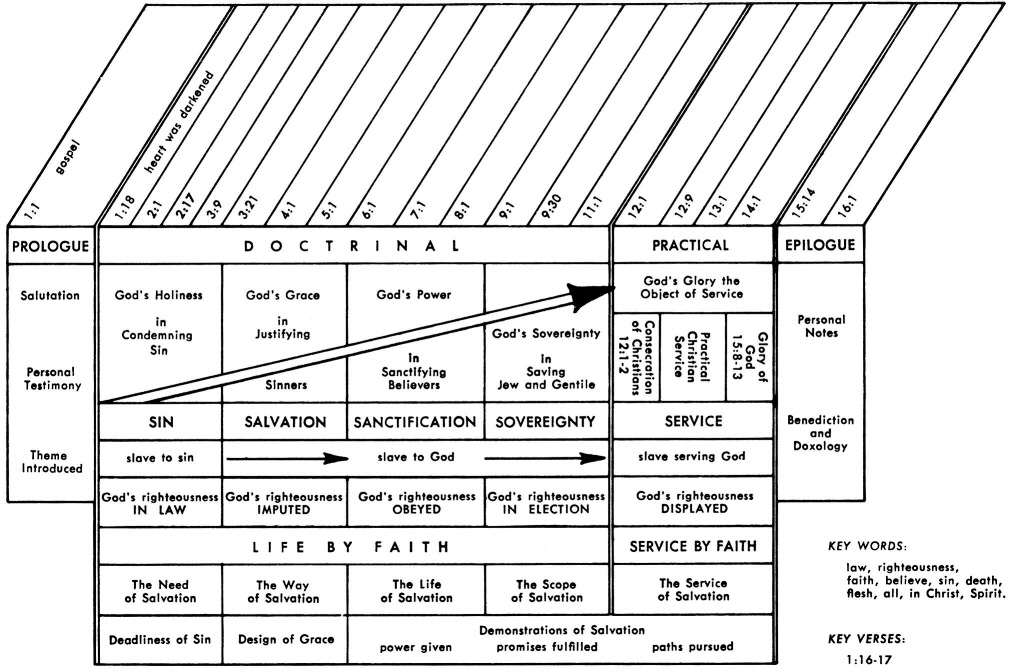
Click chart to enlarge
Chart from recommended resource Jensen's Survey of the NT - used by permission
Romans Overview Chart - Charles Swindoll
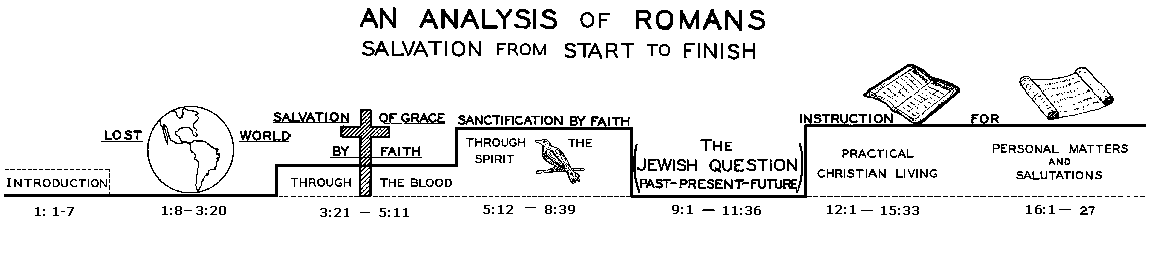
Source: Dr David Cooper
Click to Enlarge
| ROMANS ROAD to RIGHTEOUSNESS |
||||
| Romans 1:18-3:20 | Romans 3:21-5:21 | Romans 6:1-8:39 | Romans 9:1-11:36 | Romans 12:1-16:27 |
| SIN | SALVATION | SANCTIFICATION | SOVEREIGNTY | SERVICE |
| NEED FOR SALVATION |
WAY OF SALVATION |
LIFE OF SALVATION |
SCOPE OF SALVATION |
SERVICE OF SALVATION |
| God's Holiness In Condemning Sin |
God's Grace In Justifying Sinners |
God's Power In Sanctifying Believers |
God's Sovereignty In Saving Jew and Gentile |
Gods Glory The Object of Service |
| Deadliness of Sin |
Design of Grace |
Demonstration of Salvation | ||
| Power Given | Promises Fulfilled | Paths Pursued | ||
| Righteousness Needed |
Righteousness Credited |
Righteousness Demonstrated |
Righteousness Restored to Israel |
Righteousness Applied |
| God's Righteousness IN LAW |
God's Righteousness IMPUTED |
God's Righteousness OBEYED |
God's Righteousness IN ELECTION |
God's Righteousness DISPLAYED |
| Slaves to Sin | Slaves to God | Slaves Serving God | ||
| Doctrine | Duty | |||
| Life by Faith | Service by Faith | |||
|
Modified from Irving L. Jensen's chart above |
||||
R Ruin (Romans 1:17 – 3:20) – The utter sinfulness of humanity
O Offer (Romans 3:21-31) – God’s offer of justification by grace
M Model (Romans 4:1-25) – Abraham as a model for saving faith
A Access (Romans 5:1-11) – The benefits of justification
N New Adam (Romans 5:12-21) – We are children of two “Adams”
S Struggle w/ Sin (Romans 6:1-8:39) Struggle, sanctification, and victory
Romans 8:2 For the law of the Spirit of life in Christ Jesus has set you free from the law of sin and of death. (NASB: Lockman)
Greek: o gar nomos tou pneumatos tes zoes en Christo Iesou eleutherosen (3SAAI) se apo tou nomou tes hamartias kai tou thanatou
Amplified: For the law of the Spirit of life [which is] in Christ Jesus [the law of our new being] has freed me from the law of sin and of death. (Amplified Bible - Lockman)
NLT: For the power of the life-giving Spirit has freed you through Christ Jesus from the power of sin that leads to death. (NLT - Tyndale House)
Phillips: For the new spiritual principle of life "in" Christ lifts me out of the old vicious circle of sin and death. (Phillips: Touchstone)
Wuest: for the law of the Spirit, that of the life in Christ Jesus, freed you once for all from the law of the sinful nature and of death.
Young's Literal: for the law of the Spirit of the life in Christ Jesus did set me free from the law of the sin and of the death;
FOR: ho gar:
- Ro 3:27; Jn 8:36
- Romans 8 Resources - Multiple Sermons and Commentaries
For (gar) introduces an explanation. Whenever you encounter a term of explanation, always consider performing the 3P's (Pause, Ponder and Practice interrogating the passage). Use this connective conjunction as a reason to interrogate the text with the 5W/H'S, asking questions like "What is being explained?". As you perform the 4P's, you will find that you are in essence engaging in the discipline of Biblical Meditation which God promises to richly reward (See Ps 1:2-note, Ps 1:3-note, Joshua 1:8-note).
Johnson explains that "for" "introduces the reader to the reason that there is no condemnation to the one in Christ Jesus. And it is the secret of the spontaneous Christian life that lifts one above the bitter exhausting life of the Christian herd (cf. Is 40:31). The gift of the Spirit is the fruit of justification (cf. see Ro 5:5; 7:6 notes Ro 5:5; 7:6), and He operates in the believer's life with the fixedness of a law (the word here probably means something like principle). His leading is not a matter of "sporadic impulse, but the believer's habitual experience" (cf. Gal 5:18; Ro 8:14 see note note). The presence of the sanctifying Spirit, always at work in the life of the believer, confirms the liberation of verse one. Sanctification, I repeat, is a necessary fruit of justification. Thus, a two-fold salvation results from union with Christ, salvation from the penalty of sin and salvation from the power, or bondage, of sin in the daily life. The law of the Spirit of life aids and supports the "law of the mind" (cf, see Ro 7:23- note) on the road to liberty. What we cannot do of ourselves, even when we are the recipients of a new nature, is done for us by the indwelling Spirit. The key to the deliverance of the believer from indwelling sin is the indwelling Spirit of Christ. The measure of His power within us is the life of God, infinite and eternal. In fact, in another place the apostle affirms that the new unit of measurement of the divine power in the believer's life is the resurrection of Christ. The power that raised Him from the dead works is us (cf. Eph 1:20, 21 - see notes; Micah 7:15). The crowning miracle of His life, His resurrection, is seen in His deliverance of us, an amazing fact (Romans 8:1-4 Power of the Indwelling Spirit) (Bolding added)
Newell offers an interesting comment and challenge to all who saints to slow down and diligently study the passage writing that "Here we have at the very beginning of the chapter, one of the most common words of argument in Paul's epistles, FOR (Greek = gar, Strong's 1063). It occurs some 17 times in this Eighth Chapter, and about one half as many in Chapter Seven, etc. In general, it (FOR) assigns the reason. Let us not be among those who avoid Paul's epistles because of the mental attention they demand. Most people would rather read a novel or go to the picture shows than study. A chapter with 17 "FORS" in it, is closely knit, and must be patiently followed. Unmeasured blessing will result. (Romans: Verse by Verse) (Editorial Comment - You may have counted all the uses of the English word "for" in Romans 8 and arrived at a considerably higher number than Newell. However what Newell has counted are only the uses of the Greek conjunction gar, of which there are in fact 17 distinct uses in the Greek text.)
In summary, Paul explains why there is now "no condemnation for those who are in Christ Jesus." In this next section (Ro 8:2, 3, 4) Paul draws a striking contrast between those who are in Adam and thus can walk only according to the flesh and those who are in Christ and now have a supernatural ability to walk according to the Spirit. We were bound by (enslaved to) sin and death just as we're bound by the law of gravity. It was holding us earthbound or, more accurately, flesh-bound. However, the law of gravity can be overcome by the proper application of certain natural laws, such as the principle of aerodynamics. Though aerodynamics doesn't negate gravity, it can overcome its force. Similarly as we learn to submit to and depend upon the indwelling Spirit, we can overcome the continual pull of our fallen flesh (it's "gravity" if you will) which seeks to make us commit sin. This classic confrontation is described by Paul in Galatians 5:16-17. Notice that the way a believer overcomes the lust of the flesh is NOT by trying not to do what the fleshly desire is tempting us to do, but by walking continually by the Spirit. When we yield to the Spirit and allow His supernatural power to flow through our members, then (and only then) will we be able to refuse the desire of the flesh. The correct order is to say "Yes" to the Spirit and then you will be enabled to say "No" to the flesh. If you invert this order, you end up putting yourself in the subtle trap of legalism, saying "I won't do this or that, etc." That is a surefire setup for falling. Romans 8:13 is a corollary for there Paul says that we are putting to death the (sinful) deeds of the body by the Spirit. When we try to put the deeds of the body to death by using our flesh, we end up actually arousing our flesh (see Ro 7:5).
THE LAW OF THE SPIRIT OF LIFE IN CHRIST JESUS: ho gar nomos tou pneumatos tes zoes en Christo Iesou:
- Ro 8:10, 11; Jn 4:10,14; 6:63; 7:38,39; 1Co 15:45; 2Co 3:6; Rev 11:11; 22:1
- Ro 3:21-5:11
- Romans 8 Resources - Multiple Sermons and Commentaries
THE VITAL PRINCIPLE OF
A DYNAMIC SPIRITUAL LIFE
The law (principle) of life - The Holy Spirit is repeatedly described as the Source of spiritual life. Read Ro 8:10, 11; Jn 6:63; 7:38,39. Notice the "sphere" of this life - in Christ Jesus. Do you know and are you experiencing the Holy Spirit as your Source of life in Christ Jesus?
Paul is describing a principle of the spiritual life, like the law of gravity (see below), for one does not have to urge on the "law of gravity" to exert its effect. It does it because that is its natural function. It is like the heart beating. The principle is that it beats without having to be told to do so (excepting of course artificial means of stimulation). In the same way the "law of the Spirit of life" works constantly and will ultimately accomplish His goal of conforming each believer to the image of God's Son (see Ro 8:29, 8:3-note). One is reminded of God's promise to Jacob...
"And behold, I am with you, and will keep you wherever you go, and will bring you back to this land; for I will not leave you until I have done what I have promised you." (Genesis 28:15)
So too the law of the Spirit will accomplish what God has promised (cp Phil 1:6-note). There is a new law for the new life., a new spiritual principal for a new spiritual life! This animating (life giving/producing) principle is the Holy Spirit Who acts as the Imparter of life (Jn 6:63).
Vine notes that "The phrase “the Spirit of life,” is not subjective, “the Spirit who has life,” but objective, “the Spirit who gives life.” “It is the Spirit who quickeneth” (John 6:63 "It is the Spirit who gives life; the flesh profits nothing; the words that I have spoken to you are spirit and are life."). (Vine, W. Collected writings of W. E. Vine. Nashville: Thomas Nelson)
Law (3551) (nomos) is used in this context to stand for the regulative principle which exercises a control over one. It is analogous to the phrase, the "law" of gravity. Law in this use is not a reference to the Mosaic law or to other divine commandments or requirements. Nomos is a general "principle" or rule, norm and/or standard of judging or acting. It is the principle by which something else operates (see note) Nomos is used in the sense of a principle of operation earlier in the letter, where he speaks of “a law of faith” (see Ro 3:27 note) and as he does in Galatians, where he speaks of “the law of Christ” (Gal 6:2). The law of the Spirit is higher and more powerful than the law of sin and death.
Webster's 1828 says principle is "In a general sense, the cause, source or origin of any thing; that from which a thing proceeds; as the principle of motion. Being that produces any thing; operative cause. The soul of man is an active principle. Tillotson."
Stated another way the law is not a written law but a regulative principle which exercises a control over the life of the believer. On the positive side, the regulative control over a believer's life is exercised by the Holy Spirit (although He can be resisted, quenched, grieved, etc which thwarts the efficacy of His supernatural power and work in one's life!). This control is in the form of the "supernatural energy" giving us both the desire and the power to do God’s will (see Ezekiel 36:27-note, Philippians 2:13-note).
The principle of the sin and its association with death is abundantly clear from Romans 7, where we saw the power of sin which brings death as demonstrated by every sin we commit and every cemetery we see. But now in the Risen Christ, Paul instructs us that the "operating principle" of the Spirit of life is stronger than that associated with Sin, and in fact has the inherent power to free us from the operating principle of sin and death, which controls all those who are still "in Adam" and which can still exert its deleterious effects upon those are now "in Christ". But Paul knows that the truth about these two principles has the potential to set his believing readers free to be all they have the potential to be "in Christ."
In short, the power of this new life is the Holy Spirit Who becomes the Almighty Agent within the believer, securing him wholly, making effectual in experience the deliverance which Paul saw when he cried in Romans 7:24-25:
Wretched man that I am! Who will set me free (rhuomai = rescue by drawing or snatching another to oneself and invariably from danger, evil or an enemy) from the body of this death? Thanks be to God through Jesus Christ our Lord! So then, on the one hand I myself with my mind am serving the law of God, but on the other, with my flesh the law of sin.
Of course, the deliverance is through Christ, for it is Christ's Own risen life which every believer now shares ("Christ our life" - Col 3:4-note). But it is the blessed Holy Spirit as "the Spirit of life in Christ Jesus", Who makes the deliverance a reality in our everyday experience. It is the Spirit Who is constantly at work in us to make effectual the deliverance from the "law of sin and of death".
The "law (principle) of the Spirit" is analogous to the "law (principle) of aerodynamics" and it's effect on lifting a plane off the ground thus "countering" effects of the "law (principle) of gravity" (see F B Meyer's note). The Spirit similarly lifts believer's lives to a new plane, to "fly" at a new altitude that heretofore was not possible under the "law of sin and of death" when they tried to attain righteousness in their own power and/or by keeping the Law (or religious rules - anything that we do with the intent to try to make us more pleasing to God. God does not desire our fleshly works or sacrifices but obedience, a broken spirit, a broken heart). We were not justified by faith and we cannot be sanctified by faith (Gal 3:3)...it is a supernatural work of grace of the Holy Spirit of God (Gal 5:1,7). Observe that prior to Romans 8 the Spirit was only mentioned for four times in this letter, but in Romans 8 He is mentioned 19 times making Him clearly a "keyword"!
BEWARE!
MAINTAIN A HEALTHY SELF-DISTRUST!
Let us remember that an attitude of self-distrust (not of God of course, but of self, our fallen flesh) is vital to our spiritual well-being. As someone has written “Self-distrust is the condition of all victory.” King Asa (before he became prideful) gives us an illustration of self-distrust - "Then Asa called to the LORD his God, and said, "LORD, there is no one besides Thee to help in the battle between the powerful and those who have no strength (cf self-distrust and note it leads to Savior trust!); so help us, O LORD our God, for we trust in Thee, and in Thy name have come against this multitude. O LORD, Thou art our God; let not man prevail against Thee." (2Chr 14:11) A Puritan writer in the Valley of Vision ends his prayer beseeching God with these wise words "Let me live a life of self-distrust, dependence on Thyself, mortification, crucifixion, prayer." James Smith includes self-distrust among several which reflect the blessed state of those who are "poor in spirit." (Mt 5:3, cf Php 3:3) In Phil 2:12 we are commanded to "work out our salvation in fear and trembling," where the idea of fear and trembling includes a healthy distrust of self as the old Scottish preacher Wardlaw says "This fear (in Php 2:12) is self-distrust; it is tenderness of conscience; it is vigilance against temptation; it is the fear which inspiration opposes to high-mindedness in the admonition 'be not high-minded but fear.' It is taking heed lest we fall (1Cor 10:12); it is a constant apprehension of the deceitfulness of the heart (Jer 17:9), and of the insidiousness and power of inward corruption [in the unsanctified]. It is the caution and circumspection which timidly shrinks from whatever would offend and dishonor God and the Savior (Ps 19:13)." G Campbell Morgan noted the paradox that God's "grace keeps the soul in the dust of self-distrust; but lifts it to the height of confidence and loyalty." Arthur Ritchie wrote "The secret of perfect trust is perfect self-distrust. And there is nothing which helps more to a realization of one’s unworthiness than the contemplation of the just judgment of God as He reveals it in Holy Writ." Lilley writes "To walk in humility, self-distrust, and holy fear is wisdom." Herbert Lockyer commenting on the apostle Peter wrote "Under divine training Peter came to learn that the secret of victorious strength in service for Christ is self-distrust, "When I am weak, then am I strong." Through his pride, through his overweening self-confidence, Peter fell, but there is one verse in his first epistle, addressed especially to those who are self-reliant, "Be sober, be vigilant; because your adversary the devil, as a roaring lion, walketh about, seeking whom he may devour." From Jesus, Peter learned the lesson of self-abnegation (denial). The Master died to self before He died for sin. "Reviled, he reviled not again." This was the example which Peter the braggart came to follow (1Peter 2:21-24). Along a hard road he came to experience that "God resisteth the proud, and giveth grace to the humble" (1Pet. 5:5)." C. B. Brigstocke writes that "Self-confidence is the mark of the natural man. Self-distrust is the mark of the genuine disciple of Christ." Joseph Parker says "We are safe in Humility, we are secured by self-distrust; for then we cry mightily with the tenderness of prayer, "Hold thou me up and I shall be safe!" Joseph Parker also prayed "Teach us our ignorance. May we begin at the point of self-distrust, and gradually move onward by the guidance of the Holy Ghost to perfect faith in the Son of God. We would live the faith-life: we would live, and move, and have our being in the Spirit."
Spurgeon well said "Beware of no man more than of yourself: we carry our worst enemies within us! Distrust yourself, dear friend, for you accurately gauge your own judgment when you do that. The well-instructed believer is very much afraid of himself; he dares not go into temptation, for he feels that a man who carries a bomb-shell within him ought to mind that he keeps away from sparks, and that he who has a powder-magazine in his heart ought not to play with fire. When I hear my Master say, “One of you shall betray me,” I may have a shrewd suspicion that he refers to Judas, but it will be wiser for me to say, “Lord, is it I?” rather than to ask, “Lord, is it Judas?”
A W Tozer on self-distrust - It is important that we understand how dangerous it is to trust our good habits and virtues. Only God can bring us to the point of understanding that our strength is indeed our weakness. Anything that we rely on or trust can be our undoing. We do not realize how weak we are until the Holy Spirit begins exposing these things to us.
Why do we need to maintain an attitude of healthy self-distrust? There is ever before us the subtle trap into which we are in danger of falling and that trap is in trying to "clean ourselves up" so that we appear more holy. Take for example Paul's story of frustration in Romans 7- it is applicable whether you believe it describes a believer or a non-believer. Romans 7 clearly shows that in the realm of our spiritual life, self (flesh) effort won't work and in fact will leave you in a wretched state! How do we try to "clean ourselves up"? There are many ways we could answer this question. For example, we stop going to R-Rated movies, we stop cursing, etc (and yes, we should stop all of these things) but we think that because we have abandoned a few of the "top five" bad behaviors we are "better" and thus more acceptable to our Father. The Christian life however is not a matter of stopping some things and starting some other things. Paul is saying that now we have experienced a radical transformation and are to order our steps by an entirely new regulating principle, the principle of the Holy Spirit. This distinction may be difficult to grasp, but is worth trying to understand. The question we need to ask ourselves is "Why do I do what I do?" If we can truly say that the Spirit initiated it and energizes it, then glory to God in the highest. If however we initiated it and energized it, no matter how "good" it might appear to others, it is ultimately a work of the flesh. I wrestle with this distinction even as I write these notes...is this flesh or Spirit?
Notice that some of the terminology in this chapter can be confusing. Specifically, true believers although fully capable of behaving quite "fleshly" are strictly speaking no longer "in the flesh" even though the flesh still remains in us. It is a fact that a residual of the flesh nature inherited from our first spiritual father, Adam, still remains in our physical, mortal bodies. But you say "Yes, I know that's true because I still sin. But at least the flesh is better than it was when I was saved 10 years ago." Wrong! Your flesh and my flesh is no less corrupt, evil, depraved and wicked than it was before our regeneration. "So what's changed?" you ask. Well, what has changed is that flesh now no longer rules in your mortal, physical body like it did when you were "in the flesh". When you were unregenerate in Adam, the flesh was the reigning king. But when you were regenerated, being born from above by the Holy Spirit, the flesh or Old self (old man) was "dethroned" so to speak (the glorious transaction Paul explains in Romans 6:1, 2, 3; 4, 5; 6, 7; 8, 9, 10; 11). But now you have a choice see notes Romans 6:1-3; 6:4-5; 6:6-7; 6:8-10; 6:11). But now you have a choice to make every moment of every day - "Will I obey the flesh or will I obey the Spirit in this particular attitude, action, word or deed?" It's really that simple and yet that profound. We will spend the remainder of our lives learning how to walk in and be controlled by the Holy Spirit, but it is only in this manner that we can experience genuine victory over the old flesh which still lurks within our mortal bodies, seeking to carry out surreptitious attacks that are potentially just as evil and destructive as those it carried out before we were saved. When can the flesh exert control? It occurs when we make a conscious, willful choice to walk in the flesh instead of in the Spirit. Believers have the "mind of Christ" and are called to use their renewed minds to make the choice for God and for His Spirit (realizing that even the "want to" is made possible by a gracious gift of God!). When we make the good, God choice we experience the power not to commit a particular sin as the result of the empowerment and enablement by the Holy Spirit indwelling us and ever leading us to be conformed to the image of God's Son.
"Separation" from the world (sanctification) takes place as we "cooperate" with the Spirit (under control of or continuously being filled with the Spirit...like a "drunk" man...what fills him controls him.) We too, like Paul, have to continually, daily die to the flesh, first saying "yes" to Jesus (arising each morning and choosing to present ourselves to Him as living sacrifices - see Romans 12:1-note) and then much more likely to say "no" to the flesh. Then the Spirit of Christ can live His life through us. It is not us living "like Jesus" trying to do for Him, but Christ actually living His life through us - this is the key to the Christ Life. After all, what happens to the word "Christian" when we take our the name of our Lord? So how can we live this "Christian" life?...
We can't but He can
(Galatians 2:20 -note)
Christ now in us and enables us to do what He has commanded us to do (see Philippians 2:12,13-note). We must come to the wretched end of ourselves (cp Romans 7:24-note), realizing we cannot live the life Christ lived unless He lives it through us, in the power of His Spirit, and ultimately for the glory of His Father. Have you reached this "wretched point" in your life? Take heart, there is great hope in Romans 8 for
"the path of the righteous is like the light of dawn, that shines brighter and brighter until the full day." (Proverbs 4:18)
Larry Richards has an insightful comment on the victory available to every believer in Romans 8 explaining that...
Sin within is overcome by a new and powerful principle, that of “the Spirit of life.” Put simply, Paul found his answer in realizing that even as a believer he could not keep the Law … and was no longer trying! Paul no longer felt any obligation to try! Paul had finally accepted himself as really a sinner, with no hope of pleasing God. So Paul turned his gaze back to the Cross, and found joy in the thought of “no condemnation.” But then Paul made the great discovery! When he stopped trying, and instead relied on God to express His own divine life through Paul’s personality, then “the righteous requirements of the Law” were “fully met” in him (Ro 8:4-note). Sin lived in Paul. But Christ lived in Paul too. If Paul concentrated on keeping the Law rather than on trusting Jesus, his old nature was stimulated and he sinned. When Paul concentrated on trusting Jesus, the Spirit energized his new nature and he found himself living a righteous life. Our obligation, then, is not to the Law, but to respond to the leading of the Holy Spirit (Ro 8:12-note, Ro 8:14-note). The Law has been replaced by an intimate, personal relationship with God.
Baseball provides an analogy. We want to get to first base. But to do so the batter does not look at first base. He watches the ball. He focuses all his energy in concentrating on hitting the ball as it is pitched. In a sense the “righteous requirements” of the Law are first base to us. We yearn to get there. But too many believers focus their attention on first base—and constantly strike out! What Paul said was keep your eye on the ball—on Jesus Himself—and you will discover that you arrive on first base (a righteous life) without even trying. (Ed note: Not exactly in my opinion - e.g., see Philippians 2:13- note)
How can relationship be the key to moral victory? How does relationship produce righteousness? Paul showed us that as we deepen our relationship with the Lord, the Spirit of God gains more and more control over our lives. Then the Spirit will “give life to your mortal bodies” (Ro 8:11-note). Yes, in our mortality we are in the grip of sin. It has always taken resurrection, life from the dead, for God to express Himself in human beings. And resurrection is exactly what God provides for those who “live in accordance with the Spirit” and “have their minds set on what the Spirit desires” (Ro 8:15-note). (Richards, L., & Richards, L. O. The Teacher's Commentary. Wheaton, Ill.: Victor Books)
Notice the precious and magnificent promises that the Holy Spirit provides for every believer in Romans 8:
- Freedom (Ro 8:2-note)
- Strength for service (Ro 8:11-note)
- Victory over sin (Ro 8:13-note)
- Guidance (Ro 8:14-note)
- Witness of sonship (Ro 8:16-note)
- Assistance in prayer (Ro 8:26-note)
Henry Morris explains that "The "law of the Spirit of life" has invaded and opposed "the law of sin which is in my members" (Romans 7:23-note), thus freeing us from its bondage (Romans 6:12, 13, 14, 15, 16, 17 see notes on Romans 6:12-14 6:15-17). We cannot obey God's law in the strength of the flesh, but as we reckon (that is, deliberately acknowledge) ourselves to be dead to sin and "alive unto God" (see Romans 6:11-note) this doctrinal truth increasingly becomes practical truth in our lives." (Morris, Henry: Defenders Study Bible)
Newell (Romans: Verse by Verse) writes that...
John Wesley's testimony is well known, concerning the beginning of his life of real faith (in his 35th year, after 13 years in a relatively commonplace ministry):
"In the evening I went very unwillingly to a society in Aldersgate Street where one was reading Luther's preface to the Epistle to the Romans. About a quarter before nine, while he was describing the change which God works in the heart through faith in Christ, I felt my heart strangely warmed. I felt I did trust in Christ, Christ alone, for salvation; and an assurance was given me, that He had taken away my sins, even mine, and saved me from the law of sin and death.
For the next 53 years Wesley was "the outstanding figure and the greatest force in the English speaking world." But notice that he realized at Aldersgate Street, the two great elements of our salvation:
(1) forgiveness of sin's guilt; and
(2) deliverance from sin's power - from the law of sin and death.'
Alford says that “This law of the Spirit of life having freed him from the law of sin and death, so that he serves another master, all claim of sin on him is at an end—he is acquitted, and there is no condemnation for him.”
HAS SET YOU FREE: eleutherosen (3SAAI) se:
- Ro 6:18,22; Ps 51:12; Jn 8:32; 2Co 3:17 Gal 2:19; 5:1
- Romans 8 Resources - Multiple Sermons and Commentaries
ARE YOU IN
"A RIVER OR A SWAMP?"
From an editorial in the Wesleyan Christian Advocate...
The difference between a river and a swamp is that a river is confined within banks, while a swamp is not... Because a river is confined and channeled, it has life. It is a mighty, moving, living thing. Because a swamp has no restrictions, it becomes thin and stagnant... In our modern life we boast of freedom, We want life without restrictions and without confinement. Only we forget that such living becomes stagnant.
Comment: Remember that FREEDOM IN CHRIST is not the right to do as one pleases but the power to please God by doing what is right! Father, we thank You for the promises that Christ has set us free, that by His Spirit rivers of living water can now flow from our innermost being & that as we follow Him by abiding in His Word, we shall know the truth & the truth shall make us free & we shall be free indeed in the Son. Amen (Ro 8:2, Jn 7:37, 8:31-32,36)
Has set you free (1659) (eleutheroo = the ending " -oo" means not only will it be set free but it will be seen as set free) means to cause someone to be freed from domination. The picture is that of the emancipation of slaves. The idea is that the one set free is at liberty, capable of movement, exempt from obligation or liability, and unfettered. Although the act of setting free results in freedom and liberty we must understand that this new freedom is not a license to sin. In fact true liberty for the believer is now living as we should and not as we please.
Friberg says eleutheroo speaks "(1) of spiritual and moral freedom set free, make free (Jn 8.32); (2) of freedom from binding legalism make free (Gal 5.1); (3) of nature's deliverance from decay and corruption free, deliver, liberate (Ro 8.21)" (BORROW Analytical Lexicon of the Greek New Testament)
Related Resources: Studies on eleutheria and eleutheros
Eleutheroo is used 7 times in the NT -- Jn 8:32+, Jn 8:36+; Ro 6:18+, Ro 6:22+; Ro 8:2+, Ro 8:21+; Gal. 5:1+ (and only in Pr 25:10 in the Septuagint) (Two times In Apocrypha - 2Macc 1:27, 2:22)
John 8:32+ and you will know the truth, and the truth will make you free."
John 8:36+ "So if the Son makes you free, you will be free indeed.
Romans 6:18+ and having been freed from sin, you became slaves of righteousness.
Romans 6:22+ But now having been freed from sin and enslaved to God, you derive your benefit, resulting in sanctification, and the outcome, eternal life.
Romans 8:2+ For the law of the Spirit of life in Christ Jesus has set you free from the law of sin and of death.
Romans 8:21+ that the creation itself also will be set free from its slavery to corruption into the freedom of the glory of the children of God.
Galatians 5:1+ It was for freedom that Christ set us free; therefore keep standing firm and do not be subject again to a yoke of slavery.
In short, the Spirit, Who brought the life of God Himself into us, has set us free from the power of our flesh and free to be the person God wants us to be. In Romans 7:24 Paul asked "Who shall deliver me?" The answer given in this verse is that: "Christ has already delivered me!" The last part of Romans chapter 7 was a description of a believer's struggling, failing condition. In Romans 8 Paul encourages the believer to focus upon his perfect, unfailing position in Christ Jesus! The more we believe God’s facts about our position the more this will affect our actual condition!
Pritchard writes that the fact that you have been set free means "You don't have to sin any more. You don't have to live in defeat any more. You don't have to be down any more. You don't have to go years and years and years committing the same old dumb sins over and over again. Why? Because the law of the spirit of life of Jesus Christ has set you free. Therefore, if you choose to dwell in sin, if you choose to be defeated, it's because you've chosen to live that way, not because you must live that way. (Romans 8)
Eleutheroo is used primarily in three ways in the NT, first describing as in the present verse, describing spiritual and moral freed. Jesus described this same freedom when He declared to those Jews who had believed Him...
"If you abide in My word, then you are truly disciples of Mine and you shall know the truth, and the truth shall make you free (eleutheroo)." (Jn 8:31, 32)
MacDonald comments that the "Jews did not know the truth, and they were in a terrible form of bondage. They were in the bondage of ignorance, error, sin, law, and superstition. Those who truly know the Lord Jesus are delivered from sin, they walk in the light, and are led by the Holy Spirit of God." (BORROW Believer's Bible Commentary)
J Vernon McGee adds this pithy comment writing that "Faith alone saves, but the faith that saves is not alone (see notes beginning in James 2:14 -- notes ). It will produce something. After a person believes on the Lord Jesus Christ, he will want to “continue in His Word.” The proof of faith is continuing with the Savior." (Ed note: And that is the person who will truly experience the freedom that Jesus makes possible!) (BORROW John Commentary)
Secondly eleutheroo is used to describe the freedom from binding legalism as Paul taught in Galatians writing..
"It was for freedom that Christ set us free (eleutheroo); therefore keep standing firm and do not be subject again to a yoke of slavery. (Gal 5:1). MacDonald has an excellent word on this verse writing that "This first verse of chapter 5 refers to his practice—he should live as a free man. Here we have a very good illustration of the difference between law and grace. The law would say: “If you earn your freedom, you will become free.” But grace says: “You have been made free at the tremendous cost of the death of Christ. In gratitude to Him, you should stand fast therefore in the liberty with which Christ has made you free.” Law commands but does not enable. Grace provides what law demands, then enables man to live a life consistent with his position by the power of the Holy Spirit and rewards him for doing it." (Ibid)
Thirdly, eleutheroo is used to describe nature’s deliverance from decay and corruption, Paul writing...
"that the creation itself also will be set free from its slavery to corruption into the freedom (related noun eleutheria = to enjoy the freedom of that golden era when we as God’s children will be revealed in glory) of the glory of the children of God. (Jn 8:36)
Here in Romans 8:3, "has set you free" (eleutheroo) is in the aorist tense which signifies a once-for-all act of setting the captives free. It is a positional reality for every person who is in Christ. This is a past tense event. So what? Well, it means that now believers are not to struggle for freedom, but to stand firm by faith (not sight) in the freedom that we have in Christ (see similar truth in notes Ro 6:18 and Ro 6:22 where the apostle also used the verb eleutheroo, cf Gal 5:1). In a sense the ultimate (or perfect) realization of this freedom awaits our future glorification (see Romans 8:21-note). Note also that Paul is not teaching sinless perfection for remnants of our sinful flesh are the objects of the Spirit's ministry as long as we are in this physical flesh. What Paul does teach is at the time of regeneration the liberty began and will continue until it is perfected in glory.
Chuck Swindoll in his book (highly recommended) "Embraced by the Spirit" (2011) has an excellent illustration of the meaning of the verb eleutheroo in his discussion of how the Spirit sets us free from besetting sins....
Let’s turn our thoughts now to the “how”—how does the Spirit set us free on a daily basis? We can live our lives thinking that we have figured it out, only to discover later there’s a whole other world going on that we missed in the process. I want to introduce to you an awareness that many (I’m tempted to say most) Christians do not have. I’m referring to slavery. That may surprise you. Most of us have never witnessed firsthand the raw reality of human slavery. We’ve watched television docudramas on the subject. We’re theoretically aware that it once went on, but chances are good that most of us have never witnessed it for ourselves. Tragically, another category of slavery goes on every day in the lives of Christians.
But before we go there, let’s grasp a mental picture of slavery. Back in the nineteenth century our sixteenth president realized something radical must be done about slavery in our country. Unwilling to look the other way any longer, on September 22, 1862, he presented what came to be known as the Emancipation Proclamation, an official document condemning human slavery. Abraham Lincoln, realizing that slavery is completely against human dignity, officially abolished it from the United States on that day. Tragically, little changed in the daily life of our nation, even though the slaves were officially declared free. You know why; you’ve read the stories. The Civil War was still going on. The plantation owners never informed their slaves. The vast majority of the former slaves couldn’t read, so they had no idea what the news was carrying. There was no mass media then to announce those kinds of presidential pronouncements. And so for the longest time, slavery continued even though it had been officially brought to an end. The war ended in April 1865. Do you know when Lincoln’s declaration was officially enacted? When the people finally began to leave their enslaved lives and make their way toward freedom? December 18, 1865—more than three years after he first released his proclamation. Lincoln had been dead for months. The word traveled out of the streets of Washington and down into the Shenandoah Valley of Virginia, across the back roads of the Carolinas and into Georgia, then Alabama, then Mississippi, then Louisiana, then Texas, then Arkansas, announcing what had been true for more than a thousand days. Even then the word somehow either wasn’t believed or wasn’t acted upon. Those officially emancipated people, thinking slavery was the way they were condemned to exist, continued to live in bondage though they had been declared free men and women since the fall of 1862.
Now if you think that seems shocking, let me tell you something equally as shocking: believers in Jesus Christ still live enslaved to the domination of a power that no longer has power over them. What has freed us is the great Emancipator, Jesus Christ, whose death on the cross set us free from the law of sin and the fear of death. Like an Emancipation Proclamation, it was made known to the world at large: Satan is defeated! Sin is overwhelmed! Death no longer has its sting! Listen to our Emancipation Proclamation, our Freedom Statement: “Our old self was crucified with Him, in order that our body of sin might be done away with, so that we would no longer be slaves to sin” (Ro 6:6-note). In simple terms, this freedom liberated us from the necessity to sin. Truth be told, you don’t have to sin. You know why you sin? Because you want to! That doesn’t sound very affirming but it’s the ugly truth. Every time you sinned last week, you wanted to. The same this week. You weren’t forced to. It certainly wasn’t the new nature operating within you. You gave in to the old nature that you had been enslaved to so much of your life. As a Christian living like this, you are under the false impression that you are as you’ve always been and things are just the same as they’ve always been: “There’s just that part of me that I can’t help. I just react like that. It’s just the way I am.” But it’s not the way you have to be. It’s the way you choose to be. Think of it like this. You’re driving in the mountains. You come to a very sharp series of curves. The state officials who work with traffic signs have options. They can build a clinic at the bottom of the curve so that when you go over the cliff and crash, emergency vehicles can come quickly to help you. Or they can put up a sign that says, “SLOW, CURVE AHEAD.” The favorite verse 1John 1:9-note is the clinic at the bottom of the hill. It’s mercy after the fact. The Lord is faithful to forgive us our sins. After we’ve sinned, thank God we are able to go to Him and say, “Lord, today I blew it” or “I reacted in a way that wasn’t appropriate” or “I lusted,” “I lost my temper,” “Greed took over and I walked through it at the time knowing completely that I was doing what’s wrong but I went ahead anyway. That’s sin and I lay it before You, I confess that to You.” That’s the clinic. But there’s a better way! You can read the sign and react differently. You don’t have to speed around this curve; you don’t have to go over the cliff. You can slow down. When you realize that you’re faced with a temptation, you can stand up against it. You don’t have to yield to it. That’s what Romans 6 means when it says we should no longer be slaves to sin: “He who has died [in Christ] is freed from sin” (Ro 6:7-note). It doesn’t mean we’re freed from ever sinning again; it means we’re freed from its domination. I can live my life in such dependence on the Spirit of God that the flesh does not get its way for an extended period of time. Now I can never live free of it because the old nature (flesh) hasn’t been eradicated. But thanks to the power of God I can be on the side of such victory in my life that I walk a whole new kind of life. (Embraced by the Spirit The Untold Blessings of Intimacy with God - 2011 - recommended reading)
Ray Stedman makes this liberating law of the Spirit of life in Christ Jesus very practical noting that...
Sometimes, even though we are very disturbed (feeling "self-condemned" forgetting that "God doesn't condemn us. He knows that there is a struggle, and he is not surprised or alarmed. It doesn't shock Him as it does us, because He expected nothing but failure all the time! He knows the flesh; He knows it can't do anything, and He's not surprised), the greatest moment in our life is when we come to God, and say, "Lord, I quit! I cannot do it." God says, "Good! That is what I have been waiting for. Now I'll do it." And, without a word of reproach or rebuke for our failure, he does through us what we struggled in vain to do -- that is "the law of the spirit of life in Christ Jesus."
Notice what he says: What neither the Ten Commandments, nor any other law, could ever accomplish, what no standard of perfection that we are trying to follow could ever do, because of our weak, sinful, unable flesh, is now fully accomplished in us by another principle: The indwelling life of Jesus Christ, ministered to us continually by the Spirit to do everything that life demands of us, fulfilling the Law, and more. However, the law of sin and barrenness still persists. It is still present, and ready to spring into action whenever we harbor sin or try to serve Christ by our own will or ability. We will discover this to be so, and that is why Paul puts this struggle in the present tense. But when we abide in Christ, as He abides in us, and we recognize that for everything we do, whether it is tying our shoe, washing the dishes, preaching a message, typing a letter, or whatever it is -- for everything we do, we must rely in total dependence upon the law of the Spirit of life in Christ Jesus in us; then that law takes over and cancels out the law of sin and death. What we could not do by our own effort, we do through Him....
This is the exchanged life, the released life. It is a continual paradox. Life in the Spirit is a life of restful activity, and this is a paradox. It isn't simply sitting around waiting for orders from God. It is facing life with all its mystery and fascination, with a continual recognition of, and constant praise and thanksgiving for the fact that, within, is the indwelling life of Christ, ready to do instantly, through me, all that I need to do. As I rest upon it, I find that I can simply go ahead doing the normal, the natural, the obvious, and, in it and through it all, God is at work! Life becomes a continual matter of the expectation of miracles, of excitement, because of what God does through me -- and yet it is rest without struggle...(Romans 7:14-8:4: False Consecration)
Paul explained the truth about the distinctive privilege of those who have been redeemed to the Galatians who were being tempted to get back up under the law writing that...
"you were called to freedom (the noun form eleutheria), brethren; only do not turn your freedom (your independence, your liberty) into an opportunity (aphorme = literally the starting point or base of operations for an expedition, then generally the resources needed to carry through an undertaking) for the flesh (referring not to the physical body per se but to the old sin nature that still inhabits our flesh), but through love serve one another." (Galatians 5:13) (click related study)
In a similar warning Peter encouraged the saints to
"Act as free men (eleutheros = at liberty, capable of movement, "free ones", exempt from obligation or liability, unrestrained, unconstrained, unfettered, one set free from slavery to the mastery of the power of indwelling sin), and do not use your freedom as a covering (literally a "veil" = a pretext = motive alleged or an appearance assumed in order to cloak the real intention) for evil, but use it as bondslaves (Click word study of doulos) of God." (see note 1 Peter 2:16)
Freedom in Jesus Christ is the great manifesto of Christianity. Christianity is liberation from slavery to Sin. Freedom is at the very heart of the gospel and of godly living. It is not a side benefit or an adjunct to the Christian life. Freedom is presented here at the beginning of Romans 8 as a signal blessing of the economy of grace, which, in contrast with the OT economy, is represented as including independence from religious regulations and legal restrictions (Galatians 2:4) and freedom from the yoke of the Mosaic Law (Galatians 5:1).
As alluded to above, freedom in Christ is
Not the right to do as one pleases
But the power to do as he ought!
This includes freedom from the dominion of sinful appetites and passions, as well as the temptations of the world system to rebel against God [Gal 5:24-note, Gal 6:14-note]
Note that there is a balance we must remember when discussing our new freedom in Christ. Release from the law’s bondage and condemnation does not mean release from the law’s requirements and standards. The higher law of the Spirit produces obedience to the lower law of duties. Obedience to God cannot save a person, because no person in his unredeemed sinfulness wants to obey God and could not obey perfectly even if he had the desire. But genuine salvation will always produce obedience from a new heart. This obedience will never be perfect in this life but nonetheless it is always present to some extent. See the in depth discussion on the gospel which leads to the “obedience of faith” (click study of this phrase).
Warren Wiersbe wrote that...
Freedom does not mean I am able to do whatever I want to do. That’s the worst kind of bondage.
Freedom means I have been set free to become all that God wants me to be, to achieve all that God wants me to achieve, to enjoy all that God wants me to enjoy.
When God saved you, He gave you a new life, not a new law; as you yield to that life, you obey His law.
A W Tozer said that ...
The true character of a people is revealed in the uses it makes of its freedoms." In another place Tozer said "I think it might be well for us to check our spiritual condition occasionally by the simple test of compatibility. When we are free to go, where do we go! In what company do we feel most at home! Where do our thoughts turn when they are free to turn where they will! When the pressure of work or business or school has temporarily lifted and we are able to think of what we will instead of what we must, what do we think of then!"
Edward Gibbons a secular historian makes an interesting comment on freedom worth pondering in light of the truth of the verb eleutheroo...
When the Athenians finally wanted not to give to society, but for society to give to them, when the freedom they wished for was freedom from responsibility, then Athens ceased to be free.
Vance Havner applied the truth about freedom stating...
I am thinking today of the liberty there is in Christ. In these days of light and loose thinking on all subjects, we are likely to forget that freedom comes through submission..
FROM THE LAW OF (the) SIN AND OF (the) DEATH: apo tou nomou tes hamartias kai tou thanatou:
- Romans 5:21; 7:21,24,25
- Romans 8 Resources - Multiple Sermons and Commentaries
I have been delivered and set free from the law of sin and death. If I were still under the law of sin and death then I would be under God’s condemnation because sin demands judgment, death and condemnation -- the penalty for sin must be paid!
One could interpret, “For the regulative principle of the Spirit, namely, the life which is in Christ Jesus,” this freed me from the regulative principle of sin and death (the evil nature), at the moment I put my trust in the Lord Jesus and was saved.
Wayne Barber first gives a general definition of hamartia, the Greek word for sin
First of all is a definition of sin. What is sin? If I’ve got to deal with it and it is very clear that I do, then what is sin? In 1Jn 1:8, 9, 10 we have just seen the word mentioned. It is used in 17 verses in the book of 1John, so it is kind of on John’s mind. It is a very prominent word in the study of 1 John. The Greek word for sin is hamartia. It comes from the hamartano, which means to miss the mark. It’s like taking a bow and arrow and shooting at a target. When you are shooting at something, you try to hit it. When you miss it, that is what sin is like. I want you to get the idea, shooting at a mark and missing the mark. That is what the whole thing is all about. When you put that in light of the Christian’s life, the Christian’s walk is when you shoot at something. Perhaps it is God’s mark for you but you go about it the wrong way and you miss it. You miss what God had intended in your life. It is when you choose to walk in darkness rather than light. It is when the Word of God has something very specific to say to you about your family, has something very specific to say to you about your finances, has something very specific to say about your future and everything else in your life, but you say, "I don’t need that Book. God, you leave it there. I am going to do my own thing." You just missed the mark. That is sin. (from 1 John 2:1 - The Believer and Sin - Part 2)
Remember that in Romans 6-8, Paul uses the word Sin more for the predilection or propensity that we all inherited from Adam. It is that innate, indwelling "virus" called the Sin which energizes, coerces and leads us to commit the specific, individual sins. (which is what the previous discussion by Wayne Barber is primarily explaining)
Wayne Barber writes that...
The law of sin is that principle in us that pulls us downward into death and that used to control and condemn us. Now, it can only operate when it is put under law by our own foolish choices. It commands us to work "in the energy of our flesh," and then condemns all that we do. It has no control over us unless we foolishly fall into the trap of performance and law, which is the beachhead for this principle to operate.
This is Romans 6 in a nutshell. Paul presents two opposite laws or principles. The characteristic principle of the Holy Spirit is to empower believers for holy living. The characteristic principle of indwelling sin is to drag a person down to death. It is like the law of gravity. When you throw a ball into the air, it comes back down because it is heavier than the air it displaces. A living bird is also heavier than the air it displaces, but when you toss it up in the air, it flies away. The law of life in the bird overcomes the law of gravity. So the Holy Spirit supplies the risen life of the Lord Jesus, making the believer free from the law of sin and death.
The law of the sin and death reigns both strong and secure (as demonstrated by every sin we commit and every cemetery we see); but the law of the Spirit of life in Christ is stronger still, and frees us from the law of sin and death. We are free from the law of death; death no longer has any sting in it for the believer. But we are also free from the law of sin; the Christian does not have to sin (though he inevitably does) because we are freed from sin’s dominion.
Romans 8:1 speaks of being free from the
Guilt of sin
Romans 8:2 speaks of being free from the
Power of sin
Morris, quoting Manson writes that...
Moses’ law has right but not might.
Sin’s law has might but not right
The law of the Spirit has both right and might
><> ><> ><>
This passage tells us that, though the law of sin and death keeps a Christian from living the kind of life God wants him to live, the law of the Spirit of life in Christ Jesus sets us free from the law of sin and death. In the same way, the law of gravity acts to keep a plane from flying. But when a plane reaches a certain speed, the law of aerodynamics takes over and frees the plane from the effects of gravitational force.
Wayne Barber explains these two opposing principles:
"Paul begins to explain how we are now free from the CONDEMNATION OF THE LAW. Note that in this verse Paul does NOT use "law" as a synonym of the Mosaic Law.
Here's the picture - think of the "law" (principle) of gravity. Throw a stone in the air and it will plunge back to earth. So "law" is simply the principle by which something works.
Now what does Paul mean by "the law of the Spirit of life in Christ Jesus"? He is referring to how the Spirit of Christ, the life of God, works in believers. We are identified with Christ and His Holy Spirit lives in us as the embodiment of Christ's resurrected life. The Holy Spirit within us supplies the RISEN LIFE OF CHRIST & EMPOWERS & ENABLES us to live in the victory that is ours in Christ Jesus. It is the Spirit of God working within us.
As one example of this principle or "law of the Spirit" consider how the Spirit won't let us "get away with" sin. In other words, the Holy Spirit is the One Who will let us know quickly and convict us that we have "missed God's mark". The Spirit is He Who is always "pulling us" (leading us) (see notes Romans 8:14) toward God, just as gravity pulls a stone to the earth. So this is the "law" of the Spirit - it is Christ's Spirit Who guides and gravitates us ever "Godward" toward the Father and towards that behavior in our life that pleases the Father.
The contrasting principle or "law" is that of "SIN & OF DEATH" which "pulls us" downward into death, whereas the Spirit of Christ works to pull us upward toward God.
When we were in Adam we had no choice but to be pulled by the "law of sin and of death". Now that we are in Christ this "law" has no control over a believer unless we foolishly fall into the trap of performance under the Law which creates the "beachhead" from which SIN is able to operate in our mortal bodies (see Romans 7:8-note "Sin"… takes… "OPPORTUNITY through the commandment" where "opportunity" was a Greek military term describing the base camp, in this case, the base camp from which sin launches its deadly assaults.).
So there is a law or principle working (like gravity) and if I choose to ever try to live by the flesh again, this "law" is going to pull me downward and away from the "Godward" life that the Spirit is seeking to pull me toward. The law of the Spirit is higher and more powerful than the law of sin and of death and it has set your free.
"Set you free" is the verb eleutheroo - The "-oo" means it not just simply gives you freedom but proves you to be free (it puts your freedom on display). Jesus used eleutheroo in John 8:32
"you shall know the truth, and the truth shall MAKE YOU FREE."
The "law of the Spirit" in my life has proven me to be free from the law of sin and of death. This truth has set me free to be what God wants me to be because the Spirit of God living in me enables me. No longer am I bound by the law of sin and of death. God has so changed us on the inside with the indwelling Holy Spirit residing in us that the Spirit now compels us like a magnet towards God. Take the illustration of a huge and very heavy 747 jet. The law of gravity says that the 747 cannot get off the ground. But there is a law which supersedes the law of gravity - the law of aerodynamics. Because of the forward motion of the 747 the plane begins to lift off and the law of gravity is superseded. By analogy the law of the Spirit of life in believers supersedes the law of sin and of death. When you were in Adam, you had no power Source to allow you to supersede the law of sin & death and using the 747 analogy, it was "crash & burn" for us when we were in Adam. The message is clear -- don't try to live a supernatural life using natural means.
-
Despair (Ro 7:24) – The wretched cry: “Who will deliver me?”
-
Deliverer (Ro 7:25) – Answer: God, through Christ Jesus.
-
Declaration (Ro 8:1) – No condemnation for those in Christ.
-
Deliverance (Ro 8:2) – Spirit sets us free from sin’s enslaving power.
-
Decisive Act (Ro 8:3) – God condemned sin at the Cross through His Son.
-
Design (Ro 8:4) – Purpose: that God’s righteousness is fulfilled in Spirit-led believers.
F B Meyer in Our Daily Walk has the following devotionals...
WALKING NOT AFTER THE FLESH, BUT AFTER THE SPIRIT
"There is therefore now no condemnation to them that are in Christ Jesus. That the requirement of the law might be fulfilled in us, who walk not after the flesh, but after the Spirit."-- Rom 8:1-4 (R.V.).
THE APOSTLE here is dealing with the conditions of a holy life; and the condemnation to which he refers is that caused by the constant failure so graphically described in the previous chapter. From my own experience, I think that the introspection which is often induced by ill-health and weakness makes us very sensitive to the failure and shortcoming of the inner life. We know that we are accepted in Christ, and that our sins are forgiven us for His sake; but we are deeply conscious that in us (i.e. in our flesh) dwelleth no good thing from. Rom 7:18-note).
The Reservoir of Eternal Life.--"the Spirit of Life in Christ Jesus." We perceive what physical life is when a child comes bounding into our room in a very ecstasy of health and joy. We know what intellectual life is as we see the mind developing under the process of education. We know what the moral life of a stoic is, repelling by force of will the appeal of the senses. But above all these, there is Life which is resident in Jesus Christ, stored in Him, abounding in Him, which He longs to communicate to every soul that trusts in Him. This was the witness of those who knew Jesus most intimately in His brief human life--that "God hath given unto us Eternal Life, and this Life is in His Son." "He that hath the Son hath the Life; and he that hath not the Son of God hath not the Life." This more than outweighs the down-pull of the serf-life. The aw of that life makes us free from the law of sin and death, for it has mastered death and the grave.
This Life is communicated and sustained by the Holy Spirit. We must be one with Christ; we must be in Him, as the sponge is in the ocean. We must be in Him, not only in our standing, but also in our daily walk. We must be in Him as the branch is in the vine, and the vine-sap in the branch. And this must not only be a theory, but an hourly experience. We must abide in Him and He in us. But how can this become our daily experience? There is but one way. Through the co-operation of the Holy Spirit, as we walk in Him (Gal 5:16-note). He is the essence of the Life which is in Christ Jesus. "The Spirit of Life in Christ Jesus hath made me free from the law of sin and death."
PRAYER: Almighty God, I beseech Thee to raise me from the death of sin to the life of righteousness by that same power that brought the Lord Jesus from the dead, that I may walk in newness of life through the aid of the Holy Spirit. AMEN. (F B Meyer)
"For the law of the Spirit of Life in Christ Jesus hath made me free from the law of sin and death."-- Ro 8:2.
THE SIMPLEST child knows something of the law of gravitation. The word is from the Latin gravitas, which is the attraction of weight by weight. What gravitation is to matter, the down-pull of the flesh is to the spirit. There is not a single one of us, who is seeking to live the better life, that is not conscious of this down-pull. Indeed the laws of gravitation in the natural world have their counterpart in our inward experience. There is always a down-pull to the centre of gravity, i.e. to self--what I like, what I choose, what I prefer! The fall of the soul toward the flesh--or self-life--becomes increasingly rapid, so that every time we yield it becomes easier to yield, and the velocity becomes headlong. The child of God would fall with velocity equal to that of the depraved sinner if it were not for the law of the Spirit of Life which is in Christ Jesus which makes him free from the law of sin and death.
Overcoming the Earth-pull. You may see it in the soaring of the lark, singing as it rises, until you think it will split its tiny throat with song. One of the delights of an ocean voyage is to watch the gulls, as regularly, evenly, and easily they keep level with the progress of the boat. The bird does not float in the air; it balances itself; it measures its wings against its weight, and defies the earth-pull. But if the means of flight are maimed, it drops helplessly on land or water. Alas for the bird, though it be an albatross, that happens to alight on water covered by the oil discharged from an oil-driven vessel. When once its wings have become glued to its body, by immersion in that oil-bath, there is nothing for it but a miserable end!
The Spirit works according to law,--"the taw of the Spirit of Life." Do not grieve Him by any act of insincerity or hatred. If you are aware of the subsidence of His energy, go back till you have discovered where you dropped the thread of obedience to His gentle promptings. Pick it up by confession and restitution, and again you will become conscious of His mediation to you of a Law of Life that laughs at sin and death! Yours will be the wings of an eagle's flight, the soaring of a lark, sunward, heavenward, Godward! But you must take time to be holy--in meditation, in prayer, and especially in the use of the Bible.
PRAYER: Help me, O Lord, to find my life according to Thy promise. I thank Thee that Thou hast implanted the germ of Thine own nature. Leave me not, neither forsake me in the upward climb. Teach me to change my strength and mount up with the wings of eagles. AMEN. (F B Meyer)
Like an eagle set free: "While walking through the forest one day, a man found a young eagle who had fallen out of his nest. He took it home and put it in his barnyard where it soon learned to eat and behave like the chickens. One day a naturalist passed by the farm and asked why it was that the king of all birds should be confined to live in the barnyard with the chickens. The farmer replied that since he had given it chicken feed and trained it to be a chicken, it had never learned to fly. Since it now behaved as the chickens, it was no longer an eagle.
“Still it has the heart of an eagle,” replied the naturalist, “and can surely be taught to fly.” He lifted the eagle toward the sky and said, “You belong to the sky and not to the earth. Stretch forth your wings and fly.”
The eagle, however, was confused. He did not know who he was, and seeing the chickens eating their food, he jumped down to be with them again. The naturalist took the bird to the roof of the house and urged him again, saying, “You are an eagle. Stretch forth your wings and fly.” But the eagle was afraid of his unknown self and world and jumped down once more for the chicken food. Finally the naturalist took the eagle out of the barnyard to a high mountain. There he held the king of the birds high above him and encouraged him again, saying, “You are an eagle. You belong to the sky. Stretch forth your wings and fly.” The eagle looked around, back towards the barnyard and up to the sky. Then the naturalist lifted him straight towards the sun and it happened that the eagle began to tremble. Slowly he stretched his wings, and with a triumphant cry, soared away into the heavens. It may be that the eagle still remembers the chickens with nostalgia. It may even be that he occasionally revisits the barnyard. But as far as anyone knows, he has never returned to lead the life of a chicken." (Our Daily Bread, Copyright RBC Ministries, Grand Rapids, MI. Reprinted by permission. All rights reserved)
Romans 8:3 For what the Law could not do, weak as it was through the flesh, God did: sending His own Son in the likeness of sinful flesh and as an offering for sin, He condemned sin in the flesh, (NASB: Lockman)
Greek: to gar adunaton tou nomou, en o esthenei (3SIAI) dia tes sarkos, o theos ton heautou huion pempsas (AAPMSN) en homoiomati sarkos hamartias kai peri hamartias katekrinen (3SAAI) ten hamartian en te sarki,
Amplified: For God has done what the Law could not do, [its power] being weakened by the flesh [the entire nature of man without the Holy Spirit]. Sending His own Son in the guise of sinful flesh and as an offering for sin, [God] condemned sin in the flesh [subdued, overcame, deprived it of its power over all who accept that sacrifice] (Amplified Bible - Lockman)
NLT: The law of Moses could not save us, because of our sinful nature. But God put into effect a different plan to save us. He sent his own Son in a human body like ours, except that ours are sinful. God destroyed sin's control over us by giving his Son as a sacrifice for our sins. (NLT - Tyndale House)
Phillips: The Law never succeeded in producing righteousness - the failure was always the weakness of human nature. But God has met this by sending his own Son Jesus Christ to live in that human nature which causes the trouble. And, while Christ was actually taking upon himself the sins of men, God condemned that sinful nature. (Phillips: Touchstone)
Wuest: For that which is an impossibility for the law, because it was weak through the sinful nature, God having sent His Son in likeness of flesh of sin, and concerning sin, condemned sin in the sinful nature, in order that the righteous requirement of the law may be brought to completion in us who, not as dominated by the sinful nature are ordering our behavior but as dominated by the Spirit.
Young's Literal: for what the law was not able to do, in that it was weak through the flesh, God, His own Son having sent in the likeness of sinful flesh, and for sin, did condemn the sin in the flesh,
FOR: to gar:
- Ro 3:20; 7:5-11; Acts 13:39; Gal 3:21; Heb 7:18,19; 10:1-10,14
- Romans 8 Resources - Multiple Sermons and Commentaries
As in Romans 8:2, the conjunction for (gar) in this verse carries the meaning of because. For introduces an explanation (Whenever you encounter a term of explanation, always stop and interrogate with the 5W/H'S -- questions such as "What the for there for?" which facilitates the discipline of Biblical Meditation which in turn God promises to richly reward - see Ps 1:2-note, Ps 1:3-note, Joshua 1:8-note).
This verse which stresses the sacrificial work of Christ explains how we were set free and why there is therefore no condemnation. Believers are set free from the law of sin and death and are made alive by the law of the Spirit of life because of what Jesus Christ has done for them. The work of the Spirit in sanctification, referred to in verse two, is itself grounded in the work of redemption. Paul is once again emphasizing the impossibility of attaining freedom over Sin (and the flesh) through the instrumentality of the Law. Radical action is the only cure and Paul goes on to explain that our freedom was made possible only through the almighty Cross of Christ.
WHAT THE LAW COULD NOT DO: to gar adunaton tou nomou:
- Romans 8 Resources - Multiple Sermons and Commentaries
THE INCAPABILITY
OF THE LAW
Rendered literally Paul describes “the impossible (thing) of the law." God condemned sin, which condemnation was an impossible thing on the part of the law. But note that "the impotence of the Law did not lie in itself; it lay in the material with which it had to work, man. Even a Rembrandt cannot produce a masterpiece on tissue paper." (S Lewis Johnson) The sense is that the Law could neither justify (give freedom from condemnation) nor impart life.
Could not do (102) (adunatos from a = without + dunatós = possible, able, or powerful, the stem dun- or dyn- conveying the basic sense of ability or capability) means impossible, without strength, powerless, incapable of being or of occurring, incapable of being done. It describes that which is impotent or lacking capability in functioning adequately. In some contexts as in the present verse adunatos describes that which is incapable of happening or being done and thus is impossible.
Adunatos is found 10 times in the NAS (Mt 19:26; Mark 10:27; Lk 18:27; Acts 14:8; Ro 8:3-note; Ro 15:1-note; Heb 6:4-note, Heb 6:18-note; Heb 10:4-note; Heb 11:6-note) and is translated: could not do, 1; impossible, 6; no strength, 1; things that are impossible, 1; without strength, 1.
Adunatos is found 27 times in the Septuagint (LXX) (Job 5:15,16; 20:19; 24:4, 6, 22; 29:16; 30:25; 31:16, 20, 34; 34:20; 36:15, 19; Pr 30:18; Joel 3:10)
The Law urges us intellectually to obey God, but it does not provide power for obedience. "There are certain things that the law cannot do. The law is just but it cannot justify (Ro 7:12-note; Ro 3:20-note). The law is holy but it cannot sanctify (Ro 7:12-note). The law can tell me that I am a sinner but it can’t make me a saint! The mirror can show me my dirt but it cannot cleanse me! What the law could not do, God did! What the Law could not do, the Lamb could!" (Romans 8)
Why was the Law powerless to make a person righteous? It was powerless because of the flesh. In Romans 8:7 (see note) emphasizes that the "the mind set on the flesh (an unbeliever) is (always) hostile (at enmity, possessed of an attitude of hatred) toward God; for it does not (absolutely not ever) subject (bow the knee placing itself under the control of the Law of God) itself to the law of God, for it is (absolutely) not even (ever) able (it lacks the inherent power and capability) to do so"
God’s Law sets forth the standards of His righteousness and shows men how utterly incapable they are in themselves of fulfilling those standards (see 4 purposes of the Law Paul outlined in Galatians 3:17, 18, 19, 20, 21, 22, 23, 24, 25, 26, 27, 28, 29) Thus, though the Law was holy, just, and good, in itself, it only irritated by its commands the sinful flesh that was not even able to be subject to it. Instead, as this verse teaches God did a what the Law could never do, making possible a holy life for those walking by His Spirit. God's plan which was "apart from law" was to send His own Son, Who had a body "prepared for Him" (Hebrews 10.5-note)
Ray Pritchard remarks that "the law can only reveal sin, it can never redeem from sin. It could condemn, it could never save. It could say, do this, do this, do this. It couldn't change you on the inside so that you would want to live like that. It couldn't change the "want to", because the "want to" is not an exterior matter, it's a matter of the heart. Somebody said it this way. The law is like a ten foot pole. You could never say to a ten foot pole, "I want you to make this man to be ten feet tall." A ten foot pole can't do that. All it can do is measure a man's height and reveal how far short he is from reaching the ideal height. In the same way the law could never save, it could only reveal how far short we fall. (Romans 8)
Earlier in Romans Paul had stated that "by the works of the Law no flesh will be justified in His sight; for through the Law comes the knowledge of sin" (Ro 3:20+)
Writing to the Galatians Paul states "Is the Law then contrary to the promises of God? (is there a conflict between God's law and God's promises?) May it never be! For if a law had been given which was able to impart life (If the law could have given us new life), then righteousness (made right with God) would indeed have been based on law. (Gal 3:21+)
Marvin Vincent explains that "God condemned sin, which condemnation was an impossible thing on the part of the law. The words stand first in the Greek order for emphasis. (Greek Word Studies)
The Law of Moses could not deliver sinners from its penalty, as clearly taught by Paul in his first recorded sermon at Pisidian Antioch (in Asia Minor) declaring "Therefore let it be known to you, brethren, that through Him (Christ) forgiveness of sins is proclaimed to you, and through Him everyone who believes is freed (dikaioo = justified - freed from all guilt) from all things, from which you could not be freed (dikaioo = justified) through the Law of Moses." (Acts 13:38-39+)
The goal of a baseball player is to get on base. But he does it by watching the ball, not peering intently at the base when the pitcher winds up. This is Paul’s point. God's goal for us once we are saved is to "pursue righteousness" (see 2 Timothy 2:22+). Yes, it is true that the Law describes God's righteousness, but we work out His righteousness now by keeping our eyes fixed on Jesus (see Hebrews 12:2-note, Colossians 3:1-4+) and our hearts responsive to the Spirit (Ro 6:17+), not by trying to keep the Law.
Augustine said, “Love God, and do what you please.” What you “please” then will be good."
WEAK AS IT WAS THROUGH THE FLESH: en e esthenei (3SIAI) dia tes sarkos:
- Romans 8 Resources - Multiple Sermons and Commentaries
THE WEAKNESS OF
THE LAW
Why was the law "weak?" The law of Moses could not justify us or sanctify us because it was weak through the flesh. The Law is good and holy, but since our flesh is weak and we are unable to keep the Law, the Law does not have the power to justify. Our depravity makes the law weak, or powerless to save. The problem is not with the Law but with US!
Weak (770) (astheneo from asthenes [see study] = without strength, powerless from a = without + sthenos = strength, bodily vigor) means to be feeble (in any sense), to be diseased, impotent, sick, to lack strength, to be infirm, to be weak.
Moo (commenting on James 5:14+) a good point in regard to the figurative interpretation writing that "When astheneō refers to spiritual weakness, this meaning is made clear by a qualifier (“in conscience” in 1 Cor. 8:7; “in faith” in Ro 14:1, 2) or by the context. More importantly, in the NT material that has exercised the greatest influence on James’s vocabulary and theology (the Gospels), astheneō always denotes physical illness (Matt. 10:8; 25:36, 39; Mark 6:56; Luke 4:40; John 4:46; 5:3, 7; 6:2; 11:1, 2, 3, 6)." (See The Letter of James - Page 17)
Astheneo is used 33 times in the NAS - am weak, 1; becoming weak, 1; fell sick, 1; sick, 18; weak, 12.Astheneo refers to physical sickness and spiritual weakness. Here are the uses (minus those uses found only in the Textus Receptus):
SICK - Mt 10:8 = "heal the sick" Mt 25:36 = "I was sick"; Mk 6:56 = "they were laying the sick in the market places"; Lk 4:40 = "all those who had any who were sick with various diseases"; Jn 4:46 = "whose son was sick"; Jn 5:3 = " lay a multitude of those who were sick," Jn 5:7 = "the sick man"; Jn 6:2 = "signs which He was performing on those who were sick"; Jn 11:1 = "certain man was sick"; Jn 11:1 = "Lazarus was sick"; Jn 11:3 = "he whom You love is sick"; Jn 11:6 = "He heard that he was sick"; Acts 9:37+ "she fell sick and died"; Acts 19:12+ "the sick"; 1 Cor 11:30 = "For this reason (taking communion without confessing sins) many among you are weak and sick, and a number sleep."; 2 Cor 12:10 = "when I am weak"; Phil 2:26 = "heard he was sick"; Phil 2:27 = "indeed he was sick to the point of death"; 2 Ti 4:20 = "Trophimus I left sick at Miletus
WEAK - Acts 20:35+ = "help the weak"; Ro 4:19 "weak in faith"; Ro 8:3 = "what the Law could not do, weak as it was through the flesh"; Ro 14:1 = "weak in faith"; Ro 14:2 = "he who is weak eats vegetables"; 1 Cor 8:9 = "stumbling block to the weak" 1 Cor 8:11 "he who is weak is ruined"; 1 Cor 8:12 = "wounding their conscience when it is weak"; 1 Cor 9:22 = "To the weak I became weak, that I might win the weak;" 2 Cor 11:21 = (COULD BE PHYSICAL OR SPIRITUAL) "I must say that we have been weak by comparison." 2 Cor 11:29 = (PHYSICAL OR SPIRITUAL?) "Who is weak without my being weak?" 2 Cor 13:3 "not weak toward you," 2 Cor 13:4 "are weak in Him"; 2 Cor 13:9 = "we rejoice when we ourselves are weak"
2 Cor 10:10 = "personal presence is unimpressive";
Astheneo is used 55 times in the Septuagint (LXX) Jdg 6:15; 16:7, 11, 17; 19:9; 1 Sam 2:4, 5; 2Sa 3:1; 2Ki 19:26; 2Chr 28:15; Job 4:4; 28:4; Ps 9:3; 18:36; 26:1; 27:2; 31:10; 58:7; 68:9; 88:9; 105:37; 107:12; 109:24; Pr 24:16; Is 7:4; 28:20; 29:4; 32:4; 44:12; Jer 6:21; 18:15; 46:6, 12, 16; 50:32; Lam 1:14; 2:8; 5:13; Ezek 17:6; 21:15; 34:4; Da 8:27; 10:17; 11:14, 19, 33, 34, 35, 41; Ho 4:5; 5:5; 11:6; 14:1, 9; Nah 2:5; 3:3; Zech 12:8; Malachi 2:8; 3:11
Figuratively astheneo is incapability of any kind and here in Romans 8:3 astheneo means the Law is impotent, powerless and inefficacious. It could not accomplish the intended objective. Why? Because as discussed above, the sinful corruption of fallen man's flesh (the moral/ethical meaning of "flesh" not the more literal meaning referring to the physical body) made the Law powerless to save men. The law cannot make men righteous but can only expose their unrighteousness and condemn them for it, so that they see their need for a Savior.
"Illustration: Think of a strong anchor. Is the anchor able to hold? Yes! But if you lower the anchor into soft mud it will not hold. "What the anchor could not do in that it was weak through the mud." The problem is not with God’s holy law but with our sinful flesh!" (Romans 8)
The Law itself was unable to produce righteousness because it spoke to men who were sinners and who had no strength to obey. Sure, the Law could produce a legalistic "religious" life but not works of righteousness acceptable to God. Jesus addressed this when He plainly stated
"that unless your righteousness surpasses that of the scribes and Pharisees, you shall not enter the kingdom of heaven." (Mt 5:20+)
Paul is saying that the trouble was not with the Law but with our fallen human nature (flesh). The Law could point out, condemn and even stimulate Sin, but it could not remove it. Because of the corruption of unregenerate men, the law was powerless ("weak") to produce a righteousness which God would accept. (Gal 3:21+).
GOD DID SENDING HIS OWN SON IN THE LIKENESS OF SINFUL FLESH AND [AS AN OFFERING] FOR SIN: o theos ton heautou huion pempsas (AAPMSN) en homoiomati sarkos hamartias:
- God did sending - Ro 8:32; John 3:14-17; Gal 4:4-5; 1Jn 4:10-14
- In the likeness - Ro 9:3; Mk 15:27,28; Jn 9:24
- For sin - 2Co 5:21; Gal 3:13
- Romans 8 Resources - Multiple Sermons and Commentaries
Related Passages:
John 3:14-17+ “As Moses lifted up the serpent in the wilderness, even so must the Son of Man be lifted up; 15so that whoever believes will in Him have eternal life. 16 “For God so loved the world, that He gave His only begotten Son, that whoever believes in Him shall not perish, but have eternal life. 17“For God did not send the Son into the world to judge the world, but that the world might be saved through Him.
1 John 4:10-14+ In this is love, not that we loved God, but that He loved us and sent His Son to be the propitiation for our sins. 11 Beloved, if God so loved us, we also ought to love one another. 12 No one has seen God at any time; if we love one another, God abides in us, and His love is perfected in us. 13 By this we know that we abide in Him and He in us, because He has given us of His Spirit. 14We have seen and testify that the Father has sent the Son to be the Savior of the world.
Galatians 4:4-5+ But when the fullness of the time came, God sent forth His Son, born of a woman, born under the Law, 5 so that He might redeem those who were under the Law, that we might receive the adoption as sons.
2 Corinthians 5:21+ He made Him who knew no sin to be sin on our behalf, (SUBSTITUTIONARY SACRIFICE/ATONEMENT) so (PURPOSE CLAUSE) that we might become the righteousness of God in Him (1Co 1:30+)
Galatians 3:13+ Christ redeemed us from the curse of the Law, having become a curse for us–for it is written, “CURSED IS EVERYONE WHO HANGS ON A TREE”–
GOD PROVIDES THE ONLY ACCEPTABLE
OFFERING, HIS ONLY SON
And as an offering -- These words are not in the Greek text (identified in the NAS by the words in italics) added by the translators for flow of thought. Hebrews teaches that Jesus was a merciful and faithful high priest " (Heb 2:17+). What is amazing in contrast to the OT Jewish high priests who brought the offering, Jesus Himself offered the offering and WAS the offering! Amazing grace indeed!.
Sending (3992) (pempo) means to dispatch or send and was a verb used to describe messengers, agents, and ambassadors.
"His Own Son" (literally "the Son of Himself"), His only begotten Son (), was dispatched on His redemptive mission at the behest of the Father.
Godet remarks that "His Own Son" "necessarily refers to this Son's personal relation to God, and indicates that Him whom God sends, He takes from His own bosom; comp. John 1:18+. Paul marks the contrast between the nature of the envoy (the true Son of God) and the manner of His appearing here below: in the likeness of sinful flesh. (The Epistle of St Paul to the Romans)
In the likeness of sinful flesh - Note that this is a very carefully worded phrase, the import of which is missed if one reads too quickly.
Likeness (3667) (homoíoma) means similitude or resemblance and in no way implies that one of the objects in question has been derived from the other. In the same way two men may resemble one another even though they are in no way related to one another.
HOMOIOMA - 6V - Rom. 1:23; Rom. 5:14; Rom. 6:5; Rom. 8:3; Phil. 2:7; Rev. 9:7
Although in His incarnation Christ became fully man, He took only the outward appearance of sinful flesh, because He was completely without sin (cf Philippians 2:7,8+). Jesus, as God, took on our human nature, a nature that was susceptible to temptation. Although He was tempted, He never gave in. He never sinned.
To reiterate Jesus did not come in sinful flesh itself but in “the likeness of” sinful flesh. Jesus Christ truly came "in the flesh", but only in the "likeness" of "sinful" flesh. But by coming into the world in human form, He resembled sinful humanity. In other words, Paul does not say Jesus came "in the likeness of flesh" as if He did not have real human flesh. This is the error of Docetism, which says yes Christ was deity but that He was not really humanity but only appeared to be humanity. In short, Docetism denies the incarnation. On the other hand, Paul does not say "in sinful flesh" which would teach that He took on our fallen sin nature. No, what Paul says is that Christ possessed genuine human flesh, but it
Dr Ryrie agrees that the "The word "likeness" is crucial, for it indicates that Jesus was a true man but not a sinful man. (Borrow Ryrie Study Bible)
Dr Henry Morris - Outwardly the flesh of (Jesus') human body was exactly like that of other human bodies, but it had been preserved free from inherent sin by His miraculous conception and virgin birth, then kept free from actual sin by His sinless life. Thus His flesh was sinless flesh. (See Defenders Study Bible)
The Disciple's Study Bible adds that :Jesus was fully human in every way we are but one. He was in our likeness, a likeness that was originally the likeness or image of God (Ge 1:26). But unlike Adam and every other descendant of Adam (Ro 3:23), Jesus did not sin. His sinless life made Him different from us, thus making Him a suitable sacrifice before God to bring forgiveness for our sins. (Disciple's Study Bible)
Sinful (266) (hamartia) originally conveyed the idea of missing the mark as when hunting with a bow and arrow then missing. Hamartia then came to mean falling short of any goal, standard, or purpose. In the context of Scripture then hamartia refers to missing and falling short of God’s standard of holiness.
Flesh (4561) (sarx) in this section of the verse ("in the likeness of sinful flesh") is used literally as indicative of the physical body, not figuratively as a reference to man's corrupt, fallen nature that is opposed to God (the latter moral/ethical meaning is intended in the phrase "weak as it was through the flesh").
Kent Hughes makes the point that...
Paul was very careful about his words here. He did not say Christ came “in sinful flesh” because that would imply sin was in Him. Nor did he say, “likeness of flesh” because that might imply Christ only seemed to be in the flesh. He said, “the likeness of sinful man (flesh)” because Christ took on man’s flesh (human nature) without becoming a sinner. Cranfield writes,
“… the Son of God assumed the selfsame fallen human nature that is ours, but … in His case that fallen human nature was never the whole of Him.”
Christ became “a sin offering” as he took our sin without sinning. Thus His flesh (His human nature) remained strong and unfallen. As a result “He condemned sin in sinful man.” That is, He conquered sin. (See Romans: Righteousness from Heaven)
Why is it important to "belabor" the truth about "likeness of sinful flesh"? Because where there is truth, Satan and his ambassadors of light will spread lies and so in the early days of Christianity the damning heresy arose theologians call Docetism (from Greek dokeo = to seem or appear), which taught that Jesus was fully God but only "seemed" or "appeared" to have a human body and by extension He only "seemed" to suffer and die on the Cross. You can see the importance of this "small point" lest one preach another "gospel" and another "Jesus", neither of which are the truth and neither of which have the inherent saving power of the true gospel of Jesus Christ. Remember that when you present the true gospel it is not your power but "the (inherent) power of God for salvation" (see Romans 1:16-note) Writing to the Colossian saints Paul explained that "the word of truth, the gospel" had come to them and was spreading throughout the ancient world "constantly bearing fruit and increasing". (see Col 1:6-note).
Even some of the so-called Early Church Fathers were not completely immune to this critically important truth about the human body of Jesus, as shown by the following statement from the New Dictionary of Theology which states that...
(EXCERPT FROM ARTICLE ON DOCETISM) Even among the more orthodox of the early (church) fathers docetic ideas are voiced. Irenaeus, for example, speaks of Christ’s body as ‘a shade of the glory of God covering him’, although he elsewhere asserts that his body is ‘nothing seeming’. Statements with similar docetic flavour could be adduced from Athanasius’ (treatise entitled) "On the Incarnation of the Word of God". Of the Alexandrians, in Clement and Origen, for whom the Logos indwelt, and in some way even permeated, the body of the man Jesus, the tendency towards docetism is marked. (BORROW Ferguson, S. B., & Packer, J. New dictionary of theology. Page 201)
Scripture is clear that Jesus...
"committed no sin" (1Pe 2:22+)
" knew no sin" (2Co 5:21+)
"and in Him there is no sin" (1Jn 3:5+)
Romans 8:3 is perhaps the most definitive and succinct statement of the substitutionary atonement to be found in Scripture. It expresses the heart of the gospel message, the wondrous truth that Jesus Christ paid the penalty on behalf of every person who would turn from sin and trust in Him as Lord and Savior. Take a moment, click the hymn below and worship Him above.
Hallelujah! What a Savior
Phillip Bliss
Man of Sorrows! what a name
For the Son of God, Who came
Ruined sinners to reclaim.
Hallelujah! What a Savior!
Bearing shame and scoffing rude,
In my place condemned He stood;
Sealed my pardon with His blood.
Hallelujah! What a Savior!
Guilty, vile, and helpless we;
Spotless Lamb of God was He;
“Full atonement!” can it be?
Hallelujah! What a Savior!
Lifted up was He to die;
“It is finished!” was His cry;
Now in Heav’n exalted high.
Hallelujah! What a Savior!
When He comes, our glorious King,
All His ransomed home to bring,
Then anew His song we’ll sing:
Hallelujah! What a Savior!
In order to defeat sin, and to qualify as our Kinsman Redeemer, Jesus had to identify with those bound by it, coming in the likeness of sinful flesh, not being sinful flesh, but identifying with it entirely. Do not say that Jesus came in sinful flesh. He did not do so because He was sinless. Do not say that Jesus came in the likeness of flesh, because He really was a flesh and blood human, not just like a human. We can say that Jesus came in the likeness of sinful flesh, because although He was human, He was not sinful in Himself. It may sound like double talk but it is important to not distort this truth about Jesus.
HE CONDEMNED (the) SIN IN THE FLESH: kai peri hamartias katekrinen (3SAAI) ten hamartian en te sarki:
- Ro 6:6; 1Pe 2:24; 1Pe 4:1,2
- Romans 8 Resources - Multiple Sermons and Commentaries
Related Passages:
Romans 6:6+ knowing this, that our old self was crucified with Him, in order that our body of sin might be done away with, so that we would no longer be slaves to sin;
A DIVINE
TURNAROUND
Why is this a "turnaround?" - Normally, the Law can only condemn people in the flesh and we are all in the flesh and so we are all condemned. But here we see the "divine turnaround" for now God condemns sin in the flesh! How? Because the refers to the incarnation, the sinless flesh of Jesus. And so Jesus accomplishes what the Law could never do! Law arouses sin (Ro 7:5), but it cannot condemn it. Only the sinless Son can condemn sin!
And for sin He condemned sin - S Lewis Johnson remarks that the phrase "and for sin" "And for sin" refers to the fact that Christ became the sin offering (cf. Ro 3:24, 3:25; see notes Ro 3:24, 25; Gal 3:13, etc). The phrase is a technical one in the Septuagint translation of the Old Testament for the sin offering. (Ro 8:1, 2, 3, 4) (Ed note: For example here is the English translation of the Septuagint version of Psalm 40:6 "Sacrifice and offering thou wouldest not; but a body hast thou prepared me: whole-burnt-offering and sacrifice for sin thou didst not require.")
Condemned (2632) (katakrino from katá = against, down + kríno = judge) means He pronounced sentence against it, adjudging it guilty. God passed a judicial sentence on Sin, in essence declaring it evil and devoting it to destruction.
Moule phrases it this way stating that God "sentenced sin in the flesh; not pardoned it, observe, but sentenced it. He ordered it to execution; He killed its claim and its power for all who are in Christ. (The Epistle of St Paul to the Romans)
God’s condemnation against sin was fully poured out on the sinless flesh of Christ (Is 53:4, 5, 6, 7, 8) on the Cross. Jesus died not only for "sin" in the plural (sins) and in the singular (sin). Sins refers to those sins which we daily commit. Sin refers to our sin nature (inherited from Adam). In other words, Jesus died for what we were (we were born into the family of Adam = "in Adam" and in slavery to Sin) just as much as for what we have done (referring to personal sins we committed - past present and future). In so doing, our sin nature is never said to be forgiven but is condemned having been pronounced guilty.
Sin was condemned in the flesh of Jesus as He bore the condemnation we deserved. Since we are in Christ, we have already had that condemnation come and pass us over.
"Condemnation refers to God’s judgment coming down upon a person. God’s judgment for sin came down upon my sinless Substitute when He died on the cross so that it will not come down upon me (Ro 8:1-note). The fire of God’s judgment burned the cross and the ground around it, so when I take my place (by faith) at the foot of the cross the fire of God’s judgment will not burn me (the fire will not burn the same area twice)." (Romans 8)
On "condemned" Vincent remarks that Christ's propitiatory (satisfactory) substitutionary, sacrificial death
"Deposed (Ed note: the power of "King" Sin) from its dominion, a thing impossible to the law, which could pronounce judgment and inflict penalty, but not dethrone (Ed note: because of the weakness of man's flesh). Christ's holy character was a condemnation of unholiness."
In short, Sin no longer has rights over us -- although we are not yet immune to sin (as we will be in glory), we have in fact been freed from the necessity of sinning.
A T Robertson adds that Christ "condemned the sin of men and the condemnation took place in the flesh of Jesus."
How interesting - whereas sin once condemned the believer, now Christ his Savior condemns sin, delivering the believer from sin's power and sin's penalty.
Ray Pritchard explains that a believer can no longer be condemned "Because on the cross, when Jesus hung there, he condemned sin. What that means is this. You can never be condemned as a believer for your sin. God condemned the very thing that Satan would like to use to condemn you. Let me say that again. It's not complicated. You can never be condemned for your sin because God condemned the very thing that could condemn you, that is, your sin. The price was paid 2000 years ago. There is no condemnation for believers because God condemned sin in the death of his Son, the Lord Jesus Christ. That is amazing. ((Romans 8)
William Newell points out that "in Romans 8.3 God tells us that Sin as connected with flesh has been condemned, dealt with; although it has not yet been removed (Ed note: a fact every believer knows all too well as shown by the fact that they still commit sins). Some pious and very earnest people have spoken of and sought after "eradication of the sin-principle from the body." But the redemption of the body lies in the future, at Christ's coming (Ed note: Referred to as Glorification or future tense salvation when once and for all we are removed even from the presence of Sin forever!). (Romans 8: Expository Notes Verse by Verse)
Wayne Barber observes that "This verse is one of the most definitive and succinct statements of the substitutionary atonement to be found in Scripture. It expresses the heart of the gospel message - the wondrous truth that Jesus Christ paid the penalty on behalf of every person who would turn from sin and trust in Him as Lord and Savior. What the Law could not do - first what can it do? It can provoke men to sin (Ro 7:5-note) (see related topic Purpose of the Law). The Law is good because it exposes sin (Ro 7:7+) . And so "the Law is holy, and the commandment is holy and righteous and good." (Romans 7:12+) So what can the Law not do? It cannot save and it cannot sanctify. Why not? Paul says "weak as it was through the flesh". So the reason Law could not save or sanctify was because of the flesh - the mind of the person in the flesh (when we were in Adam) was hostile toward God and even though the Law is good it only provokes the flesh to disobey it. The Law is good but it could not change man's basic problem in Adam. Sure the Law could tell man what he needed to be (Ro 3:20+) but it could not help man become what he needed to be. So the Law was powerless to save us. Man was hopelessly lost in Adam (Ro 5:6+ "helpless") and his rebellious flesh was stirred up by the Law. God's Law demands righteousness but it cannot provide the means to achieve that righteousness (Ro 3:28+ "man is justified - declared righteous -- by faith apart from works of the Law"). So what the Law could not do, God Himself did, sending Jesus. Be careful with the term "likeness of sinful flesh". All this means is that Jesus was physical flesh and blood like all men, fully man, but without the inherent Sin of the first Adam.
ILLUSTRATION - Dwight L. Moody told of the young man who did not want to serve in Napoleon Bonaparte's army. When he was drafted, a friend volunteered to go in his place. The substitution was made, and some time later the surrogate was killed in battle. The same young man was, through a clerical error, drafted again.
"You can't take me" he told the startled officers. "I'm dead. I died on the battlefield."
They argued that they could see him standing right in front of them, but he insisted they look on the roll to find the record of his death. Sure enough, there on the roll was the man's name, with another name written beside it. The case finally went to the emperor himself. After examining the evidence, Napoleon said,
"Through a surrogate, this man has not only fought, but has died in his country's service. No man can die more than once, therefore the law has no claim on him."