Romans 8:2
Romans 8:3
Romans 8:4
Romans 8:5
Romans 8:6
Romans 8:7
Romans 8:8
Romans 8:9
Romans 8:10
Romans 8:11
Romans 8:12
Romans 8:13
Romans 8:14
Romans 8:15
Romans 8:16
Romans 8:17
Romans 8:18
Romans 8:19
Romans 8:20
Romans 8:21
Romans 8:22
Romans 8:23
Romans 8:24
Romans 8:25
Romans 8:26
Romans 8:27
Romans 8:28
Romans 8:29
Romans 8:30
Romans 8:31
Romans 8:32
Romans 8:33
Romans 8:34
Romans 8:35
Romans 8:36
Romans 8:37
Romans 8:38
Romans 8:39

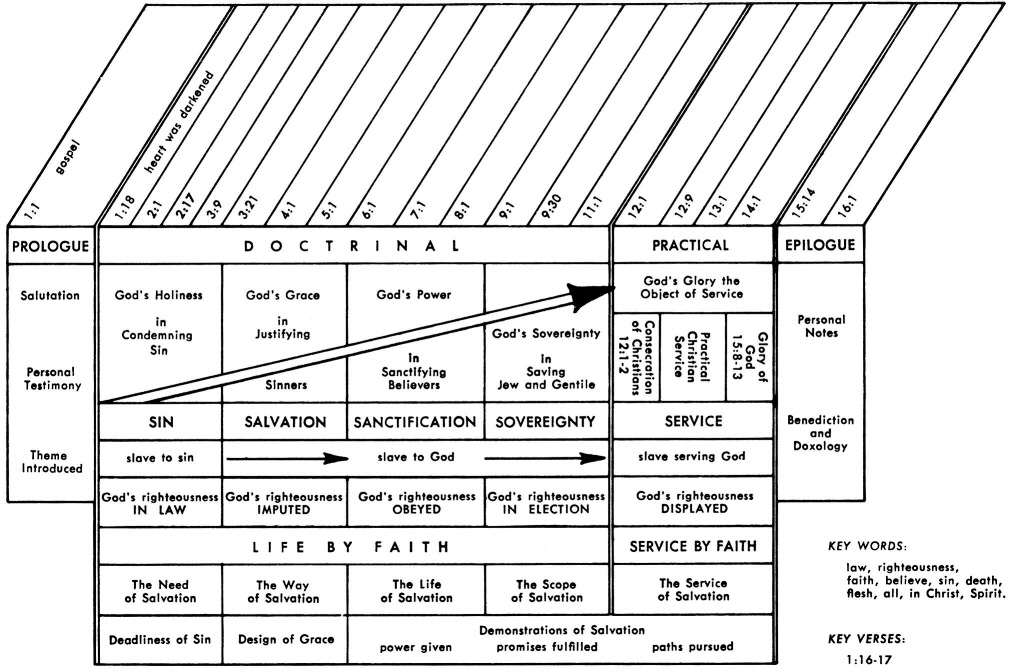
Click chart to enlarge
Chart from recommended resource Jensen's Survey of the NT - used by permission
Romans Overview Chart - Charles Swindoll
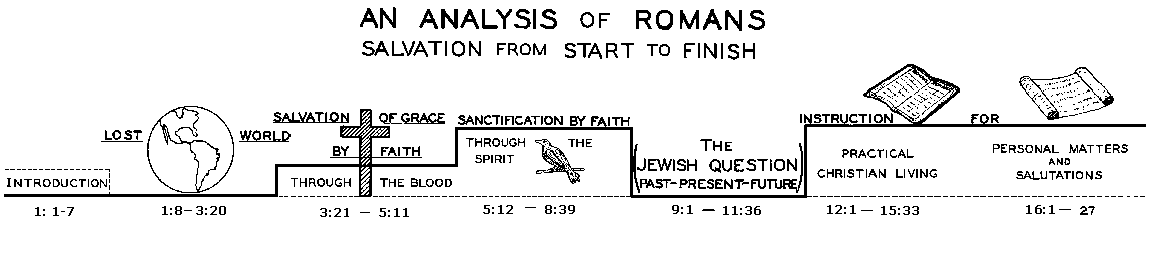
Source: Dr David Cooper
Click to Enlarge
| ROMANS ROAD to RIGHTEOUSNESS |
||||
| Romans 1:18-3:20 | Romans 3:21-5:21 | Romans 6:1-8:39 | Romans 9:1-11:36 | Romans 12:1-16:27 |
| SIN | SALVATION | SANCTIFICATION | SOVEREIGNTY | SERVICE |
| NEED FOR SALVATION |
WAY OF SALVATION |
LIFE OF SALVATION |
SCOPE OF SALVATION |
SERVICE OF SALVATION |
| God's Holiness In Condemning Sin |
God's Grace In Justifying Sinners |
God's Power In Sanctifying Believers |
God's Sovereignty In Saving Jew and Gentile |
Gods Glory The Object of Service |
| Deadliness of Sin |
Design of Grace |
Demonstration of Salvation | ||
| Power Given | Promises Fulfilled | Paths Pursued | ||
| Righteousness Needed |
Righteousness Credited |
Righteousness Demonstrated |
Righteousness Restored to Israel |
Righteousness Applied |
| God's Righteousness IN LAW |
God's Righteousness IMPUTED |
God's Righteousness OBEYED |
God's Righteousness IN ELECTION |
God's Righteousness DISPLAYED |
| Slaves to Sin | Slaves to God | Slaves Serving God | ||
| Doctrine | Duty | |||
| Life by Faith | Service by Faith | |||
|
Modified from Irving L. Jensen's chart above |
||||
R Ruin (Romans 1:17 – 3:20) – The utter sinfulness of humanity
O Offer (Romans 3:21-31) – God’s offer of justification by grace
M Model (Romans 4:1-25) – Abraham as a model for saving faith
A Access (Romans 5:1-11) – The benefits of justification
N New Adam (Romans 5:12-21) – We are children of two “Adams”
S Struggle w/ Sin (Romans 6:1-8:39) Struggle, sanctification, and victory
Romans 8:28 And we know that God causes all things to work together for good to those who love God, to those who are called according to His purpose. (NASB: Lockman)
Greek: oidamen (1PRAI) de hoti tois agaposin (PAPMPD) ton theon panta sunergei (3SPAI) eis agathon, tois kata prothesin kletois ousin. (PAPMPD)
Amplified: We are assured and know that [God being a partner in their labor] all things work together and are [fitting into a plan] for good to and for those who love God and are called according to [His] design and purpose. (Amplified Bible - Lockman)
NLT: And we know that God causes everything to work together for the good of those who love God and are called according to his purpose for them. (NLT - Tyndale House)
Phillips: Moreover we know that to those who love God, who are called according to his plan, everything that happens fits into a pattern for good. (Phillips: Touchstone)
Wuest: And we know with an absolute knowledge that for those who are loving God, all things are working together resulting in good, for those who are divinely-summoned ones according to His purpose.
Young's Literal: And we know that God causes all things to work together for good to those who love God, to those who are called according to His purpose.
AND WE KNOW: Oidamen (1PRAI) de:
- Ro 8:35, 36, 37, 38, 39; 5:3,4; Ge 50:20; Dt 8:2,3,16; Ps 46:1,2; Jer 24:5, 6, 7; Zech 13:9; 2Co 4:15, 16, 17; 5:1; Phil 1:19, 20, 21, 22, 23; 2Th 1:5, 6, 7; Heb 12:6, 7, 8, 9, 10, 1112; Jas 1:3,4; 1Pe 1:7,8; Rev 3:19
- Romans 8 Resources
Denney introduces this last section of Romans 8 noting that this is Paul's
Conclusion of the argument: the Apostle glories in the assurance of God's eternal and unchangeable love in Jesus Christ. (Romans 8)
We have been dealing in the first part of the chapter with the human will and its consent to walk by the Spirit. Beginning in Verse 28 to the end of this chapter it will be God from now on!
Robert Haldane - Nothing is more necessary for Christians than to be well persuaded of the happiness and privileges of their condition, that they may be able to serve God with cheerfulness and freedom of spirit, and to pass through the troubles and difficulties of the world. Here, then, is further consolation: Christians are often in sorrows, sufferings, and trials. This is not in itself joyous, but grievous; but in another point of view it is a matter of joy. Though afflictions in themselves are evil, yet in their effects as overruled and directed by God, they are useful. Yea, all things, of every kind, that happen to the Christian, are overruled by God for his good! (Haldane, R. An Exposition on the Epistle to the Romans)
Vine introduces this section with the following comment…
Having shown that suffering is not incompatible with a life of hope, the apostle now extends this to make clear that suffering is part of the working out of God’s all-wise purposes for us, and that neither affliction nor anything else can prevent this or thwart God’s ultimate designs for us. Here, too, he confirms the doctrine of the justification of the believer and establishes that of his eternal security. (Vine, W. Collected writings of W. E. Vine. Nashville: Thomas Nelson)
Calvin comments on this verse noting that "Though the elect and the reprobate are indiscriminately exposed to similar evils, there is yet a great, difference; for God trains up the faithful by afflictions, and thereby promotes their salvation." (Romans 8 - John Calvin's Commentaries on the Bible)
Raymond Ortlund writes that…
The hand of God is at the helm. He’s steering us through the storms of life toward home, toward a safe haven. And He takes care to order all the events of our lives right now to speed us on our way there. This is what we call Providence-- God’s overruling hand at work everywhere in a fallen world. The Providence of God is clearly taught from one end of the Bible to the other. And our confidence in the Providence of God is a faith so bold, so demanding, so unapologetic, that we cannot believe it without being transformed. Either all things work together for our good, or nothing makes sense. So let’s be bold about it. Let’s either be transformed Christians or bitter skeptics, because we cannot just sort of believe Romans 8:28. We either believe it or we doubt it. There is no middle ground. (Romans 8:28)
Ray Pritchard makes an interesting observation and then draws a pithy conclusion…
Let me read the first phrase in three different versions:
KJV: "All things work together for good to them that love God."
NASB: "God causes all things to work together for good."
NIV: "In all things God works for the good of those who love him."
Did you catch the difference there? In the King James version God is way down at the end of the phrase. In the other two versions, God is at the beginning. It is partly a question of text and partly a question of grammar. There is nothing wrong with the traditional versions, but the modern translations bring out a proper emphasis.
Let me put it this way: We will never properly understand this verse as long as we put God at the end and not at the beginning. But some people look at life that way. They believe that life is like a roll of the dice—sometimes it's seven-come-eleven and sometimes it's snake eyes. And they believe that after a tragedy God shows up to make everything come out right. But that's not the biblical view at all.
In reality, God is there at the beginning and He is there at the end and He is at every point in between. (Romans 8:28) (Bolding added)
Romans 8:28 is the NT equivalent of Joseph's great affirmation of God's sovereignty, (see RBC booklet How Much Does God Control?) His overruling providence and His everlasting, immutable faithfulness, when he declared to his brothers (who had attempted to kill him)…
"And as for you, you meant evil against me, but God meant it for good in order to bring about this present result, to preserve many people alive. (Ge 50:20)
When fear and worry test your faith
And anxious thoughts assail,
Remember God is in control
And He will never fail.
—Sper
We know (1492) (oida/eido = perfect tense) (Uses in Romans) refers to knowledge which comes from one’s state of being, intuitive knowledge. Oida/eido means absolute, positive knowledge which one has beyond a doubt. It refers to that which is the common knowledge of the Christian, a settled intuitive knowledge which the Holy Spirit makes real. God Himself has placed the knowledge of this verse in our hearts. Notice that although all believers know the following truth intuitively, they may not always fully understand and sense it experientially. (That would be communicated by the Greek verb ginosko instead of oida.)
OIDA/EIDO IN ROMANS -Rom. 2:2; Rom. 3:19; Rom. 5:3; Rom. 6:9; Rom. 6:16; Rom. 7:7; Rom. 7:14; Rom. 7:18; Rom. 8:22; Rom. 8:26; Rom. 8:27; Rom. 8:28; Rom. 11:2; Rom. 13:11; Rom. 14:14; Rom. 15:29
Denney writes that the verb we know "in a sense is one ground more for believing in the glorious future: God is ever with us, and will not abandon us at last." (Romans 8)
The words we know are used about thirty times as the expression of the common knowledge of the saints of God as such, in the Epistles (in Romans, five times) and always indicate always Christian knowledge.
We know Romans 8:28-30 is true because we know God and He has said it. His word is trustworthy and that guarantees His promise. Indeed, His character rests upon it. We know because we know Him. We know not by looking at the events of our life but by knowing our God. We know not by studying the pattern of the cloth, but by knowing the "Designer" of the fabric. We know it not by listening to the notes of the symphony, but by knowing the "Composer" of the music. There are so many things we don't know. We don't know why babies die or why cars wreck or why planes crash or why families break up or why good people get sick and suddenly die. But this we know—God is at work and He has not forgotten us. Hallelujah!
And so we can declare like Paul…
For I consider that the sufferings of this present time are not worthy to be compared with the glory that is to be revealed to us. (see note Romans 8:18)
God is able to even make the sufferings work together for our good and glory! (Why Would A Good God Allow Suffering?)
Robert Haldane comments on "we know" writing that…
This does not mean that believers know it merely in a speculative manner, but that it is a knowledge which enters into their heart and affections, producing in them confidence in its truth. It is a knowledge of faith which implies certainty and self application, by which the believer not only knows but applies the promises of God, and is able to say, This promise is mine, it belongs to me. For otherwise, what advantage would there be in a general knowledge of this fact? where would be its consolation, and where its practical use? “The secret of the Lord is with them that fear Him, and He will show them His covenant.” (Ps 25:14- - Spurgeon's note) (An Exposition on the Epistle to the Romans)
Newell comments that…
Lodge members, having been “initiated,” go about as those that “know.” The Christian is traveling to glory along with a blessed company that can say “We know,” in an infinitely higher and surer sense. And here, what a knowledge! (Romans 8) (Bolding added)
Charles Spurgeon used to say,
“I do not need anyone to tell me how honey tastes; I know.”
Dr. Torrey always said that Romans 8:28 is a "soft pillow for a tired heart". Or as someone else has said "God's good promises put a rainbow of hope in every cloud and a "pillow of grace" in every bed of affliction!"
Though I do not know the reason,
I can trust, and so am blest;
God is love, and God is faithful,
So in perfect peace I rest. —Anon.
The comforting truth of Romans 8:28 is based especially on God's sovereignty. If all things work together for good (all events, all circumstances, all trials, all happenings, etc.), then it follows that God must be over all things and must control all things. This is not fearful fatalism and determinism. This is the wonderful fact that an all-wise, all-loving, just God is in complete control of all things!
><> ><> ><>
Development of Braille - I do not know if Louis Braille was a believer, but his life is an example of a sovereign God causing all things to work together for good - In the French Academy of Science there is a rather plain, old shoemaker's awl on display. The story behind the awl is quite extraordinary. To look at it, one would never suspect that this simple tool could be responsible for anything of consequence. In fact, it caused tremendous pain. This was the awl that one day fell from the shoemaker's table and put out the eye of the shoemaker's 9-year-old son. The injury was so severe that the boy lost vision in both eyes and was enrolled in a special school for children who were blind. The boy learned to read by handling large, carved-wood blocks. When the shoemaker's son became an adult, he thought of a new way to read. It involved learning a system of dots translated into the letters of the alphabet that could be read from a piece of paper on any flat surface. Louis Braille actually used the awl which had blinded him as a boy to form the dots into a whole new reading system for the blind—known today as Braille.
><> ><> ><>
From a devotional in Our Daily Bread we read…
When quoting Romans 8:28, we often begin with the words, "All things work together for good." But the verse really begins like this:
"We know that all things work together for good to those who love God."
Our knowing comes by faith. By faith we are confident that God will never disappoint us.
I read a story about a shipwreck. When the sole survivor reached a small, uninhabited island, he prayed for God to rescue him, but help didn't come. Eventually he built a hut out of driftwood for protection from the elements. One day he returned from scavenging for food and found his hut in flames, the smoke rising into the sky. Angrily he cried,
"God, how could You do this to me?"
The next morning he was awakened by rescuers.
"How did you know I was here?" he asked.
"We saw your smoke signal," they replied.
Pastor Lud Golz wrote,
"Sometimes God's love almost seems like hatred because of the difficulties He allows to come our way. The final result, however, always confirms its true nature."
The next time it seems as if your last hope has gone up in smoke, remember what "we know" to be true (Romans 8:28). When God says that all things work together for good to those who love Him, He means all things! —J E Yoder (Our Daily Bread, Copyright RBC Ministries, Grand Rapids, MI. Reprinted by permission. All rights reserved)
The trials we are going through
Can be misunderstood
Unless we realize that God
Works all things for our good. —Sper
God may test our faith
so we may trust His faithfulness.
THAT GOD CAUSES ALL THINGS TO WORK TOGETHER FOR GOOD TO THOSE WHO LOVE GOD: hoti tois agaposin (PAPMPD) ton theon panta sunergei (3SPAI) eis agathon:
- Ro 5:5; Ex 20:6; Dt 6:5; Neh 1:5; Ps 69:36; Mk 12:30; 1Co 2:9; Jas 1:12; Jas 2:5; 1Jn 4:10,19; 5:2,3
- Romans 8 Resources
God causes… good - I usually quickly pass by this word "causes," but this word and this phrase testify triumphantly to the truth that our God is a Mighty God, a God Who is Able, a God Who is Sovereign over all things and all times and a God Who is Providentially powerful and all knowing even when our world seems to be falling apart!
THOUGHT - Do you believe this is true of God? What is it that has come into your life as a believer that seems to be "just too much," "just too painful," "too unfair," etc, etc. If we are honest, all of us have been there (e.g., I have found myself going there from time to time over the past 6 months as my wife of 45 years is suffering from anorexia nervosa, depression, temporo-mandibular joint disease making her anorexia all the more difficult and most recently at age 66 is exhibiting signs of dementia. Follow-up - 3 years later - her anorexia is improved but she is still not well and definitely seems to have some type of mental illness - but God has enabled me to now be her full time caregiver and to do it with His grace and power - PTL!) It is at times like these that we need to run into the Strong Tower of His Name and be lifted up from the fray going on around us. May God grant all of us amazing grace in Christ and through His Spirit to trust and obey and live with a sincere Romans 8:28 mindset, all for His glory. Amen
All (3956) (pas) means all with no exceptions - not just some things but all things!
Spurgeon comments that all things "is a very comprehensive expression, is it not? It includes your present trouble, your aching head, your heavy heart: “all things.” “All things work.” There is nothing idle in God’s domain. “All things work together.” There is no discord in the providence of God. The strangest ingredients go to make up the one matchless medicine for all our maladies. “All things work together for good” — for lasting and eternal good, — “to them that love God,” that is their outward character."
McGee comments that all things include "All things”—good and bad; bright and dark; sweet and bitter; easy and hard; happy and sad; prosperity and poverty; health and sickness; calm and storm; comfort and suffering; life and death. (McGee, J V: Thru the Bible Commentary: Thomas Nelson)
MacDonald comments in regard to "all things… for good"…
It may not always seem so! Sometimes when we are suffering heartbreak, tragedy, disappointment, frustration, and bereavement, we wonder what good can come out of it. But the following verse gives the answer: whatever God permits to come into our lives is designed to conform us to the image of His Son. When we see this, it takes the question mark out of our prayers. Our lives are not controlled by impersonal forces such as chance, luck, or fate, but by our wonderful, personal Lord, who is “too loving to be unkind and too wise to err.” (MacDonald, W & Farstad, A. Believer's Bible Commentary: Thomas Nelson)
John MacArthur writes that…
All things is utterly comprehensive, having no qualifications or limits. Neither this verse nor its context allows for restrictions or conditions. All things is inclusive in the fullest possible sense. Nothing existing or occurring in heaven or on earth “shall be able to separate us from the love of God, which is in Christ Jesus” (8:39). Paul is not saying that God prevents His children from experiencing things that can harm them. He is rather attesting that the Lord takes all that He allows to happen to His beloved children, even the worst things, and turns those things ultimately into blessings… No matter what our situation, our suffering, our persecution, our sinful failure, our pain, our lack of faith-in those things, as well as in all other things, our heavenly Father will work to produce our ultimate victory and blessing. The corollary of that truth is that nothing can ultimately work against us. (MacArthur, J: Romans 1-8. Chicago: Moody Press)
Constable reminds us that…
This verse does not say that God causes all things, period. Nowhere in Scripture do we read that God causes sin or evil. He permits these things, but that is much different from initiating them. Therefore when tragedy touches a believer we should not conclude that this is one of the “all things” that God causes. Rather this verse says that God brings good out of all things, even tragedies, for the Christian. The causes of tragedy are Satan, the sinful choices of people, and the consequences of living in a sinful world (cf. James 1:13-14). (Tom Constable's Expository Notes on the Bible) (Bolding added)
Vine comments that…
The “all things,” while applying to circumstances in general, has special reference to those of adversity, as indicated in the context. All things, however contrary to us, are under His control. The statement carries the suggestion that God works all things, for those who love Him, with designs for their good. Troubles, therefore, do not hinder Christian progress, they serve but to further the designs of God’s grace. (Vine, W. Collected writings of W. E. Vine. Nashville: Thomas Nelson)
Douglas Moo comments that Romans 8:28…
promises that nothing will touch our lives that is not under the control and direction of our loving heavenly Father. Everything we do and say, everything people do to us or say about us, every experience we will ever have — all are sovereignly used by God for our good. We will not always understand how the things we experience work to good, and we certainly will not always enjoy them. But we do know that nothing comes into our lives that God does not allow and use for his own beneficent purposes. Paul’s overarching purpose in Romans 5-8 is to give us assurance for the life to come. But verses like 8:28 show that he also wants to give us assurance for the present life as well. God has ordained not only the ends but the means. (Barton, B, et al: The NIV Life Application Commentary Series: Tyndale)
Kent Hughes cautions us to remember that…
Romans 8:28 does not mean, as is commonly thought, that “everything will turn out okay in this life.” It means, rather, that everything will work out for our ultimate good. These words have our eternal rather than our temporal good in mind. Bishop Anders Nygren writes:
Just as the present aeon is to be followed by eternity, it has already been preceded by an eternity. Only when we see our present existence set in God’s activity, which goes from eternity to eternity, do we get it in right perspective. Then man comes to see that everything that comes to the Christian in this life—and consequently the sufferings of the present too—must work together for good to him. (Hughes, R. K. Romans: Righteousness from heaven. Preaching the Word. Crossway Books)
Work together (4903) (sunergeo from sun = with, speaks of intimacy + érgon = work > English word "synergy" = the potential ability of individual organizations or groups to be more successful or productive as a result of a merger) means to be a fellow-worker, and so to co-operate. God is our "Fellow Worker" Who is Himself the One working in our behalf and causing all things to work together for good. The present tense and active voice indicates our Father is continually working all things together for our good!
MacArthur adds that "sunergeo (is the Greek word) from which is derived the English term synergism, the working together of various elements to produce an effect greater than, and often completely different from, the sum of each element acting separately… Contrary to what the King James rendering seems to suggest, it is not that things in themselves work together to produce good. As Paul has made clear earlier in the verse, it is God’s providential power and will, not a natural synergism of circumstances and events in our lives, that causes them to work together for good… No matter what happens in our lives as His children, the providence of God uses it for our temporal as well as our eternal benefit, sometimes by saving us from tragedies and sometimes by sending us through them in order to draw us closer to Him… God often delays the temporal as well as the ultimate good that He promises… Even when our outward circumstances are dire-perhaps especially when they are dire and seemingly hopeless from our perspective-God is purifying and renewing our redeemed inner beings in preparation for glorification, the ultimate good… God uses the evil of sin as a means of bringing good to His children. That would have to be true if Paul’s statement about “all things” is taken at face value. Even more than suffering and temptation, sin is not good in itself, because it is the antithesis of good. Yet, in God’s infinite wisdom and power, it is most remarkable of all that He turns sin to our good. It is of great importance, of course, to recognize that God does not use sin for good in the sense of its being an instrument of His righteousness. That would be the most obvious of self-contradictions. The Lord uses sin to bring good to His children by overruling it, canceling its normal evil consequences and miraculously substituting His benefits… the sinning believer is not spared God’s chastisement but is assured of it as a remedial tool for producing holiness (see note Hebrews 12:10). That is the supreme good for which God causes our sin to work. (MacArthur, J: Romans 1-8. Chicago: Moody Press) (Bolding added)
Albert Barnes comments on "work together for good" writing that these things - They shall co-operate; they shall mutually contribute to our good. They take off our affections from this world; they teach us the truth about our frail, transitory, and dying condition; they lead us to look to God for support, and to heaven for a final home; and they produce a subdued spirit, a humble temper, a patient, tender, and kind disposition. This has been the experience of all saints; and at the end of life they have been able to say it was good for them to be afflicted, Ps 119:67 [Spurgeon's note], Ps 119:71 [Spurgeon's note]; Jer 31:18, 19, He 12:1 [note])
Illustration - WHEN a person is ill and a doctor called in, he usually writes out a prescription for medicine, which is taken to a druggist who prepares it. He takes an empty bottle and puts into it so much liquid out of one bottle, so much powder out of another bottle, and so on, and puts a label on it with the words, 'Shake the bottle.' All those different medicines work together for the good of the patient. The liquid may be disagreeable to the taste, but it is for the sick person's good. So all things, even the bitter disagreeable things which God allows to reach us, are all for our good. 'All things work together for good to them that love God.'"
Illustration - Several years ago I suffered a great disappointment. The church where I was saved was seeking a pastor because their pastor had moved. A key leader in the church had informed me that I was to be the next pastor of the church. The church is a great church with a great legacy. I was very excited about the possibility. When the pastor resigned I expected a call from the search team. It never came. I had to deal with the disappointment. In the Christian life there are going to be events and situations that disappoint us. It may be an expected promotion. The raise we expected may not develop. The dream job did not materialize. The right school did not accept us. The list is long and difficult. Why does God allow us to endure these disappointments. The reason is found in our verse today. God knows best. He has an absolute knowledge. We have a limited knowledge. We must learn to trust Him. When we suffer a disappointment we must yield it to Him. We must be assured in our hearts that He is working out good things for us. We may see our disappointment as a time to grow closer in our trust of His direction and protection. Are you suffering from a great disappointment? I can assure you that this predicament is not unusual in the Christian's walk. Call on the Lord today. Ask Him to forgive you for a lack of faith. Trust Him for the good things that He provides. One day you will look back and see that He was right in withholding the very thing you wanted most. One day you will enjoy His great blessing. Lean on Him today for the strength you need. Thank God for unanswered prayers!!! Think on these things - David Hammonds
Good (18) (agathos [word study]) means beneficial, profitable or useful. In other words, God will cause everything in our lives to become beneficial, spiritually profitable, useful and good, even in a fallen world filled with sin and corruption. Think of ordinary table salt. It is composed of two chemicals, sodium and chlorine, which by themselves can be toxic and yet when properly combined they produce a beneficial substance. Remember also that the good is what is good from God’s perspective.
Note that Paul does not say that "all things are good" but "all things work together for good." Someone has illustrated this by picturing a cake. The raw ingredients that are used to make the cake hardly taste "good" but when they are mixed together and baked the result is "good" (usually)! In a like manner, God takes those things that leave a "bad taste in our mouth" so to speak and mixes them together in a way that results in "good".
J Vernon McGee adds that…
And I am confident that we as children of God will be able to look back over our lives someday and say, “All of this worked out for good.” Job could say, “Though he slay me, yet will I trust in him … ” (Job 13:15). That is the kind of faith in God we need, friend. We know that He is going to make things work out for good because He’s the One who is motivating it. He’s the One who is energizing it. (McGee, J V: Thru the Bible Commentary: Thomas Nelson)
Ray Pritchard explains "good" by asking…
Is Paul saying, "Whatever happens is good." No.
Is he saying that suffering and evil and tragedy are good? No.
Is he saying everything will work out if we just have enough faith? No.
Is he saying that we will be able to understand why God allowed tragedy to come? No.
What, then, is he saying? He is erecting a sign over the unexplainable mysteries of life—a sign which reads "Quiet. God at work." How? We're not always sure. To what end? Good, and not evil. That's what Romans 8:28 is saying… Our danger is that we will judge the end by the beginning. Or, to be more exact, that we will judge what we cannot see by what we can see. That is, when tragedy strikes, if we can't see a purpose, we assume there isn't one. But the very opposite is true. We ought to judge the beginning by the end. Here is where Romans 8:28 gives us some real help. Paul says, "For we know that all things work together for good." That phrase work together is really one word—sunergeo—in Greek. We get our English word "synergy" from it. And what is synergy? It is what happens when you put two or more elements together to form something brand-new that neither could form separately… That's synergy—the combination of many elements to produce a positive result. That's what Paul means when he says that God causes all things to "work together." Many of the things that make no sense when seen in isolation, are in fact working together to produce something good in my life. There is a divine synergy even in the darkest moments, a synergy which produces something positive. And that "good" that is ultimately produced could not happen any other way… (in Romans 8:29 Paul explains that) God has predestined you and me to a certain end. That certain end is the "good" of Romans 8:28. That certain end is that we might be conformed to the likeness of Jesus Christ… When Paul says that all things work together for good, he is not saying that the tragedies and heartaches of life will always produce a better set of circumstances. Sometimes they do, sometimes they don't. But God is not committed to making you healthy, wealthy and wise. He is committed to making you like his Son, the Lord Jesus Christ. And whatever it takes to make you more like Jesus is good. So it is in the providence of God that we learn more in the darkness than we do in the light. We gain more from sickness than we do from health. We pray more when we are scared than when we are confident. (Read his complete Sermon on Romans 8:28) (Bolding added)
I walked a mile with Pleasure,
She chattered all the way.
But I was none the wiser,
For all she had to say.Then I walked a mile with Sorrow,
And ne'er a word said she.
But, oh, the lessons I did learn
When Sorrow walked with me.
Paul emphasizes that in all of the up's and down's in the believer's life there is an overarching, albeit not always obvious eternal purpose for good which God is always providentially orchestrating behind the scenes, whether those things be "Dark things, bright things; happy things, sad things; sweet things, bitter things; times of prosperity, times of adversity" (Newell). This wonderful Truth should settle our anxious thoughts, calm our sweaty palms, ease our abdominal queasiness, and allow us to focus above and beyond the present "clouds" of the current situation.
Douglas Moo writes about a serious (and common) misunderstanding of Romans 8:28…
Most of us have probably heard someone (perhaps ourselves!) applying Romans 8:28 something like this: “Yes, you may have lost your job, but you can be sure of getting an even better one; because ‘all things are working for good.’ ” Or, “Don’t be upset about your fiancé breaking off your engagement, because God must have an even better life partner for you; Romans 8:28 promises… .” The difficulty with this application is that it interprets “good” from a narrow and often materialistic perspective. From God’s perspective, “good” must be defined in spiritual terms. The ultimate good is God’s glory, and he is glorified when his children live as Christ did (v. 29) and attain the glory he has destined them for (v. 30; cf. vv. 31 – 39).
As we have seen in 5:3 – 4, God uses suffering to build Christian character in us, conform us to Christ, and prepare us for final glory. What he promises us in 8:28, then, is not that every difficult experience will lead to something good in this life. The “good” God may have in mind may involve the next life entirely. He may take us out of a secure, well-paying job in order to shake us out of a materialistic lifestyle that does not honor biblical priorities, and we may never have as good a job again. He may want to set us free from an engagement to be married because he wants to use us in a ministry that would be difficult or impossible for a married person. Remember that it is by sharing in Christ’s sufferings that we eventually will be able to share in his glory as well (8:17).
This is not to say that material blessings cannot be included in the “good” of Romans 8:28. As the Old Testament especially makes clear, God delights to give his people good things in this life as well as in the next. In an effort to avoid a materialistic interpretation of 8:28, we must not succumb to the opposite extreme of denying God’s interest in the material world. (Barton, B, et al: The NIV Life Application Commentary Series: Tyndale)
William Newell writes that…
Now we find in Romans 8:28 a great marvel: all things work together for good to these believing lovers of God. This involves that … control of God’s providence —of the most infinitesimal things—to bring them about for “good” to God’s saints. When we reflect on the innumerable “things” about us,—forces seen and unseen of the mineral, vegetable, and animal worlds; of man at enmity with God; of Satan, and his principalities and powers, in deadly array; in the uncertainty and even treachery of those near and dear to us, and even of professed Christians, and of our own selves,—which we cannot trust for a moment; upon our unredeemed bodies; upon our general complete helplessness:—then, to have God say, “All things are working together for your good,”—reveals to us a Divine providence that is absolutely limitless! (Romans 8) (Bolding added)
The opening question of the Heidelberg Catechism (1563) asks
“What is your only comfort in life and death?”
Answer: “That I, with body and soul, both in life and in death, am not my own, but belong to my faithful Savior Jesus Christ who… so preserves me that without the will of my Father in heaven not a hair can fall from my head; yea, that all things must work together for my salvation.”
This statement emphasizes the biblical doctrine of God's providence, His faithful and effective care and guidance of everything which He has made toward the end which He has chosen. Amen!
You can know beyond all doubting,
In the trial you're passing through,
That our God's great love and mercy
Is at work for good in you. --Anon.
(As I testified above -- this statement is true! My wife is not improved in her mind, but God has enabled me to love her unconditionally in a way I have never been able to do in the previous 47 years of marriage. Romans 8:28 is true beloved, regardless of what wind of adversity is blowing in your life! He is faithful to His Word! Trust Him. Lean on Him! Thank Him!)
Daniel Wallace sums up "good" writing that…
When we read Rom 8:28 in its context we can give a positive answer to the questions of pain and suffering in the world. We may see nothing good come of misery and disaster in this world, but this world is not all of reality. There is an ‘until’; there is a place beyond the horizon of what our senses can apprehend, and it is more real and more lasting than what we experience in this mortal shell. God is using the present, even the miserable present, to conform us to the image of his Son. If we define the good as only what we can see in this life, then we have missed the whole point of this text. For, as Paul said earlier in the same chapter, “For I consider that our present sufferings cannot even be compared to the glory that will be revealed to us” (Ro 8:18, NET). Western Christians—especially American Christians—are prone to pervert texts such as Rom 8:28. If our lives are comfortable, if we have wealth, good health, that is fine and well. But it is not the good that Paul had in mind, and it is not the goal of the Christian life. (Do All Things Really Work Together for the Good?)
Thomas Watson reminds us of the "power" of suffering in the hand of the sovereign (in control) God writing that…
Afflictions work for good, as they make way for glory… Not that they merit glory, but they prepare for it. As ploughing prepares the earth for a crop, so afflictions prepare and make us [ready] for glory. The painter lays his gold upon dark colours, so God first lays the dark colours of affliction, and then He lays the golden colour of glory. The vessel is first seasoned before wine is poured into it: the vessels of mercy are first seasoned with affliction, and then the wine of glory is poured in. Thus we see afflictions are not prejudicial, but beneficial, to the saints. (All Things for Good [reprint; Edinburgh: Banner of Truth, 1986)
Who can "claim" the wonderful truth in this verse? Only those who love God. Paul is not speaking here of a special class of believers who love God in contrast to other believers who do not love God. While it is certainly true that some believers love the Saviour more than others, and demonstrate this by their faithful obedience to His Word, yet it is also true that there is a sense in which all believers love Christ. Love for Christ is demonstrated by obedience to His Word (see below), and those who refuse to keep His commandments are liars if they claim to know Christ for John teaches that..
And by this we know that we have come to know Him, if we keep (present tense) His commandments. The one who says, "I have come to know Him," and does not keep (present tense) His commandments, is a liar, and the truth is not in him but whoever keeps (present tense) His word, in him the love of God has truly been perfected. By this we know that we are in Him: the one who says he abides in Him ought (present tense) himself to walk in the same manner as He walked. (1John 2:3-6)
As sons and daughters of the Most High God, our lives should be characterized by obedience…
As obedient children, do not be conformed to the former lusts which were yours in your ignorance (1Pe 1:14).
We obey because we love our Heavenly Father. How can we do anything less?
Love (25) (agapao [word study]) means to love unconditionally and sacrificially love and ultimately describes the love which God Himself is. Agapao is not sentimental or emotional love but represents an obedience as the act of one's will. This is the only place in Romans where Paul wrote of the believer’s love for God; everywhere else he referred to God’s love for the believer.
The present tense indicates that agapao is a believer's lifestyle or habit of life (in contrast to Demas - 2Ti 4:10). Believers are not perfect but the general direction of their life is to show love toward God. If your life does not demonstrate this tendency, read the verses above from (1John 2:3, 4, 5, 6). John further explains that…
In this is love, not that we loved God, but that He loved us and sent His Son to be the propitiation for our sins… We love, because He first loved us… If someone says, "I love God," and hates his brother, he is a liar; for the one who does not love his brother whom he has seen, cannot love God whom he has not seen. (1Jn 4:10,19, 20)
This verse is true of Christians and only of Christians. It is not a blanket promise to the whole human race, because God's purpose is to make His children one day like His beloved Son. Because of their depraved and sinful natures, the unredeemed hate God, regardless of any arguments they may have to the contrary.
R C Sproul has an interesting comment on "those who love Him" writing that…
Notice that Paul does not say “those who believe in him” but “those who love him.” Paul focuses on the fact that, in the last analysis, the dividing line between the Christian and the unbeliever is not over the issue simply of believing in some God or other, but over the issue of loving God. The profession of faith can be very different from the possession of faith. Many there are who mistakenly identify the two ideas. The word “love” serves to distinguish those who both profess and possess a saving relationship with Christ. (Sproul, R. Before the Face of God. Grand Rapids: Baker Book House; Ligonier Ministries)
C H Spurgeon adds in regard to "them that love God"…
"there are many things in which the worldly and the godly do agree; but on this point there is a vital difference. No ungodly man loves God in the Bible sense of the term. An unconverted man may love a God, as, for instance, the God of nature, and the God of the imagination; but the God of revelation no man can love, unless grace turn him from his natural enmity towards God. And there may be many differences between godly men; they may belong to different sects, hold very opposite opinions, but all agree in this, that they love God.
(1) As their Father; they have “the Spirit of adoption, whereby they cry Abba Father.”
(2) As their King; they are willing to obey Him.
(3) As their Portion, for God is their all.
(4) As their future inheritance.
William Newell comments that…
Only those can and do really love God whose hearts have been “sprinkled from an evil conscience” (He 10:22)—delivered from fear of God’s just judgment. The question therefore, comes right back to this: Have we believed, as guilty lost sinners, on this propitiation by the blood of God’s Son on the cross? Is that our only hope? If so, 1John 4:16 becomes true: “We know and have believed the love which God hath in our case,” and 1Jn 4:19 follows: “We love, because he first loved us.” We cannot work up love for God, but His redeeming love for us, believed in, becomes the eternal cause and spring of our love to God. (Romans 8)
The expression “those who love God" is often a descriptive name for believers as demonstrated in the following examples…
but just as it is written, "THINGS WHICH EYE HAS NOT SEEN AND EAR HAS NOT HEARD, AND which HAVE NOT ENTERED THE HEART OF MAN, ALL THAT GOD HAS PREPARED FOR THOSE WHO LOVE HIM." 1Corinthians 2:9
and though you have not seen Him, you love Him, and though you do not see Him now, but believe in Him, you greatly rejoice with joy inexpressible and full of glory, 1 Peter 1:8 (note)
but showing lovingkindness to thousands, to those who love Me and keep My commandments. Exodus 20:6
Hate evil, you who love the LORD, Who preserves the souls of His godly ones; He delivers them from the hand of the wicked. Psalms 97:10 (See Spurgeon's note)
The LORD keeps all who love Him; but all the wicked, He will destroy. Psalms 145:20 (See Spurgeon's note)
in the future there is laid up for me the crown of righteousness, which the Lord, the righteous Judge, will award to me on that day; and not only to me, but also to all who have loved His appearing. 2 Timothy 4:8 (note)
Note the association of love for God and obedience to Him. Jesus reiterates this important association declaring that..
"If you love Me, you will keep My commandments." (John 14:15)
"He who has My commandments and keeps them, he it is who loves Me; and he who loves Me shall be loved by My Father, and I will love him, and will disclose Myself to him." (John 14:21)
"If anyone loves Me, he will keep My word; and My Father will love him, and We will come to him, and make Our abode with him. (John 14:23)
Be careful in using Romans 8:28 to try to explain the unexplainable. Sometimes in our zeal to give an apologetic for God, we try to explain why bad things happen to good people. That's almost always a bad idea. Along that same line, remember that we are not called to praise God for evil, sin and death. But we can praise Him for the good He can work in the darkest days of life. Romans 8:28 does not say that everything that happens to us is good, in the sense of pleasurable. He does promise that all things will contribute to our good, in that He is will use our every experience to make us more like our Lord.
Ray Pritchard tells the story…
… of a father whose son was killed in a terrible accident. He came to his pastor and in great anger said, "Where was God when my son died?" The pastor thought for a moment and said, "The same place he was when his Son died."
That's the final piece of the puzzle. He knows what we are going through for he, too, has been there. He watched his own Son die.
Therefore we can say with the Apostle Paul … "We know." Not because we see the answer. But "we know" because we know him … and he knows what it is like to lose a Son. He knows and we know him! (Romans 8:28)
Ron Lee Davis writes in his book Becoming a Whole Person in a Broken World,
"The good news is not that God will make our circumstances come out the way we like, but that God can weave even our disappointments and disasters into His eternal plan. The evil that happens to us can be transformed into God's good. Ro 8:28 is God's guarantee that if we love God, our lives can be used to achieve His purposes and further His kingdom"
In his book "Why Us?" Warren Wiersbe states that God
"proves His sovereignty, not by intervening constantly and preventing these events, but by ruling and overruling them so that even tragedies end up accomplishing His ultimate purposes"
C H Spurgeon writes the following devotional on this verse…
Upon some points a believer is absolutely sure. He knows, for instance, that God sits in the stern-sheets of the vessel when it rocks most. He believes that an invisible hand is always on the world's tiller, and that wherever providence may drift, Jehovah steers it. That re-assuring knowledge prepares him for everything. He looks over the raging waters and sees the spirit of Jesus treading the billows, and he hears a voice saying, "It is I, be not afraid." He knows too that God is always wise, and, knowing this, he is confident that there can be no accidents, no mistakes; that nothing can occur which ought not to arise. He can say, "If I should lose all I have, it is better that I should lose than have, if God so wills: the worst calamity is the wisest and the kindest thing that could befall to me if God ordains it." "We know that all things work together for good to them that love God." The Christian does not merely hold this as a theory, but he knows it as a matter of fact. Everything has worked for good as yet; the poisonous drugs mixed in fit proportions have worked the cure; the sharp cuts of the lancet have cleansed out the proud flesh and facilitated the healing. Every event as yet has worked out the most divinely blessed results; and so, believing that God rules all, that he governs wisely, that he brings good out of evil, the believer's heart is assured, and he is enabled calmly to meet each trial as it comes. The believer can in the spirit of true resignation pray, "Send me what thou wilt, my God, so long as it comes from thee; never came there an ill portion from thy table to any of thy children."
"Say not my soul, 'From whence can God relieve my care?'
Remember that Omnipotence has servants everywhere.
His method is sublime, his heart profoundly kind,
God never is before his time, and never is behind."
TO THOSE WHO ARE CALLED ACCORDING TO HIS PURPOSE: tois kata prothesin kletois ousin (PAPMPD):
- Ro 8:30; 1:6,7; 9:11,23,24; Jer 51:29; Acts 13:48; Gal 1:15; Ep 1:9,10; 3:11; 1Th 5:9; 2Th 2:13,14; 2Ti 2:19; 1Pe 5:10
- Romans 8 Resources
Those who love God - describes the readers from the human side.
Those who are called - describes them from the Divine side
Paul emphasizes the Divine aspect of the calling in Romans 9 writing that…
for though the twins (Jacob and Esau) were not yet born, and had not done anything good or bad, in order that God's purpose according to His choice (ekloge = selection, election = God’s free choice without being affected by any outside circumstances or the "worth" of the individuals concerned and which must never be considered an injustice by God) might stand, not because of works, but because of Him Who calls (see note Romans 9:11)
Paul again associates God's call with His purpose in his last epistle…
(God) Who has saved us, and called us with a holy calling, not according to our works, but according to His own purpose and grace which was granted us in Christ Jesus from all eternity (see note 2 Timothy 1:9)
(The) Called (2822) (kletos) (Click word study of kletos) means invited (but see Newell's comment below) or welcomed and was originally used to designate those invited to a banquet.
Kletos - 10x in 10v - Matt 22:14; Ro 1:1, 6, 7; 8:28; 1 Cor 1:1, 2, 24; Jude 1:1; Rev 17:14
In the NT kletos is generally used of one who has accepted a calling or an invitation to become a guest or member of a select group. We have been invited by God in the proclamation of the Gospel to obtain eternal salvation in the kingdom through Christ. No one seeketh after God. We did not first go to Christ. Instead, He called. He invited us.
Be aware that Matthew use the term "called" (kletos) slightly differently than it is used in the epistles. In a parable Jesus said many were "called" to the "wedding feast" but few were "chosen" (Mt 22:1-13,14). Here the term "call" is not synonymous with an "effectual call" to salvation, but refers to the gospel’s external call to all men to believe in Him. In the history of the church nothing is more obvious than the fact that many, perhaps most, people who receive this call do not accept it. But in the epistles, the called refers to the sovereign, regenerating work of God in a believer’s heart that brings one to new life in Christ.
Vine comments that…
The two descriptions, “them that are called” and “them that love God,” are to one another as cause and effect. Those who love God are necessarily those who are called. The call (always in the Epistles an effectual call) produces the response of love to Him who calls. (Vine, W. Collected writings of W. E. Vine. Nashville: Thomas Nelson) (Bolding added)
Expositor's adds that in regard to the promise of Romans 8:28…
The beneficiaries are those who on the human side love God and on the divine side are called according to God's purpose… (Paul does not introduce the saint's love for God) as the ground for the benefit he has been describing, for it is not meritorious but simply a response to the divine love and grace. (Gaebelein, F, Editor: Expositor's Bible Commentary 6-Volume New Testament. Zondervan Publishing) (Bolding added)
R C Sproul comments that…
Paul speaks not of an external call to the gospel, but of the inward call of the Holy Spirit. In theology we term this “effectual calling.” No one will love God unless God first changes the disposition of the heart through the work of the Holy Spirit. The capacity to love God is not natural to fallen humanity but must be supernaturally granted by the Father, who takes the initiative in restoring us to himself. The regenerative work of God must precede the act of repentance and faith. Only by the divine initiative is anyone saved. (Sproul, R. Before the Face of God. Grand Rapids: Baker Book House; Ligonier Ministries)
Life Application Bible Commentary adds that…
Those who are called are those the Holy Spirit convinces and enables to receive Christ. Such people have a new perspective on life. They trust in God, not life’s treasures; they look to their security in heaven, not on earth; they learn to accept, not resent, pain and persecution, because God is with them (Barton, B. B., et al. Life Application Bible Commentary. Romans: Tyndale House Publishers)
In Romans 1:1 (see note)\ Paul informed the Romans that he had been "called (kletos) as an apostle" (repeated to the Corinthians in 1Cor 1:1) and he identifies the Roman saints once again as "the called" (kletos) in the Romans 1:7 (note). Observe that "kletos" is most often used in the introduction portion of Paul's letters. This appears to be a truth Paul wanted to reaffirm, so that the saints understood their position and privilege (which implies a certain, corresponding practice).
The called are those who have been summoned by God… called…
- according to His purpose (Ro 8:28)
- to salvation (Ro 8:30)
- saints by calling (1Cor 1:2)
- both Jews and Greeks (1Cor 1:24)
- having been called "with a holy" (2Timothy 1:9)
- heavenly calling (He 3:1)
- out of darkness into His marvelous light (1Pe 2:9)
- to walk worthy (Ep 4:1)
- by grace (Gal 1:6)
- not from among Jews only, but also from among Gentiles (Ro 9:24)
- through the "gospel" that we "may gain the glory of our Lord Jesus Christ" (2Th 2:14)
- and be brought "into fellowship with His Son, Jesus Christ our Lord" (1Cor 1:9)
- and return in triumph "with Him" at the end of this age (Re 17:14).
William Newell exults in the truth in this section writing…
We come now up on the high, celestial mountains of Divine Sovereign election, and find those who love God are further defined as those that are “called” (not “invited,” but given a Divine elective calling) according to His Purpose. Meditation upon the purpose of the eternal God greatens every soul thus occupied. God is infinite; man, a bit of dust. If God had a purpose, a fixed intention, it will come to pass, for He has limitless resources,—as David says, “All things are Thy servants.” We have been dealing in the first part of the chapter with the human will and its consent to walk by the Spirit. Not so from the 28th verse to the chapter’s end. It will be all God from now on! (Romans 8) (Bolding added)
Newell qualifies "the called" writing that…
Called here (in Romans 8:28) does not mean invited,—as in Proverbs, for instance. “Unto you, O men, I call”; for this would be an appeal to man’s will instead of a description of those who are the objects of God’s will, His purpose. “Called,” in the sense of Romans 8:28, is illustrated in 1Corinthians 1:24: where “Christ crucified” is declared to be a “stumbling-block” to Jews (to people whose thought was religion) and “foolishness” to Greeks (to those whose life lay in philosophy): but to ‘the called themselves” (Gr. margin) “Christ the power of God and the wisdom of God.” Here “the called” are seen to be a. company whose mark is neither religious response nor intellectual apprehending; but the electing grace of God which has so marked out the sphere of their being, that they are named “the called.” They are called according to His (God’s) purpose! (Romans 8) (Bolding added)
I like how Dr J Vernon McGee puts it…
"So, my friend, you can argue about election all you want to, but you can come. And if you come, He’ll not cast you out. Someone may ask, “You mean that if I’m not the elect I can still come?” My friend, if you come, you will be the elect. How tremendous this is!"… Does election shut out certain people? No. Life eternal is to know the only true God and Jesus Christ Whom He has sent. Do you have a desire to know the true God and Jesus Christ? Then you are not shut out. You must be one of the elect. He gives eternal life to those who have heard the call and have responded down in their hearts. They have come to Christ of their own free will." (bolding added) (McGee, J V: Thru the Bible Commentary: Thomas Nelson)
Dr J Vernon McGee gives the following illustration…
A boy down in my southland years ago wanted to join a church. So the deacons were examining him. They asked, “How did you get saved?” His answer was, “God did His part, and I did my part.” They thought there was something wrong with his doctrine, so they questioned further. “What was God’s part and what was your part?” His explanation was a good one. He said, “God’s part was the saving, and my part was the sinning. I done run from Him as fast as my sinful heart and rebellious legs could take me. He done took out after me till he run me down.” My friend, that is the way I got saved also.
This does not destroy or disturb the fact that “whosoever will may come” and “whosoever believeth.” Henry Ward Beecher quaintly put it, “The elect are the whosoever wills and the non-elect are the whosoever won’ts.” And it is all according to His purpose. And, my friend, if you have not yet got your mind reconciled to God’s purpose and to God’s will, it is time you are doing that, because this is His universe. He made it. I don’t know why He made a round earth instead of a square one—He didn’t ask me how I wanted it—He made it round because He wanted it round. My friend, His purpose is going to be carried out, and He has the wisdom and the power to carry it out. Whatever God does is right. Don’t you criticize God and say He has no right to save whoever wants to be saved. He has the right to do it. He is just and He is loving, and anything my God does is right.
There was a great theologian in the past by the name of Simeon. In his sermons on Romans 8 he said there were three reasons why he preached on the doctrine of election: It laid the axe at the root of pride, presumption, and despair. I like that. My friend, there is no place for human pride in the doctrine of election. It is God’s work, His wisdom, and His purpose that is being carried out. The will of God comes down out of eternity past like a great steamroller. Don’t think you can stop it. In fact, you had better get on and ride (bolding added) (McGee, J V: Thru the Bible Commentary: Thomas Nelson)
In short, Paul assures the Roman Christians that they are called. In the writings of both Paul and Peter when they mention "called" ("call", "calling", etc), the reference is to what has been referred to by theologians as an "effectual" call, that is a call which is answered. Therefore "the called" equate essentially with the "chosen" or the "elect" (Click word study of eklektos). The people who were called according to God’s purpose are, therefore, those who were effectively called. They are those whose hearts and minds were so thoroughly influenced by the Holy Spirit that they became aware of their sinfulness, began to understand their need of Christ, and embraced him as their Lord and Savior.
John MacArthur has a helpful note explaining that in Matthew 22,
"The call spoken of… is sometimes referred to as the “general call” (or the “external” call)—a summons to repentance and faith that is inherent in the gospel message. This call extends to all who hear the gospel. “Many” hear it; “few” respond… Those who respond are the “chosen,” the elect. In the Pauline writings, the word “call” usually refers to God’s irresistible calling extended to the elect alone (Ro 8:30)—known as the “effectual call” (or the “internal” call). The effectual call is the supernatural drawing of God which Jesus speaks of in John 6:44. Here (in Matthew's gospel) a general call is in view, and this call extends to all who hear the gospel—this call is the great “whosoever will” of the gospel (cf. Rev 22:17-ntoe, Ro 10:13). Here, then, is the proper balance between human responsibility and divine sovereignty: the “called” who reject the invitation do so willingly, and therefore their exclusion from the kingdom is perfectly just. The “chosen” enter the kingdom only because of the grace of God in choosing and drawing them." (Matthew 8-15, Matthew 16-23, Matthew 24-28)
Purpose (4286) (prothesis [word study] from pró = before, forth + títhemi = place) means to plan in advance and comes to mean that which is planned or purposed in advance. Purpose means an intelligent decision which the will is bent to accomplish. God has two purposes, our good and His glory and ultimately, He will make us like Jesus Christ! Furthermore His purpose is certain to succeed! And is well that we remember that the purposes of God are the most important reality in one's spiritual life. God’s purpose is to make His children like His Son, and He will succeed. The Spirit intercedes for us and guides us as we pray, and the circumstances of life work for our good, no matter how painful they may be.
Prothesis - 12x in 12v - Matt 12:4; Mark 2:26; Luke 6:4; Acts 11:23; 27:13; Rom 8:28; 9:11; Eph 1:11; 3:11; 2 Tim 1:9; 3:10; Heb 9:2. NAS - consecrated(3), purpose(7), resolute(1), sacred(1).
Albert Barnes explains that…
The word here rendered purpose (prothesis) means, properly, a proposition, or a laying down anything in view of others; and is thus applied to the bread that was laid on the table of shew-bread, Matthew 12:4; Mark 2:26; Luke 6:4. Hence it means, when applied to the mind, a plan or purpose of mind. It implies that God had a plan, or purpose, or intention, in regard to all who became Christians. They are not saved by chance or haphazard. God does not convert men without design; and His designs are not new, but are eternal. What He does, He always meant to do. What it is right for Him to do, it was right always to intend to do. What God always meant to do, is His purpose or plan.
Newell elaborates on purpose noting that prothesis…
is used twelve times in the New Testament. As to man, the word is seen to indicate what he is entirely unable to carry through, as in Acts 27:13: They supposed “that they had obtained their purpose,” but the ship was wrecked. In the saints, their purpose is carried on by Divine grace, often with many failures: Acts 11:23, “He exhorted them all that with purpose of heart they would cleave unto the Lord.” And in 2Timothy 3:10 (see note), Paul refers Timothy to that “manner of life, purpose, faith,” which the apostle had shown at Ephesus, a purpose carried out to final victory in finishing his course. But, as he says, “By the grace of God I am what I am.”
In God, however, purpose is absolute,—wholly apart from contingencies. In the very next occurrence after Romans 8:28 we read, “that the purpose of God according to election might stand”—everything subordinated, and the end predicted. We read also in Eph 3:11 (note) of a “purpose of the ages” which God has ordained and will carry through, just as our salvation is referred to as “not according to our works, but according to His own purpose and grace, which was given us in Christ Jesus before the times of the ages” (2Ti 1:9).
Therefore we beg the reader in examining the great Ro 8:29, 30, to distinguish the things that differ, utterly refusing to confuse or mix them:
(1) First, we shall find many Scriptures in which the consent of man’s will is asked, and blessing is contingent upon his consent; and some (“rocky ground people) will receive the Word “immediately with joy, and for awhile endure,” but in time of tribulation or persecution “fall away.”
(2) Second, we shall find plainly written in Scripture the purpose of God according to which He works effectually; and all His elect are brought safely in, and there is no separating them from His love which was given them in Christ Jesus, in whom they were “chosen before the foundation of the world.”
Now do not seek to mix these two things; and still more emphatically we say, do not try to “reconcile” them! Profitless controversy and partisan feeling will be the only result. Who told us to “reconcile” in our little minds, these seemingly contradictory things? Have we ceased to believe where we do not understand?
Every system of theology undertakes to subject the words of God to categories and catalogs of the human intellect. Now, if you undertake to “reconcile” God’s sovereign election with His free offer of salvation to all, you must sacrifice one truth or the other. Our poor minds may not “reconcile” them both, but our faith knows them both, and holds both, to be true! And Scripture is addressed to faith, not to reason. (Romans 8) (Bolding added)
Job learned through much trial the truth about God and testified…
"I know that Thou canst do all things, and that no purpose of Thine can be thwarted (or stopped) ." (Job 42:2)
><> ><> ><>
In a devotional from Our Daily Bread we read - Romans 8:28--how easily and how often this Bible reference rolls off our tongues! But perhaps we need to grasp more fully what this verse is really saying.
Randy Alcorn, in a book he has co-authored with his wife Nanci, offers some insights on Romans 8:28. He quotes the New American Standard Bible translation of this verse: "God causes all things to work together for good." Randy points out that it doesn't say each individual thing is good, but that God works them together for good.
Recalling his boyhood days, Randy tells how he often watched his mother bake cakes. One day when she had all the ingredients set out--flour, sugar, baking powder, raw egg, vanilla--he sneaked a taste of each one. Except for the sugar, they all tasted horrible. Then his mother stirred them together and put the batter in the oven.
"It didn't make sense to me," he recalls, "that the combination of individually distasteful things produced such a tasty product."
Randy concludes that God likewise
"takes all the undesirable stresses in our lives, mixes them together, puts them under the heat of crisis, and produces a perfect result."
Let's look beyond our immediate circumstances and remember that God has an ultimate good purpose. --J E Yoder (Our Daily Bread, Copyright RBC Ministries, Grand Rapids, MI. Reprinted by permission. All rights reserved)
God has a purpose in our heartaches,
The Savior always knows what's best;
We learn so many precious lessons
In every sorrow, trial, and test. --Jarvis
When things look bad, don't forget: God is good.
John Piper's explanation of CALLING - God Calls the Spiritually Dead to Life (using Ephesians 4:1 as the base passage). Watch John Piper's explanation of calling which he first illustrates by using Jesus' call to Lazarus (John 11:43-44) to "Come out" (or "come forth"). Piper's point is that "dead men" like Lazarus do not hear, so that Jesus' call to Lazarus came with the gift of life to enable Lazarus to hear and come forth. Then Piper demonstrates the principle of calling using 1 Corinthians 1:22-24. He points out that both Jews and Gentiles heard Paul preach Christ crucified, but to the Jews it was a stumbling block and to the Gentiles it was foolishness. Then he talks about the response of those who are the called in 1 Corinthians 1:24. He then discusses Romans 8:28-30.
A Christmas story of how all things work together for good… It was Christmas Eve in Oberndorf, Austria, in 1818. Joseph Mohr, the vicar of the church, had written a new song for the Christmas Eve service and the organist Franz Gruber had set it to music. But the organ in the village church broke down. So Gruber grabbed a guitar and accompanied Mohr in the first-ever rendition of "Silent Night." The story doesn't end there, however. When a man came to fix the organ, Gruber tested it by playing the new song. The repairman liked the song so much that he took a copy of it back to his own village. There, four daughters of a village glove maker learned the song and began singing it in concerts all over the region. Because of that faulty organ, this new Christmas song blessed people all over Austria—and eventually the world. When things break or when plans change, how should we respond? Often we fret and worry because we don't have the control we would like to have. That's when we need to step back, trust God, and wait to see how He is going to use the situation for His glory. The changes in our lives may not give the world something as remarkable as "Silent Night," but because God is in charge we can be sure that "all is calm, all is bright."
><> ><> ><>
Joyce Jones is a renowned concert organist and now retired teacher at Baylor University. Several years ago she played the first full concert on the new pipe organ at the Crystal Cathedral in California, which cost over $1 million. At the age of sixteen she was a piano major at the University of Texas. A sprained wrist interrupted her promising career as a pianist. For six weeks she could not touch a keyboard. Not wanting to waste the time, she decided to learn to play organ pedals with her feet, and a new career was born. "God has a way," she relates, "to get your attention and say, 'Hey, I have something better for you to do."'What experience in your life may very well illustrate God is working in your life according to His Promise.
><> ><> ><>
The great composer Ludwig van Beethoven (1770–1827) lived much of his life in fear of deafness. He was concerned because he felt the sense of hearing was essential to creating music of lasting value. When Beethoven discovered that the thing he feared most was coming rapidly upon him, he was almost frantic with anxiety. He consulted doctors and tried every possible remedy. But the deafness increased until at last all hearing was gone. Beethoven finally found the strength he needed to go on despite his great loss. To everyone’s amazement, he wrote some of his grandest music after he became totally deaf. With all distractions shut out, melodies flooded in on him as fast as his pen could write them down. His deafness became a great asset!
><> ><> ><>
Professor E. C. Caldwell ended his lecture, “Tomorrow,” he said to his class of seminary students, “I will be teaching on Romans 8. So tonight, as you study, pay special attention to verse 28. Notice what this verse truly says, and what it doesn’t say.” Then he added, “One final word before I dismiss you—whatever happens in all the years to come, remember: Romans 8:28 will always hold true.”
That same day Dr. Caldwell and his wife met with a tragic car-train accident. She was killed instantly and he was crippled permanently. Months later, Professor Caldwell returned to his students, who clearly remembered his last words. The room was hushed as he began his lecture.
“Romans 8:28,” he said, “still holds true. One day we shall see God’s good, even in this.” (Our Daily Bread, Copyright RBC Ministries, Grand Rapids, MI. Reprinted by permission. All rights reserved)
><> ><> ><>
"You meant evil against me; but God meant it for good" (Genesis 50:20).
I am thankful and reassured that God is so wise and so powerful that nothing, absolutely nothing, can cause His purposes to fail. In fact, He is able to take even those things meant for evil and make them work for good.
Joseph's brothers hated him so much that they plotted his murder. Instead, they sold him as a slave to some Ishmaelite traders. In Egypt he gained the favor of Pharaoh, who gave him a position of responsibility second only to that of the king. During a famine, his brothers came to him for food, not realizing who he was. When Joseph finally identified himself, he spoke this assuring word to them: "Do not therefore be grieved or angry with yourselves because you sold me here; for God sent me before you to preserve life" (Gen. 45:5). Later he said to his brothers, "But as for you, you meant evil against me; but God meant it for good, in order to bring it about, as it is this day, to save many people alive" (Gen. 50:20).
To me, that's both exciting and encouraging. I am reassured to realize that no matter what someone might do to harm me, the Lord is able to turn it into my benefit and His glory.
When we are discouraged because of distressing circumstances, we can rejoice in God's wisdom, power, and sovereignty. Romans 8:28 is still true. God is working all things for our good. —R. W. De Haan (Our Daily Bread, Copyright RBC Ministries, Grand Rapids, MI. Reprinted by permission. All rights reserved)
Setbacks pave the way for comebacks.
><> ><> ><>
When a cowboy applied for an insurance policy, the agent asked, "Have you ever had any accidents?" After a moment's reflection, the applicant responded, "Nope, but a bronc did kick in two of my ribs last summer, and a couple of years ago a rattlesnake bit me on the ankle."
"Wouldn't you call those accidents?" replied the puzzled agent. "Naw," the cowboy said, "they did it on purpose!"
That story reminds me of the biblical truth that there are no accidents in the lives of God's children. In today's Scripture, we read how Joseph interpreted a difficult experience that had seemed like a great calamity. He had been thrown into a pit and then sold as a slave. This was a great test of his faith, and from the human standpoint it appeared to be a tragic case of injustice, not a providential means of blessing. But Joseph later learned that "God meant it for good" (Gen. 50:20).
Are you passing through the deep waters of trial and disappointment? Does everything seem to be going against you? These apparent misfortunes are not accidents. The Lord allows such things for a blessed purpose. So, patiently trust Him. If you know the Lord, someday you will praise Him for it all! --R W De Haan (Our Daily Bread, Copyright RBC Ministries, Grand Rapids, MI. Reprinted by permission. All rights reserved)
What looks like just an accident
When viewed through human eyes,
Is really God at work in us--
His blessing in disguise. --Sper
God transforms trials into triumphs.
><> ><> ><>
C H Spurgeon has the following comments on Romans 8:28… To the sinner, however, all things work together for evil. Is he prosperous? He is as the beast that is fattened for the slaughter. Is he healthy? He is as the blooming flower that is ripening for the mower's scythe. Does he suffer? His sufferings are the first drops of the eternal hailstorm of divine vengeance. Everything to the sinner, if he could but open his eye, has a black aspect.
><> ><> ><>
When God has a plan for an individual, He often begins with discipline in the form of affliction and sorrow. Just as a good farmer cuts down the trees and clears the land before planting, God cuts down our trees of pleasure and pride, that our hearts may be plowed, broken, raked, and prepared to receive the good seed of the word.
Sometimes a storm brings people to their senses and arouses their consciences until they cry to the Lord. At other times, serious business losses bring such distress that people are driven to seek riches that are more enduring than gold, a competence that is more reliable than profits, and a comfort that is more genuine and lasting than wealth. Yes, and without these the Holy Spirit has frequently been pleased to convict of sin and reduce individuals to total despondency and abject self-abhorrence.
Submit cheerfully. There is no affliction that comes by chance. We are not left to the misery of believing that things happen independent of a divinely controlling power. Not a drop of bitter ever falls into our cup unless the heavenly Father’s wisdom places it there. We dwell where everything is ordered by God. Whenever adversity must come, it is always with a purpose. And if it is God’s purpose, should I wish to escape it?
We have this blessed assurance. “All things work together for good to those who love God, to those who are the called according to His purpose” (Rom. 8:28). Adversity is a healing medicine and not a deadly poison. Thus without a murmur, drink it all and say with your Savior, “O My Father, if it is possible, let this cup pass from Me; nevertheless, not as I will, but as You will”
><> ><> ><>
Did you ever hear of a man who got his health by being sick? That is a Christian. He gets rich by his losses, he rises by his falls, he goes on by being pushed back, he lives by dying, he grows by being diminished, and becomes full by being emptied. Well, if the bad things work him so much good, what must his best things do? If he can sing in a dungeon, how sweetly will he sing in heaven!
><> ><> ><>
When that eminent servant of God, Mr. Gilpin, was arrested to be brought up to London to be tried for preaching the gospel, his captors made mirth of his frequent remark, "Everything is for the best." When he fell from his horse and broke his leg, they were especially merry about it. But the good man quietly remarked, "I have no doubt but that even this painful accident will prove to be a blessing."
><> ><> ><>
“We know that all things work together for good to those who love God, to those who are the called according to His purpose. For whom He foreknew, He also predestined to be conformed to the image of His Son” (Rom. 8:28–29). Everything that happens to you is for your own good. If the waves roll against you, it only speeds your ship toward the port. If lightning and thunder comes, it clears the atmosphere and promotes your soul’s health. You gain by loss, you grow healthy in sickness, you live by dying, and you are made rich in losses.
Could you ask for a better promise? It is better that all things should work for my good than all things should be as I would wish to have them. All things might work for my pleasure and yet might all work my ruin. If all things do not always please me, they will always benefit me. This is the best promise of this life.