Ruth 1:2
Ruth 1:3
Ruth 1:4
Ruth 1:5
Ruth 1:6
Ruth 1:7
Ruth 1:8
Ruth 1:9
Ruth 1:10
Ruth 1:11
Ruth 1:12
Ruth 1:13
Ruth 1:14
Ruth 1:15
Ruth 1:16
Ruth 1:17
Ruth 1:18
Ruth 1:19
Ruth 1:20
Ruth 1:21
Ruth 1:22
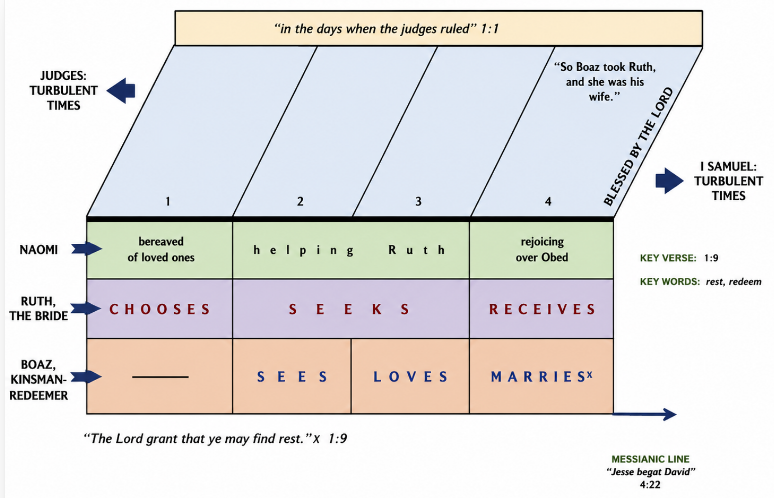
Irving Jensen's Survey of Bible (see his summary of Ruth online - page 392)
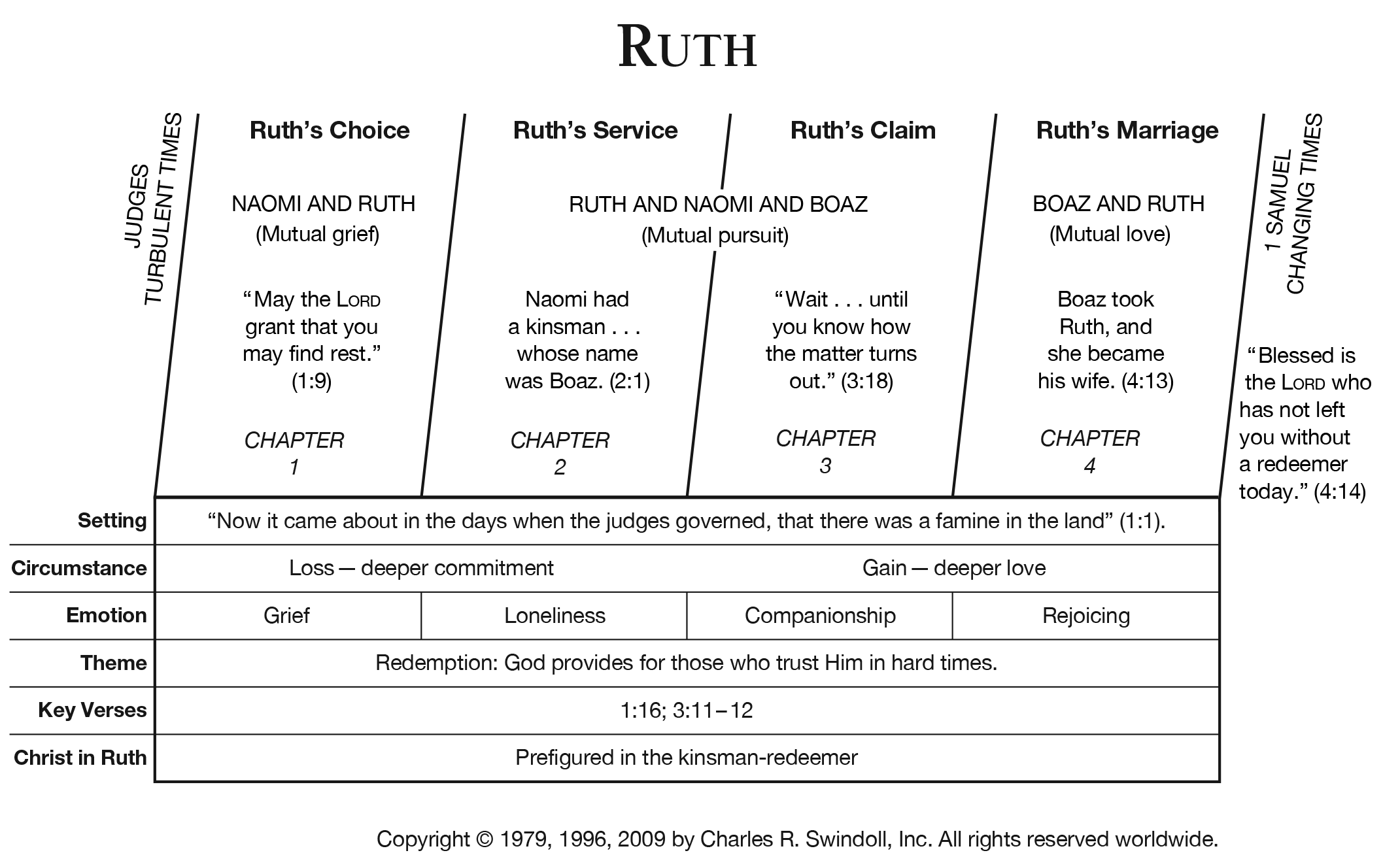
See Swindoll's summary chart of Ruth See Ruth Devotionals
|
RUTH: GOD PROVIDES |
|||
| Ruth 1 | Ruth 2 | Ruth 3 | Ruth 4 |
| Ruth's Choice | Ruth's Service | Ruth's Claim | Ruth's Marriage |
| Ruth's Resolve | Ruth's Rights | Ruth's Request | Ruth's Reward |
| Naomi and Ruth Mutual Grief |
Ruth and Naomi and Boaz Mutual Pursuit |
Boaz and Ruth Mutual Love |
|
| Ruth's Decision: Return with Naomi |
Ruth's Devotion: Provide for Naomi |
Ruth's Request: Redemption by Boaz |
Ruth's Reward: Relative of Messiah |
| Ruth and Naomi |
Ruth and Boaz |
||
| Death of Naomi's Family |
Ruth Cares for Naomi |
Boaz Cares for Ruth |
God Blesses with New Birth |
| Grief | Loneliness | Companionship | Rejoicing |
| Location: Plains of Moab |
Location: Fields of Bethlehem |
Location: Threshing floor of Bethlehem |
Location: Little town of Bethlehem |
| Time Lapsed: About 30 Years See Timeline |
|||
| Setting: Ru 1:1 Now it came about in the days when the judges governed Jdg 21:25 In those days there was no king in Israel; everyone did what was right in his own eyes. |
|||

|
The Book of Judges |
|
|
RUTH |
JUDGES |
|
Spiritual |
Spiritual |
|
Purity |
Immorality |
|
Deciding for |
Pursuing Idols |
|
Devotion |
Disloyalty |
|
Love |
Lust |
|
Peace |
War |
|
Kindness |
Cruelty |
|
Obedience |
Disobedience |
|
Oasis |
Desert |
|
Faithfulness |
Faithlessness |
Ruth 1:2 The name of the man was Elimelech, and the name of his wife, Naomi; and the names of his two sons were Mahlon and Chilion, Ephrathites of Bethlehem in Judah. Now they entered the land of Moab and remained there. (NASB: Lockman)
KJV: Now it came to pass in the days when the judges ruled, that there was a famine in the land. And a certain man of Bethlehem judah went to sojourn in the country of Moab, he, and his wife, and his two sons.
Young's Literal: And the name of the man is Elimelech, and the name of his wife Naomi, and the name of his two sons Mahlon and Chilion, Ephrathites from Beth-Lehem-Judah; and they come into the fields of Moab, and are there.
Septuagint (LXX): kai onoma to andri Abimelech kai onoma te gunaiki autou Noemin kai onoma tois dusin huiois autou Maalon kai Chelaion Ephrathaioi ek Baithleem tes Iouda kai elthosan (3PAAI) eis agron Moab kai esan (3PIAI) ekei
English of Septuagint: And the man's name was Elimelech, and his wife's name Noemin, and the names of his two sons Maalon and Chelaion, Ephrathites of Bethleem of Juda: and they came to the land of Moab, and remained there.
THE NAME OF THE MAN WAS ELIMELECH:
- Ruth 1 Resources - Multiple Sermons and Commentaries
MY GOD IS
KING
Shakespeare asks, "What’s in a name? A rose by any other name would smell as sweet." In fact Shakespeare might be surprised that Biblical names are often very instructive but in Elimelech's case can be sadly ironic. Elimelech means "my God is king" When his friends called to him, they didn't say, "Elimelech," in English. They said, "My God is King," or, "God is my King." What a wonderful name to have---his very name a testimony of the sovereignty (a king is often called a sovereign) of His God. But remember these were the days of judges when there was no king in Israel, so his name is ironic for sure. It is sad that he had such a name and yet sought solace in Moab rather than in the sovereign sufficiency of Jehovah Who is "I Am"… "I Am… anything and everything you will ever need"! Elimelech seems to have forgotten that "The name of the LORD is a strong tower. The righteous runs into it and is safe (sagab = "set on high", safe)" (Pr 18:10) (see the Name of the LORD is a Strong Tower) Elimelech's actions belie not only his name but more significantly his trust in what that Name represents.
John Trapp - My God is King: an excellent name, and such as might yield great comfort in those calamitous times.
ELIMELECH [ISBE] - e-lim'-e-lek ('elimelekh, "my God is king"; Abimelech, Alimelek): Elimelech was a member of the tribe of Judah, a native of Bethlehem Judah, a man of wealth and probably head of a family or clan (Ruth 1:2,3; 2:1,3). He lived during the period of the Judges, had a hereditary possession near Bethlehem, and is chiefly known as the husband of Naomi, the mother-in-law of Ruth and ancestress of David the king. Because of a severe famine in Judea, he emigrated to the land of Moab with his wife and his sons, Mahlon and Chilion. Not long afterward he died, and his two sons married Moabite women, Ruth and Orpah. Ten years in all were spent in Moab, when the two sons died, and the three widows were left. Soon afterward Naomi decided to return to Judah, and the sequel is told in the Book of Ruth. J. J. Reeve
QUESTION - Who was Elimelech in the Bible?
ANSWER - Elimelech (also spelled Elimelek) was the husband of Naomi and the father of two sons, Mahlon and Kilion. Elimelech was of the tribe of Judah. He lived in Bethlehem during the time of the judges.
A famine was ravaging the land, and so Elimelech moved his family away from Israel to the country of Moab so they would be fed (Ruth 1:1–2). While this was a decision made out of a desire for survival, Moab was not the best place for Elimelech to take his family. He was leaving the Promised Land that God had given him, and the Moabites did not worship the Lord. The danger was that Israelites living among other nations might begin to assimilate into the foreign culture and imitate its religious practices, thus breaking the Law of God. While in Moab, Elimelech died, leaving his wife with their two sons (verse 3). The sons married Moabite women, which was something else God wanted His people to avoid. However, God ended up blessing Elimelech’s family anyway, although not through his sons. God instead chose to work through Naomi and one of her Moabite daughters-in-law, Ruth.
After only ten years in Moab, Elimelech’s sons also died. The Bible did not say how this happened, but the household was now comprised of three widows. Naomi heard that the famine in Judah had ended and food was now available in Bethlehem (Ruth 1:6), so she determined to return. She urged her daughters-in-law to stay in Moab, but Ruth refused, proclaiming that Naomi’s God was now her own God (verse 16). The two women went to Bethlehem and began to make a living for themselves. One of Elimelech’s relatives, a man named Boaz, owned a field in Bethlehem, so Ruth went to his field to glean the leftover grain in order to feed herself and Naomi (Ruth 2:1–2). Ruth caught Boaz’s eye, and the two eventually married.
In spite of the fact that Elimelech’s family intermarried with pagans, God used the situation for His glory. Ruth and Boaz became the parents of Obed, who would become the father of Jesse, the father of David (Ruth 4:17). As the Messiah was descended from David (Romans 1:3; see also Matthew 1:1-25), Elimelech’s family was blessed to be a part of Jesus’ line. GotQuestions.org
AND THE NAME OF HIS WIFE NAOMI AND THE NAMES OF HIS TWO SONS WERE MAHLON AND CHILION:
- Ruth 1 Resources - Multiple Sermons and Commentaries
ELIMELECH'S
FAMILY
And the name of his wife, Naomi; and the names of his two sons were Mahlon and Chilion - One needs to be cautious attaching too much significance to some of these Hebrew names because there is not a clear consensus on the original meaning. With that as a caveat, most sources state that "Naomi" means "pleasant one". Mahlon (''sickly or unhealthy") became the husband of Ruth the Moabitess (as we discover - Ru 4:9, 10). Boaz, a distant relative to Mahlon, married the dead man's widow, Ruth. Chilion means "weakness, wasting away, puny, failing" and the root word for his name means ''consumption'' ( tuberculosis). McGee sums up their names as "Unhealthy and Puny!" Naomi is apparently derived from naem which means to be pleasant, delightful, lovely. While Naomi protests her name in Ru 1:20 by the end of the story her name is indeed pleasant and delightful in Bethlehem (Ru 4:14-17)!
David Atkinson on Mahlon and Chilion - Mahlon and Chilion, Naomi’s sons, apparently had old Canaanite names, but they are mentioned here because of their significance in setting the scene for the tears and pain of the rest of Ruth 1. ‘Mahlon’ seems to be linked to a root meaning ‘to be sick’, and ‘Chilion’ signifies something like ‘failing’, or ‘pining’, even ‘annihilation’. (See context in The Message of Ruth: The Wings of Refuge)
John Trapp says Naomi means "My sweet or pleasant one: a fit name for a wife, who should be to her husband "as the loving hind and pleasant roe." {Pr 5:19} Loving appellations serve to increase love betwixt married couples, as well as to express it."
Naomi is clearly a key character in Ruth as her name occurs 21x in 20v - Ruth 1:2; Ruth 1:3; Ruth 1:8; Ruth 1:11; Ruth 1:19; Ruth 1:20; Ruth 1:21; Ruth 1:22; Ruth 2:1; Ruth 2:2; Ruth 2:6; Ruth 2:20; Ruth 2:22; Ruth 3:1; Ruth 4:3; Ruth 4:5; Ruth 4:9; Ruth 4:14; Ruth 4:16; Ruth 4:17
NAOMI [ISBE] - na'-o-mi, na-o'-mi, na-o'-mi (no`omi, probably = "pleasantness"; Septuagint. Codex Vaticanus Noemein; Codex Alexandrinus Noemmei(n)): Naomi may mean "my joy," "my bliss," but is perhaps better explained according to the traditional interpretation as "the pleasant one." Wife of Elimelech and mother-in-law of Ruth (Ruth 1:2 through 4:17). She went with her husband to the land of Moab, and after his death returned to Bethlehem. When greeted on her return, she told the women of the town to call her, not no`omi ("pleasantness"), but marah ("bitterness"), "for," she said, "the Almighty hath dealt very bitterly with me." She advised Ruth in her dealings with Boaz, and afterward nursed their child.ith Anaitis (=Anahita), the Asian Artemis. She was the Venus, but sometimes the Diana, of the Romans. There are many variants of the name: Anaea (Strabo xvi.738), Aneitis (Plut. Artax. xxvii), Tanais (Clement of Alexandria, loc. cit.), also Tanath, sometimes in Phoenician inscriptions, Tanata, Anta (Egyptian). In 2 Macc 1:13 ff, a fictitious account is given of the death of Antiochus Epiphanes, in a temple of Nanaea in Persia, by the treachery of Nanaea's priests. The public treasury was often placed in Nanaea's temple; this, Epiphanes was anxious to secure under the pretext of marrying the goddess and receiving the money as dowry. The priests threw down great stones "like thunderbolts" from above, killed the king and his state and then cut off their heads. But 1 Macc 1 ff, which is more reliable, gives a different account of the death of Epiphanes after an attempt to rob a rich temple in Elymais. The account of 2 Macc 1:13 ff must be mere legend, as far as Epiphanes is concerned, but may have been suggested or colored by the story of the death of Antiochus the Great, who met his death while plundering a temple of Belus near Elymais (Strabo xvi.l.18; Diod. Sic. 573; Justin, xxxii.2). The temple of Nanaea referred to in 2 Macc 1:13 ff may be identified with that of Artemis (Polyb. xxxi.11; Josephus, Ant, XII, ix, 1) or Aphrodite (Appian, Syriac. 66; Rawlinson, Speaker's Comm.). David Francis Roberts
NET NOTE - The name Naomi (נָעֳמִי, na’omi) is from the adjective נֹעַם (noam, “pleasant, lovely”) and literally means “my pleasant one” or “my lovely one.” Her name will become the subject of a wordplay in Ru 1:20–21 when she laments that she is no longer “pleasant” but “bitter” because of the loss of her husband and two sons.
MAHLON [ISBE] - ma'-lon (machlon, "invalid", "sick", "sickly"): Ruth's first husband (Ruth 1:5; 4:9,10). In the latter passage is further evidence of the unwillingness to allow a family connection or inheritance to drop (see MAHLAH; MAHLI). Note that David's descent and that of his "Greater Son" come through Ruth and Boaz (Ruth 4:22).
CHILION [ISBE] - kil'-i-on (kilyon, "pining," "wasting away"): One of the two sons of Elimelech and Naomi, "Mahlon and Chilion, Ephrathites of Bethlehem-judah" (Ruth 1:2). With his mother and brother he came into Moab and there both married Moabite women, Orpah being the name of Chilion's wife and Ruth that of the wife of Mahlon (Ru 4:9,10). Both died early and Orpah remained in Moab while Ruth accompanied Naomi back to Bethlehem. When Boaz married Ruth he "bought all that was Elimelech's, and all that was Chilion's, and Mahlon's, of the hand of Naomi" (Ru 4:9).
NET NOTE - The name Mahlon (מַחְלוֹן, makhlon) is from מָלָה (malah, “to be weak, sick”) and Kilion (כִליוֹן, khilyon) is from כָלָה (khalah, “to be frail”). The rate of infant mortality was so high during the Iron Age that parents typically did not name children until they survived infancy and were weaned. Naomi and Elimelech might have named their two sons Mahlon and Kilion to reflect their weak condition in infancy due to famine—which eventually prompted the move to Moab where food was abundant.
QUESTION - Who was Naomi in the Bible?
ANSWER - The story of Naomi appears in the Bible in the book of Ruth. Naomi lived during the time of the judges. She was the wife of a man named Elimelech, and they lived in Bethlehem with their two sons, Mahlon and Kilion. Naomi’s life illustrates the power of God to bring something good out of bitter circumstances.
When a famine hits Judea, Elimelech and Naomi and their two boys relocate to Moab (Ruth 1:1). There, Mahlon and Kilion marry two Moabite women, Orpah and Ruth. After about ten years, tragedy strikes. Elimelech dies, and both of Naomi’s sons also die, leaving Naomi, Ruth, and Orpah widows (Ruth 1:3–5). Naomi, hearing that the famine in Judea was over, decides to return home (Ruth 1:6). Orpah stays in Moab, but Ruth chooses to move to the land of Israel with Naomi. The book of Ruth is the story of Naomi and Ruth returning to Bethlehem and how Ruth married a man named Boaz and bore a son, Obed, who became the grandfather of David and the ancestor of Jesus Christ.
The name Naomi means “sweet, pleasant,” which gives us an idea of Naomi’s basic character. We see her giving her blessing to Ruth and Orpah when she tells them to return to their mothers’ homes so that they might find new husbands: she kisses them and asks that the Lord deal kindly with them (Ruth 1:8–14). But her heartache in Moab was more than Naomi could bear. When she and Ruth arrive in Bethlehem, the women of the town greet Naomi by name, but she cries, “Don’t call me Naomi. . . . Call me Mara, because the Almighty has made my life very bitter. I went away full, but the Lord has brought me back empty. Why call me Naomi? The Lord has afflicted me; the Almighty has brought misfortune upon me” (Ruth 1:20–21). The name Mara means “bitter.” The cup of affliction is a bitter cup, but Naomi understood that the affliction came from the God who is sovereign in all things. Little did she know that from this bitter sorrow great blessings would come to her, her descendants, and the world through Jesus Christ.
Ruth meets a local landowner, Boaz, who is very kind to her. Naomi again recognizes the providence of God in providing a kinsman-redeemer for Ruth. Naomi declares that the Lord “has not stopped showing his kindness to the living and the dead" (Ruth 2:20) Seeing God’s hand in these events, Naomi encourages Ruth to go to Boaz as he slept in the threshing floor in order to request that he redeem her and her property. Naomi’s concern was for Ruth’s future, that Ruth would gain a husband and provider (Ruth 3).
Naomi’s bitterness is turned to joy. In the end, she gains a son-in-law who would provide for both her and Ruth. She also becomes a grandmother to Ruth’s son, Obed. Then the women of Bethlehem say to Naomi, “Praise be to the Lord, who this day has not left you without a guardian-redeemer. May he become famous throughout Israel! He will renew your life and sustain you in your old age. For your daughter-in-law, who loves you and who is better to you than seven sons, has given him birth” (Ruth 4:14–15). Naomi was no longer Mara. Her life again became sweet and pleasant, blessed by God. GotQuestions.org
EPHRATHITES OF BETHLEHEM IN JUDAH
- Ge 35:19; 1Sa 1:1; Micah 5:2
- Ruth 1 Resources - Multiple Sermons and Commentaries
Related Passages:
1 Samuel 16:1 Now the LORD said to Samuel, “How long will you grieve over Saul, since I have rejected him from being king over Israel? Fill your horn with oil and go; I will send you t o Jesse the Bethlehemite, for I have selected a king for Myself among his sons.”
1 Samuel 17:12 Now David was the son of the Ephrathite of Bethlehem in Judah, whose name was Jesse, and he had eight sons. And Jesse was old in the days of Saul, advanced in years among men.
Ephrathites of Bethlehem in Judah - Ephrata or Ephrathah ("fruitful") was another name for Bethlehem. The town was originally called Ephrath (Ge 35:16, 19, 48:7) or Ephrathah (Ru 4:11, Mic 5:2). It was evidently named after Ephrath, the wife of Caleb (1Chr 2:19). Note that this does not refer to Ephrathites of the tribe of Ephraim, as 1Ki 11:26. They were of the tribe of Judah.
THOUGHT - In a spiritual analogy, one could note that the Messiah's home was both the house of bread and the field of the fruit of the vine, as the Messiah would become both "the bread of life" (John 6:48) in His broken body and "the true vine" in His redeeming blood (John 15:1).
NET NOTE - Heb “[They were] Ephrathites.” Ephrathah is a small village (Ps 132:6) in the vicinity of Bethlehem (Gen 35:16), so close in proximity that it is often identified with the larger town of Bethlehem (Gen 35:19; 48:7; Ruth 4:11; Mic 5:2 [MT 5:1]; HALOT 81 s.v. אֶפְרָתָה); see F. W. Bush, Ruth, Esther (WBC), 64. The designation “Ephrathites” might indicate that they were residents of Ephrathah. However, the adjectival form אֶפְרָתִים (ephratim, “Ephrathites”) used here elsewhere refers to someone from the clan of Ephrath (cf. 1 Chr 4:4) which lived in the region of Bethlehem: “Now David was the son of an Ephrathite from Bethlehem in Judah whose name was Jesse” (1 Sam 17:12; cf. Mic 5:2 [MT 5:1]). So it is more likely that the virtually identical expression here—“Ephrathites from Bethlehem in Judah”—refers to the clan of Ephrath in Bethlehem (see R. L. Hubbard, Jr., borrow commentary on The book of Ruth [NICOT], 91).
Bethlehem-Ephrata was thus an appropriate "place for the LORD, an habitation for the mighty God of Jacob. Lo, we heard of it at Ephratah: we found it in the fields of the wood" (Psalm 132:5, 6).
Judah (3063) (yehuda) means celebrated, praised or praise Jehovah and in context describes a territory. We first encounter the name Judah (Judah 1; Judah 2) as given to one of Jacob's sons by his wife Leah in Ge 29:35
"And she conceived again and bore a son and said, "This time I will praise the LORD." Therefore she named him Judah. Then she stopped bearing." (cf Gen 49:8)
Ephrathite (0673) (Ephrathi) means a descendent of Ephraim. This is a member of the tribe of Ephraim, Judg. 12:5. Elkanah, the father of Samuel, was an Ephraimite, 1 Sam. 1:1, as was Jeroboam I, the first king of the Northern Kingdom of Israel, 1 Kings 11:26.This word is also a clan of Judah in Bethlehem. This was a subdivision of the Calebites from the Bethlehem region. David's father, Jesse, was a member, 1 Sam. 17:12. The term is used in the plural of Ruth's in-laws (Ruth 1:2).
Ephrathi - 5v - Ephraimite(3), Ephrathite(1), Ephrathites(1). Jdg. 12:5; Ruth 1:2; 1 Sam. 1:1; 1 Sam. 17:12; 1 Ki. 11:26
EPHRATH; EPHRATHAH [ISBE] - ef'-rath, e'-frath, ef'-ra-tha, ef-ra'-tha ('ephrath; Ephratha; Gen 35:16; 48:7); (Easton and Smith say name = "fruitful") ('ephrathah, in the other references: Josh 15:59 (in added verse of Septuagint only); Ruth 4:11; 1 Ch 2:19,24,50; Ps 132:6; Mic 5:2, the King James Version "Ephratah"): The name either of Bethlehem itself or of a district in which Bethlehem was situated. A man of this place was called an Ephrathite (Ruth 1:2; 1 Sam 17:12). It is held by many authorities that the Ephrath where Rachel was buried (Gen 35:16; 48:7) was a different place, the words "the same is Bethlehem" being a gloss. The reading in Ps 132:6 is doubtful; the Revised Version, margin has "Ephraim." E. W. G. Masterman
Jason Driesbach - Ephratha was an alternate name for Bethlehem (Ru 4:11; Ge 35:16, 19; 48:7) and, at one time, may have indicated a small village nearby Bethlehem. "Ephrathites" could therefore indicate that Elimelech's family were residents of Bethlehem or its territory. Rachel, wife of Jacob the patriarch, was buried near Ephratha (Ge 35:19). But the term "Ephrathites" may also indicate that the family was from the clan of Ephrath (1 Chr 4:4). This second meaning is more likely, but in either case, the importance of the term is its link to David, who was also an Ephrathite (1Sa17:12; Mic 5:2). Without giving away the outcome of the story, the narrator hints at what will be revealed in the genealogy of ch 4. (See context in Joshua, Judges, Ruth)
ENTERED THE LAND OF MOAB AND REMAINED THERE:
- Ruth 1 Resources - Multiple Sermons and Commentaries
Related Passage:
Judges 3:30 So Moab was subdued that day under the hand of Israel. And the land was undisturbed for eighty years.

Now they entered the land of Moab and remained there - Observe the picture above. Would this have been an easy trek into Moab? They would have to traverse those mountains and in those days thieves often lurked in the mountains.
John Trapp quips "There is food in Moab when famine in Israel. "Wicked men have their portion in this life"; (Ps 17:14) but David neither coveteth their cates, nor envieth their happiness. {Ps 17:15).
Moab (4124) may mean "of my father" and is the name of a man (a son of Lot by an incestuous union with his older daughter) and as used in this book, the name of a nation, situated along the eastern border of the southern half of the Dead Sea, on a high plateau (see picture below) between the Dead Sea and the Arabian desert. Moab was about 35 miles in length and 25 miles in width.
Remained (1961) (hayah) means to exist, to be or to come to pass. They were "existing" in Moab. What began as just a "sojourn" (temporary) turned into a settled existence and even more so after the death of Elimelech (Ru 1:5).
THOUGHT - We sometimes think we can move away from our problems, but find we just bring them with us. No matter where you go, you bring yourself with you - so the same problems can continue but now just in a different place. I have found that the biggest problem I have always moves with me for my old flesh nature is my biggest problem!
THOUGHT - Woodrow Kroll observes that "Sometimes we intend for situations to be only temporary. We think, Just as soon as the kids are through college, we'll start tithing again. Or perhaps you reason, "As soon as I get through this busy period at work, I'll get back to having a daily quiet time." But days turn into weeks, weeks into months and before you know it, circumstances that were only going to be temporary have become a way of life. Have you allowed something that was intended as transient to become a permanent fixture in your life? Have you been waiting for a more convenient time to do what you know you should be doing now? If time has slipped away for you, don't linger another day "in a distant land." If you're not where you should be, this is the day to do something about it. Don't expect time to stand still just because you do. (See devotional)
Ruth 1:3 Then Elimelech, Naomi's husband, died; and she was left with her two sons. (NASB: Lockman)
Young's Literal: And Elimelech husband of Naomi dieth, and she is left, she and her two sons; Septuagint (LXX): kai apethanen (3SAAI) Abimelech o aner tes Noemin kai kateleiphthe (3SAPI) aute kai oi duo huioi autes
English (Lxx): And Elimelech the husband of Noemin died; and she was left, and her two sons.
- 2Ki 4:1; Ps 34:19; Heb 12:6, He 12:10, He 12:11
- Ruth 1 Resources - Multiple Sermons and Commentaries
Then (note) Elimelech, Naomi's husband, died - This is a abrupt otherwise unexplained declaration! Why did he die? Was this part of God's providential plan? (That's rhetorical because since God is sovereign, every sparrow that falls to the ground is part of His providential plan -- we just may not see they why or how as Dt 29:29 alludes to) What irony - in fleeing famine to seek life, they instead found death. Nevertheless, it is hard to say that this was the direct hand of God’s judgment against them although this is the emphatic conclusion of many commentaries. If we are honest, it is sometimes difficult to discern why tragic things happen. What is certain is that the change of scenery did not improve the circumstances of Elimelech's family (at least not in Ruth 1!).
Block comments that "Naomi’s new position as the head of this household is reflected in the reversal of roles in the text; she is no longer Elimelech’s wife (v. 2); he is her husband (v. 3). And the sons are no longer Elimelech’s children but hers." (Borrow Judges, Ruth. Vol. 6: New American Commentary - page 627) '
David Atkinson has an interesting short "excursus" on names in Ruth - To our author, names are significant. There are some characters in the book whose names we are not told, such as the important ‘next of kin’ who features in Ruth 4:1. So we must assume that when the writer tells us names, they carry a special significance in his purpose. To the Hebrew way of thinking, to know a person’s name is to know his character, to know him. The name is the person. When Abram becomes a new person, he receives a new name. When a person’s name is destroyed or cut off the person is extinguished from human memory, is as though he had never been. It was a terrible thing to be left with neither name nor remnant. Supremely when God tells his name, he tells his character, and shares himself with those to whom he speaks. ‘Yahweh’ is his personal name, the name of the covenant God. Elimelech means ‘My God is King’. Some commentators, like Matthew Henry whom we quoted earlier, wonder if there is not some rebuke implied in telling us this name. Should such a name not express trust and confidence in God? We may certainly remind ourselves that for all for whom ‘My God is King’, while there is no promise of a trouble-free life, there is always the promise of daily bread, and the assurance that there is no need to be morbidly anxious about tomorrow. Part of the meaning of faith may be expressed by saying that faith is what God gives us to help us cope with uncertainties. Did Elimelech live up to his name? (See context in The Message of Ruth: The Wings of Refuge)
Hubbard comments that "As famine shattered the solidarity between man and land (v. 1), now death destroys the harmony between man and woman." (See context in The Book of Ruth or Borrow The book of Ruth)
HISTORICAL NOTE - The pagan Canaanites referred to Muth (or Mot)(4191) (Hebrew for "died") as the name of their god of death (is this not utter foolishness to make death into a "god" but that's what happens when you don't believe in the true God!). Muth fought with Baal, the god of fertility, for which he suffered the displeasure of El, the head of the pantheon. The Canaanites "normalized" death through these myths. They practiced elaborate rituals, which included mutilation of their bodies and sacrifices for the dead which were strictly forbidden to the sons of Israel and even went to the extreme of sacrificing children (Dt 12:31).
Daniel Block has an interesting comment - How different from the dream were the experiences of this Israelite family in Moab! Figuratively speaking, having escaped Rāʿāb, (see raab) the divine agent of famine, they walked right into the clutches of Môt, the even more fearful agent of death. Cf. Amos 5:19. In pagan Canaanite thought Rāʿāb and Môt were viewed as divinities. Of course in the OT these notions are demythologized. (Borrow Judges, Ruth. Vol. 6: New American Commentary - page 627)
John Trapp on Elimelech, Naomi's husband, died - Her head was cut off, her root uncovered.
Jason Driesbach makes an interesting observation on Elimelech, Naomi's husband, which would be easy to miss - Naomi was introduced as "his wife" (Ru 1:2), but after his death, Elimelech is reduced to "Naomi's husband." In ancient literature, it is rare to find a man named in terms of his relationship to a woman. With this phrase, the narrator subtly signals that Naomi will be the main character—not Elimelech or his sons as one might have otherwise supposed. (See context in Joshua, Judges, Ruth)
And she was left (sha'ar/sa'ar; Lxx = kataleipo) with her two sons - NET = "she and her two sons were left alone." A widow in ancient times was in dire straits but at least Naomi had her two sons. Sha'ar speaks of bereavement at the death of another as in Ge 42:38 and Ru 1:5 ("bereft").
Selwyn Hughes writes that "These circumstances reinforce the point we made yesterday about the folly of making decisions based on expediency rather than on the will of God. How prone we are to allow materialistic or economic values to influence our judgment. A man and his family emigrated, lured by the appeal of financial security. He wrote: "Would to God I had thought of the spiritual implications before I made the move. My life and family are in ruins." This is why it is always wise to pray over a move to another town, city or country, as there may be unseen dangers that are revealed only through prayer. A change of circumstances will not necessarily solve our problems. We think if we had a new home, a new church, a new husband or wife, a new minister, or a new job, that all our difficulties would be over. As Christians, every major decision we make ought to be set against God's perfect will. We owe it to God to bring Him into our decision making. Otherwise we may find we have gained economically but lost out spiritually." (Ruth 1)
God Moves in a Mysterious Way
Deep in unfathomable mines
Of never failing skill
He treasures up His bright designs
And works His sovereign will.
Ye fearful saints, fresh courage take;
The clouds ye so much dread
Are big with mercy and shall break
In blessings on your head.
Judge not the Lord by feeble sense,
But trust Him for His grace;
Behind a frowning providence
He hides a smiling face.
His purposes will ripen fast,
Unfolding every hour;
The bud may have a bitter taste,
But sweet will be the flower.
Blind unbelief is sure to err
And scan His work in vain;
God is His own interpreter,
And He will make it plain.
Left (07604) sha'ar/sa'ar means to remain, be left over, to leave, to let remain. The first Biblical use of sha'ar is in the context of judgement, Moses recording that after the worldwide flood "only Noah was left" and was in essence a "remnant." (Ge 7:23; Lxx = kataleipo from kata = intensifies meaning + leipo = leave behind, forsake). The second use also describes God's judgment, this time on Sodom and Gomorrah stating that "those who survived fled to the hill country." (Ge 14:10; Lxx = kataleipo). Sha'ar describes Pharaoh's army = "not even one of them remained." (Ex 14:28; Lxx = kataleipo) See Study of Related Hebrew Verb - (07611) sheerith = Remnant. Sha'ar is used twice in Ruth - Ruth 1:3 and Ruth 1:5 and both are translated in the Greek or Lxx with kataleipo which means to leave behind, to abandon. (cf Mt 19:5). Sha'ar often refers to those who have survived the judgment of God (see Lev 26:36, 39; Dt 4:27; Dt 28:62; 2Chr 34:21; Ezek 6:12; Ezek 9:8; Zech 11:9).
Ruth 1:4 They took for themselves Moabite women as wives; the name of the one was Orpah and the name of the other Ruth. And they lived there about ten years. (NASB: Lockman)
KJV: And they took them wives of the women of Moab; the name of the one was Orpah, and the name of the other Ruth: and they dwelled there about ten years.
Young's Literal: and they take to them wives, Moabitesses: the name of the one is Orpah, and the name of the second Ruth; and they dwell there about ten years.Septuagint (LXX): kai elabosan (3PAAI) heautois gunaikas Moabitidas onoma te mia Orpha kai onoma te deutera Routh kai katokesan (3PAAI: katoikeo: settle down & be at home) ekei os deka ete
English (Lxx): And they took to themselves wives, women of Moab; the name of the one was Orpha, and the name of the second Ruth; and they dwelt there about ten years.
- Dt 7:3; 23:3; 1Ki 11:1-2
Related Passages:
Deuteronomy 7:3 “Furthermore, you shall not intermarry with them; you shall not give your daughters to their sons, nor shall you take their daughters for your sons.
Deuteronomy 23:3 “No Ammonite or Moabite shall enter the assembly of the LORD; none of their descendants, even to the tenth generation, shall ever enter the assembly of the LORD,
NET NOTE on ever - The Hebrew term translated “ever” (עַד־עוֹלָם, ’ad-’olam) suggests that “tenth generation” (Dt 23:2, 3) also means “forever.” However, in the OT sense “forever” means not “for eternity” but for an indeterminate future time.
1 Kings 11:1-2 Now King Solomon loved many foreign women along with the daughter of Pharaoh: Moabite, Ammonite, Edomite, Sidonian, and Hittite women, 2 from the nations concerning which the LORD had said to the sons of Israel, “You shall not associate with them, nor shall they associate with you, for (TERM OF EXPLANATION) they will surely turn your heart away after their gods.” Solomon held fast to these in love.
They took for themselves Moabite women as wives - Weren't they guilty of transgressing the instruction to "not intermarry with" pagan women who God said would "turn your sons away from following Me to serve other gods"? Solomon learned the truth of God's warning (see above)! However the Moabite women are not listed with the 7 Canaanite nations in (Dt 7:1). Therefore some say that Dt 7:1-3 only prohibits Canaanite marriage and that marriages to Moabites were not condemned. While this is true it is notable that after return from the Babylonian exile, both Ezra and especially Nehemiah state that Moabite wives were not to taken by Israelites (Ezra 9:1-2; Neh. 13:23-25). So it is a moot point as to whether they were committing transgression in taking Moabite wives. Ruth, a Moabite, sought the living God (Ru 1:14) and married an Israelite man. The treatment of Ruth by Boaz along with other Israelites of Bethlehem demonstrates that this law was never meant to exclude one who said ”Your people will be my people and your God my God“ (Ru 1:16). Not till Ru 4:10 does the reader learn that it was Mahlon who married Ruth.
MacArthur addresses the question of their marriage to Moabite women asking "was not marriage to a Moabitess strictly forbidden by the law? The nations or people to whom marriage was prohibited were those possessing the land that Israel would enter (Ex. 34:16; Deut. 7:1–3; Josh. 23:12) which did not include Moab (cf. Deut. 7:1). Further, Boaz married Ruth, a devout proselyte to Jehovah (1:16–17) not a pagan worshiper of Chemosh—Moab’s chief deity (cf. later problems in Ezra 9:1, 2 and Neh. 13:23–25). (See context in The MacArthur Bible Commentary)
John Trapp on Moabite wifes - Which haply they had not been suffered to do if their father had lived: their mother, it may be, could as little hinder it, as Rebekah Esau’s marrying those daughters of Heth. But God had a holy hand in it: He orders the disorders of men to His own glory.
NET NOTE on they took for themselves - Heb “and they lifted up for themselves Moabite wives.” When used with the noun “wife,” the verb נָשָׂא (nasa’, “to lift up, carry, take”) forms the idiom “to take a wife,” that is, to marry (BDB 673 s.v. Qal.3.d; 2 Chr 11:21; 13:21; 24:3; Ezra 9:2, 12; 10:44; Neh 13:25).
Solomon’s experience later showed that the greatest problem in a mixed marriage is the temptation to serve the gods of one’s foreign wife (1Ki 11:1-6). Thus there is a striking difference in Ruth's marriage to Boaz which was in the line of Messiah and Solomon's marriages which resulted in introduction of flagrant idolatry into Solomon's court for which God tore the kingdom apart (10 northern tribes and 2 southern tribes in Judah and Jerusalem) in 931 BC. Ruth sought after the One True God in contrast to the polytheistic idol worshipers in her native land.
The name of the one was Orpah and the name of the other Ruth. And they lived there about ten years - Orpah may mean "Forelock" or "fawn". Ruth means "friendship" which is so fitting as this book contains one of the most touching examples of friendship in the Bible.
NET NOTE on Orpah - The name Orpah (עָרְפָּה, ’orpah) is from the noun עֹרֶף (’oref, “back of the neck”) and the related verb (“to turn one’s back”). The name Ruth (רוּת, rut) is from the noun רְעוּת (ré’ut, “friendship”), derived from the root רֵעַ (rea’, “friend, companion”). Ironically, Orpah will eventually turn her back on Naomi, while Ruth will display extraordinary friendship as her life-long companion (see 1:14). Since they seem to mirror the most definitive action of these women, perhaps they designate character types (as is the case with the name Mara in 1:21 and Peloni Almoni in 4:2) rather than their original birth names.
About ten years - Recall Ru 1:1 where they initially went to Moab to "sojourn", which presumably suggested the stay was to be temporary. There is a Jewish tradition that a woman who has been widowed for ten years will not have a child again. Whether this tradition stems from Ru 1:4 or predates it is not known
Ruth had both reputation and character as we see this story unfold. Reputation is what other people say about you. Character is what God knows to be true of you (cp 1Sa 16:7 as Samuel anoints one of Jesse's sons. Cp God's viewpoint Isa 55:8, 9. Ps 147:10, 11, Pr 31:30 - Surely Ruth was a woman who "feared the LORD", Pr 31:10-30 - see brief study of The Fear of the Lord). Ruth was both a woman of reputation and character. For women Ruth stands out as an example to be followed. For men Ruth is the model of a woman to be pursued. Ruth is a woman with a wrong beginning who makes a right turn which brings her the right ending as we see in Matthew 1:5 where we read "Salmon was the father of Boaz by Rahab, Boaz was the father of Obed by Ruth, and Obed the father of Jesse."
How paradoxical that in Judges the chosen people forsook God (Jdg 2:11-15, Jdg 10:6, 10, 13) for idols (cp Jdg 17:5, 18:14, 17-20) but Ruth forsakes idols for the living God (cf 1Th 1:9-10)! Ruth (like another Gentile woman Rahab the harlot - Josh 2:1-3, Josh 6:17-25, Mt 1:5 = Rahab in the line of the Messiah, Heb 11:31 = Rahab's faith in action, James 2:25 = an example of genuine faith) chose to believe God when most around her (including her sister-in-law Orpah) rejected Him. Ruth is a paradox from beginning to end…
Ruth begins with a famine in the land and
Ends with a future in the Lord
Regarding the transition of a sojourn (Ru 1:1) into a ten year stay, someone has written a proverbial word that may be applicable to the beginning scene in Ruth...
SIN will take you further than you ever meant to STRAY,
Will keep you longer than you ever planned to STAY,
Will cost you more than you ever dreamed that you'd PAY!
MOABITES
- Descended from Lot -Genesis 19:37
CALLED
- Children of Lot -Deuteronomy 2:9
- People of Chemosh -Numbers 21:29; Jeremiah 48:46
- Are given to, as a possession -Deuteronomy 2:9
- Separated from the Amorites by the river Arnon -Numbers 21:13
- Expelled the ancient Emims -Deuteronomy 2:9, 10, 11
- Possessed many and great cities -Nu 21:28,30; Isa 15:1, 2, 3, 4; Jer 48:21, 22, 23, 24
- Governed by kings -Numbers 23:7; Joshua 24:9
DESCRIBED AS
- Proud and arrogant -Isaiah 16:6; Jeremiah 48:29
- Idolatrous -1Kings 11:7
- Superstitious -Jeremiah 27:3,9
- Rich and confident -Jeremiah 48:7
- Prosperous and at ease -Jeremiah 48:11
- Mighty men of war -Jeremiah 48:14
- Deprived of a large part of their territories by the Amorites -Numbers 21:26
- Refused to let Israel pass -Judges 11:17,18
- Alarmed at the number, &c of Israel -Numbers 22:3
- With Midian send for Balaam to curse Israel -Numbers 22:1-24:25
ISRAELITES
- Enticed to idolatry by -Numbers 25:1-3
- Forbidden to spoil -Deuteronomy 2:9; Judges 11:15
- Forbidden to make leagues with -Deuteronomy 23:6
- Sometimes intermarried with -Ruth 1:4; 1 Kings 11:1; 1 Chronicles 8:8; Nehemiah 13:23
- Excluded from the congregation of Israel forever -Deuteronomy 23:3,4; Nehemiah 13:1,2
- Always hostile to Israel -Psalms 83:6; Ezekiel 25:8
- Harassed and subdued by Saul -1 Samuel 14:47
- Gave an asylum to David’s family -1 Samuel 22:4
- Made tributary to David -2 Samuel 8:2,12
- Benaiah slew two champions of -2 Samuel 23:20
- Paid tribute of sheep and wool to the king of Israel -2 Kings 3:4; Isaiah 16:1
- Revolted from Israel after the death of Ahab -2 Kings 1:1; 3:5
- Israel and Judah joined against -2 Kings 3:6,7
- Miraculously deceived by the colour of the water -2 Kings 3:21-24
- Conquered by Israel and Judah -2 Kings 3:24-26
- King of, sacrificed his son to excite animosity against Israel -2 Kings 3:27
- Joined Babylon against Judah -2 Kings 24:2
PROPHECIES RESPECTING MOAB
- Terror on account of Israel -Exodus 15:15
- Desolation and grief -Isaiah 15:1-9; 16:2-11
- Inability to avert destruction -Isaiah 16:12
- To destroyed in three years -Isaiah 16:13,14
- To be captives in Babylon -Jeremiah 27:3,8; 48:7
- Their desolation as a punishment for their hatred of Israel -Jeremiah 48:26,27; Ezekiel 25:8,9
- Restoration from captivity -Jeremiah 48:47
- Subjugation to Messiah -Numbers 24:17; Isaiah 25:10
- Subjugation to Israel -Isaiah 11:14
Ruth 1:5 Then both Mahlon and Chilion also died and the woman was bereft of her two children and her husband. (NASB: Lockman)
NKJV: Then both Mahlon and Chilion also died; so the woman survived her two sons and her husband
TEV: Mahlon and Chilion also died, and Naomi was left all alone, without husband or sons.
Young's Literal: And they die also, both of them -- Mahlon and Chilion -- and the woman is left of her two children and of her husband.
Septuagint (LXX):kai apethanon (3PAAI) kai ge amphoteroi Maalon kai Chelaion kai kateleiphthe (3SAPI) e gune apo tou andros autes kai apo ton duo huion autes
English (Lxx): And both Maalon and Chelaion died also; and the woman was left of her husband and her two sons.
- Ruth 1 Resources - Multiple Sermons and Commentaries
THE DISMAL PICTURE:
THREE DEAD HUSBANDS
Then - Whenever you see a "then" (see notes on importance of expressions of time in inductive Bible study) stop (observe) and ask questions like "What happened then?", "When is then?", "What sequence being explained?" (interrogate with the 5W'S & H). Then, although a small word, is very important in narratives to establish the sequence of events. Similarly "then" is vitally important to recognize in prophetic passages where the Holy Spirit uses it to lay out the sequence of or timing of the prophetic events (eg, see Jesus' Olivet discourse describing the end of this age [Mt 24:3, cp this "age", the church age, which will be followed by the 1000 year Messianic age {Lk 18:30} - cp Da 12:13, Mt 12:32, Mt 13:39, 40, 49, Mt 28:20, regarding "this age" and the "age to come" see also Lk 20:34, 35, Mk 10:30, 1Co 2:6-8, 1Co 3:18, Gal 1:4, Ep 1:21, Titus 2:12, He 6:5] - Mt 24:14, 15, 16, 21, 23, 30 describing the timing of events in the Great Tribulation).
Then both Mahlon and Chilion also died and the woman was bereft (sha'ar/sa'ar) of her two children and her husband It is notable that the two sons lived with their wives for up to ten years but both Orpah and Ruth remain barren! (God's providence). So now there was no male remnant and three childless widows - Naomi and her two daughters-in-law, Orpah and Ruth. To be a childless widow was to be among the lowest, most disadvantaged classes in the ancient world. There was no one to support you, and you had to live on the generosity of strangers. Naomi had no natural family in Moab, and no one else to help her. Clearly the narrative is sketching the picture of an utterly hopeless, desperate situation! Just the kind of impossible situation the Almighty (Shaddai, the Sufficient One - see Ru 1:20, 21) specializes in. The psalmist affirms that "The LORD protects the strangers; He supports the fatherless and the widow; but He thwarts the way of the wicked. (Ps 146:9) Naomi was both a "stranger" and a "widow". Subsequent events prove that God is true to His Word. If you're a widow, you will find great encouragement in the book of Ruth. As someone has well said
He will be your heart's sure comfort,
Counselor Divine, and Friend;
Coming years need not distress you,
He will guard you to the end. --Anon.
"God's comfort compensates for life's losses."
As noted above bereft is (sha'ar/sa'ar) which describes that which remains or survives after an elimination process, in this case the death of three husbands. The Septuagint (LXX) translates it with kataleipo which is a strong way of saying she was left behind.
She must have felt this deeply but she was not alone either, as Moses recorded Yahweh's promise to Moses "Be strong and courageous, do not be afraid or tremble at them, for the LORD your God is the One Who goes with you. He will not fail you or forsake you." (Deut 31:6) Hebrews 13:5 quotes this promise and in the Greek uses 5 negatives to strongly emphasize that God will not abandon His own no matter how bleak the circumstances. One can paraphrase Hebrews 13:5 "I will never, no never, never, not ever leave you!"
J Vernon McGee on Mahlon and Chilion also died - Now I was expecting that, by the way. I didn't think that they'd make it through another hard winter, and they didn't. And these two boys, Unhealthy and Puny, died. Now she has lost her entire family, and all she has left are two little daughters-in-law, foreign girls. That's all she has. I tell you, trouble did come. And the prodigal family, like the prodigal son, got their whipping in the far country. (See context in Thru the Bible)
David Atkinson on the significance of the death of Naomi's two sons - The name of the man must not be forgotten. His name would live on in his inheritance. How important for him, then, that he should have a son (Ru 4:5, 10). How devastating, therefore, for Naomi that not only has she lost the three men of her household, but there is no heir by which their names will be continued and their inheritance guaranteed. Her men had died, and so had their names! The author is here piling up one disaster on another in Naomi’s life, giving us his readers a real sense of shock that one person should be called on to suffer so much. Surely it was undeserved; surely unexpected. Are we not introduced here to the dark side of God’s providence—that some of our pains seem unbearable; some of our circumstances so unjust; some of our questions stay without answers? Faith, we are to learn from Naomi, sometimes means a willingness to leave such questions in the mystery of God, in the confidence that in the brighter days he has shown himself trustworthy. (See context in The Message of Ruth: The Wings of Refuge)
Traditionally many if not most Jewish and Christian commentators have presumed that the death of these men was a matter of divine judgment. After all Elimelech had removed his family to pagan country, and Mahlon and Chilion had married pagan women. In fairness to the text, one must observe that the writer neither explains the deaths nor criticizes Elimelech. The reality is that for the women, it does not matter why their husbands have died but that all the men are gone.
John Trapp - Crosses seldom come single. This excellent woman was left desolate and disconsolate, only she "comforted herself in the Lord her God," as David in like distress did. {1Sa 30:6}
To sum it up Naomi's emptiness is complete: She was old. She was barren. She had neither husband nor sons. She had only two young daughters-in-law, both foreigners and both barren. She is running on empty and all seems lost but as the story unfolds, God hand of providence is shown to clearly be in control and is ordering Naomi's steps to meet her need, the need of Ruth but eventually the need of the entire world of empty humanity by orchestrating the human lineage through which the Messiah, our Kinsman-Redeemer will come! What a story!
Widows from the human perspective would seem to be very unlikely candidates for playing out the Lord’s grand drama of redemption. And yet over and over we see that God's ways are not our ways, Paul explaining that "God has chosen the foolish things of the world to shame the wise, and God has chosen the weak things of the world to shame the things which are strong, and the base things of the world and the despised, God has chosen, the things that are not, that He might nullify the things that are, that no man should boast before God." (1Cor 1:27-29)
John Angell James (1841) writes of the benefits of affliction (see notes on Ruth 1:1) summarized as follows (Read his full discussion) 1. Affliction quickens DEVOTION. 2. Affliction discloses, mortifies, and prevents SIN. 3. Affliction tends to exercise, improve and quicken our GRACES. 4. Afflictions tend to wean us from the world, and to fix our affections on things above.
The phrase her two children is the Hebrew word for very young children but in context would refer to young adults. This designation however would seem to point to the fact that both sons died at a relatively young age even for the ancient near east.
NET NOTE on children - The term יֶלֶד (yeled, “offspring”), from the verb יָלַד (yalad, “to give birth to”), is used only here of a married man. By shifting to this word from the more common term בֵּן (ben, “son”; see vv. 1–5a) and then using it in an unusual manner, the author draws attention to Naomi’s loss and sets up a verbal link with the story’s conclusion (cf. Ru 4:16). Although grown men, they were still her “babies” (see E. F. Campbell, Ruth [AB], 56; F. W. Bush, Ruth, Esther [WBC], 66).
Although God's Name is not mentioned in this verse, the events clearly illustration His sovereignty for by His own testimony "there is no god besides Me. It is I who put to death and give life. I have wounded, and it is I who heal and there is no one who can deliver from My hand." (Dt 32:39) And as Hannah declared, even in the face of her barrenness, that "Jehovah kills and makes alive. He brings down to Sheol and raises up." (1Sa 2:6) Clearly God is in control of the circumstances of Naomi, Ruth and Orpah. The clouds may temporarily hide His face but not His lovingkindness and His sovereign working of all things out together for good, as the subsequent chapters so eloquently and masterfully prove.
THOUGHT - Woodrow Kroll - Naomi had left Israel with a husband and two sons; now only she was left—alone, and yet not alone. God had brought into her life two compassionate daughters-in-law, one of whom would follow her all the way back to Israel. Even though Naomi intensely felt the loss of her loved ones, God had not deserted her. He provided, even in a foreign land, those who would love and care for a forlorn widow. God never really leaves us alone. When He removes those whom we expect to love and support us, He always provides another way for this need to be met. While you may experience the pain of separation, you never need to feel totally abandoned. Sometimes God grants you an unmistakable sense of His company. Other times He uses people around you to be the instruments of His love and comfort. In either case, His compassion never fails and His presence never falters.
Perhaps you have lost the one dearest to you. Maybe you have moved far away from family and friends. Let God fill your life with His presence in whatever way He chooses, and rejoice that He never forgets nor forsakes. Be assured that even though there may be an empty place in your home, there can be a fullness in your heart.
You may feel lonely, but you need never feel alone. (See Ruth 1 Devotionals)
Related Resources:
- What does the Bible say about how widows are to be treated? | GotQuestions.org
- What are some Bible verses about widows? | GotQuestions.org (cf Ge 38:6-11; Dt. 25:5-10; 1 Ki 17:17-20; Lk 7:11-17; 1Ti. 5:4-5).