Zephaniah 3:2
Zephaniah 3:3
Zephaniah 3:4
Zephaniah 3:5
Zephaniah 3:6
Zephaniah 3:7
Zephaniah 3:8
Zephaniah 3:9
Zephaniah 3:10
Zephaniah 3:11
Zephaniah 3:12
Zephaniah 3:13
Zephaniah 3:14
Zephaniah 3:15
Zephaniah 3:16
Zephaniah 3:17
Zephaniah 3:18
Zephaniah 3:19
Zephaniah 3:20
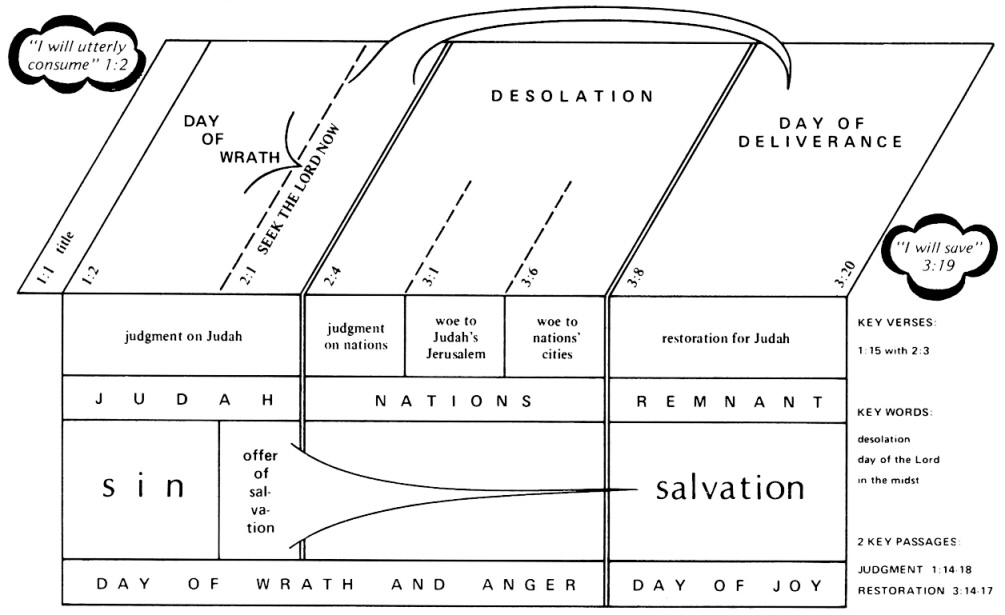
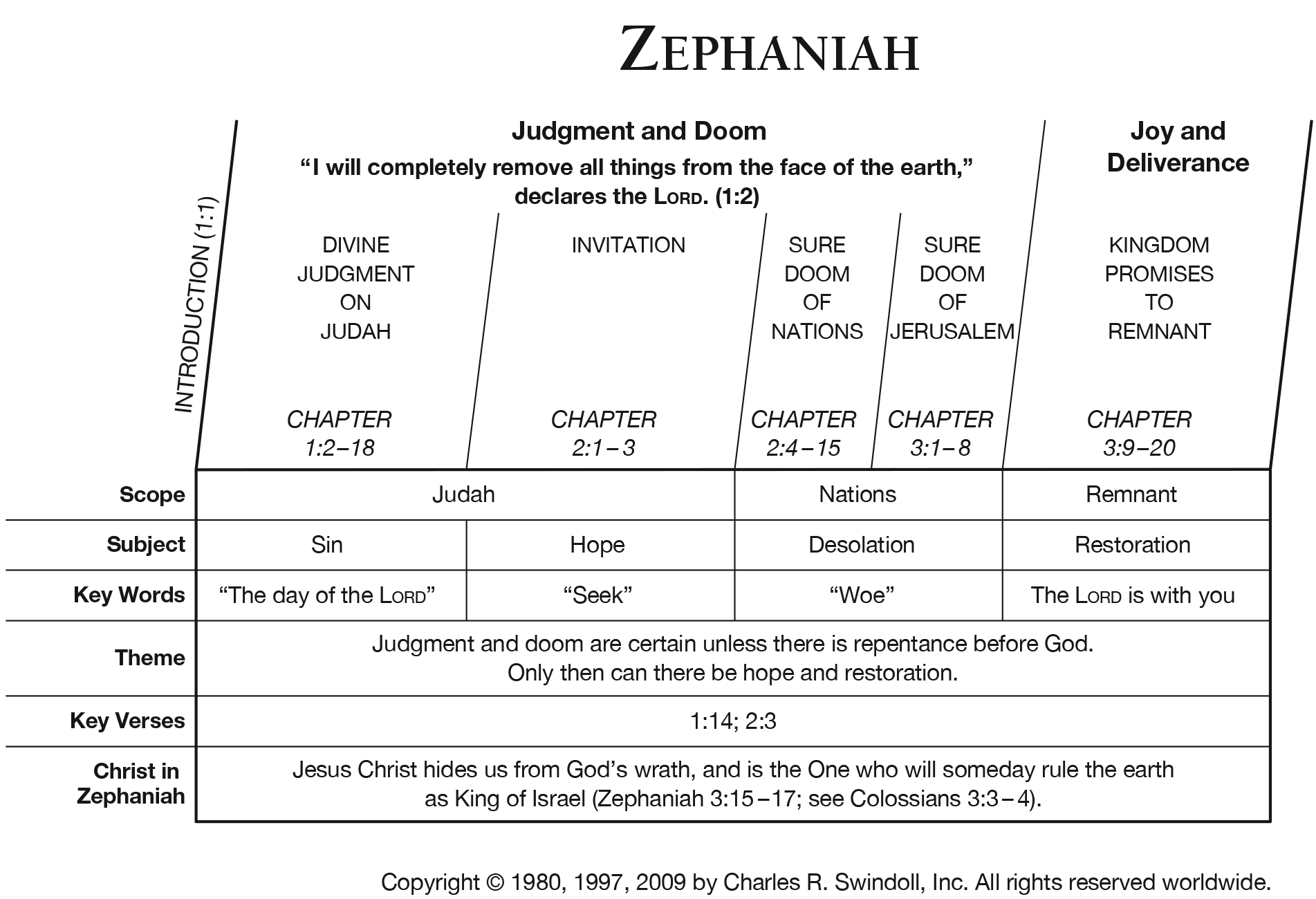
Click chart to enlarge
Chart from recommended resource Jensen's Survey of the OT - used by permission
Zephaniah Chart from Charles Swindoll
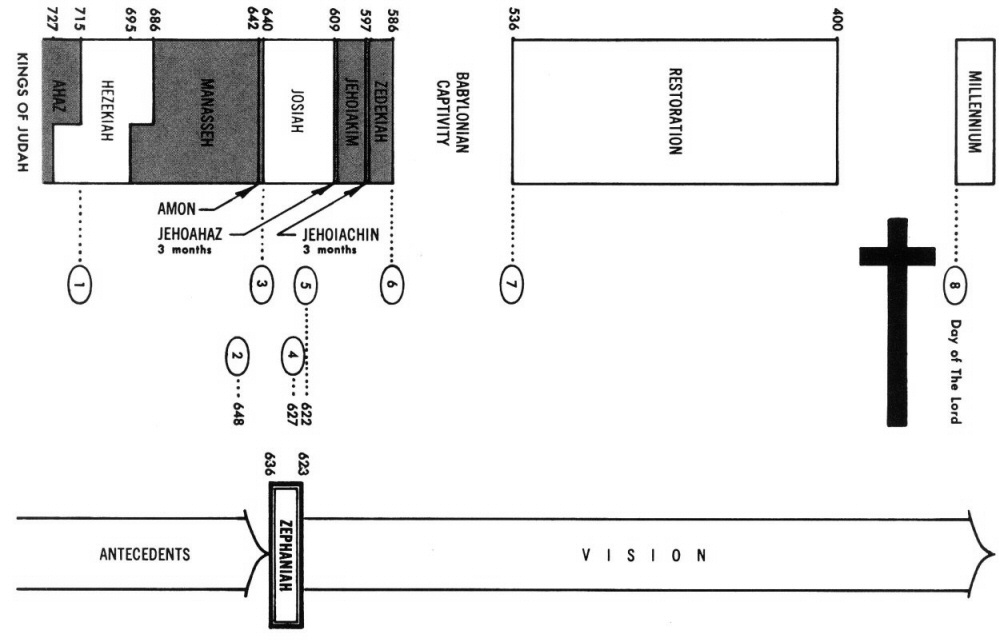
SETTING OF ZEPHANIAH
Click chart to enlarge
|
PROPHECIES OF |
PROPHECIES OF BLESSING Zeph 3:9-20 |
|||
| JUDGMENT IN THE DAY OF THE LORD |
SALVATION IN THE DAY OF THE LORD |
|||
| DAY OF WRATH & ANGER |
DAY OF JOY |
|||
| JUDGMENT ON JUDAH |
RESTORATION FOR JUDAH |
|||
| Judgment & Doom |
Joy & Deliverance |
|||
| Divine Judgment on Judah Zeph 1:1-18 |
Invitation to Judah Zeph 2:1-3 |
Sure Doom of Nations Zeph 2:4-15 |
Sure Doom of Jerusalem Zeph 3:1-8 |
Kingdom Promises to Remnant Zeph 3:9-20 |
| JUDAH | NATIONS | REMNANT | ||
| God's Wrath on Judah |
God's Woes on Nations |
God's Will for Remnant |
||
| Sin | Hope | Desolation | Restoration | |
|
KEY WORD: See key words & marking key words |
KEY WORD: "Seek the LORD" Zeph 2:3 |
KEY WORD: "Woe" Zeph 2:5, 3:1 |
KEY WORD: "The LORD is with you" Zeph 3:15NIV, Zeph 3:17NIV |
|
| Sin | Offer of Salvation | >>> | Salvation | |
| "I will utterly consume" Zeph 1:2KJV |
"I will save" Zeph 3:19KJV |
|||
| Key Verses: Zeph 1:4, Zeph 2:3 Judgment: Zeph 1:14-18 Restoration: Zeph 3:14-17 |
||||
| Theme: Judgment and doom are certain unless there is repentance. Only repentance will bring hope and restoration. Time: 630BC (640-612) To: Judah & the Nations |
||||
Background: To accurately interpret the famous passage in Zephaniah 3:17, we must first take a moment to examine the context, for context is "king" regarding accurate Interpretation.
When was Zephaniah written? Zephaniah prophesied during the reign of godly King Josiah (640-609BC), most likely in the latter portion of his reign (between 640-630BC). Others suggest that Zephaniah's prophecy occurred earlier were a significant influence of the godly actions of King Josiah who became king in 632BC at age 16, when "he began to seek the God of his father David and in the twelfth year (age 20, 628BC) he began to purge Judah and Jerusalem of the high places, the Asherim, the carved images, and the molten images (idolatry)" (2Chr 34:3). "In the eighteenth year of his reign (age 26, 622BC), when he had purged the land and the house" (2Chr 34:8), the book of the was discovered in the house of the LORD (2Chr 34:14) which led to significant reforms which lasted for only a short time (For more excellent historical background read 2Ki 22:1-23:30, 2Chr 34:1-35:27). Recall that the Northern 10 Tribes (often referred to as "Israel") had fallen and been taken into exile by Assyria in 722BC, over a century before the fall of Judah and Jerusalem (586BC) of which Zephaniah prophesied. Zephaniah also prophesied the destruction of Nineveh (Zeph 2:13) which occurred in 612BC. (For more on the historical setting of Zephaniah read 2Ki 22:1-23:30, 2Chr 34:1-35:27)
MacDonald - Believing scholars are divided as to whether he wrote before or after the great revival of 621 B.C. If before, his prophecy likely helped bring about the spiritual awakening. But several details, such as quoting the newly rediscovered law, would suggest a date after 621. Since Zephaniah 2:13 shows that Nineveh was still standing, a date before that city’s destruction in 612 B.C. is called for. Hence the book was probably written between 621 and 612 B.C. (Believer’s Bible Commentary)
By Whom? Zephaniah (Zeph 1:1 note genealogy goes back to godly king Hezekiah). His name means "Jehovah has hidden" (sheltered, concealed, treasured , stored up). One writer suggests that the idea of hidden derives from the fact that he was likely born to godly parents in the time of Manasseh's evil rule during which he "shed very much innocent blood." (2Ki 21:16).
To Whom? Judah and Jerusalem (Zeph 1:4) Although the immediate audience was Jewish, clearly the truths of this prophecy (especially in Zeph 3:9-20) are applicable to every believer of every age whether Jew or Gentile. As John Piper reminds us "even though the amazing promises of this section relate most directly to the converted and restored people of Israel (Zeph 3:10 Ed: "dispersed one" - see notes below), nevertheless it is a necessary implication of the prophecy that the blessings promised flow out beyond the bounds of Israel and include us who through faith in Christ become Abraham's seed and heirs of the promise (Galatians 3:29). (The Lord Will Rejoice over You)
What is the structure? In very general terms, from the preceding chart it is clear that most of the book deals with judgment (Zeph 1:1-3:8), but even in the midst of these "earth shaking" prophecies of God's righteous wrath against Judah, there is a beautiful prophecy of future restoration, a prophecy that will be fulfilled at the Second Coming of the Messiah, Who alone is Mighty to Save the believing remnant of the Chosen People.
What are the Key Words or Key Phrases in Zephaniah (See key words & marking key words)
- Day of the Lord (see another discussion of this Day),
- remnant (Zeph 1:4, 2:7, 9, 3:13, cf Zeph 3:12 "I will leave" - see notes below),
- nations (plural - Zeph 2:11, 3:6, 8),
- destruction/destroy (Zeph 1:15, 2:5, 13),
- desolate/desolation (Zeph 1:13,15, 2:4, 9, 13, 14, 15, 3:6),
- midst (Zeph 2:14, 3:11, 15, 17),
- Woe (Zeph 2:5, 3:1),
- Seek (Zeph 2:3),
- Anger (Zeph 2:2, 3, 3:8),
- Wrath (Zeph 1:15, 18),
- Indignation (Zeph 3:8);
- Gather (Zeph 2:1, 3:8, 18, 19, 20);
- Earth (Zeph 1:2, 3, 18, 2:3, 11, 3:8, 19, 20).
Why? What is Zephaniah's purpose? Given the fact that Zephaniah mentions the Day of the Lord (see another discussion of this Day) Day of the Lord more than any other OT book, clearly this is a key subject. That Day begins with prophecies of great destruction, not only involving Judah, but eventually involving the entire earth (cf Zeph 1:1, 4, 1:18, 2:10). Zephaniah stated that the Day of the LORD was "near" (Zeph 1:14), would be a time of wrath, trouble, distress, etc, (see full description in Zeph 1:15-16) and would come as judgment on sin against Jehovah (Zeph 1:17), but that it would be followed by blessing of His very presence in the midst of His people (Zeph 3:17). (See Theology of Zephaniah in Baker's Evangelical Dictionary of Biblical Theology)
“If anyone wishes all the secret oracles of the prophets to be given in a brief compendium, let him read through this brief Zephaniah.”—Martin Bucer (1528)
Outline - from William MacDonald
I. GOD’S DETERMINATION TO EXECUTE JUDGMENT (Zephaniah 1)
A. On All the Earth (Zeph 1:1–3)
B. On Judah and Jerusalem because of Idolatry (Zeph 1:4–6)
C. The Day of the Lord under the Figure of a Sacrifice (Zeph 1:7–13)
1. Guests-Judah’s Enemies (Zeph 1:7)
2. Victims-Wicked People of Judah (Zeph 1:8–13)
D. The Terror of the Day of the Lord (Zeph 1:14–18)
II. JUDAH IS CALLED TO REPENT (Zeph 2:1–3)
III. THE DOOM OF GENTILE NATIONS (Zeph 2:4–15)
A. The Philistines (Zeph 2:4–7)
B. The Moabites and Ammonites (Zeph 2:8–11)
C. The Ethiopians (Zeph 2:12)
D. The Assyrians and Especially the City of Nineveh (Zeph 2:13–15)
IV. WOE PRONOUNCED ON JERUSALEM (Zeph 3:1–7)
A. Disobedience, Unresponsiveness, Unbelief, Impenitence (Zeph 3:1, 2)
B. Greed of the Princes and the Judges (Zeph 3:3)
C. Levity and Treachery of the Prophets and Sacrilege of the Priests (Zeph 3:4)
D. The Lord’s Presence in Judgment (Zeph 3:5–7)
V. MESSAGE OF COMFORT TO THE FAITHFUL REMNANT (Zeph 3:8–20)
A. Destruction of Wicked Gentiles (Zeph 3:8)
B. Conversion of the Remaining Nations (Zeph 3:9)
C. Restoration of Dispersed Israel (Zeph 3:10–13)
D. Rejoicing over the Second Advent of Christ (Zeph 3:14–17)
E. What God Will Do for His People (Zeph 3:18–20)
A FUTURE AND
A HOPE
(Jer 29:11)
Warren Wiersbe explains why the Jewish prophets consistently ended their books with a message of hope for the people of Israel...
(1) To begin with, hope is a great motivation for obedience, and the prophets wanted to encourage God’s people to submit to God’s will and do what He commanded. God’s covenant blessings come to His people only when they obey His covenant conditions.
(2) A second reason is the prophets’ emphasis on the faithfulness of God. The Lord will keep His promises and one day establish the kingdom (Ed: This question was ever in the heart of every pious Jew - Acts 1:6, cf the prayer in Mt 6:10-, Lk 11:2); and since God is faithful to keep His promises (1Cor 1:9, 10:13-, 2Cor 1:18, 2Th 3:3, Heb 10:23), we ought to be faithful obeying His Word. If we disobey, God will be faithful to chasten; if we confess, He will be faithful to forgive (1Jn 1:9).
(3) Finally, the closing message of hope was an encouragement to the faithful remnant in the land, who were true to God and suffered because of their devotion to Him (Ed: God always has His "7000" who have not bowed to Baal [Ro 11:4], cf Simeon - Lk 2:25 and Anna - Lk 2:36, 37, 38). It’s difficult to belong to that “company of the committed” who stand true to the Lord and His Word no matter what others may do or say. Knowing that God would one day defeat their enemies and reign in righteousness would encourage the believing remnant to persist in their faithful walk with the Lord. (Bible Commentary-OT)
Here are some other resources that can be borrowed from Archive.org that have commentary on Zephaniah
- The minor prophets by Feinberg, Charles L
- Habakkuk and Zephaniah by Barber, Cyril J
- Nahum, Habakkuk, and Zephaniah : an introduction and commentary by Baker, David (Tyndale OT Commentary)
- The message of Obadiah, Nahum and Zephaniah : the kindness and severity of God by Bridger, Gordon (Bible Speaks Today series)
- Jonah/Zephaniah - Shepherd's Notes - short notes on each book - by Wright, Paul,
- The Minor Prophets : an expositional commentary by Boice, James Montgomery,
- Understanding the Old Testament by Scripture Union - John Taylor
- KJV Bible Commentary - Hindson, Edward E; Kroll, Woodrow Michael. Over 3000 pages of the entire OT/NT. (this does not need to be borrowed)
- The King James Study Bible Second Edition 2240 pages (this does not need to be borrowed)
- NKJV Study Bible: New King James Version Study Bible (this does not need to be borrowed)
- Wycliffe Bible Commentary
- Bible Knowledge Commentary - Old Testament - 1608 pages. Dallas Theological Seminary Faculty
- The MacArthur Study Bible
- ESV Study Bible
- Zondervan NIV Study Bible
- The David Jeremiah Study Bible
- HCSB Study Bible : Holman Christian Standard Bible
- NLT Study Bible
- Life Application Study Bible: Old Testament and New Testament:
- Believer's Bible Commentary - OT and NT - MacDonald, William (1995) 2480 pages. Conservative. Literal. Often very insightful.
- Wiersbe's Expository Outlines on the Old Testament - helpful notes
- Bible Commentary-OT - Wiersbe
- With the Word - Warren Wiersbe - Excellent chapter summaries
- J.Sidlow Baxter: Explore The Book - pdf Vol. 4 Ezekiel to Malachi
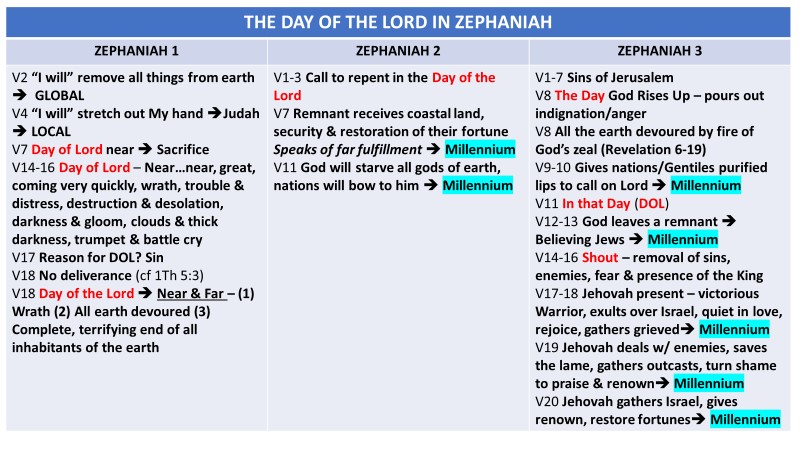
Below is a summary chart of the Zephaniah portion of the discussion of the Day of the Lord part 2
Youtube discussion - What the Bible Teaches About the Day of the Lord - Part 1
Youtube discussion - What the Bible Teaches About the Day of the Lord - Part 2|

Zeph 3:1 Woe to her who is rebellious and defiled, the tyrannical city!:
BGT ὦ ἡ ἐπιφανὴς καὶ ἀπολελυτρωμένη ἡ πόλις ἡ περιστερά
LXE Alas the glorious and ransomed city.
KJV Woe to her that is filthy and polluted, to the oppressing city!
NET The filthy, stained city is as good as dead; the city filled with oppressors is finished!
CSB Woe to the city that is rebellious and defiled, the oppressive city!
ESV Woe to her who is rebellious and defiled, the oppressing city!
NIV Woe to the city of oppressors, rebellious and defiled!
NLT What sorrow awaits rebellious, polluted Jerusalem, the city of violence and crime!
NRS Ah, soiled, defiled, oppressing city!
NJB Disaster to the rebellious, the befouled, the tyrannical city!
NAB Woe to the city, rebellious and polluted, to the tyrannical city!
YLT Woe to the rebellious and polluted, The oppressing city!
- defiled: Leviticus 1:16;
- city: Isaiah 5:7; 30:12; 59:13; Jeremiah 6:6;Jer 22:17; Ezekiel 22:7,29; Amos 3:9; 4:1; Micah 2:2; Zechariah 7:10; Malachi 3:5
- Outline by Walter Kaiser -(See all three excellent chapters - Preacher's Commentary)
A. An Exhortation to Seek the Lord - Zephaniah 2:1–3
B. The Lord’s Purpose in Punishing the Nations - Zephaniah 2:4–15
C. The Lord’s Purpose in Punishing Judah - Zephaniah 3:1–8
D. The Lord’s Purpose in Restoration - Zephaniah 3:9–20
1. The Conversion of the Nations - Zephaniah 3:9–10
2. The Preservation of the Remnant - Zephaniah 3:11–13
3. A Psalm of Joy - Zephaniah 3:14–17
4. The Regathering of Israel - Zephaniah 3:18–20
Related Passages:
Isaiah 1:21 How the faithful city has become a harlot, She who was full of justice! Righteousness once lodged in her, But now murderers.
Jeremiah 2:20 “For long ago I broke your yoke And tore off your bonds; But you said, ‘I will not serve!’ For on every high hill And under every green tree You have lain down as a harlot.
Jeremiah 6:6 For thus says the LORD of hosts, “Cut down her trees And cast up a siege against Jerusalem. This is the city to be punished, In whose midst there is only oppression.
Ezekiel 22:29 “The people of the land have practiced oppression and committed robbery, and they have wronged the poor and needy and have oppressed the sojourner without justice.
Micah 2:2 They covet fields and then seize them, And houses, and take them away. They rob a man and his house, A man and his inheritance.
Malachi 3:5 Then I will draw near to you for judgment; and I will be a swift witness against the sorcerers and against the adulterers and against those who swear falsely, and against those who oppress the wage earner in his wages, the widow and the orphan, and those who turn aside the alien and do not fear Me,” says the LORD of hosts.
THE DAY OF THE LORD
IN ZEPHANIAH
Having declared the judgment of the nations, the Spirit now moves to the judgment of the nation of Judah. The reader would have been in agreement with the judgments on the nations, but was ill prepared for the announcement of their own judgment in this chapter! What the readers would fail to grasp is the fact that if God judges the pagans which have no spiritual light, how much more do the Chosen People who have great spiritual light deserve His judgment (cf Lk 12:48b)! As David Baker says "Now the time is rhetorically ripe to confront God’s own people, Judah, and their capital, Jerusalem, with their sin (Zeph 3:1-4), shamelessness (Zeph 3:5) and lack of repentance (Zeph 3:6-7). (BORROW Nahum, Habakkuk, and Zephaniah : an introduction and commentary PAGE 110) But even in warning Judah of the coming judgment, God is demonstrating His grace in the hope that the warning would motivate repentance.
Righteousness exalteth a nation
but sin is a reproach to any people.
-- Proverbs 14:34
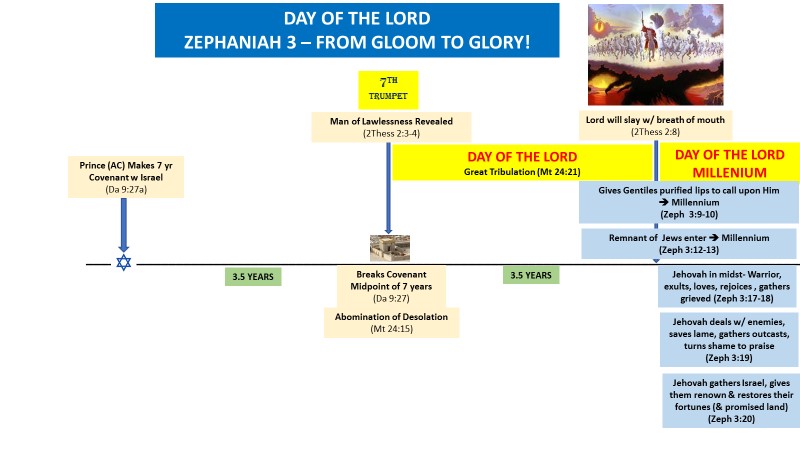
And so chapter 3 begins a description of the reproach to Judah and the doom and gloom of the Day of the Lord (Zeph 3:1-10), but this Day ends (Zeph 3:11-20) with a promise of a future and a hope, a prophecy that will be realized in the future by the nation of Israel (Israel is not the church!) in the Millennium following the victorious return of the Messiah (Rev 19:11-21) Who will crush all her enemies (Da 2:34,35, Da 2:44, 45) and brings an abrupt end to the Great Tribulation (Mt 24:21,22). In the timeline above (superimposed on the 70th Week of Daniel, Da 9:27) note the boxes highlighted in blue which identify those aspects of the Day of the Lord which will be fulfilled to Israel in the Millennium. This emphasizes that the Day of the Lord is not just doom and gloom but ends with destiny and glory!
Descriptive Definition of the Day of the Lord - The DAY of the LORD describes a time when God intervenes in the “day of man.” The DAY of the Lord can have a historical fulfillment (NEAR - 586 BC), and an eschatological (future) fulfillment (FAR). This "FAR" DAY begins with the Great Tribulation when God judges the Gentile nations and Israel, purifying through the fire a redeemed remnant of Israel (Zech 13:8,9) who will enter into the Promised Land for a period of unprecedented blessing and prosperity in the 1000 year Messianic Kingdom ruled by the King of kings, the Lord Jesus Christ. The Day of the Lord terminates with God’s “uncreation” of the creation at the end of 1000 years (2Pe 3:10,11,12,13-15).
Woe (hoy; LXX - ouai) to her - Who? The city is not named but as indicated by the context (especially Zeph 3:4, 5 = "the LORD is righteous within her") it is Jerusalem ("city of peace")(not named until Zeph 3:14), here personified and representative of the people (princes, judges, prophets, priests) who were committing the rebellious and defiling acts (cp Neh 9:26, Jer 7:23-28). Woe introduces a prophetic lament and warning directed toward Jerusalem, the covenant city that had turned away from the LORD and is a sobering word used in the OT almost predominantly in the prophets (note).
Harding has an interesting note - It is suggested that the city is not named so that the recipients of the prophecy, the people of Judah, would at first believe that Nineveh was still in view and would thus acquiesce with the condemnation. However, they would soon realise that it was their own capital city, Jerusalem, which was referred to and that they themselves were being condemned, not their enemies....Instead of being in contrast to Nineveh, and faithful to God and His word, Jerusalem was the equal of that pagan city in its sinfulness (Isa 1:21; Jer 2:20). The moral and spiritual conditions prevailing in the very place where God had set His name were now contrary to His unchanging character and to His claims upon His people. (What the Bible Teaches – Nahum, Habakkuk, Zephaniah, Haggai, Zechariah, Malachi)
Woe (hoy; LXX - ouai) to her who is rebellious (marah) and defiled (gaal), the tyrannical (yanah) city! - NET = "The filthy, stained city is as good as dead; the city filled with oppressors is finished!" Don't miss the fact that WOE began the judgment on the pagan nations and now concludes with the judgment on Judah, who is no better than the nations! Each description reveals a different dimension of the city’s moral and spiritual corruption. Note the progression (or spiritual decline) of their sin -- first rebellion against God, then inward defilement of themselves and finally overt oppression of others, especially the poor. The upshot is that if you are "off" on your vertical relationship (God), you will inevitably, invariably be "off" on your horizontal relationships! The word “Woe” (Hebrew hoy) is a prophetic lament announcing grief, condemnation, and in this case impending judgment. The prophets often used WOE (hoy) when pronouncing God’s judgment on sin (cf. Isa 5:8–23; Nah 3:1). It expresses both sorrow and warning. Jerusalem’s condition is so serious that divine punishment is inevitable unless repentance occurs.
So the three sins for which she is here denounced are
that she is rebellious against God, defiled with sin in herself, and cruel to others.
- Pulpit Commentary
The city is described as rebellious (marah). The Hebrew word marah conveys the idea of stubborn resistance against rightful authority, particularly against God’s rule. Jerusalem had received God’s law, prophets, and covenant privileges, and yet in truth they did not "receive" God's Word! (cf failure to receive the "Living Word" in Jn 1:11-13). So instead of submitting the "city" (people of the city) resisted God’s commands and rejected His correction (Zeph 3:2). The rebellion was therefore not merely political or social, but was fundamentally spiritual insubordination against the LORD Himself.
Harding on rebellious - Keil demonstrates that as used here it has the idea of holding one's self straight against another, indicating opposition. Thus the rebellious spirit of Judah in holding herself against the claims of God is in view (cp. Jer 4:17; 5:23). It stresses the defiance of the nation in the face of His appeals through the prophets (Jer 6:17; 26:4-6; 44:16). (What the Bible Teaches – Nahum, Habakkuk, Zephaniah, Haggai, Zechariah, Malachi)
The city was defiled (gaal) (How defiled was the city? Read Jer 5:1; 19:5; 23:13,14; 32:35) which describes moral and religious stain and pollution, especially the polluting effects of idolatry, injustice, and corruption. Jerusalem, which should have been the holy city where God’s presence dwelt, had become spiritually "contaminated" by idolatry and moral decay.
MacKay - ‘Defiled’ denotes stained with sins and evil doing (Isa. 59:3; 63:3; Lam. 4:14) They are no longer fit for the distinctive role God had in mind for them as his covenant people. (Jonah, Micah, Nahum, Habakkuk, and Zephaniah)
Isaiah gives a similar derogatory description of Jerusalem...
How the faithful city has become a harlot, She who was full of justice! Righteousness once lodged in her, But now murderers. (Isa 1:21)
Jerusalem was the tyrannical city (yanah) (CSB - "the oppressive city!" ESV "the oppressing city") where tyrannical means to do wrong to someone, referring to acts of injustice or wrongdoing directed toward others, especially the poor, the weak, the widowed. In this context, the “wrong” specifically points to the sins listed in Zephaniah 3:2–4, such as rebellion against God, refusal to accept correction, failure to trust in the LORD, corrupt leadership, and the abuse of power by prophets and priests. Although these sins often manifest themselves in harmful actions toward other people, such as oppression, injustice, or betrayal, their deepest offense is against God Himself (cf Ps 51:3,4). Ultimately, all sin is directed against the Lord because it violates His character, disregards His authority, and breaks His covenant. Thus the wrongdoing described here has both a horizontal dimension (injuring others) and a vertical dimension (rebelling against God), with the latter being the root from which the former flows.
Jeremiah alludes to the tyranny or oppression
Thus says the LORD, “Do justice and righteousness, and deliver the one who has been robbed from the power of his oppressor. Also do not mistreat ("do no wrong" = yanah) or do violence to the stranger, the orphan, or the widow; and do not shed innocent blood in this place. (Jer 22:3)
Ezekiel writes
The people of the land have practiced oppression and committed robbery, and they have wronged (yanah) the poor and needy and have oppressed the sojourner without justice. (Ezek 22:29)
Taken together there is little wonder that Zephaniah began this lament with a WOE, for this is a devastating indictment. Jerusalem was rebellious toward God, morally polluted in character, and oppressive toward people. The Holy City (cf Isa 52:1), the "city of peace," that should have been the epicenter of justice and holiness had become corrupt in every direction, vertically toward God and horizontally toward others. Because of this, the prophet announces God’s coming judgment while simultaneously calling the people to recognize the seriousness of their condition.
MacKay sums it up - Those who had no place for the LORD in their lives (rebellious) had no scruples about furthering their own selfish ends (defiled) by exploiting the unfortunate and disadvantaged (tyrannical) in their own community. The feeling of brotherhood that should have existed in the covenant had been lost (Lev. 19:18; Dt. 15:2, 11; 25:3)....This indicates not just unwillingness to submit to God’s general rule over the world he created, but is more particularly defined as covenant rebellion in Zeph 3:2 (Jer. 4:17; 5:23; Hosea 14:1). (Jonah, Micah, Nahum, Habakkuk, and Zephaniah)
Walter Kaiser adds that "Each of the three participles in verse 1 that expose the sins of the city are graphic: the “rebellious,” mutinous, and disobedient; the “polluted,” defiled, bloodstained, and unclean; the “oppressing,” repressive, bullying, and crushing! These three charges indicated the three directions in which Jerusalem’s sin manifested itself: to God, to religious practices, and to fellow humans. (See all his excellent comments on Zeph 3 = The Preacher's Commentary)
Kenneth Barker - Sometimes life seems almost unbearable and completely hopeless. When we survey the current societal scene, we see crime out of control, families breaking up and pulling down the individual members of the family with them, and confusion and frustration on every side. Out of the darkness of our lives comes the dawn of God’s love and care. Zephaniah promised that God had not finished with his people. When life seemed the toughest, God promised to provide. Zephaniah prophesied in such a way as to be called the fiercest of the prophets. Yet, in his fierceness against the sin of the people, the prophet knew that God was at work creating a faithful remnant who would serve Him with all their hearts. Out of the judgment would come a time when God would restore the fortunes of the humble and faithful of the people of Judah. (See comments on Micah, Nahum, Habakkuh, Zephaniah)
In the previous section Zephaniah had declared "woe" to the nations, but as he ends his prophecy, he returns again (Zeph 1:4-13) to rebellious Judah and Jerusalem to pronounce God's judgment followed by God's promise of restoration to be consummated in the end times (cf Jer 23:20, Hos 3:4-5). As an aside, if God judges the sins of the pagan nations who did not know God, how much greater will be the punishment of Judah who had ready access to God?
🙏 THOUGHT: And what about believers in the modern church who even have the indwelling Holy Spirit (1Cor 6:19-20) and yet who are willingly, even wantonly compromising with the godless world (See Mt 6:24) (movies we watch now without any hesitation, that we never would have watched when we were first born again [you know what I mean because PG-13 today is yesterday's R-Rated! By the way as I point one finger at you, know that 4 fingers are pointing back at me!], and what about the pictures we look at on the internet [Men I am speaking especially to you, because I am one!] because no one is watching [except God! = Pr 15:3], and finally what about the off color, even overtly blasphemous language [especially the use of "Jesus Christ" in vain or as a curse word!] we now tolerate that once would have "burned" our ears? Remember what Peter said - Read 1Pe 4:17) Are you convicted yet (as convicted as I am as I write)? I hope (pray) so, for the sake of the purity of Christ's Bride (see Rev 19:7, 8, cf Lev 11:43, 44,45, 1Pe 1:14,15,16, 2Co 7:1)
Israel had been clearly warned (even as we are warned against the dangers of willful sin against the Holy God) just before the second generation crossed the Jordan River to take possession of the Promised Land...
Deut 28:15 “But it shall come about, if you do not obey the LORD your God, to observe to do all His commandments and His statutes with which I charge you today, that all these curses will come upon you and overtake you....45 “So all these curses shall come on you and pursue you and overtake you until you are destroyed, because you would not obey the LORD your God by keeping His commandments and His statutes which He commanded you. 46 “They shall become a sign and a wonder on you and your descendants forever....47 “Because you did not serve the LORD your God with joy and a glad heart, for the abundance of all things; 48 therefore you shall serve your enemies whom the LORD will send against you, in hunger, in thirst, in nakedness, and in the lack of all things; and He will put an iron yoke on your neck until He has destroyed you. 49 “The LORD will bring a nation (a reference to Babylon) against you from afar, from the end of the earth, as the eagle swoops down, a nation whose language you shall not understand, 50 a nation of fierce countenance who will have no respect for the old, nor show favor to the young....62 “Then you shall be left few in number, whereas you were as numerous as the stars of heaven, because you did not obey the LORD your God. 63 “It shall come about that as the LORD delighted over you to prosper you, and multiply you, so the LORD will delight over you to make you perish and destroy you; and you will be torn from the land where you are entering to possess it. 64 “Moreover, the LORD will scatter you among all peoples, from one end of the earth to the other end of the earth; and there you shall serve other gods, wood and stone, which you or your fathers have not known. 65 “Among those nations you shall find no rest, and there will be no resting place for the sole of your foot; but there the LORD will give you a trembling heart, failing of eyes, and despair of soul. 66 “So your life shall hang in doubt before you; and you will be in dread night and day, and shall have no assurance of your life. (Read Deut 28-30 for the full discussion of the blessings and the curses promised by Yahweh to Israel).
Woe (01945)(hoy) is an interjection of distress used primarily by the prophets, 6x in mourning for the dead (1Ki 13:30 Jer 22:18; 34:5), and 40x as negative warnings specifying Divine punishment in the form of disaster, etc, for failing to repent from certain sins. The wicked are under the judgment of God (cp Ro 1:18ff) and therefore face a time of ruin and mourning, so that the only thing left for an unrepentant people is to mourn the destruction of their lives! Woe!
Patterson - Woe oracles typically contain the following elements: invective (“woe to”), threat, and criticism (the reason for the denunciation and threatened judgment). (Minor Prophets: Hosea through Malachi )
Eugene Carpenter - (WOE) expresses great emotion and can be an interjection of warning or distress. It represents a thought transformed into a feeling and expressed in a word—hoy, “woe!” ...Hoy can be used to introduce a prophetic declaration of judgment, as when Isaiah announced the coming destruction of Assyria (Isa. 10:5). It conveys a note of certainty about what is said and an atmosphere of finality—such as in, “Woe unto you, the end has come!” The word is also applied to groups of people and individuals who are wicked (Isa. 5:8, 11, 18, 20–22). (Borrow Holman treasury of key Bible words)
Hoy is used >50x in prophets and only once elsewhere. 6x = mourning for the dead (1 Ki13:30), 40x = negative warnings or threats of God's physical chastisement. R. J. Clifford found 53 occurrences of hoy in the Old Testament. Of these he listed three possible uses: (1) to describe funeral laments (eight times), usually translated “alas”; (2) a cry to get attention (four times), usually translated “ho” or “ah”; (3) an announcement of doom (forty-one times and used only by the prophets), usually translated “woe to.” The wicked were under the judgment of God and therefore faced a time of ruin and mourning. The only thing left for an unrepentant people was to mourn the destruction of their lives.
Hoy is translated in the Septuagint with ouai which is an interjection expressing extreme displeasure and calling for retributive pain on someone or something woe! alas! (Mt 11.21, Mk 14:21; Lk 6:24; 17:1; 21:23; Jude 1:11; Rev 12:12; 18:10, 16 , 19.); doubled or tripled for emphasis (Rev 8.13; 18.10)! It speaks of grief, horror, pain, displeasure, disaster, calamity or denunciation.
HOY - 50X/47V - Ah(2), alas(11), ho(2), ho there(1), woe(34). NOTE ALMOST EXCLUSIVELY IN THE PROPHETS! 1 Ki. 13:30; Isa. 1:4; Isa. 1:24; Isa. 5:8; Isa. 5:11; Isa. 5:18; Isa. 5:20; Isa. 5:21; Isa. 5:22; Isa. 10:1; Isa. 10:5; Isa. 17:12; Isa. 18:1; Isa. 28:1; Isa. 29:1; Isa. 29:15; Isa. 30:1; Isa. 31:1; Isa. 33:1; Isa. 45:9; Isa. 45:10; Isa. 55:1; Jer. 22:13; Jer. 22:18; Jer. 23:1; Jer. 30:7; Jer. 34:5; Jer. 47:6; Jer. 48:1; Jer. 50:27; Ezek. 13:3; Ezek. 13:18; Ezek. 34:2; Amos 5:18; Amos 6:1; Mic. 2:1; Nah. 3:1; Hab. 2:6; Hab. 2:9; Hab. 2:12; Hab. 2:15; Hab. 2:19; Zeph. 2:5; Zeph. 3:1; Zech. 2:6; Zech. 2:7; Zech. 11:17
Rebellious (04784)(marah) means to be contentious, rebellious, and openly defiant to an authority by not obeying commands. Most of the uses of marah refer to rebellion by Israel or Judah against Jehovah (exceptions = Dt 21:18, 20, Job 17:2, Job 23:2, Pr 17:11). There is repeated focus on Israel's rebellion in the wilderness after being set free from slavery in Egypt (Nu 20:10, 24; 27:14; Deut 1:26, 43; 9:7, 23), summed up by the statement "You have been rebellious against the LORD from the day I knew you." (Deut 9:24) Marah is used with similar descriptive words - stubborn (Dt 21:18, 20, Jer 5:23, Ps 78:8), to grieve (Isa 63:10, Ps 78:40), to refuse (Isa 1:20, Neh 9:17), to transgress (Lam 3:42), to sin (Ps 78:17), to test (Ps 78:56), to rebel (marad in Neh 9:26), to reject or profane (Ezek 20:13).
1828 Webster defines a rebel as "One who revolts from the government to which he owes allegiance, either by openly renouncing the authority of that government, or by taking arms and openly opposing it. A rebel differs from an enemy, as the latter is one who does not owe allegiance to the government which he attacks." Jerusalem (her leaders and people) have rebelled against Jehovah by rejecting His Word (His Law, His authority) and as a result departed from His ways of righteousness. God expected more from Judah than the surrounding nations because of her privileged position (Ex 19:5).
Vine - Some personal names are partly composed of the verb: Meraiah (“stubborn headed”; Neh. 12:12) and Miriam (“stubborn headed,” if actually derived from the verb). Marah signifies an opposition to someone motivated by pride: (Dt. 21:18). The sense comes out more clearly in Isa. 3:8. More particularly, the word generally connotes a rebellious attitude against God. Several prepositions are used to indicate the object of rebellion (im, et, generally translated as “against”) (Dt. 9:7, Jer. 4:17). The primary meaning of marah is “to disobey.” Several passages attest to this: (1Ki 13:21; cf. 1Ki 13:26). The OT sometimes specifically states that someone “rebelled” against the Lord; at other times it may refer to a rebelling against the Word of the Lord (Ps 105:28; 107:11), or against the mouth of God (KJV, “word”; NIV, “command”; cf. Nu 20:24; Dt. 1:26, 43; 9:23; 1Sa 12:14-15). The intent of the Hebrew is to signify the act of defying the command of God (La 1:18). The verb marah is at times strengthened by a form of the verb carar (“to be stubborn”) = (Ps. 78:8; cf. Dt. 21:18, 20; Jer 5:23). An individual (Dt. 21:18, 20), a nation (Nu 20:24), and a city (Zeph 3:1) may be described as “being rebellious.” Zephaniah gave a vivid image of the nature of the rebellious spirit: (Zeph. 3:1-2, RSV).
TWOT - This sin of rebellion may be in word: Num 17:10; 27:14, complaining; Ps 78:17ff., challenging and defying God to do the abnormal, to cater to their tastes and delicacies. Or, it may be a rebellion in deed: 1Sa 12:15, obedience to man over God; 1Kgs 13:21, 26, actions contrary to God’s clearly expressed will by a “clergyman”; Jer 4:17, “your own behavior and actions”; Isa 3:8, “their words and their deeds.” What is most often rebelled against is “the commandment/the word of the Lord,” (et) pî (literally, “the mouth”). This is the most frequent direct object of the verb mārâ: 1Kgs 13:21, 26; Lam 1:18; Ps 105:28; Nu 20:24; 27:14. (See TWOT online)
NAS Usage: became disobedient(1), bitter(1), disobedient(1), disobeyed(2), provocation(1), rebel(6), rebelled(18), rebellious(12), rebels(2), very rebellious(1).
Marah - 45 v - Ex 23:21; Nu 20:10, 24; 27:14; Deut 1:26, 43; 9:7, 23, 24; 21:18, 20; 31:27; Josh 1:18; 1Sam 12:14f; 1Kgs 13:21, 26; 2Kgs 14:26; Neh 9:26; Job 17:2; Ps 5:10; 78:8, 17, 40, 56; 105:28; 106:7, 33, 43; 107:11; Isa 1:20; 3:8; 50:5; 63:10; Jer 4:17; 5:23; Lam 1:18, 20; 3:42; Ezek 5:6; 20:8, 13, 21; Hos 13:16; Zeph 3:1
Defiled (01351)(gaal) means to defile or to stain. To defile means to make something unclean or impure. When one's hands are polluted with blood they are defiled (Isa 59:3). Ceremonial pollution of imperfect sacrifices (Mal 1:7, 12) pagan king’s diet (Da 1:8), uncertain lineage of the priests after the exile (Ezr 2:62; Neh 7:64) Something is defiled when it breaches moral or ceremonial law
Gaal - 9 v - Ezra 2:62; Neh 7:64; Isa 59:3; 63:3; Lam 4:14; Dan 1:8; Zeph 3:1; Mal 1:7, 12 NASB Usage: defile(2), defiled(6), stained(1), unclean(2).
Tyrannical (03238)(yanah) means to do wrong to someone, to oppress (crush or burden by abuse of power or authority), mistreat, treat violently. Yanah refers especially to improper treatment of strangers (Ex 22:21,Lev 25:14, 17, Dt 23:16) An "oppressor, i.e., one who pursues, represses and subjugates another (Jer 25:38; 46:16; 50:16; Zep 3:1)" (Swanson) "Yanah seems to be used in the sense of “doing wrong” to someone as in the Mosaic legislation which protects the rights of the gēr “resident alien.” (See TWOT online)
Patterson- The Hebrew term is utilized in a variety of ways but most frequently of intolerance toward or the suppression of the rights and privileges of others. It especially characterizes the rich and influential members of society who take advantage of the less fortunate (cf. Ex 22:21; Lev 19:33; Deut 23:16).
NAS Usage: do him wrong(1), mistreat(2), oppress(3), oppresses(1), oppressing(1), oppressor(2), oppressors(1), subdue(1), thrusting(1), tyrannical(1), wrong(3), wronged(2).
Yanah - 19v - Ex 22:21; Lev 19:33; 25:14, 17; Deut 23:16; Ps 74:8; Isa 49:26; Jer 22:3; 25:38; 46:16; 50:16; Ezek 18:7, 12, 16; 22:7, 29; 45:8; 46:18; Zeph 3:1. The first use gives a sense of the crime of which Jerusalem was guilty...
You shall not wrong a stranger or oppress him, for you were strangers in the land of Egypt. (Ex 22:21)
Zephaniah 3:2 She heeded no voice, she accepted no instruction. She did not trust in the LORD, She did not draw near to her God.:
BGT οὐκ εἰσήκουσεν φωνῆς οὐκ ἐδέξατο παιδείαν ἐπὶ τῷ κυρίῳ οὐκ ἐπεποίθει καὶ πρὸς τὸν θεὸν αὐτῆς οὐκ ἤγγισεν
LXE The dove hearkened not to the voice; she received not correction; she trusted not in the Lord, and she drew not near to her God.
KJV She obeyed not the voice; she received not correction; she trusted not in the LORD; she drew not near to her God.
NET She is disobedient; she refuses correction. She does not trust the LORD; she does not seek the advice of her God.
CSB She has not obeyed; she has not accepted discipline. She has not trusted in Yahweh; she has not drawn near to her God.
ESV She listens to no voice; she accepts no correction. She does not trust in the LORD; she does not draw near to her God.
NIV She obeys no one, she accepts no correction. She does not trust in the LORD, she does not draw near to her God.
NLT No one can tell it anything; it refuses all correction. It does not trust in the LORD or draw near to its God.
NRS It has listened to no voice; it has accepted no correction. It has not trusted in the LORD; it has not drawn near to its God.
NJB She has not listened to the call, she has not bowed to correction, she has not trusted in Yahweh, she has not drawn near to her God.
NAB She hears no voice, accepts no correction; In the LORD she has not trusted, to her God she has not drawn near.
YLT She hath not hearkened to the voice, She hath not accepted instruction, In Jehovah she hath not trusted, Unto her God she hath not drawn near.
- heeded: Deuteronomy 28:15-68; Nehemiah 9:26; Jeremiah 7:23-28; 22:21; Zechariah 7:11-14;
- accepted: Isaiah 1:5; Jeremiah 2:30; 5:3; Ezekiel 24:13;
- instruction: Ps 50:17; Proverbs 1:7; 5:12; Jeremiah 32:33; 35:13,17; John 3:18,19;
- trust: Ps 78:22; Isaiah 30:1-3; 31:1; Jeremiah 17:5,6
- draw: Ps 10:4; Isaiah 29:13; 43:22; Hebrews 10:22
Related Passages:
Jeremiah 3:13 ‘Only acknowledge your iniquity, That you have transgressed against the LORD your God And have scattered your favors to the strangers under every green tree, And you have not obeyed My voice,’ declares the LORD.
Jeremiah 22:21 “I spoke to you in your prosperity; But you said, ‘I will not listen!’ This has been your practice from your youth, That you have not obeyed My voice.
DISOBEDIENT, DEFIANT, DISTRUSTING
AND DISTANT FROM GOD
No voice...no instruction...not trust...not draw near - Four specific "negative" indictments that warrant one woe and begin to explain the source of the depraved description of the city as described in Zeph 3:1. This passage gives us the explanation for the ungodly conduct described in Zeph 3:3-4. Without the Word of God as the nourishment for their soul, they walked according to their flesh nature with nothing to restraint them.
A sinful state is, and
will be, a woeful state!
-- Matthew Henry
She heeded (shama) no voice (Jer 22:21, Zech 7:11-14) - ESV - "She listens to no voice." Jerusalem certainly HEARD the voices of the prophets, but she refused to HEED them, revealing deliberate disobedience. The issue was not the absence of God’s message because His Word was faithfully proclaimed again and again through the prophets, even in the face of continual rejection and threats to their lives! Rather, the problem was that the people refused to obey what they heard. The Hebrew verb שָׁמַע (shama) carries the idea of not merely of hearing sound but of listening with the intention of responding in obedience. In this sense, Jerusalem did not “listen,” because she rejected the call to obey. God’s Word entered their ears but never reached their hearts—like the proverbial saying, it went “in one ear and out the other.” Thus they became the classic example of hearers but not doers, a condition that leads to dangerous spiritual delusion . As James 1:22 warns, “But prove yourselves doers of the word, and not merely hearers who delude themselves.” Delude (paralogizomai) refers to reasoning falsely or deceiving oneself through faulty thinking. By hearing God’s Word without obeying it, the people of Jerusalem lulled themselves into the illusion that they were still aligned with God while their lives showed the opposite.
The Septuagint (LXX) captures this nuance well by translating shāmaʿ with the verb εἰσακούω (eisakouō), which emphasizes listening attentively with the expectation of obedience. This same verb appears in passages such as Deuteronomy 1:43 and Deuteronomy 9:23, where Israel “would not listen” to the LORD, meaning they refused to obey His command. In the same way, Zephaniah indicts Jerusalem for rejecting the voice of God that spoke to them through His prophets. In this respect, the city stood in stark contrast to the attitude God desires. In Isaiah 66:2, the LORD declares “But to this one I will look, to him who is humble and contrite of spirit, and who trembles at My word.” Instead of trembling at God’s Word, Jerusalem dismissed it. Instead of responding with obedience, she hardened her heart. Her failure, therefore, was not ignorance but willful refusal to heed the voice of God.
Contrast the heart of the post-exilic Jewish remnant in Haggai's day, about 100 years after Zephaniah's message including the 70 years of discipline in Babylon -
Then Zerubbabel the son of Shealtiel, and Joshua the son of Jehozadak, the high priest, with all the remnant of the people, obeyed the voice of the LORD their God and the words of Haggai the prophet, as the LORD their God had sent him. And the people showed reverence for the LORD (Ed: Clearly divine discipline brought forth from at least the remnant of Judah the peaceful fruit of righteousness!). (Hag 1:12)
She accepted no instruction (correction, discipline)(musar; LXX - paideia = child training, act of providing guidance for responsible living) - The primary idea of instruction is discipline, expressed by the Hebrew word מוּסָר (musar; LXX - paideia), which refers to correction, instruction, or chastening intended to train someone in righteousness. Proverbs 3:11 exhorts, “My son, do not reject the discipline (musar; LXX - paideia)of the LORD or loathe His reproof.” God did indeed discipline Jerusalem, but for the most part the city refused to accept Yahweh’s loving correction. By rejecting His discipline, they forfeited the blessing that such correction was meant to bring. As Job 5:17 declares, “Behold, how happy (‘esher = blessed, in a state of well-being) is the man whom God reproves; so do not despise the discipline of the Almighty.” Divine discipline is intended to restore and bless, yet Jerusalem stubbornly resisted it, just as Jeremiah later lamented when he described the nation’s refusal to receive correction (see note).
They deliberately rejected the instruction that would have directed them onto the right path and refused the correction that exposed and sought to turn them from the wrong path. Though God graciously provided guidance through His law and His prophets, the people stubbornly resisted both teaching and discipline. Their refusal to listen inevitably led to spiritual decline, which in turn produced social injustice and moral corruption throughout the community. Because they stiffened their necks and hardened their hearts against God’s warnings and rebukes, their condition only deteriorated further. Instead of repenting, they continued, and even progressed downward, in their sin, persisting in rebellion without repentance or remorse.
🙏 THOUGHT - Dear believer, how do you respond when you sin willfully and/or repeatedly and your heavenly Father takes you out to His "wood shed" and gives you a good whipping? (cf Heb 12:6 where "scourges" = mastigoo = literally, as beating with a lash or whip) This is not a minor question! How you answer is vital to your spiritual growth in Christlikeness. If you gladly receive His hand of discipline (even if you have to wince), you will grow in holiness and bring forth the peaceful fruit of righteousness (Heb 12:10, 11, cf Ps 119:67, 71, Pr 6:23,24). If you refuse, you will not grow in godliness and you will likely experience more divine discipline! Israel rejected Yahweh's hand of discipline and look where it got them!
Accepted is translated in the Lxx with the verb dechomai (see word study) which means to receive something willingly (eg, see especially these uses: Negative = 1Cor 2:14, Positive = 1Thes 1:6, 1Thes 2:13), like "putting the welcome mat out" for the Word of God (cf James 1:21 - notice the attitude that accompanies acceptance - humility!). Hebrews warns us...
You have forgotten the exhortation which is addressed to you as sons, “MY SON, DO NOT REGARD LIGHTLY THE DISCIPLINE OF THE LORD, NOR FAINT WHEN YOU ARE REPROVED (elegcho) BY HIM (Heb 12:5, quoting Pr 3:11-12see comments by one of Spurgeon's favorites = William Arnot or by Charles Bridges - Bridges writes "This is a most important exhortation. Nowhere are our corruptions so manifest, or our grace so shining, as under the rod. We need it as much as our daily bread! If we be children of God, we are still children of Adam--with Adam's will, pride, independence, and waywardness." Amen or oh my!
MacKay "Throughout their history God continued to send circumstances (natural disasters like drought and famine, or foreign aggression) to alert his people to the fact that they had broken the covenant and bring them to their senses. But they ignored what they were being taught." (Jonah, Micah, Nahum, Habakkuk, and Zephaniah) Divine discipline did not correct their wayward steps which begs the question...
🙏 THOUGHT: (THIS IS SIMILAR TO PREVIOUS THOUGHT BUT IT IS SO IMPORTANT, IT BEARS REPEATING) "When God disciplines you (Heb 12:5-11), do you recognize it (confessing and repenting) as His Fatherly love to bring you back into fellowship with Him or do you ignore or even worse spurn His loving discipline which is designed to bring forth "the peaceful fruit of righteousness in your life" to those "who have been trained [gumnazo/gymnazo = word study] by it" (Heb 12:11)?"
One of the purposes of the God-breathed Scripture is correction (2Ti 3:16), something the people of Zephaniah's day refused to receive. Jeremiah had a similar word for rebellious Judah...
Yet they did not obey or incline their ear, but walked in their own counsels and in the stubbornness of their evil heart, and went backward and not forward. (Jer 7:24)
🙏 THOUGHT: Beloved, is there some word which God is speaking to you, some secret sin He is telling you to confess and repent of, and yet you repeatedly refuse to listen to His Word? Beware, for you, like Judah, might find out the truth of God's promise that sowers will be reapers of what they sow (Gal 6:7-8)
Judah's rejection of the "light" of God's Word is the problem of all unregenerate men an women...
This is the judgment, that the Light has come into the world, and men loved the darkness rather than the Light, for their deeds were evil. For everyone who does evil hates the Light, and does not come to the Light for fear that his deeds will be exposed. (Jn 3:19-20)
Judah and Jerusalem would soon experience the truth of the proverb that taught...
He will die for lack of instruction (musar), and in the greatness of his folly he will go astray. (Pr 5:23)
NET Note says "The Hebrew phrase, when negated, refers elsewhere to rejecting verbal advice (Jer 17:23; 32:33; 35:13) and refusing to learn from experience (Jer 2:30; 5:3)." Clearly God had tried over and over to discipline the people of Judah but they would not learn from His hand of chastisement. How often we as children of God are like Judah and chaff at His discipline, even when we know we deserve it because of our disobedience.
We see similar statements by Jeremiah to Judah regarding her rejection of divine discipline (all use musar)...
Jeremiah 2:30 In vain I have struck your sons; They accepted no chastening (musar; LXX - paideia). Your sword has devoured your prophets Like a destroying lion. (Jer 2:30)
Jeremiah 5:3 O LORD, do not Your eyes look for truth? You have smitten them, But they did not weaken; You have consumed them, But they refused to take correction (musar; LXX - paideia). They have made their faces harder than rock; They have refused to repent.
Jeremiah 7:28 “You shall say to them, ‘This is the nation that did not obey the voice of the LORD their God or accept correction (musar; LXX - paideia); truth has perished and has been cut off from their mouth.
Jeremiah 17:23 “Yet they did not listen or incline their ears, but stiffened their necks in order not to listen or take correction (musar; LXX - paideia).
Jeremiah 32:33 “They have turned their back to Me and not their face; though I taught them, teaching again and again, they would not listen and receive instruction. (musar; LXX - paideia)
Jeremiah 35:13 Thus says the LORD of hosts, the God of Israel, ‘Go and say to the men of Judah and the inhabitants of Jerusalem, “Will you not receive instruction (musar; LXX - paideia) by listening to My words?” declares the LORD. (Jer 35:13)
Solomon describes those who reject instruction as fools...
Proverbs 1:7 The fear of the LORD is the beginning of knowledge; Fools despise wisdom and instruction (musar; LXX - paideia).
REFUSAL TO
TRUST YAHWEH
She did not trust (batach; LXX - peitho - put confidence in, depend on, be persuaded) in the LORD - How so? Judah trusted not in God but in man. When danger threatened, she relied on human treaties alliances with the foreign, pagan nations. Or she resorted to her idols and prayed for help to false gods! The verb בָּטַח (batach) means to rely upon, place confidence in, feel secure because one depends on someone or something. In the Septuagint it is translated by peitho, meaning to be persuaded, to place confidence in, to depend upon. The idea is not merely intellectual belief but a settled reliance that produces security and obedience.
Judah’s sin, therefore, was not simply disbelief but misplaced trust. Instead of resting in the Lord’s protection and promises, the nation repeatedly placed its confidence in human strength. When threats arose, Judah more often turned to political alliances and military treaties with pagan nations rather than to prayer (See Jer 17:5-7, Ps 146:3; Exceptions - Jehoshaphat - 2Ch 20:12; Hezekiah - 2Ki 19:14-19). Kings and leaders often looked to foreign powers (Egypt, Assyria, or Babylon) for security, believing human diplomacy and military support would provide safety. At other times Judah sought help through idolatry (Isa 42:17), praying to false gods and trusting in lifeless idols that could neither hear nor save (e.g., Ahaz - 2Ch 28:22, 23). Instead of trusting the living God Who had delivered them repeatedly throughout their history, they relied on human strategies and pagan idols. Their refusal to depend on Yahweh revealed a deeper spiritual problem which was that their confidence had shifted from the Yahweh to human power and man-made gods.The tragedy is that Scripture repeatedly warns against such misplaced reliance. Jeremiah 17:5 declares:
“Thus says the LORD, ‘Cursed is the man who trusts in mankind and makes flesh his strength, and whose heart turns away from the LORD.’”
By refusing to trust the Lord and instead depending on human alliances and idols, Judah demonstrated a heart that had turned away from God, exchanging the security of divine protection for the fragile and ultimately futile support of human and false sources of help.
Harding - Their confidence should have been upon Jehovah because He, and He alone, is the eternal God, Almighty, gracious, great in goodness, pardoning iniquity, plenteous in mercy and slow to anger (Ps 86:5, 15; 103:8; 145:7-8). God is unfailingly faithful (Deut 7:9; Isa 49:7; 2 Tim 2:13) and will keep his promises (Heb 10:23), and will do as He has stated (1 Thess 5:24). One can have complete confidence in Him. (What the Bible Teaches – Nahum, Habakkuk, Zephaniah, Haggai, Zechariah, Malachi)
Calvin said that distrust in the Lord as if He were insufficient is the parent of all superstitions and wickednesses.
MacKay on trust - Instead she turned to all the substitutes people put in God’s place when they rebel against him—wealth (Ps. 52:7), extortion (Ps. 62:10), princes, mortal men (Ps 146:3; 118:8–9), the idols of the nations (Ps 135:18; 115:8). She had no interest in, or attachment to, the covenant promises of the LORD, because she had no interest in, or attachment to, the one who had made them. (Jonah, Micah, Nahum, Habakkuk, and Zephaniah)
God desires for His people to trust Him, to believe Him when He speaks in His Word, whether it be a Word of warning or of promise. And to truly trust His Word means we will obey His Word. Anyone can say they trust God, but their actions either belie or authenticate their declaration of faith. Judah's rebellious, sinful actions (detailed in Zeph 3:3-4) proved that their faith was faulty and not genuine (cf James 2:14-26). The writer of Hebrews reminds us that...
Without faith (trust) it is impossible to please Him, for he who comes to God must believe that He is and that He is a rewarder of those who seek Him. (Heb 11:6)
DISTANCED THEMSELVES
FROM THE LIVING GOD
She did not draw near (qarab; LXX - eggizo) to her God - The verb (qarab) means to come near or approach, often used of approaching God in worship. Judah still maintained outward religious activity, but their approach was only external. They honored God with their lips while their hearts remained distant, just as Isaiah rebuked: “This people draw near with their words and honor Me with their lip service, but they remove their hearts far from Me” (Isaiah 29:13, cf , Heb 10:22). Their failure to draw near with sincere hearts was especially inexcusable for as Moses reminded Israel “What great nation is there that has a god so near to it as the LORD our God whenever we call on Him?” (Dt 4:7) The tragedy was not that God was distant, but that His people refused to seek Him with genuine hearts.
🙏 THOUGHT: America would do well to heed these words, for God has blessed this nation exceedingly and yet instead of drawing near to Him, our courts and laws and godless citizens are doing all they can to spurn God's favor and blessing, in effect negating the founder's declaration of "One Nation Under God." (cp Pr 14:34). Revive us O LORD according to Thy Word (Ps 119:25) sending a holy fire into the pulpits of our wayward land for the sake of Your great Name! Amen
Walter Kaiser - When the people of Judah worshipped at all they had preferred to draw near to Baals, Asherah, Chemosh, Milcom, the astrological bodies, and pagan priests.
David Guzik on not draw near - The worst offense is saved for last. God longs for relationship with His people, but they rejected His desire and went their own way, so she has not drawn near to her God.
What a contrast with the invitation in the New Covenant - "Therefore let us draw near with confidence to the throne of grace, so that we may receive mercy and find grace to help in time of need." (Heb 4:16)
Instruction (04148)(musar from yasar = to discipline, chasten, admonish) refers to discipline, chastening, correction. God's chastening is always for purposes of instruction, and should not be ignored or resented. (Job 5:17 cp Job 42:2). Solomon instructs us "My son, do not reject the discipline of the LORD Or loathe His reproof." (Pr 3:11) One of major purposes of wisdom literature is to teach wisdom and instruction (musar) (Pr 1:2) Isaiah describes the divine chastisement poured out on the Suffering Messiah (Isa 53:5). See also similar discussion of musar (with additional material) at Proverbs 1:7 Commentary Musar is translated in the Septuagint with the noun paideia which is used of rearing and guiding a child to maturity (Heb 12:11) and refers to God's fatherly discipline (Heb 12:5). Paideia means to provide instruction, with the intent of forming proper habits of behavior, of providing guidance for responsible living, of rearing and guiding a child toward maturity.
NAS Usage: chastening(3), chastise(1), correction(3), discipline(18), disciplines(1), instruction(20), punishment(2), reproof(1), warning(1). Musar - 50 verses - Dt 11:2; Job 5:17; 20:3; 33:16; 36:10; Ps 50:17; Pr 1:2f, 7f; 3:11; 4:1, 13; 5:12, 23; 6:23; 7:22; 8:10, 33; 10:17; 12:1; 13:1, 18, 24; 15:5, 10, 32f; 16:22; 19:20, 27; 22:15; 23:12f, 23; 24:32; Isa 26:16; 53:5; Jer 2:30; 5:3; 7:28; 10:8; 17:23; 30:14; 32:33; 35:13; Ezek 5:15; Hos 5:2; Zeph 3:2, 7.
(Deut 11:2) “Know this day that I am not speaking with your sons who have not known and who have not seen the discipline of the LORD your God–His greatness, His mighty hand and His outstretched arm,
Brown-Driver-Briggs Expanded Definition - מוּסָר noun masculine Pr 15:10 discipline (of the moral nature), chastening, correction; — ׳מJeremiah 2:30 31t. ( Ezekiel 5:15 strike out Co); construct מוּסַר Deuteronomy 11:2 14t. (for Job 12:28 see אסר); suffix מוּסָרִי Proverbs 8:10; מוּסָֽרְךָ Isaiah 26:16; מֹסָרָם Job 33:16 (for מֻסָרָם Di SS); —
1. discipline, correction
a. of God, Deuteronomy 11:2 ׳מוּסַר י the discipline of ׳י (of Y.'s wonders, as exercising a disciplinary, educating influence upon Israel, compare Dr); ׳לקח מ Jeremiah 17:23; Jeremiah 32:33; Jeremiah 35:13; Zephaniah 3:2,7; Psalm 50:17; Job 33:16; Job 36:10; בְּלִמָּתִי׳מ the correction of (i.e. which lead-eth to) my shame Job 20:3.
b. הבלים עֵץ הוּא׳מ the discipline of unreal gods is wood (is like themselves, destitute of true moral force) Jeremiah 10:8; Ezekiel 5:15 = warning example (?) Ew Sm ("" שְׁמָמָה; strike out ᵐ5 CO).
c. in Proverbs, discipline in the school of wisdom: ׳חכמה ומ Ezekiel 1:2,7; Ezekiel 23:23; חכמה׳מdiscipline of wisdom Ezekiel 15:33; הַשְׂכֵּל׳מ Ezekiel 1:3; ׳תוכחות מ Ezekiel 6:23; לִבֶּ֑ךָ׳הָבִיאָה לַמּEzekiel 23:12 apply thy mind to discipline; ׳קבּל מ Ezekiel 19:20; ׳לקח מ Ezekiel 1:3; Ezekiel 8:10; Ezekiel 24:32 (compare Jeremiah above); קנה׳מ Ezekiel 23:23; ׳שׁמע מ Ezekiel 8:23; Ezekiel 19:27; ׳שׁמר מ Ezekiel 10:17; ׳אהב מ Ezekiel 12:1; ׳החזק במ Ezekiel 4:13; the reverse ׳שׂנא מ Ezekiel 5:12; פרע׳מ Ezekiel 13:18; Ezekiel 15:32; ׳בזה מ Ezekiel 1:7; ׳באין מ for lack of discipline Ezekiel 5:23 ("" בְּרֹב אִיַלְתּוֺ); אֱוִלִים אִוֶּלֶת׳מ Ezekiel 16:22 the discipline of fools is folly; of paternal discipline, correction, Proverbs 1:8; Proverbs 4:1; Proverbs 13:1.
2 more severely, chastening, chastisement:
a. of God, יהוה׳מ Proverbs 3:11 chastening of Yahweh; שׁדַּי׳מ Job 5:17; מוּסָֽרְךָ Isaiah 26:16; שְׁלוֺמֵנוּ עָלָיו׳מ Isaiah 53:5 chastisement of (i.e. leading to) our peace was upon him; ׳לקח מ Jeremiah 2:30; Jeremiah 5:3; Jeremiah 7:28; אַכְזָרִי׳מ Jeremiah 30:14 chastisement of a cruel one, ᵑ0, but read ׳מוּסָר א cruel chastisement, Gf and especially Gie; לְכֻלָּם׳אני מ Hosea 5:2 I am a chastisement for them all.
b. of man, Proverbs 15:5; Proverbs 23:13; ׳שִׁחֲרוֺ מ Proverbs 13:24; ׳שֵׁבֶט מ Proverbs 22:15; אויל׳מProverbs 7:22 chastisement of a fool; מוּסָר רָע Proverbs 15:10 grievous chastisement.
Gesenius Definition - מוּסָר m. (from the root יָסַר)
(1) correction of children by their parents, of nations by kings, of men by God. Proverbs 22:15, שֵׁבֶט מוּסָר; 23:13, אַל־תִּמְנַע מִנַּעַר מוּסָר “withhold not correction from a child.” Job 12:18, מוּסַר מְלָכִים פִּתֵּחַ “he looses or dissolves the correction (or discipline) of kings,” i.e. their authority. Job 5:17, מוּסַר שַׁדַּי “the correction of the Almighty.” Hosea 5:2, “I (will be) a correction to all.”
(2) admonition, discipline, especially that which children receive from parents, men from God, Psalms 50:17; Jeremiah 2:30; Proverbs 1:8, 4:1 5:12 8:33 and hence example, by which others are admonished, Ezekiel 5:15 compare the verb, Ezekiel 23:48.
(3) instruction, doctrine, in which sense it is joined with דַּעַת, חָכְמָה, Proverbs 1:2, 4:13 6:23 23:23.
Related Resources:
- Baker Evangelical Dictionary Discipline
- Charles Buck Dictionary Discipline (1) Discipline (2)
- Holman Bible Dictionary Discipline
- Hastings' Dictionary of the NT Discipline (2) Discipline
- King James Dictionary Discipline
- International Standard Bible Encyclopedia Discipline
- McClintock and Strong's Bible Encyclopedia Discipline
Trust (Rely, confident, secure)(0982) batach speaks of being confident or trusting and pertains to placing reliance or belief in a person or object (Ps 112:7; Isa 26:3) Batach expresses sense of well-being and security from having something or someone in whom to place confidence. Notice all the uses in the book of Psalms (see below) where many if not most refer to trust in Jehovah (this would make a great devotional study to see what is associated with trust in the LORD). In the first use (Dt 28:52) Israel had failed to trust in Name of Jehovah, but instead put their trust in their "towns" with their "high and fortified walls" which would be broken down. In Jdg 9:26 men of Shechem put their trust in Gaal. In Jdg 9:26, 18:7, 10, 27 all mean "secure" referring to people living in security. Hezekiah trusted in LORD. The uses of batach are so wonderful that all the 116 verses are listed below to facilitate easy study. Note especially all the uses of trust in Psalm 22 a clearly Messianic psalm.
Wiersbe on trust - The word translated “trust” (e.g., used in Pr 3:5) means “to lie helpless, facedown.” It pictures a servant waiting for the master’s command in readiness to obey, or a defeated soldier yielding himself to the conquering general. (Bible Exposition Commentary-OT)
Higgins agrees that the Hebrew word batach "means to stretch out or to lie face down. It is a picture of a man totally stretched out on his face before God. The message of his posture is his total helplessness and dependence upon God. It bespeaks that he is totally yielded to that will. Matthew reminds us of the Lord Jesus that He "fell on his face, and prayed ... not as I will, but as thou wilt" (Mt 26:39). (What the Bible Teaches - Proverbs)
Draw near (07126)(qarab) means to come near or approach. It is a verb which basically indicates coming physically closer. To come near (1Sa 17:41, Jonah 1:6, et al). To come near or approach ("When they saw him [Joseph] from a distance and before he came close to them." Ge 37:18) Speaks of arrival at a country ("came near to Egypt" Ge 12:11) Of the nearness of a time such as the end of mourning (“The days of mourning for my father are near" Ge 27:41) or time of death ("When the time for Israel to die drew near." Ge 47:29) Of sexual intimacy ("Abimelech had not come near her" Ge 20:4) Judah refused to draw near though invited, even while Moses was told (first use in OT) "Do not come near here; remove your sandals from your feet, for the place on which you are standing is holy ground." (Ex 3:5). Thus it was is used of approaching God (Ex. 3:5; Dt. 4:11; 5:23, 27; Isa. 48:16; 1Sa. 14:36). Another prohibition to draw near involved the adulteress ("do not go near the door of her house" Pr 5:8) Foreigners invited to celebrate Passover ("let him come near to celebrate it" Ex 12:48) Israel invited to draw near even in their sin! ("Come near before the LORD, for He has heard your grumblings.”) A prayer for God to draw near ("Oh draw near to my soul and redeem it" Ps 69:18, cp Ps 119:169). Of bringing or presenting an offering ("bringing near one's sacrifice") to the LORD and thus often translated "offer" (Lev 2:1, 4, 8, Nu 26:61, 31:50, et al). Since Israel would not draw near for worship, God says "I will draw near to you for judgment." (Mal 3:5) Figuratively of plague not coming near (Ps 91:10).
The Lxx translates qarab in Zeph 3:2 with the verb eggizo meaning to draw near, be near, to approach (including the idea of approaching in time = being at hand = Ro 13:12).
Here is a beautiful use of qarab...
Ps 65:4 How blessed is the one whom You choose and bring near to You to dwell in Your courts. We will be satisfied with the goodness of Your house, Your holy temple.
Qarab - 264 verses - accept(1), appear(1), approach(11), approach to offer(1), approached(9), approaches(3), approaching(2), assisted(1), bring(20), bring her near(1), bring him near(2), bring you near(1), bring near(4), brings(1), brought(11), brought his near(1), brought you near(1), brought your near(1), brought...near(1), came(3), came close(1), came forward(1), came near(12), came together(1), came*(1), come(7), come forward(1), come near(25), comes near(1), draw(2), draw near(9), drawn near(1), draws near(1), drew near(6), go near(3), join(2), joined(1), keep(1), made an offering(1), near(9), offer(43), offered(10), offering(2), offers(7), present(40), presented(16), presenting(3), presents(4), presents his shall present(1), soon(1). Ge 12:11; 20:4; Ge 27:41; 37:18; 47:29; Ex 3:5; 12:48; Ex 14:10, 20; Ex 16:9; Ex 22:8; 28:1; 29:3f, 8, 10; 32:19; 36:2; 40:12, 14, 32; Lev 1:2f, 5, 10, 13ff; Lev 2:1, 4, 8, 11ff; 3:1, 3, 6f, 9, 12, 14; 4:3, 14; 5:8; 6:14, 20f; 7:3, 8f, 11ff, 16, 18, 25, 29, 33, 35, 38; 8:6, 13, 18, 22, 24; 9:2, 5, 7ff, 15ff; 10:1, 3ff, 19; 12:7; 14:12; 16:1, 6, 9, 11, 20; 17:4; 18:6, 14, 19; 20:16; 21:6, 8, 17f, 21; 22:3, 18, 20ff, 24f; 23:8, 16, 18, 25, 27, 36f; 27:9, 11; Nu 3:4, 6; 5:9, 16, 25; 6:14, 16; 7:2f, 10ff, 18f; 8:9f; 9:6f, 13; 15:4, 7, 9f, 13, 27, 33; 16:5, 9f, 17, 35, 38ff; 18:2ff, 15, 22; 25:6; 26:61; 27:1, 5; 28:2f, 11, 19, 26f; 29:8, 13, 36; 31:48, 50; 36:1; Dt 1:17, 22; 2:19, 37; 4:11; 5:23, 27; 15:9; 20:2f, 10; 22:14; 25:11; 31:14; Josh 3:4; 7:14, 16ff; 8:5, 23; 10:24; 17:4; Jdg 3:17f; 5:25; 19:13; 20:24; 1Sa 10:20f; 14:36; 17:41, 48; 2Sa 15:5; 20:16f; 1Kgs 2:1, 7; 20:29; 2Kgs 16:12, 14; 1Chr 16:1; 2Chr 35:12; Ezra 8:35; Esther 5:2; Job 31:37; 33:22; Ps 27:2; 32:9; 65:4; 69:18; 72:10; Ps 91:10; Ps 119:150, 169; Pr 5:8; Eccl 5:1; Isa 5:8, 19; 8:3; 26:17; 34:1; 41:1, 5, 21; 46:13; 48:16; 54:14; 57:3; 65:5; Jer 30:21; Lam 3:57; 4:18; Ezek 9:1; 12:23; 18:6; 22:4; 36:8; 37:7, 17; 42:14; 43:19, 22ff; 44:7, 15f, 27; 46:4; Hos 7:6; Jonah 1:6; Zeph 3:2; Hag 2:14; Mal 1:8; 3:5
Vine - In general qarab signifies “approach or coming near someone or something” apart from any sense of intimacy. In Ge 12:11 (first biblical occurrence) the word is used of spatial proximity, of being spatially close to something. Usually the word represents being so close to something (or someone) that the subject can see (Ex 32:19), speak to (Nu 9:6), or even touch (Ex. 36:2) the object or person in question. This verb also is used of temporal nearness, in the sense that something is about to occur. Qarab can be used of the imminence of joyous occasions, such as religious feasts (Dt. 15:9). The word is also used of the imminence of foreboding events (Ge 27:41). Qarab is used in a number of technical senses. In all these instances personal involvement is suggested; the idea is not simply being close to something (someone) but being actively and personally involved with it (him). In military contexts the word signifies armed conflict. In Dt. 2:37 the Lord commended Israel because “unto the land of the children of Ammon thou camest not.” Yet in Dt. 2:19 He allowed them to “come nigh” that land: “And when thou comest nigh over against the children of Ammon, distress them not, nor meddle with them." The later passage (Dt. 2:37) uses the word technically, to close in battle. Therefore, Israel did not come close to the land of Ammon; they did not close in battle with them (cf. Josh. 8:5). In some passages this martial coloring is not immediately obvious to the casual reader but is nonetheless present (Ps. 27:2). Ps. 27:3 substantiates that this use of the verb is “to close in battle” (cf. Ps 91:10; 119:150). Qarab is used technically of having sexual relations. In Ge 20:4 before Abimelech states his innocence with regard to Sarah we read he “had not come near her” (cf. Dt. 22:14; Isa 8:3). In another technical use the word represents every step one performs in presenting his offering and worship to God. This idea first appears in Ex. 3:5 where God tells Moses not to “draw near” before removing his sandals. Later Israel’s meeting with God’s representative was a drawing near to God (Ex. 16:9). At Sinai they drew near to receive God’s law (Dt. 5:23, 27). In the causative stem the verb often represents the sacrificial presentation of offerings (Lev 1:14) through the priests (Lev. 1:5) to the Lord (Lev. 1:13). Israel also came near the Lord’s representative in serious legal cases so that God the great King and Judge could render a decision (Josh. 7:14). In the eschaton (future time) all peoples are to gather before God; they are “to come near” Him to hear and receive His judgment (Isa 41:1; 48:16). (Vine's Complete OT/NT)
MacKay says to not draw near "indicates that whatever outward acts of worship were engaged in, there was no true reverence for God or fellowship with him. He was ‘near in their mouth but far from their heart’ (Jer. 12:2, literally)." (Jonah, Micah, Nahum, Habakkuk, and Zephaniah)
Spurgeon - An indictment with four counts’ Zephaniah 3:2
Putting the four sentences together, ‘She obeyed not the voice; she received not correction; she trusted not in the LORD; she drew not near to her God’, what then? Why, ‘Woe to her’. Read the first verse of the chapter, and there you have it. As I was coming here that word ‘woe, woe, woe’ seemed to ring in my ears, and I wondered where it came from. I will tell you. It is a word that goes to be made into a worse word. Let me pronounce it for you—woe; that leads to something woe-erse—worse, and to the woe-erst, the worst of all. It is bad, lamentable, destructive, ruinous, painful, wretched, miserable woe, worse, worst. I wish I could pronounce the word as my Master did when he said, ‘Woe unto thee, Chorazin! woe unto thee, Bethsaida!’ I should hardly like to say as he did, for he had a light to judge which I have not, ‘Woe unto you, scribes and Pharisees, hypocrites!’ and so on. But that ‘woe’ as he pronounced it must have sounded terribly, softly, sadly, sternly piercing to the heart. How will the angels sound it at the last? Hear it now, lest you hear it at the last. ‘One woe is past; and, behold, there come two woes more’, when the Judge of all the earth shall break the seals and pour out the vials, and the ungodly sons of men shall see the star Wormwood, and shall drink of the bitterness of the wrath of God. Woe. It means sorrow here! No rest! No satisfaction! Woe even this day to the man that trusts not in God. But in the next world it means to be driven from the face of Christ, to be followed with a ‘woe’ which shall have eternal echoes, Woe, woe, woe! I could cry with Mr Whitefield, ‘The wrath to come! The wrath to come!’ Escape from it while life lasts and Jesus pleads with you, for otherwise this shall fall like a thunderbolt from the hand of the angry Judge, ‘Woe to her … She obeyed not the voice; she received not correction; she trusted not in the LORD; she drew not near to her God.’
Spurgeon - My Sermon Notes on Zeph 3:2
When the Lord is judging men he does not spare those who are called his people: Moab and Ammon and Nineveh are visited, and Jerusalem is not spared. There are sins which outsiders cannot commit, such as those of the text. When peculiar privileges only create peculiar sins, they will be followed by peculiar punishments. The offences mentioned in this verse are to be found in nations, churches, and individuals unto this day: and in a measure among God’s own people.
I. IN THE TEXT WE PERCEIVE FOUR MANIFEST SINS.
1. We will make upon them, as a whole, four observations.
Sins of omission are sure to exist where there are sins of commission. Jerusalem is said to be “filthy and polluted,” and then these omissions are recited.
Sins of omission rank with the blackest of offences. Consider the context, and see with what fearful crimes omissions are catalogued, as if to mark their vileness.
Sins of omission go in clusters. “She obeyed not.” “She received not instruction.” “She trusted not.” “She drew not near to her God.” How many foul birds may dwell in one nest! One sin never goes alone.
Sins of omission are none the less when they are mainly spiritual. Such are those mentioned in the text, and they are cited among crimes of deepest dye.
2. We will note each one of the four separately.
They heard God speak, but they took no heed. This included rebellion, hardness of heart, presumption, and defiance of the Lord; and all this after solemn warnings, great instruction, and tender invitation.
They felt correction, but were not instructed. This involved greater persistence in rebellion, and still more obduracy of heart.
They were unbelieving and distrustful, and relied upon idols, and not upon the Lord. Unbelief is a master-sin.
They had no communion with their God. “Her God” implies existence of covenant-relationship, in name at least; but there was no worship, love, or service.
These four sins abound around us, and among us.
Inattention, Obstinacy, Unbelief, and Aversion to God are all common.
They involve men in misery in this life, and in eternal ruin in the world to come. Are they not destroying some of you?
II. IN THE TEXT WE SPY OUT FOUR HIDDEN ENCOURAGEMENTS TO SEEK BETTER THINGS.
Let those who confess their sin look at the text with hope, for it is clear that—
1. God does speak to men. He may speak to us again.
2. God corrects for our good. It is meant for instruction, not for destruction. (See the margin.)
3. God would have us trust him. He would not blame us for not trusting if we were not permitted to trust him.
4. God would have us draw near to him. Else it were not mentioned as our sin that we do not draw near to him.
All this applies to us at this day.
Still the Lord is in the midst of us, reading our inmost souls.
Let us lay our sins to heart, and seek his face through Christ Jesus.
A FEW SMALL FISHES
Remember, O my soul, the fig-tree was charged, not with bearing noxious fruit, but no fruit.—Thomas Fuller.
The last words that Archbishop Usher was heard to say were these—“Lord, forgive my sins, especially my sins of omission.”
Sins of commission are usual punishments for sins of omission. He that leaves a duty may soon be left to commit a crime.—Gurnall.
No sin is ever alone. Dr. Macdonald says, “There is no fault that does not bring its brothers and sisters and cousins to live with it.”
Oh, how rare it is to find a soul still enough to hear God speak!—Fenelon.
Grace turns the serpent into a rod; but sin turns the rod into a serpent. The former turns poison into a remedy; but the latter turns the remedy into poison.—Benjamin Beddome.
Sorrow is sent for our instruction, just as we darken the cages of birds when we would teach them to sing.—Jean Paul Richter.
John Butler - INDICTMENT Zephaniah 3:2 - Sermon Starters
“She obeyed not the voice, she received not correction, she trusted not in the Lord, she drew not near to her God” (Zephaniah 3:2).
The “She” in our text refers particularly to the city of Jerusalem, but it is an indictment for all of Judah and certainly can be applied to our day, too. The indictment is fourfold.
FIRST—THE DISOBEDIENCE IN THE INDICTMENT
“She obeyed not my voice.” The words “my voice” refer to the Word of God. Jerusalem would not heed the Scriptures. It is a problem in every age. People do not want to obey the Scriptures. This is behind all the criticism of the Scriptures. Unholy men develop clever arguments against the validity of the Scriptures to try and justify disobeying them. Their arguments against the Scripture do not hold water, however, for they are full of lies, misinterpretations, and misrepresentations. The Bible is mocked and scorned, but we note it stands like the rock of Gibraltar while the scorners and mockers pass away. Obey the Word of God if you want blessing. If you fail to obey the Word and heed all the fraudulent arguments against the Word, you will have to answer to God for our disobedience. And it will not be nice situation.
SECOND—THE DESPISING IN THE INDICTMENT
“She received not correction.” Zephaniah says his people did not receive correction—as in chastisement. Scripture warns us repeatedly not to despise correction. That is, when God does chasten us for our sins we are to sit up and pay attention and be aware of what He is trying to tell us. When I was a boy, I visited the wood shed frequently, but seldom for the same acts. I did not despise chastening but paid attention so I did not repeat the offenses. Despising God’s chastisement leads to severe judgment. God does not chasten because he dislikes you but because He loves you. Pay attention and learn from His corrections. They are for your good (Hebrew 12:5, 6, 11)
THIRD—THE DISBELIEF IN THE INDICTMENT
“She trusted not in the Lord.” The third indictment upon the people was their lack of faith in God. They believed everybody else but God. We are like that. It seems that the more preposterous and outlandish something is the more likely it is to be believed and tried. But God, Who is the most trustworthy One of all, is discredited and disbelieved though faultless He is. If you do not believe God about Jesus Christ, you will spend an eternity in hell fire.
FOURTH—THE DISINTEREST IN THE INDICTMENT
“She drew not near to her God.” The people were guilty of disinterest in God. Like the church at Ephesus, they had lost their first love (Revelation 2:4). Their devotion for God was poor. That means in today’s terms, they would read the newspaper far more than the Bible, they would be in sports’ stadiums on Sunday instead of church. The farther from God some are the better then feel—until they leave this life and must face God in judgment.
Spurgeon - Zeph 3:2 “She has not obeyed; she has not accepted discipline. She has not trusted in the LORD; she has not drawn near to her God.” Here are four heavy counts of a terrible indictment against Jerusalem and the Jewish people. Is it not sad to reflect that Jerusalem was the city of the great king and yet fell from its high estate? It was the place of the great temple—there the light of God shined while other nations were in darkness—there the solemn worship of God was celebrated while false gods were being adored elsewhere. And yet its sin provoked the Lord until he gave it up to the destroyer. It is clear, therefore, that no degree of light and no amount of privilege can keep a people alive and right before God. If the heart is not changed, those who are exalted to heaven may yet be cast down to hell.
This text is not only applicable to a nation and to a church but to individuals among God’s own people. Some of God’s people follow Christ from a distance—their spiritual life is better seen in their fears than in their confidences. They are always trembling. Their hands are slack; their hearts are faint. We trust they are alive unto God, but that is all we can say. I fear it may be said of them, “She has not obeyed”—the gentle whisper of divine love falls on a deaf ear. How often has God spoken and we have not listened so as to obey his voice!
I fear, too, that there are times when we have not “accepted discipline”—when affliction has been lost on us. We have risen from a sickbed worse than when we went to it. Our losses and crosses have provoked us to murmuring rather than to heart searching. We have been bruised as in a mortar among wheat with a grinder, and yet our folly has not departed from us. And this is a provoking thing—when we despise the rod and the hand that uses it—and do not turn to the Lord. Yet it is so with some of God’s people: they do not obey his voice, they do not receive correction; and, therefore, it comes to pass that at times they have “not trusted in the Lord.”
Zephaniah 3:3 Her princes within her are roaring lions, Her judges are wolves at evening; They leave nothing for the morning.:
BGT οἱ ἄρχοντες αὐτῆς ἐν αὐτῇ ὡς λέοντες ὠρυόμενοι οἱ κριταὶ αὐτῆς ὡς λύκοι τῆς Ἀραβίας οὐχ ὑπελίποντο εἰς τὸ πρωί
LXE Her princes within her were as roaring lions, her judges as the wolves of Arabia; they remained not till the morrow.
KJV Her princes within her are roaring lions; her judges are evening wolves; they gnaw not the bones till the morrow.
NET Her princes are as fierce as roaring lions; her rulers are as hungry as wolves in the desert, who completely devour their prey by morning.
CSB The princes within her are roaring lions; her judges are wolves of the night, which leave nothing for the morning.
ESV Her officials within her are roaring lions; her judges are evening wolves that leave nothing till the morning.
NIV Her officials are roaring lions, her rulers are evening wolves, who leave nothing for the morning.
NLT Its leaders are like roaring lions hunting for their victims. Its judges are like ravenous wolves at evening time, who by dawn have left no trace of their prey.
NRS The officials within it are roaring lions; its judges are evening wolves that leave nothing until the morning.
NJB The rulers she has are roaring lions, her judges are wolves of the wastelands which leave nothing over for the morning,
NAB Her princes in her midst are roaring lions; Her judges are wolves of the night that have had no bones to gnaw by morning.
YLT Her heads in her midst are roaring lions, Her judges are evening wolves, They have not gnawn the bone in the morning.
- princes: Job 4:8-11; Ps 10:8-10; Proverbs 28:15; Isaiah 1:23; Jeremiah 22:17; Ezekiel 22:6,25-27; Micah 3:1-4,9-11
- evening: Jeremiah 5:6; Habakkuk 1:8
Related Passages:
Isaiah 1:23 Your rulers (same Hebrew word "sar" translated in Zeph 3:3 as princes) are rebels And companions of thieves; Everyone loves a bribe And chases after rewards. They do not defend the orphan, Nor does the widow’s plea come before them.
Psalm 10:8-10 (The wicked) sits in the lurking places of the villages; In the hiding places he kills the innocent; His eyes stealthily watch for the unfortunate. 9 He lurks in a hiding place as a lion in his lair; He lurks to catch the afflicted; He catches the afflicted when he draws him into his net. 10 He crouches, he bows down, And the unfortunate fall by his mighty ones. (Ps 10:8-10)
Ezekiel 22:27 “Her princes within her are like wolves tearing the prey, by shedding blood and destroying lives in order to get dishonest gain.
ROARING PRINCES
RAVENOUS JUDGES
The imagery in Zephaniah 3:3 is a powerful metaphor describing the corrupt leadership of Jerusalem, its civil rulers and judges who were supposed to protect and administer justice but instead devoured the very people they were meant to serve. In short, they like hungry beasts, they preyed on the people of Jerusalem.
Her princes (not those of royal blood, but civil rulers, officials, leaders) - Jerusalem's leaders were the "power brokers," who did not rule with justice or in equity. The princes, who were appointed to govern and protect the people, instead used their authority to oppress and exploit them. Rather than exercising justice and shepherding the nation with integrity, they preyed upon those they were meant to defend, tearing them apart through corruption, greed, and abuse of power. Their conduct resembles the warning of Proverbs 28:15 “Like a roaring lion and a rushing bear is a wicked ruler over a poor people.” Instead of being guardians of justice, the princes behaved like predatory beasts, devouring the vulnerable for their own gain. The picture is therefore of tyrannical rulers who prey on the weak, devouring their own citizens for personal power, wealth, or influence. Instead of shepherding the flock, they behaved like predators.
Patterson - The Hebrew noun (for princes) used here refers to officials at various levels, frequently coming from leading tribal families and forming powerful advisory groups throughout Israel’s history (cf. Ex 18:13–26; 1Kgs 4:2–6; 2Kgs 24:12; 2Chr 35:8). The term may designate the chieftains of Israel (Num 21:18), court officials (1 Chr 22:17), district supervisors (1 Kgs 20:14–15), city officials (Judg 8:6), military leaders (1 Kgs 2:5; 2 Kgs 1:9–14; 5:1; 25:23, 26), or even religious leaders (Ezra 8:24). The importance of such leaders in Zephaniah’s day is underscored not only in their mention before the members of the royal family here, but also in their prominence in the enumeration of the levels of Judahite society during the reign of Josiah (Jer 1:18; 2:26; 4:9). Jeremiah emphasized their importance and responsibility, using the term more than three dozen times.
Within her (qereb) - In her midst. What a contrast this description presents with the next use of "within her" or "in her midst" (qereb) in Zeph 3:5, where it is the righteous LORD Who is within their midst.
Roaring lions - A metaphor - see discussion of wolves below for more on metaphors. Lions are ever ready to pounce on their pray (Read the first depiction of a wild beast ready to pounce on its prey in God's warning to Cain - Ge 4:5-6, 7-8) A roaring lion is a predator announcing its dominance and terrifying prey before attacking. The metaphor suggests that the leaders used their authority to intimidate, oppress, and exploit the people rather than defend them.
Here is a description of the behavior of lions (and the effect of their roar on their victims) to help you understand the picture that Zephaniah is painting about these evil rulers in Jerusalem. Here is a description from Wikipedia...
Lions have an array of facial expressions and body postures that serve as visual gestures. Their repertoire of vocalizations is also large; variations in intensity and pitch, rather than discrete signals, appear central to communication. Lion sounds include snarling, hissing, coughing, meowing, woofing, and roaring. Lions tend to roar in a very characteristic manner, starting with a few deep, long roars that trail off into a series of shorter ones. They most often roar at night; the sound, which can be heard from a distance of 8 kilometers (5.0 mi), is used to advertise the animal's presence. Lions have the loudest roar of any big cat. (Roaring lion - YouTube)
Grant Richison adds (1Pe 5:8) that the "lion produces a howling or roaring sound. The lion uses his roar to frighten his game. By his roar, he immobilizes his victims. His roar is a weapon. Lions usually range near six hundred pounds, standing four feet high. They run at twenty feet per bound and at about a hundred yards in five seconds. They are totally unpredictable. They will attack for no apparent reason. They have extremely powerful voices. Fear will blunt an aggressive Christian life. A roaring lion intimidates by his roar. The Devil intimidates by fear. He casts fear into weak Christians because that will intimidate them from a life of faith. As a lion in the wild chases a herd of gazelles and runs down the weak of the herd, so the Devil usually catches weak Christians first because he freezes them in fear. Fear incapacitates us from moving ahead with our Christian walk. (1 Peter 5:8 Exposition Commentary)
RAVENOUS
JUDGES
Her judges - The legal system was unjust because the judges were unjust. The very ones who were to discern true guilt and innocence, were themselves guilty of "high crimes and midemeanors" as well as "treason" against the Most High God , El Elyon! Judges were responsible for administering justice in the courts.
Wolves at evening (cf Hab 1:8) - This is a metaphor, which is like a window into the text. God's Spirit is giving us a picture we know (wolves at evening) to get a sense of the heart and character of the judges. When you encounter a term of comparison (including similes), pause to ask the Spirit what He intends this to picture or depict. You will often be rewarded with new spiritual insights and illumination. And as you practice this discipline of pausing to ponder the text, you are in a very real sense learning to meditate on the Scriptures, a discipline God promises to richly bless (see Ps 1:2-3, Joshua 1:8).
Wolves that are hungry, famished from fasting during the day, prowl for food and do this especially in the evening when they are fiercest, attacking when their prey is most vulnerable under cover of night. Zephaniah pictures these judges as ravenous, rapacious, covetous men, hungry and greedy for illicit gain (bribes, corruption, and exploitation) "devouring" the poor, the widowless and the fatherless without mercy.
They leave nothing for the morning (literarily "The do not gnaw bones for the morning") - This description extends the lupine (wolfish) metaphor, emphasizing the greedy nature of these unjust judges, so thoroughly did they "devour" their victims. Their greed prompts an insatiable desire for gain, to "gnaw" their victims not just to the bone, but even devouring the bone (so to speak). It is interesting that the morning was often the time when justice was to be meted out (cf Zeph 3:5, 2Sa 15:2, Ps 101:8, Jer 21:12).
Wolf is a frequent metaphor in the writings of the prophets...
Her officials within her are like wolves tearing their prey; they shed blood and kill people to make unjust gain. (Ezekiel 22:27, see full context for description of the prophets who were like roaring lions = Ezek 22:25-27)
Therefore a lion from the forest will attack them, a wolf from the desert will ravage them, a leopard will lie in wait near their towns to tear to pieces any who venture out, for their rebellion is great and their backslidings many. (Jer 5:6)
Their (Babylonian) horses are swifter than leopards, fiercer than wolves at dusk. Their cavalry gallops headlong; their horsemen come from afar. They fly like an eagle swooping to devour; (Hab 1:8)
Within (in the midst) (07130)(qereb) is used 6 times in Zephaniah 3
Her princes are within her - Zeph 3:3
The LORD is righteous within her - Zeph 3:5
I will remove from your midst your proud - Zeph 3:11
I will leave among you a humble and lowly people - Zeph 3:12
The King of Israel, the LORD, is in your midst - Zeph 3:15
The LORD your God is in your midst - Zeph 3:17
Zephaniah 3:4 Her prophets are reckless, treacherous men; Her priests have profaned the sanctuary. They have done violence to the law.:
BGT οἱ προφῆται αὐτῆς πνευματοφόροι ἄνδρες καταφρονηταί οἱ ἱερεῖς αὐτῆς βεβηλοῦσιν τὰ ἅγια καὶ ἀσεβοῦσιν νόμον
LXE Her prophets are light and scornful men: her priests profane the holy things, and sinfully transgress the law.
KJV Her prophets are light and treacherous persons: her priests have polluted the sanctuary, they have done violence to the law.
NET Her prophets are proud; they are deceitful men. Her priests defile what is holy; they break God's laws.
CSB Her prophets are reckless-- treacherous men. Her priests profane the sanctuary; they do violence to instruction.
ESV Her prophets are fickle, treacherous men; her priests profane what is holy; they do violence to the law.
NIV Her prophets are arrogant; they are treacherous men. Her priests profane the sanctuary and do violence to the law.
NLT Its prophets are arrogant liars seeking their own gain. Its priests defile the Temple by disobeying God's instructions.
NRS Its prophets are reckless, faithless persons; its priests have profaned what is sacred, they have done violence to the law.
NJB her prophets are braggarts, impostors, her priests have profaned what is holy and violated the Law.
NAB Her prophets are insolent, treacherous men; Her priests profane what is holy, and do violence to the law.
YLT Her prophets unstable -- men of treachery, Her priests have polluted the sanctuary, They have violated the law.
- reckless: Isaiah 9:15; 56:10-12; Jeremiah 5:31; 6:13,14; 8:10; 14:13-15; 23:9-17,25-27; Jeremiah 23:32; 27:14,15; Lamentations 2:14; Ezekiel 13:3-16; Hosea 9:7; Micah 2:11; 3:5,6; Matthew 7:15; 2 Corinthians 11:13; 2 Peter 2:1-3; 1 John 4:1; Revelation 19:20;
- her priests: 1Samuel 2:12-17,22; Ezekiel 22:26; 44:7,8; Hosea 4:6-8; Malachi 2:8
Related Passages:
Jeremiah 23:32 “Behold, I am against those who have prophesied false dreams,” declares the LORD, “and related them and led My people astray by their falsehoods and reckless boasting; yet I did not send them or command them, nor do they furnish this people the slightest benefit,” declares the LORD.
Micah 3:5 Thus says the LORD concerning the prophets who lead my people astray; When they have something to bite with their teeth, They cry, “Peace,” But against him who puts nothing in their mouths They declare holy war.
Micah 3:11 Her leaders pronounce judgment for a bribe, Her priests instruct for a price And her prophets divine for money. Yet (IN THEIR DELUSION) they lean on the LORD saying, “Is not the LORD in our midst? Calamity will not come upon us.”
NON-PROFIT
PROPHETS!
Her prophets are reckless - NIV says "Her prophets are unprincipled." "arrogant liars" (NLT), "fickle" (ESV). This probably refers to their arrogance in passing off their own words as from the LORD (Jer 23:32). The prophet Micah gives a good commentary on the false prophets (see Micah 2:11; Micah 3:5, Micah 3:11)
Jeremiah adds these accusations...
For from the least of them even to the greatest of them, everyone is greedy for gain, and from the prophet even to the priest everyone deals falsely. (Jer 6:13)
Her prophets are...treacherous men (cp related word used in Hab 1:13 = "those who deal treacherously") - They were ever ready to speak a word to tickle the ears of their audience (2Ti 4:3-4). In God's original plan for His people, the priests were instructed to teach God’s law to the people (Lev 10:10–11; Dt. 33:10), they had neglected to fulfill this vital role.
MacKay - They were ‘treacherous’ because they were speaking from their own minds and not by divine revelation. Therefore they prove to be deceitful not just in the way in which they conduct business with others, but particularly in the way in which they deceive those who come to them seeking divine guidance. However outwardly impressive their words seem, they only promote rebellion and apostasy against God and deceive those who accept what they say as being genuine. The divine evaluation of such conduct was scathing. (Jonah, Micah, Nahum, Habakkuk, and Zephaniah)
Her priests have profaned the sanctuary. The statement means that the very men who were appointed to guard the holiness of the temple and lead the people in pure worship instead treated the sacred things of God as common and defiled them by their actions. The verb “profaned” (Hebrew חָלַל – ḥālal ) means to pollute, desecrate, or treat something holy as ordinary. The priests were supposed to preserve the sanctity of the temple by carefully observing God’s laws regarding sacrifices, purity, and worship. Instead, through corruption, negligence, and disobedience, they allowed what was holy to be violated. Rather than maintaining the distinction between the holy and the profane, they blurred it and led the people into spiritual corruption.
This was a serious betrayal of their calling. God had specifically charged the priests to “teach the sons of Israel all the statutes” (Leviticus 10:11) and to “distinguish between the holy and the profane” (Ezekiel 22:26). When the priests themselves ignored these responsibilities, the temple—meant to be the center of true worship—became spiritually polluted. Thus the charge is not merely that they made mistakes, but that those entrusted with protecting God’s holiness actually contributed to its desecration, undermining the worship and spiritual life of the entire nation.
Kaiser explains this somewhat obscure phrase They have done violence to the law.: - By allowing the people to blur the distinction between what was sacred or holy and what was not, and by disregarding what had been specifically taught in the law, the priests acted as agents for the populace, not as ministers of God! They profaned what was holy—i.e., they “unhallowed” the holy.
Here is God's judgment on men like this...
“Behold, I am against those who have prophesied false dreams,” declares the LORD, “and related them and led My people astray by their falsehoods and reckless boasting; yet I did not send them or command them, nor do they furnish this people the slightest benefit,” declares the LORD. (Jer 23:32)
Her priests have profaned the sanctuary (cf Ezek 5:11, 7:20, Ezek 23:38-39, Jer 7:31, 23:11, 32:34) - They have defiled and polluted the Temple of God. We can get a good sense of how the priests had defiled the Temple (especially under the evil reigns of Manasseh and Amon) by observing how godly King Josiah cleaned "house" in the Temple.
Read 2Kings 24:4-12...Then the king (Josiah) commanded Hilkiah the high priest and the priests of the second order and the doorkeepers, to bring out of the temple of the LORD all the vessels that were made for Baal, for Asherah, and for all the host of heaven (Ed: probably astrology); and he burned them (Dt 7:25) outside Jerusalem in the fields of the Kidron, and carried their ashes to Bethel. 5 He did away with the idolatrous priests whom the kings of Judah had appointed to burn incense in the high places in the cities of Judah and in the surrounding area of Jerusalem, also those who burned incense to Baal, to the sun and to the moon and to the constellations and to all the host of heaven (See Manasseh's evil practices = 2Ki 21:3-9) 6 He brought out the Asherah from the house of the LORD (Abominable idols in the Holy Place of God!) outside Jerusalem to the brook Kidron, and burned it at the brook Kidron, and ground it to dust, and threw its dust on the graves of the common people. 7 He also broke down the houses of the male cult prostitutes which were in the house of the LORD, where the women were weaving hangings for the Asherah. 8 Then he brought all the priests from the cities of Judah, and defiled the High Places where the priests had burned incense (Offerings to dead idols instead of the Living God!), from Geba to Beer Sheba; and he broke down the high places of the gates which were at the entrance of the gate of Joshua the governor of the city, which were on one's left at the city gate (Dt12:2-7, 13,14). 9 Nevertheless the priests of the high places did not go up to the altar of the LORD in Jerusalem, but they ate unleavened bread among their brothers. 10 He also defiled Topheth, which is in the valley of the son of Hinnom, that no man might make his son or his daughter pass through the fire for Moloch. 11 He did away with the horses which the kings of Judah had given to the sun (Sun worship! cf Ro 1:21-23), at the entrance of the house of the LORD, by the chamber of Nathan-melech the official, which was in the precincts; and he burned the chariots of the sun with fire. 12 The altars which were on the roof, the upper chamber of Ahaz, which the kings of Judah had made, and the altars which Manasseh had made in the two courts of the house of the LORD, the king broke down; and he
Read Ezekiel 8:5-17 for a graphic summation of their almost incomprehensibly abominable defilement of God's Holy Temple (Then see commentary on Ezekiel 8). King Josiah carried out a purging of the polluted priests (2Ki 23:4-6), but unfortunately it had only a temporary restraining effect as shown by the descriptions of the reign of the 4 kings who followed godly King Josiah and reigned to the time of Judah's defeat and exile to Babylon (Shockingly Josiah's son Jehoahaz immediately returned to the evil his father had purged = 2Ki 23:30, 31, 32, cp Eliakim/Jehoiakim, sadly another son of Josiah did evil = 2Ki 23:34, 36, 37, Jehoiachin did evil = 2Ki 24:8,9 and Zedekiah did evil = 2Ki 24:18, 19, 20).
They have done violence to the law -NET = "they break God's laws" NLT paraphrases it "disobeying God's instructions." TEV = "They twist the law of God to their own advantage." While the phrase is somewhat difficult to interpret, clearly it has to do with mistreatment or misuse of the law, the Word of God. This could speak of their "breaking" of the law (disobedience) or acting wrongly regarding their duty to interpret it. Perhaps they give favorable interpretations to those who give them money as in Micah 3:11.
Walter Kaiser adds an interesting thought on how one could do violence to the law - Like many contemporary pastors, Judah’s priests did “violence to the law” by replacing God’s Holy Word with their own ideas, adapting the words of Scripture so as to fit the popular eddies and moods of the day! By so doing, they conveniently did not mention the “whole counsel of God” (Acts 20:27), for not all of it fitted their own interests or the interests of the people. (See The Preacher's Commentary)
Profane (02490)(chalal) means to pollute, defile, profane, desecrate. They treated that which was holy and dedicated to Jehovah in an improper, unbecoming way as described above in Ezekiel!
Reckless (06348)(pahaz) means boiling over like water and figuratively to be wanton or reckless. The only other use is Judges 9:4. The idea is more hotheadedness than evil. Gilbrant - Related to an Arabic cognate meaning "reckless," "boastful," the verb pāchaz means "to be wanton," "to be reckless," "to be undisciplined."
Done violence (02554)(hamas/chamas) means to be violent, to act violently, to treat in a bad manner (Job 21:27, Pr 8:36) or to act wrongly. Hamas stresses both social and physical harm and violence. Hamas refers almost always to sinful violence, not to "violence" of natural catastrophes. The noun form hamas/chamas (02555) describes extreme wickedness, e.g., in the days before the flood ("filled with violence" = Ge 6:11). The verb means to harm one physically. To strip or tear off something from its main body (Job 15:33). For example treating people (widows) badly (Jer 22:3). God "did violence" to His own House when Jerusalem was razed (Lam 2:6).
Ezekiel uses hamas/chamas in describing a similar charge against the priests...
Her priests have done violence to My law and have profaned My holy things; they have made no distinction between the holy and the profane, and they have not taught the difference between the unclean and the clean; and they hide their eyes from My Sabbaths, and I am profaned among them. (Ezekiel 22:26)
NASB Usage: do violence(1), done violence(2), drop off(1), exposed(1), injures(1), violently treated(1), wrong(1).
Hamas/chamas - 8 verses - Job 15:33; 21:27; Pr 8:36; Jer 13:22; 22:3; Lam 2:6; Ezek 22:26; Zeph 3:4
QUESTION - What can ordinary people do about sinful religious leaders (Zephaniah 3:4)? GOTQUESTIONS.ORG
ANSWER - In Zephaniah 3:4, the Lord specifically speaks against the sins of Judah’s religious leaders, stating, “Her prophets are arrogant; they are treacherous men. Her priests profane the sanctuary and do violence to the law.” The problem is not confined to Zephaniah’s time. Still today, religious leaders sometimes sin and betray those they lead. What can ordinary people do when those in church authority are overtly sinful?
First, as Zephaniah illustrates, God knows the situation and will ultimately hold sinful religious leaders accountable for their sins. Numbers 32:23 warns the sinner that he can “be sure” that there will be a reckoning.
Second, we are called to forgive those who sin against us. Jesus taught in the Lord’s Prayer, “Forgive us our debts, as we also have forgiven our debtors” (Matthew 6:12). Further, Jesus taught Peter to forgive above and beyond what is expected: the standard is not to forgive seven times, but “seventy-seven times” (Matthew 18:22). Whatever the situation, we must maintain a willingness to forgive and not hold grudges.
Third, all religious leaders must be held accountable for their actions. Paul told Timothy that, if an accusation against a church leader is confirmed (1 Timothy 5:19), then steps must be taken to deal with the sin. “Those who sin are to be rebuked publicly, so that the others may take warning” (1 Timothy 5:20). In cases where church leaders are found guilty of sinful actions, the local church is to call out the transgressor and condemn the sin publicly. Leaders are not above the law, and accountability is important.
Fourth, sometimes personal confrontation is necessary when a religious leader sins. The apostle Paul once had to confront Peter about his hypocrisy (Galatians 2:14). In this case, Peter changed his actions, leading to a better situation for all involved. Positive change, including repentance, is the goal in such cases.
Finally, it must be noted that if a religious leader is involved in criminal activity of any kind, it is the duty and responsibility of those aware of the crime to report it. There is no justification for cover-ups or delays in reporting a crime.
Zephaniah 3:5 The LORD is righteous within her; He will do no injustice. Every morning He brings His justice to light; He does not fail. But the unjust knows no shame.:
BGT ὁ δὲ κύριος δίκαιος ἐν μέσῳ αὐτῆς καὶ οὐ μὴ ποιήσῃ ἄδικον πρωὶ πρωὶ δώσει κρίμα αὐτοῦ εἰς φῶς καὶ οὐκ ἀπεκρύβη καὶ οὐκ ἔγνω ἀδικίαν ἐν ἀπαιτήσει καὶ οὐκ εἰς νεῖκος ἀδικίαν
LXE But the just Lord is in the midst of her, and he will never do an unjust thing: morning by morning he will bring out his judgment to the light, and it is not hidden, and he knows not injustice by extortion, nor injustice in strife.
KJV The just LORD is in the midst thereof; he will not do iniquity: every morning doth he bring his judgment to light, he faileth not; but the unjust knoweth no shame.
NET The just LORD resides within her; he commits no unjust acts. Every morning he reveals his justice. At dawn he appears without fail. Yet the unjust know no shame.
CSB The righteous LORD is in her; He does no wrong. He applies His justice morning by morning; He does not fail at dawn, yet the one who does wrong knows no shame.
ESV The LORD within her is righteous; he does no injustice; every morning he shows forth his justice; each dawn he does not fail; but the unjust knows no shame.
NIV The LORD within her is righteous; he does no wrong. Morning by morning he dispenses his justice, and every new day he does not fail, yet the unrighteous know no shame.
NLT But the LORD is still there in the city, and he does no wrong. Day by day he hands down justice, and he does not fail. But the wicked know no shame.
NRS The LORD within it is righteous; he does no wrong. Every morning he renders his judgment, each dawn without fail; but the unjust knows no shame.
NJB Yahweh the Upright is in her, he does no wrong; morning by morning he gives judgement, each dawn unfailingly (but the wrong-doer knows no shame).
NAB The LORD within her is just, who does no wrong; Morning after morning he renders judgment unfailingly, at dawn.
YLT Jehovah is righteous in her midst, He doth not do perverseness, Morning by morning His judgment he giveth to the light, It hath not been lacking, And the perverse doth not know shame.
- righteous: Deuteronomy 32:4; Ps 99:3,4; 145:17; Ecclesiastes 3:16,17; Isaiah 45:21; Habakkuk 1:3; Zechariah 9:9; Romans 3:26; 1 Peter 1:17;
- In the midst: Zeph 3:15,17; Deuteronomy 23:14; Isaiah 12:6; Ezekiel 48:35; Micah 3:11; Zechariah 2:5;
- He will: Genesis 18:25; Job 8:3; 34:10,17-19;
- every morning: Isaiah 28:19; 33:2; 50:4; Jeremiah 21:12; Lamentations 3:23;
- brings: Ps 37:6; Isaiah 42:3,4; Micah 7:9; Luke 12:2; Romans 2:5; 1Corinthians 4:5;
- but: Jeremiah 3:3; 6:15; 8:12
NET = The just LORD resides within her; He commits no unjust acts. Every morning He reveals His justice. At dawn He appears without fail. Yet the unjust know no shame.
A STRIKING CONTRAST
IN THE MIDST OF JERUSALEM
The LORD is righteous within (in the midst of) her (Jerusalem) - Though there were unrighteous princes in her midst ("within her" Zeph 3:3), there was also a righteous Prince in her midst! This would be an encouraging reminder to those readers who are part of the righteous remnant (genuine believers like Abraham - Ge 15:6). The Righteous One will have the final say and it will be "right." Indeed, He "will remove from your midst your proud, exulting ones" (Zeph 3:11) and "will leave among you a humble and lowly people." (Zeph 3:12).
The mention of the Righteous One in the midst of the treacherous city is assurance that justice will be dispensed and that sinners would not be left unpunished.
The Psalmist writes of Jerusalem
Beautiful in elevation, the joy of the whole earth, Is Mount Zion in the far north, the city of the great King (Zeph 3:15). (Ps 48:2)
Moses writes
The Rock! His work is perfect, For all His ways are just; A God of faithfulness and without injustice, Righteous and upright is He. (Dt 32:4)
The psalmist writes
"The LORD is righteous in all His ways and kind in all His deeds." (Ps 145:17).
Within her - Within the midst of Jerusalem. Jamieson - He retorts on them their own boast, "Is not the Lord among us" (Mic 3:11)? True He is, but it is for another end from what ye think [Calvin]; namely, to lead you by the example of His righteousness to be righteous. Lev 19:2, "Ye shall be holy: for I the Lord your God am holy" [Maurer]. But Calvin, "That ye may feel His hand to be the nearer for taking vengeance for your crimes: 'He will not do iniquity' by suffering your sins to go unpunished" (Dt 32:4).
Walter Kaiser - One would have thought that the presence of the Lord (Zeph 3:5) in their midst would have been enough to deter most, if not all, of the sins described in Zeph 3:1–4. The indicted leaders had been “in her midst” (Zeph 3:3), but so had the Lord been “in her midst” (Zeph 3:5). No one could implicate the Lord in any wrongdoing; “He will do no unrighteousness” (Zeph 3:5b). On the contrary, “Every morning He brings His justice to light; He never fails” (Zeph 3:5c). So why doesn’t everyone see what is as plain as the morning sunlight on their face? God’s moral standards are plainly visible to all; He never fails! Nor have His standards failed! (See The Preacher's Commentary - Vol. 23)
Every morning (Literally "in the morning, in the morning") He brings His justice to light - In Zeph 3:3 we see the evil judges left "nothing for the morning." As noted in the comments on that passage the morning was often the time when justice was to be meted out (cf Zeph 3:5, 2Sa 15:2, Ps 101:8, Jer 21:12). Here we see the Righteous Judge whose perfect justice shines brightly (to light) which accentuates the contrast with the unjust ravenous judges who do their nefarious deeds under cover of darkness (Zeph 3:3).
O Palmer Robertson - Despite the appearance that corruption prevails on every side, the Lord daily manifests his righteous judgments. Even the faithful remnant, suffering under the oppressive tyrannies of a depraved leadership, must acknowledge the daily realities of the Lord’s justice. As faithfully as the Lord provided daily manna for his people during their trial period in the wilderness, so in the chaotic last days of Jerusalem the Lord’s righteousness was coming to light. (NICOT - Nahum, Habakkuk, Zephaniah)
MacKay comments on the significance of the morning in Hebrew thought - ‘Morning by morning’ is associated with the regularity of sacrifice in Israel (Ex 30:7; Lev 6:12; 2Chr 13:11; Ezek 46:13–15) and of the provision of manna (Ex 16:21). Here it is a matter of the administration of justice. The judges of the land normally met in the morning (v. 3), but they were corrupt. The morning was when the king heard cases as the final court of appeal in the land (Jer. 21:12), but Josiah was the exception among Judah’s kings of this time in that he sought the LORD and promoted justice (Jer. 22:15–16). (Jonah, Micah, Nahum, Habakkuk, and Zephaniah)
Barker - God gives his justice each new day. Righteousness is doing those acts which God himself requires because of the relationship with him. Justice takes the righteous acts to the legal sphere, insuring the care for the needy of society. The affirmation of God’s “justice” (mishpat) contains a play on words with the “rulers” (shaphat) of Zeph 3:3. Those who should have been dispensing justice (the rulers) are those who use their position to pick the people clean, leaving nothing to the morning (Zeph 3:3). But the Lord dispenses justice every morning....Justice” is a word of such broad meaning and significance in the Old Testament that it is difficult to translate. It “can be used to designate almost any aspect of civil or religious government,” for example: the act of deciding a case by a judge (Dt 25:1; Josh 20:6); place where a judge decides a case (1Kgs 7:7); process of litigation (Job 22:4; Isa 3:14); a case or suit brought before the judge (1Kgs 3:11; Job 13:18); the sentence or decision the judge announces (1Kgs 20:40; Jer 26:11, 16); the time the decision is made (Ps 1:5; Eccl 12:14); sovereign authority (Deut 1:17; Pr 16:33); the just claims of God (Isa 30:18; Ps 37:28); that which is right as that which agrees with God’s character (Ps 106:37; Pr 12:5; Mic 6:8); an ordinance or law designed to establish justice in society (Ex 15:25; Isa 42:4; Dt 33:10); the just rights an individual possesses in the legal system (Dt 18:3; Jer 32:7). Because God is righteous, does no wrong, and daily dispenses justice, Israel should be secure. By implementing his word in their justice system, they could be sure every case was settled in righteousness and every person would receive his due. Reality contrasted theory. A righteous, just God faced an unrighteous, self-centered people. Zephaniah’s recitation of the goodness of God should have caused the unrighteous to meditate on their behavior. God had been so good, how could they continue in arrogance before God? They were shameless before the great God who manifested his goodness before them daily. (See comments in Micah, Nahum, Habakkuh, Zephaniah)
He does not fail - NET = "At dawn He appears without fail."
Pulpit Commentary - In spite of this hourly manifestation of God's justice, and the enactments of the Law so well known, the perverse nation will not amend its ways, feels no shame at its backslidings (Jeremiah 3:3; Jeremiah 6:15).
Kaiser - God’s moral standards are plainly visible to all; He never fails! Nor have His standards failed!
Isaiah speaks of the One Who never fails...
Lift up your eyes on high and see who has created these stars, The One who leads forth their host by number, He calls them all by name; Because of the greatness of His might and the strength of His power, not one of them is missing. (Isa 40:26)
But the unjust knows no shame - But indicates a contrast. What is he contrasting? In context he is describing the Righteous One Who is present and Who every morning reveals His justice. Judah's exposure to His righteous "light" should be enough to cause the evil doer's consciences to feel shame. And yet their conscience was so seared, they did not even blush at their evil deeds, as we see in another description of Judah by the prophet Jeremiah...
Were they ashamed because of the abomination they had done? They certainly were not ashamed, and they did not know how to blush; Therefore they shall fall among those who fall; At the time of their punishment they shall be brought down," Declares Jehovah. (Jer 8:12)
🙏 THOUGHT: This description is reminiscent of those wicked men in our day who are involved in despicable "trades" like drug dealing, human trafficking and pornography, all so abominable that most would blush just at the mention of those terms because their conscience is tender and sensitive (cp Ro 2:14,15). These purveyors of such grotesque evil which destroys lives and marriages, have in turn so destroyed their consciences that they cannot feel shame or remorse and are driven by their insatiable avarice, lust and ever deepening depravity. And yet they will surely one day see Jehovah the righteous One in their midst (Rev 20:11-15)! And He will judge them justly for their unspeakably perverted practices, casting them "into hell (gehenna), where THEIR WORM DOES NOT DIE (Ed: Jesus is saying that they will be sent to a horrible place where they will have eternal consciousness of their evil deeds. While they still may not be ashamed, they will clearly be aware that God has dealt justly with them and that they are appropriately reaping fire for eternity as just retribution for sowing evil in time), AND THE FIRE IS NOT QUENCHED." (Mark 9:47-48)
Zephaniah 3:6 "I have cut off nations; Their corner towers are in ruins. I have made their streets desolate, with no one passing by; Their cities are laid waste, without a man, without an inhabitant.:
BGT ἐν διαφθορᾷ κατέσπασα ὑπερηφάνους ἠφανίσθησαν γωνίαι αὐτῶν ἐξερημώσω τὰς ὁδοὺς αὐτῶν τὸ παράπαν τοῦ μὴ διοδεύειν ἐξέλιπον αἱ πόλεις αὐτῶν παρὰ τὸ μηδένα ὑπάρχειν μηδὲ κατοικεῖν
LXE I have brought down the proud with destruction; their corners are destroyed: I will make their ways completely waste, so that none shall go through: their cities are come to an end, by reason of no man living or dwelling in them.
KJV I have cut off the nations: their towers are desolate; I made their streets waste, that none passeth by: their cities are destroyed, so that there is no man, that there is none inhabitant.
NET "I destroyed nations; their walled cities are in ruins. I turned their streets into ruins; no one passes through them. Their cities are desolate; no one lives there.
CSB I have cut off nations; their corner towers are destroyed. I have laid waste their streets, with no one to pass through. Their cities lie devastated, without a person, without an inhabitant.
ESV "I have cut off nations; their battlements are in ruins; I have laid waste their streets so that no one walks in them; their cities have been made desolate, without a man, without an inhabitant.
NIV "I have cut off nations; their strongholds are demolished. I have left their streets deserted, with no one passing through. Their cities are destroyed; no one will be left--no one at all.
NLT "I have wiped out many nations, devastating their fortress walls and towers. Their streets are now deserted; their cities lie in silent ruin. There are no survivors-- none at all.
NRS I have cut off nations; their battlements are in ruins; I have laid waste their streets so that no one walks in them; their cities have been made desolate, without people, without inhabitants.
NJB I have exterminated the nations, their corner-towers lie in ruins; I have emptied their streets, no one walks through them; their cities have been destroyed and are now deserted and unpeopled.
NAB I have destroyed nations, their battlements are laid waste; I have made their streets deserted, with no one passing through; Their cities are devastated, with no man dwelling in them.
YLT I have cut off nations, Desolated have been their chief ones, I have laid waste their out-places without any passing by, Destroyed have been their cities, Without man, without inhabitant.
- cut: Isaiah 10:1-34; 15:1-16; 19:1-25; 37:11-13,24-26,36; Jeremiah 25:9-11; Jeremiah 25:18-26; Nahum 2:1-3; 1Corinthians 10:6,11
A WARNING AND
AN EXAMPLE!
I have cut off nations; Their corner towers are in ruins. I have made their streets desolate, with no one passing by; Their cities are laid waste, without a man, without an inhabitant - NET Zephaniah 3:6 "I destroyed nations; their walled cities are in ruins. I turned their streets into ruins; no one passes through them. Their cities are desolate; no one lives there." While this passage describes the fate of the nations, it is notable that this description fits precisely with what transpired in Judah and Jerusalem less then 50 years later (Zephaniah written about 625BC) when Nebuchadnezzar's third siege was successful in 586 BC.
The Lord takes the people of Judah (and all who would eventually read this text)
to school, and gives them (and us) a lesson in world history
Walter Kaiser quips - At this point, the Lord takes the people of Judah (and all who would eventually read this text) to school, and gives them (and us) a lesson in world history....History is full of examples of nations that are no longer on the scene, but had anyone thought to ask why? Wasn’t their wreckage directly related to their moral collapse and disregard for the basic principles of righteousness taught in the Word of God—whether or not they were believing nations? Judah needed to look no further for such an example than the Northern kingdom that had gone into captivity in 721BC (or 722BC). Nations and peoples are responsible to learn from history. It was hoped that Judah would heed the tragic realities of the past and reverse her headlong rush into disaster. (See The Preacher's Commentary)
I have cut off nations (Dt 12:29, 19:1, Jos 11:21, 23:4, Jdg 4:24, 2Sa 7:9) - Jehovah begins to speak and His first Person discourse extends through Zeph 3:13. Jehovah is warning Judah that He has judged other nations for their sins. How could Judah expect to escape His judgment?
Israel had been given a "heads up" by Moses before they entered the Promised Land regarding the pagan nations...
When the LORD your God cuts off (karath;) before you the nations which you are going in to dispossess, and you dispossess them and dwell in their land, beware (not a suggestion, but a command; Lxx = prosecho) that you are not ensnared to follow them, after they are destroyed before you, and that you do not inquire after their gods, saying, 'How do these nations serve their gods, that I also may do likewise? (Dt 12:29-30)
Kenneth Barker - Zeph 3:5–7 appear to revolve around the theme of Israel’s knowledge of the goodness of the Lord and their need to turn from their sins. Seeing the righteousness of the Lord should have caused the people to feel the intense sorrow associated with sin (Jer 31:18–19). Yet they went on with their sin. Any rational person would have thought as the Lord did that the people would fear the Lord and accept his correction. By accepting the correction of the Lord, the people could have averted the disaster. Instead of accepting God’s chastisement, they persisted in their sin, thus insuring the judgment of God. In pride the wicked of Zeph 3:3, 4—the officials, rulers, prophets, and priests—carried on in their rebellion against God. (See Micah, Nahum, Habakkuh, Zephaniah)
Zephaniah 1:3 also used karath
I will remove man and beast; I will remove the birds of the sky and the fish of the sea, And the ruins along with the wicked; And I will cut off man from the face of the earth,” declares the LORD.
So just as God had cut off nations, now He would be forced to do the same to Jerusalem and Judah.
Their corner towers are in ruins (same word pinnah is used Zeph 1:16 describing the Day of the Lord) - ESV translates this as "Battlements (see note below)." These were the key defense posts, the most strongly fortified point of a walled city. If they were in ruins, everything was in ruins! The Lxx translates "corner towers" with the interesting word huperephanos (huper = over, above + phaino = shine) which literally describes the one above and when speaking of men refers to one who shows (shines) himself above others (in a word, pride). Theophylact called it "the citadel and summit of all evils." Surely there is a play on words by the Septuagint translators, who seem in a sense to personify the "corner towers" as possessing an arrogance voicing the thought "We are invincible!" And is not that exactly what men do with their possessions or money or power (etc) - they fallaciously think themselves to be impregnable! The are like the man in Proverbs 18:11 () which says "A rich man’s wealth is his strong city, And like a high wall in his own imagination." In marked contrast, Solomon describes the truly "rich" man in Pr 18:10-!
I have made their streets desolate - Notice God says "I have made" indicating He is sovereign over nations and would be sovereign over Judah's fall. Isaiah declares "For the LORD of hosts has planned, and who can frustrate it? And as for His stretched-out hand, who can turn it back?" (Isa 14:27). And again Jehovah Himself declares "Even from eternity I am He; And there is none who can deliver out of My hand; I act and who can reverse it?" (Isa 43:13)
With no one passing by - Emphasizes the utter devastation of Judah.
Their cities are laid waste - The citizens were either dead or deported! MacKay adds that "Their ruins testify to the ineffectiveness of human devices when the LORD decides to act." (Jonah, Micah, Nahum, Habakkuk, and Zephaniah)
Without a man, without an inhabitant - Note how the description of desertion, devastation and desolation is "piled up" in this verse.
MacKay - This had not been capricious conduct on the LORD’S part, but fully warranted by the sin of the nations (Ge 13:13; 18:20; Lev. 18:25–27; Dt. 9:4; 1Ss 15:2–3). He had not acted a moment sooner than was proper; for instance, he waited because the sin of the Amorites had not yet reached full measure (Gen. 15:16). (Jonah, Micah, Nahum, Habakkuk, and Zephaniah)
Desolate (02717)(chareb) is a verb that means to be desolate, ruined or destroyed, in essence to lay in ruins in a state of utter destruction. (Ezek 26:19; 30:7) To be dry (Jdg 16:7-8), to dry up (Ge 8:13, 2Ki 19:24), to lay waste. Note that most of the uses of this word are in the prophets where we see them repeatedly warn of coming desolation not just to Israel but to other nations (eg, Tyre in Ezek 26:2,19)..
Chareb is translated in the Lxx with the verb exeremoo (eremos = wilderness, uninhabited, waste, desert, desolate) meaning to make quite desolate, to devastate (Used in Lxx of Lev 26:31-32, Jdg 16:24, 2Ki 19:24, Ezek 6:6, 12:20, 19:7, Amos 7:9, Zeph 3:6). The root verb eremoo (to be brought to ruin, become desolate, be devastated - Mt 12:25) is used in the Lxx translations of 2Ki 19:17, Isa 34:10, 37:18, Isa 49:17, 60:12, Jer 26:9, Ezek 26:2, 19, 29:12, 30:7 . Xeraino (to stop a flow of something resulting in dryness, to dry out, to whither) in Isa 42:15.
NAS Usage: become waste(2), desolate(4), destroyer(1), devastated(3), devastators(1), laid waste(5), lay waste(1), made their desolate(1), utterly ruined(1).
Chareb - 18v - Jdg 16:24; 2Kgs 19:17 (Lxx = eremoo - to make uninhabitable); Isa 34:10; 37:18; 42:15; 49:17; 60:12; Jer 2:12; 26:9; Ezek 6:6; 12:20; 19:7; 26:2, 19; 29:12; 30:7; Amos 7:9; Zeph 3:6
Corner (06438)(pinnah) refers to a location where various surfaces or lines meet to form an angle. In this context the "corner towers" were the apparently places in the walls from which arrow could be shot, stones hurled, etc. (See description and picture of Battlements). Clearly corner towers were vital for defense of a city and the fact that they lay in ruins indicates they were overrun by enemy troops.
NAS Usage: chiefs(2), corner(16), corner towers(2), corners(7), cornerstone(3), cornerstone*(1). Pinnah - 31v - Ex 27:2; 38:2; Jdg 20:2; 1 Sam 14:38; 1Kgs 7:34; 2 Kgs 14:13; 2 Chr 25:23; 26:9, 15; 28:24; Neh 3:24, 31f; Job 1:19; 38:6; Ps 118:22; Pr 7:8, 12; 21:9; 25:24; Isa 19:13; 28:16; Jer 31:38, 40; 51:26; Ezek 43:20; 45:19; Zeph 1:16; 3:6; Zech 10:4; 14:10
Cut off (03772)(karath) literally means to cut, to cut off or to sever an object from its source or cut into parts and implies a violent action. For example, Zipporah "cut off her son’s foreskin." (Ex 4:25) or the Jews "cut down a branch with a single cluster of grapes." (Nu 13:2-24, cf Dt 19:5, 20:19-20, Jdg 9:48-49, 1Sa 5:4, 17:51, 24:4-5,11, 31:9, 2Sa 10:4, 2Sa 20:22) In another literal use as punishment to Israel for breaking the Mosaic covenant (cf Dt 29:25, 31:16), God says He will "cut down (karath) your incense altars" (Lev 26:30, cf Jdg 6:25-26, cf 1Sa 28:9). A sacrificial animal was not to be offered if it was "cut" (karath) (Lev 22:24). Karath means "chewed" (cutting food with teeth) in Nu 11:33.
NAS translates karath as - beams(3), cease(1), chewed(1), completely cut off(1), covenanted(1), cut(10), cut her off(1), cut him off(5), cut it down(1), cut it off(1), cut them down(1), cut you down(1), cut you off(2), cut down(23), cut off(129), cuts(1), cuts off(4), cutter(1), destroy(1), destroyed(3), fail(1 = 2Sa 3:29), kill(1), lack(8 - 1Ki 2:4), made(52), make(31), makes(2), making(2), making an in writing(1), perish(1).
Figuratively karath refers to being "cut off" from Israel for some disobedience such as failing to receive circumcision or celebrate Passover (Ge 17:14, Ex 12:15, Nu 9:13 - karath translated in both in Lxx with verb exolethreuo which means to utterly destroy or "root out"). "The person who does anything defiantly (willfully), whether he is native or an alien, that one is blaspheming the LORD; and that person shall be cut off (Lxx = exolethreuo) from among his people." (Nu 15:30-31) The idea of a disobedient or unclean individual being "cut off" is the meaning in almost all of the uses in the Leviticus (Lev 7:20, 21, etc). Many of the uses of karath in this context in Leviticus are translated in the Lxx with the verb apollumi, which describes that which is ruined and no longer usable for its original, intended purpose. The question arises is what does karath signify in these uses? Does it just mean the person becomes a social outcast or does it signify actual physical death? See Covenant Solemn & Binding for detailed analysis of this question. See also discussion of the verb exolethreuo which also addresses this question.
Karath refers to cutting off one's name in Israel by providing no male descendants (Ru 4:10, 1Sa 24:21, 1Ki 14:10, 21:21, 2Ki 9:8).
Karath refers to the cutting off of the waters of the Jordan River to allow Israel to pass over (Josh 3:13, 16, 4:7).
Karath is used in Joshua 9:23 of the Gibeonites who would "never cease (karath - cut off from) being slaves."
Karath speaks of literal death, as in Ge 9:11 where God promises "all flesh shall never be cut off (karath; Lxx = apothnesko = to die) by the water of the flood."
Karath can refer to the people of the land being "cut off," as in Ge 41:36, where it is translated "perish during the famine." The Septuagint uses ektribo (to cause removal by irritation, obliterate as by rubbing, thus destroy), a verb also used to describe the fate of Sodom and Gomorrah (Ge 19:13). Here in Zeph 3:6 karath refers to destroying pagan nations, which should have been a warning to Judah. Similarly karath is applied to the nation of Israel as a whole being cut off because of breaking the Mosaic covenant (Isa 9:14, 48:19, Jer 7:28, 44:7-9, Ezek 14:13-15, Zech 13:2). In Leviticus God says He "will let loose among you the beasts of the field" to "destroy you cattle and reduce you number so that your roads lie deserted." (Lev 26:22)
Karath is used with beriyth meaning to "cut a covenant" or establish a covenant between two parties, either between God and men (Abrahamic Covenant = Ge 15:18, Mosaic Covenant = Ex 24:8, Dt 5:2-3, 9:9; see Abrahamic versus Mosaic and Abrahamic vs Old vs New) or between men (Ge 21:27, 32, 26:28, 31:44, 2Sa 3:12-13, 21, 5:3; 1Sa 18:3, 20:15-16, 22:8, 23:18 between Jonathan and David [See discussion of their Covenant - Exchanging of Robes]; cutting covenant was prohibited = Ex 23:32, Dt 7:2, Jdg 2:2, a dictum which Joshua disobeyed - Josh 9:6-7,11). In the context of cutting covenant karath is translated in the Lxx with diatithemi (see detailed discussion) which is used in the sense of making "a last will or testament" (Heb 9:16).
There is a very important use of karath in Da 9:26 (See in depth discussion) where the angel tells Daniel "Then after (Don't miss this crucial expression of time) the sixty-two weeks ("seven weeks and sixty-two week" - in sum, after 69 weeks or 483 years) the Messiah will be cut off (karath) and have nothing, and the people (Romans) of the prince who is to come (Antichrist) will destroy the city (Jerusalem) and the sanctuary (Temple). And its end will come with a flood; even to the end there will be war; desolations are determined." The Septuagint (LXX) translates karath in Daniel 9:26 with the verb exolethreuo which means to extirpate, to wipe out, to utter destroy (only NT use is Acts 3:23, also used in Lxx of Ex 30:33; 31:14; Dt 7:10) Almost every conservative evangelical source agrees this verse is clearly a reference to the crucifixion of Christ. Christ was indeed not only "cut off" from man and from life, but on the cross indicated that He was forsaken of God, crying out "My God, my God, why hast thou forsaken me?" (Mt 27:46) Geisler writes "karath is used of the death of the Messiah." (Correcting the Cults) Isaiah has a similar description (but not using the verb karath) writing "By oppression and judgment He was taken away; And as for His generation, who considered That He was cut off (Hebrew = gazar; Lxx = airo = take from) out of the land of the living For the transgression of my people, to whom the stroke was due?" (Isa 53:8)
Vine - karath basically means “to sever” something from something else by cutting it with a blade. The nuance depends upon the thing being cut off. In the case of a branch, one “cuts it down” (Nu 13:23), and one "[swings] the axe to cut down the tree” (Deut. 19:5). The word is also used of “chopping down” wooden idols (Ex. 34:13). Karath can signify “chopping off” a man’s head and feet (1Sa 5:4). In Jer 34:18 this verb means “to cut into two pieces.” (Ed: This description is similar to the passing between the pieces of flesh in Ge 15:17-18 when God cut a covenant with Abram; cf Dt 29:12 where "enter" connotes the idea of movement between two particular places, presumably the slain sacrifices which the contracting parties passed between. This means of cutting a covenant was also used among the Babylonians). “Cut off” may also imply cutting off in the sense of circumcision. In Ex. 4:25 Zipporah took a flint knife and “cut off” her son’s foreskin. In a related but different usage this word appears in Nu. 11:33, where it means “to chew” meat. “To cut off” can mean “to exterminate or destroy.” God told Noah that “all flesh [shall never again] be cut off … by the waters of a flood …” (Gen. 9:11). Karath can be used of spiritual and social extermination. A person “cut off” in this manner is not necessarily killed but may be driven out of the family and removed from the blessings of the covenant. God told Abraham that “the uncircumcised man child whose flesh of his foreskin is not circumcised, that soul shall be cut off from his people; he hath broken my covenant” (Gen. 17:14). One of the best known uses of this verb is “to make” a covenant. The process by which God made a covenant with Abraham is called “cutting”: “In the same day the Lord made a covenant with Abram” (Ge 15:18). The word “covenant” appears nine times before this in Genesis, but it is not connected with karath....Karath is frequently associated with making a covenant. This verb, therefore, constitutes a rather technical term for making (cutting) a covenant. In Genesis it often alludes to an act by which animals were cut in two and the party taking the oath passed between the pieces. This act was not created by God especially to deal with Abraham but was a well-known practice at that time among many men. Later, “cutting” a covenant did not necessarily include this act but seems to be an allusion to the Abrahamic covenantal process (cf. Jer 34:18). In such a covenant the one passing through the pieces pledged his faithfulness to the covenant. If that faithfulness was broken, he called death upon himself, or the same fate which befell the animals. In some cases it is quite clear that no literal cutting took place and that karat is used in a technical sense of “making an agreement in writing” (Neh. 9:38).
Karath - 283 v - Gen 9:11; 15:18; 17:14; 21:27, 32; 26:28; 31:44; 41:36; Ex 4:25; 8:9; 12:15, 19; 23:32; Ex 24:8; 30:33, 38; 31:14; 34:10, 12f, 15, 27; Lev 7:20-21, 25, 27; 17:4, 9-10, 14; 18:29; 19:8; 20:3, 5-6, 17-18; 22:3, 24; 23:29; 26:22, 30; Nu 4:18; 9:13; 11:33; 13:23-24; 15:30-31; 19:13, 20; Deut 4:23; 5:2f; 7:2; 9:9; 12:29; 19:1, 5; 20:19f; 23:1; 29:1, 12, 14, 25; 31:16; Josh 3:13, 16; 4:7; 7:9; 9:6f, 11, 15f, 23; 11:21; 23:4; 24:25; Jdg 2:2; 4:24; 6:25f, 28, 30; 9:48f; Ruth 4:10; 1 Sam 2:33; 5:4; 11:1f; 17:51; 18:3; 20:15f; 22:8; 23:18; 24:4f, 11, 21; 28:9; 31:9; 2 Sam 3:12f, 21, 29; 5:3; 7:9; 10:4; 20:22; 1Kgs 2:4; 5:6, 12; 6:36; 7:2, 12; 8:9, 21, 25; 9:5, 7; 11:16; 14:10, 14; 15:13; 18:4f; 20:34; 21:21; 2Kgs 9:8; 11:4, 17; 17:15, 35, 38; 18:4; 19:23; 23:3, 14; 1Chr 11:3; 16:16; 17:8; 19:4; 2Chr 2:8, 10, 16; 5:10; 6:11, 16; 7:18; 15:16; 21:7; 22:7; 23:3, 16; 29:10; 34:31; Ezra 10:3; Neh 9:8, 38; Job 14:7; 31:1; 41:4; Ps 12:3; 34:16; 37:9, 22, 28, 34, 38; 50:5; 83:5; 89:3; 101:8; 105:9; 109:13, 15; Pr 2:22; 10:31; 23:18; 24:14; Isa 9:14; 10:7; 11:13; 14:8, 22; 18:5; 22:25; 28:15; 29:20; 37:24; 44:14; 48:9, 19; 55:3, 13; 56:5; 57:8; 61:8; Jer 6:6; 7:28; 9:21; 10:3; 11:10, 19; 22:7; 31:31ff; 32:40; 33:17f; 34:8, 13, 15, 18; 35:19; 44:7f, 11; 46:23; 47:4; 48:2; 50:16; 51:62; Ezek 14:8, 13, 17, 19, 21; 16:4; 17:13, 17; 21:3f; 25:7, 13, 16; 29:8; 30:15; 31:12; 34:25; 35:7; 37:26; Dan 9:26; Hos 2:18; 8:4; 10:4; 12:1; Joel 1:5, 9, 16; Amos 1:5, 8; 2:3; Obad 1:9f, 14; Mic 5:9ff; Nah 1:14f; 2:13; 3:15; Zeph 1:3f, 11; 3:6f; Hag 2:5; Zech 9:6, 10; 11:10; 13:2, 8; 14:2; Mal 2:12
Zephaniah 3:7 "I said, 'Surely you will revere Me, accept instruction.' So her dwelling will not be cut off according to all that I have appointed concerning her. But they were eager to corrupt all their deeds.
BGT εἶπα πλὴν φοβεῖσθέ με καὶ δέξασθε παιδείαν καὶ οὐ μὴ ἐξολεθρευθῆτε ἐξ ὀφθαλμῶν αὐτῆς πάντα ὅσα ἐξεδίκησα ἐπ᾽ αὐτήν ἑτοιμάζου ὄρθρισον διέφθαρται πᾶσα ἡ ἐπιφυλλὶς αὐτῶν
LXE I said, But do ye fear me, and receive instruction, and ye shall not be cut off from the face of the land for all the vengeance I have brought upon her: prepare thou, rise early: all their produce is spoilt.
KJV I said, Surely thou wilt fear me, thou wilt receive instruction; so their dwelling should not be cut off, howsoever I punished them: but they rose early, and corrupted all their doings.
NET I thought, 'Certainly you will respect me! Now you will accept correction!' If she had done so, her home would not be destroyed by all the punishments I have threatened. But they eagerly sinned in everything they did.
CSB I thought: You will certainly fear Me and accept correction. Then her dwelling place would not be cut off based on all that I had allocated to her. However, they became more corrupt in all their actions.
ESV I said, 'Surely you will fear me; you will accept correction. Then your dwelling would not be cut off according to all that I have appointed against you.' But all the more they were eager to make all their deeds corrupt.
NIV I said to the city, 'Surely you will fear me and accept correction!' Then her dwelling would not be cut off, nor all my punishments come upon her. But they were still eager to act corruptly in all they did.
NLT I thought, 'Surely they will have reverence for me now! Surely they will listen to my warnings. Then I won't need to strike again, destroying their homes.' But no, they get up early to continue their evil deeds.
NRS I said, "Surely the city will fear me, it will accept correction; it will not lose sight of all that I have brought upon it." But they were the more eager to make all their deeds corrupt.
NJB I thought, 'At least you will fear me, at least you will bow to correction,' and none of the punishments I brought on them will disappear from their view. But no, it only made them more anxious to do whatever was corrupt.
NAB I said, "Surely now you will fear me, you will accept correction"; She should not fail to see all I have visited upon her. Yet all the more eagerly have they done all their corrupt deeds.
YLT I have said: Only, ye do fear Me, Ye do accept instruction, And her habitation is not cut off, All that I have appointed for her, But they have risen early, They have corrupted all their doings.
- Surely: Zeph 3:2; Isaiah 5:4; 63:8; Jeremiah 8:6; 36:3; Luke 19:42-44; 2Peter 3:9;
- So: Jeremiah 7:7; 17:25-27; 25:5; 38:17; according to: 2Chronicles 28:6-8; 32:1,2; 33:11; 36:3-10;
- they: Micah 2:1,2;
- corrupt: Genesis 6:12; Deuteronomy 4:16; Hosea 9:9
JEHOVAH'S APPEAL TO JUDAH
WOULD BE SPURNED
I said - Who said? Clearly God is speaking, like a loving "Husband" Who is trying to persuade His adulterous "Wife" Judah to come home. “I said" brings us right into the divine mind and heart.” (Motyer) Presumably He spoke words similar to these through the His mouthpieces, the prophets (eg, see Jer 35:15, 26:5, 44:4). Recall Jehovah began this discourse in Zeph 3:6 and it continues through Zeph 3:13. Before Jehovah pronounces judgment on Judah, He gently reminds and warns her of her errant ways.
🙏 THOUGHT: Is this not how Jehovah deals with us daily, we who like Robert Robinson rightly said are so "Prone to wander, Lord, I feel it, Prone to leave the God I love," and thus daily need to cry out "Here’s my heart, O take and seal it, Seal it for Thy courts above." (Come, Thou Fount of Every Blessing David Crowder)
"I said, 'Surely you will revere Me, accept instruction.' So her dwelling will not be cut off according to all that I have appointed concerning her. But they were eager to corrupt all their deeds. NET = "I thought, 'Certainly you will respect me! Now you will accept correction!' If she had done so, her home would not be destroyed by all the punishments I have threatened. But they eagerly sinned in everything they did."
Surely you will revere (yare - show reverential awe; LXX - phobeo) Me, accept instruction (musar; LXX - paideia =) - Alas, it was not to be so! One would think that after seeing Jehovah's judgment against the nations, such objective, historical truth would surely encourage Judah and Jerusalem to repent. But it was not to be. They must have falsely reasoned that God would never destroy His Temple and His holy city Jerusalem, where He had made His name to dwell. (Ezra 6:12, Ex 20:24, Dt 12:5,11, 1Ki 9:3)
E H Merrill says "While the normal meaning of fear as dread or terror is retained in the theological use of the terms, a special nuance of reverential awe or worshipful respect becomes the dominant notion.” (Fear - Baker's Evangelical Dictionary of Biblical Theology)
Surely is an "emphatic affirmative" as if to say "based on the fact that you have observed My judgment on other nations, surely you will see your great need to fear Me and obey Me." Jamieson paraphrases God "I had hoped that My people by My judgments on other nations would be led to amendment; but they are not, so blinded by sin are they."
To revere does not describe a fear of God that borders on sheer terror (Ex 3:6, 20:18, cf this as one of the first emotions in Adam after sin entered - Ge 3:10!), but a reverential fear and awe. Israel should have learned a proper fear of Jehovah from His past deliverances (Ex 14:31, Josh 4:24, cf Dt 6:1-2, 31:12, even their kings = Dt 17:19)
Moses asked...
Now, Israel, what does the LORD your God require from you, but to fear the LORD your God, to walk in all His ways and love Him, and to serve the LORD your God with all your heart and with all your soul, and to keep the LORD’S commandments and His statutes which I am commanding you today for your good? (Deut 10:12-13) (NOTE how PROPER FEAR precedes and energizes one's WALK, WORSHIP, WORK AND OBEDIENCE).
As Jeremiah declares...
There is none like Thee, O LORD; Thou art great, and great is Thy name in might. Who would not fear Thee, O King of the nations? Indeed it is Thy due! For among all the wise men of the nations, And in all their kingdoms, There is none like Thee. (Jer 10:6-7, cf Jer 5:22, Job 37:23-24, Lk 12:4-5, Rev 15:4)...
And I will make an everlasting covenant with them (Israel) that I will not turn away from them, to do them good; and I will put the fear of Me in their hearts so that (Purpose clause - What purpose?) they will not turn away from Me. (Jer 32:40, cp Jer 31:31-33, Ezek 36:26-27, Heb 13:20,21; contrast their hearts in Zeph 3:2!)
Walter Kaiser - There was no trembling in the face of the presence and power of God, nor any evidence of a willingness to receive His instruction. Despite all divine hope, Judah had resisted every loving attempt—in the form of divine punishments—to drive her back onto the right path. It was almost as if the people could not disengage themselves from a vice-grip of sin. (SEE The Preacher's Commentary)
🙏 THOUGHT: Beloved, is there some sin that has you in it's firm grip [cf Pr 5:22]? Confess, repent and return that you might be revived, lest you experience, like Judah, Jehovah's just retribution! [cf Rev 2:4-5, Pr 28:13, 1Jn 1:9]).
🙏 THOUGHT - God desires us to have a healthy fear of Him, and not an unhealthy type of fear which we all experience from time to time. The antidote for this latter genre of fear is faith. If you wrestle with fear (and who doesn't), see the related resources - How To Handle Fear Part 1, How To Handle Fear Part 2, How To Handle Fear Part 3, How To Handle Fear Part 4. See THE FEAR OF THE LORD
Barker - Wisdom taught that fearing God was the starting point for wisdom (Pr 1:7; 31:30). To fear God was parallel to and synonymous with obeying his precepts (Ps 119:63; cp. Deut 5:29; 6:2; 13:4). Those who fear God praise and glorify him (Ps 22:23). To fear God means to hold Him in awe, to give to the Lord the honor due Him. Bowling noted five usages of “fear” with the sense of awe and reverence being the predominant usage in the Old Testament. The person who fears God makes his fear work in terms of personal piety and righteousness. In many passages, fearing God and proper living are so closely connected that they seem to be synonyms. In the present verse this seems to be the case. Fearing God and accepting correction seem to follow one upon the other. (See comments in Micah, Nahum, Habakkuh, Zephaniah)
Accept instruction - Recall that in this same chapter Zephaniah had recorded the sad "quadruple" indictment that "She heeded no voice, She accepted no instruction. She did not trust in the LORD, She did not draw near to her God." (Zeph 3:2). Jeremiah also alludes to their failure to accept instruction...
They have turned their back to Me and not their face; though I taught them, teaching again and again, they would not listen and receive instruction. (Jer 32:33, 7:13, 25:3-4, Pr 1:24)
In 2 Chronicles we read...
And the LORD, the God of their fathers, sent word to them again and again by His messengers, because He had compassion on His people and on His dwelling place;16 but they continually mocked the messengers of God, despised His words and scoffed at His prophets, until the wrath of the LORD arose against His people, until there was no remedy. (2Chr 36:15-16)
So her dwelling will not be cut off according to all that I have appointed (paqad) concerning her - In other words if Judah feared and obeyed Jehovah, He would not destroy them.
But they were eager (shakam) to corrupt (shachath; LXX - diaphtheiro -utterly depraved and ruined) all their deeds (Isa 1:4) - But is a term of contrast from what could have been true of them if they had obeyed to what was in actuality true of them -- Instead of fearing God they did not pursue God, but pursued evil.
They were eager (shakam; LXX - horthrizo - see note below) is translated in the KJV as "they rose early," as if to picture them so eager to sin that they jumped out of bed lest they lose time committing evil! They should have risen early to meet with God, but spurned meeting with Him ("She did not draw near to her God." Zeph 3:1), flaunting His goodness and "storing up for themselves wrath!" in the day of wrath which was soon to come on the nation (in 586 BC about 50 years after Zephaniah's prophecy in 625 BC).
The LXX translates eager (shakam) here with the verb horthrizo, which means literally to rise early, to be up with the dawn (in NT only in Lk 21:38 where the early risers were eager to listen to Jesus.
🙏 THOUGHT - As an aside, this is a good practice for all God's children! See Quiet Time-- 7 Minutes With God)
Matthew Henry has a sad note Judah's eagerness to sin - Alas, that men often are more active in doing wickedness than believers are in doing good.
MacArthur (commenting on 2Pe 2:13) notes that "Sinning during the day without the cover of darkness was a sign of low-level wickedness in Roman society (1Th 5:7). But these false teachers (Ed: In the first century church were like the ancient Israelites - fallen ["anti-God"] flesh doesn't change much, does it beloved?) are so consumed with lust and rebellion that they are pleased not to wait for the night. Their unbridled passions consume them." (Borrow MacArthur Study Bible)
🙏 THOUGHT- Woe! Such is the nature of the corruption [see below] wrought by sin! Why do we still sin so willfully, duped into thinking it has no corrupting, decaying effect on our heart and our "functional fellowship" with Jehovah?
Barker - The combination of “rise early” with the verb “corrupt” means that they were persistent in their evil. In becoming absorbed in corruption the people repeated the crime of the flood (Ge 6:12) and fulfilled the prophecy of Moses (Dt 31:29). The people of Jerusalem lived according to their own plans and planned to live apart from God. “Grace is offered, but frivolously spurned, a sobering epitaph for the city of David.” Making your own plans and ignoring God is a sure prescription for destruction whether living in the sixth century B.C. or the twenty-first century A.D. (See comments Micah, Nahum, Habakkuk, Zephaniah)
Fear (be afraid)(03372) yare is a verb meaning to fear, to be afraid (Ge 3:10), to respect, to reverence, to be terrified, to be awesome, to be feared, to make afraid, to frighten. The most common translations are to be afraid, to fear, to fear God. On one had yare conveys the sense of threat to one's life, but on the other it can express the idea of reverence and deep respect (as in Ps 25:14). In the OT fear of the Lord involves a person's total response to the Lord. It is notable that more than 75% of the over 370 uses (see below) of yare are in the context of reverencing the Lord. In English our word reverence (from Latin reverentia "awe, respect," from revereri "to stand in awe of, respect, honor, fear, be afraid of; revere,") refers to a feeling of profound respect for someone or something, and with yare in the OT as noted this is most often to God. The classic use is Pr 1:7 "The fear (yare) of the LORD is the beginning of knowledge." Notice that a genuine holy fear of the Lord is often equated with believers (e.g. Mal 3:16, Mal 4:2, Eccl 8:12,13, cf the last worldwide proclamation of the Gospel which says "Fear God..." - Rev 14:6-7)
Fear of God...a response of reverential awe,
worshipful respect, and submission to God
FEAR - In the Bible, many Hebrew and Greek terms are translated “fear,” but the most common are the Hebrew yirʾâ / yārēʾ and the Greek phobos / phobeō, which the Septuagint regularly uses to translate the Hebrew words. The basic meaning ranges from uneasiness or alarm to intense terror, depending on the situation. In Scripture, fear of God originally reflects the same natural reaction humans have to something overwhelming or threatening, but it develops a distinct theological meaning—a response of reverential awe, worshipful respect, and submission to God. This fear may arise from direct encounters with God’s power (such as miracles or theophanies) or from reflecting on Who God is and what He has done (this is most effectively achieved by reading and meditating on His holy Word).
true knowledge of God produces reverent fear, which in turn
leads to worship, blessing, security, and a righteous life.In biblical theology, the fear of the Lord becomes a central expression of faith and covenant loyalty. It often means obedience to God and recognition of His sovereign authority, especially in covenant contexts like Deuteronomy. Wisdom literature further teaches that “the fear of the LORD is the beginning of wisdom” (Pr 1:7; 9:10; Ps 111:10), meaning that true knowledge of God produces reverent fear, which in turn leads to worship, blessing, security, and a righteous life. Yet Scripture also presents a second aspect: those who reject God experience fear as dread of His judgment and wrath. Thus, Biblical fear of the Lord has two dimensions—reverent awe that leads to obedience and blessing, and terrifying dread for those who oppose Him.
🙏 THOUGHT - When you think of God, do you have a reverential fear or a dreadful fear? God will either be your Father or your Judge? You will either His child or His enemy! John 1:12 says "But as many as received Him, to them He gave the right to become children of God, even to those who believe in His name." "Believe in the Lord Jesus, and you will be saved." (Acts 16:31)
Appointed (visit) (06485) pequddah/pāqadh/paqad conveys the root idea of something that is attended to or set in order -- fighting men under an officer (2 Chr. 17:14), priests in an order (1 Chr. 23:11; 24:19); arrangement of Tabernacle (Nu 4:16[2x]). Office of one in charge of something (Ps 109:8) or officers (2 Ki. 11:18; Isa. 60:17). Usually pequddah means accounting when God attended to people's actions, usually to call them to account for their sins (Nu 16:29; Jer. 48:44). In Job 10:12 God's attention was for Job's good.
Gilbrant - The verb pāqadh possesses the basic meaning or "to intervene" or "to muster," "to inspect." In the Qal, it can mean "to attend to," "to pay attention to," "to care for," "to punish," "to muster," "to assemble," "to record," "to enroll," "to commit," "to appoint," "to call to account" or "to avenge." In the Niphal stem, the word can be defined as "to be missed," "to be lacking," "to be appointed" or "to be called to account." The Piel and Pual define pāqadh as "to muster" and "to be mustered," respectively. The Hiphil translates the verb as "to appoint," "to entrust" or "to commit." Essentially meaning "intervention," "division," or "duty," pequddāh occurs thirty-two times in the OT. The noun is derived from pāqadh. In Middle Hebrew, the word means "custody." A cognate in Akkadian means "handing over" or "examination." Frequently, pequddāh refers to various positions of authority (Num. 3:32, 36; 2 Ki. 11:18; Isa. 60:17; Ezek. 44:11). For example, Eleazar was appointed as the chief leader over the Levites (Nu 3:32) and was to be in charge of the Tabernacle and everything in it (4:16). Elsewhere, the idea of punishment is indicated by pequddāh (Isa. 10:3; Jer. 8:12; 10:15; Hos. 9:7). On one occasion, God's kindness and providence in the life of Job is cited (Job 10:12). BDB 824, KB 3:958, NIDOTTE 3:657-63, Strong <H6486>, TWOT 2:731-32.(Complete Biblical Library Greek-English Dictionary)
Eager (07925)(shakam) means primarily to start, to rise early (in order to accomplish something). In the Middle East, the mornings are cool, whereas the afternoons are hot and less amenable to doing things.
Vine - It is found for the first time in Gen. 19:2: “… And ye shall rise up early, and go on your ways.” As in this instance, many of the instances of the use of shakam are in connection with traveling. Thus, it may be used with verbs of going (as above) or encamping (Jdg. 7:1). The word is used some 30 times in reference to rising early in the morning, as in 1Sa 29:10, in which this phrase appears twice: “Wherefore now rise up early in the morning with thy master’s servants that are come with thee: and as soon as ye be up early in the morning, and have light, depart.” A number of times in the Book of Jeremiah, “rising up early” is used with “speaking” (Jer 7:13; 25:3; 35:14), “sending” (Jer 7:25; 25:4; 29:19; 35:15; 44:4), “protesting” (Jer 11:7), or “teaching” (Jer 32:33). Ps. 127:2 gives some interesting advice while using this word: “It is vain for you to rise up early, to sit up late, to eat the bread of sorrows: for so he giveth his beloved sleep.”
Swanson says in addition to doing something early in the morning shakam means to "repeat, do again and again, i.e., have an activity or event continue as a succession of events (in points of time) which occur several to many times, implying eagerness in an action (2Ch 36:15; Jer 7:13, 25; 11:7; 25:3, 4; 26:5; 29:19; 32:33; 35:14, 15; 44:4; Zep 3:7)
Shakam - 64v - NAS Usage: again(9), arise early(2), arisen early(1), arose(1), arose to early(1), arose early(16), eager(1), early(6), got up early(1), morning(1), persistently(1), rise up early(1), rise early(6), rising up early(2), rising early(1), rose up early(3), rose early(12), soon(1). Gen 19:2, 27; 20:8; 21:14; 22:3; 26:31; 28:18; 31:55; Ex 8:20; 9:13; 24:4; 32:6; 34:4; Num 14:40; Josh 3:1; 6:12, 15; 7:16; 8:10, 14; Jdg 6:28, 38; 7:1; 9:33; 19:5, 8f; 21:4; 1 Sam 1:19; 5:3f; 9:26; 15:12; 17:16, 20; 29:10f; 2 Sam 15:2; 2Kgs 3:22; 6:15; 19:35; 2Chr 20:20; 29:20; 36:15; Job 1:5; Ps 127:2; Pr 27:14; Song 7:12; Isa 5:11; 37:36; Jer 7:13, 25; 11:7; 25:3f; 26:5; 29:19; 32:33; 35:14f; 44:4; Hos 6:4; 13:3; Zeph 3:7
Corrupt (07843)(shachath) means to decay, to go to ruin, to corrupt, to destroy (Sodom and Gomorrah = Ge 13:10, Ge 18:28, 31-32), to lay waste (Egypt from swarms of flies -Ex 8:24). Shachath is used of Israelites who worshiped the golden calf (Ex 32:7; Dt 9:12; 32:5, Hos 9:9). God warned He would destroy Israel if they were turned away from following Him (Nu 32:15). Shachath describes Israel's behavior as more corrupt after a judge died (Jdg 2:19).
The first 3 uses of shachath are very instructive for they resulted in a worldwide flood, even as Israel's corruption would result in worldwide shame at her ignominious defeat by godless pagans...
Now the earth was corrupt (Lxx = phtheiro = cause loss of soundness, ruin, destroy, kill. Corruption derives from "the lusts of deceit" Eph 4:22) in the sight of God (cp Pr 15:3), and the earth was filled with violence. 12 And God looked on the earth, and behold, it was corrupt (Lxx = kataphtheiro = "rotten"!) for all flesh had corrupted (Lxx = kataphtheiro) their way upon the earth. 13 Then God said to Noah, "The end of all flesh has come before Me; for the earth is filled with violence because of them; and behold, I am about to destroy them with the earth. (Ge 6:11-13)
While Moses was on the mountain the Israelites made a golden idol, which caused God to speak...
Then the LORD spoke to Moses, “Go down at once, for your people, whom you brought up from the land of Egypt, have corrupted themselves. (Ex 32:7, "acted corruptly" = Dt 9:12; Corruption is associated with idolatry = Dt 4:16, 25)
God prophesied of Israel's corruption...
For I know that after my death you will act corruptly (shachath) and turn from the way which I have commanded you; and evil will befall you in the latter days, for you will do that which is evil in the sight of the LORD, provoking Him to anger with the work of your hands." (Deuteronomy 31:29)
Despite Israel's repeated sin, God remained faithful to the Abrahamic Covenant...
For the LORD your God is a compassionate God; He will not fail you nor destroy (shachath; Lxx = ektribo = obliterate) you nor forget the covenant with your fathers which He swore to them. (Deuteronomy 4:31)
NAS Usage: act corruptly(4), act...corruptly(1), acted corruptly(3), acted...corruptly(1), acting corruptly(1), blemished animal(1), corrupt(8), corrupted(4), depravity(1), destroy(69), destroyed(14), destroyer(4), destroyers(1), destroying(7), destroys(5), destruction(2), devastate(1), felled(2), go to ruin(1), harm(2), jeopardize(1), laid waste(1), polluted(1), raiders(2), ravage(1), ravaged(1), ruin(1), ruined(4), set(1), spoiled(1), stifled(1), waste(1), wasted(1), wreaking destruction(1). Shachath - 138v - Ge 6:11-13, 17; 9:11, 15; 13:10; 18:28, 31f; 19:13f, 29; 38:9; Ex 8:24; 12:13, 23; 21:26; 32:7; Lev 19:27; Num 32:15; Deut 4:16, 25, 31; 9:12, 26; 10:10; 20:19f; 31:29; 32:5; Josh 22:33; Jdg 2:19; 6:4f; 20:21, 25, 35, 42; Ruth 4:6; 1Sa 6:5; 13:17; 14:15; 23:10; 26:9, 15; 2 Sam 1:14; 11:1; 14:11; 20:15, 20; 24:16; 2Kgs 8:19; 13:23; 18:25; 19:12; 1Chr 20:1; 21:12, 15; 2Chr 12:7, 12; 21:7; 24:23; 25:16; 26:16; 27:2; 34:11; 35:21; 36:19; Ps 14:1; 53:1; 78:38, 45; 106:23; Pr 6:32; 11:9; 18:9; 23:8; 25:26; 28:24; Isa 1:4; 11:9; 14:20; 36:10; 37:12; 51:13; 54:16; 65:8, 25; Jer 2:30; 4:7; 5:10, 26; 6:5, 28; 11:19; 12:10; 13:7, 9, 14; 15:3, 6; 18:4; 22:7; 36:29; 48:18; 49:9; 51:1, 11, 20, 25; Lam 2:5f, 8; Ezek 5:16; 9:8; 16:47; 20:17, 44; 22:30; 23:11; 26:4; 28:17; 30:11; 43:3; Dan 8:24f; 9:26; 11:17; Hos 9:9; 11:9; 13:9; Amos 1:11; Nah 2:2; Zeph 3:7; Mal 1:14; 2:8; 3:11
Vine - “to corrupt, spoil, ruin, mar, destroy.” ... Anything that is good can be “corrupted” or “spoiled,” such as Jeremiah’s loincloth (Jer. 13:7), a vineyard (Jer. 12:10), cities (Ge 13:10), and a temple (Lam. 2:6). Shachath has the meaning of “to waste” when used of words that are inappropriately spoken (Pr. 23:8). In its participial form, the word is used to describe a “ravening lion” (Jer. 2:30, RSV) and the “destroying angel” (1Chr. 21:15). The word is used as a symbol for a trap in Jer. 5:26. Shachath is used frequently by the prophets in the sense of “to corrupt morally” (Isa. 1:4; Ezek. 23:11; Zeph. 3:7).
Swanson - 1. (nif) be corrupt, be marred, be ruined, i.e., pertaining to an object being in a ruined state, implying the object is now useless (Ex 8:20; Jer 13:7; 18:4); (piel) destroy, ruin, ravage, devastate (Ge 6:17), note: destruction of animate life; (hif) destroy, bring to ruin (Ge 6:13); (hof pt.) blemished, corrupted (Pr 25:26; Mal 1:14), note: this may refer to male castration or water pollution; 2. (nif) be corrupt, marred, i.e., be ruined morally and so be in an impure state, as a figurative extension of an object being in a ruined or decayed condition (Ge 6:11, 12; Ezek 20:44); (piel) become corrupt (Ex 32:7); (hif) corrupt, bring to ruin (Dt 4:25)
Gilbrant - Occurring about 150 times in the Hebrew Bible, shāchath has cognates in Phoenician, Ugaritic, Ammonite, Old South Arabian, Tigre, Ethiopic, Middle Hebrew and most Aramaic dialects, including Biblical Aramaic shechath (HED #A8272). The verb denotes a variety of actions having to do with ruining or destroying objects.
Shāchath is used to describe the action of annihilation, for example, the action associated with the flood (Gen. 6:17), the destruction of Sodom and Gomorrah (19:13), the extermination of the Ammonites (2 Sam. 11:1), the devastation of Zion (Lam. 2:8) and the end of Babylon (Jer. 51:11). Buildings (48:18), land (Judg. 6:5), walls (2 Sam. 20:15), a spring (Prov. 25:26) and plants (Nah. 2:2) are among objects which are destroyed by actions expressed by this verb.
Nonmaterial objects also are destroyed. Wisdom is destroyed at death (Ezek. 28:17), the Levitical covenant is abrogated (Mal. 2:8), words are made useless (Prov. 23:8), a person's inheritance can be destroyed (Ruth 4:6) and underwear can be ruined by moisture (Jer. 13:7). A common usage of the verb accompanies bad moral actions, as proper behavior is ruined (Hos. 9:9; Zeph. 3:7).
During attacks on Canaanite cities, the people of Israel were not to destroy fruit trees (Deut. 20:19f). Once the fruit was harvested by the invading army, the destruction of trees was a standard practice in siege warfare.
Shāchath is used in a technical, legal sense in reference to the treatment of slaves. If a person put out the eye of a slave, he was obliged to let the slave go free (Exo. 21:26).
A participial form of the verb appears in the Passover narrative (12:23). It was the destroyer or slayer who visited the houses of Egypt, killing the firstborn of every household, excluding only those who had blood on their doorframes. The symbolic significance of this shed, redemptive blood is the backdrop of Jesus' last week as a human, as He was killed just after He and the disciples celebrated Passover. (Complete Biblical Library Hebrew-English Dictionary)
Brown-Driver-Briggs Expanded Definition [שָׁחַת]151 verb go to ruin (?), only derived species (Late Hebrew Hiph`il = Biblical Hebrew, Ecclus. שחיתה Sirach 30:11 corrupt act; Arabic extirpate; Ethiopic injure, violate; Tel Amarna ša—âtu is fall (especially of city), be prostrate (? of land), perhaps Canaanism (see Wkl TelAm. Vocab.), Assyrian possibly šêtu, flee, escape (compare אבד); Old Aramaic (Zinjirli) שחת destroy Lzb374, Aramaic שְׁחַת, (assimilation of
), multilate; — very improbable Gerber179denominative from שַׁחַת); —
Niph`al be marred, spoiled, Perfect 3 masculine singular נִשְׁחַת, of waistcloth Jeremiah 13:7, vessel Jeremiah 18:4; be injured, or even (hyperb.) ruined, Imperfect 3 feminine singular תִּשָּׁחֵת Exodus 8:20 (J) of land (מִפְנֵי הֶעָרֹב); be corrupted, corrupt, in mnorals and rel., of earth, Perfect 3 feminine singular נִשְׁחָ֑תָה Genesis 6:12 (P), Imperfect 3 feminine singular ׳לִפְנֵי הָא׳וַתִּשּׁ Genesis 6:11 (P); so Participlefeminine plural as adjective נִשְׁחָתוֺת Ezekiel 20:44.
Pi`el Perfect 3 masculine singular שִׁחֵת Exodus 32:7 +, suffix שִׁחֶתְךָ Hosea 13:9; 2 masculine singular שִׁחַתָּ Isaiah 14:20 +, etc.; Imperative masculine plural שַׁחֵ֑תוּ Jeremiah 5:10; Infinitive construct שַׁחֵתGenesis 13:10 +, etc.; —
1 spoil, ruin, accusative of eye Exodus 21:26 (E), vineyard Jeremiah 12:10 (figurative), branches Nahum 2:3 (figurative), also = destroy, accusative of person 2 Samuel 1:14; 2 Samuel 14:11 (accusative omitted), Ezekiel 5:16; Ezekiel 20:17, כָּלבָֿשָׂר Genesis 6:17; Genesis 9:15 (P), city, fortress, etc., Genesis 13:10; Genesis 19:13,29 (all J), 2 Samuel 24:16; Jeremiah 5:10 (accusative omitted), Jeremiah 48:18; Ezekiel 26:4; Ezekiel 43:3; Lamentations 2:5, ruin temple Lamentations 2:6, nation Hosea 11:9; Hosea 13:9 (read perhaps שִׁחַתִּךָ Oort Now), land 2 Kings 19:12 (Hiph`il in "" Isaiah 37:12), Judges 6:5; Joshua 22:33 (P), Ezekiel 22:30; Ezekiel 30:11, earth Genesis 9:11 (P); with ל object (ל 3 b), city 1 Samuel 23:10, person Numbers 32:15 (P); with accusative רַחֲמָיו Amos 1:11, destroyed (stifled) his compassion (or, RS K 28 and others, the bonds of kinship, see רַחֲמִים), בְּרִית Malachi 2:8, i.e. violate it, see especially אַרְצָה׳וְשׁ(that Isaiah , semen) Genesis 38:9 (J) he spoiled (it) upon the ground, made it ineffective, = waste words Proverbs 23:8.
2 pervert, corrupt, accusative wisdom Ezekiel 28:17, absolute = deal corruptly, הֶעֱמִיקוּ שִׁחֵתוּ Hosea 9:9(compare [עָמֹק], p.770:b; but We Now read שַׁחְתּוֺ, √ שׁוח), Exodus 32:7 (JE), Deuteronomy 9:12, so לוֺ׳שׁ Deuteronomy 32:5.
Hiph`il103 Perfect 3 masculine singular הִשְׁחִית Genesis 6:12 +; 1 singular וְהִשְׁחַתִּ֫י Jeremiah 51:20, etc.;Imperfect 3 masculine singular יַשְׁחִית Daniel 8:24 +, יַשְׁחִת Malachi 3:11 +, וַיַּשְׁחֵת 1 Chronicles 20:1; 2 feminine singular וַתַּשְׁחִתִי Ezekiel 16:47,2masculine plural תַּשְׁחִתוּן Deuteronomy 4:16; Deuteronomy 31:29; Imperative masculine singular suffix הַשְׁחִיתָהּ 2 Kings 18:25 = Isaiah 36:10; Infinitive absoluteהַשְׁחֵת Deuteronomy 31:29; construct הַשְׁחִית 1 Samuel 26:15 +, etc.; Participle מַשְׁחִית Genesis 19:14+, etc.; —
1 spoil, ruin, accusative crop Judges 6:4; Malachi 3:11, trees Deuteronomy 20:19,20; Jeremiah 11:19(figurative), vessels 2 Chronicles 36:19, houses 2 Chronicles 34:11, palaces Jeremiah 6:5 compare Isaiah 65:8; Leviticus 19:27 (H), Ruth 4:6; דַּיָּם׳הִשׁ Jeremiah 49:9 thieves damage as much as they want; accusative of person = ruin, destroy, 1 Samuel 26:9,15; Judges 20:21,25 (+ אַ֫רְצָה), Judges 20:35; Judges 20:42; 2 Kings 13:23; 2 Chronicles 24:23 (+ מִן separ.), + 12t., + (accusative of person omitted) Isaiah 51:13 4t., accusative בֵּית דָּוִד 2 Chronicles 21:7, absolute Isaiah 11:9 = Isaiah 65:25; also ruin one (by words) Proverbs 11:9; accusative עַם 2 Samuel 24:16; Deuteronomy 9:26; land 1 Samuel 6:5; Jeremiah 36:29; Daniel 11:17 (see Dr); city wall 2 Samuel 20:15 (Ew Th here denominative from שַׁחַת they were making a pit; < ᵐ5 We (?) Klo Dr Bu HPS Now מְחַשְּׁבִים were devising), Lamentations 2:8, cities and nations Genesis 18:28 (twice in verse) (J, accusative omitted), Genesis 19:13,14 (J), Isaiah 37:12(Pi`el in "" 2 Kings 19:12), 2 Kings 36:10 (twice in verse) = 2 Kings 18:25 (twice in verse) + 11t. + (Israel personified) Deuteronomy 4:31; Deuteronomy 10:10; 2 Kings 8:19, pride of Judah Jeremiah 13:9, earth Jeremiah 51:1; absolute with adverb accusative Daniel 8:24 (see Dr; Bev conjecture יְשׂחֵחַ or יָשִׂיחַ utter monstrous things), compare 1 Chronicles 21:12; Participle as adjective, of lion Jeremiah 2:30, angel 1 Chronicles 21:15; = destroyer Exodus 12:23 (J), Jeremiah 22:7; Isaiah 54:16, גּוֺיִם׳מ Jeremiah 4:7, ׳רוּחַ מ Jeremiah 51:1; singular collective (׳הַמּ Ges§ 126l; the destroying band, compare Dr Bu Now) 1 Samuel 13:17; 1 Samuel 14:15 ( spoilers, ravagers); figurative for snare, trap, Jeremiah 5:26.
2 pervert, corrupt, morally, accusative דֶּרֶךְ Genesis 6:12 (P; see דֶּרֶךְ
נַפְשׁוֺ Proverbs 6:32, compare Zephaniah 3:7; Ezekiel 23:11 (מִן compare); ׳הִשׁהִתְעִיבוּ עֲלִילָהPsalm 14:1 = Psalm 53:2; ׳הַשְׁחֵת תַּשְׁח (+ verb of particular act) Deuteronomy 4:16; Deuteronomy 31:29; declar. = act corruptly, Isaiah 1:4; Deuteronomy 4:28 (+ verb of act), 2 Chronicles 27:2, + מִן compare Judges 2:19; Ezekiel 16:47; Participle as substantive Jeremiah 6:28, ׳אִישׁ מַשׁ Proverbs 28:24 ( Proverbs 18:9 see infra). — אַלתַּֿשְׁחֵת destroy not (catchword of old song or melody ?) in Psalm -titles: Proverbs 57:1; Proverbs 58:1; Proverbs 59:1; Proverbs 75:1.
Hoph`al Participle מָשְׁחָת spoiled, ruined, of a spring, מָקוֺר Proverbs 25:26 ("" מַעְיָן נִרְמָּשׂ); as substantive Malachi 1:14 sacrificing a spoiled thing.
Dr Henry Morris' study notes on Zephaniah 3 from The Defender's Study Bible (borrow):
- Zephaniah 3:8 assemble the kingdoms In the last days, the armies of all the nations will be gathered at Armageddon (Revelation 16:16; 19:19), and will feel God's fierce anger (Joel 3:2,11-16). Then, after the defeat of the Beast and his hosts, all the remaining people of the nations will be gathered before the Lord for judgment, with some entering the millennial kingdom, and others (probably most) sent into everlasting punishment (Matthew 25:31-46).
- Zephaniah 3:9 pure language Reversing the miraculous confusion of tongues at Babel (Genesis 11:7-9), there will be a miraculous restoration of the primeval language to all people, as those judged righteous in Christ prepare to enter the millennial kingdom with Him. This is more than a mere cleansing of their unclean vocabularies. (NOTE: WHILE THIS IS INTERESTING AND POSSIBLE, NOT ALL COMMENTATORS AGREE).
- Zephaniah 3:15 taken away thy judgments In this glorious future day, all the judgments visited on Israel over the centuries (the Babylonian exile, the worldwide dispersion following the Roman destruction, etc.) will have been completed and removed. The unconditional promises given to Abraham, Jacob and David for the permanent establishment of Israel will be fulfilled and she will "not see evil any more" (compare Zephaniah 3:19,20).
midst of thee. Their Messiah king, the Lord Himself, will dwell in their midst in that day (Ezekiel 34:24; Zechariah 14:9,16; Matthew 19:28).
- Zephaniah 3:17 with singing Except for the time when Jesus sang a hymn with His disciples at the last supper (Matthew 26:30), this is the only place in the Bible where we read of God actually singing. This beautiful verse also reveals Him as a mighty God, a saving God, a loving God, a rejoicing God and a resting God. The great millennial kingdom age will be a time of joy and singing and a time of resting, even for God.
- Zephaniah 3:20 a praise among all people For thousands of years, including today, the name Israelite or Jew has been a reproach and a byword in all nations. In the day when the Lord will "turn back your captivity," however, it will not be a reproach but "a praise!"
Zephaniah 3:8 "Therefore wait for Me," declares the LORD, "For the day when I rise up as a witness. Indeed, My decision is to gather nations, to assemble kingdoms, to pour out on them My indignation, all My burning anger; for all the earth will be devoured by the fire of My zeal:
BGT διὰ τοῦτο ὑπόμεινόν με λέγει κύριος εἰς ἡμέραν ἀναστάσεώς μου εἰς μαρτύριον διότι τὸ κρίμα μου εἰς συναγωγὰς ἐθνῶν τοῦ εἰσδέξασθαι βασιλεῖς τοῦ ἐκχέαι ἐπ᾽ αὐτοὺς πᾶσαν ὀργὴν θυμοῦ μου διότι ἐν πυρὶ ζήλους μου καταναλωθήσεται πᾶσα ἡ γῆ
LXE Therefore wait upon me, saith the Lord, until the day when I rise up for a witness: because my judgment shall be on the gatherings of the nations, to draw to me kings, to pour out upon them all my fierce anger: for the whole earth shall be consumed with the fire of my jealousy.
KJV Therefore wait ye upon me, saith the LORD, until the day that I rise up to the prey: for my determination is to gather the nations, that I may assemble the kingdoms, to pour upon them mine indignation, even all my fierce anger: for all the earth shall be devoured with the fire of my jealousy.
NET Therefore you must wait patiently for Me," says the LORD, "for the day when I attack and take plunder. I have decided to gather nations together and assemble kingdoms, so I can pour out my fury on them– all my raging anger. For the whole earth will be consumed by my fiery anger.
CSB Therefore, wait for Me-- this is the LORD's declaration-- until the day I rise up for plunder. For My decision is to gather nations, to assemble kingdoms, in order to pour out My indignation on them, all My burning anger; for the whole earth will be consumed by the fire of My jealousy.
ESV "Therefore wait for me," declares the LORD, "for the day when I rise up to seize the prey. For my decision is to gather nations, to assemble kingdoms, to pour out upon them my indignation, all my burning anger; for in the fire of my jealousy all the earth shall be consumed.
NIV Therefore wait for me," declares the LORD, "for the day I will stand up to testify. I have decided to assemble the nations, to gather the kingdoms and to pour out my wrath on them-- all my fierce anger. The whole world will be consumed by the fire of my jealous anger.
NLT Therefore, be patient," says the LORD. "Soon I will stand and accuse these evil nations. For I have decided to gather the kingdoms of the earth and pour out my fiercest anger and fury on them. All the earth will be devoured by the fire of my jealousy.
NRS Therefore wait for me, says the LORD, for the day when I arise as a witness. For my decision is to gather nations, to assemble kingdoms, to pour out upon them my indignation, all the heat of my anger; for in the fire of my passion all the earth shall be consumed.
NJB So wait for me -- declares Yahweh -- for the day when I rise as accuser, for I am determined to gather the nations, to assemble the kingdoms, and on you to vent my fury, the whole heat of my anger (for the whole earth will be devoured by the fire of my jealousy).
NAB Therefore, wait for me, says the LORD, against the day when I arise as accuser; For it is my decision to gather together the nations, to assemble the kingdoms, In order to pour out upon them my wrath, all my blazing anger; For in the fire of my jealousy shall all the earth be consumed.
YLT Therefore, wait for Me -- an affirmation of Jehovah, For the day of My rising for prey, For My judgment is to gather nations, To assemble kingdoms, To pour out on them Mine indignation, All the heat of Mine anger, For by the fire of My jealousy consumed is all the earth.
- wait: Ps 27:14; 37:7,34; 62:1,5; 123:2; 130:5,6; Proverbs 20:22; Isaiah 30:18; Lamentations 3:25,26; Hosea 12:6; Micah 7:7; Jas 5:7,8;
- rise: Ps 12:5; 78:65,66; Isaiah 42:13,14; 59:16-18;
- gather: Ezekiel 38:14-23; Joel 3:2,9-16; Micah 4:11-13; Zechariah 14:2,3; Matthew 25:32; Revelation 16:12-16; Rev 19:17-19;
- for all the earth: Zeph 1:18; Deuteronomy 32:21,22; Song of Solomon 8:6; Ezekiel 36:5,6; 38:19; 2 Peter 3:10
Related Passages:
Revelation 16:12-16 The sixth angel poured out his bowl on the great river, the Euphrates; and its water was dried up, so that the way would be prepared for the kings from the east. 13 And I saw coming out of the mouth of the dragon and out of the mouth of the beast and out of the mouth of the false prophet, three unclean spirits like frogs; 14 for they are spirits of demons, performing signs, which go out to the kings of the whole world, to gather them together for the war of the great day of God, the Almighty. 15 (“Behold, I am coming like a thief. Blessed is the one who stays awake and keeps his clothes, so that he will not walk about naked and men will not see his shame.”) 16 And they gathered them together to the place which in Hebrew is called Har-Magedon.
Revelation 19:19-20 And I saw the beast and the kings of the earth and their armies assembled to make war against Him who sat on the horse and against His army. 20 And the beast was seized, and with him the false prophet who performed the signs in his presence, by which he deceived those who had received the mark of the beast and those who worshiped his image; these two were thrown alive into the lake of fire which burns with brimstone.
Zephaniah 1:18 Neither their silver nor their gold will be able to deliver them on the day of the LORD’S wrath; and all the earth will be devoured In the fire of His jealousy (Heb = qin'ah = also used here in Zeph 3:8 = "My zeal"), for (term of explanation) He will make a complete end, indeed a terrifying one, of all the inhabitants of the earth. ()
WAITING FOR
YAHWEH'S DECISION
Therefore - Another "strategic" term of conclusion - What is being concluded? What (or who) has been the main focus of Zeph 3:1-7? Where does the focus switch in verse 8? Has this event occurred?
John Hannah - The prophet concluded the "judgments" portion of his prophecy by reverting to the universal theme with which he introduced the section. He began with a summary statement of universal judgment (1:2-3); then he delineated God's judgment on Judah and Jerusalem (1:4-2:3) and on other nations (2:4-15). Then for emphasis he repeated the judgment on Jerusalem (3:1-7). Now he ended this long section with another general summary of universal judgment. (See Bible Knowledge Commentary: Old Testament - Page 1532)
Wait (chakah; LXX - hupomeno) for Me - NET - "you must wait patiently for Me" Theologically, chakah communicates the idea of faithful endurance during delay. Waiting for God means refusing to abandon trust even when circumstances appear uncertain or when the fulfillment of God’s promises seems postponed. The prophets and psalmists portray waiting as an act of steadfast faith that rests in God’s sovereignty and timing. In its richest theological sense it portrays the faithful perseverance of those who trust God’s promises and remain steadfast until He acts. Scripture consistently affirms that such waiting is not futile; rather, it is a mark of faith, and those who patiently wait for the Lord are ultimately blessed because God will fulfill His word in His perfect time.
Jehovah issues a command to wait, but the question to Whom is this addressed?" There is disagreement among commentaries regarding WHO is to wait?
Given the fact that he has been addressing the people of Jerusalem in Zeph 3:1-7, I think this "who" refers to the faithful Jewish remnant. He would be calling them to wait on His final judgment of the nations which is described in the next clause which begins with FOR, explaining why they are wait. He has some "unfinished business" with the nations of the world which will be "devoured by the fire of (His) zeal." Then in Zephaniah 3:9–10 Yahweh declares that, despite the nations being judged and devoured by His indignation, He will preserve a remnant from among the Gentile peoples—those whose speech and worship have been purified (“a purified lip”) and who call upon His name. These believing survivors from the nations will unite in serving the LORD with the Jews who constitute the faithful remnant. This scene anticipates the judgment of the Sheep and the Goats at Christ’s return (Matthew 25:31–46). Then in Zephaniah 3:11, Yahweh again directly addresses “you,” referring to the faithful remnant who patiently waited for Him and trusted in His deliverance.
Charles Fineberg - The godly among the Lord’s people are exhorted to wait for Him, to trust Him....The godly are to await the judgment of God upon the nations, for it will ultimately issue in their redemption. (See The Minor Prophets)
John MacArthur - The prophet transitions from the historical invasion of Judah by Babylon to the future day of the Lord. He speaks of the Great Tribulation, when the LORD will gather all the nations for judgment (cf. Joel 3:1-2, Joel 3:12–17; Zec 12:2, 3; 14:2; Mt 24:21). The faithful remnant, presumably the meek of Zeph 2:1–3, are exhorted to wait in trust for Him to carry out His judgment. (Borrow MacArthur Study Bible)
A C Gaebelein on who is to "Wait" - This verse leads us back to the opening exhortation of this chapter (Zeph 3:1). They are as a nation to wait for Him, till the day comes in which He arises to execute the judgment of the nations. It has been a long waiting. Centuries have come and gone; His earthly (CHOSEN) people have been the wanderers among the nations of the world, where they have been a byword and a curse, yet witnesses for Him also. Still they are waiting for “that day,” the day which closes the Times of the Gentiles (Lk 21:24), when the Stone (Messiah) strikes the great man image and becomes a mountain filling the whole earth Daniel 2:1-49. (Ed: See Da 2:34, 35 and Da 2:44,45) (Gaebelein's Annotated Bible Commentary)
G Campbell Morgan seems to imply he is telling the Jews to wait - The address opened with a declaration of woe against Jerusalem, which the prophet described as rebellious, polluted, and oppressing. In the presence of this utter hopelessness the prophet cried, "Therefore wait for Me, saith Jehovah." This was the first gleam of hope. The very hopelessness and sin of the people made divine action necessary, and the action would be judgment. The judgment, however, would be but the prelude, for no sooner had the prophet declared it to be inevitable than he proceeded to describe the ultimate restoration. From this point the prophecy is clearly Messianic. Zephaniah gave no picture of the suffering Servant, nor any hint of His method. He dealt only with the ultimate result. He then addressed himself to the remnant, charging them to sing and rejoice because their enemy would be cast out, and their true King Jehovah be established in the midst of them. He next called them to true courage and to service. The prophecy reaches its highest level as Zephaniah describes the attitude of God in poetic language...Jehovah in the midst of His people will rejoice, and from the silence of love will proceed to the song of His own satisfaction.
NET Note has this note on who is to wait - The second person verb form ("you must wait patiently") is masculine plural, indicating that a group is being addressed. Perhaps the humble individuals addressed earlier (see Zech 2:3) are in view. Because of Jerusalem's sin, they must patiently wait for judgment to pass before their vindication arrives.
The fact that Jehovah will exert His sovereign power to "gather nations, to assemble kingdoms" (cf repeated allusions to the global aspect of this prophecy - Zeph 1:2, 3, 18, 2:3, 11, 3:8, 19, 20) clearly requires a future fulfillment and parallels John's description of the gathering of the nations of the world at Armageddon (see discussion of this campaign), in preparation for the final great conflict (see Rev 16:14-16). Notice the vivid synonyms that describe the LORD's attitude in "the day" - indignation, anger, (zealous) fire. This Day of Jehovah will have a two-fold effect, bringing judgment on the nations that have rejected His gracious offer of eternal life in Christ (and for their treatment of Israel - see Joel 3:2b) and purification for the God fearing remnant (cp Ro 11:26-27).
🙏 THOUGHT - A SHORT EXCURSUS ON WAITING - Waiting is a difficult "virtue" for most of us! But when Jehovah says "Wait" we need to hear and heed. And we do not have to wait passively for in Isaiah we read "Yet (see Isa 40:30 for contrast) those who wait for the LORD Will gain new strength (EXCHANGE THEIR STRENGTH FOR HIS STRENGTH - cf 2Cor 12:9,10); They will mount up with wings like eagles, They will run and not get tired, They will walk and not become weary. (Isaiah 40:31)
Play this old Maranatha chorus Wait Upon the Lord and worship HIm as you wait for whatever He is calling you to wait upon. Here is another one - Wait On the Lord. Here is a third chorus which is a bit more upbeat "I Waited" And while you are waiting don't waste the time but meditate on His word on waiting as recorded in the Psalms - Observe what "wait" is associated with - make a list and you will be amazed - then give thanks to the Lord that His Spirit enables you to wait patiently on Him - Ps. 25:3; Ps. 25:5; Ps. 25:21; Ps. 27:14; Ps. 33:20; Ps. 37:7; Ps. 37:9; Ps. 37:34; Ps. 39:7; Ps. 40:1; Ps. 52:9; Ps. 62:1; Ps. 62:5; Ps. 69:3; Ps. 69:6; Ps. 104:27; Ps. 106:13; Ps. 119:43; Ps. 119:74; Ps. 119:81; Ps. 119:95; Ps. 119:114; Ps. 119:147; Ps. 130:5; Ps. 130:6; Ps. 147:11. Then let your heart be blessed and lifted up as you sign with Shane and Shane "I Will Wait For You," Psalm 130:6 "My soul waits for the Lord More than the watchmen for the morning; Indeed, more than the watchmen for the morning."
For - term of explanation. What is he explaining? He is explaining why they must wait. They must be patient for the day when Jesus avenges His cause.
The day when I rise up as a witness (ʿēd̠; LXX = marturion/martyrion) - When is this day? The context helps us, explaining that it will be the day when Jehovah gathers nations and assembles kingdoms and that this would involve the entire earth. This is clearly at triumphant Second Coming of Jesus when He defeats the armies of the world arrayed against Him because He is King of kings and Lord of lords. (read Rev 19:11-21).
Witness (ʿēd̠; LXX = marturion/martyrion) - This is a description of Jehovah testifying or taking the witness stand (so to speak) against His enemies, a concept of which is common in the Old Testament (Mic 1:2; Mal 3:5; Jer 29:23). Some versions like ESV render the Hebrew here as plunder or seize, picturing the LORD avenging Himself against His enemies. Witness is a more accurate rendering as that is the meaning in the Hebrew and LXX.
My decision (mishpat/mispat; LXX - krima - an administrative decree, the result of krino [to judge], thus a judgment, verdict or sentence) is to gather nations, to assemble kingdoms - Decision is the Hebrew word mishpat, which refers to a verdict pronounced judicially and thus is a judgment, a sentence or formal decree in a legal dispute. God's dispute is with sinners, because all sinners have broken His perfect law and are deserving of the death penalty (cf Ro 3:23, Ro 6:23). Decision pictures God as a just Judge (See God's attribute of Justice), pronouncing "sentence" on the guilty nations and kingdoms of the world.
Charles Fineberg - The Lord is determined to gather the nations (Zec 14:2) and kingdoms to pour out upon them in one great act of judgment His indignation, His fierce anger, and the fire of His jealousy. The words are vivid and portray a scene of great prophetic importance. See also Joel 3:1-3 and 3:12-16. (According to the Massoretic scholars, who labored faithfully on the text of the Old Testament, verse 8 is the only verse of the Old Testament in which all the letters of the Hebrew alphabet, even the final letters, occur.) (See The Minor Prophets)
🙏 THOUGHT - Dear reader, are you safe from the wrath to come? You can be (Read 1Thes 1:10) If you are unsure, then let today be the day of your salvation (2Cor 6:2) and believe in the Lord Jesus Christ and you will be saved (Acts 16:31, cp Ro 10:9-10, Eph 2:8-9).
Joel 3:2 I will gather all the nations And bring them down to the valley of Jehoshaphat. Then I will enter into judgment with them there On behalf of My people and My inheritance, Israel, Whom they have scattered among the nations; And they have divided up My land.
Joel 3:9-16 Proclaim this among the nations: Prepare a war; rouse the mighty men! Let all the soldiers draw near, let them come up! 10 Beat your plowshares into swords And your pruning hooks into spears; Let the weak say, “I am a mighty man.” 11 Hasten and come, all you surrounding nations, And gather yourselves there. Bring down, O LORD, Your mighty ones. 12 Let the nations be aroused And come up to the valley of Jehoshaphat, For there I will sit to judge All the surrounding nations. 13 Put in the sickle, for the harvest is ripe. Come, tread, for the wine press is full; The vats overflow, for their wickedness is great. 14 Multitudes, multitudes in the valley of decision (charuts NOT THE SAME WORD FOR DECISION [mishpat] IN Zeph 3:8 )! For the Day of the Lord is near in the valley of decision. 15 The sun and moon grow dark And the stars lose their brightness. 16 The LORD roars from Zion And utters His voice from Jerusalem, And the heavens and the earth tremble. But the LORD is a refuge for His people And a stronghold to the sons of Israel.
Micah 4:11-13 “And now many nations have been assembled against you who say, ‘Let her be polluted, And let our eyes gloat over Zion.’ 12“But they do not know the thoughts of the LORD, And they do not understand His purpose; For He has gathered them like sheaves to the threshing floor. 13“Arise and thresh, daughter of Zion, For your horn I will make iron And your hoofs I will make bronze, That you may pulverize many peoples, That you may devote to the LORD their unjust gain And their wealth to the Lord of all the earth.
Zechariah 14:2,3 For I will gather all the nations against Jerusalem to battle, and the city will be captured, the houses plundered, the women ravished and half of the city exiled, but the rest of the people will not be cut off from the city. 3 Then the LORD will go forth and fight against those nations, as when He fights on a day of battle (DESCRIBED IN Revelation 19:11-21).
Observe that God is sovereign over nations and kingdoms. They can choose to rebel against Him, but ultimately He is control (God is in Control). The same principle applies to human beings -- which is good news if you are His child (Jn 1:11-13), but bad news if you are His enemy (Nahum 1:2). The idea of God gathering nations is used eschatologically in a number of passages to describe the gathering of the Gentile nations for judgment in the end times (Isa 43:9; 66:18; Joel 3:2, 11, Micah 4:12, Zeph 3:8) but at other times is used to describe the gathering of the dispersed nation of Israel in the last days (Dt 30:3-4, Isa 11:12, 40:10, 43:5, 54:7, 56:8 Jer 23:3, 29:14; 31:8, 10; 32:37, Ezek 11:17, 20:34, 41, 28:25, 34:13, 36:24, 37:21, 39:27, Hos. 1:11, Micah 2:12, 4:6, Zeph 3:19-20, Zech 10:8, 10:10).
Moody Bible Commentary - In the final verse of the judgment section, the prophet returned to the beginning. Even as he began with a prediction of universal judgment (Zeph 1:2–3), so he once again predicted that God will judge all the earth. At the end of the future tribulation, the Lord will gather nations and assemble kingdoms against Jerusalem (see Zech 12:2–9 and Zech 14:1–2 and the comments there) for the campaign of Armageddon (Rev 16:14-16). It is during this time of Jacob’s distress (Jer 30:6-7) that God will purge Israel (Zech 13:8,9) and bring them back to Himself.
To pour out (LXX -ekcheo ) on them My indignation (za'am; LXX - orge - settled indignation + thumos - anger that "boils up") - Note the Septuagint uses not one but two words to describe Yahweh's indignation! Note that the indignation is personal! God has been personally offended! I think too often when I sin, I forget that God's heart is grieved (cf Ezek 6:9) and He takes my sin against Him very personally! Who is them? In context them signifies the nations and kingdoms, in short the Gentiles.
This prophecy is repeated in Isaiah 34:1-3
Draw near, O nations, to hear; and listen, O peoples! Let the earth and all it contains hear, and the world and all that springs from it. 2 For the LORD’S indignation is against all the nations, And His wrath against all their armies; He has utterly destroyed them, He has given them over to slaughter. 3 So their slain will be thrown out, And their corpses will give off their stench, And the mountains will be drenched with their blood.
It is interesting (and not a coincidence) that the Hebrew verb for pour out (shaphak) is translated in the Septuagint (Lxx) with the verb ekcheo. Ekcheo is used 9 times in Revelation 16 in John's graphic description of the pouring out of the Bowl Judgments (representing the final outpouring of God's wrath) on the Christ rejecting world. John writes "Then I heard a loud voice from the temple, saying to the seven angels, "Go and pour out on the earth the seven bowls of the wrath of God.", Rev 16:1, 2,4,5, 6, 8, 10, 12, 17- see notes on Revelation 16)
As noted in the table above Zephaniah 1:1-3:8 prophesies darkness and gloom associated with the Day of the LORD when God pours out His wrath on Judah and Jerusalem and then on the entire world. Zephaniah 3:8 is in a sense the climax of the pouring of His wrath, after which the tone changes to one of hope and restoration for those who place their faith in the Messiah, both Jews and Gentiles. As Matthew Henry says Zephaniah 3:9-20 propounds "precious promises...to the people of God, for the banishing of their griefs and fears and the encouraging of their hopes and joys."
All My burning anger - Anger is the Hebrew word 'aph which can be translated "nose" and gives emphasis to the emotional aspect of anger.
Again note God is personally angry ("My burning anger"). This is a fearful thought indeed. It is interesting that He says "all" which is the Hebrew word kol, which speaks of the totality of something, in this case the totality of God's anger! When we combine this idea with the previous description of za'am (specifically the Greek word orge used to translate za'am), one gets the picture of God's anger progressively swelling until it finally reaches it's limit ("all") and then it bursts forth. Have you ever grown tomatoes? Did you notice that if you let them ripen too long, they begin to swell and eventually burst (manifest by cracks on the surface). This is a picture, if you will, of God's indignation and anger, which eventually swells to such an extent that "all" His anger is ready to be released or burst forth. We see His wrath finally and fully expressed in Revelation 16 (The Bowl Judgments) where orge is used in the description of the Seventh and final Bowl Judgment...
And the seventh angel poured out his bowl upon the air; and a loud voice came out of the temple from the throne, saying, "It is done." (More literally "It has come.") 18 And there were flashes of lightning and sounds and peals of thunder; and there was a great earthquake, such as there had not been since man came to be upon the earth, so great an earthquake was it, and so mighty. 19 And the great city was split into three parts, and the cities of the nations fell (cp "nations...kingdoms" here in Zephaniah 3:8! This final Bowl represents a global outpouring of God's Holy Indignation). And Babylon the great was remembered before God, to give her the cup of the wine of His fierce wrath (orge). 20 And every island fled away, and the mountains were not found. 21 And huge hailstones, about one hundred pounds each, came down from heaven upon men; and men blasphemed God (Note carefully - #1 They knew the wrath was from God and not "Mother Nature"! and #2 Even knowing the is God's wrath, they still refuse to repent [Rev 16:9, Rev 9:20-21]! We should be amazed that any of us have been saved, for we had the same hardened, depraved heart! Amazing grace indeed!) because of the plague of the hail, because its plague was extremely severe. (Revelation 16:17-21)
For - Always query this term of explanation. What is Jehovah explaining? Clearly Yahweh is explaining His decision to gather the nations and pour out His wrath on them. In other words the logic of the verse is God will gather the nations, God will pour out His indignation and burning anger FOR (because) His jealous wrath will consume the whole earth.
All the earth will be devoured by the fire of My zeal - As discussed above the "all" (Heb - kol) is significant because it identifies God's judgment as global and complete and not local and partial. Since the global flood in Book of Genesis there has been no global judgment, but there will be one in the Book of the Revelation!
The Hebrew word for devoured (akal = consumption of food) is used of literal fire "consuming" Nadab and Abihu (Lev 10:1-2 literal fire killed them but left their bodies for burial Lev 10:4; Lxx = katesthio = "eat up", figuratively destroy) metaphorically of fire that consumes (Lev 6:10, Nahum 3:13). In Dt 4:24 Moses records that "the LORD your God is a consuming (akal; Lxx = katanalisko, the verb used in Heb 12:29) fire, a jealous (qanna - see qin'ah below) God." (Dt 4:24). Here in Zephaniah akal describes God's "consumption" of the earth (identical to the use of akal in Zeph 1:18). The Lxx translates akal with the Greek verb katanalisko which means to destroy completely, consume wholly or utterly, as when something is consumed by fire. This pictures a future total devastation of the world as we know it today.
Peter describes "the day of the Lord will come like a thief, in which the heavens will pass away with a roar and the elements will be destroyed with intense heat, and the earth and its works will be burned up." (2Pet 3:10) This will be a literal fire and does not fit well with the context, for in Zeph 3:9-20 there will be people who are saved and they will worship Jehovah "from beyond the rivers of the Ethiopia" (Zeph 3:10). The "fire of My zeal" in Zephaniah is a metaphorical usage of "fire" (to describe the intensity of God's zeal or jealously - God's jealously is not a literal fire) whereas in Peter it is a literal usage. See commentary on 2 Peter 3:10 for explanation of when the event described by Peter most likely occurs.
this is not the final conflagration
of heaven and earth described by Peter
Warren Wiersbe agrees that this is not the final conflagration of heaven and earth described by Peter writing tha "The Lord concludes this message to Jerusalem by describing a courtroom scene in which He stands to testify against His people (Zeph 3: 8). While the impending Babylonian Captivity is involved here, there is also an end-times application in the Battle of Armageddon, when the nations of the world converge against Jerusalem. God will pour out His wrath upon these nations, deliver His people, and establish His kingdom (Zech. 14:1–9). His jealous anger will burn like fire against all who resist His truth and disobey His Word. The terrible Day of the Lord will dawn and there will be no escape (see Zeph. 1:2ff). (Bible Commentary-OT) (Bolding added)
Wait (02442) chakah/hakah - to tarry, to delay action, but figuratively means to hope for something, most often something good (Ps 33:20; Isa 8:17; Hab 2:3; Zeph 3:8, Da 12:12). The Hebrew verb חָכָה (chākhāh, often transliterated chakah) means to wait, tarry, remain, or patiently endure while expecting something to occur. At its most basic level the word describes a delay of action or remaining in place for a period of time. It can refer simply to lingering or postponing activity until the proper moment arrives. For example, in 2 Kings 9:3 the young prophet who anoints Jehu is instructed, “Open the door and flee, and do not wait.” Here the meaning is straightforward: he is not to linger or delay after delivering the message. Likewise in Job 32:4, Elihu “waited to speak to Job because they were years older than he,” indicating that he held back respectfully until the others had finished speaking. In these narrative contexts, the word describes ordinary waiting or holding back action for a specified time.
In many passages, however, chakah develops a richer meaning that involves expectation, longing, or hope. It can describe waiting not merely for time to pass but for something anticipated to happen. In Job 3:21, Job speaks of those “who long for death, but there is none,” portraying people who painfully wait for something they desire but which does not come. In a more positive sense the word often expresses hopeful expectation for God’s intervention. Psalm 33:20 declares, “Our soul waits for the LORD; He is our help and our shield.” Here waiting means more than inactivity—it reflects trusting expectation that God will act on behalf of His people.
One of the most important theological uses of chakah appears in the phrase “wait for the LORD.” In such passages waiting expresses faithful trust in God’s timing and promises. For example, Isaiah 8:17 says, “I will wait for the LORD who is hiding His face from the house of Jacob; I will even look eagerly for Him.” The prophet continues trusting God even when God seems hidden. Similarly, Habakkuk 2:3 encourages patience regarding God’s prophetic revelation: “Though it tarries, wait for it; for it will certainly come, it will not delay.” Waiting here signifies persevering faith during the period between God’s promise and its fulfillment.
The object of waiting varies in different passages. People may wait for God Himself, for His counsel, for the fulfillment of prophecy, or even for final salvation. Daniel 12:12 pronounces a blessing on those who endure faithfully until the end of the prophetic period: “How blessed is he who keeps waiting and attains to the 1,335 days!” In Zephaniah 3:8, however, the command “Wait for Me” calls the faithful to remain patient until the time when God rises to judge the nations. Thus the word can express waiting for deliverance, revelation, or judgment, depending on the context.
The verb can also describe waiting for less noble purposes, showing that the term itself simply denotes patient anticipation of a moment of action. In Hosea 6:9, priests are compared to robbers who “wait in ambush for a man.” In this case the waiting is strategic and malicious, illustrating that the core meaning of the word is patiently remaining until the right opportunity arrives, whether for good or evil.
Remarkably, the Old Testament also uses chakah to describe God Himself waiting. Isaiah 30:18 declares, “Therefore the LORD longs to be gracious to you.” The Hebrew expression literally indicates that the Lord waits in order to show grace, suggesting that divine delay often serves a purposeful design. God may postpone intervention so that His mercy, justice, or redemptive purposes may unfold at the proper time.
From a grammatical perspective, chakah appears about fourteen times in the Old Testament and occurs predominantly in the Piel stem, which often intensifies or focuses the action. The most common construction is “wait for” (chakah + ל), indicating the object of expectation. People may wait for Yahweh, for His counsel, or for the fulfillment of prophetic revelation. The Qal form occurs only once (Isaiah 30:18), where it describes God’s waiting.
Within the broader Hebrew vocabulary, chakah belongs to a group of words that express waiting, hoping, or trusting in God. Closely related terms include קָוָה (qavah, “hope, eagerly wait”), יָחַל (yachal, “wait with expectation”), and בָּטַח (batach, “trust”). These words frequently appear together. For example, Isaiah 8:17 parallels waiting (chakah) with hoping (qavah), demonstrating how the biblical idea of waiting often carries the sense of hope grounded in trust in God.
Theologically, chakah communicates the idea of faithful endurance during delay. Waiting for God means refusing to abandon trust even when circumstances appear uncertain or when the fulfillment of God’s promises seems postponed. The prophets and psalmists portray waiting as an act of steadfast faith that rests in God’s sovereignty and timing.
In summary, חָכָה (chakah) means to wait, tarry, or patiently endure while expecting an event or action to occur. The word can describe simple delay, hopeful longing, strategic waiting, or profound spiritual trust. In its richest theological sense it portrays the faithful perseverance of those who trust God’s promises and remain steadfast until He acts. Scripture consistently affirms that such waiting is not futile; rather, it is a mark of faith, and those who patiently wait for the Lord are ultimately blessed because God will fulfill His word in His perfect time.
Chakah - 15x in 13v -NAS Usage: long(2), longs(1), wait(7), waited(1), waiting(1), waits(3). 2 Kgs 7:9; 9:3; Job 3:21 (Lxx = omeiromai = long for someone, 1Th 2:8); Job 32:4 (Lxx = hupomeno); Ps 33:20 (Lxx = hupomeno); Ps 106:13(Lxx = hupomeno); Isa 8:17; Isa 30:18 (chakah used 2x; Lxx = meno = abide and emmeno = to persevere); Isa 64:4 (Lxx = hupomeno); Dan 12:12 (Lxx = hupomeno); Hos 6:9; Hab 2:3 (Lxx = hupomeno); Zeph 3:8 (Lxx = hupomeno), a command in Hebrew and Greek - aorist imperative)
Witness (05707) ʿēd̠ - The Hebrew noun עֵד (ʿēd̠) means “witness” or “testimony,” referring either to a person who gives evidence about a matter or to the evidence itself that confirms a truth or event. The word appears about seventy times in the Old Testament and comes from the verbal root עוּד (ʿûd), which carries the idea of repeating, affirming, or testifying again and again. From this root concept developed the legal sense of a witness—someone who reiterates or confirms the truth of a matter through testimony. Thus the term belongs primarily to the language of the courtroom, where justice depends on reliable testimony to establish the facts of a case.
ED - 69X/60V - evidence(1), witness(45), witnesses(23). Gen. 31:44; Gen. 31:48; Gen. 31:50; Gen. 31:52; Exod. 20:16; Exod. 22:13; Exod. 23:1; Lev. 5:1; Num. 5:13; Num. 35:30; Deut. 5:20; Deut. 17:6; Deut. 17:7; Deut. 19:15; Deut. 19:16; Deut. 19:18; Deut. 31:19; Deut. 31:21; Deut. 31:26; Jos. 22:27; Jos. 22:28; Jos. 22:34; Jos. 24:22; Ruth 4:9; Ruth 4:10; Ruth 4:11; 1 Sam. 12:5; Job 10:17; Job 16:8; Job 16:19; Ps. 27:12; Ps. 35:11; Ps. 89:37; Prov. 6:19; Prov. 12:17; Prov. 14:5; Prov. 14:25; Prov. 19:5; Prov. 19:9; Prov. 19:28; Prov. 21:28; Prov. 24:28; Prov. 25:18; Isa. 8:2; Isa. 19:20; Isa. 43:9; Isa. 43:10; Isa. 43:12; Isa. 44:8; Isa. 44:9; Isa. 55:4; Jer. 29:23; Jer. 32:10; Jer. 32:12; Jer. 32:25; Jer. 32:44; Jer. 42:5; Mic. 1:2; Zeph. 3:8; Mal. 3:5
In its most common sense, ʿēd̠ refers to a person who possesses firsthand knowledge of an event and therefore can testify to its truth or falsity. A witness might testify about something he personally observed or about a report he heard that required confirmation. According to the Mosaic Law, such testimony was a serious responsibility. Leviticus 5:1 states that if someone heard a public charge to testify and failed to come forward, he himself bore guilt for withholding the truth. The legal system in Israel required multiple witnesses to establish guilt, especially in serious or capital cases. Deuteronomy 19:15 declares, “A single witness shall not rise up against a man on account of any iniquity or any sin… on the evidence of two or three witnesses a matter shall be confirmed.” This requirement protected against injustice and ensured that judgment rested on confirmed testimony rather than accusation alone.
The reliability of a witness was therefore crucial. Scripture distinguishes faithful witnesses from false ones, often qualifying the noun with descriptive terms. A trustworthy witness may be described as “true” (ʾĕmet), “faithful” (ʾĕmûnâ), or “reliable” (neʾĕmān), emphasizing integrity and dependability. In contrast, a false witness is described with words such as “falsehood” (sheqer), “lie” (kāzāb), “emptiness” (shāw), “worthlessness” (belîyaʿal), or “violence” (ḥāmās). Bearing false witness was so serious that it became one of the Ten Commandments: “You shall not bear false witness against your neighbor” (Exodus 20:16). The Law further required that a malicious witness receive the very penalty he intended for the accused (Deuteronomy 19:16–21), underscoring how seriously God regards truthful testimony.
Beyond legal trials, witnesses were required in civil and covenantal transactions to confirm the legitimacy of agreements. When property was sold, witnesses verified the transaction so that it could not later be disputed. Jeremiah 32:10–12 describes Jeremiah purchasing land in the presence of witnesses as a prophetic sign that Israel would return from exile and again possess the land. Similarly, Boaz confirmed his redemption of Ruth in the presence of witnesses at the city gate (Ruth 4:9–11). In these situations, witnesses functioned as public guarantors of truth and legitimacy, ensuring that agreements were binding and remembered.
Interestingly, the Old Testament expands the concept of witness beyond human testimony. Objects, symbols, and memorials could also serve as witnesses that testified to covenants or events. In Genesis 31:44–48, Jacob and Laban erected a heap of stones that served as a witness to their covenant, a visible reminder that neither party would cross the boundary to harm the other. Likewise, the Book of the Law placed beside the Ark served as a witness against Israel if they later broke the covenant (Deuteronomy 31:26). Even the song of Moses was written as a witness to remind Israel of their obligations to God (Deuteronomy 31:19, 21). Other examples include the altar built by the tribes east of the Jordan as a witness to their unity with Israel (Joshua 22:27–34) and even the moon as a faithful witness in the sky symbolizing the permanence of God’s covenant with David (Psalm 89:37). In such cases the object stands as perpetual testimony, continually reminding future generations of a covenantal reality.
Ultimately, Scripture teaches that God Himself is the supreme witness. Because He sees all things and knows every human action and motive, His testimony is perfectly reliable. People often called upon God as a witness to their sincerity or integrity. In 1 Samuel 12:5, Samuel declares, “The LORD is witness against you.” Likewise, Job 16:19 states, “Even now, behold, my witness is in heaven.” At the same time, God’s witness includes His awareness of human sin and injustice. Malachi 3:5 portrays the Lord as a swift witness against sorcery, adultery, false swearing, and oppression. Because God is the all-knowing witness, nothing escapes His knowledge or judgment.
In a broader theological sense, the Old Testament also describes God’s people themselves as His witnesses. Israel was called to testify to the reality and uniqueness of the Lord among the nations. Isaiah 43:10 records God’s declaration: “You are My witnesses… and My servant whom I have chosen.” Through their history, worship, and obedience, Israel was meant to demonstrate to the world the truth of God’s character and covenant.
In summary, עֵד (ʿēd̠) refers to one who testifies to the truth of a matter or the testimony itself that confirms it. The word carries strong legal connotations, emphasizing reliable evidence that establishes justice and truth. It can refer to a human witness, a symbolic object that serves as testimony, or even God Himself as the ultimate witness who sees and judges all things. Throughout Scripture the concept underscores a central biblical principle: truth must be confirmed, remembered, and proclaimed, and both human witnesses and divine witness ensure that truth ultimately prevails.
Decision (Judgment) (04941) mishpat/mispat from shaphat = to judge, govern) is a masculine noun used over 400x in the OT and has general meanings including a judgment, a legal decision, a legal case, a claim, proper, rectitude. The Hebrew noun מִשְׁפָּט (mishpāṭ), derived from the verb שָׁפַט (shāphaṭ, “to judge, govern, render a decision”), is a foundational Old Testament term referring to judgment, justice, a judicial decision, or a legally established ordinance. Vine writes that mishpat/mispat "has two main senses; the first deals with the act of sitting as a judge, hearing a case, and rendering a proper verdict. Eccl. 12:14 is one such occurrence. Mishpat can also refer to the “rights” belonging to someone (Ex 23:6). This second sense carries several nuances: the sphere in which things are in proper relationship to one’s claims (Ge 18:19—first occurrence); a judicial verdict (Dt. 17:9); the statement of the case for the accused (Nu 27:5); and an established ordinance (Exod. 21:1). (Vine's Expository Dictionary)
The Hebrew noun מִשְׁפָּט (mishpāṭ) is one of the most significant legal and theological terms in the Old Testament. Derived from the verb שָׁפַט (shāphaṭ), meaning to judge, govern, decide, or render a verdict, mishpāṭ fundamentally refers to the act or process of judgment and the just decision that results from it. In its most basic sense, it denotes a legal judgment, judicial decision, or verdict rendered by a judge or governing authority, particularly in the context of courts and legal disputes. The term occurs over 420 times in the Old Testament, indicating its central role in Israel’s covenant life and social order.
In a legal sense, mishpāṭ describes the formal administration of justice, including the hearing of a case, the evaluation of evidence, and the rendering of a verdict that conforms to established law. It can refer to the decision itself, the legal process, or the rights and claims established by law. Thus, it appears frequently in contexts dealing with courts, judges, and civil disputes (e.g., Exod. 23:6; Deut. 16:18–20). In such passages, mishpāṭ emphasizes fairness, impartiality, and the protection of the innocent, reflecting the moral character of the God who established Israel’s legal system.
Closely related to this legal sense is the meaning of mishpāṭ as justice or the proper ordering of society according to God’s standards. In many passages the term refers not merely to legal rulings but to the broader principle of justice that should characterize a righteous community. The prophets repeatedly condemned Israel for abandoning mishpāṭ, meaning they had corrupted justice by exploiting the poor, accepting bribes, or perverting the legal system (Isa. 1:21–23; Amos 5:24; Mic. 3:9). In these contexts, mishpāṭ represents the ethical and moral standards that maintain social righteousness, ensuring that the vulnerable—widows, orphans, foreigners, and the poor—receive protection.
The word can also refer to God’s own judgments, whether in the form of divine laws, judicial decisions, or acts of judgment against sin. When used in reference to God, mishpāṭ highlights His role as the supreme Judge of the earth, whose judgments are always righteous and true (Gen. 18:25; Ps. 19:9). In this sense, the term may denote the ordinances or statutes that God has established, particularly in the Mosaic Law, where mishpāṭîm often refers to the legal regulations governing Israel’s civil and social life (Exod. 21:1; Deut. 4:1). These laws were not arbitrary but reflected God’s righteous character and His desire for a just and orderly covenant community.
Another nuance of mishpāṭ is the idea of a rightful claim or legal right belonging to someone. In several passages the word refers to the rights due to individuals according to law, such as the rights of priests (Deut. 18:3), the rights of a firstborn son (Deut. 21:17), or the rights of individuals in legal matters (Exod. 23:6). In this sense, mishpāṭ emphasizes the concept that justice involves giving each person what is rightly theirs according to God’s established order.
Theologically, mishpāṭ is frequently paired with צְדָקָה (ṣĕdāqâ, righteousness), forming one of the Old Testament’s most important ethical expressions. Together they describe the ideal standard of life under God’s rule, combining right relationships (righteousness) with fair and equitable treatment of others (justice). This combination appears repeatedly in descriptions of God’s character and of the kind of leadership He desires (2 Sam. 8:15; Isa. 9:7; Jer. 22:3). The prophets therefore called Israel back to covenant faithfulness by urging them to “do justice” (ʿāśâ mishpāṭ), meaning to actively practice fairness, integrity, and compassion in all aspects of life.
Ultimately, mishpāṭ reflects the righteous character of God Himself, who governs the world with perfect justice and who demands that His people reflect that same justice in their relationships with others. The Old Testament presents God as both the source and standard of justice, declaring that “righteousness and justice are the foundation of Your throne” (Ps. 89:14). Thus, mishpāṭ is not merely a legal concept but a comprehensive expression of God’s moral order, encompassing judicial decisions, social equity, covenant law, and divine judgment.
Summary: Mishpāṭ refers to judgment, justice, legal decision, or the proper administration of law according to God’s righteous standards. It encompasses courtroom verdicts, legal rights, societal justice, and God’s own judgments, emphasizing that true justice flows from God’s character and must be reflected in the life of His people.
Indignation (02195)(za'am) conveys the basic idea is experiencing or expressing intense anger and includes the thought of denunciation. Swanson notes that za'am can be "a curse that demonstrates extreme indignation." (eg Ps 38:4, 69:34). Leon Wood notes that "The verb is used to indicate both the state of being indignant and the activity giving expression to that state. It is used in reference to man, but more often to God." In light of this latter truth Isaiah has good words for all who are under the wrath of God (only believers are safe, for they are "in the Ark" so to speak, of Christ and will not be touched by God's indignation)...
Isaiah 26:20 Come, my people, enter into your rooms And close your doors behind you; Hide for a little while Until indignation runs its course.
NAS Usage: indignation(21), insolence(1). The Septuagint (Lxx) translates za'am in this verse (and several other OT uses of za'am) with the word orge which gives us an interesting word picture for orge derives from the verb orgao which means to swell. Thus God's orge pictures a process of swelling and which finally bursts. It is not an impulsive, uncontrolled, emotional response like we as humans often display, but is an anger that proceeds from God's settled nature (His hatred of sin). Settled indignation means that God’s holiness cannot and will not coexist with sin in any form whatsoever.
Za'am - 22v - Ps 38:3; 69:24; 78:49; 102:10; Isa 10:5, 25; 13:5; 26:20; 30:27; Jer 10:10; 15:17; 50:25; Lam 2:6; Ezek 21:31; 22:24, 31; Da 8:19; 11:36; Hos 7:16; Nah 1:6; Hab 3:12; Zeph 3:8
Habakkuk writes "In indignation You marched through the earth; In anger You trampled the nations." (Hab 3:12)
Anger (nose, nostril, wrath) (0639) aph from anaph = to breathe hard, to be angry) is a masculine noun meaning nose, nostril, snout (pigs - Pr 11:22), face (2Sa 25:23) and anger. Both senses are found in Proverbs 30:22 - "For the churning of milk produces butter, and pressing the nose (aph) brings forth blood; so the churning of anger (aph) produces strife." In the first use God "breathed into (man's) nostrils the breath of life." (Ge 2:7) Aph sometimes refers to the entire e whole face (Ge 3:19), especially in the expression, to bow one’s face to the ground (Ge 19:1; 1Sa 24:8). To have length of nose is to be slow to wrath (Pr 14:29, 16:32). To have shortness of nose is to be quick tempered (Pr. 14:17; Jer. 15:14, 15). Aph is used in a phrase (goba aph) which means pride, arrogance, formally, high of nose, an improper haughtiness and self-confidence (Ps 10:4). Often speaks of divine anger or wrath (Ps 2:5, 2:12, 6:1, 30:5, 74:1, 77:9, 78:21) and thankfully is "Slow to anger." (Ps 103:8; 145:8, both Lxx = makrothumos = long-suffering)
Zeal (07068)(qin'ah) (See another study on qin'ah) means ardor, zeal, jealousy. Zephaniah 1:18 uses this same word describing the time when "all the earth will be devoured In the fire of His jealousy." The Lxx translates qin'ah in this verse with the noun zelos which strictly speaking means fervent in spirit and when used of God as in this passage speaks of the intensity of His righteous judgment.
In Exodus 34:14 the related Hebrew noun qanna' (07067) is used as a Name of God, Moses recording "you shall not worship any other god, for the LORD, whose Name is Jealous (qanna'), is a jealous (qanna') God. This is strong statement which serves to emphasize God's utter hatred of idolatry in any shape, size or form! Jealousy then is a holy attribute of God and does not refer to our common concept of jealousy as a shallow, childish human emotion. The use of jealous is intended to emphasize that God will not tolerate a divided loyalty (cf Mt 6:24). He alone deserves honor as the one true God-not just lip service, but life submission! How are you doing? Are you destroying the idols in your life? They seem to have a way of rising from the dead so to speak and they take on forms and names that sound so acceptable (money, fame, etc). John ends his first great epistle with the words "Little children, guard (aorist imperative - do this now!) yourselves from idols." (1 Jn 5:21, cf Ex 20:3-4, 1Cor 10:7, 14, 2Cor 6:16-17).
Qinʾāh (קִנְאָה) is a feminine Hebrew noun meaning zeal, jealousy, ardor, or passionate fervor, derived from the verb qānāʾ (קָנָא), “to be jealous” or “to be zealous.” The term conveys an intense emotional energy or burning passion, often stronger than ordinary anger or wrath (Prov. 27:4), and it may function either positively or negatively depending on its context. In human relationships it can describe jealous suspicion or possessive concern, such as the “spirit of jealousy” that might come upon a husband who suspected his wife of unfaithfulness (Num. 5:14–30), or the rivalry and envy that may arise between nations or individuals (Isa. 11:13; Ezek. 35:11). Yet the same word can also express commendable zeal or devotion, such as the fervent commitment to God displayed by Phinehas, who was praised for being “jealous with My jealousy among them” when he defended the covenant (Num. 25:11), or by those who show passionate loyalty to the Lord (2 Ki. 10:16; Ps. 69:9).
Most frequently, however, qināh describes the
powerful, covenantal zeal of God HimselfMost frequently, however, qinʾāh describes the powerful, covenantal zeal of God Himself—His burning commitment to uphold His holiness, defend His people, and accomplish His sovereign purposes. God’s zeal ensures the fulfillment of His redemptive promises (2 Ki. 19:31; Isa. 9:7; 37:32), protects and vindicates His people (Isa. 26:11), and is poetically portrayed as something He “wears” like armor or a mantle (Isa. 59:17). At the same time, this same divine zeal becomes the instrument of His righteous judgment when His covenant is violated; those who break the covenant face the consuming fire of His jealousy (Deut. 29:20), and nations that oppose Him are judged in the “fire of My jealousy” (Ezek. 16:38; 36:5–6; Zeph. 3:8). Thus qinʾāh expresses a consuming, covenant-centered passion—whether human or divine—that can manifest either as destructive envy or as holy zeal, but in God always reflects His uncompromising commitment to His glory, His covenant, and the fulfillment of His purposes.
NAS Usage: anger(1), envy(1), jealousy(24), passion(1), rivalry(1), zeal(14). Qin'ah - 41v - Nu 5:14, 15, 18, 25, 29, 30; 25:11; Dt 29:20; 2Kgs 10:16; 19:31; Job 5:2; Ps 69:9; 79:5; 119:139; Pr 6:34; 14:30; 27:4; Eccl 4:4; 9:6; Song 8:6; Isa 9:7; 11:13; 26:11; 37:32; 42:13; 59:17; 63:15; Ezek 5:13; 8:3, 5; 16:38, 42; 23:25; 35:11; 36:5f; 38:19; Zeph 1:18; 3:8; Zech 1:14; 8:2.
Brown-Driver-Briggs Expanded Definition - קִנְאָה noun feminine ardour, zeal, jealousy (from colour produced in face by deep emotion); — absolute ׳ק Numbers 5:14 +; construct קִנְאַת Isaiah 9:6; suffix קִנְאָתִי Numbers 25:11 +, etc.; plural קְנָאֹת Numbers 5:15,18,25,29; —
1 ardour of jealousy of husband Proverbs 6:34; Proverbs 27:4; ׳רוּחַ ק jealous disposition Numbers 5:14 (twice in verse); Numbers 5:30 (P); offering for jealousy, ׳מנחת ק Numbers 5:15.18.25 (P); ׳תּוֺרַת הקNumbers 5:29 (P); of rivalry Ecclesiastes 4:4; Ecclesiastes 9:6; Ephraim against Judah Isaiah 11:13; ardent love, "" אחכה Song of Solomon 8:6.
2 ardour of zeal:
a. of men for God Numbers 25:11 (twice in verse)(P) 2 Kings 10:26; for the house of ׳י Psalm 69:10.
b. of God for his people, especially in battle Isaiah 42:13; Isaiah 63:15; Zechariah 1:14; Zechariah 8:2; ׳מְעִיל ק Isaiah 59:17; תעשׂה וצת׳י ׳ק Isaiah 9:6; Isaiah 37:32 = 2 Kings 19:31.
3 ardour of anger:
a. of men against adversaries Psalm 119:139; Job 5:2 ("" כעשׂ), Proverbs 14:30 (opposed to לֵב מַרְמֵּא).
b. of God against men, "" חֵמָה Ezekiel 5:13; Ezekiel 16:38,42; Ezekiel 23:25; Ezekiel 36:6; "" עֶבְרָהEzekiel 38:19; "" אַף Deuteronomy 29:19; Ezekiel 35:11; + אֵשׁ Isaiah 26:11; Ezekiel 36:5; Zephaniah 1:18; Zephaniah 3:8; Psalm 79:5; הַמַּקְנֶה׳סֵמֶל הַק Ezekiel 8:3 the anger-image provoking to anger; ׳הק׳ס alone Ezekiel 8:5.
Gesenius Definition קִנְאָה f.
(1) jealousy; of lovers, Proverbs 6:34, 27:4 of God, Ezekiel 8:3 of rival peoples, Isaiah 11:13. Plur. קְנָאוֹת Numbers 5:15.
(2) envy, excited by the prosperity of others, Job 5:2. Meton. used of the object of envy, Ecclesiastes 4:4.
(3) ardent zeal towards any one (ζῆλος), 2 Kings 10:16; Isaiah 9:6, קִנְאַת יְהֹוָה צְבָאוֹת “the zeal of Jehovah of Hosts” (towards his people). קִנְאַת־עָם zeal (of God) towards the people, Isaiah 26:11. Generally ardent love, Song of Solomon 8:6.
(4) ardour, i.q. anger, indignation, Deuteronomy 29:19; Psalms 79:5.
G Campbell Morgan - Therefore wait ye for Me, saith the Lord. Zeph. 3.8
That is the sentence in which the theme of the severity of God merges into that of His goodness. It is most significant, when the force of the "therefore" is considered. Observe the immediately pre-ceding words: "They rose early and corrupted all their doings." "Therefore?" because there is no hope of recovery in the people themselves, "wait ye for Me saith Jehovah." When the case is most hopeless, as to man's corruption, then Jehovah acts, and He does so in "indignation," in "fierce anger," in "the fire of His jealousy"; but all that in order to the ending of corruption and the restoration of the sinning people. From that point the prophetic message is one of hope; it becomes a song of love, and there is none more full of exquisite beauty in the Bible. It is a celebration of the Motherhood of God, in which the prophet described Him rejoicing over His people, silent in His love, and then breaking the silence with a song of love. That victory is the victory of love. That is to say that it can only issue from the action of the God of love. There is no hope 'in human effort. The only thing that man can do is to wait for God. But that waiting is a responsibility. To wait for God is to be at the end of self; it is to be submissive to His way of judgment; it is to return to Him with complete surrender, the surrender of utter hopelessness in any other than Himself, the surrender of acknowledged and yielding weakness. Wherever there is such waiting, in love He chastises to purification; and then in love rejoices as His purposes are fulfilled in the restoration of those upon whom His love is set.
Zephaniah 3:9 "For then I will give to the peoples purified lips, that all of them may call on the Name of the LORD, to serve Him shoulder to shoulder.
BGT ὅτι τότε μεταστρέψω ἐπὶ λαοὺς γλῶσσαν εἰς γενεὰν αὐτῆς τοῦ ἐπικαλεῖσθαι πάντας τὸ ὄνομα κυρίου τοῦ δουλεύειν αὐτῷ ὑπὸ ζυγὸν ἕνα
LXE For then will I turn to the peoples a tongue for her generation, that all may call on the name of the Lord, to serve him under one yoke.
KJV For then will I turn to the people a pure language, that they may all call upon the name of the LORD, to serve him with one consent.
NET Know for sure that I will then enable the nations to give me acceptable praise. All of them will invoke the LORD's name when they pray, and will worship him in unison.
CSB For I will then restore pure speech to the peoples so that all of them may call on the name of Yahweh and serve Him with a single purpose.
ESV "For at that time I will change the speech of the peoples to a pure speech, that all of them may call upon the name of the LORD and serve him with one accord.
NIV "Then will I purify the lips of the peoples, that all of them may call on the name of the LORD and serve him shoulder to shoulder.
NLT "Then I will purify the speech of all people, so that everyone can worship the LORD together.
NRS At that time I will change the speech of the peoples to a pure speech, that all of them may call on the name of the LORD and serve him with one accord.
NJB Yes, then I shall purge the lips of the peoples, so that all may invoke the name of Yahweh and serve him shoulder to shoulder.
NAB For then I will change and purify the lips of the peoples, That they all may call upon the name of the LORD, to serve him with one accord;
YLT For then do I turn unto peoples a pure lip, To call all of them by the name of Jehovah, To serve Him with one shoulder.
RSV "Yea, at that time I will change the speech of the peoples to a pure speech, that all of them may call on the name of the LORD and serve him with one accord.
NKJ "For then I will restore to the peoples a pure language, That they all may call on the name of the LORD, To serve Him with one accord.
ASV For then will I turn to the peoples of a pure language, that they may all call upon the name of Jehovah, to serve him with one consent.
DBY For then will I turn to the peoples a pure language, that they may all call upon the name of Jehovah, to serve him with one consent.
GWN "Then I will give all people pure lips to worship the LORD and to serve him with one purpose.
- will - Isaiah 19:18; Matthew 12:35; Ephesians 4:29;
- purified lips: Genesis 11:1;
- that (expresses purpose - always ask "What purpose?"): 1Kings 8:41-43; Ps 22:27; 86:9,10; 113:3; Jer 16:19; Hab 2:14; Zech 2:11; Zech 8:20-23; 14:9; Acts 2:4-13; Ro 15:6-11; Rev 11:15
DIVINE RESTORATION
ZEPHANIAH 3:9-20
For (term of explanation) then: Note the conjunction "then" which is a strategic expression of time -- always be alert to this word asking "What happens then?," or "When is then?", etc, especially in prophetic passages. Then often (usually) marks some event next in the order of time and thus helps establish sequence of prophetic events. In this case, the dark times of God's judgment (Zeph 3:8), will give way to a new day, a new age for mankind, as Jehovah promises a great conversion at His Second Coming.
The peoples - The phrase the peoples describes the believing "remnant" of Gentiles (cf "peoples" in Zeph 3:20) who will be blessed during this time of restoration. So even though Zeph 1:2-3 says the wicked of the world would be cut off, not all be cut off. While Zephaniah is primarily addressing the Chosen People, the Gentiles are in no way excluded from this glorious time of restoration which will ultimately be consummated in the Millennial Reign of the Messiah on earth.
A C Gaebelein explains this verse "means that the nations which escaped the judgment-wrath of the day of the Lord will be converted, and as a result of their conversion they will call upon the Lord with pure lips; all idolatry will cease and all serve the Lord as one man." (Annotated Bible Commentary)
Moody Bible Commentary - The God of Israel is the God of all the earth. Thus, He promised that after He gathers the nations for judgment, those who call on His name will be transformed (cf Joel 2:32) and He will give to the peoples purified lips (Zeph 3:9). Words are a reflection of the inner person (Mt 12:33–37), hence the image of purification of speech (Is 6:5–7).
ESV Study Bible - God the judge is also God the gracious. He intends that the nations (Ed: The Gentiles) should turn to him (Zeph 3:9–10), as well as His own people (Ed: Referring to those in Israel who turn to Him) (Zeph 3:11–13). (Borrow ESV Study Bible)
MacArthur - Some have referred the phrase “I will give to the peoples purified lips” (Zeph 3:9) to the restoration of a universal language, similar to the days prior to confusion of languages at the Tower of Babel (Ge 11:1–9). They point out that the same Hebrew word translated “lips” is also used in Ge 11:7. It is better, however, to understand the passage as pointing to a purification of heart and life. This is confirmed by the context (cf. Zeph 3:13) and corroborated by the fact that the word “language” is most commonly translated “lip,” as here. When combined with “pure,” the reference to speech speaks of inward cleansing from sin (Isa 6:5) manifested in speech (cf. Mt 12:34), including the removal of the names of false gods from their lips (Hos 2:17). It does not imply a one world language. (Borrow MacArthur Study Bible)
Give (NAS translation) is not the best translation of this Hebrew word (haphak) which is a word (ESV = "I will change") which describes a turning around, a turning away, a transformation, total change, this turn being manifest not as a slow, progressive change, but as a sudden, radical break with the past (compare repentance - metanoia). The Septuagint translates haphak with the verb metastrepho which means to turn around, to cause something to change in its state or condition, as in turning something to its opposite state. In this case unregenerate men and women are given the gift of regeneration, the gift of new hearts (cf God's promises in Ezek 11:19, Ezek 18:31, Ezek 36:26-27)! In short this clearly describes conversion of the Gentiles by grace through faith (Eph 2:8-9)!
I will give them purified lips speaks of them being born again (regenerated, entering into the New Covenant) for out of the mouth comes that which fills the heart (Mt 12:34-37, Lk 6:45, cf Isaiah 6:5, Hos 2:17). The only way to have purified lips is to have a purified ("circumcised") heart!
Walter Kaiser on the significant of purified lips - The Hebrew word translated “to restore” is a vigorous word meaning a turning around, a turning away, a transformation, a collapse, or a total change. It is not a slow, developing change, but a sudden and radical break with the past. The word was used of Saul when “God gave him another heart” (1 Sam. 10:9; cf. also Gen. 19:21, 25, 29; Deut. 29:33—all of the “collapse” of the cities of Sodom and Gomorrah). This radical change, amazingly enough, will affect the Gentile nations, consistent with the worldwide scope of the work of God described in 1:2–3. And when God promises to restore a “pure language,” (KJV) He is referring to more than a type or quality of speech; human language is merely the outward indicator of the inner ego and person.(ED: cf JESUS' WORDS = "FOR THE MOUTH SPEAKS OUT OF THAT WHICH FILLS THE HEART" - Mt 12:34 IN SHORT, GOD WILL GIVE THEM NEW HEARTS! cf Ezek 36:26,27; cf Circumcision of the Heart) Thus the promise of a radical change of language was another statement of the uniqueness of God’s re-creative work. (Answering Isaiah’s confession that he was “a man of unclean lips [Is. 6:5]” God would purify those lips and the inner disposition which they symbolized.) (See The Preacher's Commentary)
Giving pure lips promises that after judgment God will purify the nations so they can worship Him together, giving them “pure lips,” meaning speech that reflects cleansed hearts and sincere devotion. The phrase primarily refers to spiritual purification rather than merely restoring a single human language. Some writers believe it echoes a reversal of the Tower of Babel in Genesis 11, where human pride brought confusion and division of languages. In Zephaniah, God reverses that division by creating unity (cf Shoulder to shoulder) among the nations in humble worship. This restoration begins to be seen at Pentecost in Acts 2 and ultimately points forward to the future kingdom when people from every nation will worship the Lord together in perfect harmony.
Call on the Name of the LORD - This is something only someone with a "new heart" would even desire to do, for no man seeks after God (see Ro 3:11, cf Ro 8:7, Isa 9:13, Isa 31:1, see also Ge 4:26; 1Ki 18:24; Jer. 10:25; Joel 2:32; Acts 2:21; Ro 10:12, 13)
Shoulder to shoulder - Literally "To serve Him with one shoulder." (Zep 3:9YLT) It is interesting that the LXX uses the noun zugos or zygos, which is strictly speaking a crossbeam, the yoke that was used to control two working oxen who worked best when they pulled in unison. Beloved, this phrase is a beautiful picture of the coming day when born again Jews and Gentiles will worship and serve the Messiah side by side, in one accord (see note). Oh, what a glorious day it will be! Maranatha!
Walter Kaiser - Now mortals with new hearts would call on the name of the LORD and serve Him, literally, “with one shoulder,” or as we say in our idiom, “shoulder to shoulder,” or “with one accord” (v. 9c). When a team of oxen were yoked together, the task went best when they pulled the load as if they were one. In the day of the Lord, amazingly, the Gentile nations will worship and serve God alongside Israel with one accord. (See The Preacher's Commentary)
Baker - The purpose of the punishment, not only of Judah but of all the nations, is restoration for all, conversion of the pagans to Yahweh. Strife and enmity will disappear, and harmony and peace and shared worship of Yahweh will result (cf. 1 Kgs 8:41–43; Pss 22:27; 102:22; Isa. 2:2–4; 56:1–7; Mal. 1:11). (TCOT)
Charles Stanley - God multiplied human languages at Babel in order to frustrate human arrogance (Gen. 11:9), but one day He will use language to bring us together to serve Him in unity and humility. He longs for a close relationship with us! (See Life Principles Bible)
Jon Courson summarizes this last section - After seeing the decree of the Lord in Zeph 1:1-6 and the day of the Lord in Zeph 1:7-3:8, we are about to see the third and final section of Zephaniah's book: the deliverance of the Lord—a section I love, for in it we see the light break forth and the Son rise.Watch for this in four ways: the regathering of Israel (Zeph 3:9, 10), the repenting of Israel (Zeph 3:11-13), the rejoicing of Israel (Zeph 3:14-15), and the Redeemer of Israel (Zeph 3:16-20). (See Jon Courson's Application Commentary: Volume 2- Page 877)
QUESTION - What does it mean to be in one accord? GOTQUESTIONS.ORG
ANSWER - The concept of being in one accord is expressed frequently in the Bible, with ten instances in the book of Acts. For example, “All these with one accord were devoting themselves to prayer, together with the women and Mary the mother of Jesus, and his brothers” (Acts 1:14, ESV). To be in one accord communicates being one in heart and mind.
More specifically, the words in the original language convey the inner unity (oneness of heart and mind) of a group of people engaged in a similar action. As such, the expression is sometimes rendered “with one mind,” as in Romans 15:6: “So that you may glorify the God and Father of our Lord Jesus Christ with one mind and one voice” (CSB).
When a group of people acts single-mindedly, unanimously, in harmony, in unity, and without dissent, they are operating in one accord. In the Bible, the phrase often occurs along with statements about the people, the place, or the activity in which the harmonious group is participating: “Then it seemed good to the apostles and the elders, with the whole church, to choose men from among them and send them to Antioch with Paul and Barnabas. They sent Judas called Barsabbas, and Silas, leading men among the brothers, with the following letter: ‘The brothers, both the apostles and the elders, to the brothers who are of the Gentiles in Antioch and Syria and Cilicia, greetings. Since we have heard that some persons have gone out from us and troubled you with words, unsettling your minds, although we gave them no instructions, it has seemed good to us, having come to one accord, to choose men and send them to you with our beloved Barnabas and Paul’” (Acts 15:22–25, ESV).
In the Old Testament, the phrase in one accord is always used to describe unanimous participation in a particular action. In Joshua 9:2, the pagan kings “gathered themselves together to fight with one accord against Joshua and Israel” (LEB). Speaking of the conversion of heathen nations, Zephaniah 3:9 says,
“For at that time I will change the speech of the peoples to a pure speech, that all of them may call upon the name of the LORD and serve him with one accord” (ESV).
Here, the phrase translated “with one accord” literally means “with one shoulder.” It likely comes from the practice of yoking oxen together for plowing. The NIV translates the idea with a similar English expression, “shoulder to shoulder.”
In the New Testament, in one accord is used to emphasize the internal unanimity of a community. In Acts 12:20, that community is “the people of Tyre and Sidon” who are angry with Herod. In Acts 8:6, it describes the crowd of people who are listening to Philip’s teachings: “And the crowds with one accord paid attention to what was being said by Philip, when they heard him and saw the signs that he did” (ESV). It illustrates how the community of Christian believers worshiped, prayed, and fellowshipped together (Acts 1:14; 2:46; 4:24; 5:12; Romans 15:6). Unity in the early church is also expressed by the sharing of material possessions: “Now the full number of those who believed were of one heart and soul, and no one said that any of the things that belonged to him was his own, but they had everything in common” (Acts 4:32, ESV). The early church, being in one accord (ED: see great word Homothumadon all except one use in Acts - the Early Church), had “no schisms, no divided interests, no discordant purposes” (from Notes on the Bible by Albert Barnes, 1834).
This kind of oneness of heart and soul in the body of Christ
is only possible through the Holy Spirit’s enabling
This kind of oneness of heart and soul in the body of Christ is only possible through the Holy Spirit’s enabling (Ephesians 4:1–6). It is a gift of God’s grace (Romans 12:3–13). The Greek term translated “in one accord,” according to the Enhanced Strong’s Lexicon, “helps us understand the uniqueness of the Christian community. . . . The image is almost musical; a number of notes are sounded which, while different, harmonise in pitch and tone. As the instruments of a great concert under the direction of a concert master, so the Holy Spirit blends together the lives of members of Christ’s church.”
Related Resources:
Zephaniah 3:10 "From beyond the rivers of Ethiopia My dispersed ones will bring My offerings.
BGT ἐκ περάτων ποταμῶν Αἰθιοπίας οἴσουσιν θυσίας μοι
LXE From the boundaries of the rivers of Ethiopia will I receive my dispersed ones; they shall offer sacrifices to me.
KJV From beyond the rivers of Ethiopia my suppliants, even the daughter of my dispersed, shall bring mine offering.
NET From beyond the rivers of Ethiopia, those who pray to me will bring me tribute.
CSB From beyond the rivers of Cush My supplicants, My dispersed people, will bring an offering to Me.
ESV From beyond the rivers of Cush my worshipers, the daughter of my dispersed ones, shall bring my offering.
NIV From beyond the rivers of Cush my worshipers, my scattered people, will bring me offerings.
NLT My scattered people who live beyond the rivers of Ethiopia will come to present their offerings.
NRS From beyond the rivers of Ethiopia my suppliants, my scattered ones, shall bring my offering.
NJB From beyond the rivers of Ethiopia, my suppliants will bring me tribute.
NAB From beyond the rivers of Ethiopia and as far as the recesses of the North, they shall bring me offerings.
YLT From beyond the rivers of Cush, my supplicants, The daughter of My scattered ones, Do bring My present.
RSV From beyond the rivers of Ethiopia my suppliants, the daughter of my dispersed ones, shall bring my offering.
NKJ From beyond the rivers of Ethiopia My worshipers, The daughter of My dispersed ones, Shall bring My offering.
ASV From beyond the rivers of Ethiopia my suppliants, even the daughter of my dispersed, shall bring mine offering.
- Psalm 68:31; 72:8-11; Isaiah 11:11; 18:1,7-19; 27:12,13; 49:20-23; Isaiah 60:4-12; 66:18-21; Malachi 1:11; Acts 8:27; 24:17; Romans 11:11,12; 15:16; 1 Peter 1:1
Related Passages:
Zechariah 14:16-19 Then it will come about that any who are left of all the nations that went against Jerusalem will go up from year to year to worship the King, the LORD of hosts, and to celebrate the Feast of Booths. 17 And it will be that whichever of the families of the earth does not go up to Jerusalem to worship the King, the LORD of hosts, there will be no rain on them. 18 If the family of Egypt does not go up or enter, then no rain will fall on them; it will be the plague with which the LORD smites the nations who do not go up to celebrate the Feast of Booths. 19 This will be the punishment of Egypt, and the punishment of all the nations who do not go up to celebrate the Feast of Booths.
BELIEVING GENTILES WILL
WORSHIP YESHUA IN JERUSALEM
From beyond the rivers of Ethiopia My dispersed ones - In context this refers to those who were just described as receiving purified lips, etc in Zeph 3:9.
Walter Kaiser - This could mean either that all the world’s peoples, not just the Jewish Diaspora, will come to worship Yahweh and to make offerings, or that all the exiled Israelites, even those dispersed so far away as to seem irretrievable, will return to worship and offer sacrifices to God. Given Zephaniah’s universal outlook and the all-encompassing announcement in verse 9, the first interpretation must be the correct one. The concept of God’s redemption extending to all the nations and peoples of the earth is not initiated by Zephaniah; it appears in Isaiah 2:2–4; Micah 4:1–4; Isaiah 11:9; 19:23–25; 49:5–6. (See The Preacher's Commentary)
Offerings (minhâh) refers to voluntary “gift” offerings (cf. Lev. 2) which is made over an above the regular offerings and thus is expressive of deep gratitude to God.
Moody Bible Commentary - In that day, the nations (ED: GENTILES) will come from distant lands (“from beyond the rivers of Cush,” Zph 3:10, HCSB), to worship the Lord in Jerusalem
Dispersed (scattered)(06327) puts means to scatter, be dispersed, to be spread abroad. The first use is of men scattered throughout the earth (Ge 10:18, Ge 11:4). Israel's dispersion (Ezek 34:5), like sheep scattered (Zech 13:7). Be scattered - army (2Ki 25:5, Jer 52:8); people (Ge 11:8, 9); Israel's being scattered (Dt. 4:27; 28:64; Jer. 9:16; Ezek. 11:16) Lightning scattering an enemy (2Sa 22:15, Ps 18:14). A second meaning for put is to shatter, to crush, to break in pieces. It points out figuratively the Lord's apparent attack on Job in sickness (Job 16:12). God's word, shatters or crushes rock like a sledgehammer (Jer. 23:29). God's look breaking, shattering mountains (Hab. 3:6).
The Hebrew verb פּוּץ (pûts) fundamentally conveys the idea of dispersion from a place of concentration into many directions, whether of people, armies, animals, or objects. At its most basic level the word describes something that was once gathered or unified becoming scattered or spread out over a wide area. The term appears over sixty times in the Old Testament and occurs in several stems (primarily Qal, Niphal, and Hiphil). In the Qal and Niphal stems the verb generally functions intransitively, meaning that the subject itself becomes scattered (“to be dispersed”). In the Hiphil stem it is causative, meaning someone causes another to be scattered—most frequently God causing dispersion as an act of judgment.
The earliest use of the verb appears in Genesis 10:18, where the families of the Canaanites were “spread abroad” after the flood. Immediately afterward the word becomes central in the account of the Tower of Babel. Humanity sought unity in rebellion against God, declaring, “Let us build for ourselves a city… otherwise we will be scattered abroad over the face of the whole earth” (Genesis 11:4). Their fear of dispersion shows that scattering represented loss of power, unity, and identity. God then accomplished precisely what they feared:
“So the LORD scattered them abroad from there over the face of the whole earth” (Genesis 11:8).
Thus from its earliest biblical context the verb illustrates God’s sovereign intervention to disperse rebellious humanity, forcing them to fulfill the divine mandate to fill the earth (Gen. 1:28).Puts results in soldiers fleeing in disarray. For example, the army of Judah was scattered when King Zedekiah was captured:
“The army of the Chaldeans pursued the king… and all his army was scattered from him” (2 Kings 25:5; cf. Jeremiah 52:8).Conversely, the word also describes God’s power to scatter Israel’s enemies. Moses prayed, “Rise up, O LORD! And let Your enemies be scattered” (Numbers 10:35), and David echoed the same imagery: “He sent out arrows, and scattered them” (2 Samuel 22:15; Psalm 18:14).
Here the dispersion of enemies portrays divine victory and overwhelming power, as hostile forces are broken and driven in every direction.Another prominent metaphorical use of pûts involves sheep scattered without a shepherd, a vivid image of vulnerability and disorder. When leadership fails, the people become like sheep dispersed by danger. Ezekiel laments this tragic condition: “They were scattered for lack of a shepherd, and they became food for every beast of the field and were scattered” (Ezekiel 34:5).
Similarly, the prophetic announcement in Zechariah 13:7—“Strike the shepherd that the sheep may be scattered”—employs the same imagery. The New Testament later applies this passage to the disciples’ temporary desertion of Jesus (Matt. 26:31), illustrating how deeply the concept of scattering conveys fear, confusion, and leaderless vulnerability.
Most significantly, the verb often describes the dispersion of Israel among the nations as covenant judgment. Moses warned that if Israel rejected the covenant, God would punish them by scattering them among foreign peoples: “The LORD will scatter you among the peoples, and you will be left few in number among the nations where the LORD drives you” (Deuteronomy 4:27; cf. 28:64).
The prophets repeatedly declare that this dispersion was not merely geopolitical tragedy but the direct result of God’s righteous judgment. Jeremiah writes, “I will scatter them among the nations whom neither they nor their fathers have known” (Jeremiah 9:16).
Likewise Ezekiel records God’s declaration:“I will scatter you among the nations and spread you among the countries” (Ezekiel 22:15).
In such contexts the verb is usually in the Hiphil stem, emphasizing that God Himself is the ultimate agent of Israel’s dispersion, even though foreign empires such as Assyria or Babylon serve as His instruments.Yet the biblical theology of pûts includes not only judgment but also hope of restoration. The same God who scatters also promises to gather His dispersed people. Moses foretold this gracious reversal: “Then the LORD your God will restore you from captivity… and will gather you again from all the peoples where the LORD your God has scattered you” (Deuteronomy 30:3).
Prophets frequently pair pûts (“scatter”) with the verb קָבַץ (qābats, “gather”), emphasizing that divine judgment is not God’s final word. After discipline comes restoration, when the dispersed flock will be gathered again under God’s shepherding care (Jer. 23:3; Ezek. 34:12–13).
The word also carries a secondary nuance of violent breaking or shattering. In this sense it describes forceful destruction rather than mere dispersion. Job uses the imagery to portray his suffering:“He has shattered me” (Job 16:12).
Jeremiah similarly compares the power of God’s word to a hammer that “shatters the rock” (Jeremiah 23:29). In poetic passages even mountains appear to be broken before God’s presence: “He stood and surveyed the earth; He looked and startled the nations. Yes, the perpetual mountains were shattered” (Habakkuk 3:6). Here the verb expresses irresistible divine power that breaks resistance and scatters opposition.
In summary, pûts vividly portrays the movement from unity to dispersion. Whether describing humanity scattered at Babel, armies fleeing in defeat, sheep scattered without a shepherd, or Israel dispersed among the nations, the word consistently communicates loss of cohesion, vulnerability, and divine intervention. At a theological level it often highlights God’s sovereign role in judgment, dispersing peoples because of rebellion. Yet Scripture also balances this theme with the promise that the same God who scatters His people will one day gather them again, restoring the unity that judgment temporarily shattered.
James Smith - THE BLESSINGS OF THE LORD ZEPHANIAH 3:10–20
The blessings here promised are, of course, for Israel, and will be completely fulfilled when the Lord will bring full deliverance to His waiting people at His Second Coming. But the spiritual import is for God’s people in every age. Shall we look at—
I. What He hath Done. In the light of our own experience as Christians.
1. HE HATH TAKEN AWAY THY JUDGMENTS (v. 15). The judgment hanging over us like a thick cloud, because of sin, He hath taken away because of the Cross. “There is therefore now no condemnation to them who are in Christ Jesus” (Rom. 8:1). The judgment is past, and the true light now shineth upon the forgiven soul.
2. HE HATH CAST OUT THINE ENEMY (v. 15). He hath dislodged that wicked spirit that still worketh in the children of disobedience. Satan’s sphere of operation is now outside the citadel of the justified soul. Therefore keep thy gates closed against him, and yield not to temptation.
3. HE IS IN THE MIDST OF THEE (v. 15). The Mightier Spirit has come to take possession. He shall be with you and in you (John 14:17). Greater is He that is in you than he that is in the world. Ye are more than conquerors through Him. “God is in the midst of her, she shall not be moved.” “Lo, I am with you alway, even unto the end of the age.”
II. What He Will Do. God is in the midst of thee.
1. HE WILL SAVE (v. 17). The salvation of God is a past, present, and future deliverance. One great whole in His eternal purpose. Don’t we need a daily salvation from sin and folly, from doubting and fearfulness, from spiritual apathy and ignorance, from self-assertiveness and fruitless testimony? He will save. There is none other Name under Heaven whereby we can be so saved.
2. HE WILL REJOICE OVER THEE WITH JOY (v. 17). Yes, those who are daily being fully saved bring gladness to the Saviour’s heart. The Lord will not rejoice over a spoiled thing, or a marred vessel, or a professedly Christian life that is failing to fulfil His high and holy purpose. If your life is a sacrifice of joy unto the Lord you may rest assured that “He will rejoice over thee.” “We joy in God through our Lord Jesus Christ” (Rom. 5:11).
3. HE WILL REST IN HIS LOVE (v. 17). Oh, the sweetness of this thought, that our God can find rest in the greatness of His love for us: that love that never faileth, and is stronger than death. He will, and does, rest in that love that gave His beloved Son to the death for us all. Rest in His love as seen in the willing sacrifice offered by His Son. Rest in the triumph of that love that bringeth salvation to all men. What a resting place this is for our own hearts, now and ever. Rest in HIS LOVE, not in our own.
III. What We Should Do.
1. PRAISE HIS BLESSED NAME. “Sing, O daughter of Zion. Shout O Israel. Be glad and rejoice with all the heart” (v. 14). “Oh that men would praise the Lord for His goodness, and for His wonderful works to the children of men” (Psa. 107:15). In that day Israel will be “made a praise among all people of the earth” (v. 20). For many generations they have been a “sneer and a byword” among the nations, but their “crowning day is coming,” when their King and the Church’s Redeemer shall take unto Himself His right and reign over the whole earth. O Christian, be glad and rejoice with all your heart, for He hath done great things for thee. For he hath delivered in the past, He doth deliver in the present, and will yet deliver (2 Cor. 1:10). Thanks be unto God.
2. FEAR NOT. “Fear thou not” (v. 16). There is no place for fearfulness and uncertainty in the Economy of Divine Grace. He who planned the Heavens, and the whole scheme of man’s salvation, and the movements of an atom, will not fail His own trusting children. “He hath said, I will never leave thee nor forsake thee. So that we may boldly say, The Lord is my Helper, I will not fear” (Heb. 13:5–6).
3. BE DILIGENT IN SERVICE. “Let not thine hands be slack” (v. 16). Slack hands are an evidence of slack hearts. Slackness in God’s work is a prevailing weakness among His people. The “go slow” policy is largely practised in the ranks of Christian workers. Whatsoever thy hand finds to do, do it heartily as unto the Lord. Let us seek to serve our gracious Master just as if He were standing by our side looking on, and waiting to receive the finished article.
Zephaniah 3:11 "In that day you will feel no shame because of all your deeds by which you have rebelled against Me; for then I will remove from your midst your proud, exulting ones, and you will never again be haughty on My holy mountain.
BGT ἐν τῇ ἡμέρᾳ ἐκείνῃ οὐ μὴ καταισχυνθῇς ἐκ πάντων τῶν ἐπιτηδευμάτων σου ὧν ἠσέβησας εἰς ἐμέ ὅτι τότε περιελῶ ἀπὸ σοῦ τὰ φαυλίσματα τῆς ὕβρεώς σου καὶ οὐκέτι μὴ προσθῇς τοῦ μεγαλαυχῆσαι ἐπὶ τὸ ὄρος τὸ ἅγιόν μου
LXE In that day thou shalt not be ashamed of all thy practices, wherein thou hast transgressed against me: for then will I take away from thee thy disdainful pride, and thou shalt no more magnify thyself upon my holy mountain.
KJV In that day shalt thou not be ashamed for all thy doings, wherein thou hast transgressed against me: for then I will take away out of the midst of thee them that rejoice in thy pride, and thou shalt no more be haughty because of my holy mountain.
NET In that day you will not be ashamed of all your rebelliousness against me, for then I will remove from your midst those who proudly boast, and you will never again be arrogant on my holy hill.
CSB On that day you will not be put to shame because of everything you have done in rebelling against Me. For then I will remove your proud, arrogant people from among you, and you will never again be haughty on My holy mountain.
ESV "On that day you shall not be put to shame because of the deeds by which you have rebelled against me; for then I will remove from your midst your proudly exultant ones, and you shall no longer be haughty in my holy mountain.
NIV On that day you will not be put to shame for all the wrongs you have done to me, because I will remove from this city those who rejoice in their pride. Never again will you be haughty on my holy hill.
NLT On that day you will no longer need to be ashamed, for you will no longer be rebels against me. I will remove all proud and arrogant people from among you. There will be no more haughtiness on my holy mountain.
NRS On that day you shall not be put to shame because of all the deeds by which you have rebelled against me; for then I will remove from your midst your proudly exultant ones, and you shall no longer be haughty in my holy mountain.
NJB When that Day comes you will never again be ashamed of all the deeds with which you once rebelled against me, for I shall rid you of those who exult in your pride; never again will you strut on my holy mountain.
NAB On that day You need not be ashamed of all your deeds, your rebellious actions against me; For then will I remove from your midst the proud braggarts, And you shall no longer exalt yourself on my holy mountain.
YLT In that day thou art not ashamed because of any of thine actions, Wherewith thou hast transgressed against Me, For then do I turn aside from thy midst The exulting ones of thine excellency, And thou dost add no more to be haughty, In My holy mountain.
- You will: Zeph 3:19,20; Psalm 49:5; Isaiah 45:17; 54:4; 61:7; 65:13,14; Joel 2:26,27; Romans 9:33; 1 Peter 2:6;
- exulting: Numbers 16:3; Isaiah 48:1,2; Jeremiah 7:4,9-12; Ezekiel 7:20-24; 24:21; Micah 3:11; Matthew 3:9; Romans 2:17;
- My holy mountain: Ps 87:1,2; Isaiah 11:9; Daniel 9:16,20
A DAY OF THRESHING
WHEAT FROM CHAFF
In that day - Pause, ponder and query this expression of time. In that day, in context the day when Messiah returns to turn an upside down world, right side up! In short, the Day of the Lord! (The "blessing" side of this "Day").
You will feel no shame - While this could refer to both Jews and Gentiles, the reference to "My holy mountain" might favor this as reference primarily to the Jews who come to faith in Messiah. I don't think one can be dogmatic.
For then - Pause and ponder and query this expression of time.
I will remove from your midst your proud - See Isa 2:12-18. God’s promise to remove the proud means He would judge and eliminate those who refused to humble themselves before Him, leaving behind a humble and faithful remnant. This is confirmed in the next verse, Zephaniah 3:12, where God says, “But I will leave in your midst a people humble and lowly. They shall seek refuge in the name of the Lord.” The removal of the proud, therefore, is both an act of judgment and mercy—judgment on the unrepentant and mercy toward those who will walk humbly with God.
Exulting...haughty - Israel had the Law and yet choose to rebel.
My holy mountain - (Zion) The central, most strategic and important site of the world in that day (and in our day = Temple Mount in Jerusalem), the place where Messiah rules and reigns His kingdom in Jerusalem (Isaiah 2:2–4; Micah 4:1–4; Isaiah 11:9). (Zech 14) To be haughty on God’s holy mountain meant that the people of Judah had become arrogant even in the very place where they were supposed to be humble before the Lord. Their pride led them to trust in their own strength, wealth, and religious rituals rather than in God Himself. God would remove the proud and self-reliant from among His people, leaving behind a humble and faithful remnant.
John Piper - the people who will experience the fulfillment of the promises of 3:14–17 are the ones who obeyed the threefold call back in 2:3: “Seek the Lord, … seek righteousness, seek humility.” Therefore, humility which takes refuge in God (or as we should say today, humility which takes refuge in the death of Jesus Christ for our sins) is not only the way of escape from divine wrath, it is even more the way of entrance into divine joy. (Sermon The Lord Will Rejoice Over You)
Zephaniah 3:12 "But I will leave among you a humble and lowly people, and they will take refuge in the name of the LORD.
BGT καὶ ὑπολείψομαι ἐν σοὶ λαὸν πραῢν καὶ ταπεινόν καὶ εὐλαβηθήσονται ἀπὸ τοῦ ὀνόματος κυρίου
LXE And I will leave in thee a meek and lowly people;
KJV I will also leave in the midst of thee an afflicted and poor people, and they shall trust in the name of the LORD.
NET I will leave in your midst a humble and meek group of people, and they will find safety in the LORD's presence.
CSB I will leave a meek and humble people among you, and they will take refuge in the name of Yahweh.
ESV But I will leave in your midst a people humble and lowly. They shall seek refuge in the name of the LORD,
NIV But I will leave within you the meek and humble, who trust in the name of the LORD.
NLT Those who are left will be the lowly and humble, for it is they who trust in the name of the LORD.
NRS For I will leave in the midst of you a people humble and lowly. They shall seek refuge in the name of the LORD--
NJB But in you I shall leave surviving a humble and lowly people,
NAB But I will leave as a remnant in your midst a people humble and lowly, Who shall take refuge in the name of the LORD;
YLT And I have left in thy midst a people humble and poor, And they have trusted in the name of Jehovah.
- leave: Isaiah 14:32; 61:1-3; Zechariah 11:11; 13:8,9; Matthew 5:3; 11:5; 1 Corinthians 1:27,28; James 2:5;
- and - Ps 37:40; Isaiah 50:10; Nahum 1:7; Matthew 12:21; Romans 15:12; Ephesians 1:12,13; 1 Peter 1:21
Related Passages:
Jas 4:6 But He gives a greater grace. Therefore it says, “GOD IS OPPOSED TO THE PROUD, BUT GIVES GRACE TO THE HUMBLE.”
A TRANSFORMED
REMNANT WILL SURVIVE
But - A strategic term of contrast. What is Jehovah contrasting?
I will leave (sha'ar/sa'ar; LXX - hupoleipo - surviving; left remaining) among you a humble (ani; LXX - praus - a mild and friendly disposition gentle) and lowly (dal; LXX - tapeinos - literally of low position, of trivial power) people - The Day of the LORD will remove the proud, exulting...haughty in Zeph 3:11 and leave people with three qualities of the redeemed - humble, lowly, trusting.
Walter Kaiser - The new people of God will carry three marks: (1) meekness, that attitude of life in which a person does not exalt himself above God or another person, but bows the head in submission to one’s Lord; (2) humility, an attitude of genuine dependence on God as opposed to a self-satisfied indifference and bold assertion of one’s rights above everyone else’s; and (3) trust in the name of the Lord,a decision to seek refuge in the character, works, and truth of the Living God. (See The Preacher's Commentary)
Adam Clarke - In such a state will the Jews be found when they shall hear the universal call (Zech 12:10), and believe in Christ Jesus.
And they will take refuge (chasah) in the name (shem) of the LORD - NET = "they will find safety in the LORD's presence" Hebrew = chasah = seek or take refuge (literally under a tree - Jdg 9:15), in Zion (Isa 14:32), in Jehovah (2Sa 22:31), under His wings (Ru 2:12, Ps 36:7, Ps 57:1, Ps 61:4, Ps 91:4). Louw-Nida says chasah pictures one going "to a place where one will find safety, rest, or comfort, implying the place of refuge is a place to be trusted to keep one safe."
Their action will take refuge in Jehovah's Name is tantamount to an expression of their trust in Him. We don't take refuge under a roof that we think is going to collapse and leave us unprotected or even hurt!
Nahum writes "The LORD is good, a stronghold in the day of trouble (Which Nahum describes in Nah 1:1-6, etc), and He knows those who take refuge (chasah) in Him."
Proverbs 18:10 says "The name of the LORD is a strong tower; The righteous runs into it and is safe.'
Name of the LORD - Why Study His Names? His Names depict His great character and glorious attributes. See the encouraging study on the Name of the LORD is a Strong Tower: Summary Jehovah = God's covenant Name. He is faithful to keep covenant forever and ever. Amen
I will leave (a remnant) (07604)(sha'ar/sa'ar) means to remain, be left over, to leave, to let remain. The first Biblical use of sha'ar is in the context of judgement, Moses recording that after the worldwide flood "only Noah was left" and was in essence a "remnant." (Ge 7:23; Lxx = kataleipo). The second use also describes God's judgment, this time on Sodom and Gomorrah stating that "those who survived fled to the hill country." (Ge 14:10; Lxx = kataleipo). Sha'ar describes Pharaoh's army = "not even one of them remained." (Ex 14:28; Lxx = kataleipo)
See Study of Related Hebrew Verb - (07611) sheerith = Remnant
Gary Cohen - Sha'ar/sa'ar "seems to be used almost exclusively to indicate the static action of surviving after an elimination process. This process of elimination may have been natural (Ru 1:3, “Naomi’s husband died; and she was left”). It may have been humanly caused (1Sa 9:24, “Behold that which is left!” Here Samuel is speaking of meat which was intentionally left for Saul to eat). Or the elimination may have been the direct result of a divine intervention (Ex 10:19, “There remained not one locust in all the coasts of Egypt,” when God blew them away). No matter what the cause, however, šāar points to that which remains or has survived, e.g. 1Sa 16:11, “There remains yet the youngest,” whereby Jesse informs Samuel that the prophet has examined every one of his sons except one who yet “remained,” a survivor as it were from Samuel’s earlier interviews." (See TWOT online)
Sha'ar speaks of the remnant (see the NAS Usage below), and in Zeph 3:12 refers to the believing (take refuge ~ trust in the Name Jehovah) Jewish remnant. Three times Zephaniah speaks of a remnant (cp use in 1Ki 19:18; Lxx = hupoleipo used only in Ro 11:3 = to leave remaining, leave behind or be left behind) being saved (Zeph 2:3, 2:7, 3:12-13) and twice he mentions their return from captivity (Zeph 2:7, 3:20).
Vine - In the pre-exilic period, this remnant idea is stressed by Isaiah. Isaiah tells of the judgment on the earth from which a remnant will “remain” (Isa. 24:6). Isa 4:3 refers to a “remnant” which shares holiness. In the writing prophets, the idea of the “remnant” acquired a growing significance. Yet the idea may be found as early as the Pentateuch. The idea of “those being left” or “having escaped,” especially a portion of the Israelite people, may be traced back to Dt. 4:27 (cf. Dt. 28:62). In these passages, Moses warns that if Israel failed to live up to the stipulations of the Mosaic covenant, the Lord would scatter them among the nations, and then He would regather a “remnant.” In Neh. 1:2-3, the condition of the “remnant” of Israel is described.
Resources related to Remnant:
- Remnant of Israel Study
- Remnant by George Livingston
- Remnant - article in The 1901 Jewish Encyclopedia
- Remnant - article in Baker's Evangelical Dictionary of Biblical Theology
- What does the Bible mean when it refers to a remnant?
NAS Usage: bereft(1), have a left(1), have...left(1), leave(12), leave as a remnant(1), leaves(1), left(73), left behind(2), remain(10), remained(11), remains(6), remnant(2), reserved(1), rest(2), survive(1), survived(4), surviving remnant(2), survivor(1), survivors(1). Sha'ar - 123v - Ge 7:23; 14:10; 32:8; 42:38; 47:18; Ex 8:9, 11, 31; 10:5, 12, 19, 26; 14:28; Lev 5:9; 25:52; 26:36, 39; Nu 9:12; 11:26; 21:35; Deut 2:34; 3:3, 11; 4:27; 7:20; 19:20; 28:51, 55, 62; Josh 8:17, 22; 10:28, 30, 33, 37, 39f; 11:8, 14, 22; 13:1f, 12; 23:4, 7, 12; Jdg 4:16; 6:4; 7:3; Ruth 1:3, 5; 1 Sam 5:4; 9:24; 11:11; 14:36; 16:11; 25:22; 2 Sam 14:7; 1Kgs 15:29; 16:11; 19:18; 22:46; 2Kgs 3:25; 7:13; 10:11, 14, 17, 21; 13:7; 17:18; 19:30; 24:14; 25:11f, 22; 1Chr 13:2; 2Chr 21:17; 30:6; 34:21; Ezra 1:4; 9:8, 15; Neh 1:2f; Job 21:34; Isa 4:3; 11:11, 16; 17:6; 24:6, 12; 37:31; 49:21; Jer 8:3; 21:7; 24:8; 34:7; 37:10; 38:4, 22; 39:9f; 40:6; 41:10; 42:2; 49:9; 50:20; 52:15f; Ezek 6:12; 9:8; 17:21; 36:36; Dan 10:8, 17; Joel 2:14; Amos 5:3; Obad 1:5; Zeph 3:12; Hag 2:3; Zech 9:7; 11:9; 12:14
Humble ("afflicted" KJV)(06041)ani from anah = to be bowed down or afflicted [Dt 8:3]) means the poor, afflicted, humble and primarily refers to someone suffering some kind of disability or distress. (Lev 23:22) The Lxx translates ani with praus which means gentle, meek, not overly impressed with a sense of one's self-importance. Compare Jesus' promise in the "beatitude" in Mt 5:5 “Blessed are the gentle, for they shall inherit the earth."
Lowly (01800)(dal) means low, weak, poor, thin. Lxx = tapeinos = means low, not high, not rising far from the ground. It speaks of one's condition as lowly or of low degree. It described what was considered base, common, unfit, and having little value. It pictures one brought low, as for example by grief. Tapeinos is descriptive particularly of attitude and social positions. This is who the Messiah came to redeem and deliver from bondage!
Refuge (02620) chasah means to flee for protection. The picture is that of one who confides or puts their trust in another (usually God - see 36 uses below). The verb can mean to put trust in or have hope in (this would be one's attitude or mindset) but can also mean to flee for protection to (this would be one's action consistent with a mind that trusted & hoped in God).
God is ever the sole refuge of His people and trust in Him protects the "trustee!" It is always better to trust in God rather than to trust (batah) in princes (Ps 118:8-9).
In 2Sa 22:31 the Septuagint translates chasah with peitho (to come to a settled persuasion concerning some truth or fact).
With one exception (Isa 30:2) chasah refers to the Lord as the One in Whom refuge is sought and is portrayed by various metaphors - Rock (Dt 32:37, 2Sa 22:3, Ps 18:2), Wings (cp a "mother hen" protecting her chicks Ru 2:12, Ps 36:7, Ps 57:1, Ps 61:4, Ps 91:4), Shield (Ps 144:2, 2Sa 22:31, Ps 18:30, Pr 30:5 - paralleled with the "Word of God"), at God's "right hand" (Ps 17:7),
Those who take refuge in Jehovah are those who fear (reverential awe and respect) Him (Ps 31:19), those who are His servants (Ps 34:22, 64:10), those who trust in God rather than men (Ps 118:8,9), the righteous (Pr 14:32), afflicted (Isa 14:32), "a humble and lowly people" (Zeph 3:12). To seek refuge" stresses the insecurity and helplessness of even the "strongest" individual.
The result of taking refuge in God is to be "blessed" (Ps 2:12), to be "saved" (Ps 17:7), experience joy (Ps 5:11), experience and possess His "great goodness" (Ps 31:19), become inheritors of "the land" (Isa 57:13).
Spurgeon - Faith's Checkbook - Zeph. 3:12.
WHEN true religion is ready to die out among the wealthy it finds a home among the poor of this world, rich in faith. The Lord has even now his faithful remnant. Am I one of them?
Perhaps it is because men are afflicted and poor that they learn to trust in the name of the Lord. He that hath no money must try what he can do on trust. He whose own name is good for nothing in his own esteem, acts wisely to rest in another name, even that best of names, the name of Jehovah. God will always have a trusting people, and these will be an afflicted and poor people. Little as the world thinks of them, their being left in the midst of a nation is the channel of untold blessings to it. Here we have the conserving salt which keeps in check the corruption which is in the world through lust.
Again the question comes home to each one of us, Am I one of them? Am I afflicted by the sin within me and around me? Am I poor in spirit? Do I trust in God? That is the main business. Jesus reveals the name, the character, the person of God; am I trusting in him? If so, I am left in this world for a purpose. Lord, help me to fulfil it.
Zephaniah 3:13 "The remnant of Israel will do no wrong and tell no lies, nor will a deceitful tongue be found in their mouths; For they will feed and lie down with no one to make them tremble.
BGT οἱ κατάλοιποι τοῦ Ισραηλ καὶ οὐ ποιήσουσιν ἀδικίαν καὶ οὐ λαλήσουσιν μάταια καὶ οὐ μὴ εὑρεθῇ ἐν τῷ στόματι αὐτῶν γλῶσσα δολία διότι αὐτοὶ νεμήσονται καὶ κοιτασθήσονται καὶ οὐκ ἔσται ὁ ἐκφοβῶν αὐτούς
LXE and the remnant of Israel shall fear the name of the Lord, and shall do no iniquity, neither shall they speak vanity; neither shall a deceitful tongue be found in their mouth: for they shall feed, and lie down, and there shall be none to terrify them.
KJV The remnant of Israel shall not do iniquity, nor speak lies; neither shall a deceitful tongue be found in their mouth: for they shall feed and lie down, and none shall make them afraid.
NET The Israelites who remain will not act deceitfully. They will not lie, and a deceitful tongue will not be found in their mouth. Indeed, they will graze peacefully like sheep and lie down; no one will terrify them."
CSB The remnant of Israel will no longer do wrong or tell lies; a deceitful tongue will not be found in their mouths. But they will pasture and lie down, with nothing to make them afraid.
ESV those who are left in Israel; they shall do no injustice and speak no lies, nor shall there be found in their mouth a deceitful tongue. For they shall graze and lie down, and none shall make them afraid."
NIV The remnant of Israel will do no wrong; they will speak no lies, nor will deceit be found in their mouths. They will eat and lie down and no one will make them afraid."
NLT The remnant of Israel will do no wrong; they will never tell lies or deceive one another. They will eat and sleep in safety, and no one will make them afraid."
NRS the remnant of Israel; they shall do no wrong and utter no lies, nor shall a deceitful tongue be found in their mouths. Then they will pasture and lie down, and no one shall make them afraid.
NJB and those who are left in Israel will take refuge in the name of Yahweh. They will do no wrong, will tell no lies; nor will a deceitful tongue be found in their mouths. But they will be able to graze and rest with no one to alarm them.
NAB the remnant of Israel. They shall do no wrong and speak no lies; Nor shall there be found in their mouths a deceitful tongue; They shall pasture and couch their flocks with none to disturb them.
YLT The remnant of Israel do no perversity, nor speak lies, Nor found in their mouth is a deceitful tongue, For they have delight, and have lain down, And there is none troubling.
- remnant: Zeph 2:7; Isaiah 6:13; 10:20-22; Micah 4:7; Romans 11:4-7;
- do no: Isaiah 11:6-9; 35:8; 60:21; Jeremiah 31:33; Ezekiel 36:25-27; Joel 3:17,21; Zechariah 14:20,21; Matthew 13:41; 1 John 3:9,10; 5:18;
- nor: Isaiah 63:8; John 1:47; Colossians 3:9; Revelation 14:5; 21:8,27;
- they will feed: Psalms 23:2; Isaiah 65:10; Jeremiah 23:4; Ezekiel 34:13-15,23-28; Micah 4:4; 5:4,5; Micah 7:14; Revelation 7:15-17;
- and: Isaiah 17:2; 54:14; Jeremiah 30:10; Ezekiel 39:26; 1 Peter 3:14
THE REMNANT IN THE
MESSIANIC KINDGODM
The remnant of Israel - This refers to the remnant of the nation of Israel. It does not refer to the church. To spiritualize it as the church is to totally jettison the "safety nets" of literal interpretation and context (See also Keep Context King).
Remnant (cf Zeph 2:7, Zeph 3:12) (07611) (sheerith from shaar = to remain, be left over, used in Zeph 3:12) = rest, residue, remnant, remainder (see comments on Zeph 3:12). These are the Jews who are saved by the Deliverer (Ro 11:26-27) and who will enter into the Millennial Kingdom.
Do no wrong (like their Lord in Zeph 3:5 = do no injustice)...no lies...deceitful tongue - Their lives will match their lips, their profession of faith in Messiah. They would speak truth with no deceit which reflects their new heart (cf Mt 12:34). These were sins of which they had been guilty. How is it they now do not commit these sins? Jeremiah 31:33 explains...
"But this is the covenant (New Covenant - Jer 31:31-32 - notice the covenant is with Israel and Judah, not just Israel, so clearly this is not spoken to the Church which some take as "Israel" today, but to the united nation, Israel and Judah. No where is the Church ever called "the house of Judah" - literal promises MUST be interpreted literally. You do not have to be a dispensationalist to interpret Scripture literally!) which I will make with the house of Israel after those days (What days? The full fulfillment will be in the last days, the time of Jacob's distress, Jer 30:7, the Great Tribulation)," declares the LORD, "I will put My law within them and on their heart I will write it; and I will be their God, and they shall be My people. (cf Ezekiel 36:27 which explains that they will then have a "new power," the indwelling Holy Spirit Who gives the desire and the power to obey the Law on their heart - cp Php 2:13).
Walter Kaiser aptly remarks - Those who attempt to place this prediction somewhere within the present historic process will find that they have an impossible task, for it will exceed all constraints of language to make it fit our present world. This must be a day when our Lord has returned and our lips, hearts and lives have been drastically changed! (See The Preacher's Commentary)
Adam Clarke - O what a change! And then, how different shall they be from their present selves! Iniquity, lying, and deceit shall not be found among them! A Jew once said to me “Tere are shome of you Christians who are making wonderful efforts to convert the Tshews (Jews.) Ah, dere ish none but Gott Almighty dat can convert a Tshew.” Truly I believe him. Only God can convert any man; and if there be a peculiar difficulty to convert any soul, that difficulty must lie in the conversion of the Jew.
For: Always pause, ponder and query this term of explanation. What is he explaining?
They will feed and lie down - NET - " Indeed, they will graze peacefully like sheep and lie down" This picture is common in prophecy (Is 49:9; Mic. 7:14; Jer. 50:19; Ezek. 34:14).
No one to make them tremble (charad) (see Isa 17:2, 54:14, Jer 30:10, Ezek 39:26) NET - "no one will terrify them." - This speaks of the security of these redeemed Jews in the age to come (Millennial) which is in marked contrast to Israel's status in this present age.
Micah alludes to this same time of future peace and security in Israel (Mic 4:4).
Micah 4:4 Each of them will sit under his vine And under his fig tree, With no one to make them afraid, For the mouth of the LORD of hosts has spoken.
Zephaniah 3:14 Shout for joy, O daughter of Zion! Shout in triumph, O Israel! Rejoice and exult with all your heart, O daughter of Jerusalem!
BGT χαῖρε σφόδρα θύγατερ Σιων κήρυσσε θύγατερ Ιερουσαλημ εὐφραίνου καὶ κατατέρπου ἐξ ὅλης τῆς καρδίας σου θύγατερ Ιερουσαλημ
LXE Rejoice, O daughter of Sion; cry aloud, O daughter of Jerusalem; rejoice and delight thyself with all thine heart, O daughter of Jerusalem.
KJV Sing, O daughter of Zion; shout, O Israel; be glad and rejoice with all the heart, O daughter of Jerusalem.
NET Shout for joy, Daughter Zion! Shout out, Israel! Be happy and boast with all your heart, Daughter Jerusalem!
CSB Sing for joy, Daughter Zion; shout loudly, Israel! Be glad and rejoice with all your heart, Daughter Jerusalem!
ESV Sing aloud, O daughter of Zion; shout, O Israel! Rejoice and exult with all your heart, O daughter of Jerusalem!
NIV Sing, O Daughter of Zion; shout aloud, O Israel! Be glad and rejoice with all your heart, O Daughter of Jerusalem!
NLT Sing, O daughter of Zion; shout aloud, O Israel! Be glad and rejoice with all your heart, O daughter of Jerusalem!
NRS Sing aloud, O daughter Zion; shout, O Israel! Rejoice and exult with all your heart, O daughter Jerusalem!
NJB Shout for joy, daughter of Zion, Israel, shout aloud! Rejoice, exult with all your heart, daughter of Jerusalem!
NAB Shout for joy, O daughter Zion! sing joyfully, O Israel! Be glad and exult with all your heart, O daughter Jerusalem!
YLT Cry aloud, O daughter of Zion, shout, O Israel, Rejoice and exult with the whole heart, O daughter of Jerusalem.
- shout: Ezra 3:11-13; Nehemiah 12:43; Ps 14:7; 47:5-7; 81:1-3; 95:1,2; 100:1,2; Ps 126:2,3; Isaiah 12:6; 24:14-16; 35:2; 40:9; 42:10-12; 51:11; 54:1; Isaiah 65:13,14,18,19; Jeremiah 30:19; 31:13; 33:11; Zechariah 2:10,11; 9:9,10; Zechariah 9:15-17; Matthew 21:9; Luke 2:10-14; Revelation 19:1-6;
- O daughter of Jerusalem - Micah 4:8
Related Passages:
Psalm 32:11 Be glad in the LORD and rejoice, you righteous ones; And shout for joy, all you who are upright in heart.
A PSALM OF
JOY
Shout (SING - KJV, ESV) for joy, O daughter of Zion! Shout in triumph, O Israel! Rejoice and exult with all your heart, O daughter of Jerusalem - The language expresses unrestrained, triumphant celebration flowing from profound inner gladness because of God’s saving work and presence, a joy so great that it must erupt in praise, singing, and exuberant proclamation.
This is what the humble and lowly
will do for all eternity.
--John Piper
Shout (Sing = KJV, NIV) (ranan = give a ringing cry, translated "sing" by KJV, ESV)...shout (rua = raise a shout, give a blast)...rejoice (samach = rejoice, be glad)...exult (alaz = be jubilant) - Four "staccato-like" commands which is a call for the people of Israel to acknowledge the great blessing and boundless joy over their restoration!
🙏 THOUGHT - Beloved, while this is addressed directly to Israel, all believers will participate in this divine utopia, something mankind has been searching for throughout world history. It has finally arrived, for the King has taken His throne and begins His righteous rule.
Shout in triumph - The Lxx translates rua with kerusso which pictures the proclamation like a town herald would cry out. "In triumph" in not in the literal Hebrew but is added by the translators for effect.
NLT Study Bible - The cumulative effect of these commands emphasizes that God’s people will one day experience unsurpassed joy.
Zephaniah 3:14 to Zeph 3:17 is a message of encouragement from Zephaniah. In Zeph 3:18 to the end the message is from the lips of Jehovah Himself (Note the last words of the book are "Yahweh has spoken!")
The tone of Zephaniah 3:14-20 is so radically different that some doubt whether Zephaniah actually penned these words. However this pattern of the promise of the Lord's presence and protection is not unique to Zephaniah, but is seen in passages such as Isaiah 57:7-10, Isaiah 54:1-8.
(Zech 2:10) “Sing for joy and be glad, O daughter of Zion; for behold I am coming and I will dwell in your midst,” declares the LORD. (Ed: This is Jehovah Who is Jesus - He will dwell in their midst at He promises in Zeph 3:15, 17! Lord, hasten that glorious Day! Amen)
(Zech 9:9-10) Rejoice greatly, O daughter of Zion! Shout in triumph, O daughter of Jerusalem! Behold, your King is coming to you; He is just and endowed with salvation, Humble, and mounted on a donkey, Even on a colt, the foal of a donkey (First Advent).10 I will cut off the chariot from Ephraim And the horse from Jerusalem; And the bow of war will be cut off. And He will speak peace to the nations; And His dominion will be from sea to sea, And from the River to the ends of the earth (Second Advent).
McComiskey notes that "J. Smith (Zephaniah, p. 261) reports that few defend Zephaniah’s authorship of this passage, mainly because threat gives way to promise."
🙏 THOUGHT: Statements such as the preceding comment are one of the primary reasons you need to be careful reading the commentaries (even the one you are reading now!). It is the height of arrogance to question that the Holy Spirit would inspire Zephaniah to write a note of hope at this juncture. Carry out your own inductive Bible study, so that you will be able to wisely comment on the commentaries!.
Notice how appropriate it is that this call for joy immediately follows (Zeph 3:13) the cleansing of their sins (an "emancipation proclamation") and the silencing of their fears of insecurity. This reminds us of the effect the knowledge that our sins against a Holy God have been removed, forgiven...
A Psalm of David. A Maskil. How blessed is he whose transgression is forgiven, Whose sin is covered! 2) How blessed is the man to whom the LORD does not impute iniquity, And in whose spirit there is no deceit! (Ps 32:1-2)
He who conceals his transgressions will not prosper, but (always carefully observe this term of contrast, as some reveal a striking change of direction!) he who confesses and forsakes (cf repents, not just words from one's lips, but a change in one's heart, resulting in a change in direction of one's life!) them will find compassion. (Pr 28:13)
🙏 THOUGHT - This is a great passage for those of us who love "Praise and Worship" - The Millennium will be a time of shouting (singing) with joy!
John Phillips comments that "We have a God who is happy as well as holy. He loves to hear us sing. One of the greatest books of the Bible is Psalms, the Hebrew hymnbook; it is full of joyful song. Only a redeemed people can really sing. The first song in Scripture was sung by Israel when, having been put under the blood and brought through the water, they stood on the other side of the Red Sea, which had swept their old enemies away; Ex 14:30-15:1 records, "Thus the Lord saved Israel.... Then sang Moses and the children of Israel." (See Exploring the Minor Prophets: An Expository Commentary - Page 234)
In the millennial kingdom Israel-redeemed, regenerated, and regathered home-will sing. Oh, how they will sing! The sobs and anguish of centuries will be swept away in song. They will rejoice because the enemy is gone.
This call for great joy reminds one of the Year of Jubilee (see also ISBE article), where jubilee is the Hebrew jowbel, the joyful shout or resounding blasts of trumpets marking this time of celebration as lands were returned to their original owners and slaves were set free from bondage. The Year of Jubilee begins with the blast of the Shophar on the Day of Atonement each fiftieth year. (Listen to the wonderful words of Michael Card's great song Jubilee)
Alexander Maclaren has a sermon comparing Zeph 3:14 and Zeph 3:17 - The very words seem to dance with joy. But more remarkable than this is the parallelism between the two verses. Zion is called to rejoice in God because God rejoices in her. She is to shout for joy and sing because God’s joy too has a voice, and breaks out into singing. For every throb of joy in man’s heart, there is a wave of gladness in God’s. The notes of our praise are at once the echoes and the occasions of His. We are to be glad because He is glad: He is glad because we are so. We sing for joy, and He joys over us with singing because we do. It is to be noticed that the former verse of our text is followed by the assurance: ‘The Lord is in the midst of thee’; and that the latter verse is preceded by the same assurance. So, then, intimate fellowship and communion between God and Israel lies at the root both of God’s joy in man and man’s joy in God. (Read the full sermon = Zephaniah 3:14, 17 Zion's Joys and God's)
Matthew Henry - After the promises of the taking away of sin, here follow promises of the taking away of trouble; for when the cause is removed the effect will cease. What makes a people holy will make them happy of course.
With all your heart - Let it emanate from deep within your soul. With all that is within you. With your whole being. Holding nothing back. Oh, "happy day!"
🙏 THOUGHT: You may be downcast, despairing, depressed, or disillusioned this day, but look up dear one, for a new day is dawning, a day of righteousness and truth and justice in the presence of the Righteous One Himself, the long awaited and longed for Messiah. Hasten that glorious day, Lord God, when our mourning is turned into dancing! (Ps 30:11, Eccl 3:4)
F B Meyer (1847-1929) - Not a dispensationalist but one who rightly divided the Word of Truth, ascribing literalness to passages which could and should normally be interpreted in such a manner. Thus it is not surprising to read Meyer's comment
"These words were primarily addressed to the daughter of Zion, to Israel the chosen people; and they undoubtedly foreshadow blessings which are yet to be realised. Ten times over in this chapter God assures His people of what He will most certainly do on their behalf. But a much wider circle than the chosen race may appropriate the blessed comfort of these words."
Adam Clarke - Here is not only a gracious prophetic promise of their (Israel's) restoration from captivity, but of their conversion to God through Christ.
Willmington - They’ll be moved out, then he’ll move in. Once the Promised Land is rid of God’s enemies, God himself will resettle his people there and dwell among them. It will be a time of healing, peace, and joy. The restoration of Judah following the Babylonian captivity was only a partial fulfillment of this promise. Its ultimate fulfillment will come when Jesus returns to earth and establishes his millennial kingdom. (Willmington’s Bible Handbook)
Daughter of Jerusalem -7x - all except Lam 2:15 also have the phrase Daughter of Zion = 2Kgs 19:21; Isa 37:22; Lam 2:13, 15; Mic 4:8 (commentary); Zeph 3:14; Zech 9:9
Daughter of Zion - 28x = Personification of Jerusalem (and therefore the populace, the Jews or Israel, cf Jer 6:26 "daughter of my people") = 2 Ki. 19:21; Ps. 9:14; Isa. 1:8; Isa. 10:32; Isa. 16:1; Isa. 37:22; Isa. 52:2; Isa. 62:11; Jer. 4:31; Jer. 6:2; Jer. 6:23; Lam. 1:6; Lam. 2:1; Lam. 2:4; Lam. 2:8; Lam. 2:10; Lam. 2:13; Lam. 2:18; Lam. 4:22; Mic. 1:13; Mic. 4:8; Mic. 4:10; Mic. 4:13; Zeph. 3:14; Zech. 2:10; Zech. 9:9; Matt. 21:5; Jn. 12:15. Daughter of Zion does not refer to the Church as some older commentaries state (Albert Barnes). Clearly this is a Jewish prophet speaking to Jews and to spiritualize a passage that can with normal reading can easily be interpreted literally is poor hermeneutics.
NET Note: "Daughter of..." = This phrase is used as an epithet for the city and the nation. "Daughter" may seem extraneous in English but consciously joins the various epithets and metaphors of Israel and Jerusalem as a woman, a device used to evoke sympathy from the reader. Constable adds - "The phrase “daughter of” is a way of referring to the citizens of Zion (Jerusalem) as the children of the city. Children born in any city are the children of that city in a metaphorical sense as well as the children of their physical parents in a literal sense."
With all your heart (Heb = leb; Lxx = kardia) - Our heart is the source of our emotions, the very center of one's personality, the "control center," if you will, of our lives. The prophet exhorts his readers to "hold nothing back!" This is to be a whole hearted time of rejoicing. O, what a day it will be! The next verse explains why Zephaniah commanded Israel to sing with such joyful shouting.
Charles Feinberg explains that "The reason for the rejoicing is given in Zeph 3:15. Israel’s day of judgment and chastisement is past; every adversary has been cast out; and the Lord, the King of Israel, is in her midst." (The Minor Prophets)
Shout (Sing) (07442)(ranan) means to give a ringing cry. It can refer to a cry of lamentation (Lam 2:19), awe (Lev 9:24), or joy (Ps 96:12). The type of the cry must be determined by the context joy, exaltation (Isa 12:6; 24:14; Jer. 31:7) praising the Lord (Isa 26:19; 35:2; 52:8; Jer. 31:12; 51:48, Ps. 5:11; 67:4; 81:1; 90:14; 92:4; 149:5). An absent cry can be an indication of God’s judgment (Isa. 16:10). God makes a widow’s heart sing for joy (Job 29:13), causes nature to shout for delight (Ps. 65:8) and commands the righteous to shout for joy (Ps. 32:11). In some context it is a cry of distress (Isa. 65:14; Lam 2:19). Finally, ranan can be cry of encouragement, exhortation or instruction (Pr 1:20; 8:3).
NAS Usage: cries(1), cries of joy(1), cry aloud(1), joyfully sing(2), rejoice(1), sang(1), shout for joy(16), shout of joy(1), shout joyfully(4), shouted(1), shouts(1), sing for joy(18), sing aloud(3), sing aloud for joy(1), sings(1).
Vine - “to sing, shout, cry out.” Found in both ancient and modern Hebrew, this word is used in modern Hebrew in the sense of “to chant, sing.” It occurs approximately 50 times in the Hebrew Old Testament, with about half of these uses being in the Book of Psalms, where there is special emphasis on “singing” and “shouting” praises to God (see below). Ranan is found for the first time in Lev. 9:24 at the conclusion of the consecration of Aaron and his sons to the priesthood. When the fire fell and consumed the sacrifice, the people “shouted, and fell on their faces.” Ranan is often used to express joy, exultation, which seems to demand loud singing, especially when it is praise to God: “ Cry aloud and shout for joy, O inhabitant of Zion, For great in your midst is the Holy One of Israel.” (Isa. 12:6). When Wisdom calls, she cries aloud to all who will hear (Pr. 8:3). To shout for joy (Ps. 32:11) is to let joy ring out!
Ranan - 52v - Lev 9:24; Deut 32:43; 1 Chr 16:33; Job 29:13; 38:7; Ps 5:11; 20:5; 32:11; 33:1; 35:27; 51:14; 59:16; 63:7; 65:8; 67:4; 71:23; 81:1; 84:2; 89:12; 90:14; 92:4; 95:1; 96:12; 98:4, 8; 132:9, 16; 145:7; 149:5; Pr 1:20; 8:3; 29:6; Isa 12:6; 16:10; 24:14; 26:19; 35:2, 6; 42:11; 44:23; 49:13; 52:8f; 54:1; 61:7; 65:14; Jer 31:7, 12; 51:48; Lam 2:19; Zeph 3:14; Zech 2:10.
(Ps 5:11) But let all who take refuge in You be glad, Let them ever sing for joy; And may You shelter them, That those who love Your name may exult in You.
(Ps 20:5) We will sing for joy over your victory, And in the name of our God we will set up our banners. May the LORD fulfill all your petitions.
(Ps 32:11) Be glad in the LORD and rejoice, you righteous ones; And shout for joy, all you who are upright in heart.
(Ps 33:1) Sing for joy in the LORD, O you righteous ones; Praise is becoming to the upright.
Zephaniah 3:15 The LORD has taken away His judgments against you, He has cleared away your enemies. The King of Israel, the LORD, is in your midst; You will fear disaster no more.
BGT περιεῖλεν κύριος τὰ ἀδικήματά σου λελύτρωταί σε ἐκ χειρὸς ἐχθρῶν σου βασιλεὺς Ισραηλ κύριος ἐν μέσῳ σου οὐκ ὄψῃ κακὰ οὐκέτι
LXE The Lord has taken away thine iniquities, he has ransomed thee from the hand of thine enemies: the Lord, the King of Israel, is in the midst of thee: thou shalt not see evil any more.
KJV The LORD hath taken away thy judgments, he hath cast out thine enemy: the king of Israel, even the LORD, is in the midst of thee: thou shalt not see evil any more.
NET The LORD has removed the judgment against you; he has turned back your enemy. Israel's king, the LORD, is in your midst! You no longer need to fear disaster.
CSB The LORD has removed your punishment; He has turned back your enemy. The King of Israel, Yahweh, is among you; you need no longer fear harm.
ESV The LORD has taken away the judgments against you; he has cleared away your enemies. The King of Israel, the LORD, is in your midst; you shall never again fear evil.
NIV The LORD has taken away your punishment, he has turned back your enemy. The LORD, the King of Israel, is with you; never again will you fear any harm.
NLT For the LORD will remove his hand of judgment and will disperse the armies of your enemy. And the LORD himself, the King of Israel, will live among you! At last your troubles will be over, and you will never again fear disaster.
NRS The LORD has taken away the judgments against you, he has turned away your enemies. The king of Israel, the LORD, is in your midst; you shall fear disaster no more.
NJB Yahweh has repealed your sentence; he has turned your enemy away. Yahweh is king among you, Israel, you have nothing more to fear.
NAB The LORD has removed the judgment against you, he has turned away your enemies; The King of Israel, the LORD, is in your midst, you have no further misfortune to fear.
YLT Jehovah hath turned aside thy judgments, He hath faced thine enemy, The king of Israel, Jehovah, is in thy midst, Thou seest evil no more.
- has taken: Genesis 30:23; Ps 85:3; Isaiah 25:8; 40:1,2; 51:22; Micah 7:18-20; Zechariah 1:14-16; Zechariah 8:13-15; 10:6,7;
- has cleared away: Isaiah 13:1-14; Jeremiah 50:1-51; Micah 7:10,16,17; Habakkuk 2:8,17; Zechariah 2:8,9; 12:3; Romans 8:33,34; Revelation 12:10;
- the king: Isaiah 33:22; Ezekiel 37:24,25; Zechariah 9:9; John 1:49; 12:15; 19:19; Revelation 19:16;
- in the midst: Zeph 3:5,17; Ezekiel 37:26-28; 48:35; Joel 3:20,21; Revelation 7:15; Rev 21:3,4;
- You will fear: Isaiah 35:10; 51:22; 60:18; 65:19; Ezekiel 39:29; Joel 3:17; Amos 9:15; Zechariah 14:11
Related Passages:
Deuteronomy 7:21 “You shall not dread them, for the LORD your God is in your midst, a great and awesome God.
Isaiah 12:6 Cry aloud and shout for joy, O inhabitant of Zion, For great in your midst is the Holy One of Israel.
Zephaniah 3:17 “The LORD your God is in your midst, A victorious warrior. He will exult over you with joy, He will be quiet in His love, He will rejoice over you with shouts of joy.
Revelation 19:16 And on His robe and on His thigh He has a name written, “KING OF KINGS, AND LORD OF LORDS.”
THE LORD TAKETH
THE LORD GIVETH
The LORD has taken away (sur; LXX = periaireo) His judgments (mishpat - used in Zeph 3:8) against you- Indeed, no one else could have accomplished this task but their Messiah! All fear and apprehension over being punished are gone. God has removed the judicial sentence that had stood against His people. Earlier in Zephaniah the nation was under divine indictment because of idolatry, corruption, and rebellion (Zeph 1–3). The word judgments translates mishpat, which in this context refers to the legal verdict or sentence of punishment issued by God as Judge. God has lifted the condemnation that once rested upon His people. The courtroom imagery suggests that the divine Judge has revoked the sentence that their sins deserved. The removal of judgment signals forgiveness, restoration, and reconciliation with God.
Isaiah 40:1-2 affirms that the judgment will be taken away
“Comfort, O comfort My people,” says your God. “Speak kindly to Jerusalem; And call out to her, that her warfare has ended, That her iniquity has been removed, That she has received of the LORD’S hand Double for all her sins.”
Has taken away (sur; LXX = periaireo = take away from around someone) judgments (mishpat; LXX - adikema = completed act of deliberate wrongdoing). The LXX verb periaireo was used of casting off the anchors of a ship, allowing it freedom of movement (cf Acts 27:40). Periaireo as used in Hebrews 10:11 describes the picture of futility in which "Every priest stands daily ministering and offering time after time the same sacrifices, which can never take away (periaireo) sins." So here in Zephaniah, God's judgments are taken away, ultimately because the penalty of their sins has been paid in full (See TETELESTAI – IT IS FINISHED! PAID IN FULL!) by the Messiah's substitutionary, sacrificial, satisfactory (propitiatory) death on Calvary.
Cleared away (panah) your enemies - Not only does God remove internal condemnation, He also removes external oppression. The Lord Himself drives away the enemies who threatened His people. Earlier in Zephaniah the surrounding nations were objects of divine judgment (Zeph 2), and in the final restoration those enemies will no longer dominate or threaten God’s people.
The Hebrew verb panah means to turn. Along with the first verb taken away it reiterates God's work to set His people free. The Septuagint translates "cleared away your enemies" as He "has ransomed you from the hand of your enemies," where the verb lutroo depicts the payment of a price to set captives, slaves or prisoners free. Ultimately the "price paid" was the precious blood of the Lamb (1Pe 1:18-19, Jn 19:30). And thus the reason for such great jubilation in Zeph 3:14. This echoes many promises in the prophets that when God restores His people, their oppressors will be removed. Isaiah 54:17 writes “No weapon that is formed against you will prosper.”
There will no longer be a need to use any of the
nations as instruments of His judgment.
Walter Kaiser on has taken away and cleared away - Zephaniah uses the “prophetic perfect tense” since he views the events he describes as being so certain that they may be spoken of as having already been accomplished (cf. Is. 40:2). Since God has forgiven Jerusalem’s iniquity and totally removed any resulting guilt, there will no longer be a need to use any of the nations as instruments of His judgment. The nations too will be cast out. (See The Preacher's Commentary)
To reiterate the phrases “has taken away” and “has cleared away” in Zephaniah 3:15 use the prophetic perfect, a Hebrew grammatical feature in which future acts of God are spoken of as completed. The prophet does this to emphasize the absolute certainty of God’s promised salvation. Though the restoration of Jerusalem was still future when Zephaniah wrote, in God’s sovereign plan it was so certain that it could be proclaimed as already accomplished.
His judgments against you - This speaks of the condemnation of the city of Jerusalem because of the evil behavior of the Jewish leaders (see a description of the evil, especially Judah's idolatry = Zeph 1:4-9, Zeph 3:1-7). Here Zephaniah is saying there will come a day when Jehovah will cease punishing His rebellious people (the nation of Israel).
The King of Israel, the LORD, is in your midst - This is the centerpiece of the verse. The ultimate blessing is not merely the removal of judgment or enemies, but the presence of God Himself among His people. Judgments taken away and enemies removed, in a sense, leaves a "vacuum," one which is filled by Messiah Himself, Who will reign in Jerusalem as the true King He should have always been. Finally, the day of His "coronation" has arrived! In Zeph 3:5 Yahweh was present in Spirit, but here the assurance is that He will be present in the flesh!
Recall when Israel had desired a king like all of the other nations (1Sa 8:5) and yet had rejected God as their King (1Sa 8:7, 10:19, cp Jdg 21:25, Pr 29:18). He gave them what they desired but their human kings generally fell far short of an ideal monarchy (Read 1Sa 8:10-18). One role of a king is to protect his people and fight their enemies, something that will only be fulfilled for Israel when Messiah reigns as her rightful Monarch and this is why they "will fear disaster no more."
Read parallel passages that also describe this great future day when Messiah returns to reign in Jerusalem:
Isa 35:10, Isa 51:22 Isa 60:18 Isa 65:19 Ezek 39:29 Joel 3:17 Am 9:15 Zec 14:11.
King of Israel (see the King's rejection in 1Sa 8:7; Isa 9:7, Isa 44:6, Zech 14:9, "Jehovah will reign over them in Mount Zion = Micah 4:7) - Some Jews such as Nathaniel recognized Jesus even in His first coming, not only as "the Son of God" but also as "the King of Israel." (Jn 1:49). However, when Jesus returns triumphantly in Revelation 19:11-16, He returns as "King of kings and Lord of lords" (Rev 19:16) and all (both receivers and rejecters) will recognize His majesty and His right to rule and reign (cf Rev 1:7, Php 2:9-11). Play Third Day's song King of Glory.
In your midst (qereb) - In Zeph 3:5 we read "the LORD was righteous within (KJV = "in the midst of" [qereb] her (the wicked city of Jerusalem)." Previously sin, sinners and unrighteousness had been in their midst,(qereb in Zeph 3:3) but here the Sin Bearer, the Righteous One is in now in their midst! This radical change is motivated by God's radical love for sinners! Jesus in their midst "as the sun in the centre of the universe, to diffuse His light and influence upon every part." Amen! (Matthew Henry)
In your midst - This specific phrase occurs 30x in 29v -Ex 33:3, 5; 34:12; Lev 20:14; Deut 7:21; 16:11; 17:2; 23:16; Josh 7:13; 24:23; Isa 12:6; Jer 29:8; Ezek 7:9; 22:7, 9; 26:15; 27:27; 28:22; 47:22; Hos 11:9; Mic 6:14; Nah 3:13; Zeph 3:15, 17; Hag 2:5; Zech 2:10f; Luke 17:21; Acts 2:22
Walter Kaiser - No longer will He be present only in His Shekinah glory, or as the Angel of the LORD; indeed, He will personally reside in Jerusalem “in [their and our] midst.” Therefore, “you shall see disaster no more” (Zeph 3:15d).The personal presence of the Lord shall render ineffective all the powers of evil and harm. (See all three excellent chapters - Preacher's Commentary)
Adam Clarke - They (Israel) have never had a king since the death of Zedekiah, and never shall have one till they have the King Messiah to reign among them; and this promise refers to that event."
Prior to the destruction of Jerusalem in 586 BC, the King departed from Israel's midst, leaving His abode in the Temple in Ezekiel's vision (Ezekiel 8-11). The prophet saw "the glory of the LORD of Israel" was still present in the Temple in Jerusalem (Ezek 8:4), But in Ezekiel 9:3 "the glory of the God of Israel went up from the cherub on which it had been, to the threshold of the Temple," and "the Temple was filled with the (Shekinah glory) cloud and the court was filled with the brightness of the (Shekinah) glory of Jehovah." (Ezek 10:4) "Then the glory of Jehovah departed from the threshold of the temple and stood over the cherubim. When the cherubim departed, they lifted their wings and rose up from the earth in my sight with the wheels beside them; and they stood still at the entrance of the east gate of the LORD’S house, and the glory of the God of Israel hovered over them." (Ezek 10:18-19). "Then the cherubim lifted up their wings with the wheels beside them, and the (Shekinah) glory of the God of Israel hovered over them. The (Shekinah) glory of the LORD went up from the midst of the city and stood over the mountain which is east of the city (Mount of Olives, prophetically significant = Mt 24:3; Acts 1:10-12; Zech 14:4)." (Ezek 11:22-23) And so Ezekiel envisions that terrible day when the Shekinah glory of God finally left His Temple and His city, abandoning it and leaving it to destruction by the wicked Babylonians. There is fascinating "play on words" in this description of Jehovah's departure, for in Ezekiel 8:4 we read "The God of Israel was there" which parallels the final words of the book of Ezekiel which prophecy His return with the great promise that "the Name of the city from that day shall be 'THE LORD IS THERE!" (Ezekiel 48:35). We know this Name as Jehovah Shammah (see study) which is the Name of the King of Israel, Jehovah (Jesus)" Who will be in their midst one day! Maranatha! In anticipation of this great and glorious day, let us worship the King in spirit and in truth by singing along with Robin Mark....
To you, oh Lord will all the earth give glory
No other name will share the glory due
No kingdoms rise and nations mock your mercy
One day they`ll stand and worship only youChorus
Every knee will bow down, every tongue sing out loud
You are the Lord of earth and heaven
Every hand will be raised
in the thunder of praise
You are the King of all creation
They`ll say: One day, one day
Zechariah prophesies of the great day when Israel will see the return of the ...
Sing for joy (ranan, a command; Lxx = teron = to delight, to cheer, to cause to rejoice, to be made happy or delighted, to have pleasure - present imperative in middle voice - reflexive sense = make yourself happy or delighted continually!!) and be glad (Heb = samach; Lxx = euphraino = present imperative in middle voice - reflexive sense = make yourself happy or delighted continually!!), O daughter of Zion; for behold (Pay attention!) I am coming (Jesus is coming) and I will dwell (shakan = to settle down, abide; translated in the Lxx = kataskenoo [see related verb episkenoo] = pitch My tent, tarry, take up My abode) in your midst,” declares the LORD. Many nations (Heb = goyim ~ Gentiles) will join themselves (The Lxx is even more vivid using katapheugo picturing the Gentiles as fleeing for refuge in Jehovah in that future day!) to the LORD in that day (An expression of time - Ask "What day?" Context answers this question.) and will become My people (Gentiles will become His people). Then (expression of time) I will dwell in your midst, and you will know (Heb = yada = to know and can convey an intimate knowledge; Lxx =epiginosko = know by experience, faith become sight in that day when the peoples behold the Glorious One, King Jesus!) that the Jehovah Sabaoth, LORD of hosts (In context this refers to God the Father) has sent (Lxx = exapostello - used in Gal 4:4 of God sending Jesus in the fullness of time the first time, but this passage ultimately refers to the second time) Me to you. (Zech 2:10-11)
Jamieson comments on "many nations … joined to the Lord in that day"—The result of the Jews' exile in Babylon was that, at their subsequent return, through the diffusion of knowledge of their religion, many Gentiles became proselytes, worshipping in the court of the Gentiles (1Ki 8:41). Cyrus, Darius, Alexander, Ptolemy Philadelphus, Augustus, and Tiberius, paid respect to the temple by sending offerings [Grotius]. But all this is but a shadow of the future conversion of the Gentiles which shall result from Jehovah dwelling in Jerusalem (Ps 102:15, 16; Php 2:10, 11). (Ed: Jamieson in Commentary Critical and Explanatory on the Whole Bible is one of the more literal and therefore one of the more accurate pre-1900 commentaries. Matthew Henry while wonderfully devotional is not the best source to read for interpretation of the OT prophecies. If they speak of the Messiah he is accurate, but for some reason if they are spoken to or of Israel, he generally replaces Israel with the Church [See The Rise of Allegorical Interpretation and Allegorizing and Spiritualizing the Truth]. Jamieson generally reads the OT promises given to Israel literally and thus generally avoids the error of so many older commentaries [and a large number of modern one!] who replace Israel with the Church. See What is replacement theology? or Christian Apologetics and Research Ministry)
You will fear disaster no more - Because God has removed both judgment and enemies, and because He Himself reigns in their midst, the people no longer need to live in fear. Earlier Zephaniah described a terrifying “day of the LORD” filled with wrath and destruction (Zeph 1:14–18). But now the scene is reversed: the time of dread has passed. Instead of fear, the people live in security under God’s protection.
When God removes the judgment of sin and dwells among His people as their King, fear disappears because His presence guarantees their salvation and security.
Taken away (removed)(05493) sur fundamentally means “to turn aside, depart, or change direction.” At its most basic level the word describes leaving the course one is traveling—stepping off the road, deviating from a path, or withdrawing from a place. In its literal sense it is used of someone turning aside from a road or route (Exodus 3:3; Deuteronomy 2:27; Judges 18:3; Ruth 4:1), of armies stepping out of formation or retreating (1 Kings 20:39), or of objects or conditions being removed or departing (Genesis 8:13; Exodus 8:11, 29). The verb occurs about 300 times in the Old Testament, most commonly in the Qal stem (to turn aside or depart) and frequently in the Hiphil stem (to cause something to depart, remove, or take away).
While the word often describes physical movement, its dominant significance in Scripture is moral and spiritual. Sûr frequently refers to departing from the right path of obedience to God, depicting sin as a deviation from the road of righteousness. Israel is repeatedly warned not to “turn aside” from the Lord’s commandments or from the path God has set before them (Deuteronomy 5:32; Joshua 1:7; 23:6). Tragically, the nation repeatedly “turned aside quickly out of the way” that God had commanded (Deuteronomy 9:12), abandoning the path walked by their fathers and departing from God’s statutes (Judges 2:17; Malachi 3:7). The righteous path, therefore, is pictured as a road from which one must not deviate “to the right or to the left.”
In the Hiphil stem, the verb commonly carries the idea “to remove, take away, or put aside.” This sense appears frequently in religious reform and purification, where leaders remove idolatry or impurities. For example, Samuel called Israel to remove foreign gods (1 Samuel 7:3), Hezekiah removed the high places and idols (2 Kings 18:4), and Josiah removed pagan shrines and altars (2 Kings 23:19). The same idea appears in sacrificial laws where parts of the offering are removed during temple rituals (Leviticus 3:4; 4:9). Thus sûr can describe both removing evil and turning away from wrongdoing, as Proverbs 4:27 urges believers to “turn away from evil.”
The word also reflects an important spiritual principle in Israel’s relationship with God: when people turn away from the Lord, God may in judgment withdraw His presence from them. Samson discovered this tragically when “the LORD had departed from him” (Judges 16:20), and Saul later lamented, “God has departed from me” (1 Samuel 28:15). Israel’s persistent rebellion ultimately resulted in God removing them from His sight (2 Kings 17:18).
Yet Scripture also uses sûr in the context of restoration and renewal. God promises that in the future He will remove hardness from His people’s hearts and give them a heart of flesh (Ezekiel 11:19), and that they will no longer turn away from Him (Jeremiah 32:40). Thus the verb encompasses both the tragic turning away of sinners from God and the gracious removal of sin and rebellion by God Himself.
In summary, sûr portrays life as a road or path. To sin is to turn aside from the right way, while righteousness involves departing from evil and remaining on God’s path. The term therefore captures both the danger of spiritual deviation and the hope that God can remove sin and restore His people to the right way.
Cleared away (turn away, turn back, to face, to look) (06437) panah means basically to turn, usually physically turning (first use - Ge 18:22, Ex 7:23, 10:6, 32:15), but it has a number of meanings depending on the context. Vine has "to turn towards, turn back, turn around (Dt 1:40, 2:1, Dt 9:15), attach to, pass away, make clear." Of Moses looking this way and that (turning) (Ex 2:12, cf "looked toward the wilderness" Ex 16:10) before he kill the Egyptian! Figuratively of turning to idols, mediums, etc (Lev 19:4, 31, 20:6), of God "turning toward" Israel (favorably look upon them - Lev 26:9). To regard (turn to) an offering (Nu 16:15, cf Ps 102:17 = " He has regarded [turned to] the prayer"). Of circling Mt Sinai (Dt 2:3). Moses asking God not to "look at" (turn to) the sin of Israel (Dt 9:27). Of God turning (in a good sense) toward someone (Ps 119:132 = "Turn to me and be gracious,", cp Ps 25:16, 69:16, 86:16). Of evening approaching (turning) (Dt 23:11, cf morning dawning - Ps 46:5; "days have declined [turned]" = Ps 90:9, cf Jer 6:4). Of one's heart turning away from Jehovah (Dt 29:18, Lxx = ekklino = morally deviate from a righteous path.) Of God not turning to the proud (Ps 40:4). Solomon "turned to consider wisdom" (Eccl 2:12, because of Eccl 2:11 = "I considered or looked") Of preparing the way for the Lord ("Clear [panah] the way for the LORD" = Isa 40:3, cf Isa 57:14, 62:10, Mal 3:1). "Father have not turned back to their children" (Jer 47:3). Of the gate of the Lord's house which "faced eastward" (Ezek 11:1, cf Ezek 43:1, 17, 44:1, 46:1, 12, 19, 47:2)
Spurgeon - Faith's Checkbook - Zeph. 3:15.
WHAT a casting out was that! Satan has lost his throne in our nature even as he lost his seat in heaven. Our Lord Jesus has destroyed the enemy’s reigning power over us. He may worry us, but he cannot claim us as his own. His bonds are no longer upon our spirits: the Son has made us free, and we are free indeed.
Still is the arch-enemy the accuser of the brethren; but even from this position our Lord has driven him. Our advocate silences our accuser. The Lord rebukes our enemies, and pleads the causes of our soul, so that no harm comes of all the devil’s revilings.
As a tempter, the evil spirit still assails us, and insinuates himself into our minds; but thence also is he cast out as to his former preeminence. He wriggles about like a serpent, but he cannot rule like a sovereign. He hurls in blasphemous thoughts when he has opportunity; but what a relief it is when he is told to be quiet, and is made to slink off like a whipped cur! Lord, do this for any who are at this time worried and wearied by his barkings. Cast out their enemy, and be thou glorious in their eyes. Thou hast cast him down, Lord, cast him out. Oh that thou wouldst banish him from the world!
Zephaniah 3:16 In that day it will be said to Jerusalem: "Do not be afraid, O Zion; Do not let your hands fall limp.
BGT ἐν τῷ καιρῷ ἐκείνῳ ἐρεῖ κύριος τῇ Ιερουσαλημ θάρσει Σιων μὴ παρείσθωσαν αἱ χεῖρές σου
LXE At that time the Lord shall say to Jerusalem, Be of good courage, Sion; let not thine hands be slack.
KJV In that day it shall be said to Jerusalem, Fear thou not: and to Zion, Let not thine hands be slack.
NET On that day they will say to Jerusalem, "Don't be afraid, Zion! Your hands must not be paralyzed from panic!
CSB On that day it will be said to Jerusalem: "Do not fear; Zion, do not let your hands grow weak.
ESV On that day it shall be said to Jerusalem: "Fear not, O Zion; let not your hands grow weak.
NIV On that day they will say to Jerusalem, "Do not fear, O Zion; do not let your hands hang limp.
NLT On that day the announcement to Jerusalem will be, "Cheer up, Zion! Don't be afraid!
NRS On that day it shall be said to Jerusalem: Do not fear, O Zion; do not let your hands grow weak.
NJB When that Day comes, the message for Jerusalem will be: Zion, have no fear, do not let your hands fall limp.
NAB On that day, it shall be said to Jerusalem: Fear not, O Zion, be not discouraged!
YLT In that day it is said to Jerusalem, 'Fear not, O Zion, let not thy hands be feeble.
- be said: Isaiah 35:3,4; 40:9; 41:10,13,14; 43:1,2; 44:2; 54:4; Jeremiah 46:27,28; Haggai 2:4,5; Zechariah 8:15; John 12:12; Hebrews 12:12;
- fall limp: 2 Corinthians 4:1; Galatians 6:9; Ephesians 3:13; Hebrews 12:3-5; Revelation 2:3
A GREAT DAY IS COMING
HOLD ON!
After announcing that God has removed judgment and enemies (Zeph 3:15), the prophet now describes the encouragement that will be spoken to restored Jerusalem.
In that day (cf Zeph 1:9, 10, 3:11) - Whenever you encounter an expression of time, pause and ask at least "What time is it? You may (will) be pleasantly surprised at how your Teacher the Spirit will honor your pausing to ponder by giving you illumination and insight that heretofore you had never had on that passage. As the Coca Cola commercial used to say "It's the pause that refreshes!" In context, that day refers to the day when God takes away His judgments against Israel and has cleared away her enemies. Has that day occurred yet? As this comment is being written the nation of Iran appears to be covertly developing nuclear weapons and has repeatedly threatened to annihilate Israel, but as of March, 2026 America and Israel began an intense bombing campaign to remove the nuclear threat. Surely that day when the King is in her midst and she has no reason to fear (Zeph 3:15) or be afraid has not yet come to pass. In a broader context, that day is a component of the Day of the LORD, in this case the "good side" of that Day, not just the "wrath side" which often receives the most emphasis.
In that day it will be said to Jerusalem refers to the future time of restoration following the Lord’s judgment. Earlier in the book the phrase pointed to the terrifying Day of the LORD characterized by wrath and devastation (Zeph 1:14–18). Here, however, the same day becomes a day of salvation and comfort for God’s restored people, but as noted is still a component of the Day of the LORD.
The expression “it will be said” suggests an official proclamation of encouragement. God’s people, who once trembled under judgment, will now hear words of reassurance.
Do not be afraid, O Zion - When the Lord Himself is present, there is no reason to fear. Anti-Semitism will be no longer! Zion refers to Jerusalem as the city of God and the center of His covenant people. Throughout the prophets, Zion often represents the redeemed community that belongs to the Lord. The charge Do not be afraid reflects a repeated biblical assurance given when God is present to save and protect. Fear is removed because the previous verse declared that the LORD Himself is in their midst as King (Zeph 3:15). When God dwells among His people, fear loses its power.
Isaiah 41:10 “Do not fear, for I am with you; Do not anxiously look about you, for I am your God.”
David Guzik - Knowing this is the tender love and care of God for us should make us respond two ways. First, we do not fear—if the Mighty One loves us and delights in us this way, what can we be afraid of? Second, we let not your hands be weak—knowing this mighty Lord of Love is for us, we want to be for Him with all of our energy. We will not become weak or weary in our service for Him.
Spurgeon - ‘Fear thou not.’ What! Not a little? No, ‘Fear thou not.’ But surely I may show some measure of trembling? No, ‘Fear thou not.’ Tie that knot tight about the throat of unbelief. ‘Fear thou not’: neither this day, nor any day of thy life. When fear comes in, drive it away; give it no space. If God rests in his love, and if God sings, what canst thou have to do with fear?” (Spurgeon's Expositions on Zephaniah 3)
John Phillips writes that "The Jew will no longer be persecuted, fearful, hunted, and haunted by the possibility of betrayal and brutal treatment. He will no longer be characterized as "the wandering Jew."" (See Exploring the Minor Prophets: An Expository Commentary - Page 234)
Do not let your hands fall limp - Implying they had indeed "fallen limp" from fear, for fear "paralyzes" us emotionally and physically, so that we are unable to properly function (cf 2Chr 15:7, Isa 13:7, Neh 6:8-9, Ezek 7:17). We see this same pattern of exhortation following divine discipline (as in Zeph 3:1-8, cf Heb 12:5-11) in the letter to the Hebrews 12:12-13. In short, Do not let your hands fall limp describes discouragement, weakness, or loss of courage. In Hebrew imagery, drooping or slack hands symbolize despair or exhaustion, as when someone becomes so discouraged that they can no longer act. Thus the charge means do not lose heart, do not become discouraged and do not give up hope. Similar language appears elsewhere in Scripture, e.g., Isaiah 35:3 says “Encourage the exhausted, and strengthen the feeble.” The writer of Hebrews to his fainting Jewish audience “Therefore, strengthen the hands that are weak and the knees that are feeble.” (Heb 12:12) In Zephaniah, the charge means that the people no longer need to live in despair, because their situation has been completely reversed by God’s saving action.
Walter Kaiser - “Weak” or “slack hands” indicated despair, disheartenment, and lack of involvement. (See all three excellent chapters - Preacher's Commentary)
Zephaniah 3:17 "The LORD your God is in your midst, A victorious warrior. He will exult over you with joy, He will be quiet in His love, He will rejoice over you with shouts of joy..
BGT κύριος ὁ θεός σου ἐν σοί δυνατὸς σώσει σε ἐπάξει ἐπὶ σὲ εὐφροσύνην καὶ καινιεῖ σε ἐν τῇ ἀγαπήσει αὐτοῦ καὶ εὐφρανθήσεται ἐπὶ σὲ ἐν τέρψει ὡς ἐν ἡμέρᾳ ἑορτῆς
LXE The Lord thy God is in thee; the Mighty One shall save thee: he shall bring joy upon thee, and shall refresh thee with his love; and he shall rejoice over thee with delight as in a day of feasting.
KJV The LORD thy God in the midst of thee is mighty; he will save, he will rejoice over thee with joy; he will rest in his love, he will joy over thee with singing.
NET The LORD your God is in your midst; he is a warrior who can deliver. He takes great delight in you; he renews you by his love; he shouts for joy over you."
CSB Yahweh your God is among you, a warrior who saves. He will rejoice over you with gladness. He will bring you quietness with His love. He will delight in you with shouts of joy."
ESV The LORD your God is in your midst, a mighty one who will save; he will rejoice over you with gladness; he will quiet you by his love; he will exult over you with loud singing.
NIV The LORD your God is with you, he is mighty to save. He will take great delight in you, he will quiet you with his love, he will rejoice over you with singing."
NLT For the LORD your God is living among you. He is a mighty savior. He will take delight in you with gladness. With his love, he will calm all your fears. He will rejoice over you with joyful songs."
NRS The LORD, your God, is in your midst, a warrior who gives victory; he will rejoice over you with gladness, he will renew you in his love; he will exult over you with loud singing
NJB Yahweh your God is there with you, the warrior-Saviour. He will rejoice over you with happy song, he will renew you by his love, he will dance with shouts of joy for you,
NAB The LORD, your God, is in your midst, a mighty savior; He will rejoice over you with gladness, and renew you in his love, He will sing joyfully because of you,
YLT Jehovah thy God is in thy midst, A mighty one doth save, He rejoiceth over thee with joy, He doth work in His love, He joyeth over thee with singing.'
- in your midst: Zeph 3:5,15;
- mighty: Genesis 17:1; 18:14; Psalm 24:8-10; Isaiah 9:6; 12:2,6; 63:12; Hebrews 7:25;
- exult: Numbers 14:8; Deuteronomy 30:9; Psalms 147:11; 149:4; Isaiah 62:4,5; 65:19; Jeremiah 32:41; Luke 15:5,6,23,24,32; John 15:11;
- Be quiet (rest): Genesis 1:31; 2:2; Isaiah 18:4; John 13:1
FIVE PERSONAL PROMISES
FROM THE MIGHTY WARRIOR
The LORD - Jehovah - In context this refers to Jesus (see Jehovah = Jesus). The Septuagint (Lxx) translates "LORD" with kurios. which is the Name of the one to whom a person or thing belongs. Jesus is Kurios, the Master, the sovereign One Who possesses absolute authority, absolute ownership and uncontested power. This is good news if His is our Friend (Jn 15:14, 15), but bad news if He is our enemy!
The LORD your God is in your midst (qereb) - Note the personal possessive pronoun "your!" If Scripture did not say God was our God, we would not dare even hope for such a thing! And yet Jehovah is our God, because of our covenant relationship with His Son.
In your midst (qereb) - A KEY PHRASE in Zephaniah 3 occuring 6x - Zep 3:3 Zep 3:5 Zep 3:11 Zep 3:12 Zep 3:15 Zep 3:17
Here is the KJV which clearly shows 4 "wills"....
The LORD thy God in the midst of thee is mighty; he will save, he will rejoice over thee with joy; he will rest in his love, he will joy over thee with singing.
In your midst (qereb) - Note the repetition of this incredible truth. In Zeph 3:15 we saw that "The King of Israel, the LORD, is in your midst." (What was the effect? "You will fear disaster no more.") He is among you, with you, in you. What better place could He be present, then in their midst! Beloved believer, we do well to apply this truth to ourselves when fearful, adverse circumstances threaten to cause us to faint from worry and dread (cf even brave warriors - Zeph 1:14). Our Mighty Warrior is within us (Col 1:27b), in His Temple, our physical body, manifesting His presence by His indwelling Spirit (1Cor 6:19-20), the Spirit of Christ (Ro 8:9, 1Pe 1:11), the Spirit of Jesus (Acts 16:7, Php 1:19) and greater is He Who is in us than he who is in the world (1Jn 4:4).
Some regard verse 17 as the most beautiful
verse in the whole book of Zephaniah.
Walter Kaiser - There is no need, as a good number of commentators suggest, to place these verses in the post-exilic times solely because of their gentility and comforting effect. The tender note struck here is typical of God’s final redemption promised all through the Old Testament. Our Lord is depicted as being happy in His work of delivering His people (v. 17). He will hush up His crying people with an overwhelming demonstration of His love. He will take great delight in all He has redeemed; He will break forth in singing over His people! Most of us had never thought there would be that much to sing about in the people of God—given all our warts and plain sinfulness. We cannot imagine that we could bring pleasure to the heart of God; but this text assures us that God definitely thinks differently. Some regard verse 17 as the most beautiful verse in the whole book of Zephaniah. (See all three excellent chapters - Preacher's Commentary)
O Palmer Robertson - Now the prophet moves into the “holy of holies” by a rapturous description of the love of God for His people. This verse is the John 3:16 of the OT. The love of God for his own people is not a soft, sentimental emotion that has no strength to act on behalf of its object. For this God who loves is Yahweh. He is God. He is a mighty hero who saves. The term for mighty hero (gibbôr) frequently refers to a warrior who overpowers his enemies. The Lord goes forth as a “warrior” who marches against his foes (Isa. 42:13). (The New International Commentary on the Old Testament)
Remember that the context of this great passage is the tumultuous, terrible Day of the LORD, when God's wrath is poured out on a world which has rejected His Son and His offer of free salvation. And so in the prior passage the prophet exhorts them "Do not be afraid, O Zion; Do not let your hands fall limp." Zephaniah 3:17 is the reason they do not need to fear nor faint. Jehovah is there for the rescue and is a mighty Warrior, which refers to Messiah at His Second Coming when He crushes all opposition and evil-doers and delivers those who are His by grace through faith.
F B Meyer refers to Zephaniah 3:17 as "a cluster of grapes" commenting that "These words were primarily addressed to the daughter of Zion, to Israel the Chosen People; and they undoubtedly foreshadow blessings which are yet to be realized. Ten times over in this chapter God assures His people of what He will most certainly do on their behalf. But a much wider circle than the Chosen Race may appropriate the blessed comfort of these words (cf 1Pe 2:9). Twice over in this paragraph we are told that the Lord, the King of Israel, is in the midst of His people (Zeph 3:15, 17). This is an indisputable fact. He is in the midst of His Church, so that it shall not be moved. Well would it be if each Christian were to devote some portion, however brief, in each day, to meditation upon this marvelous fact.
“The mighty God, the King, is in the midst of me.
I am God-tenanted, God-possessed.
The High and Holy One who inhabits eternity
has taken up His abode in my heart.”
And this marvelous indwelling--more wonderful than if an angel were to indwell an ant or a humming-bird--is not dependent on frames or feelings or anything at all in us; but endures through all our changes and fluctuations unto the eternal ages. But if the mighty God is indeed in us, why is there so much weakness and failure in our lives? Alas, the answer is not far to seek--we have limited the Holy One of Israel. What now shall hinder us ridding ourselves of all which has hindered Him from doing His mighty works, so that He may do that which He so much loves, and which we so much need? Then we may expect Him to accomplish the four blessed “I wills” of this precious verse (Zeph 3:17KJV).As a bridegroom rejoices over his bride (cf. Isa62:4), the Lord will exult over His people with gladness and song, resting in quiet ecstasy over His people in whom is all His delight (cf. Dt30:9; Isa54). This is a love too great for words. Except for the time when Jesus sang a hymn with His disciples at the last supper (Mt 26:30), this is the only place in the Bible where we read of God actually singing. This beautiful verse also reveals Him as a mighty God, a saving God, a loving God, a rejoicing God and a resting God. The great millennial kingdom age will be a time of joy and singing and a time of resting.
He is mighty (gibbor) to save (yasha) (NIV) - A victorious warrior (NAS), a Warrior Who can deliver (NET), a Warrior Who saves (CSB), a mighty one who will save (ESV), The Mighty One, will save (NKJV). The Septuagint translates it as dunatos sosei (literally "powerful He will save").
A victorious warrior presents Yahweh as the divine champion Who fights for His people and secures their deliverance. The Hebrew expression gibbōr yôšîaʿ literally means “a mighty one who saves.” Instead of Israel saving itself, God Himself enters the battle, defeats their enemies, and guarantees their security, a truth which is ultimately fulfilled in Revelation 19:11-21. The image echoes many Old Testament scenes where the LORD fights for His people (e.g., the Exodus or victories over Israel’s enemies), emphasizing that their salvation is entirely the work of God.
Why is He mighty to save? Moses answers...
For the LORD your God is the God of gods and the Lord of lords, the great, the mighty (gibbor), and the awesome God who does not show partiality nor take a bribe. "He executes justice for the orphan and the widow, and shows His love for the alien by giving him food and clothing. (Dt 10:17-18)
Peter experienced His saving power when he was sinking down (Mt 14:30) "But seeing the wind, he became frightened, and beginning to sink, he cried out, “Lord, save me!”...
Why did'st thou look at wind and sea?
Have faith," said Christ, "and look to Me;
I'll take thy hand, I'm mighty to save,
Trust thou in Me; we will walk the wave,
Together, we'll conquer the sea.
In the future Day of the LORD, when Israel's hope seems lost because of the overwhelming force gathered against her, "the Sun (Son) of Righteousness will arise with healing in His wings," (Mal 4:2) and He will deliver all Israel (all that believe in Messiah = the faithful remnant) (Ro 11:26-27). (Now take a moment to worship our indescribably majestic Lord God with Robin Mark's wonderful song Days Of Elijah)
Behold He comes riding on the clouds
Shining like the Sun at the trumpet call;
Lift your voice, it's the Year of Jubilee
And out of Zion's hill Salvation comes
F B Meyer - As God took the side of His people against their foes, and will do so again in the final struggle, when His feet shall stand upon the Mount of Olives (Zech 14:4), so will He take our side against our sins. He has saved us from the penalty of sin. He will also save us from its power (cf Ro 6:11-14). Your foes may be numerous as the devils in hell, strong and wily; but He will save. Your temperament may be as susceptible to temptation as an aspen leaf is to the wind; but He will save. Your past years, by repeated acts of indulgence, may have formed habits strong as iron bands; but He will save. Your circumstances and companions may be most unfavorable to a life of victory; but He will save. Difficulties are nought to Him; the darkness shineth as the day.
Well, everyone needs compassion
A love that's never failing
Let mercy fall on me
Well, everyone needs forgiveness
The kindness of a Saviour
The hope of nations
Saviour, He can move the mountains
And my God is mighty to save, He is mighty to save
Forever, Author of Salvation
He rose and conquered the grave
Jesus conquered the grave
So take me as You find me
All my fears and failures
And fill my life again
I give my life to follow
Everything I believe in
And now I surrender, I surrender
Saviour, He can move the mountains
My God is mighty to save, He is mighty to save
Forever, Author of Salvation
He rose and conquered the grave
Jesus conquered the grave
Saviour, He can move the mountains
My God is mighty to save, He is mighty to save
Forever, Author of Salvation
He rose and conquered the grave
Jesus conquered the grave
Shine your light and let the whole world see
We're singing for the glory of the risen King, Jesus
Shine your light and let the whole world see
We're singing for the glory of the risen King
Saviour, He can move the mountains
My God is mighty to save, He is mighty to save
Forever, Author of Salvation
He rose and conquered the grave
Jesus conquered the grave
Saviour, He can move the mountains
My God is mighty to save, He is mighty to save
Forever, Author of Salvation
He rose and conquered the grave
Jesus conquered the grave
Mighty (01368)(gibbor cp related verb gabar = be strong, accomplish, excel, prevail) is from a root which is commonly associated with warfare and has to do with the strength and vitality of the successful warrior. And thus this adjective means powerful, strong, brave, mighty. Warrior. Hero. Mighty man (cp "mighty [gibbor] men of David" - 2Sa 23:8).
Vine - In the context of battle, the word is better understood to refer to the category of warriors. The gibbor is the proven warrior (eg "valiant warriors [gibbor]" Josh 1:14)...The Septuagint gives the following translations: dunatos (“powerful; strong; mighty; able ruler”) and ischuros (see studies of related words - ischus and ischuo) (“strong; mighty; powerful”).
Save (03467)(yasha' or [v;y"; see also yeshua from which we get the Name Jesus) is an important Hebrew verb which means to help, to save, to deliver, to rescue. The root in Arabic is "make wide" which underscores the main thought of yasha' as to bring to a place of safety or broad pasture in contrast to a narrow strait which symbolizes distress or danger. Yasha' is used many times as a title for God = 2Sa 22:47; 1Ch 16:35; Ps 18:46; Ps 24:5; Ps 25:5;Ps 27:9; Ps 65:5;Ps 79:9; Ps 85:4; Isa 17:10; 62:11; Mic 7:7.
Related Resources:
- Mighty To Save - Commentary on Isaiah 61:3
- El Gibbor-Mighty God
He takes great delight in you (NIV, NET) - "He will exult over you with joy" (NAS); "He will rejoice over you with gladness," (ESV).
Those two words "over you" (repeated in the last phrase of Zeph 3:17) are simply incomprehensible. As Palmer asks "How could the Sovereign Creator concentrate His whole being in the love of a temporal creature of dust? How could the Holy satisfy Himself contentedly in the loving contemplation of the unholy?" I would propose that one aspect of the answer is that we are in an indissoluble, immutable covenant with the Son of His love, we are in Christ and the Father forevermore will see us not as unholy sinners but as saints in His Son (Mt 3:17). There is nothing in us that explains the reason for the Father's love. Ultimately, His love reflects His incomprehensible, transcendent nature and that nature (cf 1Jn 4:16, 1Jn 3:1) will forever be manifest to us as love! Palmer adds "So the prophet describes a love of God exceeding all human imaginations. “Remember the silence of Jesus, and expound this text thereby,” says C. H. Spurgeon."
Play F. M. Lehman's great hymn that attempts to put in words some of the mystery of...
The love of God is greater far
Than tongue or pen can ever tell.
It goes beyond the highest star
And reaches to the lowest hell.
The guilty pair, bowed down with care,
God gave His Son to win;
His erring child He reconciled
And pardoned from his sin.
Refrain...
O love of God, how rich and pure!
How measureless and strong!
It shall forevermore endure—
The saints’ and angels’ song.
When hoary time shall pass away,
And earthly thrones and kingdoms fall;
When men who here refuse to pray,
On rocks and hills and mountains call;
God’s love, so sure, shall still endure,
All measureless and strong;
Redeeming grace to Adam’s race—
The saints’ and angels’ song.
Could we with ink the ocean fill,
And were the skies of parchment made;
Were every stalk on earth a quill,
And every man a scribe by trade;
To write the love of God above
Would drain the ocean dry;
Nor could the scroll contain the whole,
Though stretched from sky to sky.
PROMISE #4
HE WILL QUIET YOU
WITH HIS LOVE
He will quiet you by His love (ESV, cf NIV, NKJV) (He will be quiet in His love - NAS) (He will calm all your fears - Patterson) - The Hebrew verb quiet (charash) can mean to be silent, still, or at rest. The picture is of God’s love that is deep, settled, and peaceful, no longer expressing anger but resting contentedly in His redeemed people. His love is not restless or uncertain—it is quiet, secure, and enduring.
Charles Feinberg on quiet in His love - Then He will rest (lit., be silent) in His love. This is one of the boldest statements in the Bible. It is stated that God will rest in silent ecstasy over His people, Israel. What assurance for Israel! The love is too great for words to express. The Lord will rest complacently in it. The idea that God will no longer have occasion to rebuke and denounce can only be a secondary one here. He has quiet joy in His love. Then the silence is broken with singing. Read what the Word of God says of the voice of the Lord in Psalm 29:3-9 and imagine, if you can, what that singing with joy will be. (The Minor Prophets)
The NET Bible translation ("He renews you by His love") follows the Septuagint (Lxx), which translates "quiet" with the verb kainizo (cf kainos = brand new, of a kind never seen before!) and means to make new or to renew. God does not want to give you a piece of His mind. He wants o give you a piece of His heart! No wonder Paul prayed for the Ephesians to somehow begin to comprehend such incomprehensible love, asking the Father ...
would grant you, according to the riches of His glory, to be strengthened with power through His Spirit in the inner man, so that Christ may dwell in your hearts through faith; and that you, being rooted and grounded in love, may be able to comprehend with all the saints what is the breadth and length and height and depth, and to know the love of Christ which surpasses knowledge, that you may be filled up to all the fullness of God. (Ephesians 3:16-19)
Wiersbe on "He will be quiet in His love" - The Hebrew phrase has been variously explained: “He will quiet you with His love”; “He will be silent in His love” (i.e., not bring up your past sins); “He will renew you in His love”; “He will renew your love for Him”; “His love for you will make everything new.” Perhaps it all means the same thing: A new and deeper relationship with God will bring peace and joy and make all things new. (Bible Commentary-OT)
Palmer - The mutuality of the loving response of Redeemer and redeemed is seen in the fact that some of the same terms used in the admonition to his people now describe the response of God himself to his people (cf. Zeph 3:14, 17). Zion is exhorted to sing (rānnî); he rejoices with singing (rinnāh). Jerusalem shall rejoice (śimti); he delights over Jerusalem with joy (śimtāh). The whole scene depicts a grand oratorio as God and his people mutually rejoice in their love for one another...To consider Almighty God sinking in contemplations of love over a once-wretched human being can hardly be absorbed by the human mind...Almighty God, quiet in his love. God the mighty Savior, quietly contemplating, contented in his love for you....Other passages that speak vividly of God’s rejoicing in the love of his people include Isa. 62:4–5; 65:19; Jer. 32:40–41. Cf. Luke 15:7, 10. Each of these passages deserves extensive contemplation.
‘The Lord thy God in the midst of thee is mighty,’ Zephaniah tells us. ‘He will rest in His love’ (Zephaniah 3:17). Thus, concerning the storm you may be going through even now or perhaps will face tomorrow, the Lord is not wondering if you’re going to make it. He’s resting in His love. He knows He’s going to see you through. Therefore, if Jesus is at rest, you can rest as well. -- A Day’s Journey: 365 Daily Meditations from the Word
Quiet (02790)(haras/charash) means to be silent, be still, be quiet, dumb, speechless, mute or deaf. The picture is of a person remaining still or silent (Ge 24:21, 2Ki 18:36).
Patterson - The verb haras/charash has been explained variously as (1) keeping silent about or covering up people’s sins (Rashi), (2) God’s silence due to the overwhelming depths of His love (Keil 1954), (3) God’s preoccupation with planning Israel’s good (Nowack 1922), (4) God’s resting in His love (Laetsch 1956), (5) a means for the believer to cultivate peace and silence in his heart (Luther), (6) God’s singing out of the joy of his loving concern (O’Connor 1980), and (7) God’s refraining from bringing accusation of wrongdoing against Jerusalem (Ben Zvi).
F B Meyer - The margin suggests an exquisite alternative, “He will be silent in His love.” Of old the Psalmist said that his soul was silent in its calm expectancy for God’s salvation. Here we are told that God is silent in His brooding tenderness. All the deepest emotion is silent. When we are told, then, that God’s love will be a silent one, we know that it is too intense, too deep, too infinite to find expression. It will break silence presently; but in the meanwhile be still, and know that God is love.
Jesus, I rest in Thee,
In You myself I hide
Laden with guilt and misery,
Where can I rest beside?
It is on Your meek and lowly breast
My weary soul alone can rest."
You Holy One of God!
The Father rests in Thee.
And in the savor of that blood
which speaks to Him for me.
The curse is gone- through You I'm blest,
God rests in You- In You I rest.
The slave of sin and fear,
Your truth my bondage broke,
My happy spirit loves to wear
Your light and easy yoke;
Your love, which fills my grateful breast,
Makes duty joy, and labor rest.
"Soon the bright glorious day
The rest of God will come,
Sorrow and sin shall pass away,
And I shall reach my home
Then, of the promised land possessed,
My soul shall know eternal rest.
Scofield on "His love" - A love too great for words. For the LORD's own, His final word is not of anger, as with the unbelieving nations, but of love, as expressed in this beautiful verse. When it comes to His people, chastised and forgiven, the LORD rests His case in love and rejoicing.
Spurgeon in "A Sermon for the Present Time" on Zephaniah 3:16-18 wrote...
I do not know any Scripture which is more full of wonderful meaning than this. “He shall rest in his love,” as if our God had in his people found satisfaction. He comes to an anchorage: he has reached his desire. As when a Jacob, full of love to Rachel, has at length ended the years of his service, and is married to his well-beloved, and his heart is at rest; so is it spoken in parable of the Lord our God. Jesus sees of the travail of his soul when his people are won to him; he has been baptized with his baptism for his church, and he is no longer straitened, for his desire is fulfilled. The Lord is content with his eternal choice, content with his loving purposes, satisfied with the love which went forth from everlasting. He is well pleased in Jesus—well pleased with all the glorious purposes which are connected with his dear Son, and with those who are in him. He has a calm content in the people of his choice, as he sees them in Christ. This is a good ground for our having a deep satisfaction of heart also. We are not what we would be; but then we are not what we shall be. We advance slowly; but then we advance surely. The end is secured by omnipotent grace. It is right that we should be discontented with ourselves, yet this holy restlessness should not rob us of our perfect peace in Christ Jesus. If the Lord hath rest in us, shall we not have rest in him? If he rests in his love, cannot we rest in it?
My heart is comforted as I plainly see in these words love unchanging, love abiding, love eternal: “he will rest in his love.” Jehovah changes not. Being married to his people, “he hateth putting away.” Immutability is written on his heart. The turtle-dove, when he has once chosen his mate, remains faithful throughout life, and if the beloved dies, he will, in many cases, pine away with grief for her, for his life is wrapped up in hers. Even so our Lord hath made his choice of his beloved, and he will never change it: he died for his church, and so long as he lives he will remember his own love, and what it cost him: “Who shall separate us from the love of God which is in Christ Jesus our Lord?” “He will rest in his love.”
The love of God to us is undisturbed: “The peace of God, which passeth all understanding,” dwells with his love: he is not disquieted about it, but peacefully loves, and is never moved. The calm of God is wonderful to contemplate: his infallible knowledge and infinite power put him beyond fear or question. He sees no cause of alarm as to his redeemed, nor as to the cause of truth and the reign of righteousness. As to his true church, he knows that she is right, or that he will make her right. She is being transformed into the image of Jesus, and he rests in the full assurance that the image will ere long be complete. He can carry out his own purposes in his own way and time. He can see the harvest as well as the sowing; therefore he doth “rest in his love.” You have seen a mother wash her child, and as she washes its face the child perhaps is crying, for it does not for the present enjoy the cleansing operation. Does the mother share the child’s grief? Does she also cry? Oh, no! she rejoices over her babe, and rests in her love, knowing that the light affliction of the little one will work its real good. Often our griefs are no deeper than the cry of a child because of the soap in its eyes. While the church is being washed with tribulations and persecutions, God is resting in his love. You and I are wearying, but God is resting.
“He shall rest in his love.” The Hebrew of this line is, “He shall be silent in his love.” His happiness in his love is so great, that he does not express it, but keeps a happy silence. His is a joy too deep for words. No language can express the joy of God in his love; and therefore he uses no words. Silence in this case is infinitely expressive. One of the old commentators says, “He is deaf and dumb in his love,” as if he heard no voice of accusation against his chosen, and would not speak a word of upbraiding to her. Remember the silence of Jesus, and expound this text thereby.
Sometimes also the Lord does not speak to his people: we cannot get a cheering word from him; and then we sigh for a promise, and long for a visit of his love; but if he be thus silent, let us know that he is only silent in his love. It is not the silence of wrath, but of love. His love is not changed, even though he does not comfort us.
“His thoughts are high, his love is wise,
His wounds a cure intend;
And though he does not always smile,
He loves unto the end.”
When he does not answer our prayers with his hand, he yet hears them with his heart. Denials are only another form of the same love which grants our petitions. He loves us, and sometimes shows that love better by not giving us what we ask than he could do if he spoke the sweetest promise which the ear has ever heard. I prize this sentence: “He shall rest in his love.” My God, thou art perfectly content with thy church after all, because thou knowest what she is to be. Thou seest how fair she will be when she comes forth from the washing, having put on her beautiful garments. Lo, the sun goes down, and we mortals dread the endless darkness; but thou, great God, seest the morning, and thou knowest that in the hours of darkness dews will fall which shall refresh thy garden. Ours is the measure of an hour, and thine the judgment of eternity, therefore we will correct our short-sighted judgment by thine infallible knowledge, and rest with thee.
PROMISE #5
HE WILL REJOICE OVER YOU
WITH SINGING
He will rejoice over you with singing (He will rejoice over you with shouts of joy-NAS) - "He shouts for joy over you." (NET); "He will exult over you with loud singing." (ESV); "He will delight in you with shouts of joy." (HCSB); "He will take great delight in you." (NIV)
David Guzik - We often underestimate the joy God has in His people, and too often think God is annoyed or irritated with us. “Faulty as the church is, the Lord rejoices in her. While we mourn, as well we may, yet we do not sorrow as those that are without hope; for God does not sorrow, his heart is glad, and he is said to rejoice with joy—a highly emphatic expression.” (Spurgeon)
Maclaren - We are often told that the Jehovah of the Old Testament is a stern and repellent God, and the religion of the Old Testament is gloomy and servile. But such a misconception is hard to maintain in the face of such words as these.F B Meyer - It is much to hear a lark sing, as if its throat must be torn by the torrent of melody; more to hear a child sing as it comes down a woodland path in spring, checkered with sunlight falling on blue hyacinths and yellow primroses; more still to hear an angel sing, as the lone messenger of God breaks into melody to cheer himself on some distant journey from the Home of Song; more still to have heard our Saviour sing in the days of His earthly ministry, when He joined His disciples in the Jewish Hallel (Mt 26:30, Mk 14:26): but what will it not be when the great God Himself breaks into song, to celebrate an accomplished work, an emancipated world, a redeemed race, a Bride won for His Son!
John Piper: Can you imagine what it would be like if you could hear God singing? Remember that it was merely a spoken word that brought the universe into existence. What would happen if God lifted up his voice and not only spoke but sang?...When I think of the voice of God singing, I hear the booming of Niagara Falls mingled with the trickle of a mossy mountain stream. I hear the blast of Mt. St. Helens mingled with a kitten's purr. I hear the power of an East Coast hurricane and the barely audible puff of a night snow in the woods. And I hear the unimaginable roar of the sun 865,000 miles thick, one million three hundred thousand times bigger than the earth, and nothing but fire, 1,000,000 degrees centigrade, on the cooler surface of the corona. But I hear this unimaginable roar mingled with the tender, warm crackling of the living room logs on a cozy winter's night. And when I hear this singing I stand dumbfounded, staggered, speechless that he is singing over me. He is rejoicing over my good with all His heart and with all His soul (cf. Jeremiah 32:41)! (Zephaniah 3:17 - The Pleasure of God in the Good of His People)
Warren Wiersbe - Our God is a “singing” God. God the Father sings to the Jewish remnant entering the kingdom (Zeph 3:17). God the Son sang at the close of the Passover Feast, and then went to the garden to pray (Matt. 26:30). He also sang after His triumphant resurrection from the dead (Ps. 22:22; Heb. 2:12). God the Spirit sings today through the hearts and lips of Christians who praise God in the Spirit (Eph 5:18–21). (Bible Commentary-OT)
Matthew Henry - He is....mighty, is almighty, is able to do all that for us that we need and can desire...O the condescensions of divine grace! The great God not only loves his saints, but he loves to love them, is pleased that he has pitched upon these objects of his love. He will joy over them with singing. He that is grieved for the sin of sinners rejoices in the graces and services of the saints, and is ready to express that joy by singing over them. The Lord takes plea-sure in those that fear him, and in them Jesus Christ will shortly be glorified and admired."
As a bridegroom rejoices over his bride (cf. Isa 62:4), the Lord will exult over His people with gladness and song, resting in quiet ecstasy over His people in whom is all His delight (cf. Dt 30:9; Isa 54). This is a love too great for words.
Henry Morris - Except for the time when Jesus sang a hymn with His disciples at the last supper (Matthew 26:30), this is the only place in the Bible where we read of God actually singing. This beautiful verse also reveals Him as a mighty God, a saving God, a loving God, a rejoicing God and a resting God. The great millennial kingdom age will be a time of joy and singing and a time of resting, even for God.
Scofield - For the LORD's own, His final word is not of anger, as with the unbelieving nations, but of love, as expressed in this beautiful verse. When it comes to His people, chastised and forgiven, the LORD rests His case in love and rejoicing.
Keith Mathison - Stop and consider this for a moment. The Lord God Almighty, the Creator of heaven and earth, the Holy One of Israel, rejoices over the remnant. He exults over the faithful with loud singing. Loud singing! Rejoicing! This is not Aristotle’s “Unmoved Mover.” This is not the abstract god of the philosophers. This is our God, the God of Abraham, Isaac, and Jacob, the Father of our Lord Jesus Christ. And this God, the living God, rejoices over His faithful remnant with gladness and loud singing. Does this remind you of any New Testament passage? Consider the parable of the prodigal son (Luke 15:11–32). The father in this parable, who represents God, sees his prodigal son returning home, and what does he do? He runs to him, embraces him, and kisses him. This was not something a dignified, elderly Jewish man did at the time. Jesus tells us there is joy in heaven when a sinner repents (Luke 15:7). It is not only the angels who rejoice. God rejoices as well. Zephaniah 3:17 vividly reminds us that our Father in heaven is not some distant deist god who cares nothing for us. It is a picture of profound and deep personal love, the kind of love that would sacrifice all for our sake. The kind of love that did sacrifice all for our sake. To Him be all glory, honor, and power. (Tabletalk)
Spurgeon - The last word is, however, the most wonderful of all: “He will joy over thee with singing.” Think of the great Jehovah singing! Can you imagine it? Is it possible to conceive of the Deity breaking into a song: Father, Son and Holy Ghost together singing over the redeemed? God is so happy in the love which He bears to his people that He breaks the eternal silence, and sun and moon and stars with astonishment hear God chanting a hymn of joy. Among Orientals a certain song is sung by the bridegroom when he receives his bride: it is intended to declare his joy in her, and in the fact that his marriage has come. Here, by the pen of inspiration, the God of love is pictured as married to his church, and so rejoicing in her that he rejoices over her with singing. If God sings, shall not we sing? He did not sing when he made the world. No; he looked upon it, and simply said that it was good. The angels sang, the sons of God shouted for joy: creation was very wonderful to them, but it was not much to God, Who could have made thousands of worlds by His mere will. Creation could not make Him sing; and I do not even know that Providence ever brought a note of joy from Him, for He could arrange a thousand kingdoms of providence with ease. But when it came to redemption, that cost Him dear. Here He spent eternal thought, and drew up a covenant with infinite wisdom. Here He gave his Only-begotten Son, and put him to grief to ransom His beloved ones. When all was done, and the Lord saw what became of it in the salvation of His redeemed, then He rejoiced after a divine manner. What must the joy be which recompenses Gethsemane and Calvary! Here we are among the Atlantic waves. The Lord God receives an accession to the infinity of His joy in the thought of His redeemed people. “He shall rejoice over thee with singing.” I tremble while I speak of such themes, lest I should say a word that should dishonor the matchless mystery; but still we are glad to note what is written, and we are bound to take comfort from it. Let us have sympathy with the joy of the Lord, for this will be our strength. (From a Sermon for the Present)
If you want to have you mind blown, read what Jesus Himself promises in Luke 12:37
“Blessed are those slaves whom the master will find on the alert when he comes; truly I say to you, that he will gird himself to serve, and have them recline at the table, and will come up and wait on them."
(Now read the commentary)
Midst (07130)(qereb) means midst, middle, interior, inner part, inner organs, bowels, inner being. Qereb is the center or inner part of anything, but especially referred to the inner organs of the body (Ex 29:13), including the heart (1Sa 25:37, Jer 23:9, Ps 39:3, 55:4) and the psychological center (1Ki 3:28, Ps 94:18, Jer 4:14), man's inner being (Zech 12:1). David prays "renew a steadfast spirit within (qereb) me."
TWOT adds that qereb "denotes the internal. It can represent the inward part(s) of human or animal bodies, or of groups of people, or of social structures (e.g., a city). It frequently functions as a preposition “in the midst, among” (Hab 3:2; Num 14:13 - Ed: This could be the sense of qereb in Zeph 3:17). Our word is used parallel to lēb (heart, Jer 9:8 [H 7]), nepeš (soul, Isa 26:9), and various other internal organs (frequently as seats of various psychological functions). (See TWOT online)
It is interesting that the Septuagint (Lxx) translates qereb with the phrase "en soi" meaning "in you." This would seem to convey the truth that not only is Messiah in their "midst," but He is "in them," in the believers, which is what Paul says in Col 1:27b. It is a fascinating thought to consider. Indeed, if Christ is our life (Col 3:4) even in this present life, how much more will He be when He returns to all things right!
Qereb - 209v in NAS - among(62), body(1), devoured*(2), entrails(20), heart(1), herself(1), inner thought(1), inside(1), inward feelings(1), inward part(1), inward thought(1), inwardly(2), middle(2), midst(81), within(35), within our land(2), within their land(2). Gen 18:12; 24:3; 25:22; 41:21; 48:16; Exod 3:20; 8:22; 10:1; 12:9; 17:7; 23:25; 29:13, 17, 22; 31:14; 33:3, 5; 34:9f, 12; Lev 1:9, 13; 3:3, 9, 14; 4:8, 11; 7:3; 8:16, 21, 25; 9:14; 17:4, 10; 18:29; 20:3, 5f, 18; 23:30; Num 5:27; 11:4, 20f; 14:11, 13f, 42; 15:30; Deut 1:42; 2:14ff; 4:3, 34; 6:15; 7:21; 11:6; 13:1, 5, 11, 13f; 16:11; 17:2, 7, 15, 20; 18:2, 15, 18; 19:10, 19f; 21:8f, 21; 22:21, 24; 23:14, 16; 24:7; 26:11; 28:43; 29:11, 16; 31:16f; Josh 1:11; 3:2, 5, 10; 4:6; 6:25; 7:12f; 8:35; 9:7, 16, 22; 10:1; 13:13; 16:10; 18:7; 24:5, 17, 23; Judg 1:29f, 32f; 3:5; 10:16; 18:20; 1 Sam 4:3; 16:13; 25:37; 1 Kgs 20:39; Job 20:14; Ps 5:9; 36:1; 39:3; 46:5; 48:9; 49:11; 51:10; 55:4, 10f, 15; 62:4; 64:6; 74:4, 11f; 78:28; 82:1; 94:19; 101:2, 7; 103:1; 109:18, 22; 110:2; 138:7; 147:13; Prov 15:31; 26:24; Isa 4:4; 5:8, 25; 6:12; 7:22; 10:23; 12:6; 16:11; 19:1, 3, 14, 24; 24:13; 25:11; 26:9; 29:23; 63:11; Jer 4:14; 6:1, 6; 9:8; 14:9; 23:9; 29:8; 30:21; 31:33; 46:21; Lam 1:15, 20; 3:45; 4:13; Ezek 11:19; 22:27; 36:26f; Hos 5:4; 11:9; Joel 2:27; Amos 2:3; 3:9; 5:17; 7:8, 10; Mic 3:11; 5:7f, 10, 13f; 6:14; Nah 3:13; Hab 2:19; 3:2; Zeph 3:3, 5, 11f, 15, 17; Zech 12:1; 14:1
Brown-Driver-Briggs Expanded Definition קֶ֫רֶב noun [masculine] inward part, midst; — ׳ק absolute Exodus 29:13 + (only 3); construct Genesis 45:6 +; suffix קִרְבִּי Joshua 9:7 +, 3 feminine plural קִרְבֶֹּנָה Genesis 41:21, בֶֹּנָה- Genesis 41:21 (Ges§ 91 i. Kö ii.1488 N.I), etc.; plural only (suffix) קְרָבַי Psalm 103:1; — usually with preposition (׳בְּק143t. ׳מִקּ43t.); —
1. a. inward part of human body, physical sense, ׳בְּק within one's body Genesis 25:22 (J), compare Genesis 18:12 (J), 1 Samuel 25:37; Jeremiah 23:9; Job 20:14 ("" בְּמֵעָיו), compare Isaiah 19:1 (of nation personified) into his body Psalm 109:18 (simile); as seat of life (וַ)תָּשָׁב נֶפֶשׁהַֿיּלֶד עַלקִֿרְבּוֺ 1 Kings 17:21,22, compare (of idol) Habakkuk 2:19 (see also 2).
b. = belly, of kine ׳אֶלקֿ Genesis 41:21; Genesis 14:21
c. of city (׳בְּק within it, ׳מִקּ etc.) Genesis 18:24; Judges 18:7; Amos 3:9 + 18:t compare Isaiah 25:11חוּצוֺת׳בְּק Isaiah 5:25.
d of house Psalm 101:2; Psalm 101:7; temple Psalm 48:10; מוֺעֲ דֶ֑ךָ׳בְּק Psalm 74:4.
e. of land (earth) Genesis 45:6; Genesis 48:16; Amos 2:3; Isaiah 5:8; Isaiah 24:13 ("" בְּתוֺח הָעַמִּים), + 10t. (׳בְּק׳מִקּ).
f. of a number of person, ׳כְּק in the midst, among, ׳מִקּ from among: especially (1) people (96t.; 80t. as singular collective, 15t. plural Amos 7:8; Genesis 24:3; Exodus 23:25; Deuteronomy 31:17; Jeremiah 46:21; 1 Samuel 4:3; Joshua 7:12; Judges 10:16 +, ׳יִשׂ׳בְּק Deuteronomy 17:10 +, ׳בְּק׳בֵּית יִשׂ Amos 7:10 הַכְּנַעֲנִי׳בְּק Judges 1:32,33; Judges 3:5, גּוֺי׳מִקּ Deuteronomy 4:34 etc (2) ) הַמַּחֲנֶה׳(מִק ׳בְּקJoshua 1:11; Numbers 14:44 6t. (3) אֶחָיו׳בְּק Deuteronomy 18:2; 1 Samuel 16:13, and (׳מִק) Deuteronomy 17:15; Deuteronomy 18:18. (4) עַמֶּיהָ׳מִקּ Exodus 31:14 (II.עַם) (5) אֹיְכֶיךָ׳בְּק Psalm 110:2 compare (of wicked) Psalm 55:16 חֲכָמִים׳בְּק Proverbs 15:31. (6) אֱלֹהִים יִשְׁמֹּט׳בְּק Psalm 82:1 -7הַמִּלְחָמָה׳בְּק 1 Kings 20:39 into the midst of the battle, the thick of the fight; צָרָה׳בְּק Palam 1 Kings 138:7. (8) of nations, הַגּוֺיִם׳בְּק Deuteronomy 29:15, הָעַמִּים Lamentations 3:45, compare Joshua 24:17; Micah 5:6; Micah 5:7.
g.חוקך ׳מִקּ Psalm 74:11 (Qr חֵיקְךָ) thy hand from within thy bosom, (anthropomorphism of ׳י; see I כלה Pi`el 2 c).
h. of a period of time,שָׁנִים׳בְּק Habakkuk 3:2 (twice in verse)
2 of inward part of man;
a. as seat of thought and emotion : ׳בְּק 1 Kings 3:28; Jeremiah 4:14; Jeremiah 9:7; Proverbs 26:24; Psalm 62:5; Psalm 94:19; "" בְלֵב Proverbs 14:33, עַללֵֿב Jeremiah 31:33; seat of לֵב Psalm 39:4; Psalm 55:5; Psalm 109:22; Lamentations 1:20; of רוּחַ Ezekiel 11:19; Ezekiel 36:26,27; Zechariah 12:1; Isaiah 26:6; Psalm 51:12, compare Isaiah 19:3,14; לִבִּי׳בְּק Psalm 36:2 (read לִבּוֺ Vrss Hup Now Che Bae and others)
b. as faculty of thought and emotion, sujb. (no perp.) Isaiah 16:11 ("" מֵעַי) Psalm 64:7 ("" לֵב) Psalm 5:10; כָּלקְֿרָבַי Psalm 103:1 (only here plural; "" נַפְשִׁי); — Psalm 49:12 read קִבְרָםᵐ5 ᵑ6ᵑ7, or קְבָרִם, Ew Gr Ol Bi Che Bae and others (for קִרְבָּם)
3 technical term in P of entrails of sacrificial animals (Di Leviticus 1:9,13; Leviticus 3:3 (twice in verse); Leviticus 3:9 (twice in verse); Leviticus 3:14 (twice in verse); Leviticus 4:8 (twice in verse); Leviticus 4:11; Leviticus 7:3; Leviticus 8:16,21,25; Leviticus 9:14.
Gesenius Definition קֶרֶב with suff. קִרְבִּי (Arab. قَلْبُ, the letter ר being softened into ל), pl. with suff. קְרֳבַי, once, Psalms 103:1.
(1) the interior, midst of a thing. בְּקֶרֶב in the middle, becomes commonly a prep. (like בְּתוֹךְ), בְּקֶרֶב הָאָרֶץ in (the midst of) the land, Genesis 45:6; Exodus 8:18; Isaiah 7:22, 10:23. בְּקֶרֶב חֻצוֹת in (the midst of) the streets, Isaiah 5:25. בְּקֶרֶב הַכְּנַעֲנִי amongst the Canaanites, Judges 1:32 after a verb of motion בְּקֶרֶב הַמִּלְחָמָה into (the midst of) the battle, 1 Kings 20:39 to pass בְּקֶרֶב הַמַּחֲנֶה through the midst of the camp, Joshua 1:11. Used of time, בְּקֶרֶב שָׁנִים amid the years, Habakkuk 3:2.
(2) specially the inside of the body (a) the bowels, Genesis 41:21; Exodus 29:13, 22 Exodus 29:22. (b) the heart, the mind, as the seat of thought and desire, Ps 5:10, 49:12, 64:7.
Rejoice (01523)(gil) means to be glad, be joyful, be in "a state of an attitude or feeling of favorable circumstance. This joy may be expressed in song, shouts, or even joyous shrieks and calls." (Swanson) The Septuagint (Lxx) translates rejoice with the verb euphraino which means in active voice to make glad or cheer up someone (eg, used in Ps 19:8 of God's precepts rejoicing the heart), but as used here in the passive voice means to be merry, to rejoice, to celebrate, to be jubilant (Acts 2:26). For example, Isaiah records a promise to Israel, but applicable to all God's children "As the bridegroom rejoices over the bride, so your God will rejoice over you." (Isa 62:5b)
Gil - 44v - 1Chr 16:31; Ps 2:11; 9:14; 13:4f; 14:7; 16:9; 21:1; 31:7; 32:11; 35:9; 48:11; 51:8; 53:6; 89:16; 96:11; 97:1, 8; 118:24; 149:2; Pr 2:14; 23:24f; 24:17; Song 1:4; Isa 9:3; 25:9; 29:19; 35:1f; 41:16; 49:13; 61:10; 65:18f; 66:10; Hos 10:5; Joel 2:21, 23; Hab 1:15; 3:18; Zeph 3:17; Zech 9:9; 10:7. NAS Usage: cry(1), exult(1), glad(3), rejoice(38), rejoiced(1), rejoices(1).
Brown-Driver-Briggs Expanded Definition [ [גִּיל] verb rejoice (Nö ZMG 1883,537; compare Arabic
go round or about, be excited to levity, etc.) —Qal Perfect גַּלְתִּי Isaiah 65:19; Imperfect יָגִיל, תָּגִיל Psalm 21:2 4t. ( Psalm 21:2 Kt יגיל, Qr יָ֫גֶל with retracted tone); יָגֵל, תָּגֵל Psalm 13:6 11t., וַיָּגֶל Psalm 16:9, אָגִילָה, נָגִילָה Psalm 9:15 5t., יָגִילוּPsalm 13:5 5t., יְגִילוּן Psalm 89:17, תָּגֵלְנָה Psalm 48:12 2t.; יָגִו֯ל Proverbs 23:24; Imperative גִּילוּPsalm 2:11 4t., גִּילִי Isaiah 49:13 2t.; —
1 rejoice,
a. absolute Psalm 13:5; Psalm 51:10; Zechariah 9:9; "" שׂמח Psalm 14:7; Psalm 16:9; Psalm 32:11; Psalm 48:12; Psalm 53:7; Psalm 96:11; Psalm 97:1; Psalm 97:8; Proverbs 23:24,25; 1 Chronicles 16:31; Habakkuk 1:15; "" שׂושׂ, שׂישׂ Isaiah 35:1; Isaiah 65:18.
b. with בְּ Psalm 149:2; Proverbs 2:14; Proverbs 24:17; Isaiah 9:2; בירושׁלם Isaiah 65:19; Isaiah 66:10; בישׁועתך Psalm 9:15; Psalm 13:6; Psalm 21:2; ביהוה Psalm 35:9; Isaiah 41:16; Zechariah 10:7; באלהים Isaiah 61:10; Habakkuk 3:18; ׳בשׁם י Psalm 89:17; בקדושׁ ישׂראל Isaiah 29:19; ׳גיל ושׂמח ב Psalm 31:8; Psalm 118:24; Song of Solomon 1:4; Isaiah 25:9; Joel 2:23; ׳גילי ושׂמחי כ Joel 2:21.
c. with עַל Zephaniah 3:17. Besides persons the subject is לֵב Psalm 13:6; Proverbs 24:17; Zechariah 10:7; נפשׁ Psalm 35:9; Isaiah 61:10, כבוד ( = נפשׁ) Psalm 16:9, ארץ 1 Chronicles 16:31; Psalm 96:11; Psalm 97:1; Isaiah 49:13, ערבה Isaiah 35:1,2.
2 tremble (compare Arabic
) Psalm 2:11 "" עבד (Thes Ew Hi Che, but ᵐ5 Hu De Pe AV RV rejoice), Hosea 10:5 "" אבל (Thes and most modern, but AV RV that rejoiced over it), possibly error for חיל Ew Gr Che.
Shouts of joy ("with loud singing" ESV) (07440)(rinnah from ranan = to give a ringing cry, shout with joy [Zeph 3:14, Job 3:7, 20:5, Ps 63:5], moan, yell) describes a ringing cry, a joyful cry, joyful singing (2Chr 20:22). In some contexts rinnah is a pleading, a cry communicating some request (1Ki 8:28). Sometimes rinnah is a shout or loud communication of warning (1Ki 22:36). Rinnah can be a cry of joy at the destruction of the wicked (Pr. 11:10; Isa 14:7)
Rinnah - 33v - 1Kgs 8:28; 22:36; 2Chr 6:19; 20:22; Ps 17:1; 30:5; 42:4; 47:1; 61:1; 88:2; 105:43; 106:44; 107:22; 118:15; 119:169; 126:2, 5f; 142:6; Pr 11:10; Isa 14:7; 35:10; 43:14; 44:23; 48:20; 49:13; 51:11; 54:1; 55:12; Jer 7:16; 11:14; 14:12; Zeph 3:17 NAS Usage: cry(12), joy(2), joyful shout(1), joyful shouting(9), joyful singing(1), rejoice(1), shout of joy(3), shouts of joy(3), singing(1). Here are some representative uses of rinnah...
For His anger is but for a moment, His favor is for a lifetime; Weeping may last for the night, But a shout of joy comes in the morning. (Ps 30:5)
The sound of joyful shouting and salvation is in the tents of the righteous; The right hand of the LORD does valiantly. (Ps 118:15)
Those who sow in tears shall reap with joyful shouting. (Ps 126:5)
QUESTION - What does it mean that God will rejoice over us with singing? GOTQUESTIONS.ORG
ANSWER - Zephaniah 3:17 includes an interesting description of God singing over people: “The LORD your God is with you, he is mighty to save. He will take great delight in you, he will quiet you with his love, he will rejoice over you with singing.”
Two important observations regarding this passage:
First, singing represents God’s joy. The Hebrew phrase translated “he will rejoice over you with singing” can also be translated literally as “he rejoices over you with a shout of joy.”
Second, God’s singing parallels the singing of His people in Jerusalem. “Sing aloud, O daughter of Zion!” (Zeph 3:14). This unit of poetry begins with the people of Jerusalem singing praise to God and ends with God singing over His people. God rejoices with His people, and He expresses joy when His people praise Him.
The question then is, why is God so joyful? This passage of Zephaniah speaks of a future time when God has ended His judgment upon Israel. All of their enemies have been destroyed, and Israel is entering a time of safety and blessing (Zeph 3:8, 15, 19). Zephaniah is speaking of the future millennial kingdom when the Messiah (Jesus) will reign with His people in Jerusalem (Isaiah 9:7; Revelation 20:1–6).
The word picture in Zephaniah 3:17 is full of emotion. God the Father is the One who holds His daughter Jerusalem and sings joyfully in her presence. Just as a loving parent cradles a child and sings out of love, so God’s song over His people is born of His great love. After a time of hardship, our loving Lord dries His people’s tears, comforts their hearts, and welcomes them to a new world.
Finally, Jesus also taught in the New Testament that “there is joy before the angels of God over one sinner who repents” (Luke 15:10). Whether or not God Himself sings in this passage is not made clear, but it is clear there is rejoicing in God’s presence when those who are lost repent and are made right with God (Ephesians 2:8–9; John 3:16).
David Guzik - The LORD your God in your midst, the Mighty One, will save: This passage gives us definite steps for consolation, as we understand that:
• The LORD is in your midst
• The LORD is in your midst with power to save
• God takes joy in you
• God gives you rest in His love
• God sings over you
John Piper -the most amazing promise of all is in verse 17: “The Lord will rejoice over you with gladness, he will renew you in his love (or better: he will be silent, i.e., make no accusations, in his love), he will exult over you with loud singing (or: a shout of joy).” Jesus said, “There is more joy in heaven over one sinner who repents than over ninety-nine righteous persons who need no repentance.” And Zephaniah tells us that when all those repentant, humble, lowly sinners gather before God—what will he do? Will he look down with disapproval, and glower at our guilt, and frown with malevolence? Will he ignore us and look over our heads in sublime indifference? Will he grieve that his flock is so shabby? NO! “He will rejoice over you with gladness … He will exult over you with a shout of joy.” “As a bridegroom rejoices over the bride, so shall your God rejoice over you” (Isaiah 62:5).
Will God Really Exult over Us?
We must banish from our minds forever any thought that God admits us begrudgingly into his kingdom, as though Christ found a loophole in the law, did some fancy plea-bargaining, and squeaked us by the Judge. No way! God himself, the Judge, put Christ forward as our substitutionary sacrifice, and when we trust him, God welcomes us with bells on. He puts a ring on our finger, kills the fatted calf, throws a party, shouts a shout that shakes the ends of creation, and leads in the festal dance.
Someone may ask: Isn’t that a bit unseemly and undignified of God to get so excited and shout and carry on this way? But I answer: Remember David’s wife, Michal. When David danced with joy before the Lord with all his might, Michal despised this immoderate display of emotion. And the Lord struck her barren for the rest of her life! For he intends to be mightily enjoyed, and one day he will show us how to rejoice with all his might.
Another may ask: But doesn’t it belittle God to have him rejoicing over us? Not necessarily. It would be unrighteous if he made us his god—if we and not he himself were the ultimate spring of his joy. But we aren’t. We are not his god. He is his own God. And when we stand before him redeemed in Christ Jesus, he will behold his own handiwork. “We are his workmanship, created in Christ Jesus.” According to 3:12 it is God himself who will see to it that there is in the midst of Zion a humble and lowly people who take refuge in his name. Does it belittle the designer of the IDS tower to exult over the beauty of that building at dawn in September? Does it belittle Michelangelo to rejoice with tears as he looks at the ceiling of the Sistine Chapel? Nor does it belittle God when the divine work of your redemption is done and all the millions are gathered before his throne, the humble and lowly, that God should break forth in singing and rejoice over you with all his heart and with all his soul.
Therefore, while the day of the Lord waits, “seek the Lord, all you humble of the land, … seek righteousness, seek humility … Rejoice and exult with all your heart, O daughter of Jerusalem” (2:3; 3:14). Amen. (Sermon The Lord Will Rejoice Over You)
C H Spurgeon - THE SAVIOUR RESTING IN HIS LOVE - Introductory remarks...
ONE of our sweetest hymns commences with this verse,—
“How firm a foundation, ye saints of the Lord,
Is laid for your faith in his excellent Word!
What more can he say than to you he hath said,
You who unto Jesus for refuge have fled?”
Well might the poet have put that question, if he had risen up from reading this third chapter of the prophecy of Zephaniah. O people of God, open your ears and your hearts while Jehovah thus speaks to you by the mouth of his ancient prophet, “Sing, O daughter of Zion; shout, O Israel; be glad and rejoice with all the heart, O daughter of Jerusalem. The Lord hath taken away thy judgments, he hath cast out thine enemy: the King of Israel, even the Lord, is in the midst of thee: thou shalt not see evil any more. In that day it shall be said to Jerusalem, Fear thou not: and to Zion, Let not thine hands be slack. The Lord thy God in the midst of thee is mighty; he will save, he will rejoice over thee with joy; he will rest in his love, he will joy over thee with singing.” The words are very simple, but the promises they convey are so weighty that the verses roll along like the triumphant periods of a jubilant poem. The truth of God, even when told in the simplest words, is very much akin to the loftiest poetry; and I might, without the slightest hesitation, declare that there never was any poem, composed by human intellect, which could match for a moment, in the sweetness of its notes, the succession of precious promises which God here proclaims in the ears of his chosen ones.
We cannot, on the present occasion, enter into the wondrous depths of the promises here revealed. We should need, indeed, a long period of time before we should be able to explain them; and, possibly, the whole of life will scarcely be sufficient for us fully to realize these great truths in our own experience. We will, therefore, at once turn to the few words I have chosen as my text “He will rest in his love,” and we shall consider these words as referring to the Lord Jesus Christ, and as relating to his divine and matchless love, which he hath manifested toward his people in the wondrous works of grace which he has accomplished for them and in them.
“He will rest in his love.” This short sentence is capable of several interpretations, and each view we take of it has in it something extremely delightful. (See the full sermon THE SAVIOUR RESTING IN HIS LOVE)
Spurgeon - Faith's Checkbook —Zeph. 3:17.
WHAT a word is this! Jehovah God in the centre of his people in all the majesty of his power! This presence alone suffices to inspire us with peace and hope. Treasures of boundless might are stored in our Jehovah, and he dwells in his church, therefore may his people shout for joy.
We not only have his presence, but he is engaged upon his choice work of salvation. “He will save.” He is always saving: he takes his name of Jesus from it. Let us not fear any danger, for he is mighty to save.
Nor is this all. He abides evermore the same; he loves, he finds rest in loving, he will not cease to love. His love gives him joy. He even finds a theme for song in his beloved. This is exceedingly wonderful. When God wrought creation he did not sing, but simply said, “It is very good”; but when he came to redemption, then the sacred Trinity felt a joy to be expressed in song. Think of it, and be astonished! Jehovah Jesus sings a marriage song over his chosen bride. She is to him his love, his joy, his rest, his song. O Lord Jesus, by thine immeasurable love to us teach us to love thee, to rejoice in thee, and to sing unto thee our life-psalm.
Kenneth Osbeck - THE LOVE OF GOD - Borrow Amazing Grace
Words and Music by Frederick M. Lehman, 1868–1953
The Lord your God is with you, He is mighty to save. He will take great delight in you, He will quiet you with His love, He will rejoice over you with singing. (Zephaniah 3:17)
Never has God’s eternal love been described more vividly than in the words of this greatly loved hymn: “measureless,” “strong,” “evermore endure …”
The unusual third stanza of the hymn was a small part of an ancient lengthy poem composed in 1096 by a Jewish songwriter, Rabbi Mayer, in Worms, Germany. The poem, entitled “Hadamut,” was written in the Arabic language. The lines were found one day in revised form on the walls of a patient’s room in an insane asylum after the patient’s death. The opinion has since been that the unknown patient, during times of sanity, adapted from the Jewish poem what is now the third verse of “The Love of God.”
The words of this third stanza were quoted one day at a Nazarene campmeeting. In the meeting was Frederick M. Lehman, a Nazarene pastor, who described his reaction:
The profound depths of the lines moved us to preserve the words for future generations. Not until we had come to California did this urge find fulfillment, and that at a time when circumstances forced us to hard manual labor. One day, during short intervals of inattention to our work, we picked up a scrap of paper and added the first two stanzas and chorus to the existing third verse lines.
Pastor Lehman completed the hymn in 1917. His daughter Claudia (Mrs. W. W. Mays) assisted him with the music.
The love of God is greater far than tongue or pen can ever tell,
It goes beyond the highest star and reaches to the lowest hell,
The guilty pair, bowed down with care, God gave His Son to win:
His erring child He reconciled and pardoned from his sin.
When years of time shall pass away and earthly thrones and kingdoms fall,
When men, who here refuse to pray, on rocks and hills and mountains call,
God’s love so sure shall still endure, all measureless and strong:
Redeeming grace to Adam’s race—the saints’ and angels’ song.
Could we with ink the ocean fill and were the skies of parchment made,
Were ev’ry stalk on earth a quill and ev’ry man a scribe by trade
To write the love of God above would drain the ocean dry,
Nor could the scroll contain the whole tho stretched from sky to sky.
Chorus: O love of God, how rich and pure! How measureless and strong! It shall forevermore endure—the saints’ and angels’ song.
For Today: John 15:9; Ephesians 3:17–19; 1 John 3:1; Revelation 1:5, 6
Consciously try to personalize and experience the truth of this hymn in every situation that comes your way. Carry this musical message with you realizing that—
Play Love of God by Selah
Robert Hawker - Zeph 3:17- My soul! look at this Old Testament promise, through the medium of the New Testament dispensation, and behold what a cluster of rich blessings it contains; and which, like all the other promises of the Bible, is “yea and amen in Christ Jesus!” And observe how it opens. The Lord thy God, that is, Jehovah, in his threefold character, in rich covenant engagements, is “in the midst of thee;” hath set up his throne in Zion, and lives, and reigns, and governs in the hearts of his redeemed. So said Jesus, and so that dear Lord explained it in after ages: “If a man love me, he will keep my words; and my Father will love him, and we will come unto him, and make our abode with him.” (John 14:23.) “I will pray the Father, and he shall give you another Comforter, that he may abide with you for ever, even the Spirit of truth.” (John 14:16, 17.) Mark these blessed, precious-truths, my soul, in the most lively characters, on thine heart; and hence learn, that the Lord thy God, in covenant-engagements, dwelleth in the midst of his people, and in the hearts of his people; that, like the sun at mid-day, in the centre of the heavens, he may enlighten, warm, refresh, and give forth all his blessings to bless thee. Next mark what the prophet saith of this covenant Lord God, who is in the midst of his Church and people: “He is mighty!” Shout aloud at this, my soul; for if he be mighty, then he will support thy weakness, and subdue thy foes. What can bear down or destroy the soul, whom this mighty God upholds? What shall arise to distress a child of God, as long as God is almighty? And if he hath engaged to be for thee, who can dare to be against thee? Sweet consideration! What signifies my weakness, while Christ is strong? Yea, his strength will be made perfect in my weakness. Go on farther, my soul, in looking over the many blessed things spoken of in this verse. “He will save.” Yea, he hath saved, and doth save, and will save. And this is the very cause, the angel said, for which his name should be called JESUS; “for he shall save his people from their sins.” (Matt. 1:21.) Think of this, when, at any time, sin or sorrow, trial or temptation, would cast thee down. Jesus is still Jesus; still on his throne: yea thy Saviour. Amidst all thy changeableness, there is no change in him. And observe yet farther, how the prophet chimes on those sweet words: “He will rejoice over thee with joy: he will rest in his love: he will joy over thee with singing.” Pause, my soul, over this most gracious account. Jesus not only saves, not only pardons, but he doth it as God, as Jesus. It is his joy, his delight, his pleasure, to do so. As he saith in another scripture, “Yea, I will rejoice over them, to do them good, and I will plant them in this land assuredly, with my whole heart, and with my whole soul.” (Jerem. 32:41.) And as the poor timid believer, from feeling such coldness and deadness, as at times he doth in himself feel, is but too easily prevailed upon by the enemy, and by his own unbelieving heart, to suppose the same of Jesus, that he might not give way to this temptation, the Lord adds, “he will rest in his love;” will abide in it unmoved, and without change; for, as he saith in another scripture, “the Lord God of Israel hateth putting away.” (Mal. 2:16.) Oh! what a multitude of sweet things are folded up in this verse! Jesus rejoiceth over his people; yea Jesus joys over them with singing. How often have I seen, in some lovely evening like the present, that sweet bird of the air, called the sky-lark, mount aloft from her nest, still looking at her young as she ascends; and when advanced to her height, warbling in the most delightful notes over her brood; until at length, with all the rapidity of love, she darts down to cover, to feed, and to protect them! Thus, but in an infinitely higher degree, doth Jesus joy over his children with singing, resting in his love; and is ever near, ever mighty to defend, to bless, to keep, and to make happy, those who rest in his strength; while he rests in his love, being their God, and they his people.
F B Meyer - Zephaniah 3:17 The Lord thy God is in the midst of thee, a Mighty One who will save. (R.V.)
If this announcement is compared with the foregoing verse, it becomes apparent that only those may take its blessed comfort who have made the Lord their King. It is when the Lord, the King of Israel, is in the midst that we cease to fear the incursion of evil. Entire surrender and consecration must precede that deliverance from the power of evil which we all desire in our holiest hours.
O tempted one, who fearest every hour because of the fury of the foe, that seems only waiting to destroy, look no longer upon him, but behold thy glorious Lord. “He will save.” Dare to repeat those words again and again, as a sweet refrain. Dare to believe that the battle is not yours, but his. Fear not; nor let thine hands be slack! Do thy work in the world, and let God keep thee.
But God will do more than save the yielded trusting one. He will rejoice over the soul that finds its all in Himself. Such exquisite satisfaction will fill his glorious nature, that it shall be as when the heart can no longer contain itself, and wells over with liquid music. It is much to hear a nightingale sing; more to hear an angel; more to hear some child of Adam redeemed from sin sing the new song: but most to hear the great God break out into song. So a mother sings over her babe. O my God, may my life give Thee joy; not grief, nor tears, but a song.
But He does not always express Himself thus. He is sometimes “silent in his love.” At such times He does not speak or sing, but broods over the soul that has dared to trust Him. “He will rest in his love.” There are times when the heart is too full of blessedness to speak—it has learned to abide in the secret place. An ocean too full to permit of waves!
J C Philpot on Zeph 3:17 - What a mighty God we have to deal with! And what would suit our case but a mighty God? Have we not mighty sins? Have we not mighty trials? Have we not mighty temptations? Have we not mighty foes and mighty fears? And who is to deliver us from all this mighty host except the mighty God? It is not a little God (if I may use the expression) that will do for God’s people. They need a mighty God because they are in circumstances where none but a mighty God can interfere in their behalf. Why, if you did not know feelingly and experimentally your mighty sins, your mighty trials, your mighty temptations, and your mighty fears, you would not want a mighty God. This sense of our weakness and His power, of our misery and and His mercy, of our ruin and His recovery, of the aboundings of our sin and the superaboundings of His grace—a feeling sense, I say, of these opposite yet harmonious things brings us to have personal, experimental dealings with God; and it is in these personal dealings with God that the life of all religion consists. O what a poor, dead, useless religion is that in which there are no personal dealings with God—no calling upon His holy name out of a sincere heart; no seeking of His face, or imploring of His favour; no lying at His feet and begging of Him to appear; no pitiable, lamentable case for Him to have compassion upon; no wounds or sores for Him to heal, no leprosy to cleanse, no enemies to put to the rout, no fears to dispel, and, I may almost say, no soul to save! And yet such is the religion of thousands. They draw near to God with their lips, but their hearts are far from Him, and whilst they outwardly say, “Lord, Lord,” they inwardly say, “This man shall have no dominion over us.” If you differ from them, and want a God near at hand not afar off, a mighty God in the very midst of your soul, of your thoughts, desires, and affections, you may well bless Him for the grace which has made you to differ, and thankfully bow your neck to sufferings and trials, as means in His hand to bring you and Him together. -- Ears from Harvested Sheaves.
Max Lucado on Zeph 3:17 - God is for you. Turn to the sidelines; that’s God cheering your run. Look past the finish line; that’s God applauding your steps. Listen for him in the bleachers, shouting your name. Too tired to continue? He’ll carry you. Too discouraged to fight? He’s picking you up. God is for you.
God is for you. Had he a calendar, your birthday would be circled. If he drove a car, your name would be on his bumper. If there’s a tree in heaven, he’s carved your name in the bark.…
“Can a mother forget the baby at her breast and have no compassion on the child she has borne?” God asks in Isaiah 49:15 (NIV). What a bizarre question. Can you mothers imagine feeding your infant and then later asking, “What was that baby’s name?” No. I’ve seen you care for your young. You stroke the hair, you touch the face, you sing the name over and over. Can a mother forget? No way. But “even if she could forget, … I will not forget you,” God pledges (Isa. 49:15). (See In the Grip of Grace - Page 174)
Streams in the Desert -
“He answered her not a word.” (Matt. 15:23.)
“He will be silent in his love.” (Zeph. 3:17.)
IT may be a child of God is reading these words who has had some great crushing sorrow, some bitter disappointment, some heart-breaking blow from a totally unexpected quarter. You are longing for your Master’s voice bidding you “Be of good cheer,” but only silence and a sense of mystery and misery meet you—“He answered her not a word.”
God’s tender heart must often ache listening to all the sad, complaining cries which arise from our weak, impatient hearts, because we do not see that for our own sakes He answers not at all or otherwise than seems best to our tearblinded, short-sighted eyes.
The silences of Jesus are as eloquent as His speech and may be a sign, not of His disapproval, but of His approval and of a deep purpose of blessing for you.
“Why art thou cast down, O … soul?” Thou shalt yet praise Him, yes, even for His silence. Listen to an old and beautiful story of how one Christian dreamed that she saw three others at prayer. As they knelt the Master drew near to them.
As He approached the first of the three, He bent over her in tenderness and grace, with smiles full of radiant love and spoke to her in accents of purest, sweetest music.
Leaving her, He came to the next, but only placed His hand upon her bowed head, and gave her one look of loving approval.
The third woman He passed almost abruptly without stopping for a word or glance. The woman in her dream said to herself, “How greatly He must love the first one, to the second He gave His approval, but none of the special demonstrations of love He gave the first; and the third must have grieved Him deeply, for He gave her no word at all and not even a passing look.
“I wonder what she has done, and why He made so much difference between them?” As she tried to account for the action of her Lord, He Himself stood by her and said: “O woman! how wrongly hast thou interpreted Me. The first kneeling woman needs all the weight of My tenderness and care to keep her feet in My narrow way. She needs My love, thought and help every moment of the day. Without it she would fail and fall.
“The second has stronger faith and deeper love, and I can trust her to trust Me however things may go and whatever people do.
“The third, whom I seemed not to notice, and even to neglect, has faith and love of the finest quality, and her I am training by quick and drastic processes for the highest and holiest service.
“She knows Me so intimately, and trusts Me so utterly, that she is independent of words or looks or any outward intimation of My approval. She is not dismayed nor discouraged by any circumstances through which I arrange that she shall pass; she trusts Me when sense and reason and every finer instinct of the natural heart would rebel;—because she knows that I am working in her for eternity, and that what I do, though she knows not the explanation now, she will understand hereafter.
“I am silent in My love because I love beyond the power of words to express, or of human hearts to understand, and also for your sakes that you may learn to love and trust Me in Spirit-taught, spontaneous response to My love, without the spur of anything outward to call it forth.”
He “will do marvels” if you will learn the mystery of His silence, and praise Him, for every time He withdraws His gifts that you may better know and love the Giver.—Selected.
The Lord in Our Midst - Evan H. Hopkins
SCRIPTURE: Zephaniah 3:17
INTRODUCTION: Do you believe that God is always with you? That He delights to save you? In a prophecy to Israel, God (through Zephaniah) expresses how He relates to His people, a description which can encourage us today.
1. The Lord’s Presence. God’s presence is not an abstract idea, but a reality in our lives; anywhere we go and whatever we do, whether in church or at work, the Lord is with us.
2. The Lord’s Favor. Notice the phrase, “the Lord your God.” God has undertaken for you, He has called you, He is your God.
3. The Lord’s Power. This verse describes God as “a victorious warrior.” The God who is with you and who favors you is powerful! Grasp this truth! Act on God’s word in faith and He will empower you to do His will.
4. The Lord’s Salvation. The next phrase is, “The Mighty One, will save.” God not only offers salvation: the rest of the verse reveals that God loves us; He rejoices over His people with joy, even with singing!
CONCLUSION: Do you view God as simply a disciplinarian or judge? He favors you; He is always with you in power. He loves His redemptive work. Meditate on that this week.
Spurgeon - 3:16–17 “On that day it will be said to Jerusalem: ‘Do not fear; Zion, do not let your hands grow weak. The LORD your God is among you, a warrior who saves. He will rejoice over you with gladness. He will be quiet in his love. He will delight in you with singing.’ ” The last word is the most wonderful of all: “He will delight in you with singing.” Think of the great Jehovah singing. Can you imagine it? Is it possible to conceive of the deity breaking into a song? Father, Son, and Holy Spirit together singing over the redeemed? God is so happy in the love he bears to his people that he breaks the eternal silence, and sun and moon and stars with astonishment hear God chanting a hymn of joy. Among some people groups a certain song is sung by the bridegroom when he receives his bride. It is intended to declare his joy in her and in the fact that his marriage has come. Here, by the pen of inspiration, the God of love is pictured as married to his church and so rejoicing in her that he rejoices over her with singing.
There are three things for God’s people to do. The first is to be happy. Verse 14 says, “Sing for joy, Daughter Zion; shout loudly, Israel! Be glad and celebrate with all your heart, Daughter Jerusalem!” Any person can sing when his cup is full of delights. The believer alone has songs when waters of a bitter cup are wrung out of him. Any sparrow can chirp in the daylight, but only the nightingale can sing in the dark. As children of God, whenever the enemies seem to prevail over us, whenever the ranks of the foe appear sure of victory, then we must begin to sing. Our victory will come with our song.
Zephaniah 3:18 "I will gather those who grieve about the appointed feasts -- They came from you, O Zion; The reproach of exile is a burden on them.
BGT Zephaniah 3:17 κύριος ὁ θεός σου ἐν σοί δυνατὸς σώσει σε ἐπάξει ἐπὶ σὲ εὐφροσύνην καὶ καινιεῖ σε ἐν τῇ ἀγαπήσει αὐτοῦ καὶ εὐφρανθήσεται ἐπὶ σὲ ἐν τέρψει ὡς ἐν ἡμέρᾳ ἑορτῆς 18 καὶ συνάξω τοὺς συντετριμμένους οὐαί τίς ἔλαβεν ἐπ᾽ αὐτὴν ὀνειδισμόν
LXE Zephaniah 3:17 The Lord thy God is in thee; the Mighty One shall save thee: he shall bring joy upon thee, and shall refresh thee with his love; and he shall rejoice over thee with delight as in a day of feasting. 18 And I will gather thine afflicted ones. Alas! who has taken up a reproach against her?
KJV I will gather them that are sorrowful for the solemn assembly, who are of thee, to whom the reproach of it was a burden.
NET "As for those who grieve because they cannot attend the festivals– I took them away from you; they became tribute and were a source of shame to you.
CSB I will gather those who have been driven from the appointed festivals; they will be a tribute from you and a reproach on her.
ESV I will gather those of you who mourn for the festival, so that you will no longer suffer reproach.
NIV "The sorrows for the appointed feasts I will remove from you; they are a burden and a reproach to you.
NLT "I will gather you who mourn for the appointed festivals; you will be disgraced no more.
NRS as on a day of festival. I will remove disaster from you, so that you will not bear reproach for it.
NJB as on a day of festival. I have taken away your misfortune, no longer need you bear the disgrace of it.
NAB as one sings at festivals. I will remove disaster from among you, so that none may recount your disgrace.
YLT Mine afflicted from the appointed place I have gathered, from thee they have been, Bearing for her sake reproach.
- gather: Zeph 3:20; Jeremiah 23:3; 31:8,9; Ezekiel 34:13; 36:24; Hosea 1:11; Romans 11:25,26;
- grieve: Ps 42:2-4; 43:3; 63:1,2; 84:1,2; 137:3-6; Lamentations 1:4,7; 2:6,7; Hosea 9:5
LORD GATHERS HIS
MOURNING EXILES
This is a difficult verse to translate. See several translations above.
Walter Kaiser - Verse 18 is admittedly difficult to interpret. It seems to say that another cause for rejoicing may be seen in the fact that God will gather in that day all who previously could not enjoy the “appointed assembly,” or festivals in Jerusalem, and will reunite those who are far removed from the place of worship (cf. Ps. 24:4; 42:3; 44:2; 63:3). (See all three excellent chapters - Preacher's Commentary)
I will gather - Jehovah Who had chastised Israel and caused the nation to be exiled and then dispersed throughout the nations, will in the end gather them together.
John Phillips says "True Israelites-the believing remnant who will have been scattered, hiding, living in fear for their lives during the days of the antichrist, and grieving over the termination of the temple services-will be gathered home." (See Exploring the Minor Prophets: An Expository Commentary - Page 234)
The 6 "I will" statements by Jehovah in Zephaniah 3:18-20 (I will gather, I will deal, I will save, I will appoint, I will bring you back, I will give you) clearly demonstrate God's heart for Israel and the fact that He is definitely NOT "finished" with them as a nation. For anyone who has been taught the false doctrine called replacement theology or supersessionism Israel's miraculous rebirth as a nation in May, 1948 should serve to refute the idea that God is finished with His Chosen People! How any rational person can honestly believe that Jehovah has cast off the literal nation of Israel in light of His hand in the events of her rebirth in May, 1948 defies one's imagination and even smacks of anti-Semitism.
Appointed feasts - Attendance at the Tabernacle was required of all men for three festivals each year (Ex 23:14-17): Unleavened Bread (Ex 12:15); Harvest or Pentecost (Lv 23:15-23); and Ingathering, or Booths (Lv 23:34-43). The godly remnant would grieve while in exile, for they would have no Holy Temple at which to celebrate their appointed feasts.
I will - Jehovah is speaking and promises 6 times (including "I am" Zeph 3:19) in Zeph 3:18-20 that He will bring about a miraculous restoration of Israel.
The reproach of exile - The fact that the Jews were cast out of their "promised land" was a source of scorn, contempt, disapproval, disgrace.
A burden to them - Generally a literal burden is something carried or borne with labor and difficulty and figuratively as used here it refers to that which is oppressive or worrisome.
Wycliffe - Jewish people have not been able to enjoy their religion in the countries of their dispersion because of the reproach heaped (Ed: cf idea of a "burden") upon them by their heathen neighbors (cf. Ps 137)
Burden (04864)(maseth from nasa = to lift, carry) an uprising, an utterance, a burden, a portion (Ge 43:34). Maseth refers primarily to something that rises up or is lifted up -- e.g., smoke in a smoke signal (Jdg. 20:38, 40); hands in a sacrifice of praise (Ps 141:2). Figuratively, maseth indicates a reproach lifted up as a burden, thus causing hardship and/or distress (Zeph 3:18).
Maseth - 13v - Gen 43:34; Jdg 20:38, 40; 2 Sam 11:8; 2Chr 24:6, 9; Esther 2:18; Ps 141:2; Jer 6:1; 40:5; Ezek 20:40; Amos 5:11; Zeph 3:18. NAS Usage: burden(1), cloud(2), gift(1), gifts(2), levy(2), lifting(1), portion(1), portions(1), present(1), signal(1), tribute(1).
Reproach (02781)(cherpah from charaph = to reproach) means disgrace, contempt (dishonor) (1Sa 11:2), scorn, taunt, slur as when harmful and/or insulting words are spoken (Ps 69:10). The Septuagint (Lxx) translates maseth with the noun oneidismos which means reproach, which is an expression of rebuke or disapproval. To insult, abuse, disgrace. The idea in some context (Ro 15:3, He 10:33, 11:26, 13:13) is that the insult or reviling represents unjustifiable verbal abuse inflicted on someone. In other contexts it describes justifiable disgrace or reproach (1Ti 3:7).
NAS Usage: contempt(1), disgrace(5), reproach(60), reproaches(2), scorn(3), shame(1), taunting(1). Cherpah - 72v - Gen 30:23; 34:14; Josh 5:9; 1 Sam 11:2; 17:26; 25:39; 2 Sam 13:13; Neh 1:3; 2:17; 4:4; 5:9; Job 16:10; 19:5; Ps 15:3; 22:6; 31:11; 39:8; 44:13; 69:7, 9f, 19f; 71:13; 74:22; 78:66; 79:4, 12; 89:41, 50; 109:25; 119:22, 39; Prov 6:33; 18:3; Isa 4:1; 25:8; 30:5; 47:3; 51:7; 54:4; Jer 6:10; 15:15; 20:8; 23:40; 24:9; 29:18; 31:19; 42:18; 44:8, 12; 49:13; 51:51; Lam 3:30, 61; 5:1; Ezek 5:14f; 16:57; 21:28; 22:4; 36:15, 30; Dan 9:16; 11:18; 12:2; Hos 12:14; Joel 2:17, 19; Mic 6:16; Zeph 2:8; 3:18.
Isaiah offers a similar hope filled prophecy...He will swallow up death for all time, and the Lord GOD will wipe tears away from all faces, and He will remove the reproach of His people from all the earth; For the LORD has spoken. (Isa 25:8)
Vine - Reproach has a twofold usage. On the one hand, the word denotes the state in which one finds himself. The unmarried woman (Isa 4:1) or the woman without children (Ge 30:23) carried a sense of disgrace in a society where marriage and fertility were highly spoken of. The destruction of Jerusalem and the Exile brought Judah to the state of “reproach” (Da 9:16). On the other hand, the disgrace found in a person or a nation became the occasion for taunting the oppressed. The disgraced received abuse by the words spoken against them and by the rumors which were spread about them. Whatever the occasion of the disgrace was whether defeat in battle, exile, or enmity, the psalmist prayed for deliverance from the “reproach” (Ps. 119:22). The verbal abuse that could be heaped upon the unfortunate is best evidenced by the synonyms found with cherpah in Jer 24:9 (reproach and a proverb, a taunt and a curse.) Several prophets predicted that Israel’s judgment was partly to be experienced by the humiliating “reproach” of the nations: (Jer 29:18; cf. Ezek 5:14). However, the Lord graciously promised to remove the “reproach” at the accomplishment of His purpose: (Isa. 25:8). The Septuagint translations are: oneidismos (“reproach; reviling; disgrace; insult”) and oneidos (“disgrace; reproach; insult”). (Vine's Complete Expository Dictionary of Old and New Testament Words)
Brown-Driver-Briggs Expanded Definition חֶרְמָּה noun feminine reproach — ׳ח Genesis 34:14 35t.; construct חֶרְמַּת Joshua 5:9 15t.; suffix חֶרְמָּֽתְךָ Psalm 74:22 etc. + 17t. suffixes; plural חֲרָפוֺת Psalm 69:11; Daniel 12:2; construct חֶרְמּוֺתPsalm 69:10. —
1 taunt of enemy 1 Samuel 17:26; so also 1 Samuel 25:39; reproach cast upon another, scorn, contumelyNehemiah 3:36; Nehemiah 5:9; Psalm 69:20; Psalm 69:21; Psalm 71:13; Psalm 89:51; Psalm 119:22; Proverbs 18:3; Isaiah 51:7; Ezekiel 21:33; ׳שׁמע ח Jeremiah 51:51; Zephaniah 2:8; Lamentations 3:61; על׳נתן ח Jeremiah 23:40; על׳נשׂא ח Psalm 15:3 (slander); ׳נשׂא ח Jeremiah 31:19; Ezekiel 36:15; Micah 6:16 (reproach); נשׂאעל ׳ח bear reproach for Psalm 69:8; Jeremiah 15:15; Zephaniah 3:18; ׳השׁיב ח Hosea 12:15; Nehemiah 3:36; ׳חרף ח Psalm 69:10; Psalm 79:12; Psalm 89:51; מעל׳הסיר ח 1 Samuel 17:26; Isaiah 25:8; ׳העביר ח Psalm 119:39; reproaches against God Psalm 69:10 (חֶרְמּוֺת חוֺרְפֶיךָ), Psalm 74:22; Psalm 79:12.
2 reproach which rests upon one, condition of shame, disgrace:
a. sexual 2 Samuel 13:13; Isaiah 47:3; Ezekiel 16:57; Proverbs 6:33.
b. barrenness of womb Genesis 30:23 (E) Isaiah 4:1; widowhood Isaiah 54:4.
c. hunger Ezekiel 36:30; disease Job 19:5.
d. ritual, uncircumcision Genesis 34:14 (P) Joshua 5:9 (JE).
e. injuries from enemies Lamentations 3:30; Lamentations 5:1; Nehemiah 1:3; Nehemiah 2:7; Job 16:10; Daniel 11:18 (twice in verse).
3 a reproach, the object of reproach, the person of thing reproached חֶרְמַּת אָדָם a reproach of man Psalm 22:7; נבל׳ח Psalm 39:9; ׳ל׳היה ח become an object of reproach to Psalm 31:12; Psalm 79:4; Psalm 89:42; Psalm 109:25; Ezekiel 5:15; ׅ׳(היה) לח (ל Isaiah 30:5; Jeremiah 6:10; Jeremiah 20:8; Jeremiah 42:18; Jeremiah 44:8,12; Jeremiah 49:13; Psalm 69:11; Daniel 9:16; Daniel 12:2; ׅ׳(ל ׳נתן חEzekiel 22:4; Joel 2:19; Psalm 78:66; ׳נתן לח Jeremiah 24:9; Jeremiah 29:18; Ezekiel 5:14; Joshua 2:17; ׳ל׳שׂים ח Psalm 44:14; על׳שׂים ח 1 Samuel 11:2.
II. חרף (√ of following; compare Arabic
gather fruit, pluck).
Zephaniah 3:19 "Behold, I am going to deal at that time with all your oppressors, I will save the lame and gather the outcast, and I will turn their shame into praise and renown In all the earth.
BGT ἰδοὺ ἐγὼ ποιῶ ἐν σοὶ ἕνεκεν σοῦ ἐν τῷ καιρῷ ἐκείνῳ λέγει κύριος καὶ σώσω τὴν ἐκπεπιεσμένην καὶ τὴν ἀπωσμένην εἰσδέξομαι καὶ θήσομαι αὐτοὺς εἰς καύχημα καὶ ὀνομαστοὺς ἐν πάσῃ τῇ γῇ 20 καὶ καταισχυνθήσονται ἐν τῷ καιρῷ ἐκείνῳ ὅταν καλῶς ὑμῖν ποιήσω καὶ ἐν τῷ καιρῷ ὅταν εἰσδέξωμαι ὑμᾶς διότι δώσω ὑμᾶς ὀνομαστοὺς καὶ εἰς καύχημα ἐν πᾶσιν τοῖς λαοῖς τῆς γῆς ἐν τῷ ἐπιστρέφειν με τὴν αἰχμαλωσίαν ὑμῶν ἐνώπιον ὑμῶν λέγει κύριος
LXE Behold, I will work in thee for thy sake at that time, saith the Lord: and I will save her that was oppressed, and receive her that was rejected; and I will make them a praise, and honoured in all the earth. 20 And their enemies shall be ashamed at that time, when I shall deal well with you, and at the time when I shall receive you: for I will make you honoured and a praise among all the nations of the earth, when I turn back your captivity before you, saith the Lord.
KJV Behold, at that time I will undo all that afflict thee: and I will save her that halteth, and gather her that was driven out; and I will get them praise and fame in every land where they have been put to shame.
NET Look, at that time I will deal with those who mistreated you. I will rescue the lame sheep and gather together the scattered sheep. I will take away their humiliation and make the whole earth admire and respect them.
CSB Yes, at that time I will deal with all who afflict you. I will save the lame and gather the scattered; I will make those who were disgraced throughout the earth receive praise and fame.
ESV Behold, at that time I will deal with all your oppressors. And I will save the lame and gather the outcast, and I will change their shame into praise and renown in all the earth.
NIV At that time I will deal with all who oppressed you; I will rescue the lame and gather those who have been scattered. I will give them praise and honor in every land where they were put to shame.
NLT And I will deal severely with all who have oppressed you. I will save the weak and helpless ones; I will bring together those who were chased away. I will give glory and fame to my former exiles, wherever they have been mocked and shamed.
NRS I will deal with all your oppressors at that time. And I will save the lame and gather the outcast, and I will change their shame into praise and renown in all the earth.
NJB I am taking action here and now against your oppressors. When that time comes I will rescue the lame, and gather the strays, and I will win them praise and renown when I restore their fortunes.
NAB Yes, at that time I will deal with all who oppress you; I will save the lame, and assemble the outcasts; I will give them praise and renown in all the earth, when I bring about their restoration.
YLT Lo, I am dealing with all afflicting thee at that time, And I have saved the halting one, And the driven out ones I do gather, And have set them for a praise and for a name, In all the land of their shame.
- I am going to deal: Zeph 3:15; Isaiah 25:9-12; 26:11; 41:11-16; 43:14-17; 49:25,26; 51:22,23; Isaiah 66:14-16; Jeremiah 30:16; 46:28; 51:35,36; Ezekiel 39:17-22; Joel 3:2-9; Micah 7:10; Nahum 1:11-14; Zechariah 2:8,9; 12:3,4; 14:2,3; Revelation 19:17-21; 20:9;
- I will save: Jeremiah 31:8; Ezekiel 34:16; Micah 4:6,7; Hebrews 12:13;
- I will turn: Isaiah 60:14; Isa 61:7; Isa 62:7; Jeremiah 33:9; Ezekiel 39:26
Related Passages:
Isaiah 61:7 Instead of your shame you will have a double portion, And instead of humiliation they will shout for joy over their portion. Therefore they will possess a double portion in their land, Everlasting joy will be theirs.
Jeremiah 31:8 “Behold, I am bringing them from the north country, And I will gather them from the remote parts of the earth, Among them the blind and the lame, The woman with child and she who is in labor with child, together; A great company, they will return here.
Ezekiel 34:16 “I will seek the lost, bring back the scattered, bind up the broken and strengthen the sick; but the fat and the strong I will destroy. I will feed them with judgment.
Micah 4:6-7 “In that day,” declares the LORD, “I will assemble the lame And gather the outcasts, Even those whom I have afflicted. “I will make the lame a remnant And the outcasts a strong nation, And the LORD will reign over them in Mount Zion From now on and forever.
FROM OPPRESSION
TO RESTORATION
Behold - This Hebrew word hinneh directs the reader to give special attention to the text.
Spurgeon adds that "Behold is a word of wonder; it is intended to excite admiration. Wherever you see it hung out in Scripture, it is like an ancient sign-board, signifying that there are rich wares within, or like the hands which solid readers have observed in the margin of the older Puritanical books, drawing attention to something particularly worthy of observation.
At that time - What time? Remember whenever you encounter an expression of time, always pause and ponder, asking to what time is the writer referring? In this context, the it is the last days, the Day of the LORD, the time when God finally and fully eliminates all of the enemies of Israel (and of God).
Resources Related to the Day of the LORD
- Daniel's Seventieth Week - CHART
- Great Tribulation (Begins - Mt 24:15, named - Mt 24:21
- Time of Jacob's Distress (Jeremiah 30:7)
- Great Tribulation is synonymous with these other time phrases = 1260 days, 42 months, "middle of the week," "time, times, and half a time",
- A Time of Distress - Da 12:1
With all your oppressors ('anah) - Referring to the enemies of Israel, which are many and are mighty (humanly speaking). He will put a stop to Anti-Semitism once and for all! Zeph 3:15 speaks of it as if it has already been accomplished, so sure and final is God's trustworthy Word! = "He has cleared away your enemies." (Zeph 3:15)
I will save (yasha) the lame and gather (qāḇatṣ) the outcast - Who is this speaking this promise but none Other than the Messiah, the Mighty Warrior, Christ Jesus, Who alone can accomplish this deliverance. We see a description of this salvation described in Zechariah 12 Commentary. There is a parallel passage in Micah 4:7 where Jehovah gives a promise that will be fulfilled in the Millennium
John Phillips - Israel's afflicted people will be like a flock of lame and footsore sheep, but their Shepherd will come to guide them home. When He comes, the Jews will be able to sing Psalm 23 as it has never been sung before. (See Exploring the Minor Prophets: An Expository Commentary - Page 234)
I will turn their shame (bosheth) into praise (tehillah) and renown (shem) in all the earth (this truth is so significant it is repeated in Zeph 3:20) - Israel is today despised and hated by the nations of the world, but in this future day of restoration, she will receive praise and renown from the world during the Millennium! This supernatural transformation will be the fulfillment of Jehovah's promise to the Chosen People in Dt 26:18-19. In that day at that time the promises to Israel in Isaiah will be fulfilled...
The nations will see your righteousness, and all kings your glory; and you will be called by a new name which the mouth of the LORD will designate. 3 You will also be a crown of beauty in the hand of the LORD, and a royal diadem in the hand of your God. 4 It will no longer be said to you, “Forsaken,” Nor to your land will it any longer be said, “Desolate”; but you will be called, “My delight is in her,” And your land, “Married”; for the LORD delights in you, and to Him your land will be married....And give Him no rest until He establishes and makes Jerusalem a praise in the earth. (Isa 62:2-4, 7)
Walter Kaiser - Previously the people of Israel had received mostly shame, but now they will receive fame and honor. They will enjoy receiving praise. This thought is so important that Zephaniah states it twice. (See all three excellent chapters - Preacher's Commentary)
John Phillips - There is hardly a country on earth where Jews have not been insulted, vilified, hated, and persecuted. But in the millennial age, their management of public affairs will be so brilliant, their love for the Lord will be so personable and convincing, their influence and power will be so obvious, and their wisdom, insight, and skill will be so beneficial that all nations will hail them and welcome them-especially the nations that have cursed them and ridiculed them most. (See Exploring the Minor Prophets: An Expository Commentary - Page 234)
Oppressors (06031) 'anah means to be afflicted, be bowed down, be humbled, be meek. 'Anah frequently expresses the idea God sends affliction to discipline (Dt 8:2-3, see context Dt 8:5, 1Ki 11:39; Ps 90:15 Luke 3:5). It often speaks of harsh and painful treatment (Isa 53:4, Ge16:6).
Save (deliver, help) (03467)(yasha') (See also yeshua from which we get our word "Jesus") is an important Hebrew verb which means to help, to save, to deliver. The root in Arabic is "make wide" which underscores the main thought of yasha' as to bring to a place of safety or broad pasture in contrast to a narrow strait which symbolizes distress or danger.
Gather (06908) qāḇatṣ A verb meaning to gather, to collect, to assemble. The passive form is used to signify the gathering or assembling of people, especially for battle (Josh. 9:2; Neh. 4:20[14]; Jer. 49:14); and for religious and national purposes (1 1 Chr. 11:1; Ezra 10:1, 7). The word in an active form often signifies the gathering of materials: food into storehouses (Gen. 41:35); sheaves (Mic. 4:12); money and wealth (2 Chr. 24:5; Prov. 28:8); lambs by a shepherd (Isa. 13:14; 40:11; Jer. 23:3). The word also refers to God’s gathering of nations for judgment in the end times (Isa. 43:9; 66:18; Joel 3:2); and especially to the gathering of His scattered people, Israel (Ps. 106:47; Jer. 29:14; 31:10; Hos. 1:11).
Shame (01322) bosheth from bosh = to be ashamed) means shame and disgrace. Shame a painful emotion resulting from an awareness of having done something dishonorable, unworthy, degrading, etc. Ezra recognized Israel's guilt before God Who had given them "to open shame." (Ezra 9:7) Motyer says "Shame is more than embarrassment and includes ‘reaping shame’, being disappointed of hope and exposed as fraudulent."
Shame in the general moral sense of "disgrace" is indicated in 1 Sa 20:30; 2 Chr. 32:21; Ezra 9:7; Ps. 40:15; Isa. 30:5; Jer. 3:25. Boshet is also used in the expression "to put to shame," involving divine judgment on the enemies of God's people (Ps 109:29; 132:18). In addition, the expression "to know no shame" is noted in Zeph. 3:5, referring to the hardened consciences of the wicked.
Praise (08416) tehillah is a feminine noun derived from the verb הָלַל (hālal), which means to praise, boast, celebrate, or commend. At its most basic level tehillāh denotes praise, adoration, or commendation, particularly expressed in spoken or sung words that proclaim the excellence, character, or mighty deeds of another. The term therefore describes the verbal expression of admiration or acclaim, especially directed toward God. In Scripture it often refers to the public declaration of God’s greatness and works, as when praise breaks forth in response to His saving acts (2 Chronicles 20:22). Because praise arises from recognizing the excellence of the one praised, tehillāh can also denote the quality of praiseworthiness itself, that is, the glory or excellence that naturally calls forth praise. Thus Moses declares of the Lord, “He is your praise and He is your God, who has done these great and awesome things” (Deuteronomy 10:21), meaning that God Himself is the very source and object of Israel’s praise.
In several contexts tehillāh also conveys the idea of renown, reputation, or fame that results from such praise. Something that is widely praised becomes known for its excellence, and thus the word can describe a state of honor or reputation bestowed by others. This sense appears when God promises to make His people or city a “praise in the earth,” meaning a people renowned for God’s blessing (Deuteronomy 26:19; Isaiah 62:7; Zephaniah 3:19–20). Conversely, cities such as Damascus, Moab, or Babylon are described in terms of lost or fallen “praise,” referring to their former reputation or fame (Jeremiah 49:25; 48:2; 51:41). In this sense the word expresses the public recognition of excellence or glory, whether attributed to God, to His people, or even to nations known for their greatness.
A second important nuance of tehillāh refers to the actual words or songs of praise offered to God, particularly in worship. In this sense the term describes the verbal proclamation of God’s glory in the congregation of believers. For example, the psalmist declares, “My praise shall be of You in the great congregation” (Psalm 22:25), indicating that God’s deeds and character will be publicly celebrated among His people. This usage highlights the communal and liturgical aspect of praise, where believers together exalt the Lord through spoken testimony or song.
Closely related to this is a third nuance in which tehillāh functions as a technical musical term for a hymn or song of praise. In later Hebrew usage it came to designate a specific genre of worship song that celebrates God’s greatness. This meaning appears in the heading of Psalm 145, which is described as “David’s Psalm of Praise.” Because of this association, the plural form of the word eventually became the Hebrew title of the entire Book of Psalms (Tehillim), emphasizing that the Psalter is fundamentally a collection of songs that exalt the Lord.
A fourth nuance of tehillāh refers to deeds that are worthy of praise, particularly the mighty acts of God that inspire worship. In such cases the word points not merely to the praise itself but to the wondrous works that call forth praise. This idea appears in Exodus 15:11, where the Lord is described as “fearful in praises,” meaning that His miraculous deeds evoke awe and adoration. Thus the term can refer both to the praise offered to God and the praiseworthy acts that inspire that praise.
In Scripture tehillāh frequently appears alongside related concepts such as כָּבוֹד (kābôd, glory or honor) and שֵׁם (šēm, name or reputation), emphasizing that praise is the natural response to the revelation of God’s glory and character (Isaiah 42:8; Psalm 48:10; Isaiah 48:9). The word occurs about fifty-five times in the Old Testament, most often translated “praise” or “praises,” and reflects the central place of worship, proclamation, and celebration of God’s greatness in the life of His people.
In summary, tehillāh denotes praise or adoration expressed in words or song, the reputation or renown that results from such praise, and the praiseworthy deeds that evoke it. The term encompasses both the act of praising God and the glory that makes Him worthy of praise, highlighting the biblical truth that God’s mighty works and perfect character naturally call forth joyful proclamation from His people.
Renown (08034) shem is a masculine noun occurring over 864x in the OT (90x in plural) and describes the word or combination of words by which something or someone is called and by means of which it or they can be distinguished or identified. It is a word or term by which a person, place or thing is commonly and distinctively known.
The Hebrew noun שֵׁם (šēm) means “name,” but in biblical thought it carries a much deeper significance than a mere label. A “name” represents a person’s identity, character, reputation, authority, and essence. In the ancient Near East names were often meaningful, reflecting character or circumstances, as seen in names like Isaac (“laughter”) or Samuel (“heard by God”). The word frequently refers to reputation or renown, so that having a “great name” signifies honor and lasting influence, as in God’s promise to Abraham, “I will make your name great” (Genesis 12:2). When used of God, the “name of the LORD” refers to the revelation of His character and attributes, as when He proclaimed His name to Moses and described Himself as merciful and gracious (Exodus 34:5–7). The term can also convey authority, since acting “in someone’s name” means acting as their representative. In addition, šēm can denote lasting remembrance or legacy, since to preserve a name meant preserving a person’s memory and reputation. Thus in Scripture a “name” represents the true identity and recognized character of the one to whom it belongs, especially when referring to the revealed glory and presence of God.
Spurgeon - Faith's Checkbook—Zeph. 3:19.
THERE are plenty of these lame ones, both male and female. You may meet “her that halteth” twenty times in an hour. They are in the right road, and exceedingly anxious to run in it with diligence, but they are lame, and make a sorry walk of it. On the heavenly road there are many cripples. It may be that they say in their hearts—What will become of us? Sin will overtake us, Satan will throw us down. Ready-to-halt is our name and our nature; the Lord can never make good soldiers of us, nor even nimble messengers to go on his errands. Well, well! he will save us, and that is no small thing. He says, “I will save her that halteth.” In saving us he will greatly glorify himself. Everybody will ask—How came this lame woman to run the race and win the crown? And then the praise will all be given to almighty grace.
Lord, though I halt in faith, in prayer, in praise, in service, and in patience, save me, I beseech thee! Only thou canst save such a cripple as I am. Lord, let me not perish because I am among the hindmost, but gather up by thy grace the slowest of thy pilgrims—even me. Behold he hath said it shall be so, and therefore, like Jacob, prevailing in prayer, I go forward though my sinew be shrunk.
Mary Tileston -
Therefore wait ye upon me, saith the Lord—Zephaniah 3:8.
That ye might be filled with all the fullness of God.—Ephesians 3:19.
What is our work when God a blessing would impart? To bring the empty vessel of a needy heart. RICHARD CHENEVIX TRENCH
In praying, we are often occupied with ourselves, with our own needs, and our own efforts in the presentation of them. In waiting upon God, the first thought is of the God upon whom we wait. God longs to reveal Himself, to fill us with Himself. Waiting on God gives Him time in His own way and divine power to come to us. Before you pray, bow quietly before God, to remember and realize who He is, how near He is, how certainly He can and will help. Be still before Him, and allow His Holy Spirit to waken and stir up in your soul the child-like disposition of absolute dependence and confident expectation, Wait on God till you know you have met Him; prayer will then become so different. And when you are praying, let there be intervals of silence, reverent stillness of soul, in which you yield yourself to God, in case He may have aught He wishes to teach you or to work in you. ANDREW MURRAY.
Zephaniah 3:20 "At that time I will bring you in, even at the time when I gather you together; Indeed, I will give you renown and praise among all the peoples of the earth, when I restore your fortunes before your eyes," Says the LORD:
BGT O καὶ καταισχυνθήσονται ἐν τῷ καιρῷ ἐκείνῳ ὅταν καλῶς ὑμῖν ποιήσω καὶ ἐν τῷ καιρῷ ὅταν εἰσδέξωμαι ὑμᾶς διότι δώσω ὑμᾶς ὀνομαστοὺς καὶ εἰς καύχημα ἐν πᾶσιν τοῖς λαοῖς τῆς γῆς ἐν τῷ ἐπιστρέφειν με τὴν αἰχμαλωσίαν ὑμῶν ἐνώπιον ὑμῶν λέγει κύριος
LXE 0 And their enemies shall be ashamed at that time, when I shall deal well with you, and at the time when I shall receive you: for I will make you honoured and a praise among all the nations of the earth, when I turn back your captivity before you, saith the Lord.
KJV 0 At that time will I bring you again, even in the time that I gather you: for I will make you a name and a praise among all people of the earth, when I turn back your captivity before your eyes, saith the LORD.
NET At that time I will lead you– at the time I gather you together. Be sure of this! I will make all the nations of the earth respect and admire you when you see me restore you," says the LORD.
CSB At that time I will bring you back, yes, at the time I will gather you. I will give you fame and praise among all the peoples of the earth, when I restore your fortunes before your eyes. Yahweh has spoken.
ESV At that time I will bring you in, at the time when I gather you together; for I will make you renowned and praised among all the peoples of the earth, when I restore your fortunes before your eyes," says the LORD.
NIV At that time I will gather you; at that time I will bring you home. I will give you honor and praise among all the peoples of the earth when I restore your fortunes before your very eyes," says the LORD.
NLT On that day I will gather you together and bring you home again. I will give you a good name, a name of distinction, among all the nations of the earth, as I restore your fortunes before their very eyes. I, the LORD, have spoken!"
NRS At that time I will bring you home, at the time when I gather you; for I will make you renowned and praised among all the peoples of the earth, when I restore your fortunes before your eyes, says the LORD.
NJB At that time I shall be your guide, at the time when I gather you in, I shall give you praise and renown among all the peoples of the earth when I restore your fortunes under your own eyes, declares Yahweh.
NAB At that time I will bring you home, and at that time I will gather you; For I will give you renown and praise, among all the peoples of the earth, When I bring about your restoration before your very eyes, says the LORD.
YLT At that time I bring you in, Even at the time of My assembling you, For I give you for a name, and for a praise, Among all peoples of the land, In My turning back to your captivity before your eyes, said Jehovah!
RSV At that time I will bring you home, at the time when I gather you together; yea, I will make you renowned and praised among all the peoples of the earth, when I restore your fortunes before your eyes," says the LORD.
NKJ At that time I will bring you back, Even at the time I gather you; For I will give you fame and praise Among all the peoples of the earth, When I return your captives before your eyes," Says the LORD.
ASV At that time will I bring you in, and at that time will I gather you; for I will make you a name and a praise among all the peoples of the earth, when I bring back your captivity before your eyes, saith Jehovah.
- even at the time when I gather you: Isaiah 11:11,12; 27:12,13; 56:8; Ezekiel 28:25; 34:16; 37:21; 39:28; Amos 9:14; indeed, I will give: Zeph 3:19; Isaiah 60:15; 61:9; 62:7,12; Malachi 3:12;
- Restore your fortunes: Ps 35:6; Jeremiah 29:14; Ezekiel 16:53; Joel 3:1
RESTORATION OF RENOWN
A REBELLIOUS NATION
At that time...at the time- Again we find an expression of time, which begs the question as what time the writer is referring? Again, the context is the last days, the Day of the LORD, the time when the King (Messiah) returns and He finally and fully eliminates all of the enemies of Israel and fulfills His promises to the Chosen People to gather them together and bring them in to their land, the promised land which Israel had never fully occupied (Ge 15:18). In the last days they will full occupy the land Jehovah had promised to the patriarchs Abraham, Isaac and Jacob.
Walter Kaiser - Zephaniah repeatedly stresses that these things will occur “At that time” (vv. 19, 20). In that day, our Lord will assure that Israel is restored to her land. He will “return your captives before your eyes” (v. 20). Of course very few, if any, of the generation to whom Zephaniah spoke would be alive when the people returned almost one hundred years later. (In 536 B.C. the first group of people returned from Babylon under Zerubbabel). If the words “before your eyes” were meant to have any normative significance, then the fulfillment of this return could not have been accomplished until the Millennium. Furthermore, Judah could never have gained any kind of recognition or honor from any of the nations at that time, nor could she gain any since. Indeed, she has received more shame and contempt than anything else. It is clear, then, that this text talks about something we have never before seen. As someone said, “The Messiah will need to appear before the nations-at-large begin to give the credit to Israel.” And so He shall! (See all three excellent chapters - Preacher's Commentary)
John MacArthur - The time of the return of the King, Messiah, when the Jews will be regathered and become a source of blessing to the world, fulfilling Israel’s original destiny (Dt 26:18, 19; Is 62:7). (Borrow MacArthur Study Bible)
I will bring...I gather...I will give you renown...I restore - Note the repetition of the personal pronoun "I" clearly signifying Jehovah's personal interest in assuring this prophecy is fulfilled in the lives of those in the nation of Israel who repent and believe in Messiah (Ro 11:26, Zech 12:10, believing Jewish remnant).
Compare the words of Isaiah 61:11 (also in the time of the restoration of Israel and beginning of the Millennium)
For as the earth brings forth its sprouts, And as a garden causes the things sown in it to spring up, So the Lord GOD will cause righteousness and praise To spring up before all the nations.
Gather (Zeph 3:18, 19, 20) - Although Zephaniah uses different Hebrew verbs, this is clearly a repeated thought in this "restoration" section of his prophecy. Today, Israel is a continual source of international contention. They are constantly blamed for the horrible lot of the Palestinians (and to be fair, they probably desire some of the blame, but not all!) When the King (Zeph 3:15) returns, Israel will be re-gathered into their land. It is tragic, sad, amazing how one can be so wedded to a "system" of theology that they fail to read passages such as these literally and fail to see (or acknowledge) that these are speaking of the literal nation of Israel who has been scattered and maligned for over two millennia. If one adheres to a literal reading of the text, Zephaniah is not speaking of the "re-gathering" of the Church (eg, in Wesley's Explanatory Notes on Zeph 3:20, he ascribes this section to the church! John Calvin takes a similar non-literal approach.), but of the future regathering and restoration of Israel, something that has not happened. Yes, Israel is back in the land, but they are hardly there in renown and praise (which is emphasized in this last section)!
Renown and praise (Repeated in Zeph 3:19) - Usually Scripture speaks about praise that should be brought to God, but here we see the praise that God will bring to His people! God is the Giver (James 1:17). Israel did not merit this renown and praise. This is "maximum grace!"
Wiersbe - Where once the Jewish nation brought shame and disgrace to God’s name and were poor witnesses to the Gentiles, now Israel will bring honor and praise to the Lord their God and reveal to the Gentile nations the glory of His name. Israel will receive honor from the Gentiles and give the glory to the Lord. The state of Israel was “born” on May 14, 1948, but that event, significant as it is, was not the fulfillment of God’s promise to regather His people and restore their fortunes. That promise will be fulfilled in the end times, after the Jews have experienced the Day of the Lord and been prepared to see their Messiah. But God’s promises will be fulfilled, and God’s people Israel will be restored and bring worldwide glory to the God of Abraham, Isaac, and Jacob, the God and Father of our Lord Jesus Christ. (Bible Commentary-OT)
Morris - For thousands of years, including today, the name Israelite or Jew has been a reproach and a byword in all nations. In the day when the Lord will "turn back your captivity," however, it will not be a reproach but "a praise!"
Comment - To reiterate a previous point - If these passages are not interpreted literally and in their historical context, and instead are spiritualized or allegorized, they will not be interpreted accurately. Many of the older commentaries prior to 1900, replace Israel with the Church, so that the clear promises in Zephaniah 3:9-20 that relate to the nation of Israel are given instead to the Church. For example, Matthew Henry (who is a wonderful devotional writer in my opinion) commenting on Zephaniah 3 said "The church shall be as honorable as ever she had been despicable." Even Keil and Delitzsch are more literal than Henry writing "For although the promise retains its perfect validity in the case of the Christian church, which is gathered out of both Jews and Gentiles, and will receive its final accomplishment in the completion of the kingdom of heaven founded by Christ on the earth, the allusion to the Gentile Christians falls quite into the background in the picture of salvation in Zephaniah 3:11-20, and the prophet's eye is simply directed towards Israel, and the salvation reserved for the rescued the elect of Israel .
Renown - More literally this reads "I will make you into a name and praise among all the peoples of the earth." Here the word "name" carries the nuance of "good reputation." (NET Note)
When - Another expression of time. Israel's renown and praise will be consummated before the world when the believing Jewish remnant is gathered back into the land of their fathers, never to be dispersed again. In a manifestation of God's great grace and lovingkindness (based especially on His faithfulness to covenant) He will restore Israel, the nation that had (largely) previously rejected Him. Amazing grace indeed! The prophets frequently spoke of God's future bestowal of great grace...
So when will God restore their captivity? This has not occurred but awaits return of Messiah to establish His Millennial kingdom on earth.
Restore their captivity - The NAS is not the best translation of this common Hebrew idiom. Compare other renderings = "restore their fortunes," “turning back the captivity,” “turning back the turning”.
The NET Note explains the Hebrew idiom restore your fortunes noting first that it can also be translated "I will bring you back from exile.” This idiom occurs twenty-six times in the OT and in several cases it is clearly not referring to return from exile but restoration of fortunes (e.g., Job 42:10; Hos 6:11–7:1; Jer 33:11). It is often followed as here by “regather” or “bring back” (e.g., Jer 30:3; Ezek 29:14) so it is often misunderstood as “bringing back the exiles.” The versions (LXX, Vulg., Tg., Pesh.) often translate the idiom as “to go away into captivity,” deriving the noun from שְׁבִי (shévi, “captivity”). However, the use of this expression in Old Aramaic documents of Sefire parallels the biblical idiom: “the gods restored the fortunes of the house of my father again” (J. A. Fitzmyer, The Aramaic Inscriptions of Sefire [BibOr], 100–101, 119–20). The idiom means “to turn someone’s fortune, bring about change” or “to reestablish as it was” (HALOT 1386 s.v. 3.c). In Ezek 16:53 it is paralleled by the expression “to restore the situation which prevailed earlier.” This amounts to restitutio in integrum, which is applicable to the circumstances surrounding the return of the exiles. (noteS on Jeremiah 29)
David Guzik - As this prophecy develops it seems clear that this return from captivity is later and greater than the relatively soon return from the Babylonian exile. This is especially indicated by the last words of this chapter, which tell us that in the latter days you will consider it (Jeremiah 30:24). Jeremiah here looked beyond his present day and near future to see the latter days. (Jeremiah 30 Commentary)
Before your eyes - "Incredible as the event may seem, your own eyes with delight shall see it. You will scarcely believe it for joy, but the testimony of your own eyes shall convince you of the delightful reality (cp Lk 24:41)." (Jamieson)
John Phillips - The book of Zephaniah begins with a king and ends with a King. The prophet referred to a past king (his kinsman Hezekiah), a present king (his distant cousin Josiah), and a promised King. Hezekiah and Josiah were both good kings and both had bad fathers and evil sons; both failed, in spite of their sincere efforts, to bring the Hebrew people back to God. Hence the Hebrews needed another King, a King of kings (Rev 19:16), not just another king of the Jews. Earnestly hoping for the coming of this King, Zephaniah put down his pen; and earnestly hoping that this King will come soon, we ponder what Zephaniah penned. (See Exploring the Minor Prophets: An Expository Commentary - Page 234)
Says the LORD (Yahweh has spoken. Zeph 3:20HCSB) - This is a solemn vow by God to do as He has promised. These are the last words of Zephaniah's prophecy. Beloved child of God, Jehovah the Self-existent One, the Unchangeable One, the Ever-living One has said it and thus He will do it! Amen!
Restore (turn back) (07725)(shub/sub) means to turn, to return, to go back, to do again, to change, to withdraw, to bring back, to reestablish, to be returned, to bring back, to take, to restore, to recompense, to answer, to hinder.
The Septuagint (Lxx) translates shub with the verb epistrepho, which means means to revert, to turn about, to turn around, to turn toward, to return and figuratively to convert. In English restore means to bring back to or put back into a former or original state after depletion or loss. Keep the context in mind -- Israel (the Northern 10 tribes) had already been exiled in 722 BC. Judah would soon be exiled (586 BC). And eventually the Jews would be dispersed throughout the entire world. But a day is coming (at that time...at the time) when she will be brought back to the land God had originally promised the patriarchs. Recall the theme of Zephaniah - Judgment and doom are certain unless there is repentance. Only repentance will bring hope and restoration. God grants the Jewish remnant this repentance in the last days (Zechariah 12:10).
The phrase "restore your fortunes" is a Hebrew idiom (2 Hebrew words = shub/sub + shebuth - see NET Note above) found over 20 times in the OT. In every usage Jehovah is the Subject, the One doing or carrying out the restoration. The recipient of the restoration is most often Israel (and Judah), but other recipients of restoration include Job, Moab, Ammon, Elam and Egypt.
Deuteronomy 30:3 then the LORD your God will restore you from captivity, and have compassion on you, and will gather you again from all the peoples where the LORD your God has scattered you.
Job 42:10 And the LORD restored the fortunes of Job when he prayed for his friends, and the LORD increased all that Job had twofold.
Psalm 14:7 Oh, that the salvation of Israel would come out of Zion! When the LORD restores His captive people, Jacob will rejoice, Israel will be glad.
Psalm 53:6 Oh, that the salvation of Israel would come out of Zion! When God restores His captive people, Let Jacob rejoice, let Israel be glad.
Psalm 85:1 For the choir director. A Psalm of the sons of Korah. O Lord, Thou didst show favor to Thy land; Thou didst restore the captivity of Jacob.
Psalm 126:1 A Song of Ascents. When the LORD brought back the captive ones of Zion, We were like those who dream.
Psalm 126:4 Restore our captivity, O LORD, As the streams in the South.
Jeremiah 29:14 (Read the preceding context Jer 29:11-13) ‘And I will be found by you,’ declares the LORD, ‘and I will restore your fortunes and will gather you from all the nations and from all the places where I have driven you,’ declares the LORD, ‘and I will bring you back to the place from where I sent you into exile.’
MacArthur - The Lord would answer their prayer, by returning the Jews to their land, cf. Daniel’s example and God’s response (Da 9:4–27). Fulfillment would occur in the era of Ezra and Nehemiah, and beyond this in even fuller measure after the Second Advent of their Messiah (cf. Da 2:35, 45; 7:13, 14, 27; 12:1–3, 13). (Borrow MacArthur Study Bible)
Jeremiah 30:3 ‘For, behold, days are coming,’ declares the LORD, ‘when I will restore the fortunes of My people Israel and Judah.’ The LORD says, ‘I will also bring them back to the land that I gave to their forefathers, and they shall possess it.’”
Jeremiah 30:18 “Thus says the LORD, ‘Behold, I will restore the fortunes of the tents of Jacob And have compassion on his dwelling places; And the city shall be rebuilt on its ruin, And the palace shall stand on its rightful place.
Jeremiah 31:23 Thus says the LORD of hosts, the God of Israel, “Once again they will speak this word in the land of Judah and in its cities, when I restore their fortunes, ‘The LORD bless you, O abode of righteousness, O holy hill!’
Jeremiah 32:44 'Men will buy fields for money, sign and seal deeds, and call in witnesses in the land of Benjamin, in the environs of Jerusalem, in the cities of Judah, in the cities of the hill country, in the cities of the lowland and in the cities of the Negev; for I will restore their fortunes,' declares the LORD."
Jeremiah 33:7 'I will restore the fortunes of Judah and the fortunes of Israel and will rebuild them as they were at first.
Jeremiah 33:11 the voice of joy and the voice of gladness, the voice of the bridegroom and the voice of the bride, the voice of those who say, “Give thanks to the LORD of hosts, For the LORD is good, For His lovingkindness is everlasting”; and of those who bring a thank offering into the house of the LORD. For I will restore the fortunes of the land as they were at first,’ says the LORD.
Jeremiah 33:26 then I would reject the descendants of Jacob and David My servant, not taking from his descendants rulers over the descendants of Abraham, Isaac and Jacob. But I will restore their fortunes and will have mercy on them.'"
Jeremiah 48:47 “Yet I will restore the fortunes of Moab In the latter days,” declares the LORD. Thus far the judgment on Moab.
Jeremiah 49:6 “But afterward I will restore The fortunes of the sons of Ammon,” Declares the LORD.
Jeremiah 49:39 ‘But it will come about in the last days That I shall restore the fortunes of Elam,’” Declares the LORD.
Lamentations 2:14 Your prophets have seen for you False and foolish visions; And they have not exposed your iniquity So as to restore you from captivity, But they have seen for you false and misleading oracles.
Ezekiel 16:53 “Nevertheless, I will restore their captivity, the captivity of Sodom and her daughters, the captivity of Samaria and her daughters, and along with them your own captivity,
Ezekiel 29:14 “And I shall turn the fortunes of Egypt and shall make them return to the land of Pathros, to the land of their origin; and there they will be a lowly kingdom.
Ezekiel 39:25 Therefore thus says the Lord GOD, “Now I shall restore the fortunes of Jacob, and have mercy on the whole house of Israel; and I shall be jealous for My holy name.
Hosea 6:11 Also, O Judah, there is a harvest appointed for you, When I restore the fortunes of My people.
Joel 3:1 “For behold, in those days and at that time, When I restore the fortunes of Judah and Jerusalem,
Comment: Clearly these promises have not yet been fulfilled, but they will literally be fulfilled to the nation of Israel in the last of the "last days," even as God literally fulfilled over 300 prophecies that foretold of His coming Messiah.
🙏 THOUGHT: If we take the latter prophecies of the Messiah literally, how is it that so many in the modern evangelical church refuse to interpret literally the promises to the literal nation of Israel? To spiritualize Israel and say is it not Israel, is no less absurd than to say the prophecies of the Messiah don't really refer to a literal Messiah! It seems not to be an intellectually honest, consistent hermeneutic.
Amos 9:14 “Also I will restore the captivity of My people Israel, And they will rebuild the ruined cities and live in them, They will also plant vineyards and drink their wine, And make gardens and eat their fruit.
Zephaniah 2:7 And the coast will be For the remnant of the house of Judah, They will pasture on it. In the houses of Ashkelon they will lie down at evening; For the LORD their God will care for them And restore their fortune.
Zephaniah 3:20 “At that time I will bring you in, Even at the time when I gather you together; Indeed, I will give you renown and praise Among all the peoples of the earth, When I restore your fortunes before your eyes,” Says the LORD.
Fortunes (07622) (shebuth from shabah = to take captive but some think it originates from shub = to return, restore) is a feminine noun which has two main meanings in the OT, (1) captivity, captives (esp Nu 21:29 referring to Moab), implying control and oppression and (2) fortunes, assets (primarily possessions, materials, and property though not exclusively so which will make life easier and more secure). One could see how both senses are meant in some passages because to restore someone from captivity is tantamount to bringing them into a place of good fortune.
Baker - This word conveys either a state of exile, such as being taken for a spoil of war, or the subjects of such captivity. The chief use was in declaring the liberating power of the Lord in releasing His people from such banishment (Deut. 30:3; Jer. 33:7; Hos. 6:11).
Shebuth - 28 verses (all except Nu 21:29 are listed above under discussion of the Hebrew idion "restore fortunes") - Nu 21:29; Dt 30:3; Job 42:10; Ps 14:7; 53:6; 85:1; 126:1, 4; Jer 29:14; 30:3, 18; 31:23; 32:44; 33:7, 11, 26; 48:47; 49:6, 39; Lam 2:14; Ezek 16:53; 29:14; 39:25; Hos 6:11; Joel 3:1; Amos 9:14; Zeph 2:7; 3:20