Zephaniah 1:2
Zephaniah 1:3
Zephaniah 1:4
Zephaniah 1:5
Zephaniah 1:6
Zephaniah 1:7
Zephaniah 1:8
Zephaniah 1:9
Zephaniah 1:10
Zephaniah 1:11
Zephaniah 1:12
Zephaniah 1:13
Zephaniah 1:14
Zephaniah 1:15
Zephaniah 1:16
Zephaniah 1:17
Zephaniah 1:18
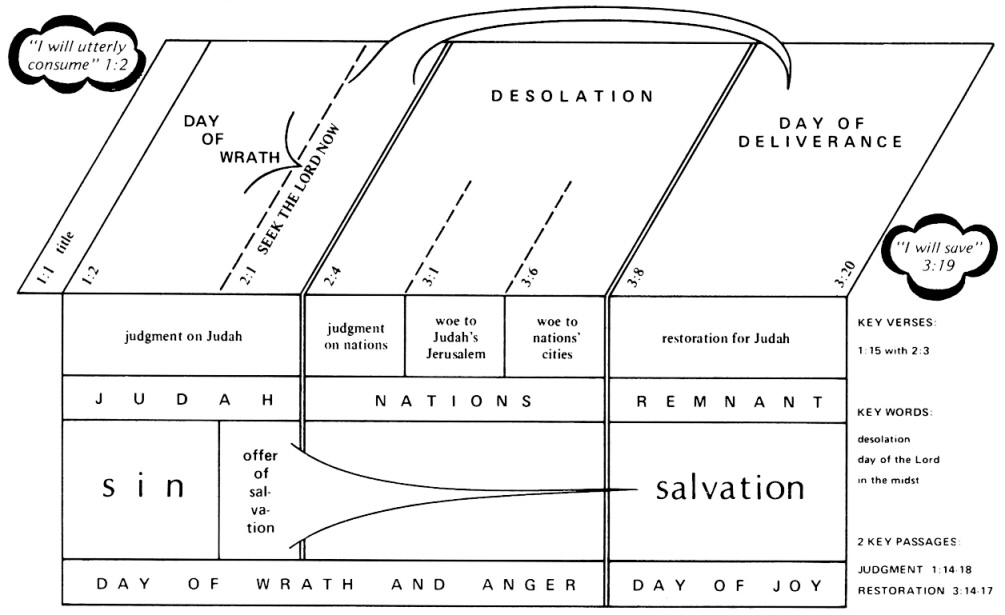
Click chart to enlarge
Chart from recommended resource Jensen's Survey of the OT - used by permission
Zephaniah Chart from Charles Swindoll
Another Zephaniah Chart
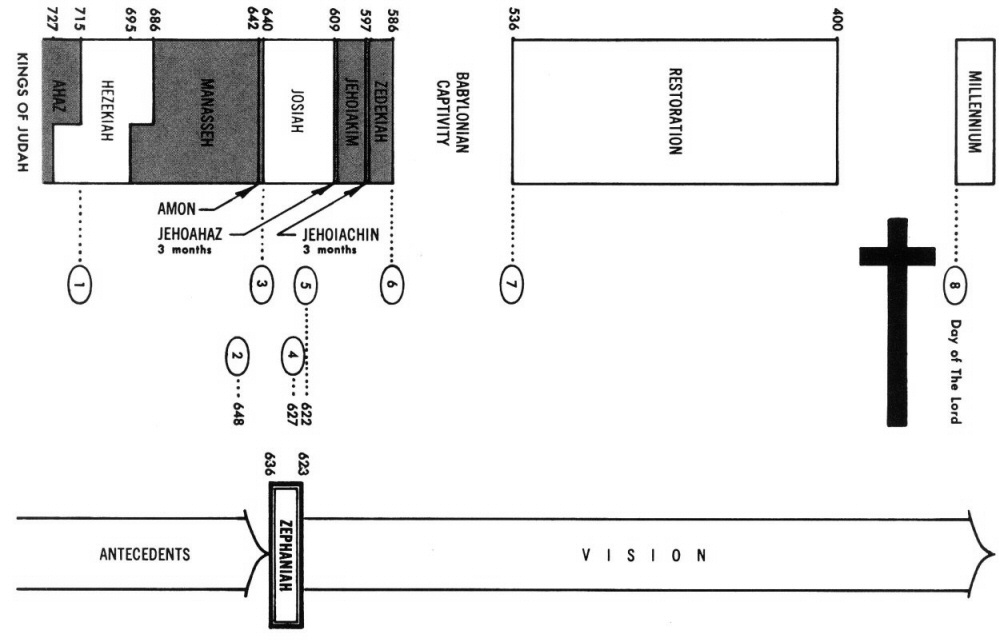
SETTING OF ZEPHANIAH
Click chart to enlarge
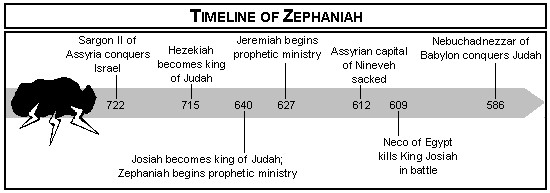
Source: Ryrie Study Bible
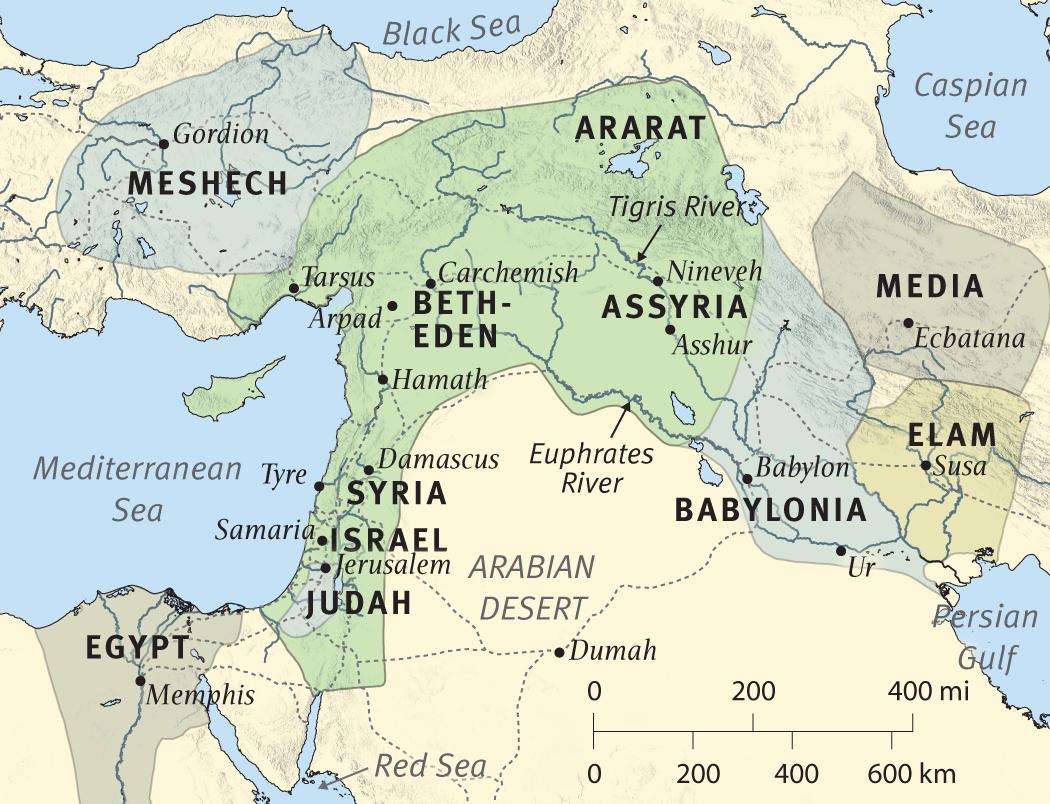
Circa 620 B.C.(Source: ESV.org)
Zephaniah prophesied during the reign of Josiah, when Egypt, Judah, and Babylonia were eroding the power of Assyria. Shortly after this time the Babylonians would replace the Assyrians as the dominant power in the Near East.(Source: ESV.org)
Below is a summary chart of the Zephaniah portion of the discussion of the Day of the Lord part 2
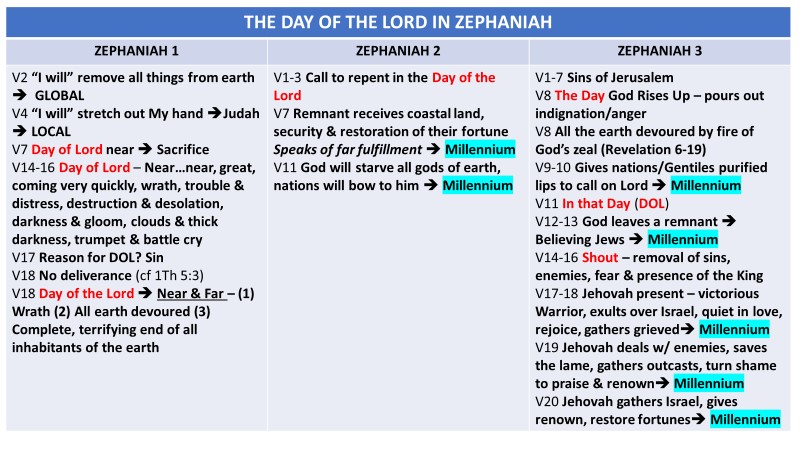
Youtube discussion - What the Bible Teaches About the Day of the Lord - Part 1
Youtube discussion - What the Bible Teaches About the Day of the Lord - Part 2|

Zephaniah 1:1 The word of the LORD which came to Zephaniah son of Cushi, son of Gedaliah, son of Amariah, son of Hezekiah, in the days of Josiah son of Amon, king of Judah:
NET This is the prophetic message that the LORD gave to Zephaniah son of Cushi, son of Gedaliah, son of Amariah, son of Hezekiah. Zephaniah delivered this message during the reign of King Josiah son of Amon of Judah:
- word: Ezek 1:3 Hos 1:1 2Ti 3:16 2Pe 1:19
- in the days: 2Ki 22:1-23:37 2Ch 34:1-35:27 Jer 1:2 25:3
- 15 page commentary on Zephaniah from conservative source KJV Bible Commentary
- The Announcement of the Day of the Lord 1:1–18 - Walter Kaiser - Excellent Comments - see all three chapters
A. A Day of Universal Judgment - Zephaniah 1:2–3
B. A Day of Judgment on Judah and Jerusalem - Zephaniah 1:4–6
C. A Call for Silence - Zephaniah 1:7
D. A Day of Judgment on God’s People - Zephaniah 1:8–13
E. A Day of Judgment on the World - Zephaniah 1:14–18
F. Conclusion
Related Passages:
2 Kings 22:1 Josiah was eight years old when he became king, and he reigned thirty-one years in Jerusalem; and his mother’s name was Jedidah the daughter of Adaiah of Bozkath.
2 Peter 1:21 for no prophecy was ever made by an act of human will, but men (LIKE ZEPHANIAH) moved by the Holy Spirit spoke from God.
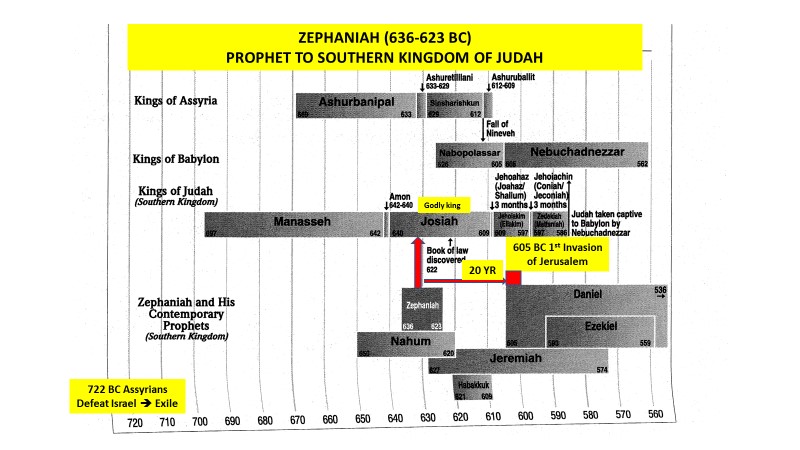
Zephaniah's Prophecy ~20 Years Before the Near Fulfillment
ZEPHANIAH
"THE LORD HIDES"
The word of the LORD - Don't miss this opening.The Hebrew expression “word of the LORD” (דְּבַר־יְהוָה, debar-YHWH) is the standard formula introducing prophetic messages. It occurs frequently in the prophets (Jer 1:2; Hos 1:1; Joel 1:1). God initiated the message. This underscores the authority of this prophecy. It is not Zephaniah's prophecy, but Yahweh's prophecy moving by His Spirit in and through Zephaniah! The prophet was a messenger, not the originator Peter affirms that "no prophecy was ever made by an act of human will, but men moved by the Holy Spirit spoke from God." (2Pe 1:21). Thus Zephaniah’s book is presented as God speaking through His prophet. Isaiah 55:11 says " So will My word be which goes forth from My mouth; It will not return to Me empty, Without accomplishing what I desire, And without succeeding in the matter for which I sent it."
Walter Kaiser - Zephaniah was a no-nonsense, all-business writer and speaker.Many speakers will attempt to “warm up” their audiences with a certain amount of humor and various types of pleasantries; this prophet felt the times and the issues were far too serious for any “warm-up” period. Immediately he launches into the hard facts he had to deliver from God. (See all three excellent chapters - Preacher's Commentary)
Zephaniah had royal blood of Hezekiah in his veins
but far better he had a royal message from Yahweh on his lips!
Which came to Zephaniah (“Yahweh has hidden” “Yahweh protects.”) son of Cushi, son of Gedaliah, son of Amariah, son of Hezekiah, in the days of Josiah son of Amon, king of Judah (640–609 BC): Zephaniah lists more of his ancestry than any other prophet and it seems his great, great grandfather was good king Hezekiah ca. 715–686 b.c.), leading some to call him "the royal prophet". This would explain why his genealogy is traced so far back — to connect him with a royal ancestor. Some think that Zephaniah's preaching may even have prepared the way for the brief revival under Josiah (2Chr 34:3-7). Zephaniah's ministry corresponds to the time of King Josiah (ca. 640–609 b.c.). Judgment is the central theme of Zephaniah's message and has a near (Babylon's defeat of Judah) and a far fulfillment. Zephaniah was contemporary with Jeremiah, Nahum and Habakkuk
Zephaniah means “Yahweh has hidden” or “Yahweh protects” which fits the book’s theme, because later Zephaniah speaks about a remnant that God will hide in the day of judgment. (Zeph 2:3).
KJV Bible Commentary Zep 1:1b . As observed earlier (cf. Introduction), the prophet’s name means “defended”, “protected”, or “hidden by Jehovah”. This not only affords a clue to the purpose of the prophecy, as noted earlier, but also gives rise to the observation that God always calls a man who is shaped exactly as the ministry to which God calls him requires; but the ministry is infinitely larger than the man. God would use Zephaniah to deliver a very dark message of judgment through which only a few rays of hope shine. In the midst of this judgment, God would defend, protect, and hide the true remnant, so that His wrath would not fall on them and they would experience the blessings the prophet announced. This principle of matching man with mission can be observed in all the other prophets, as well as in God’s ministers today....King Hezekiah was the godly king under whose reign God brought deliverance from Assyria in the days of Hosea, Micah, and Nahum almost a hundred years earlier (cf. 2Kgs 18-20; 2Chr 29-32). The mention of King Hezekiah, under whose reign a spiritual revival was experienced (cf. II Kgs 18:3-7; II Chr 29:3-19), provides a direct link with King Josiah, under whose reign a revival was about to occur (cf. II Kgs 23:30; II Chr 34-35). Thus, the two righteous kings are linked together as contrasts to the wicked Manasseh and Amon (Josiah’s father), under whose reigns Israel reached a new spiritual low. These facts enable us to date Zephaniah’s prophecy at 625 B.C. and cause us to realize that Zephaniah was the last prophet God sent to Judah prior to its being carried off captive into Babylon.
MacArthur Study Bible - Spiritually, the reigns of Hezekiah’s son Manasseh (ca. 695–642 b.c.), extending over 4 decades, and his grandson Amon (ca. 642–640 b.c.), lasting only two years, were marked by wickedness and apostasy (2Ki 21; 2Ch 33). The early years of Josiah’s reign were also characterized by the evil from his fathers (2Ki 23:4). In 622 b.c., however, while repairing the house of the Lord, Hilkiah the High-Priest found the Book of the Law (2Ki 22:8). Upon reading it, Josiah initiated extensive reforms (2Ki 23). It was during the early years of Josiah’s reign, prior to the great revival, that this 11th hour prophet, Zephaniah, prophesied and no doubt had an influence on the sweeping reforms Josiah brought to the nation. But the evil kings before Josiah (55 years) had had such an effect on Judah that it never recovered. Josiah’s reforms were too late and didn’t outlast his life. The moral and spiritual conditions detailed in the book (cf. Zeph 1:4–6; 3:1–7) seem to place the prophecy prior to Josiah’s reforms, when Judah was still languishing in idolatry and wickedness. It was in 628 b.c. that Josiah tore down all the altars to Baal, burned the bones of false prophets, and broke the carved idols (2 Chr. 34:3–7); and in 622 b.c. the Book of the Law was found (2 Chr. 34:8–35:19). Consequently, Zephaniah most likely prophesied from 635–625 b.c., and was a contemporary of Jeremiah. (MacArthur Study Bible - Page 1294 borrow The MacArthur Study Bible)
Believers Study Bible - DATE: ca. 625 B.C Zephaniah prophesied during the reign of King Josiah (640-609 B.C.). It is certain that he wrote the prophecy before 612 B.C., for he predicted the fall of Assyria which took place at that time (cf. 2:13-15). Nevertheless, the question remains whether Zephaniah's prophecy belongs to the early or latter part of Josiah's reign. Most biblical commentators attempt to date the book in accordance with Josiah's sweeping moral and religious reform, which he instituted with the discovery of the Book of the Law in 621 B.C. (2Ki22:8ff.). No such reform is evident in the prophecy; therefore, it is maintained that the book should be dated before 621 B.C. Possibly there were two reforms attempted by Josiah (2 Chr34:3). The initial reform (c. 628 B.C.) probably lacked the zeal (IT WAS NOT BOOK OF THE LAW DRIVEN...not Word driven and fueled at least not as clearly as the "second" reform) that accompanied the second reform, thus creating the possibility that Zephaniah's prophecy may have fallen somewhere in between the two reforms. Based on the preceding considerations, the prophecy may be tentatively dated c. 625 B.C., making the prophet's ministry contemporaneous with that of Jeremiah.
Josiah's Reform (ED: DON'T CALL IT REVIVAL...IT WAS SHORT-LIVED & JUDAH QUICKLY REVERTED TO HER EVIL WAYS) and the Babylonian Threat: The moral state of the southern kingdom deteriorated rapidly after the reign of King Hezekiah (729-686 B.C.). The religious reforms he instituted were soon eradicated by the evil influence of Manasseh (696-642 B.C.) and Amon (642-640 B.C.; cf. 2Ki 21; 2 Chr 33).
HISTORICAL BACKGROUND: Into this scene of moral and religious degeneracy came the boy-king Josiah. Upon the discovery of the "Book of the Law" (2 Ki22:8ff.), in the eighteenth year of his reign (621 B.C.; 2Ki 22:3), Josiah launched a sweeping reform of the national order. His regime was backed by the prophetic ministries of Jeremiah and Zephaniah, but the prophets' call for repentance fell upon deaf ears. Wickedness remained unabated, and Judah was ripe for judgment. Through a quick succession of events, God's providence brought the dark and foreboding clouds of war and destruction over Judah's horizon. Assyria was being replaced by Babylon as the power beyond the Euphrates. In a futile attempt to delay Babylon's rise, Egypt under Pharaoh Necho advanced north for war; but as a means of courting Babylon's favor, Judah's forces under Josiah stood in Egypt's way. At Megiddo, Egypt trampled upon Judah, killed King Josiah, and made the nation its vassal (609 B.C.). The alliance and protection Egypt afforded were short-lived, because in 605 B.C. Babylon extinguished Egypt's aspirations at Carchemish -- a catastrophe which served to pave the way for the Chaldean conquest of Judah. Nebuchadnezzar, God's instrument of the judgment about whom Zephaniah had prophesied only two decades before, was suddenly knocking at the portals.
THEME: Judgment: immediate fulfillment = Babylon captured Judah. The theme of the book is the necessity of seeking the Lord in view of the coming "Day of the LORD" (Zeph 1:7; Zeph 2:1-3)-the time of God's dire judgment upon the whole earth. The "day of the Lord" more often in Zephaniah than any other prophet of the Bible. In OT "the day of the Lord" refers to occasions when the Lord manifested Himself providentially in the affairs of Israel as well as in those of heathen Gentile nations (cf. Isa 13:6ff.; Jer 46:10; Eze 30:3; Joel 1:15). The New Testament expands the concept to include a future day when the Lord will ultimately return to bring universal judgment upon His foes and triumphant deliverance for His faithful remnant (1Cor 5:5; 2Cor 1:14; 1 Th 4:13-5:11). That "day" will begin with the revealing of the SON OF LAWLESSNESS (2Th 2:3, v4) who is not truly revealed until the MIDPOINT of DANIEL'S 70th WEEK (Da 9:26,27) at the inception of the GREAT TRIBULATION (note: "tribulation" is never found in Scripture as a description of the full 7 years but tradition has led to the designation of this entire 7 years as "THE TRIBULATION"...that designation to reiterate is not defended by God's Holy Word). The DAY OF THE LORD will extend to the end of the Millennium (2Pe3:10,12). Zephaniah also predicted doom of heathen nations, immediately (Nineveh fell in 612; Zeph 2:13) and future (Zeph 3:8). The book closes with a glorious description of the future Millennium which is also an aspect of the Day of the Lord.
Ray Stedman - Zephaniah: The Day Of The Lord's Wrath
One of the shortest of the books is that by the prophet Zephaniah. Yet it is a book which is almost overwhelming in its darkness and gloom. The theme of this book is "the day of the Lord." It is a view of the back side of God's love -- in other words, his wrath.
It is a book which sets forth the burning jealousy of God. The Bible frequently says that God is a jealous God. That doesn't mean jealousy as we usually think of it -- being suspicious all the time and looking for expected violations of love. It simply means that God loves so thoroughly, so completely, that he cannot brook a rival to his love. God will destroy anything which hurts his loved one. (See Israel the Wife of Jehovah)
This is why he is sometimes so ruthless with us. When he sees us loving and clinging to things which are damaging and hurting us, God's jealousy comes in and says, "No, you can't have them." We plead with him and say, "Lord, let me keep them. Why, this friend I have -- I enjoy him so, or love her so! Let me keep her; let me have him." And God says, "No, you can't." So we have to give these things up.
This book sets forth the jealousy of God. There could be no love on God's part if there were not the ultimate exercise of wrath. You say you can't accept a God of wrath? Then you can't believe in a God of love, because a God who can't get angry at what injures the person he loves is not capable of love. Zephaniah is the great prophet of God's jealousy. . .
Zephaniah means "hidden of the Lord" and the prophet is speaking as if he were a representative of the remnant of faith -- those relatively few people who will remain true to God and be faithful to his word through the time of trouble that is to come upon the earth. They will be hidden, as it were, by God himself among the nations of the earth and God will watch over them to keep them in faith during this time. And it is about these people that the book of Zephaniah is written, and especially of that coming day, the Day of the LORD, which is vividly described by the prophet. (Zephaniah: The Day Of The Lord's Wrath)
NORMAN GEISLER - ZEPHANIAH 1:1—Hasn’t it been demonstrated that Zephaniah is actually composed of two books with different messages?
PROBLEM: Conservative scholars maintain that the Book of Zephaniah is a single work composed by the prophet Zephaniah. However, modern scholarship claims that the book is actually two books with different messages put together as if it were one. The very beginning of this book is a message of dread and coming judgment. The overriding theme is the devastation and destruction that is about to fall in the swiftly approaching Day of the Lord (1:7, 8, 10, 14–15, etc.) However, verses 8–13 of chapter 3 present a message of hope that seems completely out of keeping with the theme of the book as a whole. How can this book be considered the sole work of one person, Zephaniah?
SOLUTION: There is no reason to suppose that the messages of judgment and hope are incompatible. In fact, it is the message of the Book of Zephaniah that the coming judgment of the Day of the Lord is the very means by which God would bring about the ultimate restoration of His people. The Day of the Lord is a day of purification from sin and salvation of the remnant. The hope of salvation in the midst of judgment, is found as early as 2:1–3 and 3:8–9, clearly pointing out that it is this purifying judgment that will prepare the way for the restoration of God’s people. Zephaniah is a single unified work by the prophet Zephaniah. (SEE WHEN CRITICS ASK)
ILLUSTRATION - Paul Apple - THE CALM BEFORE THE STORM Imagine waking up to a perfectly calm morning—blue skies, no wind, no clouds—only to discover later that day a hurricane was already forming offshore, invisible to the naked eye but absolutely certain in its arrival. That was the experience of my family back in 1989 when Hurricane Hugo was unleashing its devastating power. Karen and her Mom and our four kids drove down to Florida to stay at Patrick AFB right on the beach for their annual pre-homeschool vacation. The weather was beautiful. They stayed in SC in a nice motel along I-95 and enjoyed the outdoor pool. When they drove back a week later, Hugo had swept thru the region, snapped off all the trees like toothpicks; wiped out the motel and left the pool filled with tree limbs and debris. What a dramatic picture of powerful destruction seemingly coming out of nowhere. That is the setting for the prophecy of Zephaniah. But in his case the nation had ample warning. Judah appears religiously active, politically stable, and morally indifferent. But beneath the surface, divine judgment is gathering momentum. Zephaniah is the prophet who pulls back the curtain and says, “The storm is not coming—it is already on the way.”
Oscillating Prophecy – Swings back and forth Prophecy bounces back and forth between near term judgment on apostate Judah – when King Nebuchadnezzar of Babylon will destroy Jerusalem in 586 BC; and the end times scenario when God’s wrath will be unleashed against the whole world The prophecy bounces back and forth between an emphasis on God judging the nations and on God judging His own people in Judah and Jerusalem. The Prophecy moves from judgment and wrath to salvation and blessing as Chap. 3 finishes with a description of eventual salvation for the believing remnant.
Twofold Division:
I. 1:2 – 3:7 THE DAY OF THE LORD UNLEASHES DIVINE JUDGMENT
II. 3:8-20 THE DAY OF THE LORD CULMINATES IN MESSIANIC BLESSING
Hampton Keathley (Zephaniah - Overview - Summary section by section) summarizes the key principles in Zephaniah:
(1) God is full of grace, gladness and tenderness, but also justice.
|
Judgment Zeph 1:8-9 |
Grace Zeph 3:9-20 |
|
Wrath Zeph 1:15, 18 |
Gladness Zeph 3:17 |
|
Terror |
Tenderness Zeph 2:7, 3:17 |
(2) God deals in grace. In the midst of the troubles that are coming God will...
|
REMOVE |
RESTORE |
|
|
Therefore I should trust God to work out his plan. What do I need to do?
What do I need to do?
- I need to wait on God (Zeph 3:8). He will right the wrongs and restore the righteous. I just want to be sure I'm counted among the righteous. Therefore....
- I need to “Seek the Lord” (Zeph 2:3) This means that my number one goal in life is to know God - to have an intimate relationship with him.
- I need to be humble (Zeph 2:3b). This involves self denial. Vertical and horizontal - which leads to the next requirement.
- I need to obey God’s ordinances (Zeph 2:3) = love my neighbor
In Explore the Book here is Sidlow Baxter's Outline: Through Judgment to Blessing
I. Look Within! – Wrath Coming on Judah (Zeph 1:1–2:3)
The Purpose of Jehovah to Judge (Zeph 1:1-6)
The “Day” of Jehovah “at hand” (Zeph 1:7-18)
And so – plea to Jerusalem (Zeph 2:1-3)
II. Look Around! – Wrath on All Nations (Zeph 2:4 – 3:8)
West, East – Philistia, Moab, Ammon (Zeph 2:4-11)
South, North – Ethiopia and Assyria (Zeph 2:12-15)
And so – “Woe” to Jerusalem (Zeph 3:1-8)
III. Look Beyond! – After Wrath, Healing (Zeph 3:9-20)
Conversion of Gentile Peoples (Zeph 2:9)
Restoring of Covenant People (Zeph 2:10-15)
And so – the new Jerusalem (Zeph 2:16-20)
G Campbell Morgan - What then is the message that Zephaniah delivered to his own day? It is a message of the unity of the divine method. We see God’s absolute refusal to excuse sin because of His love, and we see His love acting in consuming wrath in order to secure the final realization of its most tender purpose. If you cut out that last part of Zephaniah, then he has no distinctive message. It is not the first part, but the second part, of the prophecy that is the message of Zephaniah. It is that peculiar union formed by the denunciation of sin that is so severe, and the annunciation of love that is so tender. These two together give us the great message that Zephaniah delivered to his people: love cannot excuse sin, but love will at last find a way to realize its purpose in spite of all the sin of the people.
Deffinbaugh: As I understand the book, there are two dominant themes in Zephaniah: judgment and deliverance.
These reasons for divine judgment can best be summarized in this way:
- God will judge those in Judah who practice pure paganism (Zeph 1:4).
- God will judge those in Judah who mix the worship of God with the worship of other deities (Zeph 1:5a).
- God will judge those in Judah who completely reject and turn away from the faith of their fathers (Zeph 1:6).
- God will judge those who choose to identify with the heathen (rather than the people of God) by their dress (Zeph 1:8).
- God will judge those who practice violence and deceit (Zeph 1:9).
- God will judge those who refuse divine instruction, and who have ignored His warnings (Zeph 3:1-2). Judah should have learned from God’s judgment of others, but she did not (3:6-7).
- God will judge those in leadership, who have abused their authority and forsaken their stewardship (Zeph 3:3-4).
- God will judge those who presume that God is indifferent about their sin (Zeph 1:12).
- God will judge those who put their trust in anything but Him (Zeph 1:18).
There are several things that set the righteous remnant apart from the corrupt world in which they live:
- Those who are a part of the righteous remnant seek God, and they obey His commandments:
- Those who are a part of the righteous remnant are humble:
- Those who are a part of the righteous remnant are righteous in their actions toward others:
- Their sins are forgiven and they are cleansed from their sin (Zeph 3:9, 11, 13).
- They will be delivered from or through divine judgment (Zeph 2:1-3).289
- They will eventually be rescued from the hand of their oppressors (Zeph 2:4-15; 3:15).
- They have the hope of future blessings (Zeph 2:6-9).
- They will be given fame and honor (Zeph 3:19-20).
- They will enjoy security and peace (Zeph 3:13).
- They will enjoy being in God’s presence, as He rejoices over them as the objects of His love (Zeph 3:15-17).
Zephaniah 1:2 “I will completely remove all things From the face of the earth,” declares the LORD.
Legacy Standard Bible - “I will completely end all things From the face of the ground,” declares Yahweh.
NET 2 "I will destroy everything from the face of the earth," says the LORD.
- I will: etc. Heb. By taking away I will make an end, utterly. 2Ki 22:16,17 2Ch 36:21 Isa 6:11 Jer 6:8,9 24:8-10 34:22 36:29 Eze 33:27-29 Mic 7:13
Related Passages:
Zephaniah 3:8 “Therefore wait for Me,” declares the LORD, “For the day when I rise up as a witness. Indeed, My decision is to gather nations, To assemble kingdoms (COMMENT - cf the 6th Bowl - Rev 16:12-16 = FIRST THE KINGS GATHER at HAR-MAGEDON, THEN Joel 3:2 SUGGESTS THEY MOVE DOWN TO VALLEY OF JEHOSHAPHAT), To pour out on them My indignation, All My burning anger; For all the earth will be devoured By the fire of My zeal.
GOD'S JUDGMENT
ON THE WORLD
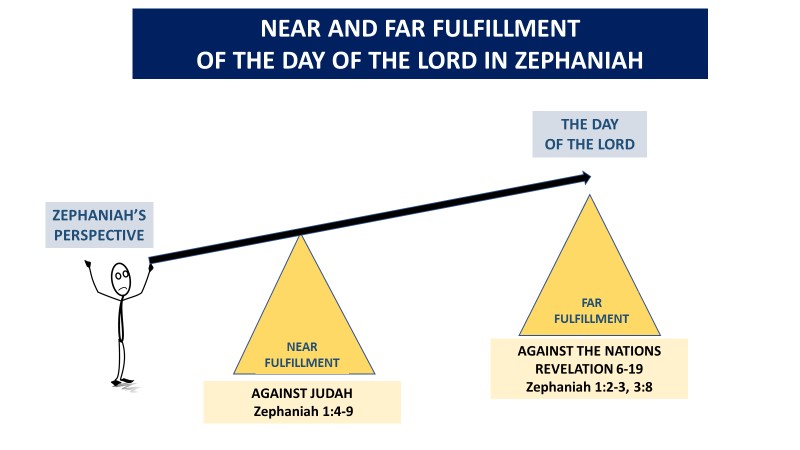
I will completely remove (sup/suph; LXX - ekleipsis = abandonment, extinction, destruction, eclipse of sun) all things From the face of the earth,” declares the LORD - Who is this prophecy against? Is it just local (Judah) or is it global (all the earth)? Clearly this prophecy of the Day of the Lord is not only given against Judah but is also against the world (global) and thus has both a near and a far fulfillment. The near fulfillment would come in about 20 years when Babylon invaded Jerusalem for the first of 3 times in 605 BC (597, 586 the other two), the time when Daniel and the 3 Hebrew friends were taken captive. Ezekiel and 10,000 Jews were taken captive in 597 BC. The Temple was demolished in 586 BC.
Descriptive Definition of the Day of the LORD - The DAY of the LORD describes a time when God intervenes in the “day of man.” The DAY of the Lord can have a historical fulfillment (NEAR), and an eschatological fulfillment (FAR). This DAY begins with the Great Tribulation when God judges the Gentile nations and Israel, purging, purifying and refining a redeemed remnant of Israel who will enter into the Promised Land for a period of unprecedented blessing and prosperity in the Messianic Kingdom ruled by the King of kings, the Lord Jesus Christ. The Day of the Lord terminates with God’s “uncreation” of the creation at the end of 1000 years.
NET NOTE - The Hebrew text combines the infinitive absolute of אָסַף (’asaf, “gather up, sweep away”) with a Hiphil prefixed first person form of סוּף (suf, “come to an end”; see Jer 8:13 for the same combination). This can be translated literally, “Sweeping away, I will bring to an end.” Some prefer to emend the text so that the infinitive and finite form of the verb are from the same root (“I will certainly sweep away,” if from אָסַף [cf. NEB, NIV, NRSV]; “I will certainly bring to an end,” if from סוּף). For a discussion of proposals see J. J. M. Roberts, Nahum, Habakkuk, and Zephaniah (OTL), 167, 169.
Walter Kaiser - The temptation for modern readers is to tone down the harshness and horror of the judgment threatened in this text by juxtaposing against it the marvelous grace and mercy of our Lord. But their efforts cannot shield us from the seriousness or the certainty of these pronouncements for the future. An insipid view of the love of God should not obliterate an appreciation for the vigor of the wrath of God against all unrighteousness and ungodliness. In fact, Jesus alludes to Zephaniah 1:2–3 in his parable of the weeds in Matthew 13:41 where he says, “The Son of Man will send out His angels, and they will gather out of His kingdom all things that offend, and those who practice lawlessness” (italics ours). Theconcept of “utterly consuming,” “gathering together,” or “sweeping away” occurs four times in Zephaniah 1:2–3. The Hebrew ˒āsap means to “gather together,” “sweep up,” or “bundle together,” as one would do in gathering a crop or in collecting troops. It is a comprehensive action strengthened by an emphatic form of the same verb. This gathering together will involve everything and will have a worldwide scope! Just as all creation had been corrupted since the Fall, so all creation would now be involved in the divine visitation: man, beasts of the land, birds of the air, and creatures of the sea. This would be a universal judgment. Thus, like an overture to a symphony, these two verses announce the themes of the Book of Zephaniah. They also warn that judgment is near. For the moment, no ray of hope or sign of mercy is apparent; instead, with drum-like rapidity come the verbs of destruction, overthrow, and cleansing of evil. “No hotter book lies in the Old Testament.” (Smith page 74) (See all three excellent chapters - Preacher's Commentary)
G Campbell Morgan - I will utterly consume.—Zeph. 1.2
Zephaniah exercised his ministry in the days of Josiah. This is an interesting fact, because in his days there was a great reformation, and yet the prophet makes no reference to it. An examination of the history of that reform will show that, so far as the nation was concerned, it was superficial. The king was loyal to God, and sincere. He was also popular with the people, and they followed him in his re-forming work, as to external things. But there was no true repentance. Therefore Zephaniah did not recognize the reform; and indeed, in all probability the insincerity of it gave greater vehemence to his denunciation of the sin of the people. Taken as a whole this prophecy sets forth the severity and goodness of God with overwhelming force; and shows how these apparently contradictory elements of His government move to the same end. The words we have emphasized give the key note to the prophet's message as to the action of God, consequent upon the sins of the people. This chapter is wholly taken up with the day of Divine wrath. The outlook was wider than Judah. It began with the declaration that the whole creation, so far as it was polluted, should be destroyed. It then dealt with the nation itself, denouncing its sins, and announcing the consuming wrath of God as proceeding against princes, extortioners, the city, the merchantmen, the luxurious. It is a terrible setting forth of the severity of God against apostasy. There was no equivocation, no uncertainty, no hesitancy, in the prophet's words. They abide for all time, a revelation of the fact that God not only will make no terms with sin, but that He will proceed against it in fiery indignation that it may be utterly consumed.
Zephaniah 1:3 “I will remove man and beast; I will remove the birds of the sky And the fish of the sea, And the ruins along with the wicked; And I will cut off man from the face of the earth,” declares the LORD.
Legacy Standard Bible - “I will end man and beast; I will end the birds of the sky And the fish of the sea And the ruins along with the wicked; And I will cut off man from the face of the ground,” declares Yahweh.
NET "I will destroy people and animals; I will destroy the birds in the sky and the fish in the sea. (The idolatrous images of these creatures will be destroyed along with evil people.) I will remove humanity from the face of the earth," says the LORD.
CSB I will sweep away man and animal; I will sweep away the birds of the sky and the fish of the sea, and the ruins along with the wicked. I will cut off mankind from the face of the earth.This is the LORD's declaration.
ESV "I will sweep away man and beast; I will sweep away the birds of the heavens and the fish of the sea, and the rubble with the wicked. I will cut off mankind from the face of the earth," declares the LORD.
NIV "I will sweep away both men and animals; I will sweep away the birds of the air and the fish of the sea. The wicked will have only heaps of rubble when I cut off man from the face of the earth," declares the LORD.
NLT "I will sweep away people and animals alike. I will sweep away the birds of the sky and the fish in the sea. I will reduce the wicked to heaps of rubble, and I will wipe humanity from the face of the earth," says the LORD.
NRS I will sweep away humans and animals; I will sweep away the birds of the air and the fish of the sea. I will make the wicked stumble. I will cut off humanity from the face of the earth, says the LORD.
NJB I shall sweep away humans and animals, the birds of the air and the fish of the sea, I shall topple the wicked and wipe all people off the face of the earth -declares Yahweh.
NAB I will sweep away man and beast, I will sweep away the birds of the sky, and the fishes of the sea. I will overthrow the wicked; I will destroy mankind from the face of the earth, says the LORD.
YLT I consume man and beast, I consume fowl of the heavens, and fishes of the sea, And the stumbling-blocks -- the wicked, And I have cut off man from the face of the ground, An affirmation of Jehovah,
- consume man: Jer 4:23-29 12:4 Ho 4:3
- Ruins - stumblingblocks: or, idols, Isa 27:9 Eze 7:19 14:3-7 44:12 Ho 14:3,8 Mic 5:11-14 Zec 13:2 Mt 23:39 Rev 2:14
- and I: Eze 14:13-21 15:6-8
Related Passages:
Isaiah 6:11 Then I said, “Lord, how long?” And He answered, “Until cities are devastated and without inhabitant, Houses are without people And the land is utterly desolate,
Jeremiah 4:25 (REMOVE) I looked, and behold, there was no man, And all the birds of the heavens had fled.
Jeremiah 9:10 (REMOVE) “For the mountains I will take up a weeping and wailing, And for the pastures of the wilderness a dirge, Because they are laid waste so that no one passes through, And the lowing of the cattle is not heard; Both the birds of the sky and the beasts have fled; they are gone.
WHAT IS THE EXTENT OF
YAHWEH'S GLOBAL JUDGMENT?
I will remove (sup/suph; LXX - ekleipo = cease, come to an end) man and beast; I will remove (sup/suph; LXX - ekleipo) the birds of the sky And the fish of the sea, And the ruins (stumbling blocks) along with the wicked; And I will cut off (karath; LXX - exairo = expel, remove, drive out as in 1Co 5:13; cf use in Da 9:26) man from the face of the earth,” declares the LORD - NET on "the ruins..." translates it as "The idolatrous images of these creatures will be destroyed along with evil people." What does this divine removal remind you of? Clearly, this recalls the earth's destruction by the worldwide flood, when “man and beast” and “birds of the sky” (Ge 6:7; Ge 7:23) were destroyed. These are listed in exactly the opposite order of their appearance in the original creation account (cf Ge 1:20-28) (See note below) This destruction will exceed even that of the flood, (cf Ge 6:17) since here fish will also feel the brunt of God's righteous wrath.
Walter Kaiser - As He did in the days of Noah, God will destroy the earth in order to deal with the wickedness of man. Along with the fire that will consume all else, God promised, “I will consume … the stumbling blocks” (v. 3). The words “stumbling blocks” were usually used to describe idols (e.g., Ezek. 14:3, 4, 7), but they have a wider application in this context. Not only will the wicked be judged, but so will the very instruments that were the occasions for their moral and spiritual failings. (See all three excellent chapters - Preacher's Commentary)
All creation will suffer as a result of the sin of humankind, reminding us of Paul's words in Romans 8 -
"For the creation was subjected to futility, not willingly, but because of Him who subjected it, in hope 21 that the creation itself also will be set free from its slavery to corruption into the freedom of the glory of the children of God. 22 For we know that the whole creation groans and suffers the pains of childbirth together until now." (Ro 8:20-22)
As an aside, when will creation be set free from its slavery to corruption? I propose (without being dogmatic but comparing Scripture with Scripture) that this glorious redemption of all creation will be realized when the Redeemer returns and begins His 1000 year reign on His throne Jerusalem. In short, creation will be set free in the "positive side" of the Day of the Lord (cf "no more curse" Zech 14:11; see also Jesus' promise in Mt 19:28 "in the regeneration [paliggenesia] when the Son of Man will sit on His glorious throne." When is that day? The Millennium - see Zech 14:9, 17 = "LORD will be king over all the earth; in that day". Cf Hab 2:14)!
Note the repeated verb "remove" (sup/suph) and the repetition of "I will" the latter indicating God may be behind the scenes but is in full control of the scenes He is behind. Do you believe that is true in all the circumstance (good or bad) of your life?
🙏 THOUGHT - How should we respond to this truth? Hebrews 6:12 says we should not be indifferent or "sluggish, but imitators of those who through faith and patience inherit the promises." So in face of the warning of a coming global catastrophe, what was Noah's pattern for us to imitate? Remember that Noah was a man of great faith (Heb 11:7) and faith is an "active, dynamic" word. What did Noah's faith impel him to do in light of the coming global catastrophe? To build an Ark of course. But Peter gives a second response describing Noah as a "preacher of righteousness" (2Pe 2:5). So in view of the truth that the coming Day of the Lord is near, will come suddenly on the unsuspecting lost world and will be great and terrible and will bring worldwide decimation, in imitation of the pattern of Noah, we too should strive to warn all who spiritually dead in their trespasses and sins (Eph 2:1). We should speak the life giving, life transforming Gospel (Ro 1:16-17) to as many souls as God's Spirit gives us opportunity (cf Eph 5:16, "Redeem the Time" - here is a video talk I gave to a group of men 5 years ago at age 75 - Redeem the Time), so that they too might be rescued "from the wrath to come." (1Th 1:10, cf 1Th 5:9).
HCSB - To underscore the gravity of their sins and the intensity of their deserved punishment, Zephaniah used prophetic hyperbole (Jer 4:23-29; 9:9-11) in which creation itself is reversed; here the creatures are listed in reverse order from Gen 1:20-28 (sea creatures, birds, beasts, and man).
NET NOTE - Heb “And the stumbling blocks [or, “ruins”] with the evil”; or “the things that make the evil stumble.” The line does not appear in the original form of the LXX; it may be a later scribal addition. The present translation assumes the “stumbling blocks” are idolatrous images of animals, birds, and fish. See J. J. M. Roberts, Nahum, Habakkuk, and Zephaniah [borrow] (Old Testament Library), 167, and Adele Berlin, Zephaniah [borrow] (Anchor Bible Commentary), 73–74.
Illustration: Like pulling the plug in a bathtub, God announces that He will drain a corrupted world system that has rejected Him.
Remove (05486)(sup/suph) means to to come to an end, cease, to terminate. Purim is an annual observance whose celebration should not cease (Esther 9:28). Ps 73:19 describes how quickly the prosperity enjoyed by the wicked is brought to an end, "swept away by sudden terrors." Elsewhere, it is a general term that refers to the end of something as a result of God's judgment (Isa. 66:17; Jer. 8:13; Zeph. 1:2, 3).
Sup/suph - 7x - Est. 9:28; Ps. 73:19; Isa. 66:17; Jer. 8:13; Amos 3:15; Zeph. 1:2; Zeph. 1:3
Cut off (destroy) (03772) karath literally means to cut, to cut off or to sever an object from its source or cut into parts and implies a violent action. For example, Zipporah "cut off her son’s foreskin." (Ex 4:25) or the Jews "cut down a branch with a single cluster of grapes." (Nu 13:2-24, cf Dt 19:5, 20:19-20, Jdg 9:48-49, 1Sa 5:4, 17:51, 24:4-5,11, 31:9, 2Sa 10:4, 2Sa 20:22) In another literal use as punishment to Israel for breaking the Mosaic covenant (cf Dt 29:25, 31:16), God says He will "cut down (karath) your incense altars" (Lev 26:30, cf Jdg 6:25-26, cf 1Sa 28:9). A sacrificial animal was not to be offered if it was "cut" (karath) (Lev 22:24). Karath means "chewed" (cutting food with teeth) in Nu 11:33.
Zephaniah 1:3 contains a striking literary feature: the prophet appears to reverse the order of creation described in Genesis 1, portraying God’s coming judgment as a kind of “un-creation.” In other words, the judgment of the Day of the LORD is depicted as the undoing of the created order because of human sin.
In Genesis 1, God creates living things in a clear sequence. First come the fish of the sea and the birds of the heavens (Gen 1:20–23), then the animals of the earth, and finally human beings, the climax of creation (Gen 1:24–27). Humanity is placed at the top of this created order as God’s image-bearer.
But in Zephaniah 1:3, God announces judgment in the reverse order:
“I will remove man and beast;
I will remove the birds of the sky
and the fish of the sea…” (NASB)
Here the sequence runs from the highest part of creation downward:
- Humans
- Animals (beasts)
- Birds of the heavens
- Fish of the sea
Instead of creation moving upward toward humanity, the order moves downward toward destruction. The created order is symbolically being dismantled step by step.
When the image-bearer falls into sin,
creation itself suffers under judgment.
This literary reversal communicates an important theological truth. Because humanity—the crown of creation—has rebelled against God through idolatry and wickedness (Zeph 1:4–6), the consequences extend beyond people to the entire created order. When the image-bearer falls into sin, creation itself suffers under judgment. The prophets therefore portray divine judgment not merely as punishment of individuals but as cosmic disorder, the undoing of the harmony established in Genesis.
This theme echoes elsewhere in Scripture. For example, Jeremiah 4:23–26 describes judgment using language that intentionally recalls Genesis 1 but in reverse, portraying the land as “formless and void.” Similarly, Hosea 4:3 declares that because of human sin “the beasts of the field and the birds of the sky and also the fish of the sea disappear.” These passages show that prophetic judgment is often depicted as a collapse of the created order.
Thus, the wording of Zephaniah 1:3 is not random. By reversing the Genesis creation order, Zephaniah vividly portrays the Day of the LORD as an “un-creation”—a dismantling of the world corrupted by sin. Yet this theme also prepares the reader for the hope that follows in the prophets: after judgment, God will ultimately restore and renew creation, bringing about a purified world where His people once again live under His righteous rule.
Zephaniah 1:4 “So I will stretch out My hand against Judah And against all the inhabitants of Jerusalem. And I will cut off the remnant of Baal from this place, And the names of the idolatrous priests (CHEMARIMS - KJV) along with the priests.
Legacy Standard Bible -“So I will stretch out My hand against Judah And against all the inhabitants of Jerusalem. And I will cut off the remnant of Baal from this place, And the names of the idolatrous priests along with the priests,
NET "I will attack Judah and all who live in Jerusalem. I will remove from this place every trace of Baal worship, as well as the very memory of the pagan priests.
- stretch: Ex 7:5, Ex 15:12 2Ki 21:13 Isa 14:26,27
- the remnant: "Fulfilled", 2Ki 23:4-5 2Ch 34:4
Related Passages:
2 Kings 23:4-5 Then the king (JOSIAH) commanded Hilkiah the high priest and the priests of the second order and the doorkeepers, to bring out of the temple of the LORD all the vessels that were made for Baal, for Asherah, and for all the host of heaven; and he burned them outside Jerusalem in the fields of the Kidron, and carried their ashes to Bethel. 5 He did away with the idolatrous priests whom the kings of Judah had appointed to burn incense in the high places in the cities of Judah and in the surrounding area of Jerusalem, also those who burned incense to Baal, to the sun and to the moon and to the constellations and to all the host of heaven.
2 Kings 21:13 ‘I will stretch over Jerusalem the line of Samaria and the plummet of the house of Ahab, and I will wipe Jerusalem as one wipes a dish, wiping it and turning it upside down.
DIVINE JUDGMENT
DIRECTED AT JUDAH
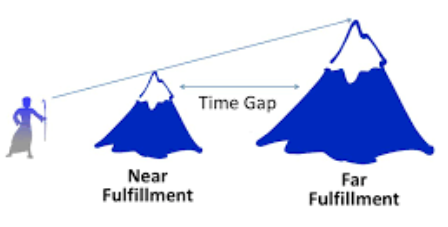
Zephaniah 1:4-17 describe the Day of the LORD and speak of a historical (near) judgment of Judah (defeat by Babylon 586 BC) and then in Zephaniah 1:18 the description of the Day of the LORD encompasses the judgment to the entire world ("all the inhabitants of the world") which speaks of an eschatological (far) fulfillment. So vivid are Zephaniah's descriptions that George Adam Smith quipped "No hotter book lies in all the Old Testament." And yet it ends on an encouraging note concerning the future in chapter 3. Therefore Zephanian's overall message is "Through Judgment To Blessing"
So I will stretch out My hand (yad ~ power) against Judah - Neither Judah nor Jerusalem will be exempt from this sweeping worldwide judgment. This is an idiom for for divine action, often associated with judgment (as in this verse Ex 15:12; Is 5:25; 14:26; 23:11; Jer 21:5) or deliverance (Ex 7:5, Isa 5:25) and in other contexts stretching out God’s hand is a metaphor for God’s work of liberation and protection (e.g., Ex. 6:16; Dt. 4:34),. Hand in Hebrew speaks of power. This is obviously an anthropomorphic description of God. Sometimes the Scriptures describe the "good hand of" Yahweh on someone (like Ezra in Ezra 7:9), but this divine hand is a "heavy" hand of God's fierce wrath and righteous indignation against a Christ rejecting, rebellious creation, in this case against Judah! (See Hand of the LORD)
And against all the inhabitants of Jerusalem. And I will cut off the remnant (shear) of Baal (ba'al) from this place, And the names of the idolatrous priests (CHEMARIMS - KJV) along with the priests (cf 2Ki 23:5) - NET = "I will attack Judah and all who live in Jerusalem. I will remove from this place every trace of Baal worship, as well as the very memory of the pagan priests." The passage emphasizes that God’s judgment begins with His own people when they compromise with idolatry and fail to honor the covenant they voluntarily entered with Him. The prophecy identifies specific targets of judgment, especially the remnant of Baal worship and the pagan priests who promoted idolatry. Baal, the Canaanite storm god (often associated with Hadad), had long been a snare to Israel (cf. Jdg 6:25; 1 Kgs 16:31–32; 18). Even though reforms—such as those under Josiah—attempted to purge idolatry, traces of pagan religion still remained, and these lingering practices provoked God’s anger.
Walter Kaiser on Baal (ba'al) - The native Canaanite fertility gods and goddesses had been a nettlesome affair ever since Israel set foot in Canaan. Their festivals of fertility, “sacred” prostitution, and sexual orgies had constantly tempted the people of Israel. (See all three excellent chapters - Preacher's Commentary)
This was fulfilled in Judah after the Babylonian captivity. The verb cut off (karath) is somewhat ironically the same verb used for God cutting covenant with Abraham (Ge 15:18) and the Mosaic Covenant (Ex 24:8). Another notable use of karath is when Zipporah "cut off her son’s foreskin." (Ex 4:25)
Note that the judgment on Judah focuses on overt idolatry (v4-5), syncretism (v5), and total apostasy (v6). And all of these godless actions by a people who had repeated, incredible exposure to God's presence and power! What a dramatic reminder of the tremendous power of our fallen flesh which continually seeks to draw us away from our great and awesome God Who loves us with an everlasting love.
NET NOTE - Heb “of the pagan priests and priests.” The first word (כְּמָרִים, kémarim) refers to idolatrous priests in its two other appearances in the OT (2 Kgs 23:5, Hos 10:5), while the second word (כֹּהֲנִים, kohanim) is the normal term for “priest” and is used of both legitimate and illegitimate priests in the OT. It is likely that the second term, which is omitted in the LXX, is a later scribal addition to the Hebrew text, defining the extremely rare word that precedes (see J. J. M. Roberts, Nahum, Habakkuk, and Zephaniah [OTL], 167–68; cf. also NEB, NRSV). Some argue that both words are original; among the modern English versions that include both are NASB and NIV. Possibly the first word refers to outright pagan priests, while the second has in view once-legitimate priests of the Lord who had drifted into idolatrous practices. Another option is found in Adele Berlin, who translates, “the idolatrous priests among the priests,” understanding the second word as giving the general category of which the idolatrous priests are a part (Zephaniah [AB 25A], 75).
Cut off (make [a covenant], cut off, destroy) (03772) karath literally means to cut, to cut off or to sever an object from its source or cut into parts and implies a violent action. Zipporah "cut off her son’s foreskin." (Ex 4:25) or the Jews "cut down a branch with a single cluster of grapes." (Nu 13:2-24, cf Dt 19:5, 20:19-20, Jdg 9:48-49, 1Sa 5:4, 17:51, 24:4-5,11, 31:9, 2Sa 10:4, 2Sa 20:22) In another literal use as punishment to Israel for breaking the Mosaic covenant (cf Dt 29:25, 31:16), God says He will "cut down (karath) your incense altars" (Lev 26:30, cf Jdg 6:25-26, cf 1Sa 28:9). A sacrificial animal was not to be offered if it was "cut" (karath) (Lev 22:24). Karath means "chewed" (cutting food with teeth) in Nu 11:33.
Remnant (07605)(shear/šĕʾār) rest, residue, remnant shaar = to remain, be left. The word refers collectively to a surviving portion left after judgment, disaster, or removal, and it is always used of a group rather than a single individual (e.g., 1 Chr 16:41; Ezra 3:8; Esth 9:16; Zeph 1:4). In the Septuagint it is often translated with terms derived from kataleipō, meaning “that which has been left.” The term is not limited to people but can describe anything remaining after loss or reduction, such as the few trees left after devastation (Isa 10:19), the remaining money used to repair the temple (2 Chr 24:14), or the remainder of a city rebuilt by David (1 Chr 11:8).
Theologically, however, shear/šĕʾār plays an important role in the biblical theme of the “remnant.” While the word can describe survivors of many nations—such as Assyria (Isa 10:19), Babylon (Isa 14:22), Moab (Isa 16:14), Aram (Isa 17:3), or Kedar (Isa 21:17)—the prophets especially use it to describe the remnant of God’s people whom He preserves after judgment. This concept is closely related to its cognate šĕʾērît and forms a major theme in the book of Isaiah (Isa 10:20–22; 11:11, 16). The name of Isaiah’s son Shear-jashub (“A remnant shall return,” Isa 7:3) symbolized this promise: although most of the nation would experience judgment, God would graciously preserve a faithful portion who would survive, return, and trust Him.
Thus the remnant idea holds both warning and hope—warning that widespread judgment may come, yet hope that God will never completely destroy His covenant people but will preserve a purified remnant to fulfill His promises.
SHEAR - 26X/25V - remainder(1), remnant(11), rest(13), survivors(1).1 Chr. 11:8; 1 Chr. 16:41; 2 Chr. 9:29; 2 Chr. 24:14; Ezr. 3:8; Ezr. 4:3; Ezr. 4:7; Neh. 10:28; Neh. 11:1; Neh. 11:20; Est. 9:12; Est. 9:16; Isa. 10:19; Isa. 10:20; Isa. 10:21; Isa. 10:22; Isa. 11:11; Isa. 11:16; Isa. 14:22; Isa. 16:14; Isa. 17:3; Isa. 21:17; Isa. 28:5; Zeph. 1:4; Mal. 2:15
QUESTION - Who are the Chemarim / Chemarims in Zephaniah 1:4? GOTQUESTIONS.ORG
ANSWER - Speaking God’s words in the days of King Josiah of Judah, the prophet Zephaniah says, “I will cut off the remnant of Baal from this place, and the name of the Chemarims with the priests” (KJV). The term Chemarims is a transliteration of a Hebrew word and is used only in the KJV and a few other translations such as the American Standard Version and English Revised Version. Other versions render the word Chemarim as “idolatrous priests” (NIV) or “pagan priests” (NET). The KJV translates same Hebrew word as “idolatrous priests” in 2 Kings 23:5.
The Chemarim were false priests who may have claimed to serve the LORD but in reality sacrificed to Baal, Molech, and other pagan deities. The Chemarim were the “pagan priests” whom Zephaniah pronounced judgment against. Baal-worship in Judah was put down by King Josiah, who did away with the pagan priests who had been appointed by former kings (2 Kings 23:5). In his reforms, Josiah stopped the practice of burning incense to Baal and to the sun and moon and stars. He also tore down the altars and shrines to false gods, destroyed the Asherah poles, and eliminated anything associated with pagan worship practices (2 Kings 23:6–20). Josiah then reinstituted the observance of Passover (2 Kings 23:21–23).
Zephaniah’s prophecy against the Chemarim is set in a larger passage of judgment against the entire world:
“I will sweep away everything / from the face of the earth . . . / When I destroy all mankind / on the face of the earth, . . . / and the idols that cause the wicked to stumble” (Zephaniah 1:2–3).
God promises to put an end to all idolatry some day. That universal Judgment Day was preceded by a smaller-scale “judgment day” led by King Josiah, who rid Judah of the Chemarim and their detestable practices. Not only were their altars and high places destroyed, but their very names were wiped out (Zephaniah 1:4).
The word Chemarim comes from a root word that means “black.” Why the Hebrews called the false priests “Chemarim” is unclear, but commentators have several theories:
1) the false priests wore black garments, as opposed to the white garments God had specified that priests wear (see Leviticus 16:23);
2) the garments of the Chemarim were usually darkened by soot from their numerous incense burnings;
3) the Chemarim branded their foreheads; or
4) the “blackness” of the Chemarim was a reference to the smoke of the fires in which they sacrificed children to Molech.
The obscurity of the word’s meaning indicates that God did indeed carry out His promise that the very names of the Chemarim, as well as the priests themselves, would be forgotten. God had spoken, and His word is as good as action.
Zephaniah 1:5 “And those who bow down on the housetops to the host of heaven, And those who bow down and swear to the LORD and yet swear by Milcom,
Legacy Standard Bible - And those who worship on the housetops the host of heaven, And those who worship and swear to Yahweh and yet swear by Milcom,
NET I will remove those who worship the stars in the sky from their rooftops, those who swear allegiance to the LORD while taking oaths in the name of their 'king,'
- worship: 2Ki 23:12 Jer 19:13 32:29
- and them: 1Ki 18:21 2Ki 17:33,41 Mt 6:24
- and that: De 10:20 Isa 48:1 Jer 4:2 Ho 4:15
- by the Lord: or, to the Lord, Isa 44:5 45:23 Ro 14:11
- swear by: Jos 23:7
- Milcom = Moloch: 1Ki 11:33, Milcom, Am 5:26,
Related Passages:
Jeremiah 7:17-18 “Do you not see what they are doing in the cities of Judah and in the streets of Jerusalem? 18 “The children gather wood, and the fathers kindle the fire, and the women knead dough to make cakes for the queen of heaven; and they pour out drink offerings to other gods in order to spite Me.
Jeremiah 8:2 “They will spread them out to the sun, the moon and to all the host of heaven, which they have loved and which they have served, and which they have gone after and which they have sought, and which they have worshiped. They will not be gathered or buried; they will be as dung on the face of the ground.
Jeremiah 44:17-19; 25 “But rather we will certainly carry out every word that has proceeded from our mouths, by burning sacrifices to the queen of heaven and pouring out drink offerings to her, just as we ourselves, our forefathers, our kings and our princes did in the cities of Judah and in the streets of Jerusalem; for then we had plenty of food and were well off and saw no misfortune. 18 “But since we stopped burning sacrifices to the queen of heaven and pouring out drink offerings to her, we have lacked everything and have met our end by the sword and by famine.” 19 “And,” said the women, “when we were burning sacrifices to the queen of heaven and were pouring out drink offerings to her, was it without our husbands that we made for her sacrificial cakes in her image and poured out drink offerings to her?”....(44:25) thus says the LORD of hosts, the God of Israel, as follows: ‘As for you and your wives, you have spoken with your mouths and fulfilled it with your hands, saying, “We will certainly perform our vows that we have vowed, to burn sacrifices to the queen of heaven and pour out drink offerings to her.” Go ahead and confirm your vows, and certainly perform your vows!’
Jeremiah 19:13) “The houses of Jerusalem and the houses of the kings of Judah will be defiled like the place Topheth, because of all the houses on whose rooftops they burned sacrifices to all the heavenly host and poured out drink offerings to other gods.”’”
Jeremiah 32:29 “The Chaldeans who are fighting against this city will enter and set this city on fire and burn it, with the houses where people have offered incense to Baal on their roofs and poured out drink offerings to other gods to provoke Me to anger.
2 Kings 21:3 For he rebuilt the high places which Hezekiah his father had destroyed; and he erected altars for Baal and made an Asherah, as Ahab king of Israel had done, and worshiped all the host of heaven and served them.....21:5 For he built altars for all the host of heaven in the two courts of the house of the LORD
2 Kings 23:5-6 He did away with the idolatrous priests whom the kings of Judah had appointed to burn incense in the high places in the cities of Judah and in the surrounding area of Jerusalem, also those who burned incense to Baal, to the sun and to the moon and to the constellations and to all the host of heaven. 6 He brought out the Asherah from the house of the LORD outside Jerusalem to the brook Kidron, and burned it at the brook Kidron, and ground it to dust, and threw its dust on the graves of the common people.
WORSHIPPING THE CREATION
RATHER THAN THE CREATOR!
And those who bow down on the housetops to the host of heaven The “host of heaven” included the sun, moon, planets, and stars, all of which were deified in the ancient Near East. Flat housetops gave a clear view of the sky and allowed construction of altars for burning incense (see Related Passages above, especially their abominable worship of the queen of heaven)
Charles Feinberg - Another class designated in Judah for judgment were those that worshiped the host of heaven upon the housetops. It was carried out on the flat housetops to afford a clearer view of the sky and chiefly by altars for burning incense. (Cp. Jer 8:2; 19:13; and 32:29.) This worship was called Sabeanism, and prevailed quite early in the East. Moses warned against it in Deuteronomy 4:19. Nevertheless, it was widely practiced in Israel, thus virtually making every home an idol sanctuary. (See 2 Ki 21:3, 5; 2Ki 23:5-6; Jer 7:17-18; Jer 44:17-19, 25.) (See The Minor Prophets)
And those who bow down and swear to the LORD and yet swear by Milcom (see note) - Aka "syncretism" or "compromise worship" the attempt to worship the true God while also honoring pagan gods. Zephaniah is calling out people in Judah who outwardly acknowledged the LORD but divided their loyalty with idolatry. To “swear to the LORD” meant to make an oath invoking God’s name, acknowledging Him as the true God. In Israel, swearing by the LORD was intended to express exclusive allegiance (cf Dt 6:13). The same people were also swearing by Milcom, revealing divided loyalty. Milcom was the national god of the Ammonites. In other passages he is associated with Molech, a deity connected with horrific practices including child sacrifice. Milcom or Molech was a horrible idol to whom the Israelites offered their children. The worship of Milcom had already infiltrated Judah earlier in history during Solomon's reign (1Ki 11:5) and it (among other idols) cost the division of the nation.
HCSB - To pledge loyalty to Milcom involved religious syncretism, combining pseudo-worship of Yahweh with worship of a false god. Here and in Jer 49:1,3, "Milcom" is spelled "Milcam" (lit "their king") in the Masoretic Text, which some interpret as a reference to Baal worship (see Zeph 1:4; cp. Jer 32; 35). Yet Milcom/Milcam was more likely the Ammonite god (Jer 49:1-3), interchangeable with "Molech" (1Ki 11:7; Jer 32:35). No consensus exists about the exact nature and spelling of this Ammonite deity; if equivalent to the Canaanite god of the underworld Molech, worship of this god apparently included child sacrifice (as in worship of Molech/Milcom; Lv 18:21; 20:2-5; 2Ki 23:10; Jer 32:35). This worship continued Manasseh's pagan practices which Josiah would disrupt (2Ki 23:10-13)
John Walton - worshiping starry host. Worship of the starry hosts refers to the celestial gods (sun god, moon god and Venus particularly; in Babylonia, Shamash, Sin and Ishtar respectively), who were primary in most ancient religions. Controlling calendar and time, seasons and weather, they were viewed as the most powerful of gods. They provided signs by which omens were read, and they looked down on all. By the end of the second millennium a major compilation of celestial omens, the seventy tablets of the work known as Enuma Anu Enlil, had been compiled and was consulted for nearly a thousand years. Stamp seals from Israel in this period show that astral deities were very popular. There were many constellations recognized by the Mesopotamian astrologers (many, though not all, the same we recognize today, transmitted through the Greeks), but the zodiac was not yet known. For more information see comment on 2 Chronicles 33:5. (page 795 IVP Bible Background Commentary: OT)
C H Spurgeon—Zephaniah 1:5
Such persons thought themselves safe because they were with both parties: they went with the followers of Jehovah, and bowed at the same time to Malcham. But duplicity is abominable with God, and hypocrisy his soul hateth. The idolater who distinctly gives himself to his false god, has one sin less than he who brings his polluted and detestable sacrifice unto the temple of the Lord, while his heart is with the world and the sins thereof. To hold with the hare and run with the hounds, is a dastard’s policy. In the common matters of daily life, a double-minded man is despised, but in religion he is loathsome to the last degree. The penalty pronounced in the verse before us is terrible, but it is well deserved; for how should divine justice spare the sinner, who knows the right, approves it, and professes to follow it, and all the while loves the evil, and gives it dominion in his heart?
My soul, search thyself this morning, and see whether thou art guilty of double-dealing. Thou professest to be a follower of Jesus—dost thou truly love him? Is thy heart right with God? Art thou of the family of old Father Honest, or art thou a relative of Mr. By-ends? A name to live is of little value if I be indeed dead in trespasses and sins. To have one foot on the land of truth, and another on the sea of falsehood, will involve a terrible fall and a total ruin. Christ will be all or nothing. God fills the whole universe, and hence there is no room for another god; if, then, he reigns in my heart, there will be no space for another reigning power. Do I rest alone on Jesus crucified, and live alone for him? Is it my desire to do so? Is my heart set upon so doing? If so, blessed be the mighty grace which has led me to salvation; and if not so, O Lord, pardon my sad offence, and unite my heart to fear thy name.
QUESTION - WHO IS THE QUEEN OF HEAVEN?
ANSWER - The phrase queen of heaven appears in two passages of the Bible, both in the book of Jeremiah. The first passage deals with the things the Israelites were doing that provoked the Lord to anger. Entire families were involved in idolatry. The children gathered wood, and the men used it to build altars to worship false gods. The women were engaged in kneading dough and baking cakes of bread for the “Queen of Heaven” (Jeremiah 7:18). This title referred to Ishtar, an Assyrian and Babylonian goddess also called Ashtoreth and Astarte by various other groups. She was thought to be the wife of the false god Baal, also known as Molech. The motivation of women to worship Ashtoreth stemmed from her reputation as a fertility goddess, and, as the bearing of children was greatly desired among women of that era, worship of this “queen of heaven” was rampant among pagan civilizations. Sadly, it became popular among the Israelites as well.
The second passage that refers to the queen of heaven is Jeremiah 44:17-25, where Jeremiah is giving the people the word of the Lord which God has spoken to him. He reminds the people that their disobedience and idolatry has caused the Lord to be very angry with them and to punish them with calamity. Jeremiah warns them that greater punishments await if they do not repent. They reply that they have no intentions of giving up their worship of idols, promising to continue pouring out drink offerings to the queen of heaven, Ashtoreth, and even going so far as to credit her with the peace and prosperity they once enjoyed because of God’s grace and mercy.
It is unclear where the idea that Ashtoreth was a “consort” of Yahweh originated, but it’s easy to see how the blending of paganism that exalts a goddess with the worship of the true King of heaven, Yahweh, can lead to the combining of God and Ashtoreth. And since Ashtoreth worship involved sexuality (fertility rites and temple prostitution), the resulting relationship, to the depraved mind, would naturally be one of a sexual nature. Clearly, the idea of the “queen of heaven” as the consort or paramour of the King of heaven is idolatrous and unbiblical.
There is no queen of heaven. There has never been a queen of heaven. There is most certainly a King of Heaven, the Lord of hosts. He alone rules in heaven. He does not share His rule or His throne or His authority with anyone. The idea that Mary, the mother of Jesus, is the queen of heaven has no scriptural basis whatsoever. Instead, the idea of Mary as the queen of heaven stems from proclamations of priests and popes of the Roman Catholic Church. While Mary was certainly a godly young woman greatly blessed in that she was chosen to bear the Savior of the world, she was not in any way divine, nor was she sinless, nor is she to be worshiped, revered, venerated, or prayed to. All followers of the Lord God refuse to be worshiped. Peter and the apostles refused to be worshiped (Acts 10:25–26; 14:13–14). The holy angels refuse to be worshiped (Revelation 19:10; 22:9). The response is always the same: “Worship God!” To offer worship, reverence, or veneration to anyone but God is nothing short of idolatry. Mary’s own words in her “Magnificat” (Luke 1:46–55) reveal that she never thought of herself as “immaculate” or deserving of veneration; on the contrary, she was relying on the grace of God for salvation: “And my spirit rejoices in God my Savior.” Only sinners need a savior, and Mary recognized that need in herself.
Furthermore, Jesus Himself issued a mild rebuke to a woman who cried out to Him, "Blessed is the mother who gave you birth and nursed you" (Luke 11:27), replying to her, "Blessed rather are those who hear the word of God and obey it." By doing so, He curtailed any tendency to elevate Mary as an object of worship. He could certainly have said, “Yes, blessed be the Queen of Heaven!” But He did not. He was affirming the same truth that the Bible affirms—there is no queen of heaven, and the only biblical references to the “queen of heaven” refer to the goddess of an idolatrous, false religion. (GOTQUESTIONS)
QUESTION - Who was Moloch/Molech/Molek?
ANSWER - As with many details in ancient history, the exact origin of Moloch/Molech/Molek worship is unclear. The term Moloch is believed to have originated with the Phoenician mlk, which referred to a type of sacrifice made to confirm or acquit a vow. Melekh is the Hebrew word for “king.” It was common for the Israelites to combine the name of pagan gods with the vowels in the Hebrew word for shame: bosheth. This is how the goddess of fertility and war, Astarte, became Ashtoreth. The combination of mlk, melekh, and bosheth results in “Moloch,” which could be interpreted as “the personified ruler of shameful sacrifice.” It has also been spelled Milcom, Milkim, and Malik. Ashtoreth was his consort, and ritual prostitution was considered an important form of worship.
The Phoenicians were a loosely gathered group of people who inhabited Canaan (modern-day Lebanon, Syria, and Israel) between 1550 BC and 300 BC. In addition to sexual rituals, Moloch worship included child sacrifice, or “passing children through the fire.” It is believed that idols of Moloch were giant metal statues of a man with a bull’s head. Each image had a hole in the abdomen and possibly outstretched forearms that made a kind of ramp to the hole. A fire was lit in or around the statue. Babies were placed in the statue’s arms or in the hole. When a couple sacrificed their firstborn, they believed that Moloch would ensure financial prosperity for the family and future children.
Moloch/Molech worship wasn’t limited to Canaan. Monoliths in North Africa bear the engraving “mlk”—often written “mlk’mr” and “mlk’dm,” which may mean “sacrifice of lamb” and “sacrifice of man.” In North Africa, Moloch was renamed “Kronos.” Kronos migrated to Carthage in Greece, and his mythology grew to include his becoming a Titan and the father of Zeus. Moloch is affiliated with and sometimes equated to Ba’al, although the word ba’al was also used to designate any god or ruler.
In Genesis 12 Abraham followed God’s call to move to Canaan. Although human sacrifice was not common in Abraham’s native Ur, it was well-established in his new land. God later asked Abraham to offer Isaac as a sacrifice (Genesis 22:2). But then God distinguished Himself from gods like Moloch. Unlike the native Canaanite gods, Abraham’s God abhorred human sacrifice. God commanded Isaac to be spared, and He provided a ram to take Isaac’s place (Genesis 22:13). God used this event as an illustration of how He would later provide His own Son to take our place.
Over five hundred years after Abraham, Joshua led the Israelites out of the desert to inherit the Promised Land. God knew that the Israelites were immature in their faith and easily distracted from worshiping the one true God (Exodus 32). Before the Israelites had even entered Canaan, God warned them not to participate in Moloch worship (Leviticus 18:21) and repeatedly told them to destroy those cultures that worshiped Moloch. The Israelites didn’t heed God’s warnings. Instead, they incorporated Moloch worship into their own traditions. Even Solomon, the wisest king, was swayed by this cult and built places of worship for Moloch and other gods (1 Kings 11:1–8). Moloch worship occurred in the “high places” (1 Kings 12:31) as well as a narrow ravine outside Jerusalem called the Valley of Hinnom (2 Kings 23:10).
Despite occasional efforts by godly kings, worship of Moloch wasn’t abolished until the Israelites’ captivity in Babylon. (Although the Babylonian religion was pantheistic and characterized by astrology and divination, it did not include human sacrifice.) Somehow, the dispersion of the Israelites into a large pagan civilization succeeded in finally purging them of their false gods. When the Jews returned to their land, they rededicated themselves to God, and the Valley of Hinnom was turned into a place for burning garbage and the bodies of executed criminals. Jesus used the imagery of this place—an eternally burning fire, consuming countless human victims—to describe hell, where those who reject God will burn for eternity (Matthew 10:28). GotQuestions.org
QUESTION - What is religious syncretism?
ANSWER - Syncretism, as defined by the American Heritage Dictionary, is “the reconciliation or fusion of differing systems of belief.” This is most evident in the areas of philosophy and religion, and usually results in a new teaching or belief system. Obviously, this cannot be reconciled to biblical Christianity.
Religious syncretism often takes place when foreign beliefs are introduced to an indigenous belief system and the teachings are blended. The new, heterogeneous religion then takes a shape of its own. This has been seen most clearly in Roman Catholic missionary history. Take, for example, the Roman Catholic Church’s proselytizing of animistic South America. Threatened with the fear of death, natives were baptized into the church by the tens of thousands without any preaching of the Gospel whatsoever. Former temples were razed, with Catholic shrines and chapels built on the same spot. Natives were allowed to substitute praying to saints instead of gods of water, earth and air, and replaced their former idols with new images of the Roman Catholic Church. Yet, the animistic religion the natives had formerly practiced was never fully replaced—it was adapted into Catholic teachings, and this new belief system was allowed to flourish.
More recently, religious syncretism can be seen in such religious systems as the New Age, Hinduism, Unitarianism, and Christian Science. These religions are a blending of multiple different belief systems, and are continually evolving as the philosophies of mankind rise and fall in popularity.
Therein lies the problem, for syncretism relies on the whim of man, not the standard of Scripture. The Bible makes it very clear what true religion is. Think on just a few things stated in Scripture: "Love the Lord your God with all your heart and with all your soul and with all your mind" (Deuteronomy 6:5; Matthew 22:37); "Jesus replied, 'I am the way and the truth and the life. No one comes to the Father except through me'" (John 14:6); "Jesus did many other miraculous signs in the presence of his disciples, which are not recorded in this book. But these are written that you may believe that Jesus is the Christ, the Son of God, and that by believing you may have life in his name" (John 20:31); and “Salvation is found in no one else, for there is no other name under heaven given to men by which we must be saved" (Acts 4:12).
Religious syncretism is simply not compatible with true Christianity. In fact, any modification to biblical law and principle for the sake of a “better” religion is heresy (Revelation 22:18-19).GotQuestions.org
QUESTION - What does it mean to worship the starry host or the host of the heavens (Zephaniah 1:5)? GOTQUESTIONS.ORG
ANSWER - Zephaniah’s opening verses include a strong judgment on Judah because of “those who bow down on the roofs to worship the starry host, those who bow down and swear by the LORD and who also swear by Molech” (Zephaniah 1:5).
To “worship the starry host” is a clear violation of God’s law in Deuteronomy 4:19. There we read, “When you look up to the sky and see the sun, the moon and the stars – all the heavenly array – do not be enticed into bowing down to them.” The “starry host” includes the sun, moon, planets, and stars. These celestial bodies were worshiped by the pagan cultures of the day, but God had commanded His people to worship Him and not bow down to other gods (Exodus 20:3-4).
The Ten Commandments specifically says, “You shall not make for yourself a carved image, or any likeness of anything that is in heaven above. . . . You shall not bow down to them or serve them” (Exodus 20:4-5). The violation of this command became a perennial problem in Judah. Zephaniah prophesied against it during the reign of King Josiah. Later, during Manasseh’s reign, we are told that the king “worshiped all the host of heaven and served them” (2 Kings 21:3).The prophet Jeremiah condemned the same practice: “The houses of Jerusalem and the houses of the kings of Judah—all the houses on whose roofs offerings have been offered to all the host of heaven” (Jeremiah 19:13). God’s people were frequently tempted to worship heavenly bodies, and their rulers often led the way.
The apostle Paul speaks of those who worship created things rather than the Creator (Romans 1:25). These created things include the stars, planets, and other heavenly objects. Today, many people seek wisdom from the stars instead of from God. Astrology, including the use of horoscopes, is simply another form of worshiping the “starry host” and should have no place in a Christian’s life. The heavens point to the majesty and glory of their Creator (Psalm 19:1-6); they are not to be the focus of worship.
Zephaniah 1:6 And those who have turned back from following the LORD, And those who have not sought the LORD or inquired of Him.”
Legacy Standard Bible - And those who have turned back from following Yahweh, And those who have not sought Yahweh or inquired of Him.”
NET and those who turn their backs on the LORD and do not want the LORD's help or guidance."
- turned: 1Sa 15:11 Ps 36:3 125:5 Isa 1:4 Jer 2:13,17 3:10 15:6 Eze 3:20 Ho 4:15,16 11:7 Heb 10:38,39 2Pe 2:18-22
- and those: Ps 10:4 Ps 14:2,3 Isa 43:22 Ho 7:7 Ro 3:11 Heb 2:3
Related Passages:
1 Samuel 15:11 “I regret that I have made Saul king, for he has turned back from following Me and has not carried out My commands.” And Samuel was distressed and cried out to the LORD all night.
Psalm 10:4 The wicked, in the haughtiness of his countenance, does not seek Him. All his thoughts are, “There is no God.”
Psalm 14:2; 3 The LORD has looked down from heaven upon the sons of men To see if there are any who understand, Who seek after God. (14:3) They have all turned aside, together they have become corrupt; There is no one who does good, not even one.
Isaiah 43:22 “Yet you have not called on Me, O Jacob; But you have become weary of Me, O Israel.
Hosea 7:7 All of them are hot like an oven, And they consume their rulers; All their kings have fallen. None of them calls on Me.
Romans 3:11 THERE IS NONE WHO UNDERSTANDS, THERE IS NONE WHO SEEKS FOR GOD;
TURNING YOUR BACK ON GOD
A DANGEROUS & FOOLISH MOVE!
And those who have turned back (sug; LXX - ekklino) from following the LORD, And those who have not sought (baqas; LXX - zeteo) the LORD or inquired of Him - NET - "those who turn their backs on the LORD and do not want the LORD's help or guidance." This is an amazing verse! Note 2 groups, one turning their back and another no seeking or inquiring of Him. Judahites had the Temple of God in their midst. And yet they turned their back on the Glorious One "and exchanged the glory of the incorruptible God for an image in the form of corruptible man and of birds and four-footed animals and crawling creatures. Therefore God gave them over in the lusts of their hearts to impurity, so that their bodies would be dishonored among them." (NOTE HOW IDOLATRY IS INTEGRALLY LINKED TO IMMORALITY!) (Ro 1:23-24)
Turned back (sug) in the Greek is ekklino which descibes morally deviating from a right path. Ekklino is in the present tense indicating this is not an occassional deviation (we'd all be in trouble there!) but a persistent, habitual turning away from the path of righteousness. And the active voice indicates that this was their willful, consicous choice to turn away!
🙏 THOUGHT- Every time we sin beloved we in effect "turn our back from following Yahweh!" Have you "turned your back on Yahweh" today? Then, enabled by the Spirit (repentance is a divine gift - Ro 2:4), "Repent (aorist imperative see our need to depend on the Holy Spirit to obey) therefore and return (aorist imperative see our need to depend on the Holy Spirit to obey), that your sins may be wiped away, in order that times of refreshing may come from the presence of the Lord." (Acts 3:19) Return to Him with your whole heart (Jer 24:7). Indeed, return to Him and He will return to you (Malachi 3:7)! Jesus says to the busy church at Ephesus who had left their first love of Jesus "remember (present imperative see our need to depend on the Holy Spirit to obey = we need to continually "remember" because we are so prone to forget and then to sin against Him) from where you have fallen, and repent (aorist imperative see our need to depend on the Holy Spirit to obey) and do (aorist imperative see our need to depend on the Holy Spirit to obey) the deeds you did at first; or else I am coming to you and will remove your lampstand out of its place–unless you repent." (Rev 2:4,5)
Turned back (05472) sug means to move away or backslide. The Hebrew verb sûg / sūg (סוּג) fundamentally means “to turn back, turn away, retreat, or deviate from a path or commitment.” The root idea is movement away from something that should have been followed or maintained. It can describe physical retreat, moral deviation, or covenantal unfaithfulness. The word occurs in several stems (Qal, Niphal, Hiphil, and Hophal), but most often appears in the Niphal, where it conveys the idea of shrinking back, falling away, retreating, or becoming disloyal. Cognates in other Semitic languages carry similar ideas of moving cautiously or turning aside. In Scripture the verb frequently appears in hostile or judgment contexts, describing enemies being driven back in defeat (Ps 35:4; Jer 46:5) or adversaries being repelled and put to shame. It can also depict the failure or retreat of something that should have advanced, as when Jonathan’s bow did not “turn back empty” from battle (2 Sam 1:22).
More commonly, however, sûg carries a strong moral and spiritual sense, describing apostasy, disloyalty, or backsliding from God. It portrays people who abandon the path of covenant faithfulness and turn aside into rebellion or indifference toward the LORD (Ps 53:3; Ps 78:57; Zeph 1:6; Isa 59:13). In wisdom literature it describes a “backslider in heart” who reaps the consequences of his own disloyalty (Prov 14:14). Conversely, the faithful pledge not to “turn back” from God when He restores them (Ps 80:18), and the Servant of the LORD declares that he did not shrink back from his divine calling despite suffering (Isa 50:5). The verb also appears in legal contexts where it means to move or remove a boundary marker, an act of injustice that violated the divinely allotted inheritance of one’s neighbor (Deut 19:14; 27:17; Prov 22:28; Hos 5:10). Because land boundaries represented God-given family inheritance, shifting them symbolized treachery and social corruption.
A related noun form (sîg) refers to “dross”, the impurities skimmed away during metal refining (Isa 1:22, 25), metaphorically depicting moral corruption that must be removed. Taken together, the various uses of sûg highlight the biblical theme of turning away from what is right—whether retreating in battle, violating justice, or abandoning covenant loyalty to God. The word therefore often functions as a warning that turning aside from God leads to shame, judgment, and moral collapse, while faithfulness requires steadfastness that refuses to “turn back” from the path God has set.
Key Takeaways:
Turning away from God is the essence of spiritual decline. Scripture repeatedly shows that moral collapse begins when the heart “turns back” from the LORD (Ps 53:3; Zeph 1:6).
Faithfulness is defined by refusing to turn back. The righteous remain steadfast in their commitment to God even when facing pressure, hardship, or temptation (Ps 80:18; Isa 50:5).
SUG - 24X24V - backslider(1), drawing(1), move(4), moves(1), remove(1), turn(2), turn back(1), turned(8), turned aside(1), turned back(3), turning away(1). Deut. 19:14; Deut. 27:17; 2 Sam. 1:22; Ps. 35:4; Ps. 40:14; Ps. 44:18; Ps. 53:3; Ps. 70:2; Ps. 78:57; Ps. 80:18; Ps. 129:5; Prov. 14:14; Prov. 22:28; Prov. 23:10; Isa. 42:17; Isa. 50:5; Isa. 59:13; Isa. 59:14; Jer. 38:22; Jer. 46:5; Hos. 5:10; Mic. 2:6; Mic. 6:14; Zeph. 1:6
Sought (01245) baqas expresses a person's earnest seeking of something or someone which exists or is thought to exist with the intention that it will be found or acquired. It pictures one searching earnestly until the object of the search is located. The Septuagint (LXX) translates baqas with the verb zeteo which implies giving attention and priority to and deliberately pursuing after. Webster says that to seek means to go in search or quest of, to look for, to try to discover, to search for by going from place to place. Zeteo in classical Greek is often used as a technical term for philosophical investigation, something “examined, considered” or “deliberated.”
For example, baqas describes seeking for Moses' life (Ex 4:19 Lxx = zeteo), Absalom seeking to kill David (2Sa 16:11), those seeking to kill Pharaoh and Zedekiah (Jer 44:30)
Baqas describes an earnest search until the object of the search is located. Thus peace is to be searched for earnestly (Ps 34:14). The Lord’s face (His presence) must especially be sought (Ps 27:4, 8) On the other hand, we are not to seek the occult (Lev 19:31). Naomi sought for security for her daughter-in-law Ruth (Ru 3:1). Jehovah "sought out for Himself a man after His own heart." (1Sa 13:14 - As an aside God is ever looking for this quality in a man or woman! Does it describe you [me]?) God promises if we seek for Him we will find Him (Dt 4:29).
To seek the LORD in Scripture means to pursue God Himself with wholehearted devotion, repentance, humility, and obedience. It is not merely searching for information about God or asking Him for blessings; rather, it is a spiritual pursuit of His presence, character, will, and righteousness. In the Bible, seeking the Lord involves turning away from sin and self-reliance and directing one’s heart toward a living relationship with God. The call is often presented as an urgent invitation to life and restoration. For example, Amos 5:4 (NASB) records God’s appeal: “Seek Me that you may live.” In this sense, seeking God is the pathway to true spiritual life, because life flows from communion with Him. Similarly, Psalm 27:8 (NASB) expresses the heart response of a believer: “When You said, ‘Seek My face,’ my heart said to You, ‘Your face, O LORD, I shall seek.’” Seeking God therefore involves a longing for God Himself, not merely His gifts.
Throughout Scripture this pursuit is tied closely to repentance and humility. One cannot genuinely seek God while persisting in rebellion. Isaiah 55:6–7 (NASB) urges, “Seek the LORD while He may be found; call upon Him while He is near. Let the wicked forsake his way and the unrighteous man his thoughts.” Seeking God requires a turning of both life and heart toward Him. The Hebrew concept often includes the idea of diligent pursuit, like searching for something precious. Thus Jeremiah 29:13 (NASB) promises, “You will seek Me and find Me when you search for Me with all your heart.” The emphasis on the whole heart shows that seeking the Lord involves sincerity, devotion, and the rejection of divided loyalties.
Seeking the Lord also means desiring to know Him as He has revealed Himself, rather than creating a god of one’s own imagination. God reveals Himself through His Word, His works, and ultimately through His Son. In the Old Testament context, seeking the Lord often involved going to the temple, praying, offering sacrifices, and obeying the Law. Yet the prophets repeatedly emphasized that true seeking was not merely ritual but relational. Psalm 105:4 (NASB) commands, “Seek the LORD and His strength; seek His face continually.” To “seek His face” means to desire God’s personal presence and fellowship, not simply His help or blessings.
Another important element is dependence and submission. Those who seek the Lord acknowledge that they cannot direct their lives apart from Him. They seek His wisdom, guidance, and righteousness. Psalm 34:10 (NASB) states, “They who seek the LORD shall not be in want of any good thing.” This promise does not mean that seekers of God avoid hardship, but that God Himself becomes their sufficiency and provision. Seeking God therefore involves trusting His character and submitting to His authority.
In the New Testament the concept reaches its fullest expression in coming to Christ. Because Jesus perfectly reveals the Father, seeking the Lord ultimately means seeking Christ in faith and repentance. Jesus illustrated this pursuit when He asked two early disciples, “What do you seek?” (John 1:38 NASB). Their answer revealed their desire to know Him personally. Jesus then invited them, “Come, and you will see” (John 1:39 NASB). Seeking God therefore becomes a response to God’s own invitation. Scripture teaches that apart from God’s grace people do not naturally pursue Him, for Romans 3:11 (NASB) says, “There is none who seeks for God.” Yet God graciously reaches out to sinners. As Paul writes, God declares, “I permitted Myself to be found by those who did not seek Me” (Romans 10:20 NASB). Human seeking is ultimately a response to God’s initiating grace.
Practically, seeking the Lord expresses itself through prayer, worship, study of Scripture, obedience, and continual dependence on God. It is both a decisive turning to God and a lifelong pursuit of knowing Him more deeply. Those who seek the Lord experience spiritual renewal and transformation because communion with God reshapes the heart and life. This pursuit also produces joy and peace, for the greatest blessing of seeking God is finding God Himself.
In summary, to seek the Lord means to turn from sin and self-reliance, pursue God with the whole heart, desire His truth and presence above all else, obey His Word, and come to Him in faith through Jesus Christ. It is the continual posture of a humble soul that recognizes its complete dependence on God for life, forgiveness, wisdom, and purpose. Those who seek Him sincerely discover that God graciously reveals Himself, fulfilling His promise: “You will seek Me and find Me when you search for Me with all your heart” (Jeremiah 29:13 NASB).
Zephaniah 1:7 Be silent before the Lord GOD! For the day of the LORD is near, For the LORD has prepared a sacrifice, He has consecrated His guests.
Legacy Standard Bible - Be silent before Lord Yahweh! For the day of Yahweh is near, For Yahweh has prepared a sacrifice; He has set apart His guests.
NET Be silent before the Lord GOD, for the LORD's day of judgment is almost here. The LORD has prepared a sacrificial meal; he has ritually purified his guests.
- thy: 1Sa 2:9,10 Job 40:4,5 Ps 46:10 76:8,9 Isa 6:5 Am 6:10 Hab 2:20 Zec 2:13 Ro 3:19 9:20
- for the day: Zep 1:14 Isa 2:12 13:6 Eze 7:7,10 Joe 2:1,2,11,31 Am 5:18-20 Mal 4:1 Php 4:5 2Pe 3:10-12
- for the Lord: Isa 34:6 Jer 46:10 Eze 39:17-20 Rev 19:17,18
- he hath: Pr 9:1-6 Mt 22:4 Lu 14:16,17
- bid: Heb. sanctified, or prepared, 1Sa 16:5 20:26 Col 1:12
Related Passages:
Habakkuk 2:20 But the LORD is in His holy temple. Let all the earth be silent before Him.”
NO EXCUSES WHEN
YAHWEH JUDGES
Be silent (KJV = "Hold thy peace") before the Lord GOD! For (explains "why be silent?) the day of the LORD is near, Why be silent? The Judge of all mankind is giving His verdict and you can hear a pin drop in the courtroom (so to speak)! There seems to be a touch of sarcasm here.
For the LORD has prepared a sacrifice, He has consecrated His guests - The statement uses sacrificial language to portray divine judgment. In ancient Israel, when an animal sacrifice was offered, those who participated in the sacrificial meal were consecrated or set apart beforehand so they could partake in the holy event. Zephaniah uses this familiar ritual imagery but reverses expectations. Instead of a normal worship sacrifice, the “sacrifice” is Judah itself, and the consecrated guests are the Babylonians who would be the Lord's instrument for carrying out the sacrifice against Judah. (cf Isa 13:3; 34:6; Jer 46:10; Eze 39:17, Rev 19:17-18)
Charles Feinberg quips "How galling must be the judgment when God sanctifies the heathen Babylonians as His priests to slay the sacrifices." (The Minor Prophets)
John MacArthur: God’s judgment on Israel was viewed as His sacrifice. The guests were the dreaded Babylonians, who as “priests” were invited to slay the sacrifice, i.e., Judah (cf. Is 13:3; 34:6; Jer 46:10; Eze 39:17; Hab 1:6; Rev 19:17, 18). (See MacArthur Study Bible)
NET NOTE - The origin of the concept of “the day of the LORD” is uncertain. It may have originated in the ancient Near Eastern idea of the sovereign’s day of conquest, where a king would boast that he had concluded an entire military campaign in a single day (see D. Stuart, “The Sovereign’s Day of Conquest,” BASOR 221 [1976]: 159–64). In the OT the expression is applied to several acts of divine judgment, some historical and others still future (see A. J. Everson, “The Days of Yahweh,” JBL 93 [1974]: 329–37). In the OT the phrase first appears in Amos (assuming that Amos predates Joel and Obadiah), where it seems to refer to a belief on the part of the northern kingdom that God would intervene on Israel’s behalf and judge the nation’s enemies. Amos affirms that the Lord’s day of judgment is indeed approaching, but he declares that it will be a day of disaster, not deliverance, for Israel. Here in Zephaniah, the “day of the Lord” includes God’s coming judgment of Judah, as well as a more universal outpouring of divine anger.
Summarizing some of the descriptions in the OT/NT references, we see that this Day is....
"coming, cruel, with fury and burning anger, to make the land a desolation; and He will exterminate its sinners from it" (Isaiah 13:9), "a day of vengeance, so as to avenge Himself on His foes… a slaughter for the Lord GOD of hosts" (Jeremiah 46:10), "a day of clouds, a time of doom for the nations" (Ezekiel 30:3), "near, and it will come as destruction from the Almighty" (Joel 1:15), "surely it is near" (Joel 2:1), "great and very awesome, and who can endure it?" (Joel 2:11), "the great and awesome day" (Joel 2:31), "near in the valley of decision" (Joel 3:14), "It will be darkness and not light" (Amos 5:18), "even gloom with no brightness in it" (Amos 5:20), "(a day when) your dealings will return on your own head" (Obadiah 1:15), "near and coming very quickly… in it the warrior cries out bitterly, a day of wrath is that day, a day of trouble and distress, a day of destruction and desolation, a day of darkness and gloom, a day of clouds and thick darkness" (Zephaniah 1:14,15), "the day of the LORD'S wrath and all the earth will be devoured In the fire of His jealousy, for He will make a complete end, Indeed a terrifying one, of all the inhabitants of the earth" (Zephaniah 1:18), "the day of the LORD'S anger" (Zephaniah 2:2), "His coming… is like a refiner's fire and like fullers' soap" (Malachi 3:2), "the great and terrible day" (Malachi 4:5), "will come just like a thief in the night" (1 Thessalonians 5:2, 2Pe 3:10).
Hampton Keathley - Zephaniah - Overview
1). The Day of the Lord involves God's Intervention
One of the most prominent features that we learn from Zephaniah concerning the Day of the LORD is that God will intervene in human affairs. Zephaniah uses the word paqad three times (Zeph 1:8,9,12). It is translated "punish," but originally has the idea of "to visit" or "inspect in order to take appropriate action." This is not just a visit from God to dispense blind destruction or judgment. We also see that Yahweh will search Jerusalem with Lamps (Zeph 1:12). This is personal involvement by God. The message is that there will be a personal encounter with God.
Why was Zephaniah explaining all this about the Day of the Lord? Because they did not believe that God was involved in human affairs. They were practical atheists.
What is our response to this encounter with God? Be silent Zeph 1:7 It is a sobering thought to realize you are going to stand before the Creator. Another aspect of the Day of the Lord is the demonstration of Yahweh's unrivaled superiority. (cf. Zeph 1:2, 18) In chapter 2 the four nations represent the four points of the compass and point to God's superiority over all the nations of the world. Also cf. Zeph 2:11. If Yahweh is going to starve all the other gods then he must be superior to them. Zeph 3:8, 15. Yahweh has no equals. He will share his throne with no one.
2). The Day of the Lord is a day of Judgment.
In Zeph 1:3 we saw that the destruction of the earth would be worse than the flood. This time even the fish would be destroyed. This destruction is the reversal of creation. The original order was fish, birds, beasts, man. Zephaniah recounts the de-creation.
Although both man and beast will suffer, the emphasis is on the judgment that comes to the people. This is seen in the fact that he mentions the judgment on man twice (in vs 3) and he uses the word "cut off" in Zeph 1:3 which was used almost as a technical term for the death penalty, and he goes on to elaborate the type of judgment on specific groups of people.
Why is Yahweh bringing Judgment? Is He capricious? No, it is because they have sinned against Him (Zeph 1:17). His judgment is the response to human choices - to human sin.
One principle we can derive from this is that God deals with sin. Concerning the sins of Judah and the nations, He mentions:
Judah The Nations
Idolatry Zeph 1:4-6 Mocking the Jews Zeph 2:8,10
Violence Zeph 1:9 Arrogance against the Jews Zeph 2:8-10
Complacency Zeph 1:12 Self sufficiency Zeph 2:15
Trusting in money Zeph 1:18
Not trusting in God Zeph 1:6, 3:2
Injustice Zeph 3:3-4
Corruption Zeph 3:7
Pride Zeph 3:11
Deceit Zeph 1:9, 3:13
Oppressing the poor Zeph 3:1Therefore, I need to recognize
that I can't get away with sin.
3). The Day of the Lord is also a time of Salvation
The whole book of Zephaniah builds to a crescendo with the proclamation of salvation in the final verses. The phrases "on that day" and "at that time" refer to the same day and time that he has been referring to earlier in a context of judgment. The discussion of the remnant (Zeph 2:9;3:13) and the universal worship of Yahweh (Zeph 3:9) contribute to this theme. Here we see that some of the Gentiles are included in the salvation. Yahweh rejoices when He saves but not when He judges which shows that he does not enjoy judging, but relishes saving.
And so we see the Day of the Lord has two components,
a day of gloom and a day of glory.
Which day will you choose dear reader?
Jesus calls for a choice, for not to choose Him is a choice!
-- Editorial Comment
Robert Hawker —Zeph. 1:7.
My soul! here is a portion of God’s word, which, like the pillar of the cloud in the camp of Israel, hath a double aspect: it becomes a cloud of trembling indeed, of darkness, dread, and fear, to all spiritual Egyptians, but a glorious refreshing light to the people of God. The presence of the Lord God is a solemn presence to all, and will command silence, yea, a trembling. “The Lord is in his holy temple; let all the earth keep silence before him.” And is the day of the Lord at hand? Yea, verily, every day brings it nearer; every breath, every pulse that beats, shortens the distance. There is, there must be, a day, in which “the Lord will judge the world in righteousness, and minister true judgment unto the people.” And observe, my soul, what this blessed scripture adds: “The Lord hath prepared a sacrifice, he hath bid his guests.” God hath set forth his dear Son, as a propitiation, for “without shedding of blood, there is no remission.” He hath bid his guests. Yes! the Lord that hath made this rich feast of salvation, hath also invited the people he will have to partake of it. He hath sent out his word, his servants, into the highways, and lanes, and hedges of the city, to call them in. And their characters are marked: they are “the poor, and the needy, and the halt, and the blind.” Thousands, answering to this character, are come; have partaken of the rich feast, and called it blessed; “and yet there is room.” My soul! art thou come? Hast thou accepted the invitation, and come under this character? Hast thou found it blessed? Pause over the inquiry. The reverse of this will be a cup of trembling, and astonishment, and madness, to all that reject the counsel of God against their own souls, who are too proud to accept the bidding to the feast of Jesus’s blood, to cleanse them, and too rich, in their own eyes, to look for salvation in his righteousness to justify them.
Zephaniah 1:8 “Then it will come about on the day of the LORD’S sacrifice That I will punish the princes, the king’s sons And all who clothe themselves with foreign garments.
Legacy Standard Bible - “Then it will be on the day of Yahweh’s sacrifice That I will punish the princes, the king’s sons, And all who clothe themselves with foreign garments.
NET "On the day of the LORD's sacrificial meal, I will punish the princes and the king's sons, and all who wear foreign styles of clothing.
- punish: Heb. visit upon, Isa 10:12 24:21
- the princes: 2Ki 23:30-34 24:12,13 25:6,7,19-21 Isa 39:7 Jer 22:11-19,24-30 Jer 39:6,7
- strange: De 22:5 2Ki 10:22 Isa 3:18-24
THE LORD'S SACRIFICE
OF HIS OWN PEOPLE
Then it will come about on the day of the LORD’S sacrifice - The day of the LORD refers to a time when God intervenes in history to judge sin and vindicate His righteousness and here is called the LORD’s sacrifice which is a powerful metaphor. Instead of people offering sacrifices to God, God Himself prepares a sacrifice, and the wicked become the victims of judgment. Not animals but humans sacrificed! The people of Judah would be the "sacrifice!" A similar image appears in Isaiah 34:6 “The LORD has a sacrifice in Bozrah and a great slaughter in the land of Edom.” The idea is that judgment itself becomes a sacrificial slaughter.
That I will punish (paqad) the princes, the king’s sons - The princes get top billing for God's judgment! To whom much is given, much is expected and greater responsibility would incur greater judgment. The princes were the nobles, officials, and ruling leaders of Judah were responsible for guiding the nation in righteousness but instead led the people into corruption and compromise. Throughout Scripture, God often begins judgment with leaders, because their influence shapes the whole nation. Ezekiel 9:6 “Begin at My sanctuary.” In other words, those with the greatest responsibility face the greatest accountability. The king's son warns that even royal privilege will not protect them from God’s judgment.
And all who clothe themselves with foreign garments - Foreign garments indicates the chosen people who were to sanctified or separated ones are associating with and assimilating foreign customs. First, foreign gods (like Milcom) and now foreign fashion! Wearing foreign garments symbolized adopting pagan customs and values from surrounding nations, customs that often included idolatry and moral corruption. This was a serious problem in ancient Israel because God had called His people to live as a distinct and holy nation (Leviticus 20:26). The adoption of foreign attire may also have implied loyalty to foreign powers or participation in their religious practices, which violated the first commandment. The broader biblical theme is that God’s people are to remain separate from the sinful values of the world, a principle echoed in the New Testament, where believers are called to live in the world but not be shaped by it (cf John 17:14–16, Ro 12:2, 1Jn 2:15-17, Jas 4:4, Php 2:15, 1Pe 2:11, 1Co 6:17).
Charles Feinberg - They (princes) should have been leaders in righteousness instead of evil. Judgment will fall on the royal family because they followed after foreign customs and oppressed the people....Josiah the king is not included because he was to be spared the judgment because of his godly life.....With foreign dress came foreign manners and worship, especially idolatry.
🙏 THOUGHT - Sad, what happens when you begin to drift from fellowship with God. Beware! See Backsliding
John Walton - foreign clothes. Since Judah had been under foreign (Assyrian, Egyptian and Babylonian) domination for over a hundred years, it is not surprising that government officials and those who wished to curry favor with their overlords would adopt their clothing styles as well as other cultural traits. Neither Judean nor Babylonian dress of this period is well attested in the inscriptional materials, so detailed comparison is not possible. Differences could have included the articles of clothing that were worn or the style, material, weave or dyes that were used. A later example of the adoption of foreign styles is found in the Hellenistic period, when Jason, the high priest, forced the nobility of Jerusalem to wear a broad-brimmed hat associated with the Greek god Hermes (2 Macc 3:12). (page 795 IVP Bible Background Commentary: OT)
Punish (number, visit) (06485) pequddah/pāqadh/paqad conveys the root idea of something that is attended to or set in order -- fighting men under an officer (2 Chr. 17:14), priests in an order (1 Chr. 23:11; 24:19); arrangement of Tabernacle (Nu 4:16[2x]). Office of one in charge of something (Ps 109:8) or officers (2 Ki. 11:18; Isa. 60:17). Usually pequddah means accounting when God attended to people's actions, usually to call them to account for their sins (Nu 16:29; Jer. 48:44). In Job 10:12 God's attention was for Job's good.
Gilbrant - The verb pāqadh possesses the basic meaning or "to intervene" or "to muster," "to inspect." In the Qal, it can mean "to attend to," "to pay attention to," "to care for," "to punish," "to muster," "to assemble," "to record," "to enroll," "to commit," "to appoint," "to call to account" or "to avenge." In the Niphal stem, the word can be defined as "to be missed," "to be lacking," "to be appointed" or "to be called to account." The Piel and Pual define pāqadh as "to muster" and "to be mustered," respectively. The Hiphil translates the verb as "to appoint," "to entrust" or "to commit." Essentially meaning "intervention," "division," or "duty," pequddāh occurs thirty-two times in the OT. The noun is derived from pāqadh. In Middle Hebrew, the word means "custody." A cognate in Akkadian means "handing over" or "examination." Frequently, pequddāh refers to various positions of authority (Num. 3:32, 36; 2 Ki. 11:18; Isa. 60:17; Ezek. 44:11). For example, Eleazar was appointed as the chief leader over the Levites (Nu 3:32) and was to be in charge of the Tabernacle and everything in it (4:16). Elsewhere, the idea of punishment is indicated by pequddāh (Isa. 10:3; Jer. 8:12; 10:15; Hos. 9:7). On one occasion, God's kindness and providence in the life of Job is cited (Job 10:12). BDB 824, KB 3:958, NIDOTTE 3:657-63, Strong <H6486>, TWOT 2:731-32.(Complete Biblical Library Greek-English Dictionary)
Zephaniah 1:9 “And I will punish on that day all who leap on the temple threshold, Who fill the house of their lord with violence and deceit.
Legacy Standard Bible - “And I will punish on that day all who leap on the temple threshold, Who fill the house of their Lord with violence and deceit.
NET On that day I will punish all who leap over the threshold, who fill the house of their master with wealth taken by violence and deceit.
- those: Or, "that leap over the threshold," by which is probably meant the Philistines, who, after the time that Dagon fell before the ark and was broken on the threshold, leaped over it when entering his temple.
- leap: 1Sa 5:5
- which: 1Sa 2:15,16 2Ki 5:20-27 Ne 5:15 Pr 29:12 Ac 16:19
JUDGMENT OF LEAPING THRESHOLDS,
VIOLENCE AND DECEIT
And I will punish (paqad) on that day all who leap on the temple threshold - What day? The Day of Yahweh. The meaning of leaping on the temple threshold is unclear but suggests that they had as much, if not more, respect for the god Dagon and his insignia in the floor of the temple at Ashdod (1 Sam. 5:5) as they had for Yahweh.
Note that punishment begins the household of faith as in the new testament (1Pe 4:17).
NET NOTE agrees"A ritual or superstition associated with the Philistine god Dagon may be in view (see 1 Sam 5:5)."
John Hannah on leap on the temple threshold - All who avoid stepping on the threshold refers either to people who followed the Philistines’ superstition about not stepping on a threshold (1 Sam. 5:5) or perhaps more likely to those who suddenly leaped into others’ homes to pillage and steal. This is paralleled by the words violence and deceit. The gain of such robbery was then offered to pagan deities as objects of sacred worship. It was strange that pagan religious leaders condoned such violence and plundering. (See Bible Knowledge Commentary: Old Testament - Page 1526)
Believers Study Bible on leap on the temple threshold - "Those who leap over the threshold" (or "on the threshold"; the preposition in Hebrew can be translated either way) may be a reference to the priests and worshipers of the idol Dagon, who superstitiously abstained from treading on the temple's threshold, since it was there that the idol had fallen (see 1 Sam. 5:4, 5). More likely, however, they are servants of the rich who in their eagerness to devour "leap over thresholds" and plunder the property of others, especially of the poor.
John Walton on leap on the temple threshold - The threshold was typically made of a single stone that spanned the doorway, raised slightly from the level of the floor. Sockets were cut into the outer edges of the threshold on which the gates or door swung. The height of the threshold would prevent the doors from swinging out. Entryways were often considered both sacred and vulnerable. Superstitious belief presumably held that stepping on the threshold would allow the demons that haunted the entryway to gain admission. Similar superstitions have continued in the Near East and the Far East from Syria to Iraq to China, but ancient information concerning this superstition is lacking. (page 795 IVP Bible Background Commentary: OT)
Who fill the house of their lord with violence and deceit - NET - "who fill the house of their master with wealth taken by violence and deceit" Note that this evil is not in the streets but is literally in the presence of Yahweh. It is bold faced, brazen sin against the Holy One. This is how deeply sin will deceive you (Hebrews 3:13)! Lightning should have fallen from Heaven but it did not because God wanted to first send a warning to His people, and Zephaniah was the man of the hour to carry out that role.
Walter Kaiser - The paraphernalia of pagan Assyria that graced the walls and floors of the royal palace were nothing more than frauds and perversions of all that is true and holy. (See all three excellent chapters - Preacher's Commentary)
J Vernon McGee - If you think that this is just the wild raving of a fundamentalist preacher, you are wrong. Let me quote an excerpt from an editorial in a major metropolitan newspaper a number of years ago. Speaking of the failure of the churches to present any spiritual message whatsoever, the editorial concluded:
This betrayal of Christ in the name of Christianity is one reason for the moral and spiritual malaise with which this country is afflicted. The melancholy fact is that the churches no longer influence the development of national character. People go to church mainly because of an impulse to participate in a service of worship, not because of any spiritual guidance they expect from the clergyman.
What a note of condemnation this is! This is true not just of our nation but of every nation. The historian Gibbon concluded that there were five reasons for the decline and fall of Rome. Gibbon was not a Christian, but here is why he says Rome fell: (1) The undermining of the dignity and sanctity of the home, which is the basis of human society. (2) Higher and higher taxes; the spending of public money for free bread and circuses for the populace. (3) The mad craze for pleasure; sports becoming every year more exciting, more brutal, more immoral. (4) The building of great armaments when the great enemy was within; the decay of individual responsibility. (5) The decay of religion, fading into mere form, losing touch with life, losing power to guide the people.
The message of Zephaniah carries out this scriptural principle of human government, and he puts his finger right down on the sore spot in the southern kingdom of Judah—idolatry. Zephaniah saw what was happening. The people were now on the toboggan; they were on the way down and out, and judgment was coming. Idolatry is where every great nation has gone off the track. When a nation departs from the living and true God or when it gives up great moral principles which were based on religion, when it goes into idolatry, these factors eventually lead it into gross immorality and into political anarchy.
The interesting thing is that three kinds of idolatry, I believe, are mentioned to us here. “I will cut off the remnant of Baal from this place.” The first form of idolatry is the worship of Baal which was introduced into the northern kingdom by Jezebel whose father was the high priest of the worship among the Sidonians. In the southern kingdom, the worship of Baal was popularized and the altars of Baal were rebuilt during the reign of Manasseh. This is an instance which illustrates why it would be wonderful to study at the same time the corresponding portions of the prophetic and historical books of Scripture. At this point it would be helpful to read the background of the reign of Manasseh (see 2 Kings 21; 2 Chron. 33). No king ever departed as far from God as this man did. He reintroduced the worship of Baal, which was a very immoral form of worship. Along with the worship of Baal was worship of Astoreth. When the female principal is introduced in deity, you have gross immorality; and that, of course, came into the life of the nation during this period. Baal worship was a form, therefore, of nature worship and was very crude indeed. When Josiah became king (he was a good king), the first thing he did was to try to remove the worship of Baal.
“And the name of the Chemarims with the priests.”—Chemarims actually means “black priests”—they wore black garments. Have you noticed that those who engage in the worship of Satan today don black garments? It is quite interesting that it is not original with them. It comes all the way down from these idolatrous priests who wore black robes. Zephaniah says that these priests are to be judged. (SEE Thru the Bible: The Prophets Zephaniah/Haggai)
Zephaniah 1:10 “On that day,” declares the LORD, “There will be the sound of a cry from the Fish Gate, A wail from the Second Quarter, And a loud crash from the hills.
Legacy Standard Bible - “And it will be in that day,” declares Yahweh, “That there will be the sound of a cry from the Fish Gate And a wail from the Second Quarter And a great destruction from the hills.
NET On that day," says the LORD, "a loud cry will go up from the Fish Gate, wailing from the city's newer district, and a loud crash from the hills.
- in: Zep 1:7,15 Jer 39:2
- the noise: Isa 22:4,5 59:11 Jer 4:19-21,31 Am 8:3
- the fish gate: 2Ch 33:14 Ne 3:3
- the second: 2Ki 22:14 2Ch 32:22
- from: 2Sa 5:7,9 2Ch 3:1
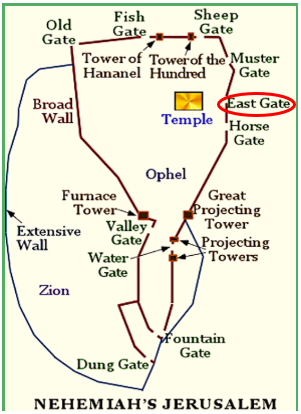
DESCRIPTION OF DAY OF YAHWEH
IS CONTINUED
On that day,” declares the LORD, “There will be the sound of a cry from the Fish Gate (cf. 2 Chr 33:14; Neh 3:3; 12:39) - What day? This is the near fulfillment of the Day of the LORD. All parts of the city will be affected. The Fish Gate, known today as the Damascus Gate, is located on the North side and was the gate through which Nebuchadnezzar entered the city. The Fish Gate received its name from its proximity to the fish market where fish was brought from the Lake of Tiberias and the Jordan River. Note the vocalizations associated with the Day of Yahweh! Not rejoicing but "the sound of a cry," and a "wail" (v9,10), in addition to a "loud crash (a great crashing sound)." Ponder these emotions and effects of the Day of the Lord for a moment. These have transpired in Jerusalem when they were destroyed by Nebuchadnezzar, but even worse they will one day occur throughout the entire world when Yahweh's wrath is fully fulfilled as described especially in Revelation 6-19.
John Walton -Fish Gate. Jerusalem had many gates to serve its various quarters. The Fish Gate provided an entrance through the northern wall just to the west of the Tower of Hananel (Neh 12:38-39). Archaeological excavations confirm that it opened upon a ridge leading from the temple enclosure to the Benjamite plateau. Its name probably derives from the presence of a fish market established there by Tyrian merchants (see Neh 3:3) (page 795 IVP Bible Background Commentary: OT)
A wail from the Second Quarter (2Ch 34:22) The Second Quarter was a district within the city walls. NET NOTE - This may refer to an area northwest of the temple where the rich lived.
Charles Feinberg - The second quarter was the second district of the city on the hill Acra, where Huldah the prophetess lived (2 Ki 22:14). Along with the crying from the fish gate and the wailing from the second quarter will be joined a crashing from the hills, Zion, Moriah, and Ophel, within the walls. The verse indicates the progress of the enemy until they occupy the prominent positions of the city. (SEE The Minor Prophets)
And a loud crash from the hills - Meaning is uncertain but Jerusalem was built on hills so could refer to entire city.
Verses 10-11 describe the actual route the Babylonians would take as they came through Jerusalem in the invasion. Fish Gate (NW corner) > Second Quarter > Mortar (section of Jerusalem in a hollow bowl shaped area) -> The Fish Gate, opened into the northern end of the Tyrophoeon Valley (cf. 2 Chr 33:14; Neh. 3:3) just W of the Tower of Hananel & was the gate through which Nebuchadnezzar entered the city. It was given its name because of its proximity to the fish market. It was probably near the present day Damascus Gate (Neh. 3:3; 12:39). SECOND (New) QUARTER:The "Second Quarter" was so called because it had been recently added to the city. Huldah the prophetess lived there (2Ki 22:14). The New Quarter was northwest of the temple area. The meaning of the hills is uncertain. They could refer to the whole city, or the hills (Moriah, Ophel, etc) on which Jerusalem was erected, or the hills surrounding the lower portion of the city (cf. Jer. 31:39). A cry and wailing . . . and a loud crash would go up from these areas because of the loss of lives as Nebuchadnezzar progressed through the city.
Bible Knowledge Commentary - To emphasize the thought that God’s judgment would fall on every segment of Jewish society, Zephaniah noted that lamentations would arise from every quarter of Jerusalem (cf. the words “all who live in Jerusalem,” v. 4)....A cry and wailing … and a loud crash would go up from these areas because of the loss of lives as Nebuchadnezzar progressed through the city. (Borrow Bible Knowledge Commentary - Old Testament)
John Walton -New Quarter. This section of Jerusalem was created when Hezekiah built the first defensive wall around the western hills of the city (2 Chron 32:5). Manasseh apparently repaired these walls during his reign (2 Chron 33:14). Avigad’s excavations have disclosed a seventh-century wall over 225 feet long and 24 feet thick. It may have surrounded the entire western hill, providing additional protection to the northern section of the city.(page 795 IVP Bible Background Commentary: OT)
Zephaniah 1:11 “Wail, O inhabitants of the Mortar, For all the people of Canaan will be silenced; All who weigh out silver will be cut off.
Legacy Standard Bible - “Wail, O inhabitants of the Mortar, For all the people of Canaan will be silenced; All who weigh out silver will be cut off.
NET Wail, you who live in the market district, for all the merchants will disappear and those who count money will be removed.
- Howl: Jer 4:8 25:34 Eze 21:12 Joe 1:5,13 Zec 11:2,3 Jas 5:1
- all the: Ne 3:31,32 Ho 12:7,8 Joh 2:16 Rev 18:11-18
THE BUSINESS DISTRICT
SINGLED OUT
Wail (yalal), O inhabitants of the Mortar - Mortar (Maktesh) means a district of Jerusalem lying in a hollow and was a name applied to the Valley of Siloam from its shape and was a district where merchants carried on business. Dishonest merchants who have grown wealthy through their wicked practices are warned. The name “Mortar” evokes the image of a bowl used for grinding grain, suggesting a hollow or basin-like area of the city. Zephaniah calls its inhabitants to wail or lament because the economic life of the city would soon collapse under God’s judgment.
NET NOTE - The Hebrew term מַכְתֵּשׁ (makhtesh, “mortar”) is apparently here the name of a low-lying area where economic activity took place.
For all the people of Canaan (you who live in the market district) will be silenced; All who weigh out silver will be cut off - The phrase “people of Canaan” here does not primarily refer to the ancient ethnic Canaanites but is used figuratively to describe merchants or traders. Because the Canaanites were historically known for commerce, the term became synonymous with businessmen and traders. Their "stock market" would utterly, completely crash! There is no escape except jumping out the window to one's death! One is reminded of the warning of James 5:1 "Come now, you rich, weep and howl for your miseries which are coming upon you."
NET NOTE on "for all merchants" - Or perhaps “Canaanites.” Cf. BDB 489 s.v. I and II כְּנַעֲנִי. Translators have rendered the term either as “the merchant people” (KJV, NKJV), “the traders” (NRSV), “merchants” (NEB, NIV), or, alternatively, “the people of Canaan” (NASB).
All who weigh out silver will be cut off - Weighing silver was the common method of measuring money in ancient commerce. This phrase refers to wealthy merchants and money handlers who profited from trade. Zephaniah warns that these financially powerful individuals would be cut off, meaning they would be removed or destroyed when God’s judgment came upon the city.
Bible Knowledge Commentary - In the Tyropean Valley, running north to south and separating the city east and west, the merchants plied their trade with silver and grew rich through usury. Because they took advantage of others, God would judge them and they would be ruined (Borrow Bible Knowledge Commentary - Old Testament)
NET NOTE - Heb “be cut off.” In the Hebrew text of v. 11b the perfect verbal forms emphasize the certainty of the judgment, speaking of it as if it were already accomplished.
John Walton -market district. As each district of Jerusalem is called upon in turn to lament, the Mortar or market district in the western section of the city takes up the wail. Based on the Hebrew word maktesh (bowl or mortar; see Prov 27:22), it was probably located in one of the folds or depressions within the Tyropoeon Valley and was enclosed within the city walls in the seventh century. (page 795 IVP Bible Background Commentary: OT)
Judah had become materially prosperous but spiritually corrupt. The people trusted in wealth and commerce rather than in the LORD. Zephaniah therefore warns that the coming “day of the LORD” would silence the noise of commerce and strip away the false security people placed in money and trade. In essence, the prophet declares: those who trusted in wealth and economic power would find their prosperity suddenly ended when God’s judgment fell on Jerusalem.
Wail (howl) (03213) yalal is a verb that means to howl with loud crying and shrill shouting sounds of sorrow. To howl with a wailing tone. This verb is found only in the prophets and most often in the context of divine judgment, especially the coming Day of the Lord. Thus it is not surprising that this verb is often used as an expression of mourning, distress or dismay!
Zephaniah 1:12 “It will come about at that time That I will search Jerusalem with lamps, And I will punish the men Who are stagnant in spirit, Who say in their hearts, ‘The LORD will not do good or evil!’
Legacy Standard Bible - “And it will be at that time That I will search Jerusalem with lamps, And I will punish the men Who are stagnant in spirit, Who say in their hearts, ‘Yahweh will not do good or evil!’
NET At that time I will search through Jerusalem with lamps. I will punish the people who are entrenched in their sin, those who think to themselves, 'The LORD neither rewards nor punishes.'
- that I: Jer 16:16,17 Am 9:1-3 Ob 1:6
- the men: Jer 48:11 Am 6:1 Rev 2:23
- stagnant: Heb. curded, or thickened
- The LORD: Job 21:15 Ps 10:11-13 14:1 94:7 Isa 5:19 Jer 10:5 Eze 8:12 9:9 Mal 3:14,15 2Pe 3:4
GOD'S JUDGMENT
SEARCHES EVERYWHERE!
This verse describes how God will thoroughly expose and judge the spiritual complacency of Judah during the coming Day of the LORD. The imagery and language emphasize God’s careful investigation and His judgment on those who have become spiritually indifferent.
It will come about at that time That I will search Jerusalem with lamps - No one would escape the punishment of the Lord (cf Amos 9:1–4). Numbers 32:23 says "you have sinned against the LORD, and be sure your sin will find you out." The imagery of searching with lamps portrays a careful and thorough investigation. In ancient cities, lamps were used to search dark houses or hidden places. The picture is that nothing in Jerusalem will escape God’s scrutiny. God will examine every corner of the city and every heart. A similar idea appears elsewhere in Scripture
Jer 16:17 “My eyes are on all their ways; they are not hidden from My face.”
Hebrews 4:13 There is no creature hidden from His sight, but all things are open and laid bare to the eyes of Him.”
The point is clear: God’s judgment is deliberate and thorough—no one can hide from Him.
Walter Kaiser - As Jeremiah searched Jerusalem for one righteous person (Jer. 5:1), so God will comb every nook and cranny of Jerusalem until He has rooted out every individual who doesn’t believe that He, the Lord, is in charge of His world. The comfortable, the well-to-do, the blasphemer, the idolater—all will be punished! (See all three excellent chapters - Preacher's Commentary)
Secret sin on earth is open scandal in Heaven!
Josephus wrote about a later invasion in which the city’s aristocracy were literally dragged from the sewer system where they hid for fear of death.
And I will punish (paqad) the men Who are stagnant in spirit - NET = "I will punish the people who are entrenched in their sin." Spiritual sluggishness will not receive a pass in the Day of Yahweh. The phrase stagnant in spirit comes from imagery related to wine that has been left undisturbed on its sediment (lees). When wine sits too long without being poured off, it becomes thick, dull, and stale. Thus the phrase describes people who have become spiritually complacent, morally indifferent and even comfortable in their sin (as when the conscience becomes seared). They are settled in spiritual apathy, unmoved by God’s warnings which His servants the prophets are continually declaring.
Charles Feinberg - The punishment will fall after such a search upon those settled on their lees, a figure which is proverbial for indifference and slothfulness (Jer 48:11). Hard crust forms on the surface of fermented liquors when they are not disturbed over a period of time. Thus settled in their carelessness, they deny God’s governing providence in the universe, His activity and agency in the world, as though He brought about neither good nor calamity. For such wickedness and impudence God will bring upon them the curses of the Law: they would enjoy neither their wealth nor their houses and vineyards. (See Lev 26:32-33; Deu 28:30, 39; Amos 5:11; and Mic 6:15.) (SEE The Minor Prophets)
Moody Bible Commentary - The phrase stagnant in spirit is literally “thick in their sediment” and derives from an expression about wine that fermented too long so that it became thick or syrupy, and thus unpalatable. It indicates men who have become spiritually stuck, unmoved, unconcerned, and unaffected by the circumstances surrounding them. These say in their hearts, even as people say today, that the LORD will not do good or evil, meaning that God does not care what people do or how they live (Dt 29:19; Jb 15:31; Ps 30:6; Is 28:15; 31:1; Jr 17:5; 23:17; Am 6:1, 3). But the Lord did care, and judgment would come so that their wealth would be plundered and they would not enjoy the homes and vineyards they had made for themselves (v. 13).
NET NOTE - "Heb “who thicken on their sediment.” The imagery comes from wine making, where the wine, if allowed to remain on the sediment too long, will thicken into syrup. The image suggests that the people described here were complacent in their sinful behavior and interpreted the delay in judgment as divine apathy."
Bible Knowledge Commentary - The analogy of wine left on its dregs (NIV) suggests that the nation had become spiritually polluted. Wine allowed to ferment for a long time forms a hard crust and the liquid becomes syrupy, bitter, and unpalatable. Instead of removing the dregs of daily pollution, Judah had become hardened and indifferent to God. Zephaniah described the people’s indifference and slothfulness toward God. Their indifference led them to regard God as morally indifferent. So great was her degeneration that the people did not even believe that Yahweh did as much as their self-made images. Pagan idolaters accorded their numerous deities the power of judging wrong and vindicating right. But the Jews at that time had such a low view of Yahweh that they believed He could not keep either His promises or His threats: He will do nothing, either good or bad. Their own spiritual complacency led them to think the Lord was complacent. (Borrow Bible Knowledge Commentary - Old Testament)
Who say in their hearts, ‘The LORD will not do good or evil!’ - Talk about the self-deception of sin (cf "deceitfulness of sin" Heb 3:13)! This phrase shows that their problem was not merely outward behavior but inward belief. They became functional (dysfunctional) ''deists'' (What is deism?) thinking God is not concerned with their sin. He won't intervene in human affairs. Though they may have still practiced religion outwardly, in their hearts they had dismissed God’s active involvement in the world.
Walter Kaiser - In their boredom and apathy, the cynical citizens and leaders of Zephaniah’s day doubted that God would do either good or bad; He was a paper tiger who frequently threatened, but never did anything. (See all three excellent chapters - Preacher's Commentary)
People begin living
as if God neither sees nor acts.
LORD will not do good or evil reveals their false theology. They believed God was inactive or indifferent, that He neither blesses nor judges. In other words, they assumed God would not intervene, God would not judge sin and God would not reward righteousness. Such a spiritually sick mindset produced moral indifference. It is similar to the attitude described in:
Psalm 10:11 “He says to himself, ‘God has forgotten; He has hidden His face.’”
2 Peter 3:4 “Where is the promise of His coming?”
🙏 THOUGHT - When you get into sin your soul will soon be stagnated and you will act as if God doesn't care what happens and won't respond to evil. Wrong!!!! Memorize Hebrews 3:13 and then practice it in the power of the Spirit!
John Butler - WARNING Zephaniah 1:12 - Sermon Starters
“It shall come to pass at that time, that I will search Jerusalem with candles [lamps], and punish the men that are settled on their lees that say in their heart, the LORD will not do good, neither will he do evil” (Zephaniah 1:12).
Zephaniah saw through the insincerity of many in the revival under Josiah the King, and gave a warning of coming judgment.
FIRST—THE SURENESS IN THE WARNING
“It shall come to pass at that time.” This is the language of certainty. Two things emphasize the certainty of the judgment.
• The statement. “It shall come to pass.” It is not ‘maybe’ or ‘possibly’ but “shall.” It is Divine certainty.
• The season. “At that time.” This refers to the “day of the Lord” (Zephaniah 1:7). “The day of the Lord” involves a number of prophetic events, but mostly it speaks of judgment. God can predict with accuracy the very time of judgment.
SECOND—THE SEARCHING IN THE WARNING
“I will search Jerusalem with candled [lamps]” God never brings judgment without examination. He investigates to ascertain the situation accurately before He takes action (cp Genesis 18:21).
• The city for the investigation. “Jerusalem.” This was considered the holy city, it had many spiritual privileges, yet there was so much sin in the city that it was targeted for judgment. Privilege does not exempt from judgement but misused it will intensify it.
• The character of the investigation. “Search … candles.” This was a thorough investigation. God does not do things in a haphazard way like men often do. When He investigates for judgment you can count on it being very thorough. Nothing will be concealed. No evidence suppressed etc. like our corrupt courts do today. “Candles” means lamps. The word “candles” is a bad translation.
THIRD—THE SENTENCE IN THE WARNING
“Punish the men that are settled on their lees that say in their heart, the LORD will not do good, neither will he do evil.” Note four things about this sentence.
• The crowd for the sentence. “Punish the men that are settled on their lees.” The guilty are the ones punished, not the innocent. God is fair, unlike the courts of our land.
• The character of the sentence. “Punish.” The sentence was severe. “Punish” speaks of troops of an army conquering. That is what Babylon’s army did to Jerusalem.
• The conduct for the sentence. “Settled on lees.” A carnal contentment. Not concerned about sin.
• The contemplation for the sentence. “That say without their heart, the LORD will not do good, neither will he do evil.” They think God is unconcerned about the sin in the land. Thus they dishonor the holiness of God.
F B Meyer - Zephaniah 1:12 I will search Jerusalem with candles.
The state of things in the chosen city was scandalous. The people worshipped the host of heaven on the housetops; the temple-courts were filled with the priests of idolatry; the court affected foreign dress and manners. Nothing could prevent the invasion of the Chaldeans as ministers of the Divine vengeance. These were the terrible guests whom the Almighty had summoned to the feast; and the feast consisted of the spoils of the city (Zephaniah 1:7).
No sin of his people can escape the notice of God. He searches out the secret evils of our hearts with lighted candles, not for his vision alone, but for ours; that we may know, and abhor them, and put them from us. There is the candle of conscience. The spirit of man is as the candle of the Lord. In some men the candle is present, but not lit: in others it is lit by the power of the Divine Spirit; and there is something of the incandescent flame about it then.
There is the candle of outward events. How often does God allow some incident of which we hear in social conversation, or read in the newspaper, to cast a sudden and unexpected light upon some passages in our lives which we have carefully shrouded in darkness. Right into a hidden closet the searchlight falls, saying “thou art the man.”
Then there is that candle of his Holy Word. A text or sermon unkindled by the Spirit of God is like an unlighted candle. But when God’s Holy Spirit rests on it, interfusing it with fire, then how mighty is its effect! It searches the heart and tries the reins; it reveals to man his thought and the real object of his existence, that he may repent.
Zephaniah 1:13 “Moreover, their wealth will become plunder And their houses desolate; Yes, they will build houses but not inhabit them, And plant vineyards but not drink their wine.”
Legacy Standard Bible - “And it will be that their wealth will become spoil And their houses desolate; Indeed, they will build houses but not inhabit them, And plant vineyards but not drink their wine.”
NET Their wealth will be stolen and their houses ruined! They will not live in the houses they have built, nor will they drink the wine from the vineyards they have planted.
- their goods: Zep 1:9 Isa 6:11 24:1-3 Jer 4:7,20 5:17 9:11,19 12:10-13 Eze 7:19,21 Eze 22:31 Mic 3:12
- build: De 28:30,39,51 Isa 5:8,9 65:21,22 Am 5:11 Mic 6:15
THERE GOES THEIR
FINANCIAL PORTFOLIO!
Moreover, their wealth will become plunder And their houses desolate (shemamah) - Dt 28:30 had warned Israel if they sinned "you shall build a house, but you will not live in it." Bank account, 401K's gone, their entire portfolio plundered. The Beatles said "Money can't buy you love," but even more importantly, money can't buy you escape from experiencing the wrath of God!
🙏 THOUGHT - Oh how we in America in 2024 (deeply mired in abominable sins) need to pay heed to what happened to Judah, for if any nation thinks it stands, it had better take heed lest it falls! Judah failed to take heed and fell. God plays no favorites. America wake up, before our wealth is plundered! In Joel 1 the call went out first to the priests and ministers and that is surely a good pattern for our nation. Dear pastor, are you boldly proclaiming the truth (including the warnings) and calling your people to humble themselves, seeking the face of Yahweh and crying out for supernatural revival in our land.
Yes, they will build houses but not inhabit them, And plant vineyards but not drink their wine - This is a classic prophetic covenant-judgment formula that appears several times in Scripture. It expresses the idea that people will labor to produce security and prosperity, yet God’s judgment will prevent them from enjoying the results of their work. The prophets frequently use this phrase to describe coming national judgment.
Deuteronomy 28:30 “You shall betroth a wife, but another man will violate her; you shall build a house, but you will not live in it; you shall plant a vineyard, but you will not use its fruit.
Comment- Human effort will not lead to blessing. God will allow enemies to take the fruit of their labor. The curse reverses the normal blessing promised in the land (Deut 6:10–11).
Amos 5:11 (Therefore because you impose heavy rent on the poor And exact a tribute of grain from them, Though you have built houses of well-hewn stone, Yet you will not live in them; You have planted pleasant vineyards, yet you will not drink their wine.
Comment - Amos explains that injustice and oppression will lead to a time when invading armies destroy the people or drive them away, so they cannot enjoy their prosperity.
This imagery reflects a key biblical truth that human prosperity cannot be enjoyed apart from obedience to God. Psalm 127:1 says "“Unless the LORD builds the house, They labor in vain who build it.” The point is that when people reject God, their work may still produce things, but they ultimately lose the ability to truly enjoy them.
🙏 THOUGHT - A life built without God may accumulate possessions, but it cannot secure lasting enjoyment of them. In other words, you will never see a U-Haul trailer following the hearse, for the old saying is true "you can't take it with you." True blessing comes not from labor alone but from living in covenant relationship with the Lord. Are you storing up for yourself treasure in heaven? (Mt 6:20). Where is your heart beloved? (Mt 6:21)
Desolate (08077) shemamah from shamam (be desolate), denotes desolation or desolate (Jer 34:22). It means ruin (Jer 25:12) or wasteland (Mic 7:13). Shemamah connotes in grief (Ezek 7:27). It occurs with "make" (siym: Jer 12:11; nathan: Jer 34:22; 'asah: Ezek 35:14): make desolate/a desolation, or destroy (Mic 1:7). Shemamah with shamam implies desolate waste (Ezek 33:28). Related shammah (39x) means devastation (Ezek 23:33) alongside shemamah. Shammah denotes desolate or desolation (Isa 5:9). It suggests horrible thing, horror, or object of scorn (Jer 5:30; 42:18). With "make" (siym: Jer 4:7; shiyth: Jer 50:3; or nathan: Mic 6:16), shammah is lay waste or make desolate (Jer 2:15). Both nouns with chorbah ("ruin") imply desolate ruin. Related meshammah and shimmah (Ezek 33:29; 35:7) with shemamah indicate desolate waste. Meshammah (7x) elsewhere means desolate (Isa 15:6) or horror (Ezek 5:15). Shamem (2x) means desolate (Jer 12:11). Shimmamon (2x) signifies dread (Ezek 4:16).
Shemamah in Zephaniah - Zeph. 1:13; Zeph. 2:4; Zeph. 2:9; Zeph. 2:13
Zephaniah 1:14 Near is the great day of the LORD, Near and coming very quickly; Listen, the day of the LORD! In it the warrior cries out bitterly.
Legacy Standard Bible - Near is the great day of Yahweh, Near and coming very quickly; O the sound, the day of Yahweh! In it the mighty man cries out bitterly.
NET The LORD's great day of judgment is almost here; it is approaching very rapidly! There will be a bitter sound on the LORD's day of judgment; at that time warriors will cry out in battle.
- great: Zep 1:7 Jer 30:7 Eze 30:3 Joe 2:1,11,31 Mal 4:5 Ac 2:20 Rev 6:17
- it is: Eze 7:6,7,12 12:23 Am 8:2 Php 4:5 Jas 5:9 2Pe 2:3
- even: Zep 1:10 Isa 22:4,5 66:6 Jer 25:36 Joe 2:11 3:16 1Th 4:16 Heb 12:26
- the mighty: Isa 15:4 33:7 Jer 48:41 Rev 6:15-17
Related Passages:
Joel 2:11 The LORD utters His voice before His army; Surely His camp is very great, For strong is he who carries out His word. The day of the LORD is indeed great and very awesome, And who can endure it?
DAY OF THE LORD
"Darkness and Gloom"
(Joel 2:2)
THE GREAT DAY
IS NEAR, VERY NEAR
This verse intensifies the prophet’s warning about the coming “Day of the LORD.” Zephaniah stresses both its nearness and its terrifying consequences, declaring that even the strongest people will be overwhelmed when God’s judgment arrives.
Near (Zep 1:7) is the great day of the LORD - The Day of the LORD refers to a time when God intervenes in history to judge sin and display His righteous rule. In Zephaniah’s immediate context it pointed toward the coming judgment on Judah that would culminate in the Babylonian destruction of Jerusalem in 586 BC. By calling it “the great day,” Zephaniah emphasizes the overwhelming magnitude of God’s intervention.
Near and coming very quickly; Listen, the day of the LORD! In it the warrior cries out bitterly. - Zephaniah is warning that judgment is not distant or theoretical but is "on the doorstep!". The command “Listen!” is a call to pay attention to the approaching reality of judgment. It is as if the prophet says, “You can already hear it coming.” Think of the day as like a distant storm whose thunder can be heard, signaling that the judgment of God is drawing near.
Zephaniah is crying out with a sense of urgency, emphasizing the day is near (twice) and is coming very quickly (cf. Isa 13:6; Ezek 30:3; Joel 2:1; Joel 3:14; Ob 1:15). And he doubles down on the "day of the LORD," as in Amos 5:18. Zephaniah’s warning was about 625 BC or about 40 years before Babylon would soon be on the doorstep of Jerusalem in 586 BC! But just as weith the repeated cry to the 7 churches in the Revelation, it takes spiritual ears to hear spiritual truth, and the numbing effect of persistent, unrepented sin had progressively made most of the people deaf to Zephaniah's (and other prophet's) warnings (2Ki 21:9)!
🙏 THOUGHT- ‘He who has an ear, let him hear (aorist imperative see our need to depend on the Holy Spirit to obey) what the Spirit says to the churches.’ (Rev. 2:7; Rev. 2:11; Rev. 2:17; Rev. 2:29; Rev. 3:6; Rev. 3:13; Rev. 3:22)
In it the warrior cries out bitterly. - This statement is striking. In ancient warfare the warrior represented strength, courage, and confidence. Soldiers were expected to shout triumphantly in battle. Yet Zephaniah says that in this day even the strongest warrior will cry out in anguish. The Hebrew idea suggests a cry of despair or terror. The point is that when God’s judgment arrives human strength will collapse, military power will fail, courage will turn to fear. This theme appears elsewhere in Scripture:
Isaiah 13:7–8 “All hands will fall limp, and every man’s heart will melt… They will be terrified.”
Joel 2:11“The day of the LORD is indeed great and very awesome, and who can endure it?”
In short, the warrior’s cry symbolizes the total helplessness of humanity before God’s judgment in this coming Day!
This description reminds me of fallen humanity's reaction in Revelation 6:14-17 when the Lamb of God breaks the 6th Seal..
The sky was split apart like a scroll when it is rolled up, and every mountain and island were moved out of their places. 15 Then the kings of the earth and the great men and the commanders and the rich and the strong and every slave and free man hid themselves in the caves and among the rocks of the mountains; 16 and they said to the mountains and to the rocks, “Fall on us and hide us from the presence of Him who sits on the throne, and from the wrath of the Lamb; 17 for the great day of their wrath has come, and who is able to stand?”
God’s judgment is real and certain. Human strength cannot prevent or escape it. God warns before judgment so people may repent. Zephaniah 2:3 calls on the hearers to "Seek the LORD, All you humble of the earth." Thus inherent in Zephaniah's warning is an invitation to turn back to God.
Bible Knowledge Commentary writes "Zephaniah wrote shortly after 622 B.C., the year of Josiah’s partial revival, the day of the Lord was in fact imminent. In 605, only 17 years after Josiah’s revival, Judah under Jehoiakim became a vassal of Babylon and many of Judah’s best young men were deported. Under Jehoiakim’s equally wicked successor, Jehoiachin, the city was again besieged by Nebuchadnezzar in 597 and some 10,000 Jews were deported. Under Zedekiah the city was under a long siege by Nebuchadnezzar and was finally destroyed in the summer of 586. (For the relationship of this event to the day of the Lord see the comments under “B. Judgment on Judah and Jerusalem [Zeph 1:4–2:3].”) (Borrow Bible Knowledge Commentary - Old Testament or see The Bible Knowledge Commentary Minor Prophets - Page 150)
NET NOTE - Heb “the sound of the day of the LORD, bitter [is] one crying out there, a warrior.” The present translation (Zeph 1:14NET) does four things: (1) It takes מַר (mar, “bitter”) with what precedes (contrary to the accentuation of the MT). (2) It understands the participle צָרַח (tsarakh, “cry out in battle”) as verbal with “warrior” as its subject. (3) It takes שָׁם (sham, “there”) in a temporal sense, meaning “then, at that time.” (4) It understands “warrior” as collective.
Walter Kaiser on the Day of the LORD - (See all three excellent chapters - Preacher's Commentary)
The character of that day may best be described in the following outline:
A. The Character of the Day of the Lord:
1. It is that time when God will come to judge the world with righteousness (Ps. 9:8; 96:13; 98:9).
2. On that day the Lord will become King over the whole earth and His name will be the only one (Zech. 14:9).
3. That day is always pending; it is near, because it has both a near and a distant aspect combined in one perspective (Joel 1:15; 2:1; 3:14; Obad. 15; Is. 13:6; Zeph. 1:7, 14; Ezek. 7:7; 30:3).
4. It is the time of God’s wrath against the wicked (Zeph. 1:15, 18; 2:2, 3; Jer. 4:8; 12:13; Ezek. 7:3, 8, 12, 14, 19).
5. It is a day of cosmic gloom and darkness (Amos 5:18; 8:9; Joel 2:2, 10, 31; Zeph. 1:15; Is. 13:10).
6. It is a day of unprecedented battle when the Lord Himself enters as a warrior (Zeph. 1:14; 3:17; Jer. 20:11; Ezek. 30:4–5; Zech. 12:2–3).
B. The Common Catchwords for that Day:
1. “Day of clouds and thick darkness” (Zeph. 1:15; Ezek. 34:12; Joel 2:2).
2. “Day of Trouble” (Nah. 1:7; Hab. 3:16; Zeph. 1:15; Jer. 16:19; Obad. 12, 14; Zech. 10:11).
3. “Day of Vengeance” (Is. 34:8; 63:4; Jer. 46:10).
C. The Blessings of that Day:
1. Protection of Jerusalem (Zech. 12:1ff).
2. Purification of Levi and others (Mal. 3:2).
3. Cleansing (Zech. 13:10).
4. Endowment of the Spirit (Zech. 12:10; Joel 2:28–29).
5. Paradisean Waters for Jerusalem (Joel 3:18; Zech. 14:8).
D. Summary
The “Day of the Lord” is a term rich in content that denotes a divinely inaugurated period of time called “the days come,” “in those days,” or “at that time.” It is not always eschatological, for it may refer to specific conditions that will befall the contemporaries of the prophets. But all of these immediate fulfillments are but a sampleof what will take place in the grand climax of history when God intervenes in such a way that His definitive answer to all injustice, evil, and ungodliness will be observed in all the earth. While it will be a day of horror and terror for the wicked and the unbeliever, it will be a bright day for the believer (John 6:39), a day when Christ will come for His own (Matt. 16:27). He will spare His own just as He did on the “day of Midian” (Is. 9:4) when God gave the victory to Gideon simply by ordering Gideon to stand still. But that day will have awful consequences politically, historically, cosmically, and soteriologically.
Henry Blackaby - WRATH OR REJOICING? ZEPHANIAH 1:14 - 15
As we see in the history of Israel and in our own life, our long-suffering God is merciful and patient despite His people’s continual rebellion. God’s love for His people, however, compels Him to hate that which destroys us, so He abhors sin. The reality is that those who reject His love and cling to their sin must face His overwhelming wrath.
“All the earth shall be devoured with the fire of My jealousy,” God proclaims through Zephaniah (3:8). God’s purposes require Him to discipline and even judge His people. Are you willing to undergo the disciplinary pruning process until God has purged you of your sin?
Remember that the purpose of God’s discipline is to purify you so you can enjoy fellowship with Him who loves you dearly. He longs to care for you and comfort you, and He rejoices when you seek Him.
One more thing. You are not one of faceless, nameless millions. He knows you personally. He loves you and celebrates your love for Him. His wrath is simply the response of His holiness to lethal sin that will destroy you.

WHAT THE BIBLE TEACHES ABOUT THE DAY OF THE LORD - Part 1
Zephaniah 1:15 A day of wrath is that day, A day of trouble and distress, A day of destruction and desolation, A day of darkness and gloom, A day of clouds and thick darkness,
Legacy Standard Bible - A day of fury is that day, A day of trouble and distress, A day of destruction and desolation, A day of darkness and thick darkness, A day of clouds and dense gloom,
NET That day will be a day of God's anger, a day of distress and hardship, a day of devastation and ruin, a day of darkness and gloom, a day of clouds and dark skies,
- A day of wrath is that day: Zep 1:18 2:2 Isa 22:5 Jer 30:7 Am 5:18-20 Lu 21:22,23 Ro 2:5 2Pe 3:7 Rev 6:17
- a day of darkness: Job 3:4-8 Joel 2:2,11
Related Passages:
Amos 5:18 Alas, you who are longing for the day of the LORD, For what purpose will the day of the LORD be to you? It will be darkness and not light;
Joel 2:10 Before them the earth quakes, The heavens tremble, The sun and the moon grow dark And the stars lose their brightness.
Joel 2:31 “The sun will be turned into darkness And the moon into blood Before the great and awesome day of the LORD comes.
Acts 2:20 ‘THE SUN WILL BE TURNED INTO DARKNESS AND THE MOON INTO BLOOD, BEFORE THE GREAT AND GLORIOUS DAY OF THE LORD SHALL COME.
Deuteronomy 31:17 (MOSES WARNED THE SECOND GENERATION) “Then My anger will be kindled against them in that day, and I will forsake them and hide My face from them, and they will be consumed, and many evils and troubles (tsarah; LXX - thlipsis - literally pressing together, suffering brought on by outward circumstances) will come upon them; so that they will say in that day, ‘Is it not because our God is not among us that these evils have come upon us?’
A DREADFUL DESCRIPTION
OF THE DAY OF THE LORD
A day of wrath ('ebrah; LXX - orge = vigorous upsurge of one's nature against someone or something) is that day - This verse paints a vivid picture of divine judgment, emphasizing both the severity and the certainty of God’s justice. The Day of the LORD is first (of 5 descriptions) described as day of wrath refers to a period when God will no longer withhold His anger against sin. It is not merely an emotional outburst but the holy response of a righteous God toward persistent rebellion and idolatry. God’s wrath refers to His holy and righteous response to sin. It is not uncontrolled anger but the just judgment of a holy God against rebellion and evil.
Scripture repeatedly links the Day of the LORD with God’s righteous anger: Isaiah 13:9 “Behold, the Day of the LORD is coming (IT IS ON ITS WAY AND CANNOT BE AVERTED), cruel, with fury and burning anger.” This reminds the reader that God does not overlook sin forever and that judgment eventually comes.
A day of trouble (tsarah; LXX - thlipsis - literally pressing together, suffering brought on by outward circumstances) and distress (metsuqah - straits; LXX - anagke - difficult circumstances that come on one with compelling force) - These two words describe the emotional and physical anguish the experience of those who have trusted in their own strength or idols rather than in the Lord. Trouble conveys oppression or affliction. Distress suggests a feeling of being trapped or overwhelmed. The picture is of people who suddenly realize that there is no escape from the consequences of their rebellion.
A similar description appears Jeremiah 30:7 "Alas! for that day is great, There is none like it; And it is the time of Jacob’s distress (tsarah; LXX - thlipsis) ( the time of Jacob's trouble), But he will be saved from it."
A day of destruction and desolation - These terms emphasize the devastation that accompanies divine judgment. Destruction refers to ruin or collapse. Desolation suggests abandonment and emptiness. Cities that once thrived would become deserted ruins. This was historically fulfilled when Babylon destroyed Jerusalem in 586 BC, but the language also points to the broader pattern of God’s judgment throughout history.
A day of darkness (choshek; LXX - skotos) and gloom - Darkness is a common biblical symbol of divine judgment and calamity. The prophets frequently used this imagery Joel 2:2 “A day of darkness and gloom, a day of clouds and thick darkness.” Darkness conveys that the day will be filled with dread rather than celebration.
A day of clouds (anan) and thick darkness - This final phrase intensifies the picture. The Hebrew word for clouds (araphel) was used in prophetic pictures of God's judgment are filled with clouds, darkening the ominous Day of the Lord (Jer. 13:16; Ezek. 34:12; Joel 2:2; Zeph. 1:15). The imagery resembles a violent storm covering the sky, suggesting overwhelming judgment descending upon the land. In Scripture clouds sometimes accompany God’s presence in judgment: Ezekiel 30:3 “For the day is near, even the day of the LORD is near; it will be a day of clouds.” Thus the picture is of a dark, stormy day when God Himself acts against sin.
🙏 Clouds (anan) are typical of the apocalyptic language of the Day of the LORD (Ezek. 30:3; Ezek 32:7 Joel 2:2) accompanying God's eschatological presence in judgment. It is ironic that this same word anan is used in Ex 40:34 ("Then the cloud covered the tent of meeting", cf also 1Ki 8:10)
The prophet intentionally like a machine gun fires a rapid series of phrases to create emotional intensity. The repetition drives home one message: The coming day will be overwhelming, unavoidable, and terrifying. This vivid language is meant to shake people out of complacency and lead them to repentance.
🙏 THOUGHT - If you are reading Zephaniah, slow down and ponder this awful description of the Day of Yahweh coming upon all who reject His gracious offer of forgiveness and eternal life. Let it stir you hearts for friends and relatives who do not know Jesus and let it motivate you by the Spirit to speak the truth to them in love. (Ro 10:14).
Wrath (05678) 'ebrah is from a Hebrew word group that conveys the sense of movement. To be carried away by a strong feeling. Thus 'ebrah describes an "overflowing" (moving) anger, a state of intense displeasure which can imply outbursts as actions of anger. It is used in some contexts to describe the Day of the LORD (Isa 13:9, 13, Zeph 1:15, 18)
The Hebrew noun ʿebrāh (עֶבְרָה) refers to wrath, fury, or an outburst of intense anger, conveying the idea of anger that overflows beyond restraint. The word derives from the verb ʿābar (עָבַר), meaning “to pass over, overflow, or exceed.” This root suggests anger that passes its normal bounds, surging outward like a flood. Thus the term often describes anger in excess—rage that erupts violently or sweeps over others with destructive force. Because of this imagery, ʿebrāh can denote a powerful emotional outburst or fury that overwhelms restraint, emphasizing both the intensity and the overflowing nature of wrath.
In the Old Testament the word appears over thirty times and can describe either human anger or the wrath of God, though the nuance differs depending on the subject. When applied to human beings, ʿebrāh often portrays sinful, uncontrolled anger driven by pride or wounded arrogance. An early example occurs in Genesis 49:7, where Jacob condemns the violent fury of Simeon and Levi for their brutal revenge against Shechem. In this sense the word highlights cruel, merciless rage motivated by pride or insolence, a trait closely associated with arrogance (Prov. 21:24; Isa. 16:6). Human ʿebrāh therefore reflects a fault of character—anger that erupts destructively because it is rooted in pride and self-exaltation.
When the word is used of God, however, it carries a different emphasis. Rather than uncontrolled passion, it describes the fierce, overwhelming expression of divine justice against sin. God’s wrath is portrayed as burning, overflowing, and sweeping away wickedness, emphasizing its irresistible and comprehensive power (Ps. 78:49; Ezek. 22:21, 31). The prophets frequently associate this term with the Day of the LORD, the climactic time when God’s judgment pours out upon rebellion. That day is described as a “day of wrath” filled with destruction, darkness, and desolation (Zeph. 1:14–18; Isa. 13:9, 13). Wealth and human power cannot avert this judgment (Prov. 11:4; Ezek. 7:19), because it represents the righteous outpouring of God’s holiness against persistent sin. At times God even raises nations such as Assyria as instruments of His wrath (Isa. 10:6), demonstrating that divine fury can operate through historical events.
The word also appears in wisdom literature to illustrate moral consequences and royal authority. For example, Proverbs 14:35 contrasts the king’s favor toward a wise servant with his wrath against one who acts shamefully, reflecting the idea that legitimate authority may express just anger against wrongdoing. Yet even here the concept ultimately points beyond human authority to God’s greater judgment, reminding readers that righteousness—not riches—delivers in the “day of wrath” (Prov. 11:4).
In summary, ʿebrāh conveys the idea of overflowing, intense wrath that bursts beyond restraint. When describing human beings it usually depicts prideful, destructive rage, revealing the moral danger of anger rooted in arrogance. When used of God it emphasizes the fierce and overwhelming manifestation of His righteous judgment, particularly in connection with the Day of the LORD, when divine justice will overflow against all rebellion and bring wickedness to an end.
Ebrah - 33v in the NAS = anger(1), fury(14), overflowings(1), rage(1), wrath(16).Gen 49:7; Job 21:30; 40:11; Ps 7:6; 78:49; 85:3; 90:9, 11; Pr 11:4, 23; 14:35; 22:8; Isa 9:19; 10:6; 13:9, 13; 14:6; 16:6; Jer 7:29; 48:30; Lam 2:2; 3:1; Ezek 7:19; 21:31; 22:21, 31; 38:19; Hos 5:10; 13:11; Amos 1:11; Hab 3:8; Zeph 1:15, 18
Two Key Takeaways from ʿEbrāh (עֶבְרָה):
(1) Uncontrolled human anger often flows from pride and leads to destruction.
When ʿebrāh describes human anger, it typically reflects arrogant, excessive rage that spills over in harmful ways (Gen 49:7; Prov 21:24; Amos 1:11). Scripture repeatedly warns that anger driven by wounded pride or self-exaltation produces violence, division, and sin rather than righteousness (cf. Prov 29:22; James 1:20).
(2) God’s wrath is not uncontrolled rage but the overflowing expression of His justice against sin.
When applied to God, ʿebrāh describes the powerful and irresistible outpouring of His righteous judgment, especially in the “day of wrath” when evil is finally confronted and removed (Prov 11:4; Isa 13:9; Zeph 1:14–18). It reminds us that God’s holiness ultimately overwhelms and judges persistent rebellion.
Trouble (06869) tsarah from tsar = literally a narrow, confining space, figuratively dire straits from which escape is difficult) is a noun which depicts tightness (figuratively trouble) and implies great strain or stress psychologically and spiritually (as in Ge 42:21). The root word deals with harassment and torment engendered by an enemy and thus speaks of adversity, affliction, tribulation, trouble. Tsarah is used to describe the cursing to Israel for disobedience (Dt 31:17, 21 = troubles).
The Lxx translates tsarah with thlipsis which literally means a pressing together and figuratively speaks of suffering brought on by outside circumstances. Thlipsis is a strong term which does not refer to minor inconveniences, but to real hardships. Medically thlipsis was used of the pulse (pressure). Thlipsis described the pressing together of grapes. It conveyed the idea of being squeezed or placed under pressure or crushed beneath a weight. When, according to the ancient law of England, those who willfully refused to plead guilty, had heavy weights placed on their breasts, and were pressed and crushed to death, this was literally thlipsis. Thlipsis thus refers not to mild discomfort but to great difficulty. That is the "fruit" these men will reap for rejecting God's gracious gesture of stretching out His hand (Pr 1:24).
TSARAH -70V - affliction(1), anguish(2), distress(34), distresses(1), trouble(22), troubles(11). Gen. 35:3; Gen. 42:21; Deut. 31:17; Deut. 31:21; Jdg. 10:14; 1 Sam. 10:19; 1 Sam. 26:24; 2 Sam. 4:9; 1 Ki. 1:29; 2 Ki. 19:3; 2 Chr. 15:6; 2 Chr. 20:9; Neh. 9:27; Neh. 9:37; Job 5:19; Job 27:9; Ps. 9:9; Ps. 10:1; Ps. 20:1; Ps. 22:11; Ps. 25:17; Ps. 25:22; Ps. 31:7; Ps. 34:6; Ps. 34:17; Ps. 37:39; Ps. 46:1; Ps. 50:15; Ps. 54:7; Ps. 71:20; Ps. 77:2; Ps. 78:49; Ps. 81:7; Ps. 86:7; Ps. 91:15; Ps. 116:3; Ps. 120:1; Ps. 138:7; Ps. 142:2; Ps. 143:11; Prov. 1:27; Prov. 11:8; Prov. 12:13; Prov. 21:23; Prov. 24:10; Prov. 25:19; Isa. 8:22; Isa. 30:6; Isa. 33:2; Isa. 37:3; Isa. 46:7; Isa. 63:9; Isa. 65:16; Jer. 4:31; Jer. 6:24; Jer. 14:8; Jer. 15:11; Jer. 16:19; Jer. 30:7; Jer. 49:24; Jer. 50:43; Dan. 12:1; Obad. 1:12; Obad. 1:14; Jon. 2:2; Nah. 1:7; Nah. 1:9; Hab. 3:16; Zeph. 1:15; Zech. 10:11
Below highlighted in yellow (in the first chart) are multiple descriptions of the Day of the LORD from 4 New Testament passages and 4 Old Testament passages (other than Zephaniah).
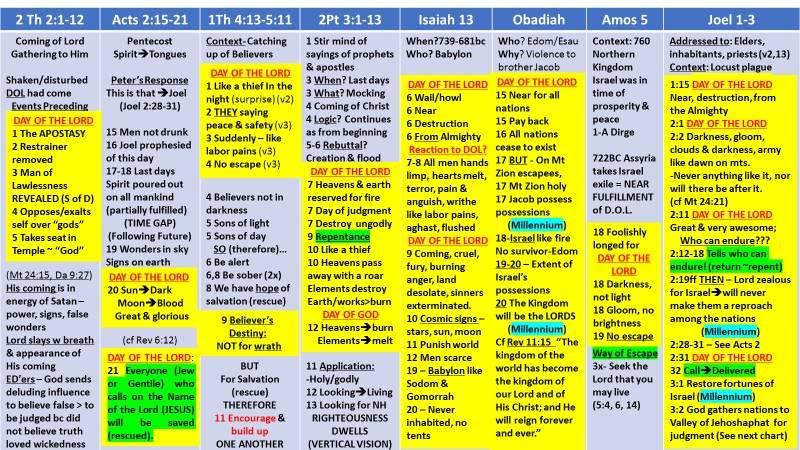
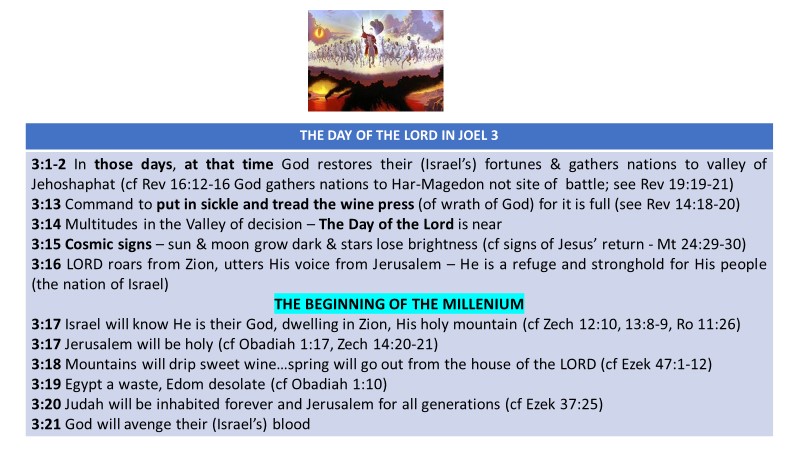
Zephaniah 1:16 A day of trumpet and battle cry Against the fortified cities And the high corner towers.
Legacy Standard Bible - A day of trumpet and loud shouting Against the fortified cities And the high corner towers.
NET a day of trumpet blasts and battle cries. Judgment will fall on the fortified cities and the high corner towers.
- day: Isa 59:10 Jer 4:19,20 6:1 8:16 Ho 5:8 8:1 Am 3:6 Hab 1:6-10 Hab 3:6
- and against: Ps 48:12,13 Isa 2:12-15 32:14
THE DAY OF YAHWEH WILL BE
A DAY OF WAR
A day of trumpet - “a ram’s horn.” One purpose for trumpets was to sound an alarm (cf Joel 2:1, Joel 2:15). In the ancient world the trumpet (shofar) had several important functions to warn of danger, to summon soldiers to battle and to announce the approach of an enemy army. Thus the trumpet here signals alarm and mobilization for war. The trumpet therefore symbolizes the imminent arrival of catastrophe.
And battle cry - The battle cry refers to the loud shouts of soldiers rushing into combat. Ancient armies often shouted loudly to intimidate their enemies and signal the beginning of the attack. The phrase conveys the terrifying moment when the invading army charges into battle. Thus the Day of the LORD will not be quiet or gradual but it will arrive with the chaos and noise of warfare.
The problem is that this battle is the LORD's and He never loses a battle! This will be the day of the war to end all wars. It will terminate man's futile attempts to rebel against God. The Day of the Lord will crash the curtain down on the "day of man!"
NET NOTE on battle cries - This description of the day of the LORD consists of an initial reference to anger, followed by four pairs of synonyms. The joining of synonyms in this way emphasizes the degree of the characteristic being described. The first two pairs focus on the distress and ruin that judgment will bring; the second two pairs picture this day of judgment as being very dark (darkness) and exceedingly overcast (gloom). The description concludes with the pairing of two familiar battle sounds, the blast on the ram’s horn (trumpet blasts) and the war cries of the warriors (battle cries)
Against the fortified cities - Ancient cities depended heavily on fortifications with massive walls designed to keep enemies out. Judah trusted these defenses for security. However, Zephaniah warns that even the strongest fortifications will fail when God’s judgment comes. Judah had trusted in military strength and walls instead of obedience to God, and those defenses would not save them.
And the high corner towers - Corner towers were strategic military structures built into city walls. They allowed defenders to observe approaching enemies, shoot arrows from elevated positions and strengthen the most vulnerable parts of the wall. These towers symbolized the strongest points of a city’s defense system. Yet Zephaniah declares that even these strongest structures will fall. This emphasizes the complete helplessness of human security when God brings judgment.
Men think that they can enclose themselves off from the Wrath of God...but not in the Day of the Lord. Proverbs 18:10-11 contrast two ways to approach the Day of the Lord - "The Name of the LORD is a strong tower; The righteous runs into it and is safe. A rich man’s wealth is his strong city, And like a high wall in his own imagination."
Zephaniah 1:17 I will bring distress on men So that they will walk like the blind, Because they have sinned against the LORD; And their blood will be poured out like dust And their flesh like dung.
Legacy Standard Bible - I will bring distress on men So that they will walk like the blind Because they have sinned against Yahweh; And their blood will be poured out like dust And their flesh like dung.
NET I will bring distress on the people and they will stumble like blind men, for they have sinned against the LORD. Their blood will be poured out like dirt; their flesh will be scattered like manure.
- they will walk like the blind De 28:28-29 Ps 79:3 Isa 29:10 59:9,10 La 4:14 Mt 15:14 Joh 9:40,41 Ro 11:7,25 2Co 4:4 2Pe 1:9 1Jn 2:11 Rev 3:17
- because: Isa 24:5,6 50:1 59:12-15 Jer 2:17,19 4:18 La 1:8,14,18 4:13-15 La 5:16,17 Eze 22:25-31 Da 9:5-19 Mic 3:9-12 7:13
- and their blood: 2Ki 9:33-37 Ps 79:2,3 83:10 Jer 9:21,22 15:3 16:4-6 18:21 La 2:21 4:14 Am 4:10
Related Passages:
Deuteronomy 28:28-29 “The LORD will smite you with madness and with blindness and with bewilderment of heart; 29 and you will grope at noon, as the blind man gropes in darkness, and you will not prosper in your ways; but you shall only be oppressed and robbed continually, with none to save you.
THE PRIMARY REASON FOR
THE DAY OF THE LORD
I will bring distress (tsarar) on men So that (term of purpose) they will walk like the blind - Blind men don't know where they are going. So they will be like blind men trying to find a way to escape God's wrath (cf Rev 6:12-15,16,17). All "exits" and "escape hatches" are marked "Closed by order of the Owner!"
Distress (tsarar) is translated by the LXX with the verb ekthlibo (not found in NT but see related word thlipsis) which means to squeeze much (Ge 40:11), to press out, crush out, or force something out by pressure, to squeeze out which congers up the picture of men in the omnipotent hand of God as He grips them in His fierce, burning anger! Woe! The imagery communicates not merely proximity but pressure and crowding that constrains movement. The related verb thlibo was used in classical Greek to describe the action of crushing grapes or olives to extract their juice or oil, emphasizing the exertion of external pressure that produces an outflow. In the present context ekthlibo conveys a clear picture of divine pressure applied to these men.
Walter Kaiser - peoples’ outward distress will turn inward and men and women will grope like blind persons—symbolic of their helplessness and utter consternation (cf. Deut. 28:29; Is. 49:10). (See all three excellent chapters - Preacher's Commentary)
Because (term of explanation) they have sinned (chata') against the LORD - Why will they experience the wrath of God? This verse is crystal clear! And remember even when we sin against another individual, ultimately we always sin against God! (cf Ge 39:9, Ps 51:4, 2Sa 12:13)
And their blood will be poured out like dust And their flesh (carcasses) like dung - There sin will cost them their life (cf Ro 6:23). Such is the cost of rebelling against the Most High God. Sin offers momentary pleasure but never discloses the eternal cost! (cf Heb 3:13) Dust is everywhere and has no value. So too will be men's precious blood in this fatal day (cf Rev 14:20). The corpses will not even be buried but will rot in the streets, their decay giving off a stench even worse than dung!
Charles Feinberg - As though worthless, their blood and flesh will be poured out as dust and refuse. (SEE The Minor Prophets)
Bring distress (06887) tsarar means to be narrow, to be cramped, to be straitened, to be constricted, to hem or be hemmed in. Tsarar may refer to anything which is confining and in the context of Isa 8:16 it means to bind up, to tie or wrap up so as to safeguard from tampering (cf binding up in Pr 26:8, Ex 12:34, Joshua 9:4). This action refers most likely to the scribes binding the document into a sealed scroll for safekeeping. In Hos 13:12, tsarar figuratively depicts the record of Israel's sins being written down and permanently bound in a sealed scroll for safekeeping, thus assuring the that their sin would be retained. Figuratively tsarar means to oppress or harass and thus to be hostile or be an adversary or enemy, the best known use being Ps 23:5 "in the presence of my enemies (tsarar)." (Ex 23:22; Nu 10:9; 25:17-18 Esther 3:10; 8:1; 9:10, 24; Ps 6:7; 7:4, 6; 8:2; 10:5; 23:5; 31:11; 42:10; 69:19; 74:4, 23; 129:1-2; 143:12; Isa 11:13; Amos 5:12).
Zephaniah 1:18 Neither their silver nor their gold Will be able to deliver them On the day of the LORD’S wrath; And all the earth will be devoured In the fire of His jealousy, For He will make a complete end, Indeed a terrifying one, Of all the inhabitants of the earth.
Legacy Standard Bible - Neither their silver nor their gold Will be able to deliver them On the day of the fury of Yahweh; And all the earth will be devoured In the fire of His jealousy, For He will make a complete destruction, Indeed a terrifying one, Of all the inhabitants of the earth.
NET Neither their silver nor their gold will be able to deliver them in the day of the LORD's angry judgment. The whole earth will be consumed by his fiery wrath. Indeed, he will bring terrifying destruction on all who live on the earth."
- their silver: Zep 1:11 Ps 49:6-9 52:5-7 Pr 11:4 18:11 Isa 2:20,21 Jer 9:23,24 Eze 7:19 Mt 16:26 Lu 12:19-21 16:22,23
- in the day: Zep 1:15 Job 21:30
- but: Zep 3:8 Lev 26:33-35 De 29:20-28 31:17 Isa 24:1-12 Jer 4:26-29 7:20,34 9:11
- the fire: Zep 3:8 De 32:21-25 1Ki 14:22 Ps 78:58 79:5 Eze 8:3-5 16:38 Eze 36:5,6 1Co 10:22
- he shall: Zep 1:2,3 Isa 1:24
Related Passages:
Nahum 1:2 A jealous and avenging God is the LORD; The LORD is avenging and wrathful. The LORD takes vengeance on His adversaries, And He reserves wrath for His enemies.
Amos 5:19 As when a man flees from a lion And a bear meets him, Or goes home, leans his hand against the wall And a snake bites him. (NO ESCAPE)
1 Thessalonians 5:2-3 For you yourselves know full well that the day of the Lord will come just like a thief in the night. 3 While they are saying, “Peace and safety!” then destruction will come upon them suddenly like labor pains upon a woman with child, and they will not escape.
Deuteronomy 29:20 “The LORD shall never be willing to forgive him, but rather the anger of the LORD and His jealousy will burn against that man, and every curse which is written in this book will rest on him, and the LORD will blot out his name from under heaven.
YOU CANNOT BUY YOUR WAY OUT
OF THE DAY OF THE LORD!
Neither their silver nor their gold Will be able to deliver them On the day of the LORD’S wrath ('ebrah; LXX - orge = vigorous upsurge of one's nature against someone or something) - Bribery that once worked with corrupt men, will not work in the day of the Holy God! Great riches cannot hold back the dam of God's wrath breaking in the Day of the LORD! The only all sufficient payment for escaping the Lord's wrath is to receive by faith the payment of Jesus Who took on Himself our sins and on Whom God's wrath against sin fell and thus He paid the price in full (cf Jn 19:30)! Any other "payment plan" is useless (1Pe 1:18).
HCSB - The Lord's destruction of Judah by the Babylonians in 586 B.C. (Lam 2:1-3,22; 4:11) partially fulfilled this day of His burning anger (Zeph 1:18; 2:2-3) as He punished them for abominable idolatries (Zeph 1:4-11; cp. Ezek 7:8-11,14-21; 8:5-18). Ultimately all earthly inhabitants would be judged (Joel 3:1-2,12-16; Zeph 1:2-3) and consumed by His fiery anger (vv. 17-18; 3:8; cp. 2Pe 3:10-12). (See CSB Study Bible)
And all the earth will be devoured ('akal - destroyed completely) In the fire of His jealousy (qin'ah) - It bears repeating the Beatles song which said "Money can't buy you love," but even more importantly, money cannot deliver you from the Lord wrath! Don't miss the geographical descripion of God's wrath -- all the earth indicates there will be a global wrath! This has to refer to the desciption in Revelation beginning in about Revelation 6:1 and going through Revelation 19:11-21. The Day of the LORD will impact every person on planet earth, much like the global flood and the only escape is to enter the ark of Jesus Christ by grace through faith. Hebrews 12:29 says "our God is a consuming fire" and Hebrews 10:31 adds "It is a terrifying thing to fall into the hands of the living God."
Why would God be jealous of Judah? Because she was His "Wife" having taking "covenant vows" in Ex 24:3,7 (equivalent to saying "I do")
SUMMARY - Jehovah was the "Husband" of Israel as described in Je 31:31, 32, Isa 54:5 (cf Ho 2:2, 19, 20). Note that the word "husband" is baal (master, owner - see baal, ba'al, ba'al) and is the same word used for Israel's "lover" with whom she had an adulterous affair, for these idols were often named "Baal!" (cf Jdg 2:11-13) In the OT, under the Old Covenant, Israel formally became Jehovah's "Wife" in the "ceremony" at the foot of Mt. Sinai (Ex 19:1,2) when God gave Moses the Law and Israel said "Yes" (cf marriage ceremony where bride says "I do" - Israel the "bride" of Yahweh said "We will do"! - Ex 24:3,7) to the vows. Note that the solemn, binding nature of their entrance into this covenant was ratified by the blood of the covenant (Ex 24:3-8, cf Dt 29:25 and Heb 9:18-21). Israel was (repeatedly) an unfaithful, adulterous wife (guilty of spiritual harlotry) and was thus disowned by Jehovah (e.g., see Dt 29:25-28), but she will one day in the future repent (cf Zech 12:10-14) and b. e restored (Isa 62:4, 5 - where the verb "married" = baal!), a prophecy which will be fulfilled at the inception of the Messianic Age. (Full more detailed discussion of Israel the Wife of Jehovah)
Believers Study Bible - God's jealousy, vengeance, and wrath are the expression of His absolute holiness and justice when faced with man's sin. If God treated sin lightly, He would not be good. God treats sin so seriously that the death of Christ was necessary for a sinner to be forgiven (cf. Ro 3:24-26).
For He will make a complete end, Indeed a terrifying one - It is one thing to come to the end of one's life, but Zephaniah warns that Christ rejecters will meet a terrifying end (cf Heb 10:31), and it will be terrifying forever and ever. Jesus made the eternality of Hell an indisputable fact when He declared "These will go away into eternal punishment, but the righteous into eternal life.” (Mt 25:46,cf 2Th 1:9, Da 12:2)! The same word “eternal” (aionios) describes both punishment and life, indicating the punishment is as everlasting as the life!
Of all the inhabitants of the earth - Note once again the global aspect of God's wrath in the Day of the LORD! There are no "exception clauses," for the wages of sin is death so every sinner on the earth will be exterminated!
Charles Feinberg - God does not announce coming judgment without indicating at the same time the means of escape from the visitation. Thus we find the second chapter opening with an urgent exhortation to God’s people to repent (Zeph 2:3). From this call to repentance the prophet proceeds to foretell judgment on the nations surrounding Israel and especially those who have afflicted her. (SEE The Minor Prophets)
🙏 THOUGHT - "Application: Day of the Lord even closer today; look at the things the prophets condemned and look at how all of those things are coming back now o Should move us to a closer relationship to the Lord – look at the appeal to the righteous remnant to stay close to the Lord and appeals to holy living o Should lead us to proclaim the message of God’s coming judgment to others." (Paul Apple page 13)
Jealousy (07068) qin'ah See another study on qin'ah) means ardor, zeal, jealousy. Zephaniah 1:18 uses this same word describing the time when "all the earth will be devoured In the fire of His jealousy." The Lxx translates qin'ah in this verse with the noun zelos which strictly speaking means fervent in spirit and when used of God as in this passage speaks of the intensity of His righteous judgment.
Qinʾāh (קִנְאָה) is a feminine Hebrew noun meaning zeal, jealousy, ardor, or passionate fervor, derived from the verb qānāʾ (קָנָא), “to be jealous” or “to be zealous.” The term conveys an intense emotional energy or burning passion, often stronger than ordinary anger or wrath (Prov. 27:4), and it may function either positively or negatively depending on its context. In human relationships it can describe jealous suspicion or possessive concern, such as the “spirit of jealousy” that might come upon a husband who suspected his wife of unfaithfulness (Num. 5:14–30), or the rivalry and envy that may arise between nations or individuals (Isa. 11:13; Ezek. 35:11). Yet the same word can also express commendable zeal or devotion, such as the fervent commitment to God displayed by Phinehas, who was praised for being “jealous with My jealousy among them” when he defended the covenant (Num. 25:11), or by those who show passionate loyalty to the Lord (2 Ki. 10:16; Ps. 69:9).
Most frequently, however, qinʾāh describes the
powerful, covenantal zeal of God HimselfMost frequently, however, qinʾāh describes the powerful, covenantal zeal of God Himself—His burning commitment to uphold His holiness, defend His people, and accomplish His sovereign purposes. God’s zeal ensures the fulfillment of His redemptive promises (2 Ki. 19:31; Isa. 9:7; 37:32), protects and vindicates His people (Isa. 26:11), and is poetically portrayed as something He “wears” like armor or a mantle (Isa. 59:17). At the same time, this same divine zeal becomes the instrument of His righteous judgment when His covenant is violated; those who break the covenant face the consuming fire of His jealousy (Deut. 29:20), and nations that oppose Him are judged in the “fire of My jealousy” (Ezek. 16:38; 36:5–6; Zeph. 3:8). Thus qinʾāh expresses a consuming, covenant-centered passion—whether human or divine—that can manifest either as destructive envy or as holy zeal, but in God always reflects His uncompromising commitment to His glory, His covenant, and the fulfillment of His purposes.
QIN'AH - 39V - Num. 5:14; Num. 5:15; Num. 5:18; Num. 5:25; Num. 5:29; Num. 5:30; Num. 25:11; Deut. 29:20; 2 Ki. 10:16; 2 Ki. 19:31; Job 5:2; Ps. 69:9; Ps. 79:5; Ps. 119:139; Prov. 6:34; Prov. 14:30; Prov. 27:4; Eccl. 4:4; Eccl. 9:6; Cant. 8:6; Isa. 9:7; Isa. 11:13; Isa. 26:11; Isa. 37:32; Isa. 42:13; Isa. 59:17; Isa. 63:15; Ezek. 5:13; Ezek. 8:3; Ezek. 8:5; Ezek. 16:38; Ezek. 16:42; Ezek. 23:25; Ezek. 35:11; Ezek. 36:5; Ezek. 36:6; Ezek. 38:19; Zeph. 1:18; Zeph. 3:8