Ruth 1:2
Ruth 1:3
Ruth 1:4
Ruth 1:5
Ruth 1:6
Ruth 1:7
Ruth 1:8
Ruth 1:9
Ruth 1:10
Ruth 1:11
Ruth 1:12
Ruth 1:13
Ruth 1:14
Ruth 1:15
Ruth 1:16
Ruth 1:17
Ruth 1:18
Ruth 1:19
Ruth 1:20
Ruth 1:21
Ruth 1:22
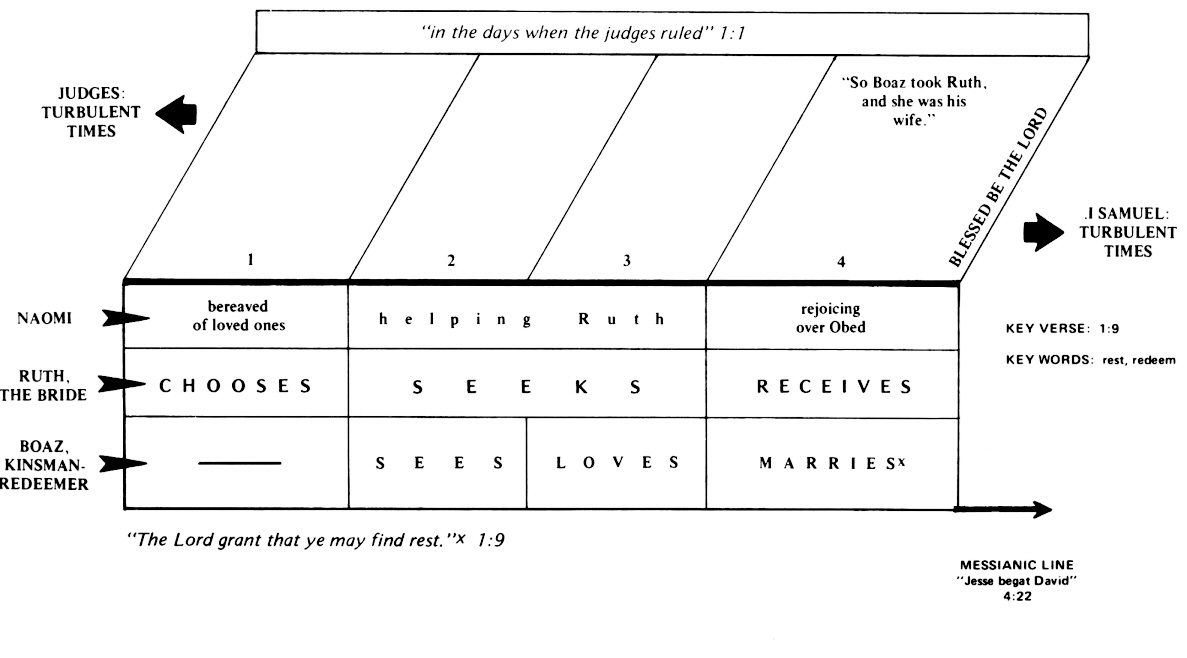
Irving Jensen's Survey of Bible (see his summary of Ruth online - page 392)
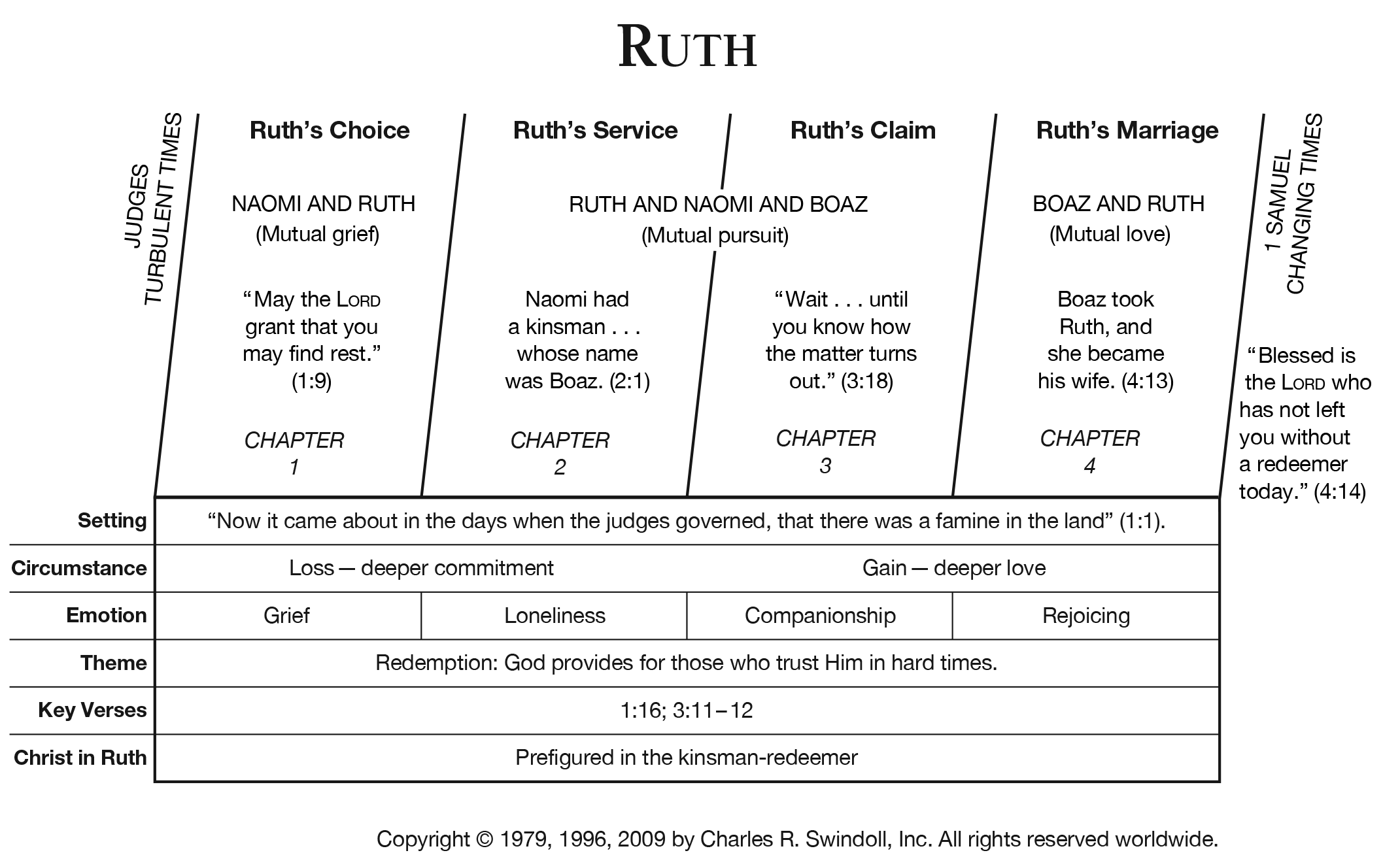
See Swindoll's summary chart of Ruth See Ruth Devotionals
|
RUTH: GOD PROVIDES |
|||
| Ruth 1 | Ruth 2 | Ruth 3 | Ruth 4 |
| Ruth's Choice | Ruth's Service | Ruth's Claim | Ruth's Marriage |
| Ruth's Resolve | Ruth's Rights | Ruth's Request | Ruth's Reward |
| Naomi and Ruth Mutual Grief |
Ruth and Naomi and Boaz Mutual Pursuit |
Boaz and Ruth Mutual Love |
|
| Ruth's Decision: Return with Naomi |
Ruth's Devotion: Provide for Naomi |
Ruth's Request: Redemption by Boaz |
Ruth's Reward: Relative of Messiah |
| Ruth and Naomi |
Ruth and Boaz |
||
| Death of Naomi's Family |
Ruth Cares for Naomi |
Boaz Cares for Ruth |
God Blesses with New Birth |
| Grief | Loneliness | Companionship | Rejoicing |
| Location: Plains of Moab |
Location: Fields of Bethlehem |
Location: Threshing floor of Bethlehem |
Location: Little town of Bethlehem |
| Time Lapsed: About 30 Years See Timeline |
|||
| Setting: Ru 1:1 Now it came about in the days when the judges governed Jdg 21:25+ In those days there was no king in Israel; everyone did what was right in his own eyes. |
|||

|
The Book of Judges |
|
|
RUTH |
JUDGES |
|
Spiritual |
Spiritual |
|
Purity |
Immorality |
|
Deciding for |
Pursuing Idols |
|
Devotion |
Disloyalty |
|
Love |
Lust |
|
Peace |
War |
|
Kindness |
Cruelty |
|
Obedience |
Disobedience |
|
Oasis |
Desert |
|
Faithfulness |
Faithlessness |
Ruth 1:9 "May the LORD grant that you may find rest, each in the house of her husband." Then she kissed them, and they lifted up their voices and wept. (NASB: Lockman)
Septuagint (LXX): doe (3SAAO) kurios humin kai heuroite (2PAAO) anapausin hekaste en oiko andros autes kai katephilesen (3SAAI) autas kai eperan ten phonen auton kai eklausan (3PAAI)
BGT (LXX) δῴη κύριος ὑμῖν καὶ εὕροιτε ἀνάπαυσιν ἑκάστη ἐν οἴκῳ ἀνδρὸς αὐτῆς καὶ κατεφίλησεν αὐτάς καὶ ἐπῆραν τὴν φωνὴν αὐτῶν καὶ ἔκλαυσαν
English of Septuagint: The Lord grant you that ye may find rest each of you in the house of her husband: and she kissed them; and they lifted up their voice, and wept
KJV The LORD grant you that ye may find rest, each of you in the house of her husband. Then she kissed them; and they lifted up their voice, and wept.
NET May the LORD enable each of you to find security in the home of a new husband!" Then she kissed them goodbye and they wept loudly.
BBE May the Lord give you rest in the houses of your husbands. Then she gave them a kiss; and they were weeping bitterly.
CSB May the LORD enable each of you to find security in the house of your new husband." She kissed them, and they wept loudly.
ERV The LORD grant you that ye may find rest, each of you in the house of her husband. Then she kissed them; and they lifted up their voice, and wept.
ESV The LORD grant that you may find rest, each of you in the house of her husband!" Then she kissed them, and they lifted up their voices and wept.
GWN May the LORD repay each of you so that you may find security in a home with a husband." When she kissed them goodbye, they began to cry loudly.
NKJ "The LORD grant that you may find rest, each in the house of her husband." Then she kissed them, and they lifted up their voices and wept.
NAB May the LORD grant each of you a husband and a home in which you will find rest." She kissed them good-bye, but they wept with loud sobs,
NIV May the LORD grant that each of you will find rest in the home of another husband." Then she kissed them and they wept aloud
NJB May Yahweh show you faithful love, as you have done to those who have died and to me. Yahweh grant that you may each find happiness with a husband!' She then kissed them, but they began weeping loudly,
NLT May the LORD bless you with the security of another marriage." Then she kissed them good-bye, and they all broke down and wept.
NRS The LORD grant that you may find security, each of you in the house of your husband." Then she kissed them, and they wept aloud.
YLT Jehovah doth grant to you, and find ye rest each in the house of her husband;' and she kisseth them, and they lift up their voice and weep.
- rest - Ru 3:1 "rest" related to Hebrew "security"- see note Ruth 3:1
- kissed: Ge 27:27 29:11 45:15 Ac 20:37
- Ruth 1 Resources - Multiple Sermons and Commentaries
NAOMI'S SECOND
SUPPLICATION TO YAHWEH
May the LORD grant that you may find rest, each in the house of her husband - NET = "May the Lord give each of you security in the home of a new husband!" NJB = "Yahweh grant that you may each find happiness with a husband!" Amp = "The Lord grant that you may find a home and rest, each in the house of her husband!" Naomi acknowledges Yahweh as the Giver, the only One Who is able to accomplish what she was requesting (cf Jas 1:17+). And so as in Ruth 1:8 Naomi offers a prayer of blessing or benediction. Alternatively, one might see this prayer as an "addendum" to the previous call for Yahweh's kindness. "Jehovah grant you that ye may find a resting-place, each one in the house of her husband," in short that would might both be happily married again (which would be a manifestation of His kindness she initially prayed for). The finding of a husband will become a dominant theme of the remainder of the book, but for now the writer forces the reader to wait for something to happen, and when it does, Yahweh will receive the credit!
Hubbard adds that "After years of tragic bereavement and turmoil, Naomi prayed that Yahweh would guide them to new marriages and thus grant them a place of stability from which to get on with their lives. Cf. Paul’s similar command to young widows in 1 Cor. 7:9+. (See context in The Book of Ruth - NICOT or borrow The book of Ruth)
Naomi describes marriage as a place of "rest" which summarizes all the qualities of an ideal marriage in which a godly woman can find strength, security, material well-being and love. The concept of rest also conveys the idea of security found in a godly marriage. See Ru 3:1+ discussion of rest (manowach) where we find that Naomi becomes part of the answer to her own prayer!
The word "rest" in the present context ("in the house of her husband") pictures the godly marriage as if it were a "port or haven of young people, whose affections while unmarried are continually floating and tossed to and fro like a ship upon the waters, till they come into this happy harbour. There is a natural propensity in most persons towards nuptial communion, as all created beings have a natural tendency to their proper centre, and are restless out of it." (Ness)
THOUGHT- God has intended that your marriage be a source of rest. Is yours? Dear reader, may the LORD grant that it be so!
Nelson's Illustrated Manners and Customs notes that "When a young woman went to live with her husband’s family, she did not give up all rights in her own family. If her husband died and there were no more brothers-in-law for her to marry, she might return to her father’s house. That is exactly what Naomi encouraged her daughters-in-law to do, and Orpah followed her suggestion (Ruth 1:8-18)…The death of a husband always has far-reaching consequences for his family. For people of biblical times this was true as well. After a period of mourning, the widowed wife might follow one of several courses of action. If she was childless, she was, according to the levirate law, expected to continue living with her husband’s family (Dt. 25:5-10-Keil and Delitzsch). She was to marry one of her husband’s brothers or a near kinsman. If these men were not available, she was free to marry outside the clan (Ruth 1:9). (Nelson's Illustrated Manners and Customs of the Bible)
G Lawson comments on rest in marriage --"If it is to be wished that wives may find rest in the houses of their husbands, it must be the duty of husbands to do what they can to procure them rest, not only by endeavoring to provide for them what is necessary for their subsistence and comfortable accommodation, but by such a kind behaviour as will promote their satisfaction and comfort. Men and women may have affluence without rest, and rest without affluence. But let women also contribute to procure rest for themselves by frugality, by industry, by such behaviour to their husbands as will merit constant returns of kindness." (Rest in Marriage)
A TOUCHING SCENE
A TIME OF GRIEVING
Then she kissed them, and they lifted up their voices and wept - She had commended them both the the care (kindness) of Yahweh and now Naomi seals the prayers and the anticipated separation with a kiss. But what was meant to be her parting act, unleashed a torrent of tears from both young women. The phrase lifted up their voices and wept (their actions repeated in Ru 1:14+) is not just a little whimper, but more like a wail, loud crying as when one laments and mourns over some loss (cf Hagar in Ge 21:16 at the thought of losing Ishmael, Esau when he realized he had lost the blessing Ge 27:38, when the Angel of the LORD issued a punitive prophecy to Israel - Jdg 2:3-4+, when the 11 tribes realized they had almost annihilated the tribe of Benjamin - Jdg 21:2+). Clearly this deep expression of emotion is evidence of the genuine relationship of love between Naomi and her daughters-in-law. After all, these 3 had shared life together for 10 years, sufficient time to forge strong bonds and making the breaking of those bonds all the more painful! The thought that was coursing through the minds of the two Moabites was "We will never see Naomi again!"
"Parting is Such Sweet Sorrow"
-- William Shakespeare in Romeo and Juliet
I think Naomi often gets what we would refer to today as a "bad rap" but careful observation shows that she exhibits several traits of a woman of "moral excellence" (2Pe 1:5+)
First, we see that she held fast her allegiance to the one true and living God in the midst of surrounding gross idolatry (for example Moabite idol worship sometimes included child sacrifice - see Chemosh), even holding fast in the face of her bitterness! She believed in the One God, YHWH (Jehovah) and recognized His sovereignty over all the tragedies she had experienced.
Second, Naomi exercised a godly influence on others who knew her most intimately, those of her own household which is where godliness is most often shown to be the sure thing or a sham (cp 1Ti 3:4, 12, Titus 1:6). The two daughter-in-laws had seen her godly character long enough to know it was genuine.
Third, she denied herself for the good of others. Some (like Warren Wiersbe see his comment below in Ru 1:11) say Naomi's encouragement to the daughter-in-laws to return to their idolatrous gods was an ungodly action. Although that is possible, I think self denial and putting others before oneself is more in view - It would have been an advantage to Naomi to have these two strong, active young women with her to work for her in her old age. But a settlement would be easier for them (being alien Moabites) in their own land than in Judah. So she begged them return, and was willing to go home alone. Read the text for yourself and decide which attitude you think Naomi exhibited. Also remember to keep the entire context of the book in mind as you evaluate Naomi's motives.
Rest (04496) (menuchah) means resting place, a settling down after movement or wandering and is used in several ways to denote places where peace, quiet, and trust are present. The Hebrew root signifies not only absence of movement but being settled in a particular place. It often refers to security (as would be provided in marriage). The related Hebrew word manoah is used in Ru 3:1-note (Ge 8:9)
Hubbard adds menuchah "was used of the place where Yahweh and his ark permanently settled after its wanderings en route to Jerusalem from Philistine captivity (Ps. 132:8, 14; cf. 1 Chr. 22:9). It is a synonym for “the promised land,” the place of settlement for the wandering Israelites (Deut. 12:9; Ps. 95:11; cf. Gen. 49:15). It also means relief from enemies (1 K. 8:56) or from weariness (Isa. 28:12; Jer. 45:3). In essence, it connotes permanence, settlement, security, and freedom from anxiety after wandering, uncertainty, and pain. It is primarily something which only Yahweh gives. That is why Naomi seeks it from Yahweh. (See context in The Book of Ruth - NICOT or borrow The book of Ruth)
Menuchah invariably conveys the idea of relief, for example David's thirst (He makes me lie down in green pastures; He leads me beside quiet waters. Ps. 23:2-note), fatigue (He who said to them, "Here is rest, give rest to the weary," And, "Here is repose," but they would not listen. Isa. 28:12), hostile nations ("Blessed be the LORD, who has given rest to His people Israel, according to all that He promised; not one word has failed of all His good promise, which He promised through Moses His servant. 1Ki 8:56), and sorrow ('You said, "Ah, woe is me! For the LORD has added sorrow to my pain; I am weary with my groaning and have found no rest."' Jer. 45:3). In the present context note that the rest is in the sphere of marriage, "in the home of another husband".
TWOT - Basically the root nûah relates to absence of spatial activity and presence of security, as seen, e.g. in the ark which "rested" on Mount Ararat (Ge 8:4), and the locusts "resting" on Egypt (Ex 10:14).
Menuchah - 21x in OT - NAS renders it comforting(1), permanent(1), place(1), place of rest(1), quartermaster*(1), quiet(1), rest(8), resting(1), resting place(7), resting places(1).
Genesis 49:15 "When he saw that a resting place (Lxx = anapausis = ceasing from activity) was good And that the land was pleasant, He bowed his shoulder to bear burdens, And became a slave at forced labor.
Numbers 10:33 Thus they set out from the mount of the LORD three days' journey, with the ark of the covenant of the LORD journeying in front of them for the three days, to seek out a resting place (Lxx = anapausis = ceasing from activity) for them.
Deuteronomy 12:9 for you have not as yet come to the resting place (Lxx - katapausis - related to katapauo) and the inheritance which the LORD your God is giving you.
Deuteronomy 28:65 "Among those nations you shall find no rest (Lxx - anapauo), and there will be no resting place for the sole of your foot; but there the LORD will give you a trembling heart, failing of eyes, and despair of soul.
Judges 20:43 They surrounded Benjamin, pursued them without rest and trod them down opposite Gibeah toward the east.
Ruth 1:9 "May the LORD grant that you may find rest (Lxx = anapausis), each in the house of her husband." Then she kissed them, and they lifted up their voices and wept.
2 Samuel 14:17 "Then your maidservant said, 'Please let the word of my lord the king be comforting, for as the angel of God, so is my lord the king to discern good and evil. And may the LORD your God be with you.'"
1 Kings 8:56 "Blessed be the LORD, who has given rest (Lxx - katapausis - related to katapauo) to His people Israel, according to all that He promised; not one word has failed of all His good promise, which He promised through Moses His servant.
1 Chronicles 22:9 'Behold, a son will be born to you, who shall be a man of rest (Lxx - anapauo); and I will give him rest from all his enemies on every side; for his name shall be Solomon, and I will give peace and quiet to Israel in his days.
1 Chronicles 28:2 Then King David rose to his feet and said, "Listen to me, my brethren and my people; I had intended to build a permanent (Lxx = anapausis) home for the ark of the covenant of the LORD and for the footstool of our God. So I had made preparations to build it.
2 Chronicles 6:41 "Now therefore arise, O LORD God, to Your resting place (Lxx - katapausis - related to katapauo), You and the ark of Your might; let Your priests, O LORD God, be clothed with salvation and let Your godly ones rejoice in what is good.
Psalm 23:2 He makes me lie down in green pastures; He leads me beside quiet (Lxx = anapausis) waters.
Psalm 95:11 "Therefore I swore in My anger, Truly they shall not enter into My rest (Lxx = anapausis)."
Psalm 132:8 Arise, O LORD, to Your resting place (Lxx = anapausis), You and the ark of Your strength.
14 "This is My resting place (Lxx - katapausis - related to katapauo) forever; Here I will dwell, for I have desired it.
Isaiah 11:10 Then in that day The nations will resort to the root of Jesse, Who will stand as a signal for the peoples; And His resting place (Lxx = anapausis) will be glorious.
Isaiah 28:12 He who said to them, "Here is rest, give rest to the weary," And, "Here is repose," but they would not listen.
Isaiah 32:18 Then my people will live in a peaceful habitation, And in secure dwellings and in undisturbed resting places (Lxx - anapauo);
Isaiah 66:1 Thus says the LORD, "Heaven is My throne and the earth is My footstool. Where then is a house you could build for Me? And where is a place that I may rest (Lxx - katapausis - related to katapauo)?
Jeremiah 45:3 'You said, "Ah, woe is me! For the LORD has added sorrow to my pain; I am weary with my groaning and have found no rest (Lxx = anapausis)."'
Jeremiah 51:59 The message which Jeremiah the prophet commanded Seraiah the son of Neriah, the grandson of Mahseiah, when he went with Zedekiah the king of Judah to Babylon in the fourth year of his reign. (Now Seraiah was quartermaster.)
Micah 2:10 "Arise and go, For this is no place of rest (Lxx = anapausis) Because of the uncleanness that brings on destruction, A painful destruction.
Zechariah 9:1 The burden of the word of the LORD is against the land of Hadrach, with Damascus as its resting place (Lxx = thusia = sacrifice) (for the eyes of men, especially of all the tribes of Israel, are toward the LORD),
The Septuagint (LXX) translates menuchah with the Greek noun anapausis which conveys the idea of refreshing or of giving rest and permitting one to cease from labour in order to recover and collect strength. Anapausis is the most frequent Greek word used to translate Sabbath rest.
The most famous use of anapausis is by Jesus in his invitation to…
"Come to Me, all who are weary and heavy-laden, and I will give you rest (anapauo = related verb). Take (aorist imperative) My yoke upon you, and learn (aorist imperative) from Me, for I am gentle and humble in heart; and YOU SHALL FIND REST (anapausis) FOR YOUR SOULS." (Matthew 11:28-29-note)
The emotion shown is evidence of the real relationship of love between Naomi and her daughters-in-law.
Ruth 1:10 And they said to her, "No, but we will surely return with you to your people." (NASB: Lockman)
Septuagint (LXX): kai eipan (3PAAI) aute meta sou epistrephomen (1PPAI) eis ton laon sou
BGT (LXX) καὶ εἶπαν αὐτῇ μετὰ σοῦ ἐπιστρέφομεν εἰς τὸν λαόν σου
English of Septuagint: And they said to her, We will return with thee to thy people
KJV And they said unto her, Surely we will return with thee unto thy people.
NET But they said to her, "No! We will return with you to your people."
BBE And they said to her, No, but we will go back with you to your people.
CSB "No," they said to her. "We will go with you to your people."
ERV And they said unto her, Nay, but we will return with thee unto thy people.
ESV And they said to her, "No, we will return with you to your people."
GWN They said to her, "We are going back with you to your people."
NKJ And they said to her, "Surely we will return with you to your people."
NAB and told her they would return with her to her people.
NIV and said to her, "We will go back with you to your people."
NJB and said, 'No, we shall go back with you to your people.'
NLT "No," they said. "We want to go with you to your people."
NRS They said to her, "No, we will return with you to your people."
YLT And they say to her, 'Surely with thee we go back to thy people.'
- Ps 16:3-note; Ps 119:63-note; Zec 8:23
- Ruth 1 Resources - Multiple Sermons and Commentaries
DAUGHTER-IN-LAWS BOTH
PROTEST NAOMI'S COMMAND
And they said to her, "No, but we will surely return with you to your people - Amidst crying comes their tearful protest to Naomi's command! No (kiy) means essentially "on the contrary," and then they proceed to turn Naomi's command to return into an affirmation to return with her! They are saying that they intend to go back to Naomi's people, accompanying her to her home.
Hubbard comments "Whether to repay Naomi’s love, to remain loyal to their husbands, or to avoid the pain of parting, they declared their intention to sacrifice their futures on the altar of service to her." (See context in The Book of Ruth - NICOT or borrow The book of Ruth)
Their declaration reminds one of a time to come in the future when God's hand of blessing is again clearly on the Jews. Zechariah describes this time specifically stating that "in those days ten men from all the nations (gentiles) will grasp the garment of a Jew saying, "Let us go with you, for we have heard that God is with you." (Zech 8:23)
C Ness commenting on Orpah's promise says that "Purposes and promises that proceed from passion, and not from principle, do soon dwindle away into nothing. Thus did Orpah’s, who said with that son in the parable, “I will, sir'; and he did not go." (Mt 21:28, 29 30) So here, it is certain we will return with thee, was enough uncertain. It is a maxim (a general truth, fundamental principle, or rule of conduct), second thoughts are better than first, but Orpah’s first were better than her second; her purposes and promises do dwindle away and vanish into smoke." (Promise and Purpose to be Allied)
Cumming adds "The bright morning does not always shine into the perfect day; the sweetest spring-bud of promise does not always ripen into precious fruit. The seed that was cast on stony ground grew rapidly up, but withered in a moment. Orpah’s decision was the decision of impulsive feeling, of filial affection; it was strong suddenly, it grew up in an instant, and in an instant it perished; and she resolved to forsake Ruth and Naomi, and return to her gods, her people, and her country. (The Failure of Good Impulses)
Are Ness and Cumming being too hard on Orpah? Or was Orpah simply obeying the wishes of her mother-in-law? Someone has well said we will all be surprised some day when we see who is and who is not in heaven!
What does this say about Ruth who proved her promise? Ruth sought to go with Naomi because of loyalty to her and her God. She counted the cost of possibly never having a husband. She put other's interest before her own (Php 2:3, 4, 5+). She had the attitude of Christ!
Return (07725)(shub/shuv) is the 12th most frequent verb in the OT with over 1000 uses and essentially means to turn (Josh 19:12), to return (Ge 3:19), to turn back (Ex 14:2), to do again, to change, to withdraw, to bring back, to reestablish, to be returned, to bring back, to take, to restore, to recompense, to answer, to hinder. Shub refers to a reversal or change of direction, an “about face.” Shub describes movement back to the point of departure or reversal of direction.
Ruth 1:11 But Naomi said, "Return, my daughters. Why should you go with me? Have I yet sons in my womb, that they may be your husbands? (NASB: Lockman)
Septuagint (LXX): kai eipen (3SAAI) Noemin epistraphete (2PAPM) de thugateres mou kai hina ti poreuesthe (2PPMI) met' emou me eti moi huioi en te koilia mou kai esontai (3PFMI) humin eis andras
English of Septuagint: And Noemin said, Return now, my daughters; and why do ye go with me? have I yet sons in my womb to be your husbands
BGT (LXX) καὶ εἶπεν Νωεμιν ἐπιστράφητε δή θυγατέρες μου καὶ ἵνα τί πορεύεσθε μετ᾽ ἐμοῦ μὴ ἔτι μοι υἱοὶ ἐν τῇ κοιλίᾳ μου καὶ ἔσονται ὑμῖν εἰς ἄνδρας
KJV And Naomi said, Turn again, my daughters: why will ye go with me? are there yet any more sons in my womb, that they may be your husbands?
NET But Naomi replied, "Go back home, my daughters! There is no reason for you to return to Judah with me! I am no longer capable of giving birth to sons who might become your husbands!
BBE But Naomi said, Go back, my daughters; why will you come with me? Have I more sons in my body, to become your husbands?
CSB But Naomi replied, "Return home, my daughters. Why do you want to go with me? Am I able to have any more sons who could become your husbands?
ERV And Naomi said, Turn again, my daughters: why will ye go with me? have I yet sons in my womb, that they may be your husbands?
ESV But Naomi said, "Turn back, my daughters; why will you go with me? Have I yet sons in my womb that they may become your husbands?
GWN But Naomi said, "Go back, my daughters. Why should you go with me? Do I have any more sons in my womb who could be your husbands?
ICB: But Naomi said, "My daughters, go back to your own homes. Why do you want to go with me? I cannot give birth to more sons to give you new husbands.
NKJ But Naomi said, "Turn back, my daughters; why will you go with me? Are there still sons in my womb, that they may be your husbands?
NAB "Go back, my daughters!" said Naomi. "Why should you come with me? Have I other sons in my womb who may become your husbands?
NIV But Naomi said, "Return home, my daughters. Why would you come with me? Am I going to have any more sons, who could become your husbands?
NJB 'Go home, daughters,' Naomi replied. 'Why come with me? Have I any more sons in my womb to make husbands for you?
NLT But Naomi replied, "Why should you go on with me? Can I still give birth to other sons who could grow up to be your husbands?
NRS But Naomi said, "Turn back, my daughters, why will you go with me? Do I still have sons in my womb that they may become your husbands?
YLT And Naomi saith, 'Turn back, my daughters; why do ye go with me? are there yet to me sons in my bowels that they have been to you for husbands?
- Ge 38:11; Dt 25:5
- Ruth 1 Resources - Multiple Sermons and Commentaries
Deuteronomy 25:5-10+ (See Levirate Marriage) “When brothers live together and one of them dies and has no son, the wife of the deceased shall not be married outside the family to a strange man. Her husband’s brother shall go in to her and take her to himself as wife and perform the duty of a husband’s brother to her. 6 “It shall be that the firstborn whom she bears shall assume the name of his dead brother, so that his name will not be blotted out from Israel. 7 “But if the man does not desire to take his brother’s wife, then his brother’s wife shall go up to the gate to the elders and say, ‘My husband’s brother refuses to establish a name for his brother in Israel; he is not willing to perform the duty of a husband’s brother to me.’ 8 “Then the elders of his city shall summon him and speak to him. And if he persists and says, ‘I do not desire to take her,’ 9 then his brother’s wife shall come to him in the sight of the elders, and pull his sandal off his foot and spit in his face; and she shall declare, ‘Thus it is done to the man who does not build up his brother’s house.’ 10 “In Israel his name shall be called, ‘The house of him whose sandal is removed.’
NAOMI COUNTERS WITH
ANOTHER COMMAND
But - Term of contrast. In contrast to their affirmation to return, Naomi counters with another command to return, which she follows up with another command in Ru 1:12.
Naomi said, "Return (shub), my daughters - Return is a command from Naomi for a reversal or change of direction, an “about face” calling for movement back to the point of departure (Moab). The Septuagint (Lxx) translateswith the verb epistrepho in the form of an aorist imperative (a command calling for immediate obedience!) Her addressing them as my daughters underscores her tender love for them, both of whom are surely still weeping!
Why should you go with me? Have I yet sons in my womb, that they may be your husbands - She buttresses her command to return with two questions. The first is asking them in essence, why would you even want to go with me? She is not really expecting them to explain their determination, because clearly there is no good reason to go with her. What is she saying? Well, clearly, the three women have bonded emotionally over the 10 years, but Naomi is saying emotional bonds are not sufficient reason to follow her. The NRSV renders the second question "Do I still have sons in my womb?" an idiom which is another way of her asking "Am I likely to bear more sons?" which is a rhetorical question that likely expected a "No, of course not" because the younger women knew her age. We do not know, but John MacArthur (in his comment on Ru 1:12) says "Naomi was probably over 50," which is normally past child bearing age (unless your name is Sarah!)
NET Note Heb “Why would you want to come with me?” Naomi’s rhetorical question expects a negative answer. Heb “Do I still have sons in my inner parts that they might become your husbands?” Again Naomi’s rhetorical question expects a negative answer.
Note that in reminding them of the impossibility of her bearing sons, Naomi may be indirectly alluding to the law of levirate marriage (see also above for Dt 25:5-10) discussed in more detail below.
Hubbard however disagrees writing that "A sizable consensus (ED: E.g., ESV Study Bible, et al) sees here a reference to levirate marriage, but that reference is doubtful. By definition, levirate marriage required a brother of the deceased who was both a contemporary and had the same father (Gen. 38; Deut. 25:5–10; Matt. 22:23–33). Since Elimelech, (presumably) his brothers, and all his sons were dead, reference to such a marriage here is excluded. (See context in The Book of Ruth - NICOT or borrow The book of Ruth)
Warren Wiersbe in my opinion is a bit hard on Naomi (note on Ru 1:9) commenting that "If it was right for Naomi to go to Bethlehem, where the true and living God was worshiped, then it was right for Orpah and Ruth to accompany her. Naomi should have said to them what Moses said to his father-in-law, “Come thou with us, and we will do thee good; for the Lord has spoken good concerning Israel” (Nu 10:29). Instead, Naomi tried to influence the two women to go back to their families and their false gods. Why would a believing Jewess, a daughter of Abraham, encourage two pagan women to worship false gods? I may be wrong, but I get the impression that Naomi didn’t want to take Orpah and Ruth to Bethlehem because they were living proof that she and her husband had permitted their two sons to marry women from outside the covenant nation. In other words, Naomi was trying to cover up her disobedience. If she returned to Bethlehem alone, nobody would know that the family had broken the Law of Moses. (ED: THIS IS SPECULATION) (See context The Bible Exposition Commentary)
Others like Iain Duguid agree with Wiersbe writing "What made it far worse for Naomi to contemplate, though, was the fact that these two were foreigners who would hardly be welcome in polite society in Bethlehem. They were Moabite women who by their very presence would be a constant reminder to Naomi and all those around her of her sin in abandoning the Promised Land and marrying her sons outside the covenant people. Every time she saw their foreign faces, she would be confronted with the heavy hand of God’s judgment upon her in the loss of her husband and her sons....There was nothing kosher about Ruth. She knew she would be about as welcome in Bethlehem as a ham sandwich at a bar mitzvah! (Esther and Ruth Reformed Expository Commentary)
F B Huey adds "The verse assumes the law of Levirate Marriage (Lat. levir = “brother-in-law”) and cannot be understood apart from it. The levirate law (Dt 25:5–10+) provides for the marriage of a childless widow to a brother-in-law. If the daughters-in-law went with Naomi, as foreigners there would be little or no hope for them of remarriage and homes of their own. Naomi reminded them that she was not pregnant with sons who, as the younger brothers of Mahlon and Kilion, would be obligated to marry their widowed sisters-in-law according to the levirate law. Naomi’s rebuke of their offer was not harsh but considerate. Observe her tender address: “my daughters.” Her unselfish placing of her daughters-in-law’s welfare above her own shows her noble character." (Expositor's Bible Commentary)
Ruth 1:12 "Return, my daughters ! Go, for I am too old to have a husband. If I said I have hope, if I should even have a husband tonight and also bear sons (NASB: Lockman)
Septuagint (LXX): epistraphete (2PAPM) de thugateres mou dioti gegeraka (1SRAI) tou me einai (PAI) andri hoti eipa hoti estin (3SPAI) moi hupostasis tou genethenai (APN) me andri kai techomai (1SFAI) huious
English of Septuagint: Turn now, my daughters, for I am too old to be married: for I said, Suppose I were married, and should bear sons
BGT ἐπιστράφητε δή θυγατέρες μου διότι γεγήρακα τοῦ μὴ εἶναι ἀνδρί ὅτι εἶπα ὅτι ἔστιν μοι ὑπόστασις τοῦ γενηθῆναί με ἀνδρὶ καὶ τέξομαι υἱούς
KJV Turn again, my daughters, go your way; for I am too old to have an husband. If I should say, I have hope, if I should have an husband also to night, and should also bear sons;
NET Go back home, my daughters! For I am too old to get married again. Even if I thought that there was hope that I could get married tonight and conceive sons,
BBE Go back, my daughters, and go on your way; I am so old now that I may not have another husband. If I said, I have hopes, if I had a husband tonight, and might have sons,
CSB Return home, my daughters. Go on, for I am too old to have another husband. Even if I thought there was still hope for me to have a husband tonight and to bear sons,
ERV Turn again, my daughters, go your way; for I am too old to have an husband. If I should say, I have hope, if I should even have an husband to-night, and should also bear sons;
ESV Turn back, my daughters; go your way, for I am too old to have a husband. If I should say I have hope, even if I should have a husband this night and should bear sons,
GWN Go back, my daughters. Go, because I am too old to get married again. If I said that I still have hope.... And if I had a husband tonight.... And even if I gave birth to sons,
NKJ "Turn back, my daughters, go-- for I am too old to have a husband. If I should say I have hope, if I should have a husband tonight and should also bear sons,
NAB Go back, my daughters! Go, for I am too old to marry again. And even if I could offer any hopes, or if tonight I had a husband or had borne sons,
NIV Return home, my daughters; I am too old to have another husband. Even if I thought there was still hope for me--even if I had a husband tonight and then gave birth to sons--
NJB Go home, daughters, go, for I am now too old to marry again. Even if I said, "I still have a hope: I shall take a husband this very night and shall bear more sons,"
NLT No, my daughters, return to your parents' homes, for I am too old to marry again. And even if it were possible, and I were to get married tonight and bear sons, then what?
NRS Turn back, my daughters, go your way, for I am too old to have a husband. Even if I thought there was hope for me, even if I should have a husband tonight and bear sons,
YLT Turn back, my daughters, go, for I am too aged to be to a husband; though I had said, There is for me hope, also, I have been to-night to a husband, and also I have borne sons:
- Too old - Ge 17:17; 1Ti 5:9
- Ruth 1 Resources - Multiple Sermons and Commentaries
NAOMI'S PICTURE
OF HOPELESSNESS
Return (shub; Lxx - epistrepho), my daughters! Go, for I am too old to have a husband. - NET = "Go back, my daughters! Go! For I am too old to get married again." Return (supplemented by another command "Go") is Naomi's third and final command (First = Ru 1:8+, Second = Ru 1:11+), her final attempt to encourage her daughters-in-law to make an “about face” and head back to "Chemosh country." Naomi now follows up her command with and explanation (note "for" = a term of explanation - always be alert to query it!) stating plainly that she is too old (MacArthur "Naomi was probably over 50") to have a sons that could marry them and perpetuate the family line of Elimelech.
NET Note Too old to get married again. Naomi may be exaggerating for the sake of emphasis. Her point is clear, though: It is too late to roll back the clock.
If I said I have hope (tiqvah), if I should even have a husband tonight ("this very night!") and also bear sons - NET = "Suppose I were to say, ‘I have hope!" NLT = "And even if it were possible" ICB = "But even if I had another husband tonight and if I had more sons, it wouldn't help!" Even if she could find a husband and if she were still able to bear sons (there are a lot of "ifs" in her declaration), the daughters-in-law would have to wait too long to marry them. Naomi is painting a picture that makes their remarriage to sons she might bear a virtual impossibility.
This passage is an important segue in the book for it introduces an allusion to the concept of levirate marriage (contra Hubbard). In other words what Naomi explains to them is that even if she would remarry and even if she could still bear children and even if those children were males or sons (who would technically be the brothers of Chilion and Mahlon albeit by a different father), Orpah and Ruth would still have to wait (Ru 1:13) many years to marry them and carry on the father's line.
John Trapp comments that "Without having a husband, she does not once think of having children, as many wantons do, in essence making themselves whores, and their children bastards, and all for satisfying the rage of lust, though after they repent with grief and shame."
Hope (08615) (tiqwah from qavah = to wait for) means hope or expectation, an attitude of anticipation with expectation that something will occur. The root means to wait or to look for with eager expectation. This Hebrew word usually means hope but in Joshua 2:18, 21+ it refers to the red cord that Rahab was to hang from her window so she would be spared by the Israelites.
Baker - A manner of life raises hope of certain consequences (Job 4:6). Because God cares for the oppressed and hopeless, even they have hope (Job 5:16; Ps. 9:18[19]). Hope can be equivalent to a longing or a desire (Job 6:8). The righteous person's hope is ultimately and completely in God (Ps. 62:5[6]); the same cannot be said of the wicked (Prov. 10:28). The fear of the Lord gives hope (Prov. 23:18). A self-conceited person or a person wise in his or her own thinking is more hopeless than a fool (Prov. 26:12). Even when they were in exile, God let His people know that He had a hope to give them, a positive future (Jer. 29:11). The hope for the success of Israel was lost in her captivity (Ezek. 19:5); but God gave Israel hope to return from there (Ezek. 37:11). Hosea speaks of Israel's recovery and hope of full restoration (Hos. 2:15[17]; Zech. 9:12). (The Complete Word Study Old Testament )
Gilbrant on tiqvah - A noun derived from the root verb qāwāh, "to wait," "to long for," "to hope," tiqwāh is found thirty-two times in the OT in both negative as well as positive contexts. For the wicked (Job 11:20; Prov. 10:28), there is no ultimate hope because they are opposed by God. Naomi, as an older woman, had no hope of ever bearing more children (Ruth 1:12). Others have a delayed or remote sense of hope: the poor (Ps. 9:18), afflicted people like Job (Job 17:15; 19:10) or humans in their finite state (14:19). But positively, the OT portrays hope as coming from God's intervention in the affairs of individuals (Pss. 62:5; 71:5) and nations (Hos. 2:15; Zech. 9:12).
Complete Biblical Library Hebrew-English Dictionary - The Complete Biblical Library Hebrew-English Dictionary – Sin-Taw.
Tiqvah - 32x in 31v - expectation(3), hope(28), longing(1). Ruth 1:12; Job 4:6; Job 5:16; Job 6:8; Job 7:6; Job 8:13; Job 11:18; Job 11:20; Job 14:7; Job 14:19; Job 17:15; Job 19:10; Job 27:8; Ps. 9:18; Ps. 62:5; Ps. 71:5; Prov. 10:28; Prov. 11:7; Prov. 11:23; Prov. 19:18; Prov. 23:18; Prov. 24:14; Prov. 26:12; Prov. 29:20; Jer. 29:11; Jer. 31:17; Lam. 3:29; Ezek. 19:5; Ezek. 37:11; Hos. 2:15; Zech. 9:12
Related Resource:
Ruth 1:13 would you therefore wait until they were grown? Would you therefore refrain from marrying? No, my daughters; for it is harder for me than for you, for the hand of the LORD has gone forth against me." (NASB: Lockman)
Septuagint (LXX): me autous prosdechesthe (2PFMI) eos ou adrunthosin (3PAPS) e autois kataschethesesthe (2PFPI) tou me genesthai (AMN) andri me de thugateres mou hoti epikranthe (3SAPI) moi huper humas hoti exelthen (3SAAI) en emoi cheir kuriou
BGT μὴ αὐτοὺς προσδέξεσθε ἕως οὗ ἁδρυνθῶσιν ἢ αὐτοῖς κατασχεθήσεσθε τοῦ μὴ γενέσθαι ἀνδρί μὴ δή θυγατέρες μου ὅτι ἐπικράνθη μοι ὑπὲρ ὑμᾶς ὅτι ἐξῆλθεν ἐν ἐμοὶ χεὶρ κυρίου
English of Septuagint: would ye wait for them till they should be grown? or would ye refrain from being married for their sakes? Not so, my daughters; for I am grieved for you, that the hand of the Lord has gone forth against me.
KJV Would ye tarry for them till they were grown? would ye stay for them from having husbands? nay, my daughters; for it grieveth me much for your sakes that the hand of the LORD is gone out against me.
Hubbard - for them should you wait until they are grown? For them should you deprive yourselves by not marrying? Absolutely not, my daughters! For I am in far more bitter straits than you are. Indeed, Yahweh’s own hand has attacked me!”
NET surely you would not want to wait until they were old enough to marry! Surely you would not remain unmarried all that time! No, my daughters, you must not return with me. For my intense suffering is too much for you to bear. For the LORD is afflicting me!"
BBE Would you keep yourselves till they were old enough? would you keep from having husbands for them? No, my daughters; but I am very sad for you that the hand of the Lord is against me.
CSB would you be willing to wait for them to grow up? Would you restrain yourselves from remarrying? No, my daughters, my life is much too bitter for you to share, because the LORD's hand has turned against me."
ERV would ye therefore tarry till they were grown? would ye therefore stay from having husbands? nay, my daughters; for it grieveth me much for your sakes, for the hand of the LORD is gone forth against me.
ESV would you therefore wait till they were grown? Would you therefore refrain from marrying? No, my daughters, for it is exceedingly bitter to me for your sake that the hand of the LORD has gone out against me."
GWN would you wait until they grew up and stay single just for them? No, my daughters. My bitterness is much worse than yours because the LORD has sent me so much trouble."
NKJ "would you wait for them till they were grown? Would you restrain yourselves from having husbands? No, my daughters; for it grieves me very much for your sakes that the hand of the LORD has gone out against me!"
NAB would you then wait and deprive yourselves of husbands until those sons grew up? No, my daughters! my lot is too bitter for you, because the LORD has extended his hand against me."
NIV would you wait until they grew up? Would you remain unmarried for them? No, my daughters. It is more bitter for me than for you, because the LORD's hand has gone out against me!"
NJB would you be prepared to wait for them until they were grown up? Would you refuse to marry for their sake? No, daughters, I am bitterly sorry for your sakes that the hand of Yahweh should have been raised against me.'
NLT Would you wait for them to grow up and refuse to marry someone else? No, of course not, my daughters! Things are far more bitter for me than for you, because the LORD himself has raised his fist against me."
NRS would you then wait until they were grown? Would you then refrain from marrying? No, my daughters, it has been far more bitter for me than for you, because the hand of the LORD has turned against me."
YLT for them do ye wait till that they grow up? for them do ye shut yourselves up, not to be to a husband? nay, my daughters, for more bitter to me than to you, for the hand of Jehovah hath gone out against me.'
- Hand - Dt 2:15; Judges 2:15; 1Sa 5:11; Job 19:21; Ps 32:4; 38:2; 39:9 10
- Ruth 1 Resources - Multiple Sermons and Commentaries
WAITING FOR BROTHERS
IS NOT AN OPTION
Would you therefore wait (sabar; Lxx - prosdechomai) until they were grown? - The rhetorical question expects a negative reply thus the NET renders it "surely you would not want to wait until they were old enough to marry." Naomi is concluding the premise she presented in the previous verse with two questions. Would they wait for a male offspring from her womb to fulfill the role husband for Ruth and Orpah?
In the Septuagint (LXX), the verb prosdechomai is used to translated sabar and pictures one having an earnestly expectant attitude of looking forward to something. For example "looking for [prosdechomai] the blessed Hope and the appearing of the glory of our great God and Savior, Christ Jesus (Titus 2:13+). Naomi's point is that there is no hope for this scenario to become a reality in their lives!
NET Note on Would you therefore wait - In any case, Naomi’s rhetorical question expects a negative answer.
Would you therefore refrain (hold back) from marrying? - Rhetorical question again expecting a negative reply. NET = "Surely you would not remain unmarried all that time!" NAB = "deprive yourselves of husbands"
Naomi's two rhetorical questions (both expecting a "no") would appear to be sufficiently negative to discourage any normal red blooded female of child-bearing age.
Hubbard comments that "Naomi’s two questions argue the “bird-in-hand” principle: Why pass up the present, good opportunity to marry for a future, humanly impossible one."....Certainly, Naomi’s desperate words fan a flickering thematic flame: might the impossible—marriage for the widows, perhaps even an heir for Elimelech—happen? (See context in The Book of Ruth - NICOT or borrow The book of Ruth)
No, my daughters; for it is harder (marar) for me than for you for the hand of the LORD has gone forth against me - NET = "No, my daughters, you must not return with me." Naomi says "Absolutely not, my daughters!" She is saying in essence absolutely do NOT accompany her back to her home. And then she uses "for" (term of explanation) which explains why they should not accompany her. NLT = "Things are far more bitter for me than for you, because the Lord himself has caused me to suffer" NET = "For my intense suffering is too much for you to bear. For the LORD is afflicting me!"
Harder (marar) in the Septuagint is the verb pikraino which means to become bitter or resentful and in the Hebrew there is a preceding word (meod) that means great or abundant, emphasizing her deep state of bitterness. Naomi explains that her situation is more bitter than that of her daughter in laws for they are still young enough to remarry and find security and happiness in Moab.
NET Note - Heb “No, my daughters.” Naomi is not answering the rhetorical questions she has just asked. In light of the explanatory clause that follows, it seems more likely that she is urging them to give up the idea of returning with her. In other words, the words “no, my daughters” complement the earlier exhortation to “go back.” To clarify this, the words “you must not return with me” are added in the translation.
For the hand of the Lord has gone forth against me - For is another term of explanation, which explains what Naomi is feeling such deep bitterness. Naomi believed that her bitter state was a direct result of chastisement by Jehovah. Naomi knows that the tragic events that had transpired were not by chance but that in control of a sovereign God Who does as He pleases and knows is best. And so she says it was the punitive hand of Yahweh which had brought about her present state.
ESV Study Bible - Naomi is interpreting her hard circumstances as coming from God’s enmity toward her; as the rest of the book will make plain, she is mistaken. (See context in ESV Study Bible or borrow the ESV Study Bible)
There is some justification for Naomi's "theology" because during the days of the Judges, Israel had forsaken Jehovah for idols and the writer records that "the hand of the LORD was against them for evil, as the LORD had spoken and as the LORD had sworn to them, so that they were severely distressed." (Jdg 2:15+) There is however no suggestion whatsoever that Naomi has worshipped idols in Moab. It is interesting to compare Job who in face of his unspeakable loss said "Pity me, pity me, O you my friends, for the hand of God has struck me" (Job 19:21) which was not completely accurate for God had given permission for Satan to test him.
Hubbard sums up Naomi's argument on why they should not follow her - Thus, Naomi made her most crucial point. If even God was after her, to follow her home was to court personal disaster. Her earlier tragedies—famine, exile, bereavement, childlessness—might be only the beginning. One ought to shun such a person to escape the maelstrom of her misfortune. What better argument to make return to Moab attractive! But one must not overlook the great theological import of her outcry for the story. By holding Yahweh responsible for her losses, Naomi affirmed His participation in the events. Thus, despite appearances, things were not out of control; if He is at least involved, Yahweh might very well straighten things out. In sum, bitter complaint cloaked firm faith. (See context in The Book of Ruth - NICOT or borrow The book of Ruth)
While from the perspective of her faith in God’s providence all is well,
it certainly does not feel so.
-- David Atkinson
Atkinson adds that "despite the pain—even anger—Naomi still holds on to the fact that what she has received is somehow from the Lord’s hands. What is impressive is the truthfulness of her life before God. There is no hiding of the feeling, no pretence that her anger is not there, no sweeping aside with either Stoic upper-lip-stiffness, nor with false affirmations that all in fact feels well. While from the perspective of her faith in God’s providence all is well, it certainly does not feel so. Like Habakkuk’s shout at God for his apparent failure to prevent the rise of the Chaldean oppressors (Read Hab 1:1-3+), only to find eventually that even the Chaldeans were part of God’s purpose of love (Hab. 1:5-6+) and that there were nevertheless grounds for confidence in God’s strength, even his joy, (Hab 3:17-19+) so Naomi here does not hide her deepest feelings from God.....Let Naomi also remind us that our deepest feelings and anxieties are not hidden from God. She deliberately brings her feelings into the open before him. Indeed, she places full responsibility for her plight on God’s shoulders! She now experiences God as her enemy (whose hand has gone forth against her). His has been the hand behind the famine and the deaths first of her husband and then of her sons. Yet she holds these bitter experiences in the setting of his covenant promise, by reminding herself and her daughters-in-law of his covenant name: Yahweh, the Lord....Such a faith (BY NAOMI) must have been a major influence on Ruth. (See context in The Message of Ruth: The Wings of Refuge)
What the author has very skillfully and naturally introduced in this section is the subject of levirate marriage which anticipates the introduction of the nearest kinsman, the kinsman redeemer, in later chapters. In Ruth 1 Naomi's narrative makes the outlook for "levirate marriage" look virtually hopeless. Naomi's inability to provide a son who could fulfill the obligation of levirate marriage leaves no doubt that Ruth fully understood the consequences of going with Naomi which makes all the more clear the self-denial and self-sacrifice inherent in her decision described in the following verses.
The hand of the LORD - Naomi's expression "the hand of the LORD" (phrase found 38x in Scripture in NAS -
Ex 9:3; Deut. 2:15; Jos. 4:24; 22:31; Jdg. 2:15; Ru 1:13; 1Sa 5:6, 9; 7:13; 12:15; 2Sa 24:14; 1Ki. 18:46; 2Ki. 3:15; 1Chr. 21:13; Ezra 7:6, 28; Job 12:9; Ps 75:8; 118:15, 16; Pr 21:1; Isa. 19:16; 25:10; 41:20; 62:3; 66:14; Jer. 51:7; Ezek. 1:3; 3:14, 22; 8:1; 33:22; 37:1; 40:1; Lk 1:66; Acts 11:21; 13:11)
The hand of the LORD (note the Net Bible "aggressive" translation "the Lord has attacked me") speaks of Naomi's acknowledgment of the sovereignty of God (see attribute = Sovereign) for this phrase was a common figure of speech describing God's activity in human affairs (see also anthropomorphism). This description indicates that Naomi viewed her tragic experiences as a sovereign act of God’s judgment. Note however that even in her deep despair, the text does not say she blamed or accused God (SOME COMMENTATORS SAY SHE DID ACCUSE GOD) of doing wrong or evil. What Naomi cannot see is that the hand of the LORD will soon go out not against her but for her (cf Ezra 7:9,10+)!
THOUGHT - You may feel that the hand of the Lord has gone out against you because of your present adverse circumstances (I DO AFTER SEVEN WEEKS OF SOME OF THE DARKEST NIGHTS OF MY SOUL IN 36 YEARS OF FOLLOWING JESUS). But if you will return to Him (cp Rev 2:4-5+) He will restore you (AFTER 7 WEEKS MY FAITH HAS BEEN RESTORED - MANY HAVE BEEN PRAYING FOR ME SO I ATTRIBUTE IT IN LARGE PART TO INTERCESSION)! In the last book of the OT we see God's heart toward rebellious Israel, a faithless wife, declaring to her to "Return to me, and I will return to you." (Mal 3:7, cp Jas 4:8, 2Chr 15:2, Dt 4:30, 31) Dear reader, the Father's heart of love and compassion is that we "Humble (aorist imperative = command to make this your priority now! passive voice = allow this to happen. Be willing to be humbled.) yourselves, therefore, under the mighty hand of God, that He may exalt you at the proper time (1Pe 5:6+). I can personally testify to the promise of that passage, for after 7 weeks, He has picked me up out of the miry clay in His perfect timing! Praise His Name "for His anger is but for a moment, His favor is for a lifetime. Weeping may last for the night, but a shout of joy comes in the morning." (Ps 30:5+)
Related Resource:
- The Hand of the Lord - study of the good hand and the "heavy" hand.
Harder (04843)(marar) which is related to the name Naomi wants the other Bethlehemites to call her (Ru 1:20-note). Marar is a verb meaning to be bitter, to make bitter, to grieve. Marar has the predominant sense of experiencing and causing bitterness in the sense of anguish and great distress. Marar conveys a sense of harshness, embitterment, offensiveness, affliction. Marar speaks of a physical attack in some contexts (Ge 49:23; Da 8:7; 11:11); of difficult work (Ex 1:14; 23:21); of the effect of calamities in life (Ruth 1:13, 20; 1Sa. 30:6; 2Ki 4:27; Job 27:2; Isa 38:17; Lam 1:4). Marar speaks especially of the bitterness engendered by God’s judgments on His people (Isa. 22:4; 24:9). Zechariah 12:10 describes the reaction of the believing remnant of Jews in the future when Messiah returns and their eyes are opened to see His true identity.
Marar is always with man as subject, never God. This root plus its various derivatives appear not surprisingly more frequently in Job than in any other OT book [10x]. Marar is used to describe the bitter weeping (2x) in (Zech 12:10) when the Lord pours out on the remnant of Israel a spirit of grace and supplication when He returns!
Swanson writes that marar can mean to "suffer anguish, formally, be bitter, i.e., have a feeling or attitude of great suffering and anguish as an extension of the recoiling of tasting bitter food or drink, in some contexts there is an implication of a despising or even hating one’s circumstance or opponent (Ru 1:13; 1Sa 30:6; 2Ki 4:27; Jer 4:18; La 1:4+); (piel) be quite bitter (Ex 1:14; Isa 22:4+); (hif) grieve bitterly (Ru 1:20; Job 27:2; Zec 12:10+) (Swanson, J.. Dictionary of Biblical Languages with Semantic Domains : Hebrew Old Testament).
TWOT adds that "It is interesting to note that the Hebrews expressed tragic, unpleasant experiences in terms of the sense of taste, the bitter. Actually, we employ the same figure of speech in our English language; It was a galling experience; his actions were not in very good taste, I thought; your wife is always so tastefully dressed." (Harris, R L, Archer, G L & Waltke, B K Theological Wordbook of the Old Testament. Moody Press)
Marar - 15x in NAS Usage - bitter(2), bitter weeping(1), bitterly(2), dealt… bitterly(1), embittered(2), enraged(2), had(1), harder*(1), made bitter(1), troubled(1), weep bitterly(1) rebellious (1)
Genesis 49:23 "The archers bitterly attacked him, And shot at him and harassed him;
Exodus 1:14+ and they made their lives bitter with hard labor in mortar and bricks and at all kinds of labor in the field, all their labors which they rigorously imposed on them.
Exodus 23:21 "Be on your guard before him and obey his voice; do not be rebellious toward him, for he will not pardon your transgression, since My name is in him.
Ruth 1:13 would you therefore wait until they were grown? Would you therefore refrain from marrying? No, my daughters; for it is harder (Lxx = pikraino = to make bitter literally or figuratively = resentful) for me than for you, for the hand of the LORD has gone forth against me."
Ruth 1:20 She said to them, "Do not call me Naomi; call me Mara, for the Almighty has dealt very bitterly (Lxx = pikraino = to make bitter literally or figuratively = resentful) with me.
1 Samuel 30:6 Moreover David was greatly distressed because the people spoke of stoning him, for all the people were embittered, each one because of his sons and his daughters. But David strengthened himself in the LORD his God.
2 Kings 4:27 When she came to the man of God to the hill, she caught hold of his feet. And Gehazi came near to push her away; but the man of God said, "Let her alone, for her soul is troubled within her; and the LORD has hidden it from me and has not told me."
Job 27:2 "As God lives, who has taken away my right, And the Almighty, who has embittered my soul,
Isaiah 22:4 Therefore I say, "Turn your eyes away from me, Let me weep bitterly, Do not try to comfort me concerning the destruction of the daughter of my people."
Isaiah 24:9 They do not drink wine with song; Strong drink is bitter to those who drink it.
Isaiah 38:17 "Lo, for my own welfare I had great bitterness; It is You who has kept my soul from the pit of nothingness, For You have cast all my sins behind Your back.
Lamentations 1:4 The roads of Zion are in mourning Because no one comes to the appointed feasts. All her gates are desolate; Her priests are groaning, Her virgins are afflicted, And she herself is bitter. Lxx = pikraino)
Daniel 8:7 I saw him come beside the ram, and he was enraged at him; and he struck the ram and shattered his two horns, and the ram had no strength to withstand him. So he hurled him to the ground and trampled on him, and there was none to rescue the ram from his power.
Daniel 11:11 "The king of the South will be enraged and go forth and fight with the king of the North. Then the latter will raise a great multitude, but that multitude will be given into the hand of the former.
Zechariah 12:10 "I will pour out on the house of David and on the inhabitants of Jerusalem, the Spirit of grace and of supplication, so that they will look on Me whom they have pierced; and they will mourn for Him, as one mourns for an only son, and they will weep bitterly over Him like the bitter weeping over a firstborn.
Wait (07663) (sabar) signifies to wait, to hope and expresses confidence that a beneficial event will occur.
Gilbrant - Likely an Aramaic loanword, sāvar is more common in Middle Hebrew and Jewish Aramaic, with the main nuances being "to hope," "to clarify." "Hope" is the prime nuance of its nominal derivatives in Biblical Hebrew (HED #7888), Middle Hebrew and Jewish Aramaic. The meaning "to inspect" is limited in the Hebrew Bible to a single context found in Neh. 2:13, 15. Nehemiah described his inspection of the state of the city walls of Jerusalem prior to commissioning their rebuilding. The remaining six occurrences of the verb express the meaning "to wait" or "to hope." This nuance is as broad semantically as its English translation. Hoping at times entails the act of waiting, as a person is patient in the course of hoping. This sense of waiting is found in the narrative of Ruth 1. Naomi tried to encourage her widowed daughters-in-law to leave her household and return to their parental households. Naomi was financially destitute, due to the deaths of the males in the household and her status in Moab as a resident-alien, a person who was without property or kinship ties (and thus, financial protection). She was forced to return to her native Israel. Naomi's daughters-in-law initially remained with her. She discouraged this, for she was unable to generate the income it would take to support these women (though they could find economic sustenance among their kinship groups, and were more likely to marry than they would be in Israel). She asked them rhetorically what they were waiting for, since she could not provide levirate husbands for them, as she was childless and too old to have others (v. 11). She added, "Even if I thought there was still hope for me... would you wait until they grew up?" (v. 13, NIV). Hope can be an object of shorter expectation. Ironically, the anticipated event became its antithesis in the case of the enemies of the Jews within the Persian Empire. They expected to be able to destroy the Jews on a given date, only to be destroyed themselves on the date which they had hoped to achieve their desire (Est. 9:1). Hope can have the associated nuance of "trust." The psalmist declared, "I have hoped for your salvation, and done your commandments" (Ps. 119:166). The notion of continual sustenance is conveyed by sāvar, as the psalmist states, "All look to you to give them their food at the proper time" (104:27, NIV; cf. 145:15). Hope is not lost until death. In Hezekiah's psalm, he expresses that a person is cut off from Yahweh in the grave, "They who go down into the pit cannot hope for your truth" (ʾflmeth, Isa. 38:18). Thus, a person can hope in the sustaining power of Yahweh for the entirety of his existence. (Complete Biblical Library)
Sabar - 6x in OT -hope(2), hoped(1), look(1), wait(2).- Ruth 1:13; Esther 9:1; Ps. 104:27; 119:166; 145:15; Isa. 38:18. NAS renders it hope(2), hoped(1), look to (1), wait(2).
Sabar also implies a dependent trust and relationship in the object of the hope. For example, the psalmist expresses that dependent trust writing "I hope for Thy salvation O LORD" (Ps 119:166+) a phrase which clearly points to and will be fulfilled in the Messiah.
(See also Keil and Delitzsch on Deut 25:5-10) Levirate is from the Latin "levir" which means a "husband’s brother" (or "brother in law") and thus "levirate marriage" refers to the Jewish custom which dictated that when a husband died without leaving a surviving son, the dead man's brother (or nearest male relative) was allowed to receive (or purchase [cf Ru 4:5-note]) his deceased brother’s (or relative's) property and manage it for the widow, thereby keeping the family property and possessions intact (cp Matt. 22:25; Mark 12:20; Luke 20:29). If the deceased brother left no male children, then the surviving brother was expected to take the deceased’s widow in order to provide a male heir (something Judah refused until Tamar tricked him - see Ge 38:1, 2, 3, 4, 5,6, 7, 8 , 9, 10). The firstborn male would be considered the heir of the dead brother's estate and was expected to continue the dead brother's name (Dt 25:5, 25:6-notes, Ru 4:10-note). If the brother (or the nearest relative) choose not to marry the widow, she subjected him to gross insult (Dt 25:7, 8, 9, 10). The purpose was the perpetuation of the dead brother's name, because ff an Israelite died and left his widow without a son, there was the danger that his name might perish and his property pass out of the family.
To understand the Book of Ruth, you must understand the law of Levirate Marriage. Ruth’s husband Mahlon was dead and they had no children. The Levirate law says that the dead husband’s brother can marry the woman (his sister-in-law) and then the first born son would bear the name of the dead husband and would also receive that man’s inheritance (Dt. 25:6). The brother could not be forced to marry this widow and could in fact refuse to marry her (Dt. 25:7-10). Ruth’s dead husband had no other living brothers who could marry her and Naomi was too old to give birth to a son who would be able to marry Ruth. But even though there were no living brothers, a close relative of Elimelech (Naomi's husband) could also perform this function and in this way the name of Ruth’s dead husband Mahlon (Ruth 4:10) would not become extinct. As noted the Levirate Law sets up the scene for this nearest relative in Ruth 2-4. As we learn, the nearest kinsman was not Boaz but a nameless man who refused to redeem Ruth and carry on the family name. The nearest relative's refusal opened the door for Boaz to carry out the function of the Kinsman-Redeemer.
This practice of Levirate Marriage was alluded by the Sadducees in their question aimed at tricking Jesus "“Teacher, Moses said, ‘If a man dies, having no children, his brother as next of kin shall marry his wife, and raise up an offspring to his brother.’ “Now there were seven brothers with us; and the first married and died, and having no offspring left his wife to his brother… (Mt 22:24, 25)
William MacDonald notes that "If the brother would not agree to do this, then the widow went to the elders of the city and announced this fact. He was called before the elders and given an opportunity to confirm his unwillingness. If he persisted in his refusal, the widow removed one of his sandals and spat in his face. From then on he was known by a name of reproach because of his unwillingness to perpetuate his brother’s house. (See context in Believer's Bible Commentary or borrow Believer's Bible Commentary)
KJV Bible Commentary adds this note regarding Levirate Marriage "The spiritual and physical heritage was given to Abraham and his seed (Ge 12:1-3). Therefore, it was necessary to produce children to carry on the promise of God. Hence, the family would preserve its name and spiritual heritage by having a son who would perpetuate the family line. Israel sometimes applied this law to the childless couple, or at other times to the situation of a couple who had only a daughter. This law has its greatest human application in the story of Ruth, the Moabitess. After the death of her Israelite husband, Ruth married another Israelite named Boaz, her deceased husband’s closest kinsman. When he applied this law and raised up a son by Ruth, he perpetuated the line of the Messiah (Ruth 4:17, 18, 19, 20, 21, 22; cf. Mt 1:1, 2, 3,4, 5)… If a man refused to become the kinsman-redeemer, the widow was to bring him before the town magistrates at the city gate. She was to loose his shoe from off his foot, symbolic of the exchange of property. By tradition, a person walked over his property to assert his ownership. Therefore, exchanging shoes was symbolic of exchanging property. When the man refused to raise up his brother’s kin, she took his shoe, which was symbolic of his losing the inheritance. He was thus deprived of a position which he ought to have had via receiving the inheritance of the deceased brother. (See online King James Version Bible Commentary)
Jamieson writes "This usage existed before the age of Moses (Ge 38:8). But the Mosaic law rendered the custom obligatory (Mt 22:25) on younger brothers, or the nearest kinsman, to marry the widow (Ru 4:4), by associating the natural desire of perpetuating a brother’s name with the preservation of property in the Hebrew families and tribes. If the younger brother declined to comply with the law, the widow brought her claim before the authorities of the place at a public assembly (the gate of the city); and he having declared his refusal, she was ordered to loose the thong of his shoe—a sign of degradation—following up that act by spitting on the ground—the strongest expression of ignominy and contempt among Eastern people. The shoe was kept by the magistrate as an evidence of the transaction, and the parties separated. (Commentary)
QUESTION - What is a levirate marriage?
ANSWER - A levirate marriage is literally a “marriage with a brother-in-law.” The word levirate, which has nothing to do with the tribe of Levi, comes from the Latin word levir, “a husband’s brother.” In ancient times, if a man died without a child, it was common for the man’s unmarried brother to marry the widow in order to provide an heir for the deceased. A widow would marry a brother-in-law, and the first son produced in that union was considered the legal descendant of her dead husband.
We see a couple of examples in the Bible of levirate marriage. The first is the story of Tamar and Onan in Genesis 38. Tamar had been married to Er, a son of Judah. Er died, leaving Tamar childless (Genesis 38:6–7). Judah’s solution was to follow the standard procedure of levirate marriage: he told Er’s brother Onan, “Sleep with your brother’s wife and fulfill your duty to her as a brother-in-law to raise up offspring for your brother” (verse 8). Onan was more than willing to sleep with Tamar, but, unfortunately, he had no desire to have a child with her: “Onan knew that the child would not be his; so whenever he slept with his brother’s wife, he spilled his semen on the ground to keep from providing offspring for his brother” (verse 9). In other words, Onan was taking selfish advantage of levirate marriage. He wanted sex with his sister-in-law, but he purposefully avoided impregnating her. God called Onan’s actions “wicked” and killed him (verse 10).
Levirate marriage became part of the Law in Deuteronomy 25:5–6. There, the Israelites are commanded to care for women whose husbands died before they had children. An unmarried brother of the deceased man bore a responsibility to marry his sister-in-law: God called it “the duty of a brother-in-law” (Deuteronomy 25:5). God’s purpose for levirate marriage is stated: “The first son she bears shall carry on the name of the dead brother so that his name will not be blotted out from Israel” (verse 6). In ancient Israel the passing on of the family name and the inheritance within a tribe were vitally important (see Numbers 36:7 and 1 Kings 21:3).
Another example of levirate marriage in the Bible is the story of Ruth and Boaz. Ruth’s first husband died without leaving a child (Ruth 1:1–5). Later, Ruth met a rich landowner named Boaz in Bethlehem, and he happened to be a relative of Ruth’s late husband (Ruth 2:20). Ruth asked Boaz to be her “kinsman-redeemer”; that is, to marry her and preserve the land her husband had owned (Ruth 3:9). Boaz agreed but informed Ruth that there was one other relative of nearer kin; the obligation to marry Ruth and redeem her land fell on him first (verse 12). As it turned out, the nearer relative officially transferred his right of redemption to Boaz, clearing the way for Boaz to marry Ruth and “maintain the name of the dead with his property” (Ruth 4:5).
In Matthew 22, Jesus is confronted by the Sadducees with a convoluted question based on the Law’s requirement of levirate marriage: “Moses told us that if a man dies without having children, his brother must marry the widow and raise up offspring for him. Now there were seven brothers among us. The first one married and died, and since he had no children, he left his wife to his brother. The same thing happened to the second and third brother, right on down to the seventh. Finally, the woman died. Now then, at the resurrection, whose wife will she be of the seven, since all of them were married to her?” (Matthew 22:24–28). Jesus cuts through the hypothetical and teaches the reality of the resurrection (verses 29–32).
Levirate marriage has fallen out of favor in modern Judaism and is more or less an extinct practice today. But its existence among the ancient Israelites, even before the Law of Moses, shows the importance placed on continuing the family line and preserving one’s divinely appointed inheritance.GotQuestions.org
Always For Us - Our Daily Bread - Naomi, her husband, and their two sons left Israel and moved to Moab because of a famine (Ru 1:1, 2+). One son married Ruth, the other married Orpah. Eventually Naomi's husband and sons died (Ru 1:3, 5+), so she decided to return to Israel. But she felt that her daughters-in-law would be better off staying in Moab (Ru 1:6-13+). She tried to dissuade them from going with her by saying, "No, my daughters; for it grieves me very much for your sakes that the hand of the Lord has gone out against me!" (Ru 1:13+).
Was Naomi right in her thinking about God? Perhaps the family had displayed a lack of faith by moving to pagan Moab, but God certainly was not against her. He proved this by wonderfully providing for her and Ruth after they returned to Israel. (Read the rest of the book—it's short.)
You may be unemployed, terminally ill, have a disabled child, or care for a loved one with Alzheimer's. God hasn't promised to keep us from such problems. But He has proven that He is always "for us" as Christians by what He did through Jesus (Ro 5:8, 9+). Nothing, not even death, can separate us from His love (Ro 8:35-39+).
The Lord is never "against us," not even when He chastens us (He 12:5,6 -see notes He 12:5; 6). He is always for us! —Herbert Vander Lugt (Our Daily Bread, Copyright RBC Ministries, Grand Rapids, MI. Reprinted by permission. All rights reserved)
Our God is always there for us—
Receiving every prayer,
Delighting in our words of praise,
Responding with His care.
Sper
The One who died to save you will never be against you.