Ruth 2:2
Ruth 2:3
Ruth 2:4
Ruth 2:5
Ruth 2:6
Ruth 2:7
Ruth 2:8
Ruth 2:9
Ruth 2:10
Ruth 2:11
Ruth 2:12
Ruth 2:13
Ruth 2:14
Ruth 2:15
Ruth 2:16
Ruth 2:17
Ruth 2:18
Ruth 2:19
Ruth 2:20
Ruth 2:21
Ruth 2:22
Ruth 2:23
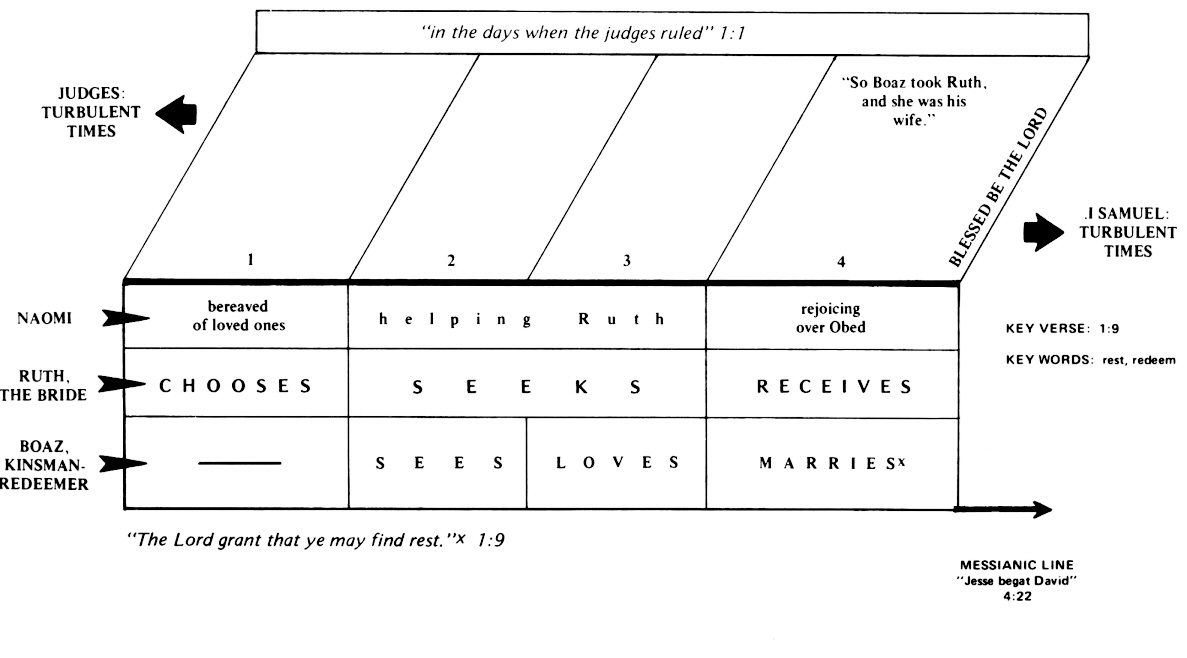
Irving Jensen's Survey of Bible (see his summary of Ruth online - page 392)
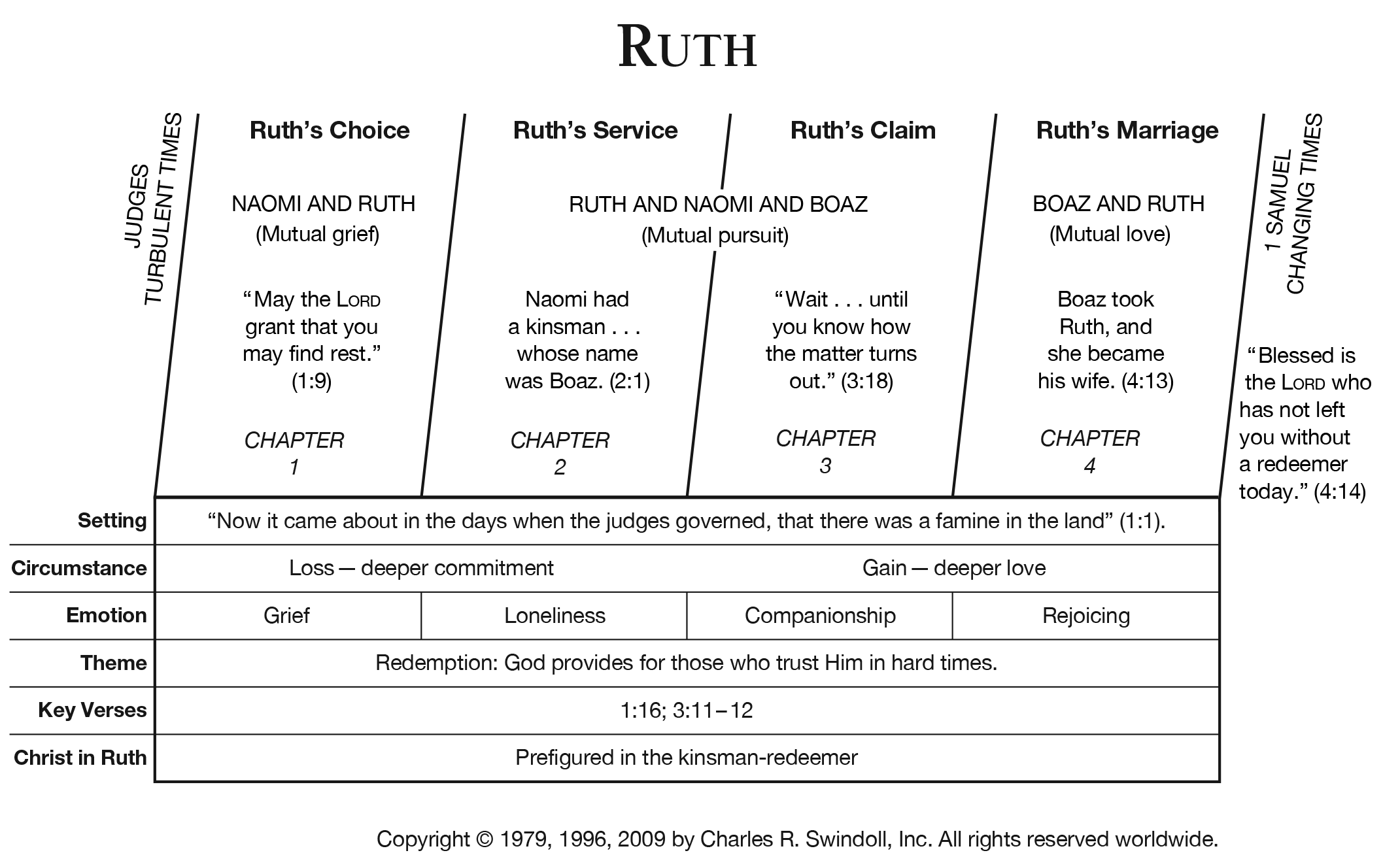
See Swindoll's summary chart of Ruth See Ruth Devotionals
|
RUTH: GOD PROVIDES |
|||
| Ruth 1 | Ruth 2 | Ruth 3 | Ruth 4 |
| Ruth's Choice | Ruth's Service | Ruth's Claim | Ruth's Marriage |
| Ruth's Resolve | Ruth's Rights | Ruth's Request | Ruth's Reward |
| Naomi and Ruth Mutual Grief |
Ruth and Naomi and Boaz Mutual Pursuit |
Boaz and Ruth Mutual Love |
|
| Ruth's Decision: Return with Naomi |
Ruth's Devotion: Provide for Naomi |
Ruth's Request: Redemption by Boaz |
Ruth's Reward: Relative of Messiah |
| Ruth and Naomi |
Ruth and Boaz |
||
| Death of Naomi's Family |
Ruth Cares for Naomi |
Boaz Cares for Ruth |
God Blesses with New Birth |
| Grief | Loneliness | Companionship | Rejoicing |
| Location: Plains of Moab |
Location: Fields of Bethlehem |
Location: Threshing floor of Bethlehem |
Location: Little town of Bethlehem |
| Time Lapsed: About 30 Years See Timeline |
|||
| Setting: Ru 1:1 Now it came about in the days when the judges governed Jdg 21:25+ In those days there was no king in Israel; everyone did what was right in his own eyes. |
|||

Ruth 2:15 When she rose to glean, Boaz commanded his servants, saying, "Let her glean even among the sheaves, and do not insult her.
Amplified: And when she got up to glean, Boaz ordered his young men, Let her glean even among the sheaves, and do not reproach her. (Amplified Bible - Lockman)
BBE: And when she got ready to take up the grain, Boaz gave his young men orders, saying, Let her take it even from among the cut grain, and say nothing to her.
KJV And when she was risen up to glean, Boaz commanded his young men, saying, Let her glean even among the sheaves, and reproach her not:
NET When she got up to gather grain, Boaz told his male servants, "Let her gather grain even among the bundles! Don't chase her off!
BBE And when she got ready to take up the grain, Boaz gave his young men orders, saying, Let her take it even from among the cut grain, and say nothing to her.
CSB When she got up to gather grain, Boaz ordered his young men, "Let her even gather grain among the bundles, and don't humiliate her.
ERV And when she was risen up to glean, Boaz commanded his young men, saying, Let her glean even among the sheaves, and reproach her not.
ESV When she rose to glean, Boaz instructed his young men, saying, "Let her glean even among the sheaves, and do not reproach her.
GWN When she got up to gather grain, Boaz ordered his servants, "Let her gather grain even among the bundles. Don't give her any problems.
NKJ And when she rose up to glean, Boaz commanded his young men, saying, "Let her glean even among the sheaves, and do not reproach her.
NAB She rose to glean, and Boaz instructed his servants to let her glean among the sheaves themselves without scolding her,
NIV As she got up to glean, Boaz gave orders to his men, "Even if she gathers among the sheaves, don't embarrass her.
NJB When she had got up to glean, Boaz gave orders to his work-people, 'Let her glean among the sheaves themselves. Do not molest her.
NLT When Ruth went back to work again, Boaz ordered his young men, "Let her gather grain right among the sheaves without stopping her.
NRS When she got up to glean, Boaz instructed his young men, "Let her glean even among the standing sheaves, and do not reproach her.
YLT And she riseth to glean, and Boaz chargeth his young men, saying, 'Even between the sheaves she doth glean, and ye do not cause her to blush;
Septuagint (LXX): kai aneste (3SAAI) tou sullegein (PAN) kai eneteilato (3SAMI) Boos tois paidariois autou legon (PAPMSN) kai ge ana meson ton dragmaton sullegeto (3SAAM) kai me kataischunete (2PPAS) auten
BGT καὶ ἀνέστη τοῦ συλλέγειν καὶ ἐνετείλατο Βοος τοῖς παιδαρίοις αὐτοῦ λέγων καί γε ἀνὰ μέσον τῶν δραγμάτων συλλεγέτω καὶ μὴ καταισχύνητε αὐτήν
English of Septuagint: And she rose up to glean; and Booz charged his young men, saying, Let her even glean among the sheaves, and reproach her not (do not shame her)
WHEN SHE AROSE TO GLEAN BOAZ COMMANDED THE SERVANTS SAYING LET HER GLEAN EVEN AMONG THE SHEAVES:
- Ruth 2 Resources - Multiple Sermons and Commentaries
Related Passages:
Leviticus 19:9; 10 ‘Now when you reap the harvest of your land, you shall not reap to the very corners of your field, nor shall you gather the gleanings of your harvest. 10 ‘Nor shall you glean your vineyard, nor shall you gather the fallen fruit of your vineyard; you shall leave them for the needy and for the stranger. I am the LORD your God.
WOMAN OF EXCELLENCE
DILIGENT IN HER LABORS
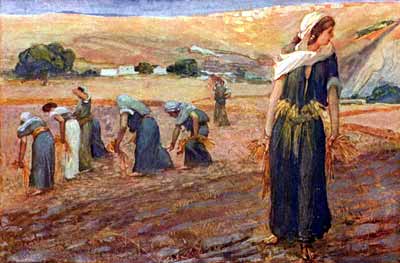
When (time phrase) she arose to glean (laqat) even among the sheaves - A woman of excellent is diligent in her labors, her duty to care for widows, showing real religion (James 1:27+). She clearly understood that Boaz had bestowed favor on her but she did not seek to take advantage of his kindness. Note not after but among! So what? Boaz granted Ruth unusual access to the area between the large piles of harvested grain!
Hubbard explains "Gleaners were presumably restricted from this area for two reasons: first, the owners’ desire to keep any dropped grain for themselves; and second, the temptation for unscrupulous gleaners secretly to take even piled sheaves. In essence, Boaz instructed, “She has my permission to glean there.....Access to the area between the piles of sheaves would increase Ruth’s daily harvest considerably since more dropped grain lay there than among the stalks. ” (See context in The Book of Ruth)
Boaz commanded the servants - Ruth did not have to seek to take advantage of Boaz's kindness -- Of his own volition he bestowed additional kindness on her. How like our Greater Boaz toward us! This was more generous than the command God Himself had issued in (Lev 19:9, 10+) because Boaz added the qualifier "among" the effect being to allow Ruth greater access than one could by trailing along after the workers as in (Ru 2:7+). In harvesting, the reapers would first, cut the barley stalks by the handful. They were followed by others who bound 8-10 of these handfuls into sheaves. Only after the sheaves were carted off were the poor permitted to pass over the field. But now Boaz permits Ruth to glean among his harvesters and even goes one step further in instructing them not to bind every handful but to even leave some loose for her (Ru 2:15). The actions of Boaz clearly indicate he is taking more than a passing interest in Ruth.
Henri Rossier notes that "The fellowship that Ruth has just found at Boaz's table does not cause her to forget her task. On the contrary, she draws new strength from it for fresh activity with more abundant and more blessed results than ever before. In order to be effective our work must flow from what we have received for ourselves and it will be all the richer in results the greater the measure in which we have personally enjoyed the Lord's presence. A heart nourished and refreshed by Christ can never be selfish. Is it not written: “Out of his belly shall flow rivers of living water” (John 7:38)? Ruth thinks of Naomi, and when she returns she brings her the remainder of her meal and that which she had gleaned. Likewise, the believer devotes the fruit of his labor to God's people and seeks their prosperity. How few Christian there are who realize these things! What importance does the prosperity of Christ's Church have for those who prefer their own church or their own people and their own gods? God's poor, afflicted people do not appear to be worth caring for to these indifferent hearts. They may perhaps insist on the work of the gospel before the world, but a heart that is in fellowship with the Lord does not sacrifice the one for the other. The apostle Paul was just as much a minister of the assembly as he was a minister of the gospel. He loved the Church which Christ in His love had purchased with His own blood. It was far from Paul to love a sect or a church of his own invention; he knew only Christ's Assembly, and he was jealous as to her with a jealousy which was of God, so that he might present her to the Lord as a chaste virgin. (Ruth)
Spurgeon applies these truths to prayer writing that "Ruth went to glean. She expected to get a few good ears, but Boaz said, “Let her glean even among the sheaves, and reproach her not” (Ruth 2:15+). Furthermore he said to her, “At mealtime come thou hither, and eat of the bread, and dip thy morsel in the vinegar” (Ruth 2:14). She found a husband where she only expected to find a handful of barley. So in prayer for others, God may give us such mercies that we will be astounded at them, since we expected but little." (from "The Prayers of Spurgeon", p1190)
Glean (03950) (laqat) means to pick up or to gather (manna, lilies, firewood, grapes, food etc), the Treasury of Scripture Knowledge writes that "The word glean comes from the French glaner to gather ears or grains of corn. This was formerly a general custom in England and Ireland: the poor went into the fields, and collected the straggling ears of corn after the reapers; and it was long supposed that this was their right, and that the law recognized it; but although it has been an old custom, it is now settled by a solemn judgment of the Court of Common Pleas, that a right to glean in the harvest field cannot be claimed by any person at common law. Any person may permit or prevent it on his own grounds. By the Irish Acts, 25 Henry VIII. c. 1, and 28 Henry VIII. c. 24, gleaning and leasing are so restricted as to be in fact prohibited in that part of the United Kingdom.
Sheaves (06016) (omer) refers to stalks of grain gathered and tied into a bundle after harvesting. The reapers either gathered the cut grain into sheaves themselves or left it to be collected by the sheaf binder. The sheaves were then gathered into stacks and loaded into carts. As discussed earlier the law directed that some stray stalks and sheaves should be left in the field for the poor and hungry to glean (Dt 24:19).
Gilbrant - Meaning "a sheaf of cut grain," ʿōmer is derived from the verb ʿāmar, "to gather," "to trade." According to Pentateuchal laws, the Israelites were to bring a sheaf of their initial harvest crop as an offering to the Lord (Lev. 23:10ff, 15). The priest was to wave the offering of firstfruits on the day after the Sabbath and then offer a burnt sacrifice, consisting of a one-year-old lamb without defect, followed by other cultic rituals. Also, Israelites were commanded to leave an occasional sheaf from the harvest to be gathered by the less fortunate of the community (Deut. 24:19). The application of this commandment was how Boaz met Ruth, who was gleaning such sheaves in his field (Ruth 2:7, 15). Job used this term figuratively when he emphatically denied his guilt to Eliphaz. He cited the world's injustice because the righteous carried sheaves, yet remained hungry (Job 24:10). (Complete Biblical Library)
Baker - I. A masculine noun referring to a sheaf of grain. It indicates ears of grain recently cut off the stalks (Lev. 23:10-12, 15; Deut. 24:19; Ruth 2:7, 15). Sheaves were to be left for the poor and hungry (Job 24:10). II. A masculine noun indicating an omer; a measure of grain. It is a dry measure of about two liters or two quarts (Ex. 16:16, 18, 22, 32, 33, 36). (Complete Word Study Dictionary- Old Testament)
Omer - 8v - sheaf(5), sheaves(3). Lev. 23:10; Lev. 23:11; Lev. 23:12; Lev. 23:15; Deut. 24:19; Ruth 2:7; Ruth 2:15; Job 24:10
AND DO NOT INSULT HER:
- Ruth 2 Resources - Multiple Sermons and Commentaries
do not cause her to blush (Young's)
don't embarrass her (NIV)
say nothing to her (BBE)
reproach her not (ASV, Septuagint)
don't give her any problems (GWT)
put her not to shame, (Jewish Pub Soc)
Don't chase her off. (NET)
Do not molest her (NJB)
don't say anything to stop her (TEV)
don't tell her to go away (ICB, NCV)
… without stopping her (NLT)
without scolding her (NAB).
DO NOT REPROACH RUTH OR
CAUSE HER TO BLUSH!
And do not insult (kalam; Lxx - kataischuno) her - Boaz had just given her extra permission and now adds "protection." Insult in the Hiphil normally has the strong sense “to shame, disgrace, humiliate” (Job 11:3; Prov. 25:8; etc.). See various renderings above. Note especially Young's Literal translation of this passage "And she riseth to glean, and Boaz chargeth his young men, saying, 'Even between the sheaves she doth glean, and ye do not cause her to blush" REMEMBER THE MIDDLE EAST CULTURE IS A HONOR-SHAME BASED CULTURE!
THOUGHT This is a vitally important section of Ruth for godly husbands to strive (cp Paul's striving in Col 1:29+ and note ultimately his power source) to emulate (enabled by the Spirit and grace, Php 2:13NLT+). So take a moment to meditate upon this section that you might understand practically how you as a husband are to carry out your role as covenant defender of your covenant partner in the Covenant of Marriage (see discussion). Have you ever caused your wife to blush in public? If so, you were not functioning as her covenant defender (See notes on Covenant Defender)
Do not insult her (03637) (kalam) means to be disgraced as one would be when subjected to public humiliation. Kalam describes a sense of disgrace accompanying public humiliation. It means to be humiliated, made ashamed, embarrassed, humiliated, disgraced, made to blush. It describes something that humiliates (2 Sa 10:5), causes shame (2 Sa 19:3, Jer 14:3), of social disgrace (Nu 12:14)
Oswalt says "kālam seems to refer to 1) wounding of the body (1 Sa 25:7, 15), 2) wounding of the spirit through public humiliation (2 Sa 20:34), and 3) wounding of the spirit because of defeat and captivity....There were some kinds of activity by which a person ought to be humiliated even without being reproached for them. Prostitution was one of these and the prophets charged the Hebrew people with religious prostitution. (Even the Philistines were embarrassed by the Hebrews' actions according to Ezekiel 16:27.) However, the people had not even the grace to blush (Jeremiah 3:3; Jeremiah 6:15; Jeremiah 8:12). Therefore, the prophets promised that shame would come from another quarter: defeat and captivity. If they would not be embarrassed and ashamed because of their sins, they would be so because of their helplessness (Isaiah 30:3; Ezekiel 32:30). However, Israel will not finally be ashamed through God's punishment, but rather through his goodness. According to Ezekiel (Ezekiel 16:54, 61, 63; Ezekiel 43:10-11) it is when God, in undeserved grace, restores Israel and defends her (cf. Isaiah 54:4) that Israel will become truly ashamed of the way she has treated him. (link to online TWOT)
The Septuagint translates kalam with Kataischuno which means to dishonor, disgrace, cause one to be put to shame, cause one to be humiliated.
Kalam - 40x in 38v - ashamed(6), bear her shame(1), blush(2), brought us to dishonor(1), confounded(1), disgraced(1), dishonored(7), embarrassed(1), feel ashamed(1), feel humiliated(1), humiliated(10), humiliates(2), humiliating(1), insult(1), insulted(3), rebuke(1). Num. 12:14; Jdg. 18:7; Ruth 2:15; 1 Sam. 20:34; 1 Sam. 25:7; 1 Sam. 25:15; 2 Sam. 10:5; 2 Sam. 19:3; 1 Chr. 19:5; 2 Chr. 30:15; Ezr. 9:6; Job 11:3; Job 19:3; Ps. 35:4; Ps. 40:14; Ps. 44:9; Ps. 69:6; Ps. 70:2; Ps. 74:21; Prov. 25:8; Prov. 28:7; Isa. 41:11; Isa. 45:16; Isa. 45:17; Isa. 50:7; Isa. 54:4; Jer. 3:3; Jer. 6:15; Jer. 8:12; Jer. 14:3; Jer. 22:22; Jer. 31:19; Ezek. 16:27; Ezek. 16:54; Ezek. 16:61; Ezek. 36:32; Ezek. 43:10; Ezek. 43:11
SHORT DIGRESSION ON NOW CAUSING ONE'S WIFE TO BLUSH
Husbands, listen up…
Do not embarrass your wives in public!
NEVER! NEVER! NEVER! UNDER ANY CIRCUMSTANCES!
I might add not just never in public, but also never in private!
THOUGHT - In fact quite to the contrary we are to be their PROTECTOR, their DEFENDER, because we are in covenant (see study Covenant: As It Relates to Marriage) with our wives and as such are obligated to be their COVERING. There is a beautiful picture in Paul's famous definition of genuine love which he teaches that…
LOVE…
BEARS ALL THINGS
(1Cor 13:7+)
The verb for bears is the interesting Greek verb stego which has two shades of meaning and thus 1Cor 13:7 could mean that love bears all things in the sense that it patiently endures all things or (the meaning I favor for Paul has "endures" at the end of this verse which would be repetitious) that love hides or conceals the faults of others. Here are some of the other translations of 1Cor 13:7…
It is always ready to make allowances, to trust, to hope and to endure whatever comes. (NJB)
She knows how to be silent. She is full of trust, full of hope, full of patient endurance. (Weymouth)
If you love someone, you will be loyal to him no matter what the cost. You will always believe in him, always expect the best of him, and always stand your ground in defending him. (TLB)
Love is always supportive, loyal, hopeful, and trusting. (CEV)
Love has the power of undergoing all things, having faith in all things, hoping all things. (BBE)
Love enables us to endure everything; it enables us in every circumstance to keep on believing, to keep our confidence in God, and to remain patient no matter what happens to us. (UBS)
(Love) never gives up (GNB)
EXCURSUS ON STEGO TO BEAR
Bears (4722) (stego from stege = a thatch or roof or covering of a building) derives its first meaning from stege and thus means to cover closely, to protect by covering and then, to conceal and then, by covering, to bear up under. To keep silent about something or to keep something confidential, both interesting thoughts to ponder in the context of part of the "definition" of love. Beloved, do you throw a cloak of silence over what is displeasing in another person. Note that at the core of its meaning stego denotes an activity or state which blocks entry from without or exit from within. Stego occurs in the apocryphal book Sirach 8:17 describing the fool who will not be able to conceal the matter. Moffatt translates it "slow to expose".
BDAG notes that stego in the Greek papyri was used frequently "in the sense of covering or enclosing in such a way as to keep something undesirable from coming in, as water into a ship. Friberg adds that stego means "strictly put a roof on; hence cover, keep silent about, keep confidential." Vincent writes that stego "keeps out resentment as the ship keeps out the water, or the roof the rain." W E Vine states that "the verb stego, to bear, signifies that what is mentioned either supports what is placed upon it, or covers what is placed underneath it. The former idea is prominent in 1 Corinthians 9:12; 1Thessalonians 3:1; 3:5+. The present statement may convey both ideas, for love acts in both ways in bearing all things. That which covers both protects what is covered, by keeping off all that is hostile, and in doing so endures the hostility (cp. 1Cor 9:12). (Collected writings of W. E. Vine)
F F Bruce comments that "Love covers unworthy things rather than bringing them to the light and magnifying them. It puts up with everything. It is always eager to believe the best and to "put the most favorable construction on ambiguous actions." (Bruce, F. F. 1 and 2 Corinthians. New Century Bible Series. 1971)
Robertson and Plummer offer the caveat that even though agape love covers others faults and sins this does not mean "that a Christian is to allow himself to be fooled by every rogue, or to pretend that he believes that white is black. But in doubtful cases he will prefer being too generous in his conclusions to suspecting another unjustly. (Robertson, A T and Plummer, A. A Critical and Exegetical Commentary on the First Epistle of St Paul to the Corinthians. International Critical Commentary series. Second ed. Edinburgh: T. & T. Clark, 1963)
Love is that beautiful virtue that throws a cloak of silence over what is displeasing in another person. From this meaning one derives the picture of covering things with the cloak of love. In addition, in favor of the intended meaning as covers over, protects, etc is the fact that this translation would eliminate redundancy for the last clause also reads endures all things.
Stego is used only 4 times in the NT…
1 Corinthians 9:12 If others share the right over you, do we not more? Nevertheless, we did not use this right, but we endure all things, that we may cause no hindrance to the gospel of Christ.
1 Corinthians 13:7 bears all things, believes all things, hopes all things, endures all things.
1 Thessalonians 3:1 Therefore when we could endure (stego) it no longer, we thought it best to be left behind at Athens alone. (See note 1Thessalonians 3:1)
1 Thessalonians 3:5 For this reason, when I could endure (stego) it no longer, I also sent to find out about your faith, for fear that the tempter might have tempted you, and our labor should be in vain. (See note 1Thessalonians 3:5) (Comment: As explained above, this does not appear to be Paul's primary intended meaning here in 1Cor 13:7)
Spirit controlled and empowered believers love as a lifestyle by choosing as an act of their will (even that choice enabled by the Spirit Ezekiel 36:27+, see Phil 2:13NLT+) to cover over in silence, to ''hide'' the faults of others, to bear with or endure. Love doesn’t broadcast another's problems to everyone. Love doesn’t run down others with jokes, sarcasm or put-downs. Love defends the character of the other person as much as possible within the limits of truth. Love won’t lie about weaknesses, but neither will it deliberately expose and emphasize them. Love protects.
And so instead of becoming embittered (Col 3:18+) the Spirit filled (Ep 5:18+) husband "covers" his wife's faults and frailties. This does not mean one turns grace into licentiousness, but that he lives with his wife in an understanding way (1Pe 3:7+)… he gets to know her… he loves her sacrificially and selflessly as Christ loved the church (Ep 5:26+).
Authentic Agape Love continually seeks to cover and protect (NIV ''love always protects'') the object that is loved and for husbands this applies especially to our wives! Love protects other people. It doesn't broadcast bad news. It goes the second mile to protect another person's reputation. Love doesn't point out every flaw of the ones you love. Love doesn't criticize in public.
Wesley writes that "Whatever evil the lover of mankind sees, hears, or knows of any one, he mentions it to none; it never goes out of his lips, unless where absolute duty constrains to speak. (Wesley's Notes: First Corinthians)
MacDonald adds that "Love does not needlessly publicize the failures of others, though it must be firm in giving godly discipline when necessary. (See context in Believer's Bible Commentary)
Peter made a similar statement in his first epistle exhorting his readers "Above all, keep fervent in your love for one another, because love covers (kalupto = throws a veil over - continually = present tense - Just try this in your own strength! You can't do it! You must be filled Ep 5:18+) a multitude of sins. (1Pe 4:8+)
John MacArthur adds that the verb stego "basically means to cover or to support and therefore to protect. Love bears all things by protecting others from exposure, ridicule, or harm. Genuine love does not gossip or listen to gossip. Even when a sin is certain, love tries to correct it with the least possible hurt and harm to the guilty person. Love never protects sin but is anxious to protect the sinner. Fallen human nature has the opposite inclination. There is perverse pleasure in exposing someone’s faults and failures. As already mentioned, that is what makes gossip appealing. The Corinthians cared little for the feelings or welfare of fellow believers. It was every person for himself. Like the Pharisees, they paid little attention to others, except when those others were failing or sinning. Man’s depravity causes him to rejoice in the depravity of others. It is that depraved pleasure that sells magazines and newspapers that cater to exposes, “true confessions,” and the like. It is the same sort of pleasure that makes children tattle on brothers and sisters. Whether to feel self–righteous by exposing another’s sin or to enjoy that sin vicariously, we all are tempted to take a certain kind of pleasure in the sins of others. Love has no part in that. It does not expose or exploit, gloat or condemn. It bears; it does not bare. (See context in 1 Corinthians MacArthur New Testament Commentary)
LIVE WITH YOUR WIVES
IN AN UNDERSTANDING WAY
In another verse which all husbands should memorize and then diligently seek to practice (enabled by the Spirit) is Peter's instruction for us as husbands to
live with your wives in an understanding way, as with a weaker vessel, since she is a woman; and grant her honor (NIV = "treat them with respect") as a fellow heir of the grace of life, so that your prayers may not be hindered. (1Pe 3:7+)
Husbands should continually strive in His power which mightily works within them (cp Col 1:29+) to treat their wives like precious jewels, as if they are a gift from God (cp Jas 1:17+) to be treasured, reassured, protected, and loved, with every tender provision being made for them. Boaz was already beginning to answer the very prayer he had uttered that same day (Ru 2:12+ "May the LORD reward your work… ")
As an aside, a "Boaz like" husband needs to study his wife that he might grow in knowledge of his wife’s moods, feelings, needs, fears, and hopes. He needs to “listen with his heart” that he might be able to speak to her heart (Ru 1:13+) as he shares meaningful communication with her in lieu of the usual "pious platitudes"! How can a husband show consideration for his wife if he does not understand her needs or problems? To say, “I never knew you felt that way!” is to confess that, at some point, one mate excommunicated the other. When either mate is afraid to be open and honest about a matter, then he or she is building walls and not bridges.
Ruth 2:16 Also you shall purposely pull out for her some grain from the bundles and leave it that she may glean, and do not rebuke her. (NASB: Lockman)
Amplified: And let fall some handfuls for her on purpose and let them lie there for her to glean, and do not rebuke her. (Amplified Bible - Lockman)
BBE: And let some heads of grain be pulled out of what has been corded up, and dropped for her to take, and let no sharp word be said to her.
CEV: Be sure to pull out some stalks of grain from the bundles and leave them on the ground for her. And don't speak harshly to her!" (CEV)
CSB Pull out some stalks from the bundles for her and leave them for her to gather. Don't rebuke her."
ERV And also pull out some for her from the bundles, and leave it, and let her glean, and rebuke her not.
ESV And also pull out some from the bundles for her and leave it for her to glean, and do not rebuke her."
GWT: Even pull some grain out of the bundles and leave it for her to gather. Don't give her a hard time about it." (GWT)
KJV: And let fall also some of the handfuls of purpose for her, and leave them, that she may glean them, and rebuke her not.
NET: Make sure you pull out ears of grain for her and drop them so she can gather them up. Don't tell her not to!"
NLT: And pull out some heads of barley from the bundles and drop them on purpose for her. Let her pick them up, and don't give her a hard time!" (NLT - Tyndale House)
Young's Literal: and also ye do surely cast to her of the handfuls -- and have left, and she hath gleaned, and ye do not push against her.'
Septuagint (LXX): kai bastazontes (PAPMPN) bastazate (2PAAM) aute kai ge paraballontes (PAPMPN) parabaleite (2PFAI) aute ek ton bebounismenon (RPNPG) kai aphete (2PAAM) kai sullexei (3PFAI) kai ouk epitimesete (2PFAI) aute
English of Septuagint: And do ye by all means carry it for her, and ye shall surely let fall for her some of that which is heaped up; and let her eat, and glean, and rebuke her not
AND ALSO YOU SHALL PURPOSELY PULL OUT FOR HER SOME GRAIN FROM THE BUNDLES AND LEAVE IT THAT SHE MAY GLEAN AND DO NOT REBUKE HER:
- Ruth 2 Resources - Multiple Sermons and Commentaries
- Dt 24:19, 20, 21; Ps 112:9; Pr 19:17; Mt 25:40; Ro 12:13; 2Co 8:5, 6, 7, 8, 9, 10, 11; Philemon 1:7; Heb 6:10; 1Jn 3:17, 3:18
don't give her a hard time (NLT)
let no sharp word be said to her (BBE)
don't speak harshly to her (CEV)
do not push against her (Young's Literal)
Don't yell at her. (NET)
Do not scold her. (NJB)
don't speak harshly to her (CEV)
not to make any remarks (TLB)
don't give her a hard time about it (GWT)
don't rebuke her (NIV)
GIVE HANDFULS
ON PURPOSE!
Also you shall purposely pull out for her some grain from the bundles and leave it that she may glean, and do not rebuke her - NET - "Make sure you pull out ears of grain for her and drop them so she can gather them up. Don't tell her not to!" KJV - "let fall also some of the handfuls of purpose for her" Boaz has just been generous in the previous passage and now goes a step further (like God goes with us Eph 3:20)! Boaz is saying in effect to his servants, "Grab from the bundles of sheaves as though you were taking a spoil for her." Furthermore Ruth was not to know that this was Boaz' gift to her, and she would assume she was gleaning it on her own.
Selwyn Hughes writes "I love the way the Amplified Bible describes this moment: "And let fall some handfuls for her on purpose." "Handfuls — on purpose." What a beautiful expression. It is a picture of how God goes before each one of His toiling servants and lets fall "handfuls on purpose" - some tokens of His goodness, some special encouragement, some evidence of His care, that serves to keep us moving forward and keep our hearts bent on the divine task. Has there not been a time in your life when, overcome with the weight and burden of the day, you were about ready to give up the task God had given you, and suddenly He let fall some "handful on purpose"? Have you not experienced such a moment of divine encouragement? Perhaps it was a word in a sermon, a word from Scripture which was quickened by the Spirit to your heart, or perhaps a line in a devotional commentary. How gracious and loving is our Lord.
Guzik adds "How beautiful! Boaz wants to bless Ruth, but he doesn’t want to dishonor her dignity by making her a “charity” case. So he will let some grain “accidentally” fall, so she can pick it up."
Hubbard - Again, this was a stunning, unheard-of favor! Certainly, the law never called for such a thing (cf. Deut. 24:19). The audience may have wondered how to account for it. What lay behind the unusual interest in this foreigner? Had Boaz fallen in love with Ruth? Or did he act simply from familial devotion? Obviously, his benevolence had made a beginning for them; now they knew each other. Ruth’s initiative (vv. 2, 7) had been more than rewarded. And Boaz modeled another aspect of devotion: he generously gave from what he had to those in need. Indeed, he treated Ruth as kindly as Yahweh treated Israel. Given v. 12, one suspects that this generosity was but a “down payment” which foreshadowed Yahweh’s “full payment” of Ruth. Hence, Boaz has begun to emerge as the instrument through whom Yahweh might answer his petition—a fact at which the audience probably chuckled since neither Boaz nor Ruth seemed fully aware of the possibility. As with v. 1, the audience knew—or at least suspected—something that the characters did not! (See context in The Book of Ruth)
Purposely pull out (07997) (shalal) is a verb that has 2 senses (1) to pull out as when extracting grain from a larger bundle (only used this way in Ru 2:15) and (2) to despoil, plunder, overcome another an destroy their goods and/or take some of it.
Gilbrant - Occurring sixteen times in the Hebrew Bible, shālal has cognates attested in all branches of Semitic. The verb appears primarily in contexts in which divine judgment is being meted out. Assyria, the rod of the judgment of Yahweh, would come "to plunder" the godless nation of Judah (Isa. 10:6). The Babylonians appeared to plunder the Assyrians who would suffer divine wrath, and in turn, the Babylonians themselves would be plundered (Hab. 2:8). Babylon was used to plunder the wealthy Phoenician city of Tyre in the course of divine judgment against this commercial empire (Ezek. 26:12). Indeed, as a reward for the efficaciousness of their attack on Tyre, the Babylonians were to be further rewarded by Yahweh through their conquest of Egypt (29:19). The Chaldeans would be plundered and its plunderers would be sated with the wealth they seized (Jer. 50:10). The planned campaign of Gog of Magog (a region in Asia Minor) will be thwarted by Yahweh. The plan was to go about plundering (Ezek. 38-39). Indeed, all the plunderers of Judah will receive the judgment of Yahweh against their actions concerning his people (Zech. 2:8). This future victory is celebrated in Ps. 76:5 in which by the rebuke of Yahweh the stouthearted are stripped of their spoil. The verb is also used in the context of individuals being robbed. All those who turn from evil are in turn plundered by evil persons, invoking the anger of Yahweh (Isa. 59:15). An extension of the semantic range of the verb is evidenced in Ruth 2:16. The servants of Boaz were ordered to pull out some of the grain from their sheaves in order for Ruth to glean. The nuance of the verb in this context conveys that she was allowed to obtain even more food than Boaz was obligated to give her, for gleaning laws had to do with excess grain on the fringes of a person's land.
Shalal - Ruth 2:16; Ps. 76:5; Isa. 10:6; Isa. 59:15; Jer. 50:10; Ezek. 26:12; Ezek. 29:19; Ezek. 38:12; Ezek. 38:13; Ezek. 39:10; Hab. 2:8; Zech. 2:8
Rebuke (01605) (gaar) refers to a check applied to a person by giving them a strong admonition. The Septuagint translates ga'ar with the Greek verb epitimao (2208) which describes a sharp rebuke (stern adverse criticism) or censure (a judgment involving condemnation). See the above translations and paraphrases for nuances.
Ga'ar - 13v in the OT - Gen 37:10; Ruth 2:16; Ps 9:5; 68:30; 106:9; 119:21; Isa 17:13; 54:9; Jer 29:27; Nah 1:4; Zech 3:2; Mal 2:3; 3:11
Ruth 2:17 So she gleaned in the field until evening. Then she beat out what she had gleaned, and it was about an ephah of barley. (NASB: Lockman)
Amplified: So she gleaned in the field until evening. Then she beat out what she had gleaned. It was about an ephah of barley. (Amplified Bible - Lockman)
BBE: So she went on getting together the heads of grain till evening; and after crushing out the seed it came to about an ephah of grain.
CEV: Ruth worked in the field until evening. Then after she had pounded the grain off the stalks, she had a large basket full of grain. (CEV)
GWT: So Ruth gathered grain in the field until evening. Then she separated the grain from its husks. She had about half a bushel of barley. (GWT)
KJV: So she gleaned in the field until even, and beat out that she had gleaned: and it was about an ephah of barley.
NLT: So Ruth gathered barley there all day, and when she beat out the grain that evening, it came to about half a bushel. (NLT - Tyndale House)
Young's Literal: And she gleaneth in the field till the evening, and beateth out that which she hath gleaned, and it is about an ephah of barley;
Septuagint (LXX): kai sunelexen (3SAAI) en to agro eos esperas kai errabdisen (3SAAI) a sunelexen (3SAAI) kai egenethe (3SAPI) os oiphi krithon
English of Septuagint: So she gleaned in the field till evening, and beat out that she had gleaned, and it was about an ephah of barely
SO SHE GLEANED IN THE FIELD UNTIL EVENING:
- Ruth 2 Resources - Multiple Sermons and Commentaries
THE DILIGENCE OF A
WOMAN OF EXCELLENCE
With this passage, we come to the end of the eventual day of th escene in the field.
So she gleaned in the field until evening. Then she beat out what she had gleaned, and it was about an ephah of barley - The Hebrew word for "evening" (06153) means dusk, the time of the day immediately preceding and following the setting of the sun. Ruth's gleaning (with no record of grumbling) until dusk speaks of her diligence to the task at hand. Read Spurgeon's devotional below'. In this section we see that Ruth certainly fulfilled the criteria of a Proverbs 31 woman which describes her as one who "looks well to the ways of her household, and does not eat the bread of idleness." (Pr 31:27) Ruth is anything but idle! God had blessed her. Boaz had been generous. But this benevolence didn't keep her from working hard. As believers we are all called to emulate her example, "not lagging behind (not slow, indolent, lazy, sluggish, slothful) in diligence (zeal)" (Ro 12:11+) Ruth was a woman of faith, but she was likewise found faithful in every task. True faith produces faithfulness for “Faith without works is useless” (Jas 2:20+)
As John Calvin’s stated "Faith alone saves, but the faith that saves is not alone."
To reiterate, although Boaz extended to Ruth extraordinary privileges ("grace upon grace" cp Jn 1:16 our "greater Boaz"), she did not fail to avail herself of his favor and to apply herself to the task at hand. She would not have filled her basket if she had not labored. Ruth was not one who held to the popular saying "Let go and let God." God certainly had done His part (providentially orchestrating Boaz and Ruth's chance encounter, etc) but she followed through doing her part and so too must we in whatever "field" God has graciously given us to "glean" in. Remember that the English dictionary defines glean as slowly and carefully gathering in small pieces.
In this verse the narrator goes on to say that she gleaned until evening and then before she quit, she beat out what she gleaned, measured it and took it home to Naomi. Ruth is a woman any woman (or man for that matter) would do well to emulate and imitate. She took the initiative to care for her destitute mother-in-law. She was humble and meek and never presumptuous or murmuring (cp Php 2:14+). And she worked hard from sun up to sundown. Initiative. Lowliness. Industry. Worthy traits. Keep your eyes open for them as the story unfolds.
Matthew Henry draws an excellent conclusion noting that Ruth "took care not to lose time, for she gleaned until evening. We must not be weary of well-doing, because in due season we shall reap (Gal 6:9+; Heb 12:3+). She did not make an excuse to sit still, or go home, till the evening. Let us work the works of Him that sent us, while it is day (Jn 9:4). She scarcely used, much less did she abuse, the kindness of Boaz; for, though he ordered his servants to leave handfuls for her, she continued to glean the scattered ears.
GLEANING SPIRITUALLY LIKE RUTH GLEANED LITERALLY C H Spurgeon writes…
Let me learn from Ruth, the gleaner.
(1) As she went out to gather the ears of corn, so must I go forth into the fields of prayer, meditation, the ordinances, and hearing the word to gather spiritual food.
(2) The gleaner gathers her portion ear by ear; her gains are little by little: so must I be content to search for single truths, if there be no greater plenty of them. Every ear helps to make a bundle, and every gospel lesson assists in making us wise unto salvation.
(3) The gleaner keeps her eyes open: if she stumbled among the stubble in a dream, she would have no load to carry home rejoicingly at eventide. I must be watchful in religious exercises lest they become unprofitable to me; I fear I have lost much already—O that I may rightly estimate my opportunities, and glean with greater diligence.
(4) The gleaner stoops for all she finds, and so must I. High spirits criticize and object, but lowly minds (humble minds) glean and receive benefit. A humble heart is a great help towards profitably hearing the gospel. The engrafted soul-saving word is not received except with meekness. A stiff back makes a bad gleaner; down, master pride, thou art a vile robber, not to be endured for a moment.
(5) What the gleaner gathers she holds: if she dropped one ear to find another, the result of her day’s work would be but scant; she is as careful to retain as to obtain, and so at last her gains are great. How often do I forget all that I hear; the second truth pushes the first out of my head, and so my reading and hearing end in much ado about nothing! Do I feel duly the importance of storing up the truth?
(6) A hungry belly makes the gleaner wise; if there be no corn in her hand, there will be no bread on her table; she labors under the sense of necessity, and hence her tread is nimble and her grasp is firm;
I have even a greater necessity, Lord, help me to feel it, that it may urge me onward to glean in fields which yield so plenteous a reward to diligence. (Spurgeon's Devotional on Gleaning in God's Field from Morning and Evening)
THEN SHE BEAT OUT WHAT SHE HAD GLEANED AND IT WAS ABOUT AN EPHAH OF BARLEY:
- Ex 16:36; Ezekiel 45:11 12
- Ruth 2 Resources - Multiple Sermons and Commentaries
"Then she separated the grain from its husks." (GWT)
"Then she threshed the barley she had gathered" (NIV)
"Then she separated the grain from the chaff" (ICB)
She beat out (02251) or ''threshed'' the grain, removing the kernel of grain from its stalk (cf Dt 24:20 and figurative use in Isa 27:12). A stick or a rock was used to beat the stalks to separate the grain from the chaff. When the quantity of grain was small, it was beat out by means of a stick which effects the separation of the kernel from the stalk. Under ordinary circumstances a gleaner would have been well satisfied with about half of what Ruth obtained for a day’s work. The divine blessings called down upon Ruth by Boaz have begun to materialize, exceeding abundantly beyond all that she could have asked for or hoped for, especially considering that she went out to the master's field empty.
An ephah has been estimated to be from 2/3's of a bushel to a full bushel (there is variation in this estimate in the commentaries), certainly enough to feed herself and Naomi for about many days, variously estimated at 5-10 days. An ephah equated with 10 omers, and one omer of manna was adequate for the daily needs of one man in the wilderness wandering. (Ex 16:16, 36)
Hubbard - Ruth’s industry paid off handsomely. At day’s end she beat out the collected grain with a curved stick or wooden hammer. (Heb. ḥāḇaṭ (“to beat out [with a stick]”) was a technical term used for the threshing of small quantities of grain; cf. Jdg. 6:11; Deut. 24:20 (with olives); Gerleman, p. 27; BDB, p. 286; LXX (rhabdîzō, “to beat with a stick”). Larger quantities of grain would be threshed on an open floor by hoofs of cattle and horses, or by the wheels of threshing carts (Isa. 28:27, 28).)....The beating separated the husks from the kernels and thereby reduced the load to be carried home. Presumably, when she was done, she collected the kernels in her shawl for transport....The word ephah was a loanword from Egyptian that probably meant “basket” (cf. Zech. 5:5–11) and secondarily a basket’s capacity (i.e., “basketful”). In the OT, it was a standard unit of dry measure in grain commerce (Amos 8:5; Mic. 6:10)...The fact that an ephah equaled the liquid measure baṯ (“bath,” Ezek. 45:11, 14) provides the only clue to its quantity. Jars marked bt (ca. 8th cent. B.C.) found at Tell Beit Mirsim and Lachish had an approximate capacity of 22 liters (5.8 U.S. gallons) or one-half to three-fifths of a bushel. Thus, the ephah would have weighed about 29 (U.S.) pounds. But why cite the statistic? To stress that for Ruth to collect an ephah in one day’s work was truly astonishing. Such a startling quantity of grain testified both to Boaz’s generosity and to Ruth’s industry. The workers evidently had followed Boaz’s instructions! To put the amount in perspective, one should remember that in the Old Babylonian period the ration of a male worker at Mari rarely exceeded 1–2 pounds per day. This meant that Ruth collected the equivalent of at least half a month’s wages in one day. (See context in The Book of Ruth) (Bolding added)
Boaz's generosity is measured by the fact that he had left for Ruth many times more than her daily need (cp grace - unmerited favor; Jas 4:6 "greater grace" - greater than the need). Such a large quantity could not have been acquired in a day by an ordinary gleaner. It shows how Boaz's instructions to his reapers aided Ruth and also how diligently Ruth had worked.
Ruth the Moabitess is an amazing worker as the head foreman had testified earlier explaining to his master Boas that "she came here and has been on her feet from daybreak until now. She just sat down this minute in the shelter." (GWT paraphrase of Ruth 2:7)
Carr comments…Ruth got what she did because she was willing to work for it! She gleaned and she got! The same is true in spiritual matters! You get out of something about as much as you put into it! Whether it be prayer, worship or just victory in your daily life, it isn't for the lazy! God's best is reserved for those who are willing to deny themselves, take up His cross daily and follow Him, (Mt 16:24, Mk 8:34)
THOUGHT - How might we apply this truth truth about threshing? After we have "gleaned" in a wonderful Bible study (e.g., a Precept Inductive Bible Study) for a period of time, being diligent to never miss a discussion or a lecture, it behooves each of us to then take what we have "gleaned" and to "beat out of the barley" so to speak: We need to take time to meditate on the Scriptures studied and discussed, pondering how God wants us to respond to the "stalks of truth" revealed. We not only might begin to find that truth becoming more real in our everyday thinking, but we might also be surprised to find that we had "gleaned" far "more barley" than we originally thought, more than enough to satisfy our soul's deepest desires!
Ruth 2:18 She took it up and went into the city, and her mother-in-law saw what she had gleaned. She also took it out and gave Naomi what she had left after she was satisfied. (NASB: Lockman)
Amplified: And she took it up and went into the town; she showed her mother-in-law what she had gleaned, and she also brought forth and gave her the food she had reserved after she was satisfied. (Amplified Bible - Lockman)
BBE: And she took it up and went into the town; and she let her mother-in-law see what she had got, and after taking enough for herself she gave her the rest.
CEV: She took the grain to town and showed Naomi how much she had picked up. Ruth also gave her the food left over from her lunch. (CEV)
GWT: She picked it up and went into the town, and her mother-in-law saw what she had gathered. Ruth also took out what she had left over from lunch and gave it to Naomi. (GWT)
KJV: And she took it up, and went into the city: and her mother in law saw what she had gleaned: and she brought forth, and gave to her that she had reserved after she was sufficed.
NLT: She carried it back into town and showed it to her mother-in-law. Ruth also gave her the food that was left over from her lunch. (NLT - Tyndale House)
Young's Literal: and she taketh it up, and goeth into the city, and her mother-in-law seeth that which she hath gleaned, and she bringeth out and giveth to her that which she left from her satiety.
Septuagint (LXX): kai eren kai eiselthen eis ten polin kai eiden e penthera autes a sunelexen kai ecenegkasa Routh edoken aute a katelipen ex on eneplesthe
English of Septuagint: And she took it up, and went into the city: and her mother-in-law saw what she had gleaned, and Ruth brought forth and gave to her the food which she had left from what she had been satisfied with
SHE TOOK IT UP AND WENT INTO THE CITY AND HER MOTHER IN LAW SAW WHAT SHE HAD GLEANED SHE ALSO TOOK IT OUT AND GAVE NAOMI WHAT SHE HAD LEFT AFTER SHE WAS SATISFIED:
- Ruth 2:14; Jn 6:12;13 1Ti 5:4
- Ruth 2 Resources - Multiple Sermons and Commentaries
RUTH RETURNS
WITH REWARD
Remember that these events are all occurring on one day. What a contrast with the previous 10 years of affliction!
She took it up and went into the city, and her mother-in-law saw what she had gleaned - Naomi saw the bulging bundle of grain and realized this was supranormal for gleaners of grain. Mara's (bitter) name is beginning to return to Naomi (pleasant) as she sees this abundant harvest.
She also took it out and gave Naomi what she had left after she was satisfied (soba) - NLT = "Ruth also gave her the food that was left over from her lunch." After she was satisfied refers to Ruth's satisfying meal in Ru 2:14. And this gift to Naomi was even "pre-cooked" (roasted grain)!
Matthew Henry makes a good point "When she had got her corn into as little compass as she could, she took it up herself, and carried it into the city, though, had she asked them, it is likely some of Boaz's servants would have done that for her. We should study to be as little as possible troublesome to those that are kind to us. She did not think it either too hard or too mean a service to carry her corn herself into the city, but was rather pleased with what she had gotten by her own industry, and careful to secure it; and let us thus take care that we lose not those things which we have wrought, which we have gained, 2Jn. 8.
Gill comments that "gave Naomi what she had left after she was satisfied" does not mean that Ruth and Naomi "ate of the barley… and then she gave her the rest to lay up against another time, as some interpret it; but the remainder of the food which Boaz gave her at dinner time, which she could not eat, (Ru 2:14+) she reserved for her mother, and now gave it to her; an instance of that piety commended by the apostle"
Paul who writes that "if any widow has children or grandchildren, they must first learn (note it does not come naturally but requires intentional learning by inquiry & observation) to practice piety (eusebeo - from eu = well + sebomai = worship) in regard to their own family and to make some return to (to pay or give back, implying a debt) their parents; for this is acceptable in the sight of God. (1Ti 5:4)
Guzik quips that "Besides all the barley grain, Ruth brought Naomi the “doggie bag” from the meal with Boaz. What a blessing for Naomi!
Hubbard - By now Naomi’s head was probably swimming. To glean so much grain was astounding, but to come home with cooked food was a shock that required explaining. Indeed, it sparked Naomi’s excited questions (Ru 2:19). (See context in The Book of Ruth)
Satisfied (07648) (soba) means to be satisfied by nourishment. It speaks of abundance, satisfaction, fullness. A state of satiation, overfulness, being stuffed. See the related Hebrew word (saba) in (Ru 2:14+)
Baker - A masculine noun indicating an abundance, satisfaction, fullness. It refers to a state of satiation, overfullness, being stuffed (Ex. 16:3; Lev. 25:19) but usually in a good sense. If Israel obeyed, they would enjoy God's blessing of fullness of food (Lev. 26:5; Deut. 23:24[25]). It is used in a figurative sense of the fullness of joy (Ps. 16:11); and of the fullness of food that God gave the Israelites in the wilderness (Ps. 78:25). Righteous persons will have enough and more to meet their needs (Pr 13:25). (Complete Word Study Dictionary- Old Testament)
Gilbrant - Sōbaʿ usually refers to the sating of physical hunger. The Israelites whined in the desert, longing for the food of Egypt, wishing to die there sated rather than to die of starvation in the desert (Ex 16:3). Yahweh heard this request and gave the people manna, "angels' food" (Ps. 78:25). Yahweh promised to sate those who would obey the laws concerning the Sabbatical Year (Lev. 25:19; 26:5). Ruth gave Naomi the excess grain she gleaned, that which was left over after she had been sated (Ruth 2:18). Metaphorically, sating a desire is "satisfying of his soul" (Prov. 13:25), though the fool cannot resist trying to fulfill sinful desires. The psalmist declared that Yahweh is able to show anyone the path to fullness of joy (Ps. 16:11). (Complete Biblical Library)
Soba - 8x in the OT - Ex 16:3; Lev 25:19; 26:5; Dt 23:24; Ru 2:18; Ps 16:11; 78:25; Pr 13:25
Psalm 16:11 Thou wilt make known to me the path of life; In Thy presence is fulness (Hebrew = soba; Lxx = pleroo [word study] = fill full with idea of totality, filled up completely) of joy; In Thy right hand there are pleasures forever.
Spurgeon: Thou wilt shew me the path of life. To Jesus first this way was shown, for he is the first begotten from the dead, the firstborn of every creature. He himself opened up the way through his own flesh, and then trod it as the forerunner of his own redeemed. The thought of being made the path of life to his people, gladdened the soul of Jesus.
In thy presence is fulness of joy. Christ being raised from the dead ascended into glory, to dwell in constant nearness to God, where joy is at its full for ever: the foresight of this urged Him onward in His glorious but grievous toil. To bring His chosen to eternal happiness was the high ambition which inspired Him, and made Him wade through a sea of blood. O God, when a worldling's mirth has all expired, for ever with Jesus may we dwell at Thy right hand, where there are pleasures for evermore; and meanwhile, may we have an earnest by tasting Thy love below.
Trapp's note on the heavenly verse which closes the Psalm is a sweet morsel, which may serve for a contemplation, and yield a foretaste of our inheritance. He writes, "Here is as much said as can be, but words are too weak to utter it. For quality there is in heaven joy and pleasures; for quantity, a fulness, a torrent whereat they drink without let or loathing; for constancy, it is at God's right hand, who is stronger than all, neither can any take us out of his hand; it is a constant happiness without intermission: and for perpetuity it is for evermore.
Heaven's joys are without measure, mixture, or end.
F B Meyer has the following notes on …
RUTH 2 RUTH, THE GLEANER - Ruth 2:18-23 Naomi, the anxious mother. -- How gladdened were those aged eyes with ephah (between three and four pecks) of barley, and with the reserves from the mid-day meal. We ought to bring home from every service the reserves of what we have heard (Ruth 2:18).
Man's kindness will sometimes soften a hard and weary heart (cp Ru 1:13, 20), and enable it again to believe in the love of God (Ruth 2:20). An over-ruling Providence had guided the young stranger to the field of a kinsman (Ru 2:3), though she knew it not (Ruth 2:19). God remembers the prayers of the dead long after they have been offered, and answers them by mysterious providences, which show the eternal permanence and steadfastness of His love (Is 54:8, 9, 10; Ro 8:28). (F. B. Meyer. CHOICE NOTES ON JOSHUA THROUGH 2 KINGS)
TAKING NOTICE Ruth 2:18-23
A husband and wife were celebrating their golden wedding anniversary. After attending a big party given in their honor, they returned home and decided to have a snack of tea with bread and butter. The husband opened up a new loaf of bread and handed the heel to his wife. She unexpectedly exploded saying, "For fifty years you have been dumping the heel of the bread on me. I won't take your lack of concern for me and what I like!" The husband was wounded by her cutting words and said quietly, "But it's my favorite piece."
By sacrificing his own needs and wants, this man had been showing his wife how much he loved her. But for most of their marriage she had read his message all wrong. He had faithfully left her a trail of bread crumbs that led to his heart, but she had not even noticed. Similarly, Boaz left a trail of love for Ruth. He revealed his deep affection for her through verbal affirmation and meeting her needs with his gifts. As Naomi realized what was happening, she didn't want Ruth to miss the message. She pointed to the trail left by Boaz and made sure that Ruth took notice. (Women's Bible Journal - Heitzig, L and Rose, P R Pathway to God's Plan)
Our country cousins have been engaged recently in harvest occupations, and most of them understand what is meant by gleaning. Perhaps they are not all of them so wise as to understand the heavenly art of spiritual gleaning. That is the subject which I have chosen for our meditation on this occasion, my attention having been called to it while I have been riding along through the country; and as I like to improve the seasons of the year as they come and go, I shall give you a few homely remarks with regard to spiritual gleaning. In the first place, we shall observe, that there is a great Husbandman. It was Boaz in this case; it is our Heavenly Father who is the Husbandman in the other case. Secondly, we shall notice a humble gleaner. It was Ruth in this instance; it is every believer who is represented by her; at least, we shall so consider the subject. And, in the third place, here is a very gracious permission given: “Let her glean even among the sheaves, and reproach her not.”
I. In the first place, then, we will consider something concerning The Great Husbandman - God.
The God of the whole earth is a great Husbandman; in fact, all farming operations are really dependent on him. Man may plough the soil, and he may sow the seed, but God alone gives the increase. It is he that sends the clouds and the sunshine, it is he that directs the winds and the rain, and so, by various processes of nature, he brings forth the food for man. All the farming, however, which God does, he does for the benefit of others, and never for himself. He has no need of any of those things which are so necessary for us. Remember how he spoke to Israel of old: “I will take no bullock out of thy house, no he goats out of thy folds. For every beast of the forest is mine, and the cattle upon a thousand hills. I know all the fowls of the mountains: and the wild beasts of the field are mine. If I were hungry, I would not tell thee: for the world is mine, and the fullness thereof.” All things are God’s, and all he does in creation, all the works of his providence, are not done for himself, but for his creatures, out of the benevolence of his loving heart.
And in spiritual matters, also, God is a great Husbandman; and there, too, all his works are done for his people, that they may be fed and satisfied, as with marrow and fatness. Permit me, then, to refer you to the great gospel fields which our Heavenly Father farms for the good of his children. There is a great variety of them, but they are all on good soil, for the words of Moses are true of the spiritual Israel: “The fountain of Jacob shall be upon a land of corn and wine; also his heavens shall drop clown dew.” God, as the great spiritual Husbandman, hath many fields, but they are all fertile, and there is always an abundant harvest to be reaped in them.
One field is called doctrine field. Oh, what large sheaves of blessed corn are to be found there! He who does but glean in it will find very much spiritual nutriment. There is the great sheaf of election, full, indeed, of heavy ears of corn like Pharoah saw in his first dream, “fat and good.” There is the great sheaf of preservation, wherein it is promised to us that the work that God has begun he will assuredly complete. And if we have not faith enough to partake of either of these sheaves, there is the most blessed sheaf of all, — ay, it is many sheaves in one, — the sheaf of redemption by the blood of Christ. Many a poor soul, who could not feed on electing love, has found satisfaction in the blood of Jesus. He could sit down, and rejoice that redemption is finished, and that for every penitent soul there is provided a great atonement, whereby he is reconciled to God.
I cannot stop to tell you of all the sheaves in the doctrine field. Some say there are only five; I believe the five great doctrines of Calvinism are, in some degree, a summary of the rest; they are distinctive points wherein we differ from those who “have erred from the faith, and pierced themselves through with many sorrows.” But there are many more doctrines beside these five; and all are alike precious, and all are alike valuable to the true believer’s soul, for he can feed upon them to his heart’s content.
I wonder why it is that some of our ministers are so particular about locking the gate of this doctrine field. They do not like God’s people to get in. I believe it is because they are afraid Jeshurun would wax fat and kick, if he had too much food; at least, that is what I must be charitable enough to suppose. I fear that many are like the huge corn monopolist; they buy the doctrine of election, but keep it to themselves; they believe it is true, yet they never preach it. They say that all the distinguishing doctrines of grace are true; but they never proclaim them to others. There are Particular Baptists who are as sound in doctrine as any of us; bat, unfortunately, they never make any sound about it; and though they are very sound when alone, they are very unsound when they come into their pulpits, for they never preach doctrine there. I say, swing the gate wide open, and come in, all ye children of God! I am sure there is no charlock in my Master’s field. If the doctrine be a true one, it cannot hurt the child of God; and so, as it is the truth, you may feast upon it till your soul is satisfied, and no harm will come of it. The idea of reserve in preaching, — keeping back some doctrines because they are not fit to be preached! — I will repeat what I have said before, it is a piece of most abominable impudence on the part of man, to say that anything which God has revealed is unfit to be preached. If it is unfit to be preached, I am sure the Almighty would never have revealed it to us. No, like the old man described by Solomon, these preachers, who do not proclaim good, sound doctrine, are “afraid of that which is high.” It is a mark of their senility that they fear to talk of these great things. God was not afraid to write them, and we, therefore, ought not to be afraid to preach them. The doctrine field is a glorious field, beloved; go often into it, and glean; you may find there more than an ephah of the finest wheat every day.
Then, next, God has a field called promise field; on that I need not dwell, for many of you have often been there. But let us just take an ear or two out of one of the sheaves, and show them to you, that you may be tempted to go into the field to glean more for yourselves. Here is one: “The mountains shall depart, and the hills be removed; but my kindness shall not depart from thee, neither shall the covenant of my peace be removed, saith the Lord that hath mercy on thee.” There is a heavy ear for you, now for another: “When thou passest through the waters, I will be with thee; and through the rivers, they shall not overflow thee: when thou walkest through the fire, thou shalt not be burned; neither shall the flame kindle upon thee.” Here is another; it has a short stalk, but there is a great deal of corn in it: “My grace is sufficient for thee.” Here is another: “Fear thou not, for I am with thee.” Here is another one: “Let not your heart be troubled: ye believe in God, believe also in me. In my Father’s house are many mansions: if it were not so, I would have told you. I go to prepare a place for you. And if I go and prepare a place for you, I will come again, and receive you unto myself; that where I am, there ye may be also.” There is the promise of Christ’s glorious second coming; and is not that a heavy ear of wheat for the Lord’s children to pick up? Yes, beloved, we can say of the promise field what cannot be said of any farmer’s field in England, namely, that it is so rich a field, it cannot be richer, and has so many ears of corn in it, that you could not put in another one. As the poet sings
“How firm a foundation, ye saints of the Lord,
Is laid for your faith in his excellent Word!
What more can he say than to you he hath said,
You who unto Jesus for refuge have fled?”
Go and glean in that field, Christian; it is all your own, every ear of it; pull great handfuls out of the sheaves, if you like, for you are truly welcome to all you can find.
Then there is ordinance field; a great deal of corn grows in that field. One part of it reminds us of the ordinance of believers’ baptism; and, verily, God’s children are greatly profited even by the sight of the baptism of others; it comforts and cheers them, and helps them to renew their own dedication vow to the Lord Most High. But I must not detain you long in this field, though it is to many of us very hallowed spot. Some of my friends never go into this field at all, it is too damp a soil for them; and though the corn is very fine, and very high, they are afraid to go there. Let us leave that part of the field, and pass on to the place of communion. Oh, it is sweet, divinely sweet, to sit at the table of our Lord, to eat the bread and drink the wine! What rich dainties are there provided for us! Hath not Jesus often given us there “the kisses of his mouth,” and have we not there tasted his love, and proved it to be “better than wine”? Beloved, go into that ordinance field; walk in the ordinances of the Lord blameless, and do not despise either of them. Keep his commandments, for so will you find a great reward, and so will he fill your souls with marrow and fatness.
But God has one field on a hill which is as rich as any of the others; and, indeed, you cannot really and truly go into any of the other fields unless you go through this one, for the road to the other fields lies through this one, which is called the field of fellowship and communion with Christ. Ah! that is the field to glean in; some of you have only run through it, you have not stopped in it; but he who ]mows how to abide in it, and to walk about it, doth never lose anything, but gaineth much. Beloved, it is only in proportion as we hold fellowship with Christ, and commune with him, that either ordinances, or doctrines, or promises, can profit us. All those other things are dry and barren unless we have entered into the love of Christ, unless we have realized our union with him, unless we have a sympathy with his heart, unless we bear his likeness, unless we dwell continually with him, and feel his love, and are ravished with his delights. I am sorry to say that few Christians think as much as they ought of this field; it is enough for them to be sound in doctrine, and tolerably correct in practice; they do not think as much as they should about holding’ fellowship with Christ. I am sure, if they did, there would not be half so many evil tempers as there are; nor half so much pride, and not a tithe so much sloth, if our brethren went into that field oftener. Oh, it is a blessed one; there is no such field as that I You may go into it and revel in delights, for it is full of everything good that the heart can wish, or the soul imagine, or the mind conceive. Blessed, blessed field is that I And God leaves the gate of that field wide open for every believer.
Children of God, go into all these fields; do not despise one of them; but go and glean in them all; for there is the richest gleaning in all creation.
II. Now, in the second place, we have to think and speak of A Humble Gleaner.
Ruth was a gleaner, and she may serve as an illustration of what every believer should be in the fields of God.
He should be a gleaner, and he may take a whole sheaf home if he likes; he may be something more than a gleaner if he can be; but I use the figure of a gleaner, because I believe that is the most a Christian ever is. Some may ask, “Why does not the Christian go and reap all the field, and take all the corn home with him?” So he may, if he can; if he likes to take a whole sheaf on his back, and go home with it, he may do so. And if he will bring a great wagon, and carry away all there is in the field, he may have it all; but, generally, our faith is so small that we can only glean, we take away but a little of the blessing which God has prepared so abundantly; and though, sometimes, faith does take and enjoy much, yet, when we compare it with what there is to be enjoyed, a gleaner is the true picture of faith, and more especially of little faith. All it can do is to glean; it cannot cart the wheat home, or carry a sheaf on its shoulders; it can only take it up ear by ear.
Again, I may remark, that the gleaner, in her business, has to endure much toil and fatigue. She riseth early in the morning, and trudgeth off to a field; if that be shut, she trudgeth to another; and if that be closed, or the corn has all been gleaned, she goeth to another. All day long, though the sun is shining on her, except when she sits down under a tree, to rest and refresh herself a little, still she goes on stooping, and gathering up her ears of corn; and she returns not home till nightfall, for she desires, if the field is good, to pick up all she can in the day, and she would not like to go back unless her arms were full of the rich corn she so much desires to find.
Beloved, so let it be with every believer; let him not be afraid of a little weariness in his Master’s service. If the gleaning is good, the spiritual gleaner will not mind fatigue in gathering it. One says, “I walk five miles every Sunday to chapel;” another says, “I walk six or seven miles.” Very well, if it is the gospel, it is worth, not only walking six or seven miles, but sixty or seventy, for it will pay you well. The gleaner must look for some toil and trouble; he must not expect that everything will come to him very easily. We must not think that it is always the field next our house that is to be gleaned; it may be a field at the further end of the village. If so, let us go trudging off to it, that we may get, our hands and arms full.
But I remark, next, that the gleaner has to stoop for every ear she gets. Why is it that proud people do not profit under the Word? Why is it that your grand folk cannot get any good out of many gospel ministers? Why, because they want the ministers to pick up the corn for them! And beside that, many of the ministers hold it so high above their heads, that they can scarcely see it. They say, “Here is something wonderful;” and they admire the cleverness of the man who holds it up. Now, I like to scatter the corn on the ground as much as ever I can; I do not mean to hold it up so high that you cannot reach it. One reason is that I cannot; I have not the talent to hold it up where you cannot see it; my ability will only allow me just to throw the corn on the ground, so that the people can pick it up; and if it is thrown on the ground, then all can get it. If we preach only to the rich, they can understand, but the poor cannot; but when we preach to the poor, the rich can understand it if they like, and if they do not like it, they can go somewhere else. I believe that the real gleaner, who gets any spiritual food, will have to stoop to pick it up; and I would gladly stoop to know and understand the gospel. It is worth while going anywhere to hear the gospel; but, nowadays, people must have fine steeples to their places of worship, fine gowns for their ministers, and they must preach most eloquently. But that is not the way the Lord ordained; he intended that there should be plain, simple, faithful preaching; and it is by the foolishness of such preaching that he will save them that believe. Beloved friends, remember that gleaners who are to get anything must expect to stoop.
Note, in the next place, that what a gleaner gather, she gets by ear. Sometimes, it is true, she gets a handful; but that is the exception, not the rule. In the case of Ruth, handfuls were let fall on purpose for her; but the usual way is to glean ear by ear. The gleaner stoops, and picks up first one ear, and then another, and then another; only one ear at a time. Now, beloved, where there are handfuls to be got at once, there is the place to go and glean; but if you cannot get handfuls, go and get ear by ear. I have heard of certain people, who have been in the habit of hearing a favorite minister in London, saying, when they go to the sea-side,” We cannot hear anybody after him; we shall not go to that chapel any more.” So they stay at home all day on the Sunday, I suppose forgetting that passage, “not forsaking the assembling of ourselves together, as the manner of some is.” They cannot get a handful, and therefore they will not pick up an ear. So the poor creatures are starved: and they are glad enough to get back home again. They should have gone, if they could get but one ear; and he is a sorry minister who cannot gave them that; and if they got only one ear, it would be worth having. If it be only six words of God, if we think of them, they will do us good. Let us be content, then. to glean ear by ear; let us take away a whole sheaf with us if we can; but if we cannot do that, let us get the good corn an ear at a time.
“Oh!” says a friend, “I cannot hear some ministers at all; they preach such a mingle-mangle of truth and error.” I know they do; but it will be a strange thing if you cannot get an ear or two of wheat even from them. There is a great deal of straw, you are not required to take that away; but it will be remarkable if you cannot pick up an ear or two of good grain. You say, “The error that the man preaches distresses my mind.” No doubt it does; but the best way is to leave the falsehood alone, and pick out the sound truth; and if there is no sound truth in the sermon, a good plan is to read it all backwards, and then it will be sure to be sound. I heard a man of that kind once, and when he said a thing was so-and-so, I said to myself that it was not; and when he said such-and-such a thing would happen, I said it would not; and I enjoyed the sermon then. He said that the people of God, through their sin, would perish; I had only to put a “not” into his sentence, and what a sweet and comforting message it was then! That is the way, when you hear a bad sermon, just to qualify what the preacher says. Then, after all, you can make his discourse suggest spiritual thoughts to you, and do you good. But you must be content, whereever you go to hear the Word, to pick up the corn ear by ear.
Note, next, that what the gleaner picks up, she keeps in her hand; she does not pick it up, and then drop it down, as some do in their spiritual gleaning. There is a good thought at the beginning of the sermon; but you are all agape to hear another, and you let the first go. Then, towards the end of the discourse, there is another flash perhaps; and, in trying to catch that, you have forgotten all the rest. So, when the sermon is over, it is nearly all gone; and you are about as wise as a gleaner, who should set out in the morning, and pick up one ear, then drop that, and pick up another; then drop that, and pick up another; she would find, at night, that she had got — ay, what? — that she had got nothing for all her trouble. It is just the same in hearing a sermon: some people pick up the ears, and drop them again as fast as they pick them up.
But one says, “I have kept nearly the whole of the sermon.” I am glad to hear it, my friend; but just allow me to make a remark. Many a man, when he has nearly the whole sermon, loses it on the way home. Very much depends on our conduct on our way back from the house of God. I have heard of a Christian man who was seen hurrying home, one Sunday, with all his might. A friend asked him why he was in such haste. “Oh!” said he, “two or three Sundays ago, our minister gave us a most blessed discourse, and I greatly enjoyed it; but as soon as I was outside the chapel, there were two deacons, and one pulled one way, and the other pulled the other way, till they tore the sermon all to pieces; and though it was a most blessed discourse, I did not remember a word of it when I got home; all the savior and unction had Been taken out of it by those deacons; so I thought I would hurry home to-night, and pray over the sermon without speaking to them at all.” It is always the best way, beloved, to go straight home from your places of worship; if you begin your chit-chat about this thing and the other, you lose all the savior and unction of the discourse; therefore I would advise you to go home as quickly as you can after service; possibly, you might then get more good than you usually do from the sermon, and from the worship altogether.
Then, again, the gleaner takes the wheat home, and threshes it. It is a blessed thing to thresh a sermon when you have heard it. Many persons thrash the preacher; but that is not half so good as threshing the sermon. They begin finding this fault and the other with him, and they think that is doing good; but it is not. Take the sermon, beloved, when you have listened to it, lay it down on the floor of meditation, and beat it with the flail of prayer; so you will get the corn out of it. But the sermon is no good unless you thresh it. Why, that is as if a gleaner should stow away her corn in the room, and the mice should find it; in that case, it would be a nuisance to her rather than a benefit. So, some people hear a sermon, and carry it home, and then allow their sins to eat it all up; thus, it becomes an injury to them, rather than a blessing. But he who knows how to flail a sermon well, to put it into the threshing machine, and thresh it well, has learned a good art, from which he shall profit much.
I have heard of an aged Scotchman, who, one Sunday morning, returned from “kirk” rather earlier than usual, and his wife, surprised to see him home so soon, said to him, “Donald, is the sermon all done?” “No,” he answered, “it is all said, but it is not all done by a long way.” We ought to take the sermon home, to do what the preacher has said; that is what I mean by threshing it. But some of you are content if you carry the sermon home; you are willing enough, perhaps, to talk a little about it; but there is no thorough threshing of it by meditation and prayer.
And then, once more, the good woman, after threshing the corn, no doubt afterwards winnowed it. Ruth did this in the field; but you can scarcely do so with the sermons you hear; some of the winnowing must be done at home. Observe, too, that Ruth did not take the chaff home; she left that behind her in the field. It is an important thing to winnow every sermon that you hear. My dear friends, I would not’ wish you to be spongy hearers, who suck up everything that is poured into their ears. I would have you all to be winnowers, to separate the precious from the vile. With all ministers, there is a certain quantity of chaff mixed with the corn; but I have noticed in some hearers a sad predilection to take all the chaff, and leave the corn behind. 0ne exclaims, when he gets out of the building, or even before, “That was a curious story that the preacher told; won’t it make a good anecdote for me at the next party I attend?” Another says,” Mr. Spurgeon used such-and-such an expression.” If you hear a man talk in that way, do you know what you should say to him? You should say, “Stop, friend; we all have our faults, and perhaps you have as many as anybody else; cannot you tell us something Mr. Spurgeon said that was good?” “Oh, I don’t recollect that; that is all gone!” Just so; people are ready to remember what is bad, but they soon forget anything that is good. Let me advise you to winnow the sermon, to meditate upon it, to pray over it, to separate the chaff from the wheat, and to take care of that which is good. That is the true art of heavenly gleaning; may the Lord teach us it, that we may become “rich to all the intents of bliss,” that we may be filled and satisfied with the favor and goodness of the Lord!
III. Now, in the last place, here is A Gracious Permission Given:
“Let her glean even among the sheaves, and reproach her not.”
Ruth had no right to go among the sheaves to glean, but Boaz gave her a right to go there by saying, “Let her do it.” For her to be allowed to go amongst the sheaves, in that part of the field where the wheat was not already carted, was a special favor; but to go among the sheaves, and to have handfuls of corn dropped on purpose for her, was a further proof of the kindness of Boaz.
Shall I tell you the reasons that moved the heart of Boaz to let Ruth go and glean among the sheaves? One reason was, became he loved her. He would have her go there, because he had conceived a great affection for her, which he afterwards displayed in due time. So the Lord lets his people come and glean among the sheaves, because he loves them. Didst thou have a rich gleaning amongst the sheaves, the other Sabbath? Didst thou carry home thy sack, filled like the sacks of Benjamin’s brothers, when they went back from Egypt? Didst thou have an abundance of the good corn of the land? Wast thou satisfied with favor, and filled with the blessing of the Lord? That was all owing to thy Master’s goodness; it was because he loved thee that he dealt so bountifully with thee. Look, I beseech thee, on all thy mercies as proofs of his love; especially, look on all thy spiritual blessings as being tokens of his grace. It will make thy corn grind all the better, and taste all the sweeter, if thou thinkest that it is a proof of love that thy sweet seasons, thy high enjoyments, thy blessed ravishments of spirit, are so many proofs of thy Lord’s affection to thee. Boaz allowed Ruth to go and glean among the sheaves because of his love to her; so, beloved, it is God’s free grace that lets us go among his sheaves, and that lets us lay hold of doctrinal blessings, promise blessings, or experience blessings. We have no right to be there of ourselves; it is all the Lord’s free and sovereign grace that lets us go there.
There was another reason why Boaz let Ruth glean amongst the sheaves,-that was, because he was related to her. And that is why the Lord sometimes gives us such sweet mercies, and takes us into his banqueting house, because he is related to us. He is our Brother, our Kinsman, nearly allied to us by ties of blood; ay, more than that, he is the Husband of his Church, and he may well let his wife go and glean among the sheaves, for all she gets is not lost to him; it is only putting it out of one hand into the other, since her interests and his are all one. So he may well say, “Beloved, take all thou pleasest; I am none the poorer, for thou art mine. Thou art my partner, thou art my chosen one, thou art my bride; so, take it, take it all, for it is still in the family, and there is none the less, when thou hast taken all that thou canst.”
What more shall I say to you, my beloved brethren and sisters? Go a-gleaning, spiritually, as much as ever you can. Never lose an opportunity of getting a blessing. Glean at the mercy-seat; glean in the house of God; glean in private meditation; glean in reading pious books; glean in associating with gracious men and women; glean everywhere — wherever you go; and if you can pick up only an ear a day, you who are so much engaged in business, and so much penned up by cares, if you can only spare five minutes, go a-gleaning a little; and if you cannot carry away a sheaf, get an ear; or if you cannot get an ear, make sure of at least one grain. Take care to glean a little; if you cannot find much, get as much as ever you can.
Just one other remark, and then I will close. O child of God, never be afraid to glean! All there is in all thy Lord’s fields is thine. Never think that your Master will be angry with you because you carry away so much of the good corn of the kingdom; the only thing he is likely to be offended with you for is, because you do not take enough. “There it is,” he says; “take it, take it, and eat it; eat abundantly; drink, yea, drink abundantly, O beloved!” If thou findest a sweet promise, suck all the honey out of the comb. And if thou gettest hold of some blessed sheaf, do not be afraid to carry it away rejoicing. Thou hast a right to it; let not Satan cheat thee out of it. Sharpen up the sickle of thy faith, and go harvesting; for thou mayest, if thou wilt; and if thou canst, thou mayest take a whole sheaf, and carry it away for spiritual food. But if thou canst not take a whole sheaf, the Lord teach thee how to glean among the sheaves, even as Ruth did in the fields of Boaz; and may he, in the greatness of his grace, let fall a few handfuls on purpose for thee, for his dear Son’s sake! Amen.
All the world dependeth upon the labor of the field, and the king himself is served of the plow and of the sickle. The dwellers in the country who watch the up-springing blade through all its perils, who mark the ear as it bursts from its sheath, and who anxiously observe it until it hangeth downward through ripeness, and becometh yellow in the sun—these, being brought constantly into contact wit clods and crops, are not able to forget their entire dependence upon “the staff of life.” One can hardly live where the operations of husbandry are carried on, without often looking up to the God of Providence in anxious prayer, and anon, lifting up the heart in grateful praise. But the most of us are condemned to live in this huge wilderness of bricks, where scarcely a green thing salutes our eyes; where, if we try to rear a plant, it is but a sickly thing, neither tempting for beauty, nor fragrant with perfume. In the absence of the bright-eyed flowers, it is small wonder if we grow a little blind towards our mother earth. We are too apt to think that we are independent of the operations of the country; that our trade, our commerce, our manufacturers are sufficient to support us; forgetting all the while, that in vain is yonder forest of masts unless the earth shall yield her fruit; in vain the emporium, the exchange, and the places of merchandise, unless the land be plowed and harrowed, and at last yield to the husbandman his reward.
I would that I could recall to your memories, O ye dwellers in the city, how much ye depend upon the Lord God of the earth for your daily bread. Doth your food fall like manna from the skies? Do ye create it at the forge, or fashion it in the loom or on the wheel? Cometh it not of the earth, and is it not the Lord who giveth to the fertile womb of earth the power to yield its harvests? Cometh now the dew from heaven, and the sunshine from above, and do not these bring to us our bread as well as to those who abide in the midst of the fields? Let us not forget this time of the harvest, nor be unthankful for the bounty of the wheatsheaf; let us not forget to plead with God that he would be pleased to give us suitable weather for the ingathering of the precious grain, and when it shall be ingathered, let us not sullenly keep silence, but with the toiling swains who, well-pleased, behold the waving yellow crop, let us lift up the shout of harvest-home, and thank the God who covereth the valleys with corn, and crowneth the year with his goodness.
Tell me not that this is not a proper theme for the Sabbath day. I wot ye know not what ye say. Did not the disciples of Jesus walk though the cornfields on the Sabbath, and did not the Master make the fields themselves the subjects of his sermons? I fear not his disapprobation when I say, on this hallowed day, “Lift up now your eyes, and behold the fields are ripe already unto the harvest.” Do you think that the outward creation is sinful, and that God would be worshiped on Sabbaths with closed eyes, and vacant faces, which must not look on flowers and fields? There is no impurity in green grass, or flowers, or sailing-clouds, or rippling waves, or ripening corn. To the believing ear, the footsteps of the Bountiful Father are everywhere audible, and the revolving seasons do but reveal the varied attributes of God. We may gather from every rustling ear a son, and listen in every harvest-field to a sermon which angels might stoop to hear. ’Tis no unhallowed theme. Come with me to the harvest-field—may the Master come with us—and let us talk awhile of other things than harvests, though the harvest shall be the metaphor on which we will fashion our speech.
I have now to invite you to other fields than these. I would bring you to the field of Gospel truth. My Master is the Boaz. See here, in this precious book is a field full of truthful promises, of blessings rich and ripe. The Master standeth at the gate, and affords us welcome. Strong men, full of faith, like reapers, reap their sheaves and gather in their armfuls. Would you were all reapers, for the harvest truly is plenteous. But if not reapers, may ye be as the maidens of Boaz. I see some servants who do not so much reap themselves as partake of that which others have reaped; I know we have many in this Church who are glad to eat the sweets and feed upon the fat things of the kingdom when they are brought forth each Sabbath-day, in the ministry of the Word. But I see trembling yonder, outside the gate, a little company to whom I am to address myself today; they are not reapers, they have not strength enough of faith to take the big sheaves; they are not as yet like household servants; they are not peaceful enough in their consciences to sit down and eat, and dip their morsel in the vinegar and be satisfied; but they are gleaners, and they are saying as they stand at the gate, “Would that I might find favor in the sight of my Lord, that I might even glean in this field, for I should then be content if I might gather here and there an ear of gospel grace.” I am sent to you. My Master sendeth me as one of his young men, and thus he biddeth me say unto you, “Come into the field and glean wheresoever you will, and if in the gleaning you should grow strong and become reapers, reap and carry home the sheaves for yourselves.”
First then, like Boaz, I shall ask the question, “ who is this damsel?” in order that I may find out who these gleaners are who are invited into the field of Christ, that they may glean the handfuls that are let fall on purpose for them.
“Who is this damsel?” The first answer is, she is a Moabitess and a stranger . Ah! I know thee, poor timid heart. Thou sayest, “I am sprang of an evil stock, an heir of wrath even as others; my nature is depraved and vile; how can I hope, such a one as I am, that I should ever be allowed to go into the Master’s field, and glean of his good corn of grace? Oh! sir, did you know what I feel of my lost and helpless state, could you but perceive how base I am in my own eyes, because I have been so long a stranger to God, and an alien from the commonwealth of Israel. I think you would scarce invite me to glean in the field at all.” Verily, my sister, thou art the very person to whom I am sent, for it was a Moabitish damsel upon whom Boaz set his heart, and it was to her that he sent his message. “Abide thou fast by my maidens; go not in any other field.”
But I ask again who this damsel is, and she answers, “I am not only by nature a stranger, but I must confess that I am now in my condition miserable and poor; I cannot buy Christ’s grace; I can do nothing to win his love. Once I thought I had some good works, but now I have none. Once I relied upon ceremonies, but I have given them up, for I find no comfort in them. I am utterly poor—so poor, that I despair of ever in the future being richer than I am now. I am helpless; I am hopeless; I am nothing; yea, I am less than nothing. Alas! I am such a miserable beggar, that I am not worthy of the least of all his mercies.” Dost thou say this? Right glad am I, then, to hear thee use such language, for unto thee, again, am I sent, and unto thee am I bidden to give the gracious invitation—“Come into the field and glean even among the sheaves.”
Now the gleaner whom I describe is not only in her experience an alien and a stranger, and in her own present condition naked and poor, and miserable, but she hath, despite all this, a decision for the Lord God of Israel. I think I hear her say, “If I perish, I will perish looking to the cross of Christ; I have nothing of my own to bring, but I come just as I am. The Lord knoweth I have no other dependence but upon the blood and the finished righteousness of Jesus Christ. I forswear the gods of Moab in whom I once trusted; the world is now nothing to me; the pomps and vanities thereof have lost all their glory; as to myself, I abhor myself in dust and ashes. I would be Christ’s and if he will not have me, if I may not glean in his fields, I will never go elsewhere.
It is marvelous the tenacity with which some of these timid souls will hold to Christ. Just as a man, the more fearful he is of sinking, clutches the plant with a more terrible earnestness; so have I seen some of these fearful souls lay hold on Jesus with a grip which neither death nor hell could unloose. Were the times of burning to come back again, many a wavering soul, that can scarce say, “I know that my Redeemer liveth,” would go singing to the stake; while many of those who are bold in words would prove cowardly in acts, and withdraw from Christ when it came to burning for him.
Our description, however, is far from being complete. This gleaner is one who is exceedingly humble and self-emptied . Just observe what she saith when Boaz takes notice of her—“Who am I, that I should find grace in thy sight, seeing that I am a stranger?” Ah! and the woman to whom I would speak this morning has such a low estimate of herself, that when she gets a grain of hope she thinks, “Ah! it is too good for me.” When, sometimes, you half hope that Christ hath loved you and given himself for you, a sight of your unworthiness comes in, and you say, “No, this can hardly be, that such an one, so mean and so despicable as I, should ever be regarded by the lovely eyes of Christ, my Lord.” I know you think not yourself to be pure, or fair, or lovely; and when you read such a passage as that, where Christ saith of His spouse, “Thou art all fair, my love, there is no spot in thee,” tears come in your eyes, for you say, “Alas! He will never say that of me, for ‘I am all defiled with sin, all unholy and unclean.’ Should he search the world through, he would not find a more worthless one than I, and should he turn the heap over again and again, he could not find one that less deserved to be the object of his pity than I, poor unworthy I.” Aye, but thou art just the person to whom I am sent! Thy Lord Jesus hath heard of thee, and he loveth such as thou art, for when thou art little in thine own eyes, then art thou great in his, and when thou talkest thus bashfully of thyself then he loves to hear thy words, for they are words of truth. In very deed, thou art what thou sayest thou art, nothing but loathesomeness, and corruption, and depravity; and yet he who hath loved thee, notwithstanding all this, will never leave thee till thy corruption has been removed, till thy loathesomeness has been washed away, till for deformity thou hast matchless beauty, and for unholiness his perfect righteousness.
Once again, these gleaners have a very high opinion of those who are true Christians . You notice, Ruth says, “I am not like unto one of thy handmaidens.” No, and my poor gleaner yonder, she thinks the saints of God are such a blessed people, she is not like one of them. When she gets into her black experience she says, “If I were a child of God I would never be like this.” Knowing her vileness and her imperfections she cries, “Ah! if I were one of Christ’s chosen I should be much holier than I am; though I love his saints, I cannot dare to hope that I shall ever be numbered with them; my goodness can never reach so high as to be joined with them in visible fellowship.” Ah! I know some of you feel that if you ever did get to heaven you would creep through some cranny in the door, and hide yourselves in some mousehole far away, where none could see you; and today, though in truth you are the best of the saints, you think yourselves the vilest of the vile; for many there be that are very rich in grace who think themselves miserably poor; while, on the other hand, many who say “I am rich and increased in goods, and have need of nothing,” are naked and poor, and miserable. Poor Moabitess, long an alien, having gone far into sin, and now decided for Christ, with a sort of despairing hope that maybe he will look upon thee, today—even today, he speaketh to thee. Open thine ear and hear him; forget thy kindred and thy father’s house, for he greatly desireth thee, and he would have thee even now come to him and be espoused unto him forever.
Having beckoned to the gleaner, I shall now, like Boaz, address the reapers . The ministers are the reapers, and thus speaks Boaz to them—“Let her glean, even among the sheaves, and reproach her not; let fall some of the handfuls of purpose for her, and leave them that she may glean them, and rebuke her not.”
The first command Christ gives to his ministers is—“Rebuke her not.” Ah! I fear me, my brethren in the ministry, that we have often rebuked where we ought to have comforted, and perhaps our unwise speeches, when we did not mean to do it, have been very hard blows to the afflicted in Zion. I know some preachers who never went to Martin Luther’s school; they may have prayer and meditation, but they have never been schooled by temptation; and if we are not much tempted ourselves, if we are not emptied from vessel to vessel ourselves, we are in very great danger when we are dealing with these Ruths, lest we be hard with them, and rebuke and reproach them, when instead thereof we should hear the Master say, “Comfort ye, comfort ye my people; speak ye comfortably unto Jerusalem.”
Now I take it that we do very much reproach these tender ones when we set up standards in our ministry to which we tell them they must come or else perish. Some do it in experience . I have heard old divines, and, like Elihu, I have been ready to rebuke my seniors when they have taught their experience, in all its length and breadth, as necessary for all the people of God. The experience of the advanced saint must never be set up as a standard for the young beginner. There are mountains for us to climb when our bones are firm, but these mountains are not for babes. There are depths into which we are to dive when we have learned the art of plunging into them, but these are not for little children, who must be dandled on the knee and nourished at the breast. When we describe some dark passage in our lives and say to the young convert—“You must have felt all this or you are not a child of God,” we are reproaching where we ought to have comforted, and rebuking where we ought to have consoled. So have I seen a standard of grace set up. Some Christians are eminent in their graces; their faith is valorous; their courage defies all danger; their hope is bright and sparkling like a diamond; but if in our preaching we tell young converts that their graces must be equal in luster to the fathers in the Church, what do we but rebuke Ruth when we ought to have let fall handfuls of corn for her to gather?
And so, too, with regard to doctrinal knowledge . I have known some Christians well-schooled in these matters, and deeply read in theology who, when they meet with one who knows no more than this, that he is a sinner, and that Christ came to save sinners, will ask hard, wrinkled questions, which are more fit for an assembly of divines than for a babe in Christ; and because, truly, the little child cannot untie a Gordian knot, because the babe cannot crack the hard shells of these theological nuts, they send him away and say, “The root of the matter is not in thee; thou hast not passed from death unto life.” Oh! let us not do this, dear brother-reapers; let us sooner cut ourselves with our own sickle than cut Ruths therewith; let us rather be patient and very tender, and receive the weak in the faith, as Christ hath received them. Let us, like our Master, not overdrive the lambs, but carry them in our bosom, and gently lead them when they need our tenderness and our care.
There is also another way in which some rebuke these gleaners, who should rather be invited and comforted—that is, by denying their faith when it is mixed with unbelief. It is marvelous, it is miraculous, that a spark of faith can live in the midst of an ocean of unbelief. You will find men who, at times, fear that they believe nothing; in their own apprehension they are so beclouded and bemisted that they have lost their way, and do not know where they are; and yet they are true believers for all that. Some of us have passed through crisis of our being in which, if we had been asked our very name, we could hardly have told it, for we were so utterly distressed, so lost and cast away by reason of overwhelming blasphemies, or incessant temptations, that we could scarce tell our right hand from our left. And were we therefore without faith? Nay, there was a little faith still; there was an undying principle still within us when death had made us wretched men. So we must not talk to these young beginners as though the uprising of their corruption disproved the indwelling of the Holy Spirit, but we must succor them. We may tell them of the dragons we have fought, and the giants we have slain, but we must use discretion even in this; and when they are in the Slough of Despond, we must not leave them to sink there up to their very necks, but go like Help in the Pilgrim’s Progress , and lend them our hand to pull them out, for they may be in the right road even in the slough, and they may still have their faces to Zion though those faces may be besmeared with the mire and filth of that dreadful bog. Let us never rebuke or reproach these timid ones, but help and sustain them.
But further; Boaz gave another exhortation to the reapers— “Let fall handfuls of purpose for her.” In our ministry there should always be a corner cupboard for the tired and timid saints. I think there should never be a sermon without a Benjamin’s mess for the children. There should be strong meat for the men, but there should always be milk for the babes. Ready to adapt our ministry to all sorts of people, if we forget any we should never forget these. My brother, wouldest thou minister to these gleaners? Let me remind thee, first, that our ministry must be plain , for these timid souls cannot feed on hard words. Dr. Manton once preached in St. Paul’s Cathedral, and a great crowd went to listen to him. A poor man who had walked fifty miles to hear the good doctor, afterwards plucked him by the sleeve and said—“There was nothing for me this morning.” The doctor had preached a very learned sermon, full of Greek and Latin quotations which the poor countryman could not understand; but the doctor had not expected him, and there was nothing for him. I think there should always be in our ministry some things for poor Ruth; so plain and so simple that the wiseacres will turn up their noses and say, “What platitudes!” Never mind, if Ruth gets a handful of corn, our Master at the last shall know who did his errand best, and served him with a perfect heart.
And then, if plain, we must remember, too, that it must be very elementary . We must be often laying again the foundation-stone; teaching faith in Christ again and again; as Luther says, repeating justification by faith every Sunday, because men are so apt to forget it. Oh! ye fine preachers who elaborate your learned essays, who work all the week long to addle your own brains, and then spend the Sunday in muddling your hearers, would that ye would remember these poor gleaners, who want none of your fine stuff, none of our glorious fights, none of your rounded periods; but who will be better far content if you will tell them that Jesus Christ came into the world to save sinners, and will point their eyes to Calvary and bid them look and live. We must let fall handfuls on purpose for the weak and ignorant.
And then again, our preaching must be evangelical . Seeing eyes need Christ to dry them; tender hearts need Jesus’ wounds to make them whole. A man who lives without temptation may enjoy a Sunday’s sermon without Christ in it, but give me a man who is tempted in the week and I know he wants Christ; give me a man who has lost money in the week, or that has been subjected to ridicule for Christ’s sake, and I know that you might as well offer him the husks that swine do eat as offer him anything but Christ crucified visibly set forth before his eyes. Oh! we must get back to this, all of us who are preachers; we must forget what we learned at college; we must leave behind what we pick up from learned books, and come out to tell to Ruth just that which she most wants to hear, that Boaz welcomes her to the field, and bids her glean till her hands are full.
But then, brethren, you will notice that these reapers were to let handfuls fall on purpose for her . Well, then, ye reapers in God’s field, let your preaching be very personal . Oh! I love when I draw the bow not to do it at a venture, but to single out some troubled heart and speak to you all as though there were but one here; not pouring the oil over the wound, but coming up to the edge of the gaping sore to pour in the oil and wine. These poor Ruths will not dare to take the corn unless we put it right in their way. They are so fearful, so timorous, that though it seem to be scattered for everybody, they think it cannot be for them; but if it be there , put there , so that they cannot mistake it, then they say—“Well, that is for me; ay, that is what I have felt ; that is what I want”; and they cannot, unbelieving though they be, they cannot help stooping down and picking up the handful that is let fall on purpose for them. Then, if it be so, our preaching must always be very affectionate , for if we let fall a handful with a scowling face, our Ruth will go to the other end of the field rather than pick it up.
Oh! brethren in Christ, it is after all our sympathy with our fellowmen which is the great engine the Holy Ghost uses in converting them. It is not merely telling out the truth which is the power. God, if he had willed it, might have made statues which could preach, and they could have preached as well as we do, and infinitely better if the Lord had poured the words out of their cold lips; but he made men preachers that men might feel for men, and that our words might come out from our hearts, and so go glowing into the hearts of the afflicted. Oh! let us , then, who are reapers for Christ, be very tender with poor Ruth, and often when we forget the strong and leave the mighty man to take care of himself, let us go to the gate to pull in the fainting Mercy, and to invite Christiana and her little children to sit down and rest. So would I do this morning, and therefore I pass on to our third point.
As myself a reaper for Christ, I must try to follow the example of the reapers of Boaz, and let fall handfuls on purpose for the gleaner.
I am afraid I shall not be able to give you such handfuls as I would, but they shall come out of the right field. Oh! thou timid and troubled heart, let me drop before thee now a handful of precious promises . “He will not break the risen reed, or quench the smoking flax.” Doth not that suit thy case? A reed, helpless, insignificant, and weak; a bruised reed, out of which no music can come; weaker than weakness itself; a reed, and that reed bruised! He will not break thee; he who broke Rahab by his right hand will not break thee. Thou art like the smoking flax; no light, no warmth, come from thee; thou art on the contrary, like flax that smokes, giving forth a foul, offensive smell. But he will not quench thee; he will blow with his sweet breath of mercy, till he fans thee to a flame. Dost thou need another? “Come unto me all ye that labor and are heavy laden, and I will give you rest; take my yoke upon you, and learn of me, for I am meek and lowly in heart, and ye shall find rest unto your souls.” What soft words! Thy heart is tender and the Master knows it, and therefore he speaketh so gently to thee. Wilt thou not listen, and obey him, and come to him, come to him even now? Hear him yet again—“Fear not, thou worn Jacob, I will help thee, saith the Lord, and thy Redeemer, the Holy One of Israel.” Or wouldest thou hear Jesus Christ speak to thee again?—“Let not your heart be troubled: ye believe in God, believe also in me.” Or, again, “He is able to save unto the uttermost them that come unto God by him.”
Dost thou not remember ten thousand such passages as these? “When thou passest through the rivers I will be with thee, and the floods shall not overflow thee; when thou goest through the fires thou shalt not be burned; neither shall the flame kindle upon thee.” Or this, “Can a woman forget her sucking child that she should not have compassion on the son of her womb? Yea, she may forget, yet will I not forget thee.” Or this, “I have blotted out thy sins like a cloud, and like a thick cloud thy transgressions.” Or this, “Though your sins be as scarlet they shall be as wool; though they be red like crimson they shall be whiter than snow.” Or this, “The Spirit and the bride say Come, and let him that is athirst come, and whosoever will, let him come and take the water of life freely.” Or this, again, “Ho, every one that thirsteth, come ye to the waters, and ye that have no money, come and eat; yea, come, buy wine and milk, without money and without price.” Oh! my Master’s field is very rich; behold the handfuls. See, there they lie before thee, poor timid soul! Gather them up, make them thine own, for Jesus bids thee take them. Be not thou too bashful; but take them, feed on them, and go on in the strength of this meat all thy days.
Well, I have dropped a handful of promises; now let me try to scatter a handful of doctrines . But Ruth starts back, for she is afraid to glean in the wheat fields of doctrine. Nay, but, Ruth, here is the doctrine of election; come and glean that. Fear thee not, poor timid soul, ’tis a sweet and blessed truth. Hear it—“God hath chosen the weak things of this world, and the things that are not hath God chosen to bring to naught the things that are.” “I thank thee, O Father of heaven and earth, that thou hast hid these things from the wise and prudent, and hast revealed them unto babes.” Doth not that suit thee, timid soul? Art not thou as a babe, as a weak thing, and as a foolish thing? Oh, there is a handful on purpose for thee, in the doctrine of electing love. Hear thou another, the doctrine of justification by faith; not by works of righteousness which we have done he saveth us, but through Christ Jesus; we are saved through what Jesus hath done on our behalf. “He that believeth on him is not condemned, but hath everlasting life.” What sayest thou? Doth not that suit thee? Thou hast no good works; canst thou not trust Christ and his good works on thy behalf? Is not this a handful on purpose for thee? “Yes, but I fear me,” saith one, “that if I were saved I should yet fall away, for I am so weak.” There is another handful for thee, “I give unto my sheep eternal life, and they shall never perish, neither shall any pluck them out of my hand.” “For I am persuaded, that neither death, nor life, nor angels, nor principalities, nor powers, nor things present, nor things to come, nor height, nor depth, nor any other creature shall be able to separate us from the love of God, which is in Christ Jesus.” Is not this a handful on purpose for thee? “I have made and I will bear, even I will carry; even unto hoar hairs I am he, and unto old age will I carry thee.” What more dost thou want. I tell thee, Ruth, there is not a single doctrine in Scripture which, if it be rightly understood, will not yield handfuls on purpose for thee . Indeed, my Master’s gospel, though it be a chariot in which a king may ride, is like an ambulance used on the field of battle, in which a man with broken limbs may ride comfortably too.
Once more, we have some handfuls to drop that we have gathered in another field; we have been to promise-field and to doctrine-field, now let us go to the field of experience . Dost thou not know, Ruth, that thy experience is no exception to the rule? There are thousands such as thou art; and I, too, who speak to thee this morning, that thou mayest know the truth of this matter, I tell thee that once upon a time I stood like thyself shivering at the gate, and I said in my soul, “His mercy is clean gone forever; he will be mindful of his covenant no more.” For years I cried for mercy but did not find it, and I wrote my name among the damned, and said I must perish, for God had shut up the bowels of his compassion. But he hath not despised the cry of his prisoner. I looked unto him and was lightened, and I am not ashamed to confess that there is light nowhere but in him. “Oh,” say you, “then your experience is something like mine! Just so, it is; and so there is a handful on purpose for you . I know the devil tells you, you are lost in a byroad where Christ’s mercy never travels; but it is a mistake; you are in the midst of the king’s highway. I know he tells you, you have got to the ends of the earth; but my Lord puts it—“Look unto me and be ye saved, all ye ends of the earth.” Oh, but you think you are the last man! Ah! but Christ loveth to take the last and make them first, while the first he often leaveth to be last. Yes, but you have written bitter things against yourself! Never mind what you have written; what a mercy it is Christ did not write them, and that, on the contrary, he has written sweet things of you, and hath said, “Return unto me, saith the Lord, for I am reconciled unto thee.” My Master woos thee this morning. Instead of offering thee a gleaning, he offers thee himself. Thou camest to be a gleaner; he would make thee his spouse. See, Boaz comes to thee. Wilt thou have him? The ring is in his hand; come, stretch out the finger of thy little faith, and let the deed be done. Say, “Unworthy though I be, I hope, my Lord, I am thine; no other would I have to serve, to love, to trust; Jesu, just as I am take thou me, and make me what thou wouldest have me to be.” ’Tis done; the marriage is ratified, and by and by it shall be consummated before the eternal throne in thine everlasting bliss.
I close, then, by stirring up timid and troubled ones to do what I know grace will make them do ere long. I say, then to you who are thus troubled in your consciences, since the field is open to you, and we bid you glean; since Boaz himself commands us to let fall handfuls on purpose for you, do your duty, and be bold to believe today. You have been afraid to trust Christ hitherto; trust him now. Venture on him; ’tis a poor word to use, but do it.
Ruth, we are told, threshed her corn and left the straw behind, and took home the good wheat. Do thou the same. There is much straw in all our sermons, much that our Master would not have us say, for we are poor, poor creatures, and but fallible like yourselves, but do you leave the straw behind, and take home the good wheat; and do us this service—do not take home the straw and leave the wheat as some do. And, lastly, while on your knees in prayer you are beating out the sermon by meditation, turn your eye to my Master; go you to him and say to him, “Lord, I am content to glean though I get but one ear of mercy; but oh! that I had thyself! Oh! that thou wouldest give me thyself! I have no beauty, but oh! Thou dost not love us for our beauty, but for thy beauty which thou dost cast on us; Lord, look on me; all I can say is that if thou wilt save me I will praise thee on earth and I’ll praise thee in heaven, and there shall not be one before the throne more grateful than I, because there shall be none who shall owe so much to thine unmerited, rich, free, sovereign grace.”