Ruth 3:2
Ruth 3:3
Ruth 3:4
Ruth 3:5
Ruth 3:6
Ruth 3:7
Ruth 3:8
Ruth 3:9
Ruth 3:10
Ruth 3:11
Ruth 3:12
Ruth 3:13
Ruth 3:14
Ruth 3:15
Ruth 3:16
Ruth 3:17
Ruth 3:18
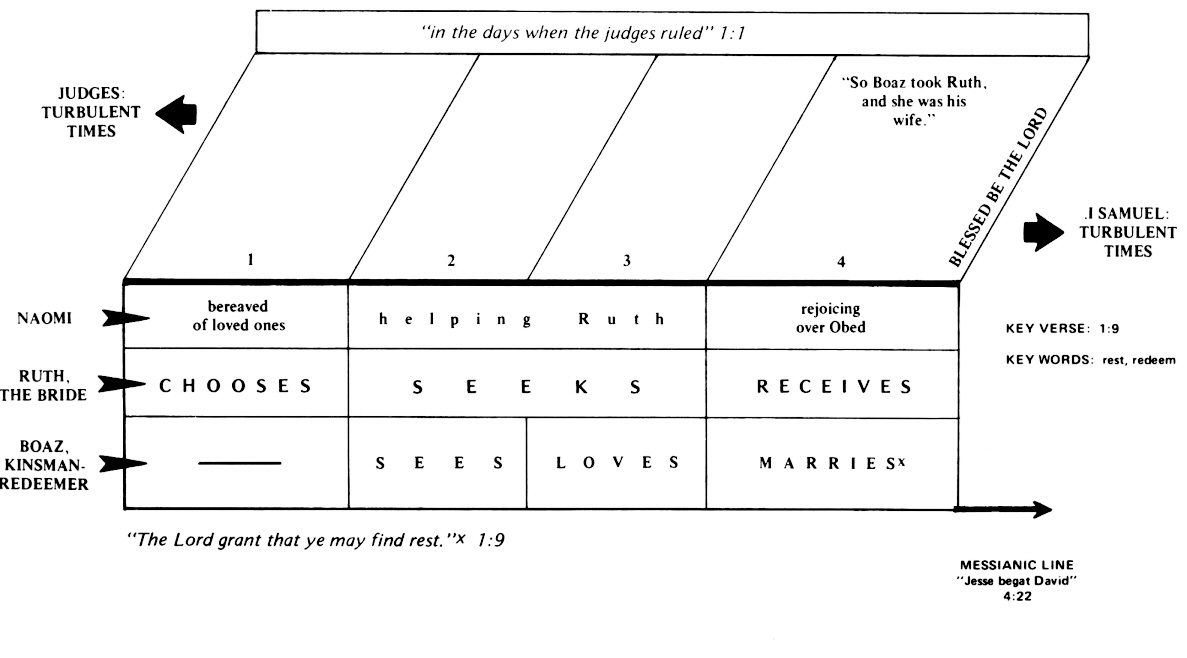
Irving Jensen's Survey of Bible (see his summary of Ruth online - page 392)
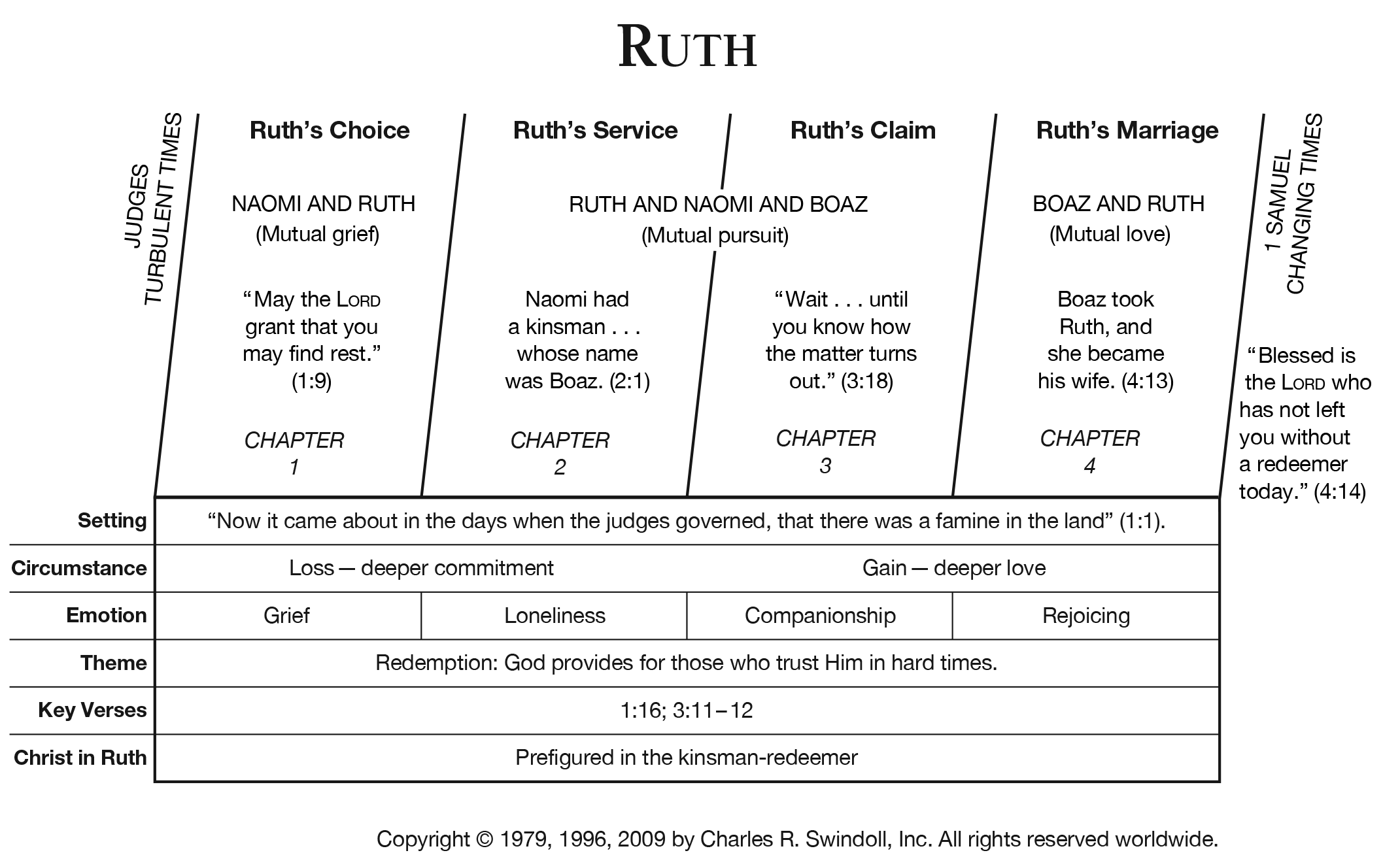
See Swindoll's summary chart of Ruth See Ruth Devotionals
|
RUTH: GOD PROVIDES |
|||
| Ruth 1 | Ruth 2 | Ruth 3 | Ruth 4 |
| Ruth's Choice | Ruth's Service | Ruth's Claim | Ruth's Marriage |
| Ruth's Resolve | Ruth's Rights | Ruth's Request | Ruth's Reward |
| Naomi and Ruth Mutual Grief |
Ruth and Naomi and Boaz Mutual Pursuit |
Boaz and Ruth Mutual Love |
|
| Ruth's Decision: Return with Naomi |
Ruth's Devotion: Provide for Naomi |
Ruth's Request: Redemption by Boaz |
Ruth's Reward: Relative of Messiah |
| Ruth and Naomi |
Ruth and Boaz |
||
| Death of Naomi's Family |
Ruth Cares for Naomi |
Boaz Cares for Ruth |
God Blesses with New Birth |
| Grief | Loneliness | Companionship | Rejoicing |
| Location: Plains of Moab |
Location: Fields of Bethlehem |
Location: Threshing floor of Bethlehem |
Location: Little town of Bethlehem |
| Time Lapsed: About 30 Years See Timeline |
|||
| Setting: Ru 1:1 Now it came about in the days when the judges governed Jdg 21:25+ In those days there was no king in Israel; everyone did what was right in his own eyes. |
|||

Ruth 3:16 When she came to her mother-in-law, she said, "How did it go, my daughter?" And she told her all that the man had done for her. (NASB: Lockman)
Amplified: And when she came home, her mother-in-law said, How have you fared, my daughter? And Ruth told her all that the man had done for her. (Amplified Bible - Lockman)
BBE: And when she came back her mother-in-law said to her, How did it go with you, my daughter? And she gave her an account of all the man had done to her.
CEV: Naomi asked her what had happened, and Ruth told her everything. (CEV)
GWT: When Ruth returned, her mother-in-law Naomi asked, "How did things go, my daughter?" Ruth told Naomi everything the man had done for her. (GWT)
KJV: And when she came to her mother in law, she said, Who art thou, my daughter? And she told her all that the man had done to her.
NJB: When Ruth got home, her mother-in-law asked her, 'How did things go with you, daughter?' She then told her everything that the man had done for her. (NJB)
Young's Literal: And she cometh in unto her mother-in-law, and she saith, 'Who art thou, my daughter?' and she declareth to her all that the man hath done to her.
Septuagint (LXX): kai Routh eiselthen (3SAAI) pros ten pentheran autes e de eipen (3SAAI) tis ei thugater kai eipen (3SAAI) aute panta osa epoiesen (3SAAI) aute o aner
English of Septuagint: And Ruth went in to her mother-in-law, and she said to her, My daughter! and Ruth told her all that the man had done to her
AND WHEN SHE CAME TO HER MOTHER-IN-LAW SHE SAID HOW DID IT GO, MY DAUGHTER:
- Ruth 3 Resources - Multiple Sermons and Commentaries
- Click to listen to ballad which goes through all 4 chapters - The Lady Who Laid There Was Ruth!
NAOMI'S
INQUIRY
Literally the Hebrew says Naomi asked "Who are you?" undoubtedly with a sense of anticipation. To phrase it another way Naomi appears to be asking…“Are you still Ruth the Moabitess or are you the prospective Mrs. Boaz?”
Young's Literal accurately translates it "Who art thou, my daughter?"
Observe that this is the second time in just a matter of hours that Ruth was asked the question "Who are you?" Boaz having asked the same question when he awoke at midnight and discovered Ruth laying at his feet (Ru 3:9-note).
My daughter - This term of endearment (motherly affection for Naomi, romantic interest for Boaz) is concentrated in chapter 3, being used 3 times by Naomi and twice by Boaz (Ruth 3:1, 10, 11, 16, 18 -- this phrase also used in Ruth 2:2, 2:8, 2:22)
Butler wisely comments that…
Ruth had worked her way into the heart of these two very important people in her life. Ruth was easy to love because of her lifestyle before these people and because of her love for these people. If you lack love from others check your lifestyle before others and your love for others. Ruth will not lack for love from others because of the way she lived and loved. People who feel unloved generally live an unloving life. (John Butler: Ruth: The Ancestress of Christ)
AND SHE TOLD HER ALL THAT THE MAN HAD DONE FOR HER:
- Ruth 3 Resources - Multiple Sermons and Commentaries
- Click to listen to ballad which goes through all 4 chapters - The Lady Who Laid There Was Ruth!
Not to overemphasize the point, but had Boaz been inappropriate with Ruth, as some commentators conclude, here the author makes it clear that she holds nothing back from her mother-in-law. And yet we see nothing in Naomi's comments that denigrates Boaz in any way, as would surely have been the case had there been sexual impropriety.
Wiersbe has a practical summary of this chapter noting that…
Ruth is a good example for us to follow when we have needs to be met. She listened to instructions (Ru 3:1-4), obeyed (Ru 3:5-9), believed what her redeemer said (Ru 3:10-14), received his gifts (Ru 3:15-17 ), and waited in patience for him to do the rest (Ru 3:18). When you are at the feet of your Redeemer, you have nothing to fear.
Ruth 3:17 She said, "These six measures of barley he gave to me, for he said, 'Do not go to your mother-in-law empty-handed.' " (NASB: Lockman)
Amplified: And she said, He gave me these six measures of barley, for he said to me, Do not go empty-handed to your mother-in-law. (Amplified Bible - Lockman)
BBE: And she said, He gave me these six measures of grain, saying, Do not go back to your mother-in-law with nothing in your hands.
CEV: She also said, "Boaz gave me this grain, because he didn't want me to come back without something for you." (CEV)
GWT: She said, "He gave me these six measures of barley and told me not to come back to you empty-handed." (GWT)
KJV: And she said, These six measures of barley gave he me; for he said to me, Go not empty unto thy mother in law.
NJB: 'He gave me these six measures of barley and said, "You must not go home empty-handed to your mother-in-law." (NJB)
Young's Literal: And she saith, 'These six measures of barley he hath given to me, for he said, Thou dost not go in empty unto thy mother-in-law.'
Septuagint (LXX): kai eipen (3SAAI) aute ta ex ton krithon tauta edoken (3SAAI) moi hoti eipen (3SAAI) pros me me eiselthes (2SAAS) kene pros ten pentheran sou
English of Septuagint: And she said to her, He gave me these six measures of barley, for he said to me, Go not empty to thy mother-in-law
AND SHE SAID THESE SIX MEASURES:
- Ruth 3 Resources - Multiple Sermons and Commentaries
- Click to listen to ballad which goes through all 4 chapters - The Lady Who Laid There Was Ruth!
As noted in the previous verse, the Hebrew text gives no standard of measurement and ephah has been inserted by some translators only as a possibility. However, 6 ephahs would weigh about 200 pounds, which was far too much for Ruth to carry home in her shawl.
FOR HE SAID DO NOT GO TO YOUR MOTHER-IN-LAW EMPTY HANDED:
Empty-handed (07387) (reyqam) is the same word used to in Ru 1:21 (see note) of Naomi's complaint
I went out full, but the LORD has brought me back empty. (empty handed) Why do you call me Naomi, since the LORD has witnessed against me and the Almighty has afflicted me?
God would use Boaz's generous spirit and Ruth's obedience to fill Naomi once again. Naomi could no longer say that her hands were empty. Now they were full because of the grace of Boaz, the kinsman redeemer.
Ruth’s faith and obedience had brought blessing and a complete transformation in their lives, and now they were living by grace.
Ruth 3:18 Then she said, "Wait, my daughter, until * you know how the matter turns out; for the man will not rest until * he has settled it today." (NASB: Lockman)
Amplified: Then said she, Sit still, my daughter, until you learn how the matter turns out; for the man will not rest until he finishes the matter today. (Amplified Bible - Lockman)
BBE: Then she said, Do nothing now, my daughter, till you see what will come of this; for the man will take no rest till he has put this thing through.
CEV: Naomi replied, "Just be patient and don't worry about what will happen. He won't rest until everything is settled today!" (CEV)
GWT: Naomi replied, "Stay here, my daughter, until you know how it turns out. The man won't rest unless he settles this matter today." (GWT)
KJV: Then said she, Sit still, my daughter, until thou know how the matter will fall: for the man will not be in rest, until he have finished the thing this day.
NJB: Naomi said, 'Do nothing, daughter, until you see how things have gone; I am sure he will not rest until he has settled the matter this very day.' (NJB)
Young's Literal: And she saith, 'Sit still, my daughter, till thou dost know how the matter falleth, for the man doth not rest except he hath completed the matter to-day.'
Septuagint (LXX): e de eipen (3SAAI) kathou (2SPMM) thugater eos tou epignonai (AAN) se pos ou peseitai (3SFMI) rhema ou gar me esuchase (3SAAS) o aner eos an telese (3SAAS) to rhema semeron
English of Septuagint: And she said, Sit still, my daughter, until thou shalt know how the matter will fall out; for the man will not rest until the matter (rhema is literally the spoken word - Boaz was good to his word) be accomplished this day
THEN SHE SAID WAIT, MY DAUGHTER:
- Ps 37:3-note; Ps 37:4-note; Ps 37:5-note; Isa 28:16; 30:7
- Surviving The Storms Of Stress - RBC Booklet
- See devotionals on waiting at the end of this note
- Ruth 3 Resources - Multiple Sermons and Commentaries
- Click to listen to ballad which goes through all 4 chapters - The Lady Who Laid There Was Ruth!
Wait quietly = Modern Language Version
Stay here = GWT
Just be patient = Ru 3:18NLT
Do nothing now = BBE
Stay put = NET
Sit still = Ru 3:18KJV
SITTING STILL…
Often More Difficult Than
DOING!
Wait (03427) (yasab/yashab) means literally to sit down, to dwell, to inhabit, to endure, to abide , to stay, to remain.
Our greatest strength is often shown
in our ability to stand still and trust God.
Naomi is gives Ruth a command to "Sit still. There’s nothing more for you to do." The essence of Naomi's encouragement to Ruth is seen in the following words from Be Still My Soul… ponder Katharina von Schlegel's poignant stanza which speaks especially of God's sovereignty and providential control over the events and circumstances of all of our lives…
Be still, my soul: thy God doth undertake
To guide the future, as He has the past.
Thy hope, thy confidence let nothing shake;
All now mysterious shall be bright at last.
BE STILL MY SOUL by Katharina A. von Schlegel
Music: Jean Sibelius
(Be Still My Soul by Selah)
(Violin version of Be Still My Soul)
It follows that if Ruth sits, she has to wait. Waiting and being still imply confidence or trust that what is hoped for will be done and is manifest in steadfastness or patience. Ruth would have accomplished nothing by following Boaz around Bethlehem, trying to help him keep his promises. How often does our fallen nature seek to "help God out"! However often when we do try to "help God", it doesn't help and sometimes makes matters even worse!
RESTING…
or
RESTLESS?
How is your soul today? Sitting still? Resting in confidence and the sure hope of your greater Boaz, your Kinsman Redeemer, fully convinced that your future and your past is secure because of His costly redemption? Resting or restless - which are you?
Commit your way to the LORD,
Trust also in Him, and He will do it.
Ps 37:5 (note)
I will strengthen,” so take courage,
Child of God, so weak and frail.
God has said so, and it must be,
For His promise cannot fail!
—Anon
Spurgeon's Note: Commit thy way unto the Lord. Roll the whole burden of life upon the Lord. Leave with Jehovah not thy present fretfulness merely, but all thy cares; in fact, submit the whole tenor of thy way to him. Cast away anxiety, resign thy will, submit thy judgment, leave all with the God of all. What a medicine is this for expelling envy! What a high attainment does this fourth precept indicate! How blessed must he be who lives every day in obedience to it!
Trust also in him; and he shall bring it to pass. Our destiny shall be joyfully accomplished if we confidently entrust all to our Lord. We may serenely sing --
"Thy way, not mine, O Lord,
However dark it be;
O lead me by thine own right hand,
Choose out the path for me."
"Smooth let it be or rough,
It will be still the best;
Winding or straight, it matters not,
It leads me to thy rest."
"I dare not choose my lot,
I would not if I might;
But choose Thou for me, O my God,
So shall I walk aright."
"Take thou my cup, and it
With joy or sorrow fill;
As ever best to thee may seem,
Choose thou my good and ill."
The ploughman sows and harrows, and then leaves the harvest to God. What can he do else? He cannot cover the heavens with clouds, or command the rain, or bring forth the sun or create the dew. He does well to leave the whole matter with God; and so to all of us it is truest wisdom, having obediently trusted in God, to leave results in his hands, and expect a blessed issue.
EXPLANATORY NOTES AND QUAINT SAYINGS
Verse 5. Commit thy way unto the Lord, etc. When we bear the burden of our own affairs ourselves, and are chastised with anxiety and want of success, and with envying the ungodly who prosper better than we do, the best remedy is first to do our duty, as we are enabled in the use of the means, then cast the care of the success over on God, as the ploughman doth when he hath harrowed his land; and let the burden of it rest on God, and let us not take it off him again, but put our mind to rest, resolved to take the harvest in good part, as he shall send it. David Dickson.
Verse 5. Commit thy way unto the Lord, is rendered by the Vulgate, Revela viam Domino, reveal thy way; and by St. Ambrose, understood of revealing our sins to God. Indeed, since it is impossible to cover, why should we not discover our sins? Conceal not that which God knoweth already, and would have thee to make known. It is a very ill office to be the devil's secretary. Oh, break thy league with Satan be revealing his secrets, thy sins, to God. Nathaniel Hardy.
Verse 5. Commit thy way unto. Margin and Hebrew, Roll thy way upon -- as one who lays upon the shoulder of one stronger than himself a burden which he is not able to bear. William De Burgh, D.D., in "A Commentary on the Book of Psalms. Dublin:" 1860.
Verse 5. Note the double again, Commit and trust. C. H. S.
Verse 5. He shall bring it to pass. When a hard piece of work is put into the hand of an apprentice for the first assay of his skill, the beholders are justly afraid of a miscarriage in his young and inexperienced hand; but when the worker is an old master of craft, none are afraid but his cunning hand can act again what so oft it hath wrought to the contentment of all the beholders. Were our God a novice in the great art of governing the world, and of the church in the bosom thereof; had he to this day never given any proof of his infinite wisdom, power, and goodness, in turning about the most terrible accidents to the welfare and joy of his saints; we might indeed be amazed whenever we feel ourselves sinking in the dangers wherein the practices of our enemies oft do plunge us over head and ears; but the Lord having given in times past so many documents of his uncontroverted skill and most certain will to bring about all human affairs, as to his own glory, so to the real good of all that love him, it would be in us an impious and unexcusable uncharitableness to suspect the end of any work which he hath begun. Robert Baylie's Sermon before the House of Commons, 1643.
Patience is hard for people who drive to the One-Hour Photo Shop, take their clothes to the One-Hour Cleaners, and get breakfast at a drive-through window.
John Butler qualifies this verse by noting that…
The command to "sit" does not justify procrastination, of course. That is not the case here. Procrastination is sitting when we are to be up and doing. Procrastinators prefers inactivity when the command is activity. (John Butler: Ruth: The Ancestress of Christ)
Hymn writer Phillips Brooks admitted,
"The hardest task in my life is to sit down and wait for God to catch up with me… The trouble is that I am in a hurry, but God isn't."
Haven't we often felt the same? Yet patience is part of God's strategy for maturing us. It's a lost skill we all need to cultivate. If you have no joy because you're always in a rush, slow down.
As Torrey wrote
Not so in haste, my heart! Have faith in God, and wait;
Although He seems to linger long, He never comes too late.
God is never in a hurry, but He is always on time. God stretches our patience to enlarge our soul. Ask yourself:
What circumstances make it hard for me to wait for the Lord?
How do I know I won't be disappointed when I wait for Him?
Recall frequently to your mind that God's timing is always right—and then rest and wait patiently for Him for our unknown future is secure in the hands of our all-knowing God.
George Matheson wrote,
We commonly associate patience with lying down. We think of it as the angel that guards the couch of the invalid. Yet there is a patience that I believe to be harder—the patience that can run. To lie down in the time of grief, to be quiet under the stroke of adverse fortune, implies a great strength; but I know of something that implies a strength greater still: it is the power to work under stress; to have a great weight at your heart and still run; to have a deep anguish in your spirit and still perform the daily tasks. It is a Christ-like thing! The hardest thing is that most of us are called to exercise our patience, not in the sickbed but in the street.
To wait is hard…
To do it with good courage is harder!
Henry Morris says that "Sometimes, when a believer has done all he knows to do according to God's word, he must be content simply to "sit still," and wait for God to work. (Morris, Henry: Defenders Study Bible. World Publishing)
O my soul, wait on the Lord
And know He sees your need;
He'll make His presence known to you
Through word or kindly deed. —D. De Haan
Those who wait on the Lord
will never be disappointed.
Naomi's advice to wait clearly indicates that she has taken a stance of faith--she had a restoration of her trust in EL Shaddai (see study God Almighty) and expresses to Ruth a confident, expectant belief that only God could bring this romantic redemptive rendezvous to a righteous resolution.
Patience is a virtue
that carries a lot of wait!
Can you see how the events subsequent to chapter 1 ("I went out full, but the LORD has brought me back empty. Why do you call me Naomi, since the LORD has witnessed against me and the Almighty (Shaddai) has afflicted me?" Ru 1:21-note) have been thoroughly reversed, resulting in Naomi's renewed faith and hope?
Do you feel empty today like Naomi did?
Do you feel that the Lord has afflicted you?
Is your faith and hope in El Shaddai ebbing low?
Then take heart dearly beloved as you ponder the effect on Naomi of God's sovereign working in the background in chapters 2-3 (See also How Much Does God Control?). Be encouraged. Hope in God.
Paul wrote that
"whatever was written in earlier times (referring to the Old Testament Scriptures) was written for our instruction (to teach us), that through perseverance ("patience", KJV) and the encouragement ("comfort", KJV) of the Scriptures we might have hope. (Desire of some good with expectation of obtaining it; the absolute certainty of future good)" (Ro 15:4-note)
As Matthew Henry comments
"There are many things to be learned out of the scriptures; and that is the best learning which is drawn from these fountains. Those are the most learned that are most mighty in the scriptures. We must therefore labour, not only to understand the literal meaning of the scripture, but to learn out of it that which will do us good; and we have need of help therefore not only to roll away the stone, but to draw out the water, for in many places the well is deep. Practical observations are more necessary than critical expositions."
Henry goes on to add that
Patience ("perseverance", NASB) and comfort ("encouragement", NASB) suppose trouble and sorrow; such is the lot of the saints in this world; and, were it not so, we should have no occasion for patience and comfort. But both these befriend that hope which is the life of our souls. Patience works experience, and experience hope, which maketh not ashamed, ("tribulation brings about perseverance and perseverance, proven character; and proven character, hope and hope does not disappoint… " NASB Ro 5:3, 4, 5- note Ro 5:3, 5:4-5) The more patience we exercise under troubles the more hopefully we may look through our troubles; nothing more destructive to hope than impatience (and so we see Naomi encouragement for Ruth to "wait"). And the comfort of the scriptures, that comfort which springs from the word of God (that is the surest and sweetest comfort) is likewise a great stay to hope, as it is an earnest (pledge or token of what is to come) in hand of the good hoped for. The Spirit, as a comforter, is the earnest of our inheritance.
Isaiah encourages Israel with the promise that
"those who wait for the LORD Will gain new strength; They will mount up with wings like eagles, They will run and not get tired, They will walk and not become weary." (Isa 40:31-see notes)
The word “gain” more literally means “to exchange,” as if one takes off old clothes and puts on new. Ruth would soon experience a literal exchange of her old clothes for a wedding gown. But all believers can likewise experience an exchange of our weakness for God's strength (cf 2Cor 12:9, 10). As we wait before Him, God supernaturally enables us to soar even in the face of the crisis, to run when the challenges are many, and to walk faithfully in the day-by-day demands of life. For many it is much harder to walk in the ordinary everyday pressures of life than to fly like an eagle in a time of crisis! Like Ruth we all need to practice the fruitful spiritual discipline of "waiting on our Redeemer."
"Let patience have her perfect work;
Let God refine your gold;
For in His time He'll show you why,
And blessings great unfold." (Bosch)
Since Naomi and Ruth believed that Boaz would accomplish what he said he would do, they waited patiently until they received the good news that Ruth would be a bride. Their attitudes and actions (and the subsequent events in chapter 4) are testimony to the truth of the exhortation
Commit your way to the Lord, trust also in Him, and He will do it (Ps 37:5-note).
UNTIL YOU KNOW HOW THE MATTER TURNS OUT:
- Ruth 3 Resources - Multiple Sermons and Commentaries
- Click to listen to ballad which goes through all 4 chapters - The Lady Who Laid There Was Ruth!
Matter (01697) (dabar) which means word, matter or thing.
Turns out (05307) (naphal) (Used also in Ru 2:10) is literally "falls" so that this verse literally reads "how the word falls". This word may fall but it will not fail -- this reminds us of one of Joshua's last stirring exhortations to Israel in which he said
Now behold, today I am going the way of all the earth, and you know in all your hearts and in all your souls that not one word of all the good words which the LORD your God spoke concerning you has failed (naphal); all have been fulfilled for you, not one of them has failed (naphal). (Josh 23:14)
Do you believe this is still true?
FOR THE MAN WILL NOT REST UNTIL HE HAS SETTLED IT TODAY:
- Ruth 3 Resources - Multiple Sermons and Commentaries
- Click to listen to ballad which goes through all 4 chapters - The Lady Who Laid There Was Ruth!
For Naomi explains why she is so confident that this matter will come to culmination (and ultimately to consummation). She was convinced that Boaz was a man of integrity, the kind of person who would not rest until he saw to it that the role of the kinsman redeemer was fulfilled. Subsequent events prove Naomi knew her kinsman well.
Will not rest (08252) means to be still, to be quiet or to be undisturbed and conveys the idea of "tranquility" and implies the absence of strife, war (as in Jdg 3:30-note where it is translated "undisturbed" in NAS), or trouble on the one hand, and worry or anxiety on the other.
See note Ruth 3:1 for more on "rest" noting that Ruth 3 begins and ends with "rest" and so is aptly subtitled "Ruth Resting" for in it we find out how Ruth will find her "rest" with her kinsman-redeemer Boaz.
In a similar way we, as have believers of every age, are waiting for the imminent Return of our Redeemer, to Whom we are Betrothed as His bride, "the church". The Redeemer's return which will bring our redemption to completion at which time we will rest finally and fully in our Lord's glorious presence. Paul puts it beautifully in Romans 8 writing…
And not only this (not only is creation groaning), but also we ourselves, having the first fruits of the Spirit (as taught in Eph 1:14-note), even we ourselves groan within ourselves, waiting eagerly for our adoption as sons, the redemption (see word study) of our body. (Ro 8:23-note)
Has settled (03615) (kalah) means to finish, complete, fulfill or bring this matter to an end. The primary meaning of kalah is to consummate or to bring to completion. Boaz will finish his task, working until the goal is accomplished. Sometimes the idea of exhaustion or of being entirely consumed is signified by this verb kalah. Naomi was confident that Boaz would not rest until he had settled the matter.
John Butler observes that…
This comment by Naomi about Boaz's commitment was a real compliment of Boaz. It said Boaz was prompt and earnest, and he would finish his task. We need more of that kind in the church. Too many in the church are dilatory instead of prompt, sluggish instead of earnest, and lack steadfastness to finish their work. But love will change such poor behavior. Boaz had a love for Ruth that caused him to be prompt, earnest, and steadfast. The Apostle Paul said the love of Christ constrained him to serve (2Co 5:14). The church at Ephesus was soundly denounced because they had "left thy first love" (Re 2:4-note) which meant that their service would decline more and more. If our service is lacking and poor, it stems from the lack of love for Christ. Devotion determines the quality of our service. Boaz illustrates that fact well. (Ibid)
SIT STILL
Wait my daughter - Are you like Ruth or more like Martha in Luke10 who was…
distracted with all her preparations and… worried and bothered about so many things? (Luke 10:40, 41)
Then to calm your nerves and keep you from rushing ahead of the Lord, meditate on Naomi's advice to Ruth, along with two other closely related exhortations in Scripture.
“Sit still...until you know how the matter will turn out” (Ru 3:18-note, NKJV)
How can we "sit still"? One way is to wait on the Lord in prayer, not wasting your time but investing it in eternity. God is preparing you and your circumstances so that His purposes will be accomplished. However, when the right time arrives walk out in obedience and in faith, do not delay.
STAND STILL
Do not fear! Stand still and see the salvation of the LORD which He will accomplish for you today; for the Egyptians whom you have seen today, you will never see them again forever. (Ex 14:13)
Moses gave this command to the people of Israel as the Egyptian army was pressing in to destroy them. When God tells us to "Stand still ", there is no need to panic, for the Almighty, omnipotent God has the situation well in hand. And when He commands to “go forward” (Ex 14:15) as He did Israel, and He will lead us through "the sea" step by step. There is a time to stand and a time to move out, and we must be alert to know and do whichever God wants us to do.
BE STILL
Be still, (command; Heb = relax, hang limp; Lxx = Be at leisure) and know (command) that I am God; I will be exalted among the nations, I will be exalted in the earth. (Ps 46:10-note)
The truth in this Psalm provides a wonderful antidote for a restless spirit. The Hebrew word translated “be still” means “take your hands off, relax.” It’s so easy for us to get impatient with the Lord and start meddling in matters that we ought to leave alone. He is God, and His hands can accomplish the impossible. Our hands may get in the way and make matters worse.
When the Lord arranges the circumstances of our life so that we must "wait", then we need to take heart from these exhortations to sit still, stand still and be still. God is in control.
Warren Wiersbe comments on Ps 46:10 noting that…
The Hebrew word translated "be still" actually means "take your hands off." God is saying to us, "Take your hands off, and let Me be God in your life." So often we want to manipulate and control. We talk about those who are "hands on" people. In the Christian life, God uses our hands. He used Noah's hands to build the ark. He used David's hands to kill a giant. He used the apostles' hands to feed 5000 people. But sometimes only God's hand can do the job. Sometimes our hands get in the way because we are manipulating, plotting or scheming.
A friend of mine used to remind me, "Faith is living without scheming." Whenever I discover myself pushing and prodding, God says to me, "Take your hands off. Be still, and know that I am God." The difference is simply this. If we play God in our lives, everything is going to fall apart. But if we let Him truly be God in our lives, He will be exalted, He will be with us, and He will get the job done.
Are you facing a problem or a challenge today? Are you wondering what you will do? Give it to the Lord. A time will come when He will say, "All right, I will use your hands." But until then, keep your hands off. Know that He is God. He does not expect us to do what only He can do. We can roll the stone away from the tomb of Lazarus, but only He can raise the dead. We can hand out the bread, but only He can multiply it. Let Him be God in your life.
To remain still seems to go against human nature. You want control. But as a believer, you need to remain yielded to God's will and give your burdens to Him. What problem are you facing? Are you keeping your hands off and allowing Him to work in your life? (Warren Wiersbe. Prayer, Praise and Promises).
J. Vernon McGee has some sage comments regarding application of Naomi's advice to Ruth. He writes:
"Friend, it’s wonderful to have a Savior in whom you can rest, and know that He’s your Redeemer. Oh, what a gift He is today! He has performed all the work of redemption. You and I are invited to enter into the rest of redemption because it is finished. You’ll remember in His great high priestly prayer, He said to the Father, “… I have finished the work which thou gavest me to do” (John 17:4). Now that work was the work of redemption upon the Cross. And when He was hanging there upon the Cross, you will recall that He said, “It is finished” (John 19:30). And when He cried, “It is finished,” then your redemption and my redemption was finished. He paid the penalty for your sin and my sin to such an extent that you cannot lift a little finger to add to your salvation. He has done it all.
Jesus paid it all
Click to play hymn
Jesus paid it all,
All to Him I owe;
Sin had left a crimson stain,
He washed it white as snow.I hear the Savior say,
“Thy strength indeed is small;
Child of weakness, watch and pray,
Find in Me thine all in all.”Jesus paid it all,
All to Him I owe;
Sin had left a crimson stain,
He washed it white as snow.For nothing good have I
Whereby Thy grace to claim,
I’ll wash my garments white
In the blood of Calv’ry’s Lamb.And now complete in Him
My robe His righteousness,
Close sheltered ’neath His side,
I am divinely blest.Lord, now indeed I find
Thy power and Thine alone,
Can change the leper’s spots
And melt the heart of stone.When from my dying bed
My ransomed soul shall rise,
“Jesus died to my soul to save,”
Shall rend the vaulted skies.And when before the throne
I stand in Him complete,
I’ll lay my trophies down
All down at Jesus’ feet.
—H. M. Hall
J. Vernon McGee continues writing that…
The work of redemption is His work, and you and I are to enter into that perfect work of redemption which He accomplished for us. And there is a wonderful peace that will come to the heart that will trust Him, recognizing that He has completed it all. Frankly, God doesn’t need your little effort and my little effort. God is not receiving anything from us toward our salvation. First of all, you and I haven’t anything to offer. You and I are bankrupt. You and I have to come to Him to receive everything. I understand that that is the offense of the Cross which Paul talks about in Galatians, because there are many people today who like to talk about their character, their family, or their church membership. They feel that church membership is synonymous with salvation, that if you’re a member of a church in good and regular standing it means God has accepted you. There is nothing farther from the truth than that. God is not receiving your effort and my effort today. The work of redemption is His work in its entirety. He was lifted up upon the Cross as the Son of Man. “And as Moses lifted up the serpent in the wilderness, even so must the Son of man be lifted up: that whosoever believeth in him should not perish, but have eternal life” (John 3:14, 15). It is on the basis of His work upon the cross for you and me that God saves us. And that is the reason He came to this earth over 1900 years ago as a man. The writer to the Hebrews says, “… A body hast thou prepared me” (Heb 10:5-note). Sacrifice and offering God did not want. All of the animal sacrifices in the Old Testament were merely pointing to the coming of Christ, given to prepare people for the coming of the Savior into the world. It’s our acceptance and our reception of Him that saves us. He is the Savior. Actually even our faith doesn’t save us. It is Christ who saves us. Spurgeon said, “It is not thy hold on Christ that saves thee; it is Christ. It is not thy joy in Christ that saves thee; it is Christ. It’s not even thy faith in Christ, though that be the instrument; it is Christ’s blood and merit.” You see, faith merely enables us to lay hold of the salvation Christ has purchased for us. (Re 5:9-note; Re 14:4-note) Now today you either trust Him or you don’t trust Him. There’s no such thing as middle ground today. You’re either resting in Him or you are trying to earn your own salvation." (McGee, J. V. Ruth and Esther: Women of Faith. Nashville: Thomas Nelson Publishers)
F B Meyer has a devotional entitled The Secret of a Quiet Heart
"Sit still, my daughter, for the man will not rest, until he have finished the thing this day."-- Ruth 3:18
"Be still, and know that I am God."-- Ps 46:10-note.
PARADISE HAS vanished from our world, as the picture of a landscape vanishes when swept by storm. And our race stands in much the same plight as did Naomi and Ruth in this old-world story. We have lost our inheritance, and the one barrier which stands between us and despair is the Person and Work of our Lord Jesus Christ. But, thank God, we need have no doubt as to the sequel. For as Boaz claimed back the estate for Ruth, so may we be confident that Jesus Christ will never be at rest till this sin-stained and distracted world is restored to her primitive order and beauty, as when the morning-stars sang for joy.
Jesus is our near Kinsman by His assumption of our nature. He is the nearest and dearest Friend of our race, who stooped to die for our redemption. And the fact that He carried our nature in Himself to heaven, and wears it there, is an indissoluble bond between us. Sit still! do not fret! He will never fail, as He will certainly never forsake!
Let us seek the quiet heart in our prayers. Prayer must arise within us as a fountain from unknown depths. But we must leave it to God to answer in His own wisest way. We are so impatient, and think that God does not answer. A child asked God for fine weather on her birthday, and it rained! Some one said, "God didn't answer your prayer." "Oh yes," she replied, "He did, God always answers, but He said No!" God always answers! He never fails! Be still! If we abide in Him, and He abides in us, we ask what we will, and it is done. As a sound may dislodge an avalanche, so the prayer of faith sets in motion the power of God.
In times of difficulty--be still! Thine enemies are plotting thine overthrow! They laugh at thy strong confidence! But hast thou not heard His voice saying: "This is the way, walk ye in it"? Then leave Him to deal with thy foes from whatever quarter they come. He is thy Rock, and rocks do not shake. He is thy High Tower, and a high tower cannot be flooded. Thou needest mercy, and to Him belongeth mercy. Do not run hither and thither in panic! Just quietly wait, hushing thy soul, as He did the fears of His friends on the eve of Gethsemane and Calvary. "Rest in the Lord, wait patiently for Him." "Be still, for He will not rest, until He hath finished the thing this day."
PRAYER - If this day I should get lost amid the perplexities of life and the rush of many duties, do Thou search me out, gracious Lord, and bring me back into the quiet of Thy presence. AMEN. (F B Meyer. Our Daily Walk)
In Our Daily Homily F B Meyer writes that…
Boaz had many good traits — his religious demeanor and speech, his courtesy in greeting his servants, his refusal to take advantage of Ruth’s trust; but none are more satisfactory as an index of a noble character than this well-known and acknowledged promptness of action, when he had once taken in hand the cause of the needy. From of old, Naomi had recognized this quality in her kinsman, and knew that he was a man of his word, who would assiduously complete what he had undertaken to perform.
It is a characteristic that we should do well to cultivate. Let us not arouse hopes, and finally disappoint them; let us not make promises to forget them. Our words should be yea, yea. Those who commit their cause to us should feel perfectly at rest about our executing what we have promised.
How true this is of Jesus! If we have put our matters into his hands, we have no further need of worry or fear, but may sit still in assured trust. For Zion’s sake He does not hold his peace, and for Jerusalem’s sake He will not rest. He has undertaken the cause of the Church, albeit that it is so largely composed of Gentiles, and He will not be in rest until the marriage-feast is celebrated. He has made Himself responsible for thee and me; and He will not rest until He has played the part of a Goel to the furthest limit, and accomplished our redemption. When we have fully yielded ourselves to Him, and have tasted the joys of complete rest, we may assuredly say with the Apostle, “I know whom I have believed, and am persuaded that He is able to keep that which I have committed unto Him against that day.” (2Ti 1:12-note) (Meyer, F. B. Our Daily Homily)
Waiting With Anticipation (READ: Ps130:1-8) (Spurgeon's notes on Psalm 130) - While in the military I learned to hate waiting. We were commanded to hurry out of the barracks and line up. There we would stand and wait, wait, wait for our next orders. When getting vaccinations, we would stand in line and just wait.
I also did a lot of waiting in bus and train depots when I had a leave of absence. I can't say I enjoyed it, but it was different. It was waiting with anticipation. I knew that when I arrived home I would be welcomed by my wife Ginny and my loved ones.
This describes the kind of waiting expressed by the writer of Psalm 130. He had been in the pit of despair over the guilt of his sins (Ps 130:1, 2, 3), and he had prayed and gained assurance of forgiveness (Ps 130:4). But he explained that it was the Lord Himself for whom he was waiting—not just His forgiveness (Ps 130:5). He waited with the anticipation of a watchman who knows that light will appear in the morning (Ps 130:6).
When we're hurting or in distress over our sin, we can look up and wait with anticipation. The Lord will come! Whether through a promise directly from His Word, the wise counsel from a friend, or the quiet witness of the Holy Spirit, He will meet our need—as certainly as morning light always breaks through the darkness of night. —Herb Vander Lugt (Our Daily Bread, Copyright RBC Ministries, Grand Rapids, MI. Reprinted by permission. All rights reserved)
O my soul, wait on the Lord
And know He sees your need;
He'll make His presence known to you
Through word or kindly deed. —D. De Haan
Those who wait on the Lord will never be disappointed.
What's Worth Waiting For? Read Ps 40:1-17 (Spurgeon's notes on Psalm 40) - Psalm 40 is tough to take. It recalls a time when David was forced to wait. But as he looked back with a new song in his heart, he saw that the wait was worth it. By implication, when we are in the middle of a muddle, we must wait patiently for the Lord (Ps 40:1).
That advice looks better in the Bible than it does in life. Patience is hard for people who drive to the One-Hour Photo Shop, take their clothes to the One-Hour Cleaners, and get breakfast at a drive-through window.
We cook dinner in microwave ovens and gulp down remedies that offer "fast, fast relief." Overnight mail is too slow, and we get irritated waiting for a fax. The people we live with, work with, play with, and worship with can absolutely unnerve us. They can be obstinate, frustrating, selfish, insulting. It's hard to be patient with them, and it's harder still to wait on the Lord.
Hymnwriter Phillips Brooks admitted,
"The hardest task in my life is to sit down and wait for God to catch up with me."
Yet patience is part of God's strategy for maturing us as Christians. It's a lost skill we all need to cultivate.
If you have no joy because you're always in a rush, slow down. God will give you a new song--but first you must wait patiently for Him (Ps 40:1, 2, 3). — Haddon W. Robinson (Our Daily Bread, Copyright RBC Ministries, Grand Rapids, MI. Reprinted by permission. All rights reserved)
Not so in haste, my heart!
Have faith in God, and wait;
Although He seems to linger long,
He never comes too late. --Torrey
Patience is a virtue that carries a lot of wait!
To Work Or To Wait? Read: Numbers 9:15, 16, 17, 18, 19, 20, 21, 22, 23 - A gifted and active Christian woman was stricken with an illness that confined her to bed. On her wall hung a motto, Be Strong— and Work for the Lord, based on 1 Chronicles 28:20. But those words, which used to bring her encouragement and strength, now brought only distress.
A friend recognized her troubled state of mind and read the last part of Numbers 9 to her. She pointed out that during Israel’s wilderness wanderings, they rested whenever the guiding cloud remained over the tabernacle. But when the cloud moved on, they journeyed forward.
The friend then said that there are times when God expects us to move ahead in our work for Him. At other times He expects us to rest. To emphasize her point, she walked over to the wall, took down the first motto, and replaced it with a new one: Be Still, and Know That I Am God (Ps. 46:10-note).
All of us need to recognize that God in His wisdom not only leads us into service but also provides times of rest. Often we desire the thrill of activity when He knows we will draw closer to Him through peaceful stillness. A real test of consecration is the ability to wait when we prefer to work.— Henry G. Bosch (Our Daily Bread, Copyright RBC Ministries, Grand Rapids, MI. Reprinted by permission. All rights reserved)
Whenever your plans are thwarted,
Just quietly keep still,
And wait for God’s sure leading,
His timing, and His will. —Anon.
God orders our stops as well as our steps.
Patience - READ: Psalm 37:1-9 (Spurgeon's notes on Psalm 37) - It may take only a year for a construction crew to put up a tall building, but God takes a century to grow a sturdy oak. So too, the Lord may seem to be working slowly to accomplish His purposes in our lives, but His grand designs take time.
The great New England preacher Phillips Brooks was noted for his poise and quiet manner. At times, however, even he suffered moments of frustration and irritability. One day a friend saw him pacing the floor like a caged lion. "What's the trouble, Dr. Brooks?" asked the friend. "The trouble is that I am in a hurry," said Brooks, "but God isn't." Haven't we often felt the same?
Jonathan Goforth (1859-1936), a missionary to China, was convinced that the city of Changte should be his field of spiritual labor. But his faith was severely tested as he was mobbed and threatened when visiting the city. Finally, after 6 frustrating years, permission to begin his work was granted. Within 3 days of reaching Changte he had received no less than 35 offers of land, among them the very site he had chosen earlier as the most ideal spot for the mission.
Wait patiently for the Lord (Ps 37:7-note). If you do, you'll find that He will give you what's best--in His time! — Henry G. Bosch (Our Daily Bread, Copyright RBC Ministries, Grand Rapids, MI. Reprinted by permission. All rights reserved)
Wait, and in waiting, listen for God's leading,
Be strong, the strength for every day is stored;
Go forth in faith, and let your heart take courage,
There is no disappointment with the Lord. --Anon.
God is never in a hurry, but He is always on time.