Ruth 4:2
Ruth 4:3
Ruth 4:4
Ruth 4:5
Ruth 4:6
Ruth 4:7
Ruth 4:8
Ruth 4:9
Ruth 4:10
Ruth 4:11
Ruth 4:12
Ruth 4:13
Ruth 4:14
Ruth 4:15
Ruth 4:16
Ruth 4:17
Ruth 4:18
Ruth 4:19
Ruth 4:20
Ruth 4:21
Ruth 4:22
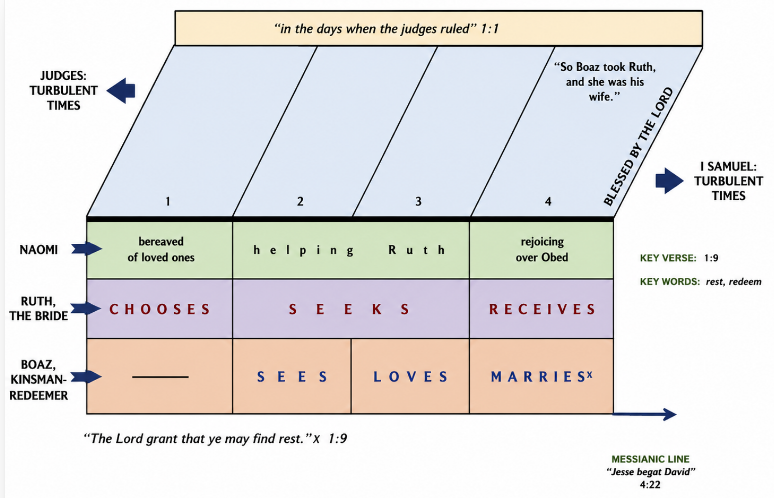
Irving Jensen's Survey of Bible (see his summary of Ruth online - page 392)
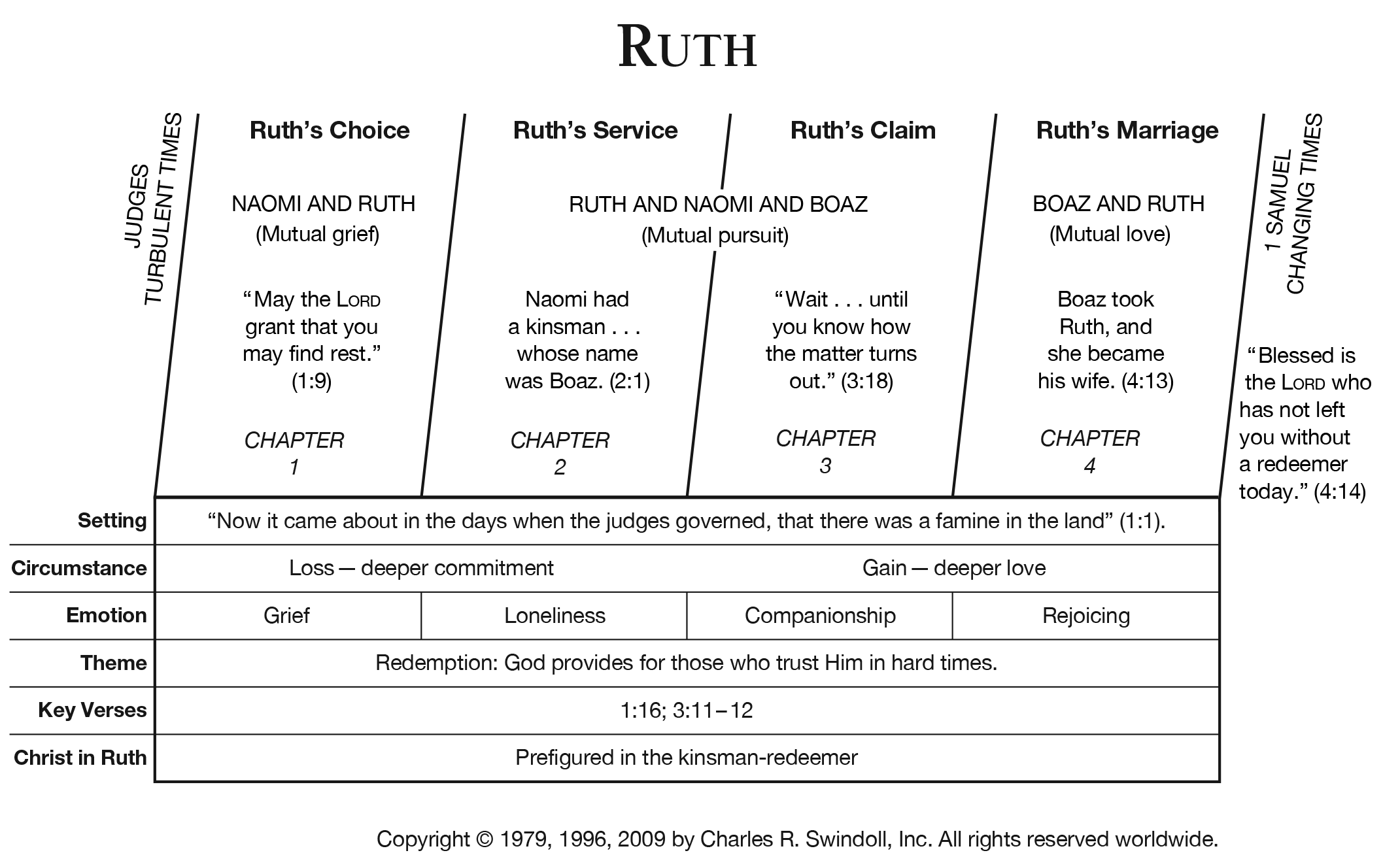
See Swindoll's summary chart of Ruth See Ruth Devotionals
|
RUTH: GOD PROVIDES |
|||
| Ruth 1 | Ruth 2 | Ruth 3 | Ruth 4 |
| Ruth's Choice | Ruth's Service | Ruth's Claim | Ruth's Marriage |
| Ruth's Resolve | Ruth's Rights | Ruth's Request | Ruth's Reward |
| Naomi and Ruth Mutual Grief |
Ruth and Naomi and Boaz Mutual Pursuit |
Boaz and Ruth Mutual Love |
|
| Ruth's Decision: Return with Naomi |
Ruth's Devotion: Provide for Naomi |
Ruth's Request: Redemption by Boaz |
Ruth's Reward: Relative of Messiah |
| Ruth and Naomi |
Ruth and Boaz |
||
| Death of Naomi's Family |
Ruth Cares for Naomi |
Boaz Cares for Ruth |
God Blesses with New Birth |
| Grief | Loneliness | Companionship | Rejoicing |
| Location: Plains of Moab |
Location: Fields of Bethlehem |
Location: Threshing floor of Bethlehem |
Location: Little town of Bethlehem |
| Time Lapsed: About 30 Years See Timeline |
|||
| Setting: Ru 1:1 Now it came about in the days when the judges governed Jdg 21:25 In those days there was no king in Israel; everyone did what was right in his own eyes. |
|||

Ruth's Reward, 4:1-22
- A Husband, 4:1-12
- A Son, 4:13-17
- A Lineage, 4:18-22
Ryrie Study Bible
Ruth 4:17 The neighbor women gave him a name, saying, "A son has been born to Naomi !" So they named * him Obed. He is the father of Jesse, the father of David.
BBE: And the women who were her neighbours gave it a name, saying, Naomi has a child; and they gave him the name of Obed: he is the father of Jesse, the father of David.
CEV: The neighborhood women named him Obed, but they called him "Naomi's Boy." When Obed grew up he had a son named Jesse, who later became the father of King David.
GWT: The women in the neighborhood said, "Naomi has a son." So they gave him the name Obed. He became the father of Jesse, who was the father of David.
KJV: And the women her neighbours gave it a name, saying, There is a son born to Naomi; and they called his name Obed: he is the father of Jesse, the father of David.
NJB: And the women of the neighbourhood gave him a name. 'A son', they said, 'has been born to Naomi,' and they called him Obed. This was the father of Jesse, the father of David. (NJB)
Young's Literal: and the neighbouring women give to him a name, saying, 'There hath been a son born to Naomi,' and they call his name Obed; he is father of Jesse, father of David.
Septuagint (LXX): kai ekalesan (3PAAI) autou ai geitones onoma legousai (PAPFPN) etechthe (3SAPI) huios te Noemin kai ekalesan (3PAAI) to onoma autou Obed houtos pater Iessai patros Dauid
English of Septuagint: And the neighbours gave it a name, saying, A son has been born to Noemin; and they called his name Obed; this is the father of Jessae the father of David
Listen to:
- J Vernon McGee -- Ruth 4:1.mp3
- J Vernon McGee -- Ruth 4:2-5.mp3
- J Vernon McGee -- Ruth 4:6-7.mp3
- J Vernon McGee -- Ruth 4:8-22.mp3
- John Piper -- Ruth 4 - The Best is Yet to Come.mp3
AND THE NEIGHBOR WOMEN GAVE HIM A NAME SAYING A SON HAS BEEN BORN TO NAOMI:
- Lk 1:58, 59, 60, 61, 62, 63
- Ruth 4 Resources - Multiple Sermons and Commentaries
Neighbor women gave him a name - Literally "the neighbors called for him a name". Here is the only place in the OT where a child was named by someone other than the immediate family. In a sense Ruth vicariously bore the son who would restore the family name of Naomi’s deceased son Mahlon (cf. Ruth 4:1).
A son has been born to Naomi - This is an unusual phrase and suggests that Obed was Naomi’s son in more than just an abstract sense, but that she may have raised the child as if he were her own.
SO THEY NAMED HIM OBED HE IS THE FATHER OF JESSE THE FATHER OF DAVID:
So they named him - the text is redundant for this is the second mention that the neighbors “named” the boy.
Named him Obed - This is unusual for unlike other naming events, the name Obed is left unexplained.
Obed (05744) is transliterated from the Hebrew Oved which according to some sources means serving (from 'abad = to serve; cp "Obadiah" = servant of Yahweh) or a servant who worships; worshiping (God). In any case, it is worth noting that names in the OT conveyed much more information about the individual than do most modern names.
The father of Jesse, the father of David - Since the Books of Samuel never provide a genealogy for David, this book provides the genealogical link between the Books of Joshua and Samuel concerning the lineage of David.
Daniel Block - The story of Ruth ends on a surprising but climactic interpretive note. In the mind of the narrator, the historical significance of the birth of Obed does not lie in the resolution he brings to the personal crises of the characters in this book. Nor does he derive his significance from valorous deeds either of mercy or power. Neither the present narrator nor any other Old Testament author writes any stories about him. On the contrary, the birth of Obed has historical significance because he lives on and achieves his significance through the lives of his son Jesse and particularly his grandson David. Through David the blessing of the male witnesses to the court proceedings (Ru 4:11) is fulfilled; Boaz's name is “called out” (NAS = become famous) in Bethlehem. And through David the prayer of the female witnesses to the birth of Obed is fulfilled; Obed's name is “called out” in Israel. Indeed, to this day their names and the names of Naomi and Ruth are “called out” all over the world as their story is read. In the providence of God the genuine piety of all the major characters is rewarded, and the divine plan for Israel and her kings is fulfilled. (New American Commentary - Volume 6: Judges, Ruth)
This complete genealogy appears identically in four other biblical texts (Ru 4:21, 22; 1Chr 2:12, 13, 14, 15; Mt 1:5, 6; Lk 3:31, 32). Boaz and Ruth were the great grandparents of David. The story of Ruth has shown how a Moabite woman obtained an exalted place in Hebrew history. There is later evidence that David did not forget his Moabite roots. During the period of flight from Saul's wrath, David asked the king of Moab to let his parents stay there for refuge (1Sa 22:3, 4).
Fruchtenbaum - Ruth 4:17b should be viewed as the bridge connecting Ruth 1:2, which labels the sojourners as Ephrathites, with 1Sa 17:12, which states that David was the son of an Ephrathite named Jesse.
The following genealogical schematic is taken from The New Bible Dictionary (IVP, 1996)
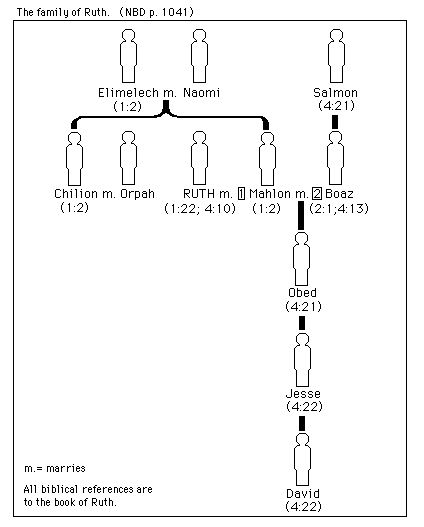
G Campbell Morgan in Life Applications from Every Chapter of the Bible sums up the book writing that…
The story ends with poetic simplicity and beauty. "Boaz took Ruth, and she became his wife." Naomi at last was comforted indeed. The women of her own people spoke words of cheer to her which unquestionably were full of comfort, as they set forth the praises of the one who had chosen to share her affliction, and had become the medium of her succor. There is a stately simplicity in this story of the issue. It constitutes a record of the Divine movement in the history of the chosen people, for thus the kingly line is ordained, in the midst of infidelity (Jdg 21:25), through faithful souls (Ps 40:4).
All the period of the Judges was characterized by the failure of the people to realize the great ideal of the Theocracy. They had no king because they were disobedient to the One King. Presently we shall hear them clamoring for a king "like the nations," (1Sa 8:5, 19, 20) and one will be appointed by whose reign of forty years they will learn the difference between earthly rule and the direct government of God. Then the man after God's own heart will succeed him (Acts 13:22); and that man will be David, descended from these souls who, in dark and difficult days, realized in their own lives the Divine ideal, as they walked humbly with God.
But this Book flings its light much further on. After centuries had run their course, there sprang from this union of Boaz and Ruth in faith and love the Man of Nazareth, Jesus, the One and only King of men, because He was not only a Child born to Mary, descended from these, but also the Son of God in all the fulness of that title.
God, in love and might,
ever moves on through human failure
in cooperation with human faith.
Ruth 4:18 Now these are the generations of Perez: to Perez was born Hezron, (NASB: Lockman)
BBE: Now these are the generations of Perez: Perez became the father of Hezron;
CEV: Here is a list of the ancestors of David: Jesse, Obed, Boaz, Salmon, Nahshon, Amminadab, Ram, Hezron, and Perez. (CEV)
GWT: This is the account of Perez and his family. Perez was the father of Hezron. (GWT)
KJV: Now these are the generations of Pharez: Pharez begat Hezron,
NJB: These are the descendants of Perez. Perez fathered Hezron, (NJB)
Young's Literal: And these are genealogies of Pharez: Pharez begat Hezron,
Septuagint (LXX): kai autai ai geneseis Phares Phares egennesen (3SAAI) ton Esron
English of Septuagint: And these are the generations of Phares: Phares begot Esrom
NOW THESE ARE THE GENERATIONS OF PEREZ TO PEREZ WAS BORN HEZRON:
- 1Chr 2:4, 5, 6, 7, 8; 4:1; Mt 1:3; Lk 3:33
- Ruth 4 Resources - Multiple Sermons and Commentaries
Generations (08435) (towledah; toledah) occurs only in the plural in the Hebrew (cf "generations") and describes one's descendants, generations or genealogies. This key Hebrew word carries with it the notion of everything entailed in a person’s life and that of his or her progeny. It is not surprising that Genesis records numerous uses of this word to introduce the idea of a "family tree".
For example, Moses records that
"This is the book of the generations of Adam. In the day when God created man, He made him in the likeness of God." (Ge 5:1).
In the present case towledah/toledah introduces the genealogical list of the descendants of Ruth and Boaz. This recalls the prayer recorded in verse 11
"May the LORD make the woman (Ruth the Moabitess) who is coming into your home like Rachel and Leah, both of whom built the house of Israel; and may you achieve wealth in Ephrathah and become famous in Bethlehem".
Clearly Jehovah answered the people's prayers and the lineage did indeed become famous in Bethlehem when to the virgin Mary (from the line of David, from the line of Boaz) "was born Jesus,… (the) Christ." (Mt 1:16)
Notice that this "representative" genealogy spans almost 850 years from Perez (1885BC) to David (1040BC).
Perez (06557) is a son of Judah who "went into" Tamar, a woman who was a prostitute (Ge 38:18, 29). Perez's father Judah was the fourth of Jacob’s 12 sons (Genesis 35:23) and the fourth son born to Jacob by Leah, who, overjoyed with the thought of bearing Jacob another son, named him Judah, meaning “praise” (Genesis 29:35). So if we go backward in this genealogical record to Jacob, it would take us back probably sometime before 2000BC.
In light of the known ancestry of Perez, we can trace David’s lineage to extend back through Judah (Ge 49:8, 9, 10, 11, 12), Jacob (Ge 28:10, 11, 12, 13, 14, 15, 16, 17), and Isaac (Ge 26:24) to Abraham (Ge 12:1, 2, 3), to whom Jehovah had promised "2 And I will make you a great nation, and I will bless you, and make your name great; and so you shall be a blessing and I will bless those who bless you, and the one who curses you I will curse. And in you all the families of the earth shall be blessed." (Ge 12:2, 3). This promise was repeated (almost 25 years later)
"As for Me, behold, My covenant is with you, and you shall be" (Ge 17:4)
The book of Ruth then in a sense represents a partial fulfillment of Jehovah's promises to Abraham, promises that would ultimately be fulfilled in the Messiah!
Beloved, read God's love letter to you and by faith grasp the promises He makes to you. You may not see the immediate fulfillment of those promises, but rest assured God will keep His Word and one day you will see the fulfillment!
Even if there are some omissions in the genealogy, its authenticity is attested by the fact that it would be very unlikely for a Jewish scribe recording the ancestry of David to have included a Moabitess unless the evidence was sure!
The first five names cover the period from the time of the entry into Egypt (Perez, Ge 46:12) to the time of Moses (Nahshon, Ex 6:23; Nu 1:7), while the remaining five belong to the period of the early settlement in Canaan to the closing years of the judges.
Ruth 4:19 and to Hezron was born Ram, and to Ram, Amminadab,(NASB: Lockman)
BBE: And Hezron became the father of Ram, and Ram became the father of Amminadab;
KJV: And Hezron begat Ram, and Ram begat Amminadab,
Young's Literal: and Hezron begat Ram, and Ram begat Amminidab,
Septuagint (LXX): Esron de egennesen (3SAAI) ton Arran kai Arran egennesen (3SAAI) ton Aminadab
English of Septuagint: Esrom begot Aram; and Aram begot Aminadab
AND TO HEZRON WAS BORN RAM AND TO RAM, AMMINADAB:
- 1Chr 2:9,10; Mt 1:4; Lk 3:33
- Ruth 4 Resources - Multiple Sermons and Commentaries
Remember that these names are not to be read as "dull lists" of ancestors but in fact are recorded to underscore the truth that Yahweh providentially preserved the righteous line of the Messiah even in times of great apostasy.
Ruth 4:20 and to Amminadab was born Nahshon, and to Nahshon, Salmon, (NASB: Lockman)
KJV: And Amminadab begat Nahshon, and Nahshon begat Salmon,
Young's Literal: and Amminidab begat Nahshon, and Nahshon begat Salmon,
Septuagint (LXX): kai Aminadab egennesen (3SAAI) ton Naasson kai Naasson egennesen (3SAAI) ton Salman
English of Septuagint: And Aminadab begot Naasson; and Naasson begot Salmon
AND TO AMMINADAB WAS BORN NAHSHON, AND TO NAHSHON SALMON:
- Ruth 4 Resources - Multiple Sermons and Commentaries
The father-in-law of Aaron (Ex 6:23), who does not appear in 1Ch 2:10, but is cited in Mt. 1:4 and Luke 3:33. Some Hebrew manuscripts also include Admin between Ram and Amminadab in Lk 3:33.
According to Mt1:5, Salmon married Rahab the converted harlot, sometime after the fall of Jericho, and therefore Boaz was their son.
Matthew's gospel parallels the genealogy found in Ruth 4 and records that…
"The book of the genealogy of Jesus Christ (Messiah), the son of David, the son of Abraham. 2 To Abraham was born Isaac; and to Isaac, Jacob; and to Jacob, Judah and his brothers; 3 and to Judah were born Perez and Zerah by Tamar; and to Perez was born Hezron; and to Hezron, Ram; 4 and to Ram was born Amminadab; and to Amminadab, Nahshon; and to Nahshon, Salmon; 5 and to Salmon was born Boaz by Rahab (the harlot); and to Boaz was born Obed by Ruth; and to Obed, Jesse 6 and to Jesse was born David the king… (Matthew 1:1, 2, 3, 4, 5, 6)
Ruth 4:21 and to Salmon was born Boaz, and to Boaz, Obed (NASB: Lockman)
KJV: And Salmon begat Boaz, and Boaz begat Obed,
Young's Literal: and Salmon begat Boaz, and Boaz begat Obed,
Septuagint (LXX): kai Salman egennesen (3SAAI) ton Boos kai Boos egennesen (3SAAI) ton Obed
English of Septuagint: And Salmon begot Booz; and Booz begot Obed
AND TO SALMON WAS BORN BOAZ, AND TO BOAZ, OBED:
- 1Chr 2:11, 2:12, Mt 1:5; Lk 3:32
- Ruth 4 Resources - Multiple Sermons and Commentaries
The fact that the genealogy connects Boaz and Ruth’s son Obed with Boaz rather than Mahlon does not mean he failed to perpetuate Mahlon’s reputation. The son would have been eligible to inherit from both Mahlon and Boaz. The Israelites regarded him as the son of both men. Naturally he was Boaz’s son, but legally he was Boaz and Mahlon’s son as well as Elimelech’s descendant.
Matthew includes the names of the Gentile mothers, Rahab and Ruth, writing that…
to Salmon was born Boaz by Rahab (the harlot); and to Boaz was born Obed by Ruth; and to Obed, Jesse 6 and to Jesse was born David the king… (Mt 1:5)
G Campbell Morgan has the following thoughts…
Finally the book teaches the value to God of that life, which makes the great surrender, and follows Him in faith. The value of such a life can never be known until we pass within the veil.
Remember again the sequence with which this book closes; Obed, Jesse, David. Boaz and Ruth had passed into the light ere David came, the king for whom the nation was waiting, yet the sequence did not end with David.
A little later a prophet from some height of vision broke into a great song. "But thou, Bethlehem Ephratah, though thou be little among the thousands of Judah, yet out of thee shall he come forth unto me that is to be ruler in Israel." (Mic 5:2)
Far down the centuries there shone a light at midnight, and songs were heard, and in the direct line of the man of Judah and of privilege, and the woman of Moab and of limitation, to Bethlehem came the King.
They did not see the issues. They did not live to reap the ultimate harvest of their fidelity, but GOD found foothold in the man and woman of faith, and in their united lives. That is the principle of which I think we need to be reminded, in order to encourage our hearts in the midst of work.
We talk about results. If all the results of my ministry can be statistically stated, it is a dire failure. Paul was a saint, cribbed, cabined and confined in prison. It is impossible to read his letters without being conscious of a certain amount of restlessness as he made appeal to his loved ones, "remember my bonds." A man whose motto was, The Regions Beyond, whose piercing eye saw the far distances, and who was profoundly conscious of the value of the evangel, who knew and wrote "I am debtor … I am ready;" was yet imprisoned, and had to content himself with writing letters. Today those letters are of greater value than all his work. He did not know that presently they would be gathered together, and would constitute the great exposition of the evangelical faith for all the centuries.
Robert Morrison wrote in his diary, "This day I entered with Mr. Laidler to learn Latin. I paid ten shillings and sixpence, and am to pay one guinea per quarter. I know not what may be the end. GOD only knows."
That ten shillings and sixpence was the beginning of that linguistic education which made Morrison the translator of the Bible, and opened the way for all the work which has been done in China during the past century.
These are but instances, yet take the comfort of them. May this be my last word.
Remember that of the work you do today you cannot see the issue, if it is work wrought by faith in GOD. It may be in the great city of London, or in some hidden hamlet among the hills that your life will be lived, small, unknown, never published, never noticed either in the religious or irreligious press, and yet you may be God's foothold for things of which you cannot dream, which if told you now you would not possibly believe. The one cry of my heart and of thy heart, comrade of faith, according to this book, should be a cry for out-and-out abandonment to Him, in order that by our loyalty He may win the victories of His royalty. (Ruth)
Ruth 4:22 and to Obed was born Jesse, and to Jesse, David. (NASB: Lockman)
KJV: And Obed begat Jesse, and Jesse begat David.
Young's Literal: and Obed begat Jesse, and Jesse begat David.
Septuagint (LXX): kai Obed egennesen (3SAAI) ton Iessai kai Iessai egennesen (3SAAI) ton Dauid
English of Septuagint: And Obed begot Jessae; and Jessae begot David
AND TO OBED WAS BORN JESSE, AND TO JESSE DAVID:
- 1Sa 16:1; Is 11:1
- 1Chr 2:15; Mt 1:6; Lk 3:31
- Ruth 4 Resources - Multiple Sermons and Commentaries
David - The lineage of the greater Kinsman Redeemer, Jesus Christ’s is traced through Mary, through the line of David (Mt 1:1-16; cf. Ro 1:3; 2Ti 2:8; Rev 22:16).
The Moabites were not to enter the congregation of the Lord “even to the tenth generation” (Dt 23:3). How interesting that the book of Ruth closes with a ten-generation genealogy that climaxes with the name of David!
Kidner writes that…
God’s hand is all over history. God works out His purpose, generation after generation. Limited as we are to one lifetime, each of us sees so little of what happens. A genealogy is a striking way of bringing before us the continuity of God’s purpose through the ages. The process of history is not haphazard. There is a purpose in it all. And the purpose is the purpose of God.
Naomi’s return to Bethlehem and the covenant of marriage between Ruth and Boaz, explains why when
it came about… that a decree went out from Caesar Augustus, that a census be taken of all the inhabited earth" that Joseph had to go up "to the city of David, which is called Bethlehem, because he was of the house and family of David (who was in turn of the house and family of Boaz and Ruth) in order to register, along with Mary, who was engaged to him, and was with child." (Lk 2:1, 2, 3, 4, 5).
From a human perspective, Ruth and Boaz are the reason the Messiah was born in Bethlehem but from a divine perspective this even occurred when and where it occurred because God had providentially ordained the historical events to perfectly fulfill prophecy. History is truly His story, as Jehovah alludes to in Isaiah declaring
I am God, and there is no other; I am God, and there is no one like Me, declaring the end from the beginning and from ancient times things which have not been done, saying, 'My purpose will be established, and I will accomplish all My good pleasure. (Isaiah 46:9, 10)
The story of Ruth is one of selfless love at a time when such love was not always in evidence.
As alluded to throughout these notes on Ruth, Jesus has been pictured through the book, by Boaz the kinsman-redeemer as summarized in the table below…
|
COMPARISON OF |
|
| BOAZ | JESUS |
|
Had to be a family member |
God became man in the flesh so He could be our Kinsman and redeem us |
|
Had the duty of buying family members out of slavery |
He redeemed us from slavery to sin and death. |
|
Had the duty of buying back land that had been forfeited |
In the future He will redeem the earth that Adam forfeited control of to Satan. |
|
Not motivated by self-interest but by a sincere love for Ruth the Moabitess |
Jesus’ was motivated by the love of God |
|
Boaz as Ruth's kinsman-redeemer took her as his bride |
Jesus has redeemed us to be His bride |
|
Boaz as kinsman-redeemer provided a glorious destiny for Ruth |
Jesus, as our Kinsman Redeemer, provides a glorious destiny for us |
Before the foundation of the world, in eternity past, God had planned to bring Ruth and Boaz together in the little town of Bethlehem which would be the "entrance point" for Jesus, our Greater Boaz, the ultimate Kinsman-Redeemer. How mysterious and sweet the sounds of the precious hymn…
O Little Town of Bethlehem
(click to play hymn at cyberhymnal)
O little town of Bethlehem, how still we see thee lie!
Above thy deep and dreamless sleep the silent stars go by;
Yet in thy dark streets shineth the everlasting Light:
The hopes and fears of all the years are met in thee tonight.
How silently, how silently, the wondrous gift is given!
So God imparts to human hearts the blessings of His heaven.
No ear may hear His coming, but in the world of sin,
Where meek souls will receive Him still, the dear Christ enters in.
O holy Child of Bethlehem! Descend to us, we pray;
Cast out our sin and enter in, be born in us today.
We hear the Christmas angels, the great glad tidings tell;
O come to us, abide with us, our Lord Emmanuel!