Titus 1:2
Titus 1:3
Titus 1:4
Titus 1:5
Titus 1:6
Titus 1:7
Titus 1:8
Titus 1:9
Titus 1:10
Titus 1:11
Titus 1:12
Titus 1:13
Titus 1:14
Titus 1:15
Titus 1:16
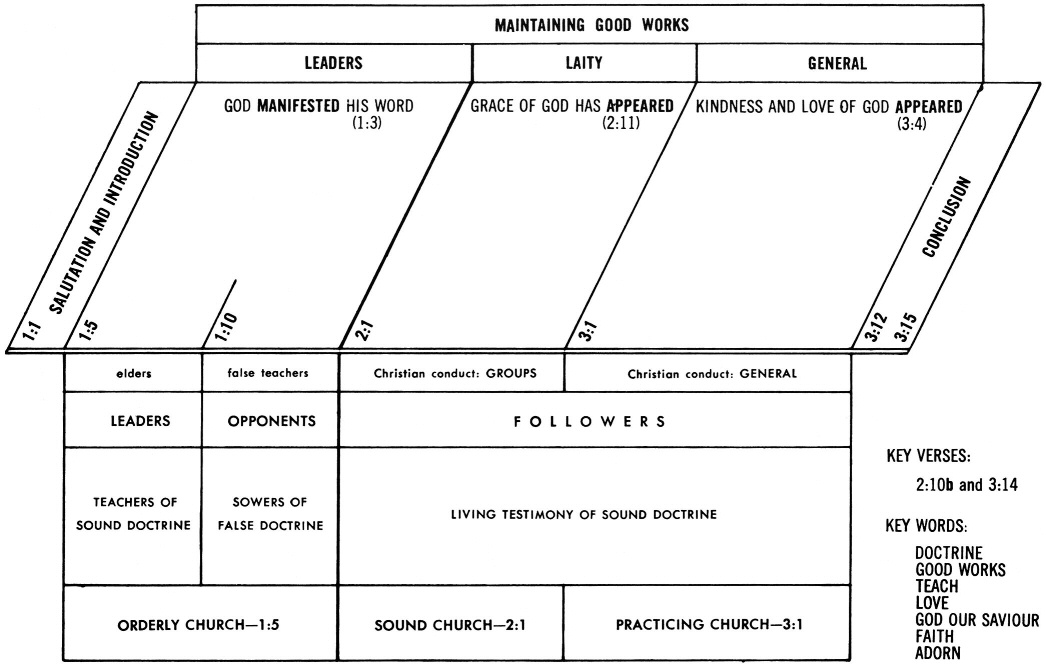
ADORNING THE DOCTRINE OF GOD
Click chart to enlarge
Charts from Jensen's Survey of the NT - used by permission
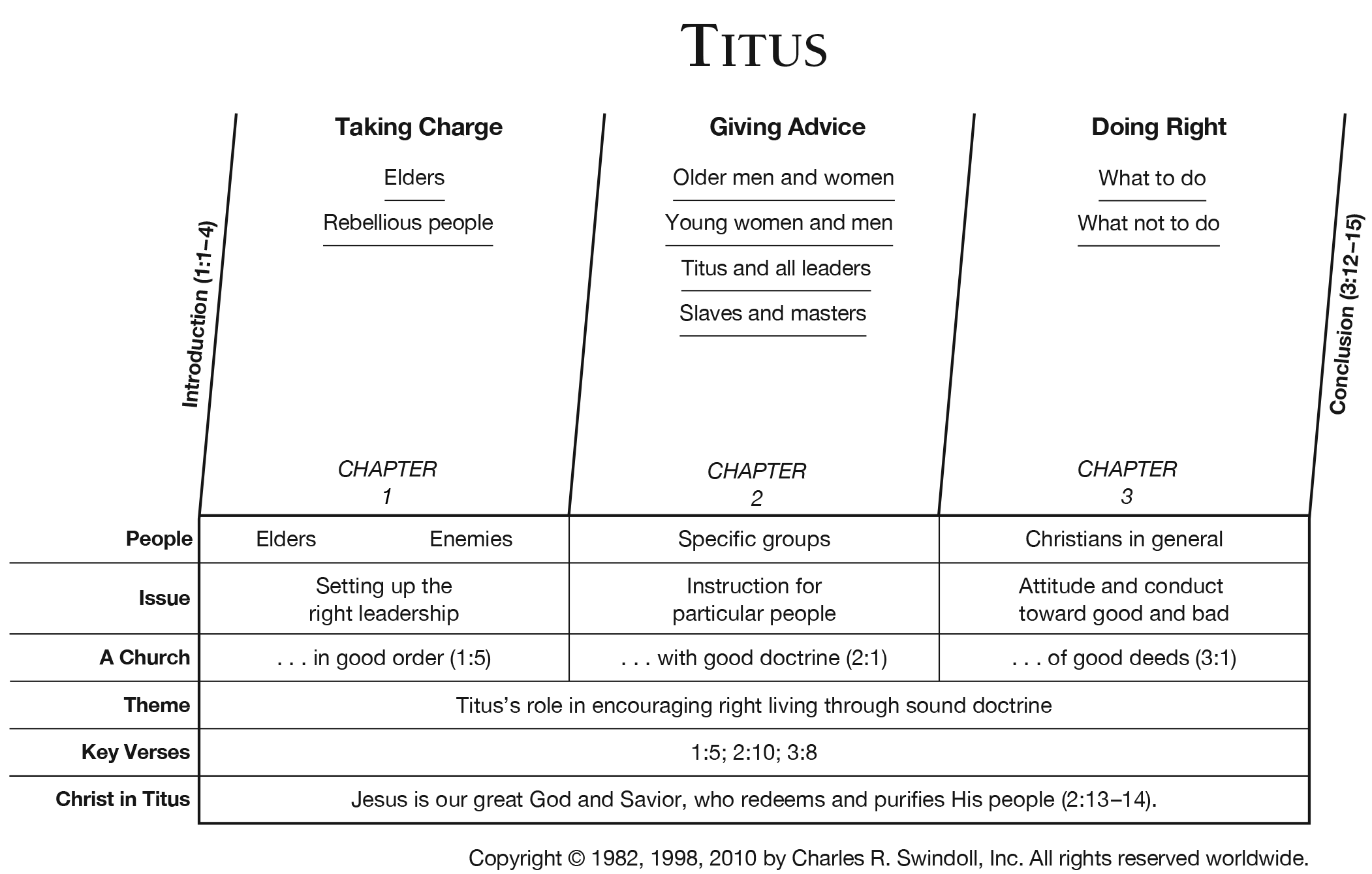
See Summary Chart by Charles Swindoll
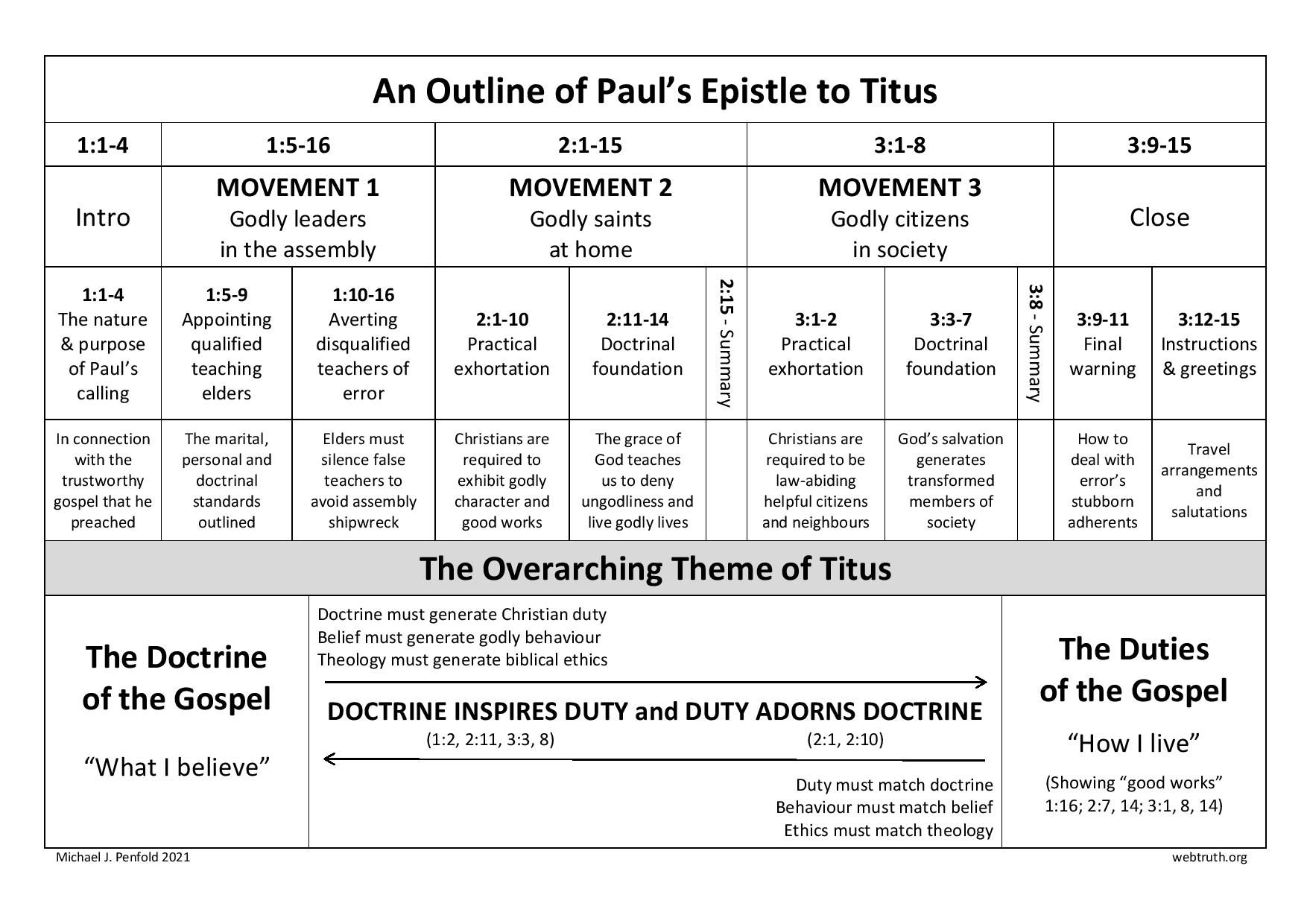
Chart below from Michael J. Penfold
|
Focus |
Appoint Elders |
|||
|
Divisions |
Ordain |
Rebuke |
Maintain |
|
|
Topics |
||||
|
Topics |
Organization |
Offenders |
Operation |
|
|
Place |
Probably Written from either Corinth or Nicopolis (cf. Titus 3:12). |
|||
|
Time |
Circa 63 AD |
|||
|
Modified from Talk Thru the Bible |
||||
Titus 1:3: but at theproper time manifested (3SAAI), even His word, in the proclamation with which I was entrusted (1SAPI) according to the commandment of God our Savior (NASB: Lockman)
Greek: ephanerosen (3SAAI) de kairois idiois ton logon autou en kerugmati o episteuthen (1SAPI) ego kat' epitagen tou soteros hemon theou,
ICB: At the right time God let the world know about that life through preaching. He trusted me with that work, and I preached because God our Savior commanded me to.
Barclay: In his own good time God set forth his message plain for all to see in the proclamation with which I have been entrusted by the royal command of God our Saviour. (Westminster Press)
KJV: But hath in due times manifested his word through preaching, which is committed unto me according to the commandment of God our Saviour;
NET: But now in his own time he has made his message evident through the preaching I was entrusted with according to the command of God our Savior (NET Bible)
Phillips: (at the right moment he made his Word known in the declaration which has been entrusted to me by his command) to Titus, my true son in our common faith, be grace, mercy and peace from God the Father and the Lord Jesus Christ our saviour. (Phillips: Touchstone)
Wuest: but in His own private, strategic seasons He made known His Word in a proclamation with which I was entrusted in accordance with the commandment of God, our Saviour
Young's Literal: (and He manifested in proper times His word,) in preaching, which I was entrusted with, according to a charge of God our Saviour,
AT THE PROPER TIME: de kairois idiois:
- Da 8:23; 9:24, 25, 26 27; 10:1; 11:27; Hab 2:3; Acts 17:26; Ro 5:6; Gal 4:4; Eph 1:10; 1Ti 2:6; 2Ti 1:10
- Titus 1 Resources - Multiple Sermons and Commentaries
"in His own seasons" (Vine, Vincent)
"at his appointed season" (NIV)
"In his own good time" (Barclay)
"now at the right time" (NLT)
"in its own due season" (Darby)
"now in his own good time" (TLB)
"And [now] in His own appointed time" (Amp)
This phrase (see below also) refers to the seasons or periods appointed by God as appropriate for the manifestation. Crucial events in God’s program occur at His designated times in history as determined by God in His perfect wisdom and omniscience. This was the time God intended and His time is always the best time. All preceding ages had pointed to this "time". God had not previously fully revealed the plan of salvation in the Old Testament time or "seasons". Believers then had a "hazy" idea of life after death. But the vagueness disappeared with the coming of Jesus Who
“brought life and immortality to light through the gospel” (2Ti 1:10)
God caused the Gospel to be published in that time in which it would have the greatest effect. The thought of the incarnation taking place at the right moment in the history of the world is a favorite thought with Paul (Acts 17:26; Ro 5:6; Gal 4:4; Ep 1:10). In Paul's first letter to Timothy he used the identical phrase to describe Christ's first coming to give
"Himself as a ransom for all, the testimony borne at the proper time" (1Ti 2:6)
Later in the same book Paul writing about Christ's second coming describes it as the
"appearing of our Lord Jesus Christ, which He will bring about at the proper time-- He Who is the blessed and only Sovereign, the King of kings and Lord of lords" (1Ti 6:14, 15)
Proper (2398) (idios) which refers to that which is one’s own peculiar, private, unique possession.
Time (2540) (kairos [word study]) refers to those strategic times in the calendar of God during which events come to a culmination and ripen to usher in a new age. Kairos which refers to a season, a decisive epoch or a fixed, definitive period of time when events are brought to a crisis.
Paul uses "kairos" to describe our condition before Christ came as "still helpless" but then "at the right time Christ died for the ungodly."
Trench defines kairos as “a critical, epoch-making period foreordained of God when all that has been slowly, and often without observation, ripening through long ages, is mature and comes to the birth in grand decisive events, which constitute at once the close of one period and the commencement of another.”
Since there is no good English equivalent to kairos, the essence of it's meaning can be somewhat difficult to grasp. Study the following verses and see if you can discern the window of opportunity aspect in each verse to help give you a "feel" for the meaning of kairos (Mt 13:30, 21:34, Mk11:13,13:33, Lk 4:13,19:44, Lk 21:24, Ac 1:7, 17:26, 2Co 6:2, Gal 6:9, Eph 2:12, 2Th 2:6, Rev 1:3).
The following quote from Napoleon illustrates the idea inherent in kairos:
“There is in the midst of every great battle a ten to fifteen minute period that is the crucial point. Take that period and you win the battle; lose it and you will be defeated.”
The word in the proclamation came into the world at "the proper time" for 5 elements existed which facilitated the spread of the Gospel
(1) Greek was spoken by nearly everyone for it was the language of trade, commerce and literature. Thus most of the civilized pagan world was bilingual and the missionaries had no major language barrier.
(2) There were no frontiers meaning that wherever the missionary went, he was within the Roman Empire and did not need a passport, nor was he held up at borders waiting for a visa to enter the country. Thus the missionary could move about from one end of the known world to the other without major hindrances.
(3) Travel albeit slow was easy (compared to prior ages) for the Romans had built great roads from country to country and had, for the most part, cleared the land of bandits and the sea of pirates.
(4) The first century world was largely at peace, for the pax Romana (the Roman peace) held sway and thus the missionary could move about within the Roman Empire in relative safety.
(5) Finally as William Barclay notes the first century was a
"world which was conscious of its needs. The old faiths had broken down and the new philosophies were beyond the mind of simple people. Men were looking, as Seneca said, ad salutem, towards salvation. They were increasingly conscious of “their weakness in necessary things.” They were searching for “a hand let down to lift them up.” They were looking for “a peace, not of Caesar’s proclamation, but of God’s.” There never was a time when the hearts of men were more open to receive the message of salvation which the Christian missionaries brought." (Titus 1 Commentary - William Barclay's Daily Study Bible)
Barclay rightly concludes "It was no accident that Christianity came when it did. It came in God’s own time; all history had been a preparation for it; and the circumstances were such that the way was open for the tide to spread." (Ibid)
MANIFESTED EVEN HIS WORD IN THE PROCLAMATION WITH WHICH I WAS ENTRUSTED: ephanerosen (3SAAI) … ton logon autou en kerugmati ho episteuthen (API):
- Mk 13:10; 16:15; Acts 10:36; Ro 10:14 15; 15:19; 16:26; Eph 2:17; Eph 3:5; 3:6 3:7 3:8 Php 1:13; Col 1:6; 1:23 1Ti 2:5; Rev 14:16
- 1Cor 9:17; 1Th 2:4; 1Ti 1:11; 2:7; 2Ti 1:11
- Titus 1 Resources - Multiple Sermons and Commentaries
"he has made his message evident through the preaching I was entrusted with" (NET)
"he has revealed this Good News and permits me to tell it to everyone" (TLB)
"He has made manifest (made known) His Word and revealed it as His message through the preaching entrusted to me" (Amp)
"he brought his word to light through the preaching entrusted to me" (NIV)
"He clearly made known His Message in the preaching with which I was entrusted" (Weymouth)
"God let the world know about that life through preaching. He trusted me with that work" (ICB)
"God set forth his message plain for all to see in the proclamation with which I have been entrusted" (Barclay)
Manifested (5319) (phaneroo [word study]) means to make visible that which has been hidden. God’s secret purposes in salvation have in the preaching of the apostle been brought to light.
Phaneroo describes an external manifestation to the senses hence open to all and means more than "to appear". A person may appear in a false guise or without a disclosure of what he truly is but when he is "phaneroo" he is revealed in his true character. By "His Word" Paul is not referring to the incarnate Word, the Lord Jesus Christ as some commentators suggest but is referring to the Gospel in which the promise was embodied.
Word (3056) (logos for in depth word study click here) - In classical Greek logos meant “the word or outward form by which the inward thought is expressed and made known,” or “the inward thought or reason itself.”
Proclamation (2782) (kerugma where –ma means the result of <> from kerusso = to proclaim or announce in public) means not so much the act but the content or the result of preaching, that which is cried by the herald (kerux - an officer sent by a king or other high official to proclaim a message or announce good news) or public crier. It can have such senses as “news,” “declaration,” “decree,” “announcement,” etc. In Classical Greek the kerux (noun from kerusso) was a public servant of supreme power both in peace and in war, one who summoned the ekklesia (1577) (later used for the Church), the town gathering. The kerux was the public crier and reader of state messages such as the conveyor of a declaration of war or as well as the “publication” of honors or victories. Kerugma is the official message a herald would give on behalf of the ruler or town council under whom he served. In the NT kerugma is always used of the public proclamation of God’s Word, which, as the apostle has just pointed out, brings men to saving faith, builds them up in divine truth, and strengthens them for godly living.
TDNT adds that kerugma "has a twofold sense like the word proclamation, signifying both the result of proclamation (what is proclaimed) and the actual proclaiming. In other words, it denotes both the act and the content. In many cases it is hard to say where the emphasis falls." (Kittel, G., Friedrich, G., & Bromiley, G. W. Theological Dictionary of the New Testament. Eerdmans)
Kerugma 8x in 8v -message preached, 1; preaching, 5; proclamation, 2. - Matt. 12:41; Lk. 11:32; Rom. 16:25; 1 Co. 1:21; 1 Co. 2:4; 1 Co. 15:14; 2 Tim. 4:17; Titus 1:3
The most famous OT use of kerugma (in the Septuagint - LXX) is found in Jonah where Jehovah addresses his reluctant "herald" and commands him to
"Arise, go to Nineveh the great city and proclaim (kerusso - aorist imperative - do this now! conveys urgency) to it the proclamation (kerugma) which I am going to tell you. 3 So Jonah arose and went to Nineveh according to the word of the Lord. Now Nineveh was an exceedingly great city, a three days’ walk.4 Then Jonah began to go through the city one day’s walk; and he cried out and said, “Yet forty days and Nineveh will be overthrown. 5 Then the people of Nineveh believed in God; and they called a fast and put on sackcloth from the greatest to the least of them." (Jonah 3:2-5)
Although the full gospel truth had not yet been revealed in Jonah’s day, Jesus said that it was through
“the preaching” (kerugma) of that ancient prophet that “the men of Nineveh … repented” (Mt 12:41).
God made known His eternal purpose through the preaching of the gospel,
"for since in the wisdom of God the world through its wisdom did not come to know God, God was well-pleased through the foolishness of the message preached [kerugma] to save those who believe." (1Cor 1:21).
It is for that reason that expository preaching — preaching that systematically and thoroughly explains the meaning of Scripture—is the only legitimate way to preach. The preacher’s responsibility is not to create messages from his own wisdom or cleverness or to manipulate or sway his listeners by means of his own persuasiveness or charisma but to interpret, explain, and apply God’s Word as clearly and completely as possible.
As Paul wrote to the Romans
"How then will they call on Him in whom they have not believed? How will they believe in Him whom they have not heard? And how will they hear without a preacher? How will they preach unless they are sent? Just as it is written, "HOW BEAUTIFUL ARE THE FEET OF THOSE WHO BRING GOOD NEWS OF GOOD THINGS!" (Ro 10:14,15)
Throughout Paul's first imprisonment and trial in Rome he affirmed that… “The Lord stood with me (His Presence), and strengthened me (His Power),” Paul testified, “in order that through me the proclamation [kerugma] might be fully accomplished, and that all the Gentiles might hear” (2 Ti 4:17).
Paul reminded the Corinthians that his “message and [his] preaching [kerugma] were not in persuasive (Persuasive, winning) words of wisdom, but in demonstration of the Spirit and of (intrinsic) power” (1Cor 2:4).
John MacArthur commenting on Paul's preaching methodology writes that "Human words of wisdom, no matter how impressive and persuasive, would have robbed the gospel of its power. He saw no place for calculated theatrics and techniques to manipulate response. Many have responded to an emotional appeal, without a true knowledge and conviction of God. Paul did not do that kind of preaching. He surely would have gotten a wider and more receptive heating, but his hearers would have been left in their sins and without a Savior. Some have said that the great preacher Jonathan Edwards read his sermons so that he would not be guilty of using human persuasive techniques to gain a response. He wanted only the message to bring the results." (MacArthur, J: 1Corinthians. Chicago: Moody Press)
At the beginning of Jesus' public ministry His message was an exact echo of what John the Baptist preached, Matthew recording that "from that time Jesus began to preach [kerugma] and say, “Repent, for the kingdom of heaven is at hand.” (Mt 4:17).
The Lord called His earliest followers to “proclaim everywhere the kingdom of God” (Lk 9:60).
After Pentecost, the apostles “kept right on teaching and preaching (euaggelizo/euangelizo) Jesus as the Christ” (Acts 5:42), just as the Lord had instructed (Acts 10:42).
Paul told Timothy to “preach (kerusso) the Word” (2Ti 4:2, 4:3, 4:4).
Related Resource:
Two Sermon Transcripts and Audio on 2 Timothy 4:1-2
- Preach the Word-Sermon on 2 Timothy 4:1-2 - Ordination sermons by Bruce Hurt
- Part 1 - April, 2019 - click for audio
- Part 2 - July 14, 2019 - click for audio
ACCORDING TO THE COMMANDMENT OF GOD OUR SAVIOR: kat epitagen tou soteros hemon theou :
- Titus 2:10; 2:13 Titus 3:4, 3:5, 3:6 Isa 12:2; 45:15;45:21 1Ti 1:1; 2:3; 4:10
- Titus 1 Resources - Multiple Sermons and Commentaries
"by the order of God our Saviour" (BBE)
"by the royal command of God our Saviour" (Barclay)
Paul stresses the authoritativeness of the command. Paul's ministry of the gospel was not a matter of his own choice, but was divinely committed to him. No one has a right to regard what is termed “the ministry” as a sort of profession which a person has to choose as an alternative to another profession or occupation. Proclamation of the gospel was a trust divinely committed to him and which he was compelled to complete writing for example to the Corinthians "woe is me if I do not preach the gospel." (1Cor 9:16).
How all of us as God's servants need to be constrained by this sense of inescapable responsibility. Spiritual ministry is barren if it is not committed by God to him who engages in it. In the final analysis ministry is not so much what we do for God but what He does through those who are willing, sanctified vessels.
Commandment (2003)(epitage from epitásso = appoint over, put in charge in turn from epí = upon or over + tásso = arrange, appoint, order, set in place) means literally one appointed over and came to refer to something that is in its proper order or place. Figuratively (as used in this passage) epitage was used of an authoritative directive, an order, an official command, a directive or an injunction.
Savior (4990) (soter - see also note below) which describes God as our Deliverer, Preserver, Protector, Healer and the One Who rescues us from danger or destruction bringing us into state of prosperity. So Paul received a special order from God Who conveyed the trust of the Gospel message.
In his excellent book Toward an Exegetical Theology, Walter C. Kaiser writes: "It is no secret that Christ’s Church is not at all in good health in many places of the world. She has been languishing because she has been fed, as the current line has it, “junk food”; all kinds of artificial preservatives and all sorts of unnatural substitutes have been served up to her. As a result, theological and Biblical malnutrition has afflicted the very generation that has taken such giant steps to make sure its physical health is not damaged by using foods or products that are carcinogenic or otherwise harmful to their physical bodies. Simultaneously, a worldwide spiritual famine resulting from the absence of any genuine publication of the Word of God (Amos 8:11) continues to run wild and almost unabated in most quarters of the Church. (Grand Rapids: Baker, 1981, page 7)
Titus 1:4 To Titus, my true child in a common faith: Grace and peace from God the Father and Christ Jesus our Savior. (NASB: Lockman)
Greek: Tito gnesio tekno kata koinen pistin; charis kai eirene apo theou patros kai Christou Iesou tou soteros hemon
KJV: To Titus, mine own son after the common faith: Grace, mercy, and peace, from God the Father and the Lord Jesus Christ our Saviour.
Phillips: to Titus, my true son in our common faith, be grace, mercy and peace from God the Father and the Lord Jesus Christ our saviour. (Phillips: Touchstone)
Men who are appointed to the ministry must be of the highest character
Wuest: to Titus, a genuine child in accordance with the Faith held in common [by us]. [Sanctifying] grace and [tranquilizing] peace from God the Father and Christ Jesus our Saviour.
Young's Literal: to Titus -- true child according to a common faith: Grace, kindness, peace, from God the Father, and the Lord Jesus Christ our Saviour!
TO TITUS MY TRUE CHILD IN A COMMON FAITH: tito gnesio tekno kata koinen pistin :
- 2Cor 2:13; 7:6; 7:13 7:14 8:6; 8:16 8:23 12:18; Gal 2:3
- Mentioned by name in 12 verses = 2 Cor 2:13; 7:6, 13f; 8:6, 16, 23; 12:18; Gal 2:1, 3; 2 Tim 4:10; Titus 1:4
- Titus 1 Resources - Multiple Sermons and Commentaries
"a genuine child" (GWT)
"my loyal child" (NRSV)
"my own child" (Darby)
Spurgeon on to Titus - Among the friends of Paul, Titus was one of the most useful and one of the best beloved. Paul was the apostle to the Gentiles, and Titus was a Gentile. I would suppose that both his parents were Gentiles. In this respect he differed from Timothy, whose mother was Jewish. Timothy would well serve as a preacher to the circumcision, but Titus would be a man after Paul’s heart as a preacher to the Gentiles. He seems to have been a man of great common sense, so that, when Paul had anything difficult to be done, he sent Titus. When the collection was to be made at Corinth on behalf of the poor saints at Jerusalem, Paul sent Titus to stir the members up, and with him another brother to take charge of the contributions (2Cor 12:18). Titus appears to have been a man of business capacity and strict probity as well as a man who could order the church aright and preach the gospel with power. Paul was, on one occasion, comforted by the coming of Titus (2Cor 7:6). At another time, he was sad because Titus was not where he had hoped to meet with him (2Cor 2:13). Though we know little about him from the Acts of the Apostles, or anywhere else, he appears to have been in every way one of the ablest of the companions of Paul. The apostle takes care to mention him over and over again in his epistles to the Galatians and to the Corinthians, rendering honor to whom honor is due. It is a great pity when eminent men forget those who help them, and it is a sad sign when any of us do not gratefully feel how much we owe to our coadjutors. What can any servant of God do unless he has kind friends to bear him up by their prayers and their help? Paul did not forget to mention his friend and helper, Titus.
Titus is not mentioned in the book of Acts and the majority of the occurrences of his name are found in 2 Corinthians (ISBE article).
The Man Who Refreshed His Master - Titus [Tī'tus]—honorable from “i honor.” Titus was born of Gentile parents, and was a convert from heathenism. It is more than likely that Paul led him to Christ (Gal. 2:3; Titus 1:4).
There seemed to have been a peculiar bond of affection between Paul and his Grecian convert. How Paul loved him and appreciated his trusted companionship (2 Cor. 7:6, 13)! What an inspiration he was to Paul on several of his journeys (Gal. 2:1, 3)! In 2 Corinthians Paul mentions Titus some nine times. Paul sent Titus to Corinth as his delegate. Paul anxiously awaited the return of Titus, and he refreshed the spirit of the apostle both by his presence and the good news he brought from Corinth (2 Cor. 2:12, 14). In the precious epistle Paul sent to Titus, we learn more facts about the loving co-operation between these two noble men. When Paul was released from prison, Titus accompanied him on a visit to Crete, Paul leaving him there to assist the Church in a fourfold way:
I. Set in order things that were wanting.
II. Ordain elders in every city.
III. Avoid unprofitable discussion.
IV. Duly assert his authority (Titus 1:5; 2:1; 3:9, 15).
It may be that Paul sent his epistle to Titus by the hands of Zenas and Apollos (3:13), to assist him in the difficult task at Crete. Paul then wanted Titus to join him for the winter in Nicopolis (3:12). Titus was with the apostle during part of his second imprisonment in Rome (2 Tim. 4:10). Both men were sustained in their arduous labors by “the blessed hope” (Titus 2:13). A godly man of Corinth is spoken of as Titus Justus (Acts 18:7, RV). Titus himself is not mentioned directly in the Acts. Doubtless he was included in the “certain others” in Acts 15:2. (Ref)
True (1103) (gnesios) means legitimately born or being lawfully begotten.
Child (1Ti 1:1,2; 2Ti 1:2) (5043) (teknon) refers to one who is an offspring of human parents by natural birth but in this context clearly alludes to Titus' "new birth" in which Paul had been instrumental. This combination of similar words accentuates Paul's feeling for his spiritual son and emphasizes that Titus was a legitimate spiritual son, a true convert who was truly born again and thus was a sincere believer. Paul appeals to Philemon for "my child Onesimus, whom I have begotten in my imprisonment" (Philemon 1:10) not in a natural, but in a spiritual sense, Paul being the instrument of his conversion.
Titus then was a young convert of Paul's but was a full-blooded Greek, unlike Timothy, who was half Jewish (Gal 2:3; Acts 16:1). Titus had apparently accompanied Paul on his first missionary journey, or at least part of it (Gal 2:1). In addition, Titus had succeeded in Corinth where Timothy had failed. Paul had left him in Crete as superintendent of the work there. Now he writes him from Nicopolis (Titus 3:12).
Spurgeon - This was a very close relationship—not that Titus was Paul’s son after the flesh, for there was no natural relationship between them at all. Probably, in the early part of their lives, they had been total strangers to one another. But now Paul views Titus as his son. We know, many of us, that the grace of God creates relationships of a very near and tender kind—relationships that will endure through life, relationships that will outlast death and be, perhaps, even more strong and vivid in eternity than they are here. Up yonder, where they “neither marry nor are given in marriage” (Matt 22:30), I should think that the relationships that come of the flesh will, to a large degree, be merged in their celestial condition. But there, the sonship of Titus toward Paul is even stronger than it was when the two were here below.
The apostle Paul not only said of Titus that he was his son, but he called him his “true” son. What a mercy it is when we know that many of our converts are our “true” spiritual children, in whom the work of repentance was deep and whose profession of faith was sincere. They are not the products of free will but the products of the Holy Spirit. They bring forth fruit, not of themselves, but their fruit is found in Christ Jesus to whom they are eternally joined!
Hiebert adds that "the employment of the term "child" indicates dearness, while the adjective "true" or "genuine" is an acknowledgment that Titus is running true to his spiritual parentage" and that Paul's relationship with Titus "is in the realm of their common faith… their mutually held faith that places them into accord with one another and with all the elect who share this faith."
Common faith (Ro 1:12; 2Cor 4:13; 2Pet 1:1; Jude 1:3) in the sense of belonging to several, thus “held in common”, open to all. Koinos means that which belongs to several, and thus is said of things had in common. Peter helps us understand this quality of faith, writing "to those who have received a faith of the same kind as ours". (2Pe 1:1)
This faith is the possession of all of God’s people and not just a selected few.
Common (2839)(koinos) can have a negative meaning in some contexts (unclean, defiled), but that is not the case here where koinos describes that which belongs equally to several and thus that which was treated as in common (communal = shared or used in common by members of the community) (cp Acts 2:44, 4:32).
A T Robertson explains this faith as "common to a Gentile (a Greek) like Titus as well as to a Jew like Paul and so common to all races and classes".
It is a faith of the same nature, kind, object, operation, and effect. All who share in this common saving faith also share in a "common (koinos) salvation… " (Jude 1:3)
Faith (4102)(pistis) as it relates to God, is the conviction that God exists and is the Creator and Ruler of all things well as the Provider and Bestower of eternal salvation through Christ. In this context pistis could refer either to the act of faith or to that in which their faith had been placed ( See study of "the faith".)
MacArthur - The phrase common faith can be interpreted subjectively or objectively. Subjectively it would refer to saving faith (see Spurgeon below), which Titus shared in common with Paul and all other believers. Objectively it would refer to the truths of the Christian faith, which Titus shared in common with the apostle and with all other believers who are sound in doctrine. Although Paul was here probably stressing the subjective aspect of Titus’s faith, it is obvious from this epistle and from accounts in the book of Acts that Paul considered Titus to be sound in doctrine. He would not have left any church in the hands of a leader who was not thoroughly grounded in the Word.
Spurgeon - The apostle, wishing to show how real was the union between himself and Titus, next mentioned that they were brothers by a common faith. Paul says that he and Titus were one “according to a common faith”; that is, the one faith was believed by them in the same way. There is only one faith worth having; Paul calls it in Titus 1:1 “the faith of the chosen of God.” It is real faith, cordial faith, childlike faith, God-given faith. It is not a faith that springs out of human nature unaided by the Holy Ghost. It is precious faith, faith that is the gift of God and the work of the Holy Spirit. Now, if we believe only intellectually, we do not enter into sympathy with one another as we do when we both believe spiritually, with heart and soul, from the very depths of our being. I trust that I can say of myself and of you also that we have received faith as a gift from God. Here, then, is another sacred tie binding us together. Your faith and my faith, if they are both true faith, are “a common faith.” I may have very little faith, and you may have the full assurance of understanding, but your faith and mine are of the same sort. Your faith may be only as a grain of mustard seed and your friend’s faith may have grown into a tree, but it is the same faith. It clings to the same Christ and will produce the same eternal results in the salvation of the soul. Come, then, let us spiritually shake hands again over this second point. First, we are closely related to one another; secondly, we possess a common faith, which is a wonderful bond of union between us.
GRACE: charis:
- Ro 1:7; Eph 1:2; Col 1:2; 1 Ti 1:2; 2Ti 1:2
- Titus 1 Resources - Multiple Sermons and Commentaries
Spurgeon - Blessed men scatter blessings. When the benediction of God rests upon us, we pour out benedictions upon others. (The Second Coming) The apostle, wishing to show how real was the union between himself and Titus, next mentioned that they were brothers by a common faith. Paul says that he and Titus were one “according to a common faith”; that is, the one faith was believed by them in the same way. There is only one faith worth having; Paul calls it in v. 1 “the faith of the chosen of God.” It is real faith, cordial faith, childlike faith, God-given faith. It is not a faith that springs out of human nature unaided by the Holy Ghost. It is precious faith, faith that is the gift of God and the work of the Holy Spirit. Now, if we believe only intellectually, we do not enter into sympathy with one another as we do when we both believe spiritually, with heart and soul, from the very depths of our being. I trust that I can say of myself and of you also that we have received faith as a gift from God. Here, then, is another sacred tie binding us together. Your faith and my faith, if they are both true faith, are “a common faith.” I may have very little faith, and you may have the full assurance of understanding, but your faith and mine are of the same sort. Your faith may be only as a grain of mustard seed and your friend’s faith may have grown into a tree, but it is the same faith. It clings to the same Christ and will produce the same eternal results in the salvation of the soul. Come, then, let us spiritually shake hands again over this second point. First, we are closely related to one another; secondly, we possess a common faith, which is a wonderful bond of union between us.
Grace (5485) (charis) is the fountain of all blessings from which peace springs. Grace is Father's provision via the Spirit of Christ to effect regeneration and then subsequent transformation little by little into the image of Jesus (cf 2 Cor 3:18, see also progressive sanctification). Grace is supernatural desire and power to accomplish the will of God (See Php 2:13NLT).
Hiebert defines grace as "the divine love manifesting itself towards guilty sinners in free forgiveness and unmerited blessing. It speaks of our own unworthiness and the spontaneous redeeming act of God in Christ when there was nothing in us to merit it. Peace is the resultant reconciliation (Ed note: peace with God) experienced by those who respond to the grace of God. It is the outcome of the restoration of harmony between our soul and God on the basis of the atonement. Our hearts are kept in peace (Ed note: peace of God) as we realize that the unmerited favor of God has been bestowed upon us in Christ."
Grace is the divine strength Titus will need to rely on for effective service in a difficult mission field like the isle of Crete.
Grace is the merciful kindness by which God, exerting His holy influence upon souls, turning them to Christ, and then keeping, strengthening and increasing them in Christian faith, knowledge, affection, and finally kindling them to live a life of godliness in the midst of "a crooked and perverse generation" (Php 2:15)
Grace is commonly defined as favor done without expectation of return. It is the free expression of the lovingkindness of God to mankind and is motivated by His benevolence.
Grace is the unmerited favor of God. Grace is not license to do as we please, but power to do as we should. God’s grace insures that those who have been truly regenerated will persevere until the end of life.
Wuest characterizes "grace" as follows: "In its use among the pagan Greeks it referred to a favor done by one Greek to another out of the pure generosity of his heart, and with no hope of reward. When it is used in the New Testament, it refers to that favor which God did at Calvary when He stepped down from His judgment throne to take upon Himself the guilt and penalty of human sin. In the case of the Greek, the favor was done to a friend, never an enemy. In the case of God it was an enemy, the sinner, bitter in his hatred of God, for whom the favor was done. God has no strings tied to the salvation He procured for man at the Cross. Salvation is given the believing sinner out of the pure generosity of God’s heart. The Greek word referred to an action that was beyond the ordinary course of what might be expected, and was therefore commendable. What a description of that which took place at the Cross! The grace spoken of here is sanctifying grace [Ed note: Grace is the Spirit of Christ indwelling me & enabling me to overcome sin. I cannot overcome it… it will overcome me if I try. All attempts to defeat the flesh in my own power will fail] that part of salvation given the saint in which God causes him to grow in Christ-likeness through the ministry of the Holy Spirit.
AND PEACE: eirene:
- What is the peace of God, and how can I experience it? | GotQuestions.org
- Titus 1 Resources - Multiple Sermons and Commentaries
Spurgeon - We have a mutual benediction, for Paul wishes for Titus, “Grace and peace.” This is just what Titus would have wished for Paul if he had been sending him a benediction. We need “grace” to help (ED: BETTER TO "ENABLE" - "HELP" IMPLIES I JUST NEED A LITTLE PUSH!). The most eminent saint has no more grace to give away than the least in the family of God has. The fact is all of us need grace. You who preach the gospel, you who are deacons, you who are elders, you who teach the infant class, you who can only give away a tract, you must do all these works with grace or else you will not really do them at all. Our need for grace is a common meeting place for us all. Only grace can save you, and only grace can save me, and the grace of God shall be given to us and all believers as we have need of it… The next word of the benediction is “peace” to comfort. I hope that many of us know what peace of conscience means, what peace with God means, and what peace with man means. If God has given us His peace, it is a treasure of untold value, a “very valuable pearl” (Matt 13:46). To be at peace with God is better than to be a millionaire or Czar of all the Russias. Peace of mind, restfulness of heart, quiet of spirit, deliverance from care, from quarrelling, from complaining—I know that I need that kind of peace, and you need it too, do you not? You need it in your family, in your business, in your own hearts. Well, then, here we meet again, having this same need of peace. And when we get it, we meet once more in finding the same delicious enjoyment of it.
And peace - No peace without grace. No Christ, no peace. Know Christ, know peace!
Peace (1515) (eirene from verb eiro = to join or bind together that which has been separated) literally pictures the binding or joining together again of that which had been separated or divided and thus setting at one again, a meaning convey by the common expression of one “having it all together”. It follows that peace is the opposite of division or dissension. Peace as a state of concord and harmony is the opposite of war. Peace was used as a greeting or farewell corresponding to the Hebrew word shalom - "peace to you".
Note that although the King James adds "mercy", this word is not found in the critical Greek manuscripts from which most modern versions (NASB, NIV, et. al.) are translated.
Peace means freedom from anxiety, panic, and distraction despite adverse circumstances and is the Greek word eirene which is the root of our English words "serene" (clear and free of storms or unpleasant change, stresses an unclouded and lofty tranquility) and "serenity".
Peace implies health, well-being, and prosperity. In secular Greek eirene referred to cessation or absence of war. In Adam all men before salvation were ''at war'' with the Almighty and our peace with Him was ''disturbed''. Justification by faith resulted in reconciliation and restoration of peace with God (like before the Fall of man in Eden).
Eirene includes both the concept of an agreement, pact, treaty or bond and an attitude of rest or security. Objectively saints in Christ Jesus are at peace with God (Ro 5:1). The war between the believer and God is over, and the treaty was paid for by the blood of Christ. Because of that, believers are at rest, and secure.
Peace is the harmony that exists between God and those who "receive the reconciliation" (Ro 5:11).
Webster defines peace as a state of tranquility or quiet, freedom from disquieting or oppressive thoughts or emotions, harmony in personal relations, a pact or agreement to end hostilities between those who have been at war or in a state of enmity, state of repose in contrast with or following strife or turmoil.
Jim Walton was translating the NT for the Muinane people of La Sabana in the jungles of Colombia. But he was having trouble with the word peace. During this time, Fernando, the village chief, was promised a 20-minute plane ride to a location that would have taken him 3 days to travel by walking. The plane was delayed in arriving at La Sabana, so Fernando departed on foot. When the plane finally came, a runner took off to bring Fernando back. But by the time he had returned, the plane had left. Fernando was livid because of the mix-up. He went to Jim and launched into an angry tirade. Fortunately, Walton had taped the chief's diatribe. When he later translated it, he discovered that the chief kept repeating the phrase, "I don't have one heart." Jim asked other villagers what having "one heart" meant, and he found that it was like saying, "There is nothing between you and the other person." That, Walton realized, was just what he needed to translate the word peace. To have peace with God means that there is nothing--no sin, no guilt, no condemnation--that separates us. And that peace with God is possible only through Christ (Ro 5:1-note). Do you have "one heart" with God? (Ibid)
Wuest - "The word "peace" in classical Greek means "to bind together," in the New Testament, "the operation of God’s grace in binding the believing sinner to God and His life again, this operation continued in bringing that believer in his experience more and more into harmony with God in his life and service," the latter being the particular phase to which Paul refers here." (Ibid)
Barclay - Peace in contemporary colloquial Greek this word eirene had two interesting usages. It was used of the serenity which a county enjoyed under the just and beneficent government of a good emperor; and it was used of the good order of a town or village. Villages had an official who was called the superintendent of the village’s eirene, the keeper of the public peace. Usually in the New Testament eirene stands for the Hebrew shalom and means not just freedom from trouble but everything that makes for a man’s highest good. It is interesting to note that Chara and Eirene both became very common Christian names in the Church.
FROM GOD THE FATHER AND CHRIST JESUS OUR SAVIOR: apo theou patros kai kuriou iesou christou tou soteros hemon :
- Titus 1:3; Lk 2:11; Jn 4:42; 2Pe 1:11; 2:20; 3:2; 3:18 1Jn 5:14
- All of Paul's 12 uses of Savior = Eph 5:23; Phil 3:20; 1Ti 1:1; 2:3; 4:10; 2Ti 1:10; Titus 1:3, 4; 2:10, 13; 3:4, 6
- Titus 1 Resources - Multiple Sermons and Commentaries
Spurgeon - We are one in the source of every blessing. All good comes to us from God the Father through the one Mediator, Christ Jesus our Savior. You do not have anything that is worth having except what your Father gave to you. And your Father is my Father, and the hand that passes the blessing to you passes the blessing to me and to the whole family of believers.
From modifies both Father and Christ (Christos) Jesus (Iesous) the Son and thus every blessing, every comfort, comes to us both from God the Father and Christ Jesus our Savior (cp 2Pe 1:2-3 where "seeing that His divine power has granted to us everything pertaining to life and godliness" refers to Jesus). In linking the Father and the Son as the source of grace and peace the Spirit of God implies Their complete equality.
Hiebert adds that "The ultimate source is God the Father Who devised our salvation in sending of His Son, while the immediate source is "Christ Jesus our Savior" through Whose atoning work grace and peace become freely available to all through faith… Both Father and Son are our Saviour, for the salvation which they bestow is the same. This double use of the term Saviour is clear proof of Paul's conviction of the true deity of Christ Jesus."
Spurgeon - These blessings not only all come from the same source, but they all come by the same channel: “Christ (Christos) Jesus (Iesous).” There is the sacred blood-mark on every covenant blessing, whether you have it or your brother has it or some Christian far away in India gets it. It all comes by the same divinely appointed channel—the man, the God, Christ Jesus our Lord. There is one more point of union, and that lies in our common relationship to our Lord Jesus Christ. See how Paul puts it, “Christ (Christos) Jesus (Iesous) ur Savior.” He is, to all of us who believe, the Anointed One, so anointed that every word that Jesus Christ has spoken is to us infallibly inspired. We believe in Jesus not only as men say they do today, but we believe really in Jesus, for we believe in His doctrine, in that which He Himself spoke, and in that which He spoke by His inspired apostles. We cannot separate between Christ and the truth He came to preach and the work He came to do, nor will we attempt to do so. He is to us the Anointed of God as Prophet, Priest, and King, and we accept Him in all the offices for which He bears that anointing. As brothers in one common faith, we rejoice in the common Christ whose anointing has fallen upon us, too. The apostle further writes, “Christ Jesus our Savior.” Sometimes in the Bible we find the Lord Jesus Christ called “a Savior.” “Today a Savior, who is Christ the Lord, was born for you in the city of David” (Luke 2:11). That is good, but it is not good enough for what poor sinners need. Our Lord Jesus Christ is not a Savior among other saviors, though He does instrumentally make His people saviors, and happy are they who, as instruments in His hands, save souls from death and hide multitudes of sins. But Jesus is also called the Savior. He is “the Savior of all people, especially of believers” (1 Tim 4:10)—the Savior par excellence. Then next, he is my Savior, as Mary sang, “My spirit has rejoiced greatly in God my Savior” (Luke 1:47). That is sweet indeed—to get a personal grip of Him, and to know that He has saved me from despair, from sin, from the power of evil, from death, from hell. But there is in some respects a superior sweetness in this plural pronoun, “our Savior.” Selfishness is gone when we come to feel an intense delight in this truth, that the Lord Jesus Christ is the Savior of many more besides ourselves. “Our Savior”—does not this bind us to one another? A common delight in one person is one of the strongest bands of sympathetic union that can bind men together, and a common obligation to some superior being becomes a great reason for our being knit together in love. My Savior, your Savior, our Savior: “Christ Jesus our Savior.” Whenever we feel any disposition to break off from this brother and from that whom we know to be, after all, saved in the Lord, let us come together with a fresh clasp of the hands as we say to one another, “We rejoice in our Savior, and we are one in Him.”
Related Resource:
- Is there a difference in meaning between Jesus Christ and Christ Jesus? | GotQuestions.org
- What are the different names and titles of Jesus Christ? | GotQuestions.org
- Why do we need a Savior? | GotQuestions.org
- What does it mean to accept Jesus as your personal Savior? | GotQuestions.org
- Why do people reject Jesus as their Savior? | GotQuestions.org
- I am a Jehovah’s Witness. Why should I consider becoming a Christian? | GotQuestions.org
Savior (4990) (soter from sozo = rescue from peril > from saos = safe; delivered) refers to the agent of salvation or deliverance, the one who rescues, delivers, saves and preserves. Soter occurs 24 times in the NT (see below -- 7-8x = reference to God 17x = Christ) Anyone who saves or delivers can be called a deliverer or rescuer (a soter). Greeks used soter as a title of divinities such as Asclepius, the god of healing. Soter was used by the mystery religions to refer to their divinities. At an early date soter was used as a title of honor for deserving men, e.g., Epicurus (300BC) was called "soter" by his followers. As discussed below, soter was used as a designation of the "deified" ruler, e.g., Ptolemy I Soter (323-285BC).
Soter - A Key Word in Titus - Lk. 1:47; Lk. 2:11; Jn. 4:42; Acts 5:31; Acts 13:23; Eph. 5:23; Phil. 3:20; 1 Tim. 1:1; 1 Tim. 2:3; 1 Tim. 4:10; 2 Tim. 1:10; Titus 1:3; Titus 1:4; Titus 2:10; Titus 2:13; Titus 3:4; Titus 3:6; 2 Pet. 1:1; 2 Pet. 1:11; 2 Pet. 2:20; 2 Pet. 3:2; 2 Pet. 3:18; 1 Jn. 4:14; Jude 1:25