Titus 2:2
Titus 2:3
Titus 2:4
Titus 2:5
Titus 2:6
Titus 2:7
Titus 2:8
Titus 2:9
Titus 2:10
Titus 2:11
Titus 2:12
Titus 2:13
Titus 2:14
Titus 2:15
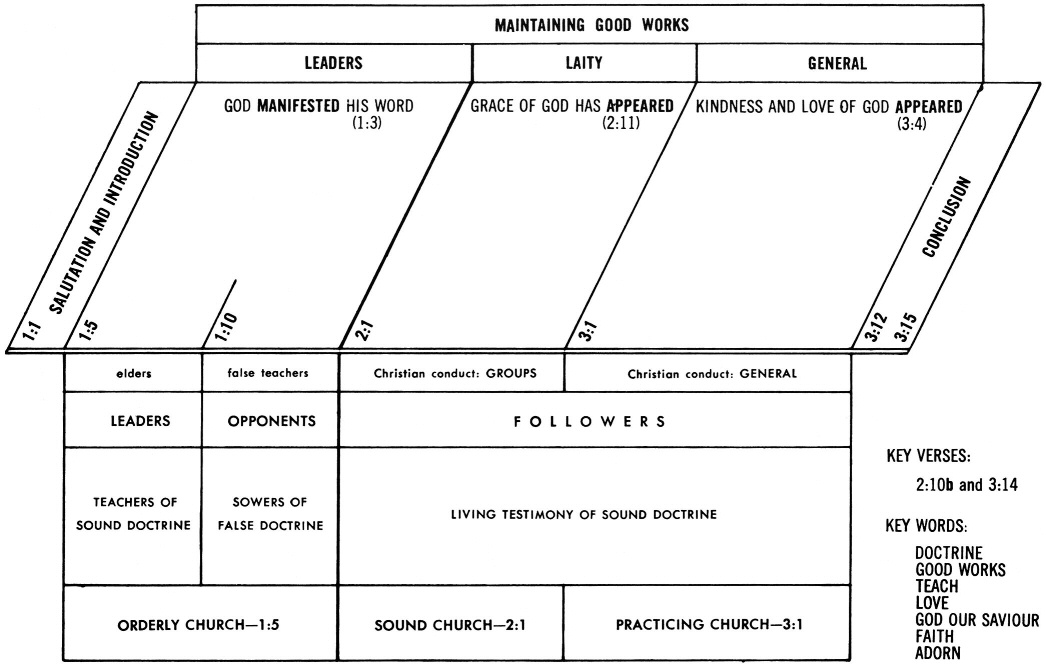
ADORNING THE DOCTRINE OF GOD
Click chart to enlarge
Charts from Jensen's Survey of the NT - used by permission
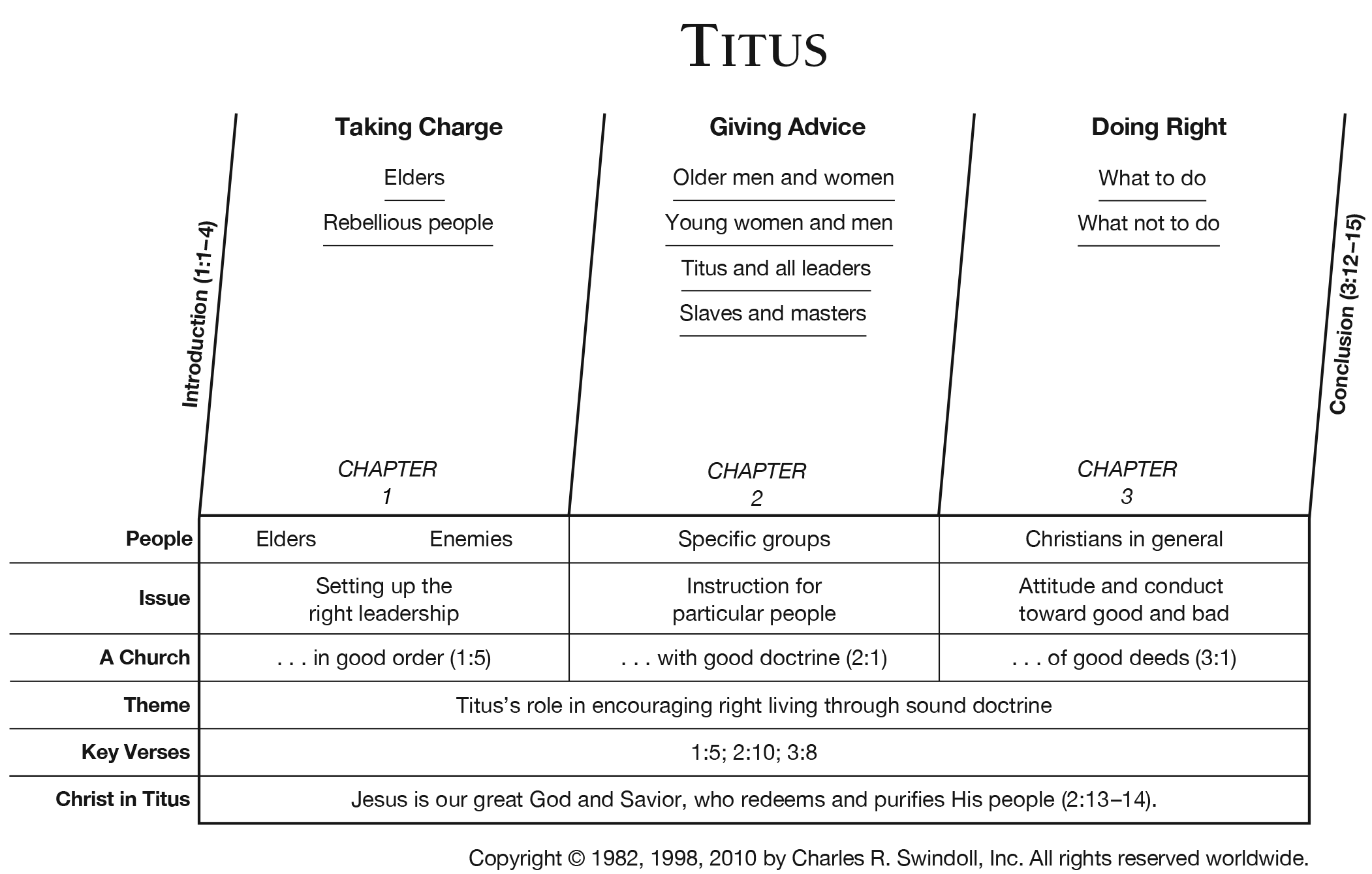
See Summary Chart by Charles Swindoll
Chart below from Michael J. Penfold
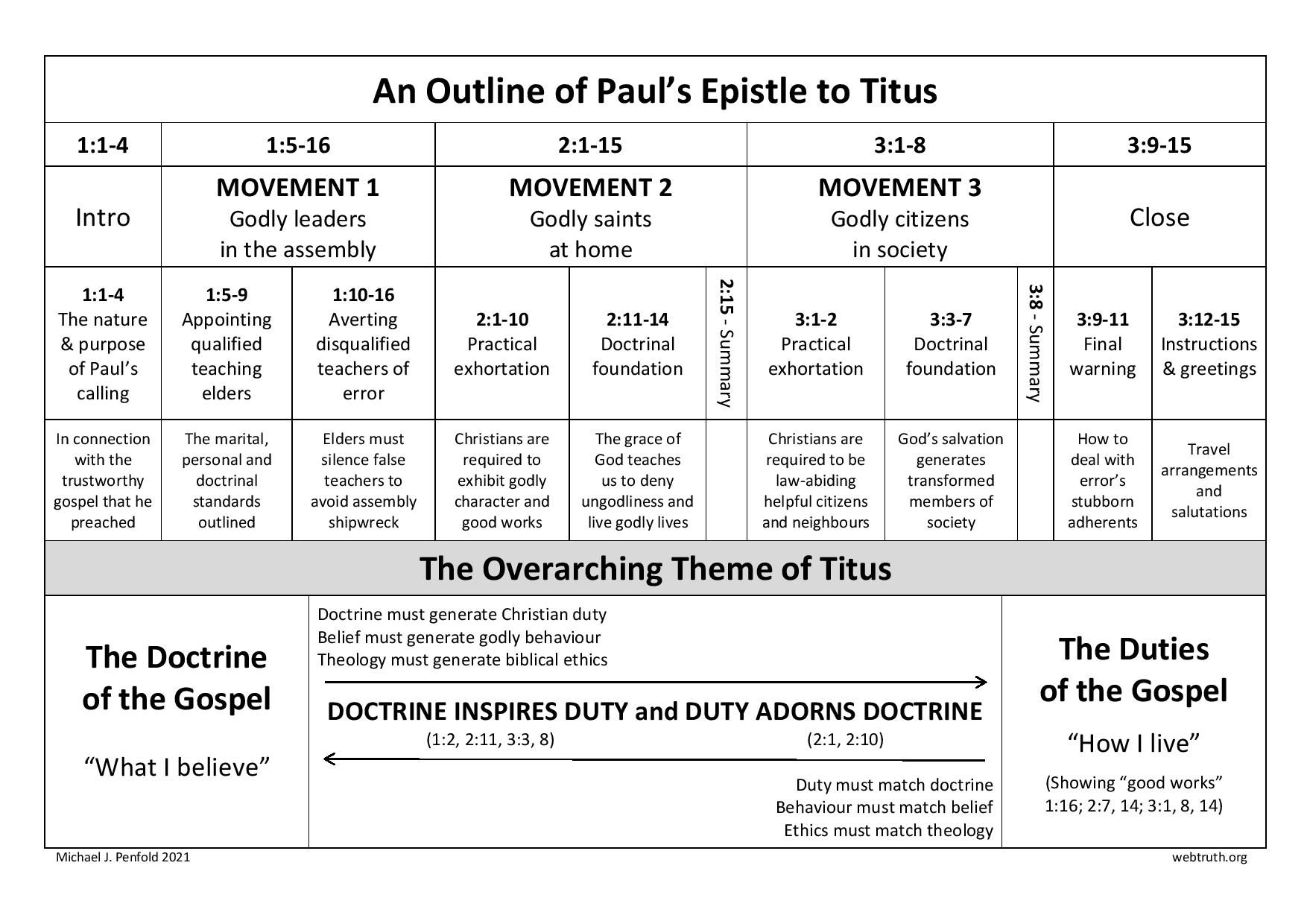
|
Focus |
Appoint Elders |
|||
|
Divisions |
Ordain |
Rebuke |
Maintain |
|
|
Topics |
||||
|
Topics |
Organization |
Offenders |
Operation |
|
|
Place |
Probably Written from either Corinth or Nicopolis (cf. Titus 3:12). |
|||
|
Time |
Circa 63 AD |
|||
|
Modified from Talk Thru the Bible |
||||
Titus 2:3 Older women likewise are to be reverent in their behavior, not malicious gossips nor enslaved (RPPFPA) to much wine, teaching what is good (NASB: Lockman)
Greek: presbutidas hosautos en katastemati hieroprepeis, me diabolous me oino pollo dedoulomenas, (RPPFPA) kalodidaskalous
Amplified: Bid the older women similarly to be reverent and devout in their deportment as becomes those engaged in sacred service, not slanderers or slaves to drink. They are to give good counsel and be teachers of what is right and noble, (Amplified Bible - Lockman)
KJV: The aged women likewise, that they be in behaviour as becometh holiness, not false accusers, not given to much wine, teachers of good things;
Phillips: Similarly the old women should be reverent in their behaviour, should not make unfounded complaints and should not be over-fond of wine. They should be examples of the good life, (Phillips: Touchstone)
NLT: Similarly, teach the older women to live in a way that is appropriate for someone serving the Lord. They must not go around speaking evil of others and must not be heavy drinkers. Instead, they should teach others what is good. (NLT - Tyndale House)
Wuest: aged women likewise, that they be worthy of reverence in their demeanor, not slanderers, not enslaved to much wine, teachers of that which is good,
Young's Literal: aged women, in like manner, in deportment as doth become sacred persons, not false accusers, to much wine not enslaved, of good things teachers,
OLDER WOMEN LIKEWISE ARE TO BE REVERENT IN THEIR BEHAVIOR: presbutidas hosautos hieroprepeis en katastemati:
old women are to be self-respecting in behaviour (BBE)
teach the older women to live in a way that is appropriate for someone serving the Lord (NLT)
aged women likewise, that {they be} in behavior as becometh holiness (Webster)
Bid the older women similarly to be reverent and devout in their deportment as becomes those engaged in sacred service (Amp)
In the same way instruct the older women to behave as women should who live a holy life. (TEV)
Older women likewise are to exhibit behavior fitting for those who are holy (NET)
In the same way exhort aged women to let their conduct be such as becomes consecrated persons (Weymouth)
Also, teach older women to be holy in the way they live (ICB)
- Ro 16:2; Eph 5:3; 1Ti 2:9,10; 3:11; 5:5-10; 1Pe 3:3-5
- Titus 2 Resources - Multiple Sermons and Commentaries
Older women likewise are to be reverent in their behavior - "Behavior fitting for those who are holy." (NET) So Paul begins by describing their basic character as women who were dedicated to God and this could be discerned by the way they dressed, spoke, etc.
Older women (4247) (Presbutis) means an aged woman, an adult female advanced in years and in the NT refers to age not office. Paul (wisely!) does not specify the age a woman would have to be to qualify as older. But childbearing typically ends at about 40 years of age and, correspondingly, childrearing ends at about 60. It therefore seems reasonable to take older women as referring to women that are at least 60 years old. That is the age that Paul mentions in his first letter to Timothy in regard to widows who qualified for being put on the list to receive financial support from the church (1Ti 5:9).
In NT times, Older women served the church in numerous ways. As Paul mentions later in the present passage, a key function of Older women was to teach and encourage younger women in the things of the Lord. They also ministered to each other and to women in the church of any age, single, married, or widowed. They visited the sick and those in prison. They provided hospitality to Christian travelers, especially those in some form of ministry. In towns that were strongly pagan, Christian women would go through the streets and marketplaces searching for abandoned newborns who were unwanted and had been left to die by their parents. Since abortion was both dangerous and expensive and birth control devices did not exist, an unwanted baby was simply abandoned at birth. Some male babies were raised to be slaves or gladiators, and some girls were trained for prostitution. Christian women who rescued these infants would give them to church families for adoption.
Older women were often objects of ridicule in comedies and were especially mocked for gossip and foolish talk .
Reverent (used only here in NT)(2412) (hieroprepes) is a combination of hieron meaning sacred, holy, consecrated to God (and was the word used to describe the entire Jewish Temple complex) and prepo meaning to be fitting, seemly, suitable, right (and is used in verse 1 above to describe things "fitting for sound doctrine"). The compound word means venerable (calling forth respect through age, character, or attainments), pertaining to proper reverence, worthy of reverence, befitting men, places, actions, or things sacred to God, reverent.
Hieroprepes has a root meaning of being "priest-like" and came to refer to that which is appropriate to holiness. These women were to be like people engaged in sacred duties, like those employed in sacred service. They are to carry into daily life the demeanor of that called for of priests in the temple. Older women are to be godly examples of holiness. T
he prophetess Anna illustrates such virtue for although she was a widow and at the "age of eighty-four… she never left the temple, serving night and day with fastings and prayers." (Lk 2:37). Because she had lived so faithfully in the Lord, the Holy Spirit enabled her to immediately recognize the infant Jesus (Lk 2:38).
Behavior (2688) (katastema from the verb = kathistemi) means deportment which includes a slight reference to dress, which would be the best rendering, except that the word has become depreciated. These older women were to be in dress, gait, and general deportment, in keeping with what their holy calling requires and were not to be like the world, but like the church, decent without, and adorned with holiness within.
Expositors says: “Demeanor (r.v.) is better than behavior (a.v.), which has a wide reference to conduct, in all respects and on all occasions. Deportment which includes a slight reference to dress, would be the best rendering, only that the word has become depreciated.”
Illustration - In his book entitled The Weight of Glory, C. S. Lewis tells the story of an old woman who met an enemy on her way out of church. When her opponent began to speak ill of her and to abuse her verbally, the old woman replied, “Isn’t it a shame for ye to be talking to me like that, ye coward, and me in a state of Grace the way I can’t answer ye? But you wait, I won’t be in a state of Grace long!” Ideally, age and growth in grace ought to coincide. The older we get, the more spiritually mature we should become. Yet this is not always the case. Just as there are some temptations that are especially common to youth, age brings with it its own set of trials. In these verses the apostle Paul highlights some of these temptations and points to a more godly alternative. (Today in the Word)
NOT MALICIOUS GOSSIPS NOR ENSLAVED TO MUCH WINE: me diabolous mede oinoi polloi dedoulomenas (RPPFPA):
- Titus 2 Resources - Multiple Sermons and Commentaries
Not malicious gossips nor enslaved to much wine - Not slanders or sippers. Not just gossips which is bad enough gossips with malicious intent. Also not just a glass of wine in the evening but a whole bottle!
Malicious gossips (false accusers) (1228) (diabolos from dia = through + ballo = throw) and thus pictures what the devil does -- throw between. For example, he "threw" lies to Eve and created a schism between God and man which in turn resulted almost immediately in a division between Adam and Eve. The devil's "game plan" is to wreak havoc in relationships by "throwing between" and this is exactly the effect of "malicious gossip"! The wise women Paul is describing refuse to listen to, much less propagate, slanderous and demeaning stories about others. Just as men are more inclined to abuse others physically, women are more inclined to abuse others verbally, which can be even more destructive.
Spurgeon comments that older women…
are also tempted to spread slanderous reports against people: having little to do in their old age, they are apt to do that little by way of mischief; so they are warned that they are not to be “false accusers, not given to much wine, teachers of good things.”
And how beautifully can an aged Christian woman, by her kindly example, be a teacher of good things! There is no more charming sight under heaven, I think, than that of an elderly Christian lady, whose words and whose whole life are such as becometh the gospel of Christ.
ADDICTION IS
ENSLAVEMENT TO ALCOHOL
This is a horrible picture - human beings with free will being enslaved to the "will" of wine!
Enslaved (1402) (douloo) means to bring into bondage or to make a slave and in the perfect tense emphasizes the completed state or permanent condition of being (passive voice = action exerted on them from without, in this case "wine" being the enslaving agent) held and controlled by wine which becomes a "master." Even worse an older believer who becomes addicted brings dishonor to the Lord’s name, sullies the reputation of the church, and more often than not leads others into following their ungodly example. The warnings against malicious talk and addiction to wine reflect a popular stereotype of an old woman. Drunkenness among women was especially abhorred in Roman tradition.
Wuest - The perfect tense speaks here of a confirmed drunkard. Expositors remarks: “It is proved by experience that the reclamation of a woman drunkard is almost impossible.”
Spurgeon comments that "Old women also among the heathen were often addicted to the taking of much wine, so here they are cautioned against it by the Spirit of God.
Wine (3631)(oinos) refers to a beverage (1) literally, of the juice of grapes, usually fermented (Lk 1.15); (2) figuratively, in apocalyptic symbolism; (a) as indicating the wrath of God outpoured in judgment (Rev 14.10); (b) as an enticement to immorality, like a love potion (Rev 17.2) (Friberg)
Zodhiates on oinos - Wine derived from grapes. The mention of the bursting of the wine skins in Matt. 9:17; Mark 2:22; Luke 5:37, 38 implies fermentation. See Luke 1:15; 7:33; 10:34; Rom. 14:21; Eph. 5:18 [cf. John 2:3, 9, 10; 4:46]; 1 Tim. 3:8; 5:23; Titus 2:3; Rev. 6:6; 18:13; Sept.: Gen. 9:21, 24; 14:18; 27:28; Judg. 9:13. From the intoxicating effects of wine and the idolatrous use of it among the heathen, wine signifies communion in the intoxicating idolatries of the mystic Babylon (Rev. 14:8 [cf. Jer. 51:7]). It denotes metaphorically the dreadful judgments of God upon sinners (Rev. 14:10; 16:19; 19:15 [cf. Isa. 51:17; Jer. 25:15; Ezek. 23:31]). The drinking of wine, though not forbidden by Scripture (as is drunkenness [Eph. 5:18]), is to be avoided in the presence of weaker brothers who might be influenced to partake against their consciences (Ro 14:21). In 1 Ti 5:23 oínos is recommended for medicinal purposes. (Complete Word Study Dictionary – New Testament)
Gilbrant - Background and History - Oinos is a common word from antiquity that is found in Homer and other ancient Greek writings, as well as in the Septuagint and papyri. Oinos and the Latin word vinum may derive from a common Semitic root (wyn or yyn; cf. Bandstra, “Wine,” International Standard Bible Encyclopedia, 4:1068). Further Indo-European cognates are the German Wein, the French vin, the Spanish vino, and the English wine. As well, Semitic cognates include the Akkadian īnu, the Arabic wayn (“black grapes”), and the Ugaritic yn (Harris, “yayin,” Theological Wordbook of the Old Testament, 1:375f.). Greek oinos originally began with a digamma, a consonant obsolete by New Testament times and pronounced like the letter w. When it is seen that oinos was woinos, the etymological connection is clearer. Various drinks were known and produced in antiquity. The juice of grapes, apples, dates, other fruit, honey, and grains were used for beverages. Modern distilled liquors like whiskey, vodka, and bourbon were unknown in ancient times. Modern distillation did not appear in Europe until the 12th Century A.D. Beer, made from barley, was common and was the main drink in Mesopotamia until about the time of Nebuchadnezzar (about 600 B.C.) when date wine replaced it in popularity. Due to its high sugar content date wine produced the most highly fermented beverage in antiquity. In Hebrew the term shēkhār means “beer” (equivalent to Akkadian shikāru). Both shēkhār and shikāru could also refer to date wine. In the Septuagint shēkhār can be translated by methē (3149), “wine, alcoholic drink,” methusma (same as methē), oinos, and sikera (4463), a direct borrowing and transliteration of shēkhār. Ancient beer differed from its modern counterpart primarily in the use of hops for flavoring (Limet, “The Cuisine of Ancient Sumer,” p.135). Hops were not used until the Middle Ages. In ancient Palestine wine was a leading product of the land (note the cluster of grapes described by the spies in Numbers 13:23). The Story of Sinuhe also notes the abundance of wine available in Palestine: “It had more wine than water” (see Lichtheim, Ancient Egyptian Literature, 1:226). Wine production “was second only to the cultivation of the olive and fig” (Forbes, Studies in Ancient Technology, 3:78), and consequently beer was not as popular, although its dangers are noted (Proverbs 20:1NIV). Beer was the common drink of the Philistines, however. The process of producing wine required several steps. First, the gathered grapes were pressed, either by a mechanical press or by treading (from which the highest quality wine was produced). Next, the juice was collected and placed in vats to ferment. Naturally occurring molds in the skins caused the sugar in the grapes to change into alcohol. The maximum percentage of alcohol in natural wine is limited by the amount of sugar present (half of the percentage of the sugar) and by the alcohol level itself: if it rises much above 10 or 11 percent the fermenting agents are killed and the process stops (Harris, “yayin,” Theological Wordbook of the Old Testament; 1:375f.). The fermentation process took only 3 to 4 days, resulting in a beverage with an alcoholic content from 4 to 12 percent (8 to 24 proof). Then the wine was filtered through a linen cloth, stored in jars, and sold. Part of the product was stored in a cool place after being sealed with a stopper and resin or pitch to prevent further fermentation. If the fermentation process were to continue, vinegar, “sour wine,” would result. Even so, fermentation could not be completely prevented and consequently 3 years (roughly) was the maximum storage time for wine. Much was boiled down to a syrup in order to preserve it. Wine was usually diluted with water before consumption; “only ‘boozers’ drank pure wine” (Forbes, ibid., 3:80; also 3:61-85 for further information). However, Isaiah 1:22 views wine mixed with water as spoiled, reflecting the attitude of the Old Testament period; in New Testament times and after, many did not wish to drink undiluted wine. Rabbi Eliezer in the Talmud (Berakoth 7.5), in fact, forbade the saying of the blessing over wine that was not diluted. Hence Revelation 14:10 says, “The same shall drink of the wine of the wrath of God, which is poured out without mixture into the cup of his indignation” (emphasis supplied). For medicinal purposes wine was mixed with vinegar, myrrh (Mark 15:23, offered to the Lord on the cross to deaden the pain or to induce unconsciousness, which He refused), and gall (wormwood, hemlock, also offered to Christ, Matthew 27:34). (Note in Matthew 27:34 the King James Version gives “vinegar” for the word oinos, probably out of the opinion that when gall was added the wine became a bitter mixture and that “vinegar” better conveyed this idea.)
Gilbrant on wine in the Septuagint - In the Septuagint oinos appears over 200 times, predominantly translating the Hebrew term yayin. While the evils of inebriation are expressed (Proverbs 20:1; 23:29-35), wine is also praised (Psalm 104:15). Kings are warned to avoid it (Proverbs 31:4,5). An abundance of wine is seen as a sign of affluence (Genesis 49:11,12). It is important to note that the Hebrew word tîrôsh, “grape juice, unfermented wine,” appearing 38 times in the Old Testament (Harris, “tîrôsh,” Theological Wordbook of the Old Testament, 2:969), is also almost exclusively translated by oinos (36 times). In other words, oinos can and does refer to either unfermented or fermented wine in the Septuagint. It is also significant that even grape juice, as a symbol of harmless pleasures, can lead to overindulgence (Hosea 4:11). The Septuagint translates it with methusma, not oinos. Nazarites in the Old Testament were forbidden to drink any type of wine whatsoever in order to keep the man of God separate from that which could cloud the mind or spoil his testimony of holiness (Numbers 6:3). Thus John the Baptist was described by the angel as one who would “drink neither wine nor strong drink” (Luke 1:15; see above for a discussion on this verse). (Complete Biblical Library Greek-English Dictionary)
New Testament Usage - In the New Testament oinos is used 33 times. Concerning the Parable of the Wineskins, the juice would be acted on by yeast from the old wineskins and would begin to foam. Such gases could split any wineskin, but especially an older one that was already stretched out (Matthew 9:17; Luke 5:37,38). New wine would be grape juice (or a grapeade) made from grape syrup while old wine would be 2 to 3 years old. Old wine was considered better than new wine; hence Jesus’ point that those who had drunk the old did not want the new, an obvious allusion to the Pharisees and others who would not accept His new teachings (Luke 5:39). The Scriptures are abundantly clear in warning firmly against the intoxicating power of alcoholic beverages, even though the world at that time was dealing with drinks of 4 to 12 percent alcoholic content. Modern chemistry commonly produces beverages of 40 to 50 percent alcohol. The fundamentalist, conservative churches in the United States early took a stand for total abstinence, this especially in light of the ruination alcohol brought to certain Indian tribes. However, consumption of alcoholic beverages was common even among evangelical Christians and Puritans until the first half of the 19th Century and the rise of the temperance movement (Tyler, Freedom’s Ferment, pp.308-12). This stance has been maintained by many groups today in keeping with the teaching of Romans 14:13, “that no man put a stumbling block or an occasion to fall in his brother’s way.” First Timothy 5:23 gives Paul’s advice to Timothy to no longer drink only water, but to drink “a little wine for thy stomach’s sake and thy oft infirmities.” Some say this had to do with the effect of the water which grape juice counteracted. Others say this clears the way for Christians to use medicines with alcohol in them for the sake of curing illness. Paul did say “a little wine,” and the context is clearly one of dealing with a sick person. When Paul warned the Ephesians not to get drunk with wine (5:18), the “wine” refers to all fermented drinks. It does not justify becoming inebriated with beer or distilled liquor. On the nature of the wine used at the Last Supper it must be kept in mind that ancient man had few beverages to drink, and lack of modern refrigeration prevented them from retaining unfermented fruit and grain beverages. Apart from these juices, only milk and water were available for consumption. Grapes were generally harvested in mid to late summer (Hopkins, “The Subsistence Struggles of Early Israel,” p.186) and, to prevent spoilage in the intense heat, had to be processed immediately. Stored wine naturally fermented unless it was boiled down or kept cool, and it is to be expected that by the time of the Last Supper (late March–early April) only fermented juice (or grapeade) was available. Attempts to prevent fermentation by immediately sealing the fresh juice would likely have been considered. However, the discovery of a number of burst vessels shows that such attempts were generally unsuccessful. In spite of sealing, fermentation eventually began and the gases released shattered the vessels (Forbes, Studies in Ancient Technology, 3:80). However, today when many satisfying substitutes for alcoholic beverages are available, abstinence is a reasonable alternative to the overwhelming abuse of alcohol. There have been endless tirades and debates on the nature of the wine made by our Lord at the wedding in Cana (John 2:9,10). Sides are drawn not on the basis of the word oinos, but on the view of abstinence held. The issue seems to be whether or not Jesus would create fermented wine and contribute to the further inebriation of the wedding guests. (Had the wine been unfermented, it would not have had time to ferment since it was consumed immediately.) From the Septuagint usage noted above, the oinos could be fermented or unfermented. Suffice it to say, the “better” wine of course does not in any way imply or demand a more alcoholic, or even an alcoholic, wine at all (one would presume that any wine that God had made would be better than man-made wine). (Complete Biblical Library Greek-English Dictionary)
Oinos - 34x in 26v - wine(33), wine*(1).
Matt. 9:17; Matt. 27:34; Mk. 2:22; Mk. 15:23; Lk. 1:15; Lk. 5:37; Lk. 5:38; Lk. 7:33; Lk. 10:34; Jn. 2:3; Jn. 2:9; Jn. 2:10; Jn. 4:46; Rom. 14:21; Eph. 5:18; 1 Tim. 3:8; 1 Tim. 5:23; Tit. 2:3; Rev. 6:6; Rev. 14:8; Rev. 14:10; Rev. 16:19; Rev. 17:2; Rev. 18:3; Rev. 18:13; Rev. 19:15
Oinos in Septuagint -
Gen. 9:21; Gen. 9:24; Gen. 14:18; Gen. 19:32; Gen. 19:33; Gen. 19:34; Gen. 19:35; Gen. 27:25; Gen. 27:28; Gen. 27:37; Gen. 49:11; Gen. 49:12; Exod. 23:25; Exod. 29:40; Exod. 32:18; Lev. 10:9; Lev. 23:13; Num. 6:3; Num. 6:4; Num. 6:20; Num. 15:5; Num. 15:7; Num. 15:10; Num. 18:12; Num. 28:14; Deut. 7:13; Deut. 11:14; Deut. 12:17; Deut. 14:23; Deut. 14:26; Deut. 18:4; Deut. 28:39; Deut. 28:51; Deut. 29:6; Deut. 32:14; Deut. 32:33; Deut. 32:38; Deut. 33:28; Jos. 9:4; Jos. 9:13; Jdg. 9:13; Jdg. 13:4; Jdg. 13:7; Jdg. 13:14; Jdg. 19:19; 1 Sam. 1:11; 1 Sam. 1:14; 1 Sam. 1:15; 1 Sam. 1:24; 1 Sam. 10:3; 1 Sam. 16:20; 1 Sam. 25:11; 1 Sam. 25:18; 1 Sam. 25:37; 2 Sam. 13:28; 2 Sam. 16:1; 2 Sam. 16:2; 2 Ki. 18:32; 1 Chr. 9:29; 1 Chr. 12:40; 1 Chr. 27:27; 2 Chr. 2:10; 2 Chr. 2:15; 2 Chr. 11:11; 2 Chr. 31:5; 2 Chr. 32:28; Ezr. 6:9; Ezr. 7:22; Neh. 2:1; Neh. 5:11; Neh. 5:15; Neh. 5:18; Neh. 10:37; Neh. 10:39; Neh. 13:5; Neh. 13:12; Neh. 13:15; Est. 1:7; Est. 4:17; Job 1:13; Ps. 4:7; Ps. 60:3; Ps. 69:12; Ps. 75:8; Ps. 78:65; Ps. 104:15; Prov. 3:10; Prov. 4:17; Prov. 9:2; Prov. 9:5; Prov. 12:11; Prov. 20:1; Prov. 21:17; Prov. 23:30; Prov. 23:31; Prov. 27:9; Prov. 31:4; Prov. 31:6; Eccl. 2:3; Eccl. 9:7; Eccl. 10:19; Cant. 1:2; Cant. 1:4; Cant. 2:4; Cant. 4:10; Cant. 5:1; Cant. 7:9; Cant. 8:2; Isa. 1:22; Isa. 5:11; Isa. 5:12; Isa. 5:22; Isa. 16:10; Isa. 22:13; Isa. 24:7; Isa. 24:9; Isa. 24:11; Isa. 25:6; Isa. 28:1; Isa. 28:7; Isa. 29:9; Isa. 36:17; Isa. 49:26; Isa. 51:21; Isa. 55:1; Isa. 62:8; Jer. 13:12; Jer. 23:9; Jer. 25:15; Jer. 31:12; Jer. 35:2; Jer. 35:5; Jer. 35:6; Jer. 35:8; Jer. 35:14; Jer. 40:10; Jer. 40:12; Jer. 48:33; Jer. 51:7; Lam. 2:12; Ezek. 16:49; Ezek. 27:18; Ezek. 27:19; Ezek. 44:21; Dan. 1:5; Dan. 1:8; Dan. 1:16; Dan. 5:1; Dan. 5:2; Dan. 5:4; Dan. 5:23; Dan. 10:3; Hos. 2:8; Hos. 2:9; Hos. 2:22; Hos. 3:2; Hos. 4:11; Hos. 7:5; Hos. 7:14; Hos. 9:2; Hos. 9:4; Hos. 14:7; Joel 1:5; Joel 1:10; Joel 2:19; Joel 2:24; Joel 3:3; Amos 2:8; Amos 2:12; Amos 5:11; Amos 6:6; Amos 9:14; Obad. 1:16; Mic. 2:11; Mic. 6:15; Zeph. 1:13; Hag. 1:11; Hag. 2:12; Zech. 9:15; Zech. 9:17; Zech. 10:7
Related Resources:
- American Church Dictionary Wine
- American Tract Society Wine
- Bridgeway Bible Dictionary Wine
- Baker Evangelical Dictionary Wine
- Easton's Bible Dictionary Wine
- Fausset Bible Dictionary Wine
- Holman Bible Dictionary Wine
- Hastings' Dictionary of the Bible Wine and Strong Drink
- Hastings' Dictionary of the NT Wine Wine
- Hawker's Poor Man's Dictionary Wine New wine
- Smith Bible Dictionary Wine
- Vines' Expository Dictionary Wine
- Wilson's Bible Types Wine
- Webster Dictionary Wine
- Watson's Theological Dictionary Wine
- 1911 Encyclopedia Britannica Wine
- International Standard Bible Encyclopedia Wine; Wine Press
- Kitto Biblical Cyclopedia Wine
- McClintock and Strong's Bible Encyclopedia Sweet Wine
- The Jewish Encyclopedia Wine
- Nave Topical Bible Wine
- Thompson Chain Reference Wine
- Torrey Topical Textbook Wine
- Did Jesus change the water into wine or grape juice?
- Did Jesus drink wine/alcohol?
- Should wine or grape juice be used for communion?
- What does the Bible say about drinking alcohol / wine? Is it a sin for a Christian to drink alcohol / wine?
- What is consubstantiation?
- Why did Jesus choose the wedding at Cana for His first miracle?
- Why is the real presence of Christ in the Lord's Supper such a controversial issue?
- Is intinction the correct way to do communion?
- What does the Bible say about underage drinking?
- What is transubstantiation?
TEACHING WHAT IS GOOD (teachers of good) : kalodidaskalous:
- Titus 2:4; Heb 5:12; Rev 2:20
- Titus 2 Resources - Multiple Sermons and Commentaries
Teaching what is good (2567) is the single Greek compound word kalodidaskalos derived from kalos which refers to that which is inherently excellent or intrinsically good and which provides special or superior benefit. The second component of kalodidaskalos is didaskalos (from didasko [English = didactic] meaning to teach in such a way so as to shape the will of the one being taught by the content of what is taught) and refers to an instructor, master or teacher. This older woman is both by example and instruction to be a teacher of good, beautiful and beneficial things which was a sorely needed mission then and in our day.
Steven Cole - Older women are to be examples of godliness, training the younger women (Titus 2:3).
Godly older women have an important role to play in God’s beautiful body, the church.
(1) Older women are to be reverent in their behavior. “Behavior” points to their demeanor or inner character. “Reverent” literally means “suitable to a sacred person,” or a priestess in a temple. The reverent woman fears God and lives in His presence.
(2) Older women are not to be malicious gossips. “Malicious gossips” is a single word in Greek that is used 34 times of the devil! It literally means to throw things at people. A godly woman will not repeat damaging stories about others. She will not spread rumors or half-truths that damage someone’s reputation.
(3) Older women are not to be enslaved to much wine. There is a connection between a loose tongue and intoxicating drink. A woman who drinks too much will probably talk too much. As you grow older, it is easy to begin having a drink to block aches and pains or to drown loneliness or depression. Before long, you are addicted to alcohol. That is sin, because you are not relying on the Lord and experiencing the joy of His salvation.
(4) Older women are to teach what is good. The word “good” is often translated “beautiful” or “attractive.” Note that it was the older women, not Titus, that were to teach the younger women how to be truly beautiful, namely, to be godly. The word “encourage” means to make sensible. Younger women sometimes feel overwhelmed by the difficulties of rearing children and keeping house. Hopefully not, but perhaps they sit around watching “Desperate Housewives” and begin to think they would be happier if they abandoned their responsibilities. The older women should help them think sensibly about the importance of those duties.
This is especially important as the church sees younger women coming to Christ from pagan backgrounds. Perhaps they have not had godly role models to teach them how to make their homes attractive places for their families. They don’t know how to love their husbands and children. Worldly feminism tells them to forget their families and find fulfillment in a career or in a new romance. Godly older women are to talk sense to them by teaching what is beautiful and attractive about a godly home. If you’ve never read it, get Edith Schaeffer’s, The Hidden Art of Homemaking: Creating Beauty in Everyday Life. Also, her book, What is a Family? is excellent. (Developing a Beautiful Body – Part 1 Titus 2-1-5)
Why They Are Grand - READ: Titus 2:1-5 - Older women … [are to] admonish the young women to love their husbands, to love their children. —Titus 2:3
Grandparents are great bridge-builders. My grandparents, farmers on both sides of the family, were children of the 19th century and relayed an important heritage of both history and faith through the years.
Today, my children benefit from their grandparents' faith because they can see that my wife and I have personally accepted the faith modeled for us. And our children have seen and heard their grandparents' testimonies of faith for themselves.
In a sense, it seems strange that grandparents can have such far-reaching influence. After all, they can be separated in age from their grandchildren by 40 to 70 years. Yet they have an uncanny ability to bridge that generation gap—sometimes even better than parents can.
Older Christians, including grandparents, have a unique responsibility and opportunity—that of example and instruction—which either directly or indirectly keeps the heritage of faith alive from generation to generation.
Let's be thankful for the strong heritage of faith, love, and family that grandparents can leave to those who come after them. And grandparents should seize every opportunity of relating to their grandchildren, so that their faith will become the faith of their children's children. —Dave Branon (Our Daily Bread, Copyright RBC Ministries, Grand Rapids, MI. Reprinted by permission. All rights reserved)
I do not ask for mighty words
To leave them all impressed,
But grant my life may ring so true
My family will be blessed.
—Anon.
The richest inheritance a grandparent can leave is a godly example.
Titus 2:4 so that they may encourage (3PPAS) the young women to love (PAN) their husbands, to love their children (NASB: Lockman)
Greek: hina sophronizosin (3PPAS) tas neas philandrous einai, (PAN) philoteknous
Amplified: So that they will wisely train the young women to be asane and sober of mind (temperate, disciplined) and to love their husbands and their children, (Amplified Bible - Lockman)
KJV: That they may teach the young women to be sober, to love their husbands, to love their children,
Phillips: so that the younger women may learn to love their husbands and their children,
NLT: These older women must train the younger women to love their husbands and their children, (NLT - Tyndale House)
Weymouth: They should school the young women to be affectionate to their husbands and to their children,
Wuest: in order that they may train the young women to be fond of their husbands, to be fond of their children,
Young's Literal: that they may make the young women sober-minded, to be lovers of their husbands, lovers of their children,
SO THAT THEY MAY ENCOURAGE THE YOUNG WOMEN: hina tas neas sophronizosin (3PPAS) :
These older women must train the younger women (NLT)
that they may admonish the young women (Darby)
That they may instruct the young women to be sober minded (Geneva-1599)
so that they shall be training the young women (ALT)
in order that they may train the young women (Wuest)
They should school the young women (Weymouth)
that they may make the young women sober-minded (YLT)
So that they will wisely train the young women to be sane and sober of mind (temperate, disciplined) (Amp)
- 1Ti 5:2,11,14
- Titus 2 Resources - Multiple Sermons and Commentaries
OLDER WOMEN:
YOU HAVE A HOLY PURPOSE!
So that (2443) (hina) is a conjunction which denotes purpose, aim, or goal and is often translated "in order that, so that, or that". This is the first of four "purpose clauses" in Titus 2:5-10. See importance of pausing to ponder terms of purpose or result like so that, in order that, that, as a result.
Young women (3501) (nea) were almost always wives, because Jewish and Greco-Roman society generally frowned upon women’s singleness and men seem to have outnumbered women. Both Judaism and ancient moralists stressed that wives should love their husbands and nurture their children and many tomb inscriptions report these characteristics as a woman’s crowning virtue.
May encourage (only used here) (4994) (sophronizo from sophron = sober-minded or having a "saved" mind as discussed above) is more literally "that they may continually (present tense) make the young women sober-minded". The sober minded individual is in command of their mind. They have control over the things they think and do. They do not allow circumstances or the immorality or foolishness of others to distract them. They not only do not become involved in things that are outright immoral and unspiritual but also avoid things that are trivial, foolish, and unproductive. And so Paul is saying the older woman are to cause the younger women to be of sound mind and to have self-control. The older women should interact with young wives especially disciplining them, training them to think and act with a sound mind. A Christian home in Crete was a totally new thing, and young women saved out of paganism would have to get accustomed to a whole new set of priorities and privileges. Those who had unsaved husbands would need special encouragement.
Wuest on sophronizo - to make sane or sober-minded, to recall a person to his senses,” hence “to moderate, chasten, discipline.” Here it should be translated “to school, to train.”
Just Say No - Titus 2:4–5 - French naturalist Jean-Henri Fabre once conducted an experiment with processionary caterpillars, so called because of their genetic inclination to follow one another. He lined them up around the inner edge of a flowerpot and watched them march in a circle. Then he put pine needles, their favorite food, in the center of the pot. The caterpillars continued to walk without breaking rank. Finally they rolled over and died of starvation, just inches from their ideal food source. Many of today’s moms are a bit like these furry little creatures. They trudge around in circles from morning until night, wondering how they can get everything done. Many are employed full-time while also taking care of families, chauffeuring kids, fixing meals, cleaning the house, and trying to maintain marriages, friendships, and spiritual obligations. It’s a breathless way of life we call “routine panic.” If we’ve just described your life, realize that it doesn’t have to be this way. The tendency for families to take on too many commitments is rampant these days, but it can be avoided by employing one little word: No. As the apostle Paul wrote, we are “to say ‘No’ to ungodliness and worldly passions, and to live self-controlled, upright and godly lives in this present age” (Titus 2:12). Self-control starts with saying "NO" to frantic living—and yes to a more orderly existence.
THOUGHT: I DO NOT AGREE COMPLETELY WITH THE SUGGESTION REGARDING BEGINNING OF "SELF-CONTROL." SELF-CONTROL FOR BELIEVERS IS SUPERNATURAL AND IS ONLY POSSIBLE IN A PERSON FILLED WITH THE SPIRIT. (Gal 5:23). EVEN IN THE TITUS PASSAGE NOTE THAT GRACE PRECEDES SAYING "NO". IN THE PHRASE "INSTRUCTING US TO DENY..." WHO IS INSTRUCTING? IN CONTEXT THE ANSWER IS A "TEACHER" NAMED "GRACE OF GOD." (Titus 2:11) THIS IS WHY THE CAMPAIGN "JUST SAY NO" WAS DOOMED TO FAILURE. THE FLESH CANNOT SAY "NO" TO THE FLESH! WE HAVE TO FIRST SAY "YES" TO JESUS AND BE FILLED WITH HIS ENABLING SPIRIT TO HAVE THE DESIRE AND POWER TO EVEN SAY "NO." (Php 2:13NLT) THIS PATTERN OF SPIRIT FIRST, THEN SUPPRESSION OF THE FLESH IS CLEARLY SEEN IN Gal 5:16. DON'T TRY TO CONTROL THE FLESH WITH YOUR FLESH BUT WITH THE SPIRIT'S ENABLING POWER!!!
Before you say good night…Are you overcommitted? What could you cut from your schedule? Do you end current obligations before adding new ones? Save us, Father, from our addiction to constant motion and endless commitments. Grant us courage to rethink our priorities, to say no instead of yes. Lord, give us the self-control that will bring peace and rest to our family. Amen. (Ref)
Below is a devotional from Paul David Tripp which describes a much more Biblical way to JUST SAY NO -- As you read it you will notice the upshot is that "Just say YES" to Jesus and then you will be enabled by the Spirit to "Just say NO" to the flesh. Sadly many Christians have fallen into this trap of "JUST SAY NO." Beloved the flesh will never say "no" to the flesh! We must invoke and rely on the Spirit's enabling power. It is analogous to the expulsive power of a new affection in which we first focusing our eyes and our affections on Jesus and rely on His Spirit, and then the things of this world will grow strangely dim in the light of His glory and grace! Amen!
Here is Tripp's devotional from "New Morning Mercies"...
God calls you to deny yourself and then blesses you with the indwelling Holy Spirit so you have the power to say no.
You have called me to say
no.
Not no to you
or no to others,
but no to myself.
I must say no to
selfish desires,
wrong thoughts, and
dangerous emotions.
I must say no to
the world’s values,
sin’s temptations, and
my desire to control
what only God can rule.
But left to myself,
I have
little desire
or power
to say
no.
So you have given me
exactly what I need.
It’s the only thing
that will solve my
problem.
You have given me
your Spirit.
So, when necessary,
I am able
to say
no.
TO LOVE THEIR HUSBANDS: philandrous einai (PAN):
to be attached to their husbands (Darby)
to be fond of their husbands (Wuest)
to be affectionate to their husbands (Weymouth)
- 1Ti 5:14
- Titus 2 Resources - Multiple Sermons and Commentaries
Love… husbands (only used here)(5362) (philandros) is an adjective that more literally describes a woman who is "fond of man" and is derived from philos meaning a friend or companion or loving as a friend and aner meaning a husband.
The adjective is modified by the verb einai which is the present tense, active voice of "to be". Thus the young woman were to continually be (present tense) fond of their husbands and by implication, not fond of men other than their own husband. Active voice (subject exerts action by a volitional choice) signifies that the young wife is to exhibit a willing determined love that is not based on a husband’s worthiness but on God’s instructions for order in the home. These teachings were needed in pagan Crete but are even more desperately needed in post-Christian paganized America where a new generation of young women has been brought up in a society that exalts feminism and denigrates biblical standards for marriage and order. In many cases, young women even in evangelical churches have not had the benefit of careful “teaching [of] what is good” or the godly example of older women in the church and sadly have not been exposed to the clear teaching of Scripture on this subject.
Vincent calls attention to an inscription from Pergamum; “Julius Bassus to Otacilia Polla, my sweetest wife, who loved her husband and children and lived with me blamelessly for thirty years.”
TO LOVE THEIR CHILDREN: philoteknous:
to be attached to their children (Darby)
to be fond of their children (Wuest)
to be affectionate… to their children, (Weymouth)
- Titus 2 Resources - Multiple Sermons and Commentaries
To love their children (only used here)(5388)(philoteknos) is an adjective derived from a combination of philos meaning a friend and teknon meaning a child. This exhortation is still needed where some married women prefer poodle-dogs to children.
Steven Cole - Younger women must be godly homemakers so that the word of God will not be dishonored (Titus 2:4-5).
Many younger women have no understanding of how important the job of homemaking is. Also, they lack practical training in how to do it. Frankly, sometimes they are undisciplined, sitting around watching TV soap operas or game shows when they should be cleaning or organizing the house or shopping for family needs. I am so glad that Marla has made our home a refuge for me. It is a pleasant place to be because she is pleasant and because of her work and creativity. Paul says that the older women are to make the younger women sensible in seven areas:
(1) The younger women are to love their husbands. This implies that love is not automatic. It takes deliberate effort. The word that Paul uses implies the love of friendship. A husband and wife should cultivate a close companionship. Love for your husband begins in how you think about him each day. If you grumble about his bad habits and run him down all day in your thoughts, you are not loving him. You must begin by thanking God for him and by thinking about his needs and how you can meet them. The love of friendship requires time together, sharing your thoughts and feelings.
(2) The younger women are to love their children. Again, it doesn’t come naturally, especially when they try your patience by their disobedience. You are sinning against God and your children if you slap them around or angrily call them derogatory names. Write down the qualities of biblical love (1 Cor. 13:4-7) and read them over daily so that they begin to describe how you relate to your children. The Greek word here also implies the love of friendship. While you are always your children’s mother, as they grow older you should also cultivate a friendship with them.
(3) The younger women are to be sensible. There is that word again! It means to be in rational control of one’s impulses and passions.
(4) The younger women are to be pure. This refers to sexual purity. You should not watch TV shows or read magazines or novels that feed your imagination with the supposed pleasures of illicit romance. Usually women are tempted to sexual immorality when their emotional needs are not being met. If that is true of you, talk to your husband about those needs. An adulterous affair will not meet your needs in the long run.
(5) The younger women are to be workers at home. Yes, this sounds outdated and sexist, but it is God’s design and wisdom. No woman gets to the end of life and says, “Ah, I’ve had a satisfying life as a corporate executive!” Seeing your family walking with God and loving one another brings true joy. You have to work to make your home a beautiful and pleasant place for your family.
(6) The younger women are to be kind. The Greek word literally is, “good,” but in the context it includes kindness. It means to be a nice person to be around. The kind or good woman thinks of the needs of others and goes out of her way to meet those needs. When a family member is upset or discouraged, she responds with sympathy and kind words.
(7) The younger women are to be subject to their own husbands. This is about as out of sync with American culture as it could be, but it is still God’s word of truth. You have a choice: God’s way or the world’s way. The world’s way asserts self; it stands up for one’s rights. It makes demands on others in order to get one’s own way.
God’s way submits first of all to Jesus as Lord. It judges selfishness. It seeks the good of others ahead of self. God’s way is (Phil. 2:3), “Do nothing from selfishness or empty conceit, but with humility of mind regard one another as more important than yourselves.” God’s way of submission grates against our fallen, selfish human nature. Submission does not imply inferiority or becoming a doormat. “To be subject” is a military term, to put oneself in rank under another. Although Jesus is equal with the Father, He voluntarily put Himself under the Father to carry out the divine plan of salvation. Christian marriage is to reflect the image of God. Husbands and wives are to be an earthly picture of Christ and the church, with husbands loving their wives sacrificially and wives respecting and submitting to their husbands (Eph. 5:22-33).
The reason that Paul gives is, “so the word of God will not be dishonored” (2:5). This probably applies to all of the qualities that he has just listed, including submission. A wife who claims to be a Christian but who does not demonstrate love for her husband and children, moral purity, and being a godly homemaker, is not a good advertisement for the gospel. But a wife who practices these things stands out from the world’s ways. Like the woman in Proverbs 31, she will be praised, and when she is praised, she will deflect the praise to the Lord, giving Him the glory.
Conclusion - God wants all of us to focus on becoming His beautiful people—not the outward, fading beauty of the world, but the inner, lasting beauty of a heart that is obedient to Him. We refer to a beautiful person as attractive, because beauty attracts. A beautiful place, like the Grand Canyon, attracts people to it. The body of Christ should be so beautiful that those who do not know the Savior are attracted to Him through us. So, get to work on helping this church develop into a beautiful body for His glory! (Developing a Beautiful Body – Part 1 Titus 2-1-5)