Titus 2:2
Titus 2:3
Titus 2:4
Titus 2:5
Titus 2:6
Titus 2:7
Titus 2:8
Titus 2:9
Titus 2:10
Titus 2:11
Titus 2:12
Titus 2:13
Titus 2:14
Titus 2:15
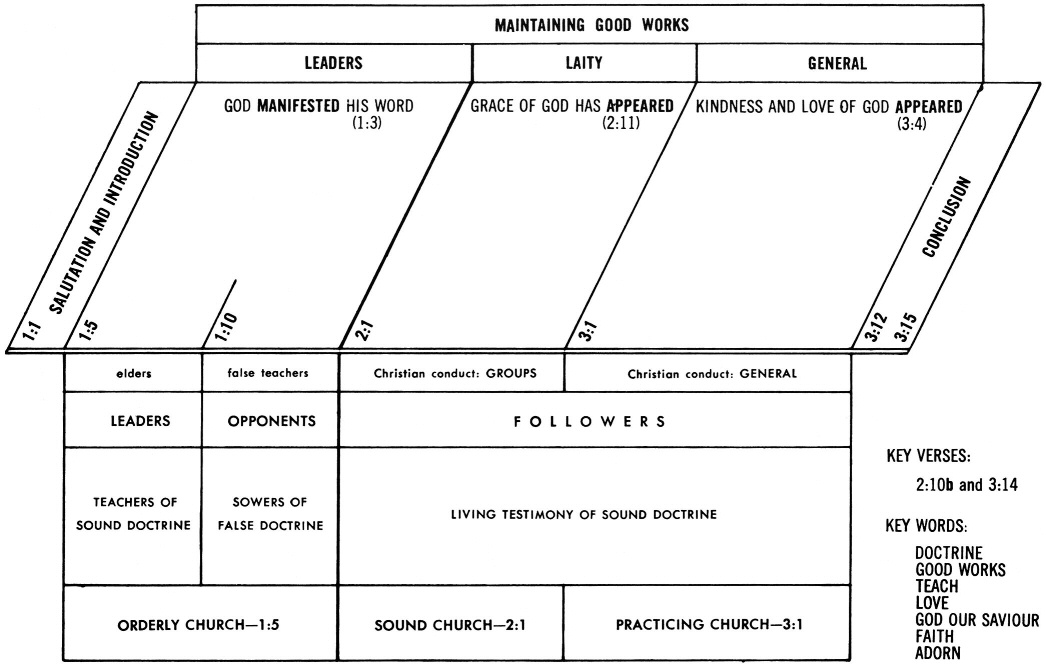
ADORNING THE DOCTRINE OF GOD
Click chart to enlarge
Charts from Jensen's Survey of the NT - used by permission
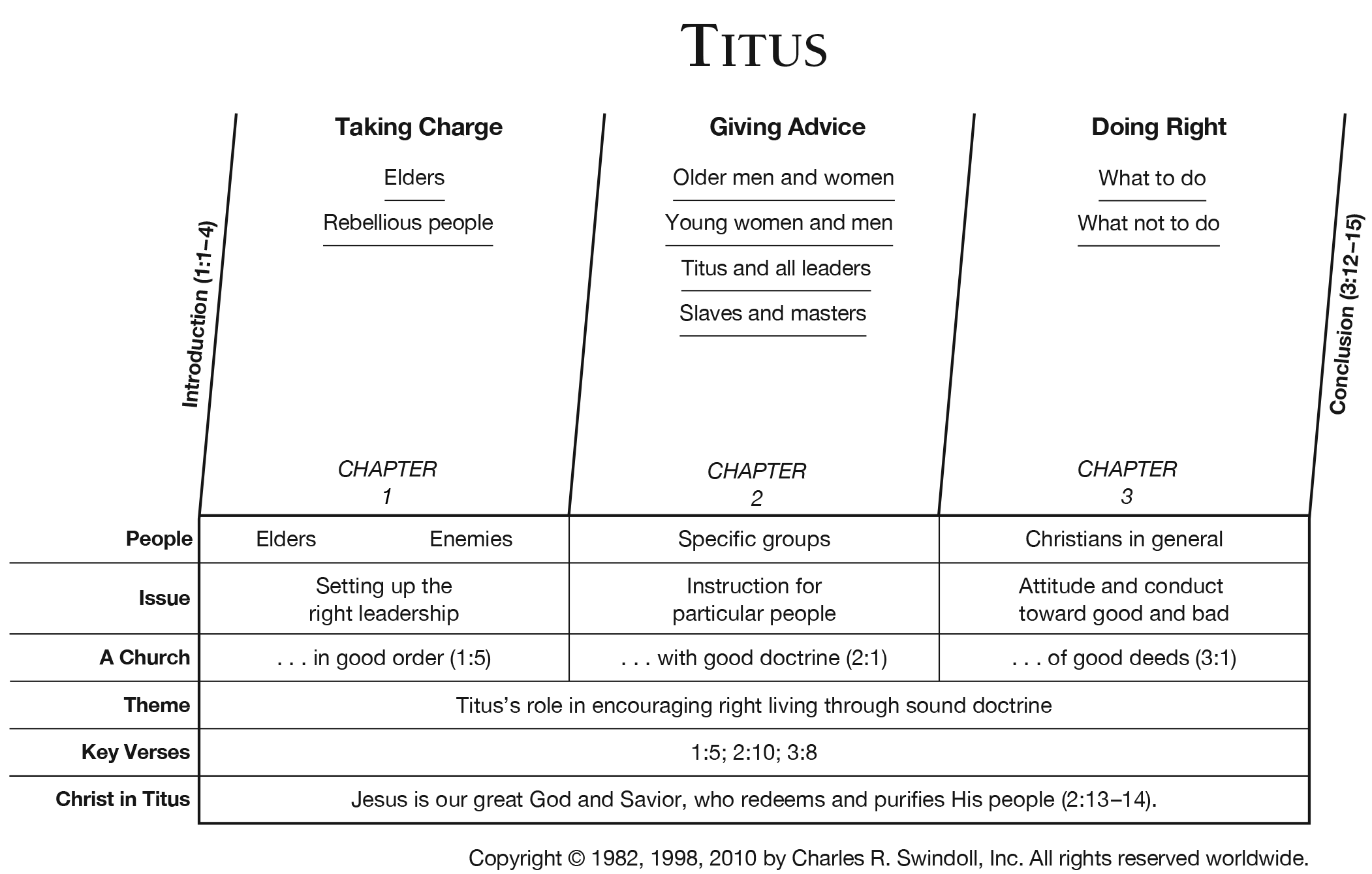
See Summary Chart by Charles Swindoll
Chart below from Michael J. Penfold
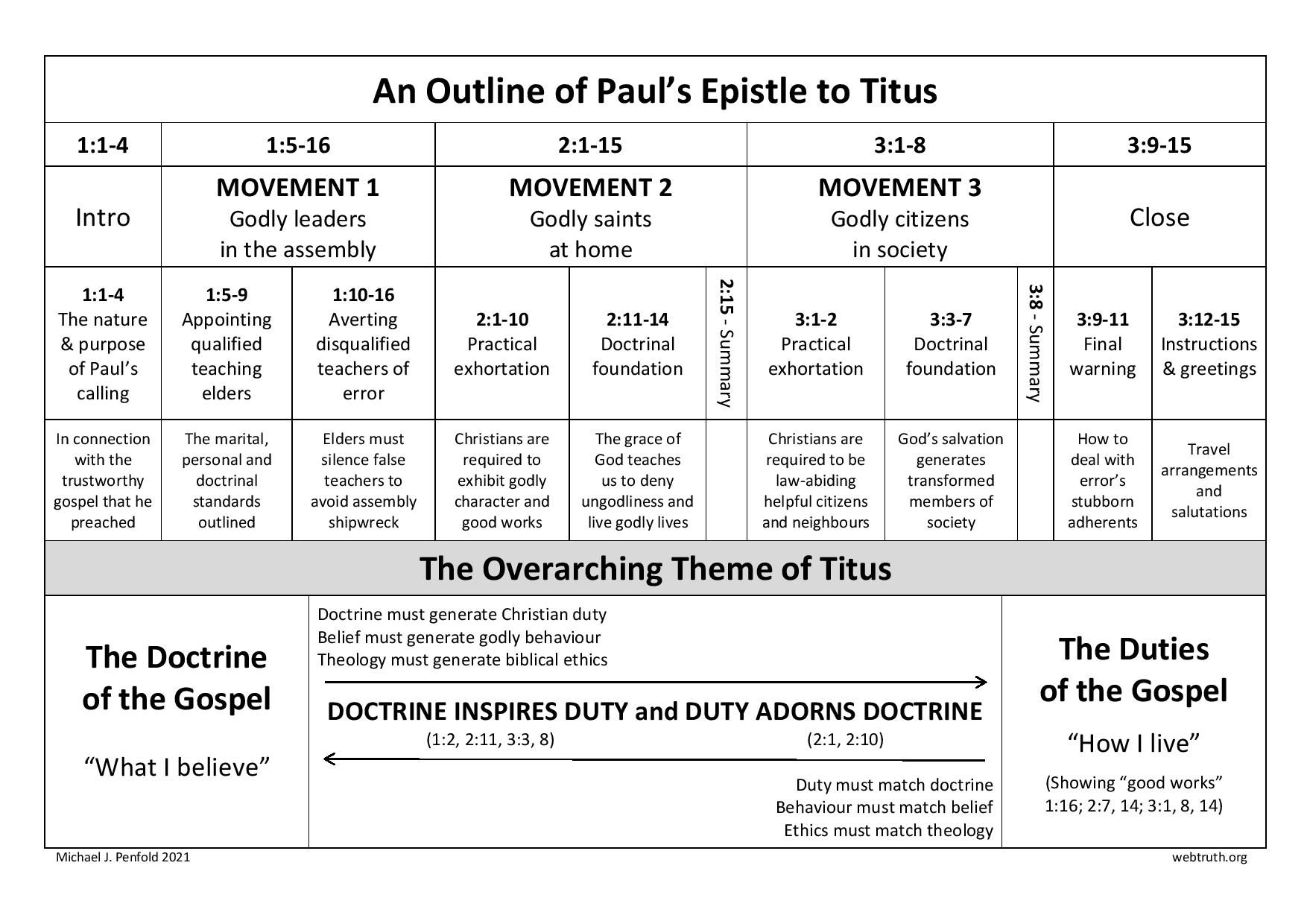
|
Focus |
Appoint Elders |
|||
|
Divisions |
Rebuke |
Maintain |
||
|
Topics |
||||
|
Topics |
Organization |
Offenders |
Operation |
|
|
Place |
Probably Written from either Corinth or Nicopolis (cf. Titus 3:12). |
|||
|
Time |
Circa 63 AD |
|||
|
Modified from Talk Thru the Bible |
||||
Titus 2:6 Likewise urge (2SPAM) the young men to be sensible (PAN) (NASB: Lockman)
Greek: tous neoterous hosautos parakalei (2SPAM) sophronein; (PAN)
Amplified: In a similar way, urge the younger men to be self-restrained and to behave prudently [taking life seriously].
KJV: Young men likewise exhort to be sober minded. (Amplified Bible - Lockman)
NLT: In the same way, encourage the young men to live wisely in all they do. (NLT - Tyndale House)
Phillips: The young men, too, you should urge to take life seriously, (Phillips: Touchstone)
Wuest: The young men likewise be exhorting to be exercising self-control;
Young's Literal: The younger men, in like manner, be exhorting to be sober-minded
LIKEWISE URGE THE YOUNG MEN TO BE SENSIBLE: hosautos parakalei tous neoterous… sophronein:
- Job 29:8; Ps 148:12; Ec 11:9; 12:1; Joel 2:28; 1Pe 5:5; 1Jn 2:13
"give orders to be wise and serious-minded (BBE)
Urge the younger men, similarly, to control themselves (NAB)
urge younger men to be moderate in everything that they do (NJB)
encourage the young men to live wisely in all they do (NLT)
be exhorting to be exercising self-control (Wuest)
exhort the younger men to be discreet (Weymouth)
The younger men in like manner exhort to be discreet (Darby)
Likewise (hosautos - similarly, in just the same way) - When you see an adverb like this, pause and ponder to what the author is comparing the following discourse (see value of observing terms of comparison)?
Urge (3870) (parakaleo [word study] from para = side of, alongside, beside + kaleo [ word study] = call) means literally to call one alongside, to call someone to oneself, to call for, to summon. Parakaleo can include the idea of giving help or aid but the primary sense in the NT is to urge someone to take some action, especially some ethical course of action. Sometimes the word means convey the idea of comfort, sometimes of exhortation but always at the root there is the idea of enabling a person to meet some difficult situation with confidence and with gallantry.
In this passage Paul is saying in essence “I beg of you, please.” This word is a good commentary upon the manner in which Titus should deal with these various groups. It should not be a domineering, high-handed, demanding one, but a humble, loving, kindly, exhorting one. The heart will respond to loving, kind treatment where it will rebel against the opposite.
The present imperative is a command calling for continuous action (continuously urge, keep on exhorting, etc) - this is to be Timothy's lifestyle, his habitual practice and by way of application it is to also by our continual practice. And before you place yourself under a "legalistic constraint" (e.g., saying to yourself "I've got to start doing this!"), remember that all of God's commandments include His enablements! Specifically every believer has the indwelling Spirit, Who gives (energizes in) us the desire and the power to obey this command (Php 2:13NLT-note). In fact I would submit that every command in Scripture is an "opportunity" or a "call" (if you will) to jettison "self-reliance" and to rely on (trust in, have faith in) the enabling power (dunamis) of the indwelling Spirit. Are you thirsty for this quality of (supernatural) life? Then "Be thirsty, my friend, be thirsty!" Drink of the Living Waters of the Spirit of Christ (Jn 7:37-39-note), be continually filled with Him (Eph 5:18-note) and learn to walk by His power moment by moment (Gal 5:16-note). I can assure you that it will revolutionize your Christian life!
Kent Hughes illustrates the root idea of parakaleo "to come alongside and encourage" with the following example - I see this exemplified every time my church has a roller skating party, and the parents put their little ones on skates for the first time. Mom and Dad skate with their child, holding on to his or her hands, sometimes with the child’s feet on the ground and sometimes in the air. But all the time the parents are alongside encouraging… [exhortation] is a wonderful gift, and we are to place it at Christ’s feet and be willing to be worn out in its use.
Young men (3501) (neos may be derived from néō = to move or agitate) describes one one who moves briskly, and thus a young man, so–named either because of the activity and vigor exhibited in youth, or of the unsettled attitude of that age of life. Young men are frequently impulsive, passionate, ambitious, volatile, and sometimes arrogant, are to exercise self-control and show good sense and judgment in all things.
They then do it to receive a perishable wreath, but we an imperishable (1Cor 9:25).
TDNT writes that neos means "belonging to the present, and has the nuances of “fresh” and “young.” As what is fresh or new, it may denote the odd or unexpected but also a new state or position, e.g., new converts or converts as new people. In the sense of young we find it for children and young people, and it can denote younger men as a group. (Kittel, G., Friedrich, G., & Bromiley, G. W. Theological Dictionary of the New Testament. Eerdmans)
Because self-control is so important in living for and serving the Lord, even that great apostle, after many years of faithful, sacrificial service to his Lord, went on to say of himself, "Therefore, I run in such a way, as not without aim; I box in such a way, as not beating the air; but I buffet my body and make it my slave, lest possibly, after I have preached to others, I myself should be disqualified (1Cor 9:26, 27-note).
Solomon had good advice for young men writing "Remember also your Creator in the days of your youth, before the evil days come and the years draw near when you will say, I have no delight in them." (Eccl 12:1)
Sensible (4993) (sophroneo from sozo = to save {from sos = sound} + phren = mind, which would then literally describe a "saved mind"!) (Click studies on the related words sophron and sophronismos) means literally to be of sound mind. To exercise self-control as one who has a "saved mind". The idea is to to keep one’s mind safe and sound or to be in one's right mind. To think of one's self soberly. To put a moderate estimate on one's self. To curb one's passions. It means to be able to reason and think properly and in a sane manner. It means to have understanding about practical matters and thus be able to act sensibly.
Vine adds that sophronizo "expresses the exercise of self-control. Self-restraint is the special need of youth. To gain and retain the mastery over the tendency to indulge in what is prejudicial to moral and spiritual welfare, requires that self-control which is consistent with walking in the fear of God. (Vine, W. Collected writings of W. E. Vine. Nashville: Thomas Nelson)
Spurgeon writes that young men "are full of spirits, they are very sanguine, they are apt to be carried away with novelties; exhort them to have that which is thought to be a virtue of age, namely, sobriety. Let them be old when they are young that they may be young when they are old.
Solomon (although not always following his own advice cf 1Ki 11:1, 2, 3, 4, 5, 6, 7, 8, 9, 10, 11, 12) has a parallel wise thought from the OT that "He who is slow to anger is better than the mighty, and he who rules his spirit, than he who captures a city." (Pr 16:32).
Steven Cole - As you know, it takes a lifetime to build a good reputation, but it can be lost in a single foolish action. Once lost, it is a long, difficult process to recover it again. Over the past couple of decades, the reputation of the Christian church in America has been tainted repeatedly by public scandals: Jim and Tammy Baker, Jimmy Swaggart, and most recently, Ted Haggard, not to mention all of the scandals involving Roman Catholic priests. The American public does not distinguish between evangelicals and Catholics. They think that all Christians are hypocrites and this gives them an excuse to reject Jesus Christ. Many unbelievers justify themselves by thinking, “I may have my faults, but at least I’m not a child molester. At least I’m not bilking the poor out of their money so that I can live in luxury. At least I don’t pretend to be religious like those hypocrites do!” And so the enemy damages the reputation of the gospel. As we saw last week, we who know Christ are called the body and the bride of Christ. As His body, we are to beautify our lives with godliness, so as to attract others to our Savior. As His bride, we should be growing fewer wrinkles over time as we grow in godliness, not more wrinkles (Eph. 5:26-27). Titus 2:1-10 tells us that, "We who know God as Savior should beautify our lives so as to attract people to our Savior." Because of the tainted reputation of the church in America, we’ve got a major job on our hands! It won’t be a quick fix, but we must devote ourselves to the task of lifting up the reputation of our God and Savior by living such holy lives that “the opponent will be put to shame, having nothing bad to say about us” (Titus 2:8). We must live in such a manner before the watching world that we “adorn the doctrine of God our Savior in every respect” (Titus 2:10).
Last week, we saw that sound doctrine is the foundation for godly living (Titus 2:1, 7, 10). We also saw how older men, older women, and younger women are to beautify their lives so as to attract people to our Savior (Titus 2:2-5). In our text today, Paul shows how younger men, exemplified in Titus (Titus 2:6-8) and slaves (Titus 2:9-10) are to beautify their lives so as to attract people to our Savior.
1. Younger men should be sensible, setting a godly example, so that others will be attracted to our Savior (Titus 2:6-8). In Titus 2:6, Paul sums up the character qualities for young men in one word, “sensible.” Then (Titus 2:7-8), he turns the focus to Titus, who was probably a relatively young man, showing how he must be an example of godliness to others.
A. YOUNGER MEN SHOULD BE SENSIBLE IN ALL THINGS (Titus 2:6).
Grammatically, the phrase “in all things” could go either with the preceding or following, but stylistically, it probably goes with verse 6 (Gordon Fee, New International Biblical Commentary, 1 and 2 Timothy, Titus [Hendrickson Publishers], p. 188). “Sensible” is a word that Paul has used repeatedly in this letter: elders (Titus 1:8); older men (Titus 2:2); older women (Titus 2:4, “encourage” = “make sensible”); and, younger women (Titus 2:5). He will use it again with reference to all believers (Titus 2:12). As we have seen, it means to be self-controlled, to have control over one’s passions, or to use sound judgment. It is a single word that captures the main quality that young men need if they are to be godly.
Marla and I read the book, Over the Edge, which chronicles all of the deaths that have occurred in the Grand Canyon. It’s really a fascinating book! The authors conclude that the most vulnerable group at the Grand Canyon is young men, who think that they’re invincible. To prove their bravado, they do foolish things, but the extreme conditions in the Canyon often take their toll. These young men are not sensible.
When I was younger, I used to wonder what David meant when he prayed (Ps. 25:7), “Do not remember the sins of my youth….” Now that I’m older, I understand. The sins of my youth were all of the foolish things that I said and did out of youthful pride. Thankfully, none of them resulted in my premature death, but that is only due to God’s grace! Maybe our youthful propensity to be insensible is why Peter wrote (1Pe 5:5), “You younger men, likewise, be subject to your elders; and all of you, clothe yourselves with humility toward one another, for God is opposed to the proud, but gives grace to the humble.” So, through Paul the Holy Spirit urges young men to be sensible in all things. (Developing a Beautiful Body – Part 2 Titus 2:6-10 - Bible.org)
I wish it were possible, young men, for me to disclose to you the deep solicitude and earnest desire for your welfare, with which I meet you this evening, and commence this effort of ministerial fidelity—such a knowledge of my feelings and my motives would ensure me your serious and candid attention. In selecting you as the special objects of my address, I have been influenced by a painful conviction, which I would be glad to have disproved, that there was scarcely ever a period when such admonitions as those which I shall deliver on the present occasion, were more needed by people of your gender and age. Without pretending to say that the youth of this generation are more corrupt than those of former times, I will assert that their moral interests are now exposed from various causes to very imminent peril.
The improvement and diffusion of modern education, have produced a bold and independent mode of thinking, which, though it be in itself a benefit, requires a proportionate degree of religious restraint to prevent it from degenerating into lawless licentiousness. It is probable also, that of late years parents have relaxed the salutary rigor of domestic discipline. Trade and commerce are now so widely extended, that our youth are more from beneath their parents' inspection than formerly, and consequently more exposed to the contaminating influence of evil company. The habits of society in general, are becoming more expensive and luxurious. And in addition to all this, the secret but zealous efforts of infidelity to circulate written works, which by attempting to undermine revealed religion, aim to subvert the whole fabric of morals—have most alarmingly increased irreligion and immorality.
But whatever are the causes, the fact to me is indubitable, that multitudes of the young men of the present day are exceedingly corrupt and profane. Such a state of things rouses and interests all my feelings as a father, a minister, and a citizen—I am anxious for my own children, as well as for the youth of my flock, my town, and my country. You are to be the fathers, young men, of the next generation; and most solicitous do I feel that you should transmit true religion—and not vice, to posterity. Listen then with seriousness to what I shall this evening advance, from motives of pure and faithful affection.
I shall direct your attention to that solemn portion of sacred Scripture which you will find in Ecclesiastes 11:9. "Rejoice, young man, while you are young, and let your heart be glad in the days of your youth. And walk in the ways of your heart and in the sights of your eyes; but know that for all of these things God will bring you to judgment."
The design of Solomon in the book of Ecclesiastes seems to be this—after detailing the good things of life to the widest extent, setting them in the strongest light, and granting to them every possible advantage which their most passionate admirers contend for—to demonstrate, that as they are attended with so many inseparable evils, are so short-lived in their continuance, so unprofitable in the hour of death, and so utterly useless in the eternal world beyond the grave, they are insufficient for the needs, and inadequate to the happiness of the soul of man. No one was more capable of forming a correct opinion on this subject than Solomon; since no man ever commanded more resources of earthly delight than he did, or ever more eagerly availed himself of the opportunities which he possessed—and yet he grew disgusted and dissatisfied with sensual pleasures, and at length give us the sum total of worldly enjoyment in those two ciphers—vanity and vexation of spirit. His testimony, therefore, is to be considered (not as the cynical declamation of an ascetic, who had never tasted sensual indulgence—but) as that of a man who had drunk the cup of earthly pleasures to its dregs—and who found those dregs to be wormwood, gall, and poison! "I have seen everything that is done under the sun. Look at it! All is vanity and vexation of spirit!" Ecclesiastes 1:14.
I am aware that some expound the language of the text as containing an intimation of Solomon's willingness to allow young people the full gratification of their senses, and the indulgence of their appetites, coupled with an admonition to let their pursuit and enjoyment of pleasure be regulated by a reference to the judgment of God, as it is recorded in the Scripture, and will be published at the last day. Although I do not think this is the meaning of the text, because the terms employed in the passage are generally used by the sacred writers in a bad sense, as importing criminal indulgence, yet there is nothing in the sentiment to which, when properly explained, I object.
I allow youth all that pleasure which the Word of God sanctions, and which his sentence in the day of judgment will not condemn. I would say, "Young man, enjoy yourself, your senses are in full vigor, your imagination lively; it is the spring season of your existence, gratify your genius and your taste. And as long as your pleasures accord with the letter and spirit of revelation, and will secure the approbation of God in the judgment day—they are innocent and lawful. But take heed how you allow yourself any gratification until you have tested it by the Word of God, and proved it to be innocent."
I am quite willing to make the Scriptures the standard of our pleasures, as well as of our duties. Religion and melancholy are not as some think synonymous terms. Piety is as far from gloom as noontide is from midnight. "Its ways are ways of pleasantness and all its paths are peace." There is joy and peace in believing, a peace that passes understanding, a joy unspeakable and full of glory. Religion gives the substance of happiness for the shadow; the reality for the name. It allows all that enjoyment of the comforts of earth—which is not incompatible with the pursuit of eternal salvation in heaven.
I. The text properly explained, consists of an IRONIC address. Under a seeming permission, this language contains a very strong and pointed prohibition. It is as if the writer had said, "Thoughtless and sensual young man, who has no idea of happiness but as arising from fleshly indulgence, and who is drinking continually the intoxicating cup of worldly pleasure—pursue your course if you are determined on this mode of life, gratify your appetites, indulge all your passions, deny yourself nothing, eat, drink and be merry; disregard the admonitions of conscience, trample under foot the authority of revelation—but do not think that you shall always prosper in the ways of sin, or carry forever that air of jollity and triumph. The day of reckoning is at hand, when for all these things, you will be called into judgment! God now witnesses, and takes account of all your ways, and will one day call you to his judgment, and repay you according to your doings!" "For God will bring every act to judgment, including every hidden thing, whether good or evil." (Ecclesiastes 12:14)
It is implied in this address, that young men are much addicted to sensual pleasure. This has been the case with every generation and in every country—and it is too common not only for the young themselves—but even for their seniors and their sires to justify or palliate their wicked excesses. We frequently hear the abominable adage, "Youth for pleasure, manhood for business, and old age for religion." It is not possible for language to utter, or mind to conceive, a more gross or shocking insult to God than this!—which is in effect saying, "when I can no longer enjoy my lusts, or pursue my gains—then I will carry to God a body and soul worn out in the service of sin, Satan, and the world!" The monstrous wickedness and horrid impiety of this idea is enough, one would think, when put clearly to him, to shock and terrify the most confirmed and careless sinner in existence.
There are many things which tend to cherish in the youthful bosom, and to justify in the estimation of young men—the love of sensual pleasure. At their age care sits lightly on the heart, the passions are strong, the imagination is lively, the health is good, the social impulse is felt in all its energy, the attractions of friends are powerful; and this they imagine is the ideal time for them to take their fill of pleasure. They think that they shall settle down by and by, when the season of youth is past; and that sobriety, morality, and religion will all come in the proper order of nature. Worldly pleasure, decked in the voluptuous attire and the gaudy ornaments of a harlot, appears to their heated imagination, with all the attractive charms of a most bewitching beauty. They yield themselves at once to her influence, and consider her as abundantly able to afford them all the happiness they desire. Their great concern is to gratify their senses. The soul and all her vast eternal concerns is neglected for the pleasures of fleshly appetites, and is condemned to the degradation of acting as a mere waiting maid to minister to the enjoyment of the body.
Young men, can you justify, either at the bar of reason or Scripture, such an appropriation of the 'morning of your existence', of the best and loveliest portion of your life? If there is indeed a God who made and preserves you, is it reasonable that the season of youth should be passed in a manner hateful in his sight? Is this the way to ensure his blessing on your future days? Is it reasonable that your youthful vigor, should be exhausted on vices forbidden by his Word? Were the noble faculties of the human soul conferred for no other purposes than to be slaves to sinful corruptions? To what part of the Word of God will you turn and not find your practices condemned? Where is it said that young people may innocently walk in all kinds of sensual indulgences? On what page of the book of God's truth do you find these allowances for the excesses of youth, which you make for yourselves, and ill-judging friends make for you? "Woe to those who rise early in the morning, that they may run after strong drink, who tarry late into the evening as wine inflames them! They have lyre and harp, tambourine and flute and wine at their feasts, but they do not regard the deeds of the Lord, or see the work of his hands." (Isaiah 5:11-12) This is the testimony of the Lord, delivered as much against the sins of youth as those of riper years.
And is it not mentioned among other vices by Paul, "that men should be lovers of pleasure—more than lovers of God?" There is no exception in your favor, from the obligations of piety, in all the Word of God! On the contrary, how many are the admonitions to youthful piety—there is not one duty of true godliness binding upon you in future years, which does not rest with all its authority upon you at the present moment. Is youth the season for sinful pleasure then! Is this best and most influential portion of your existence—to be deliberately given up to vice! That is a dreadful idea; repugnant alike to reason and Scripture!
1. If sensual pleasure be pursued as the object of youthful years—see how it will influence all your PURSUITS. Where young men live in this way, it directs their reading, which is not pious or improving—but light, trifling, and polluting. Inflammatory novels, stimulating romances, lewd poetry, immoral songs, satires against pious characters, and arguments against Scripture and biblical morals—are in general the works consulted by corrupt and wicked youth, and by these they become still more wicked. Never did the press send forth streams of greater pollution than at this time. Authors are to be found, of no small abilities, who pander to every corruption of the youthful bosom. Almost every vice has its high-priest—to burn incense on its altar, and to lead its victims, decked with the garlands of poetry or fiction, to their ruin.
(As for Byron, his exquisite pathos and almost peerless beauty, can make no atonement for his vices, and should have no power to reconcile us to his works. He is, indeed, as he has been styled, the master of a satanic school. Infidelity and immorality never before received such patronage from the poetic muse. Never before was genius seen in closer union with vice. His works are enough to corrupt the morals of a nation, and seem to have been written for the purpose; and he appears to have been stirred up by an evil spirit, to attempt, by his poems that mischief which the wit of Voltaire, the subtleties of Hume, and the popular ribaldry of Paine, had in vain endeavored to effect. If young men would not be cursed by the infidelity and immorality which lurk within his pages, let them beware how they touch his volumes—as they would a beautiful person infected with the plague.)
2. A love of sinful pleasure will give the tone to your CONVERSATION—which will be vain, loose and unprofitable; if not obscene, filthy and profane. Jests against religion; sneers at the piety of the godly; irreverent and shocking swearing; and a boastful parade of the immoralities they have committed—the females they have seduced, or the revels they have shared in—make up the conversation, I fear, of some circles. Young men, is this the reason why the noble faculty of speech was given to you—that distinction of man from the brute creation; that exquisite vehicle of thought and medium of communication between mind and mind? Can you think of the strains of conversation to which you have often listened, and in which you have often joined, without horror? Could the discourse of a single evening be written down just as it occurred, in all its mindlessness, silliness, obscenity and profanity—and then read over to you; surely, surely, if every spark of shame was not extinguished in your nature, your faces would be covered with blushes, and your soul filled with confusion at the shocking recital.
There is something most disgusting and most horrible, to hear a man boast of the crimes which he has committed, and with bragging, set forth the pains which he has taken to blast the prospects of others—and ruin his own immortal soul. The Scripture makes it a sin even to be proud of good deeds; but to be proud of evil ones is a disposition truly hellish! For young men to study first to excel in deeds of riot and debauchery, and then to proclaim their feats, is to brag who shall be at once most brutalized and most diabolical, and then to be proud of the hellish attainment!
As for swearing, I scarcely know anything which more decidedly proves a depraved heart; since it gratifies no passion and indulges no appetite—but is unmingled wickedness against God. Probably there is nothing which has a more polluting effect on the imagination, or a more hardening influence on the heart—than filthy, obscene, and profane conversation; and the man who can ever listen to it with pleasure must already have become very vile, and is hourly becoming more so!
3. A love of sensual pleasure will, of course, direct young men in the choice of their COMPANIONS; and these will not be the moral and serious—but the thoughtless, the mirthful, and the wicked. Comradeship seems necessary to give zest to vice. There is something cowardly in sin. It does not desire 'solitude' and 'contemplation'. To the sinner's perturbed mind, 'solitude' soon fills the mind with frowning forms; and 'contemplation' is broken by threatening voices. He rushes, therefore, into company to recruit his courage and gratify his lusts; not to persuade himself that he is doing right—but to get rid of the consciousness that he is doing wrong, and drown the clamors of his conscience in the uproar of his companions; at once to be wicked and merry.
Young men, if you determine to live in the gratification of your passions and the indulgence of your sinful appetites, you will soon have associates suited to your taste, and that will never disturb your conscience with the language of warning or reproof. And will these be wicked fools, blaspheming scoffers, apostate people, hardened sinners, degraded sots, dissolute infidels, abandoned prostitutes! Look at the mirthful party. Can you approve it? Are there not moments, when you feel the last dying remains of moral feeling stirring within you in sickening revulsion at such society as this? But even these 'dying, lingering signs of a conscience' which are not quite dead, will soon vanish—and you will yield yourself without a struggle to all the corrupting, damning influence of bad company!
4. The recreations and amusements of young men who live in sinful pursuits are of the same nature as their reading, conversation, and company—polluted and polluting!
The THEATER is generally frequented by them; the theater, that corrupter of public morals; that school where nothing good and everything bad is learned; that resort of the wicked and school of vice; that broad and flowery avenue to the bottomless pit! Here a young man finds no hindrances to sin, no warnings against wickedness, no mementos of judgment to come! But, on the contrary, everything to inflame his passions, to excite his immoral desires, and to gratify his appetites for vice! The language, the music, and the company, are all adapted to a sensual taste—and calculated to demoralize the mind!
Multitudes of once comparatively innocent and happy youths have to date their ruin for both worlds, from the hour when their feet first trod within the polluted precincts of a theater. Until then they were ignorant of many of the ways of vice. That fatal night was the dreadful season of their initiation into the 'mysteries of iniquity'! Afterwards they fell from morality and respectability, and continued falling deeper and deeper in vice, until earth, tired of the sickening load of their corruption, heaved them from her lap—and hell, from beneath, moved to gather them at their coming! When, therefore, a young man acquires and gratifies a taste for theatrical representations, I consider his moral character in imminent peril.
It is by no means the author's intention to affirm that all who frequent the theater are wicked people. Far be it from him to prefer an accusation so extensive and unfounded as this. No doubt many amiable and moral people are among the admirers of dramatic representation. That they receive no contamination from the scenes they witness, or the language they hear, is no stronger proof that the stage is not immoral in its tendency and effects, than that there is no contagion in the plague, because some constitutions resist the infection. That people fenced in by every conceivable moral defense and restraint, should escape uninjured, is saying little; but even in their case, I will contend that the mind is not altogether uninjured. Is it possible for an imperfect moral creature (and such are the best of us,) to hear the irreverent swearing, the filthy allusions, the anti-Christian sentiments, which are uttered during the representation of even our purest plays, and hear these for amusement, without some deterioration of mental purity?
And it should be remembered that none but the pure in heart shall see God. But let us think of a young man going alone and unprotected to a theater, or in the company only of others of his own age, and after having his passions inflamed with all he has seen and heard within, then returning home through the crowds of scantily dressed prostitutes which infest the surrounding areas of every theater. Is this a school to improve his morals? Yes, the morals of the whorehouse! The advocates of the stage should be candid, and instead of talking about its improving the taste or the morals of the age, should frankly confess (as they cannot be ignorant of it), that it is indeed a very dangerous place for young people—but that it is an amusement of which they themselves are very fond, and that they are determined to enjoy it whatever havoc it may make in the character of others.
If it were admitted that occasionally some one person had been improved by theatrical satires on vice, (though, by the way, to laugh at vice is not the best way of becoming virtuous), will they not confess that for this one case of improvement, a thousand cases of ruin could be found?
Mirthful PARTIES, where eating, drinking, and revelry, are carried on until midnight, or until morning, are another source of ruin! Meetings, not for the interchange of the civilities and courtesies of life, and restrained within due limits of time, sobriety, and expense; not for the feast of reason and the flow of soul; not for the cultivation and enjoyment of friendship—but for the celebration of Bacchanalian orgies! Young men, such meetings unfit you not only for the serious pursuits of godliness—but even for the duties of business. Their expense impoverishes your purse, their influence impairs your health, and their guilt ruins your soul!
GAMBLING is another amusement to which young men, addicted to pleasure, frequently have recourse. A passion for gambling is one of the most ruinous propensities that can infect the human heart! It is to the mind, what a love of alcohol is to the body! And to the man addicted to gambling and play—the ordinary pursuits of business will be as flat and uninteresting—just as looking forward to a day of bread and water, is to the drunkard craving and waiting for his liquor. Gambling is a system of excitement and stimulants, which prepares the passions for every excess. It is a 'parent vice', and its 'offspring' are as deformed and monstrous as itself! It produces a serpent brood of crimes—among which fraud, suicide, and murder, have all been found. Young men, as you would not have these vices generated in your heart, harbor not in your bosom the mother that bears them! Retreat from the billiard and card table! If you would not end up as a gambler—avoid all gambling!
Every friend to the morals of his country must deplore the increasing passion for the brutal and brutalizing sport of PRIZE FIGHTS. This practice is more demoralizing than it is possible to describe. It is fraught with such deadly mischief to the national demeanor and conduct, that it should become a matter of most serious consideration with the legislature whether more effective measures ought not to be taken for its suppression. There is scarcely a vice which tends to disturb the order of society that is not cherished, and, to a considerable extent, encouraged, by this odious system.
Independently of the offensive spectacle exhibited by two men acting the part of wild beasts towards each other, and endeavoring, if not to tear, to beat each other to pieces; independently of the fatal manner in which these conflicts sometimes terminate—what a system of gambling of the most pernicious description is connected with this practice! What habits of idleness are contracted! What a spirit is generated among the laboring classes to excel in these feats of brutal courage and savage skill! What a lure is held out to the indolent! What what a temptation thrown in the way of the industrious! Where are all the thieves, the cheats, the murderers of a country, most likely to be assembled at any given time? Around the prize fight ring. What a revolting and shocking instance of this kind of amusement have we lately had in a neighboring county.
At the very time when the Hertfordshire murderers were arraigned for a deed which had circulated horror through the kingdom; while the sentence was being pronounced upon them, will it be believed that 30,000 people were assembled to witness this their favorite recreation, by which the murderers were trained for the crime which hurried them to the gallows? In what school were they trained to commit murder? In the ring of the prize fight! And yet thirty thousand people, at the very time when they were being doomed to death, were assembled to patronize the practice. In this town the fate of the murderers was lost sight of—in that of the fighters; and it seemed a matter of less concern whether they were condemned, than who won the prize fight!
Let any one conceive the mass of crime which was committed within the circle that surrounded the combatants; let him think of the oaths that were sworn, the pilfering that was carried on, the diabolical rage that was felt, the gambling that was practiced; let him add the numbers who closed the evening with intoxication, the multitudes who were then first led astray from the paths of morality by acquiring a taste for evil conduct and evil company. Let anyone think of these things and say if the place on which this crowd were assembled, did not contain a greater accumulation of crime than could be found on the same space in our world. Who can wonder at the prevalence of vice, when such things are going on? But we may wonder to hear of noblemen, gentlemen, lawyers, being present. May our youth have wisdom enough to abhor the practice; may they see that one of the nearest roads to ruin is by the ring of a prize fight. To all the flimsy arguments by which the practice is attempted to be defended, may they reply—that to be brutal is not the way to embellish our nature, and that the ferocity of a tiger and the dexterity of a savage is no ornament to a civilized rational creature.
Still, after all that can be said of these practices, young men are to be found who will justify them on the grounds already stated. But try them by their effects. See their influence on personal godliness. Godliness, alas! such people make no pretense whatever to it. They have not the fear of God before their eyes. They are not only without piety—but against it. "God is not in all their thoughts." They are atheists in practice—if not in opinion. If a man loves such pleasures more than God, he has not even the semblance of piety. He is not even moral. It is true he may not be a murderer, robber, housebreaker—but he is still an immoral man if he be living in drunkenness, swearing, or fornication.
Try this mode of life by its influence on their USEFULNESS. Young men who live in the enjoyment of wicked pleasure, are defeating one end of their existence, which is in every possible way to benefit the human race—to do good by their property, example, and principles. Instead of this, their property is squandered upon their vices, and not devoted to relieve the misery, and promote the happiness of mankind. The influence of their example, instead of falling around them like the refreshing dew—sends forth a withering blight. Their principles, instead of resembling precious grain, are the seeds of poison, which they scatter along their path. They have no part in benevolent and Christian institutions. I have known young men, who, while they were moral, were active as teachers of Sunday schools, and agents of other philanthropic institutions, immediately as they acquired a taste for sinful gratifications, withdraw their names, and retire from the scenes of Christian mercy. They ceased to be philanthropists when they became immoral; and now, instead of doing good, they do harm. On how many such do the curses of indignant, heart-broken parents rest, for corrupting their sons, and seducing their daughters.
Who shall depict, in proper colors, the crime of SEDUCING, and then abandoning an innocent female? And yet how common is it! She, poor wretched victim, the dupe of promises never intended to be fulfilled, and at length deserted as a worthless, ruined thing—seeks by the wages of iniquity to prolong a miserable existence, until, in her garret, consumed by disease, she closes a life of infamy by a death of unspeakable horror. If at the recollection of her untimely death, her betrayer feels a pang of remorse, his pity comes too late for her; it cannot restore the peace and purity, that, with felon hand, he stole from a bosom which was serene until he invaded its tranquility; it cannot repair the virtue he corrupted; it cannot build up the character he demolished; it cannot rekindle the life which he was the means of extinguishing; much less can it call back from the torments of the damned the miserable spirit which he was the instrument of hurrying to perdition!
Ah! how, one should think, must her upbraiding spirit haunt his imagination; how often must he hear her groans of despair, and see her frenzied appearance, seeming in every agonized distortion to say, "Look at me, my destroyer!" The seducer, I admit, is less guilty than the murderer—but how much less? The murderer extinguishes life at once; the seducer causes it to waste away by slow degrees amidst unutterable torture! The murderer hazards his own life in the commission of the crime; the seducer exposes himself to no personal risk! The murderer is visited with the heaviest sentence that the justice of the country can inflict—but the seducer can revel in impunity, and can go on from conquering to conquer in his desolating career, and defy all justice—but that of heaven!
Yes, the guilty and polluted wretch will be greeted in fashionable and moral society with the same welcome as before, though he comes to it with the guilt of female ruin fresh upon his soul. Oh! when shall the time arrive that reputable females will resent this cruel indignity offered to their gender. When will they protect the virtue of their weaker sisters, by frowning from their society, the individual who has betrayed one of their number to her ruin! When shall the time come that the profligate and debauchees, by the consentaneous feeling of virtuous women, shall be banished from their presence? If any individual shall glance on these passages who is guilty of this great wickedness, let him ponder on his guilt, and never cease through life to weep for his sin, looking for pardon through the blood of Christ. If anyone should read this discourse, who meditates the crime, may I come between his 'basilisk eye' and the victim marked for ruin, and already flattering under the spell. Pause, young man, oh! pause, before you resolve to ruin two souls at once, and produce an entanglement of sin and misery which eternity itself shall never unravel!
I would not throw the blame of seduction entirely on my own gender. There are not a few to whom Solomon's description of the female tempter will apply in this age. What numbers of 'abandoned women' infest our streets before the sun is set. Is there no means of being rid of this nuisance? If not, let our youth beware, and remember the words of scripture, "Hearken unto me now therefore, O you children, and attend to the words of my mouth, let not your heart decline to her ways; go not astray in her paths. Her house is the way to hell, going down to the chambers of death!"
Amidst all your sinful jollity—are you happy, young man, in your sins? Are vice and bliss synonymous? Is immorality the road to happiness? Are you satisfied with your course? Do you approve of it as the most rational mode of life? Have you the sanction of both your judgment and your conscience? You know you are not happy! You may be gratified—but you are not satisfied! You may have pleasure—but you have not happiness! When the 'honey of gratification' is all gone, is there not a sting left behind? Expose to us your wounded, bleeding heart; admit us to your chamber at midnight, when left alone with an angry conscience, to be lashed almost to madness. Let us hear your heartbroken reflections, when you heap your envenomed reproaches upon your own folly and wretchedness. Oh! what proofs could we recollect, even from your own lips, that the way of transgressors is hard, and the pleasures of sin are but for a season!
Have there not been times also, when, in the very midst of the riot and revelry—a mysterious hand, visible only to you—came forth and wrote your doom before your eyes; when conscience arrested you, as God did Belshazzar, at the feast? From that moment the pleasure was all gone. You tried to be merry—but your smile was as the laughter of a demon, which could but ill conceal the torture that raged within; and you retired, as Esau did, when he had eaten his pottage, reflecting that it was for this you had sold your soul! What makes you so afraid in a time of sickness? Because you seem to see death on the pale horse approaching you, and hell following in his aftermath!
Add up, young men, all the pains of vice—the anxiety which precedes, and the remorse which follows it, the stings of conscience and the reproaches of friends, the fear of being detected, and the shame of detection when it has taken place—and say if they do not far overbalance the pleasures of sin. I will concede to you, that sin has its gratifications—but are they not as Solomon calls them, "The crackling of thorns beneath a pot"—a noisy, but fleeting blaze?
II. I conduct your thoughts to the second part of the subject, and show you the END of these things—as it is set forth in the solemn warning contained in the text. "Know that for all these things God will bring you into judgment." He who will hereafter be the judge—is now the witness of your conduct! God is everywhere present, and knows all things, "Lord, You have searched me and known me. You know when I sit down and when I stand up; You understand my thoughts from far away. You observe my travels and my rest; You are aware of all my ways. Before a word is on my tongue, You know all about it, Lord. You have encircled me; You have placed Your hand on me. This extraordinary knowledge is beyond me. It is lofty; I am unable to reach it. Where can I go to escape Your Spirit? Where can I flee from Your presence? If I go up to heaven, You are there; if I make my bed in Sheol, You are there. If I live at the eastern horizon or settle at the western limits, even there Your hand will lead me; Your right hand will hold on to me. If I say, 'Surely the darkness will hide me, and the light around me will become night'— even the darkness is not dark to You. The night shines like the day; darkness and light are alike to You!" (Psalm 139:1-12)
Such is the solemn description which the Scriptures give us of an everywhere and ever-present God. He is not far from any one of us, for in him we live and move and have our being. Yes, the Lord God is everywhere—not excepting even the haunts of vice. You may exclude your parents, your teachers, your ministers, from the scenes of your iniquity! You may shut out the sun—but you cannot shut out God! He is with you in the tavern, the brothel, the theater! Are there not times and places, in which, if the form of your father were suddenly to appear before you, you would almost sink into the earth? But lift up your eyes, and see, behold, the Great Spirit is there! What! tremble at a father's glance—and yet not be terrified at the presence of a God, whose eyes are as a flame of fire, and who cannot look upon sin but with abhorrence? Will you swear, and drink, and commit lewdness when the holy and all-seeing Deity is there to take account of all, and preserves the record on pages more durable than brass? The Grecian philosopher thought it would be a sufficient check to sin, to admonish his disciples to act as they would do, if they knew the eye of Plato was upon them. And shall it be no control upon your passions, to remember, that God sees you! And for all He sees will bring you into judgment?
1. Reflect upon the CERTAINTY of judgment. It is not a cunningly devised fable—it is not a mere terrifying picture intended to embellish Scripture. You know that there is a judgment to come! The very heathen expect it, conscience foretells it, guilt forebodes it, reason proves it, Scripture declares it! "God has appointed a day in which he will judge the world in righteousness, by that man whom he has ordained. We must all appear before the judgment seat of Christ, that everyone may receive the things which he has done in his body, according to what he has done, whether it be good or bad." You may unhappily forget the judgment—but you cannot disbelieve it.
2. This judgment will be PERSONAL. Know you, young man, that for all these things God will bring you into judgment. The subject concerns us all, and each one in particular. To everyone who shall read these pages, the admonition is individually addressed, "Rejoice, young man, while you are young, and let your heart be glad in the days of your youth. And walk in the ways of your heart and in the sights of your eyes; but know that for all of these things, God will bring you to judgment!" (Ecclesiastes 11:9) "For God will bring every act to judgment, including every hidden thing, whether good or evil." (Ecclesiastes 12:14) None are so high as to rise above this accountability to God; none so low as to be beneath it. John saw the dead, small and great, standing before God to be judged.
When men transgress the laws of their country, they are led on by the hope that they shall not be detected or brought to trial—they calculate the chances of escape, and indulge the expectation of impunity. But there is no room for such a hope, in reference to the judgment of the great God—this it will be impossible either to evade or resist. It is as certain that you will stand before the tribunal of Christ, and be tried for your life—as that you now exist! To that tribunal you will certainly be brought—whether willing or unwilling. Rocks and mountains will not hide you; no power on earth will shelter or detain you. God has declared that he will undertake this matter himself. Will you hide? Where will you go from God's presence? Go where you will—you will be surrounded still by God! Will you resist God's arrest? "Do you have an arm like God's?" The whole universe is represented as brought together to judgment, with the same ease as a shepherd collects a flock of timid sheep. No! No! Nothing can prevent your being placed at the tribunal of heaven!
Young men, bear me witness, I give you public warning of this event. In God's name, I serve you with notice of the trial. Prepare to meet your God! He is coming! He is coming—and you must meet him! O think of judgment to come—in the midst of all your sinful pleasures and criminal liberties—think of it! Will you drink the drunkard's cup; will you go to the brothel, to the gambling table, to the scene of riot and wickedness—knowing that for all these things God will bring you into judgment? With the terrible solemnities of the last day before your eyes—will you, can you, dare you—proceed in the career of vice? Conscience—O faithful monitor! O dreadful avenger! I charge you to whisper in the sinner's ear, when going to the scene of his unholy pleasures, "But know, that for all of these things, God will bring you to judgment! For God will bring every act to judgment, including every hidden thing, whether good or evil."
3. This judgment will be EXACT and IMPARTIAL. "But know, that for all of these things, God will bring you to judgment! For God will bring every act to judgment, including every hidden thing, whether good or evil." All that you have done shall be brought to light and reviewed. The standard by which actions will then be tried, will be the Word of God. This is the book which will then be opened, according to which people's characters will be decided, and the sentence pronounced. Men will not be allowed to compare themselves with each other. Nor will those 'false standards of morality' and 'accommodating rules of custom' which they have now adopted, be then admitted. The laws which 'fashionable or customary vices' have modified to suit themselves, will be all disallowed and swept away then!
Men may now sneer at the puritanical precision and austerity which attempt to bring them to the Bible as the standard of morals—but what will they do and say when God shall open this now neglected book—and judge them according to what is written therein. How will they be confounded when they find all their pleas for a different test of character and conduct overruled—and the Bible alone be admitted as the sole rule of conduct. Then will all you have done, young men, be brought to light! I will read a passage of Scripture that should make your ears tingle. "The Lord has sworn—Surely I will never forget any of their works." This is spoken in reference to the wicked. God has bound himself then by oath, not only to the salvation of the righteous—but to the condemnation of the wicked—none of all their evil works are to be forgotten.
You may now successfully attempt to conceal many of your evil ways from your parents, teachers, and ministers—and admire your skill in the art of deception! But remember there is ONE whom you cannot deceive, and from whom you can conceal nothing, "He will bring every secret thing into judgment!" The veil will be torn from every dark and unknown transaction. The curtain of secrecy will be drawn aside, and every scene of vice exposed—just as it occurred. Think of this, and think what will be your confusion and dismay, your reproach and anguish, when all those deeds which you wish to be buried in eternal oblivion shall be remembered against you! There is no such thing as 'oblivion' with God—nor shall you find the 'stream of forgetfulness' in the eternal world. You will be tried and sentenced according to the advantages which you have enjoyed for knowing and doing the will of God. Your Bible, your parents' instruction, your ministers' sermons, the advice you have received—the warnings you have heard, the stirrings of conscience you have felt, will all be taken into the account! Yes, and even this feeble though faithful effort to reclaim you, shall not be forgotten in the fearful reckoning.
4. The CONSEQUENCES of this judgment will be dreadful and eternal. The sentence which will then be pronounced upon the wicked you may even now read copied down from the lips of him who will be the Judge. Read it, and let your hearts meditate on the terrors of "Depart from me, you cursed, into everlasting fire, prepared for the devil and his angels!" Every word is replete with horrifying ideas! It forms as a whole, the most appalling doom of which the mind can entertain any conception; and its execution upon the wicked shall constitute that hell of which the Word of God says so much—but of which multitudes, to their ruin, think so little. The sentence by which the law of the land deprives a man of his temporal life is terrible; but what is this to the doom which subjects the soul to the bitter pains of eternal death.
When the judge at our trials orders the convicted felon to be brought up for condemnation, puts on the black cap, and is about to pronounce the sentence, what a deadly silence pervades the court; you may almost hear the throb of palpitating hearts; terror sits on every brow; and it seems almost as if death in a visible form, had appeared to seize his victim; while the poor culprit himself sinks to the earth beneath the weight of the sentence, and departs in the silence of petrifying despair, or the outcries of frantic grief. And yet, may that poor creature, though properly denied mercy by the tribunal of human justice, obtain it from the throne of heavenly grace; and the judge, in the very act of excluding him from human mercy, prays that the Lord would have mercy on his soul.
What then must be the horror which in final the day of judgment, shall accompany the sentence of the wicked. No accent of mercy will be heard mitigating the horrors of that act of justice—that sentence dooms the soul to death—no other and higher tribunal shall be found, to which an appeal may be carried for pardon and life. The sentence of the wicked in that day will be final, irreversible, and eternal. There is nothing to follow it—but "the worm which never dies, and the fire which is never quenched; weeping and wailing and gnashing of teeth." I cannot, if I would, describe the torments of lost souls in prison.
I say, I can neither disclose nor describe those scenes; but the Word of God declares that "upon the wicked he will rain snares, fire, and brimstone, and a horrible tempest; this shall be the portion of their cup." Young men, think what it must be to dwell forever in a world where all the evil passions of human nature will attain the full maturity of their strength, and will not have one moment's cessation or gratification; and where all their force will be concentrated, like the venom of an enraged scorpion, for the purpose of self torment.
5. The judgment may be NEAR at hand. The coming of the Lord draws near; the Judge stands at the door; the end of all things is at hand. The day of death is in one respect, as the day of judgment with us all, "Then the dust returns to the earth as it was, and the spirit returns to God who gave it." This year you may die! Many as young, as healthy, as wicked, as careless as yourselves—have died the past year. Where are they? Before another year closes, you may follow them into eternity. A fever, a fall, an accident, a midnight revel, a fatal quarrel, the violent hands of wicked men, or the hand of vengeance from a holy God—may within this year—smite you to the earth, and send you to the grave without warning, and to judgment without preparation. "They sing to the tambourine and the lyre and rejoice to the sound of the pipe. They spend their days in prosperity, and in a moment go down to the grave. How oft is the candle of the wicked put out—and how oft comes their destruction upon them? They are as stubble before the wind, and as chaff that the storm carries away. One dies in his full strength, being wholly at ease and quiet."
In the CONCLUSION of my discourse, I divide the congregation into three classes.
1. Those young men who are living in the fear of God, and walking in the ways of true godliness. Happy, thrice happy youth! Your obligations to divine grace are immense and eternal. You have made a blissful exchange of the pleasures of sin and folly—for those of wisdom and piety. Be grateful to God for the mercy with which he has visited you. Still continue "to grow in grace and in the knowledge of our Lord and Savior Jesus Christ. Remember that you are not already perfect; but forgetting the things that are behind, press towards the mark of the prize of your high calling in Christ Jesus—adorn the doctrine of God your Savior in all things. Be not high minded—but fear. Watch and pray that you enter not into temptation. Flee youthful lusts. Follow righteousness, faith, charity, peace—with those who call on the Lord out of a pure heart." Be not ashamed of Christ. Disregard the sneers which your piety will not fail to bring down upon you, from those who think it strange that you run not to the same excess of riot—and speak evil against you. Their scorn is your honor. They envy you in their heart, while they persecute you with their lips. They regard you with much the same feelings as Satan did our first parents, when he looked at them through the gate of Eden, before the fall. Be holy, happy, and useful—and let your character appear surrounded and adorned with this triple glory of true religion. You have raised our expectations; support them. You have begun our joy, fulfill it. Persevere, increase, go on to perfection.
II. Those who are moral—but not godly. Of this class, there are many. There are young men, adorned with every amiable disposition, every social virtue, every social excellence, who lack only one thing to finish their character. But that one—O! how important, how necessary—true religion. There may be morality without religion, though there cannot be religion without morality. Morality is the duty which we owe to ourselves and our fellow creatures—piety is the duty which we owe to God. Morality is a right disposition to man—piety a right disposition towards God. Although the latter involves the former, the former does not necessarily include the latter. Alas, alas! that moral men should not also be pious. This appears to have been the case with the young man mentioned in the gospel, of whom it is said that Jesus loved him—he was eminently moral—but could not endure the self-denying religion of the cross, and with all his virtues fell short of heaven!
What you need, young men, is regeneration of heart by the Holy Spirit. You must be born again of the Spirit, and be renewed in the spirit of your mind. You must have—a new heart—a holy bias—a spiritual disposition—a heavenly tone of feeling. You must be brought to fear God as your habitual principle of action, and to love him supremely, as the master passion of your soul. Under a deep conviction of sin, you must have repentance towards God, and faith in Jesus Christ.
You must be justified by faith, and have peace with God through our Lord Jesus Christ. You must be sanctified by the truth and Spirit of God. Without holiness no man shall see the Lord. The grace of God which brings salvation, must teach you not only to deny ungodliness and worldly lusts—but to live soberly, righteously and godly, in the present evil world. Morality alone will not do. Morality may save you from the miseries of open vice—but not from the bitter pains of eternal death. It will bring its own reward—but that reward ends with the present world. It will improve your temporal interests as men; it will lessen your condemnation as sinners—but it will not entitle you to the character of Christians here, nor will it be followed by glory, honor, immortality and eternal life—hereafter. It is extremely probable that if you are satisfied with being moral, to the neglect of piety, you may not long retain even your virtue. Temptations may assail you, too powerful for anything short of that religion which engages Omnipotence for our defense. In one unguarded moment, you may become the victims of those spiritual enemies which lie in wait to deceive you. It is God alone who can preserve you—but without piety, it is not likely that you will enjoy his protection. It is but just that he should leave to themselves, those who do not seek his counsel and assistance by prayer.
I am addressing many who are exposed to imminent danger; since being only sojourners in the town, as clerks or apprentices, they are removed from beneath the inspection of a father's wakeful eye, and unless they live beneath the roof of their employer, have no other restraint upon their conduct than that which is imposed by their own internal principles. Yours is a situation pregnant with peril. Hitherto you may have happily escaped the "corruptions that are in the world through lust." But beware, I beseech you, of the evils that surround you! Avoid bad company! "a companion of fools shall be destroyed." "Do not be deceived! Bad company corrupts good morals!" One sinful associate may drag you down from the moral elevation on which you now stand, into the vortex of ruin in which he is sinking. Rather have no companions than bad ones.
Acquire a taste for reading, and through the medium of books converse with the 'mighty dead'. Your company may be courted; but receive with cautious reserve and suspicion, every advance that is made for your friendship. Determine to be the friend of no man in whom you do not perceive the most unequivocal proofs of moral worth. Shun a wicked companion, as you would an assassin! If you have been too unguarded in this respect, and united yourselves with associates whose conduct is in the least degree immoral, shake them off without hesitation, as you would a viper from your hand, or a scorpion from your lap. If you continue their acquaintance you will probably become as bad as they are. Wicked men have an infernal ambition to render others as corrupt as themselves. They are like the devil, as in many other respects, so particularly in this, "they go about seeking whom they may devour."
But above all things, fear God. My first and last advice to you is, "Remember your Creator in the days of your youth." True religion will guard you in danger; guide you in difficulty; comfort you in solitude. In your Bible you will always find a companion, when the hours and cares of business are over. And though you are not at home, true religion will procure you companions whose society will not corrupt, and pleasures which will neither glut nor pollute.
III. The third class of young men which I would address are those whose character I have described, and whose sins I have reproved. Unhappy youths! may this plain and faithful address produce the desired effect. Pause and ponder. Look at your course—and consider where it is conducting you! Sin is your enemy for both worlds; it is alike the foe of your body and your soul. It will corrupt your health. "His bones are full of the sin of his youth, which shall lie down with him in the dust. Though evil tastes sweet in his mouth and he conceals it under his tongue, though he cherishes it and will not let it go but keeps it in his mouth, yet the food in his stomach turns into cobras' venom inside him. He swallows wealth but must vomit it up; God will force it from his stomach. He will suck the poison of cobras; a viper's fangs will kill him."
Sin will blast all your temporal interests, by producing the habits which lead to poverty, and hindering the virtues which have a tendency to wealth. Wastefulness, intemperance, and debauchery, must have resources, and if these cannot be supplied by the ordinary proceeds of honest industry, extravagance may soon be followed with robbery. Robbery may be followed with infamy and death. Young men, let the recent events which have circulated such horror through the country, be felt as a solemn warning to you. Let the fate of the desperately hardened murderer, who has the last week expired on the gallows, be as a flaming beacon to warn you against sin.
Say not, that amidst all your gaieties and vices, you are never likely to commit his crimes. We read in Scripture of the deceitfulness of the human heart—as well as of its desperate wickedness. And wherein lies its deceitfulness? In leading men on step by step in the vortex of vice, until it has conducted them infinite lengths beyond the spot to which it first directed their attention. When the prophet of the Lord disclosed to Hazael his future career of evil, the Syrian exclaimed, "Is your servant a dog that he should do this thing!" His indignation was honest at the time—but his heart was deceitful; and he lived to be worse than Elisha had foretold. There was a time when the felon lately executed would probably have shuddered at the idea of needlessly torturing a fly—but he lived to perpetrate, without pity or remorse, the crime of murdering a man!
Sin is deceitful, young men. No one becomes wicked all at once. The way of a transgressor is like that of a stone rolling down hill, which when it is once set going, moves at every revolution with accelerated speed. He begins with little sins, and these lead on to greater ones; from acts he proceeds to habits—from habits to inveterate custom; from custom to glorying in his wickedness. Vice first is pleasing, then it grows easy, then delightful, then frequent, then habitual, then confirmed; then the man is impenitent, then he is obstinate, then he resolves never to repent, and then he is damned!
Let the wicked then forsake his way, and the unrighteous man his thoughts; let him return unto God, for he will abundantly pardon. With the Lord there is mercy—that he may be feared; and plenteous redemption—that he may be sought unto. Even yet God waits to be gracious. Jesus Christ is able to save unto the uttermost, all who come unto God by him. Pause, consider, repent, believe, and be holy. Admire the patience of God which has borne with you so long. Be thankful that you have not been cut off in your sins, and sent to that world, where mercy is never dispensed by God, nor hope indulged by man.
From this time—read the Scriptures daily; attend the solemnities of public worship; pray to God for the assistance of the Holy Spirit, without which you can do nothing; forsake evil company; avoid all occasions and excitements to sin; consider your end; meditate constantly upon the approaching day of judgment. "But the Day of the Lord will come like a thief; on that day the heavens will pass away with a loud noise, the elements will burn and be dissolved, and the earth and the works on it will be disclosed. Since all these things are to be destroyed in this way, it is clear what sort of people you should be in holy conduct and godliness as you wait for and earnestly desire the coming of the day of God, because of which the heavens will be on fire and be dissolved, and the elements will melt with the heat." (2 Peter 3:10-12) Amen.
Titus 2:7 in all things show yourself to be (PMPMSN) an example of good deeds, with purity in doctrine, dignified (NASB: Lockman)
Greek: peri panta seauton parechomenos (PMPMSN) tupon kalon ergon, en te didaskalia aphthorian, semnoteta
Amplified: And show your own self in all respects to be a pattern and a model of good deeds and works, teaching what is unadulterated, showing gravity [having the strictest regard for truth and purity of motive], with dignity and seriousness. (Amplified Bible - Lockman)
KJV: In all things showing thyself a pattern of good works: in doctrine showing uncorruptness, gravity, sincerity,
NLT: And you yourself must be an example to them by doing good deeds of every kind. Let everything you do reflect the integrity and seriousness of your teaching. (NLT - Tyndale House)
Phillips: letting your own life stand as a pattern of good living. In all your teaching show the strictest regard for truth, and show that you appreciate the seriousness of the matters you are dealing with. (Phillips: Touchstone)
Wuest: concerning all things showing yourself [to be] a pattern of good works; in the teaching [exhibiting] incorruptness, gravity,
Young's Literal: concerning all things thyself showing a pattern of good works; in the teaching uncorruptedness, gravity, incorruptibility,
IN ALL THINGS SHOW YOURSELF TO BE AN EXAMPLE OF GOOD DEEDS: peri panta seauton parechomenos (PMPMSN) tupon kalon ergon:
- Acts 20:33, 34, 35; 2Th 3:9; 1Ti 4:12; 1Pet 5:3
and above all make your own life a pattern of right conduct" (Weymouth)
In all things - How many? Now think about this "quantitative" word for a moment. If this is the instruction for all disciples of Christ, how can we possibly hope to successively obey this exhortation day by day, moment by moment? To paraphrase Major Ian Thomas, the truth is that we CAN'T, and He (God) never said WE COULD! But HE CAN, and He always said He WOULD! How? We have access to the supernatural enabling power of the indwelling Spirit of Christ (1Cor 6:19-20-note) -- Are you daily, moment by moment availing yourself of this infinitely omnipotent Source of supernatural power? We must daily awaken and seek to be filled (Eph 5:18-note) and to stay filled by quickly confessing our missteps and presumptuous sins (1Jn 1:9-note, Pr 28:13-note), forgetting them, reaching forward (Phil 3:13-note), and walking by His Spirit (Gal 5:16-note), for only then will we not fulfill the desire of the flesh which continually wars with the Spirit (Gal 5:17-note)! Click the related note on how one can obey the command to continually exhort or urge (Titus 2:6)
Show (3930) (paraecho from pará = near + écho = have, hold) literally means to hold near, or to hold alongside and so to exhibit or show.
Paraecho is in the present tense which calls for Titus to make this the habit of his life, his lifestyle. The middle voice is reflexive and calls for Titus to initiate the action (of continually showing himself an example) and participate in the effects. Can you see from the definition (literally "hold near") how obedience to this exhortation necessitates that we be in fellowship with others? It's difficult to see our good deeds if we are a recluse.
Paraecho - 16x in 16v in the NAS - became(1), bother(3), bothers(1), bringing(2), cause(1), furnished(1), give rise(1),grant(2), offer(1), show(1), showed(1), supplies(1)
Matt. 26:10; Mk. 14:6; Lk. 6:29; 7:4; 11:7; 18:5; Acts 16:16; 17:31; 19:24; 22:2; 28:2; Gal. 6:17; Col. 4:1; 1 Tim. 1:4; 6:17; Titus 2:7
It is notable that in here Paul didn't say "tell them" but "show them". Paul wrote more about Titus the example than he did about Titus the exhorter! Titus was himself to be what he wished others to be.
Titus was to confront them not only with spiritual words but with a spiritual life in keeping with those words. Beloved does what you say (show) by your life validate what you say (preach) with your lips? Even our most forceful and compelling arguments will fall on deaf ears if our lives fail to back up what comes out of our lips.
A pastor preaches best by his life. He must constantly be a good example in all things. Whatever the pastor wants his church to be, he must first be himself. Little wonder that our Lord was especially critical of the hypocritical lives of the Pharisees declaring “they say and do not”! (Mt 23:3)
Spurgeon comments that…
Titus was himself a young man; he must, therefore, be a pattern to young men; and as a pastor or evangelist he must be a pattern to all sorts of men.
It is a pity when truth suffers at the hand of its own advocate; and perhaps the very worst wounds that truth has received have been in the house of its friends. You must be careful, therefore, “that he that is of the contrary part may be ashamed, having no evil thing to say of you.
Example (5179)(tupos) literally refers to the visible mark or impression left by the strokes or blows of an instrument such as a pen, a sword, or a hammer.
Tupos properly means a model, pattern or mold into which clay or wax was pressed, that it might take the figure or exact shape of the mold.
Tupos - 15x in 14v in the NAS - example(3), examples(2), form(2), images(1), imprint(1), model(1), pattern(3), type(1).
Jn. 20:25; Acts 7:43f; 23:25; Rom. 5:14; 6:17; 1 Co. 10:6; Phil. 3:17; 1 Thess. 1:7; 2 Thess. 3:9; 1 Tim. 4:12; Titus 2:7; Heb. 8:5; 1 Pet. 5:3
Tupos is an impression representing anything produced by blows, an impression that has a resemblance to something else, and then a model to which some other person or thing should be (or would be) conformed
Type is generally used to denote a resemblance between something present and something future, which is called the "antitype." Over time it came to mean the mark left in history or nature by the antitype.
Our English word type is derived from tupos and originally referred to an impression made by a die as that which is struck.
For example, Paul used this word in his warning in his first epistle to the Corinthians, writing
Now these things happened as examples (tupos) for us, that we should not crave evil things, as they also craved… Now these things happened to them as an example (tupos), and they were written for our instruction, upon whom the ends of the ages have come. (1Cor 10:6,11)
In other words, the children of Israel and the facts of their history are types or examples for believers today, because we will be conformed to them if we do not exercise caution. Our doom will correspond to theirs. Therefore, they stand as stern warnings to us.
Thomas refused to believe that Jesus was raised from the dead unless he saw
in His hands the imprint (tupos) of the nails (Jn 20:25).
Tupos also came to be used to describe a pattern, mold, model, or copy of an original, and referred to both physical objects (like a statute) or to more subjective things such as the principles or virtues of an individual.
Tupos refers then to a pattern to be imitated or followed, an idea mentioned several times by Paul, writing for example to the believers at Philippi to
join in following my example (tupos) (Php 3:17-note).
Paul encouraged Timothy to
Let no one look down on your youthfulness, but rather in speech, conduct, love, faith and purity, show yourself an example (tupos) of those who believe. (1Ti 4:12)
Peter addressing the spiritual shepherds warned them not to misuse their authority
lording it over those allotted to (their) charge, but proving to be examples (tupos) to the flock. (1Pe 5:3--note)
If example does not follow advice, the one giving it will be viewed rightly as a hypocrite, and hypocrisy never promotes righteousness, no matter how sound and biblical a person’s teaching and counsel may be. Others may be inclined to accept the principles intellectually but will see no reason for living by them, and will themselves, like their teacher, become hypocrites.
Titus was to live so that his life would be like a “spiritual die” (tupos = impression made by a die) that would impress itself on others, a process that involves good works, sound doctrine, a dignified, decent attitude, and sound speech that not even the most hostile enemy could condemn. The speech of Titus and every spiritual leader should be such that they stand without rebuke.
This principle is illustrated in the story of St. Francis who told one of his young friars "Let us go down to the village and preach to the people." As they went to the village, they stopped to talk to the men they met along the way and begged for bread at several doors. Francis stopped to play with the children, and exchanged a greeting with the passers-by. As they turned to go home the stupefied apprentice said
But when do we preach?
Francis smiled and replied
Preach? Every step we took, every word we spoke, every action we did, has been a sermon.
With perfect confidence, the apostle could exhort believers at Corinth to
be imitators of me, just as I also am of Christ (1Co11:1).
Good (2570) (kalos [word study]) does not refer to that which is superficial or cosmetic but to what is genuinely and inherently good, righteous, noble, and excellent.
Titus' deeds were to be true reflections of what he preached and taught.
The basic meaning of kalos is good with emphasis on that which is beautiful, handsome, excellent, surpassing, precious, commendable, admirable. Inherently excellent or intrinsically good: providing some special or superior benefit. In classical usage, kalos was originally used as a descriptive of outward form, beautiful; of usefulness, as a fair haven, a fair wind. Auspicious, as sacrifices. Morally beautiful, noble; hence virtue is called to kalon . The New Testament usage is similar. Outwardly fair, as the stones of the temple (Lk 21:5); well adapted to its purpose, as salt (Mk 9:50); competent for an office, as deacons (1Ti 4:6); a steward (1Pe 4:10-note); a soldier (2Ti 2:3-note); expedient, wholesome (Mk 9:43, 45, 47); morally good, noble, as works (Mt 5:16-note); conscience (He 13:18-note). The phrase it is good, i.e., a good or proper thing (Ro 14:21-note). In the Septuagint (LXX) kalos is the most commonly used word for good as opposed to evil (Ge 2:17; 24:50; Is 5:20).
Click discussion of Good Deeds.
Illustration - Somerset Maugham, the British author, once wrote that the only thing that makes life tolerable in this world is the beauty that men create out of chaos. In “The Painted Veil,” he said that things like painting, music, and literature make it possible to regard the world we live in without disgust. “Of all these,” he declared, “the richest in beauty is a life well lived. That is the perfect work of art.” In Titus 2:7–8, the apostle Paul expresses a similar sentiment. Only in this case, he says that a life well lived is the best defense of the Christian faith. Actions do speak louder than words. To remind yourself of the importance of being a living example of the gospel, write “The best defense of the truth is a life well lived” on a card and display it where you can see it throughout the day. Consider what your conduct at home, at work, and in the neighborhood says to others about your relationship with God. Remember that when it comes to being a witness for Christ, your actions are as important as your words. (Today in the Word)
WITH PURITY IN DOCTRINE, DIGNIFIED: en te didaskalia aphtharsian semnoteta:
Let everything you do reflect the integrity and seriousness of your teaching (NLT)
When you teach, be honest and serious (ICB)
Let everything you do reflect your love of the truth and the fact that you are in dead earnest about it (TLB)
by sincerity and earnestness, when you are teaching, and by a message sound and irreproachable (NJB)
holy in your teaching, serious in behaviour (BBE)
in teaching uncorruptedness, gravity (Darby)
in your teaching show integrity, dignity, (ESV)
with integrity in your teaching, dignity (NAB)
teaching what is unadulterated, showing gravity [having the strictest regard for truth and purity of motive], with dignity and seriousness (Amp)
Be sincere and serious in your teaching (TEV)
having in your teaching no taint of insincerity, but a serious tone (Weymouth)
The modern manuscripts (eg, Nestle-Aland) have aphthoria in place of the Textus Receptus word, adiaphthoria (freedom from corruptible mixtures)
Purity (862) (aphthoria from a = negative + phthartos = corruptible from phthora = destruction, death, shipwreck from phtheiro = to corrupt, destroy, spoil) means literally incorruptible and conveys the idea of not being morally corrupt and vile. The root word phthartos in extra-biblical literature was often used of morally depraved people such as rapists, seducers, and abortionists. Aphthartos refers to the absence of self-seeking and all perverse motives such as deceitfulness and guile. Aphthartos strictly speaking is that which is not subject to corruption and thus describes teaching that is free from error and characterized by soundness and integrity
This verse is the only use of aphthoria in the NT. The Greek Textus Receptus uses a different word adiaphthoria - . Incorruptibility, integrity, freedom from corruptible mixtures or adulterations
Although Paul does not use the word aphthartos, the following verse conveys the same idea…
(contrasting the deceitfulness of the false teachers with his own openness Paul writes) we have renounced the things hidden because of shame, not walking in craftiness or adulterating the word of God, but by the manifestation of truth commending ourselves to every man's conscience in the sight of God. (2Cor 4:2)
Doctrine (1319) (didaskalia [word study] from didasko [word study] = pictures the process of shaping the will of the one instructed and doing so by word of mouth) means teaching or instruction. In general didaskalia refers more to the act of teaching whereas the related word didache refers to the substance of teaching.
Didaskalia - 21x in 21v in the NAS - doctrine(9), doctrines(3), instruction(1), teaching(7), teachings(1).
Matt. 15:9; Mk. 7:7; Rom. 12:7; 15:4; Eph. 4:14; Col. 2:22; 1 Tim. 1:10; 4:1, 6, 13, 16; 5:17; 6:1, 3; 2 Tim. 3:10, 16; 4:3; Titus 1:9; 2:1, 7, 10
Dignified (4587) (semnotes from semnós = venerable) refers to decency, gravity, venerableness ( calling forth respect through age, character, and attainments; conveying an impression of aged goodness and benevolence), dignity and a seriousness that is fixed on God and honors whatever honors Him.
Semnotes -3x in 3v in NASB -1Ti 2:2; 3:4; Titus 2:7
Vine correctly notes that semnotes "is a necessary characteristic of the life and conduct of Christians" The significance of the Greek word is that of gravity combined with dignity, with freedom alike from moroseness and from levity. A life which exhibits these qualities gives a consistent witness to the person and name of Christ, and to the truth and validity of the gospel." (Vine's Complete Expository Dictionary of Old and New Testament Words)
Semnotes could be translated “moral earnestness” and refers to moral dignity and holy behavior before men. It describes a serious and worthy conduct that earns reverence and respect. It describes that behavior which is befitting and implies a measure of dignity leading to respect.
Semnotes is "a manner or mode of behavior that indicates one is above what is ordinary and therefore worthy of special respect. Of human beings: dignity, seriousness, probity (Ed note: adherence to the highest principles and ideal indicating uprightness of character or action) (Arndt, W., Danker, F. W., & Bauer, W. A Greek-English Lexicon of the New Testament and Other Early Christian Literature)
Strong/Thayer Lexicon describes semnotes as the characteristic of a thing or person which entitles it to reverence and respect, dignity, majesty, sanctity.
The exhortation to be dignified enjoins a realization of the dignity and solemnity attaching to the handling of the Word of God. It includes the idea of living one's life so as to invite, attract and inspire reverence, honor and respect, ultimately of God and His glorious gospel. Jesus gives a parallel thought exhorting believers to
Let (their) light shine before men in such a way that they may see (their) good works, and glorify (their) Father Who is in heaven. (Mt 5:16-note)
Semnotes implies that one should be able to distinguish between that which is important and that which is trivial.
Paul uses this word twice in his first letter to Timothy writing that we should pray
for kings and all who are in authority, so that we may lead a tranquil and quiet life in all godliness and dignity (1Ti 2:2)
Paul writes that the elder
must be one who manages his own household well, keeping his children under control with all dignity (1Ti 3:4)
Aristotle defined semnótes as the average of a virtue that lies between the extremes of arrogance on one hand and attempting to please everyone on the other hand. Therefore, semnótes stands between caring to please nobody and endeavoring at all costs to please everybody. It is the ability not only to perform well one's duties as a citizen, but also to adhere to the highest principles and ideals of earth and heaven, and thus drawing respect and approval.
Semnotes describes the man who carries himself with the perfect blend of dignity and courtesy, independence and humility to his fellowmen. The word avoids the suggestion of sternness yet retains the idea of natural respect.
Steven Cole - Younger men should be sensible, setting a godly example, so that others will be attracted to our Savior (Titus 2:6-8). In Titus 2:6, Paul sums up the character qualities for young men in one word, “sensible.” Then (Titus 2:7-8), he turns the focus to Titus, who was probably a relatively young man, showing how he must be an example of godliness to others…
B. YOUNGER CHURCH LEADERS MUST SET AN EXAMPLE OF GODLINESS. (Titus 2:7)
Paul turns from the younger men directly to Titus, who was probably in his thirties. I began as a pastor at age 30, with very little experience and a lot of fear and trembling at the task of shepherding God’s flock. There is no age limit given in Scripture for elders, but the title itself suggests that they should have a few miles on their odometers. Charles Spurgeon began as a pastor at 17, two years after he was saved! Somehow he managed to set an example of godliness and sound doctrine even in his youth, but I would not recommend that any 17-year-old follow his example! Paul lists four areas where Titus is to be an example:
(1). YOUNGER CHURCH LEADERS MUST SHOW THEMSELVES TO BE AN EXAMPLE OF GOOD DEEDS. (Titus 2:7)
This stands in stark contrast to the false teachers that Paul exposed (Titus 1:16), who “profess to know God, but by their deeds they deny Him, being detestable and disobedient and worthless for any good deed.” We are not saved by our good deeds, but we are saved unto good deeds. Many Christians rightly memorize Ephesians 2:8-9, “For by grace you have been saved through faith; and that not of yourselves, it is the gift of God; not as a result of works, so that no one may boast.” But they should also add verse 10, “For we are His workmanship, created in Christ Jesus for good works, which God prepared beforehand so that we would walk in them.”
Good deeds are deeds done in obedience to God’s Word, out of love for Him and others. They include everything from listening to someone who needs to talk, prayer, or other “spiritual” activities, to very practical things, such as preparing a meal for a family or visiting shut-ins. While church leaders must keep their focus on prayer and the ministry of the word (Acts 6:1-4), they also must not neglect practical good deeds.
(2). YOUNGER CHURCH LEADERS MUST BE PURE IN DOCTRINE. (Titus 2:7)
The Greek word for “pure” is used only here in the New Testament. It means “not corrupted.” (a related word means, “immortal, imperishable”). It focuses on Titus’ teaching, which was not to be corrupted with false doctrine that would “spoil” and thus not nourish his hearers. Pure doctrine and sound (healthy) doctrine are one and the same. Purity in doctrine assumes that there is an objective, knowable standard for pure doctrine. The leaders of the emerging church movement promote the postmodern idea that we cannot know or be certain about propositional truth. They make statements like, “By their fruits, not by their theology, you shall know them” (cited by Scot McKnight, “Five Streams of the Emerging Church,” in Christianity Today [Feb., 2007], online at christianitytoday.com/ct/ 2007/february/ [Feb., 2007], online at christianitytoday.com/ct/ 2007/february/11.35.html). They say, “how a person lives is more important than what a person believes” (ibid.). They deny that sound or pure doctrine is the foundation for godly living (ibid.).
I would agree with these emerging church leaders that dead orthodoxy, which beats people over the head with correct theology, but fails to love them, is useless. But in their reaction against such ungodly behavior, they cut the nerve of biblical truth and authority. What good is truth if we can’t know it and identify it when we see it? How can we be obedient to the truth if we can’t know it? So we have to hold on to pure or sound doctrine.
(3). YOUNGER CHURCH LEADERS MUST BE DIGNIFIED. (Titus 2:7)
This probably is connected with the need for purity in doctrine, emphasizing how pure doctrine is to be communicated. Titus is to teach God’s pure truth in such a manner as to command respect for the Word and submission to its authority. While there is a proper place for a limited use of humor in the pulpit, we should never make light of the Bible or use it as the basis for a stand-up comedy routine. I once listened to a tape of a preacher who kept his congregation roaring with laughter. It was entertaining in that sense. But, by the end of the sermon, the overall effect was to make a big joke out of the Bible. Paul says that those who preach must communicate the seriousness of these eternal truths. (Developing a Beautiful Body – Part 2 Titus 2:6-10 - Bible.org)
Titus 2:7a Works Witness - The considerate spirit and quiet good works of believers in Jesus Christ can make a tremendous impact on those who do not believe in Him. A little kindness speaks louder to some than fiery preaching.
A small congregation of believers in Japan put this principle into practice. They were planning to build a sanctuary. After the architect completed the plans, they went to all the neighbors, showed them the blueprints, and asked if anyone had any objections. No one did.
A few months later, however, before construction began, they heard that one man did have some concerns. They paid him a second visit and discovered he was worried that the structure would block the sunlight coming into his yard. Did they argue? No. Did they complain because he didn't speak out earlier? No. The church board went back to the architect and asked for a revision. At quite some additional expense, he redesigned the building with a lower roof. The surprised neighbor was pleased that he would not lose his sunlight.
In our hard-driving, rights-centered world, kind consideration toward others seems out of place. But it's always appropriate for us as Christians (Titus 2). And it can deliver a powerful witness. --D C Egner (Our Daily Bread, Copyright RBC Ministries, Grand Rapids, MI. Reprinted by permission. All rights reserved)
It is not always words galore
Nor brilliancy of speech
That opens wide the gospel door
Within the sinner's reach. --Rotz
A Christian is a living sermon.
Titus 2:8 sound in speech which is beyond reproach, so that the opponent will be put to shame (3SAPS), having (PAPMSN) nothing bad to say (PAN) about us. (NASB: Lockman)
Greek: logon hugie akatagnoston, hina o ex enantiax entrape (3SAPS) meden echon (PAPMSN) legein (PAN) peri hemon phaulon
Amplified: And let your instruction be sound and fit and wise and wholesome, vigorous and irrefutable and above censure, so that the opponent may be put to shame, finding nothing discrediting or evil to say about us. (Amplified Bible - Lockman)
KJV: Sound speech, that cannot be condemned; that he that is of the contrary part may be ashamed, having no evil thing to say of you.
NLT: Let your teaching be so correct that it can't be criticized. Then those who want to argue will be ashamed because they won't have anything bad to say about us. (NLT - Tyndale House)
Phillips: Our speech should be unaffected and logical, so that your opponent may feel ashamed at finding nothing in which to pick holes. (Phillips: Touchstone)
TLB: Your conversation should be so sensible and logical that anyone who wants to argue will be ashamed of himself because there won’t be anything to criticize in anything you say!
Wuest: sound speech which cannot be censured, in order that the one who is an opponent may be ashamed, not having one evil thing to be saying concerning us.
Young's Literal: discourse sound, irreprehensible, that he who is of the contrary part may be ashamed, having nothing evil to say concerning you.
SOUND IN SPEECH WHICH IS BEYOND REPROACH: logon hugie akatagnôston:
- Mk 12:17; 12:28, 12:32, 12:34 1Ti 6:3, Eph 4:29, Col 4:6
And when you speak, speak the truth so that you cannot be criticized (ICB)
sound speech that cannot be censured (NRSV)
Speak an accurate message that cannot be condemned (GWT)
sound speech, that cannot be condemned (ASV)
and healthy language which no one can censure (Weymouth)
The sound word that can not be blamed (DRA)
Saying true and right words, against which no protest may be made (BBE)
Let your teaching be so correct that it can't be criticized (NLT)
And let your instruction be sound and fit and wise and wholesome, vigorous and irrefutable and above censure (Amp)
Our speech should be unaffected and logical (Phillips)
Sound (5199) (hugies which is the root of hugiaino; English = hygiene, hygienic) literally refers to being physically (and mentally) well or sound (emphasizes the absence of disease, weakness, or malfunction), healthy (implies full strength and vigor as well as freedom from signs of disease). Hugies describes that which balanced and ordered throughout.
Hugies was used figuratively to describe speech which was uncorrupted, correct, accurate, balanced and ordered throughout, in addition to speech which is useful and beneficial. Health implies a proper balance of the whole.
The Apocrypha declares that "Better is the poor, being sound (hugies) and strong of constitution, than a rich man that is afflicted in his body. (The Apocrypha: KJV: Sir 30:14)
The Jewish historian Josephus used hugies and related words (e.g., hugiaino) for rational thought and action.
Hugies is used 5 times in the Septuagint (LXX) (Lev. 13:10, 15, 16; Jos. 10:21; Isa. 38:21), for example Isaiah said…
Let them take a cake of figs, and apply it to the boil, that he may recover (LXX = hugies = well, healthy) (Isaiah 38:21)
Hugies is used 12 times in the NT
Matthew 12:13 Then He said to the man (on the Sabbath Jesus said to the man with the withered hand), "Stretch out your hand!" And he stretched it out, and it was restored to normal (to health = hugies, as sound as), like the other.
Matthew 15:31 so that the multitude marveled as they saw the dumb speaking, the crippled restored, and the lame walking, and the blind seeing; and they glorified the God of Israel.
Mark 3:5 And after looking around at them with anger, grieved at their hardness of heart, He said to the man, "Stretch out your hand." And he stretched it out, and his hand was restored.
Mark 5:34 And He said to her, "Daughter, your faith has made you well; go in peace, and be healed of your affliction."
Luke 6:10 And after looking around at them all, He said to him, "Stretch out your hand!" And he did so; and his hand was restored.
John 5:4 for an angel of the Lord went down at certain seasons into the pool, and stirred up the water; whoever then first, after the stirring up of the water, stepped in was made well from whatever disease with which he was afflicted.
John 5:6 When Jesus saw him lying there, and knew that he had already been a long time in that condition, He said to him, "Do you wish to get well?"
John 5:9 And immediately the man became well, and took up his pallet and began to walk. Now it was the Sabbath on that day.
John 5:11 But he answered them, "He who made me well was the one who said to me, 'Take up your pallet and walk.'"
John 5:14 Afterward Jesus found him in the temple, and said to him, "Behold, you have become well; do not sin anymore, so that nothing worse may befall you."
John 5:15 The man went away, and told the Jews that it was Jesus who had made him well.
John 7:23 "If a man receives circumcision on the Sabbath that the Law of Moses may not be broken, are you angry with Me because I made an entire man well on the Sabbath?
Acts 4:10 let it be known to all of you, and to all the people of Israel, that by the name of Jesus Christ the Nazarene, whom you crucified, whom God raised from the dead-- by this name this man stands here before you in good health.
Titus 2:8 sound in speech which is beyond reproach, in order that the opponent may be put to shame, having nothing bad to say about us.
From a review of all the NT uses above, one observes that most of the gospel uses of hugies reflect the literal meaning.
Matthew relates the story of a woman who had hemorrhaged for 12 years, spent all her money with physicians without relief, but when she touched Jesus' garment, immediately experienced drying up of her blood flow and healing from her affliction. Jesus queried His disciples regarding who had touched His garment and then the woman told Him the whole truth to which He replied
Daughter, your faith has made you well; go in peace, and be (continually) healed (or whole = hugies) of your affliction. (Mk 5:34)
Hiebert comments that "His healing power did not work automatically, like a battery discharging its power when accidentally short-circuited. Jesus perceived in Himself, without any external suggestion, the significance of the woman’s touch, and, actively willing to honor her faith, He was immediately conscious of His healing power going toward her. His power, the inherent ability to perform, was always under the control of His conscious volition. His consciousness of that power going forth from Him suggests that His healing ministries cost Jesus much spiritual energy. It would explain why He found it necessary at times to escape the crowds to find time for refreshing through fellowship with the Father."
This word group has been used repeatedly in this short epistle and refers here to speech which is healthy; whole and doctrinally sound. One gauge of "sound" speech is the impact it has on the hearers. Are they edified? Paul exhorted the Ephesians to
Let no unwholesome word proceed (command to make this our lifestyle - just try to accomplish this without the supernatural enablement of the Holy Spirit!!!) from your mouth, but only such a word as is good for edification according to the need of the moment, that it may give grace to those who hear. (Ep 4:29-note)
To the Colossians he wrote "Let your speech always be with grace, seasoned, as it were, with salt, so that you may know how you should respond to each person." (Col 4:6-note)
Application: Does my speech cause others to stumble? Is there a cause for reproach?
W E Vine notes that "sound speech involves the avoidance of fanciful interpretations and of everything that would bring the teaching into justifiable criticism. The word rendered “sound” denotes healthful, and in this sense is frequently rendered “whole.” With this in view the words spoken should be used thoughtfully and earnestly and in accordance with Scripture. The teacher should never expose himself to contempt or to the charge of being presumptuous." (Collected writings of W. E. Vine)
Calvin does not associate this "sound" speech necessarily with teaching
Sound speech” relates (in my opinion) to ordinary life and familiar conversation; for it would be absurd to interpret it as relating to public instruction, since he only wishes that Titus, both in his actions and in his words, shall lead a life that agrees with his preaching. He therefore enjoins that his words shall be pure and free from all corruption.
Clarke on the other hand takes the opposite view writing that this speech refers to
Sound or healing doctrine. Human nature is in a state of disease; and the doctrine of the Gospel is calculated to remove the disease, and restore all to perfect health and soundness. All false doctrines leave men under the influence of this spiritual disease; the unadulterated doctrine of the Gospel alone can heal men.
MacArthur says "The issue here is not doctrine or theology but conversation, day by day speech."
Beyond reproach (176) (akatagnostos from a = without + kataginosko = condemn in turn from kata = against + ginosko = to know) (only use is this verse) means unblamable or beyond condemnation, objection, open criticism or censure. Titus' speech is to be free from anything to which exception might be taken. It should be free from side-issues, doctrinal novelties, fads, crudities, and the like. This type of ministry is irresistible.
Titus’s speaking, whether formal teaching or informal conversation (like MacArthur and Calvin I favor the latter emphasis in this section of Scripture), was to be sound, healthy, edifying, life-giving, appropriate, and beyond reproach. Such virtuous and consistent conversation is the mark of a genuinely spiritual man. Besides being a good pattern as a leader, the teacher or leader must exhibit the wisdom to speak only that which is well-thought-out and not that which is rash or reprehensible. One's conversation should reveal the fact that you are a child of God.
IN ORDER THAT THE OPPONENT MAY BE PUT TO SHAME HAVING NOTHING BAD TO SAY ABOUT US: hina entrapêi (3SAPS) ho ex enantias meden echon (PAPMSN) peri humon legein (PAN) phaulon:
- Neh 5:9; 1Ti 5:14; 1 Pe 2:12 2:15; 3:16) (Isa 66:5; Lk 13:17; 2Th 3:14
- Php 2:14, 15, 16
Then anyone who is against you will be ashamed because there is nothing bad that he can say against us (ICB)
so that he who is not on our side may be put to shame, unable to say any evil of us (BBE)
Then those who want to argue will be ashamed because they won't have anything bad to say about us (NLT)
so that the opponent may be put to shame, finding nothing discrediting or evil to say about us (Amp)
so that your opponent may feel ashamed at finding nothing in which to pick holes. (Phillips)
In order that (2443) (hina) expresses the purpose of the prior exhortations (see terms of purpose or result). Empowered by the spirit of God the teacher will be able to stop the mouths of opponents and his teaching will be backed up by a manner of life which will give no one a handle for reproaching him and his message. See discussion of the value of observing for terms of purpose or result - so that, in order that, that, as a result.
Opponent (1727) (enantios from enanti = over against in turn from en = in + antíos = set against) is used primarily of place and means over against which pertains to being opposite (as in face to face or fronting someone).
Metaphorically enantios means contrary, adverse, hostile (marked by malevolence, open opposition and resistance, not being hospitable), being in opposition to or opposed to.
CLARIFICATION - Note that there is a related derivative word which might lead to some confusion when studying the word enantios. The neuter form of enantios is enantion (1726) which means in the presence of, in front of, before. E.g., enantion is used over 300 times in the Septuagint (Greek translation of the OT), with the first use being representative and instructive (of the meaning of enantion). In Genesis 6:8 Moses records "But Noah found favor in the eyes of the LORD." The Hebrew phrase "in the eyes of" is translated with enantion (1726). Compare similar uses of enantion in Ge 6:11, Ge 7:1 ("before"). However, in other uses enantion conveys the sense of not just before (in the sight of) God but opposed to or against God. For example, we see this latter meaning in the description of ungodly Nimrod (Ge 10:9) who was ungodly ("beginning of his kingdom was Babel" Ge 10:10) and in the description of Joseph (Ge 39:9) who was godly.
Enantios means over against in terms of direction as in Matthew 14:24…
the boat was already many stadia (many furlongs [a furlong is one-eighth of a mile] ) away from the land, battered (beaten and tossed) by the waves; for the wind was contrary (against them).
Enantios means opposite or over against someone (see Mk 15:39 below).
Enantios is used figuratively of attitudes which are hostile, contrary or opposed to (see note 1Thess 2:15)
Enantios is used 8 times in the NT…
Mt 14:24 - see above
Mark 6:48 And seeing them straining at the oars, for the wind was against (enantios - a them, at about the fourth watch of the night, He came to them, walking on the sea; and He intended to pass by them.
Mark 15:39 And when the centurion, who was standing right in front (enantios - against) of Him, saw the way He breathed His last, he said, "Truly this man was the Son of God!"
Acts 26:9 - see below
Acts 27:4 And from there we put out to sea and sailed under the shelter of Cyprus because the winds were contrary (against).
Acts 28:17 And it happened that after three days he called together those who were the leading men of the Jews, and when they had come together, he began saying to them, "Brethren, though I had done nothing against (contrary to) our people, or the customs of our fathers, yet I was delivered prisoner from Jerusalem into the hands of the Romans.
1 Thessalonians 2:15 (note) (the Jews) who both killed the Lord Jesus and the prophets, and drove us out. They are not pleasing to God, but hostile to all men,
Enantios is used 47 times in the Septuagint
Ex. 14:2, 9; 39:18; Num. 2:2; Jos. 8:11; 19:12f; Jdg. 1:10; 9:17; 20:34; 1 Sam. 10:10; 13:5; 17:2, 8; 26:20; 2 Sam. 10:9f; 11:15; 18:6, 13; 1 Ki. 20:27; 21:10, 13; 22:35; 2 Ki. 2:7, 15; 3:22; 1 Chr. 19:11, 17; 2 Chr. 18:34; Neh. 3:25, 27ff; Ps. 23:5; 35:3; 38:11; Prov. 14:7; Ezek. 17:15; 18:18; 47:3; Dan. 10:13; Obad. 1:11; Nah. 1:11; Hab. 1:3, 9
Here in Titus Paul is referring an adversary or enemy, indicating those who oppose the gospel and are contrary, antagonistic and adversarial to the one who lives out the gospel. Just as it is God’s will that all men be saved (1Ti 2:4; 2 Pe 3:9), so it was the will of the Jews that no one find salvation in Christ.
Paul at one time had embraced this adversarial attitude and tried to prevent the gospel from being preached. In recounting his life story of waging a savage, unremitting campaign against the gospel, Paul recalled that
I thought to myself that I had to do (persuaded that it was his duty!) many things hostile (enantios - contrary to and in defiance of) to the name of Jesus of Nazareth. (Acts 26:9)
In sum, Paul knew full well the character of these he grouped together as the opponent. Times may have changed but the heart of sinful man has not, so you can be assured that when you live out the gospel, you too will encounter and experience the opponent.
When an opponent makes a rash, unfounded charge against a believer, the obvious and public testimony of that believer’s life should be so commonly known that the accuser is embarrassed by his false criticism. The true effectiveness of evangelism does not come from manmade methods, strategy, or marketing techniques adapted from the culture, but from the genuine virtue, moral purity, and godliness of believers whose lives give proof of the truth of God’s Word and the power of Christ to redeem men from sin. That is what silences the critics and makes the gospel believable. Paul writes to the Corinthian believers describing them as
our letter, written in our hearts, known and read by all men. (2Cor 3:2)
Writing to the Thessalonians Paul encouraged them that
that you became an example to all the believers in Macedonia and in Achaia. For the word of the Lord has sounded forth from you, not only in Macedonia and Achaia, but also in every place your faith toward God has gone forth, so that we have no need to say anything. (1Th 1:7-note;1Th 1:8-note)
As someone has said
You may be the only Bible someone ever 'reads'
Those who oppose sound speech are put to shame because they cannot find a chink in the believer’s armor. There is no argument as effective as a holy life! So Titus (and we) must be certain that the walk matches the talk. Peter conveyed a similar thought exhorting the tested saints:
Keep your behavior excellent among the Gentiles, so that in the thing in which they slander you as evildoers, they may on account of your good deeds, as they observe them, glorify God in the day of visitation (1Pe 2:12-note) and "that by doing right you may silence the ignorance of foolish men." (1Pe 2:15-note)
Similarly Paul sought to motivate the Philippian saints to
Do all things without grumbling or disputing that you may prove yourselves to be blameless and innocent, children of God above reproach in the midst of a crooked and perverse generation, among whom you appear as lights in the world. (see notes Philippians 2:14; 15)
J. H. Jowett rightly said that
Fine living is not only a fine argument, it is also an effective silencer of bad men.
Bad (5337) (phaulos) means worthless, corrupt, good–for–nothing, depraved, mediocre, unimportant, of no account, vile, evil, wicked, foul, depraved. Worthlessness is the central notion (see Trench below). The word indicates the impossibility of any true gain ever coming forth.
Phaulos is used 6 times in the NAS -Jn. 3:20; 5:29; Ro. 9:11; 2Co. 5:10; Titus 2:8; Jas. 3:16 and is rendered as bad, 3; evil, 3.
Phaulos is used 8x in the non-apocryphal Septuagint (LXX) - Job 6:3, 25; 9:23; Pr. 5:3; 13:6; 16:21; 22:8; 29:9
Phaulos pertains to being low-grade or morally substandard and thus base. It means being relatively inferior in quality.
Jesus used phaulos when He declared that "everyone who does evil (phaulos - Marvin Vincent says "evil… considered on the side of worthlessness) hates the Light, and does not come to the Light for fear that his deeds will be exposed." (Jn 3:20)
Jesus speaking of two general resurrections (believers and non-believers), declared that they
"will come forth those who did the good deeds to a resurrection of life (and) those who committed the evil (in the sense of worthless) deeds to a resurrection of judgment" (Jn 5:29)
Jesus was not teaching justification by works. In context, "good" is believing on the Son so as to receive a new nature that produces good, worthwhile works, while the "evil" done is to reject the Son (the unsaved) and hate the light which has the result of evil or worthless deeds.
Vine adds that phaulos refers "primarily denotes slight, trivial, blown about by every wind; then, mean, common, bad, in the sense of being worthless, paltry or contemptible, belonging to a low order of things." (Vine, W. Vine's Expository dictionary of Old and New Testament words).
Trench explains that "there are words in most languages, and phaulos is one of them, which contemplate evil under another aspect, not so much that either of active or passive malignity, but that rather of its good-for-nothingness, the impossibility of any true gain ever coming forth from it… This notion of worthlessness is the central notion of phaulos… which in Greek runs successively through the following meanings,—light, unstable, blown about by every wind… , small, slight, mediocre, of no account, worthless, bad; but still bad predominantly in the sense of worthless" Trench goes on to mention some secular uses that illustrate the intent of phaulos: "phaule auletris (Plato, Conv. 215 c), a bad flute-player; phaulos zographos (Plutarch, De Adul. et Am. 6), a bad painter." (Bolding added) (See Trench's discussion of wicked = kakos = Strong's 2556 = Wicked; poneros =Strong's 4190 = Evil; phaulos = Strong's 5337= Bad)
Paul uses phaulos to remind believers that they will all stand "before the judgment seat of Christ… each one (will) be recompensed for his deeds in the body, according to what he has done, whether good or bad (phaulos). (2Cor 5:10-note)
The idea is not that God will reward us for the good things we did and punish us for the bad things we did. He will rather reward us for the worthwhile things we did and not reward us for the worthless things we did. The believer’s sins per se will not be brought into review for judgment at this solemn time. That judgment took place some 2000 years ago, when the Lord Jesus bore our sins in His body on the tree, paying the price in full. In summary, in (2Cor 5:10-note) phaulos describes deeds that have no possibility of procuring any eternal gain and thus are designated and deemed "worthless".
Steven Cole - YOUNGER CHURCH LEADERS MUST BE SOUND IN SPEECH WHICH IS BEYOND REPROACH. (Titus 2:8)
This broadens the spectrum from Titus’ teaching to his everyday speech. As Paul says (Eph. 4:29), “Let no unwholesome word proceed from your mouth, but only such a word as is good for edification according to the need of the moment, so that it will give grace to those who hear.” A few verses later (Eph. 5:3-4) he adds, “But immorality or any impurity or greed must not even be named among you, as is proper among saints; and there must be no filthiness and silly talk, or coarse jesting, which are not fitting, but rather giving of thanks.” Other verses command us to put off angry or bitter words, yelling, cursing, gossip, and slander.
Thus younger church leaders must set an example of good deeds, be pure in doctrine, dignified in how they teach it, and be examples of sound speech that is above reproach.
C. THE RESULT OF SUCH GODLY EXAMPLES IS THAT THE ENEMY WILL BE PUT TO SHAME, HAVING NOTHING BAD TO SAY ABOUT US. (Titus 2:8)
The result of Titus living as such a godly example is not that his critics will vanish. He will still face opposition. The enemy of our souls will see to that! We don’t know whether Paul had a specific opponent in mind here (the Greek word is singular), the ringleader of the false teachers, or if he is generalizing. But his idea is that when opponents of the gospel attack the character of a Christian leader, they should not even have a shred of substance to their accusations, so that others will see through their false charges.
There is an application here for every Christian. If you take a stand for Jesus Christ, you will become the object of attack against your character and your beliefs. Ungodly people are threatened by those who proclaim or exemplify God’s holy standards for living. We see this all the time in our local paper. Unbelievers attack biblical Christians, accusing us of being “Christo-fascists” who are trying to impose our morality, Taliban-style, on our country. So expect to be attacked if you speak out for Christ.
But, also, make sure that there is nothing in your life that would bring shame to the gospel if it came to light. If you secretly go to homosexual bars, do not tell people you are a Christian! If you have a secret mistress, do not profess to be a pro-family evangelical Christian! If you are addicted to pornography on the internet, don’t give the impression that you are a godly family man! It is through these kinds of hypocrites that the enemy has plenty of bad things to say about Christians, and worse, about our Savior.
So Paul first says that younger men should live sensibly, setting a godly example, so that others will be attracted to our Savior. (Lesson 7- Developing a Beautiful Body – Part 2 Titus 2:6-10 - Bible.org)
Titus 2:8 Some Talk About Talk - A man attended a meeting where the guest lecturer was extremely long-winded. When the listener could stand it no longer, he got up and slipped out a side door. In the corridor he met a friend who asked, "Has he finished yet?" "Yes," the man replied, "he's been through for a long time, but he's not aware of it. He simply won't stop!"
The idea of coming to the point and saying something worthwhile is also good counsel for us as we talk with others each day. If we are honest with ourselves, we must admit that much of our conversation is nothing more than empty talk. The Lord Jesus warned, "For every idle word men may speak, they will give account of it in the day of judgment" (Mt. 12:36).
Pause a minute and think about what your usual conversation is like. What is the subject of most of your discussions? Do you talk too much and not give opportunity for others to speak? Is your speech profitable to others? And above all, do your words glorify God?
The Lord can enable you to speak words that build up others and don't just fill the air. Today, make these words of David your prayer: "Set a guard, O Lord, over my mouth; keep watch over the door of my lips" (Ps. 141:3). -- Richard W. De Haan (Our Daily Bread, Copyright RBC Ministries, Grand Rapids, MI. Reprinted by permission. All rights reserved)
How easy it is to use many words
And give little thought to the things you say!
So, willingly yield your lips to the Lord
And hearts will be blest by them every day.-- Dennis J. De Haan
If your mind goes blank
don't forget to turn off the sound.
Because that which is morally evil may be seen from several viewpoints, various terms, such as kakos, poneros, and phaulos, are used to express different aspects of this concept.
Kakos and poneros are used in Revelation 16:2 and kakia (Strong's 2549) and poneria (Strong's 4189) in 1Corinthians5:8. The dialogismoi (Strong's 1261) kakoi of Mark 7:21 are referred to as dialogismoi poneroi in the parallel passage in Matthew (15:19). The distinction between kakos and poneros is best understood by studying poneros.Kakos is constantly used in antithesis to agathos and less frequently as the antithesis of kalos. Kakos describes something that lacks the qualities and conditions that would make it worthy of its name. Kakos was first used in a physical sense. Thus the kaka heimata are "mean or tattered garments"; kakos iatros is a "physician lacking the skill which physicians should possess"; and kakos krites is an "unskillful judge." Kakos is used in Scripture without ethical connotations and sometimes with one. The kakos doulos is a "servant lacking that fidelity and diligence which are properly due from servants."
As Ammonius called him, the poneros is ho drastikos kakou (the active worker out of evil). Beza made this distinction: "Poneros signifies something more than kakos and beyond question it refers to a person who has been trained in every crime and completely prepared for inflicting injury to anyone." According to its derivation, the poneros is "one who furnishes trouble to others." Poneria is the cupiditas nocendi (desire of harming). Jeremy Taylor defined poneros as an "aptness to do shrewd turns, to delight in mischief and tragedies; a loving to trouble our neighbor and to do him illoffices; crossness, perverseness, and peevishness of action in our intercourse." The positive activity of evil is emphasized more by poneros than by kakos. Thus poneros constantly is contrasted with chrestos (Strong's 5543), the good contemplated as the useful. If kakos is the French mauvais (bad) or (wicked), then poneros is the French nuisible (injurious), the Latin noxious (hurtful), and the English noisome in the older sense of this word. The kakos may be content to perish in his own corruption, but the poneros is not content unless he is corrupting others and drawing them into his own destruction. "For they do not sleep unless they have done evil; and their sleep is taken away unless they make someone fall" ( Proverbs 4:16). Thus opson poneron is an "unwholesome dish"; asmata ponera are "wicked songs" that by their wantonness corrupt the minds of the young; gyne (Strong's 1135) ponera is a "wicked wife"; ophthalmos (Strong's 3788) poneros ( Mark 7:22) is a "mischief-working eye." Satan is emphatically ho poneros as the first author of all the mischief in the world. "Ravening beasts" are always theria (Strong's 2432) ponera in the Septuagint. Kaka theria (evil beasts) occurs once in the New Testament ( Titus 1:12), but the meaning is not precisely the same, as the context sufficiently shows. Euripides testifies that the Greeks thought there was a more inborn and radical evil in the man who is poneros than in the man who is kakos:"The evil person [poneros] is in no way different from the bad [kakos]."In the context, Euripides meant that a man with an evil nature (poneros) will always show himself so in his actions (kakos).
In most languages there are words like phaulos that portray the good-for-nothing aspect of evil, that show it as something that cannot produce any true gain. Thus we have the Latin nequam (worthless) and nequitia (worthlessness), the French vaurien (good-for-nothing), the English naughty and naughtiness, and the German taugenichts (good-for-nothing), schlecht (bad), and schlechtigkeit (badness, baseness).
The central notion of phaulos is worthlessness. Phaulos successively has the following meaningslight, unstable, blown about by every wind, small, slight, mediocre, of no account, worthless, and bad. Phaulos predominantly meant "bad" in the sense of worthless. Thus phaule auletris is a bad flute-player, and phaulos zographos is a bad painter.
Phaulos and spoudaios (Strong's 4705) are antithetical terms. The Stoics divided all people into two classes, the spoudaioi and the phauloi. Phaulos is contrasted with chrestos, kalos epieikes, and asteios. Phaulos commonly is used with achrestos euteles mochtheros asthenes atopos, elaphros, blaberos, koinos, akrates, anoetos, akairos, agennes and agoraios. In the New Testament, phaulos reached the last stage of its meaning. "Those who have done evil [phaula]" are directly contrasted with "those who have done good [agathas]. "The former are condemned to "the resurrection of condemnation." The same antithesis of phaulos and agathos occurs elsewhere.