Titus 2:2
Titus 2:3
Titus 2:4
Titus 2:5
Titus 2:6
Titus 2:7
Titus 2:8
Titus 2:9
Titus 2:10
Titus 2:11
Titus 2:12
Titus 2:13
Titus 2:14
Titus 2:15
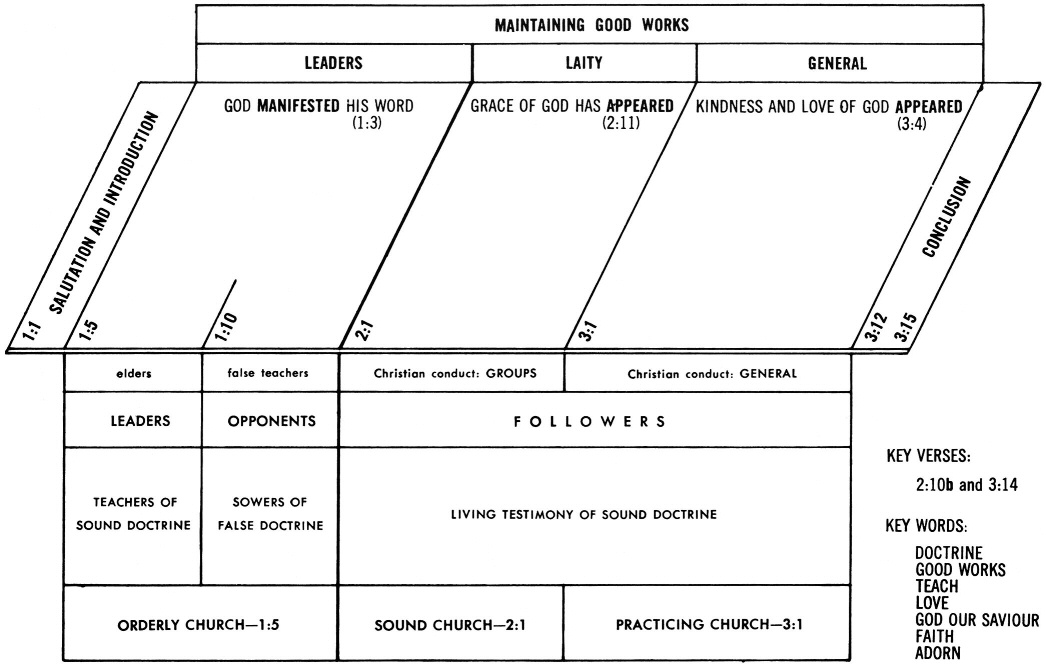
ADORNING THE DOCTRINE OF GOD
Click chart to enlarge
Charts from Jensen's Survey of the NT - used by permission
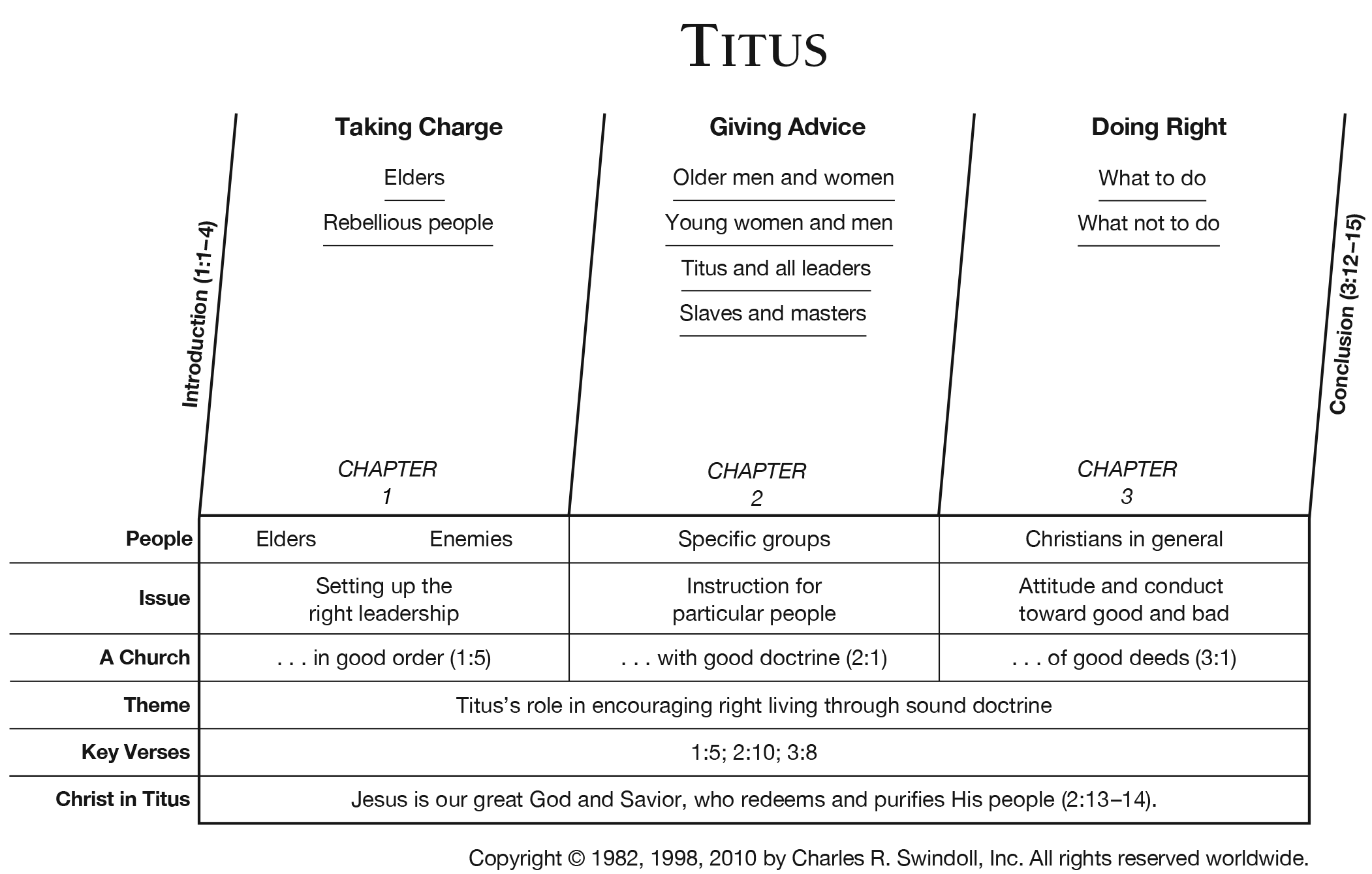
See Summary Chart by Charles Swindoll
Chart below from Michael J. Penfold
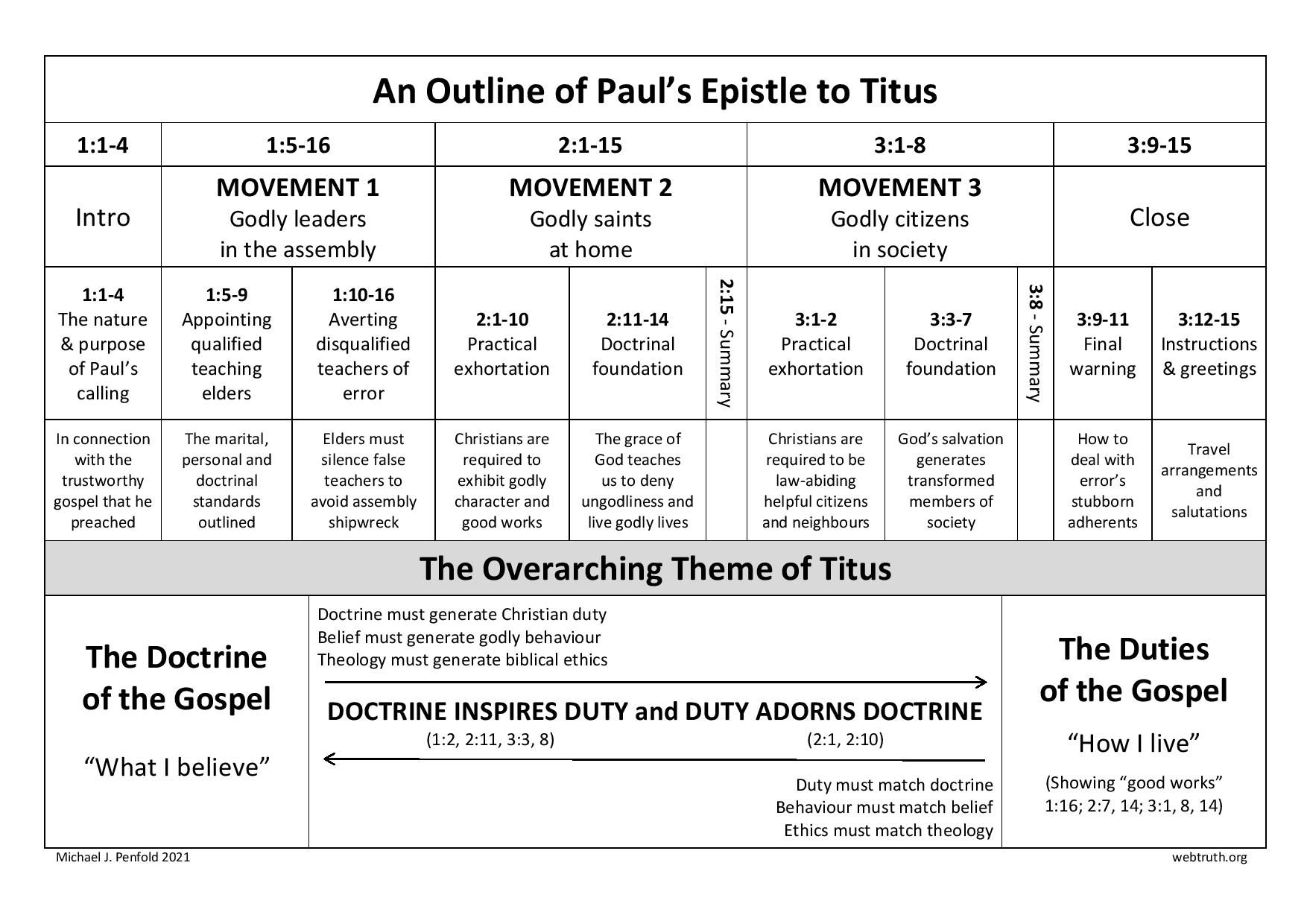
|
Focus |
Appoint Elders |
|||
|
Divisions |
Ordain |
Rebuke |
Maintain |
|
|
Topics |
||||
|
Topics |
Organization |
Offenders |
Operation |
|
|
Place |
Probably Written from either Corinth or Nicopolis (cf. Titus 3:12). |
|||
|
Time |
Circa 63 AD |
|||
|
Modified from Talk Thru the Bible |
||||
Titus 2:9 Urge bondslaves to be subject (PPN) to their own masters in everything, to be (PAN) well-pleasing, not argumentative (PAPMPA) (NASB: Lockman)
Greek: doulous idiois despotais hupotassesthai (PPN) en pasin, euarestous einai, (PAN) me antilegontas, (PAPMPA)
Amplified: [Tell] bond servants to be submissive to their masters, to be pleasing and give satisfaction in every way. [Warn them] not to talk back or contradict, (Amplified Bible - Lockman)
KJV: Exhort servants to be obedient unto their own masters, and to please them well in all things; not answering again;
NLT: Slaves must obey their masters and do their best to please them. They must not talk back (NLT - Tyndale House)
Phillips: Slaves should be told that it is their duty as Christians to obey their masters and to give them satisfactory service in every way. They are not to "answer back" (Phillips: Touchstone)
Wuest: Exhort slaves to be putting themselves in subjection to their own masters with implicit obedience in all things; to give them satisfaction, not crossing them
Young's Literal: Servants -- to their own masters are to be subject, in all things to be well-pleasing, not gainsaying,
URGE BONDSLAVES TO BE SUBJECT TO THEIR OWN MASTERS: doulous idiois despotais hupotassesthai (PM/PN):
- Eph 6:5-8; Col 3:22-25; 1 Ti 6:1 6:2; 1 Peter 2:18-25
- Exhort slaves to be putting themselves in subjection to their own masters with implicit obedience (Wuest)
Urge is not present in the Greek but is added by the NASB translators. The text reads literally "Servants -- to their own masters are to be subject".
Bondslaves (1401) (doulos) refers to one born into slavery in contrast to a person taken in war and sold as a slave (andrapodon). Slaves formed a large class of society in Paul's day.
Kitto on slavery in Paul's day - Roman Slavery.—Our limits will not allow us to enter into detail on the only kind of slavery referred to in the New Testament, for there is no indication that the Jews possessed any slaves in the time of Christ. Suffice it therefore to say, that, in addition to the fact that Roman slavery was perpetual and hereditary, the slave had no protection whatever against the avarice, rage, or lust of his master. The bondsman was viewed less as a human being, subject to arbitrary dominion, than as an inferior animal, dependent wholly on the will of his owner. The master possessed the uncontrolled power of life and death over his slave—a power which continued at least to the time of the emperor Hadrian. He might, and frequently did, kill, mutilate, and torture his slaves, for any or for no offence; so that slaves were sometimes crucified from mere caprice. He might force them to become prostitutes or gladiators; and, instead of the perpetual obligation of the marriage tie, their temporary unions were formed and dissolved at his command, families and friends were separated, and no obligation existed to provide for their wants in sickness or in health. (Slave - Kitto's Popular Cyclopedia)
Doulos conveys the idea of the slave's close, binding ties with his master, belonging to him, obligated to do his will and in a permanent relation of servitude to him. (Click or here for more discussion of doulos).
To be subject (5293) (hupotasso from hupó = under + tasso = arrange in orderly manner, assign or dispose to a certain position or to a particular task) means to cause to be in a submissive relationship, to subordinate or bring one under the firm control of another. Hupotasso was a military term describing soldiers lining up under or rank under their authority. Hupotasso also referred to the arrangement of military implements on a battlefield in such a way as to facilitate effective warfare.
Hupotasso focuses on function, not essence. Submission to political authorities (Ro 13:1), wives to husbands (Col 3:18), young to elders (1Pe 5:5).
In non-military use, hupotasso refers to a voluntary attitude of placing one's self under the authority of another. In the present context, the bondslave is exhorted to continually (present tense) place himself or herself (middle voice = reflexive or if passive to be subjected to) in subjection to the master who for the most part were pagans. Submission in such potentially adverse circumstances represents an act of faith. The born again bondslave would be trusting God to direct his or her life and to work out His purposes in His time. Clearly, there is a danger in submitting to others, especially if they have a different world view (pagan or Cretan in this case) for they might take advantage of us. Ultimately however their submission to their master, pagan or not, would reflect submission to God's authority and He is responsible for the care.
How is it possible to surrender one's rights to a master in authority? In Ephesians Paul writes that believers should "not get drunk with wine, for that is dissipation, but be (continually) filled with (controlled by) the Spirit" (Eph 5:18) and then should "be subject to one another in the fear of Christ" (Eph 5:21) Slaves filled with the Spirit would be enabled to obey the spirit of the law to the glory of God.
Masters (1203) (despotes) means lord or one with absolute, undisputed ownership of and unchallenged power over another. Five of the nine uses in the NT refer to the master of the house who had unrestricted authority. (Luke 2:29; Acts 4:24; 1Ti 6:1, 2; 2Ti 2:21; Titus 2:9; 1Pe 2:18; 2Pe 2:1; Jude 1:4; Rev 6:10)
IN EVERYTHING TO BE WELL-PLEASING: en pasin euarestous einai (PAN):
- "in all things; to give them satisfaction" (Wuest)
Everything (3956) (pas) means no exceptions. Notice it precedes the verb emphasizing the importance of "no exceptions" It means whether they treat you well or not. God's children are never to return evil for evil or insult for insult to anyone, so that they may show a proper opinion of their Father and the supernatural life He gives us to the lost world.
Why is this so critical that bondslaves (and all spiritual bondslaves of Christ) adorn (make attractive) the doctrine of God our Savior? In an article in Breakpoint entitled "Drawn to the Light - Why Muslims Convert to Christianity" read and be convicted/motivated…
Dr. Dudley Woodberry, professor of Islamic Studies… aware that throughout the world Muslims have been turning to Christ, was curious about the reasons why -- especially in countries where the cost of converting is so high. To find the answer, he created a detailed questionnaire. Over a 16-year period, some 750 Muslims from 30 countries filled it out -- and the results are eye-opening. The number one reason Muslim converts listed for their decision to follow Christ was the lifestyle of the Christians among them.
As Woodberry, Russell Shubin, and G. Marks write in CHRISTIANITY TODAY, Muslim converts noted that "there was no gap between the moral profession and the practice of Christians" they knew. An Egyptian convert contrasted the love shown by Christians "with the unloving treatment of Muslim students and faculty he encountered at a university in Medina." Other converts were impressed that "Christians treat women as equals" and enjoy loving marriages. And poor Muslims observed that "the expatriate Christian workers they knew had adopted, contrary to their expectations, a simple lifestyle." They wore locally made clothes and abstained from pork and alcohol, so as not to offend Muslim neighbors. (Read the full discussion - Drawn to the Light - Why Muslims Convert to Christianity- Breakpoint)
To be (1511) (eimi = to be, present tense = continuous action, active voice = subject makes volitional choice to carry out the action)
Well pleasing (2101) (euarestos from eu = good, well + arestos = pleasing, desirable, proper, fit, agreeable from aresko = to please or be pleasing/acceptable to) means that which causes someone to be pleased. It is something which is well approved, eminently satisfactory, or extra-ordinarily pleasing.
Euarestos is used 9 times in the NT in the NASB (Rom 12:1f; 14:18; 2 Cor 5:9; Eph 5:10; Phil 4:18; Col 3:20; Titus 2:9; Heb 13:21) and is translated in the NAS as: acceptable, 3; pleasing, 3; well-pleasing, 3. Note that the predominant usage refers to well-pleasing to God and most often describes the goal of a believer's life.
Romans 12:1 (note) I urge you therefore, brethren, by the mercies of God, to present your bodies a living and holy sacrifice, acceptable to God, which is your spiritual service of worship.
Romans 12:2 (note) And do not be conformed to this world, but be transformed by the renewing of your mind, that you may prove what the will of God is, that which is good and acceptable and perfect.
Romans 14:18 (note) For he who in this way serves Christ is acceptable to God and approved by men.
2 Corinthians 5:9 Therefore also we have as our ambition, whether at home or absent, to be pleasing to Him.
Ephesians 5:10 (note) trying to learn what is pleasing to the Lord.
Philippians 4:18 (note) But I have received everything in full, and have an abundance; I am amply supplied, having received from Epaphroditus what you have sent, a fragrant aroma, an acceptable sacrifice, well-pleasing to God.
Colossians 3:20 (note) Children, be obedient to your parents in all things, for this is well-pleasing to the Lord.
Titus 2:9 (note) Urge bondslaves to be subject to their own masters in everything, to be well-pleasing, not argumentative,
Hebrews 13:21 (note) equip you in every good thing to do His will, working in us that which is pleasing in His sight, through Jesus Christ, to whom be the glory forever and ever. Amen.
These bondslaves are to be continually well approved, eminently satisfactory, or extra-ordinarily pleasing to their masters.
It is possible to obey externally, but not “from the heart” (Eph 6:6). It is possible to do a job grudgingly. This exhortation however would not be easy to comply with as some unsaved masters would not be thoughtful and would overwork their slaves.
In Romans we can see a sense of what euarestos means where Paul writes that the will of God is
good and acceptable (euarestos) and perfect. (see note Romans 12:2)
God's will is well-pleasing because you cannot add anything to the will of God and in any way improve it. You could not take anything away from it and make it better. God's will is totally acceptable. And this is the attitude and actions Paul is calling for in servants here in Titus and in every saint in Romans 12 where he exhorts us
"by the mercies of God, to present your bodies a living and holy sacrifice, acceptable (euarestos) to God, which is your spiritual service of worship." (see note Romans 12:1)
In using euarestos Paul borrows from Old Testament sacrificial language to describe the kind of holy living that God approves, a “living sacrifice” that is morally and spiritually spotless and without blemish, and which He finds well-pleasing.
In his second letter to the Corinthians Paul writes that
"we have as our ambition (Greek root means loving what is honorable), whether at home or absent, to be pleasing (euarestos) to Him." (2 Cor 5:9).
Paul's service on earth was designed to bring pleasure to the heart of his Lord, whether Paul was still here on earth or whether he was standing before the Judgment Seat of Christ. To be well pleasing was Paul’s highest goal, and should also be for every believer.
Writing to the saints at Ephesus Paul encouraged them to be "trying to learn (idea of testing or proving to learn by clear, convincing evidence what is truly honoring to God) what is pleasing to the Lord." (Eph 5:10) In other words, these saints were to be putting every thought, word, and action to the test to discern "What does the Lord think about this?" "How does this appear in His presence?" Every area of our life should come under this searchlight, our… conversation, standard of living, clothes, books, business, pleasures, web surfing habits, friendships, sports, etc. The ultimate question should be… Will it be well pleasing (euarestos) to the Lord?
NOT ARGUMENTATIVE: me antilegontas (PAPMPA):
- not answering again (KJV)
- not talk back (NLT)
- They are not to "answer back" (Phillips)
- not crossing them (Wuest)
Not argumentative (483) (antilego from anti = against + lego = speak) literally speaking against. Modified by the negative particle it means simply not talking back (like my children used to do when they were young). The prohibition includes these ideas - not contradicting, disputing, refusing or disobeying. The present tense calls for this a habitual practice, which once again calls for dependence not one's self power but reliance on the Spirit's power!
A slave's service was to be rendered without sullenness and grumbling, without opposition or contradictions. Why? Verse 10 explains so that they might ''adorn" the doctrine of God our Saviour in every respect!
Steven Cole - Slaves should be subject to their masters, setting a godly example in their service, so that others will be attracted to the Savior (Titus 2:9-10).
For sake of time, I can only skim over the biblical view of slavery. While it was a legally recognized institution in the Old Testament, there were safeguards to protect slaves and means to emancipate them. In New Testament times, slavery was a longstanding and widespread institution in the Roman Empire. Often entire populations that had been defeated in battle became the slaves of the victors. By the first century, it has been estimated that up to one-third of the population of Rome were slaves.
The New Testament does not attack slavery as an institution, but it does reorder the relationship between slaves and masters, making all equal as brothers in Christ (Gal. 3:28). Paul commands masters to treat their slaves humanely, with justice and fairness, remembering that they, too, have a Master in heaven (Eph. 6:9; Col. 4:1; Philemon 16-17). He commands slaves to be obedient and render good service as slaves of Christ (Eph. 6:5-8; Col. 3:22-25). In our text, Paul gives five ways that slaves were to relate to their masters (whether Christian or pagan masters), and then the result of such behavior. While the parallel between slavery and being a modern employee is not exact (in spite of what you may think!), every Christian employee should exhibit these character qualities.
A. SLAVES ARE TO BE SUBJECT TO THEIR MASTERS IN EVERYTHING. (Titus 2:9)
“In everything” should be qualified by “everything that does not require disobedience to God.” For example, a Christian employee should not lie or engage in dishonest accounting practices to please an employer. But as long as it does not involve disobedience to God, a Christian should be subject to his employer.
As Paul states (Col. 3:22-24), “Slaves, in all things obey those who are your masters on earth, not with external service, as those who merely please men, but with sincerity of heart, fearing the Lord. Whatever you do, do you work heartily, as for the Lord rather than for men, knowing that from the Lord you will receive the reward of the inheritance. It is the Lord Christ whom you serve.” The words, “from the heart” and “heartily” show that attitude, not just grudging compliance, is required. If those words applied to slaves who were often under cruel, abusive masters, surely they apply to employees today who may have unreasonable, hard-to-please bosses.
We live in a society that feeds our sense of being victims. If we’re being treated unfairly, we will hear, “You don’t have to take that! Stand up for your rights! Threaten to sue that turkey of a boss! Organize a labor union and fight back!” But, to those who were true victims, to slaves who were often mistreated and abused, Paul says, “be subject to your masters in everything.”
As an employee, Scripture would permit you to go through proper channels to seek to get a difficult situation corrected. You may decide to take another job. But, before you tell off the boss and stomp out the door, remember that the testimony of Christ is at stake. Have you demonstrated submission to your boss? If not, to leave that job would be to dodge the lesson that God wants to teach you.
B. SLAVES ARE TO BE WELL-PLEASING. (Titus 2:9)
This refers to an attitude of cheerful service. The first one that we should seek to please on the job is the Lord. But, also, we should seek to please our employer. While there is nothing wrong with trying to do a good job in order to get a promotion or raise, our ultimate objective always should be to please Jesus Christ.
Some slaves may have been tempted to slack off or not to be so diligent to please a Christian master, thinking, “we’re all brothers in Christ.” But in 1 Timothy 6:2, Paul says that if slaves had believing masters, they should “serve them all the more, because those who partake of the benefit are believers and beloved.” Sometimes Christians who work for Christians rationalize that they can witness or fellowship with other believers on company time, and that the boss won’t mind. That is only true if the boss has told you that it’s okay. If not, you need to work hard while you’re on the job and do your witnessing or fellowshipping after hours.
C. SLAVES ARE NOT TO BE ARGUMENTATIVE. (Titus 2:9)
They are not to talk back or “mouth off” to an employer or run him down behind his back, which would not demonstrate submission. If there is a proper forum at work to air grievances or offer constructive suggestions for improving working conditions, a Christian employee may do so (although he should always use wisdom and tact). But it is always wrong to oppose the boss or hassle him. Cheerful compliance without arguing should be a Christian employee’s normal response. (Developing a Beautiful Body – Part 2 Titus 2:6-10)
Titus 2:10 not pilfering (PMPMPA) but showing (PMPMPA) all good faith so that they will adorn (3PPAS) the doctrine of God our Savior in every respect (NASB: Lockman)
Greek: me nosphizomenous, (PMPMPA) alla pasan pistin endeiknumenous (PMPMPA) agathen, hina ten didaskalian ten tou soteros hemon theou kosmosin (3PPAS) en pasin
Amplified: Nor to steal by taking things of small value, but to prove themselves truly loyal and entirely reliable and faithful throughout, so that in everything (Amplified Bible - Lockman)
BBE: Not taking what is not theirs, but giving clear signs of their good faith, in all things doing credit to the teaching of God our Saviour.
ICB: They should not steal from them. And they should show their masters that they can be fully trusted. Then, in everything they do they will make the teaching of God our Savior attractive. (ICB: Nelson)
KJV: Not purloining, but showing all good fidelity; that they may adorn the doctrine of God our Saviour in all things.
NJB: and there must be no pilfering -- they must show complete honesty at all times, so that they are in every way a credit to the teaching of God our Saviour. (NJB)
Phillips: or to be light-fingered, but they are to show themselves utterly trustworthy, a living testimonial to the teaching of God our saviour. (Phillips: Touchstone)
Young's Literal: not purloining, but showing all good stedfastness, that the teaching of God our Saviour they may adorn in all things.
NOT PILFERING: me nosphizomenous (PMPMPA):
- 2Ki 5:20-24; Lk 16:6-8; Jn 12:6; Acts 5:2,3 5:3
- not purloining (KJV)
- they are not… to be light fingered (Phillips)
- Not taking what is not theirs (BBE)
- Not defrauding (DRA)
- and there must be no pilfering (NJB)
- Nor to steal by taking things of small value (Amp)
Not pilferinig(3557) (nosphizo from nósphi = apart, separated) conveys the idea is stealing in small quantities or practicing petty theft. KJV translates it as purloin (from Middle English, to put away, misappropriate) which means to appropriate wrongfully and often by a breach of trust. Whereas pilfer implies stealing repeatedly in small amounts, whereas purloin stresses removing or carrying off for one’s own use or purposes.
The verb nosphizo is in the present tense (continuous action) and the middle voice which conveys a reflexive sense ("yourself"). With the negative particle (me) Paul is saying don't (continually) keep setting apart for yourself (reflexive) a part of that which has been entrusted to your care by your master. Don't embezzle or appropriate wrongfully some of the Master's goods for your own use as did "a man named Ananias, with his wife Sapphira" who after they had "sold a piece of property… kept back some of (nosphizo - Amplified adds "and wrongfully appropriated") the price for himself, with his wife's full knowledge and bringing a portion of it, he laid it at the apostles' feet. But Peter said, "Ananias, why has Satan filled your heart to lie to the Holy Spirit and to keep back (nosphizo) some of the price of the land?" (Acts 5:2-3 for the consequences of their actions read Acts 5:1-11).
Nosphizo is used 3 times in the NT in the NASB (Acts 2x; Titus) and is translated as keep back, 1; kept back, 1; pilfering (KJV = purloin), 1.
Nosphizo means to keep back or misappropriate something for one's self that which should or does belong to someone else. This term was found in secular Greek writings in reference to embezzlement of public treasures. It speaks of secretly appropriating and setting apart for one’s self the property of another.
A notorious OT use of nosphizo is found in the Greek translation of the Hebrew (Lxx = Septuagint) passages in Joshua 7 where we read that ""the sons of Israel acted unfaithfully in regard to the things under the ban (a vow or pledge under which property or persons devoted to pagan worship were destroyed), for Achan, the son of Carmi, the son of Zabdi, the son of Zerah, from the tribe of Judah, took some (Greek = nosphizo, Heb = laqah = grasped or seized) of the things (the spoils of battle including here a mantle, silver and gold) under the ban, therefore the anger of the Lord burned against the sons of Israel.” (Joshua 7:1)
From observing what happened to Ananias and his wife in Acts and to Achan and his family in Joshua, pilfering from the Lord is neither prudent or profitable!
Vincent says nosphizo means "Purloining (nosphizomenous). Only here and Acts 5:2-3. LXX (Septuagint), Josh. 7:1; 2Macc 4:32. Often in Classic Greek. From nosphi = apart. The fundamental idea of the word is to put far away from another; to set apart for one’s self; hence to purloin and appropriate to one’s own use. Purloin is akin to prolong: prolongyn or purlongyn “to put fer awey.” Old French, porloignier or purloignier. The fundamental idea of the word is to put far away from another; to set apart for one's self; hence to purloin (to take or carry away for one's self) and appropriate to one's own use.
Another source says nosphizo means to "separate surreptitiously or clandestinely for one's own use".
BUT SHOWING ALL GOOD FAITH: alla pistin pasan endeiknumenous (PMPMPA) agathen:
- Ge 31:37;31:38 39:8 39:9; 1Sa 22:14; 26:23; Ps 101:6; Mt 24:45; L, 16:10; 1Cor 4:2
- but to show that they can be fully trusted (NIV)
- but they must show themselves to be entirely trustworthy and good (NLT)
- And they should show their masters that they can be fully trusted (ICB)
- Instead, tell slaves to show their masters how good and completely loyal they can be" (GWT)
- but giving clear signs of their good faith (BBE)
- but must show themselves to be entirely trustworthy (TLB)
- but to prove themselves truly loyal and entirely reliable and faithful throughout (Amp)
- they must show complete honesty at all times (NJB)
Showing (1731) (endeíknumi from en = in, to + deíknumi = explain meaning or significance of something by demonstration) means to indicate by word or act. The present tense indicates this should be their habitual practice.
Regenerate, redeemed slaves are to be continually demonstrating, showing forth or manifesting words and works that show they are loyal and can be fully trusted. They were continually proving themselves to be faithful servants in everything they are entrusted with. In a parallel teaching to the Corinthians, Paul wrote that "it is required of stewards that one be found trustworthy." (1Cor 4:2)
How might this spiritual dynamic work in everyday practice? Masters know that the slaves could and would steal and God says our sin will find us out so the masters surely knew who to trust with cleaning the expensive silverware and dusting the bottles of fine wine. The point is that when the master saw such integrity and fidelity in a slave, he would have been intrigued. What made this lowly man or woman tick different than the average slave who thought little of cutting off for himself a small portion of the fine rib eye steak the master & mistress were to dine on that night! Ultimately these pagan masters would see through the "beautiful lives" of these slaves, the beauty of the teaching about the the One to Whom the slave belonged. Let us conduct ourselves in a manner worthy of the Gospel so that our lives would be like attractive ornaments that draw attention to the "Tree" of Calvary's love!
Matthew Henry writes that "Faithfulness in a servant lies in the ready, punctual, and thorough execution of his master's orders; keeping his secrets and counsels, dispatching his affairs, and managing with frugality, and to as much just advantage for his master as he is able; looking well to his trusts, and preventing, as far as he can, all spoil, or loss, or damage."
THAT THEY MAY ADORN THE DOCTRINE OF GOD OUR SAVIOR IN EVERY RESPECT: hina ten didaskalian tou soteros humon theou kosmosin (3PPAS) en pasin :
- Mt 5:16; Eph 4:1; Php 1:27; Phil 2:15, 16; 4:8; 1Pe 2:12; 3:16) (1Ti 5:17; 6:1 6:3; 2Jn 1:9
so that in every way they will make the teaching about God our Savior attractive (NIV)
Then they will make the teaching about God our Savior attractive in every way (NLT)
so that in everything they may be an ornament to the doctrine of God our Savior (NRSV)
Then, in everything they do they will make the teaching of God our Savior attractive (ICB)
Then they will show the beauty of the teachings about God our Savior in everything they do (GWT)
in all things doing credit to the teaching of God our Saviour (BBE)
In this way they will make people want to believe in our Savior and God (TLB)
That (2443) (hina) is a purpose clause (see terms of purpose or result) explaining the purpose they are to behave as he has prescribed. That they might, in their lives, “beautify the Bible” (and thereby most importantly, the God of the Bible) making it (Him) attractive to unbelievers.
The Amplified Bible is especially expressive "So that in everything they may be an ornament (Ed: Think of ornaments on Christmas trees!) and do credit to the teaching [which is] from and about God our Savior (Amp)
Paul had similar instructions for Timothy writing
Let all who are under the yoke as slaves regard their own masters as worthy of all honor so that (purpose clause) the name of God and our doctrine may not be spoken against. (1Ti 6:1)
Adorn ("to ornament") (2885) (kosmeo from kosmos = adorning or order, ornament, decoration, adornment -- this root word gives us our English cosmetic something women use to "adorn" their face and make themselves more physically attractive) speaks of that which is to put in order. To make congruous, fitting or orderly. To decorate. To embellish (to make beautiful with ornamentation; to heighten the attractiveness of by adding decorative details)
Kosmeo conveys the idea of arranging something in proper order so as to give it symmetry, comeliness, and beauty.
In the present context kosmeo describes behavior that is in keeping with the simplicity, purity and beauty of our Lord Jesus, radiating from a new heart in Christ (Ezekiel 36:26, 27 = the New Covenant, cp Jer 31:31, 32, 33) and a new way of thinking enabled by the mind of Christ (1Cor 2:16). Kosmeo in the context of Titus 2:9, 10 specifically referred to the Spirit enabled behavior of bond slaves which was to be such that it caused the truth about God to be beautifully "decorated". The present tense indicates this was to be the slave's habitual practice, continually radiating the beauty of Christ in them the hope of glory (Col 1:27), for Paul well knew that the lost world was always looking for a flaw in professed Christ followers, whether they were slaves (cp employees today) or masters (cp employers).
In ancient times kosmeo was used of arranging jewels in a brooch, necklace, ring, or crown in a way that best displayed the beauty of the gems. So the idea is that the excellent behavior of the bond slaves (God's "jewels") would be seen and would make the "doctrine of God" "attractive" or beautiful to unbelievers (Mt 5:16 and see illustrations in the notes below).
The noun kosmos reflects an ordered system where harmony prevails which helps expand the picture of what effect the behavior of a bond slave was to have on the doctrine of God. Pagans would see the "harmony" produced by this doctrine which would be in stark contrast to the disharmony and discord produced by the "doctrine of Crete" which led to lying, laziness, etc! Paul's exhortation has practical application to the lives of all believers (see more discussion of this point below, including illustrations).
BDAG summary of Kosmeo…
(1) to put in order so as to appear neat or well organized = make neat/tidy (Mt 12:44, 25:7, Luke 11:25)
(2) to cause something to have an attractive appearance through decoration = to adorn, decorate (Rev 21:2).
Figuratively kosmeo meant to make beautiful or attractive inwardly, morally (1Ti 2:9, 1Pe 3:5). To do credit to (Titus 2:10)
The English dictionary definition of the word adorn (Latin adornare from ad- ‘to’ + ornare = add luster) is interesting to ponder in light of the context of Titus 2:9, 10) = 1: to enhance the appearance of especially with beautiful objects (Adorn implies an enhancing by something beautiful in itself ~ a diamond necklace adorned her neck) 2 : to enliven or decorate as if with ornaments (people of fashion who adorned the Court) (Webster)
Adorn = to decorate or beautify. In the New Testament, the Temple (Luke 21:5), the monuments of the righteous (Matt. 23:29), and an empty house (Matt. 12:44; Luke 11:25) are all adorned. (Nelson's Illustrated Bible Dictionary)
Kosmeo - 10x in 10v in the NAS = Mt 12:44; 23:29; 25:7; Lk 11:25; 21:5; 1Ti 2:9; Titus 2:10; 1Pet 3:5; Rev 21:2, Rev 21:19) and is translated: adorn, 4; adorned, 3; put in order, 2; trimmed, 1.
For example, Peter uses kosmeo to describe inner beauty of women in the Old Testament writing
For in this way (referring to the hidden person of the heart… precious in the sight of God) in former times the holy women also, who hoped in God, used to adorn themselves, being submissive to their own husbands. (1Pe 3:5).
Kosmeo - 9x in the non-apocryphal Septuagint - 2Chr 3:6; Esther 1:6; Eccl 7:13; Jer 4:30; Ezek 16:11, 13; 23:40f; Mic 6:9
Wuest adds that
"The word kosmos (”order”), is opposed to chaos (our “chaos”) which latter word the Greek philosophers used to designate what they thought was the original condition of the universe, one of disorder. In passing, it might be well to note that when the NT writers speak of the universe as it came into existence, they use kosmos indicating that the original condition was that of order, perfection. By the use of this word (in 1Ti 2:9 "Likewise, I want women to adorn themselves with proper clothing, modestly and discreetly, not with braided hair and gold or pearls or costly garments"), Paul indicates that the adornment of the Christian woman should be one in which order, not disorder, obtains. And this orderliness must not extend merely to the relationship of the various articles of wearing apparel to one another, but also to the relationship of that apparel to her Christian character and testimony. In other words, the apparel must be congruous with, fitting to, and consistent with what she is, a child of God. The word “modest” is the translation of kosmios “well arranged, seemly, modest.” … He goes on to add that "an artificial display (when our external appearance and behavior are worldly - one which then confronting the lost with the world not the Savior) also destroys the personal testimony of the soul winner. We may be fundamental in our doctrine, and yet defeat the power of the Word we give out by the modernism of our appearance. It is forbidden because God seeks to glorify Himself in the personality and life of the Christian. He made men in His own image. That image is the ideal medium through which He can reveal Himself. But if that image is marred and distorted by artificiality (or inappropriate disorderly behavior slaves were prone to do -- how is your behavior and reputation in the workplace, school, community beloved?), it becomes an imperfect medium, and the beauty of the Lord Jesus is hidden beneath a veneer of worldliness." Are you convicted? I am! (Bolding added)
Doctrine (1319) (Didaskalia from didasko from dáo = to know or teach) is either the act of teaching or the thing taught. Titus is to encourage the believing slaves who have been taught sound doctrine to live it out before a watching world who is skeptical about the transforming power of the Gospel of Jesus Christ.
The term doctrine in Scripture "is broader than a simple reference to information passed on from one person to another or from one generation to the next. Christianity is a religion founded on a message of good news rooted in the significance of the life of Jesus Christ. In Scripture, then, doctrine refers to the entire body of essential theological truths that define and describe that message (1Ti 1:10; 4:16; 6:3; Titus 1:9). The message includes historical facts, such as those regarding the events of the life of Jesus Christ (1Cor 11:23). But it is deeper than biographical facts alone. As J. Gresham Machen pointed out years ago, Jesus’ death is an integral historical fact but it is not doctrine. Jesus’ death for sins (1Cor 15:3) is doctrine. (Sound) Doctrine, then, is scriptural teaching on theological truths." (parenthesis added) (Elwell, W. A., & Elwell, W. A. The Evangelical Dictionary of Biblical Theology - online)
Believing slaves were to "embellish with honor" the doctrines of Christianity. The genius of the word picture of kosmeo is the fact that adornment should be that which is fitting, congruous, not diverse from one’s character. That is, the adornment (figuratively speaking - the character and behavior) of the Christian slave (or the Christian woman 1Ti 2:9) should be in keeping with the new creature they are in Christ (2Cor 5:17). They were not to be a saved person at heart and manifest the adornment of a lost person. They were to show by their good behavior that Christian doctrine was a "system" where order prevails. How are Christians doing in this regard in America as we enter the 21st century?
Titus 2:11 (note) begins with "for" (always stop when reading a text and you encounter a "for" and ask "What's it there for?" You are training yourself to study inductively and to meditate on the Scriptures!) which explains how such radical behavior is now possible for believing slaves and for all those who are now in Christ by grace through faith.
The Doctrine of God our Savior - Is this not another way to say "the Gospel" by which we are justified and then progressively sanctified daily? In the next verse this doctrine is linked with salvation (justification) (Titus 2:11) and then in the following verse with daily sanctification (Titus 2:12).
SOME SIMPLE PRINCIPLES
REGARDING ADORNMENT
(In Behavior and in Dress)
(1) If a personality is to be seen at its best, it must be seen alone, not merged with another personality. Either the Lord Jesus is seen in all His beauty, or the personality of the believer is seen and her adornment. The Holy Spirit attracts sinners to the Lord Jesus, not by displaying the world's behavior or the world's latest styles, but by exhibiting the Lord Jesus.
(2) If a sinner is attracted by worldliness of a believer’s adornment in physical dress or external behavior, the fundamentalism of the believer’s Christian doctrine will be neutralized.
(3) When a Christian depends upon the Lord Jesus for adornment in external dress and behavior, both the dress and the behavior will all be in keeping with the purity, simplicity, and beauty of the Lord Jesus. All will be attractive without attracting from the Lord Jesus. All will be beautiful without detracting from Him. All will have character without attracting one to the person herself. Then the sinner will see the Lord Jesus in the heart and life of the believer, and in their adornment as well. Then will the Holy Spirit be able to work through the soul winner, attracting sinners to the Saviour. (Adapted and modified from Wuest, K. S. Wuest's Word Studies from the Greek New Testament: Eerdmans)
God our Savior - 6 uses of this same phrase in the NAS = 1Ti 1:1 1Ti 2:3 Titus 1:3 Titus 2:10 Titus 3:4 Jude 1:25. (Compare Isaiah 12:2 "God is my Salvation")
Savior (4990) (soter from sozo = rescue from peril > from saos = safe; delivered) in the context of the Bible is our "soter" or our "Rescuer from peril and danger". Soter also describes One Who not only rescues and saves but Who heals, protects and preserves. This truth is not restricted to the NT, for Isaiah taught that "God is my salvation, I will trust and not be afraid, for the LORD GOD is my strength and song, and He has become my salvation." (Isa 12:2)
The practical application of this truth is that God in Christ Jesus came to save us out of or from our sins, not "in" our sins. It follows that if there has been no life change (from Cretan to Christian so to speak), then there is no evidence of the life of the Spirit of God and of Christ within, for as Paul teaches "you are not in the flesh but in the Spirit, if indeed the Spirit of God dwells in you. But if anyone does not have the Spirit of Christ, he does not belong to Him… So then, brethren, we are under obligation, not to the flesh, to live according to the flesh--for if you are living according to the flesh, you must die; but if by the Spirit you are putting to death the deeds of the body, you will live." (see notes Romans 8:9; 8:12; 8:13). Are you by the Spirit putting to death the deeds of the body?
In every respect (3956) (pas) means no exceptions.
APPLICATION of Titus 2:9, 10
HOW DO WE ADORN
THE DOCTRINE OF GOD?
Spurgeon writes…
Is not that a wonderful passage? Here is a slave able to be an "ornament" to the Gospel of Christ! This blessed Gospel is not sent to kings and princes only; when Paul preached it, the great mass of the population were in cruel bondage, treated like dogs, or even worse; yet the Gospel had a message even for them, it told them that they might, by a godly character, adorn the doctrine of God their Savior.
The life of the Christian, even if he be a servant, is to be an "ornament" of Christianity. Christ does not look for the ornament of his religion to the riches or the talents of his followers, but to their holy lives “that they may adorn the doctrine of God our Savior in all things.”
Comment: Webster says that an "ornament" is "something that lends grace or beauty" or "one whose virtues or graces add luster to a place or society" (or the Gospel!). An ornament in architecture is a "decorative detail enhancing structures." Can we not "apply" these definitions to our lives as Christ followers? Beloved, are we "ornaments" of the Gospel or detractors (those who lessen the reputation or esteem of the Gospel)?
The truth of Titus 2:9-10 is applicable to all believers, for whether we are "bondslaves" (employees) or not, our lives are continually either adorning or besmirching the doctrine of God our Savior! I as have often quoted the words that I thought were those of St Francis of Assisi to "Preach the Gospel always, and if necessary, use words." While it sounds good, it is wrong on two counts. First, there is no evidence that Francis ever made this statement and to the contrary Francis was known to be "quite a preacher, actually more along the lines of Jonathan Edwards or Billy Sunday than most of those who misquote him would like to think. Galli quotes Thomas' biography, "His words were neither hollow nor ridiculous, but filled with the power of the Holy Spirit, penetrating the marrow of the heart, so that listeners were turned to great amazement." Our man clearly spent a great deal of time using his words when he preached, “sometimes preaching in up to five villages a day, often outdoors. In the country, Francis often spoke from a bale of straw or a granary doorway. In town, he would climb on a box or up steps in a public building. He preached to … any who gathered to hear the strange but fiery little preacher from Assisi.” He was sometimes so animated and passionate in his delivery that “his feet moved as if he were dancing.” (FactChecker- Misquoting Francis of Assisi) Secondly, Paul was quite clear when he said that "faith comes from hearing, and hearing by the word of Christ." (Ro 10:17) and "How then will they call on Him in whom they have not believed? How will they believe in Him whom they have not heard? And how will they hear without a preacher?" (Ro 10:14) To be sure our visible witness is to be godly and engaging but it is not to be mute!
Two other "enlightening" NT passages that teach a similar truth about adorning the doctrine of God our Savior are…
Let your light shine (Jesus issues this command in the aorist imperative which even conveys a sense of urgency. Like the secular saying the idea is "Just Do It!") before men in such a way that they may see your good works, and glorify your Father Who is in heaven. (Mt 5:16)
Do (The present imperative is a command calling for this to be our continual attitude and behavior. Warning - Don't try to obey this by yourself! See context = Phil 2:12, Phil 2:13, where the latter refers to the enabling energization and empowerment of the indwelling Spirit of Christ. Lean on Him and then "Don't grumble"!) all things without grumbling (goggusmos) or disputing (dialogismos) that you may prove yourselves to be blameless and innocent, children of God above reproach in the midst of a crooked and perverse generation, among whom you appear as lights in the world. (Phil 2:14, 15)
Here are some other NT passages that allude to our Christian conduct as a vehicle for making the Gospel attractive to the spiritually dead and perishing world…
Philippians 1:27 Only conduct yourselves in a manner worthy of the gospel of Christ; so that whether I come and see you or remain absent, I may hear of you that you are standing firm in one spirit, with one mind striving together for the faith of the gospel;
1Peter 2:12 Keep your behavior excellent among the Gentiles, so that in the thing in which they slander you as evildoers, they may on account of your good deeds, as they observe them, glorify God in the day of visitation.
1Peter 3:16 and keep a good conscience so that in the thing in which you are slandered, those who revile your good behavior in Christ may be put to shame.
Steven Cole - SLAVES ARE NOT TO PILFER. (Titus 2:10) Pilfer means to misappropriate or embezzle money or goods for one’s own use. Slaves were often entrusted with managing a family’s funds or with purchasing supplies for the household. It would be easy to rationalize, “I’m living in poverty and they are living in luxury. They won’t miss a little bit if I use it for myself.” As an employee, it is easy to use the same kind of rationale for taking things from the company, especially if it is a large company or the government. But it is wrong.
SLAVES ARE TO BE LOYAL AND TRUSTWORTHY. (Titus 2:10) “Showing all good faith” means, demonstrating that you are a dependable, faithful worker. Your boss should know that if he gives you something to do, it will get done on time. He should know that you keep your word. You don’t pad expense accounts. You don’t goof off when you’re supposed to be working. You seek to help your boss and company succeed. If a slave behaved as Paul sets forth here, he would have stood out from the crowd. Most slaves resented their lot in life and fought back with a sulky attitude, an insolent tongue, petty thievery, or trying to get by with as little work as possible. The same is true of many workers today. But Christian workers should be obviously different. If they are, an obvious result will follow:
THE RESULT OF A SLAVE’S GODLY EXAMPLE WILL BE THAT THEY WILL ADORN THE DOCTRINE OF GOD OUR SAVIOR IN EVERY RESPECT. (Titus 2:10) - “Adorn” comes from a Greek word from which we get our word cosmetics. It means to arrange in an orderly manner so as to enhance beauty or attractiveness. Paul means that Christians should order their lives with godly behavior so that the world will be attracted to our Savior. Our main motive should be to honor and glorify Him. This means that you need to think about your behavior and attitude, especially on the job. How will it make others think about the Savior that you profess to follow? Your life must be the foundation for any verbal witness. If your life is not an example of godliness, as Paul spells out here, don’t let anyone know that you are a Christian! If you do, you will dishonor the name of Christ and give excuses to unbelievers to continue in their sins. While you do need a consistently godly life to beautify the gospel, you don’t have to be perfect. If that were the requirement, none of us could ever be a witness! But when you fail, you need to confess your sin and ask forgiveness of those you have wronged. That also shows the reality of the gospel in your life, and it can be a powerful witness.
Conclusion - An evangelist preached a strong message on the text, “You shall not steal.” The next morning, he got on a bus and gave the driver a dollar bill for his fare. Counting his change, he discovered that he had received a dime too much. He could have thought, “No big deal,” and pocketed the dime. But instead, he went to the driver and said, “You gave me a dime too much.”
The driver said, “Yes, I know. I did it on purpose to see what you would do. Last night I was in your audience and heard your sermon. I’ve always been suspicious of Christians. So when I recognized you this morning, I thought, ‘If he practices what he preaches, I’ll go hear him again tonight. But if he keeps the dime, I’ll know he’s a fake.’” The man did go back to the meetings and was wonderfully saved. A ten-cent testimony won him to the Lord (from “Our Daily Bread,” Fall, 1978).
God wants you to beautify your life by godly behavior so as to attract others to the Savior. God’s beauty program starts when you repent of your sins and trust in Jesus Christ as your Savior and Lord. If you haven’t started yet, why not now? (Developing a Beautiful Body – Part 2 Titus 2:6-10)
THE RADICAL IMPACT OF
A CHRIST ADORNED LIFE
ILLUSTRATION - During the Spanish conquest of Mexico under Hernando Cortez in the early 1500s, a resistance leader named Hatney was captured after a fierce battle and sentenced to be burned alive. After tying him to the stake, his captors urged him to become a Christian so that at his death his soul might be given an entrance into heaven. He asked his tormentors if they expected to go to this place. On being told that they did, he cried out, “Then I will not be a Christian, for I would not again go to a place where I would find men so cruel!” - H. V. Lugt (Our Daily Bread, Copyright RBC Ministries, Grand Rapids, MI. Reprinted by permission. All rights reserved)
Let the acts of the offspring
indicate similarity to the Father.
-Augustine
A Living Letter Adorns the Doctrine of God our Savior - Believers exert a positive influence on others by setting a good example with the consistency of their lives. Will Houghton, president of Moody Bible Institute during the 1940's, was such a person.
Before Houghton became president of Moody, he pastored a church in New York City. An agnostic living there was contemplating suicide, but he decided that if he could find a minister who lived what he professed, he would listen to him. Since Will Houghton was a prominent figure in the city and a pastor, the man chose Houghton for his case study. He hired a private detective to watch him. When the investigator's report came back, it revealed that Houghton's life was above reproach. The agnostic went to Houghton's church, accepted Christ, and later sent his daughter to Moody Bible Institute.
Nehemiah was another believer who dramatically affected the lives of those around him. Even rich nobles and high officials listened respectfully as he rebuked them. Why? Because of the quality of his life. Whatever he asked of others, he was willing to do himself. And because Nehemiah joined in the hard work and refrained from using his position to accumulate wealth, the leaders couldn't help but listen to what he said.
An exemplary life awakens spiritual and moral sensitivity in those who observe us, and it gives power to our words of witness. —H. V. Lugt
We can preach a better sermon with our lives
than with our lips
The Gospel According To You…
There's a Gospel according to Matthew; To Mark;
To Luke; and John too.
There's another gospel that many are reading…
The Gospel according to You.
All teachings we find in the Bible
Are facts we know to be true;
You must live them to make them the Gospel…
The Gospel according to You
Many read not the words of the Bible;
I will tell you what some of them do…
They are reading the book you are writing…
The Gospel according to you.
There's Great Power In Gospel Preaching
The Bible teaches that this is true.
But the sermon most likely to influence others
Is The Gospel according to You.
God help us to be faithful to Jesus…
To live all His teachings so true,
So that all may see His Spirit
In the Gospel according to You
You are writing a gospel, a chapter each day;
By things that you do; By things you say.
Others read that gospel, whether faithless or true!
Say! What is the Gospel According To You?
Leroy Brownlow
(Note some attribute words in highlight to Paul Gilbert, others "Anonymous")
SPEAK AND DO - In ancient Greek dramas, a person behind a curtain spoke the lines while the performer on stage acted out the role. We might refer to the speaker behind the scenes as the one who didn't "practice what he preached."
This person behind the curtain reminds me of a problem we as Christians experience today. Many of us are skilled at sounding religious, but we don't put our words into action. This is hypocrisy.
When there is a discrepancy between what we say and what we do, we create confusion in the minds of our "audience." That's why many nonbelievers do not take the gospel message seriously.
A Christian who makes the greatest impact on a watching world, and who furthers the cause of Christ, is one whose actions harmonize with his speech (Ed: In short, his actions adorn the doctrine of God our Savior!). When James spoke of the "wisdom that is from above," he described it as "pure, then peaceable, gentle, willing to yield, full of mercy and good fruits, without partiality and without hypocrisy" (James 3:17).
Our role as Christians is vastly different from the ancient Greek actors. They had speakers who didn't do and doers who didn't speak. We are to be people who speak and do the truth! - R W De Haan (Our Daily Bread, Copyright RBC Ministries, Grand Rapids, MI. Reprinted by permission. All rights reserved)
When actions and words agree,
the message is loud and clear.
The positive motive, to make God’s message attractive, and the negative motive, to keep God’s teaching from being slandered, ought to control our lives.
Robert Layton (1853) wrote that
When a Christian walks irreprovably, or free from need to be reproved, his enemies have nowhere to fasten their teeth on him, but are forced to gnaw on their own malignant tongues. As it secures the godly thus to stop the lying mouths of foolish men, so it is as painful to them to be thus stopped as muzzling is to beasts and it punishes their malice. And this is a wise Christian's way instead of impatiently fretting at the mistakes or willful miscensures of men to keep still on his calm temper of mind and upright course of life and silent innocence. This like a rock breaks the waves into foam that roar about it.
Alexander Maclaren the great Scottish preacher offered this sobering reminder…
The world takes its notions of God most of all from the people who say that they belong to God's family.
They read us a great deal more
than they read the Bible.
In fact, they see us, they only hear about Jesus Christ.
The bottom line then in evangelism is not what we say, it is what we do. Someone has said that
Some of us speak so loud by what we DO
that no one can hear what we SAY.
J. H. Jowett rightly said that
Fine living is not only a fine argument, it is also an effective silencer of bad men.
W E Vine commenting on Titus 2:9,10 wrote that a relationship with Christ
which could produce such a change in the character and life of slaves as to carry out the teaching here given, would influence powerfully the minds of unbelievers and even those who were hostile to Christianity. The comment of Chrysostom on these verses is worth quoting: he says that
Greeks form their estimate of doctrines,
not from the doctrine itself but from actions and life.
God often gets highest honor from the godly life and testimony of those who are despised by men in general as being illiterate and even ignoble. The meek and quiet spirit is in the sight of God of great price, even in cases where a believer is little known or heard of. If slaves in those olden days could bring glory to the name of Christ by the faithful fulfillment of their work, so surely can those whose occupation is in more favored circumstances. (Amen!) (Vine, W. Collected writings of W. E. Vine. Nashville: Thomas Nelson )
D Martyn Lloyd-Jones commenting on Titus 2:9,10 wrote that…
The idea is that the doctrine is, as it were, the foundation or basic garment and that the life is a kind of adornment which is added on to it. His exhortation is that we must always be careful that our decorations, our adornments, are suited to, and are congruous with, and match, this foundation garment which we have already put on.
The doctrine is the foundation.
The life is the adorning.
The purpose of the adorning is to make the doctrine attractive, to cause people to admire it, to look at it and to desire to have it. The Apostle here, as everywhere else, does much more than issue a general appeal to Christian people to live a good life and to be philanthropic. The appeal is always in terms of the doctrine; the life must always issue from it, must always match it. You and I are to live the kind of life that will adorn the doctrine. (Ed: What has your "garment" looked like this past week? "Clothes by Christ" or "Fashion by Flesh"?) (From Christian Unity - Studies in Ephesians)
G Campbell Morgan wrote that in this section there
are two ideas which flash with a surprising brilliance. The first is that the doctrine of God our Saviour can be adorned; and the second is that those who are spoken of as able to do it are slaves. Perhaps we shall understand the first better, if we begin with the second. The word servants here is distinctly the word for slaves, and it may well be conceived that the conditions of slaves in Crete, where Titus was laboring, were of the worst. Paul had already said that the testimony of one of their own prophets was true that the Cretans were liars, evil beasts, gluttons. Slavery in a society of such must have been a terrible thing. Among these slaves there were some who were saints, and these were declared able in the very life of slavery, to adorn the doctrine. Moreover, the Apostle had declared how they would do it. It would be done by subjection to their masters; by seeking to be well-pleasing, by not gainsaying; by honesty, by faithfulness; in short, by such action in difficult circumstances as to win from their very masters recognition of their goodness.
Thus we see how the doctrine of God our Saviour may be adorned. It is adorned when its effects on life and character are expressed in conduct. To be true and gentle and faithful in circumstances that are hard and unfair, and even unjust, is only possible in the power of some great spiritual conviction (Ed: And some supernatural source of such power, that source in context being the grace of God [Titus 2:11]]! Glory! Hallelujah! We can be more than conquerors through the enabling grace the indwelling Spirit of Christ continually supplies!); and the value of such spiritual conviction is revealed in such conduct.
><>><>><>
A W Pink wrote that…
There are others who give themselves unto the diligent study of doctrine, but, generally, they fail to realize that the doctrine of Scripture is not a series of intellectual propositions, but is the "doctrine which is according to godliness" (1 Tim. 6:3). The "doctrine" or "teaching" of God’s Holy Word is given not for the instruction of our brains, but for the regulation of all the details of our daily lives; and this in order that we may "adorn the doctrine of God our Saviour in all things" (Titus 2:10). But that can only be realized by a constant reading of the Word with one dominant purpose-to discover what God forbids and what he commands; by our meditating frequently on what we have read, and by fervent prayer for supernatural grace to enable us to obey. (Practical Godliness)
We profit from the Word when we are taught thereby the great importance of good works. Condensing as far as possible: "good works" are of great importance because by them God is glorified (Matt. 5:16), by them the mouths of those who speak against us are closed (1 Pet. 2:12), by them we evidence the genuineness of our profession of faith (James 2:13-17).
It is highly expedient that we "adorn the doctrine of God our Saviour in all things" (Titus 2:10).
Nothing brings more honour to Christ than that those who bear His name are found living constantly (by His enablement) in a Christ-like way and spirit. It was not without reason that the same Spirit Who caused the apostle to preface his statement concerning Christ’s coming into this world to save sinners with "This is a faithful saying," etc., also moved him to write, "This is a faithful saying… that they which have believed in God might be careful to maintain good works" (Titus 3:8). May we indeed be "zealous of good works" (Titus 2:14). (Profiting From The Word)
><>><>><>
Cornelius Tyre comments that Titus 2:10 is like a "Second Edition of the Written Scriptures"
A conversion from depravity and sinfulness--to active godliness, is a more sublime miracle, and a more effectual proof for the divinity of the gospel--than was the resurrection of Lazarus!
Of all modes of teaching Christianity, 'exemplifying it' is the best.
The best commentary on the Bible that the world has ever seen --is a holy life of growing likeness to Christ.
The most eloquent sermon in behalf of the Gospel that the world has ever heard--is a uniform, active life of piety.
The best version of the Bible which has ever been made--is a consistent pious example.
The Christian whose light thus shines, not only correctly renders--but beautifies ("adorns" or "ornaments") the sacred text. His life and conduct are a sort of second edition of the written Scriptures--a 'living epistle' which all can read, all understand, and which convinces and convicts all.
We must become living, radiant likenesses of gospel truth. We are to be living verifications of the great doctrines of the Bible. A godly life is a powerful argument for the truth of the gospel. (The Moral Power of a Pious Life - 1859)
><>><>><>
Bishop J C Ryle…
I have had a deep conviction for many years that practical holiness and entire self-consecration to God are not sufficiently attended to by modern Christians in this country. Politics, or controversy, or party-spirit, or worldliness, have eaten out the heart of lively piety in too many of us. The subject of personal godliness has fallen sadly into the background. The standard of living has become painfully low in many quarters. The immense importance of "adorning the doctrine of God our Savior" ( Titus 2:10), and making it lovely and beautiful by our daily habits and tempers, has been far too much overlooked. Worldly people sometimes complain with reason that "religious" persons, so-called, are not so amiable and unselfish and good-natured as others who make no profession of religion. Yet sanctification, in its place and proportion, is quite as important as justification.
Sound Protestant and Evangelical doctrine is useless if it is not accompanied by a holy life. It is worse then useless; it does positive harm. It is despised by keen-sighted and shrewd men of the world, as an unreal and hollow thing, and brings religion into contempt.
It is my firm impression that we want a thorough revival about Scriptural holiness. (Reference)
><>><>><>
Theodore Cuyler on "Then they will make the teaching about God our Savior attractive in every way." Titus 2:10…
Christ enjoined upon every one of His disciples to study Him, to learn of Him, and to imitate His example. A true Christian is the representative of Christ in this world — the only embodiment of gospel teaching and influences, that is presented in human society.
How vitally important is it, then, that those of us
who profess and call ourselves Christians,
should make our Christianity attractive!
Multitudes of people know very little and think very little about the Lord Jesus; nearly all the ideas they get of His religion — is what they see in those who profess it!
An attractive Christian is the one who hits the most nearly that golden mean between love on the one hand — and firmness on the other hand. He is strict — but not censorious. He is sound — and yet sweet and mellow, as one who dwells much in the sunshine of Christ's countenance. He never incurs contempt by compromising with wrong — nor does he provoke others to dislike of him by doing right in a very harsh or hateful or bigoted fashion.
Our Master is our model. What marvelous example of gentleness, forbearance, and unselfish love adorned His life! What He was — we, in our imperfect measure, should pray and strive after.
Study Jesus, brethren.
Get your souls saturated with His Spirit. His grace imparted to you and His example imitated — can turn your deformity into beauty, and adorn your lives with those things which are true and honest and lovely. We must make our daily religion more winsome! (Wayside Springs from the Fountain of Life 1883)
><>><>><>
John Flavel (1628-1691) wrote…
Your duty is to adorn the Gospel by your life. The words signify to deck or adorn the Gospel, to make it attractive and lovely to the eyes of beholders. When there is a beautiful harmony and lovely proportion between Christ’s doctrine and our practice—then do we walk suitably to (worthy of) the Lord of glory. (The Method of Grace)
><>><>><>
James Smith (The Book That You Want) wrote that
Coldness and lukewarmness in the ways of God, are peculiarly offensive to our Lord and Savior; for if anyone deserves our whole hearts, if anyone ought to have the whole of our energies — it is Jesus!
We should be zealous for the truth of the gospel.
It is God's mind.
It is the revelation of the Savior's love.
It is the remedy for the sinner's woes.
It is the charter of the Church's privileges.
It is dear to God's heart.
It is watched over with a jealous eye.
It should be prized as inestimably valuable.
It is …
the mirror, in which God is seen;
the map, on which our road is marked out;
the law, by which our duty is made plain!
"That they may adorn the teaching
of God our Savior in everything!"
Titus 2:10
We should zealously adorn the Gospel.
Not by the tinsel of human eloquence — but by a consistent and holy walk.
We ought to be living expositions of the truth!
In our conduct — the nature and tendency of the Gospel ought to be seen!
By our meekness and gentleness,
by our fidelity and prudence,
by our self-denial and benevolence,
by our temperance and brotherly kindness,
by our patience and fervent love —
we ought to adorn the most holy truth of God!
God calls for it.
The Gospel is calculated to produce it!
><>><>><>
FROSTED BELLS! - Pastor Raymond Biddle shared the following experience with me in a letter. He wrote, "Our church has a good, clear-ringing bell. But yesterday we were ashamed of it. The first dull sound sent me looking for the bell ringer, who soon found out what was wrong. Nearly an inch of snow and sleet had blown on it during a night storm, and it was thoroughly encased in ice. What a poor call to worship it gave! Then the Lord impressed on me the thought that Christians often become sheathed in the sound-deadening things of the world. As a result, their witness becomes `ice-encased'.
The devil rejoices when Christians are drawn away from the Lord and their testimony is dulled by an accumulation of worldly attitudes and actions. Some of the "ices" that encase believers are pride, jealously, materialism, hatred, lying, gossip, envy, and all the other sins that characterize our old nature. The best way to keep from becoming "iced up" is to keep "fired up." This is accomplished through prayer, the study of God's Word, and regular fellowship with other believers.
Do you need a good spiritual "thaw"? Let your testimony sound forth loud and clear! Richard W. De Haan (Our Daily Bread, Copyright RBC Ministries, Grand Rapids, MI. Reprinted by permission. All rights reserved)
Oh, may our lives ring loud and clear
With God's Good News for all,
So people who are lost in sin
Will clearly hear His call.
-Sper
A cold heart doesn't ring true.
><>><>><>
KEEP ON WRITING - The following poem written by Paul Gilbert is intended to encourage us as Christians to be persuasive, flesh-and-blood testimonies for our Savior.
You’re writing a “gospel,” A chapter each day,
By the deeds that you do, By the words that you say;
Men read what you write, Whether faithless or true;
Say, what is the “gospel” According to you?
Sometimes, however, our writing is done with scratchy pens. Maybe it’s badly blurred and so illegible that God’s message can’t be deciphered.
Hannah More, an outstanding witness for the Gospel in 19th-century England, sometimes felt discouraged about the quality of her spiritual penmanship. Although she organized schools for the unevangelized poor and wrote many tracts and hymns, she had a low opinion of her effectiveness. This was her self-appraisal:
God is sometimes pleased to work with the most unworthy instruments—I suppose to take away every shadow of doubt that it is His own doing. It always gives me the idea of a great author writing with a very bad pen.
Yet we need not be discouraged. God, the great Author, is able to use even scratchy pens like you and me to communicate His message to people around us. Regardless of how we appraise our penmanship, let’s prayerfully keep on writing (Ed: Keep on adorning the Gospel of God our Savior!). -- Vernon C. Grounds
We're not called to work for God,
but to let God work through us.
><>><>><>
WALKING OUR FAITH (aka "Adorning the Doctrine of God") - Often we Christians are urged not just to "talk the talk" but to "walk the talk." The same advice may be expressed in these words:
Don't let your behavior
contradict your professed belief.
At other times we are admonished to be sure that life and lip agree. If our conduct doesn't harmonize with our confession of faith, however, that discrepancy nullifies the testimony of the gospel which we proclaim.
As far as we can know, Mahatma Gandhi never became a Christian, but he made a statement that we who follow Jesus would do well to ponder. When asked to put his message into one short sentence, he replied, "My life is my message."
Certainly we should explain the gospel message as clearly as possible. Yet the clearest explanation isn't going to win hearts for our Lord unless His love is embodied in our lives. To quote the apostle Paul in 1Corinthians 11:1, "Imitate me, just as I also imitate Christ." And holding himself up as a pattern, he wrote in Philippians 4:9, "The things which you learned and received and heard and saw in me, these do, and the God of peace will be with you."
Pray, then, that like Paul we may live out our saving faith before the watching world.—Vernon C Grounds (Copyright RBC Ministries, Grand Rapids, MI. Reprinted by permission. All rights reserved)
Let the beauty of Jesus be seen in me—
All His wonderful passion and purity!
O Thou Spirit divine, all my nature refine,
Till the beauty of Jesus be seen in me.
—Orsborn
The world is watching us…
Do they see Jesus?
><>><>><>
LIVING STONES - I’ve seen a number of recent reports about efforts to remove monuments with the Ten Commandments from public places in the US. It’s regrettable, for the monuments celebrate righteousness, and “righteousness exalts a nation” (Pr 14:34). I believe that removing these reminders is a reflection of our crumbling moral foundations.
There is one enduring monument to righteousness, however, that cannot be removed: the truth of Christ, written on human hearts by the Spirit of God (2Corinthians 3:3).
Those who have the law of God written on their hearts love the Lord with all their mind, soul, and strength. They demonstrate this love to the world by showing honor to their parents, faithfulness in their marriage, and integrity in their work (Ed: In other words they adorn the doctrine of God our Savior!). They respect human life and treat all men and women with dignity and honor. They don’t speak evil of anyone, no matter how much evil has been done to them. They are content with God and what He has given them, and they want nothing more. These are the outward signs that God’s law is alive, written on our hearts “by the Spirit of the living God” (2Co 3:3).
You and I are living monuments to His grace. We must stand tall. The world is watching. — by David H. Roper
God's laws engraved on our hearts
can never be removed from the public arena.
><>><>><>
W Grant (in notes on 2Corinthians but applicable to Titus 2:10) describes…
HOW WE MAY SO USE THIS EPISTLE (referring to the believer a letter written by Christ) THAT IT MAY SERVE THE PURPOSE FOR WHICH IT WAS WRITTEN.
We may commend Christ —
1. With our lips. Our conversation may be an epistle to make known His praises. The circulation of the epistle written with ink — the printed Bible — is our duty. Even so it is our duty to publish the living epistle. It was intended to be an open letter, known and read of all men. How many are there with whom we daily associate who never read the written Bible, the only hope of whose salvation is that they may read or hear the living epistle! By our silence we conceal that epistle from them, and leave them to perish.
2. By our lives. It is in vain that we speak of Christ with our lips if our lives belie our words. Our actions, like a pen full of ink, trace certain characters, leave certain impressions on the mind and memory of those who see them. In beholding our actions, have men been led to say of us, “These men have been with Jesus”?
3. By our character. A man’s outward manner may be in direct opposition to his inward character. To be true epistles of Christ we must reflect His image, not in word only, or in action, but in our dispositions and desires. (W. Grant.) (The Biblical illustrator; or, Anecdotes - Page 72)
><>><>><>
Letting the light of God shine through - One Sunday on their way home from church, a little girl turned to her mother and said, "Mommy, the preacher's sermon this morning confused me." The mother said, "Oh? Why is that?" The little girl replied, "Well, he said that God is bigger than we are. Is that true?" The mother replied, "Yes, that's true honey." "And he also said that God lives in us? Is that true, Mommy?" Again the mother replied, "Yes." "Well," said the little girl, "if God is bigger than us and He lives in us, wouldn't He show through?" (Amen! or Oh my!)
><>><>><>
Dr. Timothy Beougher writes that…
Over the centuries, Christians have related to the world in 4 ways:
A. Total separation. Monastery; no contact.
B. Total immersion. Lots of contact, but no impact.
C. Split adaptation. Sunday-only Christian; “hypocrite.”
D. Transformation. “in but not of the world.”
With God’s help (Phil 2:13), it is possible to conquer complaining and avoid arguing, that we prove blameless and innocent, above reproach, in a fallen world.
(Beougher also wrote) There are two kinds of Christians: those who “whine” and those who “shine.” Are you seeking to let your light shine to others around you? Then conquer complaining. Avoid arguing. Regain rejoicing(Morgan, R. J. Nelson's Annual Preacher's Sourcebook : 2002 edition. Nashville: Thomas Nelson Publishers)
><> ><> ><>
When Benjamin Franklin decided to interest the people of Philadelphia in street lighting, he hung a beautiful lantern on the end of a long bracket attached to the front of his house," wrote Cole D. Robinson in World Horizons.
"He kept the glass brightly polished and carefully lit the wick each evening at the approach of dusk. Anyone walking on the dark street could see this light from a long way off and came under its warm glow."
What was the result?
"It wasn't long before Franklin's neighbors began placing lamps outside their homes," Cole continued. "Soon the entire city realized the value of street lighting and followed his example with enthusiasm."
If we live according to the clear light of God's Word, God will dispel the darkness and others will be attracted to the Light. —H. G. Bosch (Our Daily Bread (Copyright RBC Ministries, Grand Rapids, MI. Reprinted by permission. All rights reserved)
Lets not only follow good examples, let's be good examples.
Some of us are the only Christian in the place where we work. Others stand alone as believers in our homes or classrooms. If we live according to the clear light of God's Word, God will dispel the darkness, the Savior will be pleased, and others will be attracted to the light.—H G Bosch
><> ><> ><>
THE POWER OF LIGHT - Some of us may not especially enjoy poetry. But often a few lines of verse will grip our imagination, as do the following by Francis Thompson: “The innocent moon, which nothing does but shine, moves all the laboring surges of the world.”
The moon is nearly 240,000 miles from Earth and is only 1/400th the size of the sun. With no light or heat of its own, it reflects the radiance of that greater heavenly body. It appears to be relatively insignificant. Yet, the moon quietly and almost imperceptibly moves the oceans of the world by its gravitational pull.
Most of us may not seem all that influential or well-known. We don’t have the giftedness, the wealth, or the position to make much of an impact on our society. Our names don’t appear in the newspaper, nor are they mentioned on television. We may think that all we can do is practice our faith in the humdrum routines of everyday life. But perhaps, unnoticed by us, we are having an influence on the people around us by our Christlike attitudes and actions.
Let’s not be concerned, then, about our seeming lack of influence. Instead, do what Jesus commanded: “Let your light so shine before men, that they may see your good works and glorify your Father in heaven” (Matthew 5:16). --Vernon C. Grounds (Our Daily Bread, Copyright RBC Ministries, Grand Rapids, MI. Reprinted by permission. All rights reserved)
Jesus bids us shine with a clear, pure light
Like a little candle burning in the night;
In this world of darkness we must shine—
You in your small corner, and I in mine.
—ExcellEven the smallest light
can make a difference in the darkest night.
><>><>><>
SHINE! - Author Anne Lamott once wrote that the people she admires have “purpose, heart, balance, gratitude, joy… They follow a brighter light than the glimmer of their own candle; they are part of something beautiful.”
In my experience, such people are not simply religious. They are committed disciples of Christ. Jesus explained why His followers have a sort of luminous quality. “I am the light of the world. He who follows Me shall not walk in darkness, but have the light of life” (John 8:12). Believing in Jesus as our Savior, we now can light up the world. We are told, “Let your light so shine before men, that they may see your good works and glorify your Father in heaven” (Matthew 5:16).
This doesn’t mean we must always display an artificial cheerfulness. Many of us don’t possess a sunny disposition. We may struggle with moods of depression. We may have to battle melancholy. But in the Holy Spirit’s power, we can be like the Christians to whom Paul wrote, “You shine as lights in the world” (Philippians 2:15). As Francis of Assisi put it: “Lord, make me an instrument of Your peace! Where there is hatred, let me sow love; … where there is darkness, light.”
Just as the moon reflects the radiance of the sun, so we who believe and follow the Savior can reflect Him who is the light of the world. -- Vernon Grounds (Our Daily Bread, Copyright RBC Ministries, Grand Rapids, MI. Reprinted by permission. All rights reserved)
There is sunshine in my soul today,
More glorious and bright
Than glows in any earthly sky,
For Jesus is my light.
—HewittA world in darkness needs the light of the gospel.
><>><>><>
SHINE WHERE YOU ARE - The name of Peter Carter is probably unknown to most people today. He was a 19th-century American Presbyterian pastor. He wasn’t as famous a pulpiteer as Charles Haddon Spurgeon. He didn’t write great works of theology like his contemporary Charles Hodge. He never achieved the international recognition of Henry Ward Beecher of the Brooklyn Tabernacle. But he lived his faith in such a way that he encouraged hundreds of people to trust and serve Jesus Christ. Carter radiated the Savior’s love to children as well as to adults.
For example, a visitor asked some of the children in Carter’s Sunday school if they knew the Good Shepherd.
“Oh, yes,” they answered. “He’s Pastor Peter Carter.”
Missionary-statesman Robert E. Speer said,
If all the reasoned arguments in support of Christianity were destroyed, Peter Carter and the two or three men like him I have known would remain for me as its impregnable basis and defense.
Even if we think of ourselves as rather ordinary believers, all of us can by God’s grace be shining lights that “glorify [our] Father in heaven” and point people to the Savior (Matthew 5:16; Philippians 2:14, 15, 16). We too can be flesh-and-blood evidence that the gospel is true. - Vernon Grounds (Ibid)
I want my life to shine for Jesus
So that everywhere I go
The watching world will see He loves them
And His saving grace will know.
—HessGod put us on earth to shine as lights,
not to get used to the dark.
><>><>><>
LIGHTS IN THE DARKNESS - I once read about a woman who felt very much alone at her workplace because she was the only Christian. She was often ridiculed for her faith and accused of being narrow-minded. Finally she became so discouraged that she considered quitting her job. Before doing that, however, she talked with her pastor. After listening to her complaints, the minister asked, “Where do people usually put lights?” “In dark places,” she replied.
She quickly recognized that her place of work was indeed a “dark place” where “light” was vitally needed. So she decided to stay where she was and become a stronger influence for Christ. It wasn’t long before a number of her fellow employees—13 of them, in fact—came to know Christ as their Savior.
As “lights in the world” (Philippians 2:15), we who are believers in Christ have the privilege of illuminating its dark places. Although we are not of the world, we are in the world. We must not allow ourselves to be shaped by its pressures; instead, we are to exert our influence on it.
If you are in an unusually difficult and ungodly atmosphere, call to mind Christ’s words, “Let your light so shine before men” (Matthew 5:16). Remember, it’s the dark places that need the light. —R W De Haan (Ibid)
If you were in the dark,
You'd surely welcome light;
That's why we share God's Word
With souls in darkest night.
—HessTo lead others out of the darkness of sin,
let them see your light.
><>><>><>
LIGHTS IN THE WORLD - It’s easy to see that we live “in the midst of a crooked and perverse generation” (Phil. 2:15). We are continually reminded that we live in a fallen world by our own sinful tendencies, by newspaper headlines that report horrifying crimes, and by a society that is growing accustomed to gross immorality.
Against this backdrop of darkness, followers of Jesus are told to be “lights in the world” (Phil. 2:15). Yet our conduct often reflects a dim and distorted image of Him. That’s why Paul warned us against “complaining and disputing” (Php 2:14) and urged us to put our salvation to work with reverence for God (Php 2:12, 13).
We may wonder why the apostle didn’t mention something more scandalous than complaining. But relatively few of us are guilty of “headline” sins, while all of us have been guilty of the smugness, pride, and self-centeredness that erupts in murmuring and quarreling. And these “lesser” sins can be just as destructive.
Paul knew that we need to be spiritually alert to evil and nip it in the bud. By heeding these exhortations we will “become blameless and harmless, children of God without fault” (v.15). Then we will be sure to shine as lights in this dark world. --Herbert Vander Lugt (Ibid)
Darkness seems so overpowering
In our world today;
Help us, Lord, to keep on shining
Till the break of day.
—HessIt's the life behind our words
that makes our testimony ring true.
><>><>><>
John Angell James has the following thoughts on Titus 2:20…
"Make the teaching about God our Savior attractive in every way." Titus 2:10
It is a solemn thing to profess to be a disciple of Christ.
It supposes you to be a new creature, that old things have passed away, and that all things have become
new with you.
It supposes that you have …
new principles,
new motives,
new ends of life,
new tastes and new pleasures.
Now, your profession is to be maintained with a due regard to this. Your conduct must correspond with it.
You must be dissimilar in these things, to those who make no such profession. They must see the difference as well as hear of it. You must compel them to say,
"Well, we do not like her religion, but it is quite in harmony with her profession."
Study your profession, and thoroughly understand what it implies and enjoins. Consider well …
what holiness of conduct;
what spirituality of mind;
what separation from the world in spirit and taste;
what devotional feelings;
what faith, hope, love and humility;
what amiableness and kindness of disposition,
are included in that declaration you have actually made—"I am a Christian!"