Titus 3:2
Titus 3:3
Titus 3:4
Titus 3:5
Titus 3:6
Titus 3:7
Titus 3:8
Titus 3:9
Titus 3:10
Titus 3:11
Titus 3:12
Titus 3:13
Titus 3:14
Titus 3:15
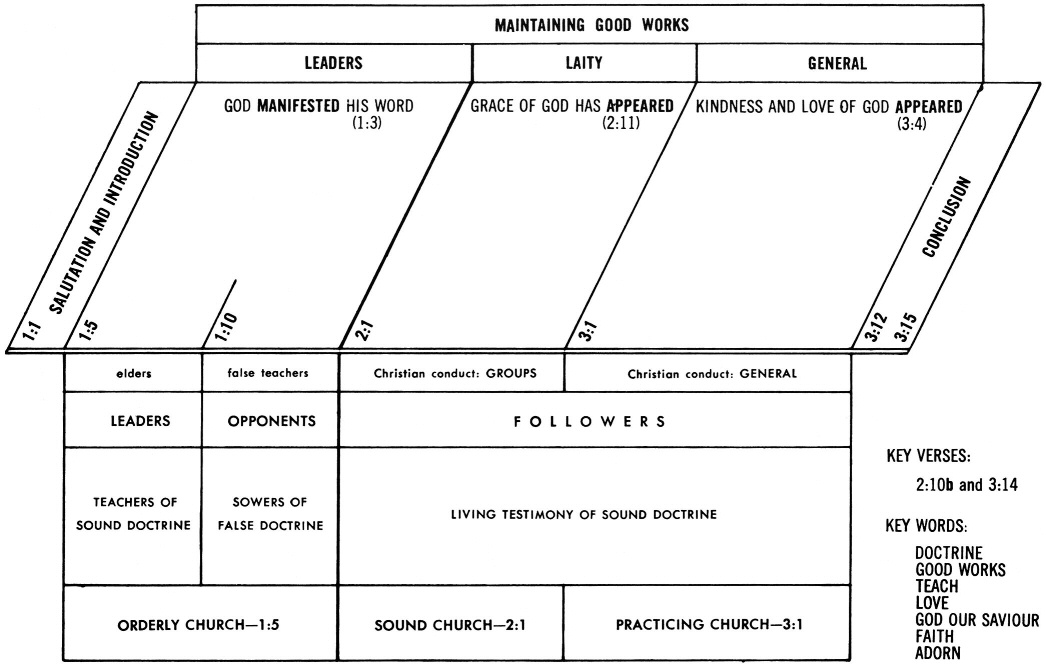
ADORNING THE DOCTRINE OF GOD
Click chart to enlarge
Charts from Jensen's Survey of the NT - used by permission
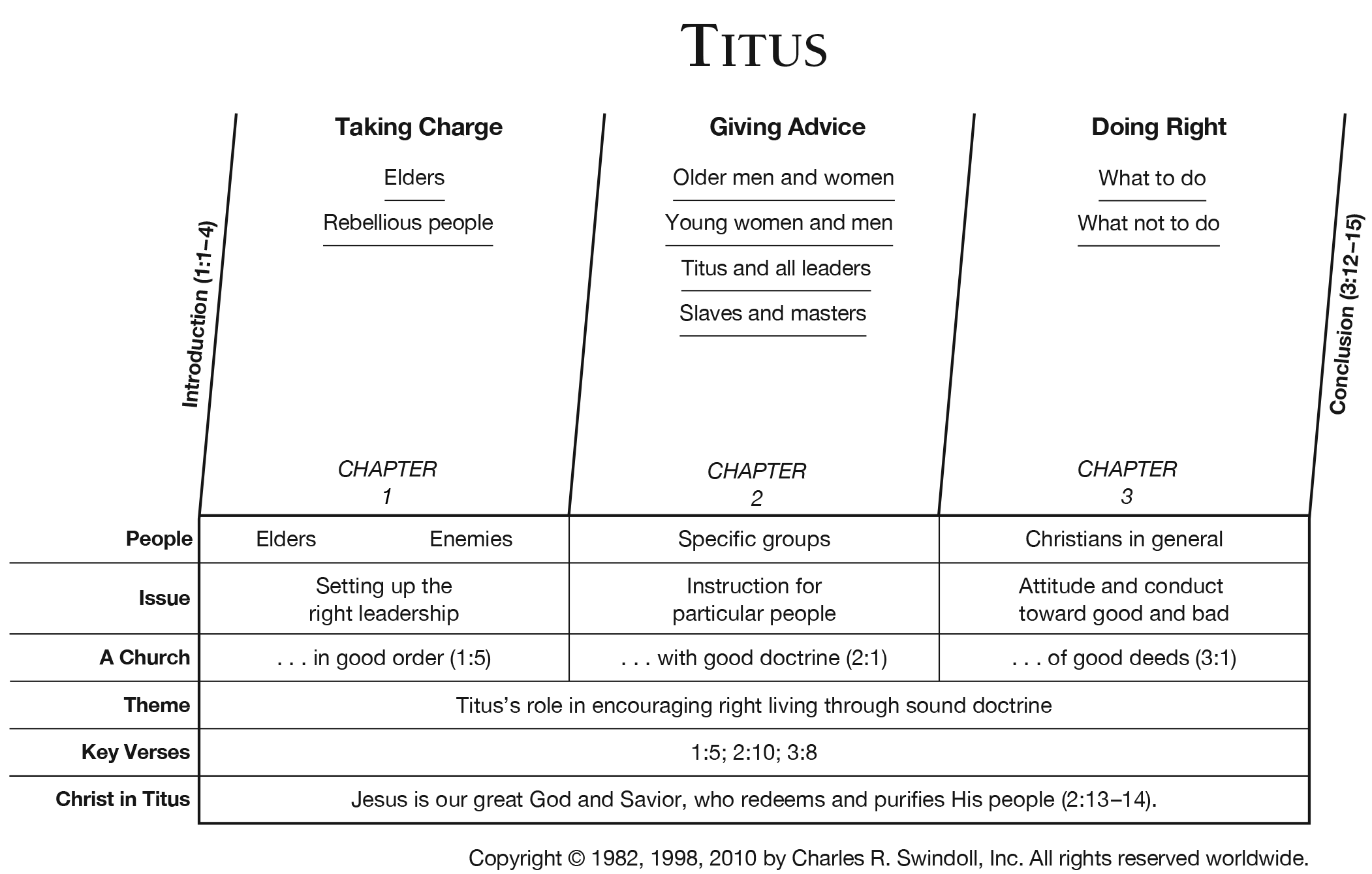
See Summary Chart by Charles Swindoll
Chart below from Michael J. Penfold
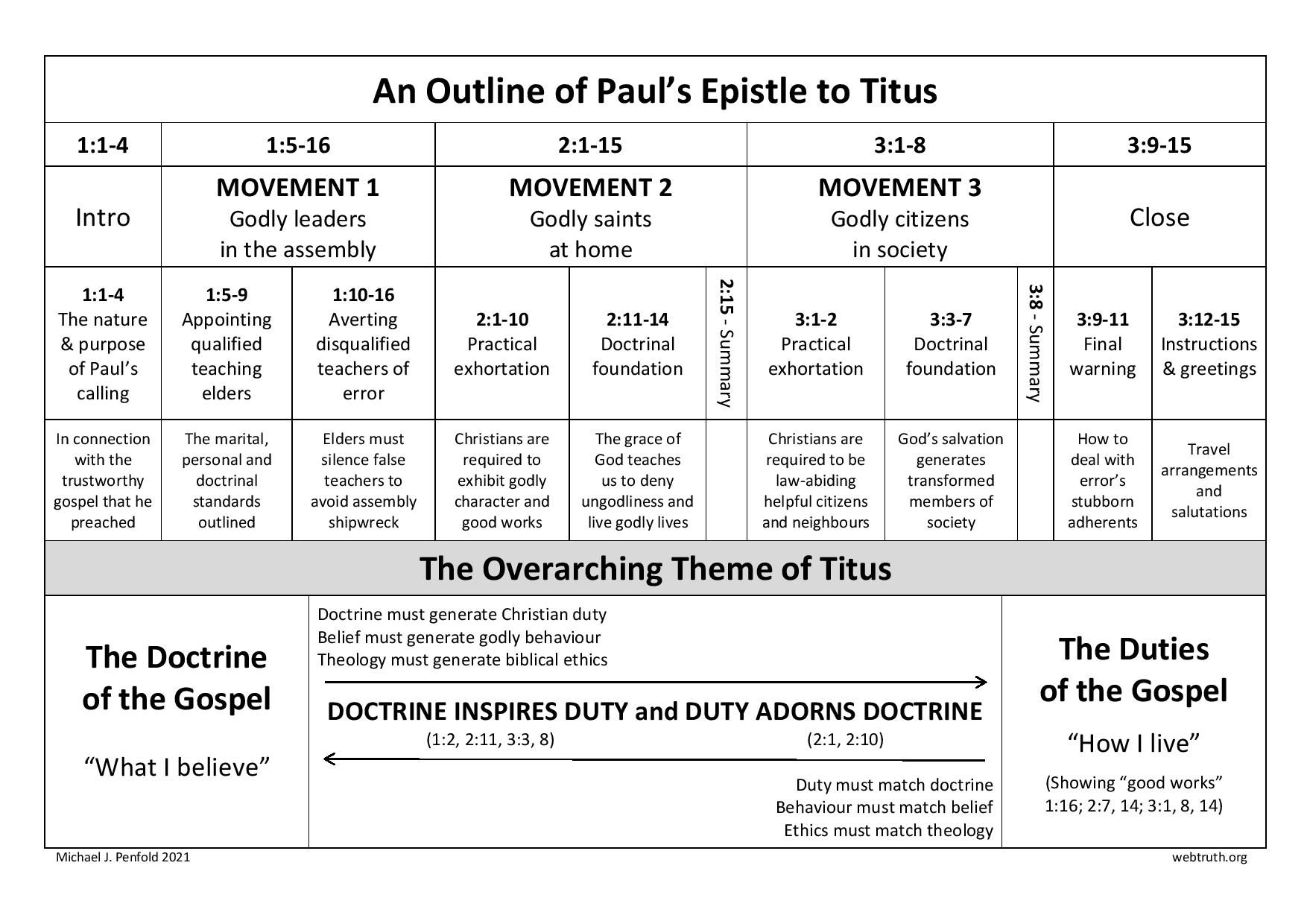
|
Focus |
Appoint Elders |
|||
|
Divisions |
Ordain |
Rebuke |
Maintain |
|
|
Topics |
||||
|
Topics |
Organization |
Offenders |
Operation |
|
|
Place |
Probably Written from either Corinth or Nicopolis (cf. Titus 3:12). |
|||
|
Time |
Circa 63 AD |
|||
|
Modified from Talk Thru the Bible |
||||
Titus 3:5 He saved us, not on the basis of deeds which we have done in righteousness, but according to His mercy, by the washing of regeneration and renewing by the Holy Spirit (NASB: Lockman)
Greek: ouk ek ergon ton en dikaiosune a epoiesamen (1PAAI) hemeis alla kata to autou eleos esosen (3SAAI) hemas dia loutrou paliggenesias kai anakainoseos pneumatos hagiou,
Amplified: He saved us, not because of any works of righteousness that we had done, but because of His own pity and mercy, by [the] cleansing [bath] of the new birth (regeneration) and renewing of the Holy Spirit, (Amplified Bible - Lockman)
KJV: Not by works of righteousness which we have done, but according to his mercy he saved us, by the washing of regeneration, and renewing of the Holy Ghost;
NLT: He saved us, not because of the good things we did, but because of his mercy. He washed away our sins and gave us a new life through the Holy Spirit. (NLT - Tyndale House)
Phillips: he saved us - not by virtue of any moral achievements of ours, but by the cleansing power of a new birth and the moral renewal of the Holy Spirit, (Phillips: Touchstone)
Wuest: not by deeds of uprightness which we performed [in our unsaved state], but according to His mercy He saved us, through the washing of regeneration and the renewing of the Holy Spirit (Eerdmans)
Young's Literal: (not by works that are in righteousness that we did but according to His kindness,) He did save us, through a bathing of regeneration, and a renewing of the Holy Spirit,
HE SAVED US NOT ON THE BASIS OF DEEDS: ouk ek ergon….esosen (3SAAI):
- Job 9:20; 15:14; 25:4; Ps 143:2; Isa 57:12; Lk 10:27, 28, 29; Ro 3:20,28; Ro 4:5; 9:11,16,30; 11:6; Gal 2:16; 3:16, 17, 18, 19, 20, 21; Ep 2:4,8,9; 2Ti1:9
- See comments on the New Birth in John 3:3
- Titus 3 Resources - Multiple Sermons and Commentaries
HIS WORK
OUR GIFT!
Tears unavailing, no merit had I;
Mercy had saved me, or else I must die;
Sin had alarmed me, fearing God's face--
But now I'm a sinner saved by grace. --Gray
We are saved by God's work,
Not by good works
Not on the basis of deeds - Literally "not out of works" - placed first in the sentence (in the original Greek text) for emphasis. We need to be remember this truth at all times -- before we were saved we needed to understand we were not saved by our works, but even after we are saved, we need to be reminded it is not our works that now merit God's favor. That attitude will blunt grace which is God's free unmerited gift! Too many of us (myself foremost) have the misconception that once I am saved my "works of righteousness" have some merit before a Holy God! It reminds me of Paul's rhetorical question to those who had begun by faith but were now trying to live the supernatural life by their own efforts -- "Are you so foolish? (IMPLICATION? YES YOU ARE!!!) Having begun by the Spirit (BY GRACE THROUGH FAITH), are you now being perfected by the flesh? (Galatians 3:3). Paul's point is simple but profound - Believers are under grace when they begin (ARE BORN AGAIN) and they begin by faith (we believed and were justified by grace through faith) and they thereafter (until the day we die or Jesus returns) live this supernatural life under grace by faith (progressive sanctification), trusting in God's Spirit to supply the supernatural power to live like Christ (which we are called to do - e.g., 1 John 2:6 = "walk in the same manner as He walked," 1 Peter 2:21 = "in His steps," 1 Cor 11:1 = "Be imitators of me, JUST AS I also am of Christ.") In sum, our once for all time justification is by grace through faith and our daily sanctification is also by grace through faith. Do you believe this is true?
So if deeds do not save us, what is the role of deeds? How do deeds and faith work? We see the relationship in Ephesians 2:8-9 which "flows" into Ephesians 2:10 and gives us a "template" for the balanced Christian life of "a faith that works"...
For by grace you have been saved through faith; and that not of yourselves, it is the gift of God; not as a result of works, so that no one may boast.
For (term of explanation - God is explaining what happens to all who are saved by faith) we are His workmanship, created in Christ Jesus for good works, which God prepared beforehand so that we would walk in them (IN OTHER WORDS, THAT WE SHOULD WORK OUT OUR SALVATION, WORKING OUT WHAT GOD HAS WORKED IN - see Phil 2:12 for our responsibility in this daily process of sanctification and then read Phil 2:13 to see God's provision, His Spirit in us, continually giving us not just the supernatural power to do "good works" but even energizing our will to want to actually daily do those "good works" and in this process [IT IS A PROCESS, NOT AN ARRIVAL!], daily learning to walk or conduct ourselves in a manner that is wholly pleasing to our Holy Father).
Spurgeon comments "This is a very practical Epistle. See how closely Paul keeps to the doctrines of grace. He is never like Mr. Legality, he never teaches that we are to be saved by works; but, being saved by the grace of God alone, and being made heirs according to the hope of eternal life, we are then, out of gratitude to God, to abound in everything that is good, and holy, and kind, and after the mind of Christ."
Many of the modern translations (including the generally more literal NAS) ignore the important original Greek word order. The first word in Greek is "not" (absolute negation).
The NKJV has an excellent, more literal rendering:
"Not by works of righteousness which we have done, but according to His mercy He saved us, through the washing of regeneration and renewing of the Holy Spirit"
The original order stresses that salvation's foundation is not based on what we've done but what God has done. This order eliminates any thought of salvation due to personal merit and magnifies God's sovereign grace. This was a frequent theme in Paul's epistles as shown in the following Scriptures…
Romans 4:4 Now to the one who works, his wage is not reckoned as a favor, but as what is due. 5 But to the one who does not work, but believes in Him who justifies the ungodly, his faith is reckoned as righteousness, 6 just as David also speaks of the blessing upon the man to whom God reckons righteousness apart from works
Galatians 2:16 nevertheless knowing that a man is not justified by the works of the Law but through faith in Christ Jesus, even we have believed in Christ Jesus, that we may be justified by faith in Christ, and not by the works of the Law; since by the works of the Law shall no flesh be justified.
(Repeated from above) Ephesians 2:8 For by grace you have been saved through faith; and that not of yourselves, it is the gift of God; 9 not as a result of works, that no one should boast. 10 For we are His workmanship, created in Christ Jesus for good works, which God prepared beforehand, that we should walk in them. (See notes Ephesians 2:8; 2:9; 2:10)
As sinners, we did no good works, nor were we even able to perform them. The Gospel emphatically denies the possibility of attaining salvation by human effort or merit.
SELF-RIGHTEOUSNESS
Horatius Bonar writes that…
Ritualism, or externalism, or traditionalism are all different forms of self-righteousness; man's self-invented ways of pleasing or appeasing God, or paying for admittance into heaven. These forms of self-righteousness are a human apparatus for procuring God's pardon. They are the means by which the performer of them hopes to win God's favor—perhaps, also, man's praise—most certainly, his own esteem.
Every act, or performance, or ceremony, which honors self, exalts self, or gives prominence to self—is an accursed thing. It is an abomination in the sight of God—however religious, or sacred, or solemn, or devout, it may seem to man.
It is to self-righteousness in some form or other, that man is always tending. Man attempts to make up for this badness, or to cover it over, by works, and devotions, and ceremonies. All this is pure self-righteousness.
The religion of self-righteousness in our day consists of works, feelings, fancies, music, rites, festivals, fasts, gestures, postures, garments. It is something which gratifies self; which pleases the natural man; which makes a man think well of himself; which gives a man something to do or to feel in order to earn pardon and merit heaven. Pride, religious pride, is at the root. Ritualism is man's expression of rejection of Christ. It was self-righteous religion which crucified the Son of God. All human rites and ceremonies are man's ways of getting rid of Christ. What can all these things do? Can they save? Can religious postures save? Can religious garments save? Can religious candles save? Can religious music save? Can religious architecture save? Can religious cathedrals save? No! They lead away from Jesus! They make void the cross, and trample on His blood! (Paying for admittance into heaven)
Law Keeping - A businessman well known for his ruthlessness once announced to writer Mark Twain, "Before I die I mean to make a pilgrimage to the Holy Land. I will climb Mount Sinai and read the Ten Commandments aloud at the top."
"I have a better idea," replied Twain. "You could stay in Boston and keep them."
Twain's witty rejoinder may have put that businessman in his place, or at least set him to thinking. But as any reader of Galatians knows, Twain's advice would have been impossible for his friend to follow even if he were so inclined. The point Paul has been making all along is that Law-keeping cannot gain anyone God's favor, because no human being ever has or ever will keep His perfect Law. Only the death of Christ could satisfy the Law's demands.
A 2010 study by Canadian psychologists found that people who purchase environmentally friendly items feel a “moral glow” that makes them more likely to cheat and act selfishly elsewhere in their lives. In the study, which was a computer game, subjects rewarded themselves with money based on certain results. “Green” consumers were more likely to lie about test results so that they could take more money. The explanation for this is that acting virtuously in one area seems to make people feel they have earned “credit,” and now they have a license to act unethically and selfishly in other parts of their lives.
Our lives are to be an open book before the Lord. Because we are righteous in one area doesn’t give us license to fail to live for God’s glory in every other area.—Jim L. Wilson and Rodger Russell
J C Philpot comments on "The miserable dregs of self" present in believers…
To the praise of the glory of His grace, wherein He has made us accepted in the Beloved. Eph 1:6
We are ever looking for something in self to make ourselves acceptable to God, and are often sadly cast down and discouraged when we cannot find… that holiness, that obedience, that calm submission to the will of God, that serenity of soul, that spirituality and heavenly-mindedness which we believe to be acceptable in His sight. Our… crooked tempers, fretful, peevish minds, rebellious thoughts, coldness, barrenness, alienation from good, headlong proneness to ill, with the daily feeling that we get no better but rather worse, make us think that God views us just as we view ourselves. And this brings on great darkness of mind and bondage of spirit, and we seem to lose sight of our acceptance in Christ, and get into the miserable dregs of self, almost ready to quarrel with God because we are so vile, and only get worse as we get older.
Now the more we get into these dregs of self, and the more we keep looking at the dreadful scenes of wreck and ruin which our heart presents to daily view, the farther do we get from the grace of the gospel, and the more do we lose sight of the only ground of
our acceptance with God. It is "in the Beloved" that we are accepted, and not for any … good words, good works, good thoughts, good hearts, or good intentions of our own.
If our acceptance with God depended on anything in ourselves, we would have to adopt the Wesleyan creed (Ed: I.e., that salvation can be lost), and believe we might be children of God today and children of the devil tomorrow.
What, then, is to keep us from sinking altogether into despair, without hope or help? Why, a knowledge of our acceptance "in the Beloved," independent of everything in us, good or bad.
"Their righteousness is of Me, says the Lord." "You are complete in Him."
What a universal chorus of harmonious voices do we hear all sounding forth the same melodious strain—that we are accepted in the Beloved.
"Man's religion is to build up the creature. God's religion is to throw the creature down in the dust of self-abasement, and to glorify Christ." (J. C. Philpot, "Meditations on Matters of Christian Faith & Experience")
NOT WHAT MY HANDS HAVE DONE
(sung by Aaron Keyes)
(Another Version - Indelible Grace)
Words written by Horatius Bonar
Not what my hands have done can save my guilty soul;
Not what my toiling flesh has borne can make my spirit whole.
Not what I feel or do can give me peace with God;
Not all my prayers and sighs and tears can bear my awful load.
Your voice alone, O Lord, can speak to me of grace;
Your power alone, O Son of God, can all my sin erase.
No other work but Yours, no other blood will do;
No strength but that which is divine can bear me safely through.
Thy work alone, O Christ, can ease this weight of sin;
Thy blood alone, O Lamb of God, can give me peace within.
Thy love to me, O God, not mine, O Lord, to Thee,
Can rid me of this dark unrest, And set my spirit free.
I bless the Christ of God; I rest on love divine;
And with unfaltering lip and heart I call this Savior mine.
His cross dispels each doubt; I bury in His tomb
Each thought of unbelief and fear, each lingering shade of gloom.
I praise the God of grace; I trust His truth and might;
He calls me His, I call Him mine, My God, my joy and light.
’Tis He Who saveth me, and freely pardon gives;
I love because He loveth me, I live because He lives.
A W Pink writes that "The gospel of Satan teaches salvation by works. It inculcates justification before God, on the ground of human merits. It is a bloodless gospel, and presents a crossless Christ, who is received merely, as the Ideal Man." (Another Gospel)
The Puritan Thomas Watson wrote that…
A person may be adorned with many moral virtues, such as prudence, justice, and temperance; and may keep free from breaking penal statutes; and may not dash upon the rock of visible scandal. But under the fair leaves of morality—the worm of unbelief may be hidden!
A bull may be adorned with ribbons, and wear a garland on his head—and yet go to the slaughter! Just so, many a person who had all his life been decked with morality—is now in hell-fire!
A man’s free will cannot cure him even of the toothache, or of a sore finger; and yet he madly thinks it is in its power to cure his soul. The greatest judgment which God himself can in the present life inflict upon a man, is to leave him in the hand of his own boasted free will. - AUGUSTUS M. TOPLADY
He Saved Us Not By Works but By Grace - Why do we call grace amazing? Grace is amazing because it works against the grain of common sense. Hard-nosed common sense will tell you that you are too wrong to meet the standards of a holy God; pardoning grace tells you that it's all right in spite of so much in you that is wrong. Realistic common sense tells you that you are too weak, too harassed, too human to change for the better; grace gives you power to send you on the way to being a better person. Plain common sense may tell you that you are caught in a rut of fate or futility; grace promises that you can trust God to have a better tomorrow for you than the day you have made for yourself. —Lewis Smedes
J C Philpot comments on "Not by works of righteousness which we have done, but according to his mercy he saved us." Titus 3:5
To view mercy in its real character, we must go to Calvary. It is not sufficient to contrast the purity of God with the impurity of man. That indeed affords us some view of what mercy must be to reach the depths of the fall--a side face of that precious attribute. But to see its full face shining upon the redeemed, we must go by faith, under the secret teachings and leadings of the Holy Spirit, to see "Immanuel, God with us," groveling in Gethsemane's garden. We must view him naked upon the cross, groaning, bleeding, agonizing, dying. We must view Godhead and manhood united together in the Person of a suffering Jesus; and the power of the Godhead bearing up the suffering manhood. We must view that wondrous spectacle of love and blood, and feel our eyes flowing down in streams of sorrow, humility, and contrition at the sight, in order to enter a little into the depths of the tender mercy of God. Nothing but this can really break the sinner's heart.
Law and terrors do but harden,
All the while they work alone;
But a sense of blood-bought pardon
Soon dissolves a heart of stone.
Law terrors, death and judgment, infinite purity, and eternal vengeance will not soften or break a sinner's heart. But if he is led to view a suffering Immanuel, and a sweet testimony is raised up in his conscience that those sufferings were for him--this, and this only will break his heart all to pieces. Thus, only by bringing a sweet sense of love and blood into his heart does the blessed Spirit show a sinner some of the depths of the tender mercy of God.
Halley's Handbook - The grand emphasis of this letter is good works. We are saved, not by good works, but by God’s mercy (Titus 3:5), and we are justified by His grace (Titus 3:7). But because of this we are under strict obligation to
• Be eager to do what is good (Titus 2:14)
• Be an example by doing what is good (Titus 2:7)
• Be ready to do whatever is good (Titus 3:1)
• Be careful to devote ourselves to what is good (Titus 3:8)
• Do good in order to live productive lives (Titus 3:14)
One of the indictments of the false teachers is that they are “unfit for doing anything good” (Titus 1:16).
Law Keeping - A businessman well known for his ruthlessness once announced to writer Mark Twain, "Before I die I mean to make a pilgrimage to the Holy Land. I will climb Mount Sinai and read the Ten Commandments aloud at the top."
"I have a better idea," replied Twain. "You could stay in Boston and keep them."
Twain's witty rejoinder may have put that businessman in his place, or at least set him to thinking. But as any reader of Galatians knows, Twain's advice would have been impossible for his friend to follow even if he were so inclined. The point Paul has been making all along is that Law-keeping cannot gain anyone God's favor, because no human being ever has or ever will keep His perfect Law. Only the death of Christ could satisfy the Law's demands.
Salvation Sounds Too Easy- I read about an instant cake mix that was a big flop. The instructions said all you had to do was add water and bake. The company couldn’t understand why it didn’t sell—until their research discovered that the buying public felt uneasy about a mix that required only water. Apparently people thought it was too easy. So the company altered the formula and changed the directions to call for adding an egg to the mix in addition to the water. The idea worked and sales jumped dramatically. That story reminds me of how some people react to the plan of salvation. To them it sounds too easy and simple to be true, even though the Bible says, “By grace you have been saved through faith...; it is the gift of God, not of works” (Eph. 2:8–9). They feel that there is something more they must do, something they must add to God’s “recipe” for salvation. They think they must perform good works to gain God’s favor and earn eternal life. But the Bible is clear—we are saved, “not by works of righteousness which we have done, but according to His mercy” (Titus 3:5). Unlike the cake-mix manufacturer, God has not changed His “formula” to make salvation more marketable. The gospel we proclaim must be free of works, even though it may sound too easy. R. W. De Haan Our Daily Bread,
Saved (4982) (sozo) has the basic meaning of rescuing one from great peril. Additional nuances include to protect, keep alive, preserve life, deliver, heal, be made whole. Sozo is sometimes used of physical deliverance from danger of perishing (see Mt 8:25; Mt 14:30; Lk 23:35; Acts 27:20, 27:31), physical healing from sickness (Mt 9:21, 22; Mk 5:23, Acts 4:9), and deliverance from demonic possession (Lk 8:36). More often sozo refers to salvation in a spiritual sense to rescue or preserve from eternal death, from judgment, sin, bring salvation, bring to salvation (active sense = Mt 18:11; Lk 7:50; Jn 12:47; Ro 11:14; 1 Cor 1:21; 7:16; Titus 3:5; Hb 7:25; Jas 4:12; 5:20; 1 Pet 3:21 or passive sense = be rescued or saved, attain salvation = Mt 24:13; Mk 10:26; Lk 13:23; 18:26; Jn 3:17; Jn 5:34; Acts 11:14; 15:1, 11; Ro 8:24; 11:26; 1 Cor. 3:15; 5:5; Eph 2:5, 8; 1 Ti 2:4). Jesus' very Name speaks of His primary purpose to save men from their sin - "She (Mary) will bear a Son; and you shall call His name Jesus, for it is He who will save (sozo) His people from their sins." (Mt 1:21) In Mt 1:21 sozo is equated with deliverance from sins (guilt and power of) with Jesus' Name being a transliteration of Joshua meaning "Jehovah is salvation".
Sozo -106x in 99 verses in NAS -
Mt 1:21; 8:25; 9:21, 22; 10:22; 14:30; 16:25; 19:25; 24:13, 22; 27:40, 42, 49; Mk 3:4; 5:23, 28, 34; 6:56; 8:35; 10:26, 52; 13:13, 20; 15:30, 31; 16:16; Lk 6:9; 7:50; 8:12, 36, 48, 50; 9:24; 13:23; 17:19; 18:26, 42; 19:10; 23:35, 37, 39; Jn 3:17; 5:34; 10:9; 11:12; 12:27, 47; Acts 2:21, 40, 47; 4:9, 12; 11:14; 14:9; 15:1, 11; 16:30, 31; 27:20, 31; Ro 5:9, 10; 8:24; 9:27; 10:9, 13; 11:14, 26; 1Co 1:18, 21; 3:15; 5:5; 7:16; 9:22; 10:33; 15:2; 2Co 2:15; Eph 2:5, 8; 1Th 2:16; 2Th 2:10; 1Ti 1:15; 2:4, 15; 4:16; 2Ti 1:9; 4:18; Titus 3:5; Heb 5:7; 7:25; Jas 1:21; 2:14; 4:12; 5:15, 20; 1Pe 3:21; 4:18; Jude 1:5, 23
Sozo is translated in NAS: bring… safely, 1; cured, 1; ensure salvation, 1; get, 1; get well, 2; made well, 5; made… well, 6; preserved, 1; recover, 1; restore, 1; save, 36; saved, 50; saves, 1; saving, 1.
Click for list of the uses of sozo in the non-apocryphal Septuagint (Lxx).
Jesus warned His disciples "And you will be hated by all on account of My name, but it is the one who has endured to the end who will be saved (sozo)." (Mt 10:22, cf Mt 24:13) Note it is not one's endurance (self effort or works) that save them but that one is able to endure because of the fact that they are saved. Again Jesus was teaching His disciples about salvation and declared
"it is easier for a camel to go through the eye of a needle, than for a rich man to enter the kingdom of God." And when the disciples heard this, they were very astonished and said, "Then who can be saved?" (Mt 19:24, 25)
Here He equated entrance into the kingdom of God with being saved. In explaining to His disciples and the multitudes what it meant to come after Him, denying self, taking up one's cross and following Him, Jesus declared that
"whoever wishes to save (referring to one's physical life) his life shall lose it (eternally); but whoever loses his life for My sake and the gospel's shall save (spiritually) it (eternally)." (Mk 8:34)
Jesus speaking to a
"woman in the city who was a sinner" (Lk 7:37) "said to her ""Your sins have been forgiven" (Lk 7:48) and then
"Your faith has saved (sozo) you; go in peace." (Lk 7:50).
In these passages Jesus equates sozo with forgiveness of sins, confession of faith and experiencing peace! In a parable explaining the role of the Word of God and the character of the "soil" in salvation, Jesus taught that "those (people) beside the road are those who have heard (the seed, the Word, the Gospel); then the devil comes (Mark's gospel adds "immediately", "at once") and takes away (present tense - continually) the word from their heart, so that they may not believe and be saved." (Lk 8:12)
Observe that one cannot be saved unless he believes the word and that merely hearing (and even assenting to the veracity) of the word does not result in salvation.
NET Bible notes add that "The word of Jesus has the potential to save if it germinates in a person’s heart, something the devil is very much against."
Jesus addressing the repentant Zaccheus declaring for all to hear "Today salvation has come to this house, because he, too, is a son of Abraham (who by faith was reckoned righteousness - Ge 15:6). For the Son of Man has come to seek and to save that which was lost (this word speaks of eternal ruin, destitution and spiritual death)." (Lk 19:9,10)
Jesus taught that "God did not send the Son into the world to judge the world, but that the world should be saved through Him." (Jn 3:17) One is saved (only) by entering "through Christ" as He amplified later explaining "I am the door; if anyone enters through Me, he shall be saved, and shall go in and out, and find pasture."
Peter explained to his Jewish audience how one could avoid the terrifying and dreadful Day of the LORD's wrath, quoting Joel 2:32 and declaring "that everyone who calls on the name of the LORD shall be saved. (Acts 2:21)
Peter later made it very clear that "there is salvation in no (absolute negative - no exception clauses) one else; for there is no other name (Jesus) under heaven that has been given among men, by which we must be saved." (Acts 4:12)
The Philippian jailer summed up spiritual salvation asking Paul and Silas
Sirs, what must I do to be saved?" And they said, "Believe in the Lord Jesus, and you shall be saved, you and your household. (Acts 16:31).
He saved us is aorist tense which records the saving act as a past fact. The us here is all who have accepted salvation in Christ. We now possess salvation "past tense" (see table below comparing the "three tenses" of salvation), each of us having been saved at a certain point in time in the when we confessed "with (our) mouth Jesus as Lord, and (believed) in (our) heart that God raised Him from the dead (Ro 10:9)
God rescued us from great, grave danger, John recording that "he who does not believe has been judged already, because he has not believed in the name of the only begotten Son of God." (Jn 3:18) and that "he who does not obey the Son shall not see life, but the wrath of God abides on him." (Jn 3:36).
He delivered us that we might be "made complete" in Christ (Col 2:10) "for of His fullness we have all received, and grace upon grace." (Jn 1:16).
Christ lives to protect us "by the power of God through faith for a salvation ready to be revealed in the last time." (1Pe 1:5)
|
KNOWN |
FREEDOM FROM SIN'S… | SCRIPTURES THAT SUPPORT |
EXPLANATORY |
|
| PAST |
JUSTIFICATION |
PENALTY |
Titus 3:5 |
IN THE PAST: GOD'S UNCHANGEABLE PURPOSE At the moment of belief God "delivered us from the domain of darkness, and transferred us to the kingdom of His beloved Son" (Col 1:12, 13) and justified us, declaring us righteous. At that moment we were cleansed of guilt, forgiven of sin and the penalty of eternal death, born again, clothed in Christ's righteousness, freed from condemnation, eternally safe in Christ independent of whether we "feel" like we possess these divine benefits or not! |
| PRESENT | SANCTIFICATION Daily event A process |
POWER |
1 Cor 1:18 |
IN THE PRESENT: GOD'S UNLIMITED POWER Paul summarizes this process of sanctification charging believers: "(continually) work out (carry out to the goal, fully complete) your salvation with fear and trembling (with self-distrust, tenderness of conscience, taking heed lest you fall, watchful against temptation, timidly shrinking from whatever might offend God & discredit the name of Christ), (but not in your own strength) for it is God who is at work in you (energizing and creating in you the power and desire) both to will and to work for His good pleasure." (Php 2:12; Php 2:13) We are being saved daily from the power and dominion of sin as we allow the Spirit of Christ to live His life through us (cf Ro 8:13) |
| FUTURE | GLORIFICATION One time event |
PRESENCE PLEASURE |
Ro 8:23 |
IN THE FUTURE: GOD'S UNBREAKABLE PROMISE "Beloved, now we are children of God, and it has not appeared as yet what we shall be. We know that, when He appears, we shall be like Him, because we shall see Him just as He is. And everyone who has this hope fixed on Him purifies himself, just as He is pure." (1Jn 3:2, 3) |
LEGEND FOR TABLE:
POINT 1 marks our moment of conversion or regeneration when the Spirit "circumcises" our heart of stone and gives us a brand new heart (Ezek 36:26, 27) which is termed JUSTIFICATION or PAST TENSE SALVATION (Ro 5:1) (saved from the guilt and penalty of sin). Justification takes place the moment a person believes in the Lord Jesus Christ (Ro 10:9, 10). The line from 1 to 2 is not a process but is a change of position effected by God -- believers are declared positionally righteous when they are justified by faith, signifying the once-for-all reckoning (or imputation) of Christ's perfect righteousness to the sinful believer's "spiritual account" (Ro 4:6). The believer's position or standing before God (POINT 2) is now complete in Christ and perfect the moment they believe, because Christ has been made their righteousness (1Cor 1:30; cf 2Cor 5:21). At no time in this life or in the life to come will our status in terms of righteousness be any greater or lesser because "in Him (we) have been made complete" (Col 2:10). This state is often referred to as positional righteousness.
Justification refers to declared righteousness, sometimes called forensic righteousness, which has been accomplished once and for all.
Sanctification refers to the lifelong process of growing in practical righteousness, a continuing process. Generally, when you hear someone use the term "sanctification", they are referring to the present process all believers are experiencing, and this is sometimes referred to as "progressive sanctification" by the theologians. Note also that justification is also known as positional sanctification (indicating that at a point in time, at the moment of salvation by faith, our position changed from in Adam to forevermore in Christ). Finally, note that glorification is also known by the term "perfective sanctification" (when we see Jesus we will be like Him and made perfect!). Although, there are a number of terms which are synonymous, a little study of the chart below should help clear up any points of confusion.
Past tense salvation results in peace with God, whereas present tense salvation or sanctification speaks of the peace of God in one's heart. Peace with God is the result of one's legal standing before God (cf 1Cor 1:30), while the peace of God is the result of the work of the Holy Spirit (eg Gal 5:22; Ro 8:13). The first is static and never fluctuates, the second changes. The first, every Christian has, the second, every Christian may have, in proportion to the degree they "work out (their) salvation with fear and trembling" (present tense salvation) enabled by God's grace and empowered by the Holy Spirit.
POINT 2 to 3 corresponds to SANCTIFICATION or PRESENT TENSE SALVATION, which is an ongoing process occurring during the time period after we are born again and before we die or are raptured. During our earthly life as new creations in Christ (2Co 5:17) now are charged to present ourselves to God as "slaves of righteousness" (Ro 6:16, 17, 18, 19 cf Ro 12:1, Ro 12:2) and experience progressive release from power, dominion and reign of sin, being set aside (sanctified) more and more from the world and more and more unto to Jesus, "a people for His own possession, zealous for good deeds". (Titus 2:14) See in depth discussion of Progressive Sanctification (Present Tense Salvation).
POINT 3 indicates the consummation of our salvation known as GLORIFICATION or FUTURE TENSE SALVATION, at which time we are free once and for all from the presence and pleasure of sin and made like our Lord (1Jn 3:2, 3)
Related Resource - Three Deliverances - see commentary 1 Cor 1:10.
The following chart summarizes many of the truths discussed above (the division of this chart are not meant to imply that the Christian life is a dull, mechanical matter composed of steps we must go through, but in fact is a joyful, dynamic relationship with the Living God enabled by His Living Spirit!)

| JUSTIFICATION | SANCTIFICATION | GLORIFICATION |
| Past Tense "I have been saved" (Eph 2:8; 2:9) |
Present Tense "I am being saved" (1 Cor 1:18) |
Future Tense "I will be saved" (1Th 1:10, cf 1Th 5:9) |
| Past Point Spiritual Birth |
Present Process Spiritual Growth |
Future Point Spiritual Perfection |
| Positional Sanctification |
Progressive Sanctification |
Prospective Sanctification |
| Redemption of the Soul Commenced |
Redemption of the Soul Continued |
Redemption of the Soul Completed |
| How God sees us in Christ |
How saints are in conduct |
What saints shall be in glory |
| Perfect standing in holiness |
Daily growth in holiness |
Ultimate likeness to the Holy One |
| Through faith in Christ's finished work on the Cross and His resurrection (Jn 19:30, Ro 3:22,23, 24,25,26) |
Through Christ's present work of intercession for us and His power in and through us (He 7:25, Ephesians 3:17, Php 4:13) | Through Christ's future return and our transformation (Php 3:20,21,1 Jn 3:2) |
| Of and by the Spirit (John 3:5, Titus 3:5) |
From the Spirit (2Cor 3:18) |
Through the Spirit (Ro 8:11, Eph 4:30) |
| Adoption as Sons of God |
Maturation as Sons of God |
Manifestation as Sons of God |
| Result of our union with Christ |
Result of the Spirit’s work through the Word |
Result of total transformation by God |
| Saved from the penalty of sin |
Saved from the power of sin |
Saved from the presence of sin |
| Consecration of the body (1Cor 6:19,20) |
Deterioration of the body (2Cor 4:16) |
Redemption of the body (Ro 8:23) |
| True of all believers At moment of salvation |
Begins in all believers at the point of salvation |
Finished in all believers when we enter the Lord’s presence |
| Positional and automatic |
Progressive and changeable |
Eternal and final |
| By the Father's Will (Jas 1:18) |
In the Father's Word (Jn 17:17) |
At the Father's Time (Mt 24:36, Acts 1:6, 7) |
| Accomplished by the death of Christ |
Accomplished by the Word, the Spirit, faith, prayer, divine discipline, etc. |
Accomplished by the resurrection of Christ |
| Entirely God's Work |
Believer's cooperate With the Spirit (Php 2:12, Php 2:13NLT) 100% Dependent/100% Responsible |
Entirely God's Work |
| Perfect in This Life |
Not Perfect In this Life |
Perfect in The Life to Come |
| The Same in All Believers |
Greater in Some Believers Than Others |
The Same in All Believers |
The disinfectant of Christ's Presence is ever warding off the germs of deadly temptation. The mighty arm of the Divine Keeper is always holding the door against the attempts of the adversary. The water is always flowing over the eye to remove the tiny grit or mote that may alight.
Note that sanctification is a progressive work of God and man that makes us more and more free from sin and like Christ in our actual lives. It is a work in which God and man cooperate each playing distinct roles. The Christian life involves continual growth in sanctification, and is something that the New Testament encourages us to give effort and attention to.
Hebrews 9:24, 26-28 in a sense pictures all three "tenses" of salvation…
Hebrews 9:24 For Christ did not enter a holy place made with hands, a mere copy of the true one, but into heaven itself, now to appear in the presence of God for us (Ed: This is His present tense work for us as we are in the process of being progressively sanctified);
Hebrews 9:26 Otherwise, He would have needed to suffer often since the foundation of the world; but now once at the consummation of the ages He has been manifested (phaneroo [word study] = to make an an external manifestation to the senses which is visible for all to see) to put away sin by the sacrifice of Himself. (Which makes possible "past tense" salvation or justification by faith)
Hebrews 9:27 And inasmuch as it is appointed for men to die once and after this comes judgment,
Hebrews 9:28 so Christ also, having been offered once to bear the sins of many, shall appear a second time for salvation without reference to sin, to those who eagerly await Him (Ed: This is His future tense work at which time we receive our glorified bodies).
Wiersbe asks…Did you notice that the word “appear” is used three times in Hebrews 9:24-28? These three uses give us a summary of our Lord’s work. He has appeared to put away sin by dying on the cross (Heb. 9:26). He is appearing now in heaven for us (Heb. 9:24). One day, He shall appear to take Christians home (Heb. 9:28). These “three tenses of salvation” are all based on His finished work. (Bible Exposition commentary)
F B Meyer writes that "Salvation is a great word. It includes the forgiveness that remembers our sin no more; deliverance from the curse and penalty of our evil ways; emancipation from the thrall of evil habit; the growing conformity of the soul to the image of Christ, and the final resurrection of the body in spiritual beauty and energy, to be for ever the companion and vehicle of the redeemed spirit."
Literally and more forcefully ''not out of works'' which is FIRST in the text for emphasis! See [Isa 64:6] for OT passages that state man's condition before a Holy God. Same idea as in [see Ro 3:20, Ro 3:28; Ro 4:1, 2]. Personal salvation is not ACHIEVED but is RECEIVED as a gracious gift from God. Likewise sanctification is not ACHIEVED but is RECEIVED (fleshly efforts to grow in grace are of no value - Col 2:23 [note]). See John Wesley's testimony of his conversion under "deeds"
Salvation in Three Tenses (Titus 3:5) Somebody asked a Christian, “Are you saved?” “In what tense?” was the queer retort of the Christian. “What do you mean?” “Well,” said the Christian, “salvation is in three tenses: it is in the past: ‘Not by works of righteousness which we have done, but according to his mercy he saved us, by the washing of regeneration, and renewing of the Holy Ghost’ (Titus 3:5). Here is salvation in the present: ‘Moreover, brethren, I declare unto you the gospel which I preached unto you, which also ye have received, and … by which also ye are saved.’ The Greek word so\\\\zesthe is inadequately translated in the King James Version. It should be ‘ye are being saved’ (1 Cor. 15:2). Not only were we saved in the past, but we need salvation continuously. Finally there is salvation in the future: ‘Much more then, being now justified by his blood, we shall be saved from wrath through him’ (Rom. 5:9).” Is your salvation in all three tenses? - AMG Bible Illustrations
A W Pink has the following discussion of the "Three Tenses of Salvation"…
How many, for example, would be capable of giving a simple exposition of the following texts, "Who has saved us" (2Ti 1:9). "Work out your own salvation with fear and trembling" (Php 2:12), "Now is our salvation nearer than when we believed" (Ro 13:11). Now those verses do not refer to three different salvations—but to three separate aspects of one and unless we learn to distinguish sharply between them, there can be nothing but confusion and cloudiness in our thinking. Those passages present three distinct phases and stages of salvation—salvation … as an accomplished fact, as a present process, as a future prospect. So many today ignore these distinctions, jumbling them together. Some contend for one and argue against the other two; and vice versa. Some insist they are already saved, and deny that they are now being saved. Some declare that salvation is entirely future, and deny that it is in any sense already accomplished. Both are wrong.
The fact is, that the great majority of professing Christians fail to see that "salvation" is one of the most comprehensive terms in all the Scriptures, including predestination, regeneration, justification, sanctification and glorification. They have far too cramped an idea of the meaning and scope of the word "salvation" (as it is used in the Scriptures), narrowing its range too much, generally confining their thoughts to but a single phase. They suppose "salvation" means no more than the new birth or the forgiveness of sins (See comments on the New Birth in John 3:3). Were one to tell them that salvation is a protracted process, they would view him with suspicion; and if he affirmed that salvation is something awaiting us in the future, they would at once dub him a heretic. Yet they would be the ones to err.
(Here are) passages in the New Testament which definitely refer to each distinct tense of salvation.
First, salvation as an accomplished fact, "Your faith has saved you" (Lk 7:50), "by grace you have been saved" (Greek, and so translated in the RV—Ep 2:8), "according to His mercy He saved us" (Titus 3:5).
Second, salvation as a present process, in course of accomplishment, not yet completed, "Unto us which are being saved" (1Co 1:18—R.V.); "Those who believe to the saving (not 'salvation') of the soul" (He 10:39). (ED: see Progressive Sanctification Present Tense Salvation)
Third, salvation as a future prospect, "Sent forth to minister for them who shall be heirs of salvation" (He 1:14), "receive with meekness the engrafted Word, which is able to save your souls" (Jas 1:21), "Kept by the power of God through faith unto salvation, ready to be revealed in the last time" (1Pe 1:5).
Thus, by putting together these different passages, we are clearly warranted in formulating the following statement—every genuine Christian has been saved, is now being saved, and will yet be saved… (Read Pink's lengthy discussion of this subject in A Fourfold Salvation)
Sozo - Used about 274 times in the non-apocryphal Septuagint (Lxx)-
Gen 19:17, 20, 22; 32:8, 30; 47:25; Num 24:19; Deut 33:29; Josh 8:22; 10:33, 40; Jdg 2:16, 18; 3:9, 31; 6:14f, 31, 36f; 7:2, 7; 8:22; 10:1, 12ff; 12:2; 13:5; 1 Sam 4:3; 7:8; 9:16; 10:1, 27; 11:3; 14:6, 23, 39, 47; 17:47; 19:11f; 23:2, 5; 25:26, 31, 33; 27:1; 30:17; 2 Sam 3:18; 8:6, 14; 10:11, 19; 14:4; 22:3f, 28; 1Kgs 13:31; 18:40; 19:17; 20:20; 2Kgs 6:26f; 14:27; 16:7; 19:19, 37; 20:6; 1Chr 11:14; 16:35; 18:6, 13; 19:12; 2Chr 14:11; 16:7; 18:31; 20:9, 24; 32:8, 11, 13ff, 22; Ezra 8:22; Neh 1:2; 9:27; Esther 4:11, 13, 17; 8:6; 10:3; Job 1:15ff, 19; 6:23; 18:19; 20:20, 24; 22:29; 27:8; 33:28; 35:14; 40:14; Ps 3:7; 6:4; 7:1f, 9; 12:1; 17:7; 18:3, 27, 41; 20:6, 9; 22:5, 8, 21; 28:9; 30:3; 31:2, 7, 16; 33:16f; 34:6, 18; 36:6; 37:40; 44:3, 6f; 54:1; 55:8; 56:7; 57:3; 59:2; 60:5; 68:20; 69:1, 14, 35; 70:1; 71:2f; 72:4, 13; 76:9; 80:2f, 7, 19; 86:2, 16; 98:1; 106:8, 10, 21, 47; 107:13, 19; 108:6; 109:26, 31; 116:6; 118:25; 119:94, 117, 146, 173; 138:7; 145:19; Pr 6:3, 5; 10:25; 11:31; 15:24, 27; 19:7; 28:26; 29:25; Isa 1:27; 10:20, 22; 12:2; 14:32; 15:7; 19:20; 20:6; 30:15; 31:5; 33:21; 34:15; 35:4; 37:20, 32, 35; 38:6; 43:3, 11f; 45:17, 20, 22; 46:2, 4, 7; 47:13; 49:24f; 51:14; 59:1; 60:16; 63:9; 66:19; Jer 2:27f; 4:14; 11:12; 14:8f; 15:20; 17:14; 23:6; 30:7; 31:7; 32:4; 34:3; 38:18, 23; 39:17f; 41:15; 42:11, 17; 44:14, 28; 46:27; 48:6, 8, 19; Lam 2:13; 4:17; Ezek 14:14, 16, 18; 17:15, 18; 33:12; 34:22; 36:29; Dan 3:28; 6:20, 22, 27; 12:1; Hos 1:7; 13:4; 14:3; Joel 2:32; Amos 2:14f; Ob 1:21; Mic 6:9; Hab 1:2; 3:13; Zeph 3:17, 19; Zech 9:9, 16; 10:6; 12:7; Mal 3:15
Sozo is used 3 times in the first verse in which the angel told Lot to flee Sodom and Gomorrah..
Genesis 19:17 As soon as they had been brought outside, he was told: "Flee (Lxx = Sozo used twice!) for your life! Don't look back or stop anywhere on the Plain. Get off (Lxx = Sozo) to the hills at once, or you will be swept away."
Comment: Note that God provided the way of escape, the way to be saved from destruction and issued the clear command to be saved. Lot lingered but eventually choose God's way of escape (cp 2Pe 2:7-9 where rescue is rhuomai), a choice his wife tragically rejected (See Ge 19:26 and Jesus' warning Lk 17:32)
Genesis 32:30 So Jacob named the place Peniel, for he said, "I have seen God face to face, yet my life (soul) has been preserved (Hebrew = natsal = rescue; Lxx = sozo)."
Judges 2:16 Then the LORD raised up judges who delivered (Hebrew = yasha'; Lxx = sozo) them from the hands of those who plundered them.
1 Samuel 17:47 and that all this assembly may know that the LORD does not deliver (Hebrew = yasha'; Lxx = sozo) by sword or by spear; for the battle is the LORD'S and He will give you into our hands.
2 Samuel 22:3 My God, my rock, in whom I take refuge, My Shield and the Horn of my salvation, my Stronghold and my Refuge; My Savior (Lxx = soteria), You save (Hebrew = yasha'; Lxx = sozo) me from violence.
Here is a wonderful use of sozo in the Septuagint (Lxx) in the form of a brief but powerful prayer by David…
Psalm 12:1 Help Lord, for the godly man ceases to be, for the faithful disappear from among the sons of men.
Comment: The Hebrew word for "help" here is yasha' which means to deliver, to save, to help, to preserve, to endow with salvation, to gain the victory or be victorious, to be liberated. The Lxx translates it with the Greek verb sozo, which means to rescue one from peril, danger or suffering, to protect from loss or destruction, to heal, to make whole, to keep alive, to preserve life (physical but especially spiritual - compare Ps 6:4, Ps 86:2).
C H Spurgeon has some wonderful insights on David's two word prayer "HELP LORD" in Psalm 12:1 writing that…
The prayer itself is remarkable, for it is short, but seasonable, sententious (pithy), and suggestive. David mourned the fewness of faithful men, and therefore lifted up his heart in supplication—when the creature failed, he flew to the Creator. He evidently felt his own weakness, or he would not have cried for help; but at the same time he intended honestly to exert himself for the cause of truth, for the word “help” is inapplicable where we ourselves do nothing. There is much of directness, clearness of perception, and distinctness of utterance in this petition of two words; much more, indeed, than in the long rambling outpourings of certain professors. The Psalmist runs straight-forward to his God, with a well-considered prayer; he knows what he is seeking, and where to seek it. Lord, teach us to pray in the same blessed manner.
The occasions for the use
of this prayer are frequent.
In providential afflictions how suitable it is for tried believers who find all helpers failing them.
Students, in doctrinal difficulties, may often obtain aid by lifting up this cry of “Help, Lord,” to the Holy Spirit, the great Teacher.
Spiritual warriors in inward conflicts may send to the throne for reinforcements, and this will be a model for their request.
Workers in heavenly labour may thus obtain grace in time of need.
Seeking sinners, in doubts and alarms, may offer up the same weighty supplication.
In fact, in all these cases, times, and places, this will serve the turn of needy souls. “Help, LORD,” will suit us living and dying, suffering or laboring, rejoicing or sorrowing. In Him our help is found, let us not be slack to cry to Him.
The answer to the prayer is certain, if it be sincerely offered through Jesus. The Lord’s character assures us that he will not leave his people; his relationship as Father and Husband guarantee us his aid; his gift of Jesus is a pledge of every good thing; and his sure promise stands, “Fear not, I will help thee.” (Spurgeon, C. H. Morning and evening : Daily readings: June 17 AM).
Beloved are we not in need of His Help, His salvation every day?! Our mortal enemies the world, the flesh and the devil daily (yea, even moment by moment) seek to being us down, to cause us to stumble, to "wound" our soul. It follows that David's prayer "Help Jehovah" should continually be in our heart and on our lips! Stop and utter this brief but powerful prayer even now. Take a moment to give thanks and praise to our Lord Jesus for His great rescue of each of us from eternal death by offering His life as a substitute for our life… listen to modern worship song based on Fanny Crosby's hymn by the same name…
In his book Illustrations of Bible Truth, H. A. Ironside included the story of a new convert who gave his testimony during a church service. With a smile on his face and joy in his heart, the man related how he had been delivered from a life of sin. He gave the Lord all the glory, saying nothing about any of his own merits or what he had done to deserve the blessings of redemption. The person in charge, who was very legalistic, didn’t fully appreciate the reality of salvation by grace through faith alone, apart from human works. So he responded to the young man’s comments by saying,
“you seem to indicate that God did everything when He saved you. Didn’t you do your part before God did His?”
The new Christian jumped to his feet and said, “Oh yes, I did. For more than 30 years I ran away from God as fast as my sins could carry me. That was my part. But God took out after me and ran me down. That was His part.”
Commenting on this testimony, Ironside wrote,
“It was well put and tells a story that every redeemed sinner understands.”
Illustration of God’s sacrificial love - The story is told of John Griffith, a Missouri man who was the controller of a great railroad drawbridge across the Mississippi during the Great Depression. One fine summer day in 1937, John decided to take his 8 year old son, Greg, to work with him. At noon, John raised the bridge to allow transit to any ships that might pass by and sat on the observation deck with Greg to eat their lunch. The minutes passed lazily as the noon day beat down on them. Suddenly, John was jolted by the sound of shrieking train whistle in the distance. He quickly looked at his watch. It was 1:07 and the Memphis Express, with 400 passengers was roaring toward the raised bridge! He leaped up from the observation deck and ran back to the control tower. Before throwing the master lever, he looked down to see if any ships were passing below. The sight he saw caused his pounding heart to leap into his throat. Greg had slipped from the observation deck and had fallen into the massive gears that operate the bridge. His left leg was caught in the cogs of the two main gears! Desperately, John’s mind raced to devise a rescue plan. The seconds were quickly ticking away and he knew there wasn’t enough time for him to rescue his son before the train reached the bridge. Again, with alarming closeness, the train’s shrill whistle cut through the summer air. He could hear the wheels as they clicked along on the tracks. That was his son trapped below! Yet there were 400 passengers on the train. John knew what he had to do, so he buried his head in his left arm and pushed the lever forward to lower the bridge. Just seconds after the massive bridge settled into place, the Memphis Express, with its 400 passengers barreled across the river. When John lifted his tear-streaked face, he looked into the passing windows of the train. There were businessmen casually reading their newspapers; finely dressed ladies in the dining car sipping coffee; and children eating bowls of ice cream. No one looked at the control tower. No one saw the great gear box. With wrenching agony, John Griffith cried out at the retreating steel monster, “I sacrificed my son for you people! Don’t you care?” The train let out one parting whistle and then sounds that were left were the sobs of the broken man and the clicking wheels fading in the distance recalling the words from Lamentations 1:12: “Is it nothing to you, all who pass by?” God allowed His Son to be a sacrifice and die in our place. We should have been the ones who faced hell as a result of our sins. But God had Jesus die in our place and pay the price to save us from hell. He didn’t do it because we were nice people and deserved to be saved from hell. He did it because we were hopeless without Jesus. He did it because He loved us.
Soon after my brother moved, he made a point of meeting his new neighbors. He found that a Christian family lived on one side and an attorney on the other. My brother remarked, "We've got law on one side and grace on the other." —Anna Zogg
The story is told about a woman in California who was picked up for speeding. She was ticketed and taken before the judge. The judge read off the citation and said, "Guilty or not guilty?" She said, "Guilty," and the judge banged his gavel and fined her $100. But then he did something strange. Standing up, he removed his robe, walked down around to the front, stood beside the woman, and took out his billfold. He removed $100 and paid the fine. The judge was her father. He was a just judge, and yet he loved his daughter and paid her penalty. Sound familiar?
WE HAVE DONE IN RIGHTEOUSNESS: ton en dikaiosune a epoiesamen (1PAAI) hemeis:
- Mt 5:20 Php 3:6
- See comments on the New Birth in John 3:3
- Titus 3 Resources - Multiple Sermons and Commentaries
SALVATION RECEIVED
NOT ACHIEVED!
Have done - Recall that the Greek sentence begins with "not out of works" (Literal), works we have carried out in a vain effort to merit God's favor. Grace is necessary and it is a gift which cannot be earned or deserved! We have the same idea in Romans where Paul reminds his readers that…
by the works of the Law (human effort) no flesh will be justified in His sight; for through the Law comes the knowledge of sin. (Ro 3:20)
In righteousness - In righteousness is the element and condition in which they were wrought. The problem is this was not in the sphere of God's perfect righteousness, but in the sphere of man's imperfect righteousness, a righteousness which will always fall short of God's standard of perfection (cp Moses' declaration in Dt 9:5).
Billy Graham said on an interview on Australian television, "I know I'm going to heaven, not because of what I've done but because of what Christ has done for me." And the agnostic master of ceremonies of the program was so stunned by this, he went out in the streets and started asking people, "Do you know that you're going to heaven?" This agnostic became a street evangelist by just asking the question and making people think about it. —Leighton Ford,
Righteousness (1343) (dikaiosune [word study] from dikaios = being in accordance with what God requires, being in accordance with God's compelling standards) when referring to God's righteousness is all that God is, all that He commands, all that He demands, all that He approves, all that He provides in and through Christ (cf 1Cor 1:30, 2Cor 5:21).
The -súne ending makes this an abstraction. Righteousness fulfills the claims of díke, which, in the case of the believer, are God’s claims. Since God Himself is the standard of the believers, the righteousness of God means the righteousness which belongs to God. In the case of the nonbeliever, "righteousness" is conformity to the claims of the higher authority which a person adopts as his own standard, which in Western culture is the "god within", so that my behavior needs only to conform to that standard which I define as right. (cf. Jdg 21:25, Pr 29:18) Anything done in our own righteousness (cp Jn 15:5) is filthy rags and an abomination before the Lord. Dikaiosúne, righteousness, is thus conformity to the claims of higher authority and stands in opposition to anomía, lawlessness. In both the OT and NT, righteousness is the state commanded by God and standing the test of His judgment (2Co 3:9; 6:14; Ep 4:24). Thus righteousness in general is God’s standard, to which man is expected to conform. It is a gift (Ro 5:17). God’s righteousness is imputed and imparted as a gift to man and not earned. Righteousness is that disposition and method of life which aligns itself with God’s holy will. In short, righteousness is Godlikeness or godliness.
Paul is using the term “righteousness” in its classical sense, for he is speaking of the effort of an unsaved person attempting to merit salvation by the performance of deeds done in the sphere of righteousness as conceived of by the pagan Greeks. He uses the word in a like sense in Ro 5:7 (see note).
Illustration - A headline in The Grand Rapids Press caught my attention: "Conversion to Hindu Faith Is Torturous." The article stated, "A West German businessman has completed his conversion to the Hindu faith by piercing himself through the cheeks with a one-quarter-inch thick, four-foot-long steel rod, and pulling a chariot for two miles by ropes attached to his back and chest by steel hooks… Others walk through twenty-foot-long pits of fire, don shoes with soles made of nails, or hang in the air spread-eagle from hooks embedded in their backs."
What a contrast to the reality of Christianity. The teaching of salvation by grace, through faith, apart from human works, distinguishes Christianity from all other religions of the world. The conversion experience of a believer in the Lord Jesus Christ is not "completed" through acts of self-torture. We may have to suffer for the cause of Christ, and good works should always prove the genuineness of our faith, but neither suffering nor serving save us. Paul wrote, "For we are His workmanship, created in Christ Jesus for good works, which God prepared beforehand that we should walk in them" (Ep 2:10). Self-inflicted torture is completely foreign to everything the Bible teaches about salvation.
We are not saved on the basis of what we can endure; rather, our hope is in what Christ has already endured for us on the cross. The Christian way is not conversion by torture—it's salvation by grace.—R. W. De Haan (Our Daily Bread, Copyright RBC Ministries, Grand Rapids, MI. Reprinted by permission. All rights reserved)
We are saved by God's mercy, not by our merit—
by Christ's dying, not by our doing
BUT ACCORDING TO HIS MERCY: alla kata to autou eleos:
- Titus 3:4; Ps 62:12; 86:5,15; 130:7; Mic 7:18; Lk 1:50,54,72,78; Ep 1:6,7; Heb 4:16; 1Pe 1:3; 2:10
- See comments on the New Birth in John 3:3
- Titus 3 Resources - Multiple Sermons and Commentaries
GOD'S INFINITE
MERCIES
Salvation is a gift of God,
Not something earned or won;
He freely gives eternal life
To all who trust His Son. —Sper
We are saved by God's mercy, not by our merit—
by Christ's dying, not by our doing.
But (alla) - Praise God for this strong, sure contrast (note) and God's great mercy to sinners who deserve hell but by grace through faith are offered heaven! Amazing grace indeed! God's mercy was not increased when Jesus came to earth, it was illustrated! Illustrated in a way we can understand.
"Lord Jesus Christ, Son of God, have mercy on me, a sinner." —The Jesus Prayer (seventh century), Eastern Orthodoxy
God loves us the way we are, but he loves us too much to leave us that way. —Leighton Ford,
Spurgeon once said "If salvation be of mercy only, it is clear that our sin is by no means an impediment to our salvation. If it were of justice, our transgression of the law would render our salvation utterly impossible."
Justice is getting what you deserve. Mercy is not getting what you deserve
Positively, God saved us "because of His mercy." In our wretchedness He graciously withheld deserved punishment and freely saved us. According to ( kata ) points to His boundless, infinite, eternal, inexhaustible mercy as the foundation for His offer of salvation.
The pronouns "we" (we have done… ) and "His" (His mercy… ) stand in intentional and emphatic contrast.
According to (2596) (kata) means not out of, NOT just a portion of, but in proportion to His great mercy. If I am a billionaire and I give you ten dollars, I have given you out of my riches; but if I give you a million dollars, I have given to you according to my riches. The first is a portion; the second is a proportion.
Root idea of kata is “down” and suggests dominance, control. God, in saving sinners, is dominated in His act by the mercy that flows spontaneously from His heart. Pure mercy on the part of God shown to the sinner, does not take into account any so-called good works the latter may do. After indicating the factor that motivated God in saving the sinner, Paul speaks of the process. This is true not only objectively in that we no longer stand before God as enemies but now as beloved children; but this is also true subjectively in that we have been relieved of the hostility in our hearts toward God and the torment of guilt in our consciences.
Mercy (1656) (eleos [word study]) is “the self-moved, spontaneous loving kindness of God which causes Him to deal in compassion and tender affection with the miserable and distressed.”
- The riches of God's Mercy - John MacDuff
- Satisfying Mercy - James Smith
- Christian Mercy Explained and Enforced - John Angell James
Matthew Henry comments on the mercy demonstrated in the parable of the prodigal son.
- His father saw him-- there were eyes of mercy;
- he ran to meet him-- there were legs of mercy;
- he put his arms round his neck-- there were arms of mercy;
- he kissed him-- there were kisses of mercy;
- he said to him-- there were words of mercy;
- Bring here the best robe-- there were deeds of mercy;
- Wonders of mercy-- all mercy!
- Oh, what a God of mercy He is!
- Oh, what a precious reception for one of the chief of sinners!
Mercy is the outward manifestation of pity which assumes need (which is all children of Adam) on the part of him who receives it and resources adequate to meet need on part of him who shows the mercy. Eleos is kindness or concern shown for someone in serious need. Mercy implies compassion that forbears punishing even when justice demands compassion or forbearance shown esp to an offender or to one subject to one’s power.
God’s mercy, His loving and benevolent pity for the misery brought about by our sin, precedes His saving grace and continues to be actively demonstrated after the work of that grace. God’s mercy is extended for the alleviation of the consequences of sin. Grace identifies the free nature of salvation, that which is unmerited and without obligation.
Mercy is welcome news indeed
To those that guilty stand;
Wretches that feel what help they need
Will bless the helping hand.
-J. Hart
Mercy is the application of grace and reminds us that redemptive freedom rescued us from the pathetic condition of our sinfulness. In Jn 3:16, God loved in mercy and gave in grace. Peace refers us to the effect of salvation, namely, that we were set free from the condemnation of sin and reconciled to God. It is always grace and mercy that we find in the apostolic salutations, for as we experience guilt for our sin and receive God’s grace, we also need mercy to alleviate the consequences of our sins which may remain unaffected by grace. The guilt and power of sin must be removed through God’s grace before the alleviation of the misery of sin can be experienced.
Guy King has suggested that grace is needed for every service, mercy for every failure, and peace for every circumstance. Someone else has said, “Grace to the worthless, mercy to the helpless, and peace to the restless.”
A mother, whose son had committed a series of crimes, went to Napoleon Bonaparte and asked him to have mercy on her son and to pardon him. Napoleon said he could not overlook his crimes and that justice demanded he be punished. The mother, intent on helping her son, acknowledged that her son deserved justice but reiterated that she was inquiring about mercy. The point of her request was for Napoleon Bonaparte to give her son what he did not deserve. - Tony Evans
A man had his picture taken. He was very upset with the photographer and very upset with the picture. He rushed back in to the photographer and said, “Look at this picture of me! This picture does not do me justice!” The photographer looked at him and said, “Mister, with a face like yours, you don’t need justice, you need mercy!” That’s exactly the situation we are in. We don’t need justice, but we need a whole lot of mercy. - Tony Evans
Mercy is the act of God, peace is the resulting experience in the heart of man. Grace describes God's attitude toward the law-breaker and the rebel; mercy is His attitude toward those who are in distress."
Singing of Mercy
J. Stocker
Ps. 89.1; Ro 15.9
Sandra McCracken - Thy Mercy, My God
1
Thy mercy, my God, is the theme of my song,
The joy of my heart, and the boast of my tongue;
Thy free grace alone, from the first to the last,
Has won my affections, and bound my soul fast.
2
Thy mercy, in Jesus, exempts me from hell;
Its glories I’ll sing, and its wonders I’ll tell;
’Twas Jesus, my Friend, when he hung on the tree,
Who opened the channel of mercy for me.
3
Without thy sweet mercy I could not live here;
Sin soon would reduce me to utter despair;
But, through thy free goodness, my spirits revive,
And he that first made me still keeps me alive.
4
Thy mercy is more than a match for my heart,
Which wonders to feel its own hardness depart;
Dissolved by thy goodness, I fall to the ground,
And weep to the praise of the mercy I found.
5
The door of thy mercy stands open all day,
To the poor and the needy, who knock by the way.
No sinner shall ever be empty sent back,
Who comes seeking mercy for Jesus’ sake.
6
Great Father of mercies, thy goodness I own,
And the covenant love of thy crucified Son;
All praise to the Spirit, whose whisper divine
Seals mercy, and pardon, and righteousness mine.
HE SAVED US: esosen (3SAAI) hemas:
- See comments on the New Birth in John 3:3
- Titus 3 Resources - Multiple Sermons and Commentaries
GOD'S SAVED US!
There aren't many ways into heaven;
The Bible says there's only one:
Confessing Christ Jesus as Savior,
Believing in God's only Son.
--Sper
Spurgeon writes
Note well that there was a Divine salvation. In consequence of the interposition of Jesus, believers are described as being saved: “not by works of righteousness which we have done, but according to His mercy He saved us.” Hearken to this. There are men in the world who are saved: they are spoken of, not as “to be saved,” not as to be saved when they come to die, but saved even now — saved from the dominion of the evils which we described under our first head: saved from folly, disobedience, delusion, and the like. Whosoever believeth in the Lord Jesus Christ, whom God has set forth to be the propitiation for sin, is saved from the guilt and power of sin. He shall no longer be the slave of his lusts and pleasures; he is saved from that dread bondage. He is saved from hate, for he has tasted love, and learned to love. He shall not be condemned for all that he has hitherto done, for his great Substitute and Saviour has borne away the guilt, the curse, the punishment of sin; yea, and sin itself.
There was a motive for this salvation. Positively, “According to His mercy He saved us”; and, negatively, “Not by works of righteousness which we have done.” We could not have been saved at the first by our works of righteousness; for we had not done any. “No,” says the apostle, “we were foolish, disobedient, deceived,” and therefore we had no works of righteousness, and yet the Lord interposed and saved us. Behold and admire the splendour of His love, that “He loved us even when we were dead in sins.” He loved us, and therefore quickened us.
There was a power by which we were saved. The way in which we are delivered from the dominion of sin is by the work of the Holy Ghost. This adorable Person is very God of very God. This Divine Being comes to us and causes us to be born again. By His eternal power and Godhead He gives us a totally new nature, a life which could not grow out of our former life, nor be developed from our nature — a life which is a new creation of God. We are saved, not by evolution, but by creation. The Spirit of God creates us anew in Christ Jesus unto good works. We experience regeneration, which means — being generated over again, or born again.
There is also mentioned a blessed privilege which comes to us by Jesus Christ. The Spirit is shed on us abundantly by Jesus Christ, and we are “justified by His grace.” Both justification and sanctification come to us through the medium of our Lord Jesus Christ.
Once more, there comes out of this a Divine result. We become today joint heirs with Christ Jesus, and so heirs of a heavenly estate; and then out of this heirship there grows a hope which reaches forward to the eternal future with exceeding joy.
Saved (4982) (sozo) means that He delivered us, rescuing us from danger, loss and ultimately from eternal destruction! He daily preserves us, making us whole by the renewing by the Holy Spirit, sanctifying us in the Truth, His Word (Jn 17:17). How did He save us? Read on.
Hindus have characterized their (false) way of (works based) salvation by complete surrender and utter dependence on God, as the cat way. They refer to the way in which a kitten is carried by its mother with no effort on its part. They contrast this with the monkey way in which the little monkey must cling to its mother. Salvation by grace is the cat way.
BY THE WASHING REGENERATION: dia loutrou paliggenesias:
- Jn 3:3, 4, 5; 1Co 6:11; Ep 5:26; 1Pe 3:21
- See comments on the New Birth in John 3:3
- Titus 3 Resources - Multiple Sermons and Commentaries
by the cleansing power of a new birth and the moral renewal of the Holy Spirit (Phillips)
by [the] cleansing [bath] of the new birth (regeneration) and renewing of the Holy Spirit (Amplified)
through the washing of the new birth and the giving of new life in the Holy Spirit (BBE)
He saved us through a second birth, Renewed us by the Spirit's work (ISV)
GOD SAVED US BY
"WASHING US CLEAN"
Washing of regeneration - is another way of describing the new birth. See comments on the New Birth in John 3:3
J Vernon McGee explains that "This washing of regeneration is what the Lord was speaking about in the third chapter of John: “… Except a man be born of water and of the Spirit, he cannot enter into the kingdom of God” (John 3:5). The water represents the Word of God—the Bible will wash you. It has a sanctifying power, a cleansing power. We are cleansed by the Word of God. The Holy Spirit uses the Word of God—“born of water and of the Spirit.” That is the way we are born again. (McGee, J V: Thru the Bible Commentary: Thomas Nelson)
Hiebert comments that "Most commentators take the washing as a reference to water baptism. But if water baptism is the means that produces the spiritual rebirth, we then have the questionable teaching of a material agency as the indispensable means for producing a spiritual result (but cf. Mt 15:1-20; Ro 2:25, 26, 27, 28, 29; Gal 5:6). We accept the washing as a divine inner act, although the experience is viewed as openly confessed before men in baptism.
Wiersbe - I do not think that washing here refers to baptism because, in New Testament times, people were baptized after they were saved, and not in order to be saved (see Acts 10:43, 44, 45, 46, 47, 48). (Wiersbe, W: Bible Exposition Commentary. 1989. Victor)
Washing (3067) (loutron from louo = bathe whole person as in John 13:10) in the Greek writings refers (from Homer down) to a bath, a bathing place or performance of a complete ablution (act of washing the body).
In John 13 John used the root word louo explaining to Peter that…
He who has bathed (louo in the perfect tense = past completed action with ongoing effect) needs only to wash (nipto) his feet, but is completely clean; and you are clean, but not all of you. 11 For He knew the one who was betraying Him; for this reason He said, "Not all of you are clean. (John 13:10, 11)
Comment: The imagery is oriental, where the Roman citizen would louo his entire body at the public baths and nipto his feet when he arrived home. Jesus used louo to refer to the cleansing of the sinner in "the Fountain filled with Blood drawn from Immanuel’s veins" at the moment of salvation when he is completely and eternally justified or declared righteous by faith in Christ. "Wash his feet" refers to a daily cleansing of the saint in his walk and his feet become "dirty" from sin and thus has to do with progressive or practical sanctification or daily being set aside more and more to God and from this world which is passing away. The partial washing indicated by the verb nipto is a picture of the daily need for confession and cleansing as in 1John 1:7,9. But see comment on this verse in the Net Bible regarding this interpretation.
A T Robertson notes that loutron is a "Late and common word with the Stoics (Dibelius) and in the Mystery-religions (Angus), also in the papyri and Philo… The usual meaning from Homer to the papyri is the bath or bathing-place, though some examples seem to mean bathing or washing… here (Titus 3:5 [note]) as there (Ep 5:26 [note]) (loutron refers to) the laver or the bath. Probably in both cases there is a reference to baptism, but, as in Romans 6:3, 4, 5, 6 (see notes Ro 6:3; 6:4; 6:5; 6:6), the immersion is the picture or the symbol of the new birth, not the means of securing it.
Metaphorically in the NT loutron is used of the Word of God as the instrument of spiritual cleansing (Ep 5:26). Here in Titus 3:5 loutron brings to mind the close connection between cleansing from sin and regeneration. "Mikveh" the Jewish ritual bath, renders the Greek word loutron.
Vincent adds that loutron "does not mean the act of bathing, but the bath, the laver. "
Milligan writes loutron denotes “the water for washing,” or “the washing” itself, as in the Mysteries’ inscriptions from Andania."
There are two uses of this word in Scripture…
Ephesians 5:26 (note) that He might sanctify her, having cleansed her by the washing (Some find a reference to the bride’s bath before marriage) of water with the word,
Titus 3:5 (note) He saved us, not on the basis of deeds which we have done in righteousness, but according to His mercy, by the washing of regeneration and renewing by the Holy Spirit
Jesus used the root verb louo in John 13:10 declaring that
"He who has bathed (louo - perfect tense) needs only to wash his feet, but is completely clean; and you are clean, but not all of you."
In Jesus' first use (louo) refers to the cleansing of the sinner in the Fountain filled with Blood drawn from Immanuel’s veins. The second word (nipto) refers to the need for the daily cleansing of the saint in his walk. The first has to do with justification, the second with sanctification. In regeneration there is also a cleansing, in that a new life is introduced into the believing sinner.
In Romans 6:3-6 (see notes Ro 6:3; 6:4; 6:5; 6:6), the immersion is the picture or the symbol of the new birth, not the means of securing it. The washing mentioned can easily be understood metaphorically and contextually there is no WATER anywhere near this verse! Regeneration itself is an operation portrayed in Scripture as effecting a spiritual cleansing (Ezekiel 36:25, 26; John 3:5; 1Cor 6:11). In addition, since the expression “washing of regeneration” stands parallel to “renewing by the Holy Spirit”, it is more natural to assume the force of the gen. is also parallel. The gen. of latter phrase is certainly subjective. Hence, the words “washing of regeneration” refer to the washing produced by regeneration.
Listen to Alan Jackson sing Are You Washed In The Blood / I'll Fly Away
Have you been to Jesus for the cleansing power?
Are you washed in the blood of the Lamb?
Are you fully trusting in His grace this hour?
Are you washed in the blood of the Lamb?
Are you washed in the blood,
In the soul-cleansing blood of the Lamb?
Are your garments spotless are they white as snow?
Are you washed in the blood of the Lamb?
Lay aside your garments that are stained with sin
And be washed in the blood of the Lamb.
There's a fountain flowing for the soul unclean.
O, be washed in the blood of the Lamb!
Are you washed in the blood,
In the soul-cleansing blood of the Lamb?
Are your garments spotless are they white as snow?
Are you washed in the blood of the Lamb?
Thomas Watson writes that…
Grace has a soul-CLEANSING excellency. By nature we are defiled; sin makes things filthy (2Cor 7:1). A sinner's heart is so black that nothing but hell can equal it; but grace is a spiritual laver—and therefore it is called "the washing of regeneration" in Titus 3:5. The grace of repentance cleanses. Mary's tears, as they washed Christ's feet—so they washed her heart. Faith has a cleansing virtue. Acts 15:9: "Having purified their hearts by faith." Grace whitens the soul; it takes out the leopard spots—and turns it into an azure beauty. Grace is of a celestial nature; though it does not wholly remove sin—it does subdue it. Though it does not keep sin out, it does keep it under control. Though sin in a gracious soul does not totally die—yet it dies daily. Grace makes the heart into a spiritual temple which has this inscription on it: "Holiness to the Lord!" (The Beauty of Grace)
Spurgeon…
When a man is converted to God, it is done in a moment. Regeneration is an instantaneous work. Conversion to God, the fruit of regeneration, occupies all our life, but regeneration itself is effected in an instant.
A man hates God-- the Holy Spirit makes him love God. A man is opposed to Christ, he hates his gospel, does not understand it and will not receive it-- the Holy Spirit comes, puts light into his darkened understanding, takes the chain from his bondaged will, gives liberty to his conscience, gives life to his dead soul, so that the voice of conscience is heard, and the man becomes a new creature in Christ Jesus.
And all this is done, mark you, by the instantaneous supernatural influence of God the Holy Spirit working as he wills among the sons of men.
Adoption gives us the rights of children. Regeneration gives us the nature of children: we are partakers of both of these, for we are sons.
James Smith (1858)…
The excellent — but eccentric John Ryland, whenever he was called upon by any young minister of the Gospel, always urged upon him one thing, to make the three great Rs prominent in his preaching. On one occasion when a young minister called, he said, "And so you are going to preach at ___. Now, if I were in your place, when I got into the pulpit, I would look at them very earnestly, and tell them that they were all lost and Ruined. Then I would inform them that there was no Redemption — but by our Lord Jesus Christ. Then I would insist upon it, that they must be Regenerated by the Holy Spirit — or be lost forever. And then, if I saw they did not like it, I would preach Hell and damnation to them — and solemnly tell them there was no other way to escape it."
Here are his three great R's:
Ruin by sin,
Redemption by Christ, and
Regeneration by the Holy Spirit…
REGENERATION by the Holy Spirit. Yes, we must be born again. As dead in trespasses and sins — he must quicken us. As corrupt, depraved, and polluted — he must new create us. As blind, dark, and afar off from God — he must give sight, enlighten, and bring us near. We did not more need the mercy of the Father, in providing a Savior, nor the grace of the Savior in coming into the world to save us — than we need the power of the Holy Spirit to make us new creatures in Christ! For though the work of the Holy Spirit totally differs from the work of the Son — it is none the less necessary for us. In vain had Jesus died for us, in vain had He paid the price of our redemption — if the Holy Spirit did not come to emancipate us by His power. It is His work … to open the prison doors, to knock off the iron fetters, to pour light on the blind eyes, to impart vigor to the paralyzed faculties, and to infuse life into the dead soul!
The Holy Spirit … teaches us our need of Christ, unveils before us the beauty, glory, and adaptation of Christ, applies to us His precious blood, and introduces us into liberty, peace, and joy.
Blessed Spirit, author of our regeneration, giver of spiritual life and light — but for you, we would have never sighed for salvation, sought the Savior, or enjoyed the blessing of redemption!
These, then, are the three great R's. Reader, are you acquainted with them? Do you know what it is to be totally ruined by sin, and unable to do anything toward your own deliverance? Have you found redemption in the blood of Jesus, even a deliverance from the law in its condemnation, from sin in its guilt and power, and from the present evil world in its terrors and fascinations? Have you experienced the regenerating power of the Holy Spirit? Are you a new creature? Are you born of the Spirit, taught of the Spirit, and led by the Spirit? If so, blessed are you. To know the three great R's experimentally is to be truly wise, really holy, and eternally safe.
But they must all be known. To know our ruin and not our redemption, will only make us wretched and miserable; and to know that there is redemption in Christ Jesus, and not enjoy it, will leave us exposed to all the terrors of the law of God; and this redemption can only be enjoyed as the result of the regenerating power and work of the Holy Spirit. The Father's love in providing a Redeemer for us when ruined; the Son's love in becoming the Redeemer of lost and ruined sinners; and the Spirit's love in revealing the Redeemer and applying the blessings of his redemption constitute our salvation! (The Three Great R's)
Regeneration (3824) (paliggenesia or palingenesia from the adverb palin = back, again, back again + noun genesis = origin, race and birth in turn derived from ginomai = cause to be ["gen"-erate], to become, to begin to be or to come into existence) means literally a birth again and so to be born again. In every day speech paliggenesia denoted various kinds of renewal -- the return or restoration of something, return to former circumstances, termination of captivity, restoration to health following a birth or illness.
Resources on Regeneration
- See comments on the New Birth in John 3:3
- Systematic Theology chapter 34 on REGENERATION - scroll to page 606
- Regeneration - collection of articles
- Regeneration - part 1 by J C Ryle, part 2, part 3;
- Regeneration by William Plummer;
- New Birth by Carl B. Hoch, Jr
- What is baptismal regeneration?
- American Tract Society Regeneration
- Bridgeway Bible Dictionary Regeneration
- Baker Evangelical Dictionary Regeneration
- Charles Buck Dictionary Regeneration
- CARM Theological Dictionary Regeneration Baptismal regeneration
- Easton's Bible Dictionary Regeneration
- Fausset Bible Dictionary Regeneration
- Holman Bible Dictionary Regeneration
- Hastings' Dictionary of the Bible Regeneration
- Hastings' Dictionary of the NT Regeneration (2) Regeneration
- Hawker's Poor Man's Dictionary Regeneration
- Vines' Expository Dictionary Regeneration
- Watson's Theological Dictionary Regeneration
- International Standard Bible Encyclopedia Baptismal Regeneration Regeneration
As emphasized by the TDNT "the original notion was not that of human birth" (F. Büchsel, TDNT). It has two basic meanings as used in the NT, one speaking of the future as the restoration and renewal of the world or the new age and secondly referring to a spiritual and moral renewal of an individual which equates with a new birth, or regeneration. Paliggenesia refers to the experience of a complete change of life as one sees in the rebirth of a redeemed person.
The only other use of paliggenesia is by Jesus in answer to Peter's query that in view of the fact that the disciples had left every to follow Him what would there be for them, to which Jesus answered…
Truly I say to you, that you who have followed Me, in the regeneration (paliggenesia) when the Son of Man will sit on His glorious throne (at His second coming to establish His 1000 year Messianic Kingdom, the Millennium = Mt 25:31), you also shall sit upon twelve thrones, judging the twelve tribes of Israel. (Matthew 19:28)
MacArthur explains "The term paliggenesia (regeneration) literally means new birth. It was used by Josephus for the new birth of the Jewish nation after the Babylonian Captivity and bMacArthur explains "The term paliggenesia (regeneration) literally means new birth. It was used by Josephus for the new birth of the Jewish nation after the Babylonian Captivity and by Philo of the new birth of the earth after the Flood and after its destruction by fire. It is used only twice in the New Testament, here and in Titus 3:5, where Paul uses it to refer to the personal new birth of believers. In the present passage, however, Jesus uses it to represent the rebirth of the earth under His sovereign dominion at the time of His Second Coming. It will be paradise regained and a global parallel to the individual rebirth of Christians. (MacArthur New Testament Commentary – Matthew 16-23) (Bolding added)y Philo of the new birth of the earth after the Flood and after its destruction by fire. It is used only twice in the New Testament, here and in Titus 3:5, where Paul uses it to refer to the personal new birth of believers. In the present passage, however, Jesus uses it to represent the rebirth of the earth under His sovereign dominion at the time of His Second Coming. It will be paradise regained and a global parallel to the individual rebirth of Christians. (Ed: E.g., see comments on Isaiah 35:1-10) (MacArthur New Testament Commentary – Matthew 16-23) (Bolding added)
So here in Matthew 19:28 paliggenesia refers to a "new world" or "new age" fulfilling Jewish hopes that were awaiting a renewal both of land and of the entire world. The Jews thus used paliggenesia in as eschatological sense of the renewing of the world in the time of the Messiah.
As discussed in NIDNTT, paliggenesia was used in Stoicism to describe periodic restorations of the natural world. They believed that
the cosmos would periodically perish through a world-conflagration (ekpurosis) and then arise anew in a rebirth (palingenesia). But the cosmos did not attain to a new mode of being or quality through the rebirth; the world that has passed away was there once again… Plutarch used the word in describing the myths of Dionysus and Osiris and also in an individual sense in describing the rebirth of souls (used as a synonym for anabiosis, reanimation)… palingenesia was also used to express the rebirth of individuals in a new cosmic age. It thus denotes a human occurrence as well as a cosmic event. In the mystery religions of the Hellenistic period the idea of rebirth occupied a large place. All the mystery religions know of a deity who died and awoke to new life. In the cultic rites this was not taught as a doctrine, but represented in a dramatic way in which the initiate (mystes) took part thus sharing in the life-giving and renewing power of their deity… it cannot be denied that NT language at this point presents certain parallels to the mystery religions. Palingenesia does not occur in the Septuagint (LXX)… There is, however, the thought of eschatological renewal in Ezek. 11:19:
And I will give them one heart, and put a new spirit within them; I will take the stony heart out of their flesh and give them a heart of flesh” (RSV)
God will put his law within them and write it on their hearts (Jer 31:33; cf. Isa 60:21; Jer. 24:7; 31:18; Ezek 36:26, 27). This change and renewal is proclaimed as a future blessing of salvation which the Lord himself will bring about. The people are not themselves capable of such a change (Ge 6:5; 8:21; Jer 13:23). In Hellenistic Judaism palingenesia occurs frequently. Philo used it to denote the renewal of the world after the flood and also of individuals… Josephus describes the revival of Israelite national life after the exile as the palingenesia of the land (Ant. 11, 66). Jewish thought, influenced by the OT, gave the word a different meaning from that of the Stoics. The world’s new existence is not simply a return of the old. Regeneration is unique, and does not occur in cycles. (Brown, Colin, Editor. New International Dictionary of NT Theology. 1986. Zondervan)
Wuest commenting on the use of paliggenesia in Titus 3:5 writes that…
Regeneration is described as a washing here. The word is lutron, which word means “a bath.” We have the same word used in Eph. 5:26 where the bath of water (genitive of description), the water-bath cleanses the life of the believer. The Word of God is conceived of as a water-bath cleansing the life by putting out of it things that are sinful, and introducing into it, things that are right. In our present text, regeneration is spoken of as a bath in that the impartation of the divine nature results in the cleansing of the life by the fact that the new life from God provides the believer with both the desire and power to do the will of God and to refuse to fulfill the behests of the evil nature whose power has been broken by the identification of the believer with the Lord Jesus in His death on the Cross." (Wuest's Word Studies from the Greek New Testament: Eerdmans)
The Exegetical Dictionary of the New Testament writes that paliggenesia .
designates various forms of rebirth or renewal, e.g., restoration of health, the beginning of the new life of an individual or a people, the anticipated restoration of the world, or the reincarnation of souls, among many others" (Balz, H. R., & Schneider, G. Exegetical Dictionary of the New Testament. Vol. 3, Page 8. Grand Rapids, Mich.: Eerdmans)
John MacArthur explains that in Titus 3:5, palingenesia
carries the idea of receiving a new life, of being born again, or born from above. Jesus told the inquiring Nicodemus, “Truly, truly, I say to you, unless one is born of water and the Spirit, he cannot enter into the kingdom of God” (John 3:5; cf. Eph. 5:26). (MacArthur. Titus: Moody Press)
He goes on to add that in Titus 3:5 paliggenesia "or regeneration is characterized by or accompanied by the action of washing. The regenerative activity of the Holy Spirit is characterized elsewhere in Scripture as cleansing and purifying (see Ezekiel 36:25, 26, 27; John 3:5). The Greek term for regeneration literally means “being born again”—indicating the new birth effected by the Holy Spirit (see John 3:6; Ro 8:16 [note]; Galatians 4:6). Thus God saved us through one process with two aspects: the washing of regeneration and the renewing of the Holy Spirit." (MacArthur, J. The MacArthur Quick Reference Guide to the Bible. Page 284. Nashville, Tenn.: Word)
Regarding the second use of paliggenesia in Matthew 19:28 John MacArthur writes that this term was
used by Josephus for the new birth of the Jewish nation after the Babylonian Captivity and by Philo of the new birth of the earth after the Flood and after its destruction by fire… In (Matthew 19:28) Jesus uses (paliggenesia) to represent the rebirth of the earth under His sovereign dominion at the time of His second coming. It will be paradise regained and a global parallel to the individual rebirth of Christians. The earth and the world of men will be given a new nature, described in great detail by the Old Testament prophets and by John in Revelation 20:1–15. Just as they have been given spiritual life and a new nature in Jesus Christ but are not yet perfected, so there will be a rebirth of the earth that is divinely recreated. Although it will not yet be a totally new earth (Rev 21:1), it will nevertheless be wonderfully superior to the present fallen and unredeemed earth. It was the belief of the Jews that Messiah would renew the earth and heavens, based on the prophecy of Isaiah 65:17 and Isa 66:22. Peter called it “the period of restoration of all things about which God spoke by the mouth of His holy prophets from ancient times” (Acts 3:21). All believers will sit on the throne of Christ (Re 3:21), exercising authority over the people of the earth (Re 2:26), while the apostles are uniquely ruling restored Israel. This cannot be the eternal state described in Revelation 21:12, 13, 14, where twelve gates in the New Jerusalem are inscribed with the names of the twelve tribes and twelve foundations are inscribed with the names of the twelve apostles. At the time of the restoration of the earth, righteousness will flourish, peace will abound, Jerusalem will again be exalted, health and healing will prevail, the earth will produce food as never before, the lion will lay down in peace with the lamb, the deserts will blossom, and life will be long. The age-old curse that began with the Fall will then be limited, in anticipation of its being eliminated completely in the eternal state to follow (Rev 22:3)." (MacArthur, J: Matthew 1-7 Chicago: Moody Press) (Bolding added)
Although there are some (such as Kenneth Wuest) who interpret Jesus' reference to "the regeneration" as occurring after the Millennium, as MacArthur reasons in the preceding comment, this time period is more compatible with the 1000 year reign of Christ. Furthermore numerous able expositors agree with MacArthur (King James Version Study Bible, Morris' Defender's Study Bible, Ryrie's Study Bible, Believer's Study Bible, Wycliffe Bible Commentary, Constable's Expository Notes on the Bible, et al) writing that the regeneration in Matthew 19:28 is not a reference to heaven, William MacDonald explaining that…
"The Lord assured Peter that everything done for Him would be rewarded handsomely. As to the twelve specifically, they would have places of authority in the Millennium. The regeneration refers to Christ’s future reign on earth." (MacDonald, W & Farstad, A. Believer's Bible Commentary: Thomas Nelson)
W E Vine writes that in Titus 3:5…
the word paliggenesia signifies new birth (“birth again” See comments on the New Birth in John 3:3), i.e., spiritual regeneration. This involves the impartation of a new life, and the operating powers which effect this are “the word of truth,” James 1:18 (note); 1Pe 1:23 (note), and the Holy Spirit, John 3:5, 6. The “washing” does not refer to baptism… The new birth and regeneration do not represent successive stages in spiritual experience; they refer to the same event but view it in different ways. The new birth stresses the communication of the spiritual life in contrast to antecedent spiritual death; regeneration stresses the inception of a new stage of things in contrast with the old. Hence the connection of the word in its application to Israel in Matthew 19:28. With the new birth, or regeneration, comes the washing away of sin. (Vine, W. Collected writings of W. E. Vine. Nashville: Thomas Nelson)
Easton's Bible Dictionary gives a nice summary definition of "regeneration" noting that palingenesia
literally means a “new birth.” The Greek word so rendered (palingenesia) is used by classical writers with reference to the changes produced by the return of spring. In Matthew 19:28 the word is equivalent to the "restitution of all things" (Acts 3:21). In Titus 3:5 it denotes that change of heart elsewhere spoken of as a passing from death to life (1John 3:14); becoming a new creature in Christ Jesus (2Corinthians 5:17); being born again (John 3:5); a renewal of the mind (Ro 12:2); a resurrection from the dead (Ep 2:6); a being quickened (Eph 2:1, 5-see notes Ep 2:1; 2:5). This change is ascribed to the Holy Spirit. It originates not with man but with God (John 1:12,13; 1 John 2:29; 5:1,4). As to the nature of the change, it consists in the implanting of a new principle or disposition in the soul; the impartation of spiritual life to those who are by nature "dead in trespasses and sins." The necessity of such a change is emphatically affirmed in Scripture (John 3:3; Ro 7:18 [note]; Ro 8:7, 8, 9- see notes Ro 8:7; 8:8; 8:9; 1Corinthians 2:14; Ep 2:1 [note]; Ep 4:21, 22, 23, 24-notes Ep 4:21;22; 23; 24). (Easton, M. Easton's Bible Dictionary. 1897)
Bishop Trench has a lengthy explanation of paliggenesia writing…
is one among the many words which the Gospel found, and, so to speak, glorified; enlarged the borders of its meaning; lifted it up into a higher sphere; made it the expression of far deeper thoughts, of far mightier truths, than any of which it had been the vehicle before. It was, indeed, already in use; but as the Christian new-birth was not till after Christ’s birth; as men were not new-born, till Christ was born (John 1:12); as their regeneration did not go before, but only followed his generation; so the word could not be used in this its highest, most mysterious sense, till that great mystery of the birth of the Son of God into our world had actually found place. And yet it is exceedingly interesting to trace these its subordinate, and, as they proved, preparatory uses. There are passages (as, for instance, in Lucian, (Muscœ Encore. 7) in which it means revivification, and nothing more. In the Pythagorean doctrine of the transmigration of souls, their reappearance in new bodies was called their paliggenesia … For the Stoics the word set forth the periodic renovation of the earth, when, budding and blossoming in the spring-time, it woke up from its winter sleep, and, so to speak, revived from its winter death: which revival… Philo also constantly sets forth by aid of paliggenesia phoenix-like resurrection of the material world out of fire, which the Stoics taught; while in another place, of Noah and those in the Ark with him… Paliggenesia which has thus in heathen and Jewish Greek the meaning of a recovery, a restoration, a revival, yet never reaches, or even approaches, there the depth of meaning which it has acquired in Christian language.
The word does not once occur in the O. T. (but see Job 14.14), and only twice in the New (Mt 19:28; Titus 3:5); but on these two occasions (as is most remarkable), with meanings apparently different. In our Lord’s own words there is evident reference to the new-birth of the whole creation ("period of restoration" Acts 3:21), which shall be when the Son of Man hereafter comes in his glory; while “the washing of regeneration” whereof St. Paul speaks, has to do with that new-birth, not of the whole travailing creation, but of the single soul, which is now evermore finding place. Is then paliggenesia used in two different senses, with no common bond binding the diverse uses of it together? By no means: all laws of language are violated by any such supposition. The fact is, rather, that the word by our Lord is used in a wider, by his Apostle in a narrower, meaning. They are two circles of meaning, one comprehending more than the other, but their centre is the same. The paliggenesia which Scripture proclaims begins with the micro cosmos single souls; but it does not end with this; it does not cease its effectual working till it has embraced the whole macro cosmos of the universe. The primary seat of the paliggenesia is the soul of man; it is of this that St. Paul speaks; but, having established its centre there, it extends in ever-widening circles; and, first, to his body; the day of resurrection being the day of paliggenesia for it. It follows that those Fathers had a certain, though only a partial, right, who at Matt. 19:28 made paliggenesia equivalent to anastasis (resurrection) and themselves continually used the words as synonymous (Eusebius, Hist. Eccl. v. 1. 58; iii. 23). Doubtless our Lord there implies, or presupposes, the resurrection, but he also includes much more. Beyond the day of resurrection, or, it may be, contemporaneous with it, a day will come when all nature shall put off its soiled workday garments, and clothe itself in its holy-day attire, “the times of restitution of all things” (Acts 3:21);… of ‘the new heaven and the new earth’ (Rev 21:1; Isa 65:17; 66:22; 2Pet. 3:13); a day by St. Paul regarded as one in the labour-pangs of which all creation is groaning and travailing until now (Ro 8:21, 22, 23). Man is the present subject of the paliggenesia, and of the wondrous change which it implies; but in that day it will have included within its limits that whole world of which man is the central figure: and here is the reconciliation of the two passages, in one of which it is contemplated as pertaining to the single soul, in the other to the whole redeemed creation. These refer both to the same event, but at different epochs and stages of its development. (Trench, R. C. Synonyms of the New Testament. Hendrickson Publishers. 2000)
Liddell defines paliggenesia as "a being born again, new birth; used by Cicero of his restoration after exile:—hence, in N.T., 1. the resurrection. 2. regeneration by baptism. (Ed note: I strongly disagree with this latter definition but mention it because you will encounter it in some Lexicons) (Liddell, H. A lexicon : Abridged from Liddell and Scott's Greek-English lexicon. Page 587)
Holman's Bible Dictionary gives a nice summary of the relationship between baptism and regeneration writing that
Some churches hold that the experience of regeneration is brought about by the act of baptism. The view which advocates this teaching is known as baptismal regeneration. The Scriptures do not present baptism as the means of regeneration but as the sign of regeneration. Peter's discussion of baptism in 1 Peter 3:21 pictures the experience of baptism as the symbol of a conscientious response to God. In other texts (Acts 2:38; Colossians 2:12; Titus 3:5) we can understand the meaning of the biblical writer by distinguishing between regeneration as an inward change and baptism as the outward sign of that change. The actual change of regeneration is an instantaneous experience brought about by the Holy Spirit. Baptism becomes a means of demonstrating publicly and outwardly the nature of this change." (Bolding added0
TDNT writes that paliggenesia means (1) "new genesis" or "return to existence" or (2) "renewal to a higher existence". TDNT goes on to add that…
"this word takes its distinctive impress from Stoicism with a cosmic and then an individual sense. It then spreads to educated circles with a more general reference, and occurs later in the mysteries… Philo has it for restoration of life and the reconstitution of the world after the flood, and Josephus for the reestablishment of the people after the exile, but the only LXX instance is in Job 14:14 (Ed note: the actual word "paliggenesia" is not used but the two component words are used "palin ginomai" literally "I exist again" translating the NAS "until my change comes") . In Judaism existence in the new aeon is not just a repetition of this life but an existence in righteousness following the definitive crisis of the last judgment." (Kittel, G., Friedrich, G., & Bromiley, G. W. Theological Dictionary of the New Testament. Eerdmans) (Bolding added)
Arndt, et al write that paliggenesia was "technical term of the Pythagoreans and Stoics as well as the mysteries of Dionysus and of Osiris" and generally had one of two meanings…
(1) State of being renewed, with focus on a cosmic experience, renewal. (a) after the Deluge (so Philo… ) (b) of the renewing of the world in the time of the Messiah, an eschatological sense… "in the new (Messianic) age or world Mt 19:28" (2) Experience of a complete change of life, rebirth of a redeemed person (Arndt, W., Danker, F. W., & Bauer, W. A Greek-English Lexicon of the New Testament and Other Early Christian Literature)
Barclay writes that paliggenesia
"… had many associations. When a proselyte was received into the Jewish faith, after he had been baptized he was treated as if he were a little child. It was as if he had been reborn and life had begun all over again. The Pythagorean used the word frequently. They believed in reincarnation and that men return to life in many forms until they were fit to be released from it. Each return was a rebirth. The Stoics used the word. They believed that every three thousand years the world went up in a great conflagration, and that then there was a rebirth of a new world. When people entered the Mystery Religions they were said to be “reborn for eternity.” The point is that when a man accepts Christ as Saviour and Lord, life begins all over again. There is a newness about life which can be likened only to a new birth." (Barclay, W: The Daily Study Bible Series, Rev. ed. Philadelphia: The Westminster Press)
Louw and Nida define paliggenesia as…
to experience a complete change in one’s way of life to what it should be, with the implication of return to a former state or relation—‘to be born again, to experience new birth, rebirth.’ and (2) as an era involving the renewal of the world (with special reference to the time of the Messiah)—‘new age, Messianic age.’" (Louw, J. P., & Nida, E. A. Semantic Domains Vol. 1, Page 509. New York: United Bible societies)
The Wycliffe Bible Encyclopedia notes that…
Regeneration is to be distinguished from justification. Justification changes the believer’s relationship to God, regeneration affects his moral and spiritual nature and changes his nature. Justification removes his guilt; regeneration, his spiritual atrophy, so that he passes from spiritual death to spiritual life. Justification brings forgiveness of his sins; regeneration, the renewal of spiritual life so that he can function as a child of God. Regeneration is also to be distinguished from sanctification (q.v.). Sanctification, or the life of progressive growth in grace, begins only after regeneration and continues on till a believer goes to be with Christ. Yet sanctification is spoken of in similar terms to regeneration. The Christian is exhorted to be transformed by the renewing of his mind (Ro 12:2), to put on the new man (Eph 4:22, 23, 24; Col 3:9, 10), and to count himself dead to sin and alive unto God (Rom 6:3-11). These passages show that he begins the period of sanctification with this regeneration. (The Wycliffe Bible Encyclopedia. Chicago: Moody Press)
Wayne Grudem writes that one may define …
Regeneration as a secret act of God in which He imparts new spiritual life to us. This is sometimes called “being born again” (using language from John 3:3, 4, 5, 6, 7, 8)… Salvation involves the redemption of the whole man, and is offered freely to all who accept Jesus Christ as Lord and Saviour, who by His own blood obtained eternal redemption for the believer. In its broadest sense salvation includes regeneration, justification, sanctification, and glorification. There is no salvation apart from personal faith in Jesus Christ as Lord.
Regeneration, or the new birth, is a work of God’s grace whereby believers become new creatures in Christ Jesus. It is a change of heart wrought by the Holy Spirit through conviction of sin, to which the sinner responds in repentance toward God and faith in the Lord Jesus Christ. Repentance and faith are inseparable experiences of grace. Repentance is a genuine turning from sin toward God. Faith is the acceptance of Jesus Christ and commitment of the entire personality to Him as Lord and Saviour. Justification is God’s gracious and full acquittal upon principles of His righteousness of all sinners who repent and believe in Christ. Justification brings the believer unto a relationship of peace and favor with God. Sanctification is the experience, beginning in regeneration, by which the believer is set apart to God’s purposes, and is enabled to progress toward moral and spiritual maturity through the presence and power of the Holy Spirit dwelling in him. Growth in grace should continue throughout the regenerate person’s life. Glorification is the culmination of salvation and is the final blessed and abiding state of the redeemed. (chapter 34 REGENERATION in Systematic Theology)
Grudem quotes C S Lewis' conversion story as an example of the mysterious aspect of the new birth - C.S. Lewis tells the story of his own conversion: “I know very well when, but hardly how, the final step was taken. I was driven to Whipsnade one sunny morning. When we set out I did not believe that Jesus Christ is the Son of God, and when we reached the zoo I did. Yet I had not exactly spent the journey in thought. Nor in great emotion.” (BORROW Surprised by Joy [New York: Harcourt, Brace and World, 1955], p. 274).
The Nelson's New Illustrated Bible Dictionary explains that
"Regeneration is the spiritual change brought about in a person’s life by an act of God. In regeneration a person’s sinful nature is changed, and that person is enabled to respond to God in faith. The word “regeneration” occurs only in the New Testament (Mt 19:28; Titus 3:5), but the concept or idea is common throughout the Bible. The literal meaning of regeneration is “being born again.” There is a first birth and a second birth. The first, as Jesus said to Nicodemus (John 3:1-12) is “of the flesh”; the second birth is “of the Spirit.” Being born of the Spirit is essential before a person can enter the kingdom of God. Every biblical command to people to undergo a radical change of character from self-centeredness to God-centeredness is, in effect, an appeal to be “born again” (Ps. 51:5-11; Jer. 31:33; Zech. 13:1)… Thus, regeneration involves an enlightening of the mind, a change of the will, and a renewed nature. It extends to the total nature of people, changing their desires and restoring them to a right relationship with God in Christ. The need for regeneration grows out of humanity’s sinfulness. It is brought about through God’s initiative. God works in the human heart, and the person responds to God through faith. Thus, regeneration is an act of God through the Holy Spirit, resulting in resurrection from sin to a new life in Jesus Christ (2Cor. 5:17). (Youngblood, R. F., Bruce, F. F., Harrison, R. K., & Thomas Nelson Publishers. Nelson's New Illustrated Bible Dictionary)
Gerald Cowen writing on the general topic of regeneration notes that .
palingenesia literally means a "new genesis" or "birth again." Kittell says that it may have reference either to a "return to existence," a "coming back from death to life," or a "renewal to a higher existence." In the Greek world, it was used primarily by the Stoics to describe the restoration of the earth after its destruction by fire, which they believed would come. However, it was not a new earth, but the old one restored to its former existence. In the latter part of the first century B.C., palingenesia was used to describe Cicero's return from exile and his restoration to rank and fortune. It is thus used in a more individual sense. In the New Testament palingenesia is used with both the cosmic and the individual senses. Matthew 19:28 speaks of cosmic regeneration… The passage seems to refer to the times of restoration during the millennial period that follows the coming of Christ. The Criswell Study Bible says, "The key to that identification is the position accorded to the disciples of 'judging the twelve tribes of Israel.' Therefore, the prophecy must be millennial" (note on Matt. 19:28)
In Titus 3:5 palingenesia refers to personal regeneration. When people put their faith in Christ, they are born again. This new birth is the result of the mercy of God and the activity of the Holy Spirit. Works of righteousness play no part in it. The Holy Spirit "renews" them and makes them new creations.
Thayer defines palingenesia as a "moral renovation," "the production of a new life consecrated to God, a radical change of mind for the better." It is a passing from spiritual death unto eternal life (1John 3:14). Without it one "cannot see the kingdom of God" (John 3:3).
Reformation of the old person is inadequate to save. The old person must be destroyed and a new one created. Human beings may make things, but only God can create. It is He who reforms the believers and makes them anew in the image of Christ (Col. 3:10). Faith, repentance, conversion, and regeneration would not be possible without the work of the Holy Spirit in the heart of persons. On the other hand, when individuals have received Christ and the Spirit of God has re-created them, it is just as impossible that the effects of that change never issue forth in good works. (Cowen, G: Salvation: Word Studies From the Greek New Testament)
Spurgeon wrote that…
Coming to Christ is the very first effect of regeneration. No sooner is the soul quickened than it at once discovers its lost estate, looks out for a refuge, and, believing Christ to be the only one, flies to Him and reposes in Him. Where there is not this coming to Christ, it is certain that there is as yet no quickening. Where there is no quickening, the soul is dead in trespasses and sins; being dead, it cannot enter into the kingdom of heaven."
Sinner, unconverted sinner, you have often tried to save yourself, but you have often failed. You have, by your own power and might, sought to curb your evil passions and sins. With you, I lament that all your efforts have been unsuccessful. And I warn you, it will be unsuccessful, for you can never by your own might save yourself. With all the strength you have, you can never regenerate your own soul; you can never cause yourself to be born again. And though the new birth is absolutely necessary, it is absolutely impossible to you unless God the Spirit will do it.
Christ appears as a shepherd to His own sheep, not to others. As soon as He appears, His own sheep perceive Him. They trust Him, and they are prepared to follow Him. He knows them, and they know Him. There is a mutual knowledge and a constant connection between them. Thus the one mark, the sure mark, the infallible mark of regeneration and adoption is a hearty faith in the appointed Redeemer. Reader, are you in doubt, are you uncertain whether you bear the secret mark of God’s children? Then let not an hour pass over your head until you have said, “Search me, O God, and know my heart” (Ps. 139:23). (Daily Help)
John C Ryland (1723-1792) wrote that
No sermon is of any value, or likely to be useful, which has not the three Rs in it: ruin by the fall, redemption by Christ, and regeneration by the Holy Spirit.
General William Booth, the founder of the Salvation Army, defined it when he said:
“I consider that the chief dangers which will confront the twentieth century will be:
- Religion without the Holy Spirit
- Christianity without Christ,
- Forgiveness without regeneration
- Morality without God and
- Heaven without hell.”
Augustine's miraculous regeneration is emphasized by the following story…
Some time after the conversion of Augustine, he came face to face with the woman who had been his evil genius for many months, having dragged him deeper and deeper into the slavishness of sin until he had been freed from its bonds by the regenerating power of the cross. When he would have passed her with only a formal nod, she stopped him and said, “Augustine, do you not know me any more? See, it is I.” Looking at her a moment, and knowing that she no longer held him in her evil spell, Augustine replied, “But it is not I.”
Spurgeon has some quotable quotes relating to true regeneration…
In all true conversions there are points of essential agreement. There must be in all a penitent confession of sin and a looking to Jesus for the forgiveness of it. And there must also be a real change of heart such as shall affect the entire life. And where these essential points are not to be found, there is no genuine conversion
Mr. Rowland Hill was met one evening by a drunken man, who staggered up to him and said, "Hello, Mr. Hill, I am one of your converts!" "Ah," said Mr. Rowland Hill, "very likely, but you are none of God's converts, or else you would not be drunk." Now, our converts, if they be our converts, will be very poor productions. If one man can convert you, another man can unconvert you.
We are not what we ought to be, we are not what we want to be, we are not what we shall be. But we are something very different from what we used to be.
Every regeneration is really instantaneous. Its evidences, its outward manifestations may be gradual, but there must be a time when the man begins to live. There must be a period when thefirst ray of light darts on the opened eye. There must be a time when the man is condemned, and a period when he is not condemned. And there must be an instant when the change takes place
Adoption gives us the rights of children, but regeneration alone gives us the nature of children
Ray Pritchard writes…
We believe the Scriptures teach that regeneration, or the new birth, is that act of God by which the Holy Spirit imparts a new nature and a new spiritual life, not before possessed, and the person becomes a new creation in Christ Jesus. The mind is given a holy disposition and a new desire to serve God, the dominion of sin broken, and the heart transformed from a love of sin and self to a love of holiness and God.
Ray Stedman has several quotes on regeneration…
"Regeneration" means to be born again, to have your heart cleansed, washed, regenerated by the work of the Holy Spirit. Not only is regeneration a change in our moral and spiritual character, but it brings a whole new life because of the "renewing of the Holy Spirit." The Spirit was first given at Pentecost to all the new believers, and now he is given to each one of us in each generation so that we can cope with reality, to constantly renew our minds so that we will be able to make righteous choices. (The Need For Reminding Elders )
I recently read the story of a boy who loved to get into fights and scraps to show how tough he was. When he went to a church meeting at 16, however, the Spirit of God touched him and he came to Christ. Almost immediately he knew he was forever changed. He no longer wanted to fight, but to help people. That fundamental change in his disposition was a sign of his regeneration, by means of the invasion of the Holy Spirit. (Stand Firm)
First, this teaches the absolute necessity for regeneration by the Spirit of God. “You must be born again.” Education is good but it has its limits. You can’t educate a fish into an ostrich. You can educate a pig but you can’t educate him into a horse. You can improve yourself in many ways—and make your life better in the process—but that’s like cleaning a pig. Take a pig from the slop, clean him up, put a pink ribbon around his neck and let him go. He’ll run right back to the slop. Why? He’s still a pig! Don’t insult him for going back to the slop. What else would you expect a pig to do? The same is true in the spiritual realm. Only a radical transformation of the heart by the Holy Spirit can change a man from the inside out. (The Great Divide)
The godly British pastor Charles Simeon, when asked about the principal mark of regeneration replied…
The very first and indispensable sign is self-loathing and abhorrence.
Vance Havner once quipped that…
Some years ago it was prophesied that there would come a day when we would hear the preaching of "religion without the Holy Spirit, Christianity without Christ, forgiveness without repentance, salvation without regeneration and heaven without hell." We have arrived!
An unknown author wrote…
WARNING: Do not attend a church which prefers science to Scripture, reason to revelation, theories to Truth, culture to conversion, benevolence to Blood, goodness to grace, sociability to spirituality, play to praise, programs to power, reformation to regeneration, speculation to salvation, jubilation to justification, feelings to faith, politics to precepts.
An anonymous writer summarized the truth concerning this new birth or regeneration writing that…
"To be highborn is nice, but to be newborn is necessary!"
The Encyclopedia of 7700 Illustrations has the following example of regeneration…
At the age of sixteen George Muller of Bristol, England, was imprisoned for theft; and later at the university he lived a drinking, profligate life, acting dishonestly even toward his friends. At twenty years of age he came under the influence of the Bible, and the miracle of regeneration was wrought. He who had been a thief was now so utterly a new creature that in the course of the years he gave away, of the money sent to him for his personal use, no less a sum than $135,000, and when he died his personal possessions were valued at less than $1,000. —Christian Digest
Spurgeon in his devotional Morning and Evening (March 6 AM) wrote that…
Regeneration is a subject which lies at the very basis of salvation, and we should be very diligent to take heed that we really are “born again,” for there are many who fancy they are, who are not. Be assured that the name of a Christian is not the nature of a Christian; and that being born in a Christian land, and being recognized as professing the Christian religion is of no avail whatever, unless there be something more added to it—the being “born again,” is a matter so mysterious, that human words cannot describe it.
“The wind bloweth where it listeth, and thou hearest the sound thereof, but canst not tell whence it cometh, and whither it goeth: so is every one that is born of the Spirit.”
Nevertheless, it is a change which is known and felt: known by works of holiness, and felt by a gracious experience. This great work is supernatural. It is not an operation which a man performs for himself: a new principle is infused, which works in the heart, renews the soul, and affects the entire man. It is not a change of my name, but a renewal of my nature, so that I am not the man I used to be, but a new man in Christ Jesus. To wash and dress a corpse is a far different thing from making it alive: man can do the one, God alone can do the other. If you have then, been “born again,” your acknowledgment will be,
“O Lord Jesus, the everlasting Father, thou art my spiritual Parent; unless thy Spirit had breathed into me the breath of a new, holy, and spiritual life, I had been to this day ‘dead in trespasses and sins.’ My heavenly life is wholly derived from thee, to thee I ascribe it. ‘My life is hid with Christ in God.’ It is no longer I who live, but Christ who liveth in me.”
May the Lord enable us to be well assured on this vital point, for to be unregenerate is to be unsaved, unpardoned, without God, and without hope.
The Puritans had a great deal to say about regeneration…
Repentance is a change of the mind, and regeneration is a change of the man. The Creation of the world is a shadow of the regeneration of a Christian… Adam was created after the image of God, and placed in Paradise; so the new man is confirmed to the image of Christ, and shall be reposed in the paradise of everlasting glory.. (Thomas Adams)
Adoption gives us the privilege of sons, regeneration the nature of sons. (Stephen Charnock)
In regeneration nature is not ruined, but rectified.. The convert is the same man, but new made. The faculties of his soul are not destroyed, but they are refined, the same viol, but new tuned. Christ gave not the blind man new eyes, but a new sight to the old ones. Christ did not give Lazarus a new body, but enlivened his old body, So God in conversion does not bestow a new understanding, but a new light to the old; not a new soul, but a new life to the old one. (George Swinnock)
The church hath more professing than regenerate members, and will have to the end of the world, and none must expect that they be commensurate. (Richard Baxter)
The respected Puritan author John Bunyan once wrote
The happy man was born in the city of Regeneration, in the parish of Repentance unto Life. He was educated in the School of Obedience; he works at the trade of Diligence and does many jobs of self-denial. He owns a large estate in the country of Christian Contentment and wears the plain garments of humility. He breakfasts every morning on spiritual prayer and sups every evening on the same. He also has “meat to eat that the world knows not of.” He has gospel submission in his conduct, due order in his affection, sound peace in his conscience, sanctifying love in his soul, real divinity in his breast, true humility in his heart, the Redeemer’s yoke on his neck, the world under his feet, and a crown of glory over his head. In order to obtain this, he prays fervently, works abundantly, redeems his time, guards his sense, loves Christ, and longs for glory.
Andrew Murray - “Regeneration is a birth: the center and root of the personality, the spirit, has been renewed and taken possession of by the Spirit of God. But time is needed for its power from that center to extend through all the circumference of his being. The kingdom of God is like unto a seed; the life in Christ is a growth, and it would be against the laws of nature and grace alike if we expected from the babe in Christ the strength that can only be found in the young men, or the rich experience of the fathers.”
- Source Great Doctrines of the Bible - available online with no restrictions
THE DOCTRINES OF SALVATION - a very well done summary of these vital doctrines. Click link to go to the discussion. Regeneration is included in full because of the mention in Titus 3:5.
A. Repentance
B. Faith
C. Regeneration
E. Adoption
G. Prayer
Here is their summary of Regeneration...
By regeneration we are admitted into the kingdom of God. There is no other way of becoming a Christian but by being born from above. The doctrine, then, is the door of entrance into Christian discipleship. He who does not enter here, does not enter at all... Regeneration begins the new life in the soul; justification deals with the new attitude of God towards that soul, or perhaps better, of that soul towards God; adoption admits man into the family of God with filial joy. Regeneration has to do with our change in nature; justification, with our change in standing; sanctification, with our change in character; adoption, with our change in position. In regeneration the believer becomes a child of God (John 1:12, 13); in adoption, the believer, already a child, receives a place as an adult son; thus the child becomes a son, the minor becomes an adult (Gal. 4:1-7).
Below is the full discussion of Regeneration (found on page 156)
REGENERATION, OR THE NEW BIRTH
It is of the utmost importance that we have a clear understanding of this vital doctrine. By regeneration we are admitted into the kingdom of God. There is no other way of becoming a Christian but by being born from above. The doctrine, then, is the door of entrance into Christian discipleship. He who does not enter here, does not enter at all.
I. The Nature of Regeneration
Too often do we find other things substituted by man for God’s appointed means of entrance into the kingdom of heaven. It will be well for us then to look, first of all, at some of these substitutes.
1. REGENERATION IS NOT BAPTISM.
It is claimed that John 3:5—“Except a man be born of water and of the Spirit,” and Titus 3:5—“The washing of regeneration,” teach that regeneration may occur in connection with baptism. These passages, however, are to be understood in a figurative sense, as meaning the cleansing power of the Word of God. See also Eph. 5:26—“With the washing of water by [or in] the word”; John 15:3—“Clean through the word.” That the Word of God is an agent in regeneration is clear from James 1:18, and 1 Pet. 1:23.
If baptism and regeneration were identical, why should the Apostle Paul seem to make so little of that rite (1 Cor. 4:15, and compare with it 1 Cor. 1:14)? In the first passage Paul asserts that he had begotten them through the Gospel; and in 1:14 he declares that he baptized none of them save Crispus and Gaius. Could he thus speak of baptism if it had been the means through which they had been begotten again? Simon Magus was baptized (Acts 8), but was he saved? Cornelius (Acts 11) was saved even before he was baptized.
2. REFORMATION IS NOT REGENERATION.
Regeneration is not a natural forward step in man’s development; it is a supernatural act of God; it is a spiritual crisis. It is not evolution, but involution—the communication of a new life. It is a revolution—a change of direction resulting from that life. Herein lies the danger in psychology, and in the statistics regarding the number of conversions during the period of adolescence. The danger lies in the tendency to make regeneration a natural phenomenon, an advanced step in the development of a human life, instead of regarding it as a crisis. Such a psychological view of regeneration denies man’s sin, his need of Christ, the necessity of an atonement, and the regenerating work of the Holy Spirit.
3. REGENERATION IS A SPIRITUAL QUICKENING, A NEW BIRTH.
Regeneration is the impartation of a new and divine life; a new creation; the production of a new thing. It is Gen. 1:26 over again. It is not the old nature altered, reformed, or re—invigorated, but a new birth from above. This is the teaching of such passages as John 3:3–7;5:21;Eph 2:1, 10; 2Cor 5:17.
By nature man is dead in sin (Eph. 2:1); the new birth imparts to him new life—the life of God, so that henceforth he is as those that are alive from the dead; he has passed out of death into life (John 5:24).
4. IT IS THE IMPARTATION OF A NEW NATURE—GOD’S NATURE.
In regeneration we are made partakers of the divine nature (2 Pet. 1:4). We have put on the new man, which after God is created in holiness and righteousness (Eph. 4:24; Col. 3:10). Christ now lives in the believer (Gal. 2:20). God’s seed now abides in him (1 John 3:9). So that henceforth the believer is possessed of two natures (Gal. 5:17).
5. A NEW AND DIVINE IMPULSE IS GIVEN TO THE BELIEVER.
Thus regeneration is a crisis with a view to a process. A new governing power comes into the regenerate man’s life by which he is enabled to become holy in experience: “Old things are passed away; behold all things are become new” (2 Cor. 5:17). See also Acts 16:14, and Ezek. 36:25–27; 1 John 3:6–9.
II. The Imperative Necessity of the New Birth
1. THE NECESSITY IS UNIVERSAL.
The need is as far—reaching as sin and the human race: “Except a man [lit. anybody] be born again, he cannot see the kingdom of God” (John 3:3, cf. v.5). No age, sex, position, condition exempts anyone from this necessity. Not to be born again is to be lost. There is no substitute for the new birth: “Neither circumcision availeth anything, nor uncircumcision, but a new creature” (Gal. 6:15). The absolute necessity is clearly stated by our Lord: whatever is born of the flesh, must be born again of the Spirit (John 3:3–7).
2. THE SINFUL CONDITION OF MAN DEMANDS IT.
John 3:6—“That which is born of the flesh is flesh”—and it can never, by any human process, become anything else. “Can the Ethiopian change his skin, or the leopard his spots? then may ye also do good that are accustomed to do evil” (Jer. 13:23). “They that are in the flesh cannot please God” (Rom. 8:8); in our “flesh dwelleth no good thing” (Rom. 7:18). The mind is darkened so that we cannot apprehend spiritual truth; we need a renewing of the mind (Rom. 12:2). The heart is deceitful, and does not welcome God; we need to be pure in heart to see God. There is no thought of God before the eyes of the natural man; we need a change in nature that we may be counted among those who ”thought upon his name.” No education or culture can bring about such a needed change. God alone can do it.
3. THE HOLINESS OF GOD DEMANDS IT.
If without holiness no man shall see the Lord (Heb. 12:14); and if holiness is not to be attained by any natural development or self—effort, then the regeneration of our nature is absolutely necessary. This change, which enables us to be holy, takes place when we are born again.
Man is conscious that he does not have this holiness by nature; he is conscious, too, that he must have it in order to appear before God (Ezra 9:15). The Scriptures corroborate this consciousness in man, and, still further, state the necessity of such a righteousness with which to appear before God. In the new birth alone is the beginning of such a life to be found. To live the life of God we must have the nature of God.
III. The Means of Regeneration
1. REGENERATION IS A DIVINE WORK.
We are “born, not of blood, nor of the will of the flesh, nor of the will of man, but of God” (John 1:13). It was of His own will he begat us (Jas. 1:18): Our regeneration is a creative act on the part of God, not a reforming process on the part of man. It is not brought about by natural descent, for all we get from that is “flesh.” It is not by natural choice, for the human will is impotent. Nor is it by self—effort, or any human generative principle. Nor is it by the blood of any ceremonial sacrifices. It is not by pedigree or natural generation. It is altogether and absolutely the work of God. Practically speaking, we have no more to do with our second birth, than we had to do with our first birth.
The Holy Spirit is the Divine Agent in our regeneration. For this reason it is called the “renewing of the Holy Ghost” (Tit. 3:5). We are “born of the Spirit” (John 3:5).
2. AND YET THERE IS A HUMAN SIDE TO THE WORK.
John 1:12 and 13 bring together these two thoughts—the divine and the human in regeneration: Those who received Him (i. e., Christ) … were born of God. The two great problems connected with regeneration are the efficiency of God and the activity of man.
(a) MAN IS REGENERATED BY MEANS OF THE ACCEPTANCE OF THE MESSAGE OF THE GOSPEL.
God begat us by “the word of truth” (James 1:18). We are “born again,” says Peter (1 Peter 1:23), “of incorruptible seed, by the word of God.” We are “begotten through the gospel” (1 Cor. 4:15). These scriptures teach us that regeneration takes place in the heart of man when he reads or hears the Word of God, or the Gospel message, or both, and, because of the Spirit working in the Word as well as in the heart of man, the man opens his heart and receives that message as the Word of life to his soul. The truth is illuminated, as is also the mind, by the Spirit; the man yields to the truth, and is born again. Of course, even here, we must remember that it is the Lord who must open our hearts just as He opened the heart of Lydia (Acts 16:14). But the Word must be believed and received by man. 1 Pet. 1:25.
(b) MAN IS REGENERATED BY THE PERSONAL ACCEPTANCE OF JESUS CHRIST.
This is the clear teaching of John 1:12, 13 and Gal. 3:26. We become “children of God by faith in Christ Jesus.” When a man, believing in the claims of Jesus Christ receives Him to be all that He claimed to be—that man is born again.
“Man therefore is not wholly passive at the time of his regeneration. He is passive only as to the change of his ruling disposition. With regard to the exercise of this disposition he is active. A dead man cannot assist in his own resurrection, it is true; but he may, and can, like Lazarus, obey Christ’s command, and ‘Come forth!’ ”
Psa. 90:16, 17 illustrates both the divine and human part: “Let thy work appear unto thy servants,” and then “the work of our hands establish thou it.” God’s work appears first, then man’s. So Phil. 2:12, 13.
O HAPPY DAY
Aretha Franklin
(another version)
O happy day that fixed my choice
On Thee, my Savior and my God!
Well may this glowing heart rejoice,
And tell its raptures all abroad.
Happy day, happy day,
When Jesus washed my sins away!
He taught me how to watch and pray,
And live rejoicing every day;
Happy day, happy day,
When Jesus washed my sins away!
’Tis done—the great transaction’s done;
I am my Lord’s, and He is mine;
He drew me and I followed on,
Rejoiced to own the call divine.
Now rest, my long-divided heart,
Fixed on this blissful center, rest;
Here have I found a nobler part,
Here heav’nly pleasures fill my breast.
High heav’n that hears the solemn vow,
That vow renewed shall daily hear!
Till in life’s latest hour I bow,
And bless, in death, a bond so dear.
Wayne Detzer - In the mid-’70s the term “born again” received an unexpected boost. Charles Colson had been a close adviser of President Richard Nixon and, like Nixon, Colson fell from power through the Watergate affair. As a result of this crisis Colson came to personal faith in Jesus Christ, and he wrote a book titled Born Again. At the same time an evangelical renaissance was sweeping the United States. The national magazines reported it. Both Time and Newsweek carried cover stories concerning “born-again” Christians. Some estimated that the born-again minority comprised one-third of America’s population. Though no one would claim that a third of all Americans were biblical Christians, there is certainly a large and vocal minority of people who have experienced the new birth. Ironically the advocates of Communism have revived Karl Marx’s teaching about “the new man,” who is a product of socialistic indoctrination.
Literature has many excellent examples to illuminate the concept of the new birth. In describing his conversion, Richard Knill wrote: “Clang! Clang! went every bell in heaven, for Richard Knill was born again.”
The great evangelical awakening in England in the 18th century had an impact on the American colonies. One of the major preachers was George Whitefield, a sometime colleague of John Wesley. As Whitefield attempted to win people to Christ, one of his evangelistic letters was directed to the American patriot Benjamin Franklin. To Franklin, Whitefield wrote these powerful lines: “As you have made a pretty considerable progress in the mysteries of electricity, I would now honestly recommend to your diligent unprejudiced pursuit and study the mysteries of the new birth.”
Another approach to the same subject emerged in the preaching of Bob Pierce, founder and first president of World Vision. In speaking of salvation he said: “There are too many grandchildren of Christ in the world, those whose parents were Christians but they aren’t. Nowhere in the Bible does God claim grandchildren—just children, born again by faith in Christ.”
Though the Puritans were much more restrained in their discussion of conversion, they sometimes put it quite plainly. One of the most notable Puritan authors was Thomas Adams, a refugee during the Civil War in England. In writing concerning conversion Adams said: “Repentance is a change of the mind, and regeneration is a change of the man.” Then he added concerning the new birth: “The Creation of the world is a shadow of the regeneration of a Christian.… Adam was created after the image of God, and placed in Paradise; so the new man is confirmed to the image of Christ, and shall be reposed in the paradise of everlasting glory.”
Even Horace Bushnell, who was negatively quoted earlier, sometimes wrote quite acceptable theology. Especially did he say some straight things concerning the new birth. “There could be no growth if there were not something planted.… Until the new man is born, or begotten, the soul abideth in death, and therefore cannot grow.”
An anonymous writer summarized the truth concerning this new birth, or regeneration. He wrote: “To be highborn is nice, but to be newborn is necessary!” - New Testament Words in Today's Language See comments on the New Birth in John 3:3
Regeneration
NOT AN EARTHLY CHANGE.—A sculptor may take a piece of rough marble, and work it into the marvelous figure of a man; yet it remains but lifeless marble. A jeweler may take a watch, the mainspring of which is broken; he may clean every wheel, cog, pin and hand, the face and the cases, but, unless the mainspring is rectified, it will all be useless for time-telling. A painter may decorate the outside of a pest-house with the most beautiful colors, but, if he produce no change within, it remains a pest-house still. A pauper might clothe himself with the garments of a millionaire, but a beggar he would still remain. A leper might cover all the spots of his disease with his garments, but, he would be a leper still. So the sinner may turn over a new leaf, and reform in all the externals of his life, but unless he is born again, born of the Spirit, a sinner he still remains.
PROFESSOR AND BOATMAN.—A learned professor, who was being ferried across a stream, asked the boatman: "Do you understand philosophy?" "No, never heard of it." "Then one-quarter of your life is gone. Do you understand geology?" "No." "Then one-half of your life is gone. Do you understand astronomy?" "No." "Then three-quarters of your life is gone." Presently the boat tipped over, and both men fell into the water. "Can yon swim?" asked the boatman. "No," replied the professor. "Then the whole of your life is gone," responded the boatman.
DOCTOR AND PATIENT.—A doctor visiting a patient, said to the sick one: "I want you to tell me what it is, this believing, faith in Jesus, and getting happiness?" The patient replied: "Doctor, I have felt that I could do nothing, and I have put my case into your hands—I am trusting in you. This is what every poor sinner must do in the Lord Jesus Christ."
INDIAN ON BAPTISM.—Concerning the error of baptismal regeneration, an Indian once said: "The Great Spirit wants clean here (pointing to his heart), never mind face. Jim Beech-tree mad as ever with strong water (or whiskey). Baptize on face do him no good; he old Jim still."
SUMMERFIELD'S ANSWER.—When the celebrated Summerfield was a young minister, he once met a distinguished doctor of divinity, who said to him: "Mr. Summerfield, where were you born?" "I was born," said he, "in Dublin and in Liverpool." "Ah, how can that be?" asked the great doctor. The boy preacher paused a moment, and then answered: "Art thou a master in Israel and understandest not these things?"
NEVER LIVED WITH HIM.—"Is such a man a Christian?" was once asked of Whitefield. "How should I know?" was the reply, "I never lived with him."
WORKING AT EIGHTY.—Lyndhurst was nearly eighty years of age before he became converted. Desiring to be loyal for Christ, he used to hobble about the lobbies of the House of Lords, watching for an opportunity of bearing testimony for the Master. He would stop and plead with his friends there, while tears bathed his cheeks, and, in a voice tremulous with emotion, plead the Redeemer's cause. He would say: "My soul is saved, but my life is lost."
LITTLE GIRL'S DEFINITION.—A little girl, on being asked to tell what it was to live a Christian life, answered: "To live as Jesus would live, and to behave as He would, if He were a little girl and lived at our house." - George Noble - 625 New Bible Stories and Illustrations
‘There is no doubt that those men were right who, a hundred years ago or less, declared to a self-satisfied world that the true cure for all moral evil was, not sound moral advice, too good to be followed, not earnest moral effort which the sinful soul was unable to make, or at least to sustain, but the reception of a cleansing power from without, that the soul must be supernaturally, miraculously, divinely, undeservedly delivered from its evil past, if it were ever to start on a new and better life, if it were ever to be made natural to it to do good or possible for it to deserve well. Nothing short of a miracle can put a sinner in the way of repentance.’ - Nisbet - Church Pulpit Commentary
Apart from [the doctrine of the Trinity], doctrines such as the Deity of Christ, the incarnation, the personality of the Holy Spirit, regeneration, justification, sanctification, the meaning of the crucifixion, and the resurrection cannot be understood.—Dr. Loraine Boettner
Jeremiah 17:9 Total Depravity Many object to the doctrine of total depravity on the ground that all men are capable of some good even if unsaved. All of us recognize the value of decency in behavior, of a kindly spirit, of generosity in caring for the needy, and similar virtues, which are frequently seen in unconverted and even positively godless men and women. How, then, it is asked, can they be said to be totally depraved? Dr. Joseph Cook, the great Boston lecturer of the latter half of the nineteenth century, answers this question with the following illustration:
He said he had in his home a very beautiful and valuable clock. It had an exceedingly handsome case, a very fine set of works, a nice appearing dial and elegantly finished hands. It was altogether a good clock to look upon but it had one fault. It simply would not, or could not, keep time. It had been gone over by many different clock-makers, but no one had been able to correct this fault. As a timepiece it was totally depraved!
Is not this like man, even at his best, if he has not been born again? There may be much about him that others can admire, but he is positively unable to do the will of the Lord, because his heart is utterly estranged from God, and therefore so far as holiness is concerned, he is totally depraved. Only the new birth—regeneration by the Word and Spirit of God—can enable him to keep in line with the divine will as laid down in the Holy Scriptures. However righteous he may appear in the eyes of his fellows, because of this fatal defect all his righteousness is as filthy rags in the sight of God - H A Ironside - Illustrations of Bible Truth
"From Mire and Slime of Sin"
The beloved American poet Longfellow could take an ordinary sheet of paper, write some lines on it and make it worth several thousand dollars and we call that genius. A mechanic takes material worth six dollars and makes an article worth sixty and we term that skill. The artist selects a piece of canvas, paints a scene on it and increases its value a thousand times and we say this is art. Jesus Christ reaches down into the mire of sin and picks up the remains of a blasted life and "by the washing of regeneration, and the renewing of the Holy Ghost" He produces "a new creature: old things pass away and behold all things become new" and we call this Salvation.
"Cut It Up By the Roots" - A young minister addressing a rather fashionable audience, attacked their pride and extravagance, as seen in their dresses, ribbons, chains, and jewels. In the evening an old minister preached powerfully on the corruption of human nature, the enmity of the soul against God and the necessity of a change of heart by the regeneration of the Spirit. Late that night as they sat together in private, the young minister said, "Doctor D., why don't you preach against the pride and vanity of people for dressing so extravagantly?" "Ah, son Timothy," replied the venerable man: "while you are trimming off the top branches of the tree, I am endeavoring to cut it up by the roots, and then the whole top will die out."
When translator Des Oatridge, working in Papua New Guinea, came to the words "born again" in John's Gospel, he asked his native co-translator to think of a good way to express it. The man explained this custom: "Sometimes a person goes wrong and will not listen to anybody. We all get together in the village and place that person in the midst of us. The elders talk to him for a long time. 'You have gone wrong!' they say. 'All your thoughts, intentions, and values are wrong. Now you have to become a baby again and start to relearn everything right.' " It was the answer Des was looking for. Today the words of John 3:3 in Binumarien reads "No one can see the Kingdom of God unless he becomes like a baby again and relearns everything from God's Word." —From In Other Words (Mar/Apr 1993). Christian Reader
We are not advocating reformation but regeneration, not a new suit on the man but a new man in the suit. - William MacDonald
A popular belief among Christians divides the work of God between the three Persons, giving a specific part to each: creation to the Father, redemption to the Son, and regeneration to the Holy Spirit. This is partly true but not wholly so, for God cannot so divide himself that one Person works while another is inactive. In the Scriptures the three Persons are shown to act in harmonious unity in all the mighty works that are wrought throughout the universe. - A W Tozer
No sermon is of any value, or likely to be useful, which has not the three Rs in it: ruin by the fall, redemption by Christ, and regeneration by the Holy Spirit.- John C Ryland
William Booth was asked in 1901 what he regarded as the chief dangers ahead for the 20th Century. He replied, “Religion without the Holy Ghost, Christianity without Christ, forgiveness without repentance, salvation without regeneration, politics without God and heaven without hell.”
The Rag Tag and Bobtail of Humanity - In a 3rd-century debate on Christianity, Celsus said to Origen, "When most teachers go forth to teach, they cry, 'Come to me, you who are clean and worthy,' and they are followed by the highest caliber of people available. But your silly master cries, 'Come to me, you who are down and beaten by life,' and so he accumulates around him the rag tag and bobtail of humanity." And Origen replied: "Yes, they are the rag tag and bobtail of humanity. But Jesus does not leave them that way. Out of material you would have thrown away as useless, he fashions men, giving them back their self-respect, enabling them to stand on their feet and look God in the eyes. They were cowed, cringing, broken things. But the Son has set them free."
Regeneration - Kent Hughes on a New Heart - Dr. Christiaan Barnard, the first surgeon ever to do a heart transplant, impulsively asked one of his patients, Dr. Philip Blaiberg, “Would you like to see your old heart?” At 8 p.m. on a subsequent evening, the men stood in a room of the Groote Schuur Hospital in Johannesburg, South Africa. Dr. Barnard went up to a cupboard, took down a glass container and handed it to Dr. Blaiberg. Inside that container was Blaiberg’s old heart. For a moment he stood there stunned into silence—the first man in history ever to hold his own heart in his hands. Finally he spoke and for ten minutes plied Dr. Barnard with technical questions. Then he turned to take a final look at the contents of the glass container, and said, “So this is my old heart that caused me so much trouble.” He handed it back, turned away and left it forever. This is a window into what Christ does. We remain the same people, but our hearts become radically new. God has written his laws within us. He has made us to be “partakers of the divine nature” (2 Peter 1:4). True, we still battle with our fleshly nature, but as members of Christ’s Body, our spiritual inclinations are matched to God’s laws (cf. John 14:15–17; 16:12, 13). They are no longer external and foreign to us but internal. “Therefore, if anyone is in Christ, he is a new creation. The old has passed away; behold, the new has come” (2 Corinthians 5:17).
The saints' love to God is the fruit of God's love to them; it is the gift of that love. God gives them a spirit of love for Him because He loved them from eternity. His love is the foundation of their regeneration and the whole of their redemption. —Jonathan Edwards
Blind Bartimaeus - Theodore Monod, while telling his little brother about blind Bartimaeus (Mark 10:46-52), asked him, "What would you have asked for if you had been in his place?" The boy answered, "Oh, I would have asked for a nice big dog with a collar and a chain to lead me about." Bartimaeus knew better what he needed. He did not want reformation, but regeneration. Though this is the need of the world today, how many choose the blind man's dog to the seeing man's eyes (Mark 10:46)!
Barney Can't Compete - In the Minneapolis Star-Tribune (1/17/98) Judy Zmerold writes:
Three-year-old Katie was taken to her pediatrician during a recent bout with the flu. As the doctor examined her ears, he asked, "Will I find Big Bird in here?"
Apprehensively, Katie replied, "No."
Then, before examining her throat, he asked, "Will I find the Cookie Monster in here?"
Again, "No."
Finally, listening to her heart, he asked, "Will I find Barney in here?"
With innocent conviction, she looked him directly in the eye and said, "No, Jesus is in my heart. Barney is on my underwear."
Regeneration - Many unregenerate men consider themselves to be God’s children, or “sons of God.” But being a product of God’s handiwork does not qualify one for a sonship relationship.
A cabinetmaker constructs a cabinet. But this does not make the cabinet a “child” of the cabinetmaker. A birth process would be necessary for this. The unregenerate man who claims sonship with God “because he made me” is basing his claim merely on the fact that he is a product of God’s handiwork. Like the cabinet, he lacks the new birth necessary for a sonship relationship.
Regeneration - We may sweep the world clean of militarism, we may scrub the world white of autocracy, we may carpet it with democracy and drape it with the flag of republicanism. We may hang on the walls the thrilling pictures of freedom: here, the signing of America’s Independence; there, the thrilling portrait of Joan of Arc; yonder, the Magna Carta; and on this side, the inspiring picture of Garibaldi. We may spend energy and effort to make the world a paradise itself where the lion of capitalism can lie down with the proletarian lamb. But if we turn into that splendid room mankind with the same old heart, deceitful and desperately wicked, we may expect to clean house again not many days hence. What we need is a peace conference with the Prince of Peace. - Arthur Brisbane
Mike Tyson - Heavy-weight boxing champion Mike Tyson said yesterday he does "not really" want to get back together with his estranged wife, Robin Givens. "Both of us, you know, we made big mistakes and I said things that I really shouldn't have said. I meant them, but I shouldn't have made them publicized," Tyson told interviewer David Frost. Asked if he wants a reconciliation with Givens, whom he has sued for divorce, Tyson said "Well, not really." He also told Frost, "I'm kind of frustrated at this particular time, but as far as being happy, I'm content with what's going on." His most prized possessions are "two dogs that I like." These are strange remarks in light of Tyson's recent publicized conversion to Christ. I thought people were supposed to change when they came to the Savior
Spurgeon - “We are sure that the Gospel we have preached is not after men because men do not take to it. It is opposed, even to this day. If anything is hated bitterly, it is the out-and-out Gospel of the Grace of God, especially if that hateful word, Sovereignty is mentioned with it! Dare to say, “He will have mercy on whom He will have mercy, and He will have compassion on whom He will have compassion,” and furious critics will revile you without stint! The modern religionist not only hates the doctrine of Sovereign Grace, but he raves and rages at the mention of it! He would sooner hear you blaspheme than preach Election by the Father, Atonement by the Son, or Regeneration by the Spirit! If you want to see a man worked up till the Satanic is clearly uppermost, let some of the new divines hear you preach a Free-Grace sermon! A Gospel which is after men will be welcomed by men—but it needs a Divine operation upon the heart and mind to make a man willing to receive into his utmost soul this distasteful Gospel of the Grace of God!
Spurgeon - If your conversion is an instance of the preacher’s power, you need to be converted again! If your salvation is the result of your own power, it is a miserable deception from which may you be delivered! Every man who is saved must be operated upon by the might of God the Holy Spirit every jot and tittle of true regeneration is the Spirit’s work!”
Spurgeon - Every regeneration is really instantaneous. Its evidences, its outward manifestations may be gradual, but there must be a time when the man begins to live. There must be a period when the first ray of light darts on the opened eye. There must be a time when the man is condemned, and a period when he is not condemned. And there must be an instant when the change takes place.
Spurgeon - Do I address one here who imagines that an orthodox creed will save him? I suppose that no one is more orthodox than the devil, yet no one is more surely lost than he is. You may get a clear head, but if you have not a clean heart, it will not avail you at the last. You may know the Westminster Assembly’s Catechism by heart, but unless you are born again, it will not benefit you. Did you say that you believed the thirty-nine articles? There is one article that is essential—“Ye must be born again” (John 3:7). And woe to that man who has not passed through that all-important change.
Spurgeon - We believe, that the work of regeneration, conversion, sanctification and faith, is not an act of man’s free will and power, but of the mighty, efficacious and irresistible grace of God.
Spurgeon - Regeneration is an absolute necessity before any soul can enter Heaven—and you must not be satisfied with anything short of that! Yet you may be grateful if, like Timothy, from a child you have known the Scriptures, or if, like Samuel, you have been brought up in the house of the Lord from your very early years.”
Spurgeon - “Jesus Christ, the Seed of the woman, sets His foot upon the monster, Sin, and breaks its head. And if you believe in Jesus, that pierced foot of His shall crush the life out of your sin and you shall be delivered from its power. Oh, that you might have Grace to trust in Jesus for instantaneous pardon, instantaneous regeneration, instantaneous deliverance from nature’s darkness into God’s most marvelous light! If you are as prostrate as Peter’s wife’s mother was, you ought not to lie still any longer when Christ is ready to give you such a lift as that!”
More Spurgeon on Regeneration:
To fashion a world has less difficulty in it than to create a new life in an ungodly man; for, in the creation of the world, there was nothing in the way of God; but, in the creation of the new heart, there is the old nature opposing the Spirit.
The grace which does not make a man better than others is a worthless counterfeit.
Those who are saved by God the Holy Spirit are created anew according to Scripture; but who ever dreamed of creation creating itself? God spake the world out of nothing, but nothing did not aid in the creation of the universe. Divine energy can do everything, but what can nothing do? Now if we have a new creation, there must have been a creator, and it is clear that being then spiritually created, we could not have assisted in our own new creation, unless, indeed, death can assist life, and non-existence aid in creation.
After we are regenerated, he continues to renew us; our thoughts, feelings, desires, and acts are constantly renewed. Regeneration as the commencement of the new creation can never come twice to any man, but renewal of the Holy Ghost is constantly and perpetually repeated.
No strength but that which made me can new-make me.
Without regeneration, all human efforts to improve the quality of life (mental or physical) are limited. —Archibald Hart
George Mueller's Regeneration - At the age of sixteen George Mueller of Bristol, Eng., was imprisoned for theft; and later at the university he lived a drinking, profligate life, acting dishonestly even toward his friends. At twenty years of age he came under the influence of the Bible, and the miracle of regeneration was wrought. He who had been a thief was now so utterly a new creature that in the course of the years he gave away, of the money sent to him for his personal use, no less a sum than $135,000, and when he died his personal possessions were valued at less than $1,000. - Knight's Master Book of New Illustrations
Charles Haddon Spurgeon's articles in Arrows and Anecdotes - Regeneration
“If any man be in Christ Jesus, he is a new creature.”
Regeneration the Foundation of Christian Experience
It is the A B C of God’s salvation. If a man is unsound on regeneration, he is unsound on everything. It is really the foundation-stone of Christian character; and we must get the foundation right. If we don’t, what is the good of trying to build a house? Now, Christ says plainly, “Except a man be born again, he cannot see the kingdom of God.” But although regeneration, or the new birth, is taught so plainly in the third chapter of John, I don’t believe there is any truth in the whole Bible that there is such great darkness about as this great truth. There are a great many like the man who saw men as trees walking. Many Christians do not seem to be clear about this new birth.
Regeneration a Mystery
A great many men try to investigate and find out God. Suppose you spend a little of your time in asking God to reveal himself to you. I heard some time ago of some commercial travellers who went to hear a man preach. They came back to the hotel, and were sitting in the smoking-room talking, and they said the minister did not appeal to their reason, and they would not believe anything they could not reason out. There was an old man sitting there listening, and he said to them: “You say you wont believe anything you can’t reason out?” “No, we wont.” The old man then said, “As I was coming in the train yesterday, I noticed some sheep and cattle and swine and geese, all eating grass. Now, can you tell me by what process that same grass is turned into feathers, hair, bristles, and wool?” “Well, no, we can’t just tell you that.” “Do you believe it is a fact?” “Oh yes, it is a fact.” “I thought you said you would not believe anything you could not reason out?” “Well, we can’t help believing that; that is a fact we see before our eyes.” “Truly, on the same ground,” said the old man, “I can’t help but believe in regeneration, and a man being converted, although I cannot explain how God converted him.”
Effects of Regeneration
It may be that I am talking now to some poor drunkard. When he comes into his house his children listen, and hear by the footfall that their father is coming home drunk, and the little things run away and hide from him as if he were some horrid demon. His wife begins to tremble. Many a time has that great, strong arm been brought down on her weak, defenseless body. Many a day has she carried about marks from that man’s violence. He ought to be her protector, support, and stay; but he has become her tormentor. His home is like hell upon earth; there is no joy there. There may be one such here tonight who hears the good news that he can be born again, and receive a nature from heaven, and receive the Spirit of God. God will give him power to hurl the infernal cup from him. God will give him grace to trample Satan under his feet, and the drunkard will then become a sober man. Go to that house three months hence, and you will find it neat and clean. As you draw near that home you will hear singing; not the noise of the drunkard, that is gone; all things have become new; for he has been born of God, and is singing one of the songs of Zion—
“Rock of Ages, cleft for me,
Let me hide myself in thee.”
Or perhaps he is singing that good old hymn that his mother taught him when he was a little boy—
“There is a fountain filled with blood
Drawn from Immanuel’s veins;
And sinners plunged beneath that flood
Lose all their guilty stains.”
He has become a child of God and an heir of heaven. His children are climbing upon his knees, and he has his arms around their neck. That dark home is now changed into a little Bethel on earth. God dwells there now. Yes, God has done all that, and that is regeneration.
Free! Free!
You know that in the British Colonies, before the time of Wilberforce, there used to be a great many slaves; but that good man began to agitate the question of setting them free; and all the slaves in the Colonies, when they heard of it, were very anxious to know how he was getting along. They knew the bill was before Parliament; and with them it was a question next to that of life itself. But in those days there were no telegraphs and no steamships. The mails went by the slow sailing-vessels. They would be from six to eight months in making a voyage to some of the more distant of the Colonies. The slaves used to watch for the white sails of British ships, hoping to hear good news, but fearing they might hear bad news. There was a ship which had sailed immediately after the Emancipation Act had been passed and signed by the king, and when she came within hailing distance of the boats which had put off from the shore at the port where she was bound, the captain could not wait to deliver the message officially, and have it duly promulgated by the Government; but, seeing the poor, anxious men standing up in their boats, eager for the news, he placed his trumpet to his mouth, and shouted with all his might: “Free! Free!” Just so the angels shout when the poor bondman of Satan, almost in the jaws of the pit, is taken in hand by the Saviour himself and delivered from the bondage of darkness, into the liberty of God’s dear Son. Free—free from sin—free from the curse of the law—free now, and in a little while free from the bonds of the flesh as well.
I am Married unto You
In the Old Testament the Lord uses this expression: “I am married unto you.” Jeremiah 3:14. Paul uses the same figure in his epistles, as in Romans 7:4, in setting forth the union between Christ and his church. Now, it is an illustration you can all understand. When a man offers himself the woman must do either of two things—either receive or reject him. So every soul must do one of these two things—“receive” or “reject” Christ. Well, if you receive him, that is all you have to do, he has promised the rest. There was a shop-girl in Chicago a few years ago; one day she could not have bought a pound’s worth of anything; the next day she could go and buy a thousand pounds’ worth of whatever she wanted. What made the difference? Why, she had married a rich husband; that was all. She had accepted him, and, of course, all he had became hers. And so you can have everything, if you only receive Christ. Remember, you can have no power without him; you will fail, constantly, until you receive him into your heart; and I have Scripture authority to say that Christ will receive every soul that will only come to him.
The Slaves and the North Star
In our country before the war, when we had slavery, the slaves escaping used to keep their eye on the north star. If a slave fled to the Northern states the slave-master could come and take him back in slavery. But there was another flag on American soil, and if they could only get under that flag they were for ever free. It is called the Union Jack. If they could only get to Canada they were safe, and therefore their eye was always looking towards the north star. They knew if they got into the Northern states there would be some men ready to take them back. So it is with every poor sinner who wants to come to Christ. Many men do all they can to hinder him; others cheer him on. Let us help every man towards the north star. Well, to give you a picture of what used to occur, the moment a man has escaped, perhaps he swims across the Mississippi, or crosses the Ohio river in a little canoe. The master hears of it, and he takes his hounds and sends them on the track, and begins to hunt him down. The slave hears the hounds; they have their nose upon his scent, and his master is coming to take him back. What does he do? He escapes as fast as he can. He makes his way for the frontier, over hedges, bridges, and rivers; away he goes for Canada, day and night. He works hard, and he does not eat much. He is in the greatest haste to get liberty. By-and-by he comes in sight of Canada. He can see that flag floating in front of him, and he knows that if he can only cross the line before his master and the hounds overtake him, he will be free. The poor black man runs on with all his might, and at last with one bound he goes over the line. He is a free man now. One minute he is a slave; the next minute he is a free man under the flag of Queen Victoria—the British flag; and your Parliament says that no man under that flag shall be a bondman. One minute he is liable for the old master to drag him back; the next minute he shouts: “Free!” If Christ tells us that we are free, we are free.
Born a Christian
In the inquiry-room, a person came in, and I said, “Are you a Christian?” “Why,” says she, “of course I am.” “Well,” I said, “how long have you been one?” “O sir, I was born one!” “Oh, indeed! then I am very glad to take you by the hand; I congratulate you; you are the first woman I ever met who was born a Christian; you are more fortunate than others; they are born children of Adam.” She hesitated a little, and then tried to make out that, because she was born in England, she was a Christian. There are a great many have the idea, that because they are born in a Christian country, they have been born of the Spirit. Now, in the third chapter of John, the new birth is brought out so plainly, that if any one will read it carefully and prayerfully, I think his eyes will soon be opened. That which is born of the flesh is flesh; it remains flesh; and that which is born of the Spirit is spirit, and remains spirit. So, when a man is born of God, he has God’s nature. When a man is born of his parents, he receives their nature, and they receive the nature of their parents, and you can trace it back to Adam. But when a man is born of God, or born from above, or born of the Spirit, he receives God’s nature, and then it is he leaves the lire of the flesh for the life of the spirit.
Cut the Cord
I once heard of two men who, under the influence of liquor, came down one night to where their boat was tied; they wanted to return home, so they got in and began to row. When the gray dawn of morning broke, behold, they had never loosed the mooring line or raised the anchor!
And that’s just the way with many who are striving to enter the kingdom of heaven. They cannot believe, because they are tied to this world. Cut the cord! cut the cord! Set yourselves free from the clogging weight of earthly things, and you will soon go on towards heaven.
Have You Got the Token?
The first thing is to know you are sprinkled with the atoning blood. You go to a railway station, and you buy a ticket, and get into a carriage; and the guard comes round and cries, “Tickets,” and you put your hand in your pocket and pull out the ticket, and present that to the man; but the guard does not look to see if you are a white man or a black, learned or unlearned, great or small. He does not know, perhaps, who you are, or what you are; but he looks for the token. Oh, my friends, God says, “If you have got the token I will pass over you.” Have you got the token? That is the question—the solemn question. Exodus 12:13.
The Telegram
A lady friend of mine was starting from England, with others, for America, and when she got to Liverpool all her friends wanted to go to the same hotel, but it was full, and they had to go away; but she had been thoughtful enough to take precautions, and had sent a telegram and engaged her room before. Let the news go up on high that you want a mansion there, and write down your name in the book. Drop everything else till you are sure that your names are written in the Book of Life; make up your minds that you will neither eat nor sleep till this great question for time and eternity is settled.
Spurgeon in Faith's Checkbook - STRANGERS, sojourners, and servants upon hire were not to eat of holy things. It is so in spiritual matters still. But two classes were free at the sacred table, those who were bought with the priest’s money, and those who were born into the priest’s house. Bought and born, these were the two indisputable proofs of a right to holy things. Bought. Our great High Priest has bought with a price all those who put their trust in him. They are his absolute property—altogether the Lord’s. Not for what they are in themselves, but for their owner’s sake, they are admitted into the same privileges which he himself enjoys, and “they shall eat of his meat.” He has meat to eat which worldlings know not of. “Because ye belong to Christ,” therefore shall ye share with your Lord. Born. This is an equally sure way to privilege; if born in the priest’s house we take our place with the rest of the family. Regeneration makes us fellow-heirs, and of the same body; and, therefore, the peace, the joy, the glory, which the Father has given to Christ, Christ has given to us. Redemption and regeneration have given us a double claim to the divine permit of this promise.
Spurgeon Morning and Evening - But now is Christ risen from the dead.” —1 Corinthians 15:20
The whole system of Christianity rests upon the fact that “Christ is risen from the dead;” for, “If Christ be not risen, then is our preaching vain, and your faith is also vain: ye are yet in your sins.” The divinity of Christ finds its surest proof in his resurrection, since he was “Declared to be the Son of God with power, according to the spirit of holiness, by the resurrection from the dead.” It would not be unreasonable to doubt his Deity if he had not risen. Moreover, Christ’s sovereignty depends upon his resurrection, “For to this end Christ both died, and rose, and revived, that he might be Lord both of the dead and living.” Again, our justification, that choice blessing of the covenant, is linked with Christ’s triumphant victory over death and the grave; for “He was delivered for our offences, and was raised again for our justification.” Nay, more, our very regeneration is connected with his resurrection, for we are “Begotten again unto a lively hope by the resurrection of Jesus Christ from the dead.” And most certainly our ultimate resurrection rests here, for, “If the Spirit of him that raised up Jesus from the dead dwell in you, he that raised up Christ from the dead shall also quicken your mortal bodies by his Spirit that dwelleth in you.” If Christ be not risen, then shall we not rise; but if he be risen then they who are asleep in Christ have not perished, but in their flesh shall surely behold their God. Thus, the silver thread of resurrection runs through all the believer’s blessings, from his regeneration onwards to his eternal glory, and binds them together. How important then will this glorious fact be in his estimation, and how will he rejoice that beyond a doubt it is established, that “now is Christ risen from the dead.”
“The promise is fulfill’d,
Redemption’s work is done,
Justice with mercy’s reconciled,
For God has raised his Son.”
Spurgeon on Regeneration
To fashion a world has less difficulty in it than to create a new life in an ungodly man; for, in the creation of the world, there was nothing in the way of God; but, in the creation of the new heart, there is the old nature opposing the Spirit. - An All Around Ministry,
——
The grace which does not make a man better than others is a worthless counterfeit. Morning And Evening,
——
Those who are saved by God the Holy Spirit are created anew according to Scripture; but who ever dreamed of creation creating itself? God spoke the world out of nothing, but nothing did not aid in the creation of the universe. Divine energy can do everything, but what can nothing do? Now if we have a new creation, there must have been a creator, and it is clear that being then spiritually created, we could not have assisted in our own new creation, unless, indeed, death can assist life, and non-existence aid in creation. - Salvation Altogether By Grace, Volume 12, Sermon #703 - 2 Timothy 1:9
——
No strength but that which made me can new-make me. - The Sitting Of The Refiner, Volume 27, Sermon #1575 - Malachi 3:3
——
As I have warned you before, abhor the doctrine of the universal fatherhood of God, for it is a lie, and a deep deception. It stabs at the heart, first, of the doctrine of the adoption, which is taught in Scripture, for how can God adopt men if they are all his children already? In the second place, it stabs at the heart of the doctrine of regeneration, which is certainly taught in the Word of God. Note it is by regeneration and faith that we become the children of God, but how can that be if we are the children of God already?
——
After we are regenerated, he continues to renew us; our thoughts, feelings, desires, and acts are constantly renewed. Regeneration as the commencement of the new creation can never come twice to any man, but renewal of the Holy Ghost is constantly and perpetually repeated.
The Maintenance Of Good Works, Volume 34, Sermon #2042 - Titus 3:3-8
Spurgeon on Regeneration, False and True - THE sprinkling of an infant makes no change in that child whatever; it is, as I believe, a vain ceremony, not commanded of God, nor warranted in Scripture; and as the Church of England practises it, it is altogether pernicious and superstitious, and if there be any effect following it, it must be an evil effect upon those who wickedly lie unto Almighty God, by promising and vowing that the unconscious shall keep God’s commandments, and walk in the same all the days of his life; which they cannot do for the child, inasmuch as they cannot even so do for themselves. Ye must have another regeneration than this, the work not of priestly fingers, with their hocus-pocus and superstitious genuflexions, but the work of the Eternal Spirit, who alone can regenerate the soul, whose office alone it is that can give light to the spiritually blinded eye, and sensation to the spiritually dead heart. Be not misled by the priests of this age. Ye profess to have cast off Rome, cast off her Anglican children. Wear not the rags of her superstition, nor bear her mark in your foreheads. Ye must be born again in another sense than formality can work in you. It must be an inward work, a spiritual work, and only this can save your souls. If any man be in Christ Jesus, he is a new creature, that is, he has experienced a radical change.
Regeneration. I have seen, beneath the microscope, a seed, three thousand years old, start into instant germination, when touched with a drop of warm water. So, a human soul, long apparently lifeless, begins to grow when touched by the water of life. - A T Pierson
Regeneration - Let them pretend what they please, the true reason why any despise the new birth is because they hate a new life. He that cannot endure to live to God will as little endure to hear of being born of God. - John Owen
The least degree of sincere sanctification, being an effect of regeneration, is a certain sign of adoption, and may minister a sure argument to him that has it, that he is the adopted child of God. - Thomas Gataker
Death-bed Regeneration
A lost person should not presume on being saved in a last-minute, death-bed regeneration. But at the same time, no matter what one’s sins may be, a person should not give up hope. Jesus is ever ready to save those who turn to Him in repentance and faith—even as the moment of death looms near.
Regeneration Descriptions:
Regeneration is not a removal of the old substance or faculties of the soul. Some thought that the substance of Adam’s soul was corrupted when he sinned, therefore suppose the substance of his soul to be altered when he is renewed. Sin took not the substance, but the rectitude; the new creation therefore gives not a new faculty but a new quality. The cure of the leprosy is not a destroying of the fabric of the body, but the disease; yet in regard of the greatness of man’s corruption, the soul is so much changed by these new habits, that it is as it were a new soul, a new understanding, a new will. - Stephen Charnock
In regeneration nature is not ruined, but rectified.. The convert is the same man, but new made. The faculties of his soul are not destroyed, but they are refined, the same viol, but new tuned. Christ gave not the blind man new eyes, but a new sight to the old ones. Christ did not give Lazarus a new body, but enlivened his old body, So God in conversion does not bestow a new understanding, but a new light to the old; not a new soul, but a new life to the old one. - George Swinnock
There may be several things which may help to make the life fair in the eyes of men; but nothing will make it amiable in the eyes of God, unless the heart be changed and renewed. All the medicines which can be applied, without the sanctifying work of the Spirit, though they may cover, they can never cure the corruption and diseases of the soul. - George Swinnock
Nor is regeneration an addition to nature. Christ was not an addition to Adam, but a new Head by Himself . . . Grace grows not upon the old stock. It is not a piece of cloth sewn to an old garment, but the one is cast aside the other wholly taken on. . . . It is not a new varnish, nor do old things remain under a new paint, nor new plaster laid upon old; a new creature, not a mended creature. - Stephen Charnock
Repentance is a change of the mind, and regeneration is a change of the man. - Thomas Adams
Adoption gives us the privilege of sons, regeneration the nature of sons. - Stephen Charnock
Regeneration is a universal change of the whole man. . . . it is as large in renewing as sin was in defacing. - Stephen Charnock
The creation of the world is a shadow of the regeneration of a Christian. First, there was an earth without form, void, and a darkness upon the face of the deep. Predestination is this great deep, which cannot be discovered or discerned. There the light was separated from the darkness; here knowledge is separated from ignorance of the soul; there is calling. Then was the sun created; so here the bright beams of grace are diffused into our hearts which fill us with spiritual joy; there is sanctification. Lastly, Adam was created after the image of God, and placed in Paradise; so the new man is confirmed to the image of Christ, and shall be reposed in the paradise of everlasting glory. - Thomas Adams
In the first creation, God made man after His own image. So in the second creation or regeneration, God does create men after His own image, in knowledge, righteousness, true holiness, and love. - Vavasor Powell
Reader, make sure of this inward change; otherwise, though thy conversation may be specious, it can never be gracious, nor thy profession durable. . . . I wonder not that many professors disown the Lord Jesus when they are ignorant why they at any time owned Him. He that takes up religion on trust, will lay it down when it brings him into trouble. He that follows Christ, he knoweth not why, will forsake Him, he knoweth not how. - George Swinnock
Thou must be righteous and holy, before thou canst live righteously and holily. - William Gurnall
Importance of early regeneration: As an early regeneration makes for God’s honor, so it makes for your own interest. Your new birth will be the gentler. The work of conscience will be more kindly, without the horrors they have who have lain many years soaking in the old nature. More of hell must be flashed in an old sinner’s face, to awaken him from his dead sleep. Paul who had sinned some years with an high hand, was struck to the earth. Christ, as it were took him by the throat, and shook him: Acts 9:6. He trembling and astonished said, “Lord, what wilt Thou have me to do?” There will be more amazing aggravations of sin to reach the conscience and consequently more anguish. Putrefied wounds require more lancing; and therefore are more painful in the cure than those which are but newly made. The more we are alienated from the life of God, the harder it will be to return to live that life again. - Stephen Charnock
I D E Thomas - The Golden Treasury of Puritan Quotations
The Preacher’s Three R’s - The Rev. Rowland Hill used to like Dr. Ryland’s advice to his young academicians: “Mind, no sermon is of any alue, or likely to be useful, which has not the three R’s in it—Ruin by the Fall; Redemption by Christ; Regeneration by the Holy Spirit. Of himself he (the Rev. R. Hill) remarked: “My aim in every sermon is, a stout and lusty call to sinners, to quicken the saints, and to be made a universal blessing to all.”
“Preach the Word …” says Paul in this charge to Timothy. Hugh Thomsen Kerr put the emphasis correctly: “We are not to preach sociology, but salvation; not economics, but evangelism; not reform, but redemption; not culture, but conversion; not progress, but pardon; not a new social order, but a new birth; not revolution, but regeneration; not renovation, but revival; not resuscitation, but resurrection; not a new organization, but a new creation; not democracy, but the Gospel; not civilization, but Christ; we are ambassadors, not diplomats.
By God Alone - Rebirth or regeneration is monergistic, not synergistic. It is done by God and by God alone. A dead man cannot cooperate with his resurrection. Lazarus did not cooperate in his resurrection. Regeneration is a sovereign act of God in which man plays no role. After God brings us to life, of course, we certainly are involved in “cooperating” with Him. We are to believe, trust, obey, and work for him. But unless God acts first, we will never be reborn in the first place. We must also realize it is not as if dead people have faith, and because of their faith God agrees to regenerate them. Rather, it is because God has regenerated us and given us new life that we have faith. R. C. Sproul
What makes our regeneration permanent is not our perseverance, but God’s preservation. Ultimately it is not how diligently we persevere, and persevere we must, but how well God preserves us in faith. Tabletalk
His temptation and ours - For we have not an high priest which cannot be touched with the feeling of our infirmities; but was in all points tempted like as we are, yet without sin. Hebrews 4:15.
Until we are born again, the only kind of temptation we understand is that mentioned by St. James—“Every man is tempted, when he is drawn away of his own lust, and enticed.” But by regeneration we are lifted into another realm where there are other temptations to face, viz., the kind of temptations Our Lord faced. The temptations of Jesus do not appeal to us, they have no home at all in our human nature. Our Lord’s temptations and ours move in different spheres until we are born again and become His brethren. The temptations of Jesus are not those of a man, but the temptations of God as Man. By regeneration the Son of God is formed in us, and in our physical life He has the same setting that He had on earth. Satan does not tempt us to do wrong things; he tempts us in order to make us lose what God has put into us by regeneration, viz., the possibility of being of value to God. He does not come on the line of tempting us to sin, but on the line of shifting the point of view, and only the Spirit of God can detect this as a temptation of the devil. Temptation means the test by an alien power of the possessions held by a personality. This makes the temptation of Our Lord explainable. After Jesus in His baptism had accepted the vocation of bearing away the sin of the world, He was immediately put by God’s Spirit into the testing machine of the devil; but He did not tire. He went through the temptation “without sin,” and retained the possessions of His personality intact. - Oswald Chambers - My Utmost for His Highest
The bent of regeneration - When it pleased God, … to reveal His son in me. Gal. 1:15, 16.
If Jesus Christ is to regenerate me, what is the problem He is up against? I have a heredity I had no say in; I am not holy, nor likely to be; and if all Jesus Christ can do is to tell me I must be holy, His teaching plants despair. But if Jesus Christ is a Regenerator, One Who can put into me His own heredity of holiness, then I begin to see what He is driving at when He says that I have to be holy. Redemption means that Jesus Christ can put into any man the hereditary disposition that was in Himself, and all the standards He gives are based on that disposition: His teaching is for the life He puts in. The moral transaction on my part is agreement with God’s verdict on sin in the Cross of Jesus Christ.
The New Testament teaching about regeneration is that when a man is struck by a sense of need, God will put the Holy Spirit into his spirit, and his personal spirit will be energized by the Spirit of the Son of God—“until Christ be formed in you.” The moral miracle of Redemption is that God can put into me a new disposition whereby I can live a totally new life. When I reach the frontier of need and know my limitations, Jesus says—‘Blessed are you.’ But I have to get there. God cannot put into me, a responsible moral being, the disposition that was in Jesus Christ unless I am conscious I need it.
Just as the disposition of sin entered into the human race by one man, so the Holy Spirit entered the human race by another Man; and Redemption means that I can be delivered from the heredity of sin and through Jesus Christ can receive an unsullied heredity, viz., the Holy Spirit. - Oswald Chambers - My Utmost for His Highest
An Inner Recreating - The new birth or regeneration is an inner recreating of fallen human nature by the Holy Spirit. It changes the disposition from lawless, godless self-seeking into one of trust and love, of repentance for past rebelliousness and unbelief, and loving compliance with God’s law henceforth. It enlightens the blinded mind to discern spiritual realities and liberates and energizes the enslaved will for free obedience to God. The use of the figure of new birth to describe this change emphasizes two facts about it. The first is its decisiveness. The regenerate man has forever ceased to be the man he was; his old life is over and a new life has begun; he is a new creature in Christ, buried with him out of reach of condemnation and raised with him into a new life of righteousness. The second fact emphasized is that regeneration is due to the free, and to us, mysterious, exercise of divine power. Infants do not induce or cooperate in their own procreation and birth; no more can those who are dead in trespasses and sins prompt the quickening operation of God’s Spirit within them. - Your Father Loves You by James Packer,
I should as soon attempt to raise flowers if there were no atmosphere, or produce fruits if there were neither light nor heat, as to regenerate men if I did not believe there was a Holy Ghost. - Henry Ward Beecher
Oswald Chambers on regeneration - What takes place is an explosion on the inside (a literal explosion, not a theoretical one) that opens all the doors that have been closed and life becomes larger; there is the incoming of a totally new point of view.
Regeneration is essentially a changing of the fundamental taste of the soul. By taste we mean the direction of man’s love, the bent of his affection, the trend of his will. - Augustus Hopkins Strong
Regeneration is a single act, complete in itself, and never repeated; conversion, as the beginning of holy living, is the commencement of a series, constant, endless, and progressive. - Archibald Alexander Hodge
A W Tozer on Regeneration
In the Bible the offer of pardon on the part of God is conditioned upon intention to reform on the part of man. There can be no spiritual regeneration till there has been a moral reformation.
——
The converted man is both reformed and regenerated. And unless the sinner is willing to reform his way of living he will never know the inward experience of regeneration.
——
Man’s hopeless condition cannot be perfected by some slow process of social regeneration—it must be brought about through the miraculous process of individual regeneration.
——
Contrary to much that is being said and practiced in churches, true worship is not something that we “do” in the hope of appearing to be religious!
True worship must be a constant and consistent attitude or state of mind within the believer, a sustained and blessed acknowledgment of love and admiration. If we have this awareness in our own lives and experience, then it is evident that we are not just waiting for Sunday to come to church and worship.
Having been made in His image, we have within us the capacity to know God and the instinct that we should worship Him. The very moment that the Spirit of God has quickened us to His life in regeneration, our whole being senses its kinship to God and leaps up in joyous recognition!
That response within our beings—a response to the forgiveness and pardon and regeneration—signals the miracle of the heavenly birth without which we cannot see the kingdom of God. Thus the primary work of the Holy Spirit is to restore the lost soul to intimate fellowship with God through the washing of regeneration.
——
The primary work of the Holy Spirit is to restore the lost soul to intimate fellowship with God through the washing of regeneration. To accomplish this He first reveals Christ to the penitent heart (1 Corinthians 12:3). He then goes on to illumine the newborn soul with brighter rays from the face of Christ (John 14:26; 16:13-15) and leads the willing heart into depths and heights of divine knowledge and communion. Remember, we know Christ only as the Spirit enables us and we have only as much of Him as the Holy Spirit imparts.
God wants worshipers before workers; indeed the only acceptable workers are those who have learned the lost art of worship. It is inconceivable that a sovereign and holy God should be so hard up for workers that He would press into service anyone who had been empowered regardless of his moral qualifications. The very stones would praise Him if the need arose and a thousand legions of angels would leap to do His will.
Gifts and power for service the Spirit surely desires to impart; but holiness and spiritual worship come first.
——
A whole new generation of Christians has come up believing that it is possible to “accept” Christ without forsaking the world.
But what saith the Holy Ghost? “Ye adulterers and adulteresses, know ye not that the friendship of the world is enmity with God? whosoever therefore will be a friend of the world is the enemy of God” (James 4:4), and “If any man love the world, the love of the Father is not in him” (1 John 2:15).
This requires no comment, only obedience.
It is an error to assume that we can experience justification without transformation. Justification and regeneration are not the same; they may be thought apart in theology but they can never be experienced apart in fact!
When God declares a man righteous He instantly sets about to make him righteous.
The error today is that we do not expect a converted man to be a transformed man, and as a result of this error our churches are full of substandard Christians. Many of these go on day after day assuming that salvation is possible without repentance and that they can find some value in religion without righteousness. A revival is, among other things, a return to the belief that real faith invariably produces holiness of heart and righteousness of life!
- Repentance is a change of the mind and regeneration is a change of the man. Thomas Adams
- Regeneration is the fountain; sanctification is the river. J. Sidlow Baxter
- Seeing we are born God’s enemies we must be new-born his sons. Richard Baxter
- Becoming a Christian is not making a new start in life; it is receiving a new life to start with. John Blanchard
- Take away the mystery from the new birth and you have taken away its majesty. John Blanchard
- Man’s basic need is not a grasp of logic but the gift of life. John Blanchard
- Regeneration is God’s mysterious prerogative. John Blanchard
- The new birth is infinite in its beginning because its beginning lies in infinity. John Blanchard
- The new birth is not only a mystery that no man can understand, it is a miracle that no man can undertake. John Blanchard
- Faith does not proceed from ourselves, but is the fruit of spiritual regeneration. John Calvin
- When God designs to forgive us he changes our hearts and turns us to obedience by his Spirit. John Calvin
- Adoption gives us the privilege of sons, regeneration the nature of sons. Stephen Charnock
- Regeneration is a spiritual change; conversion is a spiritual motion. Stephen Charnock
- Regeneration is a universal change of the whole man … it is as large in renewing as sin was in defacing.
- Stephen Charnock
- If the second birth hath no place in you, the second death shall have power over you. William Dyer
- Regeneration, however it is described, is a divine activity in us, in which we are not the actors but the recipients. Sinclair Ferguson
- Regeneration is the communication of the divine nature to man by the operation of the Holy Spirit through the Word. A. J. Gordon
- Regeneration is a single act, complete in itself, and never repeated; conversion, as the beginning of holy living, is the commencement of a series, constant, endless and progressive. A. A. Hodge
- Whatever man may do after regeneration, the first quickening of the dead must originate with God. A. A. Hodge
- Spiritual life is the consequence of spiritual quickening. The baby cries because it is born; it is not born because it cries. Erroll Hulse
- God’s work of regeneration is never directly perceived by the soul: it takes place in man within the region of what has now come to be called the subconscious. Ernest F. Kevan
- To expect Christian conduct from a person who is not born again is rank heresy. D. Martyn Lloyd-Jones
- When God works in us, the will, being changed and sweetly breathed upon by the Spirit of God, desires and acts, not from compulsion, but responsively. Martin Luther
- We cannot be changed by altering a few of our bad habits. Reformation will not do, for the disease of sin has captured our very life system. We need regeneration, a new heart. Will Metzer
- The genesis of Christianity as an experience is that of being born again of the Spirit. G. Campbell Morgan
- Just as in the beginning ‘God said, “Let there be light”; and there was light’ so, at the moment he appointed for our new birth, he said, ‘Let there be life’ and there was life. J. A. Motyer
- We are helpless to co-operate in our regeneration as we are to co-operate in the work of Calvary. lain H. Murray
- Regeneration is inseparable from its effects and one of its effects is faith. John Murray
- The embrace of Christ in faith is the first evidence of regeneration and only thus may we know that we have been regenerated. John Murray
- We are not born again by repentance or faith or conversion: we repent and believe because we have been born again. John Murray
- Let them pretend what they please, the true reason why any despise the new birth is because they hate a new life. John Owen
- Regeneration has made our hearts a battle field. J. I. Packer
- Sinners cannot obey the gospel, any more than the law, without renewal of heart. J. I. Packer
- There is no regeneration without spiritual activities. J. I. Packer
- Regeneration is the transforming not only of an unlovely object, but of one that resists with all its might the gracious designs of the heavenly Potter. A. W. Pink
- The regenerate have a spiritual nature within that fits them for holy action, otherwise there would be no difference between them and the unregenerate. A. W. Pink
- The act of God in our regeneration is so momentous that no single category of thought is sufficient to describe the changes it brings about in and for us. Maurice Roberts
- Grace does not run in families. It needs something more than good examples and good advice to make us children of God. J. C. Ryle
- If you are never born again, you will wish you had never been born at all. J. C. Ryle
- There are no still-born children in the family of grace. William Secker
- Though Christ a thousand times in Bethlehem be born,
- If he’s not born in thee, thy soul is still forlorn.
- Johannes Scheffler
- A dead man cannot assist in his own resurrection. W. G. T. Shedd
- The very first and indispensable sign of regeneration is self-loathing and abhorrence. Charles Simeon
- A person is never partially born. He is either regenerate or he is not regenerate. R. C. Sproul
- Every generation needs regeneration. C. H. Spurgeon
- Regeneration is a change which is known and felt: known by works of holiness and felt by a gracious experience. C. H. Spurgeon
- The new creation is as much and entirely the work of God as the old creation. C. H. Spurgeon
- God regenerates the soul by uniting it to Jesus Christ. Augustus H. Strong
- Regeneration is a restoration of the original tendencies towards God which were lost by the Fall. Augustus H. Strong
- Regeneration is essentially a changing of the fundamental taste of the soul. By taste we mean the direction of man’s love, the bent of his affections, the trend of his will. Augustus H. Strong
- Regeneration gives our birth a value and our death a glory. David Thomas
- Mere outward reformation differs as much from regeneration as white-washing an old rotten house differs from pulling it down and building a new one in its place. Augustus M. Toplady
- Man’s need can only be met by a new creation. Geoffrey B. Wilson
- From John Blanchard's excellent resource "Complete Gathered Gold."
Martin Manser - Dictionary of Bible Themes
The radical renewal of a person's inner being by the work of God's Spirit.
- The need for regeneration John 3:3 See also Ephesians 2:1,5; Colossians 2:13
Regeneration is a work of God
- It originates in God the Father John 1:12-13
Regeneration cannot be controlled by human actions or rituals; it is an act of God's sovereign will.
- It is made possible by the resurrection of Jesus Christ 1 Peter 1:3 See also Ephesians 2:4-5
It occurs through the hearing of the Christian gospel James 1:18 See also 1 Peter 1:23-25 The “word of God” is the good news about Jesus Christ.
- It is effected by God's Spirit John 3:5-8 See also John 6:63; Titus 3:5
- Regeneration is given to those who believe in Jesus Christ 1 John 5:1
The results of regeneration
- Entry into God's kingdom John 3:5
- A new holiness of life 1 John 3:9 See also 1 John 5:18; 1 Peter 2:1-2
- Love for other people 1 John 4:7 See also 1 John 5:2
- Victory over the world's sinful pattern of life 1 John 5:4
M R De Haan gives the following illustration explaining that it is impossible to get regeneration from reformation…
The message of salvation is regeneration—not reformation. Paul says, “If any man be in Christ, he is a new creation” (2Cor. 5:17). The new birth is not an overhaul of the “old wreck,” or a new paint job. The old Adamic nature is so incorrigibly corrupt that even God will not attempt to fix it up. He insists on completely rejecting the old hulk and making a new man. Jesus said to Nicodemus,
That which is born of the flesh is flesh; and that which is born of the Spirit is spirit. Marvel not that I said unto thee, Ye must be born again (John 3:6, 7).
The old nature received at birth is hopeless, and dressing it up with education and culture only makes it more dangerous than before. The more we work on the “old man,” the more deceptive it becomes. Do you know why the sinner must be born anew? Because he was born all wrong the first time. He doesn't have to be taught to go his own way—it comes naturally to him. But by the new birth he is turned around and headed in the right direction!
Spurgeon told of a missionary who visited a primitive hut and became nauseated by the filthy floor on which he had to sit. He suggested to his host that they scrub the dirty surface with soap and water, but the man replied,
the floor is just clay—packed down and dry. Add water and it turns to mud. The more you try to wash it, the worse the mess becomes!
Yes, the hut needed something besides an earthen floor. So it is with the human heart: it is hard and dirty, and nothing will help it. Man needs a new heart. He must be born again from above! (M. R. De Haan, Our Daily Bread) (Bolding added) (Our Daily Bread, Copyright RBC Ministries, Grand Rapids, MI. Reprinted by permission. All rights reserved)
Trench's Synonyms of the New Testament
Regeneration
- palingenesia Regeneration
- anakainosis Renewing
Palingenesia is one of the many words that the gospel found and then glorified by expanding its meaning and lifting it to new heights to express deeper truths. Although palingenesia was used before the birth of Christ, it could be used to refer to the Christian new birth only after Christ's death. Men could not experience new birth until Christ was born (John 1:12), and their regeneration could only follow his generation.
Although palingenesia could not be used in its highest and most mysterious sense until the birth of the Son of God, it is quite interesting to trace its subordinate and preparatory uses. In some instances it means nothing more than revivification. In the Pythagorean doctrine of the transmigration of souls, their reappearance in new bodies was called their palingenesia. For the Stoics, palingenesia referred to the periodic renovation of the earth, to that time when the earth awakened in the blossoming of springtime from its winter sleep and revivedfrom its winter death. Philo often used palingenesia to refer to the phoenixlike resurrection of the material world out of fire, a doctrine that also was taught by the Stoics, and Philo described Noah and his companions in the ark with these words: "They became leaders of a restoration [palingenesias] and chiefs of a second cycle." Basil the Great spoke thusly of some heretics who brought old heathen speculations into the Christian church: "They introduce infinite destructions and rebirths [palingenesias] of the world." Cicero called his restoration to dignity and honor after his return from exile "this rebirth [palingenesian] of ours." Josephus characterized the restoration of the Jewish nation after the Babylonian captivity as "the recovery and restoration [palingenesia] of the fatherland." Olympiodorus, a later Platonist, styled recollection or reminiscence (which must carefully be distinguished from memory) as the palingenesia of knowledge: "Recollection is a restoration [palingenesia] of knowledge."
Thus the pre-Christian usage of palingenesia refers to a recovery, a restoration, or a revival, but not to the type of new birth referred to in the New Testament. Palingenesia is not used in the Old Testament and appears only twice in the New Testament (Matthew 19:28; Titus 3:5). In each case it has a different meaning. Our Lord's own words evidently refer to the new birth of the whole creation, the apokatastasis panton (the restoration of all things, Acts 3:21), that will occur when the Son of Man comes in his glory. Paul, however, used "the washing of regeneration" to refer to the new birth of human souls, not to the birth of the new creation. Is there a common denominator to the two New Testament uses of palingenesia?Certainly, otherwise all the laws of language would be violated. Palingenesia is used in a wider sense by Christ and in a narrower sense by Paul. There are two concentric circles of meaning with a common center. The palingenesia of Scripture begins with the microcosm of single souls but does not end until it has embraced the whole macrocosm of the universe. As seen in the Pauline reference, the primary seat of the palingenesia is man's soul. Having established its center there, the palingenesia extends in ever-widening circles, first embracing man's body, for which the day of resurrection is its palingenesia. Jesus' words in Matthew 19:28 certainly imply (or presuppose) the resurrection, but they involve much more. Beyond the day of resurrection, or contemporaneous with it, will come a day when all nature will put off its soiled, worn garments and clothe itself in holy attire. This will be "the times of restoration of all things" that is referred to in Acts 3:21. In an interesting intimation of this glorious truth, Plutarch refers to the "new arrangement," and frequently the Bible mentions "the new heaven and the new earth." According to Paul, the day of the palingenesia of the whole creation is one day in the labor-pangs of which all creation is groaning and travailing until now (Romans 8:21-23). Man is presently the subject of the palingenesia and the wondrous changes it implies, but in that day the palingenesia will include the whole world.
The uses of palingenesia in Matthew 19:28 and Titus 3:5 may be reconciled as follows. In Titus 3:5 palingenesia refers to the single soul; in Matthew 19:28 it refers to the whole redeemed creation. Each use refers to a different stage of the same event. As Delitzsch so concisely said: "Palingenesia is a brief term expressing rebirth or transfiguration of human bodily existence and of the entire non-human nature."
Anagennesis, a word commonly found in the Greek fathers, does not occur in the New Testament. If it were in the New Testament, it would constitute a closer synonym to palingenesia than does anakainosis. Were it used in the New Testament, anagennesis would refer to the active operation of Christ, the author of the new birth, and palingenesia to the new birth itself. Without further discussion, we will examine anakainosis and its relation to palingenesia.
Although palingenesia is drawn from the realm of nature, anakainosis is derived from the world of art. Anakainosis is found only in the Greek New Testament, where it occurs twiceonce in connection with palingenesia (Titus 3:5) and in Romans 12:2. The verb anakainoo (Strong's #341) also occurs only in the Greek New Testament in 2 Corinthians 4:16 and in Colossians 3:10. The more classical anakainizo (Strong's #340) appears in Hebrews 6:6, and the nouns derived from it are anakainismos (L-S 107, renewal) and anakainisis (L-S 107, renewal). Ananeoo (Strong's #365) is used in a similar way in Ephesians 4:23. The "collect" for Christmas day well expresses the relationship between the palingenesia and the anakainosis. That prayer reads: "That we being regenerate" (in other words, having already been made the subjects of the palingenesia)"may daily be renewed by the Holy Spirit"may continually know the renewal (anakainosis) of the Holy Spirit. In this "collect," which contains profound theological truths in simple and accurate form, the new birth is contemplated as already past, and the "renewal," or "renovation," takes place daily. The gradual restoration of the divine image progresses in the one who through the new birth has come under the transforming powers of the world to come. It is called "the renewal of the Holy Spirit"because he alone is the means for putting off the old man and putting on the new.
Palingenesia and anakainosis are closely bound together; the second is the consequence, or consummation, of the first. The palingenesia is that free act of God's mercy and power by which he removes the sinner from the kingdom of darkness and places him in the kingdom of light; it is that act by which God brings him from death to life. In the act itself (rather than the preparations for it), the recipient is passive, just as a child has nothing to do with his own birth. Such passivity does not characterize the anakainosis, the gradual conforming of the person to the new spiritual world in which he now lives, the restoration of the divine image. In this process the person is not passive but is a fellow worker with God. How many conflicts and obscurations of God's truth have arisen from confusing and separating palingenesia and anakainosis! - Trench's Synonyms of the New Testament
AND RENEWING BY THE HOLY SPIRIT: kai anakainoseos Pneumatos Hagiou:
- Ps 51:10; Ro 12:2; Ep 4:23; Col 3:10; Heb 6:6
- See comments on the New Birth in John 3:3
- Titus 3 Resources - Multiple Sermons and Commentaries
Renewing (342) (anakainosis from anakainóo [word study] = renew qualitatively in turn from aná = again + kainóo = make new in turn from kainos [study] = qualitatively new) means to cause something to become new and different with the implication of becoming superior - a renewal, a complete change for the better, a renovation. In the two NT uses it refers to a renewal which makes a person different than they were in past - new heart, new Lord, new home, new purpose and goal, etc.
Note that there are two words for "new", neos which means new in point of time and kainos means new in point of character and nature. A newly manufactured pencil is neos; but a man who was once a sinner and is now on the way to being a saint is kainos and this miracle is effected by the Spirit.
Trench writes that anakainosis refers to
the gradual conforming of the man more and more to that new spiritual world into which he has been introduced, and in which he now lives and moves; the restoration of the divine image
Ryrie writes that anakainosis refers…
either the initial act of conversion or, possibly, continual renewing by the Spirit throughout the life of the believer. In any case, salvation is God's gracious work, not a reward for man's worthwhile acts. (The Ryrie Study Bible)
John Stott agrees writing that anakainosis…
may be synonymous with ‘rebirth’, the repetition being used for rhetorical effect. Or it may refer to the process of moral renovation or transformation which follows the new birth. ( Stott, J. R. W. Guard the Truth: The message of 1 Timothy & Titus. Downers Grove, Ill.: InterVarsity Press)
The noun anakainosis is found only twice in the NT here and in Romans 12:2 (no uses in Lxx)
And do not be conformed (stop this - present imperative) to this world, but be transformed (continually - present imperative) by the renewing of your mind, that you may prove what the will of God is, that which is good and acceptable and perfect. (see discussion)
Here anakainosis describes "the adjustment of the moral and spiritual vision and thinking to the mind of God, which is designed to have a transforming effect upon the life" [Vine];
Here anakainosis "… refers to the renewal of thought and will which Christians constantly need if they are to show by their moral conduct that they belong to the new aeon and are members of the new humanity. [Ro 8:9, 10, 11, 12, 13, cf. 1Co 12:13] Who dwells and works in the Christian." [TDNT]
Wuest comments on anakainosis in Romans 12:2 - Thayer defines the word, “a renewal, renovation, complete change for the better.” That is (in Romans 12:2) the change of outward expression is dependent upon the renovation, the complete change for the better of the believer’s mental process. This is accomplished through the ministry of the indwelling Holy Spirit, Who when definitely, and intelligently, and habitually yielded to puts sin out of the believer’s life and produces His own fruit. He does that by controlling the mental processes of the believer. It is the prescription of the apostle. “Habitually be ordering your behavior within the sphere and by means of the Spirit, and you will positively not fulfil the desire of the flesh (evil nature) “ (Gal 5:16)
A W Pink notes in his discussion of Regeneration or The New Birth that…
There are seven new things, which all believers now possess:
- Repentance—A new mind about God. Acts 20:21
- Justification—A new state before God. Ro 4:25
- Regeneration—A new life from God. Titus 3:5
- Conversion—A new attitude toward God. Mt. 18:3
- Sonship—A new relationship with God. 1Jn. 3:1
- Sanctification—A new position before God. Jude 1
- Glorification—A new place with God. Romans 8:30
By the Holy Spirit - The renewing agent is the Holy Spirit. We cannot make ourselves new. It is a supernatural divine work of God’s Spirit. The main work of the Holy Spirit is to change us into new, holy people who know and love the will of God. We are radically dependent on the Spirit and our efforts follow His initiatives and enabling.
Vincent has an interesting note that "In N. T. the Spirit or the Holy Spirit is joined in the genitive (shows possession) with the following words: comfort (Spirit of comfort), joy, power, love, demonstration, manifestation, earnest, ministration, fellowship, promise, fruit, unity, sword, sanctification."
Soul Remodeling - A sentence in one of the books [I was reading on osteoporosis prevention] struck me most: "Like all living tissue, bone is constantly being broken down and reformed." The words seemed to apply not only to our bodies but to the perpetual Christian emphasis on brokenness. Repent! Confess! Acknowledge your sinfulness! I grow tired of this continual retracing of steps, impatient for the beckoning road ahead. But it was the word living that leaped out at me. It's living tissue that is continually torn down and rebuilt. As long as my relationship to God is alive, this biological fact seems to suggest the tearing-down process will be part of it. The confession of sin, the admission of guilt, will go hand in hand with renewal... There can be no growth without pruning, no rebirth without death. —Elizabeth Sherrill
Our pastor has been frequently frustrated by the owner of an automobile shop next to our church. After the latest run-in, the pastor asked for prayer for the cantankerous man. "Why don't we just buy his body shop?" I asked. "Then we can truthfully advertise that our church can transform a person's body and soul." —Anna Zogg
June 9, 1999 Changed READ: Titus 3:1-8
He saved us through the washing of regeneration and the renewing of the Holy Spirit. --Titus 3:5
When we put our trust in Jesus as our Savior, we are not only forgiven but also transformed from the inside through the renewing activity of the Holy Spirit (Titus 3:5).
Author Michael Green tells about a man who said that before God dramatically changed his life he was "an embryo gangster, already with a list of crimes which society could level against me, and sins which accuse me of their own accord." Today that man is a military chaplain.
Here is his testimony: "The living Christ has given me what no court, no psychiatrist, no probation officer could give me--the consciousness of sins forgiven… The joy of a loving wife, two children, and a happy and secure home have shown me that through the living Christ even one who, like myself, was once described by a magistrate as a 'social menace' can be more than just tolerable. That is something of the difference that Jesus Christ has made and continues to make in me."
When we see our need of God's forgiveness and believe in Jesus, our sins are washed away and the Holy Spirit makes us new people (Titus 3:5). Then, as we walk by the Spirit (Gal 5:25), He continues to work in us to make us more like Christ.
Have you been changed? Are you still changing? —Herbert Vander Lugt (Our Daily Bread, Copyright RBC Ministries, Grand Rapids, MI. Reprinted by permission. All rights reserved)
Father, thank You for Your Spirit,
Fill us with His love and power;
Change us into Christ's own image
Day by day and hour by hour. --Anon.
When Jesus comes into a life, He changes everything.
Watershed Line - As we crested a gradual rise we saw a sign that read: Watershed line. All waters falling south of here flow to the Atlantic Ocean. All waters falling north of here flow to the Arctic Ocean. We were right at the dividing line. The point at which a drop of rain fell made all the difference as to its final destination.
Accepting or rejecting Christ can be a kind of "watershed line." The moment we receive Him, we begin to enjoy a new life (Jn 3:7-16). As new creations of Christ, we are on the path that leads to heaven. If we continue to reject Him, however, we are bound for hell.
If you've asked Jesus to forgive your sins, you can look back to the most important watershed line of all. You are a permanent part of God's family, indwelt by the Spirit, and guided by His Word. Praise God for the difference His Son Jesus Christ makes! --D C Egner (Our Daily Bread, Copyright RBC Ministries, Grand Rapids, MI. Reprinted by permission. All rights reserved)
The great dividing line in life
Is what we do with Christ, God's Son;
Rejecting Him will lead to hell--
Receiving Him is heaven begun. --Hess
What you decide about Christ
determines your destiny.
Octavius Winslow…
"Not by works of righteousness which we have done, but according to his mercy he saved us, by the washing of regeneration, and renewing of the Holy Spirit; which he shed on us abundantly through Jesus Christ our Savior." Titus 3:5, 6
The conversion of a sinner to God is a convincing and precious evidence that Jesus is alive. In the regeneration wrought in the soul by the Holy Spirit, the life of Jesus is imparted. He breathes into the soul morally dead the breath of life, and it becomes a living soul. Until, in the exercise of His distinct office, this Divine Person of the adorable Trinity convinces of sin, quickens and brings the soul to Christ for acceptance, risen with Christ though that soul mystically is, it yet remains totally dead to, and insensible of, its great privilege—an utter stranger to that new life which springs from oneness with the "second Adam." The new nature which the Eternal Spirit now imparts is nothing less than the creation of the life of Christ in the soul; yes, even more than this, it is the bringing of Christ Himself into the soul to dwell there the "hope of glory" through time, and glory itself, through eternity.
Here, then, is an evidence that Jesus is alive, to a renewed mind the most convincing and precious. Thus quickened by the Eternal Spirit, believers become temples of Christ. Jesus lives in them. "I in them." "Know you not that Christ is in you?" "Christ lives in me." "Christ in you the hope of glory." Thus every believer is a living witness that Jesus is alive, because he bears about with him the very life of Jesus. By the indwelling of the Spirit, and realized by faith, Christ abides in the believer, and the believer abides in Christ. "I in them, and you in me, that they may be made perfect in one; that they also may be one in us."
We have already stated that this glorious entrance of Christ within the soul transpires at the period of the new birth. What, then, is every new conversion, every fresh trophy of redeeming grace, but a new manifestation to the universe of the life of Jesus? I see the sinner pursuing his mad career of folly, rebellion, and guilt. Suddenly he is arrested, I see him bowed to the earth, his heart broken with sorrow, his spirit crushed beneath the burden of sin. He smites upon his breast; acknowledges his transgression, confesses his iniquity, deplores it in the dust. Presently I see him lift his eye, and rest it upon a bleeding Savior; he gazes, wonders, believes, adores—is saved! By whom is this miracle of grace wrought?—The Spirit has descended to testify that Jesus is alive. That newly-converted soul, so lately dead in sins, but now quickened with Christ—that sinner but recently dwelling among the tombs, whom no human power could tame, now sitting at the feet of Jesus, clothed and in his right mind—demonstrates that Christ is in heaven, and is alive, for evermore. Oh, it is the heaven-descending life of Jesus. Show me, then, a soul just passed from death unto life, and I will show you an evidence that Jesus is alive at the right hand of God.