Titus 3:2
Titus 3:3
Titus 3:4
Titus 3:5
Titus 3:6
Titus 3:7
Titus 3:8
Titus 3:9
Titus 3:10
Titus 3:11
Titus 3:12
Titus 3:13
Titus 3:14
Titus 3:15
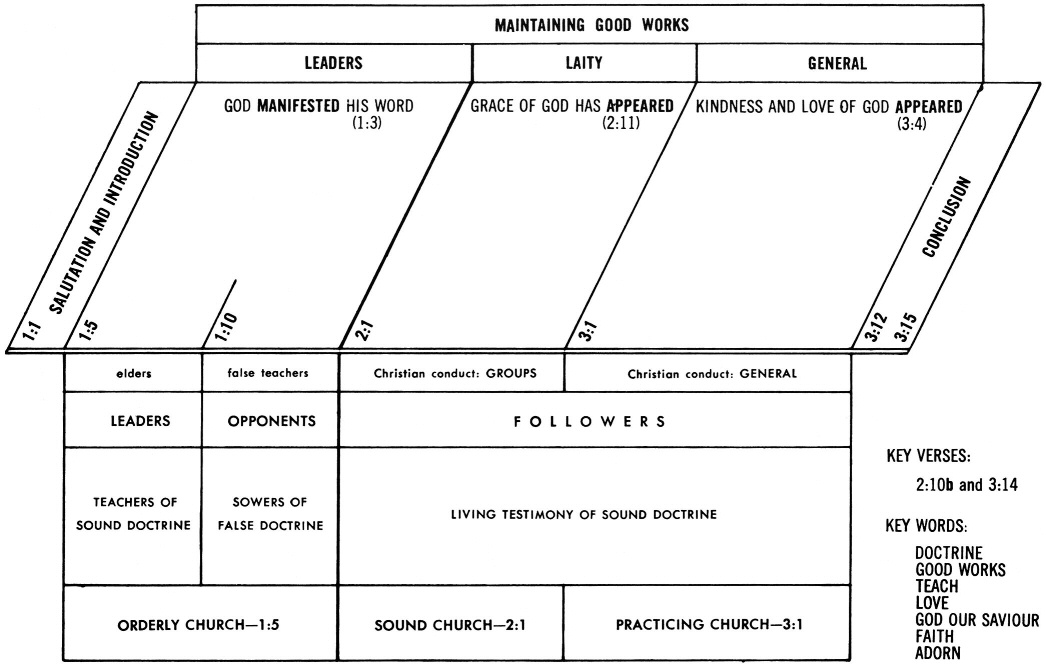
ADORNING THE DOCTRINE OF GOD
Click chart to enlarge
Charts from Jensen's Survey of the NT - used by permission
Titus 3:9 But avoid foolish controversies and genealogies and strife and disputes (battles) about the Law, for they are unprofitable and worthless (NASB: Lockman)
Greek: moras de zeteseis kai genealogias kai ereis kai machas nomikas periistaso, ( 2SPMM) eisin (3PPAI) gar anopheleis kai mataioi.
Amplified: But avoid stupid and foolish controversies and genealogies and dissensions and wrangling about the Law, for they are unprofitable and futile. (Amplified Bible - Lockman)
KJV: But avoid foolish questions, and genealogies, and contentions, and strivings about the law; for they are unprofitable and vain.
Phillips: but mind you steer clear of stupid arguments, genealogies, controversies and quarrels over the Law. They settle nothing and lead nowhere. (Phillips: Touchstone)
Wuest: But stupid questionings and genealogies and wranglings and contentions about laws turn away from and shun, for they are without profit and in vain.
Young's Literal: and foolish questions, and genealogies, and contentions, and strivings about law, stand away from -- for they are unprofitable and vain.
BUT AVOID: periistaso (2SPMM):
- Titus 1:14; 1Ti 1:3, 4, 5, 6, 7; 4:7; 2Ti 2:23
- Titus 3 Resources - Multiple Sermons and Commentaries
But (1161) (de) introduces a contrast, in this case the reaction Titus is to have to matters that are contrary to the teaching commanded in Titus 3:8 (see note)
Avoid (4026) (periistemi from peri = around + histemi = to stand) means literally to stand around which is the use in 2 of the 4 NT occurrences (see below).
The word can also mean to turn oneself about or to be a "bystander". The figurative meaning is to turn oneself about for the purpose of avoiding something. The action called for is to be aloof and keep oneself away from being involved in some activity. This figurative use pictures one actually going around something in order to avoid it. Phillips translates it "steer clear". Another source renders it "give them a wide berth".
Paul is telling Titus as well as the other church leaders on Crete to stand aloof so that he will avoid foolish unprofitable and worthless speculations. Those who taught these things listed below not only polluted and corrupted the churches but, by their sinful lifestyles hindered the credibility of the gospel. How does this type of leaven corrupt the church? The NT gives several effects of false teaching -- It unsettles the soul (Acts 15:24), shipwrecks faith (1Ti 1:19), leads to the ruin of the hearers (2Ti 2:14-note), produces ungodliness (2Ti 2:16-note), and spreads “like gangrene” (2Ti 2:17-note).
Periistemi is used 4 times in the (Jn 11:42; Acts 25:7; 2Ti 2:16; Titus 3:9) and 3 times in the Septuagint (LXX) (Jos 6:3; 1 Sam 4:15; 2 Sam 13:31) and is translated: avoid, 2; standing around, 1; stood around, 1.
Periistemi is used with the literal meaning in John and Acts…
John 11:42 "And I knew that Thou hearest Me always; but because of the people standing around (periistemi) I said it, that they may believe that Thou didst send Me."
Acts 25:7 And after he had arrived, the Jews who had come down from Jerusalem stood around him, bringing many and serious charges against him which they could not prove;
Paul used periistemi figuratively in his command to Timothy to…
Avoid worldly and empty chatter, for it will lead to further ungodliness (see note 2 Timothy 2:16).
In both Titus 3:8 and 2Ti 2:16-note periistemi is a command in the present imperative which calls for a continual action on the part of Titus and Timothy. The charge is to shun these things, deliberately and habitually avoiding them. "Turn yourself about so that you will avoid these things". "Continually place yourself at a distance from these and stand aloof from them."
The middle voice speaks of a reflexive action, one in which the subject initiates the action and participates in effect of the action. The idea of "reflexive" is that it expresses action directed on oneself. You yourself do this is the idea.
This command is specifically given to Titus but obviously applies to believers because no one is completely exempt from the corruptive influence of falsehood. Just as a doctor cannot help being exposed to a dangerous disease he is treating, a godly preacher or teacher cannot help being exposed to dangerous ideas. But just as a doctor keeps exposure to the minimum and concentrates on destroying the disease, so the godly preacher or teacher must keep exposure to falsehood at a minimum, while opposing and seeking to exterminate it with the truth. The spiritual plight of many denominations and Christian institutions that once were solidly biblical is abundant proof of the pernicious and pervasive destructiveness of false doctrine.
Now Paul "lists" 4 things Titus (and every believer) is to "steer clear of". Each of these nouns lacks the definite article in the Greek ("the") which stresses the quality of these things (as opposed to a specific controversy that may have arisen… he is to shun foolish controversies in general, and the same for genealogies, strife, and disputes about the law). The same sort of problems also existed at Ephesus (cf. 1Ti 1:3, 4, 5, 6, 7).
Spurgeon comments that…
There are always plenty of thorn about, and there are certain professors who spend half their lives in fighting about nothing at all. There is no more in their contention than the difference between Tweedledum and Tweedledee; but they will divide a church over it, they will go through the world as if they had found out a great secret,-it really is not of any consequence whatever,-but having made the discovery, they judge everybody by their new-found fad, and so spread a spirit that is contrary to the Spirit of Christ.
There are hundreds of questions, which are thought by some people to be very important, but which have no practical bearing whatever, either upon the glory of God, or upon the holiness of man. We are not to go into these matters; let those who have time to waste take up these questions; as for us, we have not time enough for things that are unprofitable and vain.
Spurgeon's devotional on Titus 3:9…
Our days are few, and are far better spent in doing good, than in disputing over matters which are, at best, of minor importance. The old schoolmen did a world of mischief by their incessant discussion of subjects of no practical importance; and our Churches suffer much from petty wars over abstruse points and unimportant questions. After everything has been said that can be said, neither party is any the wiser, and therefore the discussion no more promotes knowledge than love, and it is foolish to sow in so barren a field. Questions upon points wherein Scripture is silent; upon mysteries which belong to God alone; upon prophecies of doubtful interpretation; and upon mere modes of observing human ceremonials, are all foolish, and wise men avoid them. Our business is neither to ask nor answer foolish questions, but to avoid them altogether; and if we observe the apostle’s precept (Titus 3:8) to be careful to maintain good works, we shall find ourselves far too much occupied with profitable business to take much interest in unworthy, contentious, and needless strivings.
There are, however, some questions which are the reverse of foolish, which we must not avoid, but fairly and honestly meet, such as these: Do I believe in the Lord Jesus Christ? Am I renewed in the spirit of my mind? Am I walking not after the flesh, but after the Spirit? Am I growing in grace? Does my conversation adorn the doctrine of God my Saviour? Am I looking for the coming of the Lord, and watching as a servant should do who expects his master? What more can I do for Jesus? Such enquiries as these urgently demand our attention; and if we have been at all given to cavilling, let us now turn our critical abilities to a service so much more profitable. Let us be peace-makers, and endeavour to lead others both by our precept and example, to “avoid foolish questions.” (Morning and evening)
FOOLISH CONTROVERSIES: moras de zeteseis:
- Titus 3 Resources - Multiple Sermons and Commentaries
Foolish (3474) (moros) is always used as term of reproach and conveys the meaning of that which is mentally dull, sluggish, stupid or moronic (English = “moron”). Void of understanding. Unwise. Imprudent. Acting without discretion. Marked by folly. Describes one who lacks good sense and/or good judgment.
In secular Greek moros meant a weakness of understanding or judgment, sometimes through stupidity, sometimes through confusion, but always demanding censure. In English that which is foolish is lacking in sense, judgment or discretion and thus is ridiculous, absurd and not worthy of consideration. The idea of "foolish" in Scripture speaks more of moral than intellectual deficiencies. It is used to picture people who live life as if God and His will were of no consequence.
What Paul is saying is that wasting time discussing these controversial, contentious matters is foolish behavior for God’s people to be involved in. It wastes time that should be spent proclaiming and expounding the gospel by which men enslaved to sin are set free in this life and the one to come.
Moros -12 times in the NT - Mt. 5:22 (note); Mt 7:26 (see note); Mt 23:17; 25:2, 3, 8; 1Co 1:25, 27; 3:18; 4:10 (Paul uses moros to describe himself and his fellow-workers as “fools” in the eyes of opponents); 2Ti 2:23 (see note); Titus 3:9.
Mt 5:22 (note) "But I say to you that everyone who is angry with his brother shall be guilty before the court; and whoever shall say to his brother, 'Raca,' shall be guilty before the supreme court; and whoever shall say, 'You fool (moros),' shall be guilty enough to go into the fiery hell.
Comment: Vine notes that "here the word (moros) means morally worthless, a scoundrel, a more serious reproach than “Raca”; the latter scorns a man’s mind and calls him stupid; moros scorns his heart and character; hence the Lord’s more severe condemnation"
Moros - 7x in the Septuagint (LXX) - Dt 32:6; Job 16:7; Ps 94:8; Is 19:11; 32:5, 6; Je 5:21.
Isaiah 32:6 For a fool (Hebrew = nabal = senseless person; Lxx = moros) speaks nonsense, And his heart inclines toward wickedness, To practice ungodliness and to speak error against the LORD, To keep the hungry person unsatisfied And to withhold drink from the thirsty.
Jeremiah 5:21 'Hear this, O foolish (Hebrew = sakal = a fool; Lxx = moros) and senseless people, Who have eyes, but see not; Who have ears, but hear not.
Controversies (2214) (zetesis from zetéo = to seek) is a word used by the Greeks to indicate philosophical inquiry. To some extent zetesis is used with this meaning once in the NT, Luke recording…
Acts 25:20 "And being at a loss how to investigate such matters, I asked whether he was willing to go to Jerusalem and there stand trial on these matters.
Zetesis -7x times - John 3:25; Acts 15:2, 7; 25:20; 1Ti 6:4; 2Ti 2:23; Titus 3:9) and not in the Septuagint (LXX)
NAS = controversial questions, 1; controversies, 1; debate, 2; discussion, 1; how to investigate, 1; speculations, 1.
The most common meaning of zetesis refers to the exchange of words for the purpose of disputing, engaging in contentious, controversial questions. Zetesis denotes the preoccupation with pseudo-intellectual theorizing. It pictures one engaging in debates rather than the carrying out of a genuine search for information…
Acts 15:2 And when Paul and Barnabas had great dissension and debate (zetesis) with them, the brethren determined that Paul and Barnabas and certain others of them should go up to Jerusalem to the apostles and elders concerning this issue… 7 And after there had been much debate, Peter stood up and said to them, "Brethren, you know that in the early days God made a choice among you, that by my mouth the Gentiles should hear the word of the gospel and believe.
John 3:25 There arose therefore a discussion (zetesis = "controversy" Amplified) on the part of John's disciples with a Jew about purification.
1 Timothy 1:4 nor to pay attention to myths and endless genealogies, which give rise to mere speculation (zetesis) rather than furthering the administration of God which is by faith.
1 Timothy 6:4 he is conceited and understands nothing; but he has a morbid interest in controversial questions (zetesis) and disputes about words, out of which arise envy, strife, abusive language, evil suspicions,
2 Timothy 2:23 But refuse foolish and ignorant speculations (zetesis), knowing that they produce quarrels.
AND GENEALOGIES: kai genealogias:
- Titus 3 Resources - Multiple Sermons and Commentaries
Genealogies (1076) (genealogia from genealogeo [word study] = recount a family's origin and lineage, trace ancestry in turn from genea = generation + légo = reckon) literally refers to accounts of an ancestry, such as seen in a "genealogical tree".
In the context ("surrounded by" foolish controversies on one side and strife on the other) these genealogies were far more than a family's genealogical record, which by itself would be an innocent thing. While one cannot be absolutely dogmatic, it clearly the genealogies were not treated primarily as historical documents, but according to some commentators they were subjected to a highly symbolic interpretive scheme. Names, dates and places supposedly contained hidden meanings which became the basis for esoteric doctrines.
The only other NT uses of genealogia is found in first Timothy…
1Ti 1:4 nor to pay attention to myths and endless genealogies, which give rise to mere speculation rather than furthering the administration of God which is by faith.
Paul is not referring to the genealogies found in Scripture, for these are critical for determining the lineage of the Messiah, as noted in the opening of Matthew 1:1ff ("The book of the genealogy of Jesus Christ, the son of David, the son of Abraham.") and in Luke 3:23-38. Paul is referring to the many fanciful interpretations of such genealogies which could easily degenerate into controversial speculation and strife.
AND STRIFE: kai ereis:
- Titus 3 Resources - Multiple Sermons and Commentaries
Strife (2054) (eris) means contention, wrangling, quarrels. It refers to engagement in rivalry, especially with reference to positions taken in a matter, such a belief in the meaning of a genealogy! strife, a general term that carries the ideas of all kinds of self-centered rivalry and contentiousness about the truth. Strife is an expression of enmity with bitter sometimes violent conflict or dissension. It refers to persistent contention, bickering, petty disagreement, and enmity. It reflects a spirit of antagonistic competitiveness that fights to have its own way, regardless of cost to itself or of harm to others. It is produced by a deep desire to prevail over others, to gain the highest prestige, prominence, and recognition possible. Strife is characterized by self-indulgence and egoism. It has no place even for simple tolerance, much less for humility or love.
Eris - 9x in NT - Ro 1:29-note; Ro 13:13 -note; 1Co 1:11; 3:3; 2Co 12:20; Gal 5:20; Php 1:15-note; 1Ti 6:4; Titus 3:9. There are no uses in the Septuagint (LXX).
Barclay writes that strife (eris) "is the contention which is born of envy, ambition, the desire for prestige, and place and prominence. It comes from the heart in which there is jealousy. If a man is cleansed of jealousy, he has gone far to being cleansed of all that arouses contention and strife. It is God-given gift to be able to take as much pleasure in the successes of others as in one’s own… Eris is the spirit that is born of unbridled and unholy competition. It comes from the desire for place and power and prestige and the hatred of being surpassed. It is essentially the sin which places self in the foreground and is the entire negation of Christian love… (Eris) is a word of battles. It denotes rivalry and competition, discord about place and prestige. It is the characteristic of the man who has forgotten that only he who humbles himself can be exalted. (Barclay, W: The Daily Study Bible Series, Rev. ed. Philadelphia: The Westminster Press)
Strife is typical of those who are unsaved (Ro 1:29-note) and of who are who are of the night (Ro 13:13-note), is productive of divisions (1Cor 1:11), is one of the deeds of the flesh (1Co 3:3, 2Co 12:20), it characterized those who preached Christ from selfish motives (Php 1:15-note) and which if constantly practiced strongly suggests that person is an unbeliever (Gal 5:20).
Paul explains the relationship between controversial questions (zetesis = controversies here in Titus 3:9) and strife recording that…
1Timothy 6:3-4 If anyone advocates a different doctrine, and does not agree with sound words, those of our Lord Jesus Christ, and with the doctrine conforming to godliness, he is conceited and understands nothing; but he has a morbid interest in controversial questions (zetesis) and disputes about words (logomachia = literally "word battles") out of which arise envy, strife (eris), abusive language, evil suspicions… "
Comment: Here we see one man constantly contradicting the other which in the language of mythology is as if Eris, the goddess of strife has a field day.
AND DISPUTES ABOUT THE LAW: kai machas nomikas:
- Titus 3 Resources - Multiple Sermons and Commentaries
Disputes (3163) (mache from machomai = to fight - this word is used for physical combat, especially military) when used literally refers to physical combat or a contest fought with weapons = battle, conflict, fight. The idea is a serious clash or conflict, and can be either physical or non-physical. It pictures violent personal relationships.
The antithesis of mache is the derivative Greek word amachos which according to Vine originally meant "invincible" (incapable of being conquered, overcome or subdued) but then came to mean a "non fighter", one who is reluctant to fight and who is not always looking for a fight (especially of a verbal nature). Not quarrelsome (not apt or disposed to quarrel in an often petty manner = stresses an ill-natured readiness to fight without good cause). This person is not contentious and so does not exhibit an often perverse and wearisome tendency (even a fondness) for arguing, quarreling and disputing. You usually know who these folks are! Amachos refers not so much to physical violence as to a quarrelsome person. To have a contentious person in leadership will result in disunity and disharmony, seriously hindering the effectiveness of that leadership team. Wuest says that amachos describes a person "who does not go about with a chip on his shoulder."
Amachos is in the list of qualifications of an overseer, where Paul records that a candidate should
not addicted to wine or pugnacious, but gentle, uncontentious, free from the love of money. (1Ti 3:3)
All the NT uses of mache are figurative and in the plural referring to battles fought with words not weapons (although the tongue can certainly be a vicious weapon of sorts!) - disputes, fightings, quarrels, strife.
Mache is thought by some lexicons to be the source of the word machaira (“sword”).
NIDNTT writes that
mache etc. (from Homer), originally meant hand to hand combat, first of all in war, but then also in sport. It has also in addition the neutral sense of to quarrel, wrangle, contend.
Mache is used only 4 times (here in Titus 3:9) in the NT…
2 Co 7:5 For even when we came into Macedonia our flesh had no rest, but we were afflicted on every side: conflicts (mache) without, fears within. (Comment: Paul came to Troas in search of Titus. Instead of relief Paul found conflicts - probably refers to those in Macedonia who did not welcome Paul and in fact wanted to get rid of him)
2 Ti 2:23 But refuse foolish and ignorant speculations, knowing that they produce quarrels. (see note)
James 4:1 What is the source of quarrels ("the wars" KJV = polemos = warfare) and conflicts among you? Is not the source your pleasures that wage war in your members?
Comment: Polemos pictures the chronic state or continuous campaign of war while mache presents the separate conflicts or battles of the war in general.
Mache - 17x in the non-apocryphal Septuagint (LXX) - Ge 13:7-8; Jos 4:13; Jdg 20:38; 2 Sam 22:44; Job 38:23; Pr 15:18; 17:1, 14, 19; 25:8, 10; 26:20, 21; 30:32, 33; Isa 58:4). The LXX uses refer to both physical or non-physical conflicts.
Genesis 13:7 And there was strife (LXX = mache) between the herdsmen of Abram's livestock and the herdsmen of Lot's livestock. Now the Canaanite and the Perizzite were dwelling then in the land. 8 Then Abram said to Lot, "Please let there be no strife (LXX = mache) between you and me, nor between my herdsmen and your herdsmen, for we are brothers.
Joshua 4:13 about 40,000, equipped for war (LXX = mache), crossed for battle before the LORD to the desert plains of Jericho.
2 Samuel 22:44 "Thou hast also delivered me from the contentions (Hebrew = rib = strife, disputes; LXX = mache) of my people; Thou hast kept me as head of the nations; A people whom I have not known serve me.
Proverbs 15:18 A hot-tempered man stirs up strife (LXX = mache), But the slow to anger pacifies contention.
Proverbs 17:1 Better is a dry morsel and quietness with it Than a house full of feasting with strife (LXX = mache).
Proverbs 17:14 The beginning of strife is like letting out water, So abandon the quarrel before it breaks out.
Proverbs 17:19 He who loves transgression loves strife; He who raises his door seeks destruction.
Proverbs 26:20 For lack of wood the fire goes out, And where there is no whisperer, contention (LXX = mache) quiets down. 21 Like charcoal to hot embers and wood to fire, So is a contentious man to kindle strife. (LXX = mache)
Proverbs 30:33 For the churning of milk produces butter, And pressing the nose brings forth blood; So the churning of anger produces strife.
A related Greek word, polemos, from which we get the English “polemics (an aggressive attack on or refutation of opinions or principles of another)” relates to general, prolonged, and serious disputing or combat and is often rendered “war". In comparison, mache represents the separate conflicts or battles of the war in general. (cf use of both words in James 4:1 below).
These word fights are over the Law of Moses presumably as it relates to Christians, a battle which was settled on the Cross, when Jesus took upon Himself the curse that the Law decreed for sin.
FOR THEY ARE UNPROFITABLE AND WORTHLESS: eisin (3PPAI) gar anopheleis kai mataioi:
- Job 15:3; 1Corinthians 8:1; 13:2; 2Timothy 2:14
- Titus 3 Resources - Multiple Sermons and Commentaries
These things listed above produce no spiritual benefit. They are useless and morally fruitless, and hence unworthy of time and serious consideration.
For (gar) - always ponder this term of explanation.
Unprofitable (512) (anopheles from a = without + opheleo = to profit) serving no purpose. It describes that which does not offer any special benefit and thus is without advantage, is useless and is unprofitable. In Titus 3:9, anopheles describes the "disputes about the law" which serve no purpose, and hence are noxious and even injurious.
The only other NT use is in Hebrews describing the old covenant …
Hebrews 7:18 (note) For, on the one hand, there is a setting aside of a former commandment because of its weakness and uselessness. (anopheles) (Comment: The law was useless in the sense that it could not save or bring about inward change in a person.)
The Septuagint (LXX) uses anopheles to describe idols:
"The priests did not say, ‘Where is the Lord?’ And those who handle the law did not know Me; The rulers also transgressed against Me, and the prophets prophesied by Baal and walked after things that did not profit. (anopheles)" (Jer 2:8).
In Isaiah after asking and answering the rhetorical question
"Do not tremble and do not be afraid; Have I not long since announced it to you and declared it? And you are My witnesses. Is there any God besides Me, or is there any other Rock? I know of none.” (Isa 44:8)
God then asks
"Who has fashioned a god or cast an idol to no profit (anopheles)? (Isa 44:10).
Worthless (3152) (mataios from maten = groundless, invalid) (see related logomacheo) means vain, empty, devoid of force, lacking in content, nonproductive, useless, dead, fruitless, aimless, of no real or lasting value. This adjective describes an ineffectual attempt to do something or an unsuccessful effort to attain something. Mataios emphasizes aimlessness or the leading to no object or end and thus is used to describe false gods or idols in contrast to the true God (see below).
Gilbrant on mataios - Outside of Biblical Greek the adjective mataios has two basic meanings: (1) It denotes the appearance of something as distinct from its essence, and it suggests the “deceptive” quality of something; (2) Mataios refers to the “ineffectiveness” or “uselessness” of something. In this latter sense it is often translated as “vain, without purpose.” Mataios at times joins the company of kenos, “empty” (Trench, Synonyms of the New Testament, p.180, observes such pairing in Aristotle and Plutarch). The same construction is not infrequent in the Septuagint (e.g., Job 20:18; Hosea 12:1; Micah 1:14), where mataios translates as many as 11 different Hebrew expressions. Ordinarily hevel and shawᵉ’ stand behind it (both meaning “worthless, in vain, without result, empty”). Mataios assumes a decidedly negative and religious quality in the Septuagint; in fact, the plural substantive form (hoi mataioi) is simply another way of saying “idols” (e.g., Leviticus 17:7; 1 Kings 16:2,7; 2 Kings 17:15, of Jereboam’s sin of idolatry; passim). The implicit deceit of idols is also suggested by mataios (cf. Psalms 5:9; 12:2; 24:4). Moreover, the Hebrew is kāzāv, which means “lie.” The deception of mataios is ultimately destructive (e.g., Proverbs 21:6; Amos 2:4). The deceitfulness of riches is equal to idolatry (Isaiah 2:7,8), and man’s self-reliance is “useless” (Psalm 60:11; cf. Ps 94:11). False prophets are pictured as leading Israel astray by their “worthless, deceptive” visions and prophecies (Ezekiel 13:6,9,19; 22:28). (See also the word mataiotēs in the Septuagint, especially in Ecclesiastes 2:1,11; Psalms and Proverbs.) The extreme negative quality of mataios found in the Septuagint is also seen in the New Testament. The use in Acts 14:15 is undoubtedly a reference to the implied idolatry of the Lycaonian people who mistook Paul and Barnabas for “gods” (cf. 1 Peter 1:18). It is fundamental to Paul’s thought that the Lord knows the “futility” and “uselessness” of human wisdom (1 Corinthians 3:20; cf. Psalm 94:11). Paul stressed how “futile” faith would be if the Resurrection were not a historical reality (1 Cor15:17). The imagery of idolatry may lie behind James’ explanation that religion without controlling one’s tongue is “worthless” (James 1:26). (Complete Biblical Library Greek-English Dictionary)
NIDNTT - The word mataios and its derivatives have an essentially more personal application. It is used in the sense of empty, useless, worthless, and futile. It denotes a person who falls short of God’s standard and human norms. His life is illusory, motiveless, aimless, scandalous and foolish (Brown, Colin, Editor. New International Dictionary of NT Theology. 1986. Zondervan)
Mataios therefore describes unbelievers, whose lives sadly are futile because they lack divine insight and are thus are unable to live a life filled with eternal purpose and everlasting effect (see contrast of the eternal impact of the life of a believer disciplining himself or herself for godliness ). Unbelievers lead a futile life, in that it does not measure up to that for which human life was created, that ultimate purpose being to glorify God. How grateful the redeemed should be (Ps 107:2-note) that we have been ransomed from a futile existence by such a tremendous transaction… delivered from slavery to the world, flesh and devil by the blood of the Lamb.
TDNT - The word mataios carries the senses of “vain,” “deceptive,” “pointless,” “futile.” While kenós (2756) means “worthless,” mataios means “worthless because deceptive or ineffectual.” mataios implies antithesis to the norm, which may at times be liberating but is more often harmful. Tragedy raises the ultimate question whether everything is not mataios. Religion offers a partial answer by pointing to the divine world, but the plurality and mutability of the gods undermine this answer. Later Greek thought makes little use of the group, perhaps because it raises so unsettling a question, and involves such practical self-contradiction. (Kittel, G., Friedrich, G., & Bromiley, G. W. Theological Dictionary of the New Testament. Eerdmans)
The idea behind mataios brings to mind pictures like building a house on sand (Mt 7:24;25;26;27 see note on Jesus' warning in Mt 7:24; 25; 26; 27), chasing the wind, shooting at stars, pursuing one’s own shadow. The spiritual plight of many denominations and Christian institutions that once were solidly biblical is abundant proof of the pernicious and pervasive destructiveness of false and therefore worthless doctrine.
Mataios - 6 times in the NT - NAS = futile, 1; useless, 1; vain things, 1; worthless, 3
Luke quotes Paul who uses mataios as a synonym for idolatry declaring
Acts 14:15 "Men, why are you doing these things? We are also men of the same nature as you, and preach the gospel to you in order that you should turn from these vain (mataios) things to a living God, WHO MADE THE HEAVEN AND THE EARTH AND THE SEA, AND ALL THAT IS IN THEM.
Here are the other uses of mataios in the NT…
1Cor 3:20 and again, "THE LORD KNOWS THE REASONINGS of the wise, THAT THEY ARE USELESS."
1Cor 15:17 and if Christ has not been raised, your faith is worthless; you are still in your sins.
Jas 1:26-note If anyone thinks himself to be religious, and yet does not bridle his tongue but deceives his own heart, this man's religion is worthless.
1Pe 1:18-note knowing that you were not redeemed with perishable things like silver or gold from your futile way of life inherited from your forefathers.
Comment: With this better sense of the meaning of mataios can you see how we the redeemed should be powerfully motivated out of a sense of profound gratitude to conduct ourselves in fear during the time of our stay on earth?
Mataios is used about 75 times in the Septuagint (LXX) where it is used several times for the Hebrew word habal (01891) which is rendered vanity or vanities, and frequently is used to describe to idols which are vain, empty, dead, useless and fruitless! For example in 2Ki 17:15 we read the tragic explanation of why Israel was taken captive into Assyria…
Ex 20:7; 23:1; Lev 17:7; Deut 5:11; 1Ki 16:2, 13, 26; 2Ki 17:15; 2Chr 11:15; Esther 4:17; Job 20:18; Ps 5:9; 12:2; 24:4; 60:11; 62:9; 94:11; 108:12; Pr 12:11; 21:6; 26:2; 30:8; 31:30; Isa 1:13; 2:20; 22:2; 28:29; 29:8; 30:7, 15, 28; 31:2; 32:6; 33:11; 44:9; 45:19; 49:4; 59:4; Jer 2:5; 8:19; 10:3, 15; 51:18; Lam 2:14; 4:17; Ezek 8:10; 11:2; 13:6, 7, 8, 19; 21:29; 22:28; Hos 5:11; 6:8; 12:1; Amos 2:4; Jonah 2:8; Mic 1:14; Zeph 3:13; Zech 10:2; 11:17; Mal 3:14)
“They rejected His statutes and His covenant which He made with their fathers and His warnings with which He warned them. And they followed vanity (mataios - alluding to the gross idolatry Israel succumbed to) and became vain (related verb mataioo = become futile or useless), and went after the nations which surrounded them (which went after gross idolatry), concerning which the LORD had commanded them not to do like them. (2Ki 17:15) (see also 2 Chr 11:15; Is 44:19; Je 2:5; 10:3; Ezek 8:10)
Wiersbe comments on this section writing that…
We wish we did not have “problem people” in our churches; but wherever there are people, there can be problems. In this case, Paul warned Titus to avoid people who like to argue about the unimportant things of the faith. I recall being approached by a young man after a Bible lesson and getting involved with him in all sorts of hypothetical questions of doctrine. “Now, if this were true… if that were true… ” was about all he could say. I was very inexperienced at the time; I should have ignored him in a gracious way. As it was, I missed the opportunity to talk with several sincere people who had personal problems and wanted help. I have learned that professed Christians who like to argue about the Bible are usually covering up some sin in their lives, are very insecure, and are usually unhappy at work or at home." (Wiersbe, W: Bible Exposition Commentary. 1989. Victor)
In Morning and Evening Spurgeon writes the following devotional entitled "Avoid Foolish Questions"…
Our days are few, and are far better spent in doing good, than in disputing over matters which are, at best, of minor importance. The old schoolmen did a world of mischief by their incessant discussion of subjects of no practical importance; and our Churches suffer much from petty wars over abstruse points and unimportant questions. After everything has been said that can be said, neither party is any the wiser, and therefore the discussion no more promotes knowledge than love, and it is foolish to sow in so barren a field. Questions upon points wherein Scripture is silent; upon mysteries which belong to God alone; upon prophecies of doubtful interpretation; and upon mere modes of observing human ceremonials, are all foolish, and wise men avoid them. Our business is neither to ask nor answer foolish questions, but to avoid them altogether; and if we observe the apostle’s precept (Titus 3:8) to be careful to maintain good works, we shall find ourselves far too much occupied with profitable business to take much interest in unworthy, contentious, and needless strivings.
There are, however, some questions which are the reverse of foolish, which we must not avoid, but fairly and honestly meet, such as these: Do I believe in the Lord Jesus Christ? Am I renewed in the spirit of my mind? Am I walking not after the flesh, but after the Spirit? Am I growing in grace? Does my conversation adorn the doctrine of God my Saviour? Am I looking for the coming of the Lord, and watching as a servant should do who expects his master? What more can I do for Jesus? Such enquiries as these urgently demand our attention; and if we have been at all given to caviling (raising trivial and frivolous objections), let us now turn our critical abilities to a service so much more profitable. Let us be peace-makers, and endeavour to lead others both by our precept and example, to “avoid foolish questions.”
Titus 3:10 Reject a factious man after a first and second warning,
Greek: hairetikon anthropon meta mian kai deuteran nouthesian paraitou, (2SPMM)
Amplified: [As for] a man who is factious [a heretical sectarian and cause of divisions], after admonishing him a first and second time, reject [him from your fellowship and have nothing more to do with him], (Amplified Bible - Lockman)
KJV: A man that is an heretic after the first and second admonition reject;
Phillips: If a man is still argumentative after the second warning you should reject him. (Phillips: Touchstone)
Wuest: A schismatic (sectarian) individual, after one or two admonitions be rejecting, knowing that he that is of such a character, is turned inside out, and keeps on constantly sinning, being self-condemned.
Young's Literal: A sectarian man, after a first and second admonition be rejecting,
REJECT: paraitou (2SPMM):
- Romans 16:17; 1 Cor 5:4, 5, 6, 7, 8, 9, 10, 11, 12, 13; Gal 5:12; 2Th 3:6,14; 2Ti 3:5; 2Jn 1:10
- Titus 3 Resources - Multiple Sermons and Commentaries
Paul now passes from the reprehensible opinions to their perverted advocates.
Reject (3868) (paraiteomai from pará = aside and in this word gives a nuance of aversion or repudiation + aitéo = ask, beg) is literally to ask along side. To seek to turn aside by asking. As in Mark 15:6, this verb can mean to beg or request (a prisoner to be freed on the occasion of the Passover). In Luke 14:18, it conveys the sense of to beg off or of wanting to be excused from a positive response, in this verse one excusing himself for not accepting a wedding invitation. Finally, in the pastoral epistles (1,2 Timothy, Titus - see below), the meaning is to decline, refuse, to refuse to pay attention to, to shun, to avoid, to reject.
In secular Greek a wrestler was declared the victor when his opponents declined to engage him upon seeing his unclothed physique.
Present imperative means to make it your habit to stop associating with these individuals who cause schisms or divisions. In a parallel use in his second letter to Timothy Paul commanded his protégé to
1Ti 4:7-note But have nothing to do with worldly fables fit only for old women. On the other hand, discipline yourself for the purpose of godliness
2Ti 2:23 Refuse (paraiteomai = present imperative) foolish and ignorant speculations, knowing that they produce quarrels. (see note 2Ti 2:23)
Comment: The Lord's bondservant must continually avoid getting enticed into ''which came first, the chicken or the egg'' type discussions, those things that are controversial and seriously disputed, and which have no certain basis in truth. In these situations we are to graciously "beg off" an invitation to "war over words" with others. Certainly we can discuss differences of opinions; but our discussions must not degenerate into heated debates over irrelevant issues.
Whereas God judges those who are not a part of the church, He has delegated responsibility to the church to exercise its own discipline. Exercising the ban or excommunication is the method of discipline, provided the attempts described in Matthew have been executed first (Mt 18:15, 16, 17). The ban should be the decree of the whole church together (v4).
CHURCH DISCIPLINE 101
A study of the NT reveals a number of habitual (emphasize this word), visible unrepentant acts which clearly call for church discipline:
(1) sexual immorality, (2) covetousness, (3) idolatry, (4) reviling, (5) drunkenness, (6) extortion (1Co 5:11), (7) disorderliness laziness (2Th 3:6, 7, 8, 9, 10, 11, 12), (8) false teaching (1Ti 1:18, 19, 20), (9) divisiveness (Titus 3:10, 11).
A FACTIOUS MAN AFTER A FIRST AND SECOND WARNING : haretikon anthropon meta mia kai deuteran nouthesian :
- 1 Cor 11:19; Gal 5:20; 2 Pet 2:1
- Matthew 18:15, 16, 17; 2 Co 13:2
- Titus 3 Resources - Multiple Sermons and Commentaries
A man that is an heretic (KJV)
Spurgeon comments that…
When it comes to unbelief of fundamental and vital doctrines, we who are like Titus, set in office over a church, must deal with such deadly evils with a strong hand.
A man that is an heretic-One who really turns aside from the truth, and sets up something contrary to the Word of God; what is to be done with him? “Burn him,” says the Church of Rome. “Fine him, put him in prison,” say other churches; but the inspired apostle says only this… Just exclude him from the church that is all. Leave him his utmost liberty to go where he likes, believe what he likes, and do what he likes; but, at the same time, you as Christian people must disown him, that is all you ought to do, except to pray and labor for his restoration.
Factious (141) (hairetikos derived from verb haireo = to take, to take for one’s self, to choose, prefer) describes a person who is able choose, which came to mean one who is schismatic, contentious or divisive. Thus this man chooses for himself and takes a certain position on a given issue, be it doctrine or standard of behavior, etc. In secular Greek there is no inherently evil meaning suggested, but simply a marked difference from a standard teaching. A "heresy" only becomes wrong when it substantially contradicts a clear doctrine of Scripture (theistic evolution, denial of the virgin birth).
As used in this verse Paul is clearly giving a negative connotation to the word hairetikos. In context this is a person who is quarrelsome and stirs up factions through erroneous opinions, a man who is determined to go his own way and so forms parties and factions. His self-chosen opinions are those described in verse 9.
A heretic as we commonly use in English is one who refuses to accept true doctrine as it is revealed in the Bible, and prefers to choose for himself what he is to believe. He is one who willfully chooses for himself and sets up a faction (1Cor 11:19; Gal 5:20). Our responsibility is to reprimand such a person twice and then avoid him if he does not change. Compare to Jesus teaching in Matthew 18…
"And if your brother sins, go and reprove him in private; if he listens to you, you have won your brother. "But if he does not listen to you, take one or two more with you, so that BY THE MOUTH OF TWO OR THREE WITNESSES EVERY FACT MAY BE CONFIRMED. "And if he refuses to listen to them, tell it to the church; and if he refuses to listen even to the church, let him be to you as a Gentile and a tax-gatherer. (Mt 18:15-17)
Although not the same Greek word the idea is similar in Romans 16 where one still belongs to the fellowship, but whom the fellowship eventually had to exclude.
Now I urge you, brethren, keep your eye on those who cause dissensions and hindrances contrary to the teaching which you learned, and turn away from them. (see note Romans 16:17)
Warning (3559) (nouthesia from noutheteo [see word study] = literally "put in mind" from noús = mind + títhemi = to place or put -- it describes exertion of influence upon nous implying resistance) is any word of encouragement or reproof which leads to correct behavior. It conveys the idea of giving one counsel about avoiding or ceasing an improper course of conduct. Nouthesia can mean advise given concerning dangerous consequences of a happening or action.
TDNT writes that the related verb noutheteo…
means “to impart understanding,” “to set right,” “to lay on the heart.” The stress is on influencing not merely the intellect but the will and disposition. The word thus acquires such senses as “to admonish,” “to warn,” “to remind,” and “to correct.” It describes a basic means of education. Philo and Clement of Alexandria speak about God or Christ warning, censuring, and encouraging us in this way. The idea is not that of punishment but of a moral appeal that leads to amendment. In this sense it takes on the meaning “to discipline.” Philosophy, however, does not use it technically for its own work.
Nouthesia stresses “training by word,” whether of encouragement, or, if necessary, by reproof or remonstrance. Paideia stresses training by act and discipline (see use of both together in Eph 6:4 below). Nouthesia is the milder term without which paideia would be incomplete. In both words there is the appeal to the conscience, will, and reasoning faculties. A synonym is epanorthosis translated "correction" (2Ti 3:16-note) was used of setting upright an object that had fallen down and of helping a person back on his feet after stumbling.
Titus is to reprimand this factious man once and then again, administering a word of remonstrance, rebuke, and censure, always with a view to reclaiming him (cf to Mt 18:15, 16, 17 above). However, if these attempts to "rehabilitate" the man fail, Titus is to "refuse" him, and have nothing to do with him. He is to refuse to be bothered with him. All further attention is to be withdrawn from the factious man leaving him to himself.
As Harvey has written…
"Factious men and foolish errors are sometimes pushed into prominence by being controverted; whereas, if they were shunned, thoroughly let alone, they would of themselves come to naught. A very different rule of action is given in cases where the error is, not as in this case, foolish but vital, affecting fundamental truth, or where the offense constitutes a plain breach of morality (1Cor 5:1, 2, 3, 4, 5, 6, 7, 8, 9, 10, 11, 12, 13; 1Ti 1:19, 20)" (Harvey, H. Commentary on the Pastoral Epistles. 1890).
There are only 2 other NT uses (none in the Septuagint - LXX) of nouthesia…
1Cor 10:11 Now these things (read 1Cor 10:1, 2, 3, 4, 5, 6, 7, 8, 9, 10 to see what "things") happened to them as an example, and they were written for our instruction, upon whom the ends of the ages have come.
Ephesians 6:4 (note) And, fathers, do not provoke your children to anger; but bring them up in the discipline (paideia) and instruction (nouthesia) of the Lord. (Comment: In this use nouthesia represents a means of Christian upbringing, specifically describing the admonition or instruction which will correct but not provoke)
Titus 3:11 knowing that such a man is perverted and is sinning, being self-condemned. (NASB: Lockman)
Greek: eidos (RAPMSN) hoti exestraptai (3SRPI),o toioutos kai hamartanei, (3SPAI) on (PAPMSN) autokatakritos
Amplified: Well aware that such a person has utterly changed (is perverted and corrupted); he goes on sinning [though he] is convicted of guilt and self-condemned. (Amplified Bible - Lockman)
KJV: Knowing that he that is such is subverted, and sinneth, being condemned of himself.
Phillips: You can be sure that he has a moral twist, and he knows it. (Phillips: Touchstone)
Wuest: knowing that he that is of such a character, is turned inside out, and keeps on constantly sinning, being self-condemned.
Young's Literal: having known that he hath been subverted who is such, and doth sin, being self-condemned.
KNOWING THAT SUCH A MAN IS PERVERTED AND IS SINNING: eidos (RAPMSN) hoti ezestraptai (3SRPI) o toioutos kai hamartanei (3SPAI):
- Titus 1:11; Acts 15:24; 1Timothy 1:19,20; 2Timothy 2:14; Hebrews 10:26
- Titus 3 Resources - Multiple Sermons and Commentaries
PERSISTENT
PERVERSION
Knowing (1492) (eido) intrinsically inherently knowing the truth about such a man and perfect tense speaks of the permanence of the knowledge. Titus you know beyond a shadow of a doubt that this man is warped, continuing to sin, and is actually participating in a sense in his own condemnation.
Hiebert - The reason for the attitude lies in what the man is. "Knowing that" means that his refusal to listen to the admonitions administered has shown Titus what the man is. As to his character he is shown to be "perverted." (Hiebert, D. Edmond: Titus and Philemon. Moody. 1957)
Perverted (1612) (ekstrepho from ek = out + strépho = to turn) turn out of a place, as for a tree or post from the earth, to turn inside out as a garment. Figuratively as used in this verse (only NT use) ekstrepho means a change for the worse, to subvert or to pervert.
Perverted is in the perfect tense indicating the permanence or settled state of their perversion. These men at some point in time have been turned out of place, away from the Way, the Truth, the Life and they are still in that state. The passive voice indicates the turning out of place is produced in the subject by a force from without the subject.
Used metaphorically meaning to change for the worse. Turned or twisted out and medically referred to twisted ankles, turned knees, etc. Vincent says: “More than turned away from the right path: rather, turned inside out!” ( turn inside out as a garment)
Hiebert -The tense of the verb (perfect passive) indicates that he is in a state of being twisted, turned out of the right way. His refusal to heed the admonition shows that his is not so much an error of the mind as of the heart. (Ibid)
Sinning (264) (hamartano) means literally to miss the mark (and so not share in the prize), to err, to sin, to offend, to trespass. To act contrary to the will and law of God. To commit that which is wrong.
Hamartano is used 43 times in the NT - The NAS renders it -- commit sin(1), committed offense(1), committing (1), sin(11), sinned(17), sinning(4),sins(8).
Matt. 18:15, 21; 27:4; Lk. 15:18, 21; 17:3f; Jn. 5:14; 8:11; 9:2f; Acts 25:8; Rom. 2:12; 3:23; 5:12, 14, 16; 6:15; 1 Co. 6:18; 7:28, 36; 8:12; 15:34; Eph. 4:26; 1 Tim. 5:20; Titus 3:11; Heb. 3:17; 10:26; 1 Pet. 2:20; 2 Pet. 2:4; 1 Jn. 1:10; 2:1; 3:6, 8f; 5:16, 18.
This individual is continually (present tense) "missing the mark" (so as not to share in the prize) that God has for his life. He is continually erring, swerving from the Truth (Jesus ultimately), going the wrong way. Specifically in this context he is continuing to sin both by his factiousness and his refusal to listen to admonition.
BEING SELF-CONDEMNED: on (PAPMSN) autokatakritos:
- Matthew 25:26, 27, 28; Luke 7:30; 19:22; John 3:18; Acts 13:46; Romans 3:19
- Titus 3 Resources - Multiple Sermons and Commentaries
Being (1510) is the present tense indicating the continual state of these men.
Self-condemned (843) (autokatakritos from autos = himself + katakrino = to condemn) means condemned by one’s own decision, passing sentence upon oneself so to speak! It is a person who shows by his own actions that he is wrong or guilty. The factious person, who is twisted by his constant sinning, will manifest his wicked condition by his own words and actions, there by becoming self-condemned. Stated another way, this factious man having refused correction, actually participates in his own condemnation since he is without excuse.
Warren Wiersbe offers a practical application of this section suggesting that…
If a church member goes about trying to get a following, and then gets angry and leaves the church, let him go. If he comes back (maybe the other churches don’t want him either), and if he shows a repentant attitude, receive him back. If he repeats this behavior (and they usually do), receive him back the second time. But if he does it a third time, do not receive him back into the fellowship of the church (Titus 3:10). Why not? “Such a man is warped in character, keeps on sinning, and has condemned himself” (Titus 3:11, literal translation). If more churches would follow this principle, we would have fewer “church tramps” who cause problems in various churches. (Wiersbe, W: Bible Exposition Commentary. 1989. Victor)