2 Chronicles 33:2
2 Chronicles 33:3
2 Chronicles 33:4
2 Chronicles 33:5
2 Chronicles 33:6
2 Chronicles 33:7
2 Chronicles 33:8
2 Chronicles 33:9
2 Chronicles 33:10
2 Chronicles 33:11
2 Chronicles 33:12
2 Chronicles 33:13
2 Chronicles 33:14
2 Chronicles 33:15
2 Chronicles 33:16
2 Chronicles 33:17
2 Chronicles 33:18
2 Chronicles 33:19
2 Chronicles 33:20
2 Chronicles 33:21
2 Chronicles 33:22
2 Chronicles 33:23
2 Chronicles 33:24
2 Chronicles 33:25
| SECOND CHRONICLES The Kingdom of Israel From Splendor to Disaster |
|||||
| Splendor | Disaster | ||||
| King Solomon of Judah 2 Chronicles 1-9 |
Successive Kings of Judah 2Chr 10-36 |
||||
| Kingdom United |
Kingdom Divided 2Chr 10:1-19 |
Rulers of the Southern Kingdom of Judah After the Split |
The Exile of Judah 2Chr 36:17-23 |
||
| Inaugural
2Chr 1:1-17 |
Solomon's Temple 2Chr 2:1-7:22 |
Solomon's Glory 2Chr 8:1-9:31 |
|||
| Building of the Temple |
Decline & Destruction of the Temple |
Temple Destroyed |
|||
| ~40 Years | ~393 Years | ||||

Click chart to enlarge
Chart from Jensen's Survey of the OT - used by permission
Click Chart from Charles Swindoll
|
1107 |
1011 |
971 |
931 |
853 |
722 |
586 |
||||
| 1Samuel | 2 Samuel | 1Kings | 1Kings | 2 Kings | ||||||
|
31 |
1-4 | 5-10 | 11-20 | 21-24 | 1-11 | 12-22 | 1-17 | 18-25 | ||
|
1 Chronicles 10
|
1Chr 11-19 |
1Chr 20-29 |
2 Chronicles |
2 Chronicles |
2 Chronicles |
|||||
|
Legend: B.C. dates at top of timeline are approximate. Note that 931BC marks the division of the Kingdom into Southern Tribes (Judah and Benjamin) and Ten Northern Tribes. To avoid confusion be aware that after the division of the Kingdom in 931BC, the Southern Kingdom is most often designated in Scripture as "Judah" and the Northern Kingdom as "Israel." Finally, note that 1 Chronicles 1-9 is not identified on the timeline because these chapters are records of genealogy. |
||||||||||
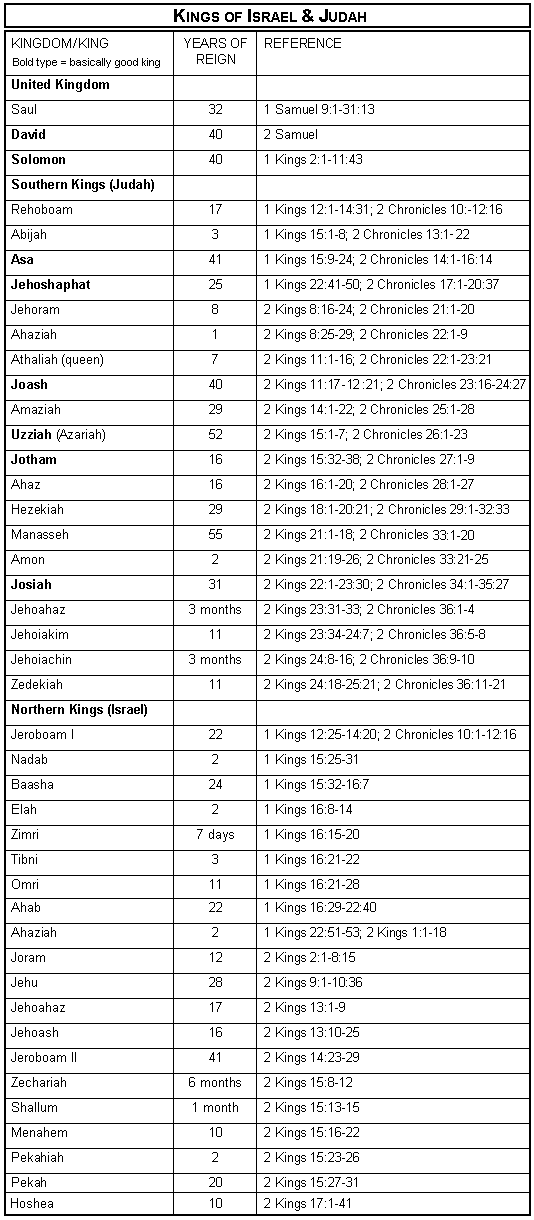
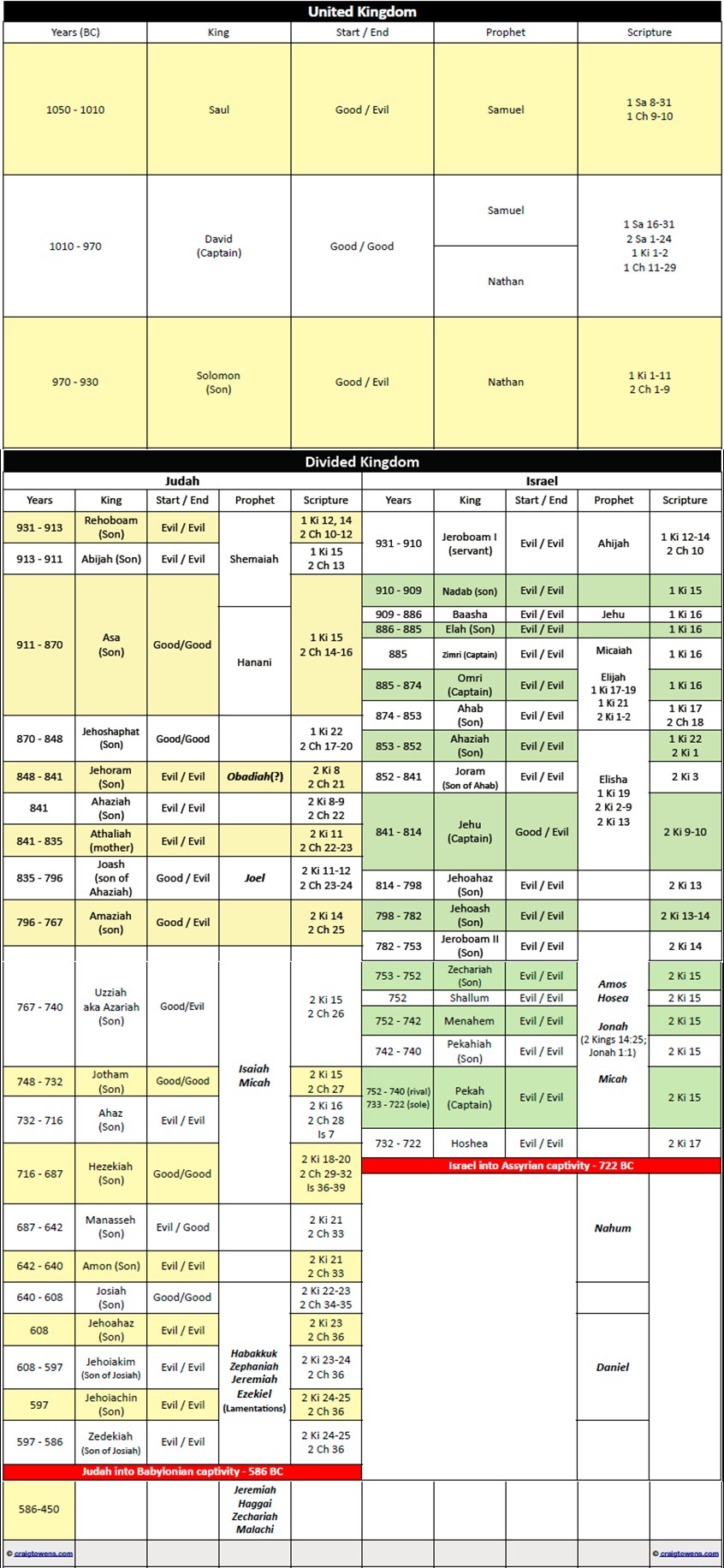
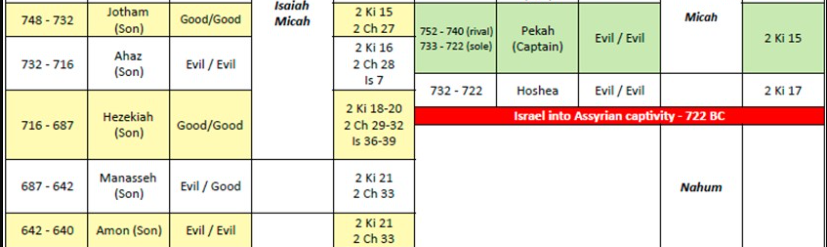
SEE ALSO:
ESV chart - kings of Israel - more information
ESV chart - kings of Judah - more information
Another Chart with Variable Dates for Reigns of Kings
2 Chronicles 33:1 Manasseh was twelve years old when he became king, and he reigned fifty-five years in Jerusalem.
- Manasseh: 2Ch 32:33 2Ki 21:1-18 1Ch 3:13 Mt 1:10, Manasses
- twelve: 2Ch 34:1,2 Ec 10:16 Isa 3:4,12
- CLICK 2 CHRONICLES COMMENTARIES FOR MULTIPLE SERMONS AND COMMENTARIES
- See BELOW FOR BIBLIOGRAPHY FOR 1-2 CHRONICLES - adapted from Paul Apple's Bible Outlines
Parallel Passage:
2 Kings 21:1 Manasseh was twelve years old when he became king, and he reigned fifty-five years in Jerusalem; and his mother’s name was Hephzibah.
MANASSEH'S
LONG REIGN
Manasseh was twelve years old when he became king, and he reigned fifty-five years in Jerusalem - In contrast to preceding kings listed by the chronicler, this time he does not include the mother's name (she is mentioned in 2Ki 21:1). Manasseh, who was born late in Hezekiah’s life after God extended his years (2 Kings 20:6), grew up to undo nearly all of his father’s godly work. This shows how quickly a nation can turn from righteousness to rebellion when its leaders abandon God’s Word. Proverbs 29:2 teaches, “When the righteous increase, the people rejoice, but when the wicked rule, the people groan.”
The statement that Manasseh became king at twelve and reigned fifty-five years in Jerusalem highlights both the tragedy of early corruption and the wonder of divine patience. His long reign serves as a warning of how deeply sin can entrench itself in a nation, but also as a testimony that God’s mercy remains available even to the most hardened sinner who turns back to Him in humility and repentance.
Spurgeon - Yet who could have had a better father than Manasseh had? He was given to Hezekiah during those fifteen years which God graciously added to that good king’s life. Manasseh was, therefore, doubtless carefully trained, and looked upon as being one who would maintain God’s worship, and the honour of his father’s name. But grace does not run in the blood; and the best of parents may have the worst of children. Thus Manasseh, though he was the son of Hezekiah, “did that which was evil in the sight of the Lord,” —It often happens that, when the sons of good men become bad, they are among the worst of men. They who pervert a good example generally run headlong to destruction.
Spurgeon - 12 years old - He was, therefore, born after the time when Hezekiah was raised up from the bed of sickness. That prolongation of life was not all mercy: I am not sure that we should be so eager for such an extension of earthly existence either for ourselves or for others. Had Hezekiah been able to foresee what would be the abominations of the first part of Manasseh’s reign, should he come to the throne of Judah, methinks that the godly king might have been content to die at once rather than live any longer to become the father of such a sinner, and one who would prove to be such an enemy of the true faith. “Manasseh was twelve years old when he began to reign.” It was too early for a youth to reign over any nation. It is a great temptation, and a serious peril, when an individual has too much power before he reaches his manhood. It would have been far better for Manasseh if his accession to the throne had been postponed for a good while. You who are very young, and are entrusted with wealth and position, may God keep you from going wrong! It will need great grace to preserve you in the right path.
Spurgeon - Manasseh’s was a long reign, a varied reign, and at first a wicked reign of the very worst kind. Sometimes men are spared notwithstanding their sin. Manasseh’s was one of the longest reigns on record: “He reigned fifty and five years in Jerusalem.”
Raymond Dillard: Manasseh ruled longer than any other king of Judah. Many find in this fact the key to the Chronicler’s treatment of this king. In light of his theology of immediate retribution, Manasseh would have represented something of a problem: how is it that this king who represented the pinnacle of evil also enjoyed the divine blessing of long life? The Chronicler’s account of Manasseh’s punishment, repentance, and reform removes the narrative from being a problem and makes it instead a dramatic confirmation of the validity of retribution theology and the efficacy of repentance.
PAUL APPLE - BIG IDEA: EVEN THE WORST SINNER, IF HE HUMBLY REPENTS, IS NOT BEYOND THE MERCY OF GOD
Raymond Dillard: Though the Chronicler was heavily dependent on Kings for his account of Manasseh (2Ch 33:1–10 // 2 Kgs 21:1–10), the two accounts contrast sharply in their overall assessment of his reign. In the deuteronomic history Manasseh is the nadir of the kings of Judah and is the leading cause of a now irreversible exile, whereas in Chronicles he becomes repentant and a religious reformer. Though agreeing regarding his apostasy, the two historians come to opposite moral judgments.
John Olley: Kings and Chronicles were written for different audiences, and their authors selected their material accordingly. In the Chronicler’s Manasseh account, hearers are encouraged to find a foretaste of their own situation, as they have been in exile because of rejection of God’s words through the prophets (2Ch 33:10–11a; 36:15–17). Even in the darkest situation, as people “humble themselves” and cry to God in repentance, hope of full restoration (even including kingship; 2Ch 33:13) is still possible; building and security go together with “serv[ing] the Lord the God of Israel” (2Ch 33:16).
Martin Selman: Manasseh’s conversion helps to explain a longstanding problem in Kings, namely, why the exile did not fall in Manasseh’s reign if his sins were really so serious. God’s judgment had clearly been at least delayed, though if God’s basic decision could not be overturned by Josiah’s extensive reformation, Manasseh’s more limited changes (cf. 2Ch 33:17) were not likely to be any more successful.
Matthew Henry Notes: Chapter: 33
SUMMARY - 2 Chronicles 33 presents a sharp contrast between two kings. Manasseh, though reigning long, began with extreme apostasy—reversing his godly father Hezekiah’s reforms, embracing pagan abominations, profaning the temple, sacrificing his children, consulting occult practices, and leading Judah into sins worse than the nations, all despite repeated prophetic warnings (2Ch 33:1–10; cf. Book of Kings 21:1–9). Yet in a remarkable display of grace recorded fully in Second Book of Chronicles, his affliction and captivity humbled him, leading to genuine repentance, restoration to his kingdom, partial national reformation, and renewed prosperity (2Ch 33:11–20). Amon, by contrast, followed his father’s early wickedness without repentance, hardened himself in sin, and met a swift and violent end (2Ch 33:21–25). Together, their lives underscore both the depth of human rebellion and the abundance of God’s mercy toward the repentant, while warning that unrepented sin leads only to ruin.
In this chapter we have the history of the reign,
I. Of Manasseh, who reigned long.
1. His wretched apostasy from God, and revolt to idolatry and all wickedness (2Ch 33:1-10).
2. His happy return to God in his affliction; his repentance (2Ch 33:11-13), his reformation (2Ch 33:15-17), and prosperity (2Ch 33:14), with the conclusion of his reign (2Ch 33:18-20).
II. Of Amon, who reigned very wickedly (2Ch 33:21-23), and soon ended his days unhappily (2Ch 33:24, 25).
2Ch 33:1-10
We have here an account of the great wickedness of Manasseh. It is the same almost word for word with that which we had 2 Ki. 21:1-9, and took a melancholy view of. It is no such pleasing subject that we should delight to dwell upon it again. This foolish young prince, in contradiction to the good example and good education his father gave him, abandoned himself to all impiety, transcribed the abominations of the heathen (2Ch 33:2), ruined the established religion, unravelled his father's glorious reformation (2Ch 33:3), profaned the house of God with his idolatry (2Ch 33:4, 5), dedicated his children to Moloch, and made the devil's lying oracles his guides and his counsellors, 2Ch 33:6. In contempt of the choice God had made of Sion to be his rest for ever and Israel to be his covenant-people (v2Ch 33:8), and the fair terms he stood upon with God, he embraced other gods, profaned God's chosen temple, and debauched his chosen people. He made them to err, and do worse than the heathen (2Ch 33:9); for, if the unclean spirit returns, he brings with him seven other spirits more wicked than himself. That which aggravated the sin of Manasseh was that God spoke to him and his people by the prophets, but they would not hearken, 2Ch 33:10. We may here admire the grace of God in speaking to them, and their obstinacy in turning a deaf ear to him, that either their badness did not quite turn away his goodness, but still he waited to be gracious, or that his goodness did not turn them from their badness, but still they hated to be reformed. Now from this let us learn,
1. That it is no new thing, but a very sad thing, for the children of godly parents to turn aside from that good way of God in which they have been trained. Parents may give many good things to their children, but they cannot give them grace.
2. Corruptions in worship are such diseases of the church as it is very apt to relapse into again even when they seem to be cured.
3. The god of this world has strangely blinded men's minds, and has a wonderful power over those that are led captive by him; else he could not draw them from God, their best friend, to depend upon their sworn enemy.
QUESTION - Who was King Manasseh in the Bible?
ANSWER - The story of King Manasseh is told in 2 Kings 21:1–18 and 2 Chronicles 32:33–33:20, and he is also mentioned briefly in Jeremiah 15:4. Manasseh was king of the southern kingdom of Judah and the son of the godly king Hezekiah. Hezekiah had undertaken reforms in Judah to rid the land of idolatry. Manasseh, a wicked king, reversed these reforms and did much worse. The first five verses of 2 Kings 21 are a frank and stunning account of Manasseh’s apostasy:
“Manasseh was twelve years old when he became king, and he reigned in Jerusalem fifty-five years. . . . He did evil in the eyes of the Lord, following the detestable practices of the nations the Lord had driven out before the Israelites. He rebuilt the high places his father Hezekiah had destroyed; he also erected altars to Baal and made an Asherah pole, as Ahab king of Israel had done. He bowed down to all the starry hosts and worshiped them. He built altars in the temple of the Lord, of which the Lord had said, ‘In Jerusalem I will put my Name.’ In the two courts of the temple of the Lord, he built altars to all the starry hosts. He sacrificed his own son in the fire, practiced divination, sought omens, and consulted mediums and spiritists. He did much evil in the eyes of the Lord, arousing his anger.” Although we are not given the specifics, Manasseh was also a treacherous king, killing innocent people: “Manasseh also shed so much innocent blood that he filled Jerusalem from end to end” (2 Kings 21:16). He was pronounced by God to be more wicked than the Amorites who had lived in Canaan before they were displaced by Israel in an act of God’s judgment (2 Kings 21:11; see also 2 Chronicles 33:9).
Not only did Manasseh sin personally, but as king he led Judah in forsaking the LORD and worshiping idols. Such was the extent of their sin that God declared He would wipe out Jerusalem as He had the northern kingdom of Israel (2 Kings 21:13–15). Jeremiah 15:4 notes that it was the sin of Judah, initiated by Manasseh, that brought the judgment that Jeremiah proclaimed (the destruction of Jerusalem and the temple and the exile of the people). According to Jewish tradition, it was King Manasseh who murdered the prophet Isaiah.
Second Chronicles 33 adds more information not recorded in 2 Kings. God reached out to Manasseh and the people (presumably through prophets), but they would not listen. So God sent the Assyrians who captured Manasseh and took him away to exile (2 Chronicles 33:11). While in exile, “In his distress he sought the favor of the Lord his God and humbled himself greatly before the God of his ancestors. And when he prayed to him, the Lord was moved by his entreaty and listened to his plea; so he brought him back to Jerusalem and to his kingdom. Then Manasseh knew that the Lord is God” (2 Chronicles 33:12–13). The apocryphal book the “Prayer of Manasseh” claims to record Manasseh’s prayer of repentance, but it is highly unlikely that the contents of the Prayer of Manasseh accurately represent Manasseh’s prayer.
The repentant Manasseh was restored to his kingdom and started to rebuild Judah militarily (2 Chronicles 33:14), and he also began to institute religious reforms. “He got rid of the foreign gods and removed the image from the temple of the Lord, as well as all the altars he had built on the temple hill and in Jerusalem; and he threw them out of the city. Then he restored the altar of the Lord and sacrificed fellowship offerings and thank offerings on it, and told Judah to serve the Lord, the God of Israel” (2 Chronicles 33:15–16).
Even though Manasseh had a personal conversion, he was never able to lead Judah out of the sin that he had previously led them into. They did not follow him in his reforms. The people continued in their idolatry (2 Chronicles 33:17), and, when Manasseh died, his son Amon “did evil in the eyes of the Lord, as his father Manasseh had done. Amon worshiped and offered sacrifices to all the idols Manasseh had made. But unlike his father Manasseh, he did not humble himself before the Lord” (2 Chronicles 33:22–23).
Manasseh is a tragic figure in Scripture. Although he repented of his sin, he was unable to undo the damage he had done to the nation or to his own son who followed him. Manasseh demonstrates that, while any sin may be forgiven when we repent, forgiveness does not necessarily remove the natural consequences that flow from disobedience.GotQuestions.org
QUESTION - Why is idol worship such a powerful temptation?
ANSWER - Ultimately, the answer to this question is “sin.” It is the sin nature of man that causes us to worship modern idols, all of which are, in reality, forms of self-worship. The temptation to worship ourselves in various ways is a powerful temptation indeed. In fact, it is so powerful that only those who belong to Christ and have the Holy Spirit within them can possibly hope to resist the temptation of modern idolatry. Even then, resisting the worship of idols is a lifelong battle that is part of the Christian life (Ephesians 6:11; 1 Timothy 6:12; 2 Timothy 2:3).
When we hear the word idol, we often think of statues and objects reminiscent of those worshiped by pagans in ancient cultures. However, the idols of the 21st century often bear no resemblance to the artifacts used thousands of years ago. Today, many have replaced the “golden calf” with an insatiable drive for money or prestige or "success" in the eyes of the world. Some pursue the high regard of others as their ultimate goal. Some seek after comfort or a myriad of other passionate, yet empty, pursuits. Sadly, our societies often admire those serving such idols. In the end, however, it doesn’t matter what empty pleasure we chase after or what idol or which false god we bow down to; the result is the same—separation from the one true God.
Understanding contemporary idols can help us to understand why they prove to be such a powerful temptation. An idol can be anything we place ahead of God in our lives, anything that takes God’s place in our hearts, such as possessions, careers, relationships, hobbies, sports, entertainment, goals, greed, addictions to alcohol/drugs/gambling/pornography, etc. Some of the things we idolize are clearly sinful. But many of the things we idolize can be very good, such as relationships or careers. Yet Scripture tells us that, whatever we do, we are to “do it all for the glory of God” (1 Corinthians 10:31) and that we are to serve God only (Deuteronomy 6:13; Luke 16:13). Unfortunately, God is often shoved out of the way as we zealously pursue our idols. Worse yet, the significant amount of time we often spend in these idolatrous pursuits leaves us with little or no time to spend with the Lord.
We sometimes also turn to idols seeking solace from the hardships of life and the turmoil present in our world. Addictive behaviors such as drug or alcohol use, or even something like excessive reading or television viewing, may be used as a means of temporarily “escaping” a difficult situation or the rigors of daily life. The psalmist, however, tells us that those who place their trust in this behavior will, essentially, become spiritually useless (Psalm 115:8). We need to place our trust in the Lord “who will keep [us] from all harm” (Psalm 121:7) and who has promised to supply all of our needs when we trust in Him. We also need to remember the words of Paul, who teaches us not to be anxious about anything, but rather to pray about everything so the peace of God, which surpasses all understanding, can guard our hearts and our minds (Philippians 4:6–7).
There is another form of idolatry prevalent today. Its growth is fostered by cultures that continue to drift away from sound biblical teaching, just as the apostle Paul warned us, “For the time will come when men will not put up with sound doctrine” (2 Timothy 4:3). In these pluralistic, liberal times, many cultures have, to a large degree, redefined God. We have forsaken the God revealed to us in Scripture and have recast Him to comply with our own inclinations and desires—a “kinder and gentler” god who is infinitely more tolerant than the One revealed in Scripture. One who is less demanding and less judgmental and who will tolerate many lifestyles without placing guilt on anyone’s shoulders. As this idolatry is propagated by churches around the world, many congregants believe they are worshiping the one, true God. However, these made-over gods are created by man, and to worship them is to worship idols. worshiping a god of one’s own making is particularly tempting for many whose habits and lifestyles and drives and desires are not in harmony with Scripture.
The things of this world will never fully satisfy the human heart. They were never meant to. The sinful things deceive us and ultimately lead only to death (Romans 6:23). The good things of this world are gifts from God, meant to be enjoyed with a thankful heart, in submission to Him and for His glory. But when the gift replaces the Giver or the created replaces the Creator in our lives, we have fallen into idolatry. And no idol can infuse our lives with meaning or worth or give us eternal hope. As Solomon beautifully conveys in the book of Ecclesiastes, apart from a right relationship with God, life is futile. We were created in God’s image (Genesis 1:27) and designed to worship and glorify Him as He alone is worthy of our worship. God has placed “eternity in man’s heart” (Ecclesiastes 3:11), and a relationship with Jesus Christ is the only way to fulfill this longing for eternal life. All of our idolatrous pursuits will leave us empty, unsatisfied, and, ultimately, on the broad road that most people take, the one that leads to destruction (Matthew 7:13). GotQuestions.org
2 Chronicles 33:2 He did evil in the sight of the LORD according to the abominations of the nations whom the LORD dispossessed before the sons of Israel.
- according to the abominations of the nations: 2Ch 28:3 36:14 Lev 18:24-30 20:22,23 De 12:31 18:9,14 2Ki 17:11,15 21:2,9 Ezr 9:14 Ps 106:35-40 Eze 11:12
Parallel Passage:
2 Kings 21:2 He did evil in the sight of the LORD, according to the abominations of the nations whom the LORD dispossessed before the sons of Israel.
GODLY FATHER
EVIL SON
He did evil in the sight of the LORD - Evil in the sight of the people of Judah was bad enough for it led them into commission of gross idolatry. But far worse is evil before "holy eyes!" His deeds were offensive to the holy and righteous character of God, Who sees all things. Proverbs 15:3 says "The eyes of the LORD are in every place, Watching the evil and the good."
According to the abominations (toebah; LXX - bdelugma - that which is extremely abhorred, detestable, anything connected with idolatry) of the nations whom the LORD dispossessed before the sons of Israel - This is an amazing statement for it connects the depth of Manasseh’s sin to the very evils that had brought God’s judgment upon the Canaanite nations. The abominations refer to the detestable religious and moral practices of the Canaanites and other peoples who lived in the land before Israel’s conquest. These included idolatry, child sacrifice, sexual immorality, witchcraft, and the worship of false gods. God had commanded Israel to drive out those nations precisely because of these abominations.
In Leviticus 18:24-25 Moses gave Israel clear warnings...
‘Do not defile yourselves by any of these things; for by all these the nations which I am casting out before you have become defiled. 25 ‘For (term of explanation) the land has become defiled, therefore I have brought its punishment upon it, so the land has spewed out its inhabitants.
Manasseh's sins defiled the Promised Land and would result in God spewing out Judah in 586 BC. Manasseh’s sin was not only private but public and consequences would impact the entire nation. This is a tragic reversal of Israel’s calling. God had chosen His people to be holy and distinct, a light to the nations (Deuteronomy 7:6), but under Manasseh’s leadership, they became indistinguishable from the very nations God had judged. Beloved, I fear a similar think could be said of much of the church in America today, so that there is little distinction of church goers and the general public! It is a sobering reminder that God’s people are called to holiness, and when they abandon that calling, they invite the same judgment that falls on the unbelieving world.
Raymond Dillard: Note the three occurrences of the phrase reporting that Manasseh “did evil” early in the paragraphs beginning with 2Ch 33:2, 6, 9; repetition of such phrases is common on paragraph boundaries. . . This verse is verbatim 2 Kgs 21:2, but functions somewhat differently in the earlier narrative. In Kings Manasseh’s reign accounts for the exile; the abominations for which Yahweh drove the Canaanites from the land would eventually be the same reasons for which Israel was driven out (Deut 18:12; 2 Kgs 17:8, 16–20). This relationship between the deeds and exile of the Canaanites and the deeds and exile of Israel is somewhat muted in Chronicles and becomes the personal experience of the king rather than the nation.
Spurgeon -The Lord drove out the Canaanites for the very sins that Manasseh committed. If we follow in the sins of others, we must not wonder if we share in their doom. It is a sad thing, however, when the child of such a father as Hezekiah does evil in the sight of the Lord, “like unto the abominations of the heathen, whom Jehovah had cast out before the children of Israel.”
Abominations (detestable, loathsome) (08441) toebah refers to an abominable custom or thing. Abomination. Loathsome. Detestable thing. Something or someone who is loathsome and abhorrent.
Abomination (Hebrew tôʿēbâ) in Scripture denotes far more than something merely distasteful or socially offensive; it refers to anything—object, act, or disposition—that fundamentally violates God’s holiness, sovereignty, and covenantal order, thereby provoking His righteous rejection and judgment. Rooted primarily in the Law, tôʿēbâ marks what is ritually, morally, or ethically incompatible with life before a holy God: unclean foods (Deut. 14:3), defective sacrifices (Deut. 17:1), dishonest business practices (Deut. 25:13–16), and especially idolatry and its attendant practices, including child sacrifice (Deut. 12:31), ritual prostitution (1 Kgs. 14:23–24), and the worship of false gods—so much so that pagan deities themselves are labeled “abominations,” as when Milcom is called “the abomination of the Ammonites” (2 Kgs. 23:13; cf. Deut. 32:16; Isa. 44:19; Ezek. 7:20). At the moral level, tôʿēbâ identifies behaviors that corrupt God’s design for human life and community, including sexual perversions such as homosexuality (Lev. 18:22; 20:13), violence, deceit, arrogance, and the catalog of sins God “hates” in Proverbs 6:16–19, all of which reflect a willful disregard for His revealed standards. Strikingly, Scripture emphasizes the irony of abomination: those who commit it often perceive their actions as acceptable or even religiously virtuous, yet God declares even the sacrifice and prayer of the wicked to be abominable when offered in disobedience and hypocrisy (Prov. 15:8; 21:27; 28:9).
Beyond legal categories, tôʿēbâ also carries a deeply relational and experiential dimension, reflecting the Ancient Near Eastern understanding of shame, horror, and repulsion that reaches the core of one’s being (Ps. 69:20; 88:8). What offends God may also be experienced as repulsive within human cultures—Egyptians considered eating with Hebrews or the occupation of shepherding abominable (Gen. 43:32; 46:34), while certain sacrifices were abhorrent from an Egyptian perspective (Exod. 8:26)—yet Scripture consistently re-centers the definition around God’s values rather than human sensibilities. Because abominations threaten the spiritual purity of God’s people, the prophets repeatedly indicted Israel for covenant violations in these areas, especially idolatry, corrupt worship, sexual immorality, injustice, and intermarriage that blurred the boundary between holiness and paganism (Isa. 1:13; 41:24; Jer. 2:7; 7:9–10; Ezek. 16:36; 22:11; Mal. 2:11; Ezra 9:1). The penalties attached to abominations are severe—being cut off, death, exile, destruction, and the withdrawal of God’s favor (Lev. 18:29; 20:13; Deut. 13:14; Ezek. 5:11)—underscoring that abomination is ultimately an assault on God’s rightful rule as Creator and Redeemer. This trajectory culminates in the biblical imagery of supreme abomination, where sacrilegious powers usurp divine worship and desecrate what belongs to God alone (Dan. 9:27; 11:31; 12:11), a pattern later echoed in New Testament eschatological warnings (Matt. 24:15; 2 Thess. 2:3–4; Rev. 17:4–5), reinforcing that tôʿēbâ represents not merely cultural disgust but active rebellion against God’s holiness that inevitably summons His judgment.
ALL THE OCCURRENCES OF THE PHRASE "DID EVIL IN THE SIGHT OF THE LORD" JJdg. 2:11; Jdg. 3:7; Jdg. 3:12; Jdg. 4:1; Jdg. 6:1; Jdg. 10:6; Jdg. 13:1; 1 Ki. 11:6; 1 Ki. 14:22; 1 Ki. 15:26; 1 Ki. 15:34; 1 Ki. 16:30; 1 Ki. 22:52; 2 Ki. 3:2; 2 Ki. 8:18; 2 Ki. 8:27; 2 Ki. 13:2; 2 Ki. 13:11; 2 Ki. 14:24; 2 Ki. 15:9; 2 Ki. 15:18; 2 Ki. 15:24; 2 Ki. 15:28; 2 Ki. 17:2; 2 Ki. 21:2; 2 Ki. 21:20; 2 Ki. 23:32; 2 Ki. 23:37; 2 Ki. 24:9; 2 Ki. 24:19; 2 Chr. 21:6; 2 Chr. 22:4; 2 Chr. 33:2; 2 Chr. 33:22; 2 Chr. 36:5; 2 Chr. 36:9; 2 Chr. 36:12; Jer. 52:2
Dispossessed (03423) yarash to take possession of, inherit, dispossess, to drive out. Possession of the land was directly connected to a person's relationship with the Lord; breaking the covenantal relationship led to dispossession. But even in exile, Israelites awaited the day when they would repossess the land (Jer. 30:3).
Complete Biblical Library - The verb yārash is an especially important word in contexts dealing with Israel's conquest of and possession of the land of Canaan. Cognates include Aramaic, Ugaritic, Old South Arabian, and Akkadian. The Moabite stone inscription uses wyrs: "And Omri took possession of all the land of Mahdeba." Yārash means "to take possession of" or "to possess." Another meaning is "to inherit," "to be an heir."
The first meaning, "to take possession of," is most commonly used in connection with possessing land, specifically, the Promised Land. Yahweh first announced "possession" of the land in the context of the Abrahamic covenant (Gen. 15:7f). Although similar usage continues in Leviticus (20:24) and Numbers (13:30; 14:24; 21:24f), yārash in the sense of covenant land possession is a key theme in Deuteronomy. "Go in and possess the land," the Lord commanded (Deut. 1:8, 21, 39; 11:31; 17:14). The phrase, "where you are going to possess it," with reference to the land, recurs in Deuteronomy and Joshua (Deut. 4:5, 14, 26; Josh. 1:11, 15; 12:1; 13:1; 21:43; 23:5). Emphasis on the idea of "possessing" the land continues in Judges (11:21-24; 18:9).
Likewise, the prophets and post-exilic Books allude to Israel's covenant right of possession. Jeremiah predicted a coming repossession of the land (Jer. 30:3), as did Isaiah (Isa. 61:7; 65:9), while Ezekiel (Ezek. 33:24ff) and Amos (Amos 2:10) looked to past land inheritance. Habakkuk described the coming invasion of Babylonian armies to "possess" the land (Hab. 1:6). After the Babylonian exile, Nehemiah's prayer alluded to God's earlier covenant promises of land possession (Neh. 9:15, 22ff).
Yārash also refers to possessing fields (1 Ki. 21:15f, 18f), cities (Josh 19:47; Judg. 3:13) and houses (Ezek. 7:24; Neh. 9:25). The only occurrence of yārash in the Piel theme speaks of the locust or cricket "possessing" (devouring) Israel's produce as a consequence of the people's disobedience (Deut. 28:42).
The idea of "possessing" implies "dispossessing" someone else. In conquest, one nation succeeds another; thus, capturing territory divests another nation of its possession of the land. This usage is common in both the Qal (Deut. 2:12, 21f; 9:1; 11:23; 12:2, 29; Num. 21:32; Ezek. 36:12; Amos 9:12; Obad. 17) and Hiphil (Josh. 13:13; 14:12; 16:10; 17:13; Judg. 1:29-33). Kings notes that the Lord drove out nations for Israel, only to see his people adopt the idolatrous practices of those nations (1 Ki. 14:24; 21:26; 2 Ki. 16:3; 17:8; 21:2; see also Exo. 34:24; Deut. 4:38). In the Niphal stem, to "be dispossessed" is to become poor: "do not love sleep, lest you become poor" (Prov. 20:13; Gen. 45:11; Judg. 14:15; cf. Prov. 23:21; 30:9).
In a legal sense, the right of possession passed from one generation to the next and so constituted "inheritance." Because they were without a son, Abraham and Sarah looked to Eliezer, a servant, as an "heir" (Gen. 15:3f). Jeremiah spoke of Israel's lack of national heirs (49:1; cf. Lev. 25:46; 2 Sam. 14:7). The Lord cautioned his people not to intermarry with idolatrous nations in order to leave the good land as an inheritance for their children (Ezra 9:12).
Adam → Cain.
Adam was created innocent in the image of God and enjoyed direct fellowship with the LORD before the Fall (Gen 1:27; 2:7). Yet his firstborn son Cain became a murderer and a rebel against God, offering unacceptable worship and ultimately killing his righteous brother Abel (Gen 4:3–8). The New Testament explicitly identifies Cain as one who “was of the evil one” (1 Jn 3:12). The very first family in Scripture thus establishes a foundational biblical truth: sin is not prevented, nor righteousness transmitted, merely by godly origin or example.
Noah → Ham.
Noah is described as “a righteous man, blameless in his time,” who walked with God and obeyed Him fully (Gen 6:9; 7:1). Nevertheless, his son Ham acted with shocking disrespect and moral corruption when he dishonored his father’s nakedness and treated it lightly, in contrast to his brothers’ reverence (Gen 9:22–25). This account demonstrates that even a godly, obedient father can raise a son who disregards holiness and authority.
Abraham → Ishmael.
Abraham was a man of faith who believed God, and it was credited to him as righteousness (Gen 15:6). Yet his son Ishmael, born according to the flesh rather than the promise, is described prophetically as “a wild donkey of a man,” marked by hostility and conflict (Gen 16:12). Ishmael later mocked Isaac, revealing a heart opposed to God’s covenant purposes (Gen 21:9). Abraham’s faith did not automatically produce covenant faithfulness in his son.
Isaac → Esau.
Isaac walked in obedience to the LORD and kept His commandments, statutes, and laws (Gen 26:5). Nevertheless, his son Esau proved to be godless and immoral, despising his birthright for a single meal (Gen 25:34). The New Testament labels Esau as “immoral” and “godless,” holding him up as a warning against despising spiritual privilege (Heb 12:16).
Jacob → Reuben.
Jacob, the covenant patriarch through whom the promises of Abraham continued, nevertheless suffered deep moral failure within his family. His firstborn son Reuben committed sexual immorality by sleeping with his father’s concubine (Gen 35:22). As a result, Reuben forfeited the privileges of the firstborn, and Jacob pronounced judgment upon him for his instability and defilement (Gen 49:3–4).
Aaron → Nadab and Abihu.
Aaron was divinely appointed as Israel’s first high priest, entrusted with sacred responsibility and proximity to God’s presence. Yet his sons Nadab and Abihu offered “strange fire” before the LORD—unauthorized, irreverent worship that violated God’s explicit commands. As a result, fire came out from the presence of the LORD and consumed them (Lev 10:1–2), demonstrating that holy office and godly lineage do not excuse disobedience.
Eli → Hophni and Phinehas.
Eli served as both priest and judge in Israel, yet his sons Hophni and Phinehas are explicitly called “worthless men” who did not know the LORD (1 Sam 2:12). They abused their priestly office, stole sacrificial portions, and committed sexual immorality at the entrance of the tent of meeting (1 Sam 2:12–17, 22). Their wickedness culminated in divine judgment, as both sons died on the same day when the ark was captured (1 Sam 4:11).
Samuel → Joel and Abijah.
Samuel was a faithful prophet and servant of Yahweh from his youth to old age. However, his sons Joel and Abijah, whom he appointed as judges, “did not walk in his ways,” but instead turned aside after dishonest gain, took bribes, and perverted justice (1 Sam 8:1–3). Their corruption directly contributed to Israel’s demand for a king, showing again that spiritual leadership is not inherited.
David → Absalom, Amnon, and Adonijah.
David, though flawed, was described as a man after God’s own heart (1 Sam 13:14). Yet several of his sons embodied profound moral failure. Amnon committed sexual violence against his half-sister Tamar (2 Sam 13:1–14); Absalom murdered Amnon and later led a full-scale rebellion against his father (2 Sam 13:28–29; ch. 15); and Adonijah attempted to seize the throne in defiance of God’s will (1 Kgs 1:5–10). David’s life powerfully illustrates that a godly heart does not guarantee godly children.
Solomon → Rehoboam.
Solomon, the builder of the temple and recipient of unparalleled divine wisdom (1 Kgs 3:12), fathered Rehoboam, whose pride and harshness fractured the kingdom. Rejecting wise counsel, Rehoboam ruled foolishly and arrogantly, causing ten tribes to revolt and divide the nation (1 Kgs 12:13–19). Wisdom possessed by a father does not ensure wisdom embraced by a son.
Jehoshaphat → Jehoram.
Jehoshaphat sought the LORD and walked in His commandments, strengthening Judah spiritually and morally (2 Chr 17:3–6). Yet his son Jehoram murdered his brothers, embraced idolatry, and led Judah into great wickedness (2 Chr 21:4–6). His reign stands in stark contrast to his father’s faithfulness.
Jotham → Ahaz.
Jotham, the father of Ahaz, is explicitly presented as a righteous king who “did what was right in the sight of the LORD,” walking faithfully before God and strengthening Judah, including important building projects at the temple and the defenses of Jerusalem (2 Kings 15:34–35; 2 Chronicles 27:1–6). Scripture summarizes his life with the clear theological evaluation: “So Jotham became mighty because he ordered his ways before the LORD his God” (2 Chr 27:6). In stark contrast, his son Ahaz “did not do what was right in the sight of the LORD his God,” but instead walked in the ways of the kings of Israel, practiced idolatry, sacrificed his sons in the fire, shut the doors of the temple, and led Judah into deep apostasy (2 Kings 16:2–4; 2 Chronicles 28:1–4, 24–25).
Hezekiah → Manasseh.
Hezekiah was one of Judah’s most righteous kings, trusting the LORD completely and removing idolatry from the land (2 Kgs 18:3–6). Nevertheless, his son Manasseh became one of Judah’s most wicked rulers, rebuilding high places, practicing occultism, shedding innocent blood, and leading the nation into grave apostasy (2 Kgs 21:1–9). Though Manasseh later repented in captivity (2 Chr 33:12–13), the damage of his reign was profound and lasting.
CONCLUSION - From the opening chapters of Genesis through the final kings of Judah, Scripture consistently testifies that personal righteousness is not hereditary, nor is covenant faithfulness transmitted automatically from father to son. Together these narratives establish a unified theological truth repeatedly affirmed in Scripture: each soul stands individually accountable before God (Ezek 18:20), salvation and obedience arise from personal response to divine grace rather than lineage (Deut 30:19; John 1:12–13), and godly parenting, though commanded and precious, cannot substitute for a heart that personally fears the LORD and receives the gift of salvation in Jesus Christ!
"The conclusion, when all has been heard, is: FEAR GOD and KEEP His commandments, because this applies to every person.14 For God will bring every act to judgment, everything which is hidden, whether it is good or evil." (Ecclesiastes 12:13-14)
2 Chronicles 33:3 For he rebuilt the high places which Hezekiah his father had broken down; he also erected altars for the Baals and made Asherim, and worshiped all the host of heaven and served them.
- he built again: Heb. he returned and built, Ec 2:19 9:18 2Ki 18:4,22 2Ch 32:12 34:3
- which Hezekiah: 2Ch 30:14 31:1 32:12 2Ki 18:4 21:3
- he also erected altars: 2Ch 28:2-4 Judges 2:11-13 2Ki 10:18-20 1Ki 16:31-33 18:21,26
- he also erected altars: De 16:21 1Ki 14:23 Jer 17:2
- worshiped all the host: 2Ki 17:16 23:4 De 4:19 17:3 2Ki 23:5,6,11 Jer 8:2 19:13 Zep 1:5 Ac 7:42 Job 31:26
Parallel Passage:
2 Kings 21:3 For he rebuilt the high places which Hezekiah his father had destroyed; and he erected altars for Baal and made an Asherah, as Ahab king of Israel had done, and worshiped all the host of heaven and served them.
Related Passages:
Deuteronomy 4:19 “And beware not to lift up your eyes to heaven and see the sun and the moon and the stars, all the host of heaven, and be drawn away and worship them and serve them, those which the LORD your God has allotted to all the peoples under the whole heaven.

FROM HIGH PLACES TO HIGH
WORSHIP OF HOSTS OF HEAVEN
For - This is a strategic term of explanation, which is easy to observe, as the chronicler explains the incredible evil acts of Manasseh.
He rebuilt the high places (bamah; LXX - hupselos) which Hezekiah his father had broken down - Oh those high places again. We thought they were gone finally after Hezekiah had destroyed them! Well, here they come again with the help of his son Manasseh! The resistance of the high places to permanent removal reminds me of the phrase in Hebrews 12:1 "the sin which so easily entangles." Here Israel is entangled and ensnared again!
🙏 THOUGHT - What are we to learn from Manasseh's rebuilding of high places? We have all had "high places" in our lives, certainly before we became believers, but even after we came to Christ. Have we torn them down in the past, only to see them rear their ugly head years later? Flesh is flesh (fallen, depraved) and is uncompromising and ever seeking to sneak to insert a repented sinful behavior back into our life! Therefore we must take the "Hezekiah approach" and tear them down, eschewing the "Manasseh approach" to rebuild them in our heart and mind (cf 2Co 10:3-5). As you read this beloved, do you have any "high places" you have rebuilt or are considering rebuilding? The the only solution is to kill those sins, lest they be killing you, remembering the only way you can truly tear down those "high places" is as you are supernaturally enabled by the Holy Spirit (Ro 8:13). Lord we desperately need Your Spirit in Christ. Amen
He also erected altars (mizbeah; LXX - thusiasterion - structure on which cultic observances are carried out) for the Baals (ba'al ~ husband, lord, master, owner, possessor) and made Asherim (Asherah) - Once again we see the king leading the people who were to be the possession of Yahweh into worship and bondage of "no gods". And yet because of the depravity of our fallen flesh, these inanimate objects exerted great attraction to the people. Notice that in a sense they even became "married" to them for the name Baal (ba'al) is also translated as husband, owner, possessor. Given this understanding, it is easy to see why idolatry provokes Israel's "Husband" Yahweh to jealousy (See Israel the Wife of Jehovah)! In looking for freedom, the people were drawn into deep bondage to these idols which in turn made them carry out abominable acts (often associated with immorality) in order to "please" their inanimate masters. Of course from the New Testament we learn that which the idols although inanimate, serve as "front men" so to speak for the demons! Paul explains "that the things which the Gentiles sacrifice, they sacrifice to demons and not to God; and I do not want you to become sharers in demons." (1Co 10:20)
And worshiped (shachah; LXX - proskuneo - fall down and worship, prostrate oneself in reverence to) all the host (tsaba; LXX - dunamis - power) of heaven and served (abad ; LXX - douleuo - became enslaved to) them - See comments on 2Ki 21:5. What you worship, you become a slave to! Idols are not neutral objects but are like powerful magnet which strongly attract and hold tight iron filings. Think of your heart as like those "iron filings."
All the host (tsaba; LXX - dunamis) of heaven - One might ask who/what are the "host?" In 2 Kings 21:5, the immediate context points to Manasseh’s worship of the creation, the sun, moon, and stars, which were often associated with pagan deities. You might also be asking how could Manasseh have fallen so far from the example set by Hezekiah? Paul answers this for us in his description of the Gentiles (which is apropos for Manasseh is effectively acting like a Gentile!) explaining...
the wrath of God is revealed from heaven against all ungodliness and unrighteousness of men who suppress the truth (actively willfully do this which describes Manasseh) in unrighteousness, 19 that which is known about God is evident within them (Manasseh had in contrast to the Gentiles heard teaching of the true God); for God made it evident to them. 20 For since the creation of the world His invisible attributes, His eternal power and divine nature, have been clearly seen, being understood through what has been made, so that they are without excuse. 21 For even though they knew God (Manasseh knew God), they did not honor Him as God or give thanks, but they became futile in their speculations, and their foolish heart was darkened. 22 Professing to be wise, they became fools, 23 and exchanged the glory of the incorruptible God for an image in the form of corruptible man and of birds and four-footed animals and crawling creatures. (Manasseh did this "in spades!") 24 Therefore God gave them over (Manasseh became a prisoner) in the lusts of their hearts to impurity, so that their bodies would be dishonored among them. 25 For they exchanged the truth of God for a lie, and worshiped and served the creature rather than the Creator (As Manasseh did in worshiping the hosts of heaven!), who is blessed forever. Amen. (Romans 1:18-25)
One other point, as alluded to above, behind such idolatry, Scripture reveals a deeper spiritual reality that demonic powers often operate through false worship. Deuteronomy 32:17 explains that Israel “sacrificed to demons that were no gods, to gods they had never known,” showing that idolatry is not merely misguided devotion but communion with demonic forces! It is interesting that the Septuagint translates "host" in this verse with the word dunamis suggesting a possible allusion spiritual powers, as in Ro 8:38 ("neither angels or principalities nor powers - dunamis; cf 1Pe 3:22). And just to clarify this allusion to demonic powers, the use of dunamis never denotes demonic power as self-existent, equal to God or sovereign. To the contrary, demonic dunamis is derivative (permitted by God), limited (by God), and defeated by God for all who are in Christ (Col. 2:15, 1Jn 4:4)
That these hosts could in some way represent demonic hiearchies should not surprise us for the Bible consistently teaches that there are spiritual beings in the heavenly realms, some loyal to God and others in rebellion against Him. Ephesians 6:12 reminds us of our invisible enemies "For our struggle is not against flesh and blood, but against the rulers, against the powers, against the world forces of this darkness, against the spiritual forces of wickedness in the heavenly places."
Spurgeon - One form of idolatry was not enough for him; he must have all forms of it, even rearing altars to Baal, and making the stars also to be his gods. These high places were at first built for the worship of God, the true God; but then the law of Jehovah was that there should be only one altar, namely, that at Jerusalem. This was not Popery, but Ritualism; it was adding something to the simple worship of God, and therefore it was wrong. He who goes a little way in sin will soon go a long way. It is always a mercy to stop where you ought to stop, and not begin going down. Hezekiah had broken down the high places, and his son Manasseh rebuilt them. He not only worshipped them, but he served them; he threw his whole strength into the propagation of this form of idolatry. They who build altars to God, contrary to the Lord’s law, will soon have false gods. First, men set up images to remind them of the true God; and then they go off to the worship of the idols, or false gods. Oh, that we may have grace to make no similitude of the Lord, and to set up nothing contrary to the simple teaching of the Word of God!
Andrew Hill: The specific catalog of abominations promoted by Manasseh as “alternative religion” for the kingdom of Judah invites comparison with the Mosaic prohibitions against false worship (Deut. 16:21 – 17:7; 18:9-13). Among the taboos borrowed wholesale form Canaanite culture are idolatry associated with the fertility cult deities Asherah and Baal, astral worship, infanticide, and the occult (2 Chron. 33:3-6). According to 2 Kings 17:7-13, 16-20, these are the very sins that incited God’s wrath against the northern kingdom of Israel and brought about the Assyrian exile. Note too how centuries earlier the theocratic kingdom of Israel under Joshua’s leadership waged war against the indigenous populations of Canaan as divine judgment for the same list of abominations (Lev. 18:24-28). The narrative in 2 Kings 24:3-4 ascribes blame directly to King Manasseh for the Babylonian exile of the southern kingdom. Like matter reaching an irreversible energy state of critical mass in the science of physics, the course charted by the political and religious policies of Manasseh lead irrevocably to the Exile. (See 1 and 2 Chronicles - Page 18)
High places (01116) bamah Six activities seem to be related to high places -- burning of incense, sacrificing, eating of sacrificial meals, praying, prostitution, child sacrifice (cf. bama in the valley, Je7:31). The first use in Lev 26:30 is God's declaration to Israel "I will destroy your high places." In Dt 32:13 speaking of Jacob (Israel) He declared "He made him ride on the high places of the earth," so clearly some uses of bamah are not negative. In a similar use God says Israel "you will tread upon their (Israel's enemies') high places." Another positive use is Psalm 18:33 where David declared Jehovah "makes my feet like hinds' feet, And sets me upon my high places." (cp Hab 3:19 - NET Note = David "compares his agility in battle to the ability of a deer to negotiate rugged, high terrain without falling or being injured.", cp Isa 58:14) We see he effect of Israel's high places on Jehovah in Ps 78:58 = "For they provoked Him with their high places and aroused His jealousy with their graven images."
High places in Kings and Chronicles - 1 Ki. 14:24; 2 Ki. 16:3; 2 Ki. 21:2; 2 Ki. 21:11; 2 Ki. 23:13; 2 Chr. 28:3; 2 Chr. 33:2; 2 Chr. 34:33; 2 Chr. 36:8; 2 Chr. 36:14
Worshiped (bowed down, prostrate) (07812) shachah fundamentally means to bow down or prostrate oneself, expressing submission, reverence, and worship by assuming a low posture before one of superior authority, whether human or divine. The idea is to assume a prostrate position as would in paying homage to royalty (Ge 43:28) or to God (Ge 24:26, Ps 95:6).
Shachah first appears when Abraham “bowed himself toward the ground” before the heavenly visitors (Gen. 18:2), a gesture also used for homage to royalty or superiors (Gen. 43:28; Ruth 2:10), yet it becomes the primary biblical term for worship when directed toward God, as in Abraham’s declaration that he would go to “worship” on Mount Moriah (Gen. 22:5), Joshua’s prostration before the “Captain of the host of the LORD” (Josh. 5:14), and Israel’s call to bow before the LORD their Maker (Ps. 95:6). This posture vividly portrays humility and dependence—lying prone before the one who holds power—and Scripture draws a sharp contrast by condemning such bowing when misdirected to idols or false gods (Exod. 20:5; Judg. 2:12), showing that shachah is not merely a physical act but a theological declaration of allegiance, revealing whom one truly honors as sovereign.
SHACHAH IN SAMUEL, KINGS AND CHRONICLES - 1 Sam. 1:3; 1 Sam. 1:19; 1 Sam. 1:28; 1 Sam. 2:36; 1 Sam. 15:25; 1 Sam. 15:30; 1 Sam. 15:31; 1 Sam. 20:41; 1 Sam. 24:8; 1 Sam. 25:23; 1 Sam. 25:41; 1 Sam. 28:14; 2 Sam. 1:2; 2 Sam. 9:6; 2 Sam. 9:8; 2 Sam. 12:20; 2 Sam. 14:4; 2 Sam. 14:22; 2 Sam. 14:33; 2 Sam. 15:5; 2 Sam. 15:32; 2 Sam. 16:4; 2 Sam. 18:21; 2 Sam. 18:28; 2 Sam. 24:20; 1 Ki. 1:16; 1 Ki. 1:23; 1 Ki. 1:31; 1 Ki. 1:47; 1 Ki. 1:53; 1 Ki. 2:19; 1 Ki. 9:6; 1 Ki. 9:9; 1 Ki. 11:33; 1 Ki. 16:31; 1 Ki. 22:53; 2 Ki. 2:15; 2 Ki. 4:37; 2 Ki. 5:18; 2 Ki. 17:16; 2 Ki. 17:35; 2 Ki. 17:36; 2 Ki. 18:22; 2 Ki. 19:37; 2 Ki. 21:3; 2 Ki. 21:21; 1 Chr. 16:29; 1 Chr. 21:21; 1 Chr. 29:20; 2 Chr. 7:3; 2 Chr. 7:19; 2 Chr. 7:22; 2 Chr. 20:18; 2 Chr. 24:17; 2 Chr. 25:14; 2 Chr. 29:28; 2 Chr. 29:29; 2 Chr. 29:30; 2 Chr. 32:12; 2 Chr. 33:3
Served (became enslaved to) (05647) abad means to work (to cultivate, till - Ge 2:5, 15 - Lxx = ergazomai before the fall! Ge 3:23 after the fall, Lxx = ergazomai), to serve (be enslaved or hold in bondage - Ex 6:6 - Lxx = katadouloo = make a slave; Lev 25:38, 39 Lxx = douleuo)(Ge 14:4, 15:13, 14 - Lxx = douleuo), worship. Labor (as when Israel was in Egyptian bondage - Ex 1:13,14 but same word abad translated worship after redemption Ex 3:12, 7:16, 8:1, 8:20, 9:1, et al where Lxx = latreuo).
Scripture frames human existence not as a question
of whether one will serve, but whom one will serve (Josh. 24:15).
The Hebrew verb ʿabad fundamentally means to work, serve, or be enslaved, and Scripture uses it broadly to describe humanity’s orientation in life—whether toward creation, other people, or God—beginning with humanity’s original calling to work and keep the ground (Gen. 2:5, 15; 3:23) and extending to social and political service, such as vassalage or forced labor (Gen. 14:4; Exod. 1:14). Applied to human relationships, abad can describe voluntary service (Gen. 29:15), economic bondage (Exod. 21:2), or subjection to kings and empires (Judg. 3:8; 1 Sam. 11:1), often as divine judgment (Deut. 28:36; Jer. 5:19). Yet when ʿabad is directed toward the LORD, its meaning is transformed: what elsewhere denotes toil or bondage becomes worshipful service marked by obedience, joy, and freedom, as when Israel is redeemed from Egypt so that they may “serve God” (Exod. 3:12; 4:23), called to love and serve Him with all their heart and soul (Deut. 6:13; 11:13), and exhorted to “serve the LORD with gladness” (Ps. 100:2). This same verb abad exposes Israel’s tragedy when that service is misdirected to false gods (Deut. 7:16; 2 Kgs. 10:18–23), yet it also anticipates hope, for ultimately all nations will serve the Messiah (Ps. 72:11), showing that Scripture frames human existence not as a question of whether one will serve, but whom one will serve (Josh. 24:15).
2 Chronicles 33:4 He built altars in the house of the LORD of which the LORD had said, “My name shall be in Jerusalem forever.”
- he built: 2Ch 33:15 34:3,4 2Ki 21:4,5 Jer 7:30 2Ki 16:10-16 Jer 32:34
- In Jerusalem: 2Ch 6:6 7:16 32:19 De 12:11 1Ki 8:29 9:3 Ex 20:24 De 12:5 2Sa 7:13 1Ki 8:29 9:3 Ps 78:68,69 132:13,14
Parallel Passage:
Deuteronomy 12:11 then it shall come about that the place in which the LORD your God will choose for His name to dwell, there you shall bring all that I command you: your burnt offerings and your sacrifices, your tithes and the contribution of your hand, and all your choice votive offerings which you will vow to the LORD.
1 Kings 8:20 “Now the LORD has fulfilled His word which He spoke; for I have risen in place of my father David and sit on the throne of Israel, as the LORD promised, and have built the house for the name of the LORD, the God of Israel.
1 Kings 8:29 that Your eyes may be open toward this house night and day, toward the place of which You have said, ‘My name shall be there,’ to listen to the prayer which Your servant shall pray toward this place.
2 Kings 21:4 He built altars in the house of the LORD, of which the LORD had said, “In Jerusalem I will put My name.”
1 Kings 9:3 The LORD said to him, “I have heard your prayer and your supplication, which you have made before Me; I have consecrated this house which you have built by putting My name there forever, and My eyes and My heart will be there perpetually.
Jeremiah 32:34 “But they put their detestable things in the house which is called by My name, to defile it.
Psalm 135:15-18 The idols of the nations are but silver and gold, The work of man’s hands. 16They have mouths, but they do not speak; They have eyes, but they do not see; 17 They have ears, but they do not hear, Nor is there any breath at all in their mouths. 18 Those who make them will be like them, Yes, everyone who trusts in them.
UNHOLY IMAGES IN
THE HOLY HOUSE
He built altars (mizbeah; LXX - thusiasterion - structure on which cultic observances are carried out) in the house of the LORD, of which the LORD had said, “My name shall be in Jerusalem forever - The house of the LORD did not need any additional altars for it had the Bronze Altar (Altar of Burnt Offering) located in the courtyard (Ex 27:1-2, 2Ch 4:1, Ezra 3:2,3) symbolizing atonement through sacrifice (pointing to Christ's death on the Cross), Golden Altar (Altar of Incense), located inside the Holy Place, before the veil (Ex 30:1,6, 1Ki 7:48, Lk 1:9-11), symbolizing prayer and communion with Yahweh (Ps 141:2). There was no need for more altars. Manasseh's altars were pagan altars and in context were set up to worship the host of heaven (2Ki 21:5). It is interesting that the text does not state he tore down the true altars, so in effect we have a Temple that is now syncretistic.
Manasseh defiled the temple which was the earthly symbol of God’s covenant relationship with His people, the place where sacrifices were offered for atonement and where Israel could commune with the living God. In short, Manasseh brazenly introduced pagan worship into the very sanctuary that was dedicated to Yahweh alone. This act symbolized not just syncretism, but overt spiritual adultery (see Israel the Wife of God), as they turned from the worship of the one true God to the worship of created things.
Spurgeon - Manasseh was worse than an ordinary idolater, for he polluted the very place which was dedicated to the service of the only living and true God.
Spurgeon - There was plenty of room elsewhere for them if Manasseh wanted them; but; nothing would do for him but that in the house of God itself must be built altars for the worship of the sun and all the host of stars.
My name shall be in Jerusalem forever - First don't miss this is a prophecy. 2 Chronicles 33:4 adds a significant word not found in 2Ki 21:4 -- "forever." The readers (Chronicles was written after the destuction of Jerusalem and the Temple and after return from Babyonian exile 450-425 B.C.) would be encouraged the fact that whatever happened to Jerusalem over the centuries, God's Word assured it would endure because it would forever be the city of His Name. This alsoexpresses God’s sovereign choice to make Jerusalem the center of His worship and the visible symbol of His covenant presence among His people. In the ancient world, to “put one’s name” somewhere meant to claim ownership, authority, and presence. When God said He would put His name in Jerusalem, He was declaring that this city—and specifically the temple within it—would be the place where His glory would dwell and where His people would come to worship Him according to His commands. God’s name represents His character, authority, and presence. To have His name in Jerusalem meant that His presence would dwell there in a special way, not because He is confined to a location, but because He chose to reveal Himself there for the sake of His covenant people. Psalm 132:13–14 affirms this: “For the LORD has chosen Zion; he has desired it for his dwelling place: ‘This is my resting place forever; here I will dwell, for I have desired it.’” When Manasseh built altars to idols in the temple, as described in 2 Kings 21:4–5, he defiled the very place where God had placed His name. This was not merely a political or cultural offense—it was a spiritual betrayal. The temple was meant to be a testimony to the nations that the LORD alone is God, but Manasseh’s actions turned it into a center of idolatry. In sum, God’s Name signifies His holy presence, and it must be honored, not profaned.
The Lord had made it clear that His Name being placed in Jerusalem was a sign of His chosen relationship with His people. Deuteronomy 12:5 says, “But you shall seek the place that the LORD your God will choose out of all your tribes to put his name and make his habitation there.” This was meant to centralize worship and preserve its purity. Manasseh’s actions directly contradicted this command, showing his contempt for God’s authority and the Mosaic covenant.
Psalm 135:15–18 warns that those who make idols become like them, spiritually lifeless and blind to truth. Manasseh’s desecration of the temple was therefore not only a national tragedy but also a spiritual warning that when God’s people abandon His name for other gods, they forfeit His blessing and invite His judgment.
SPIRITUAL ADULTERY - Spiritual adultery in Scripture describes covenant unfaithfulness to God—an undue affection for the world that rivals exclusive devotion to the LORD—and is repeatedly portrayed through the vivid metaphor of marital infidelity. God declares to Israel, “But like a woman faithless to her lover, even so have you been faithless to Me” (Jer 3:20; cf. Isa 1:21; 57:8; Ezek 16:30), exposing how His people pursued other “lovers” with passion and persistence. James applies this same charge to believers, warning, “You adulteresses, do you not know that friendship with the world is hostility toward God?” (Jas 4:4–5), defining the “world” as the fallen system opposed to God under Satan’s sway (Jn 12:31; Eph 2:2; 1 Jn 5:19). Thus, spiritual adultery is the forsaking of God’s love for the world’s desires—“the lust of the flesh and the lust of the eyes and the boastful pride of life” (1 Jn 2:15–17), a conflict that cannot be harmonized (Rom 8:7–8; Matt 6:24). In the Old Testament, Israel’s idolatry is likened to shameless adultery, often practiced openly and without blush (Jer 9:2; Ezek 16:32), frequently at pagan high places “under every green tree,” where sexual rites accompanied idol worship (Jdg 3:7; 1 Kgs 16:31–33). The horror of this infidelity is epitomized in the worship of Molech, to whom children were sacrificed (Jer 19:5), revealing the tragic irony that those unwilling to obey the LORD would destroy their own offspring for false gods. Hosea’s marriage to Gomer powerfully dramatizes this theme, portraying Israel’s unfaithfulness and God’s patient, pursuing love (Hos 2:2–5; 3:1–5; 9:1). The New Testament presses the same call to undivided loyalty, urging holiness rather than compromise (1 Pet 1:14–16) and warning against lukewarm devotion (Rev 3:15–16). The cure for spiritual adultery is not mere renunciation but redirected affection: “Set your minds on things above, not on the things that are on earth” (Col 3:2), for only a greater love can displace a lesser one. (See Expulsive Power of a New Affection)
APPLICATION - Spiritual adultery and physical adultery are strikingly alike in both their nature and their danger, and Scripture treats them with equal seriousness. Just as Gomer’s unfaithfulness wounded Hosea, God was deeply grieved that His people committed spiritual adultery against Him, forsaking a covenant relationship they fully understood. Both forms of adultery violate God’s law, and when His law is broken with full awareness, the heart becomes progressively hardened, resulting in a fractured relationship with Him. In each case, the descent begins with disappointment or dissatisfaction—real or imagined—with an existing relationship; when such feelings are nursed rather than endured, they can quietly pull the heart away from faithfulness. This dissatisfaction leads to a diversion of affection from the rightful object of devotion to another, marking the first blinding step toward sin. Neither spiritual nor physical adultery is usually an impulsive act; instead, both involve a gradual process of moral and relational deterioration that often goes unnoticed until the damage is done. Along the way, the heart constructs a fantasy about what a new object of love (aka an "idol") can provide, creating unrealistic expectations that inevitably lead to deeper disappointment, not only in the new attachment, but in all present and future relationships as well. God's advice? "Therefore, my beloved, flee (present imperative see our need to depend on the Holy Spirit to obey) from idolatry." (1Co 10:14)
2 Chronicles 33:5 For he built altars for all the host of heaven in the two courts of the house of the LORD.
- in the two: 2Ch 4:9 Jer 32:34,35 Eze 8:7-18 2Ki 23:4,6 1Ki 6:36 7:12 2Ch 33:5,15 Eze 40:28,32,37,47 42:3 43:5 Eze 44:19
Parallel Passage:
2 Kings 21:5 For he built altars for all the host of heaven in the two courts of the house of the LORD.
Acts 7:43 ‘YOU ALSO TOOK ALONG THE TABERNACLE OF MOLOCH AND THE STAR OF THE GOD ROMPHA, THE IMAGES WHICH YOU MADE TO WORSHIP. I ALSO WILL REMOVE YOU BEYOND BABYLON.’
LOOKING UP BUT
NOT TO GOD
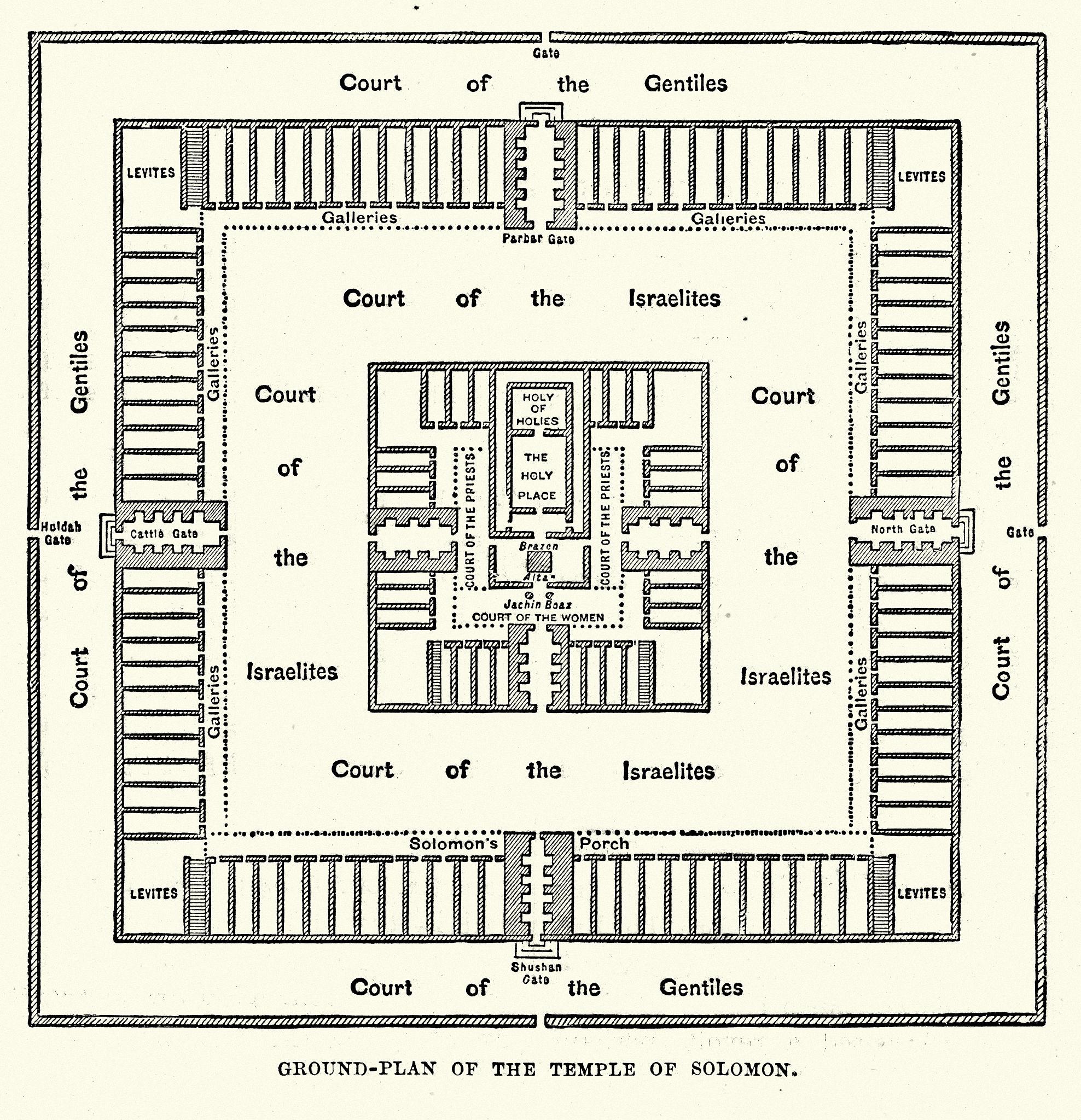
For he built altars (mizbeah; LXX - thusiasterion - structure on which cultic observances are carried out) for all the host (tsaba; LXX - dunamis - power) of heaven in the two courts of the house of the LORD - There are actually 3 courts in the diagram above. Presumably the altars were in the two inner courts. Manasseh’s sin was that he brazenly, foolishly brought idolatry into the Temple of the Lord. Unholy objects profaned the Holy God. Multiple altars in effect made Jehovah just one "god" among many others! So much for Manasseh's monotheism!
All the host (tsaba; LXX - dunamis - power) of heaven is not simple "star gazing" but refers to "idol gazing" at the celestial bodies, the sun, moon, stars, and planets, that many ancient peoples worshiped as gods or spiritual beings. In the ancient Near Eastern context, these hosts were often associated with pagan deities or spiritual powers believed to control the heavens. However, in biblical theology, these heavenly bodies are not divine; they are part of God’s creation, meant to declare His glory, not to receive worship. Psalm 19:1 affirms, “The heavens declare the glory of God, and the sky above proclaims his handiwork.”
Manasseh’s sin turned from worshiping the Creator to worshiping created things. This was a direct violation of the first and second commandments, which forbid having other gods and making idols (Ex 20:3–4). Dt 4:19 warned Israel not to “lift up your eyes to heaven, and when you see the sun and the moon and the stars, all the host of heaven, be drawn away and bow down to them and serve them.” Clearly Manasseh failed to read and/or keep the instructions written specifically to the kings in Dt 17:18-20. By building altars to the host of heaven within the temple courts, Manasseh desecrated the very place God had chosen for His name to dwell.
Manasseh and Judah lifted their eyes to the heavens for the wrong reason. Isaiah (a prophet in Manasseh's day) explained the proper way to "LOOK UP" writing “Lift up your eyes on high and see: who created these? He who brings out their host by number, calling them all by name.” (Isaiah 40:26) The stars and heavenly bodies are not dead gods to be worshiped but creations that testify to the power and majesty of the one true Living God.
One should also be aware that while the host of heaven in 2 Kings 21:5 primarily refers to the celestial bodies worshiped as gods, Scripture reveals that such worship is not spiritually neutral, but it is energized by demonic deception. The Septuagint’s use of dunamis (“powers”) opens a deeper theological dimension. In Greek, dunamis can refer not only to physical forces but also to spiritual beings, angelic or demonic powers. This aligns with the broader biblical worldview that behind idolatry there are real spiritual entities at work. Dt 32:17 clarifies that when Israel sacrificed to idols, they were in fact sacrificing “to demons that were no gods.” (cf 1Co 10:20). This understanding harmonizes with Ephesians 6:12+, which describes our struggle as being “not against flesh and blood, but against the rulers, against the powers, against the world forces of this darkness, against the spiritual forces of wickedness in the heavenly places." It follows that instead of worshiping the one, true, living God, Manasseh in effect introduced worship of demons!
Related Resources:
- Wikipedia article Worship of heavenly bodies - Excerpt - The worship of heavenly bodies is the veneration of stars (individually or together as the night sky), the planets, or other astronomical objects as deities, or the association of deities with heavenly bodies. In anthropological literature these systems of practice may be referred to as astral cults. The most notable instances of this are sun gods and moon gods in polytheistic systems worldwide. Also notable are the associations of the planets with deities in Sumerian religion, and hence in Babylonian, Greek and Roman religion, viz. Mercury, Venus, Mars, Jupiter, and Saturn. Gods, goddesses, and demons may also be considered personifications of astronomical phenomena such as lunar eclipses, planetary alignments, and apparent interactions of planetary bodies with stars. The Sabians of Harran, a poorly understood pagan religion that existed in Harran during the early Islamic period (7th–10th century), were known for their astral cult.
Altars (04196) mizbeah from zabach = to slaughter for sacrifice or for food) is a masculine noun that is frequent in the OT (338x) and describes the place of sacrifice where offerings were made to a deity. The first use in Ge 8:20 describes the altar built by Noah as his first act after he survived the flood. Abraham is associated with an altar in Ge 12:7,8; 13:4, 18; Ge 22:9. Not surprisingly the majority of OT occurrences are in Leviticus (88x in 72v and Exodus is not far behind - 61x in 53v). The first offering by Cain and Abel does not mention a specific altar (Ge 4:3).
From the earliest pages of Scripture, sacrifice stands at the center of humanity’s approach to God, expressing worship, covenant loyalty, atonement, and substitution: after the flood, Noah built an altar and offered clean animals in thankful worship (Gen. 8:20), Abraham marked God’s covenant promises by building altars at Shechem and elsewhere in the land (Gen. 12:7–8), and Isaac and Jacob likewise erected altars at Beersheba and Bethel to commemorate divine blessing and faithfulness (Gen. 26:25; 35:7). The near-sacrifice of Isaac on Mount Moriah, where a ram was provided in his place, vividly established the principle of substitutionary sacrifice (Gen. 22:9–13), a truth reinforced by the Passover lamb, whose death spared Israel’s firstborn (Exod. 12:27), and by covenant meals such as Jacob’s sacrifice when sealing his agreement with Laban (Gen. 31:54). When Israel formally entered covenant with the LORD at Mount Sinai, Moses built an altar and offered burnt and peace offerings, confirming that covenant relationship was ratified “by sacrifice” (Exod. 24:4–5; Ps. 50:5), and God then regulated sacrificial worship through the bronze altar of burnt offering in the tabernacle courtyard and the gold altar of incense in the holy place (Exod. 30:1–6; 38:1–2; 40:7), where blood, fire, and fragrance symbolized atonement, purification, and acceptable prayer (Lev. 4:7; 16:20–33). The altar’s consecration and cleansing were essential to Israel’s worship (Exod. 29:44; Lev. 8:11), a pattern continued and expanded in Solomon’s temple, described as “the house of sacrifice” (2 Chr. 7:12), though later kings either honored or dishonored God by their treatment of the altar—faithful rulers like Asa and Hezekiah restored and cleansed it (2 Chr. 15:8; 29:18), while Ahaz corrupted it with pagan imitation (2 Kgs. 16:14–15) and Uzziah violated its sanctity by usurping priestly authority (2 Chr. 26:16)—demonstrating throughout biblical history that sacrifice was not incidental but foundational to covenant faith, proper worship, and obedience before a holy God.
"In the developed temple ritual, the same word is used for both the altar of holocausts and the altar of incense. Thus, an altar is a place where sacrifice is offered, even if it is not an event involving slaughter." (Thomas W Davis)
The Septuagint (Lxx) often translates mizbeach with the word thusiasterion ("a place of sacrifice") which is derived from thusia meaning that which is offered as the sacrifice
Hosts (army/armies, war, service) (06635) tsaba from tsaba = to go forth to war, to wage war, to serve) is a masculine noun meaning troops or army (2Ki 5:1) and so has to do with war or warfare in many of the OT passages. The TWOT says the root verb tsaba "has to do with fighting, e.g. Israel warring against Midian (Nu 31:7). It has also a wider use in the sense of rendering service." And so in a group of uses in Numbers (Nu 4:3, 23, 30, 35, 39, 43, 8:24-25) tsaba has to do with service related to the Tent of Meeting (or Tabernacle). So one might say tsaba is used in contexts of warfare or worship!
The meaning of the first use of tsaba in Genesis 2:1 is (in my opinion) controversial (and similar uses - Ps 33:6; Isa 40:26; Neh 9:6), some (probably most like the TWOT) favoring reference to the celestial bodies but others favoring angelic armies - "Thus the heavens and the earth were completed, and all their hosts." The Lxx translates tsaba with the Greek word kosmos which I do not think is never used of angelic beings. Regardless, it is fair to say that one cannot make a dogmatic distinction. The next 3 uses in Genesis are very clearly speaking of military units or armies of men (Ge 21:22, 32, 26:26). In Dt 17:3 tsaba refers to the worship of creation, presumably the stars (Dt 17:3NIV = stars; Dt 17:3NET = "heavenly bodies").
New Manners and Customs on Astral Worship - Astral worship was common in the Middle East at that time, and was forbidden by God. In the last part of our text-verse, God clearly tells His people that He created the stars for the benefit of all the earth, and not as a means to determine a person’s destiny or as a power controlling that destiny. Astral worship is the most ancient and widely spread form of idolatry, and frequent allusions are made to it in the Scriptures. Some believe that many of the precepts in the Mosaic law were directed against astral worship in its various corrupt forms. Our text-verse is an illustration of this. Besides direct reference to this superstition in this and in other passages, occasional allusion to it may be found elsewhere. The expression “host of heaven” refers to the sun, moon, and stars, as so designated in Genesis 2:1—“Thus the heavens and the earth were finished, and all the host of them”. When the Jews fell into idolatry they worshiped these, and in conjunction often worshiped Baal: “And they left all the commandments of the LORD their God, and made them molten images, even two calves, and made a grove, and worshipped all the host of heaven, and served Baal” (2 Kings 17:16, KJV—see also verse 21:3).
Walton - astral worship in the ancient Near East. The celestial gods (sun god, moon god and Venus particularly; in Babylonia, Shamash, Sin and Ishtar respectively) were primary in most ancient religions. Controlling calendar and time, seasons and weather, they were viewed as the most powerful of the gods. They provided signs by which omens were read, and they looked down on all. Yahweh has now warned the Israelites against fertility worship (Deut. 4:3), magic and manipulation (idolatry, Deut. 4:16–18), and omens and linking deities to cosmic phenomena (Deut. 4:19), all the major characteristics of the pagan polytheism of the ancient world. (Note on Dt 4)
The worship of the celestial bodies (sun, moon, planets, stars) was common throughout the ancient Near East. One of the principal gods of Assyria and Babylonia was a sun god (Shamash), and a moon god (Thoth in Egypt; Sin in Mesopotamia; Yarah in Canaanite religion) was widely worshiped. During most of their history the Israelites would have been familiar with and heavily influenced by Assyrian culture and religion (see Deut. 4:19; 2 Kings 21:1–7; 2 Kings 23:4–5). These forbidden practices continued to be a source of condemnation during the Neo-Babylonian period, as Israelites burned incense on altars placed on the roofs of their houses to the “starry hosts” (Jeremiah 19:13). Because worship of the elements of nature diminished Yahweh’s position as the sole power in creation, they were outlawed. However, the popular nature of this type of worship continues to appear in prophetic literature and in Job (see Job 31:26–28; Job 38:7). For additional information see comment on •Deut. 4. (Note on Dt 17:3)
2 Chronicles 33:6 He made his sons pass through the fire in the valley of Ben-hinnom; and he practiced witchcraft, used divination, practiced sorcery and dealt with mediums and spiritists. He did much evil in the sight of the LORD, provoking Him to anger.
- caused: 2Ch 28:3 Lev 18:21 20:2 De 12:31 18:10 2Ki 21:6 23:10 Jer 7:31,32 Eze 23:37,39
- he observed: Lev 19:26 20:6 De 18:10-14 1Sa 15:23 2Ki 17:17 Isa 47:9-12 Ga 5:20
- dealt: 2Ki 21:6 23:24 1Ch 10:13 Isa 8:19 19:3
Parallel Passage:
2 Kings 21:6 He made his son pass through the fire, practiced witchcraft and used divination, and dealt with mediums and spiritists. He did much evil in the sight of the LORD provoking Him to anger.
2 Chronicles 33:6 He made his sons pass through the fire in the valley of Ben-hinnom; and he practiced witchcraft, used divination, practiced sorcery and dealt with mediums and spiritists. He did much evil in the sight of the LORD, provoking Him to anger.
Leviticus 18:21 ‘You shall not give any of your offspring to offer them to Molech, nor shall you profane the name of your God; I am the LORD.
Leviticus 20:2 “You shall also say to the sons of Israel: ‘Any man from the sons of Israel or from the aliens sojourning in Israel who gives any of his offspring to Molech, shall surely be put to death; the people of the land shall stone him with stones.
2 Kings 16:3 But he walked in the way of the kings of Israel, and even made his son pass through the fire, according to the abominations of the nations whom the LORD had driven out from before the sons of Israel.
2 Kings 17:17 Then they made their sons and their daughters pass through the fire, and practiced divination and enchantments, and sold themselves to do evil in the sight of the LORD, provoking Him.
1 Chronicles 10:13 So Saul died for his trespass which he committed against the LORD, because of the word of the LORD which he did not keep; and also because he asked counsel of a medium, making inquiry of it,
Isaiah 8:19 When they say to you, “Consult the mediums and the spiritists who whisper and mutter,” should not a people consult their God? Should they consult the dead on behalf of the living?
Isaiah 19:3 “Then the spirit of the Egyptians will be demoralized within them; And I will confound their strategy, So that they will resort to idols and ghosts of the dead And to mediums and spiritists.
Leviticus 19:26 ‘You shall not eat anything with the blood, nor practice divination or soothsaying.
Deuteronomy 18:10 “There shall not be found among you anyone who makes his son or his daughter pass through the fire, one who uses divination, one who practices witchcraft, or one who interprets omens, or a sorcerer,
MANASSEH'S HORRIBLE SINS LIST OF
PROVOKE GOD'S ANGER
He made his sons pass through the fire in the valley of Ben-hinnom Manasseh, despite his godly father, Hezekiah, soon took up the abominable practices of his grandfather Ahaz and the kings of Israel (2Ki16:3; 17:17). His father died when he was only 12 years old (2Ki 22:1) and may have devoted little time to Manasseh's religious instruction. Nothing is known about his mother except her name, which means "My delight is in her."
Practiced witchcraft (ʿānan) and used divination (nachash), practiced sorcery (kashaph) and dealt with mediums (ob/ov) and spiritists (yiddeoni) - Here's a case where "practice" does not make perfect but has just the opposite effect. When Manasseh practiced witchcraft, divination, and consulted mediums and spiritists, he was not merely engaging in forbidden rituals but was aligning himself and his nation with demonic powers in direct defiance of God’s revealed will. This passage reveals the depth of his rebellion against God and his complete embrace of occult practices all of which God had explicitly forbidden. Each of these terms refers to attempts to access supernatural knowledge or power apart from God, often by invoking demonic forces.
Divination (nachash) is translated with a Greek word not found in the NT, oionizomai meaning to take omens from the flight and cries of birds, generally, to divine from omens, augure.
Sorcery (kashaph) is translated with a Greek word not found in the NT, pharmakeuo meaning to administer a drug, to use enchantments, to make potions, practice magic. It is related to the NT word pharmakeia/
In the Law of Moses, such practices were strictly prohibited because they represented a direct rejection of God’s authority and a turning toward the powers of darkness. Deuteronomy 18:10–12 states,
There shall not be found among you anyone who makes his son or his daughter pass through the fire, one who uses divination, one who practices witchcraft, or one who interprets omens, or a sorcerer, 11 or one who casts a spell, or a medium, or a spiritist, or one who calls up the dead. 12 “For whoever does these things is detestable to the LORD; and because of these detestable things the LORD your God will drive them out before you.
These practices were not merely superstitious; they were spiritual acts of rebellion that sought guidance and power from sources other than the living God. As noted earlier, Manasseh failed to read and/or obey Dt 17:18-20.
Now it shall come about when he sits on the throne of his kingdom, he shall write for himself a copy of this law on a scroll in the presence of the Levitical priests. 19 “It shall be with him and he shall read it all the days of his life, that he may learn to fear the LORD his God, by carefully observing all the words of this law and these statutes, 20 that his heart may not be lifted up above his countrymen and that he may not turn aside from the commandment, to the right or the left, so that he and his sons may continue long in his kingdom in the midst of Israel.
To practice witchcraft refers to using spells, charms, or rituals to manipulate spiritual forces. Divination involves attempting to predict the future or uncover hidden knowledge through omens, objects, or supernatural means. Mediums and spiritists were individuals who claimed to communicate with the dead or with spirits to gain insight or power. In reality, these practices opened people to demonic influence, as seen in the story of Saul consulting the medium at Endor in 1 Samuel 28:7-21, which led to his downfall.
He did much evil in the sight of the LORD, provoking Him to anger (kāas; LXX - parorgizo) - What a way to summarize the moral and spiritual depravity of King Manasseh’s reign. Not just did he do evil which would have been bad enough, but the writer says he did MUCH evil and he did this cornucopia of evil in FULL VIEW of God's holy vision! Manasseh's evil actions were not merely wrong by human standards but were offensive to the holy and righteous character of God, Who sees all things. Proverbs 15:3 reminds us "The eyes of the LORD are in every place, Watching the EVIL and the good."
Manasseh’s MUCH EVIL was of course personal sin but personal sin especially by a king had public consequences. Sin never stays private, which is a good reminder to ALL of us! (Nu 32:23). Manasseh's MUCH EVIL was not accidental, isolated, or momentary, but instead organized, and intentionally carried out over time. His MUCH EVIL was carried out willfully, knowingly, and with evil purpose and persistence, underscoring the culpability and gravity of his deeds. His evil acts were not only violations of God’s law but also direct rejections of His covenant love and faithfulness.
Spurgeon - Perhaps he gave some of them actually to be burned in honour of his false gods; or if not some of his children were made to pass through the fire and were thus dedicated to the idol deities.
Spurgeon - All which is imitated, nowadays, by certain persons who try to break through the vail which parts us from the spiritual world. Manasseh did this on a large scale.
Morris - This valley had been so identified since at least the time of Joshua (Joshua 15:8), and it is probable that the original "son of Hinnom" was a Jebusite who offered his valley for the pagan sacrificial rituals of the Canaanites (see note on 2 Chronicles 28:3). wrought much evil. Manasseh departed so far from the godly practices of his father, entering deeply into every form of Satanic doctrine and practice and leading his people to participate in them (even "worse than the heathen" 2 Chronicles 33:9), that the only divine remedy was eventual judgment and exile (2 Kings 21:12-16).
Spurgeon - You cannot imagine, I think, a worse character than this Manasseh was. He seems to have raked the foulest kennels of superstition to find all manner of abominations. Like false-hearted Saul, he had dealings with a familiar spirit, he had entered into a covenant with Satan himself, and made a league with hell, and yet, marvel of grace! this very Manasseh was saved, and is now singing the new song before the throne of God in glory.
The phrase provoking Him to anger (kāas; LXX - parorgizo) does not mean that God’s anger is impulsive or uncontrolled like human anger. Rather, it expresses His righteous and holy indignation and response to sin and rebellion, and in this case to MUCH EVIL. God’s anger is the expression of His justice and His deep opposition to all that destroys His creation and defiles His holy Name. Psalm 7:11 declares, “God is a righteous judge, and a God who feels indignation every day.”
Witchcraft (06049) ʿānan A verb meaning to practice soothsaying, fortune-telling, divining, magic. While it is clear from the contexts and the versions that this term is used for some type of magic or witchcraft, its etymology is unclear. Therefore, the specifics of the practice it connotes are equally unclear. However, it is clear that it was strictly forbidden, and the one who practiced this act was detestable to God (Deut. 18:10, 12). Isaiah appears to use the term figuratively to demean the idolatrous Israelites (Isa. 57:3). (Word Study OT) Swanson adds "practice sorcery, practice divination, i.e., the foretelling of future events by means of magic or casting spells, with possibly a focus of conjuring dead human or supernatural spirits to appear before the living." The remaining nine occurrences describe an act of magic or the performers of the act. They are found in passages of warning (Lev. 19:26; Deut. 18:10) and judgment (Isa. 2:6; 57:3). Yahweh warned his people to separate themselves from the practices of the nations around them because sorcerers and sorcery would lead his people to disobey Him (Jer. 27:9). Indeed, Manasseh is described as doing "much evil in the sight of the Lord, provoking him to anger" (2 Ki. 21:6, NRSV) because of his reliance on soothsaying. Micah prophecied about a day when no more sorcerers could trouble God's people. On that day, God will destroy the heathen and the heathen practices (Mic. 5:11-15). (Complete Biblical Library)
What does the Bible say about witchcraft / witches? - GotQuestions.org WATCH VIDEO
ANSWER - The Bible has a lot to say about witchcraft. Witchcraft and its many cousins, such as fortune-telling and necromancy, are Satan’s counterfeits to holy spirituality. The Bible expressly condemns all forms of witchcraft.
Since early times, people have sought supernatural experiences God did not endorse. The nations that surrounded the Promised Land were saturated with such practices, and God had stern words for His people concerning any involvement with them. Deuteronomy 18:9–12 says, “When you enter the land the Lord your God is giving you, do not learn to imitate the detestable ways of the nations there. Let no one be found among you who sacrifices their son or daughter in the fire, who practices divination or sorcery, interprets omens, engages in witchcraft, or casts spells, or who is a medium or spiritist or who consults the dead. Anyone who does these things is detestable to the Lord.”
God takes witchcraft very seriously. The penalty for practicing witchcraft under the Mosaic Law was death (Exodus 22:18; Leviticus 20:27). First Chronicles 10:13 tells us that “Saul died because he was unfaithful to the Lord; he did not keep the word of the Lord and even consulted a medium for guidance.” In the New Testament, “sorcery” is translated from the Greek word pharmakeia, from which we get our word pharmacy (Galatians 5:20; Revelation 18:23). Witchcraft and spiritism often involve the ritualistic use of magic potions and mind-controlling drugs. Using illicit drugs can open ourselves up to the invasion of demonic spirits. Engaging in a practice or taking a substance to achieve an altered state of consciousness is a form of witchcraft.
There are only two sources of spiritual power: God and Satan. Satan has only the power that God allows him to have, but it is considerable (Job 1:12; 2 Corinthians 4:4; Revelation 20:2). To seek spirituality, knowledge, or power apart from God is idolatry, closely related to witchcraft. First Samuel 15:23 says, “For rebellion is as the sin of witchcraft, and stubbornness is as iniquity and idolatry.” Witchcraft is Satan’s realm, and he excels in counterfeiting what God does. When Moses performed miracles before Pharaoh, the magicians did the same things through demonic power (Exodus 8:7). At the heart of witchcraft is the desire to know the future and control events that are not ours to control. Those abilities belong only to the Lord. This desire has its roots in Satan’s first temptation to Eve: “You can be like God” (Genesis 3:5).
Since the Garden of Eden, Satan’s major focus has been to divert human hearts away from worship of the true God (Genesis 3:1). He entices humans with the suggestions of power, self-realization, and spiritual enlightenment apart from submission to the Lord God. Witchcraft is merely another branch of that enticement. To become involved in witchcraft in any way is to enter Satan’s realm. Seemingly “harmless” modern entanglements with witchcraft can include horoscopes, Ouija boards, Eastern meditation rituals, and some video and role-playing games. Any practice that dabbles in a power source other than the Lord Jesus Christ is witchcraft. Revelation 22:15 includes witches in a list of those who will not inherit eternal life: “Outside are the dogs, those who practice magic arts, the sexually immoral, the murderers, the idolaters and everyone who loves and practices falsehood.”
We don’t need to fear Satan’s power, but we should acknowledge it and stay away from it. First John 4:4 says, “Greater is He who is in you, than he who is in the world.” Satan can create much havoc, harm, and destruction, even in the lives of believers (1 Thessalonians 2:18; Job 1:12–18; 1 Corinthians 5:5). However, if we belong to the Lord Jesus Christ, there is no power that can ultimately defeat us (Isaiah 54:17). We are overcomers (1 John 5:4) as we “put on the whole armor of God so that you can take your stand against the devil’s schemes” (Ephesians 6:11). When we give our lives to Christ, we must repent. This repentance should include renouncing any involvement with witchcraft, following the example of the early believers in Acts 19:19.
Isaiah 8:19 says, “When someone tells you to consult mediums and spiritists, who whisper and mutter, should not a people inquire of their God? Why consult the dead on behalf of the living?” When we follow those words to their logical conclusion, we could also ask, “Why seek any power apart from the source of all real power? Why seek spirits who are not the Holy Spirit?” Witchcraft and its many counterparts promise spirituality but lead only to emptiness and death (Micah 5:12; Galatians 5:19–21). Only Jesus has the words of life (John 6:68).
Sorcery (03784) kashaph means to practice sorcery or magic. While the exact meaning of the word is obscure, it involved the use of supernatural powers that hardened hearts against the truth (Ex. 7:11). Those in Israel who used such powers were to be executed (Ex. 22:18). Judgment is promised against sorcerers when the Messiah returns (Mal. 3:5). "Sorcery is a religious act, as communication from the gods is sought. Further, sorcery is often associated with divination and with extispicy (reading various entrails of animals), a prime mode of divination. Extispicy requires cutting open the animal. Kāshaph occurs only in the Piel form, and five of its occurrences are substantive participles. The only finite verb form occurs in 2 Chr. 33:6, where Manasseh is accused of committing numerous sins, one of which is practicing sorcery. Otherwise, kāshaph occurs as a participle meaning "one who practices sorcery" or "sorcerer." The men or advisers that Pharaoh summoned to compete against Aaron were called sorcerers (Exo. 7:11). A similar arrangement is found later in Babylon when king Nebuchadnezzar summoned sorcerers along with magicians to interpret his dream (Da. 2:2). In the end, only God's servant, Daniel (like Joseph), was able to provide the king with the proper interpretation (cf. Da 2:14-45). Sorcerers were not to be allowed in Israel, and God's judgment would be against them. The command in Exo. 22:18 is, "You shall not allow a sorceress to live [in Israel]," is once again delivered to the Israelites in Mal. 3:5 (cf. Deut. 18:10). In fact, many of the commands of Mal. 3:5 reflect the commands of Exo. 22:18-24 (e.g., commands not to oppress the widow, the orphan or the alien). This intertextuality validates the Lord's claim in 3:6, "For I, the Lord, do not change." (Complete Biblical Library)
Kashaph - practiced sorcery(1), sorcerer(1), sorcerers(3), sorceress(1). Exod. 7:11; Exod. 22:18; Deut. 18:10; 2 Chr. 33:6; Dan. 2:2; Mal. 3:5
Divination (05172) nachash not to be confused with Hebrew word for serpent nachash = "Because of the similarity of nacḥash to nācḥāsh meaning "snake," some make a connection to snake charming. More contend that there is a similarity of hissing sounds between enchanters and serpents and hence the similarity of words." - TWOT) means to practice divination, observe signs and is only in the Piel intensive stem. First use of Laban to Jacob " I have divined that the LORD has blessed me on your account.” (Ge 30:27). "Both in Genesis 44:5, 15 the doubly intensive form (infinitive absolute plus finite verb) occurs. There we learn that Joseph claimed for his brothers' benefit that he could "divine" with a special cup and so knew secret things such as that his brothers, still unaware of who he was, had his cup in their possession. But divination is outlawed in Leviticus 19:26 and is spoken of with condemnation in 2 Kings 17:17 and 2 Kings 21:6 (cf. 2 Chron. 33:6). It is in the list of forbidden occult practices of Deut. 18:10. (TWOT)
Gilbrant - The practice of divination was widespread throughout the ancient Near East. Omens were taken before attempting a wide variety of significant events, such as engaging in warfare or building projects. Further, omens were used at Mari as a check against individuals who made claims that a god was communicating through them. Omens stem from observation of the natural world with the assumption that anything which deviates from the natural order does so under the influence of the divine realm as a means of communication. Unusual events in the political order could be tied to unusual events in the natural order, the subject of omens. An unusual sheep liver, discovered in the course of ritual sacrifice, was understood by the peoples surrounding the Israelites as the announcement of a coming event. There existed long lists of the significance of particular omens in Akkadian literature, and a number of liver models (for learning divination) have been discovered throughout Mesopotamia and Syria-Palestine. Though an integral part of other ancient societies, the practice was banned among the ancient Israelites, who were to communicate legitimately with God through prayer and prophetic utterances (Lev. 19:26; Deut. 18:10). One of the causes for the captivity of the northern tribes was the practice of divination (2 Ki. 17:17). Among his many other occultic practices, King Manasseh likewise was guilty of practicing divination (2 Ki. 21:6; 2 Chr. 33:6). Laban divined that the Lord had blessed him because of Jacob (Gen. 30:27). Joseph gave the impression that he practiced divination with the cup he had hid in Benjamin's saddlebag (Gen. 44:5, 15). When king Ahab defeated the Syrian army, the officers of Ben-Hadad, the king of Syria, carefully watched Ahab for an omen of mercy (1 Ki. 20:33) and interpreted Ahab's use of the term "brother" as a good sign; on the basis of this sign, they negotiated a favorable peace treaty with Ahab. (Complete Biblical Library)
What does the Bible say about divination? - GotQuestions.org - The word divination comes from the Latin divinare, meaning “to foresee” or “to be inspired by a god.” To practice divination is to uncover hidden knowledge by supernatural means. It is associated with the occult and involves fortune-telling or soothsaying, as it used to be called.
From ancient times, people have used divination to gain knowledge of the future or as a way to make money. The practice continues as those who claim supernatural insight read palms, tea leaves, tarot cards, star charts, and more.
God tells us His view of divination in Deuteronomy 18:10: “There shall not be found among you . . . anyone who practices divination or tells fortunes or interprets omens” (ESV). First Samuel 15:23 compares rebellion to the “sin of divination.”
Practicing divination is listed as one of the reasons for Israel’s exile (2 Kings 17:17). Jeremiah 14:14 spoke of the false prophets of the time, saying, “They are prophesying to you a lying vision, worthless divination, and the deceit of their own minds” (ESV). So, compared to God’s truth, divination is false, deceitful, and worthless.
As Luke traveled with Paul and Silas in the city of Philippi, he recorded an encounter with a diviner: “We were met by a slave girl who had a spirit of divination and brought her owners much gain by fortune-telling” (Acts 16:16, ESV). The girl’s ability to penetrate mysteries was due to a demon that controlled her. Her masters received “much gain” from their slave. Paul eventually exorcised the demon (verse 18), freeing the girl from her spiritual bondage and angering the slave owners (verse 19).
Divination in any form is sin. It is not harmless entertainment or an alternate source of wisdom. Christians should avoid any practice related to divination, including fortune-telling, astrology, witchcraft, tarot cards, necromancy, and spell-casting. The spirit world is real, but it is not innocent. According to Scripture, those spirits that are not the Holy Spirit or angels are evil spirits.
Christians need not fear the spirits involved in divination; neither are Christians to seek wisdom from them. The Christian’s wisdom comes from God (James 1:5).
DIVINATION SUMMARY FROM BIBLE DICTIONARIES - Divination in Scripture is the deliberate attempt to obtain hidden knowledge—especially concerning the future or secret matters—through means God has expressly forbidden, and it is consistently associated with false religion, idolatry, and rebellion against divine authority. Moses warned Israel that divination, sorcery, necromancy, and consultation with spirits were practices of the pagan nations and therefore “detestable to the LORD” (Deuteronomy 18:9–12). Throughout the Old Testament, divination appears among false prophets (Deuteronomy 18:10, 14; Micah 3:6–7, 11), necromancers (1 Samuel 28:8), Philistine diviners (1 Samuel 6:2), and figures such as Balaam, whose divinatory vocation is explicitly named even while God sovereignly overruled his intentions (Joshua 13:22). Ezekiel catalogues specific techniques—divining by arrows, consulting teraphim, and examining animal entrails—showing how widespread and systematized these practices were in the ancient world (Ezekiel 21:21). Israel’s later history reveals how deeply these superstitions infiltrated the nation, especially through foreign influence from Egypt, Canaan, Chaldea, and Arabia (Isaiah 2:6; 8:19; 2 Kings 21:6; 2 Chronicles 33:6), culminating in a culture where occult practitioners multiplied and deception flourished (Acts 19:13; 2 Timothy 3:13).
The fundamental assumption behind divination is theological: that supernatural knowledge can be accessed apart from submission to the living God. Scripture exposes this as both spiritually deceptive and morally corrosive. Moses forbade every form of divination because it fostered superstition, undermined trust in God, and functioned as an incentive to idolatry (Deuteronomy 18:10–11). This is why rebellion itself is likened to divination—both assert human autonomy over divine rule (1 Samuel 15:23). False divination often masquerades as wisdom or enlightenment, yet the prophets condemn it as empty fraud: “Your prophets have seen for you false and deceptive visions” (Lamentations 2:14; cf. Jeremiah 23:16, 32). By the time of the apostles, divination had become a lucrative enterprise amid widespread skepticism, producing figures such as Simon Magus (Acts 8:9), Bar-Jesus (Acts 13:6–8), and the slave girl with a spirit of divination (Acts 16:16), all of whom exemplify how occult power enslaves rather than enlightens. Scripture is unambiguous: those who persist in such practices place themselves under divine judgment (Galatians 5:19–21; Revelation 19:20).
Yet the Bible carefully distinguishes illicit divination from God’s own sovereign revelation. When God chose to disclose His will, He did so by means He Himself appointed, never as techniques to be manipulated. At times this included casting lots in solemn dependence upon Him (Joshua 7:16–19; Numbers 26:55–56; Acts 1:26), revelatory dreams given by divine initiative (Genesis 41:25–32; Judges 7:13–15; Daniel 2:27; Matthew 2:12), priestly inquiry through the Urim and Thummim (Numbers 27:21), and direct communication from the Lord’s presence (Exodus 25:22; Deuteronomy 34:10). Supremely, God revealed His will through His prophets, who spoke not for profit or manipulation, but under divine commission, often at great personal cost (2 Kings 13:17; Jeremiah 51:63–64).
The contrast is decisive: divination seeks knowledge without obedience, power without submission, and certainty without faith, whereas biblical revelation calls God’s people to trust the Lord alone, receive His word on His terms, and walk humbly before Him as the sole source of truth and life.
Mediums (0178) ob/ov means a bottle (made from animal skin), a necromancer. "masculine noun meaning a conjured spirit, a medium or necromancer; or a leather bottle. The primary use of the word is connected to the occult practice of necromancy or consulting the dead. It is used to signify a conjurer who professes to call up the dead by means of magic, especially to give revelation about future uncertainties (1 Sam. 28:7; Isa. 8:19); a man or woman who has a familiar spirit (Lev. 20:27; 1 Chr. 10:13; Isa. 29:4); the conjured spirit itself, particularly when speaking through the medium (1 Sam. 28:8; 2 Kgs 21:6; 2 Chr. 33:6). The Israelites were strictly forbidden from engaging in such practices or consulting mediums (Lev. 19:31; Deut. 18:10-12). Interestingly, the word is used once to signify a leather bottle that may burst under pressure (Job 32:19). There is no convincing evidence that this particular reference has any occult connotations. Rather, the connection between the two divergent meanings of this Hebrew word is probably that a medium was seen as a "container" for a conjured spirit." (Baker)
Gilbrant - This word is translated "spirit of the dead" or "necromancer." It occurs 17 times in the Hebrew Bible. Eleven of these times it occurs in conjunction with the noun yiddeʾōnî, and is commonly translated as "wizard" or "soothsayer." The precise meaning and function of the latter term is not certain. Since the former is feminine and the latter is masculine, many assume that the two are gender determined labels for the same role. In the OT, ʾôv can refer to the spirit of a dead person (1 Sam. 28:8; Isa. 29:4; 1 Sam. 28:8). A medium can possess a spirit (Lev. 20:27; 1 Sam. 28:7). Generally, an ʾôv is simply a medium (e.g., Lev. 19:31; 20:6; 1 Sam. 28:3). The practice of necromancy is prohibited by Mosaic Law, subject to the death penalty (Lev. 20:27; Deut. 18:11). Saul prohibits necromancy under the penalty of death, though he employs it himself in hopes of uncovering what the future holds (1 Samuel 28). To the surprise of the medium, Saul does encounter the ʾôv of Samuel, who brings a curse from Yahweh. (Complete Biblical Library)
OB/OV - 15V - Lev. 19:31; Lev. 20:6; Lev. 20:27; Deut. 18:11; 1 Sam. 28:3; 1 Sam. 28:7; 1 Sam. 28:9; 2 Ki. 21:6; 2 Ki. 23:24; 1 Chr. 10:13; 2 Chr. 33:6; Job 32:19; Isa. 8:19; Isa. 19:3; Isa. 29:4
What is a medium? - GotQuestions.org In both modern and ancient times, a medium is a person who communicates with spirits, usually apart from the use of witchcraft. A medium is, literally, an “intermediary” between the spirit world and ours. The Bible condemns the practice of mediumship, and attempting to speak to the dead, through séances or other means, is expressly forbidden.
Sometimes mediums are called “channelers,” as they allegedly “channel” communication from the dead to the living. A medium might only communicate with one or more specific spirits (called “familiars” or “familiar spirits”), or the communication may be spread across many different spirits. The messages may come audibly, visually, or through physical sensations. Modern mediums distinguish themselves from psychics, who only read the “energies” of a person or place and do not communicate with actual spirits. (The term “psychic medium” can confuse the issue.) Also, a medium is not necessarily a witch, wizard, sorcerer, or necromancer, since mediums believe that their communication with the spirit world is an inherent ability. The fictional character Cole Sear in the movie The Sixth Sense would be considered a medium.
Mediums are referenced in several passages of the Old Testament. In Leviticus 20:27 mediums are condemned along with “spiritists.” Deuteronomy 18:10–11 echoes Leviticus and expands it, including diviners, sorcerers, witches/wizards, anyone who casts spells, and anyone who practices child sacrifice.
King Saul’s sinful use of a medium is recorded in 1 Samuel 28. The prophet Samuel was dead, and King Saul was frustrated that God had ceased telling him what to do through prophets or dreams. So the king, in direct violation of God’s Law and his own previous command, told his men to find a medium who could communicate with Samuel (1 Samuel 28:3). This medium conjured Samuel, and Saul communicated with the dead prophet. Theologians discuss whether this conjuring was a physical reappearance of Samuel or merely an image of him. There is also some question whether or not the medium actually meant to conjure Samuel, as she seems to have been the most surprised at his appearance—“When the woman saw Samuel, she cried out at the top of her voice” (verse 12). Perhaps she was a fraud who did not expect to actually see a spirit, or perhaps she was expecting to communicate with her “familiar” and not with Samuel directly. Either way, God seems to have allowed Samuel’s conjuring in order to drive home His point to Saul. The prophet’s message to Saul was one of doom (verses 17–19), and he died the next day. First Chronicles 10:13–14 reveals that Saul’s interaction with the medium was an important part of why he was dethroned and his dynasty cut short.
In the New Testament, sorcery and other associated practices are considered inappropriate, sinful activities for any Christian (Acts 8:9ff and 19:19). Since the primary purpose of these activities is to communicate with spirits, it is correct to include mediumship in these New Testament warnings.
It should be noted that the spirit a medium conjures is not the spirit of a deceased person (the case of Samuel speaking to Saul was a rare exception). Jesus’ story of the rich man and Lazarus in Luke 16:18–31 gives strong evidence that, once a person is dead, his soul remains in either heaven or hell. Thus, the spirits who communicate with mediums are lying spirits (see 1 Kings 22:23) who deceive people into believing their lost loved ones are communicating to them. When grieving parents seek out a medium to put them in touch with their dead child, they don’t realize the spirit who speaks to them is actually a demon pretending to be their child. Any involvement with such practices, including asking mediums for guidance, is strongly warned against in the Bible.
Related Resources from Gotquestions.org
- What are Ouija boards? Should a Christian play with Ouija boards?
- What is a séance?
- What does the Bible say about an out of body experience / astral projection?
- What does the Bible say about channeling?
- What are familiar spirits? - GotQuestions.org
- What does the Bible say about palm reading?
- What is the Christian view of psychics / fortune tellers?
Spiritists (03049)(yiddeoni from yada = to know) is noun which refers to one who knows and communicates with the unseen world. "A masculine noun meaning a familiar spirit, a conjurer, and a wizard. In Levitical Law, this type of person was considered an abomination to the Lord (Deut. 18:11). King Saul consulted such a medium when he desired to know the outcome of his war against the Philistines (1 Sam. 28:9). King Manasseh's evil deeds included the practice of consulting mediums and wizards (2 Ki. 21:6). Isaiah condemned the people of Israel for turning to the way of the Canaanites, who sought out mediums and wizards in order to hear from their dead (Isa. 8:19)." (Baker)
TWOT - yidde‘ōnî. Since the root of yidde‘ōnî is the verb yādaʿ "to know," implied in the title, therefore, is esoteric knowledge not available to the ordinary person. yidde‘ōnî always occurs parallel to ʾôb (witch, q.v.). It may be a description of an ʾôb or it may be the masculine counterpart. (Similarly, "witch" and "wizard" are a feminine and masculine pair in English.) As the Hebrew word yidde‘ōnî is related to knowledge, so the English word "wizard" is related to wisdom. God forbad his people to consult the yidde‘ōnī (Leviticus 19:31; Leviticus 20:6, 27; Deut. 18:11) as well as other diviners. Despite the fact that Saul outlawed them, he still consulted an ʾôb "spirit" according to 1 Samuel 28. How the Israelite kings dealt with these spiritists was a significant factor in characterizing the king as good or evil (2 Kings 21:6; 2 Kings 23:24; 2 Chron. 33:6). Isaiah spoke of them with utter scorn (Isaiah 8:19; Isaiah 19:3). (Theological Wordbook of the Old Testament - TWOT ONLINE)
Provoking to anger (03707) kāas is a verb meaning to vex, agitate, stir up, provoke the heart to a "heated" condition which results in actions. To be angry, vexed, be incensed, to be in a state of strong displeasure, to provoke to anger. The causative sense of the verb occurs ost often and frequently signifies idolatry provoking God to anger (cf. 1 Kgs. 14:9; Ps. 106:29; Ezek. 8:17). The result of provocation may be expressed as ʾap̱, anger (639) (Deut. 9:18; 2 Kgs. 23:26; Jer. 7:20). In a noncausative sense, the verb means to be angry; people were warned not to become angry hastily (Eccl. 7:9); God says that after He punishes, He will not be angry (Ezek. 16:42). Three times it refers to the people’s anger directed toward righteousness (2 Chr. 16:10; Neh. 4:1[3:33]; Ps. 112:10).
HINNOM, VALLEY OF [ISBE] - hin'-om (ge hinnom, Josh 15:8; 18:16; "valley of the son of Hinnom" (ge bhen hinnom), Josh 15:8; 18:16; 2 Ch 28:3; 33:6; Jer 7:31 f; 19:2,6; 32:35; "valley of the children (sons) of Hinnom" (ge bhene hinnom), 2 Ki 23:10; or simply "the valley," literally, the "hollow" or "ravine" (ha-gay'), 2 Ch 26:9; Neh 2:13,15; 3:13; Jer 31:40 and, perhaps also, Jer 2:23 (the above references are in the Hebrew text; there are some variations in the Septuagint)): The meaning of "Hinnom" is unknown; the expressions ben Hinnom and bene Hinnom would suggest that it is a proper name; in Jer 7:32; 19:6 it is altered by the prophet to "valley of slaughter," and therefore some have thought the original name must have had a pleasing meaning.
1. Bible References and History:
It was near the walls of Jerusalem, "by the entry of the gate Harsith" (Jer 19:2); the Valley Gate opened into it (Neh 2:13; 3:13). The boundary between Judah and Benjamin ran along it (Josh 15:8; 18:16). It was the scene of idolatrous practices in the days of Ahaz (2 Ch 28:3) and of Manasseh, who "made his children to pass through the fire in the valley of the son of Hinnom" (2 Ch 33:6), but Josiah in the course of his reforms "defiled Topheth, which is in the valley of the children (margin "son") of Hinnom, that no man might make his son or his daughter to pass through the fire to Molech" (2 Ki 23:10). It was on account of these evil practices that Jeremiah (7:32; 19:6) announced the change of name. Into this valley dead bodies were probably cast to be consumed by the dogs, as is done in the Wady er-Rababi today, and fires were here kept burning to consume the rubbish of the city. Such associations led to the Ge-Hinnom (New Testament "Gehenna") becoming the "type of Hell" (Milton, Paradise Lost, i, 405).
- See GEHENNA.
2. Situation:
The Valley of Hinnom has been located by different writers in each of the three great valleys of Jerusalem. In favor of the eastern or Kidron valley we have the facts that Eusebius and Jerome (Onom) place "Gehennom" under the eastern wall of Jerusalem and the Moslem geographical writers, Muqaddasi and Nasir-i-khusran, call the Kidron valley Wady Jahamum. The Jewish writer Kimchi also identifies the Valley of Jehoshaphat (i.e. the Kidron) with Hinnom. These ideas are probably due to the identification of the eastern valley, on account of its propinquity to the Temple, as the scene of the last judgment--the "Valley of Jehoshaphat" of Joel 3:2--and the consequent transference there of the scene of the punishment of the wicked, Gehenna, after the ancient geographical position of the Valley of Hinnom, had long been lost. In selecting sacred sites, from the 4th Christian century onward, no critical topographical acumen has been displayed until quite modern times. There are three amply sufficient arguments against this view: (1) the Kidron valley is always called a nachal and not a gay' (see KIDRON); (2) the "Gate of the Gai" clearly did not lie to the East of the city; (3) En-rogel, which lay at the beginning of the Valley of Hinnom and to its East (Josh 15:8; 18:16) cannot be the "Virgin's fount," the ancient Gihon (2 Sam 17:17).
Several distinguished modern writers have sought to identify the Tyropeon Valley (el Wad) with Hinnom, but as the Tyropeon was incorporated within the city walls before the days of Manasseh (see JERUSALEM), it is practically impossible that it could have been the scene of the sacrifice of children--a ritual which must have occurred beyond the city's limits (2 Ki 23:10, etc.).
3. Wady er-Rababi:
The clearest geographical fact is found in Josh 15:8; 18:16, where we find that the boundary of Judah and Benjamin passed from En-rogel "by the valley of the son of Hinnom"; if the modern Bir Eyyub is En-rogel, as is certainly most probable, then the Wady er-Rababi, known traditionally as Hinnom, is correctly so called. It is possible that the name extended to the wide open land formed by the junction of the three valleys; indeed, some would place Tophet at this spot, but there is no need to extend the name beyond the actual gorge. The Wady er-Rababi commences in a shallow, open valley due West of the Jaffa Gate, in the center of which lies the Birket Mamilla; near the Jaffa Gate it turns South for about 1/3 of a mile, its course being dammed here to form a large pool, the Birket es Sultan. Below this it gradually curves to the East and rapidly descends between sides of bare rocky scarps, much steeper in ancient times. A little before the valley joins the wide Kidron valley lies the traditional site of HAKELDAMA (which see). E. W. G. Masterman
TOPHET - = Topheth, from Heb. toph "a drum," because the cries of children here sacrificed by the priests of Moloch were drowned by the noise of such an instrument; or from taph or toph, meaning "to burn," and hence a place of burning, the name of a particular part in the valley of Hinnom. "Fire being the most destructive of all elements, is chosen by the sacred writers to symbolize the agency by which God punishes or destroys the wicked. We are not to assume from prophetical figures that material fire is the precise agent to be used. It was not the agency employed in the destruction of Sennacherib, mentioned in Isa. 30:33...Tophet properly begins where the Vale of Hinnom bends round to the east, having the cliffs of Zion on the north, and the Hill of Evil Counsel on the south. It terminates at Beer 'Ayub, where it joins the Valley of Jehoshaphat. The cliffs on the southern side especially abound in ancient tombs. Here the dead carcasses of beasts and every offal and abomination were cast, and left to be either devoured by that worm that never died or consumed by that fire that was never quenched." Thus Tophet came to represent the place of punishment.
QUESTION - What is the significance of Topheth in the Bible? (a 'high place' in the valley of Hinnom outside Jerusalem)
ANSWER - The word Topheth, alternatively spelled Tophet, is thought by some to originate from the Aramaic word taphya, which meant “hearth, fireplace or roaster.” Others link it to the word toph (“drum”), leading to the idea that drums were used in the pagan worship rituals associated with Tophet. What is certain is that Topheth was not a cozy fireplace for Israelites to keep warm. Its first mention is in 2 Kings 23:10 when King Josiah “defiled Topheth, which is in the Valley of the Son of Hinnom, that no one might burn his son or his daughter as an offering to Molech” (ESV). Topheth was a place where the Israelites committed the despicable act of child sacrifice, a practice God strictly condemned (Leviticus 18:21; Deuteronomy 12:31). King Josiah’s reforms included “defiling” Topheth, making it unusable as a gathering place.
Unfortunately, the Israelites had disregarded God’s command and sacrificed their children to the god Molech at Topheth in the Valley of Hinnom, at the south end of Jerusalem. Kings like Ahaz and Manasseh are examples of rulers who indulged in this abhorrent practice (2 Kings 16:3; 21:6). Prophets such as Jeremiah and Isaiah confronted the Israelites about their child sacrifice, suggesting that the practice continued even after the steps Josiah took to end such atrocities.
Jeremiah 7:31–32 records the prophet’s declaration, “They have built the high places of Topheth in the Valley of Ben Hinnom to burn their sons and daughters in the fire—something I did not command, nor did it enter my mind. So beware, the days are coming, declares the Lord, when people will no longer call it Topheth or the Valley of Ben Hinnom, but the Valley of Slaughter, for they will bury the dead in Topheth until there is no more room.”
The prophet Isaiah also had things to say about child sacrifice: “You who burn with lust among the oaks and under every green tree, who slaughter your children in the valleys, under the clefts of the rocks? Among the smooth stones of the valley is your portion; they, they, are your lot; to them you have poured out a drink offering, you have brought a grain offering. Shall I relent for these things?” (Isaiah 57:5–6). And in Isaiah 30:33, the prophet makes a metaphorical reference to Topheth in pronouncing judgment on the king of Assyria: “Topheth has long been prepared; it has been made ready for the king. Its fire pit has been made deep and wide, with an abundance of fire and wood; the breath of the Lord, like a stream of burning sulfur, sets it ablaze.”
There is evidence of child sacrifice being practiced in many cultures around the world. Some cases were documented in Greco-Roman sources like Plutarch and Tertullian, and archaeologists continue to uncover sites of ritualistic mass murder of children (www.cbsnews.com/news/biggest-child-sacrifice-evidence-archaeologists-national-geographic-peru-chimu/, accessed 8/9/23). But child sacrifice is not just an outrage of ancient times. The practice is still alive in places like Uganda (www.bbc.com/news/world-africa-15255357, accessed 8/9/23) and India (www.theguardian.com/world/2006/mar/05/india.theobserver, accessed 8/9/23). One can also see the connection between abortion and child sacrifice as many unborn babies around the world are killed daily.
Topheth symbolizes the extent of the Israelites’ rebellion, which ultimately led to their exile. God dealt with the Canaanites for engaging in similar practices (Leviticus 18:24–25), and He did not spare the Israelites. God must judge such a horrendous action as child sacrifice..
After Josiah’s reforms, Topheth became a landfill of sorts—a vile place of burning garbage, raw sewage, and the rotting flesh of the bodies of executed criminals. The Valley of Hinnom, also called Gehenna, had a wicked reputation and was utterly unclean. It thus became an apt illustration of the horrors of hell. Jesus mentioned the fiery valley in His warning against divine judgment in Mark 9:47: “If your eye causes you to stumble, pluck it out. It is better for you to enter the kingdom of God with one eye than to have two eyes and be thrown into hell [lit., Gehenna].”
Topheth reminds us of human depravity and the appropriateness of God’s justice. Praise the Lord for the beauty of the gospel, which saves us from Topheth.GotQuestions.org
2 Chronicles 33:7 Then he put the carved image of the idol which he had made in the house of God, of which God had said to David and to Solomon his son, “In this house and in Jerusalem, which I have chosen from all the tribes of Israel, I will put My name forever;
- in the house: 2Ki 21:7,8 23:6
- God had said: 2Ch 33:4 1Ki 8:29 Ps 132:13,14
- which I have: 2Ch 6:6 1Ki 8:44,48 11:13,32 Ps 78:68
Parallel Passage:
2 Kings 21:7 Then he set the carved image of Asherah that he had made, in the house of which the LORD said to David and to his son Solomon, “In this house and in Jerusalem, which I have chosen from all the tribes of Israel, I will put My name forever.
Exodus 20:3-4 “You shall have no other gods before Me. 4“You shall not make for yourself an idol, or any likeness of what is in heaven above or on the earth beneath or in the water under the earth.
DIRECT DISOBEDIENCE
TO MAKE NO IDOL
Then he put the carved image of the idol which he had made in the house of God - The carved image is specifically an image of Asherah in 2Ki 21:7. This idol survived Manasseh post-humbling purge and ended up in the hands of his son who sacrificed to it (2Ch 33:22).
🙏 THOUGHT - Fathers be aware that sins you commit and things you use to commit them may be passed down. I know of situations where father's lewd magazines led their sons into similar sins! Of course today with internet such images are everywhere. Only a foolish or naive parent would let their child have a phone with full, unmonitored internet access!
As an aside it is interesting to note that writer of Chronicles makes no mention of the distinguishing sin of Manasseh in filling Jerusalem with blood from end to end (2 Kings 21:16).
Of which God had said to David and to Solomon his son, “In this house and in Jerusalem, which I have chosen from all the tribes of Israel, I will put My name forever - This refers to God’s covenant promise concerning the temple in Jerusalem. God had chosen both the city of Jerusalem and the temple built by Solomon as the unique place where His presence would dwell among His people.
Manasseh, as Bishop Patrick observes, seems to have studied to find out what God had forbidden in his law, that he might practice it: a most prodigious change from the height of piety in his father's time, into the sink of impiety in this!
Andrew Hill: The king leads the people astray by breaking the first commandment (cf. Ex. 20:3-4). The carved image he erects in God’s temple symbolizes his rejection of God’s rule at both the personal and the national level. King Manasseh’s arrogance breeds the evil of idolatry and poisons his subjects with the sin of idolatry (1 Sam. 15:23; cf. Ex. 20:3-4).(See 1 and 2 Chronicles - Page 18)
Spurgeon - You see, dear friends, that he was not only a monster in iniquity himself, but he led a whole nation astray. Some people who, under the gracious rule of his father Hezekiah, had kept the passover in so joyous a manner, now, under this false son of so good a father, turned aside.
2 Chronicles 33:8 and I will not again remove the foot of Israel from the land which I have appointed for your fathers, if only they will observe to do all that I have commanded them according to all the law, the statutes and the ordinances given through Moses.”
- will: 2Sa 7:10 1Ch 17:9
- so that they: 2Ch 7:17-22 De 28:1-14 30:15-20 Isa 1:19,20 Eze 33:25,26
- observe to do De 4:40 5:1,31-33 6:1 8:1 27:26 Lu 1:6 Ga 3:10-13
- given through Moses: Lev 8:36 10:11
Parallel Passage:
2 Kings 21:8 “And I will not make the feet of Israel wander anymore from the land which I gave their fathers, if only they will observe to do according to all that I have commanded them, and according to all the law that My servant Moses commanded them.”
GOD'S CONDITIONAL PROMISE
IF ISRAEL OBEYS
And I will not again remove the foot of Israel from the land which I have appointed for your fathers, if only they will observe to do all that I have commanded them according to all the law, the statutes and the ordinances given through Moses 0 - God is a covenant keeping God and here he bases His promise on the Mosaic covenant at Mt Sinai. Simply put, if Israel obeys, she will be blessed. Specifically God would not again remove their feet from the land He had given to their fathers. This is on the condition that they faithfully obey His commands as revealed through Moses. The land was a gift of grace, but remaining in it required Israel's loyalty to the Lord and adherence to His law.
I will not again remove the foot of Israel - In context, the LORD is recalling a historical pattern: He had already removed Israel’s “foot” from the land once, most notably through the Assyrian deportations of the northern kingdom in 722 BC (cf. 2Ki 17:6-24). By saying “not again,” God is offering conditional assurance to Judah that IF they obey all that He commanded through Moses, He will not repeat that judgment by uprooting them from the land He gave their fathers. The phrase underscores both God’s patience and the real threat of exile already proven in history a warning tragically ignored in Manasseh’s early reign.
In Dt 28:9-10 Moses records God's conditional promise to Israel...
“The LORD will establish you as a holy people to Himself, as He swore to you, IF you keep the commandments of the LORD your God and walk in His ways. 10 “So all the peoples of the earth will see that you are called by the name of the LORD, and they will be afraid of you.
In Joshua 23:15-16, aged Joshua passes on this warning to the generation that had just entered the Promised Land...
“It shall come about that just as all the good words which the LORD your God spoke to you have come upon you, so the LORD will bring upon you all the threats, until He has destroyed you from off this good land which the LORD your God has given you. 16 “WHEN you transgress the covenant of the LORD your God, which He commanded you, and go and serve other gods and bow down to them, THEN the anger of the LORD will burn against you, and you will perish quickly from off the good land which He has given you.”
Note that Josh 23:16 does not begin with "IF" but "WHEN" indicating in a sense a prophecy that they would go and serve other gods!
Israel’s repeated failure to keep the law demonstrated humanity’s need for a Savior who could perfectly fulfill God’s commands. Jesus Christ accomplished this on our behalf, as Matthew 5:17 says, “Do not think that I have come to abolish the Law or the Prophets; I have not come to abolish them but to fulfill them.” Through faith in Him, believers are no longer bound by the conditional covenant of the law but are secured in the New Covenant of grace, where God’s promise of eternal rest and inheritance can never be taken away (Hebrews 8:10–12).
2 Chronicles 33:9 Thus Manasseh misled Judah and the inhabitants of Jerusalem to do more evil than the nations whom the LORD destroyed before the sons of Israel.
- misled Judah 1Ki 14:16 15:26 2Ki 21:16 23:26 24:3,4 Ps 12:8 Pr 29:12 Mic 6:16 Ho 5:11 Rev 2:20
- to do more evil: 2Ch 33:2 2Ki 21:9-11 Eze 16:45-47,51,52
- than the nations: Lev 18:24 De 2:21 Jos 24:8 2Ki 17:8-11
AN UNBELIEVABLE ALLEGATION
GREATER EVIL THAN THE CANAANITES!
Thus - Comparing the parallel passage 2Ki 21:9 we see that Israel "did not listen."
Manasseh misled Judah and the inhabitants of Jerusalem to do more evil than the nations whom the LORD destroyed before the sons of Israel. When Israel refused God's covenant warnings, they left themselves wide open to seductive words and actions of Manasseh! And worst of all, Israel became worse sinners than the pagan nations God spewed out of the Promised Land.
2 Chronicles 33:10 The LORD spoke to Manasseh and his people, but they paid no attention.
- 2Ch 36:15,16 Ne 9:29,30 Jer 25:4-7 44:4,5 Zec 1:4 Ac 7:51,52
Related Passages:
2 Kings 21:10-15 Now the LORD spoke through His servants the prophets, saying, 11 “Because Manasseh king of Judah has done these abominations, having done wickedly more than all the Amorites did who were before him, and has also made Judah sin with his idols; 12 therefore thus says the LORD, the God of Israel, ‘Behold, I am bringing such calamity on Jerusalem and Judah, that whoever hears of it, both his ears will tingle. 13 ‘I will stretch over Jerusalem the line of Samaria and the plummet of the house of Ahab, and I will wipe Jerusalem as one wipes a dish, wiping it and turning it upside down. 14 ‘I will abandon the remnant of My inheritance and deliver them into the hand of their enemies, and they will become as plunder and spoil to all their enemies; 15 because they have done evil in My sight, and have been provoking Me to anger since the day their fathers came from Egypt, even to this day.’”
THE DANGER OF REJECTING
GOD'S WARNINGS
The LORD spoke to Manasseh and his people, but they paid no attention - 2Ki 21:10 tells us "the LORD spoke through His servants the prophets" speaking words of warning. The tragedy is the people paid no attention (did not incline) to His prophets. The prophetic speech announcing judgment in 2Ki 21:10-15 is only alloted one verse here in Chronicles.
🙏 THOUGHT - When God measures our lives and shows us through His Word, our friends, sermons or our conscience what is not straight, do we repent and turn back to Him (1Jn 1:9, Pr 28:13) or do we ignore Him and stiffen our neck and harden our heart (Heb 3:13)? Ignoring God’s merciful warnings does not change His perfect righteous standard, but only brings us closer to discipline (2Ki 21:13; Pr 29:1, Heb 12:5-11). Dear believer in Yesuah, where is God correcting you today and what would it look like to turn (repent) and obey Him without procrastination, while there is still time for His mercy?
Spurgeon - This was all that was necessary to fill up the measure of his guilt. He and his people were warned of God, but they would not hearken.
James Smith - MANASSEH’S CONVERSION 2 CHRONICLES 33:1–13
1. He was Honoured. Son of a godly man.
2. He Sinned. “Did evil in sight of the Lord” (v. 2).
3. He was Warned. “Lord spake to Manasseh” (v. 10).
4. He was Humbled. “Bound with fetters” (v. 11).
5. He Prayed (v. 12).
6. He was Saved. “The Lord heard his supplication and brought him … into his kingdom” (v. 13).
James Smith - MANASSEH’S CONVERSION 2 Ch 33:10–13
“He that finds his Heaven must lose his sins.”—Cowper.
Some lives are virtually blighted and ruined before they are born, because of hereditary tendencies. Manasseh had everything in his favour, being the son of a godly father, yet, in point of principle, he was a moral wreck. How much his mother or his counsellors were to blame for this it is difficult to say, but he proved himself to be an enemy to his father and to his God. We note his—
I. Rebellion. To all who feared the Lord, his reign was the “reign of terror.” There was an utter disregard to his father’s godly example. “He built again the high places which his father had broken down” (2Ch 33:3). But not only so, he was possessed with such an evil spirit that he would have his own will and way, to the dishonour and defiance of God, by setting up his own idol in the House of God (2Ch 33:7). The essence of rebellion against the Lord is: Not Thy will, but mine be done. The Dagon of self is often set up in the temple of God. It is said that Sir John Sloane had the heartless sayings of his unnatural son pasted together, framed and glazed, and hung up on the wall, with these words printed underneath: “Death-blows given to his mother, by George Sloane.” Is not every sin a death-blow given by the sinner to the grace and mercy of God?
II. Warning. “The Lord spake unto Manasseh, and to his people, but they would not hearken” (2Ch 33:10). In some way or other God made the young king to know that he was living a life at enmity with Him. If he had no special message sent by the prophet Isaiah, whom he probably caused to be sawn asunder, he had the commandments and ordinances given by the hand of Moses (2Ch 33:8). In mercy, God warns before He strikes in judgment. The warning may come through some providential earthquake, or by the still small voice of conscience, or, perhaps, through the lips of some heaven-sent messenger. Not to “hearken” is to continue an unholy warfare against the Almighty.
III. Defeat. “They took Manasseh among the thorns (hooks), and bound him with fetters” (2Ch 33:11). Because he denied the Lord, the Lord brought the host of Assyria against him. National backsliding brought national defeat. This is an established principle in the government of God, as the book of Judges, and all past history, clearly teach. As it is nationally, so is it individually. The soul that sinneth, it shall die. Defeat and bondage like ravenous wolves, will, sooner or later, overtake the God-defying sinner. The Lord has many an unexpected way of “hooking” His enemies. He hooked Saul of Tarsus on his way to Damascus, with the light of truth. Manasseh was hooked with the irons of affliction and reproach (Psa. 107:10, 11). What is man that he should boast himself against God? At any moment He may thrust in His hook of authority, and hurl back the rebel into everlasting doom.
IV. Surrender. “When he was in affliction he besought the Lord his God, and humbled himself greatly before God” (2Ch 33:12). While in his affliction and solitary confinement, his guilty past, in all its ghastliness, stares him in the face. He sees that the forces against him are overwhelming, and yields himself a prisoner unto God. Never did an enemy sue for peace more earnestly than did the subdued Manasseh. His repentance was real—he humbled himself and sought the Lord. Before, he sought to slay the truth of God by resisting it; but the truth has conquered. A drunken sailor was once brought to his knees by a Christian worker tenderly saying to him, “Jack, you had a mother.” Sometimes memory, as well as patience, has its perfect work. There can be no real repentance that does not lead to God. A man might tremble, as Felix did, or be as deeply convicted as Agrippa, and yet never repent. Feeling sorry for sin, and resolving to do better in the future, is not the repentance that brings life. If our bitterness of soul does not constrain us to seek the forgiveness of God, and to yield ourselves to Him, it is a repentance that needs to be repented of. The evidence of the prodigal’s repentance was that “he came to his father” (Luke 15).
V. Victory. “The Lord heard his supplications, and brought him again to Jerusalem, into his kingdom” (2Ch 33:13). He comes back a new man to live a new life. Old things have passed away; all things have become new. His was a great deliverance, as all God’s deliverances are. He was emancipated from a wicked self and a terrible past by being made a new creation through the grace of God. He only now begins to live; his past life has brought forth nothing but failure and shame. Manasseh is the Saul of the Old Testament. God can save the worst of sinners, but only by the way of repentance and faith. Although this is an example of the grace of God, there is no encouragement to continue in sin, that grace may abound. If one dying thief was saved, that is no proof that other dying thieves will. Although one Blondin crossed the Niagara on a rope, that is no guarantee that anybody could do it. God hath commanded all men to repent and believe the Gospel. “Then Manasseh knew that the Lord, He was God” (2 Chron. 33:13). He knew Him now because he had experienced His saving and restoring power.
Norman Geisler - When Critics Ask - 2 Ch 33:10–17—Why is the repentance of Manasseh recorded here, but no mention is made of it in 2 Kings?
PROBLEM: According to this text, upon his return, Manasseh repented of his earlier sin and reinstituted the worship of the Lord in Judah. However, the record of the career of Manasseh as found in 2 Kings 21 does not mention this glorious repentance. Why?
SOLUTION: Apparently the author of 2 Kings did not record the repentance of Manasseh because of the lack of influence it had upon the steady decline of the nation. The Book of 2 Kings concentrates primarily upon the actions of the covenant people of God as a whole. The repentance and reforms of Manasseh did relatively little to turn the nation around from its path to judgment, while his sinful leadership early in his reign did much more damage to the nation. Even in the 2 Chronicles passage we find this statement: “Nevertheless the people still sacrificed on the high places, but only to the Lord their God” (2 Chron. 33:17). Even though the people dedicated their sacrifices to the Lord, they were still committing sin, because sacrifices were to be made at the temple, not upon high places which were originally altars to false gods. Despite the efforts of Manasseh, the people would not totally dedicate themselves to the Lord.
2 Chronicles 33:11 Therefore the LORD brought the commanders of the army of the king of Assyria against them, and they captured Manasseh with hooks, bound him with bronze chains and took him to Babylon.
NKJ 2 Chronicles 33:11 Therefore the LORD brought upon them the captains of the army of the king of Assyria, who took Manasseh with hooks, bound him with bronze fetters, and carried him off to Babylon.
NET So the LORD brought against them the commanders of the army of the king of Assyria. They seized Manasseh, put hooks in his nose, bound him with bronze chains, and carried him away to Babylon.
BGT 2 Chronicles 33:11 καὶ ἤγαγεν κύριος ἐπ᾽ αὐτοὺς τοὺς ἄρχοντας τῆς δυνάμεως βασιλέως Ασσουρ καὶ κατέλαβον τὸν Μανασση ἐν δεσμοῖς καὶ ἔδησαν αὐτὸν ἐν πέδαις καὶ ἤγαγον εἰς Βαβυλῶνα
LXE 2 Chronicles 33:11 And the Lord brought upon them the captains of the host of the king of Assyria, and they took Manasses in bonds, and bound him in fetters, and brought him to Babylon.
CSB 2 Chronicles 33:11 So He brought against them the military commanders of the king of Assyria. They captured Manasseh with hooks, bound him with bronze shackles, and took him to Babylon.
ESV 2 Chronicles 33:11 Therefore the LORD brought upon them the commanders of the army of the king of Assyria, who captured Manasseh with hooks and bound him with chains of bronze and brought him to Babylon.
NIV 2 Chronicles 33:11 So the LORD brought against them the army commanders of the king of Assyria, who took Manasseh prisoner, put a hook in his nose, bound him with bronze shackles and took him to Babylon.
NLT 2 Chronicles 33:11 So the LORD sent the commanders of the Assyrian armies, and they took Manasseh prisoner. They put a ring through his nose, bound him in bronze chains, and led him away to Babylon.
- Therefore the LORD: De 28:36 Job 36:8
- commanders: Isa 10:8 36:9
- of the king of Assyria Ne 9:32,37 Isa 5:26-30 7:18-20
- captured Manasseh with hooks: The word {bachochim} may possibly her signify with fetters or chains, as the kindred word {chachim} denotes, Eze 19:4, 9. The Syriac and Arabic have alive, probably reading {bechayim}. 1Sa 13:6 La 3:7
- bound him with bronze chains: 2Ki 23:33 25:6 Job 36:8-11 Ps 107:10-14
Related Passages:
2 Kings 19:28 ‘Because of your raging against Me, And because your arrogance has come up to My ears, Therefore I will put My hook in your nose, And My bridle in your lips, And I will turn you back by the way which you came.
GOD'S PATIENCE EXPIRES
MANESSEH EXILED TO BABYLON
Therefore - A fitting term of conclusion to Manasseh's evil regime, reaching backward and gathers up a long list of deliberate violations of the Mosaic covenant by Manasseh. The most immediate "trigger" was Manasseh and Judah failing to listen to God's prophets. Divine judgment became a moral necessity.
🙏 THOUGHT - That single word “therefore” teaches a sobering truth: Persistent sin + rejected warning = inevitable discipline. Woe! Are you trapped in some sin, not listening to God's prophetic warning through Scripture and/or sermons you have heard? If so you need to repent immediately. Hebrews 12:5-11 makes it clear that God disciplines those He loves proving them to be His sons and daughters, but discipline is never "fun." Repentance is much preferred! I know from experience!
the LORD brought the commanders of the army of the king of Assyria against them - The sovereign used the Assryians as His instrument of punishment much as He had done with rebellious Israel. As so often in the Bible we see God's sovereignty juxtaposed next to men's responsibility. Pr 21:1 says "The king’s heart is like channels of water in the hand of the LORD; He turns it wherever He wishes." Yahweh moved the heart of the Assyrian king against Judah.
In Isaiah 10:5 Assyria is referred to as "the rod of My anger and the staff in whose hands is My indignation." Note that Isaiah begins this verse with a "Woe" to Assyria. Although Assyria was God’s tool against Israel, its motives are wicked. Within a century of Isaiah’s prophecy, Assyria collapsed (Nineveh fell in 612 BC).
And they captured Manasseh with hooks (hooks in his nose), bound him with bronze chains and took him to Babylon - NET = "They seized Manasseh, put hooks in his nose, bound him with bronze chains." What a publicly humiliating way to be captured and led away. But remarkably, it also sets the stage for grace, because after this judgment, Manasseh humbles himself and finds mercy (2 Chr 33:12–13).
Wiersbe - He was treated like a steer being led to the slaughter, and he deserved it. The city of Babylon was a second capital for Assyria at that time, and there they imprisoned him
Spurgeon - Since words were not sufficient, and God intended to save him, he came to blows: “Wherefore” —They very likely chastened him with thorns, for the kings of Babylon were very cruel; and it may be that, when his back was lacerated by thorny scourges, he was put in prison with heavy fetters upon him. If you will not learn anywhere else, you will have to be taught among thorns, and in chains, and in exile. There are some men who will never go to heaven except through a sea of affliction and trial. Oh, for wisdom to yield to almighty grace at once!
Believer's Study Bible - Assyrian annals indicate that Esarhaddon (681-669 B.C.) assembled at Nineveh all the kings of the "westland" to secure Ashurbanipal's succession. Manasseh is listed among the 22 kings of the "Hatti-country" who were in vassalage to Esarhaddon.
Spurgeon - Excerpt from sermon Pardon for the Greates Guilt - THIS story of Manasseh is a very valuable one. I feel sure of this, because you meet with, it twice in the Word of God. It is a dreary story, a very dreary story, but the sad part of it is given twice in the Bible, while the consoling part of it is only recorded once. The Holy Spirit has some motive and reason for this, we may be sure. If you look in the Second Book of Kings, in the twenty-first chapter, you will find, with some little alteration, the very same story that we have been reading, so far as the deplorable part of it is concerned. I take it that this is because God would have us pay great attention to this narrative. He would have us again and again dwell upon such wonders of sovereign grace as Manasseh presents to us.
Dear friends, you have here the history of a great sinner saved,—I might say, a very great sinner saved; and this is narrated in the Word of God that other great sinners, seeing it, may be encouraged to seek mercy as Manasseh sought and found it. No man, I trust, will be so base as to turn the mercy of God into an excuse for sin. He would deserve the deepest hell, who would take encouragement to sin from the greatness of pardoning love. I will not suppose that anyone here is so driven by the devil as to do that; but I will trust that some great sinner, in whom despair has fixed itself, who has said, “Because there is no hope for me, therefore I will go farther into sin,” will be stopped in his evil course as he hears of the amazing, the immeasurable mercy of God to the greatest and most diabolical form of sinner. This case of Manasseh is put in Scripture that it may breed its like, not in its sinfulness, but in its faith, its prayer, its humiliation, its seeking and its finding mercy. How many souls have been converted by reading the story of John Bunyan as he has written it in his Grace Abounding to the Chief of Sinners I doubt not that many a swearing tinker has said, “There is mercy for me as well as for John of Elstow.” Who that has read the first part of the “Life of John Newton,” has not felt encouraged to seek and find the Saviour? The story of Colonel Gardiner, and how the Lord met with him, has been blessed to many a soldier, and he has had hope against hope that there may be mercy even for him in the depth of his sin.
because of his unusually long reign, he was on the throne during the entire reign of Esarhaddon and about half the reign of Ashurbanipal, two of the strongest kings of Assyria. Manasseh is mentioned by each of these two kings. Manasseh was among 22 kings who were obliged to provide building materials for Esarhaddon's royal palace at Nineveh:
I called up the kings of the country Hatti and (of the region) of the other side of the river (Euphrates)...Manasseh, king of Judah...[along with 21 other kings], together 22 kings of Hatti, the seashore and the islands; all these I sent out and made them transport under terrible difficulties, to Nineveh, the town (where I exercise) my rulership, as building material for my palace; big logs, long beams (and) thin boards from cedar and pine trees… (ANET 291).
Ashurbanipal was intent on subjugating Egypt. In order to accomplish his goal, he conscripted troops from his western provinces, including Judah:
(Then) I called up my mighty armed forces which Ashur and Ishtar have entrusted to me and took the shortest road to Egypt and Nubia. During my march (to Egypt) 22 kings from the seashore, the islands, and the mainland [including] Manesseh, king of Judah…servants who belong to me, brought heavy gifts to me and kissed my feet. I made these kings accompany my army over the land-as well as (over) the sea-route with their armed forces and their ships (ANET 294).
Paul House: During this time Assyria’s Sennacherib dies in about 681 B.C. and is followed first by Esarhaddon (ca. 681–669 B.C.), then by Ashurbanipal (ca. 669–627 B.C.). None of these men allows Assyria to lose its position as the world’s dominant power. Bright states that though Manasseh rebels against Assyria at least once (cf. 2 Chr 33:10–13), he is “a loyal vassal of Assyria throughout his long reign. Esarhaddon lists him among twenty-two kings required to forward building materials for his building projects, while Ashurbanipal names him as one of a number of vassals who assisted his campaign against Egypt.” Judah’s anti-Assyrian days are over. Manasseh adopts what he no doubt believes is a prudent policy. (See 1, 2 Kings - Volume 8 - Page 377)
Matthew Henry Notes: 2Ch 33:11-20
SUMMARY - Manasseh’s life displays a dramatic reversal: having undone his father Hezekiah’s good through extreme wickedness, he later, through genuine repentance, began to undo his own evil. Though this repentance is omitted in the Book of Kings, it is fully recorded in the Second Book of Chronicles, which highlights God’s gracious dealings with individuals rather than Judah’s national decline. Brought low by affliction—defeat, humiliation, and captivity in Babylon—Manasseh humbled himself, recognized the LORD alone as true God, renounced idolatry, and prayed for mercy; God heard him, restored him, and his repentance bore visible fruit in the removal of idols, the repair of the altar, and renewed worship. The account teaches that severe sin can be met by abundant mercy, that affliction can become a means of true conversion, and that while repentance restores fellowship and blessing, it does not erase all earthly consequences.
We have seen Manasseh by his wickedness undoing the good that his father had done; here we have him by repentance undoing the evil that he himself had done. It is strange that this was not so much as mentioned in the book of Kings, nor does any thing appear there to the contrary but that he persisted and perished in his son. But perhaps the reason was because the design of that history was to show the wickedness of the nation which brought destruction upon them; and this repentance of Manasseh and the benefit of it, being personal only and not national, is overlooked there; yet here it is fully related, and a memorable instance it is of the riches of God's pardoning mercy and the power of his renewing grace. Here is,
I. The occasion of Manasseh's repentance, and that was his affliction.
In his distress he did not (like king Ahaz) trespass yet more against God, but humbled himself and returned to God. Sanctified afflictions often prove happy means of conversion. What his distress was we are told, 2Ch 33:11. God brought a foreign enemy upon him; the king of Babylon, that courted his father who faithfully served God, invaded him now that he had treacherously departed from God. He is here called king of Assyria, because he had made himself master of Assyria, which he would the more easily do for the defeat of Sennacherib's army, and its destruction before Jerusalem. He aimed at the treasures which the ambassadors had seen, and all those precious things; but God sent him to chastise a sinful people, and subdue a straying prince. The captain took Manasseh among the thorns, in some bush or other, perhaps in his garden, where he had hid himself. Or it is spoken figuratively: he was perplexed in his counsels and embarrassed in his affairs. He was, as we say, in the briers, and knew not which way to extricate himself, and so became an easy prey to the Assyrian captains, who no doubt plundered his house and took away what they pleased, as Isaiah had foretold, 2 Ki. 20:17, 18. What was Hezekiah's pride was their prey. They bound Manasseh, who had been held before with the cords of his own iniquity, and carried him prisoner to Babylon. About what time of his reign this was we are not told; the Jews say it was in his twenty-second year.
II. The expressions of his repentance (2Ch 33:12, 13):
When he was in affliction he had time to bethink himself and reason enough too. He saw what he had brought himself to by his sin. He found the gods he had served unable to help him. He knew that repentance was the only way of restoring his affairs; and therefore to him he returned from whom he had revolted.
1. He was convinced the Jehovah is the only living and true God: Then he knew (that is, he believed and considered) that the Lord he was God. He might have known it at a less expense if he would have given due attention and credit to the word written and preached: but it was better to pay thus dearly for the knowledge of God than to perish in ignorance and unbelief. Had he been a prince in the palace of Babylon, it is probable he would have been confirmed in his idolatry; but, being a captive in the prisons of Babylon, he was convinced of it and reclaimed from it.
2. He applied to him as his God now, renouncing all others, and resolving to cleave to him only, the God of his fathers, and a God on covenant with him.
3. He humbled himself greatly before him, was truly sorry for his sins, ashamed of them, and afraid of the wrath of God. It becomes sinners to humble themselves before the face of that God whom they have offended. It becomes sufferers to humble themselves under the hand of that God who corrects them, and to accept the punishment of their iniquity. Our hearts should be humbled under humbling providences; then we accommodate ourselves to them, and answer God's end in them.
4. He prayed to him for the pardon of sin and the return of his favour. Prayer is the relief of penitents, the relief of the afflicted. That is a good prayer, and very pertinent in this case, which we find among the apocryphal books, entitled, The prayer of Manasses, king of Judah, when he was holden captive in Babylon. Whether it was his or no is uncertain; if it was, in it he gives glory to God as the God of their fathers and their righteous seed, as the Creator of the world, a God whose anger is insupportable, and yet his merciful promise unmeasurable. He pleads that God has promised repentance and forgiveness to those that have sinned, and has appointed repentance unto sinners, that they may be saved, not unto the just, as to Abraham, Isaac, and Jacob, but to me (says he) that am a sinner; for I have sinned above the number of the sands of the sea: so he confesses his sin largely, and aggravates it. He prays, Forgive me, O Lord! forgive me, and destroy me not; he pleads, Thou art the God of those that repent, etc., and concludes, Therefore I will praise thee for ever, etc.
III. God's gracious acceptance of his repentance:
God was entreated of him, and heard his supplication. Though affliction drive us to God, he will not therefore reject us if in sincerity we seek him, for afflictions are sent on purpose to bring us to him. As a token of God's favour to him, he made a way for his escape. Afflictions are continued no longer than till they have done their work. When Manasseh is brought back to his God and to his duty he shall soon be brought back to his kingdom. See how ready God is to accept and welcome returning sinners, and how swift to show mercy. Let not great sinners despair, when Manasseh himself, upon his repentance, found favour with God; in him God showed forth a pattern of long-suffering, as 1 Tim. 1:16; Isa. 1:18.
IV. The fruits meet for repentance which he brought forth after his return to his own land, 2Ch 33:15, 16.
1. He turned from his sins. He took away the strange gods, the images of them, and that idol (whatever it was) which he had set up with so much solemnity in the house of the Lord, as if it had been master of that house. He cast out all the idolatrous altars that were in the mount of the house and in Jerusalem, as detestable things. Now (we hope) he loathed them as much as ever he had loved them, and said to them, Get you hence, Isa. 30:22. "What have I to do any more with idols? I have had enough of them.''
2. He returned to his duty; for he repaired the altar of the Lord, which had either been abused and broken down by some of the idolatrous priests, or, at least, neglected and gone out of repair. He sacrificed thereon peace-offerings to implore God's favour, and thank-offerings to praise him for his deliverance. Nay, he now used his power to reform his people, as before he had abused it to corrupt them: He commanded Judah to serve the Lord God of Israel. Note, Those that truly repent of their sins will not only return to God themselves, but will do all they can to recover those that have by their example been seduced and drawn away from God; else they do not thoroughly (as they ought) undo what they have done amiss, nor make the plaster as wide as the wound. We find that he prevailed to bring them off from their false gods, but not from their high places, 2Ch 33:17. They still sacrificed in them, yet to the Lord their God only; Manasseh could not carry the reformation so far as he had carried the corruption. It is an easy thing to debauch men's manners, but not so easy to reform them again.
V. His prosperity, in some measure, after his repentance.
He might plainly see it was sin that ruined him; for, when he returned to God in a way of duty, God returned to him in a way of mercy: and then he built a wall about the city of David (2Ch 33:14), for by sin he had unwalled it and exposed it to the enemy. He also put captains of war in the fenced cities for the security of his country. Josephus says that all the rest of his time he was so changed for the better that he was looked upon as a very happy man.
Lastly, Here is the conclusion of his history. The heads of those things for a full narrative of which we are referred to the other writings that were then extant are more than of any of the kings, 2Ch 33:18, 19. A particular account, it seems, was kept,
1. Of all his sin, and his trespass, the high places he built, the groves and images he set up, before he was humbled. Probably this was taken from his own confession which he made of his sin when God gave him repentance, and which he left upon record, in a book entitled, The words of the seers. To those seers that spoke to him (2Ch 33:18) to reprove him for his sin he sent his confession when he repented, to be inserted in their memoirs, as a token of his gratitude to them for their kindness in reproving him. Thus it becomes penitents to take shame to themselves, to give thanks to their reprovers, and warning to others.
2. Of the words of the seers that spoke to him in the name of the Lord (2Ch 33:10, 18), the reproofs they gave him for his sin and their exhortations to repentance. Note, Sinners ought to consider, that, how little notice soever they take of them, an account is kept of the words of the seers that speak to them from God to admonish them of their sins, warn them of their danger, and call them to their duty, which will be produced against them in the great day.
3. Of his prayer to God (this is twice mentioned as a remarkable thing) and how God was entreated of him. This was written for the generations to come, that the people that should be created might praise the Lord for his readiness to receive returning prodigals. Notice is taken of the place of his burial, not in the sepulchres of the kings, but in his own house; he was buried privately, and nothing of that honour was done him at his death that was done to his father. Penitents may recover their comfort sooner than their credit.
2 Chronicles 33:12 When he was in distress, he entreated the LORD his God and humbled himself greatly before the God of his fathers.
- When he was in distress: 2Ch 28:22 Lev 26:39-42 De 4:30,31 Jer 31:18-20 Ho 5:15 Mic 6:9 Lu 15:16-18
- he entreated the LORD his God: 2Ch 33:18,19 Ps 50:15 Ac 9:11
- the Lord: 2Ch 28:5
- humbled himself greatly: 2Ch 33:19,23 32:26 Ex 10:3 Lu 18:14,15 Jas 4:10 1Pe 5:5,6
Related Passages:
Psalm 119:67 Before I was afflicted I went astray, But now I keep Your word.
Psalm 119:71 It is good for me that I was afflicted, That I may learn Your statutes.
Jonah 2:7 While I was fainting away, I remembered the LORD, And my prayer came to You, Into Your holy temple
RETURN TO ME AND
I WILL RETURN TO YOU
--Malachi 3:7
When he was in distress - His father Hezekiah's prayer had been motivated by great distress, but in an entirely different context! The NET Bible has "in his pain," which is likely the case given the hooks and fetters with which he had been captured. Yet this moment of distress became the turning point in Manasseh’s life.
He entreated the LORD his God and humbled himself greatly before the God of his fathers - As Morris says "too little, too late" for the nation of Judah. Entreated means that he earnestly sought the Lord’s favor, praying with desperation and sincerity, acknowledging his guilt and pleading for mercy. The phrase humbled himself greatly affirms his repentance was genuine. Note the spiritual dynamic is first the LORD humbled Manasseh and only then the Manasseh humble himself. The sequence is important: God’s humbling providence produced the conditions in which true humility could finally emerge in Manasseh’s heart.
This pattern is seen throughout Scripture. God often resists the proud but gives grace to the humble (James 4:6; 1 Peter 5:5), and when pride refuses to bow voluntarily, the Lord may intervene through discipline so that the sinner might come to repentance (Hebrews 12:6, 10–11). Manasseh’s story therefore illustrates a profound spiritual reality: sometimes God must first humble us externally through circumstances before we are willing to humble ourselves internally before Him.
True repentance is a work of God in the heart
and a willing response of the heart to the Lord.
--Warren Wiersbe
Manasseh's response recalls other passages...
2 Chr 7:14 and My people who are called by My name humble themselves and pray and seek My face and turn from their wicked ways, then I will hear from heaven, will forgive their sin and will heal their land.
COMMENT - As far as we can tell from the text the only one who repented was Manasseh and not all of Judah and thus the healing was only personal for the king and not the nation.
Ps 51:17 The sacrifices of God are a broken spirit; A broken and a contrite heart, O God, You will not despise
It is interesting to compare Manasseh response with that of Ahab when confronted by Elijah...
1 Kings 21:27-29 It came about when Ahab heard these words, that he tore his clothes and put on sackcloth and fasted, and he lay in sackcloth and went about despondently. 28 Then the word of the LORD came to Elijah the Tishbite, saying, 29 “Do you see how Ahab has humbled himself before Me? Because he has humbled himself before Me, I will not bring the evil in his days, but I will bring the evil upon his house in his son’s days.”
COMMENT: While Ahab humbled himself there is no evidence of the fruit of reformation in Ahab's reign as there was with Manasseh. So this raises the question can one humble themselves without truly repenting? One is reminded of Paul's words in 2 Corinthians 7:10 For the sorrow that is according to the will of God produces a repentance without regret, leading to salvation, but the sorrow of the world produces death." The point is that it is possible for someone to appear humble—to show remorse, sorrow, or even self-abasement—without genuinely repenting before God. True humility, in the biblical sense, is inseparable from repentance because both involve a right understanding of who God is and who we are in relation to Him. The story of King Ahab illustrates this distinction. On thinks of Joel's distinction between external and internal writing "And rend your heart and not your garments.” Now return to the LORD your God, For He is gracious and compassionate, Slow to anger, abounding in lovingkindness And relenting of evil." (Joel 2:13) It therefore appears that while God noticed Ahab's humility prompting him to delay judgment, Ahab’s heart never truly turned from sin. His humility was temporary and superficial, not the fruit of repentance. True humility turns from wickedness (2Ch 7:14) Spurgeon wrote "it is possible for men to progress even further than this, and positively to humble themselves under the hand of God, and yet they may be total strangers to repentance." (Repentance Unto Life)
Konkel has an interesting note on perspective of the Kings of Judah - The pattern of faithfulness and then failure, where 2 Kings has a uniform portrayal, is found with other kings in Chronicles (Rehoboam, Joash, Amaziah, and Uzziah). These four earlier kings go from righteousness to sin; only Manasseh transforms from wickedness to righteousness. (ED: HE LEFT OUT ASA - 2Ch 16:9-14!) (SEE 1 and 2 Kings - Page 623)
Henry Morris - Manasseh's repentance and attempted restoration of true religion, while it may have resulted in his own personal salvation, was too little and too late as far as the people as a whole were concerned. His son Amon led them right back into paganism and even the later revivals sponsored by Josiah could not permanently bring the people back to God.
Spurgeon - There surely can be no person in this assembly who can say that he has sinned worse than Manasseh did. He seems to have gone as far as any human being could go; and yet, you see, when he humbled himself before the Lord, and lifted up his heart in supplication, God forgave his sin, and restored him to his former position in Jerusalem. He had set up Baal and Ashtaroth; but now he knows who is the true God, and he bows before Jehovah.
J C Ryle - When he was in affliction, he besought the Lord his God … and he was entreated of him, and heard his supplication. Have you ever noticed the great clock of St. Paul’s? At midday, in the roar of business, how few hear it but those who are close to it! But when the work of the day is over, and silence reigns in London, then it may be heard for miles around. That is just like the conscience of an impenitent man. While in health and strength, he will not hear it; but the day will come when he must retire from the world, and look death in the face; and then the clock of conscience—the solemn clock—will sound in his ears, and, if he has not repented, will bring wretchedness and misery to his soul.
F B Meyer - 2 Chronicles 33:12 When he was in affliction, he besought the Lord his God.
So long as this story stands on the page of revelation, no sinner need despair of mercy. There was hardly a sin possible to man that Manasseh did not commit. “He did that which was evil in the sight of the Lord, like unto the abominations of the heathen, whom the Lord had cast out before the children of Israel.” And he made his people do worse than the heathen.
Then came awful sorrow. Bound in fetters, exposed to consummate cruelty and disgrace, he was carried to Babylon, and thrust into the dungeons, where other captive princes were immured, with little chance of liberation or permission to revisit his native land. But there the Spirit of God did His work. He humbled himself greatly, and prayed. What tears, and cries, and bursts of heart-broken penitence, were his! How those walls were saturated with the breath of confession, and those stone floors indented by his kneeling at perpetual prayer! And God came near to his low dungeon, and graciously heard his supplication, and brought him back again.
Yes, and He will do as much for you. The blood of Jesus Christ His Son cleanseth from all sin; the grace of God is exceedingly abundant with faith and love; all sins and blasphemies may be forgiven to the sons of men. Turn to Him with brokenness of soul, and He will not only forgive, but bring you again; and give you, as He did Manasseh, an opportunity of undoing some of those evil things which have marred your past. For the rest, it is good not to wait for affliction to stir us up to seek God, but to abide in Him for love’s dear sake.
James Smith - MANASSEH’S CONVERSION 2 Ch 33:1–13
1. He was Honoured. Son of a godly man.
2. He Sinned. “Did evil in sight of the Lord” (v. 2).
3. He was Warned. “Lord spake to Manasseh” (v. 10).
4. He was Humbled. “Bound with fetters” (v. 11).
5. He Prayed (v. 12).
6. He was Saved. “The Lord heard his supplication and brought him … into his kingdom” (v. 13).
In his distress he sought the favor of the Lord his God and humbled himself greatly. 2 Chronicles 33:12
Today's Scripture & Insight: 2 Chronicles 33:10-16
The letter from “Jason,” an inmate, surprised my wife and me. We “foster” puppies to become service dogs to assist people with disabilities. One such puppy had graduated to the next training phase, which was run by prisoners who’ve been taught how to train the dogs. Jason’s letter to us expressed sorrow for his past, but then he said, “Snickers is the seventeenth dog I’ve trained, and she is the best one. When I see her looking up at me, I feel like I’m finally doing something right.”
Jason isn’t the only one with regrets. We all have them. Manasseh, king of Judah, had plenty. Second Chronicles 33 outlines some of his atrocities: building sexually explicit altars to pagan gods (v. 3), practicing witchcraft, and sacrificing his own children (v. 6). He led the entire nation down this sordid path (v. 9).
“The Lord spoke to Manasseh and his people, but they paid no attention” (v. 10). Eventually, God got his attention. The Assyrians invaded, “put a hook in his nose . . . and took him to Babylon” (v. 11). Next, Manasseh finally did something right. “He sought the favor of the Lord his God and humbled himself greatly” (v. 12). God heard him and restored him as king. Manasseh replaced the pagan practices with worship of the one true God (vv. 15–16).
Do your regrets threaten to consume you? It’s not too late. God hears our humble prayer of repentance. By: Tim Gustafson (Reprinted by permission from Our Daily Bread Ministries. Please do not repost the full devotional without their permission.)
What regrets do you have? How might you honor God by letting Him redeem them and use you to serve Him?
Thank You, Father, that You’re always ready to hear my honest prayers.
A FRESH START
When he was in affliction, he ... humbled himself greatly before the God of his fathers. -2 Chronicles 33:12
A young man was driving an old worn-out car on a desolate road in a downpour when the engine died. As he coasted to the side of the road, another car stopped and the driver got out and asked what was wrong. The stranger opened the hood, tinkered with something, and signaled the driver to turn the ignition key. When the car started, the amazed driver shouted, "Thanks, I was afraid the engine had failed for the last time."
The rescuer replied, "Every car has at least one more start in it if you can get a spark. The same principle applies to people. Someday you will have occasion to apply this knowledge. Remember, as long as a single spark of life remains, it's not too late for anyone to make a fresh start."
Thirty years later, this once-stranded driver is a chaplain in a large prison. He testifies that those words about a fresh start have come back to him again and again.
Just as God gave Manasseh a new start when he repented (2 Chronicles 33:12-13), this chaplain has seen God work miracles with hardened men.
If your life is in disarray, don't despair. Through repentance and faith you can begin again. "As long as a spark remains, it's not too late to make a fresh start." - H V Lugt (Reprinted by permission from Our Daily Bread Ministries. Please do not repost the full devotional without their permission.)
We're thankful, Lord, that when we fall
We can begin anew
If humbly we confess our sin,
Then turn and follow You.
- Sper
It's never too late to make a fresh start with God
2 Chronicles 33:13 When he prayed to Him, He was moved by his entreaty and heard his supplication, and brought him again to Jerusalem to his kingdom. Then Manasseh knew that the LORD was God.
KJV And prayed unto him: and he was intreated of him, and heard his supplication, and brought him again to Jerusalem into his kingdom. Then Manasseh knew that the LORD he was God.
NKJ and prayed to Him; and He received his entreaty, heard his supplication, and brought him back to Jerusalem into his kingdom. Then Manasseh knew that the LORD was God.
NET When he prayed to the LORD, the LORD responded to him and answered favorably his cry for mercy. The LORD brought him back to Jerusalem to his kingdom. Then Manasseh realized that the LORD is the true God.
BGT καὶ προσηύξατο πρὸς αὐτόν καὶ ἐπήκουσεν αὐτοῦ καὶ ἐπήκουσεν τῆς βοῆς αὐτοῦ καὶ ἐπέστρεψεν αὐτὸν εἰς Ιερουσαλημ ἐπὶ τὴν βασιλείαν αὐτοῦ καὶ ἔγνω Μανασσης ὅτι κύριος αὐτός ἐστιν ὁ θεός
LXE and he prayed to him: and he hearkened to him, and listened to his cry, and brought him back to Jerusalem to his kingdom: and Manasses knew that the Lord he is God.
CSB He prayed to Him, so He heard his petition and granted his request, and brought him back to Jerusalem, to his kingdom. So Manasseh came to know that Yahweh is God.
ESV He prayed to him, and God was moved by his entreaty and heard his plea and brought him again to Jerusalem into his kingdom. Then Manasseh knew that the LORD was God.
NIV And when he prayed to him, the LORD was moved by his entreaty and listened to his plea; so he brought him back to Jerusalem and to his kingdom. Then Manasseh knew that the LORD is God.
NLT And when he prayed, the LORD listened to him and was moved by his request. So the LORD brought Manasseh back to Jerusalem and to his kingdom. Then Manasseh finally realized that the LORD alone is God!
- he was entreated: 1Ch 5:20 Ezr 8:23 Job 22:23,27 33:16-30 Ps 32:3-5 86:5 Isa 55:6-9 Jer 29:12,13 Mt 7:7,8 Lu 23:42,43 Joh 4:10
- brought him: Ezr 7:27 Pr 16:7 21:1 Mt 6:33
- knew: De 29:6 Ps 9:16 46:10 Jer 24:7 Da 4:25,34,35 Joh 17:3 Heb 8:11
MANASSEH'S REPENTANCE
AND RESTORATION
When he prayed to Him, He was moved by his entreaty and heard his supplication, and brought him again to Jerusalem to his kingdom. Then Manasseh knew that the LORD was God - This shows the incredible mercy and compassion of God. Even though Manasseh’s sins were grievous, God responded to his sincere repentance. This reflects the truth found in Ps 51:17 where David declares, “The sacrifices of God are a broken spirit; a broken and contrite heart, O God, you will not despise.” God’s heart is always open to those who turn to Him in humility and faith.
Then - When is then? When Yahweh brought him back to Jerusalem, obviously moving in the hearts of the Assyrians to release Manasseh and allow him to return to Jerusalem. It was ALL of the LORD's doing!
Manasseh knew that the LORD was God - Knew is much more than knew intellectually. The Hebrew verb yada describes knowing intimately and was used of Adam "knowing" Eve in intimate relation. The Septuagint verb ginosko affirms this sense because it means to know by experience. Thus knew describes a true knowledge of Yahweh. One might even call this an OT example of one being "born again!" Manasseh's knowledge of Yahweh was person and life changing. Manasseh came to understand that the LORD alone is the true God, sovereign and merciful.
🙏 THOUGHT - Manasseh’s story is a profound testimony of God’s grace and mercy. It reminds us that no one is beyond redemption, no sin so deep and dark that God cannot or will not forgive. When a sinner truly repents, God forgives. As 1Jn 1:9 assures us, “If we confess our sins, he is faithful and just to forgive us our sins and to cleanse us from all unrighteousness.” Manasseh’s repentance demonstrates that even the hardest heart can be changed when they "put aside all filthiness and all that remains of wickedness, in humility receive the word implanted, which is able to save (their) souls." (Jas 1:21)
Believer's Study Bible - The "Prayer of Manasseh," one of the 14 books of the O.T. Apocrypha, is based entirely on these four verses (cf. 2Ch 33:18, 19).
Andrew Hill: The expression “the Lord was moved” (2Ch 33:13) is unusual and marks a theological distinctive of the God of the Bible. Unlike the deaf Baals after which the Israelites continually strayed, the God of Israel is not only approachable, but he listens to prayer and is capable of responding with empathy toward those in dire need (Ex. 22:27; 2Ch 30:9; cf. 1Ki 18:26; Isa. 44:18; Hab. 2:18). The stark contrast between God who listens to the plea of Manasseh (2Ch 33:13) and the people who pay no attention to God (2Ch 33:10) would not be lost on the Chronicler’s audience. The episode foreshadows the hallmark attribute of Jesus Christ as the great high priest, who is moved to grant mercy because he sympathizes with human weakness, having experienced it himself (Heb 4:14-16). (See 1 and 2 Chronicles - Page 19)
Poole: He was convinced by his own experience of God’s power, justice, and goodness, that Jehovah alone was the true God, and not those idols which he had worshipped, by which he had received great hurt, and no good.
G Campbell Morgan - Then Manasseh knew that the Lord He was God. -2 Chr 33.13.
This is a wonderful chapter, giving us the account of two men. Manasseh and Amon, father and son. Both followed the way of wickedness; but one under discipline repented, and was forgiven; while the other "humbled not himself," and was cut off without remedy. The repentance of Manasseh was evidently the chief subject in the mind of the chronicler, and that because the action of God afforded an unveiling of the Divine character. This is evident from these particular words: "Then Manasseh knew that Jehovah He was God." The "then" refers to the ac-count of the Divine forgiveness and restoration, in response to the human repentance and prayer. It is a picture full of light and beauty in the midst of prevailing darkness, this of the readiness of God to pardon. The sins of Manasseh are faithfully described, and revealed in all their hideousness; but this is background flinging up into clearer relief the ready and gracious attitude of God toward a truly penitent soul. It is always so, if men will have it so. God never willeth the death even of Manasseh, but rather that he should return to Him and live. Nevertheless, if Amon will not humble himself before his God, there is no escape from retribution for his sins. The rule of God is fixed in righteousness. Manasseh and Amon were both in His power. The one found healing by yielding; the other found destruction by rebelling. By His readiness to forgive, God is known in all the fulness of His power. But if men will not learn thus, then it must be that they learn by His just judgments in wrath.
QUESTION - What is the Prayer of Manasseh?
ANSWER - The Prayer of Manasseh is a part of the Apocrypha. It is a short work, containing just 15 verses. It purports to be a prayer by King Manasseh of Judah (697-642 B.C.), but it was pseudonymously written as early as the second century or just before the destruction of Jerusalem in A.D. 70. 2 Chronicles 33:19 says that Manasseh prayed but does not record the prayer itself referring the reader to what was “written in the records of the seers.”
King Manasseh, the thirteenth king of Judah, was one of the most wicked and idolatrous kings in biblical history (2 Kings 21:1-18). He was captured by the Assyrians and imprisoned in Babylon. There, he prayed for mercy and repented of his sin of idolatry (2 Chronicles 33:1-19).
The Prayer of Manasseh is considered by Jews, Catholics and Protestants as apocryphal, i.e., non-canonical and of doubtful authenticity. However, the fourth-century Vulgate included it at the end of the book of 2 Chronicles. It later became part of the Matthew Bible and the Geneva Bible of 1599. It is also found in the Apocrypha of the King James Bible.
The prayer departs from Christian teaching in that it says men such as Abraham, Isaac, and Jacob did not need to repent because they “did not sin” (verse 8). This runs counter to the clear teaching of Scripture that all have sinned (Romans 3:10-12; Romans 3:21-26). The righteousness of Abraham was a product of his faith in God and was not anything inherent in him (Romans 4:3; Philippians 3:8-9).
In summary, God has told us that Manasseh prayed a much-needed prayer of repentance, but He has not told us the content of that prayer.
GotQuestions.org
C H Spurgeon - See sermon Manasseh
“Then Manasseh knew that the Lord he was God.” 2 Chronicles 33:13
It takes ten thousand times more faith to be an unbeliever than to be a believer in God’s revelation. One man comes to me and tells me I am credulous, because I believe in a great First Cause who created the heavens and the earth, and that God became man and died for sin. I tell him I may be, and no doubt am very credulous, as he conceives credulity, but I conceive that which I believe is in perfect consistency with my reason, and I therefore receive it. “But,” saith he, “I am not credulous—not at all.” Sir, I say, I should like to ask you one thing. You do not believe the world was created by God. “No.” You must be amazingly credulous, then, I am sure. Do you think this Bible exists without being made? If you should say I am credulous, because I believe it had a printer and a binder, I should say that you were infinitely more credulous, if you assured me that it was made at all, and should you begin to tell me one of your theories about creation—that atoms floated through space, and came to a certain shape, I should resign the palm of credulity to you. You believe, perhaps, moreover, that man came to be in this world through the improvement of certain creatures. I have read that you say that there were certain monads—that afterwards they grew into fishes—that these fishes wanted to fly, and then wings grew—that by and by they wanted to crawl, and then legs came, and they became lizards, and by many steps they then became monkeys, and then the monkeys became men, and you believe yourself to be cousin ape to an orangutan. Now, I may be very credulous, but really not so credulous as you are.
It requires far greater credulity to believe the universe and humanity
arose by blind chance than to believe in an intelligent Creator
whose revelation coheres with reason, order, and design.
Gleason Archer - Bible Difficulties - Why is there no mention of Manasseh’s repentance in 2 Kings?
2 Chronicles 33:13–16 tells of King Manasseh’s repentance and dedication to God after his release from captivity in Babylon (cf. v.11). In despair Manasseh cast himself on the mercy of the God he had hated and mocked during the decades of his wicked reign. Amazingly, the Lord responded to his cry and released him. According to vv.15–16, Manasseh then removed all the idols he had installed in the Jerusalem temple and all the pagan altars throughout the city and cast them into the trash heap outside the city walls. He then restored the worship of Yahweh in the temple according to the law of Moses and ended his days in restored fellowship with God.
But why was this final conversion of that wicked king not mentioned at all in the account in 2 Kings 21? The first nine verses of this chapter detail his sinful violation of God’s covenant and the baneful influence he exerted for the spiritual downfall of his people. The next six verses record God’s stern sentence of total destruction for Jerusalem and the southern kingdom because of Manasseh’s unparalleled wickedness. The account closes (vv.16–18) with a summary of the unchecked bloodshed and crime that afflicted Jerusalem under his rule and makes no mention whatever of a change of heart before his death and burial.
It seems a bit strange that such an important development as the latter-day repentance of this long-reigning king receives no mention whatever in 2 Kings 21. But the reason seems to lie in the different focus of interest that guided the author of Kings. He was not quite so concerned with the personal relationship of individual leaders to the Lord as he was with the response of the nation as a whole to its responsibilities under the covenant. From the standpoint of lasting results, Manasseh’s reign added up to a severe spiritual setback for Judah; and even his personal reform and restoration to fellowship with God came as too little and too late, so far as influencing the nation was concerned. Under his son and successor, Amon, the people reverted to their immoral, idolatrous lifestyle, just about as they had done before Manasseh’s return from captivity. The curse of God was not lifted from the city, and the disaster of 587 B.C. came upon them just the same.
The author of Chronicles, however, takes more of a personal interest in the relationship each leader or king maintained toward God. Thus in 1 Kings 15:9–24 there is a relatively short account of Asa’s reign, which centers attention on Asa’s grave blunder in bribing Benhadad of Damascus to invade Israel from the north, thus compelling Baasha of Israel to give up his fortification of Ramah on his southern border. The maneuver seemed successful, and Baasha’s fortress was later completely dismantled by Asa’s troops; but there were sinister consequences for the future. In 2 Chronicles 16:7–9 God’s prophet Hanani had to rebuke Asa for relying on the king of Syria for deliverance rather than on God. Hanani reminded Asa of the wonderful way Yahweh had come through for him in his combat with the huge army of the Ethiopians and Egyptians, when he had cast himself wholly on God’s faithful mercy (an episode described at length in 2 Chron. 14:9–15 but entirely omitted in 1 Kings).
Going still further back, we find in 2 Chronicles 13:2–20 a long, detailed account of a victory won by Abijah son of Rehoboam over Jeroboam I. This was completely omitted by 1 Kings because it had no lasting results for the political struggle between the divided kingdoms. But for the Chronicler it was important because it showed how wonderfully God delivers those like Abijah who trust in Him in the presence of great difficulties and discouraging odds. Thus we can discern a pattern of selection as between the two historians. First Kings focused on the overall result of each king’s reign, in the light of his faithfulness to the covenant. But the Chronicler was interested in recording great moments of faith, even when no lasting consequences ensued for the nation as a whole. Omission of an event in Kings is therefore not to be regarded as casting doubt on its historicity in Chronicles—anymore than the omission of an event in one synoptic Gospel justifies doubt as to its historicity when it appears in another gospel.
2 Chronicles 33:14 Now after this he built the outer wall of the city of David on the west side of Gihon, in the valley, even to the entrance of the Fish Gate; and he encircled the Ophel with it and made it very high. Then he put army commanders in all the fortified cities of Judah.
- he built: 2Ch 32:5
- Gihon: 2Ch 32:30 1Ki 1:33,45
- fish gate: Ne 3:3 12:39 Zep 1:10
- Ophel: or, the tower, 2Ch 27:3 Ne 3:26,27
- put: 2Ch 11:11,12 17:19
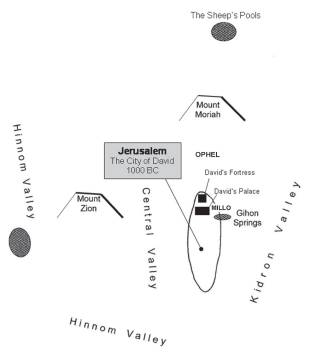
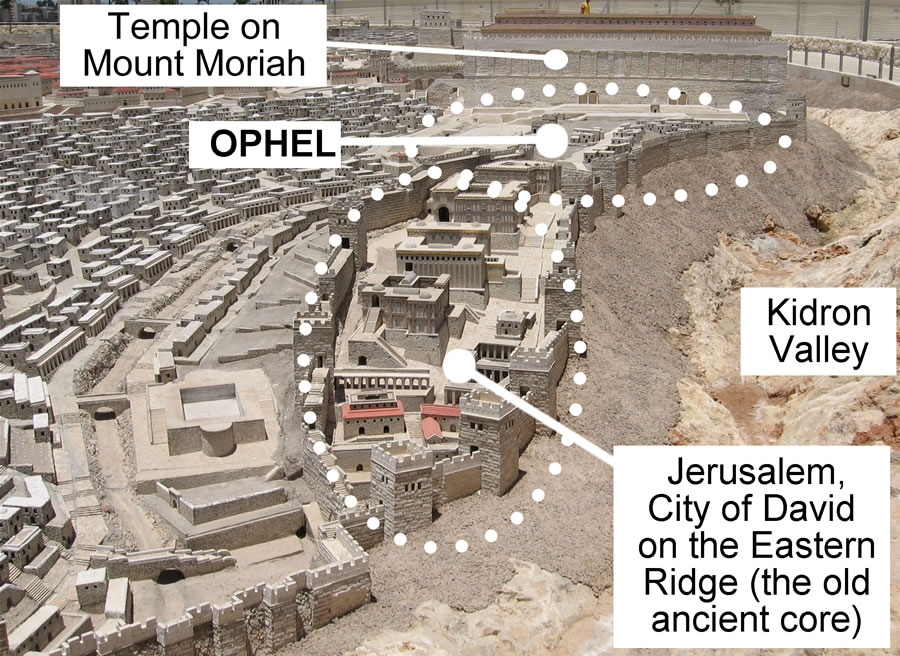
BUILDING FOR THE LIVING GOD
NOT FOR DEAD IDOLS
Now after this - What is this time phrase indicating? After what? Clearly in context, after God granted him repentance and he repented (cf Ro 2:4). This verse reminds me of the words of John the Baptist who declared "Bring forth (aorist imperative see our need to depend on the Holy Spirit to obey) fruit in keeping with repentance." (Mt 3:8). The only way one can obey that command is by being born again, for natural man cannot bring forth supernatural fruit. It is the Spirit working on the repentant man enabling good fruit. The importance of this passage is that it demonstrates true repentance is not shown to to genuine merely by words or feelings, but by one's actions. Manasseh's actions described here indicate his heart has made a (supernaturally enabled) "about face" so to speak. Instead of actions that "glorify" dead idols, he now focuses on actions that glorify the living God!
he built the outer wall of the city of David on the west side of Gihon, in the valley, even to the entrance of the Fish Gate; and he encircled the Ophel with it and made it very high. Before his repentance, Manasseh had led Judah into deep idolatry, defiling the temple and turning the people away from the LORD. But after experiencing God’s mercy, he sought to restore what had been broken. His rebuilding of the outer wall of the city of David and the strengthening of Judah’s defenses symbolized both physical and spiritual renewal. By rebuilding the wall “on the west side of Gihon, in the valley, even to the entrance of the Fish Gate,” and encircling the Ophel, he was reestablishing the security and dignity of Jerusalem, the city which God had chosen for His name to dwell. This act reflected a heart now devoted to protecting what belonged to God. It was a visible sign of repentance, much like Zacchaeus in the New Testament who, after encountering Jesus, sought to make restitution for his wrongs (Luke 19:8–9).
Then he put army commanders in all the fortified cities of Judah - This action also shows that he had learned from his past mistakes. He now recognized that true strength and safety come from obedience to God, not from alliances with pagan nations or the worship of false gods. His renewed leadership aligned with the principle found in Pr 21:31, which says, “The horse is made ready for the day of battle, but the victory belongs to the LORD.” Manasseh was doing his part to secure the nation, but his trust was now in the LORD who had delivered him (cf Ps 20:7)
In short, actions in Manasseh’s life illustrate the fruit of genuine repentance. As 2 Corinthians 5:17 teaches, “If anyone is in Christ, he is a new creation. The old has passed away; behold, the new has come.” Manasseh’s rebuilding efforts were not merely about walls and fortifications, but were about rebuilding a life and a kingdom on the foundation of renewed faith in the one true God. His story reminds us that when God forgives and restores, He also empowers us to rebuild what sin has torn down, both in our lives and in our witness to others (cf Joel 2:25).
Raymond Dillard: Building programs and large armies are the lot of the righteous king in Chronicles, and the author’s inclusion of this material relates no doubt to showing divine blessing following upon repentance. It is possible that such fortification was undertaken prior to his revolt against Assyria, and that it has been dischronologized to this point as part of the Chronicler’s presentation; however, it is equally probable that the fortification was undertaken after his return from Babylon as part of the Assyrian efforts to buttress their southern borders against Egypt. Manasseh may have been repairing damage done to the city walls when he was taken captive. Cf.2Ch 32:5.
Spurgeon - This is not of very much importance, but what else did he do?
Spurgeon They do the same today, and we cannot get them away from them. Even some who love the gospel yet cling to the old Romish rites and ceremonies. Ah, men do love to multiply outward performances instead of spiritual worship! The one altar of Calvary is not enough for them; they must have many altars: “Nevertheless the people did sacrifice still in the high places.”
John Olley: The Chronicler has told of previous kings who had been faithful but subsequently failed in some way (e.g., Asa, Joash, Amaziah, Uzziah), but Manasseh stands out as the only king who began his reign in unfaithfulness but repented and did good.
Andrew Hill: The next report emphasizes Manasseh’s political and religious reforms. Usually this is construed as the “healing of the land,” the natural aftermath of prayer and repentance according to God’s promise in 2Ch 7:14. The Chronicler sees royal building projects as an indication of divine blessing for obedience. Manasseh’s reforms are both political and religious in nature suggesting God’s acceptance of the king’s prayer of repentance. The rebuilding of the city wall of Jerusalem (2Ch 33:14) may refer to repairs made necessary when Manasseh was taken captive by the Assyrians or to the continuation of the expansion of Jerusalem begun under Hezekiah (cf. Isa. 22:10-11; 2 Chron. 32:5). Strengthening the military presence in the fortified cities of Judah (2Ch 33:14) is almost routine for kings ruling in Jerusalem, since these cities form a shield against foreign invaders (cf. 2 Kings 18:13; 2 Chron. 14:6; 17:2; 26:9). Assuming Manasseh’s renewed loyalty as an Assyrian vassal after his release from exile, both initiatives may have been encouraged by the Assyrians as defensive measures aimed at discouraging an Egyptian military campaign into Judah. (See 1 and 2 Chronicles - Page 19)
2 Chronicles 33:15 He also removed the foreign gods and the idol from the house of the LORD, as well as all the altars which he had built on the mountain of the house of the LORD and in Jerusalem, and he threw them outside the city.
- He also removed 2Ch 33:3-7 2Ki 21:7 Isa 2:17-21 Eze 18:20-22 Ho 14:1-3 Mt 3:8
REMOVING THE IDOLS
AND THE ALTARS
He also removed the foreign gods and the idol from the house of the LORD, as well as all the altars which he had built on the mountain of the house of the LORD and in Jerusalem, and he threw them outside the city. - Observe the sequence—he strengthened the walls before cleansing the land of idols. The priority was misplaced; spiritual reform should have preceded military security. By removing the “foreign gods” and the “idol from the house of the LORD,” Manasseh was reversing his earlier blasphemous actions. The temple was meant to be the dwelling place of God’s presence, not a shrine to pagan deities. Manasseh’s cleansing of the temple was therefore an act of repentance and obedience, restoring the sanctity of God’s house.
His decision to throw the idols “outside the city” symbolized a complete rejection of idolatry and a desire to remove its defilement from the holy city of Jerusalem. Presumably this action would have been visible to the public, so that people of Jerusalem understood that Manasseh was a "changed man." Did the people change? It is difficult to say dogmatically, but very possibly because 2Ch 33:17 states "Nevertheless the people still sacrificed in the high places, although ONLY to the LORD their God."
The mention of the “mountain of the house of the LORD” refers to Mount Moriah, where Solomon had built the temple (2 Chronicles 3:1). Manasseh had previously built pagan altars there, turning the very mountain of God’s presence into a place of spiritual corruption. By tearing down those altars, he was acknowledging that only the LORD deserved worship. This act mirrors the reforms of earlier kings like his father Hezekiah who also destroyed idols and restored proper worship (2Ki 18:4)
Genuine repentance always
produces visible change
Manasseh’s actions show that repentance is not merely feeling sorry for sin but turning decisively away from it and restoring what has been defiled. 2Co 7:10 teaches, “For the (godly) sorrow that is according to the will of God produces a repentance without regret, leading to salvation, but the sorrow of the world produces death.” Manasseh’s repentance was godly because it led him to act—to cleanse the temple, restore true worship, and lead Judah back toward the LORD.
Martin Selman: Manasseh’s religious reforms represented a direct reversal of earlier policies (2Ch 33:2-9), since each of the items removed in verse 15 is mentioned in 2Ch 33:3, 7. Some form of regular worship was recommenced (2Ch 33:16), though its range seems rather limited (cf. 1 Chr. 23:31; 2 Chr. 2:4; 8:13; 31:3) (SEE 2 Chronicles: A Commentary - Page 523 OR BORROW)
2 Chronicles 33:16 He set up the altar of the LORD and sacrificed peace offerings and thank offerings on it; and he ordered Judah to serve the LORD God of Israel.
- He set up the altar of the LORD: 2Ch 29:18 1Ki 18:30
- sacrificed peace offerings: Lev 3:1-17
- thank offerings: Lev 7:12-18
- commanded: 2Ch 33:9 14:4, See on ch. 2Ch 30:12 Ge 18:19 Lu 22:32
He set up the altar (mizbeah;LXX - thusiasterion) of the LORD - Presumably it had been torn down or at least was in disrepair. In any event, his priorities are now right for he prepares to worship Yahweh.
And sacrificed (zabach) peace offerings (selem/shelem; LXX - thusia + soterion) and thank offerings on it - Notice there is no mentino here of the sin offering, presumably because he knew his sin had been removed as evidenced by his changed actions.
The peace offering (Lev 3; 7:11–21) was not primarily about atonement for sin (that was the sin offering), but about restored fellowship and shared communion with Yahweh. Part of the sacrifice was burned to the LORD, part given to the priests, and part eaten by the worshiper. It was a celebratory, relational meal symbolizing reconciliation and peace between God and His people. So when someone “sacrificed peace offerings,” it meant in effect that the relationship is restored and fellowship has been renewed. In sum, a peace offering was an expression of thanksgiving for God’s deliverance in a time of great need, not a sacrifice meant to appease, pacify, or propitiate Him.
The thank offering (todah; LXX - ainesis [only NT use = Heb 13:15] related verb aineo = to praise someone, speak of how excellent a person is) was a specific type of peace offering offered in gratitude for deliverance, in response to answered prayer and after experiencing mercy or rescue, all of which were true in Manasseh's case! The thank offering expressed the truth that Yahweh has acted graciously toward me, and I publicly acknowledge it.
The Hebrew noun todah was a subtype of the fellowship (peace) offering (Lev 7:12–15; 22:29), the worshiper presented bread and an unblemished sacrifice, which was eaten the same day in the Lord’s presence, expressing restored communion and grateful acknowledgment of His deliverance (Ps 107:22; 116:17).
And he ordered Judah to serve the LORD God of Israel - Manasseh gives a formal command, not a sugestion. While individual reformation cannot be commanded internally (in one's heart), at least he called on the nation to get their priorities right also and to serve Yahweh. It is the same idea used in Joshua’s famous call “Choose for yourselves today whom you will serve” (Josh 24:15). He is not asking for outward religious participation, but for wholehearted loyalty to Him alone.
Spurgeon - When grace comes into any man’s heart, there is sure to be a change in his action. Manasseh “took away the strange gods,” —Sins which were before so pleasing to him are now abominations in his sight, and he flings them over the city wall like unclean things. In the very valley of the son of Hinnom where he had dedicated his sons to idols he now consumes his idol gods as foul and offensive things, to be cast away with all the refuse of the city. It was not possible for him to undo all the evil which he had wrought, as he soon found out.
Altar (04196) mizbeah from zabach = to slaughter for sacrifice or for food) is a masculine noun that is frequent in the OT (338x) and describes the place of sacrifice where offerings were made to a deity. The first use in Ge 8:20 describes the altar built by Noah as his first act after he survived the flood. Abraham is associated with an altar in Ge 12:7,8; 13:4, 18; Ge 22:9. Not surprisingly the majority of OT occurrences are in Leviticus (88x in 72v and Exodus is not far behind - 61x in 53v). The first offering by Cain and Abel does not mention a specific altar (Ge 4:3).
From the earliest pages of Scripture, sacrifice stands at the center of humanity’s approach to God, expressing worship, covenant loyalty, atonement, and substitution: after the flood, Noah built an altar and offered clean animals in thankful worship (Gen. 8:20), Abraham marked God’s covenant promises by building altars at Shechem and elsewhere in the land (Gen. 12:7–8), and Isaac and Jacob likewise erected altars at Beersheba and Bethel to commemorate divine blessing and faithfulness (Gen. 26:25; 35:7). The near-sacrifice of Isaac on Mount Moriah, where a ram was provided in his place, vividly established the principle of substitutionary sacrifice (Gen. 22:9–13), a truth reinforced by the Passover lamb, whose death spared Israel’s firstborn (Exod. 12:27), and by covenant meals such as Jacob’s sacrifice when sealing his agreement with Laban (Gen. 31:54). When Israel formally entered covenant with the LORD at Mount Sinai, Moses built an altar and offered burnt and peace offerings, confirming that covenant relationship was ratified “by sacrifice” (Exod. 24:4–5; Ps. 50:5), and God then regulated sacrificial worship through the bronze altar of burnt offering in the tabernacle courtyard and the gold altar of incense in the holy place (Exod. 30:1–6; 38:1–2; 40:7), where blood, fire, and fragrance symbolized atonement, purification, and acceptable prayer (Lev. 4:7; 16:20–33). The altar’s consecration and cleansing were essential to Israel’s worship (Exod. 29:44; Lev. 8:11), a pattern continued and expanded in Solomon’s temple, described as “the house of sacrifice” (2 Chr. 7:12), though later kings either honored or dishonored God by their treatment of the altar—faithful rulers like Asa and Hezekiah restored and cleansed it (2 Chr. 15:8; 29:18), while Ahaz corrupted it with pagan imitation (2 Kgs. 16:14–15) and Uzziah violated its sanctity by usurping priestly authority (2 Chr. 26:16)—demonstrating throughout biblical history that sacrifice was not incidental but foundational to covenant faith, proper worship, and obedience before a holy God.
"In the developed temple ritual, the same word is used for both the altar of holocausts and the altar of incense. Thus, an altar is a place where sacrifice is offered, even if it is not an event involving slaughter." (Thomas W Davis)
The Septuagint (Lxx) often translates mizbeach with the word thusiasterion ("a place of sacrifice") which is derived from thusia meaning that which is offered as the sacrifice.
Peace offerings (08002) selem/shelem comes from a root meaning completion, wholeness, and restored harmony. These offerings were voluntary acts of worship, expressing thanksgiving, praise, and covenant fellowship with God (Lev 3; 7:11–16). They celebrated the gift of shalom—not merely forgiveness, but fullness of life under God’s favor. Unlike the burnt offering, the worshiper shared in a sacred meal “before the LORD” (Deut 12:7, 18), joyfully acknowledging His presence without implying mystical union. Portions were given to the priests (Lev 7:32–34), reinforcing covenant community. Often appearing last in sacrificial lists, the offering may also suggest completion, fitting the theology that finds its fulfillment in Christ, “our peace” (Eph 2:14), who offered Himself once for all (Heb 10:12).
In the Septuagint, šĕlāmîm is frequently rendered with terms such as soterion (associated with deliverance and preservation) and eirēnikos (peaceable, harmonious), emphasizing restored relationship rather than initial salvation in the New Testament sense. The offering marked gratitude for God’s saving acts and covenant faithfulness (cf. 2 Sam 6:17–18; 1 Kgs 8:63–64), rejoicing in reconciliation already granted. It uniquely allowed the worshiper to partake of the sacrifice, symbolizing shared fellowship under divine blessing. Thus the peace offering stood as a celebration of communion, covenant loyalty, and thankful devotion grounded in the wholeness God alone provides.
What is a peace offering? - Got Questions - The modern idea of a peace offering, also known as a fellowship offering, is that of “a propitiatory or conciliatory gift.” A man who offends his wife will often visit a florist with the thought that bringing home flowers will help smooth things over—the bouquet will be a “peace offering” of sorts. Propitiate means “to make someone pleased or less angry by giving or saying something desired,” and conciliatory means “intended to placate or pacify.” These definitions are interesting because the phrase peace offering has come to mean something completely different—almost the exact opposite—of what it originally meant in the Bible.
A peace offering in the Old Testament Law is described in Leviticus 7:11–21. It was a voluntary sacrifice given to God in three specific instances.
First, a peace offering could be given as a freewill offering, meaning that the worshiper was giving the peace offering as a way to say thank you for God’s unsought generosity. It was basically just a way to praise God for His goodness.
The second way a peace offering could be given was alongside a fulfilled vow. A good example of this was when Hannah fulfilled her vow to God by bringing Samuel to the temple; on that occasion she also brought a peace offering to express the peace in her heart toward God concerning her sacrifice—it was a way to say, “I have no resentment; I am holding nothing back in the payment of my vow.”
The third purpose of a peace offering was to give thanksgiving for God’s deliverance in an hour of dire need. None of these three reasons to sacrifice had anything to do with propitiation, with appeasing God, or with pacifying Him.
There were under the Old Covenant sacrifices intended to represent propitiation (Leviticus 1—2; 4) but with the understanding that God has always been a God of grace (see Ephesians 2:8–9). He does not expect us to appease Him with our works but only to confess our need and dependence on Him. Under the Old Covenant, this relationship was expressed by the sacrificial system, which always looked forward to the sacrifice of the Messiah. Under the New Covenant, the Law has been written on our hearts (2 Corinthians 3:3), and the Holy Spirit of God gives us the power to live our lives accordingly (Romans 8:1–8; 1 Thessalonians 1:5). The sacrifices we give now are spiritual (Hebrews 13:15) and living (Romans 12:1).
Most sacrifices in the Old Testament system were not eaten by worshipers, but the peace offering was meant to be eaten—only a portion of the animal or grain brought to the altar was burned; the rest was given back to the worshiper and to the poor and hungry. The beautiful picture here is of God’s provision for His people, both physically and spiritually. His grace and goodness are present throughout the offerings. In the peace offering, God was providing what we need: a way to thank Him for His goodness and physical sustenance.
God is not interested in taking from us. That is not His heart at all. But the lie we so often believe is that our good actions bring about His goodness, and our sinful actions must be paid for in personal sacrifice. The peace offering shows that worshipers in the Old Testament were not any more responsible for their salvation than worshipers in the New Testament. Throughout the ages, people have been tempted to think that sacrifices create God’s favor. This belief is evident in our modern understanding of a peace offering as a propitiation for wrongdoing. But only Christ’s sacrifice creates favor with God and covers wrongdoing, and the Old Testament sacrifices were a picture of that future provision.
Thank offerings (08426) tôdāh (תּוֹדָה), derived from yada (“to confess, acknowledge, praise”), denotes thanksgiving, praise, or confession directed exclusively to God. It could describe verbal gratitude (Ps 100:4), a confession of sin (Josh 7:19–21; Ezra 10:11), or a formal “thank offering” within Israel’s sacrificial system. As a subtype of the fellowship (peace) offering (Lev 7:12–15; 22:29), the worshiper presented bread and an unblemished sacrifice, which was eaten the same day in the Lord’s presence, expressing restored communion and grateful acknowledgment of His deliverance (Ps 107:22; 116:17). Such confession glorified God, either by magnifying His mighty works (Ps 95:2; 69:30) or by honoring His righteousness when sin was admitted (Ps 50:23). In this way, thanksgiving was not mere emotion but covenantal worship aligning the heart rightly before Him.
Tôdāh unites praise and confession, sacrifice and song, declaring
God’s glory while acknowledging dependence upon His mercy.
Beyond sacrifice, tôdāh also referred to songs of praise and even Levitical choirs appointed to lead thanksgiving (Neh 12:27, 31, 38). It included jubilant shouts and vows fulfilled after divine rescue (Jon 2:9; Ps 56:12), anticipating prophetic promises that restored Jerusalem would again resound with thanksgiving (Isa 51:3; Jer 33:11). Yet Scripture warns that outward offerings without repentance were unacceptable (Amos 4:5). Thus tôdāh unites praise and confession, sacrifice and song, declaring God’s glory while acknowledging dependence upon His mercy.
TODAH - 30V - choir(1), choirs(2), confession(1), hymns of thanksgiving(1), praise(1), sacrifices of thanksgiving(1), thank offering(2), thank offerings(4), thanksgiving(18). Lev. 7:12; Lev. 7:13; Lev. 7:15; Lev. 22:29; Jos. 7:19; 2 Chr. 29:31; 2 Chr. 33:16; Ezr. 10:11; Neh. 12:27; Neh. 12:31; Neh. 12:38; Neh. 12:40; Ps. 26:7; Ps. 42:4; Ps. 50:14; Ps. 50:23; Ps. 56:12; Ps. 69:30; Ps. 95:2; Ps. 100:1; Ps. 100:4; Ps. 107:22; Ps. 116:17; Ps. 147:7; Isa. 51:3; Jer. 17:26; Jer. 30:19; Jer. 33:11; Amos 4:5; Jon. 2:9
2 Chronicles 33:17 Nevertheless the people still sacrificed in the high places, although only to the LORD their God.
- people: 2Ch 15:17 32:12 1Ki 22:43 2Ki 15:4
HIGH PLACES
PERSIST
Nevertheless - This introduces a contrast with Manasseh's acts of reformation described above. In this context it signals incomplete obedience. Repentance at the top did not instantly produce thorough reform in the land.
the people still sacrificed in the high places, although only to the LORD their God - Even when used for Yahweh worship, they were problematic because Deuteronomy 12 required centralized worship in the place God chose and that place was Jerusalem. The high places had long been associated with Canaanite idolatry. So the issue is not necessarily idolatry here, but it is disobedient worship. They were worshiping the right God in the wrong way.
A half century of paganism could not be
overcome by a half dozen years of reform.
-- J. Barton Payne
Outward reform does not instantly erase entrenched habits. Royal repentance cannot automatically produce national transformation. Reform can begin at the top, but heart change in the people must be personal. Note the turnaround, for Manasseh previously ordered idolatry but now orders covenant obedience
Spurgeon -So far, it was well; but it would have been better if they had given up all those altars. The work of reformation is slow; you can lead men to sin as rapidly as you like, that is down-hill work; but to get them to toil with you up-hill toward the right is not so easy.
David Guzik: This reminds us of the distinction between two different kinds of high places. Some were altars to pagan idols; others were unauthorized altars to the true God. Manasseh stopped all the pagan worship in Judah, but unauthorized (that is, outside the temple) worship of the God of Israel continued.
Andrew Hill: The impact of Manasseh’s religious reforms seems restricted to Jerusalem and its immediate environs, given the Chronicler’s reference to ongoing worship in the high places (33:17). The worship associated with the Canaanite high places proves a snare for the Israelites throughout the history of the monarchies.
Martin Selman: As with all previous attempts to eradicate the signs and symbols of Canaanite religion, in practice its undemanding morality and sensuous practices proved irresistible to the majority of the People (cf. 2 Chr. 14:3; 15:17; 17:6; 20:33). Despite the formal changes, the people as a whole saw no need for a change of heart (cf. Isa. 29:13; Jer. 3:10; 2 Tim. 3:5). (SEE 2 Chronicles: A Commentary - Page 523 OR BORROW)
2 Chronicles 33:18 Now the rest of the acts of Manasseh even his prayer to his God, and the words of the seers who spoke to him in the name of the LORD God of Israel, behold, they are among the records of the kings of Israel.
- 1Ki 11:41
- the rest of the acts of Manasseh 2Ch 20:34 32:32
- even his prayer to his God, 2Ch 33:12,13,19
- the words of the seers 2Ch 33:10 1Sa 9:9 2Ki 17:13 Isa 29:10 30:10 Am 7:12 Mic 3:7
- they are among the records 1Ki 14:19 15:31
Related Passages:
2 Kings 21:17 Now the rest of the acts of Manasseh and all that he did and his sin which he committed, are they not written in the Book of the Chronicles of the Kings of Judah?
ROYAL SUMMARY
OF MANASSEH'S LIFE
Now the rest of the acts of Manasseh - This is a standard royal summary formula. It tells us the Chronicler has been selective, not exhaustive. Many details of Manasseh’s 55 year reign were known but not recorded here.
even his prayer to his God - This is a unique and striking phrase. This seems to emphasize personal repentance, direct appeal to covenant mercy and restoration of His relationship with Yahweh (although we are not sure he ever had a relationship with God prior to his repentance). Notice that while Kings records his sins against God, Chronicles records his prayer to God. This later writing accentuates the positive.
and the words of the seers who spoke to him in the name of the LORD God of Israel - Manasseh did not sin in ignorance, for God sent prophetic warnings. And even before his judgment divine revelation (and warnings) had preceded God's judgment. Seers were prophets, men who spoke “in the name of the LORD God of Israel.” meaning the words they spoke were as if God Himself spoke them. In short, this phrase, shows that Manasseh's rebellion was against clear revelation and repeated warnings. This truth intensifies both his guilt and the magnitude of grace when he repented. This reminds me of Ro 5:20 "The Law came in so that the transgression would increase; but where sin increased, grace abounded all the more."
Behold, they are among the records of the kings of Israel - The Chronicler refers to external royal records. The phrase “kings of Israel” here likely means the historical annals of the monarchy (not necessarily the northern kingdom only).
In sum, 2 Chronicles 33:18 reminds us that Manasseh’s reign included prophetic warning and remarkable repentance, and though not all details are recorded, the Spirit preserves what matters most: sin confronted by revelation, prayer answered by mercy, and history shaped by covenant grace.
Henry Morris - book of the kings of Israel. The account of Manasseh in the canonical book of Kings does not mention such a prayer (2 Kings 21:1-18), so the nature of this apparently lost book of the kings of Israel is not known. An apocryphal book known as "The Prayer of Manasseh" may reflect the material in this missing book to some degree.
Spurgeon - So we must remember that all the deeds that we have done, both good and evil, are written in God’s Book of Remembrance.
Believer's Study Bible - There is no mention of this prayer in the biblical Books of Kings (cf. 2 Kin. 21:1-18); thus, this reference to the "book of the kings of Israel" must surely refer to a noncanonical record with the same or a similarly derived title (cf. 1 Chr. 29:29).
Mark Boda: A comparison of the concluding summary note of Manasseh in 2 Kings 21:17-18 with the one in 2Ch 33:18-20 reveals the differing nuances of each account. The book of Kings emphasizes “the sins he committed” while Chronicles highlights “his prayer to God.” The Chronicler mentions two sources for his account of Manasseh, one The Book of the Kings of Israel, and the other The Record of the Seers. The role of the prophetic voice is emphasize in this closing note and this record of the seers is said to contain details on locations of idolatrous sites. Although penitent in life, Manasseh was denied the honor of burial with the kings of Judah in death.
2 Chronicles 33:19 His prayer also and how God was entreated by him, and all his sin, his unfaithfulness, and the sites on which he built high places and erected the Asherim and the carved images, before he humbled himself, behold, they are written in the records of the Hozai.
- his prayer : 2Ch 33:11,12,19 Pr 15:8 Ac 9:11 1Jn 1:9
- all his sin: 2Ch 33:1-10 Ro 5:16
- before he: 2Ch 33:12 30:11 36:12 Ps 119:67,71,75 Jer 44:10 Da 5:22
- written in the records of the Hozai. So the Targum and Vulgate: the Syraic has Hanun the prophet; and the Arabic, Saphan the prophet.
NO SINNER WHO HUMBLES
SELF IS BEYOND GRACE
His prayer also and how God was entreated by him This is one of the most astonishing statements in the chapter.The phrase means God allowed Himself to be moved. God responded to Manasseh’s plea. Divine judgment gave way to covenant mercy. The verb translated was entreated conveys that God was petitioned and responded favorably. This does not mean God was manipulated but that humble repentance meets covenant compassion (cf. 2 Chr 33:12–13).
and all his sin, his unfaithfulness The Chronicler does not minimize his guilt. Unfaithfulness is covenant language. Manasseh’s sins were not mere political mistakes they were spiritual adultery against the Most High God, Israel's "Husband" (See Israel the Wife of Jehovah)
and the sites on which he built high places and erected the Asherim and the carved images - The text stresses the geographical spread of corruption and defilement. Recall that his father had torn down the high places, and he had rebuilt them. However as alluded to above, he did not eradicate them. In short, this list of idolatry sites demonstrates that his rebellion was widespread and well-documented.
before he humbled himself - The time phrase before is critical. It establishes a clear dividing line in his life, before humility there was idolatry, violence, national corruption. After humility there was prayer, restoration, reform and mercy. Humility is the turning point. This reflects a central Chronicler theme “If they humble themselves… then I will hear from heaven” (2 Chr 7:14).
Behold, they are written in the records of the Hozai - Hozai likely refers to prophetic records or a historical source (possibly related to “the seers” mentioned earlier). The point is Manasseh's sins were documented as was his repentance. History preserved both.
This verse does something remarkable for on one hand it refuses to whitewash Manasseh’s evil, yet on the other hand it also refuses to deny the reality of his repentance.
TSK - This record is totally lost; for the captivity and repentance of Manasseh are related no where else; and the prayer of Manasseh in the Apocrypha was probably composed long afterwards: it is not acknowledged as canonical even by the Romish church, though it was anciently used as a form of confession, and as such still received by the Greek church.
2 Chronicles 33:20 So Manasseh slept with his fathers, and they buried him in his own house. And Amon his son became king in his place.
- Manasseh: 2Ch 32:33 2Ki 21:18
- Amon: 2Ki 21:19-25 1Ch 3:14 Mt 1:10
Related Passages:
2 Kings 21:18 And Manasseh slept with his fathers and was buried in the garden of his own house, in the garden of Uzza, and Amon his son became king in his place.
MANASSEH "SLEEPS" AND
RECEIVES A LOWLY BURIAL
So Manasseh slept with his fathers, and they buried him in his own house. This familiar royal formula indicates death, but in Kings it carries a sober tone. For most Judean kings it implies burial among predecessors in the royal tombs; here, the phrase is immediately qualified by in his own house. Judean kings were typically buried in the tombs of the kings in the City of David. Manasseh’s burial on private property suggesting either disgrace or disqualification from royal burial honors. Manasseh’s 55 year reign ends quietly, but without honor, without commendation.
And Amon his son became king in his place - The Messianic line continues unbroken, but sadly Amon proved to be "Like father, like son." Like father only in his evil with no record of repenance.
PAUL APPLE - DEVOTIONAL QUESTIONS:
1) What are some encouragements for parents and some cautions related to parental expectations from this account of Manasseh in light of his godly father?
2) Why is it so dangerous to even dabble around the edges of any type of occult activity?
3) How has God’s forgiveness of your sins not removed all of the negative consequences of your failures?
4) What would the current audience of the Chronicler find encouraging from this account?
QUOTES FOR REFLECTION:
Iain Duguid: While known Assyrian records refer to Manasseh only as a loyal vassal, various scenarios have been proposed for his taking an opportunity to revolt and subsequently being punished. The most plausible scenario is that he rebelled amid the unrest following the revolt of Shamash-shum-ukin of Babylon (652–648 BC) against his brother Assurbanipal. The Chronicler, however, is concerned not with such circumstances but with revolt against God’s words and its consequences (“therefore”). Manasseh’s being “captured with hooks and bound with chains of bronze” reflects known Assyrian practice (cf. 2 Kings 19:28; Ezek. 19:9), a situation of “distress” (a form of Hb. tsarar, also describing Ahaz in 2 Chron. 28:20 [“afflicted”], 22). Unlike Ahaz, who “became yet more faithless,” Manasseh “humbled himself” and “prayed.” Importantly, what followed is that God “heard,” an example of his keeping the promise of 7:14. The outworking of God’s hearing Manasseh’s prayer is relevant for hearers. While Manasseh remained an Assyrian vassal, God returned him not only geographically to Jerusalem but also “into his kingdom.” The Chronicler’s original hearers have similarly returned, but they do not yet have their own king, and so the past becomes a pointer to the future. Further, Manasseh’s coming to “know the Lord was God” as a result of his return from Babylon reminds hearers of the frequent message of Ezekiel that, as a result of the people’s exile and return, they too will “know that I am the Lord” (e.g., Ezek. 36:11, 38; 37:6, 13, 14; 39:22, 28).
Jerry Thrower: Manasseh’s Evil
A. MANASSEH Started Baal Worship Again! (2 Kings 21:2-3; 2 Chronicles 33:2-3) We’re familiar with BAAL worship at this point in our studies! As the storm god and bringer of rain, BAAL was recognized as sustaining the fertility of crops, animals, and people. BAAL’S followers often believed that immoral sex acts performed in his temple would contribute to BAAL’S work in increasing fertility of crops, animals, and people and so that is what made it so attractive! It was driven by fleshly desires and lusts of people! BAAL was a part of the religion of virtually every culture of the ancient Near East. BAAL, of course, had been a favorite of the NORTHERN KINGDOM of ISRAEL after AHAB married the heathen, JEZEBEL, whose father was priest of BAAL! In fact, BAAL was even brought into JUDAH initially by AHAB and JEZEBEL’S daughter, ATHALIAH, who married JEHORAM king of JUDAH. ATHALIAH reigned over JUDAH after the death of her husband and her son, AHAZIAH and established BAAL worship even more! After JEHOIADA THE PRIEST had ATHALIAH slain and prior to JOASH’S reign, he and the people of JUDAH eradicated BAAL worship from JUDAH! But BAAL worship was then restored by king AHAZ, HEZEKIAH’S father only to be eradicated by HEZEKIAH once he began to reign! But now, we see MANASSEH bring BAAL worship back! In addition he built again the HIGH PLACES of worship that his father HEZEKIAH tore down AND he made a GROVES! GROVES were where gods would be were carved into trees or wooden poles that folks would worship. But we’re about to see that was only the beginning of MANASSEH’S idolatry!
B. MANASSEH Worshiped All The Hosts Of Heaven! (2 Kings 21:3b; 2 Chronicles 33:3; Cf. Deuteronomy 4:14-20) This was also a common heathen practice! Some of the heathen worshiped the SUN! (I read where Egypt actually had 5 sun gods) Some of the heathen worshiped the MOON! Some of the heathen worshiped the STARS and/or the CONSTELLATIONS made up of the STARS. Some worshiped the SKY itself! Hang on we’re not done yet...
C. MANASSEH Defiled The TEMPLE Again With Worship Of His False Gods! (2 Kings 21:4-5, 7-9a; 2 Chronicles 33:4-5, 7-8; Cf. 1 Kings 8:27-30; Jeremiah 7:30) Now, we’ve seen several others who defiled the TEMPLE! We’ve also seen others who defiled the TEMPLE by bringing idols into the TEMPLE! (e.g., In fact, we saw MANASSEH’S grandfather, King AHAZ send back plans from DAMASCUS for URIJAH the priest to duplicate a god that he saw when he met the ASSYRIAN king in DAMASCUS!) (Then he had the audacity to take the sacrifices and offerings people were bringing for the LORD and have them offered on the altar of the false god in the TEMPLE of the LORD!) But that’s still not all...
D. MANASSEH Sacrificed His Son (Children) To MOLECH! (2 Kings 21:6a; 2 Chronicles 33:6a) Consider this, if it had not been for his grandmother rescuing his father from his grandfather’s same shenanigans, he would never have been born! We’re still not done...
E. MANASSEH Was Involved In The Occult! (2 Kings 21:6b; 2 Chronicles 33:6b; Cf. Deuteronomy 18:9ff) 1. He Observed Times – i.e. astrology 2. He Used Enchantments – i.e. charm; whisper. To seek or to give omens or foretell. 3. He Used Witchcraft – i.e. practice sorcery. (e.g. potions) 4. He Dealt With A Familiar Spirit– i.e. a person controlled by an evil spirit which professes to be a medium with the dead. 5. He Dealt With Wizards – i.e. one who deals in magic and sorcery in an attempt to pry into the secrets of the spirit world. The only King I remember who was involved in any of this was King Saul who went to a witch to call up Samuel’s spirit . Now we go literally off the charts of the wickedness of those kings before him!
F. MANASSEH Caused JUDAH To Do Worse Than The Heathen! (2 Kings 21:6f, 9; 2 Chronicles 33:9) Now, there is no detail given us about what this entailed! Let’s suffice it to say that if it was worse than the heathen, it had to be really, really bad!
G. MANASSEH FAILED TO HEED THE WARNING OF GOD! (2 Chronicles 33:10) No surprise there as everything he did up to this point was anti-God!
Martin Selman: The Bible consistently affirms that God’s door remains open to anyone, even after what should have been closing time. If such an invitation could be extended to Manasseh, as it was to a guilt-ridden tax-collector, a thief on a cross, or the chief of sinners, on-one is excluded (Luke 18:9-14; 23:40-43; 1 Tim. 1:15). The condition of humble repentance remains unchanged, for “everyone . . . who humbles himself will be exalted” (Luke 14:11; 18:14).
Wilcock: Here was a son of godly parents who went into sin to the very limit and then came back to God. That should be an encouragement to parents who are reading this today. Maybe you have a son or a daughter who has gone the very limit, and you despair that your child will ever turn back to God. I would have given Manasseh up, but God didn't. God heard his prayer.
Mark Boda: One should not miss the relevance of this story of Manasseh to the community living in the wake of the Babylonian exile and Persian restoration. With its depiction of Manasseh’s exile to Babylon, his subsequent humble prayer and restoration to his kingdom, 2Ch 33:11-13 reflects a regular typology used by the Chronicler, that of exile and restoration. On one level the story is related to the agenda of the Chronicler to encourage continuing returns of people from Mesopotamian exile (cf. 2Ch 30:6-9; 36:20- 23) and to identify the true ideals of the restoration, especially repentance. On another level, however, its single focus on a Davidic royal figure (without any mention of people accompanying him) suggests that Manasseh was to serve as a role model for the return of the Davidic house.
Phil Winfield: The Shocking Story of King Manasseh If there was ever a study that debunks the idea that good parents always have good children then this study of the Kings in Judah certainly does that. It seems that really wicked kings sometimes had really virtuous sons and really good kings sometimes left their kingdom to extremely vile sons. Many times we are astounded by the way things turn out in families.
God Relents When Sinners Repent!
2 Chronicles 33:21 Amon was twenty-two years old when he became king, and he reigned two years in Jerusalem.
- two years: 2Ch 33:1 Lu 12:19,20 Jas 4:13-15
Amon was twenty-two years old when he became king, and he reigned two years in Jerusalem.
Frederick Mabie: Amon’s brief reign lasts from about 643-641 BC, a time of significant Assyrian power in the biblical world.
Raymond Dillard: The Chronicler’s account of Amon follows rather closely that in 2 Kgs 21:19–26. The most notable difference is that for the writer of Kings, Amon was “just like” his father Manasseh (2 Kgs 21:20 // 33:22), whereas in Chronicles Amon is contrasted to Manasseh because of his failure to repent (33:23). The Chronicler explicates “walking in all the ways his father walked” (2 Kgs 21:21) as “offering sacrifices and worshiping all the idols his father Manasseh had made” (33:22).
Thomas Constable: Amon represented the other alternative that the returned exiles could choose: no repentance. His fate would have been, and is, a warning to seek the LORD. Martin Selman: Although the cloud of exile hangs over chapters 28-36, Manasseh and Amon in their contrasting ways show that a fatalistic attitude in the face of God’s judgment is quite unjustified.
J. Barton Payne: Amon was the unhappy product of his father’s pagan life, not of his pious death. This brief summary of his reign closely parallels II Kgs 21:19-26 and notes the immediate relapse of Judah to the pre-conversion religion of Manasseh.
A.C. Gaebelein: The utter corruption of human nature is seen in the case of his son Amon. With the awful experience of his father before him, and no doubt exhorted by Manasseh to serve the LORD and be true to Him, he followed deliberately the bad example of his father’s idolatry. He trespassed more and more and did not repent like his father Manasseh, but died in his sins. Under his reign the wickedness reached a higher mark than under any previous king.
Matthew Henry Notes: 2Ch 33:21-25
We have little recorded concerning Amon, but enough unless it were better. Here is,
I. His great wickedness. He did as Manasseh had done in the days of his apostasy, 2Ch 33:22. Those who think this an evidence that Manasseh did not truly repent forget how many good kings had wicked sons. Only it should seem that Manasseh was in this defective, that, when he cast out the images, he did not utterly deface and destroy them, according to the law which required Israel to burn the images with fire, Deu. 7:2. How necessary that law was this instance shows; for the carved images being only thrown by, and not burnt, Amon knew where to find them, soon set them up, and sacrificed to them. It is added, to represent him exceedingly sinful and to justify God in cutting him off so soon,
1. That he out-did his father in sinning: He trespassed more and more, 2Ch 33:23. His father did ill, but he did worse. Those that were joined to idols grew more and more mad upon them.
2. That he came short of his father in repenting: He humbled not himself before the Lord, as his father had humbled himself. He fell like him, but did not get up again like him. It is not so much sin as impenitence in sin that ruins men, not so much that they offend as that they do not humble themselves for their offences, not the disease, but the neglect of the remedy.
II. His speedy destruction. He reigned but two years and then his servants conspired against him and slew him, 2Ch 33:24. Perhaps when Amon sinned as his father did in the beginning of his days he promised himself that he should repent as his father did in the latter end of his days. But his case shows what a madness it is to presume upon that. If he hoped to repent when he was old, he was wretchedly disappointed; for he was cut off when he was young. He rebelled against God, and his own servants rebelled against him. Herein God was righteous, but they were wicked, and justly did the people of the land put them to death as traitors. The lives of kings are particularly under the protection of Providence and the laws both of God and man.
2 Chronicles 33:22 He did evil in the sight of the LORD as Manasseh his father had done, and Amon sacrificed to all the carved images which his father Manasseh had made, and he served them.
- as did Manasseh: 2Ch 33:1-10 2Ki 21:1-11,20 Eze 20:18
- for Amon sacrificed: Isa 44:13-20
LIKE FATHER
LIKE SON!
He did evil in the sight of the LORD as Manasseh his father had done, Unfortunately Amon did not relent from the evil of his father, despite the fact that his father repented of his evil. Amon's trajectory toward evil had been set by Manesseh's evil years. Since Amon was already 22 years old when Manasseh died, he must have been born well before Manasseh’s later repentance. Manasseh’s repentance occurs late in his reign, after his capture by Assyria (2Ch 33:11-13). After this repentance did Manasseh attempt reforms (2Ch 33:15–16), but was unable to "reform" his own son Amon.
And Amon sacrificed to all the carved images which his father Manasseh had made, and he served them. One has to ask why were these carved images Manasseh had made still in existence? J. Barton Payne writes that "Either their removal had not involved their destruction (2Ch 33:15), or the concentration of Manasseh’s reformation in Jerusalem had left available his more scattered idolatries (cf. 2Ch 33:17)."
THOUGHT - Is there something that tempts you to do evil? If it is not a human being, then you need to destroy it, lest it destroy you and/or your offspring!
J.A. Thompson: Just as Manasseh could not go back and undo the damage he had done to his nation, even so he could not back and change the son he had raised to be a pagan. Amon followed in his father’s footsteps, but not the steps that Manasseh would have like him to follow.
QUESTION - Why was the worship of Baal and Asherah a constant struggle for the Israelites?
ANSWER - Throughout the Old Testament, we read accounts of idol worship among the Israelites, especially the worship of Baal and Asherah, or sometimes Baal and Ashtoreth. The paganism that surrounded God’s people crept in, gained a foothold, and led to much misery. It was a constant struggle to stay true to the Lord their God.
God had commanded Israel not to worship idols (Exodus 20:3; Deuteronomy 5:7)—indeed, they were to avoid even mentioning a false god’s name (Exodus 23:13). To prevent compromise, they were warned not to intermarry with the pagan nations and to shun practices that might be construed as pagan worship rites (Leviticus 20:23; 2 Kings 17:15; Ezekiel 11:12). Israel was the nation chosen by God to one day give rise to the Savior of the world, Jesus Christ. Yet, even with their heritage and so much riding on their future, Israel was continually drawn into dalliances with Baal and Asherah.
Baal was the supreme god in ancient Canaan and Phoenicia. As the storm god, he was usually depicted holding a raised lightning bolt. His consort, Asherah, was the chief female deity and was represented by a carved pole or limbless tree trunk planted in the ground. Baal and Asherah are often mentioned together in Scripture. Sometimes Baal is mentioned with the goddess Ashtoreth who, in Canaanite mythology, was closely related to Asherah and may have been for a time considered the same goddess. All of them were fertility gods, and their worship rites involved sexual perversion.
After the death of Joshua, the worship of Baal and Asherah became a plaguing and perennial problem for Israel. It didn’t take long: in the very next generation after Joshua, “The Israelites did evil in the eyes of the Lord; they forgot the Lord their God and served the Baals and the Asherahs” (Judges 3:7). Later, God told the judge Gideon to clean house: “Tear down your father’s altar to Baal and cut down the Asherah pole beside it” (Judges 6:25). Again, in the days of Jephthah, “the Israelites did evil in the eyes of the Lord. They served the Baals and the Ashtoreths” (Judges 10:6).
During the monarchy, the kings got involved, forsaking the Lord and bringing the worship of Baal and Asherah into Israel. Under King Ahab and Queen Jezebel, Israel was a state sponsor of a Phoenician form of idol worship, and the prophet Elijah had to confront “four hundred and fifty prophets of Baal and . . . four hundred prophets of Asherah, who eat at Jezebel’s table” (1 Kings 18:19). The evil King Manasseh of Judah undid all the reforms of his father Hezekiah and “erected altars to Baal and made an Asherah pole” (2 Kings 21:3). In His indictment of Israel before sending them into exile, God said, “They forsook all the commands of the Lord their God and made for themselves two idols cast in the shape of calves, and an Asherah pole. They bowed down to all the starry hosts, and they worshiped Baal” (2 Kings 17:16).
There are several reasons why the worship of Baal and Asherah was such a problem for Israel. First, the worship of Baal and Asherah held the allure of illicit sex, since the religion involved ritual prostitution. This is exactly what we see in the incident of Baal of Peor, as “the men began to indulge in sexual immorality with Moabite women, who invited them to the sacrifices to their gods” (Numbers 25:1–2). During this episode an Israelite named Zimri brazenly brought a Midianite woman into the camp and went straight to his tent, where the two began having sex (verses 6–8, 14–15).
Another reason that the worship of Baal and Asherah was a perennial problem for Israel is what we could call international peer pressure. Israel wanted to be like the other nations (see 1 Samuel 8:5, 20). The other nations worshiped Baal and Asherah, and so many Israelites felt a pull to do the same.
And, most basically, Israel worshiped Baal and Asherah because of Satan’s temptations coupled with mankind’s sinfulness. The enemy of our souls tempted Israel to worship idols; the sacrifices made to Baal and Asherah were really sacrifices to demons (1 Corinthians 10:20). The stubborn willfulness of humanity works in tandem with Satan’s seductions, and the result is rebellion against God. Israel repeatedly forsook their covenant with God, lost God’s blessings, and chased after the Baals and Asherahs to their own destruction.
The book of Hosea aptly uses adultery as a metaphor to describe Israel’s idol worship. Forsaking the God of their covenant and chasing after false gods such as Baal and Asherah was akin to spiritual adultery. But God promised to restore His unfaithful people and love them forever:
In that day,” declares the Lord, . . .
“I will remove the names of the Baals from her lips;
no longer will their names be invoked. . . .
I will betroth you to me forever;
I will betroth you in righteousness and justice,
in love and compassion.
I will betroth you in faithfulness
and you will acknowledge the Lord.”
(Hosea 2:16–17, 19–20)
The problem of Baal and Asherah worship was finally solved after God removed Israel from the Promised Land. Due to the Israelites’ idolatry and disregard of the law, God brought the nations of Assyria and Babylon against them in an act of judgment. After the exile, Israel was restored to the land, and the people did not dally again with idols.
Christians today may be quick to judge the Israelites for their idolatry, but we should remember that idols take many forms. Idolatrous sins still tempt the modern-day believer (Romans 3:23; 1 John 1:8–10). Instead of bowing down to the ancient forms of Baal and Asherah, we today sometimes honor possessions, success, and physical pleasure to the dishonoring of God. Just as God disciplined the Israelites for their idolatry and forgave them when they repented, He graciously disciplines us and extends the offer of forgiveness in Christ (Hebrews 12:7–11; 1 John 1:9; 2 Peter 3:9). GotQuestions.org
2 Chronicles 33:23 Moreover, he did not humble himself before the LORD as his father Manasseh had done, but Amon multiplied guilt.
- humble: 2Ch 33:1,12,19 Jer 8:12
- trespassed more and more: Heb. multiplied trespass, 2Ch 28:22 Jer 7:26 2Ti 3:13
NOT LIKE FATHER
LIKE SON
Moreover, he did not humble himself before the LORD The verb “humble himself” (Hebrew כָּנַע – kanaʿ) carries the idea of bowing down, submitting, bringing oneself low under God’s hand. It implies more than regret—it means yielding to divine authority. Manasseh, after being taken captive by Assyria, “humbled himself greatly before the God of his fathers” (2 Chron 33:12). Amon, however, refused this posture. Pride, not submission, defined his reign. Where his father bowed, Amon stiffened his neck.
as his father Manasseh had done This is striking because Manasseh had been one of Judah’s most wicked kings (2 Kings 21:1–9). Yet Scripture remembers him here not first for his evil, but for his humbling. The Chronicler emphasizes repentance as the defining moment of Manasseh’s life. His humiliation became his legacy of grace. Amon had a living example of repentance in his own father—but he rejected it. This intensifies Amon’s guilt. He sinned with historical warning, with personal testimony before him, and with knowledge of God’s discipline and mercy.
Warren Wiersbe writes "After his repentance, Manasseh tried to undo all the damage he had done to Jerusalem and Judah, but there was one place where he could make no changes—in the heart of his son Amon. The young man had been too influenced by his father’s sins to take notice of his new life of obedience, and there were no doubt people at court who encouraged Amon to maintain the old ways. Whereas Manasseh humbled himself before the Lord, his son Amon refused to do so (33:23), and the longer he sinned, the harder his heart became."
but Amon multiplied guilt The phrase means he added sin upon sin. He did not merely continue existing idolatry; he increased it (2 Chron 33:22). The Hebrew multiplied guilt conveys accumulation, the picture of stacking guilt layer upon layer. There is no record of repentance, only escalation. Unlike Manasseh, who at least turned back late in life, Amon persisted in rebellion, refused correction and hardened himself against grace
Iain Duguid: The Chronicler uses Amon’s reign as a contrast to the positive action of Manasseh in “humbling himself.” That becomes the focus of attention in the two reigns, an example for hearers to heed.
Matthew Henry: He fell like him, but did not get up again like him. It is not so much sin as impenitence in sin that ruins men, not so much that they offend as that they do not humble themselves for their offences, not the disease, but the neglect of the remedy.
QUESTION - Who was King Amon in the Bible?
ANSWER - 2 Kings 21 and 2 Chronicles 33 tell us about King Amon of Judah. He was an evil king, the son of Manasseh and father of Josiah. Amon was twenty-two years old when he began to rule and was king for only two years (642–640 BC) before he was assassinated.
The Bible has harsh words for the evil king Amon. 2 Chronicles 33:22–23 says, “He did evil in the eyes of the Lord, as his father Manasseh had done. Amon worshiped and offered sacrifices to all the idols Manasseh had made. But unlike his father Manasseh, he did not humble himself before the Lord; Amon increased his guilt” (2 Chronicles 33:22–23). 2 Kings 21:22 says, “He forsook the Lord, the God of his ancestors, and did not walk in obedience to him.”
The prophet Zephaniah wrote against the sins of Jerusalem that had been established during the reign of Amon. He cites Baal-worship (Zephaniah 1:4), star-worship (verse 5), and Molech-worship (verse 5). He goes on to say, “Her prophets are unprincipled; they are treacherous people. Her priests profane the sanctuary and do violence to the law” (Zephaniah 3:4).
Amon’s father, Manasseh, was responsible for rebuilding the pagan high places that Hezekiah had torn down. “Manasseh led Judah and the people of Jerusalem astray, so that they did more evil than the nations the Lord had destroyed before the Israelites” (2 Chronicles 33:9). God spoke to Manasseh and the people, but they did not listen. So God sent the Assyrians to attack Judah. When Manasseh was captured by the Assyrians and brought to Babylon, he called out to God. God had grace on Manasseh and returned him to Jerusalem. In response, Manasseh removed the foreign gods and idols from the temple and restored the altar of the Lord there. The people still sacrificed on the high places, yet only to God. Manasseh himself repented and attempted to restore righteousness to his kingdom. Unfortunately, his son did not carry on that reform. Amon did evil in God’s sight, and his own servants killed him.
The people of Judah struck down those who had conspired against King Amon. They installed Amon’s eight-year-old son, Josiah, as king. Josiah was responsible for widespread reform in Judah. It was during Josiah’s reign that the temple was repaired and Hilkiah, the high priest, found the Book of the Law. Josiah had it read aloud and tore his clothes at the hearing. Josiah understood the depth of the sin of the people and God’s righteous anger against them. Through a prophetess, Huldah, God promised disaster for Judah, but He also demonstrated grace. He told Josiah this: “Because your heart was responsive and you humbled yourself before the Lord when you heard what I have spoken against this place and its people—that they would become a curse and be laid waste—and because you tore your robes and wept in my presence, I also have heard you, declares the Lord. Therefore I will gather you to your ancestors, and you will be buried in peace. Your eyes will not see all the disaster I am going to bring on this place” (2 Kings 22:19–20). Josiah proceeded to have the Book of the Covenant read to the people and to renew the covenant between the people and God.
It is interesting to see that Amon followed in the evil ways of his father, failing to humble himself as his father had eventually done, yet he had a godly son. Each of us is accountable to God. We are not destined to walk in the footsteps of our ancestors’ examples, whether good or bad. The story of Amon serves as a warning to us as well as an encouragement. Judah would eventually receive God’s punishment because of what they had done in Manasseh’s days (2 Kings 23:26–27), but, during Josiah’s reign, they walked in God’s ways. Josiah was not bound to repeat his father’s mistakes. Rather, “Neither before nor after Josiah was there a king like him who turned to the Lord as he did—with all his heart and with all his soul and with all his strength, in accordance with all the Law of Moses” (2 Kings 23:25).GotQuestions.org
2 Chronicles 33:24 Finally his servants conspired against him and put him to death in his own house.
- 2Ch 24:25,26 25:27,28 2Sa 4:5-12 2Ki 21:23-26 Ps 55:23 Ro 11:22
CONSPIRACY KILLED
AMON
Finally his servants conspired against him and put him to death in his own house. This verse highlights a violent, internal collapse of royal authority brought about by moral and spiritual failure. The word “conspired” indicates a deliberate, organized plot rather than a spontaneous act, showing that Amon’s rule had so alienated his own officials that loyalty dissolved into treachery (cf. 2 Kings 12:20; 14:19). That the assassins were his servants underscores how thoroughly his leadership had eroded trust and legitimacy, while the location—“in his own house”—intensifies the irony and judgment: the place meant to symbolize security, power, and continuity becomes the scene of his downfall. Theologically, the verse portrays Amon’s death not as random political violence but as a form of retributive judgment, fitting for a king who forsook the LORD and walked in deliberate rebellion; the instability and bloodshed within his palace mirror the disorder he introduced into Judah’s covenant life (cf. Prov. 29:2; Hos. 8:4).
Andrew Hill: The reason behind his assassination is unspecified (2Ch 33:24). Clearly the general populace is not in sympathy with the coup since they execute those palace officials party to the conspiracy (2Ch 33:25a).
.A. Thompson: The reasons that Amon’s officials conspired against him and assassinated him in his palace are not given, but they may have had a political motivation in the international politics of the day. Amon was perhaps pro-Assyrian in his policies at a time when Assyria’s power was declining and many Israelites were looking toward Egypt for leadership. If so anti-Assyrian opponents of Amon’s foreign policy lay behind the plot.
2 Chronicles 33:25 But the people of the land killed all the conspirators against King Amon, and the people of the land made Josiah his son king in his place.
- killed all the conspirators: Ge 9:5,6 Nu 35:31,33
- the people: 2Ch 26:1 36:1
- Josiah: 2Ch 34:1
CONSPIRATORS KILLED
JOSIAH MADE KING
But the people of the land killed all the conspirators against King Amon, and the people of the land made Josiah his son king in his place - This describes a popular intervention to restore order, justice, and legitimate succession after royal assassination. By executing the conspirators, the people of the land act as guardians of justice, rejecting assassination as a legitimate means of succession and affirming that kingship is not seized by intrigue but maintained by covenantal order (cf. Deut. 17:14–20). Their action also protects the Davidic line, immediately enthroning Josiah, Amon’s son, thereby preventing further instability and signaling broad support for a rightful heir.
The spiritual lives of the kings in this section are like a roller coaster - Hezekiah up, Manasseh down (then up), Amon down, Josiah up! Go figure!
Raymond Dillard: Scholars have reached a variety of conclusions regarding the sociopolitical identity of the group designated by the phrase “people of the land”; some conclude they were (1) a privileged social class composed of free landowners; (2) a collective designation for free people, citizens; (3) a reference to the population of the provincial towns as distinguished from the population of Jerusalem; (4) a proletariat of the common folk; (5) a national council composed of elders.
Andrew Hill: The expression “people of the land” (2Ch 33:25a) may be an idiom for a coalition of religious and political leadership centered in Jerusalem since they also function as “king makers” in other succession crises (cf. 2Ch 22:1; 26:1; 36:1).
J.A. Thompson: Most commentators agree that these were the free landholders of Judah who always acted decisively in times of crisis to maintain the Davidic dynasty in the land.
Dilday: The only positive contribution Amon made to the history of Judah was to produce one of the best kings to reign on the throne of Jerusalem.
What would you think if you heard that the notoriously immoral rock singer Madonna had been converted to Christ? Or what if you heard that Shirley MacLaine had abandoned all her New Age spiritualism and had embraced Christianity? Throw in Saddam Hussein, combine them all into one grossly immoral, spirit-worshiping, violent person. Would you say that such a person is beyond the hope of God’s grace?
I’ll admit that the conversion of such people is not commonplace. But the story of King Manasseh shows that what is impossible with man is possible with God. Manasseh combines into one person the most flagrantly offensive sins we can imagine. He set up immoral Baal worship in the temple in Jerusalem. He was into witchcraft, sorcery, and spiritualism. He practiced human sacrifice, offering his own sons in the fire to pagan idols. He slaughtered many innocent people, including many prophets, according to Jewish historians (2 Kings 21:16). They also say that he killed the prophet Isaiah by putting him between two boards like a sandwich and sawing him from head to toe (see Heb. 11:37). He caused Judah to do more evil than the nations whom God had destroyed before Israel. He was the most wicked king in the history of Judah. Yet he was converted.
That’s good news for those of us who have loved ones who have pursued sin with a vengeance. They are not beyond the hope of God’s grace! It’s good news as we pray for the conversion of wicked leaders in our country. God can do it! It’s good news for anyone hearing this message who has committed such gross sins that you wonder if God could ever forgive you. Even if you were raised in a godly home and turned away, so was Manasseh. And yet he found God’s mercy when he repented, and so can you. Our text shows us that ...
Because God is merciful, there is hope for the worst of sinners who repent.
If anyone could be beyond hope, it would have been the wicked King Manasseh.
1. Manasseh was the worst of sinners.
He came to the throne at age 12. Bible scholars believe that he shared a ten-year co-regency with his godly father, King Hezekiah, so he would have been 22 when his father died. But in spite of his father’s godly example, Manasseh quickly turned the kingdom from a spiritual high to a low described as more evil than the nations which Israel had dispossessed from the land (2Ch 33:9). Manasseh’s sin was unusually bad because ...
A. MANASSEH SINNED AGAINST GREAT LIGHT.
It was not as if he had never heard about God or had no models of godliness. His father was the most godly king after David. Although Hezekiah had fallen into pride during his later years, he humbled himself and walked with God. It is inconceivable that the godly Hezekiah had not spent time telling his son and heir to the throne about God and the great things God had accomplished during his reign. Besides Hezekiah there were Isaiah the prophet and other godly men in the kingdom. The priests and Levites were teaching people the law of God. Manasseh was born into a spiritual oasis, but he walked away from it.
Often the most flagrant sinners are those who reject a godly upbringing. When they turn from the things of God they seem to be driven to rid themselves completely of the faith they have rejected. Hugh Hefner, the founder of the evil Playboy empire, is the son of a Methodist minister. Sad to say, Hefner’s father later was employed by Playboy. But Manasseh’s father was no phony. Hezekiah was a true man of God. You wonder, why did his son turn out so bad?
I can’t answer that question with certainty, because the text gives no clue. But we need to remember that while parents have a great responsibility to train their children in the ways of God, ultimately each person must answer to God for himself or herself. You may be growing up in a Christian home, as I did. Your parents may teach and model the things of God. But there comes a point where you must yield to Jesus Christ as your own Savior and Lord. Your parents’ faith will not get you into heaven.
We also need to realize that there is no such thing as an innocent child. I love kids; they’re so cute and sweet. But my theology says that every child, even one born to Christian parents, has a sinful nature capable of all the awful things that Manasseh did. Every child raised in a Christian home is as much in need of a definite conversion from God as Manasseh needed. As Christian parents, we need to pray, work, and look for signs of conversion in our children. It’s fine when children pray to ask Jesus to come into their hearts, but that doesn’t necessarily mean that they have been genuinely converted. Is there evidence of repentance from sin? Is there a hunger for the things of God? Is there submission to God’s Word? Even those who are not outwardly rebellious need to experience God’s grace through the cross of Christ. But Manasseh sinned against the light of his godly upbringing.
B. MANASSEH SINNED BOLDLY.
While all unbelievers are the servants of sin, not all are bold sinners. Outwardly many are decent, law-abiding people. They have a sense of propriety and shame. They make sure that their sin remains within socially acceptable limits or behind closed doors. A New Yorker cartoon showed two clean-shaven, decent-looking, middle-aged men sitting in a jail cell. One says to the other, “All along I thought our level of corruption fell well within community standards!”
Manasseh’s corruption exceeded community standards! He had no sense of shame. If there had been Geraldo or Oprah, Manasseh would have been on there, telling all the sordid details of his wicked life. His motto was, “If you’ve got it, flaunt it!” It’s as if he was trying to be outrageous, to see if he could shock people with the extent of his wickedness. He sinned against great light; he sinned boldly.
C. MANASSEH LED OTHERS INTO SIN.
You would have thought that with all the godly people in the land after Hezekiah’s revival, they would have opposed Manasseh and forced him from the throne. But people tend to be followers. While they will go along with a king who is bold for the Lord, they also will quickly turn aside and follow the next king who is bold to do evil.
As God’s people, we need to be careful not to be influenced to tolerate evil by ungodly leaders, whether politically or in the church. It’s easy to be swayed by a man of power or wealth. It makes you feel important to know some famous person, whether a politician or a well-known Christian. I find that Christians are just as enamored by famous people as the world is. But even though an entertainer, sports figure, politician, or author professes to be a Christian doesn’t mean that he is in line with God’s Word. We need to evaluate everything a leader says by God’s Word of truth and have the courage to stand against evil, no matter who is promoting it. A final point shows why Manasseh was an especially flagrant sinner:
D. MANASSEH LOVED HIMSELF AND HATED GOD.
God’s Word is clear: If we love Him, we will keep His commandments (1 John 5:3; John 14:15). But Manasseh did not want to “observe to do all” that God had commanded His people through Moses (2Ch 33:8). Why didn’t he obey? Because he loved himself and hated God.
All sinners love themselves and hate God, but it’s especially true of those who practice idolatry, witchcraft, sorcery, and sacrificing their own children to false gods! People do those things to manipulate spiritual power for their own benefit. Why offer your own children to the gods? So the gods will be nice to you! Too bad about the child’s happiness; you’re only concerned with yourself! With idols, you can make your own god according to your own liking. If you don’t like a holy God who confronts your sinful behavior, you create a god who tolerates sin. At the root of all idolatry is the love of self and the hatred of the one true God who alone deserves and demands our obedient love.
I read in the Arizona Daily Sun (11/5/94, p. 3) an article about the woman who recently admitted to drowning her two sons. It explained how “authorities” (that means psychologists) say that “an unbearable pileup of stresses may trigger latent emotional or mental illness” that leads to this sort of tragedy. Instead of sinful behavior for which the woman is responsible, the cause is some mysterious, latent “illness.” Maybe they’ll find the defective DNA strand that leads to such illness some day! Also, according to a psychologist quoted in the article, women who kill their children sometimes “have very low self-esteem.” But the Bible says the problem is too much self-love, not a lack thereof. The woman loved herself more than her children.
If anyone was a candidate for hell, you would have thought Manasseh would be. He seems like a hopeless case if there ever was one. But the good news is that because God is merciful, there is hope for the worst of sinners who repents. As with Saul of Tarsus, the Lord delights to take the chief of sinners and turn him into the best of saints as a trophy of His grace. What the sinner must do is to repent.
2. Manasseh repented.
That’s all that God was waiting for! Manasseh didn’t have to vow to join a monastery and wear hair shirts. Nor did he need to work on building his self-esteem. We read (2Ch 33:12) that “he entreated the Lord his God and humbled himself greatly before the God of his fathers” and God showed him mercy. If repentance is God’s requirement for sinners to be reconciled to Him, then it’s important to understand what it means.
A. REPENTANCE MEANS TURNING TO GOD FROM SIN AND PERFORMING DEEDS APPROPRIATE TO REPENTANCE.
I’m using here the Apostle Paul’s words as he summarized his message to Agrippa (Acts 26:20). He kept declaring both to Jews and Gentiles “that they should repent and turn to God, performing deeds appropriate to repentance.” Maybe you’re thinking, “I thought that salvation is by faith in Christ. Doesn’t repentance add works to simple faith?”
The biblical answer is that saving faith and repentance are flip sides of the same coin. You can’t have one without the other. Note Acts 26:18, where Paul related Christ’s direct words to him, that He was sending Paul to the Gentiles, “to open their eyes so that they may turn from darkness to light and from the dominion of Satan to God, in order that they may receive forgiveness of sins and an inheritance among those who have been sanctified by faith in Me.” Turning from darkness (sin) to light (holiness) and from Satan’s domain to God is repentance; it is the means of receiving forgiveness of sins.
That last phrase (“faith in Me”) shows that repentance is synonymous with faith in Christ. You can’t truly believe in Christ without turning from your sin any more than you can turn north at the same time you’re heading south. Because God and sin are at opposite ends of the spectrum, you cannot turn to God without turning from sin. Repentance begins as an entreaty, “God be merciful to me, the sinner!” But it continues in deeds appropriate to repentance. Manasseh removed the foreign gods, idols, and altars, set up the altar of the Lord and began serving Him (2Ch 33:15-16). In other words, repentance is not just talk. It is faith in God that results in a godly change of direction.
B. REPENTANCE MEANS FORSAKING SELF-SUFFICIENCY AND SUBMISSIVELY CASTING OURSELVES ON GOD’S UNDESERVED FAVOR.
Manasseh “humbled himself greatly” before God (2Ch 33:12). Humility is at the heart of repentance. The root of all sins is pride, thinking that we are sufficient in ourselves apart from God. It frequently manifests itself in people who think that they can commend themselves to God by their good works. They don’t want to admit that they are sinners, totally dependent on God. They don’t want to humble themselves by submitting to God’s ways.
The Hebrew word translated “humbled” is used often in a military context of bringing a proud, rebellious people into subjection. When used spiritually, the emphasis is on a proud, independent person abasing himself. Manasseh, whose life to this point could be summed up by the song, “I Did it My Way,” turned from his self-sufficiency and self-will and cast himself totally on God’s undeserved favor. Then he came to know personally what before he had only known intellectually, “that the Lord was God” (2Ch 33:13).
What happens when a person repents? Does God put them on probation? Does He say, “We’ll consider your application”? No, thank God!
3. Repentance results in God’s undeserved blessings.
When Manasseh repented, God could have said, “I hear you talking. But you’ve messed up royally [pun intended!]. After what you’ve done, don’t expect Me to give back your kingdom!” But look at 2Ch 33:13: God “brought him again to Jerusalem to his kingdom.” Amazing grace! Did Manasseh deserve that? No way! God would have been perfectly just to say, “I forgive you, but you’ll die as a captive in Babylon.”
I’m not saying that there aren’t consequences to our sin, even when we repent. “The people still sacrificed in the high places” (2Ch 33:17). They were damaged by Manasseh’s sin. His son Amon followed his father’s sin, not his repentance, and was assassinated after two years on the throne. Manasseh’s repentance did not restore to life Isaiah and the others Manasseh had murdered, including his sons. He had to live with those memories for the rest of his life. Sin always leaves scars. But even so, Manasseh enjoyed God’s undeserved favor after he repented. His kingdom was restored. Even better, he came to know God and to be reconciled to Him. When he died, instead of incurring God’s wrath which he deserved, he was welcomed into God’s presence.
That’s how God waits to bless every sinner who repents. He won’t undo all the consequences of your sin (that’s part of His grace, to teach us the seriousness of sin); but He will give you undeserved blessings beyond measure. He brings you into His family, the church, where you find love like you’ve never known. He arranges the circumstances of your life for good as a loving Father. He cares about your every need. He forgives all your sin. He will welcome you into heaven when you die, to be with Him through all eternity. Amazing, abundant grace!
I think that we’re tipped off to God’s great mercy in the first verse of our text: “he reigned 55 years in Jerusalem.” Fifty-five years! That’s the longest reign of any king in Judah, longer than David or Solomon or Hezekiah! Why would God allow this wicked king to occupy the throne for 55 years? For the same reason He has put up with all the wickedness in the world to this point in history: “The Lord is not slow about His promise, as some count slowness, but is patient toward you, not wishing for any to perish, but for all to come to repentance” (2 Pet. 3:9).
A poor woman from the slums of London was invited to go with a group of people for a holiday at the ocean. She had never seen the ocean before, and when she saw it, she burst into tears. Those around her thought it was strange that she should cry when such a lovely holiday had been given her. “Why in the world are you crying?” they asked. Pointing to the ocean she answered, “This is the only thing I have ever seen that there was enough of.” God has oceans of mercy. There is enough of it for the worst of sinners. There is enough of it for you and me!
Conclusion
Years ago newspapers carried the story of a teenager named William, who was a fugitive from the police. He had run away with his girlfriend because the parents had been trying to break them up. But what William didn’t know was that an ailment for which he had been seeing the doctor was diagnosed as cancer just after he ran away. So here was William, doing his best to elude the police, lest he lose his love, while they were doing their best to find him, lest he lose his life. He thought they were after him to punish him; they were really after him to save him. (Told by Howard Hendricks, BORROW Say it With Love [Victor Books], p. 14.)
Maybe you’ve thought that God was after you to punish you. The truth is, He is after you to bless you. Even if you have been the worst of sinners, if you will turn to God from your sin He will forgive and bless you. No one is beyond hope, because God’s grace is greater than all our sin!
Discussion Questions
- Why is humility essential for repentance?
- Some say that to preach repentance is to add works to faith. Is it? Why? Why not?
- How do you explain godly parents having a wayward child in light of Proverbs 22:6?
- How would you have felt if you had been Isaiah’s widow when God forgave and restored Manasseh to his throne? Is God’s grace “fair” (see Matt. 20:1-16; Luke 15:11-32)?
NOTE: SOME CAN BE BORROWED FROM ARCHIVE.ORG
Archer, Gleason L. Jr. A survey of Old Testament introduction (BORROW). Chicago, IL: Moody Press, 1964.
Baxter, J. Sidlow. Explore the Book Vol. 2 Judges to Esther . Grand Rapids, MI: Zondervan, 1960.
Boda, Mark J. Cornerstone Biblical Commentary – 1-2 Chronicles. (Digital version) Carol Stream, IL: Tyndale House Publishers, 2010.
Braun, Roddy. Word Biblical Commentary – Volume 14 –1 Chronicles (BORROW). Grand Rapids, MI: Zondervan, 2018.
Cooper, Derek. Reformation Commentary on Scripture – Old Testament V – 1-2 Samuel, 1-2 Kings, 1-2 Chronicles. (Digital version) Downers Grove, IL: IVP Academic, 2016.
Constable, Thomas - 1&2 Chronicles (ONLINE)
Daniel, Ron - Teaching Notes - 1 Chronicles; 2 Chronicles (ONLINE)
Dillard, Raymond B. Word Biblical Commentary – Volume 15 – 2 Chronicles (BORROW) Grand Rapids, MI: Zondervan, 2018.
Ellison, H. L. The New Bible commentary, revised – 1 & 2 Chronicles (BORROW). Grand Rapids, MI: Wm. B. Eerdmans Publishing Co., 1970.
Guzik, David. Enduring Word Bible Commentary 1 Chronicles; 2 Chronicles (ONLINE)
Hill, Andrew E. The NIV Application Commentary – 1 & 2 Chronicles. (Digital version) Grand Rapids, MI: Zondervan, 2003.
Keil, C. F. and Delitzsch, F. Commentary on the Old Testament – 1 Chronicles & 2 Chronicles. Grand Rapids, MI: William B. Eerdmans Publishing Company, 1975.
Konkel, August H. Believers Church Bible Commentary – 1 & 2 Chronicles. (Multipart video series also available) Harrisonburg, VA: Herald Press, 2016.
Mabie, Frederick J. The Expositor’s Bible Commentary Revised Edition – 1 & 2 Chronicles. (Digital Version) Grand Rapids, MI: Zondervan, 2010.
MacArthur, John. The MacArthur Study Bible (BORROW). Nelson Bibles, 2006.
Olley, John W. (ED: IAIN DUGUID) ESV Expository Commentary, Vol. III – 1 Samuel – 2 Chronicles. (Digital Version) Wheaton, IL: Crossway, 2019.
Payne, J. Barton. The Expositor’s Bible Commentary – 1 & 2 Chronicles. Grand Rapids, MI: Zondervan Publishing House, 1988.
Schultz, John. - 1 Chronicles (177 pages), 2 Chronicles (239 pages) (ONLINE)
Selman, Martin J. Tyndale Old Testament Commentaries – 1 Chronicles. (BORROW)Downers Grove, IL: InterVarsity Press, 1994.
Selman, Martin J. Tyndale Old Testament Commentaries – 2 Chronicles. (BORROW) Downers Grove, IL: InterVarsity Press, 1994.
Sherwin, Simon & Mabie, Frederick J. Zondervan Illustrated Bible Backgrounds Commentary -- 1 & 2 Chronicles. (Digital Version) Grand Rapids, MI: Zondervan, 2009.
Thompson, J.A. The New American Commentary – Volume 9 – 1, 2 Chronicles. (Digital Version) Nashville, TN: B&H Publishing Group, 1994.
Utley, Bob. 1 Chronicles Table of Contents; 2 Chronicles Table of Contents
http://www.freebiblecommentary.org/old_testament_studies/VOL07BOT/VOL07BOT.html
Walton, John, et al - The IVP Bible Background Commentary Old Testament IVP - InterVarsity Press 2000.
Wiersbe, Warren W. Be Restored – Trusting God to See Us Through – OT Commentary – 2 Samuel & 1 Chronicles. (BORROW) Colorado Springs, CO: David C. Cook, 2010.
Wiersbe, Warren W. Be Distinct – Standing Firmly Against the World’s Tides – OT Commentary – 2 Kings & 2 Chronicles. (BORROW) Colorado Springs, CO: David C. Cook, 2010.
Williamson, H.G.M. New Century Bible Commentary – 1 and 2 Chronicles. Eugene, OR: Wipf and Stock Publishers 1982.
Wood, Leon. A Survey of Israel’s History. (BORROW) Grand Rapids: MI: Zondervan Publishing House, 1970.
Cyril Barber - 2 Chronicles: God’s Blessing of His Faithful People
Leslie Allen - 1, 2 Chronicles (BORROW)
Believer's Study Bible (Digital Version)
Ryrie Study Bible - BORROW
Defender's Study Bible - BORROW
NIV Study Bible - (BORROW)
ESV Study Bible - (BORROW)
Believer's Bible Commentary - (BORROW)