Daniel 6:2
Daniel 6:3
Daniel 6:4
Daniel 6:5
Daniel 6:6
Daniel 6:7
Daniel 6:8
Daniel 6:9
Daniel 6:10
Daniel 6:11
Daniel 6:12
Daniel 6:13
Daniel 6:14
Daniel 6:15
Daniel 6:16
Daniel 6:17
Daniel 6:18
Daniel 6:19
Daniel 6:20
Daniel 6:21
Daniel 6:22
Daniel 6:23
Daniel 6:24
Daniel 6:25
Daniel 6:26
Daniel 6:27
Daniel 6:28
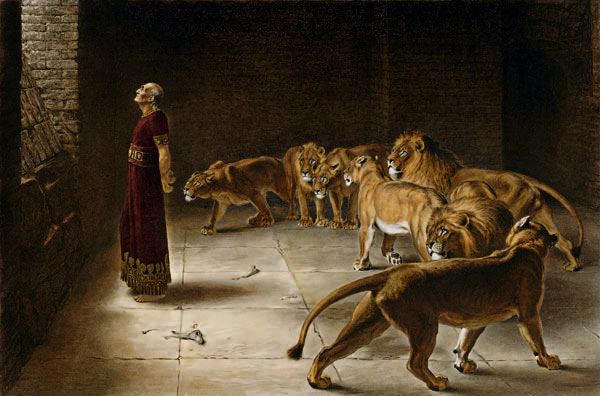
Daniel in the Lion's Den (Daniel 6)
Daniel 6:1 It seemed good to Darius to appoint 120 satraps over the kingdom, that they would be in charge of the whole kingdom,
- Darius: Da 5:31 1Pe 2:14
- an : Ex 18:21,22 Es 1:1
- Daniel 6 Resources - Multiple Sermons and Commentaries
- Daniel a Man of Integrity

A NEW KINGDOM
THE SAME SOVEREIGN GOD
It seemed good to Darius to appoint 120 satraps over the kingdom, that they would be in charge of the whole kingdom - Daniel 6 begins immediately after the dramatic conclusion of Daniel 5. Babylon has fallen, Belshazzar has been slain, and Darius the Mede received the kingdom (Da 5:30–31). Now Darius begins organizing his newly acquired realm.
Darius - The precise historical identification of Darius the Mede remains debated. Daniel tells us that he was a Mede, was about sixty-two years old, and received the kingdom (Da 5:31; Da 9:1). Various identifications have been proposed, including associating him with Gubaru/Gobryas, an official connected with the Persian conquest, or understanding “Darius” as another designation connected with Cyrus or an appointed ruler. The evidence does not permit dogmatism about his exact extrabiblical identity.
Appoint 120 satraps over the kingdom A satrap was a governmental official or provincial administrator. The Aramaic term achashdarpan refers to an official responsible for administering a region on behalf of the king. The number 120 indicates the extensive administrative organization Darius intended to establish throughout the realm. His problem was obvious. A vast kingdom could not be personally administered by one man. So authority was delegated and Daniel is about to be placed very near the top of this administrative structure.
Satraps (translated in other versions as "governors" = ICB, "princes" = KJV) - Name given the governors of the provinces of the Median and Persian empires. The title of the viceroys who governed the provinces of the Persian Empire (Ezra 8:36; Esther 3:12; 8:9; 9:3; Da 3:2; 6:1; etc.). The viceroys or vassal rulers were entrusted with governance of the provinces in the Persian empire. This satrap represented the authority of the king in civil and military matters, and supplied the means for maintaining the king’s sovereignty over the whole empire. Satrap is related to the Persian word meaning "protector of the realm." The satrap was usually chosen from the Persian nobility, often from the royal family. One of his important functions was to collect the tribute (taxes), a role which might tempt him to "dip into the king's coffers." (cp phrase "might not suffer loss.")
ISBE adds that - The satrap was virtually a king; he had his own court and absolute civil authority, and he answered directly to the “great king.” To ensure the satrap’s loyalty to the king, other officials who answered directly to the king were appointed to work alongside the satrap: a secretary (who handled all official correspondence), a chief financial officer (who collected taxes), and a commander of the armed forces. In addition, inspectors known as “the eyes and ears of the king” might appear at any time to check on conditions in the provinces. Judea, a part of (Bromiley, G. W.. The International Standard Bible Encyclopedia, Revised. Volume 4:345. Wm. B. Eerdmans)
Wikipedia says that - The satrap was the head of the administration of his province, and found himself surrounded by an all-but-royal court; he collected the taxes, controlled the local officials and the subject tribes and cities, and was the supreme judge of the province before whose "chair" (Nehemiah 3:7) every civil and criminal case could be brought. He was responsible for the safety of the roads (cf. Xenophon), and had to put down brigands and rebels. (Satrap - Wikipedia)
Be in charge of the whole kingdom - Darius is establishing governmental order. The purpose becomes clearer in the next verse, “the king might not suffer loss.” (Da 6:2). The New American Bible renders this interpretatively as "to safeguard his interests" which is a reasonable interpretation in view of the next statement that "the king might not suffer loss." (Da 6:2) Such a position would be responsible to prevent loss from military revolts, tax evasion, fraud, etc
Lehman Strauss - The inferiority (Da 2:39) of this second kingdom of silver to the first kingdom of gold is at once noticeable. Nebuchadnezzar's rule in Babylon was one of absolute monarchy. It was autocratic. He refused to share authority with anyone, being sole dictator in his kingdom. Whom he would he put to death, and whom he would he kept alive. But under King Darius there was a change. This second world empire was not an absolute monarchy. King Darius had the government in his kingdom well organized, setting over it one hundred and twenty princes, (BORROW - The Prophecies of Daniel)
Changing circumstances
do not require changing convictions.
🙏 THOUGHT: We cannot control the changes that occur around us. Leaders change, circumstances change, health changes, responsibilities change, and seasons of life change. Daniel lived through more change than most. He was taken from his homeland as a teenager, served under the kings of two world empires, and watched Babylon fall to the Medes and Persians in a single night. Yet Daniel teaches us that changing circumstances do not require changing convictions. As a young exile, he "made up his mind that he would not defile himself" (Daniel 1:8). Nearly seventy years later, when a new king's decree threatened his life, he knelt and prayed three times a day, "as he had been doing previously" (Da 6:10). The empire had changed, the king had changed, and the danger had grown, but Daniel had not changed. The God who was faithful to Daniel as a young exile was still faithful to him as an old man facing lions (Heb 10:23, 1Th 5:24, Php 1:6, Lam 3:22,23). The psalmist contrasts the passing created order with the eternal God: "They will perish, but You endure... You are the same, and Your years will not come to an end" (Psalm 102:26, 27). With the Father of lights "there is no variation or shifting shadow" (Jas 1:17). "I, the LORD, do not change" (Malachi 3:6), and "Jesus Christ is the same yesterday and today and forever" (Hebrews 13:8). Our calling is simply to keep walking faithfully with our faithful Father God, the One Who never changes.
The story of Daniel and the lion’s den reminds us
that there is a spiritual battle raging all around us.
Ray Pritchard reminds us of why this chapter is so important to modern believers reasoning that "we learn the secret of Daniel’s success. Somehow he managed to survive and thrive in a spiritually hostile environment. That point is a good place to begin because Christians live in a world of spiritual hostility where the temptation to compromise our faith is with us every day. The world doesn’t want its conscience pricked and doesn’t reward those who dare to stand up for what they believe. In some parts of the world, standing up for Christ means suffering and death. In America (and in most countries in the West) it means ostracism, ridicule, scorn, being left out and perhaps being passed over. It often leads to tension at home and on the job. The book of Daniel tells us how to live for God in a hostile environment. His example shows us that it can be done but not without discomfort. If you don’t compromise, you are sure to come into trouble sooner or later. The story of Daniel and the lion’s den reminds us that there is a spiritual battle raging all around us. The devil himself is like a roaring lion who would devour us if he could (1Pe 5:8). Therefore, it should not surprise us if the devil has an army of supporters whose major call in life is to harass us, trick us, and trip us up if they can. You can tell a lot about a person by the quality of his enemies. Daniel must have been a good man because he had the right kind of enemies. The people who hated him were no friends of God. They came after his faith because they could find no fault in him, and they had no answer for what he believed. (How to Tame Lions)
SOME TAKEAWAYS FROM DANIEL 6...
History changes rulers; history never changes the Ruler.
Kings change, kingdoms change, governments change, but the God Who rules over them does not change.
Daniel outlasted kings because Daniel belonged to the King Who outlasts every kingdom.
Daniel's circumstances changed dramatically, but Daniel's convictions did not.
Daniel's faithfulness in old age was the continuation of convictions established in his youth.
There is no retirement age from faithfulness to God.
A believer's role may change with age, but his opportunity to honor God does not disappear.
Daniel 6 is not the story of a man who suddenly became faithful in a crisis. It is the story of a man whose crisis revealed a lifetime of faithfulness. (This reminds of Steve Green's convicting song "Find us Faithful")
One of the most familiar stories in the Bible is found in Daniel 6 which picks up where Da 5:31 left off with Darius the Mede beginning his reign. Just as God had predicted through the dream He gave Nebuchadnezzar, the head of gold, Babylon, was removed and the body and arms of silver, the Medo-Persians, now have been established as the dominant world empire (Da 2:21, Da 2:32, Da 2:39) Judah has been in exile 70 years in Babylon (Da 9:2). Daniel is an old man in his 80's (Chronological Structure of Daniel). This chapter marks the end of the "historical" (or narrative) section of Daniel and prepares us for the great prophecies in Daniel 7-12, prophecies that form the "back bone" or foundation for all other Biblical prophecies dealing with the last days that precede and terminate in the Second Coming of the Messiah.
HISTORICAL CONTEXT
Judah's 70 years of captivity (God's hand of discipline for idolatry -2Chr 36:14, 15, 16. Ezek 8:5-16- and failure to keep the Sabbaths for the land - 2Chr 36:21, Lev 25:4) ended in 539BC just as God had prophesied through Jeremiah…
Behold, I will send and take all the families of the north, 'declares the LORD,' and I will send to Nebuchadnezzar king of Babylon, My servant, and will bring them against this land (Note: This teaches the important and at times confusing principle regarding God's use of evil -- At this time Nebuchadnezzar was a violent, ruthless, evil despot. God is not the source of evil, but He is able in His sovereign rule and His omnipotence to utilize evil to accomplish His purposes Ge 50:20, Ro 8:28,29), and against its inhabitants, and against all these nations round about; and I will utterly destroy them, and make them a horror, and a hissing, and an everlasting desolation. 10 'Moreover, I will take from them the voice of joy and the voice of gladness, the voice of the bridegroom and the voice of the bride, the sound of the millstones and the light of the lamp. 11 'And this whole land shall be a desolation and a horror, and these nations shall serve the king of Babylon seventy years. 12 'Then it will be when seventy years are completed I will punish the king of Babylon and that nation (Note: Fulfilling the prophecy in Daniel 2 that the Head of Gold would be followed by the body and arms of silver, Medo-Persia),' declares the LORD, 'for their iniquity (Same prophecy in Isa 13:17), and the land of the Chaldeans; and I will make it an everlasting desolation. (Jer 25:9-12)
For thus says Jehovah, ‘When seventy years have been completed for Babylon, I will visit you and fulfill My good word to you, to bring you back to this place. (Jer 29:10)
How would God fulfill His promise in Jeremiah to bring them back to Judah and Jerusalem? Through His prophet Isaiah 44 some 150 years earlier God had given the following promise…
Confirming the word of His servant, and performing the purpose of His messengers. It is I who says of Jerusalem, 'She shall be inhabited!' And of the cities of Judah, 'They shall be built.' And I will raise up her ruins again (Note that this was prophesied BEFORE the fall of Jerusalem and Judah - God promises to rebuild even before He allows them to be destroyed!). "It is I who says to the depth of the sea, 'Be dried up!' And I will make your rivers dry. It is I who says of Cyrus (Who had not even been born!), 'He is My shepherd! And he will perform all My desire.' (Pr 21:1) And he (Cyrus) declares of Jerusalem, 'She will be built,' And of the temple, 'Your foundation will be laid.'" (Isa 44:26-28)
I have aroused him (King Cyrus) in righteousness and I will make all his ways smooth; He will build My city (Jerusalem) and will let My exiles go free (after 70 years of Babylonian captivity), without any payment or reward,” says the Lord of hosts. (Is 45:13).
How was Cyrus to be God's shepherd to lead His sheep, Judah, back to the Promised Land after 70 years of exile? In 539BC (538BC according to the Cyrus Cylinder - see below) God had Cyrus issue a decree (and Persian decrees as we find out in Daniel 6 are irrevocable and binding!), the scribe Ezra recording…
Now in the first year of Cyrus king of Persia, in order to fulfill the word of the Lord by the mouth of Jeremiah, the LORD (Jehovah) stirred up the spirit of Cyrus king of Persia, so that he sent a proclamation throughout all his kingdom, and also put it in writing, saying:
“Thus says Cyrus king of Persia, ‘The LORD, the God of heaven, has given me all the kingdoms of the earth and He has appointed me to build Him a house in Jerusalem, which is in Judah. Whoever there is among you of all His people, may his God be with him! Let him go up to Jerusalem which is in Judah and rebuild the house of the LORD, the God of Israel; He is the God Who is in Jerusalem. Every survivor, at whatever place he may live, let the men of that place support him with silver and gold, with goods and cattle, together with a freewill offering for the house of God which is in Jerusalem.’ (Ezra 1:1-4, cp additional details were added to this public proclamation in a "Memorandum" - see Ezra 6:2-12)
Cyrus Cylinder
Discovered 1879
Archaeology has substantiated the Biblical record (as if the Word of Truth needed any validation!) with the discovery of the famous Cyrus cylinder written in 538 BC. On this cuneiform cylinder Cyrus recorded his capture of Babylon and his program of repatriating the conquered peoples to their homelands writing..
From [Babylon] to Aššur and (from) Susa, Agade, Ešnunna, Zamban, Me-Turnu, Der, as far as the region of Gutium, the sacred centers on the other side of the Tigris, whose sanctuaries had been abandoned for a long time, I returned the images of the gods (See Cyrus' words in Ezra 6:5 - "utensils of the temple of God"), who had resided there [in Babylon], to their places [including Jerusalem] and I let them dwell in eternal abodes. I gathered all their inhabitants and returned to them their dwellings.
Donald Campbell writes that Daniel 6 - sets before us the example of a man who possessed the "invisible means of support," the "inner resources" that gave purpose to his life, molded his conduct, and sustained him in adversity. Contemporary man would do well to study again this well-known episode and learn the secrets of living happily in a stress-filled society. (BORROW Daniel, decoder of dreams)
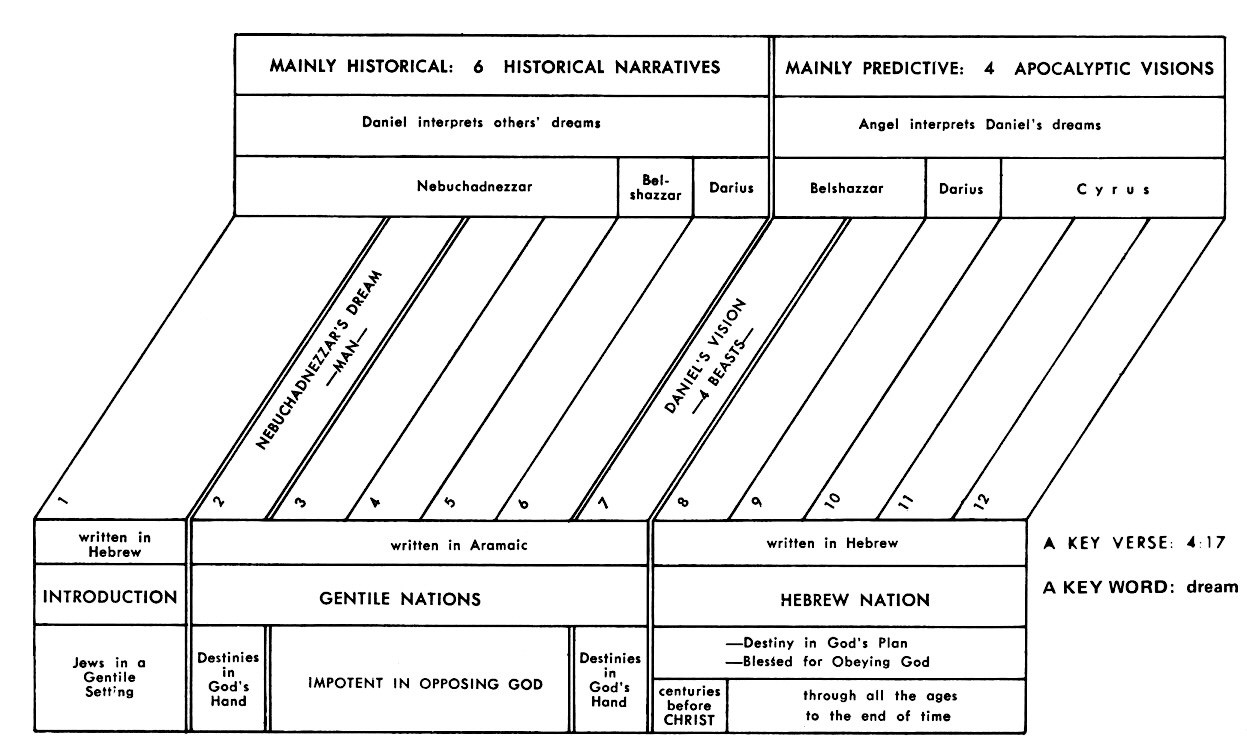
Daniel 6:1-28 are numbered Da 6:2-29 in the Aramaic text.
Recall the 2 major divisions of the book of Daniel…
|
TWO DIVISIONS OF |
||
| DANIEL 1-6 | DANIEL 7-12 | |
|
On Site |
Historical |
Prophetic |
|
J Vernon McGee |
The Historic Night |
The Prophetic Light |
|
Precept Ministries |
Living Out a Biblical Worldview |
Gaining Understanding |
|
John Phillips |
Daniel and |
Daniel and |
|
Irving Jensen |
Mainly Historical: |
Mainly Predictive: |
|
Irving Jensen |
Daniel Interprets |
Angel Interprets |
|
Rob Salvato |
The |
The
|
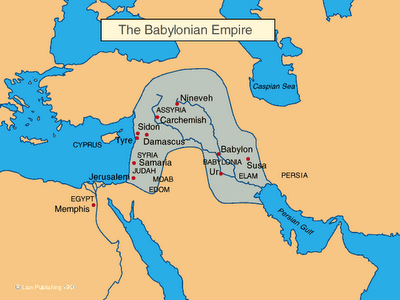
The maps below demonstrate the increased geographic size of the Medo-Persian Kingdom…
|
PROPHECY FULFILLED: |
||
| THE HEAD OF GOLD: BABYLON |
|
Daniel 2:37, 38 605-539BC |
| THE BREAST AND ARMS OF SILVER: MEDO-PERSIA |
|
Daniel 2:39 539-330BC |
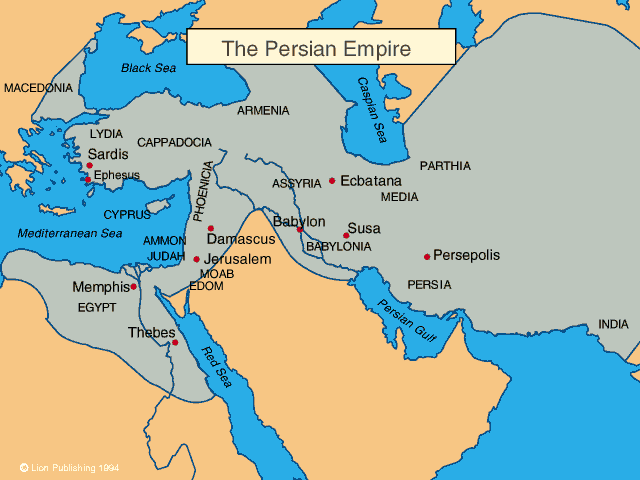
Daniel in the Lions' Den, Da 6:1-28
Da 6:1-3 The Position of Daniel,
Da 6:4-9 The Plot Against Daniel,
Da 6:10-11 The Prayer of Daniel,
Da 6:12-17 The Prosecution of Daniel,
Da 6:18-28 The Protection of Daniel,
(Don Robinson - Outline of the Book of Daniel)
Warren Wiersbe entitles this chapter "Liars, Laws, and Lions" (Bible Exposition Commentary)
Daniel 6 instructs us about remaining faithful when the pressure is on.
Rob Salvato summarizes Daniel 6 - Favored, Framed, Faithful, Fed, Freed!
Darius - Who is this Darius? Darius the Mede ruled from 539-525BC and thus overlapped with the rule of Cyrus (539-530BC). Although it is by no means a consensus, many scholars identify Darius the Mede Gubaru, a general in Cyrus' army who led the forces into Babylon. Note in the table below Darius the Mede is not to be confused with Darius I (the Great).
|
THE RULERS OF THE |
||||
|
539 Cyrus (Persian) 530 |
530 Cambyses II (Suicide) 522 |
522
Darius I 486 |
486
Xerxes I (Ahasuerus) 465 |
|
|
539 Darius the Mede 525 |
----- |
|||
Whitcomb writes that - Once again, critics insist that they have found a historical blunder in the book of Daniel. The ancient Greek historian Herodotus (III, 89) states that Darius I divided the empire into only twenty satrapies. So, we are told, the author of the book of Daniel must have been thinking of the 127 provinces in the days of King Xerxes, son of Darius I (Esther 1:1). But one look at the biblical text reveals that it is the critics who have committed the blunder at this point. The book of Daniel says nothing of "satrapies" or "provinces." It states that 120 "satraps" were set over the kingdom, namely, "the kingdom of the Chaldeans" (Da 9:1). A "satrap" was a Persian official who could rule over a large province or over a small group of people.' This would harmonize well with the "Nabonidus Chronicle," which states that Gubaru installed sub-governors in Babylon immediately after the fall of the city to the armies of Cyrus. Thus, the statement of Daniel 6:1 has nothing whatsoever to do with the division of the Medo-Persian empire into satrapies or provinces that took place during the later administrations of Darius I and Xerxes. (SEE Daniel- Everyman's Bible Commentary - Page 81)
John Butler - Sermon Starter Government Employee - Daniel 6
The prophet Daniel worked for the government for many years. If all those who worked for the government or for business had these qualities, the world would be a better place in which to live.
DANIEL WAS A MAN OF CHARACTER - Da 6:1-3
He had an "excellent spirit".
DANIEL WAS A MAN OF CONSISTENCY - Da 6:4-9
He was faithful. There was no accusation possible against the man, unless he was accused about his God. His enemies plotted to undermine him by putting him in a position of possible compromise concerning his God.
DANIEL WAS A MAN OF CONVICTION - Da 6:10-15
Daniel continued to worship his God in spite of the threat of persecution.
He continued to do what was right!
DANIEL WAS A MAN OF CONSCIENCE - Da 6:16-22
After being falsely accused and spending the night in the lion's den, Daniel still had a clean conscience. He could honestly say, "Oh King I have done no hurt."
DANIEL WAS A MAN OF COURAGE - Da 6:23
He had believed in his God and stood firm for Him.
Some questions to stimulate study and discussion…
How does Daniel 6:1, 28 relate to Daniel 5:30-31? Daniel 6 picks up where Daniel 5 stopped - Fall of Babylon, rise of Medo-Persian empire
How does Daniel 6:1, 28 echo Da 2:32, 38, 39? Fulfillment of prophecy of gold giving way to silver, which he said would be inferior.
What does this say about God? His word is sure and does not fail (Josh 21:45, 23:14, Lk 1:37, Lk 1:37ASV). His prophecies and promises will be fulfilled
How old was Daniel? 70 years plus his age when taken captive in 605BC - At least 80yo or older.
How does Daniel's life example relate to Heb 12:1? He is still running with perseverance the race which God set before him, leaving an example for all believers of every age to imitate (Heb 6:11, 12). So many begin well but finish poorly.
What do we learn from Daniel 6 about his married life? Fact that Da 6:24 says wives and children were thrown in the lion's den with the accusers but were not thrown in with Daniel (Da 6:16)
Why are we surprised that Daniel was one of three commissioners? He had been the third ruler in Babylon and the second ruler Belshazzar had been slain (Da 5:30). Why not Daniel? As noted below God's man is immortal until God's purpose for his life is accomplished!
QUESTION - Who were the satraps in the book of Daniel? | GotQuestions.org
ANSWER - Satraps are mentioned in Daniel chapters 3 and 6. These officials were among the eight classes of officials that King Nebuchadnezzar (605—562 BC) appointed in Babylon. Satraps are also mentioned in the books of Ezra and Esther.
The satraps were the chief representatives of the king, and they most likely had charge of the various provinces of the kingdom. Other officials in Babylon were the prefects (military commanders), governors (civil administrators), advisers (counselors to those in governmental authority), treasurers (administrators of the funds of the kingdom), judges (administrators of the law), and magistrates (those who passed judgment in keeping with the law). The “other provincial officials” mentioned in Daniel 3:2 were probably subordinates of the satraps. This list of officers probably included all who served in any official capacity under Nebuchadnezzar. All of these officials, including the satraps, were required to bow down before the king’s golden image. Shadrach, Meshach and Abednego refused.
In Daniel 6, the satraps serving under King Darius had Daniel as one of their overseers: “It pleased Darius to appoint 120 satraps to rule throughout the kingdom, with three administrators over them, one of whom was Daniel. The satraps were made accountable to them so that the king might not suffer loss” (verses 1–2). The satraps were to protect the king’s possessions, and Daniel was responsible to ensure they carried out their duties. God blessed Daniel, and the satraps were not pleased that Daniel could so easily be promoted to administrator of the entire kingdom. The satraps and other officials under Darius devised a plan they were sure would lead to Daniel’s demise. Their devious ploy backfired, however, and, rather than Daniel being eaten in the lions’ den, the satraps and other officials were (Daniel 6:24).
Daniel 6:2 and over them three commissioners (of whom Daniel was one), that these satraps might be accountable to them, and that the king might not suffer loss.
- of : Da 2:48,49 5:16,29 1Sa 2:30 Pr 3:16) (that : Mt 18:23 Lk 16:2
- and the : Ezra 4:22 Es 7:4 Pr 26:6 Lk 19:13-27 1Co 4:2
- Daniel 6 Resources - Multiple Sermons and Commentaries
CHARACTER THAT SURVIVED
A REGIME CHANGE
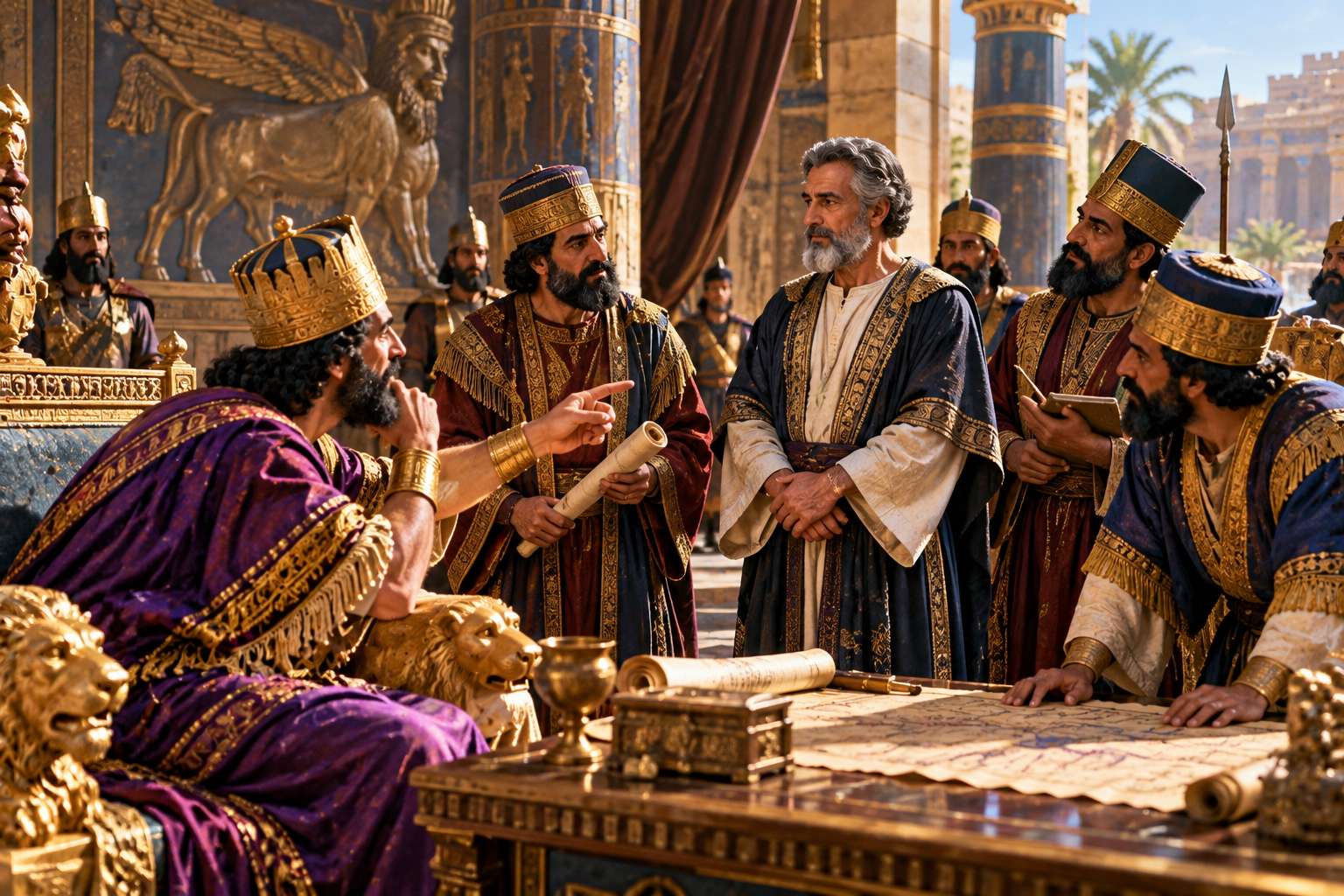
and over them three commissioners (of whom Daniel was one), that these satraps might be accountable to them, and that the king might not suffer loss - Darius' administrative structure now becomes clearer. The 120 satraps were responsible for governing various regions of the kingdom, but over them Darius appointed three commissioners, one of whom was Daniel. The purpose of this arrangement was straightforward: accountability. The satraps were required to report to the commissioners, providing a system of oversight designed to protect the king from financial loss resulting from corruption, fraud, embezzlement, excessive taxation, or administrative mismanagement.
The phrase "that the king might not suffer loss" reminds us that corruption in government is nothing new. Wherever money and power are entrusted to men, there is the potential for dishonesty and self-interest. Darius therefore established layers of accountability to safeguard the resources of the kingdom. And significantly, Daniel was placed at the very heart of that system of accountability. A man whose integrity had been demonstrated for decades was entrusted with watching over those who handled the king's affairs.
Of whom Daniel was one - The KJV renders this phrase, "of whom Daniel was first," emphasizing Daniel's prominence among the three commissioners. What a remarkable testimony to the enduring character and reputation of this man of God! Babylon had fallen, but Daniel's reputation had survived the fall. Kings changed, kingdoms changed, governments changed, but Daniel remained. Daniel had presumably been present in the banquet hall on the very night Babylon fell. Belshazzar had clothed him in purple, placed a gold necklace around his neck, and proclaimed him third ruler in the kingdom (Da 5:29). Those royal insignia could easily have marked Daniel as a prominent official of the regime the Medo-Persians had just overthrown. Yet while Belshazzar was slain, Daniel was spared (Da 5:30-31). The kingdom passed away, but God's servant remained.
There is a wonderful principle here: God's servant is immortal until God has finished His purposes for that servant. Daniel survived Nebuchadnezzar, Belshazzar, the fall of Babylon, and the rise of the Medo-Persian Empire because God still had work for him to do. Human rulers could promote Daniel, demote Daniel, threaten Daniel, or throw Daniel into a lions' den, but they could not terminate God's purpose for Daniel.
And notice the providence of God. Daniel did not have to campaign for a position in the new administration. His decades of faithfulness had established a reputation that crossed political and national boundaries. The empire was new, but Daniel's character was already known. The man who had faithfully served God in Babylon was now strategically placed by God to serve under Medo-Persia.
God never leaves Himself without a witness. Sometimes He places His witnesses in palaces and positions of great influence, as He did with Joseph, Daniel, Esther, and Nehemiah. At other times His witnesses serve unnoticed in the lower echelons of society. The position is secondary; faithfulness is primary. Wherever God places His people, their calling is the same: to remain faithful to Him in the midst of a changing world.
THOUGHT - Governments change, rulers rise and fall, and earthly kingdoms come and go, but the person who faithfully walks with God possesses something political upheaval cannot destroy: a godly character and a sovereign purpose. Babylon fell in a night, but Daniel was still standing in the morning.
Warren Wiersbe - Today, wherever you find dedicated believers living and working with unbelievers, you will often see the same forces at work that are described in this chapter, whether in families, churches, corporations, or governments. It’s certainly a commendable thing when people possess character so impeccable that they can’t be accused of doing wrong except in matters relating to their faith. (Bible Exposition Commentary).
🙏 THOUGHT: Someone may never investigate our work as Daniel's enemies investigated his, but we all live before the eyes of God (Hebrews 4:13; Proverbs 15:3; 2 Chronicles 16:9). Daniel's rivals combed through his record looking for anything they could use, and they came up empty. "They could find no ground of accusation or evidence of corruption, inasmuch as he was faithful, and no negligence or corruption was to be found in him" (Daniel 6:4). Their only hope was to find something against him "with regard to the law of his God" (6:5). What a testimony! His enemies' only accusation was his faithfulness to God. Integrity means being the same person when no one is watching that we appear to be when everyone is watching. "He who walks in integrity walks securely, but he who perverts his ways will be found out" (Proverbs 10:9). Jesus taught that "he who is faithful in a very little thing is faithful also in much" (Luke 16:10), and Paul reminds us that "it is required of stewards that one be found trustworthy" (1 Corinthians 4:2). Our work, whether in an office, a classroom, a home, or a church, is ultimately done for the Lord: "Whatever you do, do your work heartily, as for the Lord rather than for men" (Colossians 3:23). Peter urges us to live so honorably that even those who slander us may see our good deeds and glorify God (1 Peter 2:12). Whatever responsibility God has entrusted to us, our goal should be that others can say what Daniel's enemies were forced to admit: faithful, not negligent, and not corrupt.
Takeaways from Daniel 6:1
Babylon had fallen, but Daniel's reputation had survived the fall.
The empire changed, but Daniel's character did not.
Belshazzar lost his kingdom in a night; Daniel carried his character into the next kingdom.
God's servant is immortal until God's purpose for that servant is complete.
Governments changed, but Daniel's character remained valuable because integrity never becomes obsolete.
Daniel lived close to power without allowing power to corrupt his character.
Daniel's enemies could find his convictions, but they could not find corruption.
The integrity everyone saw in Daniel's public life had been cultivated for decades in his private walk with God.
Position may be given overnight; character is built over a lifetime.
Daniel learned how to serve an earthly king faithfully without compromising his loyalty to the heavenly King.
Daniel 6:3 Then this Daniel began distinguishing himself among the commissioners and satraps because he possessed an extraordinary spirit, and the king planned to appoint him over the entire kingdom.
KJV Then this Daniel was preferred above the presidents and princes, because an excellent spirit was in him; and the king thought to set him over the whole realm.
NET Now this Daniel was distinguishing himself above the other supervisors and the satraps, for he had an extraordinary spirit. In fact, the king intended to appoint him over the entire kingdom.
NLT Daniel soon proved himself more capable than all the other administrators and high officers. Because of Daniel's great ability, the king made plans to place him over the entire empire.
ESV Then this Daniel became distinguished above all the other high officials and satraps, because an excellent spirit was in him. And the king planned to set him over the whole kingdom.
LXE And Daniel was over them, for there was an excellent spirit in him; and the king set him over all his kingdom.
CSB Daniel distinguished himself above the administrators and satraps because he had an extraordinary spirit, so the king planned to set him over the whole realm.
NIV Now Daniel so distinguished himself among the administrators and the satraps by his exceptional qualities that the king planned to set him over the whole kingdom.
NJB This Daniel, by virtue of the marvellous spirit residing in him, was so evidently superior to the other presidents and satraps that the king considered appointing him to rule the whole kingdom.
BBE Then this Daniel did his work better than the chief rulers and the captains, because there was a special spirit in him; and it was the king's purpose to put him over all the kingdom.
- Extraordinary: Da 5:12,14 9:23 Ge 41:38-41 Neh 7:2 Pr 3:3,4 17:27 Ec 2:13
- Daniel 6 Resources - Multiple Sermons and Commentaries
- See below for discussion of The Marks of Integrity as Exemplified in Daniel 6
Related Passages:
Genesis 39:2-6 The LORD was with Joseph, so he became a successful man. And he was in the house of his master, the Egyptian. 3 Now his master saw that the LORD was with him and how the LORD caused all that he did to prosper in his hand. 4 So Joseph found favor in his sight and became his personal servant; and he made him overseer over his house, and all that he owned he put in his charge. 5 It came about that from the time he made him overseer in his house and over all that he owned, the LORD blessed the Egyptian’s house on account of Joseph; thus the LORD’S blessing was upon all that he owned, in the house and in the field. 6 So he left everything he owned in Joseph’s charge; and with him there he did not concern himself with anything except the food which he ate. Now Joseph was handsome in form and appearance.
Genesis 39:21-23 But the LORD was with Joseph and extended kindness to him, and gave him favor in the sight of the chief jailer. 22 The chief jailer committed to Joseph’s charge all the prisoners who were in the jail; so that whatever was done there, he was responsible for it. 23 The chief jailer did not supervise anything under Joseph’s charge because the LORD was with him; and whatever he did, the LORD made to prosper.
Genesis 41:38-41 Then Pharaoh said to his servants, “Can we find a man like this, in whom is a divine spirit?” 39 So Pharaoh said to Joseph, “Since God has informed you of all this, there is no one so discerning and wise as you are. 40 “You shall be over my house, and according to your command all my people shall do homage; only in the throne I will be greater than you.” 41 Pharaoh said to Joseph, “See, I have set you over all the land of Egypt.”
Daniel 1:8 But Daniel made up his mind that he would not defile himself with the king’s choice food or with the wine which he drank; so he sought permission from the commander of the officials that he might not defile himself.
Daniel 1:17-21 As for these four youths, God gave them knowledge and intelligence in every branch of literature and wisdom; Daniel even understood all kinds of visions and dreams. 18 Then at the end of the days which the king had specified for presenting them, the commander of the officials presented them before Nebuchadnezzar. 19 The king talked with them, and out of them all not one was found like Daniel, Hananiah, Mishael and Azariah; so they entered the king’s personal service. 20 As for every matter of wisdom and understanding about which the king consulted them, he found them ten times better than all the magicians and conjurers who were in all his realm. 21 And Daniel continued until the first year of Cyrus the king.
Daniel 5:12 “This was because an extraordinary spirit, knowledge and insight, interpretation of dreams, explanation of enigmas and solving of difficult problems were found in this Daniel, whom the king named Belteshazzar. Let Daniel now be summoned and he will declare the interpretation.”
Daniel 5:14 “Now I have heard about you that a spirit of the gods is in you, and that illumination, insight and extraordinary wisdom have been found in you.
Proverbs 22:29 Do you see a man skilled in his work? He will stand before kings; He will not stand before obscure men.
Matthew 5:16 “Let your light shine before men in such a way that they may see your good works, and glorify your Father who is in heaven.
Luke 16:10 “He who is faithful in a very little thing is faithful also in much; and he who is unrighteous in a very little thing is unrighteous also in much.
1 Corinthians 4:2 In this case, moreover, it is required of stewards that one be found trustworthy.
Colossians 3:22-24 Slaves, in all things obey those who are your masters on earth, not with external service, as those who merely please men, but with sincerity of heart, fearing the Lord. 23 Whatever you do, do your work heartily, as for the Lord rather than for men, 24 knowing that from the Lord you will receive the reward of the inheritance. It is the Lord Christ Whom you serve.
Titus 2:7-8 in all things show yourself to be an example of good deeds, with purity in doctrine, dignified, 8 sound in speech which is beyond reproach, so that the opponent will be put to shame, having nothing bad to say about us.
EXCUSE ME…
YOUR INTEGRITY IS SHOWING!
Then - (Always stop interrogate expressions of time like "then") When? When his behavior was compared and contrasted with these other men. Darius recognized that Daniel was a rare jewel, a man of integrity among a crooked and perverse generation. Integrity as someone has said "is the first step in true greatness." (C. Sommons)
This Daniel The expression “this Daniel” gives the statement a personal emphasis. This was the same Daniel who had been brought to Babylon as a young captive decades earlier (Da 1:3–6) had purposed not to defile himself (Da 1:8), interpreted Nebuchadnezzar's dream (Da 2), counseled Nebuchadnezzar to repent (Da 4:27), confronted Belshazzar with his sin (Da 5:22–23) and now: distinguished himself under Darius. Kings had changed. Kingdoms had changed. Daniel had grown old. But Daniel's character had not deteriorated.
The convictions Daniel formed in his youth became
the character that distinguished him in old age.
Began distinguishing himself among the commissioners and satraps because (a critical term of explanation) he possessed an extraordinary (yattir) spirit, and the king planned to appoint him over the entire kingdom. Daniel had already been appointed as one of the three commissioners overseeing the 120 satraps (Da 6:1–2). But it soon became obvious to Darius that Daniel was no ordinary administrator. He began “distinguishing himself” above all the others. The reason was not political maneuvering, self-promotion, or personal ambition. Scripture points instead to something within Daniel:“He possessed an extraordinary spirit.” This undoubtedly reflects the empowering presence of the Holy Spirit in Daniel's life. Beloved, the Holy Spirit was alive and well in the Old Testament beginning in Genesis 1:2 and all the way to Malachi because of 2Pe 1:21! Malachi was moved by the Spirit to speak from God.! Daniel did not have to promote himself. His character and competence distinguished him.
Talbot - In Old Testament times the Holy Spirit of God came upon individuals for special service. Surely He came upon Daniel for very special service at the court of one king after another, throughout a long period of years. Daniel would have been the first to attribute his own “excellent spirit” to the mighty power in his life of the Holy Spirit of his Triune God.
There is no indication that Daniel was seeking this promotion. He did not campaign for it. He did not undermine the other commissioners. He did not manipulate Darius. Daniel simply remained faithful in the position God had given him. Daniel concentrated on being faithful; God took care of where that faithfulness placed him.
Daniel is 80+ (I am 80 as I write these words) and still running the race with endurance! Daniel did not spend his later years merely remembering how God had used him in the past; he remained available for God to use him in the present. What an example for all us to emulate/imitate (Heb 6:12,13). Daniel reminds me of the man in Ps 92:13-15 -
Planted in the house of the LORD, They will flourish in the courts of our God. 14 They will still yield fruit in old age; They shall be full of sap and very green, 15 To declare that the LORD is upright; He is my rock, and there is no unrighteousness in Him.
They will still yield fruit in old age;
They shall be full of sap and very green,
Began Distinguishing Himself because (a critical term of explanation) he possessed an extraordinary (yattir) spirit - The Aramaic conveys the idea of surpassing, excelling, or showing oneself superior to the others. Daniel did not merely perform adequately. He excelled. This is important because Daniel was a deeply spiritual man, but his spirituality did not make him careless about secular responsibilities. Reputation is what men think you are, while character is what God knows you are. Daniel was both. He was not a hypocritical "OT Pharisee". Daniel knew the truth that what a man is in the sight of God (Pr 15:3), is what a man truly is!
Something about Daniel's inner character produced observable excellence in his outward conduct. What Daniel was on the inside eventually became visible in what Daniel did on the outside.
Distinguishing (05330)(nesah) is an Aramaic verb meaning to exhibit or show a difference. The Hithpaal force is brought out in a reflexive usage (distinguishing himself). When one is distinguished he is identified as different and distinct. This is the only use in the Scriptures.
It is worth noting that one of the meanings of the corresponding Hebrew word (nasah - 05329 - to be pre-eminent) is brightness or brilliance! Indeed, Daniel's spirit shone brightly in the darkness reminiscent of Paul's exhortation to believers "to be blameless and innocent, children of God above reproach in the midst of a crooked and perverse generation, among whom you appear as lights in the world." (Phil 2:15)
Webster's 1828 says distinguish means "to ascertain and indicate difference by some external mark. The farmer distinguishes sheep by their ears. To separate one thing from another by some mark or quality." Daniel was separated from the other commissioners and satraps by his excellent spirit.
Extraordinary (03493) (yattir) is an Aramaic adjective designating something as excellent, outstanding. superior. In Nebuchadnezzar's dream in Da 2:31 the statute was described as "large and of extraordinary (yattir) splendor."
The Septuagint (Lxx) translates excellent in Da 6:3 with the adjective perissos which speaks of that which exceeds the usual expectation and thus is extraordinary or remarkable (Jesus used perissos in John 10:10 to describe His desire that we might have "life and have it abundantly (perissos)".
Yattir is used 8x in Daniel - Da 2:31; 3:22; 4:36; 5:12, 14; 6:3; 7:7, 19
King planned to appoint him - Like Pharaoh with Joseph because "no one (was) so discerning and wise as" Joseph (Ge 41:3-41). Darius recognized Daniel's value and intended to promote him. The king apparently had not yet completed the appointment, but the intention was becoming evident. Daniel's greatness was not merely that he knew what to do, but that he could be trusted to do what was right.
Over the entire kingdom - He was in effect the "president elect" (elected by Darius). Whether his co-presidents knew this is doubtful. Daniel seems to always rise to the top and even as Babylon ceased to be the leading world empire, he was for a very short time the third leading ruler in Babylon! (Da 5:29) It is certainly evidence of the good hand of Jehovah upon this man's life for it would be unusual (potentially even dangerous) to appoint a leader in a defeated kingdom to a post of power, not to mention the hesitancy to make such an appointment because of his age.
🙏 THOUGHT: Daniel reminds us that there should be something distinctive about the way a child of God approaches ordinary responsibilities. Daniel "began distinguishing himself among the commissioners and satraps because he possessed an extraordinary spirit" (Daniel 6:3). The same phrase described him decades earlier under Belshazzar (5:12). His excellence was not a passing season but a lifelong pattern. Our work should display honesty, diligence, reliability, and excellence, not to promote ourselves but to honor the Lord. Solomon observed, "Do you see a man skilled in his work? He will stand before kings" (Proverbs 22:29), and Daniel did, before four of them. Joseph showed the same spirit as a slave in Potiphar's house and as a prisoner, and "the LORD caused all that he did to prosper in his hand" (Genesis 39:2–3, 23). Paul told even bondservants that their faithful work could "adorn the doctrine of God our Savior in every respect" (Titus 2:9–10). Our diligence on the job can make the gospel more attractive to those who watch us. "Whatever your hand finds to do, do it with all your might" (Ecclesiastes 9:10). Whatever our occupation or age, we should seek to work as for the Lord, so that others "may see your good works, and glorify your Father who is in heaven" (Matthew 5:16). A truly extraordinary spirit is often revealed through extraordinarily faithful performance of ordinary responsibilities.
Takeaways from this verse:
Daniel did not have to promote himself. His character and competence distinguished him.
What men called extraordinary in Daniel ultimately reflected the extraordinary God Daniel served.
What Daniel was on the inside eventually became visible in what Daniel did on the outside.
The convictions Daniel formed in his youth became the character that distinguished him in old age.
Daniel's devotion to God did not diminish his excellence in work, but it produced it.
Daniel's reputation crossed administrations because his character transcended administrations.
The same character that attracted the king's confidence provoked the officials' jealousy.
Daniel concentrated on being faithful; God took care of where that faithfulness placed him.
Daniel 6:3–23 “Was God able to save you?” Drawing Closer to God: 365 Daily Meditations on Questions ...
King Darius looked at the hard, cruel faces of his officials and inwardly admitted that there was no way out. He deeply regretted signing the decree that people could pray only to the king for thirty days. How could he have forgotten about Daniel and his faith in Israel’s God? But his vanity had been flattered by the officials’ suggestion; now the decree could not be revoked. He had considered putting Daniel in charge of the whole kingdom; instead he would be forced to throw his most trusted official into a den of lions.
Daniel faced certain death, and yet – Darius had seen his unshakeable confidence in Yahweh. Did he dare hope . . . ? “May your God, whom you always worship, save you!” the king told Daniel. After Daniel was shut up in the lions’ den, Darius spent a wretched, sleepless night. At first light, he rushed to the den, hoping against hope.
Darius called out in an anguished voice, “Daniel, servant of the living God! Was God, whom you always worship, able to save you from the lions?” The king gasped as he heard Daniel’s greeting, respectful as always. Then Daniel explained, “My God sent his angel and shut the lions’ mouths so that they couldn’t hurt me.”
People around us watch to see if we really depend on God for help, especially when our safety is threatened. Like Daniel, our life can impact others if we display steadfast confidence in God’s power and refuse to back down, even in the face of a king’s decree. But we can’t wait until we land in a lions’ den to develop that kind of faith. If we stay committed to God’s will in everyday matters, then we’ll be better prepared to face wild animals or wild times.
He saves, rescues, and does miraculous signs and amazing things in heaven and on earth. He saved Daniel from the lions.
Daniel 6:27
Ask yourself: Is it obvious to people around me where I place my trust?
Integrity (from "integer" = the whole of anything, a whole number not a fraction - think "whole character" not a fraction of one!) speaks of the unimpaired state of one's mind and heart, of moral soundness and purity, of incorruptness, of uprightness, of honesty. Just as we would talk about a whole number, so also we can talk about a whole person who is undivided. A person of integrity is living rightly, not divided, nor being a different person in different circumstances. A person of integrity is the same person in private that he or she is in public. Integrity has the same root word as does the word integrated. A leader of integrity has taken the principles that govern his life, internalized them, and integrated them into every area of his life. Integrity is not like a weathervane that changes direction with every shift of the social winds, as Daniel will soon dramatically demonstrate.
INTEGRITY:
"WYSIWYG"
What you see is what you get
Congruency between what you verbalize and what you practice. Your "life" matches your "lips"! (Does mine?) cp Jesus' advice - Mt 23:2,3) The essence of integrity is to be on the inside what we appear to be on the outside. Secret indulgences undermine integrity. Public and private behavior are the same. Integrity is what you do when you’re unaware that you’re children are looking and listening. Integrity is who we really are on the inside. A popular book was entitled "Who Are You When Nobody’s Looking?" (This is obviously a secular book because we as believers know that God is ALWAYS looking - Pr 15:3
See also - Ge 16:13 Dt 11:12 21:9 2Chr 6:20 Ps 33:18 Ps 34:15, Ps 113:6, Ps 139:2,3, Job 34:21, 31:4, Pr 5:21 Jer 16:17, 23:24, 32:19 Zech 4:10 Heb 4:13 1Pe 3:12 Ge 6:8.
Related Resources:
- Omniscience of God
- Pr 15:3 The Omnipresence of God - Charles Simeon
- William Arnot on Proverbs 15:3, 11 The All-Seeing
- Proverbs 15:3 In Depth Commentary on site
Newton notes that "Integrity describes a person whose thoughts and private behavior are consistent with their outward profession. The Christian leader with integrity is a person whose heart is set on loving and obeying God, no matter what the cost." (Newton, G. C. Growing toward spiritual maturity. Biblical essentials series. Wheaton, Ill.: Crossway Books.)
A simple definition of integrity is doing what you say you will do. Does this describe me?
The measure of a man's character is what he would do if he knew he never would be found out. (see also Judgment Seat of Christ)
1828 Webster's - Integrity comprehends the whole moral character, but has a special reference to uprightness in mutual dealings, transfers of property, and agencies for others. (How's your "integrity quotient"?) Integrity is an unimpaired condition or soundness, adherence to a code of moral values, and the quality or state of being complete and undivided. See also honesty. Integrity means soundness, completeness, honesty.
John MacArthur says that "Integrity (from the Latin word integer, “entire”) may be defined as the condition or quality of being undivided. It describes those who adhere to their ethical or moral standards without hypocrisy or duplicity. People with integrity lead lives that are one with their stated convictions; they what they preach.” They are honest, sincere, and incorruptible. In biblical terms, those with integrity are “above reproach”—a quality that is to characterize all believers (Php 2:15; 1Ti 5:7), but especially elders (1Ti 3:2; Titus 1:6, 7). The Bible stresses the value of integrity by condemning hypocrisy. Jesus repeatedly denounced the religious leaders of His day as hypocrites (Mt. 6:2, Mt 6:5, Mt 6:16; Mt 15:7; 22:18; Lk 12:1, 56; 13:15). Matthew 23 records His blistering malediction on the scribes and Pharisees for their lack of integrity, because “they say things and do not do them” (Mt 23:3). After a series of curses, each introduced by the phrase “woe to you” (Mt 23:13, 14, 15, 16, 23, 25, 27, 29), and after repeatedly denouncing them as hypocrites, Jesus concluded with a stern rebuke: “You serpents, you brood of vipers, how will you escape the sentence of hell?” (Mt 23:33). (SEE 2 Corinthians MacArthur New Testament Commentary - Page 182)
RELATED RESOURCES:
- A Ministry of Integrity discusses Biblical examples like Job and David
- BORROW John MacArthur's book The Power of Integrity Building a Life Without Compromise
INTEGRITY IN
THE BIBLE
Integrity - Study the 27 uses of the English word integrity in the NAS - Ge 20:5, 6; Jdg 9:16, 19; 1Kgs 9:4; 1Chr 29:17; Job 2:3, 9; 4:6; 8:20; 27:5; 31:6; Ps 7:8; Ps 15:2; Ps 25:21; Ps 26:1, Ps 26:11; Ps 41:12; Ps 78:72; Ps 101:2; Pr 2:7; 10:9; 11:3; 19:1; 20:7; 28:6; Amos 5:10
Fathers and mothers (but especially us as fathers for we are accountable to God to be the godly leaders of our families) read (and heed) Solomon's advice (something that he seems to himself have failed to heed! Witness his son - 1Ki 11:43, 12:7,8, 13)…
A righteous man who walks in his integrity
How blessed are his sons after him.
--Proverbs 20:7
WHAT TO LEAVE YOUR CHILDREN - by C H Spurgeon (From Faith's Checkbook on Proverbs 20:7)
ANXIETY about our family is natural, but we shall be wise if we turn it into care about our own character. If we walk before the Lord in integrity, we shall do more to bless our descendants than if we bequeathed them large estates. A father’s holy life is a rich legacy for his sons.
The upright man leaves his heirs his example, and this in itself will be a mine of true wealth. How many me may trace their success in life to the example of their parents!
He leaves them also his repute. Men think all the better of us as the sons of a man who could be trusted, the successors of a tradesman of excellent repute. Oh, that all young men were anxious to keep up the family name!
Above all, he leaves his children his prayers and the blessing of a prayer-hearing God, and these make our offspring to be favored among the sons of men. God will save them even after we are dead. Oh, that they might be saved at once!
Our integrity may be God’s means of saving our sons and daughters. If they see the truth of our religion proved by our lives, it may be that they will believe in Jesus for themselves. Lord, fulfill this word to my household!
Chuck Colson exaggeratedly (albeit rightly) said "The three most important ingredients in Christian work are integrity, integrity, integrity."
It’s a fact of life that you never know when your integrity will be tested. But is is also true that integrity shines brightest against the backdrop of adversity. People may doubt what you say, but they will always believe what you do.
Satan does not need to accomplish much to destroy integrity. Because integrity has to do with wholeness, even a small chink destroys it. Integrity is a true 24/7 concept. Consistently right choices create (or reveal) integrity. One evil choice creates a fault line of potential catastrophe.
A person of integrity is unimpeachable. He or she stands by principles no matter what the consequences. In fact integrity can cost you a relationship, reputation, promotion, job, even your life.
Do you speak the truth (Biblical truth in love) no matter what people want to hear? That's integrity.
Seek to have a life that bears scrutiny.
Do you have singleness of heart, of mind, of vision, of purpose? That's integrity. Paul said it this way "one thing I do: forgetting what lies behind and reaching forward to what lies ahead, 14 I press on toward the goal for the prize of the upward call of God in Christ Jesus. (Php 3:13,14) Integrity manifest a single heart, a single mind, a single eye, a single focus - ONE THING - Integrity presses on toward the goal!
People of biblical integrity tend also to be people with unashamed boldness.
Integrity enjoys God's favor (cp Da 1:9) for He delights in granting special grace and favor to those whose hearts are set on pleasing Him
1Chr 12:33 describes men "with an undivided heart" where undivided heart in Hebrew literally = they were without a heart and a heart! That's Biblical integrity!
Integrity practices what it preaches! If your enemies were out to get you, and did an audit of your lifestyle, could they find room to criticize you? Daniel’s life of utmost integrity was such that his enemies could find nothing with which to accuse and besmirch him! Why did Daniel's enemies know he would defy the King’s law in Daniel 6:10ff? Because Daniel was a man of integrity—he was consistent -- He did not pray to show his integrity, he prayed because of his integrity.
If you had to write your epitaph, what would you say? In fact you are "writing your epitaph" today with the choices you make and by the way you live out those choices. Your friends and family will remember you for something, what will it be? May our earnest desire be that when we are laid to rest our life will have earned the epitaph—He/she was a man/a woman of Integrity. True be told, when it is all said and done, integrity is all that really counts.
The Bible teaches that a believer's integrity is never for sale and never to be sacrificed.
"A person with integrity is one whose thoughts, beliefs, words, and actions are all in perfect harmony. For the Christian, integrity involves having every area of life in submission to the truth of God’s Word, with nothing inconsistent or out of sync. A person with integrity is not like Talkative in Pilgrim’s Progress, who was described by those who knew him as a saint abroad but a devil at home." (John MacArthur)
"What enables a person to persevere is integrity. Integrity means that we are able to live without compromising what God has made us to be. Integrity enables us to stay on course, instead of panicking and bailing out. Integrity is strengthened through repeated tests. The trials God sends purge us of sin and enable us to mature in integrity." (R C Sproul)
Integrity in leadership is inseparable from humility in leadership… Ultimately, our integrity in personal ministry comes from daily honesty with Christ. Don’t depend on someone else to keep you ethical. - Scott Morton
THE POWER TO LIVE
WITH INTEGRITY
Where does the power to live with integrity come from according to…
- Gal 2:20
- Php 2:12, Php 2:13
- Php 4:13 (But check the context - Php 4:11, 12)
- Col. 3:16, Col 3:17
- 1Th 5:23,24
- 2Ti 1:7, 2Ti 2:1
Horace Greeley - Fame is a vapor, popularity an accident, riches take wings, those who cheer today may curse tomorrow, only one thing endures—character.
The Puritan writer Thomas Watson might as well have said the following of Daniel - The plainer the diamond the more it sparkles. The plainer the heart is the more it sparkles in God's eyes. (Does you heart "sparkle" in His eyes? cp 2Chr 16:9)
A clear conscience is a prime benefit of integrity, and it enables one to stand firm when the storms of life come upon us. If your heart does not condemn you, but affirms you, you can be a tower of strength for "The man of integrity walks securely" (Pr 10:9) where the Hebrew for "securely" means safety, security, place of refuge; feeling of trust, assurance, without concern, confidence. A person of integrity will have a good reputation and not have to fear that he or she will be exposed or found out. Integrity provides a safe path through life.
Lose all rather than lose your integrity, and when all else is gone, still hold fast a clear conscience as the rarest jewel which can adorn the bosom of a mortal… Serve God with integrity, and if you achieve no success, at least no sin will lie upon your conscience. Spurgeon - Morning and Evening.
There is an evangelistic magnetism in integrity (Think of the effect of Daniel on the lives of King Nebuchadnezzar and King Darius) Every day we rub shoulders with people who are watching. Here in Daniel 6 we see that some are watching who the become jealous, but others are attracted to what they observe. When Christ is our life and He is living through us (think of integer = one - Christ is in us, we are in Covenant with Him, we are "one" with Him, and when we walk in integrity, that "oneness" with Christ becomes obvious to others!), we become an aroma of life to some but an aroma of death to others (see 2Cor 2:14, 15, 16). The integrity of a believer's life will demonstrate to the lost world whether Christianity is true or false. They make value judgments about us by our attitudes and actions. Have we made the right choices? Remember we may be the "only Bible" those around us will ever read! What is the "Gospel" according to __________ (your name here)? In other words, people around us often judge the truthfulness of Christianity by its affect in our lives. If they see Christians as duplicitous, as hypocrites, etc, they may not go any further in their investigation of the gospel.
Jesus is the supreme model of integrity. His enemies, even in their flattery, could only declare, "Teacher, we know you are a man of integrity. You aren’t swayed by men, because you pay no attention to who they are; but you teach the way of God in accordance with the truth" (Mk 12:14). So one thing integrity means is that we speak the truth no matter what people want to hear.
Christ is our ultimate model of integrity. He could declare "I and the Father are one" (John 10:30). His will was so integrated with the will of His Father that there was no division of mind or heart (think "integer") Believers have been redeemed and are in the oneness of the New Covenant relationship that we are also to be so integrated, to be conformed to the image of God in Christ.
A few words describing the opposite of integrity beginning with "d" = devious, deceitful, dissembling, doubletalk, double-minded, duplicitous, dishonest, double-dealing, deceptive, delusive, defrauding! The opposite of integrity is corruption (Daniel was incorruptible). This person lives in contradiction; without an integrating core one’s conduct is marked by a host of "d" words!
A few words that are synonymous with integrity = conscientious, honest, principled, true, honorable, noble, just, scrupulous, upright, blameless, aboveboard, forthright, straightforward, open, authentic, trustworthy, incorruptible, moral, upstanding, fair-minded.
One tiny piece of dirt in the carburetor can prevent a powerful otherwise well tuned truck from successfully climbing a mountain. This is a rather small impurity but it is all-important in making the ascent. In the same way, one tiny lapse in our integrity can have a great impact on our spiritual trek.
Daniel began distinguishing himself - Why? Because he possessed an extraordinary spirit. Do you do your work with excellence as unto the Lord, as if He were the One "inspecting" your work? (see Col 3:17, Col 3:23, 24 = How is this possible? We need to obey the command to let the Word of Christ dwell in us richly! Col 3:16, which relates to being filled with the Spirit, Eph 5:18, which relates to doing our doing our work heartily).
MacArthur suggests that "God wanted Daniel in this place of influence to encourage and assist in the Jews’ return to Judah, since the return was made in Cyrus’s first year (539–537BC)." (Daniel: God's Control over Rulers and Nations)
David a man after God's own heart prayed for integrity in Ps 86:11 and also asked that his integrity be examined, tried and tested (!) in Psalm 26…
Teach me Thy way, O LORD; I will walk in Thy truth; Unite my heart to fear Thy name. (Note: NIV, NRSV = "give me an undivided heart")
Vindicate me, O Lord, for I have walked in my integrity, and I have trusted in the Lord without wavering. Examine me, O Lord, and try me; Test my mind and my heart. (Ps 26:1, 2) (Verbs in red are imperatives = commands)
Wiersbe comments: Integrity means that your life is whole, that your heart is not divided. Jesus said, "No one can serve two masters" (Mt. 6:24). That's integrity. Duplicity means trying to serve two masters. Our Lord also said that nobody can look in two directions at the same time. If your eye is single, then your body is full of light. But if your eye is double, watch out. The darkness is coming in (Mt. 6:22,23). If you look at the darkness and the light simultaneously, the darkness crowds out the light. (Warren Wiersbe. Prayer, Praise and Promises).
This same idea of an undivided heart is found in these verses - Mt 6:24, Jas 1:6, Jas 4:8 Lk 16:13; cp. 1Ki 18:21; 2Ki 17:41; Ga 1:10] David prays for a single-mindedness, a single focus, a heart not focused with one "eye" on the world's delectables and the other on the heaven's divinity. (cp Jesus' desire that our "eye be single, [and then] thy whole body shall be full of light." Mt 6:22)
RELATED RESOURCES:
Several OT characters are designated persons of integrity: Noah (Gen. 6:9); Abraham (Ge 17:1); Jacob (Ge 25:27); Job (Job 1:1, 8; 2:3); and David (1Kings 9:4).
The integrity of (George) Washington was incorruptible. His principles were free from the contamination of selfish and unworthy passions. His real and avowed motives were the same. His ends were always upright, and his means pure. He was a statesman without guile, and his professions, both to his fellow-citizens and to foreign nations, were always sincere. No circumstances ever induced him to use duplicity. He was an example of the distinction which exists between wisdom and cunning; and his manly, open conduct, was an illustration of the soundness of the maxim, "that honesty is the best policy." (Hall, V. M George Washington : The Character and Influence of One Man. San Francisco: Foundation for American Christian Education)
It is interesting that Jesus did not use the word "integrity" but he did use terms and phrases that are virtually synonymous when he called for purity of heart (Mt. 5:8), singleness of purpose (Mt. 6:22), and purity of motive (Mt. 6:1-6).
Do you refuse to compromise with the enemy when you’re under stress? That's integrity.
Do you fulfill your commitments, and are you devoted to your duties? That's integrity
Are you in constant, untiring pursuit of truth? Do you, in short, "ring true"? That's integrity
When you die and people file out of the church after your memorial service, will they comment, "He said what he meant and meant what he said"? Will they say, "You knew where he stood," or "You could trust him," or "You could count on him"? Will someone say, "He had integrity"?
Ten elements that make up personal integrity—and the Bible personalities who exemplified them—are honesty (Daniel), compassion (Boaz), wisdom (Solomon), self-control (Timothy), joy (Paul), trust (Abraham), faithfulness (Caleb and Joshua), balance (Mary and Martha), sexual purity (Joseph), and endurance (Job).
"People of integrity can be trusted to be faithful. If they promise something, they will do it. Their actions are built on high moral principles. Their words are not spoken for gossip, spreading rumors, tearing others down, or for distorting the truth. People of integrity discover what pleases God—then they do it. Christians with integrity are committed both to hearing God’s Word and to doing what it says." (Ted Engstromm)
In his book I Surrender, Patrick Morley writes that the church’s integrity problem is in the misconception "that we can add Christ to our lives, but not subtract sin. It is a change in belief without a change in behavior." He goes on to say, "It is revival without reformation, without repentance."
Maintenance of personal integrity calls for us to be diligent to watch over our hearts - Pr 4:23 - See Commentary on Proverbs 4:23
G. K. Chesterton spoke to the need to discipline ourselves for godliness (1Ti 4:7, 8) by guarding our hearts writing that…
Morality, like art,
consists in drawing a line somewhere.
PRAY FOR
INTEGRITY
If we would be men and women of integrity we would be wise to continually let the words of David as be the sincere prayer of our heart…
Vindicate me, O LORD, for I have walked in my integrity;
And I have trusted in the LORD without wavering.
Examine me, O LORD, and try me;
Test my mind and my heart.
Ps 26:1, 2
Search me, O God, and know my heart;
Try me and know my anxious thoughts;
And see if there be any hurtful way in me,
And lead me in the everlasting way.
Ps 139:23, 24
The late esteemed Baptist preacher Adrian Rogers once asked "Does character count? It does if there is a God in glory - a God Who helped our founders establish this nation, and Who has sustained this nation and brought us thus far."
Pray for revival
Prepare for survival
Get ready for arrival!
Integrity leaves a legacy for one's children to follow in our steps.
A righteous man who walks in his integrity-- How blessed are his sons after him. (Pr 20:7).
Solomon asks…
Do you see a man skilled in his work? He will stand before kings. He will not stand before obscure men. (Pr 22:29)
Comment: Remember that this is a proverb, not a promise, and your good work in the Lord's sight (Who will reward you in this life and/or the next) may not always be perceived as "good" in the eyes of your pagan peers or superiors. Irregardless to how men respond, we need to heed Paul's command…
Whatever you do, do your work (present imperative = command to make this our habitual practice… LIKE DANIEL!) heartily, as for the Lord rather than for men; knowing that from the Lord you will receive the reward of the inheritance. It is the Lord Christ whom you serve (cp Da 6:20 "servant of the living God"!). (Col 3:23, 24)
Integrity Will be Tested - A pastor preached a sermon on honesty one Sunday. On Monday morning he took the bus to get to his office. He paid the fare, and the bus driver gave him back too much change. During the rest of the journey, the pastor was rationalizing how God had provided him with some extra money he needed for the week. But he just could not live with himself, and before he got off the bus he said to the driver, "You have made a mistake. You’ve given me too much change." And he proceeded to give him back the extra money. The driver smiled and said, "There was no mistake. I was at your church yesterday and heard you preach on honesty. So I decided to put you to a test this morning." Integrity - one's deeds match one's words!
John MacArthur - MAINTAINING SPIRITUAL INTEGRITY - Drawing Near: Daily Readings for a Deeper Faith - Page 21
“… in order to be sincere and blameless until the day of Christ” (Phil. 1:10).
✧✧✧
Seek to have a life that bears scrutiny.
In our society, those whose lives are marked by moral soundness, uprightness, honesty, and sincerity are usually thought of as people of integrity. However, society’s standards often fall far short of God’s. Spiritual integrity calls for the highest possible standard of behavior and requires supernatural resources available only to those who trust in Him.
Paul’s prayer in Philippians 1:9–10 outlines the path to spiritual integrity. It begins with “love” that abounds with “knowledge and all discernment” (v. 9) and progresses to the pursuit of excellence (v. 10). The result is sincerity and blamelessness—two characteristics of godly integrity.
The Greek word translated “sincere” in verse 10 speaks of genuineness and authenticity. It literally means “without wax” and is an allusion to the practice of inspecting pottery by holding it up to the sunlight. In ancient times pottery often cracked during the firing process. Rather than discarding cracked pieces, dishonest dealers often filled the cracks with wax and sold them to unsuspecting customers. Holding a pot up to the sunlight revealed any flaws and protected the customer from a bad purchase.
Following that analogy, Biblical integrity requires that you be without wax, having no hypocrisy or secret sins that show up when you’re under pressure or facing temptation.
“Blameless” speaks of consistency in living a life that doesn’t lead others into error or sin. Your standard is to be the same away from church as it is at church.
Being blameless isn’t easy in a world that unashamedly flaunts its sinful practices. You must guard against losing your sensitivity to the heinousness of sin and unwittingly beginning to tolerate or even accept the sin that once shocked you. That’s when you lose integrity and begin to cause others to stumble.
Diligently pursue integrity with a view toward glorifying Christ in all things until He returns!
✧✧✧
Suggestions for Prayer: Thank God that He is “able to keep you from stumbling and to make you stand in His presence . . . blameless with great joy” (Jude 24). ✧ Prayerfully guard your heart and mind from the subtle evil influences that can erode your integrity and make you ineffective for the Lord.
For Further Study: Read Genesis 39. ✧ How was Joseph’s integrity challenged? ✧ How did God honor Joseph’s commitment to godly integrity?
Dr W H Houghton, pastored the Calvary Baptist Church in NYC and later served as president of Moody Bible Institute. When Dr. Houghton became pastor of the Baptist Tabernacle in Atlanta, a man in that city hired a private detective to follow Dr. Houghton and report on his conduct. After a few weeks, the detective was able to report to the man that Dr. Houghton’s life matched his preaching. As a result of Houghton's faithful life, a life of integrity, that man became a Christian.
Wesley Pippert offers the following wise advice:
One of the most effective disciplines I know is not to do something that first time — for repetition will come far easier… Not doing something for the first time is a tremendous bulwark against not doing it later. As moral philosopher Sissela Bok has said in her book, Lying (New York: Pantheon, 1978, p. 28), "It is easy to tell a lie but hard to tell only one. Discipline will help us avoid the guilt that we often experience by dabbling in things we shouldn’t."
An important fruit of discipline
is integrity.
Few things are more important than whether one has a good reputation, a “good name.” Not all people are gregarious or outgoing. Not all people are sought after or loveable. But everyone can have integrity. Integrity flows more out of a disciplined character than a daring personality. (From Letters to Graduates - Myrna Grant) (This quote is from a book I would highly recommend by Kent Hughes - see Google excerpt from Hughes on Integrity - Disciplines of a Godly Man - see also excerpt below from same source - enter page 123 for Chapter 10 - "Discipline of Integrity")
THE DAY AMERICA Told the Truth, a new book based on an extensive opinion survey which guaranteed the anonymity of the participants, reveals an alarming crisis of integrity in America. Only 13 percent of Americans see all Ten Commandments as binding on us today. Ninety-one percent lie regularly — at home and at work. In answer to the question, “Whom have you regularly lied to?” the statistics included 86 percent to parents and 75 percent to friends. A third of AIDS carriers admit to not having told their lovers. Most workers admit to goofing off for an average of seven hours — almost one whole day — a week, and half admit that they regularly call in sick when they are perfectly well… The truth is, American culture is in big trouble. The colossal slide of integrity (especially masculine ethics) has grim spiritual, domestic, and political implications which threaten the survival of life as we know it.
But for the Christian, the most chilling fact is this: there is little statistical difference between the ethical practices of the religious and the nonreligious. Doug Sherman and William Hendricks, in their book Keeping Your Ethical Edge Sharp, note Gallup’s statistics that 43 percent of non-church attenders admit to pilfering work supplies, compared to 37 percent of attenders. Seventeen percent of the unchurched use the company phone for long-distance personal calls, but 13 percent of those who attend worship do likewise. But is this true of real Christians? we may ask. Sherman and Hendricks answer yes. The general ethical conduct of Christians varies only slightly from non-Christians, with grand exceptions, of course. Sadly, Christians are almost as likely as non-Christians to:
- Falsify their income tax returns.
- Commit plagiarism (teachers especially know this).
- Bribe to obtain a building permit — “That’s the way business is done.”
- Ignore construction specs.
- Illegally copy a computer program.
- Steal time.
- Commit phone theft.
- Exaggerate a product.
- Tell people what they want to hear.
- Selectively obey the laws. -- Disciplines of a Godly Man or BORROW Disciplines of a Godly Man
My great-grandfather, Daniel Bell, Jr., was scrupulously honest. Here is what one of his sons wrote about his integrity. One time, we took Daniel to the lumberyard with us. Our little four-year-old daughter, Ruth, picked up a small scrap of wood. As we left, Daniel asked Ruth where she got the piece of wood. She replied, "I found it on the floor." He then asked,
"Did you pay for it?" "No," she replied. "Did you work for it?" "No." "Did anyone give it to you as a gift?" "No." "Well, then, if you have not paid for it and if it was not a gift and if you have not worked for it and you took it, that is stealing. Now you go back into the lumberyard and return it."
Ruth has never forgotten this lesson in honesty.—Tricia Truax, Durham, North Carolina (Discipleship Journal 104: March/April, 1998)
EYES OF INTEGRITY - When friends at the pool teasingly told my husband that a beautiful blond was coming his way, they were amazed that he didn’t turn to look.
"Aren’t you going to look?" they asked him.
Dan joked that his wife wouldn’t let him.
"But it is your wife!" they laughed.
Dan’s obedience to Mt. 5:28 and his consistent modeling of Christ’s love for His church have made Jesus’ pure and unfailing love ever more real to me. —Julie A. Bailey, Carlsbad, California (Discipleship Journal 104: March/April, 1998)
Psalm 101 - The Walk of Integrity
• Integrity loves the Lord and His justice. Psalm 101:1
• Integrity lives a blameless life. Psalm 101:2
• Integrity keeps its eyes from evil. Psalm 101:3
• Integrity protects itself from the perverse. Psalm 101:4
• Integrity silences gossip and slander. Psalm 101:5
• Integrity seeks fellowship with God’s faithful and wisdom from the wise. Psalm 101:6
• Integrity denounces deceit and dishonesty. Psalm 101:7
• Integrity confronts those who compromise. Psalm 101:8
(From June Hunt's - Biblical Counseling Keys on Dating) (Notes are from Spurgeon's Treasury of David)
I. INTEGRITY OF A PERSON (Proverbs 11:1-9)
A. Integrity in Business (Proverbs 11:1)
B. Integrity and Humility (Proverbs 11:2, 3)
C. Integrity and God’s Judgment (Proverbs 11:4, 5, 6)
D. Integrity and God’s Deliverance (Proverbs 11:7, 8, 9)
II. INTEGRITY OF A COMMUNITY (Proverbs 11:10-14)
A. City Celebrates (Proverbs 11:10, 11)
Communal Integrity
B. Damage of Careless Accusals (Proverbs 11:12, 13)
C. Nation Adrift (Proverbs 11:14)
CONCLUSION
A. Satan Hates Integrity
B. The Hard Choice for Integrity
C. Pray
(Adapted from King James Version Standard Lesson Commentary)
Related resource: Proverbs 11:1 Honesty is the Best Policy
Integrity of Hearts not Walls! - In ancient China, the people desired security from the barbaric hordes to the north. So they built the Great Wall of China. It was too high to climb over, too thick to break down, and too long to go around. Security achieved! The only problem was that during the first hundred years of the wall’s existence, China was invaded three times. Was the wall a failure? Not really—for not once did the barbaric hordes climb over the wall, break it down, or go around it. How then did they get into China? The answer lies in human nature. They simply bribed a gatekeeper and then marched right in through a gate. The fatal flaw in the Chinese defense was placing too much reliance on a wall and not putting enough effort into building character into the gatekeeper.
Wholehearted Dedication - Any task we do as Christians should be done with wholehearted dedication, for God is never satisfied with a halfhearted effort. H. A. Ironside learned this early in life while working for a Christian shoemaker. Young Harry’s job was to prepare the leather for soles. He would cut a piece of cowhide to size, soak it in water, and then pound it with a flat-headed hammer until it was hard and dry. This was a wearisome process, and he wished it could be avoided. Harry would often go to another shoe shop nearby to watch his employer’s competitor. This man did not pound the leather after it came from the water. Instead, he immediately nailed it onto the shoe he was making. One day Harry approached the shoemaker and said, “I noticed you put the soles on while they are still wet. Are they just as good as if they were pounded?” With a wink and a cynical smile the man replied, “No, but they come back much quicker this way, my boy!” Young Harry hurried back to his boss and suggested that perhaps they were wasting their time by drying out the leather so carefully. Upon hearing this, his employer took his Bible, read Colossians 3:23 to him, and said, “Harry, I do not make shoes just for the money. I’m doing it for the glory of God. If at the judgment seat of Christ I should have to view every shoe I’ve ever made, I don’t want to hear the Lord say, ‘Dan, that was a poor job. You didn’t do your best.’ I want to see His smile and hear, ‘Well done, good and faithful servant!’” It was a lesson in practical Christian ethics that Ironside never forgot! - H. G. Bosch (Our Daily Bread, Copyright RBC Ministries, Grand Rapids, MI. Reprinted by permission. All rights reserved)
In all the daily tasks we do,
The Bible helps us clearly see
That if the Work is good and true,
We’re living for eternity.
In God’s eyes it is a great thing
to do a little thing well.
Little Things Count (cp Da 1:8) - The story has been told of a bank employee who was due for a good promotion. One day at lunch the president of the bank, who happened to be standing behind the clerk in the cafeteria, saw him slip two pats of butter under his slice of bread so they wouldn’t be seen by the cashier. That little act of dishonesty cost him his promotion. Just a few pennies’ worth of butter made the difference. The bank president reasoned that if an employee cannot be trusted in little things he cannot be trusted at all. (Illustrations for Biblical Preaching)
Charles Simeon in a sermon on Job 23:10 (see commentary) discusses a great benefit of personal integrity…
A consciousness of their own integrity is a rich source of consolation to them in a trying hour—There are times and seasons when almost all the other springs of comfort seem dried up: sometimes it may be painful even to reflect upon God (Ps 77:3). Job acknowledges in the context, that God’s “presence was a trouble to him:” but knowing that God was acquainted with his heart, he could yet appeal to him respecting his own integrity: and from this source he derived a pleasing satisfaction, an encouraging hope. St. Paul, under a daily and hourly expectation of martyrdom, experienced much joy in the same thought (2Co 1:8,9,10,11,12): nor shall we find it a small consolation to us, under any trials we may be called to endure. (The Upright Person's Comfort Under Afflictions)
Lord's Prayer - A minister parked his car in a no-parking zone in a large city because he was short of time and couldn’t find a space with a meter. So he put a note under the windshield wiper that read: “I have circled the block ten times. If I don’t park here, I’ll miss my appointment. Forgive us our trespasses.” When he returned, he found a citation from a police officer along with this note: “I’ve circled this block for ten years. If I don’t give you a ticket, I’ll lose my job. Lead us not into temptation. (Illustrations for Biblical Preaching)
Integrity of Lincoln - Throughout his administration, Abraham Lincoln was a president under fire, especially during the scarring years of the Civil War. And though he knew he would make errors of office, he resolved never to compromise his integrity. So strong was this resolve that he once said, "I desire so to conduct the affairs of this administration that if at the end, when I come to lay down the reins of power, I have lost every other friend on earth, I shall at least have one friend left, and that friend shall be down inside of me." Today In The Word
Truth and Integrity - Our relationship with an ever-faithful God demands an ever-faithful life from his people. Others should be able to bank on our promises and entrust to us any important matter, with no further thought. We need to be known for our integrity as Tiffany’s is known for jewelry. We are called to be moral absolutists in a society of moral relativists. We need to be responsible and to act responsibly. We need to integrate our faith in the God we trust with a personal integrity that can always be trusted. (Hurley, V Speaker's sourcebook of new illustrations Dallas: Word Publishers)
Warren Wiersbe in his book The Integrity Crisis (referring to the church in America) writes that
"In order to understand integrity, we must first realize that two forces are at work in our world today: (1) God is putting things together; and (2) sin is tearing things apart. God wants to make us integers; Satan want to make us fractions… Integrity is to personal or corporate character what health is to the body or 20/20 vision is to the eyes. A person with integrity is not divided (that's duplicity) or merely pretending (that's hypocrisy). He or she is "whole"; life is "put together," and things are working together harmoniously. People with integrity have nothing to hide and nothing to fear. Their lives are open books. They are integers!… Jesus made it clear that integrity involves the whole person: the heart, the mind, and the will. The person with integrity has a single heart. He doesn't try to love God and the world at the same time (Mt 6:24). His heart is in heaven (THINK OF DANIEL PRAYING 3X A DAY) and that's where his treasure is (Mt 6:21)… An integrated person takes the command seriously "You shall love the LORD your God with all your heart (Mt 22:37). The person with integrity also has a single mind, a single outlook ("eye") that keeps life going in the right direction. After all, outlook helps to determine outcome; "a double minded man [is] unstable in all his ways" (Jas 1:8)… Jesus also said the person with integrity has a single will; he seeks to serve but one master… The first duty of every soul is to find not its freedom but its Master! Once you find your Master, Jesus Christ, you will find your freedom… for "if the Son makes you free, you shall be free indeed" (Jn 8:36). No one can successfully serve two masters. To attempt to do so is to become a fractional person, and a fractional person does not have INTEGRITY! Instead he is someone with a divided heart, a divided mind, a divided will." (BORROW The Integrity Crisis).
Commissioners and satraps - KJV renders it "presidents and princes".
Extraordinary (excellent, preeminent, exceptional) - This is a key Aramaic word in this "Gentile" (Da 2-7) section of Daniel (Da 2:31, 3:22, 4:36, 5:12, 5:14, 6:3, 7:7, 7:19). In the previous chapter we observed that King Nebuchadnezzar had appointed Daniel chief of the magicians, conjurers, Chaldeans, and diviners because of his extraordinary spirit (Da 5:11, 12). Enduring excellence for his 80+ years! What a testimony!
Weekday Christians - A young man was being interviewed for a position in a small business firm. He had a neat appearance and made a good impression on the owner. He had also prepared an excellent résumé in which he listed his pastor, his Sunday school teacher, and a church deacon as references. The owner of the business studied the résumé for several minutes, then said, "I appreciate these recommendations from your church friends. But what I would really like is to hear from someone who knows you on weekdays."
Sorry to say, there is a sharp contrast between the way some Christians act in church and how they behave in the world. The principles they profess on Sunday should be practiced every day. Daniel was an ideal model in his relationship with both God and man. He did not live by a double standard. His daily conduct was consistent with his spiritual values. His enemies tried to find some charge against him, but no fault could be found (6:4). His walk in the world was in harmony with his walk with God. Would our church friends be shocked if they observed our actions and heard our speech at our job or in our home? A good Sunday Christian will also be a good weekday Christian. — Richard De Haan
Consistency! How much we need
To walk a measured pace,
To live the life of which we speak
Until we see Christ's face.
—Anon.
A hypocrite is a person who is not himself on Sunday.
Peter exhorts us as believers to live a "Danielesque" lifestyle and…
Keep (present tense = continually, as your lifestyle) your behavior (anastrophe) excellent (kalos) among the Gentiles (How? go back to 1Pe 2:11 to note one way!), so that in the thing in which they slander you as evildoers (Note: Exactly what they did to Daniel - accused him of breaking the Persian law!), they may on account of your good deeds (word study), as they observe them, glorify (doxazo) God in the day of visitation (episkope). (1Pe 2:12)
and keep (present tense = continually, as your lifestyle) a good conscience (suneidesis) (How? By keeping your behavior excellent) (Why?) so that in the thing in which you are slandered, those who revile (epereazo) your good behavior in Christ will be put to shame (Kataischuno). (1Pe 3:16, see also 1Pe 4:14-17)
Jerry Bridges says that Daniel challenges each by "setting the bar high" noting that for NT believers…
Godlike character is both the fruit of the Spirit as he works within us and the result of our personal efforts (Ed: God's sovereignty/man's responsibility). We are both totally dependent upon His working within us and totally responsible for our own character development (cp God's practical "definition" of the New Covenant - Ezek 36:27)… Though the power for godly character comes from Christ, the responsibility for developing and displaying that character is ours. (Amen or Oh my!) (From The Practice of Godliness - Page 216) (Or BORROW The Practice of Godliness)
Adrian Rogers - Does Character Count? A Biblical Treatment
"Vice is a monster of such awful mien, that to be hated needs but to be seen, but seen too oft, familiar with her face, we first endure, then pity, then embrace."
Our nation is in crisis and as a minister of the gospel of our Lord Jesus Christ, I feel I must address this matter!
We cannot, we dare not, we must not, and we shall not ignore what is happening in America today. Some terrible and shocking accusations have been made against the President of our beloved republic. It is our duty as Americans and as Christians to pray that truth will be revealed and justice administered.
In this article I want to address not so much the crisis at the highest levels of our government, but the bigger and even more disturbing crisis at the level of everyday American life where most of us live. Let me explain what I mean.
Whenever charges are brought against one in high office, as we are witnessing in our nation in these days, there are three basic categories of response on the part of the people.
The first category comprises those people who are absolutely and totally convinced that the charges are true, and that the President is guilty, even before all the facts are in.
All of us may have an opinion on the charges, but every man in America is due his day in court. The Bible says, "He that answereth a matter before he heareth it, it is a folly and shame unto him" (Prov. 18:13).
A second category is made up of people who are absolutely and totally convinced that the charges are not true, and that the President is not guilty, even before all the facts are in.
These are the people who believe the charges in question are fabrications, nothing more than a horrible, partisan political conspiracy to smear the accused. When the person under charge declares his innocence, this second group is ready to believe him.
Then there is a third response to serious moral and ethical charges against a person in high office. This is the group I want to talk about, because it is here that America's shocking, degrading moral crisis rears its ugly head.
This third group of people are those who, instead of saying the accused is guilty or innocent, say, "SO WHAT? Who cares? Guilty, innocent - what difference does it really make so long as he is doing a good job?"
These people argue that there is no connection between a man's personal life and his political abilities. And according to all indications, this response to scandal and serious charges is the most common response among Americans!
A recent editorial in U.S. News & World Report said: "A majority seem to believe in the President's programs and politics even if they don't believe in him. They care far more about the good times. As one wag put it, 'People say they vote Dow Jones, not Paula Jones.'"
Another editorial writer argued that in the case of the President, "We elected him knowing his propensities. The economy is strong and he has a promising agenda. Tossing him out to keep up appearances would merely match the President's destructive self-indulgence with our own."
This man assumes the President has done wrong. But he's saying that the economy is good and the President's programs are so good. Why mess up a good thing?
In a newspaper article, a sociologist made this observation: "Character has been slowly bred out of many Americans, especially baby boomers and their children." He argued that decades of pampering and organized activities and "feel-good" approaches in which participants do not have to take personal responsibility have made character almost passé.
Is character passé in America? A Newsweek magazine poll said that voters tend to believe the President is lying about his adulterous affairs, yet he is enjoying his highest approval rating ever. These sentiments sum up the attitude of this third group and indicate that we are in deep trouble as a nation!
I want you to understand that no matter what has been revealed or what action has been taken by the time this is read, the crisis I want to address will not just go away. My concern is with the people whose response to a lack of character in our leaders is a roaring, "SO WHAT? LET THE GOOD TIMES ROLL!"
As long as there are people in this country who believe that a leader's personal character makes no difference in any way, then I tell you that we are in the throes of crisis!
But make no mistake. It makes every difference what a person in leadership believes and does in his personal life. Character counts with God, and it must count with us if we want to stay the judgment of God on this great nation.
The Character God Requires
What does God say about the kind of leadership a nation needs? I want to give you four principles I have ferreted out from the Word of God. Let's think first of all about the character God requires. The Bible says in Proverbs 29:2, "When the righteous are in authority, the people rejoice: but when the wicked beareth rule, the people mourn."
One argument we are hearing these days is that national leaders are like airplane pilots. "We don't care about a pilot's morals," this line goes, "as long as he can fly the airplane. His character doesn't matter as long as he can get us from point A to point B. We want a safe take-off, a safe trip, and a safe landing. What the pilot does in his personal life behind closed doors is none of our concern."
This argument about a leader's character might hold water if we did not need the BLESSING OF GOD on this country. If we are going to say, "God, we don't need You to bless our leaders or our people," then this argument may be valid.
But let me use another analogy. Suppose you were going to have open-heart surgery. Would you want the surgeon to come from the restroom and into the operating room without even washing his hands? Would you want him to hold your heart in his hands if they were not sanitary? I want the hands of those who hold the heart of this nation to be clean. Clean hands and a pure heart are necessary for godly leadership and godly leadership is a prerequisite to blessing.
The fact is that America desperately needs the blessing of God! We are ruined without it. But God says, "If you want My blessings, here are some things that are necessary." Let me give you six biblical characteristics that God requires of leaders before His blessing can rest on a nation.
A Leader Must Be a Man of Righteousness
Hide this verse away in your heart. The Bible says, "It is an abomination to kings to commit wickedness: for the throne is established by righteousness" (Prov. 16:12).
This is God speaking. We don't have a king in this country, but God is talking about leadership whether it's a king or a president. You see, leadership is stewardship. The Bible calls the political leader "a minister of God" (Rom. 13:4). He is acting for God, and therefore he should be godly.
An unrighteous man is unfit for leadership, whether it be in the church, the home, in business, or in government. The worst kind of leadership is hypocritical leadership that carries a big black Bible but does not live a righteous and a holy life.
A government is established by righteousness, so the first qualification God requires of a leader is that he must be a man of righteousness.
Back in the '60s, young people were strumming their guitars and singing songs promoting God, country, patriotism, and other themes. They were not a part of a "right-wing conspiracy" but one line that they sang seems to be especially relevant. It says:
"You can't live crooked and think straight, whether you are a chauffeur or a Chief of State."
A Leader Must Be a Man of Wisdom
A leader must also be a man of wisdom. The Bible says, "I wisdom dwell with prudence. ... By me [wisdom] kings reign and, princes decree justice. By me princes rule, and nobles, even all the judges of the earth" (Prov. 8:12, 15-16).
Here is an example of how little our nation understands true leadership. We say we want our leaders to be skilled. But God says, "I want My leaders to be wise." It is far better for a leader to be wise than to be intelligent or gifted.
That's the reason a nation cannot be governed by popularity polls. Beware of the polls! A person who takes a poll to find out what the people want, then pampers their wants and promises things whether he can deliver them or not, is an opportunistic politician, not a wise and godly leader.
Former President Harry Truman once made a wise observation about the difference between leadership and poll-taking. Truman said, "I wonder how far Moses would've gone if he had taken a poll in Egypt."
What would Jesus Christ have preached if He had taken a poll in Israel to find out what the people wanted to hear? Where would the Protestant Reformation have gone if Martin Luther had taken a poll?
It isn't the polls of momentary public opinion that count. What counts is wise leadership from men who know right from wrong and follow the right. God requires that His leaders be men of fortitude and honesty. It is leaders like this who shape epochs in the history of the world.
I read recently about a high school freshman who won first place in a science fair in Idaho. His project involved taking a poll and urging people to sign a petition demanding the elimination of a chemical known as di-hydrogen monoxide. This young man listed seven reasons that this chemical ought to be banned. I want to give them to you because they make a telling point:
1. It can cause excessive sweating and vomiting.
2. It is a major component in acid rain.
3. It can cause severe burns in its gaseous state.
4. Accidental inhalation can kill.
5. It contributes to erosion.
6. It inhibits the effectiveness of automobile brakes.
7. It has been found in tumors of terminal cancer patients.
This student gave his reasons to fifty people and asked them to join his call for a ban on di-hydrogen monoxide. Forty-three of the fifty people signed the petition to join in the ban. One person refused to sign because he knew the student was talking about water. Nothing but water! Do you see the danger of governing a nation by opinion? By slanting the questions in a particular way, this student was able to trick 86 percent of the people he polled into giving a foolish response. I say it again: beware of the polls!
God says, "I need men to lead who have wisdom. Wisdom is better than a strong economy." "In the light of the king's countenance is life; and his favour is as a cloud of the latter rain. How much better is it to get wisdom than gold! and to get understanding rather to be chosen than silver!" (Prov. 16:15-16).
This idea that the economy is all that really matters is just plain stupid! There is no other way to say it. God values wisdom and understanding more than gold or silver.
The president of a South American country was once asked by an economist, "What's the difference between North America and South America? Why has North America been so blessed, while South America has experienced such poverty?"
Both of these regions have great natural resources, fertile fields, and great land masses.
Why have they developed in such different ways? This South American president said in response, "It is because the people who came to your shores came seeking God. The people who came to our shores came seeking gold."
When will our people learn that wisdom is far more important than a record close on the Dow Jones? Our Pilgrim fathers did not come to these shores so that the stock market might blossom. We have become one nation under greed!
A Leader Must Be a Man of Absolute Honesty
Here is another aspect of the character God requires in a leader. He must be a man of absolute, impeccable honesty.
Proverbs 17:7 tells us, "Excellent speech becometh not a fool: much less do lying lips a prince." According to Proverbs 20:28, "Mercy and truth preserve the king."
Liars and leaders are not the same. If a man is a liar, he has a character flaw that goes all the way to the core of his being. People are not liars because they tell lies. They tell lies because they are liars.
A man is never more like the devil than when he lies, for Jesus said in John 8:44 that Satan is a liar and the father of lies. A man is never more like the Lord Jesus than when he tells the truth, because Jesus Himself is the Truth (John 14:6).
A Leader Must Be a Man Who Chooses Wise Leaders
Next, a leader must be wise in his own choice of leaders to serve alongside him.
The Scripture says, "Take away the dross from the silver, and there shall come forth a vessel for the refiner" (Prov. 25:4). Dross is the scum, the filth that is in the ore. It must be purged before a person is fit for leadership.
Then the writer goes on to say, "Take away the wicked from before the king, and his throne shall be established in righteousness" (verse 5). In other words, don't let wicked people influence the ruler.
A leader is known by the helpers he chooses. Any leader who chooses consultants and political operatives with the morals of an alley cat is not fit to lead. When sexual perverts come out of the closet and head into the Cabinet room, something is wrong. Proverbs 29:12 says, "If a ruler hearken to lies, all his servants are wicked." So a leader must be a man who chooses wise consultants and helpers.
Now if you think I'm being political, you have a big problem. I am teaching the Word of God. I'm not talking about Democrat, Republican, Independent, or anybody else. I'm talking about what God Almighty says He requires of leadership.
A Leader Must Be a Man of Sexual Morality
A leader must be a man of high sexual morality. "The words of king Lemuel, the prophecy that his mother taught him. What, my son? and what, the son of my womb? and what, the son of my vows? Give not thy strength unto women, nor thy ways to that which destroyeth kings" (Prov. 31:1-3).
Here was the mother of a king warning him not to fall into the destructive web of immorality. It will destroy even a king. If a leader has no personal moral standards, how can he set a moral standard for a nation?
How can he be the man about whom parents tell their children, "You can look up to him, he's our leader. Be like him. Maybe one day you can be the President of the United States of America." That sounds hollow when we have so lowered the presidency that he's a glorified CEO rather than a moral leader setting a tone for a nation.
We've come to a sad day when parents have to turn off the news when children come into the room because the news is X-rated. The stand-up comics love it! However, if we as a nation laugh off the sexual sins of our leaders, should we be surprised if our children treat immorality lightly?
A leader's moral character is so important because if a man cannot control his own desires, what might he do in a time of national crisis? If a leader cannot keep his most sacred promise of all, the promise he made to his wife before Almighty God, how can he be trusted to keep any other promise? A leader must be, therefore, a man of sexual morality.
A Leader Must Be a Man Who Protects the Weak
Here's a final trait of leadership that God requires. A leader must protect the weak and the helpless.
In Proverbs 31:8-9, God says to King Lemuel, "Open thy mouth for the dumb in the cause of all such as are appointed to destruction. Open thy mouth, judge righteously, and plead the cause of the poor and needy."
A president, or any leader, must speak up for those who can't speak up for themselves, those who are about to be destroyed. When a president is inaugurated, he takes a pledge to defend the nation. There are many defenseless people in America today, and they're depending on the government to defend them. The President should be standing up for the unborn, the most defenseless of all those who cannot speak for themselves.
I once testified in Washington before a Senate committee dealing with abortion. After I left the room there at the Capitol, a female lawyer met me in the hall. "You don't understand," she said. "You're a man, so you don't understand what a trauma it is to have an unwanted pregnancy."
I said to her, "Do I understand you to say that if somebody traumatizes you, you can eliminate them? Because you're traumatizing me right now. What if I were to put both my thumbs on your windpipe and strangle you right now? At least you could scream or run. But a baby in its mother's womb can't do either."
She just turned and walked off. I'm sure she told someone, "That Baptist preacher said he was going to strangle me!" But I only said, "What if?"
It's the job of a ruler to speak up for the unborn! "Open thy mouth for the dumb in the cause of all such as are appointed to destruction," God commands the one in authority. Someone may say, "But Pastor Rogers, abortion is legal." Then hear these verses: "Shall the throne of iniquity have fellowship with thee, which frameth mischief by a law? They gather themselves together against the soul of the righteous, and condemn the innocent blood" (Ps. 94:20-21).
If a throne of iniquity is one that uses the law to commit evil, then what we have in America today is a throne of iniquity! Laws are passed to shed innocent blood. But NOTHING IS POLITICALLY RIGHT THAT IS MORALLY WRONG.
Jeremiah said concerning evil King Jehoiakim, "Thine eyes and thine heart are not but for thy covetousness, and for to shed innocent blood, and for oppression, and for violence, to do it" (22:17). The prophet Habakkuk warned, "Woe to him that buildeth a town with blood, and stablisheth a city by iniquity!" (2:12).
The king, the prince, the president, must be the protector of the helpless. This is the character that God requires.
The Choice God Respects
Even though God requires character of leaders, He respects a people's choice of a leader who doesn't have character. Not that God approves of the choice, but He respects human will. He allows us to choose our leaders.
In Hosea 8:4, God says, "They have set up kings, but not by me: they have made princes, and I knew it not."
The people did not seek God in their choice of leaders, so they didn't have God's will to guide them. He was not part of the process. WICKED RULERS ARE GOD'S REWARD FOR WICKED PEOPLE.
I want to show you one of the most chilling verses in the Bible. This warning should make us all stop and think. Here is what God says: "Ye shall cry out in that day because of your king which ye shall have chosen you; and the LORD will not hear you in that day" (1 Samue18:18). In other words, your evil king was your choice. Don't expect God to come to your aid when that king leads you into disaster!
We have come to a place as a nation where we have said, "Let the good times roll! The stock market is setting records and things are fine, so don't get shook up over a few moral lapses." However, when war breaks out in the Middle East and fearsome biological weapons are let loose on the world, or some other scenario of judgment unfolds, no one will care about the economy. America will cry out to God, and God will not hear! God have mercy on America! Do you see what we are doing when we say that character makes no difference? It's a way of saying that God makes no difference!
You may say, "But Pastor, God must be blessing America. Look how prosperous we are. The Dow Jones is up, and unemployment is down."
If there had been a Dow Jones average in Sodom, it would have been up too. Sodom had the bloom of prosperity on it just before the fire of God fell. Consider this description of Sodom: "Behold, this was the iniquity of thy sister Sodom, pride, fullness of bread, and abundance of idleness was in her and in her daughters, neither did she strengthen the hand of the poor and needy. And they were haughty, and committed abomination before me: therefore I took them away as I saw good" (Ezek. 16:49-50).
Sodom was marked by pride, prosperity, and perversion. Had you asked a Sodomite, "How are you doing?", he would have said, "Great! Look at the economy. We've got so much to eat we don't even have to work." Mark these words: we are either going to rejoice or weep over the leadership choices we have made. God left Sodom with its smoking ruins as a warning for this generation.
We are free to choose, but we are not free to choose the consequences of our choice. First we choose and then the choice chooses for us.
The Control God Reserves
Here's another reality I want you to understand about this issue of leadership and character. God may allow us to make an ungodly choice, but He never relinquishes control. Do you think God has lost control just because He allows a nation to choose against His will? A thousand times no! God still rules in the heavens.
It is God who "bringeth the princes to nothing; he maketh the judges of the earth as vanity" (Isa. 40:23). God is still the King of kings. "He ruleth by his power for ever" (Ps.66:7). You didn't vote Him in, and you won't vote Him out. He is God, and where He does not rule He overrules.
You may ask, "Then how can God let the wicked get away with their wickedness?" They don't get away with anything. Put down this incredible verse: "The scripture saith unto Pharaoh, Even for this same purpose have I raised thee up, that I might show my power in thee, and that my name might be declared throughout all the earth" (Rom. 9:17)
Pharaoh was the great and mighty king of ancient Egypt, living high, wide, and handsome. Pharaoh kept getting bigger and bigger and greater and greater, and his approval rating in the Egyptian polls kept going up and up.
In essence God said, "I am the one who raised you up, and I am the One who is going to bring you down." Romans 9 is talking about what happened to Pharaoh and his armies when they drowned in the Red Sea. Pharaoh was great, but God was infinitely greater. He will always reserve control for Himself.
The Coronation God Resolves
We come now to our final point. Any earthly king or president is here only for a little while.
One of my favorite psalms is Psalm 2, which speaks of how the people of the world want to throw off the restraints of Almighty God. The kings of the earth say, "Let us break their bands asunder, and cast away their cords from us!" (Ps 2:3).
But I love Psalm 2:6. In spite of their ranting, in spite of their arrogance, in spite of their pride, Almighty God says, "Yet have I set my king upon my holy hill of Zion."
There is a coronation coming! The King of kings, the Lord Jesus, is going to rule and reign. Are you discouraged by the course of current events, dear friend? Take heart from God's Word: "Keep this commandment without spot, unrebukeable, until the appearing of our Lord Jesus Christ: which in his times he shall show, who is the blessed and only Potentate, the King of kings, and Lord of lords" (1 Tim. 6:14-16).
What Shall We Do?
Does character count? It does if there is a God in glory - a God who helped our founders establish this nation, and who has sustained this nation and brought us thus far.
But if our people are willing to say, "God, we don't need You anymore. We don't want Your rule anymore. We know what we are doing. Our skill and ingenuity will see us through," then I say God help America! Because God will say, "You don't need Me? That's fine. But then don't call on Me when judgment falls."
Do you remember what happened when Peter preached his great sermon on the Day of Pentecost? The people of Israel "were pricked in their heart, and said unto Peter and to the rest of the apostles, Men and brethren, what shall we do?" (Acts 2:37).
This is the question God's people need to ask today. Let me suggest three answers to that cry.
First, we need to pray for revival. When God sends revival, He is not going to send it through Washington! The White House cannot bring revival, and the White House cannot stop revival. We had better stop looking to the White House to save us, and start looking to God's house to save us!
Second, we need to prepare for survival. I don't know what's going to happen to America in the days ahead. But you need to be insulating your children against the hard times that may come. You and I need to be building into the hearts of our young people some bedrock biblical truths that will sustain them and keep them true to God in any situation, because rebellion and immorality are in the air around us like a fungus!
Third, we need to get ready for arrival. Jesus is coming! God's eternal plan goes beyond the shores of America. Jesus is coming back to this earth, and on that day He will show Who is the King of kings and the Lord of lords. The most patriotic thing any of us can do is to get right with God, and to help others to get right with God, as we prepare for His coming coronation! (Reprinted by permission from Love Worth Finding Ministries, copyright 1998)
Daniel 6:4 Then the commissioners and satraps began trying to find a ground of accusation against Daniel in regard to government affairs; but they could find no ground of accusation or evidence of corruption, inasmuch as he was faithful, and no negligence or corruption was to be found in him.
- began trying: Da 3:8 Ge 43:18 Judges 14:4 Ps 37:12,13,32,33 Pr 29:27 Ec 4:4 Jer 18:18,23 20:10 Mt 26:4 27:18 Lk 20:20 22:2
- but: 1Sa 18:14 19:4,5 22:14 Lk 23:14,15 Jn 19:4 2Co 11:12 Php 2:15 1Ti 5:14 Titus 2:8 1Pe 2:12, 3:16, 4:14,15,16
- Daniel 6 Resources - Multiple Sermons and Commentaries
Related Passages:
Daniel 1:8 But Daniel made up his mind that he would not defile himself with the king’s choice food or with the wine which he drank; so he sought permission from the commander of the officials that he might not defile himself.
Daniel 5:12 “This was because an extraordinary spirit, knowledge and insight, interpretation of dreams, explanation of enigmas and solving of difficult problems were found in this Daniel, whom the king named Belteshazzar. Let Daniel now be summoned and he will declare the interpretation.”
Proverbs 10:9 He who walks in integrity walks securely, But he who perverts his ways will be found out.
Proverbs 11:3 The integrity of the upright will guide them, But the crookedness of the treacherous will destroy them.
Proverbs 20:7 A righteous man who walks in his integrity– How blessed are his sons after him.
Philippians 2:14-15 Do all things without grumbling or disputing; 15 so that you will prove yourselves to be blameless and innocent, children of God above reproach in the midst of a crooked and perverse generation, among whom you appear as lights in the world,
1 Samuel 12:3-5 (“Here I am; bear witness against me before the LORD and His anointed. Whose ox have I taken, or whose donkey have I taken, or whom have I defrauded? Whom have I oppressed, or from whose hand have I taken a bribe to blind my eyes with it? I will restore it to you.” 4 They said, “You have not defrauded us or oppressed us or taken anything from any man’s hand.” 5 He said to them, “The LORD is witness against you, and His anointed is witness this day that you have found nothing in my hand.” And they said, “He is witness.”
1 Timothy 3:2 An overseer, then, must be above reproach, the husband of one wife, temperate, prudent, respectable, hospitable, able to teach,
Titus 1:6-7 namely, if any man is above reproach, the husband of one wife, having children who believe, not accused of dissipation or rebellion. 7 For the overseer must be above reproach as God’s steward, not self-willed, not quick-tempered, not addicted to wine, not pugnacious, not fond of sordid gain,
1 Peter 2:12 Keep your behavior excellent among the Gentiles, so that in the thing in which they slander you as evildoers, they may because of your good deeds, as they observe them, glorify God in the day of visitation.
1 Peter 3:16) and keep a good conscience so that in the thing in which you are slandered, those who revile your good behavior in Christ will be put to shame.
AN AUDIT OF DANIEL'S LIFE
FINDS NOTHING TO ACCUSE
Then - Marks progress in the narrative. THEN they began investigating him.they began investigating him. Daniel's excellence and promotion produced recognition from the king but resentment from his peers. That is an important biblical reality. Doing right does not guarantee that everyone will appreciate you. Sometimes excellence produces admiration but many times it produces envy. In short, the same character that attracted the king's confidence provoked the officials' jealousy.
The commissioners (sarekayya from sarak = "high official") and satraps began trying to find a ground of accusation against Daniel in regard to government affairs - Daniel's promotion immediately produces opposition. They were not waiting for Daniel to make a mistake but went actively looking for one, in effect conducting a hostile audit of Daniel's public life. Note that they were not searching for truth but for accusation! Their attitude was there must be something wrong and they must find it.
Daniel could not control whether people accused him, but he could live so that their accusations had no foundation. That is an important distinction for every believer. We cannot guarantee that no one will criticize us. We can seek to guarantee that criticism finds no legitimate foothold in our conduct. Doing right is no guarantee everything will go right.
Daniel like his three friends in Daniel 3 had become the target of envy/jealousy in the new Persian government. Beloved, we all do well to quickly confess and repent of the deadly sin of jealously which Solomon says "is severe (cruel) as Sheol (the grave)" (Song 8:6)! As someone has well said jealousy is the raw material of murder (cp Ge 4:6, 7, 8, cp Da 6:16). The man of integrity can become a target for those who lack integrity.
In regard to government affairs - This detail is important as it demonstrates that Daniel's integrity was not confined to his religious life, but extended into his professional life. Daniel was not merely man of prayer, but was a trustworthy public servant. You might say that his theology affected his work.
But (term of contrast) they could find no ground of accusation or evidence of corruption (something morally defective), inasmuch as he was faithful (trustworthy, reliable), and no negligence or corruption was to be found in him - The irony is that Daniel's enemies became unwilling witnesses to Daniel's integrity! They searched Daniel's life looking for dirt and discovered integrity. In effect, Daniel did not separate his devotion to God from his duties to the king. No ground of accusation or evidence of corruption is an amazing statement for Daniel had lived so consistently that even his enemies could not turn his past against him. Daniel lived close to money and power without allowing either to corrupt him.
No negligence (šālû) refers to neglect or failure to carry out one's responsibilities according to what is expected in a given political office. This is an easily overlooked part of Daniel's character. His enemies could not accuse him of negligence. Daniel was not careless, sloppy, irresponsible, lazy or unreliable. This is significant because a person can be honest and still be incompetent. Daniel was neither corrupt nor careless.
There were no spots on Daniel's life! Daniel practiced "pure" religion for James says…
This is pure and undefiled religion in the sight of our God and Father, to visit orphans and widows in their distress, and to keep (tereo) in the present tense = continually, as your habitual practice) oneself unstained (aspilos) by the world (kosmos). (Jas 1:27)
Lehman Strauss - The promotion and primacy of Daniel marked the beginning of some real trouble for this godly old sage. The twin sins of envy and jealousy, stirred by the devil in the hearts of the other members of the king's cabinet, aroused those men to plot evil against Daniel. Their anticipated gain through graft and other dishonorable means would be in jeopardy as long as Daniel held the number one post in the king's cabinet. Then, too, they could not stand having this foreigner, and a Hebrew at that, in the position of superiority over them. (BORROW - The Prophecies of Daniel)
Daniel reminds us of Paul who declared "In view of this (Acts 24:14, 15), I also do my best to maintain always a blameless conscience both before God and before men." (Acts 24:16)
Thomas Brooks - Envy, it tortures the affections, it vexes the mind, it inflames the blood, it corrupts the heart, it wastes the spirits; and so it becomes man's tormentor and man's executioner at once.
Keep the historical/Biblical context in mind. Although we cannot state the date with certainty, it would have been some time around the events of Daniel 6 that King Cyrus was looking favorably on the request of the Jews for release or had already issued such a decree as recorded in Ezra 1:2,3, 4 (Ezra 1:1 = "first year of Cyrus king of Persia" = 539 BC)
Lehman Strauss - Dr. Walter L. Wilson told how a good and godly Christian gentleman was confronted by a man who berated him and accused him of things which were false. The saint of God stood patiently until his accuser had finished, after which he bowed his head and prayed, "Father, I thank Thee that these accusations against me are not true." (BORROW - The Prophecies of Daniel)
D L Moody - We do not know how long Daniel held that position. But sooner or late the other presidents and the princes grew jealous, and wanted Daniel out of the way. It was as if they had said, “Let us see if we cannot get this sanctimonious Hebrew removed: he has ‘bossed’ us long enough.” You see he was so impracticable: they could do nothing with him. There were plenty of collectors and treasurers; but he kept such a close eye on them that they only made their salaries. There was no chance of plundering the government while he was at the head. He was president, and probably all the revenue accounts passed before him. No doubt these enemies wanted to form a “ring.” And they may have talked somewhat after this fashion: “If it were not for this man we could form a ‘ring’; and then, in three or four years, we could make enough to enable us to retire from office, and have a villa on the banks of the Euphrates; or we could go down to Egypt, and see something of the world. We could have plenty of money—all we should ever want, or our children either—if we could only just get control of the government, and manage things as we should like to. As things go now we only just get our exact dues; and it will take years and years for them to mount up to anything respectable. If we had matters in our own hands it would be different; for King Darius does not know half as much about the affairs of this empire as does this old Hebrew: and he watches our accounts so closely that we can get no advantage over the Government. Down with this pious Jew!” Perhaps they worked matters so as to get an investigating committee, hoping to catch him in his accounts. But it was no use. If he had put any relatives in office unfairly it would have been found out. And if he had been guilty of peculation, or in any way broken the unalterable laws of the kingdom, the matter would have come to light.
Alexander Maclaren rightly notes…
however unobtrusive and quiet a Christian person’s life may be, there will be some people standing close by who, if not actually watching for his fall, are at least by no means indisposed to make the worst of a slip, and to rejoice over an inconsistency…
Be content to be tried by a high standard, and do not wonder, and do not forget that there are keen eyes watching your conduct, in your home, in your relations to your friends, in your business, in your public life, which would weep no tears, but might gleam with malicious satisfaction, if they saw inconsistencies in you. Remember it, and shape your lives so that they may be disappointed (Ed: And even better so your Lord will not be disappointed!).
If a minister falls into any kind of inconsistency or sin, if a professing Christian makes a bad failure… , what a talk there is, and what a pointing of fingers! We sometimes think it is hard; it is all right. It is just what should be meted out to us. Let us remember that unslumbering tribunal which sits in judgment upon all our professions, and is very ready to condemn, and very slow to acquit. (Daniel 6:5 A Tribute from Enemies)
Maclaren goes on to add that…
The world is a very poor critic of my Christianity, but it is a very sufficient one of my conduct. It may not know much about the inward emotions of the Christian life, and the experiences in which the Christian heart expatiates and loves to dwell, but it knows what short lengths, and light weights, and bad tempers, and dishonesty, and selfishness are. And it is by our conduct, in the things that they and we do together, that worldly men judge what we are in the solitary depths where we dwell in communion with God. It is useless for Christians to be talking, as so many of them are fond of doing, about their spiritual experiences and their religious joy, and all the other sweet and sacred things which belong to the silent life of the spirit in God, unless, side by side with these, there is the doing of the common deeds which the world is actually able to appraise in such a fashion as to extort, even from them, the confession, ‘We find no occasion against this man.’…
If we call ourselves Christians, we are bound, by the very name, to live in such a fashion as that men shall have no doubt of the reality of our profession and of the depth of our fellowship with Christ. It is by our common conduct that they judge us. And the ‘Christian Endeavourer’ needs to remember, whether he or she be old or young, that the best sign of the reality of the endeavour is the doing of common things with absolute rightness, because they are done wholly for Christ’s sake.
It is a sharp test, and I wonder how many of us would like to go out into the world, and say to all the irreligious people who know us, ‘Now come and tell me what the faults are that you have seen in me.’ There would be a considerable response to the invitation, and perhaps some of us would learn to know ourselves rather better than we have been able to do. ‘We shall not find any occasion in this Daniel’—I wonder if they would find it in that Daniel—‘except we find it concerning the law of his God.’ There is a record for a man! (Daniel 6:5 A Tribute from Enemies)
A godly reputation is not built by trying to look blameless, but
by repeatedly choosing to be faithful when no one appears to be watching.🙏 THOUGHT: Dear follower of Jesus suppose someone who disliked you were given unlimited access to investigate your life. What would they discover about your honesty, your finances, your work habits, your promises, your search history on the internet, or your private conduct? Daniel's enemies searched for something they could use against him and came away empty-handed (Daniel 6:4,5). The prophet Samuel, at the end of his public life, invited the whole nation to audit his record: "Whose ox have I taken, or whose donkey have I taken, or whom have I defrauded? Whom have I oppressed?" They could find nothing (1Sa 12:3–5). Paul urges Titus to show himself an example of good deeds, with sound speech that is beyond reproach, "so that the opponent will be put to shame, having nothing bad to say about us" (Titus 2:7,8). Peter likewise calls us to keep a good conscience "so that in the thing in which you are slandered, those who revile your good behavior in Christ will be put to shame" (1 Peter 3:16). A godly reputation is not built by trying to look blameless, but by repeatedly choosing to be faithful when no one appears to be watching. It is formed one decision at a time, in the expense report, the private conversations, the promise that costs us to keep, etc. And Someone is always watching (Pr 15:3; Heb 4:13). The goal is not merely to avoid being caught, but to live so that there is nothing to catch.
The goal is not merely to avoid being caught,
but to live so that there is nothing to catch.
Some questions to stimulate study and discussion…
What stands out about Daniel (Da 6:3)? His extraordinary spirit. His exceptional excellence!
How does the world respond to a "Daniel-like" spirit? Some like Darius may choose to reward such spirit with worldly success. Others as shown in Da 6:4ff become jealous and seek ways to destroy a person of integrity. When we stand for Jesus, all that hates Him will stand against us (cp Jn 16:33)
What word summarizes Daniel? Faithful (trustworthy) = A man of Integrity, incorruptible, not negligent
Scrutinized - The Experience - Henry Blackaby
At this, the administrators and the satraps tried to find grounds for charges against Daniel in his conduct of government affairs, but they were unable to do so. They could find no corruption in him, because he was trustworthy and neither corrupt nor negligent. Daniel 6:4
What would happen if your enemies set out to find every damaging piece of information they could about you? What if they followed you to see where you spent your time? What if they tapped your phone and eavesdropped on your conversations? What if they checked your bank account to see where you spend your money? What if they interviewed your classmates or coworkers, looking for someone with some dirt on you? Would they come up with embarrassing information?
That’s what Daniel’s enemies tried to do. They desperately wanted to dig up some incriminating evidence on him to make him lose his job. But Daniel had nothing to fear. They could find nothing because there was nothing to find. The worst thing they could come up with was that he prayed a lot!
There is incredible freedom in living a clean life. It eliminates the need to keep secrets or to worry about what might be exposed. It removes the vice grip that guilt can hold on your conscience. Perhaps you have already done things that, if revealed, would cause you shame. Although you cannot change the past, you can start fresh today. Ask God to forgive your past sins and help you to begin a life of absolute integrity. Each time you face a questionable decision, ask yourself this question: “Would I be ashamed if what I’m about to do were made public?” If you choose to live a pure life, you will enjoy the tremendous freedom that comes with it.
Faithful (0540)(aman corresponding to the Hebrew verb aman = to believe) is an Aramaic verb meaning to trust in, to put one’s faith in someone or something. Used 3x in the Bible, Da 2:45 (of the trustworthiness of the dream interpretation), Da 6:4 (Daniel's personal trustworthiness) and Da 6:23 (of Daniel's faith or trust in his God.). The Lxx translates aman with pistos which in the passive sense describes persons as trustworthy and dependable, the opposite of dishonest. Of God as faithful (Heb 10:23).
Negligence - Webster's 1828 = Habitual omission of that which ought to be done, or a habit of omitting to do things, either from carelessness or design. Negligence is usually the child of sloth or laziness, and the parent of disorders in business, often of poverty.
Corruption - Webster's 1828 = perversion or deterioration of moral principles; loss of purity or integrity. A departure from the original or from what is pure or correct. Debasement; taint; or tendency to a worse state. "Keep my honor from corruption." (Shakespeare)
Takeaways from Daniel 6:4
Daniel's integrity consisted not merely in refusing to do wrong, but in faithfully doing what was right.
They searched Daniel's life looking for dirt and discovered integrity.
Daniel's integrity consisted not merely in refusing to do wrong, but in faithfully doing what was right.
Daniel lived close to money and power without allowing either to corrupt him.
Daniel could not control whether people accused him, but he could live so that their accusations had no foundation.
Daniel's faithfulness showed itself not only in what he refused to do, but in how carefully he did what he was supposed to do.
Daniel's enemies gave one of the strongest testimonies to his character precisely because they desperately wanted to prove the opposite.
Character is conviction practiced consistently over time.
When Daniel's enemies could find no weakness in his character, they decided to use the strength of his character against him.
Daniel was so consistently faithful that even his enemies could predict his obedience.
A Sunday Morning Hypocrite - A young man was being interviewed for a position in a small business firm. The applicant had a neat appearance and made a good impression on the owner. He had also prepared an excellent resume in which he listed, as references, his pastor, his Sunday school teacher, and a church deacon. The owner of the business studied the resume for several minutes, then said, "I appreciate these recommendations from your church friends. But what I would really like is word from someone who knows you on weekdays." Sorry to say, in too many instances there is a striking contrast between the behavior of Christians in church and out in the world. The principles we hear preached on Sunday should be practiced all week. A good Sunday Christian will also be a good weekday Christian. —R. W. De Haan (Our Daily Bread, Copyright RBC Ministries, Grand Rapids, MI. Reprinted by permission. All rights reserved)
A HYPOCRITE IS A PERSON
WHO IS NOT HIMSELF ON SUNDAY.
Works That Witness - Daniel's life revealed the reality of his faith. He conducted himself so honorably in his high office that Darius "gave thought to setting him over the whole realm" (Da 6:3).
The other presidents and princes, however, were jealous and began to devise means of getting rid of Daniel. But hard as they tried, they could find nothing in his life to use against him. The Bible says that "he was faithful; nor was there any error or fault found in him" (Da 6:4).
What a record! What a testimony! He was loyal and conscientious on the job--all the while giving God first place. Daniel's life was so far above reproach that his enemies had to create a situation in which his commitment to God would come into conflict with his government position.
Would we stand up under close examination like this? Are we so faithful in our work that our fellow employees could "find no charge or fault" in us? It's commendable to witness for Christ. But consider the influence of a godly life and a job so faithfully performed that others could find no fault. That would silence the critics and glorify God.
Like Daniel, our behavior should be blameless (cp "Integrity"). Then we too will have works that witness! — Richard De Haan (Our Daily Bread, Copyright RBC Ministries, Grand Rapids, MI. Reprinted by permission. All rights reserved)
The task Your wisdom has assigned,
Lord, let me cheerfully fulfill;
In all my works Your presence find,
And prove Your good and perfect will. --Anon.
When you do your work faithfully,
your faith will be seen at work.
Daniel 6:5 Then these men said, "We will not find any ground of accusation against this Daniel unless we find it against him with regard to the law of his God."
- 1Sa 24:17 Es 3:8 Jn 19:6,7 Acts 24:13,14,15,16,20,21
- Daniel 6 Resources - Multiple Sermons and Commentaries
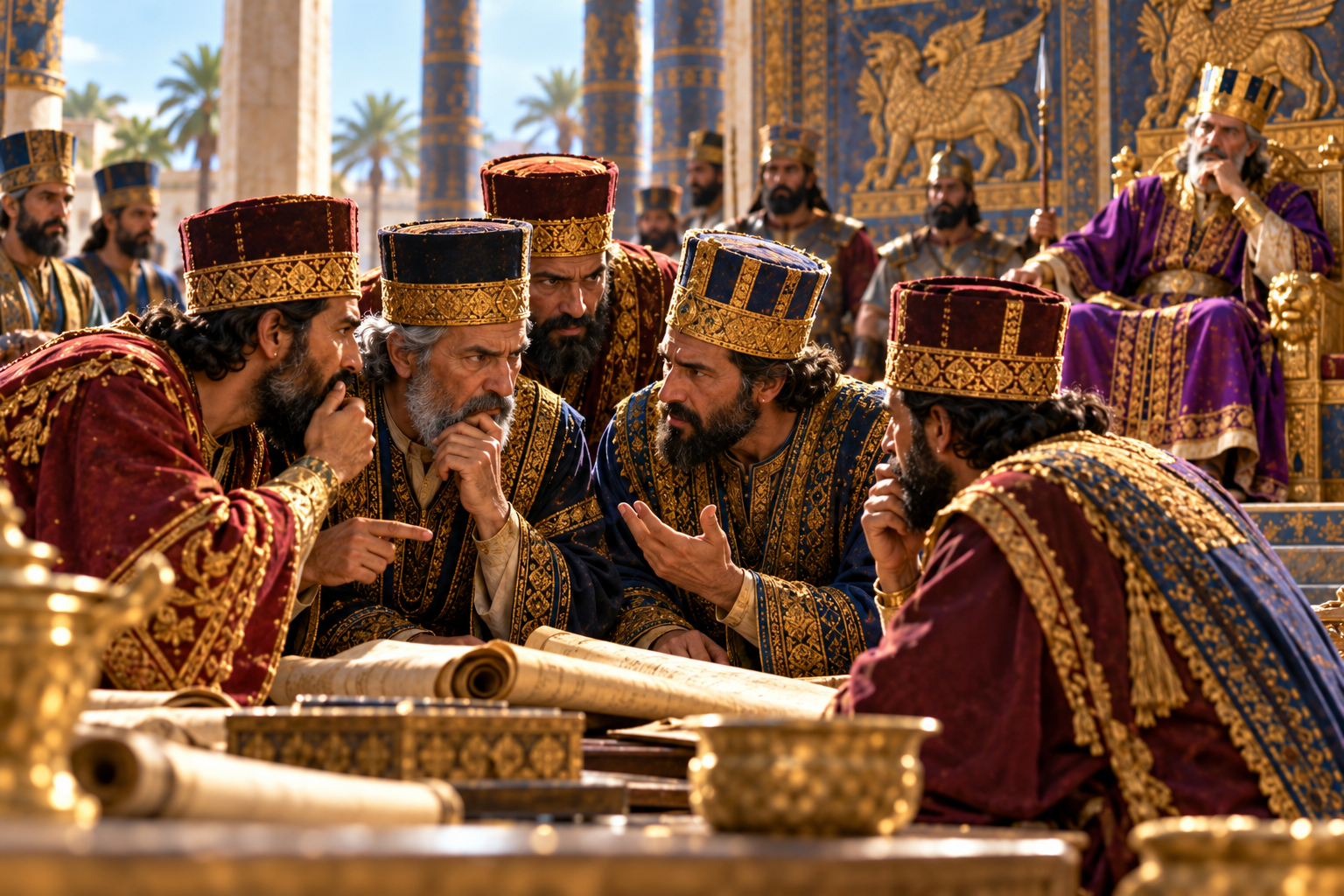
THE ONLY CHARGE
THEY COULD FIND
Then these men said - Marks progression in their evil conspiracy.
We will not find any ground of accusation against this Daniel -What an extraordinary admission from Daniel's enemies! They effectively certify Daniel's integrity. Daniel had kept himself unstained by the pagan, idolatrous, immoral world (kosmos - see word study) in which he lived (cp Jas 1:27) Besides being jealous, these men may well have sought his demise because of his integrity and incorruptibility which restricted their opportunities to siphon funds from the king's revenue that came in from the provinces. In effect, the men most determined to destroy Daniel became unwilling witnesses to Daniel's integrity.
Henry Morris - What a testimony and example for believers. No wonder his contemporary, Ezekiel, ranked him with Noah and Job as the most godly of men (Ezekiel 14:14). (Defender's Study Bible Notes)
Warren Wiersbe - It’s certainly a commendable thing when people possess character so impeccable that they can’t be accused of doing wrong except in matters relating to their faith. (Bible Exposition Commentary)
Unless we find it against him with regard to the law of his God - Their strategy now becomes ingenious and sinister. How did they know the law of his God? Daniel's enemies recognized something extremely important about him, that he lived under a higher authority. He served Darius faithfully, but Darius was not Daniel's highest authority.
Daniel's enemies knew his faith in Jehovah was real. Daniel did not hide his faith in the one true God. They knew he was a strict monotheist, and therefore planned to ensnare him by forcing him to refuse to worship other gods and continue worshiping His God. When evidence could not support their accusation, they designed a law that would create one. They could not change Daniel's convictions, so they decided to change the law around his convictions. His enemies were counting on Daniel's faithfulness.
He was not ashamed to be seen praying to his God. Am I ashamed or at least "self conscious" about offering even a simple prayer in a restaurant before I eat my meal?
The life that counts must toil and fight,
Must hate the wrong and love the right,
Must stand for truth, by day, by night—
This is the life that counts.
—Anon.
Paul applies the OT principle of "set apart" (holy) living (like Daniel) to believers commanding us…
Do (present imperative = command to make this our lifestyle. God commands it so that means He will enable it beloved!) all (how many) things without grumbling or disputing (Why?) that you may prove yourselves to be blameless and innocent, children of God (see 1Jn 3:1, 1Jn 3:2, 1Jn 3:3 above reproach in the midst of a crooked and perverse generation, among whom you appear as lights in the world (The world is watching you just like they were watching Daniel) (Php 2:14,15).
Comment: How is it humanly possible to do even "some" things without grumbling, much less "all things"?! You guessed it… it is not humanly possible but it is superhumanly possible! Read the verses in the immediately preceding context (Php 2:12, Php 2:13) and you will note that it is God's indwelling Spirit (implied) in us that gives us (1) the desire NOT to grumble and (2) the power NOT to grumble! I (in my own strength) can't NOT grumble. God never said that I could. But He can (in and through me) and He has always said He would! But note it is not "Let go and let God" but "Let God and go!" or "Let God and let's go." (His power, my part - His sovereignty, my responsibility!) Praise His Spirit's all sufficient grace in Christ (cp 1Co 15:10, 2Cor 3:5, 6, 2Cor 12:9, 10)!
Alexander Maclaren writes…
note the very unfavorable soil in which a character of singular beauty and devout consecration may be rooted and grow. What sort of a place was that court where Daniel was? Half shambles and half pigsty. Luxury, sensuality, lust, self-seeking, idolatry, ruthless cruelty, and the like were the environment of this man. And in the middle of these there grew up that fair flower of a character, pure and stainless, by the acknowledgment of enemies, and in which not even accusers could find a speck or a spot. There are no circumstances in which a man must have his garments spotted by the world. However deep the filth through which he has to wade, if God sent him there, and if he keeps hold of God’s hand, his purity will be more stainless by reason of the impurity round him.
You will always find that people who have any goodness in them, and who live in conditions unusually opposed to goodness, have a clearer faith, and a firmer grasp of their Master, and a higher ideal of Christian life, just because of the foulness in which they have to live. It may sound a paradox, but it is a deep truth that unfavourable circumstances are the most favourable for the development of Christian character. For that development comes, not by what we draw from the things around, but by what we draw from the soil in which we are rooted, even God Himself, in whom the roots find both anchorage and nutriment. And the more we are thrown back upon Him, and the less we find food for our best selves in the things about us, the more likely is our religion to be robust and thorough-going, and conscious ever of His presence. Resistance strengthens muscles, and the more there is need for that in our Christian lives, the manlier and the stronger and the better shall we probably be. Let no man or woman say, ‘If only circumstances were more favourable, oh, what a saint I could be; but how can I be one, with all these unfavourable conditions?
Ah, brother, if the ideal’s being realised depends on circumstances, it is a poor affair. It depends on you, and he that has vitality enough within him to keep hold of Jesus Christ, has thereby power enough within him to turn enemies into friends, and unfavourable circumstances into helps instead of hindrances. Your ship can sail wonderfully near to the wind if you trim the sails rightly, and keep a good, strong grip on the helm, and the blasts that blow all but in your face, may be made to carry you triumphantly into the haven of your desire. Remember Daniel, in that godless court reeking with lust and cruelty, and learn that purity and holiness and communion with God do not depend on environment, but upon the inmost will of the man (Ed: And the utmost grace of God!). (Daniel 6:5 A Tribute from Enemies)
“If you were arrested for being a Christian,
would there be enough evidence to convict you?”
With regard to the law of his God - The only way to "catch" Daniel would be to devise a plot wherein he was forced to chose between obedience to God and obedience to Medo-Persian law. Daniel didn't care if the whole world differed from him, for he knew God's Word and knew the right thing to do and not to do! He knew that he had to act on his convictions (a firmly held belief or opinion; the state of being convinced of error or compelled to admit the truth; the state of being convinced or convicted by conscience) We must be careful to make sure our beliefs are properly grounded. But once we are certain of that, we should be like Daniel, who not only had convictions but the courage to stand for them. When you are tempted to compromise your principles, don't give in. Dare to be a Daniel!
The life that counts must toil and fight,
Must hate the wrong and love the right,
Must stand for truth, by day, by night--
This is the life that counts.
--Anon.
C H Spurgeon understood this verse based on his personal experience - Blackmailers once sent C. H. Spurgeon a letter to the effect that if he did not place a certain amount of money in a certain place at a certain time, they would publish some things in the newspapers that would defame him and ruin his public ministry. Spurgeon left at that station a letter in reply: “You and your like are requested to publish all you know about me across the heavens.” He knew his life was blameless in the eyes of men and, therefore, they could not touch his character. (Illustrations for Biblical Preaching)
D L Moody - Now I want to call your attention to the fact that one of the highest eulogies ever paid to a man on earth was pronounced upon Daniel at this time by his enemies. These men were connected with the various parts of the kingdom, and on laying their heads together they came to this conclusion—that they could “find no occasion against this Daniel, except they found it against him concerning the law of his God.” What a testimony from his bitterest enemies! Would that it could be said of all of us! He had never taken a bribe: he had never been connected with a “ring”: he had never planted a friend into some fat office with the design of sharing the plunder and enriching himself. If he had been guilty in any of these things these serutineers would have found it out: they had a keen scent: they were sharp men: they knew all about his actions and his history: and they would have been glad to have found out something—anything—which would have led to his removal from his high position. But they said—and said with regret. “We shall not find any occasion against him.” Ah, how his name shines! He had commenced to shine in his early manhood; and he shone right along. Now he is an old man, an old statesman; and yet this is their testimony. There had been no sacrifice of principle in order to catch votes; no buying up of men’s votes or men’s consciences; no “counting in” or “counting out.” There had been none of that. He had walked right straight along. Young man, character is worth more than money. Character is worth more than anything else in the wide world. I would rather in my old age have such a character as that which Daniel’s enemies gave him than have raised over my dead body a monument of gold reaching from earth to sky. I would rather have such a testimony as that borne of Daniel than have all that this world can give.
As an aside it is interesting that the light of Jehovah shone brightly through Daniel and that everyone knew who he worshipped. And as is always the case, we see that most tried to suppress the light, whereas a few (one, King Darius in this chapter) acknowledged the light (Could we see him in heaven? We'll have to wait to see!). Shifting metaphors from light to fragrances, this response to Daniel is the response of every man to the truth, Paul writing…
But thanks be to God, who always leads us in His triumph in Christ, and manifests through us the sweet aroma of the knowledge of Him in every place. For we are a fragrance of Christ to God among those who are being saved and among those who are perishing; to the one an aroma from death to death, to the other an aroma from life to life. And who is adequate for these things? (2Co 2:14,15, 16)
🙏 THOUGHT: Dear believer, if someone wanted to build a trap that depended on your continuing to follow Christ, could they confidently predict what you would do? Daniel's enemies could. They said, "We will not find any ground of accusation against this Daniel unless we find it against him with regard to the law of his God" (Daniel 6:5). They knew that changing the king's law would not change Daniel's loyalty to God. Ironically, his enemies paid his faith a remarkable compliment: they were so sure of his faithfulness that they staked their whole plot on it. His three friends had shown the same holy predictability years earlier before the fiery furnace: "Our God whom we serve is able to deliver us... But even if He does not, let it be known to you, O king, that we are not going to serve your gods" (Da 3:17,18). When the apostles were ordered to stop preaching, Peter answered simply, "We must obey God rather than men" (Acts 5:29). Such steadfastness is not formed in the crisis. It is built over years of ordinary faithfulness, so that when the test comes, the decision has long since been made. David could say, "My heart is steadfast, O God, my heart is steadfast" (Psalm 57:7), and Paul urges us to be "steadfast, immovable, always abounding in the work of the Lord" (1 Corinthians 15:58). May our lives develop that same holy predictability, so that those who know us know there are convictions we will not abandon, because God's authority is our highest authority.
Takeaways from Daniel 6:5:
The easiest time to decide what you will do in a crisis is before the crisis arrives.
When evidence could not support their accusation, they designed a law that would create one.
Daniel lived in Babylon for decades, but Babylon never took possession of Daniel's heart. (How about you who live in "modern Babylon?")
They could not change Daniel's convictions, so they decided to change the law around his convictions.
Daniel's faith was not the cause of corruption in his public service; it was the foundation of his integrity in public service.
Daniel's enemies knew exactly where he stood because Daniel had never made them guess.
The young man's resolution had become the old man's reputation.
The trap would work only because Daniel's enemies knew Daniel would remain Daniel.
Daniel obeyed the king until obeying the king meant disobeying God.
A conviction repeatedly practiced eventually becomes a character others can predict.
INTEGRITY PROMOTES A RIGHTEOUS REPUTATION - John MacArthur - Strength for Today: Daily Readings for a Deeper Faith - Page 23
Then the commissioners and satraps began trying to find a ground of accusation against Daniel in regard to government affairs; but they could find no ground of accusation or evidence of corruption, inasmuch as he was faithful, and no negligence or corruption was to be found in him. Then these men said, ‘We shall not find any ground of accusation against this Daniel unless we find it against him with regard to the law of his God.’ ” DANIEL 6:4–5
✧✧✧
Live so as to silence your critics.
Whenever God exalts a righteous person, there will be those who are jealous and who criticize. Sometimes, as in Daniel’s case, the jealousy turns to bitter opposition. But Daniel’s accusers had a problem: try as they may, they could find no ground of accusation against him. He was blameless and above reproach in his character and political dealings. Their only option was to somehow indict him for being totally committed to God. What a wonderful testimony to his faithfulness!
When an individual has served in office as long as Daniel had and his enemies can bring no charges of wrongdoing against him, he or she must be a person of great integrity and personal purity. That was the strength of Daniel’s character, and God wants you to have that kind of character as well.
There will always be those who want to discredit you. Even if they aren’t jealous of your position, they’ll resent your Christian faith and will scrutinize your attitudes and actions in an attempt to tarnish your reputation. How will your character hold up under that kind of scrutiny?
The apostle Peter wrote, “Keep your behavior excellent among the Gentiles, so that in the thing in which they slander you as evildoers, they may on account of your good deeds, as they observe them, glorify God in the day of visitation” (1 Peter 2:12). That means you must live the kind of life that silences your critics and refutes their accusations. When you do, some of them might even come to Christ.
✧✧✧
Suggestions for Prayer: Ask the Lord to guard your testimony and to minister saving grace to anyone who might seek to discredit you.
For Further Study: Read Philippians 1:12–18. What was the apostle Paul’s perspective on those who were envious of him? Do you share his perspective?
D L Moody - WHAT a testimony from his bitterest enemies! Would that it could be said of all of us! He had never taken a bribe, he had never been connected with a “ring.” Ah, how his name shines! He had commenced to shine in his early manhood, and he shone right along. Now he is an old man, an old statesman, and yet this is their testimony.
Character is worth more than money. Character is worth more than anything else in the wide world. I would rather in my old age have such a character as that which Daniel’s enemies gave him than have raised over my dead body a monument of gold reaching from earth to sky.
J C Ryle - DANIEL
“Then said these men, We shall not find any occasion against this Daniel except we find it against him concerning the law of his God.”—DANIEL 6:5
IT would be impossible, I think, to imagine a higher testimony to a man’s character than you have heard in these words. You know how ready the world is to find fault with a Christian—how closely his conduct is watched, how eagerly his shortcomings are proclaimed—and happy indeed are those who by grace are so enabled to live, that the godless and profane can find no occasion against them.
In order, however, that you may fully understand the peculiar value of the testimony in my text, you ought to know something of the time and circumstances in which it was given.
Daniel, who was a prince of the royal family of Judah, and descended directly from David, had been carried to Babylon as a prisoner, with many other Jews, when Jerusalem was destroyed. While there, it pleased God to bring him into favour with the heathen kings of Babylon, and he was advanced to great dignity and honour. Nor was his honour ever taken from him; for when Belshazzar was overthrown, and the kingdom of Babylon was taken by the Medes and Persians, the Lord inclined the heart of Darius the Mede to make Daniel the first among his counsellors, who ordered all things under the king. But the wicked followers of Darius became jealous of Daniel. They made a conspiracy against him, and for a while they succeeded; for they obtained a decree that Daniel should be cast into the den of lions. But God, whom he served, here came to his assistance: he was miraculously preserved; his enemies were condemned, and perished in his stead; and King Darius gave glory to God.
Such is a short account of the interesting history which you will find in the chapter from which my text is taken—a chapter which I take occasion to recommend to your particular attention.
I purpose this afternoon to speak on two points only in this history. One is the character of Daniel, which here came out like gold from the fire, as an example for your imitation. The other is the mysterious dealings of God with him, as a ground for our instruction and comfort. May God the Holy Spirit apply the subject to all your consciences; may none of you be content with admiring the faith and patience of the saints, but may you he led to pray for the grace of God, that you may follow in their steps.
I. First, then, with respect to Daniel’s character, I would observe there are three points to be especially noticed.
(a) There is his steady walk with God. He was now ninety years of age; he had spent more than the ordinary life of man in the very heart of a wicked city and a corrupt court. He had riches and honours and everything to make this world enjoyable; but he never turned aside from the narrow way, either to the right hand or the left. The eyes of all were fixed upon him; many envied and hated him. They examined his public conduct; they inquired into his private character; they sifted his words and actions; but they sought in vain for any ground of accusation. He was so steady, so upright, so conscientious, that they could find no occasion or fault in him—they could not touch him except as concerning the law of his God. Oh, what an unanswerable argument is a believer’s life! Oh, what an epistle of Christ is the daily conduct of a child of God! Men cannot see your hearts, nor understand your principles, but they can see your lives; and if they find that pious masters, servants, brothers, friends, sisters, husbands, wives, do far exceed all others in their several positions, then you are bringing glory to God and honour to your Redeemer. Think not that your profession is worth anything, if it is not known of others by its fruit; without this it is little better than sounding brass and a tinkling cymbal. We do not find that Daniel blew his trumpet before him, and talked everywhere about his own experience; but he walked close to God, and his life spoke for him, and his character became known in Babylon, and even his enemies were obliged to confess, The hand of God is here, the Lord is with this man of a truth.
(b) Another point which I would have you notice is Daniel’s habit of private prayer. This was the hidden cause of all his steadiness, and it was discovered accidentally on this occasion. It seems that his enemies had obtained a decree of the king, that whosoever should ask a petition of any God or man for thirty days should be cast into the den of lions. And having laid this snare for this holy man, we read that they assembled and found Daniel praying and making supplication before God.
We are also told that he was in the habit of kneeling upon his knees and praying three times a day; this was the practice of holy David, as we read in the Psalms, and this was the spirit of the centurion in the Acts, who prayed to God alway. So Paul exhorts the Ephesians to pray always with all prayer and supplications, and the Thessalonians to pray without ceasing; and such has been the habit of all the most eminent saints of God: they have not been content with a few cold heartless words every morning and every night, they have lived in the spirit of prayer, and sent up many a short earnest petition throughout the day.
Moreover, we are told that Daniel prayed with his windows open towards Jerusalem, and this is a most important circumstance. He did this, and so did every pious Jew, not only because it was the land of his fathers and the land of promise, not simply because God would be worshipped there and there only, but chiefly because all the types and emblems of the Messiah, the one way of salvation, the altar, the sacrifice, and the high priest, were to be found there. And so also we, if we would have our prayers heard, must pray towards the Lord Jesus Christ, the true Temple, our Altar, our High Priest and our Sacrifice. These are the prayers which God will answer; this is the only way by which we can draw near with confidence, and find grace to help in time of need. Mark well, beloved, the habit of private prayer: here is the secret of that steadiness which Daniel showed in Babylon—here was the staff which preserved him upright in the middle of temptations.
We know that he had all the cares of government upon his shoulders; he must have been surrounded with the business and affairs of nations,—but none of these things prevented him from drawing near to God.
Nor was he a man to say “I am a chosen servant of God, I need not be so anxious about means”; he knew that God would keep him, but not unless he showed anxiety to have protection, not without diligence in using all the means of grace. Oh, he will rise in judgment and condemn many a one, who dares to think that he will find mercy while he lives in the neglect of regular heartfelt private devotion!
(c) The last point to be observed in Daniel’s character is his faith, his confidence in God. The decree appeared, forbidding all sorts of worship for thirty days on pain of death; and oh, how many professors of our generation would have held their peace! how many would have said, “It is but a short time, we need not give offence; the Lord doth not require us to lose our lives in His service”? But look at Daniel: he knew that the writing was signed,—he knew that he was watched,—he knew that his life was at stake,—and yet he went to his house and kneeled on his knees and prayed as he did aforetime. He did not on the one hand run into danger, nor did he on the other flinch from it: here was no carnal policy, no time-serving, no crooked contrivance, no love of expediency. He made a straight path for his feet; he did as usual, neither more nor less; and why? Look at the twenty-third verse: he believed in his God. Mark here the fruits of daily communion with God; see how a habit of prayer will produce quietness and assurance in the hour of trial and difficulty.
There never have been wanting lewd men of the baser sort, who say, Where is the use of your praying? what good will it do you? But wait till the days of affliction come upon you, and the Lord will provide you with an answer. A habit of prayer will impart special reliance upon God in time of danger; it will give a special boldness; it will secure a special deliverance, for them that honour God He will honour. Happy indeed are those who, like Daniel, pray without ceasing: they will find within them the same spirit of faith, they never need fear being surprised, they are like him, always the same and always ready.
II. Let us now consider the other branch of our subject: I mean the mysterious dealings of God with His faithful and holy servant.
(a) Observe, then, there was first a season of darkness. Who would have supposed that God would have allowed iniquity so far to triumph as to leave Daniel in the hands of enemies! Who would have thought that this pious old man would be cast into the den of lions. But God’s ways are not as our ways; and wonderful as it may appear, the wicked were permitted to work their will for a season: he was accused of breaking the laws; he was pronounced guilty; he was condemned to death; the king laboured to deliver him, but he could not; the decree could not be altered—Daniel must die. He was let down into this pit—the den of savage beasts, and a stone was laid upon the mouth of the den. And then, no doubt, he was looked upon as one dead; sin appeared to have prevailed, the wicked rejoiced at their success, and the righteous, the little flock at Babylon, wept and mourned to think that a brother, a faithful witness, had been taken from the earth.
Pause here, beloved, for an instant. This hour of darkness seems to you a mystery. But is it not agreeable to all the dealings of God with man? Do you not often see things hard to be understood in the world around you? How often the wicked prosper, and have all that man could desire; how often iniquity abounds and the love of God waxes cold—and the righteous are oppressed and silenced and afraid; how often it seems as if the Lord has forgotten this earth, and cares not though His servants are persecuted and His name blasphemed; how often we feel disposed to cry, how long, O Lord, holy and true, dost Thou not judge and avenge Thyself on the ungodly!
And does not the Christian often see things hard to be explained in his own heart? Is he not often tried with seasons of darkness and sorrow? Yes: many a believer can testify that sometimes he has felt like Paul before his shipwreck; neither sun nor stars have appeared for many days, and almost every hope of being saved has been taken away,—many a one could tell you that the enemy has sometimes come in upon him like a flood, he has been overwhelmed with afflictions and temptations, he has been ready to cry out of the deep, as it were, “Lord I am sinking, my soul is among lions, I am destitute, afflicted, tormented, deserted, forlorn, forsaken.”
Yes: God’s ways are often difficult and mysterious to His people; we cannot see the meaning of many things which happen around us, we think them hard, we almost quarrel with the Lord’s arrangements; but they that are really wise will be patient, they will wait to see the end, and lay to heart the words of the Lord Jesus. “What I do thou knowest not now; but thou shalt know hereafter.”
(b) Come now and hear how the darkness was scattered and the light returned. Heaviness may endure for a night, but joy cometh in the morning. Daniel, you have seen, was allowed to go through the furnace of tribulation, but the time came at last when God interfered on his servant’s behalf, and made his dealings clear and plain. Daniel was cast into the lions’ den, but the Lord was with him and therefore he was safe. We read that the king, Darius, came very early in the morning to the mouth of the cave, and cried with an anxious and lamentable voice, “O Daniel … is thy God … able to deliver thee.” And oh, how joyful must his feelings have been when he heard the holy man’s reply: “O King, live for ever; my God hath sent His angel and shut the lions’ mouths, that they have not hurt me: forasmuch as before him innocency was found in me!”
And need I tell you that Daniel was brought forth, and honoured and exalted; while his enemies, in their turn, were cast into the den and the lions destroyed them all? So true it is that light is sown for the righteous, that God will keep them in perfect peace whose minds are stayed on Him. So true are the words of Psalm 91.” “He that dwelleth in the secret place of the Most High shall abide under the shadow of the Almighty, He shall cover thee with His feathers, and under His wings shalt thou trust.… His truth shall be thy shield and buckler.… There shall no evil befall thee, neither shall any plague come nigh thy dwelling. For He shall give His angels charge over thee, to keep thee in all thy ways.… Because he hath set his love upon Me, therefore will I deliver him: I will set him on high, because he hath known My Name.”
(c) Consider now, beloved, what showers of good descended from this dark cloud which at one time seemed so threatening. Think what a blessed effect this deliverance would have on Daniel! What deep views of God’s love and power and goodness and wisdom he would obtain! What strength it would add to his faith, what warmth to his prayers! How every grace within his bosom would shoot forth with renewed vigour. Think, too, what an impression would be made upon the godless and profane; what shame would cover the faces of those who had thought Daniel went too far and was righteous overmuch; how many would be brought to tremble and fear before a God who could deliver after such a fashion.
(d) Think, lastly, what mighty good would come to the people and cause of God, how much they would be comforted by such a miracle, how much they would be encouraged to go forward: the very thing which once appeared so untoward, which threatened the destruction of Israel and the dishonour of God, would bring glory to the Lord, and set forward the kingdom of heaven.
And so, beloved, it has always been. God’s dealings may seem mysterious; but wait awhile, and the darkness shall disappear and the light shall shine and the crooked shall appear straight, and the rough places shall become smooth.
Satan doth often seem to have his own way in the world, but still there are many proofs that the prosperity of the wicked is short, and the lying lips are but for a moment, and there are seasons when many a hardened sinner is forced to confess, “Verily there is a God that judgeth the earth.” Many a Christian would tell you that the trials and chastisements which appeared so bitter have borne most blessed fruit to his soul; he has sown in tears, but he has reaped in joy; and there are few who shall not find in the world to come that afflictions which bowed them to the dust, and were grievous at the time, were nothing less than mercies; they were the very medicines which healed their sin-diseased souls, and purified their hearts for heaven.
Who is there among you that is timid and undecided and inconsistent—afraid to do anything to displease men and yet not satisfied if he does not give his heart to God—conscious that he ought to bear the cross and follow Christ, but fearful of giving offence to the world? Go, study the character of Daniel, and make it your example. Behold a child of Adam like yourself following the Lord fully, not only when all were with him, but when all were against him; ready to lose his life in this world if so he might attain to life eternal. Are you flesh and blood? so was he; are you by nature sinful? so was he. The grace of God did make him what he was, and the grace of God can make you like him, if you are only willing. But go, confess your faith as he did: if you are ashamed of Christ, most surely Christ will be ashamed of you. The double-minded and the unstable shall never gain the heavenly crown.
Where are the men who say “We cannot do the things which you require; we cannot come to Christ upon your terms? There would be no living in the world, no caring for our families, if we took your advice. We have no time for such religion; we cannot altogether give up the world.” Oh, look at holy Daniel! He had the charge of millions upon his hands, he was the chief among the presidents of an empire, he had the management of kingdoms and their affairs; and yet—mark this, O ye despisers and lazy ones—and yet he found time to be a faithful servant of God, he found time to cultivate the vineyard of his soul most closely, he contrived to walk with God as few have ever walked. Are you wiser than he? Are your leisure hours more entirely taken up? Oh, be ashamed of vain excuses, and take this man of business for your pattern, and do not tell us you cannot come to Christ, until you have followed Daniel’s steps and prayed without ceasing.
Is there an humble-minded follower of Jesus among you? Set Daniel before your eyes. Be bold, be faithful, be meek, be persevering; endeavour to walk so uprightly that all may glorify God on your behalf, that none may find occasion against you except as concerning the law of your God.
Fear not because you sometimes walk in darkness and have no light. Remember that you cannot understand the mind of the Lord nor the meaning of His dealings. But when the clouds do compass you about, believe in God as Daniel did; trust in the Lord Jesus at all times; sing to Him in the dungeon, as Paul and Silas; sing to Him even in the fire, as the three children did; be sure, be very sure, he who believeth shall never be ashamed.
I will add for your comfort the words of a very Christian poet, a sweet singer in Israel:—
“God moves in a mysterious way,
His wonders to perform;
He plants His footsteps in the sea,
And rides upon the storm.
Deep in unfathomable mines
Of never-failing skill,
He treasures up His bright designs,
And works His sovereign will.
Ye fearful saints, fresh courage take,
The clouds ye so much dread
Are big with mercy, and shall break
In blessings on your head.
Judge not the Lord by feeble sense,
But trust Him for His grace;
Behind a frowning Providence
He hides a smiling face.
His purposes will ripen fast,
Unfolding every hour;
The bud may have a bitter taste,
But sweet will be the flower.
Blind unbelief is sure to err,
And scan His work in vain.
God is His own interpreter,
And He will make it plain.”
Daniel 6:6 Then these commissioners and satraps came by agreement to the king and spoke to him as follows: "King Darius, live forever!
- came by agreement, Da 6:11 Ps 56:6 62:3 64:2-6 Mt 27:23, 24, 25 Lk 23:23, 24, 25 Ac 22:22,23
- King: Da 6:21 2:4 3:9 5:10 Neh 2:3 Acts 24:2
- Daniel 6 Resources - Multiple Sermons and Commentaries
Related Passages:
Proverbs 16:18 Pride goes before destruction, And a haughty spirit before stumbling.
Proverbs 27:21 The crucible is for silver and the furnace for gold, And each is tested by the praise accorded him.
Proverbs 29:5 A man who flatters his neighbor Is spreading a net for his steps.
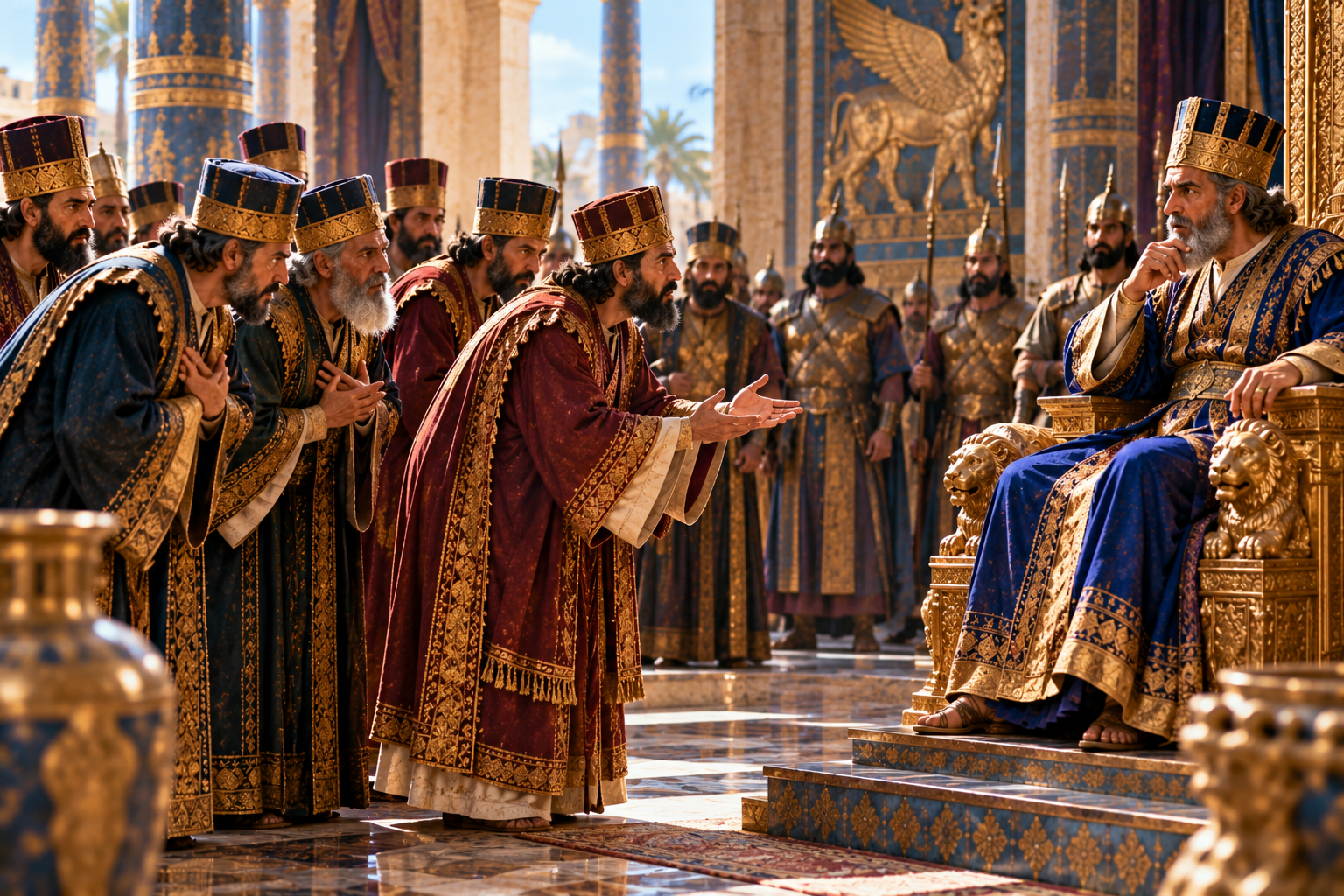
CONSPIRATORS APPROACH THE KING
WITH FLATTERY ON THEIR LIPS
Then - Marks progression in the plot to trip Daniel up.
These commissioners and satraps came by agreement to the king - They could not corrupt Daniel, so they decided to manipulate Darius. A group of about 122 men which may well have impressed King Darius when they made their appeal. A large delegation creates the impression that everyone agrees. A crowd can create the appearance of consensus without possessing the truth. Darius failed to notice that Daniel was not in the group and it almost cost him dearly! As a believer perhaps in a completely pagan environment, have you have felt like everyone was opposed to you? Remember that one (you) plus God is a majority regardless of the numbers arrayed against you! By agreement was clearly a "plot" but not an orderly one! The Aramaic verb regash primarily signifies to be in tumult, to be restless, to be turbulent, to assemble in a throng so that the picture it conveys is that of a "mob scene", not an orderly gathering. "Rabble rousers" comes to mind!
By agreement is Aramaic regash which conveys the idea of coming together in a throng, tumultuously, or by concerted agreement. It is related to the Hebrew word ragash which means to be in commotion or to rage against used in Psalm 2 "Why are the nations in an uproar (ragash), and the peoples devising a vain thing?" Ragash denotes the uproar and plotting of the wicked against the righteous. Think of the picture of a lynch mob gathering together to mete out their brand of justice. Note in Psalm 2 that the wicked are coming against the LORD and His Messiah (Mashiyach)!
D L Moody - If you touch a man’s vanity he will do almost anything; and Darius was like most of the human race. They touched his vanity by intimating that this would make him great. He thought it a very wise suggestion, and he agreed with them exactly.....And these plotters said one to another, “Now, let as get Darius to sign a decree that if any man make a request of any God or man—except of the King Darius—for thirty days, he shall be put into the lions’ den. And let us all keep perfectly still about this matter, so that it won’t get out. We must not tell our wives, for fear the news may get about the city: Daniel would find it all out; and he has more influence with the king than all the rest of us put together. The king would never sign the decree if he found out what the object was.” Then they may have said, “We must draw it so tight that Darius will not be able to get out of it after he has once signed. “We must make it so binding that if the king once signs we shall have that Daniel in the lions’ den: and we will take good care that the lions shall be hungry.”
And spoke to him as follows: "King Darius, live forever! - It essentially means “O king, may you live indefinitely!” There is nothing inherently sinister in the expression itself. Daniel himself will later use exactly the same greeting after surviving the lions' den (Da 6:21). So the problem was not their words, but the heart behind their words. While Daniel could say them sincerely, the conspirators were using royal courtesy as the introduction to manipulation.
🙏 THOUGHT: Flattery is dangerous precisely because it usually tells us something we enjoy hearing about ourselves. The wise response to praise is not automatically to reject it, but to remain alert lest praise feed pride and cloud our judgment. Darius is about to make a disastrous decision because the proposal appeals to his importance. When someone appeals strongly to our pride, that may be the very moment we most need humility and discernment. (Pr 16:18; Pr 27:21; Pr 29:5)
Takeaways:
They could not corrupt Daniel, so they decided to manipulate Darius.
A crowd can create the appearance of consensus without possessing the truth.
The king thought he was being honored, but he was actually being used.
John MacArthur - INTEGRITY TRIUMPHS OVER DECEPTION Strength for Today: Daily Readings for a Deeper Faith - Page 24
“Then these commissioners and satraps came by agreement to the king and spoke to him as follows: ‘King Darius, live forever! All the commissioners of the kingdom, the prefects and the satraps, the high officials and the governors have consulted together that the king should establish a statute and enforce an injunction that anyone who makes a petition to any god or man besides you, O king, for thirty days, shall be cast into the lions’ den. Now, O king, establish the injunction and sign the document so that it may not be changed, according to the law of the Medes and Persians, which may not be revoked.’ Therefore King Darius signed the document, that is, the injunction.” DANIEL 6:6–9
✧✧✧
Integrity is more precious than flattery.
King David once prayed: O Lord, lead me in Thy righteousness because of my foes; make Thy way straight before me. There is nothing reliable in what they say; their inward part is destruction itself; their throat is an open grave; they flatter with their tongue. Hold them guilty, O God … for they are rebellious against Thee. But let all who take refuge in Thee be glad, let them ever sing for joy; and mayest Thou shelter them, that those who love Thy name may exult in Thee. For it is Thou who dost bless the righteous man, O LORD, Thou dost surround him with favor as with a shield. —Psalm 5:8–12
That could have been Daniel’s prayer as well, being surrounded by men who were rebellious against God and who flattered Darius so they could have Daniel put to death. By their own devices they would fall, but not before Daniel’s integrity was tested.
Darius yielded to deceitful flattery, decreeing that he alone could grant petitions. (His ego is reminiscent of Nebuchadnezzar’s [Dan. 3:12].) Daniel, on the other hand, was unyielding in his convictions, and God literally surrounded him with favor as with a shield.
✧✧✧
Suggestions for Prayer: Pray that when your faith is tested, you will stand firm and have the assurance that God is surrounding you with His favor.
For Further Study: Psalm 5:12 says that God blesses the righteous man. According to Psalm 64:10 and Psalm 92:12–15, what are some of those blessings?
Daniel 6:7 "All the commissioners of the kingdom, the prefects and the satraps, the high officials and the governors have consulted together that the king should establish a statute and enforce an injunction that anyone who makes a petition to any god or man besides you, O king, for thirty days, shall be cast into the lions' den.
- All : Da 6:2,3 3:2,27
- have consulted : Ps 2:2 59:3 62:4 83:1-3 94:20 Mic 6:5 Mt 12:14 26:4 Mk 15:1 Jn 12:10 Ac 4:5-7,26-28
- he shall : Da 3:6,11 Ps 10:9 Na 2:12
- Daniel 6 Resources - Multiple Sermons and Commentaries
THE TRAP IS SET WITH
A LAW DESIGNED FOR ONE MAN
All the commissioners of the kingdom, the prefects and the satraps, the high officials and the governors have consulted together - Note ALL clearly did not include Daniel. This pictures Darius' entire government supporting this. But it was a ruse, an unholy conspiracy against Daniel presented as consensus! A flagrant falsehood! This was an outright lie (like their father the devil - Jn 8:44, Ge 3:1,2,3,4,5). Daniel had not been consulted. We know because of his subsequent actions. He would have never approved of this 30 day "law" calling for petitioning of a man. They are "massaging" the King's ego!
that the king should establish a statute and enforce an injunction that anyone who makes a petition to any god or man besides you, O king, for thirty days, shall be cast into the lions' den - They could not find a law Daniel had broken, so they created a law they knew Daniel would break. So the conspirators persuade Darius to establish the very law they will later use against Daniel. In effect what they did was create a law Daniel could not obey without violating his allegiance to God. They did not need to change Daniel's behavior; they only needed to change the legal status of Daniel's behavior.
Enforce an injunction would make the prohibition legally binding, carrying the coercive power of the government and the penalty of death.
makes a petition to any god or man besides you, O king, for thirty days - Makes a petition is literally "requests a request” which in context are clearly of a religious nature and thus are not petitions any general (general requests) but specifically petitions in the form of prayer. They thought that they had discovered Daniel's "Achilles heel". They did not understand the depth of this man's integrity (or perhaps they did and knew this would cost him his life for he would rather die than compromise). Since they are going to Darius with their petitions, he is functioning as an intermediary or a priest if you will. They knew that prayer to anyone other than Jehovah would be a form of idolatry. In short, these pernicious plotters know that Daniel will never agree to this law because he is a man of impeccable integrity.
Any god or man besides you - They were flattering Darius with the idea that he could be "god for a month"! They were appealing to Darius' pride, a good place to appeal, for he fell for the flattery. Flattery is the art of telling a person exactly what he thinks of himself which explains why it is so effective! The decree appeared to exalt Darius, but its real purpose was to eliminate Daniel.
for thirty days - The conspirators were not asking Darius to abolish every religion permanently, for that might have sounded unreasonable and provoked resistance. Thirty days sounds temporary and manageable.
Ray Pritchard observes that these wicked men tricked Darius into passing "a 30-day law forbidding anyone to pray except to Darius himself. In effect, they said, “O king, how would you like to be God for a month?” Sure, why not? That appealed to his pride. (Ed: cp flattery) Why not be God for a month? It might be fun. So Darius signed the law, knowing that it could not be repealed, not even by himself. He had no idea that Daniel was the intended target. Meanwhile the satraps are chortling together. They knew Daniel would break the law. That is, they knew Daniel would keep on praying just as he had always done. Daniel was a victim of his own integrity. He was predictably faithful to God. If he had been a flaky believer, this evil plot would never have worked. His troubles came not from his weakness, but from his strength. (How to Tame Lions)
MacArthur takes it a step further suggesting that "Ancient kings were frequently worshiped as gods. Pagans had such inferior views of their gods that such homage was no problem." (Ed: This is possible and if so would amount to flagrant idolatry, of worshiping and serving the creature rather than the Creator Who is blessed forever. Amen - Ro 1:25)
shall be cast into the lions' den - The penalty is not a fine or loss of office but loss of life! Their seemingly patriotic proposal carries a concealed death sentence for one man.
John Whitcomb comments that "James A. Montgomery, by no means an orthodox scholar, states that "G. Behrmann's position is an entirely sensible one, that the implication of the story means a petition of religion (not, with A. A. Bevan, any kind of request), and that this one king was to be regarded for the time being as the only representative of Deity."… (Regarding the significance of the lion's den) The official form of execution under Darius the Mede is said to be "the lions' den," whereas in the days of Nebuchadnezzar it had been the "furnace of blazing fire" (Da 3; cf. Jer 29:22). The historical significance of this change is that the state religion of MedoPersia, namely, Zoroastrianism, involved the worship of Atar the fire-god.' Thus, for the Medo-Persians to have used a furnace of fire as a means for destroying criminals would have appeared sacrilegious. Such details, introduced quite incidentally into the narrative, provide further confirmation of the historicity of the sixth chapter of Daniel. (See Daniel- Everyman's Bible Commentary - Page 83)
Warren Wiersbe writes that "It has well been said that flattery is manipulation, not communication, and in his pride, Darius succumbed to the flattery of evil men. “For there is no faithfulness in their mouth; their inward part is very wickedness; their throat is an open sepulcher; they flatter with their tongue” (Ps. 5:9). (Bible Exposition Commentary)
Spurgeon commenting on Ps 5:9 gives a picturesque description of those who flatter - "A smooth tongue is a great evil; there are human anteaters that with their long tongues covered with oily words entice the unwary and make their gain thereby."
🙏 THOUGHT: The greatest tests of faith often come when compromise can be made to sound reasonable, temporary, and even beneficial. Daniel could have found dozens of reasons to suspend his prayer life for only thirty days. But when God's will was clear, Daniel did not calculate the cost of obedience in order to decide whether he would obey. The issue had already been settled. Daniel belonged to God. Convictions established before the crisis become anchors when the crisis arrives.
Daniel 6:8 "Now, O king, establish the injunction and sign the document so that it may not be changed, according to the law of the Medes and Persians, which may not be revoked."
- establish: Es 3:12 8:10 Isa 10:1
- according : Da 6:12, Da 6:15 Es 1:19 8:3
- may not be changed: Mt 24:35
- Daniel 6 Resources - Multiple Sermons and Commentaries
THE IRREVOCABLE
DECREE
"Now, O king, establish the injunction and sign the document so that it may not be changed, according to the law of the Medes and Persians, which may not be revoked - Nebuchadnezzar had absolute power with no such restriction that he could not revoke a law. Darius could command an empire, but he could not undo his own signature. The interesting fact is that the devotion of the Medes and Persians to established laws eventually made it difficult for their government to function efficiently. They found themselves swamped in a bureaucratic quagmire due to the profusion of their laws and this fact appears to be the main reason the MedoPersian form of government was termed inferior to that of Nebuchadnezzar, the absolute dictator of Babylon, whose slightest word was law. (Da 2:38, 39).
Lehman Strauss - Even if a king passed the death sentence upon one of his subjects, and later evidence led him to the conclusion that he erred in passing the sentence, he was unable to reverse his decision. (BORROW - The Prophecies of Daniel)
John Whitcomb injects a historical reference noting that "The book of Daniel is accurate in listing the Medes first because, in spite of the fact that the emperor, Cyrus, was a Persian, the bulk of his army at this time was still Median. Only a dozen years earlier he had conquered and absorbed the numerically superior Median army of the aging and corrupt King Astyages (550BC) into a new and vastly superior MedoPersian military unit. Two generations later, however, the Persian domination of the Medes had become almost complete, so that in the days of king Xerxes (Ahasuerus) (486-465BC) the Persian element could be mentioned first (Esther 1:19, etc., though not in Esther 10:2)." (SEE Daniel- Everyman's Bible Commentary - Page 81)
D L Moody - When the mine is all ready, the conspirators come to the king, and open their business with flattering speech: “King Darius, live for ever!” When people approach me with smooth and oily words, I know they have something else coming—I know they have some purpose in telling me I am a good man. These plotters, perhaps, go on to tell the king how prosperous the realm is, and how much the people think of him. And then, perhaps, in the most plausible way, they tell him that if he signs this decree he will be remembered by their children’s children—that it would be a memorial for ever of his greatness and goodness. “What is this decree that you wish me to sign?” And running his eye over the document he says, “I don’t see any objection to that.” “Will you put your signet to it, and make it law?” He puts his signature to the decree, and seals it with his seal. And one of them says, “The law of the Medes and Persians, which altereth not?” and the king answers, “Oh, yes; the law of the Medes and Persians: that is it.” In the pleasure of granting the request of these people he thinks nothing about Daniel; and the presidents and princes carefully refrain from jogging his memory. They had told the king a lie, too; for they said, “ALL the presidents of the kingdom, the governors, and the princes, the counsellors, and the captains, have consulted together to establish a royal statute”; although the chief-president knew nothing at all about it.
In the book of Esther which takes place during the reign of Ahasuerus, we see a similar reference to the the Persian laws…
If it pleases the king, let a royal edict be issued by him and let it be written in the laws of Persia and Media so that it cannot be repealed, that Vashti may no longer come into the presence of King Ahasuerus, and let the king give her royal position to another who is more worthy than she. (Es 1:19).
Historian Will Durant affirms the irrevocable nature of Persian laws noting that "it was a proud boast of Persia that its laws never changed, and that a royal promise or decree was irrevocable. In his edicts and judgments the king was supposed to be inspired by the god Ahura-Mazda himself; therefore the law of the realm was the Divine Will, and any infraction of it was an offense against the deity." (Our Oriental Heritage)
Daniel 6:9 Therefore King Darius signed the document, that is, the injunction.
- Ps 62:9,10 118:9 146:3 Pr 6:2 Isa 2:22
- Daniel 6 Resources - Multiple Sermons and Commentaries
THE TRAP
BECOMES LAW
Therefore - see term of conclusion for the value of observing and interrogating this term.
King Darius signed the document, that is, the injunction. - Darius' signature transformed the conspirator's plot into an irrevocable law. Compare There this Persian practice in Esther 1:19, 8:8 where a seal guaranteed the validity of the decree.
Injunction (0633)(esar) means a decree, in this context a royal decree issued to stop a certain thing or activity and is used 6x in Daniel 6 - Dan 6:7-9f, 12-13, 15. Webster says injunction is "a writ granted by a court of equity whereby one is required to do or to refrain from doing a specified act." The Lxx translates esar with dogma which is "a formal statement concerning rules or regulations that are to be observed." (BDAG)
Lehman Strauss - As the presidents (commissioners) and princes left the king's presence, they doubtless felt that their scheme was a success, and soon Daniel would be dead. But they failed to see that they were not attacking an ordinary man but the chosen and anointed servant of the Most High God, who said, "Touch not Mine anointed, and do My prophets no harm" (1Chronicles 16:22). The law of the Medes and Persians might not be subject to change, but those wicked men had yet to reckon with the mighty Lawgiver. (BORROW - The Prophecies of Daniel)
Daniel 6:10 Now when Daniel knew that the document was signed, he entered his house (now in his roof chamber he had windows open toward Jerusalem); and he continued kneeling on his knees three times a day, praying and giving thanks before his God, as he had been doing previously.
- when : Lk 14:26 Ac 4:17-19
- windows : 1Ki 8:30,38,44,48, 49, 50 2Ch 6:38 Ps 5:7 Jon 2:4 Heb 4:16
- kneeling: 1Ki 8:54 2Ch 6:13 Ezra 9:5 Ps 95:6 Lk 22:41 Ac 7:60 9:40 20:36 Ac 21:5 Eph 3:14
- three : Da 6:13 Ps 55:17 86:3 Ac 2:1,2,15 3:1 10:9
- giving: Ps 34:1 Php 4:6 Col 3:17 1Th 5:17,18 Heb 13:15
- as he: Neh 6:11 Ps 11:1,2 Mt 10:28-33 Lk 12:4-9 Ac 4:18,19,29 Ac 5:20,29,40-42 20:24 Php 1:14,20 Rev 2:10,13
- Daniel 6 Resources - Multiple Sermons and Commentaries
- Multiple Sermons on Daniel 6:10
- James Hastings in depth Da 6:10 Open Windows
Related Passages:
1 Kings 8:33; 35; 38 “When Your people Israel are defeated before an enemy, because they have sinned against You, if they turn to You again and confess Your name and pray and make supplication to You in this house, (8:35) “When the heavens are shut up and there is no rain, because they have sinned against You, and they pray toward this place and confess Your name and turn from their sin when You afflict them, (8:38) whatever prayer or supplication is made by any man or by all Your people Israel, each knowing the affliction of his own heart, and spreading his hands toward this house;
1 Kings 8:46-50 “When they sin against You (for there is no man who does not sin) and You are angry with them and deliver them to an enemy, so that they take them away captive to the land of the enemy, far off or near; 47 if they take thought in the land where they have been taken captive, and repent and make supplication to You in the land of those who have taken them captive, saying, ‘We have sinned and have committed iniquity, we have acted wickedly’; 48 if they return to You with all their heart and with all their soul in the land of their enemies who have taken them captive, and pray to You toward their land which You have given to their fathers, the city which You have chosen, and the house which I have built for Your name; 49 then hear their prayer and their supplication in heaven Your dwelling place, and maintain their cause, 50 and forgive Your people who have sinned against You and all their transgressions which they have transgressed against You, and make them objects of compassion before those who have taken them captive, that they may have compassion on them
2 Chronicles 6:36-39 “When they sin against You (for there is no man who does not sin) and You are angry with them and deliver them to an enemy, so that they take them away captive to a land far off or near, 37 if they take thought in the land where they are taken captive, and repent and make supplication to You in the land of their captivity, saying, ‘We have sinned, we have committed iniquity and have acted wickedly’; 38 if they return to You with all their heart and with all their soul in the land of their captivity, where they have been taken captive, and pray toward their land which You have given to their fathers and the city which You have chosen, and toward the house which I have built for Your name, 39 then hear from heaven, from Your dwelling place, their prayer and supplications, and maintain their cause and forgive Your people who have sinned against You.
Psalm 55:17 Evening and morning and at noon, I will complain and murmur, And He will hear my voice.

Daniel Praying - Lying Conspirators Spying
WHEN PRAYER IS A CAPITAL OFFENSE:
DANIEL'S "OBEDIENT DISOBEDIENCE!"
Daniel 6:10 is one of the great portraits of unwavering faithfulness in all of Scripture. Darius has signed the decree. Prayer to anyone other than the king is now punishable by death. Daniel knows the decree has been signed, understands its implications, and realizes that his enemies are watching. Yet his response is remarkable for its simplicity. He goes home and continues doing exactly what he has always done: praying and giving thanks to his God.
Now when Daniel knew the document was signed - Test time Daniel! He understood the truth that every trial in life is a test of one's character. As a result, not only was Daniel not dissuaded from his devotion, but he even had a desire to immediately seek the face of God. Prayer is a good place to go when we find ourselves being tempted. Daniel's continual communion with the living God kept him prepared for unexpected testing. Daniel knew the cost of obedience, but he had already settled the question of allegiance.
David Jeremiah - The nature of the Christian faith marks all of us for the lions, because we are out of step with the world around us. Remember that Shadrach, Meshach, and Abednego were standing when everyone else was kneeling. Daniel was kneeling when everyone else was standing. God didn’t withhold them from the pressure of certain death; He took them through the fiery furnace and the lions’ den. What are the lions in your life? Perhaps the lions we confront are illness, or business reverses, or slander, or domestic friction. Sooner or later it is inevitable that every single person will face the lions. The Bible says, “Be self-controlled and alert. Your enemy the devil prowls around like a roaring lion looking for someone to devour” (1 Pet. 5:8). But God promises that he will keep us safe in the midst of the lions. “The angel of the LORD encamps around those who fear him, and he delivers them. . . . The lions may grow weak and hungry, but those who seek the LORD lack no good thing” (Ps. 34:7, 10).....One day I read something that impressed me.... “A man of God in the will of God is immortal until his work on earth is done.” What that meant to me was that as long as I am a man of God doing the will of God, nothing can touch me until God is done with me. When He’s done with me, I don’t want to be around anymore. (SEE The Handwriting on the Wall: Secrets from the Prophecies of Daniel) Comment: David Jeremiah's comments remind me of John's words in the Revelation "When they have finished their testimony, the beast that comes up out of the abyss will make war with them, and overcome them and kill them." (Rev 11:7) These 2 witnesses had finished their work for God and it was time for them to go home.
Sometimes the lions’ mouths are shut.
Sometimes God bids us fight or fly.
Sometimes He feeds us by the brook.
Sometimes the flowing stream runs dry.
The danger that His love allows,
Is safer than our fears may know.
The peril that His care permits
Is our defense wherever we go.
Adam Clarke - He saw what was designed, and he knew Whom he served. (cp Paul in his last letter knew Whom he had believed! - 2Ti 1:12)
He entered his house (now in his roof chamber he had windows open toward Jerusalem) - Daniel did not rush into the streets to organize a demonstration. He did not march to the palace to confront Darius. He simply went home. Daniel was not looking for a confrontation with the king; he was continuing his communion with the King of kings! The roof chamber was an upper room, likely providing a relatively quiet place for prayer. In the ancient Near East, upper rooms could offer separation from the activities of the household.
Windows open toward Jerusalem - The site of the Holy Temple, where prior to its destruction the Shekinah cloud had manifested the glory of Jehovah. To be sure the glory had departed in 586BC just before the Temple was destroyed (cp Ezek 11:23), but God had promised to return (Ezek 43:2). He had also promised to restore Jerusalem (Jer 29:10, 14). Jerusalem was still the city of God. Notice that Daniel did not open the window to deliberately defy the king's injunction but his window was routinely open when he prayed. Daniel's practice recalls Solomon's prayer at the dedication of the temple. Solomon anticipated that Israel might be carried into captivity because of sin. He prayed that if the exiles turned toward their land, Jerusalem, and the temple and prayed to God, the Lord would hear them (1Ki 8:46–50; 2Chr 6:36–39). Daniel's prayer toward Jerusalem was therefore not superstition. It reflected his identification with God's covenant people and promises.
Islam prescribes five daily prayers (salat) facing the Kaaba in Mecca, a direction called the qibla. Interestingly, the earliest Muslims originally prayed toward Jerusalem. Islamic tradition says the direction was changed to Mecca about a year and a half after Muhammad moved to Medina (around A.D. 624), and the Qur'an refers to the change (Surah 2:142–144).
Early Christians also kept set hours of prayer. In Acts, Peter and John go to the temple "at the ninth hour, the hour of prayer" (Acts 3:1), and Peter prays on the rooftop at noon (Acts 10:9). But the New Testament places no requirement on direction, since Jesus taught that true worshipers worship the Father "in spirit and truth," not on a particular mountain or toward a particular place (John 4:21–24). John 4 points out that the issue is no longer which direction we face, but whether our hearts are turned toward God through Christ.
Daniel could have closed the windows. Daniel could have prayed in another room. Daniel could have been more discreet. But Daniel was a man of integrity with uncompromising devotion to His great God who had been so faithful to him for 80+ years.
John MacArthur writes that "in those days there was very frequently on the top of a house a kind of a little upper room, we see them even in the New Testament time, a place of retreat and they didn't have glass windows. What they did was put a lattice work over the windows and they would let them be open and the warmth of the area of Babylon, which is a very hot place, and the breeze could blow through and cool them. And so he would go up there and through the lattice work he would be visible and he would face toward Jerusalem because that's where the longing of his heart was, the people of God and the city of God which symbolized God to him. And he would pray, no doubt, for the peace of Jerusalem (Ps 122:6), the restoration of the city and whatever else was in his heart, the confession of sin and anything else and he did it just the way he always did it… perseverance (in prayer, prioritization of prayer!). (Daniel in the Lions' Den Grace to You)
T. De Witt Talmage - Daniel at the window is not standing and looking out, he is kneeling and looking out. Daniel found that a man can see farther on his knees than on tiptoe. There is another Jerusalem toward which you and I will do well to keep our windows open. It makes one heavenly-minded to think much of heaven. (Ed: And for those who believe in the Millennium as I do, to pray for the earthly Jerusalem in which the returning Righteous One reigns for one thousand years!)
Adam Clarke - When the Jews were in distant countries, in prayer they turned their faces towards Jerusalem; and when in Jerusalem, they turned their faces towards the temple. Solomon, in his prayer at the dedication of the temple, 1 Kings 8:48, had entreated God to hear the prayers of those who might be in strange lands, or in captivity, when they should turn their faces towards their own land, which God gave unto their fathers; and towards the city which he had chosen, and the house which was dedicated to his name. It was in reference to this that Daniel turned his face towards Jerusalem when he prayed.
And he continued kneeling on his knees three times a day, praying and giving thanks before his God, as he had been doing previously - Daniel's posture expressed humility, reverence, and dependence. Here was one of the most powerful officials in the Medo-Persian kingdom, yet before God he was on his knees. Daniel was too old to begin compromising now, but this story does make the point that we will never be too old or too "spiritually mature" that we won't be tempted to compromise! Let us stay alert, watching and praying like Daniel (cp Mt 26:41). Daniel’s prayers were bold, obedient (knew the document was signed), consistent (as he had done previously), humble (kneeling), thankful (cp 1Th 5:18), filled with petition (request) and supplication (earnest entreaty) (Da 6:11).
J E Rosscup notes that Daniel "knelt as was natural as a supplicant respectful and submissive before a sovereign, a minister before the Majesty he served." (An Exposition on Prayer in the Bible: Igniting the Fuel to Flame Our Communication with God)
Three times a day. - Daniel had an established rhythm of prayer. He knelt "three times a day, praying and giving thanks before his God, as he had been doing previously" (Daniel 6:10; compare Psalm 55:17). It is worth noting that Scripture does not command every believer to pray exactly three times daily. The emphasis is on Daniel's consistent devotion, not a universal numerical requirement. What made Daniel extraordinary was not merely how often he prayed, but that he kept up his communion with God regardless of the consequences. His prayer life was governed by conviction, not convenience.
D L Moody - Busy as he was, he found time to pray. And a man whose habit it is to call upon God saves time, instead of losing it. He has a clearer head, a more collected mind, and can act with more decision when circumstances require it. So Daniel went to his room three times a day: he trod that path so often that the grass could not grow upon it. I would be bound to say those plotters knew whereabouts he would be going to pray: they knew the place where Daniel’s prayer was wont to be made; and they were sure they should find him there at his usual hours. And now again he has “a purpose firm, And dares to make it known.” He goes to pray as aforetime; and he has his windows open Like Paul, in later days, he “knew whom he had believed”, like Moses, he “saw Him who is invisible.” He knew whom he worshipped. There was no need to trace back the church records for years to find out whether this man had ever made a profession of religion. See him as he falls upon his knees. He is not careful to inquire whether there are any outsiders, or whether they can hear. In tones not one atom softer or quieter than his custom, he pours out his prayer to the God of his life; to the God of his people; to the God of Abraham, Isaac, and Jacob. He does not omit to pray for the king. It is right to pray for our rulers. If we cease praying for our rulers, our country will go to pieces. The reason they are not better is oftentimes because we do not pray for them. Does Daniel pray to Darius? Not he! He prays for Darius, but not to him.
“As for me, I will call upon God;
And the Lord shall save me.
Evening, and morning, and at noon, will I pray and cry aloud;
And He shall hear my voice.”
-- Psalm 55:16
Remember that Daniel was one of only three commissioners over the entire kingdom (6:2). He could easily have told himself he was simply too busy to pray. Instead, he made prayer a priority and built it into his daily pattern. We need to imitate Daniel's faith (Hebrews 6:12), because if we do not make prayer a priority, it will soon be squeezed out of our busy schedules. And how much priority did Daniel give to prayer? It was so important to him that he was willing to die rather than give it up. Now that's a picture of commitment!
Daniel's strength in the public arena was
nourished by his fellowship with God in private.
Giving thanks before his God - This is incredible. Daniel knew his disobedience might cost him his life but here he is giving thanks! This clearly teaches us that gratitude in prayer is not dependent upon favorable circumstances. Daniel could thank God even when he could not understand what God was about to allow. Daniel's action recalls Paul's command in 1 Thessalonians 5:18 "in everything give thanks (present imperative see our need to depend on the Holy Spirit to obey); for this is God’s will for you in Christ Jesus."
Praying and giving thanks - Not grumbling. Not complaining. Not trying to negotiate with God. But giving thanks, even though he knows that his next appointment will be the lion's den! (cp 1Thes 5:18, Php 4:6, Php 4:7). Notice in the NT that thanksgiving is associated with Spirit filling (cp Ep 5:18, Ep 5:19, 20). I submit that Daniel was a Spirit energized man!
D L Moody - After Daniel has prayed, “and given thanks,”—“given thanks,” mark that!—he goes out, and walks along the street with a firm step. He is undaunted. If it be the will of God that he shall pass from earth to heaven by the way of the den of lions, he is prepared for that. God’s presence is with him. Like Enoch, he bore within himself this testimony—“that he pleased God.”
Do you see the Hebrew captive kneeling,
At morning, noon, and night, to pray?
In his chamber he remembers Zion,
Though in exile far away.
Do not fear to tread the fiery furnace,
Nor shrink the lions’ den to share;
For the God of Daniel will deliver,
He will send His angel there.
Children of the living God, take courage,
Your great deliverance sweetly sing;
Set your faces toward the hill of Zion,
Thence to hail your coming King!
Are your windows open toward Jerusalem,
Though a captives here “a little while” we stay?
For the coming of the King in His glory,
Are you watching day by day.
Before His God - Note note just "before God" but "before HIS God." Daniel could face an uncertain tomorrow because he knew the God Who had faithfully sustained him through countless yesterdays.
As he had been doing previously - Daniel did not suddenly become a man of prayer when the crisis arrived. He was already a man of prayer. His enemies did not create his devotion by persecuting him. They merely exposed the devotion that had characterized his life for decades. Think of the excuses Daniel could have offered. “It is only thirty days.” “I can pray after the decree expires.” “I can pray secretly so nobody sees me.” “Surely God understands my circumstances.” “I am too valuable to the kingdom to risk my life.” “At my age, I should avoid unnecessary danger.” But Daniel did not allow apparently reasonable arguments to displace settled convictions. As an aside, we should not misunderstand this as teaching that prayer must always be visible or that secret prayer is somehow inferior. Jesus specifically commends private prayer (Mt 6:6). The issue was that Daniel refused to abandon or alter his established devotion merely to comply with a decree that directly challenged his allegiance to God.
What does this say about Daniel? He was a man of courage, conviction and commitment. Lord, make me like Daniel. Amen
Showers rightly remarks that Daniel "was not a fair-weather friend who would serve God only when personally convenient or when there was no price to pay. He was convinced that his daily relationship with God should take precedence over the will of man… Once again he was doing what was right and trusting God for the results. "(Showers, R. E. The Most High God- A Commentary on the Book of Daniel - Friends of Israel Gospel Ministry)
Character is tested by what one does when we think no one else sees (but Pr 15:3). Daniel did not pray to be seen, but he was seen when he prayed. He did not debate or hesitate. He prayed like he had always done.
Lehman Strauss - He must choose between loyalty to God or loyalty to the king. Here we need to recall that it was on the basis of "the law of his God" (Da 6:5) that his enemies plotted against him. Our Lord said, "Render therefore unto Caesar the things which be Caesar's, and unto God the things which be God's (Luke 20:25). The Apostle Paul wrote, "Let every soul be subject unto the higher powers. For there is no power but of God: the powers that be are ordained of God" (Ro 13:1). The Apostle Peter added, "Submit yourselves to every ordinance of man for the Lord's sake: whether it be to the king, as supreme; Or unto governors" (1Pe 2:13). The child of God must bear in mind that the law of God supersedes the law of man. Whenever man's law runs counter to God's law, the child of God has but one choice. It was voiced by Peter when he said, "We ought to obey God rather than men" (Acts 5:29) (BORROW - The Prophecies of Daniel)
Spurgeon - Daniel did not deliberate for a single minute. When we know our duty, first thoughts are the best. I greatly admire one feature in Daniel’s decision. He did not alter his accustomed habit in any single particular. Without disguise and without parade he pursued the even tenor of his way. He does not appear to have taken council of his friends, or to have summoned his servants, and charged them not to let any intruder come in. Neither did he adopt any measure to escape his enemies. Not one jot of anxiety did he betray. His faith was steadfast, his composure unruffled, his conduct simple and artless… It might be asked, perhaps, “Should not Daniel obey the king?” Certainly kings’ laws are to be respected; but any law of man that infringes the law of God is, ipso facto, null and void at once. It is the duty of every citizen to disregard every law of earth which is contrary to the law of heaven. So Daniel felt that the risk of being put into a den with lions was nothing to the risk of being put into hell, and he chose the smaller risk, and in the name of God he went straight on. Look at John Bunyan when they bring him up before the magistrates and tell him he must not preach! “But I will preach,” said he, “I will preach to-morrow by the help of God.” “But you will be put in prison again.” Never mind, I will preach as soon as I get out.” “But you will be hanged, or kept m prison all your life.” “If I lie in prison,” said he, “till the moss grows upon my eyelids, I can say nothing more than this, that with God’s help, I will preach whenever I get a chance.” Do not tell me that these are non-essentials. To men who will follow the Lamb whithersoever he goeth, even the opening or the shutting of a window, if need be, is essential. Be jealous over what are called “trifles.” They may be mere straws, but they show which way the wind blows.
Pritchard asks "So what do you do when you discover that your enemies have passed a law aimed at one person, and you are that person? It’s like walking around with a bull’s eye on your shirt. How you respond at that point tells a great deal about your character. Daniel 6:10 reveals the secret of his greatness… It was Dietrich Bonhoeffer who said, “When Christ calls a man, he bids him come and die.” And Dr. Martin Luther King, Jr., changed the face of America with these words: “If a man hasn’t discovered something that he will die for, he isn’t fit to live.” Daniel had discovered something worth dying for, which is why he kept on praying when others would have quit. Since he wasn’t afraid to die, he had the courage to live for God in a hostile pagan world. (How to Tame Lions)
As Campbell writes Daniel "was not a man who served God only when there was no price to be paid. (BORROW Daniel, decoder of dreams)
Paul reminds that we can withstand the temptation to compromise when the test comes because "No temptation has overtaken you but such as is common to man (cp Daniel); and God is faithful (even as He was to Daniel), Who will not allow you to be tempted (tested - peirazo) beyond what you are able, but with the temptation (test) will provide the way (not "a way" but the specific way) of escape also, (Why? Not to escape the test per se but… ) that you may be able to endure it. (1Co 10:13)
Someone has well said that a man's character is accurately measured by his reaction to life's inequities. What is Daniel's reaction to "equity", to "unfair" treatment? Do you see the lesson for us who would seek to imitate Daniel's victorious life (" imitators of those who through faith and patience inherit the promises" - Heb 6:11, 12)? Then let us lean hard on God's grace so that we might be enabled to "pray (present imperative = a lifestyle of prayer is commanded! Only possible as we yield to the filling of the Spirit Who gives us the desire and the power to pray) without ceasing" (1Th 5:17)
If one's conduct is the overflow of one's doctrine, then Daniel's conduct speaks volumes about the holiness of his doctrine. What we believe should always affect how we behave. When Daniel's "belief was challenged", he knelt in prayer. How do I respond when I "challenged" to disobey God's Word?
Daniel's loyalty to God over government reminds us of Peter's allegiance to God and his compulsion to preach Christ crucified even to the perpetrators (But note that it was after he was filled with the Holy Spirit [see before = Mt 26:69-75] - Here's the after = Acts 2:2-4, 4:8, Ep 5:18)…
But Peter and the apostles answered and said, "We must obey God rather than men… 40 And they took his advice; and after calling the apostles in, they flogged them and ordered them to speak no more in the name of Jesus, and then released them. 41 So they went on their way from the presence of the Council, rejoicing that they had been considered worthy to suffer shame for His Name. (Acts 5:29, 40, 41)
Careful for nothing, prayerful for everything, thankful for anything. - Dwight Lyman Moody (1837-1899)
Daniel was not a "spiritual sprinter" but one of God's marathon men, who began young by purposing in his heart not to be defiled by the king's choice food (Da 1:8) and he continued to run with endurance until the end, refusing to obey the law that would result in disobedience to God. The writer of Hebrews exhorts his tremulous readers…
Therefore, since we have so great a cloud of witnesses surrounding us (eg, Daniel's faith and faithfulness and the story of his deliverance from the lion's den), let us also lay aside every encumbrance, and the sin which so easily entangles us, and let us run with endurance the race that is set before us, fixing our eyes on Jesus (cp Daniel fixed his face like flint toward Jerusalem, giving priority to prayer), the author and perfecter of faith, who for the joy set before Him endured the cross, despising the shame, and has sat down at the right hand of the throne of God. (Hebrews 12:1, Heb 12:2)
Dear persevering believer, one who is pressing onward, toward the goal (Php 3:14), may others never have to say of us…
You were running well. Who hindered you from obeying the truth? (Gal 5:7)
Matthew Henry - The life of a Christian is a race, wherein he must run, and hold on, if he would obtain the prize. It is not enough that we profess Christianity, but we must run well, by living up to that profession. Many who set out fairly in religion, are hindered in their progress, or turn out of the way. It concerns those who begin to turn out of the way, or to tire in it, seriously to inquire what hinders them.
What about one's posture in prayer? Do you need to kneel? God is interested not so much in the position of our body as in the position of our heart. A humble heart is a dependent heart which in turn bows to God and is thereby in the best position to receive God's grace (Jas 4:6). When one knows how to kneel in prayer he has no problem standing firm against opposition in the strength of the Lord.
Stephen Miller - Daniel knelt to pray (cf. 1Kgs 8:54; Ezra 9:5; Ps 95:6), but sometimes prayers were offered while standing (cf. Ge 18:22ff.; 1Sa 1:26; Lk 18:13; Mt 6:5). Praying with hands spread out toward heaven also was common (cf. Ezra 9:5). (See Daniel - Page 182)
Lehman Strauss - I am somehow of the persuasion that this is the position best suited to prayer, especially private prayer. Luke reminds us that in the garden our Lord "kneeled down, and prayed" (Luke 22:41). The first recorded martyr of the Christian Church, when in his dying moments, "kneeled down" (Acts 7:60). When Peter came to where the dead body of Dorcas lay, he "kneeled down, and prayed" (Acts 9:40). When Paul gathered with the Ephesian elders on the dock at Miletus, "he kneeled down, and prayed with them all" (Acts 20:36). Then as he concluded his visit to Tyre, Luke says, "we kneeled down on the shore, and prayed" (Acts 21:5). Our Lord said, "And when thou prayest, thou shalt not be as the hypocrites are: for they love to pray standing in the synagogues and in the corners of the streets, that they may be seen of men" (Mt 6:5). (See Luke 18:11.) I am not suggesting that prayer, in order to be effectual, must be offered on one's knees. I have met some bedridden saints who engaged in daily intercessory prayer. But what a blessed sight it must have been to see the aged prophet of God kneeling in sweet communion with his Lord! Shadrach, Meshach, and Abed-nego were standing when everyone else in the empire was kneeling before Nebuchadnezzar's image, and God honored them because they would not kneel. Now the people in Darius' empire were standing before a man, but God was about to honor one lonely saint who was kneeling before Him. (BORROW - The Prophecies of Daniel)
Martyn Lloyd-Jones once said that "Man is at his highest and greatest when upon his knees he comes face to face with God."
Spurgeon - DANIEL’S PRAYERFULNESS WAS THE SECRET OF HIS POWER. Daniel was always a man of prayer. If you saw him great before the people, the reason was because he was great before his God. He knew how to lay hold of divine strength, and he became strong. He knew how to study divine wisdom, and he became wise. We are told that he went to his house to pray. This showed that he made a business of prayer, and finding it neither convenient to his circumstances nor congenial to his mind to pray in the midst of idolaters, he had chosen to set apart a chamber in his own house for prayer. It is well to have, if we can have, a little room, no matter how humble, where we can shut to the door, and pray to our Father who is in heaven, who will hear and answer. He was in the habit of praying thus three times a day. Perhaps he thought that this was prudent economy, for, if he had so much to do, he must pray the more; as Martin Luther said, “I have got so much to do to-day that I cannot possibly get through it with less than three hours of prayer.” So, perhaps, Daniel felt that the extraordinary pressure of his engagements demanded a proportionate measure of prayer to enable him to accomplish the weighty matter he had on hand. A singularity in his manner is noticeable here. He had been in the habit of praying with his windows open towards Jerusalem. Thus openly did he ignore the decree! With such a royal courage did he lift his heart above the fear of man, and raise the conscience above the suspicion of compromise. He loved Jerusalem, and his prayers were for it. Hence he looked that way in his prayer. And I think also he had an eye on the altar. We worship with our eye to Christ. Oh, for Daniel’s prayerful spirit!
God’s Word contains our marching orders for being on prayer patrol. Some of them are:
- Pray without ceasing (1 Th. 5:17).
- Continue steadfastly in prayer (Rom. 12:12).
- Pray morning, noon, and night (Ps. 55:17).
- Pray always and do not get discouraged (Lk. 18:1).
Praying frequently
will lead to praying fervently.
Strauss - In difficult circumstances what course shall the godly take? Look up and thank God for every blessing (cp Nebuchadnezzar at the end of 7 years humiliation - Da 4:34). Daniel was a man who possessed the rare combination of courage and gratitude. It is easier to thank God for past blessings than to thank Him before the answer to our prayer comes. But in the heart of the man of God the element of praise is never absent, even under the pressure of impending danger. We are spiritually poor if we fail to find our place on our knees before the Lord, praising Him, even in the midst of life's sorest trials. (BORROW - The Prophecies of Daniel)
Commit to pray and intercede—
The battle's strong and great is the need;
And this one truth can't be ignored:
Our only help comes from the Lord.
—Sper
Alexander Maclaren comments that…
The plot goes on the calculation that, whatever happens, this man may be trusted to do what his God tells him, no matter who tells him not to do it. And so on that calculation the law, surely as mad a one as any Eastern despot ever hatched, is passed that, for a given space of time, nobody within the dominions of this king, Darius, is to make any petition or request of any man or god, save of the king only. It was one of the long series of laws that have been passed in order to be broken, and being broken, might be an instrument to destroy the men that broke it. It was passed with no intention of getting obedience, but only with the intention of slaying one faithful man, and the plot worked according to calculation. What did it matter to Daniel what was forbidden or commanded? He needed to pray to God, and nothing shall hinder him from doing that. And so, obediently disobedient, he brushes the preposterous law of the poor, shadowy Darius on one side, in order that he may keep the law of his God…
If earthly authorities command what is clearly contrary to God’s law, a Christian is absolved from obedience, and cannot be loyal unless he is a rebel. That is how our forefathers read constitutional obligations. That is how the noble men on the other side of the Atlantic, fifty years ago, read their constitutional obligations in reference to that devilish institution of slavery. And in the last resort—God forbid that we should need to act on the principle—Christian men are set free from allegiance when the authority over them commands what is contrary to the will and the law of God.
But all that does not touch us. But I will tell you what does touch us. Obedience to God needs always to be sustained—in some cases more markedly, in some cases less so—but always in some measure, by disobedience to the maxims and habits of most men round about us. If they say ‘Do this,’ and Jesus Christ says ‘Don’t,’ then they may talk as much as they like, but we are bound to turn a deaf ear to their exhortations and threats…
And for us, in our little lives, the motto, ‘This did not I, because of the fear of the Lord,’ is absolutely essential to all noble Christian conduct. Unless you are prepared to be in the minority, and now and then to be called ‘narrow,’ ‘fanatic,’ and to be laughed at by men because you will not do what they do, but abstain and resist, then there is little chance of your ever making much of your Christian profession.
These people calculated upon Daniel, and they had a right to calculate upon him. Could the world calculate upon us, that we would rather go to the lions’ den than conform to what God and our consciences told us to be a sin? If not, we have not yet learned what it means to be a disciple. The commandment comes to us absolutely, as it came to the servants in the first miracle, ‘Whatsoever He saith unto you’—that, and that only—‘whatsoever He saith unto you, do it.’ (Daniel 6:5 A Tribute from Enemies)
Paul writes the balancing Biblical principle regarding disobedience to the government…
Let every person be in subjection to the governing authorities. For there is no authority except from God, and those which exist are established by God. Therefore he who resists authority has opposed the ordinance of God; and they who have opposed will receive condemnation upon themselves. (Ro 13:1,2)
Scripture makes one exception to the charge to be subject to the government and that is when obedience to civil authority would require disobedience to God’s Word (Ex 1:17 Da 3:16, 17, 18 Da 6:7,10 Acts 4:19, 20, 5:28, 29).
The psalmist laments…
If I forget you, O Jerusalem, may my right hand forget her skill. May my tongue cling to the roof of my mouth If I do not remember you, If I do not exalt Jerusalem Above my chief joy. (Ps 137:5, 6).
Young's Literal translation of Psalm 5:7 reads…
And I (David), in the abundance of Thy kindness, I enter Thy house, I bow myself toward Thy holy temple (no actual temple at that time but Hebrew word also used of the tabernacle 1Sa 1:9; 3:3) in Thy fear.
If you want to know how to pray in the hard times,
pray in the easy times.
Related Resources on Prayer:
- Pithy Prayer Phrases
- Prayer Quotes
- Prayer Devotionals and Illustrations
- Prayer Hymns and Poems
- Spurgeon's Gems on Prayer
- Guide to Praying for Missionaries
David had a similar pattern of prayer. Knowing who these men are (Daniel and David), what does this say about the role of prayer in the life of one who would desire to also be a man after God's own heart (Acts 13:22)?
As for me, I shall call upon God, and the LORD will save me. Evening and morning and at noon, I will complain and murmur (strong word meaning make a loud noise), and He will hear my voice. (Ps 55:16, 17)
Spurgeon comments: Often but none too often. Seasons of great need call for frequent seasons of devotion. The three periods chosen are most fitting; to begin, continue, and end the day with God is supreme wisdom. Where time has naturally set up a boundary, there let us set up an altar stone. The psalmist means that he will always pray; he will run a line of prayer right along the day, and track the sun with his petitions. Day and night he saw his enemies busy (Psalms 55:10), and therefore he would meet their activity by continuous prayer.
And cry aloud. He would give a tongue to his complaint; he would be very earnest in his pleas with heaven. Some cry aloud who never say a word. It is the bell of the heart that rings loudest in heaven. Some read it, "I will nurse and murmur;" deep heart thoughts should be attended with inarticulate but vehement utterances of grief. Blessed be God, moaning is translatable in heaven. A father's heart reads a child's heart.
And he shall hear my voice. He is confident that he will prevail; he makes no question that he would be heard, he speaks as if already he were answered. When our window is opened towards heaven, the windows of heaven are open to us. Have but a pleading heart and God will have a plenteous hand.
Donald Campbell…Daniel's spirit reminds us of Polycarp, one of the Early Church fathers who was threatened with martyrdom in Smyrna if he did not reproach Christ. He replied, Eighty and six years have I served Him, and He never did me any injury. How then can I blaspheme my King and Savior? (Ibid) (Ed: It is ironic that "Polycarp was burned at the stake for refusing to burn incense to the Roman Emperor." - Wikipedia) Daniel's priority list had fellowship with God at the top. This explains in large measure the godly life and character of this man. What is at the top of your priority list? (BORROW Daniel, decoder of dreams)
Leon Wood expounds on Daniel's prayer life noting that "To have maintained such a demanding prayer schedule as this, even apart from continuing it now in the face of penalty, required great discipline of life. In his position as president, Daniel carried heavy responsibility, with much work to do. Under such demands the temptation to neglect this sort of prayer-program was no doubt strong, especially since he had to return home each noon for the purpose, while keeping on also with the morning and evening occasions. But Daniel had maintained it, apparently recognizing the priority of this faithful contact with God. He continued the same in the face of the unfair decree. (Commentary on Daniel Leon Wood - Grand Rapids: Zondervan Publishing House, 1973, page 163) (SEE A Commentary on Daniel - Page 163)
As he had been doing previously - If Daniel was 85 yo this would be over 95,000 prayers (at 3x/day)! Talk about a hard habit to break! Remember he knew the law had been signed so he knew that his prayer was his "death warrant" for the lion's den! As noted above, as one of 3 commissioners, he would have been very busy with worldly affairs, but he was never too busy to tend to his heavenly affairs. How about you? Are you too busy to pray? If you answered "Yes", then you are simply too busy!
Related Resources:
- Colossians 1:9 Commentary
- Colossians 4:12 Commentary
- Devotional on Prayer
- Guide to Praying for Missionaries
- Pithy Prayer Phrases
- Prayer - Greek Words for Prayer
- Prayer Devotionals and Illustrations
- Prayer Hymns and Poems
- Prayer Quotes
- Prayer Quotes, Devotionals and Illustrations
- Praying His Word
- Praying in the Spirit
- Spurgeon's Gems on Prayer
🙏 THOUGHT — What Would Your Enemies Know About Your Prayer Life? Daniel's enemies knew where to find him because they knew his habits. They did not need to tempt him to pray. They simply needed to watch him continue doing what he had always done. That raises a searching question: If someone wanted to find evidence of our devotion to God, would our daily habits provide enough evidence? Daniel was not prepared for the lions' den because he possessed unusual natural courage. He was prepared because he had spent a lifetime walking with God. The crisis did not create his faithfulness; it revealed it. And do not overlook the thanksgiving! Daniel continued thanking God even when his circumstances gave him every human reason to be anxious. A grateful heart does not deny the reality of danger; it remembers the faithfulness of God in the midst of danger. The greatest preparation for tomorrow's unknown trials is today's consistent fellowship with the God Who already knows tomorrow.
The greatest preparation for tomorrow's unknown trials is today's
consistent fellowship with the God Who already knows tomorrow.
Takeaways from Daniel 6:10 -
Daniel did not begin praying because of the crisis, and he did not stop praying because of the crisis.
Daniel did not open his windows to challenge the king, nor did he close them to conceal his God.
The man who stood above other officials knew how to bow before God.
Daniel's prayer life was governed by conviction, not convenience.
Daniel's circumstances had changed dramatically, but God's worthiness to receive thanksgiving had not changed at all.
Daniel's courage in the lions' den was cultivated during years of faithfulness in the prayer chamber.
The time to develop a strong prayer life is before you need extraordinary strength.
For Daniel, prayer was not the last resort in a crisis; it was the settled habit of a lifetime.
Daniel's enemies could close the door of the lions' den, but they could not close the door of heaven.
The decree changed. The danger increased. The windows stayed open. Daniel kept praying.
Safe on Your Knees - A group of amateur climbers were scaling part of the Matterhorn mountain near Zermatt, Switzerland. As they came to a narrow, hazardous passage, about to make a turn, a gust of wind swept down on them. The experienced guide, knowing the danger this posed for the group, quickly shouted, "Get down on your knees! You are safe only on your knees!"How true this is in the Christian life as well. We are safe only as we are continually in fellowship with our Lord in prayer. As Paul wrote, "Pray continually" (1 Thessalonians 5:17).See: Joshua 5:14; 1 Chronicles 16:11; Daniel 6:10-See commentary on Daniel's "Obedient Disobedience" in Prayer; Ephesians 6:18 - (6,000 Plus Illustrations for Communicating Biblical Truths.)
Are You Too Comfortable When You Pray? William R. Newell says kneeling is a good way to pray because it is uncomfortable. Daniel prayed on his knees (Daniel 6:10). Jim Elliot said, “God is still on His throne, we’re still His footstool, and there’s only a knee’s distance between!” He also said, “That saint who advances on his knees never retreats.”—Elisabeth Elliot, Shadow of the Almighty
G Campbell Morgan - Now his windows were open in his chamber toward Jerusalem. Dan. 6.10
The Revisers have accurately, and help-fully, put these Words in parenthesis. They constitute for us an open window through which we see the secret of Daniel's loyalty. By this time, he was in a position of power under Darius. The other rulers envied him, and laid a cunning plot to bring him into trouble. The temptation created for him by this plot was not to .the committal of any positive sin or act of idolatry. It was rather to the neglect of a habit of his religious life. He had only to abstain from prayer for thirty days, and their plot would be frustrated. But this he could not do. Dr. Driver's rendering of this verse is helpful: "Now he had in his roof-chamber open windows fronting Jerusalem." In a flash we see the habitual life of Daniel. There, on the roof of his house was an extra chamber; and it was so built that its open windows fronted Jerusalem. That was his house of prayer. There, three times a day, he worshipped his God, asking what he needed, and giving praise. His eyes were ever toward the city of the great King, while his heart held communion with Him. Around that attitude and activity, all his life was ordered. To neglect that for a single day would have spelt disaster to such a man as this. Therefore he could do none other than he did. When our lives are centred in God, we can ever afford to leave circumstances to the compulsion of the One in Whom we trust. The occasional is always affected by the habitual. Then let the habitual for us be ever that of windows fronting Jerusalem, and the heart in communion with God.
Grass on Your Path -In one region of Africa, the first converts to Christianity were very diligent about praying. In fact, the believers each had their own special place outside the village where they went to pray in solitude. The villagers reached these “prayer rooms” by using their own private footpaths through the brush. When grass began to grow over one of these trails, it was evident that the person to whom it belonged was not praying very much. Because these new Christians were concerned for each other’s spiritual welfare, a unique custom sprang up. When ever anyone noticed an overgrown “Prayer path,” he or she would go to the person and lovingly warn, “Friend, there’s grass on your path!” - R W De Haan (Our Daily Bread, Copyright RBC Ministries, Grand Rapids, MI. Reprinted by permission. All rights reserved)
Plan To Pray - "Evening and morning and at noon I will pray." (Psalm 55:17) - I have an appointment with my dentist to have my teeth cleaned and checked. I’m confident that I’ll get a good report on the condition of my teeth and gums because I floss every morning and brush two or three times every day. I have built it into my daily schedule. I have to confess that it wasn’t always that way. I knew that I should pay better attention to my dental hygiene— and I intended to. But I seldom got it done because I didn’t have a plan for it. The result: growing gum disease that led to extensive and uncomfortable surgery. I won’t let that happen again! Many things in life are like that— including prayer. Mature Christians know that unless they plan to pray, it will not happen. Daniel set specific times for prayer (Dan. 6:10). And David followed a schedule for prayer, as Psalm 55:17 indicates. I realize that following a regular program does not guarantee effective praying. And I know it can easily become a stiff formality. Even so, we must devise a plan for praying— and stick with it. Otherwise, despite our best intentions, we will pray very little. Failure to establish good spiritual habits will lead to poor spiritual health. Plan to pray! - PUTTING IT INTO PRACTICE: When is the best time for you to pray each day? Set aside that time as an appointment with God. Then ask God to help you keep your commitment. David Egner
Plan your praying, then pray your plan.
Getting Into The Habit - Daniel . . . knelt down on his knees three times that day, and prayed, . . . as was his custom. (Daniel 6:10) The family car is packed to the limit. The kids have their books, tapes, and games. The car-top carrier clearly signals to all observers that our family is taking a trip. But before we leave the driveway, we always stop and pray—asking God for safety and for family unity on our trip. It’s a habit. Prayer habits are helpful tools to remind us of our dependence on God. Perhaps you have some habits of your own. Before you eat, you pray. Maybe before the kids leave for school, you pray. Before they go to bed, you pray. Developing prayer habits can be of tremendous help to those of us who want to develop a close relationship with the Lord but find that the busyness of the day squeezes out the time we had hoped to spend with Him. When we designate different activities of the day before or after which we always pray, we’ll help to assure ourselves of regular communication with our Creator. That could become empty ritual, but it doesn’t have to be—it can be a time of rich fellowship with our Lord. David, who wrote Psalm 55, said that he prayed in the morning, noon, and evening (Ps 55:17). Daniel prayed three times a day (Daniel 6:10). Like them, we would be wise to develop prayer habits. They’re great ways to make prayer an integral, constant part of our daily lives. PUTTING IT INTO PRACTICE: Do you have regular times of prayer each day? If not, when could you set aside time to focus your thoughts on God and talk to Him? To make the most of your time, take time to pray. Dave Branon
Pigeon Walk - Have you ever wondered why a pigeon walks so funny? It's so that it can see where it's going. Because a pigeon's eyes can't focus as it moves, the bird actually has to bring its head to a complete stop between steps in order to refocus. So it proceeds clumsily--head forward, stop, head back, stop.
In our spiritual walk with the Lord, we have the same problem as the pigeon: We have a hard time seeing while we're on the go. We need to stop between steps--to refocus on the Word and the will of God. That's not to say we have to pray and meditate about every little decision in life. But certainly our walk with the Lord needs to have built into it a pattern of stops that enable us to see more clearly before moving on.
Daniel's practice of praying three times a day was an essential part of his walk with God. He realized that there's a certain kind of spiritual refocusing that we can't do without stopping. His stops gave him a very different kind of walk--one that was obvious to those around him.
What about us? At the risk of being thought of as different, as Daniel was, let's learn this valuable lesson from the pigeon: "Looking good" isn't nearly as important as "seeing well." — Mart De Haan (Our Daily Bread, Copyright RBC Ministries, Grand Rapids, MI. Reprinted by permission. All rights reserved)
There is a blessed calm at eventide
That calls me from a world of toil and care;
How restful, then, to seek some quiet nook
Where I can spend a little time in prayer.
--Bullock
Time in Christ's service requires time out for renewal.
F B Meyer in Our Daily Walk - Our Prayer Life - Dan. 6:10
THE CHOSEN hour. It was at the time when Daniel's enemies appeared to have accomplished his downfall and death--"when the writing was signed '--that this heroic statesman knelt down and prayed, and gave thanks to God. These are times when prayer is the only way out of our perplexities. George Muller said: "Our very weakness gives opportunity for the power of the Lord Jesus Christ to be manifested. That blessed One never leaves and never forsakes us. The greater the weakness, the nearer He is to manifest His strength; the greater our necessities, the more have we ground to rely on it that He will prove Himself our Friend. This has been my experience for more than seventy years; the greater the trial, the greater the difficulty, the nearer the Lord's help. Often the appearance was as if I must be overwhelmed, but it never came to it, and it never will. More prayer, more faith, more exercise of patience, will bring the blessing. Therefore our business is just to pour out our hearts before Him; and help in His own time and way is sure to come."
The chosen direction. "His windows open towards Jerusalem." There the Holy Temple had stood, and the Altar of Incense; there God had promised to put His Name and meet His people. When we pray, our windows must be open towards our blessed Lord, who ministers for us in Heaven, mingling the much incense of His intercession with the prayers of all mints (Heb. 7:25; Rev. 8:3).
The chosen attitude. "He kneeled upon his knees." It is most appropriate to kneel before God in homage and worship. St. Paul bowed his knees, even though his hands were chained, to the Father of our Lord Jesus Christ (Eph 3:14). But we can pray also as we walk, or sit, or ride. Nehemiah flashed a prayer to the God of Heaven before he answered the king's question, but he also prayed before God day and night. Let us contract the habit of praying and giving thanks three times a day. At even, morning, and noon, let God hear your voice.
PRAYER
Thee we would be always blessing,
Serve Thee as Thy hosts above;
Pray, and praise Thee without ceasing
Glory in Thy perfect love. AMEN.
Planned Neglect - Daniel ... knelt down on his knees three times that day, and prayed and gave thanks before his God. (Da 6:10) In her book A Practical Guide to Prayer, Dorothy Haskin tells about a noted concert violinist who was asked the secret of her mastery of the instrument. The woman answered the question with two words: "Planned neglect." Then she explained, "There were many things that used to demand my time. When I went to my room after breakfast, I made my bed, straightened the roam, dusted, and did whatever seemed necessary. When I finished my work, I turned to my violin practice. That system prevented me from accomplishing what I should on the violin. So I reversed things. I deliberately planned to neglect everything else until my practice period was complete. And that program of planned neglect is the secret of my success." This same principle can be helpful as we plan a daily quiet time with the Lord. Unless we discipline ourselves and make a deliberate effort, trivial things will keep us from establishing a consistent devotional life. Let's give our time with the Lord top priority by "planned neglect" of things of lesser value. He deserves first place in our lives. —R. W. De Haan
CLICK FOR LINKS TO EACH TOPIC BELOW A Practical Guide to Prayer By Dorothy Haskin
1. PRAYING IN PUBLIC
2. THE KEY TO PRAYER
3. GOD'S WORD IN THE QUIET TIME
4. PRAYER IN THE PRIVATE TIME
5. LISTEN!
6. PRAYER FOR OTHERS
7. FAMILY PRAYERS
8. TABLE GRACE
9. PRAYER PARTNERS
10. THE SECRET OF HIS PRESENCE
C H Spurgeon - Daniel’s undaunted courage
‘Now when Daniel knew that the writing was signed, he went into his house; and his windows being open in his chamber towards Jerusalem, he kneeled upon his knees three times a day, and prayed, and gave thanks before his God, as he did aforetime.’ Daniel 6:10
Daniel prayed ‘three times a day’. That does not tell you how often he prayed, but how often he was in the posture of prayer. Doubtless he prayed three hundred times a day if necessary; his heart was always having commerce with the skies. But ‘three times a day’ he prayed formally. We usually take three meals in the day and it is well to give the soul as many meals as the body. We want the morning’s guidance and the evening’s forgiveness. but do we not also require the noontide’s refreshment? Might we not well say at noontide, ‘Tell me, O thou whom my soul loveth, where thou feedest, where thou makest thy flock to rest at noon’. It is well to keep in the spirit of Keble’s hymn—‘Abide with me from morn till eve.’ If you find from morn till eve too long an interval between prayer, put in another golden link at midday. There is no rule in Scripture as to how often and when you should pray; it is left to the man’s own gracious spirit. We need not come back to the bondage of the Mosaic covenant, to be under rule and rubric; we are left to that free Spirit who leads his saints aright. Yet ‘three times a day’ is a commendable number. Notice secondly the posture. That also is of little consequence, since we read in Scripture of men who prayed on the bed with their face to the wall. We read of David sitting before the Lord. How very common and acceptable a posture was that of standing before God in prayer! Yet there is a peculiar appropriateness, especially in private prayer, in the posture of kneeling. It seems to say, ‘I cannot stand upright before thy majesty; I am a beggar and I put myself in the position of a beggar; I sue of thee, great God, on bended knee, in the posture of one who owns that he deserves nothing, but humbles himself before thy gracious majesty.’
FOR MEDITATION: See David’s prayer-timetable in Psalm 55:16–17. Do you live that closely to God or is once a day too much effort? The Lord Jesus Christ taught his disciples to pray always (Luke 18:1) and the apostle Paul emphasised this to the early church (Ephesians 6:18; 1 Thessalonians 5:17).
D L Moody - THERE is many a business man to-day who will tell you he has no time to pray: his business is so pressing that he cannot call his family around him, and ask God to bless them. He is so busy that he cannot ask God to keep him and them from the temptations of the present life—the temptations of every day. “Business is so pressing.” I am reminded of the words of an old Methodist minister: “If you have so much business to attend to that you have no time to pray, depend upon it you have more business on hand than God ever intended you should have.”
But look at this man. He had the whole, or nearly the whole, of the king’s business to attend to. He was Prime Minister, Secretary of State, and Secretary of the Treasury, all in one. He had to attend to all his own work, and to give an eye to the work of lots of other men. And yet he found time to pray: not just now and then, nor once in a way, not just when he happened to have a few moments to spare, but “three times a day.”
D L Moody - Constantine the Great was one day looking at some statues of noted persons, who were represented standing. “I shall have mine taken kneeling,” said he; “for that is how I have risen to eminence.” Thus it is with the Christian: if he would obtain any real eminence in the Christian life, he must be often kneeling in prayer to God.
C H Spurgeon - Daniel facing the lions’ den
‘Now when Daniel knew that the writing was signed, he went into his house; and his windows being open in the chamber toward Jerusalem, he kneeled upon his knees three times a day, and prayed, and gave thanks before his God, as he did aforetime.’ Daniel 6:10
Believe me, to be decided for the right is not only the right thing but the easiest thing. It is wise policy as well as true probity. If you will not yield an inch, then somebody else must move out of the way. If you cannot comply with their proposals, then other people will have to rescind their resolutions. So you will find that, if you suffer and perhaps suffer severely at first, for decision of character, you will get speedy recompense for all you endure and a grand immunity in the future. There will be an end to the indignities that are offered you. If it be not obstinacy, but real conscience that prompts you, you will rise to a position which otherwise you could not have attained. The opposition, so strong against you at first, will very likely lead to your enemies endorsing your views, and the dishonour you have meekly to bear will be followed by a deference flattering to your vanity, if not perilous to your future consistency. Only put your foot down now; be firm and unfaltering now. If you yield today, you will have to yield more tomorrow. Give the world an inch, and it will take a mile. Be resolved, therefore, that no inch will you give, that to the lions’ den you would sooner go than that there should be equivocation, prevarication, or anything approaching to falsehood. However great the difficulty may be at the outset, yet do it and you will be unhurt: you will be an immediate gainer by it and, to the rest of your days, God will give you a better and happier life than ever you have had before. ‘When a man’s ways please the LORD, he maketh even his enemies to be at peace with him.’
Daniel 6:11 Then these men came by agreement and found Daniel making petition and supplication before his God.
- came: Da 6:6 Ps 10:9 37:32,33
- Daniel 6 Resources - Multiple Sermons and Commentaries
FAITHLESS UNDER SURVEILLANCE:
CAUGHT PRAYING!
Then these men came by agreement and found Daniel making petition and supplication before his God - Unified in their evil hearts and their evil intent. They found him breaking the law of the land! See comments on Acts 5:29. Daniel was much like the 86 year old martyr Polycarp Bishop of Smyrna, who before being burned at the stake in 155AD was given one last chance to deny Christ publicly before just before they lit the fire. Polycarp in quiet assurance and with steady voice said: "Eighty-six years have I served Him, He's never done me any harm, why should I forsake Him now?" Daniel's enemies finally caught him doing something wrong in the eyes of the law, but absolutely right in the eyes of God.
Daniel's enemies did not need to discover his habits;
they only needed to exploit them.
The conspirators thought they had finally discovered Daniel's vulnerability. But what they actually discovered was the source of his strength. They found him doing the very thing that had sustained him through decades of exile, political upheaval, and service under pagan kings. Daniel had not survived all those years because he was unusually clever at avoiding trouble. He had survived because God had sustained him.
D L Moody - There are men listening there near the open window: the hundred and twenty princes have taken good care of that. They themselves are their own witnesses, and some of them gather together as listeners, so doing their own vile work. If there had been any newspaper reporters in that day, how anxious they would have been to have got hold of every word of that prayer! Give them the smallest chance; and they would have taken it down, and telegraphed it all over the world, inside of twenty-four hours.
Stephen Miller - Corrie ten Boom broke the law of Germany when she hid Jews from the Nazis during World War II, but she would have broken a higher law had she not tried to prevent the murder of innocents. Today Christians are being called upon to make difficult ethical choices. (See Daniel - Page 182)
Making petition (asking) and supplication (asking for mercy) before his God - "Before" (Aramaic = in front of!) is an awesome and beautiful reminder that all prayer is as if the petitioner is kneeling directly in front of God's throne of grace (Heb 4:16)! Daniel could have closed his windows or gone somewhere else to pray. He could have done this if he had been unbelieving and frightened, but in fact Daniel knew that when a man feared the LORD he did not have to fear man.
Daniel looked away from his circumstances and instead choose to focus on His omnipotent God, Who is strong enough and is able to deliver if that be His will.
Faithfulness in prayer gets Daniel in the lion's den, whereas for many of us unfaithfulness in prayer is what gets us in the lion's den (so to speak)!
One wonders if some of the content of Daniel's prayer might not have been similar to the prayer Paul recommends for all believers to pray…
First of all, then, I urge that entreaties and prayers, petitions and thanksgivings, be made on behalf of all men, for kings and all who are in authority, in order that we may lead a tranquil and quiet life in all godliness and dignity. (1Ti 2:1,2)
Supplication - Humble, earnest request as by one begging on bended knee.
EBC - Daniel could not compromise. For him the issue was whether he was going to please man or obey God. Daniel had to choose between loyalty to his Lord and obedience to a sinful government commanding him to perform idolatry. So he was willing to risk his life for the Lord, trusting him for deliverance even as Shadrach, Meshach, and Abednego had been delivered years before. (Gaebelein, F, Editor: Expositor's Bible Commentary OT 7 Volume Set: Books: Zondervan Publishing)
🙏 THOUGHT — Would They Find You Praying? Dear believer, Daniel's enemies knew exactly where to find him. They "came by agreement and found Daniel making petition and supplication before his God" (Daniel 6:11). They did not find him plotting revenge, complaining about the king, or devising an escape. They found him praying. What a testimony to a lifetime of consistency! There is a striking parallel in the life of our Lord. On the night He was betrayed, Jesus went to the Mount of Olives "as was His custom," and Judas knew exactly where to find Him, "for Jesus had often met there with His disciples" (Luke 22:39; John 18:2). The enemies of both Daniel and Jesus found them in the place of prayer. When trouble comes into our lives, what do others find us doing? Do they find us consumed with worry, resentment, and frantic attempts to control our circumstances? Or do they find us drawing near "with confidence to the throne of grace" (Hebrews 4:16)? "Be anxious for nothing, but in everything by prayer and supplication with thanksgiving let your requests be made known to God" (Philippians 4:6). Daniel's example reminds us that prayer is not merely preparation for the important work; prayer is itself an essential part of the important work. And when circumstances become threatening, the most important thing may not be to discover a new strategy, but to continue the faithful habits that have sustained our walk with God. Daniel's enemies found him praying because prayer was where Daniel could always be found.
Daniel 6:12 Then they approached and spoke before the king about the king's injunction, "Did you not sign an injunction that any man who makes a petition to any god or man besides you, O king, for thirty days, is to be cast into the lions' den?" The king replied, "The statement is true, according to the law of the Medes and Persians, which may not be revoked."
- they : Da 3:8-12 Ac 16:19,24 24:2-9
- Da 6:8 Es 1:19
- Daniel 6 Resources - Multiple Sermons and Commentaries
A KING ENSNARED BY
HIS OWN LAW
Then they approached - Having caught Daniel praying (Da 6:11), the conspirators now approach Darius. But notice their strategy. They do not immediately mention Daniel! They concealed the identity of the accused until they had secured the king's commitment to the penalty.
and spoke before the king about the king's injunction, "Did you not sign an injunction that any man who makes a petition to any god or man besides you, O king, for thirty days, is to be cast into the lions' den?" - They want Darius publicly committed to enforcing the law before revealing that his most trusted official is the intended victim. Their carefully calculated conspiracy is now entering its final stage. Before they accused Daniel of breaking the law, they made Darius confirm that the law could not be changed. So they asked a question (note they say "ANY MAN") whose answer they already knew because they wanted the king bound by his own answer. The conspirators had persuaded Darius to make their scheme his law, and now they intended to make their vengeance his responsibility. The conspirators did not want Daniel disciplined; they wanted Daniel destroyed.
They need to make certain the fate of Daniel is sealed with the King's signature. At least they thought it was sealed! Little did they know that they were in fact sealing their eternal fate! (Da 6:24) They did not know God's warning in 1Chr 16:22 = “Do not touch My anointed ones, and do My prophets no harm.”
The king replied, "The statement is true, according to the law of the Medes and Persians, which may not be revoked." - Notice how they got him first to reaffirm his own law before they told him of Daniel's disobedience. They were cunning and crafty like their father Satan (Ge 3:1, Jn 8:44). And so Darius confirmed the law before he discovered the terrible consequences of enforcing it.
The law of the Medes and Persians which may not be revoked - This is the statement the conspirators most wanted to hear for the king reaffirmed the decree's permanence. The king who seemed powerful enough to make an irrevocable law would soon discover he was powerless to escape its consequences. Now the conspirators can reveal Daniel's identity with confidence.
John Phillips writes that "The rigidity of the Medo-Persian law was not always a bad thing. Later, in the days of Ezra, the adversaries of Judah wrote letters to Ahasuerus, the Persian king, slandering the Jews and endeavoring to have a decree signed to prevent the Jews from continuing with the work of reconstruction. They succeeded (Ezra 4:1-24). Later, the decree of Cyrus was found, the original document that led to the repatriation of the Jews in the Promised Land. That changed the whole picture. The original decree had to stand. The law of the Medes and Persians guaranteed that. Then Darius threw the weight of his administration behind the original decree and added clauses that greatly helped the continuation of the work in Israel (Ezra 5:1-6, 15)." (SEE Exploring the Book of Daniel: An Expository Commentary - Page 103)
🙏 THOUGHT — The Danger of Decisions Made Without Discernment. Darius reminds us that a decision made without careful discernment can become a source of profound regret. The king had listened to flattering officials, accepted their claim of unanimity, and signed a decree without recognizing their hidden motives. Now his own words were being used against the man he trusted most. How important it is to seek God's wisdom before making commitments, especially when others appeal to our pride or pressure us to act quickly! (Pr 18:13; Jas 1:5) But Daniel's situation teaches an even greater truth. God's people are never beyond the reach of God's power, even when circumstances appear legally, politically, or humanly irreversible. Darius could not change the law, but the Lord could accomplish His purposes without changing it.
John MacArthur - INTEGRITY ENJOYS DIVINE RESOURCES DANIEL 6:12–17 Strength for Today: Daily Readings for a Deeper Faith - Page 26
✧✧✧
When human resources have been exhausted,
God has only begun to work.
The ink had barely dried on Darius’ decree when Daniel’s enemies reappeared to accuse him of disregarding the order. Only then did Darius realize the grave consequences of his actions.
In his deep distress the king exhausted every legal effort to save Daniel, but to no avail. Even he could not revoke the death sentence he had unwittingly placed on his loyal and trusted servant. In his grief and humility he confessed that God Himself would deliver Daniel. He was right!
✧✧✧
Suggestions for Prayer: What are you praying for that only God can do, so that when He does it, He alone will get the glory?
For Further Study: Read 2 Corinthians 12:9–10. What was the apostle Paul’s attitude toward his own weaknesses?
Daniel 6:13 Then they answered and spoke before the king, "Daniel, who is one of the exiles from Judah, pays no attention to you, O king, or to the injunction which you signed, but keeps making his petition three times a day."
- Daniel: Da 1:6 2:25 5:13
- Da 3:12 Es 3:8 Ac 5:29 17:7
- Daniel 6 Resources - Multiple Sermons and Commentaries
THE ACCUSATION
AGAINST DANIEL
Then they answered and spoke before the king, "Daniel, who is one of the exiles from Judah, pays no attention to you, O king, or to the injunction which you signed, but keeps making his petition three times a day - It has been 70 years and these evil men choose not to refer to Daniel as one of the commissioners, instead disrespectfully, disdainfully referring to him as one of the exiles from Judah as if he were a stranger and foreigner in their midst and from a conquered people on top of that! They focused on Daniel's supposed disrespect of the king rather than on his devotion to his God.
They accused Daniel of disregarding the king,
when in reality he was refusing to disregard the King of kings.
Showers - They carefully pointed out that Daniel was a conquered foreigner—a Jew—thereby insinuating that his disobedience had been prompted by political unfaithfulness. (Ibid)
This accusation is similar to that made against Daniel's 3 friends.
There are certain Jews whom you have appointed over the administration of the province of Babylon, namely Shadrach, Meshach and Abed-nego. These men, O king, have disregarded you; they do not serve your gods or worship the golden image which you have set up." (Da 3:12)
🙏 THOUGHT — What Would Your Accusers Find? Daniel's enemies had investigated his life and could find no corruption. They watched his daily habits and found consistent prayer. They accused him of disloyalty, but his faithful service contradicted their charge. What a testimony! We cannot control how others interpret our conduct. We cannot prevent people from misrepresenting our motives. But we can seek to live with such integrity that accusations of wrongdoing have no legitimate foundation. Peter gives us a similar exhortation to maintain a good conscience so that those who slander our good behavior in Christ may be put to shame (1 Pe 3:16). May our conduct be so consistently faithful that even those who oppose us must search for something other than genuine wrongdoing to accuse us of. And remember: It is better to be falsely accused by men for obeying God than to be rightly accused by God for obeying men.
Daniel 6:14 Then, as soon as the king heard this statement, he was deeply distressed and set his mind on delivering Daniel; and even until sunset he kept exerting himself to rescue him.
- Da 3:13 Mt 27:17-24 Mk 6:26 Lk 23:13-21 Jn 19:7-12
- 2Sa 3:28,29
- Daniel 6 Resources - Multiple Sermons and Commentaries
KING TRAPPED BY
HIS OWN DECREE
Then - He knew he had been trapped like a rat in a cage! His best man's life was now in jeopardy and he was partially responsible.
As soon as the king heard this statement, he was deeply distressed and set his mind on delivering Daniel; and even until sunset he kept exerting himself to rescue him. - The moment Darius hears that Daniel is the accused, his attitude changes dramatically. The king who had so readily signed the decree now becomes deeply distressed and spends the remainder of the day desperately seeking a way to rescue Daniel. Daniel's faithful service had so impressed Darius who signed the decree became the man most determined to rescue him from it. The king searched desperately for a way around the law, but the conspirators had designed the law to leave no way around it. Their trap was "air tight" or so they thought!
He was deeply distressed ("It was greatly displeasing to him") (Lxx = lupeo = caused to have severe mental and emotional distress, vexed) - The conspirators had succeeded in trapping not only Daniel but also Darius himself. King Darius recognized that he had been deceived by the lies of these jealous, anti-Semitic officials.
Why was Darius so distressed with a sense of urgency? As Keil points out "the sentence was carried out, according to Oriental custom on the evening of the day in which the accusation was made." (Daniel Commentary)
EBC has a novel comment regarding Darius' attempts to rescue Daniel - He may have thought of ways of protecting him from the lions, perhaps by overfeeding them or by covering Daniel with armor. Such schemes would have been interpreted as subterfuges undermining the king's own law. (Expositor's Bible Commentary: Zondervan)
🙏 THOUGHT — When You Cannot Undo What You Have Done. Darius reminds us that some decisions cannot easily be reversed. A careless word, a foolish commitment, an impulsive action, or a decision made under the influence of pride can produce consequences far beyond what we anticipated. That is why Scripture repeatedly urges us to seek wisdom before acting (Pr 3:5–7; 19:2; Jas 1:5). But Daniel's experience also reminds us that the limitations of human power never limit divine power. Darius could not rescue Daniel, but God was not helpless. Sometimes the Lord allows us to reach the end of human solutions so that we learn more deeply to depend upon Him. When man's ability ends, God's ability has not diminished one bit.
Takeaways from Daniel 6:14:
Darius had signed the decree in a moment, but he spent the rest of the day desperately trying to undo its consequences.
What flattery made attractive in the morning became anguish when the king understood its consequences.
Darius ruled the kingdom, but his own decree now ruled Darius.
The questions Darius failed to ask before signing became the problems he could not solve after signing.
Darius discovered that having the authority to make a decision does not guarantee having the power to reverse its consequences.
When human deliverance proved impossible, divine deliverance would become unmistakable.
Darius had a heart willing to save but hands unable to deliver; Christ possesses both the heart to save and the power to save completely.
The king who could command an empire could not rescue one faithful servant, but the God Who commands heaven and earth could.
Daniel 6:15 Then these men came by agreement to the king and said to the king, "Recognize, O king, that it is a law of the Medes and Persians that no injunction or statute which the king establishes may be changed."
- Recognize: Da 6:8,12 Es 8:8 Ps 94:20,21
- Daniel 6 Resources - Multiple Sermons and Commentaries

NO ESCAPE FROM
THE DECREE
Then - The conspirators have accomplished nearly everything they intended. They have manipulated Darius into signing a decree, caught Daniel praying, and secured the king's acknowledgment that the law cannot be revoked. But one obstacle remains: Darius does not want Daniel to die! In fact, he has spent the day desperately attempting to rescue him (Da 6:14). Now the conspirators return to remind the king that his personal wishes cannot override his own decree. The irony is striking. The men who originally flattered Darius by exalting his authority now use that very authority to render him powerless. The king who thought he was exercising supreme power discovers that he has become a prisoner of his own decision.
These men came by agreement to the king and said to the king - This is the third coordinated appearance of the conspirators (Da 6:6, 11). Came by agreement emphasizes this was a plot, a conspiracy.
Recognize, O king, that it is a law of the Medes and Persians that no injunction or statute which the king establishes may be changed - They are no longer merely asking the king to enforce his decree. They are reminding him that he has no authority to reverse it. They had used flattery and an appeal to his pride to persuade Darius to sign the decree and now use legal pressure to compel him to enforce it. The conspirators reminded Darius of the law not because he had forgotten it, but because they feared he might find a way around it.
According to the narrative, a royal decree established under this legal custom could not simply be revoked. A similar principle appears in Esther, where royal edicts issued under the king's authority cannot be reversed in the ordinary manner (Est 1:19; 8:8).
Darius could command an empire,
but he could not command his own decree to disappear.
They wanted to reinforce the seriousness of the king's own decree. They knew he was deeply distressed and probably feared he might even break the law of the Medes and the Persians.
🙏 THOUGHT — When You Cannot Change Your Circumstances (Daniel 6:15) Have you ever found yourself in a situation that seemed impossible to change? Perhaps a decision had been made, a door had closed, or circumstances had developed beyond your ability to control. That was precisely the situation confronting Daniel. Even Darius, the most powerful man in the kingdom, could not reverse the decree that threatened Daniel's life. Yet what was impossible for Darius was not impossible for Daniel's God! Jeremiah reminds us that nothing is too difficult for the Lord (Jer 32:17, 27), and Jesus declared that what is impossible with men is possible with God (Lk 18:27). Daniel's deliverance would not come because the king discovered a loophole in the law, but because God possessed sovereign power over the lions (Da 6:22). The decree could not be changed, but God did not need to change the decree to deliver Daniel! Beloved, when you face circumstances that seem irreversible, remember that God's power is not limited by your inability to find a solution. He may choose to remove the trial, or He may demonstrate His sustaining grace in the midst of it (Isa 43:2; 2 Cor 12:9,10). Our responsibility is to trust Him, acknowledge Him in all our ways, and remain faithful regardless of the outcome (Pr 3:5,6; Da 3:17,18). When you cannot change your circumstances, you can still trust the God Who rules over your circumstances!
Daniel 6:16 Then the king gave orders, and Daniel was brought in and cast into the lions' den. The king spoke and said to Daniel, "Your God whom you constantly serve will Himself deliver you."
- the king: 2Sa 3:39 Pr 29:25 Jer 26:14 38:5 Mt 14:8-10 27:23-26 Mk 6:25-28 15:14,15 Jn 19:12-16 Ac 24:27 25:9,11 Ro 13:3
- God : Da 6:20 3:15,17,28 Job 5:19 Ps 37:39,40 91:14-16 118:8,9 Isa 43:2 Ac 27:23,24
- Daniel 6 Resources - Multiple Sermons and Commentaries
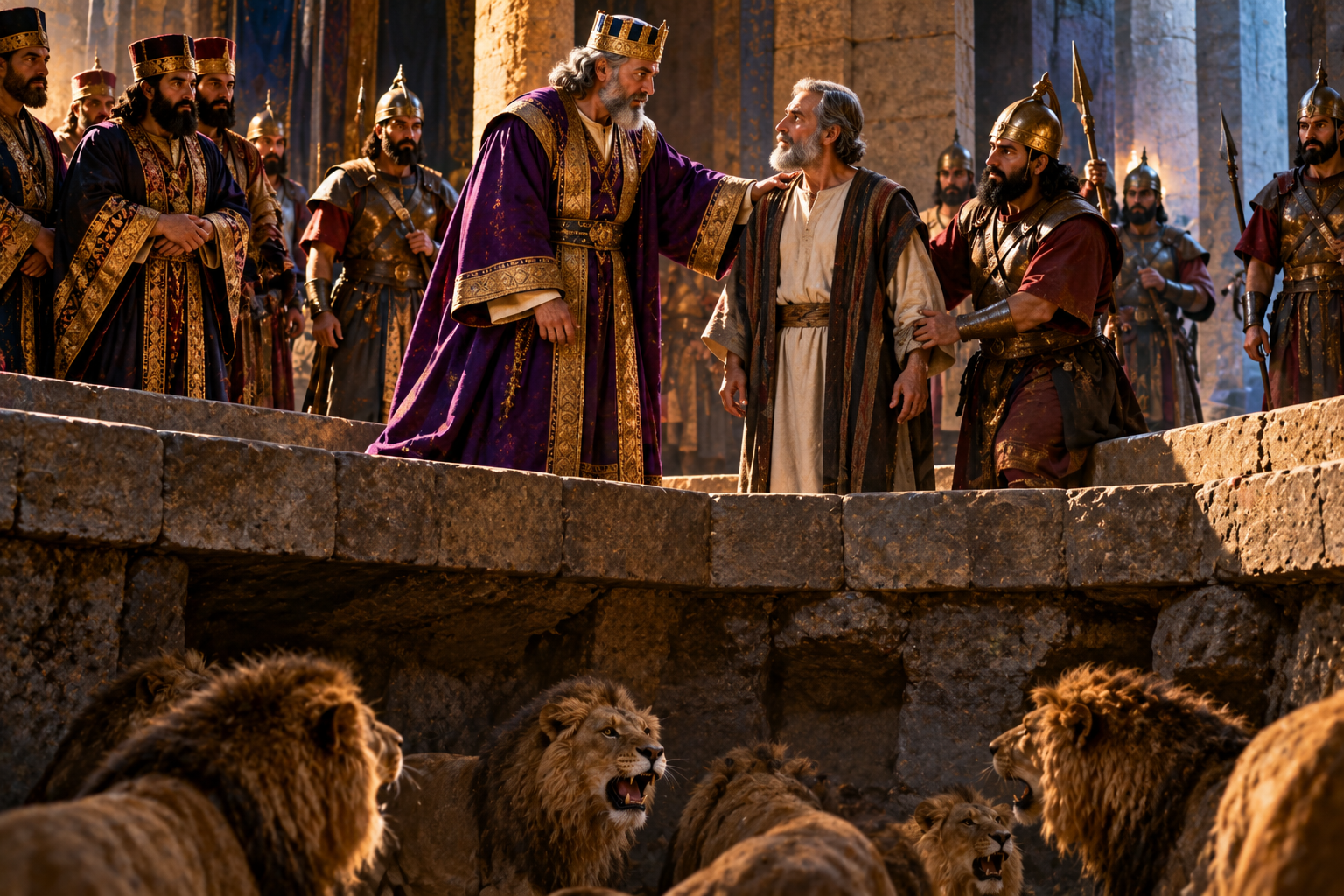
DELIVERED INTO DANGER
ENTRUSTED TO GOD
NIV renders this verse as if Darius were offering a prayer or better yet, perhaps it was a way of expressing his feeble hope of the possibility of deliverance
"May your God, Whom you serve continually, rescue you!" (ESV, NLT, CSB, RSV also renders it in the form of a prayer. Lxx translation does not take the form of a prayer).
Then - This marks the tragic conclusion of Darius' unsuccessful attempts to rescue Daniel.
The king gave orders, and Daniel was brought in and cast into the lions' den - Darius had the power to send Daniel into the lions' den, but he did not have the power to keep Daniel out of it. Daniel is thrown into a place intended for execution. The text does not describe the precise structure of the den or the number of lions present. What matters is the terrifying reality of the punishment. By this time, Daniel was probably around eighty years old or older, depending on the chronology of his exile and the events of Daniel 6. He had served God faithfully for decades. And now, near the end of a long life, he faces perhaps his greatest recorded test. Note that Daniel's faithfulness did not prevent his trial. On the other hand, while daniel's obedience did not keep him out of the lions' den, it did place him in the hands of the God Who rules over lions.
The king spoke and said to Daniel, "Your God Whom you constantly serve will Himself deliver you." - The original Aramaic verb form emphasizes continual action (constantly serve). The LXX translates with latreuo (carrying out religious duties in a spirit of worship) in the present tense (continually carries out his religious duties in a spirit of worship.) When Darius reached the end of his own ability, he turned his attention to the God Daniel had faithfully served.
Lion's den - Keil describes it this way "It consisted of a large square cavern under the earth, having a partition wall in the middle of it which is furnished with a door which the keeper can open and close from above. By throwing in the food, he entices the lions from one chamber into the other and then having shut the door, they enter the vacant space for the purpose of cleaning it. The cavern is open above, its mouth being surrounded by a wall of a yard and a half high over which one can look down into the den." (Daniel Commentary)
Your God… will deliver (shezab/sêzib; LXX = exaireo = literally means will take you out, to rescue from danger - even as Peter was rescued by His angel Acts 12:11, cp Jesus' promise to Paul to rescue him - Acts 26:17, Gal 1:4) you - This is certainly his human hope ("hope so") but it is not necessarily an expression of assurance or faith because the king later asks "has your God… been able to deliver you?" Faith says "He is able". What is unmistakable is that Darius recognizes the possibility of divine deliverance where human deliverance has failed.
🙏 THOUGHT — Could Others Say You Constantly Serve God? What an extraordinary testimony Darius gave concerning Daniel: "Your God whom you constantly serve" (Daniel 6:16, 20). The Aramaic word translated "constantly" pictures something continual or unceasing, like a circle with no break in it. Darius did not describe Daniel primarily by his position, accomplishments, intelligence, or influence. He described Daniel by his relationship with God. What would those who know us best say about our devotion to the Lord? Would they describe our service as occasional, inconsistent, or dependent on circumstances? Or would they recognize a settled pattern of faithfulness? Daniel had cultivated that testimony over decades. His faithfulness did not suddenly appear when the lions' den threatened his life. And notice another lesson: Daniel's faithful obedience did not keep him out of the lions' den. Sometimes God does not spare us from the trial, but He sustains us in the trial. God's promise has never been that we would avoid deep waters and fire, but that He would be with us in them: "When you pass through the waters, I will be with you... when you walk through the fire, you will not be scorched" (Isaiah 43:2). David could say, "Even though I walk through the valley of the shadow of death, I fear no evil, for You are with me" (Psalm 23:4). The Lord's presence is not measured by the absence of danger. The God Who was worthy of Daniel's service before the lions' den was just as worthy of his service inside it.
Deliver (07804) (shezab/sêzib) consistently refers to rescuing a person from an impossible, life-threatening situation. The implication is that someone is being spared from death. Either God or a person can be the subject who attempts the rescue, but in Daniel only God succeeds.
The verb appears nine times, all in Daniel 3 and 6. deliver(5), delivered(2), delivering(1), delivers(1). Dan. 3:15; Dan. 3:17; Dan. 3:28; Dan. 6:14; Dan. 6:16; Dan. 6:20; Dan. 6:27
The fiery furnace (Daniel 3). King Nebuchadnezzar threatened Daniel's three friends, Hananiah, Mishael, and Azariah (better known by their Babylonian names Shadrach, Meshach, and Abed-nego), with death if they refused to bow to his golden image: "But if you do not worship, you will immediately be cast into the midst of a furnace of blazing fire; and what god is there who can deliver you out of my hands?" (Da 3:15). The three answered with the same verb: "Our God whom we serve is able to deliver us from the furnace of blazing fire; and He will deliver us out of your hand, O king" (Da 3:17). God did just that. A fourth figure appeared with them in the flames, "like a son of the gods" (Da 3:25), whom Nebuchadnezzar later identified as God's angel (Da 3:28). The men came out without a hair singed, their clothing unharmed, and not even the smell of fire on them (Da 3:27). The king who had mocked, "What god is there who can deliver you?" was forced to declare, "There is no other god who is able to deliver in this way" (Da 3:29). His own question was answered with his own word.
The lions' den (Daniel 6). Here the verb highlights a striking contrast between human and divine rescue:
Da 6:14: King Darius "set his mind on delivering Daniel" and worked until sunset to rescue him, but failed. Even the most powerful man in the empire could not undo his own law.
Da 6:16: As Daniel was thrown into the den, Darius said, "Your God whom you constantly serve will Himself deliver you."
Da 6:20: At dawn the king cried out, "Daniel, servant of the living God, has your God, whom you constantly serve, been able to deliver you from the lions?"
Da 6:27: In his decree, Darius praised the God who "delivers and rescues and performs signs and wonders in heaven and on earth, who has also delivered Daniel from the power of the lions."
Theological significance - Šêzib carries the central message of Daniel's narratives: earthly kings cannot deliver, but the God of heaven can. Nebuchadnezzar arrogantly claimed no god could rescue from his hand, and Darius sincerely wanted to rescue but could not. In both cases, pagan kings ended up publicly confessing that the God of Israel is the true Deliverer. The word reminds us that when every human means of rescue has failed, God is still able.
Takeaways from Daniel 6:17 -
Daniel had lost the protection of the king, but he had not lost the presence of his God.
Daniel's obedience did not keep him out of the lions' den, but it placed him in the hands of the God Who rules over lions.
Daniel's relationship with God was so evident that even a pagan king identified him by the God he served.
Daniel did not serve God only when service was convenient; he served God when service became costly.
Daniel had served several earthly kings, but he had never changed his heavenly King.
Darius could command Daniel to enter the lions' den, but only God could command the lions not to devour him.
Darius wanted to keep Daniel out of the den; God would demonstrate His power by keeping Daniel safe in the den.
And perhaps the most memorable:
The king who could not save Daniel placed his hope in the God Daniel had never stopped serving.
Daniel 6:17 A stone was brought and laid over the mouth of the den; and the king sealed it with his own signet ring and with the signet rings of his nobles, so that nothing would be changed in regard to Daniel.
- La 3:53 Mt 27:60-66 Ac 12:4 16:23,24
- Daniel 6 Resources - Multiple Sermons and Commentaries
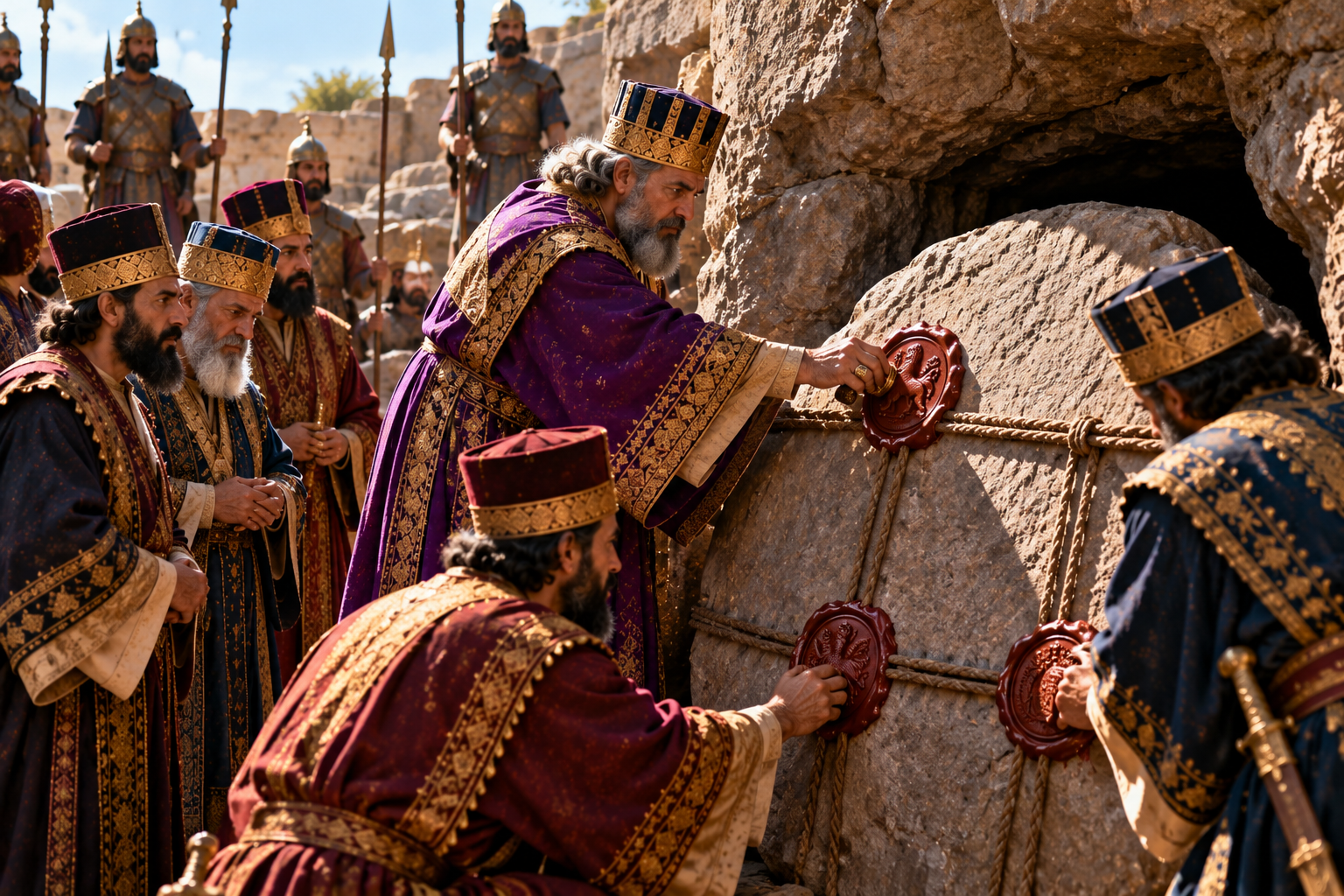
WHEN EVERY EARTHLY
DOOR IS CLOSED
A stone was brought and laid over the mouth of the den; and the king sealed it with his own signet ring and with the signet rings of his nobles, so that nothing would be changed in regard to Daniel. Daniel has been thrown into the lions' den, and now the entrance is covered with a stone and officially sealed. Darius places his own signet upon the seal, joined by those of his nobles, ensuring that no one can secretly interfere with Daniel's punishment. Every human avenue of escape has now been closed. The stone prevents ordinary access, the seals prohibit unauthorized interference, and the lions threaten Daniel's life. Yet the very precautions intended to make Daniel's fate irreversible will make his miraculous deliverance all the more unmistakable. Men could seal the entrance to the den, but they could not shut out the God of heaven!
How did Daniel respond to this life threatening situation? We know that he had prayed and so his heart was prepared, but we cannot say otherwise for the text is silent. Although for a man in his 80's who has served so faithfully, one cannot help but wonder that not only did he have no fear, but that he was likely even ready to go home (cp 2Co 5:6 , 2Cor 5:8). We'll ask him when we meet in the presence of our LORD!
King sealed (LXX = sphragizo = of sealing believers secure in their salvation - Eph 1:13, Eph 4:30) it with his own signet ring and with the signet rings of his nobles - For security, to assure there would be no covert rescue or escape. Any attempt to open the lion's den would be detectable by a broken seal (cp seal in Eph 1:13). This event reminds us of another tomb that was "made… secure" (Mt 27:60,66) by the Roman authorities, but to no avail for our Lord Jesus Christ came forth alive, even as Daniel came forth alive (some see Daniel's coming forth as a foreshadowing of the resurrection)!
Daniel 6:18 Then the king went off to his palace and spent the night fasting, and no entertainment was brought before him; and his sleep fled from him.
- and passed : 2Sa 12:16,17 19:24 1Ki 21:27 Job 21:12 Ps 137:2 Ec 2:8 Isa 24:8,9 Am 6:4-6 Jon 3:3-9 Rev 18:22
- and : Da 2:1 Es 6:1 Ps 77:4
- Daniel 6 Resources - Multiple Sermons and Commentaries
NO MIRTH FOR
THE MONARCH
Then the king went off to his palace and spent the night fasting, and no entertainment was brought before him; and his sleep fled from him - His conscience was not clear. His heart was burdened. Sleep was fleeting for the king while Daniel likely slept like a baby with lions purring in the background! Darius could command an empire, but he could not command a single hour of peaceful sleep. While Darius lay awake wondering whether Daniel would survive, the God Who never sleeps was sovereign over every moment in the lions' den. The king could not sleep because he could not save Daniel, but the God Who never sleeps was already at work delivering him!
Man's best rest (king's palace) contrasted with God's best rest (in the Lion's den or wherever, but with the presence of the Lord and with a clear conscience - that is real rest - Study "Rest" in Scripture). As Pritchard says "it is better to be a child of faith in a lion’s den than to be a king without God in a palace." (How to Tame Lions)
When you cannot sleep because of tomorrow's uncertainties,
remember that the God Who holds your tomorrow never sleeps!
🙏 THOUGHT — The God Who Never Sleeps. Dear believer, what a contrast between Darius and Daniel! Darius possessed every earthly comfort, yet his troubled heart robbed him of sleep. Daniel was surrounded by lions, yet he remained under the sovereign care of the living God. How often we resemble Darius, lying awake at night rehearsing circumstances we cannot control, imagining what might happen tomorrow, and struggling to find solutions that seem beyond our reach! But the psalmist reminds us that the Lord neither slumbers nor sleeps (Ps 121:3,4). Why should we spend the night trying to control what God already holds securely in His hands? David declared that he could lie down and sleep in peace because the Lord alone made him dwell in safety (Ps 4:8). Peter exhorts us to cast all our anxiety upon God because He cares for us (1Pe 5:7), and Paul reminds us that prayer with thanksgiving is God's appointed response to anxiety (Php 4:6,7). This does not mean believers will never experience sleepless nights, but it does mean we can bring our fears to the One Whose watchful care never ceases. And remember that God was not waiting anxiously for morning to discover Daniel's fate. He was already sovereign over the lions! When you cannot sleep because of tomorrow's uncertainties, remember that the God Who holds your tomorrow never sleeps! (Ps 121:4; Isa 26:3).
John MacArthur - INTEGRITY ACCEPTS GOD’S WILL DANIEL 6:18–22a Strength for Today: Daily Readings for a Deeper Faith - Page 27
✧✧✧
When circumstances seem darkest, we can see God’s hand most clearly.
It is obvious that King Darius cared deeply for Daniel and that he had some degree of faith in Daniel’s God. Although he believed that God could deliver Daniel (v. 16), he spent a distressing and sleepless night anxiously awaiting dawn, so he could see if his belief was true. At the crack of dawn he hurried to the lions’ den and called out to Daniel. Imagine his relief to hear Daniel’s voice and to learn about how the angel had shut the lions’ mouths.
Why did Darius think God would deliver Daniel? I’m sure he learned of God from Daniel himself. Surely Daniel talked about Shadrach, Meshach, and Abed–nego’s deliverance from the fiery furnace and about other marvelous things God had done for His people. The king’s response shows that Daniel’s testimony was effective and that his integrity had lent credibility to his witness.
But suppose God hadn’t delivered Daniel from the lions. Would He have failed? No. Isaiah also believed God, but he was sawn in half. Stephen believed God but was stoned to death. Paul believed God but was beheaded. Trusting God means accepting His will, whether for life or death. And for Christians, “to live is Christ, and to die is gain” (Phil. 1:21).
✧✧✧
Suggestions for Prayer: Pray for those Christian leaders today who influence kings and presidents throughout the world. Ask the Lord to give them boldness and blameless integrity.
For Further Study: How does God view the death of His children (see Ps. 116:15 and John 21:18–19)?
Daniel 6:19 Then the king arose at dawn, at the break of day, and went in haste to the lions' den.
- Mt 28:1 Mk 16:2 2Co 2:13 1Th 3:5
- Daniel 6 Resources - Multiple Sermons and Commentaries

FROM THE PALACE TO
THE LION'S DEN
Then - After a fitful night of tossing and turning.
the king arose at dawn, at the break of day - Break of day is literally at the brightness of the dawning, as soon as the sun was visible, he was off to the lion's den! Throughout Scripture, morning frequently appears as a time associated with renewed hope, divine mercy, or the manifestation of God's help (Ps 30:5, Lam 3:22,23, Ps 46:5). We should not suggest that every difficult night necessarily ends with miraculous physical deliverance at sunrise. But in Daniel's case, the coming morning will reveal that God has preserved His servant.
And went in haste to the lions' den - The Aramaic expression conveys urgency and eagerness. The most powerful man in the kingdom is now anxiously rushing to discover the fate of the servant he could not save. Surely wondering as he ran to the den "Is Daniel's God really able to deliver"? (Da 6:16).
Daniel 6:20 When he had come near the den to Daniel, he cried out with a troubled voice. The king spoke and said to Daniel, "Daniel, servant of the living God, has your God, whom you constantly serve, been able to deliver you from the lions?"
- is : Da 6:16,27 3:15,17,28,29
- serve : 1Chr 16:11 Ps 71:14-18 73:23 119:112 146:2 Pr 23:17,18 Ho 12:6 Lk 18:1 Ac 6:4 Ro 2:7 Col 4:2 1Th 5:17,18 Jas 1:25
- able : Da 3:17 Ge 18:14 Nu 11:23 14:15,16 Jer 32:17 Lk 1:37 2Co 1:10 2Ti 1:12 4:16, 17, 18 Heb 7:25 Jude 1:24
- Daniel 6 Resources - Multiple Sermons and Commentaries

THE KING'S ANXIOUS
QUESTION
When he had come near the den to Daniel, he cried out with a troubled voice. The king spoke and said to Daniel, "Daniel, servant of the living God, has your God, whom you constantly serve, been able to deliver you from the lions? - It is ironic that the king's royal surroundings and his troubled conscience afforded him a far less comfortable night of rest than that of Daniel who had a completely clear conscience (Da 6:22, 2Ti 1:3) sleeping with the lions and fellowshipping with the Angel of God! God does have a fascinating sense of humor.
He cried out with a troubled voice....Daniel servant (LXX = doulos) of the living God - Would it be that all God's children would be known by this title! And would it be that all God's children lived so that the unbelievers around them recognized their God as "the living God." Daniel's life of integrity was a shining light in the midst of a dark work and Darius recognized the difference. Some have commented that although there is no Biblical evidence that King Darius ever became a believer, that possibility is not inconceivable considering the "aroma of life" (cp 2Cor 2:14, 15, 16) to which he was exposed. I agree. Won't heaven be an interesting place! Some who you never thought will be there. And sadly some you surely thought would be there won't be!
You constantly serve - Repeat of Da 6:16. Clearly Darius recognized Daniel's loyalty to His God. Daniel's consistent work ethic toward God is another mark of his integrity.
Living God - This is amazing that this pagan king referred to God as living! One This phrase is found 28x in Scripture (Dt 5:26; Josh 3:10; 1Sa 17:26, 36; 2Kgs 19:4, 16; Ps 42:2; 84:2; Isa 37:4, 17; Jer 10:10; 23:36; Da 6:20, 26; Hos 1:10; Mt 16:16; 26:63; Acts 14:15; Ro 9:26; 2Cor 3:3; 6:16; 1Ti3:15; 4:10; Heb 3:12; 9:14; 10:31; 12:22; Rev 7:2). Living God sometimes is used to contrast the Lord with lifeless idols (see, e.g., Deut 5:26; Josh 3:10; Isa 37:17,18)
Your God - Like Nebuchadnezzar before him, Darius has a reasonable respect for God, but does not acknowledge Him as his God (as we think Nebuchadnezzar finally did after humbling his heart in Daniel 4).
Your God… able to deliver (cp the testimony of the 3 friend in Da 3:17 "God… is able") - Daniel did not know that rescue would be forthcoming. Courage and steadfastness in faith motivated him to continue his walk with God by faith not by sight.
Pritchard writes that Darius. "recognized the genuineness of Daniel’s faith and though he did not believe himself, he hoped that Daniel’s God would deliver him." (How to Tame Lions)
Gleason L. Archer - Notice the emphasis on Yahweh as the "living" God; clearly the king regarded Daniel's fate as a test of whether his God was really alive or just an unproved supposition, like all the deities the non- Jews worshiped. If the Hebrew God really existed, he would preserve his faithful servant from death; and if anyone deserved well from his God, it was Daniel, who would not stop worshiping even on pain of death. (Expositor's Bible Commentary)
🙏 THOUGHT — Does Your Life Reveal Whom You Serve? When Darius approached the lions' den, he did not call Daniel his faithful commissioner or trusted administrator, but “servant of the living God!” (Da 6:20). Daniel's devotion was so evident that even a pagan king identified him by his relationship with God. Beloved, if others were asked to describe you, would your devotion to Christ be among the first things they mentioned? Jesus calls us to let our light shine before others (Mt 5:16). Daniel's testimony was not forged in the lions' den but through decades of daily faithfulness (Da 1:8; 6:4, 10). The testimony that shines brightest in a crisis is cultivated through faithfulness in ordinary days! May others recognize not merely what we profess, but Whom we serve! (2Co 3:2-3; Php 2:14-16).
George Mueller - The living God Da 6:20
How many times we find this expression in the Scriptures, and yet it is just this very thing that we are so prone to lose sight of! We know it is written the living God; but in our daily life there is scarcely anything we practically so much lose sight of as the fact that God is the LIVING GOD; that He is now whatever He was three or four thousand years since; that He has the same sovereign power, the same saving love toward those who love and serve Him as ever He had, and that He will do for them now what He did for others two, three, four thousand years ago, simply because He is the living God, the unchanging One. Oh, how therefore we should confide in Him, and in our darkest moments never lose sight of the fact that He is still and ever will be the LIVING GOD.
Streams in the Desert -
“O Daniel, servant of the living God, is thy God whom thou servest continually, able to deliver thee.” (Dan. 6:20.)
HOW many times we find this expression in the Scriptures, and yet it is just this very thing that we are so prone to lose sight of. We know it is written “the living God”; but in our daily life there is scarcely anything we practically so much lose sight of as the fact that God is the living God; that He is now whatever He was three or four thousand years since; that He has the same sovereign power, the same saving love towards those who love and serve Him as ever He had and that He will do for them now what He did for others two, three, four thousand years ago, simply because He is the living God, the unchanging One. Oh, how therefore we should confide in Him, and in our darkest moments never lose sight of the fact that He is still and ever will be the living God!
Be assured, if you walk with Him and look to Him and expect help from Him, He will never fail you. An older brother who has known the Lord for forty-four years, who writes this, says to you for your encouragement that He has never failed him. In the greatest difficulties, in the heaviest trials, in the deepest poverty and necessities, He has never failed me; but because I was enabled by His grace to trust Him He has always appeared for my help. I delight in speaking well of His name.—George Mueller.
Luther was once found at a moment of peril and fear, when he had need to grasp unseen strength, sitting in an abstracted mood tracing on the table with his finger the words, “Vivit! vivit!” (“He lives! He lives!”). It is our hope for ourselves, and for His truth, and for mankind. Men come and go; leaders, teachers, thinkers speak and work for a season, and then fall silent and impotent. He abides. They die, but He lives. They are lights kindled, and, therefore, sooner or later quenched; but He is the true light from which they draw all their brightness, and He shines for evermore.—Alexander Maclaren.
“One day I came to know Dr. John Douglas Adam,” writes C. G. Trumbull. “I learned from him that what he counted his greatest spiritual asset was his unvarying consciousness of the actual presence of Jesus. Nothing bore him up so, he said, as the realization that Jesus was always with him in actual presence; and that this was so independent of his own feelings, independent of his deserts, and independent of his own notions as to how Jesus would manifest His presence.
“Moreover, he said that Christ was the home of his thoughts. Whenever his mind was free from other matters it would turn to Christ; and he would talk aloud to Christ when he was alone—on the street, anywhere—as easily and naturally as to a human friend. So real to him was Jesus’ actual presence.
Daniel 6:21 Then Daniel spoke to the king, "O king, live forever!
- Da 6:6, 2:4 Ne 2:3
- Daniel 6 Resources - Multiple Sermons and Commentaries
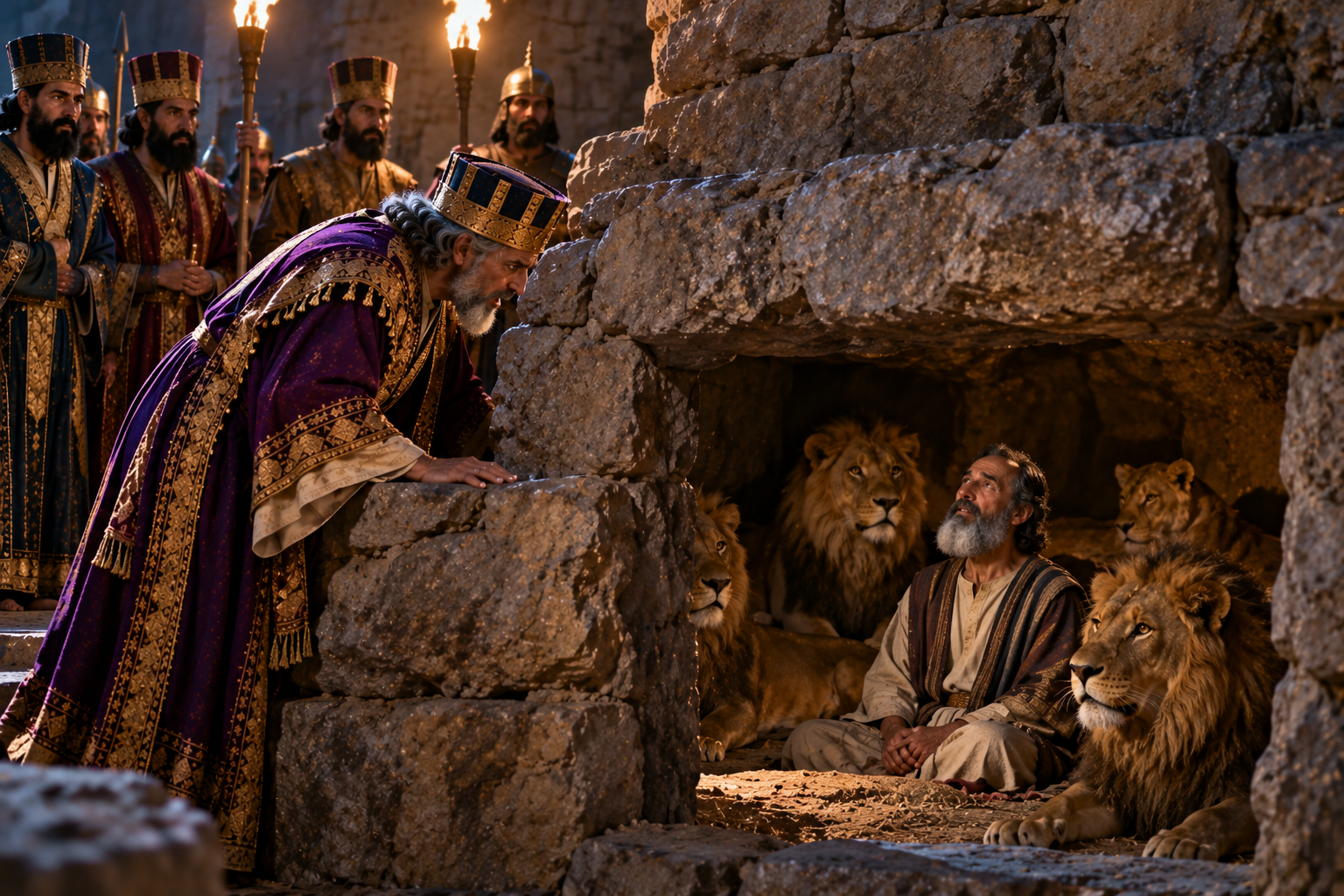
THE VOICE THAT SILENCED
THE KING'S FEARS
Then Daniel spoke to the king, "O king, live forever! -Daniel, still in the lions' den, was more composed than the king standing safely above it. Darius had spent a sleepless night fasting (Daniel 6:18), and at dawn he hurried to the den and cried out "with a troubled voice" (6:20). Daniel answered calmly, "O king, live forever!" (6:21). This was a common, formal way of addressing kings, but one cannot help thinking it came from Daniel's heart and meant more than "Good morning, king!"
Notice the irony, even the humor, in his greeting. Daniel, the supposed "dead man" in the den, is alive and well, wishing long life to the pagan king, who was the one truly in danger of death (compare Ephesians 2:1). The irony runs deeper still. Daniel's accusers had used the exact same words when they came to trap him: "King Darius, live forever!" (6:6). On their lips, it was flattery that masked a murderous plot. On Daniel's lips, it was sincere goodwill toward the very king who had sentenced him to die. That is a beautiful picture of a heart free of bitterness (compare Matthew 5:44; Romans 12:14).
Why does God give us stories like Daniel 6, David and Goliath, Israel trapped at the Red Sea with Pharaoh pursuing, the walls of Jericho falling down, etc? Paul answers it this way…
For whatever was written in earlier times was written for our instruction, that through perseverance and the encouragement of the Scriptures we might have hope. (Ro 15:4)
God records these stories to stir up faith in our hearts. Then when we find ourselves facing the giants or the lions or the impossible "Red Sea" obstacle, we can cry out to Jehovah for deliverance, knowing that He is able to deliver us. Remember that when God allows us to go through one of these difficult stormy situations, He always has a purpose. Some storms are sent for correction (discipline) as with Jonah, some storms are for instruction as with the disciples, and some storms are sent that we might be used to bring glory to the Most High God as in the case of the miraculous deliverance of Daniel from the Lion's den.
Like a River Glorious
Stayed upon Jehovah
Hearts are fully blessed,
Finding as He promised
Perfect peace and rest.
🙏 THOUGHT — So here's the question we each need to ponder - Is my God able to deliver me? The answer depends on who your God is - Is your god "Plenty" (money)? Is your god "Pleasure"? Is your god "Power"? Jesus is the only God who can truly deliver…Hence, also, He is able to save forever those who draw near to God through Him, since He always lives to make intercession for them. (Hebrews 7:25) Play He Will Deliver Me.
God Will Make a Way
Where there seems to be no way;
He works in ways we cannot see,
He will make a way for me.
-- Don Moen
John MacArthur - INTEGRITY WILL BE VINDICATED DANIEL 6:21–24 Strength for Today: Daily Readings for a Deeper Faith - Page 28
✧✧✧
God will always vindicate His people.
One of the challenges of the Christian life is to react properly when being unjustly accused. Our natural inclination is to defend ourselves, which is appropriate at times. But there are other times when we must remain silent and trust the Lord to defend us.
Apparently Daniel said nothing in his own defense when he was charged with disregarding the king’s decree to stop praying. Of course the charge itself was true, but his motives were righteous, and he knew he was innocent before God. Therefore, like Jesus Himself before His accusers, Daniel chose to remain silent and entrust himself to God, who “judges righteously” (1 Peter 2:22–23).
Vindication doesn’t always come quickly, but in Daniel’s case it did. God affirmed his innocence by protecting him from the hungry lions. King Darius affirmed his innocence by putting his accusers to death. That was swift and decisive judgment.
Never lose heart or feel that God has abandoned you when evil people seem to prevail. The day will come when God will vindicate you. When He does, His judgment will also be swift and decisive.
✧✧✧
Suggestions for Prayer: Pray for a loving attitude toward those who unjustly accuse you.
For Further Study: Read James 5:7–11. What encouragement does James give to those who suffer at the hands of evil people? ✧ Who does he use as an example of someone who suffered with patience? ✧ At what point in time will God’s people be vindicated?
Daniel 6:22 "My God sent His angel and shut the lions' mouths and they have not harmed me, inasmuch as I was found innocent before Him; and also toward you, O king, I have committed no crime."
- My God : Da 6:20 2Sa 22:7 Ps 31:14 38:21 118:28 Mic 7:7 Mt 27:46 Jn 20:17 Jn 20:18
- sent His angel : Da 3:28 Nu 20:16 2Ch 32:21 Ps 34:7 Isa 63:9 Ac 12:11 27:23
- shut : 1Sa 17:37 Ps 91:11-13 2Ti 4:17 Heb 11:33
- Inasmuch : Da 6:23 Ps 18:19-24 26:6 84:11 Isa 3:10 Ac 24:16 2Co 1:12 1Jn 3:19-21
- also toward you, O king, I have committed no crime: Ge 40:15 1Sa 24:9-11 26:18 Ps 7:1-4 Ac 25:8-11
- Daniel 6 Resources - Multiple Sermons and Commentaries
ANGEL OF THE LORD
SHUTS LIONS' MOUTHS
Another mark of a man of integrity - Daniel (as in the past) makes it a priority to give God the glory for his deliverance (a good pattern for all His children) (cp Da 2:27, 28; Da 4:25; Da 5:21, 22, 23, cp Ps 115:1)
My God sent His angel - While this could be a created angel, it is possible that it is the Angel of the LORD. In Da 3:28-note we read a similar phrase that God "sent His Angel and delivered His servants who put their trust in Him" (cp Da 3:25-note). In that context, we concluded that the Angel was very likely the Angel of the LORD, the preincarnate appearance of Christ. And in Da 6:23 the king states Daniel's delivery (like the 3 Hebrew boys) was related to the fact that he had trusted his God.
There is an interesting parallel passage in Paul (in some of the last words he wrote before he was poured out as a drink offering -2Ti 4:6-note) -
2 Timothy 4:17 But the Lord stood with me and strengthened me, so that through me the proclamation might be fully accomplished, and that all the Gentiles might hear; and I was rescued out of the lion's mouth.
S R Miller asks - Who was the “angel” who spent the night in the den with Daniel? He may have been a member of the angelic host, but it is more likely that this heavenly being was the divine angelic messenger, the Angel of the LORD (cf. Ge 16:11, 12, 13, 14; 22:15, 16; Ex 3:2, 3, 4; Jdg 6:11-26; 13:13-23; 1Chr 21:16, 17, 18). Although the LXX (but not the Lxx of Theodoret) interpreted the text to mean that “God” saved Daniel from the lions, Lacocque comments, “It is nothing other than the very presence of God, as the LXX has well understood.” The angel was evidently visible to Daniel, and it is comforting to think of the faithful old prophet spending the night in fellowship with the Lord during this trying ordeal. (Ibid)
David writes that…
The angel of the LORD (probably the Angel of the LORD) encamps around those who fear Him, and rescues them. (Ps 34:7, cp Ps 91:11)
Speaking of the created angels the writer of Hebrews asks rhetorically…
Are they not all ministering spirits, sent out to render service for the sake of those who will inherit salvation? (Hebrews 1:14)
I was found innocent before Him - A perfect illustration of Daniel's very name = "God is my Judge" and the Supreme God overturned the accusation against Daniel!
Robert Morgan - From This Verse - Grit and Backbone
Daniel preferred to spend a night with the lions than miss a day in prayer. He slept better under angelic guard in the lions’ den than the king in the palace bedroom. After all, said Spurgeon, “How could the lions eat him when most of him was grit and backbone!”
I first became acquainted with Daniel’s story in the big Scofield Bible my parents gave me as a child. C. I. Scofield, its editor, had fought in the Civil War. President Grant later appointed him United States Attorney for Kansas, and Scofield was considered a brilliant lawyer. But his career was marred by alcoholism—until his conversion to Christ at age 36. Scofield then became a great Bible student, a pastor and evangelist, founder of the Central American Mission, and editor of his famous reference Bible. He once said:
Shortly after I was saved, I passed the window of a store in St. Louis where I saw a painting of Daniel in the lions’ den. That great man of faith, with his hands behind his back and those beasts circling him, was looking up and answering the king, who was anxious to know if God had protected him.
As I stood there, great hope flooded my heart. Only a few days had passed since I, a drunken lawyer, had been converted; and no one had yet told me anything about the keeping power of Jesus Christ. I thought to myself, there are lions all about me too, such as my old habits and sins. But the One who shut the lions’ mouths for Daniel can also shut them for me! I knew that I could not win the battle in my own strength. The painting made me realize that while I was weak and helpless, my God was strong and able. He had saved me, and now He would also be able to deliver me from the wild beasts in my life. O what a rest of spirit that truth brought me.
J J Knapp - The Loins Girded - Today’s Suggested Reading Daniel 6:16–23
My God sent His angel and shut the lions’ mouths, so that they have not hurt me. Daniel 6:22
The Lions’ Mouths Daniel 6:22
King Darius had issued a decree that whoever would direct a petition to any god or man, except to the king for thirty days, would be thrown into the den of the lions,—the place of punishment of criminals, from which never any one returned alive. When Daniel prayed three times a day at the open window that looked towards Jerusalem, his lot was cast. The king was sorry about it, but a law could not be recalled in that empire, and therefore the king pleaded for the intervention of Daniel’s God, saying: “Thy God whom thou servest continually, he will deliver thee!” After a sleepless night he returned to the place of judgement, and how great was his joy when Daniel answered him upon his question that God had sent His angel to shut the lions’ mouths, so that they would not hurt him, because there was found innocency in him.
Now note the difference between Daniel and his accusers, who in turn were thrown into the lions’ den in punishment for their accusation. They, with their wives and children, did not reach the bottom of the den, or the beasts threw themselves upon them and tore apart their bodies with tooth and claw, even their bones were crushed! It was the same den, it were the same cruel monsters, but for the latter the Angel of the Lord was missing, who had closed the mouths of the lions for the faithful Daniel. The silent man of prayer with the grey head, kneeling before the open window, was watched and noticed by the all-seeing eye. The man who preferred to descend into the lions’ den with his God, was under the protection of the Almighty. The ninety-year-old man who did not forsake the faith at any price, even at the cost of his life, was spared miraculously by the Exalted One, so that not even a hair on his head was bruised.
Oh, if only the quiet trust of faith of Daniel was found more plentifully in us, our soul would be quiet in the greatest needs. We would not fear even if mountains were moved into the heart of the sea, even if hell grimaced at us with all her thousands, even if we were thrown into the lions’ den. God is everywhere, till upon the bottom of the lions’ den; and where He is, there is the almighty power of grace, that shuts the mouths of lions, when it pleases Him, and who makes by His presence the place of threatening dangers a temple of His holiness. Therefore, let us trust respectfully in Him in every need, and let us expect salvation from Him in all dangers,—to experience at His time that He is the living God, who redeems and saves, yes, who performs signs and miracles in heaven and upon the earth!
Daniel 6:23 Then the king was very pleased and gave orders for Daniel to be taken up out of the den. So Daniel was taken up out of the den and no injury whatever was found on him, because he had trusted in his God.
- was : Da 6:14,18 Ex 18:9 1Ki 5:7 2Ch 2:11,12
- because : Da 3:25,27,28 1Ch 5:20 2Ch 20:20 Ps 37:40 118:8,9 146:3, 4, 5, 6 Pr 18:10 Isa 26:3 Mk 9:23 Heb 11:33
- Daniel 6 Resources - Multiple Sermons and Commentaries
FAITH IN THE
LIONS' DEN
No injury whatever - Complete, total deliverance by Jehovah, just as with his 3 fire tested friends (Da 3:27). As we have said before God’s servants are immortal until their work is done. This does not mean that His servants are always delivered from death.
Strauss - a man of God in the will of God is immortal until his work on earth is finished. Daniel was such a man, and God preserved him to finish some more work in the divine plan. (BORROW - The Prophecies of Daniel)
Taken up out of - This suggests it was a pit.
He had trusted in his God - The Aramaic word for trusted (believed) is aman which is related to Hebrew word (See word study of Hebrew word aman) at the heart of which conveys the idea of certainty or firmness. Faith is firm trust in another. It is utter dependence upon the veracity of another. Faith is not a blind leap into the dark but a confident commitment to the One about Whom abundant evidence bears ample testimony of His eternal, immutable trustworthiness.
Strauss - A living faith in the living God will give courage and strength for every emergency of life. (BORROW - The Prophecies of Daniel)
Why did God deliver Daniel? Because of his steadfast faith and because he was innocent (Da 6:22). This passage demonstrates that faith is in a sense an "action verb". In other words, even the pagan king could "see" Daniel's faith by virtue of his refusal to compromise even in the face of the prospect of being the main course of the lion's dinner menu!
Heb 11:33 who by faith conquered kingdoms, performed acts of righteousness, obtained promises, shut the mouths of lions.
By faith they shut the mouths of lions. The lions’ den is not an old-world experience merely. God’s saints still dwell among lions, and fight with wild beasts at Ephesus. Like David, God’s people have abundant cause to cry, “They have compassed us in our steps: they set their eyes to out us down to the earth. He is like a lion that is greedy of his prey, and, as it were, a young lion, lurking in secret places.” But still God sends his angel to shut the lions’ mouths; still faith surrounds us with his unseen protection. Or, if the lion seems to triumph, it is only in appearance. Was not the martyr Ignatius more than a conqueror when he said:
“I bid all men know that of my own free will I die for God, unless ye should hinder me. I exhort you, be ye not an unseasonable kindness to me. Let me be given to the wild beasts, for through them I can attain unto God. I am God’s wheat, and I am ground by the teeth of wild beasts that I may be found pure bread of Christ. Rather entice the wild beasts that they may become my sepulchre, and may leave no part of my body behind; so that I may not, when I am fallen asleep, be burdensome to any one…. Now I am beginning to be a disciple. May naught of things visible and things invisible impede me, that I may attain unto Jesus Christ. Come fire, and iron, and grapplings with wild beasts, cuttings, and manglings, crashings of my whole body—only be it mine to attain unto Jesus Christ.”
Whether faith closes the mouth of the lion, or gives the soul such an entire deliverance from all fear, it is the same in essence and operation, and shows its heavenly temper with the ease with which it overcomes the trial.
F B Meyer - Daniel 6:23 No manner of hurt was found upon him, because he had trusted in his God. (R.V.)
By faith they shut the mouths of lions. The lions’ den is not an old-world experience merely. God’s saints still dwell among lions, and fight with wild beasts at Ephesus. Like David, God’s people have abundant cause to cry, “They have compassed us in our steps: they set their eyes to out us down to the earth. He is like a lion that is greedy of his prey, and, as it were, a young lion, lurking in secret places.” But still God sends his angel to shut the lions’ mouths; still faith surrounds us with his unseen protection. Or, if the lion seems to triumph, it is only in appearance. Was not the martyr Ignatius more than a conqueror when he said:
“I bid all men know that of my own free will I die for God, unless ye should hinder me. I exhort you, be ye not an unseasonable kindness to me. Let me be given to the wild beasts, for through them I can attain unto God. I am God’s wheat, and I am ground by the teeth of wild beasts that I may be found pure bread of Christ. Rather entice the wild beasts that they may become my sepulchre, and may leave no part of my body behind; so that I may not, when I am fallen asleep, be burdensome to any one…. Now I am beginning to be a disciple. May naught of things visible and things invisible impede me, that I may attain unto Jesus Christ. Come fire, and iron, and grapplings with wild beasts, cuttings, and manglings, crashings of my whole body—only be it mine to attain unto Jesus Christ.”
Whether faith closes the mouth of the lion, or gives the soul such an entire deliverance from all fear, it is the same in essence and operation, and shows its heavenly temper with the ease with which it overcomes the world.
Lessons for the Ages - Children love to hear the Bible story of Daniel in the lions' den. But that account has valuable lessons for all of us. Let's look again at the faith of an elderly man named Daniel.
Prayer is a lifelong task. Daniel was at least 80 years old when this story took place. Yet Scripture says he prayed and gave thanks to God "three times that day … as was his custom since early days" (Da 6:10). Daniel had been a man of prayer his whole life—from his youth in Jerusalem all the way through his 65 years in Babylon.
Faithfulness is an undeniable testimony. When Daniel was thrown into the lions' den, Darius said, "Your God, whom you serve continually, He will deliver you" (Da 6:16). Daniel's testimony of trust in God was well-known (Da 6:1-4)—even to a king who wanted people to worship him instead of God.
God rewards faithfulness. Daniel was spared "because he believed in his God" (Da 6:23). As a result, the king told his people to turn their faith toward God. Daniel continued to prosper under the reign of Darius (Da 6:28).
Are you facing a "lions' den" today? Remember the faithfulness of Daniel and imitate it by trusting in the faithfulness of God. — Dave Branon (Our Daily Bread, Copyright RBC Ministries, Grand Rapids, MI. Reprinted by permission. All rights reserved)
Although the stress and strain of life
My thread of faith may become weak,
The cable of His faithfulness
No storm can ever shake.
God tests our faith
so that we may trust His faithfulness.
Daniel 6:24 The king then gave orders, and they brought those men who had maliciously accused Daniel, and they cast them, their children and their wives into the lions' den; and they had not reached the bottom of the den before the lions overpowered them and crushed all their bones.
- brought: Dt 19:18, 19, 20 Es 7:10 9:25 Pr 11:8
- their children: Dt 24:16 Josh 7:24,25 2Ki 14:6 Es 9:10
- lions: Da 3:22 Ps 54:5 Isa 38:13
- Daniel 6 Resources - Multiple Sermons and Commentaries
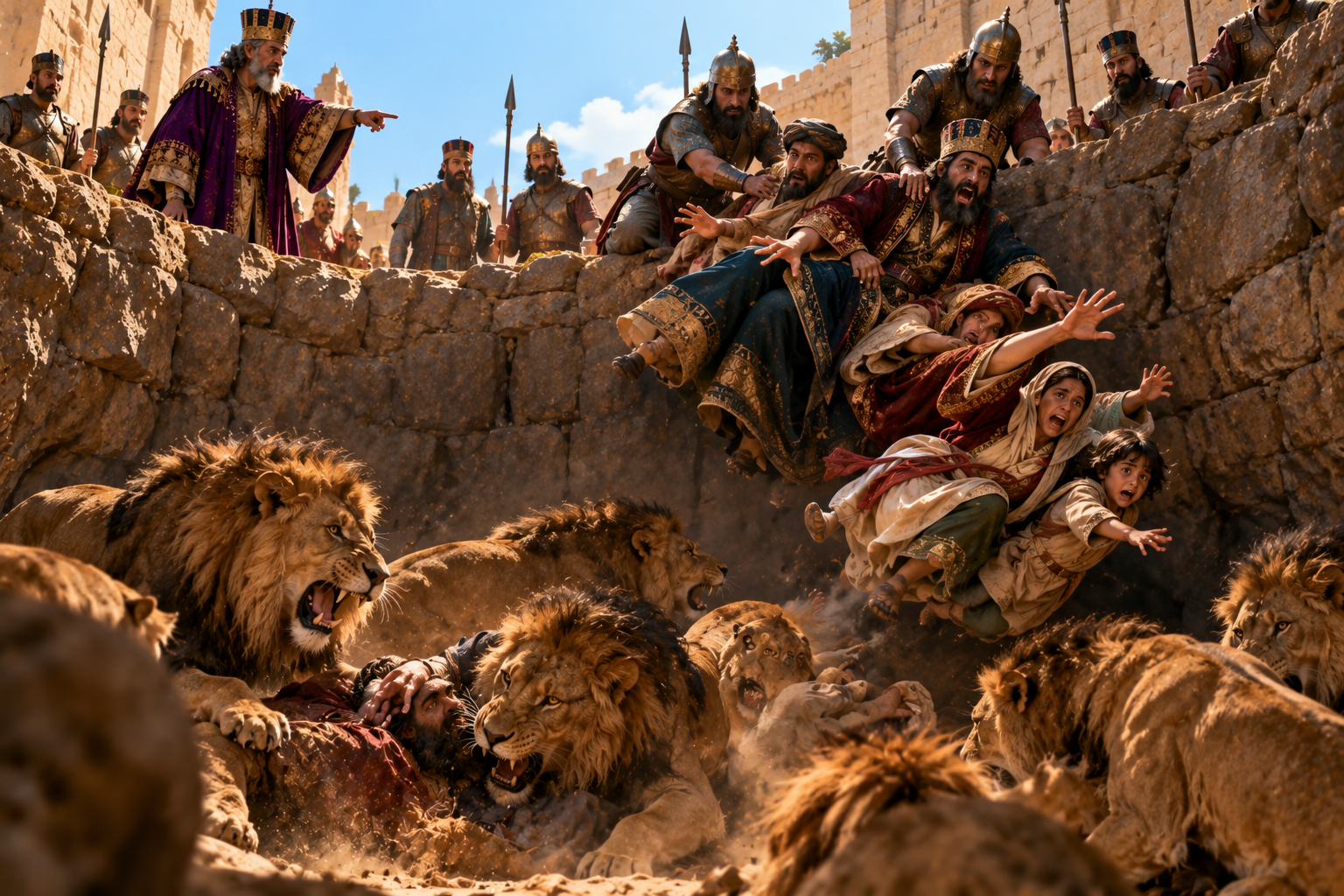
THE TRAP SPRINGS
ON THE TRAPPERS
The king then gave orders, and they brought those men who had maliciously accused Daniel, and they cast them, their children and their wives into the lions' den - This is the law of sowing and reaping in action (Gal 6:7, 8, cp Dt. 19:16, 17, 18, 19, 20, 21).
MacArthur - The law of the Medes and the Persians said: "On account of the guilt of one, all his kindred must perish." (Daniel in the Lions' Den)
Persian kings were known for being cruel in their treatment of enemies and Darius was no exception tossing in their families for good measure, by this preventing any family members from seeking to take revenge on the king. This "den debacle" could have been worse had Darius chosen to also toss in the 120 satraps who were in effect co-conspirators (some think he did execute all of them).
Keil - The condemning to death of the wives and children along with the men was in accordance with Persian custom, as is testified by Herodotus, iii. 119, Amm. Marcell. xxiii. 6. 81, and also with the custom of the Macedonians in the case of treason (Curtius, vi. ii.), but was forbidden in the law of Moses; cf. Deut. 24:16.
The fate of the conspirators is a fulfillment of the promise given to Abraham when God declared…
I will bless those who bless you, and the one who curses you I will curse. (Ge 12:3a)
Maliciously accused - Literally this phrase means “eaten his pieces,” (Akal - 399 = eat + Qerats = 7170 = pieces) and is an idiom which means they had spoken maliciously or slandered (Also used in Da 3:8). Daniel had been falsely accused of disloyalty to the king.
and they had not reached the bottom of the den before the lions overpowered them and crushed all their bones - This fact is a striking contrast with Daniel's deliverance and underscores the power of God to deliver completely. These lions were not what some liberal commentators have described (in order to explain away the miracle) - tame, toothless, tired or satiated!
Proverbs says…
He who digs a pit will fall into it, and he who rolls a stone, it will come back on him. (Pr 26:27).
Warren Wiersbe recalls several Scriptural illustrations of this saying "Pharaoh ordered the Hebrew male babies destroyed in Egypt, and at Passover, all the Egyptian firstborn died. He commanded the newborn Jewish babies to be drowned in the Nile River, and his own army was drowned in the Red Sea (Ex 14,15). Haman tried to destroy the Jewish nation and ended up being hanged on the gallows he had made for Mordecai (Es 7:9, 10; 9:25). Even if sinners aren’t judged in this present life, they will be judged after they die (Heb. 9:27), and the judgment will be just. (Bible Exposition Commentary)
He who leads the upright astray in an evil way will himself fall into his own pit, but the blameless will inherit good (as in Da 6:28). (Pr 28:10)
The righteous (i.e., Daniel) is delivered from trouble, but the wicked (Daniel's accusers) takes his place. (Pr 11:8)
Another Persian king, Ahasuerus, carried out a similar retribution against evil Haman who had plotted to have all the Jews in Persian empire destroyed (what a picture of Satan's emissary)…
So they hanged Haman on the gallows which he had prepared for Mordecai, and the king’s anger subsided… The king took off his signet (signet) ring which he had taken away from Haman, and gave it to Mordecai. And Esther set Mordecai over the house of Haman. (Esther 7:10-note, Esther 8:2-note)
Gleason Archer - What Darius did seems arbitrary and unjust. But ancient pagan despots had no regard for the provision in the Mosaic law (Dt 24:16): "Fathers shall not be put to death for their children, nor children put to death for their fathers; each is to die for his own sin." (Even in Israel this humanitarian rule had been flouted, as when Abimelech ben Gideon had nearly all his father's sons massacred, or when Queen Athaliah nearly exterminated the Davidic royal line and Jehu had all Ahab's sons decapitated.) (Expositor's Bible Commentary )
Ezekiel adds - The person who sins will die. The son will not bear the punishment for the father's iniquity, nor will the father bear the punishment for the son's iniquity; the righteousness of the righteous will be upon himself, and the wickedness of the wicked will be upon himself. (Ezekiel 18:20, cp Ro 14:20)
Daniel 6:25 Then Darius the king wrote to all the peoples, nations and men of every language who were living in all the land: "May your peace abound!
- king : Da 4:1 Ezra 1:1,2 Es 3:12 8:9
- Peace : Ezra 4:17 1Pe 1:2 2Pe 1:2 Jude 1:2
- Daniel 6 Resources - Multiple Sermons and Commentaries
THE EVANGELISTIC POTENCY
OF A GODLY LIFE
Then Darius - Theologically this is quite a proclamation.
John MacArthur (among other conservative commentators) postulates that = Impacted by Daniel and the Lord, Darius expressed himself as if he had come to a point of personal trust in God for his salvation. (Daniel: God's Control over Rulers and Nations)
Darius the king wrote to all the peoples, nations and men of every language - As a result of Daniel's faithfulness, the renown of Daniel's God was proclaimed throughout the 120 provinces of Medo-Persia. As noted elsewhere, while the Jews refused to fulfill their task to be light to the Gentiles, God used a pagan king to announce His majesty and splendor to the known world! One wonders what impact these truths had on the Gentile hearts? One faithful man affected literally an entire Gentile empire! How great is our God!
You never know the impact you will have on the unbelieving watchers. Pastor Chuck Smith tells the following story…
We had a very lovable young man around here for several years. Due to drugs and an accident, he had mental and speech problems. God used him in special ways. While he was in the mental ward at Orange Co. hospital, his Psychiatrist called the church asking how he could get saved. He said we have a young man over here that seems to know only one thing but he knows it well, he tells me all the time that Jesus loves me. I need to know this Jesus. Kay was going through one of those times when she was discouraged and feeling a little down, and she said, "Lord I just need to be assured of Your love for me." Presently the phone rang and this young man who slurred his words so much that he was difficult to understand said, "Sister Kay", and then in the clearest, most distinct way he said, "Jesus wants you to know that he loves you." He then reverted again to his stuttering slurring speech pattern. (Chuck Smith - Sermon Notes)
I agree with Ray Prichard's comments on King Darius - What amazing words coming from the lips of a pagan king. Or perhaps he is a pagan no more. Perhaps like Nebuchadnezzar he became a believer in the one true God. We won’t know for sure until we get to heaven, but I would not be surprised to see Darius there. (How to Tame Lions)
John MacArthur - INTEGRITY DRAWS MEN TO GOD DANIEL 6:25–27 Strength for Today: Daily Readings for a Deeper Faith - Page 29
✧✧✧
It doesn’t take a lot of people to make an impact for Christ; it merely takes the right kind.
Today’s passage proclaims the sovereignty and majesty of the living God and calls on everyone throughout the nation to fear and tremble before Him. Those verses could have been written by King David or one of the other psalmists, but they were written by a pagan king to a pagan nation. His remarkable tribute to God’s glory was the fruit of Daniel’s influence on his life.
God doesn’t really need a lot of people to accomplish His work; He needs the right kind of people. And Daniel shows us the impact one person can have when he or she is sold out to God. That’s how it is throughout Scripture. For example, Noah was God’s man during the Flood, Joseph was God’s man in Egypt, Moses was God’s man in the Exodus, and Esther was God’s woman in the days of King Ahasuerus. So it continues right down to the present. When God puts His people in the right place, His message gets through.
As a Christian, you are God’s person in your family, school, or place of employment. He has placed you there as His ambassador to influence others for Christ. That’s a wonderful privilege and an awesome responsibility.
✧✧✧
Suggestions for Prayer: Thank the Lord for His marvelous grace in your life and for the opportunities He gives you each day to share His love with others.
For Further Study: The key to Daniel’s fruitfulness, and to yours as well, is given in Psalm 1. Memorize that psalm, and recite it often as a reminder of God’s promises to those who live with biblical integrity.
Daniel 6:26 "I make a decree that in all the dominion of my kingdom men are to fear and tremble before the God of Daniel; For He is the living God and enduring forever, And His kingdom is one which will not be destroyed, And His dominion will be forever.
- make: Da 3:29 Ezra 6:8-12 7:12,13
- tremble : Ps 2:11 99:1-3 119:120 Isa 66:2 Jer 10:10 Lk 12:5 Heb 12:29) (for : Da 4:34 De 5:26 1Sa 17:26,36 Ho 1:10 Ac 17:25 Ro 9:26 1Th 1:9 Rev 4:10 5:14
- enduring forever: Ps 93:1,2 146:10 Mal 3:6 Heb 6:17,18 Jas 1:17
- his kingdom : Da 2:44 4:3,34 7:14,27 Ps 29:10 145:12,13 Isa 9:7 Mt 6:13 Lk 1:33 Rev 11:15
- Daniel 6 Resources - Multiple Sermons and Commentaries
GOD IS GLORIFIED
THROUGH THE DANIEL'S TRIAL
I make a decree - This is a remarkable proclamation lauding many of the attributes of God and kingdom. Clearly the omnipotent God God could have orchestrated events so that Daniel would not have been thrown into the lion's den, but by allowing him to go in and bringing him out unhurt, the Lord received great glory! We need to remember this story the next time we try to escape the fiery trial, not realizing that the Lord might desire us to walk through that He might be greatly glorified!
Wiersbe - Darius’ first decree in this chapter declared that he was god (Da 6:7–9), but this second decree declared that the God of the Hebrews was the true and living God! In doing this, Darius joined King Nebuchadnezzar by giving public testimony to the power and glory of the true and living God (Da 2:47; Da 3:28, 29; Da 4:1-3, 34, 35, 36, 37). God could have kept Daniel out of the lions’ den, but by rescuing him from the lions, God received greater glory… What a paradox that the Jews, who were supposed to be witnesses to the Gentiles of the true and living God, were being witnessed to by the Gentiles! (Bible Exposition Commentary)
David Jeremiah - Can you imagine a decree like that coming from the White House and broadcast over every television station and headlined in every newspaper? That national statement of faith was recorded by a pagan Medo-Persian. The real focus of the story is on God. He took the lions’ den and used it for His own glory and His own purpose, and when the story was all over and written, the purpose of those difficulties was to glorify God. At the beginning of the sixth chapter of Daniel we had a new regime. At the end of the chapter there is a new religion, all by the decree of a king who was touched by the power of the almighty God. Why do bad things happen to good people? It is so God might be glorified through our lions’-den experiences. I don’t know how He is going to do it, but whenever God asks one of His people to go through difficult times, it is always for the purpose of glorifying Himself, not only in the experience, but in response to that experience. (SEE The Handwriting on the Wall)
Lawrence Richards - I suspect that the royal command did little to create faith in Israel's God. After all, faith can't be commanded! What did create faith, at least in the king, was Daniel's faithfulness to the Lord. Despite the threat to life itself, Daniel continued to worship God openly. God's faithfulness to His loyal servant, like His faithfulness to us, nurtures budding faith in others. You and I cannot command others to believe. But we can encourage them to believe—by an open, unashamed, and unpretentious witness to our Lord. (365 Day Devotional)
Daniel 6:27 "He delivers and rescues and performs signs and wonders In heaven and on earth, Who has also delivered Daniel from the power of the lions."
- delivers: Job 36:15 Ps 18:48,50 32:7 35:17 97:10 Lk 1:74,75 2Co 1:8, 9, 10 2Ti 4:17,18
- and: Da 4:2,3,34 Jer 32:19,20 Mk 16:17,18 Ac 4:30 Heb 2:4
- Daniel 6 Resources - Multiple Sermons and Commentaries
He delivers and rescues - Darius had witnessed divine deliverance from a den!
Some commentators make the point that Daniel's great deliverance (as well as that of his 3 friends in Daniel 3) serves to foreshadow the physical and spiritual deliverance of Israel in the last days as described in Zechariah (Zech 14:1, 2, 3, 4, 5, 6, 7, 8, 9, 10, 11) and Romans 11 (Ro 11:26, 27), as well as other passages.
Performs signs and wonders (Da 3:28, 29; Da 4:3; Dt. 6:22; Neh 9:10; Ps 74:9; Ps 105:26-36; 135:9; Jer 32:20, 21)
EBC - The sense of Da 3:26, 27 is like the last clause of Da 3:29 ("no other god can save in this way"--i.e., the way the three were saved from the fiery furnace) and like Da 4:34 ("His dominion is an eternal dominion; his kingdom endures from generation to generation"--words Nebuchadnezzar spoke on recovering from his madness). (Gaebelein, F, Editor: Expositor's Bible Commentary OT 7 Volume Set: Books: Zondervan Publishing)
Daniel 6:28 So this Daniel enjoyed success in the reign of Darius and in the reign of Cyrus the Persian.
- Da 1:21 2Ch 36:22,23 Ezra 1:1,2 Isa 44:28 45:1
- Daniel 6 Resources - Multiple Sermons and Commentaries
THE MAN OF FAITH WHO
OUTLASTED EMPIRES
So this Daniel enjoyed success (tselach/ṣālaḥ) - Daniel prospered because of the intervening hand of the living God. What a fitting conclusion to his remarkable deliverance! The chapter began with Daniel's enemies plotting his destruction, and it ends with Daniel continuing to prosper. The conspirators are gone, the lions' den is behind him, and Daniel remains a faithful servant of the living God. The man his enemies intended to destroy is the very man God preserved for continued service. As Joseph told his brothers, "You meant evil against me, but God meant it for good" (Genesis 50:20). Daniel had witnessed the rise and fall of kings and kingdoms, yet through it all his devotion to God remained steadfast. His success was not merely that he survived the lions' den, but that he kept serving God faithfully afterward.
Here the emphasis is on Daniel's continued success under royal authority. But notice what the verse does not say. It does not say Daniel enjoyed a life without opposition. It does not say he was exempt from suffering. It does not say he never experienced another difficulty. In fact, the very chapter that concludes with Daniel's prosperity records one of the greatest trials of his life!
David Jeremiah - Can you imagine a decree like that coming from the White House and broadcast over every television station and headlined in every newspaper? That national statement of faith was recorded by a pagan Medo-Persian. The real focus of the story is on God. He took the lions’ den and used it for His own glory and His own purpose, and when the story was all over and written, the purpose of those difficulties was to glorify God. At the beginning of the sixth chapter of Daniel we had a new regime. At the end of the chapter there is a new religion, all by the decree of a king who was touched by the power of the almighty God. Why do bad things happen to good people? It is so God might be glorified through our lions’-den experiences. I don’t know how He is going to do it, but whenever God asks one of His people to go through difficult times, it is always for the purpose of glorifying Himself, not only in the experience, but in response to that experience. (SEE The Handwriting on the Wall)
Success in the context of Daniel 6 would certainly include favor with the Medo-Persian government and a position in it (compare Daniel 1:8–9). But for Daniel, as for all spiritually minded men and women, success is defined less by the temporal and earthly than by the eternal and heavenly (compare 12:13). In Daniel's case, we know from 9:1–3 (and Jeremiah 25:11–12; 29:10) that he understood God's plan for Judah to be seventy years of exile in Babylon. Knowing this, he pleaded with God to fulfill His promise. This is what it means to pray according to the will (and Word) of God, or to "claim the promises of God." Daniel apparently lived to see the answer to his prayers and the fulfillment of God's prophetic promise, for Ezra records:
would certainly include "favor" (cp Da 1:8, Da 1:9) with and position in the Medo-Persian government. But success to Daniel, as to all spiritually minded men and women, is not defined so much by the temporal and earthly as by the eternal and heavenly (cp Da 12:13). In Daniel's case we know from Da 9:1,2, 3 (and Jer 25:11, 12, Jer 29:10) that he understood God's plan for Judah was 70 years of exile in Babylon. Knowing this truth he entreated God to fulfill His promise ( = "praying the will of [Word of] God"; ~ "claiming the promises of God"). Indeed it appears that Daniel lived to see the answer to his prayers and the fulfillment of God's prophetic promise for the scribe Ezra records…
Now in the first year of Cyrus king of Persia (539BC), in order to fulfill the word of the LORD by the mouth of Jeremiah (Jer 29:10), the LORD stirred up the spirit of Cyrus king of Persia (cp Isa 44:27, 28, Isa 45:1, 2, 3, 4, 5, 6, 7) so that he sent a proclamation throughout all his kingdom, and also put it in writing (How "permanent" is this decree?), saying, "Thus says Cyrus king of Persia, 'The LORD, the God of heaven, has given me all the kingdoms of the earth (Da 2:21), and He has appointed me to build Him a house in Jerusalem, which is in Judah. Whoever there is among you of all His people, may his God be with him! Let him go up to Jerusalem which is in Judah, and rebuild the house of the LORD, the God of Israel; He is the God who is in Jerusalem." (Ezra 1:1, 2,3, cp 2Chr 36:22, 23, Ezra 6:3, 4, 5. Most Jews remained in Babylon - Which Jews returned? Why? Ezra 1:5)
in the reign of Darius and in the reign of Cyrus the Persian - Cyrus is historically associated with the Persian conquest of Babylon in 539 B.C. and with the decree allowing the Jewish exiles to return to Jerusalem and rebuild the temple (Ezra 1:1–4; 2 Chronicles 36:22–23). Isaiah had even named him as God's chosen instrument more than a century before his birth (Isaiah 44:28; 45:1). The exact identity of "Darius the Mede" (Daniel 5:31; 9:1) and his relationship to Cyrus remain debated. Some interpreters understand Daniel 6:28 as referring to two different rulers, with Darius often identified as Gubaru, a governor appointed over Babylon under Cyrus. Others, following D. J. Wiseman, suggest that Darius and Cyrus were two names for the same ruler and translate the verse "in the reign of Darius, even the reign of Cyrus the Persian." Most translations favor two names, but the historical identification remains uncertain. What is clear is that Daniel continued to serve faithfully through the transition from Babylon to Persia, and the God who had prospered him in exile was now fulfilling His promise to bring His people home.
Gleason Archer has some interesting (albeit a bit speculative) comments - The chapter ends with this notice to Daniel's continued usefulness throughout the rest of the reign of Darius (Gubaru) as king of Babylon and in the reign of Cyrus (cf. Da 1:21) as king of Babylon. After this Daniel apparently retired from public service and gave himself to Bible study and prayer. He received the revelations of Daniel 10-12 in the third year of Cyrus (cf. Da 10:1). Apparently it was during his retirement that he revised his memoirs. A likely date for the publication of the Book of Daniel would seem to be about 532 B.C., judging from linguistic evidence (Expositor's Bible Commentary)
David Jeremiah closes chapter 6 with a story of John Bunyan a man who suffered dearly - During the course of his life, the author of Pilgrim’s Progress, John Bunyan, was imprisoned under Charles II. If Bunyan had been willing to sign a statement that he would not preach in public, he would have been released from prison. He was incarcerated for twelve years, but he could have been paroled any day if he would agree to the terms. During those twelve years, he had a dependent wife and little children. One of his daughters was a little girl by the name of Mary, and she was blind. In the dungeon, Bunyan often thought of his poor little Mary, and his heart would almost break. On one occasion, he was heard to say, “What sorrow thou art likely to have in this, my poor blind one. Oh, Mary, thou may go naked and hungry and beg in the streets, be beaten and starved, and I cannot do anything for thee.” Bunyan remained in the dungeon, and he gave all his concerns, blind Mary included, to the keeping of God. It was toward the end of his imprisonment that he wrote that glorious passage, “Unless I am willing to pluck out my eyes and let the blind lead me, then God Almighty being my witness and my defense, if it shall please Him to let frail life last that long, the moss shall grow on my eyebrow before I surrender my principles or violate my conscience.” Where Have All Our Heroes Gone? Where are the people who recognize that life is not important if the only thing they value is physical safety and well-being? May our faith be built upon the likes of Daniel and John Bunyan and others who saw the principles of obedience to God as the highest commitment a person could ever make in this life. Daniel was a committed man, a man of unwavering testimony and faith in his God. When God touched Daniel, He entrusted him with some of the greatest secrets of the ages. It is with great awe that I realize those secrets have been passed on to us to understand, if we have the curiosity to find them out. (See The Handwriting on the Wall)
🙏 THOUGHT — Finish Faithfully! Dear believer, what an encouraging conclusion to Daniel's remarkable life of service! The young exile who resolved not to defile himself became the elderly servant who refused to stop praying, even when obedience threatened his life (Da 1:8; Da 6:10). Daniel's faithfulness was not confined to one dramatic moment in the lions' den, but characterized decades of daily obedience. What a challenge to us! It is one thing to begin the Christian life with enthusiasm, but quite another to remain faithful through the changing circumstances of many years. Paul reminds us that what is required of stewards is that they be found trustworthy (1 Cor 4:2), and near the end of his life he could declare that he had fought the good fight, finished the course, and kept the faith (2 Ti 4:7). Beloved, regardless of your age or circumstances, God is not finished with you simply because the years have passed! (cf Rev 11:7) The psalmist declares that the righteous will still bear fruit in old age (Ps 92:12–15), and the Lord promises to sustain His people even to their graying years (Isa 46:4). The Christian life is not a sprint but a lifelong race requiring endurance, with our eyes fixed upon Jesus (Heb 12:1–2). The greatest testimony is not merely that we once served God, but that we continued serving Him faithfully to the end! May our prayer be that of the psalmist: that even in old age we might continue declaring God's strength and power to the next generation (Ps 71:17–18). In Jesus' Mighty Name. Amen
Don't merely start well.
By God's grace, finish faithfully!
Success (06743) tselach/ṣālaḥ means to prosper, to succeed, to thrive, to make progress. It describes something going forward successfully: a task completed, a building project advancing, or a person thriving in their responsibilities. It isn't just about wealth or comfort. It's about making progress and accomplishing what one sets out to do. In the causative form (Da 3:30), it means "to cause to prosper," so the king promoted the three Hebrews and made them succeed. The verb occurs only four times in the Old Testament, twice in Daniel and twice in Ezra.
1. Daniel 3:30, the three friends after the furnace. "Then the king caused Shadrach, Meshach and Abed-nego to prosper in the province of Babylon." Nebuchadnezzar had threatened them with death for refusing to bow. Now he promotes them. The king was the direct agent, but the context makes clear that their prosperity flowed from the God who had just delivered them (3:28–29).
2. Daniel 6:28, Daniel after the lions' den. "So this Daniel enjoyed success in the reign of Darius and in the reign of Cyrus the Persian." This verse closes the narrative half of the book. Daniel, now past eighty, had served under Babylonian and Persian kings and outlived his enemies (6:24). His success came not by avoiding the den but after passing faithfully through it.
3. Ezra 5:8, the temple rebuilding. Tattenai, the Persian governor, reported to King Darius that the house of the great God in Judah was being built with huge stones and timber, and "this work is going on with great care and is succeeding in their hands." It's striking that a foreign official, who was actually trying to question the project, was the one who testified to its success.
4. Ezra 6:14, the temple completed. "And the elders of the Jews were successful in building through the prophesying of Haggai the prophet and Zechariah the son of Iddo." Their success is directly tied to the ministry of God's word through the prophets, and the verse credits the work to "the command of the God of Israel" as well as the Persian kings.
The Hebrew cognate is ṣālaḥ which appears much more often and enriches the picture:
Joseph: "The LORD was with Joseph, so he became a successful man... the LORD caused all that he did to prosper in his hand" (Genesis 39:2–3, 23). Like Daniel, Joseph prospered as a captive in a foreign land.
Joshua 1:8: Meditating on and obeying God's Law is the path by which "you will make your way prosperous."
Psalm 1:3: The righteous man is like a tree by streams of water, and "in whatever he does, he prospers."
Nehemiah 2:20: "The God of heaven will give us success," which is the Hebrew equivalent of the Ezra passages.
Isaiah 53:10: Of the suffering Servant, "the good pleasure of the LORD will prosper in His hand."
Isaiah 55:11: God's word "will succeed in the matter for which I sent it."
Theological significance - Every use of ṣĕlaḥ points to God as the ultimate source of true success. The three friends, Daniel, and the returned exiles all prospered under pagan rulers, yet each passage makes clear that their success came from the God they served. Two patterns stand out: Prosperity followed faithfulness through trial. The three friends prospered after the furnace, and Daniel prospered after the lions' den. Their success came on the other side of costly obedience. Prosperity is tied to God's word. The temple builders succeeded "through the prophesying of Haggai and Zechariah" (Ezra 6:14), echoing Joshua 1:8 and Psalm 1:3. This makes a useful contrast with your Amos study. Israel's prosperity under Jeroboam II was outward and built on injustice, and God was about to bring it down. The prosperity described by ṣĕlaḥ is the kind God gives to those who honor Him, even in exile.
James Smith summarizes Daniel 6 in Handfuls of Purpose:
Daniel has now been probably sixty-eight years in the city of Babylon. He had lived under the reign of three kings, and was about eighty-five years old. He had had many severe trials and temptations, but he remained faithful to his God, his conscience, and his fellowmen. Notice his—
I. Integrity. "We shall not find any occasion against this Daniel, except we find it concerning the law of his God" (Da 6:5). His enemies themselves are witnesses to the purity of his life, His character was invulnerable. As a man of prayer and of faith he was faultless, even in the details of his arduous business life. The undercurrent of his nature was as pure as the upper. This was the secret of his moral strength. The daily life is perhaps the severest test of the Christian character, but the pure in heart shall see God, and seeing Him they shall endure.
II. Steadfastness. "When Daniel knew that the writing was signed he went.. .and prayed, and gave thanks before God, as he did aforetime" (Da 6:10). Their plot was to get the law of the Medes (unalterable) to clash with the law of Daniel and his God. Although he knew that they had succeeded in making and setting a trap for his feet, he trusted in God and went on as aforetime. Circumstances, adverse as they were, had no effect in changing his holy purpose to be true to God, and his own conscience. General Gordon, when in the Sudan, used to lay his handkerchief at the door of his tent each morning while he prayed, and no one dared to enter till the signal was removed. Courage, brother, do not stumble in your prayer life. Be steadfast in your faith and practice.
III. Sufferings. He was doubtless persecuted through envy (Da 6:3). Their dastardly scheme seemed to succeed. Daniel is condemned to the lions. This was the Persians' mode of capital punishment, as the fiery furnace was that of the Babylonians. This is one strong proof of the authenticity of the book. This was a great crisis in the experience of the prophet. Must all be sacrificed to appease the wrath of these haters of godliness? Every sacrifice we make for God brings for us a fuller enjoyment of the salvation of God.
IV. Deliverance. "My God hath shut the lions mouths," etc. (Da 6:20-22). This was a new experience of the power of God. While his enemies are rejoicing over his supposed destruction, Daniel is rejoicing in a new salvation. God will vindicate the faith of His own true servant. He is able to do exceedingly above all that we think.
V. Faith. "Because he believed in his God" (Da 6:23, l.c.). God will not deny Himself. To trust Him is to put Him on His honour. The secret of victory in the Christian life lies deep down in our oneness of life and purpose with Him.
VI. Doom of Enemies. "They were cast into the den and their bones broken in pieces" (Da 6:24). The triumph of the wicked is short. They digged a pit for the servant of God, and they themselves fell into it, as Haman was hanged on his own gallows. As these enemies of Daniel had to do with Daniel's God, so the enemies of the Gospel of Christ have to do with the Christ of the Gospel. To reject the Word of God is to reject the God of the Word. The wrath of God must abide on the unbeliever (John 3:36). Blessed are all they that put their trust in Him
Ray Prichard's lessons for modern day Daniels…
It is possible to live a pure life in the midst of a thoroughly pagan world…
Christians who live for God should expect opposition...The jealous satraps are never far away. Ironically, the more honest you are, the sooner they will attack.
God can use us to touch unlikely people when we are faithful to Him...We never know who is watching us or what they are looking for, but this story teaches us that not every unbeliever hates Christians. For every satrap out there planning our downfall, there is a Darius keeping an eye on us, hoping that our faith may prove to be genuine. Such people have little or no faith and deep inside, they want what we have… Last week I listened to a successful businessman tell how he came to Christ. It seems that he had a Christian friend whose life made a huge impact on him. Day after day he watched his friend, studying how he handled the problems of life, and listened as he openly declared his faith. Eventually the businessman said to himself, “I want what my friend has,” and he came to saving faith in Jesus Christ.
God is able to deliver his people from any danger they face… Take heart and trust in God. He can deliver you from whatever is troubling you this very moment…
God always delivers in his own time and in his own way. (How to Tame Lions)
John MacArthur has an excellent summary of the characteristics of a man of integrity, a man God uses in His kingdom work… let us seek to emulate and imitate (in the power of the Spirit) Daniel, God's man in Babylon and Medo-Persia…
Let me ask you a simple question? Who gets the glory in the chapter? Daniel? Not Daniel… not Daniel for a minute. Daniel was just there, that's all. God got the glory. I believe that if you see one thread through the book of Daniel, it is not the exaltation of Daniel; it is the majesty of God who stands against the nations of the world and upholds His sovereignty.
Finally, the prosperity. "So this Daniel prospered in the reign of Darius, even in the reign of Cyrus the Persian." He prospered.
Now I want you to listen to me. As I close, I want to sum up very rapidly, in just a couple of minutes, listen. As we look at this chapter, what do we see about Daniel? Do you remember when we studied chapter 1 and 2? We took all of the characteristics of the virtue of Daniel as a young man and we cataloged them and we studied them… and we saw what makes a virtuous, godly man. Well, here we are, twenty… well, no, sixty, seventy years later, what do we see in him again? What are the elements of character that we could translate to ourselves? What makes a man able to affect a nation? What makes a man or a woman have an impact that is as far reaching as an Empire? What is it in Daniel?
Let me suggest some things. I'm going to run them down, just listen to them, think them through.
First of all, this man transcended history. He was great and he was useful to God because he transcended history. He got his feet out of the muck of human issues. He sought the kingdom of God.
Secondly, he lived a consistent life from start to finish. He was virtuous when he was young and so he was virtuous when he was old. And I, really believe that there's no way to measure with a human measure, the power of a virtuous life of that many years. The tragedy is that most of us find our virtue coming and going through those years… not Daniel.
What are the lessons
we learn about a man of God?
(1) He transcends history.
(2) He lives a consistent life from youth to old age and this makes for great usefulness in his old age.
(3) He utterly fulfills his calling. In other words, he lives in the absolute center of God's will. His only desire is that God's will be fulfilled.
(4) He has a right attitude. They kept saying about him he has an excellent spirit… he has an excellent spirit.
(5) He will be envied and he will be hated by the world around him, but he will never be embittered by it.
(6) He is condemned but if he is condemned, he is condemned for his righteousness for there's no other flaw, he is as an elder of the church should be… what?… blameless.
(7) He is known for his virtue and integrity even by his enemies.
(8) He is a faithful citizen. He is subject to human laws until they would cause him to violate the laws of God.
(9) He is willing to face any consequence within the framework of God's will and leave the outcome to God.
(10) He will serve faithfully no matter what it costs him personally.
(11) He never defends himself. He leaves that to God.
(12) He strengthens the faith of others giving them hope in God. Didn't you see this in the king? I mean, the king was even believing because of the great faith of Daniel.
(13) He is delivered from all harm and he is preserved for every purpose within the will of God.
(14) He is a vehicle for God's glory. I wish we could just preach on that. We… we as Christians are to be, above all things, a vehicle for God's glory.
(15) He will be avenged by God. His enemies will be dealt with by God, he doesn't have to deal with them himself.
(16) He is exalted by those around him as well as by the One above him.
Principles manifest in this chapter that show the virtuous life of a man of God. (Daniel in the Lions' Den)
John MacArthur - INTEGRITY BRINGS TRUE SUCCESS DANIEL 6:28 Strength for Today: Daily Readings for a Deeper Faith - Page 30
✧✧✧
True success is more a matter of character than of circumstances.
By anyone’s standards Daniel was a remarkably successful man. After entering Babylon as one of King Nebuchadnezzar’s young Hebrew hostages, he quickly distinguished himself as a person of unusual character, wisdom, and devotion to his God. Within a few years Nebuchadnezzar had made him ruler over the province of Babylon and chief prefect over all the wise men. Many years later Nebuchadnezzar’s son, Belshazzar, promoted him to third ruler in his kingdom, and later King Darius made him prime minister over the entire Medo–Persian Empire.
As successful as Daniel was, being successful in the world’s eyes was never his goal. He wanted only to be faithful to God. And because he was faithful, God honored and exalted him in Babylon. But God’s plans for Daniel extended far beyond Babylon. Daniel’s presence in Babylon opened the door for the Hebrew people to return to Jerusalem (Ezra 1:1–3), and it also paved the way for the Magi’s visit to Bethlehem centuries later (Matt. 2:1–12). Those wise men heard of the Jewish Messiah through Daniel’s prophecies (Daniel 9).
God used Daniel in marvelous ways, but Daniel was just one part of a much bigger picture. Similarly, God will use you and every faithful believer in marvelous ways as He continues to paint the picture of His redemptive grace. As He does, He may exalt you in ways unimaginable, or He may use you in humble ways. In either case, you are truly successful if you remain faithful to Him and use every opportunity to its fullest for His glory.
✧✧✧
Suggestions for Prayer: Thank the Lord for Daniel, Shadrach, Meshach, and Abed–nego and for the principles we have learned this month from their lives. Pray daily that your life, like theirs, will be characterized by godly integrity and that God will use you each day for His glory.
For Further Study: Memorize Joshua 1:8 and 1 Corinthians 4:1–2. What key to success did God give Joshua? ✧ How does the apostle Paul describe a successful servant of Christ? ✧ Would your friends and relatives characterize you as a truly successful person?
Success comes in various forms. Some view it as the accumulation of great wealth gained through suffering and sacrifice. But for the believer, success comes only through doing God's will.
A young man named John W. Yates was so poor that he had to put cardboard in his shoes to cover the holes. Yet when he opened a bank account at the age of fifteen, he deposited his meager earnings under the name "John W. Yates and Company," acknowledging God as his partner and manager. He carried that practice into his business. In time, he became a multimillionaire.
Another young man, Oswald Chambers of Scotland, showed so much artistic promise that he was invited to study under Europe's greatest masters at age eighteen. But he declined the offer and enrolled in a little-known Bible school, where he eventually became a teacher. Later, he went to Egypt and ministered to the spiritual needs of British soldiers. Chambers died there when he was only in his forties, but he left to the world a rich legacy of devotional literature. Both men made doing God's will their prime objective; both achieved success.
Daniel began his career as a young captive in Babylon. Repeatedly he put his life on the line to remain faithful to the Lord. He refused to compromise, and God elevated him to a position of prominence. When we take that kind of attitude and accept whatever God has for us, we can be sure of success, no matter what form it takes. —H. V. Lugt (Our Daily Bread, Copyright RBC Ministries, Grand Rapids, MI. Reprinted by permission. All rights reserved)
Oswald Chambers of Scotland showed so much artistic promise that he was invited to study under Europe's greatest masters at age eighteen. But he declined the offer and enrolled in a little-known Bible school, where he eventually became a teacher.
Later, he went to Egypt and ministered to the spiritual needs of British soldiers. Chambers died there when he was only in his forties, but he left to the world a rich legacy of devotional literature.
Daniel began his career as a young captive in Babylon. Repeatedly he put his life on the line to remain faithful to the Lord. He refused to compromise, and God elevated him to a position of prominence. Both men made doing God's will their prime objective; both achieved success. —H V Lugt (Our Daily Bread, Copyright RBC Ministries, Grand Rapids, MI. Reprinted by permission. All rights reserved)
Outside God's will is no true success
In God's will, no failure.
Let's summarize what "integrity" looks like in Daniel 6 (some of these characteristics overlap)..
(1) Da 6:2 - Integrity perseveres - It's not "on" one day and "off" the next. Age 80+ and still running the race with endurance (Heb 12:1-note). Even as Daniel 3x/day set his face toward Jerusalem, the City of God (while living in Babylon, "the City of Man"), so too we are to run the race with endurance fixing our eyes on Jesus, the Author and Perfector of our faith (Heb 12:2-note). And we look back and are encouraged by the faith of the "great cloud of witnesses" in Hebrews 11, especially the example of Daniel who "by faith… shut the mouth of lions" (Hebrews 11:33-note). "The equipment and enablement God gives to His devoted servants always wear well for a complete lifetime." (Lehman Strauss BORROW - The Prophecies of Daniel)
(2) Da 6:3 - Extraordinary spirit ~ excellent attitude, an attitude that pervades everything we do. Integrity pursues excellence in all it does, whether someone is watching or not, whether anyone on this earth every knows or not. Men of integrity are God-pleasers not man-pleasers. Proverbs 15:3 says God's eyes are everywhere watching the evil and the good so God always knows and He will reward us for our labors performed with integrity at the Judgment Seat of Christ (2Co 5:10-note).
(3) Da 6:4 Faithful = Trustworthy, Reliable. Integrity can always be counted on to follow through. Our words don't "outrun" our actions. Integrity practices what it preaches!
(4) Da 6:4 No negligence - Integrity seeks to avoid "sins of omission"
(5) Da 6:4 No corruption - Integrity seeks to avoid "sins of commission". Integrity by grace through faith assiduously guards the eyes (see Ps 101:3) and the heart (see Pr 4:23-note) so that the well spring of our life (our heart) might not be contaminated and we might not experience moral decay and corruption which can be very subtle and very deceptive. We don't even know we are "decaying" morally. On the other hand James says we are practicing "pure and undefiled religion" when we keep ourselves "unstained by the world" (James 1:27-note)
(6) Da 6:5 No "accusability" - The NT version of this aspect of integrity is "above reproach" (Titus 1:6-note The man of integrity lives a "blameless" life, like Job who was "blameless (Hebrew word "tam" = basic meaning = being complete ~ integrity), upright (righteous), fearing God and turning away from evil" (Job 1:1)
(7) Da 6:10 Consistent, prevailing, prioritized prayer life - "As he had been doing previously." The man of integrity makes persistent prayer a priority not matter how busy he is with the everyday affairs of the world!
(8) Da 6:10 No compromise because of firm conviction - The man of integrity obeys God before he obeys men. Daniel prayed even though he knew the law against prayer had been signed by King Darius. We see this principle in Acts 5:28, 29
(9) Da 6:16, 20 Integrity exhibits a consistent Christian life - The witness of Daniel to the pagan king was that Daniel was a "servant of the Living God" - the God Who you (Daniel) "constantly served"
(10) Da 6:21, 22, 23 The man of integrity is fearless and bold - Notice that when Daniel speaks in Da 6:22, 23 he is still in the Lion's Den -- and yet he is speaking calmly to Darius without any suggestion of fear of the lions.
(11) Da 6:22 The man of Integrity has a clear conscience before God first and then before man. "I was found innocent before Him (GOD); and also toward you, O king (MAN), I have committed no crime." In his last letter shortly prior to his execution Paul wrote "I thank God, whom I serve with a clear conscience the way my forefathers (One wonders if he is not alluding to Daniel?) did" (2Ti 1:3-note, cp Ac 23:1 24:16)
A clear conscience is a primary benefit of integrity, and it enables one to stand firm when the storms of life come upon us. If your heart does not condemn you, but affirms you, you can be a tower of strength for "The man of integrity walks securely." (Pr 10:9) Hebrew for "securely" (see word study - betach) means safety, security, place of refuge; feeling of trust, assurance, without concern, confidence.
(12) Da 6:23 The man of integrity is a man of faith - He trusts in God. He walks by faith not sight - He glances at the Lions but he fixes his gaze on His Lord.
(13) Da 6:24 The man of integrity does not seek to avenge a wrong done - He trusts that God is His covenant Defender. Paul alludes to this in Ro 12:19-note
(14) Da 6:25-27 The man of integrity lives in such a way that God is Glorified. (cp Mt 5:14, 15, 16, Php 2:14, 15)
(15) Da 6:28 The man of integrity will experience "success" - In this present life (sometimes he receives material success but always and more importantly he receives spiritual success) and in the life to come (Da 12:13). Integrity is inseparable from fruitful Christian ministry.