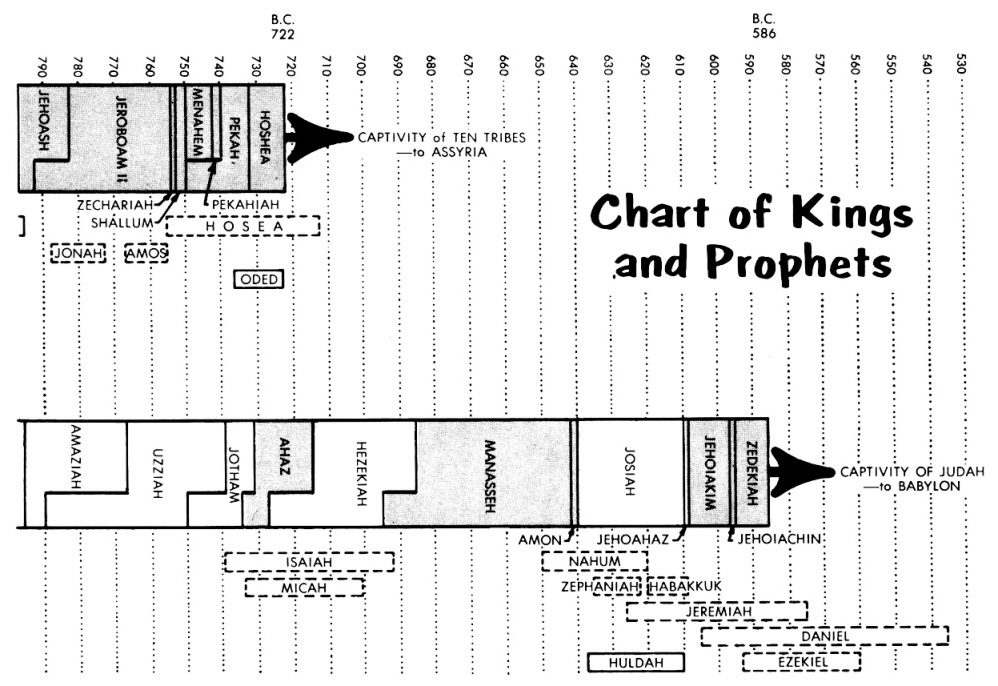
Click to Enlarge
Isaiah 39:1 At that time Merodach-baladan son of Baladan, king of Babylon, sent letters and a present to Hezekiah, for he heard that he had been sick and had recovered.
NLT Soon after this, Merodach-baladan son of Baladan, king of Babylon, sent Hezekiah his best wishes and a gift. He had heard that Hezekiah had been very sick and that he had recovered.
- Merodachbaladan: 2Ki 20:12-19, Berodach-baladan
- king: Isa 13:1,19 14:4 23:13
- sent letters: 2Sa 8:10 10:2 2Ch 32:23
Related Passages:
2 Kings 20:11-12 Isaiah the prophet cried to the LORD, and He brought the shadow on the stairway back ten steps by which it had gone down on the stairway of Ahaz. 12 At that time Berodach-baladan a son of Baladan, king of Babylon, sent letters and a present to Hezekiah, for he heard that Hezekiah had been sick.
2 Chronicles 32:25
2 Chronicles 32:31+ Even in the matter of the envoys of the rulers of Babylon, who sent to him to inquire of the wonder (LXX - teras - omen, something so unusual it arouses close observation; something that astounds because of transcendent association) that had happened in the land, God left ('azab; LXX - egkataleipo) him alone only to test (nacah/nasah LXX = peirazo) him, that He might know (yada) all that was in his heart
THE TEST AFTER
THE MIRACLE
At that time - This phrase seem to link direclty to the event of Hezekiah’s healing (2Ki 20:1–11). The visit was not accidental, following immediately upon divine deliverance. A moment of spiritual victory becomes a moment of spiritual testing (note).
The chronicler writes
Even in the matter of the envoys of the rulers of Babylon, who sent to him to inquire of the wonder that had happened in the land, God left him alone only to test him, that He might know all that was in his heart. (2 Chronicles 32:31+)
🙏 THOUGHT - Hezekiah Should have recognized God's test sent for a "heart checkup" This "Babylonian Test" reminds me of the old Emergency Broadcast System test message, a famous civil-defense signal used in the U.S. for decades (1963-1997). The classic wording was: “This is a test of the Emergency Broadcast System. This is only a test. Had this been an actual emergency, you would have been instructed where to tune in your area for official information.” (If you are older than 40 name this tune!) This message was accompanied by the distinctive, harsh attention signal (a buzzing tone) that many people instantly recognized. It was never meant to be ignored, but to train listeners to respond when a real emergency came. In the same way, God’s allowing the Babylonians to visit Hezekiah in effect functioned as a test, a warning signal, that should have alerted Hezekiah that danger lay ahead if he failed the "Babylonian Test!" God still tests us as the Great Physician in order to give us a "heart check up." How are you doing with the divinely sent or allowed tests which have come into your life?
Berodach-baladan a son of Baladan, king of Babylon - This Babylonian ruler (also called Merodach-baladan in Isaiah 39:1) was a political opportunist and rebel against Assyria. His interest in Hezekiah is strategic, not merely compassionate. Babylon is not yet the dominant empire, but it is rising. Scripture subtly introduces the future oppressor of Judah. What appears as friendly diplomacy foreshadows coming judgment.
Berodach-Baladan (usually called Merodach-Baladan) ruled Babylon from 721-710 B.C. and again in 703-702 B.C. After 702 B.C. he continued his opposition to Assyrian control as a refugee in Elam. It was likely during this time that he sought the support of Judah by means of this embassy. Babylon had long been in a struggle with Assyria, and Merodach-Baladan had been personally involved for over 20 years.
August Konkel: The visit of the Babylonian envoys is cast in terms of well-known eastern interest in astrology (2Ch 32:31). Kings accounts for the visit as an inquiry into Hezekiah’s health (2 Kings 20:12). For the Chronicler, they came investigating a sign, no doubt a reference to the return of the shadow (2 Kings 20:8-11). This is presented as a test from God, the real cause for their appearance. God was not testing Hezekiah’s actions but needed to know what was in his heart (the expression is derived from Dt 8:2). Though this is not presented as a test in Kings, the story there does show that Hezekiah responded positively to the prophet’s warning and resigned himself to the divine will (2 Kings 20:12-19). The story in both versions ends on a positive note, indicating Hezekiah’s devotion to the divine purpose whether the final outcome be good or bad.
Sent letters and a present to Hezekiah - This is ancient Near Eastern diplomacy. So far to good. The letters suggest political communication; the gift suggests flattery. Maybe not so good! The gesture is designed to win favor and open dialogue, not simply to express kindness. The focus shifts from God’s deliverance to Hezekiah’s response. The king who prayed humbly before the Lord is now addressed by foreign powers who admire him. The test subtly shifts from sickness to success.
For (term of explanation) he heard that Hezekiah had been sick - The stated reason sounds compassionate, but we can say with a fairly hight degree of assurance (based on subsequent Babylonian behavior toward Judah) that the underlying motive was intelligence-gathering. Hezekiah’s illness and recovery would have signaled weakness, recovery, and possible alliance potential.
After great spiritual deliverance often comes subtle (sometimes not so subtle) spiritual danger: flattery, attention, and worldly admiration can test faith just as severely as suffering does. And so this story reminds us that victory does not exempt God’s servants from personal tests or trials. Triumph on one front may be followed by testing on another.
🙏 THOUGHT - Mountain top spiritual experiences are great. But we must always be aware the other side of the mountain goes down. While it is not inevitable, many times mountain top spiritual experiences will be followed by a valley of testing. This makes sure we don't become too proud of the mountain top, thinking that we arrived there by our own strength and resolve! The message echoes Paul's warning in 1Co 10:12+ "Therefore let him who thinks he stands take heed (present imperative see our need to depend on the Holy Spirit to obey) that he does not fall."
Isaiah 39:2 Hezekiah was pleased, and showed them all his treasure house, the silver and the gold and the spices and the precious oil and his whole armory and all that was found in his treasuries. There was nothing in his house nor in all his dominion that Hezekiah did not show them.
NLT Hezekiah welcomed the Babylonian envoys and showed them everything in his treasure-houses--the silver, the gold, the spices, and the aromatic oils. He also took them to see his armory and showed them all his other treasures--everything! There was nothing in his palace or kingdom that Hezekiah did not show them.
- was glad: 2Ch 32:25,31 Job 31:25 Ps 146:3,4 Pr 4:23 Jer 17:9
- showed: 2Ki 20:13 2Ch 32:27
- precious things: or, spicery, 1Ki 10:2,10,15,25 2Ch 9:1,9
- armour: or, jewels, Heb. vessels, or instruments
- there was: Ec 7:20 2Co 12:7 1Jn 1:8
Related Passages:
2 Kings 20:13 Hezekiah listened to them, and showed them all his treasure house, the silver and the gold and the spices and the precious oil and the house of his armor and all that was found in his treasuries. There was nothing in his house nor in all his dominion that Hezekiah did not show them.
THE TRAGEDY OF SHOWING
WHAT SHOULD BE GUARDED
Another good subtitle would be "An Exhibition of Arrogance!"
Hezekiah listened to them - The verb listened marks a critical shift. Hezekiah does not merely hear the Babylonian envoys but he gives heed to them. In Scripture, “listening” often implies receptivity and responsiveness, not neutrality. The danger here is subtle, for Hezekiah listens without discernment, failing to inquire of the LORD as he had done earlier during the Assyrian crisis.
And showed them all his treasure house - Note that there is no evidence the Babylonians even asked for such a display, as that would have been brazen and politically inappropriate. And so Hezekiah carries out an act of self-display rather than careful stewardship of God's gifts. Can we not see a touch of pride in this godly king? The king treats what God entrusted to him as his own achievement. What should have been guarded is exhibited. Indeed to answer my rhetorical question, this passage signals the beginning of pride for Hezekiah is turning blessings into trophies.
The silver and the gold - These represent wealth, stability, and international prestige. Ironically, much of this wealth had been restored or protected by God Himself. What grace had preserved, pride now exposes. The mention of precious metals underscores the magnitude of what is being revealed. Do you have a retirement plan? It would be like showing the hackers on the internet your retirement portfolio! The outcome would not be good as proved true in this case of "full disclosure."
And the spices and the precious oil - These were luxury and cultic items used for anointing, worship, and royal honor. Displaying them to pagan envoys blurs the line between holy provision and political currency. Sadly this godly king treast sacred resources as diplomatic assets.
And the house of his armor - Here the emphasis moves from wealth to military power. Hezekiah implicitly advertises his defenses, strength, and preparedness. In light of Jehovah's defense against the Assyrians, Hezekiah should have been testifying that the LORD was Judah’s defense. Instead, the king highlights weapons and logistics, showing that his human security is replacing divine trust.
And all that was found in his treasuries - The phrase is comprehensive and tragic. There is no restraint, no discretion, no boundary. Total disclosure reflects total self-confidence. Hezekiah withholds nothing, because he senses no danger. After all Babylon is not Assyria and is not a world power at this time. Hezekiah showed definite lack of discernment and judgment. There are some things you should never show or reveal to other people, whether potential adversaries or even friends!
There was nothing in his house nor in all his dominion that Hezekiah did not show them - This expands the failure from personal to national. The king’s pride exposes the entire realm of Judah. What should have been protected for future generations is laid bare in a moment of personal vanity and vainglory!
The verse ends with an indictment without commentary. Scripture allows the action to condemn itself. The repetition emphasizes excess, lack of wisdom, and the tragic irony that the very things God had delivered from Assyria are now handed over visually to Babylon. This was an exhibition of arrogance on the part of Hezekiah. It was met with significant rebuke (vv. 17, 18), and eventually brought the downfall of Judah.
When gratitude fades into pride, God’s gifts become liabilities, and what He protects by grace we may surrender through self-display.
Motyer - That Hezekiah received the envoys gladly is understandable, but to take them on a tour of his treasures and armaments goes beyond the response that a mere convalescent gift requires. It could only mean that the envoys had come with a concealed agenda: would Hezekiah join a rebellion? And Hezekiah was only too ready to agree. His about-face in relation to all that went before in chapter 38 could not be more complete. Faith and commitment lie in ruins.
The man whose faith stood firm against Assyrian intimidation now melts in the face of Babylonian flattery. He is foolish not to look for ulterior motives and is unguarded in his openness to their visit. Hezekiah is losing his sense of God. He foolishly reveals the extent of his wealth, thus inviting plunder by Babylon.ESV Study Bible, The: English Standard Version.
Isaiah 39:3 Then Isaiah the prophet came to King Hezekiah and said to him, “What did these men say, and from where have they come to you?” And Hezekiah said, “They have come to me from a far country, from Babylon.”
NLT Then Isaiah the prophet went to King Hezekiah and asked him, "What did those men want? Where were they from?" Hezekiah replied, "They came from the distant land of Babylon."
- came Isaiah: Isa 38:1,5 2Sa 12:1 2Ki 20:14,15 2Ch 16:7 19:2 25:15 Jer 22:1,2
- They are: De 28:49 Jos 9:6,9 Jer 5:15
Related Passages:
2 Kings 20:14 Then Isaiah the prophet came to King Hezekiah and said to him, “What did these men say, and from where have they come to you?” And Hezekiah said, “They have come from a far country, from Babylon.”
QUESTIONS THAT EXPOSE
HEZEKIAH'S HEART
Then - The timing word then links Hezekiah's recovery directly to his interaction with the Babylonian envoys. Isaiah just "happens" to show up after Hezekiah's foolish "full disclosure" of his treasury. Clearly this was God's providence (I like to call it "providential serindipity!") and God had sent His prophet Isaiah. One is reminded of Elisha's questioning his servant Gehazi...
But he (GEHAZI) went in and stood before his master. And Elisha said to him, “Where have you been, Gehazi?” And he said, “Your servant went nowhere.” 26 Then he said to him, “Did not my heart go with you, when the man turned from his chariot to meet you? Is it a time to receive money and to receive clothes and olive groves and vineyards and sheep and oxen and male and female servants? (2Ki 5:25-26+)
Isaiah the prophet came to King Hezekiah - The title the prophet underscores Isaiah’s role as God’s authoritative spokesman. This is not a friendly visit but a divine inspection, for God sends His prophet to address what has just occurred.
And said to him, “What did these men say, and from where have they come to you?” - This first question probes content. Isaiah presses Hezekiah to consider the message and implications of the conversation. It subtly asks: What ideas were exchanged? What impressions were given? What posture did you take, humble gratitude or proud display? This second question probes origin. “From where” highlights not geography alone but spiritual and political significance. Babylon was rising, ambitious, and watching. Isaiah’s question invites Hezekiah to reflect on who he was eager to impress and why.
And Hezekiah said, “They have come from a far country - Hezekiah responds readily, perhaps too readily. There is no hesitation, no self-examination, and notably no mention of the LORD. His answer is factual but incomplete, revealing more about his mindset than he intends. The phrase suggests pride. The distance they came magnifies the honor. He is imply important people traveled far just to see me. Instead of emphasizing God’s deliverance or glory, Hezekiah emphasizes his own significance in the eyes of powerful outsiders. In fact, there is no textual evidence that he ever even mentioned Yahweh and how the LORD has delivered Judah from the Assyrians, who was also an enemy of the Babylonians. The Jews were supposed to be a light to the Gentiles but it appears that Hezekiah's light bulb fizzled out.
From Babylon - The final word lands with ominous weight. Babylon, yes still distant and seemingly friendly, but one day the instrument of Judah’s downfall (2Ki 20:16–18). What Hezekiah treats as a badge of prestige is, in God’s perspective, a warning sign. The seed of future judgment has already been sown by Hezekiah in this casual exchange.
Isaiah 39:4 He said, “What have they seen in your house?” So Hezekiah answered, “They have seen all that is in my house; there is nothing among my treasuries that I have not shown them.”
NLT "What did they see in your palace?" asked Isaiah. "They saw everything," Hezekiah replied. "I showed them everything I own--all my treasures."
- All that: Jos 7:19 Job 31:33 Pr 23:5 28:13 1Jn 1:9
Related Passages:
2 Kings 20:15 He said, “What have they seen in your house?” So Hezekiah answered, “They have seen all that is in my house; there is nothing among my treasuries that I have not shown them.”
THE COST OF
UNGUARDED PRIDE
Other subtitles might be “Treasuries Opened, Judgment Approaching” or “When Openness Becomes Exposure.”
He said, “What have they seen in your house?” - Isaiah initiates the confrontation. The prophet speaks after hearing Hezekiah’s report (v. 14), indicating a deliberate, probing response rather than a casual inquiry. This is the calm before judgment is announced. Isaiah's question targets Hezekiah's exposure. Seen implies inspection, evaluation, and knowledge gained. Your house includes both the royal palace and the treasurie, the symbols of Judah's power, security, and pride. And unfortunately symbols of Hezekiah's pride.
So Hezekiah answered - Hezekiah seems to respond without any hesitation or restraint. It is as if he is clueless regarding Isaiah's visit and question! Hezekiah show no discernment, no minimization, and no awareness of the spiritual danger his openness has created.
They have seen all that is in my house; there is nothing among my treasuries that I have not shown them - Hezekiah readily confesses to full disclosure. Nothing was withheld. What should have been guarded with discerment was displayed with foolish confidence. The description reveals the king's heart was momentarily unguarded by humility. The verse ends with an absolute statement doubling down on the idea of full disclosure, almost as if he is proud to have given the enemy a guided tour! The problem is not dishonesty but indiscretion (and stupidity). Hezekiah’s failure was not deception, but prideful transparency before the wrong audience.
The upshot is that Hezekiah’s downfall was not rebellion but unguarded pride, leading him to reveal what God's gifts to impress men rather than to glorify God, which he could easily have done by just recounting the Yahweh's rescue of Jerusalem from the Assyrians.
🙏 THOUGHT - What we display reveals whom we trust. When blessings become showcases instead of stewardship, they quietly invite loss. What do you enjoy displaying or showing off? Your Maseratis, Porsches or Jaguars, your house with 6 fireplaces (there is one in my neighborhood and only 2 people live there!), your vacation homes on the beach and in the mountains, your country club membership, etc., etc. Let Jesus give you a good alternative to show the "Babylonians" in your life... "Let your light shine (aorist imperative see our need to depend on the Holy Spirit to obey) before men in such a way that they may see your good works, and glorify (GIVE OTHERS A PROPER OPINION OF) your Father Who is in heaven." (Mt 5:16+).
ILLUSTRATION OF A MAN WHO FADED FOR A MOMENT
Thomas Cranmer is a name you might not know offhand. Maybe you've heard his voice echoing in The Book of Common Prayer:
Almighty God, Father of our Lord Jesus Christ, Maker of all things, Judge of all men, we acknowledge and bewail our manifold sins and wickedness.... The remembrance of them is grievous unto us, the burden of them is intolerable. Have mercy upon us, have mercy upon us, most merciful Father.
As Archbishop of Canterbury, Cranmer bravely advanced the gospel during the English Reformation. But when Mary became Queen in 1553, she had him arrested. From his prison window, he watched his fellow-reformers Hugh Latimer and Nicholas Ridley burn at the stake. It was unforgettable, with Latimer encouraging Ridley, "Be of good comfort, Master Ridley, and play the man; we shall on this day light such a candle, by God's grace, in England, as I trust shall never be put out."
Cranmer did not play the man. He caved in. Government agents brainwashed him into recanting the gospel. He was set free and for several weeks enjoyed a comfortable life again. But they put him back in prison, and he signed more recantations. But when he realized that they were going to kill him anyway, his old courage returned.
On the day of his execution in Oxford, he sat through a two-hour sermon at the Church of St Mary denouncing him as a heretic. Then he was expected publicly to admit the error of his ways. But he stood firm:
And now I come to the great thing, which so much troubleth my conscience, more than anything that ever I did or said in my whole life, and that is the setting forth of a writing contrary to the truth.... And forasmuch as my hand offended, writing contrary to my heart, my hand shall first be punished.
The remembrance of his sins was grievous to him and the burden intolerable. In fact, he walked from the church to the stake so quickly, his guards could hardly keep up with him. An eyewitness described his death:
Fire being now put to him, he stretched out his right hand and thrust it into the fire, and held it there a good space, before the fire came to any part of his body, where his hand was seen of every man sensibly burning, crying with a loud voice, "This hand hath offended." As soon as the fire was got up, he was very soon dead, never stirring or crying all the while.
Thomas Cranmer was a martyr, but he was no superman. He was like us. Sometimes he lost his nerve. What is it that empowers us to live well for the Lord and to die well for the Lord? What is it that keeps us steady in life and in death? A living sense of the living God in our hearts. With that radiance within, we can face anything. Without it, we're defeated already.
Hezekiah, like Thomas Cranmer,
like us, wavered.
(Source: Preaching the Word – Isaiah: God Saves Sinners)
Isaiah 39:5 Then Isaiah said to Hezekiah, “Hear the word of the LORD of hosts,
NLT Then Isaiah said to Hezekiah, "Listen to this message from the LORD Almighty:
- Hear: 1Sa 13:13,14 15:16
Related Passages:
2 Kings 20:16 Then Isaiah said to Hezekiah, “Hear the word of the LORD.
HEAR THE WORD
OF THE LORD
Then Isaiah said to Hezekiah The word “Then” marks a decisive turning point. After Hezekiah’s interaction with the Babylonian envoys and his self-satisfied report (vv. 14–15), the narrative shifts from royal pride to prophetic confrontation. The speaker is Isaiah, not as a court adviser but as God’s authorized spokesman, addressing Hezekiah directly, king to prophet the servant of the LORD. Isaiah speaks to the king personally. This is not a general oracle but a targeted word. Sadly spiritual privilege and past faithfulness do not exempt Hezekiah from accountability, a good reminder for all believers, especially if you are a leader! God addresses leaders directly because their actions carry more far reaching consequences.
Hear (shama) the word of the LORD - Isaiah issues a command Hear (shama) which is more that in one ear and out the other. Isaiah is calling for full attention to what Jehovah is going to declare. is more than auditory; it demands attention, submission, and obedience. It echoes covenant language, the famous "Shema" (Dt 6:4+). Isaiah is not making a suggestion inviting discussion or giving an explanation but is summoning Hezekiah to receive the divine word without argument or defense.
We have already addressed this danger above, but it warrants repeating that spiritual success does not immunize God’s people from correction. Furthermore, after great deliverance can come great danger, for pride often follows blessing.
Isaiah 39:6 ‘Behold, the days are coming when all that is in your house and all that your fathers have laid up in store to this day will be carried to Babylon; nothing will be left,’ says the LORD.
NLT The time is coming when everything you have--all the treasures stored up by your ancestors--will be carried off to Babylon. Nothing will be left, says the LORD.
- that all: 2Ki 20:17-19 24:13 25:13-15 2Ch 36:10,18 Jer 20:5 27:21,22 Jer 52:17-19 Da 1:2
Related Passages:
2 Kings 20:17 ‘Behold, the days are coming when all that is in your house, and all that your fathers have laid up in store to this day will be carried to Babylon; nothing shall be left,’ says the LORD.
WHEN PRIDE EMPTYS THE TREASURY:
NOTHING WILL BE LEFT!
Behold (hinneh; LXX - idou) is in effect a command that signals urgency and gravity. Isaiah is calling Hezekiah to pay careful attention. What follows is not speculation, advice, or warning in general terms—it is a solemn divine announcement. Spurgeon reminds us that "Behold is a word of wonder; it is intended to excite admiration. Wherever you see it hung out in Scripture, it is like an ancient sign-board, signifying that there are rich wares within, or like the hands which solid readers have observed in the margin of the older Puritanic books, drawing attention to something particularly worthy of observation." I would add, behold is like a divine highlighter, a divine underlining of an especially striking or important text. It says in effect "Listen up, all ye who would be wise in the ways of Jehovah!"
The days are coming - The judgment is certain but delayed. God does not say today or soon, but He does say it will happen. This introduces the principle of deferred consequences, where God's mercy in regard to the timing and yet does not cancel accountability in outcome.
What is flaunted before the world
may one day be forfeited by God.
When all that is in your house, and all that your fathers have laid up in store to this day This refers to Hezekiah’s royal treasures, precisely the riches he proudly displayed to the Babylonian envoys (2Ki 20:13–15). What he exposed in pride will later be removed in judgment. The loss will extend beyond Hezekiah’s personal wealth to generations (past and future) of accumulated blessing. The consequences of his actions will affect the national and dynastic inheritance. Personal pride can impoverish future generations.
Will be carried to Babylon - Babylon is named explicitly, not the current world power Assyria. The very nation Hezekiah courted becomes the instrument of Judah’s future exile. This shows God’s perfect foreknowledge and His sovereignty over rising world powers. This is in effect a prediction of the Babylonian captivity 115 years hence in 586 BC (especially remarkable since Assyria was the world power at that time) when the Nebuchadnezzar II came to power in Babylon (Jer 27:21, 22; 52:17).
Nothing shall be left,’ says the LORD - Nothing signal complete destruction and desolation, exactly what happened to Solomon's glorious Temple, all "catalyzed" by a momentary slip of a king's pride! The judgment will be total, removing any hope of partial preservation or mitigation. What once symbolized blessing and security would one day in the future be utterly stripped away by the Babylonians! Notice the phrase says the LORD which is like a divine seal on this horrible prophecy. This closing seal underscores the certainty and finality of the word. God Himself stands behind the pronouncement.
Hezekiah’s unguarded pride brought no immediate punishment, yet it set irreversible consequences in motion. God’s patience should never be mistaken for approval; delayed judgment is still certain judgment when His word has been spoken.
Behold (02009) hinneh is an interjection meaning behold, look, now; if. "It is used often and expresses strong feelings, surprise, hope, expectation, certainty, thus giving vividness depending on its surrounding context." (Baker) Hinneh generally directs our mind to the text, imploring the reader to give it special attention. In short, the Spirit is trying to arrest our attention! And so hinneh is used as an exclamation of vivid immediacy (e.g., read Ge 6:13)! Hinneh is a marker used to enliven a narrative, to express a change a scene, to emphasize an idea, to call attention to a detail or an important fact or action that follows (Isa 65:17, Ge 17:20, 41:17). The first use of hinneh in Ge 1:29 and second in Ge 1:31 - "And God saw all that He had made, and behold, it was very good. And there was evening and there was morning, the sixth day." Hinneh is oftn used in the idiom "Here I am" in Ge 22:1, 7,11 Ge 27:1,18, Ge 31:11, Ge 46:2 Ex 3:4 1Sa 3:4, 3:16, 12:3, 2Sa 1:7, Isa 52:6, Isa 58:9. Hinneh is used most often to point out people but also to point out things (Ge 31:41, 17:4). God uses hinneh to grab man's attention before He brings destruction (Ge 6:13, 17). God uses hinneh when He establishes covenants (Ge 9:9, 15:12, 17 [when Jehovah cut the Abrahamic covenant], Ge 17:4, cp Ge 28:13, 15), when He provided a sacrificial substitute for Isaac (foreshadowing His giving us His only Son!) (Ge 22:13). Hinneh marks the "chance
Isaiah 39:7 ‘And some of your sons who will issue from you, whom you will beget, will be taken away, and they will become officials in the palace of the king of Babylon.’”
NLT Some of your own descendants will be taken away into exile. They will become eunuchs who will serve in the palace of Babylon's king."
- of thy sons: 2Ki 24:12 25:6,7 2Ch 33:11 36:10,20 Jer 39:7 Eze 17:12-20
- they shall be: Fulfilled, Da 1:2-7
Related Passages:
2 Kings 20:18 ‘Some of your sons who shall issue from you, whom you will beget, will be taken away; and they will become officials in the palace of the king of Babylon.’”
Daniel 1:1-7+ In the third year of the reign of Jehoiakim king of Judah, Nebuchadnezzar king of Babylon came to Jerusalem and besieged it. 2 The Lord gave Jehoiakim king of Judah into his hand, along with some of the vessels of the house of God; and he brought them to the land of Shinar, to the house of his god, and he brought the vessels into the treasury of his god. 3 Then the king ordered Ashpenaz, the chief of his officials, to bring in some of the sons of Israel, including some of the royal family and of the nobles, 4 youths in whom was no defect, who were good-looking, showing intelligence in every branch of wisdom, endowed with understanding and discerning knowledge, and who had ability for serving in the king’s court; and he ordered him to teach them the literature and language of the Chaldeans. 5 The king appointed for them a daily ration from the king’s choice food and from the wine which he drank, and appointed that they should be educated three years, at the end of which they were to enter the king’s personal service. 6 Now among them from the sons of Judah were Daniel, Hananiah, Mishael and Azariah. 7 Then the commander of the officials assigned new names to them; and to Daniel he assigned the name Belteshazzar, to Hananiah Shadrach, to Mishael Meshach and to Azariah Abed-nego.
THE LASTING LEGACY OF
SHORT TERM PRIDE!
Some of your sons who shall issue from you, whom you will beget, will be taken away Future generations would pay for present spiritual failure. This judgment is personal and dynastic, not merely national. The consequences of Hezekiah’s pride (2Ki 20:12–17) will fall not only on Judah in general but on his own descendants. The phrase softens the blow slightly, some, not all, yet it still signals real loss. The double phrasing (issue...beget) emphasizes direct lineage. These are not distant relatives but his own offspring, underscoring the gravity of the warning that future generations would pay for present spiritual failure. Scripture often stresses this generational principle (cf. Ex 20:5; Gal 6:7). This is the language of exile and forced removal, not voluntary travel. It anticipates Babylonian deportation, later fulfilled beginning in 605, 597, 586 BC. What Hezekiah welcomed into his palace (Babylonian envoys) would one day invade and destroy not only his palace but the Temple of the LORD!
Oh, the potential costs
of our momentary sin!
And they will become officials in the palace of the king of Babylon - Ironically, these sons will not be slaves in chains but servants in a foreign court. This is not promotion (although Daniel was in truth highly promoted) but humiliation, service rendered to a pagan king rather than the LORD. Status does not cancel loss. Influence does not negate captivity.
Misplaced trust today
shapes tomorrow’s bondage.
Babylon is named explicitly, marking a decisive prophetic shift. Assyria is the present threat, but Babylon is the future conqueror. The very nation Hezekiah sought to impress will become Judah’s jailer. This fulfills the principle that misplaced trust today shapes tomorrow’s bondage.
Isaiah 39:8 Then Hezekiah said to Isaiah, “The word of the LORD which you have spoken is good.” For he thought, “For there will be peace and truth in my days.”
NLT Then Hezekiah said to Isaiah, "This message you have given me from the LORD is good." But the king was thinking, "At least there will be peace and security during my lifetime."
- Good: Lev 10:3 1Sa 3:18 2Sa 15:26 Job 1:21 Ps 39:9 La 3:22,39 1Pe 5:6
- For: 2Ch 34:28 Zec 8:16,19
Related Passage:
2 Kings 20:19+ Then Hezekiah said to Isaiah, “The word of the LORD which you have spoken is good.” For he thought, “Is it not so, if there will be peace and truth in my days?”
PEACE NOW
JUDGMENT LATER
Then Hezekiah said to Isaiah - This is Hezekiah’s direct response to Isaiah’s severe prophecy (vv. 16–18) announcing future judgment on Judah and the exile of his descendants to Babylon. The king does not dispute, argue, or defend himself. His response is brief and revealing.
“The word of the LORD which you have spoken is good.” Hezekiah acknowledges that Isaiah’s message truly comes from the LORD and therefore is right, just, and authoritative, even though it is personally painful and nationally disastrous. Good here does not mean pleasant or favorable, but morally right and rightly deserved. This reflects submission to God’s judgment rather than resentment or denial.
- See multiple comments on this verse in the paralle passage 2Ki 20:19.
For he thought, This phrase exposes Hezekiah’s inner reasoning, not merely his spoken words. Scripture deliberately pulls back the curtain on his heart, allowing us to see both faith and limitation at work.
“Is it not so “Is it not so" is a rhetorical question which signals relief mixed with resignation. Hezekiah accepts the outcome as settled and unchangeable. There is no intercessory prayer here (contrast 2 Kings 19), suggesting quiet acceptance rather than pleading.
If there will be peace (shalom) and truth ('emeth) in my days?” - CSB - "for he thought: Why not, if there will be peace and security during my lifetime?" NET - "Then he added, "At least there will be peace and stability during my lifetime." This is the most searching part of the verse. Peace (shalom) indicates stability, safety, and absence of invasion. Truth ('emeth) points to order, reliability, and covenant stability. What this verse is saying is that Hezekiah finds comfort in the fact that judgment will not fall during his lifetime. While this shows gratitude for mercy, it also reveals a limited, short-range perspective, concerned more with personal peace than future generations.
ESV Study Bible (borrow) Hezekiah thinks only of himself (and he was one of the good kings of Judah!). Hezekiah is disappointing as a man and father; but even more so as the steward of David’s dynasty. He is not allowed to act solely for himself: for his sons to serve as eunuchs (v7) threatens their ability to continue the family line. He failed to learn the lesson of Isa 38:1, and thus failed to prepare his descendants to avoid the disaster.,
ROBBING FROM YOUR CHILDREN - Word in Life Study Bible
King Hezekiah (Is. 39:8) was generally a wise ruler who feared the Lord and helped his nation prosper. Under his capable leadership, Judah regained much of the spiritual and political ground it had lost under Ahaz. When we observe the siege of Jerusalem by the Assyrians in 701 a.d., we witness Hezekiah’s strategic preparations and sincere faith (Is. 36–37; See “WORK AND PRAY, PRAY AND WORK” at 2 Chr. 32:6–9).
But late in his life, Hezekiah committed a serious blunder—one that many people also commit today. He made a foolish decision that placed his descendants in grave danger, yet justified himself with the thought, “At least there will be peace and truth in my days” (Is. 39:8). In effect, he robbed from his children’s future, buying short-term comfort at the price of their long-term interests.
Showing Off the Treasures
Hezekiah’s foolish choice was to show all of his treasures to representatives of Babylon (Is. 39:1–2; 2 Chr. 32:27–31). This was a serious mistake from several standpoints. First, it was a strategic blunder militarily in that it revealed the relative strength of Judah’s defenses. Moreover, it revealed how much wealth the nation had—that is, how much wealth was there for the taking. In addition, the tour was pointless in that it gained Hezekiah nothing. Perhaps he thought to ingratiate himself to the Babylonians, but instead he was giving away state secrets to a future enemy.
However, the most significant flaw in Hezekiah’s actions was that they were probably motivated by pride. Prior to the coming of the ambassadors, the Lord had healed Hezekiah from a life-threatening illness. Yet despite God’s kindness, Scripture records that Hezekiah’s “heart was lifted up” (2 Chr. 32:24–26). Thus his presentation of his treasures was a way to boast and look good to the visitors from the east.
One often sees similar behavior today. For example, it is common for hosts to show off their homes to their guests, sometimes even to the extent of opening closets and bringing out prized possessions. Likewise, business owners often show visitors around their headquarters, pointing out expensive furnishings and equipment and making an extended delay at the trophy case.
What about showing off cars, yachts, clothing, memberships, and other marks of success? What about dropping names as a way of bragging about who you know, or revealing information to boast about what you know? Behaviors like these are not much different than what Hezekiah did in front of the Babylonians.
Hezekiah’s Legacy
Perhaps the saddest outcome of Hezekiah’s pride was the impact it would have on those who succeeded him. Isaiah told the king that someday the Lord would allow the Babylonians to return and clean out the treasuries they had seen (Is. 39:5–7). Amazingly, Hezekiah viewed this as a good word from the Lord (39:8). The only way he could think that was if he had only his own interests in mind. Apparently that was the case: “At least there will be peace and truth in my days,” he said to himself.
Yet again, how different was Hezekiah’s attitude than that of many today who push off the hard choices, with the result that their children will have to deal with the consequences? On issues ranging from unresolved personal problems, to community and social needs, to the national debt, to the earth’s environment, people often can see that sooner or later disaster will strike unless something changes. Yet they tend to push off those changes into the future because the pain of making them today is just too great. Like Hezekiah, they tend to think, “At least I won’t have to deal with the crisis when it comes.”
Hezekiah died in comfort in about 686 A.D. A century later, just as the Lord had promised, the Babylonians captured Jerusalem and its king, Hezekiah’s great-great-grandson Zedekiah. The invaders plundered all the treasuries that Hezekiah had shown and took the riches back to Babylon (2 Kin. 25:8–17; 2 Chr. 36:17–21).
What will be the legacy you leave to your descendants?