1 Peter 4 :2
1 Peter 4 :3
1 Peter 4 :4
1 Peter 4 :5
1 Peter 4 :6
1 Peter 4:7
1 Peter 4:8
1 Peter 4:9
1 Peter 4:10
1 Peter 4:11
1 Peter 4:12
1 Peter 4:13
1 Peter 4:14
1 Peter 4:15
1 Peter 4:16
1 Peter 4:17
1 Peter 4:18
1 Peter 4:19
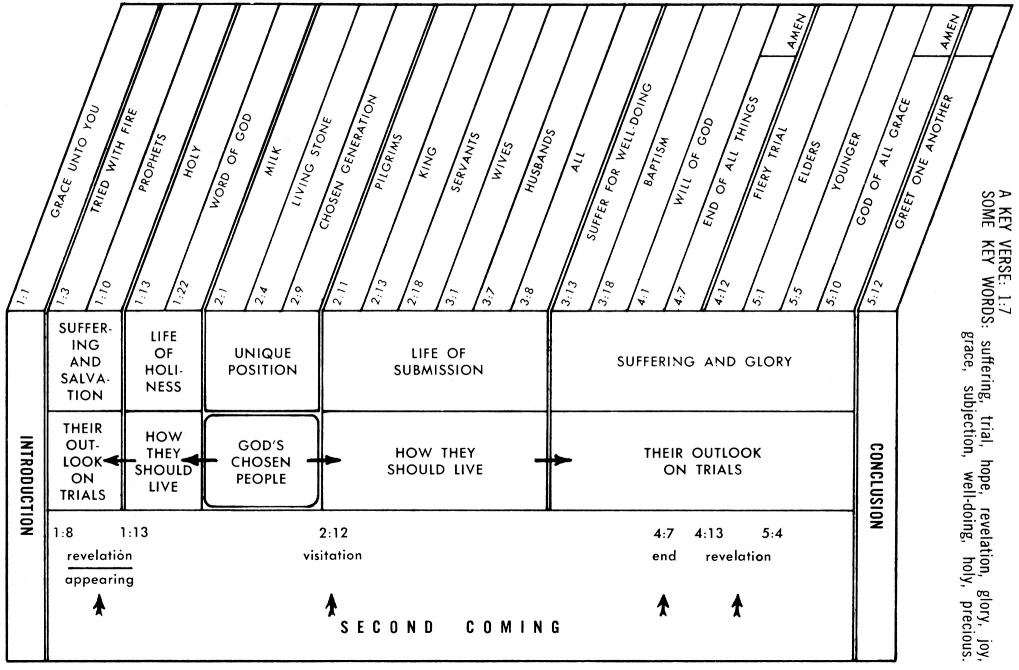
1 Peter: Trials, Holy Living & The Lord's Coming
Click chart to enlarge
Chart from Jensen's Survey of the NT - used by permission
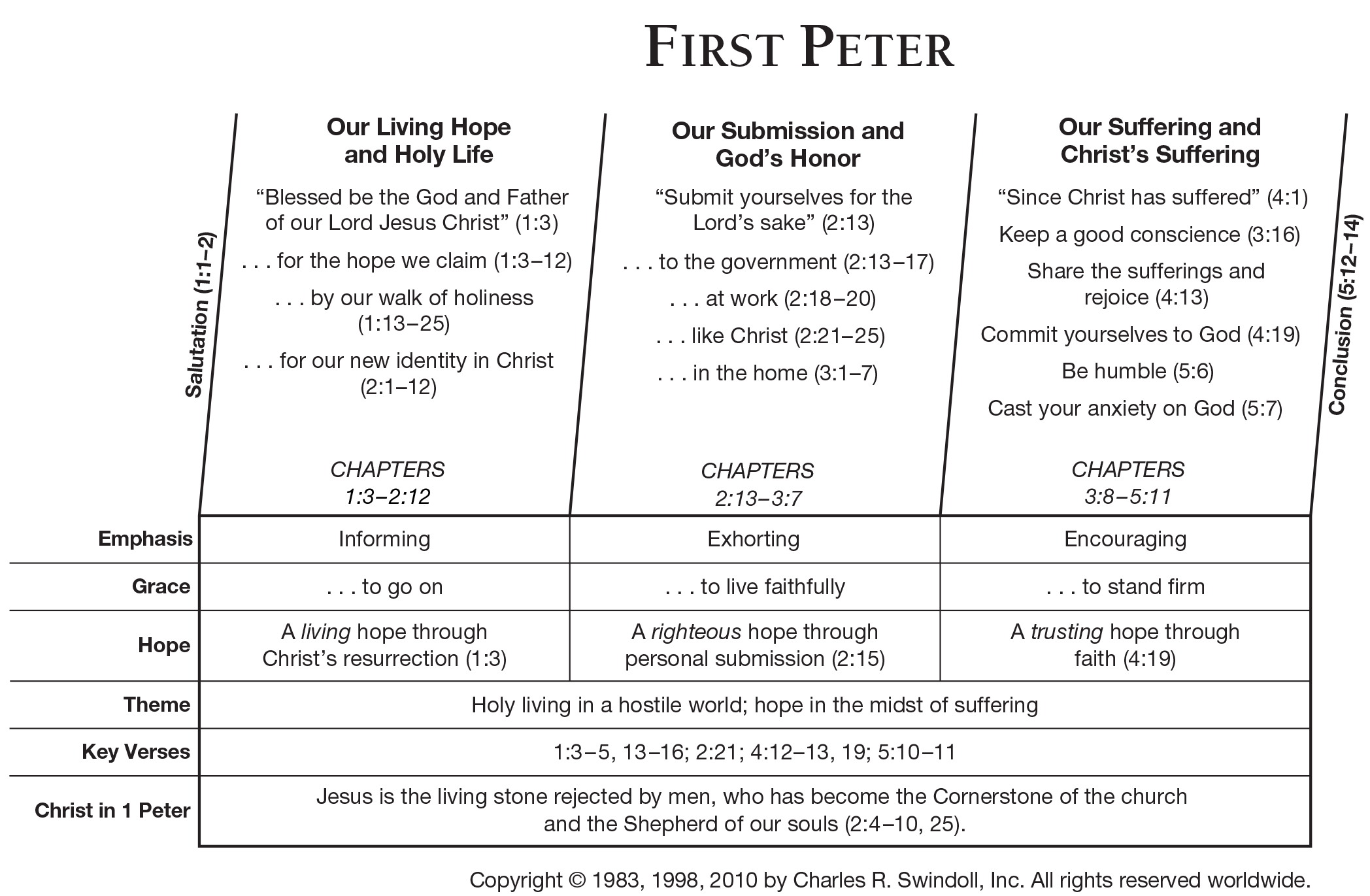
See Another Chart from Charles Swindoll
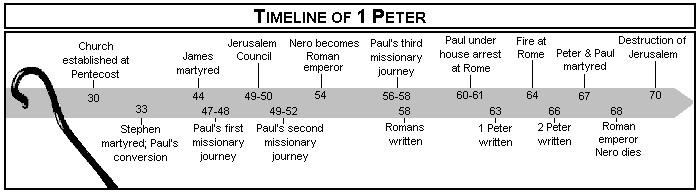
Source: Borrow Ryrie Study Bible
Click to enlarge
| Salvation of the Believer 1 Pe 1:1-2:12 |
Submission of the Believer 1 Pe 2:13-3:12 |
Suffering of the Believer 1 Pe 3:13-5:14 |
||||||||
| Salvation 1Pe 1:1-1:12 |
Sanctification 1Pe 1:13-2:12 |
Submit to Government 1Pe 2:13-17 |
Submit in Business 1Pe 2:18-25 |
Submit in Marriage 1Pe 3:1-8 |
Submit in all of life 1Pe 3:9-12 |
Conduct in Suffering 1Pe 3:13-17 |
Christ's Example of Suffering 1Pe 3:18-4:6 |
Commands in Suffering 1Pe 4:7-19 |
Minister in Suffering 1Pe 5:1-14 |
|
| Belief of Christians | Behavior of Christians | Buffeting of Christians | ||||||||
| Holiness | Harmony | Humility | ||||||||
|
Adapted from Bruce Wilkinson and Kenneth Boa's Talk Thru the Bible (borrow) |
||||||||||
1 Peter 4:7 The end of all things is near; therefore, be of sound judgment and sober spirit for the purpose of prayer. (NASB: Lockman)
Greek: Panton de to telos eggiken. (3SRAI) sophronesate (2PAAM) oun kai nepsate (2PAAM) eis proseuchas;
Amplified: But the end and culmination of all things has now come near; keep sound minded and self-restrained and alert therefore for [the practice of] prayer. (Amplified Bible - Lockman)
Barclay: The end of all things is near. Be, therefore, steady and sober in mind so that you will really be able to pray as you ought. (Westminster Press)
Phillips: We are near the end of all things now, and you should therefore be calm, self-controlled men of prayer. (Phillips: Touchstone)
Wuest: But of all things the end has come near. Be of sound mind therefore, and be calm and collected in spirit with a view to [giving yourselves to] prayer; (Eerdmans Publishing)
Young's Literal: The end of the world is coming soon. Therefore, be earnest and disciplined in your prayers.
THE END OF ALL THINGS IS AT HAND: Panton de to telos eggiken (3SRAI):
- Eccl 7:2; Jer 5:31; Eze 7:2,3,6; Mt 24:13,14; Ro 13:12; 1Co 7:29; 1Co 15:24; Phil 4:5; Heb 10:25; Jas 5:8,9; 2Pet 3:9, 10, 11; 1Jn 2:18,19
- 1 Peter 4 Resources - Multiple Sermons and Commentaries
- 1 Peter 4:7-11 The Church's Conduct In The End Times - Steven Cole
- 1 Peter 4:7 The Christian's Duty in a Hostile World, Pt. 1 Sermon - John MacArthur
- 1 Peter 4:7 The Christian's Duty in a Hostile World - Pt 1 Study Guide (see dropdown) - John MacArthur
- 1 Peter 4:7-9 The Christian's Duty in a Hostile World, Pt. 2 - Sermon - John MacArthur
- 1 Peter 4:10-11 The Christian's Duty in a Hostile World, Pt 3 - Sermon - John MacArthur
IMMINENCY
See discussion below
Related resources:
- Another discussion on imminency;
- Coming = parousia
The end (5056) (telos) means an end, a completion, a consummation. The word termination is close but misses the essence of the meaning, because a process can be terminated without reaching completion or consummation, which is the essence of the meaning of telos. The idea of telos is that the various stages that are reached to go on to full development (eternal significance). Accordingly "Christ is the end (consummation or telos) of the Law" (Ro 10:4), for Christ brought all the components of the OT to their complete fulfillment by His perfect life and death, and yet the law was not terminated (e.g., it is written on the hearts of believers (Heb 8:10, Heb 10:16) and God's Spirit still uses the Law to bring souls to Christ Who is the consummation of the Law! - see Law as a "tutor" in Gal 3:19-25, cf the Law's effect to make sin exceedingly sinful, to make it come alive in Ro 7:8-12, Ro 3:19 gives law's purpose = "to keep people from having excuses." See discussion of Purpose of the Law).
Telos refers to a goal achieved, a result attained, a realization, an end-goal, a purpose fulfilled. The root tel- means reaching the end (aim) and is illustrated by an old pirate's telescope (pictures) which unfolds or extends one stage at a time to reach full-capacity (effectiveness).
This term does not refer to annihilation (although indeed this present earth and heavens will be burned with intense heat - see discussion 2 Pe 3:12) but is used in Scripture to refer to the end of the age. Jesus Himself used the term in this way (e.g., Matthew 24:6; Mark 13:7; Luke 21:9). The sense of “end” as a point in time appears also. The kingdom of Messiah has no “end” (Luke 1:33). Telos as the “outcome” of something is the idea in Luke 18:5, and in Luke 22:37 it denotes the “fulfillment” of prophecy about Jesus.
Click here for list below of all uses of telos in NT and in the Septuagint (Lxx)
Telos - 40x in 39v - NAS Usage: continually*(1), custom(2), customs(1), end(24), ends(2), finished(1), fulfillment(1), goal(1), outcome(6), sum(1), utmost(1).
In Heb 7:25KJV we see God is able to save to the uttermost which is the translation of panteles which is made up of pas = “all,” and telos = “end, termination.” By reason of Messiah’s eternal ministry as High Priest, He is able to save the believer in his totality of being, body, soul, and spirit, and do all that to the point of termination, an unending state of salvation in eternity.
Richards - The Greek word group (teleō [verb], telos [noun]) has two basic emphases. The primary concept of “end” is that of achievement of an intended goal. Particularly in eschatological passages the NT picks up the thought of process implicit in the OT. But the NT draws our attention to the conclusion of the process. That end is an extremity, but it is an extremity infused by purpose. Nothing is random; nothing is purposeless. When the end comes, it will bring the achievement of all of God’s purposes. The end will be marked by the consummation of God’s plans. The other concept implicit in the Greek words indicating “end” draws our attention to persons or to things that have reached an intended goal. In a limited but real sense, achieving a goal means that a thing or person is completed, or perfect. Thus “perfect” in the NT does not suggest sinlessness or flawlessness; rather, it is a mature stage of development in which one’s potentials are achieved.
Gilbrant on telos in classical Greek - From the stem tel-, “to turn round,” telos “originally meant the turning point, hinge, the culminating point at which one stage ends and another begins; later goal” (Schippers, “Goal,” Colin Brown, 2:59). Delling reduces the major meanings of telos to five: (1) “achievement”; (2) “completion”; (3) “obligation” (such as taxes); (4) “offering” (religious); (5) “detachment, group” (“telos,” Kittel, 8:49-51). These, of course, are oversimplified; the term is extremely diverse in meaning in classical Greek (see Liddell-Scott). Essentially telos indicates “fulfillment, execution of an act, consummation” or a state, such as “complete, perfect, total.” In philosophy telos was particularly linked to “goal,” such as the goal of an ethical life (Schippers, “Goal,” Colin Brown, 2:60). (The Complete Biblical Library Greek-English Dictionary)
Telos is commonly used for the end of this life (Mt 10:22; Lk 18:5; 1Co 1:8; Php 3:19; Heb 3:14; 6:11; 7:3; Rev 2:26) or for events related to the end times (Mt 24:6,13,14; Mk 13:7,13; Lk 1:33; 21:9; 1Co 10:11; 15:24; 2Co 11:15; 1Pe 4:7,17). In Revelation telos occurs twice in the formula "the Beginning and the End" as a title for deity (Rev 21:6; 22:13). In Romans 10:4 telos refers to Christ as "the end of the law," which is similar to Paul's statement that believers are no longer "under the law" (Ro 6:14). Christians do not relate to God through the old covenant God made with Israel at Mt. Sinai through Moses, but through the new covenant He made at the cross through Christ's blood (see Jer 31:31-34; Lk 22:20; Heb 8:8-12). (HCSB Study Bible)
Friberg on telos - 1) as an action achievement, carrying out, fulfillment (Lk 22.37); (2) as a closing act end, termination, cessation (2Cor 3.13; 1Pet 4.7), opposite arche (beginning); (3) as a goal toward which movement is being directed outcome, end (result), purpose (1Ti 1.5); (4) as civic payment of what is owed tribute, tax, customs (duties) (Ro 13.7); (5) in adverbial expressions; (a) accusative (to telos) =. finally (1Pe 3.8); (b) eis telso = with either a temporal or quantitative sense according to the context to the end (Mk 13.13), finally, at last (possibly 1Th 2.16), in full measure, fully, completely (Jn 13.1; possibly 1Th 2.16); (c) with eos, mechri, achr - to the end, to the last or fully, altogether, depending on the context. (Analytical Lexicon)
BDAG summarized - (1) a point of time marking the end of a duration = end, termination, cessation Lk 1:33 (2) the last part of a process = close, conclusion, esp. of the last things, the final act in the cosmic drama - (a) Mt 24:6, 14; Mk 13:7; Lk 21:9. (b) Adverbial expressions - to telos = finally (1Pe 3:8, 1Cor 15:24); to the end, to the last - achri telous - Heb 6:11, Rev 2:26, 1Cor 1:8, eis telos = in the end, finally (Lk 18:5, Mt 10:22, 24:13, Mk 13:13) (3) the goal toward which a movement is being directed = end, goal, outcome (Mt 26:58, James 5:11, 1Ti 1:5) (4) last in a series = rest, remainder (1 Cor 15:24) (5) revenue obligation = (indirect) tax, toll-tax, customs duties (Ro 13:7b)
Swanson on telos - 1. end, point of time marking the end (Mt 24:14; Rev 1:8 v.r.); 2. result of an event or process (Mt 26:58; Ro 6:21); 3. purpose, intent, goal (1Ti 1:5); 4. completely, wholly, entirely (2Co 1:13; Heb 3:6 v.r. NA26); 5. tax, revenue, duty (Mt 17:25); 6. to telos, finally; 7. eis telos, completely (1Th 2:16) (Semantic Domains)
Vine - telos (5056) signifies (a) “the limit,” either at which a person or thing ceases to be what he or it was up to that point, or at which previous activities were ceased, 2Cor. 3:13; 1 Pet. 4:7; (b) “the final issue or result” of a state or process, e.g., Luke 1:33; in Rom. 10:4, Christ is described as “the end of the Law unto righteousness to everyone that believeth”; this is best explained by Gal. 3:23-26; cf. Jas. 5:11; the following more especially point to the issue or fate of a thing, Matt. 26:58; Rom. 6:21; 2 Cor. 11:15; Phil. 3:19; Heb. 6:8; 1 Pet. 1:9; (c) “a fulfillment,” Luke 22:37, KJV, “(have) an end”; (d) “the utmost degree” of an act, as of the love of Christ towards His disciples, John 13:1; (e) “the aim or purpose” of a thing, 1 Tim. 1:5; (f) “the last” in a succession or series Rev. 1:8 (KJV, only, “ending”); 21:6; 22:13. Note: The following phrases contain telos (the word itself coming under one or other of the above): eis telos, “unto the end,” e.g., Matt. 10:22; 24:13; Luke 18:5, “continual”; John 13:1 (see above); 2 Cor. 3:13, “on the end” (RV); heos telous, “unto the end,” 1 Cor. 1:8; 2 Cor. 1:13; achri telous, “even to the end” (a stronger expression than the preceding); Heb. 6:11; Rev. 2:26 (where “even” might well have been added); mechri telous, with much the same meaning as achri telous, Heb. 3:6, 14… telos (5056), “an end,” is rendered “the uttermost” in 1Th. 2:16, said of divine wrath upon the Jews, referring to the prophecy of Deut. 28:15-68; the nation as such, will yet, however, be delivered (Rom. 11:26; cf. Jer. 30:4-11). The full phrase is eis telos, “to the uttermost,” which is probably the meaning in John 13:1, “to the end.”… telos (5056) “an end, termination,” whether of time or purpose, denotes, in its secondary significance, “what is paid for public ends, a toll, tax, custom,” Matt. 17:25 (RV, “toll”); Rom. 13:7 (RV and KJV, “custom”). In Palestine the Herods of Galilee and Perea received the “custom”; in Judea it was paid to the procurator for the Roman government… telos (5056), “an end,” most frequently of the termination of something, is used with the article adverbially, meaning “finally” or “as to the end,” i.e., as to the last detail, 1 Pet. 3:8… .eis telos, lit., “unto (the) end,” signifies “continual,” in Luke 18:5, of the importunate widow’s applications to the unrighteous judge; see also Matt. 10:22; 24:13; Mark 13:13; John 13:1; 1 Thess. 2:16. (End, Ending - A1 - Telos)
Telos in the Septuagint - Nu 17:13 = Are we to perish completely?" (Heb = tamam - to be finished, Lxx = telos); levy (telos) = Nu 31:28, 37-41; of Moses writing the law = Dt 31:24 (cf Dt 31:30) = "until they were complete" (Heb = tamam; Lxx = telos); Jdg 11:39 (cf 2Ki 8:3, 18:10) = "At the end (H = qets = end; Lxx = telos) of two months"; in numerous psalms telos used to translate "for the choir director", the English being "for the end" (Ps 4:1, etc); Da 7:26 = "his (Antichrist's) dominion will be taken away, annihilated and destroyed forever (H=soph = an end; Lxx = eos telous = "until the end"); Da 9:26 = "even to the end (H = qets = end; Lxx = telos) there will be war"; Eccl 12:13 = "The conclusion (H=soph=an end; Lxx =telos)";
Wayne Detzler on telos - is seen in such English combinations as "telegraph" (literally distance writing), "teleology" (the evidences for purpose, or an end in nature), and "telescope" (an instrument which sees faraway objects). In ancient Greek literature telos meant several things. It referred to achievement of one's ends, or carrying a plan to its conclusion or end. Along the same lines telos was used to identify the power to carry out a task, or to determine the outcome of circumstances. Another aspect of the word was perfection or completion of a process, such as the maturity of a person, or the fulfillment of an obligation, or the consummation of a marriage. The Greek Old Testament, the Septuagint, used the word to speak of the fulfillment of God's plan for human history. Thus it referred to the end times or the latter days. Then the goals of God will have been accomplished in human history.
BIBLE USAGE - In the New Testament there are many facets of meaning in the word telos, but they can be reduced to two. First, the word refers to the end of a process or event. All human kingdoms have an end, but God's kingdom knows no ending (Luke 1:33). The splendor of Moses, after he came down from Mount Sinai, ended (2 Cor. 3:13). Another side to this more general use of the word telos is that of fulfillment. Death fulfills the process initiated by sin (Rom. 6:21). Christ was the fulfillment, or the end, of the Mosaic Law (Ro 10:4; Gal. 3:24). The end or goal of apostolic teaching is the propagation of love among Christians (1Ti 1:5). The removal of Christians from Satan's realm is the end or object of their salvation. The greatest example is the crucifixion of Christ, when He cried, "It is finished" (John 19:30). The first aspect of telos is an end or a termination. Some event, process, or institution comes to an end. The other side to our word is even more common in New Testament writings. For it is also used to describe the end of human history. In this connection the Bible speaks of the "end times" or the "latter days." In His Olivet Discourse Jesus devoted a large block of teaching to the end times (Mt. 24:6-25:46). The parallel passages are Mk 13:7-37; Luke 21:9-38. Here Jesus described in detail the events which would occur before His coming. Paul, in writing to his problem children, the Corinthians, referred to the end times. At the end even Corinthians would be fully sanctified (1Cor. 1:8). The cataclysmic events of the last days should be a warning to Christians (1Cor 10:11). Paul hoped that the Corinthians would finally, at "the end," understand his teaching (2 Cor. 1:13). At the end times those who have rejected the Lord will experience a full and final (telos) judgment (1Th. 2:16 = "wrath has come upon them to the utmost"). By the same token Christians' hopes will be fulfilled in the end times (Heb. 6:11 = "the full assurance of hope until the end,"). The resurrected Christ revealed Himself to the Apostle John, and in so doing He expressed a special reward for those who endure until the end (Rev. 2:26 - Comment = For the believer, the end arrives when either we step through the doorway from this life into the presence of God 2Cor 5:8 or we remain alive until the coming of the Lord John 14:3; 1Th. 4:15). The implicit teaching of the word "end" is this: our Lord is in absolute control of human history. As believers we may also trust Him for all our future, right up to and including the end. Even our world will have its ending in the plan of God. The word telos speaks of the total control and perfect purposes of God in our lives, our families, our church, and our world. (New Testament words in today's language)
In the end of Daniel's prophecy, the angel tells Daniel "as for you, go your way to the end; then you will enter into rest and rise again for your allotted portion at the end (Lxx uses the related word sunteleia [derived ultimately from telos] = entire completion, consummation) of the age (which is the age we are still in and which will be succeeded by the 1000 year kingdom or "Messianic Age")." (Da 12:13)
The end is used here in chapter 4 by Peter in a similar way to refer to the end of this present church age which will be brought about by the return of Christ in glory.
There will also be another "end" after the 1000 year reign of Christ (Millennium) and Peter refers to this unique period of time in his second letter writing that "the day of the Lord will come like a thief (no warning), in which the heavens will pass away with a roar and the elements will be destroyed with intense heat, and the earth and its works will be burned up." (see discussion of "the day of the Lord" 2Pe 3:10)
This TRUTH should TRANSFORM our hearts and produce within us increasing desire to flee from youthful lusts and pursue righteousness, faith, love and peace, disciplining ourselves for godliness. (2Ti 2:22)
This truth of Christ's imminent return is struck consistently throughout the NT should be a summons to every believer that it is time to wake up from spiritual dozing, for the night is far spent and the day is at hand. Toward the end of his letter to the saints in Rome Paul wrote…
And this do (love), knowing the time, that it is already the hour for you to awaken from sleep; for now salvation (glorification = future tense salvation) is nearer to us than when we believed. The night is almost gone, and the day is at hand. Let us therefore lay aside the deeds of darkness and put on the armor of light. Let us behave properly as in the day, not in carousing and drunkenness, not in sexual promiscuity and sensuality, not in strife and jealousy. But put on the Lord Jesus Christ, and make no provision for the flesh in regard to its lusts. (Ro 13:11-14-see notes Romans 13:11; 12;13;14)
John in the last book of the Bible puts his exclamation point on this important truth recording our Lord Jesus' warning and encouragement - Behold (this means pay attention - this is important!), I am coming quickly, and My reward (wages or pay for service, whether good or bad) is with Me, to render (pay back) to every man according to what he has done. (Rev 22:12-notes)
John Piper writes that "Interpreters with less confidence in the Scriptures have sometimes concluded that the apostles simply made a mistake when they said things like this -- the end of all things at hand. The end is near, they said, but the end was over two thousand years away. So they made a mistake -- the argument goes. (Bolding added)
When a man realizes the nearness of Jesus Christ, he is bound to commit himself to a certain kind of life. If you knew that when you arise tomorrow morning you would see Jesus face to face in the evening, would it not affect the way you conducted yourself during the day!
Martin Luther (1483-1546) had this to say about imminency - Christ designed that the day of His coming should be hid from us, that being in suspense, we might be, as it were, upon the watch.
I love Archbishop Richard Trench's (1807-1886) description of imminency "The Second Advent is possible any day, impossible no day."
David Platt makes a number of observations related to the Lord's return - During Paul’s short stay in Thessalonica, he taught the people extensively about the return of Christ (2Th 2:5). He clearly wanted them to live their lives in light of the imminent return of the Lord and their promised future with Him… Yet, even in their confusion, the imminent return of Christ served to remind them of three significant truths: • Jesus would come to meet His Church face to face. • All believers would give an account of their lives to God. Therefore, how they lived really did matter. • God would ultimately judge this world according to His perfect justice and righteousness. These truths were not only important to the early church; they also have significant implications for how you and I live today. Notice three ways that the promise of His coming should impact us. We do not have to allow the troubles of life to discourage us… We will be accountable to Him when He comes… His imminent return is not meant to be a doctrine to confuse us but a promise that motivates us. When He comes we will be accountable for what we did with Jesus and how we lived for Jesus… We don’t have to right every wrong that is done to us because we have the promise that God will exercise His righteous judgment at Christ’s coming. God is more than capable to balance the books… The centerpiece of Paul’s instruction to the Thessalonians concerned the imminent return of Christ (1Th 1:10; 2:19; 3:13; 4:14-17; 5:23; 2 Thess 1:7; 2:5,8). The context of both letters reveals the Thessalonians’ belief that Christ would come in their lifetime. This conviction had positive and negative impacts on their church. Positively, the promise of His imminent return brought them strength to persevere in trials and gave them courage to endure persecution (1Th 1:10; 3:13; 5:9,23). Negatively, the expectation of His imminent return provided some with an excuse to quit their jobs and cease doing any meaningful activity while waiting for His arrival (1Th 4:11-12; 5:14; 2Th 3:6-12). Without question, the return of Christ was anything but an afterthought for the Thessalonians; it was their preoccupation. For this they were to be commended. Apart from the lazy believers who refused to work, the majority of the Thessalonians were serving faithfully and living expectantly. In fact, this is exactly what Jesus taught His disciples to do. The promise that His return could come at any moment was intended to create a sense of expectancy, urgency, and obligation for the church to be busy with things that mattered. In Matthew’s Gospel Jesus gave four parables to teach His disciples about His coming (Mt 24:42-44,45-51; 25:1-13,14-30). In each case His point was inescapable: be prepared and be busy. In the final chapter of the book of Revelation Jesus Himself drives this truth home in three separate verses by warning that He is coming quickly (Mt 22:7,12,20). The promise of Jesus’ coming then is a reason to be hopeful and a call to be fruitful… Without question the Bible teaches that Jesus is coming again. For instance, 23 of the 27 books in the New Testament state that He is coming. One out of every 30 verses in the New Testament either speaks directly of His coming or of the end times surrounding His coming. For every biblical reference to Jesus’ first coming there are eight that point to His return. Clearly the biblical writers did not want their readers to miss this truth. From the perspective of the biblical authors, Jesus’ coming was never intended to be a subject for speculation; it was always intended to be a reason for anticipation and motivation. Such an awareness of Christ’s imminent return is vividly portrayed in the Thessalonian letters. In the Greek of this passage, he refers to Christ’s return as the parousia (1Th 4:15). The word points to the arrival of an important person or dignitary. The Thessalonians were to be watching, waiting, and expecting the day when Christ Himself would come for them. (Exalting Jesus in 1 & 2 Thessalonians Christ-Centered Exposition Commentary) (Bolding added)
Comments regarding the end:
Alford: "This was the constant expectation of the Apostolic age."
Huther: "That the Apostle, without fixing the time or the hour of it, looked upon the advent of Christ and the end of the age therewith connected, as near at hand must be simply admitted."
Salmon: "The vivid realization of the nearness of the end, which appears in all the Apostolic writings, is especially characteristic of Peter; to him the close of the present dispensation was so near that nothing seemed to stand between him and it."
Fronmuller: "Peter in common with the other Disciples expected that the second advent of Christ and the end of the whole present dispensation were nearly impending."
John Calvin: "It ought to be the chief concern of the believer to fix his mind constantly on Christ's second advent."
Peter speaks of the idea of imminency in this passage, an important doctrine for the church to cling to. If we really believe He is returning and could return at any time, it will radically effect our lifestyle and our interaction with the lost world. Since Jesus may come at any time, we must be ready all the time.
One dictionary defines imminent as "ready to take place; especially hanging threateningly over one’s head" (Ed note: Such could be said of all scoffers and rejecters of Jesus.) (Merriam-Webster). The idea is impending. Overhanging. About to happen. Just around the corner. In the pipeline.
Dwight Edwards writes that "The first century church was gripped by the reality that Christ could invade their timetable at any second. Though history proved them wrong in their estimation of Christ's return, they proved beyond question the immense value of possessing this perspective. No other generation has come close to having the same impact on their world… No wonder they were called, "These that have turned the world upside down" (Acts 17:6). May we each regain this purifying perspective of the first century church.
Alexander Maclaren described the perspective of the early church writing "The primitive Church thought more about the second coming of Jesus Christ than about death or heaven. They were not looking for a cleft in the ground called "the grave," but for a cleavage in the sky called "glory." They were not watching for the "undertaker" but for the "Uppertaker." They felt man's chief end was to get right with God or be left behind when Christ returned.
Blessed are those whom the Lord finds watching,
In His glory they shall share;
If He shall come at the dawn or midnight,
Will He find us watching there?--Crosby
Tony Garland writes that Imminence is “The quality or condition of being about to occur.” In Scripture, the coming of Jesus Christ is portrayed as an imminent event. This means that Jesus can come at any moment: there is no event which must transpire before He comes. Imminency makes it impossible to know when He might come so the believer must remain constantly on the lookout in case the Lord were to return and find him unprepared (Mt. 24:43; Luke 12:37, 38, 39; 1Th 4:15, 16, 17; Re 3:3). Many passages which teach the imminency of events utilize phrases such as “soon,” “quickly,” and “is near.” These events are described from the perspective of God Who “declares the end from the beginning” (Is 46:10). From His perspective, these events are certain but their timing is unspecified. They are “imminent”: (Quoting Thomas Ice) Just as (the word) “quickly” is used in Revelation to teach imminence, so also is “near” or “at hand” (eggus) used to mean imminency and thus its usage does not support a first-century fulfillment. Philip E. Hughes rightly says, “The time is near, that is to say, the time of fulfillment is imminent. This interval between the comings of Christ is the time of the last days, and the last of these last days is always impending.” … It is better to see eggus as a term that teaches the imminency of a period of time that could begin to happen without the warning of signs. (Thomas Ice, “Preterist ‘Time Texts’,” in Tim LaHaye, and Thomas Ice, eds., The End Times Controversy Eugene, OR: Harvest House Publishers, 2003, 106.) (See Notes on Revelation)
John MacArthur writes that…
Since Jesus could rapture His church at any moment, triggering all the end-time events culminating in His return, believers (and unbelievers) need to be ready.
A natural reading of the New Testament yields the truth that to the early church Jesus’ coming was imminent; that is, that it could happen at any time. They believed that He could come back for them in their lifetime. For the early church, imminence contained elements both of certainty and uncertainty. They were certain that Jesus would one day return, but (unlike numerous modern date setters) were uncertain when. Not knowing when He might return, they wisely lived prepared for and hoping for Jesus to return at any moment.
There are a number of New Testament texts that reflect the early church’s belief in imminence. Paul commended the Corinthians because they were “awaiting eagerly the revelation of our Lord Jesus Christ” (1Co 1:7). He further exhorted them, “Therefore do not go on passing judgment before the time, but wait until the Lord comes who will both bring to light the things hidden in the darkness and disclose the motives of men’s hearts; and then each man’s praise will come to him from God” (1Co 4:5). The apostle included the untranslated Aramaic word Maranatha (“O Lord, come”) in a letter to the Greek-speaking Corinthians (1Co 16:22). That word had evidently become a familiar byword, expressing believers’ longing for Christ’s imminent return. To the Philippians Paul wrote, “For our citizenship is in heaven, from which also we eagerly wait for a Savior, the Lord Jesus Christ” (Php 3:20). He commended the Thessalonians because they “turned to God from idols to serve a living and true God, and to wait for His Son from heaven” (1Th 1:9; 1Th 1:10). Later in that same epistle, Paul expressed his own hope that he might be alive at the Lord’s return: “For this we say to you by the word of the Lord, that we who are alive and remain until the coming of the Lord, will not precede those who have fallen asleep” (1Th 4:15). The apostle rebuked those believers at Thessalonica who were so preoccupied with the Second Coming that they were not working:
For even when we were with you, we used to give you this order: if anyone is not willing to work, then he is not to eat, either. For we hear that some among you are leading an undisciplined life, doing no work at all, but acting like busybodies. Now such persons we command and exhort in the Lord Jesus Christ to work in quiet fashion and eat their own bread. (2Th 3:10, 11, 12)
Though they drew improper conclusions from it, they nonetheless believed in Christ’s imminent return. Paul reminded Titus that Christians are to be “looking for the blessed hope and the appearing of the glory of our great God and Savior, Christ Jesus” (Titus 2:13). James encouraged his readers to “be patient, brethren, until the coming of the Lord” (Jas 5:7). In his first epistle the apostle John exhorted his readers, “Now, little children, abide in Him, so that when He appears, we may have confidence and not shrink away from Him in shame at His coming… Beloved, now we are children of God, and it has not appeared as yet what we will be. We know that when He appears, we will be like Him, because we will see Him just as He is” (1John 2:28; 3:2). These passages demonstrate the early believers’ anticipation of their Savior’s coming again. (Macarthur J. Revelation 1-11. and Revelation 12-22. Moody)
In Outlines of Theology written in 1879 by A. Hodge we read the pertinent application question - What should be the moral effect of the Scripture doctrine of Christ’s second advent ? Christians ought thereby to be comforted when in sorrow, and always stimulated to duty.— Php 3:20; Col 3:4; Col 3:5; Jas 5:7; 1Jn 3:2, 3. It is their duty also to love, watch, wait for, and hasten unto the coming of their Lord.––Luke 12:35, 37; 1Co 1:7, 8 1Th 1:9, 10-1Th 1:9; 10; 2Ti 4:8 2Pe 3:12; Re 22:20. Unbelievers should be filled with fearful apprehension, and with all their might they should seek place Cor. immediate repentance.—Mark 13:35, 37; 2Pe 3:9, 2Pe 3:10; Jude 14, 15.
Gene Getz - The Doctrine of Imminency - Paul clearly taught that Jesus Christ could come to call Christians out of this world at any moment and that the "day of the Lord will come like a thief in the night." When he wrote the first letter to the Corinthians, he personally believed he would be alive when he was "changed—in a flash, in the twinkling of an eye" (1Cor 15:51-52). It appears that he did not know he would personally die before this incredible moment happened until he faced physical death in Rome. It was then Paul wrote his last letter. Writing to Timothy, he stated that the time had "come for my departure" and that he would become a Christian martyr at the hands of the wicked Roman Emperor Nero (2 Tim. 4:6-8). But all through Paul's life as a Christian, he lived so as to be ready to be "caught up" at any moment. Paul's expectancy in itself demonstrates that there are no major signs or events yet future that will signal the rapture. Even the great apostle Paul, who had received wisdom directly from the Lord regarding this wonderful doctrine, did not know when it would happen. He too didn't comprehend the great span of church history we now know has transpired… Again, the most important question you must ask yourself is, Are you ready to meet Jesus Christ? (Daniel Standing Firm With God)
William Culbertson - In the Word of God the doctrine of the return of our Lord Jesus Christ has a bearing not only on the particular outward manifestation of our life and conduct, but it reaches into the inner being and has to do with the motivation of our life. Let me briefly mention four areas. The second coming of our Lord Jesus Christ in the Word of God has an appeal to our sense of urgency. Our motivation is accelerated because we know that the Lord may come. I am forced to action if I believe He's coming. I am speaking here particularly of the imminency of His coming. However the term "imminency" is defined, I find that by far the largest group of evangelical Christians whom I know, whatever their eschatological view, is looking for the return of the Lord Jesus Christ. And that's what I'm talking about here; let's not argue at this point. (From sermon entitled "The Relationship of the Doctrine of the Return of Christ to Practical Holiness")
ILLUSTRATION - Steven Cole has an intriguing illustration regarding the practical impact that the imminency of Christ's appearing should have in our lives - "If your focus is set on the hope of Christ’s return, you will purify your life from every known sin (1Jn 3:2-note, 1Jn 3:3-note). During his time in the White House, President Carter did something that no other President (that I know of) has done: on several occasions, he stayed in the homes of common Americans. I don’t know how he picked them, but he wanted to convey that he was in tune with the needs of average Americans. If you got a call this week from the White House, announcing that the President would like to stay in your home sometime next month (meaning that your living room and kitchen would be on national television), I predict that you would do some housecleaning! Your home would sparkle because you knew that the President was coming. Someone far greater than the President is coming! Paul calls Him, “our great God and Savior, Christ Jesus.” (How Grace Works)
Joe Wall (Going for the Gold) - The Bible reveals a number of notable purposes for prophecy. Prophecy authenticates divine revelation. It stabilizes believers in the face of disturbing events. It provides comfort. And it motivates the believer to live life in purity and faithfulness to the Lord. The latter is probably the most important. Prophecy is meant to draw our attention to the reality and the imminency of our Lord's return and our subsequent evaluation at the bema. As we see signs pointing to Jesus' coming, we should have a bema mentality, an expectant attitude that drives us to prepare to meet and be evaluated by Jesus imminently. A bema mentality encourages and cheers the informed believer; it continually impels him to a life of faithfulness, purity, and godly tolerance; and it produces an overpowering ambition to please Jesus. I once heard of a duck who somehow had broken his wing on his way south for the winter. A farmer picked him up and took him home. The children of the house petted and coddied him, feeding him from the table and taking him along as they did their daily chores. They were heartbroken that next fall as they watched him struggle to join the ducks who were flying south. His wing just wasn't that strong yet. Longingly, he looked up every time a flock flew over. The second year his wing was much stronger. But the children had fed him so well that as he attempted to take off, he was too fat to get airborne. He tried once or twice, then failed and turned back to the children to play. The third year as the other ducks quacked their call to go south, he never even looked up as they flew over. When life is comfortable it is easy to disregard who we are and where we are destined to be. We fall into a fat-duck mentality, lazy and content, forgetting that the Lord wants us to live with a bema mentality, always watching and longing to "fly away" to meet Jesus. Be alert: Keep your life pure! Be sober: Make your life count! Be expectant: Look forward to His coming! And join with those who share the expectation expressed in H. L Minter's Christ Returneth!
It may be at morn, when the day is awaking,
When sunlight thru darkness and shadow is breaking
That Jesus will come in the fullness of glory
To receive from the world His own.
It may be at midday, it may be at twilight,
It may be, perchance that the blackness of midnight
Will burst into light in the blaze of His glory,
When Jesus receives His own.
O joy! O delight! should we go without dying,
No sickness, no sadness, no dread and no crying,
Caught up thru the clouds with our Lord into glory,
When Jesus receives His own.
O Lord Jesus, how long, how long
Ere we shout the glad song:
Christ returneth! Hallelujah!
Hallelujah! Amen, Hallelujah! Amen.
If we are to be looking for Christ to return at any time, living in light of its imminency, such an "uplook outlook" should be a powerful incentive to spur us on to fight the good fight necessary for godly living and bold witnessing. Note the emphasis is that we are to be looking for the Christ and not for the Antichrist, for a one world government or for any other supernatural sign. Beloved, our Bridegroom's coming is imminent, and no prophetic event is required to precede His sure return. Maranatha (Our Lord, come! 1Cor 16:22). Is that my mindset? Do my day to day choices reflect the reality of an expectant attitude?
Expectant Looking
Is the "Antidote" for
Apathetic Living
Hudson Taylor put it this way…
Since he may come any day, it is well to be ready every day.
The watchers on the mountain
Proclaim the Bridegroom near,
Go, meet Him as He comes,
With Hallelujahs clear!
The marriage feast is waiting,
The gates wide open stand
Up, up! ye heirs of glory,
The Bridegroom is at hand!"
May we be like the Psalmist who cried "My soul waits for the Lord More than the watchmen for the morning; Indeed, more than the watchmen for the morning." (Ps 130:6)
Quite Suddenly
Quite suddenly—it may at the turning of a lane,
Where I stand to watch a skylark soar from out the swelling grain,
That the trump of God shall thrill me, with its call so loud and clear,
And I’m called away to meet Him, whom of all I hold most dear.
Quite suddenly—it may be in His house I bend my knee,
When the Kingly voice, long-hoped-for, comes at last to summon me,
And the fellowship of earth-life that has seemed so passing sweet,
Proves nothing but the shadow of our meeting round His feet.
Quite suddenly—it may be as I tread the busy street,
Strong to endure life’s stress and strain, its every call to meet,
That through the roar of traffic, a trumpet silvery clear,
Shall stir my startled senses and proclaim His coming near.
Quite suddenly—it may be as I lie in dreamless sleep,
God’s gift to many a sorrowing heart, with no more tears to weep,
That a call shall break my slumber and a Voice sound in my ear;
Rise up, My love, and come away! Behold, the Bridegroom’s here! (from Phil Keaggy)
Related Resources:
- Can the return of Christ truly be said to be imminent?
- Is Jesus coming soon?
- How are we to live our lives in light of Christ's return?
- Is it possible to know when Jesus is coming back?
- What is the blessed hope?
- What is the difference between the Rapture and the Second Coming?
See also the studies of several related Greek verbs (click on each for word study) that speak of waiting with expectation or anticipation and are often used in the setting of the doctrine of imminency…
Anemeno (362) conveys the meaning of expectant waiting—sustained, patient, trusting waiting. It pictures an eager looking forward to the coming of one whose arrival was anticipated at any time, waiting for one whose coming is expected.
Apekdechomai (553) means waiting in great anticipation but with patience (compare our English expression "wait it out"). To expect fully. To look (wait) for assiduously (marked by careful unremitting attention) and patiently. Awaiting eagerly and expectantly for some future event and so to look forward eagerly. Marvin Vincent writes that…
the compounded preposition apo denotes the withdrawal of attention from inferior objects. The word is habitually used in the New Testament with reference to a future manifestation of the glory of Christ or of His people. (Vincent, M. R. Word studies in the New Testament Vol. 3, Page 1-453)
Prosdechomai (4327) means to accept favorably, to receive one into intercourse/companionship, to give access to oneself or receive to oneself. It can also mean to wait for with a sense of expectancy. It is used of things future, in the sense of expecting and with the meaning of accepting.
Prosdokao (4328) - means literally to look forward toward, to wait for, to look for, to anticipate. It means to give thought to something that is in the future and the context indicates whether one does this looking/waiting in a hopeful sense, with a longing, with fear (wait with anxiety, live in suspense), or in a neutral state of mind. It describes the attitude saints should have as anticipating, waiting with watchfulness, being in expectation.
Vance Havner has a number of pithy quotes on the Lord's return…
The church missed the road centuries ago when it stopped looking for the King to come back and began building the kingdom down here. The early church went forth with the proclamation of Christ come, living in the prospect of Christ coming by the power of Christ contemporary . "lo, I am with you .(Matt. 28:20).
We are bypassing the Lord's return. Any doctrine as prominent in the New Testament as this cannot be disregarded completely. Years ago Dr. Hinson of Portland preached a great sermon one Sunday on the Second Coming. Some students spoke to him after the service and one said, "We just can't get this out of the New Testament the way you preached it today." "Of course not," replied the great preacher, "it's in there to stay!"
We bypass the Lord's return because the belief that He may come at any time, and that God is not converting the world but taking out a people for His name, does not fit our grandiose plans for building the Kingdom of Heaven on earth… It is about time we got around to God's program, not of Christianizing society but of evangelizing the world, taking out a remnant from a doomed civilization.
It is the day of the bypass. It will be a great day for the church when we get off our detours and onto the King's Highway!
The New Testament Christians were not only ready, they were expectant, hilariously anticipating the Lord's return.
And we are bidden not only to prepare but to look for our Lord. "Looking for and hasting unto the coming of the day of the Lord"; "Looking for that blessed hope, and the glorious appearing of the great God and our Saviour Jesus Christ." "Look up, and lift up your heads; for your redemption draweth nigh." It is one thing to be ready for someone to come; it is another thing eagerly to expect and await the coming of someone.
Let us visualize a small‑town railroad station at train time. Inside the little ticket office is the station agent. He is an authority on the train schedule, he has read up on that, he knows when the train is due. Out in the station yard is a young bride‑to‑be who is looking for her lover to come on the next train. She does not know a great deal about the train schedules and the only reason why she is interested in this schedule is because of him who is coming. The station agent may be an authority and yet he may be very dull today, because he is not eagerly expecting anyone on the train. The girl in the station yard may not be an authority on the schedule but she is so happy that she can hardly live. If I had to choose between them, I'd rather be the girl in the yard. But I don't have to choose between them, for the old station master also may have dear ones coming in on the train, loved ones whose advent turns the time‑table from prose into poetry. And yet it is possible, in this matter of our Lord's coming, to study the time‑table and miss the Visitor!
With regard to our Lord's return, we emphasize preparation without expectation.
Of course, all too generally nothing is said of His return at all. Bringing in the Kingdom is preached, but not bringing back the King. One wonders how many today love his appearing. (2Ti 4:8). The precious doctrine is like an unwanted stepchild, ignored as though it were beneath the dignity of some even to mention it.
The early believers were not looking for something to happen, they are looking for Someone to come. Looking for the train to arrive is one thing, but looking for someone we love to come on that train is another matter. I fail to find in all our vast religious activities, our plans and projects to build a better world, our complicated machinery with wheels within wheels‑in all this I fail to find much of that simple warmhearted longing for the personal return of our Lord.
Even so, come, Lord Jesus.
There is one more glorious possibility tomorrow, but I do not like to say "tomorrow" for I like to think of it always as possible today. Our Lord may return. That is an absolute certainty some tomorrow. I like the story of the gardener who kept his master's garden immaculate. The owner of the garden was away and no one knew when he might return. Someone said, "You keep this place as though the master might return tomorrow." "Not tomorrow," the gardener replied, "today!"
It has been said that Paul had only two days on his calendar, "Today" and "That Day." He who is ready for today is ready for that day and he who is ready for that day is ready for today. He is ready for all five tomorrows and for the Great Tomorrow that may be today!
When General MacArthur was driven out of the Philippines by the Japanese invasion, he said, "I shall return," and return he did. Before our Lord left this earth He said, "I will return … (Acts 15:16), and return He will. (Quotes are from a variety of sources)
DEVOTIONAL - Watch therefore, for you know neither the day nor the hour in which the Son of Man is coming. --Matthew 25:13 - As a teenager, Jim Tait wanted to make maple syrup, so he purchased some catch buckets and a boiling pan. Then he tapped the trees and collected the sap. His father told him what to watch for after he began boiling the sap. But instead of keeping his eye on the steaming liquid, Jim left it for a few moments to consult with his father. While he was gone, the sap became milky and began to bubble. Moments later Jim returned, but it was too late. The sap had turned to syrup, and the syrup had crystallized and burned. In the parable of the 10 virgins, Jesus was instructing His followers to be ready at all times to meet the bridegroom, whose coming represented Christ's any-moment return to this earth. They were to live so that the Lord would find them as ready as if they had known the exact moment of His appearing.
DEVOTIONAL - CHRIST'S COMING FORETOLD REPEATEDLY - Biblical prophecy provides some of the greatest encouragement and hope available to us today. Just as the Old Testament is saturated with prophecies concerning Christ’s first advent, so both testaments are filled with references to the second coming of Christ. One scholar has estimated that there are 1,845 references to Christ’s second coming in the Old Testament, where 17 books give it prominence. In the 260 chapters of the New Testament, there are 318 references to the second advent of Christ—an amazing 1 out of every 30 verses. Twenty-three of the 27 New Testament books refer to this great event. For every prophecy in the Bible concerning Christ’s first advent, there are 8 which look forward to His second! - Today in the Word, April, 1989, p. 27
ILLUSTRATION - During his 1960 presidential campaign, John F. Kennedy often closed his speeches with the story of Colonel Davenport, the Speaker of the Connecticut House of Representatives. One day in 1789, the sky of Hartford darkened ominously, and some of the representatives, glancing out the windows, feared the end was at hand. Quelling a clamor for immediate adjournment, Davenport rose and said, “The Day of Judgment is either approaching or it is not. If it is not, there is no cause for adjournment. If it is, I choose to be found doing my duty. Therefore, I wish that candles be brought.” Rather than fearing what is to come, we are to be faithful till Christ returns. Instead of fearing the dark, we’re to be lights as we watch and wait. - Harry Heintz
Is at hand (is near) (1448) (eggizo from eggus [or engus] = near) indicates imminency and not immediacy. The perfect tense indicates that the imminency of the end of everything is an irreversible fact. The New Living translation paraphrases it "The end of the world is coming soon… "
Peter's use of the perfect tense stresses the absolute certainty of this event in man’s history. Christ's return became an imminent certainty when He ascended into heaven and His return is still imminent today. In light of this truth live like those who are spiritually sane (see below), in soberness and with an attitude of prayer.
Eggizo is the word constantly used of the coming of Christ and His kingdom. Jesus begin His ministry sounding the alarm on the imminency of His return! - And after John had been taken into custody, Jesus came into Galilee, preaching the gospel of God, and saying, "The time is fulfilled, and the kingdom of God is at hand (eggizo - imminent); repent and believe in the gospel." (Mark 1:14, 15)
Eggizo - 42x in 41v - NAS Usage: approached(10), approaching(7), came(1), came close(1), came near(1), come near(2), comes near(2), coming near(1), draw near(3), drawing near(2), hand(7), near(5). Matt 3:2; 4:17; 10:7; 21:1, 34; 26:45f; Mark 1:15; 11:1; 14:42; Luke 7:12; 10:9, 11; 12:33; 15:1, 25; 18:35, 40; 19:29, 37, 41; 21:8, 20, 28; 22:1, 47; 24:15, 28; Acts 7:17; 9:3; 10:9; 21:33; 22:6; 23:15; Rom 13:12; Phil 2:30; Heb 7:19; 10:25; Jas 4:8; 5:8; 1 Pet 4:7
THEREFORE BE OF SOUND JUDGMENT: oun sophronesate (2PAAM) oun:
- 1Pe 1:13; 5:8; 1Th 5:6, 7, 8; Titus 2:12
- 1 Peter 4 Resources - Multiple Sermons and Commentaries
- 1 Peter 4:7-11 The Church's Conduct In The End Times - Steven Cole
- 1 Peter 4:7 The Christian's Duty in a Hostile World, Pt. 1 Sermon - John MacArthur
- 1 Peter 4:7 The Christian's Duty in a Hostile World - Pt 1 Study Guide (see dropdown) - John MacArthur
- 1 Peter 4:7-9 The Christian's Duty in a Hostile World, Pt. 2 - Sermon - John MacArthur
- 1 Peter 4:10-11 The Christian's Duty in a Hostile World, Pt 3 - Sermon - John MacArthur
Therefore (oun) is a term of conclusion which should prompt a pause and ponder the text asking what is being concluded? (Why?, etc) In the context of the imminent return of our Lord Jesus Christ, leads Peter to issue some definitive commands. Indeed, the approach and suddenness of Christ’s return should challenge believers to be watchful and morally upright. It is only when we see the affairs of earth in the light of eternity that we see them in their proper proportions. It is when God is given His proper place that everything else takes its proper place.
Be of sound judgment (4993) (sophroneo from sozo = to save {from sos = sound} + phren = mind, which would then literally describe a "saved mind"!) (Click studies on the related words sophron and sophronismos) means literally to be of sound mind. The idea is to to keep one’s mind safe and sound or to be in one's right mind. To think of one's self soberly. To put a moderate estimate on one's self. To curb one's passions. It means to be able to reason and think properly and in a sane manner. It means to have understanding about practical matters and thus be able to act sensibly.
Peter uses the aorist imperative (command) calling for his readers to do this now, even with a sense of urgency in light of the dawning of the new day. (see our need to depend on the Holy Spirit to obey)
Wuest commenting on sophroneo in Mk 5:15 writes that it means "to be of sound mind, to exercise self-control, to curb one’s passions. This last meaning was in classical Greek, as it is in New Testament Greek, the predominating usage of the word. Trench speaks of the word as habitual self-government with its constant rein on all the passions and desires. Not only is sanity returned to the demoniac, but self-control (in Mk 5:15). A wild man became the docile, quiet, self-possessed individual whom the people were viewing with a critical eye. (Wuest Word Studies - Eerdman Publishing Company Volume 1, Volume 2, Volume 3 - used by permission)
Sophroneo is used 6 times…
Mark 5:15 And they came to Jesus and observed the man who had been demon-possessed sitting down, clothed and in his right mind, the very man who had had the "legion"; and they became frightened.
Luke 8:35 And the people went out to see what had happened; and they came to Jesus, and found the man from whom the demons had gone out, sitting down at the feet of Jesus, clothed and in his right mind; (sophroneo = sane) and they became frightened.
Romans 12:3 For through the grace given to me I say to every man among you not to think more highly of himself than he ought to think; but to think so as to have sound judgment, as God has allotted to each a measure of faith.
Comment: The "sane" believer is to avoid excess so that he can see things clearly, and that clarity of thought should lead to an orderly, disciplined life. Such a man or woman knows how to order their priorities. A T Robertson says "Self-conceit is here treated as a species of insanity"
2Co 5:13 For if we are beside ourselves, it is for God; if we are of sound mind, it is for you.
Titus 2:6 Likewise urge the young men to be sensible;
1Pe 4:7 The end of all things is at hand; therefore, be of sound judgment and sober spirit for the purpose of prayer.
This description of the man, in contrast with his previous behavior, suggests that any person in his or her "right mind" will also be fully clothed and, as it were, sitting at the feet of Jesus, a good place to maintain a sane outlook!
John MacArthur comments on sophroneo in this verse in Romans writing that "To think of ourselves with sound judgment leads us to recognize that, in ourselves, we are nothing at all, but that, in Christ, we can be used to the glory of God through the gift of the Spirit bestowed on us. We must realize that from ourselves, from our fleshly humanness, nothing eternal can be produced, but that in the power of the Spirit we can be used to build the kingdom and honor the King. (MacArthur, J: Romans 9-16. Chicago: Moody Press)
William Barclay has a note on the related words sophron and sophrosune which helps us understand the meaning of the verb sophroneo:
The corresponding noun is sophrosune, and the Greeks wrote and thought much about it. It is the opposite of intemperance and lack of self-control.
Plato defined it as “the mastery of pleasure and desire.”
Aristotle defined it as “that power by which the pleasures of the body are used as law commands.”
Philo defined it as “a certain limiting and ordering of the desires, which eliminates those which are external and excessive, and which adorns those which are necessary with timeless and moderation.”
Pythagoras said that it was “the foundation on which the soul rests.”
Lamblichus said that “it is the safeguard of the most excellent habits in life.”
Euripides said that it was “the fairest gift of God.”
Jeremy Taylor called it “reason’s girdle and passion’s bridle.”
Trench describes sophrosune as “the condition of entire command over the passions and desires, so that they receive no further allowance than that which law and right reason admit and approve.”
Gilbert Murray wrote of sophron: “There is a way of thinking which destroys and a way which saves. The man or woman who is sophron walks among the beauties and perils of the world, feeling love, joy, anger, and the rest; and through all he has that in his mind which saves. Whom does it save? Not him only, but, as we should say, the whole situation. It saves the imminent evil from coming to be.”
E. F. Brown quotes in illustration of sophrosune a prayer of Thomas Aquiwhich asks for “a quieting of all our impulses, fleshly and spiritual.”
The man who is sophron has every part of his nature under perfect control, which is to say that the man who is sophron is the man in whose heart Christ reigns supreme." (Barclay, W: The Daily Study Bible Series. The Westminster Press)
Unless we are sober in mind (not drunk on the sensual intoxicants of this present world system) true vigilance or watchfulness is impossible. Anything we do that is purely temporal (including that believers do in the power of their flesh rather than the power of the Spirit) is doomed to extinction, but all good deeds in the power of the Spirit will yield eternal treasure. Be sensible! If you are regenerate, to ignore this basic law of sowing and reaping is tragic.
John Piper warns that "The end is near indeed. If anyone dallies with sin and the world, thinking, "I have lots of time," he plays the fool. The Judge is at the door (James 5:9). And the time remaining should be spent in earnest prayer that we not be made drunk and hard by the cares and pleasures of this world." (God in Everything at the End of the Age)
AND SOBER [SPIRIT] kai nepsate (2PAAM):
- 1 Peter 4 Resources - Multiple Sermons and Commentaries
- 1 Peter 4:7-11 The Church's Conduct In The End Times - Steven Cole
- 1 Peter 4:7 The Christian's Duty in a Hostile World, Pt. 1 Sermon - John MacArthur
- 1 Peter 4:7 The Christian's Duty in a Hostile World - Pt 1 Study Guide (see dropdown) - John MacArthur
- 1 Peter 4:7-9 The Christian's Duty in a Hostile World, Pt. 2 - Sermon - John MacArthur
- 1 Peter 4:10-11 The Christian's Duty in a Hostile World, Pt 3 - Sermon - John MacArthur
Be sober (3525) (nepho [word study]) literally means to be free of intoxicants and thus sober or not drunk. In the physical sense nepho literally was used to refer to either complete abstinence or in a relative sense to refer to temperance (drinking but not to the point of intoxication). It calls for one to behave with restraint and moderation, not permitting excess. Be self-controlled and restrained, moderate in your behavior.
Nepho - 6x in 6v (with 3 by Peter)- 1Th 5:6, 8; 2Ti 4:5; 1Pe 1:13; 4:7; 5:8
Take things seriously, being aware of their real importance and be ever mindful of their consequences in time and in eternity. The sober saint approaches life, not as a jest, but as a serious matter for which he is answerable to God. Let us not become intoxicated by Satan's three vintage wines - the lusts of the flesh, the lust of the eyes, or the boastful pride of life (1John 2:15, 1Jn 2:16).
In the NT nepho is used only figuratively meaning to be free from every form of mental and spiritual "intoxication". The idea then is to be calm and collected in spirit, circumspect, self-controlled, well-balanced, clear headed. Be self-possessed (for believers a more accurate description would be "Spirit" possessed) under all circumstances. It speaks of exercising self-restraint (enabled by the Spirit) and being free from excess, from evil passion, from rashness, etc.
An expectant attitude toward Christ’s return involves a serious, balanced mind and an alert, awake prayer life. The test of our commitment to the doctrine of Christ’s return is not our ability to draw charts or discern signs, but our thinking and praying. If our thinking and praying are right, our living should be right.
Hiebert writes that nepho "denotes a condition free from every form of mental and spiritual loss of self-control; it is an attitude of self-discipline that avoids the extremes of the 'reckless irresponsibility of self indulgence on the one hand, and of religious ecstasy on the other.' It inculcates a calm, steady state of mind that evaluates things correctly, so that it is not thrown off balance by new and fascinating ideas. Such 'level headedness' is a constant Christian need." ( First Peter. page 91. Moody, 1984, 1992)
As Clowney wrote "Christian living needs order as well as ardour. (E. P. Clowney. The Message of 1 Peter. page 63)
FOR THE PURPOSE OF PRAYER: eis [with a view to] proseuchas:
- 1Peter 3:7; Mt 24:42; 25:13; 26:38, 39, 40, 41; Mk 13:33, 34, 35, 36, 37; 14:37,38; Lk 21:34,36; Lk 22:46; Ro 12:12; Eph 6:18; Col 4:2; 2Ti 4:5; Rev 16:15
- 1 Peter 4 Resources - Multiple Sermons and Commentaries
- 1 Peter 4:7-11 The Church's Conduct In The End Times - Steven Cole
- 1 Peter 4:7 The Christian's Duty in a Hostile World, Pt. 1 Sermon - John MacArthur
- 1 Peter 4:7 The Christian's Duty in a Hostile World - Pt 1 Study Guide (see dropdown) - John MacArthur
- 1 Peter 4:7-9 The Christian's Duty in a Hostile World, Pt. 2 - Sermon - John MacArthur
- 1 Peter 4:10-11 The Christian's Duty in a Hostile World, Pt 3 - Sermon - John MacArthur
In other words prayer should have in it that anticipation, that expectation of the coming of Christ. Our prayer meetings are dead today because we are not looking for Him (or to Him). This admonition had special meaning to Peter, because he went to sleep when he should have been “watching unto prayer” Mk 14:37, 38, 39, 40
If we really believe that we live in the last days, it is all the more appropriate that we give ourselves to prayer
A calm and collected spirit is conducive to the act of praying. It results in prayer. The Christian who is always on a tear, whose mind is crowded with fears and worries, who is never at rest in his heart, does not do much praying. If we are sober-minded, we will “watch unto prayer.” If our prayer life is confused, it is because the mind is confused.
Prayer (4335) (proseuche [word study] from pros = toward or immediately before + euchomai = to pray or vow) is the more general word for prayer and is used only of prayer to God. The prefix pros would convey the sense of being immediately before Him and hence the ideas of adoration, devotion, and worship. The basic idea is to bring something, and in prayer this pertains to bringing up prayer requests. In early Greek culture an offering was brought with a prayer that it be accepted. Later the idea was changed slightly, so that the thing brought to God was a prayer. In later Greek, prayers appealed to God for His presence.
Lawrence Richards writes that proseuche (and the verb form Proseuchomai) "In classical Greek was the technical term for calling on a deity. The NT transforms the classical stiffness into the warmth of genuine conversation. Such entreaty in the NT is addressed to God or Jesus and typically is both personal and specific. (Richards, L O: Expository Dictionary of Bible Words: Regency)
Wuest picks up on this meaning translating it "by prayer whose essence is that of worship and devotion." (Wuest)
The idea is setting one's focus on God (Read Hezekiah's response to a potentially "big" anxiety producing problem) and so of exhibiting a worshipful attitude.
Edwards comments that "This is an area which Satan attacks relentlessly because it is such a great weapon. In James we read, "The effectual fervent prayer of a righteous man avails much" (Jas 5:16) the word for "avails" (ischuo) is used in Acts 19:16 to describe the man with an evil spirit who "overcame" the seven sons of Sceva and caused then to flee. There is tremendous power in prayer yet we neglect it because it requires work. Yet of all the work we do, prayer is the work which supports and undergirds all our other work (Ro 15:30; Ep 6:18; Col 4:2; 1Th 1:2; 1Th 3:10; 2T 1:3; Re 8:3).
Telos (See main definition above) - 40x in 39v - NAS Usage: continually*(1), custom(2), customs(1), end(24), ends(2), finished(1), fulfillment(1), goal(1), outcome(6), sum(1), utmost(1).
Matthew 10:22 "You will be hated by all because of My name, but it is the one who has endured to the end who will be saved.
Matthew 17:25 He said, "Yes." And when he came into the house, Jesus spoke to him first, saying, "What do you think, Simon? From whom do the kings of the earth collect customs or poll-tax, from their sons or from strangers?"
Matthew 24:6 "You will be hearing of wars and rumors of wars. See that you are not frightened, for those things must take place, but that is not yet the end.
13 "But the one who endures to the end, he will be saved.
14 "This gospel of the kingdom shall be preached in the whole world as a testimony to all the nations, and then the end will come.
Comment - This uses refer primarily to an eschatological end (or better a consummation, a reaching of the goal God intended), the end of this present evil age, which will come to pass when Christ returns. Mt 24:13 could be either the end of one's life or the end of the age which ever comes first. And the only way one can endure is by the power of the Spirit, so that failure to endure is an indication that one does not possess the Spirit (is not saved). Enduring to the end does not save anyone (as if salvation could be merited), but it does prove one is genuinely saved.
Matthew 26:58 But Peter was following Him at a distance as far as the courtyard of the high priest, and entered in, and sat down with the officers to see the outcome.
Mark 3:26 "If Satan has risen up against himself and is divided, he cannot stand, but he is finished!
Mark 13:7 "When you hear of wars and rumors of wars, do not be frightened; those things must take place; but that is not yet the end.
13 "You will be hated by all because of My name, but the one who endures to the end, he will be saved.
Comment - The only way one could endure to the end is that God's Spirit enables them. Thus this is a clear indicator that they possess God's Spirit.
Luke 1:33 and He will reign over the house of Jacob forever, and His kingdom will have no end."
Luke 18:5 yet because this widow bothers me, I will give her legal protection, otherwise by continually coming she will wear me out.'"
Luke 21:9 "When you hear of wars and disturbances, do not be terrified; for these things must take place first, but the end does not follow immediately."
Luke 22:37 "For I tell you that this which is written must be fulfilled in Me, 'AND HE WAS NUMBERED WITH TRANSGRESSORS'; for that which refers to Me has its fulfillment."
John 13:1 Now before the Feast of the Passover, Jesus knowing that His hour had come that He would depart out of this world to the Father, having loved His own who were in the world, He loved them to the end. (cp Jesus accomplishing His purpose - Jn 17:4)
Romans 6:21 Therefore what benefit were you then deriving from the things of which you are now ashamed? For the outcome of those things is death.
22 But now having been freed from sin and enslaved to God, you derive your benefit, resulting in sanctification, and the outcome, eternal life.
Romans 10:4 For Christ is the end of the law for righteousness to everyone who believes.
Wuest - “End” is telos, “the termination or limit at which a thing ceases to be.” Christ is the termination or limit at which law ceases to be. Denney explains; “The sense required—a sense which the words very naturally yield—is that with Christ in the field, law as a means of attaining righteousness has ceased. The moment a man sees Christ and understands what He is and what He has done, he feels that legal religion is a thing of the past, the way to righteousness is not the observance of statutes, no matter though they have been promulgated by God Himself; it is faith, the abandonment of the soul to the redeeming judgment and mercy of God in His Son.” (Wuest Word Studies - Eerdman Publishing Company Volume 1, Volume 2, Volume 3 - used by permission)
Fruchtenbaum - The Greek word translated end is telos. It can mean two things. First, it could mean “termination,” that the Messiah is the termination of the Law. Secondly, the word telos can also mean “goal,” that goal of the Law, then, was the Messiah Himself. The Law was not an end in itself, but it was intended to bring one to faith in the Messiah. From other passages, it is clear that both are true. The Messiah was the goal of the Law to bring one to faith (Gal. 3:10–4:7). The death of Yeshua also brought the Law to an end (2 Cor. 3:1–18; Heb. 7:11–18). In either case, Israel as a Whole failed on both counts; Israel failed to realize that the goal of the Law was faith in the Messiah and that the Law has ended as a rule of life. The Law was never a means of salvation. They also failed to realize that the Law was rendered inoperative and that Jesus was to be seen as the One through whom man attains righteousness, not by the works of the Law. (Messianic Bible Study Collection)
Romans 13:7 Render to all what is due them: tax to whom tax is due; custom to whom custom; fear to whom fear; honor to whom honor.
1 Corinthians 1:8 who will also confirm you to the end, blameless in the day of our Lord Jesus Christ.
1 Corinthians 10:11 Now these things happened to them as an example, and they were written for our instruction, upon whom the ends of the ages have come.
1 Corinthians 15:24 then comes the end, when He hands over the kingdom to the God and Father, when He has abolished all rule and all authority and power.
MacArthur - Telos (end) not only can refer to that which is final but also to that which is completed, consummated, or fulfilled. In the final culmination of the ages, when He delivers up the kingdom to the God and Father, all things will be restored as they were originally designed and created by God to be. In the end it will be as it was in the beginning. Sin will be no more, and God will reign supremely, without enemy and without challenge. That gives us great insight into the divine redemptive plan. Here is the culmination: Christ turns over the restored world to God His Father, who sent Him to recover it.
2 Corinthians 1:13 For we write nothing else to you than what you read and understand, and I hope you will understand until the end;
2 Corinthians 3:13 and are not like Moses, who used to put a veil over his face so that the sons of Israel would not look intently at the end of what was fading away.
2 Corinthians 11:15 Therefore it is not surprising if his servants also disguise themselves as servants of righteousness, whose end will be according to their deeds.
Philippians 3:19 whose end is destruction, whose god is their appetite, and whose glory is in their shame, who set their minds on earthly things.
1 Thessalonians 2:16 hindering us from speaking to the Gentiles so that they may be saved; with the result that they always fill up the measure of their sins. But wrath has come upon them to the utmost.
1 Timothy 1:5 But the goal of our instruction is love from a pure heart and a good conscience and a sincere faith.
Wuest - says telos or goal is "that which the charge contemplates, the object aimed at by the charge." (Wuest Word Studies - Eerdman Publishing Company Volume 1, Volume 2, Volume 3 - used by permission)
Hebrews 3:14 For we have become partakers of Christ, if we hold fast the beginning of our assurance firm until the end,
Hebrews 6:8 but if it yields thorns and thistles, it is worthless and close to being cursed, and it ends up being burned.
Hebrews 6:11 And we desire that each one of you show the same diligence so as to realize the full assurance of hope until the end,
Hebrews 7:3 Without father, without mother, without genealogy, having neither beginning of days nor end of life, but made like the Son of God, he remains a priest perpetually.
James 5:11 We count those blessed who endured. You have heard of the endurance of Job and have seen the outcome of the Lord's dealings, that the Lord is full of compassion and is merciful.
1 Peter 1:9 obtaining as the outcome of your faith the salvation of your souls.
1 Peter 3:8 To sum up, all of you be harmonious, sympathetic, brotherly, kindhearted, and humble in spirit;
Comment - In Greek, this is the phrase to telos, which lets us know that he is coming to the final conclusion of what he has been saying to husbands and wives. The words to telos serve as an exclamation mark, letting the reader know that Peter is wrapping up and concluding this subject with some very important final remarks.
1 Peter 4:7 The end of all things is near; therefore, be of sound judgment and sober spirit for the purpose of prayer.
MacArthur Comment - The word rendered end (telos) does not necessarily indicate cessation, termination, or chronological conclusion. Rather here it means “consummation,” “fulfillment,” “a purpose attained,” or “a goal achieved.” In this context, it refers to Christ’s second coming. The end in view here is not the consummation of persecution for Peter’s readers. Neither did the apostle have in mind an imminent change in government that would result in more benevolent treatment for believers. His reference to the fulfillment of all things indicates he is speaking of the Lord’s return (cf. Acts 3:21; Col. 3:4; 2 Thess. 1:10; 2 Tim. 4:1, 8; Heb. 9:28; Rev. 20:11–13).
1 Peter 4:17 For it is time for judgment to begin with the household of God; and if it begins with us first, what will be the outcome for those who do not obey the gospel of God?
Revelation 2:26 'He who overcomes, and he who keeps My deeds until the end, TO HIM I WILL GIVE AUTHORITY OVER THE NATIONS;
Revelation 21:6 Then He said to me, "It is done. I am the Alpha and the Omega, the beginning and the end. I will give to the one who thirsts from the spring of the water of life without cost.
Revelation 22:13 "I am the Alpha and the Omega, the first and the last, the beginning and the end."
USE IN THE SEPTUAGINT
Telos - 132v in the Septuagint -
Gen 46:4; Lev 27:23; Num 17:13; 31:28, 37ff; Deut 31:24, 30; Josh 3:16; 8:24; 10:13, 20; Judg 11:39; 2 Sam 15:7; 24:8; 2 Kgs 8:3; 18:10; 19:23; 1 Chr 28:9; 29:19; 2 Chr 12:12; 18:2; 31:1; Neh 13:6; Esth 3:13; 10:1; Job 6:9; 14:20; 20:7, 28; 23:3, 7; Ps 4:1; 5:1; 6:1; 8:1; 9:1, 6, 18; 10:11; 11:1; 12:1; 13:1; 14:1; 16:11; 18:1, 35; 19:1; 20:1; 21:1; 22:1; 30:1; 31:1; 36:1; 38:6; 39:1; 40:1; 41:1; 42:1; 44:1, 23; 45:1; 46:1; 47:1; 49:1, 8; 51:1; 52:1, 5; 53:1; 54:1; 55:1; 56:1; 57:1; 58:1; 59:1; 60:1; 61:1; 62:1; 64:1; 65:1; 66:1; 67:1; 68:1, 16; 69:1; 70:1; 74:1, 3, 10f, 19; 75:1; 76:1; 77:1, 8; 79:5; 80:1; 81:1; 84:1; 85:1; 88:1; 89:46; 103:9; 109:1; 139:1; 140:1; Eccl 3:11; 7:2; 12:13; Isa 19:15; 62:6; Ezek 15:4f; 20:40; 22:30; 36:10; Dan 1:15, 18; 2:34; 3:19; 4:34; 6:26; 7:26; 9:25f; 11:13; Amos 9:8; Hab 1:4;
Gilbrant on telos in the Septuagint - "The complexity of telos is further accented by its occurrences in the Septuagint which uses it in place of 7 Hebrew terms as well as 12 cognate forms within those 7. Curiously eis to telos, literally “for ever,” appears in the title of over 50 psalms. Elsewhere telos refers to a “tribute” (offering) to the Lord (Numbers 31:28,37,38ff.). And in the temporal sense telos is “for ever” (1 Chronicles 28:9; cf. Job 20:7) or the end of a series of events (2 Chronicles 31:1; cf. Daniel 11:13). “Completeness” is implied in Job 14:20 (NIV, “once for all”). (The Complete Biblical Library Greek-English Dictionary)
1 Peter 4:8 Above all, keep fervent in your love for one another, because love covers a multitude of sins. (NASB: Lockman)
Greek: pro panton thn eis heautous agaphen ektene echontes, (PAPMPN) hoti agaphe kaluptei (3SPAI) plethos hamarition
Amplified: Above all things have intense and unfailing love for one another, for love covers a multitude of sins [forgives and ydisregards the offenses of others]. [Prov. 10:12.] (Amplified Bible - Lockman)
Barclay: Above all cherish for each other a love that is constant and intense, because love hides a multitude of sins. (Westminster Press)
Phillips: Above everything else be sure that you have real deep love for each other, remembering how 'love will cover a multitude of sins'. (Phillips: Touchstone)
Wuest: before all things in order of importance, having fervent love among yourselves, because love hides a multitude of sins. (Eerdmans Publishing)
Young's Literal: Most important of all, continue to show deep love for each other, for love covers a multitude of sins.
ABOVE ALL KEEP FERVENT IN YOUR LOVE FOR ONE ANOTHER : pro panton ten eis heautous agaphen ektene (be stretched or strained) echontes (PAPMPN) :
- Col 3:14; Jas 5:12; 3Jn 2
- 1Peter 1:22; 1Cor 13:1-13; 14:1; 1Th 3:12; 4:9,10; 2Th 1:3; 1Ti 1:5; Heb 13:1; 2Pe 1:6,7
- 1 Peter 4 Resources - Multiple Sermons and Commentaries
- 1 Peter 4:7-11 The Church's Conduct In The End Times - Steven Cole
- 1 Peter 4:7 The Christian's Duty in a Hostile World, Pt. 1 Sermon - John MacArthur
- 1 Peter 4:7 The Christian's Duty in a Hostile World - Pt 1 Study Guide (see dropdown) - John MacArthur
- 1 Peter 4:7-9 The Christian's Duty in a Hostile World, Pt. 2 - Sermon - John MacArthur
- 1 Peter 4:10-11 The Christian's Duty in a Hostile World, Pt 3 - Sermon - John MacArthur
"before all things in order of importance" (Wuest)
Above all - This phrase reminds them of the primacy of love among God's people. Love is a prerequisite to all proper exercises of Christian duty. Courtesy without love is a cold thing. Generosity without love is a harsh thing. Love makes all the other virtues what they should be. Love is the badge of a believer in this world (Jn 13:34,35). Especially in times of testing and persecution, Christians need to love one another and be united in heart.
Love (26) (agape [word study]) describes that quality of love bestowed by God and does not refer to an easy, sentimental reaction. Instead agape love is the fruit of the Holy Spirit (Ga 5:22) in a yielded believer, who is then enable to do the supernatural not the natural. Then the believer can love the unlovely and the unlovable, love in spite of insult and injury and love when love is not returned.
Keep (2192) (echo) means to have, hold, possess, etc. In the present context Peter says keep holding fast (present tense) and then modifies it with the word fervent. The present tense calls for this to be our habitual practice.
Fervent (1618) (ektenes from ek = out + teíno = stretch; English = tension, etc) (see study of related word ektenos) is literally the picture of one who is stretched out. It pictures "an intense strain" and unceasing activity which normally involving a degree of intensity and/or perseverance. Ektenes was used to describe a horse whose legs are fully extended while galloping. Ektenes, was used as a medical term describing the stretching of a muscle to its limits and in Grecian athletics described a runner with the taut muscles moving at maximum output, straining and stretching to the limit in order to win the race! It pictures one "stretching out" to love others!
The only other NT use of ektenes is Luke 22:44
And being in agony (Greek = agona = speaks of combat, giving prominence to the pain and labor of the conflict and in classic Greek referred to fear but not a phobos fear but the fear that shrinks and would flee, but the fear that trembles as to the issue, an emotion which spurs on to the uttermost) He was praying very fervently (ektenes); and His sweat became like drops of blood (a condition known as hematidrosis., the effusion of blood in one’s perspiration), falling down upon the ground.
In Acts Luke uses the adverb ektenos describing the prayers of the church for Peter who was imprisoned ("prayer for him was being made fervent by the church to God" in Acts 12:5).
John Macarthur has an insightful note on this use of ektenos in Acts writing that the church "knew only God had the power to release Peter… The church poured the maximum effort they were capable of into their prayers for Peter. They knew the truth James was later to express, that “the effective prayer of a righteous man can accomplish much” (James 5:16). The ektenes word group describes three essential elements of the Christian life: love (1Peter 4:8), service (Acts 26:7), and, in the present passage (Acts 12:5), prayer." (MacArthur, J: Acts 1-12; Acts 13-28 Moody Press) (Bolding and Greek word notes added)
Peter calls us to a love which is "fully stretched out” or manifested “in an all-out manner, with an intense strain”.
Wuest writes that the picture of ektenes is "of a love that is extended to reach the one loved. It is the act of one who, instead of living a self-centered life, gives of himself to others." (Wuest Word Studies - Eerdman Publishing Company Volume 1, Volume 2, Volume 3 - used by permission)
W E Vine adds that "the thought is of the runner with outstretched head and hand, the mind’s concentration on the goal imparting energy to the whole body." (Collected writings of W. E. Vine. Nashville: Thomas Nelson)
Like an old television commercial used to say "Reach out and touch someone!"
William Barclay adds that ektenes "means outstretching in the sense of consistent; our love must be the love that never fails. It also means stretching out as a runner stretches out. As C. E. B. Cranfield reminds us it describes a horse at full gallop and denotes “the taut muscle of strenuous and sustained effort, as of an athlete.” Our love must be energetic. Here is a fundamental Christian truth. Christian love is not an easy, sentimental reaction. It demands everything a man has of mental and spiritual energy. It means loving the unlovely and the unlovable; it means loving in spite of insult and injury; it means loving when love is not returned. Bengel translates ektenes by the Latin vehemens, vehement. Christian love is the love which never fails and into which every atom of man’s strength is directed. (Daily Study Bible)
This type of love is the act of one who, instead of living a self-centered life, gives of himself or herself to others.
Christian love is something we have to work at, just the way an athlete works on his skills. It is not a matter of emotional feeling, though that is included, but of dedicated will. Christian love means that we treat others the way God treats us, obeying His commandments in the Word. It is even possible to love people that we do not like!
This kind of love requires the Christian to put another’s spiritual good ahead of his own desires in spite of being treated unkindly, ungraciously, or even with hostility. This kind of love is not blind to a brother or sister's faults but sees them and accepts them. Such a love will not publicize the faults and failings of other believers, but will protect them from public view.
Someone has said "Hatred makes the worst of everything. Love is entitled to bury things out of sight."
BECAUSE LOVE COVERS A MULTITUDE OF SINS: hoti agaphe kaluptei (3SPAI) plethos hamartion:
- Pr 12:16; 17:9; 18:13; 1Co 13:7; Jas 5:20
- 1 Peter 4 Resources - Multiple Sermons and Commentaries
- 1 Peter 4:7-11 The Church's Conduct In The End Times - Steven Cole
- 1 Peter 4:7 The Christian's Duty in a Hostile World, Pt. 1 Sermon - John MacArthur
- 1 Peter 4:7 The Christian's Duty in a Hostile World - Pt 1 Study Guide (see dropdown) - John MacArthur
- 1 Peter 4:7-9 The Christian's Duty in a Hostile World, Pt. 2 - Sermon - John MacArthur
- 1 Peter 4:10-11 The Christian's Duty in a Hostile World, Pt 3 - Sermon - John MacArthur
Because - see discussion of terms of explanation.
Love (26)(agape) is unconditional, sacrificial love, selfless, giving expecting nothing in return and Biblically refers to a love that God is (1Jn 4:8,16), that God shows (Jn 3:16, 1Jn 4:9) and that God enables in His children (see note on fruit of the Spirit - Gal 5:22).
It is not surprising that Greek literature throws little light on its distinctive NT meaning. Biblical agape love is the love of choice, the love of serving with humility, the highest kind of love, the noblest kind of devotion, the love of the will (intentional, a conscious choice) and not motivated by superficial appearance, emotional attraction, or sentimental relationship. Agape is not based on pleasant emotions or good feelings that might result from a physical attraction or a familial bond. Agape chooses as an act of self-sacrifice to serve the recipient. From all of the descriptions of agape love, it is clear that true agape love is a sure mark of salvation.
Agape is volitional
Phileo is emotional
In 1 Corinthians one aspect of love is that it "bears all things , believes all things, hopes all things, endures all things. ." (1Co 13:7) Although the verb is not the same as used by Peter, the verb bears in 1 Corinthians 13:7 conveys a similar dynamic of Biblical love. The Greek verb bears is stego which is derived from stege (a thatch or roof or covering of a building) and conveys the idea of covering closely, of protecting by covering and of concealing by covering. Note that the core meaning stego denotes an activity or state which blocks entry from without or exit from within.
F F Bruce - Love covers unworthy things rather than bringing them to the light and magnifying them. It puts up with everything. It is always eager to believe the best and to "put the most favorable construction on ambiguous actions." (Bruce, F. F. 1 and 2 Corinthians. New Century Bible Series. 1971)
Robertson and Plummer offer the caveat that even though agape love covers others faults and sins this does not mean "that a Christian is to allow himself to be fooled by every rogue, or to pretend that he believes that white is black. But in doubtful cases he will prefer being too generous in his conclusions to suspecting another unjustly. (1 Corinthians 15 Commentary)
Love is that beautiful virtue that throws a cloak of silence over what is displeasing in another person. From this meaning one derives the picture of covering things with the cloak of love.
Spurgeon explains that "It covers them sometimes by not seeing them; for, where there is much love, we are blind to many faults which, otherwise, we might see; we do not exercise the sharpness of criticism which malice would be sure to exercise. Besides that, when love applies herself to prayer, and when, in addition to prayer, she kindly gives admonition to a beloved friend, it often happens that true Christian love does really prevent a multitude of sins. The apostle does not mean that, by loving another person, I shall cover my own sin; nor does he mean that the exercise of charity, in the common acceptation of that word, can cover my sin. But if I have much love to others, I may be the instrument, in the hand of God, for covering many of their sins in one or other of the senses I have mentioned. (Exposition)
Grudem - Where love abounds in a fellowship of Christians, many small offences, and even some large ones, are readily overlooked and forgotten. But where love is lacking, every word is viewed with suspicion, every action is liable to misunderstanding, and conflicts about - to Satan’s perverse delight.
Covers (2572) (kalupto akin to kalube = hut, cabin) means to cause something to be covered over literally (as with a lamp, Lk 8:16, dirt, Lk 23:30, water of waves, Mt 8:24) and hence not be visible. Figuratively, kalupto means to to cause something not to be known and thus means to hide, conceal, keep secret (Mt 10:26, 2Cor 4:3, Jas 5:20, 1Pe 4:8).
The idea in this verse is that love covers so as not to harshly condemn or expose faults but to forbear and bear the other's burdens, forgiving and forgetting past offenses.
Peter is quoting Solomon's proverb…
Hatred stirs up strife, but love (Lxx = philia = friendship, affection) covers (Lxx = kalupto = present tense = continually) all transgressions (Pr 10:12)
The covering of sins is the ability that Spirit filled and empowered believers have to forgive one another because Christ has forgiven them.
There are 8 uses of kalupto in the NT…
Matthew 8:24 And behold, there arose a great storm in the sea, so that the boat was covered with the waves; but He Himself was asleep.
Matthew 10:26 "Therefore do not fear them, for there is nothing covered that will not be revealed, and hidden that will not be known.
Luke 8:16 "Now no one after lighting a lamp covers it over with a container, or puts it under a bed; but he puts it on a lampstand, in order that those who come in may see the light.
Luke 23:30 "Then they will begin to say to the mountains, 'Fall on us,' and to the hills, 'Cover us.'
2 Corinthians 4:3 And even if our gospel is veiled, it is veiled to those who are perishing,
James 5:20 let him know that he who turns a sinner from the error of his way will save his soul from death, and will cover a multitude of sins.
1 Peter 4:8 Above all, keep fervent in your love for one another, because love covers a multitude of sins.
There are 74 uses of kalupto in the non-apocryphal Septuagint
Exod. 8:6; 10:5, 15; 14:28; 15:5, 10; 16:13; 21:33; 24:15f; 26:13; 27:2; 28:42; 40:34; Lev. 13:12f; 16:13; 17:13; Num. 4:8f, 11f, 15; 9:15f; 16:33, 42; 22:11; Deut. 23:13; Jos. 24:7; 1 Sam. 19:13; 1 Ki. 7:41; Neh. 4:5; Job 15:27; 21:26; 22:11; 23:17; 36:30, 32; Ps. 32:5; 44:15; 55:5; 69:7; 78:53; 80:10; 85:2; 104:9; 106:11, 17; 140:9; Prov. 10:6, 11f, 18; 26:23; Eccl. 6:4; Isa. 60:2, 6; Ezek. 7:18; 16:8; 24:7f; 30:18; 32:7; 38:16; 40:43; 44:20; Dan. 12:4; Hos. 2:9; 10:8; Obad. 1:10; Hab. 2:17; 3:3; Mal. 2:13, 16
Here are some representative uses…
Exodus 8:6 So Aaron stretched out his hand over the waters of Egypt, and the frogs came up and covered the land of Egypt.
Exodus 14:28 And the waters returned and covered the chariots and the horsemen, even Pharaoh's entire army that had gone into the sea after them; not even one of them remained.
Exodus 15:5 "The deeps cover them; They went down into the depths like a stone.
Exodus 16:13 So it came about at evening that the quails came up and covered the camp, and in the morning there was a layer of dew around the camp.
Exodus 21:33 "And if a man opens a pit, or digs a pit and does not cover it over, and an ox or a donkey falls into it,
Exodus 24:15 Then Moses went up to the mountain, and the cloud covered the mountain. 16 And the glory of the LORD rested on Mount Sinai, and the cloud covered it for six days; and on the seventh day He called to Moses from the midst of the cloud.
Exodus 24:16 And the glory of the LORD rested on Mount Sinai, and the cloud covered it for six days; and on the seventh day He called to Moses from the midst of the cloud.
Leviticus 13:12 "And if the leprosy breaks out farther on the skin, and the leprosy covers all the skin of him who has the infection from his head even to his feet, as far as the priest can see
Numbers 9:15 Now on the day that the tabernacle was erected the cloud covered the tabernacle, the tent of the testimony, and in the evening it was like the appearance of fire over the tabernacle, until morning. 16 So it (the tabernacle) was continuously; the cloud would cover it by day, and the appearance of fire by night.
Psalm 32:5 I acknowledged my sin to Thee, And my iniquity I did not hide (Lxx = kalupto); I said, "I will confess my transgressions to the LORD"; And Thou didst forgive the guilt of my sin. Selah.
Psalm 44:15 All day long my dishonor is before me, And my humiliation has overwhelmed (Lxx = kalupto = covered) me,
Psalm 69:7 Because for Thy sake I have borne reproach; Dishonor has covered my face.
Psalm 85:2 Thou didst forgive the iniquity of Thy people; Thou didst cover all their sin. Selah.
Proverbs 10:11 The mouth of the righteous is a fountain of life, But the mouth of the wicked conceals (Lxx = kalupto) violence.
Proverbs 10:18 He who conceals (Lxx = kalupto) hatred has lying lips, And he who spreads slander is a fool.
Isaiah 60:2 "For behold, darkness will cover the earth, And deep darkness the peoples; But the LORD will rise upon you, And His glory will appear upon you.
Ezekiel 16:8 "Then I passed by you and saw you, and behold, you were at the time for love; so I spread My skirt over you and covered your nakedness. I also swore to you and entered into a covenant with you so that you became Mine," declares the Lord God.
Ezekiel 38:16 and you will come up against My people Israel like a cloud to cover the land. It will come about in the last days that I shall bring you against My land, in order that the nations may know Me when I shall be sanctified through you before their eyes, O Gog."
Habakkuk 3:3 God comes from Teman, And the Holy One from Mount Paran. Selah. His splendor covers the heavens, And the earth is full of His praise.
Barton remarks that such a "Love works as a shock absorber, cushioning and smoothing out the bumps and irritations caused by fellow believers. (Barton, B, et al: The NIV Life Application Commentary Series: Tyndale)
Don't misunderstand Peter's exhortation. He is not advocating that our love condones or approves of another's sin. In fact if we really love someone, we will be grieved (even as the Spirit is grieved) to see them commit sins which ultimately hurt themselves and others.
Albert Barnes comments that…
For the truth of it we have only to appeal to the experience of everyone: (a) True love to another makes us kind to his imperfections, charitable toward his faults, and often blind even to the existence of faults. We would not see the imperfections of those whom we love; and our attachment for what we esteem their real excellencies, makes us insensible to their errors. (b) If we love them we are ready to cover over their faults, even those which we may see in them. Of love the Christian poet says:
“Tis gentle, delicate, and kind,
To faults compassionate or blind. (Barnes' Notes on the Bible)
Genesis 9:18, 19, 20, 21, 22, 23, 24, 25, 26, 27 gives us a beautiful illustration of this principle. Noah got drunk and shamefully uncovered himself. His son Ham saw his father’s shame and told the matter to the family. In loving concern, Ham’s two brothers covered their father and his shame. It should not be too difficult for us to cover the sins of others, for after all, Jesus Christ died that our sins might be washed away.
John MacArthur - It is the nature of true spiritual love, whether from God to man or Christian to Christian, to cover sins (cf. Romans 5:8). This teaching does not preclude the discipline of a sinning, unrepentant church member (cf. Mt18:15, 16, 17, 18; 1Cor 5:1ff). It means specifically that a Christian should overlook sins against him if possible, and always be ready to forgive insults and unkindnesses." (MacArthur, J.: The MacArthur Study Bible Nashville: Word)
John Piper writes that "our love needs to be the kind that covers each others sins. In other words the focus is on the effect of love that enables fellowship in spite of sins. Isn't that remarkable?… Peter is saying that bona fide, authentic love and fellowship is based, in part, on the covering of many sins. This is not sweeping things under the rug. It's not endorsing keeping skeletons in the closet. It's not renouncing church discipline. It's saying at least this -- probably more: When we've done all the confrontation -- when we've done all the argumentation and exhortation -- we cover it. Whatever side we are on we cover it; we give it up; we bury it as a cause of murmuring. (Read the full message)
William Barclay -- It may mean that our love can overlook many sins. "Love covers all offences," says Pr 10:12. If we love a person, it is easy to forgive. It is not that love is blind, but that it loves a person just as he is. Love makes patience easy. It is much easier to be patient with our own children than with the children of strangers. If we really love our fellow-men, we can accept their faults, and bear with their foolishness, and even endure their unkindness. Love indeed can cover a multitude of sins. (Daily Study Bible)
1 Peter 4:9 Be hospitable to one another without complaint. (NASB: Lockman)
Greek: philoxenoi eis allelous aneu goggusmou;
Amplified: Practice hospitality to one another (those of the household of faith). [Be hospitable, be a lover of strangers, with brotherly affection for the unknown guests, the foreigners, the poor, and all others who come your way who are of Christ’s body.] And [in each instance] do it ungrudgingly (cordially and graciously, without complaining but as representing Him). (Amplified Bible - Lockman)
Phillips: Be hospitable to each other without secretly wishing you hadn't got to be! (Phillips: Touchstone)
Wuest: Show hospitality to one another without murmuring. (Eerdmans Publishing)
Young's Literal: Cheerfully share your home with those who need a meal or a place to stay.
BE HOSPITABLE TO ONE ANOTHER WITHOUT COMPLAINT: philoxenoi eis allelous aneu goggusmou:
- Ro 12:13; 16:23; 1Ti 3:2; Titus 1:8; Heb 13:2,16)
- Without complaint: 2Co 9:7; Phil 2:14; Philemon 1:14; Jas 5:9
- 1 Peter 4 Resources - Multiple Sermons and Commentaries
- 1 Peter 4:7-11 The Church's Conduct In The End Times - Steven Cole
- 1 Peter 4:7 The Christian's Duty in a Hostile World, Pt. 1 Sermon - John MacArthur
- 1 Peter 4:7 The Christian's Duty in a Hostile World - Pt 1 Study Guide (see dropdown) - John MacArthur
- 1 Peter 4:7-9 The Christian's Duty in a Hostile World, Pt. 2 - Sermon - John MacArthur
- 1 Peter 4:10-11 The Christian's Duty in a Hostile World, Pt 3 - Sermon - John MacArthur
Be hospitable is not an imperative (as NASB suggests), but an adjectival phrase further defining the ‘constant love’ just commanded. The Greek text has no verb in this verse.
You might be surprised at how much the Scriptures talk about hospitality. For more study here are some other resources: Naves Topic, Torrey's Topic, Smith's Bible Dictionary, ISBE article (in depth), Holman Bible Dictionary,
Hospitable (5382) (philoxenos from phílos = friend, to be friendly to one or to wish him well, beloved, dear + xenos = stranger, unknown, foreign or foreigner, alien, guest) literally means stranger loving or “friendly to strangers".
Hospitable is from Medieval Latin hospitāre = to receive as a guest which in turn is from Latin hospes = guest.
Practically philoxenos means fond of guests and so hospitable or given to (lover of) hospitality. It describes one who is given to generous, welcoming and cordial reception of visitors, guests or strangers. It means to give practical help to anyone who is in need (friend or stranger, believer or unbeliever) Hospitality was a highly valued Greek and Jewish virtue. It was absolutely necessary for the expansion of the gospel and necessary for the maintenance of the fellowship within the church as well as the image of the church from without.
Philoxenos is used 3 times in the NT (no uses in the Septuagint), in this verse and in…
1Timothy 3:2 An overseer, then, must be above reproach, the husband of one wife, temperate, prudent, respectable, hospitable, able to teach,
Titus 1:8 (note) but hospitable, loving what is good, sensible, just, devout, self-controlled
The persecutions which some of these Christians were enduring deprived them often of the necessities of life, and such an exhortation as this was needed. Furthermore, the lack of a readily available Holiday Inns, Motel 6's, etc for ordinary people had the result that the quality of being ready to provide board and lodging for friends and other suitably sponsored travelers was even more highly esteemed that it is today.
Persecuted saints in particular would need places to stay where they could be assisted and encouraged.
Someone has said that hospitality is the supernatural ability to entertain strangers and friends so that they feel welcome and edified.
By the way if you need some added motivation, remember the exhortation from the writer of Hebrews …
Do not neglect (stop completely forgetting) to show hospitality to strangers, for by this some have entertained angels (“angel” can simply mean “messenger” but it is still notable for how often have had guests in our home who have turned out to be messengers of God’s blessings) without knowing it." (see note Hebrews 13:2)
God would have believers to have the same attitude He commanded of Israel in Isaiah 60:11…
Therefore your gates shall be open continually; they shall not be shut day or night; that men may bring unto you the forces of the Gentiles
Erwin Lutzer - Hospitality is a test for godliness because those who are selfish do not like strangers (especially needy ones) to intrude upon their private lives. They prefer their own friends who share their lifestyle. Only the humble have the necessary resources to give of themselves to those who could never give of themselves in return." (Erwin W. Lutzer) (Ed note: Beloved, are you as convicted as I am?)
William Barclay writes that "The Christian is to be given to hospitality. Over and over again the New Testament insists on this duty of the open door. Tyndale used a magnificent word when he translated it that the Christian should have a harborous disposition. A home can never be happy when it is selfish. Christianity is the religion of the open hand, the open heart, and the open door. (Barclay, W: The Daily Study Bible Series. The Westminster Press)
Barclay has an interesting note on hospitality writing that…
"The ancient world loved and honoured hospitality. The Jews had a saying: “There are six things the fruit of which a man eats in this world and by which his horn is raised in the world to come.” And the list begins: “Hospitality to the stranger and visiting the sick. The Greeks gave Zeus, as one of his favourite titles, the title Zeus Xenios, which means Zeus, the god of strangers. The wayfaring man and the stranger were under the protection of the king of the gods. Hospitality, as Moffatt says, was an article of ancient religion. Inns were filthy, ruinously expensive, and of low repute. The Greek had always a shrinking from hospitality given for money; inn-keeping seemed to him an unnatural affair. In The Frogs of Aristophanes, Dionysus asks Heracles, when they are discussing finding a lodging, if he knows where there are fewest fleas. Plato in The Laws speaks of the inn-keeper holding travellers to ransom (He compared them to pirates who hold their guests to ransom before they allow them to escape). It is not without significance that Josephus says that Rahab, the harlot who harboured Joshua’s scouts in Jericho, kept an inn. When Theophrastus wrote his character sketch of the reckless man, he said that he was fit to keep an inn or run a brothel; he put both occupations on the same level.
In the ancient world there was a rather wonderful system of what were called “guest friendships.” Throughout the years families, even when they had lost active touch with each other, had an arrangement that at any time needful they would make accommodation available for each other… This connection between families lasted throughout the generations and when it was claimed the claimant brought with him a sumbolon, or token, which identified him to his hosts. Some cities kept an official called the Proxenos in the larger cities to whom their citizens, when traveling, might appeal for shelter and for help.
If the heathen world accepted the obligation of hospitality, it was only to be expected that the Christians would take it even more seriously.
Slaves had no home of their own to which to go. Wandering preachers and prophets were always on the roads. On the ordinary business of life, Christians had journeys to make. Both their price and their moral atmosphere made the public inns impossible. There must in those days have been many isolated Christians fighting a lonely battle. Christianity was, and still should be, the religion of the open door. (There is the home of the shut door and there is the home of the open door. The shut door is the door of selfishness; the open door is the door of Christian welcome and Christian love. It is a great thing to have a door from which the stranger and the one in trouble know that they will never be turned away) The writer to the Hebrews says that those who have given hospitality to strangers have sometimes, all unaware, entertained the angels of God. He is thinking of the time when the angel came to Abraham and Sarah to tell them of the coming of a son (Genesis 18:1ff.) and of the day when the angel came to Manoah to tell him that he would have a son (Judges 13:3ff.)." (Daily Study Bible - Commentary on Hebrews) (Bolding added)
Although I don't usually utilize humorous quotes on this website, the following are mentioned as they each have an element of truth that we can probably all identify with…
Some folks make you feel at home. Others make you wish you were. - Arnold H. Glasow
Treat your guest as a guest for two days; on the third day, give him a hoe. - Swahili proverb
Fish and visitors smell in three days. - Benjamin Franklin (1706–1790)
Hospitality is threefold: for one’s family, this of necessity; for strangers, this of courtesy; for the poor, this is charity. - Thomas Fuller
Great boast and small roast makes unsavory mouths. - Henry Smith
Without complaint - This is the ultimate test of sincere hospitality. Is your hospitality "without grudging or murmuring"? If not it is hypocritical hospitality (and God sees our heart and judges our motives - see 1Cor 4:5). Paul gives this same call for sincerity declaring…
Let love be without hypocrisy (without a mask) (Ro 12:9)
Beloved, if our hospitality is mixed with complaints, murmuring, grumbling or feelings of resentment, then we need to check our motives for providing hospitality!
Complaint (1112) (goggusmos) is an onomatopoeic word derived from the sound made when murmuring or muttering in a low and indistinct voice with the idea of complaint. Our words murmur and grumble are similar in sound. And so this "sound" refers to audible expression of an unwarranted dissatisfaction or an expression of our discontent.
This prohibition by Peter unfortunately has a sharp twang of realism about it for then as now, guests could overstay or otherwise abuse their host's welcome. This word emphasizes that the one showing hospitality needs to stand firm in the true grace of God to carry out what could turn out to be an exasperating chore that might result in grumbling.
Paul instructed the saints at Philippi to…
Do (present imperative see our need to depend on the Holy Spirit to obey) all things (HOW MANY? DON'T TRY TO DO THIS BY RELYING ON YOUR FLESHLY STRENGTH - FUTILITY AND FAILURE WILL SURELY FOLLOW) without grumbling (goggusmos) or disputing that you may prove yourselves to be blameless and innocent, children of God above reproach in the midst of a crooked and perverse generation, among whom you appear as lights in the world" (Php 2:14, 15; 2:15) (but see the preceding verses for how this is even possible - Php 2:12, Php 2:13NLT)
Ray Pritchard's sermon related to HOSPITALITY - Confessions of a Xenophiliac
They say that true confession is good for the soul, and in that spirit, I want to begin my sermon with a simple confession. Although I am preaching a series of sermons on spiritual gifts, I am not entirely sure that what I am preaching about this morning actually is a spiritual gift. I think it is, I believe it is, but I’m not totally sure that it is. I know that it’s biblical, but I’m not sure it’s a spiritual gift.
And after you hear this sermon, some of you may wonder why this particular gift wasn’t on the Spiritual Gifts Inventory. Well, it was in one way but it wasn’t in another because we weren’t really sure. It’s biblical—you don’t have to worry about that—but I’m not totally sure it’s a spiritual gift. After you read this sermon, you can make up your own mind.
Is It Or Isn’t It?
With that as a background, let’s take things step by step. We begin by looking at a very special Greek word—philoxenia. The word shows up in one form or another in the New Testament about 10 times. Philoxenia is a compound made up of two other Greek words—philos, which means “kind affection” or “love” and xenos, which means “stranger” or foreigner.” Literally, philoxenia means “one who loves strangers.” It is translated as the English word “hospitality.”
That’s the first step. We’re talking about philoxenia, which is translated “hospitality,” (ED: In NT hospitality is philoxenos) which is the act of showing kindness to strangers. It is clearly biblical (a fact we will get to in a few moments) and is in fact mentioned in many different places in the New Testament. But is it a spiritual gift?
I think the answer is yes, but there is some uncertainty because it is not clearly listed as a spiritual gift in the major passages on the subject—Romans 12, I Corinthians 12 and Ephesians 4. But—and this is the key to the whole sermon—it is mentioned in I Peter 4, the last New Testament passage on spiritual gifts.
Here is how the New International Version translates 1 Peter 4:9-10+:
Offer hospitality (The Greek word is philoxenia - ED: THE WORD IS ACTUALLY philoxenos) to one another without grumbling. Each one should use whatever gift he has received to serve others.
It would appear from this translation that Peter is talking about two different things here—that in verse 9 he is talking about hospitality and then in verse 10 he shifts to spiritual gifts. It appears that there is no connection between these two subjects.
But in the Greek there is a connection which the NIV obscures. Verse 10 actually begins with the word kathos, which means “just as.” It is a connective which joins verse 9 to verse 10. You could very legitimately translate it this way:
Offer hospitality to one another without grumbling just as each one should use whatever gift he has received to serve others.
That is, it appears that Peter is using hospitality as an example of how to use your spiritual gifts to serve others. Verse 9 is the example; verse 10 is the principle. Showing hospitality is one way you can use your spiritual gifts to serve others.
That’s the biblical basis for the spiritual gift of hospitality (as opposed to the general command to hospitality—a command which everyone recognizes). If that seems a slender base on which to build this sermon, I can only mention that such a conservative stalwart as Bill McRae (BORROW Dynamics of Spiritual Gifts, p. 45) agrees that the Apostle Peter probably considered hospitality to be a spiritual gift. Peter Wagner (BORROW Your Spiritual Gifts Can Help Your Church Grow, pp. 69-70) says the same thing as does Kenneth Gangel (BORROW You and your spiritual gifts) (ED: David Hubbard - Unwrap Your Spiritual Gift, p. 100) and Leslie Flynn (BORROW Leslie Flynn, 19 Gifts of the Spirit, pp. 108-115), who devotes an entire chapter to the topic.
Therefore, I feel quite confident in suggesting that we ought to add hospitality to our traditional list of spiritual gifts. It is a specimen gift used by Peter as an example of the ways we can use all our gifts to serve others.
Surveying The Biblical Landscape
What else does the New Testament have to say about hospitality? Let’s answer that question by taking a quick survey of some key passages. The first one is Romans 12:13. “Share with God’s people who are in need. Practice hospitality.” Some translations say it this way—Pursue hospitality. Not just “practice” hospitality, but diligently “pursue” philoxenia—the love of strangers, which is biblical hospitality.
That is a command of Scripture. It is clearly not talking about spiritual gifts. It is a command given to every man, woman, boy and girl who claims the name of Jesus Christ. If we are Christians, we are to earnestly practice showing love to those who are strangers to us. It is a non-optional command of God.
The second passage is 1 Peter 4:9. I mention it again because we passed over a crucial phrase earlier: “Offer hospitality to one another without grumbling”. That’s crucial because it is all too easy to open your home only to those who are your close personal friends. Peter isn’t talking about having your pals over for a game night. That’s good and you ought to do it, but Peter isn’t thinking about that. He’s thinking about those times when you show kindness to people you don’t know very well. How easy it is in those cases to mumble and grumble and gripe under your breath. And when you do that, you miss the blessing God wants you to receive.
We’ve all done that. We meet some new people and say, “Drop by anytime.” So one night we’re eating supper and a knock comes at the door. Who can it be? We open the door and it’s those new people—all six of them—standing on the porch with big smiles. So what do we do? We smile right back and say, “Good to see you. Come on in.” But in reality our fingers are crossed when we say it and in our hearts we don’t mean a word of it.
God knows whether we mean it or not. We aren’t fooling him a bit. That’s why he said our hospitality must be done without grumbling.
The third passage offers us a very unusual encouragement to practice hospitality. Hebrews 13:2 says, “Do not forget to entertain strangers, for by so doing some people have entertained angels without knowing it.” The word translated “angels” simply means “messengers.” It could mean the literal angels of God or it could mean human messengers. In this case, the writer to the Hebrews is thinking about the possibility that the literal angels of God might come to visit us. In the back of his mind is the story in Genesis 18 where Abraham welcomed three strangers who came to visit him. Without knowing their identity, he served them veal and milk and curds and fresh bread. One turned out to be the Lord himself and the other two turned out to be angels.
The writer is suggesting that such a thing might someday happen to us. By definition, philoxenia means showing kindness to people you don’t know very well. Since you don’t know them, you don’t know in advance who they might turn out to be. Some people we help, we will never see again. Others may become good friends. Others may turn out to be greatly-used servants of God. And who knows? Some may turn out to be angels of God. When you show love to those who are not your close friends, sometimes you are going to be blessed in ways you don’t expect. Since you can’t know in advance, make it a practice to show Christian love to as many strangers as possible.
The fourth passage tells us something about the importance of hospitality in the life of the church. 1 Timothy 3:2 and Titus 1:8 list hospitality as one of the marks of spiritual maturity required of overseers or elders in the local church. The men who lead the church must be “given to hospitality.” It is not some sideline issue. The ability to show love and affection to strangers is to be a visible mark of those who lead the people of God. Biblical elders know how to welcome new people into their hearts, into their lives, and into their homes. And we are to actively seek out leaders who meet that qualification.
What does this brief biblical survey teach us? It tells us that …
1. Hospitality is a non-optional command of God. Romans 12:13
2. Hospitality must be performed without grumbling. 1 Peter 4:9
3. Hospitality often brings us unexpected blessings. Hebrews 13:2
4. Hospitality is a mark of spiritual maturity required of those who lead the people of God. 1 Timothy 3:2; Titus 1:8
Hospitality Across The Centuries
If you read the commentaries, it soon becomes clear why there is such a strong emphasis on hospitality in the New Testament. Back then, they didn’t have Holiday Inns, they didn’t have Red Roof Inns, they didn’t have Executive Suites, they didn’t have Ramada Inns. When Paul came to Corinth, he couldn’t check into the Hilton Inn. It hadn’t been built yet.
They didn’t have all these high-rise fancy hotels and motels that we have today. The few inns they did have were ill-kept and dangerous. F. F. Bruce points out that many of the inns in the Roman Empire were little more than brothels and havens for brigands and robbers.
So as Christians traveled from place to place across the Empire, they didn’t have the option of staying in a motel. The only way the Christian message could spread would be for Christians to open their homes to others. The only way an evangelist from Antioch could make it in Ephesus would be for a family in Ephesus to open their home to him. The only way a teacher from Caesarea could visit Cyprus would be for someone from Cyprus to open his home and say, “My Brother, you are welcome to stay with me.”
Gaius And Diotrephes
The little book of III John offers a clear example of how this worked out in the early church. John addresses his friend Gaius with these words:
Dear friend, you are faithful in what you are doing for the brothers, even though they are strangers to you. (The “strangers” are traveling Bible teachers who have come to town. Gaius has shown them hospitality even though he didn’t know them personally.) They have told the church about your love. You will do well to send them on their way in a manner worthy of God. It was for the sake of the Name they were sent out, receiving no help from the pagans. (When God’s servants go out, they can’t depend on the world to pay their way. The world isn’t going to support God’s people in their missionary activity. God’s people must support God’s ser-vants when they go out to spread the gospel. If we don’t, no one else will.) We ought therefore to show hospitality (philoxenia again) to such men so that we may work together for the truth. (3 John 5-8)
Please take note of this. In the early church, hospitality was one of the key reasons the gospel spread so rapidly. From a tiny beginning in Jerusalem the message reached to the heart of the Roman Empire in just one generation. It happened in large part because of philoxenia. It happened in Philippi and Athens and Sardis and Miletus and Laodicea and Jerusalem because ordinary believers opened their homes and said to their brothers and sisters, “Come on in. You can stay with us while you are spreading the gospel of Jesus Christ.”
Back to III John. The next few verses give us another look at the importance of hospitality.
I wrote to the church, but Diotrephes, who loves to be first, will have nothing to do with us. So if I come, I will call attention to what he is doing, gossiping maliciously about us. Not satisfied with that, he refuses to welcome the brothers. (The same “brothers” mentioned above. They were Christian workers from other cities who had come to spread the gospel.) He also stops those who want to do so (that is, those who want to welcome these brothers from out-of-town.) and puts them out of the church. (3John 9-10)
“what is evil” means refusing to show Christian hospitality
“what is good” means offering hospitality to those who need it.
It’s very clear what he is saying. Gaius welcomed the brothers, and that’s good. Diotrephes didn’t, and that’s bad. Notice how he puts the matter in 3Jn 1:11, “Dear friend, do not imitate what is evil but what is good.” In this context, “what is evil” means refusing to show Christian hospitality and “what is good” means offering hospitality to those who need it.
Here’s the capper at the end of verse 11.
“Anyone who does what is good is from God. Anyone who does what is evil has not seen God.”
That is to say, showing hospitality is a mark that you know God. And refusing to open your home and refusing to share your resources is an evidence that you’ve never seen God at all.
You say, “Pastor, is it really that big a deal?” It’s a lot bigger than I’m making it. It’s all the way through the New Testament. The issue of hospitality is no small thing. Opening your home, your heart and your resources to others is a mark that you know God.
Hospitality In Practice
You support God’s work by supporting God’s workers
as they travel from place to place.
Let’s take a look at one final passage to see how hospitality worked out in the earliest days of the Christian church. Acts 21 tells of Paul’s final trip to Jerusalem before he was arrested and sent to Rome. In the first few verses he is traveling by boat from Ephesus to Caesarea, where he will stay briefly before going on to Jerusalem. Listen as Luke tells the story:
We found a ship crossing over to Phoenicia, went on board and set sail. After sighting Cyprus and passing to the south of it, we sailed on to Syria. We landed at Tyre, where our ship was to unload its cargo. Finding the disciples there, we stayed with them seven days. (That’s the first example.) Acts 21:2-3
We continued our voyage from Tyre and landed at Ptolemais, where we greeted the brothers and stayed with them for a day. (That’s the second example.) Acts 21:7
Leaving the next day, we reached Caesarea and stayed at the house of Philip the evangelist … . We (were) there a number of days. (That’s the third example.) Acts 21:8, 10
We got ready and went up to Jerusalem. Some of the disciples from Caesarea accompanied us and brought us to the home of Mnason, where we were to stay. He was a man from Cyprus and one of the early disciples. (That’s the fourth example.) Acts 21:15-16
This is the secret of Paul’s great ministry.
He didn’t do it alone.
This is the secret of Paul’s great ministry. He didn’t do it alone. Everywhere he went he relied upon the help of God’s people to open their homes to him. In these sixteen verses it happens four times—in Tyre, in Ptolemais, in Caesarea and in Jerusalem. He stayed seven days, one day, a number of days, and then many days in Jerusalem. Thus did the gospel spread in the first century.
The principle is this: You support God’s work by supporting God’s workers as they travel from place to place.
Your Home, A Hospital For The Weary
Leslie Flynn gives us this helpful background on the meaning of the English word “hospitality.”
The main part of the word hospitality is the word hospital. Ancient travelers, whether pilgrims or businessmen, fared poorly when venturing beyond their own country. Thus religious leaders established international guest houses in the fifth century. These havens were called hospices from hospes, Latin for “guest.” With the coming of the crusades, the importance of the hospice increased greatly. Pilgrims, crusaders and other travelers found hospices, by this time run by religious orders, the only reputable guest houses of the era. Soon after the crusades, most of these institutions began to specialize in the care of the poor, the sick, the aged and the crippled. During the 15th century secular interests took over most entertaining of travelers. So the hospital restricted its function to care and treatment of the sick and handicapped. But originally, hospital meant “a haven for guests.” (BORROW Leslie Flynn, 19 Gifts of the Spirit, p. 109.)
Too many of us have lost that concept today. We’ve taken what was meant to be a “haven for guests” and we have turned it into a “haven from guests.” Too often, our homes are places where we can go to get away from people.
In modern urban America, your home is your final line of defense against the world. At the end of a hard day, you rush through the maddening crowds to get home by nightfall. Once inside your castle, you grab the rope and begin pulling up the drawbridge. You push a button and water fills the moat around your house and out come the piranhas. Then we dare our neighbors to try and get close to us.
We build walls and fences and elaborate electronic security systems. It’s not just to scare off the criminals. It’s also to scare off anyone else who might need a meal or a place to stay. Our homes to us are places to get away from other people.
But it was not so in the beginning. Back then, your home was meant to be a hospital for the weary and a haven for the hurting. Oh, how we need to recapture that emphasis today.
What a difference it would make if we viewed our homes not as refuges from the world, but as tools given by God for ministering to the world. What a difference it would make if out from this church there would go hundreds of families determined not to hide in their homes, but who would say, “Oh God, you have given me this home and now I give it back to you. With your help, I’m going to use it to minister to people in Jesus’ name.”
The Church In Your Home
And let’s be honest and admit that sometimes our beautiful church buildings work against this great principle. After all, we spend so much money building enormous sanctuaries and vast educational facilities that it stops us from doing philoxenia, because we think all the ministry takes place here.
But where was the church in the first century? It was in the home. “The church that is in your house.” We need to get back to that, back to the concept of open heart, open home. And back to the concept of philoxenia as a mark of Christian maturity. Back to the idea that hospitality is something that Christian leaders are to demonstrate. Back to the idea that showing kindness to strangers is a non-optional command of Scripture.
A Taste Of Haiti
Does it still work today? Or has hospitality gone out of style? You could make a good argument that it doesn’t work today. But you would really be arguing that it doesn’t work because we don’t make it work. Hospitality works when we break out of our 20th century fortress mentality.
In just a few weeks our young people will be taking a mission trip to Haiti, the poorest country in the western hemisphere. I am going with them along with Bob Boerman and several other leaders. We’re going to one of the most remote places in Haiti, a village called Pignon. It’s a town of 30,000 people tucked away in the north central region of the country. It’s about as far away from Oak Park as you can get. There is no electricity, no running water, no radio, no TV, no air conditioning. There are no paved roads and no newspapers. The unemployment rate hovers around 90%. The annual per capita income in Pignon is approximately $150.
We’re going to visit a church with 1000 people every Sunday. Their annual budget is around $2000. That’s right. Two thousand dollars. And somehow they run an orphanage and a school and they have built an open-air sanctuary.
They have nothing. The poorest person at Calvary is rich compared to the richest person in the church in Pignon. And they are going to take care of the rich kids from Oak Park for two weeks. And let me tell you, we’ll eat better down there than we do up here. (And we eat just fine up here!)
How do they do it? I don’t know. But I do know this. Hospitality is not just a theory with them; it’s a way of life. And believe it or not, they don’t regard our visit as a burden. To them, it’s a blessing for us to come.
Philoxenia In Leningrad
A few days after we get back from Haiti, another group leaves for Leningrad. They will spend two weeks renovating an evangelical church in the heart of that great Russian city. Our people will be staying in the homes of Russian believers. They will work in the church during the day and stay in homes each night.
Have you seen what’s been happening in Russia lately? How they are running out of food and how they have to wait in long lines to get into the grocery stores? How it’s hard to find staples like milk and sugar and butter?
They don’t have much, but they are going to take us in. We have a lot more than they do but they are going to take us in. We’re coming over to help them and while we are there they will open their homes to us. We don’t know them and they don’t know us. Our people don’t speak Russian, they don’t speak much English. But it doesn’t matter. They are going to take us in. They are going to feed us and give us a place to stay, and on Sun-day, they will share their worship service with us. That’s philoxenia, showing kindness to strangers.
Yad Vashem (from Isaiah 56:5) (Means in essence - "A Memorial and a Name" = "Enduring Remembrance")
To them I will give in My house and within My walls a memorial, And a name better than that of sons and daughters; I will give them an everlasting name which will not be cut off.
If you ever visit Jerusalem, your tour guide will probably take you to a museum called Yad Vashem. It’s a museum dedicated to the Holocaust. Inside are unspeakable reminders of how the Nazis systematically killed six million Jews during World War II. You cannot visit the museum and go away unchanged.
But to get there, you have to walk along a sidewalk that goes from the parking area to the front doors of the museum. It is called the “Avenue of the Righteous of the World.” It looks like a garden because there are olive trees everywhere. At the base of the olive trees are little plaques. On each plaque is the name of a Gentile who at great personal risk gave shelter to the Jews during World War II and spared them from the death camps.
If you search long enough, you will find a plaque with the name Corrie Ten Boom. An olive tree grows by the plaque. You remember her, don’t you? She and her family hid seven Jews for several months in their attic in Holland. The Jews escaped but she and her sister were sent to a concentration camp.
They knew when they did it that they might someday be caught. But they did it anyway. That’s philoxenia, love for strangers, love for those so far away from us.
Back To The Spiritual Gift
There is a spiritual gift of hospitality and I don’t doubt that Corrie Ten Boom and her sister had this gift. Here is how I would define it: It is the special ability God gives to certain members of the body of Christ which enables them to provide an open home and a warm welcome to those in need of food and lodging. (As I mentioned earlier, there is no separate category for “Hospitality” on the Spiritual Gifts Inventory. We did, however, put several questions about hospitality in the section on “Service” so if you scored high on “Service” you probably also have the gift of “Hospitality.")
We have several people at Calvary who clearly have this gift. For instance, this weekend two fellows from Paragon Productions are coming in to set up the “Winners” presentation for our Day in the Village celebration. Ron and Brenda Larkin volunteered to give them a place to stay. In fact, Ron and Brenda told us that when they bought their house, they deliberately bought one with an extra bedroom so they could open their home to others.
When we moved to Oak Park last August, we stayed with Fred and Erlene Hartman (and with Anthony and Danny) in their home in River Forest until our home in Oak Park was ready. Like the Larkins, they deliberately bought a house with an extra bedroom so they could use it to show hospitality to those needing a place to stay. (When Bob and Jean Boerman came to Calvary in 1988, they stayed with the Hartmans just like we did.)
Most of you know Glen and Pam Carley. They opened their home for a whole year to Emi Oh Kubo, a foreign exchange student from Japan. She’s going back to Japan in just a few weeks. And during these months the Carleys have taken her in. While she was here, she accepted Jesus Christ as her personal Savior.
I know someone else who is keeping a Concordia student this summer. The funny thing is, the student just put up a notice on the board and my friend called her and said, “You can stay with me for the summer.” My friend didn’t meet the student until the night she moved in. I am happy to say they are getting along just fine.
I’m thinking of another distinguished family at Calvary. They have a wonderful, elegant home here in Oak Park. I’ve been in it—it’s beautifully decorated. For more than 25 years, this couple has been opening their home to people who need a place to stay. And many of the people have stayed for months and some have stayed for years. I think they are keeping somebody right now. That’s philoxenia—love for strangers.
How To Spot A Xenophiliac
What are the characteristics of a person with this gift? People who practice hospitality come in all shapes and sizes and ages and colors and economic backgrounds. But they usually share a few common traits. If you have this gift …
1. You Enjoy Having People In Your Home. You like the sound of many voices around your table and you enjoy the hustle and bustle of many people coming and going. In fact, you are probably happier when your house is full of people than when it is empty. You would rather be with people than be by yourself.
2. You Look For People You Can Help. When you come to church, your radar naturally homes in on new people who look like they need to be taken under someone’s wing. Sometimes it seems like you just stumble into people who need a place to stay. Actually, it’s not a coincidence at all; it’s your gift manifesting itself wherever you go.
3. You Don’t Feel You Have To Apologize For Messy Rooms. This is one of the clearest evidences of the gift. Not that you put a premium on messiness. But if someone needs a place to stay, you are glad to offer it to them even though some parts of your house may not be in perfect shape. The rest of us who don’t have this gift feel like we have to apologize if things aren’t perfect. But the people gifted in philoxenia open their homes, invite strangers in, and do their cleaning right in front of their guests. (Or they give their guests a broom and invite them to join right in!)
4. You Aren’t Shocked When People Show Up On Your Doorstep At Any Hour Of The Day Or Night. You expect it, it doesn’t bother you, and you don’t feel imposed upon.
5. You Have The Knack For Making People Feel At Home. Let me show you how this works. I found the following quote from the May issue of the Calvary Messenger (p. 9):
There are lonely international students at our local colleges and universities who desire American friends. These are immigrants. You can make a difference in their lives … Those involved with “International Friends” are excited about what God is doing in the lives of inter-national students. Here are a few examples:
Xiaochung—a Chinese student—was befriended by Mark and Brenda Thompson. They invited him to their home and on family outings. With him, they prepared a Chinese dinner. Later, Xiaochung was thrilled to attend a retreat where international Christians presented the gospel. (Lord, help Xiaochung to become a Christian and reach his people.)
Chung and Maojium—Taiwanese students—met Don and Joyce Krumsieg in September and by January transferred to other universities. Yet, during the time they were here, a friendship blossomed as they shared their family times and Thanksgiving together. Now they continue their friendship by phone and through letters. For Mother’s Day, Joyce received two lovely cards from Chung and Maojium. (Lord, continue the good work you have begun in the lives of Chung and Maojium.)
What do you need to begin showing hospitality? You need a home or an apartment or a dorm room or a bed or a mat or a cot. And you need a willingness to share what you have with others. That’s all you need to begin—just a place to stay and an open heart.
Roadblocks To Hospitality
I wouldn’t be fair with you if I made it sound like all this is extremely easy. It isn’t, and there are some road-blocks you will have to overcome in order to begin practicing hospitality. Let me list several of the most obvious ones.
Roadblock # 1: Confusing Hospitality With Entertainment.
The two could not be further apart. Hospitality is at one end of the spectrum and entertainment is at the other end. Unfortunately, we think hospitality is what happens when we get all dressed up and invite our friends over for a party. That’s nice, and it’s good, but it’s not hospitality.
The difference is this. Entertainment is what happens when you invite your friends over to amuse them; hospitality is what happens when you invite people into your home in order to minister to them. When you entertain, your focus is on the setting; when you show hospitality, your focus is on the people.
Please understand. Entertainment is not bad. But hospitality is better. Hospitality is broader and deeper. Entertainment is quickly forgotten; hospitality is remembered for a lifetime.
Roadblock # 2: Hospitality Is Inconvenient Because We Are Too Busy.
This is no doubt the main reason we don’t practice hospitality more than we do. At least it’s my main reason. I confess that I use this excuse all the time. But if you are too busy to show hospitality, then you are too busy. If you are too busy to obey the Bible, then your life (and mine) is out of order.
Roadblock # 3: You Have To Be Rich To Show Hospitality.
Fortunately, this is not true. Some of the most hospitable Christians I know live very modestly. Some are middle-income families and some are lower-income families. In fact, I know plenty of wealthy Christians who don’t seem to practice hospitality much at all.
We say, “If I just had a bigger house.” Hey, I say that one myself. But who are we kidding? That’s like the man who says, “If I ever won a million dollars in the lottery, I would give $100,000 to the church.” But that’s not the issue. It’s not what you would do with what you don’t have, it’s what you are doing with what you do have. The same is true with hospitality. Having a larger house won’t change anything without an open heart to go with it. If you aren’t showing hospitality in the two-room apartment you’ve got today, what makes you think you’re going to show hospitality when you have a three million dollar mansion tomorrow?
L’Abri
Many of you recognize the name L’Abri. It means “shelter” in French. L’Abri was the name Francis and Edith Schaeffer chose for the Christian community they established in Switzerland. During the 1950s and 60s students by the hundreds came to L’Abri from all over the world seeking solid answers to their deepest questions. They came and stayed in the chalets which made up the community. Hundreds of those students found Jesus Christ in the process.
In his excellent book The Church at the End of the 20th Century (BORROW BOOK), Francis Schaeffer describes what it cost to practice hospitality at L’Abri. These words are from the chapter entitled “Revolutionary Christianity” (pp. 107-108):
Don’t start a big program. Don’t suddenly think you can add to your church budget and begin. Start personally and start in your homes. I dare you. I dare you in the name of Jesus Christ. Do what I am going to suggest. Begin by opening your home for community.....
L’Abri is costly. If you think what God has done here is easy, you don’t understand. It’s a costly business to have a sense of community. L’Abri cannot be explained merely by the clear doctrine that is preached; it cannot be explained by the fact that God has here been giving intellectual answers to intellectual questions. I think those two things are important, but L’Abri cannot be explained if you remove the third. And that is there has been some community here. And it has been costly.
In about the first three years of L’Abri all our wedding presents were wiped out. Our sheets were torn. Holes were burned in our rugs. Indeed once a whole curtain almost burned up from somebody smoking in our living room. Everybody came to our table. Blacks came to our table. Orientals came to our table. Everybody came to our table. It couldn’t happen any other way. Drugs came to our place. People vomited in the our rooms, in the rooms of Chalet Les Melezes which was our home, and now in the rest of the chalets at L’Abri.
How many times has this happened to you? You see, you don’t need a big program. You don’t have to convince your session or board. All you have to do is open your home and begin. And there is no place in God’s world where there are no people who will come and share a home as long as it is a real home.
First Steps Toward Philoxenia
Where should we begin? I want to give you some simple steps you can do today. Here are four ways you can begin practicing hospitality right now:
1. Go out of your way to meet five new people today.
Every Sunday we have dozens of visitors to our services. Will you take some time to meet them? But it doesn’t have to be just the visitors. You can say hello to people you’ve seen before but haven’t met. That’s a simple step but it is so important. Hospitality begins by being willing to meet people you haven’t met before.
2. Talk to some of our international students.
We have a lot of them here at Calvary. Some are from Cambodia, some from Japan, some from Africa, some are from Europe. They are in the Chicago area studying for a few months or a few years. Eventually they will be going back to their own countries.
But each Sunday they come to Calvary. What a marvelous opportunity to show biblical hospitality. They are truly “strangers” to us. We don’t know them and they don’t know us. But here they are. We pass each other in the hallways like ships passing at night. Will you care enough to get to know someone from the other side of the world?
3. Invite someone to your home.
They don’t have to come today, but why don’t you issue an invitation for someone to come to your home this week or the week after that. Invite them over for ice cream or for hamburgers. After all, it’s biblical for Christians to eat together.
4. Call someone you haven’t talked to in a long, long time.
It could be an old friend you haven’t called in years. It may be someone who used to be a close friend but somehow you’ve lost touch with each other. It might be someone you need to call in order to clear up some past misunderstandings. It could be a mother, a father, a brother or a sister, a hometown friend, or someone else whose name comes to mind.
The Original Xenophiliac
As you know, I entitled this sermon “Confessions of a Xenophiliac.” I began with a confession and now I end with one. There is no such word as xenophiliac. I just made it up by switching around philoxenia, the actual Greek word for hospitality. But I like xenophiliac because it sounds like it ought to be a word even if it’s not.
Just before the first service this morning the pastoral staff was praying in my office. When Bill Miller’s turn came, he said something like this: “O God, we thank you that you are the original xenophiliac.”
At first it sounded odd. And then in a flash it hit me. It’s true. God is the original “lover of strangers.” For while we were yet sinners, Christ died for us. While we were estranged from God, he sent his Son to the earth. And we who were once strangers and aliens on the earth have now been brought near to God by the blood of Jesus Christ.
We are no longer strangers, no longer aliens, no longer orphans, no longer far away from God. We are now as near to God as his own Son is, for through the blood of Jesus we are brought into his family. Because he loved us when we were strangers, we are strangers no more.
Hospitality Pays Off In The End
That same thing happens today when we show hospitality to others. We are only doing for others what God did for us. And in the end we won’t be disappointed. Consider these words of Jesus:
When the Son of Man comes in his glory, and all the angels with him, he will sit on his throne in heavenly glory… . He will put the sheep on his right and the goats on his left… . Then the King will say to those on his right, “Come, you who are blessed by my Father, take your inheritance, the kingdom prepared for you since the foundation of the world. For I was hungry and you gave me something to eat, I was thirsty and you gave me something to drink, I was a stranger and you took me in.”
The righteous will answer him, “Lord, when did we see you hungry and feed you, or thirsty and give you something to drink? When did we see you a stranger and invite you in?”
The King will reply,
“I tell you the truth, whatever you did for one of the least of these brothers of mine, you did it for me.” (Mt 25:31, 33, 34-35, 37-38, 40)
That’s the bottom line. When you open your home to strangers, you are opening your home to the Lord Jesus. When you welcome them, you welcome him.
No one will ever be sorry they opened their home. No one will ever be sorry they said, “Come on in and have a meal with us.” No one will ever be sorry they put up with the inconvenience. No one will ever say, “I wish I hadn’t helped those people.”
Hospitality has its rewards, both now and in the world to come.
Who’s that knocking at your door?
It might be Jesus.
Rod Mattoon - Examples of Hospitality in Genesis
1. Abraham invites the angels into his tent. 18:5
2. Lot invites the reluctant angels into his home. 19:2
3. Abimelech invites Abraham to dwell in the land. 20:15
4. Laban receives Abraham’s servant. 24:31–33
5. Laban invites Jacob into his house. 29:13
6. Joseph cares for his brothers in his home. 43:24
7. Pharaoh invites Joseph’s family to live in Egypt. 45:18–20
James Freeman - Borrow Manners & customs of the Bible page 25 and page 26 - FEET WASHING - Where the soil is dry and dusty and sandals or similar footwear is worn, frequent washing of the feet is not only a luxury, but a necessity for comfort and health. It is, also, extremely refreshing, as anyone knows who has bathed their feet in cool water when they’re dusty and hot. Under such circumstances, it’s great hospitality and consideration to see that the feet of guests are washed with cool water. Just as important as feeding them when they’re hungry, or giving them a place to rest when they’re tired. Not to do so would be discourteous and even insulting.
In Genesis 24:32, it tells how Rebekah’s family gave Abraham’s servant and the men who were with him water to wash their feet, “So the man went to the house, and the camels were unloaded. Straw and fodder were brought for the camels, and water for him and his men to wash their feet.” In Genesis 43:24 it tells how Joseph’s servant gave water to Joseph’s brothers, “The steward took the men into Joseph’s house, gave them water to wash their feet and provided fodder for their donkeys.”
It is this courtesy of providing water for washing that Jesus refers to when He mildly reproves Simon the Pharisee, at whose house He was a guest, for not giving Him water to wash his feet: “Then he turned toward the woman and said to Simon, “Do you see this woman? I came into your house. You did not give me any water for my feet, but she wet my feet with her tears and wiped them with her hair” (Luke 7:44).
When the apostle Paul wrote to Timothy about the qualifications necessary for a widow be provided for by the Church, he listed foot washing among them: “… and is well known for her good deeds, such as bringing up children, showing hospitality, washing the feet of the saints, helping those in trouble and devoting herself to all kinds of good deeds” (1 Timothy 5:10). All of these were signs that the person had committed her life to serving others. If she had done this, then it was the responsibility of the Church to provide for her.
These signs of a servant give force to the beautiful symbolic action of our Lord, Who washed the feet of His disciples, so that His disciples might see how they were to act toward each other after He was gone. No one was to be master or lord it over another, each was to be a servant of the other. (John 13:4–15)
Genesis 18:1-19:1 - Angels Unaware - "Old Bill" was hired to sweep streets in a small town. During the hot days of July and August, Mrs. Brown on the corner got into the habit of taking him a glass of lemonade and a slice of cake. He thanked her shyly and that was all. But one evening there came a knock at the back door of her home. Bill was there with a sack of apples in one hand and a handful of roasting ears in the other. He said, "I brought you these, Ma'am, for your kindness." "Oh, you shouldn't have," exclaimed Mrs. Brown. "It was nothing." "Well, no," the street sweeper agreed, "maybe it wasn't much, but it was more than anyone else did."
Abraham was equally aware of the needs of those around him. When three strangers appeared in front of his tent, he was more than eager to extend hospitality to them. He could have thought, Surely someone who is less busy than I am will have compassion on them. But he didn't. Instead, he ran to meet them and begged for an opportunity to show hospitality to these travelers.
Few people ever traveled when the sun was so hot, so Abraham was immediately both curious and courteous. Hospitality is the first law of the East, and Abraham faithfully obeyed it.
The Bible says that hospitality is to characterize the Christian life. In fact, it's so important that it's listed as one of the qualifications for anyone desiring a position of leadership in the church (1Ti 3:2, Titus 1:8). The writer of Hebrews said, "Do not forget to entertain strangers, for by so doing some have unwittingly entertained angels" (He 13:2).
Do yourself a favor: when you have opportunity to open your home to a troubled teenager or to host a foreign student while the dorms are closed, do it! You never know when you might come across an angel.
Some may have the gift of hospitality, but we all have the responsibility. Back to the Bible
THOUGHT - The Lord did not come to Abraham's tent and say, 'I am Yahweh. I'm coming in! Open that tent flap--I'm coming in.' He waited for Abraham to show hospitality and Abraham invited Him in. That's how God works. The Lord works by invitation. He will never force Himself on you. He waits for you to invite Him in. Do you feel far from God today? Guess who moved? Invite Him to come fellowship with you again, returning to that joy and excitement you had when you first fell in love with Him (cf Rev 2:4-5).
The Restaurant Napkin - A pastor sat alone at a small-town café. A homeless man walked in, cold and hesitant. The pastor invited him to sit, handed him the menu, and bought him lunch.The waitress whispered, “You just changed the atmosphere in this place.” Hospitality isn’t just given to a person—it's given to a watching world, which sees the gospel lived out in real time.
The Good Samaritan Today - A man had a flat tire on a deserted road. Dozens of cars passed. Finally, a stranger stopped, changed the tire, refused payment, and said, “Someone once helped me.” The rescued man said later, “I saw Jesus on the side of the road.” Hospitality often looks like inconvenience embraced for Christ’s sake.
The Elderly Man at the Back Pew - A new widow visited a church on a Sunday morning and said she sat “in the back so I wouldn’t be noticed.”
An older couple saw her, invited her to lunch, and befriended her. She later said, “Your kindness saved my life. I had no one.” Hospitality in the pew is often more powerful than hospitality in the home.
The Storm Refuge - During a winter storm, a woman opened her garage to neighbors whose power was out. She handed out blankets, soup, and Scripture cards. A neighbor later said, “I didn’t step into a garage—I stepped into the love of God.” Hospitality turns ordinary spaces into holy spaces.
The Man at the Airport Gate - A Christian overheard a soldier being told he didn’t have the money to fly home for a funeral. Quietly, he stepped forward and said, “I’ll take care of it.” The soldier whispered, “Why would you do that?” The man replied, “Because Christ has been generous to me.”
Hospitality is generosity guided by grace.
The Coffee Shop Conversation - A believer noticed a college student crying in a corner booth. She felt the Spirit’s nudge and ordered a coffee “for a friend I haven’t met yet.” A conversation followed, opening the way for prayer, comfort, and the gospel. Hospitality begins with availability, not ability.
The Motel Lobby Bible - A traveling businessman saw a frightened woman with two children stranded in a motel lobby, abandoned by a broken promise. He quietly paid for their room. The next morning the woman told him, “My son opened the Bible in the room and read, ‘God is our refuge.’ I think God sent you to prove it.” Hospitality opens the door for Scripture to enter wounded hearts.
The Table with an Empty Chair - One missionary family always kept an empty chair at their table “for whoever the Lord brings.” Over the years, that empty chair hosted widows, students far from home, lonely soldiers, and wandering souls. Many came to know Christ simply because someone had space for them. An empty chair can preach the gospel louder than a sermon.
- Hospitality is love in motion toward someone you’ve never met.
- A warm welcome can thaw a cold world.
- Hospitality is the gospel with hands and feet.
- When you serve a stranger, you serve your Savior. (Mt 10:42)
- Make room at your table—God may be sending an angel to dinner.
- Kindness to strangers is often God’s chosen doorway to dispensing His Gospel of grace.
- A stranger’s need is a believer’s invitation from God.
- Your home may be ordinary, but God can make it a sanctuary for a stranger.
- Hospitality turns interruptions into divine appointments.
- Generosity to a stranger is a sermon without words.
- Love for strangers is love for God in its purest form. (Because we too were once "strangers" to Him!)
- You may be the first kindness someone has experienced in years.
- Open doors can open hearts.
- Hospitality is "grace served warm."
The Pastor Who Missed an Angel
A pastor confessed that one Sunday he brushed past a homeless man sitting near the church door because he was “too busy preparing to preach.”
After the service, the man was gone.
But an usher approached with tears:
“Pastor… I think you missed Jesus today.”
Those words cut through him like a sword.
He vowed that from that day on, he would never again hurry past the hurting.
Hospitality begins when we stop seeing interruptions as obstacles and start seeing them as opportunities from God.
The Refugee Family and the Empty Room
A Christian couple heard about a refugee mother and child with nowhere to go.
They had a guest room but had never used it.
That night, the mother and child slept safely under their roof.
Months later, the mother became a believer and said:
“I saw the love of God before I ever heard the message of God.”
Hospitality often preaches the gospel long before a sermon does.
The Stranger at the Funeral
At a funeral for a young believer, a man no one recognized kept weeping.
Later he explained, “I was her Uber driver. On the way to the doctor she prayed for me, bought me lunch, and gave me the only Bible I own. I came today because she was the kindest stranger I ever met.”
Hospitality has a long reach—often far beyond what we ever see.
The Church That Grew Because of One Meal
A tiny rural church began to decline. One woman suggested hosting meals every Sunday—open to anyone in town.
They fed the lonely, the poor, the widowed, and the drifting.
Within two years, the church doubled—not because of programs, but because of tables.
When asked the secret, the pastor said:
“We opened our doors, and God opened hearts.”
The table is one of God’s most powerful evangelistic tools.
TODAY IN THE WORD - The Gift of the Stranger: Faith, Hospitality, and Foreign Language Learning, by David Smith and Barbara Carvill, proposes hospitality as the foundation for our “encounters with strangers,” that is, for cross-cultural relationships. We should view a short-term missions trip, for instance, as an opportunity to receive hospitality, and getting to know an immigrant neighbor as a chance to offer hospitality. Biblical hospitality includes a pattern of showing humility and respect when interacting with others, and Smith and Carvill apply this pattern to foreign language learning in ways that should encourage and convict both students and teachers.
The virtue of hospitality doesn't get much attention today, yet it is in the list of qualifications for eldership. Neither this list nor the one we'll study tomorrow are exhaustive or definitive. Both were written to pastors at relatively new churches— Titus in Crete and Timothy in Ephesus—so they could organize the local congregations and develop godly leadership teams.
One interesting principle that emerges is that marriage, parenting, and home life are seen as proving grounds for church leadership (v. 6). Elders must be faithful and monogamous (if married), not engaging in any form of sexual immorality. They must have obedient, believing children whose characters have been shaped by their parents' godly training and discipline. And they must practice hospitality, which literally means “loving strangers” (cf. Lev. 19:34). Those who do so might even entertain angels unaware (Heb. 13:2).
Another key principle is the importance of character. Most of the other attributes on this list, whether stated positively or negatively, have to do with moral actions and habits (vv. 7-8). This is instructive, given our culture's emphasis on abilities and achievements. Elders should be upright and self-controlled, not proud, angry, hurtful, dishonest, greedy, or self-pleasing. Spiritually speaking, their faith should be strong and they should be able to teach and defend sound doctrine (v. 9).
APPLY THE WORD - Are you aware of the leadership policies and procedures at your church or in your denomination? If not, try to find out how leaders are chosen. Who is eligible? Is there any kind of leadership development program? How are leaders held accountable or disciplined when necessary? What authority, responsibilities, and privileges do leaders have? What is the history of the leadership structure currently in place? What are its strengths and weaknesses? Finally, commit to pray for the leaders in your church, and for their families.
| WHAT THE BIBLE SAYS ABOUT HOSPITALITY | ||
|---|---|---|
|
Biblical Theme |
Description |
Key Verse |
|
Commanded virtue |
Christians are told to practice hospitality |
Romans 12:13 |
|
Reflects God’s nature |
God welcomes us into His family |
John 14:2 |
|
Supports ministry |
Early church used homes for gospel work |
Acts 16:15 |
|
Required for leaders |
Elders must be hospitable |
Titus 1:8 |
|
Expression of love |
Hospitality is a way to love others |
1 Peter 4:9 |
QUESTION - What does the Bible say about hospitality? Gotquestions.org
ANSWER - Hospitality can be defined as “the quality or disposition of receiving and treating guests and strangers in a warm, friendly, generous way.” In the New Testament, the Greek word translated “hospitality” literally means “love of strangers.” Hospitality is a virtue that is both commanded and commended throughout Scripture. In the Old Testament, it was specifically commanded by God: “When an alien lives with you in your land, do not mistreat him. The alien living with you must be treated as one of your native-born. Love him as yourself, for you were aliens in Egypt” (Leviticus 19:33-34, emphasis added).
During His public ministry, Jesus and His disciples depended entirely on the hospitality of others as they ministered from town to town (Matthew 10:9-10). Likewise, the early Christians also depended on and received hospitality from others (Acts 2:44-45; 28:7). In fact, travelers in ancient times depended heavily on the hospitality of strangers as traveling could be dangerous and there were very few inns, and poor Christians could not afford to stay at them, anyway. This generous provision to strangers also included opening one’s home for church services. Hospitality was indeed a highly regarded virtue in ancient times, especially for Christian leaders (Titus 1:8; 1 Timothy 3:2).
The writer of Hebrews reminds us not to forget to “entertain strangers, for by so doing some people have entertained angels without knowing it” (Hebrews 13:2). Indeed, in the book of Genesis we read of Abraham’s humble and generous display of hospitality to three strangers. Wealthy and aged, Abraham could have called on one of his many servants to tend to the three unannounced visitors. Yet the hospitable and righteous Abraham generously gave them the best he had. And, as it turned out, he had entertained the Lord and two angels (Genesis 18:1-8).
Christians are “God’s workmanship, created in Christ Jesus to do good works” (Ephesians 2:10). As followers of Christ, we emulate His love and compassion when we show hospitality, not only to fellow Christians, but even more so to strangers and the less fortunate. In fact, we honor God when we are kind to the needy (Proverbs 14:31; 19:17). As Jesus said, “When you give a banquet, invite the poor, the crippled, the lame, the blind, and you will be blessed” (Luke 14:13). Christ also taught us the second greatest commandment, to “love your neighbor as yourself” (Matthew 22:39), and the Parable of the Good Samaritan teaches us that “neighbor” has nothing to do with geography, citizenship, or race. Wherever and whenever people need us, there we can be neighbors and, like Christ, show mercy. This is the essence of hospitality.
In the Gospel of Matthew, Jesus discusses the hospitable behavior of those who will inherit the kingdom: “For I was hungry and you gave me something to eat, I was thirsty and you gave me something to drink, I was a stranger and you invited me in, I needed clothes and you clothed me, I was sick and you looked after me, I was in prison and you came to visit me” (Matthew 25:34-36). In these days we often don’t think much about entertaining strangers, but hospitality is still an important part of Christian ministry (Romans 12:13; 1 Peter 4:9). By serving others we serve Christ (Matthew 25:40) and we promote the spread of God’s truth (3 John 5-8).
Related Resources:
- Who were the three men who visited Abraham in Genesis 18? gotquestions.org
Illustration - Gordon M. Ferguson tells of meeting a Filipino Methodist bishop on a European-bound ship. The bishop told of his experience when he came to North America as a student years before. The first Sunday his roommate appeared in the doorway, an umbrella under each arm. He offered to show him the way to his place of worship and then planned to go on to his own church. As they started down the street he thought, “If this man has this kind of faith and interest in my spiritual life, surely I should find out what his faith is like.” He asked his friend to take him to his church and he attended it all four years. As a result he entered Drew Theological Seminary, and years later became a bishop in the Methodist church. (Sermons Illustrated)
Ray Pritchard - Somewhere I read about St. Benedict’s first rule for his followers: hospitality. They must always show kindness to strangers because in so doing they are showing kindness to Christ himself. The story is told about an old Benedictine monk who was about to lock the monastery door at the end of a very exhausting weekend. There had been so many guests and some of them had proved quite difficult to handle. He was secretly glad to see them all go so he could have a bit of rest. Just as he was closing the door, a new group of pilgrims walked up the path and asked for admittance. Under his breath, he said to himself, “Lord Jesus Christ, is it you again?”
These words of Jesus offer a liberating perspective because it is easy to feel overwhelmed or perhaps resentful at the intrusion of others into our well-planned agendas. And sometimes, consciously or not, we can give off an air of condescension, of pride and superiority, of smugness because “We’ve found the truth and you haven’t, you poor, benighted pagans.” And don’t think those “poor, benighted pagans” can’t sense it. They’re not stupid. They know when Christians talk down to them. The words of Jesus help us see things in a new light.
We know that when we go “in his name,” he goes with us. We know that we are going “with him” and “for him.” But now we know that we are also going “to him.” He’s on the receiving end of the mercy transaction. He is there in the face of the Afghan refugee. He stands with the homeless at the Harlem Avenue exit. He is there with the single mother struggling with three young children. He has a cell inside every prison in the world. He walks the halls of the cancer unit at the hospital. He hears the cries of abused children. He is there in the assembly of Sudanese believers. (A Cup of Cold Water)
Ray Pritchard - I traveled to Russia not long after the fall of Communism. Upon my return to America, many people wanted to know about the food. I never ate better in my life. It seemed like we had three or four meals every day. Wherever we went, we enjoyed the hospitality of Russian believers. The average Russian family has much less than most Americans have of this world's goods, and yet when you go there, they open the cupboards wide, and they keep bringing it out.
During my visit I was greatly blessed by a particular custom we followed in almost every home. At the beginning of the meal, we all stood and bowed our heads and thanked God for the food. Then we sat down and shared our meal together. At the end of the meal, we stood up again and we prayed, thanking God for what we had just received. That made a powerful impact on my life. That is what Jesus is talking about. That's what it means to say that God has given you daily bread—to be truly thankful and truly content with what he has provided. (Daily Bread Living)
Ray Pritchard in A Tale of Three Men...
Gaius 3Jn 1:1-8 excelled in this gift of hospitality even though these men were strangers to him. That leads me to remark that many of us have underestimated the New Testament command to practice hospitality. The Greek word literally means “love for strangers.” Too many of us think that hospitality means that we buy some chips and hot sauce and invite our friends over to watch Monday Night Football. Now I’m all in favor of watching football with your friends, but that’s not what biblical hospitality is all about. True hospitality involves opening your heart and home to those in need. It means sharing your time and resources with those people whom you may not know very well.
QUESTION - What does it mean to be given to hospitality (Romans 12:13)? GOTQUESTIONS.ORG
ANSWER - If 1 Corinthians 13 is the Bible’s “love chapter,” Romans 12 is its twin sister. In Romans 12:9–13, the apostle Paul focuses on our relationships with others, asserting that genuine love ought to permeate all our interactions: “Don’t just pretend to love others. Really love them . . . with genuine affection, and take delight in honoring each other” (Romans 12:9–10, NLT). If we truly love others, we will show kindness and generosity to people in need, and we will be “given to hospitality” (Romans 12:13, NKJV).
Hospitality, in the biblical sense, goes beyond merely entertaining guests. It refers to having a welcoming, gracious, and generous disposition toward others, particularly strangers and those in need. The Greek phrase for “given to hospitality” (NKJV) in Romans 12:13 is alternately translated as “seek to show hospitality” (ESV), “be eager to practice hospitality” (NLT), and “pursue hospitality” (CSB). Paul used the Greek word philoxenian, translated as “hospitality”; it literally means “love to strangers.” This love is not just a feeling but an action—a deliberate effort to make strangers feel welcome, cared for, and valued.
Even if we don’t possess the spiritual gift of giving (see Romans 12:8), all believers have the responsibility to practice hospitality and meet the needs of others. The Bible uses vivid images and parables about hospitality to paint a picture of salvation (Isaiah 25:6; Psalm 23:5–6; Matthew 22:1–14; John 14:2–3; Revelation 3:20). As God’s redeemed children, we show hospitality in gratitude for the salvation we have received from God (see Isaiah 58:6–7; John 13:12–15).
Paul frequently mentions the importance of showing hospitality to Christian ministers (see Romans 16:1–2; Colossians 4:10; 3 John 5–10). He taught that spiritual overseers should be particularly given to hospitality (see Titus 1:8; 1 Timothy 3:2). The apostle Peter urged, “Cheerfully share your home with those who need a meal or a place to stay” (1 Peter 4:9, NLT). In Hebrews, Christians are reminded “to show hospitality to strangers, for some who have done this have entertained angels without realizing it!” (Hebrews 13:2, NLT).
The concept of being given to hospitality is rooted in the Old Testament (see Exodus 22:21; Isaiah 58:6). Abraham, the great patriarch of faith, is a prime example of one who practiced hospitality. In Genesis 18:1–8, he welcomed three strangers into his home, generously offering them food, water, and rest. This act of hospitality was later revealed to be a divine encounter with God. Similarly, the Law of Moses commanded the Israelites to be hospitable: “When a stranger sojourns with you in your land, you shall not do him wrong. You shall treat the stranger who sojourns with you as the native among you, and you shall love him as yourself, for you were strangers in the land of Egypt” (Leviticus 19:33–34, ESV).
Jesus exemplified what it means to be given to hospitality. He dined with tax collectors and sinners (see Luke 19:1–10), welcomed children (see Matthew 19:14), and healed the sick (see Matthew 14:14). His parable of the Good Samaritan (Luke 10:25–37) is perhaps the most striking illustration of hospitality. In this story, a Samaritan helps a wounded man, providing him with care and shelter despite the societal enmity between Jews and Samaritans. The early Christian church continued in this tradition of hospitality, sharing everything they had and partaking of the Lord’s Supper and eating meals together in their homes with joyful and sincere hearts (see Acts 2:44–46).
It involves a lifestyle
of generosity and openness.
Being given to hospitality means more than offering a pat on the back or hosting an occasional dinner party. It involves a lifestyle of generosity and openness. Here are some practical ways to embody this virtue:
• Opening your home to new neighbors, visitors, or those who need a place to stay.
• Meeting needs such as providing a meal, offering transportation, or simply listening to someone’s troubles.
• Fostering a sense of belonging and community through small group gatherings, community events, or regular, intentional acts of kindness.
• Treat everyone with dignity and love, regardless of background or circumstances.
Romans 12 begins with a call to offer our bodies as “a living sacrifice, holy and pleasing to God” (Romans 12:1). Hospitality is a tangible expression of this sacrifice. It is an act of “true and proper worship” (Romans 12:1), a way to honor God by serving others.
Being given to hospitality reflects the heart of God, who welcomes all to His table. In Matthew 25:35–36, Jesus describes the righteousness of those who will inherit the kingdom by pointing to their hospitality: “For I was hungry, and you fed me. I was thirsty, and you gave me a drink. I was a stranger, and you invited me into your home. I was naked, and you gave me clothing. I was sick, and you cared for me” (Matthew 25:35–36, NLT). By practicing hospitality, we honor Christ Himself. We love others as Jesus loved us and live out the gospel in practical ways.
You Can't Beat The Price - Would you wait in line for 13-cents-a-gallon gasoline? Many drivers in Massachusetts did. More than 100 cars lined up along Route 12 a couple of hours before one gas station opened. The owner had advertised his gasoline at a price that was almost an outright gift. He said he was trying to give his customers a break.
In 1 Peter 4, the apostle wrote about another kind of gift that shows the generosity of the giver. It is the “manifold grace of God” (1Peter 4:10). Grace is undeserved favor—the free kindness that comes from the Lord. We experience His grace not only as the favor of His forgiveness but also as the energy and ability He gives to help us live the way He wants us to.
Accepting and using this gift has some far-reaching effects. It brings blessing to us and to others. But above all, it honors the name and kindness of the Giver. Peter urged his readers to use and express God’s grace by being watchful in their prayers, showing love, being hospitable, and ministering through the spoken word (1Peter 4:7-11).
Gasoline for 13 cents a gallon—that’s almost a giveaway! But the grace God gives us to serve Him is absolutely free! It surpasses anything this world has to offer—and it’s ours for the asking. — by Mart De Haan (Our Daily Bread, Copyright RBC Ministries, Grand Rapids, MI. Reprinted by permission. All rights reserved)
God freely gives His grace to all
Who on His Word rely,
For they have learned the secret of
His infinite supply.
—DJD
The only limit to God's grace is the limit we put on it.