Jeremiah 20:2
Jeremiah 20:3
Jeremiah 20:4
Jeremiah 20:5
Jeremiah 20:6
Jeremiah 20:7
Jeremiah 20:8
Jeremiah 20:9
Jeremiah 20:10
Jeremiah 20:11
Jeremiah 20:12
Jeremiah 20:13
Jeremiah 20:14
Jeremiah 20:15
Jeremiah 20:16
Jeremiah 20:17
Jeremiah 20:18
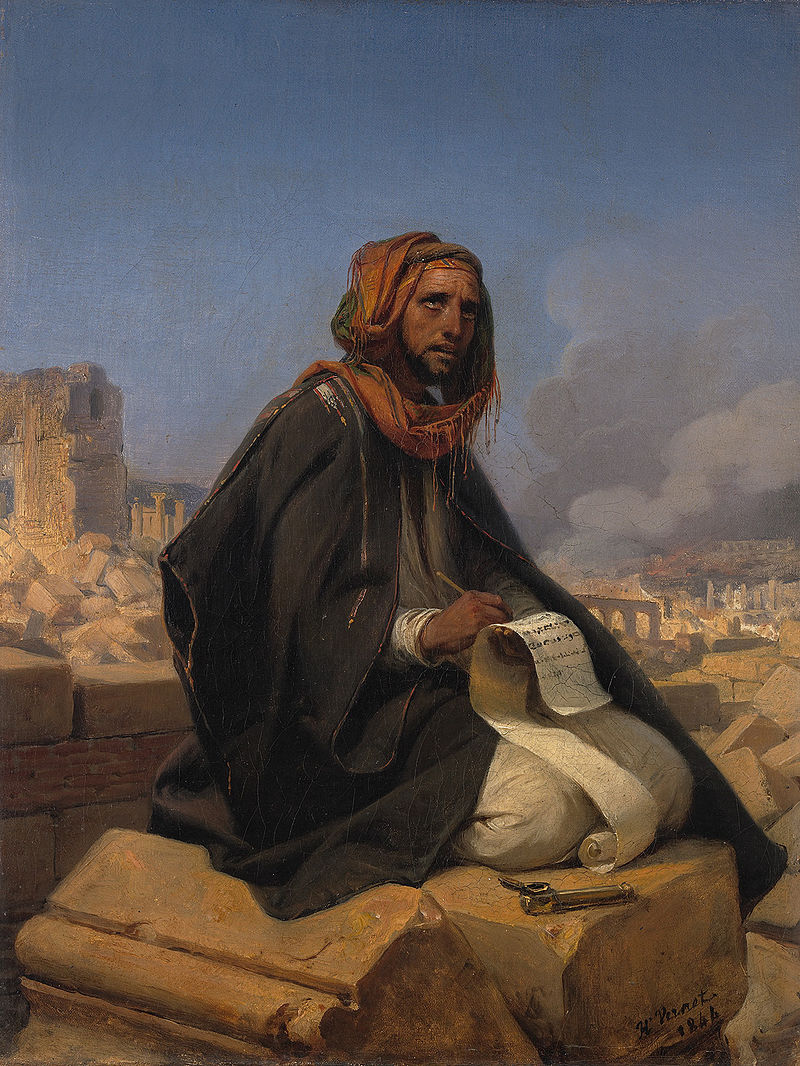
"Jeremiah on the Ruins of Jerusalem"
(Horace Vernet, 1844)
'For I know the plans that I have for you,' declares the LORD,
'plans for welfare and not for calamity to give you a future and a hope.
-- Jeremiah 29:11
(Play beautiful related song by Marty Goetz and Misha)
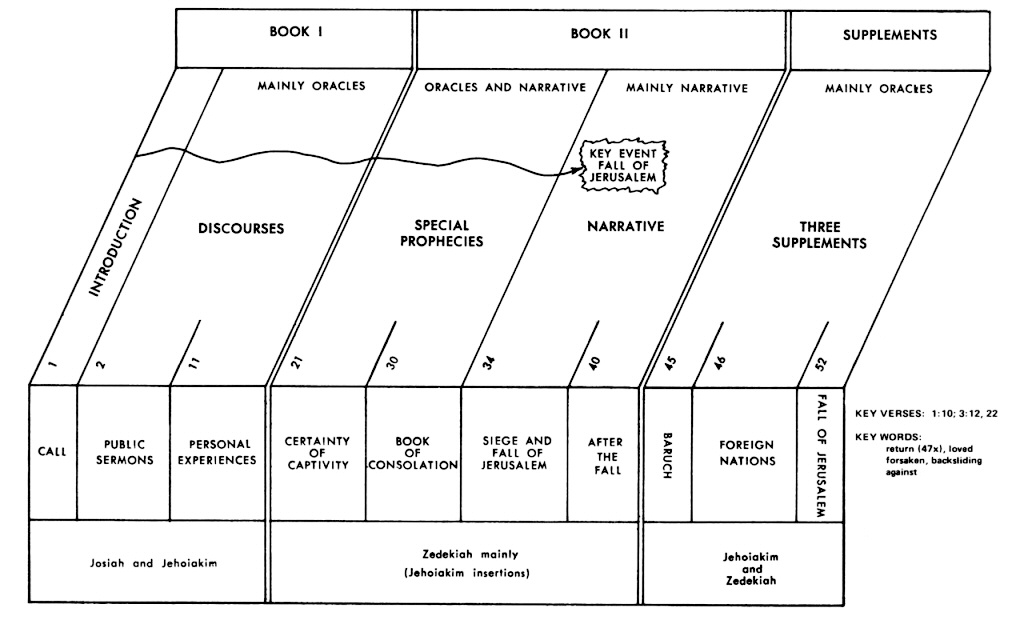
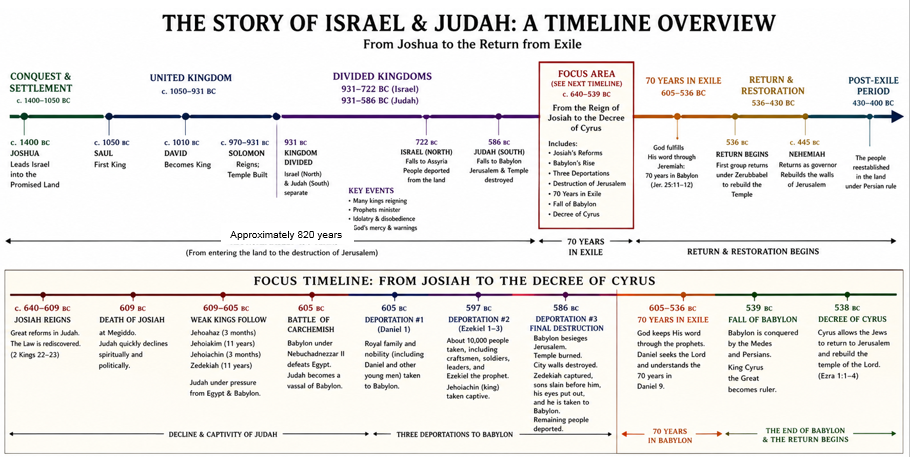
Click chart to enlarge
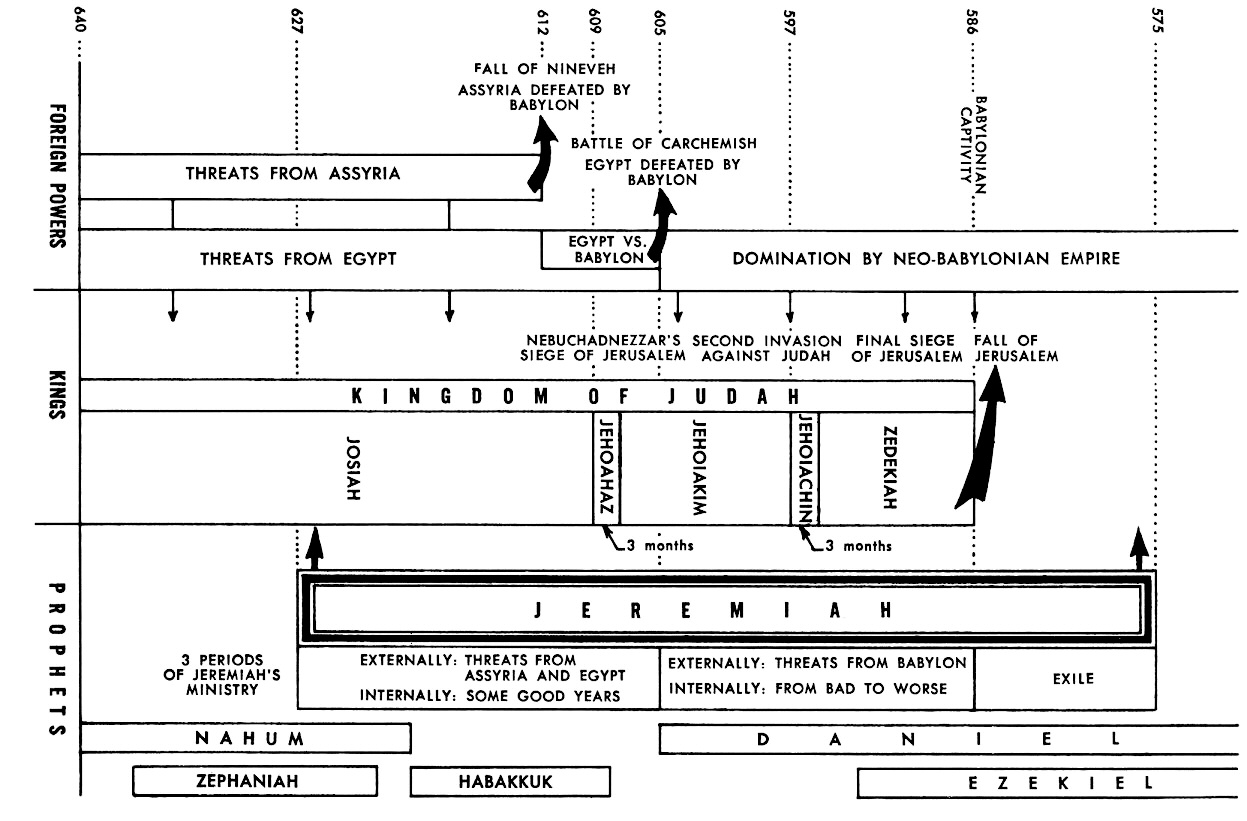
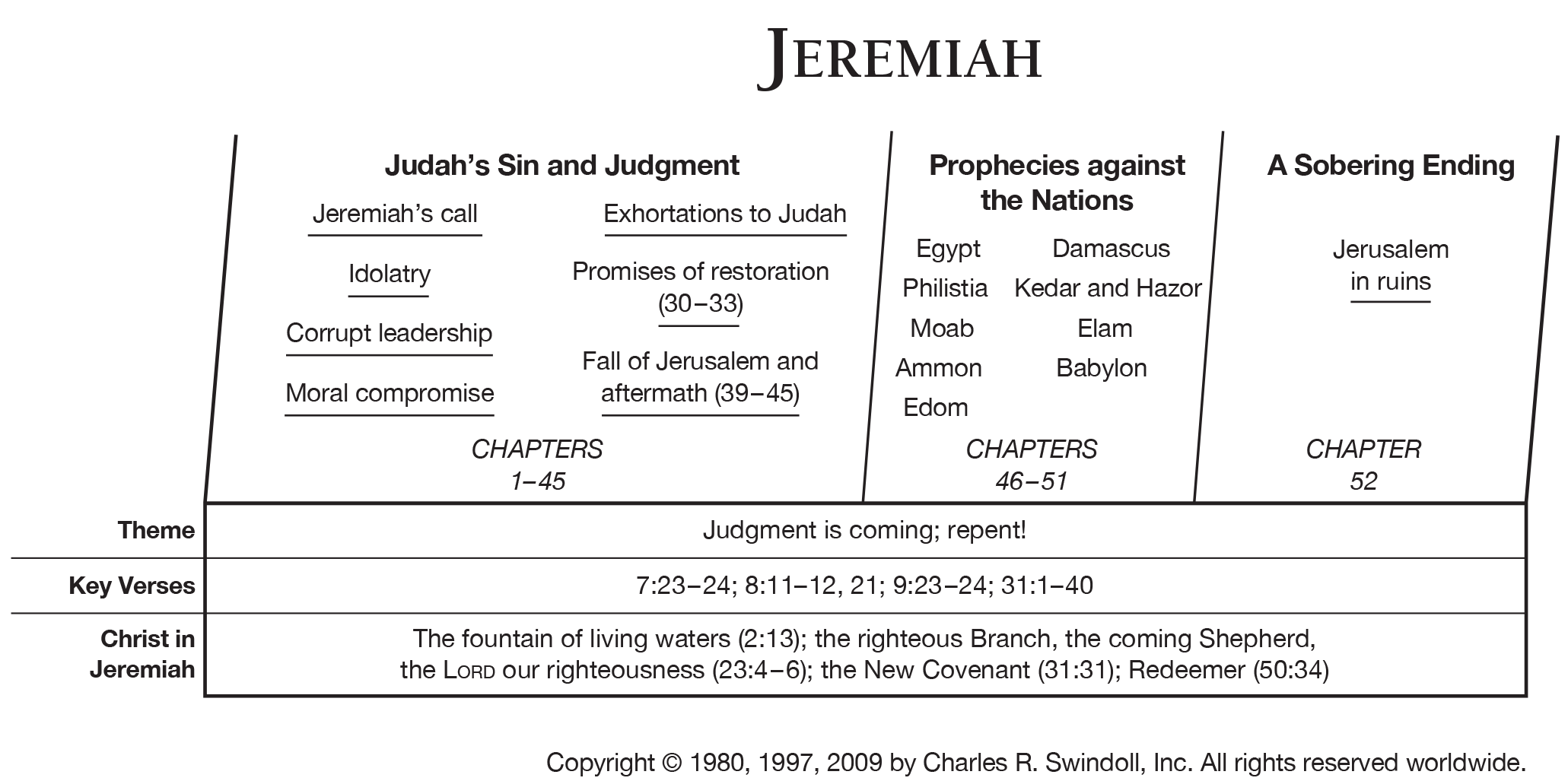
Click chart to enlarge
Chart from recommended resource Jensen's Survey of the OT - used by permission
Jeremiah Chart from Charles Swindoll
| JEREMIAH: "PROPHET TO THE NATIONS" Sin - "I Will Punish" (Jer 9:25) Hope - "I Will Restore" (Jer 30:17) Judah & Jerusalem |
||||||
|
Prophet |
Prophecies to Judah Jer 2:1-45:5 |
Prophecies to the Gentiles Jer 46:1-51:64 |
Prophet's Appendix Jer 52:1-52:34 |
|||
| Prophet's Commission Jer 1:1-19 |
Judah Condemned Jer 2:1-25:38 |
Jeremiah's Conflicts Jer 26:1-29:32 |
Jerusalem's Future Jer 30:1-33:26 |
Jerusalem's Fall Jer 34:1-45:5 |
Nations Condemned Jer 46:1-51:64 |
Historic Conclusion Jer 52:1-52:34 |
| Before The Fall Of Jerusalem Jer 1:1-38:28 |
The Fall Jer 39:1-18 |
After The Fall |
||||
| Call | Ministry | Retrospect | ||||
| Nation of Judah |
Surrounding Nations |
Future of Babylon |
||||
| 627-582 BC Ministered 40+ Years! |
||||||
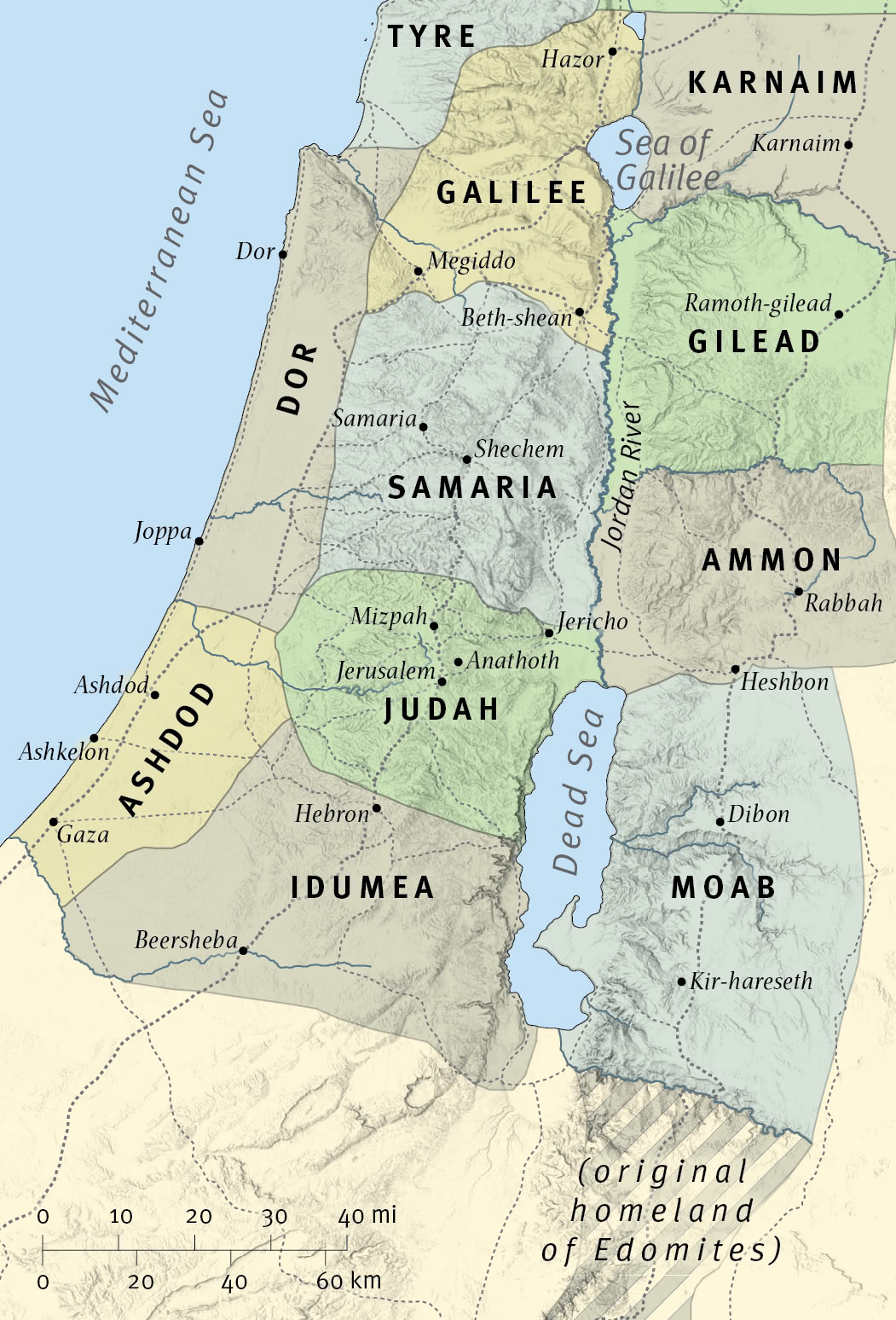
Map of Israel at Time of Jeremiah
Source: ESV Global Study Bible
Jeremiah 20:1 When Pashhur the priest, the son of Immer, who was chief officer in the house of the LORD, heard Jeremiah prophesying these things,
NET Now Pashhur son of Immer heard Jeremiah prophesy these things. He was the priest who was chief of security in the LORD's temple.
NLT Now Pashhur son of Immer, the priest in charge of the Temple of the LORD, heard what Jeremiah was prophesying.
- Immer: 1Ch 24:14 Ezr 2:37,38 Ne 7:40,41
- chief: 2Ki 25:18 2Ch 35:8 Ac 4:1 5:24
PASHHUR HEARS THE DIRE
DIRE OPHECIES OF JEREMIAH
When Pashhur the priest, the son of Immer, who was chief officer in the house of the LORD - Pashhur is not just any priest but as chief officer of the Temple he had the role of maintaining order, enforcing discipline, and overseeing Temple activities. In short, he could control what happened in the Temple courts.
Heard Jeremiah prophesying these things - This was the "trigger" for Pashhur taking actions against Jeremiah. What are "these things?" (Always stop and intrrogate the text when you observe this statement - "these things" occurs 287x in 272v in the Bible!). From the immediate context (Jeremiah 19), Jeremiah had just proclaimed the coming destruction of Jerusalem (Jer 19:3, 7, 8), the city becoming like Topheth (a place of judgment and defilement) (Jer 19:6, 12, cf Jer 7:31,32) and judgment so severe it would include horrific suffering and siege conditions (Jer 19:9, fulfilling Dt 28:53). In short, Jeremiah was declaring that God’s judgment was imminent and unavoidable because of Judah’s sin.
NET NOTE - Heb “chief overseer/officer.” The translation follows the suggestion of P. C. Craigie, P. H. Kelley, J. F. Drinkard, Jeremiah 1–25 (WBC), 267, based on the parallel passage in 29:26–27 where this official appears to have been in charge of maintaining order in the temple. Judging from a comparison of this passage with Jer 29:26–27 and that passage in turn with 2 Kgs 25:18, Pashhur held an office second in rank only to the high priest. He was in charge of keeping order in the temple and took offense at what he heard Jeremiah saying.
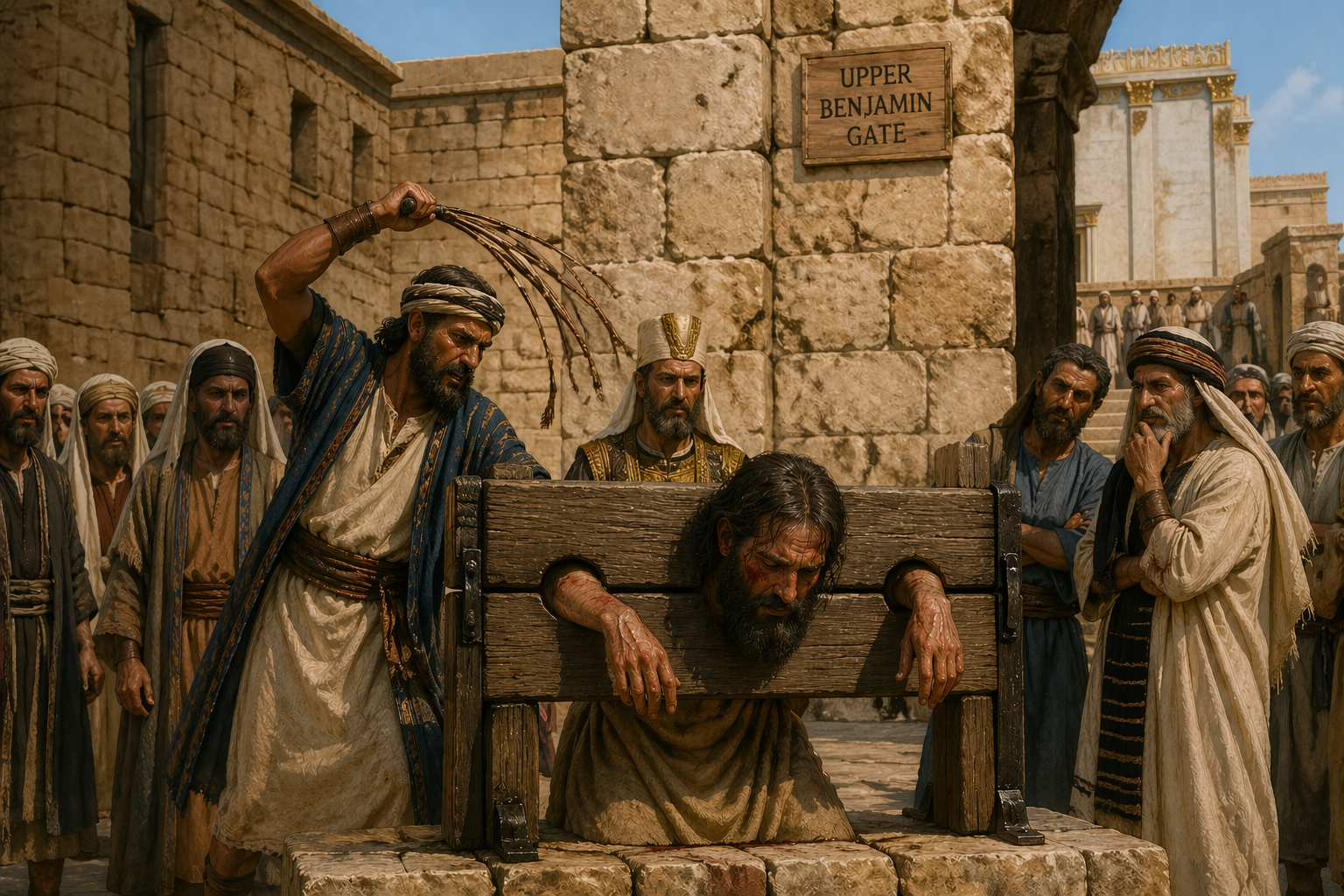
Jeremiah 20:2 Pashhur had Jeremiah the prophet beaten and put him in the stocks that were at the upper Benjamin Gate, which was by the house of the LORD.
NET When he heard Jeremiah's prophecy, he had the prophet flogged. Then he put him in the stocks which were at the Upper Gate of Benjamin in the LORD's temple.
NLT So he arrested Jeremiah the prophet and had him whipped and put in stocks at the Benjamin Gate of the LORD's Temple.
- beaten: Jer 1:19 Jer 19:14-15 Jer 26:8 Jer 29:26 Jer 36:26 Jer 37:15,16 Jer 38:6 1Ki 22:27 2Ch 16:10 24:21 Am 7:10-13 Mt 5:10-12 21:35 23:34-37 Ac 4:3 Ac 5:18,40 7:52 16:22-24 Heb 11:36,37 Rev 2:10 17:6
- in the high: Jer 37:13 38:7 Zec 14:10
Related Passages:
Jeremiah 1:19 “They will fight against you, but they will not overcome you, for I am with you to deliver you,” declares the LORD.
Jeremiah 26:8 When Jeremiah finished speaking all that the LORD had commanded him to speak to all the people, the priests and the prophets and all the people seized him, saying, “You must die!
Jeremiah 29:26 “The LORD has made you priest instead of Jehoiada the priest, to be the overseer in the house of the LORD over every madman who prophesies, to put him in the stocks and in the iron collar,
Jeremiah 36:26 And the king commanded Jerahmeel the king’s son, Seraiah the son of Azriel, and Shelemiah the son of Abdeel to seize Baruch the scribe and Jeremiah the prophet, but the LORD hid them.
Jeremiah 37:15-16 Then the officials were angry at Jeremiah and beat him, and they put him in jail in the house of Jonathan the scribe, which they had made into the prison. 16 For Jeremiah had come into the dungeon, that is, the vaulted cell; and Jeremiah stayed there many days.
Jeremiah 38:6 Then they took Jeremiah and cast him into the cistern of Malchijah the king’s son, which was in the court of the guardhouse; and they let Jeremiah down with ropes. Now in the cistern there was no water but only mud, and Jeremiah sank into the mud.
Deuteronomy 25:3 He may beat him forty times but no more, so that he does not beat him with many more stripes than these and your brother is not degraded in your eyes.
2 Corinthians 11:24 Five times I received from the Jews thirty-nine lashes.
JEREMIAH BEATEN AND CONFINED
IN PUBLIC STOCK FOR RIDICULE
Pashhur had Jeremiah the prophet beaten (nāḵāh) and put him in the stocks that were at the upper Benjamin Gate, which was by the house of the LORD - Yahweh had forewarned Jeremiah there would be days like this (Jer 1:19), but He also promised He would deliver him.
G Campbell Morgan - “The expression ‘smote Jeremiah’ is a technical one, and in all likelihood means that the official scourging of ‘forty stripes save one’ was administered.”
TWOT on stocks - (mahpeket from a root ‘to distort’) (4x - 2Ch 16:10; Jer 20:2, 3; Jer 29:26) It may not be clear what shape these ancient stocks took. Probably they were quite different from those of colonial days, but the details are not certain. "The Hebrew word is formed from the verb to twist, implying that this ‘twist-frame’ clamped the victim in a position that would become increasingly distressing." (Kidner) Some say it bent the body double. “The stocks were a form of scaffold in which prisoners were detained in a crooked or confined position which produced cramped muscles.” (Harrison) Feinberg adds that "The stocks, where the prophet was confined, were intended not only for restraint but also for torture. The stocks, which were used for false prophets (cf. 2Ch 16:10), held the feet, hands, and neck so that the body was almost doubled up (cf. 29:26). The Hebrew word for “stocks” means “causing distortion.”
NET NOTE stocks - The meaning of this word is uncertain. It occurs in Jer 29:26 where it is followed by a parallel word that occurs only there and is generally translated “collar,” and in 2 Chr 16:10 where it is preceded by the word “house of.” It is most often translated “stocks” and explained as an instrument of confinement for keeping prisoners in a crooked position (from its relation to a root meaning “to turn.” See BDB 246 s.v. מַהְפֶּכֶת and KBL 500 s.v. מַהְפֶּכֶת for definition and discussion.) For a full discussion including the interpretation of the ancient versions see W. L. Holladay, Jeremiah (Hermeneia), 1:542–43.
The Upper Benjamin Gate (not the same as the "Benjamin Gate" which was on the actual city wall - Jer 37:13, Jer 38:7) was the northern gate of the upper temple court leading from the court of the temple up to the city (probably same as in Ezek. 9:2) and was one of the most conspicuous places in the city and there Jeremiah would be exposed to the ridicule and abuse of the people.
NET NOTE Benjamin Gate - A comparison of Ezek 8:3 and Ezek 9:2 in their contexts will show that this probably refers to the northern gate to the inner court of the temple. It is called Upper because it was on higher ground above the gate in the outer court. It is qualified by “in the LORD’s temple” to distinguish it from the Benjamin Gate in the city wall (cf. Jer 37:13; 38:7). Like the Benjamin Gate in the city wall it faced north toward the territory of the tribe of Benjamin.
Bob Utley - Although YHWH promised to protect Jeremiah (cf. Jer. 1:18-19), it did not mean he would not emotionally and physically suffer! This is helpful insight to NT believers. WHY DO CHRISTIANS SUFFER? "stocks" This word (BDB 246) refers to wooden bars with holes in them for the hands, feet, and neck. These holes were spread widely apart to increase pain and discomfort. The pain was both physical and mental! In 2 Chr. 16:10 a false prophet was put in them (or it). Jeremiah was being treated as a "false prophet." This is what bothered him so badly! The JPSOA translates this word as "cell" and sees it as a small room of confinement. The LXX also has "dungeon," but "stocks" in a footnote.
Beaten (struck)(05221) נָכָה nāḵāh: A verb meaning to beat, to strike, to wound. The meaning of the vb. ranges from hitting to killing. ni. be hit, be struck down; pu. be battered, ruined, destroyed; hi. strike, hit, beat, strike dead, wound, batter, destroy; ho. be struck down (dead), be taken, be hit; nom. מַכָּה (makkâ), blow, stroke, wound, plague, defeat There are many instances of striking physically (Ex. 21:15, 19; Job 16:10; Ps. 3:7; Song 5:7). Of Yahweh smiting the firstborn (Nu 3:13, 8:17), His own people (Nu 11:33). Of Moses striking the rock twice resulting in his not being allowed to enter the Promised Land (Nu 20:11) Frequently, nākhāh is related to the Israelite conquest of Canaan. God used disease to smite the inhabitants of Canaan (Num. 14:12). This word is also used in a different sense, as when the men of Sodom and Gomorrah were stricken blind by the two angels (Gen. 19:11); when a priest stuck a fork into the kettle (1 Sam. 2:14); when people clapped their hands (2 Kgs. 11:12); or when people verbally abused Jeremiah (Jer. 18:18). God struck the Egyptians with plagues (Ex. 3:20); and struck people down in judgment (Isa. 5:25).
Nakah is a broad term meaning “to strike”, which extends into several related senses depending on context. At its core, it refers to delivering a blow, but it can also mean to wound, afflict, or punish, often by divine or human agency (Ex 7:17; Isa 53:4). From this basic idea, it develops into stronger outcomes such as to destroy or ruin, to kill or slay, and even to defeat an אויב (enemy) in battle (Jos 10:10; Ex 2:12). In some contexts it describes physical or bodily affliction (Dt 28:27; 1Sa 5:6). Idiomatic expressions intensify the meaning, conveying violent, crushing, or lethal action, such as striking “with the sword” (Jos 10:30) or “hip and thigh,” meaning a thorough and devastating defeat. In short, nāḵāh moves from the simple act of striking to the full range of consequences—injury, affliction, defeat, destruction, and death—depending on how and where it is used in Scripture.
Jeremiah 20:3 On the next day, when Pashhur released Jeremiah from the stocks, Jeremiah said to him, “Pashhur is not the name the LORD has called you, but rather Magor-missabib.
NET But the next day Pashhur released Jeremiah from the stocks. When he did, Jeremiah said to him, "The LORD's name for you is not 'Pashhur' but 'Terror is Everywhere.'
NLT The next day, when Pashhur finally released him, Jeremiah said, "Pashhur, the LORD has changed your name. From now on you are to be called 'The Man Who Lives in Terror.'
- Pashhur: Ac 4:5-7 16:30,35-39
- released Jeremiah : Jer 7:32 19:2,6 Ge 17:5,15 32:28 Isa 8:3 Ho 1:4-9
- Magor-missabib: Fear round about, Jer 20:10 6:25 46:5 29:29 Ps 31:13 La 2:22
Related Passages:
Jeremiah 6:25 Do not go out into the field And do not walk on the road, For the enemy has a sword, Terror is on every side.
NOW FOR PASHHUR'S
PAYBACK
On the next day, when Pashhur released Jeremiah from the stocks, Jeremiah said to him, “Pashhur is not the name the LORD has called you, but rather Magor-missabib - Magor-missabib means "terror on every side." (cf Jer 46:5; Jer 49:29, Lam 2:22, Ps 31:14) Jeremiah renames Pashhur with this ominous title, transforming his identity into a living prophecy. The name is not merely descriptive but is declarative, announcing the judgment that is about to overtake him and the nation he represents. What Pashhur had done to Jeremiah in attempting to silence God’s word is now turned back like a boomerang upon him as a divine verdict for he would soon become surrounded by dread and catastrophe.
This renaming functions as a symbolic prophecy of the coming Babylonian invasion. As Jeremiah explains, “terror on every side” would characterize the experience of Judah when the Babylonians besieged and ultimately destroyed Jerusalem. Fear would not be localized or momentary, but would be very real and completely inescapable, pressing in on the city from every direction. Friends would fall, enemies would encircle, and the illusion of security would collapse. Thus, Pashhur became a walking symbol or personal embodiment of national judgment, and served as a sign that what he had refused to hear in prophecy which he would soon experience as reality (cf. Jer 20:4–6).
The deeper irony is striking in that the man charged with maintaining order in the house of the LORD becomes the very picture of chaos and terror in the city. Beloved, his new name underscores a sobering truth, that those who reject God’s holy Word will not escape it but will ultimately experience it, not just in time but in eternity (if they never come to know Jesus as Savior and Lord!)
Guzik - The meaning of the name Pashhur is sometimes given as freedom, sometimes as ease or peacefulness. The name Magor-Missabib means terror on every side. There was a startling contrast between the two names.
John MacArthur: Pashhur – The meaning is either “ease” or “deliverance is round about,” both in contrast to the new name God assigns him in v. 3. He was one of several men so named (cf. Jer 21:1; 38:1). He was one of the original “governors of the sanctuary” (cf. 1 Ch 24:14). (SeeMacArthur Study Bible)
J A Thompson: Pashhur will not be a temple overseer who metes out punishment to others, but one who will himself suffer the divine judgment when terror surrounds him and the nation. (See The Book of Jeremiah - Page 425)
NET NOTE - Magor-missabib. This name is translated rather than transliterated to aid the reader in understanding this name and connect it clearly with the explanation that follows in the next verse. For a rather complete discussion on the significance of this name and an attempt to explain it as a pun on the name “Pashhur” see J. A. Thompson, Jeremiah (NICOT), 455, n. 35. The name Pashhur is essentially a curse pronounced by Jeremiah invoking the LORD’s authority. The same phrase occurs in Jer 6:25; 46:5; 49:29 which are all in the context of war. In ancient Israelite culture the change in name denoted a change in status or destiny. See, for example, the shift from Jacob (“He grabs the heel” and “Cheater” or “Deceiver,” Gen 25:26; 27:36) to Israel (“He perseveres with God,” Gen 32:28
Jeremiah 20:4 “For thus says the LORD, ‘Behold, I am going to make you a terror to yourself and to all your friends; and while your eyes look on, they will fall by the sword of their enemies. So I will give over all Judah to the hand of the king of Babylon, and he will carry them away as exiles to Babylon and will slay them with the sword.
NET For the LORD says, 'I will make both you and your friends terrified of what will happen to you. You will see all of them die by the swords of their enemies. I will hand all the people of Judah over to the king of Babylon. He will carry some of them away into exile in Babylon and he will kill others of them with the sword.
NLT For this is what the LORD says: 'I will send terror upon you and all your friends, and you will watch as they are slaughtered by the swords of the enemy. I will hand the people of Judah over to the king of Babylon. He will take them captive to Babylon or run them through with the sword.
- I am going to make: De 28:65-67 Job 18:11-21 20:23-26 Ps 73:19 Eze 26:17-21 Mt 27:4,5
- thine: Jer 29:21 39:6,7 De 28:32-34 1Sa 2:33 2Ki 25:7
- I will give: Jer 19:15 21:4-10 25:9 32:27-31
Related Passages:
Deuteronomy 28:36 “The LORD will bring you and your king, whom you set over you, to a nation which neither you nor your fathers have known, and there you shall serve other gods, wood and stone.
JEREMIAH WILL NOT
MODERATE HIS MESSAGE
For - Term of explanation. Jeremiah now explains why he changed Pashhur's name!
Thus says the LORD - The verdict on Pashhur comes from the Throne of Heaven! This is not some petty retaliation move by the prophet but Yahweh's authoritative judgment. Mark it down that Pashhur had opposed God’s Word, so now God Himself speaks in opposition against him.
Behold, (hinneh - pay attention! Points to certainty!) I am going to make you a terror to yourself and to all your friends - NET - "I will make both you and your friends terrified of what will happen to you." Notice that to yourself shows Pashhur would become a source of fear even to his own mind and conscience. Instead of confidence or security, he would live in dread, anxiety, and inner turmoil. The one who had tried to intimidate God’s prophet would now be consumed by fear himself. This reflects a reversal principle seen elsewhere in Scripture, where the oppressor experiences the very distress he inflicted (cf. Dt 28:65–67).
And to all your friends - Not only would Pashhur live in fear, but he would also become a cause of fear to those around him. His fate and downfall would alarm his companions. In essence, life would serve as a public warning, spreading fear among those who once stood with him.
And while your eyes look on, they will fall by the sword of their enemies. - Pashhur will personally, helplessly be foreced to witness the judgment. He will not hear about it from a distance or escape it, but will see it unfold before him. The expression highlights the anguish of being forced to watch what cannot be stopped, a common element of divine judgment where awareness heightens the pain (cf. Dt 28:32). Note they refers to his companions, friends, and fellow leaders. Those with whom he stood in opposition to God’s Word will collapse together under judgment. This shows that rebellion against God often brings collective consequences, not just individual ones. By the sword of their enemies specifies the means of judgment, which would be a painful, violent death at the hands of invading Babylonians. What Pashhur and others trusted in for security will fail and what they refused to believe of Jeremiah's warnings would prevail. (Jer 19:7; 21:9).
So I will give over all Judah to the hand of the king of Babylon, and he will carry them away as exiles to Babylon and will slay them with the sword - Jeremiah does not budge on his difficult message, repeading the declaration of judgment spoken by the LORD, revealing both the scope and certainty of what is about to happen to Judah. Note give over emphasizes that this is God’s sovereign act, not merely a Babylon's military prowess. Judah is being handed over because of her persistent, stiffnecked covenant unfaithfulness. ALL Judah stresses the sweeping nature of the judgment, affecting the nation as a whole, not just a select group (cf. 2Ch 36:15–17).
The hand of the king of Babylon, Nebuchadnezzar Yahweh's servant (Jer 27:6) is the sovereign LORD's instrument of judgment. He will carry them away describes deportation, the removal of the people from their land into captivity. Exile was one of the covenant curses warned of long before (Dt 28:36), signifying both physical displacement and spiritual discipline. It marks the loss of land, temple, and national identity. indicates that Not all Judah would go into exile. Many would die by warfare, refecting Jeremiah's repeated warning that those who remain in they city would face destruction (Jer 21:9).
Jeremiah 20:5 ‘I will also give over all the wealth of this city, all its produce and all its costly things; even all the treasures of the kings of Judah I will give over to the hand of their enemies, and they will plunder them, take them away and bring them to Babylon.
NET I will hand over all the wealth of this city to their enemies. I will hand over to them all the fruits of the labor of the people of this city and all their prized possessions, as well as all the treasures of the kings of Judah. Their enemies will seize it all as plunder and carry it off to Babylon.
NLT And I will let your enemies plunder Jerusalem. All the famed treasures of the city-- the precious jewels and gold and silver of your kings-- will be carried off to Babylon.
- I will give over: Jer 3:24 4:20 12:12 15:13 24:8-10 27:19-22 32:3-5 39:2,8 52:7-23 2Ki 20:17,18 24:12-16 25:13-17 2Ch 36:10,17-19 La 1:7,10 La 4:12 Eze 22:25 Da 1:2
Related Passages:
Isaiah 39:6 ‘Behold, the days are coming when all that is in your house and all that your fathers have laid up in store to this day will be carried to Babylon; nothing will be left,’ says the LORD.
Deuteronomy 28:33 “A people whom you do not know shall eat up the produce of your ground and all your labors, and you will never be anything but oppressed and crushed continually.
2 Kings 24:13 He carried out from there all the treasures of the house of the LORD, and the treasures of the king’s house, and cut in pieces all the vessels of gold which Solomon king of Israel had made in the temple of the LORD, just as the LORD had said.
GOD GIVES OVER CITY
AS BOOTY TO BABYLONIANS
I will also give over all the wealth of this city, all its produce and all its costly things - Again we see divine sovereignty (I will also give) not just over the people but their possessions. Yes, nations plundered in war, but here clearly it is because of God withdrawing His protection and delivering the city into judgment (cf. Jer 21:10). The loss of produce signifies both economic collapse and the removal of God’s provision, fulfilling covenant warnings that disobedience would result in famine and deprivation (Dt 28:33). Those costly things which had been a source of pride and false security would be stripped away demonstrating that material wealth cannot protect against God's judgment! Even what they considered precious will be lost, exposing the futility of trusting in earthly treasures (cf. Isa 39:6). (Beloved, what are you trusting in besides God?) One is reminded of the proverb that "Riches do not profit in the day of wrath, but righteousness delivers from death." (Pr 11:4)
Even all the treasures of the kings of Judah I will give over (LORD actively hands over) to the hand (yad - signfies power and control) of their enemies, - Here we see that God's judgment moves from the city’s general wealth to its highest and most guarded riches, those belonging to the royal house, the accumulated wealth of Judah’s monarchy. What was most prized and protected would not be spared. Notice the inclusion of the little word “even” which underscores that nothing would be exempt, not even the wealth of the throne itself (cf. 2Ki 24:13). What Judah trusted in and stored up will now strengthen the very nation that conquers them.
and they will plunder them, take them away and bring them to Babylon - Notice this describes the complete removal and transfer of Judah’s wealth into enemy hands, unfolding in three progressive actions. First, plunder means to strip by force. Judah’s treasures will not be preserved or respectfully transferred, but violently seized by the invading army. Second, take them away emphasizes removal from their rightful place. The treasures of Jerusalem, once central to its identity and security, will be carried off. Nothing will remain behind to sustain the nation or symbolize its former glory. The loss is total and irreversible. Third, bring them to Babylon is the final step completing the transfer. The wealth of Judah will be relocated to Babylon, strengthening the empire of Nebuchadnezzar. What once served God’s people will now serve a pagan kingdom, illustrating a dramatic reversal of fortunes and the fulfillment of earlier warnings that the treasures of Jerusalem would be carried away (2Ki 20:17; 2Ki 24:13).
This fulfilled Isaiah's prophecy to Hezekiah who pridefully, foolishly had shown the treasures to the envoys from Babylon...
2 Kings 20:17 ‘Behold, the days are coming when all that is in your house, and all that your fathers have laid up in store to this day will be carried to Babylon; nothing shall be left,’ says the LORD.
J A Thompson: The extent of the booty that would be taken is indicated by the use of for different words – wealth, possessions, valuables, and teasures; and the effect is further heightened by the use of the three verbs “loot”, “take”, and “carry off to”. There could be no mistaking the severity of the calamity. (See The Book of Jeremiah - Page 425)
Jeremiah 20:6 ‘And you, Pashhur, and all who live in your house will go into captivity; and you will enter Babylon, and there you will die and there you will be buried, you and all your friends to whom you have falsely prophesied.’”
NET You, Pashhur, and all your household will go into exile in Babylon. You will die there and you will be buried there. The same thing will happen to all your friends to whom you have prophesied lies.'"
NLT As for you, Pashhur, you and all your household will go as captives to Babylon. There you will die and be buried, you and all your friends to whom you prophesied that everything would be all right.'"
- Pashur: Jer 28:15-17 29:21,22,32 Ac 13:8-11
- thy friends: Jer 20:4 5:31 6:13-15 8:10,11 14:14,15 23:14-17,25,26,32 Isa 9:15 La 2:14 Eze 13:4-16,22,23 22:28 Mic 2:11 Zec 13:3 2Pe 2:1-3
- thou hast: Lev 26:17 De 28:25
PASHHUR'S PERSONAL
JUDGMENT - DEPORTATION
And you, Pashhur, and all who live in your house will go into captivity; and you will enter Babylon, and there you will die and there you will be buried, you and all your friends to whom you have falsely prophesied. The judgment now becomes intensely personal. Jeremiah addresses Pashhur directly, and all who live in your house. This judgment will affect his entire household, including family and dependents. In the ancient Near East, a household represented a unified social unit, so the consequences of leadership and influence often affected all connected to it. This does not imply injustice, but rather reflects how one man’s position and actions can impact many others (cf. Exodus 20:5). Unlike some who would die by the sword, Pashhur and his household would be taken alive into exile. Captivity meant forced removal from the land, loss of freedom, and life under foreign domination in Babylon. It was a fulfillment of covenant warnings that disobedience would lead to exile among the nations (Dt 28:36).
Bob Utley - "you have falsely prophesied" Exactly how this priestly temple official "prophesied" (Niphal PERFECT) is uncertain. But he, not Jeremiah, would bear the curse of Deut. 13:1-5 for it! The false prophecy was related to the stability of the temple and Jerusalem (possibly quoting Isaiah's message to Hezekiah, i.e. Isaiah 36-39). It was a message of hope and faith, but at this point in time, it was not YHWH's message (cf. Jer. 14:14-16)!
J A Thompson on falsely prophesied - Judah’s leaders, prophets, priests, wise men, and king as well as the people themselves were involved in a profound conspiracy of falsehood. (See The Book of Jeremiah - Page 425)
NET NOTE - As a member of the priesthood and the protector of order in the temple, Pashhur was undoubtedly one of those who promulgated the deceptive belief that the LORD’s presence in the temple was a guarantee of Judah’s safety (cf. Jer 7:4, 8). Judging from the fact that two other men held the same office after the leading men in the city were carried into exile in 597 B.C. (see Jer 29:25–26 and compare Jer 29:1–2 for the date and 2 Kgs 24:12–16 for the facts), this prophecy was probably fulfilled in 597. For a similar kind of oracle of judgment see Amos 7:10–17.
Jeremiah 20:7 O LORD, You have deceived me and I was deceived; You have overcome me and prevailed. I have become a laughingstock all day long; Everyone mocks me.
NET LORD, you coerced me into being a prophet, and I allowed you to do it. You overcame my resistance and prevailed over me. Now I have become a constant laughingstock. Everyone ridicules me.
NLT O LORD, you misled me, and I allowed myself to be misled. You are stronger than I am, and you overpowered me. Now I am mocked every day; everyone laughs at me.
ASV O Jehovah, thou hast persuaded me, and I was persuaded; thou art stronger than I, and hast prevailed: I am become a laughing-stock all the day, every one mocketh me.
AMP [Jeremiah said,] O Lord, You have persuaded me and I was deceived; You are stronger than I and You have prevailed. I am a laughingstock all day long; Everyone mocks me.
MSG You pushed me into this, God, and I let you do it. You were too much for me. And now I’m a public joke. They all poke fun at me.
TLB O Lord, you deceived me when you promised me your help. I have to give them your messages because you are stronger than I am, but now I am the laughingstock of the city, mocked by all.
- deceived: or, enticed, Jer 1:6-8,18,19 15:18 17:16 Ex 5:22,23 Nu 11:11-15
- You have: Jer 20:9 Eze 3:14 Mic 3:8 1Co 9:6
- I have become: Jer 15:10 29:26 2Ki 2:23 Ps 22:6,7 35:15,16 69:9-12 La 3:14 Ho 9:7 Lu 16:14 22:63,64 23:11,35,36 Ac 17:18,32 1Co 4:9-13 Heb 11:36
JEREMIAH'S STARLING
ADDRESS TO YAHWEH
J A Thompson - The section divides readily into two parts: (a) God as Antagonist: Jeremiah’s struggle with God and his sense of God’s overpowering mastery which compels him to prophesy (Jer 20:7–10). (b) God as Protagonist: Jeremiah’s conviction that God is with him and will punish his persecutors (Jer 20:11–13).
F B Huey - This last of Jeremiah’s confessions or complaints in vv. 7–18 is very bitter and has sometimes been called his Gethsemane (cf. Jer 11:18–12:6; 15:10–21; 17:14–18; 18:18–23). The placement of the confession immediately after Jeremiah’s punishment suggests that the events of Jer 20:1–6 may have served as the background that led to this outburst. This complaint serves as a reminder that even a faithful servant of the Lord can become discouraged. (See Jeremiah, Lamentations: An Exegetical and Theological - Page 192)
O LORD, You have deceived me and I was deceived (pathah); You have overcome me and prevailed. - At first glance, Jeremiah’s words may sound as though he is accusing God of deception, but the Hebrew term translated “deceived” (pathah) more accurately conveys the idea of being persuaded or enticed. Jeremiah is expressing how God’s call compelled him into a ministry that brought suffering and reproach. Jeremiah is not accusing God of lying; rather, he is lamenting that he was drawn into a prophetic mission that brought him great suffering and ridicule.
Jeremiah had been called by God to proclaim messages of judgment to a rebellious nation (Jeremiah 1:4–10). Though he initially resisted, saying he was too young, God assured him of divine strength and protection. Over time, however, Jeremiah’s obedience led to persecution, mockery, and isolation. His lament in Jeremiah 20:7 reflects the tension between his human pain and his divine calling. This passage reminds us that following God’s call is not always easy.
In sum, this is the honest cry of a weary servant who feels the weight of obedience but also acknowledges the irresistible power and faithfulness of God. It teaches that even when God’s call leads through hardship, His purposes are good, His truth prevails, and His servants are never abandoned.
I have become a laughingstock all day long; Everyone mocks (laag; LXX - mukterizo in present tense - continually turned up their nose at, sneered at and treated with contempt) me - Here we see Jeremiah expressing the deep emotional cost of Jeremiah’s faithful ministry as his life has become an object of ridicule. All day long emphasizes the constant nature of his reproach, from which there is no relief. So from morning to night, Jeremiah is subjected to scorn, showing the unrelenting pressure of his calling (cf. Ps 42:3). Everyone mocks me indicates that Jeremiah's rejection is widesprea and is not limited to a few individuals. Those who should have listened instead to Jeremiah's Words from Yahweh joined together in derision. The word “mocks” conveys ridicule, taunting, and dismissive scorn, indicating that Jeremiah’s message is not only rejected but openly despised. Of course since this was Yahweh's message through His servant, ultimately they were mocking Yahweh!
F B Huey - God had not deceived Jeremiah. He had warned him that the people would resist his words (Jer 1:8, 19; 12:5). But in his hurt and confusion, Jeremiah lashed out at God and accused him of forcing him against his will to be a prophet. “You prevailed” continues the figure of seduction (cf. Deut 22:25; 2 Sam 13:11, 14; Prov 7:13 for other examples of seduction) and is employed repeatedly by Jeremiah in these verses (Jer 20:7, 9–11). Jeremiah was deeply offended because people did not take him seriously. They laughed at him and mocked him in disbelief that God would punish them. (See Jeremiah, Lamentations: An Exegetical and Theological - Page 192)
J A Thompson on Jer 20:7-13 - The passage, and the succeeding poem (vv. 14–18), provide unusual insights into Jeremiah’s own inner conflicts. He was engrossed in controversy with Yahweh. His sensitive nature was deeply hurt by the ridicule and sarcasm with which his preaching was received by the people....Jeremiah seems to be saying that he had understood his relationship to Yahweh to be something like a marriage bond but it was now clear that he had been deceived, enticed by Yahweh, who had used him and tossed him aside. The language verges on the blasphemous. (The Book of Jeremiah)
Paul Apple - You would think that faithfulness to God in a difficult ministry setting would fortify God’s servant with special confidence and a sense of God’s favor and presence. But such is not always the case. Sometimes the messenger of God can succumb to deeply conflicting emotions that cause him to question the value of his calling. Is it really worth it to continue serving God when all I see around me are stubborn, unrepentant hearts and fierce opposition and treachery from even my closest friends? Did God sucker me into this Christian calling and sell me a bill of goods?
Warren Wiersbe: This is the last of Jeremiah’s recorded laments; it’s a human blending of grief and joy, prayer and despair, praise and perplexity. When you call to mind the sensitive nature of this man, you aren’t surprised that he’s on the mountaintop one minute and in the deepest valley the next. Jeremiah, however, lived above his moods and did the will of God regardless of how he felt. In this honest expression of his deepest emotions, the prophet dealt with three important concerns: God’s call (vv 7-9), his daily peril (vv. 10- 13), and his inner despair (vv. 14-15).
Christine Cuendet: An Exegetical Paper on 20:7-18 Jeremiah’s lament is a painful complaint to God from a heart that is on fire for God’s holiness. Jeremiah pours forth his sorrow to God, grieving even the day he was born, for he knows the truth of the prophetic words he is speaking, yet there is not a single responsive soul in Judah that will heed his warning. Even his close friends plot revenge against him, and so he laments of life, both loving and hating the position he now finds himself in. Still, God’s promises are true and Jeremiah speaks and acts with no shadow of a doubt that God can and will fulfill his plans from the grandest scale of punishment for Judah’s rebellion to the most minute detail of Jeremiah’s own life. God has promised and he will bring it to fulfillment.
John Mackay: Jeremiah expressed strong reservations about his suitability and capacity (Jer 1:6), but the Lord persuaded him, that is, “overcame his initial reluctance” (Jer 20:7). Looking back, Jeremiah is saying that if he had known what he now knew about what being the Lord’s prophet entailed, he would have protested more strongly, he might even have said “No”. It was one thing to have been warned – which he was; it was another to grasp the full extent of the experiences those warnings conveyed. (Jeremiah: Chapters 1-20)
NET NOTE - deceived The translation is admittedly interpretive but so is every other translation that tries to capture the nuance of the verb rendered here “coerced.” Here the Hebrew text reads: “You [–]ed me and I let myself be [–]ed. You overpowered me and prevailed.” The value one assigns to [–] is in every case interpretive based on what one thinks the context is referring to. The word is rendered “deceived” or “tricked” by several English versions (see, e.g., KJV, NASB, TEV, ICV) as though God had misled him. It is rendered “enticed” by some (see, e.g., NRSV, NJPS) as though God had tempted him with false hopes. Some go so far as to accuse Jeremiah of accusing God of metaphorically “raping” him. It is true that the word is used of “seducing” a virgin in Exod 22:15 and that it is used in several places to refer to “deceiving” someone with false words (Prov 24:28; Ps 78:36). It is also true that it is used of “coaxing” someone to reveal something he does not want to (Judg 14:15; 16:5) and of “enticing” someone to do something on the basis of false hopes (1 Kgs 22:20–22; Prov 1:10). However, it does not always have negative connotations or associations. In Hos 2:14 (2:16 HT) God “charms” or “woos” Israel, his estranged ‘wife,’ into the wilderness where he hopes to win her back to himself. What Jeremiah is alluding to here is crucial for translating and interpreting the word. There is no indication in this passage that Jeremiah is accusing God of misleading him or raising false hopes; God informed him at the outset that he would encounter opposition (1:17–19). Rather, he is alluding to his call to be a prophet, a call which he initially resisted but was persuaded to undertake because of God’s persistence (Jer 1:7–10). The best single word to translate ‘…’ with is thus “persuaded” or “coerced.” The translation spells out the allusion explicitly so the reader is not left wondering about what is being alluded to when Jeremiah speaks of being “coerced.” The translation “I let you do it” is a way of rendering the Niphal of the same verb which must be tolerative rather than passive since the normal passive for the Piel would be the Pual (See IBHS 389–90 §23.4g for discussion and examples.). The translation “you overcame my resistance” is based on allusion to the same context (1:7–10) and the parallel use of חָזַק (khazaq) as a transitive verb with a direct object in 1 Kgs 16:22.
Deceived (066601) pathah carries the fundamental idea of being open, simple, or easily influenced, and from this root develops the sense of enticing, persuading, or deceiving, often with the result of leading someone away from what is right. At its core, the word reflects a condition of vulnerability, describing a person who is “open” or undiscerning, lacking the maturity to resist harmful influence, and thus easily drawn aside (Hos. 7:11). In this sense, it can denote being gullible or naïve, a person whose heart is susceptible to deception and therefore in danger of turning from truth (Deut. 11:16; Job 31:27). From this basic idea, the verb extends to active persuasion or enticement, often in a negative moral context, such as seducing another into sin or wrongdoing, whether through promises, manipulation, or appeal to desire (Ex. 22:16; Prov. 1:10; 16:29). It can also describe deception through speech, such as flattering or misleading with one’s lips, thereby drawing another into falsehood or harm (Prov. 20:19; 24:28).
At times, the word conveys strong or skillful persuasion, where one prevails upon another to act, whether for good or ill, indicating the power of influence over a person’s will (Prov. 25:15). This persuasion may even become self-directed, where individuals deceive themselves, convincing their own hearts to depart from God and pursue false paths (Deut. 11:16). In more sobering contexts, it describes being enticed into sin as a form of divine judgment, where persistent rejection of God results in being given over to deception, so that one is led further into error (2 Chr. 18:19–21; Ezek. 14:9). This reveals that deception is not merely external but can become judicial, a consequence of resisting truth.
The term is also used in relational contexts, such as the enticement of Samson by Delilah, where persuasion is driven by cunning and desire, ultimately leading to ruin (Jdg. 14:15–16; 16:5). This illustrates the deceptive nature of enticement, which may appear appealing in the moment but results in lasting loss. Yet the word is not always negative, for it can describe God’s gracious drawing of His people, as He lovingly allures them back to Himself, appealing to their hearts rather than coercing them (Hos. 2:14). Thus, pātâ encompasses a wide semantic range, from naïve openness and susceptibility, to deceptive seduction and persuasive influence, and even to divine drawing, consistently highlighting the dynamic of influence upon the human heart, whether leading toward truth or away from it.
Mocks (scoffs) (03932) laag - deride, to scorn, to mock. The idea is to disclaim, deride, despise (to their face), ridicule. It can mean to make a face at someone by sneering at them (this is the ultimate put down!)
The term originally conveyed the idea of mocking by imitation, even mimicking someone’s speech in a stammering or derisive way (cf. Isa. 33:19), but it developed into a broader sense of ridicule, scorn, and contempt directed at a person. In Scripture, this mocking is most often aimed at the righteous or God’s servants (Job 21:3; Jer. 20:7; Neh. 2:19), reflecting a deeper spiritual reality—to mock others, especially the weak or godly, is ultimately to show contempt for God Himself (Prov. 17:5). The wicked ridicule parents (Prov. 30:17), prophets, and even divine messages (2 Chr. 30:10), while prophetic passages like Psalm 22:7 find fulfillment in the mocking of Christ (Luke 23:35). Yet Scripture also reveals a reversal: God Himself mocks the nations and the wicked in judgment (Ps. 59:8; Prov. 1:26), demonstrating that human scorn will ultimately be answered by divine derision, culminating in the final vindication of the righteous when the Messiah reigns.
Bob Utley - This is another complaint/lament. Even those called by God experience doubt and fear! Jeremiah feels that YHWH has
- deceived him ‒ BDB 834, KB 984, Piel PERFECT and Niphal IMPERFECT with waw (this is an intensified form of a strong VERB often used of seduction; it refers to his call in chapter 1)
- overcome him ‒ BDB 304, KB 302, Qal PERFECT
- prevailed against him ‒ BDB 407, KB 410, Qal IMPERFECT with waw
The results of his prophecies of judgment not occurring (cf. Jer. 20:7-8) are that
- he has become a laughingstock all day long (cf. Jer. 48:26,39; Lam. 3:14)
- everyone mocks him (cf. Lam. 3:14)
- he is reproached
- he is derided
This would open him up to the charge of not being a true prophet. The punishment for false prophecy wa death (cf. Deut. 13).
Jeremiah 20:8 For each time I speak, I cry aloud; I proclaim violence and destruction, Because for me the word of the LORD has resulted In reproach and derision all day long.
NET For whenever I prophesy, I must cry out, "Violence and destruction are coming!" This message from the LORD has made me an object of continual insults and derision.
NLT When I speak, the words burst out. "Violence and destruction!" I shout. So these messages from the LORD have made me a household joke.
- I cry aloud; Jer 4:19-22 5:1,6,15-17 6:6,7 7:9 13:13,14 15:1-4,13,14 17:27 Jer 18:16,17 19:7-11 28:8
- the word: Jer 20:7 6:10 2Ch 36:16 La 3:61-63 Lu 11:45 Heb 11:26 13:13 1Pe 4:14
WHY JEREMIAH IS
MOCKED AND DERIDED
For - Term of explanation. Jeremiah is explaining why they continually mock his prophecies.
Each time I speak, I cry aloud; I proclaim violence and destruction - Jeremiah does not deliver his message in secrecy or retreat into silence, but proclaims it openly, boldly, and persistently before the people. His ministry is marked by public confrontation, standing in the temple courts, the city gates, and before kings, always declaring without compromise the coming destruction of Jerusalem because of Judah’s sin (Jer. 7:2; 17:19–20; 26:2). Like a watchman who must sound the alarm, he lifts up his voice so that none can claim ignorance of God’s warning (cf. Ezek. 33:3–6). This explains why he becomes a continual object of ridicule and hostility, for his message is both unwelcome and relentless.
His pain was intensified by the fact that the only message he could proclaim was one of “violence and destruction,” though his heart would have preferred to speak words of comfort. The very Word of God, which could have brought salvation to Judah if it had been heeded, instead resulted in continual, all-day reproach—insults, threats, ridicule, and even physical abuse directed against him.
Because for me the word of the LORD has resulted In reproach and derision all day long - This expresses Jeremiah’s painful reality that faithfully proclaiming God’s message has made him an object of continual shame and ridicule. The people of Jerusalem do not want to hear warnings of judgment or calls to repentance; instead of receiving the message, they make a conscious choice to reject the messenger. What Jeremiah speaks is true and urgent, but it runs directly against the false hopes of the nation (including the false prophets speaking words of comfort), so his preaching is met with scorn rather than submission (cf. Jer. 6:10; 7:24–26). The very word that should have brought life and restoration instead brings reproach, as the people mock, dismiss, and oppose him all day long, throughout the day, revealing hardened hearts that refuse to heed God’s warnings.
R K Harrison - Because Jeremiah’s words remained unfulfilled for so long, people just ridiculed him whenever he spoke about the future. (Jeremiah and Lamentations)
NET NOTE - The words “Violence and destruction …” are a synopsis of his messages of judgment. Jeremiah is lamenting that his ministry up to this point has been one of judgment and has brought him nothing but ridicule because the LORD has not carried out his threats. He appears in the eyes of the people to be a false prophet.
Jeremiah 20:9 But if I say, “I will not remember Him Or speak anymore in His name,” Then in my heart it becomes like a burning fire Shut up in my bones; And I am weary of holding it in, And I cannot endure it.
NET Sometimes I think, "I will make no mention of his message. I will not speak as his messenger any more." But then his message becomes like a fire locked up inside of me, burning in my heart and soul. I grow weary of trying to hold it in; I cannot contain it.
NLT But if I say I'll never mention the LORD or speak in his name, his word burns in my heart like a fire. It's like a fire in my bones! I am worn out trying to hold it in! I can't do it!
- I will: 1Ki 19:3,4 Joh 1:2,3 4:2,3 Lu 9:62 Ac 15:37,38
- was in: Jer 6:11 Job 32:18-20 Ps 39:3 Eze 3:14 Ac 4:20 Acts 17:16 Acts 18:5 1Co 9:16,17 2Co 5:13-15
Related Passages:
Acts 4:20 for we cannot stop speaking about what we have seen and heard.
Acts 17:16 Now while Paul was waiting for them at Athens, his spirit was being provoked within him as he was observing the city full of idols.
2 Corinthians 5:11, 14 Therefore, knowing the fear of the Lord, we persuade men, but we are made manifest to God; and I hope that we are made manifest also in your consciences....14 For the love of Christ controls us, having concluded this, that one died for all, therefore all died;
THE UNQUENCHABLE FIRE
OF GODS' WORD
But if I say, “I will not remember Him Or speak anymore in His name,” - NET captures the sense well: -"I will make no mention of his message. I will not speak as his messenger any more." Jeremiah is not merely considering silence, but a complete cessation of his role as God’s spokesman, no longer calling God to mind, no longer declaring His truth publicly. Yet this resolve exposes the tension within him: though he longs for relief from suffering, he cannot escape the divine commission that has gripped his heart, showing that the call of God is not something he can simply lay aside at will.
Arthur Cundall - It has often been observed that Jeremiah’s doubts were never expressed in public. Outwardly he was the firm, unyielding prophet of the Lord, conveying faithfully the divine will to his people. But when alone with God, the tensions of his position were revealed.
Jeremiah would have given anything to have a mute ministry,
but the Word of God would not allow him to remain silent.
-- Philip Ryken
Then in my heart it becomes like a burning fire Shut up in my bones - Jeremiah portrays the irresistible, internal compulsion of God’s word within his soul. He may have wanted to give up but he could not, because he had God's Word in his heart.
F B Huey - At one point Jeremiah must have determined that he would no longer proclaim God’s words or even “mention his name” (lit. “remember him”). Jeremiah faced an impossible dilemma. If he spoke, his audiences would abuse him. If he did not speak, he had no inner peace. Jeremiah discovered that “his word” (not in the Heb. but understood in the context) was in his heart like a burning fire shut up in his bones (cf. Exod 24:17; Deut 4:24; 9:3, where God is called a “consuming fire”). Though proclaiming the word brought ridicule and pain to Jeremiah, he was exhausted from holding it in (cf. 6:11, where it was the Lord’s wrath he could not hold in). Jeremiah never questioned that God had called him to be his spokesman, but he could not understand why it brought him such affliction. No other passage in the Bible reveals so clearly the divine compulsion to speak God’s word (cf. Amos 3:8; 1 Cor 9:16). (See Jeremiah, Lamentations: An Exegetical and Theological - Page 192)
When he tries to remain silent, the message does not fade, but instead intensifies like a fire ignited by God Himself, burning in the deepest part of his inner being, his heart. Shut up in my bones emphasizes that this is not superficial emotion but something deep in his very frame, pressing outward. Just as fire confined will build heat and pressure until it bursts forth and cannot be contained, so the word of the LORD cannot be contained inside Jeremiah. One recalls the words in Jeremiah 23:29 “Is not My word like fire?” declares the LORD, “and like a hammer which shatters a rock?"
Charles Feinberg - He found out the impossibility of denying his call. He learned that it was irreversible and that God’s word was irrepressible. (See The Expositor's Bible Commentary - Abridged Edition)
G Campbell Morgan - Under the stress and strain of his sufferings, he was tempted to abandon the work, to refuse to speak any more in the name of Jehovah. But when he attempted thus to find release from suffering in silence, it was impossible; for such silence became more intolerable than suffering.
And I am weary of holding it in - NLT = "trying to hold it in" - In an attempt to keep God's Word bottled up within him, this effort was wearing him out. This expresses the exhaustion Jeremiah feels from trying to suppress God’s word. The effort to remain silent is draining. Silence becomes more burdensome than speaking. Jeremiah cannot find relief by withdrawing, but in fact finds himself worn out by resisting the divine impulse within.
Silence can be more painful
than obedience.
And I cannot endure it - NET - "I cannot contain it." This is like Jeremiah is saying the tension within him is at a breaking point The word of God pressing within him becomes so overwhelming that continued suppression is impossible. Jeremiah is saying he lacks the strength to contain it any longer. Jeremiah reminds me of the words of Paul 1Co 9:16, 17
"For if I preach the gospel, I have nothing to boast of, for I am under compulsion; for woe is me if I do not preach the gospel. 17 For if I do this voluntarily, I have a reward; but if against my will, I have a stewardship entrusted to me."
The fire of the Divine wrath against sin burns so fiercely
within him that he cannot help resuming his work.
- The Pulpit Commentary
G Campbell Morgan - This is the burden of the Word of Jehovah. Perhaps only those who have experienced it can understand it. To publish that word at times brings suffering; but to refrain brings far more terrible suffering. Paul understood this when he said, ‘Woe is unto me if I preach not the Gospel.’”
F B Meyer - We have sometimes been weary in God’s service; but oh, it would be a greater weariness if we were dismissed from it. To speak is an awful responsibility and weight; but not to speak would be impossible.
Tremper Longman comments that for Jeremiah "It is harder for him not to speak than to speak, a classic case of being “between a rock and a hard place.” (See Jeremiah, Lamentations - Understanding the Bible Commentary)
This is another familiar text from Jeremiah that is usually taken out of context.
...the fiery word in his bones was law rather than grace.
Philip Ryken: This is another familiar text from Jeremiah that is usually taken out of context. It is often used as an inspirational verse for preachers. And so it is. The Word of God is like an unquenchable, uncontainable fire in the bones of the gospel minister...When Jeremiah spoke about the fire in his bones, however, he was not speaking about the pleasures of ministry. He was not testifying to the delights of preaching in the Holy Spirit. He was not saying that his heart was aflame with the gospel. Rather, his heart burned with judgment. The fiery word in his bones was law rather than grace. He was not eager to preach but reluctant, for he knew that judgment would pour out as soon as he opened his mouth. Jeremiah would have given anything to have a mute ministry, but the Word of God would not allow him to remain silent. The fire in his bones inevitably blazed forth from his lips. (See Jeremiah and Lamentations: From Sorrow to Hope)
Bob Utley - Jeremiah tries to express both the pain and joy of being YHWH's spokesperson. Remember this is highly figurative poetry.he tries to forget YHWH. he tries not to speak His words anymore. But he cannot! They are like a burning fire shut up in his bones. He cannot hold them back. He must speak (cf. Amos 3:8). Many of us who feel called to preach/teach/share know these thoughts and feelings.
NET NOTE - Heb “speak in his name.” This idiom occurs in passages where someone functions as the messenger under the authority of another. See Exod 5:23; Deut 18:19, 29:20; Jer 14:14. The antecedent in the first line is quite commonly misidentified as being “him,” i.e., the LORD. Comparison, however, with the rest of the context, especially the consequential clause “then it becomes” (וְהָיָה, véhayah), and Jer 23:36 shows that it is “the word of the LORD.” in my heart it becomes like a burning fire Heb “It is in my heart like a burning fire, shut up in my bones.” In addition to standing as part for the whole, the “bones” for the person (e.g., Ps 35:10), the bones were associated with fear (e.g., Job 4:14) and with pain (e.g., Job 33:19, Ps 102:3 [102:4 HT]) and joy or sorrow (e.g., Ps 51:8 [51:10 HT]). As has been mentioned several times, the heart was connected with intellectual and volitional concerns.
In summary, the Word of God cannot be quenched in the one who truly loves the Lord and grasps what His Word has accomplished for him and what it means for the world, for even though it brings reproach and derision from others (Jer. 19:8; 20:8), it must still be proclaimed in whatever way possible. Jeremiah himself illustrates this reality: though discouraged and tempted to cease speaking, he finds it impossible to suspend his prophetic ministry, because his obligation to obey God overcomes his fear and weariness. The word of the LORD burns within him with such intensity that silence becomes unbearable (Jer. 20:9). In the same way, anyone who possesses genuine compassion for people and understands the eternal consequences of truth and error will experience this same inward compulsion—a necessity to speak, driven not by external pressure, but by the powerful, life-giving Word of God working within.
Jeremiah 20:10 For I have heard the whispering of many, “Terror on every side! Denounce him; yes, let us denounce him!” All my trusted friends, Watching for my fall, say: “Perhaps he will be deceived, so that we may prevail against him And take our revenge on him.”
NET I hear many whispering words of intrigue against me. Those who would cause me terror are everywhere! They are saying, "Come on, let's publicly denounce him!" All my so-called friends are just watching for something that would lead to my downfall. They say, "Perhaps he can be enticed into slipping up, so we can prevail over him and get our revenge on him.
NLT I have heard the many rumors about me. They call me "The Man Who Lives in Terror." They threaten, "If you say anything, we will report it." Even my old friends are watching me, waiting for a fatal slip. "He will trap himself," they say, "and then we will get our revenge on him."
AMP For I have heard the whispering and defaming words of many, “Terror on every side! Denounce him! Let us denounce him!” All my familiar and trusted friends, [Those who are] watching for my fall, say, “Perhaps he will be persuaded and deceived; then we will overcome him, And take our revenge on him.”
- I have heard the whispering of many: Ps 31:13 57:4 64:2-4 Mt 26:59,60
- Terror on every side: Jer 20:3
- Denounce him; Jer 18:18 Ne 6:6-13 Pr 10:18 Isa 29:21 Eze 22:9 Lu 20:20 Ac 6:11-15 24:1-9,13
- All my trusted friends Heb. Every man of my peace, Job 19:19 Ps 41:9 55:13,14 Lu 11:53,54 12:52,53
- And take our revenge on him 1Ki 19:2 21:20 22:8,27 Mk 6:19-28 Ac 5:33 7:54 23:12-15
Related Passages:
Psalm 31:13 For I have heard the slander of many, Terror is on every side; While they took counsel together against me, They schemed to take away my life.
Jeremiah 6:25 Do not go out into the field And do not walk on the road, For the enemy has a sword, Terror is on every side.
Jeremiah 38:22 ‘Then behold, all of the women who have been left in the palace of the king of Judah are going to be brought out to the officers of the king of Babylon; and those women will say, “Your close friends Have misled and overpowered you; While your feet were sunk in the mire, They turned back.”
SURROUNDED BY WHISPERING ACCUSERS
BETRAYED BY TRUSTED FRIENDS
This verse reveals the depth of Jeremiah’s suffering as he faces betrayal and hostility from those around him who were seeking to destroy Jeremiah's credibility.
For I have heard the whispering (quietly slandering, defaming, rumors) of many, “Terror on every side! Denounce him; yes, let us denounce him!” - Apparently as he walked by people, he heard them whisper "There goes mägôr missäbîb" the very name he had penned on Pashhur! They used his rebuke of Pashhur against him!
R K Harrison - The whisperings were either plots against his life or the sarcastic use of magor missabib as a nickname for Jeremiah. (Jeremiah and Lamentations)
Richard Niell Donovan Now it appears that the people have decided to taunt Jeremiah by calling him by the indictment that he had used for Pashhur—”a terror to yourself, and to all your friends.” When people see Jeremiah, they say, “Watch out! Here comes old Terror on every side.” It is difficult to be the butt of such mocking—and even more difficult to counter it. Jeremiah is angry with Yahweh, because Jeremiah has said the words that Yahweh put in his mouth, but those words have come back to haunt him.
All my trusted friends - Literally, all the men of my peace; i.e. all those with whom I have been on terms of friendship." This must have been especially painful, for these were those with whom Jeremiah once shared close confidence, companions he believed were loyal and safe. The phrase underscores the depth of his betrayal, for these were not distant enemies but familiar allies who had known his life and heard his words.
Proverbs 18:24 says "A man of many friends comes to ruin, But there is a friend who sticks closer than a brother." Ultimately Jeremiah's truest Friend was Yahweh (cf Jer 20:11)!
Watching for my fall - Jeremiah’s enemies, including even close acquaintances, were not merely opposing him openly but were actively waiting and hoping for his collapse. The Hebrew idea of watching conveys carefully observing, looking for a moment of weakness. Their goal was not truth but opportunity, hoping Jeremiah would stumble, say something wrong, or be discredited so they could justify attacking him and silencing his message.
Say: “Perhaps he will be deceived - NET = "All my so-called friends are just watching for something that would lead to my downfall." NLT = "Even my old friends are watching me, waiting for a fatal slip. "He will trap himself," they say." Note that their strategy was not to refute Jeremiah’s message, but to undermine his credibility or get him to say something on which a charge of treason can be based. There is an echo of how the enemies of Christ operated, for they too sought to entrap Him in His words as Luke recorded in Lk 20:20 (cf Mk 3:2;Lk 6:7; Lk 14:1)...
So they watched Him, and sent spies who pretended to be righteous, in order that they might catch Him in some statement, so that they could deliver Him to the rule and the authority of the governor.
So that we may prevail against him And take our revenge on him Their goal was to “prevail against him” and “take revenge,” meaning they wanted to silence him permanently, either through public disgrace or physical harm. The verb translated be deceived (pathah) carries the idea of being enticed, seduced, or lured into error, not merely intellectually mistaken, but drawn into a compromising situation. They were essentially saying, “If we can bait him, trap him, or provoke him into a misstep, then we can overpower him.”
NET NOTE - Terror on every side! The phrase translated “Those who would cause me terror are everywhere” has already occurred in Jer 6:25 in the context of the terror caused by the enemy from the north and in Jer 20:3 in reference to the curse pronounced on Pashhur who would experience it first hand. Some have seen the phrase here not as Jeremiah’s ejaculation of terror but of his assailant’s taunts of his message or even their taunting nickname for him. But comparison of this passage with the first two lines of Ps 31:13 which are word for word the same as these two will show that it refers to the terror inspired by the plots of his enemies to do away with him. It is also clear from the context of that passage and the following context here that the “whispering of many” (the literal translation of “many whispering words of intrigue against me) refers to intrigues to take vengeance on him and do away with him.
NET NOTE - Heb “Denounce and let us denounce him.” him What is probably involved here are the attempts to portray Jeremiah as a traitor (Jer 26:10) and a false prophet (see his conflict with Hananiah in Jer 28). Metaphorically they were watching for some slip-up that would lead to his downfall. Compare the use in Pss 35:15 and 38:17 (38:18 HT).
NET NOTE - Jeremiah is lamenting that it was God’s call to speak his word which he could not (and still cannot) resist that has led ironically to his predicament, which is a source of terror to him.
Jeremiah 20:11 But the LORD is with me like a dread champion; Therefore my persecutors will stumble and not prevail. They will be utterly ashamed, because they have failed, With an everlasting disgrace that will not be forgotten.
NET Jeremiah 20:11 But the LORD is with me to help me like an awe-inspiring warrior. Therefore those who persecute me will fail and will not prevail over me. They will be thoroughly disgraced because they did not succeed. Their disgrace will never be forgotten.
NLT Jeremiah 20:11 But the LORD stands beside me like a great warrior. Before him my persecutors will stumble. They cannot defeat me. They will fail and be thoroughly humiliated. Their dishonor will never be forgotten.
- the Lord: Jer 1:8,19 15:20 Isa 41:10,14 Ro 8:31 2Ti 4:17
- a mighty: Ps 47:2 65:5 66:5
- my: Jer 17:18 De 32:35,36 Ps 27:1,2 Joh 18:4-6
- and they: Jer 1:19 15:20
- everlasting: Jer 23:40 Ps 6:10 35:26 40:14 Isa 45:16 Da 12:2
Related Passages:
Jeremiah 1:8 “Do not be afraid of them, For I am with you to deliver you,” declares the LORD.
Jeremiah 1:19 “They will fight against you, but they will not overcome you, for I am with you to deliver you,” declares the LORD.
JEREMIAH'S DRAMATIC TURN
FROM FEAR TO FAITH
But - Term of contrast. What is Jeremiah contrasting here? Those who are against him versus the One Who is with him!
The LORD is with me like a dread champion (gibbor - see El Gibbor) (One to be greatly feared; Strong Warrior) - Jeremiah expresses his confidence in Yahweh by reassuring himself of Who God is. Dread (aris) does not imply cruelty but overwhelming, awe-inspiring power that strikes terror into God’s enemies. What is sinful in man—ruthless oppression—is, in God, holy and just might, exercised in defense of His servant and in judgment against evil. The same force that makes tyrants feared is redeemed in Yahweh as righteous strength that delivers and vindicates.
David Guzik - God’s might and awe was a greater fact than his pain, humiliation, rejection, and beatings. God became bigger and his misery became smaller.
Jeremiah focuses not on those who seek to bring him down, but on the One Who Alone can hold him up! The LORD is with me is his Solid Rock of refuge. This is covenant language, specifically that of his Covenant Defender Who was with His servant. (See Covenant Defender) As Andrew Murray wrote "Covenant was above all to give man a hold upon God as the Covenant-keeping God, to link him to God Himself in expectation and hope, to bring him to make God Himself Alone the portion and the strength of His soul. (The Two Covenants)
The expression “like a dread champion” (Hebrew gibbôr ʿārîṣ) portrays God as a mighty warrior who inspires terror in His enemies. Gibbôr is often used of a strong warrior or hero (cf. Isaiah 9:6, “Mighty God”), while ʿārîṣ conveys something formidable, fearsome, even terrifying. The idea is not that God is frightening to Jeremiah, but that He is terrifying to those who oppose His servant. God stands beside Jeremiah as an unstoppable combatant—one before whom enemies cannot stand.
This is the same assurance given throughout Scripture: “Do not fear, for I am with you” (Isaiah 41:10), and “The LORD is for me; I will not fear; what can man do to me?” (Psalm 118:6). Jeremiah is not denying danger but choosing instead to focus on Jehovah Sabaoth, the LORD of armies.
The presence of Yahweh does not always remove opposition, but it does guarantee ultimate victory. Jeremiah is still surrounded, still opposed, yet no longer defeated in spirit. Like David before Goliath who declared “the battle is the LORD’s” (1Sa 17:47), Jeremiah rests not in his own strength, but in the terrifying might of God on his behalf. One is reminded of Paul's secret in 2Co 12:9
And He has said to me, “My grace is sufficient for you, for power is perfected in weakness.” Most gladly, therefore, I will rather boast about my weaknesses, so that the power of Christ may dwell in me.
When God stands with His servant as a mighty warrior,
the outcome is no longer in doubt—even if the battle is still raging.
Parunak: The Lord is compared with “a terrible warrior.” He is often called a “warrior,” but this is the only time he is described as “terrible,” an adjective that otherwise is reserved for the wicked and the foreign nations. The point is that he can pay back in kind whatever Jeremiah’s enemies dish out to him. (See Covenant Defender)
Therefore - Term of conclusion. Based on the truth that Yahweh is with him, he predicts the fate of his adversaries.
My persecutors will stumble and not prevail. So those who are chasing me will trip and fall. They will not defeat me.
David Guzik - The mighty God would work for and protect His faithful messenger. Jeremiah would realize that God was his shield and his great reward (Genesis 15:1).
They will be utterly ashamed, because they have failed, With an everlasting disgrace that will not be forgotten. - Jeremiah declares the certain and lasting humiliation of those who opposed God and His servant, emphasizing that their confidence will collapse into “utter shame” because “they have failed,” meaning their plans, lies, and resistance to the LORD will prove empty and unsuccessful. The phrase “everlasting disgrace that will not be forgotten” points to a permanent mark of dishonor, where their rebellion results in a reputation of shame that endures rather than fading away. In context, Jeremiah contrasts his own temporal suffering with the ultimate outcome of his persecutors, affirming that though he is presently mocked, God will vindicate him and expose them, for the LORD “tests the righteous” and sees the heart (Jeremiah 20:11-12). This reflects a broader biblical principle that those who oppose God will face lasting shame, while those who trust Him will not be put to shame (Ps 25:3; Isa 45:16-17).
John Mackay: When the Lord acts to vindicate the word he has sent through Jeremiah, then he will remember what the prophet’s persecutors had done and he will permanently show them up for what they are. They will experience “disgrace of perpetuity” which would last throughout their lives and beyond. (Jeremiah: Chapters 1-20)
The prophet remembers at last the gracious promises of God on the day of his call, when God announced to him that though enemies would attack on every front, they would not ultimately overcome him (Jer 1:8, 19; 15:20). Once again he commits himself to the Lord (v. 12) and voices his trust in the God of the covenant (v. 13).
NET NOTE - This line has some interesting ties with Jer 15:20–21 where Jeremiah is assured by God that he is indeed with him as he promised him when he called him (1:8, 19) and will deliver him from the clutches of wicked and violent people. The word translated here “awe-inspiring” is the same as the word “violent people” there. Jeremiah is confident that his “awe-inspiring” warrior will overcome “violent people.” The statement of confidence here is, by the way, a common element in the psalms of petition in the Psalter. The common elements of that type of psalm are all here: invocation (v. 7), lament (vv. 7–10), confession of trust/confidence in being heard (v. 11), petition (v. 12), thanksgiving or praise (v. 13). For some examples of this type of psalm see Ps 3, 7, 26.
Champion (01368) gibbor cp related verb gabar = be strong, accomplish, excel, prevail) is from a root which is commonly associated with warfare and has to do with the strength and vitality of the successful warrior. And thus this adjective means powerful, strong, brave, mighty. Warrior. Hero. Mighty man (cp "mighty [gibbor] men of David" - 2Sa 23:8). Jehovah is "the God of gods and Lord of lords, the great, the mighty and the awesome God" (Dt 10:17), the "King of glory, Jehovah strong and mighty, Jehovah mighty in battle" (Ps 24:8), "a victorious warrior (gibbor)" (Zeph 3:17), the "Mighty One (gibbor - in context a prophecy of the Messiah)" (Ps 45:3) See discussion of this word group from TWOT - Gibbor Word Group
Dread (06184) adjective ʿārîṣ (עָרִיץ) conveys the idea of one who is overpowering, ruthless, terrifying, and violently oppressive, describing a person or power that inspires fear because of its strength misused in cruelty. It is derived from the verb ʿārats, meaning “to terrify” or “to cause dread,” so at its core the word denotes not merely strength, but strength that produces fear through harshness, intimidation, or destructive force. In Scripture it most often characterizes tyrants and oppressors—those who wield power without restraint or compassion. Job cries out for deliverance “from the hand of the mighty” and “the clutches of the ruthless” (Job 6:23), and again speaks of “the portion of a wicked man from God… the heritage of oppressors” (Job 27:13), showing that such ruthless power is often aligned with injustice and divine judgment. The psalmists describe these individuals as arrogant and violent enemies who rise against the righteous: “For strangers have risen against me and violent men have sought my life” (Psalm 54:3), and “O God, arrogant men have risen up against me, and a band of violent men have sought my life” (Psalm 86:14). Thus, ʿārîṣ is not merely strong—it is strength corrupted into oppression, marked by pride, cruelty, and disregard for God.
ARIS - 20V - dread(1), most ruthless(2), ruthless(6), ruthless men(1), ruthless ones(1), tyrant(1), tyrants(4), violent(2), violent men(2). Job 6:23; Job 15:20; Job 27:13; Ps. 37:35; Ps. 54:3; Ps. 86:14; Prov. 11:16; Isa. 13:11; Isa. 25:3; Isa. 25:4; Isa. 25:5; Isa. 29:5; Isa. 29:20; Isa. 49:25; Jer. 15:21; Jer. 20:11; Ezek. 28:7; Ezek. 30:11; Ezek. 31:12; Ezek. 32:12
This term is also applied to nations and empires, especially those used as instruments of judgment. Isaiah speaks of the downfall of such powers: “I will also put an end to the arrogance of the proud and abase the haughtiness of the ruthless” (Isaiah 13:11), and again, “the ruthless one will come to an end” (Isaiah 29:20), emphasizing that their apparent dominance is temporary under God’s sovereignty. Ezekiel repeatedly uses the phrase “the ruthless of the nations” to describe invading forces like Babylon, who devastate lands with merciless power (Ezekiel 30:11; 31:12; 32:12). These passages highlight that ʿārîṣ can refer to collective, militaristic brutality, where entire peoples become instruments of terror. Yet even here, God remains sovereign over them, both raising them up and bringing them down (Isaiah 25:3–5).
On an individual level, the ruthless person is portrayed as prosperous but fleeting, flourishing briefly like a violent tree yet destined to vanish: “I have seen a wicked, violent man spreading himself like a luxuriant tree… then he passed away, and lo, he was no more” (Psalm 37:35–36). Such a person is often contrasted with the righteous; for example, “a gracious woman attains honor, and ruthless men attain riches” (Proverbs 11:16), showing that their gain is temporal and superficial. Their defining traits include arrogance, self-exaltation, and destructive ambition, making them objects of divine opposition.
Strikingly, the term is used once of the LORD Himself,
but with a transformed meaning.Strikingly, the term is used once of the LORD Himself, but with a transformed meaning. Jeremiah declares, “But the LORD is with me like a dread champion” (Jeremiah 20:11). Here ʿārîṣ does not imply cruelty but overwhelming, awe-inspiring power that strikes terror into God’s enemies. What is sinful in man—ruthless oppression—is, in God, holy and just might, exercised in defense of His servant and in judgment against evil. The same force that makes tyrants feared is redeemed in Yahweh as righteous strength that delivers and vindicates.
In summary, ʿārîṣ describes a power that inspires fear because of its overwhelming force, usually expressed in violence, arrogance, and oppression, whether in individuals or nations (Job 15:20; Isaiah 13:11; Ezekiel 30:11). Yet Scripture consistently teaches that such ruthless power is temporary and subject to God, who alone possesses ultimate and righteous might (Jeremiah 20:11).
Bob Utley - Verse 11 describes YHWH as "a dreaded champion" (i.e. the divine warrior, BDB 150 and the ADJECTIVE, BDB 792, cf. Jer. 1:8,19; 15:20; Isa. 59:16-20). Notice what happens to those who oppose him.
- they will stumble (BDB 505, KB 502, Niphal IMPERFECT)
- they will not prevail (BDB 407, KB 410, Qal IMPERFECT, NEGATED)
- they will be utterly ashamed (BDB 101, KB 116, Qal PERFECT; see SPECIAL TOPIC: SHAME)
- they will not succeed (BDB 968, KB 1328, Hiphil PERFECT, NEGATED)
- they will have an everlasting disgrace (BDB 484, CONSTRUCT BDB 761; see SPECIAL TOPIC: FOREVER ('olam and aiōnios)
- they will not be forgotten in their shame (BDB 1013, KB 1489, Niphal IMPERFECT, NEGATED)
Jeremiah 20:12 Yet, O LORD of hosts, You who test the righteous, Who see the mind and the heart; Let me see Your vengeance on them; For to You I have set forth my cause.
NET O LORD who rules over all, you test and prove the righteous. You see into people's hearts and minds. Pay them back for what they have done because I trust you to vindicate my cause.
NLT O LORD of Heaven's Armies, you test those who are righteous, and you examine the deepest thoughts and secrets. Let me see your vengeance against them, for I have committed my cause to you.
- that: Jer 17:10 Ps 7:9 11:5 17:3 26:2,3 139:23 Rev 2:23
- let me: Jer 11:20 12:8 17:18 18:19-23 2Ch 24:22 Ps 54:7 59:10 109:6-20 Rev 6:10 18:20 19:2,3
- for: 1Sa 1:15 Ps 62:8 86:4 Isa 37:14 38:14 1Pe 2:23 4:19
Related Passages:
Proverbs 17:3 The refining pot is for silver and the furnace for gold, But the LORD tests (bachan) hearts.
Jeremiah 11:20 But, O LORD of hosts, who judges righteously, Who tries the feelings and the heart, Let me see Your vengeance on them, For to You have I committed my cause.
Jeremiah 17:10 “I, the LORD, search the heart, I test the mind, Even to give to each man according to his ways, According to the results of his deeds.
YAHWEH TESTS
THE RIGHTEOUS
Yet, O LORD of hosts (Jehovah Sabaoth, the LORD of armies),
You Who test (bachan; LXX - dokimazo - test to bring out the good) the righteous (saddiq) - God is the One who examines, proves, and evaluates the inner life of those who belong to Him. The verb “test” carries the idea of careful examination or refining, much like metal is tested in a furnace to reveal its true quality (cf. Ps 66:10; Pr 17:3). This testing is not meant to destroy, but to prove and to reveal genuineness. The righteous (saddiq) are those who are rightly related to God, those who are walking in faith and obedience, and yet not exempt from hardship. They are often the very ones God allows to be tested.
Who see the mind and the heart - Obviously this speaks of the omniscience of Yahweh, Who knows our minds and hearts better than we do! The “mind” (often conveying thoughts, intentions, and reasoning) and the “heart” (the center of will, affections, and moral character) together represent the whole inner person. Thus, God does not merely observe behavior; He examines motives, desires, and hidden inclinations with perfect clarity. As the psalmist declares, “O LORD, You have searched me and known me… Even before there is a word on my tongue, behold, O LORD, You know it all” (Psalm 139:1, 4). This truth is both sobering and comforting. It is sobering because it means no hypocrisy can stand before Him—“I, the LORD, search the heart, I test the mind, even to give to each man according to his ways” (Jeremiah 17:10). Yet it is also deeply comforting for the righteous, because God fully understands their integrity, struggles, and faithfulness, even when misunderstood by others. Jeremiah appeals to this very truth in the midst of opposition, trusting that God sees what others distort or reject.
Let me see Your vengeance on them (cf Jer 11:20; 12:3–4; 15:15; 17:18; 18:21–23) - Jeremiah appeals for God, not himself, to act in righteous judgment against those who are persecuting him. The key idea lies in the word “vengeance.” In Scripture, vengeance belongs exclusively to God: “Vengeance is Mine, I will repay” (Dt 32:35; cf. Ro 12:19). Jeremiah is not asking for personal revenge or expressing a sinful desire to retaliate, but rather is entrusting justice to the LORD, the righteous Judge who “tests the righteous” and sees the mind and the heart. In other words, he is saying, “Lord, You know the truth. You deal with them justly, and let Your justice be seen.
Let me see does not reflect vindictiveness as much as a longing for vindication, so that God would publicly demonstrate that Jeremiah’s message was true and that his persecutors were wrong. Jeremiah is saying, “I will not retaliate, for You are the righteous Judge. Act in Your time, and let Your justice be revealed.”
For to You I have set forth my cause - Jeremiah is fully entrusting his situation to Yahweh. The idea set forth carries the sense of laying something bare, revealing it fully, or committing it into another’s hands. eremiah is saying that he has opened his case before the LORD, holding nothing back - his suffering, accusations, and innocence are all placed before God for examination and judgment.
My cause refers to a legal case or dispute, as in a courtroom setting and reflects a deep confidence in God’s justice. Jeremiah is not seeking to defend himself but is placing the outcome entirely in God’s hands. In effect Jeremiah is saying “I have handed over my entire case to You, Lord. You know the truth, You judge rightly, and I trust You to act.”
NET NOTE - This verse is almost an exact duplication of the petition in one of Jeremiah’s earlier prayers and complaints. See Jer 11:20 and notes there for explanation of the Hebrew psychology underlying the use of “kidneys and heart” here. For the thoughts expressed here see Ps 17.
Test (examine) (0974) bachan/bahan (See also discussion at Malachi 3:10) is a primary (or root) word which depicts examination to determine (and bring out) the essential qualities of something, and in the moral realm speaks particularly of a person's integrity (think of integer = indivisible - undivided ~ think undivided heart or single minded focus/purpose). In Scripture bachan is used almost exclusively in this moral/spiritual sense meaning to try, search out, examine or prove one's spiritual heart or character.
BACHAN - 27V- Gen. 42:15; Gen. 42:16; 1 Chr. 29:17; Job 7:18; Job 12:11; Job 23:10; Job 34:3; Job 34:36; Ps. 7:9; Ps. 11:4; Ps. 11:5; Ps. 17:3; Ps. 26:2; Ps. 66:10; Ps. 81:7; Ps. 95:9; Ps. 139:23; Prov. 17:3; Jer. 6:27; Jer. 9:7; Jer. 11:20; Jer. 12:3; Jer. 17:10; Jer. 20:12; Zech. 13:9; Mal. 3:10; Mal. 3:15
Bob Utley - Jeremiah describes YHWH.
- You test the righteous (Qal ACTIVE PARTICIPLE)
- You examine the mind (i.e. kidneys; Qal ACTIVE PARTICIPLE) GOD TESTS HIS PEOPLE
- You examine the heart (
- You let me see Your vengeance (Qal IMPERFECT used in a COHORTATIVE sense)
- You let me present my cause to You (cf. Jer. 11:20; Piel PERFECT). This is similar to Job's request.
WHO SEEST THE MIND & THE HEART: GOD TESTS/SEARCHES HEARTS: 1Sa16:7; 1 Ki 8:39 1 Chr28:9; Ps7:9; Ps44:21, 139:23,24; Pr17:3; Je 11:20; 20:12; Je17:10 Ro8:27 Rev 2:23 // Pr27:21 // GODLY ASK FOR TESTING: Ps 26:2 Ps 139:23,24 Job 31:6
Jeremiah 20:13 Sing to the LORD, praise the LORD! For He has delivered the soul of the needy one From the hand of evildoers.
NET Sing to the LORD! Praise the LORD! For he rescues the oppressed from the clutches of evildoers.
NLT Sing to the LORD! Praise the LORD! For though I was poor and needy, he rescued me from my oppressors.
- for: Ps 34:6 35:9-11 69:33 72:4 109:30,31 Isa 25:4 Jas 2:5,6
JEREMIAH'S SUDDEN
MOOD CHANGE
Sing to the LORD, Jeremiah is calling for (commanding) joyful, vocal expression of trust in Yahweh's character and works. In Scripture, singing is often the natural response to God’s deliverance as in Isaiah 12:5 “Sing to the LORD, for He has done glorious things." This refers not merely to an emotional release but a faith-filled declaration that God is worthy, even before Jeremiah's circumstances visibly changed (and they would change in Jer 37-38, especially in the latter chapter where is cast by his persecutors into a mud-filled cistern to die).
Praise (halal, הָלַל) the LORD! - This command intensifies his call, urging acknowledgment of Yahweh's greatness and faithfulness. Don't miss the context! Jeremiah is singing and praising God in the midst of his suffering, not after it! Clearly Jeremiah is convinced that God’s deliverance is so certain it can be celebrated in advance. This praise is also grounded in God’s saving action, as the verse continues.
For - Term of explanation. Jeremiah explains his outburst of song and praise to Yahweh.
He has delivered (natsal; LXX - exaireo - take out, deliver) the soul of the needy one From the hand of evildoers - Jeremiah had not yet been fully delivered outwardly, but still he chooses to celebrate the certainty of God’s intervention. Instead, Jeremiah's faith responds to God’s character and promises, choosing to worship Him even in hardship.
Pulpit Commentary on has delivered - In the confidence of faith Jeremiah sees himself already delivered.
Jeremiah's response to his affliction reminds me of Jehoshaphat's response when faced with a formidable enemy...
When he had consulted with the people, he appointed those who sang to the LORD and those who praised Him in holy attire, as they went out before the army and said, “Give thanks to the LORD, for His lovingkindness is everlasting.” 22 When they began singing and praising, the LORD set ambushes against the sons of Ammon, Moab and Mount Seir, who had come against Judah; so they were routed. (2Ch 20:21–22, cf Acts 16:25,26, Josh 6:20)
Adam Clarke: He was so completely delivered from all fear, that although he remained in the same circumstances, yet he exults in the Divine protection, and does not fear the face of any adversary. True faith does not wait for visible relief before praising God.
Bob Utley - This adulation is because YHWH has delivered the soul of the needy one from the hand of evil doers. What a wild swing of emotions is expressed in these verses. From complete discouragement in YHWH in Jer. 20:7 to joyous praise in Jer. 20:13. This wild swing continues in the next poem (Jer. 20:14-18). Jeremiah was a highly emotional person.
Delivered (05337) natsal/nasal means primarily to deliver, often by the power of one entity overcoming another. Deliverance from the hand or power (Ge 32:11, Hos 2:10). Idols and human might cannot deliver (1 Sa 12:21, Ps 33:16).
The Hebrew verb nāṣal (“to deliver, rescue, snatch away”) consistently conveys the idea of being powerfully removed from danger or the grasp of another, whether by human agency or, most often, by Yahweh Himself. It is used throughout Scripture for God’s saving acts, such as Jacob’s cry and preservation (Genesis 32:11, 30), Joseph’s rescue (Genesis 37:21–22), and especially the Exodus, where the LORD declares, “I will deliver you from their bondage” (Exodus 6:6) and spares Israel at Passover (Exodus 12:27). It also describes deliverance from enemies and oppression (Deuteronomy 23:14; Judges 6:9), as well as personal rescues, such as David’s plea to be delivered from sin (Psalm 39:8). At times, the word can mean to take or plunder from another’s power (Exodus 12:36), emphasizing the forceful removal involved.
In the Psalms, nāṣal frequently appears as a cry for help, expressing dependence on God to rescue from every kind of distress—enemies, fear, trouble, sin, death, and affliction (e.g., Psalm 34:4, 17; 56:13; 69:14; 91:3). It also carries a theological depth in Proverbs, where “righteousness delivers” (Proverbs 10:2; 11:4, 6), pointing ultimately to the greater deliverance found in the righteousness of Christ (Romans 5:17). In the Greek Old Testament, it is often translated with words meaning “to snatch from danger” or “to save”, reinforcing the vivid picture of God intervening decisively to rescue His people. Thus, nāṣal portrays deliverance as a decisive act of God’s power and grace, rescuing His people from both external threats and internal bondage.
Jeremiah 20:14 Cursed be the day when I was born; Let the day not be blessed when my mother bore me!
NET Cursed be the day I was born! May that day not be blessed when my mother gave birth to me.
NLT Yet I curse the day I was born! May no one celebrate the day of my birth.
- Jer 15:10 Job 3:3-16
Related Passages:
Jeremiah 15:10 Woe to me, my mother, that you have borne me As a man of strife and a man of contention to all the land! I have not lent, nor have men lent money to me, Yet everyone curses me.
Job 3:3-12 “Let the day perish on which I was to be born, And the night which said, ‘A boy is conceived.’ 4 “May that day be darkness; Let not God above care for it, Nor light shine on it. 5 “Let darkness and black gloom claim it; Let a cloud settle on it; Let the blackness of the day terrify it. 6 “As for that night, let darkness seize it; Let it not rejoice among the days of the year; Let it not come into the number of the months. 7 “Behold, let that night be barren; Let no joyful shout enter it. 8 “Let those curse it who curse the day, Who are prepared to rouse Leviathan. 9 “Let the stars of its twilight be darkened; Let it wait for light but have none, And let it not see the breaking dawn; 10 Because it did not shut the opening of my mother’s womb, Or hide trouble from my eyes. 11 “Why did I not die at birth, Come forth from the womb and expire? 12 “Why did the knees receive me, And why the breasts, that I should suck?
CURSIN THE DAY
OF HIS BIRTH
Cursed be the day when I was born - Admittedly this is a strange change of emotions from praising God to deep depression. Jeremiah is overwhelmed by the suffering he has had to endure and offers this raw expression of deep anguish, even after his call to sing and praise! He is not cursing God or expressing suicidal thoughts but is lamenting his existence in face of his relentless persecution. He speaks hyperbolically, wishing the very day of his birth had never occurred. This kind of language is found elsewhere in Scripture when godly men are pushed to the limits of human endurance. Job cried, “Let the day perish on which I was to be born” (Job 3:3), and even Elijah, after great spiritual victory, asked that he might die (1 Kings 19:4). These parallels show that intense despair can coexist with genuine faith.
Philip Ryken - These verses do belong together. They may not belong together by logic, but who says the life of the soul is always logical? Jeremiah’s curses follow his praises because that is the way it was during his dark night of the soul. (See Jeremiah and Lamentations: From Sorrow to Hope)
Keep the context in mind. Jeremiah has just endured public humiliation, physical abuse (Jeremiah 20:2), and betrayal by friends (Jeremiah 20:10). His prophetic calling has brought him nothing but reproach: “I have become a laughingstock all day long” (Jeremiah 20:7). Thus, this statement reveals the human side of the prophet—a man who feels the crushing cost of obedience.
Jeremiah's lament is directed before God, not away from Him. Jeremiah continues to speak to the LORD, which shows that even in despair, he remains in relationship with Him. This aligns with the pattern of biblical lament, where sufferers pour out their grief honestly: “Why are you in despair, O my soul?… Hope in God” (Psalm 42:5). God permits such expressions, not as rebellion, but as honest cries of a burdened heart. In short, even the most faithful servants can experience moments of deep discouragement,
Let the day not be blessed when my mother bore me! - Jeremiah is not cursing his parents but continues his lament saying in effect “The suffering attached to my life feels so great that I cannot see my birth as a blessing right now.” Here he reverses what is normally a cause for joy and blessing, which is the day of birth. In Scripture, birth is typically celebrated as a gift from God (Psalm 127:3), yet Jeremiah, overwhelmed by suffering, speaks as if that day should carry no blessing at all. It is poetic, hyperbolic language—Jeremiah is not issuing an actual curse decree, but voicing the pain of a life that feels consumed by hardship. His prophetic calling has brought rejection, persecution, and isolation (Jeremiah 20:7–10), so much so that he momentarily views existence itself as a burden rather than a blessing.
This kind of language has strong parallels in the experience of Job, who similarly cried, “May that day be darkness… let it not rejoice among the days of the year” (Job 3:4–6). Both men are not rejecting God, but struggling under the weight of suffering permitted by God. Their words reflect lament, not rebellion, a cry from faith under pressure, not a denial of faith.
J A Thompson - “The whole poem in its final setting comes strangely from the lips of one who had taken his divine call so seriously. Rarely has the question ‘Why was I ever born?’ been asked so tellingly. To his cry of distress and poignant question Yahweh gave no answer. But what answer could he give?” (SEE The Book of Jeremiah - Page 4)
NET NOTE - From the heights of exaltation, Jeremiah returns to the depths of despair. For similar mood swings in the psalms of lament compare Ps 102. Verses 14–18 are similar in tone and mood to Job 3:1–10. They are very forceful rhetorical ways of Job and Jeremiah expressing the wish that they had never been born.
Philip Ryken - God gives us permission to take our sufferings directly to him. This is what godly people have done throughout history. It is what Job did on the ash heap when he lamented the loss of his family (Job 3). It is what Elijah did under the broom tree when he wanted the Lord to take his life (1 Kings 19:4). It is what David did in the cave when he fled from Saul (Psalm 57). It is what Jonah did in the belly of the great fish, when he ran away from God (Jonah 2). It is even what Jesus Christ did on the cross when he was crucified to atone for his people’s sins: “My God, my God, Why have you forsake me?” (Matthew 27:46) Take your sufferings to that secret place where you meet God in prayer. That is where you must take them. Where else can you unburden your heart so freely? Who else will comfort you so tenderly? There is no need to hide your troubles. Take them to the Lord in prayer, the way Jeremiah did. (See Jeremiah and Lamentations: From Sorrow to Hope)
Jeremiah 20:15 Cursed be the man who brought the news To my father, saying, “A baby boy has been born to you!” And made him very happy.
NET Cursed be the man who made my father very glad when he brought him the news that a baby boy had been born to him!
NLT I curse the messenger who told my father, "Good news-- you have a son!"
- A man: Jer 1:5 Ge 21:5,6 Lu 1:14
CURSING THE
DAY OF JOY
Cursed be the man who brought the news To my father, saying, “A baby boy has been born to you!” And made him very happy. - Since Jeremiah will not curse his parents, he invokes a curse on the one who broke the news of his birth. This "curse" is not likely meant to be a literal judgment but as hyperbolic lament revealing his wish that he had never been born. In a culture where the birth of a son brought great joy (John 16:21), Jeremiah reverses that celebration, showing how his suffering has made even life’s beginning feel tragic. Like Job (Job 3:3, 10), he voices the emotional weight of intense affliction, having endured rejection and persecution (Jeremiah 20:2, 7–10). The phrase “made him very happy” sharpens the contrast between past joy and present sorrow, highlighting how suffering can distort perspective, yet Jeremiah still brings this honest lament before God (Psalm 62:8), demonstrating that even in despair, the faithful wrestle openly with the LORD while His purposes remain firm (Jeremiah 1:18–19).
NET NOTE - The birth of a child was an occasion of great joy. This was especially true if the child was a boy because it meant the continuance of the family line and the right of retention of the family property. See Ruth 4:10, 13–17.
Jeremiah 20:16 But let that man be like the cities Which the LORD overthrew without relenting, And let him hear an outcry in the morning And a shout of alarm at noon;
NET May that man be like the cities that the LORD destroyed without showing any mercy. May he hear a cry of distress in the morning and a battle cry at noon.
NLT Let him be destroyed like the cities of old that the LORD overthrew without mercy. Terrify him all day long with battle shouts,
- be like: Ge 19:24,25 De 29:23 Ho 11:8 Am 4:11 Zep 2:9 Lu 17:29 2Pe 2:6 Jude 1:7
- relenting: Jer 18:8 26:13 Jon 3:4,9,10 4:2
- let him: Jer 4:19 18:22 48:3,4 Eze 21:22 Ho 10:14 Am 1:14 2:2 Zep 1:16
COMPARISON OF FATE TO
SODOM AND GOMORRAH
But let that man (who brought news of his birth) be like the cities (Sodom and Gomorrah) Which the LORD overthrew without relenting, This phrase expresses Jeremiah’s anguish in the strongest possible terms by comparing the messenger who brought news of his birth to the cities which the LORD overthrew without relenting, a clear allusion to the total, irreversible destruction of places like Sodom and Gomorrah (Ge 19:24–25). Jeremiah is saying that, in his pain, he wishes the joyful announcement of his birth had instead been met with complete ruin. The words without relenting emphasize finality with no mercy, no reversal, no reprieve. This highlights how deeply he feels the weight of his suffering. Like Job (Job 3:3), Jeremiah’s language reflects a moment where sorrow distorts perspective, yet even this raw expression is spoken before God, showing that such honesty belongs within a relationship with the LORD (Ps 62:8).
Pulpit Commentary on like the cities... - It is, so to speak, the "technical term" for the destruction of Sodom and Gomorrah which Jeremiah employs. So deeply imprinted was the tradition on the Hebrew mind, that a special word was appropriated to it, which at once called up thoughts of the awful justice of God (see Genesis 19:25; Isaiah 1:7 (?); 13:19; Amos 4:11; Deuteronomy 29:23 [22]; Jeremiah 49:18; 50:40).
And let him hear an outcry in the morning And a shout of alarm at noon; - This pictures a day filled with wailing and unbroken distress, where an outcry in the morning suggests sudden cries of terror like those that accompany disaster or judgment and a shout of alarm at noon points to ongoing panic, such as the alarm of invasion or calamity that continues without relief. Morning to noon spans the day, so the imagery communicates relentless wailing with no moment of peace. In Jeremiah’s lament, this is hyperbolic language expressing how deeply he wishes the joyful announcement of his birth had instead been marked by catastrophe, revealing the intensity of his suffering (Jer 20:7–10) and paralleling the kind of all-consuming anguish voiced by Job (Job 3:11).
Bob Utley - The first two lines refer to YHWH's destruction of the cities of the plain in Gen. 19:24-28, which became a proverb for divine judgment (cf. Isa. 1:9,10; 13:19; Jer. 23:14; 49:18; Matt. 10:15; 11:24).
NET NOTE - The cities alluded to are Sodom and Gomorrah and the cities of the Jordan plain which had become proverbial for their wickedness and for the destruction that the LORD brought on them because of it. See Isa 1:9–10; 13:19; Jer 23:14; 49:18.
Jeremiah 20:17 Because he did not kill me before birth, So that my mother would have been my grave, And her womb ever pregnant.
NET For he did not kill me before I came from the womb, making my pregnant mother's womb my grave forever.
NLT because he did not kill me at birth. Oh, that I had died in my mother's womb, that her body had been my grave!
- he slew: Job 3:10,11,16 10:18,19 Ec 6:3
Related Passage:
Jeremiah 1:5 “Before I formed you in the womb I knew you, And before you were born I consecrated you; I have appointed you a prophet to the nations.”
Job 3:11 “Why did I not die at birth, Come forth from the womb and expire?
WISHING FOR WOMB
TO BE TURNED TO A GRAVE
Because he did not kill me before birth - Jeremiah wishes his life had ended in the womb rather than begin at all. Once again it is not a literal accusation but hyperbolic lament, reflecting how overwhelming his suffering has become. Like Job, who longed that he had never been born (Job 3:11), Jeremiah is voicing the emotional weight of relentless rejection and hardship (Jer 20:7-10). His words reveal a moment where pain distorts perspective so deeply that existence itself feels unbearable,
So that my mother would have been my grave, And her womb ever pregnant. NET - "Making my pregnant mother's womb my grave forever." Jeremiah continues his lament by expressing his wish that his life had ended before it began. He is picturing a pregnancy that never results in birth, symbolizing a life that never enters the world. It is not a literal desire directed against his mother, but an intense expression of grief, revealing how deeply his suffering has led him to wish he had never been born.
Jeremiah wished he had died in his mother's womb. Strikingly, however, that's where God had called him (Jer 1:5).
Constable: Jeremiah 20:17-18 are another indication that human life exists in a mother’s womb before birth. Jeremiah existed as a person in his mother’s womb
Jeremiah 20:18 Why did I ever come forth from the womb To look on trouble and sorrow, So that my days have been spent in shame?
NET Why did I ever come forth from my mother's womb? All I experience is trouble and grief, and I spend my days in shame.
NLT Why was I ever born? My entire life has been filled with trouble, sorrow, and shame.
- Why did I ever come forth: Job 3:20 14:1,13 La 3:1
- To look on trouble: Jer 8:18 Ge 3:16-19 Ps 90:10 La 1:12 Joh 16:20 Heb 10:36
- with: Ps 69:19 Isa 1:6 51:7 Ac 5:41 1Co 4:9-13 2Ti 1:12 Heb 11:36 Heb 12:2 13:13 1Pe 4:14-16
WHY WAS I BORN
TO TROUBLE?
Why did I ever come forth from the womb To look on trouble and sorrow, So that my days have been spent in shame? - Jeremiah continues to wrestle with the purpose of his own existence, feeling that his life has only led him “to look on trouble and sorrow.” The words reflect the painful reality of his ministry, marked by rejection, persecution, and humiliation (Jeremiah 20:7 to 10), so that his days seem “spent in shame,” meaning disgrace and public reproach rather than honor. This is not a denial of God’s goodness but a moment where suffering clouds his perspective.
David Guzik - There was a purpose of God in setting this section of grief immediately after the section of faith and triumph – to show that trusting God did not make it all easy or triumphant for Jeremiah. The battle remained and reliance upon God had to be constant.
Wiersbe: “Why came I forth out of the womb?” is an easy question to answer: because God had a special purpose for your life and designed you to fulfill it (Jer. 1:4-5; Ps. 139:13-16). God makes not mistakes when He calls His servants, and we should take care not to question His wisdom. All of us have had times of discouragement when we’ve felt like quitting, but that’s when we must look beyond our feelings and circumstances and see the greatness and wisdom of God. As V. Raymond Edman, former president of Wheaton College (Ill.), often said to the students, “It’s always too soon to quit.”
Philip Ryken: We must recognize the confusing, almost schizophrenic nature of the Christian life. We are at one and the same time saints and sinners. Although our sins are forgiven, we continue to sin. One minute we praise, and the next we curse; one moment we rejoice in Go’s plan, and the very next we resist his will. . . Jeremiah knew the trouble of persecution, the sorrow of watching his people reject God’s Word, and the shame of public humiliation. All this suffering placed a giant question mark over his existence. Though he was strong in his faith, there were times when he had more questions than answers. On this occasion he questioned his creation, his salvation, and his vocation. . . Jeremiah raced his troubles back to the womb. But he did not go back far enough! God could trace his promises back before the womb. He’d had a purpose for Jeremiah’s life since before the beginning of time. The prophet needed to be reminded that from all eternity, the Lord had set him apart for salvation and ministry. (See Jeremiah and Lamentations: From Sorrow to Hope)
R K Harrison - This section depicts a man loudly complaining about his lot in life, yet showing that he is still in submission, loyal and obedient to God’s will.
John Mackay: The anguished cries of Jeremiah (and of Job before him) uttered in the face of the perplexities of life are not to be condemned as unworthy. Tension, stress and frustration are part of the inevitable consequences of living in this warped and sinful world. Situations have to be faced that pose problems of severe agony, intensified in the experience of the righteous sufferer by the fact that the face of God is often hidden at such times. (Jeremiah: Chapters 1-20)
Derek Kidner: What these curses convey, therefore, is a state of mind, not a prosaic plea. The heightened language is not there to be analysed: it is there to bowl us over. Together with other tortured cries from him and his fellow sufferers, these raw wounds in Scripture remain lest we forget the sharpness of the age-long struggle, or the frailty of the finest overcomers. If ever one’s morale as a servant of God touches rock-bottom, we may reflect that Jeremiah has been there before, and has survived. (Jeremiah)
Bob Utley - Obviously, vv. 14-18 are a word play from Jeremiah's call to prophetic office, recorded in Jer. 1:4-10, esp. v. 5.