This page has a general introduction of the book of Hebrews.
WHY STUDY HEBREWS?
Among all twenty-seven books of the New Testament, few equal the theological depth, literary beauty, and practical power of Hebrews. It stands as one of the grandest presentations of the person and work of Jesus Christ in all of Scripture. If the Gospel of John emphasizes Christ's deity and His offer of eternal life, and Romans explains the doctrine of justification by faith, Hebrews reveals the absolute supremacy and sufficiency of Jesus Christ as God's final and complete revelation to mankind.
Hebrews answers one great question: Why is Jesus Christ infinitely superior to everything that came before Him?
From the opening sentence until the closing benediction, the author repeatedly demonstrates that everything under the Old Covenant anticipated Christ and finds its fulfillment in Him. The prophets pointed forward to Him. Angels worship Him. Moses served Him. Joshua foreshadowed Him. Aaron prefigured Him. The Levitical priesthood anticipated His eternal priesthood. The tabernacle pictured His heavenly ministry. The sacrifices pointed to His once-for-all sacrifice on the cross. Every major institution of the Old Testament ultimately finds its fulfillment in Jesus Christ.
Hebrews therefore is not merely another New Testament letter. It is God's inspired explanation of how the Old Testament reaches its glorious climax in His Son.
The opening verses establish the theme immediately: "God, after He spoke long ago to the fathers in the prophets in many portions and in many ways, in these last days has spoken to us in His Son..." (Hebrews 1:1-2)
These verses introduce one of the dominant emphases throughout the book: God has spoken finally, fully, and definitively in Jesus Christ. The revelation given through the prophets was true but partial. The revelation given in Christ is complete. Nothing greater can ever follow because no one greater can ever come.
HEBREWS IS A BOOK ABOUT JESUS CHRIST
Although Hebrews contains important teaching concerning faith, perseverance, suffering, apostasy, discipline, worship, and Christian endurance, none of these constitutes its central theme. Every doctrine ultimately serves one overriding purpose—to exalt Jesus Christ.
Throughout the book, the author's method is remarkably consistent. He introduces an Old Testament person, office, institution, ceremony, or promise and then demonstrates that Christ is infinitely greater.
The argument progresses like ascending steps:
Christ is greater than the prophets (Heb 1:1-2)
Christ is greater than the angels (Heb 1:4-2:18)
Christ is greater than Moses (Heb 3:1-6)
Christ is greater than Joshua (Heb 4:8-11)
Christ possesses a greater priesthood (Heb 5-7)
Christ provides a better hope (Heb 7:19)
Christ mediates a better covenant (Heb 8)
Christ ministers in a better sanctuary (Heb 8-9)
Christ offered a better sacrifice (Heb 9-10)
Christ guarantees a better inheritance (Heb 9:15)
Christ secures a better resurrection (Heb 11:35)
The repeated use of the word better (Greek kreitton/kreisson) becomes one of the keynote words of Hebrews. The Christian life is not merely an improvement over Judaism but is the fulfillment toward which Judaism always pointed.
THE CLIMAX OF BIBLICAL REVELATION
Hebrews occupies a unique position within Scripture. It serves almost as a divinely inspired commentary on the Old Testament.
Genesis introduces sacrifice.
Exodus institutes the Passover.
Leviticus establishes the priesthood.
Numbers records Israel's wilderness failures.
Deuteronomy promises a coming Prophet.
Joshua introduces rest in Canaan.
The Psalms anticipate the Messiah's reign.
Jeremiah promises a New Covenant.
All these themes converge in Hebrews.
The more familiar one becomes with the Pentateuch,
especially Leviticus, the richer Hebrews becomesConsequently, Hebrews cannot be fully appreciated apart from the Old Testament. The more familiar one becomes with the Pentateuch, especially Leviticus, the richer Hebrews becomes.
John MacArthur has often observed that Leviticus is the key that unlocks Hebrews, because Hebrews assumes familiarity with Israel's sacrificial system, priesthood, tabernacle, and Day of Atonement. Without that background many of Hebrews' arguments lose much of their force.
Yet the reverse is equally true. Hebrews unlocks Leviticus. What was presented in shadow under the Old Covenant is explained in substance under the New Covenant (cf. Hebrews 10:1; Colossians 2:16-17). As someone has said the old is the new concealed and the new is the old revealed. This adage is certainly true of the book of Hebrews. Joshua spoke of a rest in Canaan which pointed to the perfect rest in Jesus. See this great topic Rest in the Bible
WHY HEBREWS WAS WRITTEN
The recipients were Jewish people who had heard the gospel and were experiencing increasing pressure because of their association with Christ. Some had become genuine believers. Some were intellectually convinced but had not yet fully committed themselves to Christ. Others were wavering because persecution made returning to Judaism seem easier than continuing to identify with Jesus.
Their temptation was understandable. Remaining faithful to Christ meant rejection by family. It meant exclusion from the synagogue. It often meant loss of employment. It could involve imprisonment. It might ultimately require martyrdom (Heb 10:32-34; Heb 12:4; Heb 13:3).
Against that backdrop, the author repeatedly urges perseverance a keynote of this book.
Hebrews 3:6 "...whose house we are, if we hold fast our confidence and the boast of our hope firm until the end."
Hebrews 3:14 "For we have become partakers of Christ, if we hold fast the beginning of our assurance firm until the end."
Hebrews 4:14 "Since then we have a great high priest who has passed through the heavens, Jesus the Son of God, let us hold fast our confession."
Hebrews 10:23 His message may be summarized simply: Do not go back. Why? Because there is nowhere better to go. Everything found in Judaism pointed to Christ. To abandon Christ for the shadows after the reality has come would be spiritually disastrous.
A BOOK OF EXHORTATION
Although Hebrews contains profound theology, it was not written merely to inform the mind. It was written to transform lives. Doctrine always leads to exhortation. Teaching leads to application. And so it follows that the author repeatedly interrupts his theological arguments with earnest appeals.
Five great warning passages punctuate the book:
- Do not drift (Hebrews 2:1-4).
- Do not harden your heart (Hebrews 3:7-4:13).
- Do not remain spiritually immature (Hebrews 5:11-6:20).
- Do not deliberately reject Christ (Hebrews 10:26-39).
- Do not refuse Him who speaks from heaven (Hebrews 12:25-29).
These warnings are balanced by equally wonderful encouragements.
"Let us draw near..."
"Let us hold fast..."
"Let us consider one another..."
"Let us run with endurance..."
"Let us offer up a sacrifice of praise..."
The Christian life is portrayed as a race requiring endurance, faith, obedience, and continual dependence upon Jesus Christ.
THE SUPREMACY OF CHRIST
If one word summarizes Hebrews, it is better.
If one Person summarizes Hebrews, it is Jesus Christ.
Everything centers upon Him.
He is the eternal Son (Hebrews 1:2).
He is Creator (Hebrews 1:2).
He is the heir of all things (Hebrews 1:2).
He is the radiance of God's glory (Hebrews 1:3).
He is the exact representation of God's nature (Hebrews 1:3).
He upholds the universe by the word of His power (Hebrews 1:3).
He accomplished purification for sins (Hebrews 1:3).
He sat down at the Father's right hand (Hebrews 1:3).
He became our merciful and faithful High Priest (Hebrews 2:17).
He sympathizes with our weaknesses (Hebrews 4:15).
He lives forever to intercede for His people (Hebrews 7:25).
He mediates a better covenant (Hebrews 8:6).
He entered the heavenly sanctuary with His own blood (Hebrews 9:12).
He offered Himself once for all (Hebrews 10:10).
He is the author and perfecter of faith (Hebrews 12:2).
He is "Jesus Christ...the same yesterday and today, yes and forever" (13:8).
After reading this list of "HE IS..." you might take a moment and worship Him with this oldie, but goodie song entitled "HE IS..."
The author's purpose is not merely that readers admire Christ intellectually but that they trust Him wholeheartedly, persevere faithfully, worship Him reverently, and follow Him steadfastly until they enter God's eternal rest.
Excellent. This section is the theological heart of the introduction. If Part 1 answers "Why study Hebrews?", Part 2 answers "What is Hebrews about?"
Every great book of Scripture has a dominant theme. Romans proclaims justification by faith. Galatians defends the gospel of grace. Ephesians celebrates the believer's position in Christ. Revelation unveils the triumph of the Lamb.
Hebrews has one overarching purpose:
To demonstrate that Jesus Christ is infinitely superior to everyone and everything that preceded Him.
Every chapter develops this magnificent truth.
The author repeatedly places Christ alongside the most revered persons, institutions, ceremonies, and promises of the Old Testament—not to diminish them, but to show that they were preparatory, temporary, and anticipatory. They were divinely designed shadows pointing to the coming substance. As Paul expressed it, "Things which are a mere shadow of what is to come; but the substance belongs to Christ." (Colossians 2:17) Hebrews is the inspired exposition of that principle.
THE "BETTER" BOOK
No word better summarizes Hebrews than the Greek adjective κρείττων (kreittōn), meaning better, superior, more excellent, nobler, stronger, more advantageous. The word appears repeatedly and serves as one of the structural pillars of the epistle. The author's argument is remarkably simple. If Christ is better...why would anyone return to what is inferior? Every occurrence advances this argument.
Better Hope
"There is a bringing in of a better hope, through which we draw near to God." (Hebrews 7:19) Under the Mosaic Law sinners remained at a distance. Only priests entered the Holy Place. Only one priest entered the Holy of Holies. Only once each year. Only with blood. Only temporarily. Under the New Covenant every believer enjoys continual access into God's very presence through Jesus Christ (Hebrews 4:16; Hebrews 10:19-22). Our hope is "better" because it rests upon an accomplished redemption rather than anticipated redemption.
Better Covenant
"He is also the mediator of a better covenant." (Hebrews 8:6)
This forms one of Hebrews' central arguments. The Old Covenant was holy. It was righteous. It perfectly reflected God's character. Yet it could never remove sin. It revealed guilt without removing guilt. It exposed sin without conquering sin. It demanded righteousness without providing righteousness. The New Covenant accomplishes what the Old Covenant never intended to accomplish. Instead of merely commanding obedience, God writes His law upon the heart (Hebrews 8:10). Instead of annual remembrance of sins, He grants complete forgiveness. Instead of repeated sacrifices, He provides one perfect sacrifice forever. Jeremiah 31:31-37 reaches its glorious fulfillment in Christ.
Better Promises
Hebrews 8:6 also says the New Covenant has been enacted on better promises.
The Old Covenant repeatedly declared, "If you obey..." The New Covenant repeatedly declares, "I will..." "I will put My laws into their minds." "I will write them upon their hearts." "I will be their God." "They shall all know Me." "I will remember their sins no more." (cf "I wills" in 2Co 6:16-18 and hen the exhortation in 2Co 7:1) Everything rests ultimately upon God's faithfulness rather than man's performance.
Better Sacrifice
One of the great contrasts throughout Hebrews concerns sacrifice. The Levitical priests stood daily. Christ sat down. The priests offered countless sacrifices. Christ offered one. Animal blood temporarily covered sin. Christ's blood permanently removed sin. The sacrifices were repeated continually. Christ declared, "It is finished." (John 19:30 - See TETELESTAI-Paid in Full) The repetition of Old Testament sacrifices testified to their inadequacy. The finality of Christ's sacrifice demonstrates its absolute perfection.
Better Possession
Hebrews 10:34 speaks of believers who joyfully accepted the seizure of their property because they knew they possessed "a better possession and a lasting one." This reveals the practical effect of theology. People who understand Christ's superiority hold earthly possessions loosely. The certainty of heaven transforms one's view of earth. (See Vertical Vision Transforms Horizontal Living) Loss becomes gain. (See Spiritual Paradox in the Christian Life) Temporary becomes insignificant. Invisible realities outweigh visible ones for "we look not at the things which are seen, but at the things which are not seen; for the things which are seen are temporal, but the things which are not seen are eternal" (2Co 4:18), "for we walk by faith, not by sight." (2Co 5:7)
Better Country
Abraham illustrates this beautifully. Hebrews 11 says he desired "a better country, that is, a heavenly one." (Hebrews 11:16) Although promised Canaan, his eyes looked beyond Palestine. His true inheritance was heavenly. Every believer shares that same pilgrimage (cf 1Pe 2:11).
As Hebrews reminds us, "Here we do not have a lasting city, but we are seeking the city which is to come." (Hebrews 13:14)
Better Resurrection
Hebrews 11:35 speaks of those who accepted torture rather than compromise, so that they might obtain "a better resurrection." Scripture recognizes two resurrections. One leads to everlasting life. The other to everlasting judgment. Believers willingly endure suffering because they know resurrection glory infinitely outweighs temporary pain.
Better Blood
Hebrews 12:24 contrasts "the sprinkled blood" of Jesus with "the blood of Abel." Abel's blood cried for justice. Christ's blood proclaims mercy. Abel's blood testified against the guilty. Christ's blood secures forgiveness for the guilty. One demanded condemnation. The other accomplished reconciliation.
THE GREAT COMPARISONS OF HEBREWS
The book unfolds almost like a magnificent staircase. Each chapter ascends to a higher revelation of Christ.
|
Christ Compared With |
Result |
|---|---|
|
Prophets |
Christ is God's final revelation. |
|
Angels |
Christ is Creator and Lord of angels. |
|
Moses |
Moses was faithful as a servant; Christ as Son. |
|
Joshua |
Joshua gave temporary rest; Christ gives eternal rest. |
|
Aaron |
Aaron died; Christ lives forever. |
|
Levitical Priesthood |
Christ's priesthood is eternal after Melchizedek. |
|
Old Covenant |
Christ mediates a better covenant. |
|
Earthly Tabernacle |
Christ ministers in the heavenly sanctuary. |
|
Animal Sacrifices |
Christ offered Himself once for all. |
|
Sinai |
Believers have come to heavenly Zion. |
The movement is unmistakable. Everything increases. Everything ascends. Everything reaches its climax in Jesus Christ. And all creation shouts "with a loud voice,
“Worthy is the Lamb that was slain to receive power and riches and wisdom and might and honor and glory and blessing.” And every created thing which is in heaven and on the earth and under the earth and on the sea, and all things in them, I heard saying, “To Him who sits on the throne, and to the Lamb, be blessing and honor and glory and dominion forever and ever.” (Revelation 5:12-13)
THE SHADOW AND THE SUBSTANCE
Perhaps no concept is more important for understanding Hebrews than the distinction between shadow and substance.
Hebrews 10:1 declares, "For the Law, since it has only a shadow of the good things to come and not the very form of things..." (cf Col 2:17) The sacrificial system was never intended to be the final reality. A shadow possesses several characteristics. It is real. It has value. It points beyond itself. It depends entirely upon the object producing it. It disappears when the reality arrives. So it was with the Old Covenant. The priesthood was real. The sacrifices were real. The tabernacle was real. The feasts were real. But none was ultimate. Each pointed forward to Christ. Returning to them after Christ had come would resemble admiring the shadow while ignoring the person casting it.
THE FINALITY OF CHRIST
One remarkable feature distinguishes Christ from every Old Testament priest. He sat down. Hebrews repeatedly emphasizes this truth. (Hebrews 1:3, Hebrews 10:11,12, Hebrews 12:2)The Levitical priest never sat because his work was never finished. Every day required new sacrifices. Every year required another Day of Atonement. Every generation required new priests. Death continually interrupted their ministry. Christ offered Himself once. Having completed redemption, He sat down. The seated Christ proclaims forever the completeness of His atoning work. No further sacrifice is needed. No additional mediator is necessary. No supplementary priesthood remains. Nothing can improve upon perfection.
THE PRACTICAL IMPLICATIONS
Hebrews was never intended to produce merely theological admiration. Its purpose is steadfast perseverance. The logic runs throughout the epistle:
If Christ is the better revelation, listen to Him.
If Christ is the better High Priest, draw near confidently.
If Christ offered the better sacrifice, trust His finished work completely.
If Christ mediates the better covenant, do not return to the old shadows.
If Christ has secured the better promises, persevere in faith.
If Christ has prepared the better country, live as pilgrims.
If Christ guarantees the better resurrection, endure suffering joyfully.
Doctrine always leads to devotion. Theology always leads to endurance. Christology always leads to worship.
Living at the Crossroads of Two Covenants
One of the greatest mistakes modern readers make is approaching Hebrews as though it were written to twenty-first-century Gentile Christians. While its message is timeless and universally applicable, its original audience lived in a world vastly different from ours. They stood at one of the most significant turning points in redemptive history.
The recipients of Hebrews lived during the closing years of the Mosaic economy and the dawning realization of the New Covenant. For nearly fifteen centuries the Law of Moses had governed every aspect of Israel's national, religious, and social life. The Temple dominated Jerusalem. Priests offered sacrifices every day. The smoke of burnt offerings ascended continually. The great annual feasts brought tens of thousands of worshipers to the Holy City. Everything visible reinforced the conviction that the Mosaic system was the divinely ordained way to approach God.
Yet God had done something entirely new. In the fullness of time, He had sent His Son (Galatians 4:4-5). Jesus fulfilled the Law (Matthew 5:17), accomplished redemption through His death and resurrection, inaugurated the New Covenant (Luke 22:20), and entered the heavenly sanctuary as our great High Priest (Hebrews 9:11-12). The old order had reached its intended goal in Christ.
The problem was that the old order had not yet disappeared. The Temple still stood. Priests still ministered. Sacrifices still continued. The veil had been torn at Christ's death (Matthew 27:51), signifying open access to God through Christ, but the Temple hierarchy continued its rituals as though nothing had changed.
The readers of Hebrews therefore lived during a unique transitional period. They could look toward Mount Moriah and watch priests offering sacrifices that God had ordained centuries earlier, yet those sacrifices had now been rendered obsolete by the once-for-all sacrifice of Christ (Hebrews 10:11-14). Never again in redemptive history would believers live under such tension.
A UNIQUE MOMENT IN REDEMPTIVE HISTORY
The period between the resurrection of Christ and the destruction of Jerusalem in A.D. 70 occupies a unique place in biblical history. The Old Covenant had become obsolete, but it had not yet vanished from public view. Hebrews itself alludes to this transitional period: "When He said, 'A new covenant,' He has made the first obsolete. But whatever is becoming obsolete and growing old is ready to disappear." (Hebrews 8:13)
Notice the careful wording. The first covenant had become obsolete, but it was ready to disappear. The Greek verbs are significant. The author does not say the Mosaic system still possessed covenantal validity. Rather, he portrays it as an aging institution nearing its end. The destruction of Jerusalem and the Temple by the Romans in A.D. 70 would visibly confirm what Christ's death had already accomplished spiritually. Once the Temple was destroyed, the Levitical priesthood ceased, sacrifices ended, and the sacrificial system ordained through Moses could never again be practiced according to the Law, since sacrifices were to be offered only at the place God chose (Deuteronomy 12:5-14).
The recipients of Hebrews therefore stood between two eras: the age of promise and the age of fulfillment. The shadows remained visible, but the substance had already come.
JERUSALEM AND THE SECOND TEMPLE
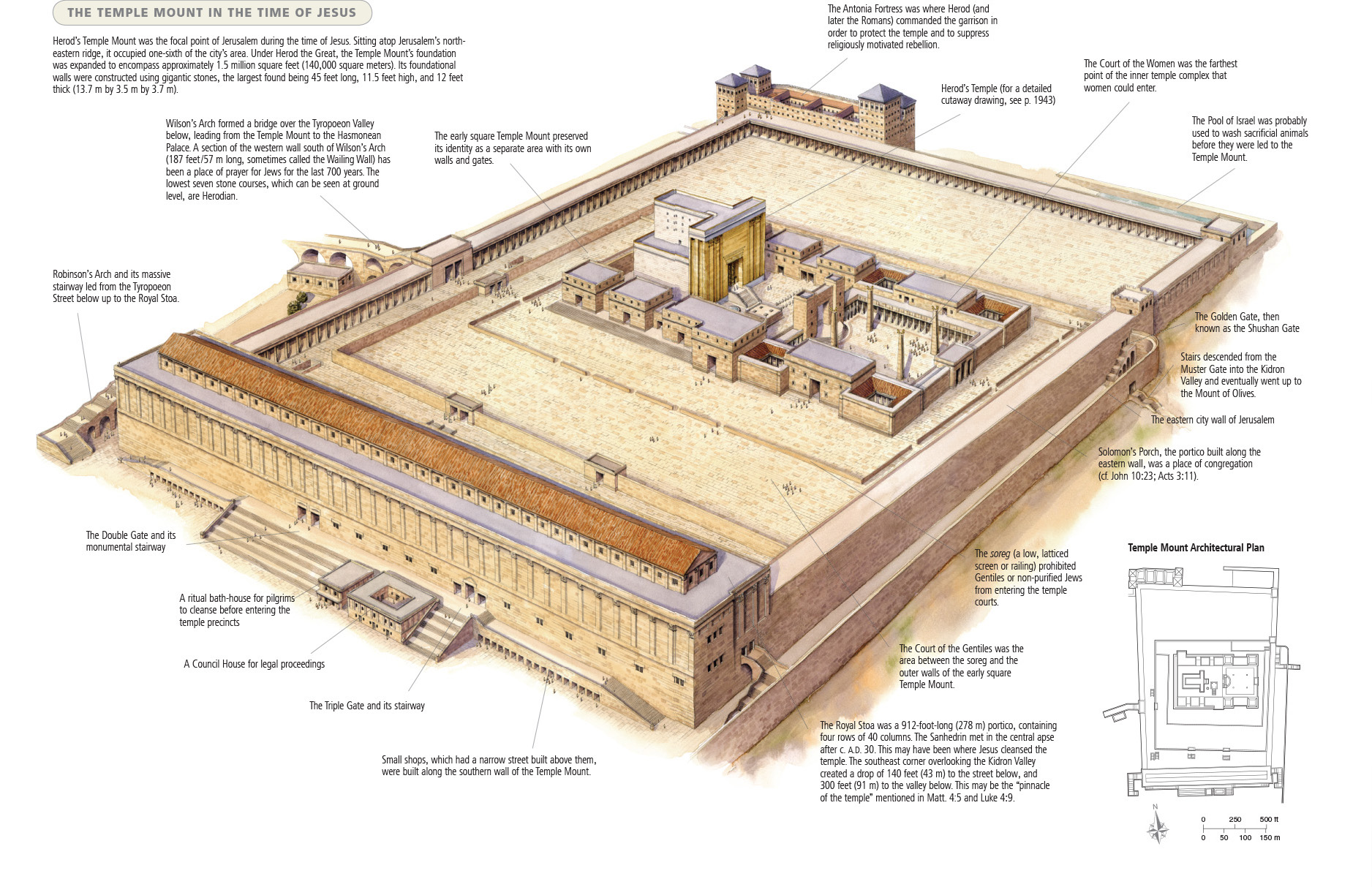
Herod's Temple - Click to enlarge
To appreciate Hebrews, one must understand the central place of the Temple in Jewish life. It was not merely a religious building; it was the heart of the nation's identity. Every major festival revolved around it. Pilgrims traveled from throughout the Roman Empire to worship there (Acts 2:5-11). The Temple represented God's dwelling among His covenant people.
The Temple standing in the days of Hebrews was the Second Temple, originally rebuilt after the Babylonian exile under Zerubbabel (Ezra 3-6). Beginning around 20–19 B.C., Herod the Great undertook a massive renovation and expansion, transforming it into one of the architectural wonders of the ancient world. Although commonly called "Herod's Temple," it remained the Second Temple, greatly enlarged and beautified.
The Temple complex covered approximately thirty-five acres. Massive retaining walls surrounded an expansive series of courts, porticoes, and buildings. The outer Court of the Gentiles was open to non-Jews, but beyond a dividing barrier only Jews could enter. Inscriptions warned Gentiles that crossing this barrier would result in death, a vivid reminder of the separation that existed under the Old Covenant (cf. Ephesians 2:11-18).
Moving inward, worshipers encountered the Court of Women, the Court of Israel, and the Court of the Priests. At the center stood the sanctuary itself, divided into the Holy Place and the Most Holy Place (Holy of Holies). Only priests entered the Holy Place regularly. Only the high priest entered the Most Holy Place, and then only once each year on the Day of Atonement (Leviticus 16; Hebrews 9:7).
The architecture itself
proclaimed distanceThe architecture itself proclaimed distance. Every curtain, wall, and restricted area declared that sinful humanity could not freely enter God's holy presence.
THE DAILY MINISTRY OF THE PRIESTS
The priesthood was the most visible expression of Israel's worship. Descended from Aaron, the priests represented the people before God and offered the sacrifices prescribed in the Law. By the first century there were thousands of priests organized into twenty-four rotating divisions (1 Chronicles 24:1-19; Luke 1:5). Each division served at the Temple for one week at a time, with all divisions participating during the major feasts.
Their duties were constant. Morning and evening burnt offerings were presented every day (Exodus 29:38-42). Incense was burned on the golden altar (Luke 1:8-10). The lamps of the golden lampstand were tended. The bread of the Presence was replaced each Sabbath (Leviticus 24:5-9). Additional sacrifices were offered for Sabbaths, new moons, feast days, vows, ceremonial cleansing, and the sins of individuals.
The Temple was therefore never quiet. Worshipers arrived continually with lambs, goats, bulls, doves, and grain offerings. Animals were examined, slain, and offered. Blood flowed freely. Fires burned continually upon the altar. The smell of smoke and sacrifice permeated the precincts.
This unending activity provides the backdrop for one of Hebrews' most striking contrasts: "Every priest stands daily ministering and offering time after time the same sacrifices, which can never take away sins; but He, having offered one sacrifice for sins for all time, sat down at the right hand of God" (Hebrews 10:11-12). The priests stood because their work was never complete. Christ sat down because His work was finished.
SACRIFICE: THE HEART OF THE OLD COVENANT
The entire sacrificial system rested upon a fundamental theological principle: "The life of the flesh is in the blood...for it is the blood by reason of the life that makes atonement" (Leviticus 17:11).
From the Passover lamb (Exodus 12:1-51) to the offerings prescribed in Leviticus, blood symbolized life given in the place of another. Every sacrifice testified that sin deserves death and that forgiveness requires the shedding of blood (Hebrews 9:22). (See discussion of the Lamb of God, the Passover Lamb)
The repetition of the sacrifices was itself
evidence of their provisional character.Yet the sacrifices of the Old Covenant possessed an inherent limitation. They were ordained by God and therefore effective for their covenantal purpose, but they could never permanently remove guilt or cleanse the conscience. Hebrews repeatedly emphasizes this point: "It is impossible for the blood of bulls and goats to take away sins" (Hebrews 10:4). The sacrifices were "a reminder of sins year by year" (Hebrews 10:3). They could "never...make perfect those who draw near" (Hebrews 10:1). The repetition of the sacrifices was itself evidence of their provisional character. If they had perfected the worshiper, they would have ceased to be offered (Hebrews 10:2). Instead, they pointed forward to the one sacrifice that truly could remove sin—the offering of Christ Himself.
THE DAY OF ATONEMENT: THE PIVOTAL BACKDROP OF HEBREWS
No single Old Testament ceremony is more important for understanding Hebrews than the Day of Atonement (Leviticus 16). Once each year, on the tenth day of the seventh month, the high priest entered the Most Holy Place with the blood of a sacrificial animal to make atonement for the sins of the nation. A second goat, the "scapegoat," symbolically bore Israel's sins into the wilderness, portraying the removal of guilt. (See discussion of the Day of Atonement in Leviticus 16:1-34)
Hebrews repeatedly draws upon this ceremony. Christ is presented as the true High Priest who entered not an earthly sanctuary but heaven itself, "once for all," with His own blood (Hebrews 9:11-12, 24-28). Unlike Aaron, He needed no sacrifice for His own sins (Hebrews 7:27). Unlike the annual ritual, His sacrifice never requires repetition. The Day of Atonement was therefore not an end in itself but a divinely designed foreshadowing of Christ's once-for-all atoning work.
A Congregation Under Pressure
Every New Testament book was written to real people living in real historical circumstances. Hebrews is no exception. Although the identity of the author remains uncertain, the recipients can be identified with remarkable confidence from the internal evidence of the epistle itself.
The author writes to people who know the Old Testament intimately, understand the priesthood and sacrificial system, recognize the significance of Melchizedek, appreciate the Day of Atonement, and instinctively understand the theological implications of the tabernacle. Throughout the book, the author assumes this knowledge rather than explaining it.
This immediately suggests that the readers were predominantly Jewish. Moreover, they were living during a time of increasing hostility toward followers of Jesus Christ. Their faith had become costly. The temptation before them was not to abandon religion altogether but to abandon Christ and retreat into the familiarity and social acceptance of first-century Judaism.
WHY WE KNOW THEY WERE JEWS
Although the letter never explicitly says, "This epistle is written to Jewish believers," the evidence is overwhelming.
1. Their familiarity with the Old Testament
Hebrews contains more than thirty direct quotations from the Old Testament and hundreds of allusions. These quotations come from the Law, the Prophets, and the Writings, especially Psalms, Genesis, Exodus, Deuteronomy, Jeremiah, Haggai, and the priestly legislation of Leviticus. The author rarely pauses to explain these passages. Instead, he assumes the readers understand them.
For example: Psalm 95 becomes the basis for the discussion of God's rest (Hebrews 3–4). Genesis 14 and Psalm 110 form the basis for the discussion of Melchizedek (Hebrews 7). Jeremiah 31 provides the theological foundation for the New Covenant (Hebrews 8). Leviticus 16 underlies the entire discussion of Christ's high-priestly ministry (Hebrews 9–10). Such arguments would have little force among readers unfamiliar with Israel's Scriptures.
2. Their familiarity with Temple worship
The readers understood: sacrifices, priests, altars, covenants, purification rites, tabernacle furnishings, the Holy Place, the Holy of Holies, the Day of Atonement, Again, these matters are assumed rather than explained.
3. Their temptation was unique
Notice what the author never says. He never warns them against returning to pagan temples. He never warns them against Zeus. He never warns them against emperor worship. Instead, every warning concerns returning to the Old Covenant. That temptation uniquely fits Jewish readers.
WERE THEY BELIEVERS?
This question has generated centuries of debate. The answer is not as simple as either "yes" or "no." Instead, the evidence suggests that the congregation contained professing believers, among whom were many genuine Christians and perhaps some who had not yet truly trusted Christ. The author wisely addresses the congregation corporately while recognizing that not every individual necessarily stood in the same spiritual condition.
EVIDENCE THAT MANY WERE TRUE BELIEVERS
The author repeatedly speaks in language appropriate only for Christians.
They had endured persecution - "Remember the former days, when, after being enlightened, you endured a great conflict of sufferings" (Hebrews 10:32).
Their faith had already cost them dearly. They had compassion for imprisoned believers. "You showed sympathy to the prisoners." (Hebrews 10:34) This reflects genuine Christian love.
They accepted persecution joyfully - "You accepted joyfully the seizure of your property." (Hebrews 10:34) Such joyful endurance reflects mature faith rather than mere intellectual agreement.
They ministered to fellow believers - "You have shown love toward His name, in having ministered and in still ministering to the saints." (Hebrews 6:10)
The author explicitly commends their love and service. Their leaders knew them personally. Chapter 13 reveals an established Christian community with recognized leaders. "Remember those who led you..." (Hebrews 13:7) "Obey your leaders..." (13:17) This has all the earmarks of a functioning local body of Christ.
EVIDENCE THAT SOME MAY NOT HAVE BEEN SAVED
At the same time, the warnings are extraordinarily serious.
The author repeatedly warns against:
- drifting away (Hebrews 2:1)
- departing from the living God (Hebrews 3:12)
- falling through unbelief (Hebrews 3:19)
- failing to enter God's rest (Hebrews 4:1)
- falling away (Hebrews 6:6)
- sinning willfully after receiving knowledge of the truth (Hebrews 10:26)
- refusing Him who speaks (Hebrews 12:25)
These warnings are addressed to the congregation as a whole. Why? Because no pastor can perfectly distinguish between genuine faith and mere profession. Jesus Himself ministered to mixed crowds. The churches addressed in Revelation undoubtedly contained both true believers and merely professing believers. The visible church has always included wheat and tares growing together until the harvest (Matthew 13:24–30, 36–43).
THE AUTHOR'S PASTORAL APPROACH
One remarkable feature of Hebrews is the balance between warning and encouragement. Immediately after one of the strongest warning passages in Scripture, the author writes: "But, beloved, we are convinced of better things concerning you, and things that accompany salvation..." (Hebrews 6:9)
Notice the contrast. He warns. Then he expresses confidence. The warning is real. His confidence is equally real. Likewise, after warning against willful sin in Hebrews 10:26–31, he reminds them of their earlier endurance and concludes: "But we are not of those who shrink back to destruction, but of those who have faith to the preserving of the soul." (10:39)
These statements indicate that the author viewed the congregation charitably while refusing to assume that every hearer had saving faith.
WHY THE WARNINGS ARE SO STRONG
Some ask, "If the readers were believers, why are the warnings so severe?" The answer lies in the pastoral nature of Hebrews. Throughout Scripture, God uses warnings as one of the means by which He preserves His people.
A mountain road illustrates the point. Guardrails do not imply that every driver will plunge into the canyon. Rather, they help prevent faithful drivers from doing so. Similarly, God's warnings are not empty threats. They are gracious means by which He calls His people to persevere in faith and exposes those whose attachment to Christ is merely external.
This does not diminish the seriousness of the warnings. They must never be softened or explained away. At the same time, they should be interpreted within the context of the entire epistle, where exhortations to persevere stand alongside repeated assurances of Christ's perfect priesthood, complete sacrifice, and unfailing intercession.
THE COST OF FOLLOWING CHRIST
The readers had paid a high price for identifying with Jesus.
- They endured public reproach (Hebrews 10:33).
- They suffered persecution (Hebrews 10:32).
- Some experienced imprisonment (Hebrews 10:34; Hebrews 13:3).
- Many lost property (Hebrews 10:34).
- Others undoubtedly lost standing within their families and synagogues.
For Jewish believers, confessing Jesus as Messiah often meant exclusion from the covenant community as they had known it. To return to the synagogue could restore social acceptance, family relationships, and a measure of personal safety. The pressure was therefore immense. The author does not minimize it. Instead, he directs their eyes to Christ, "who has passed through the heavens" (4:14), "who always lives to make intercession" (Hebrews 7:25), and who "endured the cross" before being exalted (Hebrews 12:2). The remedy for fear is not merely greater resolve but a greater vision of the Savior.
THE KEY TO UNDERSTANDING THE EPISTLE
The recipients were not asking, "Should we become atheists?" They were asking, "Is Jesus really worth losing everything?"
The answer of Hebrews is an emphatic yes.
Because:
- Christ is better than the prophets.
- Christ is better than the angels.
- Christ is better than Moses.
- Christ is better than Joshua.
- Christ is better than Aaron.
- Christ is better than the Levitical priesthood.
- Christ mediates a better covenant.
- Christ offered a better sacrifice.
- Christ provides direct access to God.
- Christ guarantees an eternal inheritance.
Therefore, there is no rational, spiritual, or eternal advantage in turning back.
A Hermeneutical Principle for Reading Hebrews
Before interpreting any warning passage, it is essential to remember the epistle's overall purpose. Hebrews is not a detached theological treatise but a pastoral sermon addressed to a covenant community under intense pressure. Its warnings are intended to awaken the complacent, expose empty profession, strengthen the wavering, and encourage genuine believers to persevere. The exhortations and assurances belong together.
This principle will guide our study of Hebrews 2, 3–4, 6, 10, and 12, helping us avoid two opposite errors: weakening the warnings so that they lose their force, or isolating them from the epistle's repeated emphasis on the sufficiency of Christ and the certainty of His saving work.