Ezra 7:2
Ezra 7:3
Ezra 7:4
Ezra 7:5
Ezra 7:6
Ezra 7:7
Ezra 7:8
Ezra 7:9
Ezra 7:10
Ezra 7:11
Ezra 7:12
Ezra 7:13
Ezra 7:14
Ezra 7:15
Ezra 7:16
Ezra 7:17
Ezra 7:18
Ezra 7:19
Ezra 7:20
Ezra 7:21
Ezra 7:22
Ezra 7:23
Ezra 7:24
Ezra 7:25
Ezra 7:26
Ezra 7:27
Ezra 7:28
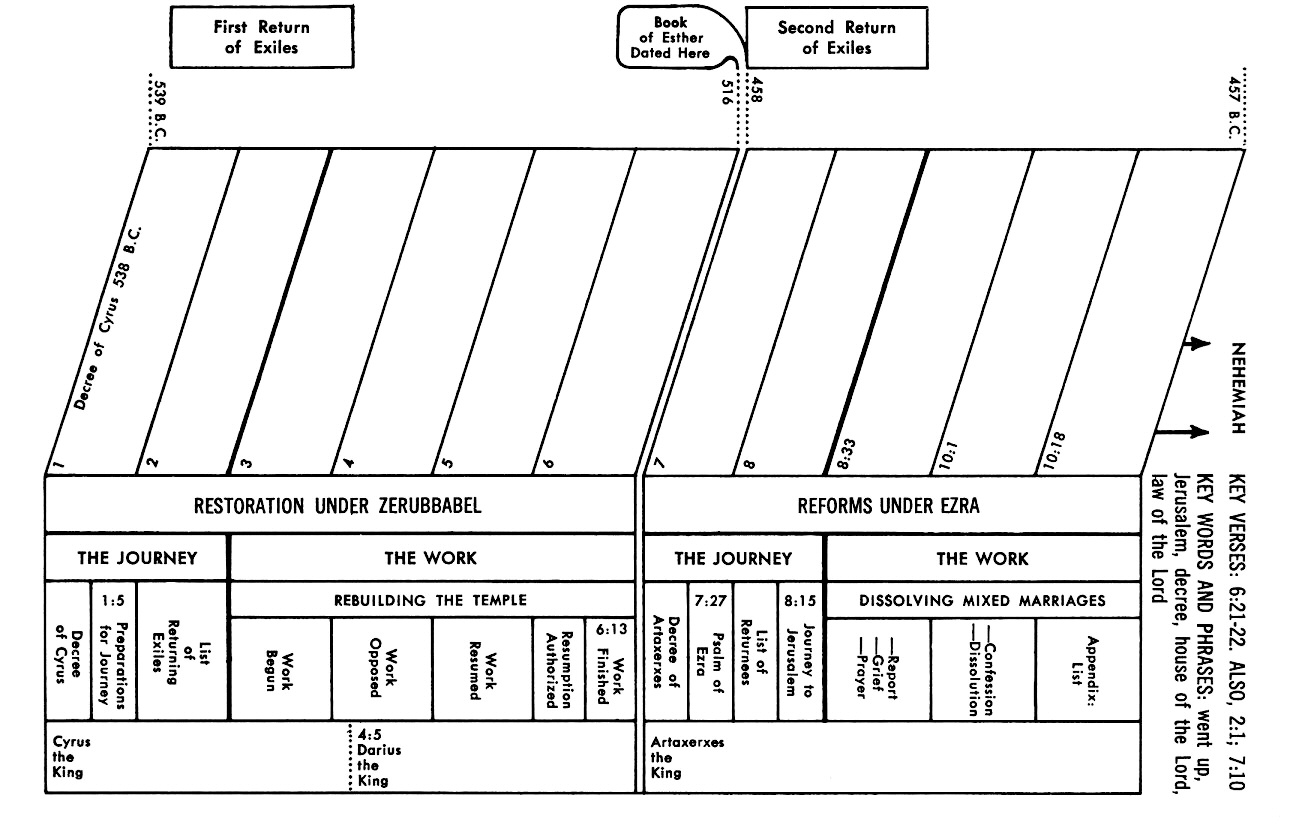
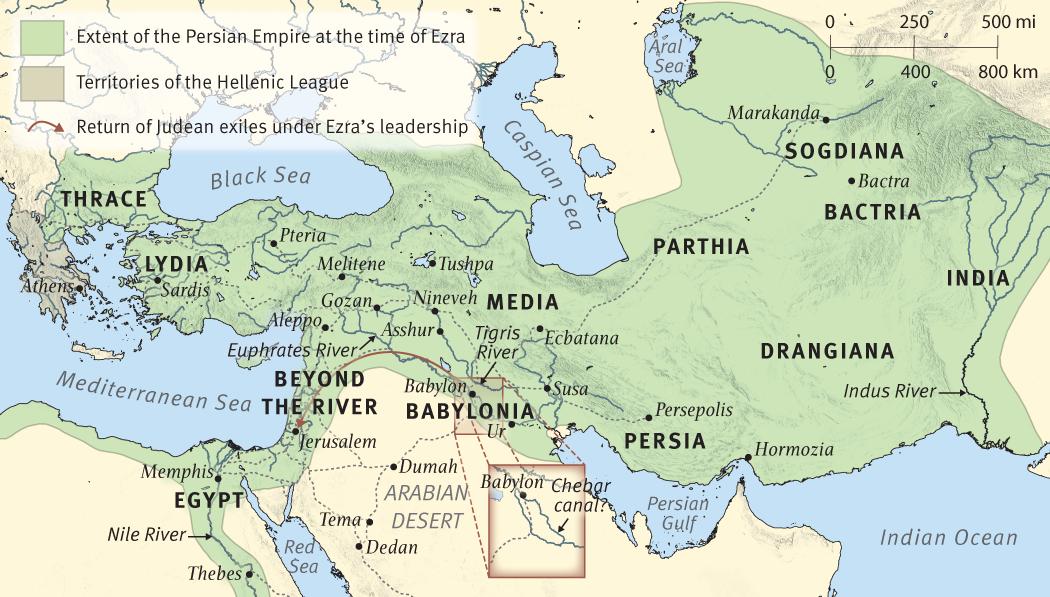
Source: ESV Maps
EZRA UNDER CONSTRUCTION
JUST A FEW NOTES NOW
WILL FINISH IF THE LORD WILLS
Ezra 7:1 Now after these things, in the reign of Artaxerxes king of Persia, there went up Ezra son of Seraiah, son of Azariah, son of Hilkiah,
Artaxerxes (KJV): Ezr 7:12,21 Ezr 6:14 Ne 2:1
Ezra (KJV): Ezr 7:10 Ezr 8:1-10:44 Ne 8:2-9
Seraiah (KJV): 2Ki 25:18 1Ch 6:4-14 1Ch 9:11 Ne 11:11 Jer 52:24-27
Hilkiah (KJV): 2Ki 22:4,8 2Ch 34:9,15
ENTER EZRA
THE SCRIBE
Now after these things, in the reign of Artaxerxes king of Persia, there went up Ezra son of Seraiah, son of Azariah, son of Hilkiah - After describing the completion and dedication of the temple in Ezra 6, the narrative makes a substantial chronological jump and introduces the man whose name the book bears. Ezra finally steps onto the stage of the story. The temple had been rebuilt, but God's people still needed spiritual renewal, and God had prepared a man whose ministry would center on the Word of God.
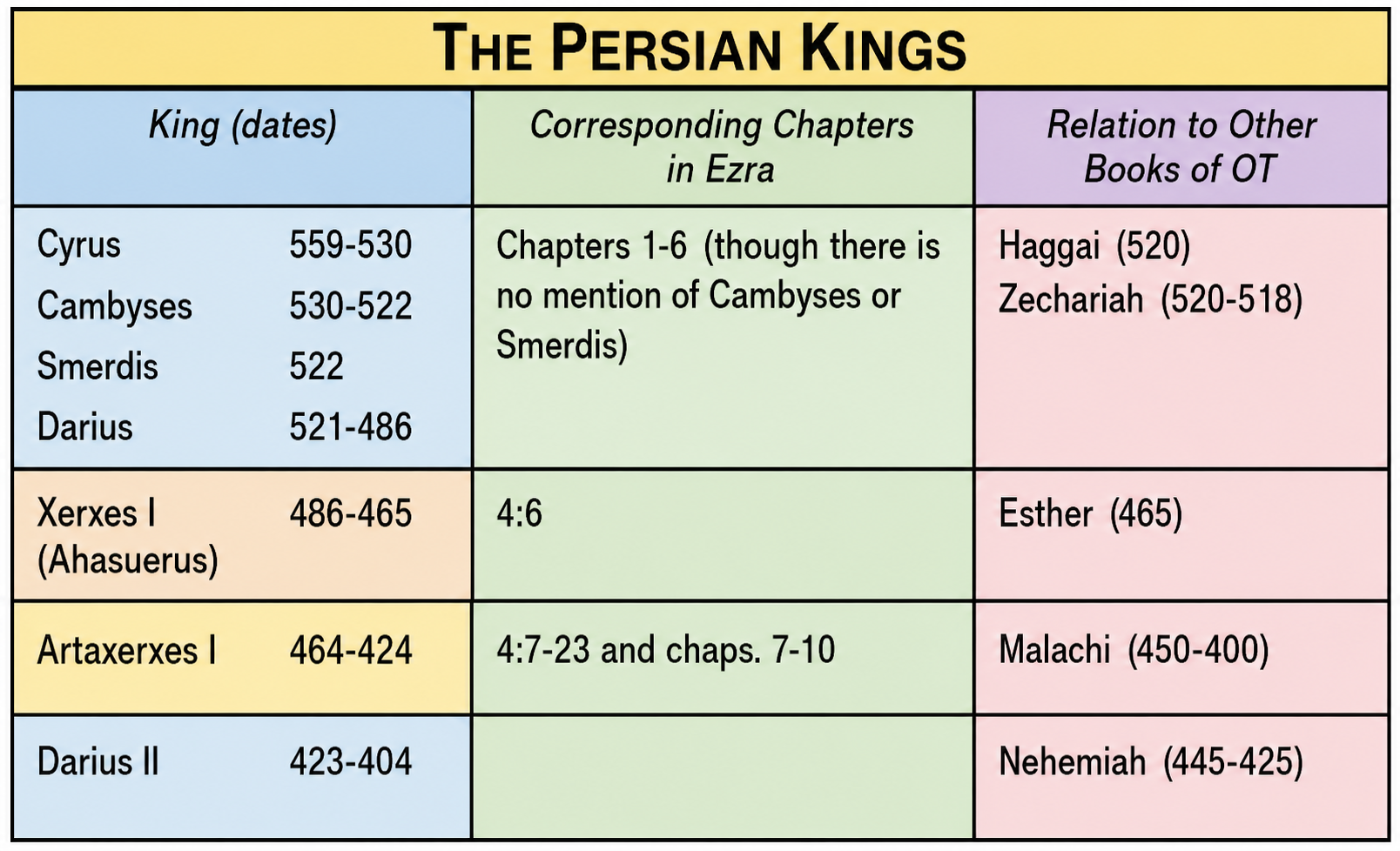
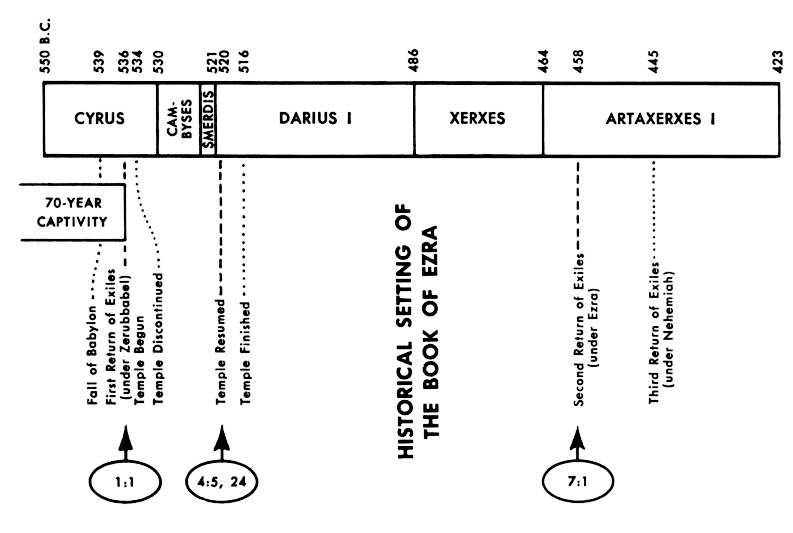
Now after these things - This phrase signals an important transition. The events of Ezra 6 occurred during the reign of Darius I. Ezra 7 takes us forward to the reign of Artaxerxes I. Ezra 7:7 identifies this as Artaxerxes' seventh year, generally dated to 458/457 B.C. Thus roughly 57–58 years separate the completion of the temple in 516/515 B.C. from Ezra's arrival in Jerusalem. That long interval is easy to miss when simply reading from Ezra 6 into Ezra 7. One generation of God's servants was passing from the scene. Zerubbabel, Jeshua, Haggai, and Zechariah had fulfilled their roles. But God's work did not end when God's workers passed from the scene.
God's workers change,
but God's work continues.
Adeney “There can be no reasonable doubt that his reference is to the son and successor of Xerxes – known by the Greeks as ‘Macrocheir,’ and by the Romans as ‘Longimanus’ – Artaxerxes ‘of the long hand,’ for this Artaxerxes alone enjoyed a sufficiently extended reign to include both the commencement of Ezra’s public work and the later scenes in the life of Nehemiah which the chronicler associates with the same king.” (See The Expositor's Bible: Ezra, Nehemiah, and Esther)
Yamauchi “If this was Artaxerxes I as the traditional view maintains, which we believe is correct, Ezra arrived in Palestine in 458 (457)…. The traditional view assumes a gap of almost sixty years between the events of chapter 6 and chapter 7.” (See The Expositor's Bible Commentary - Abridged Edition: ... - Page 50 or The Expositor's Bible Commentary: 1 Chronicles-Job - Page 433)
Henry Morris - Artaxerxes king of Persia. This Artaxerxes commissioned Ezra to go to Jerusalem and then, about thirteen years later, also sent Nehemiah (Ezra 7:8; Nehemiah 2:1). Since "Artaxerxes," as well as "Ahasuerus"--and even "Cyrus" and "Darius"--are believed by some scholars to be titles (like "Pharaoh") rather than personal names, he may or may not be the same man mentioned in Ezra 4:8. The temple was evidently completed about sixteen years after its foundations were laid, whereas there seems to be a much larger interval, sixty years or so, between the completion of the post-exilic temple and the period of Ezra and Nehemiah. The precise identifications of these Persian kings has long been controversial, even among conservative historians and Biblical scholars. Ezra. Ezra was both a scribe (Ezra 7:6) and a priest, being a direct descendant of "Aaron the chief priest" (Ezra 7:5). Hilkiah. Hilkiah, Ezra's great-grandfather, was the high priest (2 Kings 22:4) who led the pre-exilic revival under King Josiah.
Bob Utley - "Now after these things, in the reign of Artaxerxes king of Persia" The date seems to be 457 B.C. as derived from Ezra 7:7 (i.e., "the seventh year"). This means that there was a 57-58 year interval between the end of chapter 6 and the beginning of chapter 7. Chapter 6 deals with Darius I, who reigned from 522 to 486 B.C., while chapter 7 deals with Artaxerxes I, who reigned from 464 to 423 B.C. Modern scholarship has split over the chronological relationship between Ezra, Nehemiah, and Artaxerxes I or II. For a good brief summary and evaluation of the three theories see R. K. Harrison, Introduction to the Old Testament, pp. 193-197. The three theories are: (1) Artaxerxes I sent Ezra in the seventh year, 457 or 458 B.C. (2) Nehemiah precedes Ezra, who came to Jerusalem in 398 B.C., which was the seventh year of Artaxerxes II. (3) The letter (Ezra 7:11-26) is from the 37th year of Artaxerxes I or 428 B.C. This commentary follows theory #1. ▣ "Ezra" Ezra is the great-grandson of Seraiah (high priest who was killed in the fall of Jerusalem by Nebuchadnezzar, cf. 2 Kgs. 25:18-21; Jer. 52:24), who is also the ancestor of Jeshua, the High Priest who returned with Zerubabbel (cf. Ezra 2). Ezra 7-10 describes the personal memoirs of Ezra (cf. Neh. 8, 12). He is not mentioned in the first six chapters. His name means "help" (BDB 740) and may be a shortened form of Azariah, which means "YHWH has helped" (BDB 741). ▣ "Hilkiah" He was High Priest under King Josiah (cf. 2 Kgs. 22:4-14) and Seraiah was High Priest at the time of the Exile and was killed by Nebuchadnezzar (cf. 2 Kgs. 25:18).
Believer's Study Bible - The high priest when Jerusalem fell to the Babylonians was Seraiah, grandson of Hilkiah who discovered the "Book of the Law" (2 Kin. 22:8). Seraiah was executed by Nebuchadnezzar, but his son Jehozadak was taken captive (1 Chr. 6:8-15). It is unlikely that Ezra was literally the "son" of this Seraiah. Either "son" means "descendant" here (cf. Matt. 1:1), or Ezra's father was named for his grandfather Seraiah.
Ryrie - after these things. I.e., 57 years after the events of chap. 6. Seraiah. High priest at the time of deportation in 586 B.C. (2 Kings 25:18).
Matthew Henry - Ezra goes up to Jerusalem - Ezra 7:1-10. Ezra went from Babylon to Jerusalem, for the good of his country. The king was kind to him; he granted all his requests, whatever Ezra desired to enable him to serve his country. When he went, many went with him; he obtained favour from his king, by the Divine favour. Every creature is that to us, which God makes it to be. We must see the hand of God in the events that befal us, and acknowledge him with thankfulness.
Steven Cole - The Life that God Blesses (Ezra 7:1-28)
Over thirty years ago, I read a sermon that has impacted my life as much or more than any of the thousands of sermons that I have read. It is titled, “Expecting the Lord’s Blessing,” by the late Chinese evangelist Watchman Nee (in Twelve Baskets Full [Hong Kong Church Book Room], 2:48-64). That sermon, based on the Lord’s feeding of the 5,000, has affected the entire direction and motivation of my personal life and my ministry.
EDITORIAL NOTE ON WATCHMAN NEE - Much of Nee’s writing is helpful, but he has been criticized because of some of his views on sanctification and “the deeper life,” which seem to border on perfectionism. At times he seems to be trying to work out his own views as he was writing, so they are often unclear. He also speaks of what seem to be personal revelation, and he places much emphasis on personal spiritual experiences.
Nee hammers home a simple but profound truth: “Everything in our service for the Lord is dependent on His blessing” (p. 48). He observes that in the feeding of the 5,000, the supply in hand was totally inadequate to meet the demand, and yet the demand was met. He says, “The meeting of need is not dependent on the supply in hand, but on the blessing of the Lord resting on the supply” (ibid.). That leads Nee to ask a question that I want you to ponder seriously: “Do we really prize the Lord’s blessing?” (p. 49). Do you really want and seek God’s blessing on your personal life, your family, your service for the Lord, and on His church?
We all know the right answer to that question. Few would be so brazen as to say, “No, I don’t want God’s blessing. I’d rather try to make my own blessings apart from God!” But I don’t want you to give a knee-jerk “yes” answer just because it is the obviously correct answer. I want you to think about the implications of the question before you answer.
There are a number of men in Scripture whom God blessed: Abraham, Jacob, Joseph, and David are prominent examples. But Ezra is also a man whom God blessed, even though he is not so well known as those other men are. We first meet him in chapter 7 of the book that bears his name. There is a 57-58 year gap between the events in chapters 6 and 7. The temple had been rebuilt under the ministries of Zerubbabel and Jeshua, aided by the preaching of the prophets Haggai and Zechariah. The exiles that had returned to Israel during that first wave were either dead or very old by now. They had settled into the land and, as we will see, in many cases had begun to blend together with the pagans of the land. The walls of Jerusalem had not been rebuilt, leaving the city vulnerable to attack. God raised up Ezra and Nehemiah to bring spiritual reform to His people.
Both men were born in Babylon and had close connections with King Artaxerxes. No doubt they both enjoyed comfortable living conditions there. But both men were burdened with the low spiritual state of the exiles that had returned to the land. Both men were willing to give up their comfortable situations in Babylon and endure the hardship and hassles to bring reform to God’s people. But how could they accomplish this overwhelming task?
The answer occurs in a phrase that first occurs three times in our chapter, and then five times in the rest of Ezra and Nehemiah: God’s hand was on these men (Ezra 7:6, 9, 28; Ezra 8:18, 22, 31; Neh. 2:8, 18). God’s hand is another way of saying God’s blessing. God blessed these two men and their labors for Him. If we want His blessing or hand to rest on us, we would do well to study their lives. We could add more factors, but limiting ourselves to Ezra 7, we learn that…
To have God’s hand of blessing on us, we must study and obey His Word, with a view to teaching others and glorifying God for everything.
That theme is stated in Ezra 7:10, which explains why “the good hand of his God was upon him” (Ezra 7:9): “For Ezra had set his heart to study the law of the Lord, and to practice it, and to teach His statutes and ordinances in Israel.” The connection between Ezra and God’s Word is repeated no less than eight times (Ezra 7:6, 10, 11, 12, 14, 21, 25, and 26)! There is a definite correlation between our commitment to know and obey God’s Word and His hand of blessing being upon us.
1. All of us should seek God’s blessing on our lives above all else.
A. GOD’S BLESSING IS THE ONLY BLESSING THAT COUNTS BOTH FOR TIME AND FOR ETERNITY.
If you have God’s blessing on your life, you may die a painful martyr’s death in your twenties or you may live happily into your nineties. You may live in a physically impaired body like Joni Eareckson Tada or in a robust and healthy body. But either way, you will be irrepressibly joyous and successful in the true sense of the word if God’s hand of blessing rests on you.
The world’s blessings promise happiness but deliver ultimate emptiness and pain. Yet most people, and sadly, even many professing Christians, live for the world’s blessings. Last Sunday night, Marla and I had what was for us a first-time experience: we spent the night in Las Vegas. It was on the way to where we were going, the right distance for the driving time that we had, and the rooms were cheap. They hope to make up from your gambling what they discount on the price of the room. In our case they lost, but it was obvious that they were making out big time on everyone else!
It was amazing to see thousands of people sitting in the casinos of our hotel and in every hotel we walked by, playing the machines, hoping to strike it rich. I thought, “This isn’t just a freak occurrence! This happens all over this city every day and night of every week of every year!” Little old grannies and young people and foreigners were all feeding the machines in the hopes of hitting the jackpot. I wanted to scream, “What do you think you will gain if you win?” “What does it profit a man to gain the whole world, and forfeit his soul?” (Mark 8:36).
God’s blessing is the only blessing that counts both for time and eternity. If you gain and die with the world’s blessings, but lack God’s blessing, woe to you! You are poor indeed! If you live and die with God’s blessings, even though you lack what the world calls “blessing,” you are truly blessed! As John Newton wrote, “Fading is the world’s best pleasure, all its boasted pomp and show; Solid joys and lasting treasure none but Zion’s children know” (“Glorious Things of Thee are Spoken,” stanza 4).
B. GOD’S BLESSING FLOWS THROUGH FAMILY LINES.
Ezra 7:1-5 trace Ezra’s family lineage back through 16 forefathers to Aaron the chief priest, brother of Moses. There are a number of gaps in the list. Seraiah (7:1) was the high priest at the time of Nebuchadnezzar, who executed him about 130 years before (2 Kings 25:18-21). Thus Ezra was a great or great-great grandson of Seraiah. The point of the genealogy is to show that Ezra was qualified as a priest to teach God’s law. Also, it “prepares us to meet a man of considerable importance” (Derek Kidner, Ezra & Nehemiah, Tyndale Old Testament Commentaries [IVP], p. 62).
You may be thinking: “If God’s blessing flows through family lines, that’s not fair! What if I came from a godless family? What hope is there for me to experience God’s blessing?”
The answer is, first, never ask God to be fair with you! That’s a bad prayer! You want mercy, not fairness. But, second, there is great hope for you, because you can be the start of a long heritage of God’s blessing on your children and grandchildren. You can’t do anything about your ancestors, but you can do some things that will positively affect your descendants. As Psalm 128:1 promises, “How blessed is everyone who fears the Lord, who walks in His ways.” It goes on to show how the wife, children, and grandchildren of the man who fears the Lord will be blessed. No matter how rotten your upbringing, if you will follow the Lord, you will be blessed and you also will be the source of great blessing to your children and grandchildren, perhaps for many generations.
This genealogy also should serve as a warning to us who have been blessed with godly parents. Aaron had some sons who were consecrated as priests, but they did not obey the Lord and He struck them dead with fire from heaven (Lev. 10:1-3). Aaron also had a grandson, Phinehas (Ezra 7:5), who took bold action for God so that a plague was stopped among the Israelites. Israel had fallen into the insidious plot of Balaam, who counseled the Midianite king to seduce Israel into idolatry through intermarriage. An Israelite man brazenly had brought a Midianite woman into his tent in the sight of all Israel. Phinehas took a spear, went into the tent, and pierced them both through, probably while they were in the act of immorality!
As a result of Phinehas’ bold action, the Lord told Moses that He was giving to Phinehas His covenant of peace, and then added, “and it shall be for him and his descendants after him, a covenant of a perpetual priesthood, because he was jealous for his God” (Num. 25:13). Phinehas’ bold obedience resulted in blessing on his descendants for hundreds of years, right down to Ezra!
The lesson for us who have godly parents is, we can either disobey the Lord and deprive our descendants of God’s blessing, or we can be bold in obeying the Lord and bring His blessing on our descendants. But the point stands in Scripture, that God’s blessing flows through family lines. We never obey or sin in isolation. That sobering thought should motivate us to follow the Lord.
C. GOD’S BLESSING REFERS TO GOD’S DOING ABOVE AND BEYOND WHAT HUMAN EFFORT CAN PRODUCE OR EXPECT.
Just before He fed the 5,000, Jesus asked Philip, “Where are we to buy bread, so that these may eat?” John adds, “This He was saying to test him, for He Himself knew what He was intending to do” (John 6:5-6). Philip does a quick calculation and answers, “Two hundred denarii worth of bread is not sufficient for them, for everyone to receive a little.” Philip and the disciples didn’t have 200 denarii, which was about 200 days’ wages. Even if they could scrape together that much, it would not have been sufficient for everyone to receive just a little!
But Jesus could do far beyond what human calculations and effort could ever hope to do. The result was that the people all ate “as much as they wanted” (John 6:11), and they even gathered up twelve baskets full of leftovers, a full basket for each disciple!
God’s hand of blessing on Ezra is seen in that this pagan king “granted him all he requested” (Ezra 7:6). The king’s grant is stated in the letter that he gave to Ezra (Ezra 7:12-26, written in Aramaic). To summarize, the king granted five things: (1) He authorized Ezra to go to Jerusalem and insure that God’s law was both taught and observed (Ezra 7:14, 25). (2) He provided a generous grant to buy supplies and temple vessels for the temple worship (Ezra 7:15-20). (3) He commanded the treasurers in the provinces to supplement anything else that Ezra needed, up to 3¾ tons of silver, 600 bushels of wheat, 600 gallons of wine, 600 gallons of olive oil, and salt without limit (Ezra 7:21-22). (4) He exempted all temple officials and workers from taxation (Ezra 7:24). And, (5) he authorized Ezra to set up a judicial system to see that these laws were obeyed and that violators were properly punished (Ezra 7:25-26).
That is no doubt far more than Ezra dreamed that a pagan king would grant to him. From the king’s perspective, it was wise and cost-effective policy. He had already had trouble with Egypt revolting. He figured that if he granted political and religious self-governance to the Jews, they would live contentedly under his reign. Also, his superstitions motivated him: He didn’t want to incur the wrath of the God of heaven (Ezra 7:23). By providing generously for the people who followed this God to worship Him as He prescribed, Artaxerxes hoped that this God would be nice to him and his sons. But God used the king’s superstitions and political strategies to bless His people through His servant Ezra.
Ezra 7:27 makes it clear that it was none other than God who put it into the king’s heart to beautify the house of the Lord in Jerusalem. But Ezra still had to go and ask for it (7:6, Kidner, p. 62). Sometimes the Bible compresses a lot into a passing phrase (“the king granted him all he requested,” Ezra 7:6)! To go before such a powerful monarch and his counselors and powerful princes Ezra 7:28) and ask for such extravagant provisions for a subject people whom the king easily could have exterminated, took some courage! The source of Ezra’s strength is stated: “Thus I was strengthened according to the hand of the Lord my God upon me” (Ezra 7:28).
Thus we must work out our salvation with fear and trembling, and yet at the same time, it is God who is at work in us, both to will and to work for His good pleasure (Phil. 2:12-13). God’s blessing involves and requires our working, and yet it goes far beyond anything that we can do. I covet for my life, for my children and grandchildren, and for my ministry that God would work far beyond my effort, ability, or expectation. I hope that each of you will do the same. All of us should seek His blessing on our lives. But, how does that blessing come?
2. God’s blessings come to those who study and obey His Word.
I realize that Ezra was specially gifted for the role of teaching God’s Word, and that not all are so gifted. But whether you are gifted to teach in a formal way or not, you are nonetheless required to learn God’s Word so that you know how He wants you to live. Every Christian wants to live in a manner pleasing to the Lord. To do so, you must grow in your understanding of His Word.
Concerning Ezra’s emphasis on God’s Law, Derek Kidner (p. 62) says, “indeed it was he, more than any other man, who stamped Israel with its lasting character as the people of a book.” Kidner also observes about verse 6 that it does not share the doubts of modern critics about the antiquity (Moses) or the authority (the Lord) of the law, “nor does it see Ezra as a reviser or compiler. He is concerned with it as something given” (p. 62, italics his). Modern critics sit in judgment on God’s Word. The proper order is to allow the Word to sit in judgment on us!
Bible scholars believe that Ezra wrote the great Psalm 119, which extols God’s Word for 176 acrostic verses. Ezra 7:6 says that he was “skilled in the law of Moses.” The word “skilled” means “swift” or “ready,” implying that Ezra was quick to understand and put together the various parts of God’s Word. While giftedness has something to do with it, skill also requires effort and practice. Ezra had “set his heart to study the law of the Lord” (Ezra 7:10). It was a deliberate decision on his part to spend time in God’s Word.
Even if you are so gifted, studying God’s Word will not happen automatically and spontaneously. You have to discipline yourself to do it, and the minute you let up, other things will crowd out the Word. We all lead busy lives. We all have the same number of hours in our day. We all must make decisions about how we spend those hours. Will I read the paper, watch TV, play computer games, or get into God’s Word?
When you do spend time in the Word, make sure that your bottom line is obedience. Ezra “set his heart” not only to study God’s Word, but also “to practice it” (Ezra 7:10). It is nonsense to say that you want God’s blessing while you are knowingly living in disobedience to His Word. The goal of Bible study is not to fill our heads with facts, although facts are important. It is to change our hearts and lives into conformity to Jesus Christ. Note, by the way, that Artaxerxes trusted Ezra’s character and integrity to the extent that he gave him enormous material resources and told him to use it for the temple. If anything was left, he told him to do with it according to the will of his God (Ezra 7:18)! Ezra’s obedience was obvious to this pagan king. Our obedience should be obvious to those in the world who know us.
3. The study and obedience of God’s Word are the foundation for teaching it to others.
Again, not everyone is gifted to teach in a public setting. But whatever you have gleaned from God’s Word and incorporated into your daily life ought to be passed on to others whom God puts in your circle of influence. If you teach others what you know in your head but do not practice in your life, you become like the scribes and Pharisees of Jesus’ day—hypocrites. This does not mean that you must be perfect before you teach God’s Word, but it does call for the integrity of admitting your shortcomings and the honest effort to apply it to yourself.
One of the occupational hazards of preaching God’s Word each week is that I can easily fall into the trap of studying the Word so that I can tell everyone else how they should live, but not applying it to myself. I often think of what John Calvin said, “It would be better for the preacher to break his neck going into the pulpit than for him not to be the first to follow God” (cited by J. I. Packer, in a sermon in Anaheim, California, 3/5/86). Or, as Charles Spurgeon put it, “If any man’s life at home is unworthy, he should go several miles away before he stands up to preach, and then, when he stands up, he should say nothing” (The Soul Winner [Eerdmans], p. 174).
Thus we all should seek God’s blessing above all else. His blessings come to the ones who study and obey His Word. Such study and obedience are the foundation for imparting the Word to others, whether personally or in public settings. Finally,
4. The final end of God’s blessing should be our glorifying God for His abundant mercy.
After Ezra cites the incredible letter from King Artaxerxes, he breaks forth in praise to God (Ezra 7:27-28): “Blessed be the Lord, the God of our fathers, who has put such a thing as this in the king’s heart … and has extended lovingkindness to me…. Thus I was strengthened according to the hand of the Lord my God upon me….” Ezra didn’t take credit for devoting himself to studying God’s Word or for his bold presentation to the king. He gave all the credit to God for His abundant mercy. Any good that appears in anyone’s heart, whether in a believer’s heart or in the heart of a pagan king, comes from God who deserves all the glory. When God blesses us, our response should be to bless God for His great mercy in using such imperfect vessels as we are.
Conclusion
It is remarkable that God is pleased to be known in the Bible as the God of Jacob (Ps. 46:7, 10). Jacob was a man with many shortcomings and faults. He connived his brother out of the birthright. He bargained with God at Bethel, promising to follow Him if He would take care of him and bring him back safely to the land (Gen. 28:20-21). After his many years of trying to out-maneuver Laban, he returned to the land full of fear about what Esau might do to him. The night before he was to meet Esau, the Lord met him and wrestled with him, dislocating his hip so that Jacob always walked with a limp after the encounter.
But before dawn, the angel of God said to Jacob, “Let me go, for the dawn is breaking.” Jacob gave this great reply, “I will not let you go unless you bless me” (Gen. 32:26). The Lord did bless Jacob, the conniver, by changing his name to Israel, one who has wrestled with God and prevailed. The greatness of Jacob was not related to the strengths and abilities of Jacob. It was due to God’s hand of blessing resting on Jacob.
I hope that you will join Jacob and me in praying, “God, I won’t let You go until You bless me.” His blessing comes to those who study and obey His Word with a view to imparting what they have learned to others, all to the glory of God. May the hand of the Lord our God be upon you for His name’s sake!
Discussion Questions
- What does “God’s blessing” mean? Why is it crucial to define this concept biblically?
- Is it selfish to seek God’s blessing? How do His blessing on me and His ultimate glory fit together?
- Are all Christians required to be students of God’s Word? What about illiterate people or those who aren’t inclined toward book learning?
- In what sense are those who are not gifted as teachers nonetheless required to teach others?
Brian Bell - Ezra 7:1-28
- Intro:
- The Returns:
- Trip #1 49,897 people return [Zerubbabel leads, 538bc] [purpose rebuild temple]
- Trip #2 1,754 return [Ezra is in] (80 yrs. later) [purpose to rebuild the people]
- Trip #3 Nehemiah leads (14 yrs. later) [purpose to rebuild the wall]
- Ezra – A godly patriotic Jew. His name means Help.
- He was a devoted student of the Scriptures.
- He helped to restore the Law to the nation.
- He was a man of prayer (Ezra 8:21-23).
- He was greatly burdened for the spiritual welfare of his people (9:3,4).
- He does not come on the scene till now in chapter 7.
- The Returns:
- PREPARATIONS (Ezra 7:1-10) [Ezra 7:1-10 gives an overview of the next chapters]
- (Ezra 7:1) King Artaxerxes permitted Ezra to return to Jerusalem to assist the people in their spiritual needs.
- (Ezra 7:1-5) Why the need for Ezra’s genealogy here? To prove he was a priest from the family of Aaron (17th gen.)
- It took 4 months for this long journey from Babylon to Jerusalem.
- (Ezra 7:10) Here’s a life verse for us: Study it. Live it. Teach it.
- Martin Luther gave qualities and virtues of a good preacher: Able to teach in a right and orderly way. A good head. A good voice. A good memory. Knows when to stop. Is sure of his material and is diligent. Stakes body and life, goods and honor on it. Suffers himself to be vexed and flayed by everyone. Study it - He prepared his heart to seek/study the Law of the Lord, meaning he made it his purpose to know, then live, then teach the Scriptures.
- Of course it was possible for a scribe to simply stockpile info. Ezra made it his purpose to go beyond that.
- Next, he didn’t only crave it for himself but for the others.
- What was it to physically return to Israel’s land & not spiritually return to Israel’s God?
- Live it - Do it – listen to the contrast Jesus gives (Mt.23:3) Therefore whatever they (Pharisees) tell you to observe, that observe and do, but do not do according to their works; for they say, and do not do.
- Teach it - so many excuses…But I don’t know if I have the gift of teaching. We were all told to go make disciples, were we not?
- I think every Christian has the call to teach the fallen world about the savior & the saved world about walking with Him.
- When God needs an instrument, He will come to men/women of Ezra’s spirit. Are you of this spirit?
- Which of these 3 areas do you need to work on? [studying/living/teaching?]
- So far, what do we learn about Ezra here?
- PERMISSION (Ezra 7:11-26)
- (Ezra 7:12-26) This is written in Aramaic.
- Why change to Aramaic? - That’s what they spoke there.
- Chaldea = name of a district of so. Babylonia present day Iraq. They spoke & wrote Aramaic there because of the Assyrian domination there about 3 cent. Earlier.
- Noah’s boy Shem, has Aram, who becomes the Arameans living in Assyria (Syria).
- (Ezra 7:12) note: king of kings :0
- (Ezra 7:13) Any Jew could go up w/Ezra.
- (Ezra 7:15,16) They got to take a large freewill offering from Babylon to assist in the work of the Lord.
- Prov.16:11 When a man's ways please the LORD, He makes even his enemies to be at peace with him.
- (Ezra 7:20-22) They were even given an expense account from Darius.
- Eph.3:20 Now to Him who is able to do exceedingly abundantly above all that we ask or think.
- Hear are Daniels prayers & tears being answered. Read 9:16-19 msg
- (Ezra 7:22) Salt was without limit.
- Lev 2:13 And every offering of your grain offering you shall season with salt; you shall not allow the salt of the covenant of your God to be lacking from your grain offering. With all your offerings you shall offer salt.
- Note everything else in the vs. was meted out w/exactness, except the salt.
- Salt becomes a great example of Gods divine grace to our soul.
- The vinegar & gall of life are given to us w/such exactness, but the salt of grace…no measure seems to be made. Spurgeon
- (Ezra 7:23) Diligently - Work as if everything depended upon your work, and pray as if everything depended upon your prayer. William Booth
- (Ezra 7:25,26) Ezra’s task was to establish order & religious worship in the land.
- Understand there had been 57 years between the completion of the temple & the arrival of Ezra. (Book of Esther took place during that time)
- So, unfortunately the people had lapsed into sin.
- That makes Esther’s story even more interesting, that God saves the Jews from extinction at a time they were not walking with Him.
- It was Ezra’s job to bring them back to the Lord.
- Remember James’ admonition as he closes out his book w/Brethren, if anyone among you wanders from the truth, and someone turns him back, let him know that he who turns a sinner from the error of his way will save a soul from death and cover a multitude of sins.
- (Ezra 7:26) Here is the balanced life for the Christian…obedience to God & Country.
- No separation of church & state (Ezra 6:8). Tax exempt status (Ezra 7:24).
- (Ezra 7:12-26) This is written in Aramaic.
- PRAISE (Ezra 7:27,28)
- Ezra’s doxology shows just how appreciative he was to the Lord for answering his prayers.
Dale Ralph Davis - The Strong Hand (Ezra 7)
Strictly speaking, chapters 4-6 may belong together. There is a kind of idiom that occurs in 4:4 and in 6:22; in the former it is "making the hands of the people of Judah drop," and in the latter "to strengthen their hands." It is an idiom for discouragement/encouragement. It may have been placed deliberately near the beginning of this section and at the close of it in order to contrast in bookend style the state of the people of God. Here, however, we are treating chapters 5 and 6.
Note that the thematic element that binds these chapters together is the repeated reference to the "hand" of God: 7:6,9,28; 8:18,22,31.
I. Purpose: The Intent of Ezra - Ezra 7:1-10
A. Time (Ezra 7:1): "After these things"
The time is almost 60 years after the events narrated in chapter 6. Hence note how selective the writer is. Not all is told, but only what is significant for the people of God.1
Now the Book of Ezra places focus on different concerns: not only on restored worship (Ezra 1-6), but also on reformed life according to the law/word of God (Ezra 7-10).
B. Credentials (Ezra 7:1-5)
See 1 Chronicles 6:1-15. Also compare Ezra 2:59-63 on the importance of the documentation. See also Exod 6:14-27. Note the "gaps" in the genealogy.
C. Description (Ezra 7:6)
Mahir is the word used to describe Ezra as a scribe. It means quick, speedy, and hence skilled (as opposed to cumbersome).
Note that according to this verse the Llaw of Moses is a divine gift ("had given") and apparently complete. Here also we meet the first "hand of Yahweh" clause. So in this verse we have an assembly of realities: a completed revelation (torah of Moses) and an ongoing providence (hand of Yahweh), this latter operating in conjunction with human ingenuity/initiative ("all his request").
D. Date (Ezra 7:7-9)
Assuming the text to be correct, the date is 458 B.C. According to Clines, Ezra departed April 8 and arrived August 4 of 458. Another proposal is based on emending the text of verse 7 to the 37th year (428 B.C.). Others have construed the 7th year as that of Artaxerxes II (= 398 B.C.).
E. Design (Ezra 7:10)
Note the initial ki (for, because) in the Hebrew text. It explains why the good hand of his God was upon him (Ezra 7:9). God prospered the venture because of Ezra's purpose. This then is a warning against sloth and carelessness, and a sloppy view of grace.2
The subject comes before the verb in the Hebrew text, so there is some stress on "Ezra." On "setting the heart," the Hiphil of kun plus leb, see Psalm 78:8; 2 Chronicles 12:14 2 Chronicles 20:33(all negative); and 1 Samuel 7:3; 2 Chronicles 19:3; 2 Chronicles 30:19.
The language of verse 10 speaks of a ministry that is focused in its objective (set his heart) and intense in its labor (to seek). It is both anchored and vigorous, not content with a little ministerial piddling.
Note that Ezra purposes a total ministry: seek, do, teach; the cognitive, the experiential, and the didactic. Note that there are both academic and existential qualifications before teaching. The process, ever repeated, is: concentration (seek), consistency (do), communication (teach).
II. Permission: The Decree of the King - Ezra 7:11-26
This decree of Artaxerxes gives more people permission to return to Judah, v 13, but there are several other concerns/purposes:
A. Investigative (Ezra 7:14)
It was, in part, a "fact-finding" mission.
B. Liturgical (Ezra 7:15-23)
So much had to do with the worship of the house of God, whether it was silver and gold from royalty, from others in Babylon or from the exiles themselves (Ezra 7:15-16), or the delivery of utensils to be used in the temple (Ezra 7:19). Needs for worship materials, etc., were to be met from the royal treasury (Ezra 7:20-22), up to 3 ¾ tons of silver, 650 bushels of wheat, 600 gallons of wine, 600 gallons of oil (EBC).
Note the royal concern in verse 23. Maybe the king was trying to cover "all his religious bases." Still, according to Jeremiah 29:4-9, the exiles were to seek to benefit their captors and seek the welfare of the regime under which they existed.
C. Fiscal (Ezra 7:24)
The Judean "clergy" were to be kept tax-free. Perhaps this was a cautionary note to Artaxerxes' regional IRS agents.
D. Judicial (Ezra 7:25-26)
The people in Transeuphrates were probably the Jews living there, as the last line or two of verse 25 indicates. Note that in verse 26, the law of Ezra's God is also the law of the king.
In reference to verse 25b, Fensham (NICOT, 108) says: "Ezra's mission was to teach them afresh the law of God and to discipline them to live according to it." Hence, the focus of chapters 1-6 is the temple, while that of chapters 7-10 will be the torah.
III. Praise: The Grace of Yahweh - Ezra 7:27-28 Here is a doxology in praise of Yahweh's:
A. Covenant fidelity: "the God of our fathers"
The God of the Bible is always a God with a record in history, a God with a past - in which he has proven faithful to those to whom he has made promises.
B. Subtle sovereignty: "who has put such a thing as this in the king's heart"
King Artaxerxes may make the decree and grant the permission, but why does he do so? Because there is a King behind the king, one who turns the king's heart whichever way he wants (Prov 21:1). Yet Yahweh's sovereignty is not always blatant-frequently it is hidden and subtle; often Yahweh chooses to carry out his decrees through the decrees and decisions of the lesser kings and rulers of the earth.
C. Amazing goodness
Note in Ezra 7:28a the juxtaposition of the emphatic "and upon me" and all the biggies of the Persian empire (the king, his counselors, all the king's mighty princes). There is something astounding in how this miniscule Judean could command such favor from the bureaucracy of Persia! Ezra revels in the thought.
D. Providential encouragement, Ezra 7:28b
The verb is really "I strengthened myself." But note the following clause that anchors this encouragement in the discernible ways of God favoring his plans.
David Clines has a provocative comment/reflection on this text:
It must have been difficult for those whose spirit the Chronicler regarded as having been "stirred" (1:5) by God in the days of Cyrus to return to Palestine from Babylonia not to imagine themselves more dedicated to the will of God than those who remained behind in Babylon. But from the descendants of those who remained in Babylon - through indifference or lack of courage or simply because God had not "stirred" their spirit - came the two great leaders of the Judean community, Ezra and Nehemiah. Even within the Babylonian community that had failed to respond to God's act of deliverance from exile, and whose eyes were blind to the "new thing" God had done (Isa 42:18ff.; 43:19), it was possible for Ezra to "set his heart to study the law of the LORD, and to do it" (Ezr 7:10). For God's purposes included the Babylonian Jews also, and his directing and guarding "hand" (7:28) is upon a Jew who, from the point of view of the Judeans, has attained high office in the Persian government at the cost of "forgetting" Jerusalem (Ps 137:5f.). Should Ezra not have left the Persian court long before the seventh year of Artaxerxes to throw in his lot with the returned exiles? Many Judeans may well have thought so. But it is before his own Master that he stands or falls (Rom 14:4). God works out his purpose through men of mixed motives and characters not above suspicion - through ordinary human beings, that is to say. (Ezra, Nehemiah, Esther, New Century Bible Commentary, 107.)
Ezra 7:2 son of Shallum, son of Zadok, son of Ahitub,
- Zadok (KJV): 2Sa 8:17 1Ki 2:35
son of Shallum, son of Zadok, son of Ahitub, - Concerning Zadok the high priest, see 1 Chron. 6:8.
Yamauchi - The son of Zadok: “‘Zadok’ was a priest under David whom Solomon appointed chief priest in place of Abiathar, who supported the rebel Adonijah (1 Kings 1:7-8; 1 Kings 2:35). Ezekiel regarded the Zadokites as free from idolatry (Ezekiel 44:15-16). Zadokites held the office of high priest till 171 B.C. The Sadducees were named after Zadok, and the Qumran community looked for the restoration of the Zadokite priesthood.” (See The Expositor's Bible Commentary - Abridged Edition: ... - Page 50 or The Expositor's Bible Commentary: 1 Chronicles-Job - Page 433)
Bob Utley - 7:2-5 This is the ancestry of Ezra in an attempt to prove his lineage as a priest. We know from 1 Chr. 6:3-15 that several names have been left out (cf. NIDOTTE, vol. 2, p. 601). The length of the list denotes Ezra's importance (especially in later rabbinical Judaism). This clearly shows that the genealogies in the OT cannot be used to arrive at a date for certain events in the Bible (cf. Hard Sayings of the Bible, pp. 48-50
Ezra 7:3 son of Amariah, son of Azariah, son of Meraioth,
son of Amariah, son of Azariah, son of Meraioth,
Ezra 7:4 son of Zerahiah, son of Uzzi, son of Bukki,
son of Zerahiah, son of Uzzi, son of Bukki,
Ezra 7:5 son of Abishua, son of Phinehas, son of Eleazar, son of Aaron the chief priest.
- Phinehas (KJV): Ex 6:25 Nu 25:7-13 Nu 31:6 Jos 22:13,31 Jud 20:28 1Ch 6:4,50-52 Ps 106:30,31
- Eleazar (KJV): Lev 10:6,12,16 Nu 3:32 Nu 20:25-28 Nu 27:2 Nu 31:31,54 Jos 14:1 Jos 24:33 1Ch 24:1-6
- chief priest (KJV): 2Ch 19:11 2Ch 26:20 Heb 5:4
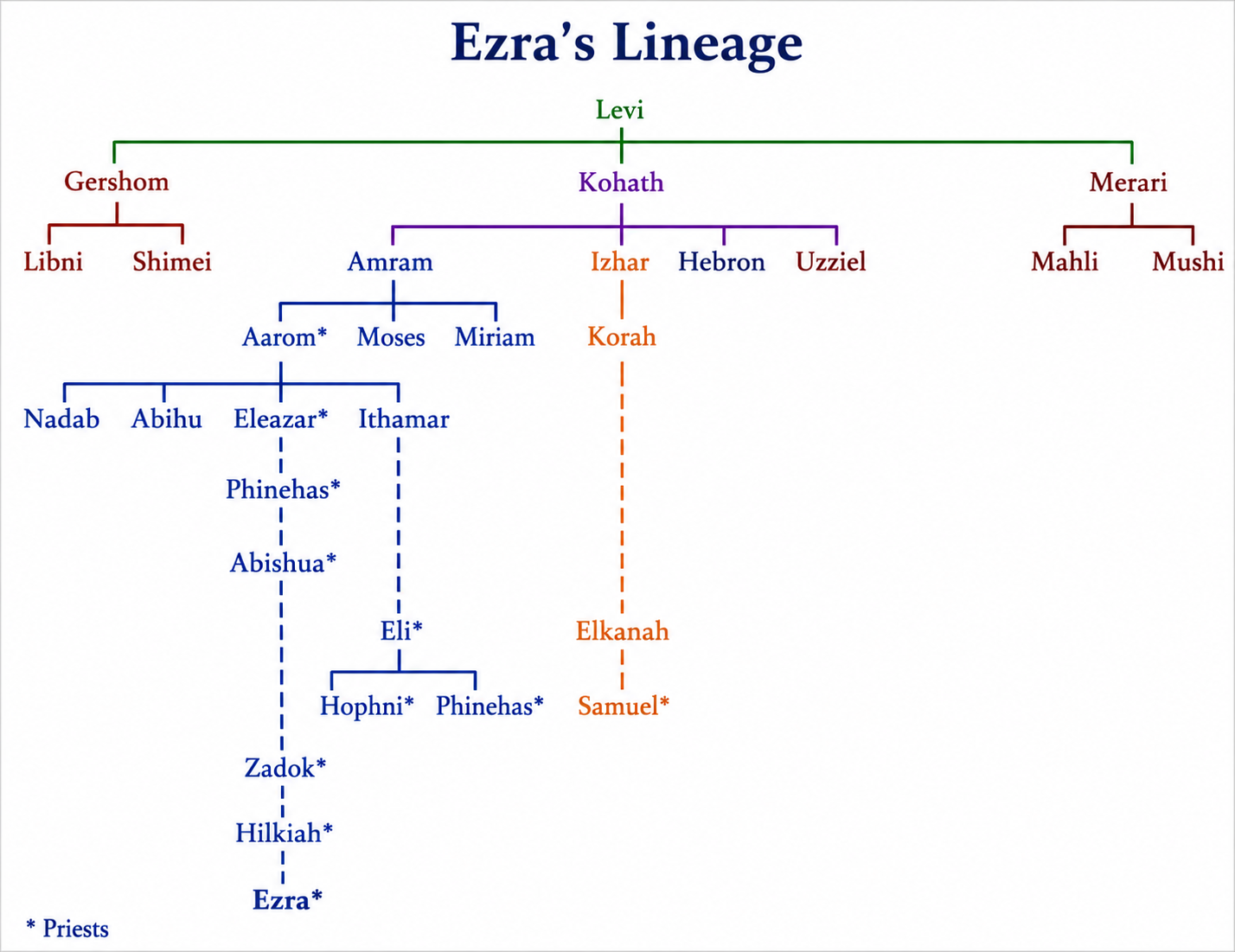
son of Abishua, son of Phinehas, son of Eleazar, son of Aaron the chief priest.
Ryrie - Ezra's abbreviated genealogy is traced back to Aaron.
Ezra 7:6 This Ezra went up from Babylon, and he was a scribe skilled in the law of Moses, which the LORD God of Israel had given; and the king granted him all he requested because the hand of the LORD his God was upon him.
- a ready (KJV): {sopher mahir} does not merely signify a speedy writer, or an excellent penman, but one eminently skilful in expounding the law, {sophro chochmo,} "a wise scribe," as the Syriac renders. Ezr 7:11,12,21 Ps 45:1 Mt 13:52
- scribe (KJV): Ne 8:4,9,13 Ne 12:26,36 Jer 8:8 1Co 1:20
- the law (KJV): De 4:5 De 28:1 Mt 28:20 1Co 15:1 1Th 4:1,2
- granted him (KJV): Ezr 7:11-26
- according to (KJV): Ezr 7:9,28 Ezr 6:22 Ezr 8:18,22,31 Ge 32:28 Ne 1:10,11 Ne 2:8,12,18 Ne 4:15 Pr 3:6 Isa 50:2 Isa 59:1
THE HAND OF GOD
UPON EZRA
This Ezra went up from Babylon - The words “This Ezra” bring the man introduced by his genealogy in Ezra 7:1–5 into the foreground. Ezra was living in Babylon, even though Babylon itself had already fallen to Persia. A substantial Jewish population remained there after the exile. Went up - Jerusalem is regularly described as a place to which one goes up, not simply because of compass direction but because of its elevation and, more importantly, its significance as the city where God had placed His name and temple.
Kidner on this Ezra - His name stands very high in Jewish tradition, where he came to be regarded as a second Moses, and indeed it was he, more than any other man, who stamped Israel with its lasting character as the people of a book.” (See Ezra and Nehemiah - Page 4)
and he was a scribe (sopher; LXX - grammateus - one skilled in Jewish law and theology) skilled in the law of Moses, which the LORD God of Israel had given; Ezra’s role as a scribe was critical to reinstate the nation since the leaders had to go back to the law and interpret it. This was no small task because many aspects of life had changed in the intervening 1,000 years since the law was first given. Tradition says Ezra had the law memorized and could write it from recall. Scribe translates soper,(caphar) a broad word that means, a ”recorder, scribe, secretary, or writer“ (e.g., 2 Sa 8:17; Es 3:12; Es 8:9; Ps 45:1). The word also referred to a learned man who could read and write (e.g., Jehudi in Je 36:23) and a learned man who could teach what he read in God’s Law. Ezra was called a ”teacher“ (sop_er) four times (Ezra 7:6, 11-12, 21; cf. v. 25). And he was called ”Ezra the scribe“ six times in Nehemiah (Neh 8:1, 4, 9, 13; 12:26, 36). ”Well versed“ translates mahér, which is rendered ”skillful“ in Ps 45:1. Skilled translates mahir,(LXX - tachus - quick, prompt, ready) which can describe someone who is quick, proficient, experienced, or highly competent.
Kidner - “In his case it is emphasised by the word skilled, or literally ‘rapid’ (cf. Psalm 45:1) – suggesting a quickness of grasp and ease of movement amid this complex material which was the fruit of the devoted study described in Ezra 7:10.” (See Ezra and Nehemiah - Page 4)
Bob Utley - "Ezra went up from Babylon" To the Jews going to Jerusalem was always spoken of as going up (theological imagery). Nehemiah left from the city of Susa; Ezra left from the city of Babylon. ▣ "a scribe skilled in the law of Moses" Ezra is an important figure in rabbinical Judaism (cf. II Esdras 14). He is seen as the compiler and editor of the entire OT, as well as the founder of the great synagogue (i.e., Sanhedrin), which historically begins the period of rabbinical Judaism (all sects except the Pharisees were wiped out in the fall of Jerusalem by the Roman general Titus in A.D. 70). The term "scribe" (BDB 708) referred to someone who could read and write and who had been trained in a particular area. Here it would refer to Hebrew OT literature and its interpretation (cf. Ezra 7:11). The scribes later became the rabbis in Jewish history. One would ask them a question and they would apply the teachings of Scripture to that issue (particularly the writings of Moses). See Scribes ▣ "skilled" This term (BDB 555) literally means "rapid," which is a metaphor for proficiency or enthusiasm (cf. Ps. 45:1; Isa. 16:5). ▣ "which the Lord God of Israel had given" This VERB (BDB 678, KB733, Qal PERFECT) seems to refer to the law of Moses, but it is equally true that God's equipping and gifting is also necessary for effective ministry (cf. Dan. 1:17-20). ▣ "because the hand of the Lord his God was upon him" This is a recurrent idiom (cf. Ezra 7:6, 9, 28; Ezra 8:18, 22, 31; Neh. 2:8, 18). Ezra's effectiveness was a combination of his yieldedness to God's will (cf. Ezra 7:10) and God's call and equipping for ministry. (See discussion of the Hand of the Lord)
Believer's Study Bible - The designation "scribe" identifies Ezra as a teacher, interpreter, and copier of the Law. Ezra is said to have determined to "seek the Law of the Lord, and to do it, and to teach statutes and ordinances in Israel" (v. 10). Ezra proclaims that "the Law of Moses" is more than merely a human code; it is a gift directly from God Himself. The nature of Ezra's request is not explicitly stated, but undoubtedly concerned God's empowerment for the ministry he sought.
and the king granted him (cf Pr 21:1) all he requested because (term of explanation) the hand of the LORD his God was upon him. This refrain occurs throughout the books of Ezra and Nehemiah. Its resounding presence assures the reader that it was not by the shrewd leadership skills of a few men that Judah, with its temple and walls, was rebuilt in the midst of a powerful Medo-Persian Empire. Rather it was the sovereign hand of the wise and powerful king of the universe that allowed this to happen.
Hand of the LORD - 37v - Exod. 9:3; Deut. 2:15; Jos. 4:24; Jos. 22:31; Jdg. 2:15; Ruth 1:13; 1 Sam. 5:6; 1 Sam. 5:9; 1 Sam. 7:13; 1 Sam. 12:15; 2 Sam. 24:14; 1 Ki. 18:46; 2 Ki. 3:15; 1 Chr. 21:13; Ezr. 7:6; Ezr. 7:28; Job 12:9; Ps. 75:8; Ps. 118:15; Ps. 118:16; Prov. 21:1; Isa. 19:16; Isa. 25:10; Isa. 41:20; Isa. 62:3; Isa. 66:14; Jer. 51:7; Ezek. 1:3; Ezek. 3:14; Ezek. 3:22; Ezek. 8:1; Ezek. 33:22; Ezek. 37:1; Ezek. 40:1; Lk. 1:66; Acts 11:21; Acts 13:11 (See discussion of Hand of the LORD)
Scribe (05613) sopher enumerator, secretary - derived from the same root as sāphar "to count," "to relate," refers to a "scribe" (2 Chr. 26:11; Neh. 13:13; Ps. 45:1; Jer. 52:25). (See also lengthy dictionary description) Sōpher also denotes a state scribe or secretary to the king (2 Sam. 8:17; 1 Ki. 4:3; 1 Chr. 27:32; Isa. 37:2; Jer. 36:12, 20f). In ancient times, the role of a scribe was an honored position because the one chosen for the role was educated in all aspects of the formal learning of literate culture. Sometimes scribes served as royal messengers (Est. 3:12; 8:9). Shebna, Hezekiah's "scribe," acted as an emissary to the invading Assyrian commander (Isa. 36:3). A secretary of David named Shavsha was probably a foreigner, since his father's name is omitted in the very exacting list of David's officers (1 Chr. 18:16). Furthermore, his name sounds foreign. Perhaps he was chosen because his duties involved handling correspondence with other countries. One of the royal scribes was a Levite (1 Chr. 24:6), and Ezra the priest acted as a secretary for Jewish matters during the exile (Neh. 8:1, 4, 9; 12:26, 36). The scribal art first became associated with the priesthood through Ezra's ministry, although priests surely performed such activities before his time. Ezra is also the first person given the title of scribe in the Bible (Ezra 7:6, 11). Sōphfir speaks of a secretary or scribe skilled in the law of Moses (Judg. 5:14; Ezra 7:6, 11). A class of specialists developed among the priests who were the custodians, teachers and interpreters of the Law. As documented in the intertestamental literature and the NT, they became a powerful religious and political force. In fact, there were whole families of scribes (1 Chr. 2:55). (Complete Biblical Library)
SOPHER - 52V - learned(1), office(1), scribe(39), scribe's(2), scribes(5), secretaries(1), secretary(2), writer(1), writing(2). Jdg. 5:14; 2 Sam. 8:17; 2 Sam. 20:25; 1 Ki. 4:3; 2 Ki. 12:10; 2 Ki. 18:18; 2 Ki. 18:37; 2 Ki. 19:2; 2 Ki. 22:3; 2 Ki. 22:8; 2 Ki. 22:9; 2 Ki. 22:10; 2 Ki. 22:12; 2 Ki. 25:19; 1 Chr. 2:55; 1 Chr. 18:16; 1 Chr. 24:6; 1 Chr. 27:32; 2 Chr. 24:11; 2 Chr. 26:11; 2 Chr. 34:13; 2 Chr. 34:15; 2 Chr. 34:18; 2 Chr. 34:20; Ezr. 7:6; Ezr. 7:11; Neh. 8:1; Neh. 8:4; Neh. 8:9; Neh. 8:13; Neh. 12:26; Neh. 12:36; Neh. 13:13; Est. 3:12; Est. 8:9; Ps. 45:1; Isa. 36:3; Isa. 36:22; Isa. 37:2; Jer. 8:8; Jer. 36:10; Jer. 36:12; Jer. 36:20; Jer. 36:21; Jer. 36:23; Jer. 36:26; Jer. 36:32; Jer. 37:15; Jer. 37:20; Jer. 52:25; Ezek. 9:2; Ezek. 9:3
SCRIBE A scribe (Hebrew: sopher; Greek: grammateus) was originally a royal secretary or recorder responsible for writing official documents, maintaining records, and handling administrative affairs (2 Sam. 8:17; 2 Sam 20:25; 1 Ki. 4:3; 2 Ki. 12:10; 2 Ki 18:37; 2 Ki 19:2; 1 Chr. 24:6; 1 Chr 27:32; Neh. 13:13; Jer. 36:12). Some scribes served as the king's secretaries, drafting decrees and overseeing financial and governmental records (2 Ki. 12:10-12; 2 Ki 22:1-14; Esth. 3:12; Esth 8:9), while others held military administrative positions, such as overseeing army conscription (2 Ki. 25:19; 2 Chr. 26:11). Following the Babylonian exile, the role increasingly shifted from civil administration to the study, preservation, copying, and teaching of God's Law. Ezra exemplifies this transition as "a skilled scribe in the Law of Moses" (Ezra 7:6, 10). By the time of the New Testament, scribes were recognized as professional interpreters and teachers of the Scriptures (Matt. 7:29; Matt 13:52; Matt 17:10; Matt 23:2-3), many of them associated with the Pharisees and members of the Sanhedrin (Matt. 2:4). Although entrusted with explaining God's Word, many opposed Jesus, repeatedly challenging Him with hostile questions, including bringing to Him the woman caught in adultery (John 8:3), conspiring in His arrest and condemnation (Matt. 26:3, 57; Matt 27:41; Mark 14:1; Luke 22:66), and earning His strongest rebukes for hypocrisy and external religion divorced from true righteousness (Matt. 5:20; Matt 9:3; Matt 12:38; Matt 15:1; Matt 16:21; Matt 20:18; Matt 21:15; Matt 23:1-36). Thus, Scripture presents the scribe as a figure whose role evolved from government official to biblical scholar and teacher, whose influence could be used either to preserve God's truth, as in Ezra's case, or to oppose the very Messiah to whom the Scriptures pointed.
G Campbell Morgan A ready scribe.—Ezra 7.6.
This phrase, descriptive of Ezra, is full of interest, as it is connected with the emergence of a new order in the life of the nation, that, namely, of the Scribes, which continued through four centuries, and was found in strength numerically, but in degeneracy spiritually, in the times of our Lord's earthly ministry. It is a good thing to study it at the fountain-head. During the time of the monarchy of the united Kingdom, a scribe was a royal secretary. During the later period of the disrupted kingdom, the scribes had become men whose business it was to copy and to study the laws of the nation. With Ezra a new order began. The scribes now became men whose chief business was to interpret the Law, and to apply it to all the changing conditions of life, and the new circumstances constantly arising. As messengers of the will of God, they took the place of the prophets, with this difference : instead of receiving new revelations they explained and applied the old. Of this new order, Ezra was at once the founder and type. The word "ready" does not apply to his pen, but to his mind. He was expert in exposition and application of the Law. The qualifications for such work are very clearly set out in the statement made concerning him in the tenth verse of this chapter. He "set his heart t o seek … to do … to teach."
Morgan - As messengers of the will of God, they took the place of the prophets, with this difference: instead of receiving new revelations, they explained and applied the old. Of this new order, Ezra was at once the founder and type.”
Ezra 7:7 Some of the sons of Israel and some of the priests, the Levites, the singers, the gatekeepers and the temple servants went up to Jerusalem in the seventh year of King Artaxerxes.
- the children (KJV): Ezr 8:1-14
- the Levites (KJV): Ezr 2:40,41 Ezr 8:15-20
- singers (KJV): 1Ch 6:31-48 1Ch 25:1-8
- porters (KJV): Ezr 2:42 1Ch 9:17-27 Ne 7:45
- Nethinims (KJV): Ezr 7:24 Ezr 2:43-70 Ezr 8:20 Ne 7:46-73 Ne 10:28
- Artaxerxes (KJV): Ezr 7:11,12 Ezr 6:14 Ezr 8:1 Ne 2:1
Some of the sons of Israel and some of the priests, the Levites, the singers, the gatekeepers and the temple servants (Nethinim) went up to Jerusalem in the seventh year of King Artaxerxes
Believer's Study Bible - The term "Nethinim" means "given (or dedicated) ones," a form of which describes the Levites themselves in Num. 3:9 and 8:16. Likely the Nethinim were assigned the more menial tasks in the total temple program, serving the Levites (cf. 7:24; 8:20). They may have originated from among foreigners captured in war (see 1 Chr. 9:2, note). Their postexilic history indicates that they were strong and active participants in the Ezra-Nehemiah reconstruction. Zerubbabel had 392 in his first return (538-37 B.C.). Ezra brought some 220 Nethinim in the second return (8:20). Artaxerxes specifically exempted them from tolls, custom, and tribute (7:24), as he exempted other religious orders in Israel's temple program. The Ophel district of Jerusalem, just across from the Water Gate, was their duly assigned living area (Neh. 3:26, 31; Neh 11:21).
Ryrie - temple servants. Descendants of the Gibeonites, they served in the Temple. See note on Josh. 9:20-21.
Bob Utley -There are several groups of people listed.
- Jews from all the tribes, except Levi (i.e., sons of Israel)
- Jews from the tribe of Levi
- priests
- Levites
- Levitical singers (cf. 1 Chr. 15:16)
- Levitical gatekeepers (cf. 1 Chr. 23:5)
- Levitical temple servants
(1) some are Levites
(2) some are foreigners captured by Israel and turned into temple servants (i.e., Nethinim, cf. Ezra 8:20; Jos. 9:23,27; 1 Chr. 9:2)
Ezra 7:8 He came to Jerusalem in the fifth month, which was in the seventh year of the king.
He came to Jerusalem in the fifth month, which was in the seventh year of the king.
Bob Utley - "in the fifth month, which was in the seventh year of the king" This would be July/August of 457 B.C.
Ryrie - 7:8-9 The journey covered 900 mi (1,448 km) and lasted four months, from Nisan 1 (Mar.-Apr.) to Ab 1 (July-Aug.) 458 B.C.
Yamauchi - Though the direct distance between Babylon and Jerusalem is about five hundred miles, the travelers would have had to traverse nine hundred miles, going northwest along the Euphrates River and then south.” (See The Expositor's Bible Commentary - Abridged Edition: ... - Page 50 or Ezra, Nehemiah, Esther - Page 193)
Ezra 7:9 For on the first of the first month he began to go up from Babylon; and on the first of the fifth month he came to Jerusalem, because the good hand of his God was upon him.
- began he to go up (KJV): Heb. was the foundation of the going up, according to. Ezr 7:6 Ne 2:8,18
For on the first of the first month he began to go up from Babylon; and on the first of the fifth month he came to Jerusalem, because the good hand of his God was upon him - See The Hand of the Lord
Bob Utley - "on the first month he began to go up from Babylon; and on the first of the fifth month he came to Jerusalem" The journey took approximately 4 months and covered about 900 miles. ▣ "the good hand of his God was upon him" Israel used anthropomorphic language to describe their God, though they knew He was spirit (e.g., 1 Kgs. 8:27) and did not take any physical form (cf. Exod. 20:4). These human metaphors quickly and adequately communicate God's personhood. God's hand was a metaphor for His activity in His creation. It is used both positively of God's presence and blessing as in this verse (cf. Exod. 4:17; Exod 13:3) or for His judgment.
Kidner - This little summary of the expedition gives no hint of the initial disappointment and delay, the fasting and prayer, and the dangers of such a journey, which will emerge in the full account. (See Ezra and Nehemiah - Page 5)
Ezra 7:10 For Ezra had set his heart to study the law of the LORD and to practice it, and to teach His statutes and ordinances in Israel.
TLB - This was because Ezra had determined to study and obey the laws of the Lord and to become a Bible teacher, teaching those laws to the people of Israel.
- prepared (KJV): 1Sa 7:3 1Ch 29:18 2Ch 12:14 2Ch 19:3 Job 11:13 Ps 10:17 Ps 57:7
- the law (KJV): Ezr 7:6 Ps 1:2 Ps 19:7 Ps 119:45,96-100
- to do it (KJV): De 16:12 Mt 5:19 Mt 7:24 Joh 13:17 Rev 22:14
- and to teach (KJV): Ezr 7:25 De 33:10 2Ch 17:8,9 2Ch 30:22 Ne 8:1-9 Mal 2:7 Ac 1:1 1Ti 3:2 2Ti 4:2 Tit 2:1,15
For Ezra had set his heart to study the law of the LORD and to practice it, and to teach His statutes and ordinances in Israel.
Trapp on heart - An instrument must be tuned ere it can be played upon; sour wines need good sweetening
SEE IN DEPTH DISCUSSION OF EZRA 7:10.
Bob Utley - "Ezra had set his heart" This VERB (BDB 465, KB 464, Hiphil PERFECT) means "be resolute," "be firm," "be prepared," "be committed to." Ezra responded to God's call and actively allowed God to equip him. This is the covenant concept -- God's initiation and provision, human faith response ▣ "to study. . .to practice. . .to teach" This is a chronologically appropriate order for studying (BDB 205), practicing (BDB 793 I), and then teaching (BDB 540) the truths of God. The first two are Qal INFINITIVE CONSTRUCTS and the last is a Peel INFINITIVE CONSTRUCT. Knowledge brings responsibility (cf. Luke 12:48) to God, to ourselves, and to others!
Our Calling in Christ - Tom Felton
Ezra had devoted himself to the study and observance of the Law of the Lord. Ezra 7:10
Ezra 7:6-11, 27-28
Ginnie Hislop received a standing ovation as she received her master’s degree in 2024. Why? It came eighty-four years after she’d completed her coursework! In 1941, she needed only to submit her thesis. But her then boyfriend, George, was suddenly called to serve during World War II. The two quickly married and headed to his army outpost—leaving Ginnie’s nearly realized degree behind. But after a lengthy pause, she was finally able to complete what she’d started.
Ezra was a student of Scripture—one who truly had an “advanced degree” in God’s law—who’d been waiting years to return to Jerusalem from exile in Babylon. “Ezra had devoted himself to the study and observance of the Law of the Lord, and to teaching its decrees” (Ezra 7:10). Zerubbabel and a group of Israelite exiles had been permitted to return from Babylon to rebuild the temple in Jerusalem decades earlier (2:1-2). And now Ezra, who had “the gracious hand of his God . . . on him” (7:9), was leading more exiles to Jerusalem. God would use him to reform and restore the proper worship of Him according to Scripture: “Ezra opened the book [of the Law]. All the people . . . bowed down and worshiped the Lord” (Nehemiah 8:5-6).
Ezra had to wait decades, but he completed his calling in God’s strength. In His power, let’s persist in finishing the work He has for us.
Reflect & Pray
What can you do to press on in your calling from God? How can you persist in His power and wisdom?
Dear God, please help me finish well what You’ve called me to do.
Learn how to find and follow your calling.
Today's Insights
The book of Ezra records the two returns of Jewish exiles from Babylon. Zerubbabel, a descendant of David (Matthew 1:12), led the first return of fifty thousand in 538 bc (Ezra 1-6). Some eighty years later (458 bc), Ezra led another five thousand in the second return (chs. 7-10). Nehemiah, a contemporary of Ezra, led the third return in 444 bc. Ezra, a priest and a teacher well-versed in the law of Moses, faithfully taught the Scriptures to the people, leading them in two spiritual renewals (Ezra 9-10; Nehemiah 8-10). As God helped Ezra, He can help us persist in finishing the work He has for us.
Ezra 7:10 No Appetite
January 2, 2014
Read: Nehemiah 8:1-12 | Bible in a Year: Genesis 4-6; Matthew 2
As newborn babes, desire the pure milk of the word, that you may grow thereby. —1 Peter 2:2-commentary
When I was battling a bad cold recently, I lost my appetite. I could go through an entire day without eating much food. Water would suffice. But I knew I couldn’t survive long on water alone. I needed to regain my appetite because my body needed nourishment.
When the people of Israel came back from exile in Babylon, their spiritual appetite was weak. They had departed from God and His ways. To get the people back to spiritual health, Nehemiah organized a Bible seminar, and Ezra was the teacher.
Ezra read from the book of the law of Moses from morning until midday, feeding the people with the truth of God (Neh. 8:3). And the people listened attentively. In fact, their appetite for God’s Word was so stirred that the family leaders and the priests and Levites met with Ezra the following day to study the law in greater detail because they wanted to understand it (Neh 8:13, cp Ezra 7:10-commentary).
When we feel estranged from God or spiritually weak, we can find spiritual nourishment from God’s Word. “As newborn babes, desire the pure milk of the word, that you may grow thereby” (1 Peter 2:2). Ask God to give you a renewed desire for relationship with Him, and begin feeding your heart, soul, and mind with His Word. (Reprinted by permission from Our Daily Bread Ministries. Please do not repost the full devotional without their permission.)
Break Thou the Bread of life, dear Lord, to me,
As Thou didst break the loaves beside the sea;
Beyond the sacred page I seek Thee, Lord,
My spirit pants for Thee, O living Word.
—Lathbury
Feeding on God’s Word
keeps us strong and healthy in the Lord.
Ezra had prepared his heart to seek the Law of the Lord, and to do it, and to teach statutes and ordinances in Israel. — Ezra 7:10
Today's Scripture: Ezra 9:5-15
Four pastors were discussing the merits of the various translations of the Bible. One liked a particular version best because of its simple, beautiful English. Another preferred a more scholarly edition because it was closer to the original Hebrew and Greek. Still another liked a contemporary version because of its up-to-date vocabulary.
The fourth minister was silent for a moment, then said, “I like my mother’s translation best.” Surprised, the other three men said they didn’t know his mother had translated the Bible. “Yes,” he replied. “She translated it into life, and it was the most convincing translation I ever saw.”
Instead of discussing translation preferences, this pastor reminded them that the most important focus should be learning God’s Word and doing it. That was the top priority of Ezra’s life. As a scribe, he studied the Law, obeyed it, and taught it to the Israelites (Ezra 7:10). For example, God commanded His people not to intermarry with neighboring nations who served pagan gods (9:1-2). Ezra confessed the nation’s sin to God (9:10-12) and corrected the people, who then repented (10:10-12).
Let’s follow Ezra’s example by seeking the Word of God and translating it into life. By: Anne Cetas (Reprinted by permission from Our Daily Bread Ministries. Please do not repost the full devotional without their permission.)
When we take time to read God's Word,
Our heart is filled with pleasure;
So let's relate the truth we've heard-
With others share the treasure.
-Hess
The best commentary on the Bible is a person who puts it into practice.
He came to Jerusalem, according to the good hand of his God upon him. —Ezra 7:9
Today's Scripture: Ezra 7:1-10,27-28
On Jack Borden’s 101st birthday, he awoke at 5 a.m., ate a hearty breakfast, and was at his law office by 6:30 ready to begin his day. When asked the secret of his long life, the practicing attorney smiled and quipped, “Not dying.”
But there’s more to it than that. Mr. Borden, who was baptized at age 11 in the Clear Fork of the Trinity River, told Fort Worth (Texas) Star-Telegram reporter David Casstevens, “I’m a firm believer that God has His hand in everything that happens. He is letting me live for some reason. I try to do the things that I believe He wants me to.”
Ezra the priest experienced the “good hand of his God upon him” when he led a delegation to Jerusalem to provide spiritual leadership for the former captives who were rebuilding the temple and the city (Ezra 7:9-10). Ezra found strength and courage in knowing that the Lord was with them each step of the way. “So I was encouraged, as the hand of the Lord my God was upon me; and I gathered leading men of Israel to go up with me” (v.28).
When we see the Lord’s hand in our lives, it brings forth a deep “Thank You” and a growing desire to do what He wants us to do.
By: David C. McCasland (Reprinted by permission from Our Daily Bread Ministries. Please do not repost the full devotional without their permission.)
Reflect & Pray
If we would view through eyes of faith The course of each new day, We’d quickly see God’s gracious hand In all that comes our way. —D. De Haan
If you know that God’s hand is in everything, you can leave everything in God’s hands.
Ezra 7
Ezra had devoted himself to the study and observance of the Law of the LORD. - Ezra 7:10
TODAY IN THE WORD
The explorer David Livingstone was commissioned by the Royal Geographical Society as Her Majesty’s Consul for the East Coast of Africa. The British authorities hoped that Livingstone’s discoveries would benefit their trading access and acquisitions, but Livingstone had spiritual interests, not just geographic ones. A committed Christian, he believed that his gifts as an explorer could aid the spread of missions work in Africa. And in fact, his work opened up much of central Africa to missionaries who opened schools, founded hospitals, and shared the gospel.
Sometimes God works both through the tainted motives of rulers and the talents of His followers, to accomplish His will. Today’s passage introduces Ezra, and we learn something significant about worldly and godly leadership.
This text opens with the phrase, “After these things” (v. 1). The Persian Empire left a tremendous historical record, and most scholars conclude that the phrase captures a time lapse of some fifty years between chapters 6 and 7. As we transition to Ezra’s ministry, we read of his godly heritage, verifying that he was a legitimate priest from Aaron’s line (vv. 1-5).
Ezra certainly didn’t coast on his family background. His commitment to the Word of the Lord is repeated several times: he was “well versed in the Law,” and he “had devoted himself to the study and observance of the Law” (vv. 6, 10). He was respected by the king, blessed by God, and dedicated to knowing and following the Lord’s teaching.
The commission by Artaxerxes reveals the provision for the work in Jerusalem that we’ve seen several times from the Persian kings. And Artaxerxes, like Darius, was motivated by his own self-interest. He wanted protection from every deity he thought he could please (v. 23). Worldly leadership views power as how much stuff it controls—how much money, how many people, or how many weapons. But Ezra wasn’t deceived by worldly leadership. He knew the source of his protection; he knew that ultimately God worked through this Persian leader to accomplish His own will (vv. 27-28).
APPLY THE WORD
Ezra understood that godly leadership is submission to the call of God. Therefore he could say, “I took courage” (v. 28). No matter what your gifts and talents are, you have been called to serve the Lord. And where God has called, He will also provide. That means that you can serve with confidence. Have you resisted “taking courage” because you were distracted by worldly leaders? Focus on what God has given you instead, knowing that no service for Him will be wasted.
Ezra 7:10 James Smith - EZRA: HIS LIFE AND CHARACTER.
"Thou canst not choose, but serve; man's lot is servitude,
But thou hast thus much choice—a bad lord or a good." —Trench.
Ezra, who led the second party from Babylon to Jerusalem, was both a priest and a scribe—a minister of the sanctuary and an exponent of the law of Moses. Between the first and second detachments there is a period of fifty-seven years. The last four chapters of the book are descriptive of the work done under the personal guidance of the author. In looking at this man and his work we shall find much that stimulates to faith and service. Observe his—
I. Preparation. "Ezra prepared his" heart to seek the law of the Lord, and to do it, and to teach" (Ezra 7:10). The preparations of the heart belong to man (Pr 16:1). When a man is prepared in his heart to seek the Word of God, to do it and to teach it, a great work of revival has already begun. The heart must first be put right with God before the life can become useful for Him. These preparations belong to man, but the revelations belong to God. Christ's first message was Repent, for the Kingdom of Heaven is at hand. Change your mind; prepare your heart for that new order of things which has, in grace, come within your reach.
II. Qualification. "The hand of the Lord his God was upon him" (Ezra 7:6). Because of this invisible and powerful hand upon him, the king granted him "all his requests." The mighty hand of God's guiding and upholding power came upon him after he had prepared his heart to seek those things by which His Name might be glorified. The All-conquering Hand is the accompaniment of the prepared heart. We think of the disciples of Christ preparing their hearts during those ten days in which they waited for the promised power of the Holy Ghost. All who are filled with the Spirit have the hand of the Lord their God upon them.
III. Provision. "I, Artaxerxes the king, do make a decree… that whatsoever Ezra shall require of you, it be done speedily, unto an hundred talents of silver" (Ezra 7:21, 22). Here he had the assurance that all his wants would be supplied. Ezra prepared his heart, and God in this singular manner prepared against all his needs. He never sends His servants a warfare on their own charges. The measure of supply was to be unto even "an hundred talents of silver" (22,000), but the measure of our supply is "according to His riches in glory by Christ Jesus." Unsearchable riches. "Look unto Me, and be ye saved" from your poverty and powerlessness.
IV. Commission. "And thou, Ezra, after the wisdom of thy God, that is in thy hand… teach ye them that know not the laws of thy God" (Ezra 7:25). Those who have the wisdom of God in their hearts must become the "messengers of the Lord of Hosts" (Mal. 2:7). The counsel of this heathen king would put many professing Christians and religious teachers to shame. If God is to have a chance of gaining moral victories among those who know not His will, surely His Word must be plainly taught to them by those who have experienced the power of it in their own hearts and lives. Faith cometh by hearing, and hearing by the Word of God. The hearing that stirs up faith in God is not the hearing of the words of man's wisdom, but the hearing of that word which is the wisdom of God. Preach the Word.
V. Consistency. "I was ashamed to require of the king soldiers and horsemen to help us against the enemy in the way, because we had spoken unto the king, saying, The hand of our God is upon all them for good that seek Him" (Ezra 8:21, 22) To say the least, this is the simple honesty of faith If our faith is in God, and we know that the cause is His, why should we beg for the patronage of men? Our life should be consistent with our testimony. To preach "faith in God," and be found catering for the favors of the ungodly, is to make the religion of Jesus Christ to stink in the nostrils of reasonable men. If the Lord be God, follow Him. But what did Ezra do? He made it a matter of special prayer, and the Lord of Hosts answered him (Ezra 8:23). Cast all your care upon Him.
VI. Devotedness. "The holy seed have mingled themselves with the people of those lands… When I heard this thing I rent my garment and my mantle, and plucked off the hair of my head, and sat down appalled" (Ezra 9:2, 3). This was a violation of the Divine command (Deut. 7:3), and the tidings of it came to Ezra as a heart-breaking sorrow. He felt it the more keenly because of the warmth of his own heart towards the Word and ways of God. The depth of our sorrow over the sins of others will be according to the depth and reality of our sympathy with the cause of God. For a people, separated unto God (Deut. 7:6), to be unequally yoked together with unbelievers, is enough to make every true servant of Christ sit down astonied. It is a paralysing and soul-sickening sight If we had more of Ezra's devotedness we would know more about the sufferings of Christ (Jer. 8:21). What else could he do than fall upon his knees and spread out the case before God (Ezra 9:5-15), for he felt that as long as they lived in sin they could not stand accepted before Him (Ezra 9:15).
VII. Success. "Then all the congregation answered, As thou hast said, so must we do" (Ezra 10:12). And the guilty priests "gave their hands that they would put away their wives" (v. 19). The earnest prayer and faithful testimony of this consecrated scribe prevailed, and a great victory was won for God in the spiritual uplifting of the people. Some of those "strange wives" may have been as dear to some of those men as an eye or a right hand, but they must be cut off. The more closely the affections become entwined with any forbidden object, the more fatal is the snare. The secret of Ezra's success is an open one, and is within the reach of every servant of Christ—true-hearted, whole-hearted loyalty to God's Word and work. Have faith in God; the prayer of faith shall save.
Effective Witness - Anne Tissier
Ezra had devoted himself to the study and observance of the Law of the Lord . . . and to teaching its decrees. Ezra 7:10
Ezra 7:1–10
“Hard-hearted! Barbaric! Unreachable!”
It was a harsh description of the seventh-century Northumbrians, but one that stirred Aidan’s heart. Sensing God’s call to love them, he walked the lanes and talked with peasants, gently explaining the Christian faith and living a sacrificial life.
Aidan was a man of deep prayer, spending hours meditating on Scripture on the barren island of Lindisfarne. Cut off from the Northumbrian mainland twice daily by tides, he equipped himself in the stillness for his witness and work. His ministry became so effective that Christian communities blossomed among the formerly stubborn Northumbrians.
I wonder if Aidan was following the example of Ezra the priest. Did he learn a vital principle from him? Returning to Jerusalem from Babylonian exile, Ezra met with a people who had lapsed in their commitment to God. But “the hand of the Lord his God was on him” (Ezra 7:6), a striking description of God’s favour on the influence of his teaching. Like Aidan, his effective ministry to instruct, edify and reform others was empowered first through what he studied in Scripture, and then put into practice himself (v. 10).
We don’t need to be a priest, church leader or modern-day theologian to enhance the effectiveness of our witness. As we listen with open hearts while reading God’s Word, and actively let it shape our attitudes and behaviour, His “gracious hand” (v. 9) of favour will enhance our influence too.
Reflect & Pray
How have you put into practice what God has shown you in His Word this week? How have you seen this impacting others who aren’t yet in a relationship with God?
Loving God, please teach me how to live the life of Your Word so that the authenticity of what I say and do may lead others to You.
Today's Insights - The book of Ezra, one of the Old Testament books of history, is closely linked with Nehemiah. The two books tell the story of the return of the southern kingdom of Judah from their Babylonian captivity. Ezra's concern was the rebuilding of the temple in Jerusalem, while Nehemiah focused on the rebuilding of the city walls.
Ezra 7:1-10,27-28 Seeing God’s Hand
September 6, 2010
Seeing God’s Hand
Read: Ezra 7:1-10,27-28 | Bible in a Year: Psalms 148-150; 1 Corinthians 15:29-58
He came to Jerusalem, according to the good hand of his God upon him. —Ezra 7:9
On Jack Borden’s 101st birthday, he awoke at 5 a.m., ate a hearty breakfast, and was at his law office by 6:30 ready to begin his day. When asked the secret of his long life, the practicing attorney smiled and quipped, “Not dying.”
But there’s more to it than that. Mr. Borden, who was baptized at age 11 in the Clear Fork of the Trinity River, told Fort Worth (Texas) Star-Telegram reporter David Casstevens, “I’m a firm believer that God has His hand in everything that happens. He is letting me live for some reason. I try to do the things that I believe He wants me to.”
Ezra the priest experienced the “good hand of his God upon him” when he led a delegation to Jerusalem to provide spiritual leadership for the former captives who were rebuilding the temple and the city (Ezra 7:9-10). Ezra found strength and courage in knowing that the Lord was with them each step of the way. “So I was encouraged, as the hand of the Lord my God was upon me; and I gathered leading men of Israel to go up with me” (Ezra 7:28).
When we see the Lord’s hand in our lives, it brings forth a deep “Thank You” and a growing desire to do what He wants us to do.
If we would view through eyes of faith
The course of each new day,
We’d quickly see God’s gracious hand
In all that comes our way.
—D. De Haan
If you know that God’s hand is in everything,
you can leave everything in God’s hands.
Ezra 7:11 Now this is the copy of the decree which King Artaxerxes gave to Ezra the priest, the scribe, learned in the words of the commandments of the LORD and His statutes to Israel:
- the copy (KJV): Ezr 4:11 Ezr 5:6
- a scribe (KJV): Ezr 7:6 Mt 23:2,13 Mk 7:1-13
Now this is the copy of the decree which King Artaxerxes gave to Ezra the priest, the scribe, learned in the words of the commandments of the LORD and His statutes to Israel
Henry Morris - king Artaxerxes. This king was the successor to King Ahasuerus, who was king at the time of Esther and Mordecai (Esther 1:1). Thus, the events described in the book of Esther took place during the approximate sixty years between Ezra 6, when the temple is completed, and Ezra 7, when Ezra himself first comes on the scene.
Ryrie - Artaxerxes's letter (through v. 26) extended generous support to the Jews, a small price to pay for peace in that part of his empire (v. 23).
Matthew Henry - The commission to Ezra - Ezra 7: 11-26. The liberality of heathen kings to support the worship of God, reproached the conduct of many kings of Judah, and will rise up in judgment against the covetousness of wealthy professed Christians, who will not promote the cause of God. But the weapons of Christian ministers are not carnal. Faithful preaching, holy lives, fervent prayers, and patient suffering when called to it, are the means to bring men into obedience to Christ.
Bob Utley - Notice the different ways to identify Ezra: (1) the priest (2) the scribe (3) the one learned in the words of the commandments of the Lord
Ezra 7:11-28
Those who honor me I will honor. - 1 Samuel 2:30
TODAY IN THE WORD
According to a recent newspaper story, some local governments of the United States have come up with a variation on the idea of prepaid expenses. The new initiative includes prepaid traffic tickets, which means putting money on deposit with the local authorities so that if you are stopped for speeding, your ticket has already been paid. Some people, bothered by the idea, see it as giving drivers permission to speed.
Those who object to the concept of prepaid speeding tickets have a point. Human nature is such that it’s hard to be good and it’s easy to abuse a privilege when the bill has already been paid. All of the expenses for Ezra’s trip back to Jerusalem, and his ongoing needs in Israel (and then some), were “prepaid” by the generosity of the Persian king Artaxerxes. Ezra carried with him a sizable wealth that had been entrusted to his care, and he didn’t abuse this privilege.
That’s worth noting, because the letter of authorization that Artaxerxes gave to Ezra also granted him and his fellow Jews permission to use “the rest of the silver and gold” in any way they chose. But the king added that this must be done “in accordance with the will of your God,” a condition that we can safely say Ezra would have followed anyway because of his faithfulness to the Lord.
TODAY ALONG THE WAY
How much can God trust you with, and how far can He trust you with it? We’re not necessarily talking about money, although that’s part of a Christian’s life management. The three Ts–time, talent, and treasure–are a good way to summarize the “stuff” of life that God has given us. Are you using these gifts to bless Him and serve others? Paul said, “It is required that those who have been given a trust must prove faithful” (1 Cor. 4:2). Turn this verse into a prayer that God will help you be faithful with all of your resources.
Ezra 7:12 “Artaxerxes, king of kings, to Ezra the priest, the scribe of the law of the God of heaven, perfect peace. And now
- Artaxerxes (KJV): The title of the king would, in Persian, run thus: {Ardsheer shahinshah,} or {padshah,} "Ardsheer, king of kings," i.e., great or supreme king or emperor. 1Ki 4:24 1Ki 20:1 Isa 10:8 Eze 26:7 Da 2:37,47 1Ti 6:15 Rev 17:14 Rev 19:16
- unto Ezra (KJV): etc. or, to Ezra the priest, a perfect scribe of the law of the God of heaven, peace, etc. and at such a time. Ezr 4:10,11,17
Artaxerxes, king of kings, to Ezra the priest, the scribe of the law of the God of heaven, perfect peace. And now
Bob Utley - 7:12-26 The section (Ezra 7:12-26) is written in royal Aramaic, which was the diplomatic lingua-franca of the Persian Empire. 7:12 "king of kings" This is a Semitic superlative regularly describing Mesopotamian kings (i.e., Nebuchadnezzar in Dan. 2:37; Ezek. 26:7), here Artaxerxes I, but the Jews took it and used it of their coming Davidic, anointed king (Messiah, cf. Zech. 14:9; 1 Tim. 6:15; Rev. 17:14; Rev 19:16). This same kind of superlative is used of YHWH in Deut. 10:17 and Ps. 136:2 (i.e., "God of gods").
Henry Morris - God of heaven. It is noteworthy that great Artaxerxes, calling himself "king of kings," nevertheless recognized that the God of Ezra was "the God of heaven," as indeed Cyrus had done before him (Ezra 1:2,3). It is possible that Artaxerxes was either a son or stepson of Queen Esther; if so, she and her uncle Mordecai had no doubt instructed him concerning the true God.
Ezra 7:13 I have issued a decree that any of the people of Israel and their priests and the Levites in my kingdom who are willing to go to Jerusalem, may go with you.
- I make (KJV): Ezr 5:13 Ezr 6:1 2Ch 30:5 Es 3:15 Es 9:14 Ps 148:6
- minded (KJV): Ezr 1:3 Ps 110:3 Php 2:13 Rev 22:17
I have issued a decree that any of the people of Israel and their priests and the Levites in my kingdom who are willing to go to Jerusalem, may go with you.
Bob Utley - This is the decree that allowed Ezra and other Jews to return (i.e., the third wave). The first group came with Sheshbazzar and the second group with Zerubbabel and Jeshua.
Ezra 7:14 “Forasmuch as you are sent by the king and his seven counselors to inquire concerning Judah and Jerusalem according to the law of your God which is in your hand,
- of the king (KJV): Chal, from before the king
- seven counsellors (KJV): Seven princes of Persia having conspired against and slain the usurper Smerdis, and thus made way for the family of Darius, which afterwards filled the throne, the Persian kings of this race had always seven chief princes as their counsellors, who possessed peculiar privileges, were his chief assistants in the government, and by whose advice all the public affairs of the empire were transacted. The names of these counsellors are given in the parallel place of the book of Esther. Es 1:14
- according (KJV): Ezr 7:25,26 De 17:18,19 Isa 8:20
- thy God (KJV): Ezr 1:3 Ezr 5:8 Ezr 6:12 Da 2:47 Da 6:20,26
Forasmuch as you are sent by the king and his seven counselors to inquire concerning Judah and Jerusalem according to the law of your God which is in your hand
Bob Utley - "his seven counselors" We learn from Xenophon Anabasis 1.6.4-5 that Cyrus had seven close counselors. Apparently this was continued (cf. Esther 1:14). Herodotus 3:84 states that these were seven major families who had unrestricted access to the king. The UBS Text Project, p. 507, gives the JPSOA version of the MT a "B" rating (some doubt), but also mentions that the word is an idiom for "couplet" (p. 508).
Ryrie - 7:14 his seven counselors. A group especially close to the king mentioned in Est. 1:14.
Ezra 7:15 and to bring the silver and gold, which the king and his counselors have freely offered to the God of Israel, whose dwelling is in Jerusalem,
- the silver (KJV): Ezr 6:4,8-10 Ps 68:29,30 Ps 72:10 Ps 76:11 Isa 60:6-9 Rev 21:24-26
- whose habitation (KJV): Ezr 6:12 2Ch 2:6 2Ch 6:2,6 Ps 9:11 Ps 26:8 Ps 76:2 Ps 135:21
and to bring the silver and gold, which the king and his counselors have freely offered to the God of Israel, whose dwelling is in Jerusalem
Bob Utley - 7:15-21 Four sources of revenue are defined:
- free-will gifts from anybody, Ezra 7:16
- free-will gifts from Jews, Ezra 7:16
- objects of gold and silver (not the vessels of the temple), Ezra 7:19
- the rest of the needs came from the royal treasury from the Province Beyond the River, Ezra 7:20-24 (cf. Ezra 6:8-10).
Ezra 7:16 with all the silver and gold which you find in the whole province of Babylon, along with the freewill offering of the people and of the priests, who offered willingly for the house of their God which is in Jerusalem;
- all the silver (KJV): Ezr 8:25-28
- offering (KJV): Ezr 1:4,6 1Ch 29:6,9,17 2Co 8:12 2Co 9:7
with all the silver and gold which you find in the whole province of Babylon, along with the freewill offering of the people and of the priests, who offered willingly for the house of their God which is in Jerusalem
Ezra 7:17 with this money, therefore, you shall diligently buy bulls, rams and lambs, with their grain offerings and their drink offerings and offer them on the altar of the house of your God which is in Jerusalem.
- buy speedily (KJV): Ezr 6:9,10 De 14:24-26 Mt 21:12,13 Joh 2:14
- their meat offerings (KJV): Nu 15:4-13
- offer them (KJV): De 12:5-11
with this money, therefore, you shall diligently buy bulls, rams and lambs, with their grain offerings and their drink offerings and offer them on the altar of the house of your God which is in Jerusalem.
Bob Utley - "grain offerings" This Aramaic term (BDB 1101) is literally "gift," but it is used regularly for "grain offering." The grain offering is described in Lev. 2. A small part was offered on the altar and the priests were able to eat the rest. ▣ "drink offerings" The grain offering was to be accompanied by an offering of wine (cf. Exod. 29:40-41; Lev. 23:18; Num. 6:15,17; Num 15:4-5; Num 28:5,7; Num 29:6).
Ezra 7:18 “Whatever seems good to you and to your brothers to do with the rest of the silver and gold, you may do according to the will of your God.
- whatsoever (KJV): 2Ki 12:15 2Ki 22:7
- that do (KJV): Ezr 7:26 Eph 5:17
- after the will (KJV): He gave them the fullest liberty to order every thing according to their own institutions; binding them to no form or mode of worship.
Whatever seems good to you and to your brothers to do with the rest of the silver and gold, you may do according to the will of your God
Bob Utley - This verse implies that the Jewish leadership had some discretion on how to spend the money for the temple and its procedures and festivals. It had to be spent for religious purposes, but exactly how was not specified. The Persian king trusted these religious leaders.
Henry Morris - The temple, having been completed under the leadership of Zerubbabel and Joshua several decades previously had fallen into disrepair despite the prophetic preaching of Haggai and Zechariah (Ezra 5:1,2; Ezra 6:15). The offerings and sacrifices were being neglected and the general moral character of the people had deteriorated. Therefore God, through Artaxerxes, sent Ezra and Nehemiah, as well as the prophet Malachi, to stir up their hearts.
Ezra 7:19 “Also the utensils which are given to you for the service of the house of your God, deliver in full before the God of Jerusalem.
- The vessels (KJV): Ezr 8:27-30,33,34
- the God of Jerusalem (KJV): 2Ch 32:19 Jer 3:17
Also the utensils which are given to you for the service of the house of your God, deliver in full before the God of Jerusalem.
Bob Utley - Mentioning of the utensils here is confusing because they were mentioned first in chapter one as being given to Sheshbazzar during the reign of Cyrus (Ezra 1:8-11). He returned to Jerusalem and laid the foundation of the temple (cf. Ezra 5:16). Then they were given to the next "prince" of Judah (also called governor), Zerubbabel (cf. Ezra 2-6), who is said to have completed the temple in the reign of Dairus. However, 57 years later in the reign of Artaxerxes I they are mentioned again as if they were not delivered! Ezra 7-10 focuses not on the temple, but on the walls of the city of Jerusalem.
Ezra 7:20 “The rest of the needs for the house of your God, for which you may have occasion to provide, provide for it from the royal treasury.
- bestow it (KJV): Ezr 6:4,8-18
The rest of the needs for the house of your God, for which you may have occasion to provide, provide for it from the royal treasury.
Ezra 7:21 “I, even I, King Artaxerxes, issue a decree to all the treasurers who are in the provinces beyond the River, that whatever Ezra the priest, the scribe of the law of the God of heaven, may require of you, it shall be done diligently,
- Artaxerxes (KJV): Ezr 7:12,13
- beyond the river (KJV): Ezr 4:16,20 Ezr 6:6
- Ezra the priest (KJV): Ezr 7:6,10,11
I, even I, King Artaxerxes, issue a decree to all the treasurers who are in the provinces beyond the River, that whatever Ezra the priest, the scribe of the law of the God of heaven, may require of you, it shall be done diligently
Bob Utley - "it shall be done diligently" This term "diligently" (BDB 1082) is used often in Ezra.
- "this work is going on with great care," Ezra 5:8
- "the full cost is to be paid," Ezra 6:8
- "let it be (the decree) carried out with all diligence," Ezra 6:12
- "carried out the decree with all diligence," Ezra 6:13
- "you shall diligently buy bulls," Ezra 7:17
- "it shall be done diligently," Ezra 7:21
- "let the judgment be executed upon him strictly," Ezra 7:26
Ezra 7:22 even up to 100 talents of silver, 100 kors of wheat, 100 baths of wine, 100 baths of oil, and salt as needed.
- measures (KJV): Chal, cors, Lu 16:7 *marg:
- baths of wine (KJV): Eze 45:14 Lu 16:6 *marg:
- salt (KJV): Lev 2:13
even up to 100 talents of silver, 100 kors of wheat, 100 baths of wine, 100 baths of oil, and salt as needed
Bob Utley - "talents. . .kors. . .baths" These ancient measurements are very difficult to define precisely. Talents are a weight of metal, kors are a dry volume, and baths are a liquid volume. This describes a large amount of goods. See Ancient Near Eastern Weights and Volumes (Metrology) ▣ "as needed" This phrase shows that the governmental provision was ongoing and expandable.
Yamauchi - A ‘talent’ in the Babylonian sexagesimal system was 60 minas, with a mina being 60 shekels. A talent weighed about 75 pounds. A hundred talents was an enormous sum, about 3¾ tons of silver. This amount, together with a talent of gold, was the tribute that Pharaoh Neco imposed on Judah (2 Kings 23:33).” (See The Expositor's Bible Commentary - Abridged Edition: ... - Page 50 or The Expositor's Bible Commentary - Abridged Edition: Old - Page 697)
Ezra 7:22 (Morning and evening) - C H Spurgeon
“Salt without prescribing how much.” — Ezra 7:22
Salt was used in every offering made by fire unto the Lord, and from its preserving and purifying properties it was the grateful emblem of divine grace in the soul. It is worthy of our attentive regard that, when Artaxerxes gave salt to Ezra the priest, he set no limit to the quantity, and we may be quite certain that when the King of kings distributes grace among his royal priesthood, the supply is not cut short by him. Often are we straitened in ourselves, but never in the Lord. He who chooses to gather much manna will find that he may have as much as he desires. There is no such famine in Jerusalem that the citizens should eat their bread by weight and drink their water by measure. Some things in the economy of grace are measured; for instance our vinegar and gall are given us with such exactness that we never have a single drop too much, but of the salt of grace no stint is made, “Ask what thou wilt and it shall be given unto thee.” Parents need to lock up the fruit cupboard, and the sweet jars, but there is no need to keep the salt-box under lock and key, for few children will eat too greedily from that. A man may have too much money, or too much honour, but he cannot have too much grace. When Jeshurun waxed fat in the flesh, he kicked against God, but there is no fear of a man’s becoming too full of grace: a plethora of grace is impossible. More wealth brings more care, but more grace brings more joy. Increased wisdom is increased sorrow, but abundance of the Spirit is fulness of joy. Believer, go to the throne for a large supply of heavenly salt. It will season thine afflictions, which are unsavoury without salt; it will preserve thy heart which corrupts if salt be absent, and it will kill thy sins even as salt kills reptiles. Thou needest much; seek much, and have much.
Ezra 7:23 “Whatever is commanded by the God of heaven, let it be done with zeal for the house of the God of heaven, so that there will not be wrath against the kingdom of the king and his sons.
- Whatsoever is commanded (KJV): Chal, Whatsoever is of the decree, Ezr 7:13,18
- let it be (KJV): Ps 119:4
- why should there be wrath (KJV): As Artaxerxes believed he was appointed by the Almighty to do this work, he therefore wished to do it heartily; knowing that if he did not, God would be displeased, and that the kingdom would be cut off from him or his posterity. Ezr 6:10-12 Zec 12:3
Whatever is commanded by the God of heaven, let it be done with zeal for the house of the God of heaven, so that there will not be wrath against the kingdom of the king and his sons.
Bob Utley - This verse describes the historical and religious atmosphere of the Persian kingdom. We learn that in the year 457 B.C., Egypt revolted against Persia and this may be a plea for divine help. This phrase is characteristic of Cyrus', Darius', and Artaxerxes' desire for the national gods to be placated and supplicated on their behalf.
Ezra 7:24 “We also inform you that it is not allowed to impose tax, tribute or toll on any of the priests, Levites, singers, doorkeepers, Nethinim or servants of this house of God.
- touching any (KJV): Ezr 7:7 Ezr 2:36-55
We also inform you that it is not allowed to impose tax, tribute or toll on any of the priests, Levites, singers, doorkeepers, Nethinim or servants of this house of God
Ryrie - All those who ministered in the Temple were now exempted from taxation.
Bob Utley - This describes the taxation being lifted or prohibited from the servants of the temple. The price of these cultic provisions would have been very costly for the Province Beyond the River because it contained several of these rebuilt national temples.
Ezra 7:25 “You, Ezra, according to the wisdom of your God which is in your hand, appoint magistrates and judges that they may judge all the people who are in the province beyond the River, even all those who know the laws of your God; and you may teach anyone who is ignorant of them.
- the wisdom (KJV): Ezr 7:14 1Ki 3:28 1Ch 22:12 Ps 19:7 Ps 119:98-100 Pr 2:6 Pr 6:23 Jas 1:5 Jas 3:17,18
- set magistrates (KJV): Ex 18:21-25 De 16:18 1Ch 23:4 2Ch 19:8-10
- beyond the river (KJV): That is, "west of the Euphrates," which was beyond with regard to the king of Persia, who was on the east. Ezr 6:6
- teach ye (KJV): Ezr 7:10 2Ch 17:7-9 Ne 8:1-3,7,8 Ne 9:3 Ne 13:1-3 Mal 2:7 Mt 13:52 Mt 23:2,3 Mk 6:34 Ro 10:14-17
You, Ezra, according to the wisdom of your God which is in your hand, appoint magistrates and judges that they may judge all the people who are in the province beyond the River, even all those who know the laws of your God; and you may teach anyone who is ignorant of them
Bob Utley - This describes Ezra's appointing (BDB 1101, Pael IMPERATIVE) of the provincial Judicial system under Jewish law. The Persians had overall political power in the satraps but allowed local autonomy in areas of religion and customs. ▣ "the wisdom of your God which is in your hand" The "wisdom of your God" parallels "the law of your God which is in your hand" (Ezra 7:14). This strongly implies that Ezra had a complete copy of the writings of Moses (i.e., Torah, Gen. - Deut., cf. Ezra 3:2; Ezra 6:18; Ezra 7:6; Neh. 8:1).
Yamauchi - Later passages show that Ezra was primarily a priest and scholar rather than an administrator. Yet the assurance that God had called him and had opened the doors gave Ezra the courage and strength to undertake this great task.” (See Ezra, Nehemiah, Esther - Page 202 or The Expositor's Bible Commentary: 1 Chronicles-Job - Page 440 or The Expositor's Bible Commentary - Abridged Edition - Page 50)
Ezra 7:26 “Whoever will not observe the law of your God and the law of the king, let judgment be executed upon him strictly, whether for death or for banishment or for confiscation of goods or for imprisonment.”
- whosoever (KJV): Ezr 6:11 Da 3:28,29 Da 6:26
- the law of thy God (KJV): 2Ch 30:12
- whether it be (KJV): Ex 21:1-22:31 Lev 20:1-27 De 13:1-18
- banishment (KJV): Chal, rooting out, Ps 52:5
Whoever will not observe the law of your God and the law of the king, let judgment be executed upon him strictly, whether for death or for banishment or for confiscation of goods or for imprisonment
Bob Utley - The various consequences of disobedience are spelled out clearly. Notice there is a scale for differing offenses!
Ezra 7:27 Blessed be the LORD, the God of our fathers, who has put such a thing as this in the king’s heart, to adorn the house of the LORD which is in Jerusalem,
- Blessed (KJV): There is a most amiable spirit of piety in these reflections. Instead of expatiating on the praises of his munificent patron, or boasting of his own services, he blesses God for "putting such a thing in the king's heart;" and for all the assistance and favour shown him by the king and his counsellors. Ezr 6:22 1Ch 29:10-30 Php 4:10
- put such (KJV): Ezr 6:22 Ne 2:12 Ne 7:5 2Co 8:16 Heb 8:10 Heb 10:16 Jas 1:17 Rev 17:17
- in the king's heart (KJV): Ne 2:8 Pr 21:1
- to beautify (KJV): Isa 60:13
Blessed be the LORD, the God of our fathers, who has put such a thing as this in the king’s heart, to adorn the house of the LORD which is in Jerusalem
Bob Utley - 7:27-28 This text reverts to Hebrew and records Ezra's prayer of thanksgiving to God. "Blessed" The term (BDB 138, KB 159, Qal PASSIVE PARTICIPLE is a metaphorical extension from the word "to kneel." It can be used for honoring deity, humans, and objects. ▣ "the God of our fathers" Ezra's prayer expresses the covenant renewal theology reflected in all of the post-exilic historical books. ▣ "who has put such a thing as this in the king's heart" This phrase is theologically parallel to Ezra 6:22. God is in control of world events (also the recurrent theme of Daniel).
Matthew Henry - Ezra blesses God for his favour - Ezra 7:27-28. Two things Ezra blessed God for: 1. For his commission. If any good appear in our hearts, or in the hearts of others, we must own that God put it there, and bless him; it is he that worketh in us, both to will and to do that which is good. 2. For his encouragement: God has extended mercy to me. Ezra was a man of courage, yet he ascribed this not to his own heart, but to God's hand. If God give us his hand, we are bold and cheerful; if he withdraw it, we are weak as water. Whatever we are enabled to do for God and those around us, God must have all the glory.
Ezra 7:28 and has extended lovingkindness to me before the king and his counselors and before all the king’s mighty princes. Thus I was strengthened according to the hand of the LORD my God upon me, and I gathered leading men from Israel to go up with me.
- extended (KJV): Ezr 9:9 Ge 32:28 Ge 43:14 Ne 1:11
- his counsellors (KJV): Ezr 7:14 Jon 3:7
- And I was strengthened (KJV): In what the king decreed he saw the hand of God: he therefore gave Him the praise, and took courage.
- as the hand (KJV): Ezr 7:6,9 Ezr 5:5 Ezr 8:18 Ne 2:8 2Ti 4:17,18
and has extended lovingkindness to me before the king and his counselors and before all the king’s mighty princes. Thus I was strengthened according to the hand of the LORD my God upon me, and I gathered leading men from Israel to go up with me
Bob Utley - "has extended lovingkindness to me" The VERB (BDB 639, Hiphil PERFECT) is anthropomorphic for God's hand. The NOUN "lovingkingness" is the special covenantal word hesed (BDB 338), which denotes YHWH's faithfulness and loyalty to His promises. ▣ "his counselors. . .mighty princes" Ezra was affirmed before the highest leaders of Persia, which may have included the seven special families who made up the advisory council (cf. Ezra 7:14; Ezra 8:25). ▣ "I was strengthened" This VERB (BDB 304, KB 302, Hithpael PERFECT) means "to be or grow firm, strong, strengthen." Ezra was empowered by God to perform his task (cf. Dan. 1:17)
Lovingkindness (02617) hesed/chesed/heced is the idea of faithful love in action and often in the OT refers to God's lovingkindness expressed in His covenant relationship with Israel (His "loyal love" to His "Wife" Israel [cp Hos 2:18, 19, 20, Is 54:5, Je 31:32] = His "loyalty to covenant"). God's hesed His denotes persistent and unconditional tenderness, kindness, and mercy, a relationship in which He seeks after man with love and mercy (cp God immediately seeking man Ge 3:9, who was immediately hiding Ge 3:8 trying to cover their shame Ge 3:7 - contrast God's lovingkindness manifest by spilling blood to provide skins to cover their shame! Ge 3:21). Hesed expresses both God’s loyalty to His covenant and His love for His people along with a faithfulness to keep His promises.
F B Meyer - Ezra 7:28 I was strengthened, as the hand of the Lord my God was upon me.
It was no small work that the good Ezra had undertaken. To lead a great expedition across the inhospitable desert; to convoy the sacred vessels and a large treasure of gold and silver; to set-magistrates and judges over all that great district beyond the river— this was no slight task, and he needed strength. But in the simple language of his heart the good hand of his God was upon him, and that was sufficient to nerve and strengthen him.
It is wonderful what resistless might comes to the soul, when it realizes that it is treading the path, and working out the career, determined for it from all eternity by the Almighty. The thought imparts the same kind of impulse to the soul, as the touch of love or authority on the arm. We are reminded of the veteran, who, when charged by the Duke of Wellington to take a difficult position, turned to him and said, “I will go, sir; but first give me a grip of your conquering hand.”
Think, soul, of what that hand is which holds the waters in its hollow, and spreads the curtains of the sky, and was nailed to the cross; that brought blessing with its touch to so many weary sufferers, and now holds the mysterious book, sealed with seven seals; that caught Peter, and lay lightly on the heads of the little babes. That hand is strengthening thee for a work for which by nature thou art unequal, but to which thou hast been evidently called. Go forward: it holds, guides, empowers thee. It can lead thee before kings, princes, and nobles, so that thou shalt not fear; it can preserve thee from dangers innumerable; it can shield thee from the fire of the enemy; and none, man or devil, can pluck you out of the Father’s hand.