Amos 4:2
Amos 4:3
Amos 4:4
Amos 4:5
Amos 4:6
Amos 4:7
Amos 4:8
Amos 4:9
Amos 4:10
Amos 4:11
Amos 4:12
Amos 4:13
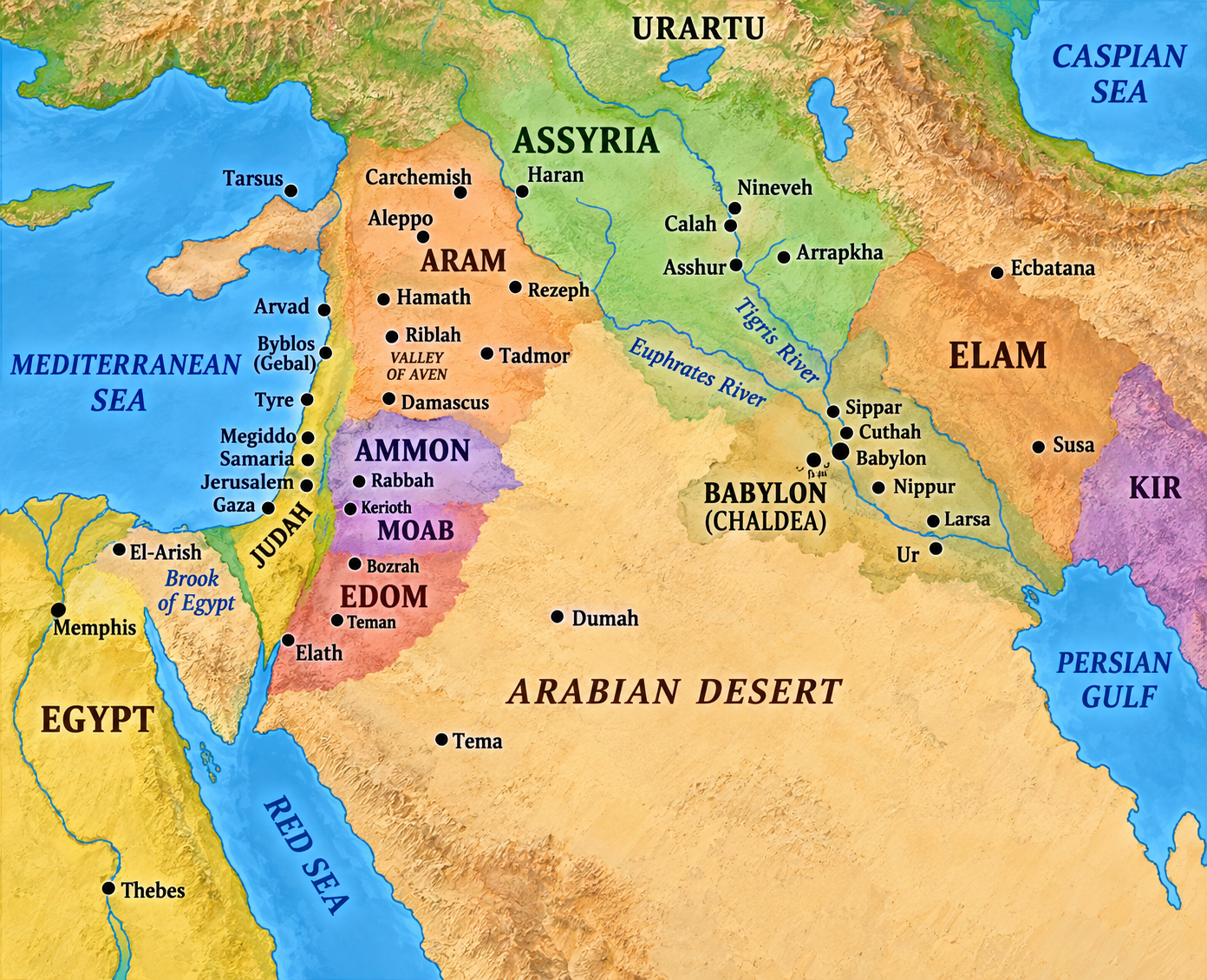

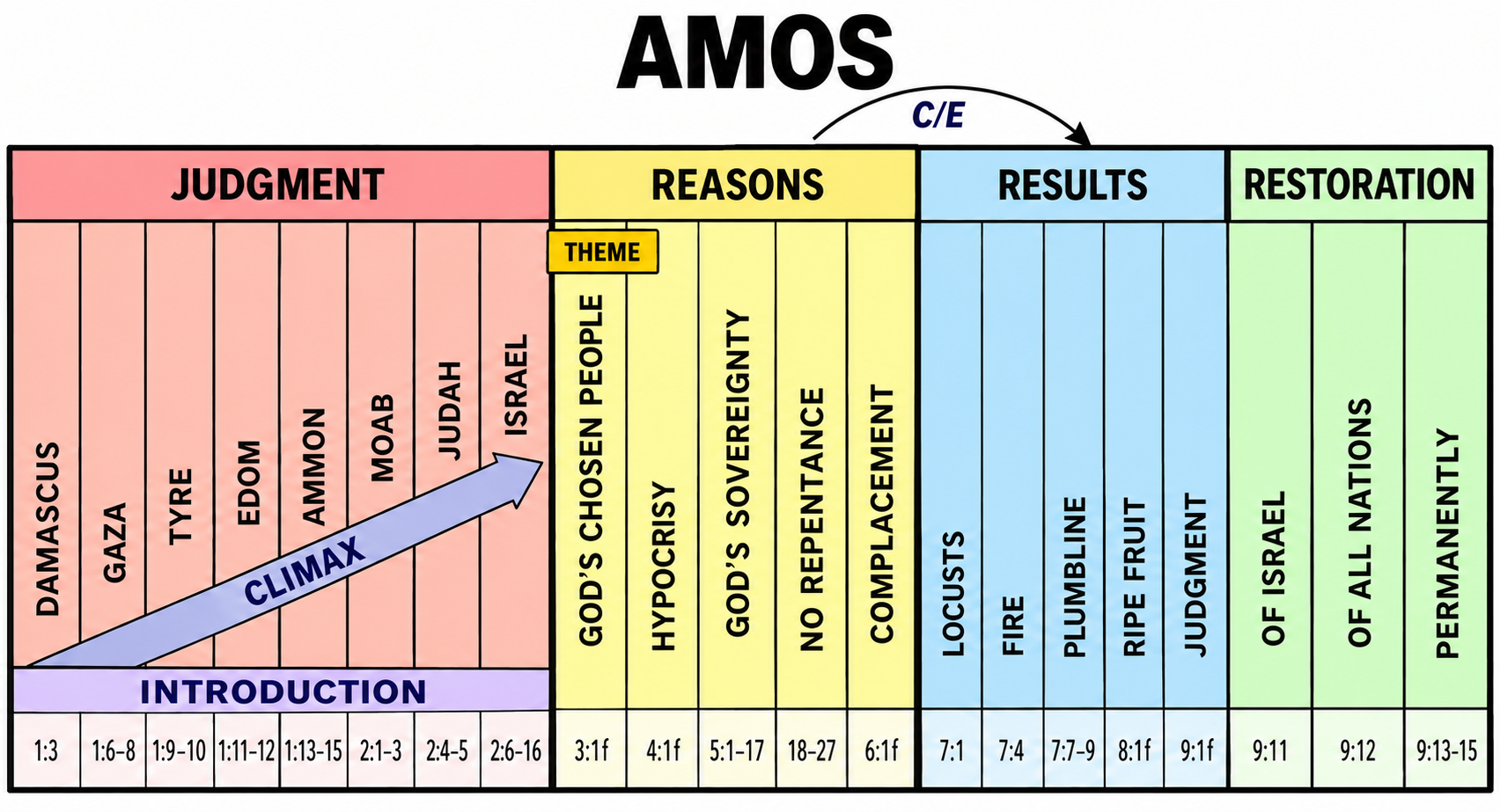
Click chart to enlarge
From Hampton Keathley IV
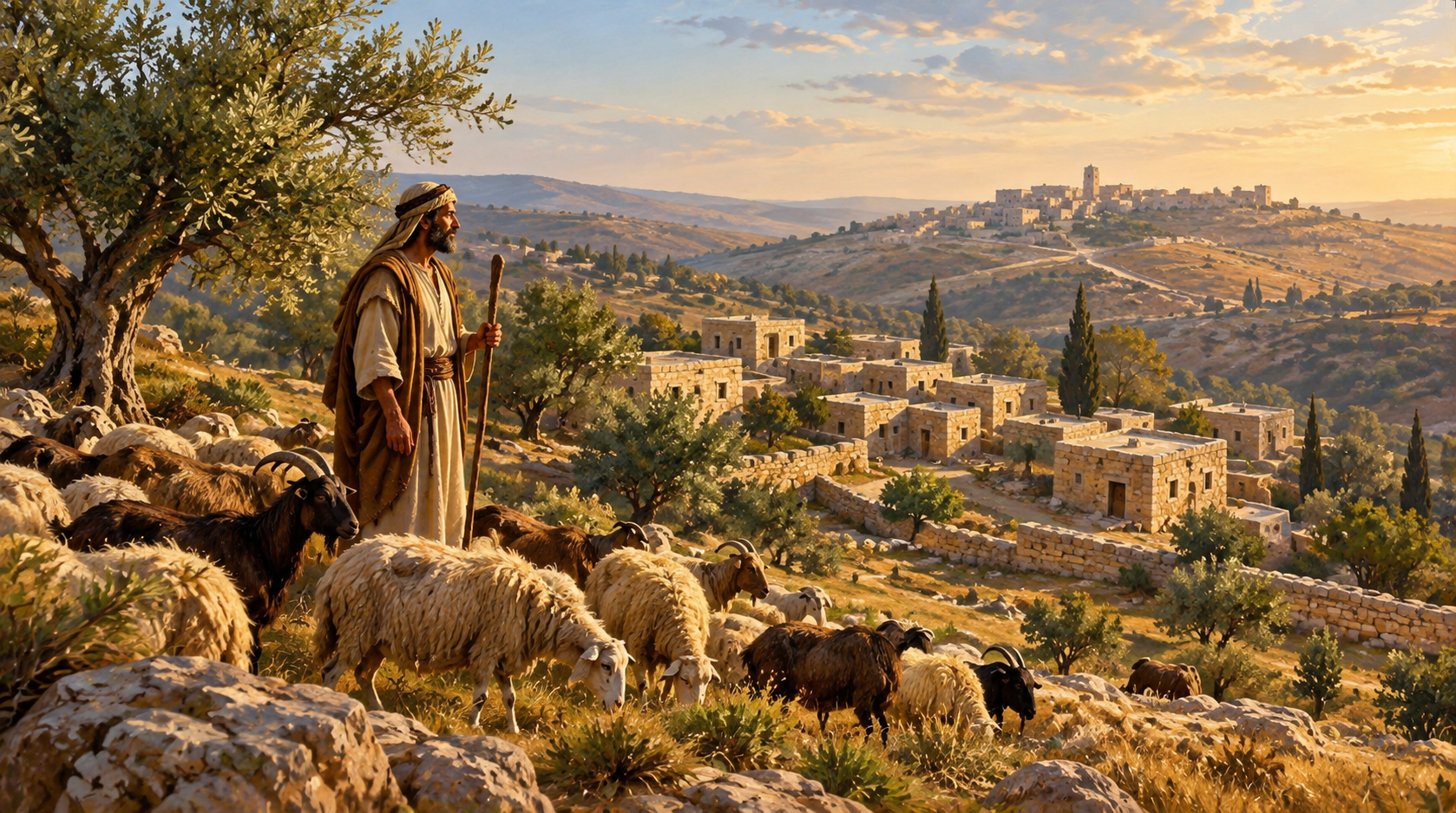
Amos 4:1 Hear this word, you cows of Bashan who are on the mountain of Samaria, Who oppress the poor, who crush the needy, Who say to your husbands, “Bring now, that we may drink!”
- ye kine (KJV): By the "kine of Bashan," some understand the proud, luxurious matrons of Israel; but it is probable the prophet speaks catachrestically, and means the wealthy, effeminate, and profligate rulers and nobles of Samaria. De 32:14,15 Ps 22:12 Jer 50:11,27 Eze 39:18
- the mountain (KJV): Am 6:1 1Ki 16:24
- which oppress (KJV): Am 2:6,7 3:9,10 5:11 8:4-6 Ex 22:21-25 De 15:9-11 Ps 12:5 140:12 Pr 22:22,23 23:10,11 Ec 4:1 5:8 Isa 1:17-24 5:8 58:6 Jer 5:26-29 6:6 7:6 Eze 22:7,12,27,29 Mic 2:1-3 3:1-3 Zec 7:10,11 Mal 3:5 Jas 5:1-6
- crush (KJV): De 28:33 Job 20:19 *marg: Jer 51:34
- Bring (KJV): Am 2:8 Joe 3:3
Related Passages:
Amos 3:15 “I will also smite the winter house together with the summer house; The houses of ivory will also perish And the great houses will come to an end,” Declares the LORD.
Deuteronomy 32:14 Curds of cows, and milk of the flock, With fat of lambs, And rams, the breed of Bashan, and goats, With the finest of the wheat– And of the blood of grapes you drank wine.
Proverbs 19:17 One who is gracious to a poor man lends to the LORD, And He will repay him for his good deed.
Luke 12:15-21 Then He said to them, “Beware, and be on your guard against every form of greed; for not even when one has an abundance does his life consist of his possessions.” 16 And He told them a parable, saying, “The land of a rich man was very productive. 17 “And he began reasoning to himself, saying, ‘What shall I do, since I have no place to store my crops?’ 18 “Then he said, ‘This is what I will do: I will tear down my barns and build larger ones, and there I will store all my grain and my goods. 19 ‘And I will say to my soul, “Soul, you have many goods laid up for many years to come; take your ease, eat, drink and be merry.”’ 20 “But God said to him, ‘You fool! This very night your soul is required of you; and now who will own what you have prepared?’ 21 “So is the man who stores up treasure for himself, and is not rich toward God.”
James 5:1-6 Come now, you rich, weep and howl for your miseries which are coming upon you. 2Your riches have rotted and your garments have become moth-eaten. 3 Your gold and your silver have rusted; and their rust will be a witness against you and will consume your flesh like fire. It is in the last days that you have stored up your treasure! 4 Behold, the pay of the laborers who mowed your fields, and which has been withheld by you, cries out against you; and the outcry of those who did the harvesting has reached the ears of the Lord of Sabaoth. 5 You have lived luxuriously on the earth and led a life of wanton pleasure; you have fattened your hearts in a day of slaughter. 6 You have condemned and put to death the righteous man; he does not resist you.
1 Timothy 6:17-19 Instruct those who are rich in this present world not to be conceited or to fix their hope on the uncertainty of riches, but on God, who richly supplies us with all things to enjoy. 18Instruct them to do good, to be rich in good works, to be generous and ready to share, 19 storing up for themselves the treasure of a good foundation for the future, so that they may take hold of that which is life indeed.
1 John 3:17 But whoever has the world’s goods, and sees his brother in need and closes his heart against him, how does the love of God abide in him?
LIVING LARGE WHILE AT
EXPENSE OF THE POOR
Warren Wiersbe - In this second message, the Prophet Amos named three particular sins that were grieving the Lord and ruining the kingdom of Israel: luxury (Amos 4:1–3), hypocrisy (Amos 4:4–5), and obstinacy (Amos 4:6–13). They had the wrong values; their religious “revival” was a sham; and they had refused to listen to the warnings God had given them. (Bible Exposition Commentary)
Hear (listen to) this word - This command to "hear" means far more than letting the sound/word go in one ear and out the other, which sadly is likely the reaction of most of Amos' audience! The gist of hear is to take in the word spoken and respond appropriately to it.
🙏 THOUGHT - One writer observes that the many severe warning judgments God sent on Israel had virtually no effect on the nation as a whole. Five times God lamented, "Yet you have not returned to Me" (Amos 4:6–11). How sad! When hearts are hardened by sin, warnings struggle to penetrate, and each ignored warning makes the next one easier to ignore (Hebrews 3:13)! Woe! The takeaway is simple: confess sin quickly, before it takes root in the garden of your heart and "hardens the soil" (1 John 1:9).
ESV Study Bible entitles this chapter "An Oracle of Doom. The oracle is composed of two parts: Amos 4:1–5 and Amos 4:6–13. In the first part, the prophet expands somewhat on the points made in Amos 3:14–15: the sins of self-indulgence built upon oppression (Amos 4:1–3) and of false religion (Amos 4:4–5). In the second part, God details all the ways in which he had appealed to the Israelites to return to him, yet without response (Amos 4:6–11). There is nothing left but that they must come face to face with the infinite Creator in all his power (Amos 4:12–13).
You cows of Bashan - Bashan, east of the Sea of Galilee (located in Transjordan on both sides of the Yarmuk River), was famous for its fertile pastureland and well-fed livestock (Dt 32:14; Ps 22:12; Ezek 39:18). Thus, “cows of Bashan” pictures animals that were well-fed, pampered, and prosperous. Amos applies the image to the wealthy women of Samaria, whose affluent lifestyle was supported by the exploitation of others. The point is not primarily their physical appearance. Amos is attacking their self-indulgent lifestyle. They were well-fed, living large because others were being crushed low!
Warren Wiersbe - These “society women” lounged around all day, drinking wine and telling their husbands what to do. Any preacher today who called the women in the congregation “cows” would be looking for another church very soon. Why did Amos, the farmer, use this image? Not because these women were overweight and looked like cows, but because by their sins they were fattening themselves up for the coming slaughter.... Amos described what would happen when the Assyrians invaded Israel, how they would capture these women and treat them like cattle. (Bible Exposition Commentary)
Bob Utley - "Cows of Bashan" This is Amos' rural reference to the elegant society women who abused the poor for their own luxury. Bashan was an area northwest of the Sea of Galilee from the mountains of Herman to the Yarmuk River. It was famous for its beautiful, healthy, fat cattle (cf. Deut. 32:14; Ps. 22:12; Ezek. 39:18), here, imagery for the wives of wealthy Samaritans.
John Walton -.cows of Bashan. Once again demonstrating his background as a herdsman, Amos uses the finely bred cattle of Bashan as a metaphor. These prize animals grazed on the lush grass available in this region in Transjordan on either side of the Yarmuk River (see Deut 32:14). Amos compares these fine cows to the self-indulgent wives of the nobility and wealthy merchants of Samaria. Neither these cows nor these women are capable of seeing beyond their own personal needs and desires (compare Is 3:16). The women, like totally self-absorbed grazing cows, cannot even imagine that people may be starving while they call for another cup of wine or another extravagant meal. It is difficult to say for sure whether the reference is to domesticated pampered cattle or to undomesticated ferocious cattle. Both could be found in Bashan and either picture can make sense of the analogy. upper-class women. The prosperity that had come to Israel’s merchant class and nobility during the first half of the eighth century B.C. is the direct result of the spreading Assyrian hegemony. In 802 the Assyrian king Adad-Nirari III captured the city of Damascus and effectively removed Syria from its position as chief political and economic rival of Israel. For a brief time, therefore, the city of Samaria and the rest of Israel enjoyed a period of peace and prosperity that brought wealth and allowed for amazing self-indulgence in luxury goods and new construction projects. Amos targets the wives of these prosperous individuals, singling them out as a base cause for the oppression of the poor. The covenant had placed obligations on the Israelites to care for the less privileged, but what Amos sees are persons who do not count the human cost that pays for their high living. (IVP Bible Background Commentary: OT page 768)
Who are on the mountain of Samaria - Samaria, the capital of the northern kingdom, was built on a strategically situated hill. It was the center of political power and considerable wealth. This connects directly with the end of chapter 3, where Amos condemned the winter houses, summer houses, ivory houses, and great houses of Samaria (Amos 3:15). Amos has moved from their mansions to the people living inside them.
Bob Utley - "on the mountain of Samaria" This refers to the well fortified capital of Israel, which Omri built on the top of a mesa. It had steep cliffs and only one natural entrance.
Who oppress (ashaq; LXX - katadunasteuo - denotes domination of the poor by the rich oppress, exploit ) the poor, who crush (ratsats; LXX - katapateo - tread down, trample underfoot, treat with disdain) the needy - This is the real indictment. Their luxury was integrally connected with the suffering of others. Oppress (ashaq) means to defraud extort or exploit someone (Lev. 6:2, 4), especially a servant. Those who were oppressed were most often the weak who had no way of defending their rights. Oppression hence is a grievous sin against which Israel was warned in stern terminology. One is never to oppress (ʿāshaq) or rob (gāzal) his neighbor (Leviticus 19:13), or his hired servant, whether a fellow Israelite or a foreign sojourner (Deut. 24:14). In Hos. 12:7, an oppressive merchant uses false scales in trading. Ezekiel 22:12, 29, links "oppression" with usury and profit at the expense of poor people and foreigners. Crush is even stronger for it pictures the helpless being pressed down by those possessing greater social and economic power. Thus Amos is continuing a major theme this book (Amos 2:6-8; 3:9-10; 5:11, 12).
Bob Utley - "Who oppress the poor, who crush the needy" These two Qal PARTICIPLES (BDB 798, KB 897 and BDB 954, KB 1285) are parallel and describe the actions of the wealthy women. YHWH is uniquely concerned (i.e. compared to other ANE law codes) about the plight of these people (especially Deuteronomy, "the orphan and the widow. . .the alien," cf. Deut. 10:18; 14:29; 16:11; 24:14,17,19; 26:12,13; 27:19). This then is another allusion to the Mosaic Covenant. The prophets did not invent or introduce a new ethical system, but reemphasized the Mosaic covenant requirements (cf. Jer. 7:6) with their blessings and curses (i.e. Leviticus 26; Deuteronomy 27-29)!
Who say to your husbands, “Bring now, that we may drink - NET - "Bring us more to drink!" These wealthy women demand that their husbands keep the drinks coming. Their concern is not how are the poor surviving? How are the needy being treated? Their primary concern was another drink! Bring is a command so their greedy appetite demanded satisfaction regardless of what their luxurious lifestyle cost others. The problem therefore was not simply drinking. Amos exposes a lifestyle characterized by self-indulgence combine with indifference and injustice. While their cups may have been full they were indifferent to the truth that others' lives were empty.
Bob Utley - "say to your husband" This is not the formal term for husband (ish, BDB 35). It is a rare ancient use of the term "lords" (אדניהם, BDB 10, KB 12); here used in the sense of "husband" (e.g. Gen. 18:12; Jdg. 19:26-27) or cultic sex partners. ▣ "Bring now, that we may drink" This phrase has two VERBS of command (BDB 97, KB 112, Hiphal IMPERATIVE and BDB 1059, KB 1667, Qal COHORTATIVE). These women had been indulging in luxury to the point that alcoholism and greed were the normal way of life. Their motto would have been "more and more for me at any cost" (i.e. the essence of the Fall)!
Note that Amos does not condemn these women merely because they were wealthy. Scripture does not teach that possessing wealth is inherently sinful. Their condemnation comes because they enjoyed luxury while participating in, encouraging, or benefiting from the oppression of the poor and crushing of the needy. Their possessions had produced neither gratitude nor generosity, but self-indulgence and insensitivity.
Prosperity becomes spiritually dangerous when personal
comfort makes us indifferent to another person's suffering.
NET NOTE - The expression cows of Bashan is used by the prophet to address the wealthy women of Samaria, who demand that their husbands satisfy their cravings. The derogatory language perhaps suggests that they, like the livestock of Bashan, were well fed, ironically in preparation for the coming slaughter. This phrase is sometimes cited to critique the book’s view of women.
Prosperity becomes dangerous when
it enlarges our appetite while shrinking our compassion.
🙏 THOUGHT: Beloved, God's blessings should make us more sensitive, not less sensitive, to the needs of others. The wealthy of Samaria lay on beds of ivory, drank wine from bowls, and anointed themselves with the finest oils, "yet they have not grieved over the ruin of Joseph" (Amos 6:4–6). Their comfort had numbed their compassion. The question is not merely, "How much has God given me?" but "How am I using what God has given me?" Jesus warned that "not even when one has an abundance does his life consist of his possessions," and He told of the rich fool who built bigger barns for himself but was not rich toward God (Luke 12:15–21). Paul instructs those who are rich in this present world not to fix their hope on uncertain riches, but "to be rich in good works, to be generous and ready to share" (1 Timothy 6:17–19). John is even more searching: "Whoever has the world's goods, and sees his brother in need and closes his heart against him, how does the love of God abide in him?" (1 John 3:17). Generosity is never wasted, for "one who is gracious to a poor man lends to the LORD, and He will repay him for his good deed" (Proverbs 19:17). Prosperity becomes dangerous when it enlarges our appetite while shrinking our compassion. Blessings are not given merely to be enjoyed. They are entrusted to be shared.
Oppress (extort, defraud) (06231) ashaq means to oppress, to extort, to defraud. The root word is concerned with acts of abuse of power or authority, the burdening, trampling, and crushing of those lower in station (half the uses are in the context of poverty). Ashaq speaks of harshness or roughness and often embodies use of force or violence.
Ashaq is used especially of oppression of the disadvantaged members of society causing them to suffer unjust, ill treatment and, in a number of contexts, doing so for monetary gain (1Ch 16:21; Job 10:3; Ps 72:4; 105:14; 119:121, 122; Pr 14:31; 22:16; 28:3; Eccl 4:1; Isa 23:12; 52:4; Jer 7:6; 21:12; Ezek 22:29; Am 4:1; Zec 7:10). The connection between ashaq and divine justice is made clear in Ps 103:6.
The use in Proverbs is instructive showing that oppression of the poor affects God, for "He who oppresses (Lxx = sukophanteo = put pressure on someone for personal gain - Lk 19:8 = "defrauded"; Lk 3:14 = accuse falsely, bring false charges, blackmail; more generally harass, oppress) the poor reproaches his Maker, but he who is gracious to the needy honors Him." (Pr 14:31; cp Pr 22:16, 28:3 which are also translated in Lxx with sukophanteo)
ASHAQ - 35V - crushed(1), defrauded(2), extorted(1), got(1), laden(1), oppress(11), oppressed(9), oppresses(3), oppressor(2), oppressors(2), practiced(2), rages(1), rob(1). Lev. 6:2; Lev. 6:4; Lev. 19:13; Deut. 24:14; Deut. 28:29; Deut. 28:33; 1 Sam. 12:3; 1 Sam. 12:4; 1 Chr. 16:21; Job 10:3; Job 40:23; Ps. 72:4; Ps. 103:6; Ps. 105:14; Ps. 119:121; Ps. 119:122; Ps. 146:7; Prov. 14:31; Prov. 22:16; Prov. 28:3; Prov. 28:17; Eccl. 4:1; Isa. 23:12; Isa. 52:4; Jer. 7:6; Jer. 21:12; Jer. 50:33; Ezek. 18:18; Ezek. 22:29; Hos. 5:11; Hos. 12:7; Amos 4:1; Mic. 2:2; Zech. 7:10; Mal. 3:5
ISBE ARTICLE - BASHAN - ba'-shan (ha-bashan, "the Bashan"; Basan): This name is probably the same in meaning as the cognate Arabic bathneh, "soft, fertile land," or bathaniyeh (batanaea), "this land sown with wheat" ("wheatland").
1. Boundaries:
It often occurs with the article, "the Bashan," to describe the kingdom of Og, the most northerly part of the land East of the Jordan. It stretched from the border of Gilead in the South to the slopes of Hermen in the North. Hermon itself is never definitely included in Bashan, although Og is said to have ruled in that mountain (Josh 12:5; 13:11). In Dt 3:10 Salecah and Edrei seem to indicate the East and West limits respectively. This would agree with Josh 12:5; 13:11, which seem to make Geshur and Maacath the western boundary of Bashan. If this were so, then these unconquered peoples literally "dwelt in the midst of Israel." On the other hand Dt 4:47 may mean that the Jordan formed the western boundary; while Dt 33:22 makes Bashan extend to the springs of the Jordan. If Golan lay in the district in which its name is still preserved (el Jaulan), this also brings it to the lip of the Jordan valley (Dt 4:43). "A mountain of summits," or "protuberances" (Ps 68:15,16: Hebrew), might describe the highlands of the Jaulan, with its many volcanic hills as seen from the West. "A mountain of God" however does not so well apply to this region. Perhaps we should, with Wetzstein (Das batanaische Giebelgebirge) take these phrases as descriptive of Jebel Chauran, now usually called Jebel ed-Druze, with its many striking summits. This range protected the province from encroachment by the sands of the wilderness from the East. On the South Bashan marched with the desert steppe, el-Chamad, and Gilead. Of the western boundary as we have seen there can be no certainty. It is equally impossible to draw any definite line in the North.
2. Characteristics:
Bashan thus included the fertile, wooded slopes of Jebel ed-Druze, the extraordinarily rich plain of el-Chauran (en-Nuqrah--see HAURAN), the rocky tract of el-Leja', the region now known as el-Jedur, resembling the Chauran in character, but less cultivated; and, perhaps, the breezy uplands of el-Jaulan, with its splendid reaches of pasture land. It was a land rich in great cities, as existing ruins sufficiently testify. It can hardly be doubted that many of these occupy sites of great antiquity. We may specially note Ashtaroth and Edrei, the cities of Og; Golan, the city of refuge, the site of which is still in doubt; and Salecah (Calkhad), the fortress on the ridge of the mountain, marking the extreme eastern limit of Israel's possessions.
The famous oaks of Bashan (Isa 2:13; Ezek 27:6) have their modern representatives on the mountain slopes. It seems strange that in Scripture there is no notice of the wheat crops for which the country is in such repute today. Along with Carmel it stood for the fruitfulness of the land (Isa 33:9 etc.); and their languishing was an evident mark of God's displeasure (Nah 1:4). The "bulls of Bashan" represent blatant and brutal strength (Ps 22:12, etc.). It is long since the lion deserted the plateau (Dt 33:22); but the leopard is still not unknown among the mountains (Song 4:8).
3. History:
In pre-Israelite days Bashan was ruled by Og the Amorite. His defeat at Edrei marked the end of his kingdom (Nu 21:33 ff; Josh 13:11), and the land was given to the half tribe of Manasseh (Josh 13:30, etc.). In the Syrian wars Bashan was lost to Israel (1 Ki 22:3 ff; 2 Ki 8:28; 10:32 f), but it was regained by Jeroboam II (2 Ki 14:25). It was incorporated in the Assyrian empire by Tiglath-pileser III (2 Ki 15:29). In the 2nd century BC it was in the hands of the Nabateans. It formed part of the kingdom of Herod the Great, and then belonged to that of Philip and Agrippa II.
W. Ewing
Amos 4:2 The Lord GOD has sworn by His holiness, “Behold, the days are coming upon you When they will take you away with meat hooks, And the last of you with fish hooks.
KJV The Lord GOD hath sworn by his holiness, that, lo, the days shall come upon you, that he will take you away with hooks, and your posterity with fishhooks.
NET The sovereign LORD confirms this oath by his own holy character: "Certainly the time is approaching when you will be carried away in baskets, every last one of you in fishermen's pots.
NLT The Sovereign LORD has sworn this by his holiness: "The time will come when you will be led away with hooks in your noses. Every last one of you will be dragged away like a fish on a hook!
ESV The Lord GOD has sworn by his holiness that, behold, the days are coming upon you, when they shall take you away with hooks, even the last of you with fishhooks.
CSB The Lord GOD has sworn by His holiness: Look, the days are coming when you will be taken away with hooks, every last one of you with fishhooks.
NIV The Sovereign LORD has sworn by his holiness: "The time will surely come when you will be taken away with hooks, the last of you with fishhooks.
- Ps 89:35
- hath sworn (KJV): Am 6:8
- he will (KJV): Isa 37:29 Jer 16:16 Eze 39:4,5 Hab 1:15,16
Related Passages:
2 Kings 17:5-6 Then the king of Assyria invaded the whole land and went up to Samaria and besieged it three years. 6 In the ninth year of Hoshea, the king of Assyria captured Samaria and carried Israel away into exile to Assyria, and settled them in Halah and Habor, on the river of Gozan, and in the cities of the Medes.
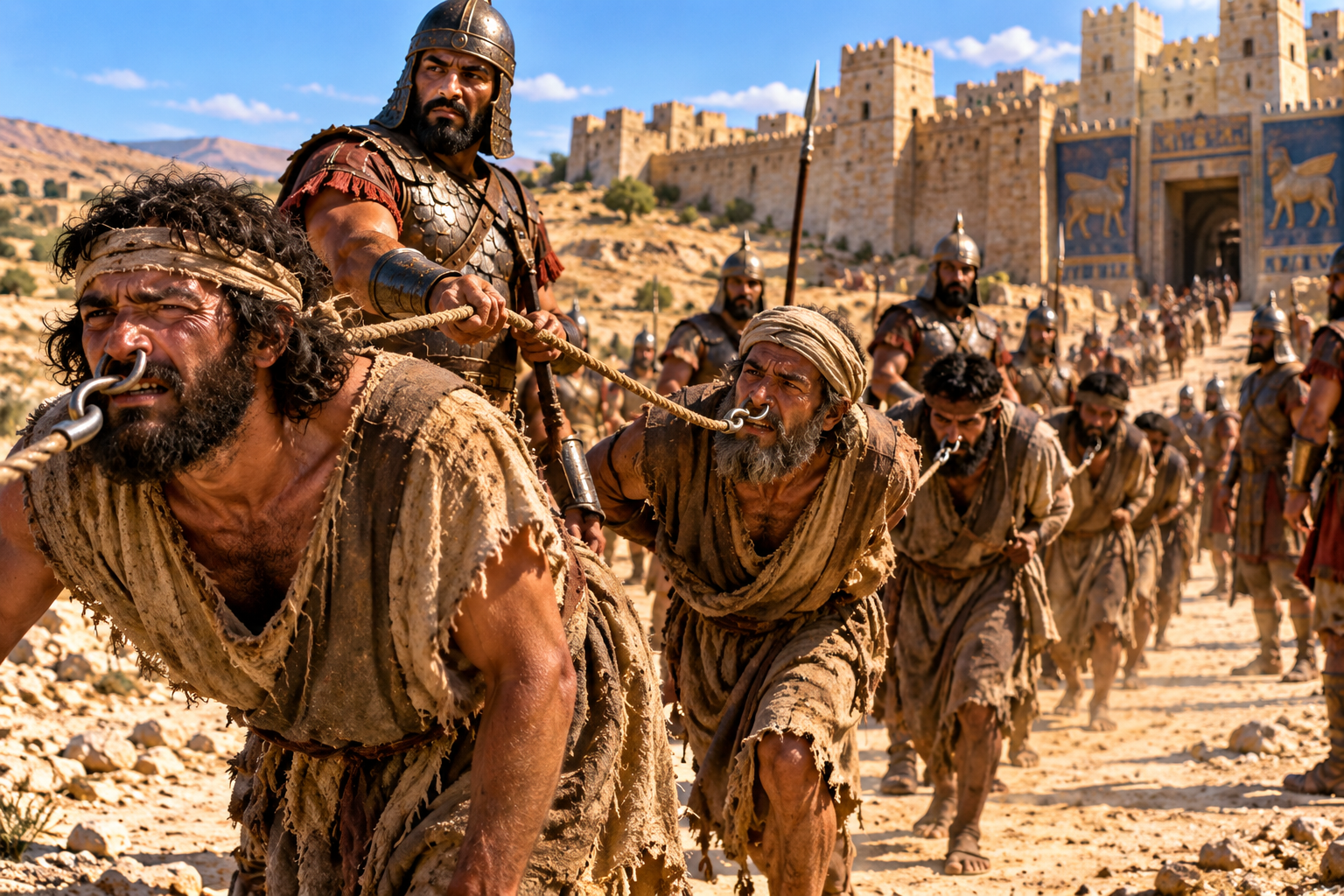
Assyrians Were Notorious for Cruel Treatment of Prisoners
GOD SWEARS BY HIMSELF
LUXURY WILL BECOME CAPTIVITY
The Lord GOD (Sovereign Lord) has sworn (confirms this oath) by His holiness (His Own holy character) - These are solemn words in which God does not just announce judgment but swears that it will happen. Because there is no one greater by whom God can swear, His oath ultimately rests upon His own character (Heb 6:13). In this case, He swears “by His holiness” which is apropos because Israel's sin was fundamentally incompatible with the holiness of God. The oppression, greed, self-indulgence, and injustice described in Amos 4:1 would not simply be ignored by a holy God. The holiness of God guarantees that He will never make peace with sin. God's holiness is not merely His separation from evil. It encompasses the absolute perfection and purity of His character. Therefore His judgment is neither impulsive nor vindictive. It flows from Who He is.
Thomas McComiskey - When he swears by his holiness in Amos 4:2, he guarantees that the judgment will become a reality, because the holy God does not lie, nor can his holiness allow sin to go unpunished. (SEE Daniel–Malachi - Page 381)
Bob Utley - "the Lord God has sworn by His holiness" The VERB (BDB 989, KB 1396) is a Niphal PERFECT. This is a rare and serious statement that speaks of God swearing by Himself (cf. Amos 6:8; Ps. 89:35). YHWH is an ethical God. Loving and just relationships are required, not only with Him, but with other covenant partners. True biblical faith has both a horizontal aspect (God) and a vertical aspect (others). ▣ "the days are coming" This is a reference to the coming judgment by Assyrian invasion. See full note at Amos 2:16. It is referred to as "in that day," Amos 2:16; 8:3, 9, 13; 9:11 "the day of the Lord" in Amos 5:18 and 20 This motif is common in the latter prophets. Israel viewed YHWH's visitation as a day of God's blessing, but Amos reveals it as a day of wrath and judgment.
“Behold (hinneh - Look! Pay attention!) the days are coming upon you - NET - "Certainly the time is approaching" Behold calls for the readers to pay close attention! Imagine these fat cows of Bashan clamoring for drinks to be brought, but then God interrupts their indulgent world with a "Behold!" They were thinking about their next drink but God was about to describe their coming judgment. Days are coming is an interesting time phrase in this context. The judgment might not occur that afternoon, but the days were already coming. Judgment was already on its way! God's delay must never be confused with God's cancellation. Judgment may appear slow to arrive, but once God has appointed the day, every passing day brings it closer. Historically, the northern kingdom's prosperity would soon give way to Assyrian invasion and exile within 30 years (+/-) of this prophecy (2 Ki 17:5–6). They were deceived by their sins (Heb 3:14), living as though present prosperity would continue indefinitely.
NET NOTE - Heb “Look, certainly days are coming upon you”; cf. NRSV “the time is surely coming upon you.”
When they will take you away with meat hooks - NET - "when you will be carried away in baskets," NLT = "you will be led away with hooks in your noses." ESV = "when they shall take you away with hooks, even the last of you with fishhooks." The imagery is intentionally shocking. The Hebrew word translated hooks which refers to something that pricks or pierces. Assyrian reliefs show captives led away in lines, sometimes with hooks or rings through the lips or nose attached to ropes. The pampered cattle of Bashan are going to be dragged away. The luxury-loving elite would be carried off in disgrace.
NET NOTE - The meaning of the Hebrew word translated “baskets” (NET translation) is uncertain. The translation follows the suggestion of S. M. Paul (Amos [Hermeneia], 128), who discusses the various options (130-32): “shields” (cf. NEB); “ropes”; “thorns,” which leads to the most favored interpretation, “hooks” (cf. NASB “meat hooks,” and NIV, NRSV “hooks”); “baskets,” and (derived from “baskets”) “boats.” Against the latter, it is unlikely that Amos envisioned a deportation by boat for the inhabitants of Samaria! See also the note on the expression “fishermen’s pots” later in this verse.
And the last of you with fish hooks - NET - "every last one of you in fishermen’s pots." The Hebrew wording is difficult, and translations vary, but the image remains one of inescapable removal. This suggests the punishment for these oppressive cows of Bashan was that they would be carried off to exile, dragged like fish caught and carried away on fish hooks.
John Walton - hooks, fishhooks. The Hebrew here is very uncertain. An attractive suggestion has been made that the verse describes not what fish are caught with but what they are transported in (baskets and pots). This metaphor is known from the prophetic literature of Mari, where the king’s enemies are portrayed as wriggling like fish in a basket. Fishing in Mesopotamian streams and rivers was done with woven baskets (sometimes made from thorn bushes). In fact there is no evidence of the use of fishhooks in Mesopotamia after 3000. Amos’s metaphor of the capture of the Israelites after the siege of Samaria may be better translated as “fish baskets.” If hooks are in view, however, it is possible that he is referring to the grappling hooks that were used during the siege and that might have been used to impale and drag prisoners. (IVP Bible Background Commentary: OT page 768)
NIV Study Bible - At the top of an Assyrian obelisk an Assyrian king (probably Esarhaddon, 681–669 BC) is pictured holding ropes attached to rings in the noses of four of his enemies (2Ki 19:28, 2Ch 33:11; Eze 19:4, 9; Hab 1:15).
Bob Utley - The first term (BDB 856 I, KB 1036) for "hooks" is found only here in the OT. It seems to be related to the Hebrew root for "thorn," "spike," or "spear" (BDB 856). Apparently these fancy society women and their children will have a hook placed in their lower lip by Assyrian soldiers and they will be marched out of the city naked (LXX) in single file, tied to one another as a train of unruly cattle. The second term (BDB 186, KB 215) relates to fishing gear of some type. Because of the paralleling, "hooks" seems best. Jeremiah (cf. Jer. 16:16) uses "fishing" as imagery for judgment. The question one asks of this verse is, "Is it imagery or literal?" Assyria did use hooks or rings in the lower lip to tie refugees together during deportation marches as an intimidation factor (cf. 2 Chr. 33:11 of Assyrians and Hab. 1:15 of Babylonians). The second term is translated as "fish-baskets" (BDB 690 CONSTRUCT BDB 186, cf. NET Bible and IVP Bible Background Commentary [OT], p. 769). The LXX has "boiling caldrons." Because the Hebrew roots are so rare, the meaning is uncertain and similar roots and cognates are used to try to fit the historical and literary context. The main point is a violent and humiliating deportation!
NET NOTE - The imagery of catching fish in connection with the captivity of Israel is also found in Jer 16:16 and Hab 1:14. The meaning of the Hebrew expression translated “in fishermen’s pots” is uncertain. The translation follows that of S. M. Paul (Amos [Hermeneia], 128), who discusses the various options (132-33): “thorns,” understood by most modern interpreters to mean (by extension) “fishhooks” (cf. NASB, NIV, NRSV); “boats,” but as mentioned in the previous note on the word “baskets,” a deportation of the Samaritans by boat is geographically unlikely; and “pots,” referring to a container used for packing fish (cf. NEB “fish-baskets”). Paul (p. 134) argues that the imagery comes from the ancient fishing industry. When hauled away into exile, the women of Samaria will be like fish packed and transported to market.
Behold (02009) hinneh is an interjection meaning behold, look, now; if. "It is used often and expresses strong feelings, surprise, hope, expectation, certainty, thus giving vividness depending on its surrounding context." (Baker) Hinneh generally directs our mind to the text, imploring the reader to give it special attention. In short, the Spirit is trying to arrest our attention! And so hinneh is used as an exclamation of vivid immediacy (e.g., read Ge 6:13)! Hinneh is a marker used to enliven a narrative, to express a change a scene, to emphasize an idea, to call attention to a detail or an important fact or action that follows (Isa 65:17, Ge 17:20, 41:17). The first use of hinneh in Ge 1:29 and second in Ge 1:31 - "And God saw all that He had made, and behold, it was very good. And there was evening and there was morning, the sixth day." Hinneh is oftn used in the idiom "Here I am" in Ge 22:1, 7,11 Ge 27:1,18, Ge 31:11, Ge 46:2 Ex 3:4 1Sa 3:4, 3:16, 12:3, 2Sa 1:7, Isa 52:6, Isa 58:9. Hinneh is used most often to point out people but also to point out things (Ge 31:41, 17:4). God uses hinneh to grab man's attention before He brings destruction (Ge 6:13, 17). God uses hinneh when He establishes covenants (Ge 9:9, 15:12, 17 [when Jehovah cut the Abrahamic covenant], Ge 17:4, cp Ge 28:13, 15), when He provided a sacrificial substitute for Isaac (foreshadowing His giving us His only Son!) (Ge 22:13). Hinneh marks the "chance (The Providence of God)" arrival of Boaz at the field where Ruth was gleaning (Ru 2:4-read about this "chance romance" - Indeed, "Behold!"). Hinneh is used to announce the Lord’s sending of a child as a sign and a prophecy of Immanuel-Emmanuel, the Messiah (Isa. 7:14). In fact W E Vine says that it is notable that when behold (hinneh) is used in Isaiah, it always introduces something relating to future circumstances.
Spurgeon reminds us that "Behold is a word of wonder; it is intended to excite admiration. Wherever you see it hung out in Scripture, it is like an ancient sign-board, signifying that there are rich wares within, or like the hands which solid readers have observed in the margin of the older Puritanic books, drawing attention to something particularly worthy of observation." I would add, behold is like a divine highlighter, a divine underlining of an especially striking or important text. It says in effect "Listen up, all ye who would be wise in the ways of Jehovah!"
Amos 4:3 “You will go out through breaches in the walls, Each one straight before her, And you will be cast to Harmon,” declares the LORD.
KJV And ye shall go out at the breaches, every cow at that which is before her; and ye shall cast them into the palace, saith the LORD.
NET Each of you will go straight through the gaps in the walls; you will be thrown out toward Harmon." The LORD is speaking!
NLT You will be led out through the ruins of the wall; you will be thrown from your fortresses, " says the LORD.
ESV And you shall go out through the breaches, each one straight ahead; and you shall be cast out into Harmon," declares the LORD.
CSB You will go through breaches in the wall, each woman straight ahead, and you will be driven along toward Harmon.This is the LORD's declaration.
NIV You will each go straight out through breaks in the wall, and you will be cast out toward Harmon, " declares the LORD.
YLT And by breaches ye go forth, A woman at that over-against her, And ye have cast down the high place, An affirmation of Jehovah.
- ye shall go (KJV): 2Ki 25:4 Eze 12:5,12
- them into the palace (KJV): or, away the things of the palace, 2Ki 7:7,8,15 Isa 2:20 31:7 Zep 1:18 Mt 16:26
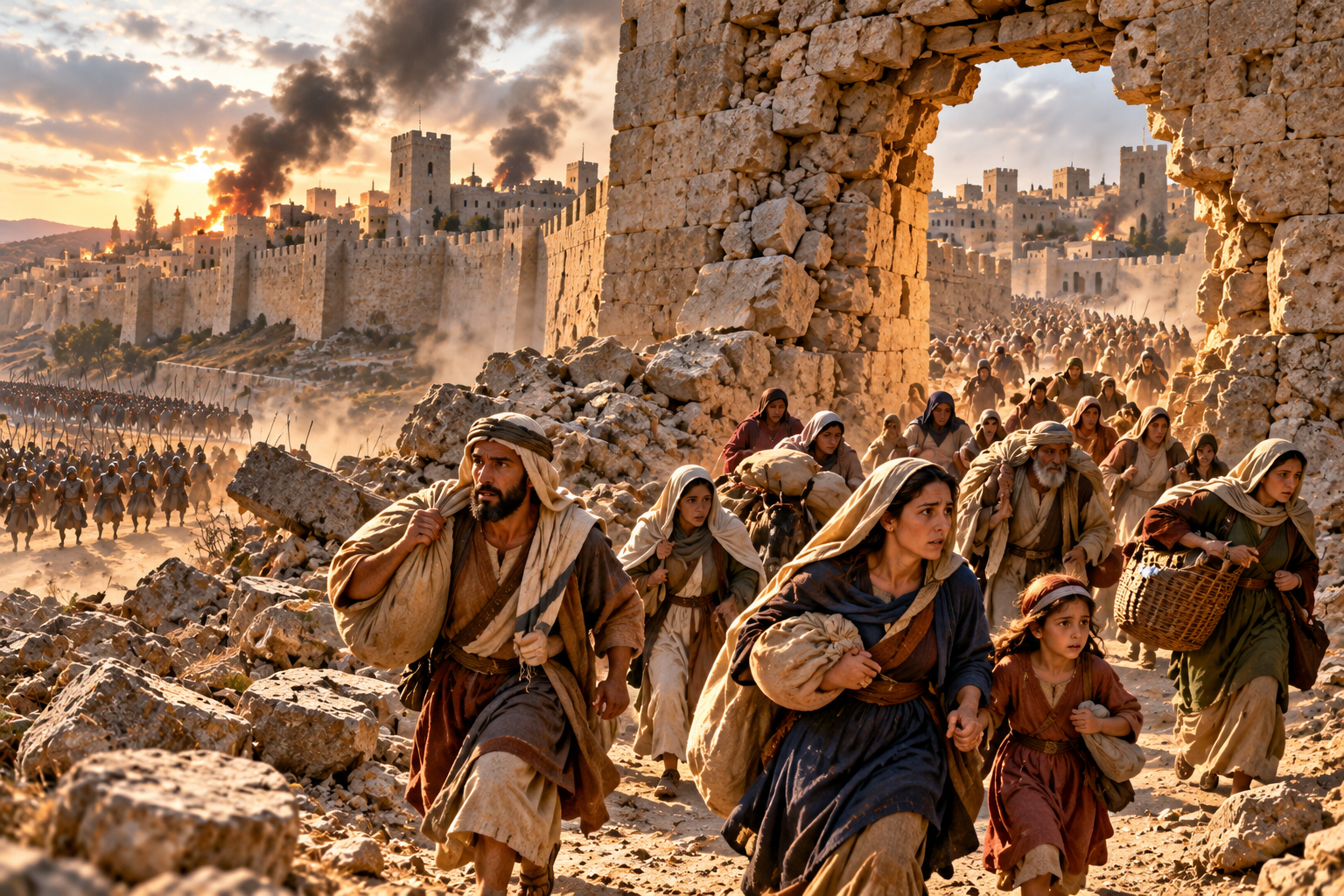
CITY WALLS WILL
NOT SAVE THEM
You will go out through breaches in the walls Each one straight before her,- NET - "Each of you will go straight through the gaps in the walls;" Amos continues the devastating picture begun in verse 2. The wealthy women of Samaria who lived securely behind the city's fortifications would one day leave the city, not through its impressive gates, but through gaping holes smashed into its walls by the invading army. Breaches describes breaks or openings in a defensive wall. Samaria's fortifications, which had seemed to guarantee security, would be shattered.
Each one straight before her,- Ordinarily, captives leaving a fortified city would presumably move toward a city gate. But there would be no need to search for a gate because the walls would be so extensively breached that each woman could simply walk straight ahead through the opening directly in front of her. The phrase therefore emphasizes the extent of the destruction. So thoroughly would Samaria's defenses be shattered that every captive would find a breach directly before them.
Bob Utley - "straight before" The phrase "straight before" is imagery for the complete destruction of the protective city wall. The population was tied together in single file and exiled to a distant location to the east through the breach in the city's protective wall. Amos alludes to the Assyrian exile several times (cf. Amos 5:5,27; 6:7; 7:11,17; 9:4), but Assyria is never mentioned by name.
NET NOTE - Heb “and [through the] breaches you will go out, each straight ahead.”
And you will be cast to (thrown out toward) Harmon,” declares the LORD (The Lord is speaking) - This is one of the difficult expressions in Amos. The Hebrew Harmonah occurs only here, and its precise meaning or location is uncertain. Some translations treat Harmon as a place name, while others understand the expression differently. Because the identification is uncertain, it is wise not to build an interpretation on the geographical location of Harmon. The central point, however, is perfectly clear that they are going away. The women who had enjoyed the luxury of Samaria would be forcibly removed from it. The uncertainty about the destination does not obscure the certainty of the judgment.
NET NOTE - HARMON - The meaning of this word is unclear. Many understand it as a place name, though such a location is not known. Some (e.g., H. W. Wolff, Joel and Amos [Hermeneia], 204) emend to “Hermon” or to similarly written words, such as “the dung heap” (NEB, NJPS), “the garbage dump” (NCV), or “the fortress” (cf. NLT “your fortresses”).
John Walton - Harmon. Since this word occurs only here, there have been a number of suggestions on its meaning. Some scholars consider it a place name and thus the place where the captives are exiles. Among the suggestions here are Mount Minni in Assyria (see Jer 51:27) or Hermal near Kadesh on the Orontes River. For those who emend the text, the translation of “dung heap” for hadmon (exchanging a single letter for one that looks similar) is the most likely since it is a suitable place for the disposal of the bodies of prisoners. (IVP Bible Background Commentary: OT page 768)
Bob Utley - "declares the Lord" This recurrent phrase, Amos 1:5,8,15; 2:3,11,16; 3:10,13,14; 4:3,5,6,8,10,11, 5:17, shows whose authority, power and prestige stand behind these statements.
Amos 4:4 “Enter Bethel and transgress; In Gilgal multiply transgression! Bring your sacrifices every morning, Your tithes every three days.
- Come (KJV): Am 3:14 Ec 11:9 Eze 20:39 Joe 3:9-12 Mt 23:32 26:45 Mk 14:41
- at Gilgal (KJV): Am 5:5 Ho 4:15, 9:15, 12:11
- and bring (KJV): Nu 28:3,4
- and your (KJV): De 14:28,29 26:12
- three years (KJV): Heb. three years of days
Related Passages:
Amos 3:14 “For on the day that I punish Israel’s transgressions, I will also punish the altars of Bethel; The horns of the altar will be cut off And they will fall to the ground.
Amos 5:5 “But do not resort to Bethel And do not come to Gilgal, Nor cross over to Beersheba; For Gilgal will certainly go into captivity And Bethel will come to trouble.
Hosea 4:15 Though you, Israel, play the harlot, Do not let Judah become guilty; Also do not go to Gilgal, Or go up to Beth-aven And take the oath: “As the LORD lives!”
1 Samuel 15:22 Samuel said, “Has the LORD as much delight in burnt offerings and sacrifices As in obeying the voice of the LORD? Behold, to obey is better than sacrifice, And to heed than the fat of rams.
John 14:15 “If you love Me, you will keep My commandments.
James 1:22 But prove yourselves doers of the word, and not merely hearers who delude themselves.
WHEN WORSHIP
BECOMES REBELLION
Enter (Go to) Bethel and transgress (pasha -rebel) - Amos 4:4–5 is biting sarcasm. Amos mimics the familiar priestly call to worship ("Come, let us worship and bow down," Psalm 95:6) but turns it upside down. The words are shocking, and that is the point. God is certainly not commanding Israel to sin. He is exposing the absurdity of their religious behavior. It is as though God says, "Go ahead! Go to Bethel! Keep practicing your religion! Keep bringing your sacrifices! But understand this: every time you come, you are adding to your sin." The irony is sharpened by the name itself: Bethel means "house of God." The deceitfulness of sin led Israel to believe they were going to the house of God to worship, but God says they were going there to rebel.
Bob Utley - "enter" This (BDB 97, KB 112) is a Qal IMPERATIVE. Verses 4 and 5 have a series of IMPERATIVES (3 Qal IMPERATIVES; 3 Hiphil IMPERATIVES) used as sarcasm! ▣ "Bethel. . .Gilgal" These were early cultic centers (Bethel, Gen. 12:8; 28:10-22 and Gilgal, Josh. 4:19-20; 1 Sam. 11:15; 15:21). They were popular worship sites in the eighth century B.C. (cf. 1 Kgs. 12:29-30; Hosea 4:15; 9:15, 12:11). The location of Gilgal is not known. See the notes at Hosea 9:15; 12:11. Verses 4 and 5 are highly sarcastic (cf. Amos 5:5-6).
Bethel means "house of God" and had a sacred history. Abraham built an altar near Bethel (Genesis 12:8), and Jacob met God there in his dream of the ladder, declaring, "This is none other than the house of God" (Genesis 28:10–22). But Jeroboam I later turned Bethel into a center of counterfeit worship, setting up a golden calf, an unauthorized priesthood, and a man-made religious calendar, all designed to keep the northern tribes from worshiping in Jerusalem (1 Kings 12:26–33). Bethel kept its religious name and its religious activity, but its worship had departed from God's revealed will. Note the irony: every time Israel entered the "house of God," they transgressed against God. Amos's contemporary Hosea makes the same point with a bitter wordplay, calling Bethel "Beth-aven," meaning "house of wickedness" (Hosea 4:15). Their worship was rebellion disguised as religion. One of the most deceptive forms of rebellion is worshiping God in a way He has not authorized while convincing ourselves that He must be pleased (compare Leviticus 10:1–3).
Thomas McComiskey - In the time of Amos, Bethel was known as “the king’s sanctuary” (Am 7:13). It thus may have been the scene of royal as well as religious pomp.(SEE Daniel–Malachi - Page 381)
NET NOTE - Bethel and Gilgal were important formal worship centers because of their importance in Israel’s history. Here the Lord ironically urges the people to visit these places so they can increase their sin against him. Their formal worship, because it was not accompanied by social justice, only made them more guilty in God’s sight by adding hypocrisy to their list of sins. Obviously, theirs was a twisted view of the Lord. They worshiped a god of their own creation in order to satisfy their religious impulses (see 4:5: “For you love to do this”). Note that none of the rituals listed in 4:4-5 have to do with sin TRANSGRESS - The Hebrew word translated “rebel” (also in the following line) could very well refer here to Israel’s violations of their covenant with God (see also the term “crimes” in 1:3 [with note] and the phrase “covenant transgressions” in 2:4 [with note] and 3:14).
John Walton - cult sites at Bethel and Gilgal. Bethel has a long history of cultic activity, ranging back to the construction of an altar there by Abraham (Gen 12:8) and Jacob’s dream there (Gen 28:10-22). It took on an ominous quality for Amos when it was designated as one of the two major cultic centers by Jeroboam (1 Kings 12:29-30). Cultic activity at Gilgal appears in the conquest narrative when the Israelites cross the Jordan and Joshua raises a memorial to commemorate the event (Josh 4:19-20). It is possible that after the division of the kingdoms, Gilgal was seen as a northern worship site because of its association with Saul (see 1 Sam 11:15, 15:21). Hosea also condemns this place as corrupt (Hos 4:15 and Amos 9:15). (IVP Bible Background Commentary: OT page 768)
In Gilgal multiply (rabah) transgression (pasha - rebel some more) - In other words, "Go to Gilgal and rebel some more!" Like Bethel, Gilgal had a sacred history. It was Israel's first camp in the Promised Land, where Joshua set up the memorial stones from the Jordan, the nation was circumcised, and they celebrated their first Passover in Canaan (Joshua 4:19–5:10). Saul was later confirmed as king there (1 Samuel 11:14–15). But by Amos's day it had become another center of corrupt worship (compare Hosea 4:15; 9:15; 12:11). The more religious activity Israel performed within its corrupt system, the more sin they accumulated. More religion does not produce more righteousness when the heart remains rebellious. The Law did not require ordinary Israelites to bring personal sacrifices every morning, and tithes were brought annually, with a special tithe every third year (Deuteronomy 14:22–29). Amos is therefore likely exaggerating their zeal sarcastically: "Bring your sacrifices every morning, your tithes every three days" (Amos 4:4). In effect: "You love religion so much, why not do even more of it? You'll only multiply your rebellion."
Bring your sacrifices (zebah) every morning, Your tithes (maaser) every three days- Now Amos begins listing their impressive religious activities. They brought sacrifices and they brought them frequently. Israel had plenty of religion but precious little righteousness. They were religious hypocrites. They oppressed the poor during the week and brought sacrifices to God in worship, as though religious activity could erase unrepented injustice. Worship without obedience can become rebellion wearing religious clothes.
John Walton - NIV reads "three-year tithes." The better reading of the Hebrew here would be “on the third day” or “every three days” (instead of every three years, see NIV note). It is possible that Amos is satirizing an aspect of the northern kingdom’s cultic practice. There is a possibility that freewill offerings and noncompulsory tithes (compare Gen 14:20) were given at the sanctuary shortly after arrival or were tied to some coming event or vow. To Amos, however, such frequency of offerings cannot replace true piety or obedience to the covenant. (IVP Bible Background Commentary: OT page 768)
Bob Utley - "Bring your sacrifices every morning, your tithes every three days" There are three theories about this verse: (1) it shows their excessive religiosity (i.e. outward show at certain times and places) (2) it shows the normal worship practices of the pilgrims as they attend these shrines (i.e. arrived one day, offer a sacrifice the second, and the tithe on the third day, cf. REB, TEV, NKJV, NRSV, Peshitta, LXX. JPSOA) (3) the tithes refers to the third year tithe for local poor (i.e. another allusion to the Mosaic covenant, cf. Deut. 14:28; 26:12, "days" would then be a reference to "years")
🙏 THOUGHT: Beloved, it is possible to attend church, sing hymns, give money, study Scripture, teach a Bible class, and still harbor areas of deliberate disobedience. Israel was remarkably religious. They brought sacrifices every morning and tithes every three days, and they loved to announce their freewill offerings (Amos 4:4–5). Yet God said, "I hate, I reject your festivals... Take away from Me the noise of your songs... But let justice roll down like waters and righteousness like an ever-flowing stream" (Amos 5:21–24). Religious activity can never substitute for repentance. Samuel told Saul that "to obey is better than sacrifice" (1 Samuel 15:22), and Jesus warned of those who honor God with their lips while their hearts are far from Him (Matthew 15:8). Our songs, offerings, and service are pleasing to God only when they flow from a heart surrendered to Him. They are never a payment that excuses us from obedience. Jesus put it simply: "If you love Me, you will keep My commandments" (John 14:15). James warns that hearing the Word without doing it is self-deception (James 1:22). The question is not merely, "Did I worship God today?" but also, "Did my worship produce a life that walks with God?" True worship does not end when the service is over. It shows up on Monday morning in how we speak, work, spend, and treat others.
QUESTION - What is the significance of Bethel in the Bible? | GotQuestions.org
ANSWER - Two towns named Bethel appear in the Bible. The Bethel of lesser significance, a village in the Negev, is mentioned as one of the places where David sent spoils to his friends, the elders of Judah (1 Samuel 30:26–27). Another Bethel, a city of foremost importance in the Bible, was located about 11 miles north of Jerusalem near Ai. A major trading center, Bethel stood at a crossroads, with its north-south road passing through the central hill country from Hebron in the south to Shechem in the north, and its main east-west route leading from Jericho to the Mediterranean Sea. Only Jerusalem is mentioned more frequently than Bethel in the Old Testament.
The Hebrew name Bethel means “house of God” and refers to both the city and the site of a major sanctuary that was established there for the northern kingdom of Israel. Bethel sat at the boundary between the tribes of Ephraim and Benjamin and eventually delineated the border between the northern kingdom of Israel and the southern kingdom of Judah. Although Bethel was in the dry hill country, several natural springs supplied water in abundance for its residents.
Bethel is first mentioned in the Bible in connection with Abram, who built an altar to God there: “From there [Abram] went on toward the hills east of Bethel and pitched his tent, with Bethel on the west and Ai on the east. There he built an altar to the LORD and called on the name of the LORD” (Genesis 12:8). After visiting Egypt, Abraham returned to Bethel and offered a sacrifice to God (Genesis 13:3–4).
Originally named Luz (Genesis 28:19; Judges 1:23), the city was renamed Bethel by Jacob after the patriarch experienced a remarkable dream there. While traveling from Beersheba to Haran to escape his brother Esau, Jacob stopped for the night in Luz. As he slept, he dreamed of a stairway or ladder that stretched up from earth to heaven. The angels of God were climbing up and down the ladder as God stood at the top (Genesis 28:10–13). The Lord spoke and revealed Himself to Jacob as the God of his fathers. When Jacob awoke, he declared, “How awesome is this place! This is none other than the house of God; this is the gate of heaven” (Genesis 28:17). Then Jacob set up a sacred pillar, named the place Bethel (verses 18–19), and consecrated the site as a place to worship God (verse 21).
Many years later, Jacob returned to Bethel, built an altar to God there, and called the place El-Bethel, which means “God of Bethel.” Bethel remained one of the main worship centers of Israel. The ark of the covenant was kept at Bethel for a time, and the people often went there to seek God during times of trouble (Judges 20:18–28). The Bible says Deborah, Rebekah’s nurse, was buried under an oak tree near Bethel (Genesis 35:8), and the better-known Deborah, judge of Israel, held court at a site between Ramah and Bethel (Judges 4:5). During the time of the divided kingdoms, King Jeroboam of Israel established two temples for the northern kingdom, one at Bethel and the other at Dan. In these temples, he set up golden calves (1 Kings 12:26–33). God often sent prophets to preach at Bethel (1 Kings 13:1–10). Many of these prophets pronounced judgment and condemnation on Bethel as a center of idolatry (Amos 3:14; 5:5–6; Hosea 10:15).
On Elijah’s last day of ministry on earth, he and Elisha encountered a company of prophets at Bethel. These prophets confirmed Elijah’s soon departure: “Elijah said to Elisha, ‘Stay here; the LORD has sent me to Bethel.’ But Elisha said, ‘As surely as the LORD lives and as you live, I will not leave you.’ So they went down to Bethel. The company of the prophets at Bethel came out to Elisha and asked, ‘Do you know that the LORD is going to take your master from you today?’ ‘Yes, I know,’ Elisha replied, ‘so be quiet’” (2 Kings 2:2–3). Elisha refused to leave Elijah. He was fiercely committed to assuming the older prophet’s mantle and did not want to miss out on the opportunity.
After the northern kingdom of Israel fell to the Assyrians, Bethel remained a home for priests (2 Kings 17:28–41). In the seventh century BC, the high places of Bethel were destroyed by King Josiah of Judah as part of his religious reforms (2 Kings 23:4, 13–19). Eventually, by the time of Ezra, the city of Bethel had been burned down and reduced to a small village (Ezra 2:28). Bethel is not referred to in the New Testament.
Walter Kaiser - Does God Encourage Sinning? - Hard Sayings of the Bible
Is the invitation to go up to Bethel or Gilgal and get a special offer on sinning: perhaps four sins for the price of two today (to be just as cynical)? Nowhere else in Scripture does God encourage sin; why here, or so it would appear?
The prophet Amos speaks with real irony and sarcasm to an audience that has grown somewhat deaf and tired of hearing his calls for repentance. In an attempt to startle an otherwise recalcitrant nation, Amos spoke in a dissimulating way to see if that would bring any reaction.
To be sure, the people zealously went on their pilgrimages to Bethel, Gilgal and Beersheba, all places with religious connotations and associations. At Bethel, of course, the ten northern tribes had set up for themselves a rival altar to the one in Jerusalem, so that worshipers would not need to travel there and one’s politics and potential allegiances would not get confused. But this was in contradiction to the will of God, for God had prescribed that his name would dwell only in Jerusalem. King Jeroboam, amazingly enough, set up a golden calf at Bethel and one at Dan, saying: “Here are your gods, O Israel, who brought you up out of Egypt” (1 Kings 12:28). Amos wasn’t the only one who was contemptuous of the site of Bethel; the prophet Hosea changed the name Bethel, meaning “house of God,” into Beth Aven, meaning “house of wickedness” (Hos 4:15), while he too castigated Gilgal as an improper place to worship God.
The irony of this invitation to go and sin at Bethel and Gilgal comes out in the word for “sin,” for it also could mean to “fall away” from God. The Israelites would even prefer to do too much than do too little in their false worship. Thus, they burnt on the altar a portion of the leavened loaves of their praise-offerings, which were intended to be eaten at the sacrificial meals, even though only the unleavened bread was allowed to be offered (Amos 4:5). They were really proud of the fact that they offered freewill offerings in addition to all the rest of the religious acts that they were doing.
But why mention Gilgal along with Bethel as a place of idolatrous worship? This was not the Gilgal in the Jordan Valley, where Israel had camped after crossing over the river Jordan. It was northern Gilgal upon the mountains, to the southwest of Silo or Seilun, where there had been a school of the prophets in the days of Elijah and Elisha (2 Kings 2:1; 4:38). Now in the eighth century B.C. it had been chosen as the seat of idolatrous worship (Hos 4:15; 9:15; 12:11; Amos 5:5).
No, God does not encourage sin. The prophet was merely using ironic and graphic words in hopes of getting the attention of those whose moral quotients had sunk to new lows.
QUESTION - What is the importance of Gilgal in the Bible? | GotQuestions.org
ANSWER - There are at least two locations named Gilgal in the Bible. There was a Gilgal just west of the Jordan River near Jericho (Joshua 5:9, 13) and one nearer Bethel (2 Kings 2:1–2). Some scholars believe there was a third place named Gilgal near Mount Gerizim and Mount Ebal (Deuteronomy 11:29–30). The meaning of the name Gilgal is “rolling.”
Gilgal is not mentioned in the New Testament, but the Old Testament depicts it as follows:
Gilgal was a place of memorial. Gilgal is significant in the Bible as serving as a place of memorial for the Israelites, to remind them of what God had done. After miraculously crossing the Jordan River into the Promised Land, the Israelites set up twelve stones taken from the river, representing the twelve tribes, to serve as a reminder to the children of Israel (Joshua 4:19–20). The stones at Gilgal would remind the Israelites and their descendants of the power of God and how He had dried up the Jordan River so they could walk through it, just as He had done to the Red Sea (Joshua 4:21–24). The stones at Gilgal would serve a teaching purpose to the younger generation, so that they too could remember what the Lord had done for them (Joshua 4:21–22).
Gilgal was a place of consecration and change. It was at Gilgal that the Israelites were circumcised and celebrated their first Passover in the Promised Land (Joshua 5:7–8, 10). The children of those who had wandered in the desert had not yet been circumcised, and it was time for them to take the sign of the covenant and be set apart as God’s people. This time of circumcision is what gave Gilgal its name, for the Lord said He had “rolled away the reproach of Egypt from you” (Joshua 5:9). The “reproach” was the Israelites’ uncircumcised condition; the “rolling away” of that reproach set them apart, once and for all, from the Egyptian people and way of life. After the Israelites celebrated the Passover and began to eat the produce of their new land, the manna that the Lord had provided the Israelites during their years of wandering stopped. This also happened while they were camped at Gilgal (Joshua 5:11–12).
A place of worship. Years later, Gilgal was still a place of worship to offer sacrifices to the Lord, and it was the place where Saul was publicly crowned the first king of Israel (1 Samuel 10:8; 11:15). Unfortunately, as the Israelites slipped into idolatry, Gilgal became connected with the worship of false gods (Hosea 4:15; Amos 4:4).
A place of judgment. It was at Gilgal that Samuel rebuked Saul and prophesied of his loss of the kingdom (1 Samuel 13:13–14). Saul had been instructed to stay at Gilgal and wait for Samuel before offering sacrifices to the Lord there (1 Samuel 10:8; 13:8). Rather than obey, Saul took the matter in his own hands and sacrificed to the Lord at Gilgal (1 Samuel 13:9–12). When Samuel arrived, he announced judgment on Saul for his disobedience, stating that Saul’s kingdom and position would not endure (1 Samuel 13:14).
A place of prophets. Gilgal was one of three cities where Samuel regularly held court as the judge of Israel (1 Samuel 7:16). It seems that Elijah and Elisha spent some time at a place called Gilgal before Elijah’s departure to heaven (2 Kings 2:1–2). This is most likely not the same Gilgal as where Joshua had camped; rather, it is a place nearer Bethel in central Canaan. Sometime after Elijah was gone, Elisha returned to Gilgal where many other prophets resided (2 Kings 4:38). There, he found that Gilgal was in the midst of a famine and so made sure the prophets were fed. He also miraculously fed around a hundred other residents (2 Kings 4:38–44).
Gilgal was a significant place in that it reminded the Israelites of their heritage, served as a place of worship, and was visited by kings and prophets.
Amos 4:5 “Offer a thank offering also from that which is leavened, And proclaim freewill offerings, make them known. For so you love to do, you sons of Israel,” Declares the Lord GOD.
KJV And offer a sacrifice of thanksgiving with leaven, and proclaim and publish the free offerings: for this liketh you, O ye children of Israel, saith the Lord GOD.
NET Burn a thank offering of bread made with yeast! Make a public display of your voluntary offerings! For you love to do this, you Israelites." The sovereign LORD is speaking!
NLT Present your bread made with yeast as an offering of thanksgiving. Then give your extra voluntary offerings so you can brag about it everywhere! This is the kind of thing you Israelites love to do," says the Sovereign LORD.
ESV offer a sacrifice of thanksgiving of that which is leavened, and proclaim freewill offerings, publish them; for so you love to do, O people of Israel!" declares the Lord GOD.
BGT καὶ ἀνέγνωσαν ἔξω νόμον καὶ ἐπεκαλέσαντο ὁμολογίας ἀπαγγείλατε ὅτι ταῦτα ἠγάπησαν οἱ υἱοὶ Ισραηλ λέγει κύριος ὁ θεός
LXE And they read the law without, and called for public professions: proclaim aloud that the children of Israel have loved these things, saith the Lord.
CSB Offer leavened bread as a thank offering, and loudly proclaim your freewill offerings, for that is what you Israelites love to do!This is the LORD's declaration.
NIV Burn leavened bread as a thank offering and brag about your freewill offerings-- boast about them, you Israelites, for this is what you love to do," declares the Sovereign LORD.
- offer a sacrifice (KJV): Lev 7:12-13 23:17
- proclaim (KJV): Lev 22:18-21 De 12:6,7 Mt 6:2
- for (KJV): Ps 81:12 Mt 15:9,13,14 23:23 Ro 1:28 2Th 2:10-12
- this liketh you (KJV): Heb. so ye love, Ho 9:1,10
Related Passages:
Leviticus 7:12-13 ‘If he offers it by way of thanksgiving, then along with the sacrifice of thanksgiving he shall offer unleavened cakes mixed with oil, and unleavened wafers spread with oil, and cakes of well stirred fine flour mixed with oil. 13 ‘With the sacrifice of his peace offerings for thanksgiving, he shall present his offering with cakes of leavened bread.
Leviticus 22:18-23 “Speak to Aaron and to his sons and to all the sons of Israel and say to them, ‘Any man of the house of Israel or of the aliens in Israel who presents his offering, whether it is any of their votive or any of their freewill offerings, which they present to the LORD for a burnt offering– 19for you to be accepted–it must be a male without defect from the cattle, the sheep, or the goats. 20‘Whatever has a defect, you shall not offer, for it will not be accepted for you. 21‘When a man offers a sacrifice of peace offerings to the LORD to fulfill a special vow or for a freewill offering, of the herd or of the flock, it must be perfect to be accepted; there shall be no defect in it. 22‘Those that are blind or fractured or maimed or having a running sore or eczema or scabs, you shall not offer to the LORD, nor make of them an offering by fire on the altar to the LORD. 23‘In respect to an ox or a lamb which has an overgrown or stunted member, you may present it for a freewill offering, but for a vow it will not be accepted.
Deuteronomy 12:6 “There you shall bring your burnt offerings, your sacrifices, your tithes, the contribution of your hand, your votive offerings, your freewill offerings, and the firstborn of your herd and of your flock.
Matthew 6:1-4 “Beware of practicing your righteousness before men to be noticed by them; otherwise you have no reward with your Father who is in heaven. 2“So when you give to the poor, do not sound a trumpet before you, as the hypocrites do in the synagogues and in the streets, so that they may be honored by men. Truly I say to you, they have their reward in full. 3“But when you give to the poor, do not let your left hand know what your right hand is doing, 4so that your giving will be in secret; and your Father who sees what is done in secret will reward you.
Psalm 51:16-17 For You do not delight in sacrifice, otherwise I would give it; You are not pleased with burnt offering. 17The sacrifices of God are a broken spirit; A broken and a contrite heart, O God, You will not despise.
Romans 12:1 Therefore I urge you, brethren, by the mercies of God, to present your bodies a living and holy sacrifice, acceptable to God, which is your spiritual service of worship.
WORSHIP ON
THEIR OWN TERMS
Offer a thank offering also from that which is leavened (with yeast) - Amos continues the biting irony begun in verse 4. God is not approving their worship. He is exposing the contradiction between their enthusiastic religious activity and their persistent rebellion. The thank offering was a form of peace offering expressing gratitude to God. Significantly, leavened bread actually accompanied the thanksgiving peace offering (Lev 7:12, 13). Thus the reference to leaven does not necessarily mean that the offering itself was unlawful. The Law permitted leavened cakes to accompany this particular offering, although they were not burned on the altar (Lev 2:11).
This raises an interesting question. The Hebrew verb Amos uses (qaṭṭēr) means "to burn" or "to make smoke," and some translations render it that way (NET: "Burn a thank offering of bread made with yeast"). If that is the sense, Amos may be implying that Israel was burning leaven on the altar, a clear violation of Leviticus 2:11. Either way, Amos's point stands. Even if they performed every ceremonial detail correctly, their deeper problem was not their ritual but their hearts and lives. They could perform religious rituals correctly while living spiritually incorrectly.
Bob Utley - "a thank offering also from that which is leavened" There are two theories concerning this phrase: leaven was forbidden and, therefore, shows their perversion (cf. Exod. 23:18; 34:15; Lev. 2:11; 6:17) and (2) it should be understood as "bread offering" (cf. NRSV, TEV), which was not required, but showed extra devotion Leviticus 7:13 allows leaven in a fellowship sacrifice. It is not always imagery for evil. Leviticus 7:12-14 says the bread is not to be burned.
And proclaim freewill offerings (note) make them known - NIV = "and brag about your freewill offerings NET = "Make a public display of your voluntary offerings!" NLT = "Then give your extra voluntary offerings so you can brag about it everywhere!" A freewill offering was voluntary and was not extracted by force but arose from the worshiper's desire to give (Lev 22:18–23; Dt 12:6). It should have been the purest form of worship, a gift given simply out of love for God. In Israel's case, however, it had become a charade. They announced their generosity so others would notice, turning an act of devotion into a performance that masked their religious hypocrisy. The verse ends with God's diagnosis: "For so you love to do, you sons of Israel" (Amos 4:5). They loved the display, not the LORD. Jesus warned against the same temptation: "When you give to the poor, do not sound a trumpet before you, as the hypocrites do... so that they may be honored by men" (Matthew 6:1–4). Generosity done for applause has already received its reward.
Bob Utley - "proclaim. . .make them known" The VERBS are a Qal IMPERATIVE (BDB 894, KB 1128) and a Hiphil IMPERATIVE (BDB 1033, KB 1570). Their worship activities were an ostentatious public display of religiosity (cf. Matt. 6:2).
Make Them Known gets to the heart of the problem for not only did they bring their offerings, they apparently wanted everyone to know about them. The language is still sarcastic as if God is saying "Go ahead. Announce your generosity. Make sure everyone knows how religious you are!" Their worship had become something to display before men rather than an expression of humble devotion before God. This anticipates Jesus' warning about those who “sound a trumpet” when giving, so that they may receive honor from men (Mt 6:1–4). When worship becomes more concerned with being noticed by people than being pleasing to God, worship has subtly become self-worship.
For so you love to do, you sons of Israel,” Declares the Lord GOD - Notice what God does not say “For so I have commanded.” Their religion centered upon what they enjoyed, not upon what God desired. They loved worship, but they did not love the God Who determined how He should be worshiped. Their worship had become man-centered rather than God-centered. True worship asks, “What pleases God?” False worship asks, “What pleases me?” Jesus reminds us that the Father seeks those who will worship Him "in spirit and truth" (John 4:23–24), not merely in ways that suit our preferences.
Bob Utley - "For so you love to do, you sons of Israel" Multiplied, eloquent ritual had become the essence of their faith, not social justice based on their personal faith in YHWH. They wanted to flaunt their religiosity before each other! A faith cut off from daily life is a faith cut off from YHWH!
They brought God their offerings,
but they would not bring God their hearts.
🙏 THOUGHT: It is good for all of us to occasionally ask ourselves a searching question: Do I love my religious activities more than I love the God to whom those activities are supposedly directed? God's indictment of Israel included a telling phrase about their sacrifices and offerings: "for so you love to do" (Amos 4:5). They loved the activity, not the LORD. Bible study, teaching, giving, singing, and serving can all be good, but none can substitute for a heart surrendered to God. The church in Ephesus was commended for its toil, perseverance, and doctrinal discernment, yet Jesus rebuked it: "You have left your first love" (Revelation 2:2–4). We all know stories of well-known preachers whose private lives did not match their pulpit prowess. Even Paul disciplined himself so that after preaching to others he himself would not be disqualified (1 Corinthians 9:27). Jesus warned that on the last day many will point to their prophesying and mighty works, only to hear, "I never knew you" (Matthew 7:22–23). Activity for God is no proof of intimacy with God. David learned that God does not delight in sacrifice for its own sake; "the sacrifices of God are a broken spirit; a broken and a contrite heart, O God, You will not despise" (Psalm 51:16–17). That's why Paul urges us to present our bodies as "a living and holy sacrifice" (Romans 12:1). The Macedonian believers gave generously because "they first gave themselves to the Lord" (2 Corinthians 8:5). God does not merely want something from us; He wants us. And when He has our hearts, our activities become what they were always meant to be: expressions of love, not substitutes for it.
G Campbell Morgan - Proclaim freewill offerings and publish them.—Amos 4.5
This chapter contains the second message introduced by the words "Hear this word." Its burden was that of the summons of Jehovah, found in Amos 4:12: "Prepare to meet thy God 0 Israel." That was not a call to repentance, and to such attitudes as would prevent punishment, although many preachers have used the text in that way. It was a summons to judgment, and that as punishment, because there had been no repentance. Everything in the message led up to that summons. The words we have emphasized occur in a passage vibrant with sarcasm, in which the prophet mocked at the futility of the religious observances of the polluted people. This was the last phase to which he referred. Freewill offerings were not obligatory; they were spontaneous. Special reference had been made to them by Moses (see Deut. 12). They were supposed to result from the devotion of the heart to Jehovah. This was their distinctive value. Here, then, is seen the sting of Amos' word. These people were making such offerings, but they were publishing them, announcing them, making them known to others. The motive, then, was not the love of Jehovah, but the desire to appear as lovers of Jehovah to other men. Such a motive vitiates the gift. This was the disqualifying element in the religion of the-scribes and Pharisees in the days of our Lord (see Matt. 23.5). The light from such a word is a very searching one. What effect has it, as it shines on our names in modern subscription lists? If our gift was to the Lord, the fact that our names are published does not rob it of value. If we gave to have our names in the list, the Lord rejects the gift.
Amos 4:6 “But I gave you also cleanness of teeth in all your cities And lack of bread in all your places, Yet you have not returned to Me,” declares the LORD.
- cleanness (KJV): From want of food, occasioned by severe famine.
- and want (KJV): Lev 26:26 De 28:38 1Ki 17:1 18:2 2Ki 4:38 6:25-29 8:1 Eze 16:27
- yet (KJV): Am 4:8,9 2Ch 28:22 Isa 9:13 26:11 Jer 5:3 8:5-7 Ho 5:15, 6:1 Ho 7:14-16 Joe 2:12-14 Hag 2:17 Zec 1:3-6 Rev 2:21 9:20,21 Rev 16:10,11
Related Passages:
Leviticus 26:18-20 ‘If also after these things you do not obey Me, then I will punish you seven times more for your sins. 19‘I will also break down your pride of power; I will also make your sky like iron and your earth like bronze. 20‘Your strength will be spent uselessly, for your land will not yield its produce and the trees of the land will not yield their fruit.
Hosea 5:15 I will go away and return to My place Until they acknowledge their guilt and seek My face; In their affliction they will earnestly seek Me.
Hosea 6:1 “Come, let us return to the LORD. For He has torn us, but He will heal us; He has wounded us, but He will bandage us.
Hosea 7:14-16 And they do not cry to Me from their heart When they wail on their beds; For the sake of grain and new wine they assemble themselves, They turn away from Me. 15Although I trained and strengthened their arms, Yet they devise evil against Me. 16They turn, but not upward, They are like a deceitful bow; Their princes will fall by the sword Because of the insolence of their tongue. This will be their derision in the land of Egypt.
Joel 2:12-14 “Yet even now,” declares the LORD, “Return to Me with all your heart, And with fasting, weeping and mourning; 13And rend your heart and not your garments.” Now return to the LORD your God, For He is gracious and compassionate, Slow to anger, abounding in lovingkindness And relenting of evil. 14Who knows whether He will not turn and relent And leave a blessing behind Him, Even a grain offering and a drink offering For the LORD your God?
Psalm 119:67; 71 Before I was afflicted I went astray, But now I keep Your word. (119:71) It is good for me that I was afflicted, That I may learn Your statutes.
Hebrews 12:5-11 and you have forgotten the exhortation which is addressed to you as sons, “MY SON, DO NOT REGARD LIGHTLY THE DISCIPLINE OF THE LORD, NOR FAINT WHEN YOU ARE REPROVED BY HIM; 6FOR THOSE WHOM THE LORD LOVES HE DISCIPLINES, AND HE SCOURGES EVERY SON WHOM HE RECEIVES.” 7It is for discipline that you endure; God deals with you as with sons; for what son is there whom his father does not discipline? 8But if you are without discipline, of which all have become partakers, then you are illegitimate children and not sons. 9Furthermore, we had earthly fathers to discipline us, and we respected them; shall we not much rather be subject to the Father of spirits, and live? 10For they disciplined us for a short time as seemed best to them, but He disciplines us for our good, so that we may share His holiness. 11All discipline for the moment seems not to be joyful, but sorrowful; yet to those who have been trained by it, afterwards it yields the peaceful fruit of righteousness.
James 1:2-4 Consider it all joy, my brethren, when you encounter various trials, 3knowing that the testing of your faith produces endurance. 4 And let endurance have its perfect result, so that you may be perfect and complete, lacking in nothing.
THE FAMINE THAT FAILED
TO PROMPT REPENTANCE
But I gave you also cleanness of teeth in all your cities - "I" is emphasized to show these punishments come directly from Yahweh. At first, cleanness of teeth sounds like a blessing. In context it is exactly the opposite. Their teeth were clean because there was no food to eat. This is Amos' vivid way of describing famine. No food on the table meant no food between their teeth. Their teeth were clean because their cupboards were empty. The irony is striking after Amos 4:1–5. The wealthy women had demanded, “Bring now, that we may drink!” and Israel had been busy bringing sacrifices and tithes to Bethel. Now God reminds them that He had withheld the food they took for granted. Notice that God specifically says He is the propagator of their clean teeth. In other words, the famine was not random misfortune. It was a divine warning intended to produce repentance. In all your cities indicates the divine discipline was widespread, so that the warning would be difficult to miss!
The purpose of these calamities was
redemptive (cf. Amos 4:6,8,9,10,11), not just punitive.
Bob Utley - 4:6-11 These verses describe a series of calamities (curses) that will befall Israel because of her rejection of YHWH's covenant (cf. Leviticus 26; Deuteronomy 27-29). The first two lines of poetry are parallel. Cleanness of teeth is not a dental issue, but a result of no food to eat! The PRONOUN "I" is emphasized. It is YHWH Himself who "sends" (BDB 678, KB 733, Qal PERFECT) these covenant curses (cf. Leviticus 26; Deuteronomy 27-29). ▣ "I gave you" The "I" is emphatic. YHWH sent these disasters to bring His people back to the covenant. ▣ "Yet you have not returned to Me" The purpose of these calamities was redemptive (cf. Amos 4:6,8,9,10,11), not just punitive. The essence of repentance is both a change of mind (Greek term) followed by a change of action (Hebrew term, e.g. Jer. 3:22-4:2).
NET NOTE - I GAVE - The Hebrew construction is emphatic (pronoun + verb). It underscores the stark contrast between the judgments that the Lord had been sending and the God of blessing Israel was celebrating in its worship (Amos 4:4-5). The phrase “cleanness of teeth” is a vivid way of picturing the famine Israel experienced.
And lack of bread in all your places - The scarcity was unmistakable. God had touched one of life's most basic necessities, food, in order to awaken His people spiritually. Yet the physical hunger failed to produce spiritual hunger for God. Their stomachs became empty, but their hearts remained full of rebellion. Instead of allowing adversity to drive them toward God, they endured it and continued unchanged.
God's discipline was painful,
but its purpose was restorative.
Yet (term of contrast) you have not returned (shub/sub; LXX - epistrepho ~ repent) to Me,” declares the LORD - This sad refrain appears five times in this section (Amos 4:6, 8, 9, 10, 11). The Hebrew verb shub means to turn, turn back, or return. It is one of the great Old Testament words associated with repentance. God was not merely trying to make Israel uncomfortable. He was trying to bring Israel back. The famine was not merely punishment, but was also an invitation to return to Him. Sadly, they kept returning to the altar, but they would not return to the God of the altar. Adversity accomplishes little spiritually if it changes our circumstances but never changes our hearts.
🙏 THOUGHT: When God allows difficulty into our lives, our first question should not be, "How can I get out of this?" A better question is, "Lord, what do You want me to learn through this?" Israel endured famine, drought, crop failure, plague, and war, and after each one God lamented, "Yet you have not returned to Me" (Amos 4:6–11). They suffered the hardships but missed their purpose. Of course, not every trial is discipline for a particular sin. When the disciples asked whose sin caused a man's blindness, Jesus answered that it happened "so that the works of God might be displayed in him" (John 9:1–3). But every trial can become an opportunity to draw nearer to God. The psalmist testified, "Before I was afflicted I went astray, but now I keep Your word," and "It is good for me that I was afflicted, that I may learn Your statutes" (Psalm 119:67, 71). The writer of Hebrews admits that discipline seems painful at the time, "yet to those who have been trained by it, afterwards it yields the peaceful fruit of righteousness" (Hebrews 12:11). James goes further, calling us to consider it all joy when we face trials, because the testing of our faith produces endurance that makes us "perfect and complete, lacking in nothing" (James 1:2-4). Paul learned to accept a thorn in the flesh when he discovered that God's power is perfected in weakness (2 Corinthians 12:7-10). The same trial that hardens one heart can soften another. The difference is not the trial but our response to it. Do not waste your trial. Let whatever drives you to your knees draw you closer to His heart.
Returned (turned back, restored) (07725) shub/sub is is a common verb (over 1000x) meaning to turn, to return, to go back, to do again, to change, to withdraw, to bring back, to reestablish, to be returned, to bring back, to take, to restore, to recompense, to answer, to hinder. Some contexts mean to turn from God and so to apostatize. In other contexts such as this passage in Mal 3:7 we see the opposite sense which is to turn back (return) to God, in effect to repent. As an aside, these "opposite" meanings emphasize the vital importance of carefully examining the context of the many uses of shub/sur in order to derive the correct sense of the word. In Isa 55:11 God says His Word "will not return to Me empty, without accomplishing what I desire and without succeeding in the matter for which I sent it."
LXX translates shub/subwith epistrepho which means to revert, to turn about, to turn around, to turn toward, to return and figuratively to convert. The idea is a definite turn to God in conduct as well as in one's mind
The third important use of šûb in the Qal, and theologically the most crucial, is in passages dealing with the covenant community’s return to God (in the sense of repentance), or turning away from evil (in the sense of renouncing and disowning sin), or turning away from God (in the sense of becoming apostate). In such contexts šûb in the Qal is used 129 times. By contrast, in the Hiphil šûb is used only eleven times when discussing the divine-human relationship. “turn back (Qal imperative) and ‘let yourself be turned from your idols’ (Hiphil) from your idols” (Ezek 14:6).
Taking all stems into consideration, Holladay (p. 117) concludes that there are a total of 164 uses of šûb in a covenantal context. The majority of them, as one might expect, are to be found in the classical/literary prophets 113 times, with Jeremiah leading the way (forty-eight times). By way of contrast with Jeremiah, the covenantal usage of šûb is found only six times in the first thirty-nine chapters of Isaiah (maybe only five if we read Jer 30:15 not, “in returning (to God) and rest shall you be saved,” but “in sitting still yāšab, i.e. abstention from foreign alliances, resting shall you be saved”). In the remaining twenty-seven chapters it is found only four times: Jer 44:22; 55:7; 57:17; 59:20. Thus, we encounter the interesting phenomenon of two prophets back to back in the canon, the first virtually silent on the subject and the second quite vocal. Perhaps the paucity of references in Isaiah is the prophet’s way of saying the die has already been cast. Quite poignantly God says to Isaiah, “Make the heart of this people fat … lest they be converted (šûb) and healed.” A point of no return has been reached. God has foreseen the stubbornness of his people and has incorporated it into his plan. The prophet, therefore, is not to be frustrated (Mt 13:13ff.).
Amos 4:7 “Furthermore, I withheld the rain from you While there were still three months until harvest. Then I would send rain on one city And on another city I would not send rain; One part would be rained on, While the part not rained on would dry up.
- I have (KJV): Lev 26:18-21,23,24,27,28 De 28:23,24 1Ki 8:35,36 2Ch 7:13,14 Isa 5:6 Jer 3:3 5:24,25 14:4,22 Hag 1:10,11 Zec 14:17 Jas 5:17 Rev 11:6
- when (KJV): Joe 2:23 Joh 4:35
- and I (KJV): Ex 8:22 9:4,26 10:23 Judges 6:37-40 1Co 4:7
- and the (KJV): Joe 1:10-18
Related Passages:
Leviticus 26:19-20 ‘I will also break down your pride of power; I will also make your sky like iron and your earth like bronze. 20‘Your strength will be spent uselessly, for your land will not yield its produce and the trees of the land will not yield their fruit.
Deuteronomy 28:23-24 “The heaven which is over your head shall be bronze, and the earth which is under you, iron. 24“The LORD will make the rain of your land powder and dust; from heaven it shall come down on you until you are destroyed.
Matthew 5:45 so that you may be sons of your Father who is in heaven; for He causes His sun to rise on the evil and the good, and sends rain on the righteous and the unrighteous.
Acts 14:17 and yet He did not leave Himself without witness, in that He did good and gave you rains from heaven and fruitful seasons, satisfying your hearts with food and gladness.”
RAIN WITHHELD
WARNING GIVEN
Furthermore, I withheld the rain from you - The crucial words again are “I withheld.” Israel might have called it unfortunate weather. Amos calls it divine discipline. God continues recounting the warnings He had sent to Israel. In verse 6 it was famine; now it is drought.
Bob Utley - "I withheld the rain" The first two lines refer to the later rains just before the maturing of the crops in March and April. Fertility is controlled by YHWH, not Ba'al (i.e. Canaanite rain and fertility god)! ▣ Lines 3-6 are a theological way of asserting God's control over nature (cf. Amos 4:8). He is able to direct the curses (cf. Lev. 26:19; Deut. 28:12,23-24) to certain cities and/or localities. This is similar to the Egyptian plagues. The first nine fell on the land of Egypt, but not where the Hebrews lived in Goshen (i.e. Nile Delta).
While there were still three months until harvest - The timing made the drought especially devastating. In Israel's agricultural cycle, rain during the latter part of the growing season was critical for bringing crops to maturity. Withholding rain approximately three months before harvest could ruin crops that had already begun growing. Imagine watching fields develop with the expectation of harvest, only to see them wither because the needed rain never came. Their agricultural prosperity ultimately depended upon the God they were refusing to acknowledge.
ESV Study Bible After the summer dry season, the rains of November and December were absolutely necessary if the seeds of grain were to germinate in the ground and yield a harvest beginning in April.
This was exactly what God had warned Israel about centuries earlier. Persistent covenant disobedience could result in the heavens becoming like bronze and the earth like iron (Lev 26:19–20; Dt 28:23–24). Conversely, obedience was associated with God's provision of rain in its season (Dt 11:13–17). So Israel should have recognized the drought as more than a meteorological event. It was a covenant warning. God had already explained in His Word what He was now illustrating in their fields.
NET NOTE - Rain…three months before the harvest refers to the rains of late March-early April.
Then I would send rain on one city And on another city I would not send rain; One part would be rained on, While the part not rained on would dry up - The contrast was so specific that it should have forced Israel to consider whether something more than ordinary weather patterns was occurring. The selective nature of the rainfall transformed the drought into an unmistakable object lesson. Indeed, every green field beside a withered field was another sermon calling Israel to return to God.
🙏 THOUGHT: How easily we receive ordinary blessings without acknowledging their Source. Rain, food, health, strength, work, and daily provision can become so familiar that we begin to treat them as automatic. God reminded Israel that He had withheld rain from one city while sending it on another (Amos 4:7). Even the weather was in His hands. Amos's contemporary Hosea records God's grief over His people: "She does not know that it was I who gave her the grain, the new wine and the oil" (Hosea 2:8). Moses warned Israel that once they had eaten and were satisfied, built good houses, and seen their herds and silver multiply, their hearts might become proud and they would forget the LORD, saying, "My power and the strength of my hand made me this wealth" (Deuteronomy 8:10-18). Paul told the people of Lystra that God never left Himself without witness, giving "rains from heaven and fruitful seasons, satisfying your hearts with food and gladness" (Acts 14:17). Every meal and every rainfall is a quiet testimony to His goodness. Scripture reminds us that "every good thing given and every perfect gift is from above" (James 1:17). When Jesus healed ten lepers, only one returned to give thanks, and Jesus asked, "Where are the nine?" (Luke 17:17). How often are we among the nine? "Bless the LORD, O my soul, and forget none of His benefits" (Psalm 103:2). Never let the regularity of God's provision make you forget the Provider. What have you thanked Him for today?
Never let the regularity of God's provision make you
forget the Provider. What have you thanked Him for today?
Amos 4:8 “So two or three cities would stagger to another city to drink water, But would not be satisfied; Yet you have not returned to Me,” declares the LORD.
- two (KJV): 1Ki 18:5 Isa 41:17,18 Jer 14:3
- but (KJV): Eze 4:16 Mic 6:14 Hag 1:6
- yet (KJV): Am 4:6,9-11 Jer 23:14 Ho 7:10
Related Passages:
Amos 8:11 “Behold, days are coming,” declares the Lord GOD, “When I will send a famine on the land, Not a famine for bread or a thirst for water, But rather for hearing the words of the LORD.
Psalms 42:1-2 For the choir director. A Maskil of the sons of Korah. As the deer pants for the water brooks, So my soul pants for You, O God. 2My soul thirsts for God, for the living God; When shall I come and appear before God?
Psalm 63:1 A Psalm of David, when he was in the wilderness of Judah. O God, You are my God; I shall seek You earnestly; My soul thirsts for You, my flesh yearns for You, In a dry and weary land where there is no water.
Jeremiah 2:13 “For My people have committed two evils: They have forsaken Me, The fountain of living waters, To hew for themselves cisterns, Broken cisterns That can hold no water.
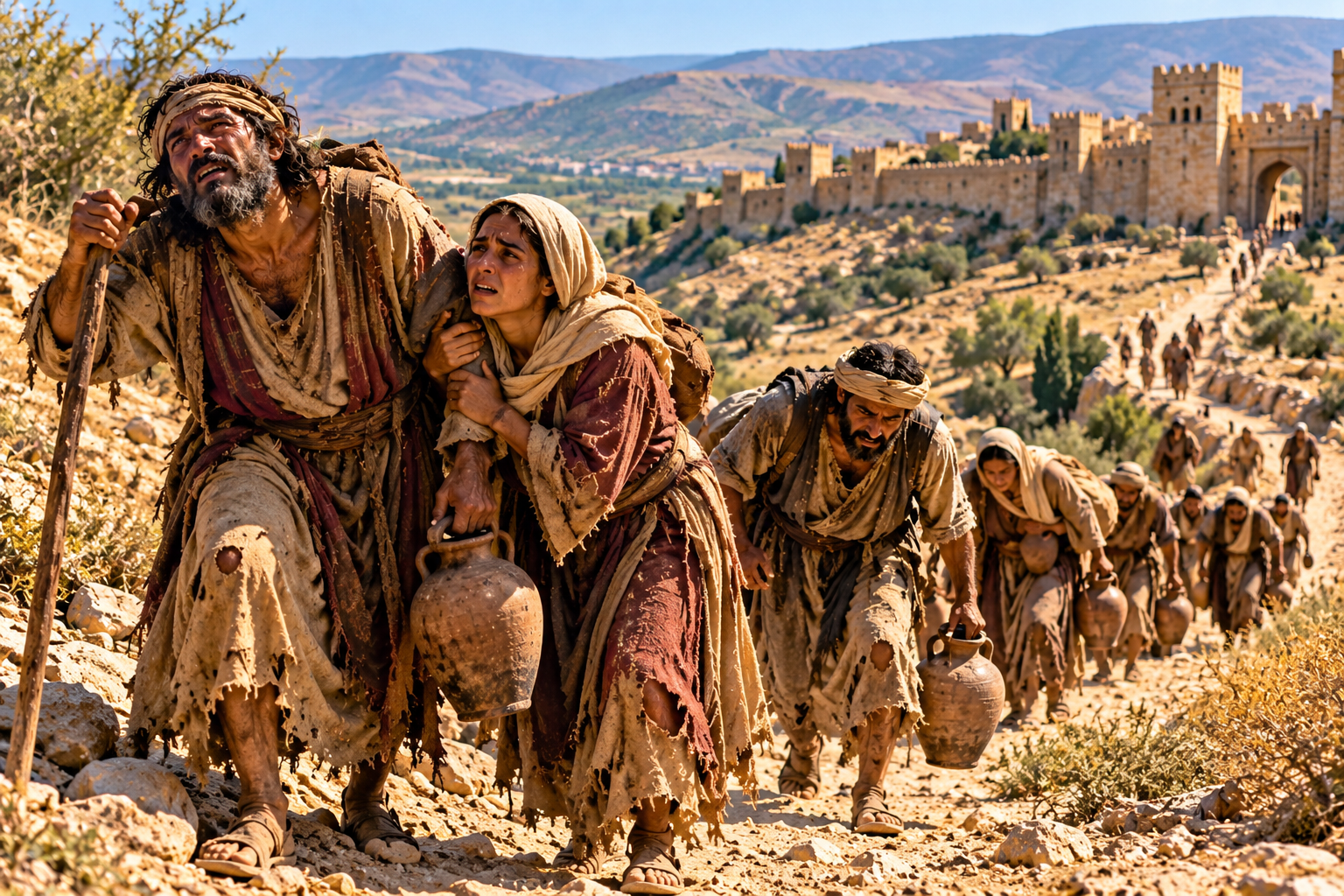
SEEKING FOR WATER
BUT NOT SEEKING GOD
So two or three cities would stagger to another city to drink water - Amos describes the desperate consequence of the selective drought in verse 7. One city received rain while another did not. Eventually the inhabitants of several drought-stricken cities were forced to travel to the city where water could still be found. Stagger (nua) describes wavering, wandering, staggering, or moving unsteadily. These were not people casually traveling to obtain water. They were weakened by thirst, desperately searching for enough water to survive. There is a touch of irony here, for the people who once traveled to Bethel to worship were now traveling from city to city searching for water.
Bob Utley - This verse continues the emphasis of Amos 4:7. Cities are personified as seeking water, but they cannot find enough to sustain life. The term "stagger" (BDB 631, KB 681, Qal PERFECT with waw) has the connotation of staggering or wandering as a result of YHWH's judgment (cf. Amos 8:12; Gen. 4:12,14; Num. 32:13; Jer. 14:10; Lam. 4:15).
They changed their location
without changing their hearts.
But would not be satisfied - Even after reaching another city, there was not enough water. Perhaps two or three cities converged upon the limited water supply of one city that had received rain. Whatever water remained was insufficient for the increased population. The tragedy is that they recognized their need for water but failed to recognize their need for God.
Yet (term of contrast) you have not returned (shub/sub; LXX - epistrepho ~ repent) to Me,” declares the LORD - This is the second occurrence of the refrain that dominates Amos 4:6–11. Biblical repentance is not merely turning from something; it is turning to Someone. This reminds me of the Gentiles in 1Th 1:9-10 "For they themselves report about us what kind of a reception we had with you, and how you turned to God from idols to serve a living and true God, 10and to wait for His Son from heaven, whom He raised from the dead, that is Jesus, who rescues us from the wrath to come."
Bob Utley - "Yet you have not returned (shub/sub; LXX - epistrepho ~ repent) to Me" This is a repeated call for repentance (cf. Amos 4:6,8,9,10,11). Notice the personal emphasis, they are to return to YHWH, their God. He had made a covenant uniquely with them (cf. Amos 4:2). Their part was devotion and obedience. The purpose of creation was fellowship. God wanted a personal being like Himself (cf. Gen. 1:26-27) to have a relationship with. This fellowship/relationship must conform to the nature and character of God. The fracture of this intimate fellowship is the essence of the Fall (cf. Genesis 3) and the goal of redemption (i.e. the restoration of the image of God damaged in human rebellion).
Sometimes God allows the wells in which we trust to run dry
so that we will remember the Fountain we have forgotten.
🙏 THOUGHT: Trials often reveal where we instinctively turn when our "wells run dry." During the drought, people from two or three cities staggered to another city for water but were not satisfied, "yet you have not returned to Me" (Amos 4:8). They went everywhere for relief except to the LORD. We may turn to money, people, medicine, plans, or our own ingenuity, and these may be legitimate means God uses. But none should replace turning first and ultimately to Him. King Asa, when he was severely diseased in his feet, "did not seek the LORD, but the physicians" (2 Chronicles 16:12). The physicians were not the problem; his failure to seek God was. Through Jeremiah, God described His people's twofold error: "They have forsaken Me, the fountain of living waters, to hew for themselves cisterns, broken cisterns that can hold no water" (Jeremiah 2:13). The psalmist knew where true refreshment is found: "As the deer pants for the water brooks, so my soul pants for You, O God" (Psalm 42:1–2). In a dry and weary land, he wrote, "My soul thirsts for You" (Psalm 63:1). Jesus told the woman at the well that whoever drinks the water He gives will never thirst (John 4:13–14), and He cried out at the feast, "If anyone is thirsty, let him come to Me and drink" (John 7:37–38). Sometimes God lets lesser wells run dry so that we will finally come to the only well that never does. When God allows a well to run dry, ask whether He is drawing you more deeply to the Fountain.
Amos 4:9 “I smote you with scorching wind and mildew; And the caterpillar was devouring Your many gardens and vineyards, fig trees and olive trees; Yet you have not returned to Me,” declares the LORD.
- with (KJV): De 28:22 1Ki 8:37 2Ch 6:28 Hag 2:17
- when (KJV): etc. or, the multitude of your gardens, etc. did the palmer worm, etc
- the palmerworm (KJV): Am 7:1,2 De 28:42 Joe 1:4 2:25
- yet (KJV): Am 4:6,8 Job 36:8-13 Isa 1:5 42:24,25 Jer 5:3
Related Passages:
Deuteronomy 28:22 “The LORD will smite you with consumption and with fever and with inflammation and with fiery heat and with the sword and with blight and with mildew, and they will pursue you until you perish.
Deuteronomy 28:38-42 “You shall bring out much seed to the field but you will gather in little, for the locust will consume it. 39 “You shall plant and cultivate vineyards, but you will neither drink of the wine nor gather the grapes, for the worm will devour them. 40 “You shall have olive trees throughout your territory but you will not anoint yourself with the oil, for your olives will drop off. 41 “You shall have sons and daughters but they will not be yours, for they will go into captivity. 42 “The cricket shall possess all your trees and the produce of your ground.
1 Kings 8:37-38 “If there is famine in the land, if there is pestilence, if there is blight or mildew, locust or grasshopper, if their enemy besieges them in the land of their cities, whatever plague, whatever sickness there is, 38 whatever prayer or supplication is made by any man or by all Your people Israel, each knowing the affliction of his own heart, and spreading his hands toward this house;
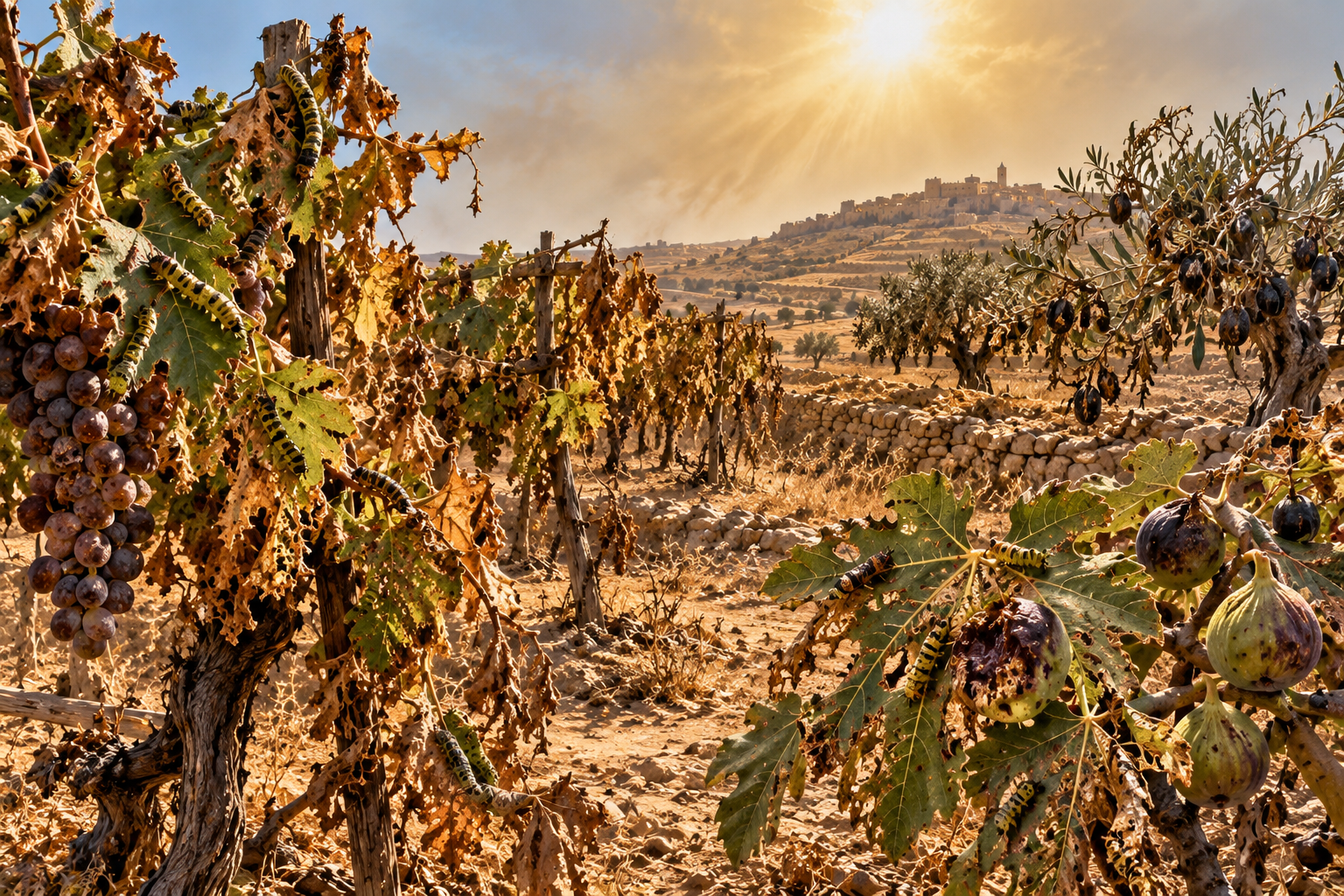
Scorching wind, mildew and catepillars
YAHWEH STRUCK YET
ISRAEL DID NOT RETURN
I smote you with scorching wind and mildew - NET = "I destroyed your crops with blight and disease." Once again God identifies Himself as the One behind Israel's calamities. This is exactly what God had warned Israel centuries earlier (Dt 28:22, 38–42). Mildew refers to a damaging plant condition that caused crops to become pale, diseased, or withered. Every blow contained an invitation. God was striking their prosperity seeking to awaken their hearts.
NET NOTE - Heb “you.” By metonymy the crops belonging to these people are meant. See the remainder of this verse, which describes the agricultural devastation caused by locusts.
John Walton - blight and mildew. Farmers are only too aware of what the forces of nature can do to their crops. Here God attempts to get Israel’s attention by destroying the harvest. First, the sirocco winds strip all of the moisture out of the air and the plant life. Then, too much rain falls and the crops turn yellowish-brown and wither in the fields. See the comment on curses in Deuteronomy 28:22. (IVP Bible Background Commentary: OT page 768)
Bob Utley - scorching wind BDB (995, KB 1423) defines this as "smut on crops" and gives Deut. 28:22; 1 Kgs. 8:37; 2 Chr. 6:28; and Haggai 2:17 as examples. However, Holladay's Lexicon (361) defines it as "scorching" and gives the same examples. The NASB and TEV understand this as referring to the hot desert wind known as "the sirocco" (e.g. Gen. 41:6,23,27). ▣ "mildew" This word (BDB 439, KB 440) is paired with the above word in all examples. BDB translated it "rust." The term also means "paleness" (i.e. imagery of childbirth, cf. Jer. 30:6). Here it is not the mildew caused by too much humidity, but the yellowish powdery kind caused by lack of humidity.
And the caterpillar was devouring - Catepillar is the Hebrew word gazam which refers to a gnawing or cutting locust. What survived the scorching wind and mildew could then be consumed by the locust.
Bob Utley - "the caterpillar" Insect infestation (i.e. locusts [BDB 160, KB 187], cf. Joel 1:4; 2:25) was a judgment from YHWH for breaking the covenant can be seen in Deut. 28:38-40,42.
John Walton - locusts. Insects can also play havoc with growing crops as well as the leaves on olive and fig trees. For another example of locust swarms and their relation to God’s anger see Joel 1:4-7. Akkadian Mari texts report that locusts descended on a town and another explains that the harvest could not be completed because of the swarm of insects. For information concerning the devastation caused by locusts see the comment on Exodus 10:1-20. (IVP Bible Background Commentary: OT page 768)
Your many gardens and vineyards, fig trees and olive trees - Many indicates Israel possessed agricultural abundance. Israel possessed much materially and yet remained desperately poor spiritually. Each of these represented significant elements of Israel's agricultural prosperity. God was touching their economy at multiple points. God was systematically demonstrating that everything Israel considered secure ultimately depended upon Him. When Israel would not hear God's Word through the prophet, God preached to them through their circumstances.
Yet (term of contrast) you have not returned (shub/sub; LXX - epistrepho ~ repent) to Me,” declares the LORD - Once again that terrible little word yet! The tragedy is that Israel suffered without learning why God was allowing the suffering. Their crops changed. Their circumstances changed. Their economy changed. But their hearts did not change. And don't miss the point that these disasters were not evidence that God had ceased caring about Israel. Paradoxically, they demonstrated that He still cared enough to call them to return to Him! Every “return to Me” was an opportunity for repentance before “prepare to meet your God” (Amos 4:10) became a summons to judgment.
🙏 THOUGHT: God's discipline should never merely make us ask, "How can I make this difficulty stop?" A more important question is, "Lord, is there something You want to change in me?" God struck Israel's gardens, vineyards, fig trees, and olive trees with blight, mildew, and locusts, yet they still did not return to Him (Amos 4:9). They wanted their harvests restored more than they wanted their hearts restored. Hosea, Amos's contemporary, records God's purpose in such affliction: "I will go away and return to My place until they acknowledge their guilt and seek My face; in their affliction they will earnestly seek Me" (Hosea 5:15). As noted earlier, not every trial is correction for a specific sin, but every trial can be used by God to deepen our dependence on Him. Rather than rushing to escape, we do well to pray with David, "Search me, O God, and know my heart... and see if there be any hurtful way in me" (Psalm 139:23–24), and to heed Jeremiah's counsel: "Let us examine and probe our ways, and let us return to the LORD" (Lamentations 3:40). The hand that disciplines is also the hand that heals: "Come, let us return to the LORD. For He has torn us, but He will heal us" (Hosea 6:1). Relief from the trial is a blessing, but nearness to God is the greater one. "Whom have I in heaven but You? And besides You, I desire nothing on earth" (Psalm 73:25). Do not merely seek relief from God's hand. Seek the heart of the God who holds you in His hand.
Amos 4:10 “I sent a plague among you after the manner of Egypt; I slew your young men by the sword along with your captured horses, And I made the stench of your camp rise up in your nostrils; Yet you have not returned to Me,” declares the LORD.
- pestilence (KJV): Ex 9:3-6 12:29,30 15:26 Lev 26:16,25 De 7:15 28:22,27,60 Ps 78:49,50
- after the manner (KJV): or, in the way
- your young (KJV): Lev 26:25 2Ki 8:12 10:32 Jer 6:11 11:22 18:21 48:15
- and have taken away your horses (KJV): Heb. with the captivity of your horses, 2Ki 13:3,7
- the stink (KJV): Am 8:3 De 28:26 Jer 8:1,2 9:22 15:3 16:4 Joe 2:20
- yet (KJV): Am 4:6 Ex 8:19 9:12,17,34,35 10:3,27 14:4
Related Passges:
Leviticus 26:23-26 ‘And if by these things you are not turned to Me, but act with hostility against Me, 24then I will act with hostility against you; and I, even I, will strike you seven times for your sins. 25‘I will also bring upon you a sword which will execute vengeance for the covenant; and when you gather together into your cities, I will send pestilence among you, so that you shall be delivered into enemy hands. 26‘When I break your staff of bread, ten women will bake your bread in one oven, and they will bring back your bread in rationed amounts, so that you will eat and not be satisfied.
PLAGUE, SWORD, STENCH
STILL NO RETURN!
I sent a plague among you after the manner of Egypt - The divine discipline intensifies dramatically. God had touched Israel's food (Amos 4:6), water (Amos 4:7–8), and crops (Amos 4:9). Now He touches life itself. Amos will not allow Israel to dismiss these events as mere bad luck or unfortunate history. Within Israel's covenant relationship, God was using these calamities as warnings calling His people back to Himself.
Bob Utley - "I sent a plague among you after the manner of Egypt" The term "plague" (BDB 184, KB 212) is used of: one of the Egyptian plagues in Exod. 9:3,15 and a threat of YHWH's judgment on His own peope in Exod. 5:3; Lev. 26:23-25; Num. 14:12; Deut. 28:21.It is interesting that the Hebrew consonants for "plague" are the same for God's "word" (KB 212). There may be an intentional word play. The Israelites neglected God's "word" and thereby reaped God's "plague." A return to Him and His word would abundantly restore and multiply!
In Exodus God sent plagues to bring Israel OUT.
In Amos God sent plague to bring Israel BACK.
Egypt immediately recalled Israel's great deliverance in the Exodus. God had once sent plagues upon Egypt in order to deliver Israel. Now He sends plague upon Israel. The people once delivered from Egypt were now being disciplined like Egypt. Another lesson here is that past deliverance is no protection for present rebellion. The tragedy is that Israel had left Egypt geographically, but Egypt-like rebellion had entered Israel spiritually.
I slew your young men by the sword along with your captured horses - The judgment moves from disease to warfare. The young men represented strength, vitality, military power, and the nation's future. Yet their youth and strength could not preserve them when God's discipline came. The point is that human strength offers no security when God removes His protecting hand.
along with your captured horses - The Hebrew wording here is difficult, and translations vary. The NASB's “captured horses” likely refers to their horses being taken away in warfare. Horses represented military power. Israel might trust its cavalry, but horses could be captured just as soldiers could be killed. The principle echoes the Psalms “Some boast in chariots and some in horses, but we will boast in the name of the LORD.” (Ps 20:7)
Bob Utley - "along with your captured horses" This would refer to military equipment, but it can be understood in two ways: (1) they thought their victories, which resulted in the capture of horses and chariots would give them greater strength, but YHWH took all of it away (NEB) or (2) the enemy captured their horses and left them without military might (cf. NRSV, TEV, NJB) Most English translations use option #2.
And I made the stench of your camp rise up in your nostrils - Now Amos wants his hearers almost to smell the battlefield. The picture is of military camps filled with the bodies of those who had died through plague and warfare. The number of dead was apparently so great that the odor of death filled the air. The judgment could not be ignored, for now they had SMELLED death itself.
Bob Utley - "the stench of your camp" This refers to the unburied bodies (cf. Isa. 34:3) of the young Israeli men who died in battle. (See BURIAL PRACTICES) ▣ "rise up in your nostrils" This may simply be a description of the rotting corpses of the dead or it is just possible it is another allusion to the Mosaic covenant. One image used of YHWH favorably receiving an offering was "a soothing aroma" (cf. Gen. 8:21; Exod. 29:18,25,41; and many times in Leviticus and Numbers). A good example of a negative use is Exod. 5:21. (See SOOTHING AROMA)
Yet (term of contrast) you have not returned to Me,” declares the LORD - Again the refrain is the cry of God's heart "Return to Me." YET sadly God's warnings became progressively louder because Israel's heart became progressively harder. Amos 4:6–10 describes something spiritually dangerous: the ability to experience repeated divine warnings without responding to them. Every ignored warning makes the next warning easier to ignore. That resembles Pharaoh in Exodus. Repeated confrontation with God's power did not automatically produce repentance. Pharaoh repeatedly hardened his heart. The same trial that softens one heart may harden another. The difference is not the trial but the response to God through the trial.
🙏 THOUGHT: Dear believer, God's purpose in hardship is not merely to make us uncomfortable but to make us seekers. Through every famine and drought, God was waiting for one thing: that Israel would return to Him (Amos 4:6–11). A few verses later He states the invitation plainly: "Seek Me that you may live" (Amos 5:4, 6). Moses had foretold this very pattern: "When you are in distress and all these things have come upon you... you will return to the LORD your God and listen to His voice" (Deuteronomy 4:29,30). And God attached a precious promise to the seeking: "You will seek Me and find Me when you search for Me with all your heart" (Jeremiah 29:13). Trials strip away distractions and reveal how much we truly need Him. Seeking God means more than asking Him for help. It means wanting Him, His presence, His will, His approval, more than the solution we are asking for. "Seek the LORD while He may be found; call upon Him while He is near" (Isaiah 55:6). The writer of Hebrews assures us that God "is a rewarder of those who seek Him" (Hebrews 11:6). When the pressure mounts, do not only pray, "Lord, fix this." Pray, "Lord, I want You."
Amos 4:11 “I overthrew you, as God overthrew Sodom and Gomorrah, And you were like a firebrand snatched from a blaze; Yet you have not returned to Me,” declares the LORD.
- as God (KJV): Ge 19:24,25 Isa 13:19 Jer 49:18 Ho 11:8 2Pe 2:6 Jude 1:7
- as a (KJV): Zec 3:2 1Co 3:15 Jude 1:23
- yet (KJV): Am 4:6 Jer 6:28-30 Eze 22:17-22 24:13 Rev 9:20
Related Resources:
Isaiah 1:9-10 Unless the LORD of hosts Had left us a few survivors, We would be like Sodom, We would be like Gomorrah. 10Hear the word of the LORD, You rulers of Sodom; Give ear to the instruction of our God, You people of Gomorrah.
Zechariah 3:2 The LORD said to Satan, “The LORD rebuke you, Satan! Indeed, the LORD who has chosen Jerusalem rebuke you! Is this not a brand plucked from the fire?”
Jeremiah 6:28-30 All of them are stubbornly rebellious, Going about as a talebearer. They are bronze and iron; They, all of them, are corrupt. 29 The bellows blow fiercely, The lead is consumed by the fire; In vain the refining goes on, But the wicked are not separated. 30 They call them rejected silver, Because the LORD has rejected them.
SAVED FROM THE FIRE
STILL FAR FROM GOD
I overthrew you, as God overthrew Sodom and Gomorrah - Once again note the "I" so that the sender is emphatically God! This is the climax of the escalating judgments in Amos 4:6–11. God had touched their food, water, crops, health, and military strength. Now Amos describes a catastrophe so severe that he compares it with Sodom and Gomorrah.
It is interesting that Amos does not identify a specific historical event of overthrow, so we should be cautious about doing so. He may be referring collectively to devastating military attacks, natural catastrophes, or other judgments Israel had recently experienced. The important point is the degree of devastation. Whatever happened, Israel had come perilously close to destruction and yet they survived.
Bob Utley - "I overthrew you, as God overthrew Sodom and Gomorrah" The VERB (BDB 245, KB 253, Qal PERFECT) is used of God's judgment, both temporal (cf. Gen. 19:25; 2 Kgs. 21:13; Jer. 20:16) and eschatological (cf. Hag. 2:21-22). It speaks of the total destruction of two entire cities by natural or supernatural means. To refer to Israel in the same way as the immoral "cities of the Plain" would have been a shocking insult to these Covenant People. It is another allusion to Leviticus 26; Deuteronomy 27-29 (esp. Deut. 29:23).
As God overthrew Sodom and Gomorrah - This comparison would have been shocking. Sodom and Gomorrah were proverbial examples of catastrophic divine judgment (Ge 19:24–29; Dt 29:23; Isa 1:9–10). For Israel to be compared with Sodom and Gomorrah was spiritually devastating. Israel might have thought “We are God's chosen people.” But election never confers exemption. Covenant privilege could not shield persistent covenant rebellion from the holiness of God.
The hand that allowed them to enter the fire
was also the hand that snatched them from the flame.
And you were like a firebrand snatched from a blaze - A firebrand is a piece of burning wood. Picture a stick already surrounded by flames, beginning to burn, moments away from being consumed. Then suddenly a hand reaches into the fire and snatches it out. That was Israel. Israel survived not because the fire failed to consume them, but because God did not permit the fire to finish its work. God could have allowed Israel to be completely destroyed like Sodom and Gomorrah. He did not. He left a surviving remnant, a firebrand snatched from the blaze. Why? So they would return to Him. They were spared physically but remained unchanged spiritually.
Bob Utley - "And you were like a firebrand snatched from a blaze" In context the TEV translation seems correct in seeing this as an additional message to the few survivors of God's fiery judgment (cf. Zech. 3:20), but even after all of these covenantal curses (cf. Leviticus 26; Deuteronomy 27-29) they would not return (i.e. repent) to Him. God had tried and tried again to reach them through disasters, but they would not. Only complete judgment is left! This verse, like Amos 3:12, denotes total destruction. Only in Amos 9:8-15 is there a future hope! ▣ "firebrand" The root (BDB 15, KB 20) originally meant "to be bent" or "curved." It came to be used of a stick used to stir a fire (cf. Isa. 7:4; Zech. 3:2). ▣ "Yet you have not returned to Me, declares the Lord" See Amos 4:6.
It is possible to experience God's deliverance
without responding to the God Who delivered us.
Yet (term of contrast) you have not returned (shub/sub; LXX - epistrepho ~ repent) to Me,” declares the LORD - We finally arrive at the fifth and final "Yet." Despite the repeated warnings Israel refused to repent. What more could God have done to awaken them? They survived the fire but missed the message of the fire. They had experienced both the severity of God's judgment and the mercy of God's preservation but neither moved them to repentance. God changed their circumstances repeatedly, but Israel refused to change direction of their hearts!
ESV Study Bible on not returned - In short, the coming destruction of Israel at the hands of the Assyrians would not be a sudden unexpected outbreak by a short-tempered God. It was the final outcome of many patient appeals and warnings that the people should have heeded but did not....Stubbornness, like the stubbornness of Pharaoh in the exodus, increases guilt. Stubbornness characterizes Israel’s history, and comes to a climax in the rejection of Christ (Acts 7:51–53; see note on Isa. 29:13). The judgments on Israel were prophesied in Deut. 28:15–68.
🙏 THOUGHT: Sometimes the clearest evidence of God's mercy is not that we escaped the fire untouched, but that He did not allow the fire to consume us. God told Israel, "You were like a firebrand snatched from a blaze" (Amos 4:11), a stick pulled from the flames, charred and smoking, but not burned up. Zechariah later uses the same picture of Jerusalem: "Is this not a brand plucked from the fire?" (Zechariah 3:2). Jeremiah, sitting amid the ruins of Jerusalem, could still say, "The LORD's lovingkindnesses indeed never cease, for His compassions never fail. They are new every morning" (Lamentations 3:22–23). We can look back on circumstances from which we emerged scorched, humbled, and perhaps scarred, yet still standing by the grace of God. Paul described it this way: "afflicted in every way, but not crushed... struck down, but not destroyed" (2 Corinthians 4:8–9). The psalmist testified, "We went through fire and through water, yet You brought us out into a place of abundance" (Psalm 66:12). Do not merely rejoice that you escaped the blaze. Turn in gratitude to the One who brought you through it. Israel was snatched from the fire and still did not return to God, so let us not repeat their mistake. God's discipline is never intended to drive His children away from Him, but to draw them back to Him. Indeed, "all discipline for the moment seems not to be joyful, but sorrowful; yet to those who have been trained by it, afterwards it yields the peaceful fruit of righteousness" (Hebrews 12:11). And remember on that final day "Now to Him who is able to keep you from stumbling, and to make you stand in the presence of His glory blameless with great joy, 25 to the only God our Savior, through Jesus Christ our Lord, be glory, majesty, dominion and authority, before all time and now and forever. Amen.." (Jude 1:24-25)
Amos 4:12 “Therefore thus I will do to you, O Israel; Because I will do this to you, Prepare to meet your God, O Israel.”
- thus (KJV): Am 4:2,3 2:14 9:1-4
- prepare (KJV): Am 5:4-15 Isa 47:3 Eze 13:5 Eze 22:30 Ho 13:8 Mt 5:25 Mt 24:44-51 Mt 25:1-13 Mk 13:32-37 Lu 14:31,32 21:3-36 1Th 5:2-4 Jas 4:1-10 Rev 3:3
Related Passages:
Isaiah 47:3 “Your nakedness will be uncovered, Your shame also will be exposed; I will take vengeance and will not spare a man.”
Ezekiel 22:30 “I searched for a man among them who would build up the wall and stand in the gap before Me for the land, so that I would not destroy it; but I found no one.
Hosea 13:8 I will encounter them like a bear robbed of her cubs, And I will tear open their chests; There I will also devour them like a lioness, As a wild beast would tear them.
Hebrews 10:30-31 For we know Him who said, “VENGEANCE IS MINE, I WILL REPAY.” And again, “THE LORD WILL JUDGE HIS PEOPLE.” 31 It is a terrifying thing to fall into the hands of the living God.
2 Corinthians 5:9-10 Therefore we also have as our ambition, whether at home or absent, to be pleasing to Him. 10For we must all appear before the judgment seat of Christ, so that each one may be recompensed for his deeds in the body, according to what he has done, whether good or bad.
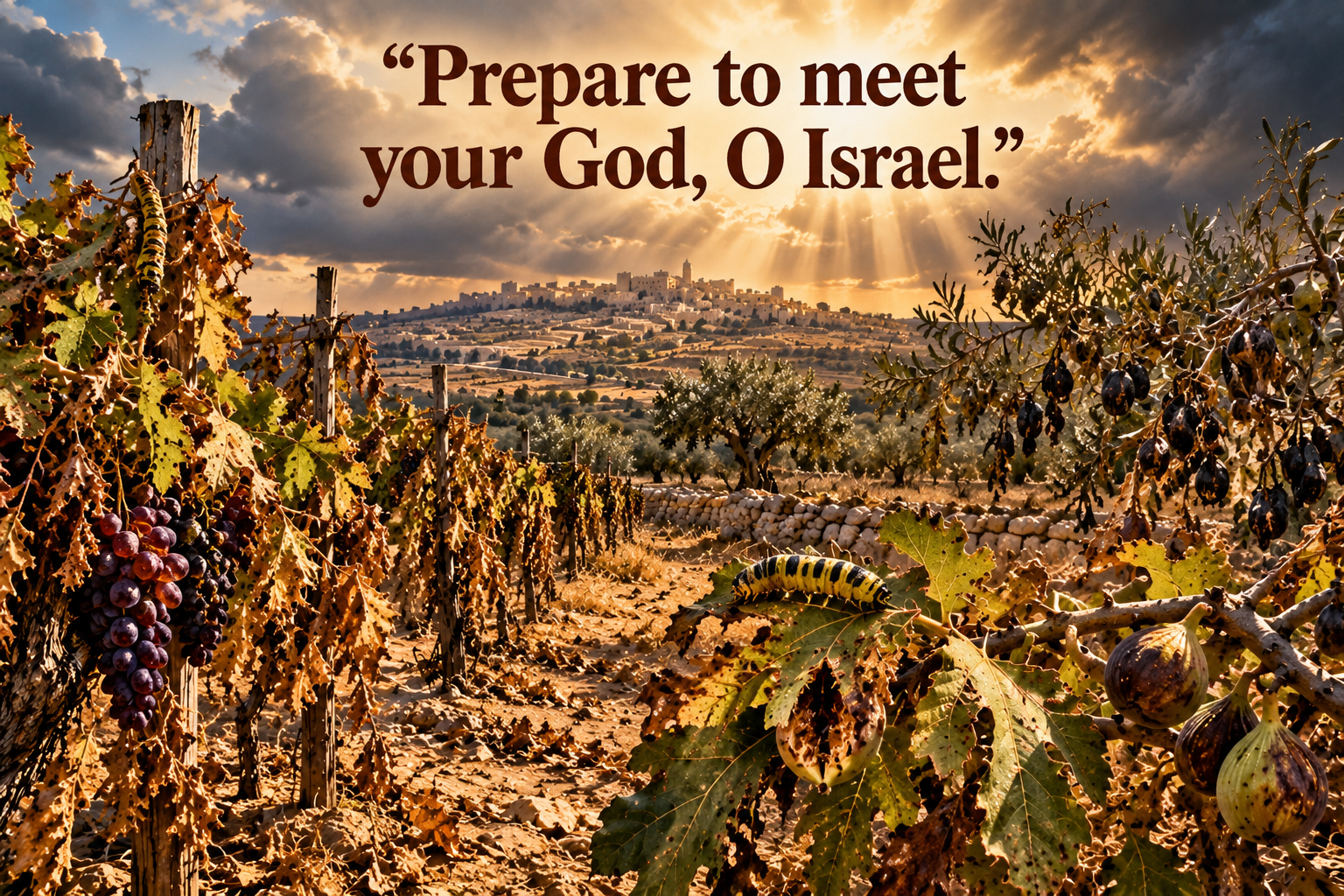
PREPARE TO MEET
YOUR GOD!
Therefore (term of conclusion) - This may be one of the most ominous “therefores” in Scripture. It gathers up everything God has just said in Amos 4:6–11. Five times God disciplined Israel and five times Israel refused His intended response. Thus God is forced to say THEREFORE!
Thus I will do to you, O Israel Because (term of explanation) I will do this to you - Once again we see God is the Instigator. But here He does not specify exactly what He will do, which was declared twice for emphasis. That omission may actually make the statement more terrifying. Israel has already experienced famine, drought, crop failure, plague, war, and near destruction. Now God simply says “Thus I will do to you.” The undefined judgment creates a sense of foreboding. They already know enough about God's holiness and power to understand that whatever comes next will be severe.
Bob Utley - "thus I will do to you, O Israel" There are two ways to interpret this phrase. (1) an oath from YHWH (cf. Amose 4:2) (2) The JPSOA suggests a textual emendation, "Because you are acting thus toward Me." This surely makes sense of the theological and literaty parallelism.
But we know the rest of the story that Amos is moving toward the ultimate covenant judgment that will eventually culminate in the fall of the northern kingdom and exile under Assyria (2 Ki 17:5–6). And miss the important point that Israel's ultimate problem was not Assyria. Israel's ultimate problem was God. Assyria would eventually be God's instrument, but Amos directs Israel's attention beyond the instrument to the sovereign Judge.
Prepare to meet your God, O Israel - Prepare has the basic idea of making ready, establishing, fixing, or preparing. From the context this is not an evangelistic invitation such as, “Get yourself spiritually ready someday to meet God.” In context this is far more ominous. Israel had already been repeatedly called to return and repeatedly refused. So now God announces get ready, because you are about to encounter the God Whose warnings you have ignored. The nation that would not voluntarily return to God would now involuntarily encounter Him! Notice it says "Your God" which invokes the language of covenant. But now the God Who had been their Redeemer would now confront them as their Judge as they had continually transgressed their covenant vows (cf Ex 24:3,7 - cf Israel the Wife of Jehovah).
Bob Utley - "Prepare to meet your God, O Israel" The VERB (BDB 465, KB 464) is a Niphal IMPERATIVE plus a Qal INFINITIVE CONSTRUCT. It often is used of spiritual preparation to meet God (cf. 1 Sam. 7:3; 2 Chr. 12:14; 27:6; Ezra 7:10). This meeting could have been positive (cf. Exod. 19:11-17), but their sin had turned God's visit into covenant judgment (cf. Amos 5:18-20; also note the same idea in Heb. 10:31).
O Israel - Amos turns their privileged name into a summons to accountability.
Israel refused to meet God in repentance,
so they would meet Him in judgment.
NET NOTE - The Lord appears to announce a culminating judgment resulting from Israel’s obstinate refusal to repent. The following verse describes the Lord in his role as sovereign judge, but it does not outline the judgment per se. For this reason F. I. Andersen and D. N. Freedman (Amos [AB], 450) take the prefixed verbal forms as preterites referring to the series of judgments detailed in vv. 6-11. It is more likely that a coming judgment is in view, but that its details are omitted for rhetorical effect, creating a degree of suspense (see S. M. Paul, Amos [Hermeneia], 149-50) that will find its resolution in chapter 5. This line is an ironic conclusion to the section begun at Amos 4:4. Israel thought they were meeting the Lord at the sanctuaries, yet they actually had misunderstood how he had been trying to bring them back to himself. Now Israel would truly meet the Lord—not at the sanctuaries, but face-to-face in judgment.
🙏 THOUGHT: "Prepare to meet your God, O Israel" (Amos 4:12). After five rounds of discipline went unheeded, God's final word was not another warning about drought or locusts but a summons into His presence. God's kindness, forbearance, and patience are meant to lead us to repentance, never to presumption (Romans 2:4). Peter explains that the Lord is not slow about His promise, but "patient toward you, not wishing for any to perish but for all to come to repentance" (2 Peter 3:9). Yet patience can be misread. Solomon observed, "Because the sentence against an evil deed is not executed quickly, therefore the hearts of the sons of men among them are given fully to do evil" (Ecclesiastes 8:11). Do not mistake God's delay in discipline for God's indifference to disobedience. When His Word exposes sin, the safest response is immediate confession and return (1 John 1:9). To the Ephesian church that had left its first love, Jesus gave three simple commands: remember from where you have fallen, repent, and do the deeds you did at first (Revelation 2:4–5). The God Who calls us to return is the same God before Whom each of us must ultimately give an account (Romans 14:10–12; 2 Corinthians 5:10). For the believer, that meeting holds no condemnation (Romans 8:1), but our works will be tested, and some will be rewarded while others are burned up (1 Corinthians 3:13–15). John urges us to abide in Christ "so that when He appears, we may have confidence and not shrink away from Him in shame at His coming" (1 John 2:28). Rather than a source of dread, the coming meeting should be a powerful motivation to live each day pleasing to Him (2 Corinthians 5:9, 1 John 3:2,3). The best way to prepare to meet God tomorrow is to walk with Him today. (Ps 90:12 - note "days" not "years")
The best way to prepare to meet
God tomorrow is to walk with Him today.
C H Spurgeon - Prepare to meet thy God
‘Prepare to meet thy God, O Israel.’ Amos 4:12
Think awhile upon whom you have to meet! You must meet your God! That is, you must meet offended justice whose laws you have broken, whose penalties you have ridiculed; justice righteously indignant, with its sword drawn, you must confront. You must be examined by unblinded omniscience. Him who has seen your heart, read your thoughts, jotted down your affections and remembered your idle words, you must meet. Infinite discernment you must meet, those eyes that never yet were duped, the God who will see through the veils of hypocrisy and all the concealments of formality. There will be no making yourself out to be better than you are before him. You must meet him who will read you as a man reads a book. You must meet with unsullied holiness. You have not always found yourself happy on earth when you have been with holy men; you could not act out your natural impulses in their presence; they were a check upon you; but what must it be to meet the infinitely holy God? You will have to meet with insulted mercy, and perhaps this will be the most dreadful meeting of the whole, when your conscience will remind you that you were invited to repent, urged to lay hold of Christ and bidden to be saved, but you would not be persuaded. O sinner, by so much as God is patient with you now, by so much will he be angry with you then. They who slight the warnings of his grace shall feel the terrors of his wrath. To none shall it be so hard to meet God in justice as to those who would not meet him in grace; vengeance takes the place of slighted mercy. God grant that you may never know what it is to meet insulted love, rejected mercy and tenderness turned to wrath!
Summary of this Sermon -
The Inevitable Meeting: Spurgeon emphasizes that every person—whether righteous or ungodly, believer or unbeliever—will have a personal and unavoidable appointment to stand before God their Creator, Preserver, and Judge. [1, 2]
For the Believer (An Invitation):
To those renewed in heart, the message acts as a daily summons to communion, prayer, and walking closely with their heavenly Father.
For the Unconverted (A Warning and a Summons):
To those who ignore or rebel against God, the warning is sharp and immediate. Physical death or the return of Christ will cut off all excuses, delays, or attempts at self-defense.
How to Be Prepared, According to Spurgeon
Cease Self-Reliance:
Spurgeon warns against trusting in personal good works, outward religious ceremonies, or moral excuses.
Go to Jesus Christ (The Only Meeting Place):
He stresses that the only safe place for a sinner to meet God is at the Cross.
Trust the Advocate:
Sinners must call upon Jesus Christ as their Mediator and Advocate, resting entirely on His atoning death, shed blood, and spotless righteousness to cover their sins.
Worse and Worse - From This Verse - Robert Morgan
His mother didn’t like it, but John Marrant, a young, free black man in colonial America, became a musician. His violin and French horn were a hit at balls and parties in Old Charleston, South Carolina, and John was the toast of the town. All that changed one evening as he sauntered down the street on his way to play his horn somewhere. He saw a crowd outside a church and was told “a crazy man was hallooing” inside. Marrant pushed in, intending to break up the meeting by blasting his instrument.
The “crazy man,” evangelist George Whitefield, was preaching from Amos 4:12. As Marrant entered, Whitefield pointed his finger directly at him and shouted, “Prepare to meet your God.” The words hit the young man with such force he collapsed to the floor unconscious. When he came to, Whitefield was still preaching. “Every word,” said Marrant, “was like a parcel of swords thrust into me.” He was carried to a side room, and after the service, Whitefield called on him, saying, “Jesus Christ has got thee at last.”
Marrant was carried home and his sister sent for doctors. For three days, he barely ate or drank. One of Whitefield’s associates visited him, and the two men knelt together by Marrant’s bed. After their prayer, the minister asked Marrant how he felt.
“Much worse,” came the reply. They prayed again, and the minister again asked how he felt.
“Worse and worse.”
They prayed a third time. Near the close of his prayer, the Lord was pleased to set my soul at liberty, and being filled with joy, I began to praise the Lord immediately. My sorrows were turned into peace and love.
This time when the minister asked how he felt, Marrant replied, “All is well, all is happy.” John Marrant was just fourteen at the time, but he went on to become a dramatic preacher throughout North America.
Oswald in His Presence
Few readers of My Utmost for His Highest realize its author was a gifted painter who might have enjoyed a long and distinguished career. But a sermon by Charles Spurgeon changed that, and Oswald Chambers lay down his brushes, sensing God’s call to ministry. From 1906 to 1910, he preached around the world, and from 1911 until 1915, he directed a Bible college.
At the outbreak of World War I, Chambers offered to minister among soldiers in Egypt. Under his leadership there, mission huts sprang up for British troops near Cairo and at the Suez. Men turned out in droves to hear his sermons and lectures.
During these days, Chambers typically rose at 5:30 A.M. for his hour alone with God. Watching the sunrise over the ancient desert always filled him with wonder, and he sometimes described it in his journal, using an artist’s tongue: “It is a lovely morning, the sun rose in a real marvel of glorious light. Each sunrise here looks as if it were a new thought from God. … ”
Chambers spent his last mornings in the minor prophets. He noted that the blasts and plagues described in Amos seemed to come from “the powerful hand of God, and not the blind cause and effect.” He sensed God’s overruling providence, even in disasters, even in the midst of war.
One day Chambers described in his diary the brilliant sunrise “like a celestial scheme of shot silk.” He meditated on the power of a God who could make even the desert spectacular, then he read Amos 5, claiming verse 8: “He made the Pleiades and Orion; He turns the shadow of death into morning; … the Lord is His name.” Having thus reassured himself of the sovereignty and supremacy of God, Chambers plunged into another day.
He had only a handful left. A couple of weeks later he underwent an emergency appendectomy in the Red Cross hospital. Two weeks later, his wife cabled four words to his family and friends: “Oswald in His Presence.”
F B Meyer - Amos 4:12 Prepare to meet thy God, O Israel.
These words might have rung out in Paradise. When the heat of the day was over, the voice of the Lord might have been heard sounding down the leafy avenues: Prepare, O man, to meet thy God! And the summons must have filled him with ecstasy. As a child to its parent, so must those two innocent and happy beings have sped to their Creator.
We, too, hear the summons. Each morning, when we stand ready for the duties of the day, we hear the voice, Prepare to meet Me. Each Lord’s Day we wake with this same summons in our heart, and prepare ourselves to meet our God. Each illness, each fluttering of the canvas of our mortality, each premonition of our end, takes up the same appeal, Prepare to meet God. And as we hear the words, we have no dread, no fear. Clothed in Christ’s perfect righteousness, arrayed in his beauty, we know that we are accepted; that the love wherewith the Father loves the Son is waiting to greet us.
But there should be a preparedness of heart. We should not rush heedlessly into his presence. We should stimulate our hearts by thoughts like those suggested in the following verse. Stop and remember how great God is: He formed the mountains. How subtle his power: He made the viewless wind, and the Spirit of which it is the emblem. How omniscient his knowledge: He can declare unto man his inmost thought. How absolute his authority the brightest morning will darken, or the darkest night brighten, as He bids. How vast the circuit of his providence, who steps from Alpine peak to peak. Let me not rush into his presence: He is my Father. But He is the Lord, the God of hosts: I must order my thoughts, and prepare to meet Him.
PREPARATION FOR THE FUTURE AMOS 4:12 Jeff Brown
Introduction.
Definition of “prepare”—Webster says, “To make ready for, to arrange” …
1. Nations prepare for war—for peace, etc.…
2. Communities prepare for elections, social events, special occasions …
3. Business men prepare for sales, inventory, etc.…
4. Individuals prepare for holidays, vacations, trips, etc.…
These are all temporal—we are thinking of the spiritual preparation for the life to come. Let’s look again at the Word of God …
1. Amos 4:12 (read) …
2. 2 Kings 20:1 …
3. Matt. 24:44 …
The future is inevitable—let’s look at the preparation for it …
I. HELL HAS BEEN PREPARED
1. Matt. 25:41 …
2. Isa. 14:9 …
II. SATAN HAS PREPARED A TRAP
1. A trap to ensnare you … By deception …
2. This trap may seem quite innocent …
(a) Such as the social practices of many …
(b) The social drinker, dancing, etc.…
3. Enticements to keep you from the Lord’s house and service …
(a) Too busy with the temporal …
(b) Petty grievances within the membership …
4. Using moral, even religious—but lost men to influence people …
5. In short, the Devil has set a trap to send men to hell …
III. GOD HAS PREPARED
1. Zeph. 1:7 …
2. Matt. 25:34 …
3. John 14:1–6 …
4. 1 Cor. 2:9 …
5. God has prepared salvation through Christ Jesus that will suffice in this life and the life to come …
6. God has prepared sufficient power and leadership in the person of the Holy Spirit …
(a) Power, not only to save, but to keep …
(b) Leadership to guide every detail of life …
7. A place for us when the life is done …
8. A crown for the faithful …
IV. WE MUST PREPARE
1. Amos 4:12 …
2. By accepting and trusting Jesus …
3. This involves repentance, faith, confession …
Conclusion. The Devil has prepared for the unprepared. Jesus has prepared for the prepared.
ARE YOU PREPARED OR UNPREPARED??
Amos 4:13 For behold, He who forms mountains and creates the wind And declares to man what are His thoughts, He who makes dawn into darkness And treads on the high places of the earth, The LORD God of hosts is His name.
- he that (KJV): This is a most powerful description of the majesty of Jehovah, the God of hosts. Job 38:4-11 Ps 65:6 Isa 40:12 Zec 12:1
- and createth (KJV): Ps 135:7 Ps 147:18 Jer 10:13 Jer 51:16
- wind (KJV): or, spirit, Joh 3:8
- and declareth (KJV): Ps 139:2 Da 2:28 Mt 9:4 Lu 7:39,40 Joh 2:25
- that maketh (KJV): Am 5:8 8:9 Ex 10:22 14:20 Isa 5:30 Jer 13:16
- and treadeth (KJV): De 32:13 33:29 Mic 1:3 Hab 3:19
- The Lord (KJV): Am 3:13 5:8 6:8 9:6 Isa 47:4 48:2 Jer 10:16 51:19
Related Passages:
Psalm 65:6 Who establishes the mountains by His strength, Being girded with might;
Isaiah 40:12 Who has measured the waters in the hollow of His hand, And marked off the heavens by the span, And calculated the dust of the earth by the measure, And weighed the mountains in a balance And the hills in a pair of scales?
Zechariah 12:1 The burden of the word of the LORD concerning Israel. Thus declares the LORD who stretches out the heavens, lays the foundation of the earth, and forms the spirit of man within him,
Jeremiah 10:13 When He utters His voice, there is a tumult of waters in the heavens, And He causes the clouds to ascend from the end of the earth; He makes lightning for the rain, And brings out the wind from His storehouses.
Psalm 135:7 He causes the vapors to ascend from the ends of the earth; Who makes lightnings for the rain, Who brings forth the wind from His treasuries.
Psalm 147:18 He sends forth His word and melts them; He causes His wind to blow and the waters to flow.
THE GOD YOU ARE
ABOUT TO MEET
For (term of explanation) - Who is this God Israel must meet? Amos explains with a magnificent description of His creative power, omniscience, sovereignty, and absolute authority.
Behold, He who forms mountains and creates the wind - Look! Consider carefully the majesty of the God you have been resisting. Israel had treated God's repeated warnings casually. Amos now lifts their eyes from their circumstances to the awesome character of the One behind those circumstances. Israel's greatest mistake was not merely underestimating its sin; it was underestimating its God.
Bob Utley - This verse seems to be poetic liturgy, doxology, or an early hymn to God as Creator, and thereby, Judge. Amos has several of these powerful doxological praises ("the Lord of hosts is His name," cf. Amos 5:8-9; 9:5-6). ▣ "forms" This VERB (BDB 427, KB 428, Qal PARTICIPLE) is from the concept of a potter forming clay (e.g. Gen. 2:7,19; Isa. 29:19; 45:15; Jer. 33:2). ▣ "mountains" Mountains were a symbol of strength and permanency. ▣ "creates" This VERB, bara (BDB 135, KB 153, Qal PARTICIPLE) is parallel to "forms." This VERB is used exclusively of God's creative activity. Its basic meaning is "to form or shape by cutting." See Millard Erickson, Christian Theology, 2nd ed., pp. 394-397 and John H. Walton, ANE Thought and the OT, p. 183. ▣ "wind" This Hebrew term (BDB 924) can mean "wind," "breath," or "spirit." Here the context implies a contrast between the physical and the spiritual realms (mountains versus spirit). This verse became part of Athanasius' controversy over the personhood of the Spirit and the Trinity. Some took the verse to assert YHWH created mountain and "the Spirit," therefore, the Spirit was a created being. See Millard Erickson, Christian Theology 2nd ed., pp. 864-873.
He who forms mountains The Hebrew verb yatsar means to form, fashion, or shape, the same verb used of God forming man from the dust (Ge 2:7). Mountains appear permanent, massive, immovable, and ancient. Yet God formed them. Israel is not preparing to meet some local tribal deity, but they are preparing to meet the Creator.
NET NOTE - Heb “For look, the one who.” This verse is considered to be the first hymnic passage in the book. The others appear at 5:8-9 and 9:5-6. Scholars debate whether these verses were originally part of a single hymn or three distinct pieces deliberately placed in each context for particular effect.
Creates the wind - The word bara is the great Hebrew verb meaning create, used in Genesis 1:1. Notice the contrast between mountains which are visible and solid and the wind which is invisible and intangible.
John Walton - connection between wind and thoughts. In Hebrew the word translated “wind” is the word that is also often translated “spirit.” It is not so much that the word had two different meanings but rather that in the ancient world they did not find it so easy to differentiate between wind and spirit. In Mesopotamian thought the gods gave revelation of their thoughts through dreams. The messenger who brought these dreams was named Zaqiqu. The common word zaqiqu refers to a ghost or a phantom. It derives from the verb zaqu, which refers to the blowing of the wind, or to the breath of a god. (IVP Bible Background Commentary: OT page 768)
And declares to man what are His thoughts - This phrase is somewhat difficult because the Hebrew can potentially refer to man's thoughts or possibly God's own thought/purpose. The NASB takes it as God revealing to man what man's thoughts are. If so, the point moves from God's power over creation to His knowledge of the human heart. God not only knows mountains and winds. He knows men. Israel might hide hypocrisy beneath sacrifices, tithes, and religious festivals, but nothing inside them was concealed from God. The Judge already knew the defendants completely!
He who makes dawn into darkness - Dawn ordinarily signals the end of darkness. Yet Amos describes God as able to turn dawn itself into darkness. This may portray God's sovereign control over the natural order and, in this judgment context, may also carry ominous overtones. The God Who normally brings light can replace anticipated light with darkness. That theme becomes explicit later “Will not the day of the LORD be darkness instead of light?” (Amos 5:20) When God is opposed, what appears to be the beginning of another bright day can suddenly become darkness.
NET NOTE - Heb “he who makes dawn, darkness.” The meaning of the statement is unclear. The present translation assumes that allusion is made to God’s approaching judgment, when the light of day will be turned to darkness (see 5:20). Another interpretation is, “He makes the dawn [and] the darkness.” A few Hebrew mss, as well as the LXX, add the conjunction (“and”) between the two nouns. A third possibility is, “He turns darkness into glimmering dawn” (NJPS). See S. M. Paul (Amos [Hermeneia], 154), who takes שָׁחַר (shakhar) as “blackness” rather than “dawn” and עֵיפָה (ʿefah) as “glimmering dawn” rather than “darkness.”
And treads on the high places of the earth - The high places are the heights or elevated places of the earth. What seems towering to man lies beneath God's feet. He does not struggle to climb the heights. He treads upon them. The imagery portrays absolute sovereignty and transcendence.
Bob Utley - "treads on the high places of the earth" This may be another connection with Deuteronomy (i.e. Mosaic Covenant, cf. Deut. 32:13). It is imagery for asserting God as Creator (cf. Job 9:8). In Isa. 58:4 and Hab. 3:19 it was a way of referring to the blessings of YHWH on His people. This term bamah (BDB 119, KB 136) was also associated with the worship of Ba'al (cf. Amos 2:7-8) on the top of hills (e.g. Hosea 4:13; see Roland deVaux, Ancient Israel, vol. 1, pp. 284-288 and Robert Girdlestone, Synonyms of the OT). This may be another way of rejecting the worship of Canaanite fertility gods and asserting YHWH's care and provision.
The LORD God of hosts is His name - LORD of hosts (of armies) Commander of the armies of heaven and sovereign over all powers. Israel's armies had failed (Amos 4:10). But God's armies never fail. Israel's ultimate problem was not the armies gathering against her, but the Commander of heaven's armies whom she had offended. (See What are Heavenly Hosts)
Amos begins “The LORD roars from Zion.” (Amos 1:2) Now at the climax of chapter 4 “The LORD God of hosts is His name.” The One Who roared is the One Israel must now meet. And this is no ordinary lion. He is the Creator and Commander of heaven and earth.
Bob Utley - "the Lord God of hosts is His name" This is similar to Amos 3:13. Amos has spoken of the God of creation, fertility, and judgment based on the Covenant. He now states specifically and unambiguously who that deity is, YHWH of Israel (cf. Amos 5:8b).
🙏 THOUGHT: Our view of God profoundly affects our view of everything else. Amos ends this section with a hymn of praise to the One Who "forms mountains and creates the wind and declares to man what are his thoughts... Who treads on the high places of the earth, the LORD God of hosts is His name" (Amos 4:13). For rebellious Israel, those words were a warning: this is the God you must meet. For those who trust Him, the same words are a deep comfort. The One who formed the mountains, created the wind, knows every thought, and rules over all creation is also the One Who calls us His own (1Pe 2:9,10). Big problems look different when seen beside a big God. Through Isaiah, God invites His weary people to lift up their eyes and look at the stars He created and calls by name, then reminds them that "the Everlasting God, the LORD, the Creator of the ends of the earth does not become weary or tired... He gives strength to the weary" (Isaiah 40:25–31). The psalmist could say that even if the earth should change and the mountains slip into the heart of the sea, "God is our refuge and strength, a very present help in trouble" (Psalm 46:1–3). Then God speaks: "Cease striving and know that I am God" (46:10). Peter walked on the water as long as his eyes were on Jesus, but "seeing the wind, he became frightened and began to sink" (Matthew 14:30). The wind was real, but the One who created the wind was standing right in front of him. When circumstances seem overwhelming, do not merely look harder at the circumstances. Look higher at your God. "I will lift up my eyes to the mountains; from where shall my help come? My help comes from the LORD, who made heaven and earth" (Psalm 121:1–2).
When circumstances seem overwhelming, do not merely
look harder at the circumstances. Look higher at your God.
ESV Study Bible The following chart shows the percentages of verses in a book containing at least one occurrence of the phrase, “LORD of hosts” (or related variation):
1. Malachi (43.6%)
2. Haggai (31.6%)
3. Zechariah (21.8%)
4. Amos (6.1%)
5. Jeremiah (5.9%)
6. Isaiah (4.7%)
7. Nahum (4.3%)
8. Zephaniah (3.8%)
9. Habakkuk (1.8%)
10. Micah (1.0%)
11. 2 Samuel (0.9%)
12. Psalms (0.7%)
13. 1 Samuel (0.6%)
14. Hosea (0.5%)
15. 1 Kings (0.4%)
16. 1 Chronicles (0.3%)
17. 2 Kings (0.3%)
Bob Maurcaurelle The Sin of Selfish Luxury - Amos 4:1-13
The Bible warns us that the love of money is the root of all kinds of evil (1 Tim. 6:10). Israel's sin was not in being wealthy. Abraham was wealthy, yet he was called the friend of God (James 2:13). David was wealthy, yet was called a "man after God's own heart" (Acts 13:22). Their sin was in the manner in which they accumulated their wealth. They "oppressed" and "crushed" the poor (Amos 4:1). Their pleasure came at the cost of other people's hurt. It was in the manner in which they adored their wealth. Living in unspeakable luxury they never thought of doing without diamonds so some people could have milk for starving children. This sorry state was brought about by four failures:
I. The Failure of Women (Amos 4:1-3)
The first thing we see is the failure of Israel's women. A nation will never rise any higher than the character of its women. The weaker sex, physically (1 Pet. 3:7), they are the stronger sex spiritually. For they wield far greater power over men than men wield over them. Like Abigail to David, they can lift a man to noble heights (1 Sam.25). Like Jezebel to Ahab, they can drag him to horrible depths (1 Kings 16-21). Women are the trend setters in society. They have ever been the final guardians of morals and religion.
We have here
1. A Sarcastic Picture (Amos 4:1a). Amos compared them to the fat, well-groomed cattle of the fertile land of Bashan (See Deut. 32:14). He did this because of their
2. Shameful Practice (Amos 4:1b). They "oppress" the poor and "crush" the needy. Their sin was not in being affluent but in being totally apathetic to the suffering they helped impose upon others in their insatiable craving for luxury. They drove their husbands to do cruel things to feed their appetites. Added to their apathy was their alcoholism. In Israel, as in America, the idle upper class had an alcohol problem. What an indictment! Materialism cannot buy peace, contentment, self respect or a good night's sleep. Selfish people need drugs to make their luxurious life bearable.
The result was
3. A Solemn Promise (Amos 4:2a). God didn't just say He would punish them, He swore "by His holiness," by His wholly otherness, by who and what He is, that He would do so. God vindicates His righteous character in that He refuses to let sins go unpunished. Amos is saying that God is bound "by His own moral character to act on behalf of the oppressed" (Kyle Yates).
This would all come to pass in
4. A Savage Practice (Amos 4:2b-3). Using horrible pictures of ancient warfare, Amos says an army will drag you from your houses with ropes and hooks like men drag cattle to slaughter. They will pull you through breaches in the walls like cattle walking through a hole in a fence. The word Harmon is uncertain but it could refer to a "dung hill" (Kelly). Like dead cows their carcasses would be thrown onto a garbage pile. The bottom line is this. In their luxury they had treated their fellow humans as little more than beasts of burden. In the end God would see to it they were treated the same. What we give, we get!
II. The Failure of Worship (Amos 4:4-5)
The churches also had failed to raise the level of ethical living in Israel. The churches were filled but they were filled with empty people. Bethel, where Jacob saw God (Gen. 28:18), was the sanctuary of the king himself (Amos 7:13) and therefore prominent in the land. Gilgal was a famous and highly honored historical site. It was the place where Israel camped after crossing the Jordan. It was their base of operation from which they moved out to conquer the land. Thus it was probably a favorite worship center through the years (1 Sam. 10:8; Hos. 4:15).
They
1. Practiced Their Religion. With more sarcasm, he called them, like a priest, to come to church. His charge was that they didn't come to worship, they came to sin (transgress) (Amos 4:4). At special festivals they "sacrificed every morning" and brought tithes every three days.
2. They Proclaimed Their Religion. The "leaven" in their meal offerings pointed to their affluence. They gave much and they did much and they loved to publish it (Amos 4:5b). If you wanted to know how good and religious they were, they would be glad to tell you. The real problem was
3. They Perverted God's Religion. Is Amos condemning the external acts of religion? Is he calling for a "religionless Christianity"? Are we to be "good" and forget about church and tithing and singing hymns? No! The Bible commands us to go to church (Heb. 10:25), to tithe (Mal. 3) and to sing praises (Eph. 5:19) as much as it commands us to live holy lives out in the world (Eph. 5:1-2). What God wants is piety and practical holiness. He wants us to come to church; to get to know Him; and to take Him, in our character, back out into the world.
III. The Failure of Warnings (Amos 4:6-11)
To these people who presumed on God's goodness and took His mercy as a sign of moral weakness, Amos reminded them of His severe warnings in the past. He sent calamities to call them to repent, but over and over He had to say, "... yet you did not return to me" (Amos 2:6, 7, 8, etc.). He mentions five kinds of disasters (famine, drought, crop failure, disease and death, and the overthrow of cities).
In all this he saw the hand of God. Was he right? Or was he, as a child of his time, trained to see God in everything. Is God the author of our disasters? The problem and origin of evil and suffering is too deep for man's mind. Christ saw Satan as the author of disease (Luke 13:16). We cannot solve this riddle, but each person must interpret his disasters for himself. Do they come as a natural part of life? Do they come because we are sinful (1 Cor. 11:30)? Do they come because we are faithful (Job. 1)?
The truth is that sometimes God allows troubles to come our way, even from the hand of Satan, to warn us of our rebellion and to woo us back to the paths of righteousness. Pusey says, "It is a great gift of God that He should care for us so as to chasten us."
IV. The Failure of Wishful Thinking (Amos 4:12-13)
There were many, perhaps, in Amos' congregation who felt there was no way their proud, prosperous and powerful land could be reduced to such shame and suffering. To show the failure of such wishful thinking he issues a solemn call (Amos 4:12) and sings a sublime hymn (Amos 4:13). There is
1. The Summons (Amos 4:12). The solemn call is "prepare to meet thy God O Israel." Whether in the here and how (the meaning here) or in the hereafter, we must all sit down to a banquet of consequences.
Following the summons is
2. The Song (Amos 4:13). In case they doubt His power to bring all this to pass, Amos proclaims His vast power in the first of three (Amos 5:8-9 and Amos 9:5-6) nature hymns. God has the wisdom, power and resources to bring them to their knees because He is the God of creation. He "forms mountains and creates the wind." He knows the inner thoughts of all men. He can send storms or clouds or an eclipse to hide the sun in the morning. He "treads on high places" as evidenced by the thunder and lightning. He is the head of the armies of heaven and of earth (Lord of Hosts). When He comes against you, you can no more stop Him than you can stop the wind or blot out the sun or silence a storm.