Amos 3:2
Amos 3:3
Amos 3:4
Amos 3:5
Amos 3:6
Amos 3:7
Amos 3:8
Amos 3:9
Amos 3:10
Amos 3:11
Amos 3:12
Amos 3:13
Amos 3:14
Amos 3:15
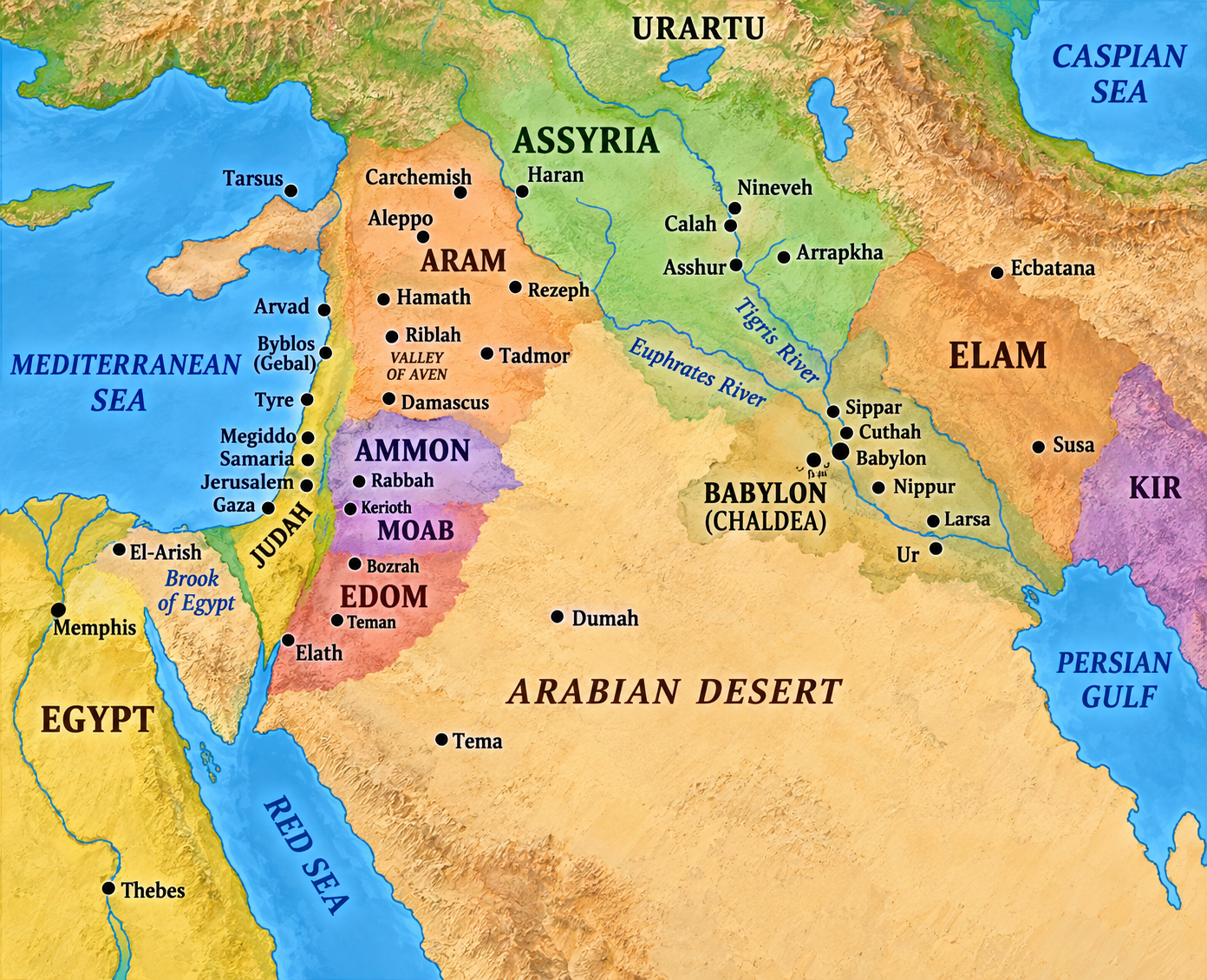

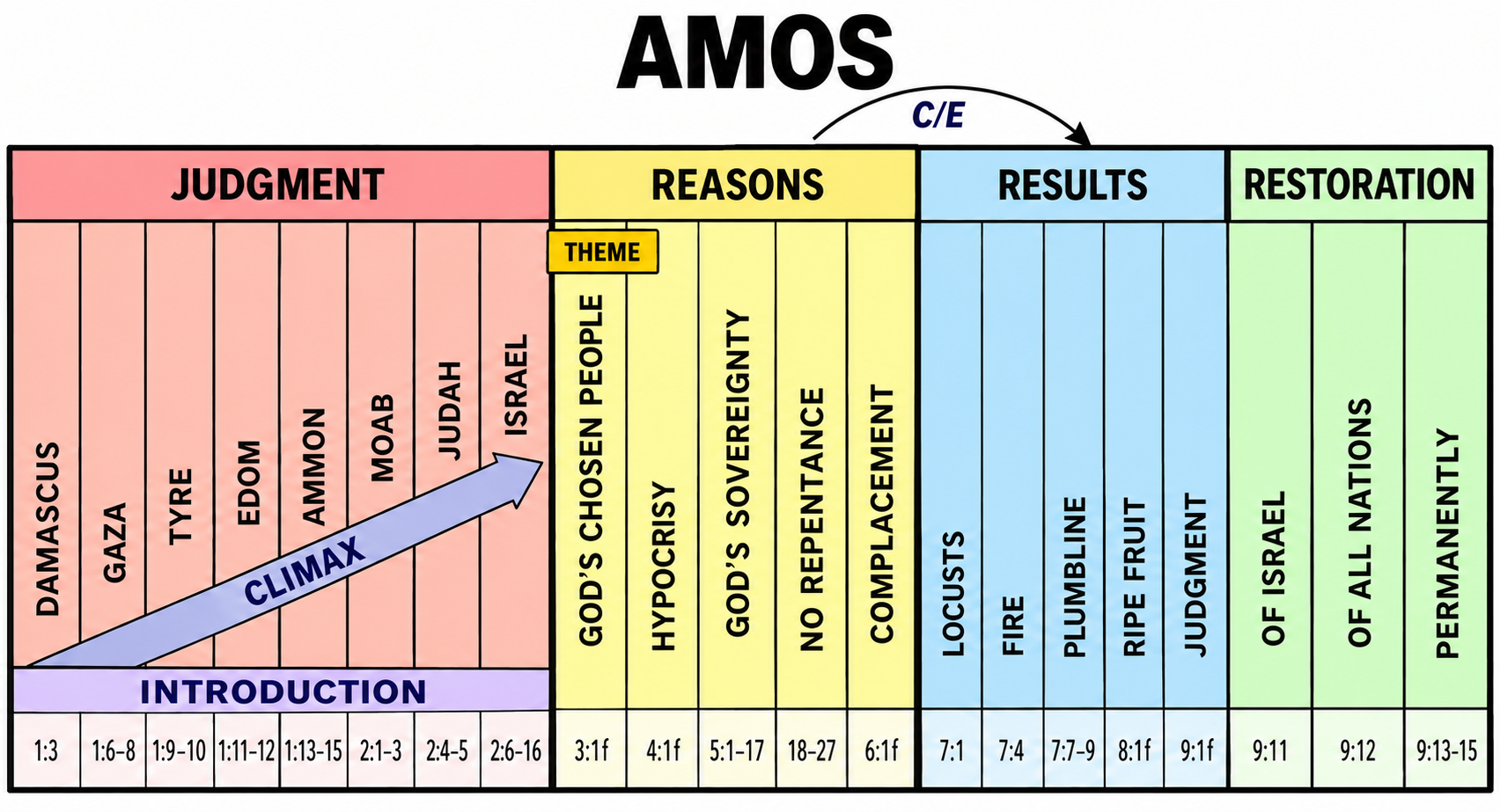
Click chart to enlarge
From Hampton Keathley IV
Amos 3:1 Hear this word which the LORD has spoken against you, sons of Israel, against the entire family which He brought up from the land of Egypt:
KJV Hear this word that the LORD hath spoken against you, O children of Israel, against the whole family which I brought up from the land of Egypt, saying,
NET Listen, you Israelites, to this message which the LORD is proclaiming against you! This message is for the entire clan I brought up from the land of Egypt:
NLT Listen to this message that the LORD has spoken against you, O people of Israel and Judah-- against the entire family I rescued from Egypt:
ESV Hear this word that the LORD has spoken against you, O people of Israel, against the whole family that I brought up out of the land of Egypt:
BGT ἀκούσατε τὸν λόγον τοῦτον ὃν ἐλάλησεν κύριος ἐφ᾽ ὑμᾶς οἶκος Ισραηλ καὶ κατὰ πάσης φυλῆς ἧς ἀνήγαγον ἐκ γῆς Αἰγύπτου λέγων
LXE Hear ye this word, O house of Israel, which the Lord has spoken concerning you, and against the whole family whom I brought up out of the land of Egypt, saying,
CSB Listen to this message that the LORD has spoken against you, Israelites, against the entire clan that I brought from the land of Egypt:
NIV Hear this word the LORD has spoken against you, O people of Israel--against the whole family I brought up out of Egypt:
- Hear (KJV): 2Ch 20:15 Isa 46:3 48:12 Ho 4:1 5:1 Mic 3:1 Rev 2:29
- against (KJV): Jer 8:3 31:1 33:24-26 Eze 37:16,17
- which (KJV): Am 2:10
- Amos Commentaries - multiple resources
Related Passages:
Exodus 19:4-6 ‘You yourselves have seen what I did to the Egyptians, and how I bore you on eagles’ wings, and brought you to Myself. 5 ‘Now then, if you will indeed obey My voice and keep My covenant, then you shall be My own possession among all the peoples, for all the earth is Mine; 6 and you shall be to Me a kingdom of priests and a holy nation.’ These are the words that you shall speak to the sons of Israel.”
Exodus 20:2 “I am the LORD your God, who brought you out of the land of Egypt, out of the house of slavery.
Deuteronomy 5:6 ‘I am the LORD your God who brought you out of the land of Egypt, out of the house of slavery.
Amos 2:10 “It was I who brought you up from the land of Egypt, And I led you in the wilderness forty years That you might take possession of the land of the Amorite.
Luke 12:47-48 “And that slave who knew his master’s will and did not get ready or act in accord with his will, will receive many lashes, 48but the one who did not know it, and committed deeds worthy of a flogging, will receive but few. From everyone who has been given much, much will be required; and to whom they entrusted much, of him they will ask all the more.
Deuteronomy 4:1 “Now, O Israel, listen to the statutes and the judgments which I am teaching you to perform, so that you may live and go in and take possession of the land which the LORD, the God of your fathers, is giving you.
Deuteronomy 5:1 Then Moses summoned all Israel and said to them: “Hear, O Israel, the statutes and the ordinances which I am speaking today in your hearing, that you may learn them and observe them carefully.
Deuteronomy 6:3 “O Israel, you should listen and be careful to do it, that it may be well with you and that you may multiply greatly, just as the LORD, the God of your fathers, has promised you, in a land flowing with milk and honey.
Jeremiah 2:4 Hear the word of the LORD, O house of Jacob, and all the families of the house of Israel.
Hosea 4:1 Listen to the word of the LORD, O sons of Israel, For the LORD has a case against the inhabitants of the land, Because there is no faithfulness or kindness Or knowledge of God in the land.
HEAR THIS WORD OF
PRIVILEGE AND ACCOUNTABILITY
Warren Wiersbe gives an excellent summary of Amos 3-5 - Now that Amos had the attention of the people, he proceeded to deliver three messages, each of which begins with "Hear this word" (Amos 3:1; 4:1; 5:1). By using this phrase, he reminded them that they weren't listening to a mere man making a speech; they were listening to a prophet declaring the living Word of God. It's indeed a great privilege to have God speak to us, but it's also a great responsibility. If we don't open our hearts to hear His Word and obey Him, we're in grave danger of hardening our hearts and incurring the wrath of God. "Today, if you will hear His voice, do not harden your hearts" (Heb. 3:7-8 nkjv; see Ps. 95:7-11). The first message (Amos 3:1–15) was one of explanation, in which Amos clarified four divine calls and announced that Israel’s judgment was certain. His second message (4:1–13) focused on accusation in which the prophet denounced Israel’s sins. The final message (5:1–6:14) was a lamentation as the prophet felt the anguish of his nation’s certain doom. (Bible Exposition Commentary)
David Hubbard - Judgment speech: abuse of covenant privileges (Amos 3:1–15) This speech accomplishes three major tasks. First, it introduces Amos’ chief theme for the rest of the book: Israel’s special covenant privileges, the abuse of which merits special judgment (Amos 3:1–2). Next, in a series of disputational (rhetorical) questions (Amos 3:3–8), it both confirms the fact that Yahweh will bring harm to his own people (Amos 3:6) and that Amos the prophet is obliged to announce that harm (Amos 3:8). Finally, it describes the social injustices of Samaria, Israel’s capital city (Amos 3:9–10), and announces judgment by foreign invasion both on the political capital and on the chief religious shrine, Bethel (Amos 3:11–15). (See Joel and Amos - Page 155)
Hear (shama; LXX - akouo - a command to listen to) this word - Hear is more than an invitation to listen (cf Dt 4:1). Amos is issuing a command, a solemn summons from God. The Hebrew שָׁמַע (shama) carries the idea of hearing attentively, with the implication that what is heard demands a response. Amos will repeat this formula as he introduces successive messages (Amos 3:1; 4:1; 5:1).
Which the LORD has spoken against you, sons of Israel - This is not Amos' criticism but Yahweh's. Notice it does not say word spoke TO you but AGAINST you. The same God Who had spoken for Israel's deliverance now speaks against Israel's disobedience. Note that Amos has set up this condemnation of the Northern Kingdom by first condemning even the Southern Kingdom for both kingdoms were guilt of disobeying their vow to obey the Mosaic covenant (Ex 24:3,7)!
Sons of Israel identifies those who possessed extraordinary covenant privileges. They were descendants of the patriarchs, recipients of God's revelation, and beneficiaries of His mighty acts. Yet those privileges did not exempt them from accountability. In fact, Amos is preparing for exactly the opposite conclusion in the next verse stating that greater privilege means greater accountability.
Against the entire family - NLT = "O people of Israel and Judah-- against the entire family" Although Amos is addressing primarily the Northern Kingdom the phrase entire family speaks to both the Northern and Southern divisions of the nation of Israel. The judgment will eventually fall on all 12 tribes, even though Amos main focus is on the Northern Kingdom.
J Vernon McGee - This is getting right down to where the rubber meets the road, which shows the kind of prophet Amos was. He didn't beat around the bush. He didn't mince words. He comes right out and says that God will punish Israel for her iniquities. It's too bad the politicians and the priests wouldn't listen to him. If they had, it could have been a different story for Israel. (SEE Thru the Bible Vol. 28: The Prophets Obadiah)
Which He brought up from the land of Egypt - NLT = "I rescued from Egypt" No other nation had ever been shown such extraordinary privilege. God reminds Israel of their redemption immediately before announcing their discipline. He had brought them up out of Egypt, but in response to His grace they had gone spiritually down through persistent rebellion. Their redemption magnified both their privilege and their responsibility. The exodus in effect the election of Israel, the event by which God adopted Israel as a son (cf. Hos 11:1; Ex 4:22–23; Jer. 3:19; 31:20).
Bob Utley - “which he brought up from the land of Egypt” The VERB (BDB 748, KB 828) is a Hiphil PERFECT. The Exodus experience is the first national event for the Jewish people (cf. 2:10; 9:7). God was faithful, but this was matched by the continual unfaithfulness of the descendants of the Patriarchs (both Israel and Judah, i.e., “the entire family,” cf. Neh. 9; Acts 7).
Why did God bring them up? Deut 7:8 says "because the LORD loved you and kept the oath which He swore to your forefathers (Abrahamic Covenant), the LORD brought you out by a mighty hand and redeemed you from the house of slavery, from the hand of Pharaoh king of Egypt."
🙏 THOUGHT: It is possible to possess a remarkable spiritual heritage, experience extraordinary blessings from God, know His Word, and yet presume upon His grace. Past blessings are never permission for present disobedience. (Lk 12:48; Ro 2:4) Dear believer, God has brought you up into His light out of the darkness of this world. Dear believer, God has brought you up out of the darkness of this world and into His marvelous light. How are you responding to such an incredible privilege? Does your present walk reflect the grace and light you have received? (1 Pe 2:9)
Amos 3:1–8 Today in the Word
Lions tend to hunt at night or early in the morning, when the weather is cooler. Most of the hunting is actually done by the lionesses rather than the male lions in a pride. Since they’re not very fast, at least not compared to their prey, lions use patience and guile, including ambushes near waterholes. They prefer to stay hidden and use natural cover to stalk antelope and other food sources, often finishing with a short burst of speed and a bite to the neck.
“Does a lion roar in the thicket when it has no prey?” God asked in today’s reading (Amos 3:4). In this case, the “lion” is the Lord and His “prey” is the northern kingdom of Israel. Summoned to His court (Amos 3:1), they were informed that not only did their “chosen” status provide no immunity from judgment, but in fact that very status and the covenant in which it was grounded made them even more culpable for their offenses against God (Amos 3:2). He had chosen and redeemed them, and their covenant responsibility was to bear witness to His glory and exalt
Him among the nations. Not only hadthey failed to do this, but they had actually done the opposite.
This message gave Amos’s hearers a bitter jolt. To convince them He was serious, God asked a series of rhetorical questions (Amos 3:3–6). The picture of two people walking together reminded them of the covenant obligations they had violated. Then the image of the hunting lion conveyed the fact that God wasn’t bluffing. Lions don’t roar for nothing—this prophecy of judgment wasn’t an empty threat.
Third, the bird in a trap was a “gotcha” picture. They had been caught in their sins and were guilty as charged. Fourth, a trumpet doesn’t blow for no reason. Amos’s prophecy was like a trumpet, signaling impending disaster. Finally, “has not the Lord caused it?” (Amos 3:6) The seven enemy nations encircling Israel were nothing—the real problem was that Israel had earned the wrath of God! If the people ignored His warning, they would have only themselves to blame (Amos 3:7–8).
Apply the Word
How amazing that the people of Israel are pictured taking a walk with their friend God (Amos 3:3)! We use the phrase, “walk with the Lord,” so often that perhaps we’ve lost the amazement we should feel. The God of the universe has initiated a relationship with us—His Spirit indwells us so that we can walk with Him every hour of the day! The very thought should take our breath away. Reflect on this reality and thank Him for your walk today.
Amos 3:1-8 TODAY IN THE WORD
The lion has roared–who will not fear? - Amos 3:8a
When John F. Kennedy was President of the United States, his two young children Caroline and John would sometimes wander into his office. One famous photograph shows his son John playing beneath the President’s desk. Because they were family members, they had a level of access to the President that others did not.
The nation of Israel also had the privilege of having a unique “family relationship.” Along with the nation of Judah, they had been chosen to be God’s people. In verse 1 the Lord refers to them as “the whole family I brought up out of Egypt.” As such, they enjoyed a distinct privilege that was not shared by other nations. This privilege, however, also brought with it a responsibility. Those chosen by God were also liable to God for their response to Him. They had rejected God’s truth and the warnings of His prophets. As a result, they were subject to His punishment (Amos 3:2).
TODAY ALONG THE WAY
Christians are often described in the New Testament with the same kind of language used to refer to God’s Old Testament people. They are “a chosen people, a royal priesthood, a holy nation, a people
Amos 3:2 “You only have I chosen among all the families of the earth; Therefore I will punish you for all your iniquities.”
KJV You only have I known of all the families of the earth: therefore I will punish you for all your iniquities.
NET "I have chosen you alone from all the clans of the earth. Therefore I will punish you for all your sins."
NLT "From among all the families on the earth, I have been intimate with you alone. That is why I must punish you for all your sins."
ESV "You only have I known of all the families of the earth; therefore I will punish you for all your iniquities.
BGT πλὴν ὑμᾶς ἔγνων ἐκ πασῶν φυλῶν τῆς γῆς διὰ τοῦτο ἐκδικήσω ἐφ᾽ ὑμᾶς πάσας τὰς ἁμαρτίας ὑμῶν
LXE You especially have I known out of all the families of the earth: therefore will I take vengeance upon you for all your sins.
CSB I have known only you out of all the clans of the earth; therefore, I will punish you for all your iniquities.
NIV "You only have I chosen of all the families of the earth; therefore I will punish you for all your sins."
YLT Only you I have known of all families of the land, Therefore I charge on you all your iniquities.
- only (KJV): Ex 19:5,6 De 7:6 10:15 26:18 32:9 Ps 147:19 Isa 63:19
- all (KJV): Ge 10:32 Jer 1:15 10:25 Na 3:4 Zec 14:17,18 Ac 17:26
- therefore (KJV): Eze 9:6 20:36-38 Da 9:12 Mt 11:20-24 Lu 12:47,48 Ro 2:9 1Pe 4:17
- punish (KJV): Heb. visit upon, Jer 9:25 11:22 13:21 *margins Ho 2:13 8:13 9:9
- Amos Commentaries - multiple resources
Related Passages:
Genesis 18:19 “For I have chosen him, so that he may command his children and his household after him to keep the way of the LORD by doing righteousness and justice, so that the LORD may bring upon Abraham what He has spoken about him.”
Exodus 19:4-6 ‘You yourselves have seen what I did to the Egyptians, and how I bore you on eagles’ wings, and brought you to Myself. 5 ‘Now then, if you will indeed obey My voice and keep My covenant, then you shall be My own possession among all the peoples, for all the earth is Mine; 6 and you shall be to Me a kingdom of priests and a holy nation.’ These are the words that you shall speak to the sons of Israel.”
Deuteronomy 7:6-8 (GOD'S GRACIOUS ELECTION OF ISRAEL) “For you are a holy people to the LORD your God; the LORD your God has chosen you to be a people for His own possession ("his treasured possession" - Dt 7:6ESV) out of all the peoples who are on the face of the earth. 7 “The LORD did not set His love on you nor choose you because you were more in number than any of the peoples, for you were the fewest of all peoples, 8 but because the LORD loved you and kept the oath which He swore to your forefathers, the LORD brought you out by a mighty hand and redeemed you from the house of slavery, from the hand of Pharaoh king of Egypt.
Isaiah 1:2 Listen, O heavens, and hear, O earth; For the LORD speaks, “Sons I have reared and brought up, But they have revolted against Me.
Deuteronomy 32:5 “They have acted corruptly toward Him, They are not His children, because of their defect; But are a perverse and crooked generation.
CHOSEN THEREFORE
CHASTENED
You only have I chosen (yada; LXX - ginosko) among all the families of the earth - You only is emphatic in position. Only speaks of Israel's exclusivity of the fact that other nations were not included initially. Chosen (yada) is literally known and speaks of an intimate relationship, such as that of husband and wife (as used in Ge 4:1, cf Ps 1:6, Jer 1:5 = of God's knowing and consecrating Jeremiah even before birth). Clearly God knew about every nation on earth. Thus known in this context describes an intimate, distinctive covenant relationship He made with the nation of Israel. Of all the nations, God had chose (Ex 19:5,6; Dt 7:6–8) to sovereignly set His affection upon Israel and enter into a special relationship with them (Ge 18:19 - yada = chosen; Jer 1:5, Jer 2:2,3). Israel's greater privilege brings greater responsibility and greater condemnation.
Elective privilege conveys
elective responsibility!
NET NOTE on chosen - Hebrew = "You only have I known." The Hebrew verb (yada') is used here in its covenantal sense of "recognize in a special way."
Bob Utley You only have I chosen (yada - speaks of intimacy; LXX - ginosko)(‘singled out’, NJPS) among all the families of the earth” This is an emphasis on God’s unique election of the descendants of Abraham for a special service (cf. Gen. 12:1–3; 18:18; Exod. 19:5–6; Deut. 7:6–8; 14:2; Hosea 2:20), which involves the evangelization of all peoples. If all humans are made in God’s image (Gen. 1:26–27) and if Gen. 3:15 is a promise of their redemption, then Abraham’s call was a call to bring all humans to God (cf. Gen. 12:3). The term “chosen” is literally “known” (Qal PERFECT) and has the connotation of personal relationship (e.g., Gen. 4:1; 29:5; Exod. 1:8; Deut. 11:28; 1 Kgs. 8:39; Ps. 139:4; Hosea 5:3). It is this intimate acquaintance with God and His Word (e.g., Deut. 34:10) that makes their sins so repugnant. YHWH chose them to be a channel of knowledge, blessing, and salvation to all the sons and daughters of Adam. But instead, Israel took advantage of her special call, relationship, and knowledge. She was to influence the nations, but the nations influenced her!
David Hubbard - Israel’s great privilege of election by God and of relationship to him through the covenant, expressed in the intimate and powerful verb known (cf. Gen. 4:1; Ps. 1:6; Jer. 1:5) exposes them to judgment rather than exempting them from it.3 Indeed, their greater privilege marks them for greater condemnation—a condemnation in the form of curses that accompany the breaking of covenant (cf. Deut. 27:15–26; 28:15–68). (Joel and Amos)
J Vernon McGee - You only have I known of all the families of the earth." After the disaster of the Flood, man was still in such sin that at the Tower of Babel all mankind had departed from God. It was total apostasy. Then God reached down to Ur of the Chaldees and called a man, told him to get away from his home of idolatry and to go to a place which He would show him. God said that from this one man, Abraham, He would make a nation and give him a land. This is what God means when He says, "You only have I known of all the families of the earth." (SEE Thru the Bible Vol. 28: The Prophets Amos)
Therefore (term of conclusion) I will punish you for all your iniquities ('avon; LXX - )hamartia - We might expect “You only have I chosen...therefore I will protect you.” Instead God promises punishment, not protection. Israel apparently regarded choosing or election as insulation from divine judgment. However, God declares that election actually increased their accountability. Election was not exemption. Privilege brought responsibility. Israel thought being chosen meant less danger of discipline; God said it meant greater responsibility for disobedience.
Warren Wiersbe - Because He had chosen them, called them, and blessed them, the people of Israel and Judah were responsible to love God and obey Him. If they didn’t, God was responsible to chasten them in love and seek to bring them back to Himself. The doctrine of divine election is not an excuse for sin; rather it is intended to motivate us to holy living. We should be so humbled by His grace and so amazed at His love (1 John 3:1–2) that our hearts would want to do nothing other than worship and serve Him. Privilege always brings with it responsibility (Eph. 1:3–5; John 15:16; 1 Peter 2:4–5, 9). “For everyone to whom much is given, from him much will be required” (Luke 12:48 NKJV).(Bible Exposition Commentary)
ESV Study Bible - It seems clear that Israel and Judah believed that their role as the chosen people of God would protect them from harm (see note on Amos 5:18-20). Amos says that the very opposite is true. It is precisely because God has known them as he has known no other nation that they are being judged according to a higher standard (see Luke 12:48).
Motyer - Amos 3:2 begins with the unique position which they occupy and ends with its inevitable consequence: punishment for sin belongs in the very constitution of the people of God. Therefore, there is an automatic sequence involved: much will be required of those to whom much has been given (Lk. 12:48). This is the heart of Amos' message. Privilege is wonderful but it is not a shelter; it is a responsibility and a treasure for which we shall have to give account. (BORROW New Bible Commentary)
Bob Utley - "Therefore, I will punish you for all your iniquities" This word for iniquities (BDB 730, KB 800) is used only here in the book of Amos, but it is used often in Hosea (cf. Hosea 4:8; 5:5; 7:1; 8:13; 9:7,9; 10:10; 12:8; 13:12; 14:1,2) and twice in Micah (cf. Micah 7:18,19). It means iniquity, guilt, or punishment of iniquity. In chapters one and two a different word (i.e. "transgressions" BDB 833, KB 981) for sin was used, which focused on mankind's fallen nature. In chapter three it is the consequences of evil (i.e. punishment of iniquity) that are being emphasized. Grace is free, but it brings great responsibility. The Jews were chosen, not to be pampered and privileged, but to be servants and priests to reach the whole world (e.g. Gen. 12:3; Exod. 19:4-6; John 3:16; 1 John 2:2; 4:14). The covenant consequences of Leviticus 26 and Deuteronomy 27-29 are becoming a reality. Election and the consequences of our choices are both valid theological poles! To be biblical we must affirm both, not choose one! The VERB (BDB 823, KB 955, Qal IMPERFECT) can mean "punish" (e.g. Hosea 1:4; 2:15; 8:13; 9:9) or "visit." Possibly the Israelites expected YHWH to "visit" them with covenant blessing, but instead He came to punish them for their flagrant covenantal violations (cf. Amos 5:18-20). Covenant violations bring violent covenant curses (cf. Leviticus 26; Deuteronomy 27-29). It must be remembered that possibly the best imagery to help humans understand God come from the home. God's parental love is such that He will not allow sin to totally destroy His relationship with estranged children. Discipline (i.e. judgment) is also an act of love and mercy! The goal is never short term comfort or prosperity, but long term fellowship and intimacy!
I will punish (paqad; LXX - ekdikeo - inflict appropriate penalty for wrong done) you - Hebrew paqad can convey visiting, attending to, or calling to account. Here God is saying that He will visit their iniquities with His judgment. Their sins had not escaped His notice, and their privileged position would not cause Him to overlook them.
J Vernon McGee - This is getting right down to where the rubber meets the road, which shows the kind of prophet Amos was. He didn't beat around the bush. He didn't mince words. He comes right out and says that God will punish Israel for her iniquities. It's too bad the politicians and the priests wouldn't listen to him. If they had, it could have been a different story for Israel. (SEE Thru the Bible Vol. 28: The Prophets Amos)
For all your iniquities ('avon; LXX - hamartia - departure from divine standard of righteousness) - Notice all which means no exceptions. Israel had accumulated a record of persistent rebellion to their covenant promises made at Mount Sinai (Ex 24:3, 7). The God Who knew Israel in a special way also knew Israel's sins in a special way! Not a single sin was hidden from Him.
G Campbell Morgan - “The false deduction which is too often made is that if we are the privileged people of God, therefore we may look for His mercy, He will not punish us. That is not so. The measure of our privilege, in the Divine economy, is the measure of our responsibility. Therefore if we fail to fulfill that responsibility He will not pass over our sins, but rather will visit upon us all our iniquities. It is well that those nations who boast of the Divine favour, should lay this lesson to heart.”
🙏 THOUGHT: Dear fellow believer, we have received privileges Israel could only anticipate: redemption through Christ, the indwelling Spirit, the completed Word of God, and every spiritual blessing in Christ (Eph 1:3). God's grace should never make us casual about sin; it should make us increasingly careful about obedience. To whom much is given, much is required. (Lk 12:48)
Punish (visit) (06485) pequddah/pāqadh/paqad conveys the root idea of something that is attended to or set in order -- fighting men under an officer (2 Chr. 17:14), priests in an order (1 Chr. 23:11; 24:19); arrangement of Tabernacle (Nu 4:16[2x]). Office of one in charge of something (Ps 109:8) or officers (2 Ki. 11:18; Isa. 60:17). Usually pequddah means accounting when God attended to people's actions, usually to call them to account for their sins (Nu 16:29; Jer. 48:44). In Job 10:12 God's attention was for Job's good.
PAQAD - IN MINOR PROPHETS - Hos. 1:4; Hos. 2:13; Hos. 4:9; Hos. 4:14; Hos. 8:13; Hos. 9:9; Hos. 12:2; Amos 3:2; Amos 3:14; Zeph. 1:8; Zeph. 1:9; Zeph. 1:12; Zeph. 2:7; Zeph. 3:7; Zech. 10:3; Zech. 11:16
Iniquities (punishment, guilt) (05771) 'avon from verb 'avah = to bend, twist, distort) describes the iniquity, evil, punishment or guilt which is associated with a twisting of the standard or deviation from it. Since there is a deliberate twisting or perverting, 'avon describes sin that is particularly evil. It may also describe the punishment or disaster that befalls those who practice wickedness.
'Avon also describes a conscious twisting or distorting as implied by the fact that David says "I kept myself from my iniquity." (2Sa 22:24) Israel made a choice to return to the sins of her ancestors (Jer. 11:10; 13:22). The punishment that goes with this deliberate act as a consequence is indicated by the word also (Ge 4:13; Isa 53:11).
This word for sin can also indicate the guilt that results from the act of sin as implied in Moses' prayer in Nu 14:19.
In Pr 5:22 Solomon warns (and sadly failed to heed his own warning - see 1Ki 11:1-11) of the captivating power of 'avon - "His own iniquities ('avon) will capture (Heb - lakad = catch in a net, trap or pit, figuratively of entrapment of men caught in snares laid by enemies as in Jer 5:26; 18:22; Ps 35:8; Lxx translates lakad with verb agreuo used in " hunting or fishing = to take, catch; figuratively of taking advantage of someone in an unguarded moment, seeking to catch them in a mistake, try to get them to make a wrong statement as in Mk 12.13) the wicked, and he will be held (Heb = tamak = basic idea = "grasping securely"!) with the cords of his sin (chattat/chattath)."
Avon is the Hebrew word which most distinctly unites sins of all kinds with their penal consequences. Avon is not only the iniquity but can also indicate the guilt that results from the act.
Amos 3:3 Do two men walk together unless they have made an appointment?
KJV Can two walk together , except they be agreed?
NET Do two walk together without having met?
NLT Can two people walk together without agreeing on the direction?
ESV "Do two walk together, unless they have agreed to meet?
BGT εἰ πορεύσονται δύο ἐπὶ τὸ αὐτὸ καθόλου ἐὰν μὴ γνωρίσωσιν ἑαυτούς
LXE Shall two walk together at all, if they do not know one another?
CSB Can two walk together without agreeing to meet?
NIV Do two walk together unless they have agreed to do so?
YLT Do two walk together if they have not met?
- Ge 5:22 6:9 17:1 2Co 6:14-16
- Amos Commentaries - multiple resources
Related Passages:
Genesis 5:22-24 Then Enoch walked with God three hundred years after he became the father of Methuselah, and he had other sons and daughters. 23 So all the days of Enoch were three hundred and sixty-five years. 24 Enoch walked with God; and he was not, for God took him.
Genesis 6:9 These are the records of the generations of Noah. Noah was a righteous man, blameless in his time; Noah walked with God.
Micah 6:8 He has told you, O man, what is good; And what does the LORD require of you But to do justice, to love kindness, And to walk humbly with your God?
Amos 7:14-15 Then Amos replied to Amaziah, “I am not a prophet, nor am I the son of a prophet; for I am a herdsman and a grower of sycamore figs. 15 “But the LORD took me from following the flock and the LORD said to me, ‘Go prophesy to My people Israel.’
WALKING BY
AGREEMENT
Do two men walk together unless they have made an appointment? - Amos begins the first of series of rhetorical questions in Amos 3:3–6, each describing an effect that presupposes a cause. Each question would evoke a negative response, saying something like "No you cannot have that result without that cause." Each question argues from an observed result to an assumed cause. The point Amos is building to is the truth that judgment (THE EFFECT) will not fall without a reason (THE CAUSE). Question by question, Amos builds toward this point to warn Israel that disaster is coming on Israel (EFFECT) and it is not an accident but has a cause which Amos will expound. The LORD has sent it and revealed it beforehand through His prophets.
Thomas McComiskey points out that "The pronouncement of the judgment predicted in Amos 3:2 does not appear till Amos 3:11 (ED: cf "THEREFORE" = THE CONCLUSION). It is preceded by a series of questions that culminate in an affirmation of Amos’s prophetic authority. Only then does he depict the desperate plight of the nation soon to be surrounded by an adversary..... It is not necessary to see the figures in these questions as representations of Israel or her enemies. They are simply vivid analogies from life intended to illustrate the forthcoming conclusion (Amos 3:8). (SEE Daniel–Malachi - Page 381)
Hubbard explains that "The intent of these five questions is not to instruct us in ancient hunting techniques but to set up a series of automatic ‘no’ answers to Amos’ questions, so that when he springs his trap in verses 6b and 8b, we, with his audience, fall into it. Amos is the real hunter here. He is after our assent to what God has told him to say and called him to be." (Joel and Amos)
Bob Utley - 3:3-8 These verses show that nothing just happens; there is a plan, a purpose with a resulting consequence. This series of questions shows a cause and effect relationship, so too, God's covenant with Israel (cf. Leviticus 26; Deuteronomy 27-29). "appointment" This Hebrew word (BDB 416, KB 419, Niphal PERFECT) primarily means a "prearranged appointment" (e.g. Josh. 11:5; Neh. 6:10; Job 2:11).
Unless they have made an appointment? - The Hebrew verb ya'ad (יָעַד) means to appoint, meet, agree upon a place or time and in the Niphal stem, meaning "to meet by appointment.". ESV has "unless they have agreed to meet?" The picture is not primarily two friends who happen to enjoy one another's companionship. They did not accidentally find themselves traveling side by side. It is two travelers who are walking together because they previously arranged to meet. This is an important distinction because Amos 3:3 is often applied to spiritual fellowship, as though Amos were principally saying that two people cannot enjoy fellowship unless they agree doctrinally. That may be a reasonable principle in other contexts, but that is not Amos's primary point here.
Who are the “Two Men” ("Men" is added by NASB)? Many commentators see no specific pair in view. They read verse 3 as a general proverb, like the lion and the bird in the verses that follow, which simply establishes the pattern of cause and effect. Among those who see a specific application, there are two main views. Some understand the two as God and Israel, a reading supported by verse 2 just before it ("You only have I known among all the families of the earth"). On this view, Israel cannot keep walking in fellowship with God while rebelling against Him. Others see the two as an analogy that prepares for God and Amos: Amos walks his prophetic course because God has appointed and commissioned him. The way the passage builds toward Amos 3:7–8 best supports this last view. Amos's message is not self-appointed. He speaks because he has an appointment with God and a commission from God.
Amos did not decide to become a prophet because he wanted a ministry. In fact, he later says, “I was not a prophet, nor was I a prophet's son...But the LORD took me from following the flock and the LORD said to me, ‘Go prophesy to My people Israel.’” (Amos 7:14–15) God made the appointment. Amos kept it.
Donald Sunukjian explains that the rhetorical questions in Amos 3:3-6 "show that Israel's punishment was inevitable. Much as there is often an inseparable link between two events in ordinary life, so there was an inseparable link between God's revelation to Amos and the inevitable appearance of judgment." (SEE Bible Knowledge Commentary: Old Testament - Page 1433)
ESV Study Bible - With a series of questions, Amos shows that imminent disaster is for Israel. He points out that in the world of nature, certain sequences of events can lead to predictable outcomes. If a lion (Amos 3:4, 8) roars, then it has taken, or is about to take, its prey. What he, the prophet, is doing is simply telling Israel that the Lord GOD (Amos 3:7) has announced judgment and that unless Israel takes immediate corrective action, the outcome is certain.
Bob Marcaurelle - To vindicate himself and to authenticate his words Amos shows how it is in keeping with the character of God to first reveal his plans to prophets (3:7) and then send them to warn the people. He uses object lessons from life that are obvious and compares them to his mission to show how obvious it is that he comes from God. Two men walking agree on some things (3). A roaring lion means he has jumped on a victim (4). A bird in a trap means someone set a trap (5). A trumpet blast spells trouble (6). A preaching prophet means God has something to say (7-8). The stage is set—God is roaring! The trap is set! The trumpet is about to blow! And here is God's prophet with the word of warning. As God told Noah there would be a flood (Gen. 6); as He told Joseph there would be a famine (Gen. 41); as He told Elijah there would be a drought (1 Ki. 17); so, says Amos, God has told me you are going to be destroyed. As Moses warned Pharaoh (Ex. 7-15) and Jesus warned Jerusalem (Lk. 19:42-44) so did Amos warn them. God in mercy warns us of the disasters we bring upon ourselves so that we might repent and escape. The drunkard who ruins his health and family does so with many warnings and appeals from the Lord. The same is true of the adulterer and the lovers of money and those who leave God out. Men go down to ruin in this life and in the next but they do it in the face of a loving God who sends preachers and mothers and friends and thoughts of conscience and His own dear Son to warn them.
NET NOTE - The rhetorical questions in Amos 3:3–5 expect the answer, "No, of course not!" Those in Amos 3:6 anticipate the answer, "Yes, of course they do/he is." They all draw attention to the principle of cause and effect and lay the logical foundation for the argument in Amos 3:7–8. Also note the progression from a general question in Amos 3:3 to the "meetings" of two animals (Amos 3:4), to that of an animal and a human trap (Amos 3:5), to a climax with the confrontation with the Lord (Amos 3:6). Each of these meetings is disastrous.
🙏 THOUGHT: Although fellowship is not Amos's main point, there is a legitimate application for believers. Walking closely with God requires agreement with God, not attempts to persuade God to agree with us. Too often we choose our own path and then ask God to come along and bless it, but that is asking God to walk with us rather than walking with Him. Like Enoch and Noah, who "walked with God" (Genesis 5:24; 6:9), we are called to walk humbly with Him (Micah 6:8). The question is not whether God's Word agrees with the direction I have chosen, but whether the direction I have chosen agrees with God's Word. His Word is a lamp to our feet (Psalm 119:105). It does not follow us, but shows us where to step. And if we claim fellowship with Him while walking our own way, John says we deceive ourselves (1 John 1:6,7). See What Does It Mean to Walk with God?
Amos 3:3 Two Rivers M.R. De Haan (NOTE: THIS VERSE IS NOT SPEAKING OF FELLOWSHIP IN THE ORIGINAL CONTEXT BUT THAT IS OFTEN HOW IT IS APPLIED -- CERTAINLY THERE IS SOME TRUTH IN THIS APPLICATION. JUST BE AWARE THAT WAS NOT AMOS' ORIGINAL INTENT).
Read: 2 Corinthians 6:11-18
Can two walk together, unless they are agreed. —Amos 3:3
The Brule River, which is on the border between Michigan and Wisconsin, flows for miles with clear, sparkling water. It is inhabited by an abundant population of speckled, rainbow, and brown trout. At one point the Iron River, muddy and thick with sediment of ore and clay, merges with the Brule.
Where these two rivers join, the clear waters of the Brule flow alongside the muddy waters of the Iron for a short distance. Soon the waters are mixed into one stream. Now consider what happens—the clear waters of the Brule do not cleanse the waters of the Iron, but vice versa. The muddy waters of the Iron pollute the whole stream.
Likewise, entering into a close relationship with evil will corrupt a Christian. Partnering with an unsaved person in business or in marriage is contrary to God’s will (2 Cor. 6:14-15). Remaining pure and getting the unbeliever to change is as difficult as keeping the waters of the Brule and Iron separate in the same channel.
Christian, shun the unequal yoke! Retain your separate position in every sphere of life. Never consider uniting with an unbeliever. How “can two walk together, unless they are agreed?” (Amos 3:3).
“Keep yourself pure” (1 Tim. 5:22).
Lord, be in my thoughts, my words, my actions,
That I may be a river flowing clean;
Keep me from a partnership with evil,
So Christ the living water may be seen.
—Hess
If you walk with Christ, you can't run with the world.
Bob Marcaurelle - The Vindication of Prophets (3:3-8)
Many in the Bethel Church who heard Amos' prediction of punishment would laugh in his face. God's people always see themselves as being in the right and others in the wrong. It is always our brand of Christianity that is right in our eyes.
To vindicate himself and to authenticate his words Amos shows how it is in keeping with the character of God to first reveal his plans to prophets (3:7) and then send them to warn the people. He uses object lessons from life that are obvious and compares them to his mission to show how obvious it is that he comes from God. Two men walking agree on some things (3). A roaring lion means he has jumped on a victim (4). A bird in a trap means someone set a trap (5). A trumpet blast spells trouble (6). A preaching prophet means God has something to say (7-8). The stage is set—God is roaring! The trap is set! The trumpet is about to blow! And here is God's prophet with the word of warning. As God told Noah there would be a flood (Gen. 6); as He told Joseph there would be a famine (Gen. 41); as He told Elijah there would be a drought (1 Ki. 17); so, says Amos, God has told me you are going to be destroyed. As Moses warned Pharaoh (Ex. 7-15) and Jesus warned Jerusalem (Lk. 19:42-44) so did Amos warn them.
God in mercy warns us of the disasters we bring upon ourselves so that we might repent and escape. The drunkard who ruins his health and family does so with many warnings and appeals from the Lord. The same is true of the adulterer and the lovers of money and those who leave God out. Men go down to ruin in this life and in the next but they do it in the face of a loving God who sends preachers and mothers and friends and thoughts of conscience and His own dear Son to warn them.
Amos 3:4 Does a lion roar in the forest when he has no prey? Does a young lion growl from his den unless he has captured something?
- a lion (KJV): Am 3:8 1:2 Ps 104:21 Ho 11:10
- cry (KJV): Heb. give forth his voice
- Amos Commentaries - multiple resources

Does a lion roar in the forest when he has no prey? - Amos continues his series of rhetorical questions (3:3–6), each built on cause and effect. The expected answer every time is "No!" A lion does not roar in the forest for nothing. Its roar is evidence that something has already happened: it has found its prey, or is closing in for the kill. See LIONS IN THE OT
Does a young lion growl from his den unless he has captured something - This question makes the same point from another angle. The prey is not merely nearby; it has already been captured. The young lion growling from its den is guarding prey it already has.
Together, the two questions convey more than the possibility of danger. God's judgment is not an empty threat for the prey is as good as caught, and in the second image is definitely caught. Israel's confidence in its prosperity, its military strength, and even its privileged relationship with God (Amos 3:2) will not deliver it from the consequences of persistent rebellion (Amos 4:6–11).
John Walton -. lion behavior. During the hunt a lion will roar to freeze its prey with fear as the lion makes its rush. Following a successful hunt a lion may drag a portion of the kill back to its den to be eaten later. It may growl while lying there as a sign of pleasure at its success or as a warning to other predators to stay away. See similar examples of lion behavior in Isaiah 5:29 and Ezekiel 22:25. (IVP Bible Background Commentary: OT page 767)
Amos 3:5 Does a bird fall into a trap on the ground when there is no bait in it? Does a trap spring up from the earth when it captures nothing at all?
KJV Can a bird fall in a snare upon the earth, where no gin is for him? shall one take up a snare from the earth, and have taken nothing at all?
NET Does a bird swoop down into a trap on the ground if there is no bait? Does a trap spring up from the ground unless it has surely caught something?
NLT Does a bird ever get caught in a trap that has no bait? Does a trap spring shut when there's nothing to catch?
ESV Does a bird fall in a snare on the earth, when there is no trap for it? Does a snare spring up from the ground, when it has taken nothing?
- Ec 9:12 Jer 31:28 Da 9:14
- Amos Commentaries - multiple resources
Related Passages:
Proverbs 14:12 There is a way which seems right to a man, But its end is the way of death.
James 1:14-16 But each one is tempted when he is carried away and enticed by his own lust. 15 Then when lust has conceived, it gives birth to sin; and when sin is accomplished, it brings forth death. 1 6Do not be deceived, my beloved brethren.
Proverbs 1:17-19Indeed, it is useless to spread the baited net In the sight of any bird; 18But they lie in wait for their own blood; They ambush their own lives. 19So are the ways of everyone who gains by violence; It takes away the life of its possessors.
Proverbs 5:22 His own iniquities will capture the wicked, And he will be held with the cords of his sin.
Ecclesiastes 9:12Moreover, man does not know his time: like fish caught in a treacherous net and birds trapped in a snare, so the sons of men are ensnared at an evil time when it suddenly falls on them.
Hosea 7:12 When they go, I will spread My net over them; I will bring them down like the birds of the sky. I will chastise them in accordance with the proclamation to their assembly.

NO TRAP
WITHOUT A CAUSE
Does a bird fall into a trap on the ground when there is no bait in it? - Amos continues his rapid-fire series of rhetorical questions demonstrating cause and effect. A bird does not suddenly fall to the ground for no reason. Something caused it to be caught in the snare. The Hebrew text is somewhat difficult here, and translations vary. The NASB has "when there is no bait in it," while others have "where there is no trap for it." The word in question (môqēš) can refer to a bait, a lure, or the trigger mechanism of a trap. The underlying point remains the same: a captured bird implies that a trap has been set. If you see the bird caught, you know there was a snare. The effect points back to its cause.
John Walton -. bird hunting. See the comment on Hosea 7:12 for the details of ancient bird hunting with traps and snares. It has been persuasively set forth by S. Paul that the word NIV translates “snare” should be rendered “bait,” thus establishing what everyone knows, that the bird must be lured into the trap. (IVP Bible Background Commentary: OT page 767)
Does a trap spring up from the earth when it captures nothing at all - Again the expected answer is "No!" Amos pictures an ancient spring-loaded bird trap. When the bird triggers it, the trap snaps shut. A sprung trap indicates that something has triggered it. Amos is methodically preparing Israel for the conclusion in the next verse. The calamity coming upon the nation will not be random, accidental, or inexplicable. Israel's persistent sin has consequences.
Prosperity did not mean God's approval.
Security did not mean safety.
Delay did not mean cancellation.
There is also a striking irony. Israel was enjoying extraordinary prosperity under Jeroboam II (Amos 1:1) and probably felt unusually secure. Amos later rebukes those who are "at ease in Zion" and feel "secure in the mountain of Samaria" (Amos 6:1). Yet while they imagined themselves safe, Amos says in effect, the trap has already been set. Prosperity did not mean God's approval. Security did not mean safety. Delay did not mean cancellation. Their sin was drawing them inexorably toward consequences they could not escape apart from repentance. Sin often looks like freedom until the trap springs.
That makes the bird imagery especially vivid. The bait attracts**,** the trap is concealed, and the consequences appear only after the bird takes what attracted it. So it is with temptation: sin advertises the bait but conceals the trap (Proverbs 1:17–19; James 1:14–15). James uses hunting language when he says each one is "carried away and enticed" by his own lust. The Greek word for "enticed" (deleazō) means "to lure with bait."
🙏 THOUGHT: Sin rarely advertises its consequences. It shows us the bait but hides the trap. Dear believer, when tempted, do not merely ask, “What pleasure will this give me?” Ask, “Where will this choice take me?” What looks attractive for a moment may carry consequences far beyond the moment. "There is a way which seems right to a man, but its end is the way of death" (Pr 14:12; cfJas 1:14–16)
Amos 3:6 If a trumpet is blown in a city will not the people tremble? If a calamity occurs in a city has not the LORD done it?
KJV Shall a trumpet be blown in the city, and the people not be afraid? shall there be evil in a city, and the LORD hath not done it?
NET If an alarm sounds in a city, do people not fear? If disaster overtakes a city, is the LORD not responsible?
NLT When the ram's horn blows a warning, shouldn't the people be alarmed? Does disaster come to a city unless the LORD has planned it?
ESV Is a trumpet blown in a city, and the people are not afraid? Does disaster come to a city, unless the LORD has done it?
BGT εἰ φωνήσει σάλπιγξ ἐν πόλει καὶ λαὸς οὐ πτοηθήσεται εἰ ἔσται κακία ἐν πόλει ἣν κύριος οὐκ ἐποίησεν
LXE Shall the trumpet sound in the city, and the people not be alarmed? shall there be evil in a city which the Lord has not wrought?
CSB If a ram's horn is blown in a city, aren't people afraid? If a disaster occurs in a city, hasn't the LORD done it?
NIV When a trumpet sounds in a city, do not the people tremble? When disaster comes to a city, has not the LORD caused it?
- a trumpet (KJV): Jer 4:5 6:1 Eze 33:3 Ho 5:8 Zep 1:16
- and the people (KJV): Jer 5:22 10:7 2Co 5:11
- shall there (KJV): Ge 50:20 Isa 14:24-27 45:7 Ac 2:23 4:28
- Amos Commentaries - multiple resources
Related Passages:
Isaiah 45:7 The One forming light and creating darkness, Causing well-being and creating calamity; I am the LORD who does all these.
Isaiah 14:24-27 The LORD of hosts has sworn saying, “Surely, just as I have intended so it has happened, and just as I have planned so it will stand, 25 to break Assyria in My land, and I will trample him on My mountains. Then his yoke will be removed from them and his burden removed from their shoulder. 26 “This is the plan devised against the whole earth; and this is the hand that is stretched out against all the nations. 27 “For the LORD of hosts has planned, and who can frustrate it? And as for His stretched-out hand, who can turn it back?”
Jeremiah 4:5-6 Declare in Judah and proclaim in Jerusalem, and say, “Blow the trumpet in the land; Cry aloud and say, ‘Assemble yourselves, and let us go Into the fortified cities.’ 6 “Lift up a standard toward Zion! Seek refuge, do not stand still, For I am bringing evil from the north, And great destruction.
Lamentations 3:37-38 Who is there who speaks and it comes to pass, Unless the Lord has commanded it? 38Is it not from the mouth of the Most High That both good and ill go forth?
Ezekiel 33:3-6 and he sees the sword coming upon the land and blows on the trumpet and warns the people, 4 then he who hears the sound of the trumpet and does not take warning, and a sword comes and takes him away, his blood will be on his own head. 5 ‘He heard the sound of the trumpet but did not take warning; his blood will be on himself. But had he taken warning, he would have delivered his life. 6 ‘But if the watchman sees the sword coming and does not blow the trumpet and the people are not warned, and a sword comes and takes a person from them, he is taken away in his iniquity; but his blood I will require from the watchman’s hand.’
Proverbs 22:3 The prudent sees the evil and hides himself, But the naive go on, and are punished for it.
Genesis 50:20 “As for you, you meant evil against me, but God meant it for good in order to bring about this present result, to preserve many people alive.
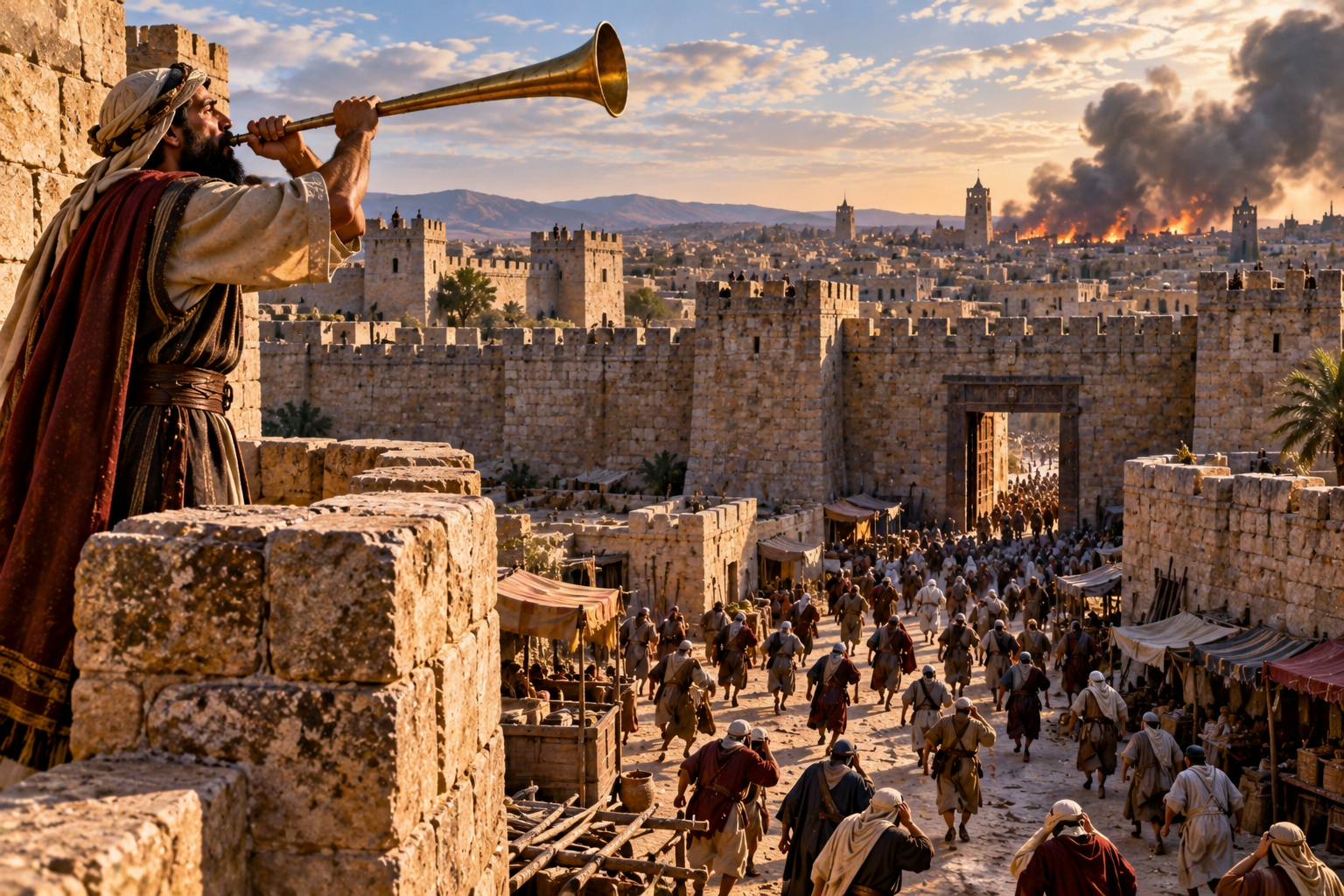
THE TRUMPET
AND THE TROUBLE
If a trumpet (shophar) is blown in a city will not the people tremble (charad; LXX - ptoéō - trerrified, alarmed, started)? - Note that up to this question, all the cause/effect questions have begun with the effect followed by the cause. Here the order is revervsed, because the trumpet blown is the cause and the effect is the people tremble.
Amos moves from the countryside to the city. The shophar, or ram’s-horn trumpet, could function as an alarm warning that an enemy was approaching (Jer 4:5–6; Ezek 33:3–6). Imagine an ancient walled city. The watchman sees an enemy army approaching and sounds the trumpet. The inhabitants immediately recognize what it means. No sensible person hears the alarm and says, “It probably means nothing.” That is precisely Amos' point. God has sounded the warning trumpet through His prophets (including Amos). Israel should be trembling, not continuing complacently in sin. Note the progression, The lion roars (Amos 3:4), the trap springs (Amos 3:5),and the trumpet sounds (Amos 3:6). Each sound demands a response.
The tragedy was not that God failed to sound the alarm,
but that Israel failed to heed it.
Bob Utley - "will not the people tremble" This VERB (BDB 353, KB 350, Qal IMPERFECT) means "tremble in fear." It is used in several contexts. (1) the very presence of YHWH (e.g. Exod. 19:16,18) (2) YHWH coming in judgment (e.g. Isa. 10:29; 19:16; 32:11; 41:5) (3) the effect of bad news on people (e.g. Gen. 27:33; 42:28; 1 Kgs. 1:49)In Amos #3 fits the context best, but #1 and #2 are surely in mind! ▣ "If a calamity occurs in a city has not the Lord done it" An example of these covenantal consequences (cf. Leviticus 26; Deuteronomy 27-29) can be seen in Amos 4:6-11. The OT asserts the full sovereignty of YHWH over all events (i.e. one causality in the universe, e.g. 2 Chr. 20:6; Eccl. 7:14; Isa. 14:24-27; 43:13; 45:7; 54:16; Jer. 18:11; Lam. 3:33-38). For a good discussion of God and evil see Hard Sayings of the Bible, pp. 305-306.
If a calamity occurs in a city has not the LORD done it (see note) - This statement needs careful interpretation. The Hebrew word ra'ah (רָעָה) can mean evil, adversity, distress, disaster, or calamity, depending on context. Here it refers to calamity or disaster, not to God committing moral evil (compare Isaiah 45:7, where God says He causes "well-being" and "calamity"). Amos is speaking about divine judgment. Israel might see an invading army, military defeat, destruction, famine, or other national catastrophe and attribute it merely to political and military forces. Amos pulls back the curtain and declares that behind the coming judgment stands the sovereign LORD.
Thomas McComiskey - The sound of a trumpet from a city wall warned of invaders; a trumpet in the square heralded bad news. Ultimately the cause of the “disaster” (ED: "calamity") coming to a city is “the LORD.” We should not conclude, however, that “disaster” (rāʿâ) implies “evil” in the ethical sense here. The word has that meaning in Hebrew, but the emphasis here on the city warrants only the meaning “disaster.” (SEE Daniel–Malachi - Page 381)
ESV Study Bible - Does disaster come to a city, unless the LORD has done it? (Amo 3:6ESV) - The ESV has correctly captured the sense of the Hebrew word ra‘ah in this verse, a word which has a very broad range of connotations (see chart). Often translated “evil,” it is used to express everything from “moral evil” (Gen. 6:5) to “disaster” (as here and also Jonah 3:10). If there is disaster occurring, the people should not attribute it to bad luck but should take note that God is at work, in his sovereign wisdom, and they should respond accordingly to his judgment.
Within a few decades, Assyria would wield the sword against the Northern Kingdom, but God would be directing the judgment. Isaiah calls Assyria "the rod of My anger" (Isaiah 10:5). Note however, that “has not the LORD done it” does not mean that every tragedy occurring in every city should automatically be interpreted as God's specific punishment for particular sins (compare Luke 13:1–5; John 9:1–3). In this context, God had specifically revealed through Amos that the coming calamity upon Israel would be His covenant judgment for their persistent rebellion (Amos 2:6–16; 3:1–2). Amos' point is that Israel should not dismiss what is coming as chance, coincidence, bad luck, or merely international politics. What Israel might call calamity, Amos identifies as divine discipline.
Notice the mercy of the LORD: The trumpet sounds before the enemy arrives. God warns before He strikes. The prophetic warning itself is evidence of His patience and grace, which prepares perfectly for Amos 3:7: God reveals His purpose to His servants the prophets.
🙏 THOUGHT: Dear believer, when God's Word sounds an alarm about the direction of our lives, wisdom does not silence the trumpet; it changes direction. We can mute the alarm in many ways: by ignoring the convicting passage, explaining it away, staying too busy to listen, or telling ourselves the danger is still far off. But Ezekiel's watchman reminds us that whoever hears the trumpet and does not take warning bears responsibility for what follows (Ezekiel 33:4–5). God's warnings are not meant merely to frighten us but to turn us from the danger ahead. They come from a Father Who would rather redirect us than discipline us. "The prudent sees the evil and hides himself, but the naive go on, and are punished for it" (Proverbs 22:3). Paul adds that "if we judged ourselves rightly, we would not be judged" (1 Corinthians 11:31). The warning we heed may spare us the discipline we would otherwise experience. Even when discipline does come, it is the proof of His love, not the absence of it, given "for our good, so that we may share His holiness" (Hebrews 12:5–11).
Walter Kaiser - Is God the Author of Evil? - Hard Sayings
The assertion in this passage is so bold that Marcion, an early Christian heretic, used this text to prove that the God of the Old Testament was a different being from the God of the New. Thus the nature of this hard saying is simply this: Is God the author of evil?
Numerous texts flatly declare that God is not, and could not be, the author of evil. For example, Deuteronomy 32:4 declares that “his works are perfect, and all his ways are just. [He is] a faithful God who does no wrong, upright and just is he.” Similarly, Psalm 5:4 notes, “You are not a God who takes pleasure in evil.” If we read the Bible in its total canonical setting, it would seem that God is without evil or any pretense of evil.
The text in question refers to physical evil. As does Lamentations 3:38, it contrasts prosperity and adversity. Thus the good is physical goodness and happiness, while the evil is physical distress, misfortune, calamity and natural evil, such as storms, earthquakes and other disasters.
Even though much of the physical evil often comes through the hand of wicked men and women, ultimately God permits it. Thus, according to the Hebrew way of speaking, which ignores secondary causation in a way Western thought would never do, whatever God permits may be directly attributed to him, often without noting that secondary and sinful parties were the immediate causes of the disaster.
The evil spoken of in this text and similar passages (such as Jer 18:11; Lam 3:38 and Amos 3:6) refers to natural evil and not moral evil. Natural evil is seen in a volcanic eruption, plague, earthquake and destructive fire. It is God who must allow (and that is the proper term) these calamities to come. But, one could ask, isn’t a God who allows natural disasters thereby morally evil?
To pose the question in this manner is to ask for the origins of evil. Christianity has more than answered the problem of the presence of evil (for that is the whole message of the cross) and the problem of the outcome of evil (for Christ’s resurrection demonstrates that God can beat out even the last enemy and greatest evil, death itself). But Christianity’s most difficult question is the origin of evil. Why did God ever allow “that stuff” in the first place?
Augustine taught that evil is not a substance. It is, as it were, a byproduct of our freedom, and especially of our sin. The effects of that sin did not fall solely on the world of humans. Its debilitating effects hit the whole natural world as well. Nevertheless, it is not as if God can do nothing or that he is just as surprised as we are by natural evil. Any disaster must fall within the sovereign will of God, even though God is not the sponsor or author of that evil. When we attempt to harmonize these statements we begin to invade the realms of divine mystery.
What we can be sure of, however, is the fact that God is never, ever, the originator and author of evil. It would be contrary to his whole nature and being as consistently revealed in Scripture.
Amos 3:7 Surely the Lord GOD does nothing Unless He reveals His secret counsel To His servants the prophets.
KJV Surely the Lord GOD will do nothing, but he revealeth his secret unto his servants the prophets.
NET Certainly the sovereign LORD does nothing without first revealing his plan to his servants the prophets.
NLT Indeed, the Sovereign LORD never does anything until he reveals his plans to his servants the prophets.
ESV "For the Lord GOD does nothing without revealing his secret to his servants the prophets.
BGT διότι οὐ μὴ ποιήσῃ κύριος ὁ θεὸς πρᾶγμα ἐὰν μὴ ἀποκαλύψῃ παιδείαν αὐτοῦ πρὸς τοὺς δούλους αὐτοῦ τοὺς προφήτας
LXE For the Lord God will do nothing, without revealing instruction to his servants the prophets.
CSB Indeed, the Lord GOD does nothing without revealing His counsel to His servants the prophets.
NIV Surely the Sovereign LORD does nothing without revealing his plan to his servants the prophets.
- but (KJV): Ge 6:13 18:17 1Ki 22:19-23 2Ki 3:17-20 6:12 22:13,20 Ps 25:14 Da 9:22-27 10:21 11:2 Joh 15:15 Rev 1:1,19 4:1 Rev 6:1-20:15
- Amos Commentaries - multiple resources
Related Passages:
Genesis 18:17-21 The LORD said, “Shall I hide from Abraham what I am about to do, 18since Abraham will surely become a great and mighty nation, and in him all the nations of the earth will be blessed? 19“For I have chosen him, so that he may command his children and his household after him to keep the way of the LORD by doing righteousness and justice, so that the LORD may bring upon Abraham what He has spoken about him.” 20And the LORD said, “The outcry of Sodom and Gomorrah is indeed great, and their sin is exceedingly grave. 21“I will go down now, and see if they have done entirely according to its outcry, which has come to Me; and if not, I will know.”
Deuteronomy 29:29 “The secret things belong to the LORD our God, but the things revealed belong to us and to our sons forever, that we may observe all the words of this law.
Psalm 25:14 The secret of the LORD is for those who fear Him, And He will make them know His covenant.
Jeremiah 23:18; 22 But who has stood in the council of the LORD, That he should see and hear His word? Who has given heed to His word and listened? .....23:22 “But if they had stood in My council, Then they would have announced My words to My people, And would have turned them back from their evil way And from the evil of their deeds.
Amos 7:14-15 Then Amos replied to Amaziah, “I am not a prophet, nor am I the son of a prophet; for I am a herdsman and a grower of sycamore figs. 15 “But the LORD took me from following the flock and the LORD said to me, ‘Go prophesy to My people Israel.’
2 Peter 1:19-21 So we have the prophetic word made more sure, to which you do well to pay attention as to a lamp shining in a dark place, until the day dawns and the morning star arises in your hearts. 20 But know this first of all, that no prophecy of Scripture is a matter of one’s own interpretation, 21 for no prophecy was ever made by an act of human will, but men moved by the Holy Spirit spoke from God.
NO JUDGMENT
WITHOUT WARNING
Surely expresses certainty regarding the truth that follows. The Hebrew kî can mean both "surely" and "for," and here it likely carries both senses: it affirms the statement and also introduces an explanation flowing out of the preceding verses.This verse explains why Israel cannot claim that the coming judgment took them by surprise. Calamity is coming from the LORD (Amos 3:6), but God has first disclosed what He intends to do.
The Lord GOD does nothing should not be taken as an absolute statement that God reveals everything He ever does to prophets. The context concerns God's judicial actions toward His covenant people. Before bringing the announced calamity, He graciously reveals His purpose through His appointed messengers. This principle appears repeatedly in Scripture. God revealed the coming flood to Noah (Ge 6:13–22), the destruction of Sodom to Abraham (Ge 18:17–21), Israel's coming judgments through Moses (Dt 28:15–68), and now the judgment of the northern kingdom through Amos.
Unless He reveals His secret counsel (sod) - Secret counsel (sod) pictures a confidential council, intimate consultation, or confidential communication. It can describe the counsel shared among close companions and, in theological contexts, the confidential counsel of the LORD (Ps 25:14; Jer 23:18, 22). The picture is almost that of being admitted into the King's council chamber (compare 1 Kings 22:19, where Micaiah sees the LORD's heavenly council). God knows what He intends to do. He then takes His prophets into His counsel and reveals what they are to proclaim. This is especially important for Amos. He was not professionally trained as a prophet and did not belong to a prophetic guild. He was a herdsman and grower of sycamore figs whom God called from his ordinary occupation (Amos 7:14,15). His authority came not from his training but from his admission into God's counsel.
Amos had used the rhetorical approach of cause and effect for he knew Israel would question his credentials. After all he was only a shepherd and now he was claiming to be a prophet of God.
As Wiersbe explains "Now for the final thrust: if an untrained rustic farmer is preaching God’s Word (EFFECT), it means God has called him (CAUSE). This isn’t a vocation Amos would have chosen for himself; it was chosen for him by the Lord. Amos said, “I was neither a prophet nor a prophet’s son, but I was a shepherd, and I also took care of sycamore-fig trees. But the Lord took me from tending the flock and said to me, ‘Go, prophesy to my people Israel’ ” (Amos 7:14–15NIV). When a prophet proclaims God’s Word (EFFECT), it’s because the Lord is about to do something important and wants to warn His people (CAUSE) (Amos 3:7). Review the images Amos used in Amos 3:3–6, and you will see what kind of work God called Amos to do. Because he was walking with God, he knew God’s secrets. “The secret of the Lord is with them that fear him; and he will show them his covenant” (Ps 25:14). The lion was roaring. “A lion has roared! Who will not fear? The Lord God has spoken! Who can but prophesy?” (Amos 3:8NKJV) God was about to spring the trap: Israel would be wiped out by the Assyrians, and Judah would go into exile in Babylon. Amos was blowing the trumpet and preparing the people for the judgment to come. Amos clearly made his point. It was no accident of vocational choice that he was proclaiming God’s message, for God had called him. And it was no accident of international diplomacy that Israel and Judah were facing judgment (EFFECT), for they had sinned against God (CAUSE). For every effect there is a cause. What caused Amos to preach God’s Word? The call of God on his life." (Ibid)
Shalom Paul writes on Amos 3:7 that "This verse firmly establishes the credibility of the prophet per se.” (See Hermenia - Amos: A Commentary on the Book of Amos - Page 113)
To His servants the prophets - Notice the beautiful designation “His servants.” The prophet belonged to God and served God's purposes. His task was not to manufacture an attractive message but faithfully communicate the message entrusted to him. Amos is essentially saying, You wonder why I am announcing judgment? I have been admitted to God's counsel. The LORD has spoken to me. How could I remain silent?
🙏 THOUGHT: Dear believer, we do not need some new secret revelation to know God's will for our lives. God has graciously given us His completed Word, which provides all we need for life and godliness (2 Timothy 3:16–17; 2 Peter 1:3). "The secret things belong to the LORD our God, but the things revealed belong to us and to our sons forever, that we may observe all the words of this law" (Deuteronomy 29:29). Jesus Himself has brought us into His confidence: "I have called you friends, for all things that I have heard from My Father I have made known to you" (John 15:15). The question is not whether God has spoken, but whether we are listening to what He has already said.
Bob Utley - 3:7-8 These are extremely important verses which emphasize God's forewarnings to His people through His prophets. The people are responsible because they knew YHWH's word and will (cf. Amos 4:13), yet they rejected it (cf. Amos 2:12; Hosea 11:1-4). This concept of predictive prophecy is the most convincing way to show modern people the uniqueness and inspiration of the Bible. No other world religion "holy" book has predictive prophecy! There are different kinds of prophecy, such as multi-fulfillment, typological, apocalyptic, but here I am talking about direct, specific, historical prediction, like Micah 5:2. Predictive prophecy was God's gift to His people to assure them of His control of all things (international, national, and individual). For modern people seeking evidence in a search for who to believe, it is a powerful witness! As a university professor, it was crucial for me to establish the relevance and trustworthiness of the Bible (a unique and inspired revelation) by using logical and historical items. Please see my five video sermons on my free website, in the first paragraph links. ▣ Amos 3:8a This is the climactic truth of the entire series of questions. It refers to the very beginning of the prophecy (cf. Amos 1:2)! YHWH is actively involved in human affairs. He has chosen Israel for a purpose (universal knowledge and redemption), but they have violated His purposes, therefore, judgment is His act of mercy for the purpose of restoring them to covenantal purity and purpose (cf. Amos 9:7-15).
Secret council (fellowship, intimate friendship) (05475) sod primarily means confidential conversation, speech or talk. Compare the Arabic word sa'wada which means to speak secretly. Sod emphasizes confidentiality in contrast to more general advice or counsel. Sod can refer to the close friendship which exists between people (Ps 55:14) or to the intimate knowledge that friendship brings, especially their secrets (Pr 25:9) Sod can describe something to be kept confidential but in Amos 3:7 it is something Amos reveals.
F B Meyer commenting on the use of sod in Ps 25:14 rightly reminds us of "What secrets God has to tell His own!" (Ge 18:17; Jn 14:21, 23, 15:15; 1Co 2:9, 10). The second general meaning of sod is related to the first in that it can refer to a group of intimates (friends) with whom one shares confidential matters (Ge 49:6). In other words, sod is both the circle of one's closest associates and the matters that are discussed with them (Jer 23:18 ["council"], Jer 23:22 ["council"], Amos 3:7 ["secret council"]).
The predominant idea is confidential which the English dictionary says is marked by intimacy or willingness to confide; enjoying the confidence of another; intended to be kept secret; that which may be safely trusted as a confidential friend; entrusted with another’s confidence, private information or secret affairs as a confidential secretary; suggestive of or denoting intimacy: a confidential approach
Sôd has as its basic meaning the thought of “intimacy.” This word has several shades of meaning. It may connote a close relationship (Ge 49:6; Job 29:4; Ps 111:1; Jer 6:11) or the scheming of those united against others (Pss 64:2[3]; 83:3[4]), as well as the positive counsel derived from a close relationship (Pr 15:22). It may refer to something as intimate as a secret (Pr 11:13; 25:9) or close fellowship with a friend (Ps 55:14[15]). When used of God, sôd refers to his secret council (Job 15:8). It also may denote the intimate relationship between the righteous and God in which he “makes his covenant known to them” (Ps 25:14) and takes them “into his confidence” (Pr 3:32). Jeremiah uses the word to describe the relationship of a prophet to God through which God imparts truth (Jer 23:18, 22); for the prophet stood in an intimate relationship to God, one by means of which he shared God’s counsel and words for the people.
SOD - 20V - circle(1), company(1), consultation(1), council(5), fellowship(1), friendship(1), gathering(1), intimate(1), plans(1), secret(2), secret counsel(3), secrets(2). Gen. 49:6; Job 15:8; Job 29:4; Ps. 25:14; Ps. 55:14; Ps. 64:2; Ps. 83:3; Ps. 89:7; Ps. 111:1; Prov. 3:32; Prov. 11:13; Prov. 15:22; Prov. 20:19; Prov. 25:9; Jer. 6:11; Jer. 15:17; Jer. 23:18; Jer. 23:22; Ezek. 13:9; Amos 3:7
Norman Geisler - AMOS 3:7—Does this verse mean that there must always be a prophet—the Mormon president—on the earth?
MISINTERPRETATION: Amos 3:7 says, “Surely the LORD God does nothing unless He reveals His secret counsel to His servants the prophets” (NASB). Mormons say this verse proves that God in every age has a prophet on earth through whom he reveals his instructions. They believe the president of their church is God’s prophet for today (McConkie, 1977, 606).
CORRECTING THE MISINTERPRETATION: This verse should not be interpreted to mean that God will always have a prophet on earth. In Amos 3:7 we find God about to bring judgment against the Israelites because of their disobedience. This passage affirms that God had previously warned the Israelites that judgment would follow disobedience, but they had ignored the prophets (cf. 2:12). In context, then, Amos 3:7 simply points to God’s chosen pattern of not engaging in a major action with the Israelites (such as judgment) without first revealing it to the prophets.
Relevant to our discussion is the fact that in Old Testament times the biblical test for a prophet was 100-percent accuracy (cf. Deut. 18:20–22). Mormon prophets do not measure up. Mormon prophet (and founder) Joseph Smith, for example, once prophesied that the New Jerusalem would be built in Missouri in his generation (Smith, 1835, 84:3–5). (When Critics Ask)
Amos 3:7 - Mormons Answered Verse by Verse
Surely the Lord GOD will do nothing, but he revealeth his secret unto his servants the prophets.
If leaders of the LDS Church are prophets, as claimed, then the above words must apply to them. But history has shown the opposite to be the case.
Take, for example, the murder of Joseph Smith. Shortly before he was killed he wrote in The History of the Church:
This generation is as corrupt as the generation of the Jews that crucified Christ; and if He were here today, and should preach the same doctrine He did then, they would put Him to death. I defy all the world to destroy the work of God; and I prophesy they will never have power to kill me till my work is accomplished, and I am ready to die (October 15, 1843, vol. 6, p. 58).
On June 27, 1844, less than nine months later, Joseph Smith was shot to death at Carthage, Illinois, by an armed mob. Evidently not “ready to die,” he fired shots in his own defense and attempted to escape his attackers by leaping from a window. Unlike Jesus Christ, who correctly prophesied his own death, Joseph Smith predicted that he would not be killed—hardly what would be expected of a prophet, in view of the inspired statement of Amos 3:7.
Smith’s successor as prophet of the LDS Church, Brigham Young, taught as follows concerning the practice of plural marriage:
Do you think that we shall ever be admitted as a State into the Union without denying the principle of polygamy? If we are not admitted until then, we shall never be admitted (August 19, 1866, Journal of Discourses, vol. 11, p. 269).
Yet, history records that the LDS Church issued an official declaration in 1890 ending polygamy, prior to Utah’s admission to the Union. This “prophet,” too, was misinformed about what the Lord would do. Since the problem could not be with the Lord or his inspired word, the failure of Amos 3:7 to apply to them can only be because Joseph Smith and Brigham Young were not truly prophets of God.
Amos 3:8 A lion has roared! Who will not fear? The Lord GOD has spoken! Who can but prophesy?
KJV The lion hath roared, who will not fear? the Lord GOD hath spoken, who can but prophesy?
NET A lion has roared! Who is not afraid? The sovereign LORD has spoken! Who can refuse to prophesy?
NLT The lion has roared-- so who isn't frightened? The Sovereign LORD has spoken-- so who can refuse to proclaim his message?
ESV The lion has roared; who will not fear? The Lord GOD has spoken; who can but prophesy?"
BGT λέων ἐρεύξεται καὶ τίς οὐ φοβηθήσεται κύριος ὁ θεὸς ἐλάλησεν καὶ τίς οὐ προφητεύσει
LXE A lion shall roar, and who will not be alarmed? the Lord God has spoken, and who will not prophesy?
CSB A lion has roared; who will not fear? The Lord GOD has spoken; who will not prophesy?
NIV The lion has roared-- who will not fear? The Sovereign LORD has spoken-- who can but prophesy?
- lion (KJV): Am 3:4 1:2 Rev 5:5
- who can (KJV): Am 2:12 7:12-17 Job 32:18,19 Jer 20:9 Ac 4:20 Acts 5:20,29 1Co 9:16
- Amos Commentaries - multiple resources
Related Passages:
Jeremiah 20:9 But if I say, “I will not remember Him Or speak anymore in His name,” Then in my heart it becomes like a burning fire Shut up in my bones; And I am weary of holding it in, And I cannot endure it.
Isaiah 6:5-8 Then I said, “Woe is me, for I am ruined! Because I am a man of unclean lips, And I live among a people of unclean lips; For my eyes have seen the King, the LORD of hosts.” 6 Then one of the seraphim flew to me with a burning coal in his hand, which he had taken from the altar with tongs. 7 He touched my mouth with it and said, “Behold, this has touched your lips; and your iniquity is taken away and your sin is forgiven.” 8 Then I heard the voice of the Lord, saying, “Whom shall I send, and who will go for Us?” Then I said, “Here am I. Send me!”
Acts 4:19-20 But Peter and John answered and said to them, “Whether it is right in the sight of God to give heed to you rather than to God, you be the judge; 20 for we cannot stop speaking about what we have seen and heard.”
Acts 5:20 “Go, stand and speak to the people in the temple the whole message of this Life.”
Acts 5:27-29 When they had brought them, they stood them before the Council. The high priest questioned them saying, “We gave you strict orders not to continue teaching in this name, and yet, you have filled Jerusalem with your teaching and intend to bring this man’s blood upon us.” 29 But Peter and the apostles answered, “We must obey God rather than men.
2 Timothy 4:1-2 I solemnly charge you in the presence of God and of Christ Jesus, who is to judge the living and the dead, and by His appearing and His kingdom: 2 preach the word; be ready in season and out of season; reprove, rebuke, exhort, with great patience and instruction. 3 For the time will come when they will not endure sound doctrine; but wanting to have their ears tickled, they will accumulate for themselves teachers in accordance to their own desires, 4 and will turn away their ears from the truth and will turn aside to myths.

THE LION ROARED
AMOS MUST SPEAK
A lion has roared! Who will not fear? - Amos now returns to the lion imagery of Amos 3:4 and brings his series of cause-and-effect questions to its powerful climax. A lion's roar produces an instinctive response: fear. You do not hear the roar of a lion nearby and remain indifferent. Remember the opening words of the book “The LORD roars from Zion” (Amos 1:2). The Lion is more than an illustration but clearly points to Yahweh Himself, Whose voice of impending judgment has sounded forth through His "mouthpiece" Amos. This is another cause/effect rhetorical question. The cause is the lion roaring (God speaking) and the effect, people fearing. The point Amos is making is that as surely as fear follows the lion's roar, proclamation follows (or certainly should follow) when God speaks through His prophet.
The Lord GOD has spoken! - The Hebrew is emphatic: Adonai Yahweh has spoken. Amos' authority rests entirely here. This becomes even more significant when Amos later describes his call. He was not a professional prophet or member of a prophetic guild. He was tending livestock when “the LORD took me from following the flock and the LORD said to me, ‘Go prophesy to My people Israel.’” (Amos 7:14–15)
Amos was not self-appointed.
He was sovereignly summoned.
Who can but prophesy - NLT = "so who can refuse to proclaim his message?" This is not a question of permission to speak but an expression of compulsion to speak. Once God had revealed His counsel to Amos (Amos 3:7), silence was no longer an option. On is reminded of the later prophet Jeremiah who declared when he tried not to speak God's Word, it became “like a burning fire shut up in my bones,” and he could not hold it in (Jer 20:9). Paul echoed the same sense of divine necessity declaring “Woe is me if I do not preach the gospel.” (1 Cor 9:16) Peter and John before the antagonistic Jewish leaders declared “We cannot stop speaking about what we have seen and heard.” (Acts 4:20)
Thomas McComiskey - Yahweh is no longer stalking quietly (cf. v. 4)—he has pounced! He has spoken, and no one can contravene his word. So Amos pronounces judgment on the people. (SEE Daniel–Malachi - Page 381)
Bob Utley - "The Lord God has spoken! Who can but prophesy?" This famous phrase describes what all humans feel when they have been called by God to speak for Him. Isaiah cried out, "Woe is me, for I am ruined" (cf. Isa. 6:5-8). Jeremiah called it a fire in his bones (cf. Jer. 20:9).
When God puts His Word into the heart of His servant,
that Word presses toward and from his lips
In effect Amos is telling Israel, not to blame the messenger for the message. If they wanted to know why Amos was prophesying judgment, the answer is simple and it is that the Lion has roared, God has spoken!
The Lion's roar compelled fear.
The Lord's revelation compelled proclamation.
NET NOTE - The roar of the lion is here a metaphor for impending judgment (see Amos 1:2; cf. Amos 3:4, 12). Amos 3:7-8 justify Amos’ prophetic ministry and message of warning and judgment. The people should expect a prophetic message prior to divine action. Who can refuse to prophesy? When a message is revealed, the prophet must speak, and the news of impending judgment should cause people to fear.
Warren Wiersbe - Amos is an encouragement to all believers who feel they are inadequate to do the work of the Lord. He was a layman, not a graduate of a prophetic school. He learned spiritual truth as he communed with God while caring for the flocks and orchards. Self-taught? Yes, but he was God-taught; and he was willing to share with others what God had said to him. Robert Murray M’Cheyne wrote, “It is not great talents God blesses so much as great likeness to Jesus.” This is not to minimize the importance of either talent or education, but to remind us that neither can be a substitute for heeding God’s call and walking in communion with Him. Jesus said, “Apart from me you can do nothing” (John 15:5 NIV). (Ibid)
🙏 THOUGHT: Dear believer, we have not been called to receive new prophetic revelation as Amos was, but we have been entrusted with the "old, old story," the Gospel of Jesus Christ. If we truly believe that God has spoken and that the Gospel is the power of God for salvation (which it is!), how can we remain silent when thousands around us a about to enter a Christless eterntiy? If the truth truly fills our heart, it should (urgently) find its way onto our lips. (Ro 1:16; 2 Cor 4:13)
Amos 3:9 Proclaim on the citadels in Ashdod and on the citadels in the land of Egypt and say, “Assemble yourselves on the mountains of Samaria and see the great tumults within her and the oppressions in her midst.
- Proclaim (KJV): 2Sa 1:20 Jer 2:10-11 Jer 31:7-9 Jer 46:14 Jer 50:2
- Ashdod (KJV): Am 1:8 1Sa 5:1
- the mountains (KJV): Am 4:1 Amos 6:1 Jer 31:5 Eze 36:8 , 37:22
- and behold (KJV): De 29:24-28 Jer 22:8-9
- oppressed (KJV): or, oppressions, Am 4:1 8:6
- Amos Commentaries - multiple resources
Related Passages:
Jeremiah 2:10-11 “For cross to the coastlands of Kittim and see, And send to Kedar and observe closely And see if there has been such a thing as this! 11 “Has a nation changed gods When they were not gods? But My people have changed their glory For that which does not profit.
Jeremiah 2:13 “For My people have committed two evils: They have forsaken Me, The fountain of living waters, To hew for themselves cisterns, Broken cisterns That can hold no water.
Amos 4:1 Hear this word, you cows of Bashan who are on the mountain of Samaria, Who oppress the poor, who crush the needy, Who say to your husbands, “Bring now, that we may drink!”
Amos 5:11-12 Therefore because you impose heavy rent on the poor And exact a tribute of grain from them, Though you have built houses of well-hewn stone, Yet you will not live in them; You have planted pleasant vineyards, yet you will not drink their wine. 12For I know your transgressions are many and your sins are great, You who distress the righteous and accept bribes And turn aside the poor in the gate.
Amos 6:1 Woe to those who are at ease in Zion And to those who feel secure in the mountain of Samaria, The distinguished men of the foremost of nations, To whom the house of Israel comes.
Micah 6:8 He has told you, O man, what is good; And what does the LORD require of you But to do justice, to love kindness, And to walk humbly with your God?
Deuteronomy 29:24-28 “All the nations will say, ‘Why has the LORD done thus to this land? Why this great outburst of anger?’ 25 “Then men will say, ‘Because they forsook the covenant of the LORD, the God of their fathers, which He made with them when He brought them out of the land of Egypt. 26 ‘They went and served other gods and worshiped them, gods whom they have not known and whom He had not allotted to them. 27 ‘Therefore, the anger of the LORD burned against that land, to bring upon it every curse which is written in this book; 28and the LORD uprooted them from their land in anger and in fury and in great wrath, and cast them into another land, as it is this day.’
Jeremiah 22:8-9 “Many nations will pass by this city; and they will say to one another, ‘Why has the LORD done thus to this great city?’ 9 “Then they will answer, ‘Because they forsook the covenant of the LORD their God and bowed down to other gods and served them.’”
GENTILES SUMMONED TO
WITNESS AGAINS SAMARIA'S SIN
Proclaim on the citadels in Ashdod and on the citadels in the land of Egypt - Amos suddenly creates a dramatic courtroom scene. God in effect summons foreign nations to witness the oppression happening in Samaria. The choice of these enemies of Israel would have surely startled Amos' hearers! Ashdod represents Philistia, while Egypt was Israel's ancient oppressor. Both were pagan nations. Yet God now calls these Gentile peoples to witness the conduct of His own covenant people. There is biting irony for earlier Amos pronounced judgment against the pagan nations who were the epitome of evil (Amos 1:3–2:3), but now those pagan nations are summoned to witness the depths of decadence to which God’s people have sunk! So not only had Israel broken covenant law, the witness of these pagan nations shows that even by standards of international decency (crimes against humanity) Israel has become guilty of such crimes!
Bob Utley - Ashdod and Egypt are mentioned as two witnesses called by God to witness Samaria's sin and then to confirm His testimony against His own people (cf. Num. 35:30; Deut. 17:6; 19:15). We see this clearly in Amos 3:13, which is a covenant lawsuit.
The nations that stood under God's judgment
are now called to witness the sins of God's people.
Why “the Citadels”? The repeated word citadels is a key word in Amos. A citadel was the fortified stronghold of a city, often associated with its ruling and wealthy classes and with accumulated treasures (Amos 1:4, 7, 10, 12, 14; 2:2, 5). Here Amos addresses those in the citadels of Ashdod and Egypt because he is about to expose what was happening in the citadels of Samaria (Amos 3:10–11). It creates an vivid comparison between citadels of the pagans and the citadels of Samaria, for even pagan rulers are invited to look at Israel's society and be appalled by what they see.
And say, “Assemble yourselves on the mountains of Samaria - Samaria, Israel's capital, was built on a prominent hill and surrounded by higher terrain and now in effect serve as God's "courtroom." Amos imaginatively positions these foreign witnesses on the surrounding mountains, giving them a grandstand view into the city. Continuing the "courtroom like" scene, God is presenting the evidence before announcing the verdict.
Warren Wiersbe - The sin of Israel was so great that it even appalled the pagan nations; for, after all, Israel was sinning against a flood of light (1 Cor. 5:1). It’s tragic and humiliating when the unsaved world catches professed Christians in their sins. It happened to Abraham twice when he lied to heathen kings about his wife Sarah (Ge 12:10–20; 20:1ff)...whenever a prominent servant of God falls into sin, the news media seem to enjoy telling the story. (Ibid)
ESV Study Bible - Israel’s capital city of Samaria was a powerful stronghold, located on a high hill (mountains) in a good position of natural defense. It stood just off the great highway that ran along the Mediterranean coast connecting Egypt with Mesopotamia. If Samaria fell to the Assyrians, there was nothing more to prevent the destruction of the Philistine cities (represented by Ashdod) and of Egypt itself. But Israel would fall, not because of the superior power of Assyria but because of its own spiritual and social corruption. The stronghold was filled with oppression, and with violence and robbery. Thus, Israel had forfeited God’s protection, and without him all their natural defenses were useless (see Isa. 5:5–6).
John Walton -. mountains of Samaria. Although the city of Samaria was located on a single hill, it was surrounded by a group of hills that were actually higher than the capital city (see the comment on 1 Kings 16:24). If the prophet is talking about affording a vantage point from which to see the ultimate destruction of Samaria, then these hills would be appropriate. (IVP Bible Background Commentary: OT page 767)
Bob Utley - There is a series of IMPERATIVES in this verse. proclaim (BDB 1033, KB 1570), Hiphil IMPERATIVE say (BDB 55, KB 65), Qal IMPERATIVE assemble (BDB 62, KB 74), Niphal IMPERATIVE see (BDB 906, KB 1157), Qal IMPERATIVE Pagan nations (Philistia, Egypt) are called on to witness and judge Israel's (i.e. Samaria, its capital) sins! These sins are obvious to YHWH and mankind. ▣ "the mountains of Samaria" The SINGULAR phrase is used in Amos 4:6 and 6:1. This is the location of the capital of the Northern Ten Tribes since the reign of Omri. It is possible that this refers symbolically to the political life of the nation, while Bethel, 3:14, refers to the spiritual life. ▣ "great tumults" The term "tumult" (BDB 223, KB 552) is used in Deut. 7:23 for the confusion that YHWH will cause His people's enemies (e.g. Exod. 23:27). However, in the cursing and blessing section (Deuteronomy 27-29) this term is one of the curses YHWH will send on His disobedient people (cf. Deut. 28:20). It is also possible that the Philistines and Egyptians are being invited to gather on the mountains of Israel and watch Israel's punishment for her sins (i.e. they are possibly YHWH's means of punishment). She has plundered and hoarded, now she will be plundered in the same manner (cf. Amos 2:6-8; 3:10b).
And see the great tumults within her - Tumults describes confusion, disorder, unrest, and social upheaval. Keep in mind that outwardly Samaria was prosperous during the reign of Jeroboam II, but beneath the prosperity was a society in moral and social disorder or tumult! This is one of Amos' recurring themes that prosperity can conceal profound spiritual corruption. The impressive buildings of Samaria said success. God looked inside them and saw sin.
And the oppressions in her midst - Oppressions (note it is not singular but plural!) points to exploitation, extortion, violence, and injustice, particularly the powerful taking advantage of the weak. Amos has already described how Israel sold the righteous for money and the needy for a pair of sandals (Amos 2:6), trampled the helpless (Amos 2:7), and corrupted worship while exploiting the poor (Amos 2:7, 8). What Israel may have called prosperity, God exposed as prosperity partly accumulated through oppression. The oppressions existed in her midst which is to say this was not an isolated problem at the margins of society. Corruption had penetrated the heart of the nation.
Warren Wiersbe on the oppressions - they were eagerly and unjustly robbing the poor and amassing as much wealth as possible. They built costly houses, filled them with expensive furnishings, and lived in luxury while the poor of the land suffered (Amos 3:15; 4:1; 5:11; 6:4–6). The Law of Moses made it clear that the nation was to care for the widows and orphans, the poor and the strangers in the land (see Ex. 22:25–27; 23:11; Lev. 19:9–15; 25:6; Deut. 14:28–29; 15:12–13; 16:11–14). Amos wasn’t the only Hebrew prophet to accuse the rich of exploiting the poor and ignoring the needy, for you find similar messages in Isaiah 1:23; 10:1–2, Ezekiel 34, Micah 2:1–2), and Malachi 3:5. (Ibid)
How ironic, that God choses the nation of Egypt who itself had once oppressed Israel. And in spite of God deliving Israel from their oppression, Israel had now become an oppressor herself! The tragedy is that Israel who had experienced God's compassion toward the oppressed should have been the last people on earth to oppress others.
Grace received should have
produced grace displayed.
The sobering spiritual principle is that there is perhaps nothing more damaging to our witness than when those who profess to belong to God behave in ways that even unbelievers recognize as wrong. Israel possessed greater revelation than Ashdod or Egypt, yet her conduct had become so corrupt that pagans could be summoned as witnesses against her. Indeed, when God's people live beneath the standards that even the world recognizes, our profession becomes an "indictment" (a formal written accusation) rather than a convicting testimony.
🙏 THOUGHT: Dear believer, those around us may never read a Bible, but they are continually “reading” those who claim to believe it. Does our conduct make the gospel attractive, or does it give unbelievers reason to question the God we profess to serve? The world should see the transforming power of God's grace in us, not behavior that contradicts the grace we proclaim. (Mt 5:16; Php 2:14–15; 1 Pe 2:12)
Matthew 5:16 “Let your light shine before men in such a way that they may see your good works, and glorify your Father who is in heaven.
Philippians 2:14-15 Do all things without grumbling or disputing; 15so that you will prove yourselves to be blameless and innocent, children of God above reproach in the midst of a crooked and perverse generation, among whom you appear as lights in the world,
1 Peter 2:12 Keep your behavior excellent among the Gentiles, so that in the thing in which they slander you as evildoers, they may because of your good deeds, as they observe them, glorify God in the day of visitation.
QUESTION - What is the importance of Samaria in the Bible? | GotQuestions.org
ANSWER - Samaria was both a region and a city that experienced many changes throughout biblical history. In Hebrew, the name Samaria means “watch-mountain” or “watch-tower,” which correlates with its hilly features (Easton’s Bible Dictionary, “Samaria”). The place is referred to as “the hill of Samaria” in 1 Kings 16:24. The city of Samaria was located in central Israel, about 30 miles north of Jerusalem and about 6 miles northwest of Shechem.
Samaria’s hilly geography matches the ups and downs of its history. As the Israelites were dividing the Promised Land, the region of Samaria was given to the tribes of Ephraim and Manasseh. King Omri, the sixth king of the northern kingdom of Israel, bought a hill in the Valley of Shechem in the region of Samaria and built the city of Samaria, which became his capital city (1 Kings 16:23–24). Eventually, the name of the capital was applied to the entire northern kingdom. Omri’s son, King Ahab, erected a temple to Baal in the city of Samaria (1 Kings 16:32).
Within the region of Samaria, in the city of Sychar, was Jacob’s well. This was the location of Jesus’ conversation with the Samaritan woman, who asked, “Are you greater than our father Jacob, who gave us the well and drank from it himself, as did also his sons and his livestock?” (John 4:12). Later in the conversation, she brought up a centuries-old controversy: “Our ancestors worshiped on this mountain, but you Jews claim that the place where we must worship is in Jerusalem” (verse 20). “This mountain” is a reference to Mount Gerizim in the central Samaritan highlands, the place where the Samaritans had built their own temple, which they considered the true temple of God.
The region of Sychar (also called Shechem) in Samaria was also the place where Abram built an altar, after God promised him the land of the Canaanites (Genesis 12:6–8). Later, Abraham’s grandson Jacob bought some land near Shechem and built an altar there (Genesis 33:18–20).
The Jews of Jesus’ day disliked the Samaritans because of their religious syncretism and their mixed racial heritage. The temple in Samaria located on Mount Gerizim was destroyed in 129 BC by the Jews, adding to the hostility between the two groups. Modern Samaritans continue to worship at the ancient site (William Smith, Smith’s Bible Dictionary, Revised Edition, A. J. Holman, 1979, p. 113).
Samaria is included as one of the geographical locations in Jesus’ Great Commission: the good news must be proclaimed there (Acts 1:8). Once the church was scattered after Stephen’s martyrdom, many Christians fled to the surrounding areas, including Samaria (Acts 8:1). Luke records that “Philip went down to a city in Samaria and proclaimed the Christ there. When the crowds heard Philip and saw the miraculous signs he did, they all paid close attention to what he said. With shrieks, evil spirits came out of many, and many paralytics and cripples were healed. So there was great joy in that city” (Acts 8:5–8).
Being the capital of the northern kingdom of Israel, the city of Samaria, now modern-day Sebastia, holds a significant place in the Bible. As a region, Samaria was significant in the Old Testament as being synonymous with the northern kingdom and in the New Testament as an idolatrous area Jews tried to avoid. Despite Samaria’s checkered history and the Jews’ general dislike of the people of the region, Jesus Himself evangelized the area and mandated that the gospel be preached there after His ascension. God’s message of salvation extends to all.
Amos 3:9-15 TODAY IN THE WORD
“They do not know how to do right,” declares the LORD, “who hoard plunder and loot in their fortresses.” - Amos 3:10
In an address to the House of Commons on December 21, 1937, Winston Churchill declared: “Moral force is, unhappily, no substitute for armed force, but it is a very great reinforcement.” However, when armed force is cut off from moral force, the result is tragic. This is what happened to Israel. They lost their moral bearings and became a nation of people “who hoard plunder and loot in their fortresses” (Amos 3:10).
Speaking for God, Amos described an imaginary court scene in which witnesses are called to observe and verify the corrupt behavior of Israel. Ironically, those who were chosen for this task were pagans. Ashdod, the first to be mentioned, was one of the five principal cities of the Philistines. Perhaps Ashdod was chosen because its own city wall had been broken down during the prophet’s lifetime (2 Chron. 26:6). Possibly it was because Ashdod would eventually suffer the same fate as Israel. The other witnesses called to testify against God’s people were Israel’s former masters, the Egyptians. Both Ashdod and Egypt were called to assemble on the mountains of Samaria and witness Israel’s unrest and oppression (Amos 3:9). A minimum of two witnesses was required by Mosaic law for a conviction in a capital crime (Deut. 17:6).
TODAY ALONG THE WAY
Can you think of a time when you realized that you had overlooked a biblical principle when making a decision or engaging in an action? What were the circumstances that made it easy for you to “forget” to do right? We ought to be concerned about doing the right thing, not merely because of what it says about our view of God, but also because of what it says about us (1 John 3:7). When you encounter those circumstances again, rely on God’s strength to choose what is right.
Amos 3:9-15 Today in the Word
On a Saturday night in 1969, Florida A&M and the University of Tampa played the first interracial college football game in the South. Florida A&M had long fielded a dominant football team among black colleges, while the up-and-coming University of Tampa team was “overwhelmingly white.” A race riot had occurred just two years earlier in the city. What would happen at the game? The stands were packed. The cheers were deafening. Throughout the offensive battle, the fans, players, and coaches behaved well, knowing they were making history. Florida A&M claimed the victory, with the final score of 34-28.
This football game, a little-known civil rights and sports milestone, struck a blow against the injustice of racial segregation. In today’s reading, the Lord testified against the sins of His people, including social injustice. Since Israel had so utterly failed to be an upright witness to the nations, the nations were summoned to see God’s justice in action (Amos 3:9, 13). Even pagans would agree that God’s people were guilty and deserved punishment. Specifically, Israel was guilty of oppression, moral foolishness (not knowing how to do right), greed and exploiting the poor (hoarding plunder and loot), and lack of care (barricading themselves in fortresses). Divine judgment would relieve them of the illicit spoils in which they had sinfully placed their hope. The destruction would be so severe that only a remnant would be saved, like a small body part of a sheep being saved from a lion’s mouth.
God’s attack would destroy the altars at Bethel, the northern kingdom’s national center of worship (Amos 3:14-15; see 1 Kings 12:26-30). Since idolatry was their most heinous sin, He would strike at its heart. Cutting off the horns of the altar meant that no protection was left—there was nowhere they could hide or flee. In addition, He would destroy “the winter house along with the summer house,” that is, the luxuries and self-indulgences enjoyed by the rich oppressors. “Declares the Lord” makes this righteous judgment a certainty.
Apply the Word
As we see in today’s reading, money can be a powerful temptation. Paul warned, “The love of money is a root of all kinds of evil” (1 Tim. 6:6-10). This doesn’t mean that money itself is evil. As with any resource, the point is to be good stewards, earning and using money in obedience to God’s will. If money is earned unjustly or used selfishly, God is not pleased. Instead, we are to be content with what we have, whether little or much (Heb. 13:5; Phil. 4:11-13).
Bob Marcaurelle - The Invitation to Pagans (3:9-10)
Next Amos does a surprising thing. He calls upon the heathen nations (Assyria and Egypt) to assemble in Israel's beautiful hill country and witness the confusion and the punishments that befall a nation so favored and yet so sinful.
There is 1.
The Shame (v. 9) of doing that which even the pagans acknowledge as wrong. How demoralizing when even the world can rebuke the church. There is
2. The Sin (v. 10a). They "do not know how to do right." Repeated sin sears the conscience (1 Tim. 4:2) and hardens the heart (Heb. 3:8) so that we lose the capacity to ever know right from wrong. A church orders its guards to "shoot to kill" thieves who break into its buildings. A man leaves his wife and children and bows in prayer with the woman he "loves" and asks God to bless their union. Slavers condone slavery as "mission work to the savages" in the name of Christ. The list is endless of the ways we are totally blind to what is right and wrong. Inevitably, there is
3. The Sequel (v. 10b). Such a nation or person literally "stores up" for himself the wrath of God (Rom. 2:15). We sin and forget it but God keeps a record (Rev. 20:12).
Amos 3:10 “But they do not know how to do what is right,” declares the LORD, “these who hoard up violence and devastation in their citadels.”
KJV For they know not to do right, saith the LORD, who store up violence and robbery in their palaces.
NET "They do not know how to do what is right." (The LORD is speaking.) "They store up the spoils of destructive violence in their fortresses.
NLT "My people have forgotten how to do right," says the LORD. "Their fortresses are filled with wealth taken by theft and violence.
ESV "They do not know how to do right," declares the LORD, "those who store up violence and robbery in their strongholds."
BGT καὶ οὐκ ἔγνω ἃ ἔσται ἐναντίον αὐτῆς λέγει κύριος οἱ θησαυρίζοντες ἀδικίαν καὶ ταλαιπωρίαν ἐν ταῖς χώραις αὐτῶν
LXE And she knew not what things would come against her, saith the Lord, even those that store up wrong and misery in their countries.
CSB The people are incapable of doing right-- this is the LORD's declaration-- those who store up violence and destruction in their citadels.
NIV "They do not know how to do right," declares the LORD, "who hoard plunder and loot in their fortresses."
- they (KJV): Ps 14:4 Jer 4:22 Jer 5:4 2Pe 3:5
- who (KJV): Hab 2:8-11 Zep 1:9 Zec 5:3,4 Jas 5:3,4
- robbery (KJV): or, spoil
- Amos Commentaries - multiple resources
Related Passages:
Jeremiah 4:22 “For My people are foolish, They know Me not; They are stupid children And have no understanding. They are shrewd to do evil, But to do good they do not know.”
Habakkuk 2:8-11 “Because you have looted many nations, All the remainder of the peoples will loot you– Because of human bloodshed and violence done to the land, To the town and all its inhabitants. 9“Woe to him who gets evil gain for his house To put his nest on high, To be delivered from the hand of calamity! 10“You have devised a shameful thing for your house By cutting off many peoples; So you are sinning against yourself. 11“Surely the stone will cry out from the wall, And the rafter will answer it from the framework.
Zephaniah 1:9 “And I will punish on that day all who leap on the temple threshold, Who fill the house of their lord with violence and deceit.
Zechariah 5:3-4 Then he said to me, “This is the curse that is going forth over the face of the whole land; surely everyone who steals will be purged away according to the writing on one side, and everyone who swears will be purged away according to the writing on the other side. 4 “I will make it go forth,” declares the LORD of hosts, “and it will enter the house of the thief and the house of the one who swears falsely by My name; and it will spend the night within that house and consume it with its timber and stones.”
James 5:3-4 Your gold and your silver have rusted; and their rust will be a witness against you and will consume your flesh like fire. It is in the last days that you have stored up your treasure! 4 Behold, the pay of the laborers who mowed your fields, and which has been withheld by you, cries out against you; and the outcry of those who did the harvesting has reached the ears of the Lord of Sabaoth.
Micah 2:1-2 Woe to those who scheme iniquity, Who work out evil on their beds! When morning comes, they do it, For it is in the power of their hands. 2They covet fields and then seize them, And houses, and take them away. They rob a man and his house, A man and his inheritance.
Romans 2:5 But because of your stubbornness and unrepentant heart you are storing up wrath for yourself in the day of wrath and revelation of the righteous judgment of God,
Ephesians 4:18-19 being darkened in their understanding, excluded from the life of God because of the ignorance that is in them, because of the hardness of their heart; 19 and they, having become callous, have given themselves over to sensuality for the practice of every kind of impurity with greediness.
Proverbs 5:22 His own iniquities will capture the wicked, And he will be held with the cords of his sin.
2 Peter 2:18-19 For speaking out arrogant words of vanity they entice by fleshly desires, by sensuality, those who barely escape from the ones who live in error, 19 promising them freedom while they themselves are slaves of corruption; for by what a man is overcome, by this he is enslaved.
John 8:34 Jesus answered them, “Truly, truly, I say to you, everyone who commits sin is the slave of sin.
Romans 6:16-18 Do you not know that when you present yourselves to someone as slaves for obedience, you are slaves of the one whom you obey, either of sin resulting in death, or of obedience resulting in righteousness? 17 But thanks be to God that though you were slaves of sin, you became obedient from the heart to that form of teaching to which you were committed, 18 and having been freed from sin, you became slaves of righteousness.
THEY HAVE FORGOTTEN
HOW TO DO RIGHT
But they do not know how to do what is right,” (upright, honest, normally expected conduct) declares the LORD - This is an astonishing indictment of Israel's moral condition. Amos does not merely say they do not do what is right, but they do not even know how to do what is right. Know (yada יָדַע) is used in Amos 3:2: “You only have I known/chosen.” This creates a striking contrast for although God “knew” Israel (Amos 3:2), Israel did not “know” how to do right (Amos 3:10). What a tragic commentary on the chosen nation in covenant with Yahweh! They were known by God but had forgotten how to live for God. Of course, Amos is not saying they lacked intellectual knowledge of God's standards. They still possessed God's Law, but in effect they did not let it possess them (so to speak)! Their persistent rebellion had so shaped their character that doing right was no longer their practiced way of life.
McComiskey adds "The word “right” (nekōḥâ) has the basic meaning of “straightness.” Their moral sense has become so warped that the concepts of right and wrong are totally blurred."
Wiersbe comments Israelites "were so bound by their greed and idolatry that it was impossible for them to do what was right. Like many people today, they were addicted to affluence. They didn’t care that others lacked the necessities of life so long as they themselves enjoyed luxuries. No wonder there was unrest in the land, for the possession of wealth never satisfied the hungers of the heart. “To pretend to satisfy one’s desires by possessions,” says a Chinese proverb, “is like using a straw to put out a fire.”" (Ibid)
There is a sobering principle here that sin repeated will soom become sin habituated. What initially troubled the conscience can eventually become normal. The conscience repeatedly ignored eventually becomes the conscience increasingly insensitive. This is similar to Jeremiah's later description: “They are experts at doing evil, but they do not know how to do good.” (Jer 4:22)
Bob Utley - "But they do not know how to do what is right" The term "right" is literally "straight." This is a play on the Hebrew word for a "measuring reed." This was a Mesopotamian construction tool which was used to measure the horizontal straightness of walls or fences. It became imagery for YHWH's character. Therefore, all the words for sin are a deviation from the standard. The tragedy of this text is that the Covenant People do not know (i.e. intimate knowledge, cf. Gen. 4:1; i.e. no personal relationship) YHWH's Covenant responsibilities (cf. Hosea 4:6)!
These who hoard up violence and devastation in their citadels - NIV = ""who hoard plunder and loot in their fortresses." NLT = "Their fortresses are filled with wealth taken by theft and violence." Hoard up gives us a sad picture of Israel. Hoard (atsar) means to store up, treasure up, or accumulate. Through oppressing the poorer classes, they have been plundering their own people. Israel's wealthy were filling their fortified houses (citadels) with possessions (grain, silver, gold, or valuables) gained through such oppressive tactics. But God is saying through Amos that they think they are storing up wealth, but what God sees them really storing up is violence and devastation!
Their treasure rooms were full of wealth,
but God saw the violence by which the wealth had been obtained.
This passage connects directly with Amos' earlier indictment of those who sold the righteous for money and the needy for a pair of sandals (Amos 2:6).
In their citadels - The citadels represented wealth, power, security, and status. The greedy, arrogant wealthy thought they were safe in their personal fortresses (cf the farmer in Lk 12:12-21)! Yet these supposedly secure strongholds had become warehouses containing the fruits of injustice. What they hoarded through oppression would soon be plundered by an enemy. What they accumulated through injustice they would lose through judgment. They remind me of the church at Laodicea about which Jesus declared "Because you say, “I am rich, and have become wealthy, and have need of nothing,” and you do not know that you are wretched and miserable and poor and blind and naked." (Rev 3:17) Israel would soo be wretched and miserable and poor and blind and naked!!!
Donald Sunukjian on citadel - A “fortress” was almost any building higher than an ordinary house. Containing several stories, it was constructed to be defensible, and often became part of a city’s defense system. The king’s palace usually included a fortress as part of its structure (cf. “citadel” in 1 Kings 16:18; 2 Kings 15:25); such buildings also served as residences of the rich and ruling class (Jer. 9:21). These residential strongholds were a national pride (Amos 6:8), a symbol of power and wealth, and therefore the special focus of God’s wrath (1:4, 7, 10, 14; 2:2, 5). Amos summoned leaders from the fortresses of Ashdod and Egypt to Samaria to see that the inhabitants of Israel’s fortresses had outstripped even them in their ability to profit from oppression! (See The Bible Knowledge Commentary Minor Prophets - Page 43)
🙏 THOUGHT: Dear believer, repeated disobedience is dangerous because sin does not merely affect what we do. The truth is that over time sin can affect what we become. WOE! Never allow what once troubled your conscience to become comfortable through repetition. Beware, for sin tolerated today can soon become sin which is easier to practice tomorrow! WOE!
Psalm 95:7-8 For He is our God, And we are the people of His pasture and the sheep of His hand. Today, if you would hear His voice, 8 Do not harden your hearts, as at Meribah, As in the day of Massah in the wilderness,
Hebrews 3:13 But encourage one another day after day, as long as it is still called “Today,” so that none of you will be hardened by the deceitfulness of sin.
Amos 3:11 Therefore, thus says the Lord GOD, “An enemy, even one surrounding the land, Will pull down your strength from you And your citadels will be looted.”
- An enemy - Am 6:14 2Ki 15:19,29 2Ki 17:3-6 2Ki 18:9-11 Isa 7:17-25 Isa 8:7,8 Isa 10:5-6,9-11 Ho 11:5-6
- and thy (KJV): Am 3:10,15 2:5 6:8 2Ch 36:19
- Amos Commentaries - multiple resources
Related Passages:
Amos 6:14 “For behold, I am going to raise up a nation against you, O house of Israel,” declares the LORD God of hosts, “And they will afflict you from the entrance of Hamath To the brook of the Arabah.”
2 Kings 15:19; 29 Pul, king of Assyria, came against the land, and Menahem gave Pul a thousand talents of silver so that his hand might be with him to strengthen the kingdom under his rule....(15:29) In the days of Pekah king of Israel, Tiglath-pileser king of Assyria came and captured Ijon and Abel-beth-maacah and Janoah and Kedesh and Hazor and Gilead and Galilee, all the land of Naphtali; and he carried them captive to Assyria.
2 Kings 17:3-6 Shalmaneser king of Assyria came up against him, and Hoshea became his servant and paid him tribute. 4 But the king of Assyria found conspiracy in Hoshea, who had sent messengers to So king of Egypt and had offered no tribute to the king of Assyria, as he had done year by year; so the king of Assyria shut him up and bound him in prison. 5 Then the king of Assyria invaded the whole land and went up to Samaria and besieged it three years. 6 In the ninth year of Hoshea, the king of Assyria captured Samaria and carried Israel away into exile to Assyria, and settled them in Halah and Habor, on the river of Gozan, and in the cities of the Medes.
2 Kings 18:9-11 Now in the fourth year of King Hezekiah, which was the seventh year of Hoshea son of Elah king of Israel, Shalmaneser king of Assyria came up against Samaria and besieged it. 10 At the end of three years they captured it; in the sixth year of Hezekiah, which was the ninth year of Hoshea king of Israel, Samaria was captured. 11 Then the king of Assyria carried Israel away into exile to Assyria, and put them in Halah and on the Habor, the river of Gozan, and in the cities of the Medes,
Isaiah 8:7; 8 “Now therefore, behold, the Lord is about to bring on them the strong and abundant waters of the Euphrates, Even the king of Assyria and all his glory; And it will rise up over all its channels and go over all its banks. 8 “Then it will sweep on into Judah, it will overflow and pass through, It will reach even to the neck; And the spread of its wings will fill the breadth of your land, O Immanuel.
Hosea 11:5-6 They will not return to the land of Egypt; But Assyria–he will be their king Because they refused to return to Me. 6The sword will whirl against their cities, And will demolish their gate bars And consume them because of their counsels.
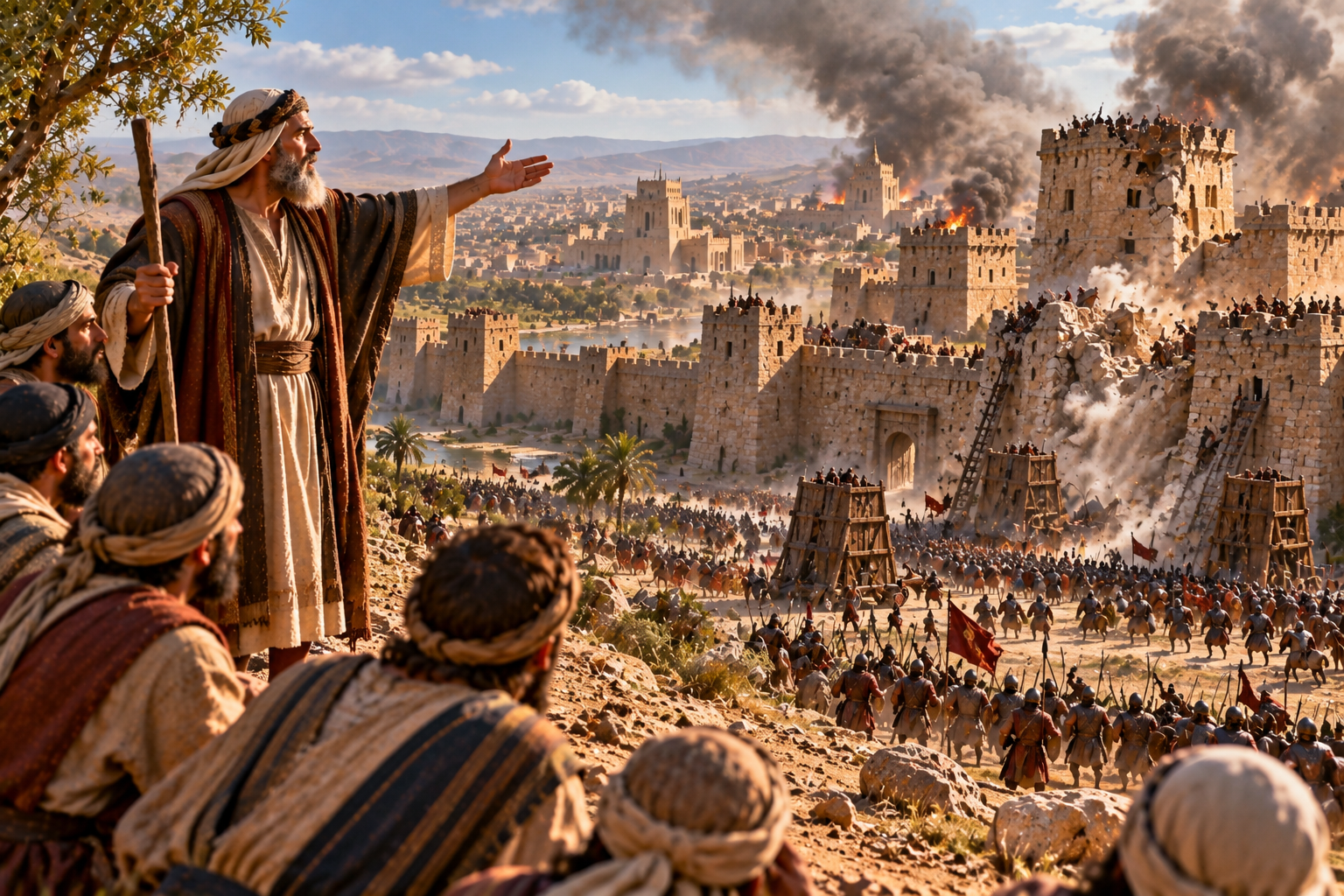
WHAT SIN STORED UP
JUDGMENT TAKES AWAY
Therefore (term of conclusion) This is the inevitable conclusion of the accusation in Amos 3:9,10. Samaria was filled with tumults and oppression, and its wealthy inhabitants had “hoarded up violence and devastation in their citadels.” Because of this, judgment was the conclusion that had to follow. Israelites had plundered their own people and now it was time to reap what they had sown and be plundered by the Assyrians in 722 BC.
Thus says the Lord ('adonay) GOD (Jehovah) - Once again Amos reminds Israel that this is not a shepherd's personal prediction but it was from Adonai Yahweh, the sovereign Lord, has pronounced the verdict. The certainty of the coming judgment rested not on the authority of Amos, but on the authority of the One Who was announcing it.
Bob Utley - "thus says the Lord God" This is the typical phrase denoting revelation (e.g. Amos 3:11,12) used so often in chapters 1 and 2. Also notice the paragraph ends with "Declares the Lord" (cf. Amos 3:13,15), which is also the pattern of Amos 2:11,16. The phrase "the Lord God" reflects the two Hebrew names for Deity: (1) Adon and (2) YHWH, that Amos uses many times.
An enemy, even one surrounding the land - Amos does not name the enemy here. Historically, the prophecy was fulfilled by Assyria, which eventually invaded the northern kingdom and besieged Samaria and after a prolonged siege, Samaria fell in 722/721 BC (2 Ki 17:5–6). Surrounding rings an ominous note for Israel who felt secure behind its fortifications, but would soon find itself encircled with no way of escape. In Amos 3:9 first witnesses surround Samaria to observe her sin; then an enemy surrounds Samaria to execute her judgment.
Surrounding speaks of siege and echos the covenant curse in Deuteronomy 28:52 “It (THE ENEMY) shall besiege you in all your towns until your high and fortified walls in which you trusted come down throughout your land, and it shall besiege you in all your towns throughout your land which the LORD your God has given you.
Bob Utley - "An enemy" This refers to the nation of Assyria (BDB 78, which is never named in Amos, but several times in Hosea [Hosea 7:11; 8:9; 9:3; 10:6; 11:11]), who took the Northern Ten Tribes captive in 722 B.C. (cf. Amos 6:7,14). Samaria, the capital of Israel, was taken after a lengthy siege by Sargon II (cf. Amos 3:11d).
John Walton -.time between prophecy and fulfillment. Amos, speaking in the 760s, may have assumed that the Assyrians would ultimately serve as God’s instrument to punish Israel, but he does not state this explicitly. In any case, Samaria and the nation of Israel will fall to the Assyrian armies of Sargon II in 722, and much of the population will be deported to other portions of the Assyrian empire. (IVP Bible Background Commentary: OT page 767)
Will pull down your strength from you - Strength can convey might or power describing Israel's military defenses, political influence, economic prosperity, and fortified capital, all of which had created an illusion of security. God says their strength will be brought down. Samaria's problem was that she trusted in her strength while rebelling against the LORD. She forgot that whatever replaces God as our security eventually proves incapable of saving us. Israel's impressive defenses could not defend her from the God against Whom she needed defending.
And your citadels will be looted - What a contrast with Amos 3:10 where Israel hoarded up violence and devastation in their citadels. Note the irony that the citadels of the looters would be looted of all their hoarded treasures. They had accumulated wealth by exploiting others. Now another nation would come and take away what they had accumulated. There is a touch of "poetic justice," for Israel had plundered the weak but would soon be plundered by Assyria. In short, the plunderers would become the plundered.
Bob Utley - The VERB "will be looted" (BDB 102, KB 117, Niphal PERFECT with waw) refers to the spoils of a defeated foe that are distributed among the victorious soldiers. These spoils would include people, livestock, clothing, valuables, etc., all the possessions of the conquered people. Notice that in Amos 3:10 it is the Israelites who "hoard up violence and devastation in their citadels." Now the spoils of their ill gotten gain will be taken from them! They reap what they sow. This is a biblical principle (cf. Job 34:11, 25; Ps. 28:4; 62:12; Prov. 12:14; 24:12; Eccl. 12:14; Jer. 17:10; 32:19; Matt. 16:27; 25:31-46; Rom. 2:6; 14:12; 1 Cor. 3:8; 2 Cor. 5:10; Gal. 6:7,10; 2 Tim. 4:14; 1 Pet. 1:17; Rev. 2:23; 20:12; 22:12).
This passage helps us understand Amos' repeated emphasis on citadels. These fortresses represented everything Israel believed made her secure, and yet the very citadels in which they stored the fruits of oppression would soon become the objects of enemy plunder. This reiterates the common theme in Amos that outward prosperity can coexist with inward spiritual bankruptcy and impending judgment.
🙏 THOUGHT: Dear believer, there is nothing innately sinful about possessing resources, savings, property, or earthly security, but there is great danger in allowing what God has given us to become what we trust instead of God Himself. Anything we possess can be taken away as Israel would testify! Only the God Who possesses us can never be taken away. (Ps 20:7; Ps 62:10; 1 Ti 6:17)
Psalm 20:7 Some boast in chariots and some in horses, But we will boast in the name of the LORD, our God.
Psalm 62:10 Do not trust in oppression And do not vainly hope in robbery; If riches increase, do not set your heart upon them.
1 Timothy 6:17 Instruct those who are rich in this present world not to be conceited or to fix their hope on the uncertainty of riches, but on God, who richly supplies us with all things to enjoy.
Bob Marcaurelle - The Elaboration of Punishment (3:11-15)
Amos closes with a detailed elaboration of the punishment that is coming. The adversary (v. 11) (Assyria and then Babylon) will "pull down your strongholds" and "loot your citadels." The aftermath (v. 12) will be awful. It will be like the few pieces of a lamb that are left when a lion is through or a piece of a bed or couch when a fire is through. That is all that will be left. Amos sees all this coming from their main adversary (v. 13), "the Lord God, the God of hosts." This appropriate accumulation of Old Testament names for God stresses His mighty power. The personal (Lord) God (Elohim) who is the God of "hosts" (heavenly and earthly armies) will completely devastate you. God's appointed target (v. 14-15) is threefold. His own house or family "the house of Jacob" (v. 13). The house of worship at Bethel, the very center of their religion (v. 14). And finally, the houses of the rich (v. 15). In other words, every area of life—political, religious and social—will be swept away.
All the false gods we trust in will be swept away as we stand naked at the Judgment. Our false relationship to God that we claimed, if it did not deliver us from a sinful life, will not stand the test of Judgment Day (Matt. 7:21-23). Our false religion that did not help us be like Jews will not help us when we stand before Jesus to give an account (Rom. 2:5-6). Finally, our financial resources which we loved more than God will not be there to help us. All we take to the Judgment Day is our character.
Amos 3:12 Thus says the LORD, “Just as the shepherd snatches from the lion’s mouth a couple of legs or a piece of an ear, So will the sons of Israel dwelling in Samaria be snatched away– With the corner of a bed and the cover of a couch!
KJV Thus saith the LORD; As the shepherd taketh out of the mouth of the lion two legs, or a piece of an ear; so shall the children of Israel be taken out that dwell in Samaria in the corner of a bed, and in Damascus in a couch.
NET This is what the LORD says: "Just as a shepherd salvages from the lion's mouth a couple of leg bones or a piece of an ear, so the Israelites who live in Samaria will be salvaged. They will be left with just a corner of a bed, and a part of a couch."
NLT This is what the LORD says: "A shepherd who tries to rescue a sheep from a lion's mouth will recover only two legs or a piece of an ear. So it will be for the Israelites in Samaria lying on luxurious beds, and for the people of Damascus reclining on couches.
ESV Thus says the LORD: "As the shepherd rescues from the mouth of the lion two legs, or a piece of an ear, so shall the people of Israel who dwell in Samaria be rescued, with the corner of a couch and part of a bed.
BGT τάδε λέγει κύριος ὃν τρόπον ὅταν ἐκσπάσῃ ὁ ποιμὴν ἐκ στόματος τοῦ λέοντος δύο σκέλη ἢ λοβὸν ὠτίου οὕτως ἐκσπασθήσονται οἱ υἱοὶ Ισραηλ οἱ κατοικοῦντες ἐν Σαμαρείᾳ κατέναντι φυλῆς καὶ ἐν Δαμασκῷ ἱερεῖς
LXE Thus saith the Lord; As when a shepherd rescues from the mouth of a lion two legs or a piece of an ear, so shall be drawn forth the children of Israel who dwell in Samaria in the presence of a foreign tribe, and in Damascus.
CSB The LORD says: As the shepherd snatches two legs or a piece of an ear from the lion's mouth, so the Israelites who live in Samaria will be rescued with only the corner of a bed or the cushion of a couch.
NIV This is what the LORD says: "As a shepherd saves from the lion's mouth only two leg bones or a piece of an ear, so will the Israelites be saved, those who sit in Samaria on the edge of their beds and in Damascus on their couches."
YLT Thus said Jehovah: As the shepherd delivereth from the lion's mouth Two legs, or a piece of an ear, So delivered are the sons of Israel, Who are sitting in Samaria on the corner of a bed, And in Damascus on that of a couch.
- As the (KJV): 1Sa 17:34-37 Isa 31:4
- so shall (KJV): Am 9:2,3 1Ki 20:30 22:25 Isa 8:4 17:1-4 Ro 11:4,5
- in Damascus in a couch (KJV): or, on the bed's feet, 1Ki 20:34 2Ki 16:9
- Amos Commentaries - multiple resources
Related Passages:
Amos 9:2-3 “Though they dig into Sheol, From there will My hand take them; And though they ascend to heaven, From there will I bring them down. 3 “Though they hide on the summit of Carmel, I will search them out and take them from there; And though they conceal themselves from My sight on the floor of the sea, From there I will command the serpent and it will bite them.
Exodus 22:10-13 “If a man gives his neighbor a donkey, an ox, a sheep, or any animal to keep for him, and it dies or is hurt or is driven away while no one is looking, 11 an oath before the LORD shall be made by the two of them that he has not laid hands on his neighbor’s property; and its owner shall accept it, and he shall not make restitution. 12 “But if it is actually stolen from him, he shall make restitution to its owner. 13 “If it is all torn to pieces, let him bring it as evidence; he shall not make restitution for what has been torn to pieces.
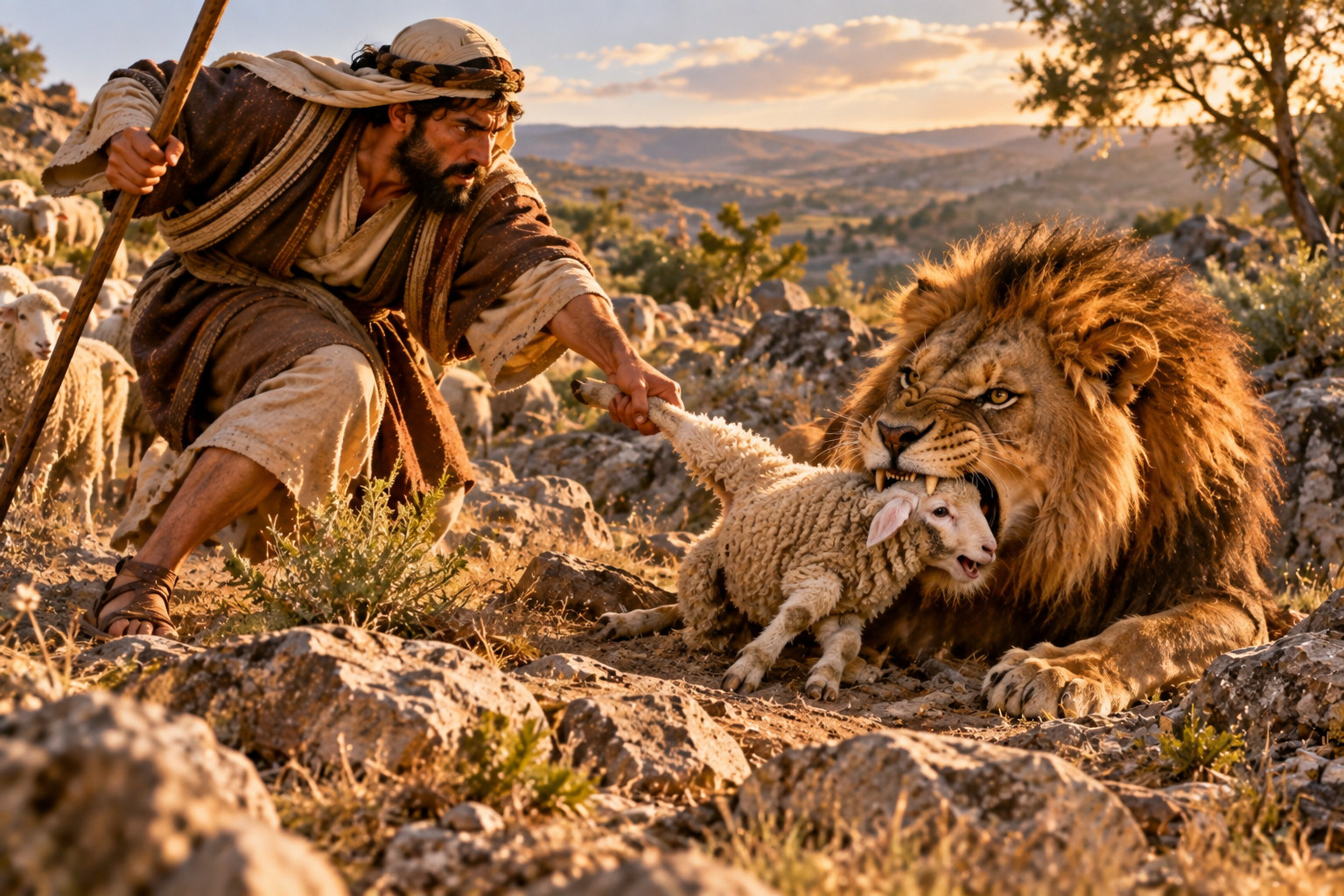
ONLY A REMNANT
OF RUIN WILL REMAIN
Thus says the LORD - Once again Amos emphasizes that this shocking picture comes directly from Yahweh. Amos 3:11 announced that an enemy would surround Samaria and plunder her citadels. Now Yahweh graphically portrays how complete that devastation will be.
Just as the shepherd snatches from the lion’s mouth a couple of legs or a piece of an ear - NET = "“Just as a shepherd salvages from the lion’s mouth a couple of leg bones or a piece of an ear," Amos draws upon his own world as a shepherd (Amos 1:1; 7:14–15) with an image that would have been immediately understandable to his readers (lions were still found in Israel). A lion attacks one of the flock and devours it. When the shepherd arrives, there is virtually nothing left to rescue, perhaps only two lower legs and a fragment of an ear. Why would the shepherd bother retrieving such useless scraps? They could serve as evidence that the animal had been killed by a wild beast rather than stolen or lost through the shepherd's negligence (cf. Ex 22:10–13). So the picture is not of a successful rescue. Instead, the fragments rescued from the lion testify to how thoroughly the lion has devoured its prey. Notice the progression from Amos 3:4 ("a lion roar") and Amos 3:8 ("A lion has roared") to now the lion having seized his prey. In other words Amos prophecy proceeds from warning to devastation. By the time Assyria was through with Israel in 722 BC, only a remnant would be left. The lion was about to roar! (Amos 1:2; 3:8) On the other hand Chisholm comments "The rescued shin bones and tip of an ear only proved that the rescue had come too late and that the animal was a total loss.
Donald Sunukjian - The analogy gives powerful expression to the idea of the remnant: There will be only bits and pieces of Israel left after the judgment of God. (See The Bible Knowledge Commentary Minor Prophets - Page 43)
John Walton -.shepherd’s responsibility. The legal codes of ancient Mesopotamia (including the Sumerian Law Code, Hammurabi’s Code and the Hittite Laws) each contained a clause designed to aid shepherds who have lost an animal to a lion or other predator. The shepherd gave his testimony and took an oath before the gods. Presumably, if there was any physical evidence to display, such as “a piece of an ear,” then this would also have been brought forward. In that way the shepherd would be above suspicion of theft. The pieces he brought did not suggest survival but were proof of destruction. (IVP Bible Background Commentary: OT page 767)
Bob Utley - This verse may stand alone. The NRSV puts it in prose when all other verses around it are poetry. The REB and NJB make it a separate strophe. This sarcastic verse relates to the almost total destruction of the Northern Ten Tribes (Israel). Only a small wounded group will be left of the entire nation (cf. Amos 5:15; 9:8). On the other hand, this may be an allusion to Exod. 22:1-13. If this is so, then this is not imagery of a returning remnant, but imagery of ultimate, complete destruction. The allusion to a shepherd implies option #1. It is just speculation on my part, but it is interesting that the word for "legs" (BDB 502) is also used of worshipers bowing down before a deity. There may be a double entendre referring to Israel's worship of idols (the golden calves) in YWHW's name. This double meaning also extends to "snatches. . .snatched" (BDB 664, KB 717, the first a Niphal PERFECT and the second a Hiphil IMPERFECT). This term is often used in the sense of deliverance (e.g. Micah 4:10). Therefore, this salvation connotation is sarcastically used of Israel's judgment. It is these plays on words and parallelism that makes Amos such powerful poetry!
So (just like the shepherd snatches a leg) will the sons of Israel dwelling in Samaria be snatched away - NET = "so the Israelites who live in Samaria will be salvaged." The comparison is sobering. Israel will indeed be snatched away, but Amos is not describing a great national deliverance. The point is that only a tiny remnant will survive the catastrophe. The emphasis is not on how much was saved, but on how little was left. Israel's false confidence that their covenant relationship with God guaranteed national security is again shattered by Amos' prophecy. Yes, something will remain, but the devastation will be overwhelming.
NET NOTE - NET = "so the Israelites who live in Samaria will be salvaged." - The verb translated salvaged, though often used in a positive sense of deliverance from harm, is here employed in a sarcastic manner. A shepherd would attempt to salvage part of an animal to prove that a predator had indeed killed it. In this way he could prove that he had not stolen the missing animal and absolve himself from any responsibility to repay the owner (see Exod 22:12-13).
Samaria was the prosperous capital of the northern kingdom. Under Jeroboam II, Israel had enjoyed significant political and economic prosperity. The wealthy residents of Samaria probably felt particularly secure. Amos says their luxurious surroundings will provide no protection whatsoever when judgment arrives.
With the corner of a bed and the cover of a couch - NET = "They will be left with just a corner of a bed, and a part of a couch." This is a difficult Hebrew phrase, and translations differ, especially in the final expression. NASB's “corner of a bed and the cover of a couch” portrays remnants associated with the luxurious furniture of Samaria's wealthy inhabitants (See Amos - Page 383 for more explanation). A shepherd pulls "two legs or a piece of an ear" from the lion's mouth, and in the same way, all that will be "rescued" from Samaria is a corner of a bed and a piece of a couch. These are scraps of furniture, the equivalent of the sheep's leftover leg or ear.
That interpretation fits Amos particularly well, because he repeatedly condemns the luxurious lifestyle of Israel's upper classes. Later he describes those who “recline on beds of ivory and sprawl on their couches” (Amos 6:4).
Bob Utley - It is obvious that this refers to a very elegant piece of furniture (illustrating the opulence of Samaria, cf. TEV and NIDOTTE, vol. 2, p. 495, #5), of which only a broken, useless remnant remains. The comparison seems to be that as a small piece of the sheep is rescued from the lion as a legal sign to the sheep owner (i.e. that the animal was not sold or stolen), so too, a small remnant of Israel will survive. YHWH's judgment is a legal sign of the validity of His word (i.e. Leviticus 26; Deuteronomy 27-29)! God's word about salvation is trustworthy, so too, His word about covenant disobedience and its drastic consequences.
John Walton - beds/couches. In the midst of the coming destruction the homes of the rich merchants and nobles of Samaria will be looted. The fleeing refugees will only be able to carry away with them fragments of their wealth. Amos satirizes their plight as they scavenge portions (the headboard and footpiece) of their beds. The irony of this is found in Amos 6:4, where the prophet condemns the rich for luxuriating on the ivory inlaid beds and couches. (IVP Bible Background Commentary: OT page 767)
Why furniture? Beds and couches were symbols of Samaria's wealthy elite. Amos condemns those who "recline on beds of ivory and sprawl on their couches" (Amos 6:4) and announces that "the houses of ivory will also perish" (Amos 3:15). Archaeologists have found carved ivory inlays from Samaria, the kind of decorative work that adorned this furniture. So the irony is pointed. The luxury the rich relied on will be reduced to broken fragments, and those fragments will be the "evidence" that Israel once lived there. Nothing worth calling a rescue will take place.
As noted the Hebrew is notoriously hard, which is why translations differ. Thus the NASB/ESV/NIV take it as describing what is rescued which is only pieces of furniture survive. The KJV reads it as describing where the Israelites live "that dwell in Samaria in the corner of a bed, and in Damascus in a couch." On this reading, the verse pictures the rich lounging comfortably on their couches, unaware of the danger. Either way, the main point stands that the people who trusted in their comfort and luxury will be left with almost nothing. Whatever remains will testify to how complete the destruction was, not to any real deliverance.
What a Picture! Imagine Amos holding up remains of a sheep mawled by a lion --Two legs. A piece of an ear. That is what will remain of the sheep after the lion. Then he describes a corner of a bed and a fragment of a couch which is all that will remain of prosperous Samaria after the Assyrian invasion.
The fragments of their luxury
would become evidence of their judgment.
NET NOTE on "cover" - The meaning of the Hebrew word דְּמֶשֶׁק (dmesheq), which occurs only here, is uncertain. If not emended, it is usually related to the term דַּמֶּשֶׂק (dammeseq) and translated as the “Damask linens” of the bed (cf. NASB “the cover”) or as “in Damascus” (so KJV, NJB, NIV84). The differences in spelling (Damascus is spelled correctly in 5:27), historical considerations, and the word order make both of these derivations unlikely. Many emendations have been proposed (e.g., “a part from the foot [of a bed],” based on a different division of the Hebrew letters (cf. NEB, NRSV); and “on the edge,” based on a Hebrew term not attested in the Bible (NKJV). Some suggest a resemblance to an Akkadian term that means “sideboard [of a bed],” which is sometimes incorrectly rendered “headboard” (NJPS; see S. M. Paul, Amos [Hermeneia], 121-22). Most likely another part of a bed or couch is in view, but it is difficult to be more specific (cf. NIV11 “piece of fabric”).
🙏 THOUGHT: Dear believer, Israel rested comfortably on couches while God's prophet warned that judgment was coming. Comfort can become dangerous when it produces spiritual complacency or indifference. Never allow God's material blessings to lull you into ignoring His spiritual warnings. What we possess today can disappear tomorrow, but what we possess in Christ is eternally secure. Where are you storing your treasure beloved? (Mt 6:19–21; 1 Ti 6:17–19)
Matthew 6:19-21 “Do not store up (STOP DOING THIS OR DO NOT BEGIN) for yourselves treasures on earth, where moth and rust destroy, and where thieves break in and steal. 20 “But store up (present imperative see our need to depend on the Holy Spirit to obey) for yourselves treasures in heaven, where neither moth nor rust destroys, and where thieves do not break in or steal; 21 for where your treasure is, there your heart will be also.
1 Timothy 6:17-19 Instruct (present imperative) those who are rich in this present world not to be conceited or to fix their hope on the uncertainty of riches, but on God, Who richly supplies us with all things to enjoy. 18 Instruct them to do good, to be rich in good works, to be generous and ready to share, 19 storing up for themselves the treasure of a good foundation for the future, so that they may take hold of that which is life indeed.
Amos 3:13 “Hear and testify against the house of Jacob,” Declares the Lord GOD, the God of hosts.
KJV Hear ye, and testify in the house of Jacob, saith the Lord GOD, the God of hosts,
NET Listen and warn the family of Jacob! The sovereign LORD, the God who commands armies, is speaking!
NLT "Now listen to this, and announce it throughout all Israel, " says the Lord, the LORD God of Heaven's Armies.
ESV "Hear, and testify against the house of Jacob," declares the Lord GOD, the God of hosts,
BGT ἀκούσατε καὶ ἐπιμαρτύρασθε τῷ οἴκῳ Ιακωβ λέγει κύριος ὁ θεὸς ὁ παντοκράτωρ
LXE Hear, O ye priests, and testify to the house of Jacob, saith the Lord God Almighty.
CSB Listen and testify against the house of Jacob-- this is the declaration of the Lord GOD, the God of Hosts.
NIV "Hear this and testify against the house of Jacob," declares the Lord, the LORD God Almighty.
YLT Hear ye and testify to the house of Jacob, An affirmation of the Lord Jehovah, God of Hosts.
- and testify (KJV): De 8:19 Dt 30:18,19 2Ki 17:13,15 2Ch 24:19 Ac 2:40 18:5,6 20:21 Eph 4:17 1Th 4:6
- the Lord (KJV): Am 5:27 Jos 22:22 Isa 1:24
- Amos Commentaries - multiple resources
Related Passages:
2 Chronicles 24:19 Yet He sent prophets to them to bring them back to the LORD; though they testified against them, they would not listen.
CALLED TO THE
WITNESS STAND
Hear and testify (warn) - The courtroom imagery introduced in Amos 3:9 continues. God had summoned the inhabitants of Ashdod and Egypt (Amos 3:9) to gather around Samaria and witness the violence and oppression within her (but see NET NOTE below). Now, having seen the evidence, they are commanded not merely to see, but to testify. God is establishing His case publicly. The witnesses have seen the evidence; now they are summoned to testify.
NET NOTE - These words are spoken to either the unidentified heralds addressed at the beginning of Amos 3:9, or to the Egyptians and Philistines (see Amos 3:9b). Another possibility is that one is not to look for a specific addressee but rather appreciate the command simply as a rhetorical device to grab the attention of the listeners and readers of the prophetic message.
Bob Utley - "Hear and testify against the house of Jacob" These VERBS (BDB 1033 and 729) are both IMPERATIVES. This phrase is parallel to Amos 3:9. This is typical lawsuit terminology. The two pagan nations of Philistia (Ashdod) and Egypt (Amos 3:9) are going to observe the judging of YHWH's people as the two required legal witnesses (cf. Num. 35:30; Deut. 17:6; 19:15). ▣ "the Lord God, the God of hosts" This is the only place in the OT that these three major names for Israel's Deity are found together.
Against the house of Jacob - The name Jacob is significant for it reaches back beyond the northern kingdom's political identity to Israel's covenant ancestry. These are the descendants of the man whom God renamed Israel (Ge 32:28). Their privileged ancestry cannot shield them from accountability. In fact, it makes their rebellion all the more serious. This recalls Amos 3:1–2 “You only have I chosen among all the families of the earth; therefore I will punish you for all your iniquities.” The chapter therefore begins and ends with essentially the same truth that covenant privilege brought covenant responsibility.
Declares the Lord ('adonay) GOD (Jehovah -Yahweh), the God (Elohim; LXX - theos - God) of hosts (tsaba; LXX - pantokrator - designation for God as the one holding all power and ruling all things; All-Powerful) - NET = "The Sovereign Lord, the God Who commands armies, is speaking!" Amos stresses the source of the message. This is not Amos bringing charges against Israel because of some personal grievance. God is both Prosecutor and Judge. Hosts (tsaba) refers to armies or assembled forces. The title presents Yahweh as the sovereign Commander of heaven's armies and ruler over all earthly powers. Israel might fear the approaching army, but Amos reminds them that there is a far greater Commander behind history. Israel's ultimate problem was not that Assyria was coming, but that the LORD of hosts had spoken. Assyria's military strength could never compare with Yahweh's.
ESV Study Bible - the God (Elohim; LXX - theos - God) of hosts (tsaba; LXX - pantokrator - designation for God as the one holding all power and ruling all things; All-Powerful) -- This title for God became increasingly popular among the prophets (cf. chart). “Hosts” in this context refers to troops of soldiers. Thus the image expresses the unlimited power of God. He is a general with an infinite number of troops at his command. The term sometimes refers to hosts of heavenly beings (1 Kings 22:19; Neh. 9:6; Ps. 148:2; see also Matt. 26:53)
Amos 3:14 “For on the day that I punish Israel’s transgressions, I will also punish the altars of Bethel; The horns of the altar will be cut off And they will fall to the ground.
- in the (KJV): Ex 32:34
- I will (KJV): Am 9:1 1Ki 13:2-5 2Ki 23:15 2Ch 31:1 34:6,7 Ho 10:5-8,14,15 Mic 1:6,7
- Amos Commentaries - multiple resources
Related Passages:
Amos 2:6 Thus says the LORD, “For three transgressions of Israel and for four I will not revoke its punishment, Because they sell the righteous for money And the needy for a pair of sandals.
1 Kings 12:26-33 Jeroboam said in his heart, “Now the kingdom will return to the house of David. 27 “If this people go up to offer sacrifices in the house of the LORD at Jerusalem, then the heart of this people will return to their lord, even to Rehoboam king of Judah; and they will kill me and return to Rehoboam king of Judah.” 28 So the king consulted, and made two golden calves, and he said to them, “It is too much for you to go up to Jerusalem; behold your gods, O Israel, that brought you up from the land of Egypt.” 29 He set one in Bethel, and the other he put in Dan. 30 Now this thing became a sin, for the people went to worship before the one as far as Dan. 31 And he made houses on high places, and made priests from among all the people who were not of the sons of Levi. 32 Jeroboam instituted a feast in the eighth month on the fifteenth day of the month, like the feast which is in Judah, and he went up to the altar; thus he did in Bethel, sacrificing to the calves which he had made. And he stationed in Bethel the priests of the high places which he had made. 33 Then he went up to the altar which he had made in Bethel on the fifteenth day in the eighth month, even in the month which he had devised in his own heart; and he instituted a feast for the sons of Israel and went up to the altar to burn incense.
Exodus 27:2 “You shall make its horns on its four corners; its horns shall be of one piece with it, and you shall overlay it with bronze.
Amos 5:4-5 For thus says the LORD to the house of Israel, “Seek Me that you may live. 5 “But do not resort to Bethel And do not come to Gilgal, Nor cross over to Beersheba; For Gilgal will certainly go into captivity And Bethel will come to trouble.
1 Kings 1:50-53 (LAYING HIOLD OF HORNS OF ALTAR CLAIMING PROTECTION) And Adonijah was afraid of Solomon, and he arose, went and took hold of the horns of the altar. 51 Now it was told Solomon, saying, “Behold, Adonijah is afraid of King Solomon, for behold, he has taken hold of the horns of the altar, saying, ‘Let King Solomon swear to me today that he will not put his servant to death with the sword.’” 52 Solomon said, “If he is a worthy man, not one of his hairs will fall to the ground; but if wickedness is found in him, he will die.” 53 So King Solomon sent, and they brought him down from the altar. And he came and prostrated himself before King Solomon, and Solomon said to him, “Go to your house.”
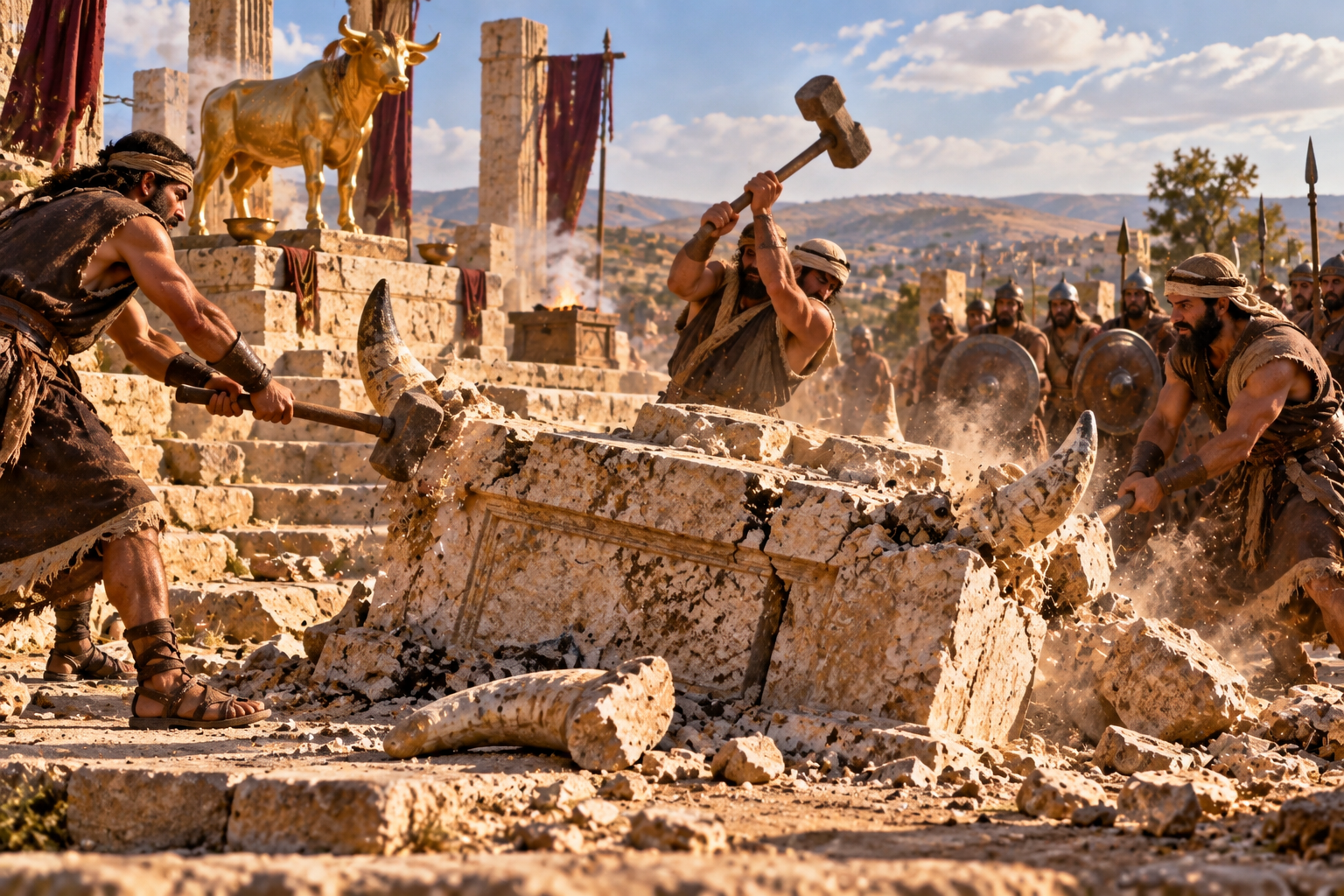
JUDGMENT BEGINS AT BETHEL
THE ALTARS WILL FALL
For (term of explanation) on the day that I punish (paqad; LXX - ekdikeo - inflict appropriate penalty for wrong done) Israel’s transgressions - NET = "Certainly when I punish Israel for their covenant transgressions." Amos is making it clear that the future judgment of Israel was the work of God Himself ("I [Yahweh] punish"). The repetition of punish recalls the key declaration at the beginning of the chapter: “You only have I chosen...therefore I will punish you for all your iniquities” (Amos 3:2). The Hebrew verb paqad can mean to visit, attend to, or call to account. Here God is going to visit Israel's sins with judgment. Israel's privileged relationship with Yahweh would not cause Him to overlook their transgressions. On the contrary, their greater privilege brought greater accountability.
Bob Utley - "on that day" This phrase refers to a visitation by YHWH for blessing or judgment. Here, it refers to the Day of Judgment. ▣ "the altars of Bethel" Bethel is the southern site of the worship of the golden calves which were set up by Jeroboam I (cf. 1 Kgs. 12:26-33). It was located about 10 miles north of Jerusalem and was an ancient holy site for the Hebrew nation, related to Jacob (cf. Gen. 28:10-22).
I will also punish (destroy) the altars of Bethel - This is significant. God will judge not only the people who sinned, but also the religious system that facilitated their sin. Bethel means “house of God” but in Israel's day had become a center of worship offensive to God. It had a magnificent spiritual history. Abraham built an altar nearby and called upon the LORD (Ge 12:8; 13:3–4), and Jacob encountered God there (Ge 28:10-22). But centuries later Jeroboam I turned Bethel into a center of counterfeit worship, establishing a golden calf there and appointing his own priesthood and religious calendar (1 Ki 12:26-33). What had once been associated with genuine encounters with God had become a center of religious apostasy. Mark it down that a place with a sacred past does not guarantee sacred worship in the present.
John Walton -.altars of Bethel. See the comments on 1 Kings 12:29-30 for the establishment of Jeroboam’s royal sanctuaries at Dan and Bethel at the time of the division of the kingdom. Despite Bethel’s association with the altars of the patriarchs Abraham and Jacob (Gen 12:8; 35:7), it served as a rival to Jerusalem in Amos’s time, and thus its altars are now to be condemned as part of Israel’s apostasy. (IVP Bible Background Commentary: OT page 767)
Far from appeasing God’s anger against Israel,
the religious practices carried out there would seal that anger.
ESV Study Bible - Bethel was not only associated with the patriarch Jacob and his vision (Gen. 28:10–22), it also stood close to the border between Israel and Judah. Thus, Jeroboam I chose it as the site of one of his two golden calves (1 Kings 12:25–33). It was not by accident that this was the place where Amos chose to deliver his prophecies (Amos 7:12–13). It represented the corruption of the true religion (Amos 4:4–5). Far from appeasing God’s anger against Israel, the religious practices carried out there would seal that anger. See also Hosea 10:5, where “Beth-aven” (house of iniquity - "the calf of Beth-aven") is substituted for “Beth-el” (house of God). The horns of the altar were short vertical projections at the four corners of the top of the altar (Ex. 27:2). They had ritual significance as places where God’s protection was available (1 Kings 1:50; 2:28), but the horns of Bethel’s altar would provide no protection whatsoever.
The horns of the altar will be cut off - Jeroboam originally established an altar at Bethel so Israeltes would not go to Jerusalem to worship (1 Ki 12:32–33), but Amos speaks of “altars of Bethel.” The point is that by Amos' day, the religious complex had multiplied the places of sacrifice. Contrary to the Law of Moses, the kings of Israel had allowed the people to go to local shrines where it was more convenient to worship whatever god they chose. Israel was intensely religious, but her religion was completely unacceptable to God which is one of Amos' central themes. Israel had sacrifices, festivals, songs, assemblies, and altars, yet God would declare, “I hate, I reject your festivals” (Amos 5:21–24). Beloved, it is as true today as it was in Amos' day that religious activity is never a substitute for righteous living! Sham religion is utter hypocrisy and an abomination to Jehovah.
Ancient Israelite altars had projecting horns at their four corners (Ex 27:2). These horns were integral parts of the altar and had important ceremonial significance. Sacrificial blood could be applied to them (Lev 4:7, 18, 25, 30). The horns could also be associated with refuge. Adonijah grasped the horns of the altar when he feared Solomon (1 Ki 1:50–53), and Joab later did the same (1 Ki 2:28–34). That makes Amos' picture especially powerful, for Israel might attempt to run to the altars expecting God's protection. But God said He would cut off the horns of the altar, the very place where they might have attempted to seek refuge. Their attempts at protection would be to no avail for even their false altars were under judgment. Their false religion could protect from the wrath of the God they had offended.
John Walton -.cutting off horns of altars. The horns on the altar represented the place of sanctuary (Ex 21:13-14) and they were also associated with absolution and atonement (Lev 16:18). Cutting off these horns removed the altar’s special qualities, desecrated it and transformed it into nothing more than a damaged stone. Israel is thus deprived of any hope for asylum or expiation for their sins in the face of the coming destruction. (IVP Bible Background Commentary: OT page 767)
And they (the horns) will fall to the ground - The image is humiliating, for horns that had projected upward from the altar, symbolizing its strength and sacred character would be hacked off and thrown down the ground. In short, their presumed religious security would literally come crashing down! This is a picture of "no escape!" In fact later Israel was instructed “Do not seek Bethel...Seek the LORD that you may live.” (Amos 5:4,5) The people were deceived for they were seeking the place associated with God rather than seeking God Himself.
For two centuries, God in His long-suffering had tolerated the Northern Kingdom's idolatrous rival religion, begun when Jeroboam I set up golden calves at Bethel and Dan (1 Kings 12:26–33). Now it would come to an end. Instead of turning to God, however, those left in the land developed another man-made religious system, fearing the LORD while serving their own gods (2 Kings 17:24–33), which the LORD would also reject. It would not be until the days of Christ (John 4) and the apostolic church (Acts 8) that the ancient division between Judah and Israel (Samaria) began to be healed, a foretaste of the day when God will make the two one nation again (Ezekiel 37:15–22).
Warren Wiersbe - Like Israel of old, nations today measure themselves by their wealth; and the gross national product becomes the indicator of security and success. The rich get richer and the poor get poorer as people worship the golden calf of money and greedily exploit one another. But it doesn’t take long for God to wipe out the idols that people worship and the unnecessary luxuries that control their lives. He hears the cries of the poor and eventually judges the guilty (see Ps 10:14; 69:33; 82:3). (Ibid)
🙏 THOUGHT: Dear believer, is there not a subtle temptation (and danger) to trust in religious things rather than in the Lord Himself? Church attendance, Bible knowledge, ministry activity, baptism, communion, and past spiritual experiences are all wonderful things, but none can substitute for a present and ongoing walk of faith and obedience. Never allow yesterday's encounter with God to become today's substitute for walking with God. "Trust and obey for there is no other way to be happy in Jesus than to trust and obey!'
1 John 2:3-6 By this we know that we have come to know Him, if we keep His commandments. 4The one who says, “I have come to know Him,” and does not keep His commandments, is a liar, and the truth is not in him; 5but whoever keeps His word, in him the love of God has truly been perfected. By this we know that we are in Him: 6 the one who says (PROFESSION) he abides in Him ought himself to walk in the same manner as He walked (PRACTICE = PROOF OF PROFESSION).
QUESTION - What was the significance of the horns of the altar (Amos 3:14)?
ANSWER - In speaking of judgment, God says, “The horns of the altar shall be cut off and fall to the ground” (Amos 3:14). What were these horns of the altar? Why were they important?
The “horns” were horn-like projections at the four corners of the altar of burnt offering. God’s instructions for the altar’s construction specified “horns”: “Make a horn at each of the four corners, so that the horns and the altar are of one piece” (Exodus 27:2).
During Amos’s day, the Israelites had apostatized and had erected altars to false gods. 1 Kings 12:26-30 speaks of two such pagan altars set up in Israel, one in Dan and one in Bethel. These altars had been constructed with horns at the corners, akin to the altar in Jerusalem.
When God says that the horns of the altar would fall off, He is assuring Israel that He would judge their idolatry. Indeed, God says earlier in the same verse, “On the day I punish Israel for her sins, I will destroy the altars of Bethel.”
The horns of the altar in Jerusalem had provided a refuge for fugitives. Those who caught hold of the horns of the altar were granted asylum (1 Kings 1:50-53). This use of the horns sheds additional light on God’s statement in Amos 3:14. Some scholars believe that God’s promise that the horns of the altar would fall to the ground meant that there would be no place of asylum, no place to escape the coming judgment.
Amos 3:15 indicates that the judgment would have deeply felt effects: “‘I will tear down the winter house along with the summer house; the houses adorned with ivory will be destroyed and the mansions will be demolished,’ declares the Lord.” No amount of material prosperity would be able to save the wicked. God’s judgment would destroy both the places of spiritual and material significance.
Yet the people of Israel would not be completely destroyed. Amos 3:12 says, “As the shepherd rescues from the mouth of the lion two legs, or a piece of an ear, so shall the people of Israel who dwell in Samaria be rescued, with the corner of a couch and part of a bed.” A remnant would survive. In their lowly state, they would be left only “the corner of a couch,” living in a state of poverty.
God’s desire in this prophecy was twofold. First, He longed for Israel to repent and turn from following other gods. Second, since these predictions did come true, they attest to God’s supernatural ability to foretell the future.
The destruction of the horns of the altar represents the downfall of idolatry and the removal of all safe havens. When God’s people refuse to heed His Word, He brings a just and curative discipline upon them.
Amos 3:15 “I will also smite the winter house together with the summer house; The houses of ivory will also perish And the great houses will come to an end,” Declares the LORD.
KJV And I will smite the winter house with the summer house; and the houses of ivory shall perish, and the great houses shall have an end, saith the LORD.
NET I will destroy both the winter and summer houses. The houses filled with ivory will be ruined, the great houses will be swept away." The LORD is speaking!
NLT And I will destroy the beautiful homes of the wealthy-- their winter mansions and their summer houses, too-- all their palaces filled with ivory," says the LORD.
ESV I will strike the winter house along with the summer house, and the houses of ivory shall perish, and the great houses shall come to an end," declares the LORD.
BGT συγχεῶ καὶ πατάξω τὸν οἶκον τὸν περίπτερον ἐπὶ τὸν οἶκον τὸν θερινόν καὶ ἀπολοῦνται οἶκοι ἐλεφάντινοι καὶ προστεθήσονται οἶκοι ἕτεροι πολλοί λέγει κύριος
LXE I will crush and smite the turreted-house upon the summer-house; and the ivory-houses shall be destroyed, and many other houses also, saith the Lord.
CSB I will demolish the winter house and the summer house; the houses inlaid with ivory will be destroyed, and the great houses will come to an end.This is the LORD's declaration.
NIV I will tear down the winter house along with the summer house; the houses adorned with ivory will be destroyed and the mansions will be demolished," declares the LORD.
YLT And I have smitten the winter-house with the summer-house, And perished have houses of ivory, And consumed have been many houses, An affirmation of Jehovah!
- the winter (KJV): Jer 36:22
- the summer (KJV): Judges 3:20
- the houses (KJV): 1Ki 22:39
- the great (KJV): Am 3:11 6:11 Isa 5:9
- Amos Commentaries - multiple resources
Related Passages:
Jeremiah 36:22 Now the king was sitting in the winter house in the ninth month, with a fire burning in the brazier before him.
Isaiah 5:8 Woe to those who add house to house and join field to field, Until there is no more room, So that you have to live alone in the midst of the land!
Proverbs 18:11 A rich man’s wealth is his strong city, And like a high wall in his own imagination.
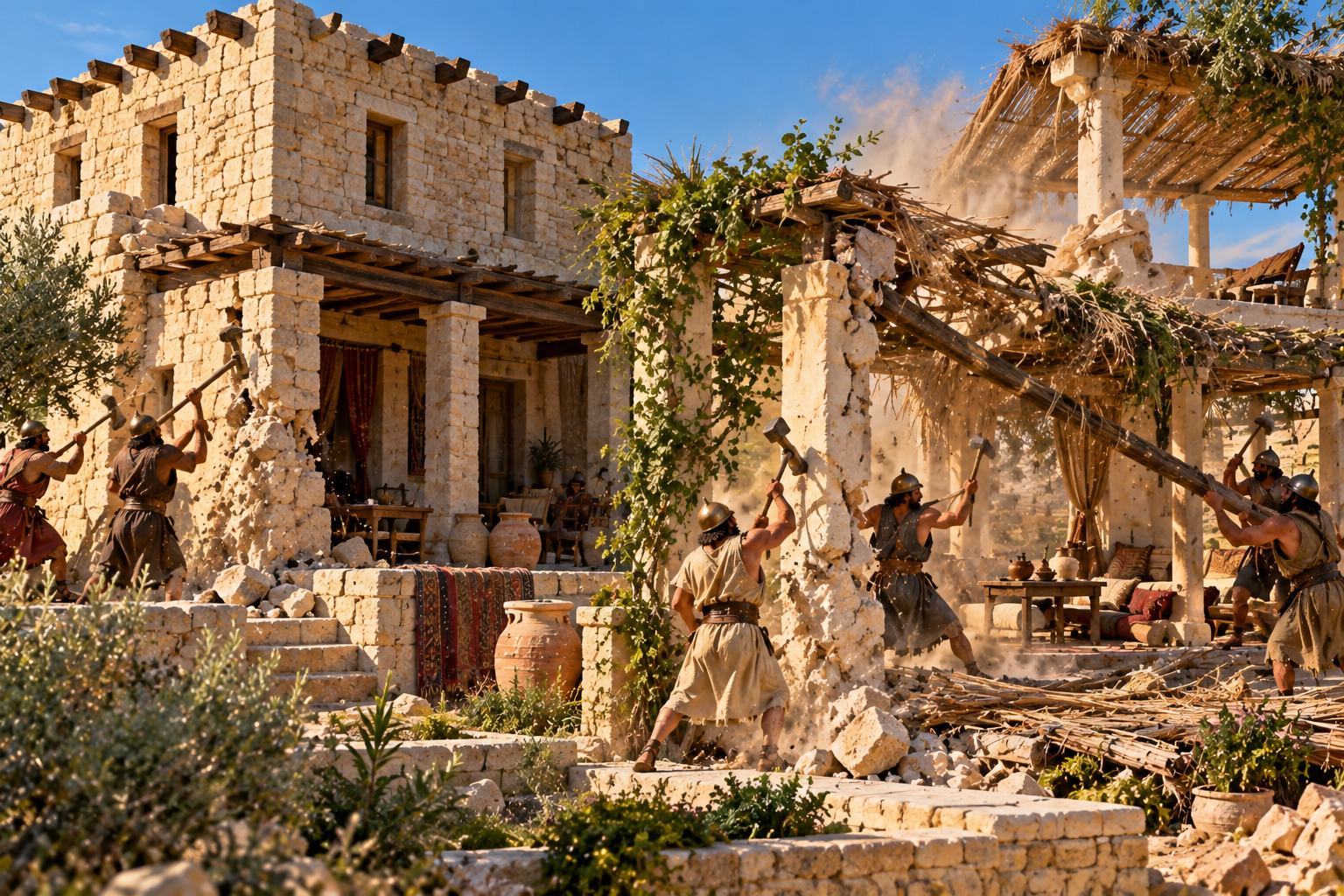
WHEN THE GREAT
HOUSES FALL
I will also smite (destroy) the winter house together with the summer house - Amos concludes the chapter by turning from Israel's religious security in verse 14 to her material security in verse 15. The wealthy apparently possessed separate residences suited to different seasons, or large estates with distinct winter and summer quarters. Either way, the point is unmistakable that these were people with more than they needed, living in considerable luxury while the poor were being exploited (Amos 2:6–8; 4:1; 5:11–12). Assyria would be the human instrument, but Yahweh was directing the judgment and thus He says "I will smite...."
Winter house together with the summer house - The expression paints a vivid picture of excess. Most Israelites would be fortunate to possess even one house, but the wealthy could possess different residences for different seasons. Thus, their proliferation of homes had become symbols of prosperity and status. Amos does not condemn houses merely because they are large or beautiful. He repeatedly condemns wealth accumulated and enjoyed alongside oppression, injustice, self-indulgence, and indifference toward the poor. The problem was not so much what they possessed, but how they obtained it and where they placed their confidence. This recalls Pr 18:11 which says "A rich man’s wealth is his strong city, And like a high wall in his own imagination."
John Walton -. winter and summer houses. One of the signs of luxury displayed by the rich of Samaria was two residences. A summer residence in Samaria took advantage of the cooler climate of the central hill country of Israel, and a winter home, possibly in the warm Valley of Jezreel, allowed residents to escape the extremes of weather and temperature. There are a number of examples of kings being able to indulge in climatic migration from one official residence to another, including the eighthcentury Aramean king of Sam’al, Barrakub, and Cyrus, the king of Persia. (IVP Bible Background Commentary: OT page 767)
ESV Study Bible - All of Israel’s social injustice is represented by the sin of amassing property (see also Isa. 5:8). This was a violation of the covenant that said a family’s land was a trust from God to be held in perpetuity by that family. There were legal fictions to get around this, but those fictions did not impress God. Here Amos does not condemn wealth in itself, but wealth accompanied by injustice toward the poor (Amos 4:1), fraudulent business practices (Amos 5:7, 11, 12; 8:4–6), and living in luxury without care for the needy (Amos 5:12; 8:4–6), without concern for sin and evil in the land (Amos 6:4–6), and without genuine religious faith (Amos 5:21–23). Archaeological excavations at Samaria have uncovered fragmentary remains of rich ivory objects, attesting to the luxury built upon the backs of the poor.
Bob Utley - "the winter house. . .the summer house. . .houses of ivory. . .the great houses" These phrases are referring to multiple dwellings of the self-indulgent rich (one example, Ahab's two palaces, cf. 1 Kgs. 21:1,18; NJB "many mansions") two story houses, the bottom floor used in winter and the upper floor used in summer (TEV, "every great house") Many of these ivory carvings (i.e. inlays, cf. 1 Kgs. 10:18; 22:39; Amos 6:4) were of Assyrian or Egyptian deities. There are two types of houses, not three. Israel had lost herself in materialism and idolatry! ▣ "and the great houses will come to an end" The Septuagint has "and many other houses also." The Hebrew term (BDB 912 I) can mean (1) "great" or (2) "many." This phrase seems to be a summary statement and not another type of house. ▣ "Declares the Lord" See note at Amos 3:11. Throughout this section of Amos the divine authority of the message has been sustained by this or similar phrases (cf. Amos 3:1,5,6,8,910,11,12,13,15; 2:1,3,4,6,16; 4:3,5,6,8,10,11; 5:17).
NET NOTE - Like kings, many in Israel’s wealthy class owned both winter and summer houses (cf. 1KI 21:1, 18; Jer 36:22). For a discussion of archaeological evidence relating to these structures, see P. King, Amos, Hosea, Micah, 64-65.
The houses of ivory will also perish - NET - "The houses filled with ivory will be ruined" This is not saying their houses were constructed entirely of ivory. Ivory was extraordinarily expensive and was used for decorative inlays, furniture, wall panels, and luxurious furnishings. Archaeological excavations at Samaria have uncovered numerous carved ivory fragments dating from the period of the Israelite monarchy, underscoring the kind of luxury Amos condemns. The expression also recalls Ahab's “ivory house” (1 Ki 22:39), and Amos later describes the wealthy reclining on “beds of ivory” (Amos 6:4).
John Walton - ivory adornment. Excavations at the site of ancient Samaria have revealed fairly large quantities of ivory that had been used to decorate furniture and the walls of the Omride palace (see the comment on 1 Kings 22:39). There are both Egyptian and Phoenician/Syrian decorative styles employed, including representations of the god Horus, lotus blossoms and the “lady in the window” motif. The Iron Age ivories differ from those of the Late Bronze (best represented by those found at Megiddo) with the addition of glass paste and inlaid semiprecious stones. It is possible that some of these ivories were carved and decorated by native Israelite craftsmen, but more likely they are expensive imports. (IVP Bible Background Commentary: OT page 767)
And the great (or many) houses will come to an end (will be swept away) Declares the LORD (The Lord is speaking!) - NET - "the great houses will be swept away" Great houses or possibly many houses. Either sense reinforces Amos' picture of extraordinary prosperity. Everything that appeared permanent was temporary. The wealthy looked at their magnificent houses and saw security. Amos looked at those same houses and saw an expiration date!
The chapter begins with Israel boasting implicitly in her privilege and ends with the destruction of the things that symbolized her prosperity.
🙏 THOUGHT: Dear believer, there is nothing sinful about owning a comfortable home or enjoying God's material blessings. The danger comes when the gifts begin to occupy the place of the Giver (which in essence describes idolatry!) Houses deteriorate, possessions disappear, investments fluctuate, and earthly security can vanish. Hold God's gifts with an open hand, but hold fast to the Giver with all your heart.
Psalm 62:10 Do not trust in oppression And do not vainly hope in robbery; If riches increase, do not set your heart upon them.
Summary of Amos 3
- CHOSEN — extraordinary privilege (Amos 3:1–2)
- WARNED — the Lion roars (Amos 3:3–8)
- EXPOSED — the nations witness Israel's sin (Amos 3:9–10)
- SURROUNDED — the enemy comes (Amos 3:11–12)
- JUDGED — religion and riches fall (Amos 3:13–15)
James Freeman - Amos 3:15. And I will smite the winter-house with the summerhouse ; and the houses of ivory shall perish.
1. The expressions “ winter-house” and “ summer-house ” do not of necessity imply two separate houses, but may mean separate suites of apartments in the same house. Thomson says: ‘Such language is easily understood by an Oriental. In common parlance, the lower apartments are simply el beit—the house; the upper is the ’alléyeh, which is the summer-house. Every respectable dwelling has both, and they are familiarly called beit shetawy and beit setfy—winter and summer house. If these are on the same story, then the external and airy apartment is the summer-house, and that for winter is the interior and more sheltered room. It is rare to meet a family that has an entirely separate dwelling for summer.”—The Land and the Book, vol. i, p. 478. It may have been in the interior apartment that Jehoiakim sat when Jehudi read the roll in his presence. See Jer. xxxvi, 22.
2. By “houses of ivory” we are not to understand houses built of that material, but houses richly ornamented with it. The ancients decorated the ceilings, doors, and panels of their rooms with ivory. It was in this way that Ahab is said to have built an “ivory house.” 1 Kings xxii, 39. Such houses are the “ivory palaces”’ mentioned in Psa. xly, 8.
John Walton - ECONOMIC CHANGES AND SOCIAL CLASSES IN EIGHTH-CENTURY ISRAEL (page 767) In the light of the political changes that took place at the beginning of the eighth century (Assyrian expansion and the capture of Damascus), Israel was able to widen its economic interests and restore its hegemony over a greater area of the Transjordan. In addition, both Israel and Judah were ruled during the first half of the century by strong kings (Jeroboam II and Uzziah respectively) with long reigns. This made it easier to establish a comprehensive economic policy that concentrated on the mass production of export items such as grain, olive oil and wine. Large areas of the Shephelah and the lowland valleys had already been given over to wheat production (2 Chron 26:10). Now, in the eighth century, the elite were able to impose this economic policy on the small hill country farms and villages. As a result, previous agricultural strategies that attempted to distribute potential risks between herding and farming were overturned, and the land was given over to specific cash crops. The smaller holdings of the peasant farmers, overburdened with debts, were enclosed into large estates. This very efficient use of the land, however, eliminated the mixed crops that had formerly been grown in the village culture and more quickly exhausted the soil. Leaving fields fallow and grazing animals on harvested fields would have been eliminated or rigidly controlled. Under this new policy, an attempt was made to increase exports to the extent that there was a real hunger problem for the peasant class, while the nobility and merchant-class were able to indulge in the luxury goods supplied by their Phoenician trading partners. Thus in addition to facing rising prices at home on basic goods, such as wheat and barley, the impoverished peasant farmers now found themselves forced into debt servitude or day labor. Seeing them ground under the heel of exploiting employers and cheated by greedy merchants who sold them adulterated or inferior grain for their meals, it is no wonder that Amos harangued the rich for their lack of concern for the poor. In such an atmosphere of social injustice, agricultural specialization and economic speculation, the prophet reminds the Israelites of their covenant obligations. Like the “eloquent peasant” of twentieth-century B.C. Egypt, Amos warns them that corrupt judges and dishonest businessmen can expect no mercy from an angry God.