Amos 2:2
Amos 2:3
Amos 2:4
Amos 2:5
Amos 2:6
Amos 2:7
Amos 2:8
Amos 2:9
Amos 2:10
Amos 2:11
Amos 2:12
Amos 2:13
Amos 2:14
Amos 2:15
Amos 2:16
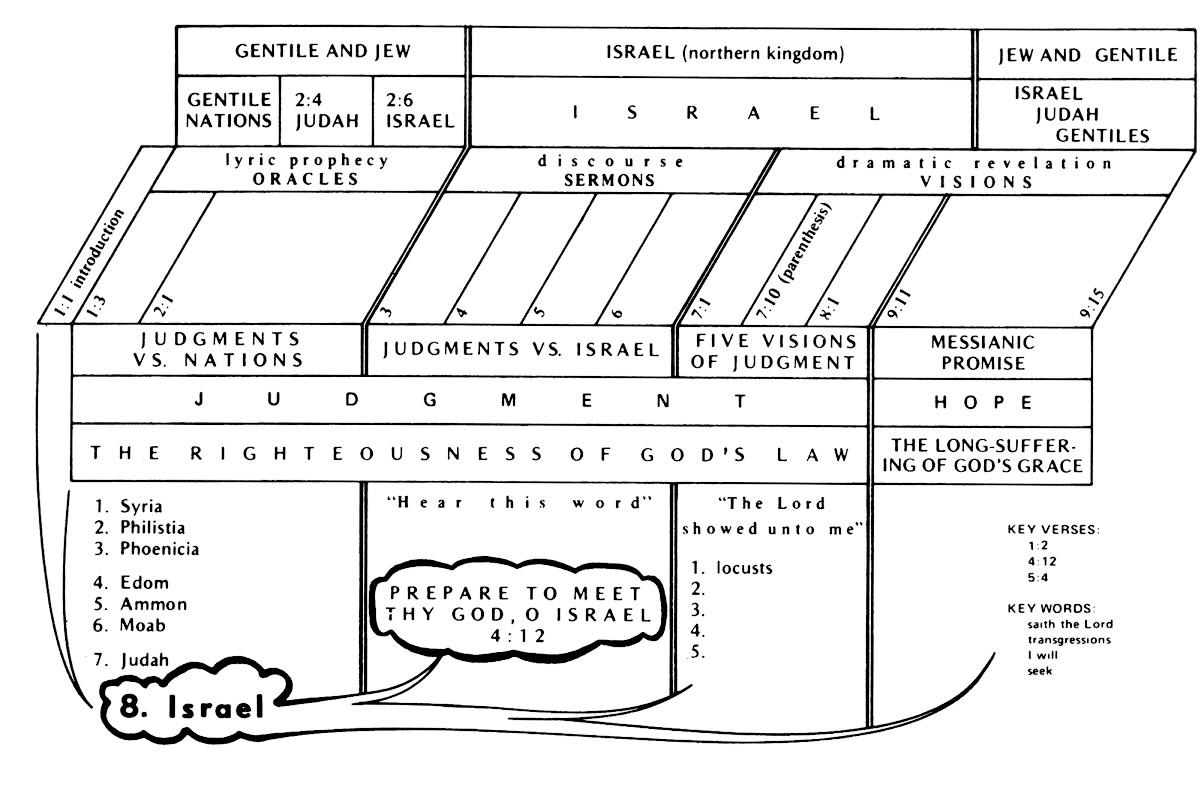
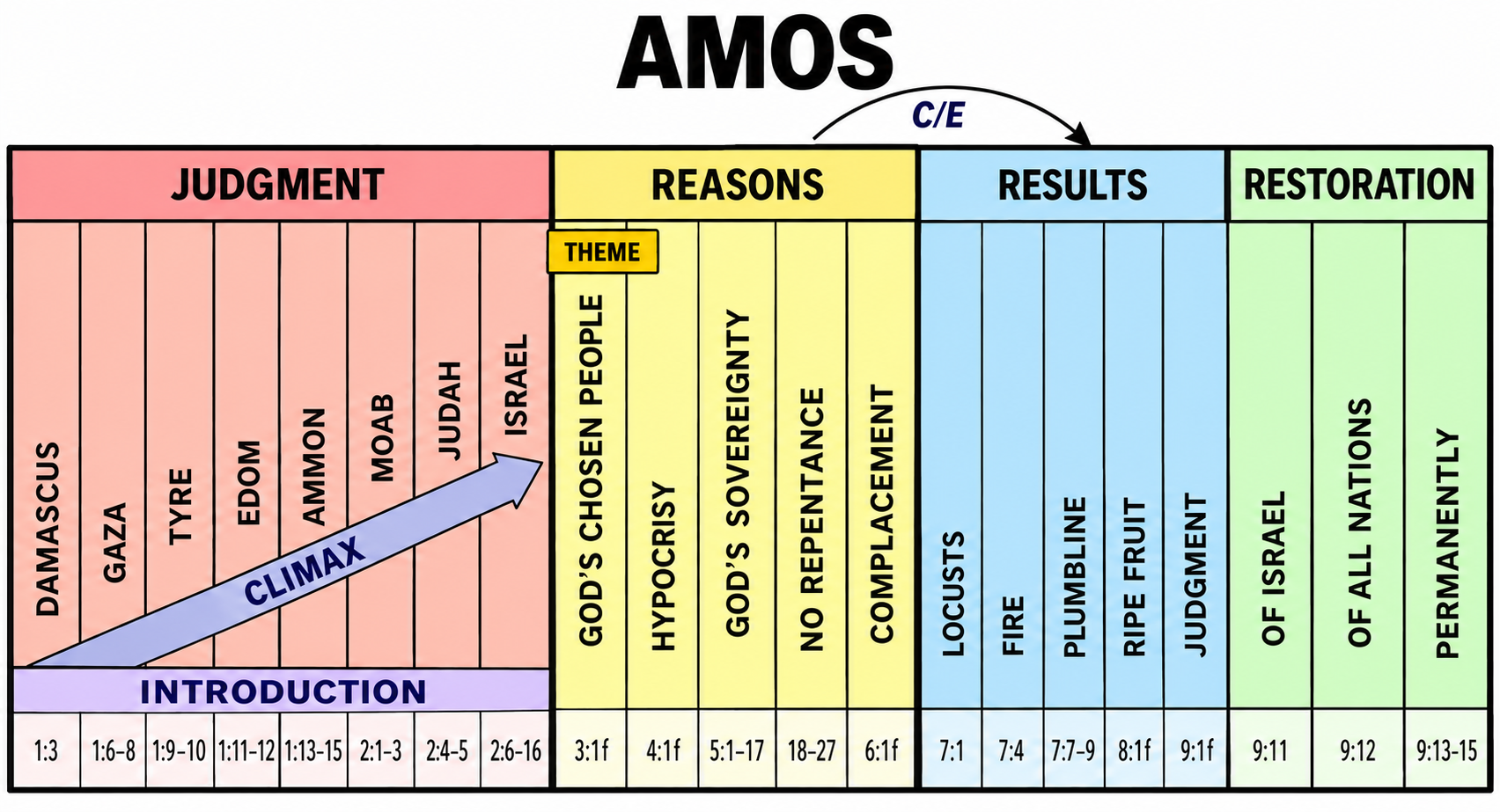
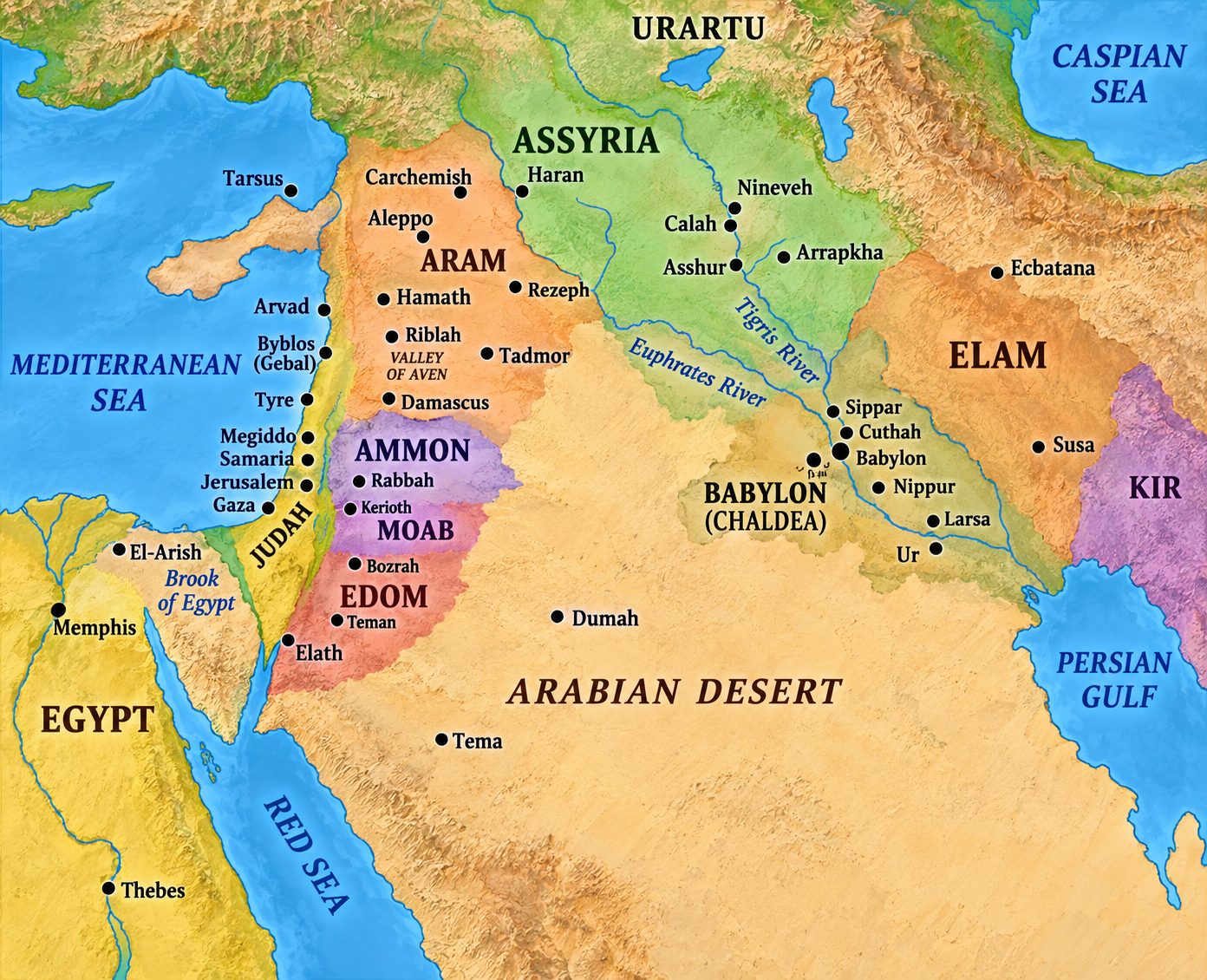


Amos 2:1 Thus says the LORD, “For three transgressions of Moab and for four I will not revoke its punishment, Because he burned the bones of the king of Edom to lime.
- For three (KJV): Am 2:4,6 1:3,6,9,11,13 Nu 22:1-25:18 De 23:4,5 Ps 83:4-7 Mic 6:5
- of Moab (KJV): Isa 11:14 15:1-16:14 25:10 Jer 48:1-47 Eze 25:8,9 Zep 2:8,9
- because (KJV): 2Ki 3:9,26 Pr 15:3
Related Passages
Genesis 19:37 The firstborn bore a son, and called his name Moab; he is the father of the Moabites to this day.
2 Kings 3:4–27 provides important background regarding conflict among Moab, Edom, Israel, and Judah, although it should not be confidently identified as the specific incident in Amos 2:1.
Deuteronomy 2:9 “Then the LORD said to me, ‘Do not harass Moab, nor provoke them to war, for I will not give you any of their land as a possession, because I have given Ar to the sons of Lot as a possession.’
2 Kings 23:16–20 illustrates the extreme disgrace associated with disturbing and burning human bones.
Romans 12:19-21 Never take your own revenge, beloved, but leave room for the wrath of God, for it is written, “VENGEANCE IS MINE, I WILL REPAY,” says the Lord. 20 “BUT IF YOUR ENEMY IS HUNGRY, FEED HIM, AND IF HE IS THIRSTY, GIVE HIM A DRINK; FOR IN SO DOING YOU WILL HEAP BURNING COALS ON HIS HEAD.” 21 Do not be overcome by evil, but overcome evil with good.
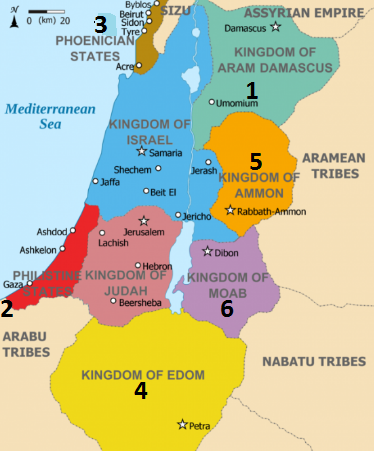
Judgment #6: Moab to the East
WHEN DESIRE FOR VENGEANCE
OUTLIVES ITS VICTIM
Thus says the LORD (Jehovah), “For three transgressions (pesha; LXX - asebeia - lack of reverence for deity and hallowed institutions as displayed in sacrilegious words and deeds) of Moab (note) and for four I will not revoke its punishment - The familiar formula is a Hebrew literary device called graded numerical parallelism (compare Pr 30:15, 18, 21, 29 and Job 5:19) The pattern of "three, and even four" signals fullness: the nation's sin has piled up until it has passed the point of tolerance. Three is already enough to condemn, and the fourth is the one that overflows the cup. Amos uses it eight times, against Damascus, Gaza, Tyre, Edom, Ammon, Moab, Judah, and finally Israel. (cf Amos 1:3, 6, 9, 11, 13, 2:1, 4, 6) In other words it indicates accumulated and repeated rebellion, not an exact mathematical total of four sins (cf Amos 1:3, 6, 9, 11, 13). Moab's transgressions had reached the point at which God announced “I will not revoke its punishment.” That gives the sequence a trap-like effect, since Israel's listeners would cheer as their enemies were judged, until the same formula landed on them. The circle of judgment (see numbered countries in map above) continues and finally tightens around Israel.
Note that transgressions (pesha) does not describe an accidental slip or failure but a willful breach. It describes deliberate defiance of legitimate authority including political revolt (for example, Moab "rebelling" against Israel in 2 Kings 1:1) as well as moral and covenant rebellion against God. In the LXX asebeia means lack of reverence toward God and what is holy and thus stresses the religious side of the offense as a direct affront to God, not just a crime against another person. I will not revoke its punishment indicates the judgment has been decided and won't be called off.
J Vernon McGee - "For three transgressions of Moab, and for four" -- that is his way of saying that there were many transgressions; but, as usual, he will mention only one specifically. (SEE Thru the Bible Vol. 28: The Prophets Amos/Obadiah)
NET NOTE - Traditionally, “transgressions” (KJV, ASV, NASB, NRSV) or “sins” (NIV). For an explanation of the atrocities outlined in this oracle as treaty violations of God’s mandate to Noah in Ge 9:5-7, see the note on the word “violations” in Amos 1:3.
Because he burned the bones of the king of Edom to lime - Burned (saraph) means to burn or consume with fire. But the striking feature is what Moab burned the bones. The king was already dead! Therefore, this was not merely killing an enemy during battle. It was an act of postmortem desecration. In the ancient Near Eastern world, proper burial was regarded with great seriousness. To disturb, expose, or destroy someone's remains was an act of extreme dishonor. Moab's hatred therefore did not end when its enemy died. It followed him into the grave. The enemy was dead, but their hatred was very much alive! One writer says this act was committed apparently to prevent any hope of bodily resurrection (1 Cor. 15:35–54).
Donald Sunukjian notes that "In ancient times much importance was placed on a dead man's body being peacefully placed in the family burial site, so that he could be "gathered to his fathers" and find rest in the grave. To rob, disturb, or desecrate a grave was an offense of the highest order. Many surviving tomb inscriptions utter violent curses against anyone who would commit such an outrage (G.A. Cooke, A Textbook of North-Semitic Inscriptions. Oxford: At the Clarendon Press, 1903, pp. 26-7, 30-2; Pritchard, Ancient Near Eastern Texts Relating to the Old Testament, p. 327)." (SEE The Bible Knowledge Commentary Minor Prophets - Page 43)
J Hay - Normally, human remains were regarded as sacrosanct, especially those of the powerful and influential. If wild dogs had not intervened, even the loathsome Jezebel would have received a dignified burial as befitted her royal status (2 Kings 9:34). Occasionally, this respect for the dead was overridden by sheer hatred and triumphalism, as when the Philistines beheaded Saul, and impaled his corpse to the wall of Beth-shan (1 Sam 31:9–10). Undoubtedly, that was the attitude here, and this crime against the king of Edom, in reducing his bones to plaster, brought divine tolerance to an end as far as Moab was concerned. The sin of Ammon had been against the unborn; the sin of Moab was against one already dead. Perhaps there were many old scores to be settled, but what senseless hatred in forcing the royal tomb and incinerating a skeleton!....God’s desire is that the human body should be respected both in life and in death. He prohibited cutting the flesh (body piercing), and printing marks (tattooing), even as an expression of mourning (Lev 19:28). Immorality is sin against one’s own body (1 Cor 6:18). To be guilty of perversion is to “dishonour” the body (Ro 1:24).....Apparently, in pagan circles there was the widespread notion that the skeleton was the basis of any resurrection body; hence burning the bones would ensure that the individual would be denied resurrection! We know that nothing can ever frustrate the power of God in this matter. (What the Bible Teaches)
Reformation Study Bible - According to Hebrew tradition, these are the bones of the Moabite king Mesha (2Ki 3:4). Such burning indicated special contempt, and was thought to deprive the dead of peace in the afterlife. Josiah burned the bones of false priests on the altar at Bethel (2Ki 23:15, 16).
NET NOTE - LIME - The Moabites apparently desecrated the tomb of an Edomite king and burned his bones into a calcined substance which they then used as plaster (cf. Deut 27:2, 4). See S. M. Paul, Amos (Hermeneia), 72. Receiving a proper burial was very important in this culture. Desecrating a tomb or a deceased individual’s bones was considered an especially heinous act.
The Wycliffe Bible Commentary - The LXX has to konia (for LIME), which was the fine dust with which a wrestler's body was covered after it had been oiled. This afforded his opponent the advantage of a firm grip. The Vulgate has to ashes. The Targum indicates that the king of Moab used the powder to plaster his house. KERIOTH is named on the Moabite Stone as the site of a temple of Chemosh, a god of the Moabites.
The bones of the king of Edom - This is remarkable because Edom itself has just been condemned in Amos 1:11,12. God had already announced judgment upon Edom for pursuing his brother with the sword and maintaining his fury. Yet when Moab desecrates the remains of an Edomite king, God condemns Moab. That teaches an important principle. The fact that Edom was guilty before God did not give Moab permission to commit evil against Edom. God may judge Edom. But Moab cannot justify its own cruelty by saying “Edom deserved it.” One person's guilt never gives another person unrestricted moral permission to mistreat him. This is divine justice operating impartially. God can judge Edom for Edom's sin and then judge Moab for sinning against Edom. Moab's hatred was so deeply rooted that even the grave could not satisfy it. Note that God judges the nations by a universal moral standard: certain outrages are wrong no matter who commits them or against whom, and God is concerned with cruelty and desecration even when Israel is not the victim as is the case against Moab.
Donald Sunukjian notes that "Though this was not a crime against Israel, it was nevertheless a sin of rebellion (pešha) against the sovereign Lord of the universe, an assault against His own image in people. For such contempt and defilement, God would militarily annihilate Moab." (SEE The Bible Knowledge Commentary Minor Prophets - Page 43)
Lime (sid) refers to lime or plaster produced through intense burning. Amos apparently describes the bones being burned so thoroughly that they were reduced to a powdery, lime-like substance. This is not ordinary cremation but conveys deliberate degradation and contempt. The enemy was not satisfied that the king was dead but his remains had to be dishonored, his bones destroyed and his memory humiliated. In short, this is "over the top" vengeance because it extends beyond death.
The precise historical event Amos refers to is not recorded elsewhere in Scripture, at least not in a form that can be confidently identified with Amos 2:1. 2 Kings 3 records a major conflict involving Moab, Israel, Judah, and Edom, and it demonstrates the intense hostility existing in the region. However, we should not simply equate that episode with Amos 2:1 because the text does not tell us that the Moabites burned the bones of an Edomite king in that conflict. Apparently Amos and his original audience knew the event to which he referred even though Scripture gives us no further details. And we do not need the missing historical details to understand God's moral verdict. Moab's treatment of the dead king crossed a boundary God regarded as wicked. The pagan nations may not acknowledge Yahweh's authority, but their failure to acknowledge His authority does not eliminate His authority or their culpability! Notice that God does not have to approve of the victim (pagan in this case) in order to condemn the injustice committed against the victim.
🙏 THOUGHT - Moab illustrates how dangerous hatred becomes when it refuses to recognize any boundary. Their enemy was dead so the conflict should have been over, but their hatred demanded one final act of humiliation. The sobering spiritual principle is if we continually feed our hatred, even the removal of the object of our hatred may not remove the hatred from our heart. We sometimes imagine “If only this person were out of my life, my anger would disappear.” However, Moab reminds us that the real problem is no longer with the person. The real problem is what resentment has become in our heart. Death removed Moab's enemy, but it did not remove Moab's hatred.
QUESTION - Who were the Moabites? | GotQuestions.org
ANSWER - The Moabites were a tribe descended from Moab, the son of Lot, born of an incestuous relationship with his oldest daughter (Genesis 19:37). From Zoar, the cradle of this tribe, on the southeastern border of the Dead Sea, they gradually spread over the region on the east of Jordan. Shortly before the Exodus, the warlike Amorites crossed the Jordan under Sihon their king and drove the Moabites out of the region between the Arnon River Valley and the Jabbok River, and occupied it, making Heshbon their capital. The Moabites were then confined to the territory to the south of the Arnon Valley (Numbers 21:26–30).
During the Exodus the Israelites did not pass through Moab, but through the “wilderness” to the east, eventually reaching the country to the north of Arnon. The Moabites were alarmed, and their king, Balak, sought aid from the Midianites (Numbers 22:2–4). This was the occasion when the visit of Balaam to Balak took place (Numbers 22:2–6).
In the Plains of Moab, which was in the possession of the Amorites, the children of Israel had their last encampment before they entered the land of Canaan (Numbers 22:1; Joshua 13:32). If we had nothing else to interest us in the land of Moab, it was from the top of Pisgah that Moses, the mightiest of prophets, looked upon the Promised Land; it was here on Nebo that he died his solitary death; it was here in the valley over against Beth-peor where he was buried (Deuteronomy 34:5–6).
A basalt stone, bearing an inscription by King Mesha, was discovered at Dibon by Klein, a German missionary at Jerusalem, in 1868, consisting of thirty-four lines written in Hebrew-Phoenician characters. The stone was set up by Mesha about 900 BC as a record and memorial of his victories. It records Mesha’s wars with Omri, his public buildings, and his wars against Horonaim. This inscription supplements and corroborates the history of King Mesha recorded in 2 Kings 3:4–27. It is the oldest inscription written in alphabetic characters and, in addition to its value in the domain of Hebrew antiquities, is of great linguistic importance.
Perhaps the most significant Bible character to come from Moab was Ruth, who was “of the women of Moab” but was genetically linked to Israel through Lot, the nephew of Abraham (Genesis 11:31). Ruth is an example of how God can change a life and take it in a direction He has foreordained, and we see God working out His perfect plan in Ruth’s life, just as He does with all His children (Romans 8:28). Although she came from a pagan background in Moab, once she met the God of Israel, Ruth became a living testimony to Him by faith. Ruth, the Moabitess, is one of the few women mentioned in the genealogy of Jesus Christ (Matthew 1:5).
Life Application Study Bible - Page 1321 adds "The Moabites had descended from an incestuous relationship between Lot and his older daughter (Genesis 19:30-37). Balak, king of Moab, had tried to hire the prophet Balaam to curse the Israelites so they could be defeated (Numbers 22-24). Balaam spoke the Lord's word of blessing instead, but some of the Moabites had succeeded in getting Israel to worship Baal (Numbers 25:1-3). The Moabites were known for their atrocities (2 Kings 3:26, 27). An archaeological artifact, the Moabite Stone, reveals that Moab was always ready to profit from the downfall of others."
Amos 2:2 “So I will send fire upon Moab And it will consume the citadels of Kerioth; And Moab will die amid tumult, With war cries and the sound of a trumpet.
- Kirioth (KJV): Jer 48:24,41
- with tumult (KJV): Am 1:14 Isa 9:5 Jer 48:34
Related Passages
Amos 2:1 gives the reason for Moab's judgment.
Jeremiah 48:21–25, 41 includes Kerioth in the later extensive prophecy against Moab.
Isaiah 15–16 also announces devastation upon Moab.
Zephaniah 2:8–11 “I have heard the taunting of Moab And the revilings of the sons of Ammon, With which they have taunted My people And become arrogant against their territory. 9“Therefore, as I live,” declares the LORD of hosts, The God of Israel, “Surely Moab will be like Sodom And the sons of Ammon like Gomorrah– A place possessed by nettles and salt pits, And a perpetual desolation. The remnant of My people will plunder them And the remainder of My nation will inherit them.” 10This they will have in return for their pride, because they have taunted and become arrogant against the people of the LORD of hosts. 11The LORD will be terrifying to them, for He will starve all the gods of the earth; and all the coastlands of the nations will bow down to Him, everyone from his own place.
Amos 3:6 If a trumpet is blown in a city will not the people tremble? If a calamity occurs in a city has not the LORD done it?
Joel 2:1 Blow a trumpet in Zion, And sound an alarm on My holy mountain! Let all the inhabitants of the land tremble, For the day of the LORD is coming; Surely it is near,
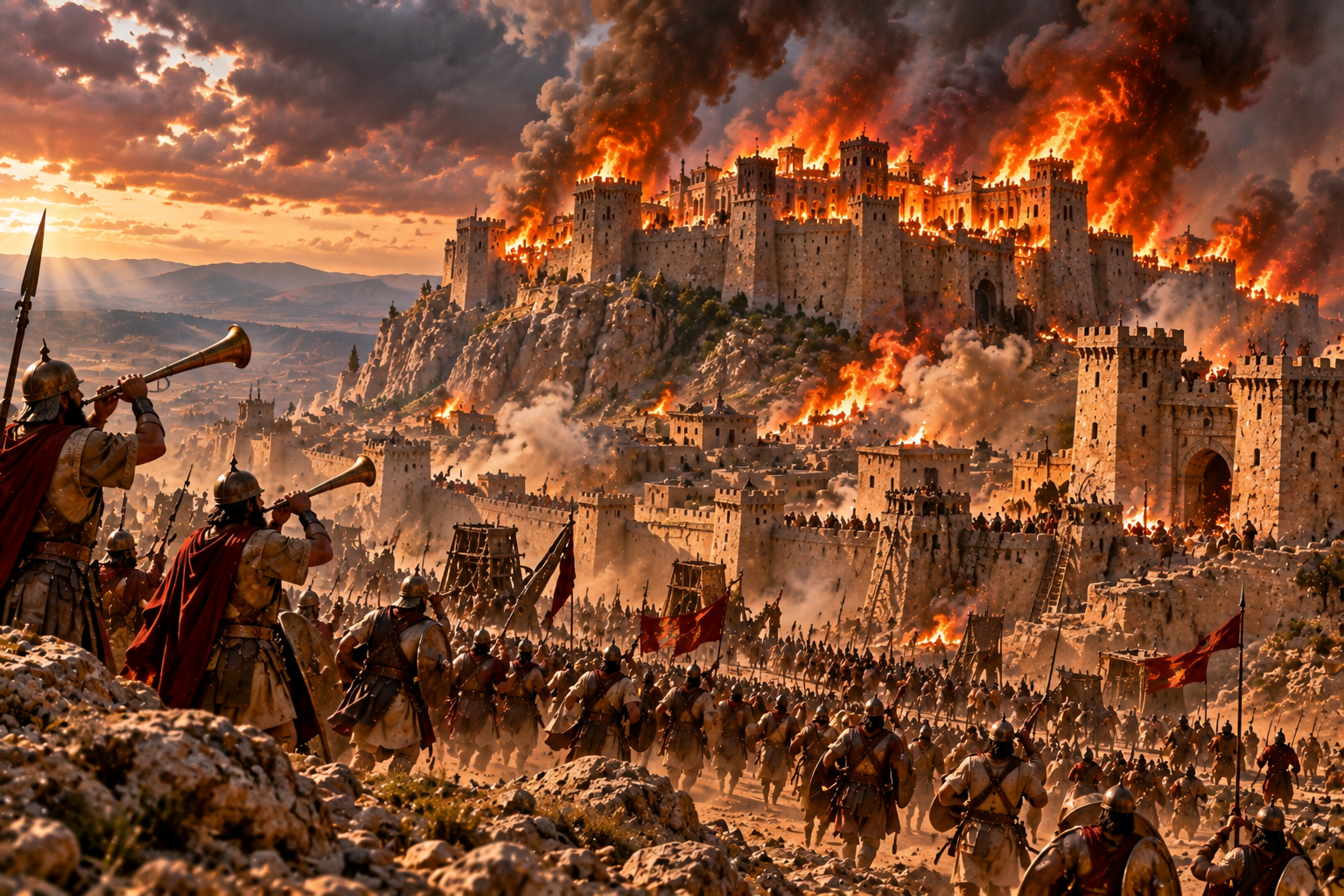
WHEN THE WAR CRY
REACHES MOAB
So - Term of conclusion connects Moab's punishment directly to the shocking offense of Amos 2:1
I (note the sovereignty of God) will send fire upon Moab - This refrain has now echoed repeatedly through Amos' opening oracles (Amos 1:4, 7, 10, 12, 14). It creates an almost relentless rhythm. One nation after another discovers that its fortifications, wealth, military strength, and political power cannot withstand God's judgment. The fire signifies devastating judgment, historically expressed through warfare and the destruction that accompanied invading armies.
NET NOTE - The destruction of Moab by fire is an example of a judgment in kind—as the Moabites committed the crime of “burning,” so the Lord will punish them by setting them on fire.
And it will consume ('akal; LXX - katesthio - figuratively destroy, esp of fire) the citadels (armon; LXX - themelion = the base on which a building stands) of Kerioth - Kerioth was an important Moabite city, and the Moabite Stone said it was a religious center. It is also mentioned in Jeremiah's prophecy against Moab (Jer 48:24, 41). Its precise location is uncertain, though it was evidently significant enough for Amos to use it as representative of Moab's strength. The citadels were fortified palaces or strongholds. Throughout these opening judgments they symbolize the things in which nations placed their confidence: military security, political authority, wealth, and power. What men fortified, God could consume. Kerioth may have appeared secure behind its defenses, but Amos has been making the same point repeatedly. There is no such thing as an impregnable fortress when God has determined judgment.
Hubbard - Kerioth may have been singled out for destruction because it housed a shrine for the Moabite deity, Chemosh, as Mesha himself noted in his inscription. Its suggested site is about fifteen kilometres north of the Arnon river and about twelve kilometres east of the Dead Sea. (SEE Joel and Amos - Page 144)
And Moab will die amid tumult (šāʾôn - din of battle) - Amos personifies the entire nation as though Moab were a single individual facing death. Moab had desecrated the dead, so now Amos turns the tables and speaks of Moab's death. Moab had treated another king's death with contempt, but Moab would discover that it too stood under the judgment of God for desecrating one made in the image of God. Tumult can describe a great noise, uproar, commotion, or the terrifying din associated with battle. This judgment will not come quietly. Imagine the contrast between the normal activity of a fortified city and the chaos of its final assault. Moab's imagined security would suddenly become chaos.
NET NOTE - TUMULT- This word refers to the harsh confusion of sounds that characterized an ancient battle—a mixture of war cries, shouts, shrieks of pain, clashes of weapons, etc.
J Vernon McGee - "Moab shall die with tumult" -- that is, they will go out with a real bang, and the nation will be ended. This proud nation was brought to extinction later on at the hands of Nebuchadnezzar, and you haven't seen a Moabite since then. But isn't it interesting that, many years before, out of this heathen country had come that gentle, lovely, and beautiful girl by the name of Ruth who became the wife of Boaz? Her story is recorded in one of the loveliest books in the Bible. Ruth is in the genealogical line which leads to Jesus Christ. And she had come from Moab, of all places. They were really a heathen, pagan people with a sad and sorry beginning and just as sad and tragic an end as a nation. But Ruth's story reveals what the grace of God can do in the life of a believer if the believer will let Him do it. (SEE Thru the Bible Vol. 28: The Prophets Amos/Obadiah)
With war cries and the sound of a trumpet (shophar/shopar/sopar) - This could suggest a surprise attack. The war cry was the shout raised by warriors as they entered battle. Amos places his hearers inside the terrifying sounds of a city under attack. The trumpet was the ram's horn used for a variety of purposes, including sounding an alarm and signaling military action. In this context, its sound would announce that danger had arrived. (See also HORNS USED BY ISRAEL)
Consume (ate, devour, fed) (00398) 'akal means "to consume (destroy something completely)." It is used of both humans and animals. Sometimes, it is used with the verb "to drink" in connection with the good life. Genesis 26:30 reads "and he made for them a feast and they 'ate' and drank." Judges 9:27 reads "They 'ate' and 'drank' and cursed Abimelech." 1 Kings 4:20 reads "Judah and Israel were many 'eating' and 'drinking' and making merry." In Job 1:4, Job's sons and daughters met regularly "to eat and drink." Generally, the noun is used in the context of to "eat food" (Gen. 3:19). "In the sweat of thy face shalt thou 'eat' bread." The same is true of Gen. 37:25, "They sat down to 'eat' bread." It is used of birds and beasts eating (Ge 40:17) This verb is often used figuratively with overtones of destroying something or someone. So the sword, fire, and forest are said to "consume" men. The things "consumed" may include such various things as land (Gen. 3:17), fields (Isa. 1:7), offerings (Deut. 18:1), and a bride's purchase price (Gen. 31:15). ʾĀkal might also connote bearing the results of an action (Isa. 3:10).
AKAL - KEY VERB IN AMOS - Amos 1:4; Amos 1:7; Amos 1:10; Amos 1:12; Amos 1:14; Amos 2:2; Amos 2:5; Amos 4:9; Amos 5:6; Amos 6:4; Amos 7:2; Amos 7:4; Amos 7:12; Amos 9:14
USES IN THE OTHER MINOR PROPHETS - Hos. 2:12; Hos. 4:8; Hos. 4:10; Hos. 5:7; Hos. 7:7; Hos. 7:9; Hos. 8:13; Hos. 8:14; Hos. 9:3; Hos. 9:4; Hos. 10:13; Hos. 11:4; Hos. 13:8; Joel 1:4; Joel 1:19; Joel 1:20; Joel 2:3; Joel 2:5; Joel 2:25; Joel 2:26; Amos 1:4; Amos 1:7; Amos 1:10; Amos 1:12; Amos 1:14; Amos 2:2; Amos 2:5; Amos 4:9; Amos 5:6; Amos 6:4; Amos 7:2; Amos 7:4; Amos 7:12; Amos 9:14; Obad. 1:18; Mic. 3:3; Mic. 6:14; Mic. 7:1; Nah. 1:10; Nah. 2:13; Nah. 3:12; Nah. 3:13; Nah. 3:15; Hab. 1:8; Hab. 3:14; Zeph. 1:18; Zeph. 3:8; Hag. 1:6; Zech. 7:6; Zech. 9:4; Zech. 9:15; Zech. 11:1; Zech. 11:9; Zech. 11:16; Zech. 12:6; Mal. 3:11
Citadels (0759) Armon (אַרְמוֹן) a masculine noun most commonly translated "palace," "citadel," or "fortress." It denotes a fortified, elevated dwelling, typically the fortified residence of a king or ruling elite, distinguished from ordinary housing by its defensive strength, architectural grandeur, and social prominence. The word sits at the intersection of two related ideas: a place of royal luxury and a place of military security. These aren't separate meanings but two sides of the same reality in the ancient world, where a king's palace and a city's strongest fortification were often one and the same structure. It becomes a symbol of human security, political power, accumulated wealth, social privilege, and pride. These were the structures in which rulers and elites felt secure. They represented the strength of the city and the permanence of the ruling establishment.
CITADEL IN AMOS - One-third of the uses are in Amos and it was as if God was sayinng “The very structures in which you trust will not protect you when I judge.” By Amos 3 the citadels are not merely places of security. They have become storehouses of sin. Amos calls the people of Ashdod and Egypt to look upon Samaria and witness its disorder and oppression (Amos 3:9). Then comes the remarkable accusation “They do not know how to do what is right...these who hoard up violence and devastation in their citadels” (Amos 3:10). That is powerful imagery. Israel's wealthy elite had filled their magnificent residences with possessions obtained through oppression and exploitation. Their citadels were therefore not merely symbols of wealth. They were warehouses containing the evidence of their crimes. And Amos 6:8 takes it even further where God declares: “I loathe the arrogance of Jacob, and detest his citadels” (Amos 6:8). Why would God detest buildings? Because the citadels had come to embody the entire corrupt system behind them: pride, luxury, oppression, exploitation, and false security. God was not condemning architecture. He was condemning what the architecture represented and what had been accumulated inside it. This fits Amos perfectly. Again and again he attacks wealthy people who live comfortably while exploiting the poor (Amos 2:6–7; 4:1; 5:11–12; 6:4–6). Human beings repeatedly put their confidence in things they believe make them untouchable. God repeatedly destroys those very symbols of security.
ARMON - 33X/32V - castle(1), citadel(2), citadels(13), fortified buildings(1), fortified towers(1), palace(3), palaces(9), palatial dwellings(1), towers(2). 1 Ki. 16:18; 2 Ki. 15:25; 2 Chr. 36:19; Ps. 48:3; Ps. 48:13; Ps. 122:7; Prov. 18:19; Isa. 23:13; Isa. 25:2; Isa. 32:14; Isa. 34:13; Jer. 6:5; Jer. 9:21; Jer. 17:27; Jer. 30:18; Jer. 49:27; Lam. 2:5; Lam. 2:7; Ezek. 19:7; Hos. 8:14; Amos 1:4; Amos 1:7; Amos 1:10; Amos 1:12; Amos 1:14; Amos 2:2; Amos 2:5; Amos 3:9; Amos 3:10; Amos 3:11; Amos 6:8; Mic. 5:5
The word likely derives from a root meaning "to be elevated" or "raised up," fitting both the literal elevation of such structures (often built on high ground or given towering height for defensive advantage) and their figurative elevation in status as symbols of power and prestige. E.A. Speiser has proposed a connection to the Assyrian root ramu, meaning "to found a dwelling" or "to dwell," which would tie the word to the broader Semitic vocabulary of establishing a fixed, secure residence.
In the King James Version, ʾarmôn is rendered "palace" in every instance except one: Proverbs 18:19, where it appears as "castle" ("a brother offended is harder to be won than a strong city: and their contentions are like the bars of a castle"). This near-uniform translation choice reflects the word's core association with royal or elite fortified dwellings, though modern versions vary the English rendering (NASB, NKJV often "palace"; NIV sometimes "citadel" or "stronghold," depending on context) to better capture the defensive/military nuance in different passages.
The word occurs 33 times across the Hebrew Bible. Strikingly, 22 of those occurrences, nearly three-quarters, fall within the prophetic literature, and among the prophets, Amos and Jeremiah use it most heavily. Amos alone accounts for 11 occurrences, making ʾarmôn a key word for the book, a recurring drumbeat word that ties together its opening judgment oracles and its later indictments of Israel.
ʾArmôn frequently appears in poetic parallelism with other words describing strength, fortification, or military architecture, which helps sharpen its semantic range:
- "Strength" (oz) — Amos 3:11, where the citadel and the nation's strength are treated as parallel casualties of judgment
- "Siege tower" — Isaiah 23:13, aligning the word with active military architecture used in warfare
- "Rampart" (chel) — Psalm 122:7, where it appears alongside the wall/rampart system of Jerusalem (rendered "citadel" in NIV, "palace" in NASB/NKJV/KJV)
- "Fortification" — Lamentations 2:5 (rendered "palace" in NASB/NKJV/KJV/NIV)
These parallels confirm that ʾarmôn isn't merely decorative or residential vocabulary but carries genuine military-defensive weight. It names the structures a city or nation would point to as the proof of its security.
Beyond its use in prophetic judgment oracles, ʾarmôn appears in historical narrative describing the literal objects of siege warfare, the buildings an invading army would target for capture, plunder, or destruction as the decisive blow against a conquered people:
- 2 Kings 15:25 — part of the account of Pekah's conspiracy and assassination of Pekahiah, which took place within the royal citadel
- 2 Chronicles 36:19 — the Babylonians "burned the house of God, broke down the wall of Jerusalem, burned all its fortified buildings (armon) with fire, and destroyed all its valuable articles" at the fall of Jerusalem
- Isaiah 23:13 — describes the Assyrians turning Babylon's own citadels to ruin
- 1 Kings 16:18 — Zimri, facing certain defeat, burns down the royal citadel over himself rather than be captured
These texts confirm that ʾarmôn was not merely an architectural term but functioned as shorthand for the literal target of conquest, the place where a nation's power was concentrated and where its downfall became visible and final.
Amos deploys ʾarmôn as a structuring device across his opening judgment oracles (chapters 1-2). The recurring formula, "I will send fire upon [nation], and it will consume the citadels of..." appears against:
- Damascus / the house of Hazael (Amos 1:4)
- Gaza (Amos 1:7)
- Tyre (Amos 1:10)
- Edom / Teman-Bozrah (Amos 1:12)
- Ammon / Rabbah (Amos 1:14)
- Moab (Amos 2:2)
- Judah (Amos 2:5)
This deliberate repetition creates a rhythmic, almost liturgical pattern of judgment sweeping through nation after nation, each time targeting the exact structure that nation trusted in most, its fortified seat of royal power. The imagery carries strong holy war overtones: God Himself is depicted as the divine warrior whose fire consumes what human strength has built to resist Him. Nothing fortified by human hands can withstand it.
No Exemption for God's Own People - The theologically crucial turn in Amos's use of the word comes when the same judgment formula is applied not just to Israel's pagan neighbors but to God's own covenant people:
- Jerusalem's citadels will burn (Amos 2:5; cf. Hosea 8:14, where the same fate is pronounced on Israel's fortresses)
- Israel's own citadels are marked for destruction (Amos 3:11): "An adversary will surround the land; he will pull down your strength (oz) from you, and your citadels (armon) will be looted"
- God explicitly says He hates Israel's citadels (Amos 6:8): "I loathe the arrogance of Jacob, And detest his citadels"
The reason given for this hatred is explicit: these citadels were "filled with violence and destruction" (Amos 3:10) rather than justice, storehouses of wealth accumulated through oppression and extortion of the poor (cf. Lamentations 2:5, 7; Jeremiah 17:27, which likewise ties citadel-burning to covenant unfaithfulness).
Theological Significance - The word's usage across Amos builds toward a pointed theological argument: covenant privilege does not exempt Israel from the same fire that consumes pagan strongholds. If anything, Israel's citadels are singled out for God's particular hatred, precisely because they represented wealth and security built on injustice rather than righteousness, a perversion of what covenant blessing was meant to produce. The recurring image of burning citadels thus becomes Amos's central symbol for the false confidence every nation, pagan or covenant, can place in fortified strength, wealth, and human security apparatus. What people build to make themselves untouchable, God can, and in Amos's oracles repeatedly does, reduce to ash.
Amos 2:3 “I will also cut off the judge from her midst And slay all her princes with him,” says the LORD.
- Nu 24:17 Jer 48:7,25
Related Passages
Judges 2:16–18 (illustrates the broader governing function of a shophet or judge) Then the LORD raised up judges who delivered them from the hands of those who plundered them. 17Yet they did not listen to their judges, for they played the harlot after other gods and bowed themselves down to them. They turned aside quickly from the way in which their fathers had walked in obeying the commandments of the LORD; they did not do as their fathers. 18When the LORD raised up judges for them, the LORD was with the judge and delivered them from the hand of their enemies all the days of the judge; for the LORD was moved to pity by their groaning because of those who oppressed and afflicted them.
Jeremiah 48:7, 25, 41–44 describes the later collapse of Moab's strength and leadership.
Isaiah 16:6–14 announces humiliation for proud Moab.
Psalm 82:1–8 depicts God standing in judgment over human rulers and judges.
Romans 14:10-12 (reminds us that every person ultimately gives an account to God) "But you, why do you judge your brother? Or you again, why do you regard your brother with contempt? For we will all stand before the judgment seat of God. 11For it is written, “AS I LIVE, SAYS THE LORD, EVERY KNEE SHALL BOW TO ME, AND EVERY TONGUE SHALL GIVE PRAISE TO GOD.” 12So then each one of us will give an account of himself to God."
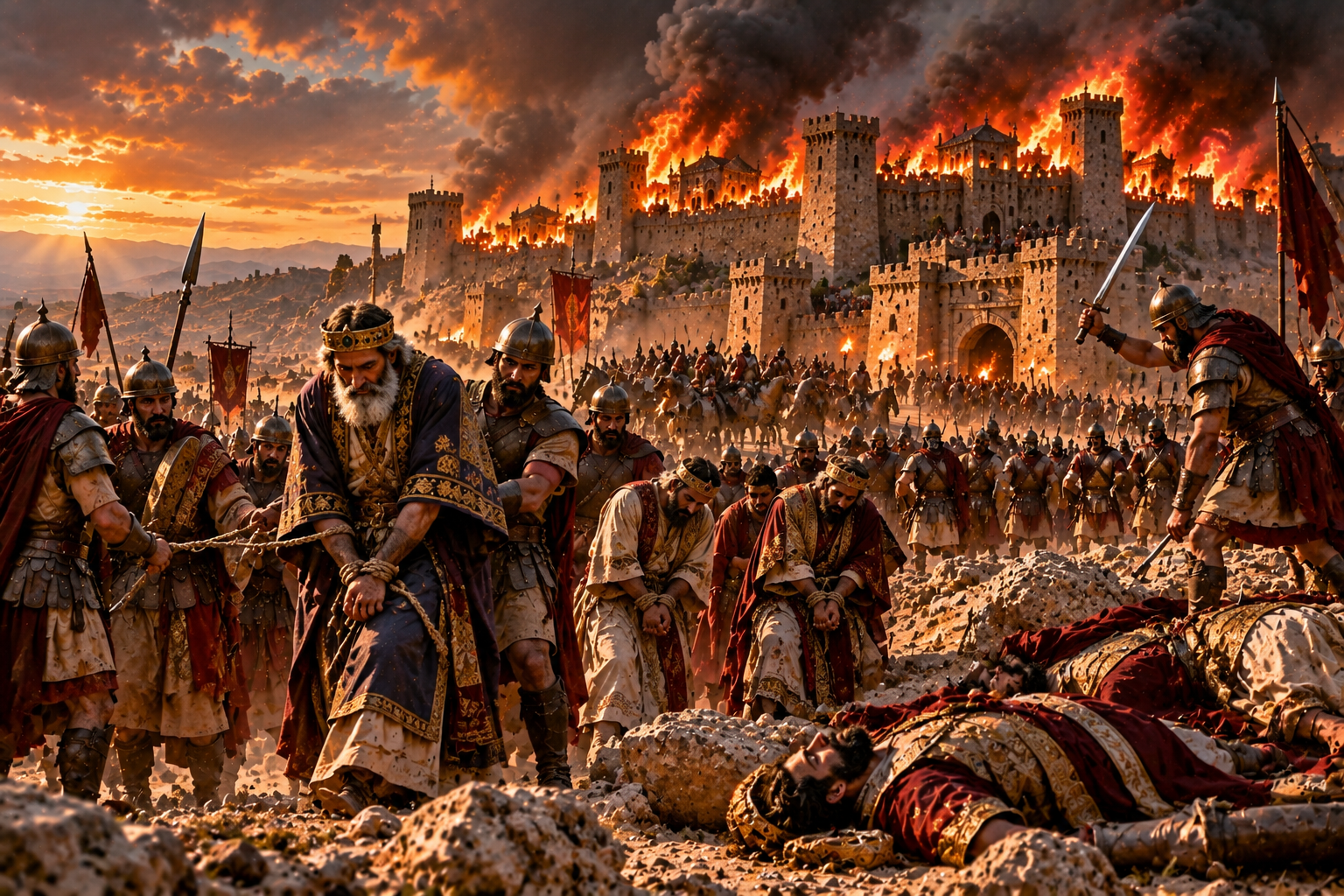
WHEN THE JUDGE
IS JUDGED
I will (God's sovereignty) also cut off (karath; LXX - exolothreuo - utterly destroy) the judge (shaphat; LXX - krites - in a specific historical sense, the leaders of Israel before the time of kings) from her midst - Cut off is strong language meaning to cut down, eliminate, or remove. The same verb appeared in Amos 1:5 and Amos 1:8 concerning the removal of inhabitants and rulers. Moab's political leadership would not simply experience a temporary setback but would be removed.
Judge (shaphat) in this context it probably refers to Moab's chief ruler or governing authority, not merely someone presiding over a courtroom (cf 2Ki 15:5, Da 9:12 where rulers = shaphat). This usage has important Old Testament precedent because Israel's “judges” were frequently not simply judicial officials but leaders who governed and exercised authority over the nation (Jdg 2:16, 17, 18). Thus “the judge” here likely refers to the person occupying the highest governing position in Moab, perhaps effectively its king or supreme ruler. This terminology may be especially appropriate because the oracle itself is structured like a courtroom proceeding. Moab has committed the crime. God has presented the evidence. God has pronounced the sentence. And now Moab's own judge stands before a greater Judge. The ruler would be removed from her midst. He occupied the center of Moabite society, authority, and government. But political prominence could not provide protection from divine accountability.
Moab's judge could judge others,
but he could not escape the judgment of God.
And slay all her princes with him,” says the LORD (Jehovah) - Notice the adjective all meaning no exceptions. The princes were the officials, nobles, military commanders, advisers, and governing leaders who shared responsibility for Moab's policies and administration.
FULFILLMENT OF PROPHECY - reflecting judgment on six nations who had transgressed by their treatment of God's people, Israel.
Moab - Moab, like Ammon, fell to the Assyrians under Tiglath-pileser III in 734 в.c. Later, Moab was involved in a rebellion against Assyrian domination that was quelled by Sennacherib. Later still, during the period of Babylonian supremacy, Moab was forced to pay tribute to Babylon. The Moabites rebelled against Babylon shortly after 598 B.C. and, according to Josephus Antiquities X.ix.7), were conquered by Nebuchadnezzar. This allowed Arab tribes to occupy Moabite territory like they did to the Ammonites.
Amos 2:4 Thus says the LORD, “For three transgressions of Judah and for four I will not revoke its punishment, Because they rejected the law of the LORD And have not kept His statutes; Their lies also have led them astray, Those after which their fathers walked.
KJV Thus saith the LORD; For three transgressions of Judah, and for four, I will not turn away the punishment thereof; because they have despised the law of the LORD, and have not kept his commandments, and their lies caused them to err, after the which their fathers have walked:
NET This is what the LORD says: "Because Judah has committed three covenant transgressions– make that four!– I will not revoke my decree of judgment. They rejected the LORD's law; they did not obey his commands. Their false gods, to which their fathers were loyal, led them astray.
NLT This is what the LORD says: "The people of Judah have sinned again and again, and I will not let them go unpunished! They have rejected the instruction of the LORD, refusing to obey his decrees. They have been led astray by the same lies that deceived their ancestors.
ESV Thus says the LORD: "For three transgressions of Judah, and for four, I will not revoke the punishment, because they have rejected the law of the LORD, and have not kept his statutes, but their lies have led them astray, those after which their fathers walked.
NIV This is what the LORD says: "For three sins of Judah, even for four, I will not turn back my wrath. Because they have rejected the law of the LORD and have not kept his decrees, because they have been led astray by false gods, the gods their ancestors followed,
- For (KJV): De 31:16-18 32:15-27
- Judah (KJV): Am 3:2 2Ki 17:19 Jer 9:25,26 Ho 5:12,13 6:11 12:2
- because (KJV): Lev 26:14,15 Jdg 2:17-20 2Sa 12:9,10 2Ki 22:11-17 2Ch 36:14-17 Ne 1:7 9:26,29,30 Isa 5:24,25 Jer 8:9 Eze 16:1-63 20:13,16,24 Eze 22:8 23:11-21 Da 9:5-12 1Th 4:8
- and their (KJV): Isa 9:15,16 28:15 44:20 Jer 16:19,20 23:13-15,25-32 28:15,16 Eze 13:6-16,22 22:28 Hab 2:18 Ro 1:25
- after (KJV): Jdg 2:11-17 10:6 2Ch 30:7 Jer 8:2 9:14 Eze 20:13,16,18,24,30 1Pe 1:18
Related Passages
Jeremiah 16:19 O LORD, my strength and my stronghold, And my refuge in the day of distress, To You the nations will come From the ends of the earth and say, “Our fathers have inherited nothing but falsehood, Futility and things of no profit.”
Habakkuk 2:18 “What profit is the idol when its maker has carved it, Or an image, a teacher of falsehood? For its maker trusts in his own handiwork When he fashions speechless idols.
Hosea 4:12 people consult their wooden idol, and their diviner’s wand informs them; For a spirit of harlotry has led them astray, And they have played the harlot, departing from their God (See Israel the Wife of Jehovah).
Ezekiel 44:10 “But the Levites who went far from Me when Israel went astray, who went astray from Me after their idols, shall bear the punishment for their iniquity.
Romans 1:25 For they exchanged the truth of God for a lie, and worshiped and served the creature rather than the Creator, who is blessed forever. Amen.
Deuteronomy 4:6 “So keep and do them, for that is your wisdom and your understanding in the sight of the peoples who will hear all these statutes and say, ‘Surely this great nation is a wise and understanding people.’
Deuteronomy 7:11 “Therefore, you shall keep the commandment and the statutes and the judgments which I am commanding you today, to do them.
Deuteronomy 11:1 “You shall therefore love the LORD your God, and always keep His charge, His statutes, His ordinances, and His commandments.
Jeremiah 16:19 O LORD, my strength and my stronghold, And my refuge in the day of distress, To You the nations will come From the ends of the earth and say, “Our fathers have inherited nothing but falsehood, Futility and things of no profit.”
Deuteronomy 4:5–8 describes Israel's extraordinary privilege in receiving God's statutes and ordinances.
Deuteronomy 6:4–9 calls God's people not merely to possess His words but to keep them upon their hearts and teach them diligently.
2 Kings 17:15 uses remarkably similar language, saying Israel “rejected His statutes” and “followed vanity and became vain.” Jeremiah 6:19 connects judgment with rejecting God's law.
Luke 12:47–48 teaches the principle that greater knowledge brings greater accountability.
James 1:22–25 warns against hearing God's Word without doing it.
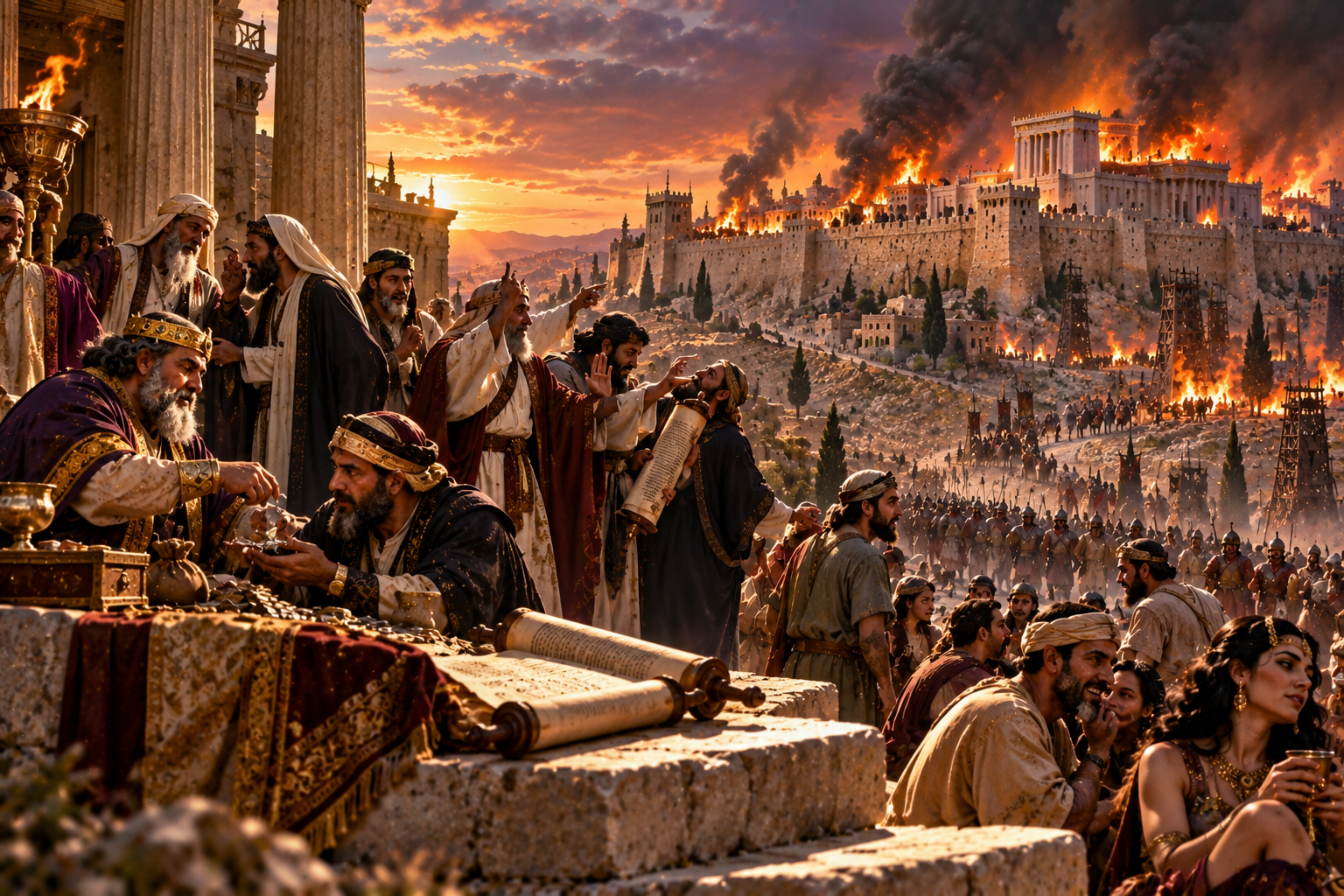
JUDAH: GREATER REVELATION
GREATER RESPONSIBILITY
Thus says the LORD (Jehovah), “For three transgressions (pesha; LXX - asebeia - lack of reverence for deity and hallowed institutions as displayed in sacrilegious words and deeds) of Judah and for four I will not revoke its punishment - NET - "Because Judah has committed three covenant transgressions–make that four!" Now Amos crosses the boundary into Judah, the covenant people of God and the nature of the indictment also changes.
NKJV Study Bible - Page 543 - After Solomon died, the kingdom divided, and the tribes of Judah and Benjamin became the southern kingdom (Judah) under Solomon's son Rehoboam.The other 10 tribes became the northern kingdom (Israel) and followed Jeroboam, who had rebelled against Rehoboam. God had punished other nations harshly for their evil actions and atrocities. But God also promised to judge both Israel and Judah because they ignored the revealed law of God. The other nations were ignorant, but Judah and Israel, God's people, knew what God wanted. Still they ignored him and joined pagan nations in worshiping idols. If we know God's Word and refuse to obey it, like Israel, our guilt is greater than those who are ignorant of it.
Because they rejected (ma'as - cast off, despised; LXX - apotheo/apotheomai - literally push aside, thrust off from oneself, drive away, figuratively repudiate, refuse to listen to) the law (torah; LXX - nomos - basic meaning law, i.e. what is assigned or proper) of the LORD (Jehovah) - The pagan nations were condemned for violations of basic moral responsibility but Judah was condemned for rejecting the law of the LORD. Judah possessed something those nations did not possess: God's revealed Word. Therefore Judah would be judged according to the greater light she had received. The message is that religious privilege without obedient response does not protect from divine discipline. Indeed, greater revelation creates greater responsibility, for “From everyone who has been given much, much will be required.” (Lk 12:48)
Having God's Word is not the same
as heeding God's Word.
And have not kept His statutes - Kept (shamar; LXX - phulasso - activity of a watchman; protect) means to guard, watch, observe, or carefully attend to, exactly what they did not do with God's statutes.
Reformation Study Bible rejected the law ... statutes. For rejecting God's revealed covenant law, and so God Himself, they were particularly worthy of judgment (Ex. 15:26; Dt. 4:39, 40). Judah's covenant privileges implied greater responsibility (cf. Lk 12:48).
J Vernon McGee on rejected and not kept - This is saying in a very brief way what the prophets Isaiah and Jeremiah and Ezekiel took quite a few pages to say; that is, that God would judge the southern kingdom. For what would He judge them? They did not keep the commandments of God; they despised God's law. Judah had the law of God and despised it. They even had the temple which was in Jerusalem. Therefore, God now judged them according to the Law. Have you noticed that God did not judge any of these other nations on that basis whatsoever? He judged them for certain specific sins which are common to the natural man. Because these other nations did not have God's law, they were not judged according to God's law. (SEE Thru the Bible Vol. 28: The Prophets Amos/Obadiah)
Their lies (kāzāb - deceptions, falsehoods) also have led them astray (tāʿāh - caused to err; LXX - planao - caused to wander or be deceived) -- NET - "Their false gods, to which their fathers were loyal, led them astray." Lies refers to falsehood, deception, or something deceptive and something promises reliability and fails. In this context it likely refers to the false gods and deceptive religious beliefs Judah had embraced. The verb tāʿāh pictures wandering off course, like a sheep or a traveler who has lost the path (Ps 119:176; Isa 53:6). The lies acted as false guides, and the people followed them into the wrong place.
NET NOTE on LIES - Heb “lies.” This may very well be a derogatory term for idols (perhaps also at Ps 40:4). Elsewhere false gods are called “vanities” (Dt 32:21; 1Ki 16:13, 26) and a delusion (Isa 66:3). In no other prophetic passages, however, are they called “lies.” The term could refer to the deceptions of false prophets (note Ezek 13:6-9; cf. Hab 2:3). See F. I. Andersen and D. N. Freedman, Amos (AB), 301-6.
Donald Sunukjian - The idols were deceptive for they were unable to help the people. In Deuteronomy God constantly warned the Israelites not to follow false gods (Dt. 6:14; 7:16; 8:19; 11:16, 28; etc.). (SEE Bible Knowledge Commentary: Old Testament - Page 1431)
Those after which their fathers walked (hālak; LXX - exakoloutheo - of a way of life thus to closely imitate) - NET - "to which their fathers were loyal" Amos says that in effect the lies were passed on from on generation to another, especially from fathers (cp Ezekl 20:18-24, Jer 16:19). Their fathers had walked after them and now the children were walking the same deceptive, deadend road.
🙏 THOUGHT - Fathers, watch your walk, because little eyes are watching your walk and will likely imitate your walk!
NET NOTE on walked - Heb “after which their fathers walked.” The expression “to walk after” is an idiom meaning “to be loyal to.” See S. M. Paul, Amos (Hermeneia), 75-76. Here the idolatry of the parents carried over to the children, who persisted in worshiping the idols to which their fathers were loyal. (ED: FATHERS, BE CAREFUL WHAT YOU ARE LOYAL TO!)
Reformation Study Bible after which their fathers walked. The ancient Near Eastern idiom "to walk after" meant to follow in obedience as a vassal or servant. Judah was following lies, and serving as the vassal of false gods or demons (Dt. 32:17; Ro 6:16; 1Co 10:20).
Transgressions (rebel, rebellion)(06588) pesha' from pasha [06586] = to rebel, transgress) means transgression, rebellion, willful breach or revolt against authority (rising up in clear defiance of authority), guilt (incurred by transgressing). Pesha' is derived from a root describing the breach of relationship between two parties (civil or religious). The idea of this noun is that the individual makes a willful choice to reject God's authority and hence to deviate from the path of godly living. Defection from God's standard. Pesha' is “a stepping aside from the (correct) path." Pesha' speaks of willful sin.
Pesha is one of the major Old Testament words for sin and describes willful transgression, deliberate disobedience, rebellion, or the violation of an established relationship or authority. It is stronger than the general idea of making a mistake or unintentionally doing wrong. At its heart, pesha is knowing that a boundary or obligation exists and deliberately crossing it. Boice aptly describes it as “crossing a forbidden boundary” in serious rebellion.
The basic idea is rebellion against rightful authority. In political contexts pesha can describe revolt or treason (1Ki 12:19); in interpersonal relationships it can describe violating another person's rights or obligations (Ge 31:36; 50:17; Ex 22:9); and in the spiritual realm it describes rebellion against God and His revealed will (Isa 1:2; Amos 2:4; 5:12). Thus pesha can involve social, political, or religious wrongdoing, but the common element is a deliberate breach of an obligation or recognized authority.
Pesha is more than breaking a rule. Pesha is especially serious because biblical sin is relational as well as legal. It is not merely breaking God's rule but rebelling against the God Who gave the rule. In covenant contexts it therefore carries the idea of “covenant treachery,” a violation of an existing relationship with God. This gives us an important progression: God establishes His authority. Man knows the boundary. And yet man deliberately crosses the boundary! You've never done that before have you beloved!
Pesha is not merely missing God's standard;
it is knowingly rebelling against God's authority.
Pesha' can be a transgression of one individual against another (Ge. 31:36; 50:17; Ex. 22:9) or of one nation against another (Amos 1:3, 6, 9, 11, 13; 2:1) but is used primarily to describe Pesha' denotes a willful, criminal breaking of a covenant (1Ki 12:19; Jer 2:29) In Psalm 103:12 pesha’ is used metonymically for the guilt such actions produce.
Pesha is particularly important in Amos because it is the word translated “transgressions” in the repeated formula: “For three transgressions...and for four...” (Amos 1:3, 6, 9, 11, 13; 2:1, 4, 6). Significantly, Amos first applies pesha to pagan nations. Damascus, Gaza, Tyre, Edom, Ammon, and Moab did not possess Israel's covenant privileges, yet their cruelty, violence, treachery, and mistreatment of others constituted rebellion against God's moral government (Amos 1:3-2:3). TWOT specifically notes that in Amos 1-2 pesha is committed by non-Israelites against other people, whereas elsewhere the term frequently describes Israel's rebellion against God's covenant authority. This fits beautifully with Amos' opening message: the nations may not recognize Yahweh's authority, but they remain accountable to it. When Amos turns to Judah and Israel, however, pesha becomes even more serious because they possessed God's revealed Word and covenant privileges (Amos 2:4, 6; 3:2; 5:12). Their transgressions were not committed in ignorance but in the face of greater revelation.
TODAY IN THE WORD - Amos 1:13–2:16
In today’s reading, God promised to crush Israel “as a cart crushes when loaded with grain” (Amos 2:13). A modern equivalent would be a monster truck rolling over everything in its path. A monster truck is a pickup truck with huge tires and suspension—current designs tend to resemble gigantic dune buggies. As monster truck rallies or jams, it might squash cars, motor homes, school buses, and even small airplanes as part of organized competitions, including a freestyling event judged on both crushing and creativity.
In today’s reading, Amos continued with two additional oracles against Israel’s enemies. The fifth oracle was against the Ammonites (Amos 1:13–15). They were guilty of military atrocities such as the killing and mutilation of pregnant women. The sixth oracle was against Moab (Amos 2:1–3). They were guilty of desecrating an enemy king’s body, thus showing sinful disrespect. For these and other sins, the judgment in both cases was the same as yesterday—a destroying fire representing military defeat, exile, or death. If you look at a map, you can see that the seven nations condemned in today’s and yesterday’s readings form a circle around Israel.
The seventh and eighth oracles came as a surprise to Amos’s hearers, for they were directed against Judah and Israel. They probably enjoyed hearing that justice would be done against their enemies, but to find their own sins as the “climax” and main target of the message was a shock. Judah was guilty of idolatry and disobedience and would also be judged by fire (Amos 2:4–5).
Israel was even worse. The northern kingdom was guilty of sins including idolatry, exploitation of the poor, injustice, oppression, greed, sexual immorality, drunkenness, and self–indulgence (Amos 2:6–16; cf. Deut. 15:7–11). They had “forgotten” God’s character and what He had already done in their history, they had been unfaithful to the covenant. As a result, they were marked for destruction and would surely, despite their imagined immunity from judgment, be crushed. “The swift will not escape . . . the warrior will not save his life.”
Apply the Word
The fundamental sin was pride. Pride allowed them to believe that as God’s “chosen people” they wouldn’t be held accountable for the various forms of wickedness in which they were engaged. Pride blinded them to the truth of the character of God. As we know, however: “Pride goes before destruction, a haughty spirit before a fall” (Prov. 16:18). Better to follow this proverb: “A man’s pride will bring him low, but a humble spirit will obtain honor” (Prov. 29:23, NAS).
Amos 2:4-5 In One Ear And Out the Other - Three men went deer hunting, and as they crossed the field going to the woods, a huge buck jumped up in their path. All three fired at the same time. The buck dropped, and as they came up on the buck, they realized they had a problem. Which one of them shot the deer? As they discussed the problem, a game warden came along to check for hunting licenses. He offered to sort out the problem, examined the deer, and said, “One of you guys is a preacher, right?” And sure enough, one of them was. “Well, preacher, your shot is the one that got the buck.” Amazed, the guys asked how he knew one of them was a preacher and that the preacher’s shot was the one that scored. “Simple,” the game warden said, “It went in one ear and out the other.”
Amos 2:5 So I will send fire upon Judah And it will consume the citadels of Jerusalem.”
- I will (KJV): Jer 17:27 21:10 37:8-10 39:8 52:13 Ho 8:14
Related Passages
2 Chronicles 36:19 Then they burned the house of God and broke down the wall of Jerusalem, and burned all its fortified buildings with fire and destroyed all its valuable articles.
2 Kings 25:9 He burned the house of the LORD, the king’s house, and all the houses of Jerusalem; even every great house he burned with fire.
Amos 2:4 gives the spiritual cause behind the judgment of verse 5.
2 Kings 25:8–12 and 2 Chronicles 36:17–21 record Jerusalem's eventual destruction by Babylon.
Jeremiah 7:1–15 warns Judah against trusting in the temple while continuing in disobedience.
Micah 3:9–12 similarly warns Jerusalem's leaders against assuming the LORD's presence guaranteed safety while they practiced evil.
Psalm 127:1 declares that unless the LORD guards the city, human defenses are ultimately vain.
Luke 6:46–49 contrasts hearing Christ's words and acting upon them with hearing and failing to obey.
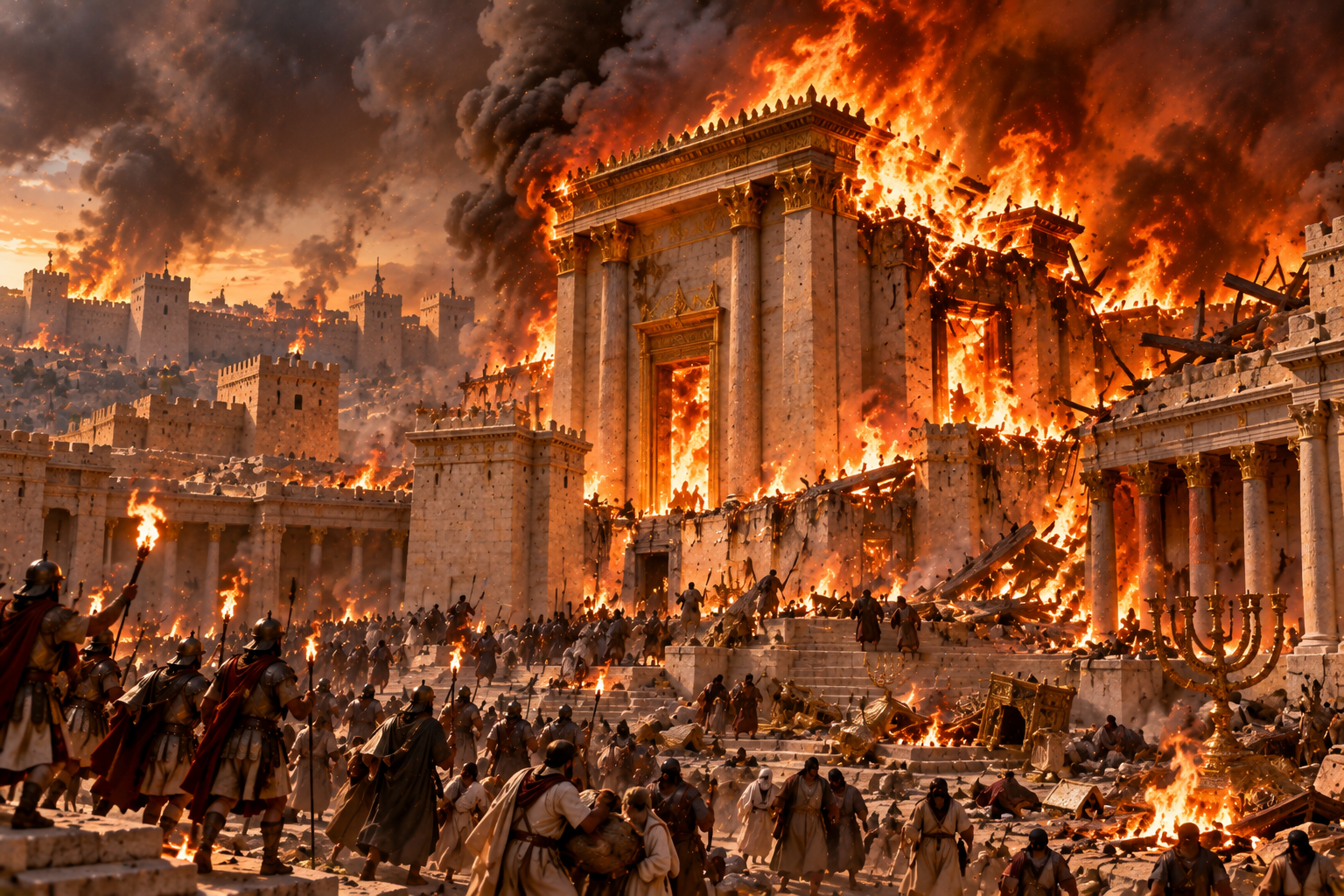
The Holy Temple consumed by fire 586 BC
WHEN JUDGMENT
REACHES JERUSALEM
So - Term of conclusion pointing directly back to Judah's sins in Amos 2:4 and announces Judah's punishment. Judah had the Torah, so it was more responsible than the surrounding nations, who had only the general moral law written on the human conscience (compare Romans 2:14-15).
I will (God is in control and so will....) send fire upon Judah - Note God's impartiality, for Amos uses exactly the same judgment formula he used against the surrounding pagan nations (Amos 1:4, 7, 10, 12, 2:2) Judah's covenant relationship with God did not exempt her from judgment dispensed to the godless nations. In fact, Judah's greater exposure brought greater accountability, an immutable Biblical principle (cf Mt 11:21-24). The nations sinned against the little light they had, while Judah sinned against the greater light God had given (Ps 119:105). Beloved, the principle is timeless that being God's people never gives God's people permission to disregard God's Word.
J Vernon McGee applies this to us - The more light that you have, the more responsible you are to God. I believe that you and I are more responsible to God than people who are denied Bibles and who are not hearing the Word of God at all. We are more responsible than they are. We often like to sit in judgment of these other nations round about us, but have you ever stopped to think of the tremendous responsibility that you and I have because of the privilege of having the Word of God? We boast of the fact that we have the Bible, but the important thing is our own personal obedience to the Word of God and whether or not we are doing anything to help get it out to others. (SEE Thru the Bible Vol. 28: The Prophets Amos/Obadiah)
And it will consume ('akal; LXX - katesthio - figuratively destroy, esp of fire) the citadels (armon; LXX - themelion = the base on which a building stands) of Jerusalem - Fire is pictured as an animal that consumes what it burns. Amos uses his recurring word citadels (armenot), referring to fortified palaces and strongholds which represented the places where the nation's security and royal power were concentrated. The one edifice that separated Judah from the pagan nations was the Holy Temple, which would also be consumed by fire. This reminds me of Jeremiah's warning "Do not trust in deceptive words, saying, ‘This is the temple of the LORD, the temple of the LORD, the temple of the LORD.’” (Jer 7:4)
Long before Jerusalem's walls fell,
Judah's heart had wandered.
Reformation Study Bible on Jerusalem. - The name means "city of peace." The Hebrew word for "peace" (shalom) denotes not only the absence of war, but also prosperity and wholeness. Because Judah had not sought integrity in the Lord, they would see destruction, not peace. This prophecy was fulfilled over 150 years later, when Nebuchadnezzar II conquered Jerusalem and burned every notable building, including the king's house (2 Kin. 25:8-10).
In 586 B.C., after repeated rebellion and repeated prophetic warnings, the Babylonian army under Nebuchadnezzar captured Jerusalem. The Holy Temple was burned, the royal palace and houses were destroyed, the walls were broken down, and many of the inhabitants were carried into exile (2Ki 25:8–12; 2Ch 36:17–21). Long before Jerusalem's walls fell, Judah's heart had wandered.
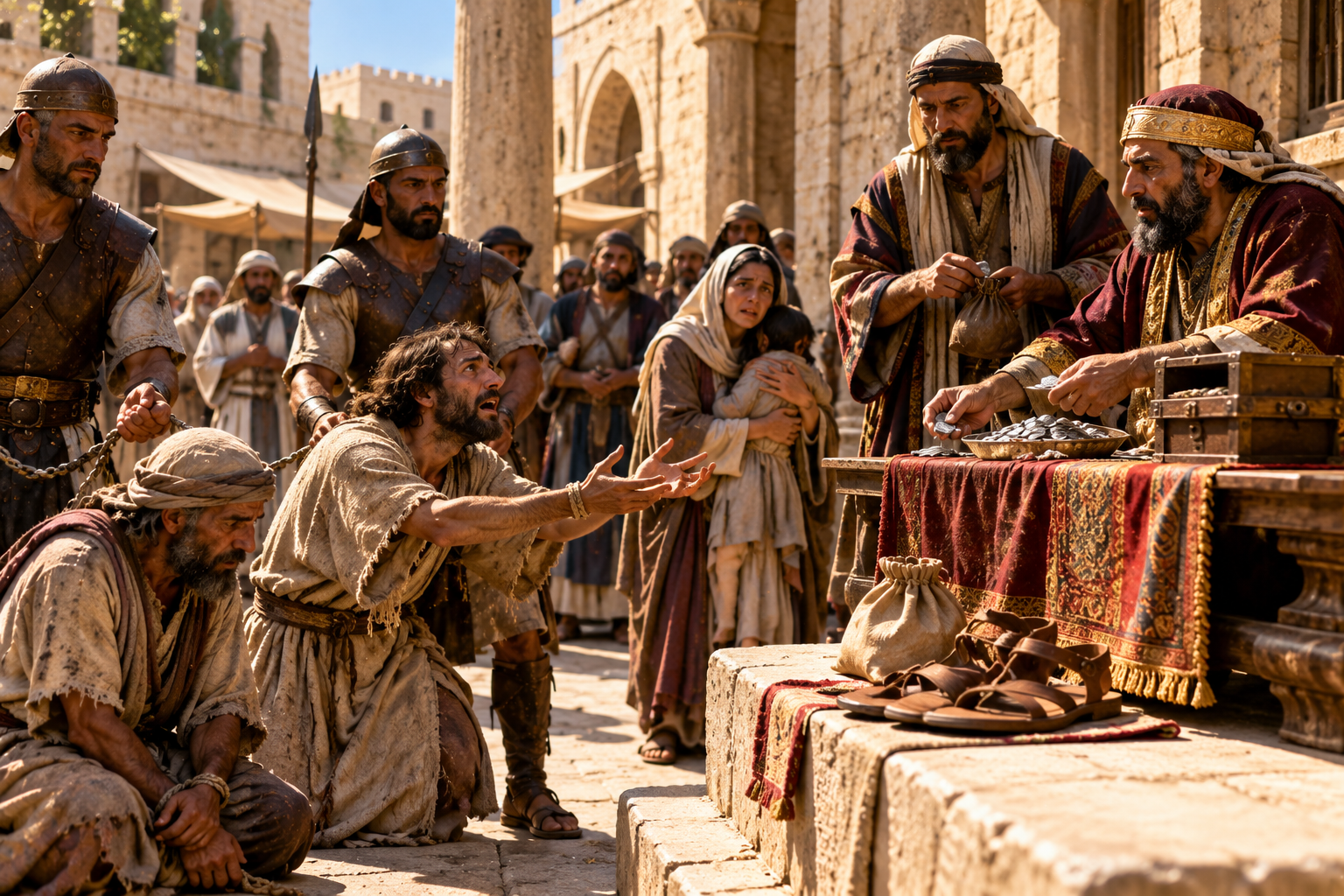
Amos 2:6 Thus says the LORD, “For three transgressions of Israel and for four I will not revoke its punishment, Because they sell the righteous for money And the needy for a pair of sandals.
KJV Thus saith the LORD; For three transgressions of Israel, and for four, I will not turn away the punishment thereof; because they sold the righteous for silver, and the poor for a pair of shoes;
NET This is what the LORD says: "Because Israel has committed three covenant transgressions– make that four!– I will not revoke my decree of judgment. They sold the innocent for silver, the needy for a pair of sandals.
BGT τάδε λέγει κύριος ἐπὶ ταῖς τρισὶν ἀσεβείαις Ισραηλ καὶ ἐπὶ ταῖς τέσσαρσιν οὐκ ἀποστραφήσομαι αὐτόν ἀνθ᾽ ὧν ἀπέδοντο ἀργυρίου δίκαιον καὶ πένητα ἕνεκεν ὑποδημάτων
LXE Thus saith the Lord; for three sins of Israel, and for four, I will not turn away from him; because they sold the righteous for silver, and the poor for sandals,
- For three (KJV): Am 6:3-7 2Ki 17:7-18 18:12 Eze 23:5-9 Ho 4:1,2,11-14 7:7-10 8:4-6 Ho 13:2,3 Mic 6:10-16
- because (KJV): Am 5:11,12 8:4-6 Isa 5:22,23 29:21 Joe 3:3,6 Mic 3:2,3
Related Passages:
Amos 8:4–6 Hear this, you who trample the needy, to do away with the humble of the land, 5 saying, “When will the new moon be over, So that we may sell grain, And the sabbath, that we may open the wheat market, To make the bushel smaller and the shekel bigger, And to cheat with dishonest scales, 6 So as to buy the helpless for money And the needy for a pair of sandals, And that we may sell the refuse of the wheat?”
Deuteronomy 25:1 “If there is a dispute between men and they go to court, and the judges decide their case, and they justify the righteous and condemn the wicked,
Proverbs 14:31 He who oppresses the poor taunts his Maker, But he who is gracious to the needy honors Him.
Exodus 22:21–27 commands compassion toward the socially vulnerable.
Deuteronomy 15:7–15 commands generosity toward the poor and explicitly reminds Israel that she had once been enslaved in Egypt.
Deuteronomy 16:18–20 forbids perverting justice or accepting bribes.
Amos 5:11-12 later condemns Israel for oppressing the poor, taking bribes, and turning aside the needy in the gate.
James 2:1–9 warns against giving preferential treatment to the wealthy while dishonoring the poor.
WHEN MONEY MATTERS
MORE THAN PEOPLE
Thus says the LORD (Jehovah), “For three transgressions (pesha; LXX - asebeia - lack of reverence for deity and hallowed institutions as displayed in sacrilegious words and deeds) of Israel and for four I will not revoke its punishment - Having drawn an ever-tightening noose around the pagan neighbors and Judah, finally the noose is tightened around Israel herself, using precisely the same three...four judicial formula as the pagan nations. There is no exemption because they are God's covenant people. Indeed, having been chosen as God's covenant people was never exemption from accountability.
NET NOTE - On the three…four style that introduces each of the judgment oracles of chaps. 1-2 see the note on the word “four” in Amos 1:3. Only in this last oracle against Israel does one find the list of four specific violations expected based on the use of a similar formula elsewhere in wisdom literature (see Prov 30:18-19, 29-31). This adaptation of the normal pattern indicates the Lord’s focus on Israel here (he is too bent on judging Israel to dwell very long on her neighbors) and emphasizes Israel’s guilt with respect to the other nations (Israel’s list fills up before the others’ lists do). See R. B. Chisholm, “‘For three sins…even for four’: the numerical sayings in Amos,” BSac 147 (1990) 188-97.
J Vernon McGee - Remember that Amos is delivering these messages in Bethel of the northern kingdom. He is speaking in the king's chapel. I think that every time he got up to speak, he would take as his subject one of these nations, and he would pronounce God's judgment upon it. Now he has even talked about Judah, and that's getting pretty close to home. It may be that a few people squirmed in their pews when he mentioned Judah. However, the ten northern tribes and the two southern tribes were at war with one another a great deal of the time. There were several occasions when they made alliances, but that was only because of fear and of the necessity to stand together against a common enemy. Most of the time they were enemies. Therefore, when Amos gave his message of judgment against the southern kingdom, everyone was present and "amened" him. They agreed that God should judge Jerusalem and Judah. But what about the northern kingdom? Beginning with Amos 2:6 he will speak to the northern kingdom. Bethel is the city where the king worshiped, and this man was speaking in the king's chapel. Amos is getting closer to home. He's going to start meddling. The story is told of the preacher who one Sunday morning was preaching against various sins. He preached about the sin of drunkenness, and a woman sitting in the congregation loudly "amened" him. He preached against the sin of smoking, and she "amened" him for that. Then when he started preaching against the sin of chewing tobacco, she shifted her wad to the other cheek and grumbled, "Now he's quit preachin' and has gone to meddlin'!" Amos is starting to meddle now. (SEE Thru the Bible Vol. 28: The Prophets - Amos/Obadiah)
McGee on - "Thus saith the Lord." May I say to you, I personally have never felt that I have any right to stand in the pulpit and speak unless I can speak on the basis of "Thus saith the Lord." What the Word of God has to say should be the basis of all pulpit ministry. (Ibid)
Because (term of explanation - gives the reasons for the judgment) they sell the righteous (saddiq; NET = innocent) for money (NET = silver) - Righteous (saddiq) in this context does not mean a sinlessly righteous person, like Abram who was righteous by faith (Ge 15:6). In this context righteous (saddiq) describes someone generally in the right regarding his relationship with his fellow man. It was used as a legal and relational term meaning the one who is in the right in a dispute, or innocent of the charge (Dt 25:1).
The exact meaning of selling the righteous for money is not clear. One consideration is that there were corrupt legal proceedings in which wealthy creditors or judges manipulated the system against innocent debtors. Judges or creditors could take bribes and rule against the innocent, which fits the "gate" imagery of Amos 2:7 and Amos 5:12. Another consideration is debt slavery. Poor Israelites who could not repay loans could be sold or forced into servitude (Ex 21:2; Lev 25:39; 2Ki 4:1; Neh 5:1-5). Thus Amos may be condemning creditors who enslaved debtors over trivial debts.
This is the first of 5 specific sins for which Yahweh condemned Israel.
(1) selling the poor as slaves (Dt 15:7-11; Amos 8:6),
(2) exploiting the poor (Ex 23:6; Dt 16:19),
(3) engaging in perverse sexual sins (see Lev 20:11, 12),
(4) taking illegal collateral for loans (see Ex 22:26, 27; Dt 24:6, 12, 13),
(5) worshiping false gods (see Ex 20:3-5)." (From Life Application Study Bible)
Reformation Study Bible - The Lord had a special concern that their rights be protected (Ex. 23:6; Jer. 5:28), but they were being sold into slavery even for insignificant debts (here symbolized by a pair of sandals). Indigent slavery in Israel was legal, but was carefully limited by the law of Moses (Ex. 21:2; Deut. 15:12; 1 Pet. 2:18 and notes).
NET NOTE on righteous - Or “honest” (CEV, NLT). The Hebrew word sometimes has a moral-ethical connotation, “righteous, godly,” but the parallelism (note “poor”) suggests a socio-economic or legal sense here. The practice of selling debtors as slaves is in view (Exod 21:2-11; Lev 25:35-55; Deut 15:12-18). See the note at Exod 21:8 and G. C. Chirichigno, Debt-Slavery in Israel and the Ancient Near East (JSOTSup). Probably the only “crime” the victim had committed was being unable to pay back a loan or an exorbitant interest rate on a loan. Some have suggested that this verse refers to bribery in legal proceedings: the innocent are “sold” in the sense that those in power pay off the elders or judges for favorable decisions (5:12; cf. Exod 23:6-7).
And the needy for a pair of sandals - A pair of sandals was an ordinary, relatively inexpensive possession. The meaning of this expression is not clear so we should not be dogmatic. It may refer to a very small debt for which an impoverished person was sold into debt servitude. Some have also connected sandals with legal transactions (cf. Ru 4:7–8), but in this context the simplest and most natural force is probably the trivial economic value placed against a human life. Whether the sandals represent the debt itself or simply emphasize its insignificance, Amos' moral point is unmistakable: Israel's economic system had become so corrupt that a poor person's freedom could be sacrificed over something as insignificant as a pair of sandals. They had reduced the value of a person to the value of footwear.
ESV Study Bible on a pair of sandals - They sell the righteous perhaps refers to giving false witness for money, but it might also speak of selling someone into slavery for indebtedness over something as paltry as a pair of sandals (cf. Lev. 25:39-43).
NET NOTE on a pair of sandals - Perhaps the expression “for a pair of sandals” indicates a relatively small price or debt. Some suggest that the sandals may have been an outward token of a more substantial purchase price. Others relate the sandals to a ritual attached to the transfer of property, signifying here that the poor would be losing their inherited family lands because of debt (Ruth 4:7; cf. Deut 25:8-10). Still others emend the Hebrew form slightly to נֶעְלָם (neʿlam, “hidden thing”; from the root עָלַם, ʿalam, “to hide”) and understand this as referring to a bribe.
Life Application Study Bible (p 1476) Amos was speaking to the upper class. There was no middle class in the country—only the very rich and the very poor. The rich observed religious rituals. They gave extra tithes, went to places of worship, and offered sacrifices. But they were greedy and unjust, and they took advantage of the helpless. Be sure that you do not neglect the needs of the poor while you faithfully attend church and fulfill your religious obligations. God expects us to live out our faith—this means responding to those in need.
Amos 2:1-5 TODAY IN THE WORD
I will send fire upon Judah that will consume the fortresses of Jerusalem. - Amos 2:5
Most of us who are parents have seen someone else’s children behaving badly in the grocery store. Perhaps they threw a temper tantrum because mom or dad refused to buy them a toy. They may have pushed the grocery cart into other customers. On occasion we may have looked sternly at the child or even asked them to stop. Most of the time, however, we simply walked by, a little annoyed but grateful that our child was not the one making the fuss. When the disturbance is caused by one of our own children, however, our response is quite different.
This is also true of God. While He was angered by the sinful acts of the pagan nations that surrounded Jerusalem, He was also deeply concerned by the sins of His own people. In Amos 2:4 the prophet moves from Israel’s pagan neighbors to Judah, its sister nation to the south. Employing the same formula used to accuse Moab and the other pagan nations in the preceding verses, the prophet condemned Judah. The formula “For three sins . . . even for four,” indicated that Judah’s sin had grown to full measure.
Judah’s sin, however, had gone one step further than the transgressions of Israel’s pagan neighbors, who had sinned against man--Judah’s sin was primarily against God. Judah had rejected God’s Law and had followed the fake gods that had deceived their ancestors (Amos 2:4). Because of this, they would eventually face the same kind of fate as Israel’s enemies. The Lord promised to send “fire upon Judah that will consume the fortresses of Jerusalem” (Amos 2:5).
TODAY ALONG THE WAY
Do you have a double standard when it comes to sin? Do you want God to hold others accountable for their behavior and ignore your “little mistakes”? Those who have placed their faith in Jesus Christ do not need to be afraid of being condemned by God (Ro 8:1). We should not conclude from this that God is indifferent about the way we live. Perhaps, like Israel, God may be using the example of others as an object lesson for you. Could He be trying to remind you that although you are forgiven, you are also accountable to Him
Amos 2:7 “These who pant after the very dust of the earth on the head of the helpless Also turn aside the way of the humble; And a man and his father resort to the same girl In order to profane My holy name.
KJV That pant after the dust of the earth on the head of the poor, and turn aside the way of the meek: and a man and his father will go in unto the same maid, to profane my holy name:
NET They trample on the dirt-covered heads of the poor; they push the destitute away. A man and his father go to the same girl; in this way they show disrespect for my moral purity.
NLT They trample helpless people in the dust and shove the oppressed out of the way. Both father and son sleep with the same woman, corrupting my holy name.
ESV those who trample the head of the poor into the dust of the earth and turn aside the way of the afflicted; a man and his father go in to the same girl, so that my holy name is profaned;
CSB They trample the heads of the poor on the dust of the ground and block the path of the needy. A man and his father have sexual relations with the same girl, profaning My holy name.
NIV They trample on the heads of the poor as upon the dust of the ground and deny justice to the oppressed. Father and son use the same girl and so profane my holy name.
- pant (KJV): Am 4:1 1Ki 21:4 Pr 28:21 Mic 2:2,9 7:2,3 Zep 3:3
- and turn (KJV): Am 5:12 Isa 10:2
- and a (KJV): Lev 18:8,15 Eze 22:11 1Co 5:1
- to profane (KJV): Lev 20:3 2Sa 12:14 Eze 36:20 Ro 2:24
Related Passages
Isaiah 10:1-2 Woe to those who enact evil statutes And to those who constantly record unjust decisions, 2So as to deprive the needy of justice And rob the poor of My people of their rights, So that widows may be their spoil And that they may plunder the orphans.
Amos 5:12 For I know your transgressions are many and your sins are great, You who distress the righteous and accept bribes And turn aside the poor in the gate.
Amos 8:4 Hear this, you who trample (šāʾap̱) the needy, to do away with the humble of the land,
Micah 2:2; 9 They covet fields and then seize them, And houses, and take them away. They rob a man and his house, A man and his inheritance. (2:9) “The women of My people you evict, Each one from her pleasant house. From her children you take My splendor forever.
Leviticus 18:7-8; 15 ‘You shall not uncover the nakedness of your father, that is, the nakedness of your mother. She is your mother; you are not to uncover her nakedness. 8‘You shall not uncover the nakedness of your father’s wife; it is your father’s nakedness. (18:15) ‘You shall not uncover the nakedness of your daughter-in-law; she is your son’s wife, you shall not uncover her nakedness.
Amos 2:6 introduces Israel's economic exploitation of the righteous and needy.
Amos 4:1 condemns those who oppress the poor and crush the needy. Amos 5:10–12 specifically describes bribery and turning aside the poor in the gate.
Amos 8:4–6 again portrays those eager to exploit the needy.
Leviticus 19:2 grounds Israel's holiness in God's holiness.
Isaiah 3:14–15 asks Israel's leaders, “What do you mean by crushing My people and grinding the face of the poor?”
Romans 2:23–24 warns that professing God's law while breaking it can cause God's name to be blasphemed.
1 Corinthians 5:1 It is actually reported that there is immorality among you, and immorality of such a kind as does not exist even among the Gentiles, that someone has his father’s wife.
WHEN GREED GRINDS
THE POOR INTO THE DUST
These who pant (šāʾap̱ as in Amos 8:4 - trample, oppress. NET, NLT, ESV, CSB, NIV = trample; NASB note - trample or, snap at the head of the helpless on the dust) after the very dust of the earth on the head of the helpless (dal - poor, oppressed Ex 23:3; LXX = ptochos - describes one who crouches and cowers like a beggar) - NET - "They trample on the dirt-covered heads of the poor" The expression is difficult, and several interpretations have been proposed. The main point seems to be that these people's greed was insatiable, even to the point of exploiting the helpless. The Hebrew verb šāʾap̱ can mean "to pant," "to gasp," "to lie in wait for" and, in some translations, "to trample."
Interpretation 1 - Trampling in contempt (NET, NIV, ESV, Paul)
NET NOTE - PANT - Most scholars now understand this verb as derived from the root II שָׁאַף (shaʾaf, “to crush; to trample”), an alternate form of שׁוּף (shuf), rather than from I שָׁאַף (shaʾaf, “to pant, to gasp”; cf. KJV, ASV, NASB). Heb “those who stomp on the dirt of the ground on the head of the poor.” It is possible to render the line as “they trample the heads of the poor into the dust of the ground,” thereby communicating that the poor are being stepped on in utter contempt (see S. M. Paul, Amos [Hermeneia], 79-80). The participial form הַשֹּׁאֲפִים (hashoʾafim) is substantival and stands in apposition to the pronominal suffix on מִכְרָם (mikhram, v. 6b). The picture of the poor having dirt-covered heads suggests their humiliation before their oppressors and/or their sorrow (see 2 Sam 1:2; 15:32).
Interpretation 2 - Legal oppression (Sunukjian)
Donald Sunukjian has another interpretation - Amos' second accusation against Israel was that legal procedures were being perverted to exploit the poor. Contrary to the covenant commands (Ex. 23:6; Deut. 16:19), the courts had gone into collusion with the creditors and were denying justice to the oppressed. This oppression was so terrible and painful it was like trampling on their heads. (SEE Bible Knowledge Commentary: Old Testament - Page 1431)
Interpretation 3 - Resenting even the dust (McGee)
Another view is that they do not merely want the poor man's property. They want even "the dust of the earth" associated with him. Amos is using deliberately exaggerated, graphic language to expose avarice that knows no limit. They were not satisfied merely to have more, but even wanted what little the poor had left.
J Vernon McGee - "That pant after the dust of the earth on the head of the poor." This could mean several things, but I personally think it means that these selfish, greedy, rich judges even resented that the poor had enough dust left to throw upon their heads in mourning. Believe me, that is the covetousness, the modern idolatry of our day. God judges nations for that. (SEE Thru the Bible Vol. 28: The Prophets - Amos/Obadiah)
Common ground - All three readings/interpretations agree that the poor were being crushed by the powerful.
ESV Study Bible - Instead of helping the afflicted as the law commanded (Ex. 23:6-8), the affluent Israelites were crushing them (see also Amos 8:6).
Sin against people ultimately becomes
sin against the God Who made them.
Also turn aside the way of the humble - NIV = "deny justice to the oppressed" The humble are the afflicted, poor, powerless, vulnerable, lowly, or oppressed. To “turn aside the way” probably refers to frustrating their legitimate course, especially denying them access to justice. In the ancient Near East, legal cases were often heard "at the gate" of the city, where elders and judges would sit. To turn aside someone's way means to block them from receiving a fair hearing or a just verdict, essentially denying them legal recourse. The humble were without social standing, wealth, or connections to protect themselves in legal or economic disputes.
NET NOTE - Heb “they turn aside the way of the destitute.” Many interpreters take “way” to mean “just cause” and understand this as a direct reference to the rights of the destitute being ignored. The injustice done to the poor is certainly in view, but the statement is better taken as a word picture depicting the powerful rich pushing the “way of the poor” (i.e., their attempt to be treated justly) to the side. An even more vivid picture is given in Amos 5:12, where the rich are pictured as turning the poor away from the city gate (where legal decisions were made, and therefore where justice should be done).
And a man and his father resort to the same girl - NET = "A man and his father go to the same girl; in this way they show disrespect for my moral purity." Amos now abruptly moves from economic exploitation to sexual immorality. A father and son were going to the same young woman. The Hebrew expression does not explicitly identify her status. She may have been a servant girl, a prostitute, or possibly a cult prostitute (tied to Canaanite fertility worship), but the text itself does not establish those details with certainty. What is certain is that the behavior violated God's standards of sexual holiness and represented another form of exploitation. Whatever her status, the behavior violated the sexual holiness standards of Leviticus 18 and 20 (cf. Leviticus 18:8, 15 if she was a wife or daughter-in-law)."
In order (term of purpose or result) to profane My holy name - ESV: "so that my holy name is profaned" Profane (chalal) means to defile, desecrate, treat as common, or dishonor what is holy. Chalal is the opposite of qāḏôšh (holy), and it's the standard verb for profaning God's name (Lev 18:21; 19:12; 20:3; 22:32). Thus this sin represented a direct assault on God's character and reputation. God had placed His name upon Israel. They were known as His people. Therefore their behavior said something about their God to the watching world. Israel professed “Yahweh is our God.” Then they exploited the poor, corrupted justice, and practiced sexual immorality. Their lives contradicted their confession. They bore God's name while behaving in ways that dishonored God's name. God's holiness is utterly incompatible with the behavior Amos describes. Israel's tragedy was not merely that she sinned, but that while committing those sins she continued to bear the name of the holy God, causing her life to contradict the God she claimed to worship.
Our lives either adorn our profession
or contradict it.
John Butler - CORRUPT SOCIETY Amos 2:7 - Sermon Starters
“That pant after the dust of the earth on the head of the poor, and turn aside the way of the meek; and a man and his father will go in unto the same maid, to profane my holy name” (Amos 2:7).
The prophet Amos indicted many nations around Israel for their many evils. This made the Israelites feel pretty good. However, Amos did not stop there, but he pointed his finger at his own people and indicted his people for living evil lives. This indictment was a shock to his people, but they had it coming because they were so evil. In our text are three aspects of this evil of the people of Amos day which is like the evil of our land in our day.
FIRST—THE CRUELTY OF THEIR EVIL
“That pant after the dust of the earth on the head of the poor, and turn aside the way of the meek.” These words speak of the merciless oppression of the poor and needy by the wealthy in the land. When God is forsaken, as he was in Amos’ country, evil abounded. We are also seeing this type of evil in our land abound. God is forsaken, not wanted, and not worshiped well in our land and this means crime will abound. The powerful will oppress the lowly. Christians (illustrated by the “meek” in our text) are being persecuted more and more like they are in other lands. When God is not honored in a land the cruelty to God’s people is going to be bad.
SECOND—THE CORRUPTION OF THEIR EVIL
“A man and his father will go in unto the same maid.” When God is forsaken, a land will become grossly immoral. History reports that some lands even made immorality a part of their religion no less. The morals of our country are unbelievably terrible. Homosexuals now have the support of the law so that you dare not criticize a homo in public or you will be lambasted and punished. Abortion only aggravates the low moral situation. But evil corrupts, it does not cleanse a land. Leave out God and you will see society acting like a pig pen and smelling even worse. Hollywood is a cesspool of iniquity because they have no morals.
THIRD—THE CONSEQUENCES OF THEIR EVIL
“To profane my holy name.” All sin is against God. In fact, that is the worst thing about sin. Sin dishonors God. When we sin it is like spitting in the face of God. When David sinned regarding Bathsheba and Uriah he confessed that he had sinned “against thee [God]” (Psalm 51:4). When Joseph nobly turned down the wicked overtures of Potiphar’s wife, he said, “How then can I do this great wickedness and sin against God” (Genesis 39:9). The main reason for holy living is so that God will be honored. It is not the fear of being caught that should stop our being evil, but the fear of dishonoring God. Unfortunately, it is the fear of venereal disease, not the fear of dishonoring God, that keeps some people from moral corruption. Holiness honors the Lord. The more holy you are in your life, the more you honor God.
Amos 2:8 “On garments taken as pledges they stretch out beside every altar, And in the house of their God they drink the wine of those who have been fined.
KJV And they lay themselves down upon clothes laid to pledge by every altar, and they drink the wine of the condemned in the house of their god.
NET They stretch out on clothing seized as collateral; they do so right beside every altar! They drink wine bought with the fines they have levied; they do so right in the temple of their God!
NLT At their religious festivals, they lounge in clothing their debtors put up as security. In the house of their god, they drink wine bought with unjust fines.
ESV they lay themselves down beside every altar on garments taken in pledge, and in the house of their God they drink the wine of those who have been fined.
BGT καὶ τὰ ἱμάτια αὐτῶν δεσμεύοντες σχοινίοις παραπετάσματα ἐποίουν ἐχόμενα τοῦ θυσιαστηρίου καὶ οἶνον ἐκ συκοφαντιῶν ἔπινον ἐν τῷ οἴκῳ τοῦ θεοῦ αὐτῶν
LXE And binding their clothes with cords they have made them curtains near the altar, and they have drunk wine gained by extortion in the house of their God.
CSB They stretch out beside every altar on garments taken as collateral, and in the house of their God, they drink wine obtained through fines.
NIV They lie down beside every altar on garments taken in pledge. In the house of their god they drink wine taken as fines.
- laid (KJV): Ex 22:26,27 De 24:12-17 Eze 18:7,12
- by (KJV): Am 6:4 Isa 57:7 Eze 23:41 1Co 8:10 10:7,21
- they drink (KJV): Am 6:6 Judges 9:27 Ho 4:8
- the condemned (KJV): or, such as have fined, or, mulcted
Related Passages
Exodus 22:26, 27 “If you ever take your neighbor’s cloak as a pledge, you are to return it to him before the sun sets, 27 for that is his only covering; it is his cloak for his body. What else shall he sleep in? And it shall come about that when he cries out to Me, I will hear him, for I am gracious.
Proverbs 17:26 It is also not good to fine the righteous, Nor to strike the noble for their uprightness.
Deuteronomy 24:10–13 repeats the command concerning pledged garments.
Amos 4:1 condemns those who oppress the poor while pursuing personal indulgence.
Amos 5:11–12 condemns economic oppression, bribery, and injustice.
Amos 5:21–24 declares God's rejection of religious ceremonies divorced from justice and righteousness.
Isaiah 1:11–17 similarly rejects worship offered by people whose lives are filled with injustice.
Matthew 5:23, 24 teaches that reconciliation and righteousness cannot simply be bypassed by religious offerings.
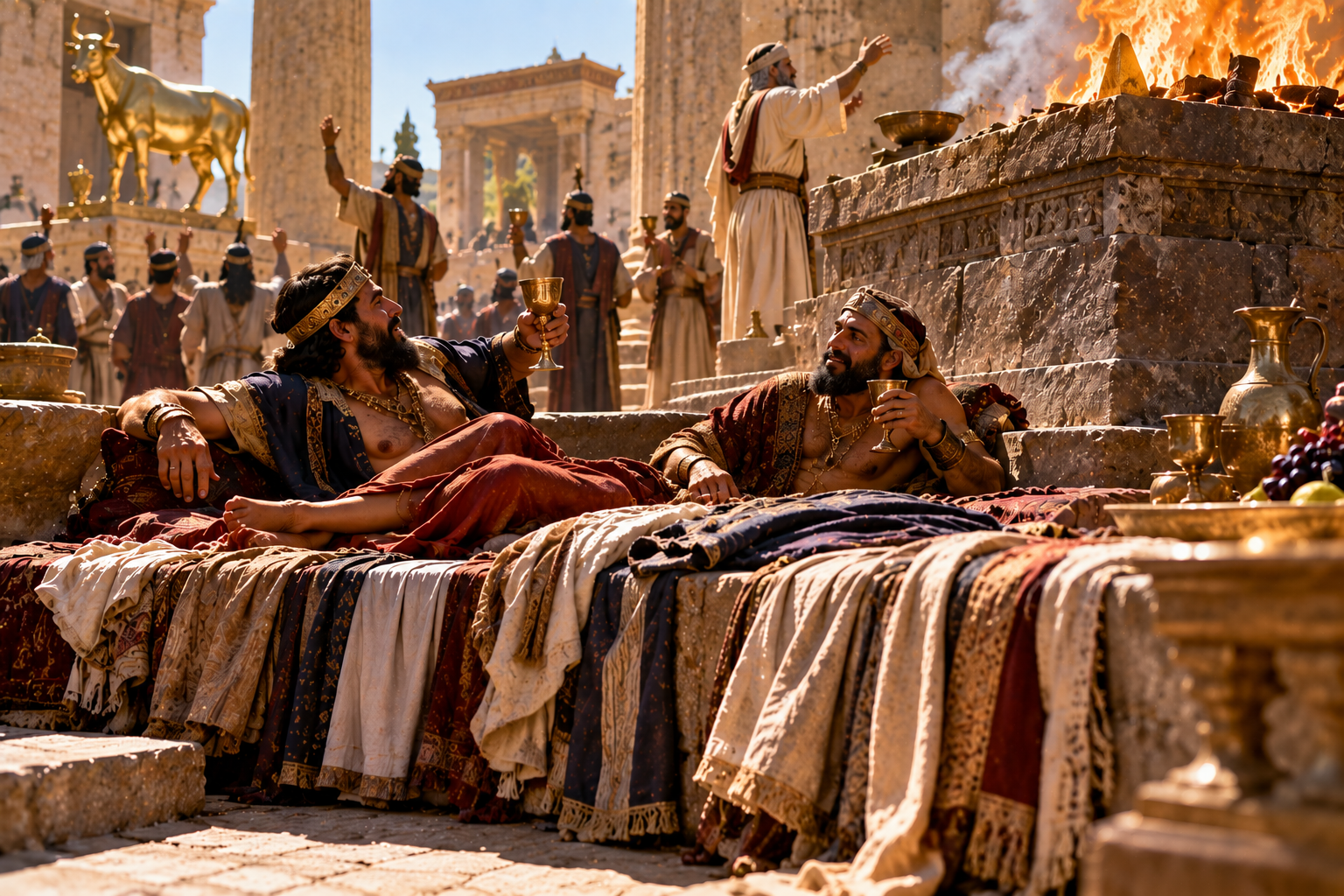
WORSHIP ON THE WAGES
OF OPPRESSION
On garments taken as pledges they stretch out beside every altar - NET = "They stretch out on clothing seized as collateral; they do so right beside every altar!" NLT = "At their religious festivals, they lounge in clothing their debtors put up as security" Amos now exposes one of the ugliest contradictions in Israel's spiritual life. The same people who were exploiting the poor were also participating in religious worship. They were using the proceeds of disobedience in the practice of worship. A poor Israelite might pledge his outer garment as security for a debt. But because that garment often served as his covering during the cold night, God specifically commanded “If you ever take your neighbor's cloak as a pledge, you are to return it to him before the sun sets, for that is his only covering.” (Ex 22:26–27; cf. Dt 24:12–13) Instead of returning these garments as the Law required, the wealthy and powerful in Israel were keeping them and using them for their own comfort.
They stretch out - This presents the picture of people reclining comfortably which gives us a sharp irony. The poor had lost the garment needed for comfort and rich made themselves comfortable on that very garment. Imagine the wealthy worshiper reclining comfortably beside the altar upon a garment belonging to a poor man who may be shivering because he has no covering.
Donald Sunukjian - God's Law placed restrictions on items which could be taken as collateral. Millstones were not to be taken since they were needed for grinding grain and thus were essential to sustaining life (Deut. 24:6). The cloak of a poor man was not to be kept as a pledge overnight (Ex. 22:26-27; Deut. 24:10-13; also note Job 22:6); a widow's garment could not be taken in pledge at all (Deut. 24:17). Yet the people openly and flagrantly were lying down with the forbidden garments, going so far in their contempt for the Law as to spread them at the sacrificial feasts by every altar (cf. 1 Sam. 9:12-13). (SEE The Bible Knowledge Commentary Minor Prophets - Page 43)
Beside every altar - So not only did they commit injustice toward the poor, they did it beside every altar showing their religious hypocrisy! The imagery is almost grotesque for they were sinning against the poor and then literally resting on the evidence of that sin while hypocritically going through religious motions. The word every first speaks of the proliferation of Israel's religious altars in contrast to only one altar in the Temple. The northern kingdom had established unauthorized worship centers, especially at Bethel and Dan (1Ki 12:26–33). Amos later specifically attacks the worship at Bethel (Amos 3:14; 4:4; 5:5).
And in the house of their God they drink the wine of those who have been fined (anas - to penalize with a fine - Dt 22:19, Ex 21:22) - NLT = "they drink wine bought with unjust fines." House of their God normally would speak of the Temple in Jerusalem but not in this context. Amos is not addressing Judah (location of the Temple) but Israel which had no access to the Temple (1Ki 12:26-33). Therefore, House of their God likely refers to the local shrine at Bethel where they carried out corrupted (syncretistic cf 1Ki 12:28) worship of Yahweh. As the NET says "They drink wine bought with the fines they have levied." Those who have been fined refers to unjust legal fines and would tie back to the corrupt courts theme from Amos 2:7 in NIV "deny justice to the oppressed." The wine in the worshipers' cups was purchased with money extracted through the same unjust legal system that denied the poor their rights.
NET NOTE - GOD - Or “gods.” The Hebrew term אֱלֹהֵיהֶם (ʾelohehem) may be translated “their gods” (referring to pagan gods), “their god” (referring to a pagan god, cf. NAB, NIV, NLT), or “their God” (referring to the God of Israel, cf. NASB, NRSV).
In sum, Israel reclined beside God's altar on the poor man's garment and drank wine purchased with funds from unjust fines, turning the very place of worship into an exhibit of the injustice God condemned. Israel's religious observance was worthless, even offensive to God, because it was built on a foundation of injustice toward the poor and vulnerable. True worship, in the prophetic vision, cannot be separated from how a society treats its weakest members.
Amos 2:9 “Yet it was I who destroyed the Amorite before them, Though his height was like the height of cedars And he was strong as the oaks; I even destroyed his fruit above and his root below.
- I the (KJV): Ge 15:16 Ex 3:8 34:11 Nu 21:24 De 2:24-33 Jos 3:10 24:8-12 Jdg 11:21-23 Ne 9:22-24 Ps 135:10-12 136:17-22
- whose (KJV): Nu 13:28,29,32,33 De 1:28 Dt 2:10,11 Dt 3:11 Dt 9:1-3
- I destroyed (KJV): Jos 11:21,22 2Sa 23:16-22 Job 18:16 Isa 5:24 Mal 4:1
Related Passages
Joshua 24:8, 11-13 ‘Then I brought you into the land of the Amorites who lived beyond the Jordan, and they fought with you; and I gave them into your hand, and you took possession of their land when I destroyed them before you.....11‘You crossed the Jordan and came to Jericho; and the citizens of Jericho fought against you, and the Amorite and the Perizzite and the Canaanite and the Hittite and the Girgashite, the Hivite and the Jebusite. Thus I gave them into your hand. 12 ‘Then I sent the hornet before you and it drove out the two kings of the Amorites from before you, but not by your sword or your bow. 13 ‘I gave you a land on which you had not labored, and cities which you had not built, and you have lived in them; you are eating of vineyards and olive groves which you did not plant.’
Deuteronomy 1:26-28 “Yet you were not willing to go up, but rebelled against the command of the LORD your God; 27and you grumbled in your tents and said, ‘Because the LORD hates us, He has brought us out of the land of Egypt to deliver us into the hand of the Amorites to destroy us. 28 ‘Where can we go up? Our brethren have made our hearts melt, saying, “The people are bigger and taller than we; the cities are large and fortified to heaven. And besides, we saw the sons of the Anakim there.”’
Deuteronomy 9:1-3 “Hear, O Israel! You are crossing over the Jordan today to go in to dispossess nations greater and mightier than you, great cities fortified to heaven, 2 a people great and tall, the sons of the Anakim, whom you know and of whom you have heard it said, ‘Who can stand before the sons of Anak?’ 3 “Know therefore today that it is the LORD your God who is crossing over before you as a consuming fire. He will destroy them and He will subdue them before you, so that you may drive them out and destroy them quickly, just as the LORD has spoken to you.
Numbers 13:27–33 records Israel's fear before the formidable inhabitants of Canaan.
Deuteronomy 7:1–8 emphasizes that Israel's possession of the land resulted from God's covenant love rather than Israel's greatness.
Deuteronomy 8:11–18 warns Israel not to forget the LORD when prosperity comes or imagine that its own power produced its wealth.
Deuteronomy 9:1–6 describes the Canaanites as greater and mightier than Israel and emphasizes that God drove them out.
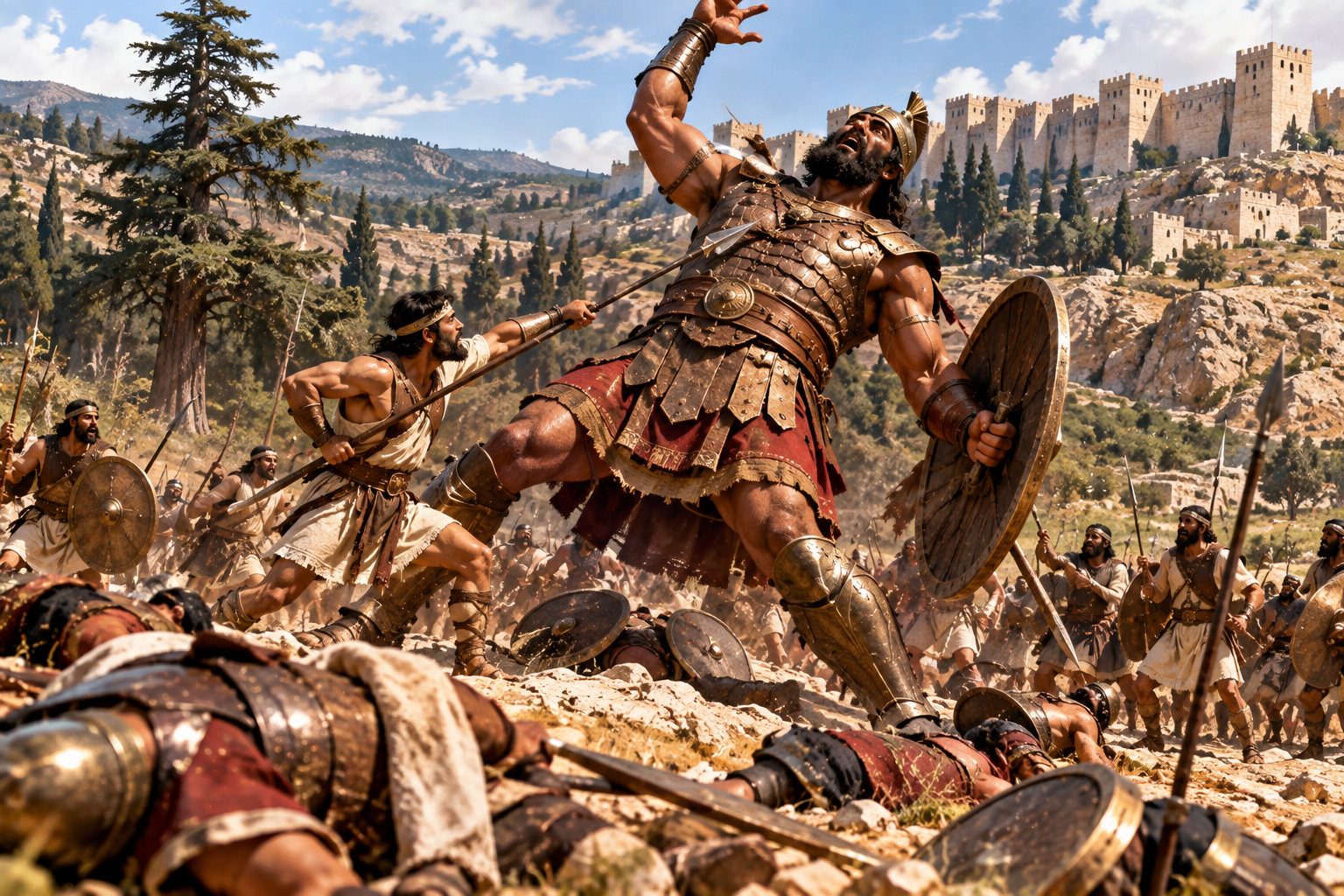
God enabled Israel's destruction of Amorites as tall as cedars, as strong as oaks
REMEMBER WHO GAVE
YOU THE VICTORY
Yet - Term of contrast marks a change of direction. In Amos 2:6–8 God has described how Israel had exploited others. Beginning in verse 9, He reminds Israel of what He had done for Israel.
it was I who destroyed the Amorite before them - The Hebrew it was I places emphasis upon God Himself. The LORD reminds Israel that their national history cannot be explained apart from His sovereign intervention. Israel had houses because God had given them a land. They had vineyards because God had defeated their enemies. They possessed wealth because God had first given them opportunity to prosper.
Amorite can sometimes refer specifically to one Canaanite people group, but it can also function more broadly for the pre-Israelite inhabitants of Canaan (cf. Ge 15:16; Dt 1:7, 20, 27, 44) and likely is the latter sense in this verse. Here the emphasis is upon the formidable peoples whom Israel encountered when entering the Promised Land. Israel had not acquired Canaan merely because Israel was militarily superior.
The Wycliffe Bible Commentary. - Amorite. A general name given to the people east of the Jordan and the Canaanites west of the river.
The term “Amorite” was used in several related ways in the Old Testament and the ancient Near East. It could refer specifically to one of the indigenous peoples of Canaan (Ge 10:16; Ex 3:8, 17), more broadly to peoples living west of Mesopotamia, or geographically to the inhabitants of Canaan's hill country, in contrast to the Canaanites who tended to occupy the coastal plains and lowlands (Nu 13:29; Dt 1:7, 19–20). The term also describes the five Amorite kings who united against Joshua and were decisively defeated during Israel's conquest (Josh 10:5–10). Most importantly for passages such as Amos 2:9–10, “Amorite” could function as a collective designation for the pre-Israelite inhabitants of Canaan, much as “Canaanite” sometimes does (Ge 15:16; Josh 7:7). Thus, when God reminds Israel, “I destroyed the Amorite before them” (Amos 2:9), the term likely has this broader sense, recalling God's defeat of the formidable inhabitants of Canaan so that Israel could “take possession of the land of the Amorite” (Amos 2:10).
Donald Sunukjian - Instead of announcing the punishment immediately after the accusation, as was done in the judgments against the seven other nations, God heightened Israel's guilt by setting her rebellion against the backdrop of His own gracious acts toward them. Israel's existence as a nation was only because of His intervention. By themselves they could never have conquered the Canaanites. (SEE The Bible Knowledge Commentary Minor Prophets - Page 43)
People who remember how much mercy they have received
are more likely to show mercy to those who need it.
Though his height was like the height of cedars And he was strong as the oaks (cf. Nu 13:28–33; Dt. 1:26–28) -- The cedars, especially the famous cedars of Lebanon, were proverbial for impressive height, strength, and majesty. The image recalls the fear expressed by the spies when Israel first approached Canaan. They reported seeing unusually formidable inhabitants, including descendants of Anak “We became like grasshoppers in our own sight.” (Nu 13:33) Moses later reminded Israel that the peoples they would dispossess included nations “greater and mightier than you” and people “great and tall, the sons of the Anakim” (Dt 9:1–2). Amos therefore does not minimize Israel's former enemies, for they were indeed formidable. Strong as oaks moves the imagery from height to strength. In short, the Amorites were both imposing and powerful, so that from a purely human perspective, Israel had good reason to be intimidated. But the LORD was not intimidated. This is the same God Who had promised “No man will be able to stand before you.” (Dt 11:25)
The Amorite was strong, but he was never
stronger than the God Who fought for Israel.
I even destroyed his fruit above and his root below - Amos quotes God Who says He destroyed its “fruit above” the fruit being what the tree produces. Exactly what the fruit means is unclear, but what is not unclear is that God did not just prune a few branches of the tree. He destroyed the fruit and the root, the root being the hidden source from which a tree draws life and from which new growth might emerge. One might say Yahweh "cleaned house" from top (fruit) to bottom (root)! Fruit above and his root below is a merism, using opposite extremes (top and bottom) to express complete destruction, not partial defeat.
In the context of this section God is saying He fought for Israel when she was weak, but now Israel was using their strength to crush the weak, especially the poor.
Amos 2:10 “It was I who brought you up from the land of Egypt, And I led you in the wilderness forty years That you might take possession of the land of the Amorite.
- I brought (KJV): Ex 12:51 Ne 9:8-12 Ps 105:42,43 136:10,11 Jer 32:20,21 Eze 20:10 Mic 6:4
- and led (KJV): Nu 14:34 De 2:7 8:2-4 Ne 9:21 Ps 95:10 Ac 7:42 13:18
- to possess (KJV): Nu 14:31-35 De 1:20,21,39
Related Passages
Exodus 3:7, 8 records God's seeing Israel's affliction, hearing her cry, and coming down to deliver her.
Exodus 12:51 And on that same day the LORD brought the sons of Israel out of the land of Egypt by their hosts.
Deuteronomy 2:7 “For the LORD your God has blessed you in all that you have done; He has known your wanderings through this great wilderness. These forty years the LORD your God has been with you; you have not lacked a thing.”’
Deuteronomy 8:2–18 commands Israel to remember God's wilderness leading and warns against saying, “My power and the strength of my hand made me this wealth.”
Deuteronomy 15:12–15 explicitly connects compassion toward servants with remembering Israel's own slavery and redemption.
Deuteronomy 24:17–22 similarly grounds care for the vulnerable in the memory of Egypt.
Deuteronomy 1:20; 21; 39 “I said to you, ‘You have come to the hill country of the Amorites which the LORD our God is about to give us. 21 ‘See, the LORD your God has placed the land before you; go up, take possession, as the LORD, the God of your fathers, has spoken to you. Do not fear or be dismayed.’....39 ‘Moreover, your little ones who you said would become a prey, and your sons, who this day have no knowledge of good or evil, shall enter there, and I will give it to them and they shall possess it.
Joshua 24:12,13 reminds Israel that God gave them a land for which they had not labored and cities they had not built.
Nehemiah 9:19–21 celebrates God's faithful provision throughout the forty wilderness years.
GOD WHO BROUGHT THEM OUT
AND BROUGHT THEM IN
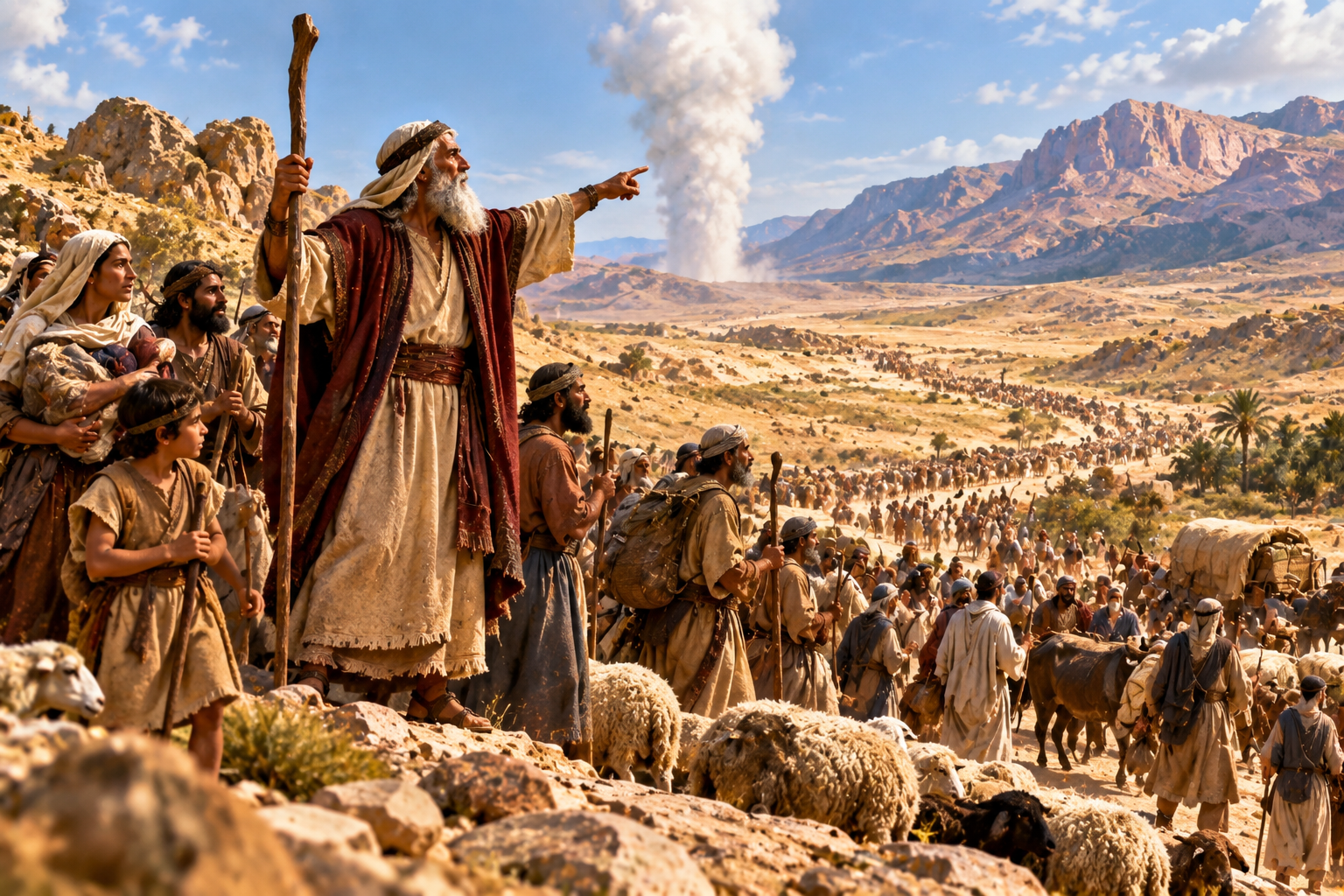
It was I Who (God's sovereignty) brought you up from the land of Egypt - Amos continues God's reminder of Israel's forgotten grace. Israel's present prosperity rested upon a foundation of past grace. Before Israel had land, houses, and vineyards, she had been an enslaved people whom God rescued. In light of the accusations in Amos 2:6-8, this truth is especially sad and tragic, for the very ones who had been liberated from oppression had now become the oppressors.
Brought you up speaks of the Exodus, the foundational event for Israel's entire understanding of redemption. Brought up (alah) is frequently used for God bringing Israel up out of Egypt (Ex 3:8, 17; 20:2). The verb carries both a literal geographical sense (moving up out of Egypt toward Canaan) and a theological sense: God brought them up out of bondage and slavery into freedom, identity, and eventually into their inheritance in the Promised Land. The word itself pictures an ascent, a rising from a lower condition into a higher one, fitting language for a nation lifted from slavery into covenant relationship with God.
This is also the standard confessional language Israel used to describe her own identity before God (cf. Ex 20:2, "I am the LORD your God, who brought you out of the land of Egypt, out of the house of slavery," the opening line of the Ten Commandments). Israel's very self-understanding, her law, her worship, her identity as God's covenant people, was rooted in this act of deliverance. Amos is not introducing a new idea here but is reminding Israel of the truth she recited constantly but had stopped living out.
Their remembrance of divine redemption from oppression should have produced compassion for others. Instead, the people who had once cried out under Egyptian oppression (Ex 2:23-25) now inflicted the same kind of oppression on the poor and vulnerable within their own nation (Amos 2:6-8). The tragedy is not merely moral inconsistency but a direct betrayal of what God's redemption was meant to produce.
And I led you in the wilderness forty years - God wants them to recall that He led them through an inhospitable enviroment in which they were helpless to sustain themselves (Dt 8:2). One might say the wilderness became a "forty-year classroom" in which Israel was supposed to learn dependence upon God (e.g., He gave manna, water, guidance). Indeed, the wilderness was one of the places where God most clearly demonstrated that they could not survive without Him. Nehemiah later summarized those years “Forty years You provided for them in the wilderness and they were not in want; their clothes did not wear out, nor did their feet swell.” (Neh 9:21)
God wants Israel to recall that He led them through an inhospitable environment in which they were helpless to sustain themselves (Dt 8:2). One might say the wilderness became a "forty-year classroom" in which Israel was meant to learn dependence upon God: He gave manna when they had no food (Ex 16:4, 35), water when they had none (Ex 17:1-6; Nu 20:2-11), and guidance by cloud and fire when they had no map (Ex 13:21-22). The wilderness was one of the places where God most clearly demonstrated that Israel could not survive apart from Him. There was no agriculture, no reliable water source, no shelter, nothing in the wilderness itself capable of sustaining a nation of that size. Survival for forty years under such conditions was not a testimony to Israel's resourcefulness but to God's faithfulness.
Nehemiah later summarized those years: "Forty years You provided for them in the wilderness and they were not in want; their clothes did not wear out, nor did their feet swell" (Neh 9:21). This is a striking detail, for not only were their basic needs met, but even their clothing and physical bodies were sustained in ways beyond ordinary provision, a continual, quiet miracle stretched across four decades. And now they were stealing their neighbor's cloak!
I led you pictures active, personal guidance, not passive provision from a distance. God did not simply supply Israel's needs and leave them to find their own way; He personally directed their path (cf. Ex 13:21, "the LORD was going before them... to lead them on their way"). This reinforces the larger argument of Amos 2:9-11. Israel's entire existence, from the exodus, through forty years of wilderness dependence, to the conquest of the land, was the direct result of God's sustained, personal intervention. Nothing in their history could be credited to their own strength or wisdom.
The forty years of wilderness dependence stand in the sharpest possible contrast to the self-sufficient arrogance and exploitation Amos condemns in 2:6-8. A people who once had nothing and depended entirely on God for daily bread had, by Amos's day, forgotten that dependence entirely, using their prosperity to crush the very kind of vulnerable, needy people they themselves had once been! It's amazing what the fallen flesh is capable of doing when it forgets the amazing grace of God!
🙏 THOUGHT - Forgetting grace is why people who were once shown patience can become impatient with others, why the formerly poor can look down on the currently poor, why the forgiven can become unforgiving. Memory of grace received helps keep the fallen flesh in check. When was the last time you thanked God for His amazing grace in your life? That's a good habit to develop. And watch out! The moment that memory fades, the very oppression once escaped has a way of resurfacing, just with different victims.
That (term of purpose) you might take possession (yarash) of the land of the Amorite (Ge 15:12-21) - The purpose for God's redemption from Egypt and His leading them through the wilderness was that He might lead the second generation of Israel into Canaan, into the Promised Land, into their inheritance. The land of the Amorite connects directly with Amos 2:9 where God said “I...destroyed the Amorite before them.” Israel could not simply have walked into Canaan and taken possession by her own strength. God had to go before them. All of this favor God had shown to Israel was unmerited, which is the essence of grace! In sum, sadly Israel was exploiting others on land they themselves possessed only because of God's grace.
Amos is using a covenant lawsuit technique common in the prophets (Micah 6:3-5, Hosea 11:1-4). God recites His gracious acts on Israel's behalf specifically to heighten the guilt of their present unfaithfulness. The logic is essentially "I destroyed mighty giants for you, rescued you from slavery, sustained you for forty years in the wilderness, and gave you this land as a gift, and this is how you repay Me, by oppressing the poor, corrupting justice, and defiling My name?"
Israel's history was a story of grace from beginning to end. God defeated what they could not defeat, delivered them from what they could not escape, sustained them where they could not survive, and gave them what they could never have obtained on their own. Their great sin was enjoying all the gifts while forgetting the Giver.
🙏 THOUGHT - For us as believers who have been delivered from the kingdom of darkness and transferred to the kingdom of light, we need to remember our redemption and the work of our Redeemer and walk in the light not in the darkness of this present evil age. We should never become so comfortable in Canaan that we forget Who brought us out of Egypt. Are you growing comfortable in "Canaan?" Have you forgotten you are a sojourner and are just passing through to your eternal home? Are you living with that future hope fueling your present conduct?
Amos 2:6-16 TODAY IN THE WORD
I brought you up out of Egypt, and I led you forty years in the desert to give you the land of the Amorites. - Amos 2:10–11
As philosopher and author Ralph Waldo Emerson aged, his memory declined to the point where he often could not remember the names of friends. At the funeral of Henry Wadsworth Longfellow, he said, “That gentleman has a sweet, beautiful soul, but I have entirely forgotten his name.”
Today’s passage reveals that God’s people also suffered from memory loss but of a far more serious kind. They had forgotten God’s redemptive work on their behalf and His Law.
After indicting many of Israel’s enemies, including the nation of Judah, Amos turned his attention to Israel itself. Using the same formula of condemnation that he had employed for Israel’s enemies, he warned that the nation of Israel would not escape punishment for its behavior.
The specific transgressions that Amos mentioned fell into three main categories. The first was the sin of enriching themselves at the expense of the poor. Amos criticized Israel of selling “the righteous for silver and the needy for a pair of sandals” (Amos 2:6). This probably alludes to the practice of selling debtors into slavery when they couldn’t pay off their loans.
The second major area of transgression mentioned by Amos was the sin of sexual immorality (Amos 2:7). Such immoral behavior often occurred in the context of pagan worship, which is the third area of sin mentioned in this passage (Amos 2:8). Interestingly, it is mentioned in combination with oppression of the poor. The custom of taking a poor man’s garment as collateral for a loan was strictly forbidden in God’s Law (Ex. 22:26–27).
TODAY ALONG THE WAY
What steps have you taken to make sure that you remember what God has done in your life? Consider keeping a journal or recording significant blessings in a “book of remembrance.” It is often a good thing to go back and remind yourself how God has worked in the past when you begin to feel unhappy with the present. Most of all, keep a record of the meaningful lessons you have learned from God’s Word. The psalmist declared, “I have hidden your word in my heart that I might not sin against you” (Ps. 119:11).
Amos 2:11 “Then I raised up some of your sons to be prophets And some of your young men to be Nazirites. Is this not so, O sons of Israel?” declares the LORD.
- I raised (KJV): 1Sa 3:20 19:20 1Ki 17:1 18:4 19:16 20:13,35,41 22:8 2Ki 2:2-5 2Ki 6:1 17:13 2Ch 36:15 2Pe 1:20,21
- and (KJV): Am 7:12,13 Isa 30:10,11 Jer 11:21 26:11 Mic 2:6 Mt 21:34-38 Ac 4:18 5:28 7:51 1Th 2:15,16
- Nazarites (KJV): Nu 6:2 Jdg 13:4-7 La 4:7 Lu 1:3-17
- Is it (KJV): Isa 5:3,4 Jer 2:5,31 Mic 6:3,4
Related Passages
Numbers 6:1–8 describes the Nazirite vow and summarizes its purpose: “he is holy to the LORD.”
Deuteronomy 18:15–22 describes God's provision of prophetic revelation.
Judges 13:5–7 describes Samson's special Nazirite consecration from birth.
2 Chronicles 36:15–16 says God repeatedly sent His messengers because He had compassion on His people, but they mocked and rejected them until judgment became unavoidable.
Jeremiah 7:25–26 similarly says God repeatedly sent His prophets, but the people refused to listen.
Amos 2:12 gives Israel's shocking response to both gifts mentioned here.
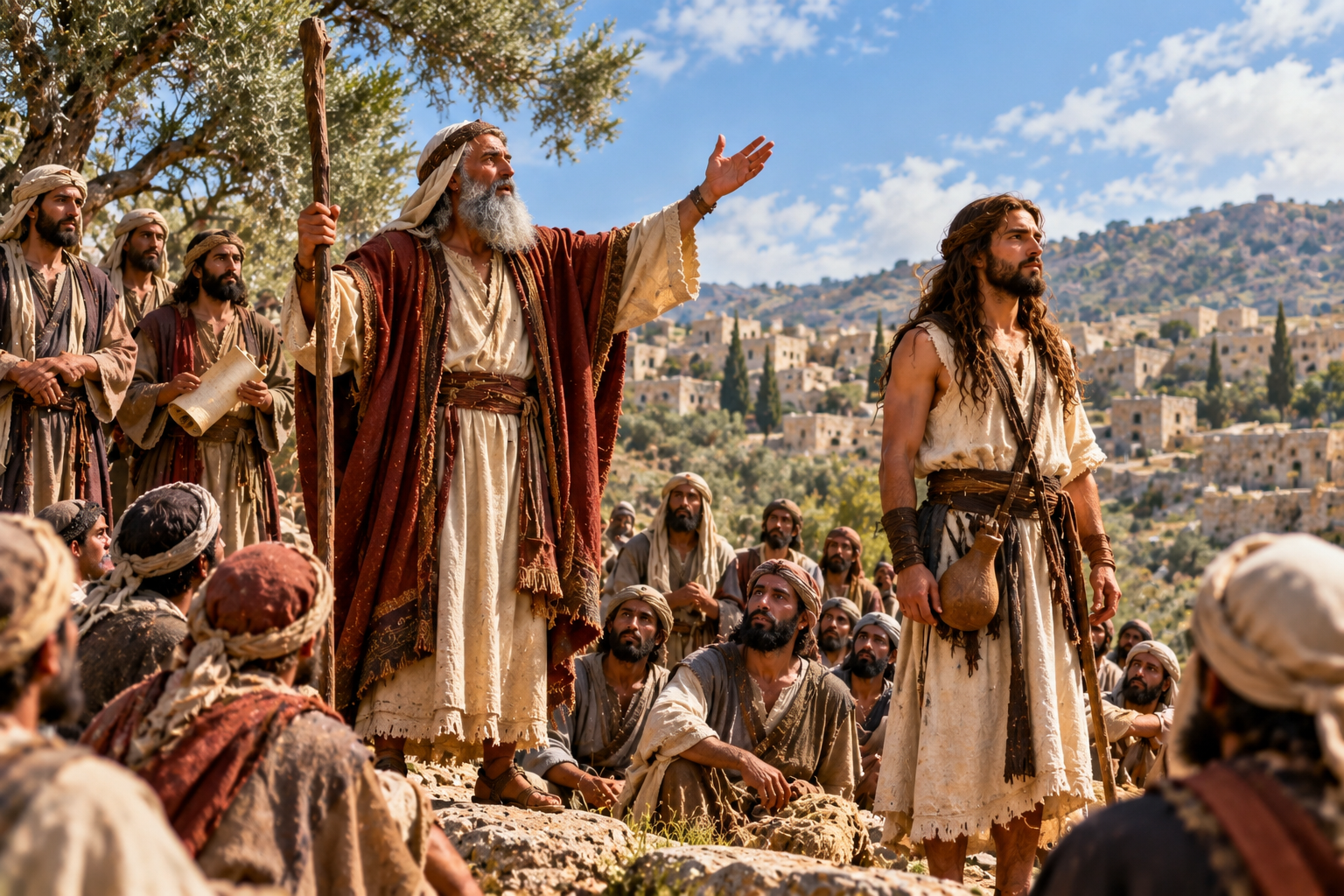
WHEN GOD RAISED
UP PROPHETS
Then - Marks progression in the narrative.
I raised up some of your sons to be prophets (nabiy) (cf Dt 18:15-22) - God continues reminding Israel what He had done for them. Your sons indicates the prophets were not foreigners criticizing Israel but were sons of the nation whom God commissioned to speak to their own people. A prophet (nabiy) was fundamentally one called by God to communicate God's message (cf as "God's mouthpiece"), calling the nation to covenant faithfulness, warning of judgment, and revealing God's will. The prophet's authority therefore did not originate in himself. The repeated prophetic formula makes this clear “Thus says the LORD” and is exactly how the prophet Amos has introduced every judgment oracle in these chapters.
We sometimes think of prophets primarily as announcers of judgment. But the presence of a prophet was actually evidence of God's mercy. Why? Because before judgment fell, God spoke. Before punishment came, God warned. Before destruction arrived, God called His people to repentance. A prophet was therefore not evidence that God had abandoned Israel. The prophet was evidence that God had not yet abandoned Israel. Every prophetic warning was an opportunity to repent before judgment became reality. Israel had God's written law, but she repeatedly wandered from it. Therefore God graciously raised up prophets who called the nation back to covenant faithfulness.
God's warnings are evidence of His mercy,
for He speaks before He strikes and warns before He judges.
And some of your young men to be Nazirites - While the prophets were characterized by proclamation, the Nazirites, two of whom are named in the OT (Samuel, 1Sa 1:11,28; Samson, Jdg 13–15), were characterized by consecration. Hebrew nazir comes from a root associated with being separated or consecrated. Numbers 6 describes the Nazirite vow. During the period of consecration, the Nazirite abstained from wine and products of the vine beverages (Jdg 13:4,5), cutting the hair, and contact with the dead. These outward practices were visible signs that the individual had been specially separated unto the LORD. The key statement is Numbers 6:8 “All the days of his separation he is holy to the LORD.”
The discussion of the Nazirites in this section begs the question of why mention them here? In the preceding context (and later in Amos' declarations) it was clear that Israel had become a society characterized by self-indulgence, the anti-thesis of Nazirites. So while the life and conduct of the Nazirite said "consecrate yourself," Israel, in their prosperity, said in effect "indulge yourself." In short, the Nazirite visibly demonstrated self-denial for the sake of devotion to God and thus the very life of a Nazirite became like a visible sermon and the corruption and debauchery of Israel.
While the prophet preached holiness with his words (the "message"),
the Nazirite pictured holiness with his life (the "model").
Your young men - Youth is ordinarily associated with strength, appetite, ambition, opportunity, and the desire to enjoy life.Yet God had raised up young Israelites willing voluntarily to restrict legitimate pleasures in order to express special devotion to Him. They stood as visible reminders that God is worthy of wholehearted devotion even in the strength of youth. They demonstrated that consecration was not merely something for the elderly or for those who had exhausted life's pleasures. God deserves the first and strongest years, not merely whatever remains at the end.
Is this not so, O sons of Israel?” declares the LORD (Jehovah)- This is a fascinating question for in effect God puts Israel on the witness stand and His question expects an affirmative answer. Israel could not deny the evidence. God is calling Israel to acknowledge that this history is true and undeniable. It's a covenant lawsuit technique in which God is not merely making claims, but is appealing to Israel's own memory and forcing them to admit the truth of His faithfulness toward them.
The upshot is that their own national history testified against their ingratitude, oppression, etc. Declares the LORD God carries the force of a solemn divine declaration for God Himself is testifying concerning what He has done. Amos is saying that God did not leave Israel without either His voice or His witnesses. The prophet preached holiness with his words, while the Nazirite pictured holiness with his life.
In summary, before judgment fell, God spoke through His prophets, so that every prophetic warning was an opportunity to repent before judgment became reality. In addition, the very presence of a prophet was evidence that God had not yet abandoned His people. Sadly Israel responded by silencing the prophets and corrupting the Nazirites (Amos 2:12). They rejected both God's message and God's models.
Life Application Study Bible (p 1477) - The prophets were constantly challenging people to remember what God had done! When we read a list like this one (Amos 2:9-11), we are amazed at Israel's forgetfulness. But what would the prophets say about us? God's past faithfulness should have reminded the Israelites to obey him; likewise, what he has done for us should remind us to live for him.
Remembering God’s past faithfulness
should motivate our present faithfulness.
QUESTION - What is the Nazirite/Nazarite vow? | GotQuestions.org WATCH VIDEO
ANSWER - First, the individual enters into this vow voluntarily. The Bible says, "Speak to the Israelites and say to them: 'If a man or woman wants to make a special vow, a vow of separation to the LORD as a Nazirite’” (Numbers 6:2). This shows that it is individuals who take the initiative to consecrate themselves to the Lord. There is no divine command involved. While generally done by the individual by his own choice, two individuals in the Old Testament, and one in the New Testament, were presented to God by their parents. Samuel and Samson in the Old Testament (1 Samuel 1:8-28; Judges 13:1-5), and John the Baptist in the New Testament received the Nazirite vow from birth (Luke 1:13-17).
Second, both men and women could participate in this vow, as Numbers 6:2 indicates, “a man or woman.” The Nazirite vow was often taken by men and women alike purely for personal reasons, such as thanksgiving for recovery from illness or for the birth of a child. However, under the Mosaic law, the vow or oath of a single woman could be rescinded by her father, and that of a married woman by her husband (Numbers 30).
Third, the vow had a specific time frame, a beginning and an end as these two statements indicate: “Throughout the period of his separation he is consecrated to the LORD... Now this is the law for the Nazirite when the period of his separation is over” (Numbers 6:8, 13a). So, the Nazirite vow usually had both a beginning and an end.
Fourth, there were specific guidelines and restrictions involved with the Nazirite vow. Three guidelines are given to the Nazirite. Numbers 6:3-7 tells us that he/she was to abstain from wine or any fermented drink, nor was the Nazirite to drink grape juice or eat grapes or raisins, not even the seeds or skins. Next, the Nazirite was not to cut his hair for the length of the vow. Last, he was not to go near a dead body, because that would make him ceremonially unclean. Even if a member of his immediate family died, he was not to go near the corpse.
Numbers 6:13-20 shows the procedure to follow to complete the vow. A sacrifice was made (Nu 6:13-17), the candidate’s hair was cut and put on the altar, and the priest did the final task of completing the sacrificial process, which ended the vow (Nu 6:20). This section concludes with the statement, “This is the law of the Nazirite who vows his offering to the LORD in accordance with his separation, in addition to whatever else he can afford. He must fulfill the vow he has made, according to the law of the Nazirite”(Nu 6:21).
...there is a New Testament
parallel to the Nazirite vow...
Although the Nazirite vow is an Old Testament concept, there is a New Testament parallel to the Nazirite vow. In Romans 12:1-2 Paul states, “Therefore, I urge you, brothers, in view of God’s mercy, to offer your bodies as living sacrifices, holy and pleasing to God—this is your spiritual act of worship. Do not conform any longer to the pattern of this world, but be transformed by the renewing of your mind. Then you will be able to test and approve what God’s will is—his good, pleasing and perfect will.” For Christians, the ancient Nazirite vow symbolizes the need to be separate from this world, a holy people consecrated to God (2 Timothy 1:9; 1 Peter 1:15).
Amos 2:12 “But you made the Nazirites drink wine, And you commanded the prophets saying, ‘You shall not prophesy!’
Related Passages
Numbers 6:1–8 establishes the Nazirite vow and its abstinence from wine as part of consecration to the LORD.
2 Chronicles 36:15–16 explains that God repeatedly sent prophets because of His compassion, while the people continually rejected His messengers.
Isaiah 30:9–11 describes people telling prophets not to speak what is right but rather pleasant things.
Jeremiah 6:16,17 records Israel's refusal both to walk in God's way and to listen to His watchmen.
Amos 7:10–17 provides a direct fulfillment of the attitude described here when Amaziah commands Amos to stop prophesying at Bethel.
Acts 4:18–20 provides a New Testament parallel in which Peter and John are commanded not to speak, but answer that they cannot stop speaking what they have seen and heard.
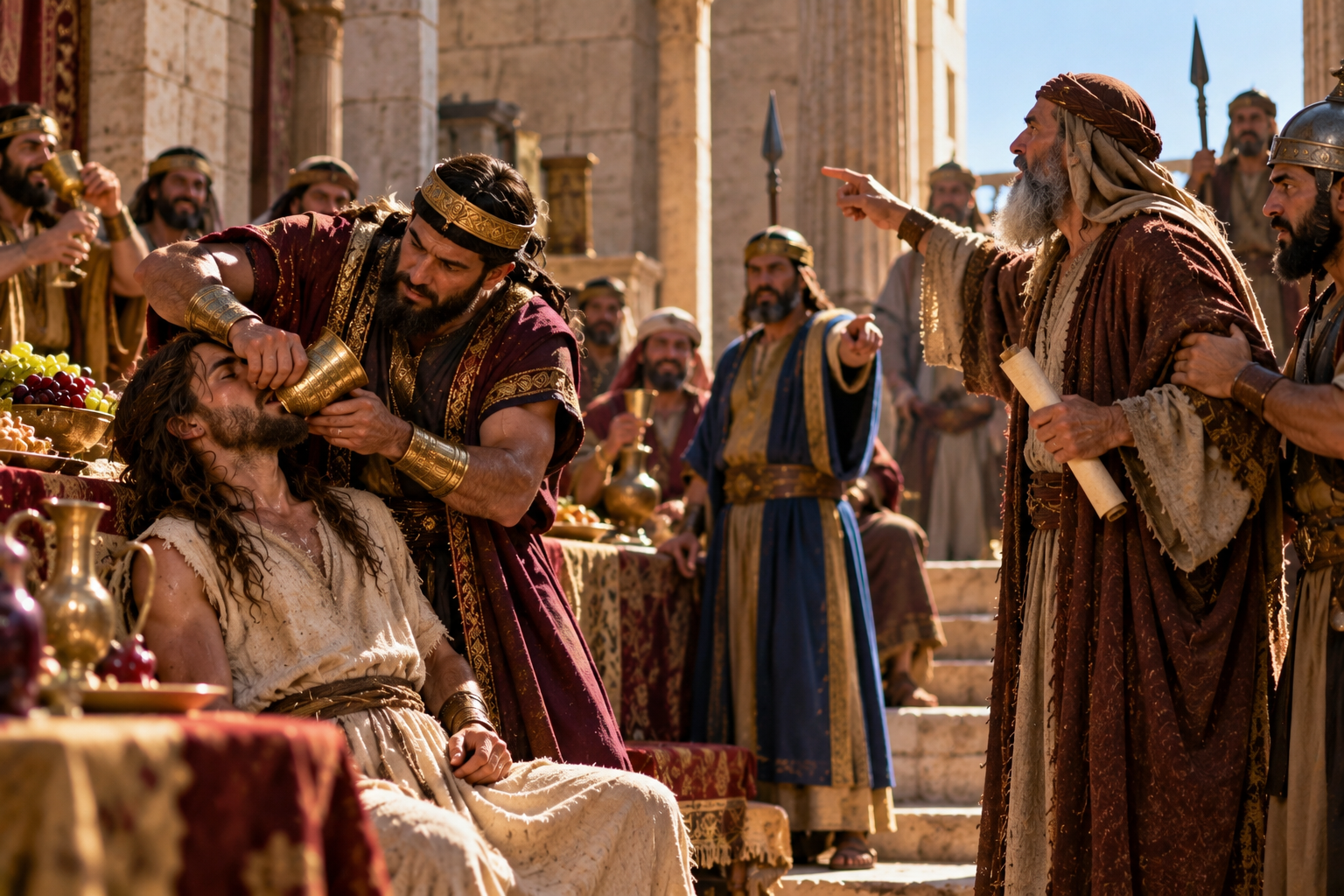
SILENCING THE VOICE AND
CORRUPTING THE WITNESS
But - Term of contrast showing Israel's "about face" in regard to the prophets and Nazirites. This verse exposes exactly how Israel repaid Him for all He had done for them as described in Amos 2:9-11.
You made the Nazirites drink wine - Israel in effect corrupted the example of consecration. They were not just tempting individuals into personal sin, but were deliberately destroying a visible symbol of devotion to God. Numbers 6:1–4 specifically required Nazirites during their vow to abstain from wine and other products of the grapevine. Their abstinence was a visible sign of their volitional separation unto the LORD. God had said concerning the Nazirite “All the days of his separation he is holy to the LORD.” (Nu 6:8) Therefore Israel was not merely offering the Nazirites a drink. They were pressuring them to violate their consecration. The very thing that visibly distinguished the Nazirite as specially devoted to God was the thing Israel sought to destroy.
Why did Israel do this? While we cannot be dogmatic, one thought is that a consecrated life can become a silent rebuke to an unconsecrated culture. Israel had become characterized by indulgence. Amos has already pictured them reclining beside altars and drinking wine obtained through unjust fines (Amos 2:8). Then standing among them was the Nazirite. He did not even have to preach. His life said “There is something more important than satisfying my appetites. I belong to the LORD.” That kind of life could make compromise uncomfortable. So rather than imitate his consecration, Israel pressured him to abandon it. Sometimes the easiest way to quiet the testimony of a holy life is to persuade that person to compromise.
Israel did not rise toward the Nazirite's standard but instead tried to pull the Nazirite down to theirs. Is this not one of sin's strategies? If holiness makes us uncomfortable, either change ourselves or try to change the holy person. Israel chose the latter.
And you commanded the prophets saying, ‘You shall not prophesy (cf. Amos 7:10–16)- Note the dramatic collision, for on one hand God raised up the prophets to speak up, but Israel tried to shut down the prophets by telling them to shut up! We see an example of Israel's action with the prophet Amos when Amaziah told him “Go, you seer, flee away to the land of Judah...But no longer prophesy at Bethel.” (Amos 7:12–13) Amos answered by recounting God's call “The LORD took me from following the flock and the LORD said to me, ‘Go prophesy to My people Israel.’” (Amos 7:15)
In short, not only did Israel ignore God's law, they attempted to stop God's Word from being spoken! It is a general rule that when people cannot comfortably live with the message, they often try to silence the messenger. However, such an action is foolish, for suppressing the messenger's warning does not remove the danger he is warning about. In other words, if a physician tells a patient that he has a serious disease, silencing the physician does not cure the disease. Likewise, they might be able to silence the prophet, but not the prophecy! Thus, commanding the prophet not to prophesy did nothing to remove the judgment Amos announced. Israel did not want holiness demonstrated before them or truth declared to them.
Vandermey - In a parallel action, Israel not only refused the message of the prophets but in sinful scorn also commanded them to be silent. Our Lord’s words provide the best commentary here (Matt. 23:13, 29–39). (SEE Hosea & Amos- Everyman's Bible Commentary - Page 108)
In summary, God gave Israel prophets whose words called them to truth and Nazirites whose lives called them to holiness. Instead of changing themselves, Israel tried to change the Nazirites and silence the prophets. When they would not conform to God's Word, they attempted to make God's witnesses conform to them.
Israel wanted neither a life that exposed them
nor a voice that confronted them.
🙏 THOUGHT - The question for us beloved is not merely “Do I read God's Word?” but “How do I respond when God's Word tells me something I do not want to hear?” That response reveals much about our spiritual condition.The faithful heart says “Speak, LORD, for Your servant is listening.” (1Sa 3:9) The rebellious heart says “You shall not prophesy!” Mark it down that the test of our submission to Scripture is not how enthusiastically we receive the verses we like, but how humbly we receive the verses that correct us (cf Jas 1:21-25).
G Campbell Morgan - It is noticeable that Amos included Judah and Israel among the nations. This method in itself must have been an arresting one to the people of tiat North-ern Kingdom. Both Judah and Israel had come to think of themselves as separated in some privileged way from surrounding nations. In some senses they were right, but they had failed to under-stand that their privileges created yet greater responsibilities. This is what Amos desired to enforce, and he did so first by stressing the fact that God was ruling over all the nations, and doing so upon the same principles. The greater the light, therefore, the graver the responsibility. The last of these oracles concerned Israel, and he was careful to show the nature of her sin. He charged the nation with in-justice, avarice, oppression, immorality, profanity, blasphemy, and sacrilege. In the words we have quoted, we have the statement of the uttermost and basest element in their sin. In the preceding sentences the prophet declared that Jehovah had raised up prophets for them, and had given them Nazirites, men who by the purity of their lives testified against their corruption. So determined had they become in their courses of evil that they had seduced the Nazirites from loyalty, and had silenced the voices of their prophets. Beyond this it is impossible to go in evil. When men deliberately set themselves to corrupt the pure, and to silence the prophets, they are indeed beyond the hope of recovery by mercy. Then the pressure of the Divine wrath is inevitable.
Amos 2:13 “Behold, I am weighted down beneath you As a wagon is weighted down when filled with sheaves.
KJV Behold, I am pressed under you, as a cart is pressed that is full of sheaves.
NET Look! I will press you down, like a cart loaded down with grain presses down.
NLT "So I will make you groan like a wagon loaded down with sheaves of grain.
ESV "Behold, I will press you down in your place, as a cart full of sheaves presses down.
BGT διὰ τοῦτο ἰδοὺ ἐγὼ κυλίω ὑποκάτω ὑμῶν ὃν τρόπον κυλίεται ἡ ἅμαξα ἡ γέμουσα καλάμης
LXE Therefore, behold, I roll under you, as a waggon full of straw is rolled.
CSB Look, I am about to crush you in your place as a wagon full of sheaves crushes grain.
NIV "Now then, I will crush you as a cart crushes when loaded with grain.
YLT Lo, I am pressing you under, As the full cart doth press for itself a sheaf.
NJB Very well! Like a cart overloaded with sheaves I shall crush you where you stand;
NRS So, I will press you down in your place, just as a cart presses down when it is full of sheaves.
RSV "Behold, I will press you down in your place, as a cart full of sheaves presses down.
NAB Beware, I will crush you into the ground as a wagon crushes when laden with sheaves.
GWN I am going to crush you as an overloaded wagon crushes a person.
- Behold (KJV): Ps 78:40 Isa 1:14 7:13 43:24 Eze 6:9 16:43 Mal 2:17
- I am pressed (KJV): etc. or, I will press your place, as a cart full of sheaves presseth
Related Passages
Numbers 14:18 holds together God's patience and His justice: He is “slow to anger” yet does not simply clear persistent guilt.
Isaiah 1:14 uses similar language of God being weary of hypocritical religious observances.
Isaiah 43:24 says Israel had “burdened” God with sins and wearied Him with iniquities, which is especially relevant to the NASB rendering of Amos 2:13.
Amos 2:14–16 explains the coming judgment introduced by the overloaded wagon image.
Romans 2:4–6 warns against mistaking God's patience for indifference and describes the storing up of judgment through persistent unrepentance.
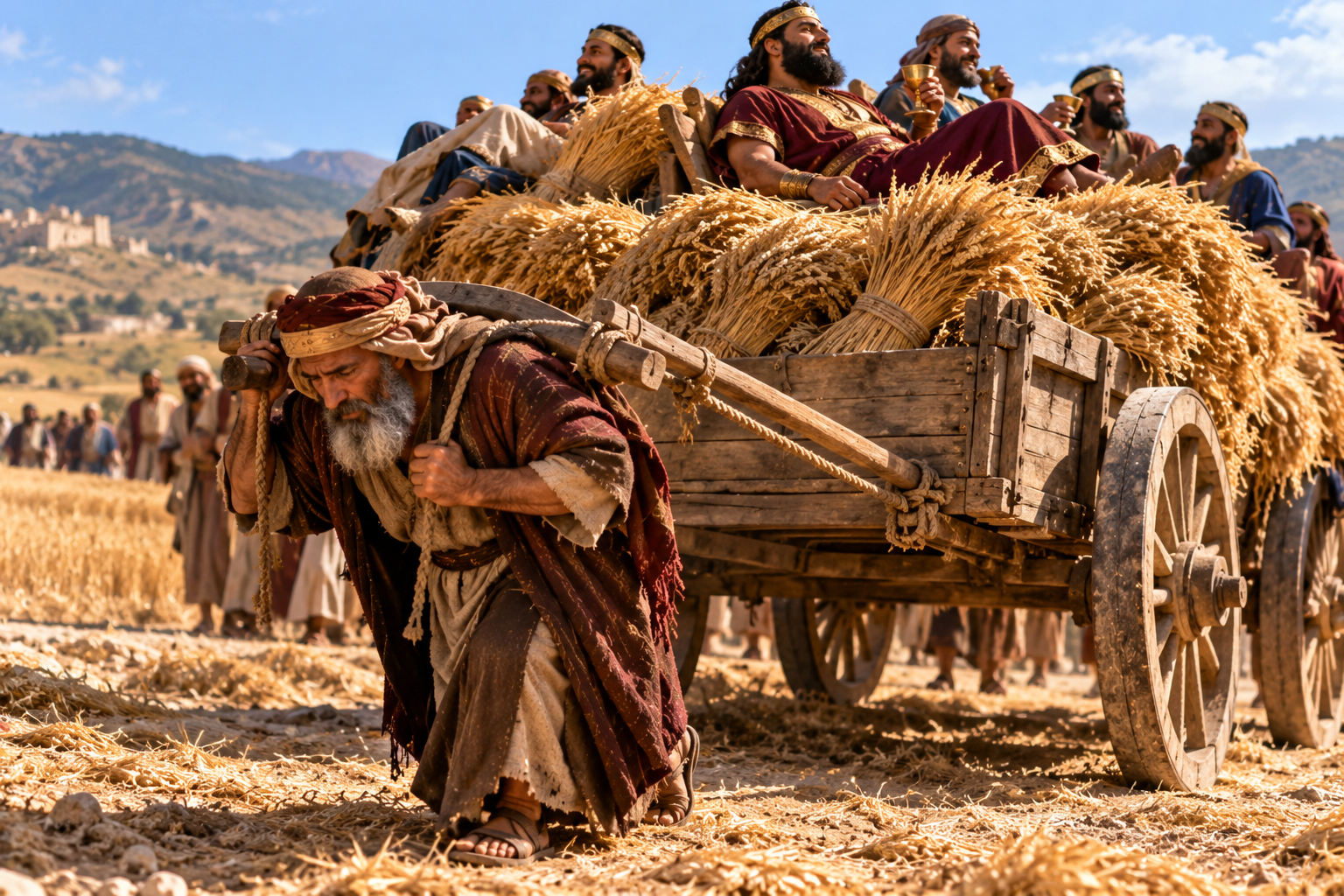
THE CRUSHING WEIGHT OF
ISRAEL'S ACCUMULATED SIN
Behold, - This is God's word to get Israel's attention. God is saying “Look!” “Pay attention!” “What I am about to say demands your attention.” The word frequently introduces something significant, surprising, or imminent. Up to this point God has been describing Israel's past and present sin. Beginning here, the emphasis shifts toward Israel's coming consequences. Here is a simple outline of God's word to Israel:
- Amos 2:6–8 – WHAT ISRAEL DID
- Amos 2:9–11 – WHAT GOD DID FOR ISRAEL
- Amos 2:12 – HOW ISRAEL RESISTED GOD
- Amos 2:13–16 – WHAT GOD WILL NOW DO
I am weighted down beneath you - NET - "I will press you down." The NAS rendering describes God's oppression by Israel's sin. The NET (NLT, ESV, NIV, CSB, etc) describes what God will do to Israel because of her sin (which fills up like an overloaded cart). This verse is one of the most difficult texts in Amos so please be a Berean with these notes.
TECHNICAL NOTE - NET NOTE - The precise meaning of this verse is unclear. Various suggested meanings have been proposed (see S. M. Paul, Amos [Hermeneia], 94). One option is to relate the verb to an Arabic verb meaning “to hinder; to hamper,” and translate, “I am making you immobile, like a cart filled with grain is immobile.” In this case, the Lord refers to Israel’s inability to escape his coming judgment (see vv. 14-16; NJPS). Another view relates the verb to a different Arabic verb, meaning “to cut in pieces.” The translation, “I will cut you in pieces as a cart cuts in pieces [the earth],” would refer to the ruts and rifts in the ground caused by an earthquake. Thirdly, some relate the verb to an Arabic root meaning “to groan,” with the idea that the Lord causes the ground underneath Israel to groan (cf. NLT). Fourth, the translation here connects the verb to an Aramaism signifying to “press down” (cf. NIV, NRSV). Lastly, some English versions translate the verb in an intransitive sense as “I am weighted down” (cf. NASB, NKJV), or “I groan beneath you” (NEB). For this last option, see F. I. Andersen and D. N. Freedman, Amos (AB), 334.
Bob Utley - There are two ways to understand this verse. (Hadjiev says 5 ways below!) - (1) It refers to YHWH being weighed down (as an overloaded wagon) by His people’s sin (from Arabic root, cf. Isa. 43:24; and the NASB, NKJV, NET, NIV, REB translations). (2) It refers to YHWH “pressing down” (i.e., judging) His people (from Arabic root, cf. Isa. 28:27–28; and the NRSV, TEV, NJB translations or “slowing,” JPSOA). The differences relate to which root the VERBS derive (BDB 734, KB 802, Hiphil PERFECT and Hiphil IMPERFECT). In this case certainty is impossible. The UBS, A Translator’s Handbook on the Book of Amos, suggests a translation that follows option #2, where the people of Israel groan under God’s judgment like an overloaded cart, pp. 55–56.
Tchavdar S. Hadjiev has this note on this difficult verse: A quick survey of modern translations and commentaries demonstrates this:
1. I will press you down in your place, just as a cart presses down (NRSV);
2. ‘I will slow your movements as a wagon is slowed’ (NJPS);
3. ‘I am groaning beneath you, as a wagon groans’ (NAB);
4. ‘I will split open (the ground) beneath you as the cart splits (it) open’ (Jeremias 1998: 33, 43);
5. ‘I will make it sway under you, just like a wagon sways’ (Eidevall 2017: 112, 119).Those who go for one of the last two options think that Amos is predicting an earthquake. However, a cart loaded with grain is not the most obvious object to evoke the image of an earthquake. Moreover, the description of an army in disarray in the following verses rather suggests that a military defeat is in view. Therefore, either option 1 (NRSV) or 2 (NJPS) is to be preferred. (SEE Joel and Amos: An Introduction and Commentary - Page 113)
Handbook on the Book of Amos - United Bible Society says "six different meanings have been proposed:*
(1) I will crush you (“press you down”) (RSV, TEV, NAB).*
(2) I will make it groan under you (so with slight variants Smith Goodspeed, TT [alternative reading]; compare NEB).*
(3) I will split (the earth) under you.*
(4) I will bring you to a halt (TT).*
(5) I will make it shake (Zürcher Bibel [ZÜR]).*
(6) I make your steps collapse (MFT).*Until more convincing evidence turns up it is not possible to say that any one of these is absolutely correct. Nevertheless, a choice has to be made, and it seems wise to choose one of the first three translations.* All three carry the thought of a catastrophe, and this is exactly what one expects to find on the basis of the punishment we expect here. Also, a cart loaded with grain indicates “harvest,” which is often a Hebrew picture of God’s judgment.
As a wagon is weighted down when filled with sheaves - The NAS would picture God as weighed down. In some translations, like the NET, the imagery becomes not primarily that Israel's sins are weighing upon God, but that God's judgment is about to press Israel down, just as a heavily loaded wagon presses upon the ground beneath its weight.
A wagon is weighted down - The following is my attempt to integrate the two translations, God is pressed down and God will press down. Amos the shepherd draws his imagery from ordinary agricultural life. Picture a wagon after harvest with sheaf after sheaf piled upon it. At first the wagon easily bears the load, but as more sheaves are added, it begins to groan, creak, and strain beneath the increasing weight. What might the accumulating sheaves suggest? In the NASB rendering, they might fittingly picture Israel's accumulating sins. This harmonizes nicely with Amos' repeated formula, “For three transgressions...and for four.” Israel's guilt was not the result of one isolated transgression or momentary failure, but of repeated, persistent rebellion. Sin had been piled upon sin until the wagon was "filled with sheaves" so to speak. And given Israel's prosperity in Amos' day, there is a striking irony: their barns may have been full of grain, but their nation was full of iniquity.
The alternative translation, “I will press you down,” shifts the emphasis from the burden Israel's sin placed upon God to the crushing weight of God's judgment upon Israel. But the two ideas fit together theologically: Why would the crushing judgment come? Because Israel had persistently piled rebellion upon rebellion despite God's repeated grace and warnings. Thus, without insisting that Amos intended both meanings simultaneously, the two interpretations suggest a memorable progression: Israel's accumulated sin brought God's overwhelming judgment. Or, stated more vividly, they had piled up the weight of sin and would soon experience the weight of judgment.
It is interesting that the Amplified version seems to incorporate both possible interpretations - "Behold, I am pressed under you and I will press you down in your place as a cart presses that is full of sheaves."
Either way, the wagon loaded with sheaves sets the tone for verses 14–16. Something overwhelmingly heavy is coming, and when it comes, the swift cannot escape it, the strong cannot resist it, and the mighty cannot save himself. Be a Berean and take my interpretation with a grain (pun intended) of salt!
Israel had piled sin upon sin until the weight of her rebellion
brought down the weight of God's judgment.
Bob Marcaurelle (full sermon below) - Verse 13 is very hard to translate. It could refer to Israel's punishment. God says, "I will crush you as a cart crushes when loaded with grain" (NIV). Israel will be crushed with God's judgments until she sinks (M.H.). But it can also refer to God's pain. God says, "I am weighted down beneath you like a wagon is weighted down when filled with sheaves (NASV). (See this idea in Isa. 43:24; Mal. 2:17.) In this we see two things. We see the limits of God. Our sins weary God and there comes a time when He has had enough. It was so at the time of the flood (Gen. 6). It was so in Israel. And it can be so in your life and mine. There is a point of no return where judgment becomes inevitable. As the old hymn put it there is "a hidden boundary between God's patience and His wrath." The message is plain. Turn around TODAY before it is too late.
Trent Butler - God could not forget their sin. Time had run out. God described in great detail his judgment on Israel. They would be crushed like the muddy roadway under a cart loaded with grain. Or the ruts and holes in the ground create the impression of an earthquake, referring back to Amos 1:1. Whatever the exact image the prophet intended, the feeling it leaves is clear—ominous threat, impending doom. (SEE Holman Old Testament Commentary - Hosea, Joel, Amos- Page 175)
Vandermey - “As a wagon is weighted down” (v. 13). God describes by a vivid picture His feelings of abused longsuffering. The portrait is one of His having borne a great deal of evil from the people of Israel. They had filled up the full measure of His patience. Their sins had reached His straining and breaking point, and He could bear no more—judgment was about to fall. (Cf. Mt. 23:35,36; 1Co 11:30 Eph 4:30) (SEE Hosea & Amos- Everyman's Bible Commentary - Page 108)
The Wycliffe Bible Commentary (p 1904) - I am pressed. Better: I will press you in your place, as a cart presseth that is full of sheaves (asv). As a cart presseth. Israel would experience the grinding pressure that a fully loaded wagon exerts on the ground over which it travels.
🙏 THOUGHT - Beloved, how is your wagon (I am looking in the mirror as I ask this question)? Are you piling up sins by failing to confess and repent? (1Jn 1:9, Pr 28:13) Then beware, for you may be reaching a tipping point. God's patience should never be mistaken for God's indifference.
F B Meyer Our Daily Homily
Amos 2:13 Behold, I am pressed under you, as a cart is pressed that is full of sheaves.
Behold! This is like the hand which occurs in the margins of old books, to attract the reader’s attention. It is God’s special call to our heed.
Sin is very burdensome to God: especially the sins enumerated in this context. Look at the story of oppression in Amos 2:6; of licentiousness in Amos 2:7; of ingratitude in Amos 2:9; of drunkenness in Amos 2:12. These sins are aggravated when committed by his own people. Just as the groaning wain creaks and cries out under its load, so does the heart of God under our sins. “O Jerusalem, Jerusalem!” Should not we feel more as God does in this respect? Ought not we to bear the burden of sin, as Daniel did for his land and people?
What a fulfillment these words had in the life and death of our blessed Lord! The sheaves of our sins were laid on Him: for the Lord laid on Him the iniquity of us all. As He bore his cross through the streets of Jerusalem; as He lay crushed to the ground in Gethsemane; as He cried, “My God, my God, why hast Thou forsaken Me?” — surely He was like a laden wagon, groaning under an almost insupportable load.
The r.v. gives another sense, which is not so true to the Hebrew, but it should be considered: “I will press you, as a cart presseth” and cuts deep ruts in the road. A discovery is announced of a process of turning silver into gold by a pressure of eighty tons on a square inch, and in very low temperature. Yes, pressure and the chilling effects of persecution, difficulty, and disappointment are God’s methods of redeeming us from destruction, and turning our silver into gold. Oh, let us forsake our sins rather than compel Him to employ such an ordeal!
John Bennett - AS A CART IS PRESSED THAT IS FULL OF SHEAVES
Jeroboam II sat upon the throne of Israel. The longest reigning monarch of the northern kingdom, one of the dynasty promised to Jehu, his reign brought security and material prosperity to the nation. Yet the contemporary prophets, Hosea and Amos, exposed the moral laxity into which the people had descended.
Amos, the farmworker from Tekoa, had no ambition or expectation in respect of the prophetic office. He was just going about his daily business when the Lord laid hold on him and gave him a chilling message of impending judgement, in view of the nation’s departure and idolatry.
Amos was not parochial in his thinking. He acknowledged that God is sovereign over all people and nations and all in turn are responsible before Him; his message to them was of the long-suffering of God, ‘For three transgressions … and for four’, the mercy of God had withheld judgement. Now, however, righteous retribution was about to fall.
The sin of Israel and Judah was compounded. They were a people privileged above all nations, yet they had ‘despised the law of the Lord’, 2:4. Israel, the northern kingdom, in particular, had flouted the laws of common decency in their materialistic passion, vv. 6–8, even seeking to silence the voice of the prophets and corrupt the integrity of those who did make an effort to live for God, v. 12.
The image before us today of the cart filled with sheaves admits to two possible interpretations. Some suggest that the voice of the Lord is heard through the prophet, feeling the weight and burden of sins built up over the years, like corn sheaves in the harvest field stacked upon the straining cart.
Others, with equal justification, hear the voice of Jehovah pronouncing His intended action, ‘I will press them down’ RV, JND. Whichever way we choose to look at this, the result is the same. The strong, the mighty and the swift in the nation will be bowed in weakness, v. 14. Their military strength will be broken, v. 15, and courage will be turned into cowardice. Just fifty years after Amos spoke these words, the northern kingdom of Israel was over-run and taken by the armies of Assyria.
Spurgeon - The loaded wagon
‘Behold, I am pressed under you, as a cart is pressed that is full of sheaves.’ Amos 2:13
See him; like a cart pressed down with sheaves he goes through the streets of Jerusalem. Well may you weep, daughters of Jerusalem, though he bids you dry your tears; they hoot him as he walks along bowed beneath the load of his own cross which was the emblem of your sin and mine. They have brought him to Golgotha. They throw him on his back, they stretch out his hands and his feet. The accursed iron penetrates the tenderest part of his body, where most the nerves do congregate. They lift up the cross. O bleeding Saviour, thy time of woe has come! They dash it into the socket with rough hands; the nails are tearing through his hands and feet. He hangs in extremity, for God has forsaken him; his enemies persecute and take him, for there is none to deliver him. They mock his nakedness; they point at his agonies. They look and stare upon him with ribald jests; they insult his griefs, and make puns upon his prayers. He is now indeed a worm and no man, crushed till you can think scarcely that there is divinity within. The fever gets hold upon him. His tongue is dried up like a potsherd, and he cries, ‘I thirst!’ Vinegar is all they yield him; the sun refuses to shine, and the thick midnight darkness of that awful mid-day is a fitting emblem of the tenfold midnight of his soul. Out of that thick horror he cries ‘My God, my God, why hast thou forsaken me?’ Then, indeed, was he pressed down! O there was never sorrow like unto his sorrow. All human griefs found a reservoir in his heart, and all the punishment of human guilt spent itself upon his body and his soul. O shall sin ever be a trifle to us? Shall I ever laugh at that which made him groan?
Amos 2:14 Flight will perish from the swift, And the stalwart will not strengthen his power, Nor the mighty man save his life.
KJV Therefore the flight shall perish from the swift, and the strong shall not strengthen his force, neither shall the mighty deliver himself:
NET Fast runners will find no place to hide; strong men will have no strength left; warriors will not be able to save their lives.
NLT Your fastest runners will not get away. The strongest among you will become weak. Even mighty warriors will be unable to save themselves.
ESV Flight shall perish from the swift, and the strong shall not retain his strength, nor shall the mighty save his life;
CSB Escape will fail the swift, the strong one will not prevail by his strength, and the brave will not save his life.
NIV The swift will not escape, the strong will not muster their strength, and the warrior will not save his life.
- the flight (KJV): Am 9:1-3 Job 11:20 *marg: Ec 9:11 Isa 30:16 Jer 9:23
- himself (KJV): Heb. his soul, or life
Related Passages
Psalm 33:16–18 closely parallels Amos by declaring that a king is not saved by a mighty army, a warrior is not delivered by great strength, and a horse is a false hope for victory.
Psalm 20:7 contrasts trust in chariots and horses with trust in the name of the LORD.
Jeremiah 9:23–24 warns the mighty man not to boast in his might but to boast in knowing the LORD.
Amos 2:9 reminds Israel that God had already destroyed Amorites who were “strong as the oaks.”
Amos 2:15–16 continues the systematic removal of every human means of escape.
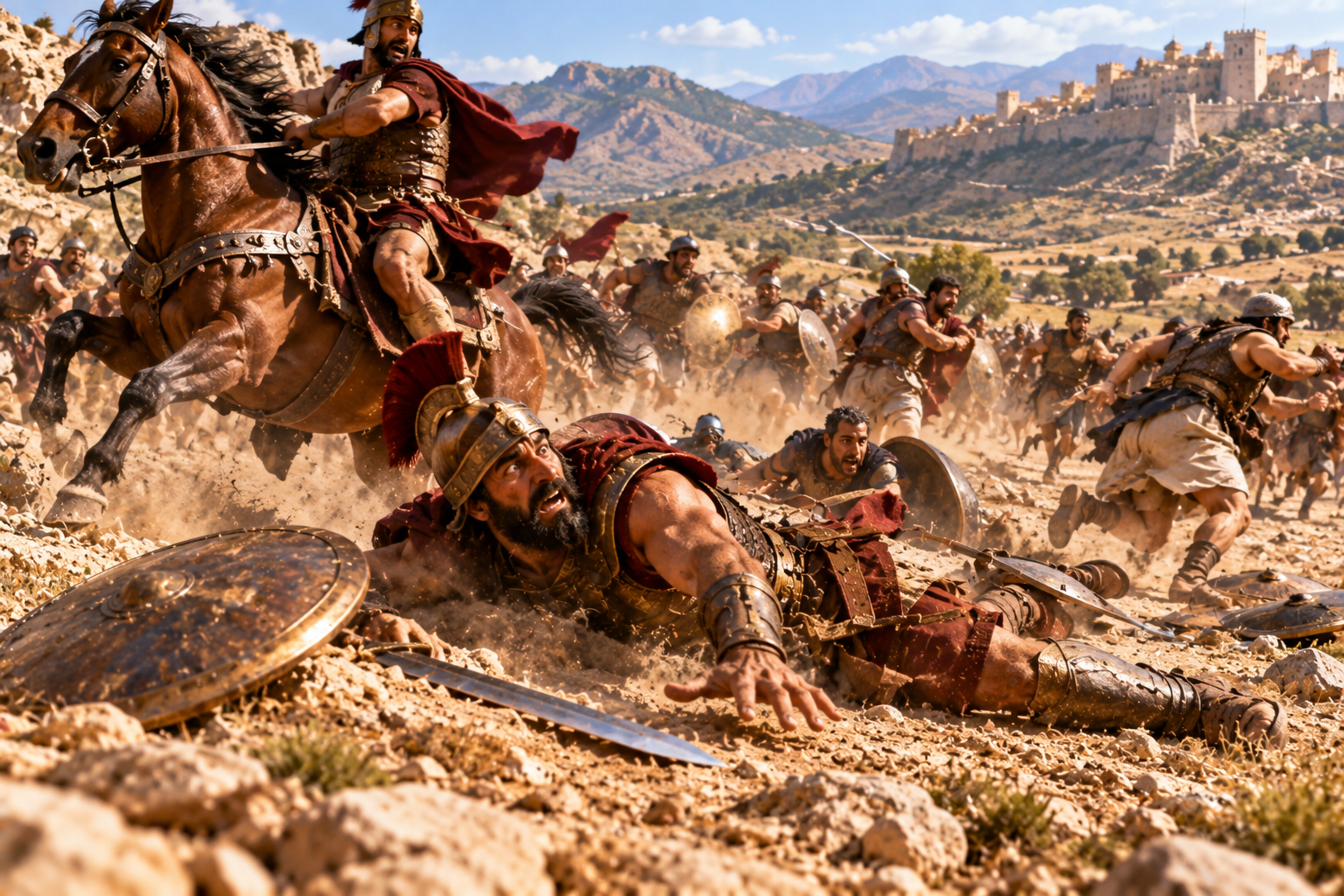
WHEN HUMAN STRENGTH
BECOMES HELPLESS
Flight will perish from the swift - NET - "Fast runners will find no place to hide." The Hebrew idea is that escape or refuge will be lost to the swift. Ordinarily, the fast man possesses an obvious advantage in battle. If the army collapses, he can run. If the enemy breaks through, he has a better chance of escaping. But Amos says that advantage will disappear. It is not primarily that the swift man will lose his ability to run. Rather, running will no longer provide an escape. There will simply be nowhere to run. This is important because the emphasis throughout Amos 2:14–16 is not merely weakness but the failure of every conceivable means of deliverance. Israel had refused to flee from sin, and soon she would discover that she could not flee from judgment. In other words, the swift may still be swift, but there will be nowhere to run.
And the stalwart will not strengthen his power - NET - "strong men will have no strength left" The “stalwart” is the strong man, the physically powerful warrior. Normally, when danger increases, the strong man summons his strength. But Amos says the strong man's strength will be insufficient.
Nor the mighty (gibbor) man save (malat; LXX - sozo - rescue, preserve) his life - Now Amos reaches the heart of the matter which is preservation of one's life. The mighty man (gibbor) is the warrior, champion, or valiant man, someone distinguished by strength and military ability. The word translated save (malat) carries the idea of escaping, slipping away, or delivering oneself. The mighty warrior has reached the limit of human self-reliance. The mighty man who could save others will not be able to save himself.
Amos is saying when the weight of God's judgment falls, the swift would not be able to run from it, the strong would not be able to resist it, and the mighty would not be able to save himself from it. There is no outrunning, outmuscling, or outfighting the judgment of God.
Tchavdar Hadjiev sums it up - Seven groups of soldiers are listed in quick succession, united by their common inability to cope with the disaster. Under divine pressure human skill loses its usefulness. Such a denial of human ability to evade the coming crisis is another characteristic theme of Amos’s proclamation (3:12; 5:18–20; 9:2–4, 8–10). (See Joel and Amos: An Introduction and Commentary)
John Butler - CONQUERING OF JUDGMENT Amos 2:14 - Sermon Starters
“Therefore the flight shall perish from the swift, and the strong shall not strengthen his force neither shall the mighty deliver himself” (Amos 2:14).
Much of the second chapter of Amos is about judgment for Israel (the northern kingdom). Israel’s sins are enumerated and the judgment is declared as certain and devastating. Our text emphasizes the conquering of the judgment by showing that the best man has will not stop the judgment of God upon Israel. Three distinct abilities of man are debunked as not sufficient to stop Divine judgment.
FIRST—THE FAILURE OF SPEED
“The flight shall perish from the swift.” Men may defeat men because their military equipment is speedier but no one will defeat God that way. God is too fast for the fastest that man has to offer. Men’s planes may go faster than sound but that is no match for God. No one can out run God, for God will soon catch him and punish him. You are exhorted to run away from sin/temptation but you will never run away from the Sovereign. He is too fast for the fastest.
SECOND—THE FAILURE OF STRENGTH
“The strong shall not strengthen his force.” Man is so proud of his power. He has nuclear power that can blast great areas into kingdom come. But as great as man’s power, it is no match for God’s power. He will demonstrate that power against the antichrist when he destroys the antichrist simply by the “brightness of his coming” (2 Thessalonians 2:8). All of man’s strength put together will be dispatched by God with an ease that defies rebellious man. The God Who created the universe simply by speaking it into being certainly will have no trouble with puny man when it comes to judgment. No man will be able to outwit or out-muscle God in judgment.
THIRD—THE FAILURE OF STATUS
“Neither shall the mighty deliver himself.” This could easily be put with the failure of strength but “mighty” can refer not just to strength but to status. This refers to the chief, the champion. He is a tyrant. Many mighty in that category have been cut down by God with ease. Status is no threat to Divine conquering. We give status to many today who are nothing compared to God. And many rulers of this world have been so powerful that they have attributed to themselves the attributes of God. But such are no match for God. Hitler, Stalin and other like minded men have been mighty in status among men but only among men. They had no status with God and God took care of them in an ignominious way though men would exalt them at their death. Men may have risen to great power in the world and conquered the world as did Alexander the Great but they cannot deliver themselves from the judgment of God. They are too puny. They may rule over men with tyranny and think themselves all powerful but when God wants to rid Himself of this kind He does and with ease.
Amos 2:15 “He who grasps the bow will not stand his ground, The swift of foot will not escape, Nor will he who rides the horse save his life.
KJV Neither shall he stand that handleth the bow; and he that is swift of foot shall not deliver himself: neither shall he that rideth the horse deliver himself.
NET Archers will not hold their ground; fast runners will not save their lives, nor will those who ride horses.
NLT The archers will not stand their ground. The swiftest runners won't be fast enough to escape. Even those riding horses won't be able to save themselves.
ESV he who handles the bow shall not stand, and he who is swift of foot shall not save himself, nor shall he who rides the horse save his life;
CSB The archer will not stand his ground, the one who is swift of foot will not save himself, and the one riding a horse will not save his life.
NIV The archer will not stand his ground, the fleet-footed soldier will not get away, and the horseman will not save his life.
- neither (KJV): Ps 33:16,17
- himself (KJV): Heb. his soul, or life
Related Passages
Hosea 1:5; 7 “On that day I will break the bow of Israel in the valley of Jezreel.” (1:7) “But I will have compassion on the house of Judah and deliver them by the LORD their God, and will not deliver them by bow, sword, battle, horses or horsemen.”
Hosea 2:18 “In that day I will also make a covenant for them With the beasts of the field, The birds of the sky And the creeping things of the ground. And I will abolish the bow, the sword and war from the land, And will make them lie down in safety.
Hosea 14:3 “Assyria will not save us, We will not ride on horses; Nor will we say again, ‘Our god,’ To the work of our hands; For in You the orphan finds mercy.”
Ecclesiastes 9:11 I again saw under the sun that the race is not to the swift and the battle is not to the warriors, and neither is bread to the wise nor wealth to the discerning nor favor to men of ability; for time and chance overtake them all.
Psalm 20:7-8 contrasts confidence in chariots and horses with confidence in the name of the LORD.
Psalm 33:16, 17, 18 declares that neither armies, warriors, nor horses ultimately provide salvation.
Proverbs 21:31 says the horse may be prepared for battle, but victory belongs to the LORD.
Isaiah 31:1, 2, 3 pronounces woe upon those who trust in horses and military strength rather than seeking the LORD.
Amos 2:14, 15, 16 should be read as a unit in which every conceivable human means of escape progressively fails.
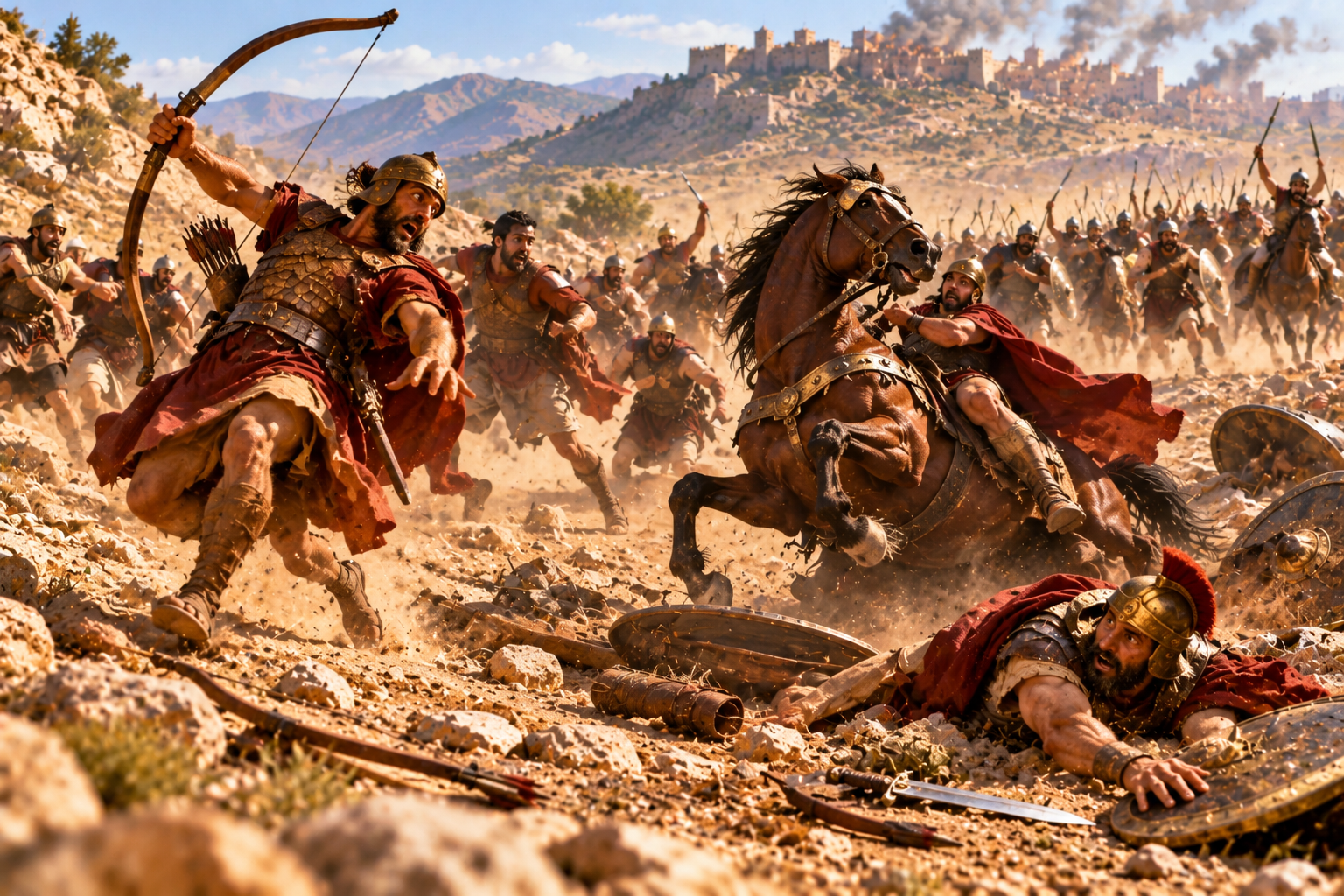
WHEN EVERY MEANS
OF ESCAPE FIELDS
Amos continues naming 3 more attempts (of a total of seven) to avoid God's judgment, but all fail. Notice in this section the repeated hammering of "will not... will not... nor... will not... will not" creates a rhythm of relentless, cascading failure. Every single avenue of self-preservation collapses, uniformly and completely. Thomas E. McComiskey adds "These (seven) figures depict Israel’s inability to escape the impending destruction." (See Hosea, Amos, Micah)
He who grasps the bow will not stand his ground - NET - "Archers will not hold their ground" The archer was a specialized warrior who could attack from a distance. Unlike the swordsman who had to engage an enemy at close range, the bowman possessed the advantage of striking before his opponent reached him. The expression grasps the bow pictures a trained warrior with his weapon ready in his hand. God removes the bow's ability to provide security. Will not stand his ground is the idea is that the archer will be unable to stand, maintain his position, or hold his ground when the enemy comes. Ordinarily the soldier stands and fights, but this battle will be different. The archer who expects to stop the enemy from a distance will discover that his military skill is useless against the judgment God has decreed. Israel was about to discover that their greatest enemy was not the army approaching from outside but the God against Whom she had rebelled.
The swift of foot will not (LXX = ou me = double negative = absolutely not) escape (malat; LXX - diasozo - bring safely through) - NET - "fast runners will not save their lives" Verse 14 had already said “Flight will perish from the swift.” Amos repeats the idea because he wants Israel to feel the absolute impossibility of escape. The Hebrew verb translated escape (malat) means to slip away, escape, or deliver oneself. The runner may possess extraordinary speed. Under ordinary circumstances that speed might save his life. But not now. Why? Because the problem is not simply that the enemy is faster. The problem is that God has decreed judgment. You cannot outrun an omnipresent God. David expressed the opposite truth beautifully in Psalm 139:7 “Where can I go from Your Spirit? Or where can I flee from Your presence?” In Psalm 139 that truth comforts the believer. In Amos 2 it terrifies the rebellious. The same omnipresence that assures God's people “You can never get away from Me” also warns the unrepentant “You can never get away from Me.”
The Reformation Study Bible - A vivid picture of helplessness: the fleet of foot will not escape and the strong will not stand their ground..
Nor will he who rides the horse save his life - NLT - "Even those riding horses won't be able to save themselves." Now Amos moves to the horse, perhaps the greatest mobility advantage available to the ancient warrior. A horse provides enormous tactical advantage. Throughout the Old Testament, the horse frequently represents military power and human confidence and thus was addressed several times in Scripture...
Psalm 33:17 says “A horse is a false hope for victory; nor does it deliver anyone by its great strength.”
Psalm 20:7 says “Some boast in chariots and some in horses, but we will boast in the name of the LORD, our God.”
Proverbs 21:31 says “The horse is prepared for the day of battle, but victory belongs to the LORD.”
In summary, Amos is saying that when God brought Israel to judgment, strength could not resist it, speed could not outrun it, weapons could not stop it, and horses could not escape it. Every avenue of self-deliverance failed, because Israel's fundamental problem was not the enemy pursuing her but the God against Whom she had rebelled.
Escape (deliver, escape, save)(04422) malat "to escape, slip away, flee, deliver, rescue, save" and occurs about 95 times in the Old Testament and in both ancient and modern Hebrew. Its first occurrence sets the tone: "Flee for your life... flee to the hills, lest you be consumed" (Genesis 19:17), where the word appears twice in one verse. It's sometimes paired with other "flee" verbs like nus (1 Samuel 19:10) and barach (1 Samuel 19:12).
Core usage: escaping danger. Most often the word describes escaping some threat — an enemy (Isaiah 20:6), a trap (2 Kings 10:24), or a temptress (Ecclesiastes 7:26). Baker adds vivid imagery: escape like sparks leaping from a fire (Job 41:19) or a bird slipping free of a fowler's snare (Psalm 124:7).
Fleeing for one's life. The word frequently describes literal flight to survive — Lot fleeing Sodom (Genesis 19:17-22), David fleeing Saul (1 Samuel 19:10-12; 27:1), or, in a tragic reversal, Zedekiah's inability to escape the Chaldeans (Jeremiah 32:4; 34:3).
Rescue from death, calamity, or punishment. Malat also describes deliverance more broadly — from death (Esther 4:13; Psalm 89:48), from disaster (Job 1:15-19), or from deserved punishment (Proverbs 11:21; 19:5; 28:26). Amos 2:14-15 falls into this category, describing warriors unable to "escape" or "save" their lives.
A few unusual uses. In one case, the word describes bones being spared from desecration ("they let his bones escape/alone," 2 Kings 23:18). It's also used a couple of times for protection (Ecclesiastes 9:15; Isaiah 31:5), and once, surprisingly, for a woman giving birth (Isaiah 66:7) — the idea of a child "escaping" or being "delivered" from the womb.
For Amos 2:14-15: this is the word behind "the swift will not escape" and "he who rides the horse will not save his life." It reinforces just how total the coming judgment is — even this broad, flexible word for escape, survival, and rescue proves powerless to describe anyone's outcome in that day.
Amos 2:16 “Even the bravest among the warriors will flee naked in that day,” declares the LORD.
KJV And he that is courageous among the mighty shall flee away naked in that day, saith the LORD.
NET Bravehearted warriors will run away naked in that day." The LORD is speaking!
NLT On that day the most courageous of your fighting men will drop their weapons and run for their lives," says the LORD.
ESV and he who is stout of heart among the mighty shall flee away naked in that day," declares the LORD.
CSB Even the most courageous of the warriors will flee naked on that day--this is the LORD's declaration.
NIV Even the bravest warriors will flee naked on that day," declares the LORD.
- courageous (KJV): Heb. strong of his heart, Jer 48:41
- flee (KJV): Jdg 4:17 2Ki 7:8-20 Mk 14:52
Related Passages
Amos 5:18 Alas, you who are longing for the day of the LORD, For what purpose will the day of the LORD be to you? It will be darkness and not light;
Amos 5:20 Will not the day of the LORD be darkness instead of light, Even gloom with no brightness in it?
Amos 6:3 Do you put off the day of calamity, And would you bring near the seat of violence?
Psalm 20:7-8 Some boast in chariots and some in horses, But we will boast in the name of the LORD, our God. 8They have bowed down and fallen, But we have risen and stood upright.
Psalm 33:16-18 The king is not saved by a mighty army; A warrior is not delivered by great strength. 17 A horse is a false hope for victory; Nor does it deliver anyone by its great strength. 18 Behold, the eye of the LORD is on those who fear Him, On those who hope for His lovingkindness,
Proverbs 21:31 The horse is prepared for the day of battle, But victory belongs to the LORD.
Deuteronomy 28:7, 25 “The LORD shall cause your enemies who rise up against you to be defeated before you; they will come out against you one way and will flee before you seven ways. (28:25) “The LORD shall cause you to be defeated before your enemies; you will go out one way against them, but you will flee seven ways before them, and you will be an example of terror to all the kingdoms of the earth.
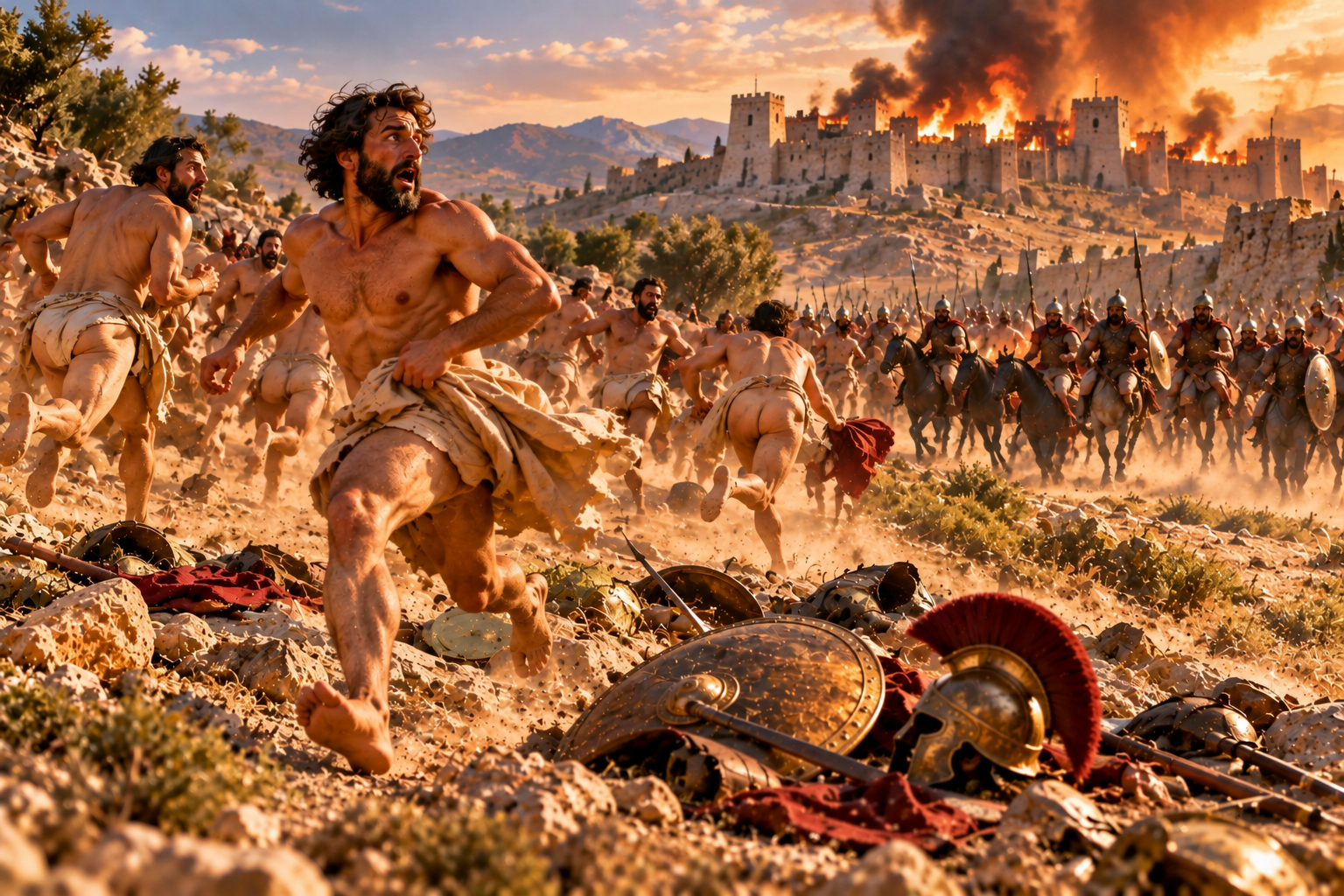
WHEN EVEN THE
BRAVE RUN AWAY
Amos brings his long indictment of Israel to a dramatic conclusion. He has systematically removed every possible source of human confidence: speed, strength, military skill, the bow, swift feet, the horse, and finally courage itself.
Even the bravest among the warriors (gibbor; dunasteia - power, domination) will flee naked in that day,” declares the LORD - ESV "he who is stout of heart among the mighty." (cf. 2Sa 20:7; 23:8-22) The Hebrew is literally "the one stout/strong of heart among the mighty men." Here “heart” (leb) refers not primarily to emotions but to the inner person, including courage, resolve, determination, and fortitude. This is the soldier who does not normally panic. When others retreat, he stands. But Amos says even this man will flee. That small word even is important because it introduces the strongest candidate for survival. If anyone can stand, surely this man can. When God's judgment arrives, even the courageous man's courage will fail him.
Life Application Study Bible (p 1322) - Television and movies are filled with images of people who seem to have no fear. Many today have modeled their lives after these images—they want to be tough. But God is not impressed with bravado. He says that even the toughest people will run in fear when God's judgment comes. Do you know people who think they can make it through life without God? Don't be swayed by their self-assured rhetoric. Recognize that God fears no one, and one day all people will fear him.
Among the warriors - The warriors are the mighty men, the gibborim (-im ~ plural in Hebrew), men distinguished by military strength and valor. These were not inexperienced civilians suddenly caught in battle. These were the men trained to fight. Their identity was bound up with strength, courage, weapons, training, and victory. Yet Amos deliberately chooses the bravest among the brave and tells us what he will do. Even is used to stress an extreme or unlikely situation, in this case that such "brave hearts" would run for their lives!
How sad that this was the very opposite of what Moses had declared “The LORD shall cause your enemies who rise up against you to be defeated before you; they will come out against you one way and will flee before you seven ways." (Dt 28:7) The prophecy in Dt 28:25 would be fulfilled by Israel "The LORD shall cause you to be defeated before your enemies; you will go out one way against them, but you will flee seven ways before them, and you will be an example of terror to all the kingdoms of the earth."
Flee naked - This is the final humiliation. The warrior will flee naked (arom), likely meaning stripped of clothing, armor, equipment, or whatever might hinder his escape. The point is that when survival becomes the primary concern, everything else is discarded. Armor that once provided protection becomes excess weight. Weapons that once represented strength are abandoned. Possessions no longer matter. Dignity no longer matters. Appearance no longer matters. The warrior wants only one thing and that is to escape with his life! But as Amos has already said there will be no escape from God's judgment.
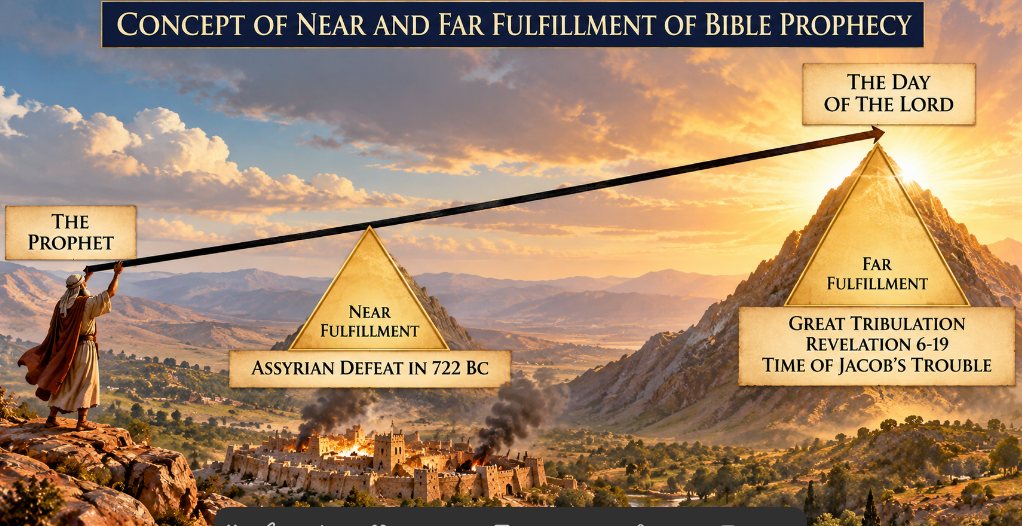
In that day gives the warning an ominous certainty, referring here to the coming day of divine judgment in 722 BC when the Assyrians would thoroughly defeat Israel and remove them from their land into exile. Amos will later refer to as the Day of the LORD (Amos 5:18, 20, 6:3). When God comes in judgment, Israel herself will be held accountable and that day will expose every false confidence. Things that seemed secure today will prove useless in that day. Does this not remind you of the far fulfillment of the Day of the LORD as described by John in Revelation 6-19 (see Rev 6:15-17)?
Declares the LORD (Jehovah) - This closing formula (Hebrew ne'um Yahweh) is a standard prophetic seal of authority, marking the message as God's own direct word, not merely Amos's opinion or interpretation. It reinforces that everything just described, the total collapse of every human defense, comes with divine certainty and authority behind it.
Donald R. Sunukjian sums it up - This wartime panic was sevenfold just as Israel's sins were seven (Amos 2:6-8, 12). The history of the Northern Kingdom came to an end only a few decades later with the Assyrian Captivity in 722 b.c. (2 Kings 17:1-23). The roar of judgment ended. The Lord, the Sovereign of the earth, had spoken. He would come as a mighty Warrior to judge the surrounding nations for their rebellion against His authority. He would judge Israel too, because she also had broken His covenant despite His grace toward her. (See Bible Knowledge Commentary: Old Testament - Page 1432)
Bob Marcaurelle's sermon - When God's People Forget God Amos 2:4-16
Sin is so easy to spot in others and so hard to spot in ourselves. When Amos completed the circle and exposed the sins of his own countrymen, Judah, to the South (2:4-5), he probably met with a chorus of "Amens!" from his Israelite congregation, but little did they know the judgments they made on others would be the judgments God would make upon them (Matt. 7:1-2), the circle was a noose about to tighten around their own necks (2:6-16). When God's people forget God they get the same punishment as the pagans who forget Him. In fact, they get more, for God expects more.
In 3:1 Amos includes both Judah and Israel under the title "Israel." He calls Israel the "whole family I brought up out of Egypt." Thus here we take Israel and Judah together (2:4-16) for they were both the people of God who forgot their God.
I. The Iniquity of God's People (Amos 2:4-8)
Using the courtroom analogy (Kelly) Amos hauls Judah and Israel before the bar of God and spells out their iniquity.
1) They Had Rejected the Word of God (Amos 2:4, 8, 12). They rejected God's "law" (Amos 2:4) or all His teachings whether written or preached. They did not keep His "decrees," those iron clad rules written on tables of stone (Ex. 19) and in their heart of hearts (Rom. 2:15). Israelites, who took men's outer garments for collateral were required by God's law (Ex. 21:7-9) to give it back at night so they would not freeze. No only did they not give it back, but they used it to make a bed for themselves with prostitutes (Amos 2:8). When God's preacher cried out against such things they told him to shut up (Amos 2:12). When Rod raised up pure young men like the Nazirites who abstained from such, they brought them down and taught them to drink (Amos 2:12).
The same issue of God's word faces us today! Will God's Word be our standard? Before men turn away from God's way on the outside, they turn away from God's Word on the inside. The question is—what is our authority? Is it what the church says? The shrine at Bethel condoned prostitution in the name of the Lord (2:7-8; 4:4). Is it what we think or feel? If so, we will see a time of corruption and confusion like that of the Judges when "every man did what was right in his own eyes" (Jud. 21:25). Or is it what God says in His word? If we turn from the doctrines of the Word we will soon turn from the duties of the Word. And we will be as pagan as any heathen nation around us.
Having turned from the Word to their own views and that of their corrupted church
2. They Rejected the Way of God (Amos 2:6-8, 12).
Several kinds of sins emerged. There was inequity and inequality (Amos 2:6, 7). The selling of the righteous for silver and a pair of shoes (Amos 2:6) could refer to court bribes where the rich bought verdicts (Amos 2:7) or to the sale of slaves. Trampling the head of the poor (v. 7) could mean they walk over them to get their land. Though the specifics are unclear the root sin is "the survival of the slick." Money meant more than people. The top of the social and financial ladder had to be climbed no matter what it cost others.
The second sin was immorality (Amos 2:7). A father and son go into the same temple prostitute. The words "father and son" could be a metaphor of the universality of this sin, meaning, all men, young and old alike, are womanizers (Motyer). More likely it points to the degeneracy of morals to the point where father and son practice immorality together.
The third sin was intemperance (Amos 2:8). In their orgies they drank wine taken as fines. The dominant idea again is their enjoyment of that which was taken from another (inequity) but the idea of intemperance is there.
The amazing thing is that in the history of civilization these three sins will spell death to any culture. Greed, immorality and drunkenness will rotten the heart of any civilization and send it toppling to destruction. It is the way God has created this world order. The oppressed poor will revolt and rip out a nation's strength. The immorality will destroy the home, the building block of society. Drunkenness will lead men to levels lower than the animals and will lull them to sleep while the enemy approaches. This frightens me because these sins are America's sins. We are on a suicidal course and unless God intervenes are probably headed for destruction.
II. The Ingratitude of God's People (Amos 2:9-11)
Amos turns from their iniquity to their ingratitude (9-11). They had sinned against a God who loved them and blessed them in many ways. God had met their physical needs (9-10). Going back to their most hallowed experience, the Exodus, Amos reminds them that God had delivered them from Egypt, had defeated the giant Amorite warrior who stood in their way, had provided for their needs in the desert years and had given them the land of the Amorites.
Besides all this, God had also met their spiritual needs (Amos 2:11). He raised up prophets to declare His will and ways. He raised up people like the Nazirites "Consecrated Ones" who, in drinking no wine and touching no unclean thing, symbolized the separated life preached by the prophets and demanded by the Lord.
One of the great mysteries of life is that the more people are blessed by God, the more they take Him for granted and turn their backs upon Him. God gives us health and we use it in recreation rather than worship on Sunday. God gives us wealth and we raise our standard of living but not our gifts to Him and others. God gives us families and we make them our god by putting them first. God sent His Son to die in our place and most of us could care less.
III. The Invasion of God's People (Amos 2:5, 13-16)
Just as the fire of military invasion was promised to the pagans, so was it promised to the people of God. God would send fire upon Judah, and destroy the very citadels of the holy city, Jerusalem (2:5). In 587 B.C. the Babylonians, under Nebuchadnezzar, destroyed Jerusalem and carried the Judeans off in exile (2 Ki. 25:1-10). To know the awful devastation one has only to read Jeremiah's "Lamentations."
Israel's conquest, coming much sooner, in 722 B.C., is not pictured as fire, but in graphic accounts of her total inability to resist (Amos 2:14-16). The fastest will not be fast enough to escape, not even on horseback. The strongest will not be strong enough to win. The archer will run from the battle, the "bravest warriors will flee naked on that day" (Amos 2:16).
Amos 2:13 is very hard to translate. It could refer to Israel's punishment. God says, "I will crush you as a cart crushes when loaded with grain" (NIV). Israel will be crushed with God's judgments until she sinks (M.H.). But it can also refer to God's pain. God says, "I am weighted down beneath you like a wagon is weighted down when filled with sheaves (NASV). (See this idea in Isa. 43:24; Mal. 2:17.)
In this we see two things. We see the limits of God. Our sins weary God and there comes a time when He has had enough. It was so at the time of the flood (Ge 6). It was so in Israel. And it can be so in your life and mine. There is a point of no return where judgment becomes inevitable. As the old hymn put it there is "a hidden boundary between God's patience and His wrath." The message is plain. Turn around TODAY before it is too late.
But, praise God, we can also see here the love of God. God bears our sins upon His heart because He cares. And in the person and passion of His Son, He "bore our sins in his own body upon the tree" (1 Pet. 2:24). The message again is plain. We can bear the full weight of our sins or we can place them for time and eternity upon Jesus. We can request and believe the seek to live for God and sing, "At the cross, at the cross where I first saw the light, and the burden of my heart rolled away."