Amos 6:2
Amos 6:3
Amos 6:4
Amos 6:5
Amos 6:6
Amos 6:7
Amos 6:8
Amos 6:9
Amos 6:10
Amos 6:11
Amos 6:12
Amos 6:13
Amos 6:14

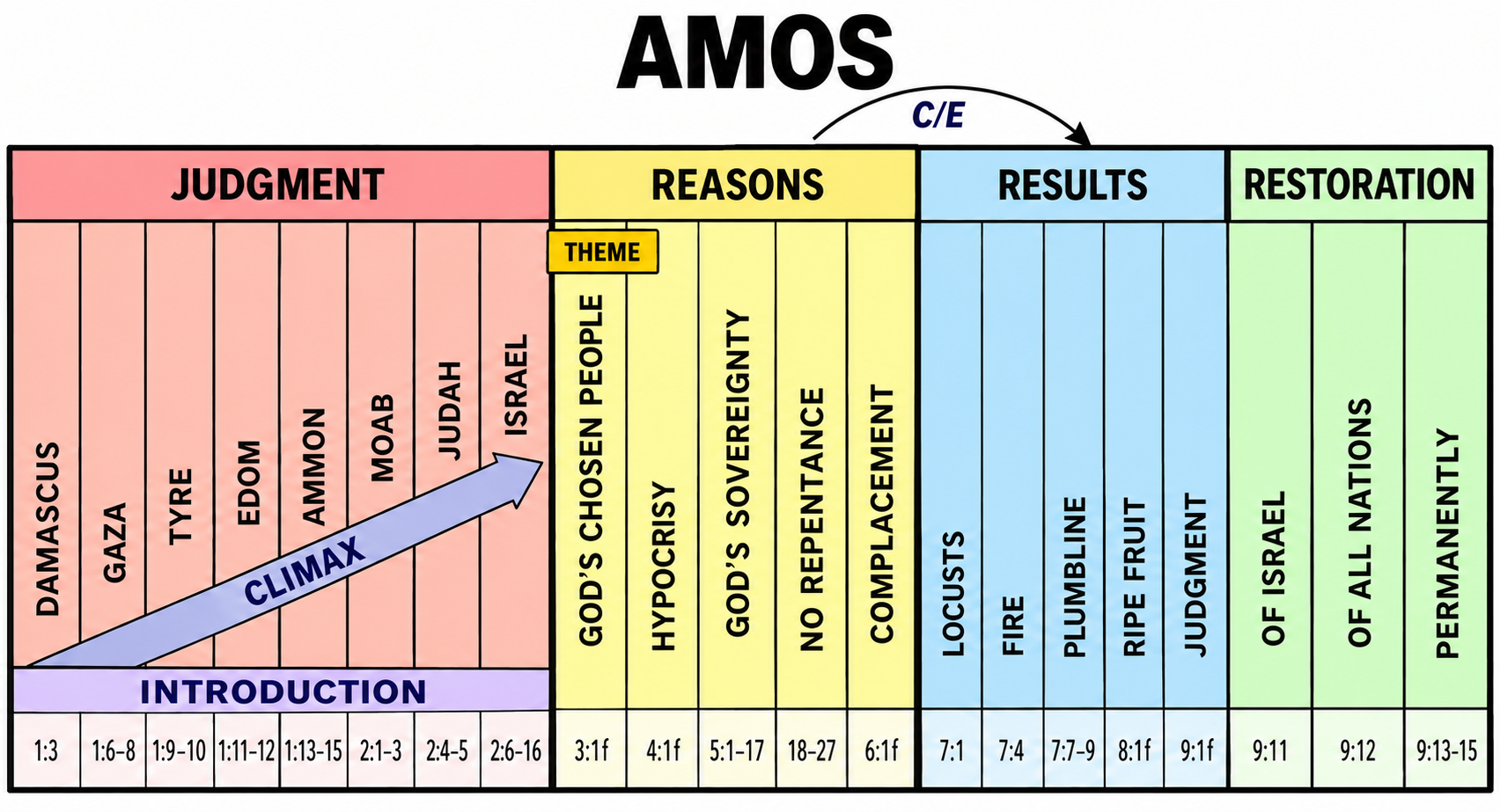
Click chart to enlarge
From Hampton Keathley IV
Amos 6:1 Woe to those who are at ease in Zion And to those who feel secure in the mountain of Samaria, The distinguished men of the foremost of nations, To whom the house of Israel comes.
KJV Woe to them that are at ease in Zion, and trust in the mountain of Samaria, which are named chief of the nations, to whom the house of Israel came!
NET Woe to those who live in ease in Zion, to those who feel secure on Mount Samaria. They think of themselves as the elite class of the best nation. The family of Israel looks to them for leadership.
NLT What sorrow awaits you who lounge in luxury in Jerusalem, and you who feel secure in Samaria! You are famous and popular in Israel, and people go to you for help.
ESV "Woe to those who are at ease in Zion, and to those who feel secure on the mountain of Samaria, the notable men of the first of the nations, to whom the house of Israel comes!
BGT οὐαὶ τοῖς ἐξουθενοῦσιν Σιων καὶ τοῖς πεποιθόσιν ἐπὶ τὸ ὄρος Σαμαρείας ἀπετρύγησαν ἀρχὰς ἐθνῶν καὶ εἰσῆλθον αὐτοί οἶκος τοῦ Ισραηλ
LXE Woe to them that set at nought Sion, and that trust in the mountain of Samaria: they have gathered the harvest of the heads of the nations, and they have gone in themselves.
CSB Woe to those who are at ease in Zion and to those who feel secure on the hill of Samaria-- the notable people in this first of the nations, those the house of Israel comes to.
NIV Woe to you who are complacent in Zion, and to you who feel secure on Mount Samaria, you notable men of the foremost nation, to whom the people of Israel come!
- to them (KJV): Judges 18:7 Isa 32:9-11 33:14 Jer 48:11 49:31 Lu 6:24,25 Lu 12:17-20 Jas 5:5 1Pe 5:7
- at ease (KJV): or, secure, Jer 7:4
- and trust (KJV): Am 4:1 8:14 1Ki 16:24
- named (KJV): Ex 19:5,6 La 1:1
- chief (KJV): or, firstfruits, Jas 1:18
Related Passages:
Amos 5:18 Alas (woe - hoy), you who are longing for the day of the LORD, For what purpose will the day of the LORD be to you? It will be darkness and not light;
Zephaniah 1:12 “It will come about at that time That I will search Jerusalem with lamps, And I will punish the men Who are stagnant in spirit, Who say in their hearts, ‘The LORD will not do good or evil!’
Zechariah 1:15 “But I am very angry with the nations who are at ease; for while I was only a little angry, they furthered the disaster.”
Psalm 123:4 Our soul is greatly filled With the scoffing of those who are at ease, And with the contempt of the proud.
Hosea 12:8 And Ephraim (NORTHERN KINGDOM) said, “Surely I have become rich, I have found wealth for myself; In all my labors they will find in me No iniquity, which would be sin.”
Amos 6:13 You who rejoice in Lodebar, And say, “Have we not by our own strength taken Karnaim for ourselves?”
Proverbs 1:32 “For the waywardness of the naive will kill them, And the complacency of fools will destroy them.
Amos 4:1 Hear this word, you cows of Bashan who are on the mountain of Samaria, Who oppress the poor, who crush the needy, Who say to your husbands, “Bring now, that we may drink!”
Isaiah 32:9 Rise up, you women who are at ease, And hear my voice; Give ear to my word, You complacent daughters.
Amos 2:12 “But you made the Nazirites drink wine, And you commanded the prophets saying, ‘You shall not prophesy!’
Isaiah 30:10 Who say to the seers, “You must not see visions”; And to the prophets, “You must not prophesy to us what is right, Speak to us pleasant words, Prophesy illusions.
COMFORTABLE AND COMPLACENT
ON THE BRINK OF JUDGMENT
Woe (hoy) is an exclamation of mourning, grief, and lamentation that also signals impending disaster. It could serve as a funeral cry (1 Ki 13:30), but in the prophets, where it occurs almost exclusively, it typically introduces a solemn denunciation of sin and a warning of divine judgment. Amos has already used it in Amos 5:18 to warn those who eagerly longed for the day of the LORD, not realizing it would bring judgment upon them. Now he pronounces a second woe.
J Vernon McGee - Amos begins this chapter with a “Woe.” He is not a prophet who majors in woes, but you will find them in several other of the prophets and in the Book of Revelation. “Woe” also means “Whoa!”—it means to stop, look, and listen, because this is something that is important. The word woe is one that ought to draw our special attention to that which follows. (SEE Thru the Bible Vol. 28: The Prophets Amos/Obadiah)
What a sobering opening to Amos 6! The prophet pronounces WOE upon people who appear to have everything needed for a secure and comfortable life: wealth, influence, political stability, and religious privilege. Yet beneath their outward prosperity lies a deadly spiritual condition: COMPLACENCY! (cf Lk 6:24,25) They feel secure when they should be alarmed, satisfied when they should be repentant, and confident when they should be trembling at the word of God spoken through His prophet. Amos does not condemn comfort itself, but the false confidence that lets people ignore their sin and the approaching judgment of God. They were at ease in their circumstances, yet in grave danger before their Creator! The greatest danger is not always the storm we can see, but the judgment we refuse to believe is coming.
Bob Utley - "Woe" The pronunciation of His Hebrew word sounds like exasperated or sorrowful feelings. This term (BDB 222) characterizes the book of Lamentations. The Prophets often used the literary form (a 3-2 beat) of a funeral dirge to express the disapproval of God and His coming judgment. This term is recurrent in Isaiah. (1) negative in Isa. 1:4,24; 5:8,11,18,20,21,22; 10:1; 17:12; 18:1; 28:1; 29:1,15; 30:1; 31:1; 33:1; 45:9,10, (2) neutral in Isa. 10:5 and (3) positive in Isa. 55:1, and Jeremiah (cf. Jer. 22:13,18; 23:1; 30:7; 34:5; 47:6; 48:1; 50:27) This INTERJECTION is followed by a series of PARTICIPLES, which carries the "woe" thought with each of them (Amos 6:1-7).
To those who are at ease in Zion - At ease (sha'anan; LXX has "despised, considered of no account"!!!), can be used positively conveying the idea of being undisturbed, tranquil, secure, or complacently at rest. In some contexts, such tranquility can be desirable (cf Isa 33:20), but here it describes a dangerous attitude of self-satisfaction. They were "at ease" with their sinful ways! They were not troubled by their spiritual condition, not disturbed by the injustice surrounding them and not alarmed by the prophetic warnings (Amos 4:1). They were not alarmed by the prophetic warnings of Amos (Amos 2:12). The problem was that they mistook favorable circumstances for evidence that everything was right between themselves and God (cf Hos 12:8, Amos 6:13).
Zion refers to Jerusalem, the religious and political center of Judah. This is significant because Amos was primarily commissioned to proclaim judgment against the northern kingdom of Israel (Amos 7:15). Yet he begins this denunciation by including those who are at ease in Zion. Amos had already condemned Judah for rejecting the law of the LORD and failing to keep His statutes (Am 2:4, 5) and here reiterates that Judah will not escape God's judgment.
Bob Utley - "to those who are at ease" There is no VERB. This phrase is used as a SUBSTANTIVE. It has the prophetic connotation of "careless, wanton, arrogant" (cf. Isa. 32:9,11; Zech. 1:15; and Ps. 123:4). It was not their leisure or wealth or social status that was the problem, but their trust in these things instead of God. The group is characterized in several ways in the next few verses (ED: AND THE "WOE" WOULD BE APROPOS TO INTRODUCE EACY OF THESE WAYS) (1) those who feel secure, Amos 6:1b (2) you who put away the evil day, Amos 6:3 (3) those who lie on beds of ivory, Amos 6:4 (4) those who improvise (sing idle songs), Amos 6:5; (5) those who drink wine from sacrificial bowls, Amos 6:6. All of these phrases have the DEFINITE ARTICLE plus a PARTICIPLE.
And to those who feel secure (batach) in the mountain of Samaria - Feel secure means they trusted, relied upon, or felt confident. Israel’s leaders were confident in the status quo, but their confidence was misplaced. They trusted in their apparent security rather than in God. Samaria’s walls could protect against some enemies, but they could not protect an unrepentant people from the judgment of God. Samaria was built on a hill purchased by King Omri (1Ki 16:24) and was so well fortified that it withstood an Assyrian siege for three years (2Ki 17:5). Yet it fell in 722 BC, just as Amos had warned. They were like the rich man in Proverbs 18:11, whose “wealth is his strong city, And like a high wall in his own imagination.” False security is most dangerous when it persuades us that we have nothing to fear and therefore nothing to repent of.
The distinguished (naqab) men - Literally “the ones marked out." NLT = "You are famous and popular in Israel, and people go to you for help." Distinguished (naqab), which literally means “to pierce,” and from there “to mark out or designate by name” (cf. Nu 1:17). Amos is speaking of the prominent, recognized individuals, the influential leaders with social standing, those regarded by others as “important” people. They considered themselves the elite of “the foremost (re’shit) of nations.” Yet with bitter irony, Amos warns that those who were first in privilege would be first in judgment, going into exile “at the head of the exiles” (Am 6:7). They receive a WOE because their high positions carried a responsibility for those whose welfare depended on them, and “from everyone who has been given much, much will be required” (Lk 12:48).
Technical Note on distinguished (naqab) men - The contrast with the rest of Scripture’s use of the word is striking. Elsewhere, men “designated by name” were set apart to serve: to lead the census, fight the LORD’s battles, praise Him, or care for captives. Samaria’s distinguished men had the designation but not the service. In fact their prominence became a platform for self-indulgence (Am 6:4–6).
THOUGHT: Ultimately, the only designation that matters is the one God gives. Men may mark us out as important, but the One who counts is the LORD, who will call His people by “a new name Which the mouth of the LORD will designate” (Isa 62:2). Recognition from men can make us feel secure. Like Egypt’s crushed reed, it pierces the hand of all who lean on it.
of the foremost (reshith) of nations - NET = "They think of themselves as the elite class of the best nation." NIV = "you notable men of the foremost nation." This phrase is somewhat difficult to interpret. It may reflect Israel’s self-perception as a uniquely important nation, or it may describe the prominent leaders of a people who considered themselves preeminent. The two ideas likely belong together: Amos is addressing the nation’s elite, the “distinguished men,” who took pride in belonging to what they regarded as the first and greatest of nations. Under Jeroboam II, Israel had expanded its borders and prospered (2Ki 14:25), and its leaders apparently assumed that their status and election guaranteed their security (cf. Am 3:2). Amos is likely speaking ironically. The Hebrew word translated “foremost” (reshith “first” or “chief”) appears again in Amos 6:6, where these same leaders anoint themselves with “the finest” (rēʾšît) of oils. Then in Amos 6:7 comes the twist: “Therefore, they will now go into exile at the head (rōʾš) of the exiles.” Those who considered themselves first (reshith) among the nations and enjoyed the first of everything would be first in line for captivity. The same phrase is used of Amalek in Nu 24:20: “Amalek was the first of the nations, But his end shall be destruction.” Israel’s proud leaders were unwittingly sharing Amalek’s title, and they would share his end! Their prominence would not exempt them from judgment; it would put them at the front of the line.
To whom the house of Israel comes - NLT = "and people go to you for help." NET = "The family of Israel looks to them for leadership." This indicates that the people came to these prominent men. They were recognized authorities, sought out for leadership, judgment, or help, and they shaped the direction of the nation. They shaped the direction of the nation, and this makes their complacency especially serious. The very people Israel looked to for guidance were lounging on ivory beds and drinking wine from bowls, yet “they have not grieved over the ruin of Joseph” (Amos 6:4–6). Instead of leading the nation toward repentance, they modeled self-indulgence.
Scripture consistently holds leaders to a higher standard because their influence extends beyond themselves. God rebuked Israel’s shepherds for feeding themselves rather than the flock (Ezekiel 34:2–4), and Jesus warned that “from everyone who has been given much, much will be required” (Luke 12:48; cp James 3:1)
Woe (01945) hoy is an interjection of distress used primarily by the prophets, 6x in mourning for the dead (1Ki 13:30 Jer 22:18; 34:5), and 40x as negative warnings specifying Divine punishment in the form of disaster, etc, for failing to repent from certain sins. The wicked are under the judgment of God (cp Ro 1:18ff) and therefore face a time of ruin and mourning, so that the only thing left for an unrepentant people is to mourn the destruction of their lives! Woe! Patterson writes "Woe oracles typically contain the following elements: invective (“woe to”), threat, and criticism (the reason for the denunciation and threatened judgment)."
Carpenter - It expresses great emotion and can be an interjection of warning or distress. It represents a thought transformed into a feeling and expressed in a word—hoy, “woe!” … Hoy can be used to introduce a prophetic declaration of judgment, as when Isaiah announced the coming destruction of Assyria (Isa. 10:5). It conveys a note of certainty about what is said and an atmosphere of finality—such as in, “Woe unto you, the end has come!” The word is also applied to groups of people and individuals who are wicked (Isa. 5:8, 11, 18, 20–22). (Holman Treasury of Key Bible Words )
Hoy is used >50x in prophets and only once elsewhere. 6x = mourning for the dead (1 Ki13:30), 40x = negative warnings or threats of God's physical chastisement. R. J. Clifford found 53 occurrences of hoy in the Old Testament. Of these he listed three possible uses: (1) to describe funeral laments (eight times), usually translated “alas”; (2) a cry to get attention (four times), usually translated “ho” or “ah”; (3) an announcement of doom (forty-one times and used only by the prophets), usually translated “woe to.” The wicked were under the judgment of God and therefore faced a time of ruin and mourning. The only thing left for an unrepentant people was to mourn the destruction of their lives.
Distinguished (05344) naqab is a verb whose basic meaning is “to bore” or “to pierce.” It has cognates in Arabic (“to bore, drill a hole”), Targumic Aramaic (“to perforate”), and Akkadian. From the physical idea of piercing, the word extends to marking something out, and so “to designate” or “to name.” In a few passages it also means “to blaspheme,” perhaps in the sense of designating someone as bad. One lexicon calls this range “a striking demonstration of the semantic flexibility of Semitic languages.”
NAQAB - 16V - bored(1), designate(1), designated(6), distinguished(1), holes(1), name(1), pierce(4), pierced(1). Gen. 30:28; Num. 1:17; 2 Ki. 12:9; 2 Ki. 18:21; 1 Chr. 12:31; 1 Chr. 16:41; 2 Chr. 28:15; 2 Chr. 31:19; Ezr. 8:20; Job 40:24; Job 41:2; Isa. 36:6; Isa. 62:2; Amos 6:1; Hab. 3:14; Hag. 1:6
1. To bore or pierce (the physical sense). When Joash repaired the temple, Jehoiada made a collection box:
2 Kings 12:9 (NASB) “But Jehoiada the priest took a chest and bored a hole in its lid and put it beside the altar, on the right side as one comes into the house of the LORD; and the priests who guarded the threshold put in it all the money which was brought into the house of the LORD.”
The same verb describes piercing the jaw of a great creature (Job 40:24; 41:2) and the heads of the enemy’s warriors (Hab 3:14). Interestingly, the word also appears in the Siloam inscription (c. 701 BC) to describe the moment Hezekiah’s tunnelers “pierced through” the rock and met.
2. Piercing as a picture of false security and futility. Two uses of naqab fit remarkably well with the themes of Amos 6. The Assyrian Rabshakeh mocked Judah’s reliance on Egypt:
2 Kings 18:21 “Now behold, you rely on the staff of this crushed reed, even on Egypt; on which if a man leans, it will go into his hand and pierce it. So is Pharaoh king of Egypt to all who rely on him.” (cf. Isa 36:6)
Haggai described the futility of prosperity pursued apart from God:
Haggai 1:6 “You have sown much, but harvest little; you eat, but there is not enough to be satisfied; you drink, but there is not enough to become drunk; you put on clothing, but no one is warm enough; and he who earns, earns wages to put into a purse with holes.”
Misplaced trust pierces the one who leans on it, and wealth without God leaks away.
3. To designate, name, or single out. Most often in the NASB, naqab means to mark someone out by name for a task. Laban used it when he invited Jacob to set his own wages:
Genesis 30:28 “and he said, ‘Name me your wages, and I will give it.’”
The word is also used of men chosen for leadership:
Numbers 1:17 “So Moses and Aaron took these men who had been designated by name.”
It describes men chosen for battle (1 Chr 12:31), for praising God (1 Chr 16:41), for relieving captives (2 Chr 28:15), for distributing temple portions (2 Chr 31:19), and for temple service:
Ezra 8:20 “and 220 of the temple servants, whom David and the princes had given for the service of the Levites, all of them designated by name.”
The most beautiful use refers to the name the LORD Himself will give His restored people:
Isaiah 62:2 “The nations will see your righteousness, And all kings your glory; And you will be called by a new name Which the mouth of the LORD will designate.”
4. To blaspheme or curse. In Leviticus 24:11 and 16, naqab describes blaspheming the Name:
Leviticus 24:16 “Moreover, the one who blasphemes the name of the LORD shall surely be put to death; all the congregation shall certainly stone him. The alien as well as the native, when he blasphemes the Name, shall be put to death.”
Lexicographers debate whether this is the same verb. BDB treats it as a separate root (naqab II), related to qabab, “to curse” (Nu 23:8). Others connect it to “designating as bad” or to a “piercing” utterance. That debate explains why the NASB count of 16 omits these verses, while Strong’s numbering includes them under H5344.
Matthew Henry - Worldly Rest
Woe to those who are at ease in Zion, and to those who feel secure on the mountain of Samaria, the notable men of the first of the nations, to whom the house of Israel comes! Amos 6:1
The first words of Amos 6 sound very strangely, and contrary to the sentiments of a vain world: “Woe to those that are at ease!” We are ready to say, “Happy are those that are at ease, that neither feel any trouble nor fear any, that lie soft and warm, and lay nothing to heart”; and wise we think are those that do so, that bathe themselves in the delights of sense and care not how the world goes. Those are looked upon as doing well for themselves that do well for their bodies and make much of them; but against them this woe is denounced, and we are here told what their ease is, and what the woe is. Here is a description of their pride, security, and sensuality, for which God would reckon with them. They were vainly conceited of their own dignities, and thought those would secure them from the judgments threatened and be their defense against the wrath of God and man. Those that dwelt in Zion thought that was honor and protection enough for them, and they might there be quiet from all fear of evil, because it was a strong city, well fortified both by nature and art … and because it was a royal city, where were set the thrones of the house of David (it was the head-city of Judah, and therefore truly great), and especially because it was the holy city, where the temple was, and the testimony of Israel; those that dwelt there doubted not but that God’s sanctuary would be a sanctuary to them and would shelter them from his judgments.
C H Spurgeon - Scourge for slumbering souls Amos 6:1 ‘Woe to them that are at ease in Zion.’
I think it was Christmas Evans who used the simile of the blacksmith’s dog, which, when his master first set up in trade, was very much frightened with the sparks, but at last he got to be so used to them that he went to sleep under the anvil. ‘And so,’ said the good preacher, ‘there be many that go to sleep under the gospel, with the sparks of damnation flying about their nostrils.’ And certainly there are such. I am told that when they are making the great boilers at Bankside, when a man has to go inside for the first time and hold the hammer, the noise is so frightful, that his head aches and his ears seem to have lost all power of hearing for a long time afterwards; but I am also told that after a week or two a person can go to sleep in the midst of these boilers while the workmen are hammering outside, and he would sleep none the less soundly for the noise. So I know there is such a thing as going to sleep under the most thundering ministry. I know that men get used to these things, used to being invited, used to being warned, used to being thundered at. They have been pleaded with until they sleep under it; I doubt not they would sleep even if the world were blazing, if the sun were turned into darkness, and the moon into blood; and I think that even the trumpet of the archangel would not suffice to wake them from their lethargy, if they heard it long enough to be accustomed to it. Shall we give you up as hopeless? I think we almost may. If you have heard so long, and been unblessed, there is no great likelihood that you ever will be blessed; but you will go on as you have been going, till at last you perish.
FOR MEDITATION: Faithful gospel preachers sometimes get accused of hardening the hearts of their unbelieving hearers. That is the equivalent of blaming Moses for repeating a message from God (Exodus 5:1, 3; 6:11; 7:2, 16; 8:1, 20; 9:1, 13; 10:3) which led to Pharaoh hardening his heart (Exodus 8:15, 32; 9:34). Beware of apportioning blame like this—those who harden their hearts against the gospel will not be able to hide on the day of judgment (Romans 2:4–5).
Hailey's Bible Handbook - Over and over Amos contrasts the voluptuous ease, palatial luxury, and feeling of security of the leaders and the rich with the intolerable sufferings that are about to befall them.
James Jowett - AT EASE IN ZION
“Woe to them that are at ease in Zion!” —Amos 6:1-7.
I WOULD be delivered from the folly of confusing ease and rest. There is an infinite difference between comforts and comfort. It is one thing to lie down on a luxurious couch: it is a very different thing to “lie down in green pastures” under the gracious shepherdliness of the Lord. The ease which men covet is so often a fruit of stupefaction, the dull product of sinful drugs, the wretched sluggishness of carnal gratification and excess. The rest which God giveth is alive and wakeful, abounding in tireless and fruitful service. “Oh, rest in the Lord.”
But is it not a strange thing that men can be “at ease in Zion”? That they can play the beast in the holy place? Zion was full of holy memory, and abounded with suggestions of the Divine Presence. And yet here they could carouse, and lose themselves in swinish indulgence! A little while ago I saw a beautiful old church which had been turned into a common eating-house!
My soul, be on thy guard. Be watchful and diligent, and busy thyself in the practice of “self-knowledge, self-reverence, self-control.”
AT EASE IN ZION - John Mayshack
“Woe to them that are at ease in Zion, and trust in the mountains of Samaria …” Amos 6:1
1. A Warning Against Religious Idleness
2. A Warning Against Taking God for Granted
3. A Warning Against False Security
G Campbell Morgan - Woe to them that are at ease in Zion, and to them that are secure in the mountain of Samaria. Amos 6.1
This is the second of the denunciatory "Woes." Here another attitude of mind is revealed. Its secret is declared in the words, "Ye that put far away the evil day." This is entirely different from desiring the Day of Jehovah. These were people who perhaps recognized the fact that the Day of Jehovah would be a day of judgment and of wrath; but they did not believe it was near. They did not expect to be involved in its calamities, so they cared nothing for its principles. Therefore, they gave themselves up to the life of sensuality which the prophet described in graphic fashion. They stretched themselves on divans, gave full satisfaction to their appetites, amused themselves with music, sought exhilaration in drink, and banished all concern as to the true condition of the nation, "the affliction of Joseph." This is the more common attitude of the human heart toward the whole subject of a coming Day of God. When in regard to these things men become "mockers," they are always found "walking after their own ungodly lusts" (Jude 18). It is noticeable that the prophet flung back this word of warning to Judah also, as he spoke of those "at ease in Zion," as well as of those that were "secure in the mountain of Samaria." And verily the principle is of abiding application. To be "at ease in Zion," or "secure in the mountain of Samaria," or content in the things which minister to carnal appetites, while the laws of God are being broken and the ways of life corrupted because the Divine judgment is conceived of as distant, is of the very essence of evil. Against all such attitudes and activities the word of God utters its "Woe!"
D A Carson - For the Love of God Volume 2
TO UNDERSTAND ARIGHT THE POWER OF Amos 6, it is helpful to reflect a little on two themes: complacency and the power elite.
(1) I shall begin by reminding you of a story I told in the meditation for January 15. One of my high school history teachers related how, toward the end of World War II, he had been furloughed home because of an injury. He had seen many of his buddies killed; others were still in action. He was riding a bus in a Canadian city, and he heard an obviously wealthy and ostentatious woman in the seat in front of him talking to her companion. Her husband was making a lot of money in arms production. She confided to her seatmate: “I hope this war doesn’t end soon. We’ve never had it so good.”
That is the ugly face of complacency. The picture of those “who are complacent in Zion” (6:1) is no less repugnant. There they are, strumming away on their guitars, fancying themselves to be gifted musicians like David (6:5), slurping their Chardonnay, the atmosphere charged with their perfumes and aftershaves (6:6)—but they do not grieve over all that is wrong and corrupt.
(2) Virtually every society develops an elite. An absolute monarchy or a dictatorship demonstrates this in obvious ways. Communism, theoretically classless, develops its own elite, its own rulers; the privilege of birth gives way to the privilege of party membership and political power. In a democracy, there may be relative equality of opportunity, but that is not the same as classlessness. Rather, at its best equal opportunity ensures some mobility within a more or less stratified society: outsiders can become insiders, and the elite can be penetrated by hoi polloi. Aristocracy and dictatorship are then replaced by meritocracy; the rule of the rich and the noble is replaced by the rule of the successful and the clever and the vicious. Of course, this is almost inevitable, as many sociologists have explained: for practical reasons, direct rule by the people is impossible. There have to be representatives, appointees, someone to make decisions and effect things—and a new power bloc is born. Perhaps the greatest benefit of democracy is that it provides a peaceful way of turning blighters out every few years, and selecting others.
But from God’s perspective, leadership goes hand in hand with responsibility. Amos 6 is directed against the capitals of Judah and Israel (Zion and Samaria) and against the “notable men” (6:1). The ugly complacency of this chapter is the complacency of rulers and leaders presiding over decadence, compromise, injustice, theological perversity, and their own creature comforts. And where, in the church and in the broader culture, do leadership and complacency join hands today? At how many levels? And what does God think of it?
F B Meyer - Amos 6:1 Woe to them that are at ease in Zion!
A picture is given in the following chapters of the luxury and self-indulgence of the people. Stretched on couches inlaid with ivory, choosing the rarest dainties, accompanying their voices on the lute, and drinking wine from flowing bowls, they were indifferent to the wounds from which the national life-blood was pouring. “They were not grieved for the affliction of Joseph” (Amos 6:6).
The same behavior is only too common amongst ourselves. Indeed, this temptation besets us all. If only we are well supplied with the comforts and luxuries of life, we are apt to become thoughtless of the miseries of poverty and misfortune. If our own heaven is secure, we are apt to enwrap ourselves with an atmosphere of satisfaction and composure, without taking sufficiently to heart the needs of the great world of sin and sorrow around.
“The affliction of Joseph” reminds us of the scene at the pit’s mouth: how Joseph’s brethren sat down to eat bread, whilst their brother was in the pit without water, and then sold him to the travelling merchantmen, to rid their sight of him. But human nature is prone to act thus in every age.
Are we at ease in Zion? Are we using for our own luxurious enjoyment gifts which God entrusted to our care for the world? Are we too indifferent to the fate of those who live in our homes, or pour in great streams of activity along our streets? Are we sleeping in the garden, whilst our Master sweats the bloody sweat? We have but one life to spend; let it be a life in earnest. Let us bethink ourselves of any whom we can help—any who are in affliction, the poor widow, the young wife with the sick husband, the student who is so eager to become a minister.
Amos 6:1-7 TODAY IN THE WORD
Woe to you who are complacent in Zion, and to you who feel secure on Mount Samaria! - Amos 6:1
In his book Seize the Day: Seven Steps to Achieving the Extraordinary in an Ordinary World, author Danny Cox writes about a problem that arose when fighter jets were first invented. When some pilots ejected, they had a tendency to grip the seat instead of letting go, keeping their parachutes from opening. In order to solve this problem, engineers had to find a way to force the pilot out of his seat. Cox writes: “The new design called for a two-inch webbed strap. One end attached to the front edge of the seat, under the pilot. The other end attached to an electronic take-up reel behind the headrest. Two seconds after ejection, the electronic take-up reel would immediately take up the slack, and force the pilot forward out of his seat, thus freeing the parachute.”
God was on a similar quest with His people, seeking a way to force them “out of their seats.” One of the main reasons Israel’s spiritual life had declined was because God’s people had grown complacent (Amos 6:1). They had grown smug and self-confident, deriving a sense of false security from the prosperity they had enjoyed over the years. This had led them to believe that they were exempt from divine judgment. This was true of both the southern kingdom of Judah (Zion) and the northern kingdom of Israel (Mount Samaria). The leaders of Judah and Samaria seemed to have believed that, since they had a special place in God’s plan, they would enjoy prosperity and escape the judgment of their neighbors (Amos 6:2).
TODAY ALONG THE WAY
According to Roberta Hestenes, “Maturity is pressing toward the mark; immaturity is complacency and self-satisfaction.”
Amos 6:1–7 Today in the Word
An international anti–corruption organization released a list of the top ten most corrupt world leaders ever, as measured by how much money they took in through bribery and graft. Former Indonesian President Mohamed Suharto is at the head of the list, with his ill–gotten gains estimated at $15 to $35 billion. Next is Ferdinand Marcos, former President of the Philippines, at $5 to $10 billion, then Mobutu Sese Seko, former President of Zaire, at $5 billion. Each of the ten men on the list was eventually ousted from power—justice caught up with them.
God’s way of thinking is that leaders should serve, not use people for their personal gain. The second “woe” of Amos is directed at bad leaders (Amos 6:1). The leaders of Israel and Judah were so blind and self–deceived that instead of fearing the coming judgment and turning to God in repentance, they were feeling good about life and smugly expecting His blessings. Instead of learning from the conquered fate of their wicked neighbors, they continued to think they would be fine (Amos 6:2). Divine judgment would fall on them first of all (Amos 6:7). Their current activities of “feasting and lounging” would cease as they went into exile.
Instead of leading God’s people in paths of righteousness, the leaders had blazed a trail of sinfulness (Amos 6:3–6). Their ivory beds and couches reflected an opulent, self–indulgent lifestyle. Their meal menu of choice lambs and fattened calves revealed gluttony at the expense of others. Lounging and strumming indicated idleness, while the wine and lotion signified a decadent addiction to pleasure and comfort. They were oblivious to the state of spiritual ruin to which they had brought their nation. “Like David” was an ironic contrast—they might be strumming a harp like David, but that’s where the similarities ended. They didn’t understand David’s heart of worship.
Israel’s leaders should have been leading the way in obedience, worship, and covenant faithfulness. They should have been the first to repent at the prophecies of Amos and others. They should have known better—and they would be held responsible.
Apply the Word
God wants leaders to be serving, not self–serving. When the disciples argued about who was the greatest, Jesus explained: “The kings of the Gentiles lord it over them; and those who exercise authority over them call themselves Benefactors. But you are not to be like that. Instead, the greatest among you should be like the youngest, and the one who rules like the one who serves. . . . I am among you as one who serves” (Luke 22:24–27). May we seek to follow His example!
Warren Wiersbe - Complacency is an insidious sin, because it’s based on lies, motivated by pride, and leads to trusting something other than God (Zeph. 1:12). Like the people in the church of Laodicea, complacent people consider themselves “rich, and increased with goods” and in need of nothing (Rev. 3:17). In reality, however, they have lost everything that’s important in the spiritual life. When the Lord sees His people becoming complacent and self-satisfied, He sometimes sends trials to wake them up. (Bible Exposition Commentary)
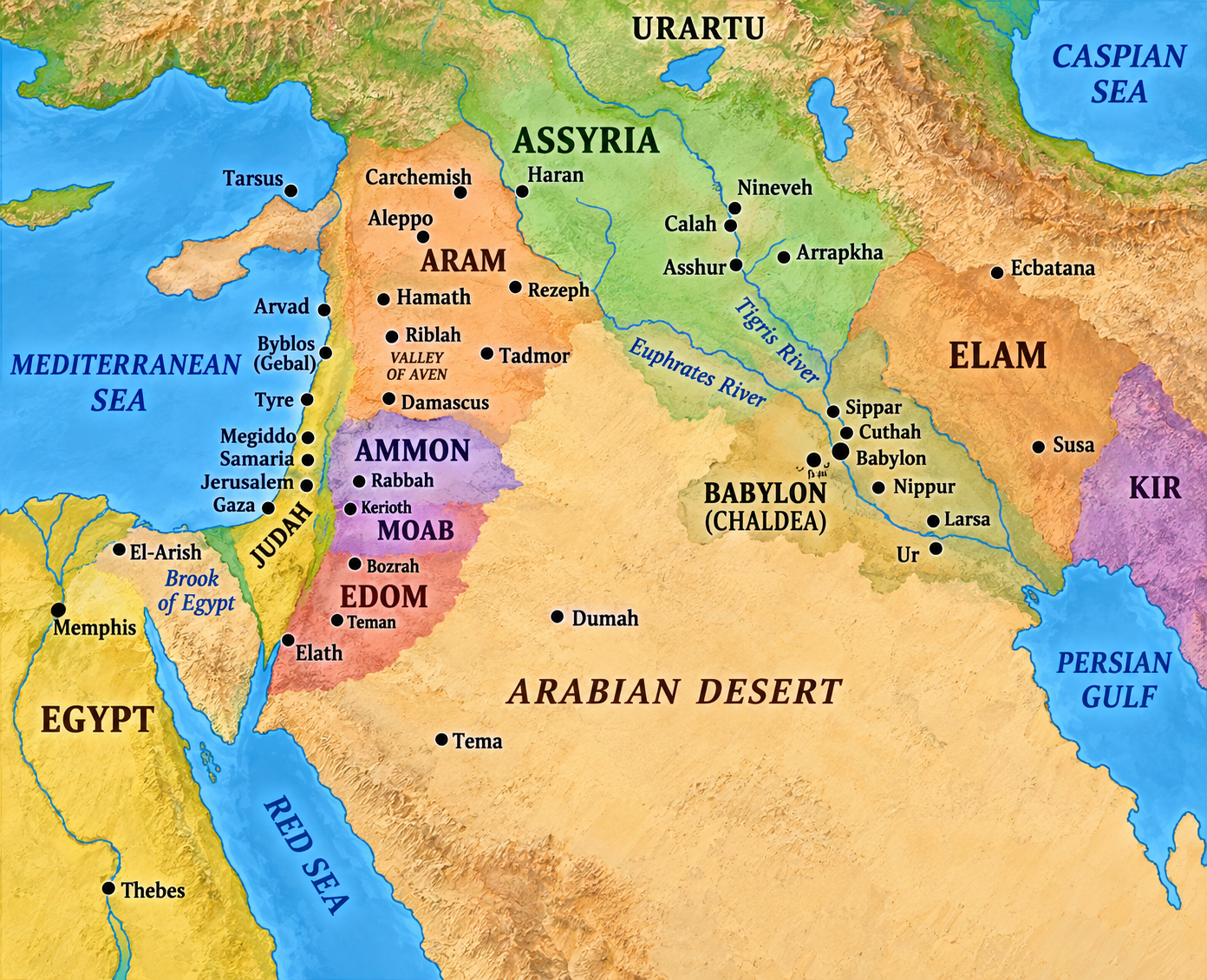
Amos 6:2 Go over to Calneh and look, And go from there to Hamath the great, Then go down to Gath of the Philistines. Are they better than these kingdoms, Or is their territory greater than yours?
KJV Pass ye unto Calneh, and see; and from thence go ye to Hamath the great: then go down to Gath of the Philistines: be they better than these kingdoms? or their border greater than your border?
NET They (THE DISTINGUISHED MEN) say to the people: "Journey over to Calneh and look at it! Then go from there to Hamath-Rabbah! Then go down to Gath of the Philistines! Are they superior to our two kingdoms? Is their territory larger than yours?"
NLT But go over to Calneh and see what happened there. Then go to the great city of Hamath and down to the Philistine city of Gath. You are no better than they were, and look at how they were destroyed.
ESV Pass over to Calneh, and see, and from there go to Hamath the great; then go down to Gath of the Philistines. Are you better than these kingdoms? Or is their territory greater than your territory,
BGT διάβητε πάντες καὶ ἴδετε καὶ διέλθατε ἐκεῖθεν εἰς Εμαθ Ραββα καὶ κατάβητε ἐκεῖθεν εἰς Γεθ ἀλλοφύλων τὰς κρατίστας ἐκ πασῶν τῶν βασιλειῶν τούτων εἰ πλέονα τὰ ὅρια αὐτῶν ἐστιν τῶν ὑμετέρων ὁρίων
LXE O house of Israel, pass by all of you, and see; and pass by thence to Ematrabba; and thence descend to Geth of the Philistines, the chief of all these kingdoms, see if their coasts are greater than your coasts.
CSB Cross over to Calneh and see; go from there to great Hamath; then go down to Gath of the Philistines. Are you better than these kingdoms? Is their territory larger than yours?
NIV Go to Calneh and look at it; go from there to great Hamath, and then go down to Gath in Philistia. Are they better off than your two kingdoms? Is their land larger than yours?
- Pass (KJV): Jer 2:10,11 Na 3:8
- Calneh (KJV): Ge 10:10 Isa 10:9, Calno
- Hamath (KJV): 2Ki 17:24,30 2Ki 18:34 2Ki 19:13
- Gath (KJV): 1Sa 17:4,23 2Ch 26:6
- better (KJV): Isa 10:9-11 36:18,19 37:12,13 Eze 31:2,3 Na 3:8
Related Passages:
Genesis 10:10 The beginning of his kingdom was Babel and Erech and Accad and Calneh, in the land of Shinar.
Isaiah 10:9 “Is not Calno like Carchemish, Or Hamath like Arpad, Or Samaria like Damascus?
2 Kings 18:34 ‘Where are the gods of Hamath and Arpad? Where are the gods of Sepharvaim, Hena and Ivvah? Have they delivered Samaria from my hand?
2 Kings 19:13 ‘Where is the king of Hamath, the king of Arpad, the king of the city of Sepharvaim, and of Hena and Ivvah?’”
Joshua 13:3; from the Shihor which is east of Egypt, even as far as the border of Ekron to the north (it is counted as Canaanite); the five lords of the Philistines: the Gazite, the Ashdodite, the Ashkelonite, the Gittite, the Ekronite; and the Avvite
1 Samuel 17:4; 23 Then a champion came out from the armies of the Philistines named Goliath, from Gath, whose height was six cubits and a span. 17:23 As he was talking with them, behold, the champion, the Philistine from Gath named Goliath, was coming up from the army of the Philistines, and he spoke these same words; and David heard them.
A GEOGRAPHY LESSON
WITH A WARNING
Go (abar) over to Calneh and look - Two imperatives to examine the evidence rather than remain satisfied with their assumptions. Amos is calling for thoughtful examination. What a striking challenge! Having pronounced a woe upon those who were complacently secure in Zion and Samaria (Am 6:1), Amos now commands them to examine three prominent cities: Calneh, Hamath, and Gath.
TECHNICAL NOTE - NET NOTE - The words “They say to the people” are interpretive and supplied in the translation for clarification. The translation understands v. 2 as the boastful words, which the leaders (described in v. 1) spoke to those who came to them (v. 1b). Some interpret v. 2 differently, understanding the words as directed to the leaders by the prophet. Verse 2b would then be translated: “Are you (i.e., Israel and Judah) better than these kingdoms (i.e., Calneh, etc.)? Is your border larger than their border?” (This reading requires an emendation of the Hebrew text toward the end of the verse.) In this case the verse is a reminder to Judah/Israel that they are not superior to other nations, which have already fallen victim to military conquest. Consequently Judah/Israel should not expect to escape the same fate. Following this line of interpretation, some take v. 2 as a later addition since the Assyrians under Tiglath-Pileser III conquered Calneh, Hamath, and Gath after the time of Amos’ ministry. However, this conclusion is not necessary since the kingdoms mentioned here had suffered military setbacks prior to Amos’ time as well. See S. M. Paul, Amos (Hermeneia), 201-4.
Bob Utley - Depending on how one interprets Amos 6:1, this verse would be Amos' words to the arrogant leadership of the covenant people (Judah and Israel) similar to Amos 9:7. However, this involved some textual emendations (cf. UBS, Handbook, #31, p. 289) or the leaders' comments to the people (cf. NET Bible [SEE TECHNICAL NOTE ABOVE], Tyndale commentary) ▣ "Calneh" This was a fortified city in Syria ( cf. Isa. 10:9), which was destroyed by Tiglath-pileser III in 738 B.C. It became a proverb of the coming exile of Israel (cf. Isa. 10:9-11). It was on this occasion that the king of Israel, Menahen, began to give tribute to Assyria.
And go from there to Hamath the great, Then go down to Gath of the Philistines His purpose is to confront their misplaced confidence by directing their attention beyond their own borders. Israel's leaders considered their nation prosperous, powerful, and secure, but Amos challenges them to evaluate their position in light of other kingdoms. What made Israel think that its prosperity and prominence guaranteed its safety? The precise historical condition of these three cities when Amos spoke is debated, but the central warning is clear: Israel had no grounds for assuming that its national advantages placed it beyond God's judgment.
Hamath was an important city and kingdom in western Syria, situated along the Orontes River, strategically located along significant trade and military routes giving it substantial regional power. The northern kingdom of Israel had experienced territorial expansion during the reign of Jeroboam II, whose achievements extended toward the region of Hamath (2 Ki 14:25, 28).
Bob Utley - "Hamath" The Anchor Bible Dictionary, - ONLINE- vol. 3, p. 33, has a good brief comment. "A city in Syria, the southern border of which often became part of the formula for the northern idealized border of Israel (cf. 1 Kgs. 8:65; 1 Chr. 13:5). The city was an object of the Assyrian conquest (Isa. 36:19), and some of its inhabitants were exiled and settled in Israel (2 Kgs. 17:24)." It was located about 150 miles north of the city of Dan on the Orantes River. ▣ Gath The Philistines established five city-states in southwest Judah on the coastal plain. Four of those cities are mentioned earlier in Amos 1:6-8, Gaza, Ashdod, Ashkelon, and Ekron). Gath (BDB 387 III) was captured by David in 1 Chronicles 18 and is also mentioned in Micah 1:10. It was later destroyed by the Assyrians.
The third destination is Gath one of the five principal cities of the Philistines, along with Gaza, Ashkelon, Ashdod, and Ekron (Jos 13:3; 1 Sa 6:17) and perhaps best remembered as the hometown of Goliath (1Sa 17:4, 23). Gath had long been associated with military strength and opposition to Israel but its prominence, however, did not make it invulnerable. 2Chr 26:6 records that King Uzziah of Judah broke down the wall of Gath, along with those of Jabneh and Ashdod (roughly 780s–760s BC which is close to, or just before, the ministry of Amos in 760 BC). The point is that Amos' choice of Gath would have carried particular significance for Israel because the Philistines had been formidable enemies and yet even their strongholds were vulnerable.
Why These Three Cities? The geographical sequence is notable. Calneh was a northern city, probably in the Syrian or Mesopotamian region, though its exact identification is uncertain. Hamath was a prominent city and kingdom in Syria, associated with the Orontes River. Gath was a major Philistine city southwest of Jerusalem, identified by many archaeologists with Tell es-Safi. The sequence directs attention from northern territories toward the Philistine region. These cities represent different political and geographical settings. Yet they share an important characteristic, that each provides a comparison by which Israel's leaders might reconsider their assumptions about national greatness.
J Vernon McGee -.In other words, “Go look at these other nations. Why do you think that you are superior to these nations? You’re not superior. You are engaged in the same sins that they are, and your responsibility is greater. They have no revelation from God, but you do have a revelation from God.”(SEE Thru the Bible Vol. 28: The Prophets Amos/Obadiah)
Are they better than these kingdoms This rhetorical question is central to the verse. Amos has just told Israel’s leaders (or if you favor the NET translation the leaders have told the people) to visit these three cities: Calneh, “Hamath the great,” and Gath of the Philistines (Amos 6:2). They most naturally refers to those cities, and “these kingdoms” to Israel and Judah, represented by Samaria and Zion (Amos 6:1). The full question reads: “Are they better than these kingdoms, or is their territory greater than yours?”
Interpreters understand the comparison in two main ways:
(1) “Learn from their fate.” These were once proud and prosperous cities, yet they had suffered defeat. Gath had been captured by Hazael of Aram (2 Kings 12:17) and later by Uzziah of Judah (2 Chronicles 26:6), and Hamath had been subdued by Jeroboam II himself (2 Kings 14:28). If those powerful cities fell, Israel had no reason to think it was immune. Their greatness did not save them, and neither would Israel’s. Or
(2) “You have been more blessed.” The expected answer is “No, they are not better than you.” Israel and Judah had been given more land, more prosperity, and above all a covenant relationship with God. On this reading, the question exposes Israel’s ingratitude, since greater blessing brings greater accountability (compare Amos 3:2).
Some translations, such as the RSV, reverse the comparison (“Are you better than these kingdoms?”), making the challenge to Israel’s pride even more direct. The precise force of the question remains debated, but the larger context is unmistakable. Amos is confronting those who had become dangerously complacent because of their real prosperity and facade of security (Amos 6:1, 4–6). Whichever reading is adopted, the message is the same: national greatness is no protection against the judgment of God.
UBS Handbook on Amos - Two main interpretations have been given for this verse: (1) That these are Amos’ own words addressed to the leaders of Israel, as a warning to remember nations which were greater than theirs and yet had met their doom. This is probably not the correct meaning.* (2) It is a quotation put by Amos in the mouths of the rulers to show their unlimited boasting. The leaders tell the people to compare how well off Israel is in comparison with other nations.
Bob Utley - "Or is their territory greater than yours?" The JPSOA suggests an emendation that reverses this phrase, "Or is your territory larger than theirs," p. 1187 footnote, "f." The UBS Text Project, p. 287, suggests the translation, "if small states like Kalneh, Hamath, Gath are flourishing, how much more this will be the case with the greater States of Judah and Israel!" It also suggests an interpretation, "This discourse reflects the blind self-confidence of those who speak in this manner."
The Historical Lesson:
Great Cities Are Not Invincible
Or is their territory greater than yours? The final question concerns territory. Land, borders, and political influence were important measures of national strength in the ancient Near East, and Israel had enjoyed considerable territorial expansion under Jeroboam II. He restored Israel’s border “from the entrance of Hamath as far as the Sea of the Arabah” (2Ki 14:25–28), roughly the extent of Solomon’s kingdom. Such success could easily encourage national pride. The people might reason that their expanding territory proved God’s favor and guaranteed their continued security.
NET NOTE - Both rhetorical questions in this verse expect the answer “no.” If these words do come from the leaders, then this verse underscores their self-delusion of power (compare 6:13). The prophet had no such mistaken sense of national grandeur (7:2, 5).
But Amos challenges this assumption. A large territory does not necessarily indicate a healthy spiritual condition. In fact, 2 Kings explains that God granted Jeroboam’s victories not because Israel was faithful, but because “the LORD saw the affliction of Israel, which was very bitter” (2Ki 14:26,27). Their expansion was an act of mercy, not a reward for righteousness. Israel’s military and economic achievements could not make up for its injustice, idolatry, and disregard for God’s Word. Amos had already exposed the nation’s oppression of the poor and corruption of justice (Amos 2:6–8; 5:7, 11, 12). Israel was measuring greatness by the size of its territory, while God was measuring the nation by the righteousness of its conduct. “Righteousness exalts a nation, but sin is a disgrace to any people” (Proverbs 14:34).
We should distinguish Amos’s immediate warning from later historical developments of each of these cites. The text does not explicitly say that all three cities had already been destroyed when Amos delivered this message around 760 B.C. Nevertheless, later history shows how fragile even impressive political centers can be. Calneh, if it is identified with Kullani in northern Syria, was conquered by the Assyrian king Tiglath-pileser III in 738 B.C. Hamath paid tribute to Assyria in 738 B.C. and was annexed by Sargon II in 720 B.C. Gath suffered repeated military reversals, captured by Hazael of Aram (2 Kings 12:17), breached by Uzziah of Judah (2 Chronicles 26:6), and later taken by Sargon II, and its importance steadily declined. Remarkably, Isaiah later records the Assyrian king boasting, “Is not Calno like Carchemish, or Hamath like Arpad, or Samaria like Damascus?” (Isaiah 10:9). In other words, Samaria was listed right alongside the cities Amos named. These developments illustrate the broader biblical truth that no earthly power possesses permanent security. But Amos’ primary purpose is not simply to predict the fate of three cities. He is exposing the dangerous assumption that Israel’s present prosperity guaranteed its future safety.
It is easy to mistake favorable circumstances for evidence
that everything is right between ourselves and God.
🙏 THOUGHT — Learn From the Ruins Before You Become One! Beloved, Amos challenged Israel’s complacent leaders to look beyond their own prosperity and consider the surrounding nations (Amos 6:2). Their confidence rested on political influence, military strength, and territorial expansion, but none of these could guarantee their safety. What a warning for us! It is easy to mistake favorable circumstances for evidence that all is well between us and God. We may enjoy financial security, professional success, physical comfort, or religious activity while neglecting the condition of our hearts. “Pride goes before destruction” (Proverbs 16:18), and “let him who thinks he stands take heed that he does not fall” (1 Corinthians 10:12). Never allow yesterday’s blessings to become today’s excuse for spiritual complacency! Just as Israel should have learned from other kingdoms, we should learn from the examples recorded in Scripture (read Ro 15:4; 1Cor 10:6, 11), examining ourselves honestly before God rather than comparing ourselves with others (2Co 10:12; 2Co 13:5, Ps 139:23,24). What does it profit a man to gain the whole world and forfeit his soul (Mark 8:36)? So let us place our confidence not in possessions, position, or prosperity, but in the living God, seeking first His kingdom and righteousness (Mt 6:33). The wise believer learns from the warnings of God’s Word before painful consequences become his teacher! (Pr 22:3; Heb 3:12,13, Heb 12:5-11)
Never allow yesterday’s blessings to become
today’s excuse for spiritual complacency!
Takeaways -
A nation that refuses to learn from the vulnerability of others may eventually discover its own vulnerability too late!
Complacency thrives when we refuse to examine anything that challenges our confidence.
Greatness in the eyes of men does not guarantee security before the sovereign God.
Yesterday's greatness cannot guarantee tomorrow's security.
Israel was measuring greatness by the size of its territory, while God was measuring the nation by the righteousness of its conduct.
Prosperity becomes spiritually dangerous when it makes us comfortable with what should make us repentant.
The walls of a great city may keep an enemy outside, but they cannot keep the judgment of God away!
Amos 6:3 Do you put off the day of calamity, And would you bring near the seat of violence?
NET You refuse to believe a day of disaster will come, but you establish a reign of violence.
NLT You push away every thought of coming disaster, but your actions only bring the day of judgment closer.
ESV O you who put far away the day of disaster and bring near the seat of violence?
BGT οἱ ἐρχόμενοι εἰς ἡμέραν κακήν οἱ ἐγγίζοντες καὶ ἐφαπτόμενοι σαββάτων ψευδῶν
LXE Ye who are approaching the evil day, who are drawing near and adopting false sabbaths;
CSB You dismiss any thought of the evil day and bring in a reign of violence.
NIV You put off the evil day and bring near a reign of terror.
- put (KJV): Am 5:18, 9:10 Ec 8:11 Isa 47:7 56:12 Eze 12:22,27 Mt 24:48 1Th 5:3 2Pe 3:4 Rev 18:17
- and cause (KJV): Am 6:12 5:12 Ps 94:20
Related Passages:
Amos 5:18 Alas, you who are longing for the day of the LORD, For what purpose will the day of the LORD be to you? It will be darkness and not light;
Amos 9:10 “All the sinners of My people will die by the sword, Those who say, ‘The calamity will not overtake or confront us.’
Ecclesiastes 8:11 Because the sentence against an evil deed is not executed quickly, therefore the hearts of the sons of men among them are given fully to do evil.
2 Peter 3:9-10 The Lord is not slow about His promise, as some count slowness, but is patient toward you, not wishing for any to perish but for all to come to repentance. 10 But the day of the Lord will come like a thief, in which the heavens will pass away with a roar and the elements will be destroyed with intense heat, and the earth and its works will be burned up.
DENYING JUDGMENT
INVITING DISASTER
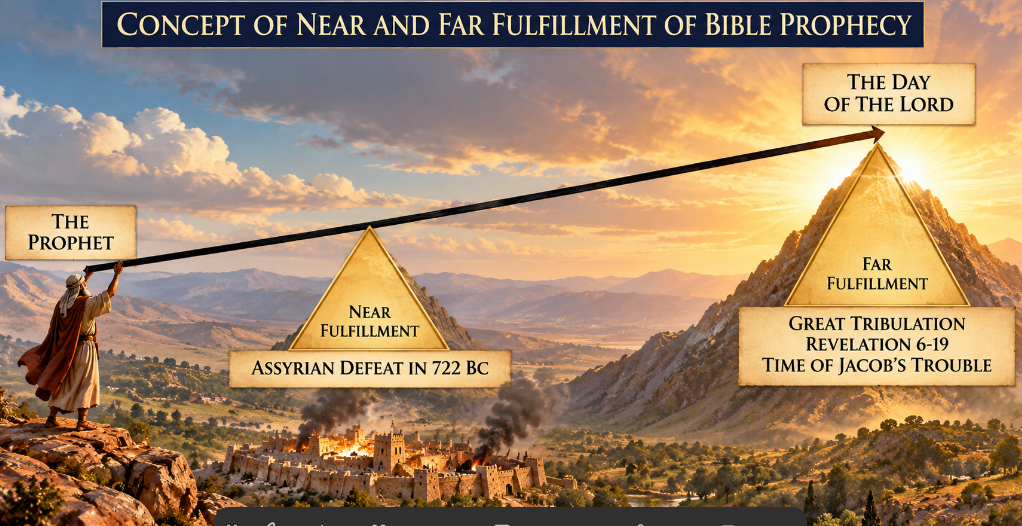
Do you put off the day of calamity - The day of calamity refers to the approaching Assyrian invasion and exile, a near fulfillment of the Day of the LORD that Amos had already announced (Am 5:18–20). Other translations capture the sense well: NET = You refuse to believe a day of disaster will come NLT - "You push away every thought of coming disaster." The day of calamity would be the coming near fulfillment of the Day of the LORD. One could call this verse "The dangerous deception of delay." NASB has it as a question (as does the ESV, Amp, GNV, LSB, RSV), but most translations render it as a statement. 15 of the 58 translations render Amos 6:3 as a question. The Hebrew has no interrogative particle in this verse. It continues the series of participles that began with “Woe to those...” in verse 1. That’s why most translations render it as a statement or an exclamation.
Bob Utley - The wealthy leaders were "putting off" (BDB 622, KB 672, Piel PARTICIPLE; this VERB appears only here in this form and only twice in the OT (cf. Isa. 66:5) the day of YHWH's visitation by divination (See DIVINATION) or trying to ignore (cf. TEV) the covenant consequences of Leviticus 26 and Deuteronomy 27-29 The irony is that by their very acts they were hastening the day!
The verb “put off” (nādâ) conveys the idea of thrusting away, removing, or putting something at a distance. Obviously, the leaders could not literally postpone God’s appointed judgment. Instead they chose to treat the prospect of calamity as remote and irrelevant to their present lives. They dismissed Amos’ warnings, refused to consider that their prosperity could end, and kept living as though their security would last indefinitely. In short, they were trying to distance themselves psychologically from the consequences of their wickedness. Ezekiel’s generation said the same thing: “The vision that he sees is for many years from now” (Ezekiel 12:27). Amos reminds us that the apparent delay of judgment must never be mistaken for its cancellation. Solomon observed that when the sentence against an evil deed is not executed quickly, the hearts of people become fully set upon doing evil (Eccl 8:11). Peter similarly warns that God's patience should not be confused with indifference toward sin (2Pe 3:9, 10).
Ignoring a warning does not eliminate the danger
about which we have been warned.
And would you bring near the seat of violence (chamas/hamas - Does this word look familiar?) -The NLT paraphrases, “but your actions only bring the day of judgment closer.” Here Amos exposes the terrible contradiction in Israel’s behavior. They wanted the day of calamity (the Day of the LORD) to remain far away, yet their conduct was bringing near “the seat of violence” (šebet ḥāmās). The noun šebet can refer to sitting, dwelling, or a seat, while ḥāmās denotes violence, wrongdoing, or ruthless injustice. It is the same word used of the earth before the flood, when it “was filled with violence” (Ge 6:11). The expression may picture a seat or throne marked by violence, suggesting oppressive authority, which is why some translations render it “reign of violence” or “reign of terror” (NIV).
The phrase can be understood in two ways. (1) It may describe the leaders’ own oppressive rule, in which violence and injustice had become the accepted way of exercising power. (2) It may describe the violent reign of a foreign conqueror that their sins were hastening. The two readings are closely related, because Israel’s own violence would bring on Assyria’s violence in 722 BC. Either way, the men who dismissed the prospect of divine judgment were perpetuating the very wickedness that called for it. They tried to keep judgment far away while welcoming the sins that made it necessary.
Warren Wiersbe - “It can’t happen here!” was the motto of the complacent leaders. “If a day of judgment is coming, it’s surely a long way off.” Whenever anybody mentioned the possibility of national disaster, the leaders laughed at the idea and disregarded it. But God had a different viewpoint. He said, “All the sinners of My people shall die by the sword, who say, ‘The calamity shall not overtake us nor confront us’ ” (9:10 NKJV). Yet by their very indifference, they were bringing the day of judgment that much nearer.(Bible Exposition Commentary)
Their thinking pushed judgment away,
but their conduct invited it.
NET NOTE - Heb "you bring near a seat of violence." The precise meaning of the Hebrew term shevet ("seat, sitting") is unclear in this context. The translation assumes that it refers to a throne from which violence (in the person of the oppressive leaders) reigns. Another option is that the expression refers not to the leaders' oppressive rule, but to the coming judgment when violence will overtake the nation in the person of enemy invaders.
Amos 6:4 Those who recline on beds of ivory And sprawl on their couches, And eat lambs from the flock And calves from the midst of the stall,
KJV That lie upon beds of ivory, and stretch themselves upon their couches, and eat the lambs out of the flock, and the calves out of the midst of the stall;
NET They lie around on beds decorated with ivory, and sprawl out on their couches. They eat lambs from the flock, and calves from the middle of the pen.
NLT How terrible for you who sprawl on ivory beds and lounge on your couches, eating the meat of tender lambs from the flock and of choice calves fattened in the stall.
ESV "Woe to those who lie on beds of ivory and stretch themselves out on their couches, and eat lambs from the flock and calves from the midst of the stall,
BGT οἱ καθεύδοντες ἐπὶ κλινῶν ἐλεφαντίνων καὶ κατασπαταλῶντες ἐπὶ ταῖς στρωμναῖς αὐτῶν καὶ ἔσθοντες ἐρίφους ἐκ ποιμνίων καὶ μοσχάρια ἐκ μέσου βουκολίων γαλαθηνά
LXE who sleep upon beds of ivory, and live delicately on their couches, and eat kids out of the flocks, and sucking calves out of the midst of the stalls;
CSB They lie on beds inlaid with ivory, sprawled out on their couches, and dine on lambs from the flock and calves from the stall.
NIV You lie on beds inlaid with ivory and lounge on your couches. You dine on choice lambs and fattened calves.
- lie (KJV): Isa 5:11,12 Isa 22:13 Lu 16:19 Ro 13:13,14 Jas 5:5
- stretch themselves upon their couches (KJV): 1Sa 25:36-38 Ps 73:7 Lu 12:19,20
Related Passages:
1 Samuel 28:24 The woman had a fattened calf in the house, and she quickly slaughtered it; and she took flour, kneaded it and baked unleavened bread from it.
Isaiah 5:11-12 Woe to those who rise early in the morning that they may pursue strong drink, Who stay up late in the evening that wine may inflame them! 12 Their banquets are accompanied by lyre and harp, by tambourine and flute, and by wine; But they do not pay attention to the deeds of the LORD, Nor do they consider the work of His hands.
Isaiah 22:13 Instead, there is gaiety and gladness, Killing of cattle and slaughtering of sheep, Eating of meat and drinking of wine: “Let us eat and drink, for tomorrow we may die.”
Romans 13:13-14 Let us behave properly as in the day, not in carousing and drunkenness, not in sexual promiscuity and sensuality, not in strife and jealousy. 14 But put on the Lord Jesus Christ, and make no provision for the flesh in regard to its lusts.
James 5:5 You have lived luxuriously on the earth and led a life of wanton pleasure; you have fattened your hearts in a day of slaughter.
1 Samuel 25:36-38 6Then Abigail came to Nabal, and behold, he was holding a feast in his house, like the feast of a king. And Nabal’s heart was merry within him, for he was very drunk; so she did not tell him anything at all until the morning light. 37But in the morning, when the wine had gone out of Nabal, his wife told him these things, and his heart died within him so that he became as a stone. 38About ten days later, the LORD struck Nabal and he died.
Psalm 73:7 Their eye bulges from fatness; The imaginations of their heart run riot.
Luke 12:19-20 ‘And I will say to my soul, “Soul, you have many goods laid up for many years to come; take your ease, eat, drink and be merry.”’ 20 “But God said to him, ‘You fool! This very night your soul is required of you; and now who will own what you have prepared?’
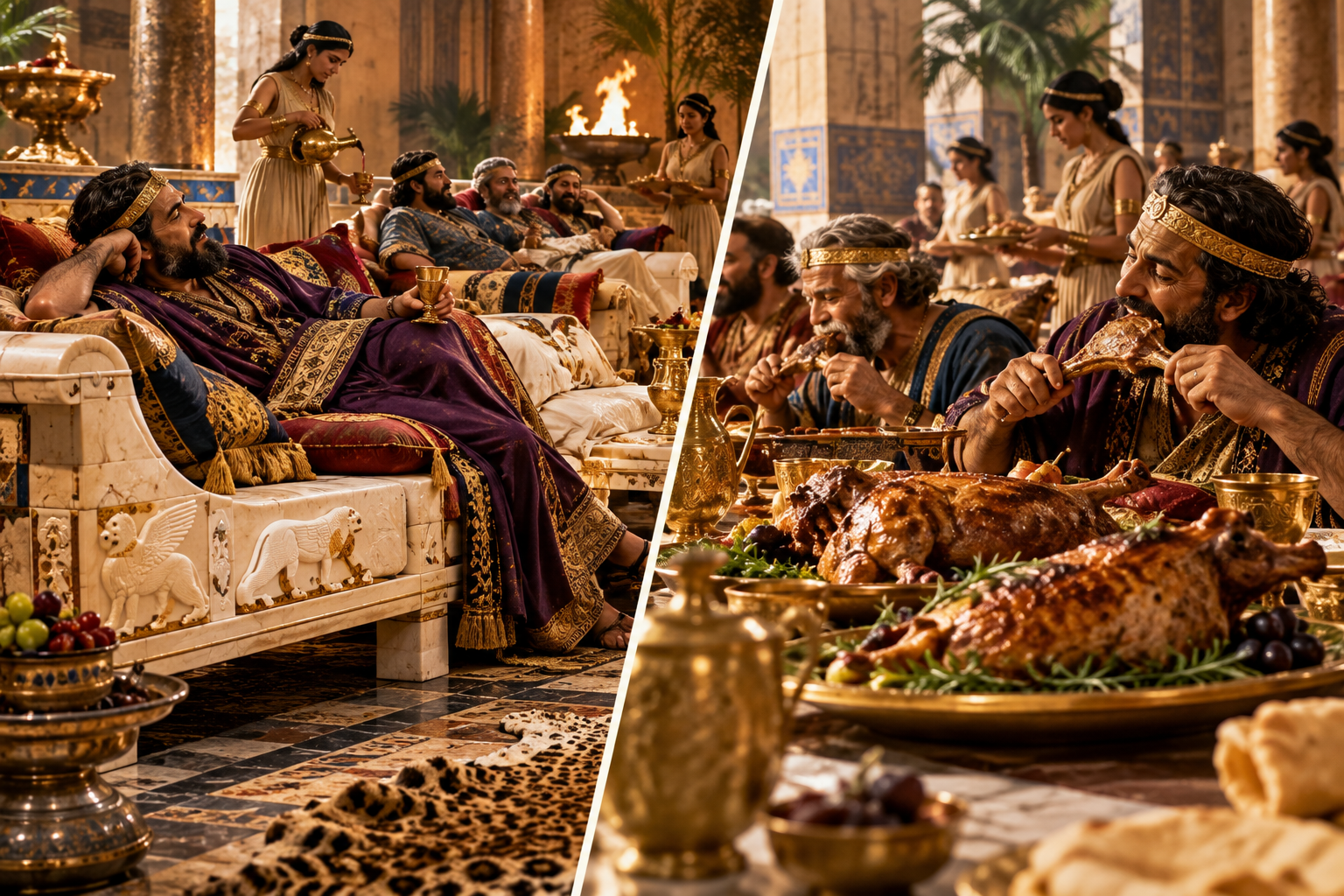
RECLINING COMFORTABLY ON
THE EDGE OF CALAMITY
Those - This describes those who were living in luxury while the nation was rushing toward calamity! It seems appropriate that we could put the "WOE" in front of each of the 6 or 7 luxuries in which they indulge. Thus "Woe to those who recline...sprawl...eat...improvise....drink...anoint."
Bob Utley - Amos 6:4-6 This describes the elaborate drunken banquets of the self-indulgent rich of the northern tribes (i.e. Joseph in line 3 of v. 6).
Who recline on beds of ivory - They thought they were "living the life" but in reality were "living the lie," lying in the lap of luxury, ignoring the imminent judgment Amos was declaring! Ivory was a costly luxury material in the ancient Near East, commonly used for decorative inlays and ornamentation and was a symbol of wealth, prestige, and social distinction. Amos had already referred to houses of ivory in his condemnation of Israel's luxury (Am 3:15). Archaeological excavations at Samaria have uncovered numerous carved ivory pieces (see example below), providing striking evidence of the luxurious decorative arts associated with the city's elite. All this luxury while the poor were being oppressed to pay the bill (so to speak) for the extravagance.
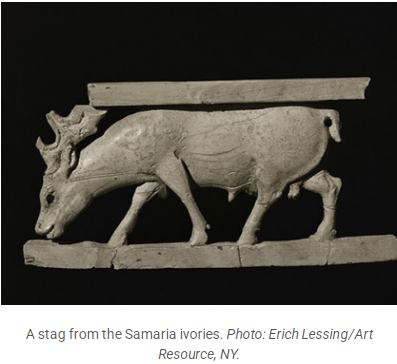
Samaritan Ivory
And sprawl on their couches - This gives a vivid picture of these rich folks stretching themselves out in luxurious ease. Even their posture communicates relaxation, indulgence, and a complete absence of urgency. Meanwhile, Amos was announcing approaching judgment so that the contrast could hardly be greater. In effect, their physical posture becomes a picture of their spiritual condition. They were at ease when they should have been alarmed. They were relaxed when they should have been repentant. They were comfortable when they should have been concerned. Their basic problem was not that they rested their bodies but that they had allowed the consciences to "fall asleep!"
Bob Utley "sprawl" The term (Qal PASSIVE PARTICIPLE) is used again in Amos 6:7. It has a negative connotation. It is parallel to "recline" (Qal PARTICIPLE), which may have been an unusual way to eat at this time in Palestine. If so, then both denote new, foreign, and non-traditional actions (i.e. pagan influence on Israeli leaders).
They were stretched out on their couches while
God's warnings were being stretched to the limit of their patience.
And eat lambs from the flock - Amos now moves from luxurious furniture to extravagant dining. The wealthy ate “lambs from the flock and calves from the midst of the stall” (Amos 6:4). Lamb was a prized meat, usually reserved for special meals and feasts. Ordinary Israelites ate meat only on rare occasions, such as festivals and sacrifices, but these leaders could pick the choicest animals whenever they wished. They enjoyed a standard of living far beyond that of their countrymen. Again, the problem was not eating meat. The problem was the self-indulgent lifestyle of leaders who were indifferent to the suffering around them. Amos had already condemned those who oppressed the poor and crushed the needy (Amos 4:1) and exposed those who turned justice into wormwood (Amos 5:7). Now he describes the same society’s wealthy feasting on the best while the poor went without. Jesus told of a similar man who “habitually lived in splendor every day” while the beggar Lazarus lay at his gate, longing for crumbs (Lk 16:19-21) and look what happened to him (Lk 16:22-31!
They had developed a taste for luxury
but had lost their appetite for righteousness.
And calves from the midst of the stall - This decription further emphasizes the quality of their food. The Hebrew word for stall (marbēq) refers to an enclosure where animals were penned and fattened (cp 1Sa 28:24; Mal 4:2). The calves “from the midst of the stall” were animals kept penned and fattened for slaughter, the most tender and costly meat available (beef tenderloin and filet mignon). The wealthy were not merely satisfying hunger but were indulging in the choicest foods as a regular habit, insulating themselves from the suffering around them. And their indulgence only served to reinforce their false sense of security.
A society is spiritually sick when the powerful feast without concern
while the vulnerable suffer without justice.
Their lives revolved around personal comfort and pleasure. Meanwhile, the nation’s spiritual condition was deteriorating: the poor were being exploited (Am 2:6,7; 5:11), justice was being corrupted (Am 5:7, 12), and God’s warnings were being ignored (Am 2:12). They were feeding their appetites while starving their souls. The psalmist describes a similar tragedy in Israel’s wilderness years: “He gave them their request; but sent leanness into their soul” (Ps 106:15KJV). Like the Pharisees Jesus later rebuked, they had “neglected the weightier provisions of the law: justice and mercy and faithfulness” (Mt 23:23).
The danger is not that we possess comforts,
but that our comforts begin to possess us!
🙏 THOUGHT: Has Comfort Made You Complacent? Amos describes wealthy Israelites lounging on ivory beds and feasting on the finest foods while remaining indifferent to God’s approaching judgment (Amos 6:4–6). There is nothing sinful about enjoying the blessings God provides, for He “richly supplies us with all things to enjoy” (1Ti 6:17). But blessings become dangerous when they dull our sensitivity to His Word and to the needs of others. The danger is not that we possess comforts, but that our comforts begin to possess us! Jesus warned that the riches and pleasures of life can choke the Word and prevent fruitfulness (Lk 8:14), and that where our treasure is, there our heart will be also (Mt 6:21). Are we more concerned about the comfort of our bodies than the condition of our souls and the souls of those around us? May God's Spirit enable us to set our minds on things above (Col 3:1,2) and be rich in good works, generous and ready to share (1Ti 6:18). It is better to have a humble heart sensitive to God’s voice than an ivory bed that insulates us from His warnings! (Ps 119:36,37; Jas 4:8-10)
Amos 6:5 Who improvise to the sound of the harp, And like David have composed songs for themselves,
KJV That chant to the sound of the viol, and invent to themselves instruments of musick, like David;
NET They sing to the tune of stringed instruments; like David they invent musical instruments.
NLT You sing trivial songs to the sound of the harp and fancy yourselves to be great musicians like David.
ESV who sing idle songs to the sound of the harp and like David invent for themselves instruments of music,
BGT οἱ ἐπικροτοῦντες πρὸς τὴν φωνὴν τῶν ὀργάνων ὡς ἑστῶτα ἐλογίσαντο καὶ οὐχ ὡς φεύγοντα
LXE who excel in the sound of musical instruments; they have regarded them as abiding, not as fleeting pleasures;
CSB They improvise songs to the sound of the harp and invent their own musical instruments like David.
NIV You strum away on your harps like David and improvise on musical instruments.
YLT Who are taking part according to the psaltery, Like David they invented for themselves instruments of music;
- to the (KJV): Ge 31:27 Job 21:11,12 Ec 2:8 Isa 5:12 1Pe 4:3 Rev 18:22
- like (KJV): Am 5:23 , 8:3 1Ch 23:5
Related Passages:
Isaiah 5:12 Their banquets are accompanied by lyre and harp, by tambourine and flute, and by wine; But they do not pay attention to the deeds of the LORD, Nor do they consider the work of His hands.
Amos 5:23 “Take away from Me the noise of your songs; I will not even listen to the sound of your harps.
Amos 8:3 “The songs of the palace will turn to wailing in that day,” declares the Lord GOD. “Many will be the corpses; in every place they will cast them forth in silence.”
Amos 8:10 “Then I will turn your festivals into mourning And all your songs into lamentation; And I will bring sackcloth on everyone’s loins And baldness on every head. And I will make it like a time of mourning for an only son, And the end of it will be like a bitter day.
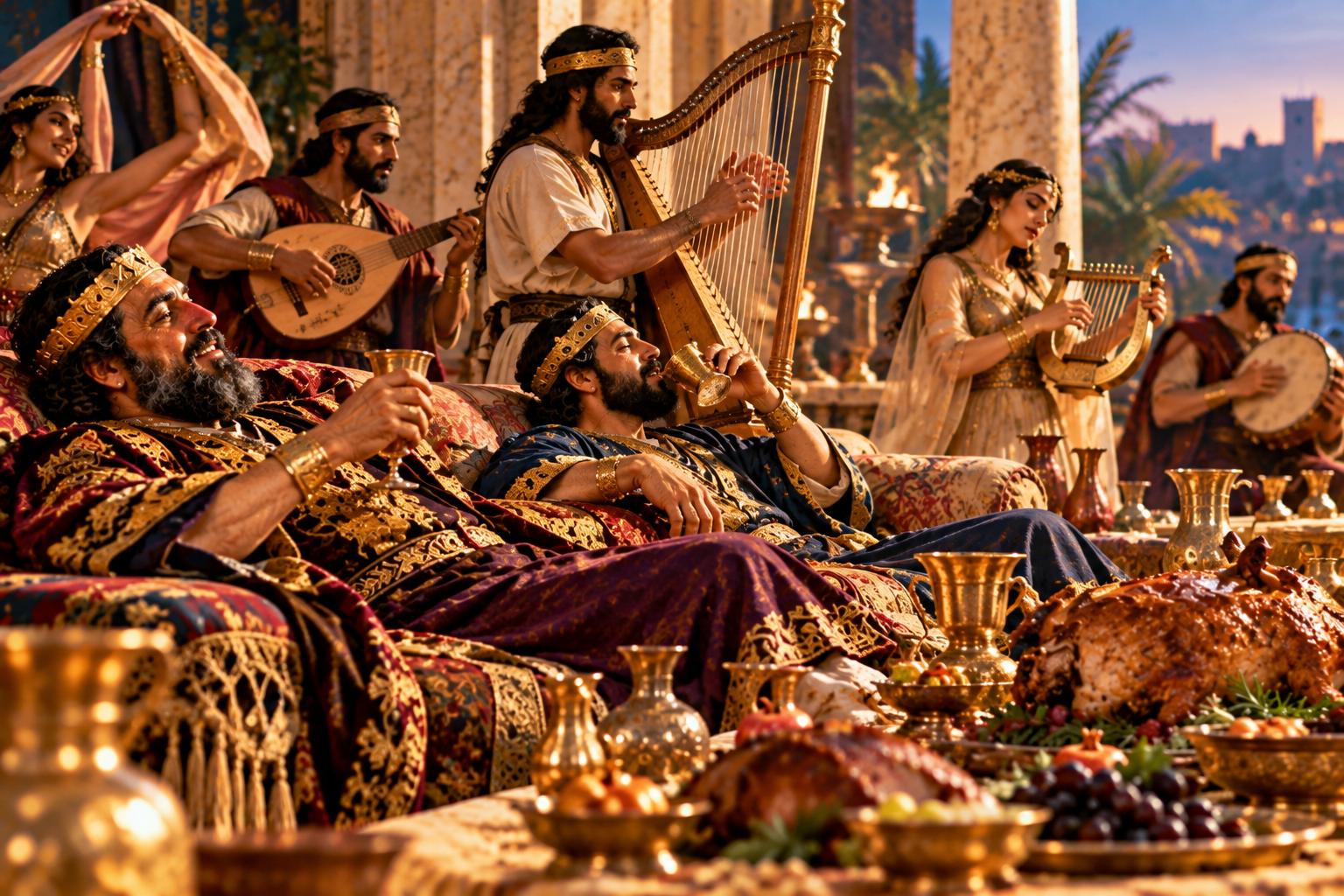
WHEN MUSIC DROWNS
OUT GOD'S VOICE!
Who improvise to the sound of the harp - NET = "They sing to the tune of stringed instruments." NIV = "You strum away on your harps." Improvise (parat) is used only here and precise meaning is unclear, but it seems to mean something like chant, improvise in singing, strum or pluck. In this context it appears to describe producing, improvising, or singing music to the accompaniment of a stringed instrument. Some translations emphasize idle singing or making up songs. They were entertaining themselves when they should have been examining themselves! They had ears for the music of men, but not for the message of God.
They were listening to the harp
while refusing to listen to the prophet.
Baker on improvise - It refers to composing on the spot and possibly to performing at the same time in a rather vain, self-centered way according to context. Or "It means to strike the strings of a stringed instrument slowly and lightly." (Amos 6:5). (Complete Word Study Dictionary – Old Testament)
Bob Utley - "Who improvise" The VERB "improvise" (Qal PARTICIPLE) is uncertain in meaning. It appears only here in the OT. In later Hebrew it means "break off" or "divide" (e.g. fruit that drops off the tree or bush). The translation "compose" or "improvise" comes from the Arabic root. JPSOA suggests "they hum snatches of song." It is just possible in this context that these revelers are desecrating (1) David's melodies, poems used in temple worship or (2) the instruments used in the temple (LXX)
And like David have composed songs for themselves - NET = "like David they invent musical instruments." NLT = "fancy yourselves to be great musicians like David." The Hebrew can refer either to composing songs or to devising instruments for music, so translations differ. Either way, the wealthy Israelites apparently saw themselves as accomplished musicians, comparable in some respect to David. But the comparison carries a touch of irony. They had musical ability, they composed songs, and they enjoyed instrumental accompaniment. Yet their music was part of a lifestyle that lacked David’s characteristic devotion to the LORD.
TECHNICAL NOTE - NET NOTE - "like David they invent musical instruments." -- The meaning of the Hebrew phrase חָשְׁבוּ לָהֶם (khashvu lahem) is uncertain. Various options include: (1) “they think their musical instruments are like David’s”; (2) “they consider themselves musicians like David”; (3) “they esteem musical instruments highly like David”; (4) “they improvise [new songs] for themselves [on] instruments like David”; and (5) “they invent musical instruments like David.” However, the most commonly accepted interpretation is that given in the translation (see S. M. Paul, Amos [Hermeneia], 206-7).
The key may be the phrase “for themselves” (lāhem). David made instruments and organized musicians “for giving praise” to the LORD (1 Chr 23:5; cf. 2 Chr 7:6; Neh 12:36), but these men made music for their own entertainment. David’s songs drew hearts toward God, while theirs merely accompanied their banquets. We should not assume that every composition by these individuals was secular, or that the verse condemns music itself. The criticism arises from the surrounding description of self-indulgence and indifference (Am 6:4–6). Their music, like their beds, their meals, and their wine, served themselves rather than the LORD. And their music would soon stop when judgment came: “I will turn your festivals into mourning And all your songs into lamentation” (Am 8:10). The same thing happened to Belshazzar, whose banquet of wine and praise ended with the handwriting on the wall: “‘MENE’—God has numbered your kingdom and put an end to it. ‘TEKEL’—you have been weighed on the scales and found deficient” (Da 5:26,27).
The Belshazzar parallel is closer than it might first appear. He too feasted while judgment was at the door, drinking wine from vessels taken from the house of God and praising gods of gold and silver (Da 5:2–4). The men of Amos 6:6 drank wine from mizrāq, a word normally used of the sacrificial bowls of the tabernacle and temple (Ex 27:3, 38:3, Nu 4:14, 7:13). In both cases, what belonged to God was put to the service of self-indulgence.
What a warning for our
entertainment-saturated generation!
🙏 THOUGHT: Is Entertainment Drowning Out God’s Voice? Amos describes wealthy Israelites so absorbed in their music and entertainment that they were indifferent to their nation’s spiritual condition and God’s approaching judgment (Amos 6:5–6). What a warning for our entertainment-saturated generation! Music and recreation are gifts that can refresh us, but they become dangerous when they distract us from God’s Word and the responsibilities He has entrusted to us. The problem is not that we enjoy entertainment, but that it can gradually become more important to us than communion with God. Jesus warned that the pleasures of life can choke the Word (Luke 8:14), and Paul urges us to make the most of our time, because the days are evil (Ephesians 5:15–16). Consider how much time you spend on music, entertainment, and recreation compared with prayer, Scripture, and serving others. Are these activities refreshing your devotion to Christ, or slowly replacing it? David’s music expressed his love for God (Psalm 63:3–4), and we too are called to sing and make melody in our hearts to the Lord (Ephesians 5:19). May our enjoyment of God’s gifts never diminish our love for the Giver! (Colossians 3:16,17; Psalm 119:36,37) (See also Contemporary Worship: Civil War in the Church by John MacArthur)
Amos 6:6 Who drink wine from sacrificial bowls While they anoint themselves with the finest of oils, Yet they have not grieved over the ruin of Joseph.
KJV That drink wine in bowls, and anoint themselves with the chief ointments: but they are not grieved for the affliction of Joseph.
NET They drink wine from sacrificial bowls, and pour the very best oils on themselves. Yet they are not concerned over the ruin of Joseph.
NLT You drink wine by the bowlful and perfume yourselves with fragrant lotions. You care nothing about the ruin of your nation.
ESV who drink wine in bowls and anoint themselves with the finest oils, but are not grieved over the ruin of Joseph!
BGT οἱ πίνοντες τὸν διυλισμένον οἶνον καὶ τὰ πρῶτα μύρα χριόμενοι καὶ οὐκ ἔπασχον οὐδὲν ἐπὶ τῇ συντριβῇ Ιωσηφ
LXE who drink strained wine, and anoint themselves with the best ointment; and have suffered nothing on occasion of the calamity of Joseph.
CSB They drink wine by the bowlful and anoint themselves with the finest oils but do not grieve over the ruin of Joseph.
NIV You drink wine by the bowlful and use the finest lotions, but you do not grieve over the ruin of Joseph.
- drink (KJV): This probably refers to the costliness and magnificence of the drinking vessels, as well as xto the quantity drank.
- wine in bowls (KJV): or, in bowls of wine, Ho 3:1 1Ti 5:23
- chief (KJV): Mt 26:7-9 Joh 12:3
- but (KJV): Ge 37:25-28 42:21,22 49:22 Es 3:15 Ro 12:15 1Co 12:26
- affliction (KJV): or, breach, 2Ki 15:29 17:3-6 Jer 30:7
Related Passages:
Psalm 23:5 You prepare a table before me in the presence of my enemies; You have anointed my head with oil; My cup overflows.
Psalm 104:15 And wine which makes man’s heart glad, So that he may make his face glisten with oil, And food which sustains man’s heart.
Matthew 6:17 “But you, when you fast, anoint your head and wash your face
Amos 5:6 “Seek the LORD that you may live, Or He will break forth like a fire, O house of Joseph, And it will consume with none to quench it for Bethel....15 Hate evil, love good, And establish justice in the gate! Perhaps the LORD God of hosts May be gracious to the remnant of Joseph.
LUXURY WITHOUT
LAMENTATION
Who drink wine from sacrificial bowls - Bowls (mizraq) is used elsewhere for vessels associated with sacrificial worship (Ex 27:3; Ex 38:3, Nu 7:13; 1Ki 7:40, 50; 2Ki 12:13). These were not ordinary drinking cups, but bowls or basins, sometimes used in the sacrificial system. Some interpreters suggest the reference as implying that sacred vessels were being used for profane purposes. This is possible, but the verse does not explicitly state that the bowls had been taken from a sanctuary (compare Belshazzar profaning the temple vessels in Da 5:2-4). The other interpretation is that they were drinking wine out of bowls not goblets, indicating excessive consumption. The bowls were the same type as those used to catch the blood of a sacrificial victim and sprinkle it in worship services (Nu 7:13) Amos and Belshazzar both describe privileged leaders indulging in luxurious drinking while remaining dangerously unaware of approaching judgment.
John Walton on wine by bowls - The term used for bowl here is one that is usually associated with cultic activity (see Ex 24:6–8; Num 7:13). That suggests that Amos is accusing them not only of drinking to excess in large bowls but perhaps also of profaning sacred objects. Note that archaeologists have found a number of golden drinking bowls in tombs at Nimrud dating to the late Assyrian period, some of which have the names of Assyrian queens engraved on their sides.
NET NOTE - sacrificial bowls - Perhaps some religious rite is in view, or the size of the bowls is emphasized (i.e., bowls as large as sacrificial bowls).
Bob Utley on the drinking from bowls - This is not so much an expression of the sacrilegious use (cf. Dan. 5:2) of sacred utensils (cf. Ex 24:6-8; Nu 7:13) as it is an expression of their drunkenness ("bowls, not cups"; TEV, NJB, REB, "you drink wine by the bowlful").
While they anoint (masah/maschah; LXX - chrio) themselves with the finest (rēʾšît) of oils - Anoint (masah/maschah) is same verb Exodus uses for anointing the tabernacle and the priests (Ex 30:26, 30) but this holy anointing oil was forbidden for personal use (Ex 30:32). However Amos never says the rich Israelites used the sacred oil for self-indulgence. Still it is intriguing that another word associated with worship (mizraq - bowls) is used in the same verse to describe what the rich were using for self-indulgence.
Anointing the body with oil was a common practice in the ancient Near East. Oil could refresh the skin, provide a pleasant fragrance, and express joy or celebration. It was also associated with hospitality and personal grooming. Jesus Himself referred to anointing the head as an ordinary practice of personal care (Mt 6:17) so Amos is not condemning the use of oil itself. What he is condemning is the extravagance and self-indulgence of wealthy individuals who devoted considerable attention to their personal comfort while neglecting the spiritual condition of their nation. They carefully attended to their outward appearance while remaining indifferent to their inward condition.
KJV Bible Commentary - Those who have given prominence to their own self-interest will be given prominence in punishment. They have led the way in debauchery; now they will lead the way into captivity, taking the prominence in shame.
The picture is one of materialism and
prosperity gone awry, resulting in spiritual apathy
-- KJV Bible Commentary (online)
John Walton - fine lotions. Banqueters in the ancient world were often treated by a generous host to fine oils that would be used to anoint their foreheads. This provided a glistening sheen to their countenance and also would have added a fragrance to their persons and the room. For example, an Assyrian text from Esarhaddon’s reign describes how he “drenched the foreheads” of his guests at a royal banquet with “choicest oils.” Since Amos may be condemning the people for misusing cultic vessels in this verse, he may also be taking them to task for using the oils that would otherwise have been used as part of cultic practice (see Ex 30:31–32).
Bob Utley "they anoint themselves with the finest of oils" Putting oil on one's face and arms was a sign of gladness. Their actions are in contrast to the next line of poetry. They should have been grieving over the ruin of their nation. The VERB has a wide semantical field but is not used elsewhere in the OT for festival anointing. In this context, it may take on another example of inappropriate use of a ceremonial practice (i.e. covenant violation).
Finest of oils (rēʾšît šĕmānîm) is literally “the first (the highest) of oils” which emphasizes the choicest, highest-quality oils. These were not ordinary or inexpensive products but luxurious preparations associated with wealth and refinement. In the ancient world, perfumed oils were used to refresh the skin, scent the body, and mark festive occasions. The wealthy Israelites could afford the best. Their bodies were refreshed, their senses were gratified, and their lives were surrounded by comfort. But their spiritual sensitivity had deteriorated.
The irony is sharp. In Israel, people stopped anointing themselves during times of mourning (2Sa 14:2). When Daniel grieved and sought the LORD for three weeks, he “did not use any ointment at all” (Da 10:2,3). Israel’s leaders should have been mourning over the nation’s sin and coming ruin. Instead, they were pampering themselves with the finest oils. Notice, too, the wordplay noted earlier. The “foremost” (rēʾšît) of nations (Amos 6:1) used the “finest” (rēʾšît) of oils, and they would go into exile at the “head” (rōʾš) of the exiles (Amos 6:7).
Yet (term of contrast) The word yet signals a sharp contrast with their luxury.
They have not grieved (LXX - pascho - suffer) over the ruin (seber = destruction, brokenness, injury, ruin, fracture) of Joseph - NLT = "You care nothing about the ruin of your nation." Grieved (ḥālâ) can mean to become weak, sick, or afflicted and in this context expresses deep distress or anguish, something far more intense than noticing a problem or feeling mild disappointment. Literally, these leaders were not “made sick” over the nation’s imminent destruction.
Ruin (seber = destruction, brokenness, injury, ruin, fracture) conveys the image of something being shattered. The nation was experiencing profound moral and spiritual deterioration. The tragedy is that Joseph was being broken, but the hearts of Israel's leaders were not. The nation was falling apart, but its leaders were too comfortable to care.
Joseph refers to the northern kingdom, whose leading tribes, Ephraim and Manasseh, descended from Joseph (cf Am 5:6,15). The word “ruin” (šeber) means a break or fracture. The nation was cracking apart morally and spiritually, and its leaders felt nothing. There is an interesting parallel with Joseph's brothers sat down to eat after throwing him into a pit (Ge 37:24–25). In short, the brothers of Joseph sat down to eat while he suffered in a pit and the leaders of Israel sat down to feast while the nation of Joseph suffered spiritual ruin.
Bob Utley "the ruin of Joseph" Joseph married an Egyptian. They had two children who were adopted by Jacob (Israel, cf. Gen. 48:8-22). Although the Messianic line came through Judah, Joseph received the "double inheritance" of the oldest child. Joseph's two sons became the two largest tribes, Ephraim and Manasseh. They were part of the ten northern tribes who broke away from Solomon's son, Rehoboam, in 922 B.C. and started a new state under Jeroboam I. This new state was known by several titles: Israel (Jacob's new name), Samaria (capital) and Ephraim (largest tribe)
NET NOTE - The ruin of Joseph may refer to the societal disintegration in Israel, or to the effects of the impending judgment.
These leaders should have been deeply troubled by the injustice around them, distressed by the nation’s idolatry, concerned about the suffering of the poor, and alarmed by the prophetic warnings of Amos. Instead, they carried on with their luxurious lifestyles. They “have not grieved over the ruin of Joseph” (Am 6:6). Their consciences had become calloused (cf. Eph 4:19). They were guilty not only of sins of indulgence but also of a serious sin of omission, for they failed to respond as they should to the suffering and spiritual decay around them (Jas 4:17). How different from Nehemiah, who wept and mourned when he heard of Jerusalem’s ruin (Neh 1:3, 4), or from the faithful remnant in Ezekiel’s day “who sigh and groan over all the abominations” committed in the city (Ezek 9:4). It is possible to become so comfortable with sin that we no longer recognize how far we have drifted from God (Heb 3:13). A hardened heart is not always marked by open rebellion; sometimes it is revealed by the absence of concern.
Contrast Nehemiah, who “sat down and wept and mourned for days” when he heard of Jerusalem’s broken walls (Neh 1:3–4), or those in Ezekiel’s day whom God marked because they “sigh and groan over all the abominations” in the city (Ezek 9:4). Above all, contrast our Lord, who wept over Jerusalem as He approached it (Lk 19:41). Their greatest spiritual problem was not merely what they were enjoying, but what they were no longer capable of grieving over. One of the clearest signs of spiritual decline is the loss of sorrow over the things that grieve the heart of God (Ge 6:6; Eph 4:30)! America, are you listening?
When did you last grieve over a wandering believer,
a lost friend, or a family member indifferent to Christ?
🙏 THOUGHT: Does What Grieves God’s Heart Grieve Yours? What a searching indictment Amos brings against Israel’s wealthy leaders! They enjoyed the finest wines, luxurious comforts, and expensive oils, “yet they have not grieved over the ruin of Joseph” (Amos 6:6). Their greatest problem was not their prosperity but their indifference. They were so busy enjoying their blessings that they had lost their burden for people. How easily we can become absorbed in our own comforts, schedules, and pleasures while remaining unmoved by the spiritual needs around us. Are we troubled when God’s Word is disregarded (2Ti 4:3,4)? Are we concerned about believers drifting from the faith (Gal 6:1,2)? Do we notice the suffering of the poor and vulnerable (Jas 1:27)? Or are we more concerned about our personal comforts (why don’t they put pads on the sanctuary seats?) than the spiritual needs of others? Nehemiah responded to Jerusalem’s broken condition with tears, fasting, and prayer (Neh 1:3, 4). Paul spoke of his “great sorrow and unceasing grief” for his fellow Israelites (Ro 9:1–3), and he warned with tears about those who live as enemies of the cross (Phil 3:18). Our Lord Jesus wept over Jerusalem as He contemplated its coming judgment (Luke 19:41–44). When was the last time someone’s spiritual condition moved you to earnest prayer? When did you last grieve over a wandering believer, a lost friend, or a family member indifferent to Christ? Scripture calls us to weep with those who weep (Romans 12:15), bear one another’s burdens (Galatians 6:2), and pray for those who are struggling (Jas 5:16, 19,20). Spiritual maturity is not measured merely by what we know about God, but by how deeply we care about what concerns Him. Better to have a heart broken over the things that grieve God than a life overflowing with pleasures that leave us unmoved by the needs of others! (Psalm 126:5–6; Matthew 9:36–38)
Anoint (04886) masah/maschah is a verb which basically means to smear something on, to rub with oil, to anoint (as in setting one apart for office or function - Elisha as prophet = 1Ki 19:16, kings for office = 1Sa 9:16 = Saul,1Sa 16:12 = David, 1Ki 1:39 = Solomon) and by implication to sanctify (set aside for sacred purpose) or consecrate (dedicate for a sacred purpose) (altar = Nu 7:10; vessels for worship - Ex 29:36 = "you shall anoint it to consecrate it;" Ex 30:26, 40:9-10). In the first OT use, Jacob "anointed a pillar" and made a vow to God (Ge 31:13; Lxx = aleipho = to anoint by applying a liquid - Jesus' feet were anointed with perfume - Lk 7:38, 46).
Victor Hamilton notes that "There is a fourfold theological significance of mashach. First, to anoint an individual or an object indicated an authorized separation for God’s service. Moses anointed Aaron “to sanctify him” (Lev 8:12;cf. Ex 29:36 for the altar). Note the expression “anointed to the Lord” (1Chr 29:22). Masah, while representing a position of honor, also represents increased responsibility. Both Saul and David are called to account for their sin with the reminder. “I (the Lord) anointed (mashach) you king” (1Sa 15:17; 2Sa 12:7). Secondly, though the agent might be the priest or prophet, writers speak of anointed ones as those whom the Lord anointed (e.g. 1Sa 10:1; 2Sa 12:7). Such language underscores that it is God who is the authorizing agent; that the anointed is inviolable (1Sa 24:8ff.); and that the anointed one is to be held in special regard (cf. 1Sa 26:9ff.). Thirdly, one may infer that divine enablement was understood as accompanying mashach. Of both Saul and David it is said in connection with their anointing that “the Spirit of God came mightily upon him” (1Sa 10:6ff; 1Sa 16:13ff.)." Finally, mashach was associated with the coming promised Deliverer, Jesus (cf. Isa 61:1). (TWOT)
MASCHAH - 67V - anoint(21), anointed(42), anointing(1), oil(1), painting(1), spread(4).Gen. 31:13; Exod. 28:41; Exod. 29:2; Exod. 29:7; Exod. 29:29; Exod. 29:36; Exod. 30:26; Exod. 30:30; Exod. 40:9; Exod. 40:10; Exod. 40:11; Exod. 40:13; Exod. 40:15; Lev. 2:4; Lev. 6:20; Lev. 7:12; Lev. 7:36; Lev. 8:10; Lev. 8:11; Lev. 8:12; Lev. 16:32; Num. 3:3; Num. 6:15; Num. 7:1; Num. 7:10; Num. 7:84; Num. 7:88; Num. 35:25; Jdg. 9:8; Jdg. 9:15; 1 Sam. 9:16; 1 Sam. 10:1; 1 Sam. 15:1; 1 Sam. 15:17; 1 Sam. 16:3; 1 Sam. 16:12; 1 Sam. 16:13; 2 Sam. 2:4; 2 Sam. 2:7; 2 Sam. 3:39; 2 Sam. 5:3; 2 Sam. 5:17; 2 Sam. 12:7; 2 Sam. 19:10; 1 Ki. 1:34; 1 Ki. 1:39; 1 Ki. 1:45; 1 Ki. 5:1; 1 Ki. 19:15; 1 Ki. 19:16; 2 Ki. 9:3; 2 Ki. 9:6; 2 Ki. 9:12; 2 Ki. 11:12; 2 Ki. 23:30; 1 Chr. 11:3; 1 Chr. 14:8; 1 Chr. 29:22; 2 Chr. 22:7; 2 Chr. 23:11; Ps. 45:7; Ps. 89:20; Isa. 21:5; Isa. 61:1; Jer. 22:14; Dan. 9:24; Amos 6:6
Warren Wiersbe has some sobering comments on the indulgent lifestyle of the complacent rich - When nations get pleasure-mad, it’s a sign that the end is near. Belshazzar and his leaders were enjoying a sumptuous feast when the city of Babylon fell to the Medes and Persians (Da 5). The Roman citizens enjoyed free “bread and circuses” as the empire decayed morally and politically and eventually fell to the enemy. One of the marks of the end days is the fact that people become “lovers of pleasures more than lovers of God” (2Ti 3:4). No wonder Jesus warned His followers, “But take heed to yourselves, lest your hearts be weighed down with carousing, drunkenness, and cares of this life, and that Day come on you unexpectedly” (Luke 21:34NKJV).
When nations get pleasure-mad,
t’s a sign that the end is near.
It’s difficult today to find people who are truly burdened about the sins of the nations and the sins of the church. Too many are like the rulers of Samaria or the members of the church of Laodicea, closing their eyes to reality and living on fantasy based on false theology. How many believers can honestly say, “Indignation has taken hold of me because of the wicked, who forsake Your law”? (Ps. 119:53 NKJV) Or, “Rivers of water run down from my eyes, because men do not keep Your law”? (v. 136 NKJV) Too many Christians are laughing when they should be weeping (James 4:8–10) and tolerating sin when they should be opposing it (1 Cor. 5:2).
Dr. Vance Havner told of having dinner in a dining room that was dimly lighted. At first, he could scarcely read the menu, but then he found he could see fairly well. He said to his friends, “Isn’t it strange how easy it is to become accustomed to the dark?” That’s one of the problems in the church today: we’ve gotten accustomed to the darkness, and our lights aren’t shining bright enough. (Bible Exposition Commentary)
"Isn’t it strange how easy it is
to become accustomed to the dark?"
Amos 6:7 Therefore, they will now go into exile at the head of the exiles, And the sprawlers’ banqueting will pass away.
KJV Therefore now shall they go captive with the first that go captive, and the banquet of them that stretched themselves shall be removed.
NET Therefore they will now be the first to go into exile, and the religious banquets where they sprawl on couches will end.
NLT Therefore, you will be the first to be led away as captives. Suddenly, all your parties will end.
ESV Therefore they shall now be the first of those who go into exile, and the revelry of those who stretch themselves out shall pass away."
BGT διὰ τοῦτο νῦν αἰχμάλωτοι ἔσονται ἀπ᾽ ἀρχῆς δυναστῶν καὶ ἐξαρθήσεται χρεμετισμὸς ἵππων ἐξ Εφραιμ
LXE Therefore now shall they depart into captivity from the dominion of princes, and the neighing of horses shall be cut off from Ephraim.
CSB Therefore, they will now go into exile as the first of the captives, and the feasting of those who sprawl out will come to an end.
NIV Therefore you will be among the first to go into exile; your feasting and lounging will end.
- shall they (KJV): Am 5:5,27 7:11 De 28:41 Lu 21:24
- and the (KJV): 1Ki 20:16-20 Es 5:8,12-14 7:1,2,8-10 Isa 21:4 Da 5:4-6 Na 1:10
Related Passages:
Leviticus 26:33 ‘You, however, I will scatter among the nations and will draw out a sword after you, as your land becomes desolate and your cities become waste.
Deuteronomy 28:36,64 “The LORD will bring you and your king, whom you set over you, to a nation which neither you nor your fathers have known, and there you shall serve other gods, wood and stone. 64 “Moreover, the LORD will scatter you among all peoples, from one end of the earth to the other end of the earth; and there you shall serve other gods, wood and stone, which you or your fathers have not known.
THE FIRST IN LUXURY SHALL BE
THE FIRST INTO EXILE
One could subtitle this verse "The Party's Over!" Or "First come, first served!"
Therefore The word therefore (lākēn) introduces the verdict or consequence of everything Amos has described in the indictment in Amos 6:1-6. Every luxury Amos has just described, the ivory beds, the choice lambs and stall-fed calves, the music, the wine by the bowlful, and the finest oils, now comes under the sentence of God. In short, the only cure for the cancer that has progressively eaten away Israel’s heart was radical surgery by the Great Physician!
Whenever God says “therefore” in judgment,
we should examine what preceded it.
They will now go into exile (galah) at the head of the exiles - Who is they? In context this is the rich. Exile (galah) mean to uncover, remove, or carry away into captivity and in this context describes forced deportation from one's homeland. Exile was among the most severe covenant judgments threatened against Israel for persistent disobedience (Lev 26:33; Dt 28:36, 64). It involved much more than relocation for it meant separation from homes, possessions, familiar surroundings, and the land associated with God's covenant promises. The wealthy Israelites who had enjoyed every imaginable comfort would now face the hardship and humiliation of captivity. The comforts they trusted could not accompany them into captivity or protect them from God's judgment.
Those who have had prominence in ease
will have prominence in punishment.
-- KJV Bible Commentary (online)
Bob Utley - This refers to YHWH's judgment on these who cared only for themselves, but claimed to know God (i.e. the northern kingdom)! Their judgment is the exact reversal of their lifestyles! First in extravagance and revelry; first in exile!
Notice the striking reversal between Amos 6:3 and Amos 6:7. In Amos 6:3, the leaders “put off the day of calamity,” imagining that judgment was far away. In Amos 6:7, God declares that they will “now” (ʿattâ) go into exile. They refused to acknowledge the danger, and God announced the consequences. What they considered distant, God declared imminent. The day they pushed out of their minds was the very day toward which their sins were carrying them. Ezekiel’s generation made the same mistake, and God answered them: “Therefore say to them, ‘Thus says the Lord GOD, “None of My words will be delayed any longer. Whatever word I speak will be performed,”’ declares the Lord GOD” (Ezekiel 12:28). Men may postpone judgment in their thinking, but they cannot postpone it in reality.
Note the wordplays -- The leaders who were “foremost” (rēʾšît) among the nations (6:1) and anointed themselves with the “finest” (rēʾšît) oils (6:6) would now go into exile “at the head” (rōʾš) of the exiles. They had always insisted on being first, and they would be first again, this time first in the line of captives. History confirmed the word. Tiglath-pileser III carried off captives from the northern territories in 733 B.C. (2Ki 15:29) and in 722 B.C. “the king of Assyria captured Samaria and carried Israel away into exile to Assyria” (2Ki 17:6).
They had been first in luxury,
but they would also be first in captivity!
And the sprawlers’ banqueting will pass away - NIV = "your feasting and lounging will end." The rich would soon exchange their plush couches for cold chains! The second half of the verse contains a vivid word study. Banqueting (marzēaḥ) is a term known from Ugaritic and Phoenician texts for an exclusive association feast, often marked by heavy drinking, which at times was connected with pagan religious or funeral rites. The only other Old Testament occurrence is Jeremiah 16:5, where it is translated “house of mourning.” Sprawlers (sĕrûḥîm) comes from the same verb used in Amos 6:4, where they “sprawl on their couches.” Pass away (sur) means “to turn aside” or “depart.” The banquet hall would empty, and the party would "pass away" and never resume. The party was coming to an end, whether the guests were ready or not!
Bob Utley - banqueting This term is found only twice in the OT (here and Jer. 16:5). The Jeremiah text (and one Ugaritic text) links this term with a self-indulgent pagan feast for the dead! If so, the sarcasm of Amos' statement is obvious. It is another example of Israel abusing YHWH's law by adopting pagan rites or flaunting Mosaic regulations.
John Walton - feasting. The word translated “feasting” here is a technical term for a funeral meal (more like a festal memorial meal; thus the use of vessels and oils usually connected with cultic rites). The term occurs only here and Jeremiah 16:5, although it is well known in many other Semitic traditions. Extrabiblical references to the funeral meal have been found in Ugaritic texts, in Aramaic texts from Elephantine (Egypt) and in inscriptions in Punic, Nabatean and Palmyrene. All of the elements listed in these verses are connected with these feasts: meat and wine, music, anointing and lounging.
NET NOTE - Religious banquets. This refers to the מַרְזֵחַ (marzeakh), a type of pagan religious banquet popular among the upper class of Israel at this time and apparently associated with mourning. See P. King, Amos, Hosea, Micah, 137–61; J. L. McLaughlin, The “Marzeah” in the Prophetic Literature (VTSup). Scholars debate whether at this banquet the dead were simply remembered or actually venerated in a formal, cultic sense.
Isaiah, Amos’s younger contemporary, pronounced the same verdict on Judah’s revelers:
“Their banquets are accompanied by lyre and harp, by tambourine and flute, and by wine; but they do not pay attention to the deeds of the LORD, nor do they consider the work of His hands. Therefore My people go into exile for their lack of knowledge; and their honorable men are famished, and their multitude is parched with thirst” (Isaiah 5:12,13).
Jesus told of a rich man who reasoned the same way:
“And I will say to my soul, ‘Soul, you have many goods laid up for many years to come; take your ease, eat, drink and be merry.’ But God said to him, ‘You fool! This very night your soul is required of you; and now who will own what you have prepared?’” (Luke 12:19,20).
Belshazzar’s feast, in Daniel 5, ended the same way:
“That same night Belshazzar the Chaldean king was slain” (Daniel 5:30).
Paul warns that the final judgment will come in the same manner:
“While they are saying, ‘Peace and safety!’ then destruction will come upon them suddenly like labor pains upon a woman with child, and they will not escape” (1 Thessalonians 5:3).
The party that ignores God’s warnings always ends at His appointed time, and usually sooner than the revelers expect.
Beloved, are we investing more energy in preserving
our earthly comforts than in cultivating eternal treasures?
🙏 THOUGHT: Don’t Let Prosperity Put Your Soul to Sleep! What a sobering reversal Amos announces! The wealthy leaders of Israel who had enjoyed the finest comforts would now be the first to go into exile, and their luxurious banquets would come to an abrupt end (Amos 6:7). They had mistaken prosperity for security and had become so absorbed in their pleasures that they no longer grieved over the spiritual ruin of their nation (Amos 6:4–6). What a warning for us! The danger of prosperity is not merely that we may possess too much, but that we may come to depend on what we possess rather than on the God who provides it. Jesus warned, “Beware, and be on your guard against every form of greed; for not even when one has an abundance does his life consist of his possessions” (Luke 12:15), and Paul reminds us that “the form of this world is passing away” (1 Corinthians 7:31). Beloved, are we investing more energy in preserving our earthly comforts than in cultivating eternal treasures? Are we more concerned about maintaining our lifestyle than our fellowship with Christ? Paul tells Timothy, “Instruct those who are rich in this present world not to be conceited or to fix their hope on the uncertainty of riches, but on God, Who richly supplies us with all things to enjoy” (1 Timothy 6:17), and to be “rich in good works....generous and ready to share” (1Ti 6:18,19). May we enjoy God’s blessings with gratitude while refusing to make them the foundation of our security. The safest place for our hearts is not in the abundance of our possessions, but in the unchanging faithfulness of our heavenly Father, Who has said, “I will never desert you, nor will I ever forsake you” (Heb 13:5; cp Mt 6:19–21, 33).
Amos 6:8 The Lord GOD has sworn by Himself, the LORD God of hosts has declared: “I loathe the arrogance of Jacob, And detest his citadels; Therefore I will deliver up the city and all it contains.”
KJV The Lord GOD hath sworn by himself, saith the LORD the God of hosts, I abhor the excellency of Jacob, and hate his palaces: therefore will I deliver up the city with all that is therein.
NET The sovereign LORD confirms this oath by his very own life. The LORD, the God who commands armies, is speaking: "I despise Jacob's arrogance; I hate their fortresses. I will hand over to their enemies the city of Samaria and everything in it."
NLT The Sovereign LORD has sworn by his own name, and this is what he, the LORD God of Heaven's Armies, says: "I despise the arrogance of Israel, and I hate their fortresses. I will give this city and everything in it to their enemies." (
ESV The Lord GOD has sworn by himself, declares the LORD, the God of hosts: "I abhor the pride of Jacob and hate his strongholds, and I will deliver up the city and all that is in it."
BGT ὅτι ὤμοσεν κύριος καθ᾽ ἑαυτοῦ διότι βδελύσσομαι ἐγὼ πᾶσαν τὴν ὕβριν Ιακωβ καὶ τὰς χώρας αὐτοῦ μεμίσηκα καὶ ἐξαρῶ πόλιν σὺν πᾶσιν τοῖς κατοικοῦσιν αὐτήν
LXE For the Lord has sworn by himself, saying, Because I abhor all the pride of Jacob, I do also hate his countries, and I will cut off his city with all who inhabit it.
CSB The Lord GOD has sworn by Himself-- this is the declaration of Yahweh, the God of Hosts: I loathe Jacob's pride and hate his citadels, so I will hand over the city and everything in it.
NIV The Sovereign LORD has sworn by himself--the LORD God Almighty declares: "I abhor the pride of Jacob and detest his fortresses; I will deliver up the city and everything in it."
- sworn (KJV): Am 4:2 Jer 51:14 Heb 6:13-17
- I abhor (KJV): Lev 26:11 Ps 78:59 106:40 Zec 11:8
- the excellency (KJV): Am 8:7 Ps 47:4 Eze 24:21
- and hate (KJV): Am 3:11 La 2:5
- therefore (KJV): Mic 1:6-9
- all that is therein (KJV): Heb. the fulness thereof, Ps 50:12
Related Passages:
Amos 4:2 The Lord GOD has sworn by His holiness, “Behold, the days are coming upon you When they will take you away with meat hooks, And the last of you with fish hooks.
Jeremiah 51:14 The LORD of hosts has sworn by Himself: “Surely I will fill you with a population like locusts, And they will cry out with shouts of victory over you.”
Proverbs 3:34 Though He scoffs at the scoffers, Yet He gives grace to the afflicted.
James 4:6 But He gives a greater grace. Therefore it says, “GOD IS OPPOSED TO THE PROUD, BUT GIVES GRACE TO THE HUMBLE.”
Proverbs 16:18 Pride goes before destruction, And a haughty spirit before stumbling.
Deuteronomy 8:17-18 “Otherwise, you may say in your heart, ‘My power and the strength of my hand made me this wealth.’ 18“But you shall remember the LORD your God, for it is He who is giving you power to make wealth, that He may confirm His covenant which He swore to your fathers, as it is this day.
Hosea 13:6 As they had their pasture, they became satisfied, And being satisfied, their heart became proud; Therefore they forgot Me.
Psalm 47:4 He chooses our inheritance for us, The glory (gaon) of Jacob whom He loves. Selah.
Luke 16:15 And He said to them, “You are those who justify yourselves in the sight of men, but God knows your hearts; for that which is highly esteemed among men is detestable in the sight of God.
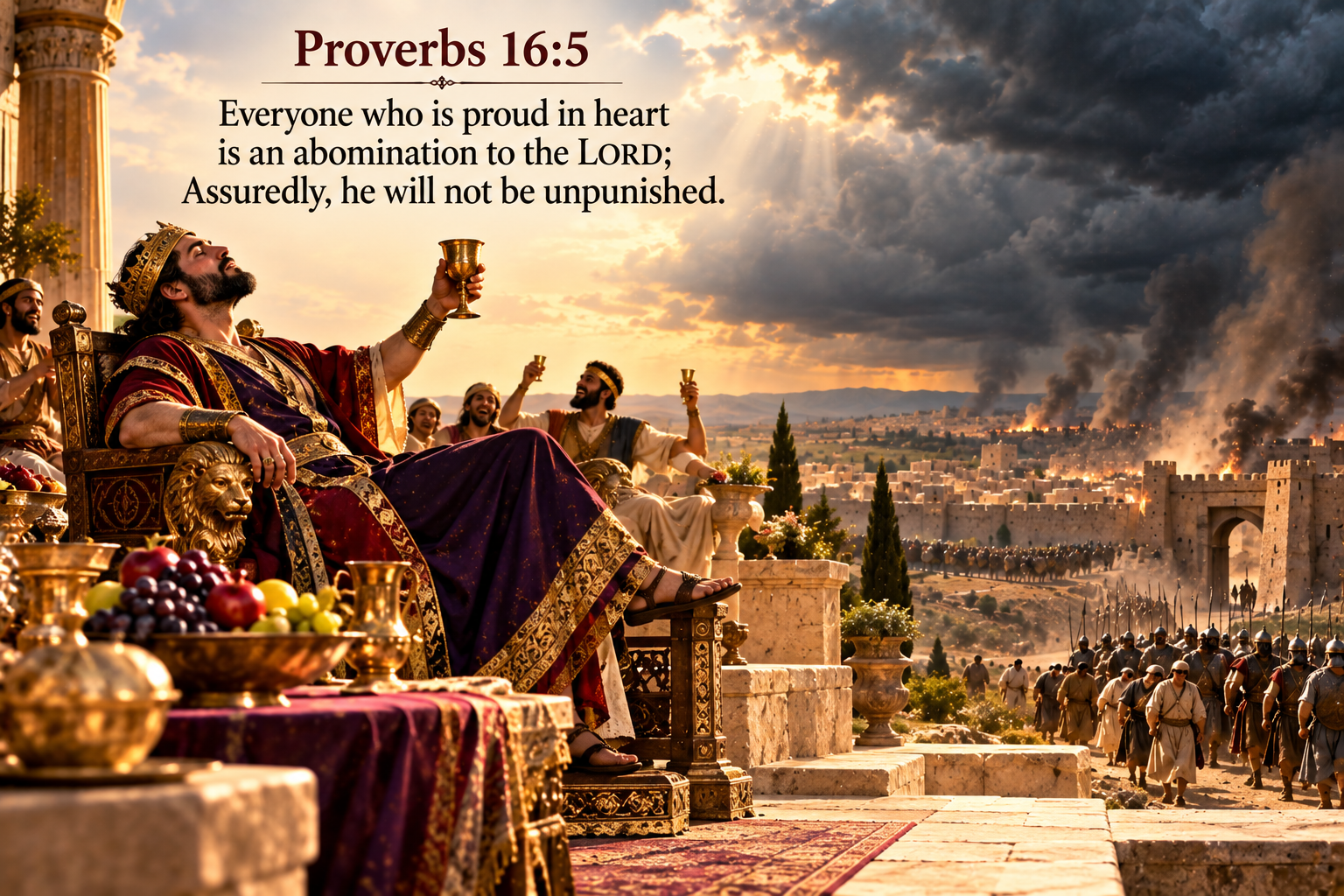
WHEN PRIDE PROVOKES
DIVINE JUDGMENT
That's probably not a good title because pride always provokes a divine response!!!
The Lord GOD (adonay Jehovah/yahweh) has sworn (shaba) by Himself - Lit "swears by His life." Adonay Jehovah/yahweh emphasizes the sovereign Lord Who rules over His people. The declaration is extraordinarily solemn because God swears by Himself. Why does God swear by Himself? Because there is no authority greater than God by whom He could swear. The writer of Hebrews explains this principle when describing God's oath to Abraham (Heb 6:13). When God swears by Himself, He invokes His own unchanging character as the guarantee of His declaration. It is the strongest possible assurance that His announced purpose will be fulfilled. God's oath does not make His Word more truthful, but it makes the certainty of His purpose unmistakable.
The LORD God of hosts (tsaba) has declared - Amos uses the majestic title the LORD God of hosts. The Hebrew word tsaba refers to armies or organized hosts. The title emphasizes God's supreme authority over the armies of heaven and the forces of creation. He is the divine Commander before Whom no earthly military power can stand. This title is especially significant because Amos is addressing a nation that trusted in its military strength and fortified cities. Israel's leaders believed that Samaria's defenses could protect them. But Amos reminds them that the One announcing judgment is the LORD God of hosts.
I loathe (ta'ab; LXX - bdelusso = detest, abhor) the arrogance (gaon; LXX - hubris - state of being insolent) of Jacob - NIV = "I abhor the pride of Jacob and detest his fortresses." KJV has a strange translation "I abhor the excellency of Jacob." This is the heart of the indictment as loathe (ta'ab) expresses strong aversion, abhorrence, or detestation. Arrogance (gaon) describes the people had become impressed with their prosperity, military strength, and national importance. They had forgotten that their blessings came from God. Amos uses Jacob as a name for the nation descended from the patriarch (Am 3:13; 7:2, 5). Here it points mainly to the northern kingdom and its capital, Samaria,
KJV Bible Commentary says this passage "expresses Jehovah’s revulsion at Israel’s self-indulgence, and verses 9–11 convey His response. God not only loathes Jacob’s arrogance; but He also hates the palaces in which the people are living, a tangible testimony of their ill-gotten gains."
Bob Utley - "I loathe the arrogance of Jacob" The VERB (Piel PARTICIPLE) is a rare (only here in the OT) but a powerful term of rejection. BDB has "loathe," KB has "to make repulsive, desecrate." It is parallel to "hate" (cf. Amos 5:21). The term arrogance (BDB 144) means "exaltation," "majesty," or "excellence." It is used in a positive sense toward Israel in Ps. 47:4. In this context it refers to Amos 6:4-6. See sarcastic parallel in Amos 8:7. Israel's inappropriate "pride" receives God's judgment (cf. Hosea 5:5; 7:10)!
Pride causes us to admire ourselves when
we should be humbling ourselves before God.
Pride is especially offensive to God because it challenges His rightful place in our lives. Pride exalts self; faith exalts God. Pride boasts in human achievement; faith acknowledges divine grace. Pride says, “Look what I have accomplished!” Faith says with Paul, “For who regards you as superior? What do you have that you did not receive? And if you did receive it, why do you boast as if you had not received it?” (1 Corinthians 4:7). Pride produces self-sufficiency; faith produces dependence on God.
Scripture repeatedly warns against arrogance. “Though He scoffs at the scoffers, yet He gives grace to the afflicted” (Proverbs 3:34), a verse James quotes in its Greek form: “God is opposed to the proud, but gives grace to the humble” (James 4:6). “Pride goes before destruction, and a haughty spirit before stumbling” (Proverbs 16:18). Significantly, the Hebrew word for “pride” in that proverb is gāʾôn, the same word Amos uses for “the arrogance of Jacob” (Amos 6:8). Israel was living out the proverb. “Everyone who is proud in heart is an abomination to the LORD; assuredly, he will not be unpunished” (Proverbs 16:5).
Israel’s problem was not simply that the nation had become prosperous. It was that prosperity had produced an attitude of self-sufficiency. Moses had warned of this very danger: “Otherwise, you may say in your heart, ‘My power and the strength of my hand made me this wealth.’ But you shall remember the LORD your God, for it is He who is giving you power to make wealth, that He may confirm His covenant which He swore to your fathers, as it is this day” (Dt 8:17-18). Hosea, prophesying to the same generation as Amos, traced the progression precisely: “As they had their pasture, they became satisfied, and being satisfied, their heart became proud; therefore they forgot Me” (Hosea 13:6). Satisfaction led to pride, and pride led to forgetting God.
And detest (sane; LXX - miseo - hate, abhor) his citadels - Citadels (ʾarmôn), can refer to palaces, fortified residences, or strongholds, the tall, well-built structures where the wealthy and powerful lived. Amos uses this word repeatedly in his prophecies against the nations, where the recurring refrain is that God will send fire to “consume the citadels” (Amos 1:4, 7, 10, 12, 14; 2:2, 5). These structures represented wealth, power, prestige, and security. In Samaria, the royal and aristocratic buildings symbolized the nation’s prosperity and political strength. Amos had already announced their end: “‘I will also smite the winter house together with the summer house; the houses of ivory will also perish and the great houses will come to an end,’ declares the LORD” (Amos 3:15).
The citadels were the stone and mortar expression of Israel's arrogance and pride. They were where the “distinguished men” of Amos 6:1 lounged on ivory beds and drank wine from sacrificial bowls (Am 6:4–6), and where they felt most secure. God’s verdict is shocking. He does not merely threaten the citadels but adds that He “detests” them. The very structures the elite Israelites trusted for protection were the objects of God’s hatred. As Lamentations later records of Jerusalem, “He has delivered into the hand of the enemy The walls of her palaces” (Lam 2:7). The principle is sobering. Being God’s people grants no immunity. In fact, judgment begins there: 1 Peter 4:17 “For it is time for judgment to begin with the household of God; and if it begins with us first, what will be the outcome for those who do not obey the gospel of God?”
Why does God declare that He detests them? Not because stone walls or impressive buildings are sinful in themselves. Rather, these structures had become symbols of arrogance, oppression, and misplaced confidence. The wealthy lived in luxury while the poor suffered injustice, and the powerful trusted in their fortifications while disregarding God’s warnings. The very buildings that made Israel feel secure had become monuments to the pride God condemned. A fortress may keep an enemy outside the walls, but it cannot keep the judgment of God outside the gates.
Therefore I will deliver (sagar; LXX - exairo - remove, drive out, expel) up the city and all it contains - Deliver up (sagar) means to shut up, enclose, or hand over, and here it pictures surrendering the city into the enemy’s power. The city here is most naturally Samaria, the capital of the northern kingdom. This is an astonishing announcement. Israel’s leaders believed their fortified capital was secure, but God Himself declares that He will hand it over. Its walls, its military strength, and its political alliances could not overturn His decree. The greatest danger to Samaria was not the army approaching its walls, but the God whose warnings it had rejected.
The phrase “and all it contains” (literally, “its fullness”) shows how complete the judgment would be. Buildings, possessions, wealth, treasures, and inhabitants alike would be handed over and pass into oblivion! Everything in which the leaders had placed their confidence would be lost. Three years after the siege began, “the king of Assyria captured Samaria and carried Israel away into exile to Assyria” (2 Kings 17:6). They had filled their city with treasures but emptied their hearts of reverence for God, and everything they trusted was surrendered because they refused to trust the One who could save them.
Has success quietly replaced
dependence on God in any area of your life?
🙏 THOUGHT: Is Pride Hiding Behind Your Prosperity? The LORD God of hosts swore by Himself that He loathed the arrogance of Jacob and detested the very citadels in which Israel placed its confidence (Am 6:8). The blessings that should have produced gratitude had instead produced arrogance! Samaria’s citadels were filled with “violence and devastation” (Am 3:10) and trusted as a substitute for God. Every generation builds its own "citadel" including retirement accounts, reputations, accomplishments, abilities, comfortable homes, the things that make us feel that nothing can reach us. Those things are not evil in themselves. The question is what fills them and what we trust them for. Moses warned Israel not to forget God when prosperity increased (Dt 8:11–18), and James reminds us that “God is opposed to the proud, but gives grace to the humble” (Jas 4:6). Has success quietly replaced dependence on God in any area of your life? Remember Paul’s searching question: “What do you have that you did not receive?” (1 Co 4:7). Everything we possess is a gift of grace. The psalmist knew a better stronghold: “God, in her palaces, Has made Himself known as a stronghold” (Ps 48:3). Any citadel without Him is only kindling waiting for the fire. The safest place for the believer is not behind the strongest earthly walls, but beneath the mighty hand of God! (1 Pe 5:5,6; Ps 91:1,2) (See Hand of the LORD)
Arrogance (01347) gaon is a masculine noun derived from the verb gāʾâ (01342), “to rise up, be lifted high.” Its basic picture is something that swells or towers upward, and its meaning depends on what is doing the rising. When the word describes God, it means “majesty” or “excellence.” When it describes creation, it means “swelling” or “luxuriance.” When it describes people, it most often means “pride” or “arrogance.” Of its 49 occurrences, the great majority are negative. The word is mostly poetic, found largely in Job, Psalms, Proverbs, and the Prophets (12 times in Isaiah alone), with prose exceptions such as Leviticus 26:19. The Septuagint usually translates it with hybris, “insolence,” or hyperēphania, “haughtiness,” literally “showing oneself above others.”
GAON - 44V - arrogance(3), eminence(1), excellence(1), glory(1), majestic(1), majesty(5), pomp(1), pride(29), proud(1), splendor(2), thicket(2), thickets(1). Exod. 15:7; Lev. 26:19; Job 35:12; Job 37:4; Job 38:11; Job 40:10; Ps. 47:4; Ps. 59:12; Prov. 16:18; Isa. 2:10; Isa. 2:19; Isa. 2:21; Isa. 4:2; Isa. 13:11; Isa. 13:19; Isa. 14:11; Isa. 16:6; Isa. 23:9; Isa. 24:14; Isa. 60:15; Jer. 12:5; Jer. 13:9; Jer. 48:29; Jer. 49:19; Jer. 50:44; Ezek. 7:20; Ezek. 7:24; Ezek. 16:49; Ezek. 16:56; Ezek. 24:21; Ezek. 30:6; Ezek. 30:18; Ezek. 32:12; Ezek. 33:28; Hos. 5:5; Hos. 7:10; Amos 6:8; Amos 8:7; Mic. 5:4; Nah. 2:2; Zeph. 2:10; Zech. 9:6; Zech. 10:11; Zech. 11:3
1. The majesty of God. In its highest use, gāʾôn describes the towering excellence of the LORD Himself. Moses sang of it after the Red Sea:
Exodus 15:7 (NASB) “And in the greatness of Your excellence You overthrow those who rise up against You; You send forth Your burning anger, and it consumes them as chaff.”
Notice the wordplay: the LORD’s gāʾôn throws down those who “rise up” against Him. Isaiah warns that on the day of judgment men will flee from this majesty:
Isaiah 2:10 “Enter the rock and hide in the dust From the terror of the LORD and from the splendor of His majesty.”
Job heard it in the thunder: “He thunders with His majestic voice” (Job 37:4). Micah promised that Messiah would shepherd His flock “in the majesty of the name of the LORD His God” (Mic 5:4).
2. The rising of creation. The word can describe the “proud waves” of the sea (Job 38:11), which rise high but stop at the boundary God sets. It also describes the dense, overgrown thicket along the swollen Jordan, where lions lurked:
Jeremiah 12:5 “If you have run with footmen and they have tired you out, Then how can you compete with horses? If you fall down in a land of peace, How will you do in the thicket of the Jordan?”
3. Israel’s rightful glory. Gāʾôn can describe a legitimate pride, the glory Israel possessed because God had chosen her:
Psalm 47:4 “He chooses our inheritance for us, The glory of Jacob whom He loves. Selah.”
The same is promised for the restored nation in the coming kingdom: “the fruit of the earth will be the pride and the adornment of the survivors of Israel” (Isa 4:2), and “I will make you an everlasting pride, A joy from generation to generation” (Isa 60:15). This glory was a gift, not an achievement. It existed only in relationship with the LORD.
4. Human pride and arrogance. This is the word’s most frequent sense. Wisdom literature sets it squarely against God:
Proverbs 8:13 “The fear of the LORD is to hate evil; Pride and arrogance and the evil way And the perverted mouth, I hate.”
Proverbs 16:18 “Pride goes before destruction, And a haughty spirit before stumbling.”
God judges this pride in nations, including Babylon, “the glory of the Chaldeans’ pride” (Isa 13:19), and Moab and Ammon (Zeph 2:10). He threatens it in His own people from the beginning: “I will also break down your pride of power” (Lev 26:19). Hosea, Amos’s contemporary, says that Israel’s pride had become a witness for the prosecution:
Hosea 7:10 “Though the pride of Israel testifies against him, Yet they have not returned to the LORD their God, Nor have they sought Him, for all this.”
Ezekiel uses gāʾôn to name the root sin of Sodom, in words that could have been written of Samaria’s elite in Amos 6:4–6:
Ezekiel 16:49 “Behold, this was the guilt of your sister Sodom: she and her daughters had arrogance, abundant food and careless ease, but she did not help the poor and needy.”
Citadels (0759) armon is a masculine noun meaning a citadel, fortress, palace, or fortified dwelling. It refers to the tallest, strongest, and most imposing building in a city: the residence of the king or the ruling elite, built to be the last line of defense. The etymology is uncertain. Many connect it with the idea of height or elevation, which fits its use. The KJV almost always translates it “palace,” except in Proverbs 18:19, where it is “castle.” Modern versions vary between “citadel” (NASB, ESV, NIV), “palace,” and “fortress.” It occurs about 32 times, 22 of them in the prophets. It is especially common in Jeremiah and Amos. In Amos it occurs twelve times in eleven verses, more than in any other book.
ARMON - 32 - castle(1), citadel(2), citadels(13), fortified buildings(1), fortified towers(1), palace(3), palaces(9), palatial dwellings(1), towers(2). 1 Ki. 16:18; 2 Ki. 15:25; 2 Chr. 36:19; Ps. 48:3; Ps. 48:13; Ps. 122:7; Prov. 18:19; Isa. 23:13; Isa. 25:2; Isa. 32:14; Isa. 34:13; Jer. 6:5; Jer. 9:21; Jer. 17:27; Jer. 30:18; Jer. 49:27; Lam. 2:5; Lam. 2:7; Ezek. 19:7; Hos. 8:14; Amos 1:4; Amos 1:7; Amos 1:10; Amos 1:12; Amos 1:14; Amos 2:2; Amos 2:5; Amos 3:9; Amos 3:10; Amos 3:11; Amos 6:8; Mic. 5:5
1. The stronghold of rulers. ʾArmôn is often the place where kings lived and where power was defended. That also made it the place where kingdoms fell. Two examples come from Samaria itself. When Zimri’s coup failed, he died in the very stronghold he trusted:
1 Kings 16:18 (NASB) “When Zimri saw that the city was taken, he went into the citadel of the king’s house and burned the king’s house over him with fire, and died.”
Only a few years after Amos’s ministry, Pekah assassinated King Pekahiah “in Samaria, in the castle of the king’s house” (2 Ki 15:25). The citadels of Samaria did not protect even her kings.
2. The object of attack and plunder. Because citadels held a city’s wealth and leadership, they were the first target of invaders. When Babylon took Jerusalem, it “burned all its fortified buildings with fire and destroyed all its valuable articles” (2 Chr 36:19). Jeremiah pictures death itself climbing through their windows:
Jeremiah 9:21 “For death has come up through our windows; It has entered our palaces To cut off the children from the streets, The young men from the town squares.”
3. A picture of blessing when God dwells there. When the LORD is honored, the citadel is a place of peace:
Psalm 122:7 “May peace be within your walls, And prosperity within your palaces.”
The psalmist also makes the decisive theological point: Zion’s true defense was never its towers but its God.
Psalm 48:3 “God, in her palaces, Has made Himself known as a stronghold.”
4. The target of divine judgment. This is the dominant use in the prophets, and above all in Amos. In the oracles against the nations, the same refrain sounds again and again: “I will send fire... and it will consume the citadels.” It falls on Damascus (Am 1:4), Gaza (Am 1:7), Tyre (Am 1:10), Edom (Am 1:12), Ammon (Am 1:14), and Moab (Am 2:2). Then it falls on Judah:
Amos 2:5 “So I will send fire upon Judah And it will consume the citadels of Jerusalem.”
The refrain is notably absent from the oracle against Israel (Am 2:6–16). Amos saves Israel’s citadels for later, and then exposes what is inside them. He even summons the citadels of Ashdod and Egypt as witnesses:
Amos 3:9–11 “Proclaim on the citadels in Ashdod and on the citadels in the land of Egypt and say, ‘Assemble yourselves on the mountains of Samaria and see the great tumults within her and the oppressions in her midst. But they do not know how to do what is right,’ declares the LORD, ‘these who hoard up violence and devastation in their citadels.’ Therefore, thus says the Lord GOD, ‘An enemy, even one surrounding the land, Will pull down your strength from you And your citadels will be looted.’”
The pagan nations are called to gaze on Samaria’s citadels and be shocked at what they see. The palaces were storehouses of plunder taken from the poor, so it is fitting that they in turn would be plundered. Hosea identifies the spiritual root of the problem:
Hosea 8:14 “For Israel has forgotten his Maker and built palaces; And Judah has multiplied fortified cities, But I will send a fire on its cities that it may consume its palatial dwellings.”
Amos 6:8-14 TODAY IN THE WORD
I abhor the pride of Jacob and detest his fortresses; I will deliver up the city and everything in it. -
At one point in his ministry, noted preacher Harry Ironside worried that he was not as humble as he ought to be. When he asked a friend for advice, his friend suggested that Ironside make a large sandwich board sign with the plan of salvation in Scripture written on it and walk through the busy shopping district of downtown Chicago for an entire day. Ironside did as his friend suggested. When he had finally returned to his apartment, he thought about how humbling the experience had been. But as he removed the sign, Ironside caught himself thinking, “There’s not another person in Chicago that would be willing to do a thing like that.”
Pride is something that even the most godly Christians sometimes struggle with. One of the best remedies for pride is to see it through God’s eyes. According to Amos 6:8, God abhors pride. The Hebrew term used in this verse refers to the same kind of loathing that God has for idolatry. It means to regard something as an abomination. Indeed, the kind of pride condemned in these verses really was a form of idolatry, because it was rooted in the worship of self.
Israel’s pride had grown to such a proportion that extreme measures were required. Recent military successes led Israel to believe that it was invincible (Amos 6:13). God’s people would soon learn from bitter experience that their strongest fortresses were not strong enough to protect them from divine chastening.
TODAY ALONG THE WAY
To what do you attribute your successes and achievements? Certainly, a measure of human effort is required in most endeavors. Ultimately, however, we must trace all our successes to God’s enabling power. It is a good thing to be confident in the Christian life, if it is the kind of confidence that Paul describes in 2 Corinthians 3:5: “Not that we are competent in ourselves to claim anything for ourselves, but our competence comes from God.” Are you confident in yourself or in God as you engage in ministry?
Amos 6:8–14 Today in the Word
In 1940, Polish army captain Witold Pilecki snuck into Auschwitz. He wanted to find out what was going on there and report it to the world. He stayed in the concentration camp for two–and–a–half years and smuggled out news of the executions and brutal treatment of prisoners. The Polish resistance thought he was surely exaggerating; the Allied command in London refused to act. After escaping, he wrote the first intelligence report on the now–infamous death camp. Though a hero, he was shot by the Communists who took over Poland after the war, and the story of his courage was suppressed until the fall of the Berlin Wall in 1989.
Turning justice into poison is an abomination in God’s eyes (Amos 6:12). In Amos’s day, the people of Israel had also turned the fruit of righteousness into bitterness.” They had taken for granted their relationship with the Lord. The covenant relationship should have been a spur for them to obey, worship, and witness. Instead, they disobeyed, bowed before idols, and defamed God’s name among the nations.
Yet in their pride and self–deception, they somehow continued to believe that God was on their side. The truth was that not only would God not protect them, it was He Himself who had passed judgment and would execute the punishment (Amos 6:8–11). He’d had enough! To “swear by himself” was as serious as it gets. The picture of the survivors who don’t want to mention God’s name was Amos’s way of showing that it would eventually dawn on people that God Himself—not circumstances or human enemies—was the one responsible for their downfall. Indeed, the Lord Himself would be the one to give the command for Israel’s defeat.
To turn justice into poison and righteousness into bitterness is to make things the opposite of what they should be—like making oxen plow on “rocky crags” or like trusting in one’s own strength instead of God’s (Amos 6:12–13). As a result, the Lord was preparing a nation—which we know to be Assyria—to conquer His people and send them into exile (Amos 6:14).
Apply the Word
Amos’s audience felt invincible (having won military victories) and immune (having God on their side). The entire book of Amos aimed to cure them of this delusion. Did they think they had accomplished success all by themselves? Did they think God didn’t see their idolatry and other sins? This should prompt us to ask ourselves if we’re putting our faith in anything other than God—perhaps our own abilities, resources, or plans. If so, the prophet’s wake–up call is aimed at us, too!
Amos 6:9 And it will be, if ten men are left in one house, they will die.
- if (KJV): Am 5:3 1Sa 2:33 Es 5:11 9:10 Job 1:2,19 20:28 Ps 109:13 Isa 14:21
Related Passages:
Leviticus 26:25 ‘I will also bring upon you a sword which will execute vengeance for the covenant; and when you gather together into your cities, I will send pestilence among you, so that you shall be delivered into enemy hands.
Amos 5:3 For thus says the Lord GOD, “The city which goes forth a thousand strong Will have a hundred left, And the one which goes forth a hundred strong Will have ten left to the house of Israel.”
WHEN EVEN THE "SURVIVORS"
CANNOT ESCAPE
And it will be, if ten men are left in one house, they will die - What a chilling prophecy! Amos has just announced that the LORD God of hosts has sworn by Himself to deliver Samaria and everything in it into the hands of its enemies (Amos 6:8). Now he describes the devastating results. Even if ten men survive the initial catastrophe and huddle together in one house, they will not escape death. The verb “are left” (yātar) means to remain or be left over, the language of a remnant. But this remnant would not survive and clearly is not related to the believing remnant of Israel.
The number ten recalls Amos’s earlier funeral dirge: “For thus says the Lord GOD, ‘The city which goes forth a thousand strong will have a hundred left, and the one which goes forth a hundred strong will have ten left to the house of Israel’” (Amos 5:3). In Amos 5:3, judgment reduced a hundred to ten. Now even the ten will perish. The judgment would not stop halfway.
Bob Utley - "ten men" This number was important to the Jews because it was the minimum number required for worship (in Babylon during the exile ten men were required to start a synagogue) and other social events, possibly even military groups. Because of the use of the number ten, this judgment verse may relate to Amos 5:3.
The exact cause of their deaths is not stated. Some commentators suggest disease or pestilence, which often accompanied ancient sieges, when crowded, starving people were trapped behind city walls. Samaria endured just such a siege for three years before it fell (2 Ki 17:5). The next verse, with its burning of bodies and its fearful command to “Keep quiet” (Am 6:10), supports this reading. God had already sent pestilence on Israel as a warning (Am 4:10), and the covenant curses had warned of this very sequence: “I will also bring upon you a sword which will execute vengeance for the covenant; and when you gather together into your cities, I will send pestilence among you, so that you shall be delivered into enemy hands” (Lev 26:25). Others take the statement more generally, as emphasizing the thoroughness of the destruction. Amos had already warned that a city sending out a hundred men would have only “ten left to the house of Israel” (Am 5:3). Now even those ten would die. Either way, the message is unmistakable: even those who survived the first blow would not escape its consequences. The people who had felt secure behind Samaria’s walls would discover that neither their fortified city nor their private homes could guarantee their safety. They had trusted their houses to shelter them from danger, but their houses could not shelter them from the judgment of God.
Warren Wiersbe - God appointed three judgments for them:
- death (Amos 6:9–10),
- destruction (Amos 6:11–13), and
- defeat (Amos 6:14).
(Borrow With the Word)
Amos 6:10 Then one’s uncle, or his undertaker, will lift him up to carry out his bones from the house, and he will say to the one who is in the innermost part of the house, “Is anyone else with you?” And that one will say, “No one.” Then he will answer, “Keep quiet. For the name of the LORD is not to be mentioned.”
AMPC And then a man’s uncle or kinsman, he who is to make a burning to cremate and dispose [of his pestilence-infected body], comes in to bring the bones out of the house, and he shall say to another still alive in the farthest parts of the house, Is there anyone else with you? and he shall say, No. Then shall the newcomer say, Hush! Hold your [cursing] tongue! We dare not so mention the name of the Lord [lest we invoke more punishment].
KJV And a man's uncle shall take him up, and he that burneth him, to bring out the bones out of the house, and shall say unto him that is by the sides of the house, Is there yet any with thee? and he shall say, No. Then shall he say, Hold thy tongue: for we may not make mention of the name of the LORD.
NET When their close relatives, the ones who will burn the corpses, pick up their bodies to remove the bones from the house, they will say to anyone who is in the inner rooms of the house, "Is anyone else with you?" He will respond, "Be quiet! Don't invoke the LORD's name!"
NLT And when a relative who is responsible to dispose of the dead goes into the house to carry out the bodies, he will ask the last survivor, "Is anyone else with you?" When the person begins to swear, "No, by...," he will interrupt and say, "Stop! Don't even mention the name of the LORD.")
ESV And when one's relative, the one who anoints him for burial, shall take him up to bring the bones out of the house, and shall say to him who is in the innermost parts of the house, "Is there still anyone with you?" he shall say, "No"; and he shall say, "Silence! We must not mention the name of the LORD."
CSB A close relative and burner will remove his corpse from the house. He will call to someone in the inner recesses of the house, "Any more with you?" That person will reply, "None." Then he will say, "Silence, because Yahweh's name must not be invoked."
NIV And if a relative who is to burn the bodies comes to carry them out of the house and asks anyone still hiding there, "Is anyone with you?" and he says, "No," then he will say, "Hush! We must not mention the name of the LORD."
- And a (KJV): Abp. Newcome says that this obscure verse seems to describe the effects of the famine and pestilence during the siege of Samaria.
- that burneth (KJV): Am 8:3 1Sa 31:12 2Ki 23:16 Jer 16:6
- Hold (KJV): Am 5:13 Nu 17:12 2Ki 6:33 Eze 24:21
- for (KJV): Jer 44:26 Eze 20:39
- we may not make (KJV): or, they will not make, or, have not made
THE SILENCE OF
JUDGMENT
Then one’s uncle, or his undertaker, will lift him up to carry out his bones from the house - NET - "When their close relatives, the ones who will burn the corpses, pick up their bodies to remove the bones from the house" NLT - "And when a relative who is responsible to dispose of the dead goes into the house to carry out the bodies." Death has become so widespread that those remaining must enter houses and remove the dead.
KJV Bible Commentary So many will die in the judgment that it will be impossible to bury their remains; so cremation will be resorted to in order to prevent the spread of disease
John Walton - The burning of bodies was not a common practice (but see comments on 1 Sam 31:12 and 2 Chron 16:14), and the spelling of the verb is unusual. This has led a number of interpreters to an alternative reading such that the text does not suggest burning the body but embalming it with spices for burial.
UBS Handbook on Amos - This verse is not at all clear. None of the very different English translations can definitely be considered the right one. (SEE 58 translations)
NET NOTE - The translation assumes that “their relatives” and “the ones who will burn the corpses” are in apposition. Another option is to take them as distinct individuals, in which case one could translate, “When their close relatives and the ones who will burn the corpses pick up …” The meaning of the form translated “the ones who burn the corpses” is uncertain. Another option is to translate, “the ones who prepare the corpses for burial” (NASB “undertaker”; cf. also CEV). See S. M. Paul, Amos (Hermeneia), 215–16.
This verse is notoriously difficult to interpret. The Hebrew text literally reads, “And he will lift him up, his uncle, and the one burning him, to bring out bones from the house. And he will say to the one who is in the inner parts of the house, ‘Is there [anyone] still with you?’ And he will say, ‘Be quiet for not to invoke the name of the LORD.’ ” The translation assumes that the singular pronominal and verbal forms throughout the verse are collective or distributive. This last sentence has been interpreted in several ways: a command not to call on the name of the Lord out of fear that he might return again in judgment; the realization that it is not appropriate to seek a blessing in the Lord’s name upon the dead in the house since the judgment was deserved; an angry refusal to call on the Lord out of a sense that he has betrayed his people in allowing them to suffer.
Bob Utley - "one's uncle, or his undertaker" There are many questions about this phrase. (1) Are there two people or one? (2) What does the word translated "undertaker" by the NASB, but literally means "he who burns," mean?
For question #1 the phrase refers to two different people who talk together in the rest of the verse (i.e. so there is no survivor in the recesses of the house).
For question #2 there have been many theories:
- one who burns deceased bodies
- embalming or anointing the dead with spices
- one who burns incense on behalf of the dead
- one who burns a sacrifice on behalf of the dead
- a parallel term for a near relative. The first term would mean a near kin on the mother's side and the second term a near kin on the father's side.
For me #1 or #5 seems best. But #4 could be linked to the banquet for the dead in Amos 6:6.
and he will say to the one who is in the innermost part of the house, “Is anyone else with you?” And that one will say, “No one.” Then he will answer, “Keep quiet. For the name of the LORD is not to be mentioned - What a haunting scene Amos places before us! The luxurious homes that once echoed with music, laughter, and feasting have become houses of death. Earlier, Israel’s wealthy leaders reclined on ivory beds, ate choice meats, and drank wine from bowls (Amos 6:4–6). Now a relative or someone responsible for the dead enters a house to carry out the remains. He calls into the innermost room, asking whether anyone else is left. The answer is devastating: “No one.”
Then comes the chilling command: “Keep quiet. For the name of the LORD is not to be mentioned.” The exact meaning of this prohibition is debated, but the atmosphere is unmistakable. Fear and death have replaced complacency and celebration. The people who would not listen when God warned them are now surrounded by the consequences of ignoring His Word. The house that once overflowed with pleasure now stands almost empty of life.
KJV Bible Commentary A fearful remnant will not even dare to mention the name of the Lord so that a further judgment will not come upon them (vs. 10b). They have been urged to call upon the name of the Lord for salvation, but they have refused to do so. Now that judgment has overtaken them, they continue to leave God out of their lives. Apparently even the great tragedy will not drive them to God. (See see this same tragic pattern in the Bowl Judgments in the Revelation = Rev 16:21!)
Bob Utley -"Keep quiet. For the name of the Lord is not to be mentioned" This is a theological affirmation of who sent the invasion. The aftermath of judgment causes a holy reverence for YHWH, missing so long in Israel. The phrase "keep quiet" (a Hebrew INTERJECTION) (ED: Has is an interjection with the force of an imperative. It means "hush!" or "be silent!") is used in contexts of YHWH's presence (cf. Hab. 2:20; Zeph. 1:7; Zech. 2:13) and judgment (cf. Amos 8:3).
John Walton - not mentioning the Lord’s name. God’s wrath is such that the population of the city of Samaria is to be reduced to a tenth, and the survivors will be so frightened by what Yahweh has done that they will be afraid to mention God’s name lest the angry deity take any further notice of them. In that sense then, the command “Hush!” is a sort of warding spell (like “God forbid” in English) to prevent the incautious from invoking God (compare Ex 23:13 and Josh 23:7). Assyrian royal documents from the reign of Enlil-Nirari (1326–1317) provide some light here. In one text the king calls out, “May the god by no means speak!” when the death of a member of the royal family is announced at court. His intent may be to ask that the god not act (speak) against anyone else.
Will lift him up to carry out his bones from the house - The reference to “bones” (ʿeṣem) is especially grim. The word commonly means “bone” but can also refer more broadly to a person’s physical remains, so it need not describe a particular stage of decomposition. The essential point is that the occupants have died and their remains must be removed. The scene is a dramatic reversal of the preceding verses. Earlier, the wealthy reclined comfortably in their houses; now their bodies are carried out. Earlier, their homes were filled with luxury; now those homes are associated with death. The houses that once displayed their owners’ wealth now reveal their helplessness. The possessions that surrounded them in life could not preserve them from death.
Amos 6:11 For behold, the LORD is going to command that the great house be smashed to pieces and the small house to fragments.
KJV For, behold, the LORD commandeth, and he will smite the great house with breaches, and the little house with clefts.
NET Indeed, look! The LORD is giving the command. He will smash the large house to bits, and the small house into little pieces.
NLT When the LORD gives the command, homes both great and small will be smashed to pieces.
ESV For behold, the LORD commands, and the great house shall be struck down into fragments, and the little house into bits.
BGT διότι ἰδοὺ κύριος ἐντέλλεται καὶ πατάξει τὸν οἶκον τὸν μέγαν θλάσμασιν καὶ τὸν οἶκον τὸν μικρὸν ῥάγμασιν
LXE For, behold, the Lord commands, and he will smite the great house with breaches, and the little house with rents.
CSB For the LORD commands: The large house will be smashed to pieces, and the small house to rubble.
NIV For the LORD has given the command, and he will smash the great house into pieces and the small house into bits.
- the Lord (KJV): Am 3:6,7 Amos 9:1,9 Ps 105:16,31,34 Isa 10:5,6 13:3 46:10,11 55:11 Eze 29:18-20 Na 1:14
- he will (KJV): Am 6:8 Amos 3:15 2Ki 25:9 Ho 13:16 Zec 14:2 Lu 19:44
- breaches (KJV): or, droppings, Ec 10:18
Related Passages:
Amos 3:6-7 If a trumpet is blown in a city will not the people tremble? If a calamity occurs in a city has not the LORD done it? 7 Surely the Lord GOD does nothing Unless He reveals His secret counsel To His servants the prophets.
Amos 9:1; 9 I saw the Lord standing beside the altar, and He said, “Smite the capitals so that the thresholds will shake, And break them on the heads of them all! Then I will slay the rest of them with the sword; They will not have a fugitive who will flee, Or a refugee who will escape. 9 “For behold, I am commanding, And I will shake the house of Israel among all nations As grain is shaken in a sieve, But not a kernel will fall to the ground.
Amos 6:8 The Lord GOD has sworn by Himself, the LORD God of hosts has declared: “I loathe the arrogance of Jacob, And detest his citadels; Therefore I will deliver up the city and all it contains.”
Amos 3:15 “I will also smite the winter house together with the summer house; The houses of ivory will also perish And the great houses will come to an end,” Declares the LORD.
Proverbs 16:18 Pride goes before destruction, And a haughty spirit before stumbling.
NO HOUSE TOO
GREAT TO FALL
For behold (hinneh; LXX - idou = Look!) - The Hebrew expression begins with ki hinneh, combining a word often translated “for” or “because” with the attention-commanding particle hinneh, meaning “behold” or “look.” The expression introduces an explanation for the devastation described in the preceding verses. Why will death and destruction overtake the inhabitants? Because the LORD has determined to bring judgment upon the nation. Amos wants his hearers to recognize that the approaching catastrophe is not merely the result of international politics or military aggression. Behind the events stands the sovereign God of Israel. It is worth noting that this does not mean that God approves of every action committed by an invading army. Scripture distinguishes God's sovereign use of nations from His moral assessment of their conduct (Isa 10:5–15).
The LORD is going to command (tsavah)- Command means to order, charge, appoint, or give instructions and thus emphasizes authority. God does not merely predict that destruction will occur but He announces that He will command it. The LORD Who commands the armies of heaven also rules over the nations of the earth (Am 4:13; Am 5:8, 9).
That the great house be smashed to pieces and the small house to fragments - Great house likely refers to a large, impressive residence of the wealthy elite. Amos has already described their luxurious homes and furnishings and condemned the winter houses, summer houses, and houses of ivory (Am 3:15). Smashed to pieces means fragments or shattered pieces, givin a forceful picture not of minor damage but of total destruction. Its impressive appearance will not preserve it. Its costly construction will not guarantee survival. The buildings that displayed the wealth of their owners would become ruins that testified to the certainty of God's judgment. The emphasis of great house and small house is on the comprehensive scope of the judgment. No category of residence is automatically exempt. Even the poor cannot assume that their obscurity guarantees safety. This does not mean that God regards every individual as equally guilty. Scripture consistently affirms that God judges righteously and distinguishes the righteous from the wicked (Ge 18:25; Ezek 18:20). What Amos emphasizes here is that the consequences of national catastrophe will affect the rich and poor alike, because the problem ultimately was not only economic inequity but spiritual disease that had spread throughout all classes of society in Israel.
God will "clean house" from
top to bottom!
Bob Utley - 6:11 This is the concluding point of Amos 6:8-11. Judgment (by a foreign nation, i.e. Assyria) will fall on great and small (i.e. all the population). No one will escape (cf. Amos 5:18-20). "to pieces. . .to fragments" The first term's meaning is uncertain: (1) used of rain droplets (Song of Songs 5:2), (2) chopped food, (3) to shatter or grind. The second term (fragments) means to break open (cf. Ps. 141:7), like a wall (cf. Isa. 22:9). The VERB form implies a tearing into pieces (Piel). David Allan Hubbard, Joel and Amos (Tyndale OT Commentaries), asserts that these two terms fit an earthquake better than an invasion. He also lists the other places in Amos where he thinks the texts fit an earthquake (cf. Amos 1:1; 2:13; 8:8; 9:1-6), p.198.
The wisest investment is not in a house that will eventually crumble,
but in a life built on the Rock Who will never fail!
🙏 THOUGHT: What Are You Building Your Life Upon? Amos declares that the LORD Himself will command the destruction of both the great house and the small house (Amos 6:11). Israel’s wealthy had placed their confidence in impressive homes, fortified cities, and material prosperity, but none of these could shield them from God’s judgment. Their houses were impressive, but the foundation of their confidence was tragically misplaced! Jesus warned that a house built on sand will collapse when the storm comes, while the house founded on the rock will stand (Mt 7:24–27). What is the foundation of your life? Finances, health, abilities, and comfortable circumstances may be genuine blessings, but they cannot provide ultimate security. “For no man can lay a foundation other than the one which is laid, which is Jesus Christ” (1Co 3:11), and “here we do not have a lasting city, but we are seeking the city which is to come” (Heb 13:14). The wisest investment is not in a house that will eventually crumble, but in a life built on the Rock Who will never fail! (Ps 18:2; 1Pe 2:6)
Behold (02009) hinneh is an interjection meaning behold, look, now; if. "It is used often and expresses strong feelings, surprise, hope, expectation, certainty, thus giving vividness depending on its surrounding context." (Baker) Hinneh generally directs our mind to the text, imploring the reader to give it special attention. In short, the Spirit is trying to arrest our attention! And so hinneh is used as an exclamation of vivid immediacy (e.g., read Ge 6:13)! Hinneh is a marker used to enliven a narrative, to express a change a scene, to emphasize an idea, to call attention to a detail or an important fact or action that follows (Isa 65:17, Ge 17:20, 41:17). The first use of hinneh in Ge 1:29 and second in Ge 1:31 - "And God saw all that He had made, and behold, it was very good. And there was evening and there was morning, the sixth day." Hinneh is oftn used in the idiom "Here I am" in Ge 22:1, 7,11 Ge 27:1,18, Ge 31:11, Ge 46:2 Ex 3:4 1Sa 3:4, 3:16, 12:3, 2Sa 1:7, Isa 52:6, Isa 58:9. Hinneh is used most often to point out people but also to point out things (Ge 31:41, 17:4). God uses hinneh to grab man's attention before He brings destruction (Ge 6:13, 17). God uses hinneh when He establishes covenants (Ge 9:9, 15:12, 17 [when Jehovah cut the Abrahamic covenant], Ge 17:4, cp Ge 28:13, 15), when He provided a sacrificial substitute for Isaac (foreshadowing His giving us His only Son!) (Ge 22:13). Hinneh marks the "chance (The Providence of God)" arrival of Boaz at the field where Ruth was gleaning (Ru 2:4-read about this "chance romance" - Indeed, "Behold!"). Hinneh is used to announce the Lord’s sending of a child as a sign and a prophecy of Immanuel-Emmanuel, the Messiah (Isa. 7:14). In fact W E Vine says that it is notable that when behold (hinneh) is used in Isaiah, it always introduces something relating to future circumstances.
HINNEH IN AMOS - Amos 2:13; Amos 4:2; Amos 4:13; Amos 6:11; Amos 6:14; Amos 7:1; Amos 7:4; Amos 7:7; Amos 7:8; Amos 8:1; Amos 8:11; Amos 9:8; Amos 9:9; Amos 9:13
Spurgeon reminds us that "Behold is a word of wonder; it is intended to excite admiration. Wherever you see it hung out in Scripture, it is like an ancient sign-board, signifying that there are rich wares within, or like the hands which solid readers have observed in the margin of the older Puritanic books, drawing attention to something particularly worthy of observation." I would add, behold is like a divine highlighter, a divine underlining of an especially striking or important text. It says in effect "Listen up, all ye who would be wise in the ways of Jehovah!"
Hinneh is translated in the Septuagint with the interjection idou (strictly speaking a command in the second person aorist imperative, middle voice) a demonstrative particle (used 1377 times in the Septuagint and NT) which is found especially in the Gospels of Matthew and Luke "and giving a peculiar vivacity to the style by bidding the reader or hearer to attend to what is said: "Behold! See! Lo!" (Thayer) The command is calling for urgent attention. Do this now! Don't delay! It could be loosely paraphrased "Pay attention!" or "Listen up!" to arouse attention.
Amos 6:12 Do horses run on rocks? Or does one plow them with oxen? Yet you have turned justice into poison And the fruit of righteousness into wormwood,
KJV Shall horses run upon the rock? will one plow there with oxen? for ye have turned judgment into gall, and the fruit of righteousness into hemlock:
NET Can horses run on rocky cliffs? Can one plow the sea with oxen? Yet you have turned justice into a poisonous plant, and the fruit of righteous actions into a bitter plant.
NLT Can horses gallop over boulders? Can oxen be used to plow them? But that's how foolish you are when you turn justice into poison and the sweet fruit of righteousness into bitterness.
ESV Do horses run on rocks? Does one plow there with oxen? But you have turned justice into poison and the fruit of righteousness into wormwood--
BGT εἰ διώξονται ἐν πέτραις ἵπποι εἰ παρασιωπήσονται ἐν θηλείαις ὅτι ὑμεῖς ἐξεστρέψατε εἰς θυμὸν κρίμα καὶ καρπὸν δικαιοσύνης εἰς πικρίαν
LXE Will horses run upon rocks? will they refrain from neighing at mares? for ye have turned judgment into poison, and the fruit of righteousness into bitterness:
CSB Do horses gallop on the cliffs; does anyone plow there with oxen? Yet you have turned justice into poison and the fruit of righteousness into wormwood--
NIV Do horses run on the rocky crags? Does one plow there with oxen? But you have turned justice into poison and the fruit of righteousness into bitterness--
- horses (KJV): Isa 48:4 Jer 5:3 6:29,30 Zec 7:11,12
- for (KJV): Am 5:7,11,12 1Ki 21:7-13 Ps 94:20,21 Isa 59:13,14 Ho 10:4,13 Mic 7:3 Hab 1:3,4 Ac 7:51,52
Related Passages:
Micah 6:8 He has told you, O man, what is good; And what does the LORD require of you But to do justice, to love kindness, And to walk humbly with your God?
Proverbs 14:12 There is a way which seems right to a man, But its end is the way of death.
Isaiah 5:20 Woe to those who call evil good, and good evil; Who substitute darkness for light and light for darkness; Who substitute bitter for sweet and sweet for bitter!
THE UNNATURAL PERVERSION OF
JUSTICE & RIGHTEOUSNESS
Do horses run on rocks (sela')? The Hebrew question expects a negative answer. The word for rocks (sela') refers to crags or cliffs, the steep, jagged rock faces of the hill country. Horses are built for speed, but running them across such terrain would shatter their hooves and break their legs. The point is not that a horse could never cross rocky ground, but that Amos is picturing something unreasonable and self-destructive. No sensible person deliberately drives a horse into conditions certain to harm it. Like the cause-and-effect questions of Amos 3:3–6, this one appeals to common sense, emphasizing that certain actions contradict the natural order and purpose of things.
They understood the dangers of rocky ground for horses,
but ignored the dangers of moral corruption for their nation.
Amos wants his audience to recognize the absurdity, because he is about to expose an even greater one: “Yet you have turned justice into poison and the fruit of righteousness into wormwood” (Amos 6:12b). Israel’s leaders recognized foolishness in everyday life while practicing something far more foolish in their moral lives. Isaiah used the same kind of argument: “An ox knows its owner, and a donkey its master’s manger, but Israel does not know, My people do not understand” (Isaiah 1:3). They understood the dangers of rocky ground for horses, but ignored the dangers of moral corruption for their nation.
Bob Utley - These first two questions are somewhat difficult in Hebrew, but it is obvious they refer to unnatural acts. All these rhetorical questions expect a "no" answer. It was also unnatural for God's people to turn justice into poison! ▣ "Do horses run on rocks" "Rocks" (sela') refers to large boulders or possibly to horses running up cliffs or over crags. The answer is obviously "no." ▣ "does one plow them with oxen" It is possible to change the MT's vowels and dividing of consonants to read "plow the sea" (cf. NRSV, TEV, NJB, NET, JPSOA footnote). This is accomplished by taking the PLURAL ending of "oxen" as a separate word, "sea." This fits the context better. As Amos 6:12a, it is meant to be an impossible act. All four questions expect a "no" answer! The UBS Text Project, p. 289, gives "with oxen" a "B" rating (some doubt). It assumes that line 2 refers to "plowing a rock with oxen."
Or does one plow them with oxen? - NLT - "Can oxen be used to plow them?" The second question continues the agricultural imagery. Oxen pull plows through soil, but no farmer tries to plow solid rock, since it would be futile and would damage both the plow and the animals. The Hebrew literally asks whether one plows “with oxen,” with “the rocks” carried over from the first question, as the NASB reflects. Some interpreters divide the Hebrew letters differently to read “Does one plow the sea with oxen?” (as in the RSV and NIV). Either way, the point is the same: Amos describes something contrary to common sense. Everyone knew that horses and oxen have proper uses and that farming requires suitable ground. Yet Israel’s leaders had abandoned equally obvious moral principles. Courts meant to defend the vulnerable had become instruments of oppression. They would never expect a harvest from plowing rock, yet they expected national prosperity while cultivating injustice. The tragedy was not that Israel lacked knowledge of what was right, but that its leaders had deliberately reversed it.
Warren Wiersbe comments that "The prophet argues from the order of nature (Amos 6:12). Horses are too wise to gallop on slick rocks, where they might slip and fall. Farmers are too wise to try to plow the rocks or the sea, (Some versions translate v12 “or plow the sea with oxen.” However, to do so requires a slight change in the Hebrew text) because the plow won’t accomplish anything on rocks or water. (Remember, Amos was a farmer.) Plain common sense convinces us of the truth of these statements. Then why would God’s people poison their own judicial system? What they did just didn’t make sense!" (Bible Exposition Commentary)
TECHNICAL NET NOTE - Heb “Does one plow with oxen?” This obviously does not fit the parallelism, for the preceding rhetorical question requires the answer, “Of course not!” An error of fusion has occurred in the Hebrew, with the word יָם (yam, “sea”) being accidentally added as a plural ending to the collective noun בָּקָר (baqar, “oxen”). A proper division of the consonants produces the above translation, which fits the parallelism and also anticipates the answer, “Of course not!”
KJV Bible Commentary - The two questions (Amos 6:12) are rhetorical and demand a negative answer. Horses do not run on rocks, else they will become lame; nor does one plow rocks with oxen, else the plow would be broken. To violate natural law is to reap the consequences of it. This is what Israel has done. They have violated God’s justice and righteousness
Israel understood the laws of nature
but disregarded the moral laws of God.
Yet - is a word of contrast, introducing the shocking contradiction between what is obviously unnatural in the physical world (horses rocks, etc) and what Israel had done in the moral and spiritual world. In other words, just as it is absurd to run horses over dangerous rocks or attempt to plow solid stone, it is morally absurd to pervert justice and turn righteousness into bitterness. Israel had done something as contrary to God's moral order as those illustrations were to the ordinary order of nature. Stated another way, you would never expect a farmer to do something so foolish as plowing solid rock, YET you have done something even more foolish by corrupting justice and righteousness! The people could recognize absurdity in agriculture but failed to recognize it in their own conduct. They had enough common sense to avoid violating the principles of farming, but not enough spiritual sense to avoid violating the principles of justice and righteousness!
What was obviously absurd in agriculture
had become accepted practice in Israel's society.
you have turned justice (mishpat/mispat; LXX - krima - legal action against someone) into poison - Justice is the proper administration of what is right in legal decisions and judgment. God expected Israel’s judges to protect the poor, refuse bribes, and never condemn the innocent (Ex 23:6, 8; Dt 16:19). Instead, they had made justice “poison” (rōʾš), a bitter or poisonous plant whose exact identity is uncertain (cp Dt 29:18; Jer 8:14; Hos 10:4). Justice that should have healed society was harming it, and the courts meant to protect the weak now strengthened the wicked.
And the fruit of righteousness (tsedaqah; LXX - dikaiosune - unrightness, that which is just) into wormwood (laanah; LXX - pikría bitterness) - NET = "the fruit of righteous actions into a bitter plant." Righteousness (tsedaqah) refers to right conduct and conformity to God’s moral standard. The “fruit of righteousness” is the good result righteousness should produce. Where righteousness flourishes, justice, peace, and well-being follow, as Isaiah promised: “And the work of righteousness will be peace, and the service of righteousness, quietness and confidence forever” (Isaiah 32:17). But Israel had turned that fruit into “wormwood” (laʿănâ), a plant known for its intensely bitter taste and associated in Scripture with sorrow, suffering, and judgment.
Solomon warns that the adulteress, however sweet at first, ends “bitter as wormwood, sharp as a two-edged sword” (Proverbs 5:4). God declared through Jeremiah, “Therefore thus says the LORD of hosts, the God of Israel, ‘behold, I will feed them, this people, with wormwood and give them poisoned water to drink’” (Jer 9:15). Jeremiah later lamented, “He has filled me with bitterness, He has made me drunk with wormwood” (Lam 3:15), and, “Remember my affliction and my wandering, the wormwood and bitterness” (Lam 3:19). The image carries into the New Testament, where the star called Wormwood makes the waters bitter: “The name of the star is called Wormwood; and a third of the waters became wormwood, and many men died from the waters, because they were made bitter” (Rev 8:11).
The contrast in Amos is striking. Fruit suggests nourishment, while wormwood suggests bitterness. Righteousness should bring blessing, but Israel’s corruption brought suffering. They had turned what should have been sweet and nourishing into something bitter and destructive. Righteousness should produce fruit that blesses society, but Israel’s corruption produced bitterness that poisoned it.
NET NOTE - The botanical imagery, when juxtaposed with the preceding rhetorical questions, vividly depicts and emphasizes how the Israelites have perverted justice and violated the created order by their morally irrational behavior.
We may speak about righteousness while failing to practice it,
or condemn injustice in others while overlooking it in ourselves.
🙏 THOUGHT: Are You Producing the Fruit of Righteousness or the Bitterness of Wormwood? Amos asks whether horses run on rocks or oxen plow solid stone, yet Israel had done something even more absurd by turning justice into poison and the fruit of righteousness into wormwood (Amos 6:12). How easily selfishness and pride can corrupt even our best responsibilities! We may speak about righteousness while failing to practice it, or condemn injustice in others while overlooking it in ourselves. Jesus warned against neglecting “the weightier provisions of the law: justice and mercy and faithfulness” (Mt 23:23). Are your words and actions bringing healing or bitterness to those around you? May we be “filled with the fruit of righteousness which comes through Jesus Christ, to the glory and praise of God” (Phil 1:11; cp Micah 6:8; Gal 5:22,23).
C H Spurgeon - Ploughing a Rock - Introduction from this sermon
“Shall horses run upon the rock? will one plow there with oxen?”—Amos 6:12.
THESE two questions are evidently Oriental proverbial expressions. Proverbs have always been used by the wisest of men. Solomon not only spoke and wrote a great many, but he also made a considerable collection of those uttered by others. We find, in the writings of such notable thinkers as Socrates, and Pliny, and Aristotle, an abundance of short, pithy sentences, many of which can be used as proverbs. Proverbs have great force in them, because they are condensed wisdom. They are generally most convincing; it is hardly ever possible to answer or controvert them. They carry truth home as an arrow has often been known to carry death to the person aimed at, for they strike, they stick, they penetrate, they wound. Our Lord Jesus very frequently made use of proverbs; nor was he singular in so doing. The prophets of old constantly employed them; and here, in our text, we see Amos,—who, from his occupation as a herdsman and gatherer of sycamore fruit, was probably more familiar with their use than some others of the prophets were,—puts together two proverbs which were commonly used to signify that men do not, as a rule, continue to labour in vain, and spend their strength for nought. Wise men do not send their horses to run upon the rocks; and they do not send their oxen to plough where all their toil would be wasted: “Shall horses run upon the rock? Will one plough there with oxen?” The answer implied is, “Certainly not,” and it means that, if a thing cannot be done, or is not worth doing if it can, it will be well for us not to attempt to do it. Our text may have two bearings; first, upon men, and, secondly, upon God.
Spurgeon's sermon - A QUESTION FOR HARD-HEARTED HEARERS - Amos 6:12
“Shall horses run upon the rock? will one plough there with oxen?”—Amos 6:12.
THESE expressions are proverbs, probably, taken from the familiar adages of the country, but, anyhow, right worthy to be used as proverbs. The wiser men become the more sententious are their utterances, the more terse and full of meaning are their sayings; and, hence, the wisdom of the wise condenses into proverbs, and the language of prophets is sure to abound in them. But a proverb is generally a sword with two edges, or, if such a metaphor might be tolerated, it has many edges, or is all edge, and hence it may be turned this way and that way, and its back stroke will be as sharp as its direct cut; for every part of it will have force and point. A proverb has often many bearings, and you cannot always tell what was the precise meaning of him who uttered it, except by the connection. Now, I believe that the connection would abundantly tolerate two senses in this place. An ancient commentator asserts that there are seven meanings of it, and that any one of them would be consistent with the context. I cannot deny the assertion, for if it be correct it is only one among many instances of the manifold wisdom of the Word of God. Like those curious carved Chinese balls in which there is one ball within another, so in many a holy text there is sense within sense, teaching within teaching, and each one worthy of the Spirit of God.......
A question for hard-hearted hearers - ‘Shall horses run upon the rock? Will one plough there with oxen?’ Amos 6:12
A farmer who is too tender-hearted to tear up and harrow the land will never see a harvest. Here is the failing of certain divines; they are afraid of hurting anyone’s feelings, and so they keep clear of all the truths which are likely to excite fear or grief. They have not a sharp ploughshare on their premises and are never likely to have a stack in their rickyard. They angle without hooks for fear of hurting the fish, and fire without bullets out of respect to the feelings of the birds. This kind of love is real cruelty to men’s souls. It is much the same as if a surgeon should permit a patient to die because he would pain him with the lancet or by the necessary removal of a limb. It is a terrible tenderness which leaves men to sink into hell rather than distress their minds. It is a diabolical love which denies the eternal danger which assuredly exists and argues the soul into presumption, because it thinks it a pity to excite terror, and so much the more pleasant to prophesy smooth things. Is this the spirit of Christ? Did he conceal the sinner’s peril? Did he cast doubts upon the unquenchable fire and the undying worm? Did he lull souls into slumber by dulcet notes of flattery? No, but with honest love and anxious concern he warned men of the wrath to come and bade them repent or perish. Let the servant of the Lord Jesus in this thing follow his Master, and plough deep with a sharp ploughshare, which will not be balked by the hardest clods. This we must school ourselves to do. It may be contrary to our impulses and painful to our feelings, but it must not be left undone to gratify our love of ease and our desire to please our hearers. If we really love the souls of men, let us prove it by honest speech.
FOR MEDITATION: Disturbing the sinner is an essential function of God’s word (2 Timothy 3:16) and an essential role for God’s messenger (2 Timothy 4:2). The sinner may ignore the message (Isaiah 6:9–10; Ezekiel 33:30–32) and even resent it (Micah 2:6), but that is no excuse for the preacher to disobey God and soft-pedal God’s truth (Jeremiah 1:16–17)
C H Spurgeon - 6:12 “Do horses gallop on the cliffs? Does anyone plow there with oxen? Yet you have turned justice into poison and the fruit of righteousness into wormwood.” The prophet is disagreeing with ungodly men on their pursuit of happiness where it can never be found. They were endeavoring to grow rich and great and strong by oppression. The prophet says, “You have turned justice into poison and the fruit of righteousness into wormwood.” They had transformed the judgment seat into a place where justice was bought and sold and the book of the law was made to be the instrument of deception and high-handed fraud. Yet, says the prophet, there is no gain to be gotten this way—no real profit, no true happiness. And truly, if there are any who try to content themselves with this world and hope to find a heaven in the midst of business and family without looking upward for it, they labor in vain. If anyone endeavors to find pleasure in sin and think it will go well with them if they despise the law of God and seek pleasure by breaking the natural laws which concern their bodies, they will find that they have made a great mistake. They might as well seek for roses in the caverns of the sea or look for pearls on the bare pavements of the city. They will find what their soul requires nowhere but in God. To seek after happiness in evil deeds is to plow a rock of granite. To labor after true prosperity by dishonest means is as useless as to till the sandy shore.
Amos 6:13 You who rejoice in Lodebar, And say, “Have we not by our own strength taken Karnaim for ourselves?”
AMP You who [self-confidently] rejoice in Lo-debar (Nothing), Who say, “Have we not by our own strength taken Karnaim (Strength) for ourselves?”
CEV You celebrate the defeat of Lo-Debar and Karnaim, and you boast by saying, “We did it on our own.”
EASY You are proud because you won against Lo-Debar and Karnaim. You think that your own strength did that.
KJV Ye which rejoice in a thing of nought, which say, Have we not taken to us horns by our own strength?
NET You are happy because you conquered Lo-Debar. You say, "Did we not conquer Karnaim by our own power?"
NLT And you brag about your conquest of Lo-debar. You boast, "Didn't we take Karnaim by our own strength?"
ESV you who rejoice in Lo-debar, who say, "Have we not by our own strength captured Karnaim for ourselves?"
BGT οἱ εὐφραινόμενοι ἐπ᾽ οὐδενὶ λόγῳ οἱ λέγοντες οὐκ ἐν τῇ ἰσχύι ἡμῶν ἔσχομεν κέρατα
LXE ye who rejoice at vanity, who say, Have we not possessed horns by our own strength?
CSB you who rejoice over Lo-debar and say, "Didn't we capture Karnaim for ourselves by our own strength?"
NIV you who rejoice in the conquest of Lo Debar and say, "Did we not take Karnaim by our own strength?"
- which (KJV): Ex 32:18,19 Judges 9:19,20,27 16:23-25 1Sa 4:5 Job 31:25,29 Ec 11:9 Isa 8:6 Jer 9:23 50:11 Jon 4:6 Hab 1:15,16 Zep 3:11 Lu 12:19,20 Joh 16:20 Jas 4:16 Rev 11:10
- Have (KJV): 2Ki 13:25 14:12-14,25 2Ch 28:6-8 Isa 7:1,4 17:3,4 28:14,15 Da 4:30
Related Passages:
Deuteronomy 8:17-18 “Otherwise, you may say in your heart, ‘My power and the strength of my hand made me this wealth.’ 18 “But you shall remember the LORD your God, for it is He who is giving you power to make wealth, that He may confirm His covenant which He swore to your fathers, as it is this day.
Exodus 13:3; 14; 16 Moses said to the people, “Remember this day in which you went out from Egypt, from the house of slavery; for by a powerful hand the LORD brought you out from this place. And nothing leavened shall be eaten. (13:14) “And it shall be when your son asks you in time to come, saying, ‘What is this?’ then you shall say to him, ‘With a powerful hand the LORD brought us out of Egypt, from the house of slavery. (13:16) “So it shall serve as a sign on your hand and as phylacteries on your forehead, for with a powerful hand the LORD brought us out of Egypt.”
Deuteronomy 28:7 “The LORD shall cause your enemies who rise up against you to be defeated before you; they will come out against you one way and will flee before you seven ways.
Deuteronomy 28:25 “The LORD shall cause you to be defeated before your enemies; you will go out one way against them, but you will flee seven ways before them, and you will be an example of terror to all the kingdoms of the earth.
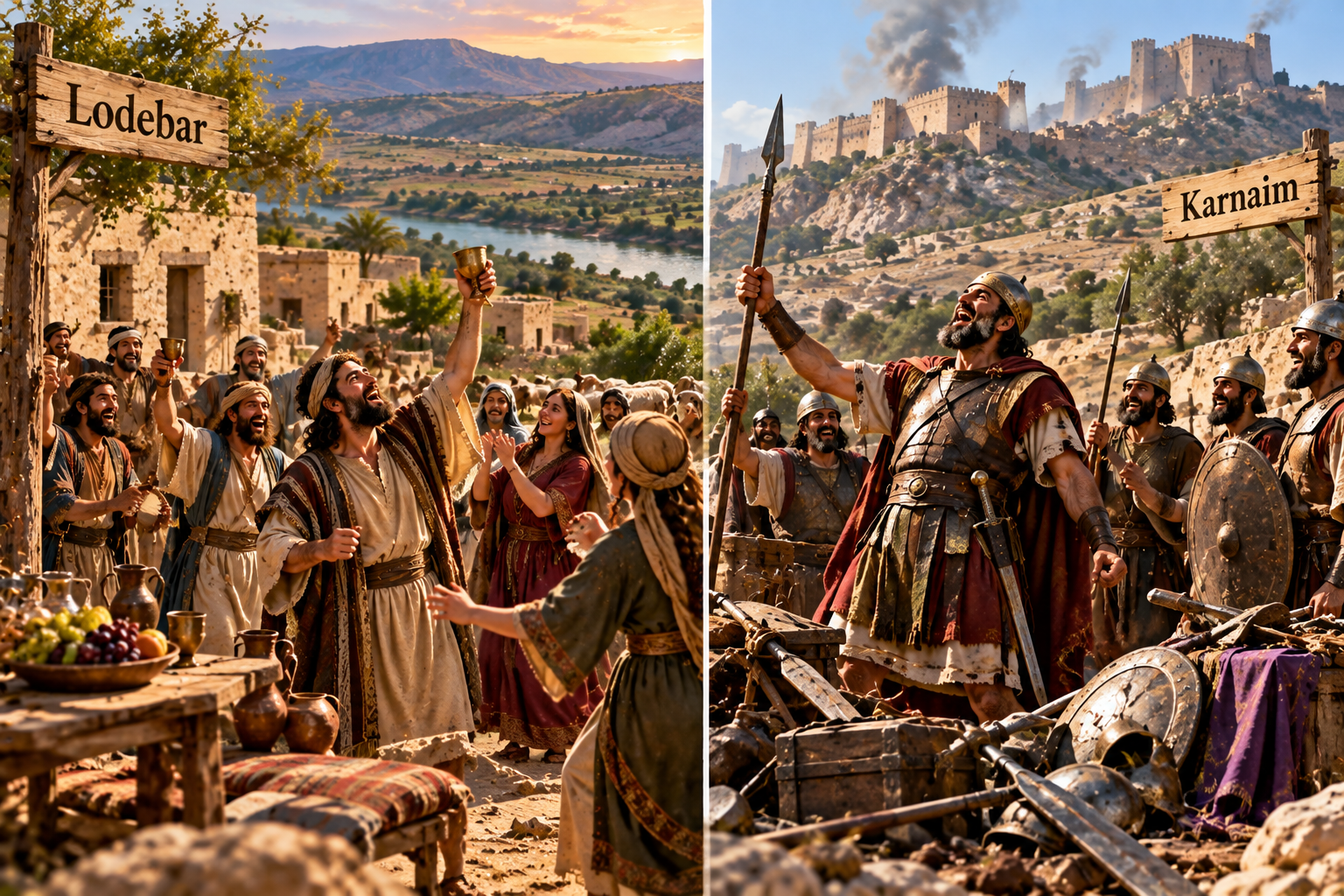
Rejoicing in Lodebar Boasting over Karnaim
THE FOLLY OF BOASTING IN
ONE'S OWN STRENGTH
You who rejoice (sameach) in Lodebar - The Hebrew verb rejoice means to be glad or take pleasure in something. The word itself is not negative, for God’s people are repeatedly called to rejoice in Him: “Be glad in the LORD and rejoice, you righteous ones; and shout for joy, all you who are upright in heart” (Ps 32:11; Phil 4:4). The problem was not that Israel rejoiced, but what it rejoiced in. The leaders who feasted while refusing to grieve over the ruin of Joseph (Amos 6:6) were now celebrating military success and territorial gains while ignoring their moral decay. Israel’s tragedy was not that it lacked reasons to celebrate, but that it celebrated the wrong things.
Bob Utley - "You who rejoice" This Hebrew phrase implies arrogance and pride over two military victories by Jeroboam II of the trans-Jordan cities of Lodebar and Karnaim. Israel was proud and confident in her military, but YHWH will destroy Israel by a greater military power (cf. Amos 6:14, the Assyrians)! The Assyrians will come from the same geographical direction as these two cities mentioned, "the north."
Israel measured its greatness by the territory it controlled,
while God measured it by the righteousness it lacked.
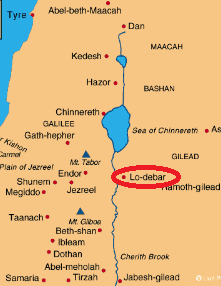
Lodebar was a town east of the Jordan, probably in northern Gilead, and likely the place where Mephibosheth lived before David brought him to Jerusalem (2Sa 9:4). It was evidently among the territories Israel recovered under Jeroboam II (2Ki 14:25–28). But Amos is making a pointed wordplay. Lō-dĕbār sounds like lōʾ dābār, meaning “nothing.” Israel was literally “rejoicing over nothing.” The second half of the verse adds a matching pun: “Have we not by our own strength taken Karnaim for ourselves?” Karnaim means “a pair of horns,” a biblical symbol of strength (Ps 75:10). In effect, Amos says, “You celebrate capturing Nothing, and you brag that your own power took Strength.” Jeremiah gave the right answer to such boasting: “Thus says the LORD, ‘Let not a wise man boast of his wisdom, and let not the mighty man boast of his might, let not a rich man boast of his riches; but let him who boasts boast of this, that he understands and knows Me, that I am the LORD who exercises lovingkindness, justice and righteousness on earth; for I delight in these things,’ declares the LORD” (Jeremiah 9:23, 24). Israel measured its greatness by the territory it controlled, while God measured it by the righteousness it lacked.
NET NOTE Lo Debar was located across the Jordan River in Gilead, which the Israelite army had conquered. However, there is stinging irony here, for in Hebrew the name Lo-Debar means “nothing.” In reality Israel was happy over nothing of lasting consequence.
And say, “Have we not by our own strength taken Karnaim (qarnayim - "a pair of horns" from qeren = horn picture of strength) for ourselves? - KJV = "Have we not taken to us horns by our own strength?" NLT = "You boast, "Didn't we take Karnaim by our own strength?"" Amos exposes the heart of Israel's sin. Notice the emphasis “Our own strength.” The people attributed their military prowess to themselves. They concluded that their own power deserved the credit for their victories, but they had forgotten the LORD is the One Who enabled them to defeat their enemies (Dt 28:7 = the "blessing") and would soon experience the divine reversal as Yahweh would cause them to be defeated before their enemies (Dt 28:25 = the "cursing"). They either had not read, had forgotten or simply did not believe and practice the truth of Ps 20:7 "Some boast in chariots and some in horses, but we will boast in the name of the LORD, our God." Instead, they boasted in their chariots and horses! This was precisely the danger Moses had warned about centuries earlier declaring when Israel entered the Promised Land and enjoyed prosperity, they were not to say that their own power and strength had produced their wealth (Dt 8:17,18).
Karnaim was a town east of the Jordan, probably in the region of Bashan. Its exact location is uncertain, but it is often connected with Ashteroth-karnaim, mentioned in Abraham’s day: “In the fourteenth year Chedorlaomer and the kings that were with him, came and defeated the Rephaim in Ashteroth-karnaim and the Zuzim in Ham and the Emim in Shaveh-kiriathaim” (Genesis 14:5). The name comes from qeren, “horn,” and means “two horns.” In the ancient Near East, and throughout Scripture, horns symbolized strength and power: “And all the horns of the wicked He will cut off, but the horns of the righteous will be lifted up” (Ps 75:10). The name Karnaim is ironic because Israel boasted that it had captured a place whose very name meant strength (or maybe even "double strength"!), and they foolishly credited the victory to their “own strength!”
🙏 THOUGHT - Can we as NT believers fall into the subtle trap into which Israel fell? That's rhetorical! Of course we can. When I receive a pat on the back for something I taught in a Bible class, it is tempting to take all the credit. My defense to prevent me from falling into this sin is to remind myself of Paul's words in 2Cor 3:5-6 - "Not that we are adequate in ourselves to consider anything as coming from ourselves, but our adequacy is from God, Who also made us adequate as servants of a new covenant, not of the letter but of the Spirit; for the letter kills, but the Spirit gives life." As Jesus said "apart from Me you can do (absolutely) nothing" in regard to bearing spiritual fruit that remains (Jn 15:5, 16)! "Seek the LORD and His strength; Seek His face continually." (1Ch 16:11, Mt 6:33). Pray and praise with Ps 18:1-3 “I love You, O LORD, my Strength.” The LORD is my Rock and my Fortress and my Deliverer, my God, my Rock, in Whom I take Refuge; my Shield and the Horn of my salvation, my Stronghold. I call upon the LORD, Who is worthy to be praised, And I am saved from my enemies."
NET NOTE Karnaim was also located across the Jordan River. The name in Hebrew means “double horned.” Since an animal’s horn was a symbol of strength (see Deut 33:17), the Israelites boasted in this victory over a town whose very name symbolized military power.
Bob Utley - "Have we not by our own strength taken Karnaim for ourselves" This is apparently another city in the trans-jordan area. The term Karnaim means "a pair of horns," which would denote its power. These cities were both recaptured by Jeroboam II (782-753 B.C., cf. 2 Kgs. 14:25). The theological implication of the phrase is that Israel, by her own military power, captured these two cities, which goes against the concept of holy war. It was YHWH's power and strength (e.g. Ex 13:3,14,16) that enabled His people to win in battle. This claim is another sign of Israel's arrogance and covenant ignorance.
Contrast Hannah, who rejoiced in the LORD as the source of her strength: “Then Hannah prayed and said, ‘My heart exults in the LORD; my horn is exalted in the LORD, my mouth speaks boldly against my enemies, because I rejoice in Your salvation’” (1 Samuel 2:1). Hannah rejoiced in the LORD and found her “horn” in Him. Israel rejoiced in its victories and found its “horn” in itself. The LORD was about to show how fragile that strength really was (Amos 6:14). They had conquered a place associated with strength, but they had forgotten the God who is the true source of strength.
We depend on God in adversity
but grow self-sufficient in prosperity;
🙏 THOUGHT: Are You Taking Credit for What God Has Given?Israel’s leaders celebrated their victories by boasting, “Have we not by our own strength taken Karnaim for ourselves?” (Amos 6:13). Instead of giving glory to God, they congratulated themselves! How easily we do the same. We depend on God in adversity but grow self-sufficient in prosperity; we pray at the start of a hard task but take the credit when it succeeds. Moses warned Israel not to say, “My power and the strength of my hand made me this wealth” (Dt 8:17–18, cf Zech 4:6, 2Co 3:5,6), and Paul asks, “What do you have that you did not receive?” (1Co 4:7). Even our strength to work, wisdom to decide, and opportunities to succeed are gifts from His hand (Jas 1:17). Let him who boasts boast that he knows the LORD (Jeremiah 9:23, 24). The more God enables us to accomplish, the more careful we must be to give Him the glory! (1Ch 29:12-14; Gal 6:14)
QUESTION - What is the significance of Lo Debar in the Bible? | GotQuestions.org
ANSWER - Lo Debar (or Lo-debar) is a town only mentioned a few times in Scripture. If it is, as many scholars assume, the same town as Debir, mentioned several times in the book of Joshua, we find that it was one of the cities of Canaan that Joshua destroyed (Joshua 10:39). Debir, whose name means “pasture” or “sheepfold,” was located near the Valley of Achor (Joshua 15:7) on the northern boundary of Judah, somewhere between Jerusalem and Jericho. The exact location of the town is impossible to ascertain. If Lo Debar is the same town as Debir, somewhere in its history the name was changed to Lo Debar.
Debar normally means “word” or “thing.” The prefix lo is a negator; thus, the term Lo Debar would mean “no word” or “no thing.” The town’s name is not complimentary. The name may or may not have been an apt description of the town. If it was an apt description, it may have been lacking good pasture, or it may have been an insignificant, “nothing town.” In English we might say that it was “in the middle of nowhere.”
Lo Debar is first mentioned in connection with Mephibosheth, the only surviving son of Jonathan, son of King Saul. David wanted to show kindness to Jonathan’s family, and he was told that Mephibosheth was living in Lo Debar. The story is found in 2 Samuel 9. Mephibosheth leaves “Nothingville” (Lo Debar) and moves into the king’s residence in Jerusalem—from Podunk to palace.
The town of Lo Debar is next mentioned in 2 Samuel 17:27 as the home of Ammiel, one of several men who provided David with provisions as he was fleeing from Absalom.
The final mention of Lo Debar in Scripture is in Amos 6:13. Amos, a prophet from Judah, confronts the sin and pride of the northern kingdom of Israel. He condemns their boasting in their conquest of Lo Debar, which would have been in the territory of Judah. The fact that Israel would conquer a city of Judah was certainly worth addressing in its own right, as Israel and Judah should have been brothers living in peace. But, beyond the mere fact of the treacherous conquest, Amos may also have been making a rhetorical point through a play on words. The men of Israel were boasting that they conquered “Nothing” or “Nothing Town.” Amos may have highlighted this town specifically because of the town’s name, in order to stress the emptiness of their boasting before God. “You are so proud of your conquest,” says the prophet in so many words, “but really you have conquered Nothing!”
AFFLICTING THE COMFORTABLE AMOS 6:13-14 - Wayne Stiles Going Places with God: A Devotional Journey- Page 83
In a time of tremendous affluence, Israel went soft on God. They sought opulent furniture, the finest food, first-class entertainment, the best wine and perfumes . . . but they did not seek the Lord. So God sent a fig picker from Judah north to Israel to afflict the comfortable.
Amos spoke to those “who rejoice in Lodebar, and say, ‘Have we not by our own strength taken Karnaim for ourselves?’” (Amos 6:13). Lodebar and Karnaim guarded the approaches to Israel’s Jezreel Valley from the eastern Transjordanian highway. Israel’s recent victories in those regions had given them an arrogant and false sense of security. With tongue firmly in cheek, God referred to the city of Lodebar as Lodabar, which means “no thing.”
In other words, the Israelites rejoiced in what amounted to nothing. God would bring the Assyrians from that same direction, and they would afflict Israel “from the entrance of Hamath to the brook of the Arabah” (v. 14). From the north to the south, God would afflict the comfortable.
Take a moment of silent, brutal honesty. Where has devotion to God taken a backseat to devotion to His blessings? Maybe you have given ministry or projects more dedication than your personal time with God. Maybe keeping your home neat and nice has taken priority over kindness to those within it. Israel’s blessings wooed them away from loving the God who blessed them. Are we any different?
The Lord remains committed to our relationship with Him, no matter the cost. When comfort dulls our sensitivity to God, He has little choice but to remove the obstacle.
Father, why do I struggle so hard to surrender the blessings I received so easily? Are they not Yours to give and take? Remind me that moths and rust destroy the things I treasure here [see Matt. 6:19]. Renew my allegiance to things eternal—to Your people, Your Word and, above all, to Yourself.
If you have anything that you prize very highly,
hold it very loosely, for you may easily lose it.
—C. H. Spurgeon
Amos 6:14 “For behold, I am going to raise up a nation against you, O house of Israel,” declares the LORD God of hosts, “And they will afflict you from the entrance of Hamath To the brook of the Arabah.”
KJV But, behold, I will raise up against you a nation, O house of Israel, saith the LORD the God of hosts; and they shall afflict you from the entering in of Hemath unto the river of the wilderness.
NET "Look! I am about to bring a nation against you, family of Israel." The LORD, the God who commands armies, is speaking. "They will oppress you all the way from Lebo-Hamath to the Stream of the Arabah."
NLT "O people of Israel, I am about to bring an enemy nation against you," says the LORD God of Heaven's Armies. "They will oppress you throughout your land-- from Lebo-hamath in the north to the Arabah Valley in the south."
ESV "For behold, I will raise up against you a nation, O house of Israel," declares the LORD, the God of hosts; "and they shall oppress you from Lebo-hamath to the Brook of the Arabah."
BGT διότι ἰδοὺ ἐγὼ ἐπεγείρω ἐφ᾽ ὑμᾶς οἶκος τοῦ Ισραηλ ἔθνος καὶ ἐκθλίψουσιν ὑμᾶς τοῦ μὴ εἰσελθεῖν εἰς Εμαθ καὶ ἕως τοῦ χειμάρρου τῶν δυσμῶν
LXE For behold, O house of Israel, I will raise up against you a nation, saith the Lord of hosts; and they shall afflict you so that ye shall not enter into Aemath, and as it were from the river of the wilderness.
CSB But look, I am raising up a nation against you, house of Israel-- this is the declaration of the Lord, the GOD of Hosts-- and they will oppress you from the entrance of Hamath to the Brook of the Arabah.
NIV For the LORD God Almighty declares, "I will stir up a nation against you, O house of Israel, that will oppress you all the way from Lebo Hamath to the valley of the Arabah."
- I will (KJV): 2Ki 15:29 17:6 Isa 7:20 8:4-8 10:5,6 Jer 5:15-17 Ho 10:5
- from (KJV): Nu 34:8 1Ki 8:65 Eze 47:15-17
Related Passages:
2 Kings 14:25 He (JEROBOAM II) restored the border of Israel from the entrance of Hamath as far as the Sea of the Arabah, according to the word of the LORD, the God of Israel, which He spoke through His servant Jonah the son of Amittai, the prophet, who was of Gath-hepher.
2 Kings 14:28 Now the rest of the acts of Jeroboam (JEROBOAM II) and all that he did and his might, how he fought and how he recovered for Israel, Damascus and Hamath, which had belonged to Judah, are they not written in the Book of the Chronicles of the Kings of Israel?
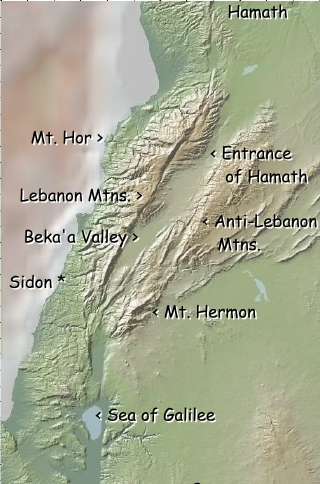
Entrance of Hamath
THE GOD WHO RAISES
UP NATIONS
For behold (hinneh; LXX - idou = Look!) - The Hebrew expression ki hinneh combines “for” or “because” with the attention-commanding word hinneh, meaning “behold” or “look.” Amos is drawing attention to the reason Israel's confidence is misplaced. The previous verse described the nation's self-congratulation over its military victories. Now God announces the coming reversal. The connection is important. Israel says, “Have we not by our own strength taken Karnaim?” (Am 6:13). God responds, “I am going to raise up a nation against you.”
I am going to raise up (qum - epegeiro - to cause an activity to begin through arousing, exciting, stirring up) a nation against you - God announces that He will bring a foreign nation against Israel. This is not merely a prediction that another nation will become militarily powerful. It is a declaration of His judicial purpose. The LORD Himself will raise up the instrument of Israel's judgment. The nation is not named in this verse, however, the historical context and subsequent events point unmistakably to Assyria, the expanding empire that eventually conquered the northern kingdom in 722 BC. The Assyrians would become the instrument through which God's announced judgment fell upon Israel.
Against You, O House of Israel - God does not merely announce that a foreign nation will arise but declares that this nation will arise “against you” against the northern kingdom. House of Israel identifies the Northern Kingdom who had received extraordinary privileges from God. Israel's greatest privilege was knowing the LORD, but its greatest tragedy was living as though it did not need Him.
O house of Israel declares the LORD God of hosts (armies) - This Name of God emphasizes His supreme authority over the heavenly hosts, all creation and all nations. Israel had boasted in its military strength. But the prophet reminds the nation that the One announcing judgment is the LORD God of hosts. No earthly army can successfully resist His sovereign purpose.
And they will afflict (lachats; LXX - ekthlibo from thlibo - to squeeze, press, distress greatly) you - Afflict means to press, oppress, squeeze, or distress and can describe severe oppression imposed by an enemy. It is used elsewhere for the oppression Israel experienced under hostile powers (Ex 3:9; Jdg 2:18). The irony is striking because Israel had oppressed its own poor and vulnerable citizens (Am 2:6,7; Am 4:1; Am 5:11–12). Now God announces that the nation itself will experience oppression. The people who had exercised power without justice would discover what it meant to suffer under the power of another nation. This does not mean every individual who suffered was personally guilty of the same acts of oppression. Rather, Amos describes the consequences of national judgment upon a society characterized by persistent injustice.
From the entrance of Hamath - Israel's affliction would be from their northernmost border to the southernmost (brook of the Arabah). The entrance of Hamath was a recognized location marking the northern extent of Israel's territory. Hamath was an important city on the Orontes River in Syria. The expression “entrance of Hamath” (see map above) refers to the southern approach to the region of Hamath rather than to the city itself. The exact geographical identification is debated but is approximated on the map above. During the reign of Jeroboam II, Israel had recovered territory extending toward the entrance of Hamath (2Ki 14:25). This territorial expansion was a source of national pride and some writers note that it equaled what Solomon had once attained. So now Amos announces that the invading nation will afflict Israel beginning at the very northern boundary associated with Jeroboam's success. The northern boundary that testified to Israel's military expansion would soon witness the advance of its enemy because the Assyrian invasion would come from the north!
John Walton - restoration of borders. Jeroboam II’s expansion restored Israel to the size it had been during the reign of Solomon. Lebo-Hamath (modern Lebweh [Ematu in the Ebla texts; Lab’u of Assyrian sources]) on one of the sources of the Orontes is in the northern Baqa’ of Lebanon, forty-five miles north of Damascus. This was the southern border of the land of Hamath and therefore the northern border of Canaan, and designates the northern corner of the empire. The name appears in city lists of the Egyptian king Thutmose III (fifteenth century B.C.) and the annals of Tiglath-Pileser III of Assyria (eighth century B.C.). The Sea of Arabah (or Wadi Arabah, Amos 6:14), now the Dead Sea, was the southern border of the kingdom.
To the brook of the Arabah - NLT = " from Lebo-hamath in the north to the Arabah Valley in the south" The southern boundary is identified as “the brook of the Arabah.” The Hebrew word nachal can refer to a stream, torrent valley, or seasonal watercourse. The Arabah is the great rift valley region extending southward from the Dead Sea toward the Gulf of Aqaba (see map), although the term can be used in different geographical senses in Scripture. Therefore the precise identification of this brook is debated. Many commentators associate it with a watercourse near the southern end of Israel's eastern territory, possibly in the region of the Dead Sea. It should not automatically be identified with the Brook of Egypt. The essential point is geographical rather than dependent upon identifying one particular stream. Amos describes the destruction of the full extent of Israel's territory. From north (Hamath) to south (Arabah), the nation would experience the affliction wrought by the invading Assyrian army. The judgment would extend across the very land in which Israel had placed its confidence. No border was so distant and no territory so secure that it could escape the reach of God's inevitable imminent judgment.
Amos 9:2–4 “Though they dig into Sheol, From there will My hand take them; And though they ascend to heaven, From there will I bring them down. Though they hide on the summit of Carmel, I will search them out and take them from there; And though they conceal themselves from My sight on the floor of the sea, From there I will command the serpent and it will bite them. And though they go into captivity before their enemies, From there I will command the sword that it slay them, And I will set My eyes against them for evil and not for good.”
KJV Bible Commentary - God will bring a nation (which from history we know to be Assyria) against them that will ravish the land from the extreme north (Hemath) to the extreme south (the river of the wilderness) (vs. 14).
Afflict (03905) lachats mean to physically push against someone or something, to squeeze, to crush and has the sense of pressing, crowding or tormenting. Used literally twice of Balaam's donkey in Nu 22:25 "When the donkey saw the angel of the LORD, she pressed herself to the wall and pressed Balaam’s foot against the wall, so he struck her again." "Hold the door shut" in 1 Ki 6:32. Lachats is used repeatedly in the dark days of Judges (lasted some 1200 years!) when Israel would be oppressed by some pagan enemy and would cry out to God for deliverance. The only problem was they kept falling back into sin after a period of rest! Sounds too familiar to my life sometimes!
Walter Kaiser - The word finds its most important usage in the realm of ethical theology. Israelites were not to oppress foreigners or strangers (Ex 22:21; Ex 23:9), for they once had been strangers in Egypt, that great oppressor. Oppressive treatment was strictly forbidden to all and to Israel in particular. Israel experienced a whole wave of oppressors during the period of the judges (Jdg 1:34; Jdg 2:18; Jdg 4:3; Jdg 6:9; Jdg 10:12; 1 Sa 10:18). But the Lord sent deliverers in each situation. Later he sent oppressors, (the king of Syria and others; 2 Ki 13:4, 22) against Israel on account of sin (Amos 6:14). Other nations will face their oppressors (Isa 19:20), too. But God always hears the cry for mercy and deliverance, and he will then fight daily against those oppressors (Ps 56:1) (Online TWOT)
Hamath (Hebrew ḥămāt, “fortress” or “citadel”) was a major city of Syria, built on a large mound beside the Orontes River, roughly midway between Carchemish to the north and Kadesh to the south. Amos calls it “Hamath the great” (Am 6:2). The Hamathites are listed among the descendants of Canaan (Ge 10:18), and the “entrance of Hamath” marked the ideal northern boundary of Israel’s land (Nu 13:21; 34:8; 1 Ki 8:65). David enjoyed friendly relations with Toi, its king (2 Sa 8:9–10), and Solomon built store cities in its territory (2 Chr 8:4). In Ahab’s day, Hamath joined Damascus and Israel in a coalition against Assyria at the battle of Qarqar (853 BC). Jeroboam II later recovered Hamath for Israel (2 Ki 14:28), the expansion that fed the national pride Amos denounces. Hamath then paid tribute to Tiglath-pileser III and was finally crushed by Sargon II in 720 BC, who deported its people and resettled the land with Assyrians. The Assyrians boasted of Hamath’s fall when threatening Hezekiah (2 Ki 18:34; 19:13), and Hamathites were among the foreigners settled in Samaria after Israel’s exile, bringing their god Ashima with them (2 Ki 17:24, 30). The city later became Epiphaneia under the Seleucids, but it kept its ancient name and is known today as Hama, in modern Syria.
Bob Marcaurelle - The False Security of Luxury Amos 6:1-14
If you throw a frog into boiling water he will jump out. But if you put him in cool water and turn the heat on slowly, he will go to sleep in the warm water and slowly die as the heat increases. Human beings can be lulled to sleep by material prosperity to the point they have it so good that they are blind to their danger. Luxury and false security go hand in hand. It was so in Israel. It is so in America. Many experts say our affluence has blinded us to the threat of Communism. Though we secure and spend our money in ungodly ways we see our prosperity as a "sign" that God is with us. It is a "sin sickness" which has really placed God against us. This is the theme of chapter six. Look at ...
I. The False Security (Amos 6:1-3)
Times were so good for the wealthy in Israel that they could not believe the bad news of Amos. These people
1. Trusted in two false hopes (Amos 6:1). They trusted
1) In Their Religion. They were "at ease in Zion" (Amos 6:1), the holy hill of God (Ps. 78:68-69; 132:13-18, etc.). Our Christian religion is designed to instill hope and assurance but this must be based upon true Christianity, not our human perversions. To trust in our own goodness (Eph. 2:8), our church (Lk. 3:7-9), or, as in the case of these people, our faith and religious activity without righteous character (James 2:14-25) is to lean upon a rotten crutch.
They also trusted
2) In Their Military Might. They "feel secure on the mountain of Samaria" (1A) and their notable political leaders are so wise that all Israel comes out to hear them (1B). Israel's hope was always to be in God, not herself or her allies. But this did not mean she was not to have an army or refuse to defend herself. Those who tell America to lay down her arms and trust only in God are asking for a Communist takeover. God gives us all sense enough to defend ourselves, yet doing all we can we know He is our Defender.
2. These folk also Boasted (Amos 6:2). Verse two seems to be a boast of Israel's leadership quoted by Amos. Go to Calneh or Hamath (two influential cities), they say, and you will see they are not as great as we are. They saw prosperity as a sign of the favor of God, when in fact it was a product of their own wickedness. The modern charismatics imply the same error. If you are sick or poor or low man on the job then sin has blocked the flow of God's blessing.
3. Thus these people Coasted (Amos 6:3) in the belief that all would be well. They did not see the "evil day" and "violence" that inevitably comes when people forget God and forget each other. With indifference, injustice and immorality they were sowing the seeds for their nation's downfall.
II. The Fabulous Luxury (Amos 6:4-6)
The false security was due, in part, to their fabulous luxury. Taking us into a home Amos shows us people with their extravagant ivory furniture (4); sumptuous diet (4); happy songs (5); excessive drinking habits (6); and practice of anointing themselves with finest oils (6).
Amos 6:6B says, "... but are not grieved over the ruin of Joseph." Their real sin was not wealth but selfishness and sin. Wealthy people have a marvelous opportunity to share their goods with others and to be good examples of righteousness in the difficult context of wealth (Matt. 19:23-26).
Their sin was
the misuse of wealth.
God tells us we are
1) To Earn Our Money Honestly (Prov. 20:10) and Fairly (Js. 5:1-5). They had done neither (Amos 5:11-12).
2) We are To Share Our Money Generously (1 Tim. 6:17-19). They chose extravagance over charity.
3) God tells us To Subordinate Our Money Inwardly (Matt. 6:24). Money is not to be our god. These people's self pleasing and unconcern over the ruin of Joseph (a synonym for the church of God, M. Henry, see Ps. 130:1) show that material possessions were first with them. The old phrase "Money Talks!" is right. How you get it and what you do with it tells what kind of person you are, where your values lie, and ultimately where you will spend eternity (1 Jn. 3:17).
III. The Fatal Penalty (Amos 6:7-14)
Once again Amos pictures
1. Israel's Suffering (Amos 7:10, 13). He promises divine judgment in the form of captivity. Starting with these affluent leaders, he promises them that they will be the first to go (7). The God who hates the pride of their false security swears "by Himself" that judgment will come (8). The awful details (9) are given in the picture of a man after the siege burning bodies to prevent plague. The survivors, hiding in corners, are afraid to even mention the name of the Lord (10) because He is the source of their judgment. From one end of the country to the other (13) they would suffer.
This judgment was the result of
2. Israel's Stupidity (Amos 6:11-13). Their life-style was as absurd as running horses through rocks or plowing the ocean with oxen (12). Their rejoicing over some recent victory over the Syrians was foolish if seen as a sign of ultimate victory (13). In their stupidity they trusted in their own strength (13). Their own Bible warned them, "Pride goes before destruction."
In all this we see
3. Israel's Suicide. Here we see that Israel's fall was as natural as it was supernatural. In God's order of things a lazy, indulgent nation that forgets character, forgets God and forgets to care for its needy, rots from the inside and becomes easy prey for some aggressor. Edward Gibbon listed these reasons among others for the fall of the Roman Empire. (1) Extravagant spending. (2) The mounting desire for pleasure. (3) The continual production of armaments. (4) The decay of religion into confusing, meaningless forms. God didn't have to destroy Israel. They were destroying themselves. What about us?