Psalm 18:2
Psalm 18:3
Psalm 18:4
Psalm 18:5
Psalm 18:6
Psalm 18:7
Psalm 18:8
Psalm 18:9
Psalm 18:10
Psalm 18:11
Psalm 18:12
Psalm 18:13
Psalm 18:14
Psalm 18:15
Psalm 18:16
Psalm 18:17
Psalm 18:18
Psalm 18:19
Psalm 18:20
Psalm 18:21
Psalm 18:22
Psalm 18:23
Psalm 18:24
Psalm 18:25
Psalm 18:26
Psalm 18:27
Psalm 18:28
Psalm 18:29
Psalm 18:30
Psalm 18:31
Psalm 18:32
Psalm 18:33
Psalm 18:34
Psalm 18:35
Psalm 18:36
Psalm 18:37
Psalm 18:38
Psalm 18:39
Psalm 18:40
Psalm 18:41
Psalm 18:42
Psalm 18:43
Psalm 18:44
Psalm 18:45
Psalm 18:46
Psalm 18:47
Psalm 18:48
Psalm 18:49
Psalm 18:50
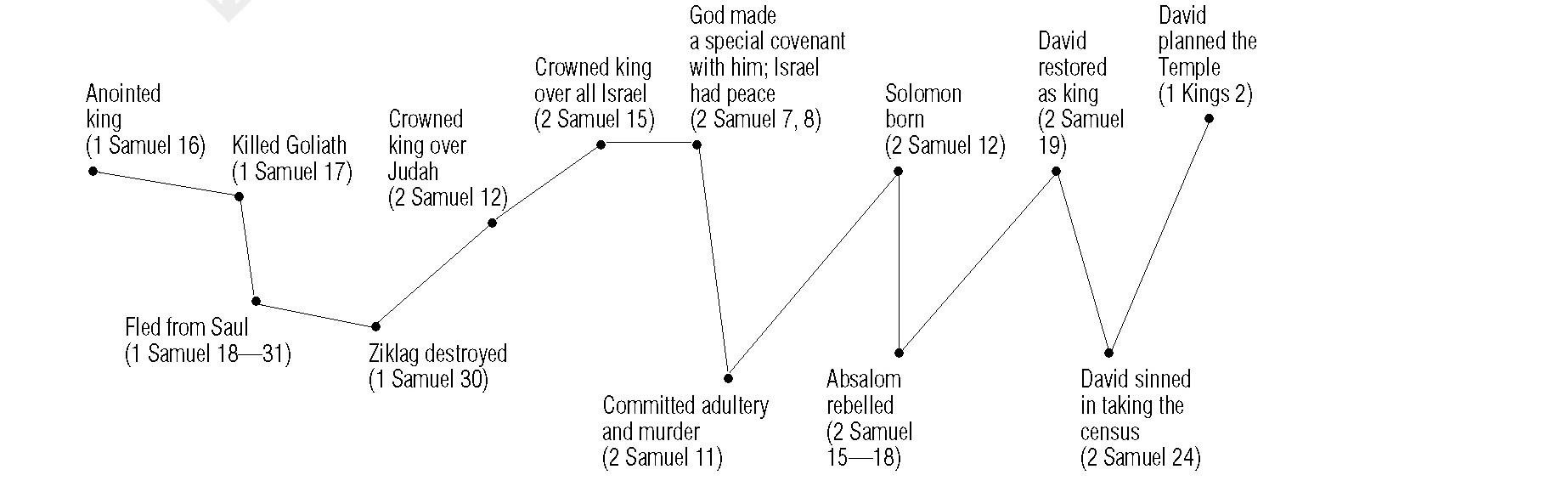
HIGHS AND LOWS OF DAVID'S LIFE
Source: Life Application Study Bible (borrow)
Psalm 18:1 For the choir director. A Psalm of David the servant of the LORD, who spoke to the LORD the words of this song in the day that the LORD delivered him from the hand of all his enemies and from the hand of Saul. And he said, “I love You, O LORD, my strength.”
- in the day (KJV): Ps 34:19 Ex 15:1-21 Jud 5:1-31 1Sa 2:1-10 Isa 12:1-6
- I will (KJV): Ps 116:1-6 144:1,2 1Jn 4:19
- my (KJV): Ps 18:32 28:7,8 118:14 Isa 12:2 Php 4:13 Col 1:11
- Psalm 18:1-6 A Song of Deliverance - Warren Wiersbe
A SONG OF
DELIVERANCE
For the choir director. A Psalm of David the servant of the LORD, who spoke to the LORD the words of this song in the day that the LORD delivered him from the hand of all his enemies and from the hand of Saul. When did Yahweh deliver David? When he called upon Him, in humility and trust. This psalm most likely appears to be at the end of his life as David looks back over the years and focusing on the faithfulness of His God, always a good thing for all of us old folks to do (I am 77 yo 2023)! The beauty of this chapter is that David is ending his race with a song in his heart and on his lips, also a example to imitate! David a Spirit empowered man (1Sa 16:13), is given evidence of this Spirit's power by "speaking to one another in psalms and hymns and spiritual songs, singing and making melody with your heart to the Lord." (Eph 5:19).
Warren Wiersbe - The Lord delivered David from all his enemies. The Hebrew language contains 23 different words for deliverance. The Jewish people knew something about deliverance. Throughout their history God had delivered them. Who delivered David? God did....."Deliver" is a key word in this song (vv. 1, 2, 18, 20, 44, 49), and it carries with it the meanings of "drawing out of danger, snatching, taking away, allowing to escape." For at least ten years before he became king, David was pursued by Saul and his army, and the record shows that Saul tried to kill David at least five times. (See 1 Sam. 18:10-11; 19:8-10, 18-24.) After he became king, David had to wage war against the Philistines, the Ammonites, the Syrians, the Moabites, and the Edomites, and God enabled him to triumph over all his enemies. (Be restored : 2 Samuel & 1 Chronicles)
Boice - Psalm 18 is a thanksgiving song. (I discussed the various genres of psalms in the last chapter, listing hymns, laments, thanksgiving psalms, psalms of confidence, psalms of remembrance, wisdom psalms, and kingship psalms. = Borrow Tremper Longman III, How to Read the Psalms 19–36.) It follows naturally upon Psalm 17, which is a lament. Thanksgiving psalms seem to follow laments. In his lament David described himself as being surrounded by callous enemies who were intent on his destruction. They were like lions “hungry for prey” (v. 12). He cried out for deliverance, and at the end of the psalm he is found confidently expecting that God will come to his aid. In Psalm 18 we find David looking back over a lifetime of such saving interventions by God and praising him for them. At the same time, Psalm 18 is also a kingship psalm. It is a rehearsal of God’s many blessings on the king and his kingdom. This means that it could have been sung, not only by David, but by anyone who had experienced the blessings of David’s rule or the rule of many who later followed him to the throne. Some of the kingship psalms have elements that look beyond the earthly king to God’s promised Messiah. That is the case here. In fact, we have biblical justification for seeing the psalm this way, since in his letter to the Romans the apostle Paul quotes verse 49 as the first of four prophecies to show that Christ came for the Gentiles as well as for the Jews (Rom. 15:9). (Ibid)
Swindoll, when he outlines this particular song, says, “David sums up his life in four themes:
1. When TIMES ARE THOUGH, the Lord is our only SECURITY.
2. When DAYS ARE DARK, the Lord is our only LIGHT.
3. When our WALK IS WEAK, the Lord is our only STRENGTH.
4. When our FUTURE IS FOGGY, the Lord is our only HOPE.
Andrae Crouch captures the truth of the song that David has written in his song entitled “Through It All.”
“I’ve had many tears and sorrow,
I’ve had questions for tomorrow.
There’ve been times I didn’t know right from wrong.
But in every situation, God gave blessed consolation
That my trials come to only make me strong
Anderson divides this song as follows...
1. WHO IS HE – verses 1-4
2. WHAT HE HAS DONE – verses 5-20
3. HOW HE SEES ME – verses 21-28
4. WHAT HE IS TO ME – verses 29-46
5. WHY I WORSHIP HIM – verses 47-51
Carl Laney says, “There are two categories of praise in the psalms:
1. DESCRIPTIVE PRAISE. - DESCRIPTIVE PRAISE focuses on what God is like, his ATTRIBUTES
2. DECLARATIVE PRAISE.- DECLARATIVE PRAISE emphasizes what God has done, his ACTIONS.
Vos on this chapter and Psalm 18 -, “Many scholars believe that David wrote both and that the Samuel text is the original, and that David altered it slightly for liturgical purposes when it became part of the Psalms. In any case, the message is essentially the same in both works.” (Borrow 1, 2 Samuel : Bible study commentary)
Guzik - David experienced the LORD’s deliverance:
- · God delivered David from Goliath.
- · God delivered David from Saul.
- · God delivered David from backsliding.
- · God delivered David from Israel’s enemies.
- · God delivered David from Absalom.
- · God delivered David from David’s own sinful passions.
Anderson - His difficulties have given birth to a song, and this song comes in response to the Lord’s deliverance from the hand of all his enemies, and from the had of Saul. (You can’t sing in a storm until you have surrendered to his son.) when you stop and think about it, he has been delivered from a lot of enemies. He has been delivered from: Goliath, Saul, the Philistines, the Ammonites, the Syrians or northern tribes, the Edomites, the Moabites, the Amalekites, Abner and Ishbosheth, Nabal,Absalom, Sheba, Adonijah, Shimei, and a host of others.
And he said, “I love You, O LORD, my strength.”
Boice gives a summary of the context/setting of this chapter - In that book, the psalm appears almost as David’s final words. Hence, it is a summary thanksgiving for God’s many deliverances of him through his long life of service. These deliverances fall into three categories.
First, and most dramatic, there were the deliverances of David from King Saul during the long years David had to hide from him in the wilderness....
Second, God delivered David during his years of fighting against Israel’s enemies and gave him numerous victories. This was the period in which David established the kingdom. Second Samuel 8 lists David’s victories over the Philistines, Moabites, Arameans of Damascus, and Edomites.
Third, God delivered David from the hand of his son Absalom. (Psalms Volume 1)
James Smith - THE GOD OF SALVATION PSALM 18:1–3
From the heading of this Psalm we learn that it was written as a song of DELIVERANCE. The first three verses contain a manifold revelation and a manifold obligation.
I. The Revelation. This is a revelation of the character of Jehovah as a Saviour. In verse 2 eight terms are used that are suggestive of so many aspects of His saving grace—
1. For REFUGE, He is My Rock. The unchangeable Rock of Ages.
2. For PROTECTION, He is My Fortress. “His Name is a strong tower; the righteous runneth into it and is safe.” “The Lord encampeth round about them that fear Him” (Psa. 24:7).
3. For OPPRESSION, He is My Deliverer. “Deliver us from evil, for Thine is the Kingdom, and the power” (Matt. 6:13).
4. For WORSHIP, He is My God. It is written, “Him only shalt thou worship.”
5. For WEAKNESS, He is My Strength. They that wait upon the Lord shall exchange strength. “My strength is made perfect in weakness.”
6. For DEFENCE, He is My Buckler. Put on the whole armour of God, and over all the buckler, or shield of faith.
7. For POWER, He is My Horn. “All power is given unto Me; go ye therefore.” Who shall resist Him?
8. For PROSPECT, He is My High Tower. Those seated in heavenly places have got a delightful view. From their high tower they can see the land that is “fairer than day.”
II. The Obligations. Such marvellous privileges of grace have also gracious responsibilities. What are they? To—
1. LOVE HIM. “I will love Thee, O Lord” (v. 1). The first and great commandment was: “Thou shalt love the Lord thy God.” Surely such manifestation of His love should constrain us. Let it be also a thing of the will (1 Cor. 13:13).
2. TRUST HIM. “In Him I will trust” (v. 2). God has done everything for us, and is willing to be everything to us, but when there is no heart trust, the door of the soul is barred against Him.
3. PRAISE HIM. “Who is worthy to be praised” (v. 3). Those who “call upon the Lord” are most likely to praise Him. He is worthy. Think of all He hath done, and of His long-suffering mercy. “Worthy is the Lamb, to receive glory and honour.”
Psalm 18:2 The LORD is my rock and my fortress and my deliverer, My God, my rock, in whom I take refuge; My shield and the horn of my salvation, my stronghold.
- De 32:4 1Sa 2:2 Ps 18:2-50 Ps 31:3 Ps 42:9 Ps 71:3 Ps 91:2 Ps 144:2 Mt 16:18
Related Passage:
2 Samuel 22:2 He said, "The LORD is my Rock and my Fortress and my Deliverer
2 Samuel 22:3 My God, my Rock, in Whom I take refuge, My Shield and the Horn of my salvation, my Stronghold and my Refuge; My Savior, You save me from violence.
Deuteronomy 32:4 “The Rock! His work is perfect, For all His ways are just; A God of faithfulness and without injustice, Righteous and upright is He.
1 Samuel 2:2 “There is no one holy like the LORD, Indeed, there is no one besides You, Nor is there any rock like our God.
Psalm 31:3 (DAVID) For You are my rock and my fortress; For Your name’s sake You will lead me and guide me.
Psalm 42:9 (SONS OF KORAH) I will say to God my rock, “Why have You forgotten me? Why do I go mourning because of the oppression of the enemy?”
Psalm 71:3 Be to me a rock of habitation to which I may continually come; You have given commandment to save me, For You are my rock and my fortress.
Numbers 20:8 “Take the rod; and you and your brother Aaron assemble the congregation and speak to the rock before their eyes, that it may yield its water. You shall thus bring forth water for them out of the rock and let the congregation and their beasts drink.”
1 Samuel 23:25-28 (DAVID ESCAPED SAUL AT "SLIPPERY ROCK") When Saul and his men went to seek him, they told David, and he came down to the rock (sela'; Lxx - petra) and stayed in the wilderness of Maon. And when Saul heard it, he pursued David in the wilderness of Maon. 26 Saul went on one side of the mountain, and David and his men on the other side of the mountain; and David was hurrying to get away from Saul, for Saul and his men were surrounding David and his men to seize them. 27 But (GOD'S PROVIDENCE SAVED DAVID) a messenger came to Saul, saying, “Hurry and come, for the Philistines have made a raid on the land.” 28 So Saul returned from pursuing David and went to meet the Philistines; therefore they called that place the Rock (sela'; Lxx - petra) of Escape (aka "Slippery Rock"!).
1 Samuel 17:50 Thus David prevailed over the Philistine with a sling and a stone, and he struck the Philistine and killed him; but there was no sword in David's hand.
The LORD is my rock and my fortress and my deliverer, - my Rock (sela'; Lxx - petra) - David's rise to the throne began with a small rock (more accurately a "stone" slung by David, but directed by God) that brought Goliath down (1Sa 17:50). Later David fled from Saul in the Judean wilderness where he was kept safe in the rocky crags and caves in the rocks. In 1Sa 23:25-27, 28 David barely escaped capture by Saul at "Slippery Rock (aka "Rock of Escape")!" It is notable that the first use of rock (sela'; Lxx - petra) is found in Nu 20:8 which Paul teaches us symbolizes Christ, for all Israel "drank the same spiritual drink, for they were drinking from a spiritual rock which followed them; and the ROCK was Christ." (1Cor 10:4). The Hebrew word for rock in Exodus 17:6 signifies a low-lying bed-rock while the word in 2Sa 22:2 (and Nu 20:8) is a high and exalted rock. The rock often symbolized security and the defense of an impregnable refuge. God was David's rock Who gave security and safety
CHS - The Lord is my rock and my fortress." Dwelling among the crags and mountain fastnesses of Judea David had escaped the malice of Saul, and here he compares his God to such a place of concealment and security. Believers are often hidden in their God from the strife of tongues and the fury of the storm of trouble. The clefts of the Rock of Ages are safe abodes.
Wiersbe - “Rock” (Ps 18:2, 31, 46) is a familiar metaphor for the Lord, speaking of strength and stability, a place of refuge (Ps 19:14; 28:1; 31:2–3; 42:9; 62:2, 6–7; 71:3; 78:20; 89:26; 92:15; 94:22; 95:1; 144:1; 1 Sam. 23:25). It goes back to Genesis 49:24 and Deuteronomy 32:4, 15, 18, 30–31.
Goettsche on the LORD as David's Rock - In the Middle Eastern deserts things could get really hot. An over-heated traveler would find respite by resting in the shade of a large rock. When the winds blew a rock formed a shield from the sand and dust. If David was writing this today he might say, “The Lord is my shade tree” or “the Lord is my shelter house”. He might even say “the Lord is my storm shelter.” David had learned this lesson from the experiences of his life. As you read his words he reflects back on those times when it seemed like David was in desperate shape. There were the times when Saul was chasing him in the desert or throwing spears at him in the palace. There were civil wars and the battles with the Philistines. And there was the coup orchestrated by his son. In the Middle Eastern deserts things could get really hot. An over-heated traveler would find respite by resting in the shade of a large rock. When the winds blew a rock formed a shield from the sand and dust. If David was writing this today he might say, “The Lord is my shade tree” or “the Lord is my shelter house”. He might even say “the Lord is my storm shelter.” David had learned this lesson from the experiences of his life. As you read his words he reflects back on those times when it seemed like David was in desperate shape. There were the times when Saul was chasing him in the desert or throwing spears at him in the palace. There were civil wars and the battles with the Philistines. And there was the coup orchestrated by his son. This is an important lesson. The Lord cares for us, He delights in us, He is eager to protect and lead us. We do not have to question His love. He has proved it again and again. Steven Curtis Chapman (who has faced his own heartache) wrote familiar words (Play His Strength is Perfect),
His strength is perfect when our strength is gone.
He’ll carry us when we can’t carry on.
Raised in His power, the weak become strong.
His strength is perfect, His strength is perfect.
And my Fortress (or stronghold - mesudah; Lxx - ochuroma used in 2Co 10:4; see also imagery of fortress) and my Deliverer (palat; Lxx - exaireo - set free, rescue) - God as Rock and Fortress speak of David's protection, for he had personally experienced God as his Protector (Play Marty Goetz's moving song "He is My Defense" - Here is a soulful He is My Rock)
David undoubtedly recalls "the cave of Adullam, where David first formed his band of outlaws; a refuge in many crises, and a place of many memories
1 Samuel 22:4 Then he left them with the king of Moab; and they stayed with him all the time that David was in the stronghold (mesudah)
1 Samuel 24:22 David swore to Saul. And Saul went to his home, but David and his men went up to the stronghold (mesudah).
2 Samuel 5:17 When the Philistines heard that they had anointed David king over Israel, all the Philistines went up to seek out David; and when David heard of it, he went down to the stronghold (mesudah).
2 Samuel 23:13-14 Then three of the thirty chief men went down and came to David in the harvest time to the cave of Adullam, while the troop of the Philistines was camping in the valley of Rephaim. 14 David was then in the stronghold (mesudah), while the garrison of the Philistines was then in Bethlehem.
CHS - "My deliverer," interposing in my hour of peril. When almost captured the Lord's people are rescued from the hand of the mighty by him who is mightier still. This title of "deliverer" has many sermons in it, and is well worthy of the study of all experienced saints.
Wiersbe - “Fortress” pictures God as a stronghold, like the city of Jerusalem on Mount Zion (1Sa 22:4; 24:22; 2 Sam. 5:17; 23:14).
Don't miss David's repetition of the possessive pronoun "MY" (9 times in two verses - Ps 18:1-2) which means belonging to or associated with the speaker, indicating personal possession, not an abstract concept. David clearly has a personal relationship with Yahweh. Do you have a personal relationship with Jesus or did you just know about Him intellectually? One question I ask people I meet is "Do you know Jesus as your Savior?" Many answer "Yes," but with more conversation, their answer suggests (and I am NOT their final Judge!) that they seem to know ABOUT Him, but they can't really call Him "MY Jesus," or "MY Lord." We must remember Jesus' strong and frightening warning in Mt 7:21-23
Not everyone who says to Me, ‘Lord, Lord,’ will enter the kingdom of heaven, but he who does the will of My Father Who is in heaven will enter. 22 “Many (WHAT DOES "MANY" MEAN?) will say to Me on that day, ‘Lord, Lord, did we not prophesy in Your name, and in Your name cast out demons, and in Your name perform many miracles?’ 23 “And then I will declare to them, ‘I never (ABSOLUTELY) knew you (NO PERSONAL RELATIONSHIP); DEPART (COMMAND - DO THIS NOW!) FROM ME, YOU WHO PRACTICE (Present tense = lifestyle, habitual practice) LAWLESSNESS.’
THOUGHT - Can you call God "MY GOD?" Because of what Jesus accomplished at the cross, every believer by grace through faith (Eph 2:8-9) can call the transcendent, infinite, incomprehensible, omnipotent, omnipresent, omniscient God, MY GOD. Now take from time and meditate (see A Primer of Meditation) on each of the "my's" in the following list from chapter 22...how is He your Rock? What does that metaphor depict?, etc. And then offer up your prayers of praise to Him for each of these wonderful pictures of Who He is in our lives (Heb 13:15)
- MY Rock - Ps 18:2, 31, 46
- MY Fortress - Ps 18:2
- MY Deliverer - Ps 18:2
- MY Shield - Ps 18:2
- Horn of MY salvation - Ps 18:2
- MY Stronghold - Ps 18:2
- MY Refuge - Ps 18:2, 30
- MY Lamp - Ps 18:28
If you like an upbeat song listen to My God or the great song by Rich Mullins My Deliverer. or Augustus Toplady's timeless hymn Rock of Ages. James Montgomery Boice writes "The dominant theme of Psalm 18 is that God is our Rock! In the previous chapter, I pointed out that this means He is a shelter beside which we can be protected and prosper, a fortress into which we can run and be safe, a firm foundation upon which our shaking feet can stand and upon which we can build. But I remember also the way in which the great eighteenth-century preacher and songwriter Augustus M. Toplady (1740–1778) handled it in what has since become one of the best-known hymns in our language: “Rock of Ages.” Toplady was traveling in the country when a storm came upon him and he was forced to take shelter in the cleft of a great rock. While he was waiting for the storm to pass he reflected on the situation spiritually, and the words of a hymn began to form in his mind. Looking down at his feet, he discovered a playing card that someone who had been there earlier had dropped. So he picked it up and used it to record these words. The card is still in existence." (Psalms: Volume 1: An Expositional Commentary)
Rock of Ages, cleft for me,
Let me hide myself in Thee;
Let the water and the blood,
From thy riven (or ripped) side which flowed,
Be of sin the double cure;
Cleanse me from its guilt and power.Not the labors of my hands
Can fulfill thy law's demands;
Could my zeal no respite know,
Could my tears forever flow,
All for sin could not atone;
Thou must save, and Thou alone.Nothing in my hand I bring,
Simply to the cross I cling;
Naked, come to Thee for dress;
Helpless, look to Thee for grace;
Foul, I to the fountain fly;
Wash me, Savior, or I die.While I draw this fleeting breath,
When mine eyes shall close in death,
When I soar to worlds unknown,
See Thee on Thy judgment throne,
Rock of Ages, cleft for me,
Let me hide myself in Thee.
MY ROCK OF
REFUGE
My God, my Rock (tsur), in Whom I take refuge (KJV = "In Him will I trust") - All these uses of MY not only speak of personal possession (and relationship) but personal (intimate) experience with God. David's God is not some abstract concept or truth, but is a real and personal God Who he has experienced in manifold ways which accounts for the length of this beautiful song.
God is his (our) personal Rock which David explains means Jehovah is the place (Person) where we can run when we are in need of a safe place (Person)! Pr 18:10 says it this way - "The Name of the LORD is a strong tower; The righteous runs into it and is safe (sagab - means to be raised up)." The thought is that when we run to His Name, which is the essence of all He is (all His attributes), we are high and inaccessible by our adversaries (they are still out there, but they do not have access to the Rock).
Faith must be exercised, or the preciousness of God is not truly known;
and God must be the object of faith, or faith is mere presumption.
-- CHS
My Rock is translated in the Septuagint with with the Greek word phulax which means guard or sentinel, One Who watches or stands as if watching like a soldier stationed as a guard to challenge all comers and prevent a surprise attack! Kirkpatrick says "The title Rock is frequently used to describe the strength, faithfulness, and unchangeableness of God (cf Dt 32:4; Dt 32:37; 1Sa 2:2; Ps 28:1, etc)".
CHS - "My God;" this is all good things in one. There is a boundless wealth in this expression; it means, my perpetual, unchanging, infinite, eternal good. He who can say truly "my God," may well add, "my heaven, my all." (Sing to Him and praise Him with "You are My All in All")
CHS - "My strength;" this word is really "my rock," in the sense of strength and immobility. My sure, unchanging, eternal confidence and support. Thus the word rock occurs twice, but it is no tautology, for the first time it is a rock for concealment, but here a rock for firmness and immutability.
CHS - "In Whom I will trust." (IN WHOM I TAKE REFUGE) Faith must be exercised, or the preciousness of God is not truly known; and God must be the object of faith, or faith is mere presumption. "
My Shield (magen) and the Horn (qeren) of my salvation (yesha; Lxx - soteria), my Stronghold (misgab; Lxx - antilemptor = helper, protector) - A Shield defends, a Horn (power) saves. Stronghold provides a place of security. Horn is strength or power so the horn of my salvation is God's power which saves me, not just the first time (justification) but every day (sanctification) and Who is this descriptive of but the Holy Spirit, Who provides the "desire and the power" to live pleasing to God (see Php 2:13NLT). He is not just the horn of salvation but of MY salvation says David. In 2Sa. 22:3; 2Sa. 22:36; 2Sa. 22:47 He is the Horn...Shield...Rock, all related to salvation respectively as the power, the protection, and the foundation. My Stronghold refers to “high place,” beyond reach of danger.
The Septuagint translates Shield (magen) with the noun huperaspistes which literally means one who holds a shield over another and thus is a protector (defender) and it is used in all 3 uses of magen in chapter 24 (2Sa 22:3, 31, 36 - v36 uses the cognate = huperaspismos = covering with a shield) Hyperaspistes is used 19x/19v - 2Sa 22:3; 2 Sa 22:31; Ps. 18:2; Ps. 18:30; Ps. 27:1; Ps. 28:7; Ps. 28:8; Ps. 31:2; Ps. 31:4; Ps. 33:20; Ps. 37:39; Ps. 40:17; Ps. 59:11; Ps. 71:3; Ps. 84:9; Ps. 115:9; Ps. 115:10; Ps. 115:11; Ps. 144:2.
Rock (05553) sela' is a masculine noun according to Strong refers to 1 crag, cliff, rock. 1A crag, cliff. 1B as stronghold of Jehovah, of security (figurative). TWOT says sela' "refers basically to a cleft in a rock, thence a rock or cliff."
Sela' often speaks of rock faces especially cliffs (Isa 2:21), where eagles (Job 39:28) and hyraxes (rock badgers Pr 30:26) live. People are thrown off sela' (Ps 141:6). Mountain goats is literally "goats of the sela'" (Job 39:1). Sela' is sometimes used as a proper noun: "the rock of Etam" (Jdg 15:8), David's "Rock of Escape" (1Sa 23:28), two rock crags, " name of the one was Bozez, and the name of the other Seneh" (1Sa 14:4). "Clefts of the rock" in Obadiah 1:3 may refer to Sela, an Edomite fortress city. Sela' is associated with crevices and clefts (Jer 13:4; 49:16), also with fortresses (Isa 33:16). The destruction of Tyre prophesied by God would become like a bare rock (Ezek 26:14). Crypts were carved in sela' (Isa 22:16). Sela' occasionally occurs with tsur the other Hebrew word for rock (4x; Dt 32:13, Ps 18:2, Ps 71:3, Isa 2:21). The Septuagint sometimes translates sela' (Isa 42:11) as Petra, perhaps corresponding to Petra in Jordan.
Fortress (stronghold)(04686) mesudah from tsud = to hunt) means a fastness, stronghold. Mesudah (mesuda) refers to a wilderness or mountainous places for hiding, defense, and gathering supplies for battle (1Sa 22:4, 5; 24:22) especially David's city when he captured the "stronghold of Zion" (2Sa 5:7, 9). Job 39:28 gives us a good word picture of the meaning of this word describing the home of the eagle "On the cliff he dwells and lodges, Upon the rocky crag, an inaccessible place (mesudah)."
John Hartley adds "Apparently related to meṣād which means "mountain-height" or "summit"; then "fortress, castle" (Arabic maṣādun) so Masada, the fortress-palace plateau of Herod near the Dead Sea. In the rocky crag the eagle makes his stronghold (Job 39:28). But man erects his fortress out of stone or brick to protect himself from external dangers. Nevertheless with great strategy a stronghold may be taken; e.g. David captured the stronghold of Zion (2 Samuel 5:7). For the believer, especially David, God himself was the stronghold in whom he trusted throughout his trials (Psalm 18:2; Psalm 91:2)." (online TWOT )
Metsudah - 17x - fortress(6), inaccessible place(1), stronghold(10). 1Sam. 22:4; 1Sam. 22:5; 1Sam. 24:22; 2Sam. 5:7; 2Sam. 5:9; 2Sam. 5:17; 2Sam. 22:2; 2Sam. 23:14; 1Ch 11:5; 1Ch 11:16; Job 19:6; Job 39:28; Ps. 18:2; Ps. 31:2; Ps. 31:3; Ps. 66:11; Ps. 71:3; Ps. 91:2; Ps. 144:2; Ezek. 12:13; Ezek. 13:21; Ezek. 17:20
Deliverer (escape, preserve, rescue) (06403) palat means to deliver, to escape or help to escape, to rescue, to take to safety, to bring forth (Job 21:10 - "calves" = delivers a calf). The first use is by David in 2 Samuel 22 where he exalts God as "my deliverer," (2 Sa 22:2) and then later testifies "You have also delivered me from the contentions of my people." Most of the uses are in Psalms and speak of God's deliverance in various settings, including several pleas for Him to deliver (Ps 17:13, Ps 43:2, Ps 71:2, 4, Ps 82:4)
Rock (see also)(06697) tsur is used a few times to describe a literal rock (usually a large rock or boulder), but the figurative uses are more common and usually descriptive of Jehovah. A rock includes ideas of strength and permanence. Figurative expressions include honey from the rock (clefts where bees lived) (Ps. 81:16); Abraham as the ancestral rock of Israel (Isa. 51:1); rock as a symbol of stability (Job 14:18; Nah. 1:6); God as the Rock to look to and depend on as source of strength and refuge (Ps. 31:2 = "Be to me a Rock of strength"; Isa. 17:10 = "have not remembered the Rock of your refuge"); God personified as a Rock of the nation of Israel (2Sa 23:3); of God as the Rock many times (Dt. 32:4, 18; Hab 1:12). It is used of an insufficient rock, a god of the pagan nations (Deut. 32:31).
In Ps 18:2 we find two words for "rock", the first "rock" being "sela'" (see below) and the second "rock" being "tsur." Sela' more frequently suggests a larger, more massive rock structure such as a crag (a steep rugged rock - eg, Job 39:28 uses sela' to describe a safe, resting place for the eagle "upon the rocky crag [sela'], an inaccessible place"), a cliff or a mountainside. Tsur on the other hand refers to smaller rock structures such as a boulder, but these distinctions are not absolute and there is overlap.
Other uses of tsur in 2 Samuel - 2Sa 21:10; 2Sa 22:3; 2Sa 22:32; 2Sa 22:47; 2Sa 23:3
Horn (07161)(qeren) means horn (see also below), literally a bony projection from an animal's head (Ge 22:13 first use - "ram caught...by horns") and is expanded to refer to the horn-like protrusions on the corners or edges of altars, possibly representing strength, power (Ex. 27:2; Jer. 48:25). E.g., blood was applied to the horns of the altar (Ex. 29:12). "Zadok the priest then took the horn of oil from the tent and anointed Solomon" (1KI 1:39) Iron horns were manufactured (1Ki 22:11). Horns were used to make musical instruments (Josh. 6:5). Figuratively qeren is symbolic of power strength as related to the strength of an animal. describes strength, honor, rulership, dignity, fertility, descendants (1Sa 2:10); fertility, descendants (1 Sam. 2:1; Ps. 89:17); the power and source of salvation (2Sa 22:3). To raise up one’s horn meant to act arrogantly, insolently (Ps. 75:4). The special anointing oil was sometimes kept in a horn, a container made of a hollowed-out horn (1Ki 1:39).
Gilbrant says qeren "refers literally to the “horns” of animals, figuratively to the “power,” “honor” or “glory.”....Figuratively, a horn symbolized a person’s strength, power or glory, such as Joseph’s (Deut. 33:17), the anointed king’s (1 Sam. 2:10) or Hannah’s (2:1). Usually, the horn was spoken of as being lifted up as a sign of honor, but Job spoke of his horn as defiled in the dust (Job 16:15), and a person could have become sinfully proud of his horn (Ps. 75:4f). The horns of a wild ox are used figuratively of adversity (22:21). Theologically, the horn is a figure of God’s saving power (2 Sam. 22:3; Ps. 18:2), and the lifting of a horn is a figure of divine exaltation of favored persons and nations (1 Chr. 25:5; Pss. 75:10; 89:17, 24; 92:10; 112:9; 132:17; 148:14; Lam. 2:17; Ezek. 29:21; Mic. 4:13). On the other hand, breaking a horn is a figure of military defeat (Jer. 48:25; Dan. 8:8) or divine judgment (Lam. 2:3). Prophetically, horns sometimes symbolized kings (Dan. 8:3, 5–9, 20f) or world powers (Zech. 1:18f, 21). The false prophet Zedekiah, son of Chenaanah, used iron horns to symbolize military victory (1 Ki. 22:11; 2 Chr. 18:10). Qeren also has a few unusual meanings. For example, in Isa. 5:1, it refers to a fruitful hill for planting a vineyard, and in Hab. 3:4 it refers to a ray of light radiating from the hand of the Messiah coming in his power and glory.
Qeren - 75x/68v hill(1), horn(24), horns(46), might(1), rays(1), strength(1), tusks(1). Ge 22:13; Ex 27:2; Ex 29:12; Ex 30:2; Exod. 30:3; Exod. 30:10; Exod. 37:25; Exod. 37:26; Exod. 38:2; Lev. 4:7; Lev. 4:18; Lev. 4:25; Lev. 4:30; Lev. 4:34; Lev. 8:15; Lev. 9:9; Lev. 16:18; Deut. 33:17; Jos. 6:5; 1 Sam. 2:1; 1 Sam. 2:10; 1 Sam. 16:1; 1 Sam. 16:13; 2 Sam. 22:3; 1 Ki. 1:39; 1 Ki. 1:50; 1 Ki. 1:51; 1 Ki. 2:28; 1 Ki. 22:11; 2 Chr. 18:10; Job 16:15; Ps. 18:2; Ps. 22:21; Ps. 69:31; Ps. 75:4; Ps. 75:5; Ps. 75:10; Ps. 89:17; Ps. 89:24; Ps. 92:10; Ps. 112:9; Ps. 118:27; Ps. 132:17; Ps. 148:14; Isa. 5:1; Jer. 17:1; Jer. 48:25; Lam. 2:3; Lam. 2:17; Ezek. 27:15; Ezek. 29:21; Ezek. 34:21; Ezek. 43:15; Ezek. 43:20; Dan. 8:3; Dan. 8:5; Dan. 8:6; Dan. 8:7; Dan. 8:8; Dan. 8:9; Dan. 8:20; Dan. 8:21; Amos 3:14; Mic. 4:13; Hab. 3:4; Zech. 1:18; Zech. 1:19; Zech. 1:21
Salvation (03468)(yesha יֵשַׁע from yasha' = to deliver) means salvation which has a variety of connotations including deliverance, help, liberty, welfare, preserve, rescue, salvation, safety (Ps 12:5, Job 5:11), welfare or keep safe. Yeshua is used most often in the Hebrew "song book," the Ps. (Ps 12:5; 18:2, 35, 46; 20:6; 24:5; 25:5; 27:1, 9; 50:23; 51:12; 62:7; 65:5; 69:13; 79:9; 85:4, 7, 9; 95:1; 132:16). David repeatedly uses yeshua to describe Who God is (intimately) to him (from his experiences) (2Sa 22:3, 36, 47, cp 1Chr 16:35; see also similar uses in Psalms)
TWOT has an informative note (gives us a great picture of "salvation," yeshua/yesuah) on the origin of this Hebrew word group - The root meaning in Arabic is “make wide” or “make sufficient”; this root is in contrast to sārar “narrow,” which means “be restricted” or “cause distress.” That which is wide connotes freedom from distress and the ability to pursue one’s own objectives. (Ed: Compare the great NT verb Jesus used when He said "the truth shall make you free" = eleutheroo) To move from distress to safety requires deliverance. Generally the deliverance must come from somewhere outside the party oppressed. In the OT the kinds of distress, both national and individual, include enemies, natural catastrophes, such as plague or famine, and sickness. The one who brings deliverance is known as the “savior.” The word may be used, however, in everyday life free of theological overtones; e.g., at a well Moses saved the daughters of Reuel from being driven off by the shepherds (Ex 2:17). But generally in the OT the word has strong religious meaning, for it was Yahweh who wrought the deliverance. Thus he is known as the “God of our salvation” (Ps 68:19 [Ed: Hebrew here not 03468 but 03444 - yeshua/yesuah ]). Although salvation could come through a human agent, it was only because God empowered the agent. In the NT the idea of salvation primarily means forgiveness of sin, deliverance from its power and defeat of Satan. Although the OT begins to point in this direction, the majority of references to salvation speak of Yahweh granting deliverance from real enemies and out of real catastrophes.
Shield (04043) magen from ganan = to cover, surround, defend) is a masculine noun which most often refers to a shield, indicating some kind of protection, literal or figurative. A shield is described as a weapon (Jdg. 5:8; 2 Sa 1:21; 1 Ki 14:27; Job 15:26), as an ornament (1 Ki. 10:17; 14:26), as the protective scales of a crocodile (Job 41:15). Krell says "The shield was the primary defensive weapon of the OT warrior. It was a portable fortress, a defensive wall that could be taken with the warrior into battle. It provided a barrier between the vulnerable flesh of the warrior and the dangerous impact of various weapons. It’s a recurring image, particularly in the Psalms, of God’s protection." James Anderson - The word rendered “shield” is in the Hebrew text מָגֵן, magen, which was a short buckler intended merely for defence. The word rendered “buckler” is צִנָּה tsinnah; it was double the weight of the magen, and was carried by the infantry; the magen, being lighter and more manageable, was used by the cavalry. Figuratively magen refers to God as a Source of protection or escape, a refuge. Magen is used figuratively to refer to Israel's king in (Ps 84:9 cp Ps 84:9NLT, Ps 89:18, rulers in Ps 47:9), a shield describes God's truth in (Ps 91:4KJV)
In the Lxx the word for shield when it figuratively refers to God is either the verb huperaspizo = to hold a shield over (Ge 15:1, Dt 33:29, Pr 2:7, ) or the noun huperaspistes = one who holds a shield over, a protector (2 Sa 22:3, 31, 36, Ps 18:2, 30, 35, 28:7, 33:20, 59:11, 115:9-11, 144:2)
Be Thou my battle shield, sword for the fight;
Be Thou my dignity, Thou my delight;
Thou my soul’s shelter, Thou my high tower:
Raise Thou me heavenward, O power of my power.
The most important figurative use of magen is the description of Jehovah as a shield to those who are His, which emphasizes that He is our Protector or our protection. This of course implies we need protection. Indeed, we have 3 enemies, the world, the flesh and the devil , and God is Our Protector from each. THOUGHT - Perhaps you are under attack and fearful like many of God's saints of old (Biblical and not in the Bible). Can I encourage you to pause for a moment and sing a declaration of your faith in the Eternal God as your Shield from the attack...A Shield About Me When (not "if") the attack comes hold on to the truth that Jehovah Himself is your Shield. Then the truth that you are holding on to will hold you fast and secure! See Ephesians 6:16 " in addition to all, taking up the shield of faith with which you will be able to extinguish all the flaming arrows of the evil one.
Stronghold (04869) (misgab from sagab = to be inaccessibly high, raised up, securely on high) a secure height, retreat, stronghold. Misgab is a masculine noun indicating a stronghold. It refers to a place naturally fortified or fortified by man: a high hill or cliff, a rock (Isa. 33:16; Jer. 48:1); walls built by men (Isa 25:12). It is used often of God as a safe haven, a place of refuge (2Sa 22:3; Ps. 9:9; 18:2; 46:7, 11; 48:3, etc.). A proper noun, Misgab, in Moab. It is taken by some translators as a name for a city (Jer. 48:1KJV).
Gilbrant - Derived from sāgab, "to be high," "to be inaccessible," misgāb is attested elsewhere only in the Dead Sea Scrolls. It appears seventeen times in the Hebrew Bible. In only three of these occurrences is it used literally to denote a "fortification." Twice, it is used to describe the coming demise of Moab, represented by its fortresses being demolished (Isa. 25:12; Jer. 48:1). Once, it is used to illustrate the coming restoration of divine order in the world, as Yahweh will see to it that the righteous will inhabit the heights, the locale of fortifications, safe from those who would economically oppress them (Isa. 33:16). In the remainder of its occurrences, misgāb is used as a metaphor for the sanctuary that the oppressed and persecuted find in Yahweh (e.g., 2 Sam. 22:3; Ps. 46:7). Without divine protection, the implication of this imagery is that the victim would surely be at the mercy of those enemies which seek that victim. (Complete Biblical Library)
Gary Cohen - The verb sagab is used in a local sense with reference to a lofty city (Isa 26:5) and high walls (Prov 18:11; Isa 30:13) even as it is used in the Amarna correspondence. Associated with the notion of “height” it frequently has the connotation of security.... The masculine noun miśgāb is derived from the root, śāgab “to be high,” and is found fifteen times in the OT, eleven of these being in Ps. In most appearances of the word it is used in a favorable sense. Miśgāb speaks of God being the believer’s high tower (2Sa 22:3), or his refuge (Ps 46:7, 11), or defense (Isa 33:16). The allusion is to the fact that in the ancient world, safety to either the one fleeing or to the one at rest was synonymous with reaching and remaining upon some fortified height which would be inaccessible to beast and enemy alike. The Psalmist, as well as the prophets, saw this to be the precise picture of the believer’s security in God. Miśgāb “high place,” is not to be confused with the bāmâh “high place,” which signifies a hill consecrated to the pagan Canaanite deities, such as Baal. miśgāb is never used for such a location. (TWOT)
Misgab - 17x/16v - lofty stronghold(1), refuge(1), stronghold(14), unassailable(1). (NOTE MOST USES ARE IN PSALMS) - 2Sa. 22:3; Ps. 9:9; Ps. 18:2; Ps. 46:7; Ps. 46:11; Ps. 48:3; Ps. 59:9; Ps. 59:16; Ps. 59:17; Ps. 62:2; Ps. 62:6; Ps. 94:22; Ps. 144:2; Isa. 25:12; Isa. 33:16; Jer. 48:1
ROCK - In the ancient world, where explosives and powerful drills were unknown, rock—abundant and varied in shape and size—was a ready image of impervious solidity. A rock provides a solid foundation, protection and security, but it can be a nuisance when it poses an obstacle to progress and dangerous when it falls. The Bible uses words translated “rock” in all these senses and occasionally in more specialized ways. Much of the OT imagery has the desert as its backdrop. The sight of a rock in a barren, sun-parched wilderness lifted the spirits of the hot and weary traveler or soldier. The ministers of the righteous king, wrote Isaiah (Is 32:2), will be like “the shadow of a great rock in a thirsty land” (NIV). The rock might contain a spring of water (see Ex 17:6) as well as providing welcome shade from the burning sun. The hunted, whether human or animal, could find in the rocks a hiding place (1 Sam 13:6; Ps 104:18). Isaiah reveals a horrifying picture of people trying to hide from God among the rocks (Is 2:10, 19, 21). But ideally rock formed a sound foundation; a rock was a stronghold, a fortress and a refuge. “See, I lay a stone in Zion, a tested stone, a precious cornerstone for a sure foundation; the one who trusts will never be dismayed” (Is 28:16 NIV). King David knew what it was to be a fugitive in the desert, and he worshiped God as the rock in whom he found shelter (2Sa 22:2–4, 32; Ps 18:1–3, 31, 46). The image is repeated in Psalm 31:3; 62:1–8; and Ps 71:3, 7. It is a short step to seeing God as redeemer, savior and deliverer (Ps 62; 95:1; 78:35). God is not only like a rock, however-he is a rock (Dt 32:30–31). The Israelites had experienced God as a safe refuge, utterly secure and dependable. As Luther was later to express it, Ein feste Burg ist unser Gott, “a mighty fortress is our God.”....
So the word rock is used in Scripture with a wide variety of meanings, almost all associated with God, either as a secure foundation or stronghold or as an obstacle to evildoers. Twentieth-century city dwellers need to exercise their powers of imagination to feel the full impact of King David’s relief and joy at finding a secure and shady fortress enclosing a spring of water as he was pursued by his enemies in the desert. Our view of God is enriched by the effort. (Dictionary of Biblical Imagery)
FORTRESS, STRONGHOLD - OT battle stories have as one of their staples fortresses-thick-walled cities, often on high mountains, meant to be impenetrable and intimidating to enemies. Yet of the approximately thirty-five references to fortresses in English Bibles, most are metaphoric pictures of God and his acts of salvation.
The first mention of a fortress comes in the story of David’s capturing Zion, or Jerusalem, from the Jebusites (2 Sam 5:6–7). David made this city his capital: a great, prosperous, central fortress in Israel. David knew many fortresses first-hand, so when he calls the Lord his fortress, he is clearly picturing strong walls and high defenses-a secure place where no evil can enter (2 Sam 22:2; Ps 18:2).
God often protected David physically, but when David and other OT writers call God their fortress, they primarily picture God as the unshakable strength of their souls, the source of hope and salvation that no enemy-physical or spiritual-can ever threaten. David calls God “the strength of his people, a fortress of salvation” (Ps 28:8 NIV). Psalm 62 is a song about finding rest for the soul: “He alone is my rock and my salvation; he is my fortress, I will never be shaken” (Ps 62:2 NIV). In this psalm David uses the metaphor of a besieged fortress to picture himself, with “leaning walls and tottering fence”; his enemies “fully intend to topple him” (Ps 62:3–4). He may be referring to assaults on his kingship in his later years. And yet he looks to the God of his salvation as a refuge and a fortress in which he can place all his trust.
Often rock and fortress are used together to refer to God (2 Sam 22:2; Ps 18:2; 31:3; 71:3). Fortified cities were built, if possible, high on a cliff or mountain, with the rock providing an unshakable foundation and impenetrable defense. Isaiah accuses the Israelites of forgetting God their Savior: “You have not remembered the Rock, your fortress” (Is 17:10 NIV). Without their Rock, he tells them, they will fall to the enemy, both physically and spiritually, and the fortress of Jerusalem will be abandoned (Is 32:14). In a similar vein Nahum compares the fortress of godless Ninevah to fig trees that will spill their ripe fruit into the hands of the enemies who shake them; its gates will be wide open to its enemies (Nahum 3:12–13). By contrast, “he who fears the LORD has a secure fortress” (Prov 14:26 NIV).
Images of fortresses in Scripture turn our eyes from earthly cities, which fall and decay, to a heavenly city, Mount Zion, the New Jerusalem described in Revelation 21. That city has a “great, high wall,” thick and shining with gold and precious stones. Its gates will never be shut, and “nothing impure will ever enter it” (Rev 21:12, 17–21, 25–27). The enemy will finally be conquered, and God will rule there forever. Scripture pictures this God as the only fortress in which we can surely rest our souls as we look for the eternal city. (Dictionary of Biblical Imagery)
BADGER BRAINS
"The rock badgers are a feeble folk, yet they make their homes in the crags." -- Proverbs 30:26
We could learn a lot from the rock badger. This small animal (also called a coney or hyrax) knows where to go when danger comes. The large ragged crags jutting up from the mountains form a perfect hiding place for the badger. If an eagle swoops down and tries to capture him the little animal is protected by the rock. The eagle would have to tear the mountain apart to get to its prey.
When a lion is on the prowl for lunch, the badger goes undetected by lying close to the rock because he is the color of the mountain.
As long as the badger hides in the rocks, he is safe. If he wanders away into the grassland, he is dead meat. The most courageous badger in the world is no match for even a small lion. The badger is wise enough to know that his strength lies not in working out at the gym but in taking shelter in the crags.
If you have the brains of a badger, you'll figure out where your strength lies. "Be strong in the Lord," the Scripture urges us, "and in the power of His might" (Eph. 6:10). "The Lord is my rock and my fortress," cried David after being hunted by his enemies (2 Samuel 22:2). Badgers know where their strength lies. Do you?-- H W Robinson (Our Daily Bread, Copyright RBC Ministries, Grand Rapids, MI. — Reprinted by permission. All rights reserved)
He cannot fail, your faithful God,
He'll guard you with His mighty power;
Then fear no ill though troubles rise,
His help is sure from hour to hour.
- Henry G. Bosch
You have nothing to fear if you stay close to the Rock of Ages.
Spiritual Weightlifting
I first met Noel when he was in the early stages of overcoming drug dependence. He had put his faith in Christ, and he was becoming a well-established disciple. One day he admitted, "When I first trusted the Lord, I felt powerless and needed to depend on Him for everything. But now that He's made me stronger, I'm afraid I'm not depending on Him as much."
I believed that Noel still depended on the Lord, but I needed to reassure him somehow. So I said, "Noel, when someone starts weightlifting, which weights should be used first?" Noel replied, "The lightest ones."
Then I said, "Though the weights are hard to lift, they feel lighter when the muscles increase. So what should one do next?" With a knowing smile, Noel replied, "Increase the weights!" "That's what the Lord is doing with you," I reasoned. "The loads you first carried feel lighter now, for you are spiritually stronger. But don't become overconfident. The Lord will keep increasing your load to remind you of your limited strength. You'll never outgrow your need to depend on Him!"
What about you? Are you getting stronger as a Christian? Do you still sense your need to call on the Lord and depend on His strength? (2 Samuel 22:2-4). —Joanie Yoder (Our Daily Bread, Copyright RBC Ministries, Grand Rapids, MI. — Reprinted by permission. All rights reserved)
Each time that we depend on God
To meet our daily needs,
Our strength in Him will be increased,
Like mighty trees from seeds.
—Sper
We grow stronger as we depend on God's strength.
Hidden In The Rock
The Lord is my rock and my fortress. —Psalm 18:2
Today's Scripture: Psalm 18:30-36
The story is told of a young preacher named Augustus Toplady, who was taking a walk through the English countryside when a sudden storm swept across the landscape. Toplady spotted a wide rock formation with an opening—a cleft—where he sought shelter until the storm passed. As he sat out the deluge, he contemplated the connection between his shelter and God’s help in life’s storms.
He had no paper to write on but found a playing card on the floor of the cavelike structure and began to write the words to the beloved hymn “Rock of Ages.”
Written on that stormy day in 1775, this hymn has been a source of strength for Christians ever since.
Rock of ages, cleft for me,
Let me hide myself in Thee;
Let the water and the blood,
From Thy wounded side which flowed,
Be of sin the double cure,
Save from wrath and make me pure.
Think of your struggles. Do you need a place to hide? Do you need Someone to shelter you from life’s assaults? Do you need the assurance that you’ve been forgiven? As Toplady experienced, we can find shelter and assurance in God.
Don’t stand out in life’s storms alone. Seek God’s shelter. Ask Him to protect you. Make sure you have received His forgiveness. Get close to the Rock of Ages. It’s life’s safest spot. By: Dave Branon (Our Daily Bread, Copyright RBC Ministries, Grand Rapids, MI. — Reprinted by permission. All rights reserved)
No Contest
The Lord is my rock and my fortress and my deliverer. — Psalm 18:2
Today's Scripture: Psalm 18:1-19
A family friend was deserted by her husband and left to care for her small children alone. I wonder how she’ll make it.
A grandmother wrote Radio Bible Class asking for prayer for her grandchildren who all seem to be throwing their lives away on the things of this world. I feel sadness.
My teenage daughter talked about the poverty she saw among believers in a country she visited on a missions trip. I search for answers. Why such inequities?
Then I look at Psalm 18. David had his own list of troubles. He was threatened by enemies (v.3), surrounded by “the pangs of death” and “the floods of ungodliness” (v.4).
What hope could there be in his situation? Would the help come in the form of money, soldiers, powerful weapons, or people who would come to his aid? No, David’s help came from an inexhaustible source—the Lord, whom David called “my rock and my fortress and my deliverer” (v.2).
Like all of us, David faced adversity. But as Psalm 18 indicates, when our problems are pitted against our Lord’s strength, it’s no contest.
Are you in distress? Call on the Lord. He will always hear your voice. By: Dave Branon (Our Daily Bread, Copyright RBC Ministries, Grand Rapids, MI. — Reprinted by permission. All rights reserved)
Even in my darkest hour
The Lord will bless me with His power;
His loving grace will sure abound,
In His sweet care I shall be found.
—Brandt
All is not hopeless when your hope is in God.
Running to Our Shelter
The Lord is my rock, . . . He is my stronghold, my refuge and my savior. 2 Samuel 22:2–3
Today's Scripture & Insight: 2 Samuel 22:1–7
The sixth-grade basketball game was well underway. Parents and grandparents were cheering on their players, while younger brothers and sisters of the boys on the teams entertained themselves out in the school hallway. Suddenly, sirens blared and lights flashed in the gym. A fire alarm had been tripped. Soon the siblings came streaming back into the gym in panic, looking for their parents.
There was no fire; the alarm had accidentally been activated. But as I watched, I was struck by the way the children—sensing a crisis—unashamedly ran to embrace their parents. What a picture of confidence in those who could provide a sense of safety and reassurance in a time of fear!
Scripture presents a time when David experienced great fear. Saul and numerous other enemies (2 Samuel 22:1) pursued him. After God delivered David to safety, the grateful man sang an eloquent song of praise about His help. He called God “my rock, my fortress and my deliverer” (v. 2). When the “cords of the grave” and “the snares of death” (v. 6) hounded him, David “called out” to God and his “cry came to [God’s] ears” (v. 7). In the end, David proclaimed He “rescued me” (vv. 18, 20, 49).
In times of fear and uncertainty, we can run to the “Rock” (v. 32). As we call on God’s name, He alone provides the refuge and shelter we need (vv. 2–3). By: Dave Branon (Our Daily Bread, Copyright RBC Ministries, Grand Rapids, MI. — Reprinted by permission. All rights reserved)
What fear are you dealing with these days? How can God help you face it and deal with it?
Dear God, when I’m afraid, remind me to trust You—to depend on You—and praise Your name.
For further study, read Hope: Discovering the One True Source.
Solid-Rock Faith
The Lord is my rock and my fortress and my deliverer. —Psalm 18:2
Today's Scripture & Insight: Psalm 18:1-3,46
My wife and I both have grandmothers who have lived past 100. Talking with them and their friends, I detect a trend that seems almost universal in the reminiscences of older people: They recall difficult times with a touch of nostalgia. The elderly swap stories about World War II and the Great Depression; they speak fondly of hardships such as blizzards, the childhood outhouse, and the time in college when they ate canned soup and stale bread 3 weeks in a row.
Paradoxically, difficult times may help nourish faith and strengthen personal bonds. Seeing this principle lived out, I can better understand one of the mysteries relating to God. Faith boils down to a question of trust. If I do stand on a solid rock of trust in God (Ps. 18:2), the worst of circumstances will not destroy that relationship.
Solid-rock faith allows me to believe that despite the chaos of the present moment, God does reign. Regardless of how worthless I may feel, I truly matter to a God of love. No pain lasts forever, and no evil triumphs in the end.
Solid-rock faith sees even the darkest deed of all history, the death of God’s Son, as a necessary prelude to the brightest moment in all history—His resurrection and triumph over death. By: Philip Yancey (Our Daily Bread, Copyright RBC Ministries, Grand Rapids, MI. — Reprinted by permission. All rights reserved)
Lord, You are the Rock, the object of my faith. My faith stands on You and not on my shifting feelings; otherwise I would be sure to fall.
Christ, the Rock, is our sure hope.
THOU MY SHIELD
BY FANNY CROSBYWhen the hopes that smile today
With the morrow pass away;
When the flowers that pleasure weaves
Fade and fall like autumn leaves:Refrain
Thou my shield and strength divine,
Closer draw my love to Thine;
Rock of Ages, cleft for me,
Let me hide myself in Thee.When my heart with toils oppressed
Vainly seeks the balm of rest;
When beset with trials deep,
Throbbing cares that will not sleep:Refrain
When afflictions o’er my soul
Like the waves of ocean roll:
When the clouds above me frown
And my burden weighs me down:Refrain
When the storms of life shall cease,
When the waves are hushed in peace;
When I reach my home at last,
Every danger safely passed:Refrain
CHS - "The Horn of my salvation," enabling me to push down my foes, and to triumph over them with holy exultation.
Wiersbe - “Horn” refers to strength (Deut. 33:17; 1 Sam. 2:1, 10; 1 Kings 22:11) and has Messianic connotations (Luke 1:69).
Luke 1:69 And has raised up a horn of salvation for us In the house of David His servant–
CHS - "My High Tower," (MY STRONGHOLD) a citadel high planted on a rocky eminence beyond the reach of my enemies, from the heights of which I look down upon their fury without alarm, and survey a wide landscape of mercy reaching even unto the goodly land beyond Jordan. Here are many words, but none too many; we might profitably examine each one of them had we leisure, but summing up the whole, we may conclude with Calvin, that David here equips the faithful from head to foot.
Wiersbe - “Shield” speaks of God’s protection (Ps 3:3; 7:10; 28:7; 33:20; Ge 15:1; Deut. 33:29), but it also is a symbol of the king (Ps 84:9; 89:18).
Dictionary of Biblical Imagery - The true stronghold in Scripture is indeed a high, lofty place. One can reach that place, however, only by bowing low before the God of salvation. The Bible pictures His presence as the only true stronghold.
Jamieson, Fausset, Brown on horn - The horn, as the means of attack or defense of some of the strongest animals, is a frequent emblem of power or strength efficiently exercised (compare De 33:17; Lu 1:69).
My Savior (yesha'; Lxx soteria), You save (yasha' - deliver, help; Lxx sozo) me from violence (chamas/hamas - wrong, malicious) - Lxx has "from the unjust man."
REFUGE - A safe place into which to run is a universal need for all creatures, including human beings. We can all remember childhood games in which there was a place where one was “safe” and could not be touched by a pursuer or opponent. “Out there” was danger, but to reach the sanctuary or haven (even if it was only a circle drawn in the dust) meant security. A number of Hebrew words in the OT evoke images of refuge—a place of safety from danger, relief after stress, defense from an enemy, protection from the heat of the sun, overall security. These images incorporate both rocks and fortresses on the one hand and houses or homes on the other. A rock in the desert could be seen as a military outpost and therefore a refuge for those in flight. The home is a refuge of a more permanent nature, one to which a wanderer can finally return. The preponderance of biblical references to refuge declare God to be the believer’s refuge, but other major clusters of references are to the cities of refuge and to the altar as a sanctuary. It is also important to note that the image is largely an OT image. Of ninety-five references in the RSV to “refuge,” the only NT reference is (tellingly) in the book of Hebrews (Heb 6:18–20).
We can get a feel for the range of the image of refuge by noting the leading OT words for it. Maẖseh, “place of refuge,” is frequently used to refer to God (e.g., Ps 14:6; 71:7; 142:5). In Psalm 104:18, though, the word designates the place God has provided for animals, and in Isaiah 4:5–6 it is the canopy that God will spread over Zion. Mānôs, “place of flight,” is a place of safety while one escapes from enemies (2 Sam 22:3; Ps 59:16; 142:4). The heading of Psalm 57 suggests that the Cave of Adullam, where David gathered his forces, was just such a refuge. Mis̄gāb, “high place” or “tower,” was particularly dear to David in his exile (Ps 9:9; 46:7, 11; 48:3). Me’ōnâ, “the arms of the Lord,” comes close to suggesting eternal life, as in Deuteronomy 33:27: “The eternal God is your dwelling place, and underneath are the everlasting arms” (RSV).
Refuge from Vengeance. Prominent in the OT notion of refuge are detailed arrangements for dealing with fugitives who had accidentally caused the death of someone (Num 35:9–34; 35:6; Deut 4:41–43; 19:1–13; Josh 20:1–9; 21:13, 21, 27, 32, 28; 1 Chron 6:57, 67). Designed to prevent endless cycles of vengeance, a network of cities of refuge enabled anyone who had unintentionally or accidentally committed a murder to be safe from retaliation by relatives of the murdered person. Something of the aura surrounding these places of refuge can be gleaned from such stipulations as that “the congregation” help to rescue an inadvertent murderer from his pursuers (Num 35:25), that enough cities of refuge be established to make the distance for reaching them a practical possibility (Deut 19:3, 8–10) and that a person fleeing from vengeance would be safe only within a city of refuge and subject to vengeance if he strayed outside it (Num 35:26–28).
What did the image of the city of refuge mean to the ordinary Israelite? It was an image at once of safety, protection from pursuit, a renewal of life that would otherwise be doomed and a kind of salvation. The picture of the harassed fugitive finding safety is central to OT ideas of justice and salvation, and it may partly account for the popularity of the image in Psalms.
A related OT institution is the horns of the altar, to which a person fleeing from blood vengeance might flee. The conditions surrounding this institution are shadowy compared with what we know about the cities of refuge, but we have narrative accounts of two people who attempted to use the horns of the altar as a place of safety from vengeance-Adonijah (1 Kings 1:50–53) and Joab, who was killed while still clinging to the altar because Solomon judged him to be guilty rather than innocent (1 Kings 2:28–34).
God as Refuge. For the writers of the Bible, God is the ultimate refuge. The book of Psalms is the primary text, with nearly fifty references. The writers mainly picture God as someone “in” whom the covenant people take refuge, but sometimes the refuge is given a more specific picture. The refuge afforded by God is thus variously portrayed as a rock (Ps 18:2; 31:2; 62:7; 94:22), wings (Ps 36:7; 57:1; 61:4; 91:4), a fortress (Ps 59:16; 71:3; 91:2) and a strong tower (Ps 61:3). Psalm 144:2 is a good composite image: “my rock and my fortress, my stronghold and my deliverer, my shield and he in whom I take refuge” (RSV).
Eschatological References. Another leading cluster of images of safe refuge can be found in the eschatological visions of the Bible. In these visions God promises a future place of refuge for his people. People who take refuge in God will “possess the land, and … inherit my holy mountain” (Is 57:13 RSV). The days are coming, wrote Jeremiah, when “Judah will be saved, and Israel will dwell securely” (Jer 23:6); cf. Jer 33:16). Ezekiel paints similar pictures (Ezek 28:26; 34:28), as does Hosea (Hos 2:18). The ultimate “safe place” comes at the end of the book of Revelation, with its picture of a foursquare city with stately walls (Rev 21:9–21), securely beyond the reach of evil (Rev 21:27; 22:15). (Dictionary of Biblical Imagery)
HORN - The literal image of horn is of the animal horn as an effective defensive weapon. The Bible does not distinguish between horns and antlers, so horn refers to pointed bony structures on the heads of male sheep, goats, deer, cattle, oxen and so forth. They give the animal a regal look and provide such an impressive defense mechanism that their imagery was widely employed to represent power. The metaphorical value of the horn comes primarily from the fact that the size and condition of an animal’s horns are indicative of its power, status and health.
Animal horns were used for a variety of purposes, including the carrying of oil, but no metaphorical development of this function occurs in the Bible. When used as a (quasi-)musical instrument, a horn is, with few exceptions, called a *“trumpet.”
In general, horn represents power or status in a social context. In Deuteronomy 33:17 Moses compares the tribes of Joseph to “a firstborn bull, [whose] horns are the horns of a wild ox” because Ephraim and Manasseh were large and powerful. Therefore, “lifting up the horn” of someone means bestowing power, joy, health and prestige (Ps 92:10; 1 Sam 2:1). Conversely, “cutting off the horn” is the removal of one’s power or influence (Ps 75:10; Jer 48:25). Since God is the source of strength to those who trust in him, David declares, “The LORD is … the horn of my salvation, my stronghold” (Ps 18:2 NIV par. 2 Sam 22:3). In Revelation 5:6 the lamb has seven horns-his kingly power is perfect.
By metonymy, horn came to symbolize those who had power: political or military. In Mesopotamian art, horns indicate deity and deified kings from Naram-Sin on. Thus in Daniel 7–8 the horns represent successions of kings or multiple branches of military power. The book of Revelation also picks up this kind of imagery: both the dragon and the first beast in Revelation 12–13 have ten horns, which Revelation 17:12 explains as ten kings. In Zechariah 1:18–21 the metaphor is taken both ways: the horns represent both the foreign powers themselves (Zech 1:18) and the condition of their strength and influence (Zech 1:21).
Since horn is a symbol of power, particularly kingly power, it is not unnatural that it represent God’s anointed one (Messiah). Psalm 148:14 and Ezekiel 29:21 possibly use “horn” as a metonym for the expected Messiah.
Horns also became a symbol for radiance. In Habakkuk 3:4 the Lord’s splendor is like the light: “rays flash from his hand” (NIV, lit. “horns are from his hand,” cf. KJV). Psalm 132:17 parallels “horn” and “lamp”-“I will make a horn sprout for David; I have prepared a lamp for my anointed” (RSV). Thus the Hebrew verb qāran, which may have originally been a verbal form of qeren, the word for horn (cf. Ps 69:31 [69:32 in Heb]), in Exodus 34:29–30 means “to shine.” (This is the source of the medieval idea that Moses had horns.)
The sacrificial altar, similar to other ancient Near Eastern altars, had four horns, which were projections on the four corners of the top (Ex 27:2), on which blood was smeared. The altar of incense also had four horns. The horns of an altar, whatever their original purpose, probably came to symbolize the power of that altar. Just as the cutting off of Moab’s horns was a destruction of Moab’s power, so the cutting off of the horns of the altars at Bethel symbolized the destruction of their religious or cultic power (Amos 3:14). Also, something gave Adonijah the idea that the horns of the altar were a surety against being killed (1 Kings 1:50–53). Probably Adonijah knew that Solomon would hesitate to have him dispatched if it would mean an implicit challenge to the power of God. (Dictionary of Biblical Imagery)
STRONGHOLD - Although the terms stronghold and fortress are somewhat interchangeable, the former is a more generic image than the latter. Both constitute places of safety from the enemy. Rather than necessarily a walled fortification, though, a stronghold may be any inaccessible place of refuge, especially an elevated one. The KJV generally uses “high tower” rather than the NIV’s and other versions’ “stronghold.” The fifty biblical references to strongholds (NIV; sixty-two in NRSV) fall into two categories: in the narrative and prophetic books strongholds are literal places of military refuge, while in Psalms they tend to be metaphors for God.
The many literal strongholds in the Bible shed light on the metaphorical strongholds the poets celebrate. Having watched David find strongholds in caves, deserts and hills as he flees the pursuing Saul, we grasp the vividness of his picture when he calls God “my stronghold, my refuge and my savior” (2 Sam 22:3 NIV). The stronghold is generally used in scriptural poetry to picture the safe, eternal refuge of the soul in God. Such a picture offers security, strength and confidence: one can almost identify with that eagle God described to Job, which builds “his nest on high,” “dwells on a cliff” and makes a “rocky crag” his “stronghold” (Job 39:27–28 NIV).
The stronghold saves from the enemy, and it is the salvation of God our stronghold that Scripture repeatedly celebrates. Again David speaks of his God as “the horn of my salvation, my stronghold” (Ps 18:2NIV). “The salvation of the righteous comes from the LORD,” he writes, and the next line follows naturally: “he is their stronghold in time of trouble” (Ps 37:39NIV). We can understand the feelings evoked by the image of the stronghold when we observe the threats with which it is often paired: trouble, enemies, oppressors, pursuers. These cannot reach or destroy the one who has found refuge in God’s saving presence.
That presence is often pictured in terms of a temple or tabernacle where God dwells. Often a temple within a city was the city’s highest point and its stronghold; in Shechem, for example, all the citizens under siege went and hid in “the stronghold of the temple” (Judg 9:46). David calls God “the stronghold of my life” and goes on to picture that stronghold in terms of “the house of the LORD, … the shelter of his tabernacle … high upon a rock” (Ps 27:2, 4–5NIV). Elsewhere he calls God “my stronghold” and goes on to picture himself as led by God’s light and truth up to “your holy mountain … the place where you dwell” (Ps 43:2–3). In his holy tabernacle, which signifies the presence of God the Most High, is the stronghold that saves the soul.
Ezekiel addresses the Israelites who put their trust in the literal stronghold of the Jerusalem temple: “the stronghold in which you take pride, the delight of your eyes, the object of your affection” (Ezek 24:21NIV). God tells them through Ezekiel that he is about to desecrate his sanctuary. God’s people had ceased to seek the true spiritual stronghold—God himself—of which the physical temple was only a sign.
Scripture gives pictures of those who have tried to build their own strongholds apart from the presence of God. Such strongholds are generally shown to be high places of pride that will be brought down low in the end. It is predicted that God will “bring … down to everlasting ruin … the man who did not make God his stronghold but trusted in his great wealth” (Ps 52:5, 7).
The true stronghold in Scripture is indeed a high, lofty place. One can reach that place, however, only by bowing low before the God of salvation. The Bible pictures His presence as the only true stronghold. (Dictionary of Biblical Imagery)
SHIELD - The shield was an ancient Near Eastern warrior’s primary defensive weapon. Having the right type of shield in battle could mean the difference between life and death. Shields varied considerably in size and shape from time to time and place to place. Infantrymen without armor preferred longer shields, while those protected by armor could afford to use a smaller shield that allowed greater mobility. Shield bearers accompanying a warrior into battle usually carried long shields. Shields took various shapes, including the circle, rectangle, triangle and figure eight. Some shields were flat, while others were convex, giving better protection against angular thrusts and arrows. Shields were made from a variety of materials, including metal, wood, leather and braided twigs. Sometimes wood and leather shields were reinforced with metal plates or inlays (see Yadin, 13–15).
Because of its importance in battle, the shield became a metaphor for protection in both biblical and other ancient Near Eastern literature. For example, in an Assyrian oracle the goddess Ishtar assures King Esarhaddon of her protective presence: “I am your reliable shield” (ANET, 605). The OT frequently calls God a shield when emphasizing his ability to protect his people. Following Abram’s military victory over the kings of the East (Gen 14), the Lord appeared to him in a vision and declared, “Do not be afraid, Abram. I am your shield” (Gen 15:1 NRSV). In the conclusion to his blessing of the tribes, Moses pictured the Lord as Israel’s shield and sword, for he had defeated their enemies (Deut 33:29). The metaphor is especially prominent in Psalms. Like a shield, the Lord protects his people from hostile enemies (Ps 3:3; 5:12; 7:10; 18:2, 30 [par. 2 Sam 22:3, 31]; Ps 28:7; 33:20; 59:11; 115:9–11; 119:114; 144:2). This shieldlike protection is evidence of his faithfulness and enables his people to be confident, not afraid (Ps 91:4–5; see FEAR).
Sometimes the shield metaphor appears as a royal idiom, for kings were responsible for protecting their subjects (Ps 47:9; 84:9 [note the parallelism with “your anointed one,” NIV]; 89:18 [note the parallelism with “our king”]). The author of Psalm 84 uses the image in this idiomatic sense when he declares that “the LORD God is a sun and shield” (Ps 84:11). As the just King of the world, the Lord blesses his loyal subjects. (Ancient Near Eastern kings frequently compared themselves to the sun when speaking of their sovereignty and responsibility to protect their people. For example, Ashur-nasir-apli II of Assyria described himself as one “whose protection spreads like rays of the sun over his land” [see Grayson, 2:184]. Both Hittite kings and Egyptian pharaohs were addressed as “the sun” because they ruled over vast kingdoms.)
In his role as a mighty warrior-king (see DIVINE WARRIOR), the Lord himself is depicted as carrying a shield (Ps 35:2). He shatters the shields of his foes (Ps 76:3) and destroys them with fire (Ps 46:9 NIV—which here follows the reading of the ancient Greek version of the OT). David pictured God giving him a shield for battle (Ps 18:35 par. 2 Sam 22:36). The image of a deity giving a king special weapons is well attested in ancient Near Eastern art and literature. For example, in an Egyptian text the god Amun says to Ramses III, “I give thee my sword as a shield for thy breast, while I remain the (magical) protection of (thy) body in every fray” (see Edgerton and Wilson, 107).
The shield metaphor is rare in the NT. Paul compares faith to a shield, for it is able to protect Christians from satanic attacks, likened to flaming arrows (Eph 6:16).
See also
- ARMOR; Dictionary of Biblical Imagery
- PROTECTION; Dictionary of Biblical Imagery
- WEAPONS, HUMAN AND DIVINE. Dictionary of Biblical Imagery
BIBLIOGRAPHY.
- W. F. Edgerton and J. A. Wilson, Historical Records of Ramses III (Chicago: University of Chicago Press, 1936);
- A. K. Grayson, Assyrian Royal Inscriptions (Wiesbaden: O. Harrassowitz, 1972);
- Y. Yadin, The art of warfare in Biblical lands : in the light of archaeological study (London: Weidenfeld and Nicolson, 1963) 13–15, 48, 64–65, 83–84, 295–96.
- Source - Dictionary of Biblical Imagery
Amazing Grace (borrow) - Kenneth Osbeck - HIDING IN THEE William O. Cushing, 1823–1902
But the Lord has become my fortress, and my God the rock in whom I take refuge. (Psalm 94:22)
In childhood when we were frightened we wanted to run and hide in our mother’s or father’s arms until we felt the danger had passed. In the same way when trouble and sorrow disturb our adult lives, we look for a place of consolation or escape. But we can only find the deep satisfying peace of God in the midst of our storms when we are relying on the God of all peace.
William O. Cushing said that, when he wrote this hymn text in 1876, “it was the outgrowth of many tears, many heart conflicts and yearnings of which the world could know nothing.” After the death of his wife in middle age, Cushing was forced to retire from an active ministry because of poor health. He had been a successful pastor in the eastern areas of the United States. He began to be intensely interested in writing hymns, collaborating with many of the leading gospel musicians of that time. One day when Ira Sankey made a special request for a song in his gospel work, Cushing felt it was a direct call from God. He explained:
I prayed, “Lord, give me something that may glorify Thee.” It was while thus waiting that “Hiding in Thee” pressed to make itself known. Mr. Sankey called forth the tune and by his genius gave the hymn wings, making it useful in the Master’s work.
William Cushing knew personally the sorrows and turmoil of life, but he also knew where he could find safety and rest—in the “blest Rock of Ages.” When this hymn was first published, the author prefaced it with Psalm 31:2—“Be my rock of refuge, a strong fortress to save me.”
O safe to the Rock that is higher than I my soul in its conflicts and sorrows would fly. So sinful, so weary—Thine, Thine would I be: Thou blest “Rock of Ages,” I’m hiding in Thee.
In the calm of the noon-tide, in sorrow’s lone hour, in times when temptation casts o’er me its pow’r, in the tempests of life, on its wide, heaving sea, Thou blest “Rock of Ages,” I’m hiding in Thee.
How oft in the conflict, when pressed by the foe, I have fled to my Refuge and breathed out my woe. How often, when trials like sea billows roll, have I hidden in Thee, O Thou Rock of my soul.
Chorus: Hiding in Thee, Thou blest “Rock of Ages,” I’m hiding in Thee.
For Today: Psalm 4:8; Psalm 31:2; Isaiah 26:3, 4; 2 Corinthians 1:9, 10
Whenever tempests arise in your sea of life, do not hesitate to fly for refuge to the safety of your “Rock of Ages,” and rest peacefully there. Sing this musical truth as you go—
The Lord Is My Rock
The Lord is my rock and my fortress and my deliverer; my God, my strength, in whom I will trust. —Psalm 18:2
Today's Scripture: Psalm 18:1-3
It turns out that we humans reason largely by means of our hearts and not by our heads. As French mathematician and theologian Blaise Pascal noted long ago, “The heart has reasons that reason does not know.”
Poets, singers, storytellers, and artists have always known this. They use symbols and metaphors that speak to our hearts rather than to our minds. That’s why their ideas penetrate where everything else has failed. And that’s why we say, “A picture is worth a thousand words.” Images remain in our minds when all else is forgotten.
David wrote, “The Lord is my rock and my fortress, . . . my shield and the horn of my salvation, my stronghold” (Psalm 18:2). He was thinking of physical elements that convey spiritual realities. Each picture expresses a deeper thought, linking the visible world to the invisible realm of the Spirit. David doesn’t wander into definition and explanation, for explanation can blunt imagination. Each picture is left hanging in our minds—images that evoke mystery, arouse our imagination, and deepen our understanding.
David wakes up what is hidden deep within us. It’s good to think long thoughts about it. What does this mean to you: God is my rock, my fortress, my shield? By: David H. Roper
O love of God, our shield and stay
Through all the perils of our way;
Eternal love, in Thee we rest,
Forever safe, forever blest.
—Bonar
Faith bridges chasms that reason cannot fathom.
Psalm 18:3 I call upon the LORD, who is worthy to be praised, And I am saved from my enemies.
- I will (KJV): Ps 5:2,3 28:1,2 55:16 62:8 2Sa 22:4 Php 4:6,7
- who (KJV): Ps 65:1,2 76:4 Ne 9:5 Rev 4:11 5:12-14
- so shall (KJV): Ps 50:15 91:15 Lu 1:71 Ac 2:21 Ro 8:31-39
Related Passages:
2 Samuel 22:4 "I call upon the LORD, who is worthy to be praised, And I am saved from my enemies.
Psalm 34:1; 4 A Psalm of David when he feigned madness before Abimelech, who drove him away and he departed. I will bless the LORD at all times; His praise shall continually be in my mouth....4 I sought the LORD, and He answered me, And delivered me from all my fears.
Psalm 50:15 Call upon Me in the day of trouble; I shall rescue you, and you will honor Me.”
Psalm 116:1-2 I love the LORD, because He hears My voice and my supplications. 2Because He has inclined His ear to me, Therefore I shall call upon Him as long as I live.
CALLING ON THE
DELIVERER
I call upon (qara; LXX - epikaleomai - call upon deity for any purpose) the LORD - David's first response to danger is to turn toward Yahweh. Call (qara) means to cry out, summon, or proclaim. David had learned through repeated experience that when enemies surrounded him, his greatest resource was not his sword, his soldiers, or his strategy, but his word to his God.
When trouble comes, our natural tendency is to look at the enemy, calculate the danger, imagine the consequences, and then become afraid. David had learned another response: call upon the LORD and remind his own heart that the One upon Whom he calls is worthy of praise. The enemy may not immediately disappear, but our perspective changes when we remember Who God is.
Who is worthy to be praised - David praises God in connection with calling upon Him for deliverance. His prayer is not merely, “LORD, get me out of this!” David approaches God conscious of Who God is. The Hebrew halal means to praise, boast, celebrate, or glory in. The idea is that Yahweh is inherently deserving of praise. David's enemies may occupy his circumstances, but God occupies his attention. This gives us an important spiritual principle that prayer beginning with the greatness of God puts the greatness of our problems into proper perspective.
And I am saved from my enemies - David speaks with the confidence born of repeated experience. He had learned that calling upon Yahweh was not an empty exercise. The God to Whom he prayed was the God Who acted on his behalf. David does not praise God merely after deliverance, but praise is woven into his prayer for deliverance.
Alan Carr - David called on the Lord and God heard his cry and delivered him! There were many times in David’s life when the gates of the cities of men were closed off to him. There were times when he could not go into Jerusalem, nor could he run to the Tabernacle. But, even when the cities of earth were closed to him and offered no help or hope; the gates of Heaven, and even the very throne room of God was opened to his cry. When he lifted his cry to God, God heard him and moved in power to help him!
Vos points out, “In the introduction appears to sum and substance of the entire psalm. David heaps up images to convey his confidence of security in God, who is his defender, refuge, and deliverer. The two verbs in verse 4 are in the imperfect, and indicate continued action. “I continually call, and I am continually saved.” What God has done in the past, He would assuredly do in the present and future. David’s experience as a fugitive in the wilds colored his figures of speech both in the introduction and throughout the rest of the psalm. The almost inaccessible rocks and ravines of Palestine offered protection to the harried fugitive, but he placed his real hope in the God whom the geological formations seemed to typify. God was his true fortress, an impregnable place in whom he could hide. And he, like the immoveable rock, was characterized by unchanging faithfulness. Like a shield of the warrior he protected and like a horn of a fierce animal, he defended the righteous.” (Borrow 1, 2 Samuel : Bible study commentary)
Jamieson, Fausset, Brown on to be praised—for past favors, and worthy of confidence.
Swindoll, in trying to capsulize these first verses in a principle, calls this: “When times are tough, the Lord is our only security.”
Kirkpatrick says "The tenses are frequentative, describing David’s habitual experience of God’s readiness to answer prayer. This verse presents “the theme of the Psalm.”"
Spurgeon's Exposition of Psalm 18:3 -
In this verse the happy poet resolves to invoke the Lord in joyful song (ED: Sing it out beloved - I will call upon the LORD) , believing that in all future conflicts his God would deal as well with him as in the past. It is well to pray to God as to one who deserves to be praised, for then we plead in a happy and confident manner. If I feel that I can and do bless the Lord for all his past goodness, I am bold to ask great things of him. That word So has much in it (2Sa 22:4KJV = "So shall I be saved"). To be saved singing is to be saved indeed. Many are saved mourning and doubting; but David had such faith that he could fight singing, and win the battle with a song still upon his lips. How happy a thing to receive fresh mercy with a heart already sensible of mercy enjoyed, and to anticipate new trials with a confidence based upon past experiences of divine love!
"No fearing or doubting with Christ on our side,
We hope to die shouting, 'The Lord will provide.'
EXPLANATORY NOTES AND QUAINT SAYINGS
I will call upon the Lord, who is worthy to be praised. Prayer and invocation of God should always be joined with praises and thanksgivings, and used as a means whereby faith shall extract the good which it knoweth is in God, and of which he hath made promise. David Dickson.
So shall I be saved from mine enemies. Whoso comes to God as he should will not call in vain. The right kind of prayer is the most potent instrumentality known on earth. William S. Plumer.
NOTES TO THE VILLAGE PREACHER
Prayer resolved upon; praise rendered; result anticipated.
Psalm 18:4 The cords of death encompassed me, And the torrents of ungodliness terrified me.
- sorrows (KJV): Ps 116:3 2Sa 22:5,6 Isa 13:8 53:3,4 Mt 26:38,39 Mk 14:33,34 2Co 1:9
- floods (KJV): Ps 22:12,13,16 Jon 2:2-7 Mt 26:47,55 27:24,25,39-44 Ac 21:30
- ungodly men (KJV): Heb. Belial
Related Passages:
Psalm 116:3-4 The cords of death encompassed me And the terrors of Sheol came upon me; I found distress and sorrow. 4Then I called upon the name of the LORD: “O LORD, I beseech You, save my life!”
Psalm 69:1-2 For the choir director; according to >Shoshannim. A Psalm of David. Save me, O God, For the waters have threatened my life. 2I have sunk in deep mire, and there is no foothold; I have come into deep waters, and a flood overflows me.
Psalm 124:4-5 Then the waters would have engulfed us, The stream would have swept over our soul; 5Then the raging waters would have swept over our soul.”
2 Samuel 22:5-7 “For the waves of death encompassed me; The torrents of destruction overwhelmed me; 6The cords of Sheol surrounded me; The snares of death confronted me. 7“In my distress I called upon the LORD, Yes, I cried to my God; And from His temple He heard my voice, And my cry for help came into His ears.
SURROUNDED
BY DEATH
The cords of death encompassed me, David pictures death as a hunter casting ropes or a net around its prey. He felt trapped, surrounded, and unable to escape by his own strength. The language does not necessarily mean that David was literally dying, but that his enemies and circumstances had brought him repeatedly to the brink of death. Compare Psalm 116:3, “The cords of death encompassed me.”
CHS - "The sorrows of death compassed me." Death like a cruel conqueror seemed to twist round about him the cords of pain. He was environed and hemmed in with threatening deaths of the most appalling sort. He was like a mariner broken by the storm and driven upon the rocks by dreadful breakers, white as the teeth of death. Sad plight for the man after God's own heart, but thus it is that Jehovah dealeth with his sons.
“Dark the night of sin has settled,
Loud the angry billows roar,
Eager eyes are watching, longing,
For the lights along the shore.
Let the lower lights be burning,
Send a gleam across the wave.
Some poor fainting, struggling seaman
You may rescue, you may save.”
And the torrents of ungodliness (beliyyaal) terrified me. Torrents pictures the violent flash floods familiar in the wilderness, where suddenly rushing water could sweep a person away. The Hebrew word translated “ungodliness” is beliyyaal, conveying worthlessness, wickedness, or destructive evil. Thus David portrays wicked men and their evil as a raging flood threatening to overwhelm him.
Notice the two vivid pictures: David was bound by cords he could not break and battered by waters he could not control. Humanly speaking, there appeared to be no way out. That helplessness prepares us for the great turning point in verse 6: “In my distress I called upon the LORD.” When David could not free himself, he cried to the One Who could.
Reformation Study Bible - The image of overflowing water recurs frequently in Old Testament poetry as a symbol of distress and destruction (Ps. 32:6; 69:1, 2, 14; 144:7; Is. 43:2; Jon. 2:5).
CHS - "The floods of ungodly men made me afraid." Torrents of ungodliness threatened to swamp all religion, and to hurry away the godly man's hope as a thing to be scorned and despised; so far was this threat fulfilled, that even the hero who slew Goliath began to be afraid. The most seaworthy bark is sometimes hard put to it when the storm fiend is abroad. The most courageous man, who as a rule hopes for the best, may sometimes fear the worst. Beloved reader, he who pens these lines has known better than most men what this verse means, and feels inclined to weep, and yet to sing, while he writes upon a text so descriptive of his own experience. On the night of the lamentable accident at the Surrey Music Hall, the floods of Belial were let loose, and the subsequent remarks of a large portion of the press were exceedingly malicious and wicked; our soul was afraid as we stood encompassed with the sorrows of death and the blasphemies of the cruel. But oh, what mercy was there in it all, and what honey of goodness was extracted by our Lord out of this lion of affliction! Surely God hath heard me! Art thou in an ill plight? Dear friend, learn thou from our experience to trust in the Lord Jehovah, who forsaketh not his chosen.
NET NOTE - Ps 18:4 reads “ropes,” while 2 Sam 22:5 reads “waves.” The reading of the psalm has been influenced by the next verse (note “ropes of Sheol”) and perhaps also by Ps 116:3 (where “ropes of death” appears, as here, with the verb אָפַף, ’afaf). However, the parallelism of v. 4 (note “currents” in the next line) favors the reading “waves.” While the verb אָפַף is used with “ropes” as subject in Ps 116:3, it can also be used with engulfing “waters” as subject (see Jonah 2:5). Death is compared to surging waters in v. 4 and to a hunter in v. 5.
Spurgeon - Ps 18:4-19. In most poetical language the Psalmist now describes his experience of Jehovah's delivering power. Poesy has in all her treasures no gem more lustrous than the sonnet of the following verses; the sorrow, the cry, the descent of the Divine One, and the rescue of the afflicted, are here set to a music worthy of the golden harps. The Messiah our Saviour is evidently, over and beyond David or any other believer, the main and chief subject of this song; and while studying it we have grown more and more sure that every line here has its deepest and profoundest fulfilment in Him; but as we are desirous not to extend our comment beyond moderate bounds, we must leave it with the devout reader to make the very easy application of the passage to our once distressed but now triumphant Lord.
EXPLANATORY NOTES AND QUAINT SAYINGS
Sorrows of death. It is heaven's peculiar to be the land of the living; all this life is at most but the shadow of death, the gate of death, the sorrows of death, the snares of death, the terrors of death, the chambers of death, the sentence of death, the savour of death, the ministration of death, the way of death. Matthew Griffith, 1634.
The bands or cords of death encompassed me. It is not very easy to fix the precise meaning of the phrase, "bands" or "cords" of death. It may either be considered as equivalent to "the bands by which the dead are bound, "in which case, to be encircled with the bands of death is just a figurative expression for being dead; or it may be considered as equivalent to the bands in which a person is bound in the prospect of a violent death, and by which his violent death is secured, he being prevented from escaping. It has been supposed by some, that the allusion is to the ancient mode of hunting wild animals. A considerable tract of country was surrounded with strong ropes. The circle was gradually contracted till the object of pursuit was so confined as to become an easy prey to the hunter. These cords were the cords of death, securing the death of the animal. The phrase is applicable to our Lord in both senses; but as "the floods" of wickedness, or the wicked, are represented as making him afraid subsequently to his being encircled with the cords of death, I am disposed to understand it in the latter of these two senses. John Brown.
The floods. There is no metaphor of more frequent occurrence with the sacred poets, than that which represents dreadful and unexpected calamities under the image of overwhelming waters. This image seems to have been especially familiar with the Hebrews, inasmuch as it was derived from the peculiar habit and nature of their own country. They had continually before their eyes the river Jordan, annually overflowing its banks, when at the approach of summer the snows of Libanus and the neighbouring mountains melted, and, suddenly pouring down in torrents, swelled the current of the river. Besides, the whole country of Palestine, although it was not watered by many perennial streams, was, from the mountainous character of the greater part of it, liable to numerous torrents, which precipitated themselves through the narrow valleys after the periodical rainy seasons. This image, therefore, however known and adopted by other poets, may be considered as particularly familiar, and as it were, domestic with the Hebrews; who accordingly introduced it with greater frequency and freedom. Robert Lowth (Bishop), 1710-1787.
James Smith - THE GREAT DELIVERANCE PSALM 18:4–20
This most majestic Psalm was sung by David, not as a king, but as “the servant of the Lord.” The key-note is struck loudly at the beginning. “I will love the Lord … I will trust the Lord … I will call upon the Lord … so shall I be saved.” Love, trust, prayer, assurance. If there are great heights here, there are also terrible depths. To lift from the deepest depth, up to the highest height, is the glory of the grace of this Deliverer. While this Psalm records the experiences of a soul passing from death unto life, it is also prophetic of the sufferings, the death, and resurrection of the Lord Jesus Christ.
I. The Need. His need was great for He was compassed about with the—
1. “SORROWS OF DEATH” (v. 4). To a soul without hope these sorrows are most pungent. It is the sorrow of losing every earthly blessing, of entering into the darkness of despair. The Philippian jailer felt the pangs of them. (Acts 16:30).
2. SORROWS OF MEN. “Floods of ungodly men made me afraid.” In times of soul conviction, the enemy is sure to come in like a flood. The world’s mind and ways are against the purpose of his heart.
3. “SORROWS OF HELL” (v. 5). “The cords of Sheol were round about me” (R.V.). Fearful cords that would drag the soul down to eternal death. The joys of Heaven are best known by those who have felt the “sorrows of Hell.”
II. The Confession. “In my distress I called upon the Lord, and cried unto my God” (v. 6). He was in real distress, and so his prayer was unfeigned, and his confession wholehearted. When a man’s distress is as keenly felt as this, he has no hope of saving himself by any work he can do, or by anything he can give. The sorrows of Hell make sin-convicted souls feel that only the power and grace of almighty God can meet their need.
III. The Deliverance. In answer to this cry of distress he says that—
1. “HE CAME DOWN” (v. 9). To do this, He had to bow the Heavens. The language here is prophetic of the coming and sufferings of Christ. There are always signs and wonders wrought when He comes down in answer to the agonising cry of human need (vv. 7, 8).
2. “HE TOOK ME, He drew me out of many waters” (v. 16). If we are to be drawn out of the many waters of our sins and sorrows, He must take hold of us, and we must be perfectly submissive to His drawing power. Resist not the grace of God. When He does take hold, it is unto a perfect salvation.
3. “HE DELIVERED ME from my strong enemy” (v. 17). Your adversary, the Devil, is a strong enemy, but a stronger than he has come to seek and to save (Heb. 2:14, 15).
4. “HE BROUGHT ME forth also into a large place” (v. 19). Whom the Lord sets free are free indeed. Out from the power of Satan, into the Kingdom of our Lord Jesus Christ. This is indeed “a large place,” for it stretches into the ages of eternity. It takes a large place to meet all the aspirations of an immortal spirit. Resurrection ground.
5. “HE DELIGHTED IN ME” (v. 19). He delivers because He delights in saving the objects of His love. “He loved me and gave Himself for me.” His is no mechanical, or perfunctory salvation. He “delighteth in mercy.” Our trust in Him delights His soul.
6. “HE REWARDED ME” (v. 20). “He is a Rewarder of them that diligently seek Him.” He never said to any, “Seek My face in vain.” A clean heart, and clean hands, the Lord will recompense (v. 24). “O taste and see that the Lord is good” (Psa. 34:8).
Psalm 18:5 The cords of Sheol surrounded me; The snares of death confronted me.
- sorrows: or, cords, Job 36:8 Ps 18:5 116:3 140:5 Pr 5:22 Jon 2:2 Ac 2:24
- the snares: Pr 13:14 14:27 Ec 9:12
Related Passages:
Psalm 116:3-4 The cords of death encompassed me And the terrors of Sheol came upon me; I found distress and sorrow. 4Then I called upon the name of the LORD: “O LORD, I beseech You, save my life!”
Psalm 86:13 For Your lovingkindness toward me is great, And You have delivered my soul from the depths of Sheol.
Psalm 124:7 Our soul has escaped as a bird out of the snare of the trapper; The snare is broken and we have escaped.
2 Samuel 22:6-7 The cords of Sheol surrounded me; The snares of death confronted me. 7“In my distress I called upon the LORD, Yes, I cried to my God; And from His temple He heard my voice, And my cry for help came into His ears.
SURROUNDED BY
THE GRAVE
The cords of Sheol (she'ol; Lxx - thanatos - death) surrounded me - NIV - "The cords of the grave coiled around me" Here Sheol parallels death, for it is the OT name for the place of the dead. David intensifies the picture from verse 4. Sheol (sheol) refers to the realm of the dead, the grave, or death viewed as man's destination. David felt as though death had thrown its ropes around him and was drawing him toward the grave. His enemies had brought him into circumstances from which, humanly speaking, escape seemed impossible.
Matthew Poole - The cords of hell compassed me about: the snares of death prevented me. = Of hell; or, of the grave, which brought me to the brink of the grave. Prevented me; had almost taken hold of me, ere I was aware of my danger.
Jamieson, Fausset, Brown on sorrows—literally, “bands as of a net” (Ps 116:3 = The cords of death encompassed me And the terrors of Sheol came upon me; I found distress and sorrow.).
NET Note - “Sheol,” personified here as David’s enemy, is the underworld, place of the dead in primitive Hebrew cosmology.
The snares of death confronted me The imagery changes slightly from cords to snares. A snare was a trap laid for an unsuspecting animal. David personifies death as a hunter laying nets and snares. Confronted (qadam) has the idea of coming before or meeting someone. Wherever David looked, death seemed to be waiting for him. He was not merely aware that death existed; death appeared to be standing directly in his path.
There is a striking progression in Ps 18:4–5: death encompassed him, torrents terrified him, Sheol surrounded him, and death's snares confronted him. David piles image upon image to emphasize his complete helplessness. There seemed to be no way around, no way through, and no way out. But Ps 18:5 is not the end of the story. It deliberately prepares us for the magnificent “In my distress I called upon the LORD” of verse 6. David could not escape the cords, outrun the flood, or avoid the snares, but he could cry to God.
When death blocked David's path,
prayer opened the way to God.
Utley - Every human is fearful of death until they have a personal faith encounter with the God of life and love (cf. 1 John 4:7-21)! Satan does not control death but he does magnify the fear of death.
Spurgeon's Exposition - Psalm 18:5
The sorrows of hell compassed me about. From all sides the hell hounds barked furiously. A cordon of devils hemmed in the hunted man of God; every way of escape was closed up. Satan knows how to blockade our coasts with the iron warships of sorrow, but, blessed be God, the port of all prayer is still open, and grace can run the blockade bearing messages from earth to heaven, and blessings in return from heaven to earth.
The snares of death prevented me. The old enemy hunts for his prey, not only with the dogs of the infernal kennel, but also with the snares of deadly craft. The nets were drawn closer and closer until the contracted circle completely prevented the escape of the captive:
"About me the cords of hell were wound,
And snares of death my footsteps bound."
Thus hopeless was the case of this good man, as hopeless as a case could be, so utterly desperate that none but an almighty arm could be of any service. According to the four metaphors which he employs, he was bound like a malefactor for execution; overwhelmed like a shipwrecked mariner; surrounded and standing at bay like a hunted stag; and captured in a net like a trembling bird. What more of terror and distress could meet upon one poor defenceless head?
(first clause). The condition of a soul convinced of sin.
(second clause). The way in which snares and temptations are, by Satanic craft, arranged so as to forestall or prevent us.
EXPLANATORY NOTES AND QUAINT SAYINGS
The snares of death prevented me. The word snares, signifies such traps or gins as are laid for birds and wild beasts. The English word "prevent" has changed its meaning in some measure since our authorised translation of the Bible was made. Its original meaning is to "come before." John Brown.
Sheol (07585) she'ol is the underworld or the place to which people descend at death. The grave, death, the depths, the nether world, the underworld. Sheol was viewed as the place where departed spirits went after death. Sheol was envisioned as a dark region within the earth, the entrance to which was the grave with its steep slopes (cf. Ps 88:4-6). In Job 14:13-22, Job expressed the common view of life beyond death, namely, that in Sheol there is no contact with the living, only separation, but in Sheol there is a conscious awareness of the dreary existence. In Jonah 2:3 Jonah pictures himself in the belly of Sheol, its very center - in other words he is as good as dead. In Ps 22:6 Sheol, the underworld, the place of the dead, is personified as David’s enemy. Abaddon is used as a name for Sheol in Ps 88:11. In Ps 143:3 "dark places" is a synonym for Sheol, pictured as a dark place located deep in the ground. In the ancient Israelite view he joined his deceased ancestors in Sheol. In Isaiah 7:11, the phrase “Make it as deep as Sheol or make it high upwards” words suggest that Ahaz can feel free to go beyond the bounds of ordinary human experience. The phrase “path of life” stands in contrast to death/Sheol in Pr 2:18-19; 5:5-6; 15:24. Sheol, the place of death, is sometimes depicted as a raging sea (see Ps 18:4, 15-16). Sheol is the land of the dead localized in Hebrew thought in the earth’s core or the grave. “Sheol” in the Bible can be used four different ways: the grave, the realm of the departed [wicked] spirits or Hell, death in general, or a place of extreme danger (one that will lead to the grave if God does not intervene. (Note: Many of these comments on Sheol are summarized from over 100 comments on "Sheol" in the very helpful resource, NET Notes).
In Hebrew thought, Sheol is the proper name of the subterranean world which was regarded as the land of the dead. In ancient Canaanite thought Death was a powerful god whose appetite was never satisfied. In the OT Sheol/Death, though not deified, is personified as greedy and as having a voracious appetite. See Pr 30:15-16; Isa 5:14. According to the OT, those who descend into the realm of death/Sheol are cut off from God’s mighty deeds and from the worshiping covenant community that experiences divine intervention (Ps 30:9; 88:10-12; Isa 38:18). The Hebrew term שָׁחַת (shakhat, “pit” = not same Hebrew word used in Pr 1:12-see below) is often used as a title for Sheol (see Ps 16:10, 49:9 - decay = pit; Ps 55:24; 103:4 = pit of destruction, where our physical body decays).
Psalm 18:6 In my distress I called upon the LORD, And cried to my God for help; He heard my voice out of His temple, And my cry for help before Him came into His ears.
- my distress: Ps 116:4 Ps 120:1 Mt 26:38,39 Lu 22:44 Heb 5:7
- hear: Ex 3:7 Ps 34:6,15-17
- out: 1Ki 8:28-30 Ps 18:6 27:4 Jon 2:4,7 Hab 2:20
- my cry: Jas 5:4
Related Passages:
2 Samuel 22:7 “In my distress I called upon the LORD, Yes, I cried to my God; And from His temple He heard my voice, And my cry for help came into His ears.
Psalm 18:6 In my distress I called upon the LORD, And cried to my God for help; He heard my voice out of His temple, And my cry for help before Him came into His ears.
Psalm 116:4 Then I called upon the name of the LORD: “O LORD, I beseech You, save my life!”
Jeremiah 33:3 ‘Call to Me and I will answer you, and I will tell you great and mighty things, which you do not know.’
Isaiah 65:24 “It will also come to pass that before they call, I will answer; and while they are still speaking, I will hear.
Psalm 120:1 A Song of Ascents. In my trouble I cried to the LORD, And He answered me.
Psalm 6:8-9 Depart from me, all you who do iniquity, For the LORD has heard the voice of my weeping. 9 The LORD has heard my supplication, The LORD receives my prayer.
Psalm 28:2, 6 Hear the voice of my supplications when I cry to You for help, When I lift up my hands toward Your holy sanctuary.. ..6 Blessed be the LORD, Because He has heard the voice of my supplication.
Psalm 11:4 The LORD is in His holy temple; the LORD’S throne is in heaven; His eyes behold, His eyelids test the sons of men.
Psalms 34:6 This poor man cried, and the LORD heard him And saved him out of all his troubles.
Psalms 50:15 Call upon Me in the day of trouble; I shall rescue you, and you will honor Me.”
Jonah 2:2 and he said, “I called out of my distress to the LORD, And He answered me. I cried for help from the depth of Sheol; You heard my voice.
Hebrews 4:16 Therefore let us draw near with confidence to the throne of grace, so that we may receive mercy and find grace to help in time of need.
PRAYER IN
MIDST OF PERIL
In my distress (tsar; Lxx - thlibo in present tense) - My distress (another personal possessive pronoun! Even my distress is personal!) is rendered in the Septuagint with thlibo in the present tense which pictures people and circumstances continually pressing upon him, crowding against him, continually afflicting, oppressing, causing trouble. Woe!
Ps 18:4–5 explains that distress: the cords of death encompassed him, torrents terrified him, Sheol surrounded him, and death’s snares confronted him. David had reached the end of his resources. David is responding to his sense of impending death.
Guzik - In my distress I called upon the LORD: The enemy of our soul wants us to believe that we can’t call upon the LORD in our distress – as if we had to be right with God and sitting peacefully in a prayer chapel to pray rightly. David knew that God hears our distress signals.
Reformation Study Bible on distress speaks of "Being in a narrow or tightly confined space is a common figure for distress. In v. 20 relief is described as being brought into a ‘‘broad place.‘"
I called upon (qara; LXX - epikaleomai - call upon deity for any purpose) the LORD, Here is the great turning point. Notice what David does before his circumstances change. He prays. He does not say, “After God delivered me, I called upon Him.” He called while the cords were still around him and the snares were still before him. Prayer was David’s first step out of distress even before deliverance was visible.
And cried to my God for help - There is something beautifully personal in my God. David was not appealing merely to the God of Israel or the God of his fathers, but to the God with Whom he had a personal covenant relationship. His prayer was not polished rhetoric. It was a cry for help.
When David could do nothing about his circumstances,
he called upon the One Who could do everything.
Alan Carr - When he lifted his cry to God, God heard him and moved in power to help him (2Sa 22:8ff)! This is the kind of blessing all those who know the Lord enjoy! His ears are ever opened to our cry, Jer 33:3; Isa 65:24. He invites us to flee to Him in the hour of trouble, Mt. 11:28; 1Pe. 5:7; Ps 55:22. When we do, we will find him to be all David declared Him to be and more! He truly is “all we need!”)
David's words remind me of the David's great Son Who "In the days of His flesh, offered up both prayers and supplications with loud crying and tears to the One able to save Him from death, and He was heard because of His piety" (Heb 5:7) "And being in agony He was praying very fervently; and His sweat became like drops of blood, falling down upon the ground." (Lk 22:44)
A notable feature of David's psalm is the description of Yahweh using anthropomorphism, which is the ascribing of human characteristics or actions to Yahweh. You might want to go back through the passages and see how many anthropomorphic descriptions you can identify and then come back and compare it to the list I will put at the bottom of this page. What is the anthropomorphism in verse 7?
He heard my voice out of His temple - Here “His temple” most naturally points to God’s heavenly dwelling, especially since the following verses portray Yahweh descending from heaven in awesome power (Ps 18:7–15). David cried from earth, and God heard from heaven.
NET NOTE - Heb “from his temple.” Verse 10, which pictures God descending from the sky, indicates that the heavenly temple is in view, not the earthly one.
And my cry for help (shavah; LXX - krauge - loud cry, shout) before Him came into His ears - This is vivid anthropomorphic language. David’s cry did not disappear into the air. It “came before Him.” God was neither distant nor indifferent. The repeated emphasis is unmistakable: David called; David cried; God heard. And then notice what happens next. Verse 6 contains a desperate man's prayer; verses 7–15 describe heaven and earth shaking as God comes to his rescue.
NET NOTE - Heb “and my cry for help before him came into his ears.” 2 Sam 22:7 has a shorter reading, “my cry for help, in his ears.” It is likely that Ps 18:6 MT as it now stands represents a conflation of two readings: (1) “my cry for help came before him,” (2) “my cry for help came into his ears.”
“I was sinking deep in sin,
Far from the peaceful shore,
Very deeply to rise within,
Sinking to rise no more.
But the Master of the sea,
Heard my despairing cry,
From the waters lifted me,
Now safe am I.
Love lifted me, love lifted me,
When nothing else could help,
Love lifted me.”
Spurgeon's Exposition - Psalm 18:6
In my distress I called upon the Lord, and cried unto my God. Prayer is that postern gate which is left open even when the city is straitly besieged by the enemy; it is that way upward from the pit of despair to which the spiritual miner flies at once when the floods from beneath break forth upon him. Observe that he calls, and then cries; prayer grows in vehemence as it proceeds. Note also that he first invokes his God under the name of Jehovah, and then advances to a more familiar name,
my God; thus faith increases by exercise, and he whom we at first viewed as Lord is soon seen to be our God in covenant. It is never an ill time to pray; no distress should prevent us from using the divine remedy of supplication. Above the noise of the raging billows of death, or the barking dogs of hell, the feeblest cry of a true believer will be heard in heaven.
He heard my voice out of his temple, and my cry came before him, even into his ears. Far up within the bejewelled walls, and through the gates of pearl, the cry of the suffering suppliant was heard. Music of angels and harmony of seraphs availed not to drown or even to impair the voice of that humble call. The king heard it in his palace of light insufferable, and lent a willing ear to the cry of his own beloved child. O honoured prayer, to be able thus through Jesus' blood to penetrate the very ears and heart of Deity. The voice and the cry are themselves heard directly by the Lord, and not made to pass through the medium of saints and intercessors;
My cry came before Him; the operation of prayer with God is immediate and personal. We may cry with confident and familiar importunity, while our Father himself listens.
The time, the manner, the hearing, and the answering of prayer.
EXPLANATORY NOTES AND QUAINT SAYINGS
In my distress. If you listen even to David's harp, you shall hear as many hearse like airs as carols; and the pencil of the Holy Spirit hath laboured more in describing the afflictions of Job than the felicities of Solomon. Prosperity is not without many fears and distastes; and adversity is not without comforts and hopes. We see, in needleworks and embroideries, it is more pleasing to have a lively work upon a sad and solemn ground, than to have a dark and melancholy work upon a lightsome ground; judge, therefore, of the pleasures of the heart by the pleasures of the eye. Certainly virtue is like precious odoursmost fragrant when they are crushed; for prosperity doth best discover vice, but adversity doth best discover virtue. Francis Bacon, Baron of Verulam, etc., 1561-1626.
I called upon the Lord and cried. Prayer is not eloquence, but earnestness; not in the definition of helplessness, but the feeling of it; it is the cry of faith to the ear of mercy. Hannah Moore, 1745-1833.
He heard my voice out of his temple,etc. The Aediles or chamberlains among the Romans, had ever their doors standing open for all who had occasion of request or complaint to have free access to them. "God's mercy doors are wide open to the prayers of his faithful people." The Persian kings held it a piece of their silly glory to deny an easy access to their greatest subjects. It was death to solicit them uncalled. Esther herself was afraid. But the king of heaven manifests himself to his people, he calls to his spouse, with, "Let me see thy face, let me hear thy voice, "etc., and assigns her negligence herein as the cause of her soul sickness. The door of the tabernacle was not of any hard or debarring matter, but a veil, which is easily penetrable. And whereas in the temple none came near to worship, but only the high priest, others stood without in the outer court. God's people are now a kingdom of priests, and are said to worship in the temple, and at the altar. Revelation 11:1. "Let us therefore draw near with a true heart in full assurance of faith:" "let us come boldly to the throne of grace, that we may obtain mercy, and find grace to help in time of need." Hebrews 10:22 Hebrews 10:4:16. Charles Bradbury's "Cabinet of Jewels, "1785.
Oh! how true is that saying, that "Faith is safe when in danger, and in danger when secure; and prayer is fervent in straits, but in joyful and prosperous circumstances, if not quite cold and dead, at least lukewarm." Oh, happy straits, if they hinder the mind from flowing forth upon earthly objects, and mingling itself with the mire; if they favour our correspondence with heaven, and quicken our love to celestial objects, without which, what we call life, may more properly deserve the name of death! Robert Leighton, D.D.
The prayer of a single saint is sometimes followed with wonderful effects; In my distress I called upon the Lord, and cried unto my God: he heard my voice out of his temple, and my cry came before him, even into his ears. Then the earth shook and trembled; the foundations also of the hills moved and were shaken, because he was wroth: what then can a thundering legion of such praying souls do? It was said of Luther, iste vir potuit cum Deo quicquid voluit, That man could have of God what he would; his enemies felt the weight of his prayers; and the church of God reaped the benefits thereof. The Queen of Scots professed she was more afraid of the prayers of Mr. Knox, than of an army of ten thousand men. These were mighty wrestlers with God, howsoever contemned and vilified among their enemies. There will a time come when God will hear the prayers of his people who are continually crying in his ears, "How long, Lord, how long?" John Flavel.
Called (07121)(qara) is a primary Hebrew verb that occurs roughly 700 times in the Old Testament. It appears mainly in the Qal stem, with passive uses in the Niphal and Pual ("to be called, be named, be proclaimed, be read"). Cognates are found in Aramaic, Ugaritic, Akkadian, Phoenician, and Arabic. The basic idea is to make a vocal sound directed toward someone in order to establish contact, usually expecting a response. Context, and especially the preposition that follows the verb, determines which shade of meaning is in view. The Septuagint usually translates qara with kaleō (to call), epikaleō (to call upon), boaō (to cry aloud), kēryssō (to proclaim), and anaginōskō (to read). Those verbs carry the Hebrew idea into the New Testament.
To call out or cry aloud. At its simplest, qara means to raise the voice so as to be heard. Potiphar's wife claimed she "screamed" when Joseph supposedly assaulted her (Ge 39:14-15). Goliath "shouted" his challenge to the ranks of Israel (1Sa 17:8). Elijah mocked the prophets of Baal: "Call out with a loud voice, for he is a god" (1Ki 18:27). The leper had to cry "Unclean! Unclean!" (Lev 13:45), a call meant to prevent contact rather than invite it. Occasionally the verb describes the inarticulate cry of animals, as when God gives food "to the young ravens which cry" (Ps 147:9).
To call to or summon. Very often qara means to summon a person into one's presence. Pharaoh "called Abram" to confront him about Sarai (Ge 12:18). The dying Isaac "called his older son Esau" (Ge 27:1). The summons may be a friendly invitation, as when Reuel told his daughters to invite Moses "to have something to eat" (Ex 2:20). The participle describes "those who are invited" to a meal (1Sa 9:13). The verb can also be judicial, as when elders summon a man who refused the duty of levirate marriage (Dt 25:8), or military, as when Ephraim complained to Gideon that it had not been "called" to fight Midian (Jdg 8:1). In the divine sphere, God's summons is effectual and personal: "The LORD called to Moses from the midst of the bush" (Ex 3:4). God also called Bezalel by name to build the tabernacle (Ex 31:2). Isaiah testified that "the LORD called Me from the womb" (Isa 49:1).
To name. When qara is followed by the preposition le or the noun shem ("name"), it means to give a name. Naming in Scripture often asserts authority over the thing named. God "called the light day, and the darkness He called night" (Ge 1:5). He "counts the number of the stars; He gives names to all of them" (Ps 147:4; Isa 40:26). God brought the animals to Adam to see what he would call them (Ge 2:19-20), showing man's delegated dominion. Adam in turn named Eve (Ge 2:23; 3:20). A name frequently states the essential character of the one named, sometimes as wordplay (Esau's bitter pun on Jacob's name in Ge 27:36), sometimes as an evaluation ("call the sabbath a delight," Isa 58:13; "The City of the LORD," Isa 60:14), and sometimes as a revelation of eternal truth: "she will call His name Immanuel" (Isa 7:14). God's sovereignty over His people is expressed the same way: "I have called you by name; you are Mine!" (Isa 43:1). God also called Cyrus by name long before his birth (Isa 45:3-4). In the passive, qara means "to be reckoned," as in "through Isaac your descendants shall be named" (Ge 21:12).
To proclaim or announce. Qara often means to announce something publicly so that others will act on it. Heralds cried before Joseph, "Bow the knee!" (Ge 41:43). Aaron proclaimed, "Tomorrow shall be a feast to the LORD" (Ex 32:5). Israel was to "offer it terms of peace" before attacking a city (Dt 20:10), and later proclaimed peace to Benjamin (Jdg 21:13). Fasts were proclaimed both sincerely (Jer 36:9) and hypocritically (1Ki 21:9). God Himself "called for a drought on the land" (Hag 1:11). In the prophets qara becomes a technical term for delivering a divine message (1Ki 13:32; Jer 2:2). Messiah Himself was anointed "to proclaim liberty to captives" (Isa 61:1). When God proclaims His own name, He discloses His character: "The LORD, the LORD God, compassionate and gracious, slow to anger, and abounding in lovingkindness and truth" (Ex 34:6; cf. Ex 33:19). Moses likewise says, "For I proclaim the name of the LORD" (Dt 32:3).
To read. Because reading in the ancient world was normally done aloud, the idea of proclaiming developed into the meaning "to read." Moses "took the book of the covenant and read it in the hearing of the people" (Ex 24:7). Baruch read Jeremiah's scroll to the people (Jer 36:6, 8). The Law of Moses was read aloud in Nehemiah's day (Ne 13:1). Private reading also appears, though probably still spoken aloud: the king was to read his copy of the Law "all the days of his life" (Dt 17:19), and Hezekiah read Sennacherib's letter before spreading it before the LORD (2Ki 19:14). At least once the verb means to dictate (Jer 36:18).
To call on the name of the LORD. The most significant theological use of qara is in this phrase and its variants (about 90 times). To call on the LORD is to summon His help out of a recognized need, trusting that He is both able and willing to answer. The phrase first appears after the Fall and the murder of Abel: "Then men began to call upon the name of the LORD" (Ge 4:26). That was not the beginning of prayer or worship, but a turning to God as man felt the full weight of the curse. Abraham "called upon the name of the LORD" at his altars (Ge 12:8; 13:4; 21:33). The Psalms are full of this cry: "I have called upon You, for You will answer me, O God" (Ps 17:6), and "This poor man cried, and the LORD heard him and saved him out of all his troubles" (Ps 34:6). Calling on God can also be an act of praise (Ps 18:3; 116:17). God promises, "The LORD is near to all who call upon Him, to all who call upon Him in truth" (Ps 145:18), and He invites, "Seek the LORD while He may be found; call upon Him while He is near" (Isa 55:6). On the other hand, the nations "which do not call upon Your name" deserve His wrath (Ps 79:6). Israel's refusal to answer when God called brought judgment (Isa 65:12).
Prophetic and eschatological use. Looking ahead, the prophets describe a day when God will call a nation that did not know Him, and it will run to Him (Isa 55:5). He will give the peoples purified lips, "that all of them may call on the name of the LORD, to serve Him shoulder to shoulder" (Zep 3:9). In Israel's future restoration, "before they call, I will answer" (Isa 65:24). Joel joins the two sides of the word in one verse: "whoever calls on the name of the LORD will be delivered… even among the survivors whom the LORD calls" (Joel 2:32). Man calls on God, and God calls man, with no contradiction between human responsibility and divine sovereignty. Paul applies Joel's promise directly to salvation through faith in Christ: "Whoever will call on the name of the Lord will be saved" (Ro 10:13).
Summary. Qara describes speech directed toward another in order to bring about contact and response. It includes the cry of need, the summons of authority, the naming that asserts sovereignty, the herald's proclamation, and the public reading of God's Word. Above all it describes the relationship between God and man: God sovereignly calls His people by name, and they call on His name, confident that He will answer.
QARA - 685V - become(1), become famous(1), call(121), called(301), calling(11), calls(17), cried(24), cries(1), cry(19), crying(2), dictated*(1), famous*(1), gave(4), given(1), gives(1), grasps(1), guests(4), invite(6), invited(14), live(1), made a proclamation(1), make a proclamation(1), men of renown(1), mentioned(3), name*(4), named(12), named*(62), offer it terms(1), proclaim(28), proclaimed(17), proclaiming(3), proclaims(2), read(35), reading(2), reads(1), screamed(2), screamed*(1), shouted(1), spoken(1), sues(1), summon(6), summoned(14), summoning(1), summons(2). Gen. 1:5; Gen. 1:8; Gen. 1:10; Gen. 2:19; Gen. 2:20; Gen. 2:23; Gen. 3:9; Gen. 3:20; Gen. 4:17; Gen. 4:25; Gen. 4:26; Gen. 5:2; Gen. 5:3; Gen. 5:29; Gen. 11:9; Gen. 12:8; Gen. 12:18; Gen. 13:4; Gen. 16:11; Gen. 16:13; Gen. 16:14; Gen. 16:15; Gen. 17:5; Gen. 17:15; Gen. 17:19; Gen. 19:5; Gen. 19:22; Gen. 19:37; Gen. 19:38; Gen. 20:8; Gen. 20:9; Gen. 21:3; Gen. 21:12; Gen. 21:17; Gen. 21:31; Gen. 21:33; Gen. 22:11; Gen. 22:14; Gen. 22:15; Gen. 24:57; Gen. 24:58; Gen. 25:25; Gen. 25:26; Gen. 25:30; Gen. 26:9; Gen. 26:18; Gen. 26:20; Gen. 26:21; Gen. 26:22; Gen. 26:25; Gen. 26:33; Gen. 27:1; Gen. 27:36; Gen. 27:42; Gen. 28:1; Gen. 28:19; Gen. 29:32; Gen. 29:33; Gen. 29:34; Gen. 29:35; Gen. 30:6; Gen. 30:8; Gen. 30:11; Gen. 30:13; Gen. 30:18; Gen. 30:20; Gen. 30:21; Gen. 30:24; Gen. 31:4; Gen. 31:47; Gen. 31:48; Gen. 31:54; Gen. 32:2; Gen. 32:30; Gen. 33:17; Gen. 33:20; Gen. 35:7; Gen. 35:8; Gen. 35:10; Gen. 35:15; Gen. 35:18; Gen. 38:3; Gen. 38:4; Gen. 38:5; Gen. 38:29; Gen. 38:30; Gen. 39:14; Gen. 39:15; Gen. 39:18; Gen. 41:8; Gen. 41:14; Gen. 41:43; Gen. 41:45; Gen. 41:51; Gen. 41:52; Gen. 45:1; Gen. 46:33; Gen. 47:29; Gen. 48:6; Gen. 48:16; Gen. 49:1; Gen. 50:11; Exod. 1:18; Exod. 2:7; Exod. 2:8; Exod. 2:10; Exod. 2:20; Exod. 2:22; Exod. 3:4; Exod. 7:11; Exod. 8:8; Exod. 8:25; Exod. 10:16; Exod. 10:24; Exod. 12:21; Exod. 12:31; Exod. 15:23; Exod. 16:31; Exod. 17:7; Exod. 17:15; Exod. 19:3; Exod. 19:7; Exod. 19:20; Exod. 24:7; Exod. 24:16; Exod. 31:2; Exod. 32:5; Exod. 33:7; Exod. 33:19; Exod. 34:5; Exod. 34:6; Exod. 34:15; Exod. 34:31; Exod. 35:30; Exod. 36:2; Lev. 1:1; Lev. 9:1; Lev. 10:4; Lev. 13:45; Lev. 23:2; Lev. 23:4; Lev. 23:21; Lev. 23:37; Lev. 25:10; Num. 11:3; Num. 11:34; Num. 12:5; Num. 13:16; Num. 13:24; Num. 16:12; Num. 21:3; Num. 22:5; Num. 22:20; Num. 22:37; Num. 24:10; Num. 25:2; Num. 32:38; Num. 32:41; Num. 32:42; Deut. 2:11; Deut. 2:20; Deut. 3:9; Deut. 3:13; Deut. 3:14; Deut. 4:7; Deut. 5:1; Deut. 15:2; Deut. 15:9; Deut. 17:19; Deut. 20:10; Deut. 24:15; Deut. 25:8; Deut. 25:10; Deut. 28:10; Deut. 29:2; Deut. 31:7; Deut. 31:11; Deut. 31:14; Deut. 32:3; Deut. 33:19; Jos. 4:4; Jos. 5:9; Jos. 6:6; Jos. 7:26; Jos. 8:34; Jos. 8:35; Jos. 9:22; Jos. 10:24; Jos. 19:47; Jos. 21:9; Jos. 22:1; Jos. 22:34; Jos. 23:2; Jos. 24:1; Jos. 24:9; Jdg. 1:17; Jdg. 1:26; Jdg. 2:5; Jdg. 4:6; Jdg. 6:24; Jdg. 6:32; Jdg. 7:3; Jdg. 7:20; Jdg. 8:1; Jdg. 9:7; Jdg. 9:54; Jdg. 10:4; Jdg. 12:1; Jdg. 13:24; Jdg. 14:15; Jdg. 15:17; Jdg. 15:18; Jdg. 15:19; Jdg. 16:18; Jdg. 16:19; Jdg. 16:25; Jdg. 16:28; Jdg. 18:12; Jdg. 18:23; Jdg. 18:29; Jdg. 21:13; Ruth 1:20; Ruth 1:21; Ruth 4:11; Ruth 4:14; Ruth 4:17; 1 Sam. 1:20; 1 Sam. 3:4; 1 Sam. 3:5; 1 Sam. 3:6; 1 Sam. 3:8; 1 Sam. 3:9; 1 Sam. 3:10; 1 Sam. 3:16; 1 Sam. 4:21; 1 Sam. 6:2; 1 Sam. 7:12; 1 Sam. 9:9; 1 Sam. 9:13; 1 Sam. 9:22; 1 Sam. 9:24; 1 Sam. 9:26; 1 Sam. 12:17; 1 Sam. 12:18; 1 Sam. 16:3; 1 Sam. 16:5; 1 Sam. 16:8; 1 Sam. 17:8; 1 Sam. 19:7; 1 Sam. 20:37; 1 Sam. 20:38; 1 Sam. 22:11; 1 Sam. 23:28; 1 Sam. 24:8; 1 Sam. 26:14; 1 Sam. 28:15; 1 Sam. 29:6; 2 Sam. 1:7; 2 Sam. 1:15; 2 Sam. 2:16; 2 Sam. 2:26; 2 Sam. 5:9; 2 Sam. 5:20; 2 Sam. 6:2; 2 Sam. 6:8; 2 Sam. 9:2; 2 Sam. 9:9; 2 Sam. 11:13; 2 Sam. 12:24; 2 Sam. 12:25; 2 Sam. 12:28; 2 Sam. 13:17; 2 Sam. 13:23; 2 Sam. 14:33; 2 Sam. 15:2; 2 Sam. 15:11; 2 Sam. 17:5; 2 Sam. 18:18; 2 Sam. 18:25; 2 Sam. 18:26; 2 Sam. 18:28; 2 Sam. 20:16; 2 Sam. 21:2; 2 Sam. 22:4; 2 Sam. 22:7; 1 Ki. 1:9; 1 Ki. 1:10; 1 Ki. 1:19; 1 Ki. 1:25; 1 Ki. 1:26; 1 Ki. 1:28; 1 Ki. 1:32; 1 Ki. 1:41; 1 Ki. 1:49; 1 Ki. 2:36; 1 Ki. 2:42; 1 Ki. 7:21; 1 Ki. 8:43; 1 Ki. 8:52; 1 Ki. 9:13; 1 Ki. 12:3; 1 Ki. 12:20; 1 Ki. 13:2; 1 Ki. 13:4; 1 Ki. 13:21; 1 Ki. 13:32; 1 Ki. 16:24; 1 Ki. 17:10; 1 Ki. 17:11; 1 Ki. 17:20; 1 Ki. 17:21; 1 Ki. 18:3; 1 Ki. 18:24; 1 Ki. 18:25; 1 Ki. 18:26; 1 Ki. 18:27; 1 Ki. 18:28; 1 Ki. 20:7; 1 Ki. 21:9; 1 Ki. 21:12; 1 Ki. 22:9; 1 Ki. 22:13; 2 Ki. 3:10; 2 Ki. 3:13; 2 Ki. 4:12; 2 Ki. 4:15; 2 Ki. 4:22; 2 Ki. 4:36; 2 Ki. 5:7; 2 Ki. 5:11; 2 Ki. 6:11; 2 Ki. 7:10; 2 Ki. 7:11; 2 Ki. 8:1; 2 Ki. 9:1; 2 Ki. 10:19; 2 Ki. 10:20; 2 Ki. 11:14; 2 Ki. 12:7; 2 Ki. 14:7; 2 Ki. 18:4; 2 Ki. 18:18; 2 Ki. 18:28; 2 Ki. 19:14; 2 Ki. 20:11; 2 Ki. 22:8; 2 Ki. 22:10; 2 Ki. 22:16; 2 Ki. 23:2; 2 Ki. 23:16; 2 Ki. 23:17; 1 Chr. 4:9; 1 Chr. 4:10; 1 Chr. 6:65; 1 Chr. 7:16; 1 Chr. 7:23; 1 Chr. 11:7; 1 Chr. 13:6; 1 Chr. 13:11; 1 Chr. 14:11; 1 Chr. 15:11; 1 Chr. 16:8; 1 Chr. 21:26; 1 Chr. 22:6; 1 Chr. 23:14; 2 Chr. 3:17; 2 Chr. 6:33; 2 Chr. 7:14; 2 Chr. 10:3; 2 Chr. 14:11; 2 Chr. 18:8; 2 Chr. 18:12; 2 Chr. 20:3; 2 Chr. 20:26; 2 Chr. 24:6; 2 Chr. 32:18; 2 Chr. 34:18; 2 Chr. 34:24; 2 Chr. 34:30; Ezr. 2:61; Ezr. 8:21; Neh. 5:12; Neh. 6:7; Neh. 7:63; Neh. 8:3; Neh. 8:8; Neh. 8:18; Neh. 9:3; Neh. 13:1; Est. 2:14; Est. 3:12; Est. 4:5; Est. 4:11; Est. 5:12; Est. 6:1; Est. 6:9; Est. 6:11; Est. 8:9; Est. 9:26; Job 1:4; Job 5:1; Job 9:16; Job 12:4; Job 13:22; Job 14:15; Job 17:14; Job 19:16; Job 27:10; Job 42:14; Ps. 3:4; Ps. 4:1; Ps. 4:3; Ps. 14:4; Ps. 17:6; Ps. 18:3; Ps. 18:6; Ps. 20:9; Ps. 22:2; Ps. 27:7; Ps. 28:1; Ps. 30:8; Ps. 31:17; Ps. 34:6; Ps. 42:7; Ps. 49:11; Ps. 50:1; Ps. 50:4; Ps. 50:15; Ps. 53:4; Ps. 55:16; Ps. 56:9; Ps. 57:2; Ps. 61:2; Ps. 66:17; Ps. 69:3; Ps. 79:6; Ps. 80:18; Ps. 81:7; Ps. 86:3; Ps. 86:5; Ps. 86:7; Ps. 88:9; Ps. 89:26; Ps. 91:15; Ps. 99:6; Ps. 102:2; Ps. 105:1; Ps. 105:16; Ps. 116:2; Ps. 116:4; Ps. 116:13; Ps. 116:17; Ps. 118:5; Ps. 119:145; Ps. 119:146; Ps. 120:1; Ps. 130:1; Ps. 138:3; Ps. 141:1; Ps. 145:18; Ps. 147:4; Ps. 147:9; Prov. 1:21; Prov. 1:24; Prov. 1:28; Prov. 2:3; Prov. 7:4; Prov. 8:1; Prov. 8:4; Prov. 9:3; Prov. 9:15; Prov. 9:18; Prov. 12:23; Prov. 16:21; Prov. 18:6; Prov. 20:6; Prov. 21:13; Prov. 24:8; Prov. 27:16; Eccl. 6:10; Cant. 5:6; Isa. 1:13; Isa. 1:26; Isa. 4:1; Isa. 6:3; Isa. 6:4; Isa. 7:14; Isa. 8:3; Isa. 8:4; Isa. 9:6; Isa. 12:4; Isa. 13:3; Isa. 14:20; Isa. 21:8; Isa. 21:11; Isa. 22:12; Isa. 22:20; Isa. 29:11; Isa. 29:12; Isa. 30:7; Isa. 31:4; Isa. 32:5; Isa. 34:12; Isa. 34:14; Isa. 34:16; Isa. 35:8; Isa. 36:13; Isa. 37:14; Isa. 40:2; Isa. 40:3; Isa. 40:6; Isa. 40:26; Isa. 41:2; Isa. 41:4; Isa. 41:9; Isa. 41:25; Isa. 42:6; Isa. 43:1; Isa. 43:7; Isa. 43:22; Isa. 44:5; Isa. 44:7; Isa. 45:3; Isa. 45:4; Isa. 46:11; Isa. 47:1; Isa. 47:5; Isa. 48:1; Isa. 48:2; Isa. 48:8; Isa. 48:12; Isa. 48:13; Isa. 48:15; Isa. 49:1; Isa. 50:2; Isa. 51:2; Isa. 54:5; Isa. 54:6; Isa. 55:5; Isa. 55:6; Isa. 56:7; Isa. 58:1; Isa. 58:5; Isa. 58:9; Isa. 58:12; Isa. 58:13; Isa. 59:4; Isa. 60:14; Isa. 60:18; Isa. 61:1; Isa. 61:2; Isa. 61:3; Isa. 61:6; Isa. 62:2; Isa. 62:4; Isa. 62:12; Isa. 63:19; Isa. 64:7; Isa. 65:1; Isa. 65:12; Isa. 65:15; Isa. 65:24; Isa. 66:4; Jer. 1:15; Jer. 2:2; Jer. 3:4; Jer. 3:12; Jer. 3:17; Jer. 3:19; Jer. 4:5; Jer. 4:20; Jer. 6:30; Jer. 7:2; Jer. 7:10; Jer. 7:11; Jer. 7:13; Jer. 7:14; Jer. 7:27; Jer. 7:30; Jer. 9:17; Jer. 10:25; Jer. 11:6; Jer. 11:14; Jer. 11:16; Jer. 12:6; Jer. 14:9; Jer. 15:16; Jer. 19:2; Jer. 19:6; Jer. 20:3; Jer. 20:8; Jer. 23:6; Jer. 25:29; Jer. 29:12; Jer. 29:29; Jer. 30:17; Jer. 31:6; Jer. 32:34; Jer. 33:3; Jer. 33:16; Jer. 34:8; Jer. 34:15; Jer. 34:17; Jer. 35:17; Jer. 36:4; Jer. 36:6; Jer. 36:8; Jer. 36:9; Jer. 36:10; Jer. 36:13; Jer. 36:14; Jer. 36:15; Jer. 36:18; Jer. 36:21; Jer. 36:23; Jer. 42:8; Jer. 46:17; Jer. 49:29; Jer. 51:61; Jer. 51:63; Lam. 1:15; Lam. 1:19; Lam. 1:21; Lam. 2:22; Lam. 3:55; Lam. 3:57; Lam. 4:15; Ezek. 8:18; Ezek. 9:1; Ezek. 9:3; Ezek. 10:13; Ezek. 20:29; Ezek. 23:23; Ezek. 36:29; Ezek. 38:21; Ezek. 39:11; Dan. 2:2; Dan. 8:16; Dan. 9:18; Dan. 9:19; Dan. 10:1; Hos. 1:4; Hos. 1:6; Hos. 1:9; Hos. 2:16; Hos. 7:7; Hos. 7:11; Hos. 11:1; Hos. 11:2; Hos. 11:7; Joel 1:14; Joel 1:19; Joel 2:15; Joel 2:32; Joel 3:9; Amos 4:5; Amos 5:8; Amos 5:16; Amos 7:4; Amos 9:6; Amos 9:12; Jon. 1:2; Jon. 1:6; Jon. 1:14; Jon. 2:2; Jon. 3:2; Jon. 3:4; Jon. 3:5; Jon. 3:8; Mic. 3:5; Mic. 6:9; Hab. 2:2; Zeph. 1:7; Zeph. 3:9; Hag. 1:11; Zech. 1:4; Zech. 1:14; Zech. 1:17; Zech. 3:10; Zech. 7:7; Zech. 7:13; Zech. 8:3; Zech. 11:7; Zech. 13:9; Mal. 1:4
Distress (trouble, affliction, tribulation) (06862) tsar from tsarar = to bind, tie up, be restricted, be cramped; see related tsarah) is a masculine noun indicating narrowness, tightness, distress, application, misery. It refers to a narrow space or object, not wide, with a small distance across it, this meaning being vividly depicted when the Angel of the Lord confronted Balaam and stood in such a narrow space that Balaam could not pass by (Nu 22:26). Tsar is used figuratively of the personal anguish one encounters in adverse circumstances; e.g. the great distress which comes from the death of a close friend (2 Sa 1:26) or from God's refusal to give help or direction (Job 7:11; cf 1 Sa 28:15; Isa 25:4; 63:9). Tsar describes a person's pain and distress; oppression, a feeling of being hemmed in (Dt 4:30; Job 7:11; 15:24). The Lord delivers the faithful from affliction and distress (Ps 4:1). Tsar describes oppressive political, economic, and military conditions suffered by a group, a people, or a nation (Jdg. 11:7). Tsar describes the threats and destruction that come on something, especially the Lord's house (1 Sa 2:32). It indicates conditions during times of judgment on Israel (Isa. 5:30). Tsar refers to the time, trouble, and effort given to consider an issue (Esth. 7:4). Tsar is used figuratively to describe an adulterous woman as a narrow well with no escape (Pr 23:27). Tsar depicts a cry of destruction as one of great anguish (Jer. 48:5). Affliction may cause a person to seek God (Hos. 5:15).
Cry for help (07775)(shavah from shava'/sawa') The noun is used exclusively of humans who cry out to gods. When the Philistines were plagued by Yahweh after they seized the Ark of the Covenant after the defeat of the Israelites at Aphek, they raised their cries to heaven for deliverance (1Sa 5:12). All other occurrences involve one crying out to Yahweh in distress. (see verse below) The Septuagint uses boe in Ex 2:23 and it means a cry, an outcry or an exclamation as for help. The only NT use of boe is in (James 5:4) In secular Greek boe referred to a loud cry, shout, a battle-cry, the roar of the sea, the sound of musical instruments, the cry of birds or beasts.
Shavah - 7x in 7v - cry(6), cry for help(5). Exod. 2:23; 1 Sam. 5:12; 2Sa 22:7; Ps. 18:6; Ps 34:15; Ps 39:12; Ps. 40:1; Ps. 102:1; Ps. 145:19; Jer. 8:19; Lam. 3:56
QUESTION - What is an anthropomorphism?
ANSWER - The word anthropomorphism comes from two Greek words, anthropos, meaning “man,” and morphe, meaning “form.” In theological terms, anthropomorphism is making God in some way into the form of man. Mostly, it is the process of assigning human characteristics to God. Human traits and actions such as talking, holding, reaching, feeling, hearing, and the like, all of which are chronicled throughout both the Old and New Testaments, are ascribed to the Creator. We read of God’s actions, emotions, and appearance in human terms, or at least in words we normally accept and associate with humans.
In several places in the Bible, God is described as having the physical attributes of man. He “sets [his] face” against evil (Leviticus 20:6); the Lord will make “His face” to shine on you (Numbers 6:25); He “stretched out his hand” (Exodus 7:5; Isaiah 23:11), and God scattered enemies with His strong arm (Psalm 89:10). He “stoops down to look on the heavens and the earth” (Psalm 113:6). He “keeps his eye” on the land (Deuteronomy 11:12), the “eyes of the Lord” are on the righteous (Psalm 34:15), and the earth is His “footstool” (Isaiah 66:1). Do all these verses mean that God literally has eyes, a face, hands and feet? Not necessarily. God is spirit, not flesh and blood, but because we are not spirit, these anthropomorphisms help us to understand God’s nature and actions.
Human emotions are also ascribed to God: He was “sorry” (Genesis 6:6), “jealous” (Exodus 20:5), “moved to pity” (Judges 2:18), and “grieved” over making Saul Israel’s first king (1 Samuel 15:35). We read that the Lord “changed His mind” (Exodus 32:14), “relented” (2 Samuel 24:16), and will “remember” when He sees a rainbow in the sky (Genesis 9:16). God is “angry with the wicked every day” (Psalm 7:11), and He “burned with anger” against Job’s friends (Job 32:5). Most precious to us is God’s love, in which He predestines us to salvation (Ephesians 1:4-5) and because of which He gave His only Son in order to save the world (John 3:16).
Anthropomorphisms can be helpful in enabling us to at least partially comprehend the incomprehensible, know the unknowable, and fathom the unfathomable. But God is God, and we are not, and all of our human expressions are intrinsically inadequate in explaining fully and properly the divine. But human words, emotions, features, and knowledge are all that our Creator provided us, so these are all that we can understand in this earthly world at this time.
Yet anthropomorphisms can be dangerous if we see them as sufficient to portray God in limited human traits and terms, which could unintentionally serve to diminish in our minds His incomparable and incomprehensible power, love, and mercy. Christians are advised to read God’s Word with the realization that He offers a small glimpse of His glory through the only means we can absorb. As much as anthropomorphisms help us picture our loving God, He reminds us in Isaiah 55:8-9: “For my thoughts are not your thoughts, neither are your ways my ways,” declares the LORD. “As the heavens are higher than the earth, so are my ways higher than your ways and my thoughts than your thoughts.”gotquestions.org
ANTHROPOMORPHIC LANGUAGE TO DESCRIBE DEITY - from Bob Utley
- This type of language (i.e., Deity described in human terms) is very common in the OT (some examples)
- Physical body parts
- eyes ‒ Gen. 1:4,31; 6:8; Exod. 33:17; Num. 14:14; Deut. 1:12; Zech. 4:10
- hands ‒ Exod. 15:17; Num. 11:23; Deut. 2:15
- arm ‒ Exod. 6:6; 15:16; Deut. 4:34; 5:15
- ears ‒ Num. 11:18; 1 Sam. 8:21; 2 Kgs. 19:16; Ps. 5:1; 10:17; 18:6
- face ‒ Exod. 33:11; Lev. 20:3,5,6; Num. 6:25; 12:8; Deut. 31:17; 32:20; 34:10
- finger ‒ Exod. 8:19; 31:18; Deut. 9:10; Ps. 8:3
- voice ‒ Gen. 3:9,11,13; Exod. 15:26; 19:19; Deut. 26:17; 27:10
- feet ‒ Exod. 24:10; Ezek. 43:7
- human form ‒ Exod. 24:9-11; Psalm 47; Isa. 6:1; Ezek. 1:26
- the angel of the Lord ‒ Gen. 16:7-13; 22:11-15; 31:11,13; 48:15-16; Exod. 3:4,13-21; 14:19; Jdgs. 2:1; 6:22-23; 13:3-22
- Physical actions (see examples)
- speaking as the mechanism of creation ‒ Gen. 1:3,6,9,11,14,20,24,26
- walking (i.e., sound of) ‒ Gen. 3:8; Lev.26:12; Deut. 23:14; Hab. 23:14
- closing the door of Noah's ark ‒ Gen. 7:16
- smelling sacrifices ‒ Gen. 8:21; Lev. 26:31; Amos 5:21
- coming down ‒ Gen. 11:5; 18:21; Exod. 3:8; 19:11,18,20
- burying Moses ‒ Deut. 34:6
- Human emotions (some examples)
- regret/repent ‒ Gen. 6:6,7; Exod. 32:14; Jdgs. 2:18; 1 Sam. 15:29,35; Amos 7:3,6
- anger ‒ Exod. 4:14; 15:7; Num. 11:10; 12:9; 22:22; 25:3,4; 32:10,13,14; Deut. 6:15; 7:4; 29:20
- jealousy ‒ Exod. 20:5; 34:14; Deut. 4:24; 5:9; 6:15; 32:16,21; Josh. 24:19
- loathe/abhor ‒ Lev. 20:23; 26:30; Deut. 32:19
- Family terms (some examples)
- Father
- of Israel ‒ Exod. 4:22; Deut. 14:1; Isa. 1:2; 63:16; 64:8; Jer. 31:9; Hos. 11:1
- of the king ‒ 2 Sam. 7:11-16; Ps. 2:7
- metaphors of fatherly action ‒ Deut. 1:31; 8:5; 32:6-14; Ps. 27:10; Pro. 3:12; Jer. 3:4,22; 31:20; Hosea 11:1-4; Mal. 3:17
- Parent ‒ Hosea 11:1-4
- Mother ‒ Isa. 49:15; 66:9-13 (analogy to nursing mother)
- Young faithful lover ‒ Hosea 1-3
- Father
- Physical objects used to describe YHWH
- a rock ‒ Deut. 32:37; 2 Sam. 22:2,3; Ps. 18:2
- a fortress ‒ 2 Sam. 22:2; Ps. 144:2
- a stronghold ‒ Ps. 18:2; 62:2; 144:2; see SPECIAL TOPIC: REFUGE
- a deliverer ‒ 2 Sam. 22:2; Ps. 144:2
- a shield ‒ Gen. 15:1; 2 Sam. 22:3; Ps. 3:3; 18:2; 144:2; Prov. 30:5
- a horn of salvation ‒ 2 Sam. 22:26; Ps. 18:2; 75:10
- a mother bird ‒ Ps. 17:8; 36:7 (also note Deut. 32:10-11); 57:1; 63:7; 91:4
- shadow ‒ see SPECIAL TOPIC: SHADOW
- Physical body parts
- Reasons for the use of this type of language
- It is a necessity for God to reveal Himself to human beings. There is no other vocabulary than fallen, worldly words. The very pervasive concept of God as male is one example an anthropomorphism because God is spirit!
- God takes the most meaningful aspects of human life and uses them to reveal Himself to fallen humanity (father, mother, parent, lover).
- Though necessary at times (i.e., Ge 3:8), God does not want to be limited to any physical form (cf. Exodus 20:1-5; Deuteronomy 5:8)
- The ultimate anthropomorphism is the incarnation of Jesus! God became physical, touchable (cf. 1 John 1:1-3). The message of God became the Word of God (cf. John 1:1-18).
- For a good brief discussion, see G. B. Caird, The Language and Imagery of the Bible (borrow book), chapter 10, "Anthropomorphism," in The International Standard Bible Encyclopaedia, pp. 152-154
The Whispering Gallery
In my distress I called to the Lord; I cried to my God for help. Psalm 18:6
Today's Scripture & Insight: Psalm 18:1–6, 16–19
In the towering dome of London’s St. Paul’s Cathedral, visitors can climb 259 steps to access The Whispering Gallery. There you can whisper and be heard by another person anywhere along the circular walkway, even across the enormous abyss nearly one hundred feet away. Engineers explain this anomaly as a result of the spherical shape of the dome and the low intensity sound waves of a whisper.
How we long to be confident that God hears our agonized whispers! The Psalms are filled with testimonies that He hears us—our cries, prayers, and whispers. David writes, “In my distress I called to the Lord; I cried to my God for help” (Psalm 18:6). Over and over again, he and other psalmists plead, “Hear my prayer” (4:1), my voice (5:3), my groans (102:20). Sometimes the expression is more of a whispered, “Hear me” (77:1), where the “heart meditated and [the] spirit asked” (77:6).
In answer to these pleas, the psalmists—like David in Psalm 18:6—reveal that God is listening: “From his temple he heard my voice; my cry came before him, into his ears.” Since the actual temple wasn’t yet built, might David have been referring to God listening in His heavenly dwelling?
From His very own “whispering gallery” in the dome of the heavens above the earth, God bends to our deepest murmurs, even our whispers . . . and listens. By: Elisa Morgan (Our Daily Bread, Copyright RBC Ministries, Grand Rapids, MI. — Reprinted by permission. All rights reserved)
What do you long to whisper to God today? How can you know that He hears?
Dear God, give me courage to whisper to You today, trusting You to hear and respond.
The Listener
In my distress I called upon the Lord, and cried out to my God; He heard my voice. — Psalm 18:6
Today's Scripture: Psalm 18:1-6
I read about a machine repairman who had an unusual knack for correctly diagnosing where the trouble was in faulty factory equipment. And he could fix it quickly.
His co-workers noticed that he normally left the lunchroom 10 minutes early. One day someone followed him to see what he did before the others started working again. The repairman didn’t touch a wrench or screwdriver. Instead, while everyone else was gone and there was no sound of conversation, he stood in the middle of the large room, closed his eyes, and listened to the machinery. His ear caught every subtle sound, every click, every change in pitch or vibration. He could identify the first signs of a problem before it became apparent to others. It’s as if he knew each machine personally.
God knows us personally and intimately. He monitors our thoughts and feelings all the time. As King David declared, we can be sure that when we cry out to Him, He hears us (Psalm 18:6). He hears the shouts and the groans of our hearts. He knows when we are “broken” or “out of tune.” And when we call on Him, He knows exactly what we need.
Facing a problem today? Cry out to the Lord. You can be sure that He will hear you. — David C. Egner (Our Daily Bread, Copyright RBC Ministries, Grand Rapids, MI. — Reprinted by permission. All rights reserved)
What a Friend we have in Jesus,
All our sins and griefs to bear!
What a privilege to carry
Everything to God in prayer!
—Scriven
God's help is only a prayer away.
When The Ground Shakes
In my distress, I called upon the Lord. — Psalm 18:6
Today's Scripture: Psalm 18:1-6
Several days after a devastating earthquake in the San Francisco area, a young boy was seen rocking and swaying on the school playground. His principal asked him if he was okay, and the boy nodded yes and said, “I am moving like the earth, so if there’s another earthquake I won’t feel it.” He wanted to prepare himself for another shaking of the ground.
Sometimes after a trauma, we brace ourselves for what might be coming next. If we’ve had a phone call that brought bad news, every time the phone rings we feel panicky and wonder, What has happened now?
The “ground was shaking” for the psalmist David after King Saul tried to kill him (1 Sam. 19:10). He ran and hid. He thought death was next and told his friend Jonathan, “There is but a step between me and death” (20:3). He wrote, “The pangs of death surrounded me, and the floods of ungodliness made me afraid” (Ps. 18:4).
David cried to the Lord in his distress (v.6) and found that He was a stabilizer, One he could trust would always be with him. He said, “The Lord is my rock and my fortress and my deliverer; my God, my strength, in whom I will trust; . . . my stronghold” (v.2). The Lord will be that for us also when the ground shakes under us. By: Anne Cetas (Our Daily Bread, Copyright RBC Ministries, Grand Rapids, MI. — Reprinted by permission. All rights reserved)
The Lord’s our Rock, in Him we hide,
A shelter in the time of storm;
Secure whatever ill betide,
A shelter in the time of storm.
—Charlesworth
To survive the storms of life, be anchored to the Rock of Ages.
The Right Help
In my distress I called upon the Lord, and cried out to my God; . . . my cry came before Him, even to His ears. —Psalm 18:6
Today's Scripture: Psalm 18:6-13
On a recent radio program, the hosts spoke with a “crisis management” expert about how a celebrity can recover from a public relations disaster. This specialist said one of the keys was to build strong allies who can help the star rehabilitate his or her image. In other words, it is vital when in trouble to get the right help.
That is wise counsel, for at the heart of all crisis management is recognizing that we can’t accomplish everything on our own. Some challenges are too big. Some mountains are too high. In our own seasons of crisis, it is critical that we have help. That’s why it’s comforting to know that we have the strongest ally possible.
King David knew about that ally. In Psalm 18:6, he affirmed, “In my distress I called upon the Lord, and cried out to my God; He heard my voice from His temple, and my cry came before Him, even to His ears.” There is no greater help in our time of need than God. He alone can carry us through the trials and crises of life, and we have His word that He will never leave us nor forsake us (Heb. 13:5).
When crisis hits, we don’t have to stand alone. We have the right help. We can depend on God to be the greatest ally we could ever know. Lean on Him. By: Bill Crowder (Our Daily Bread, Copyright RBC Ministries, Grand Rapids, MI. — Reprinted by permission. All rights reserved)
When a crisis looms before you,
Don’t face it on your own;
Seek advice from godly counsel,
And take it to God’s throne.
—Sper
Our greatest hope here below is to get help from God above.
Open Arms
In my distress I called to the Lord . . . . My cry came to his ears. 2 Samuel 22:7
Today's Scripture & Insight: 2 Samuel 22:1–7, 17–20
Saydee and his family have an “open arms and open home” philosophy. People are always welcome in their home, “especially those who are in distress,” he says. That’s the kind of household he had growing up in Liberia with his nine siblings. Their parents always welcomed others into their family. He says, “We grew up as a community. We loved one another. Everybody was responsible for everybody. My dad taught us to love each other, care for each other, protect each other.”
When King David was in need, he found this type of loving care in God. Second Samuel 22 (and Psalm 18) records his song of praise to God for the ways He had been a refuge for him throughout his life. He recalled, “In my distress I called to the Lord; I called out to my God. From his temple he heard my voice; my cry came to his ears” (2 Samuel 22:7). God had delivered him from his enemies, including King Saul, many times. He praised God for being his fortress and deliverer in whom he took refuge (vv. 2–3).
While our distresses may be small in comparison to David’s, God welcomes us to run to Him to find the shelter we long for. His arms are always open. Therefore we “sing the praises of [His] name” (v. 50). By: Anne Cetas (Our Daily Bread, Copyright RBC Ministries, Grand Rapids, MI. — Reprinted by permission. All rights reserved)
When has God been your refuge? How can you help someone else run to Him?
God, I’m grateful You’ve always been and will always be my secure place to land.
Before the Phone
In my distress I called to the Lord. Psalm 18:6
Today's Scripture & Insight: Psalm 18:1-6
As a mom of young children I’m sometimes susceptible to panic. My first reaction is to call my mom on the phone and ask her what to do with my son’s allergy or my daughter’s sudden cough.
Mom is a great resource, but when I read the Psalms, I’m reminded of how often we need the kind of help that no mortal can give. In Psalm 18 David was in great danger. Afraid, close to death, and in anguish, he called on the Lord.
David could say, “I love you, Lord” because he understood God was a fortress, a rock, and a deliverer (vv. 1-2). God was his shield, his salvation, and his stronghold. Maybe we cannot understand David’s praise because we have not experienced God’s help. It may be that we reach for the phone before going to God for advice and help.
Surely God puts people in our lives to give us help and comfort. But let’s also remember to pray. God will hear us. As David sang, “From his temple he heard my voice; my cry came before him, into his ears” (v. 6). When we go to God, we join David’s song and enjoy Him as our rock, our fortress, and our deliverer.
Next time you reach for the phone, remember also to pray. By: Keila Ochoa (Our Daily Bread, Copyright RBC Ministries, Grand Rapids, MI. — Reprinted by permission. All rights reserved)
Dear Lord, help me to remember You are my deliverer, and You always hear my cry.
Prayer is the bridge between panic and peace.
Psalm 18:7 Then the earth shook and quaked; And the foundations of the mountains were trembling And were shaken, because He was angry.
- earth (KJV): Ps 114:4-7 Mt 28:2 Ac 4:31 16:25,26
- foundations (KJV): Ps 46:2 De 32:22 Jer 4:24 Eze 38:19,20 Hab 3:6,10 Zec 14:4 1Co 13:2
- Psalm 18:7-15 Not All Storms Are Bad - Warren Wiersbe
Related Passages:
Exodus 19:18 Now Mount Sinai was all in smoke because the LORD descended upon it in fire; and its smoke ascended like the smoke of a furnace, and the whole mountain quaked violently.
Judges 5:4-5 “LORD, when You went out from Seir, When You marched from the field of Edom, The earth quaked, the heavens also dripped, Even the clouds dripped water. 5“The mountains quaked at the presence of the LORD, This Sinai, at the presence of the LORD, the God of Israel.
Psalm 68:7-8 7O God, when You went forth before Your people, When You marched through the wilderness, Selah. 8The earth quaked; The heavens also dropped rain at the presence of God; Sinai itself quaked at the presence of God, the God of Israel.
Psalm 97:4-5 His lightnings lit up the world; The earth saw and trembled. 5The mountains melted like wax at the presence of the LORD, At the presence of the Lord of the whole earth.
Nahum 1:5-6 Mountains quake because of Him And the hills dissolve; Indeed the earth is upheaved by His presence, The world and all the inhabitants in it. 6 Who can stand before His indignation? Who can endure the burning of His anger? His wrath is poured out like fire And the rocks are broken up by Him.
Hebrews 12:26-27 And His voice shook the earth then, but now He has promised, saying, “YET ONCE MORE I WILL SHAKE NOT ONLY THE EARTH, BUT ALSO THE HEAVEN.” 27This expression, “Yet once more,” denotes the removing of those things which can be shaken, as of created things, so that those things which cannot be shaken may remain.
WHEN GOD RISES
IN ANGER
Then - Then marks progression in a narrative. In this case it is a song or psalm and what has David just declared as his state? In distress which prompted him to cry out and God heard. So what does then express? David is graphically expressing an instantaneous response from His loving, powerful heavenly Father. As Spurgeon says "There was no great space between the cry and its answer."
Prayer rings the alarm bell,
and the Master of the house arises to the rescue,
shaking all things beneath his tread.
-- C H Spurgeon
the earth shook and quaked; This describes God's response to the David's prayer. God is arousing Himself for action! It is worth noting that the follows actions are the same phenomena that take place when Jesus Christ is dying on the cross and when He is risen again. (see Mt 27:51, Mt 28:2)
NET NOTE - The earth heaved and shook. The imagery pictures an earthquake in which the earth’s surface rises and falls. The earthquake motif is common in OT theophanies of God as warrior and in ancient Near Eastern literary descriptions of warring gods and kings.
Jamieson, Fausset, Brown — God’s coming described in figures drawn from His appearance on Sinai (compare De 32:22 For a fire is kindled in My anger, And burns to the lowest part of Sheol, And consumes the earth with its yield, And sets on fire the foundations of the mountains. ).
And the foundations of the mountains were trembling And were shaken - Mountains are among the most immovable objects imaginable. Yet when God manifests His power, even their foundations tremble. David's point is not merely that God is stronger than his enemies. He is declaring that nothing in creation is stable before the power of its Creator (cf. Ex 19:18; Jdg 5:4-5; Ps 68:7-8; Nah 1:5). There is also a striking contrast. In verses 4–5, David is shaken by his circumstances; in verse 7, the mountains are shaken by David's God! David's enemies seemed overwhelming until God entered the picture.
David's enemies made him tremble,
but David's God made the mountains tremble.
because He was angry (charah; Lxx - thumoo - provoked to anger). - This explains the shaking. God's anger is not uncontrolled human temper. It is His holy, righteous response to evil and, in this context, to those who sought to destroy His servant. David had cried for help, and the imagery portrays God responding as the Divine Warrior.
Kidner - Everything in the description speaks of judgment, but as this is directed against the powers of evil it means salvation to their victim. Smoke, as in Isaiah 6:4, dramatizes the reaction of holiness to sin, and nostrils are in Hebrew the organ of anger. Devouring fire is synonymous in Deuteronomy 4:24 with divine ‘jealousy’ or intolerance; coals are rained down from God’s chariot-throne on the doomed city in Ezekiel 10:2. So the list continues, as the storm approaches, darkens, and finally unleashes itself. (Borrow Psalms 1-72 : an introduction and commentary)
Henry Morris - Psalm 18:7-16 gives a graphic description of a tremendous convulsion of nature, involving earthquakes, volcanic eruptions, great winds and lightnings, thick darkness, hail stones and deep waters. According to the superscript, David is believed to have written this psalm after the Lord delivered him from the hands of Saul, but no such upheavals took place on these occasions. Commentators usually assume that David was using very picturesque poetic imagery to express his awe and relief when God providentially saved him from Saul's murderous purposes. The source of this imagery must have been either some real event he had experienced or more likely a vision of some great cataclysm of the past, sent to deliver God's people from their enemies. The most likely model for David's figurative narrative would have been the global flood that convulsed the antediluvian world in the days of Noah.
Spurgeon's Exposition - Psalm 18:7
There was no great space between the cry and its answer. The Lord is not slack concerning his promise, but is swift to rescue his afflicted. David has in his mind's eye the glorious manifestations of God in Egypt, at Sinai, and on different occasions to Joshua and the judges; and he considers that his own case exhibits the same glory of power and goodness, and that, therefore, he may accommodate the descriptions of former displays of the divine majesty into his hymn of praise.
Then the earth shook and trembled. Observe how the most solid and immovable things feel the force of supplication. Prayer has shaken houses, opened prison doors, and made stout hearts to quail. Prayer rings the alarm bell, and the Master of the house arises to the rescue, shaking all things beneath his tread.
The foundations also of the hills moved and were shaken, because of his wrath. He who fixed the world's pillars can make them rock in their sockets, and can upheave the cornerstones of creation. The huge roots of the towering mountains are torn up when the Lord bestirs himself in anger to smite the enemies of his people. How shall puny man be able to face it out with God when the very mountains quake with fear? Let not the boaster dream that his present false confidence will support him in the dread day of wrath.
EXPLANATORY NOTES AND QUAINT SAYINGS
Then the earth shook and trembled. The word (veg) signifies, to move or shake violently: it is employed, also, to denote the reeling and staggering of a drunken man. Jeremiah 25:16. John Morison, in loc.
Let no appearing impossibilities make you question God's accomplishment of any of his gracious words. Though you cannot see how the thing can be done, it is enough if God hath said that he will do it. There can be no obstructions to promised salvation which we need to fear. He who is the God of this salvation and the Author of the promise will prepare his own way for the doing of his own work, so that "every valley shall be filled, and every mountain and hill shall be brought low." Luke 3:5. Though the valleys be so deep that we cannot see the bottom, and the mountains so high that we cannot see the tops of them, yet God knows how to raise the one and level the other. Isaiah 63:1. "I that speak in righteousness (or faithfulness) am mighty to save." If anything would keep back the kingdom of Christ, it would be our infidelity; but he will come though he should find no faith on the earth. See Romans 3:3. Cast not away your confidence because he defers his performances. Though providences run cross, though they move backwards and forwards, you have a sure and faithful word to rely upon. Promises, though they be for a time seemingly delayed, cannot be finally frustrated. Dare not to harbour such a thought within yourselves as Psalms 77:8; "Doth his promise fail for evermore?" The being of God may as well fail as the promise of God. That which does not come in your time, will be hastened in his time, which is always the more convenient season. Accuse him not of slowness who hath said, "I come quickly, "that is, he comes as soon as all things are ready and ripe for his appearance. It is as true that "the Lord is not slack concerning his promise" (2 Peter 3:9), as that he is never guilty of breaking his promise. Wait, therefore, how long soever he tarry; do not give over expecting: the heart of God is not turned though his face be hid; and prayers are not flung back, though they be not instantly answered. Timothy Cruso.
NOTES TO THE VILLAGE PREACHER
The quaking of all things in the presence of an angry God.
Psalm 18:8 Smoke went up out of His nostrils, And fire from His mouth devoured; Coals were kindled by it.
- went (KJV): Ps 11:6 21:9 74:1 104:32 144:5,6 Ge 19:28 Lev 10:2 Nu 11:1 16:35 De 29:20,23,24, 2Th 1:8
- out of his (KJV): Heb. by his
- fire (KJV): Da 7:10 Am 4:11 Na 1:5,6 Rev 11:5
Related Passages:
Exodus 3:2 The angel of the LORD appeared to him in a blazing fire from the midst of a bush; and he looked, and behold, the bush was burning with fire, yet the bush was not consumed.
Exodus 19:18 Now Mount Sinai was all in smoke because the LORD descended upon it in fire; and its smoke ascended like the smoke of a furnace, and the whole mountain quaked violently.
Deuteronomy 4:24 “For the LORD your God is a consuming fire, a jealous God.
Hebrews 12:29 for our God is a consuming fire.
Psalm 50:3 May our God come and not keep silence; Fire devours before Him, And it is very tempestuous around Him.
Psalm 97:3 Fire goes before Him And burns up His adversaries round about.
Isaiah 30:27-30 Behold, the name of the LORD comes from a remote place; Burning is His anger and dense is His smoke; His lips are filled with indignation And His tongue is like a consuming fire; 28His breath is like an overflowing torrent, Which reaches to the neck, To shake the nations back and forth in a sieve, And to put in the jaws of the peoples the bridle which leads to ruin. 29You will have songs as in the night when you keep the festival, And gladness of heart as when one marches to the sound of the flute, To go to the mountain of the LORD, to the Rock of Israel. 30And the LORD will cause His voice of authority to be heard, And the descending of His arm to be seen in fierce anger, And in the flame of a consuming fire In cloudburst, downpour and hailstones.
Nahum 1:6 Who can stand before His indignation? Who can endure the burning of His anger? His wrath is poured out like fire And the rocks are broken up by Him.
Hebrews 12:29 for our God is a consuming fire.
THE FIRE OF
HOLY ANGER
Smoke went up out of His nostrils - Smoke is a vivid picture of intense anger. The Hebrew expression for anger is closely associated with the nose or nostrils, probably because intense anger produces heavy, heated breathing and flaring of one's nostrils. David portrays the LORD as profoundly aroused by the oppression of His servant.
Remember that God's anger here should not be confused with sinful human rage. God never loses His temper. His wrath is the settled, holy response of His righteous character toward sin and evil.
And fire from His mouth devoured - Fire repeatedly symbolizes God's holy presence and judgment (Ex 3:2; 19:18; Dt 4:24; Heb 12:29). The word “devoured” emphasizes that when God's judgment goes forth, His enemies cannot withstand it.
Jamieson, Fausset, Brown — smoke out … his nostrils—bitter in His wrath (compare Ps 74:1 A Maskil of Asaph. O God, why have You rejected us forever? Why does Your anger smoke against the sheep of Your pasture? ).
Coals were kindled by it - The picture intensifies. Possibly the imagery includes lightning, especially because the larger passage describes a violent thunderstorm. Verse 12 again says: “Hailstones and coals of fire” dnd verse 14 explicitly mentions “lightning flashes in abundance.” So David may be using “coals of fire” as poetic imagery for fiery flashes associated with the storm David's primary point is theological: the LORD appeared in overwhelming fiery power to judge David's enemies and rescue His servant.
NET NOTE - Heb “coals burned from him.” Perhaps the psalmist pictures God’s fiery breath igniting coals (cf. Job 41:21), which he then hurls as weapons (cf. Ps 120:4).
David's imagery would naturally recall Mount Sinai, where “the LORD descended upon it in fire; and its smoke ascended like the smoke of a furnace” (Ex 19:18). The God Who descended upon Sinai is now poetically pictured as descending to rescue David.
Spurgeon's Exposition - Psalm 18:8
There went up a smoke out of his nostrils. A violent oriental method of expressing fierce wrath. Since the breath from the nostrils is heated by strong emotion, the figure portrays the Almighty Deliverer as pouring forth smoke in the heat of his wrath and the impetuousness of his zeal. Nothing makes God so angry as an injury done to his children. He that toucheth you toucheth the apple of mine eye. God is not subject to the passions which govern his creatures, but acting as he does with all the energy and speed of one who is angry, he is here aptly set forth in poetic imagery suitable to human understandings. The opening of his lips is sufficient to destroy his enemies;
and fire out of his mouth devoured. It was the God who answers by fire on Mount Carmel and the glorious words after ELIJAH had prayed "Then the fire of the LORD fell and consumed the burnt offering and the wood and the stones and the dust, and licked up the water that was in the trench." (1Ki 18:38)
Coals were kindled by it. The whole passage is intended to depict God's descent to the help of his child, attended by earthquake and tempest: at the majesty of his appearing the earth rocks, the clouds gather like smoke, and the lightning as flaming fire devours, setting the world on a blaze. What grandeur of description is here! Bishop Mant very admirably rhymes the verse thus:
"Smoke from his heated nostrils came, And from his mouth devouring flame;
Hot burning coals announced his ire, And flashes of careering fire."
EXPLANATORY NOTES AND QUAINT SAYINGS
There went up a smoke out of his nostrils. Or there ascended into his nose, as the words literally rendered, signify. The ancients placed the seat of anger in the nose, or nostrils; because when it grows warm and violent, it discovers itself, as it were, by a heated vehement breath, that proceeds from them. Samuel Chandler, D.D., F.R. and A.S.S., 1766.
Psalm 18:9 He bowed the heavens also, and came down With thick darkness under His feet.
- He bowed (KJV): Ps 68:4 144:5-15 De 33:26 2Sa 22:10 Isa 51:6 Joe 3:16 Mt 24:29 Heb 12:26 2Pe 3:10 Rev 20:11
- darkness (KJV): De 5:22,23 Mk 15:33 Joh 13:7
Related Passages:
Exodus 19:18; 20 Now Mount Sinai was all in smoke because the LORD descended upon it in fire; and its smoke ascended like the smoke of a furnace, and the whole mountain quaked violently. (19:20) The LORD came down on Mount Sinai, to the top of the mountain; and the LORD called Moses to the top of the mountain, and Moses went up.
Exodus 20:21 So the people stood at a distance, while Moses approached the thick cloud where God was.
Deuteronomy 4:11 “You came near and stood at the foot of the mountain, and the mountain burned with fire to the very heart of the heavens: darkness, cloud and thick gloom.
Psalm 97:2 Clouds and thick darkness surround Him; Righteousness and justice are the foundation of His throne.
Psalm 144:5 Bow Your heavens, O LORD, and come down; Touch the mountains, that they may smoke.
Isaiah 64:1 Oh, that You would rend the heavens and come down, That the mountains might quake at Your presence–
WHEN HEAVEN
BENDS DOWN
David continues his majestic description of the Divine Warrior coming to his rescue.
He bowed the heavens also - Bowed conveys the idea of bending, stretching, or inclining downward. David poetically pictures God taking the vast heavens and bending them down as He descends. What a picture! David was down in his distress, unable to climb his way up to God, so God is pictured as bending the heavens and coming down to David. This language recalls God's intervention at Sinai: “The LORD came down on Mount Sinai” (Ex 19:20).
NET NOTE - The Hebrew verb נָטָה (natah) can carry the sense “[cause to] bend, bow down.” For example, Gen 49:15 pictures Issachar as a donkey that “bends” its shoulder or back under a burden. Here the LORD causes the sky, pictured as a dome or vault, to sink down as he descends in the storm
and came down - These may be the most important words in the verse. David's God is not portrayed as a distant spectator. He hears, and He comes. Of course, David is using anthropomorphic and poetic language. The omnipresent God does not literally have to travel from one location to another. Rather, “came down” describes God's decisive manifestation of His presence and power in history.
With thick darkness under His feet - Darkness and storm clouds frequently accompany manifestations of God's awesome presence (Ex 20:21; Dt 4:11; Ps 97:2). The darkness does not suggest evil in God. Rather, it emphasizes His mystery, majesty, and unapproachable holiness.
TSK - Jehovah is here represented as a mighty warrior going forth to fight the battles of David. When He descended to the engagement, the very heavens bowed to render his descent more awesome: His military tent was substantial darkness; the voice of His thunder was the warlike alarm which sounded to battle; the chariot in which He rode was the thick clouds of heaven, conducted by cherubs, and carried on by the irresistible force and rapid wings of an impetuous tempest; and the darts and weapons He employed were thunder-bolts, lightnings, fiery hail, deluging rains, and stormy winds! No wonder that when God arose all His enemies were scattered, and those that hated Him fled before Him.
Spurgeon's Exposition - Psalm 18:9
Amid the terror of the storm Jehovah the Avenger descended, bending beneath his foot the arch of heaven.
He bowed the heavens also, and came down. He came in haste, and spurned everything which impeded his rapidity. The thickest gloom concealed his splendour,
and darkness was under his feet; he fought within the dense vapours, as a warrior in clouds of smoke and dust, and found out the hearts of his enemies with the sharp falchion of his vengeance. Darkness is no impediment to God; its densest gloom he makes his tent and secret pavilion. See how prayer moves earth and heaven, and raises storms to overthrow in a moment the foes of God's Israel. Things were bad for David before he prayed, but they were much worse for his foes so soon as the petition had gone up to heaven. A trustful heart, by enlisting the divine aid, turns the tables on its enemies. If I must have an enemy let him not be a man of prayer, or he will soon get the better of me by calling in his God into the quarrel.
EXPLANATORY NOTES AND QUAINT SAYINGS
He bowed the heavens also, and came down. As in a tempest the clouds come nearer to the earth, and from the mountains to the valleys, so the psalmist adopts this figure peculiar to such occasions as described God's near approach to judgment (Psalms 144:5, etc.; Hebrews 3:6); and darkness was under his feet. We have here the increase of the horrors of the tempest, and its still nearer approach, but God is not yet revealed, it is darkness under his feet. Thick darkness was the accompaniment of God's descent on Mount Sinai (Exodus 20:21 Deuteronomy 4:11): and it invests his throne, to veil from us the overwhelming majesty of deity. Psalms 97:2. But this darkness, while it hides his coming judgment, bespeaks sorrow and anguish to the objects of his wrath. Luke 21:25-26. W. Wilson, in loc.
Psalm 18:10 He rode upon a cherub and flew; And He sped upon the wings of the wind.
- rode (KJV): Ps 99:1 2Sa 22:11,12 Eze 1:5-14 10:20-22
- he did fly (KJV): Ps 104:3
Related Passages:
Deuteronomy 33:26 “There is none like the God of Jeshurun, Who rides the heavens to your help, And through the skies in His majesty.
2 Samuel 22:11 “And He rode on a cherub and flew; And He appeared on the wings of the wind.
Ezekiel 10:19 When the cherubim departed, they lifted their wings and rose up from the earth in my sight with the wheels beside them; and they stood still at the entrance of the east gate of the LORD’S house, and the glory of the God of Israel hovered over them.
Ezekiel 11:22 Then the cherubim lifted up their wings with the wheels beside them, and the glory of the God of Israel hovered over them.
Psalm 68:33 To Him who rides upon the highest heavens, which are from ancient times; Behold, He speaks forth with His voice, a mighty voice.
Psalm 80:1 For the choir director; set to El Shoshannim; Eduth. A Psalm of Asaph. Oh, give ear, Shepherd of Israel, You who lead Joseph like a flock; You who are enthroned above the cherubim, shine forth!
Psalm 99:1 The LORD reigns, let the peoples tremble; He is enthroned above the cherubim, let the earth shake!
Psalm 104:3 He lays the beams of His upper chambers in the waters; He makes the clouds His chariot; He walks upon the wings of the wind;
THE GOD WHO FLIES
TO THE RESCUE
He rode upon a cherub (kerub) and flew - We have similar pictures of this in Isaiah 6, Rev. 4, and also in the book of Ezekiel when the presence of God is pictured, these cherubim are present. David continues his description of Yahweh coming in answer to his cries, to meet his need. Rode on a cherub and flew pictures the speed with which Yahweh responds, in fact He was so rapid that it was like He was traveling on the wings of the wind.
Cherub (kerub) refers to one of the mighty heavenly beings associated particularly with God's throne and glorious presence. God was enthroned above the cherubim on the ark of the covenant (Ex 25:18–22; 1Sa 4:4; Ps 80:1; Ps 99:1). Ezekiel later sees an extraordinary vision in which cherubim accompany the mobile throne of God's glory (Ezek 1:4–28; 10:1–22). David's picture is essentially royal throne imagery. The heavenly King has risen to intervene. And flew depicts tremendous speed so that God is not pictured as slowly making His way toward David but He flies.
NET NOTE - Heb “a cherub.” Because of the typical associations of the word “cherub” in English with chubby winged babies, the term has been rendered “winged angel” in the translation.Winged angel (Heb “cherub”). Cherubs, as depicted in the OT, possess both human and animal (lion, ox, and eagle) characteristics (see Ezek 1:10; 10:14, 21; 41:18). They are pictured as winged creatures (Exod 25:20; 37:9; 1 Kgs 6:24–27; Ezek 10:8, 19) and serve as the very throne of God when the ark of the covenant is in view (Pss 80:1; 99:1; see Num 7:89; 1 Sam 4:4; 2 Sam 6:2; 2 Kgs 19:15). The picture of the LORD seated on the cherubs suggests they might be used by him as a vehicle, a function they carry out in Ezek 1:22–28 (the “living creatures” mentioned here are identified as cherubs in Ezek 10:20). In Ps 18:10 the image of a cherub serves to personify the wind (see the next line of the psalm). The wings of the wind. Verse 10 may depict (1) the Lord riding a cherub, which is in turn propelled by the wind current. Another option (2) is that two different vehicles (a cherub and the wind) are envisioned. Yet another option (3) is that the wind is personified as a cherub.
Jamieson, Fausset, Brown — cherub—angelic agents (compare Ge 3:24), the figures of which were placed over the ark (1 Sa 4:4), representing God’s dwelling; used here to enhance the majesty of the divine advent. Angels and winds may represent all rational and irrational agencies of God’s providence (compare Ps 104:3, 4). did fly—Rapidity of motion adds to the grandeur of the scene.
Vos points out, “The heavens seemed to sink down as Jehovah came riding on the storm clouds. He mounted the cherubim, a winged lion creature, and seemed to swoop like a vulture toward its prey.” (Borrow 1, 2 Samuel : Bible study commentary)
David cried for help,
and God is pictured flying to his rescue.
And He sped upon the wings of the wind. The parallel account in 2 Samuel 22:11 says, “He appeared on the wings of the wind.” Psalm 18 emphasizes the breathtaking speed of God's approach. The wind itself becomes God's vehicle. What human being could ride the wind? Yet the Creator commands it and poetically rides upon it. The point is that nothing can hinder God when He determines to act.
NET NOTE - cherub - A winged angel. Cherubim, as depicted in the Old Testament, possess both human and animal (lion, ox, and eagle) characteristics (see Ezek 1:10; 10:14, 21; 41:18). They are pictured as winged creatures (Exod 25:20; 37:9; 1 Kgs 6:24-27; Ezek 10:8, 19) and serve as the very throne of God when the ark of the covenant is in view (Pss 80:1; 99:1; see Num 7:89; 1 Sam 4:4; 2 Sam 6:2; 2 Kgs 19:15). The picture of the Lord seated on the cherubim suggests they might be used by him as a vehicle, a function they carry out in Ezek 1:22-28 (the “living creatures” mentioned here are identified as cherubim in Ezek 10:20). In Ps 18:10 the image of a cherub serves to personify the wind (see the next line). The wings of the wind. Verse 10 may depict the Lord mounting a cherub, which is in turn propelled by the wind current. Another option is that two different vehicles (a cherub and the wind) are envisioned. A third option is that the wind is personified as a cherub. For a discussion of ancient Near Eastern parallels to the imagery in v. 10, see M. Weinfeld, “‘Rider of the Clouds’ and ‘Gatherer of the Clouds’,” JANESCU 5 (1973): 422-24.
Spurgeon's Exposition - Ps 18:10
There is inimitable grandeur in this verse. Under the Mosaic system the cherubim are frequently represented as the chariot of God; hence Milton, in "Paradise Lost, "writes of the Great Father,
"He on the wings of cherubim Uplifted, in paternal glory rode
Far into chaos."
Without speculating upon the mysterious and much disputed subject of the cherubim, it may be enough to remark that angels are doubtless our guards and ministering friends, and all their powers are enlisted to expedite the rescue of the afflicted.
He rode upon a cherub, and did fly. Nature also yields all her agents to be our helpers, and even the powers of the air are subservient:
yea, he did fly upon the wings of the wind. The Lord comes flying when mercy is his errand, but he lingers long when sinners are being wooed to repent. The flight here pictured is as majestic as it is swift; "flying all abroad" is Sternhold's word, and he is not far from correct. As the eagle soars in easy grandeur with wings outspread, without violent flapping and exertion, so comes the Lord with majesty of omnipotence to aid his own.
EXPLANATORY NOTES AND QUAINT SAYINGS
Cherub. The Hebrew name hath affinity with Rechub, a chariot, used in Psalms 104:3, almost in like sense as "cherub" is here; and the cherubims are called a chariot, 1 Chronicles 28:18; and God's angels are his chariots, Psalms 68:18, and they seem to be meant in this place; for as angels are said to fly, Daniel 9:21; so the cherubims had wings, Exodus 25:20, and are by the apostle called "cherubims of glory, "Hebrews 9:5. In Psalms 80:2, God is said "to sit on the cherubims, "as here, to ride; and "a cherub" may be put for many, or all the cherubims, as chariot for chariots, Psalms 68:18. Henry Ainsworth.
Cherubs. The "cherub" with the countenances of man, the lion, the bull, and the eagle (combining in itself, as it were, the intelligence, majesty, strength, and life of nature), was a symbol of the powers of nature. When powerful elements, as in a storm, are serving God, he is said to "ride on a cherub." Augustus F. Tholuck.
"He on the wings of cherub rode sublime On the crystalline sky." John Milton.
When God comes to punish his foes and rescue his people, nothing has ever surprised his friends or foes more than the admirable swiftness with which he moves and acts: He flies upon the wings of the wind. William S. Plumer.
Every circumstance that can add to the splendour of Jehovah's descent upon his enemies is thrown into the narrative by the inspired poet. It is not enough that the heavens should bend beneath him, and that clouds of darkness should be seen rolling, in terrible majesty, under his feet; cherubic legions also are the willing supporters of his throne, and swift as air, he flies upon the wings of the wind. Into this amazing scene the awful appendages of the mercyseat are introduced; on the bending heavens, the cloudy chariot rides sublime, and the winds of heaven bear it majestically along. J. Morison.
NOTES TO THE VILLAGE PREACHER
Celestial and terrestrial agencies subservient to the divine purposes.
Psalm 18:11 He made darkness His hiding place, His canopy around Him, Darkness of waters, thick clouds of the skies.
- secret (KJV): Ps 27:5 81:7 91:1
- thick (KJV): Ps 97:2 De 4:11 Joe 2:2
Related Passages:
Exodus 20:21 So the people stood at a distance, while Moses approached the thick cloud where God was.
Deuteronomy 4:11 “You came near and stood at the foot of the mountain, and the mountain burned with fire to the very heart of the heavens: darkness, cloud and thick gloom.
1 Kings 8:12 Then Solomon said, “The LORD has said that He would dwell in the thick cloud.
Psalm 97:2 Clouds and thick darkness surround Him; Righteousness and justice are the foundation of His throne.
Psalms 104:3 He lays the beams of His upper chambers in the waters; He makes the clouds His chariot; He walks upon the wings of the wind;
Isaiah 45:15 Truly, You are a God who hides Himself, O God of Israel, Savior!
HIDDEN IN THE
DARKNESS
He made darkness His hiding place - David continues his magnificent storm-theophany. The Divine Warrior is pictured veiled in the darkness of the storm clouds. This does not mean that God is hiding because He is afraid or that darkness represents anything evil in Him. Rather, the darkness conceals the overwhelming glory of His presence. This imagery recalls Sinai: “Moses approached the thick cloud where God was.” (Ex 20:21) The point is that God can be present even when He cannot be seen. That is particularly significant in David's situation. The storm clouds might suggest God's absence to human eyes, but David sees them as evidence that God is actually approaching.
NET NOTE - Heb “he made darkness his hiding place around him, his covering.” 2 Sam 22:12 reads, “he made darkness around him coverings,” omitting “his hiding place” and pluralizing “covering.” Ps 18:11 may include a conflation of synonyms (“his hiding place” and “his covering”) or 2 Sam 22:12 may be the result of haplography/homoioarcton. Note that three successive words in Ps 18:11 begin with the Hebrew letter samek: סִתְרוֹ סְבִיבוֹתָיו סֻכָּתוֹ (sitro sévivotayv sukkato).
His canopy (sukkah) around Him - Canopy translates sukkah, the familiar Hebrew word for a booth, shelter, or covering. David poetically pictures the storm clouds forming a pavilion surrounding the heavenly King. Notice the beautiful paradox of God as concealed, but not absent.
Darkness of waters - This likely refers to the enormous amount of water contained in the dark storm clouds. David looks upward and sees clouds heavy with rain gathering around the approaching Divine Warrior.
thick clouds of the skies - The Hebrew expression conveys dense clouds, laden with moisture. The entire picture is that of a tremendous thunderstorm rolling across the heavens. But David does not merely see meteorology. Poetically, he sees the majestic approach of God. The storm is not controlling God. God is controlling the storm.
Spurgeon's Exposition - Verse 11
The storm thickened, and the clouds pouring forth torrents of rain combined to form the secret chamber of the invisible but wonder working God. "Pavilioned in impervious shade" faith saw him, but no other eye could gaze through the
thick clouds of the skies. Blessed is the darkness which encurtains my God; if I may not see him, it is sweet to know that he is working in secret for my eternal good. Even fools can believe that God is abroad in the sunshine and the calm, but faith is wise, and discerns him in the terrible darkness and threatening storm.
The darkness in which Jehovah hides, Why? When? What then? etc.
Psalm 18:12 From the brightness before Him passed His thick clouds, Hailstones and coals of fire.
- At the (KJV): Ps 97:3,4 Hab 3:4,5 Mt 17:2,5
- hail (KJV): Ex 9:23,24 Jos 10:11 2Sa 22:13-15 Rev 16:21
Related Passages:
Exodus 9:23-24 Moses stretched out his staff toward the sky, and the LORD sent thunder and hail, and fire ran down to the earth. And the LORD rained hail on the land of Egypt. 24So there was hail, and fire flashing continually in the midst of the hail, very severe, such as had not been in all the land of Egypt since it became a nation.
Psalm 50:2-3 2Out of Zion, the perfection of beauty, God has shone forth. 3May our God come and not keep silence; Fire devours before Him, And it is very tempestuous around Him.
Psalm 97:2-4 Clouds and thick darkness surround Him; Righteousness and justice are the foundation of His throne. 3Fire goes before Him And burns up His adversaries round about. 4His lightnings lit up the world; The earth saw and trembled.
Habakkuk 3:3-4 3God comes from Teman, And the Holy One from Mount Paran. Selah. His splendor covers the heavens, And the earth is full of His praise. 4His radiance is like the sunlight; He has rays flashing from His hand, And there is the hiding of His power.
1 Timothy 6:16 who alone possesses immortality and dwells in unapproachable light, whom no man has seen or can see. To Him be honor and eternal dominion! Amen.
1 John 1:5 This is the message we have heard from Him and announce to you, that God is Light, and in Him there is no darkness at all.
THE BRIGHTNESS
OF HIS PRESENCE
From the brightness before Him passed His thick clouds - What a contrast with verse 11! God had surrounded Himself with darkness, but behind that darkness was brightness all along. The clouds concealed God's glory; they did not extinguish it. Darkness may surround God's activity from our perspective, while radiant glory remains before Him. David could not necessarily see what God was doing, but the darkness never meant that God had ceased working. The very clouds that had formed God's canopy in verse 11 now move before Him. They are not independent forces. The storm itself is under the command of the Divine Warrior.
Behind the darkest cloud of providence
shines the undiminished brightness of God.
Hailstones and coals of fire - David now pictures hail and lightning bursting from the storm. Coals of fire vividly describes the fiery flashes accompanying God's intervention. The imagery naturally recalls God's judgment upon Egypt “The LORD sent thunder and hail, and fire ran down to the earth.” (Ex 9:23) David is portraying his deliverance in "Exodus-like" language. The God Who once used the forces of creation against Pharaoh is the same God Who can employ creation in defense of His servant.
Spurgeon's Exposition - Ps 18:12
Suddenly the terrible artillery of heaven was discharged; the brightness of lightning lit up the clouds as with a glory proceeding from him who was concealed within the cloudy pavilion; and volleys of hailstones and coals of fire were hurled forth upon the enemy. The lightnings seemed to cleave the clouds and kindle them into a blaze, and then hailstones and flakes of fire with flashes of terrific grandeur terrified the sons of men.
EXPLANATORY NOTES AND QUAINT SAYINGS
Coals of fire. The word signifies, living burning coals. Where the lightning fell, it devoured all before it, and burned whatever it touched into burning embers. Samuel Chandler.
Psalm 18:13 The LORD also thundered in the heavens, And the Most High uttered His voice, Hailstones and coals of fire.
- thundered (KJV): Ps 78:48 104:7 Ex 20:18 1Sa 7:10 Job 40:9 Joh 12:29 Rev 4:5 8:5 Rev 19:6
- Highest (KJV): Ps 29:3,4 Eze 10:5
- coals (KJV): Ps 120:3,4 140:10 De 32:24 *marg: Hab 3:5
Related Passages:
1 Samuel 2:10 “Those who contend with the LORD will be shattered; Against them He will thunder in the heavens, The LORD will judge the ends of the earth; And He will give strength to His king, And will exalt the horn of His anointed.”
1 Samuel 7:10 Now Samuel was offering up the burnt offering, and the Philistines drew near to battle against Israel. But the LORD thundered with a great thunder on that day against the Philistines and confused them, so that they were routed before Israel.
Job 37:2-5 “Listen closely to the thunder of His voice, And the rumbling that goes out from His mouth. 3“Under the whole heaven He lets it loose, And His lightning to the ends of the earth. 4“After it, a voice roars; He thunders with His majestic voice, And He does not restrain the lightnings when His voice is heard. 5“God thunders with His voice wondrously, Doing great things which we cannot comprehend.
Psalm 29:3-9 The voice of the LORD is upon the waters; The God of glory thunders, The LORD is over many waters. 4The voice of the LORD is powerful, The voice of the LORD is majestic. 5The voice of the LORD breaks the cedars; Yes, the LORD breaks in pieces the cedars of Lebanon. 6He makes Lebanon skip like a calf, And Sirion like a young wild ox. 7The voice of the LORD hews out flames of fire. 8The voice of the LORD shakes the wilderness; The LORD shakes the wilderness of Kadesh. 9The voice of the LORD makes the deer to calve And strips the forests bare; And in His temple everything says, “Glory!”
Psalms 68:33 To Him who rides upon the highest heavens, which are from ancient times; Behold, He speaks forth with His voice, a mighty voice.
Revelation 11:19 (IN THE FUTURE WHEN GOD'S WRATH IS POURED OUT ON THE GODLESS WORLD) And the temple of God which is in heaven was opened; and the ark of His covenant appeared in His temple, and there were flashes of lightning and sounds and peals of thunder and an earthquake and a great hailstorm.
John 12:28-30 “Father, glorify Your name.” Then a voice came out of heaven: “I have both glorified it, and will glorify it again.” 29So the crowd of people who stood by and heard it were saying that it had thundered; others were saying, “An angel has spoken to Him.” 30Jesus answered and said, “This voice has not come for My sake, but for your sakes.
WHEN THE MOST
HIGH GOD SPEAKS
The LORD also thundered in the heavens - David hears more than atmospheric thunder. In this poetic portrayal, creation becomes the instrument through which its Creator announces His presence. The thunder announces that the Divine Warrior has entered the battle.
When God intervened for Israel against the Philistines “The LORD thundered with a great thunder on that day against the Philistines and confused them.” (1Sa 7:10)
NET NOTE - Thunder is a common motif in OT theophanies and in ancient Near Eastern portrayals of the (ED: IDOLATROUS) storm god and warring kings.
A trembling prayer can summon
an answer from the thundering God.
And the Most High (elyon) uttered His voice - The title Most High emphasizes God's absolute supremacy. David's enemies may have appeared powerful from an earthly perspective, but above every earthly power stands the Most High.
NET NOTE - Heb “the Most High.” This divine title (עֶלְיוֹן, ’elyon) pictures God as the exalted ruler of the universe who vindicates the innocent and judges the wicked. See especially Ps 47:2. (See related study of El Elyon: Most High God - Sovereign Over All)
Hailstones and coals of fire - The storm becomes an instrument of divine judgment. The picture is probably hail accompanied by fiery lightning, recalling God's judgment upon Egypt (Ex 9:23–24). Thus God's presence is experienced through thunder above, hail descending, and lightning flashing. The entire creation seems mobilized on behalf of the Divine Warrior.
Spurgeon's Exposition - Ps 18:13
Over all this splendour of tempest pealed the dread thunder.
The Lord also thundered in the heavens, and the Highest gave his voice. Fit accompaniment for the flames of vengeance. How will men bear to hear it at the last when addressed to them in proclamation of their doom, for even now their hearts are in their mouths if they do but hear it muttering from afar? In all this terror David found a theme for song, and thus every believer finds even in the terrors of God a subject for holy praise.
Hailstones and coals of fire are twice mentioned to show how certainly they are in the divine hand, and are the weapons of Heaven's vengeance. Horne remarks that "every thunderstorm should remind us of that exhibition of power and vengeance, which is hereafter to accompany the general resurrection; "may it not also assure us of the real power of him who is our Father and our friend, and tend to assure us of our safety while he fights our battles for us. The prince of the power of the air is soon dislodged when the cherubic chariot is driven through his dominions; therefore let not the legions of hell cause us dismay. He who is with us is greater than all they that be against us.
Psalm 18:14 He sent out His arrows, and scattered them, And lightning flashes in abundance, and routed them.
- Yea (KJV): Ps 21:12 77:17 Nu 24:8 De 32:23,42 Jos 10:10 Job 6:4 Isa 30:30 Hab 3:11
- he shot (KJV): Ps 144:6 Job 38:35 40:9-12 Zec 9:14,15
Related Passages:
Exodus 14:24 At the morning watch, the LORD looked down on the army of the Egyptians through the pillar of fire and cloud and brought the army of the Egyptians into confusion.
Joshua 10:10-11 And the LORD confounded them before Israel, and He slew them with a great slaughter at Gibeon, and pursued them by the way of the ascent of Beth-horon and struck them as far as Azekah and Makkedah. 11As they fled from before Israel, while they were at the descent of Beth-horon, the LORD threw large stones from heaven on them as far as Azekah, and they died; there were more who died from the hailstones than those whom the sons of Israel killed with the sword.
1 Samuel 7:10 Now Samuel was offering up the burnt offering, and the Philistines drew near to battle against Israel. But the LORD thundered with a great thunder on that day against the Philistines and confused them, so that they were routed before Israel.
Psalm 77:17-18 The clouds poured out water; The skies gave forth a sound; Your arrows flashed here and there. 18The sound of Your thunder was in the whirlwind; The lightnings lit up the world; The earth trembled and shook.
Psalm 144:6 Flash forth lightning and scatter them; Send out Your arrows and confuse them.
Habakkuk 3:11 Sun and moon stood in their places; They went away at the light of Your arrows, At the radiance of Your gleaming spear.
THE ARROWS OF
THE ALMIGHTY
He sent out His arrows - The arrows are explained by the parallel expression “lightning flashes.” David pictures bolts of lightning streaking across the sky like arrows fired from the bow of the Divine Warrior. God takes what we call the forces of nature and David poetically describes them as weapons in the hands of their Creator.
This imagery occurs elsewhere
Psalm 144:6 – “Flash forth lightning and scatter them; send out Your arrows and confuse them.”
Habakkuk 3:11 – “At the light of Your arrows... at the radiance of Your gleaming spear.”
When God fights for His servant,
even lightning becomes an arrow in His hand.
and scattered them - David's enemies had surrounded and threatened him, but when God intervened, they were the ones scattered. Earlier David said “The cords of death encompassed me.” (Ps 18:4) David appeared surrounded, trapped, and helpless. But the situation reverses instantly when God enters the scene. The enemies who terrified David were themselves terrified when God entered the battle.
And lightning flashes in abundance, and routed them - The Hebrew conveys the idea of many lightning bolts. This is not a single flash but an overwhelming display of divine power. The picture is rapid and violent: thunder rolls, hail falls, fire flashes, and lightning arrows streak across the heavens. Routed means to confuse, disturb, throw into commotion, or rout. The enemy loses cohesion and flees in confusion. When the Divine Warrior enters the battle, overwhelming enemies become a scattered army.
NET NOTE - Heb “lightning bolts, many.” Lightning is a common motif in in OT theophanies and in ancient Near Eastern portrayals of the storm god and warring kings. Arrows and lightning bolts are associated in other texts (see Pss 77:17–18; 144:6; Zech 9:14), as well as in ancient Near Eastern art
Spurgeon's Exposition - Psalm 18:14
The lightnings were darted forth as forked arrows upon the hosts of the foe, and speedily
scattered them. Boastful sinners prove to be great cowards when Jehovah enters the lists with them. They despise his words, and are very tongue valiant, but when it comes to blows they fly apace. The glittering flames, and the fierce bolts of fire
discomfited them. God is never at a loss for weapons. Woe be unto him that contendeth with his Maker! God's arrows never miss their aim; they are feathered with lightning, and barbed with everlasting death. Fly, O sinner, to the rock of refuge before these arrows stick fast in thy soul.
EXPLANATORY NOTES AND QUAINT SAYINGS
Yea, he sent out his arrows, and scattered them,etc. O that you who are now strangers to God would but consider these things! O that you would but think what this battle may be, where the combatants are so unequal! Stand still, O sun, in the valley of Ajalon, till the Lord have avenged him of his enemies! Muster yourselves, O ye stars, and fight in your courses against those miserable sinners that have waged war against their Maker; plant your mighty cannons, shoot down huge hailstones, arrows of fire, and hot thunderbolts! Oh, how do the wounded fall! How many are the slain of the Lord, multitudes in the Valley of Decision, for the day of the Lord is terrible. Behold God's enemies falling by thousands, behold the garments rolling in blood, hear the prancing of his terrible ones, the mountains are covered with horses and chariots of fire. God's soldiers run from one place to another with their flaming swords in their hands, armed with the justice of God, jealousy, power, and indignation! Oh, the dreadful slaughter that is made! Millions, millions fall; they are not able to stand; not one of them can lift up his hand; their hearts fail them; paleness and trembling hath seized upon the stoutest of them all. The bow of the Lord is strong; from the blood of the slain, from the fat of the mighty, the bow of the Lord turneth not back, the sword of the Almighty returns not empty. How do the mighty ones fall in this battle! A hot battle indeed, in which none escape! Who is he that cometh from Edom, with dyed garments from Bozrah? He that is glorious in his apparel, and thy garments like him that treadeth the wine fat? I have trodden the winepress alone, and of the people there was none with me. For I will tread them in mine anger, and trample them in my fury; and I will bring down their strength to the earth: the hand of the Lord shall be known, the power of the mighty Jehovah shall be felt, and his indignation toward his enemies. For behold he will come with fire and with chariots like a whirlwind, to render his anger with fury, and his rebuke with flames of fire; for by fire and by his sword will he plead with all flesh; and the slain of the Lord shall be many, and the saints shall go forth and look upon the carcases of the men that have transgressed against me. For their worm shall not die, neither shall their fire be quenched, and they shall be an abhorring unto all flesh. Upon the wicked he shall rain snares, fire, and brimstone, and a horrible tempest. This shall be the portion of their cup! This it is to fight against God! This it is to defy the Lord of Hosts! James Janeway.
He shot out his lightnings. (br Myqrb) 70 astrapus eplhyune. Falgura multiplicavit: Vulgate, and so all the versions. He multiplied his thunderbolts; or, shot them out thick one after another; as the word properly signifies.
(Mmhyw) And discomfited them, as we render the word; or rather, as I think it should be translated, and melted them; namely, the heavens. Samuel Chandler.
(last clause). It is written, destroyed them, because the Holy Ghost would not so much as name, by the mouth of his prophet, the evil spirits to whom he refers. Euthymius Zigabenus (1125) quoted by J. M. Neale.
Psalm 18:15 Then the channels of water appeared, And the foundations of the world were laid bare At Your rebuke, O LORD, At the blast of the breath of Your nostrils.
- channels (KJV): Ps 74:15 106:9 Ex 15:8 Jos 3:13-16 2Sa 22:16
- foundations (KJV): Ps 104:5 Job 38:4-6 Jer 31:37 Jon 2:6 Mic 6:2
- O Lord (KJV): 2Ki 19:7 Job 4:9 Isa 11:4 30:27,28,33
Related Passages:
Exodus 14:21-22 Then Moses stretched out his hand over the sea; and the LORD swept the sea back by a strong east wind all night and turned the sea into dry land, so the waters were divided. 22The sons of Israel went through the midst of the sea on the dry land, and the waters were like a wall to them on their right hand and on their left.
Exodus 15:8 “At the blast of Your nostrils the waters were piled up, The flowing waters stood up like a heap; The deeps were congealed in the heart of the sea.
2 Samuel 22:16 “Then the channels of the sea appeared, The foundations of the world were laid bare By the rebuke of the LORD, At the blast of the breath of His nostrils.
Psalm 77:16-18 The waters saw You, O God; The waters saw You, they were in anguish; The deeps also trembled. 17The clouds poured out water; The skies gave forth a sound; Your arrows flashed here and there. 18The sound of Your thunder was in the whirlwind; The lightnings lit up the world; The earth trembled and shook.
Psalm 104:7 At Your rebuke they fled, At the sound of Your thunder they hurried away.
Nahum 1:4 He rebukes the sea and makes it dry; He dries up all the rivers. Bashan and Carmel wither; The blossoms of Lebanon wither.
WHEN GOD LAYS
THE FOUNDATIONS BARE
This verse reaches the climax of the magnificent storm-theophany of Psalm 18:7–15.
Then the channels of water appeared - The picture is of waters being violently driven back so that the channels or beds beneath them become visible. What normally lies completely hidden beneath the water is suddenly exposed. This language strongly recalls God's deliverance at the Red Sea “Then the channels of water appeared... At Your rebuke, O LORD.” Compare Exodus 15:8, where “at the blast of Your nostrils the waters were piled up,” and Psalm 106:9, “Thus He rebuked the Red Sea and it dried up.” In short, David describes his personal deliverance using language reminiscent of Israel's great Exodus deliverance. The God Who once drove back the sea to rescue His people was David's Deliverer as well.
The God Who once parted the sea for Israel
was still able to make a way for David.
And the foundations of the world were laid bare At Your rebuke, O LORD - David intensifies the imagery. Not merely the riverbeds but the very “foundations of the world” are exposed. This is poetic language depicting creation shaken to its deepest level. Nothing is so deep, secure, or inaccessible that God's power cannot reach it. Notice the means by which this happens: His rebuke. God does not struggle with creation. He commands, and creation responds. The Hebrew concept of “rebuke” (ga'ar) frequently depicts God's authoritative word bringing hostile forces under control. This recalls Psalm 104:7: “At Your rebuke they fled, at the sound of Your thunder they hurried away.”
NET NOTE on rebuke - The noun is derived from the verb גָּעַר (ga’ar), which is often understood to mean “rebuke.” In some cases it is apparent that scolding or threatening is in view (see Gen 37:10; Ruth 2:16; Zech 3:2). However, in militaristic contexts this translation is inadequate, for the verb refers in this setting to the warrior’s battle cry, which terrifies and paralyzes the enemy. See A. Caquot, TDOT 3:53, and note the use of the verb in Pss 68:30; 106:9; and Nah 1:4, as well as the related noun in Job 26:11; Pss 9:5; 76:6; 104:7; Isa 50:2; 51:20; 66:15.
At the blast of the breath of Your nostrils - What a powerful anthropomorphic image! Breath (ruach) can mean breath, wind, or spirit. The picture is that what would be merely a breath from God becomes an overwhelming wind before which the waters retreat. The imagery again points unmistakably toward the Exodus - “At the blast of Your nostrils the waters were piled up.” (Exodus 15:8 )
The God Who hears our cry
has only to breathe and creation trembles.
Spurgeon's Exposition - Psalm 18:15
So tremendous was the shock of God's assault in arms that the order of nature was changed, and the bottoms of rivers and seas were laid bare.
The channels of waters was seen; and the deep cavernous bowels of the earth were upheaved till
the foundations of the world were discovered. What will not Jehovah's rebuke do? If the blast of the breath of thy nostrils, O Lord, be so terrible, what must thine arm be? Vain are the attempts of men to conceal anything from him whose word unbars the deep, and lifts the doors of earth from their hinges! Vain are all hopes of resistance, for a whisper of his voice makes the whole earth quail in abject terror.
EXPLANATORY NOTES AND QUAINT SAYINGS
The foundations of the world were discovered;i.e., such large and deep chasms, or apertures, were made by the violence of the earthquake, as one might almost see the very foundations, or as Jonah calls them, the bottoms, or rather, the extremities of the mountains, in the bottom of the sea. Jonah 2:6. Samuel Chandler.
The Lord interposed with the same notoriety of his presence, as when the waters of the sea were driven back by a strong east wind, and the deep turned into dry ground (Exodus 14:21-22), to give the Israelites a safe passage out of their thraldom, and to drown the Egyptians. Henry Hammond.
Psalm 18:16 He sent from on high, He took me; He drew me out of many waters.
- He sent (KJV): Ps 57:3 144:7
- drew (KJV): Ps 18:43 40:1-3 Ex 2:10 2Sa 22:17
- many waters (KJV): or, great waters, Jon 2:5,6 Rev 17:15
- Psalm 18:16-19 Come Out of Confinement - Warren Wiersbe
Related Passages:
Galatians 1:4 (JESUS) Who gave Himself for our sins so that He might rescue us from this present evil age, according to the will of our God and Father,
Psalm 18:4 The cords of death encompassed me, And the torrents of ungodliness terrified me.
Psalm 40:1-2 For the choir director. A Psalm of David. I waited patiently for the LORD; And He inclined to me and heard my cry. 2 He brought me up out of the pit of destruction, out of the miry clay, And He set my feet upon a rock making my footsteps firm.
Psalm 69:1-2 For the choir director; according to >Shoshannim. A Psalm of David. Save me, O God, For the waters have threatened my life. 2 I have sunk in deep mire, and there is no foothold; I have come into deep waters, and a flood overflows me.
Psalm 69:14-15 Deliver me from the mire and do not let me sink; May I be delivered from my foes and from the deep waters. 15 May the flood of water not overflow me Nor the deep swallow me up, Nor the pit shut its mouth on me.
Psalm 144:7 Stretch forth Your hand from on high; Rescue me and deliver me out of great waters, Out of the hand of aliens
Isaiah 43:2 “When you pass through the waters, I will be with you; And through the rivers, they will not overflow you. When you walk through the fire, you will not be scorched, Nor will the flame burn you.
2 Corinthians 1:9-10 indeed, we had the sentence of death within ourselves so that we would not trust in ourselves, but in God who raises the dead; 10 Who delivered us from so great a peril of death, and will deliver us, He on whom we have set our hope. And He will yet deliver us,

GOD RESCUED DAVID
FROM DEEP WATERS
He sent from on high – This beautifully continues verse 6. David's cry went up, and God's rescue came down. David's help came from above himself and outside himself. He could not rescue himself from the overwhelming circumstances described as “many waters.” Deliverance had to come “from on high.”
He took me - Took (laqach) means to take, grasp, seize, or receive. After all the cosmic imagery of the preceding verses, these two words are wonderfully personal. The God Who commands thunder and lightning does not lose sight of the individual servant crying for help.
David's cry went up,
and God's hand came down.
He drew me out (mashah - same verb in Ex 2:10; LXX - exapostello - Removing someone from a place send away, dismiss) of many waters - “Many waters” pictures circumstances that threatened to overwhelm and engulf David. Earlier he described “torrents of ungodliness” terrifying him (Ps 18:4). Now God reaches into those overwhelming "waters" and pulls him out. This echoes Moses "rescue" when Pharaoh's daughter she named him Moses “Because I drew him out of the water.” (Ex 2:10) Water in Moses' case was literal, but in David's case waters are symbolic.
Vos points out, “The waters that threatened to engulf the psalmist retreated before the presence of God. ‘He drew me out of deep waters.’ As Moses was pulled out of the waters of the Nile so David was rescued from the waters of tribulation.” (Borrow 1, 2 Samuel : Bible study commentary)
Henry Morris - Neither David nor Christ were drawn out of "many waters" in any literal sense, though this could be understood figuratively as applicable to either one. Noah, however, and those preserved by God in the ark, were indeed really drawn by God out of many waters.
NET NOTE - Heb “mighty waters.” The waters of the sea symbolize the psalmist’s powerful enemies, as well as the realm of death they represent (see v. 4 and Ps 144:7).
Spurgeon's Exposition - Psalm 18:16
Now comes the rescue. The Author is divine, He sent; the work is heavenly, from above; the deliverance is marvellous, He drew me out of many waters. Here David was like another Moses, drawn from the water; and thus are all believers like their Lord, whose baptism in many waters of agony and in his own blood has redeemed us from the wrath to come. Torrents of evil shall not drown the man whose God sitteth upon the floods to restrain their fury.
EXPLANATORY NOTES AND QUAINT SAYINGS
He sent from above,etc. He "sent" angels, or assistance otherwise. Matthew Poole.
He took. God's grasp cannot be broken. None can pluck his chosen out of his hand. William S. Plumer.
Drew me out of many waters. This hath reference to Moses' case, who was "drawn out of the water, "and thereupon called Mosheh (Exodus 2:10); that word Mashah is used here by David, and nowhere else in Scripture. "Waters, "signify troubles, and sometimes multitudes of people. H. Ainsworth.
NOTES TO THE VILLAGE PREACHER
The Christian, like Moses, "one taken out of the water." The whole verse a noble subject; may be illustrated by life of Moses.
Where’s Your Anchor?
In You, O Lord, I put my trust. — Psalm 71:1
Today's Scripture: 2 Samuel 22:1-7
An unknown author made this analogy: “Can you imagine the captain of a ship, driven about by rough winds and desiring to drop anchor, trying to find a suitable place to do so right on board his own vessel? Such a thing seems ridiculous, but for the sake of a lesson let’s picture the skipper doing that. He hangs the anchor at the bow, but still the boat drives before the wind. He sets it on the deck, but this too fails to hold it steady. At last he puts it down into the hold, but has no better success.
“You see, an anchor resting on the storm-driven craft will never do the job. Only as it is thrown into the deep can it be effective against the wind and tide. In the same way, the person whose confidence is in himself will never experience true peace and safety. His actions are as futile as one who keeps the anchor aboard his own ship. Cast your faith into the great depths of God’s eternal love and power. Place your trust in the infinitely faithful One.”
This is excellent advice! Remember, if your hope for riding out the storms of life is anchored on your own capabilities, your confidence has been tragically misplaced. Instead, with the psalmist declare, “In You, O Lord, I put my trust” (Ps. 71:1). By: Richard DeHaan (Our Daily Bread, Copyright RBC Ministries, Grand Rapids, MI. — Reprinted by permission. All rights reserved)
Though waves and billows o’er me roll
In crushing floods of ill,
Within the haven of God’s love
My soul is anchored still.
—Anon.
We’ll be steady in the storm if we’re anchored to Christ the rock.
Pulled to Safety
He reached down from on high and took hold of me. 2 Samuel 22:17
Today's Scripture & Insight: 2 Samuel 22:13–20
A little girl waded in a shallow creek while her father watched. Her rubber boots reached her knees. As she sloshed downstream, the water deepened until it flowed over the top of her waders. When she couldn’t take another step, she yelled, “Daddy, I’m stuck!” In three strides, her father was at her side, pulling her to the grassy bank. She yanked her boots off and laughed as water poured onto the ground.
After God rescued the psalmist David from his enemies, he took a moment to sit down, “pull off his boots,” and allow the relief to flood his soul. He wrote a song to express his feelings. “I called to the Lord, who is worthy of praise, and have been saved from my enemies,” he said (2 Samuel 22:4). He praised God as his rock, fortress, shield, and stronghold (vv. 2–3), and then went on to narrate a poetic response of God’s response: The earth trembled. God came down from heaven. Lightning bolts flew from His presence. His voice thundered, and He drew him out of deep water (vv. 8, 10, 13–15, 17).
Maybe today you feel opposition around you. Maybe you’re stuck in sin that makes it hard to advance spiritually. Reflect on how God has helped you in the past, and then praise Him and ask Him to do it again! Thank Him especially for rescuing you by bringing you into His kingdom (Colossians 1:13). By: Jennifer Benson Schuldt (Our Daily Bread, Copyright RBC Ministries, Grand Rapids, MI. — Reprinted by permission. All rights reserved)
Why is it easy to overlook the good things God’s done for you in the past when you’re in the midst of trouble? How does praising God increase your faith in Him?
Dear heavenly Father, thank You for coming to my aid so many times. Help me to know I can face any battle with You by my side.
Deep-Water Rescue
He drew me out of deep waters. Psalm 18:16
Today's Scripture & Insight: Psalm 18:1–3, 16–19
A record rainfall more than tripled what was forecasted in Waverly, Tennessee, in August 2021. In the wake of the powerful storm, twenty people lost their lives and hundreds of homes were destroyed. Had it not been for the compassion and skill of helicopter pilot Joel Boyers, the loss of human life would’ve been even greater.
The pilot took flight in response to a phone call from a woman who was concerned about her loved ones. In addition to seeing houses on fire and cars in trees, Boyers noted, “It was nothing but [muddy], raging water below me.” The pilot, however, bravely proceeded to rescue twelve people from the roofs of their homes.
More often than not in life, the swirling floods we face aren’t literal—but oh, how real! In days of uncertainty and instability, we can feel overwhelmed, unsafe—“in over our heads” mentally, emotionally, and spiritually. But we don’t need to despair.
In Psalm 18, we read how David’s enemies were many and mighty, but his God was greater. How great? So great and powerful (v. 1) that he used multiple metaphors (v. 2) to describe Him. God was mighty enough to rescue from deep waters and strong enemies (vv. 16–17). How great? Great enough for us to call upon Him in the name of Jesus, regardless of the volume and depth of the "waters" surrounding us in life (v. 3). By: Arthur Jackson (Our Daily Bread, Copyright RBC Ministries, Grand Rapids, MI. — Reprinted by permission. All rights reserved)
What deep waters are you facing that compel you to call upon God? What keeps you from calling on Him?
Strong, saving, rescuing God, in the midst of my distress, when life’s waters are raging, grant me the faith to see You and cleave to You in every storm.
For further study, read Clinging to Hope in the Storm.
Psalm 18:17 He delivered me from my strong enemy, And from those who hated me, for they were too mighty for me.
- strong (KJV): Ps 38:19 2Sa 22:1,18 Heb 2:14,15
- them (KJV): Ps 18:40,41 9:13 25:19 69:4-14 118:7 Job 16:9 Lu 19:14
- they were (KJV): Ps 35:10 Eph 6:10-12
Related Passages:
Psalm 35:10 All my bones will say, “LORD, who is like You, Who delivers the afflicted from him who is too strong for him, And the afflicted and the needy from him who robs him?”
Psalm 142:6 “Give heed to my cry, For I am brought very low; Deliver me from my persecutors, For they are too strong for me.
2 Samuel 22:18 “He delivered me from my strong enemy, From those who hated me, for they were too strong for me.
2 Chronicles 20:12 “O our God, will You not judge them? For we are powerless before this great multitude who are coming against us; nor do we know what to do, but our eyes are on You.”
2 Corinthians 1:8-10 For we do not want you to be unaware, brethren, of our affliction which came to us in Asia, that we were burdened excessively, beyond our strength, so that we despaired even of life; 9 indeed, we had the sentence of death within ourselves so that we would not trust in ourselves, but in God who raises the dead; 10 who delivered us from so great a peril of death, and will deliver us, He on whom we have set our hope. And He will yet deliver us,
WHEN HUMAN STRENGTH
IS NOT ENOUGH
He delivered (natsal; rhuomai - snatched from danger) me - After the dramatic description of God's intervention in Ps 18:7–16, David now states plainly what all that imagery meant and it is summed up in the truth that God rescued him. Delivered (natsal) carries the idea of snatching away, rescuing, or delivering from danger. David does not say, “I escaped,” but “He delivered me.” The emphasis falls entirely upon the Deliverer (David would have like Rich Mullins' song My Deliverer).
From my strong enemy - David does not minimize his opposition, affirming that his enemy really was strong. This may have primary reference to Saul and those who pursued David, although the language is broad enough to encompass the any powerful enemies David may have faced. As an aside, remember that faith does not require us to pretend our enemies or problems are weak or non-existent. Biblical faith recognizes the strength of the enemy but at the same time recognizes the infinitely greater strength of God.
NET NOTE strong enemy - The singular refers either to personified death or collectively to the psalmist’s enemies. The following line, which refers to “those [plural] who hate me,” favors the latter.
And from those who hated me, for they were too mighty for me - There were actual people who hated him and actively sought his destruction. Yet their hostility could not frustrate God's purpose for David. And he explains (for = term of explanation) their hatred. There is no boasting about his military skill, courage, intelligence, or ability. David's weakness actually magnified God's deliverance. Had David been capable of rescuing himself, he might have taken credit for the victory. But because the opposition exceeded his resources, the deliverance clearly pointed beyond David to Yahweh.
Faith does not deny the strength of the enemy;
it declares the greater strength of God.
One is reminded of the words of the apostle Paul...
And He has said to me, “My grace is sufficient for you, for power is perfected in weakness.” Most gladly, therefore, I will rather boast about my weaknesses, so that the power of Christ may dwell in me. 10 Therefore I am well content with weaknesses, with insults, with distresses, with persecutions, with difficulties, for Christ’s sake; for when I am weak, then I am strong. (2Cor 12:9-10)
THOUGHT - There are times when God allows us to face circumstances that are genuinely “too mighty for me.” The problem may exceed our wisdom, resources, strength, or ability to change it. Such circumstances expose the inadequacy of self-reliance and teach us dependence upon God. The proper response is not, “I must become stronger than my enemy,” but “I must depend upon the God Who is stronger than my enemy.” David's confession of weakness was not unbelief. It was an accurate assessment of himself that became the backdrop for an even greater assessment of his God.
Spurgeon's Exposition - Psalm 18:17
When we have been rescued, we must take care to ascribe all the glory to God by confessing our own weakness, and remembering the power of the conquered enemy. God's power derives honour from all the incidents of the conflict. Our great spiritual adversary is a "strong enemy" indeed, much too strong for poor, weak creatures like ourselves, but we have been delivered hitherto and shall be even to the end. Our weakness is a reason for divine help; mark the force of the for in the text.
The saint's paean of victory over Satan, and all other foes.
(last clause). Singular but sound reason for expecting divine help.
Delivered (05337) natsal means primarily to deliver, often by the power of one entity overcoming another. Deliverance from the hand or power (Ge 32:11, Hos 2:10). Idols and human might cannot deliver (1 Sa 12:21, Ps 33:16).
Of Jacob's cry for deliverance and deliverance (preserved) (Ge 32:11, 30). Of Joseph's rescue (Ge 37:21, 22) Of Moses acting as a deliverer (Ex 2:19), of Moses returning to Egypt to deliver Israel (Ex 3:8), of Yahweh's promise of deliverance (Ex 6:6), of the Lord sparing the Israelites at the Passover (Ex 12:27), of Moses relating his deliverance by Yahweh from the Egyptians (Ex 18:4, 8, 9, 10), of deliverance of the manslayer from the blood avenger (Nu 32:25), of Yahweh delivering from Israel's enemies, (Dt 23:14, cf Dt 32:39 = "no one who can deliver from My hand," cf Josh 24:10, Jdg 6:9, Jdg 8:34, 1 Sa 7:14, ), of a woman delivering her husband (Dt 25:11), of Rahab's appeal to Israel for deliverance (Josh 2:13), of Joshua delivering Gideonites (Josh 9:26), of Phinehas delivering Israel from hand of God's judgment (Josh 22:31), of Gideon's deliverance from Midianites (Jdg 9:17), of David's cry to be delivered from his transgressions (Ps 39:8). Natsal can refer to taking objects from the power of another - plunder the Egyptians (Ex 12:36, cf Ex 3:22). Israel stripped off their ornaments at Mt Horeb (Ex 33:6). Of a slave who had escaped (Dt 23:15). In Psalm 119:43, the psalmist asked God not to take (or deliver) His word out of his mouth. In Proverbs we see that righteousness delivers (Pr 10:2, 11:4 ,11:6 ,12:6), which surely speaks of (and foreshadows) the righteousness found only in Christ the Righteous One and which is imputed to us when we place our faith in Him.
In the Psalms natsal is often a cry for deliverance (in form of a command). It is sometimes deliverance from enemies (wicked, persecutors, aliens), but also from fears (Ps 34:4), troubles (Ps 34:17, 54:7), afflictions (Ps 34:17), transgressions (Ps 39:8), blood-guiltiness (Ps 51:14), from death (Ps 56:13), from the mire (Ps 69:14), deliver the needy (Ps 72:12), sins (79:9), from the snare (Ps 91:3), out of distresses (Ps 107:6), deliver my soul (Ps 120:2), out of great waters (Ps 144:7). In the Septuagint, in the Psalms natsal is translated most often with rhuomai (snatch from danger), but also with sozo (to save, deliver) and exaireo (to take up, deliver).
NATSAL IN PSALMS - Ps. 7:1; Ps. 7:2; Ps. 18:17; Ps. 18:48; Ps. 22:8; Ps. 22:20; Ps. 25:20; Ps. 31:2; Ps. 31:15; Ps. 33:16; Ps. 33:19; Ps. 34:4; Ps. 34:17; Ps. 34:19; Ps. 35:10; Ps. 39:8; Ps. 40:13; Ps. 50:22; Ps. 51:14; Ps. 54:7; Ps. 56:13; Ps. 59:1; Ps. 59:2; Ps. 69:14; Ps. 70:1; Ps. 71:2; Ps. 71:11; Ps. 72:12; Ps. 79:9; Ps. 82:4; Ps. 86:13; Ps. 91:3; Ps. 97:10; Ps. 106:43; Ps. 107:6; Ps. 109:21; Ps. 119:43; Ps. 119:170; Ps. 120:2; Ps. 142:6; Ps. 143:9; Ps. 144:7; Ps. 144:11
Rescued from Powerful Enemies
[God] rescued me from my powerful enemy. 2 Samuel 22:18
Today's Scripture & Insight: 2 Samuel 22:17–20
In 2010, at the age of ninety-four, George Vujnovich was awarded the bronze star for organizing what the New York Times called “one of the greatest rescue efforts of World War II.” Vujnovich, son of Serbian immigrants to the US, had joined the US Army. When word arrived that downed American airmen were being protected by rebels in Yugoslavia, Vujnovich (who wanted to go on the mission himself, but could not) put together a three-man team that parachuted into the country and located the pilots. The soldiers were divided into small groups and taught how to blend in with the Serbs (wearing Serbian clothes and eating Serbian food). Then, over months, each small group was walked out one at a time to C-47 transport planes waiting at a landing strip they’d cut out of the woods. Vujnovich helped rescue 512 elated, joyful men.
David described the elation of being rescued by God from enemies who’d hemmed him in with no escape. God “reached down from on high and took hold of me,” David said, “he drew me out of deep waters” (2 Samuel 22:17). King Saul, enraged with jealousy, hounded David, ruthlessly seeking blood. But God had other plans. “He rescued me from my powerful enemy,” David recounted, “from my foes, who were too strong for me” (v. 18).
God rescued David from Saul. He rescued Israel from Egypt. And in Jesus, God came to rescue all of us. Jesus rescues us from sin, evil, and death. He’s greater than every powerful enemy. By: Winn Collier (Our Daily Bread, Copyright RBC Ministries, Grand Rapids, MI. — Reprinted by permission. All rights reserved)
Where do you feel hemmed in, with no escape from lies you believe or sin that binds you? How do you see Jesus coming to rescue you?
All-powerful God, I need to be rescued. If You don’t help me, I’m finished. I have no escape. So I’m turning to You. Please help me.
Psalm 18:18 They confronted me in the day of my calamity, But the LORD was my stay.
KJV They prevented me in the day of my calamity: but the LORD was my stay.
NET They confronted me in my day of calamity, but the LORD helped me.
NLT They attacked me at a moment when I was in distress, but the LORD supported me.
ESV They confronted me in the day of my calamity, but the LORD was my support.
BGT προέφθασάν με ἐν ἡμέρᾳ κακώσεώς μου καὶ ἐγένετο κύριος ἀντιστήριγμά μου
LXE They prevented me in the day of mine affliction: but the Lord was my stay against them.
CSB They confronted me in the day of my distress, but the LORD was my support.
NIV They confronted me in the day of my disaster, but the LORD was my support.
- me in (KJV): De 32:35 2Sa 22:19 Jer 18:17 Ob 1:10-14 Zec 1:15
- but (KJV): Ps 46:1,2,11 1Sa 30:6
Related Passages:
Psalm 23:4 Even though I walk through the valley of the shadow of death, I fear no evil, for You are with me; Your rod and Your staff, they comfort me.
Psalm 46:1 For the choir director. A Psalm of the sons of Korah, >set to Alamoth. A Song. God is our refuge and strength, A very present help in trouble.
Psalm 54:4 Behold, God is my helper; The Lord is the sustainer of my soul.
Psalm 94:18 If I should say, “My foot has slipped,” Your lovingkindness, O LORD, will hold me up.
Psalm 118:13 You pushed me violently so that I was falling, But the LORD helped me.
Isaiah 41:10 ‘Do not fear, for I am with you; Do not anxiously look about you, for I am your God. I will strengthen you, surely I will help you, Surely I will uphold you with My righteous right hand.’
JEHOVAH MY SUPPORT IN
THE DAY OF DISASTER
They confronted me in the day of my calamity (ed) - NLT paraphrases it "They attacked me at a moment when I was in distress" The idea is that David's enemies came against him, met him, or intercepted him. This was not a distant threat but a very real threat. His enemies were directly upon him. They attacked at a time when David was most vulnerable. Calamity carries the idea of distress, disaster, or ruin. His enemies apparently saw his weakness as their opportunity.
THOUGHT -When does Satan attack us? One strategic time is when we are in distress, when calamity has suddenly come upon us. He knows that suffering can leave us physically exhausted, emotionally drained, and spiritually vulnerable. It is then that he may whisper doubts about God's goodness, question God's promises, magnify our fears, or tempt us to respond in unbelief. This is why times of distress call for heightened spiritual vigilance. The enemy often attacks when we are at our weakest, but our weakness is precisely where God's strength can be displayed most powerfully (2Co 12:9-10; 1Pe 5:8-9). David's enemies were “too mighty for me” (Ps 18:17), but they were never too mighty for David's God. Remember Elijah. Immediately after the great victory on Mount Carmel, he fled from Jezebel, exhausted and discouraged (1Ki 19:1-4). And remember our Lord Jesus: after fasting forty days and becoming hungry, the tempter came to Him (Mt 4:2-3). Satan may choose the moment of our greatest weakness, but he can never diminish the strength of our omnipotent God. So imitate David and cry out to your heavenly Father. (Play Cry Out).
But the LORD was my stay - This is a great term of contrast that changes everything for David. David does not deny the calamity. He does not minimize his enemies. He simply introduces a greater reality. My (note possessive pronoun) stay means Jehovah was his support, prop, or the One upon which he leaned for stability. David does not merely say, “The LORD gave me support," but actually says “The LORD was my support.” In other words, God did not simply provide something for David to lean upon. God Himself was what David leaned upon.
When everything beneath David gave way,
he discovered the LORD was still beneath him.
Spurgeon's Exposition Psalm 18:18
It was an ill day, a day of calamity, of which evil foes took cruel advantage, while they used crafty means utterly to ruin him, yet David could say,
but the Lord is my stay. What a blessed but which cuts the Gordian knot, and slays the hundred headed hydra! There is no fear of deliverance when our stay is in Jehovah.
EXPLANATORY NOTES AND QUAINT SAYINGS
They prevented me in the day of my calamity;i.e., came on me suddenly, unawares, when I was unprovided and helpless, and must have destroyed me had not God upheld and supported me when I was in danger of perishing. God was to the psalmist Nevml, for a staff to support him. What the staff is to one that is ready to fall, the means of recovering and preserving him; that was God to David in the time of his extremity. For he several times preserved him from Saul, when he, David, thought his destruction by him almost unavoidable. See 1 Samuel 23:26-27. Samuel Chandler.
They prevented me in the day of my calamity: but the Lord was my stay. When Henry the Eighth had spoken and written bitterly against Luther; said Luther, Tell the Henries, the bishops, the Turks, and the devil himself, do what they can, we are the children of the kingdom, worshipping of the true God, whom they, and such as they, spit upon and crucified. And of the same spirit were many martyrs. Basil affirms of the primitive saints, that they had so much courage and confidence in their sufferings, that many of the heathen seeing their heroic zeal and constancy, turned Christians. Charles Bradbury.
NOTES TO THE VILLAGE PREACHER
The enemy's "craft, "They prevented me in the day of my calamity. The enemy chained. But the Lord was my stay.
Calamity (0343) ed means distress and signifies a "disaster" or "calamity" befalling a nation or individual. This Hebrew word (ed) often refers to final, life-ending calamity (Pr 6:15, 24:22). This masculine noun means "distress" or "calamity." First, it is used to refer to distress inflicted by the wicked onto the righteous (cf. 2 Sam. 22:19; Ps. 18:18). The noun may also refer to affliction and loss the righteous experience which the Lord allows (cf. Job 30:11; 31:23). It can refer to the calamity God brings on his rebellious people (Jer. 18:17) and on his enemies (Jer. 46:21; 48:16; 49:8, 32). Or, the distress the enemies of Israel bring on them may be expressed (Ezek. 35:5; Obad. 1:13). The noun is also used to refer to God's punishment of the wicked (Job 18:11; 21:17; 31:3) and the distress He brings on them for their evil deeds (Prov. 1:26-27; 6:15; 24:22).
ED - 23X/22V - calamity(17), destruction(1), disaster(6). Deut. 32:35; 2 Sam. 22:19; Job 18:12; Job 21:17; Job 21:30; Job 30:12; Job 31:3; Job 31:23; Ps. 18:18; Prov. 1:26; Prov. 1:27; Prov. 6:15; Prov. 17:5; Prov. 24:22; Prov. 27:10; Jer. 18:17; Jer. 46:21; Jer. 48:16; Jer. 49:8; Jer. 49:32; Ezek. 35:5; Obad. 1:13
Psalm 18:19 He brought me forth also into a broad place; He rescued me, because He delighted in me.
KJV He brought me forth also into a large place; he delivered me, because he delighted in me.
NET He brought me out into a wide open place; he delivered me because he was pleased with me.
NLT He led me to a place of safety; he rescued me because he delights in me.
ESV He brought me out into a broad place; he rescued me, because he delighted in me.
BGT καὶ ἐξήγαγέν με εἰς πλατυσμόν ῥύσεταί με ὅτι ἠθέλησέν με ῥύσεταί με ἐξ ἐχθρῶν μου δυνατῶν καὶ ἐκ τῶν μισούντων με
LXE And he brought me out into a wide place: he will deliver me, because he has pleasure in me.
CSB He brought me out to a spacious place; He rescued me because He delighted in me.
NIV He brought me out into a spacious place; he rescued me because he delighted in me.
- brought (KJV): Ps 18:36 31:8 40:2 118:5 Job 36:16
- because (KJV): Ps 37:23 2Sa 22:18-27 1Ki 10:9
Related Passages:
Psalm 31:8 And You have not given me over into the hand of the enemy; You have set my feet in a large place.
Psalm 40:2 He brought me up out of the pit of destruction, out of the miry clay, And He set my feet upon a rock making my footsteps firm.
Psalm 118:5 From my distress I called upon the LORD; The LORD answered me and set me in a large place.
2 Samuel 22:20 “He also brought me forth into a broad place; He rescued me, because He delighted in me.
Psalm 147:11 The LORD favors those who fear Him, Those who wait for His lovingkindness.
FROM DISTRESS TO
A BROAD PLACE
He brought me forth also into a broad place - This verse provides a beautiful conclusion to the movement beginning in verse 4. David had been surrounded, trapped, terrified, and confronted by enemies too powerful for him. Now everything has changed. God has not merely kept David alive; He has brought him out into freedom and security. There is a dramatic "before/after" in this section, because distress (tsar)in Ps 18:6 conveys narrowness, straits, confinement, pressure, whereas broad place (merchab) describes an open, spacious place where he is no longer hemmed in by his enemies.
The broad place reminds us that God's deliverance
is greater than the confinement of our distress.
Jamieson, Fausset, Brown — large place—denotes safety or relief, as contrasted with the straits of distress (Ps 4:1). All his deliverance is ascribed to God, and this sublime poetical representation is given to inspire the pious with confidence and the wicked with dread. (aka "Comfort the afflicted and afflict the comfortable!")
He rescued (chalats; LXX - rhuomai - of bringing someone out of severe and acute danger save, deliver, rescue) me - David gives God all the credit. He does not say, “I found a way out” but that God rescued him. Ps 18:17 indicated his enemies were too mighty for him. Therefore, if David was going to escape, someone stronger than David's enemies had to intervene. And that Someone was the Almighty God.
"To God be the glory, great things He hath done.” He not only REACHED DOWN, TOOK HOLD, DREW HIM and RESCUED HIM, but he also BROUGHT HIM OUT into a spacious place. The reason for his rescue is because “he delighted in him.” Yes, David was a man after God’s own heart" (Anderson)
Vos points out, “What an absolutely mind-boggling description of God’s intervention on behalf of his servant. Of course, God did not actually employ natural phenomena in this way to rescue David. But he evidently so intervened on various occasions to protect him or give him the victory, that David practically describe God’s interpositions in this majestic fashion.” (Borrow 1, 2 Samuel : Bible study commentary)
because He delighted (chaphets) in me - Because is a term of explanation, in this case explaining God rescued him because He delighted in him. Delighted (chaphets) means to delight in, take pleasure in, desire, or be pleased with. Of course, this does not mean that David believed he had earned God's favor. What God did delight in was not David's perfection, but in the direction of his life. The same principle applies to our lives beloved, like the old hymn says "Trust and Obey for there's no other way to be happy in Jesus than to trust and obey."
🙏 THOUGHT - Dear believer are you in a "tight spot"? There are times when our circumstances pen us in and make life feel narrow. We feel trapped. Problems press in from every direction, options disappear, and we see no way of escape. Psalm 18 reminds us that God is able not merely to sustain us in these narrow places but, in His good time and perfect purpose, to bring us into a broad place.
Spurgeon's Exposition - Psalm 18:19
He brought me forth also into a large place. After pining awhile in the prison house Joseph reached the palace, and from the cave of Adullam David mounted to the throne. Sweet is pleasure after pain. Enlargement is the more delightful after a season of pinching poverty and sorrowful confinement. Besieged souls delight in the broad fields of the promise when God drives off the enemy and sets open the gates of the environed city. The Lord does not leave his work half done, for having routed the foe he leads out the captive into liberty. Large indeed is the possession and place of the believer in Jesus, there need be no limit to his peace, for there is no bound to his privilege.
He delivered me, because he delighted in me. Free grace lies at the foundation. Rest assured, if we go deep enough, sovereign grace is the truth which lies at the bottom of every well of mercy. Deep sea fisheries in the ocean of divine bounty always bring the pearls of electing, discriminating love to light. Why Jehovah should delight in us is an question without an answer, and a mystery which angels cannot solve; but that he does delight in his beloved is certain, and is the fruitful root of favours as numerous as they are precious. Believer, sit down, and inwardly digest the instructive sentence now before us, and learn to view the uncaused love of God as the cause of all the lovingkindness of which we are the partakers.
The reason of grace, and the position in which it places its chosen ones.
Rescued (delivered)(02502) chalats has two main senses (1) to equip for war and (2) to draw out (rescue). The NAS Concordance separates these two uses while the KJV concordance lumps them all together.
The Hebrew verb has a broad range of meanings built around the idea of drawing out, removing, strengthening, or delivering. It can describe removing a sandal (Deut. 25:9–10), drawing out the breast to nurse (Lam. 4:3), withdrawing or removing something (Hos. 5:6), and equipping or preparing for battle (Num. 31:3; Josh. 4:13). In poetic passages it frequently means to rescue or deliver from danger, especially with Yahweh as the Deliverer and a person in distress as the one delivered (2 Sam. 22:20; Ps. 6:4; 50:15; 140:1). Thus, depending on context, the word can carry the ideas of drawing out, equipping, strengthening, rescuing, or bringing safely out of danger.
In short: To draw out, equip, strengthen, or rescue, especially God delivering someone from distress.
CHALATS - 23V IN NASB - delivered(4), delivers(1), offer(1), plundered(1), pull(1), removed(1), rescue(5), rescued(4), rescues(1), take(1), tear(1), torn(1), withdrawn(1). Lev. 14:40; Lev. 14:43; Deut. 25:9; Deut. 25:10; 2 Sam. 22:20; Job 36:15; Ps. 6:4; Ps. 7:4; Ps. 18:19; Ps. 34:7; Ps. 50:15; Ps. 60:5; Ps. 81:7; Ps. 91:15; Ps. 108:6; Ps. 116:8; Ps. 119:153; Ps. 140:1; Prov. 11:8; Prov. 11:9; Isa. 20:2; Lam. 4:3; Hos. 5:6
KJV CONCORDANCE - Lev. 14:40; Lev. 14:43; Num. 31:3; Num. 31:5; Num. 32:17; Num. 32:20; Num. 32:21; Num. 32:27; Num. 32:29; Num. 32:30; Num. 32:32; Deut. 3:18; Deut. 25:9; Deut. 25:10; Jos. 4:13; Jos. 6:7; Jos. 6:9; Jos. 6:13; 2 Sam. 22:20; 1 Chr. 12:23; 1 Chr. 12:24; 2 Chr. 17:18; 2 Chr. 20:21; 2 Chr. 28:14; Job 36:15; Ps. 6:4; Ps. 7:4; Ps. 18:19; Ps. 34:7; Ps. 50:15; Ps. 60:5; Ps. 81:7; Ps. 91:15; Ps. 108:6; Ps. 116:8; Ps. 119:153; Ps. 140:1; Prov. 11:8; Prov. 11:9; Isa. 15:4; Isa. 20:2; Isa. 58:11; Lam. 4:3; Hos. 5:6
Delighted (02654) chaphets means to have pleasure, to have favor, to be pleased, to feel great favor towards something and to desire and/or be willing to do something not by force implying voluntary choice. In the OT the idea of delight means much more than merely ‘to long for’ but in Hebrew psychology the whole personality was involved in delight. The idea includes a longing for something that promises enjoyment or satisfaction.
Leon Wood - The basic meaning is to feel great favor towards something. Its meaning differs from the parallel roots, āmad, āšaq, and rāâ, in that they connote less emotional involvement. āmad and āšaq are usually translated “desire,” and rāâ “accept,” favor being based on need, or judgment of approval. In the case of āpē, the object solicits favor by its own intrinsic qualities. The subject is easily attracted to it because it is desirable. A fourth root, gîl, somewhat parallel, connotes even greater emotional involvement. Here the subject gives expression to his delight in a joyful attitude and conduct. The root āpē is used more frequently than the other words, a total of 123 times, including the verb and its derivatives. āpē occurs only in the Qal stem, and it means “to experience emotional delight.” This delight may be felt by men or by God. Men are said to experience it in respect to women. Shechem, son of Hamor, had “delight” in Jacob’s daughter Dinah (Gen 34:19). The contestants in King Ahasuerus’s beauty contest did not return to him after the first viewing unless he had “delight” in them (Esther 2:14). Men also experience it with other men. When King Saul wanted David to marry his daughter Michal, he instructed his servants to inform David that the king had “delight” in him (1Sa 18:22). This delight may be experienced in respect to matters and things. Joab used the word when he asked David why he persisted in having a census taken, or the army mustered (see pāqad), i.e. why he had “delight” in it (2Sa 24:3). The word is also used in reference to people delighting in certain activities. King Ahasuerus asked Haman what should be done to the man whom the king “delighted” to honor (Est 6:6). Still another use of the word is in an absolute sense, as in a repeated expression of Song: “Nor awake (my) love, until he please” (Song 2:7; 3:5; 8:4). The word is used of God having delight in certain people. In David’s song of deliverance, he says that God provided for him because he “delighted” in him (2Sa 22:20). The Queen of Sheba expressed a blessing to God because he “delighted” in Solomon (1Ki 10:9). God is said to experience this delight toward good works of men. For instance, he “delights” in his sabbath being kept and his law observed (Isa 56:4), in “mercy” and “knowledge of God” (Hos 6:6), and in “truth” (Ps 51:8). In respect to himself, God engages in activities in which he takes “delight” (Ps 115:3; 135:6). Samson’s father, Manoah, feared death for himself and wife because the Angel of the Lord had appeared to them, but his wife replied that had God “delighted” to do this, he would not have received their sacrifices. (TWOT online)
Freed from Our Cage
[God] brought me out into a spacious place. Psalm 18:19
Today's Scripture & Insight: Psalm 18:3–6, 16–19
While out taking walks, writer Martin Laird would often encounter a man with four Kerry Blue Terriers. Three of the dogs ran wild through the open fields, but one stayed near its owner, running in tight circles. When Laird finally stopped and asked about this odd behavior, the owner explained that it was a rescue dog that had spent most of his life locked in a cage. The terrier continued to run in circles as though contained inside a confined box.
The Scriptures reveal that we’re trapped and hopeless unless God rescues us. The psalmist spoke of being afflicted by an enemy, entrapped by “the snares of death” with the “cords of death . . . coiled around” him (Psalm 18:4–5). Enclosed and shackled, he cried to God for help (v. 6). And with thundering power, He “reached down . . . and took hold” of him (v. 16).
God can do the same for us. He can break the chains and release us from our confining cages. He can set us free and carry us “out into a spacious place” (v. 19). How sad it is, then, when we keep running in small circles, as if we’re still confined in our old prisons. In His strength, may we no longer be bound by fear, shame, or oppression. God has rescued us from those cages of death. We can run free. By: Winn Collier (Our Daily Bread, Copyright RBC Ministries, Grand Rapids, MI. — Reprinted by permission. All rights reserved)
- What are the cages that have you confined?
- How are you living as though an old cage still traps and holds you?
God, You say You set the captives free. Help me to believe it. Help me to live it. I want to be free. I want to be in Your spacious place.
Psalm 18:20 The LORD has rewarded me according to my righteousness; According to the cleanness of my hands He has recompensed me.
- rewarded (KJV): Ps 58:11 1Sa 24:17,20 Pr 11:18 Isa 49:4 62:11 Mt 6:4 1Co 3:8
- cleanness (KJV): Ps 18:24 7:3 24:4 26:6 1Sa 24:11-13 Heb 7:26
- Psalm 18:20-27 Delighting in God - Warren Wiersbe
- Psalm 18:20-29 How Clean Are Your Hands? - Warren Wiersbe
Related Passages:
1 Samuel 24:12 “May the LORD judge between you and me, and may the LORD avenge me on you; but my hand shall not be against you.
1 Samuel 24:15 “The LORD therefore be judge and decide between you and me; and may He see and plead my cause and deliver me from your hand.”
1 Samuel 26:23 “The LORD will repay each man for his righteousness and his faithfulness; for the LORD delivered you into my hand today, but I refused to stretch out my hand against the LORD’S anointed.
Psalm 7:8 The LORD judges the peoples; Vindicate me, O LORD, according to my righteousness and my integrity that is in me.
Psalm 24:3-4 Who may ascend into the hill of the LORD? And who may stand in His holy place? 4He who has clean hands and a pure heart, Who has not lifted up his soul to falsehood And has not sworn deceitfully.
Psalm 26:1 A Psalm of David. Vindicate me, O LORD, for I have walked in my integrity, And I have trusted in the LORD without wavering.
1 Peter 2:23 and while being reviled, He did not revile in return; while suffering, He uttered no threats, but kept entrusting Himself to Him who judges righteously;
JEHOVAH REWARDS
FAITHFULNESS
The LORD has rewarded me according to my righteousness - David was not claiming perfection for he knew he was a sinner, even writing in Ps 19:12 "Acquit me of hidden faults." David is asserting his uprightness and innocence with respect to the accusations and attacks of his enemies. The historical setting given in the superscription is important: God delivered David “from the hand of all his enemies and from the hand of Saul.” David had opportunities to kill Saul and refused to do so (1Sa 24:4–7; 26:8–11). Though Saul pursued David unjustly, David refused to seize the throne through murder.
NET Note - As vv. 22–24 make clear, the psalmist refers here to his unwavering obedience to God’s commands. In these verses the psalmist explains that the LORD was pleased with him and willing to deliver him because he had been loyal to God and obedient to his commandments. Ancient Near Eastern literature contains numerous parallels. A superior (a god or king) would typically reward a subject (a king or the servant of a king, respectively) for loyalty and obedience.
According to the cleanness of my hands - Hands suggest activity and behavior. David not saying he is sinless, but as I like to say, because he is a believer and because he has the Spirit in his life (1Sa 16:13), he was not sinless but he would sin less. Sadly one of his costliest sins was the death of 70,000 Israelites because of his sin of numbering the military forces (2Sa 24). But even there, he confessed and repented of his sin. This passage reiterates 1 Samuel 26:23 in which Saul prophetically says of David “The LORD will repay each man for his righteousness and his faithfulness; for the LORD delivered you into my hand today, but I refused to stretch out my hand against the LORD’S anointed." Clearly God is not speaking of positional righteousness which is a gift of God and not our merit. But once we are saved, the practical outworking of our position (positional = perfect righteousness in Christ by grace through faith) results is experiential righteousness which is just another way to describe progressive sanctification, or growth in holiness (in NT terms grown in Christlikeness).
When falsely accused, keep your hands clean
and leave your case in God's hands.
Remember the words of Jesus in Rev 22:12 - Behold, I am coming quickly, and My reward is with Me, to render to every man according to what he has done.
Kirkpatrick - This is no vain-glorious boasting of his own merits, but a testimony to the faithfulness of Jehovah to guard and reward His faithful servants. David does not lay claim to a perfect righteousness, but to sincerity and single-heartedness in his devotion to God. Compare his own testimony (1 Samuel 26:23), God’s testimony (1 Kings 14:8), and the testimony of history (1 Kings 11:4; 1 Kings 15:5), to his essential integrity.
Vos points out, “David spoke of being rewarded according to his righteousness, according to the cleanness of his hands. It should not be thought that he was claiming perfect holiness before God. Rather, he was characterized by integrity of character, and his hands were clean because he had not raised them to shed the blood of Saul, God’s anointed. He had kept the ways of the Lord.” (Borrow 1, 2 Samuel : Bible study commentary)
Guzik - According to the cleanness of my hands: These words are one reason why many people believe David could only sing this psalm before his sin with Bathsheba. Yet the text seems to indicate that David sang this towards the end of his days, when the LORD had delivered him from the hand of all his enemies (2 Samuel 22:1). We might say that David simply believed what the prophet Nathan told him in 2 Samuel 12:13: The LORD also has put away your sin. David knew he was a forgiven man, and that the cleanness of his hands was because God cleansed them, not because they had never been dirtied.
Boice - “If we were to remind David of his sin with Bathsheba, he would claim it as an illustration and a proof of this principle since he suffered in a variety of ways as a consequence of that great sin. But even though that happened, just as similar transgressions are committed by us all, on the whole he was nevertheless a man after God’s own heart and was greatly blessed by God.”
He has recompensed me - God's deliverance of David was also God's vindication of David. While his enemies had rendered one verdict concerning him, God rendered another. In other words, David essentially says “I placed my case in God's hands, and God vindicated me.” He is saying something like “I walked with integrity in this matter, entrusted my cause to God, and God vindicated me.”
Our responsibility is integrity.
God's responsibility is vindication.
Spurgeon's Exposition - Psalm 18:20
The Lord rewarded me according to my righteousness. Viewing this psalm as prophetical of the Messiah, these strongly expressed claims to righteousness are readily understood, for his garments were as white as snow; but considered as the language of David they have perplexed many. Yet the case is clear, and if the words be not strained beyond their original intention, no difficulty need occur. Albeit that the dispensations of divine grace are to the fullest degree sovereign and irrespective of human merit, yet in the dealings of Providence there is often discernible a rule of justice by which the injured are at length avenged, and the righteous ultimately delivered. David's early troubles arose from the wicked malice of envious Saul, who no doubt prosecuted his persecutions under cover of charges brought against the character of "the man after God's own heart." These charges David declares to have been utterly false, and asserts that he possessed a grace given righteousness which the Lord had graciously rewarded in defiance of all his calumniators. Before God the man after God's own heart was a humble sinner, but before his slanderers he could with unblushing face speak of the
cleanness of his hands and the righteousness of his life. He knows little of the sanctifying power of divine grace who is not at the bar of human equity able to plead innocence. There is no self righteousness in an honest man knowing that he is honest, nor even in his believing that God rewards him in providence because of his honesty, for such is often a most evident matter of fact; but it would be self righteousness indeed if we transferred such thoughts from the region of providential government into the spiritual kingdom, for there grace reigns not only supreme but sole in the distribution of divine favours. It is not at all an opposition to the doctrine of salvation by grace, and no sort of evidence of a Pharisaic spirit, when a gracious man, having been slandered, stoutly maintains his integrity, and vigorously defends his character. A godly man has a clear conscience, and knows himself to be upright; is he to deny his own consciousness, and to despise the work of the Holy Ghost, by hypocritically making himself out to be worse than he is? A godly man prizes his integrity very highly, or else he would not be a godly man at all; is he to be called proud because he will not readily lose the jewel of a reputable character? A godly man can see that in divine providence uprightness and truth are in the long run sure to bring their own reward; may he not, when he sees that reward bestowed in his own case, praise the Lord for it? Yea rather, must he not show forth the faithfulness and goodness of his God? Read the cluster of expressions in this and the following verses as the song of a good conscience, after having safely outridden a storm of obloquy, persecution, and abuse, and there will be no fear of our upbraiding the writer as one who sets too high a price upon his own moral character.
EXPLANATORY NOTES AND QUAINT SAYINGS
The Lord rewarded me according to my righteousness; according to the clearness of my hands hath he recompensed me. We must stand our ground, and be stiff for ourselves against all misjudgings. It is good to be zealously affected always in a good matter, whether it respects the glory of God immediately and alone, or whether it respects the credit of our brethren or our own. To desire to be famous in the world, and as those giants in the old world (Genesis 6:4), men of renown, or, as the original text hath it, men of name, is a very great vanity; but to protect and preserve our good name is a great and necessary duty. Joseph Caryl.
Psalm 18:21 For I have kept the ways of the LORD, And have not wickedly departed from my God.
- For I (KJV): Ps 17:4 26:1 119:10,11 Ac 24:16 1Th 2:10
- have not (KJV): Ps 119:102 1Sa 15:11 1Jn 2:19
Related Passages:
Psalm 37:23-24 The steps of a man are established by the LORD, And He delights in his way. 24When he falls, he will not be hurled headlong, Because the LORD is the One who holds his hand.
Psalm 119:10 (THIS IS A GREAT PRAYER TO FREQUENTLY PRAY!) With all my heart I have sought You; Do not let me wander from Your commandments (THIS MAN ACKNOWLEDGES THAT LEFT TO HIS FALLEN FLESH, HE IS PRONE TO WANDER!)
Proverbs 24:16 For a righteous man falls seven times, and rises again, But the wicked stumble in time of calamity.
Isaiah 30:21 Your ears will hear a word behind you, “This is the way, walk in it,” whenever you turn to the right or to the left.
John 8:31 So Jesus was saying to those Jews who had believed Him, “If you continue in My word, then you are truly disciples of Mine;
1 John 2:3-6 By this we know that we have come to know Him, if we keep His commandments. 4 The one who says, “I have come to know Him,” and does not keep His commandments, is a liar, and the truth is not in him; 5 but whoever keeps His word, in him the love of God has truly been perfected. By this we know that we are in Him: 6the one who says he abides in Him ought himself to walk in the same manner as He walked.
THE DIRECTION OF
A GODLY LIFE
For - For is a term of explanation and always begs at least one question "What is the writer explaining?" In this context for explains David's statement in Ps 18:20 that the LORD rewarded him according to his righteousness and the cleanness of his hands.
I have kept the ways of the LORD - Now I know what you are thinking -- David did not keep many of the ways of the LORD and he did act wickedly against him doing evil in His sight (2Sa 11:27b). Some commentators think statements like this indicate this was written before his great sin with Bathsheba, but that is not likely because there were a number of occasions prior to that sin in which David clearly manifest sinful behavior. No, it is better to see it written as looking back on the long life of a sinful man who willingly, repeated confessed his sin and repented, giving all of us similar great sinners a wonderful example of the incredible grace, mercy and forgiveness of God in David's life, so that we too by a similar pattern of confession and repentance might hear those same words "This is a man or woman after My Own heart!"
🙏 THOUGHT - Here is the point -- God is not calling any of us to walk with PERFECTION (Only His Son accomplished that! 2Co 5:21, Heb 4:15, Heb 7:26, etc), but He does call those who say they believe in Him to demonstrate it by the DIRECTION they walk. That is, enabled by the Holy Spirit (even as David was, albeit he did not have the Spirit permanently indwelling him) a believer's walk should be progressively toward holiness, not unholiness. So if you think you are a genuine believer and you are not showing some progress in the DIRECTION of your walk toward holiness, then you need to have a serious heart checkup using 2Cor 13:5 to assess whether you are truly born again. You could also read How do I know if I am a Christian? | GotQuestions.org.
Ways (plural) pictures God's paths revealed in His Word which lay out the manner of life that causes Him to delight. The idea of kept is not intellectual but transactional, guarding His commands, observing them and walking in them. Knowing God's ways is information but keeping God's ways is obedience. Of course, as noted earlier David had stumbles and sidesteps spiritually, but the general direction of his life was "Godward" or "Heavenward" causing God to refer to David as a man after His own heart. (Acts 13:22) A stumble is not the same as a settled rebellion.
And have not wickedly departed from my God - Departed carries the idea of turning aside or turning away and describes deliberate apostasy, a wicked abandonment of God. David sinned, sometimes grievously. His adultery with Bathsheba and his arrangement of Uriah's death make any interpretation of this verse as sinless perfection impossible (2Sa 11:1-27). But when Nathan confronted David, he confessed “I have sinned against the LORD.” (2Sa 12:13) David fell, but he did not finally forsake God. When confronted with his sin, he repented and returned. The righteous man or woman may fall on the path, but they do not choose another path as their settled way of life.
There is a difference between falling into sin
and settling down in sin.
My God once again emphasizes David's personal relationship with Jehovah. There is an important contrast with Saul who progressively resisted God's word and pursued his own way. David, despite serious failures, continued to recognize Yahweh as his God, submitting to His word, confessing his sin, and returning when he strayed.
THOUGHT- One of the most revealing questions about our spiritual condition is not simply “Have I ever fallen?” but “When I fall, where do I go?” How would you respond to those two questions? David's life reminds us that genuine faith is not demonstrated by never stumbling, but by continuing to return to and walk in the ways of the LORD.
The mark of saving faith is not that we never fall,
but that we keep returning to God's way.
Spurgeon's Exposition - Psalm 18:21
Here the assertion of purity is repeated, both in a positive and a negative form. There is
I have and I have not, both of which must be blended in a truly sanctified life; constraining and restraining grace must each take its share. The words of this verse refer to the saint as a traveller carefully keeping to
the ways of the Lord, and not wickedly, that is, designedly, wilfully, persistently, defiantly forsaking the ordained pathway in which God favours the pilgrim with his presence. Observe how it is implied in the expression,
and have not wickedly departed from my God, that David lived habitually in communion with God, and knew him to be his own God, whom he might speak of as "my God." God never departs from his people, let them take heed of departing from him.
EXPLANATORY NOTES AND QUAINT SAYINGS
I have not wickedly departed from my God;that is, with a purpose and resolution of heart to continue in a way of sinning; and that is the property of sincerity. A man may indeed be overtaken and surprised by a temptation, but it is not with a resolution to forsake God and to cleave unto the sin, or rest in it. He will not sleep in it, spare it, or favour it; that is, to do wickedly against God, to have a double heart and a double eye; to look upon two objects, partly at God and partly at sin; so to keep God, as to keep some sin also, as it is with all false hearted men in the world. They look not upon God alone, let them pretend to religion never so much, yet they look not unto God alone, but upon something else together with God; as Herod regarded John, but regarded his Herodias more; and the young man in the gospel, comes to Christ, yet he looks after his estate; and Judas followed Christ, yet looks after the bag; this is to depart wickedly from God. William Strong, 1650
(last clause). Although a godly man may break a particular commandment again and again against knowledge, yet his knowledge never suffers him to go so far as to venture knowingly to break the covenant of grace with God, and to depart from him; when he hath gone on so far in a sin as he comes to apprehend he must break with God, and lose him if he goes any further, this apprehension stays him, stops and brings him back again; he may presumptuously venture (though seldom; and always to his cost) to commit an act of sin against knowledge, because he may withal think, that by one act the covenant is not broken, nor all friendship and love hazarded between God and him, nor his interest in the state of grace, nor God, quite lost by it, though he may well think he would be displeased with him; but if he should begin to allow himself in it, and to continue to go on again and again in it, then he knows the covenant would be broken, it cannot stand with grace; and when this apprehension comes, and comes in strongly, he cannot sin against it, for this were to cast away the Lord, and to depart wickedly from him, now so he doth not. So David, though he sinned highly and presumptuously, yet says he, I have not departed wickedly from my God; that is, I have not so far departed from him as though I apprehended I should utterly lose my interest in him, yet I would go on. No; for he is my God, there lies the consideration that kept him from departing from him. So Psalms 44:17, "We have not dealt falsely in thy covenant, "says the church there. Many acts of displeasing him may pass and be ventured, but if the holy soul thinks that the covenant lay at stake, that he and God must utterly part and break off, thus far he will never go. Thomas Goodwin.
NOTES TO THE VILLAGE PREACHER
Integrity of life, its measure, source, benefit, and dangers.
Psalm 18:22 For all His ordinances were before me, And I did not put away His statutes from me.
KJV For all his judgments were before me, and I did not put away his statutes from me.
NET For I am aware of all his regulations, and I do not reject his rules.
NLT I have followed all his regulations; I have never abandoned his decrees (NB: This is not a claim to perfection and is probably not the best way to paraphrase this passage!)
ESV For all his rules were before me, and his statutes I did not put away from me.
BGT ὅτι πάντα τὰ κρίματα αὐτοῦ ἐνώπιόν μου καὶ τὰ δικαιώματα αὐτοῦ οὐκ ἀπέστησα ἀπ᾽ ἐμοῦ
LXE For all his judgments were before me, and his ordinances departed not from me.
CSB Indeed, I have kept all His ordinances in mind and have not disregarded His statutes.
NIV All his laws are before me; I have not turned away from his decrees.
- For all (KJV): Ps 119:13,128 Joh 5:14
- I did (KJV): Ps 119:112,117
NOT PERFECTION
BUT DIRECTION!
For - Term of explanation. Pause and ponder - what is David explaining (this usually forces you to re-read the previous passage)? Here he actually gives 2 answers to explain his previous statement - (1) kept His Word before him (good practice!) and (2) kept His word which he read! In other words, David was a doer of the Word and not merely a hearer only, knowing that the latter individual is actually deluding themselves into thinking they are "okay" just because they read the Word! Wrong! (see James 1:22). And in the final analysis God called David a man after His own heart who will do all My will (Acts 13:22). Doing His will refers to David's general direction and not perfection (that's called glorification!)
Spurgeon on "For all his judgments were before me." The word, the character, and the actions of God should be evermore before our eyes; we should learn, consider, and reverence them. Men forget what they do not wish to remember, but the excellent attributes of the Most High are objects of the believer's affectionate and delighted admiration. We should keep the image of God so constantly before us that we become in our measure conformed unto it. This inner love to the right must be the main spring of Christian integrity in our public walk. The fountain must be filled with love to holiness, and then the streams which issue from it will be pure and gracious. "I did not put away his statutes from me." To put away the Scriptures from the mind's study is the certain way to prevent their influencing the outward conversation. Backsliders begin with dusty Bibles, and go on to filthy garments.
all His ordinances were before me, And I did not put away His statutes from me As discussed in the previous verse, clearly David did depart from some of God's statutes, but when he did, he recognized it as sin, confessed his sin and repented.
As Kirkpatrick explains "God’s commandments were continually present to his mind as the rule of life. Cp. Deuteronomy 6:6-9; Psalm 119:30; Psalm 119:102."
Vos points out, “David has not allowed his anger and frustration to cloud his judgment concerning the law of God, and thus to trample it underfoot. Moreover, all his ordinances were before me. He has studied and meditated on them. This passage indicates that David had a copy of at least part of the Old Testament with him during his desert wanderings, and read it or had the help of Abiathar the priest in his efforts to know God and His will more fully through his recorded word.” (Borrow 1, 2 Samuel : Bible study commentary)
Spurgeon's Exposition on Psalm 18:22
For all his judgments were before me. The word, the character, and the actions of God should be evermore before our eyes; we should learn, consider, and reverence them. Men forget what they do not wish to remember, but the excellent attributes of the Most High are objects of the believer's affectionate and delighted admiration. We should keep the image of God so constantly before us that we become in our measure conformed unto it. This inner love to the right must be the main spring of Christian integrity in our public walk. The fountain must be filled with love to holiness, and then the streams which issue from it will be pure and gracious.
I did not put away his statutes from me. To put away the Scriptures from the mind's study is the certain way to prevent their influencing the outward conversation. Backsliders begin with dusty Bibles, and go on to filthy garments.
NOTES TO THE VILLAGE PREACHER
The need of considering sacred things, and the wickedness of carelessly neglecting them.
Psalm 18:23 I was also blameless with Him, And I kept myself from my iniquity.
KJV I was also upright before him, and I kept myself from mine iniquity.
NET I was innocent before him, and kept myself from sinning.
NLT I am blameless before God; I have kept myself from sin.
ESV I was blameless before him, and I kept myself from my guilt.
BGT καὶ ἔσομαι ἄμωμος μετ᾽ αὐτοῦ καὶ φυλάξομαι ἀπὸ τῆς ἀνομίας μου
LXE And I shall be blameless with him, and shall keep myself from mine iniquity.
CSB I was blameless toward Him and kept myself from sinning.
NIV I have been blameless before him and have kept myself from sin.
- upright (KJV): Ps 7:1-8:9 11:7 17:3 37:27 1Sa 26:23 1Ch 29:17
- before (KJV): Heb. with
- I kept (KJV): Mt 5:29,30 18:8,9
Related Passages:
Genesis 4:7 “If you do well, will not your countenance be lifted up? And if you do not do well, sin is crouching at the door; and its desire is for you, but you must master it.”
Psalm 19:13 Also keep back Your servant from presumptuous sins; Let them not rule over me; Then I will be blameless, And I shall be acquitted of great transgression.
Psalm 39:1 For the choir director, for Jeduthun. A Psalm of David. I said, “I will guard my ways That I may not sin with my tongue; I will guard my mouth as with a muzzle While the wicked are in my presence.”
Psalm 119:9-11Beth. How can a young man keep his way pure? By keeping it according to Your word. 10With all my heart I have sought You; Do not let me wander from Your commandments. 11Your word I have treasured in my heart, That I may not sin against You.
Proverbs 4:23 Watch over your heart with all diligence, For from it flow the springs of life.
Matthew 26:41 “Keep watching and praying that you may not enter into temptation; the spirit is willing, but the flesh is weak.”
Romans 13:14 But put on the Lord Jesus Christ, and make no provision for the flesh in regard to its lusts.
1 Corinthians 10:12 Therefore let him who thinks he stands take heed that he does not fall.
Hebrews 12:1 Therefore, since we have so great a cloud of witnesses surrounding us, let us also lay aside every encumbrance and the sin which so easily entangles us, and let us run with endurance the race that is set before us,
WHAT DID YOU
SAY DAVID?
David continues explaining the “righteousness” and “cleanness” of verse 20.
I was also blameless (tamim having integrity; Lxx - amomos - literally, of the absence of defects in sacrificial animals) toward Him, And I kept myself from my iniquity - Ah, you say to yourself, now you're really erring in your declaration David! What about the skeletons in your closet David? What about Bathsheba? What about Uriah? What about the 70,000 who died because of your sin David? No, David has not erred, because the life of a believer like David is not about perfection, but about direction. It is a life that has spiritual ups and downs, but is generally going up (look at the diagram of his life above and note how he ends his life!). Are you moving toward holiness, toward Christlikeness (cf 2Cor 3:18), toward Heaven or are you moving the opposite direction and eternal destination! Do not be deceived! We all sin, but the question is what do we do when we sin? Do we hide it under a rug (so to speak) or do we put it under the blood (cf 1Jn 1:7, 9)? David was not too proud to say to God "I have sinned." Are you quick to confess your sins to God? Do you even confess sins to God? If not you need to ponder 2Cor 13:5. Romans 1:17 says " THE RIGHTEOUS man SHALL LIVE BY FAITH." Think of the numerous times David lived by faith, in desperation crying out to God for His guidance and help and/or crying out to Him in confession and repentance. David would say that he had experienced amazing grace (unmerited favor) and that is why he could say he was blameless. And he would say the only way he could keep himself from iniquity was the same way you and I can keep ourselves from iniquity, by putting to death the deeds of the body (aka SIN) by the power of the Holy Spirit (Ro 8:13, cf 1Sa 16:13), a New Testament passage, but an Old Testament principle!
David did not claim to have no iniquity.
He guarded himself against it.
Spurgeon - "I was also upright before him." Sincerity is here claimed; sincerity, such as would be accounted genuine before the bar of God. Whatever evil men might think of him, David felt that he had the good opinion of his God. Moreover, freedom from his one great besetting sin he ventures also to plead, "I kept myself from mine iniquity." It is a very gracious sign when the most violent parts of our nature have been well guarded. If the weakest link in the chain is not broken, the stronger links will be safe enough. David's impetuous temper might have led him to slay Saul when he had him within his power, but grace enabled him to keep his hands clean of the blood of his enemy; but what a wonder it was, and how well worthy of such a grateful record as these verses afford! It will be a sweet cordial to us one of these days to remember our self-denials, and to bless God that we were able to exhibit them.
🙏 THOUGHTS - The temptation we excuse today may become the sin that masters us tomorrow. Do not make provision for the sin you are praying God will help you overcome. The safest distance from temptation is not as close as possible, but as far away as wisdom permits. Do not merely pray against temptation; arrange your life to avoid feeding it. Remember that the sin that “easily entangles” deserves especially careful watching. Finally, personal holiness requires personal vigilance. Know your weakest spiritual door and keep it guarded, because temptation we excuse today may become the sin that masters us tomorrow.
Spurgeon - Ps 18:22-23 EXPLANATORY NOTES AND QUAINT SAYINGS
An unsound soul will not take notice of such a precept as opposeth his special sin; such a precept must go for a blank, which the soul throws by, and will not think of, but as conscience now and then puts him in mind of it, whether he will or no. But it is not so with a man in whom sincerity is; that precept which doth most oppose that sin to which he is most inclined, he labours to obey as well as any other. An unsound soul sets so many of God's statutes before him, as rules to walk by, as suits with himself and the times, and no more. Such precepts as oppose his special corruptions, or displease the times, and so expose him to suffering, these he balks and puts away, as David here saith, and calls them as the rotten Scribes and Pharisees were wont to do, "least commandments, "small things not to be regarded; which rottenness Christ took up roundly in those ironical words, "Whosoever shall break one of these least commandments, shall be called the least in the kingdom of God." Godly sincerity makes no difference of greatest and least between the precepts of God, but sets all before a man as a rule to walk by, and makes the soul laborious to observe all. "Then shall I not be ashamed when I have respect unto all thy commandments." Psalms 119:6. Nicholas Lockyer, 1649.
Spurgeon on Psalm 18:Verse 23
I was also upright before him. Sincerity is here claimed; sincerity, such as would be accounted genuine before the bar of God. Whatever evil men might think of him, David felt that he had the good opinion of his God. Moreover, freedom from his one great besetting sin he ventures also to plead,
I kept myself from mine iniquity. It is a very gracious sign when the most violent parts of our nature have been well guarded. If the weakest link in the chain is not broken, the stronger links will be safe enough. David's impetuous temper might have led him to slay Saul when he had him within his power, but grace enabled him to keep his hands clean of the blood of his enemy; but what a wonder it was, and how well worthy of such a grateful record as these verses afford! It will be a sweet cordial to us one of these days to remember our self denials, and to bless God that we were able to exhibit them.
EXPLANATORY NOTES AND QUAINT SAYINGS
I was also upright before him, and I kept myself from mine iniquity. He who says, "Lo, I come: in the volume of the book it is written of me, I delight to do thy will, O my God; yea, thy law is within my heart; "and who by the apostle in the tenth chapter of the epistle to the Hebrews, is identified with Jesus Christ, says also (Hebrews 10:12), "innumerable evils have compassed me about; mine iniquities have taken hold upon me, so that I am not able to look up: they are more than the hairs of mine head; therefore mine heart faileth me; "and in Psalms 41:9, "He whose familiar friend, to whom he had committed a trust, who ate of his bread, lifted up his heel against him, "whom our Lord in the thirteenth chapter of the gospel of John identifies with himself, says (John 13:4), "Lord, be merciful to me: heal my soul, for I have sinned; "I am guilty "before thee." The difficulty is removed by the undoubtedly true principlethe principle which, above all others, gives Christianity its peculiar character"He who knew no sin, was made sin; ""On his righteous servant, Jehovah made to fall the iniquities of us all." In this sense, "innumerable iniquities compassed him, "the iniquities made to fall on himmade "his" as to their liabilitiesby divine appointment laid hold of him. In the sense of culpa blame worthinesshe had no sin. In the sense of reatus liability to the penal effects of sinnever had any one so much sin to bear as he"He bore the sins of many." John Brown.
I was upright before him. Hence observe: first, that a godly man may have his heart upright and perfect even in the imperfection of his ways. Secondly, a man that is sincere is in God's account a perfect man: sincerity is the truth of all grace, the highest pitch that is to be attained here. Thirdly, sincerity of heart gives a man boldness even in the presence of God, notwithstanding many failings. The Lord doth "charge his angels with folly, "how much more man that "dwells in a house of clay"? Job 4:18-19. David, whose faith failed, and who had said, "I shall one day perish by the hand of Saul, "and whose tongue had faltered also to Abimelech, the priest; three or four several lies he had told; yet David can say to God, that he was perfect with him for all that. It is a strange boldness that the saints have in the presence of God by virtue of the new covenant. All their sins shall be laid open at the last day as a cancelled bond, that they wonder how they shall look upon them and not blush; but the same spirit of sonship that shall give them perfect boldness then, doth give them boldness in a great measure even now in this life; that they shall be able to say, "Neither height not depth, " etc., nothing "shall separate us from the love of Christ." William Strong.
I was upright. etc. An upright Christian will not allow himself in any known sin; he dares not touch the forbidden fruit. Genesis 39:9. "How then can I do this great wickedness, and sin against God?" Though it be a complexion sin, he disinherits it. There is no man but doth propend and incline more to one sin than another; as in the body there is one humour predominant, or as in the hive there is one master bee; so in the heart there is one master sin; there is one sin which is not only near to a man as the garment, but dear to him as the right eye. This sin is Satan's fort royal, all his strength lies here; and though we beat down his out works, gross sin, yet if we let him hold this fort of complexion sin, it is as much as he desires. The devil can hold a man as fast by this one link, as by a whole chain of vices. The fowler hath the bird fast enough by one wing. Now, an upright Christian will not indulge himself in this complexion sin: I was upright before him, and kept myself from mine iniquity. An upright Christian takes the sacrificing knife of mortification, and runs it through his dearest sin. Herod did many things, but there was one sin so dear to him, that he would sooner behead the prophet, than behead that sin. Herod would have a gap for his incest. An upright heart is not only angry with sin (which may admit of reconciliation), but hates sin; and if he sees this serpent creeping into his bosom, the nearer it is the more he hates it. Thomas Watson.
I kept myself. Keep himself! Who made man his own keeper! It's the Lord that is his keeper: he is the keeper of Israel, and the preserver of man. If a man cannot keep himself from sorrow, how is he able to keep himself from sin? God indeed in our first conversion works upon us as he did upon the earth, or Adam's body in paradise, before he breathed a soul into it, and made it a living creature; such a power as Christ put forth on Lazarus in his grave, for we are "dead in trespasses and sins; "but yet being living he must walk and act of himself, the Lord will have us to cooperate together with him, for we are built upon Christ, not as dead, but as "living stones." 1 Peter 2:5. The grace whereby we are made alive is his, and the power is his; and yet by his grace we do it also; ille facit ut nos faciamus, quae praecepit (Augustine). William Strong.
I kept myself from mine iniquity. It is possible to keep ourselves from such sins as David did; who professes here of himself great sincerity, that he had kept himself from that iniquity to which he was strongly tempted, and which he was prone to fall into. The method which holy David made use of gives us the first and the best direction; and that is, by constant and fervent prayer to implore the divine aid and the continual assistance of his Holy Spirit, that God would not only keep us from falling into them, but even turn our hearts from inclining to them, and help us to see our folly and our danger. For alas! we are not able of ourselves to help ourselves, not so much as to think a good thought, much less to resist an evil inclination, or a strong temptation; but "our sufficiency is of God:" "It is God (says the psalmist here), that girdeth me with strength, and maketh my way perfect:" Psalms 18:32... Next, that we take care to avoid such things and decline such occasions as are most likely to snare us and gain upon us, lest one thing hook in another, and we be caught in the gin before we suspect the danger. Henry Dove, 1690.
Mine iniquity. A man's darling sin may change with the change of a man's condition, and some occasion that may present itself. What was Saul's and Jehu's sin before they came into the crown we know not; but surely it was wherein their lust did afterwards run outthe establishing a kingdom upon their posterity. Wantonness may be the darling of a man's youth, and worldliness the darling of his age; and a man's being raised unto honour, and having the opportunities that he had not in times past, the lust may run in another channel, he having now such an opportunity as before he never expected. William Strong.
Mine iniquity. There is some particular sin to which one is more prone than to another, of which he may say by way of emphasis, it is "mine iniquity, "at which he may point with his finger, and say, "That's it."...There are more temptations to some sins than others, from the different professions or courses of life men take upon themselves. If they follow the court I need not tell you what temptations and snares there are to divers sins, and what danger there is of falling into them, unless your vows for virtue, and a tender regard to the honour which cometh of God only, keep you upright. If they be listed in the camp, that tempts them to rapine and violence, neglect of God's worship, and profaneness. If they exercise trading and merchandise, they meet with greater enticements to lying and cozening, over reaching, and unjust dealing; and the mystery of some trades, as bad men manage them, is a downright "mystery of iniquity." If husbandry, to anxiety about the things of the world, a distrust of God's providence, or murmuring against it. Nay, I could wish in the most sacred profession of all there might be an exception made in this particular; but Paul tells us that even in his days "some preached Christ even of envy and strife, "some for filthy lucre only, as well as "some of good will." Philippians 1:15. Henry Dove.
Mine iniquity. The actual reign of sin is commonly of some particular master lust, which is as the viceroy over all the rest of the sins in the soul, and commands them all as lord paramount, and makes them all subservient and subordinate unto it; and this is according to custom, calling, constitution, abilities, relations, and according to the different administrations of the Spirit of God; for though God be not the author of sin, yet he is the orderer of sin. So that it is that way of sin and death that a man chooseth to himself, he having looked abroad upon all the contentments of the world, his own corrupt inclination doth choose unto himself to follow with greatest sweetness and contentment and delight, as that wherein the happiness of his life consists; that as in the body there is in every one some predominant humour, so there is in the body of sin also; that as the natural man, though there be all the faculties, yet some faculties are in some more lively and vigorous than in others, some are more witty, some are more strong, some quick of sight, some have a ready ear, and others a nimble tongue, etc. So it is in the old man also; there is all the power of sin in an unregenerate man, but in some more dexterous one way than another; as men in the choice of calling, some have a greater inclination to one thing than to another, so it is in the choice of contentments also: as in the appetite for food, so it is in lust, being nothing else but the appetite of the creature corrupted to some sinful object. William Strong.
Growth in mortification... Men may deceive themselves when they estimate their progress herein by having overcome such lusts as their natures are not so prone unto. The surest way is to take a judgment of it from the decay of a man's bosom sin, even as David did estimate his uprightness by his keeping himself from his iniquity; so a man of his growth in uprightness. When physicians would judge of a consumption of the whole, they do it not by the falling away of any part whatever, as of the flesh in the face alone, or any the like; such a particular abatement of flesh in some one part may come from some other cause; but they use to judge by the falling away of the brawn of the hands, or arms and thighs, etc., for these are the more solid parts. The like judgments do physicians make upon other diseases, and of the abatement of them from the decrease in such symptoms as are pathognomical, and proper, and peculiar to them. In like manner also the estimate of the progress of the victories of a conqueror in an enemy's kingdom is not taken from the taking or burning of a few villages or dorps, but by taking the forts and strongest holds, and by what ground he hath won upon the chief strength, and by what forces he hath cut off of the main army. Do the like in the decrease of, and victory over, your lusts. Thomas Goodwin.
We must remember always that though the grace of God prevents us, that we may have a good will, and works in us when we have it, that so we may find success; yet in vain do we expect the continuance of his help without diligent endeavours. Whilst he assists our weakness, he does not intend to encourage our laziness, and therefore we are also "to labour, and strive according to his working, which worketh in us mightily, "as the apostle expresses it, Colossians 1:29. Henry Dove.
NOTES TO THE VILLAGE PREACHER
The upright heart and its darling sin. W. Strong's Sermons.
Peccata in deliciis; a discourse of bosom sins. P. Newcome.
The sure trial of uprightness. Dr. Bates.
Blameless (without defect or blemish, perfect, integrity) (08549) tamim from the verb tamam = to be complete, entire or whole (literal sense in Lev 3:9, Ezek 15:5), refers to a action which is completed) has both physical (without defect) and spiritual (blameless, devout, upright) significance. Tamim has the fundamental idea of completeness or wholeness. Tamim deals primarily with a state of moral or ceremonial purity (e.g., animal sacrifices - 51x tamim refers to unblemished animals - Passover lamb in Ex 12:5 picturing of course Christ sinless perfection - 1Cor 5:7, "knew no sin" =2Cor 5:21) Tamim can mean blameless, complete, whole, full, perfect. Tamim can refer to the "entirety" of a period of time (7 complete Sabbaths = Lev 23:15; full year = Lev 25:30). Joshua 10:13 records the miracle of the sun standing still for a "whole (tamim) day," allowing Joshua to extract vengeance on the Amorite coalition that had attacked him. Pr 1:12 refers metaphorically to the fate of the innocent being swallowed "whole" by the wicked, even as happens to those who go to the grave.
The first OT use of tamim describes Noah "These are the records of the generations of Noah. Noah was a righteous man, blameless (Lxx = teleios = "meeting the highest standard" [BDAG]) in his time; Noah walked with God." (Ge 6:9) In the second use God tells Abraham " “I am God Almighty; Walk before Me, and be blameless." And remember God's commandments always include His enablements! It is thus fitting that David describes the Law of the LORD" as "perfect" (Lxx = amomos = without defects) (Ps 19:7). In fact, not only is His Word perfect, but His work is perfect (Dt 32:4) and His way is blameless (Ps 18:30) David says that the man who "may abide in" God's tent and "dwell on" His "holy hill" is the man "who walks with integrity (Lxx = amomos = without fault, morally blameless)." (Ps 15:2) Joshua in some of his parting words of wisdom to Israel declared "Now, therefore, fear the LORD and serve Him in sincerity (Lxx = euthutes = rectitude, honesty, integrity, uprightness) and truth; and put away the gods which your fathers served beyond the River and in Egypt, and serve the LORD." (Josh 24:14) The psalmist offers a great prayer we would all be wise to echo "May my heart be blameless (Lxx = amomos) in Thy statutes, that (expresses purpose or result of a blameless heart) I may not be ashamed." (Ps 119:80) One of my favorite verses in Psalms uses tamim - "For the LORD God is a sun and shield; The LORD gives grace and glory; No good thing does He withhold from those who walk uprightly (Lxx = akakia = guilelessness, innocence, integrity; "state of not being inclined to that which is base" [BDAG])." (Ps 84:11) The psalmist links tamim with a state of blessedness writing " How blessed are those whose way is blameless (Lxx = amomos), Who walk in the law of the LORD. (Ps 119:1) Ephesians 1:4 (note) "just as He chose us in Him before the foundation of the world, that we would be holy and blameless (amomos) before Him. In love"
Integrity (English word) (from Latin - integritas - from integer = a whole number as opposed to a fraction . Ponder that thought when it comes to our spiritual heart! Think "singleness of purpose", cp "this one thing" - Php 3:13, undivided heart - see great prayer - Ps 86:11) - 1. Wholeness; entireness; unbroken state. The constitution of the U. States guaranties to each state the integrity of its territories. The contracting parties guarantied the integrity of the empire. 2. The entire, unimpaired state of any thing, particularly of the mind; moral soundness or purity; incorruptness; uprightness; honesty. Integrity comprehends the whole moral character, but has a special reference to uprightness in mutual dealings, transfers of property, and agencies for others. (Webster - 1828) (See Integrity - A Few Thoughts)
Psalm 18:24 Therefore the LORD has recompensed me according to my righteousness, According to the cleanness of my hands in His eyes.
KJV Therefore hath the LORD recompensed me according to my righteousness, according to the cleanness of my hands in his eyesight.
NET The LORD rewarded me for my godly deeds; he took notice of my blameless behavior.
NLT The LORD rewarded me for doing right. He has seen my innocence.
ESV So the LORD has rewarded me according to my righteousness, according to the cleanness of my hands in his sight.
BGT καὶ ἀνταποδώσει μοι κύριος κατὰ τὴν δικαιοσύνην μου καὶ κατὰ τὴν καθαριότητα τῶν χειρῶν μου ἐνώπιον τῶν ὀφθαλμῶν αὐτοῦ
LXE And the Lord shall recompense me according to my righteousness, and according to the purity of my hands before his eyes.
CSB So the LORD repaid me according to my righteousness, according to the cleanness of my hands in His sight.
NIV The LORD has rewarded me according to my righteousness, according to the cleanness of my hands in his sight.
- the Lord recompensed me (KJV): Ru 2:12 Mt 10:41,42 2Th 1:6,7 Heb 6:16
- in his eyesight (KJV): Heb. before his eyes
Related Passages:
Romans 2:7-8 to those who by perseverance in doing good (BELIEVERS DO GOOD BY GOD'S POWER) seek for glory and honor and immortality, eternal life; 8 but (A SAD CONTRAST) to those who are selfishly (NOTE THE WORD "SELF" IS FLESH SPELLED BACKWARDS MINUS THE "H"!) ambitious and do not obey the truth (TRUE FAITH SHOWS ITSELF GENUINE BY OBEDIENCE - OBEDIENCE DOES NOT SAVE BUT SHOWS WE HAVE THE SPIRIT WITHIN WHO ENABLES US TO OBEY - WE STILL HAVE TO CHOOSE TO OBEY OF COURSE - SEE "Paradoxical Principle of 100% Dependent and 100% Responsible), but obey unrighteousness, wrath and indignation.
2 Corinthians 5:10 For (explains 2Co 5:9) we must (not may or might) all (no exceptions) appear before the judgment seat of Christ, so that each one (each and every one!) may be recompensed for his deeds in the body, according to what he has done, whether good or bad (not sin but just more like worthless - done in our power for our glory, not His power for His glory!).
Revelation 22:14 “Behold, I am coming quickly (See Vertical Vision), and My reward is with Me, to render to every man according to what he has done.
Psalm 118:23 This is the LORD’S doing; It is marvelous in our eyes.
1 Timothy 4:7-9 But have nothing to do with worldly fables fit only for old women. On the other hand, discipline yourself for the purpose of godliness; 8 for bodily discipline is only of little profit, but godliness is profitable for all things, since it holds promise for the present life (TEMPORAL) and also for the life to come (ETERNAL). 9 It is a trustworthy statement deserving full acceptance.
RIGHTEOUS LIVING REAPS
TEMPORAL & ETERNAL DIVIDENDS!
Therefore Term of conclusion. David now draws his conclusion based on his conduct described in the previous passages.
The LORD has recompensed (shub/sub; LXX - antapodidomi - repay, give in return) me according to my righteousness (tsedaqah; LXX - dikaiosune), According to my cleanness in His eyes - David was credited righteousness the same way Abraham was in Genesis 15:6 - "Then he believed in the LORD; and He reckoned it to him as righteousness." That passage describes imputed (reckoned) righteousness or positional righteousness (aka "justification") but our new position in Christ is always intrinsically, intimately linked to our daily working out of practical, progressive righteousness (aka progressive sanctification). Before His eyes reminds us that "The eyes of the LORD are in every place, watching the evil and the good." (Pr 15:3)
Spurgeon - God first gives us holiness, and then rewards us for it. We are his workmanship; vessels made unto honour; and when made, the honour is not withheld from the vessel; though, in fact, it all belongs to the Potter upon whose wheel the vessel was fashioned. The prize is awarded to the flower at the show, but the gardener reared it; the child wins the prize from the schoolmaster, but the real honour of his schooling lies with the master, although instead of receiving he gives the reward.
For the ways of a man are before the eyes of the LORD,
And He watches all his paths
--Proverbs 5:21
Psalm 18:25 With the kind You show Yourself kind; With the blameless You show Yourself blameless;
- With the (KJV): Ps 41:1-4 112:4-6 Ne 9:17 Isa 57:1,2 58:7,8 Mt 18:33-35 Lu 6:35-38
- thou wilt (KJV): Isa 26:7 Eze 18:25-30 Ro 9:14
Related Passages:
Matthew 5:7 “Blessed are the merciful, for they shall receive mercy.
James 2:13 For judgment will be merciless to one who has shown no mercy; mercy triumphs over judgment
GOD'S RIGHTEOUS
CHARACTER
With the kind (hasid; LXX = hósios) You show Yourself kind (hasid) - CSB = With the faithful You prove Yourself faithful KJV -"With the merciful thou wilt shew thyself merciful" LXX = "With the holy thou wilt be holy." Note that even the merciful need mercy; no amount of generosity to the poor, or forgiveness to enemies, can set us beyond the need of mercy.
Jamieson, Fausset, Brown — God renders to men according to their deeds in a penal, not vindictive, sense (Le 26:23, 24)." This is a great comment as it links this passage with the previous one in which recompense for the righteous is described. The one who conducts himself or herself righteously will be recompensed in kind.
With the blameless (tamim having integrity; LXX - teleios) You show Yourself blameless - The Hebrew תָּמִים (tamim) means complete, whole, sound, having integrity, without defect. When applied to a person, it does not mean sinless perfection. David certainly did not claim to have never sinned. Rather, tamim describes a person whose heart is wholehearted toward God, whose life is characterized by integrity rather than hypocrisy or divided allegiance. The same word is used in Genesis 17:1, where God tells Abraham, “Walk before Me, and be blameless.” It describes the person whose life is genuinely oriented toward God.
The LXX uses teleios, carrying the idea of complete, mature, fully developed, or whole which helps reinforce the idea that David is speaking of spiritual integrity and wholeheartedness, not absolute moral perfection.
You show Yourself blameless - Interestingly, the Hebrew uses the same root tamam in verbal form so there is almost a deliberate wordplay -- With the man of integrity, You deal in integrity.
God responds consistently with His own perfect character. The person who approaches God sincerely discovers that God Himself is utterly faithful, upright, and trustworthy in His dealings with him.
Morgan - In these words we have revealed the principles of relationship between God and man. God is to man what man is to God.” ED COMMENT - Yes, that is true, but let's be honest, none of us could be kind/loyal/faithful unless the Spirit of the LORD carried out a miraculous supernatural work in our heart (the first time and then daily)!
Vos points out, “God reciprocates in like fashion. But the haughty, or godless, of David’s enemies he would bring down in defeat. Presumably, the illusion to David’s righteousness in this passage refers primarily to his early life and wilderness wanderings. His later life with its sins of adultery and murder do not seem to be in view. Victories over foreign enemies and the context of which those sins occurred, figure in the following section.” (Borrow 1, 2 Samuel : Bible study commentary)
Spurgeon - The dealings of the Lord in his own case, cause the grateful singer to remember the usual rule of God's moral government; he is just in his dealings with the sons of men, and metes out to each man according to his measure. "With the merciful thou wilt shew thyself merciful; with an upright man thou wilt shew thyself upright." Every man shall have his meat weighed in his own scales, his corn meted in his own bushel, and his land measured with his own rod. No rule can be more fair, to ungodly men more terrible, or to the generous man more honourable. How would men throw away their light weights, and break their short yards, if they could but believe that they themselves are sure to be in the end the losers by their knavish tricks! Note that even the merciful need mercy; no amount of generosity to the poor, or forgiveness to enemies, can set us beyond the need of mercy. Lord, have mercy upon me, a sinner.
Spurgeon on Psalm 18:25
EXPLANATORY NOTES AND QUAINT SAYINGS
With the merciful thou wilt shew thyself merciful; with an upright man thou wilt shew thyself upright. "An upright" the same word is oft translated "perfect, "he is good throughout, though not thoroughly; not one that personates religion, but that is a religious person. He is perfect, because he would be so. So Noah is termed (Genesis 6:9); "Noah was a just man and perfect (i.e., upright) in his generation:" he was a good man in a bad age. He was like a glowing spark of fire in a sea of water, which is perfect goodness; and therefore the Holy Ghost doth so hang upon his name, as if he could not give overit is an excellent preacher's observation Genesis 6:8, "But Noah was a just man and perfect in his generations, and Noah walked with God. And Noah found grace in the eyes of the Lord. These are the generations of Noah: Noah begat three sons." Noah, Noah, Noah, I love the sound of thy name; and so are all your names precious to God, though hated by men, if the name of God be dear and sweet to you. 'Tis also sometimes translated "plain." Genesis 25:27. Jacob was Mt vya, "a plain, "that is, an upright man, "dwelling in tents." Esau was "a cunning hunter, "but Jacob was a plain man without welt or gard; you might well know his heart by his tongue, save once when Rebekah put a cunning trick into his head, otherwise he was a most "upright, "downright man. And the plain meaning of it is, a simple, cordial, unfeigned, and exact man: this is the man we are looking for. "Man." This substansive the Hebrews use to drown in the adjective, but here the Holy Ghost exhibits a word, and a choice one too, signifying a strong, valiant man; the same word (Psalms 45:3), "O mighty man!" that's meant of our Lord Christ, who was a most strong and valiant man, that could meet the wrath of God, the malice of the devil, and the sin of man, in the face, and come off with triumph. And so the Dutch translate this clause in 2 Samuel 22: "With the right valiant person, you behave yourself upright." In short, if the words were literally translated, they run thus: a man of uprightness: that is, every way you behold him, an upright man: like an even die, cast him which way you will he will be found square and right; a stiff and strong man to tread down both lusts within and temptations without; an Athanasius contra mundum, a Luther contra Roman; this is a man of an excellent spirit, and such is our upright man. "Thou wilt shew thyself upright, "or, "wilt be upright with him; "for one word in the Hebrew makes all these six, "Thou wilt upright it with him." If men will deal plainly with God, he will deal plainly with them. He that is upright in performing his duty shall find God upright in performing his promises. It is God's way to carry to men as they carry to him. If thou hast a design to please him, he will have a design to please thee; if thou wilt echo to him when he calls, he will echo to thee when thou callest. On the other side; if a man will wrestle with God, he will wrestle with him; if thou wilt be fast and loose with him, and walk frowardly towards him, thou shalt have as good as thou bringest; if thou wilt provoke him with never ending sins, he will pursue thee with never ending torments; if thou wilt sin in tuo eterno, thou must suffer in suo eterno, and every man shall find like for like...An upright heart is single without division. Unto an hypocrite there be "gods many and lords many, "and he must have an heart for each; but to the upright there is but one God the Father, and one Lord Jesus Christ, and one heart will serve them both. He that fixes his heart upon the creatures, for every creature he must have an heart, and the dividing of his heart destroys him. Hosea 10:2. Worldly profits knock at the door, he must have an heart for them; carnal pleasures present themselves, he must have an heart for them also; sinful preferments appear, they must have an heart tooNecessariorum numerus parvus, opinionum nullus; of necessary objects the number is few, of needless vanities the number is endless. The upright man hath made choice of God and hath enough. Richard Steele.
With the merciful,etc. In Jupiter's hall floor there are set two barrels of gifts, the one of good gifts or blessings, the other of evil gifts or plagues. Thus spake Homer falsely of Jupiter; it may truly be spoken of the true God, Jehovah; that he hath in his hand two cups, the one of comforts, the other of crosses, which he poureth out indifferently for the good and for the bad; with the kind (or merciful) he will shew himself kind, and with the froward, froward. Now this is not to make God the author of evil, but of justice, which is good; qrorum deus non est author eorum est justus ultor, saith Augustine; "God is not the author of sin, but he punishes the sinner justly." Miles Smith (Bishop), 1632.
Kind (godly) (02623) hasid from hasad = to be good, kind) is an adjective that means kind, benevolent, merciful. Hasid is in the same Hebrew word group as heced, which describes loyal lovingkindness. Thus the main idea of hasid is faithful kindness and piety that springs from mercy.
Hasid is used to describe Jehovah as "kind (hasid) in all His deeds" (Ps 145:17 - Lxx = hósios = persons who live right before God, used of Jesus - Acts 2:27, 13:35) and as "gracious" (Jer 3:12 - Lxx = eleemon = actively compassionate leading to acts of mercy to relieve suffering or misery of the object of compassion). In Psalm 16:10 hasid is a prophecy fulfilled in Jesus ("Holy One"; Lxx = hósios). God will keep (preserve - same verb shamar in Ps 121:3, 5, 7, 8) "the feet of His godly ones, But the wicked ones are silenced in darkness; For not by might shall a man prevail. " (1Sa 2:9) "With the kind (hasid; Lxx = hósios) Thou dost show Thyself kind, With the blameless Thou dost show Thyself blameless." (2Sa 22:26)
Most of the OT uses of hasid are translated in the Lxx with hósios. The first use of hasid which was a reference to Levi - "And of Levi he said, “[Let] Thy Thummim and Thy Urim [belong] to Thy godly man, whom Thou didst prove at Massah, with whom Thou didst contend at the waters of Meribah." (Dt 33:8)
TWOT has this note on hasid - Holy one, saint. Whether God’s people in the OT were called hasid because they were characterized by heced (as seems likely) or were so called because they were objects of God’s heced may not be certain. The word is used thirty-two times, twenty-five of them in the Psalms. It is used in sing.. and pl. Once, Ps 16:16, it refers to the Holy One to come. The word became used for the orthodox party in the days of the Maccabeans.
Baker - Hasid carries the essential idea of the faithful kindness and piety that springs from mercy. It is used of the Lord twice: once to convey His holiness in the sense that His works are beyond reproach (Ps 145:17); and once to declare His tender mercy (Jer. 3:12).
Hasid - 34x/33v - godly(2), godly man(3), godly ones(20), godly person(1), gracious(1), Holy One(1), kind(3), love(1), ungodly*(1). Deut. 33:8; 1 Sam. 2:9; 2 Sam. 22:26; 2 Chr. 6:41; Job 39:13; Ps. 4:3; Ps. 12:1; Ps. 16:10; Ps. 18:25; Ps. 30:4; Ps. 31:23; Ps. 32:6; Ps. 37:28; Ps. 43:1; Ps. 50:5; Ps. 52:9; Ps. 79:2; Ps. 85:8; Ps. 86:2; Ps. 89:19; Ps. 97:10; Ps. 116:15; Ps. 132:9; Ps. 132:16; Ps. 145:10; Ps. 145:17; Ps. 148:14; Ps. 149:1; Ps. 149:5; Ps. 149:9; Prov. 2:8; Jer. 3:12; Mic. 7:2
James Smith - THE GOD OF DELIVERANCES PSALM 18:25–39
I. His Manner of Working. He reveals His—
1. MERCIFULNESS TO THE MERCIFUL (v. 25). “With the merciful Thou wilt shew Thyself merciful.” The mercifulness of men can never rise to the mercifulness of God. Human mercy is to be measured by the Divine.
2. PERFECTION TO THE PERFECT. “With the perfect man, Thou wilt shew Thyself perfect” (R.V.). The perfection of men is to be seen in the light of the perfection of God. The man with the “upright heart” desires this, “Shew me Thy glory.”
3. PURITY TO THE PURE. “With the pure Thou wilt shew Thyself pure” (v. 26). The pure in heart shall see a God that is infinitely purer. The desire after holiness is thus encouraged by this promise.
4. FROWARDNESS to the FROWARD. “With the froward Thou wilt shew Thyself froward.” The frowardness (lit.) of man, turning away from God, will be met with the frowardness of God. If man chooses to be perverse toward God, then they have the perversity of God to deal with.
5. PURPOSE IN SO DEALING WITH MEN. “For Thou wilt save the afflicted, but the haughty Thou wilt bring down” (v. 27, R.V.). If there is in us a mercifulness, a perfection, or a purity that is unreal, then the manifestation of His character is to rebuke pride and lead to repentance. His purpose is to save honest seekers, and to bring down the proud boasters.
II. His Manifold Mercies. All God’s gifts are deliverances.
1. He gives LIGHT. “Thou wilt light my lamp … My God will lighten my darkness” (v. 28). In Him was life, and the life was the light of men.
2. He gives COURAGE. “By Thee I have ran through a troop; and by my God have I leaped over a wall” (v. 29). Troops of troubles and walls of difficulties need not hinder the man of faith.
3. He gives STRENGTH. “It is God that girdeth me with strength” (v. 32). Loins girded with the Word of God will be strong to do exploits.
4. He gives STABILITY. “He maketh my feet like hinds’ feet” (v. 33). The hind is sure-footed, and can walk and leap with safety in slippery places.
5. He gives WISDOM. “He teacheth my hands to war” (v. 34). We war not with flesh and blood, but with principalities … and wicked spirits. For this battle Divine wisdom is needed.
6. He gives PROTECTION. “Thou hast given me the shield of Thy salvation” (v. 35). The salvation of God is a shield as long as our life, and as broad as our need.
7. He gives HONOUR. “Thy gentleness has made me great.” The gentleness of almighty grace brings wonderful promotion to the whole nature of the spiritual man.
8. He gives VICTORY. “Thou hast girded me with strength; Thou hast subdued under me those that rose up against me” (v. 39). “Thanks be unto God who giveth us the victory, through our Lord Jesus Christ.” “Great deliverance giveth He” (v. 50).
Psalm 18:26 With the pure You show Yourself pure, And with the crooked You show Yourself astute.
KJV With the pure thou wilt shew thyself pure; and with the froward (habitually disposed to disobedience and opposition) thou wilt shew thyself froward.
NET You prove to be reliable to one who is blameless, but you prove to be deceptive to one who is perverse.
NLT To the pure you show yourself pure, but to the wicked you show yourself hostile.
ESV with the purified you show yourself pure; and with the crooked you make yourself seem tortuous.
BGT καὶ μετὰ ἐκλεκτοῦ ἐκλεκτὸς ἔσῃ καὶ μετὰ στρεβλοῦ διαστρέψεις
LXE And with the excellent man thou wilt be excellent; and with the perverse thou wilt shew frowardness.
CSB with the pure You prove Yourself pure, but with the crooked You prove Yourself shrewd.
NIV to the pure you show yourself pure, but to the crooked you show yourself shrewd.
- the pure: Mt 5:8
- crooked: Ps 109:17-19 Lev 26:23,24,27,28 Pr 3:34 Ro 2:4-6,9 Jas 2:13 Lev 26:23-28 De 28:58-61 Ps 125:5
- You show Yourself astute, Ex 18:11 Ps 18:26 Isa 45:9
Related Passage:
Leviticus 26:21-24 ‘If then, you act with hostility against Me and are unwilling to obey Me, I will increase the plague on you seven times according to your sins. 22 ‘I will let loose among you the beasts of the field, which will bereave you of your children and destroy your cattle and reduce your number so that your roads lie deserted. 23 ‘And if by these things you are not turned to Me, but act with hostility against Me, 24 then I will act with hostility against you; and I, even I, will strike you seven times for your sins.
Job 5:12-13 “He frustrates the plotting of the shrewd, So that their hands cannot attain success. 13 “He captures the wise by their own shrewdness, And the advice of the cunning is quickly thwarted.
Psalm 7:15-16 He has dug a pit and hollowed it out, And has fallen into the hole which he made. 16 His mischief will return upon his own head, And his violence will descend upon his own pate.
Psalm 9:15-16 The nations have sunk down in the pit which they have made; In the net which they hid, their own foot has been caught. 16 The LORD has made Himself known; He has executed judgment. In the work of his own hands the wicked is snared. Higgaion Selah.
Proverbs 3:32 For the devious are an abomination to the LORD; But He is intimate with the upright.
Esther 7:9-10 Then Harbonah, one of the eunuchs who were before the king said, “Behold indeed, the gallows standing at Haman’s house fifty cubits high, which Haman made for Mordecai who spoke good on behalf of the king!” And the king said, “Hang him on it.” 10So they hanged Haman on the gallows which he had prepared for Mordecai, and the king’s anger subsided.
1 Corinthians 3:19 For the wisdom of this world is foolishness before God. For it is written, “He is THE ONE WHO CATCHES THE WISE IN THEIR CRAFTINESS”;
Galatians 6:7 Do not be deceived, God is not mocked; for whatever a man sows, this he will also reap.
BASIS FOR RECOMPENSE
FOR GOOD & EVIL
ith the pure (barar) You show Yourself pure (barar), And with the crooked (perverted - 'iqqesh) You show Yourself astute (pathal) Those who insist on devious ways are given up to their perversity (cf. Ro 1:28). Astute is literally "twisted" which fits with perverted, so the idea would be that those who pervert (or twist) His word and ways, will themselves be twisted. The Septuagint translates pathal with the verb strebloo which literally means to twist or wrench limbs on an instrument for torturing people (instrument called a rack) and hence to torture or torment, which is exactly how the perverted will be recompensed (cf eternal punishment)! Here in Psalm 18:26 crooked is translated in the Septuagint with the word streblos which means twisted or crooked and in context figuratively refers to their continually godless lifestyle. The KJV uses the archaic word froward which means habitually disposed to disobedience and opposition. In other words their lifestyle was continually godless. Their twisted behavior will be repaid with divine, just, righteous "twisting" (torture)!
The idea is that God deals with the crooked in such a way that their schemes cannot defeat His purposes. They devise clever plans, but God is infinitely wiser. They set traps, but often fall into their own traps. They attempt to manipulate circumstances, but discover that the very circumstances they manipulated become instruments of God's judgment. Haman Is a Perfect Illustration Haman constructed gallows on which he intended to hang Mordecai. But “So they hanged Haman on the gallows which he had prepared for Mordecai.” (Est 7:10) The schemer was caught in his own scheme. God did not become crooked. Rather, God sovereignly turned the crooked man's crookedness back upon himself.
Ryrie - With the crooked (perverse) God shows Himself astute (lit., twisted); i.e., He is at cross-purposes with those who are at cross-purposes with Him.
Boice - David expresses the second half of the parallel by a somewhat ambiguous word, the root meaning of which is ‘twisted.’ The verse actually says, ‘To the twisted (or crooked) you will show yourself twisted (or crooked)’…. The idea seems to be that if a person insists in going devious ways in his dealings with God, God will outwit him, as that man deserves.”
Gilbrant on show Yourself astute (literally "twisted") - The significance of the twisted metaphor is expressed more clearly in two other occurrences, as it is clear that the simple, humble and honest are contrasted with those who are devious and devise complex schemes. Job 5:13 asserts that Yahweh will quickly end the complex devious plans of those who are wise. Psalm 18:26 declares that the humble will be delivered by Yahweh, but the twisted will be brought down. (Complete Biblical Library)
The crooked man thinks he is clever enough to manipulate circumstances,
until he discovers that God has been sovereign over those circumstances all along.
Spurgeon - "With the pure thou wilt shew thyself pure; and with the froward (difficult to deal with; contrary) thou wilt shew thyself froward." The sinner's frowardness is sinful and rebellious, and the only sense in which the term can be applied to the Most Holy God is that of judicial opposition and sternness, in which the Judge of all the earth will act at cross-purposes with the offender, and let him see that all things are not to be made subservient to wicked whims and wilful fancies. Calvin very forcibly says, "This brutish and monstrous stupidity in men compels God to invent new modes of expression, and as it were to clothe himself with a different character." There is a similar sentence in Leviticus 26:21-24, where God says, "and if ye walk contrary unto (or perversely with) me, then I will also walk contrary unto (or perversely, or roughly, or at random with) you." As if he had said that their obstinacy and stubbornness would make him on his part forget his accustomed forbearance and gentleness, and cast himself recklessly or at random against them. We see then what the stubborn at length gain by their obduracy; it is this, that God hardens himself still more to break them in pieces, and if they are of stone, he causes them to feel that he has the hardness of iron." The Jewish tradition was that the manna tasted according to each man's mouth; certainly God shows himself to each individual according to his character.
Pure (purify, cleanse, choice, test) (01305) barar means to purify (as one's lips Zeph 3:9), purge out (Ezek 20:38 - which describes the future judgment of Jews at the end of the Great Tribulation to determine who enters the Millennial Kingdom of the Messiah = only saved will enter [read Ezek 20:34, 35, 36, 37, 38]), to test (Ec 3:18) or to select or choose (1Chr 7:40, 9:22, 16:41). Barar can describe a sifting or sorting out (sifting - Jer 4:11 to describe the "sifting" produced by the Babylonian invasion), which is exactly what the time of Jacob's distress (Heb = tsarah = tightness, trouble, root deals with harassment and torment engendered by an enemy, intense inner turmoil; same word used in Da 12:1 "time of distress") (Jer 30:7) will accomplish among the Jews. This pressure filled time of distress will produce a separation of the repentant and regenerate from the unrepentant, unregenerate. Barar is used twice in Psalm 18:26 to describe God and men - "With the pure You show Yourself pure And with the crooked You show Yourself astute."
Crooked (perverted) (06141) 'iqqesh from aqash = to twist, make crooked, pervert) means twisted, perverted. The passages iqqesh is found in give a sense of the meaning - the moral, religious, and social perversion and crookedness of Israel (Dt. 32:5), the perverse in general (2Sa 22:27; Ps. 18:26; Pr 2:15; 17:20), a deceitful, perverse heart, the source of evil (Ps 101:4), as a character trait that destroys the rich (Pr 28:6), as that which is not found in wisdom (Pr 8:8), as that which God hates (Pr 11:20), as speech from a fool (Pr. 19:1).
'Iqqesh - 12v - crooked(2), crooked*(1), perverse(4), perverted(2), who is perverse(1), who has(1), who has a crooked(1). Deut. 32:5; 2 Sam. 22:27; Ps. 18:26; Ps. 101:4; Prov. 2:15; Prov. 8:8; Prov. 11:20; Prov. 17:20; Prov. 19:1; Prov. 22:5; Prov. 28:6
Astute (06617)(pathal) means to twist and figuratively means to be shrewd, to be cunning, to be devious; to wrestle. It is used to describe spiritual and relational tensions that arise, difficult situations, wrestlings (Ge 30:8). It refers to being understanding about things (2Sa 22:27; Ps. 18:26); but this can become a vice (Job 5:13; Prov. 8:8).
Gilbrant - Occurring five times in the Hebrew Bible, pāthal has cognates attested in Akkadian, Ethiopic, Tigre, Arabic, Middle Hebrew and Jewish Aramaic. The verbal cognates generally connote the act of winding or entangling. The verb appears in most contexts in the sense of cunning thought. It is found four times in contrast to righteous, humble thought and action. It appears in Prov. 8:8 as a description of the words of the righteous, as a quality which is lacking in righteous speech. In the Davidic psalm of 2 Sam. 22:27, Yahweh is praised as One Who treats the pure with purity, and to the twisted (employing the synonym ʿiqqesh), He shows himself to be twisted. The significance of the twisted metaphor is expressed more clearly in two other occurrences, as it is clear that the simple, humble and honest are contrasted with those who are devious and devise complex schemes. Job 5:13 asserts that Yahweh will quickly end the complex devious plans of those who are wise. Psalm 18:26 declares that the humble will be delivered by Yahweh, but the twisted will be brought down. A physical usage of pāthal is found in Gen. 30:8, in the course of the narrative of the choosing of a name for Naphtali. Here, Rachel claims she has become entwined with her sister and has prevailed through the birth of this son (likely a wrestling metaphor). Naphtali was the second son of Rachel’s household slave, Bilhah. According to the legal context of the day, the child was legally considered to be Rachel’s. (Complete Biblical Library)
Pathal - 5v - crooked(1), cunning(1), show yourself astute(2), wrestled(1). Gen. 30:8; 2 Sam. 22:27; Job 5:13; Ps. 18:26; Prov. 8:8
Spurgeon's Notes on Psalm 18:26
EXPLANATORY NOTES AND QUAINT SAYINGS
With the pure thou wilt shew thyself pure,etc. But doth the Lord take colour from every one he meets, or change his temper as the company changes? That's the weakness of sinful man: he cannot do so with whom there is no variableness nor shadow of changing. God is pure and upright with the unclean and hypocritical, as well as with the pure and upright, and his actions show him to be so. God shows himself froward with the froward when he deals with him as he hath said he will deal with the frowarddeny them and reject them. God shows himself pure with the pure, when he deals with them as he hath said he willhear them and accept them. Though there be nothing in purity and sincerity which deserveth mercy, yet we cannot expect mercy without them. Our comforts are not grounded upon our graces, but our comforts are the fruits or consequences of our graces. Joseph Caryl.
The froward one. Here, as in the first promise, the two combatants stand contrastedthe seed of the woman and the serpent the benignantly bountiful, perfect, pure One, and the froward one, whose works he came to destroy, and who made it his great business to circumvent him whom he feared. The literal meaning of the word is "tortuous, "or "crooked, "and both the ideas of perversity and cunning which the figure naturally suggests, are very applicable to "that old serpent the devil." From the concluding part of the sentence, I think there is no doubt that it is the latter idea that is intended to be conveyed. God cannot deal perversely with any one; but he outwits the wise, and takes the cunning in their own craftiness. John Brown.
With the froward thou wilt shew thyself froward. The Hebrew word in the root signifieth to wrest or writhe a thing, or to wrest or turn a thing, as wrestlers do their bodies. Hence by a trope, it is translated often to wrestle, because a cunning man in wrestling, turns and winds his body, and works himself in and out every way, to get an advantage of his adversary any way; therefore your cunning headed men, your crafty men, are fitly presented under this word; they are like wrestlers who turn and wind themselves in and out, and lie for all advantages; or as we speak, they "lie at catch." A man knows not where to have them, or what they mean when they speak plainest, or swear solemnest; when we think we see their faces, we see but their vizards; all their promises and performances too are under a disguise... And this word is applied to the Lord himself, "With the froward thou wilt shew thyself froward; "that is, if men will be winding and turning, and thinking to catch others, or over reach the Lord himself with tricks and turnings of wit, the Lord will meet and answer them in their own kind; he can turn as fast as they, he can put himself into such intricate labyrinths of infinite wisdom and sacred craft, as shall entangle and ensnare the most cunning wrestler or tumbler of them all. He will Cretize the Cretians, supplant the supplanters of his people. Joseph Caryl.
Wilt shew thyself froward. It is a similitude taken from wrestlers, and notes a writhing of one's self against an adversary. Compare herewith Deuteronomy 32:5. "They are a perverse and a crooked generation, "the same two words that are here in this text; the latter imports that they wriggled and writhed after the manner of wrestlers that wave up and down, and wind the other way, when one thinks to have him here or there. But all will not serve their turn to save them from punishment. God will be sure to meet with them, his Word will lay hold on them, and their sins shall find them out. John Trapp.
NOTES TO THE VILLAGE PREACHER
Echoes, in providence, grace, and judgment.
Psalm 18:27 For You save an afflicted people, But haughty eyes You abase.
KJV For thou wilt save the afflicted people; but wilt bring down high looks.
NET For you deliver oppressed people, but you bring down those who have a proud look.
NLT You rescue the humble, but you humiliate the proud.
ESV For you save a humble people, but the haughty eyes you bring down.
BGT ὅτι σὺ λαὸν ταπεινὸν σώσεις καὶ ὀφθαλμοὺς ὑπερηφάνων ταπεινώσεις
LXE For thou wilt save the lowly people, and wilt humble the eyes of the proud.
CSB For You rescue an afflicted people, but You humble those with haughty eyes.
NIV You save the humble but bring low those whose eyes are haughty.
- save (KJV): Ps 9:18 34:6,19 40:17 2Sa 22:28 Isa 57:15 66:2 Lu 1:52,53 2Co 8:9 Jas 2:5
- bring (KJV): Ps 10:4 17:10,13 101:5 Pr 6:16,17 30:12 Isa 3:9 10:12 Lu 18:14
Related Passages:
Proverbs 6:16-17 There are six things which the LORD hates, Yes, seven which are an abomination to Him: 17Haughty eyes, a lying tongue, And hands that shed innocent blood,
Proverbs 16:18 Pride goes before destruction, And a haughty spirit before stumbling.
Isaiah 2:11 The proud look of man will be abased And the loftiness of man will be humbled, And the LORD alone will be exalted in that day.
Daniel 4:37 “Now I, Nebuchadnezzar, praise, exalt and honor the King of heaven, for all His works are true and His ways just, and He is able to humble those who walk in pride.”
Matthew 23:12 “Whoever exalts himself shall be humbled; and whoever humbles himself shall be exalted.
Luke 1:51-52 “He has done mighty deeds with His arm; He has scattered those who were proud in the thoughts of their heart. 52 “He has brought down rulers from their thrones, And has exalted those who were humble.
James 4:6; 10 But He gives a greater grace. Therefore it says, “GOD IS OPPOSED TO THE PROUD, BUT GIVES GRACE TO THE HUMBLE.” (4:10) Humble yourselves in the presence of the Lord, and He will exalt you.
1 Peter 5:5-6 You younger men, likewise, be subject to your elders; and all of you, clothe yourselves with humility toward one another, for GOD IS OPPOSED TO THE PROUD, BUT GIVES GRACE TO THE HUMBLE. 6 Therefore humble yourselves under the mighty hand of God, that He may exalt you at the proper time,
SALVATION FOR
THE LOWLY
For You save (yasha'; LXX - sozo - save, rescue) an afflicted (ani; LXX- tapeinos - of persons, of trivial power or significance lowly, poor, undistinguished) people - Better = ESV = "You save a humble people." How does He save? David may have meant physical deliverance, but the greater sense and greatest need is spiritual deliverance. The LXX translates afflicted with tapeinos which describes one of of low social status or to relative inability to cope, lowly, undistinguished, of no account.
Guzik - David proclaims his confidence in the principle repeated in Proverbs 3:34, James 4:6, and 1 Peter 5:5: God resists the proud, but gives grace to the humble. There is something in true humility that prompts the grace and mercy of God and there is something in pride and haughtiness that prompts His resistance and displeasure.. Humility isn’t necessarily a low opinion of self; it is a combination of an accurate opinion of self and simple self-forgetfulness. Humility is others-centered not self-centered.
Spurgeon - "For thou wilt save the afflicted people." This is a comforting assurance for the poor in spirit whose spiritual griefs admit of no sufficient solace from any other than a divine hand. They cannot save themselves nor can others do it, but God will save them.
God lifts the humble
but lowers the self-exalted.
But (stark contrast) haughty (rum - high, exalted; LXX - huperephanos - literally showing above; hence, in a negative sense arrogant, proud, haughty, of an empty boaster who brags of his position and despises others) eyes You abase (shaphel; Lxx tapeinoo - assign to lower place in order to humble)
Those who look down on others
will eventually have to look up to God.
Spurgeon - "But will bring down high looks." Those who look down on others with scorn shall be looked down upon with contempt ere long (ED: AND WORST OF ALL THE ONE WHO LOOKS DOWN ON THEM IS THE MOST HIGH GOD!). The Lord abhors a proud look. What a reason for repentance and humiliation! How much better to be humble than to provoke God to humble us in his wrath! A considerable number of clauses occur in this passage in the future tense; how forcibly are we thus brought to remember that our present joy or sorrow is not to have so much weight with us as the great and eternal future!
The man who makes himself high
eventually meets the Most High.
Spurgeon's Notes on Ps 18:27
EXPLANATORY NOTES AND QUAINT SAYINGS
The afflicted people. The word rendered "afflicted, " properly signifies "poor, "or "needy." The persons spoken of are obviously afflicted ones, for they need to be saved or delivered; but it is not their affliction, so much as their poverty, that is indicated by the epithet here given them; and, from the poor being contrasted, not with the wealthy, but with the proudfor that is the meaning of the figurative expression, "the man of high looks" it seems plain that, though the great body of the class referred to have always been found among the comparatively "poor in this world, "the reference is to those poor ones whom our Lord represents as "poor in spirit." John Brown.
High looks: namely, the proud; the raising up of the eyebrows being a natural sign of that vice. Psalms 101:5 Proverbs 6:17. John Diodati.
NOTES TO THE VILLAGE PREACHER
Consolation for the humble, and desolation for the proud.
(second clause). The bringing down of high looks. In a way of grace and justice. Among saints and sinner, etc. A wide theme.
Afflicted (06041)(ani) means poor, afflicted, weak, humble. An adjective meaning poor, afflicted. It refers to those who are suffering, in a state of poverty, oppression, misery from various causes: from being poor, needy (Ex. 22:25 - "If you lend money to My people, to the poor among you"); unfortunate, in want (Dt. 24:15; 2Sa 22:28; Job 24:4). They cry out for help and for their needs (Ps 9:12; 12:5; 37:14). Hope for deliverance is from the Lord (Ps. 69:29) Who "gives grace to the afflicted" (Pr 3:34; cf Pr 14:21). The 'ani are constantly abused by rich and oppressive leaders (Isa. 3:14; Amos 8:4; Hab. 3:14). God had commanded His people not to oppress the poor (Zech 7:10); for their true King is humble Himself (Zech. 9:9).
Leonard Coppes - The ʿānî is primarily a person suffering some kind of disability or distress. (Gray, G. B., Isaiah, ICC, I, p. 310). The ʿānî, although frequently in synonymous parallelism with ʾebyôn and dal, differs from both in that it connotes some kind of disability or distress. In Deut 24:14–15 the hired servant is described as ʾebyôn and ʿānî. Israel is told not to oppress their hired servant by withholding the wages due him because he is ʿānî. Furthermore, if he is oppressed he may call on God his defender. We see that financially the ʿānî lives from day to day, and that socially he is defenseless and subject to oppression. Consequently, this word is used frequently in connection with ʾebyôn expressing the difficulty accompanying a lack of material possessions. The people are commanded to give alms to the ʿānî under sanction of God’s blessing (Deut 15:11). God instructs his people to grant loans to the ʿānî of Israel even when they have only their outer garment as collateral or pledge (see ʿābaṭ) and not to further afflict them by keeping that garment overnight because the ʿānî would need it to keep warm (Ex 22:25–26), for it was his only outer garment. In Lev 19:10 the ʿānî is classed with the stranger as having a right to the gleanings of the field. ʿānî is distinguished from dal (the poor) in Prov 22:22, “Rob not the poor (dal) for he is poor (dal), neither oppress the afflicted (ʿānî) in the gate.” God is set forth as the protector and deliverer of the afflicted, and he enjoins his people to be the same. So the one who complies is considered godly (Ezk 18:17), while those who do not are considered ungodly (Job 24:9; Prov 14:21; Isa 58:7).
F. Hauck and S. Schulz argue that this much discussed word is “in the first instance a social and economic term like ʾebyôn, dal, rāš, ‘one who is in the position of a servant.’ It describes a man who has no property and who has thus to earn his bread by serving others” (TDNT, VI, p. 647). They allow that a more developed usage refers to lowliness, distress, reduced circumstances (ibid., 888). They argue that in the Pentateuch it refers to a man with no inheritance, to one wrongfully impoverished whom the Lord therefore especially protects.
It is questionable if there is enough evidence to make these fine distinctions. The Pentateuch, on orthodox dating, was written when no Israelite had landed property, but all were to be given some in due time. The legislation does indeed envision times when people would become poor and would have to sell their land—until the jubilee. Many times these poor people would have been wrongfully impoverished; some times there were other factors. They were not to be discriminated against in judgment. God was their protector as he was the protector of the widow who was a widow through no one’s fault. But that the word refers to a particular social class rather than to a social condition seems questionable and difficult to establish.
Material deprivation and the resulting difficulty are closely associated with social oppression. Social affliction is clearly in mind in Isa 3:14 and Ezk 18:17. So, God instructs his people to deal justly with the ʿānî (Isa 10:2). The king is especially charged with overseeing their rights forever (Ps 82:3).
This word can also describe the one afflicted physically as with the Exile (Isa 51:21) or by sickness (Ps 88:15 [H 16]).
Often physical affliction is closely tied to spiritual affliction, as in Ps 22:24 [H 25]. In many instances external affliction engenders inner affliction issuing in a cry to God for help (Ps 25:16; 34:6 [H 7]; 69:29 [H 30]). God’s people are frequently described as afflicted (Ps 68:10 [H 11]). God does not forget them (Ps 9:18 [H 19], 74:19). He has pity on them (Isa 49:13), saves them (Ps 34:6 [H 7]), delivers them (Ps 35:10) and bestows favors upon them (Ps 72:2, 4).Finally, the word is used in the sense of humble or lowly. It describes the Messiah in Zech 9:9. It is in contrast to the scoffers (Prov 3:34; cf. Jas 4:6) and the haughty (Ps 18:27 [H 28]; II Sam 22:28). Such a one has a contrite spirit (Isa 66:2), is God’s turtledove (Ps 74:19), trusts God (Ps 14:6), and is assured of deliverance (II Sam 22:28).
ʿānî (afflicted) is often confused withʿānāw (humility), each being written for the other (or translated for the other as is reflected in the ASV and RSV). Perhaps this is an incidence of the famous yod-waw interchange (GKC, sec. 17c; Ernst Würthwein, The Text of the Old Testament, p. 72), although not necessarily so. This interchange appears frequently in the plural of the words. Isaiah seems to make no distinction between ʿānî and ʿānāw. (from TWOT)
Ani - 72v - afflicted(42), afflicted one(1), humble(3), lowly(1), needy(2), needy and poor(1), oppressed(1), poor(19), poor man(2), who is humble(1), wretched(1). Exod. 22:25; Lev. 19:10; Lev. 23:22; Deut. 15:11; Deut. 24:12; Deut. 24:14; Deut. 24:15; 2 Sam. 22:28; Job 24:4; Job 24:9; Job 24:14; Job 29:12; Job 34:28; Job 36:6; Job 36:15; Ps. 9:18; Ps. 10:2; Ps. 10:9; Ps. 12:5; Ps. 14:6; Ps. 18:27; Ps. 22:24; Ps. 25:16; Ps. 34:6; Ps. 35:10; Ps. 37:14; Ps. 40:17; Ps. 68:10; Ps. 69:29; Ps. 70:5; Ps. 72:2; Ps. 72:4; Ps. 72:12; Ps. 74:19; Ps. 74:21; Ps. 82:3; Ps. 86:1; Ps. 88:15; Ps. 109:16; Ps. 109:22; Prov. 15:15; Prov. 16:19; Prov. 22:22; Prov. 30:14; Prov. 31:9; Prov. 31:20; Eccl. 6:8; Isa. 3:14; Isa. 3:15; Isa. 10:2; Isa. 10:30; Isa. 14:32; Isa. 26:6; Isa. 32:7; Isa. 41:17; Isa. 49:13; Isa. 51:21; Isa. 54:11; Isa. 58:7; Isa. 66:2; Jer. 22:16; Ezek. 16:49; Ezek. 18:12; Ezek. 18:17; Ezek. 22:29; Amos 8:4; Hab. 3:14; Zeph. 3:12; Zech. 7:10; Zech. 9:9; Zech. 11:7; Zech. 11:11
Abase (humble, make low) (08213) shaphel from Semitic root word which means to be low) means literally to be low or become low (to sink down). Most uses in the OT are figurative and mean to be humiliated or to be abased. To make humble, to humiliate; to bring down. Shaphel is used literally/figuratively of bringing down trees representing the powerful, influential people of a society (Isa 10:33); of humbling persons (Isa 2:9; 5:15); even a city (Isa 32:19). Shaphel describes being humiliated or placed lower (Pr 25:7; 29:23; Jer. 13:18). Shaphel describes a sound as being low in Eccl 12:4. In its causative sense, shaphel means to bring down (Ezek 17:24), to lay something low (Isa 25:12); to put lower (Pr 25:7); to humiliate (1Sa 2:7). God lowers or humbles Himself to observe the things of earth (Ps. 113:6). In the Septuagint (Lxx) shaphel is represented by the word group of tapeinos or tapeinoo.
Psalm 18:28 For You light my lamp; The LORD my God illumines my darkness.
KJV For thou wilt light my candle: the LORD my God will enlighten my darkness.
NET Indeed, you are my lamp, LORD. My God illuminates the darkness around me.
NLT You light a lamp for me. The LORD, my God, lights up my darkness.
ESV For it is you who light my lamp; the LORD my God lightens my darkness.
BGT ὅτι σὺ φωτιεῖς λύχνον μου κύριε ὁ θεός μου φωτιεῖς τὸ σκότος μου
LXE For thou, O Lord, wilt light my lamp: my God, thou wilt lighten my darkness.
CSB LORD, You light my lamp; my God illuminates my darkness.
NIV O LORD, keep my lamp burning; my God turns my darkness into light.
- You: Ps 112:4 Job 18:6 29:3
- lamp: Job 29:3 Ps 27:1 Ps 84:11 Jn 8:12 Rev 21:23 Ps 132:17 2Sa 22:29 1Ki 11:36 Pr 20:27 Isa 62:1
- my God: Isa 42:16 Mt 4:16 Lu 1:79 1Pe 2:9
- illumines: Ps 4:6 Ps 18:28 Ps 97:11 112:4 Isa 50:10 Isa 60:19,20 Mic 7:9 Mal 4:2 Joh 12:46
Related Passages:
Psalms 27:1 A Psalm of David. The LORD is my light and my salvation; Whom shall I fear? The LORD is the defense of my life; Whom shall I dread?
Psalms 84:11 For the LORD God is a sun and shield; The LORD gives grace and glory; No good thing does He withhold from those who walk uprightly.
Psalm 119:105 Nun. Your word is a lamp to my feet And a light to my path.
Psalm 119:130 The unfolding of Your words gives light; It gives understanding to the simple.
John 8:12 Then Jesus again spoke to them, saying, “I am the Light of the world; he who follows Me will not walk in the darkness, but will have the Light of life.”
Revelation 21:23 And the city has no need of the sun or of the moon to shine on it, for the glory of God has illumined it, and its lamp is the Lamb.
1 John 1:5; 6 This is the message we have heard from Him and announce to you, that God is Light, and in Him there is no darkness at all. 6 If we say that we have fellowship with Him and yet walk in the darkness, we lie and do not practice the truth;
2 Samuel 22:29 “For You are my lamp, O LORD; And the LORD illumines my darkness.
Psalm 36:9 For with You is the fountain of life; In Your light we see light.
Psalm 43:3 O send out Your light and Your truth, let them lead me; Let them bring me to Your holy hill And to Your dwelling places.
Micah 7:8 Do not rejoice over me, O my enemy. Though I fall I will rise; Though I dwell in darkness, the LORD is a light for me.
THE ETERNAL LIGHT
THAT NEVER BURNS OUT
For - Kirkpatrick - After celebrating God’s goodness in delivering him from all the dangers which threatened his life, David goes on to describe how God had made him victorious over all his enemies.
You light my lamp - The parallel passage says "You are my lamp." David is acknowledging that whatever light he possesses ultimately comes from God. Put the together passages together, we see that God gives David light because God Himself is David's light. David's ultimate confidence was not merely that God would provide some external source of illumination. God Himself was the source. This anticipates the magnificent declaration that “The LORD is my light and my salvation; whom shall I fear?” (Ps 27:1)
Remember the "Every Ready Battery" advertisement and the "Energizer Bunny" symbolizing the battery power that never fails. We have an energizing God (His Spirit), Who in His infinite omnipotence is ever ready to illumine our darkness, especially our times of spiritual darkness when the way we are to go is obscured by doubt or despair. He is our Light in that darkness as we run to Him and rest in Him, in His perfect timing, His perfect ways. Sounds easy, but it is always a walk of faith (2Cor 5:7), trusting that He will light the way in which we are to walk, saying "This is the way, walk ye in it" (Isa 30:21, cf 2Ch 6:27).
Spurgeon - "For thou wilt light my candle." Even the children of the day sometimes need candle-light. In the darkest hour light will arise; a candle shall be lit, it will be comfort such as we may fittingly use without dishonesty—it will be our own candle; yet God himself will find the holy fire with which the candle shall burn; our evidences are our own, but their comfortable light is from above. Candles which are lit by God the devil cannot blow out. All candles are not shining, and so there are some graces which yield no present comfort; but it is well to have candles which may by and by be lit, and it is well to possess graces which may yet afford us cheering evidences. The metaphor of the whole verse is founded upon the dolorous nature of darkness and the delightfulness of light; "truly the light is sweet, and a pleasant thing it is for the eyes to behold the sun;" and even so the presence of the Lord removes all the gloom of sorrow, and enables the believer to rejoice with exceeding great joy. The lighting of the lamp is a cheerful moment in the winter's evening, but the lifting up of the light of God's countenance is happier far. It is said that the poor in Egypt will stint themselves of bread to buy oil for the lamp, so that they may not sit in darkness; we could well afford to part with all earthly comforts if the light of God's love could but constantly gladden our souls.
The LORD my God illumines my darkness - David knew darkness personally. He had experienced danger, betrayal, persecution, fear, loneliness, and circumstances in which he could not see how deliverance would come. But David does not say “I found my way out of the darkness.” He says “The LORD my God illumines my darkness.” David could well say to the Lord, “You light up my life.”
God does not always remove the darkness immediately,
but He gives us light to walk through it.
Vos points out, “As David faced his many enemies, God made his darkest light, lifted him out of a condition of weakness and depression, and caused the light of his salvation or victory to shine on him.” (Borrow 1, 2 Samuel : Bible study commentary)
Goettsche - When we are in the darkness it confuses our senses. It is easy to be disoriented (who of us haven’t gotten up in the night and banged our shin against some object?) In the darkness we often become fearful. Strange sounds combined with a vivid imagination can terrify. However, when we turn on the light, the confusion goes away. John wrote, “God is light; in him there is no darkness at all”. (1 John 1:5) Jesus said, “I am the light of the world. Whoever follows me will never walk in darkness, but will have the light of life.” (John 8:12) The Bible describes non-Christians as those who are in darkness. They are lost, confused, and aimless in life. The light of the Lord makes it possible for us to see. In Psalm 119 David wrote that the Word of God is a “lamp to our feet and a light for our path”. In this Psalm David says “the Word of the Lord is flawless” David had come to understand that God’s word is an infallible guide. The Bible is given to us as God’s infallible GPS. If we will follow His directions we will arrive at our destination. David learned throughout his life that when he did what God told him to do he found blessing. When he ignored the directions, he became lost. The same is true for us. The things we tend to turn to for guidance in life will fall short. People will disappoint and deceive you. Our conscience is warped. Academia is biased. Our feelings are fickle. Other religions fall short of answering life’s basic questions. None of these things are reliable guides for our lives. Only the Lord Himself can give us light. Only the Word of God is an infallible guide. It alone is the light that will not grow dim. If we want to live with direction and purpose we need to follow His light.
The safest place in the darkness
is close to the One Who is our Lamp.
Spurgeon's Notes on Psalm 18:28
EXPLANATORY NOTES AND QUAINT SAYINGS
For thou wilt light my candle,etc. The psalmist speaks in this place of artificial light; "a candle, "or "lamp; "which has been supposed to be illustrated by the custom prevailing in Egypt of never suffering their houses to be without lights, but burning lamps even throughout the night, so that the poorest people would rather retrench part of their food than neglect it. Supposing this to have been the ancient custom, not only in Egypt, but in the neighbouring countries of Arabia and Judaea, "the lighting of the lamp" in this passage may have had a special allusion. In the parallel passage, 2 Samuel 22:29, Jehovah is figuratively styled the "lamp" of the psalmist, as above. Richard Mant.
(first clause). Thou also shalt when none else can. And notice, too, how here, and often elsewhere, the psalmist begins with speaking of God, and ends with speaking to him. So the bride in the Canticles, "Let him kiss me with the kisses of his mouth, for thy love is better than wine." Dionysius the Carthusian (1471), quoted by J. M. Neale.
NOTES TO THE VILLAGE PREACHER
A comfortable hope for an uncomfortable state.
Spurgeon's Faith's Checkbook - The Divine Light in Darkness
"For Thou wilt light my candle" (Psalm 18:28).
It may be that my soul sits in darkness; and if this be of a spiritual kind, no human power can bring me light. Blessed be God! He can enlighten my darkness and at once light my candle. Even though I may be surrounded by a "darkness which might be felt," yet He can break the gloom and immediately make it bright around me. The mercy is that if He lights the candle none can blow it out, neither will it go out for lack of substance, nor burn out of itself through the lapse of hours. The lights which the LORD kindled in the beginning are shining still. The LORD's lamps may need trimming, but He does not put them out. Let me, then, listen to the nightingale sing in the dark. Expectation shall furnish me with music, and hope shall pitch the tune. Soon I shall rejoice in a candle of God's lighting. I am dull and dreary just now. Perhaps it is the weather, or bodily weakness, or the surprise of a sudden trouble; but whatever has made the darkness, it is God alone who will bring the light. My eyes are unto Him alone. I shall soon have the candles of the LORD shining about me; and, further on in His own good time, I shall be where they need no candle, neither light of the sun. Hallelujah!
Greater than the Mess
You, Lord, are my lamp; the Lord turns my darkness into light. 2 Samuel 22:29
Today's Scripture & Insight: 2 Samuel 22:26-37
A major theme of the Old Testament book of 2 Samuel could easily be “Life is a mess!” It has all the elements of a blockbuster TV miniseries. As David sought to establish his rule as king of Israel, he faced military challenges, political intrigue, and betrayal by friends and family members. And David himself was certainly not without guilt as his relationship with Bathsheba clearly showed (chs. 11–12).
Yet near the end of 2 Samuel we find David’s song of praise to God for His mercy, love, and deliverance. “You, Lord, are my lamp; the Lord turns my darkness into light” (2Sa 22:29).
In many of his difficulties, David turned to the Lord. “With your help I can advance against a troop [run through a barricade]; with my God I can scale a wall” (v. 30).
Perhaps we identify with David’s struggles because he, like us, was far from perfect. Yet he knew that God was greater than the most chaotic parts of his life.
With David we can say, “As for God, his way is perfect: the Lord’s word is flawless; he shields all who take refuge in him” (v. 31). And that includes us!
Life is messy, but God is greater than the mess. By: David C. McCasland (Our Daily Bread, Copyright RBC Ministries, Grand Rapids, MI. — Reprinted by permission. All rights reserved)
Lord, we cannot read about the failures and difficulties of others without being reminded of our own. We bring them all to You, seeking forgiveness and Your power for a fresh start.
It’s not too late to make a fresh start with God.
Light in the Dark
You, Lord, keep my lamp burning; my God turns my darkness into light. Psalm 18:28
Today's Scripture & Insight: Psalm 18:28–36, 46–49
A severe thunderstorm passed through our new town, leaving high humidity and dark skies in its wake. I took our dog, Callie, for an evening stroll. The mounting challenges of my family’s cross-country move grew heavier on my mind. Frustrated by the countless ways things had strayed so far from our high hopes and expectations, I slowed to let Callie sniff the grass. I listened to the creek that runs beside our house. Tiny lights flashed on and off while hovering over the patches of wildflowers climbing up the creek’s bank. Fireflies.
The Lord wrapped me in peace as I watched the blinking lights cutting through the darkness. I thought of the psalmist David singing, “You, Lord, keep my lamp burning” (Psalm 18:28). Proclaiming that God turns his darkness into light, David demonstrated confident faith in the Lord’s provision and protection (Ps 18:29–30). With God’s strength, he could handle anything that came his way (Ps 18:32–35). Trusting the living Lord to be with him through all circumstances, David promised to praise Him among the nations and sing the praises of His name (Ps 18:36–49).
Whether we’re enduring the unpredictable storms in life or enjoying the stillness after the rains have passed, the peace of God’s constant presence lights our way through the darkness. Our living God will always be our strength, our refuge, our sustainer, and our deliverer. Xochitl Dixon (Our Daily Bread, Copyright RBC Ministries, Grand Rapids, MI. — Reprinted by permission. All rights reserved)
What verses help you trust God’s constant presence? How can relying on God’s sovereign goodness help you walk through storms with confident faith?
Father, please help me trust Your goodness and love even when I sometimes can’t see You in the dark circumstances in life.
Our Guiding Light
You, Lord, are my lamp; the Lord turns my darkness into light. 2 Samuel 22:29
Today's Scripture & Insight: 2 Samuel 22:26–30
At a museum, I lingered near a display of ancient lamps. A sign revealed they were from Israel. Decorated with carved designs, these oval-shaped clay vessels had two openings—one for fuel, and one for a wick. Although the Israelites commonly used them in wall alcoves, each was small enough to fit in the palm of a person’s hand.
Perhaps a little light like this inspired King David to write a praise song in which he said, “You Lord are my lamp; the Lord turns my darkness into light” (2 Samuel 22:29). David sang these words after God gave him victory in battle. Rivals from both inside and outside his own nation had been stalking him, intending to kill him. Because of his relationship with God, David didn’t cower in the shadows. He moved forward into enemy confrontations with the confidence that comes from God’s presence. With God helping him, he could see things clearly so he could make good decisions for himself, his troops, and his nation.
The darkness David mentioned in his song likely involved fear of weakness, defeat, and death. Many of us live with similar worries, which produce anxiety and stress. When the darkness presses in on us, we can find peace because we know God is with us too. The divine flame of the Holy Spirit lives in us to light our path until we meet Jesus face to face. By: Jennifer Benson Schuldt Our Daily Bread, Copyright RBC Ministries, Grand Rapids, MI. — Reprinted by permission. All rights reserved)
Why can you trust God to help you with your fears? What can you do to seek God’s guidance in your life?
God, please assure me of Your presence when I’m afraid. Help me to remember that You’ve defeated spiritual darkness through Your death and resurrection.
Psalm 18:29 For by You I can run upon a troop; And by my God I can leap over a wall.
KJV For by thee I have run through a troop; and by my God have I leaped over a wall.
NET Indeed, with your help I can charge against an army; by my God's power I can jump over a wall.
NLT In your strength I can crush an army; with my God I can scale any wall.
ESV For by you I can run against a troop, and by my God I can leap over a wall.
BGT ὅτι ἐν σοὶ ῥυσθήσομαι ἀπὸ πειρατηρίου καὶ ἐν τῷ θεῷ μου ὑπερβήσομαι τεῖχος
LXE For by thee shall I be delivered from a troop; and by my God I will pass over a wall.
CSB With You I can attack a barrier, and with my God I can leap over a wall.
NIV With your help I can advance against a troop; with my God I can scale a wall.
- by thee (KJV): Ps 44:6,7 144:1,10 1Sa 17:49 23:2 30:8 2Sa 5:19,20,25 Eph 6:10-13 Col 2:15 Rev 3:21
- by my God (KJV): 2Sa 22:30 1Co 15:10 2Co 12:9,10
Related Passages:
Deuteronomy 33:29 “Blessed are you, O Israel; Who is like you, a people saved by the LORD, Who is the shield of your help And the sword of your majesty! So your enemies will cringe before you, And you will tread upon their high places.”
1 Samuel 17:45-47 Then David said to the Philistine, “You come to me with a sword, a spear, and a javelin, but I come to you in the name of the LORD of hosts, the God of the armies of Israel, whom you have taunted. 46“This day the LORD will deliver you up into my hands, and I will strike you down and remove your head from you. And I will give the dead bodies of the army of the Philistines this day to the birds of the sky and the wild beasts of the earth, that all the earth may know that there is a God in Israel, 47and that all this assembly may know that the LORD does not deliver by sword or by spear; for the battle is the LORD’S and He will give you into our hands.”
Psalm 18:32 The God who girds me with strength And makes my way blameless?
Psalm 18:34 He trains my hands for battle, So that my arms can bend a bow of bronze.
Psalm 18:39 For You have girded me with strength for battle; You have subdued under me those who rose up against me.
Psalm 60:12 Through God (GOD'S SOVEREIGNTY) we shall do valiantly (MAN'S RESPONSIBILITY), And it is He who will tread down our adversaries.
Zechariah 4:6 Then he said to me, “This is the word of the LORD to Zerubbabel saying, ‘Not by might nor by power, but by My Spirit,’ says the LORD of hosts.
2 Corinthians 3:5 Not that we are adequate in ourselves to consider anything as coming from ourselves, but our adequacy is from God,
Philippians 4:13 I can do all things through Him who strengthens me.
BY YOU
I CAN
Spurgeon Ps 18:29-45. Some repetitions are not vain repetitions. Second thoughts upon God's mercy should be and often are the best. Like wines on the lees our gratitude grows stronger and sweeter as we meditate upon divine goodness. The verses which we have now to consider are the ripe fruit of a thankful spirit; they are apples of gold as to matter, and they are placed in baskets of silver as to their language. They describe the believer's victorious career and his enemies' confusion.
For by You I can run upon a troop; And by my God I can leap over a wall - Note the pattern - God's provision (by You), David's response (I can run) (David's responsibility). The only way David could run upon a troop or leap over a wall was by the power of God (the Spirit). Note David did not say "Let go, let God," but more accurately (and Biblical) said in effect "Let God, let's go!" God's part, David's (our) part. See the "Paradoxical Principle of 100% Dependent and 100% Responsible" (100/100). Notice this pattern in the well known verse Philippians 4:13 "I can do all things through Him who strengthens me." Can you see your part (I)? And what is God's part (Him...me)?
David's confidence was
not “I can,” but “By You I can.”
By You...” and “By my God...” being repeated prevents us from misunderstanding the verse as self-confidence. Notice again the deeply personal expression “my God.” David's strength came not merely from believing theological truths about God's power, but from living in personal dependence upon the God Who was his God.
I can run upon a troop - The expression is vivid and may mean running against or through an armed troop. David pictures himself charging into an enemy force rather than retreating from it. The man who had once been surrounded by enemies (Ps 18:4–5) is now running toward them. What changed? Not necessarily the size of the enemy. David's consciousness of God's power changed his relationship to the enemy. Earlier David was overwhelmed. Now, empowered by God, he overwhelms those who oppose him. A fortified wall represented something designed specifically to stop an advancing army. Yet David says that when God empowers him, even the wall cannot prevent his advance.
Spurgeon - For by thee have I run through a troop; and by my God have I leaped over a wall." Whether we meet the foe in the open field or leap upon them while they lurk behind the battlements of a city, we shall by God's grace defeat them in either case; if they hem us in with living legions, or environ us with stone walls, we shall with equal certainty obtain our liberty. Such feats we have already performed, hewing our way at a run through hosts of difficulties, and scaling impossibilities at a leap. God's warriors may expect to have a taste of every form of fighting, and must by the power of faith determine to quit themselves like men; but it behoves them to be very careful to lay all their laurels at Jehovah's feet, each one of them saying, "by my God" have I wrought this valiant deed. Our spolia optima, the trophies of our conflicts, we hereby dedicate to the God of Battles, and ascribe to him all glory and strength.
One caution is that this verse should not be turned into a promise that Christians can accomplish anything they decide to attempt. David is describing God's enablement for the work and battles God had given him. Biblical faith is not “God will empower whatever I want to do.” It is “God will supply what I need to accomplish what He calls me to do.” That is very close to Paul's testimony: “I can do all things through Him who strengthens me.” (Php 4:13) (Note again the Paradoxical Principle of 100% Dependent and 100% Responsible - "I can do" = Paul's responsibility. "Through Him" = Christ's sufficiency to enable the doing.)
Kirkpatrick suggests that "Two memorable events in David’s life seem to be here alluded to: the successful pursuit of the predatory “troop” of Amalekites which had sacked Ziklag (1 Samuel 30) and the capture of Zion, effected with such ease that he seemed to have leapt over the walls which its defenders trusted were impregnable (2Sa 5:6-8)."
Guzik - David knew the principle of Ephesians 6:10 long before Paul penned the words: Be strong in the Lord and in the power of His might. God has a resource of power (His might) that He makes available to us by faith. We don’t have to be strong in our might, but we can be strong in His might.
🙏 THOUGHTS - When God gives the assignment, He also supplies the strength. The obstacle does not determine our adequacy; God does. Do not measure the wall by your strength; measure it by your God. Faith does not boast in what I can do, but in what God can do through me. The secret of David's strength is found in two words: “by You.” What looks impossible in our strength may become possible “by my God.” Finally, before you say, “I can't,” remember David's qualifying words: “by You I can.”
Spurgeon's Notes on Psalm 18:29
EXPLANATORY NOTES AND QUAINT SAYINGS
By thee have I run through a troop,etc. David ascribes his victories to God, declaring that, under his conduct, he had broken through the wedges or phalanxes of his enemies, and had taken by storm their fortified cities. Thus we see that, although he was a valiant warrior, and skilled in arms, he arrogates nothing to himself. John Calvin.
By my God have I leaped over a wall;or, "taken a fort." Henry Hammond.
Leaped over a wall. This probably refers to his having taken some remarkable town by scaling the ramparts. John Kitto, in "The Pictorial Bible."
NOTES TO THE VILLAGE PREACHER
Believing exploits recounted. Variety, difficulty in themselves, ease in performance, completeness, impunity, and dependence upon divine working.
Psalm 18:30 As for God, His way is blameless; The word of the LORD is tried; He is a shield to all who take refuge in Him.
KJV As for God, his way is perfect: the word of the LORD is tried: he is a buckler to all those that trust in him.
NET The one true God acts in a faithful manner; the LORD's promise is reliable; he is a shield to all who take shelter in him.
NLT God's way is perfect. All the LORD's promises prove true. He is a shield for all who look to him for protection.
ESV This God-- his way is perfect; the word of the LORD proves true; he is a shield for all those who take refuge in him.
BGT ὁ θεός μου ἄμωμος ἡ ὁδὸς αὐτοῦ τὰ λόγια κυρίου πεπυρωμένα ὑπερασπιστής ἐστιν πάντων τῶν ἐλπιζόντων ἐπ᾽ αὐτόν
LXE As for my God, his way is perfect: the oracles of the Lord are tried in the fire; he is a protector of all them that hope in him.
CSB God-- His way is perfect; the word of the LORD is pure. He is a shield to all who take refuge in Him.
NIV As for God, his way is perfect; the word of the LORD is flawless. He is a shield for all who take refuge in him.
- his way (KJV): Ps 19:7 25:10 De 32:4 2Sa 22:31 Da 4:37 Ro 12:2 Rev 15:3
- tried (KJV): or, refined, Ps 12:6 19:8-10 119:140 Pr 30:5
- a buckler (KJV): Ps 18:2 17:7 84:11,12
- Psalm 18:30-36 Giving Us Hind's Feet - Warren Wiersbe
Related Passage:
Matthew 5:48 “Therefore you are to be perfect, as your heavenly Father is perfect.
Psalms 119:140 Your word is very pure, Therefore Your servant loves it.
Proverbs 30:5 Every word of God is tested; He is a shield to those who take refuge in Him.
Ecclesiastes 3:11 He has made everything appropriate in its time. He has also set eternity in their heart, yet so that man will not find out the work which God has done from the beginning even to the end.
Deuteronomy 32:4 “The Rock! His work is perfect, For all His ways are just; A God of faithfulness and without injustice, Righteous and upright is He.
2 Samuel 22:31 “As for God, His way is blameless; The word of the LORD is tested; He is a shield to all who take refuge in Him.
Psalm 12:6 The words of the LORD are pure words; As silver tried in a furnace on the earth, refined seven times.
Psalm 19:7 The law of the LORD is perfect, restoring the soul; The testimony of the LORD is sure, making wise the simple.
Psalm 84:11 For the LORD God is a sun and shield; The LORD gives grace and glory; No good thing does He withhold from those who walk uprightly.
Psalm 119:140 Your word is very pure, Therefore Your servant loves it.
Isaiah 55:10-11 “For as the rain and the snow come down from heaven, And do not return there without watering the earth And making it bear and sprout, And furnishing seed to the sower and bread to the eater; 11 So will My word be which goes forth from My mouth; It will not return to Me empty, Without accomplishing what I desire, And without succeeding in the matter for which I sent it.
A PERFECT WAY, A PROVEN WORD
A PROTECTIVE SHIELD
David moves from what God enabled him to do in verse 29 to why God can be trusted in verse 30. Three great truths form the foundation of David's confidence: God's way is perfect, God's Word is proven, and God's protection is available to those who trust Him.
As for God - The Hebrew construction is emphatic. David turns our attention away from himself, his victories, his strength, and even his circumstances and focuses everything upon God Himself. Ps 18:29 said “By You I can...” and now verse 30 explains why David could depend upon Him. David's confidence rested upon God's character, not David's circumstances.
His way is blameless (tamim having integrity; Lxx - amomos) - God is without defect or blemish. He is perfect. There is no defect in anything God is or does. The LXX translates blameless with amomos which Peter uses in 1Pe 1:19 to explain we were redeemed with the "precious blood, as of a lamb unblemished (amomos) and spotless, the blood of Christ."
What we cannot understand about God's way
we can entrust to God's character.
His ways may sometimes be mysterious to us, painful to us, different from what we expected, slower than we desired, but they are never wrong BUT always perfect! It is often easier to see God's way by looking backward than looking forward.
Looking forward calls for faith,
while looking backward often reveals His faithfulness.
His ways may sometimes be mysterious to us, painful to us, different from what we expected, or slower than we desired, but they are never wrong. They are always perfect! It is often easier to recognize the perfection of God's way by looking backward than by looking forward. Looking forward calls for faith, while looking backward often reveals His faithfulness.
🙏 THOUGHT - David could look back over those long years of running from Saul and recognize that, even when he could not understand God's way, there had never been anything defective in God's way. What had sometimes seemed confusing, painful, or even contrary to God's promises was ultimately shown to be part of His perfect plan. And my guess is that you can look back over your own life in Christ and remember circumstances you did not understand at the time, but now can see more clearly the wisdom and faithfulness of God's hand. We may not always understand the way God leads us, but looking back often teaches us that we can trust Him with the road still ahead. Amen? Amen!
Yesterday's faithfulness gives us confidence
to trust God with tomorrow's uncertainties.
Anderson - As David looks back over his long and stressful life, he can make a summary statement that carries a powerful impact: “As for God, His way is perfect.” (It’s my ways that have made the messes in my life.) The difficulties in our lives are the results of missing this perfect way which David has described.
Spurgeon - "As for God, his way is perfect." Far past all fault and error are God's dealings with his people; all his actions are resplendent with justice, truth, tenderness, mercy, and holiness. Every way of God is complete in itself, and all his ways put together are matchless in harmony and goodness. Is it not very consolatory to believe that he who has begun to bless us will perfect his work, for all his ways are "perfect." Nor must the divine "word" be without its song of praise.
The word of the LORD is tried (tested) - Tested like pure gold, with no taint of earthly dross, tested by fire to prove the metal is genuine. In Ps 12:6 David writes "The words of the LORD are pure words; As silver tried in a furnace on the earth, refined seven times."
The fire that tests our faith
only reveals the reliability of God's Word.
Tried is especially picturesque. The Hebrew tsaraph means to smelt, refine, test, or prove, particularly by fire. It was used of refining precious metals. Fire exposed impurities and demonstrated what was genuine. Thus God's Word is not merely true in theory. It has been tested and proven true. David had personally put God's promises to the test in the furnace of adversity. Saul pursued him. Enemies surrounded him. Death seemed near. Circumstances appeared contrary to God's promises. Yet after passing through the fire, David could testify that God's Word (including His promise that he would one day be King of Israel) survived the furnace. Not one promise had been burned away.
This recalls the parting words to the next generation when he declared "Not one of the good promises which the LORD had made to the house of Israel failed; all came to pass." (Joshua 21:45) And again in Joshua 23:14 he declared "Now behold, today I am going the way of all the earth, and you know in all your hearts and in all your souls that not one word of all the good words which the LORD your God spoke concerning you has failed; all have been fulfilled for you, not one of them has failed."
In summary, God's Word can be put into the furnace of life's hardest circumstances and come out exactly as it went in, completely trustworthy. Our faith may be tested by the circumstances. God's Word is proven through the circumstances.
Spurgeon - "The word of the Lord is tried," like silver refined in the furnace. The doctrines are glorious, the precepts are pure, the promises are faithful, and the whole revelation is superlatively full of grace and truth. David had tried it, thousands have tried it, we have tried it, and it has never failed. It was meet that when way and word had been extolled, the Lord himself should be magnified; hence it is added,
He is a shield (see magen) to all who take refuge (chasah) in Him - He is our Protector which is the function of a shield. Take a moment and praise Him as "The Protector of Your Soul." Thank You Jesus. Amen. Ephesians 6:16 "in addition to all, taking up the shield of faith with which you will be able to extinguish all the flaming arrows of the evil one." In 2Sa 22:31 the Septuagint translates take refuge (chasah) with peitho (in the perfect tense) meaning all who come to a settled persuasion, are persuaded, or have become convinced and are certain concerning some truth or fact. Here the idea would be steadfast confidence in God and for those He is their shield, their Protector.
Notice how David changes from God's way and God's Word to God Himself. Notice that he does not merely say “God gives a shield.” He says “HE IS a shield.” David had many hiding places, but only one true Refuge. David's ultimate protection was not a shield God handed him. David's protection was God Himself. This is similar to the beautiful difference we just saw “You light my lamp” (Ps 18:28) and “You are my lamp” (2Sa 22:29). God not only provides what His people need. God Himself is what His people ultimately need.
Now we come to our responsibility which is to take refuge in Him. The Hebrew verb chasah pictures seeking shelter or fleeing somewhere for protection. A shield is useful only when we get behind it. David had spent years hiding in literal caves, strongholds, and wilderness refuges. But ultimately David knew that he cave was not his refuge. The stronghold was not his refuge. He knew that only the LORD was his refuge. And beloved of God, notice the truth that this promise is not restricted to David but is for ALL who take refuge in Him
There is a beautiful sequence in this verse. His WAY is blameless, therefore follow Him. His WORD is tried, therefore believe Him. And He is a SHIELD, therefore take refuge in Him. David did not write these words from an ivory tower. He had tested them in caves, battles, disappointments, betrayals, and brushes with death. At the end he could say: God's way had not failed him. God's Word had not deceived him. God's shield had not deserted him.
God grant us the desire and power to walk His way,
trust His Word, and take refuge in Him.
Spurgeon - "He is a Buckler (shield) to all those that trust in him." No armour of proof or shield of brass so well secures the warrior as the covenant God of Israel protects his warring people. He himself is the buckler of trustful ones; what a thought is this! What peace may every trusting soul enjoy!
The Lord, He is our sun and shield,
Our buckler and our guard,
And hence we stand and will not yield,
Though enemies press hard.
Like as a shield the blow keeps off
The enemy lays on,
So He prevents all hurt to us,
And saves us every one.
Let foes strike at us as they please,
Upon the head or heart;
This precious shield which we do use
Secures us every part.
From sin, from Satan and the world
No art we need to fear,
Since Thou art such a shield to us,
Our God and Savior dear!
Our shield and our great reward,
To Thee all praise be given;
Who with Thy saving help afford
Until we come to Heaven.
Take refuge (seek shelter in) (02620) (chasah) eans to flee for protection. The picture is that of one who confides or puts their trust in another (usually God - see 36 uses below). The verb can mean to put trust in or have hope in (this would be one's attitude or mindset) but can also mean to flee for protection to (this would be one's action consistent with a mind that trusted & hoped in God). God is ever the sole refuge of His people and trust in Him protects the "trustee!" It is always better to trust in God rather than to trust (batah) in princes (Ps 118:8-9).
With one exception (Isa 30:2) chasah refers to the Lord as the One in Whom refuge is sought and is portrayed by various metaphors - Rock (Dt 32:37, 2Sa 22:3, Ps 18:2), Wings (cp a "mother hen" protecting her chicks Ru 2:12, Ps 36:7, Ps 57:1, Ps 61:4, Ps 91:4), Shield (Ps 144:2, 2Sa 22:31, Ps 18:30, Pr 30:5 - paralleled with the "Word of God"), at God's "right hand" (Ps 17:7),
Those who take refuge in Jehovah are those who fear (reverential awe and respect) Him (Ps 31:19), those who are His servants (Ps 34:22, 64:10), those who trust in God rather than men (Ps 118:8,9), the righteous (Pr 14:32), afflicted (Isa 14:32), "a humble and lowly people" (Zeph 3:12). To seek refuge" stresses the insecurity and helplessness of even the "strongest" individual.
The result of taking refuge in God is to be "blessed" (Ps 2:12), to be "saved" (Ps 17:7), experience joy (Ps 5:11), experience and possess His "great goodness" (Ps 31:19), become inheritors of "the land" (Isa 57:13).
🙏 THOUGHT - Do we recall to our minds the greatness of our sovereign, omnipotent Creator and Sustainer, so that when times of affliction and testing come we are fully convinced of His ability to protect us and we run to Him for refuge without hesitation? Let us ever turn first to Him and may the Spirit enable us to recall our past deliverances by the mighty hand of our Deliverer (Ps 18:2 40:17, 70:5, 144:2) so that we do not waver in unbelief when the storm comes but instead run confidently into our Rock of Refuge.
How do we take refuge in Him? (1). Know His Word (2). Heed His Word like Noah did in Heb 11:7. God does not stutter or equivocate. He speaks very clearly concerning His will for men. Our part is to hide ourselves ("take refuge") in that true word. It is close to the idea of taking up the shield of faith in Eph 6:16 (believing what God has promised is true...e.g., that He will not allow us to be tempted beyond what we are able to endure...the truth is if we are falling to a repetitive temptation, we need to be very circumspect...it is probably because we want to fall into the passing pleasures of sin! Fall into the Cleft of the Rock (1 Co 10:4) instead...and be shielded from the fiery trials even though the fire is heated extremely hot (Da 3:22, Isa 43:2.)
Psalm 18:31 For who is God, but the LORD? And who is a rock, except our God,
KJV For who is God save the LORD? or who is a rock save our God?
NET Indeed, who is God besides the LORD? Who is a protector besides our God?
NLT For who is God except the LORD? Who but our God is a solid rock?
ESV For who is God, but the LORD? And who is a rock, except our God?--
BGT ὅτι τίς θεὸς πλὴν τοῦ κυρίου καὶ τίς θεὸς πλὴν τοῦ θεοῦ ἡμῶν
LXE For who is God but the Lord? and who is a God except our God?
CSB For who is God besides Yahweh? And who is a rock? Only our God.
NIV For who is God besides the LORD? And who is the Rock except our God?
- Ps 86:8 De 32:31,39 1Sa 2:2 2Sa 22:32 Isa 45:5,21,22
Related Passages:
Deuteronomy 4:35 “To you it was shown that you might know that the LORD, He is God; there is no other besides Him.
Deuteronomy 32:4 “The Rock! His work is perfect, For all His ways are just; A God of faithfulness and without injustice, Righteous and upright is He.
1 Samuel 2:2 “There is no one holy like the LORD, Indeed, there is no one besides You, Nor is there any rock like our God.
2 Samuel 22:32 “For who is God, besides the LORD? And who is a rock, besides our God?
Psalm 18:2 The LORD is my rock and my fortress and my deliverer, My God, my rock, in whom I take refuge; My shield and the horn of my salvation, my stronghold.
Psalm 62:5-7 My soul, wait in silence for God only, For my hope is from Him. 6He only is my rock and my salvation, My stronghold; I shall not be shaken. 7On God my salvation and my glory rest; The rock of my strength, my refuge is in God.
Psalm 89:26 “He will cry to Me, ‘You are my Father, My God, and the rock of my salvation.’
Isaiah 44:8 ‘Do not tremble and do not be afraid; Have I not long since announced it to you and declared it? And you are My witnesses. Is there any God besides Me, Or is there any other Rock? I know of none.’”
1 Corinthians 10:4 and all drank the same spiritual drink, for they were drinking from a spiritual rock which followed them; and the rock was Christ.
WHO BUT
THE LORD?
For - What does this term of explanation explain? David explains why he can say God's way is blameless, God's Word is tried and God is a shield. David's point is that his confidence ultimately rests not merely upon what God does, but upon Who God is. And so David follows with two rhetorical questions whose expected answer is “No one!”
Who is God, but the LORD? The God whose way is blameless, whose Word is proven, and who is a shield to those who trust Him is the one true God and the only completely secure Rock. David is not saying Yahweh is merely superior to the gods of the surrounding nations. He is declaring that Yahweh alone is God, basically confessing the doctrine of monotheism. Undoubtedly David knew the words of Moses who declared "He is God; there is no other besides Him." (Dt 4:35b)
And who is a Rock (tsur), except our God? Here David moves from God's uniqueness to God's security. A rock pictures stability, strength, protection, refuge, and permanence. David knew literal rocks well. During his years fleeing Saul, rocky wilderness strongholds provided places of protection. But David had learned something greater that the rocks could shelter his body, but only God could ultimately secure his life. Notice David shifts from "my God" to "our God." The Rock David had personally experienced was not David's private possession, but is the Rock of all His people.
It is worth noting that there are many things people treat as rocks such as money, health, relationships, reputation, career, government, intelligence, possessions, plans. These things may provide an element of temporary stability, but none is ultimately immovable.
David's security was not ultimately in the rocks around him
but in the Rock above him.
Spurgeon - Having mentioned his God, the psalmist's heart burns, and his words sparkle; he challenges heaven and earth to find another being worthy of adoration or trust in comparison with Jehovah. His God, as Matthew Henry says, is a None-such. The idols of the heathen he scorns to mention, snuffing them all out as mere nothings when Deity is spoken of. "Who is God save the Lord?" Who else creates, sustains, foresees, and overrules? Who but he is perfect in every attribute, and glorious in every act? To whom but Jehovah should creatures bow? Who else can claim their service and their love? "Who is a rock save our God?" Where can lasting hopes be fixed? Where can the soul find rest? Where is stability to be found? Where is strength to be discovered? Surely in the Lord Jehovah alone can we find rest and refuge.
Spurgeon Notes on Psalm 18:31
EXPLANATORY NOTES AND QUAINT SAYINGS
For who is God save the Lord? Here first in the Psalms, occurs the name Eloah, rendered God. It occurs more than fifty times in the Scriptures, but only four times in the Psalms. It is the singular of Elohim. Many have supposed that this name specially refers to God as an object of religious worship. That idea may well be prominent in this place. William S. Plumer
NOTES TO THE VILLAGE PREACHER
A challenge.
10. To the gods. World, pleasure, etc. Which among these deserve the name?
11. To the rocks, self confidence, superstition, etc. On which can we trust?
Psalm 18:32 The God who girds me with strength And makes my way blameless?
- girdeth (KJV): The girdle was a necessary part of the eastern dress: It strengthened and supported the loins; served to confine the garments close to the body; and to tuck them in when journeying. The strength of God was to his soul what the girdle was to his body. Ps 28:7 91:2 93:1 Isa 45:5 2Co 3:5
- maketh (KJV): 2Sa 22:33
Related Passages:
1 Samuel 2:4 “The bows of the mighty are shattered, But the feeble gird on strength.
2 Samuel 22:33 “God is my strong fortress; And He sets the blameless in His way.
Psalm 18:29 For by You I can run upon a troop; And by my God I can leap over a wall.
Psalms 18:39 For You have girded me with strength for battle; You have subdued under me those who rose up against me.
Psalms 84:5 How blessed is the man whose strength is in You, In whose heart are the highways to Zion!
Isaiah 40:29-31 He gives strength to the weary, And to him who lacks might He increases power. 30Though youths grow weary and tired, And vigorous young men stumble badly, 31Yet those who wait for the LORD Will gain new strength; They will mount up with wings like eagles, They will run and not get tired, They will walk and not become weary.
Habakkuk 3:19 The Lord GOD is my strength, And He has made my feet like hinds’ feet, And makes me walk on my high places. For the choir director, on my stringed instruments.
2 Corinthians 12:9-10 And He has said to me, “My grace is sufficient for you, for power is perfected in weakness.” Most gladly, therefore, I will rather boast about my weaknesses, so that the power of Christ may dwell in me. 10Therefore I am well content with weaknesses, with insults, with distresses, with persecutions, with difficulties, for Christ’s sake; for when I am weak, then I am strong.
Ephesians 6:10 Finally, be strong in the Lord and in the strength of His might.
GIRDED WITH
GOD'S STRENGTH
The God who girds me with strength - David continues describing what this incomparable God does for him. David's strength is not self-generated, and even his successful path is ultimately attributable to God. God supplies the strength and prepares the way. Note it is God Himself Who girds David and that girding is associated with strength for David. This divinely provided strength explains how David running and leaping was possible in Ps 18:29. Girds (azar) pictures fastening or binding something around oneself, especially in preparation for action or battle. In the ancient world, a man would gather up his loose garments and secure them around his waist so that he could run, work, or fight without being hindered. Thus the picture is of God preparing David for battle.
God's strength does not necessarily mean that we feel strong. Sometimes His strength is most clearly displayed when we recognize our own weakness. Paul discovered this declaring “My grace is sufficient for you, for power is perfected in weakness.” (2Co 12:9). The biblical principle is not God makes me independent and strong, but God makes me strong by keeping me dependent upon Him.
And makes my way blameless? - The Hebrew here can carry the idea of making David's way complete, secure, sound, or free from obstruction. God was enabling and directing David's course so that he could fulfill the purpose God had appointed for him. The blameless One (Ps 18:3) is the One Who is able to make David's way blameless! The safest path is not the path we design for ourselves but the path directed by the God Whose own way is perfect.
Spurgeon - Girt about the loins with power from heaven, the warrior was filled with vigour, far above all created might; and, whereas, without this wondrous belt he would have been feeble and effeminate, with relaxed energies and scattered forces, he felt himself, when braced with the girdle of truth, to be compact in purpose, courageous in daring, and concentrated in power; so that his course was a complete success, so undisturbed by disastrous defeat as to be called "perfect." Have we been made more than conquerors over sin, and has our life hitherto been such as becometh the gospel? Then let us ascribe all the glory to him who girt us with his own inexhaustible strength, that we might be unconquered in battle and unwearied in pilgrimage.
Spurgeon's Notes on Psalm 18:32
EXPLANATORY NOTES AND QUAINT SAYINGS
It is God that girdeth me with strength. One of the few articles of Eastern dress which I wore in the East, was the girdle, which was of great use as a support to the body in the long and weary camel rides through the Desert. The support and strengthening I received in this way, gave me a clearer idea than I had before of the meaning of the psalmist. John Anderson, in "Bible Light from Bible Lands, "1856.
Psalm 18:33 He makes my feet like hinds’ feet, And sets me upon my high places.
- maketh (KJV): 2Sa 2:18
- high (KJV): De 32:13 33:29 2Sa 22:14 Hab 3:19
Related Passages:
Habakkuk 3:19 The Lord GOD is my strength, And He has made my feet like hinds’ feet, And makes me walk on my high places. For the choir director, on my stringed instruments.
2 Samuel 2:18 Now the three sons of Zeruiah were there, Joab and Abishai and Asahel; and Asahel was as swift-footed as one of the gazelles which is in the field.
1 Chronicles 12:8 From the Gadites there came over to David in the stronghold in the wilderness, mighty men of valor, men trained for war, who could handle shield and spear, and whose faces were like the faces of lions, and they were as swift as the gazelles on the mountains.
HOW TO JUMP OVER
TALL OBSTACLES
He makes my feet like hinds' feet, And sets me upon my high places - I life the rendering of the NET version = "He gives me the agility of a deer; He enables me to negotiate the rugged terrain." David was a mighty warrior but he reminds us that he was mighty because he had a mighty God. God accomplishes both of the acts in this passage. David is the recipient of His grace. To his God be the glory.
NET NOTE on "enable me to negotiate the rugged terrain" (2Sa 22:34NET) - Hebrew literally = “and on my high places he makes me walk.” The imperfect verbal form emphasizes God’s characteristic provision. The psalmist compares his agility in battle to the ability of a deer to negotiate rugged, high terrain without falling or being injured. Habakkuk uses similar language to describe his faith during difficult times. Hab 3:19NET - NET NOTE = "Difficult times are coming, but Habakkuk is confident the Lord will sustain him. Habakkuk will be able to survive, just as the deer negotiates the difficult rugged terrain of the high places without injury."
Kirkpatrick - The hind, like the gazelle, was a type of agility, swiftness, and surefootedness, indispensable qualifications in ancient warfare. Cp. 2Sa 2:18; 1Ch 12:8. The metaphor of the hind, bounding unimpeded over the mountain tops, is continued. David’s high places are the mountain strongholds, the occupation of which secured him in possession of the country. Cp. Dt 32:13. Habakkuk 3:19 is an obvious imitation of this passage.
Hannah Hurnard in speaking of this in her book Hind’s Feet on High Places says, “It means there are no obstacles which our Savior’s love cannot overcome. And that to him, mountains or difficulty are as easy as an asphalt road. From the garden at the back of the mission house at the foot of Mt. Gerazim, we could often watch the gazelles bounding up the mountainside, leaping from rock to rock with extraordinary grace and agility. Their motion was one of the most beautiful examples of exultant and apparently effortless ease in surmounting obstacles which I have ever seen. How deeply we who love the Lord of love and desire to follow him long for the power to surmount all the difficulties and tests and conflicts in life in the same exultant and triumphant way. To learn the secret of victorious living has been the heart’s desire of those who love the Lord in every generation. We feel we would give anything if only we could in actual experience live on the high places of love and victory here on this earth and during this life able always to react to evil, tribulation, sorrow, pain, and every wrong thing in such a way that they would be overcome and transformed into something to the praise and glory of God forever.”
Spurgeon - The conqueror's feet had been shod by a divine hand, and the next note must, therefore, refer to them. "He maketh my feet like hinds' feet, and setteth me upon my high places." Pursuing his foes the warrior had been swift of foot as a young roe, but, instead of taking pleasure in the legs of a man, he ascribes the boon of swiftness to the Lord alone. When our thoughts are nimble, and our spirits rapid, like the chariots of Amminadib, let us not forget that our best Beloved's hand has given us the choice favour. Climbing into impregnable fortresses, David had been preserved from slipping, and made to stand where scarce the wild goat can find a footing; herein was preserving mercy manifested. We, too, have had our high places of honour, service, temptation, and danger, but hitherto we have been kept from falling. Bring hither the harp, and let us emulate the psalmist's joyful thanksgiving; had we fallen, our wailings must have been terrible; since we have stood, let our gratitude be fervent.
Spurgeon Notes on Psalm 18:33
EXPLANATORY NOTES AND QUAINT SAYINGS
He maketh my feet like hinds' feet, and setteth me upon my high places: that is, he doth give swiftness and speed to his church; as Augustine interprets it, transcendendo spinosa, et umbrosa implacamenta hujus saeculi, passing lightly through the thorny and shady incumbrances of this world. "He will make me walk upon my high places." David saith, "He setteth me upon high places." For, consider David, as he then was, when he composed this Psalm, it was at the time when God had delivered him from the hand of all his enemies, and from the hand of Saul. For then God set his feet on high places, setting his kingdom, and establishing him in the place of Saul. Edward Marbury.
He maketh my feet like hinds' feet: twlyak ylgr hwvm. Celerity of motion was considered as one of the qualities of an ancient hero. Achilles is celebrated for being podas wkus. Virgil's Nisus is hyperbolically described, Et ventis et fulminis ocior alis; and the men of God, who came to David, "Men of might, and men of war fit for the battle, that could handle shield and buckler, "are said to have had "faces like the faces of lions, "and to have been "as swift as the roes upon the mountains." 1 Chronicles 12:8. Asahel is described as "light of foot as a wild roe" (2 Samuel 2:18); and Saul seems called the roe (in the English translation, "the beauty) of Israel." 2 Samuel 1:19. It has been said that the legs of the hind are straighter than those of the buck, and that she is swifter than he is; but there is no sufficient proof of this. Gataker gives the true account of it when he says, "The female formula is often used for the species." This is not uncommon in Hebrew. The female ass obviously stands for the ass species. Genesis 12:16 Job 1:3 Job 1:42:12. Some (at the head of whom is Bochart, Hierozoicon, P.I.L. 2 c 17), have supposed the reference to be to the peculiar hardness of the hoof of the roe, which enables it to walk firmly, without danger of falling, on the roughest and rockiest places. Virgil calls the hind aeri-pedem, brass footed. Others suppose the reference to be to its agility and celerity. There is nothing to prevent our supposing that there is reference to both these distinguishing qualities of the hind's feet. John Brown.
He maketh my feet like hinds feet,etc. He maketh me able to stand on the sides of mountains and rocks, which were anciently used as fastnesses in time of war. The feet of the sheep, the goat, and the hart are particularly adapted to standing in such places. Mr. Merrick has here very appositely cited the following passage from Xenophon; Lib. de Venatione:Episkupein dei econta tus kunas tas men en oredi edtwdas lafouz See also Psalms 104:18, where the same property of standing on the rocks and steep cliffs, is attributed to the wild goat. Stephen Street, M.A., in loc., 1790.
Psalm 18:34 He trains my hands for battle, So that my arms can bend a bow of bronze.
- teacheth (KJV): Ps 144:1 2Sa 22:36 Isa 28:6 45:1
- so that (KJV): Ps 46:9 Jer 49:35 Ho 1:5
Related Passages:
Psalms 144:1 A Psalm of David. Blessed be the LORD, my rock, Who trains my hands for war, And my fingers for battle;
Romans 5:3-5 And not only this, but we also exult in our tribulations, knowing that tribulation brings about perseverance; 4and perseverance, proven character; and proven character, hope; 5and hope does not disappoint, because the love of God has been poured out within our hearts through the Holy Spirit who was given to us.
2 Corinthians 1:3-4 Blessed be the God and Father of our Lord Jesus Christ, the Father of mercies and God of all comfort, 4who comforts us in all our affliction so that we will be able to comfort those who are in any affliction with the comfort with which we ourselves are comforted by God.
2 Corinthians 12:9 And He has said to me, “My grace is sufficient for you, for power is perfected in weakness.” Most gladly, therefore, I will rather boast about my weaknesses, so that the power of Christ may dwell in me.
James 1:2-4 Consider it all joy, my brethren, when you encounter various trials, 3knowing that the testing of your faith produces endurance. 4And let endurance have its perfect result, so that you may be perfect and complete, lacking in nothing.
Hebrews 12:10-11 For they disciplined us for a short time as seemed best to them, but He disciplines us for our good, so that we may share His holiness. 11All discipline for the moment seems not to be joyful, but sorrowful; yet to those who have been trained by it, afterwards it yields the peaceful fruit of righteousness.
GOD'S "POP TESTS"
TRAIN US FOR BATTLE
He trains (lamad; LXX - didasko - instructs) my hands for battle, So that my arms can bend a bow of bronze - I like to call the circumstances God allows into our life that catch us off guard "POP TESTS." After all, if God is sovereign, He is 100% sovereign and that means that nothing, absolutely nothing comes into your life or my life that does not first pass muster (so to speak) with His all seeing, all wise eyes, which in fact is what His Spirit can say through Paul that He causes all things to work together for good to those who love Him and are called according to His purpose (Ro 8:28). If you are a follower of Christ, you can know beyond a shadow of a doubt that your "Personal Trainer," the Almighty God of Creation, will train you with "POP TESTS," of just the right size and shape (so to speak) ever seeking to may you better, not bitter (cf 1Co 10:13). When you begin to grasp that "POP TESTS" that come almost daily in your life are one of His prime methods for training you to become more like His Son (James 1:2-4), you will begin to even give thanks for those tests (enabled by His Spirit to obey 1Th 5:18), a sure sign that your faith is maturing and you are growing in grace and the knowledge of Lord and Savior Jesus Christ to Whom be the glory forever and ever. Amen. (2Pe 3:18).
Kirkpatrick on bend a bow of bronze - The ability to bend a metal bow (cp. Job 20:24) was a mark of superior strength. Readers of the Odyssey will recall Ulysses’ bow, which none but himself could bend. (Homer Odessey xxi. 409). Observe how David recognises that the advantages of physical strength and energy, important qualifications in times when the king was himself the leader of his people in battle, were gifts of God; yet that it was not these that saved him and made him victorious, but Jehovah’s care and help (2 Samuel 22:36 ff.).
The Holy Spirit is the great Drillmaster
of heavenly soldiers.
-- CHS
Goettsche - David understood two things: first, He understood that every victory he enjoyed in life came from the hands of a gracious God. Second, he understood that every circumstance in his life was God’s training ground for future effectiveness. These are important lessons. Human nature is such that we are quick to blame others for anything that goes wrong in our life and just as quick to take credit for anything that goes right. No matter what goes wrong: a car accident, a downturn in the market, a diminished crop yield, or an argument with our spouse and we are sure to look for someone to blame. And when we can’t find someone to blame, we blame God! On the other hand, when things go well: when we avoid an accident, have a bumper crop, make a killing on the market or have a great weekend with our spouse, we will walk taller and swell with pride at OUR accomplishment. David has learned to do just the opposite! He took responsibility for his failures and praised God for His successes. He recognized that EVERY good and perfect gift comes from above. Every delight is a gift from God. David also learned that God trains us through the circumstances of life. James told us that tribulation is the means God uses to teach us the patience that is the foundation of all our other blessings. When Joseph spoke to his brothers when they came to Egypt he had the same perspective on life. He said, “You intended to harm me, but God intended it for good to accomplish what is now being done, the saving of many lives.” (Genesis 50:20) Please realize that both David and Joseph affirmed this lesson as they looked back on life. It’s not always easy to see when you are going through a crisis. They recognized that the hard times when they may have felt most abandoned by God was actually God’s training ground. It will not always be clear in our lives how God is working. However, we can learn from both David and Joseph and say with Job, “He knows the way I take, when He has tested me I will come forth as gold.” (Job 23:10 - ED: See how Job was able to make such a faith-filled declaration - read Job 23:12 - see commentary)
Spurgeon - "He teacheth my hands to war." Martial prowess and skill in the use of weapons are gratefully acknowledged to be the result of divine teaching; no sacrifice is offered at the shrine of self in praise of natural dexterity, or acquired skilfulness; but, regarding all warlike prowess as a gift of heavenly favour, thankfulness is presented to the Giver. The Holy Spirit is the great Drillmaster of heavenly soldiers. "
Spurgeon - So that a bow of steel is broken by mine arms." A bow of brass is probably meant, and these bows could scarcely be bent by the arms alone, the archer had to gain the assistance of his foot; it was, therefore, a great feat of strength to bend the bow, so far as even to snap it in halves. This was meant of the enemies' bow, which he not only snatched from his grasp, but rendered useless by breaking it in pieces. Jesus not only destroyed the fiery suggestions of Satan, but he broke his arguments with which he shot them, by using Holy Scripture against him (ED: Luke 4:1-12); by the same means we may win a like triumph, breaking the bow and cutting the spear in sunder by the sharp edge of revealed truth (ED: Eph 6:17, cf 2Co 6:7). Probably David had by nature a vigorous bodily frame; but it is even more likely that, like Samson, he was at times clothed with more than common strength (ED: cf 1Sa 16:13); at any rate, he ascribes the honour of his feats entirely to his God. Let us never wickedly rob the Lord of his due, but faithfully give unto him the glory which is due unto His Name.
Spurgeon's Notes on Psalm 18:34
EXPLANATORY NOTES AND QUAINT SAYINGS
He teacheth my hands to war,etc. To him I owe all that military skill, or strength, or courage, which I have. My strength is sufficient, not only to bend a bow of steel, but to break it. Matthew Poole.
Steel. The word so rendered in the authorised version, properly means "copper" (tvwxn) It is doubtful if the Hebrews were acquainted with the process of hardening iron into steel, for though the "northern iron" of Jeremiah 15:12, has been supposed by some to be steel, this is by no means certain; it may have only been a superior sort of iron. William Lindsay Alexander, in "Kitto's Cyclopaedia."
The drawing of a mighty bow was a mark of great slaughter and skill.
"So the great master drew the mighty bow, And drew with ease. One hand aloft displayed
The bending horns, and one the string essayed."
Alexander Pope, 1688-1744 Translation of Homer.
Psalm 18:35 You have also given me the shield of Your salvation, And Your right hand upholds me; And Your gentleness makes me great.
- shield (KJV): Ps 5:12 28:7 De 33:29 2Sa 22:36
- right (KJV): Ps 17:7 45:3
- gentleness (KJV): or, with thy meekness thou hast multiplied me, Ps 45:4 Isa 40:11 22:3 2Co 10:1 Ga 5:22,23 Jas 3:17,18
Related Passages:
Genesis 15:1 After these things the word of the LORD came to Abram in a vision, saying, “Do not fear, Abram, I am a shield to you; Your reward shall be very great.”
Psalm 84:11 For the LORD God is a sun and shield. The LORD gives grace and glory; No good thing does He withhold from those who walk uprightly.
THE BEST SHIELD IN
THE UNIVERSE!
You have also given me the shield (magen) of Your salvation (yesha; Lxx - soteria), And Your help makes me great - NIV = "you stoop down to make me great." In 2Sa. 22:3; 2Sa. 22:36; 2Sa. 22:47 He is the Horn...Shield...Rock, all related to salvation respectively as the power, the protection, and the foundation. Salvation is a shield in many ways, but one of the most meaningful is it is our protection from the last enemy death! (1Co 15:55-58)
NET NOTES - Another option is to translate the prefixed verb with vav consecutive with a past tense, “you gave me.” Several prefixed verbal forms with vav consecutive also appear in vv. 38-44. The present translation understands this section as a description of what generally happened when the author charged into battle, but another option is to understand the section as narrative and translate accordingly.
Hebrew = “and you give me the shield of your deliverance”; KJV, ASV “the shield of thy (your NRSV, NLT) salvation”; NIV84 “your shield of victory.” Ancient Near Eastern literature often refers to a god giving a king special weapons. See R. B. Chisholm, “An Exegetical and Theological Study of Psalm 18/2 Samuel 22” (Th.D. diss., Dallas Theological Seminary, 1983), 260-61.
And Your help makes me great (NIV = "you stoop down to make me great.") Heb “your answer makes me great.” David refers to God’s willingness to answer his prayer.
Shield of Your salvation would picture God's Salvation as our Protection, our Defense which parallels Paul's command to " take THE HELMET OF SALVATION" (Eph 6:17+). This description of Salvation as a Shield recalls another passage by Paul
But since we are of the day, let us be sober, having put on the breastplate of faith and love, and as a helmet, the hope (ABSOLUTE CERTAINTY/FULL ASSURANCE) of salvation. (IN OTHER WORDS KNOWING WE HAVE SALVATION IS LIKE A HELMET ON OUR HEAD PROTECTING OUR MIND FROM FIERY MISSILES SAYING "HOW CAN YOU BE SAVED AFTER WHAT YOU THOUGHT, SAID OR DID YESTERDAY?") 9 For God has not destined us for wrath, but for obtaining salvation through our Lord Jesus Christ, 10 Who died for us, so that whether we are awake or asleep, we will live together with Him.
Spurgeon - "Thou hast also given me the shield of thy salvation." Above all we must take the shield of faith, for nothing else can quench Satan's fiery darts; this shield is of celestial workmanship, and is in all cases a direct gift from God himself; it is the channel, the sign, the guarantee, and the earnest of perfect salvation. "Thy right hand hath holden me up." (ONLY IN Ps 18:35) Secret support is administered to us by the preserving grace of God, and at the same time Providence kindly yields us manifest aid. We are such babes that we cannot stand alone; but when the Lord's right hand upholds us, we are like brazen pillars which cannot be moved. "Thy gentleness hath made me great." There are several readings of this sentence. The word is capable of being translated, "thy goodness hath made me great." David saw much of benevolence in God's action towards him, and he gratefully ascribed all his greatness not to his own goodness, but to the goodness of God. "Thy providence" is another reading, which is indeed nothing more than goodness in action. Goodness is the bud of which providence is the flower; or goodness is the seed of which providence is the harvest. Some render it, "thy help," which is but another word for providence; providence being the firm ally of the saints, aiding them in the service of their Lord. Certain learned annotators tell us that the text means, "thy humility hath made me great." "Thy condescension" may, perhaps, serve as a comprehensive reading, combining the ideas which we have already mentioned, as well as that of humility. It is God's making himself little which is the cause of our being made great. We are so little that If God should manifest his greatness without condescension, we should be trampled under his feet; but God, who must stoop to view the skies and bow to see what angels do, looks to the lowly and contrite, and makes them great. While these are the translations which have been given to the adopted text of the original, we find that there are other readings altogether; as for instance, the Septuagint, which reads, "thy discipline"—thy fatherly correction— "hath made me great;" while the Chaldee paraphrase reads, "thy word hath increased me." Still the idea is the same. David ascribes all his own greatness to the condescending goodness and graciousness of his Father in heaven. Let us all feel this sentiment in our own hearts, and confess that whatever of goodness or greatness God may have put upon us, we must cast our crowns at his feet and cry, "thy gentleness hath made me great."
Spurgeon - Morning and Evening - The words are capable of being translated, “thy goodness hath made me great.” David gratefully ascribed all his greatness not to his own goodness, but the goodness of God. “Thy providence,” is another reading; and providence is nothing more than goodness in action. Goodness is the bud of which providence is the flower, or goodness is the seed of which providence is the harvest. Some render it, “thy help,” which is but another word for providence; providence being the firm ally of the saints, aiding them in the service of their Lord. Or again, “thy humility hath made me great.” “Thy condescension” may, perhaps, serve as a comprehensive reading, combining the ideas mentioned, including that of humility. It is God’s making himself little which is the cause of our being made great. We are so little, that if God should manifest his greatness without condescension, we should be trampled under his feet; but God, who must stoop to view the skies, and bow to see what angels do, turns his eye yet lower, and looks to the lowly and contrite, and makes them great. There are yet other readings, as for instance, the Septuagint, which reads, “thy discipline”—thy fatherly correction—“hath made me great;” while the Chaldee paraphrase reads, “thy word hath increased me.” Still the idea is the same. David ascribes all his own greatness to the condescending goodness of his Father in heaven. May this sentiment be echoed in our hearts this evening while we cast our crowns at Jesus’ feet, and cry, “thy gentleness hath made me great.” How marvellous has been our experience of God’s gentleness! How gentle have been his corrections! How gentle his forbearance! How gentle his teachings! How gentle his drawings! Meditate upon this theme, O believer. Let gratitude be awakened; let humility be deepened; let love be quickened ere thou fallest asleep tonight
Shield (magen) is repeated in 2Sa 22:3, 31, 36 (see comment above) and is clearly for defense from enemy attacks, which recalls Paul's words in Eph 6:16 "in addition to all, taking up the shield of faith with which you will be able to extinguish all the flaming arrows of the evil one." Note that the shield must be appropriated, taken up. NET Note says " Ps 18:35 contains an additional line following this one, which reads "your right hand supports me." It may be omitted here due to homoioarcton. See the note at Ps 18:35. Hebrew literally reads "and you give me the shield of your deliverance"; KJV, ASV "the shield of thy (your NRSV, NLT) salvation"; NIV "your shield of victory." Ancient Near Eastern literature often refers to a god giving a king special weapons. See R. B. Chisholm, "An Exegetical and Theological Study of Psalm 18/2 Samuel 22" (Th.D. diss., Dallas Theological Seminary, 1983), 260–61.)"
Psalm 18:36 You enlarge my steps under me, And my feet have not slipped.
KJV Thou hast enlarged my steps under me, that my feet did not slip.
NET You widen my path; my feet do not slip.
NLT You have made a wide path for my feet to keep them from slipping.
ESV You gave a wide place for my steps under me, and my feet did not slip.
BGT ἐπλάτυνας τὰ διαβήματά μου ὑποκάτω μου καὶ οὐκ ἠσθένησαν τὰ ἴχνη μου
LXE Thou has made room for my goings under me, and by footsteps did not fail.
CSB You widen a place beneath me for my steps, and my ankles do not give way.
NIV You broaden the path beneath me, so that my ankles do not turn.
- enlarged (KJV): Ps 4:1 Job 18:7 36:16 Lu 12:50 24:46-48
- feet (KJV): Heb. ancles, 2Sa 22:37 Pr 4:12
Related Passages:
2 Samuel 22:20 “He also brought me forth into a broad place; He rescued me, because He delighted in me.
Proverbs 4:12 When you walk, your steps will not be impeded; And if you run, you will not stumble.
GOD'S GIFT OF
FIRM FOOTING
You enlarge my steps under me, And my feet have not slipped - NET = "You widen my path; my feet do not slip." David's picture is clear - he may have been in a sense walking on a tightrope between life and death (certainly when pursued by Saul) or victory and defeat (when facing strong enemies), but in every case God widened his path giving him ample room to walk the "tightrope," and not to slip and fall into the hands of his enemies.
Kirkpatrick on enlarge my steps - Given me free space for unobstructed motion (cp. 2Sa 22:20; Pr 4:12), and the power to advance with firm, unwavering steps.
NET NOTE on enlarge my steps - Heb “step.” “Step” probably refers metonymically to the path upon which the psalmist walks. Another option is to translate, “you widen my stride.” This would suggest that God gives him the capacity to run quickly.
To stand upon the rocks of affliction is the result of gracious upholding,
but that aid is quite as much needed in the luxurious plains of prosperity.
Spurgeon - "Thou hast enlarged my steps." A smooth pathway leading to spacious possessions and camping-grounds had been opened up for him. Instead of treading the narrow mountain paths, and hiding in the cracks and corners of caverns, he was able to traverse the plains and dwell under his own vine and fig tree. It is no small mercy to be brought into full Christian liberty and enlargement, but it is a greater favor still to be enabled to walk worthily in such liberty, not being permitted to slip with our feet. To stand upon the rocks of affliction is the result of gracious upholding, but that aid is quite as much needed in the luxurious plains of prosperity.
Psalm 18:37 I pursued my enemies and overtook them, And I did not turn back until they were consumed.
KJV I have pursued mine enemies, and overtaken them: neither did I turn again till they were consumed.
NET I chase my enemies and catch them; I do not turn back until I wipe them out.
NLT I chased my enemies and caught them; I did not stop until they were conquered.
ESV I pursued my enemies and overtook them, and did not turn back till they were consumed.
BGT καταδιώξω τοὺς ἐχθρούς μου καὶ καταλήμψομαι αὐτοὺς καὶ οὐκ ἀποστραφήσομαι ἕως ἂν ἐκλίπωσιν
LXE I will pursue mine enemies, and overtake them; and I will not turn back until they are consumed.
CSB I pursue my enemies and overtake them; I do not turn back until they are wiped out.
NIV I pursued my enemies and overtook them; I did not turn back till they were destroyed.
- Ps 3:7 9:3 35:2,5 118:11,12 Nu 24:17-19 Isa 53:10-12 63:1-6 Rev 6:2 19:19,20
- Psalm 18:37-45 Revealing What's Inside - Warren Wiersbe
Related Passages:
Romans 8:37 But in all these things we overwhelmingly conquer through Him who loved us.
1 Corinthians 15:10 But by the grace of God I am what I am, and His grace toward me did not prove vain; but I labored even more than all of them, yet not I, but the grace of God with me.
Galatians 6:9 Let us not lose heart in doing good, for in due time we will reap if we do not grow weary.
Ephesians 6:12-13 For our struggle is not against flesh and blood, but against the rulers, against the powers, against the world forces of this darkness, against the spiritual forces of wickedness in the heavenly places. 13 Therefore, take up the full armor of God, so that you will be able to resist in the evil day, and having done everything, to stand firm.
Philippians 3:13-14 Brethren, I do not regard myself as having laid hold of it yet; but one thing I do: forgetting what lies behind and reaching forward to what lies ahead, 14 I press on toward the goal for the prize of the upward call of God in Christ Jesus.
Hebrews 12:1 Therefore, since we have so great a cloud of witnesses surrounding us, let us also lay aside every encumbrance and the sin which so easily entangles us, and let us run with endurance the race that is set before us,
STRENGTH TO FINISH
THE BATTLE
I pursued my enemies and overtook (nasaq) them, and I did not turn back until they were consumed (kalah) - NET = " I chase my enemies and catch them; I do not turn back until I wipe them out." In a remarkable reversal David now describes the result of the divine preparation in the preceding verses, pursuing those who pursued him! God had girded him with strength (v. 32), made his feet secure (v. 33), trained his hands for battle (v. 34), given him the shield of salvation (v. 35), and enlarged his steps (v. 36). Therefore David could pursue and defeat his enemies. The victory was David's action, but God's enablement.
2Sa 5:18-25 gives two successive "whippings" of the Philistines by David, and in both cases he had called on God for His instructions - a good pattern to imitate when confronted by "Philistines" in our lives! In 2Sa 8:1-18 chronicles David's complete victory over Israel's enemies on the west, east, north and south concluding "So David reigned over all Israel; and David administered justice and righteousness for all his people." (2Sa 8:15). This was one of the high points of David's life and reign as king.
Spurgeon - The preservation of the saints bodes ill for their adversaries. The Amalekites thought themselves clear away with their booty, but when David's God guided him in the pursuit, they were soon overtaken and cut in pieces. (ED: READ THIS DAVIDIC ESCAPADE IN DESTROYING THE AMALEKITES IN 1Sa 30:1-31) When God is with us sins and sorrows flee, and all forms of evil are "consumed" before the power of grace. What a noble picture this and the following verses present to us of the victories of our glorious Lord Jesus!
Psalm 18:38 I shattered them, so that they were not able to rise; They fell under my feet.
KJV I have wounded them that they were not able to rise: they are fallen under my feet.
NET I beat them to death; they fall at my feet.
NLT I struck them down so they could not get up; they fell beneath my feet.
ESV I thrust them through, so that they were not able to rise; they fell under my feet.
BGT ἐκθλίψω αὐτούς καὶ οὐ μὴ δύνωνται στῆναι πεσοῦνται ὑπὸ τοὺς πόδας μου
LXE I will dash them to pieces and they shall not be able to stand: they shall fall under my feet.
CSB I crush them, and they cannot get up; they fall beneath my feet.
NIV I crushed them so that they could not rise; they fell beneath my feet.
- 1Sa 17:49-51 23:5 30:17 2Sa 5:1-25 8:1-18 10:1-19 18:7,8
- 2Sa 21:15-22 22:39
Related Passages:
Psalms 110:1 A Psalm of David. The LORD says to my Lord: “Sit at My right hand Until I make Your enemies a footstool for Your feet.”
Romans 8:13 for if you are living according to the flesh, you must die; but if by the Spirit (GOD'S POWER) you are putting to death (OUR RESPONSIBILITY) the deeds of the body, you will live.
Romans 16:20 The God of peace will soon crush Satan under your feet. The grace of our Lord Jesus be with you.
Colossians 3:5 Therefore consider the members of your earthly body as dead to immorality, impurity, passion, evil desire, and greed, which amounts to idolatry.
Ephesians 6:10-13 Finally, be strong in the Lord and in the strength of His might. 11Put on the full armor of God, so that you will be able to stand firm against the schemes of the devil. 12 For our struggle is not against flesh and blood, but against the rulers, against the powers, against the world forces of this darkness, against the spiritual forces of wickedness in the heavenly places. 13 Therefore, take up the full armor of God, so that you will be able to resist in the evil day, and having done everything, to stand firm.
FROM UNDER ATTACK
TO OVER THE ENEMY
I shattered them, so that they were not able to rise - David continues the battlefield description of verse 37. The emphasis is on the completeness and decisiveness of the victory God gave him. His enemies were not merely pushed back temporarily; their ability to rise against him was broken. Shattered conveys the idea of crushing, breaking, or striking down.The fact that they were not able to rise emphasizes the decisiveness of the victory. A wounded enemy might recover, regroup, and attack again. David says that this defeat was so complete that they could not rise to renew the attack.
They fell under my feet - To be under someone's feet was a familiar ancient image of conquest and subjugation.
As with verse 37, we should not apply David's literal military language directly to people who oppose believers today. David was Israel's anointed king fighting literal enemies within the Old Testament theocratic setting.Christians are told “Our struggle is not against flesh and blood.” (Eph 6:12) Therefore, our application concerns sin, temptation, spiritual opposition, falsehood, and everything that opposes obedience to Christ, not crushing human opponents.
Spurgeon - The destruction of our spiritual enemies is complete. We may exult over sin, death, and hell, as disarmed and disabled for us by our conquering Lord; may he graciously give them a like defeat within us.
Spurgeon Notes on Psalm 18:38-40
EXPLANATORY NOTES AND QUAINT SAYINGS
Though passion possess our bodies, let "patience possess our souls." The law of our profession binds us to a warfare; patiendo vincimus, our troubles shall end, our victory is eternal. Hear David's triumph, I have wounded them that they were not able to rise: they are fallen under my feet. Thou hast subdued under me those that rose up against me. Thou hast given me the necks of mine enemies, etc. They have wounds for their wounds; and the treaders down of the poor are trodden down by the poor. The Lord will subdue those to us that would have subdued us to themselves; and though for a short time they rode over our heads, yet now at last we shall everlastingly tread upon their necks. Lo, then, the reward of humble patience and confident hope! Thomas Adams.
Psalm 18:39 For You have girded me with strength for battle; You have subdued under me those who rose up against me.
KJV For thou hast girded me with strength unto the battle: thou hast subdued under me those that rose up against me.
NET You give me strength for battle; you make my foes kneel before me.
NLT You have armed me with strength for the battle; you have subdued my enemies under my feet.
ESV For you equipped me with strength for the battle; you made those who rise against me sink under me.
BGT καὶ περιέζωσάς με δύναμιν εἰς πόλεμον συνεπόδισας πάντας τοὺς ἐπανιστανομένους ἐπ᾽ ἐμὲ ὑποκάτω μου
LXE For thou hast girded me with strength for war: thou hast beaten down under me all that rose up against me.
CSB You have clothed me with strength for battle; You subdue my adversaries beneath me.
NIV You armed me with strength for battle; you made my adversaries bow at my feet.
- girded (KJV): Ps 18:32 Eze 30:24,25
- subdued (KJV): Heb. caused to bow, Ps 66:3 2Sa 22:40 1Ch 22:18 Isa 45:14 1Co 15:25-28 Eph 1:22 Php 3:21, necks, La 5:5
- that (KJV): Ps 34:21 2Sa 22:41 Pr 8:36 Joh 15:23
DAVID GIVES GOD THE
GLORY FOR GIRDING
For - David explains why his victories over his enemies were so dominating.
You have girded me with strength for battle - The Hebrew literally has "you clothed me with strength for battle" which congers up the picture of David being clothed with the Spirit and thus with His power. Once again note the juxtaposition of God's part, David's responsibility.
Compare "2 Samuel 22:33 which says "It is God who arms me with strength and makes my way perfect." How did Yahweh gird him with strength? 1Sa 16:13 tells us "the Spirit of the LORD came mightily upon David from that day forward." The Spirit of God energized David with supernatural power from on High. And this is exactly what He does for every believer today, albeit we have the Spirit permanently indwelling our bodies, His temple, but the power Source is otherwise the same. Jesus promised the disciples that "you will receive power when the Holy Spirit has come upon you." (Acts 1:8) Every disciple today has full access by grace through faith (faith that obeys) to that same supernatural power, to fight their spiritual battles (which are continual whether we realize it or not!) We must battle like David did, girded with supernatural strength! See "Paradoxical Principle of 100% Dependent and 100% Responsible".
Jamieson, Fausset, Brown — Girding was essential to free motion on account of the looseness of Oriental dresses; hence it is an expressive figure for describing the gift of strength.
You have subdued under me those who rose up against me - The Hebrew literally reads "you make those who rise against me kneel beneath me." David ascribes the victory not to his military genius, the size or skill of his army, etc, but to the gift of the One Who is the "Captain of the hosts of the LORD." (Joshua 5:13-15).
Spurgeon - It is impossible to be too frequent in the duty of ascribing all our victories to the God of our salvation. It is true that we have to wrestle with our spiritual antagonists, but the triumph is far more the Lord's than ours. We must not boast like the ambitious votaries of vainglory, but we may exult as the willing and believing instruments in the Lord's hand of accomplishing his great designs.
Psalm 18:40 You have also made my enemies turn their backs to me, And I destroyed those who hated me.
KJV Thou hast also given me the necks of mine enemies; that I might destroy them that hate me.
NET You make my enemies retreat; I destroy those who hate me.
NLT You placed my foot on their necks. I have destroyed all who hated me.
ESV You made my enemies turn their backs to me, and those who hated me I destroyed.
BGT καὶ τοὺς ἐχθρούς μου ἔδωκάς μοι νῶτον καὶ τοὺς μισοῦντάς με ἐξωλέθρευσας
LXE And thou has made mine enemies turn their backs before me; and thou hast destroyed them that hated me.
CSB You have made my enemies retreat before me; I annihilate those who hate me.
NIV You made my enemies turn their backs in flight, and I destroyed my foes.
- backs: Ge 49:8 Ex 23:27 Jos 10:24 Ps 18:40,41
- I destroyed: Ps 21:8,9 Lu 19:14,27 2Th 1:8,9
GOD CAUSED DAVID'S
ENEMIES TO FLEE
You have also made my enemies turn their backs to me - This verse continues David's description of decisive military victory. To turn their backs means the enemy fled. Why? God was the Causative Agent of their fleeing. David destroyed his enemies, but God was the One Who turned the battle. Once again Psalm 18 holds together divine enablement and human action. We too must recognize that any and every victory we experience in the spiritual life is ultimately enabled by the Spirit of God, for the glory of God and to give us a wonderful opportunity to praise the LORD for His provision! Do you pause to praise Him, when he gives you victory over the world, the flesh or the devil, none of whom can be defeated in reliance on our natural power!
THOUGHT - David's description reminds me of James word that "He (GOD) gives a greater grace. Therefore it says, “GOD IS OPPOSED TO THE PROUD, BUT GIVES GRACE TO THE HUMBLE.” Submit (aorist imperative see our need to depend on the Holy Spirit to obey) therefore to God. Resist (aorist imperative see our need to depend on the Holy Spirit to obey) the devil and he will flee from you." (James 4:6-7)
NET Note on turn their backs to me - Hebrew = "and [as for] my enemies, you give to me [the] back [or "neck" ]." The idiom "give [the] back" means "to cause [one] to turn the back and run away." Exodus 23:27 “I will send My terror ahead of you, and throw into confusion all the people among whom you come, and I will make all your enemies turn their backs to you."
And I destroyed those who hated me - Hebrew verb tsamath can mean to destroy, exterminate, or bring to an end. CSB = "I annihilate those who hate me."
Psalm 18:41 They cried for help, but there was none to save, Even to the LORD, but He did not answer them.
KJV They cried, but there was none to save them: even unto the LORD, but he answered them not.
NET They cry out, but there is no one to help them; they cry out to the LORD, but he does not answer them.
NLT They called for help, but no one came to their rescue. They even cried to the LORD, but he refused to answer.
ESV They cried for help, but there was none to save; they cried to the LORD, but he did not answer them.
BGT ἐκέκραξαν καὶ οὐκ ἦν ὁ σῴζων πρὸς κύριον καὶ οὐκ εἰσήκουσεν αὐτῶν
LXE They cried, but there was no deliverer: even to the Lord, but he hearkened not to them.
CSB They cry for help, but there is no one to save them-- they cry to the LORD, but He does not answer them.
NIV They cried for help, but there was no one to save them-- to the LORD, but he did not answer.
- 2Sa 22:42,43 Job 35:12,13 Pr 1:28 Isa 1:15 59:1,2 Jer 11:11 Jer 14:12 Eze 8:18 Ho 7:14 Mic 3:4 Zec 7:13 Lu 13:25
Related Passages:
Isaiah 17:7-8 In that day (LAST DAYS - GREAT TRIBULATION) man will have regard for his Maker And his eyes will look to the Holy One of Israel. 8 He will not have regard for the altars, the work of his hands, Nor will he look to that which his fingers have made, Even the Asherim and incense stands.
They cried for help, but there was none to save, Even to the LORD, but He did not answer them. The haters of David had no one to come to their rescue and no open line to God. Psalm 66:18 says "If I regard wickedness in my heart, The Lord will not hear." Clearly they regarded wickedness in their heart explaining the LORD'S silence.
NET NOTE on even to the LORD (NET renders it "They cry out to the LORD") - The words “they cry out” are not in the Hebrew text. This reference to the psalmists’ enemies crying out for help to the Lord suggests that the psalmist refers here to enemies within the covenant community, rather than foreigners. However, the militaristic context suggests foreign enemies are in view. Ancient Near Eastern literature indicates that defeated enemies would sometimes cry out for mercy to the god(s) of their conqueror.
Kirkpatrick - In their extremity even the heathen might cry for mercy to the “unknown God” of their enemies. Cp. 1Sa 5:12; Jonah 3:7 ff.
Spurgeon - "They cried, but there was none to save them; even unto the Lord, but he answered them not." Prayer is so notable a weapon that even the wicked will take to it to in their fits of desperation. Bad men have appealed to God against God's own servants, but all in vain; the kingdom of heaven is not divided, and God never succours his foes at the expense of his friends. There are prayers to God which are no better than blasphemy, which bring no comfortable reply, but rather provoke the Lord to greater wrath. Shall I ask a man to wound or slay his own child to gratify my malice? Would he not resent the insult against his humanity? How much less will Jehovah regard the cruel desires of the enemies of the church, who dare to offer their prayers for its destruction, calling its existence schism, and its doctrine heresy!
Spurgeon's Note on Psalm 18:41 -
EXPLANATORY NOTES AND QUAINT SAYINGS
. They shall cry, but there shall be none to help them, etc. Sad examples enough there are of the truth of this prophecy. Of Esau it is written that he "found no place of repentance, though he sought it carefully with tears." Hebrews 12:17. Of Antiochus, though he vowed in his last illness, "that also he would become a Jew himself, and go through all the world that was inhabited, and declare the power of God, yet," continues the historian, "for all this his pains would not cease, for the just judgment of God was come upon him." 2 9:17-18 (Apocrypha). But most appropriately to this passage, it is written of Saul, "When he enquired of the Lord, the Lord answered him not, neither by dreams, nor by Urim, nor by prophets." 1 Samuel 28:6. And therefore, the prophet warns us: "Give glory to the Lord your God, before he cause darkness, and before your feet stumble upon the dark mountains" (Jeremiah 13:16): as Saul's feet, indeed stumbled on the dark mountains of Gilboa. "Even unto the Lord shall they cry:" but not, as it has been well remarked, by a Mediator: and so, crying to him in their own name, and by their own merits, they cry in vain. John Lorinus (1569- 1634), and Remigus (900), quoted by J.M. Neale.
. Even unto the Lord. As nature prompts men in an extremity to look up for help; but because it is but the prayer of the flesh for ease, and not of the Spirit for grace, and a good use of calamities, and not but in extreme despair of help elsewhere, therefore God hears them not. In Samuel it is, "They looked, but there was none to save them," q.e.d.,If they could have made any other shift, God should never have heard of them. John Trapp.
NOTES TO THE VILLAGE PREACHER
. Unavailing prayers -- on earth and in hell.
Psalm 18:42 Then I beat them fine as the dust before the wind; I emptied them out as the mire of the streets.
KJV Then did I beat them small as the dust before the wind: I did cast them out as the dirt in the streets.
NET I grind them as fine windblown dust; I beat them underfoot like clay in the streets.
NLT I ground them as fine as dust in the wind. I swept them into the gutter like dirt.
ESV I beat them fine as dust before the wind; I cast them out like the mire of the streets.
BGT καὶ λεπτυνῶ αὐτοὺς ὡς χοῦν κατὰ πρόσωπον ἀνέμου ὡς πηλὸν πλατειῶν λεανῶ αὐτούς
LXE I will grind them as the mud of the streets: and I will beat them small as dust before the wind.
CSB I pulverize them like dust before the wind; I trample them like mud in the streets.
NIV I beat them as fine as dust borne on the wind; I poured them out like mud in the streets.
- beat: Ps 50:22 2Ki 13:7 Isa 41:2,15,16
- emptied: Isa 10:6 25:10 Zec 10:5 Mal 4:3
- as the dust 2Ki 13:7 Ps 35:5 Da 2:35 Mal 4:1
- as the mire: Ps 18:42 Isa 10:6 Mic 7:10 Zec 10:5
Related Passages:
Psalm 1:4 The wicked are not so, But they are like chaff which the wind drives away.
Psalm 35:5 Let them be like chaff before the wind, With the angel of the LORD driving them on.
Isaiah 17:13 The nations rumble on like the rumbling of many waters, But He will rebuke them and they will flee far away, And be chased like chaff in the mountains before the wind, Or like whirling dust before a gale.
Daniel 2:35 “Then the iron, the clay, the bronze, the silver and the gold were crushed all at the same time and became like chaff from the summer threshing floors; and the wind carried them away so that not a trace of them was found. But the stone that struck the statue became a great mountain and filled the whole earth.
DAVID BEAT HIS
ENEMIES TO FINE DUST
Then - connects verse 42 with the preceding sequence. David describes the completeness of their defeat.
I beat them fine as the dust before the wind; I emptied them out as the mire of the streets - David uses two vivid images to describe the total defeat of his enemies: dust scattered by the wind and mud thrown out into the street. Those who had once appeared powerful enough to destroy David became powerless before the king whom God had strengthened. The imagery emphasizes not merely defeat, but complete removal of their power to threaten him.
Vos points out, “Pulverizing them to dust in some cases was literal, as bodies unburied on the battlefield quickly decomposed and crumbled to dust. The enemies of Israel got no help from their idols, and not even from praying to Yahweh, because they had no claim to his protection.” (Borrow 1, 2 Samuel : Bible study commentary)
I beat them fine - The Hebrew verb shachaq can mean to pulverize, grind, beat fine, or reduce to dust. The imagery is deliberately graphic. David's point is that the enemy's organized strength was completely broken. They were no longer a military force capable of regrouping and threatening the kingdom. What once looked formidable had become dust.
As the dust before the wind - This is a familiar biblical picture of something having no stability and no ability to resist. Dust cannot stand against the wind. The wind determines where it goes.
I emptied them out as the mire of the streets - he parallel passage in 2 Samuel 22:43 uses somewhat different wording: “I pulverized them as the dust of the earth; I crushed and stamped them as the mire of the streets.” The image in Psalm 18 is of something being poured or cast out as worthless refuse. The enemies who once seemed so powerful have become something to be removed.
Mire is mud or sludge, especially the dirt and mud accumulating in ancient streets. The imagery communicates humiliation and defeat. Something that once stood proudly against David is now underfoot.
Spurgeon - The defeat of the nations who fought with King David was so utter and complete that they were like powders pounded in a mortar; their power was broken into fragments and they became as weak as dust before the wind, and as mean as the mire of the roads. Thus powerless and base are the enemies of God now become through the victory of the Son of David upon the cross. Arise, O my soul, and meet thine enemies, for they have sustained a deadly blow, and will fall before thy bold advance.
But hell and sin are vanquish'd foes
My Jesus nail'd them to his cross,
And sung the triumph when he rose."
Spurgeon Notes on Psalm 18:42
EXPLANATORY NOTES AND QUAINT SAYINGS
. I did cast them out as the dirt in the streets, or rather "of the streets." In the East, all household refuse and filth is cast forth into the streets, where all of it that is at all edible is soon cleared away by birds and dogs, and all that is not is speedily dried up by the sun. To cast forth any one, therefore, as the dirt of the streets, is a strong image of contempt and rejection. John Kitto.
NOTES TO THE VILLAGE PREACHER
. The sure overthrow, final shame, and ruin of evil.
Psalm 18:43 You have delivered me from the contentions of the people; You have placed me as head of the nations; A people whom I have not known serve me.
KJV Thou hast delivered me from the strivings of the people; and thou hast made me the head of the heathen: a people whom I have not known shall serve me.
NET You rescue me from a hostile army; you make me a leader of nations; people over whom I had no authority are now my subjects.
NLT You gave me victory over my accusers. You appointed me ruler over nations; people I don't even know now serve me.
ESV You delivered me from strife with the people; you made me the head of the nations; people whom I had not known served me.
BGT ῥύσῃ με ἐξ ἀντιλογιῶν λαοῦ καταστήσεις με εἰς κεφαλὴν ἐθνῶν λαός ὃν οὐκ ἔγνων ἐδούλευσέν μοι
LXE Deliver me from the gain sayings of the people: thou shalt make me head of the Gentiles: a people whom I knew not served me,
CSB You have freed me from the feuds among the people; You have appointed me the head of nations; a people I had not known serve me.
NIV You have delivered me from the attacks of the people; you have made me the head of nations; people I did not know are subject to me.
- from (KJV): 2Sa 2:9,10 3:1 5:1-7 Ac 5:31
- made (KJV): Ps 22:27,28 108:9 2Sa 5:1-25 8:1-18 10:1-19 22:44-46 Isa 49:6,22,23 52:15 Ro 15:12,18 Eph 1:22
- a people (KJV): Isa 52:15 55:5 Ho 1:10 Ro 16:26 1Pe 2:10 Rev 11:15
GOD ENABLES DAVID TO
ESTABLISH DOMINION
You have delivered me from the contentions of my people - This seems to refer to ABSALOM’S UPRISING, and the fact that the Lord once again had delivered him from this attack. After Absalom's defeat we see their was internal strife between the "men of Israel" (10 northern tribes) and the men of Judah (e.g., see 2Sa 19:40-43) which was followed by Sheba's revolt in 2Sa 20:1-22.
Kirkpatrick - The reference seems to be to the civil wars and internal dissensions which had disturbed the early years of David’s reign, while Saul’s house still endeavoured to maintain its position. Through all these conflicts he had been safely brought, and preserved to exercise dominion over the heathen nations round (ED: BUT SEE ABOVE FOR INTERNAL STRIFE IN ISRAEL). Cp. 2 Samuel 8:1-14; Psalm 2:8.
NET NOTE - Heb “from the strivings of my people.” In this context רִיב (riv, “striving”) probably has a militaristic sense (as in Jdg 12:2; Isa 41:11), and עַם (ʿam, “people”) probably refers more specifically to an army (for other examples, see the verses listed in BDB 766 s.v. עַם 2.d). The suffix “my” suggests David is referring to attacks by his own countrymen, the “people” being Israel. However, the parallel text in Ps 18:43 omits the suffix.
Spurgeon - "Thou hast delivered me from the strivings of the people." Internal strife is very hard to deal with. A civil war is war in its most miserable form; it is a subject for warmest gratitude when concord rules within. Our poet praises Jehovah for the union and peace which smiled in his dominions, and if we have peace in the three kingdoms of our spirit, soul, and body, we are in duty bound to give Jehovah a song. Unity in a church should assuredly excite like gratitude.
You have placed me as head of the nations; A people whom I have not known serve me We know God enabled David's to defeat Israel's enemies on the west, east, north and south in 2Sa 8:1-14.
Spurgeon - "Thou hast made me the head of the heathen; a people whom I have not known shall serve me." The neighbouring nations yielded to the sway of Judah's prince. Oh, when shall all lands adore King Jesus, and serve him with holy joy? Surely there is far more of Jesus than of David here. Missionaries may derive rich encouragement from the positive declaration that heathen lands shall own the Headship of the Crucified.
Ryrie - Not only had David quelled civil war (2 Sam. 3:1), but God had made him the head of many nations (2 Sam. 8).
Psalm 18:44 As soon as they hear, they obey me; Foreigners submit to me.
KJV As soon as they hear of me, they shall obey me: the strangers shall submit themselves unto me.
NET When they hear of my exploits, they submit to me. Foreigners are powerless before me;
NLT As soon as they hear of me, they submit; foreign nations cringe before me.
ESV As soon as they heard of me they obeyed me; foreigners came cringing to me.
BGT εἰς ἀκοὴν ὠτίου ὑπήκουσέν μοι υἱοὶ ἀλλότριοι ἐψεύσαντό μοι
LXE at the hearing of the ear they obeyed me: the strange children lied to me.
CSB Foreigners submit to me grudgingly; as soon as they hear, they obey me.
NIV As soon as they hear me, they obey me; foreigners cringe before me.
- As soon (KJV): etc. Heb. at the hearing of the ear, Ro 10:16,17
- strangers (KJV): Heb. sons of the stranger, Ps 66:3 81:15 De 33:29 2Sa 1:13 Isa 62:8 Eze 44:7 *marg:
- shall submit (KJV): or, yield feigned obedience, Heb. lie, Ps 68:30 81:15 2Sa 22:44-46
THE NATIONS HEAR
AND OBEY
As soon as they hear (literally - “at the hearing of the ear”), they obey me; Foreigners submit to me - David continues describing the extraordinary reversal God produced in his life. The man who once fled from Saul now possesses such God-given authority that foreign peoples submit as soon as they hear of him. The emphasis is not merely on military conquest but on the extent to which God established David's kingship and reputation among the nations.
As soon as they hear (literally - “at the hearing of the ear”) - The idea is that they did not need to encounter David personally or even engage him in battle. Merely hearing of David's victories and power was sufficient to produce submission. This indicates how widely David's reputation had spread. In Hebrew thought, genuine hearing frequently includes the idea of responding to what is heard. They did not merely hear about David. They responded to what they heard by acknowledging his authority.
Kirkpatrick on as soon as they hear, they obey me - At the mere rumour of David’s victories they offer their allegiance, as for example Toi king of Hamath did (ch. 2 Samuel 8:9ff.).
Spurgeon - As soon as they hear of me, they shall obey me. Thus readily did the once struggling captain become a far renowned victor, and thus easy shall be our triumphs. We prefer, however, to speak of Jesus. In many cases the gospel is speedily received by hearts apparently unprepared for it. Those who have never heard the gospel before, have been charmed by its first message, and yielded obedience to it; while others, alas! who are accustomed to its joyful sound, are rather hardened than softened by its teachings. The grace of God sometimes runs like fire among the stubble, and a nation is born in a day. "Love at first sight" is no uncommon thing when Jesus is the wooer. He can write Caesar's message without boasting, Veni, vidi, vici; his gospel is in some cases no sooner heard than believed. What inducements to spread abroad the doctrine of the cross! Rapid advances of the gospel in some places, slow progress in others. Solemn considerations.
Foreigners submit to me - The Hebrew verb kachash can mean to deceive, deny, cringe, or feign obedience. Consequently, some translations convey the idea that foreigners “cringe” before David or offer forced/feigned submission. That nuance is important. David is not necessarily saying that these foreign peoples became loyal admirers. Rather, confronted with his superior authority, they submitted whether their hearts were in it or not. Their submission may have been outward rather than inward. They recognized David's power even if they did not love David's rule.
NET NOTE - foreigners - For the meaning “to be weak; to be powerless” for the verb כָּחַשׁ (kakhash), see Ps 109:24. Verse 46, which also mentions foreigners, favors this interpretation. Another option is to translate “cower in fear” (see Deut 33:29; Ps 66:3; 81:15).
Psalm 18:45 Foreigners fade away, And come trembling out of their fortresses.
KJV The strangers shall fade away, and be afraid out of their close places.
NET foreigners lose their courage; they shake with fear as they leave their strongholds.
NLT They all lose their courage and come trembling from their strongholds.
ESV Foreigners lost heart and came trembling out of their fortresses.
BGT υἱοὶ ἀλλότριοι ἐπαλαιώθησαν καὶ ἐχώλαναν ἀπὸ τῶν τρίβων αὐτῶν
LXE The strange children waxed old, and fell away from their paths through lameness.
CSB Foreigners lose heart and come trembling from their fortifications.
NIV They all lose heart; they come trembling from their strongholds.
- strangers (KJV): Isa 24:4 Mic 7:17 Jas 1:11
- afraid (KJV): Rev 6:16
- Psalm 18:46-50 David's Doxology
Related Passages:
1 Samuel 23:14 David stayed in the wilderness in the strongholds, and remained in the hill country in the wilderness of Ziph. And Saul sought him every day, but God did not deliver him into his hand.
Psalm 18:2 The LORD is my rock and my fortress and my deliverer, My God, my rock, in whom I take refuge; My shield and the horn of my salvation, my stronghold.
Psalm 20:7 Some boast in chariots and some in horses, But we will boast in the name of the LORD, our God.
Psalm 27:1 A Psalm of David. The LORD is my light and my salvation; Whom shall I fear? The LORD is the defense of my life; Whom shall I dread?
Psalms 46:1 For the choir director. A Psalm of the sons of Korah, >set to Alamoth. A Song. God is our refuge and strength, A very present help in trouble.
Psalm 62:6-8 He only is my rock and my salvation, My stronghold; I shall not be shaken. 7On God my salvation and my glory rest; The rock of my strength, my refuge is in God. 8Trust in Him at all times, O people; Pour out your heart before Him; God is a refuge for us. Selah.Proverbs 18:10-11 The name of the LORD is a strong tower; The righteous runs into it and is safe. 11A rich man’s wealth is his strong city, And like a high wall in his own imagination.
Revelation 6:15-17 Then the kings of the earth and the great men and the commanders and the rich and the strong and every slave and free man hid themselves in the caves and among the rocks of the mountains; 16and they *said to the mountains and to the rocks, “Fall on us and hide us from the presence of Him who sits on the throne, and from the wrath of the Lamb; 17for the great day of their wrath has come, and who is able to stand?”
TREMBLING OUT OF
THEIR STRONGHOLDS
Foreigners fade away - ESV - "Foreigners lost heart" They faded away like plants scorched up by the burning sun. Fade away translates the Hebrew nabel, which can mean to wither, fade, droop, or lose vitality. It is used elsewhere of vegetation that withers “The grass withers, the flower fades.” (Isa 40:8) It is a vivid metaphor. These nations once appeared vigorous, threatening, and powerful, but before God's appointed king their strength withered away. What appeared strong was temporary.
Spurgeon - "The strangers shall fade away." Like sear leaves or blasted trees our foes and Christ's foes shall find no sap and stamina remaining in them. Those who are strangers to Jesus are strangers to all lasting happiness; those must soon fade who refuse to be watered from the river of life.
And come trembling out of their fortresses - NET = "they shake with fear as they leave their strongholds." Trembling has the sense of quaking, or coming forth in fear. Their earlier confidence has disappeared. They had opposed David confidently. Now they approach David fearfully. A fortress was supposed to be the place where a person felt safest. Thick walls, fortified positions, elevated terrain, and defensive structures gave soldiers confidence that they could withstand an attacking army. But when God gave David victory, the place in which his enemies trusted could no longer protect them. Eventually they had to come out. Their fortress had become merely a temporary hiding place.
Spurgeon - "And be afraid out of their close places." Out of their mountain fastnesses the heathen crept in fear to own allegiance to Israel's king, and even so, from the castles of self-confidence and the dens of carnal security, poor sinners come bending before the Saviour, Christ the Lord. Our sins which have entrenched themselves in our flesh and blood as in impregnable forts, shall yet be driven forth by the sanctifying energy of the Holy Spirit, and we shall serve the Lord in singleness of heart. Thus with remembrance of conquests in the past, and with glad anticipations of victories yet to come, the sweet singer closes the description, and returns to exercise of more direct adoration of his gracious God.
Spurgeon Notes on Psalm 18:45 -
EXPLANATORY NOTES AND QUAINT SAYINGS
. The first clause is comparatively easy. The strangers shall fade away -- "shall gradually wither and disappear;" but the second clause is very difficult, They shall be afraid out of their close places. One Jewish scholar interprets it, "They shall fear for the prisons in which I will throw them and keep them confined." (Jarchi). Another, "They shall tremble in their castles to which they have betaken themselves for fear of me." Another (Aben-ezra), "They shall surrender themselves from their fortresses." The general meaning is plain enough. The class referred to are represented as reduced to a state of complete helpless subjugation. As to the event referred to, if we keep to the rendering of our translators the meaning may be, "The Pagans, retired now generally to villages and remote places, shall gradually dwindle away, and fearfully anticipate the complete extinction of their religion." This exactly accords with history. If with some interpreters we read, "The strangers shall fade away, and be afraid because of their prisons," then the meaning may be, "that they who only feigned submission, when persecution for the word should arise should openly apostatise." This, too, would be found consonant with fact. The first of these interpretations seems the more probable. John Brown.
Psalm 18:46 The LORD lives, and blessed be my rock; And exalted be the God of my salvation,
KJV The LORD liveth; and blessed be my rock; and let the God of my salvation be exalted.
NET The LORD is alive! My protector is praiseworthy! The God who delivers me is exalted as king!
NLT The LORD lives! Praise to my Rock! May the God of my salvation be exalted!
ESV The LORD lives, and blessed be my rock, and exalted be the God of my salvation--
BGT ζῇ κύριος καὶ εὐλογητὸς ὁ θεός μου καὶ ὑψωθήτω ὁ θεὸς τῆς σωτηρίας μου
LXE The Lord lives; and blessed be my God; and let the God of my salvation be exalted.
CSB The LORD lives-- may my rock be praised! The God of my salvation is exalted.
NIV The LORD lives! Praise be to my Rock! Exalted be God my Savior!
- Lord (KJV): 2Sa 22:47 Jer 10:10 Joh 14:19 Rev 1:18
- blessed (KJV): Ps 18:2 42:9
- the God (KJV): Ps 25:5 68:20 79:9 Ex 15:2 Isa 12:2 Lu 1:47
- exalted (KJV): Ps 21:13 57:5,11 99:9
Related Passsage:
1 Corinthians 8:4 Therefore concerning the eating of things sacrificed to idols, we know that there is no such thing as an idol in the world, and that there is no God but one.
AFFIRMATION OF LORD'S
PRESENCE AND POWER
Psalm 18:46-50 concludes with thanksgiving and doxology. After recounting what God has done, David erupts in worship. The language changes from testimony about defeated enemies to praise of the victorious God. The verbs are especially powerful: “lives... blessed... exalted.”
The LORD lives David's enemies have fallen, faded, and fled, but the LORD lives! Kings die, kingdoms disappear, enemies perish, but David's Rock remains eternally alive and unchanged.
This is not "as the LORD lives" which would introduce an oath, but that He indeed does which is "an affirmation of the Lord’s active presence and intervention. In contrast to pagan deities, he demonstrates that he is the living God by rescuing and empowering the psalmist." (NET NOTE)
Kirkpatrick on the LORD lives - Life is the essential attribute of Jehovah, Who is the Living God in contrast to the dead idols of the heathen. The experience of David’s life was to him a certain proof that God is the living, acting Ruler of the World. Cp. Joshua 3:10.
Spurgeon - "The Lord liveth." Possessing underived, essential, independent and eternal life. We serve no inanimate, imaginary, or dying God. He only hath immortality. Like loyal subjects let us cry, Live on, O God. Long live the King of kings. By thine immortality do we dedicate ourselves afresh to thee. As the Lord our God liveth so would we live to him. "And blessed be my rock." He is the ground of our hope, and let him be the subject of our praise. Our hearts bless the Lord, with holy love extolling him.
And blessed (praised) be my Rock (tsur) - Note My Rock again speak of David's personal relationship (and possession). David returns to one of the great metaphors with which he began the psalm. Psalm 18:2: “The LORD is my rock.” Psalm 18:31: “Who is a rock, except our God?” Everything around David moved. Enemies moved. Armies moved. Nations moved. David himself moved from pasture to palace, from cave to crown. But beneath all those changes stood the Rock Who never moved.
Spurgeon - And blessed be my rock. He is the ground of our hope, and let him be the subject of our praise. Our hearts bless the Lord, with holy love extolling him. Jehovah lives, my rock be blessed! Praised be the God who gives me rest!
Kirkpatrick on my Rock - God who is strong and faithful to work out deliverance for me. Cp. 2Sa 22:3. Psalm 18:46 has merely “the God of my salvation.”
And exalted be the God of my salvation (yesha; Lxx - soteria) - Exalted means lifted high, magnified, praised. Of course, David cannot make God higher than He already is. Rather, David desires that God's greatness be recognized and proclaimed. The God Who lifted David from danger is now the God Whom David desires to lift up in praise. Recall how God stooped down to rescue David (Ps 18:9, 16). David now lifts up God in praise (Ps 18:46). God came down in deliverance. David responds by exalting Him in worship.
NET NOTE on exalted be God - The words “as king” are supplied in the 2Sa 22:42NET translation for clarification. In the Psalms the verb רוּם (rum, “be exalted”) when used of God, refers to his exalted position as king (Pss 99:2; 113:4; 138:6) and/or his self-revelation as king through his mighty deeds of deliverance (Pss 21:13; 46:10; 57:5, 11).
"Spurgeon - Let the God of my salvation be exalted." As our Saviour, the Lord should more than ever be glorified. We should publish abroad the story of the covenant and the cross, the Father's election, the Son's redemption, and the Spirit's regeneration. He who rescues us from deserved ruin should be very dear to us. In heaven they sing "Unto him that loved us and washed us in his blood;" the like music should be common in the assemblies of the saints below.
James M Boice - We do not know how much of Christ’s future work his lesser ancestor, King David, foresaw. But we, who stand on this side of the cross, know what Jesus Christ did. We know that he was smitten for us, crucified, that we might be saved from sin and protected from all harm. Are you “in Him” (ED: SEE in Christ)? Are you sheltered in the cleft of that Rock (ED: SEE NOTE ABOVE)? If you are, you can sing David’s song with full reference to the cross and resurrection. You can sing, "The LORD lives! Praise be to my Rock! Exalted be God my Savior!"
Vos points out, “In conclusion, David returned to praise of the Lord, who had done so much for him. In contrast to the gods of the heathen that do not exist and cannot protect their worshipers, or that may have been viewed as dying and rising with the rhythm of the seasons, David could say of his God, ‘Yahweh lives, for he is the living and saving God.’” (Borrow 1, 2 Samuel : Bible study commentary)
Anderson - What a beautiful outburst of praise at the conclusion of this song. 1. It is because the Lord lives that he is all of these things to David. 2. It is because the Lord lives that he has done what he’s done for David. 3. It is because the Lord lives that he can now see David through the blood of the sacrifice. 4. It is because he lives that he is to David his lamp, his strength, and his deliverer.
Spurgeon Notes on Psalm 18:46
EXPLANATORY NOTES AND QUAINT SAYINGS
. The Lord liveth; and blessed be my rock; and let the God of my salvation be exalted. Let us unite our hearts in this song for a close of our praises. Honours die, pleasures die, the world dies; but The Lord liveth. My flesh is as sand; my fleshly life, strength, glory, is as a word written on sand; but blessed be my ROCK. Those are for a moment; this stands for ever. The curse shall devour those; everlasting blessings on the head of this. Let outward salvations vanish; let the saved be crucified; let the God of our salvations be exalted. This Lord is my rock; this God is my salvation. Peter Sterry, 1649.
. The Lord liveth. Why do you not oppose one God to all the armies of evils that beset you round? why do you not take the more content in God when you have the less of the creature to take content in? why do you not boast in your God? and bear up yourselves big with your hopes in God and expectations from him? Do you not see young heirs to great estates act and spend accordingly? And, why shall you, being the King of heaven's son, be lean and ragged from day to day, as though you were not worth a groat? O sirs, live upon your portion, chide yourselves for living besides what you have. There are great and precious promises, rich, enriching mercies; you may make use of God's all sufficiency; you can blame none but yourselves if you be defective or discouraged. A woman, truly godly for the main, having buried a child, and sitting alone in sadness, did yet bear up her heart with the expression, "God lives;" and having parted with another, still she redoubled, "Comforts die, but God lives." At last her dear husband dies, and she sat oppressed and most overwhelmed with sorrow. A little child she had yet surviving, having observed what before she spoke to comfort herself, comes to her and saith, "Is God dead, mother? is God dead?" This reached her heart, and by God's blessing recovered her former confidence in her God, who is a living God. Thus do you chide yourselves; ask your fainting spirits under pressing outward sorrows, is not God alive? and why then doth not thy soul revive? why doth thy heart die within thee when comforts die! Cannot a living God support thy dying hopes? Thus, Christians, argue down your discouraged and disquieted spirits as David did. Oliver Heywood's "Sure Mercies of David," 1672.
NOTES TO THE VILLAGE PREACHER
. The living God, and how to bless and exalt him.
Psalm 18:47 The God who executes vengeance for me, And subdues peoples under me.
KJV It is God that avengeth me, and subdueth the people under me.
NET The one true God completely vindicates me; he makes nations submit to me.
NLT He is the God who pays back those who harm me; he subdues the nations under me
ESV the God who gave me vengeance and subdued peoples under me,
BGT ὁ θεὸς ὁ διδοὺς ἐκδικήσεις ἐμοὶ καὶ ὑποτάξας λαοὺς ὑπ᾽ ἐμέ
LXE It is God that avenges me, and has subdued the nations under me;
CSB God-- He gives me vengeance and subdues peoples under me.
NIV He is the God who avenges me, who subdues nations under me,
- avengeth (KJV): Heb. giveth avengements for me, De 32:35 2Sa 22:48 Na 1:2 Ro 12:19
- subdueth (KJV): or, destroyeth, Ps 47:3
VENGEANCE BELONGS
TO GOD
The God who executes vengeance for me - The Hebrew naqam speaks of retribution, or the execution of justice. We must distinguish divine vengeance from sinful human revenge. Human revenge often says “You hurt me, so I will hurt you.” Divine vengeance says “Wrong has been done, and the righteous Judge will deal with it justly.” God's vengeance is never an uncontrolled emotional outburst. It is the expression of His perfect justice against evil. This is why Scripture repeatedly places vengeance in God's hands “Vengeance is Mine, and retribution.” (Dt 32:35)
Kirkpatrick on executes vengeance for me - For the wrongs inflicted by Saul (1 Samuel 24:12); for the insults of Nabal (1 Samuel 25:39); for the opposition of those who refused to acknowledge him as king (ch. 2 Samuel 4:8). Vengeance is the prerogative of God (Psalm 94:1), and the visible execution of it was anxiously looked for as His vindication of the righteousness and innocence of His servants.
NET NOTE - Heb “The God is the one who grants vengeance to me.” The plural form of the noun “vengeance” indicates degree here, suggesting complete vengeance or vindication. In the ancient Near East military victory was sometimes viewed as a sign that one’s God had judged in favor of the victor, avenging and/or vindicating him. See, for example, Jdg 11:27, 32-33, 36.
And subdues peoples under me - Subdues is dabar which carries the sense of bringing under control or subjecting. David's authority over surrounding peoples was not ultimately something he attributed to himself.
Spurgeon - "It is God that avengeth me, and subdueth the people under me." To rejoice in personal revenge is unhallowed and evil, but David viewed himself as the instrument of vengeance upon the enemies of God and his people, and had he not rejoiced in the success accorded to him he would have been worthy of censure. That sinners perish is in itself a painful consideration, but that the Lord's law is avenged upon those who break it is to the devout mind a theme for thankfulness. We must, however, always remember that vengeance is never ours, vengeance belongeth unto the Lord, and he is so just and withal so longsuffering in the exercise of it, that we may safely leave its administration in his hands.
Spurgeon Notes on Psalm 18:47 -
EXPLANATORY NOTES AND QUAINT SAYINGS
. It is God. Sir, this is none other than the hand of God; and to him alone belongs the glory, wherein none are to share with him. The General served you with all faithfulness and honour; and the best commendation I can give him is that I dare say he attributes all to God, and would rather perish than assume to himself. Written to the Speaker of the House of Commons, after the battle of Naseby, June 14, 1645, by OLIVER CROMWELL.
Psalm 18:48 He delivers me from my enemies; Surely You lift me above those who rise up against me; You rescue me from the violent man.
KJV He delivereth me from mine enemies: yea, thou liftest me up above those that rise up against me: thou hast delivered me from the violent man.
NET He delivers me from my enemies; you snatch me away from those who attack me; you rescue me from violent men.
NLT and rescues me from my enemies. You hold me safe beyond the reach of my enemies; you save me from violent opponents.
ESV who delivered me from my enemies; yes, you exalted me above those who rose against me; you rescued me from the man of violence.
BGT ὁ ῥύστης μου ἐξ ἐχθρῶν μου ὀργίλων ἀπὸ τῶν ἐπανιστανομένων ἐπ᾽ ἐμὲ ὑψώσεις με ἀπὸ ἀνδρὸς ἀδίκου ῥύσῃ με
LXE my deliverer from angry enemies: thou shalt set me on high above them that rise up against me: thou shalt deliver me from the unrighteous man.
CSB He frees me from my enemies. You exalt me above my adversaries; You rescue me from violent men.
NIV who saves me from my enemies. You exalted me above my foes; from violent men you rescued me.
- liftest (KJV): Ps 22:27-30 59:1,2 89:13 Php 2:9
- violent man (KJV): Heb. man of violence, Ps 7:16 86:14 140:1,4,11 Ps 52:1 140:1
GOD POWER MANIFEST
IN DAVID'S LIFE
He delivers (natsal; LXX - rhuomai - snatched from danger) me from my enemies Note 3 phrases each focusing God's power related to ME (David). So in this passage we see David acknowledge that it was God Who (1) delivers (2) lifted him up and (3) rescued him. This returns us almost to the opening words of the psalm. Psalm 18:2 “The LORD is... my deliverer.” Psalm 18:3 “I am saved from my enemies.” David begins and ends with deliverance. His enemies have occupied many verses, but they have never occupied the central place. God does. The psalm is not ultimately about how dangerous David's enemies were. It is about how great David's Deliverer was.
Spurgeon - From all enemies, and especially from one who was pre-eminent in violence, the Lord's anointed was preserved, and at the last over the head of Saul and all other adversaries he reigned in honour. The like end awaits every saint, because Jesus who stooped to be lightly esteemed among men is now made to sit far above all principalities and powers.
Surely You lift me above those who rise up against me - They rise up against David. God lifts David above them. His enemies rise. But God lifts higher. The idea is exaltation to a secure position beyond their ability to overthrow him.
You rescue me from the violent man. David ran, hid, planned, fought, and exercised wisdom. God's sovereignty never made David passive. But when David looked backward, he recognized that behind all those secondary means stood the rescuing hand of God. David used the means. God provided the deliverance. (100/100) Violent translates chamas, a significant Hebrew word describing violence, wrong, cruelty, injustice, or malicious oppression. It is the same word used in Genesis 6:11 “The earth was filled with violence.”
Kirkpatrick on the violent man - This may mean men of violence in general, but as Saul is named in the title, it is natural to see a definite reference to him in particular. Cp. Psalm 140:1; Psalm 140:4; Psalm 140:11.
Psalm 18:49 Therefore I will give thanks to You among the nations, O LORD, And I will sing praises to Your name.
KJV Therefore will I give thanks unto thee, O LORD, among the heathen, and sing praises unto thy name.
NET So I will give you thanks before the nations, O LORD! I will sing praises to you!
NLT For this, O LORD, I will praise you among the nations; I will sing praises to your name.
ESV For this I will praise you, O LORD, among the nations, and sing to your name.
BGT διὰ τοῦτο ἐξομολογήσομαί σοι ἐν ἔθνεσιν κύριε καὶ τῷ ὀνόματί σου ψαλῶ
LXE Therefore will I confess to thee, O Lord, among the Gentiles, and sing to thy name.
CSB Therefore I will praise You, Yahweh, among the nations; I will sing about Your name.
NIV Therefore I will praise you among the nations, O LORD; I will sing praises to your name.
- will I give thanks (KJV): or, confess, Ps 14:7 30:12 72:18,19 138:4 2Sa 22:50,51 Ro 15:9 1Ti 6:13
- sing (KJV): Ps 108:3 Mt 26:30 Ro 15:9
Related Passages:
Psalm 96:3 Tell of His glory among the nations, His wonderful deeds among all the peoples.
Psalm 96:10 Say among the nations, “The LORD reigns; Indeed, the world is firmly established, it will not be moved; He will judge the peoples with equity.”
Romans 15:9 and for the Gentiles to glorify God for His mercy; as it is written, “THEREFORE I WILL GIVE PRAISE TO YOU AMONG THE GENTILES, AND I WILL SING TO YOUR NAME.”
Deuteronomy 32:43 “Rejoice, O nations, with His people; For He will avenge the blood of His servants, And will render vengeance on His adversaries, And will atone for His land and His people.”
Psalm 117:1 Praise the LORD, all nations; Laud Him, all peoples!
Isaiah 11:10 Then in that day The nations will resort to the root of Jesse, Who will stand as a signal for the peoples; And His resting place will be glorious.
DELIVERANCE TO DECLARAION:
THANKSGIVING & PRAISE
Therefore - Term of conclusion. This verse is the natural response to everything David has just recounted. God delivered him, strengthened him, vindicated him, subdued his enemies, and rescued him from violent men. “Therefore” David will not keep silent. God's deliverance becomes David's declaration, and God's faithfulness becomes David's song.
I will give thanks to You among the nations, O LORD David's attitude of gratitude to God is broadcast to the pagans. David's thanksgiving will not remain private. He intends to praise Yahweh among the nations, that is, among the Gentiles. The surrounding peoples had heard of David's military victories. David wanted them to hear something more important:
NET NOTE on among the nations - This probably alludes to the fact that David will praise the Lord in the presence of the defeated nations when they, as his subjects, bring their tribute payments. Ideally God’s chosen king was to testify to the nations of God’s greatness.
And I will sing praises to Your name - David's theology becomes doxology. What he believes about God becomes what he sings to God. Psalm 18 itself is an example. According to its superscription, David sang these words after God delivered him from his enemies and from Saul. The danger had become a memory. The memory became a testimony. The testimony became a song. Yesterday's trial became today's worship.
To Your name - God's name represents His revealed character. And what a revelation of God's character David has experienced throughout Psalm 18! The LORD has been his: Rock, Fortress, Deliverer, Shield, Stronghold, Support, Teacher, Vindicator, Savior. David is not praising an abstract theological concept. He is praising the God Whose character he has experienced personally.
Kirkpatrick - The celebration of Jehovah’s faithfulness to His servant is not to be confined within the narrow limits of Israel. His praise is to be proclaimed among the heathen, who, as they are brought under the dominion of His people, may also be brought to the knowledge of Jehovah. Cp. Psalm 96:3; Psalm 96:10. This verse is quoted by St Paul in Romans 15:9 (along with Deuteronomy 32:43; Psalm 117:1; Isaiah 11:10), to prove that the Old Testament anticipated the admission of the Gentiles to the blessings of salvation.
Jamieson, Fausset, Brown - Paul (Ro 15:9) quotes from this doxology to show that under the Old Testament economy, others than the Jews were regarded as subjects of that spiritual government of which David was head, and in which character his deliverances and victories were typical of the more illustrious triumphs of David’s greater Son. The language of Ps 18:50 justifies this view in its distinct allusion to the great promise (compare 2 Sa 7:12). In all David’s successes he saw the pledges of a fulfilment of that promise, and he mourned in all his adversities, not only in view of his personal suffering, but because he saw in them evidences of danger to the great interests which were committed to his keeping. It is in these aspects of his character that we are led properly to appreciate the importance attached to his sorrows and sufferings, his joys and successes.
NET NOTE on Your Name - Heb “to your name.” God’s “Name” refers metonymically to His divine characteristics as suggested by His Name, in this case “LORD,” the primary name of Israel’s covenant God which suggests his active presence with his people (see Ex 3:12-15).
Spurgeon - Paul cites this verse (Romans 15:9): "And that the Gentiles might glorify God for his mercy; as it is written, For this cause I will confess to thee among the Gentiles, and sing unto thy name." This is clear evidence that David's Lord is here, but David is here too, and is to be viewed as an example of a holy soul making its boast in God even in the presence of ungodly men. Who are the despisers of God that we should stop our mouths for them? We will sing to our God whether they like it or no, and force upon them the knowledge of his goodness. Too much politeness to traitors may be treason to our King.
Spurgeon Notes on Psalm 18:49
EXPLANATORY NOTES AND QUAINT SAYINGS
. I admire King David a great deal more when I see him in the quire than when I see him in the camp; when I see him singing as the sweet singer of Israel, than when I see him fighting as the worthy warrior of Israel. For fighting with others he did overcome all others; but singing, and delighting himself, he did overcome himself. Thomas Playfere.
Let Your Balloon Go!
I will give thanks to You, O Lord, . . . and sing praises to Your name. —2 Samuel 22:50
Today's Scripture: 2 Samuel 22:1-8
The participants at a conference in a church in Nebraska were given helium-filled balloons and told to release them at a point in the worship service when they felt like expressing their joy. All through the service, balloons ascended one by one. But when the meeting was over, one-third of the people had not released their balloons. I wonder if they couldn’t think of any reason to praise God.
King David would have let go of his balloon when singing his song of praise recorded in 2 Samuel 22. God had delivered him from all his enemies (v.1). Earlier, when hiding from King Saul in the rocky desert, he had learned that true security is found only in God (1 Samuel 23:25). David’s heart had to “give thanks” and “sing praises,” for the Lord had become David’s rock, fortress, deliverer, stronghold, refuge, and Savior (2 Samuel 22:2-3,50).
What has the Lord been for you throughout your life? Your peace in a chaotic time? Your comforter amid loss? Your forgiver of a sinful choice? Your strength in a difficult task?
Take out a piece of paper and write down your list of thanks. Then take time to praise God for all He is and all He has done.
Let your balloon go! By: Anne Cetas (Our Daily Bread, Copyright RBC Ministries, Grand Rapids, MI. — Reprinted by permission. All rights reserved)
From your heart give God your praise
For His blessings all your days;
Lift your voice to God above—
God of mercy, God of love.
—Hess
Praise is the overflow of a joyful heart.
Psalm 18:50 He gives great deliverance to His king, And shows lovingkindness to His anointed, To David and his descendants forever.
KJV Great deliverance giveth he to his king; and sheweth mercy to his anointed, to David, and to his seed for evermore.
NET He gives his chosen king magnificent victories; he is faithful to his chosen ruler, to David and his descendants forever."
NLT You give great victories to your king; you show unfailing love to your anointed, to David and all his descendants forever.
ESV Great salvation he brings to his king, and shows steadfast love to his anointed, to David and his offspring forever.
BGT μεγαλύνων τὰς σωτηρίας τοῦ βασιλέως αὐτοῦ καὶ ποιῶν ἔλεος τῷ χριστῷ αὐτοῦ τῷ Δαυιδ καὶ τῷ σπέρματι αὐτοῦ ἕως αἰῶνος
LXE God magnifies the deliverances of his king; and deals mercifully with David his anointed, and his seed, for ever.
CSB He gives great victories to His king; He shows loyalty to His anointed, to David and his descendants forever.
NIV He gives his king great victories; he shows unfailing kindness to his anointed, to David and his descendants forever.
- Great (KJV): Ps 2:6 78:71,72 89:3,4 144:10 1Sa 2:10 16:1 Ac 2:34-36 Php 2:9-11
- to his (KJV): Ps 89:20-38 132:10 2Sa 7:13 1Ch 17:11-14,27 Isa 9:6,7 Lu 1:31-33,69 Ro 1:3 11:29 Ga 3:16
Related Passages:
1 Samuel 16:12-13 So he sent and brought him in. Now he was ruddy, with beautiful eyes and a handsome appearance. And the LORD said, “Arise, anoint him; for this is he.” 13Then Samuel took the horn of oil and anointed him in the midst of his brothers; and the Spirit of the LORD came mightily upon David from that day forward. And Samuel arose and went to Ramah.
2 Samuel 7:12-16 “When your days are complete and you lie down with your fathers, I will raise up your descendant after you, who will come forth from you, and I will establish his kingdom. 13“He shall build a house for My name, and I will establish the throne of his kingdom forever. 14“I will be a father to him and he will be a son to Me; when he commits iniquity, I will correct him with the rod of men and the strokes of the sons of men, 15but My lovingkindness shall not depart from him, as I took it away from Saul, whom I removed from before you. 16“Your house and your kingdom shall endure before Me forever; your throne shall be established forever.”’”
Psalm 89:3-4 “I have made a covenant with My chosen; I have sworn to David My servant, 4I will establish your seed forever And build up your throne to all generations.” Selah.
Psalm 89:28-29 “My lovingkindness I will keep for him forever, And My covenant shall be confirmed to him. 29“So I will establish his descendants forever And his throne as the days of heaven.
Psalm 132:11-12 The LORD has sworn to David A truth from which He will not turn back: “Of the fruit of your body I will set upon your throne. 12“If your sons will keep My covenant And My testimony which I will teach them, Their sons also shall sit upon your throne forever.”
Psalm 2:6 “But as for Me, I have installed My King Upon Zion, My holy mountain.”
Galatians 3:16 Now the promises were spoken to Abraham and to his seed. He does not say, “And to seeds,” as referring to many, but rather to one, “And to your seed,” that is, Christ.
Isaiah 9:6-7 For a child will be born to us, a son will be given to us; And the government will rest on His shoulders; And His name will be called Wonderful Counselor, Mighty God, Eternal Father, Prince of Peace. 7There will be no end to the increase of His government or of peace, On the throne of David and over his kingdom, To establish it and to uphold it with justice and righteousness From then on and forevermore. The zeal of the LORD of hosts will accomplish this.
Jeremiah 23:5-6 “Behold, the days are coming,” declares the LORD, “When I will raise up for David a righteous Branch; And He will reign as king and act wisely And do justice and righteousness in the land. 6“In His days Judah will be saved, And Israel will dwell securely; And this is His name by which He will be called, ‘The LORD our righteousness.’
Luke 1:31-33 “And behold, you will conceive in your womb and bear a son, and you shall name Him Jesus. 32“He will be great and will be called the Son of the Most High; and the Lord God will give Him the throne of His father David; 33and He will reign over the house of Jacob forever, and His kingdom will have no end.”
Acts 13:22-23 “After He had removed him, He raised up David to be their king, concerning whom He also testified and said, ‘I HAVE FOUND DAVID the son of Jesse, A MAN AFTER MY HEART, who will do all My will.’ 23“From the descendants of this man, according to promise, God has brought to Israel a Savior, Jesus,
Romans 1:3-4 concerning His Son, who was born of a descendant of David according to the flesh, 4who was declared the Son of God with power by the resurrection from the dead, according to the Spirit of holiness, Jesus Christ our Lord,
Revelation 22:16 “I, Jesus, have sent My angel to testify to you these things for the churches. I am the root and the descendant of David, the bright morning star.”
GOD'S COVENANT LOVINGKINDNESS
GREAT DELIVERANCE, GREATER PROMISE
He gives great deliverance (yeshua; Lxx - soteria) to His king - Great deliverance can carry the idea of great victories or multiplied acts of salvation. That is precisely what David has described throughout Psalm 18. God rescued him from Saul. God rescued him from foreign enemies. God rescued him from internal opposition. God established him upon the throne. His king shows that David belonged to God. His throne was not ultimately his possession. It was a stewardship received from God. David was God's king.
Spurgeon - This is the winding up verse into which the writer throws a fulness of expression, indicating the most rapturous delight of gratitude. "Great deliverance." The word "deliverance" is plural, to show the variety and completeness of the salvation; the adjective "great" is well placed if we consider from what, to what, and how we are saved. All this mercy is given to us in our King, the Lord's Anointed, and those are blessed indeed who as his seed may expect mercy to be built up for evermore. The Lord was faithful to the literal David, and he will not break his covenant with the spiritual David, for that would far more involve the honour of his crown and character. The Psalm concludes in the same loving spirit which shone upon its commencement; happy are they who can sing on from love to love, even as the pilgrims marched from strength to strength.
And shows lovingkindness (hesed; LXX - eleos - an attitude and emotion roused by the affliction of another, especially of gracious action demonstrating God's compassion mercy) to His anointed (mashiach/masiyah; LXX - Christos - strictly one who has been anointed, symbolizing appointment to a task; as a title for Jesus, designating him as the Messiah sent from God) - Lovingkindness (hesed) is God's steadfast love, covenant love, loyal love, mercy, faithfulness, lovingkindness. Lovingkindness (hesed) is especially appropriate because this is not merely God's emotional affection toward David. It is God's faithful commitment to His covenant promises. Anointed is Hebrew mashiach/masiyah, from which we get the word Messiah. In its immediate historical context, the “anointed” is David. Samuel had literally anointed him with oil “Samuel took the horn of oil and anointed him in the midst of his brothers.” (1Sa 16:13) David was God's mashiach, God's anointed king. But this word becomes enormously significant as biblical revelation unfolds. David's line would ultimately produce the Messiah (mashiach), Jesus Christ.
To David and his descendants forever (olam) - For the first time in the body of the psalm, David names himself. After fifty verses of deliverance, danger, battle, rescue, and praise, the conclusion identifies the recipient of God's covenant lovingkindness as David. In short Psalm 18 is David's personal testimony.
And his descendants (zera) which literally “his seed” (zera). God's promise does not end with David. David knew that God had established a covenant concerning his offspring. In 2 Samuel 7 God promised “I will raise up your descendant after you... and I will establish the throne of his kingdom forever.” (2Sa 7:12–13) Psalm 18:50 therefore points directly toward the Davidic covenant.
Forever - What a word with which to end this great psalm! David will die. Solomon will die. Every earthly Davidic king will die. Jerusalem will eventually fall. The monarchy will appear to disappear. And yet God's promise says “forever.” How can David's throne endure forever? The New Testament gives the answer. The angel Gabriel tells Mary concerning Jesus “The Lord God will give Him the throne of His father David; and He will reign over the house of Jacob forever, and His kingdom will have no end.” (Lk 1:32–33) The promise ultimately reaches its fulfillment in Jesus Christ, the Son of David.
Anointed (04899) mashiach/masiyah from mashach = to smear, anoint) is Hebrew word that in almost all OT uses is found in a compound phrase. It is a masculine noun which can function as an adjective (as in Lev 4:3,5, 16) which means "anointed." This Hebrew word is used several times to prophetically picture the Messiah, the Christ (1Sa 2:10, 35, Da 9:25-26). In the OT, priests, prophets and kings were anointed and all these offices were fulfilled in "the Mashiach," the Messiah. Lxx translates mashiach in this verse (and most of the 38 uses in the OT) with the adjective Christos which describes one who has been anointed, symbolizing appointment to a task; as a title for Jesus, designating him as the Messiah sent from God (Jn 1:41, Jn 4:25 [Greek = messias], Ro 6:4). BDAG - Christos = "fulfiller of Israelite expectation of a deliverer, the Anointed One, the Messiah, the Christ." Vine - The New Testament title of Christ is derived from the Greek Christos which is exactly equivalent to the Hebrew mashiach, for it is also rooted in the idea of “to smear with oil.” So the term Christ emphasizes the special anointing of Jesus of Nazareth for His role as God’s chosen one.
Messiah is a "Transliteration of Hebrew word (mashiach/masiyah) meaning, “anointed one” that was translated into Greek as Christos...The Old Testament and Early Jewish Background “Anointed” carries several senses in the Old Testament. All have to do with installing a person in an office in a way that the person will be regarded as accredited by Yahweh, Israel's God. Even a pagan king such as Cyrus was qualified as the Lord's anointed (Isaiah 45:1) to execute a divinely appointed task. The usual application of the term anointed was to God's representatives within the covenant people. Prophets such as Elisha were set apart in this way (1Kings 19:16 where anoint = chrio). Israel probably saw a close link between the anointed persons and God's spirit though the link is specifically mentioned only occasionally (2Ki 2:9 ). Israelite kings were particularly hailed as Yahweh's anointed. (Holman Bible Dictionary)
The New Jewish Encyclopedia defines the MESSIAH as “a modified form of the Hebrew word Mashiah meaning ‘anointed,’ applied in the Bible to a person appointed for special function, such as High Priest or King. Later the term Messiah came to express the belief that a Redeemer, that is a divinely appointed individual, will in the end bring salvation to the Jewish people and to the entire human race” (p.317).
See also the booklet on The Jewish Tradition of Two Messiahs