
1 Peter 1:2
1 Peter 1:3
1 Peter 1:4
1 Peter 1:5
1 Peter 1:6
1 Peter 1:7
1 Peter 1:8
1 Peter 1:9
1 Peter 1:10
1 Peter 1:11
1 Peter 1:12
1 Peter 1:13
1 Peter 1:14
1 Peter 1:15
1 Peter 1:16
1 Peter 1:17
1 Peter 1:18
1 Peter 1:19
1 Peter 1:20
1 Peter 1:21
1 Peter 1:22
1 Peter 1:23
1 Peter 1:24
1 Peter 1:25
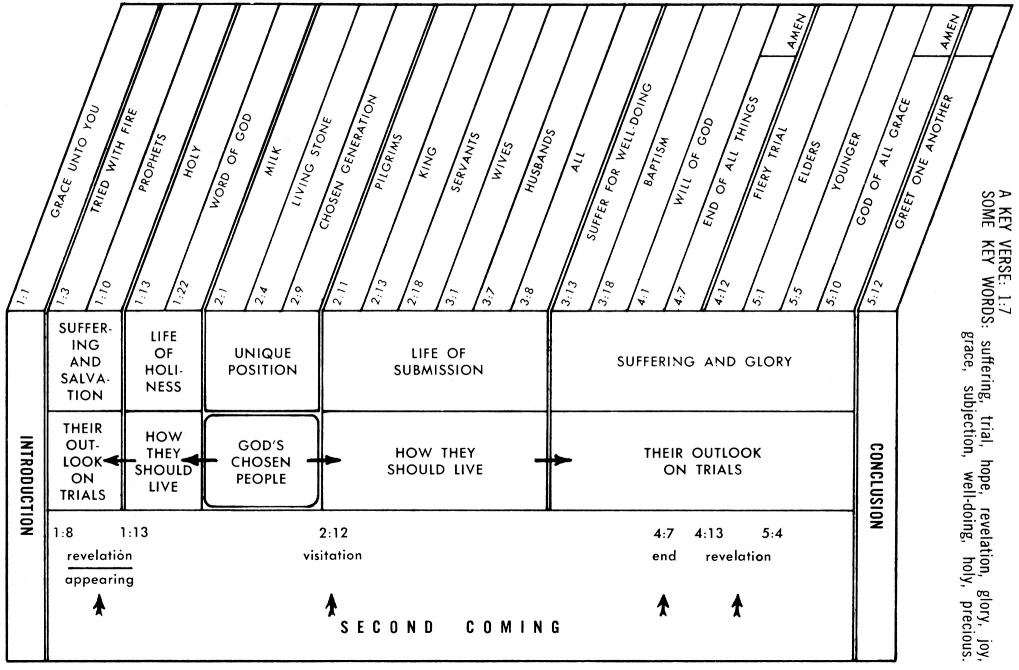
1 Peter: Trials, Holy Living & The Lord's Coming
Click chart to enlarge
Chart from Jensen's Survey of the NT - used by permission
See Another Chart from Charles Swindoll
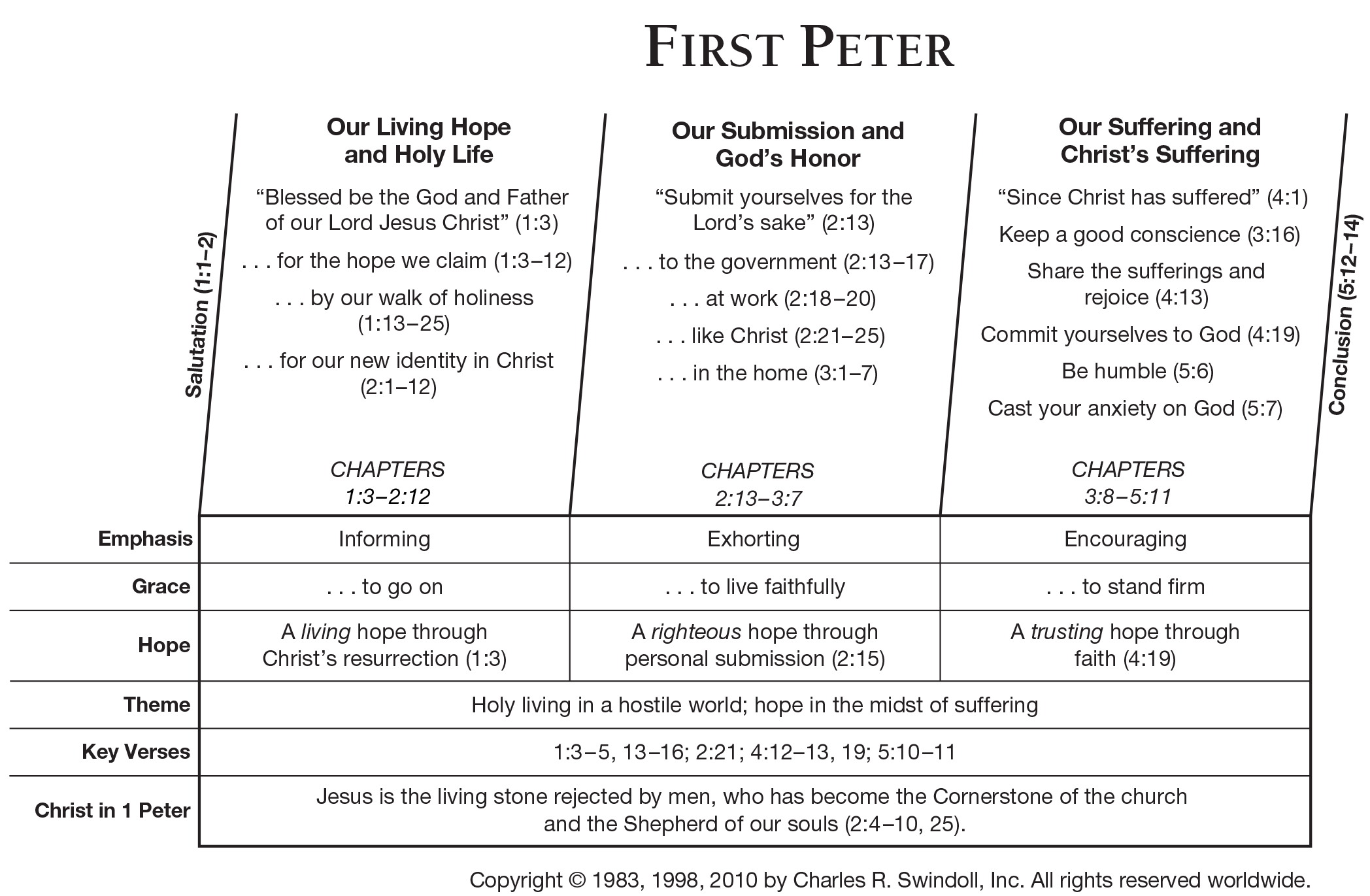
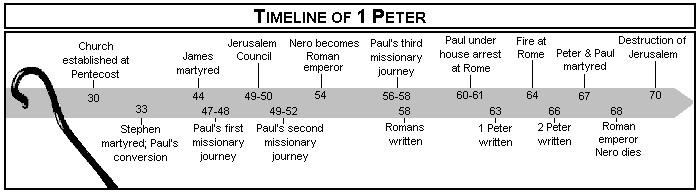
Source: Borrow Ryrie Study Bible
Click to enlarge
PART I: DOCTRINAL FOUNDATION
I. The Opening Salutation (1Pe 1:1-2)
A. The Writer (1Pe 1:1a)
B. The Readers (1Pe 1:1b-2a)
1. True character of the readers (1Pe 1:1b)
2. Geographical location of the readers (1Pe 1:1c)
3. Spiritual supports for the readers (1Pe 1:2a)
C. The Greeting (1Pe 1:2b)
II. The Thanksgiving for Our Salvation (1Pe 1:3-12)
A. The Description of Salvation (1Pe 1:3-5)
1. The author of salvation (1Pe 1:3a-b)
a. His relation to the Savior (1Pe 1:3a)
b. His act of mercy to the saved (1Pe 1:3b)
2. The nature of salvation (1Pe 1:3c-4a)
a. The living hope grounded in Christ's resurrection (1Pe 1:3c)
b. The glorious inheritance awaiting believers (1Pe 1:4a)
3. The certainty of salvation (1Pe 1:4b-5)
a. The safekeeping of the inheritance (1Pe 1:4b)
b. The preservation of the heirs (1Pe 1:5)
B. The Experiences Relating to Salvation (1Pe 1:6-9)
1. The paradoxical nature of the experiences (1Pe 1:6-7)
a. The experience of exultation (1Pe 1:6a)
b. The experience of distress (1Pe 1:66-7)
1. The nature of the distress (1Pe 1:6b)
2. The purpose behind the trials (1Pe 1:7)
a. The testing of faith (1Pe 1:7a)
b. The outcome of the testing (1Pe 1:7b)
2. The sustaining relations of believers (1Pe 1:8-9)
a. Their dual relation to Jesus Christ (1Pe 1:8)
b. Their experiential relation to their salvation (1Pe 1:9)
C. The Magnification of Salvation (1Pe 1:10-12)
1. The magnification through prophetic research (1Pe 1:10-12a)
a. Their intensive search (1Pe 1:10a)
b. Their prophetic function (1Pe 1:10b)
c. Their personal perplexity (1Pe 1:11)
1. The time and circumstances (1Pe 1:11a)
2. The sufferings and the glories (1Pe 1:11b)
d. Their restricted ministry (1Pe 1:12a)
2. The magnification through Christian proclamation (1Pe 1:12b)
3. The magnification through angelic inquiry (1Pe 1:12c)
PART 2: PRACTICAL EXHORTATION
I. Exhortations in View of Our Salvation (1Pe 1:13-2:10)
A. The Life Arising from Salvation (1Pe 1:13-2:3)
1. The Christian life in relation to God (1Pe 1:13-21)
a. A life of steadfast hope (1Pe 1:13)
1. The supports of hope (1Pe 1:13a)
2. The call to hope (1Pe 1:13b)
b. A life of personal holiness (1Pe 1:14-16)
1. The foundation for personal holiness (1Pe 1:14a)
2. The call to personal holiness (1Pe 1:14b-15)
a. The negative demand of holiness (1Pe 1:14b)
b. The positive call to holiness (1Pe 1:15)
3. The justification of the call to holiness (1Pe 1:16)
c. A life of motivated reverence (1Pe 1:17-21)
1. The basis for reverent living (1Pe 1:17a)
2. The call for reverent living (1Pe 1:17b)
3. The knowledge that motivates reverence (1Pe 1:18-21)
a. The means of our redemption (1Pe 1:18-19)
b. The nature of the Redeemer (1Pe 1:20)
c. The characteristics of the redeemed (1Pe 1:21)
2. The Christian life in relation to the brethren (1Pe 1:22-25)
a. The experience of inner purification (1Pe 1:22a)
b. The duty of mutual love (1Pe 1:22b)
c. The foundation in personal regeneration (1Pe 1:23-25)
1. The fact of their regeneration (1Pe 1:23a)
2. The nature of their regeneration (1Pe 1:23b-25a)
3. The evangelization leading to their regeneration (1Pe 1:25b) (D Edmond Hiebert)
1 Peter 1:6 In this you greatly rejoice (PMI) (continually "jump for joy") even though now for a little while, if necessary ( being necessary) you have been distressed ( "having been grieved") by various trials, (NASB: Lockman)
Greek: en o agalliasthe, (2PPMI) oligon arti ei deon (PAPNSN) [estin] (3SPAI) lupethentes (APPMPN) en poikilois peirasmois,
Amplified: [You should] be exceedingly glad on this account, though now for a little while you may be distressed by trials and suffer temptations,
Barclay: Herein you rejoice, even if it is at present necessary that for a brief time you should be grieved by all kinds of trials, (Westminster Press)
ESV: In this you rejoice, though now for a little while, if necessary, you have been grieved by various trials,
GWT: You are extremely happy about these things, even though you have to suffer different kinds of trouble for a little while now.
KJV: Wherein ye greatly rejoice, though now for a season, if need be, ye are in heaviness through manifold temptations:
Lexham: in which you rejoice greatly, although now for a short time, if necessary, you are distressed by various trials,
NET: This brings you great joy, although you may have to suffer for a short time in various trials.
NJB: This is a great joy to you, even though for a short time yet you must bear all sorts of trials;
NLT: So be truly glad. There is wonderful joy ahead, even though you must endure many trials for a little while.
Phillips: This means tremendous joy to you, I know, even though you are temporarily harassed by all kinds of trials and temptations (Phillips: Touchstone)
Weymouth: Rejoice triumphantly in the prospect of this, even if now, for a short time, you are compelled to sorrow amid various trials.
Wuest: In which last season you are to be constantly rejoicing with a joy that expresses itself in a triumphant exuberance, although for a little while at the present time if perchance there is need for it, you have been made sorrowful in the midst of many different kinds of testings (Eerdmans)
Young's Literal: in which ye are glad, a little now, if it be necessary, being made to sorrow in manifold trials,
IN THIS YOU ( continuously) GREATLY REJOICE: en o agalliasthe (2PPMI):
- 1 Peter 1:8; 4:13; 1Sa 2:1; Ps 9:14; 95:1; Isa 12:2,3; 61:3; 61:10 Mt 5:12; Lk 1:47; 2:10; 10:20; Jn 16:22; Ro 5:2,11; 12:12; 2Co 6:10; 12:9,10; Gal 5:22; Php 3:3; 4:4; 1Th 1:6; Jas 1:2,9
- 1 Peter 1 Resources - Multiple Sermons and Commentaries
Related Resources:
- Spurgeon's Sermon The Christian's Heaviness & Rejoicing
- John Piper's book online - The Hidden Smile of God - The Fruit of Affliction in the Lives of John Bunyan, William Cowper, and David Brainerd)
In this - In what? What is "this"? Some writers favor this as referring to what follows, the "season" of suffering. Others (and this appears to be the majority) favor "in this" refers to the great news in the preceding context. And in context this would include causing us to be born again to a living hope (1Pe 1:3), keeping an inheritance for us in heaven (1Pe 1:4) and keeping us for that inheritance (1Pe 1:5) (a kept inheritance for a kept people). This section emphasizes the close connection between Christian truth (preceding verses) and Christian experience. A firm grasp of the glorious truths just enumerated by Peter can sustain the believer in and through the fiery trial.
A T Robertson a Greek expert feels the "in this" ("wherein" in the KJV) could refer backwards to the previous truths or forward to the season of distress. Robertson writes - Wherein (en hōi). This translation refers the relative hōi to kairōi, but it is possible to see a reference to Christou (1 Pe 1:3) or to theou (1 Pe 1:5) or even to the entire content of 1 Pe 1:3-5. Either makes sense, though possibly kairōi is correct.
John MacArthur writes that "In this refers back to the preceding passage (1 Pe 1:3–5), which detailed the first great truth that brings Christians joy, namely their protected eternal inheritance."
You greatly rejoice - Spurgeon asks "can a Christian greatly rejoice while he is in heaviness? Yes, most assuredly he can. Mariners tell us that there are some parts of the sea where there is a strong current upon the surface going one way, but that down in the depths there is a strong current running the other way. Two seas do not meet and interfere with one another; but one stream of water on the surface is running in one direction, and another below in an opposite direction. Now, the Christian is like that. On the surface there is a stream of heaviness rolling with dark waves; but down in the depths there is a strong under-current of great rejoicing that is always flowing there.
Spurgeon then goes on to give 3 reasons explaining how it is that a believer can rejoice even though heavy in spirit…
(1) The first thing that he says to them is, that they are "elect according to the foreknowledge of God;" "wherein we greatly rejoice." Ah! even when the Christian is most "in heaviness through manifold temptations," what a mercy it is that he can know that he is still elect of God! Any man who is assured that God has "chosen him from before the foundation of the world," (Ep 1:4) may well say, "Wherein we greatly rejoice." Let me be lying upon a bed of sickness, and just revel in that one thought. Before God made the heavens and the earth, and laid the pillars of the firmament in their golden sockets, he set his love upon me; upon the breast of the great high priest he wrote my name, and in his everlasting book it stands, never to be erased-"elect according to the foreknowledge of God." Why, this may make a man's soul leap within him, and all the heaviness that the infirmities of the flesh may lay upon him shall be but as nothing; for this tremendous current of his overflowing joy shall sweep away the mill-dam of his grief. Bursting and overleaping every obstacle, it shall overflood all his sorrows till they are drowned and covered up, and shall not be mentioned any more for ever. "Wherein we greatly rejoice." Come, thou Christian! thou art depressed and cast down. Think for a moment. Thou art chosen of God and precious. Let the bell of election ring in thine ear-that ancient Sabbath bell of the covenant; and let thy name be heard in its notes and say, I beseech thee, say, "Doth not this make thee greatly rejoice, though now for a season, if need be, thou art in heaviness through manifold temptations?"
(2) Again, you will see another reason. The apostle says that we are "elect through sanctification of the Spirit unto obedience and sprinkling of the blood of Jesus Christ,"-"wherein we greatly rejoice."
Is the obedience of the Lord Jesus Christ girt about my loins, to be my beauty and my glorious dress; and is the blood of Jesus sprinkled upon me, to take away all my guilt and all my sin and shall I not in this greatly rejoice? What shall there be in all the depressions of spirits that can possibly come upon me that shall make me break my harp, even though I should for a moment hang it upon the willows? Do I not expect that yet again my songs shall mount to heaven; and even now through the thick darkness do not the sparks of my joy appear, when I remember that I have still upon me the blood of Jesus, and still about me the glorious righteousness of the Messiah?
But the great and cheering comfort of the apostle is, that we are elect unto an inheritance incorruptible, and undefiled, and that fadeth not away, reserved in heaven for us. And here, brethren, is the grand comfort of the Christian. When the child of God is sore-stricken and much depressed, the sweet hope, that living or dying, there is an inheritance incorruptible, reserved in heaven for him (1Pe 1:4), may indeed make him greatly rejoice. He is drawing near the gates of death, and his spirit is in heaviness, for he has to leave behind him all his family and all that life holds dear. Besides, his sickness brings upon him naturally a depression of spirit. But you sit by his bedside, and you begin to talk to him of the
Sweet fields beyond the swelling flood,
Arrayed in living green.
You tell him of Canaan on the other side the Jordan-of the land that floweth with milk and honey-of the Lamb in the midst of the throne, and of all the glories which God hath prepared for them that love him (2Ti 4:8; Titus 2:13); and you see his dull leaden eye light up with seraphic (blissfully serene) brightness, he shakes off his heaviness, and he begins to sing,
On Jordan's stormy banks I stand,
And cast a wishful eye,
To Canaan's fair and happy land,
Where my possessions lie
This makes him greatly rejoice; and if to that you add that possibly before he has passed the gates of death his Master may appear-if you tell him that the Lord Jesus Christ is coming in the clouds of heaven, and though we have not seen him yet believing in him we rejoice with joy unspeakable and full of glory, expecting the second advent (1Pe 1:8)- if he has grace to believe in that sublime doctrine, he will be ready to clap his hands upon his bed of weariness and cry, "Even so, Lord Jesus, come quickly! come quickly!" (Re 22:20)
(3) And in drawing to a close, I may notice, there is one more doctrine that will always cheer a Christian, and I think that this perhaps is the one chiefly intended here in the text. Look at the end of the 5th verse; "Reserved in heaven for you who are kept by the power of God through faith unto salvation" (1Pe 1:5)
This perhaps will be one of the greatest cordials to a Christian in heaviness, that he is not kept by his own power, but by the power of God, and that he is not left in his own keeping, but he is kept by the Most High.
Ah! what should you and I do in the day when darkness gathers round our faith, if we had to keep ourselves! I can never understand what an Arminian does, when he gets into sickness, sorrow, and affliction; from what well he draws his comfort, I know not; but I know whence I draw mine. It is this. "When flesh and heart faileth, God is the strength of my life, and my portion for ever." (Spurgeon's note on Ps 73:26 - Ps 73:26) "I know whom I have believed, and I am persuaded that he is able to keep that which I have committed unto him against that day." (2Ti 1:12)
But take away that doctrine of the Saviour's keeping His people, and where is my hope? What is there in the gospel worth my preaching, or worth your receiving? I know that he hath said, "I give unto my sheep eternal life, and they shall never perish, neither shall any man pluck them out of my hand." (John 6:28)
What, Lord, but suppose they should grow faint-that they should begin to murmur in their affliction. Shall they not perish then? No, they shall never perish. But suppose the pain should grow so hot that their faith should fail: shall they not perish then? No, "they shall not perish, neither shall any man pluck them out of my hand." But suppose their sense should seem to wander, and some should try to pervert them from the faith: shall they not be perverted? No; "they shall never perish," But suppose in some hour of their extremity hell and the world and their own fears should all beset them, and they should have no power to stand-no power whatever to resist the fierce onslaughts of the enemy, shall they not perish then? No, they are "kept by the power of God through faith unto salvation, ready to be revealed," and they shall never perish, neither shall any man pluck them out of my hand."
Ah! this is the doctrine, the cheering assurance "wherein we greatly rejoice, though now for a season, if needs be, we are in heaviness through manifold temptations." (The Christian's Heaviness and Rejoicing)
Rejoicing in the face of tribulation is a common theme in the NT. For example, Paul explains to the Romans that one of the benefits of salvation (justification) by faith is exulting in hope (absolute certainty of future good - in this case our future glory) "Therefore having been justified by faith, we have peace with God through our Lord Jesus Christ, 2 through whom also we have obtained our introduction by faith into this grace in which we stand; and we exult in hope of the glory of God. (see glorification) 3 And not only this, but we also exult in our tribulations, knowing that tribulation brings about perseverance; 4 and perseverance, proven character; and proven character, hope; 5 and hope does not disappoint, because the love of God has been poured out within our hearts through the Holy Spirit who was given to us. (Ro 5:1-5-see notes Romans 5:1-2, 5:3, 5:4-5)
Writing to the saints at Thessalonica, Paul encouraged them with the truth that "You also became imitators of us and of the Lord, having received the word in much tribulation with the joy of the Holy Spirit so that you became an example to all the believers in Macedonia and in Achaia. (Notice that their tribulation was not purposeless and neither is any suffering for the sake of His Name). (1Thes 1:6-7)
John Piper observes that "our joy is based on the happiness of our future with God and the certainty that we will make it there. Christian joy is almost synonymous with Christian hope. That's why Peter says in verse 3 that we were born again into a living hope; then verses 4 and 5 describe the content of that hope; and then verse 6 begins, "in THIS you rejoice." In this you have living, vital, life-changing hope; and in this you rejoice. Our hope is our joy." A living hope results in a present joy. (from Joy Through the Fiery Test)
Wuest explains that the Greek construction supports that "The saints are to rejoice in the last time, that is, when they receive their glorified bodies at the Rapture. (Word Studies from the Greek New Testament)
God has never promised that we would miss the storm,
but He has promised that we would make the harbor!
John MacArthur explains that "Greatly rejoice (from agalliaō) is an intense, expressive term that means to be supremely and abundantly happy—a happiness that is not tentative nor based on circumstances or superficial feelings. Jesus used it in Matthew 5:12 in addition to the more ordinary word for rejoice (chairō). With that usage, He intensified the meaning of His command to His disciples. In fact, in that verse the King James translators rendered the word “be exceeding glad.” In the New Testament, agalliaō always refers to spiritual rather than temporal joy, and it usually has reference to a relationship with God (cf. 1:8; 4:13; Luke 1:47; 10:21; Acts 2:26; 16:34; Rev. 19:7). Furthermore, since Peter put it in the present tense, it conveys the notion of continual joy and happiness. As discussed in the previous chapter of this volume, God has reserved and securely protected an eternal inheritance in heaven for every believer. That is why the apostle Paul urged believers to focus “on the things above, not on the things that are on earth” (Col. 3:2). There was a time when that joy seemed elusive to Christ’s disciples. Jesus told them in the Upper Room, “Truly, truly, I say to you, that you will weep and lament, but the world will rejoice; you will grieve, but your grief will be turned into joy” (John 16:20). For a short time, unbelievers would rejoice and the disciples would grieve as a result of the Savior’s death (cf. Matt. 27:39, 44; Mark 14:27; 16:10–11, 14; Luke 24:17, 36–39). But when He arose from the grave and the disciples saw Him, their sorrow turned to joy (Luke 24:12, 32, 52–53; cf. John 21:7) and His promise of life after death for believers (cf. John 11:25–26; 14:1–4) became credible. All believers have the indwelling Holy Spirit (John 14:16–17; Acts 1:8; Rom. 8:9; 1 Cor. 6:19; 12:13; Gal. 3:14; 1 John 2:27; 3:24; 4:13; cf. John 14:26; 16:13; Acts 6:5; 2 Cor. 6:16), who serves as a pledge or seal to guarantee their eternal inheritance:
In Him, you also, after listening to the message of truth, the gospel of your salvation—having also believed, you were sealed in Him with the Holy Spirit of promise, who is given as a pledge of our inheritance, with a view to the redemption of God’s own possession, to the praise of His glory. (Eph. 1:13–14; cf. 4:30)
The author of Hebrews also focuses on the believer’s protected spiritual inheritance (4:1–10; 6:9–12, 19–20; 9:11–15; 11:13–16) and encourages his Jewish readers to do likewise in the midst of suffering:
But remember the former days, when, after being enlightened, you endured a great conflict of sufferings, partly by being made a public spectacle through reproaches and tribulations, and partly by becoming sharers with those who were so treated. For you showed sympathy to the prisoners and accepted joyfully the seizure of your property, knowing that you have for yourselves a better possession and a lasting one. Therefore, do not throw away your confidence, which has a great reward. For you have need of endurance, so that when you have done the will of God, you may receive what was promised. (10:32–36)
No matter what difficult circumstances and persecutions they face, the faithful greatly rejoice because of the future hope that derives from Christ’s resurrection (1:3; 1 Cor. 15:51–57; cf. Rom. 5:2; 12:12) and the present reality of the indwelling Spirit (1 Peter 1:2), securing a protected, eternal inheritance (cf. Heb. 10:32–36). (1 Peter Commentary)
Greatly Rejoice (21) (agalliao from agan = much + hallomai = jump; gush, leap, spring up) means literally to "jump much", "leap for joy", skip and jump with happy excitement and so to be exceedingly joyful, overjoyed or exuberantly happy.
The idea is this person shows their excessive, ecstatic joy by leaping and skipping. It describes jubilant exultation, a quality of joy that remains unhindered and unchanged by what happens. As discussed below in the NT, agalliao describes an exceeding joy (independent of dire circumstances) which is initiated and empowered by the Holy Spirit.
Barclay writes that agalliao "is the joy which leaps for joy. As it has been put, it is the joy of the climber who has reached the summit, and who leaps for joy that the mountain path is conquered." (Daily Study Bible)
Barclay's picture of jumping joy is great, as long as I'm "on top of the world". What about when I am in the valley? Peter is teaching that a Christian does not have to be on a mountain top to experience this exceeding joy. In fact, as he teaches in this section, believers, because of their new nature (partakers of the divine nature), can experience this quality of joy even though they are walking through "the valley" of difficult circumstances!
Here in first Peter the present tense of greatly rejoice indicates that this attitude of exceeding joy was the reader's habitual practice in the face of trials, so that despite afflictions these saints were continually "jumping for joy"! They could rejoice because of the salvation that has been revealed ("past tense" = caused to be born again = justification) and even more in regard to the salvation to be revealed (future tense = glorification see also the three tenses of salvation) including a reserved inheritance, all being guarded by God. No insurance policy could be more secure!
Agalliao includes not just the experiencing of a state of great joy and gladness, but often is accompanied by audible, verbal expression and appropriate visible body movement (i.e., "jump for joy") Another verb meaning to rejoice (chairo) is more expressive of the inward feeling of joy.
Matthew Henry - Great rejoicing contains more than an inward placid serenity of mind or sensation of comfort. It will show itself in the countenance and conduct, but especially in praise and gratitude.
In discussing the suffering the saints were now or soon would experience (and historically he probably wrote this epistle shortly before or after the burning of Rome), Peter declared
"Beloved, do not be surprised at the fiery ordeal among you, which comes upon you for your testing, as though some strange thing were happening to you but to the degree that you share the sufferings of Christ, keep on rejoicing (chairo - a command to have this attitude); so that also at the revelation of His glory (at the end of this age and beginning of the Messianic age - compare verses from Isaiah that use agalliao), you may rejoice (chairo) with exultation (agalliao - present tense - continually "jump for joy")." (see notes 1 Peter 4:12; 4:13)
As emphasized by Jesus in the section below, a Christian who is persecuted for righteousness in this life will have overflowing joy in the future because of his reward.
In His final "beatitude" Jesus encouraged all those who would suffer for His Name promising them that
"Blessed are you when men cast insults at you, and persecute you, and say all kinds of evil against you falsely, on account of Me. Rejoice (chairo), and be glad (agalliao) (both verbs are present imperatives, which call for this to be a saint's continual attitude - God's commands always include His enablement - see verse below), for your reward in heaven is great, for so they persecuted the prophets who were before you." (Mt 5:11-12-see notes Matthew 5:11; 5:12)
The question you may be asking is how is it possible to "jump for joy" when you are experiencing various trials?
Luke gives us the answer, recording that Jesus' mother, Mary, upon discovering she was to be the mother of her Messiah exclaimed "my spirit has rejoiced (agalliao) in God my Savior." (Lk 1:47) indicating that the origin of the jubilation is the supernatural work of the Spirit (cf Gal 5:22, cp Ro 15:13). Luke goes on to record that Jesus Himself "rejoiced greatly (agalliao) in the Holy Spirit" (Lk 10:21, cp 1Th 1:6) which underscores the Source of this supernatural joy.
After the Philippian jailer had believed in the Lord Jesus and was saved "he brought (Paul and Silas) into his house and set food before them and rejoiced greatly (agalliao), having believed in God with his whole household." (Acts 16:31) (Notice the joy of salvation! Remember that great day when you were first saved? Do you still have that kind of joy?)
The same man who only moments earlier was contemplating taking his life, now was jumping for joy at his new birth wrought by the amazing grace of God!
Agalliao is not used by secular Greek writers (interesting! Truth be told they don't have anything to truly, hopefully jump for joy over - their joy is temporary, the believer's joy is eternal!) but Peter uses it 3 times this letter which also has a major theme of suffering (1Pe 1:6, 8, 4:13 - see notes 1 Peter 1:6; 1:8, 4:13)
Rienecker adds that agalliao "appears to be used always with the connotation of a religious joy, a joy that springs from the contemplation of God or God's salvation.
Agalliao is used 11 times in the NT…
Matthew 5:12 (note) "Rejoice (chairo - present imperative) and be glad, (agalliao - present imperative) for your reward in heaven is great, for so they persecuted the prophets who were before you.
Luke 1:47 (Mary said) And my spirit has rejoiced in God my Savior.
Luke 10:21 At that very time He rejoiced greatly in the Holy Spirit, and said, "I praise Thee, O Father, Lord of heaven and earth, that Thou didst hide these things from the wise and intelligent and didst reveal them to babes. Yes, Father, for thus it was well-pleasing in Thy sight.
John 5:35 "He was the lamp that was burning and was shining and you were willing to rejoice for a while in his light.
John 8:56 "Your father Abraham rejoiced to see My day, and he saw it and was glad (chairo)."
Acts 2:26 'Therefore my heart was glad and my tongue exulted; Moreover my flesh also will abide in hope;
Acts 16:34 And he brought them into his house and set food before them, and rejoiced greatly, having believed in God with his whole household.
1 Peter 1:6 (note) In this you greatly rejoice, even though now for a little while, if necessary, you have been distressed by various trials,
1 Peter 1:8 (note) and though you have not seen Him, you love Him, and though you do not see Him now, but believe in Him, you greatly rejoice with joy inexpressible and full of glory,
1 Peter 4:13 (note) but to the degree that you share the sufferings of Christ, keep on rejoicing (chairo); so that also at the revelation of His glory, you may rejoice (chairo) with exultation (agalliao).
Revelation 19:7 (note) "Let us rejoice (chairo) and be glad and give the glory to Him, for the marriage of the Lamb has come and His bride has made herself ready."
Sadness (lupeo) and gladness (agalliao) existing side by side as in this section of first Peter is one of the paradoxes of Christianity - joy in the midst of sorrow. The Christian’s joy is independent of circumstances and therefore baffles the natural man. Can you imagine being one of the prisoners in jail as Paul and Silas with lacerated backs began "praying and singing hymns of praise to God" (Acts 16:25-see note cf Acts 5:41 = So they went on their way from the presence of the Council, rejoicing that they had been considered worthy to suffer shame for His name.)
This quality of joy is not a cold intellectual anticipation of future possessions but is a present appropriation of God’s wealth through the Holy Spirit as discussed above. (Lk 10:21; Gal 5:22).
We see this juxtaposition of joy and suffering in the saints in Thessalonica who "received the word in much tribulation with the joy of the Holy Spirit" (see note 1Thessalonians 1:6).
Grief is the natural response to the difficulties in this fallen world, but faith looks forward to an eternity with God (Click to study the prophetic verses from Isaiah) and rejoices as the Spirit enables us.
Commenting on the presence of joy in the midst of grief J. H. Jowett wrote “I never expected to find a fountain in so unpromising a waste.”
Corrie Ten Boom adds that "The school of life offers some difficult courses, but it is in the difficult class that one learns the most—especially when your teacher is the Lord Jesus Christ. The hardest lessons for me were in a cell with four walls. The cell in the prison at Scheveningen was six paces in length, two paces in breadth, with a door that could be opened only from the outside… After that time in prison, the entire world became my classroom."
William Penn said "No pain, no palm; no thorns, no throne; no gall, no glory; no cross, no crown.
Agalliao in the OT - The non-apocryphal Septuagint (LXX) uses agalliao in 66 verses with 50 uses in the Psalms and 10 in Isaiah. (2 Sam. 1:20; 1 Chr. 16:31; Ps. 2:11; 5:11; 9:2, 14; 13:4f; 14:7; 16:9; 19:5; 20:5; 21:1; 31:7; 32:11; 33:1; 35:9, 27; 40:16; 48:11; 51:8, 14; 53:6; 59:16; 60:6; 63:7; 67:4; 68:3f; 70:4; 71:23; 75:9; 81:1; 84:2; 89:12, 16; 90:14; 92:4; 95:1; 96:11f; 97:1, 8; 98:4, 8; 118:24; 119:162; 132:9, 16; 145:7; 149:2, 5; Song 1:4; Isa. 12:6; 25:9; 29:19; 35:1f; 41:16; 49:13; 61:10; 65:14, 19; Jer. 49:4; Lam. 2:19; Hab. 3:18) Below are a few representative uses from the Psalms (you might get "joy" by studying the other uses in Psalms)…
Worship the LORD with reverence, And rejoice (agalliao ~ jump for joy!) with trembling. (Psalm 2:11) (Spurgeon's note)
But I have trusted in Thy lovingkindness; My heart shall rejoice (agalliao ~ jump for joy!) in Thy salvation. (Psalm 13:5) (Spurgeon's note)
Oh, that the salvation of Israel would come out of Zion! When the LORD restores His captive people, Jacob will rejoice, Israel will be glad. (Psalm 14:7) (Spurgeon's note)
Be glad in the LORD and rejoice, you righteous ones, And shout for joy, all you who are upright in heart. (Psalm 32:11) (Spurgeon's note)
Make me to hear joy and gladness, Let the bones which Thou hast broken rejoice. (Psalm 51:8) (Spurgeon's note)
This is the day (of deliverance or day the "Stone" was made chief Cornerstone) which the LORD has made. Let us rejoice (agalliao ~ jump for joy!) and be glad in it." (Ps 118:24) (Spurgeon's note)
Habakkuk 3:18 Yet I will exult (Lxx = agalliao) in the LORD, I will rejoice (Lxx = chairo = be glad, delighted) in the God of my salvation.
Isaiah in the context of the beginning of Messiah's Millennial Reign (see schematic Daniel's 70th week), exhorts the Jews who have been redeemed to
Cry aloud (agalliao) and shout for joy, O inhabitant of Zion, for great in your midst is the Holy One of Israel. (Isaiah 12:6)
Their joyful cry is the earthly counterpart of the heavenly doxology described in the Revelation. In light of the Lion of Judah's triumph over the Antichrist and the forces of evil and in anticipation of the marriage of the Lamb to His bride the Church, John records these these words
Hallelujah! For the Lord our God, the Almighty, reigns. Let us rejoice (chairo), and be glad (agalliao) and give the glory to Him, for the marriage of the Lamb has come and His bride has made herself ready. (see notes Revelation 19:6; 19:7)
And so we see the saints jumping for joy in heaven and on earth!
Isaiah prophetically describing the time when the veil is removed from their eyes and the redeemed of Israel are finally enabled to recognize their Messiah in His kingdom centered on Mt Zion on earth (see also Millennium 1; Millennium 2; Millennium 3) writes
And it will be said in that day (as they enter into the great Messianic kingdom feast), “Behold, this is our God for whom we have waited that He might save us. This is the Lord for Whom we have waited (Lxx = "hoped for" = expectation of future good). Let us rejoice (agalliao - imperfect tense pictures this action occurring over and over!) and be glad in His salvation. (Isaiah 25:9 read Isa 25:6, 7, 8, 9, 10, 11, 12 for an exciting description of this incredible moment!)
Again Isaiah prophesying in the context of the future Messianic kingdom on earth declare
"The afflicted also shall increase their gladness (agalliao - the Lxx sentence reads "beggars who crouch and cower will literally jump for joy"! cf Jesus' promise in Mt 5:3 [note], Mt 5:5 [note]!) in the Lord, and the needy (Lxx = those in despair) of mankind shall rejoice (Lxx = fill to the brim their merriment, festivity, cheerfulness, gladness of heart) in the Holy One of Israel." (Isa 29:19 read the context Isa 29:17-24)
Speaking of the time of the Millennium, when the Lord will transform the wilderness into a veritable "garden of Eden", Isaiah declares that
The wilderness and the desert will be glad, and the Arabah (entire valley region between Mount Hermon in the north to the Red Sea in the south) will rejoice (agalliao - personifying nature as commanded to jump for joy because of the glorious transformation) and blossom, like the crocus. It will blossom profusely and rejoice with rejoicing and shout of joy (agalliao - in seeming response to the command nature obligingly jumps for joy!). The glory of Lebanon will be given to it, the majesty of Carmel and Sharon. (Isa 35:1)
Finally Isaiah's prophecies utilizing agalliao culminate in this beautiful promise declaring to His beloved
be glad and rejoice (agalliama = cause for jumping for joy) forever in what I create, for behold, I create Jerusalem for rejoicing (agalliama = cause for jumping for joy), and her people for gladness. I will also rejoice (agalliao - first person singular = the Lord Himself will "jump for joy"!) in Jerusalem, and be glad (Lxx = festive, cheerful, merry) in My people and there will no longer be heard in her the voice of weeping and the sound of crying (LXX = shrieking, screaming). (Isa 65:18-19)
Think of what wonders we have yet to behold…
the Lord God Almighty Himself "jumping for joy"!
THOUGHT - You may be suffering today, beloved. But there is a new day coming. If you are suffering, if you are downcast in the present, then ponder your future. Ponder these verses in Isaiah picturing the exceeding joy that accompanies the Millennial reign. It doesn't get any better than this dear suffering saint.
Habakkuk was transformed from a man in despair to a man "jumping for joy" as He began to turn his focus upon God, finally concluding that
"Though the fig tree should not blossom and there be no fruit on the vines, though the yield of the olive should fail, and the fields produce no food, though the flock should be cut off from the fold, and there be no cattle in the stalls, yet I (LXX = "I" = ego = placed first in the sentence for emphasis) will exult (agalliao) in the LORD (his exceeding joy comes from focusing on Jehovah, "I Am" … anything and everything you will ever need), I will rejoice (chairo - more expressive of the inward feeling of joy) in the God of my salvation. The Lord GOD is my strength (LXX = dunamis = inherent power, ability), and He has made (LXX = tasso = arranged, put in order, stationed) my feet like hinds' feet, and makes me walk on my high places. For the choir director, on my stringed instruments." (Hab 3:17-19)
So here we see the prophet jumping for joy, even though the coming Babylonian invasion would strip the land. What an example of the effect a God centered mindset can have on our temporal outlook!
In sum, "O Come, let us sing for joy (agalliao - jump for joy) to the LORD. Let us shout joyfully to the rock of our salvation." (Ps 95:1) (See Spurgeon's note)
WHY TRIALS?
All God plans and performs here is preparation for what He has in store for us in heaven. He is preparing us for the life and service yet to come. Nobody yet knows all that is in store for us in heaven, but this we do know: life today is a school in which God trains us for our future ministry in eternity. This explains the presence of trials in our lives: they are some of God's tools and textbooks in the school of Christian experience.
Peter illustrated this truth by referring to the goldsmith. No goldsmith would deliberately waste the precious ore. He would put it into the smelting furnace long enough to remove the cheap impurities; then he would pour it out and make from it a beautiful article of value. It has been said that the eastern goldsmith kept the metal in the furnace until he could see his face reflected in it. So our Lord keeps us in the furnace of suffering until we reflect the glory and beauty of Jesus Christ.
Applying God's Truth:
1. What have some of your previous trials taught you about God that you might not have known otherwise?
2. What have your previous trials taught you about yourself?
3. As you dwell on many of the trials that you've overcome with God's grace, what are some things you can be sure of as you face present trials? (Pause for Power - Warren Wiersbe)
REJOICING IN YOUR INHERITANCE “In this you greatly rejoice” (1 Peter 1:6).
Contemplating your eternal inheritance should give you joy that transcends any temporal circumstance.
Joy is a major theme in Scripture. The psalmist said, “Sing for joy in the Lord, O you righteous ones; praise is becoming to the upright” (Ps. 33:1); “My lips will shout for joy when I sing praises to Thee; and my soul, which Thou hast redeemed” (Ps. 71:23).
Even creation itself is said to rejoice in the Lord: “Thou dost make the dawn and the sunset shout for joy. … Let the heavens be glad, and let the earth rejoice; let the sea roar, and all it contains; let the field exalt, and all that is in it. Then all the trees of the forest will sing for joy before the Lord. … Let the mountains sing together for joy before the Lord; for He is coming to judge the earth” (Ps. 65:8; 96:11–13; 98:8–9).
Joy is the special privilege of every believer, regardless of his or her circumstances. You might suffer untold heartache and persecution for your faith in Christ, but amid the severest trials, God wants you to know profound joy. That’s why Peter said, “To the degree that you share the sufferings of Christ, keep on rejoicing; so that also at the revelation of His glory, you may rejoice with exultation” (1 Peter 4:13).
First Peter 1:6–9 identifies five elements of your Christian life that should bring you joy amid trials. The first is your protected inheritance. That’s what Peter referred to when he said, “In this you greatly rejoice” (v. 6, emphasis added). Other elements include a proven faith, a promised honor, a personal fellowship, and a present deliverance (vv. 6–9), which we will explore in coming days.
The Greek word translated “greatly rejoice” in 1 Peter 1:6 is not the usual Greek word for “rejoice.” Peter here used a more expressive and intense word that speaks of one who is happy in a profound spiritual sense rather than in a temporal or circumstantial sense. That’s the quality of joy God grants to those who trust in Him and who look beyond their temporal trials to the glory of their eternal inheritance. Let that be your focus as well. (Drawing Near - John MacArthur)
As everything by nature in us is contrary to the life of God, there is a needs-be for manifold trials and temptations to bring us out of those things which are opposed to the grace of God, and to conform us to the image of His dear Son. Thus we need trial after trial, and temptation upon temptation, to cure us of that worldly spirit, that carnality and carelessness, that light, trifling, and empty profession, that outside form of godliness, that spirit of pride and self-righteousness, that resting short of divine teachings, heavenly blessings, and spiritual manifestations, that settling on our lees and being at ease in Zion, that being mixed up with all sorts of professors, that ignorance of the secret of the Lord which is with them that fear Him—all which marks of death we see so visible stamped upon the profession of the day. There is a needs-be to be brought out of all this false, deceptive, hypocritical, and presumptusous profession, whether high or low, sound in doctrine or unsound, so as to be made simple and sincere, honest and upright, tender and teachable, and to know something experimentally of that broken and contrite spirit in which the Lord Himself condescends to dwell. And as the Lord works this spirit of humility and love for the most part through trials and temptations, there is a needs-be for every one, of whatever nature it may be, or from whatever quarter it may come.
J.C. Philpot, Ears from Harvested Sheaves.
THE GREATER THE HEAT, THE PURER THE GOLD
God knew where Job was—in the furnace! But it was a furnace of God's appointment, not because of Job's sin, and God would use Job's affliction to purify him and make him a better man. This is not the only answer to the question, "Why do the righteous suffer?" but it is one of the best, and it can bring the sufferer great encouragement.
Scripture often uses the image of a furnace to describe God's purifying ministry through suffering (Isa. 48:10; Deut 4:20; Ps. 66:10). The image is also used in 1 Peter 1:6-7 and 4:12 of believers going through persecution.
When God puts His own people into the furnace, He keeps His eye on the clock and His hand on the thermostat. He knows how long and how much. We may question why He does it to begin with, or why He doesn't turn down the heat or even turn it off, but our questions are only evidences of unbelief. Job 23:10 is the answer: "He knows the way that I take; when he has tested me, I will come forth as gold." Gold does not fear the fire. The furnace can only make the gold purer and brighter. (Pause for Power - Warren Wiersbe)
EVEN THOUGH NOW FOR A LITTLE WHILE IF NECESSARY (as it is): oligon arti ei deon (PAPNSN) (estin) (3SPAI) :
- 2 Co 4:17-18
- 1 Peter 1 Resources - Multiple Sermons and Commentaries
Related Passages:
2 Corinthians 4:17-18 For MOMENTARY, light affliction is producing for us an eternal weight of glory far beyond all comparison, 18 while we look not at the things which are seen, but at the things which are not seen; for the things which are seen are temporal, but the things which are not seen are eternal.
JUST A LITTLE
WHILE!
For a little while is one word in Greek (oligos) which means small in number or little in amount. Mark it down, beloved - for a little while. All time is but for a little while in comparison to eternity. When you are in the darkness, hold on to what God has shown you in the light for it will pass. As Corrie Ten Boom puts it "When a train goes through a tunnel and it gets dark, you don't throw away your ticket and jump off. You sit still and trust the engineer."
One of the best sayings in the Bible can apply to every necessary trial each of which has a beginning but also has an ending...
“And it came to pass.”
When you are in the midst of "distressing" circumstances the "little while" often seems like an eternity! But Peter says the trials last only for a little while when compared to eternity.
When God's hand is on thy back, let thy hand be on thy mouth, for though the affliction be sharp it shall be but short. --Thomas Brooks
You can't get to tomorrow morning without going through tonight. -- Elisabeth Elliot
How soon you will find that everything in your history, except sin, has been for you. Every wave of trouble has been wafting you to the sunny shores of a sinless eternity. -- Robert Murray M'Cheyne
It was well worth standing a while in the fire, for such an opportunity of experiencing and exhibiting the power and faithfulness of God's promises. -- John Newton
Affliction may be lasting, but it is not everlasting. -- Thomas Watson
Light are the pains that nature brings;
How short our sorrows are,
When with eternal future things
The present we compare!
--Isaac Watts
And notice Peter begins and ends emphasizing the relative brevity of our suffering writing "After (this word signifies your suffering WILL END some day beloved! Hold on! He's coming!) you have suffered for a little while" (1Pe 5:10). And so clearly the time of suffering and distress has an end, for as C H Spurgeon so aptly said it "He who has fixed the bounds of our habitation has also fixed the bounds of our tribulation."
Paul similarly encourages the saints at Rome with the truth that our trials are "the sufferings of this present time." (Ro 8:18) (in contrast to our eternal future).
Again Paul encourages the saints at Corinth that their present affliction (thlipsis) is "momentary (for the moment, for a little while), light" and "is producing (thoroughly working out, achieving or accomplishing, carefully fashioning making completely ready) for us an eternal weight of glory far beyond all comparison" (2 Corinthians 4:17).
Here are some other renderings of the great truth in 2 Corinthians 4:17…
(Amplified) For our light, momentary affliction (this slight distress of the passing hour) is ever more and more abundantly preparing and producing and achieving for us an everlasting weight of glory [beyond all measure, excessively surpassing all comparisons and all calculations, a vast and transcendent glory and blessedness never to cease!],
(Moffat) The slight trouble of the passing hour results in a solid glory past all comparison,
(Phillips New Testament) These little troubles (which are really so transitory) are winning for us a permanent, glorious and solid reward out of all proportion to our pain.
(Weymouth) For this our light and transitory burden of suffering is achieving for us a preponderating, yes, a vastly preponderating, and eternal weight of glory;
(Wuest) For our momentary light burden of affliction is working out for us more and more surpassingly an eternal, heavy weight of glory
If affliction and suffering are currently your lot and you feel overwhelmed, meditate on the truths in these passages (click the Scriptures above to read them in context) for a proper perspective on your present but passing painful plight in the light of eternity.
Matthew Henry adds that "though they (the trials) may be smart (cause sharp pain) they are but short."
If necessary - The If is not "iffy" but as a first class condition in Greek, it assumes the truth of the condition - It is necessary! Saints will suffer! Suffering is not an "elective" in God's school of Christ-likeness!
John MacDuff…
If need be—1Peter 1:6KJV - Three gracious words! Not one of all my tears has been shed for nothing! Not one stroke of the rod has been unneeded, or that might have been spared! Your heavenly Father loves you too much, and too tenderly, to bestow harsher correction than your case requires! Is it loss of health, or loss of wealth, or loss of beloved friends? Be still! there was a needs be. We are no judges of what that "needs be" is; often through aching hearts we are forced to exclaim, "Your judgments are a great deep!" But God here pledges Himself, that there will not be one unnecessary thorn in the believer's crown of suffering. No burden too heavy will be laid on him; and no sacrifice too great exacted from him. He will "temper the wind to the shorn lamb." Whenever the "need be" has accomplished its end, then the rod is removed—the chastisement suspended—the furnace quenched.
"If need be!" Oh! what a pillow on which to rest your aching head—that there is not a drop in all your bitter cup but what a God of love saw to be absolutely necessary! Will you not trust His heart, even though you cannot trace the mystery of His dealings? Not too curiously prying into the "Why it is?" or "How it is?" but satisfied that "So it is," and, therefore, that all must be well! "Although you say you cannot see Him, yet judgment is before Him, therefore trust in Him!" (THE FAITHFUL PROMISER by John MacDuff)
Your heavenly Father can inflict no unnecessary pang. You may presently be pain-stricken, and woe-worn. There is a divine necessity for your present "fiery trial." No drop in the cup can be spared! "I will correct you in measure." Your heavenly Father, tenderer and more loving than the tenderest earthly parent, tempers the fury of the flames, saying, "Thus far shall you go, and
no farther."
Happy for you, that you can write "if need be" … over that severest hour of distress,over every night of throbbing temples, over sleepless eyes,over every fresh thorn sent to buffet,over every heavy cross sent to carry.
When we are assured that nothing which is appointed by our Father can come to us wrongly, our cup of suffering becomes a cup of love!
"Shall I not drink the cup my Father has given me?" John 18:11 "For our light and momentary troubles are achieving for us an eternal glory that far outweighs them all." 2Corinthians 4:17
What verse is more soothing sight for a suffering couch, or for a dying pillow? What verse is more consolatory for a weary, burdened body? and above all, for a weary, burdened, sin-stricken heart? "God will wipe away every tear from their eyes." Revelation 7:17
A tearless Heaven will make amends for all! (Reference)
Thomas Watson - Another heart quieting consideration is—that afflictions work for good. "I have sent them into captivity for their own good." (Jer. 24:6). Judah's captivity in Babylon was for their good. "It is good for me that I have been afflicted" (Psalm 119:71). This text, like Moses' tree cast into the bitter waters of affliction, may make them sweet and wholesome to drink. Afflictions to the godly are medicinal. Out of the most poisonous drugs God extracts our salvation. Afflictions are as needful as ordinances (1Peter 1:6). No vessel can be made of gold without fire; so it is impossible that we should be made vessels of honor, unless we are melted and refined in the furnace of affliction. "All the paths of the Lord are mercy and truth" (Psalm 35:10). As the painter intermixes bright colors with dark shadows; so the wise God mixes mercy with judgment. Those afflictive providences which seem to be harmful, are beneficial. Let us take some instances in Scripture. (The WORST things)
John Angell James (1852) - Faith is assured that there is a NECESSITY for our trials. There is no Scripture it more readily assents to than that of the apostle Peter– "If needs be, though now for a little while you may have had to suffer grief in all kinds of trials." 1 Peter 1:6. Yes, there must be some kind of necessity—or he who loves his children so strongly would not thus afflict them. He himself is the judge of that necessity—and with him it must be left. But we are in all cases to be assured that it exists, though oftentimes it is hidden. Hence, the beautiful reply of Payson, who in his deep affliction was asked if he saw any particular reason for his heavy trials. "No," said he– "but I am as satisfied as if I saw ten thousand reasons. It is the will of God—and there is all reason in that." Our trials come sometimes when there seems, so far as our spiritual condition is concerned, less need than ordinary for them. And then is the time especially for confidence in God's wisdom and love, as to their necessity. When they find us in a backsliding state, and come like messengers to fetch us back from our truant wanderings, we know, rather than believe their necessity. We see and feel it as clearly as if a voice from heaven declared it. But to be overtaken with some severe visitation of Providence, when the soul is comparatively healthful, and its course is even and undeviating, and then to say– "I am sure there is some needs be for this, though I cannot see it. It lies hidden somewhere in the depths of God's wisdom and love, where I cannot find it; but I am sure it is there. My Heavenly Father does not afflict willingly—nor grieve the children of men, much less his own children—and I believe I am one of them." (Practical Believer)
Necessary (literally "if it be necessary") (1163) (dei from deo= to bind, tie objects together) means this is necessary (binding) or needful. Dei marks a logical necessity and not a moral obligation: we must rather than we ought. It therefore speaks of an obligation out of intrinsic necessity or inevitability. It is necessary that this happen. God will certainly prune us but never without purpose, for as Vance Havner said "The grace, the groans and the glory are all part of the eternal purpose. Where there is no groaning there is no growing now, nor glory to come."
Matthew Henry observes that "God's design in afflicting his people is their probation (the act of proving or testing), not their destruction; their advantage, not their ruin."
John Calvin adds that these necessary trials "are not afflicted by chance, but through the infallible providence of God."
Why should I complain
Of want or distress,
Temptation or pain?
He told me no less;
The heirs of salvation,
I know from his Word,
Through much tribulation
Must follow their Lord.
--John Newton
This is not my favorite verse especially when I understand that trials are continually (the verb dei is in the present tense) necessary (binding), needful and inevitable and always with divinely ordained purpose, not to destroy us but to refine us. Our enjoyment of eternity will be greater because of our trials in time!
As Richard Sibbes said "God promises no immunity from crosses." God in His perfect wisdom knows that there are special times when we need to go through trials. But oh, the glories to follow, for as Spurgeon aptly puts it "There are no crown-wearers in heaven that were not cross-bearers here below."
Sometimes trials discipline us when we have disobeyed God’s will. The psalmist writes
Before I was afflicted (Lxx = tapeinoo = brought low, abased, humbled - see study of related word tapeinos) I went astray (Lxx = make a false note in music, go wrong, err, offend), but now I keep (Lxx = phulasso = keep watch like a sentry, guard!) Thy word. (Ps 119:67). (See Spurgeon's note)
Again he says
"It is good for me that I was afflicted (Lxx = tapeinoo = brought low, abased, humbled), that I may learn (Lxx =manthano akin to mathetes, a "disciple" = learn through instruction, practice or experience) Thy statutes." (Ps 119:71) (Spurgeon's note)
Blessed (Lxx = makarios = fully satisfied regardless of the circumstances) is the man whom Thou dost chasten (Lxx = paideuo = train up as a child, discipline, instruct), O Lord, and dost teach out of Thy law. (Ps 94:12) (Spurgeon's note)
The writer of Hebrews sums up some of the benefits of trials that come on us in order to discipline us writing that earthly fathers
disciplined (paideuo) us for a short time as seemed best to them, but He disciplines us for our good, that we may share His holiness. All discipline for the moment seems not to be joyful, but sorrowful; yet to those who have been trained by it, afterwards it yields the peaceful fruit of righteousness. (Heb 12:10-11-see notes Hebrews 12:10; 12:11)
Jowett explains that "The purpose of God’s chastening is not punitive but creative. He chastens “that we may share His holiness.” The phrase “that we may share” has direction in it, and the direction points toward a purified and beautified life. The fire which is kindled is not a bonfire, blazing heedlessly and unguardedly, and consuming precious things; it is a refiner’s fire, and the Refiner sits by it, and He is firmly and patiently and gently bringing holiness out of carelessness and stability out of weakness. God is always creating even when He is using the darker means of grace. He is producing the fruits and flowers of the Spirit. His love is always in quest of lovely things. (J. H. Jowett, Life in the Heights, pp. 247, 248) (Ed: Praise be to Elohim, our Creator!)
At other times, trials prepare us for spiritual growth or even help to prevent us from sinning. Thus Paul after being transported to third heaven where he "heard inexpressible words" and revelations of "surpassing greatness" was given "a thorn in the flesh, a messenger of Satan to buffet (him)—to keep (him) from exalting (himself)! (2 Cor 12:7) (Click for more discussion of The Third Heaven) After entreating the Lord to remove this thorn, the Lord replied "My grace is sufficient for you, for power is perfected in weakness." Paul now had insight into the trial and declared "Most gladly, therefore, I will rather boast about my weaknesses, that the power of Christ may dwell in me." (2 Cor 12:9) We may not always know the need being met (Job did not understand Satan was being allowed to test him, see Job 1), but we can trust God to know and to do what is best.
Thomas Watson…
- Consider that there is a necessity for affliction. 1Peter 1:6. It is needful that some things are kept in brine. Afflictions are needful to keep us humble. Often there is no other way to have the heart low—but by being brought low. When king Manasseh "was in affliction, he humbled himself greatly." Corrections are corrosives to eat out the proud flesh. "Remembering my misery,the wormwood and the gall; my soul is humbled in me." Lamentations 3:19, 20. Shall not we quietly submit, and say, "Lord, I see there is a necessity for it. May Your will be done!" (Lords Prayer)
- God's children may sometimes be under sore afflictions. They have no charter of exemption from trouble, in this life. While the wicked are kept in sugar—the godly are often kept in brine.
- And, indeed, how could God's power be seen in bringing them out of trouble—if He did not sometimes bring them into it? How could God wipe away the tears from their eyes in heaven—if on earth they shed none?
- Doubtless, God sees there is need that His children should be sometimes in the house of bondage. "If need be, you are in heaviness." 1 Peter 1:6. The body sometimes needs a bitter portion—more than a sweet one.
- "You refined us like silver. You brought us into prison and laid burdens on our backs." Psalm 66:10, 11
- Why does God bring His people into an afflicted state? God gives affliction—to purge our corruption. The eye, though a tender part—yet when infected, we put sharp medicines into it, to purge out the disease. Just so, though the people of God are dear to Him as the apple of His eye—yet, when corruption begins to grow in them, He will apply the sharp medicine of affliction—to purge out the disease.
- Affliction is God's flail to beat off our husks. Affliction is a means God uses to purge out sloth, luxury, pride, and love of the world. God's furnace is not to consume—but to refine. God gives us more affliction—that we may have less sin!
- God also gives affliction to increase our graces. Grace thrives most in the iron furnace. Grace in the saints is often as fire hidden in the embers; affliction is the bellows to blow it up into a flame!
- God sanctifies all our afflictions. They shall not be destructive punishments—but medicines! They shall corrode and eat out the venom of sin! They shall polish and refine our grace! The more the diamond is cut—the more it sparkles. The more God afflicts us—the more our graces cast a sparkling luster!
- The stones which are cut out for a building, are first hewn and squared. The godly are called "living stones." 1Peter 2:5. God hews and polishes them by affliction, that they may be fit for the heavenly building.
Erwin Lutzer reminds us that "God often puts us in situations that are too much for us so that we will learn that no situation is too much for Him."
Dei is present tense indicating that these trials are continually inevitable! God knows those times when it is necessary for a saint to go through trials.
Samuel Rutherford emphasizes the certainty of trials writing that "You will not get leave to steal quietly to heaven without a conflict and a cross."
The Puritan Thomas Watson agreed writing "Though Christ died to take away the curse from us, yet not to take away the cross from us."
Spurgeon asked "How can I look to be at home in the enemy's country, joyful while in exile, or comfortable in a wilderness? This is not my rest. This is the place of the furnace and the forge and the hammer."
To those servants of God whom He purposes to use in a larger, greater way, many trials are allowed to come (they are necessary), for "we must be ground between the millstones of suffering before we can be bread for the multitude."
And in the case of a saint who is not living close to his Lord, it is necessary to send disciplinary trials to purge his life of sin and draw him into a closer walk with God
Psalms 119:67 Before I was afflicted I went astray, but now I keep Thy word. (see Ps 119:67) (Spurgeon's note - v67)
Psalms 119:71 It is good for me that I was afflicted, that I may learn Thy statutes. (see Ps 119:71). (Spurgeon's note - v71)
J C Ryle - Every cross is a message from God and intended to do us good in the end.
Matthew Henry - These troubles, that lie heavy, never come upon us but when we have need, and never stay any longer than needs must.
John Newton describes these trials as like "medicines which our gracious and wise Physician prescribes, because we need them; and He proportions the frequency and weight of them to what the case requires."
J. Vernon McGee in his pithy style - I know it is not at all popular to teach that God will prove us and lead us on to maturity through suffering. People would rather be encouraged to think that they are somebody important and that they can do great things on their own. My friend, we are nothing until the Spirit of God begins to move in our hearts and lives. We have nothing to offer to God. He has everything to offer to us. (McGee, J V: Thru the Bible Commentary: Nashville: Thomas Nelson)
Warren Wiersbe adds that the encouraging note that "We must keep in mind that all God plans and performs here is preparation for what He has in store for us in heaven. He is preparing us for the life and service yet to come. Nobody yet knows all that is in store for us in heaven, but we do know that life on earth is a school in which God trains us for our future ministry in eternity. This explains the presence of trials in our lives for they are some of God’s tools and textbooks in the school of Christian experience. (Wiersbe, W: Bible Exposition Commentary. 1989. Victor)
YOU HAVE BEEN DISTRESSED: lupethentes (APPMPN):
- Job 9:27,28 Ps 69:20, 119:28 Isa 61:3 Mt 11:28, 26:37 Ro 9:2 Php 2:26 Jas 4:9
- 1 Peter 1 Resources - Multiple Sermons and Commentaries
You have been distressed - or as the KJV picturesquely puts it "though now for a season, if need be, ye are in heaviness through manifold temptations."
Someone once wisely said that adversity introduces a man to himself or herself.
God uses the afflictions as His sheep dogs to drive us back to the fold (aka Heb 12:11).
Spurgeon introduces his sermon on this verse and launches into a discussion of the Christian's "heaviness"…
This verse to a worldly man looks amazingly like a contradiction; and even to a Christian man, when he understands it best, it will still be a paradox. Ye greatly rejoice, and yet ye are in heaviness. Is that possible? Can there be in the same heart great rejoicing, and yet a temporary heaviness? Most assuredly. This paradox has been known and felt by many of the Lord's children, and it is far from being the greatest paradox of the Christian life.
Men who live within themselves, and mark their own feelings as Christians, will often stand and wonder at themselves. Of all riddles, the greatest riddle is a Christian man. As to his pedigree, what a riddle he is! He is a child of the first Adam, "an heir of wrath, even as others." He is a child of the second Adam: he was born free; there is therefore now no condemnation unto him.
He is a riddle in his own existence.
"As dying, and behold we live; as chastened, and not killed."
He is a riddle as to the component parts of his own spiritual frame. He finds that which makes him akin to the devil-depravity, corruption, binding him still to the earth, and causing him to cry out, "O wretched man that I am;" and yet he finds that he has within himself that which exalts him, not merely to the rank of an angel, but higher still-a something which raises him up together, and makes him "sit together with Christ Jesus in heavenly places."
He finds that he has that within him which must ripen into heaven, and yet that about him which would inevitably ripen into hell, if grace did not forbid. What wonder, then, beloved, if the Christian man be a paradox himself, that his condition should be a paradox too? Why marvel ye, when ye see a creature corrupt and yet purified, mortal and yet immortal, fallen but yet exalted far above principalities and powers-why marvel ye, that ye should find that creature also possessed of mingled experience, greatly rejoicing, and yet at the same time, "in heaviness through manifold temptations."
HIS HEAVINESS. This is one of the most unfortunate texts in the Bible. I have heard it quoted ten thousand times for my own comfort, but I never understood it till a day or two ago. On referring to most of the commentaries in my possession, I cannot find that they have a right idea of the meaning of this text. You will notice that your friends often say to you when you are in trouble, "There is a needs be for this affliction;" there is a needs be, say they, "for all these trials and troubles that befall you." That is a very correct and scriptural sentiment; but that sentiment is not in the text at all. And yet, whenever this text is quoted in my hearing, this is what I am always told, or what I conceive I am always told to be the meaning,- that the great temptations, the great trials which befall us, have a needs be for them. But it does not say so here: it says something better; not only that there is a needs be for our temptations, but that there is a needs be for our heaviness under the temptation.
Now, let me show you the difference. There is a man of God, full of faith-strong; he is about to do his Master's work, and he does it. God is with him, and gives him great success. The enemy begins to slander him; all manner of evil is spoken against him falsely for Christ's name sake. You say, there is a needs be for that, and you are quite correct: but look at the man. How gallantly he behaves himself! He lifts his head above his accusers, and unmoved amidst them all, he stands like a rock in the midst of a roaring tempest, never moved from the firm basis on which it rests. The scene changes, and instead of calamity, perhaps he is called to endure absolute persecution, as in apostolic times. We imagine the man driven out from house and home, separated from all his kindred, made to wander in the pathless snows of the mountains; and what a brave and mighty man he appears, when you see him enduring all this! His spirits never sink. "All this can I do," says he, "and I can greatly rejoice in it, for Christ's name's sake; for I can practice the text which says, 'Rejoice ye in that day and leap for joy;'" and you will tell that man there is a needs be for his persecution; he says, "Yes, I know it, and I fear not all I have to endure; I am not cowed by it." At last imagine the man taken before the Inquisition and condemned to die. You still comfort him with the fact, that there is a needs be that he shall die-that the blood of the martyrs must be the seed of the church-that the world can never be overcome by Christ's gospel, except through the sufferings and death of his followers-that Christ stooped to conquer, and the church must do the same-that through death and blood must be the road to the church's victory. And what a noble sight it is, to see that man going to the stake, and kissing it-looking upon his iron chains with as much esteem as if they had been chains of gold. Now tell him there is a needs be for all this, and he will thank you for the promise; and you admire the man; you wonder at him. Ah! but there is another class of persons that get no such honour as this. There is another sort of Christians for whom this promise really was intended, who do not get the comfort of it. I do admire the man I have pictured to you: may God long preserve such men in the midst of the church; I would stimulate every one of you to imitate him. Seek for great faith and great love to your Master, that you may be able to endure, being "stedfast, immovable, always abounding in the work of the Lord." But remember, that this text has not in it comfort for such persons; there are other texts for them; this text has been perverted for such a use as that. This is meant for another and a feebler grade of Christians, who are often overlooked and sometimes despised.
I was lying upon my couch during this last week, and my spirits were sunken so low that I could weep by the hour like a child, and yet I knew not what I wept for-but a very slight thing will move me to tears just now-and a kind friend was telling me of some poor old soul living near, who was suffering very great pain, and yet she was full of joy and rejoicing. I was so distressed by the hearing of that story, and felt so ashamed of myself, that I did not know what to do; wondering why I should be in such a state as this; while this poor woman, who had a terrible cancer, and was in the most frightful agony, could nevertheless "rejoice with joy unspeakable, and full of glory." And in a moment this text flashed upon my mind, with its real meaning. I am sure it is its real meaning. Read it over and over again, and you will see I am not wrong. "Though now for a season, if need be, ye are in heaviness." It does not say, "Though now for a season ye are suffering pain, though now for a season you are poor; but you are 'in heaviness;'" your spirits are taken away from you; you are made to weep; you cannot bear your pain; you are brought to the very dust of death, and wish that you might die. Your faith itself seems as if it would fail you. That is the thing for which there is a needs be. That is what my text declares, that there is an absolute needs be that sometimes the Christian should not endure his sufferings with a gallant and a joyous heart; there is a needs be that sometimes his spirits should sink within him, and that he should become even as a little child smitten beneath the hand of God. Ah! beloved, we sometimes talk about the rod, but it is one thing to see the rod, and it is another thing to feel it; and many a time have we said within ourselves, "If I did not feel so low spirited as I now do, I should not mind this affliction;" and what is that but saying, "If I did not feel the rod I should not mind it?" It is just how you feel, that is, after all, the pith and marrow of your affliction. It is that breaking down of the spirit, that pulling down of the strong man, that is the very fester of the soreness of God's scourging-"the blueness of the wound, whereby the soul is made better." I think this one idea has been enough to be food for me many a day; and there may be some child of God here to whom it may bring some slight portion of comfort. We will yet again dwell upon it. "Though now for a season, if need be, ye are in heaviness through manifold temptations."
And here let me for a moment or two try to explain why it is that there is an absolute needs be, not merely for temptations and troubles, but likewise for our being in heaviness under them.
In the first place, if we were not in heaviness during our troubles we should not be like our Covenant Head-Christ Jesus. It is a rule of the kingdom that all the members must be like the head. They are to be like the head in that day when he shall appear. "We shall be like him, for we shall see him as he is." But we must be like the head also in his humiliation, or else we cannot be like him in his glory. Now, you will observe that our Lord and Saviour Jesus Christ very often passed through much of trouble, without any heaviness. When he said, "Foxes have holes, and the birds of the air have nests, but the Son of Man hath not where to lay his head," I observe no heaviness. I do not think he sighed over that. And when athirst he sat upon the well, and said, "Give me to drink," there was no heaviness in all his thirst. I believe that through the first years of his ministry, although he might have suffered some heaviness, he usually passed over his troubles like a ship floating over the waves of the sea. But you will remember that at last the waves of swelling grief came into the vessel; at last the Saviour himself, though full of patience, was obliged to say "My soul is exceeding sorrowful, even unto death;" and one of the evangelists tells us that the Saviour "began to be very heavy." What means that, but that his spirits began to sink? There is a more terrible meaning yet, which I cannot enter into this morning; but still I may say that the surface meaning of it is that all his spirits sank within him. He had no longer his wonted courage, and though he had strength to say, "Nevertheless, not my will, but thine be done;" still the weakness did prevail, when he said, "If it be possible let this cup pass from me." The Saviour passed through the brook, but he "drank of the brook by the way;" and we who pass through the brook of suffering must drink of it too. He had to bear the burden, not with his shoulders omnipotent, but with shoulders that were bending to the earth beneath a load. And you and I must not always expect a giant faith that can remove mountains: sometimes even to us the grasshopper must be a burden, that we may in all things be like unto our head.
Yet again; if the Christian did not sometimes suffer heaviness he would begin to grow too proud, and think too much of himself, and become too great in his own esteem. Those of us who are of elastic spirit, and who in our health are full of everything that can make life happy, are too apt to forget the Most High God. Lest we should be satisfied from ourselves, and forget that all our own springs must be in him, the Lord sometimes seems to sap the springs of life, to drain the heart of all its spirits, and to leave us without soul or strength for mirth, so that the noise of tabret and of viol would be unto us as but the funeral dirge, without joy or gladness. Then it is that we discover what we are made of, and out of the depths we cry unto God, humbled by our adversities.
Another reason for this discipline is, I think, that in heaviness we often learn lessons that we never could attain elsewhere. Do you know that God has beauties for every part of the world; and he has beauties for every place of experience? There are views to be seen from the tops of the Alps that you can never see elsewhere. Ay, but there are beauties to be seen in the depths of the dell that ye could never see on the tops of the mountains; there are glories to be seen on Pisgah, wondrous sights to be beheld when by faith we stand on Tabor; but there are also beauties to be seen in our Gethsemanes, and some marvelously sweet flowers are to be culled by the edge of the dens of the leopards.
Men will never become great in divinity until they become great in suffering. "Ah!" said Luther, "affliction is the best book in my library;" and let me add, the best leaf in the book of affliction is that blackest of all the leaves, the leaf called heaviness, when the spirit sinks within us, and we cannot endure as we could wish.
And yet again; this heaviness is of essential use to a Christian, if he would do good to others. Ah! there are a great many Christian people that I was going to say I should like to see afflicted-but I will not say so much as that; I should like to see them heavy in spirit; if it were the Lord's will that they should be bowed down greatly, I would not express a word of regret; for a little more sympathy would do them good; a little more power to sympathize would be a precious boon to them, and even if it were purchased by a short journey through a burning, fiery furnace, they might not rue the day afterwards in which they had been called to pass through the flame. There are none so tender as those who have been skinned themselves. Those who have been in the chamber of affliction know how to comfort those who are there.
Do not believe that any man will become a physician unless he walks the hospitals; and I am sure that no one will become a divine, or become a comforter, unless he lies in the hospital as well as walks through it, and has to suffer himself. God cannot make ministers-and I speak with reverence of his Holy Name-he cannot make a Barnabas except in the fire. It is there, and there alone, that he can make his sons of consolation; he may make his sons of thunder anywhere; but his sons of consolation he must make in the fire, and there alone.
Who shall speak to those whose hearts are broken, who shall bind up their wounds, but those whose hearts have been broken also, and whose wounds have long run with the sore of grief? "If need be," then, "ye are in heaviness through manifold temptations."
I think I have said enough about this heaviness, except that I must add it is but for a season. A little time, a few hours, a few days, a few months at most, it shall all have passed away; and then comes the "eternal weight of glory, wherein ye greatly rejoice." (The Christian's Heaviness and Rejoicing)
Distressed (3076) (lupeo from lupe = sorrow) signifies pain, of body or mind and means to cause one to experience severe mental or emotional distress or physical pain which may be accompanied by sadness, sorrow or grief. The King James' translation of lupeo as heaviness parallels our colloquial sayings like -- "It weighs heavy on my soul" or "My soul is weighed down with affliction." or "My soul is so burdened."
The verb is aorist tense indicating past completed action which points to the fact that these saints have already experienced various trials.
Lupeo is used 26 times in the NT:
Matthew 14:9 And although he was grieved, the king commanded it to be given because of his oaths, and because of his dinner guests.
Matthew 17:23 and they will kill Him, and He will be raised on the third day." And they were deeply grieved.
Matthew 18:31 "So when his fellow slaves saw what had happened, they were deeply grieved and came and reported to their lord all that had happened.
Matthew 19:22 But when the young man heard this statement, he went away grieved; for he was one who owned much property.
Matthew 26:22 And being deeply grieved, they each one began to say to Him, "Surely not I, Lord?"
Matthew 26:37 And He took with Him Peter and the two sons of Zebedee, and began to be grieved and distressed.
Mark 10:22 But at these words his face fell, and he went away grieved, for he was one who owned much property.
Mark 14:19 They began to be grieved and to say to Him one by one, "Surely not I?"
John 16:20 "Truly, truly, I say to you, that you will weep and lament, but the world will rejoice; you will be sorrowful, but your sorrow will be turned to joy.
John 21:17 He said to him the third time, "Simon, son of John, do you love Me?" Peter was grieved because He said to him the third time, "Do you love Me?" And he said to Him, "Lord, You know all things; You know that I love You." Jesus said to him, "Tend My sheep.
Romans 14:15 (note) For if because of food your brother is hurt, you are no longer walking according to love. Do not destroy with your food him for whom Christ died.
2 Corinthians 2:2 For if I cause you sorrow, who then makes me glad but the one whom I made sorrowful?
2 Corinthians 2:4 For out of much affliction and anguish of heart I wrote to you with many tears; not that you should be made sorrowful, but that you might know the love which I have especially for you.
2 Corinthians 2:5 But if any has caused sorrow, he has caused sorrow not to me, but in some degree-- in order not to say too much-- to all of you.
2 Corinthians 6:10 as sorrowful yet always rejoicing, as poor yet making many rich, as having nothing yet possessing all things.
2 Corinthians 7:8 For though I caused you sorrow by my letter, I do not regret it; though I did regret it-- for I see that that letter caused you sorrow, though only for a while--9 I now rejoice, not that you were made sorrowful, but that you were made sorrowful to the point of repentance; for you were made sorrowful according to the will of God, in order that you might not suffer loss in anything through us.
2 Corinthians 7:11 For behold what earnestness this very thing, this godly sorrow, has produced in you: what vindication of yourselves, what indignation, what fear, what longing, what zeal, what avenging of wrong! In everything you demonstrated yourselves to be innocent in the matter.
Ephesians 4:30 (note) And do not grieve the Holy Spirit of God, by whom you were sealed for the day of redemption.
1Thessalonians 4:13 (note) But we do not want you to be uninformed, brethren, about those who are asleep, that you may not grieve, as do the rest who have no hope.
1 Peter 1:6 (note) In this you greatly rejoice, even though now for a little while, if necessary, you have been distressed by various trials
There are use of lupeo in the non-apocryphal Septuagint (LXX) (Gen. 4:5; 45:5; Deut. 15:10; 1 Sam. 29:4; 2 Sam. 13:21; 19:2; 2 Ki. 13:19; Neh. 5:6; Est. 1:12; 2:21; 6:12; Job 31:39; Ps. 55:2; Prov. 25:20; Isa. 8:21; 15:2; 19:10; 32:11; 57:17; Jer. 15:18; Lam. 1:22; Ezek. 16:43; Dan. 6:14, 18; Jon. 4:1, 4, 9; Mic. 6:3)
At Gethsemane as our Lord anticipated Calvary, He
began to be grieved" (lupeo) and distressed. Then He said to them, "My soul is deeply grieved (related verb "perilupeo" grieved all around, surrounded by grief, severely grieved) to the point of death; remain here and keep watch with Me. (Mt 26:37-38).
If the trial of Gethsemane was painful to the perfect Man, Christ Jesus, we must understand that to deny that our trials are painful is to make them even worse. Christians must accept the fact that there are difficult experiences in life and not put on a brave front just to appear “more spiritual.”
Paul wrote to the saints at Thessalonica who had lost loved ones not to "not grieve (lupeo), as do the rest who have no hope" (1Th 4:13) but to "comfort one another with" the sure hope of future glory to be revealed at Christ's return (1Th 4:18).
As Rotherham has commented "God not only holds out a future release but sympathizes with our present struggle."
THOUGHT: Is God bending, shaping, or polishing you right now?
What's your attitude? Are you "greatly rejoicing", thanking and praising God,
or are you grumbling, moaning and complaining about the process?
Trials from God (in contrast to trials from Satan) are intended not to provoke us but to prove us and to "improve" us for our good and His glory.
Spurgeon…
What! can there be rejoicing and heaviness in the same heart at the same time? Oh, yes! our experience has taught us that we can be at the same moment, in heaviness of heart and yet rejoicing in the Lord.
Or, “trials.” Some people cannot comprehend how a man can greatly rejoice, and yet be in heaviness at the same time; but there are many things, in a Christian’s experience, that cannot be understood except by those who experience them; and even they God many a mystery which can only be expressed by a paradox. There are some who think that God’s people should never be heavy in spirit; but the apostle says, “Now for a season, if need be, ye are in heaviness.” He does not say, “If need be, ye are in manifold trials;” but, “If need be, ye are in heaviness through manifold trials,” for the “needs be” is as much for the depressed spirit as for the trials themselves.
It is possible, in Christian experience, for a man to rejoice greatly and yet to be in heaviness. No man can explain this paradox to his fellow, yet he understands it himself. “In heaviness through manifold trials,” yet greatly rejoicing in the full conviction that they will soon be over, and that then we shall enter into unutterable joy. Be of good courage, then, you who are now depressed, you who are in heaviness; “lift up your heads, for your redemption draweth nigh.” The fiery furnace is very hot; but the Son of man is in it with you; and, by his grace, you shall come out of the furnace before long.
This is your life. This is like a rainbow made up of the drops of earth’s sorrow in the beams of heaven’s love a happy combination, after all. (1 Peter 1- Commentary)
BY VARIOUS TRIALS: en poikilois peirasmois:
- See Torrey's Topic "Afflictions Made Beneficial"
- 1 Peter 1 Resources - Multiple Sermons and Commentaries
Job 5:19 From six troubles He will deliver you, even in seven evil will not touch you.
Trouble may roar upon us, but it cannot devour us. It may vex us, but it shall not do us real harm. If we suffer a perfect number of trials we shall also have an all-sufficient degree of grace. --Spurgeon, The Interpreter
Love's presence keeps the bush alive,
Grace 'mid the flames can make us thrive;
Nor need th' afflicted saint despair,
Though in the fire, the Lord is there.
Various (4164) (poikilos) means existence in various kinds or modes, diversified, manifold, variegated, many colored.
"Poikilos is a common word in classical literature meaning “many/various/rich colors” along side each other, woven, or embroidered. (Homer Ilias 5.735; 10.30; Aeschylus Agamemnon 923, 926, 936.)" (Hoehner)
TDNT adds this comment on classic Greek use of poikilos - 1. The word can have very different meanings: “many-coloured,” “gay,” so from Hom., cf. Il., 10, 30; 14, 215 etc. Also LXX, which in Gn. 37:3 has χιτὼν ποικίλος (“coat of many colours”) for the difficult כְּתֹנֶת פַּסִּים, which probably denotes a sleeved garment, cf. Gn. 37:23, 32. In early Chr. literature this sense occurs only in Herm. s., 9, 4, 5: λίθοι ποικίλοι, “many-coloured” stones. The main use of the word, however, is for “various,” “manifold,” so from Pind. Olymp., 1, 29; 6, 87; Eur. Med., 300; cf. 2 Macc. 15:21; Mart. Pol., 2, 4.
Poikilos was used to describe the skin of a leopard, the different-colored veining of marble or an embroidered robe and thence passes into the meaning of changeful, diversified, applied to the changing months or the variations of a strain of music. One memorable reference in the Septuagint is to describe Joseph’s coat of many colors (Gen 37:3).
The derivative word polupoikilos (4182)(polús = much + poikílos = diverse, various, multi–colored) is found only in Eph 3:10 describing God's wisdom as manifold, greatly diversified, abounding in variety.
Poikilos is used 10 times in the NT
Matthew 4:24 And the news about Him went out into all Syria; and they brought to Him all who were ill, taken with various diseases and pains, demoniacs, epileptics, paralytics; and He healed them.
Mark 1:34 And He healed many who were ill with various diseases, and cast out many demons; and He was not permitting the demons to speak, because they knew who He was.
Luke 4:40 And while the sun was setting, all who had any sick with various diseases brought them to Him; and laying His hands on every one of them, He was healing them.
2 Timothy 3:6 (note) For among them are those who enter into households and captivate weak women weighed down with sins, led on by various impulses,
Titus 3:3 (note) For we also once were foolish ourselves, disobedient, deceived, enslaved to various lusts and pleasures, spending our life in malice and envy, hateful, hating one another.
Hebrews 2:4 (note) God also bearing witness with them, both by signs and wonders and by various miracles and by gifts of the Holy Spirit according to His own will.
Hebrews 13:9 (note) Do not be carried away by varied and strange teachings; for it is good for the heart to be strengthened by grace, not by foods, through which those who were thus occupied were not benefited.
James 1:2 (note) Consider it all joy, my brethren, when you encounter various trials,
1 Peter 1:6 (note) In this you greatly rejoice, even though now for a little while, if necessary, you have been distressed by various trials,
1 Peter 4:10 (note) As each one has received a special gift, employ it in serving one another, as good stewards of the manifold grace of God.
Poikilos is used 18 times in the non-apocryphal Septuagint (LXX) (Ge 30:37, 39f; 31:8, 10, 12; 37:3, 23, 32; Jos. 7:21; 1 Chr. 29:2; Ezek. 16:10, 13, 18; 26:16; Zech. 1:8; 6:3, 6). Here is a famous use in the OT…
Genesis 37:3 Now Israel loved Joseph more than all his sons, because he was the son of his old age; and he made him a varicolored (Lxx = poikilos) tunic.
Poikilos gives a vivid picture of the diversity and varied aspects and appearances of the trials that affect believers, not their number, which is left to be inferred. Peter employs poikilos in (see note "manifold grace of God" - 1Pe 4:10) describing the multi-colored grace of God! Praise the Lord!
Barclay - Our troubles may be many-colored, but so is the grace of God; There is no color in the human situation which grace cannot match. There is a grace to match every trial and there is no trial without its grace. (Daily Study Bible)
William Barclay has a long note on poikilos "The Many Colored Word" -
In secular Greek poikilos basically means many-colored. It is frequently so used of natural objects. A leopard skin is said to be poikilos, many-colored. A snake is said to be poikilos; the word describes the iridescent quality of the snake's skin. The plumage of birds is said to be poikilos; the word describes the many-colored sheen of the feathers. Red granite stone is said to be poikilos; the word describes the many-colored glint of the granite as the light strikes upon it. Poikilos goes on to describe, not only natural objects, but things made and manufactured by the hands of men. It means wrought in various colors, cunningly made. So, in describing cloth, it is the opposite of self-colored. It describes a many-colored carpet; it describes a richly embroidered robe of many colors. It describes the cunningly-wrought metal work of an elaborately embossed shield. Poikilos goes a step further. It describes anything which is intricate or complex. So it can describe an elaborately compounded medicine, or a complex and complicated law. From this it goes on to describe a person who is subtle, artful, wily, resourceful to meet any occasion or any emergency. In this sense it can even descend to a rather bad meaning, and it can describe a person who is too clever and too subtle, a person full of tricks and stratagems to further his own ends and to get his own way. It can be seen that in secular Greek poikilos is a vivid and a many-colored word… there is one occasion (of all the NT uses of poikilos) on which Peter, with a touch of sheer genius, uses this word poikilos to describe the grace of God. The AV translates it the manifold grace of God (1 Peter 4.10). When we remember what poikilos means, this is a tremendous thought.
(i) Poikilos means many-colored; therefore to speak of the grace of God as poikilos means that there is no color in the human situation which the grace of God cannot match. It matters not whether a man is living in the gold of the sunshine of joy or success, or in the somber black of sorrow and pain, there is that in the grace of God which can match his situation. No possible situation can arise in life which the grace of God cannot match and answer. The grace of God is a many-colored thing with that in it which can match and meet every possible situation in life.
(ii) Poikilos means artful, clever, resourceful; therefore to speak of the grace of God as poikilos means that no possible problem can arise to which the grace of God cannot supply the solution; no possible task can be laid upon us which the grace of God cannot find a way to do. There is no possible set of circumstances, no possible crisis, emergency or demand through which the grace of God cannot find a way, and which the grace of God cannot triumphantly deal with and overcome. There is nothing in life with which the grace of God cannot cope. This vivid word poikilos leads our thoughts straight to that many-colored grace of God which is indeed sufficient for all things. (New Testament Words)
James also uses poikilos to describe our trials as variegated exhorting the saints to
Consider (aorist imperative - Command to do this effectively! When you have a trial do this!) it all joy, my brethren, when you encounter various trials (peirasmos). (James 1:2)
Guy King gives an interesting illustration of manifold grace from manifold trials (temptations)…
We find that Peter joins Paul in magnifying the grace of GOD. There is an interesting Greek word, poikilos, which occurs several times in the New Testament, and which Peter uses twice, both in his First Epistle, and which is translated "manifold":
(a) "Ye are in heaviness, through manifold temptations," (1Pe 1:6).
(b) "Good stewards of the manifold grace of GOD," (1Pe 4:10)
Put those two things together.
On the one hand, let the five digits, all so different in character, from the thumb to the little finger, stand for the manifold trials and testings of life. On the other hand, let the five digits stand for the manifold grace. Now put the right hand over the left, and observe how the fingers of the grace hand exactly correspond to those of the temptations hand. Only an illustration; but an illustration of a beautiful fact - that whatever may be the need, there is at hand just the very grace to meet it. (Col 4:15-18 - From Colossians 4:15-18 His Kind Regard)
GOD MOVES IN A MYSTERIOUS WAY
by William Cowper
(Piper's discussion of his life)
God moves in a mysterious way
His wonders to perform;
He plants His footsteps in the sea
And rides upon the storm.Deep in unfathomable mines
Of never failing skill
He treasures up His bright designs
And works His sovereign will.Ye fearful saints, fresh courage take;
The clouds ye so much dread
Are big with mercy and shall break
In blessings on your head.Judge not the Lord by feeble sense,
But trust Him for His grace;
Behind a frowning providence
He hides a smiling face.His purposes will ripen fast,
Unfolding every hour;
The bud may have a bitter taste,
But sweet will be the flower.Blind unbelief is sure to err
And scan His work in vain;
God is His own interpreter,
And He will make it plain.
J. C. Ryle exhorts us to "settle it firmly in our minds that there is a meaning, a needs-be and a message from God in every sorrow that falls upon us… There are no lessons so useful as those learned in the school of affliction… (and be encouraged for) The tools that the great Architect intends to use much are often kept long in the fire, to temper them and fit them for work.
Trials (KJV = temptations) (3986)(peirasmos from peirazo = to make trial of, try, tempt, prove in either a good or bad sense - classic Greek of a medical test to prove health or disease. See also Detzler below) describes first the idea of putting to the test and then refers to the tests or pressures that come in order to discover a person’s nature or the quality of some thing. As discussed below, the key to accurately interpreting the meaning of peirasmos is to carefully examine the context to see if the effect of the peirasmos is to lead one into sin (then it is translation "temptation") or for a beneficial effect (then it is usually translated "trial"). Context is the key.
W E Vine has a good summary of peirasmos is used of
(1) "trials" with a beneficial purpose and effect,
(a) of "trials" or "temptations," Divinely permitted or sent, Luke 22:28 ; Acts 20:19 ; James 1:2 ; 1 Peter 1:6 ; 4:12 , RV, "to prove," AV, "to try;" 2 Peter 2:9 (singular); Revelation 3:10 , RV, "trial" (AV, "temptation"); in James 1:12 , "temptation" apparently has meanings (1) and (2) combined (see below), and is used in the widest sense;
(b) with a good or neutral significance, Galatians 4:14 , of Paul's physical infirmity, "a temptation" to the Galatian converts, of such a kind as to arouse feelings of natural repugnance;
(c) of "trials" of a varied character, Matthew 6:13 ; Luke 11:4 , where believers are commanded to pray not to be led into such by forces beyond their own control; Matthew 26:41 ; Mark 14:38 ; Luke 22:40,46 , where they are commanded to watch and pray against entering into "temptations" by their own carelessness or disobedience; in all such cases God provides "the way of escape,"1 Corinthians 10:13 (where peirasmos occurs twice).
(2) Of "trial" definitely designed to lead to wrong doing, "temptation," Luke 4:13 ; 8:13 ; 1 Timothy 6:9 ;
(3) of "trying" or challenging God, by men, Hebrews 3:8 . (Expository Dictionary)
Zodhiates - When the purpose of testing is for us to acquire experience, then God is the Author. He is testing us to determine if we can handle greater responsibility. God considers testing necessary, not to lead us into an evil act, but to acquire experience and strength. If you have wondered why God has not entrusted you with greater responsibility, is it possible that you have tried to avoid His testing? Whenever Satan tests us, the word should be translated "tempts," because his purpose is to cause us to fail, to fall into sin. (1 Corinthians Commentary)
Thomas Watson - The devil tempts, that he may deceive; but God suffers (allows) us to be tempted, to try us. Temptation is a trial of our sincerity."
Zodhiates on peirasmos - Trial, temptation, a putting to the test, spoken of persons only. When God is the agent, peirasmós is for the purpose of proving someone, never for the purpose of causing him to fall. If it is the devil who tempts, then it is for the purpose of causing one to fall. (I) Generally, trial of one's character (1 Pet. 4:12, "to try [or prove] you"). By implication, trial of one's virtue, temptation, solicitation to sin, especially from Satan (Luke 4:13; 1 Tim. 6:9). (II) Trial, temptation. (A) A state of trial in which God brings His people through adversity and affliction in order to encourage and prove their faith and confidence in Him (Matt. 6:13; 26:41; Mark 14:38; Luke 8:13; 11:4, "bring us not into a state of trial" [a.t.], lay not trials upon us; 22:40, 46; 1 Cor. 10:13; James 1:2, 12; 1 Pet. 1:6; 2 Pet. 2:9; Sept.: Deut. 7:19; 29:3). Hence used metonymically for adversity, affliction, sorrow (Luke 22:28; Acts 20:19; Gal. 4:14; Rev. 3:10). (B) In the opposite way, man "tempts" God by distrusting Him and complaining to Him (Heb. 3:8 quoted from Ps. 95:8; Sept.: Ex. 17:7; Deut. 9:22). (The Complete Word Study Dictionary – New Testament)
Think of yourself as a tube of "spiritual toothpaste". Pressures (trials) bring out what's really on the inside! Or as J C Ryle once said "Trials are intended to make us think, to wean us from the world, to send us to the Bible, to drive us to our knees."
Spurgeon explains the great value of his personal trials writing "I am afraid that all the grace that I have got out of my comfortable and easy times and happy hours might almost lie on a penny. But the good that I have received from my sorrows, and pains, and griefs, is altogether incalculable. What do I not owe to the crucible and the furnace, the bellows that have blown up the coals, and the hand which has thrust me into the heat?… I bear my witness that the worst days I have ever had have turned out to be my best days… I can bear my personal testimony that the best piece of furniture that I ever had in the house was a cross. I do not mean a material cross; I mean the cross of affliction and trouble… In shunning a trial we are seeking to avoid a blessing."
Rick Renner commenting on temptation in 1 Cor 10:13 - The word "temptation" is the Greek word peirasmos, and it may refer to any outside source that appeals to a weakness in your flesh. That appeal pulls you like a magnet; it lures you mentally, emotionally, and sensually; it fascinates the imagination; it entices the flesh to take a closer peek. If you don't stop this process, it will set its hook in your soul and haul you right smack dab into the middle of some kind of sin!
Because the word peirasmos ("temptation") can describe any weakness of the flesh, this scripture could apply to any fleshly weakness you might struggle with—from being lazy or easily offended; to thinking too lowly or too highly of yourself; to having a problem with anger or sexual temptation. Whatever your flesh responds to is what this word peirasmos refers to! (Sparkling Gems from the Greek)
William Barclay commenting on the specific use of peirasmos in the context of James 1:2-4 - Peirasmos is not temptation in our sense of the term; it is testing (trial in the Revised Standard Version). Peirasmos is trial or testing directed towards an end, and the end is that he who is tested should emerge stronger and purer from the testing. The corresponding verb peirazein, which the Authorized Version usually translates to tempt, has the same meaning. The idea is not that of seduction into sin but of strengthening and purifying. For instance, a young bird is said to test (peirazein) its wings. The Queen of Sheba was said to come to test (peirazein) the wisdom of Solomon. God was said to test (peirazein) Abraham, when he appeared to be demanding the sacrifice of Isaac (Genesis 22:1). When Israel came into the Promised Land, God did not remove the people who were already there. He left them so that Israel might be tested (peirazein) in the struggle against them (Judges 2:22; 3:1, 4). The experiences in Israel were tests which went to the making of the people of Israel (Deuteronomy 4:34; 7:19).
Peirasmos - 20x in NAS translated: temptation, 12; testing, 2; trial, 3; trials, 4.
Below are all the NT uses of peirasmos - an excellent exercise would be to meditate on these passages (checking the context) to glean the truths they reveal about tests and temptations. In addition you might study the uses of the verb form, peirazo, noting it's first NT use is in the life of Jesus in Mt 4:1 cp use in Heb 2:18! A very interesting word study!
Matthew 6:13 (note) 'And do not lead us into temptation, but deliver (aorist imperative) us from evil. For Thine is the kingdom, and the power, and the glory, forever. Amen.'
Matthew 26:41 "Keep watching (present imperative) and praying (present imperative), that you may not enter into temptation; the spirit is willing, but the flesh is weak."
Mark 14:38 "Keep watching (present imperative) and praying (present imperative), that you may not come into temptation; the spirit is willing, but the flesh is weak."
Luke 4:13 And when the devil had finished every temptation, he departed from Him until an opportune time.
Luke 8:13 "And those on the rocky soil are those who, when they hear, receive the word with joy; and these have no firm root; they believe for a while, and in time of temptation fall away.
Luke 11:4 'And forgive us our sins, For we ourselves also forgive everyone who is indebted to us. And lead us not into temptation.'"
Luke 22:28 "And you are those who have stood by Me in My trials;
Luke 22:40 And when He arrived at the place, He said to them, "Pray (present imperative), that you may not enter into temptation."
Luke 22:46 and said to them, "Why are you sleeping? Rise and pray that you may not enter into temptation."
Acts 20:19 serving the Lord with all humility and with tears and with trials which came upon me through the plots of the Jews;
1 Corinthians 10:13 (note) No temptation has overtaken you but such as is common to man; and God is faithful, who will not allow you to be tempted beyond what you are able, but with the temptation will provide the way of escape also, that you may be able to endure it.
Galatians 4:14 and that which was a trial to you in my bodily condition you did not despise or loathe, but you received me as an angel of God, as Christ Jesus Himself.
1 Timothy 6:9 But those who want to get rich fall into temptation and a snare and many foolish and harmful desires which plunge men into ruin and destruction.
Hebrews 3:8 (note) Do not harden your hearts as when they provoked Me, As in the day of trial in the wilderness,
James 1:2 (note) Consider it all joy, my brethren, when you encounter various trials,
James 1:12 (note) Blessed is a man who perseveres under trial; for once he has been approved, he will receive the crown of life, which the Lord has promised to those who love Him.
1 Peter 1:6 (note) In this you greatly rejoice, even though now for a little while, if necessary, you have been distressed by various trials,
1 Peter 4:12 (note) Beloved, do not be surprised at the fiery ordeal among you, which comes upon you for your testing, as though some strange thing were happening to you;
2 Peter 2:9 (note) then the Lord knows how to rescue the godly from temptation, and to keep the unrighteous under punishment for the day of judgment,
Revelation 3:10 (note) 'Because you have kept the word of My perseverance, I also will keep you from the hour of testing, that hour which is about to come upon the whole world, to test those who dwell upon the earth.
There are 7 uses of peirasmos in the non-apocryphal Septuagint (LXX) (Ex 17:7; Deut. 4:34; 6:16; 7:19; 9:22; 29:3; Ps. 95:8) The first use is very interesting…
Exodus 17:7 And he named the place Massah (Hebrew means trial or testing, Lxx = peirasmos) and Meribah because of the quarrel of the sons of Israel, and because they tested the LORD, saying, "Is the LORD among us, or not?"
Deuteronomy 6:16 "You shall not put the LORD your God to the test (Lxx = ekpeirazo = subject to test), as you tested (Lxx = ekpeirazo = subject to test) Him at Massah (Hebrew means trial or testing, Lxx = peirasmos)
Deuteronomy 7:19 the great trials (Lxx = peirasmos) which your eyes saw and the signs and the wonders and the mighty hand and the outstretched arm by which the LORD your God brought you out. So shall the LORD your God do to all the peoples of whom you are afraid.
Peirasmos connotes trouble or something that breaks the pattern of peace, comfort, joy, and happiness in someone’s life. Trials rightly faced are harmless and in fact beneficial to the saint as Peter (and James 1 explain), but wrongly met become temptations to evil as explained below.
The KJV has "temptations" instead of "trials" and this leads to some confusion in the understanding of the Greek word peirasmos. The English word "temptation" originally referred to trials, whether good or bad, but the evil sense has monopolized the word in modern English.
Recommended Resource (related to temptation):
Vincent adds that in regard to the meaning of peirasmos it "is a mistake to define this word as only solicitation to evil. It means trial of any kind, without reference to its moral quality."
The context determines whether the intended purpose of the "temptation" is for good or for evil. This distinction is brought out in chapter 1 of James.
James first use of peirasmos refers to "trials for good" (as in 1 Peter1:6), where he exhorted the saints to Consider it (aorist imperative ~ do it now once and for all!) all (wholly) joy ("whole joy", unmixed joy, without admixture of sorrow, not just "some joy" along with much grief! How is this possible? Not naturally, only supernaturally! The Spirit produces His joy in you - Gal 5:22), my brethren, when (not "if" - thus when implies temptations are to be expected) you encounter (fall into the midst of so as to be totally surrounded by) various (poikilos - all "shapes and sizes" of) trials (peirasmos), knowing (this is what we are to remember when the trials seem like they overwhelm us) that the testing of your faith produces endurance. (James 1:2-3).
God brings (allows) such tests (peirasmos) to prove and increase the strength and quality of one’s faith and to demonstrate its validity (read all of James 1:1-27 for full context). Every trial becomes a test of faith designed to strengthen the believer's faith, but if the believer fails the test by wrongly responding, then that test becomes a temptation or a solicitation to evil.
Later James uses the root verb form (peirazo) explaining that no one should "say when he is tempted (peirazo), “I am being tempted (peirazo) by God”; for God cannot be tempted (apeirastos from a = without + peirazo = tempt > incapable of being tempted) by evil, and He Himself does not tempt (peirazo) anyone." (Jas 1:13)
Peirazo (and the noun peirasmos) can convey both ideas (for good or evil) because the primary difference is not in the peirasmos itself but in a person’s response to it. If a believer responds in faith, he successfully endures a trial (and we call it just that -- a "trial" and not a "temptation") but if he succumbs to it, doubts God and disobeys, the trial becomes a "temptation" which can lead to sin. God allows "peirasmos" into our life not to make us sin but to make us more like the Savior. Not so with Satan as his encounter with our Lord illustrates.
Matthew records that "Jesus was led up by the Spirit into the wilderness to be tempted (verbal root of peirasmos) by the devil. (Mt 4:1)
The temptation was morally neutral -- there was nothing inherently evil in offering Jesus bread. The context however allows us to determine that the purpose of the testing is for evil not good. Satan, the Evil one himself, uses the "neutral" peirasmos for the purpose of inducing Jesus to sin,. When the context in a passage is to induce one to sin, most modern Bible versions translate the test as a "temptation". Remember however that God in His sovereignty is able to take even temptations to evil and cause them "to work together for good to those who love God" (Ro 8:28, 29-see notes Ro 8:28, 29).
When God is the agent, peirasmos is for the purpose of proving someone, never for the purpose of causing him to fall. If it is the devil who tempts even though it is the same Greek word, the purpose is to trip us up.
Webster helps understand the difference between a "trial" from God and a "trial" (temptation) from the devil defining temptation as an enticement to do wrong by promising pleasure or gain.
Temptation can take the form of pleasure in doing something that is forbidden (Adam and Eve yielded to the desire to enjoy forbidden fruit), but it can also entice us to do something to avoid painful consequences. In persecution the devil entices us to give up our faith for fear of suffering ridicule or physical harm of some kind.
The trials Peter refers to may come from God or under His permissive will from Satan, or may be the result of our own wrong doing. An example of a "trial" that in itself is not bad but could turn out bad if one makes the wrong choice is an opportunity to cheat on income tax. What we choose will either prove our righteousness or prove our weakness. The opportunity is only a test, neither good nor evil in itself. Our old Sin nature (or the devil) may tempt us to cheat. Whether it results in good or evil, spiritual growth or spiritual decline, depends on our response. Remember that although God never tempts anyone to sin (James 1:13), He does allow and/or send trials when necessary and in the right measure for strengthening faith.
God often brings circumstances into our lives to test us and educate us or to "rear us up" and show us to be His true sons (He 12:5, 6, 7, 8, 9, 10, 11 -See notes He 12:5; 6; 7; 8; 9; 10; 11).
Like Job we may not recognize them as trials from God or allowed by Him. But our response to them proves our faithfulness or unfaithfulness. How we react to financial difficulty, health trouble, or business setbacks will always test our faith, our reliance on our heavenly Father. If we do not turn to Him, however, the same circumstances can make us bitter instead of better (Ru 1:20, 21 -see notes Ru 1:20; 21) and we can become depressed, resentful, and angry. Rather than (rejoicing &) thanking God for the test (1Th 5:16- [note], 1Th 5:18 [note], Jas 1:2; Jas 1:3, Jas 1:4-notes) we may even accuse Him of being an unfair God!
In a sermon titled "Faith Tested and Crowned," Alexander Maclaren distinguished between being tempted and being tried or tested. He said that temptation
"conveys the idea of appealing to the worst part of man, with the wish that he may yield and do the wrong. The latter (trial) means an appeal to the better part of man, with the desire that he should stand."
"Temptation says, 'Do this pleasant thing; do not be hindered by the fact that it is wrong.'
Trial or proving says, 'Do this right and noble thing; do not be hindered by the fact that it is painful.'"
In sum, peirasmos refers to all the trials, testing, temptations that go into furnishing a test of one's character. This is the primary meaning here in 1 Peter 1:6.
Peirasmos is used with a similar meaning in chapter 4, Peter writing "Beloved, do not be surprised (present imperative + negative = stop being surprised by the "pop tests"!) at the fiery ordeal among you, which comes upon you for your testing (peirasmos), as though some strange thing were happening to you but to the degree that you share the sufferings of Christ, keep on rejoicing; so that also at the revelation of His glory, you may rejoice with exultation. (see note 1 Peter 4:12).
Paul used peirasmos twice in his marvelous words of encouragement to the Corinthians and in principle to all believers that
"No temptation (or test or trial regardless of how or where it comes or where it leads) has overtaken (assailed, seized and laid hold on) you but such as is common to man (such as men under divine aid may be able to resist and repel); and God is faithful (you can trust Him, secure in Who He is), Who will not allow (He is sovereign and in total control - we are not the mere victims of circumstances) you to be tempted (peirazo - tried or tested) beyond what you are able (No trial or temptation is inherently stronger than our spiritual resources. People sin because they willingly sin), but with the temptation will (always) provide the (specific, one and only) way of escape (we escape not by getting out of it but by passing through it. God does not take us out; He sees us through by making us able to endure it) also ("the way out" is always there right along with the test or temptation), that you may be able to endure it (bear up under it patiently)." (1Cor 10:13)
Peter reminds us that just as God rescued righteous Lot from Sodom, "the Lord knows how to rescue the godly from temptation (trial - peirasmos), and to keep the unrighteous under punishment for the day of judgment." (2Pe 2:9)
Spurgeon on trials - We have known full well the trials of life! Thank God we have, for what would any of us be worth, if we had no troubles? Troubles, like files, take away our rust; like furnaces, they consume our dross; like winnowing-fans they drive away the chaff, and we should have had but little value, we should have had but little usefulness, if we had not been made to pass through the furnace. But in all our troubles we have found the character of God a comfort.
James also encourages us to endure our trials with the promise that
Blessed (makarios = spiritually "prosperous" regardless of or independent of the circumstances) is a man who perseveres (present tense = continually abides) under trial (peirasmos); for once he has (stood the test and) been approved (dokimos = by passing the test with faith intact), he will receive the (stephanos = victor's) crown of life, which the Lord has promised to those who love (present tense = continually, as the general "direction of their life" = agapao = selfless, sacrificial, divine inspired and energized love) Him." (James 1:12)
John Macarthur has an excellent illustration and explanation of the purpose of "trials" (temptations). He writes
To test the genuineness of a diamond, jewelers often place it in clear water, which causes a real diamond to sparkle with special brilliance. An imitation stone, on the other hand, will have almost no sparkle at all. When the two are placed side by side, even an untrained eye can easily tell the difference. In a similar way, even the world can often notice the marked differences between genuine Christians and those who merely profess faith in Christ. As with jewels, there is a noticeable difference in radiance, especially when people are undergoing difficult times. Many people have great confidence in their faith until it is severely tested by hardships and disappointments. How a person handles trouble will reveal whether his faith is living or dead, genuine or imitation, saving or non-saving. (Macarthur J. James. 1998. Moody)
In the ancient world, Christians became the target of persecution for four main reasons:
(1) They refused to worship the emperor as a god and thus were viewed as atheists and traitors.
(2) They refused to worship at pagan temples, so business for these moneymaking enterprises dropped wherever Christianity took hold.
(3) They didn’t support the Roman ideals of self, power, and conquest, and the Romans scorned the Christian ideal of self-sacrificing service.
(4) They exposed and rejected the horrible immorality of pagan culture.
The theme of suffering runs throughout 1 Peter but so does the theme of glory (1Pe 1:7-8, 21, 24, 4:11, 13, 14, 5:1, 4, 10). One of the encouragements that Peter gives suffering saints is the assurance that their suffering will one day be transformed into glory (1Pe 1:6, 7, 4:13, 14, 5:10-see notes 1 Pe1:6; 1:7; 4:13, 14; 5:10). This is possible only because the Savior suffered for us and then entered into His glory (1Pe 1:11; 1Pe 5:11). In addition the sufferings of Christ are mentioned often in this letter (1Pe 1:11, 3:18, 4:1, 4:13, 5:1 - see notes 1Pe 1:11; 3:18; 4 :1, 13; 5:1).
Dr. J. H. Jowett once rightly said, "Ministry that costs nothing accomplishes nothing" so if ministry brings suffering, let us rejoice and be glad for great is our reward in heaven, for by such fruitful sufferings the Father is glorified and we prove to be His genuine, earnest disciples (Mt 5:12, Jn 15:8, Mt 5:16)
Scripture mentions at least 8 purposes for the Lord's allowing trials to come into believer's lives:
(1) to test the strength of our faith (e.g., Ex 16:4, 2Chr 32:31)
(2) to humble us (2Cor 12:7)
(3) to wean us from our dependence on worldly things (Moses allowed to spend 40 years as a shepherd after 40 years as an Egyptian prince, Ex 2:11-25)
(4) to call us to eternal and heavenly hope (Php 1:23, 24 - notes, 2Co 4:16, 17, 18)
(5) to reveal what we really love (cf Ge 22:1-12 re Abraham's willingness to sacrifice Isaac)
(6) to teach us to value God's blessings (cf Ps 63:3, 4, 5, 6, 7)
(7) to develop enduring strength for greater usefulness (2Cor 12:10)
(8) to enable us to better help others in their trials (cf Satan's sifting of Simon Peter Lk 22:31, 32). (Modified from Macarthur's commentary on James, page 20)
IN SUMMARY TRIALS & AFFLICTIONS…
(1). Prove our faith genuine - so when a believer comes through a trial still trusting the Lord, he is assured that his faith is genuine
(2). Are only for a little while (cf 1Pe 5:10, Ro 8:18, 2Co 4:18, Heb 12:11 "for the moment")
(3). Are necessary to our growth in Christ & so trials in a believer's life are purposeful (cf Ro 8:28; Ro 8:29)
(4). Will cause grief & sorrow so we must not think they are not of any benefit just because we grieve (cf He 12:11 "All discipline for the moment seems not to be joyful, but sorrowful")
(5). Are multicolored, of various "sizes, shapes and colors" (Jas 1:2) but in (1Pe 4:10 "manifold" = poikilos) Peter says God provides multicolored grace for multicolored trials! There is sufficient grace (2Cor 12:9) to match every trial and there is no trial without sufficient grace.
(6). Ultimately will bring praise, glory and honor to God. There is great comfort for suffering saints in knowing that their sufferings are neither purposeless nor fruitless. On the other hand, the sufferings of the ungodly are only a foretaste of the pangs they will endure forever.
(7). Will not be fully understood as to their eternal significance until the revelation of Jesus Christ (1Cor 13:12, 1Jn 3:2, Ro 8:18)
Related Resources:
- Why does God allow us to go through trials and tribulations? | GotQuestions.org
- Why does God test us? | GotQuestions.org
- What are some Bible verses about trials? | GotQuestions.org
- What does it mean to count it all joy (James 1:2)? | GotQuestions.org
- How does the “testing of your faith” produce perseverance (James 1:3)? | GotQuestions.org
- How can we let patience have its perfect work (James 1:4)? | GotQuestions.org
- What does James 1:12 mean when it says, “Blessed is the man who perseveres under trial”? | GotQuestions.org
- What is the crown of life (James 1:12)? | GotQuestions.org
- What does it mean that God cannot be tempted (James 1:13)? | GotQuestions.org
- Does God promise to not give us more than we can handle? | GotQuestions.org
- How can I find joy in the midst of trials? | GotQuestions.org
Wayne Detzler on Temptation - BORROW New Testament Words in Today's Language
MEANING The Greek word which is reflected in our English word “temptation” is peirasmos. It comes from the verb, peiro, “to test or try.” Another possible root of this word is perao, “to drive across,” “pass through,” or “strive to overcome.” Thus, “temptation” is a test which can only be survived by strength and resolution. Obviously, in the mind of a pagan Greek writer, there was no divine assistance in overcoming temptation.
This term was used in many different ways. First, the early doctors used it to describe medical tests. Second, it was also a gambling term for trying one’s luck at a certain game or bet. Third, a young man employed this verb to describe his romantic “try” for a young woman, so thus it could mean to woo a young woman.
In the Septuagint Greek Old Testament this word was employed to describe the murmuring of Israel, which put God to the test. It was also used to describe the test of faith to which God subjected Abraham, when He commanded the patriarch to sacrifice his only son.
BIBLE USAGE There are several different levels of meaning implicit in this word. Sometimes it is used in a purely secular way, and then it implies no moral or immoral testing. After his conversion, Saul of Tarsus “tried” to associate with the disciples at Damascus, but they feared him (Acts 9:26). After Israel passed through the Red Sea, the Egyptians “tried” to chase them, but drowned (Heb. 11:29). In these and other references, the word is not linked with a temptation to do evil. It is simply an attempted act.
But in the New Testament this word often reflects the source of temptation. In Jesus’ confrontation with the Evil One, Satan tempted Him, and thus demonstrated the sin of tempting God (Matt. 4:7). Similarly Ananias and Sapphira also were moved by Satan to tempt the Holy Spirit (Acts 5:9).
The Apostle Paul perceived that Satan was the main source of temptation (Eph. 6:10–17). This caused Paul deep concern, because he knew that Satan tempted the church (1 Thes. 3:5). As James added, Christians are also drawn into temptation by their own lusts (James 1:14).
The source of temptation is satanic, but the object of a temptation is a Christian. In fact, Christ urged Christians to pray for deliverance from temptation (Matt. 6:13; Luke 8:13). Paul wrote the Corinthians that no temptation is unique. Satan uses the same tired old tricks on every generation of Christians (1 Cor. 10:13). James promised the Christian a reward for endurance of temptations, sometimes translated “trials” (James 1:2, 12). Peter applied this word to the tribulation which had descended on Christians in the first century (1 Peter 1:6; 4:12).
The model of endurance under temptation was given by the Lord Jesus Christ. He was tempted in every way that we are; yet He never succumbed to sin (Heb. 4:15). The temptation of Christ is chronicled in Matthew 4:1–11; Mark 1:12–13; and Luke 4:1–13.
First, Satan tempted Jesus to turn some desert stones into bread, and thus to alleviate the hunger of His 40-day fast (Matt. 4:3). Jesus answered by quoting Deuteronomy 8:3, and assserted that people should not live by bread alone, but by the Word of God (Matt. 8:4). This temptation is like the first one which Satan leveled against Eve, when he showed her that the forbidden fruit was deceptively 368 delicious to eat (Gen. 3:6).
Second, Satan chided Christ and challenged Him to throw Himself off the temple, and thus give the angels a chance to save Him (Matt. 4:5–6). Again Jesus answered from Scripture, that it is a sin to tempt God (4:7; Deut. 6:16). This second line of temptation was reflected in Satan’s second temptation of Eve, when she saw that the forbidden fruit looked luscious (Gen. 3:6).
Third, Satan showed Christ an escape route, whereby the cross could be bypassed. Christ could simply bow before Satan, and win all the kingdoms of the earth (Matt. 4:9). Again, Jesus quoted Scripture, to insist that He would never bow before Satan (4:10; Deut. 6:13; 10:20). This reminds one of the final temptation which Satan shot at Eve, when she was told that the forbidden fruit would make her wise (Gen. 3:6).
Eve and Adam failed the temptation, and with them the whole human race failed. By contrast, Christ withstood the temptations of Satan and provided a path of victory for all who would follow Him.
ILLUSTRATIONS - Some of the greatest heartbreaks to a pastor are the temptations of his people. Jim had made a profession of faith, but then he slipped back into alcoholism. Soon he was back in prison, because of the combination of intoxication and thievery which had dogged his life. He simply did not withstand temptation, even though Christians supported him. By contrast several members of the congregation faced sexual temptations. They immediately sought spiritual support, and I had the privilege of praying for them. Often it would take strong positive action to pull them out of tempting situations, but the Lord gave them and us the victory. As a result they and our church were strengthened. On this particular subject, one of the most helpful collections of illustrations is Lloyd Cory’s Quotable Quotations (Wheaton: Victor, 1985).
The common nature of temptation is seen in a quote from Bishop Fulton J. Sheen (1895–1979), a Roman Catholic television pioneer: “You are not tempted because you are evil; you are tempted because you are human.” Along the same line, the famed devotional writer, Thomas à Kempis (1380–1471), penned this line: “Temptations discover what we are.”
J.C. Macaulay, a former pastor of Wheaton Bible Church and president of Ontario Bible College, concluded concerning temptation: “Temptation is not sin but playing with temptation invites sin.”
Martin Luther (1483–1546) gave us a picture of temptation. It is not wrong for birds to fly over our heads, he allowed, but it is wrong for us to allow them to nest in our hair.
Samuel Langhome Clemens (1835–1910), alias Mark Twain, was no theologian, but he did understand temptation, for he wrote: “There are several good protections against temptation, but the surest is cowardice.”
Franklin P. Jones also wrote concerning temptation. He saw the danger of “entertaining” it, and claimed: “What makes resisting temptation difficult for many people is they don’t want to discourage it completely.” (BORROW New Testament Words in Today's Language)
J C Philpot - 1 Peter 1:6 Devotional
As everything in SELF is contrary to the life of God, there is a needs-be for manifold trials and temptations to bring us out of those things which are opposed to the grace of God, and to conform us to the image of his dear Son. Thus we need trial after trial, and temptation upon temptation, to cure us of that worldly spirit, that carnality and carelessness, that light, trifling, and empty profession, that outside form of godliness, that spirit of pride and self-righteousness, that resting short of divine teachings, heavenly blessings, and spiritual manifestations, that settling on our lees and being at ease in Zion, that being mixed up with all sorts of professors, that ignorance of the secret of the Lord which is with those who fear him--all which marks of death we see so visibly stamped upon the profession of the day.
There is a needs-be to be brought out of all this false, deceptive, hypocritical, and presumptuous profession, whether high or low, sound in doctrine or unsound, so as to be made simple and sincere, honest and upright, tender and teachable, and to know something experimentally of that broken and contrite spirit in which the Lord himself condescends to dwell. And as the Lord works this spirit of humility and love for the most part through trials and temptations, there is a needs-be for every one, of whatever nature it may be, or from whatever quarter it may come.
Spurgeon comments on testing of our faith:
Faith untried may be true faith, but it is sure to be little faith, and it is likely to remain dwarfish so long as it is without trials. Faith never prospers so well as when all things are against her: tempests are her trainers, and lightnings are her illuminators. When a calm reigns on the sea, spread the sails as you will, the ship moves not to its harbor; for on a slumbering ocean the keel sleeps too. Let the winds rush howling forth, and let the waters lift up themselves, then, though the vessel may rock, and her deck may be washed with waves, and her mast may creak under the pressure of the full and swelling sail, it is then that she makes headway towards her desired haven. No flowers were so lovely a blue as those which grow at the foot of the frozen glacier; no stars gleam so brightly as those which glisten in the polar sky; no water tastes so sweet as that which springs amid the desert sand; and no faith is so precious as that which lives and triumphs in adversity. Tried faith brings experience. You could not have believed your own weakness had you not been compelled to pass through the rivers; and you would never have known God's strength had you not been supported amid the water-floods. Faith increases in solidity, assurance, and intensity, the more it is exercised with tribulation. Faith is precious, and its trial is precious too. Let not this, however, discourage those who are young in faith. You will have trials enough without seeking them: the full portion will be measured out to you in due season. Meanwhile, if you cannot yet claim the result of long experience, thank God for what grace you have; praise Him for that degree of holy confidence whereunto you have attained: walk according to that rule, and you shall yet have more and more of the blessing of God, till your faith shall remove mountains and conquer impossibilities.
><>><>><>
In the ancient times, a box (blow) on the ear given by a master to a slave meant liberty, little would the freedman care how hard was the blow. By a stroke from the sword the warrior was knighted by his monarch, small matter was it to the new-made knight if the royal hand was heavy. 'When the Lord intends to lift his servants into a higher stage of spiritual life, He frequently sends them a severe trial; He makes His Jacobs to be prevailing princes, but He confers the honour after a night of wrestling, and accompanies it with a shrunken sinew. Be it so, who among us would wish to be deprived of the trials if they are the necessary attendants of spiritual advancement?
><>><>><>
Afflictions when sanctified make us grateful for mercies which aforetime we treated with indifference. We sat for half-an-hour in a calf's shed the other day, quite grateful for the shelter from the driving rain, yet at no other time would we have entered such a hovel. Discontented persons need a course of the bread of adversity and the water of affliction, to cure them of the wretched habit of murmuring. Even things which we loathed before, we shall learn to prize when in troublous circumstances. We are no lovers of lizards, and yet at Pont St. Martin, in the Val D'Aosta, where the mosquitoes, flies, and insects of all sorts drove us nearly to distraction, we prized the little green fellows, and felt quite an attachment to them as they darted out their tongues and devoured our worrying enemies. Sweet are the uses of adversity, and this among them—that it brings into proper estimation mercies aforetime lightly esteemed.
><>><>><>
We never prize the precious words of promise till we are placed in conditions in which their suitability and sweetness are manifested. We all of us value those golden words, "When thou walkest through the fire thou shalt not be burned, neither shall the flame kindle upon thee" but few if any of us have read them with the delight of the martyr Bilney, to whom this passage was a stay, while he was in prison awaiting his execution at the stake. His Bible, still preserved in the library of Corpus Christi College, Cambridge, has the passage marked with a pen in the margin. Perhaps, if all were known, every promise in the Bible has borne a special message to some one saint, and so the whole volume might be scored in the margin with mementoes of Christian experience, every one appropriate to the very letter.
><>><>><>
How different are summer storms from winter ones! In winter they rush over the earth with their violence; and if any poor remnants of foliage or flowers have lingered behind, these are swept along at one gust. Nothing is left but desolation; and long after the rain has ceased, pools of water and mud bear tokens of what has been. But when the clouds have poured out their torrents in summer, when the winds have spent their fury, and the sun breaks forth again in glory, all things seem to rise with renewed loveliness from their refreshing bath. The flowers, glistening with rainbows, smell sweeter than before; the grass seems to have gained another brighter shade of green; and the young plants which had hardly come into sight, have taken, their place among their fellows in the borders, so quickly have they sprung among the showers. The air, too, which may previously have been oppressive, is become clear, and soft, and fresh. Such, too, is the difference when the storms of affliction fall on hearts unrenewed by Christian faith, and on those who abide in Christ. In the former they bring out the dreariness and desolation which may before have been unapparent. The gloom is not relieved by the prospect of any cheering ray to follow it; of any flowers or fruits to show its beneficence. But in the true Christian soul, 'though weeping may endure for a night, joy cometh in the morning.' A sweet smile of hope and love follows every tear; and tribulation itself is turned into the chief of blessings.
><>><>><>
There is an old story in the Greek annals of a soldier under Antigonus who had a disease about him, an extremely painful one, likely to bring him soon to the grave. Always first in the charge was this soldier, rushing into the hottest part of the fray, as the bravest of the brave. His pain prompted him to fight, that he might forget it; and he feared not death, because he knew that in any case he had not long to live. Antigonus, who greatly admired the valour of his soldier, discovering his malady, had him cured by one of the most eminent physicians of the day; but, alas! from that moment the warrior was absent from the front of the battle. He now sought his ease; for, as he remarked to his companions, he had something worth living for—health, home, family, and other comforts, and he would not risk his life now as aforetime. So, when our troubles are many we are often by grace made courageous in serving our God; we feel that we have nothing to live for in this world, and we are driven, by hope of the world to come, to exhibit zeal, self-denial, and industry. But how often is it otherwise in better times! for then the joys and pleasures of this world make it hard for us to remember the world to come, and we sink into inglorious ease.
><>><>><>
"I had," said Latimer, describing the way in which his father trained him as a yeoman's son, "my bows bought me according to my age and strength; as I increased in them so my bows were made bigger and bigger." Thus boys grew into crossbowmen, and by a similar increase in the force of their trials, Christians become veterans in the Lord's host. The affliction which is suitable for a babe in grace would little serve the young man, and even the well-developed man needs severer trials as his strength increases. God, like a wise father, trains us wisely, and as we are able to bear it he makes our service and our suffering more arduous. As boys rejoice to be treated like men, so will we rejoice in our greater tribulations, for here is man's work for us, and by God's help we will not flinch from doing it.
><>><>><>
We had traversed the Great Aletsch Glacier, and were very hungry when we reached the mountain turn half-way between the Bel Alp and the hotel at the foot of the Ægischorn; there a peasant undertook to descend the mountain, and bring us bread and milk. It was a very Marah to us when he brought us back milk too sour for us to drink, and bread black as a coal, too hard to bite, and sour as the curds. What then? Why, we longed the more eagerly to reach the hotel towards which we were travelling. We mounted our horses, and made no more halts till we reached the hospitable table where our hunger was abundantly satisfied. Thus our disappointments on the road to heaven whet our appetites for the better country, and quicken the pace of our pilgrimage to the celestial city.
><>><>><>
"The pine, placed nearly always among scenes disordered and desolate, brings into them, all possible elements of order and precision. Lowland trees may lean to this side and that, though it is but a meadow breeze that bends them, or a bank of cowslips from which their trunks lean aslope. But let storm and avalanche do their worst, and let the pine find only a ledge of vertical precipice to cling to, it will nevertheless grow straight. Thrust a rod from its last shoot down the stem, it shall point to the centre of the earth as long as the tree lives."
Amid the sternest trials the most upright Christians are usually reared. The divine life within them so triumphs over every difficulty as to render the men, above all others, true and exact. What a noble spectacle is a man whom nothing can warp, a firm, decided servant of God, defying hurricanes of temptation!
><>><>><>
Our afflictions are like weights, and have a tendency to bow us to the dust, but there is a way of arranging weights by means of wheels and pulleys, so that they will even lift us up. Grace, by its matchless art, has often turned the heaviest of our trials into occasions for heavenly joy. "We glory in tribulations also." We gather honey out of the rock, and oil out of the flinty rock.
><>><>><>
When the green leaves bedeck the trees and all is fair, one cannot readily find the birds' nests, but when the winter lays bare the trees, anyone, with half-an-eye, may see them. Thus amid the press of business and prosperity the Christian may scarcely be discerned, his hidden life is concealed amid the thick and throng of the things of earth; but let affliction come, a general sickness, or severe losses in the family, and you shall see the Christian man plainly enough in the gracious patience by which he rises superior to trial. The sick bed reveals the man; the burning house, the sinking ship, the panic on the exchange, all these make manifest the hidden ones. In many a true believer, true piety is like a drum which nobody hears of unless it be beaten.
><>><>><>
Our crosses are not made of iron, though painted sometimes with iron colors; they are formed of nothing heavier than wood. Yet they are not made of pasteboard, and will never be light in themselves, though our Lord can lighten them by his presence. The Papists foolishly worship pieces of wood supposed to be parts of the true cross; but he who has borne the really true cross, and known its sanctifying power, will value every sliver of it, counting his trials to be his treasures, his afflictions argosies of wealth, and his losses his best gains.
><>><>><>
Lawns which we would keep in the best condition are very frequently mown; the grass has scarcely any respite from the scythe. Out in the meadows there is no such repeated cutting, they are mown but once or twice in the year. Even thus the nearer we are to God, and the more regard he has for us, the more frequent will be our adversities. To be very dear to God, involves no small degree of chastisement.
><>><>><>
Payson thus beautifully writes: —
"I have been all my life like a child whose father wishes to fix his undivided attention. At first the child runs about the room, but his father ties up his feet; he then plays with his hands until they likewise are tied. Thus he continues to do, till he is completely tied up. Then, when he can do nothing else, he will attend to his father. Just so has God been dealing with me, to induce me to place my happiness in him alone. But I blindly continued to look for it here, and God has kept cutting off one source of enjoyment after another, till I find that I can do without them all, and yet enjoy more happiness than ever in my life before." (All the above from Spurgeon Feathers for Arrows)
><> ><> ><>
Your affliction quickened your prayers. There is a man trying to write with a quill pen; it will not make anything but a thick stroke; but he takes a knife and cuts fiercely at the quill till it marks admirably. So we have to be cut with the sharp knife of affliction, for only then can the Lord make use of us. See how sharply gardeners trim their vines, they take off every shoot, till the vine looks like a dry stick. There will be no grapes in the spring, if there is not this cutting away in the autumn and winter. God quickens us in our afflictions through His Word. (Barbed Arrows from the Quiver of C. H. Spurgeon)
Celebrate bankruptcy? How foolish that seems to us! Yet author Leo Buscaglia's mother did just that. Her husband came home one evening and sadly told the family that his business partner had stolen the assets of the firm. Bankruptcy was unavoidable.
Instead of despairing, Leo's mother went out, pawned some jewelry, and prepared a delectable dinner. When family members protested, she replied, "The time for joy is now when we need it most, not next week."
Mrs. Buscaglia's response to her family's financial crisis reminds me of a New Testament directive: "Count it all joy when you fall into various trials" (James 1:2).
Have you run into difficult circumstances recently? Has some calamity gripped your heart with fear and sorrow? God doesn't want you to wear a hypocritical, smiling face. But He does want you to trust Him through all your circumstances -- including calamities! He wants you to accept failure, sickness, and loss as opportunities for growth in faith and obedience.
Our wise and loving heavenly Father longs for us to submit to His sovereign control. Only as we do that can we agree with James and rejoice even in calamity.-- V C Grounds (Our Daily Bread, Copyright RBC Ministries, Grand Rapids, MI. Reprinted by permission. All rights reserved)
Though times be dark, the struggles grim,
And cares rise like a flood,
This sweet assurance holds to Him:
My God is near and good.-- Hager
Life's trials should make us better - not bitter.
J H Jowett Devotional April The Eighth - MY INHERITANCE IN THE RISEN LORD 1 Peter 1:1-9.
IN my risen Lord I am born into “a living hope,” a hope not only vital, but vitalizing, sending its mystic, vivifying influences through every highway and by-way of my soul. In my risen Lord mine is “an inheritance incorruptible.” It is not exposed to the gnawing tooth of time. Moth and rust can not impair the treasure. It will not grow less as I grow old. Its glories are as invulnerable as my Lord. In my risen Lord mine is “an inheritance … undefiled.” There is no alloy in the fine gold. The King will give me of His best. “Bring forth the best robe, and put it on him.” The holiest ideal proclaims my possibility, and foretells my ultimate attainment. Heaven’s wine is not to be mixed with water. I am to awake “in His likeness.” And mine is “an inheritance … that fadeth not away.” It shall not be as the garlands offered by men—green to-day and to-morrow sere and yellow. “Its leaf also shall not wither.” It shall always retain its freshness, and shall offer me a continually fresh delight. And these are all mine in Him! “Thou, O Christ, art all I want.”
When the devil tries our faith it is that he may crush it or diminish it; but when God tries our faith it is to establish and increase it. MARCUS RAINSFORD.
God has settled in heaven certain trials of our faith, which will as surely befall us as the crown of glory be given us at Christ’s appearing. God’s purposes of grace are a golden chain; not a link must be missing.
Unfaithfulness will be to our souls as the deluge to the world,—a flood to drown us in perdition. Persecution will be to us as the deluge to the ark,—a flood to lift us toward heaven. PUNSHON.
Hope After Failure - James Scudder - 1 Peter 1:6-7
The Apostle Peter failed more than most people in life. Yet, he always got up again. He could never be kept down, and Peter became known as one of the greatest men of God in the Bible.
Failure in life is inevitable. No one ever achieved anything in life without first failing. Abraham Lincoln ran several unsuccessful campaigns for office before finally winning the presidency. Thomas Edison had at least a thousand more failures than successes. Michael Jordan was cut from his high-school basketball team. There are countless examples of great people who failed miserably.
Everyone in life has their dreams dashed. It may been the dream of professional baseball. Dashed dreams may be unrealized, political aspirations or a career in business gone sour. The pastor who doesn't see any fruit of his labors may feel like a failure. No matter what the conditions, we all fail. Every last one of us has had our hopes and dreams crushed by the weight of reality.
When we fail, we must realize that God hasn't given up on us. He still has a plan for our lives. He still wants to work in our lives. All He wants us to do is get up and keep going.
You might be experiencing failure right now. You may have just lost your job. You may be unsuccessful in your ministry. You may have made a costly mistake. But, be encouraged that God is still working in your life. Get up. Keep going.
See Afflictions-Suffering-Quotes, Devotionals, Illustrations
Though poor in this world's goods, though grieving the loss of loved ones, though suffering pain of body, though harassed by sin and Satan, though hated and persecuted by worldlings, whatever be the case and lot of the Christian, it is both his privilege and duty to rejoice in the Lord. - A.W. Pink
The tears of Christ are the pity of God. The gentleness of Jesus is the long-suffering of God. The tenderness of Jesus is the love of God. "He that hath seen Me hath seen the Father. - Alexander MacLaren
Christ wrought out His perfect obedience as a man, through temptation, and by suffering. - Alexander MacLaren
Duty does not consist in suffering everything, but in suffering everything for duty. Sometimes, indeed, it is our duty not to suffer. - Alexandre Vinet
There is no mystery in heaven or earth so great as this - a suffering Deity, an almighty Saviour nailed to a Cross.- Sameul M. Zwemer
God had one son on earth without sin, but never one without suffering. - Augustine
Try to exclude the possibility of suffering which the order of nature and the existence of free-wills involve, and you find that you have excluded life itself. - C.S. Lewis
In Gods case, if He had said in the infinite sovereignty of His absolute will, "I will have no substitute, but each man shall suffer for himself, he who sinneth shall die," none could have murmured. It was grace, and only grace which led the divine mind to say, "I will accept of a substitute. There shall be a vicarious suffering; and My vengeance shall be content, and My mercy shall be gratified." - Charles Spurgeon
When you suffer and lose, that does not mean you are being disobedient to God. In fact, it might mean you're right in the centre of His will. The path of obedience is often marked by times of suffering and loss. - Chuck Swindoll
Joy is love exalted; peace is love in repose; long-suffering is love enduring; gentleness is love in society; goodness is love in action; faith is love on the battlefield; meekness is love in school; and temperance is love in training. - D.L. Moody
To endure the cross is not tragedy; it is the suffering which is the fruit of an exclusive allegiance to Jesus Christ. - Dietrich Bonhoeffer
Time is lost when we have not lived a full human life, time unenriched by experience, creative endeavor, enjoyment, and suffering. - Dietrich Bonhoeffer
The work of spirituality is to recognize where we are - the particular circumstances of our lives - to recognize grace and say, "Do you suppose God wants to be with me in a way that does not involve changing my spouse or getting rid of my spouse or my kids, but in changing me, and doing something in my life that maybe I could never experience without this pain and this suffering? - Edmund Clowney
Our vision is so limited we can hardly imagine a love that does not show itself in protection from suffering… The love of God did not protect His own Son… He will not necessarily protect us - not from anything it takes to make us like His Son. A lot of hammering and chiseling and purifying by fire will have to go into the process. - Elisabeth Elliot
We want to avoid suffering, death, sin, ashes. But we live in a world crushed and broken and torn, a world God Himself visited to redeem. We receive his poured-out life, and being allowed the high privilege of suffering with Him, may then pour ourselves out for others. - Elisabeth Elliot
Be indifferent to emotion. If it is there, be thankful; if it is absent, go on doing the will of God, reckoning on Him, speaking well of Him behind His back, and, above all, giving no signs of what you are suffering, lest you be a stumbling block to others. - F.B. Meyer
The church for too long has followed Casper, the friendly ghost instead of seeking the fire of the Holy Spirit. We have turned limp at the thought of our own cross; we faint when we think of suffering or sacrifice. Beloved, it is time to embrace the fire of God's Presence. It is the fire that purifies our sacrifice. - Francis Frangipane
Peace does not dwell in outward things, but within the soul; we may preserve it in the midst of the bitterest pain, if our will remains firm and submissive. Peace in this life springs from acquiescence to, not in an exemption from, suffering. - Francois Fenelon
Romantic love is blind to everything except what is lovable and lovely, but Christ's love sees us with terrible clarity and sees us whole. Christ's love so wishes our joy that it is ruthless against everything in us that diminishes our joy. The worst sentence Love can pass is that we behold the suffering which Love has endured for our sake, and that is also our acquittal. The justice and mercy of the judge are ultimately one. - Frederick Buechner
"Out, damned spot!" That is the true cry of human nature. That stain cannot be removed without blood, and that which is infinitely more, and deeper, and profounder, and more terrible than blood, of which blood is but the symbol - the suffering of Deity. - G. Campbell Morgan
If you and I have taken the place of owning Christ as Lord, we shall be sure to have a little bit of suffering. If He is Lord over me, I must do everything to please Him, and I shall be sure to displease friends. I must give up this thing and not do the other, cost what it may, if He is Master. - G.V. Wigram
Have you known fellowship in suffering with Christ? known deep waters? You will have to go down to them. If you do not get sorrow in fellowship with Christ, you will get it in discipline. - G.V. Wigram
All the world is full of suffering. It is also full of overcoming. - Helen Keller
Character cannot be developed in ease and quiet. Only through experience of trial and suffering can the soul be strengthened, ambition inspired, and success achieved. - Helen Keller
Suffering is part of the divine idea. - Henry Ward Beecher
The whole extent of hell, the present suffering, the bitter recollection of the past, the hopeless prospect of the future, will never be thoroughly known except by those who go there. - J.C. Ryle
Suffering is the strongest and closest fellowship in the world. - Jack Hyles
The chief secret of comfort lies in not suffering trifles to vex us, and in prudently cultivating an undergrowth of small pleasures, since very few great ones are let on long leases. - James H. Aughey
This is one of the sad conditions of life, that experience is not transmissible. No man will learn from the suffering of another; he must suffer himself. - James H. Aughey
You must submit to supreme suffering in order to discover the completion of joy. - John Calvin
The Scriptures teach us the best way of living, the noblest way of suffering and the most comfortable way of dying. - John Flavel
The Lord afflicts us at times; but it is always a thousand times less than we deserve, and much less than many of our fellow-creatures are suffering around us. Let us therefore pray for grace to be humble, thankful, and patient. - John Newton
Preachers must have a passion to produce people whose satisfaction in God is so solid, so deep, and so unshakable that suffering and death - losing everything this world can give - will not make people murmur or curse God, but rest in the promise, "In His presence is fullness of joy, at His right hand are pleasures forevermore" (Ps. 16:11). - John Piper
This is God's universal purpose for all Christian suffering: more contentment in God and less satisfaction in the world. - John Piper
A Christian's freedom from anxiety is not due to some guaranteed freedom from trouble, but to the folly of worry and especially to the confidence that God is our Father, that even permitted suffering is within the orbit of His care. - John Stott
These then are the marks of the ideal Church - love, suffering, holiness, sound doctrine, genuineness, evangelism and humility. They are what Christ desires to find in His churches as He walks among them. - John Stott
Humility alone unites patience with love; without which it is impossible to draw profit from suffering; or indeed, to avoid complaint, especially when we think we have given no occasion for what men make us suffer. - John Wesley
The greatest good suffering can do for me is to increase my capacity for God. - Joni Eareckson Tada
Human progress is neither automatic nor inevitable. Every step toward the goal of justice requires sacrifice, suffering, and struggle; the tireless exertions and passionate concern of dedicated individuals. - Martin Luther King, Jr.
We all know people who have been made much meaner and more irritable and more intolerable to live with by suffering: it is not right to say that all suffering perfects. It only perfects one type of person - the one who accepts the call of God in Christ Jesus. - Oswald Chambers
Suffering is the heritage of the bad, of the penitent, and of the Son of God. Each one ends in the cross. The bad thief is crucified, the penitent thief is crucified, and the Son of God is crucified. By these signs we know the widespread heritage of suffering.- Oswald Chambers
To choose to suffer means that there is something wrong; to choose God's will even if it means suffering is a very different thing. No healthy saint ever chooses suffering; he chooses God's will, as Jesus did, whether it means suffering or not. - Oswald Chambers
Often, we endure trials seeking God's deliverance from them. Suffering is painful for us to endure or to see those we love endure. While our instinct is to flee trials, remember that even in the midst of suffering, God's will is being done. - Paul Chappell
Simply put, I believe suffering is compatible with Gods love if it is medicinal, remedial, and necessary; that is, if we are sick and desperately need a cure. And that's our situation, Jesus said "It is not the healthy that need a doctor, but the sick … I have not come to call the righteous, but sinners." - Peter Kreeft
Any discussion of how pain and suffering fit into God's scheme ultimately leads back to the cross. - Philip Yancey
Power, no matter how well-intentioned, tends to cause suffering. Love, being vulnerable, absorbs it. In a point of convergence on a hill called Calvary, God renounced the one for the sake of the other. - Philip Yancey
We are puzzled and bewildered whenever we see suffering in this world because we have become accustomed to the mercy and the long-suffering of God. Amazing grace is no longer amazing to us. - R. C. Sproul
Your afflictions may only prove that you are more immediately under the Father's hand. There is no time that the patient is such an object of tender interest to the surgeon, as when he is bleeding beneath his knife. So you may be sure if you are suffering from the hand of a reconciled God, that His eye is all the more bent on you. - Robert Murray McCheyne
The purest joy in the world is joy in Christ Jesus. When the Spirit is poured down, His people get very near and clear views of the Lord Jesus. They eat His flesh and drink His blood. They come to a personal cleaving to the Lord. They taste that the Lord is gracious. His blood and righteousness appear infinitely perfect, full, and free to their souls. They sit under His shadow with great delight. They rest in the cleft of the rock. Their defense is the munitions of rocks. They lean on the Beloved. They find infinite strength in Him for the use of their soul - grace for grace - all they can need in any hour of trial and suffering to the very end. - Robert Murray McCheyne
Should pain and suffering, sorrow, and grief, rise up like clouds and overshadow for a time the Sun of Righteousness and hide Him from your view, do not be dismayed, for in the end this cloud of woe will descend in showers of blessing on your head, and the Sun of Righteousness rise upon you to set no more for ever. - Sadhu Sundar Singh
A doctor once told me of a child who could not breathe when it was born. In order to make it breathe doctor gave it a slight blow… he was really doing the kindest thing possible. As with newborn children the lungs are contracted, so are our spiritual lungs. But through suffering God strikes us in love. Then our lungs expand and we can breathe and pray. - Sadhu Sundar Singh
During an earthquake it sometimes happens that fresh springs break out in dry places which water and quicken the land so that plants can grow. In the same way the shattering experiences of suffering can cause the living water to well up in a human heart. - Sadhu Sundar Singh
One day after a long journey, I rested in front of a house. Suddenly a sparrow came towards me blown helplessly by a strong wind. From another direction, an eagle dived to catch the panicky sparrow. Threatened from different directions, the sparrow flew into my lap. By choice, it would not normally do that. However, the little bird was seeking for a refuge from a great danger. Likewise, the violent winds of suffering and trouble blow us into the Lord's protective hands. - Sadhu Sundar Singh
God hasn't completely eliminated suffering from anyone's life. Jesus, who is both God and the perfect, sinless Man, nevertheless suffered as a man on this earth. - T.A. McMahon
For those who have not yet turned to the Lord for His salvation, their condition of suffering often creates compelling opportunities for them to cry out to God for His help. To those who do so in truth, He shows His mercy for their temporal plight and provides grace for their new life in Christ and their eternal destiny. - T.A. McMahon
For the believer in Jesus, every trial of suffering is an opportunity to grow in the faith, to grow in our relationship with the Lord, and to see Him work in our lives in a uniquely personal way that demonstrates His compassion, His comfort, His tender mercies, His loving kindnesses, His grace, and His endless love. Only God knows what each of us needs to experience and learn in order to be "conformed to the image of his Son". - T.A. McMahon
Oh, is the Lord Jesus Christ a believer's life? Why, then, let no believer be disquieted, nor overwhelmed and dejected, for any loss or for any sorrow or suffering that he meets with for the Lord Jesus Christ's sake. Oh, what should a man then do for Jesus Christ, who is his life! - Thomas Brooks
Suffering times are sealing times. The primitive Christians found them so, and the suffering saints in Mary's days found them so. When the furnace is seven times hotter than ordinary, the Spirit of the Lord comes and seals up a man's pardon in his bosom, his peace with God, and his title to heaven. Blessed Bradford looked upon his sufferings as an evidence to him that he was on the right way to heaven. - Thomas Brooks
We are suffering today from a species of Christianity as dry as dust, as cold as ice, as pale as a corpse, and as dead as King Tut. We are suffering not from a lack of correct heads but of consumed hearts. - Vance Havner
Beloved, have you ever thought that someday you will not have anything to try you, or anyone to vex you again? There will be no opportunity in heaven to learn or to show the spirit of patience, forbearance, and longsuffering. If you are to practice these things, it must be now. - A.B. Simpson
Afflictions are light when compared with what we really deserve. They are light when compared with the sufferings of the Lord Jesus. But perhaps their real lightness is best seen by comparing them with the weight of glory which is awaiting us. - A.W. Pink
We understand and acknowledge that the Resurrection has placed a glorious crown upon all of Christ's sufferings! - A.W. Tozer
If I had not felt certain that every additional trial was ordered by infinite love and mercy, I could not have survived my accumulated sufferings. - Adoniram Judson
… I have now to ask whether you can consent to part with your daughter early next spring, to see her no more in this world? Whether you can consent to see her departure to a heathen land, and her subjection to the hardships and sufferings of a missionary life? Whether you can consent to her exposure to the dangers of the ocean; to the fatal influence of the southern climate of India; to every kind of want and distress; to degradation, insult, persecution, and perhaps a violent death? Can you consent to all this, for the sake of perishing immortal souls; for the sake of Zion and the glory of God? Can you consent to all this, in hope of soon meeting your daughter in the world of glory, with a crown of righteousness brightened by the acclamations of praise which shall redound to her Saviour from heathens saved, through her means, from eternal woe and despair? - Adoniram Judson
The Bible says the fruit of the spirit is longsuffering. I'll tell you one thing about fruit: you will never see a fruit factory. Isn't that right? You see a shirt factory, but you see a fruit orchard. You see, there is no fruit without life. You cannot manufacture patience. The fruit of the Spirit is patience. - Adrian Rogers
Sufferings will be sweet and pleasant to us while we are with Him; and the greatest pleasures will be, without Him, a cruel punishment to us. - Brother Lawrence
The sorest afflictions never appear intolerable, but when we see them in the wrong light; when we see them in the hand of God, who dispenses them; when we know that it is our loving Father who abases and distresses us; our sufferings will lose their bitterness and become even a matter of consolation. - Brother Lawrence
The Jews were slow of heart to believe all that the prophets had spoken concerning the sufferings of their Messiah; we are slow of heart to believe all that they have spoken concerning His glory. - C.I. Scofield
We were promised sufferings. They were part of the program. We were even told, 'Blessed are they that mourn.' - C.S. Lewis
Keep your eye simply on Him; let His death, His sufferings, His merits, His glories, His intercession, be fresh upon thy mind; when you wake in the morning look to Him; when thou lie down at night look to Him. Oh! let not your hopes or fears come between thee and Jesus; follow hard after Him, and He will never fail you. - Charles Spurgeon
You may suffer and yet be un-Christlike, but no man can be Christlike and fail to suffer. If you ever, by the grace of God, become a partaker of the divine nature you must also inevitably become a partaker of His sufferings. - Clovis G. Chappell
A Christian is someone who shares the sufferings of God in the world. - Dietrich Bonhoeffer
That cross inmate of your household, who has hitherto made life a burden to you, and who has been the Juggernaut car to crush your soul into the dust, may henceforth be a glorious chariot to carry you to the heights of heavenly patience and long-suffering. - Hannah Whitall Smith
By friendship you mean the greatest love, the greatest usefulness, the most open communication, the noblest sufferings, the severest truth, the heartiest counsel, and the greatest union of minds of which brave men and women are capable. - Jeremy Taylor
If ever you wish to see how great and horrid and evil sin is, measure it in your thoughts, either by the infinite holiness and excellency of God, who is wronged by it; or by the infinite sufferings of Christ, who died to satisfy for it; and then you will have deeper apprehensions of its enormity. - John Flavel
Oh cursed sin! It was you who slew my dear Lord! For your sake He underwent all this! If your vileness had not been so great, His sufferings had not been so many. Cursed sin! You were the knife which stabbed Him! You the sword which pierced Him! - John Flavel
Faith upholds a Christian under all trials, by assuring him that every painful dispensation is under the direction of his Lord; that chastisements are a token of His love; that the season, measure, and continuance of his sufferings, are appointed by Infinite Wisdom, and designed to work for his everlasting good; and that grace and strength shall be afforded him, according to his need. - John Newton
The readiest way to escape from our sufferings is, to be willing they should endure as long as God pleases. - John Wesley
The best we can hope for in this life is a knothole peek at the shining realities ahead. Yet a glimpse is enough. It's enough to convince our hearts that whatever sufferings and sorrows currently assail us aren't worthy of comparison to that which waits over the horizon. - Joni Eareckson Tada
Come, and see the victories of the cross. Christ's wounds are thy healings, His agonies thy repose, His conflicts thy conquests, His groans thy songs, His pains thine ease, His shame thy glory, His death thy life, His sufferings thy salvation. - Matthew Henry
If there be anything that can render the soul calm, dissipate its scruples and dispel its fears, sweeten its sufferings by the anointing of love, impart strength to all its actions, and spread abroad the joy of the Holy Spirit in its countenance and words, it is this simple and childlike repose in the arms of God. - S.D. Gordon
Keep God's covenant in your trials; hold you by His blessed word, and sin not; flee anger, wrath, grudging, envying, fretting; forgive a hundred pence to your fellow-servant, because your Lord hath forgiven you ten thousand talents: for, I assure you by the Lord, your adversaries shall get no advantage against you, except you sin, and offend your Lord, in your sufferings. - Samuel Rutherford
Love is swift, sincere, pious, pleasant, gentle, strong, patient, faithful, prudent, long-suffering, manly and never seeking her own; for whosoever a man seeketh his own, there he falleth from love. - Thomas a Kempis
Our sins are debts that none can pay but Christ. It is not our tears, but His blood; it is not our sighs, but His sufferings, that can testify for our sins. Christ must pay all, or we are prisoners forever. - Thomas Brooks
If thou desirest ease, in the first place take care of the ease of thy mind; for that will make all other sufferings easy. But nothing can support a man whose mind is wounded. - Thomas Fuller
To suggest that the merciful, longsuffering, gracious and loving God of the Bible would invent a dreadful doctrine like Calvinism, which would have us believe it is an act of 'grace' to select only certain people for heaven and, by exclusion, others for hell, comes perilously close to blasphemy. - Tim LaHaye
Bid faith look through the key-hole of the promise, and tell thee what it sees there laid up for him that overcomes; bid it listen and tell thee whether it cannot hear the shout of those crowned saints, as of those that are dividing the spoil, and receiving the reward of all their services and sufferings here on earth. - William Gurnall
If to be feelingly alive to the sufferings of my fellow-creatures is to be a fanatic, I am one of the most incurable fanatics ever permitted to be at large. - William Wilberforce
Africa, your sufferings have been the theme that has arrested and engaged my heart. Your sufferings no tongue can express, no language impart. - William Wilberforce