1 Peter 2:2
1 Peter 2:3
1 Peter 2:4
1 Peter 2:5
1 Peter 2:6
1 Peter 2:7
1 Peter 2:8
1 Peter 2:9
1 Peter 2:10
1 Peter 2:11
1 Peter 2:12
1 Peter 2:13
1 Peter 2:14
1 Peter 2:15
1 Peter 2:16
1 Peter 2:17
1 Peter 2:18
1 Peter 2:19
1 Peter 2:20
1 Peter 2:21
1 Peter 2:22
1 Peter 2:23
1 Peter 2:24
1 Peter 2:25
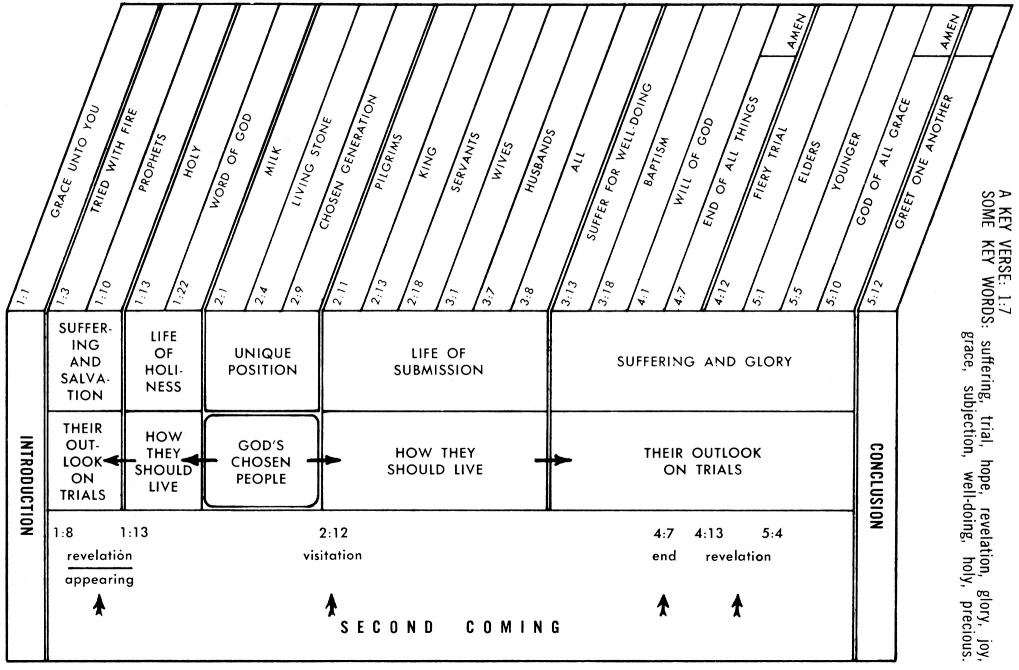
1 Peter: Trials, Holy Living & The Lord's Coming
Click chart to enlarge
Chart from Jensen's Survey of the NT - used by permission
See Another Chart from Charles Swindoll
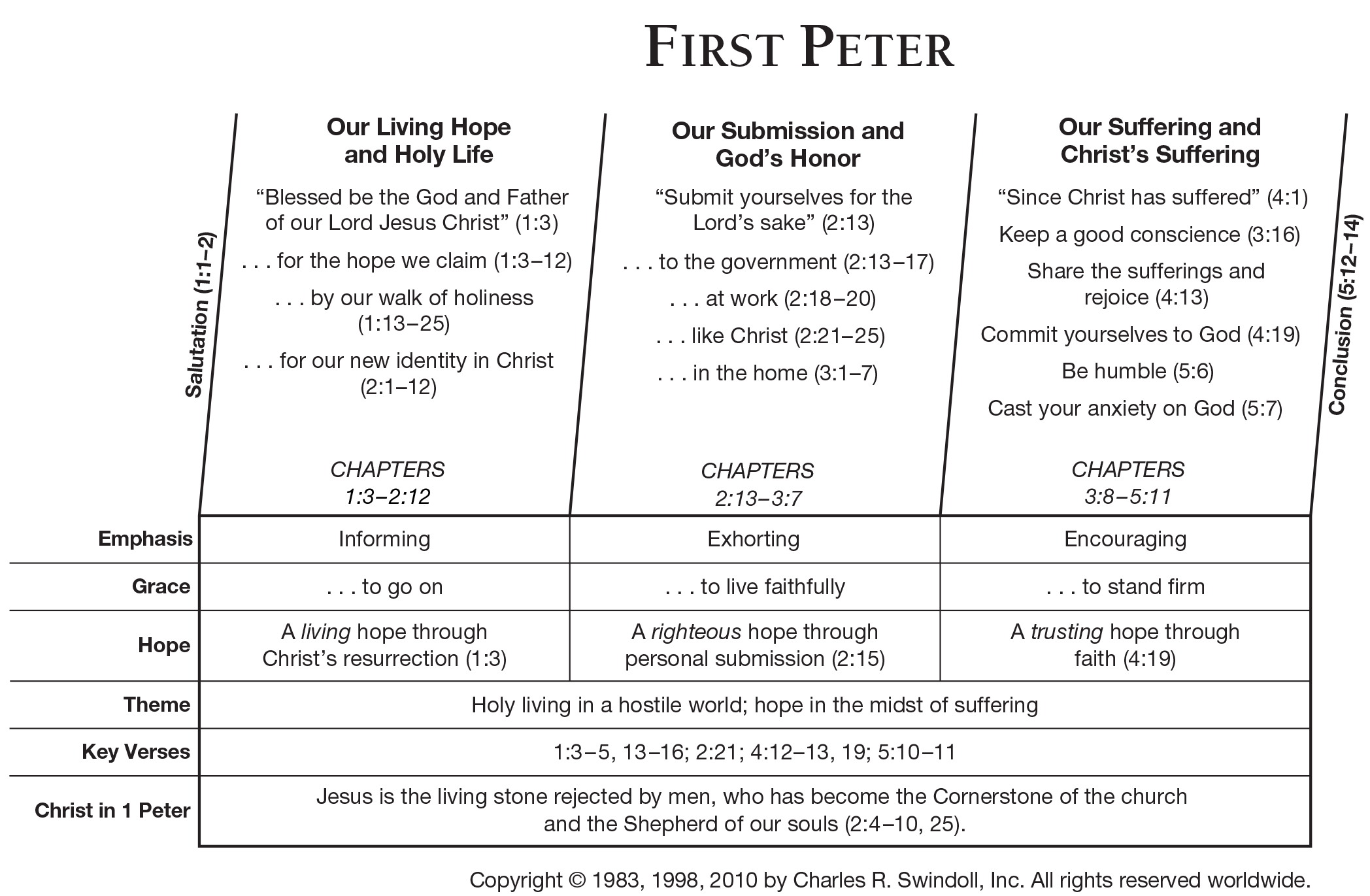
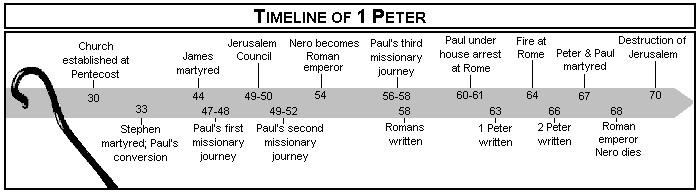
Source: Borrow Ryrie Study Bible
Click to enlarge
1 Peter 2:7 This precious value, then, is for you who believe; but for those who disbelieve, "THE STONE WHICH THE BUILDERS REJECTED, THIS BECAME THE VERY CORNER stone," (NASB: Lockman)
Greek: humin oun e time tois pisteuousin; (PAPMPD) apistousin (PAPMPD) de lithos on apedokimasan (3PAAI) oi oikodomountes (PAPMPN) houtos egenethe (3SAPI) eis kephalen gonias
Amplified: To you then who believe (who adhere to, trust in, and rely on Him) is the preciousness; but for those who disbelieve [it is true], The [very] Stone which the builders rejected has become the main Cornerstone, (Amplified Bible - Lockman)
KJV: Unto you therefore which believe He is precious: but unto them which be disobedient, the Stone which the builders disallowed, the same is made the Head of the corner,
NLT: Yes, he is very precious to you who believe. But for those who reject him, "The stone that was rejected by the builders has now become the cornerstone." (NLT - Tyndale House)
Phillips: It is you who believe in him that he is "precious", but to those who disobey God, it is true that: 'The stone which the builders rejected has become the chief cornerstone'. (Phillips: Touchstone)
Wuest: For you therefore who are believers is the honor and the preciousness [of the Living Stone], but to those who are disbelievers, the Stone which the builders repudiated after they had tested Him for the purpose of approving Him, finding Him to be that which did not meet their specifications, this Stone became a Head Cornerstone
Young's Literal: to you, then, who are believing is the preciousness; and to the unbelieving, a stone that the builders disapproved of, this one did become for the head of a corner,
THIS PRECIOUS VALUE, THEN, IS FOR YOU WHO BELIEVE: humin oun e time tois pisteuousin (PAPMPD):
- 1Pe 1:8; Song 5:9, 10, 11, 12, 13, 14, 15, 16; Hag 2:7; Mt 13:44, 45, 46; Jn 4:42; 6:68,69; Phil 3:7, 8, 9, 10
- Isa 28:5; Lk 2:32
- Spurgeon's Devotional
- 1 Peter 2 Resources - Multiple Sermons and Commentaries
- 1 Peter 2:4-10 The Priorities Of God's People - Steven Cole
- 1 Peter 2:6-8 The Believer's Privileges = Security Pt 4 - Sermon - John MacArthur
- 1 Peter 2:6-8 The Believer's Privileges = Security Pt 4 - Study Guide (see dropdown) - John MacArthur
THE PRECIOUSNESS
OF BELIEF
Spurgeon - He is preciousness, He is an honor, He is everything that is glorious to you. You can never think highly enough of Him, or speak well enough concerning Him. All the world beside may disallow Him, but unto you He is precious.
“He is an honor,- He is your honor, your glory, your boast.” It is an honorable thing to be a believer in a Lord so glorious as He is, in a gospel so reasonable as His gospel is, in promises so certain of fulfillment as His promises are, in an atonement so effectual as His atonement is, and in a Master so omnipotent as He is: “Unto you therefore which believe He is an honor:” (1 Peter 2 Commentary)
J B Taylor explains that "In its original context this reflected the Psalmist’s own jubilation at his vindication over the enemies who had rejected him, but in its liturgical setting in the Feast of Tabernacles the psalm came to refer more to national than to personal deliverance. In rabbinical exegesis it was accorded a Messianic interpretation and this prepared the way for its use by Christ of himself in Mt 21:42; Mark 12:10; Luke 20:17. (Wood, D. R. W.. New Bible Dictionary InterVarsity Press)
The Precious value (5092) (time from tío = pay honor, respect) refers to the worth or merit of some object. It is the amount at which something is valued!
The Greek word time is used 41 times in the NT -
Matt. 27:6, 9; Jn. 4:44; Acts 4:34; 5:2f; 7:16; 19:19; 28:10; Rom. 2:7, 10; 9:21; 12:10; 13:7; 1 Co. 6:20; 7:23; 12:23f; Col. 2:23; 1 Thess. 4:4; 1 Tim. 1:17; 5:17; 6:1, 16; 2 Tim. 2:20f; Heb. 2:7, 9; 3:3; 5:4; 1 Pet. 1:7; 2:7; 3:7; 2 Pet. 1:17; Rev. 4:9, 11; 5:12f; 7:12; 21:26
Notice that precious (time) is a favorite word of Peter. He also uses the related derivative adjective entimos (1784) two times (Click), this word pertaining to that which is highly regarded because of status or to that which is esteemed as of considerable worth and thus valuable or precious.
The Greek word time reflects a manifestation of esteem (the regard with which one is held), honor, reverence. Time is a valuing by which the price is fixed or an estimation of the value of a thing. In the present context, time is descriptive of the inestimable, infinite worth of Christ our Rock.
In this passage Peter contrasts the significance of the Living Stone to believers with what this same Living Stone becomes to unbelievers who refuse to allow Him to become precious to them (by believing in Him).
G Campbell Morgan comments that...
The declaration is not that believers know the preciousness of Christ; it is rather that they share it.
The idea of preciousness is that of honour, and therefore of honourableness, that is, of the qualities that are worthy of honour. This is the thought of the statement, then. The qualities of Christ that create His preciousness, His honour, are placed at the disposal of the believer.
Twice already had the Apostle described the Lord as "precious" (see notes 1 Peter 2:4; 2:6). In both cases the description was a declaration of God's estimate of Him. He was the rejected of men, but with God He was elect, precious. We know the things in Christ which made Him precious, honourable, in the sight of God. They were the things of His purity, His love, His conformity to all the perfect will of God. Here, then, is the wonder of this declaration.
All these things are communicated to those who believe in Him. His very life 'and nature are given to the believer, and, by the might of their working, make that believer precious with His preciousness.
He is the living Stone, and those who come to Him, who believe in Him, receive that very quality of life which is His, and so they become living stones.
It is in the power of that preciousness that they become "an elect race, a royal priesthood, a holy nation, a people for God's own possession," and so are enabled "to show forth the excellencies" of God.
Spurgeon comments that...
This text calls to my re-collection the opening of my ministry. As a lad of sixteen I stood up for the first time in my life to preach the gospel in a cottage to a handful of poor people who had come together for worship. I felt my own inability to preach, but I ventured to take this text:
Unto you therefore which believe he is precious.
I do not think I could have said anything upon any other text. Christ was precious to my soul, and I was in the flush of my youthful love, and I could not be silent when a precious Jesus was the subject.
---
This is a text on which I think I could preach in my sleep. And I believe that if I were dying and were graciously led into the old track, I could with my last breath pour out a heart full of utterance on this delightful verse. I am sure it contains the marrow of what I have always taught in the pulpit.
Believe (4100) (pisteuo from pistis; pistos; related studies the faith, the obedience of faith) means to consider something to be true and therefore worthy of one’s trust. To accept as true, genuine, or real. To have a firm conviction as to the goodness, efficacy, or ability of something or someone. To consider to be true. To accept the word or evidence of.
Peter uses pisteuo in the present tense which describes this belief as one's practice.
Vincent notes that pisteuo "means to persuade, to cause belief, to induce one to do something by persuading, and so runs into the meaning of to obey, properly as the result of persuasion
In secular Greek literature, as well as in the New Testament, pisteuo (pistis, pistos) has a basic meaning of an intellectual assent or a belief that something is true. Michel says that this use arose during the Hellenistic period. During the struggle with skepticism and atheism, it acquired the sense of conviction concerning the existence and activity of the Greek gods. Thayer calls this the intransitive use of the word which conveys the idea of to be sure or be persuaded that something is a fact. This kind of faith does not require any action on the part of the believer but only an intellectual acceptance. As discussed below, James used this type of faith as an example of a dead faith stating that "The devils also believe, and tremble" (James 2:19).
The other secular Greek meaning that is the more common use in the New Testament is the transitive or active use which means to "put faith in" or "rely upon" someone or something. Sometimes it has even stronger meaning: "To entrust something to another." In classical usage it denoted conduct that honored a previous agreement, such as the honoring of a truce between opposing armies (Iliad 2.124). The meaning of entrusting something to someone is found in Xenophon (Memorabilia 4.4.17). An example of this use in the New Testament is 2 Timothy 1:12. Paul said
I know whom I have believed, and am persuaded that he is able to keep that which I have committed unto him against that day (see note 2 Timothy 1:12) (Comment: Here pisteuo means to trust in or rely upon Christ to save us)
Pisteuo means to entrust oneself to an entity in complete confidence. To believe in with the implication of total commitment to the one who is trusted. As discussed below Christ is the object of this type of faith that relies on His power and nearness to help, in addition to being convinced that His revelations or disclosures are true.
The noun pistis and the verb pisteuo, mean an adherence to, committal to, faith in, reliance upon, trust in a person or an object, to be persuaded of or convinced of something, to place one's confidence in, to trust.
Pisteuo can also mean to be confident about or to be firmly persuaded as to something, and so Paul writes...
One man has faith (pisteuo) that he may eat all things, but he who is weak eats vegetables only. (see note Romans 14:2) (Here the believing conveys the sense of having an opinion, thinking)
As noted above, pisteuo can refer to an heart belief (saving faith, genuine belief that leads to salvation, this believing involves not only the consent of the mind, but an act of the heart and will of the subject) or an intellectual belief (mental assent, "head" knowledge, not associated with bringing salvation if it is by itself), both uses demonstrated by Jesus statement in John 11,
John 11:26 Everyone who lives and believes (refers to genuine saving faith) in Me shall never die. Do you believe (intellectually) this?
James 2:19 You believe (pisteuo) that God is one. You do well; the demons also believe (pisteuo), and shudder.
Comment: In this passage, James explains that not all believing will result in salvation. The believing he is describing in this passage is a mental or intellectual believing that is not associated in a change in one's heart and thus in one's behavior or actions. Belief in the New Testament sense that effects the new birth denotes more than a "demonic" like, intellectual assent to a set of facts or truths. The demons believe but they are clearly not saved. Genuine belief does involve an intellectual assent and consent of one's mind, but also includes an act of one's heart and will. Biblical saving faith is not passive assent but an active staking of one's life on the claims of God. The respected Greek lexicon author W E Vine defines belief as consisting of
(1) a firm conviction which produces full acknowledgment of God's revelation of Truth - (2Thes 2:12 -"in order that they all may be judged who did not believe [pisteuo] the truth, but took pleasure in wickedness.")
(2) a personal surrender to the Truth (Jn 1:12 "But as many as received Him, to them He gave the right to become children of God, even to those who believe [pisteuo] in His name") and
(3) a conduct inspired by and consistent with that surrender.
Pisteuo is found 24 times in the Septuagint (LXX) and the first use by Moses is one of the most important uses of pisteuo in all of Scripture...
Genesis 15:6 Then he (Abraham) believed (Hebrew = 'āman; LXX = pisteuo) in the LORD; and He reckoned it to him as righteousness. (Comment: Note that in the OT, salvation was by faith, not works. Paul explains that Abraham heard the gospel - see Galatians 3:8. It is also worth noting that the Hebrew word for "believe" in this verse is 'āman means to confirm, support or uphold and conveys the essential idea that one remains steadfast. At the heart of the meaning of the root of the Hebrew verb 'āman is the idea of certainty or firmness. The derivatives reflect the concept of certainty and dependability. In other words faith is not a blind leap into the dark but a confident commitment to the One about Whom abundant evidence bears ample testimony of His eternal, immutable trustworthiness. Faith is far more than mere hope that something unlikely may happen. It is a deep, internal certainty, rooted in our trust of what God has said.)
As alluded to above, Biblical faith or believing is not synonymous with mental assent alone, which is not genuine (saving) faith. For example, the apostle John distinguishes two types of believing using the verb pisteuo, one of which is only a superficial profession...
John 2:22 When therefore He was raised from the dead, His disciples remembered that He said this; and they believed (pisteuo) the Scripture and the word which Jesus had spoken. (Morris in Defenders Study Bible writes "Note the superior category of faith of the disciples to that of the "many" in John 2:23 who believed "when they saw the miracles," but soon fell away. The disciples did not believe because of the miracles but because of the Scripture and Jesus' words. It is far better to place one's faith in God's Word than in signs and wonders.")
23 Now when He was in Jerusalem at the Passover, during the feast, many believed (pisteuo) in His name, beholding His signs which He was doing. (Note that their belief was associated with His signs)
24 But Jesus, on His part, was not entrusting (pisteuo) Himself to them, for He knew all men (Morris writes "Although many in the Jerusalem crowd "believed in his name when they saw the miracles" (John 2:23), Jesus did not "believe" in them because He knew their hearts and knew their outward faith in Him was only superficial)
25 and because He did not need anyone to bear witness concerning man for He Himself knew what was in man. (The Ryrie Study Bible notes that "The contrast is between people who put their trust (pisteuo) in Jesus, and Jesus, who does not put His trust in people because He knows their motives and thoughts. Enthusiasm for the spectacular is present in them, but Jesus looks for genuine faith.) (John 2:22-25)
In another example of believing that falls short of genuine saving belief John records that when Jesus spoke to the Jews "who had believed (pisteuo) Him" (John 8:31) but as their subsequent actions demonstrated their belief was not genuine for Jesus accused them declaring "you are seeking to kill Me" (John 8:40) and after several heated exchanges, these same "believing" Jews "fulfilled prophecy" and indeed sought to kill Jesus, picking
up stones to throw at Him; but Jesus hid Himself, and went out of the temple. (John 8:59) (Comment: These Jews had a profession but not genuine possession in respect to their belief in Jesus).
Wuest writes that when pisteuo refers "to the faith which a lost sinner must place in the Lord Jesus in order to be saved, they include the following ideas; the act of considering the Lord Jesus worthy of trust as to His character and motives, the act of placing confidence in His ability to do just what He says He will do, the act of entrusting the salvation of his soul into the hands of the Lord Jesus, the act of committing the work of saving his soul to the care of the Lord. This means a definite taking of one’s self out of one’s own keeping and entrusting one’s self into the keeping of the Lord Jesus. (Wuest, K. S. Wuest's Word Studies from the Greek New Testament: Eerdmans)
Nelson's New Illustrated Bible Dictionary says that "A belief that saves is one that rests in the finished work of Christ; it trusts God alone for salvation (John 3:16). Believers are those who have trusted God with their will as well as their mind (see notes Romans 1:16; Romans 3:22; 1Thessalonians 1:7). (Youngblood, R. F., Bruce, F. F., Harrison, R. K., & Thomas Nelson Publishers. Nelson's New Illustrated Bible Dictionary)
Larry Richards has an excellent discussion on believing writing that...
Originally this word group (pisteuo, pistis, pistos) seems linked with a more formal contract between partners. It stressed faithfulness to the agreement made or trustworthiness in keeping promises. In time the use expanded. In the classical period, writers spoke of trust in the gods as well as trust in people. In the Hellenic era, "faith in God" came to mean theoretical conviction about a particular doctrine, a conviction expressed in one's way of life. As different schools of philosophy and religion developed, the particular emphasis given pistis was shaped by the tradition within which it was used. The NT retains the range of meanings. But those meanings are refined and reshaped by the dynamic message of the gospel.
The verb (pisteuo) and noun (pistis) are also used with a number of prepositions. "To believe through" (dia) indicates the way by which a person comes to faith (Jn 1:7; 1Pe 1:21 [note]). "Faith en" indicates the realm in which faith operates (Eph 1:15-note; Col 1:4-note; 2Ti 3:15-note). The most important construction is unique to the NT, an invention of the early church that expresses the inmost secret of our faith. That construction links faith with the preposition eis, "to" or "into." This is never done in secular Greek. In the NT it portrays a person committing himself or herself totally to the person of Jesus Christ, for our faith is into Jesus. (Ed note: Leon Morris in "The Gospel According to John" agrees with Richards writing that "Faith, for John, is an activity which takes men right out of themselves and makes them one with Christ" indicating that Morris likewise understands the Greek preposition eis in the phrase pisteuo eis, to be a significant indication that NT faith is not just intellectual assent but includes a "moral element of personal trust.")
One other aspect of the NT's use of faith words is fascinating. Usually the object of faith is Jesus. Only twelve verses have God as the object of faith (Jn 12:44; 14:1; Acts 16:34; see notes Ro 4:3, 5, 17, 24- see notes Ro 4:3, 4:5, 17, 24; Gal 3:6; 1Th 1:8 [note]; Titus 3:8 [note]; He 6:1 [note]; 1Pe 1:21 [note]). Why? The reason is clearly expressed by Jesus himself: "I am the way and the truth and the life. No one comes to the father except through me" (Jn 14:6). God the Father has revealed himself in the Son. The Father has set Jesus before us as the one to whom we must entrust ourselves for salvation. It is Jesus who is the focus of Christian faith. (Richards, L O: Expository Dictionary of Bible Words: Regency - a highly recommended resource)
J. B. Lightfoot discusses the concept of faith in his commentary on Galatians. He notes that in Hebrew, Greek, and Latin, the definition of the word for faith "hovers between two meanings: trustfulness, the frame of mind which relies on another; and trustworthiness, the frame of mind which can be relied upon...the senses will at times be so blended together that they can only be separated by some arbitrary distinction. The loss in grammatical precision is often more than compensated by the gain in theological depth...They who have faith in God are steadfast and immovable in the path of duty.
Faith, like grace, is not static. Saving faith is more than just understanding the facts and mentally acquiescing. It is inseparable from repentance, surrender, and a supernatural longing to obey. None of those responses can be classified exclusively as a human work, any more than believing itself is solely a human effort.
Faith is manifest by not believing in spite of evidence but obeying in spite of consequence. John uses pisteuo to demonstrate the relationship between genuine faith and obedience writing...
He who believes (pisteuo - present tense = continuous) in the Son has eternal life but he who does not obey (apeitho - present tense = continuously disobey, habitually, as their lifestyle) the Son shall not see life, but the wrath of God abides on him. (John 3:36) (Comment: The verb apeitho conveys more an attitude of unbelief but also involves deliberate disobedience, conscious resistance to authority)
Charles Swindoll commenting on faith and obedience in John 3:36 concludes that "In John 3:36 the one who "believes in the Son has eternal life" as a present possession. But the one who "does not obey the Son shall not see life." To disbelieve Christ is to disobey Him. And logically, to believe in Christ is to obey Him. As I have noted elsewhere, "This verse clearly indicates that belief is not a matter of passive opinion, but decisive and obedient action." (quoting J. Carl Laney)...Tragically many people are convinced that it doesn't really matter what you believe, so long as you are sincere. This reminds me of a Peanuts cartoon in which Charlie Brown is returning from a disastrous baseball game. The caption read, "174 to nothing! How could we lose when we were so sincere?" The reality is, Charlie Brown, that it takes more than sincerity to win the game of life. Many people are sincere about their beliefs, but they are sincerely wrong!" (Swindoll, C. R., & Zuck, R. B. Understanding Christian Theology.: Thomas Nelson Publishers) (This book is recommended if you are looking for a very readable, non-compromising work on "systematic theology". Wayne Grudem's work noted above is comparable.)
Subjectively faith is firm persuasion, conviction, belief in the truth, veracity, reality or faithfulness (though rare). Objectively faith is that which is believed (usually designated as "the faith"), doctrine, the received articles of faith. Click separate study of "the faith (pistis)"
True faith is not based on empirical evidence but on divine assurance.
When missionary John Paton was translating the Scripture for the South Sea islanders, he was unable to find a word in their vocabulary for the concept of believing, trusting, or having faith. He had no idea how he would convey that to them. One day while he was in his hut translating, a native came running up the stairs into Paton's study and flopped in a chair, exhausted. He said to Paton, "It's so good to rest my whole weight in this chair." John Paton had his word: Faith is resting your whole weight on God. That word went into the translation of their New Testament and helped bring that civilization of natives to Christ. Believing is putting your whole weight on God. If God said it, then it's true, and we're to believe it.
Nothing before, nothing behind,
The steps of faith
Fall on the seeming void, and find
The rock beneath
-- Whittier
As the great British preacher C H Spurgeon said...
Faith is the foot of the soul by which it can march along the road of the commandments.
---
It will not save me to know that Christ is a Savior; but it will save me to trust Him to be my Savior. I shall not be delivered from the wrath to come by believing that his atonement is sufficient; but I shall be saved by making that atonement my trust, my refuge, and my all. The pith, the essence of faith lies in this—a casting oneself on the promise.
---
Little faith will bring your soul to heaven; great faith will bring heaven to your soul.
The great Baptist preacher Adrian Rogers "A faith that hasn't been tested can't be trusted.
Corrie ten Boom "Faith sees the invisible, believes the unbelievable, and receives the impossible.
Faith, mighty faith, the promise sees,
And looks to that alone;
Laughs at impossibilities,
And cries it shall be done. -- Charles Wesley
The great American evangelist, D L Moody - I prayed for faith and thought that some day faith would come down and strike me like lightning. But faith did not seem to come. One day I read in the tenth chapter of Romans, "Faith cometh by hearing, and hearing by the Word of God." I had up to this time closed my Bible and prayed for faith. I now opened my Bible and began to study, and faith has been growing ever since.
Spurgeon in his devotional Morning and Evening has the following devotional thoughts on this verse...
As all the rivers run into the sea, so all delights centre in our Beloved. The glances of His eyes outshine the sun: the beauties of His face are fairer than the choicest flowers: no fragrance is like the breath of His mouth. Gems of the mine, and pearls from the sea, are worthless things when measured by His preciousness.
Peter tells us that Jesus is precious, but he did not and could not tell us how precious, nor could any of us compute the value of God's unspeakable gift. Words cannot set forth the preciousness of the Lord Jesus to His people, nor fully tell how essential He is to their satisfaction and happiness.
Believer, have you not found in the midst of plenty a sore famine if your Lord has been absent? The sun was shining, but Christ had hidden Himself, and all the world was black to you; or it was night, and since the bright and morning star was gone, no other star could yield you so much as a ray of light. What a howling wilderness is this world without our Lord!
If once He hideth Himself from us, withered are the flowers of our garden; our pleasant fruits decay; the birds suspend their songs, and a tempest overturns our hopes.
All earth's candles cannot make daylight if the Sun of Righteousness be eclipsed.
He is the soul of our soul, the Light of our light, the Life of our life.
Dear reader, what wouldst thou do in the world without Him, when thou wakest up and lookest forward to the day's battle?
What wouldst thou do at night, when thou comest home jaded and weary, if there were no door of fellowship between thee and Christ?
Blessed be His name, He will not suffer us to try our lot without Him, for Jesus never forsakes His own. Yet, let the thought of what life would be without Him enhance His preciousness. (C H Spurgeon, Morning and Evening)
Thomas Watson - Yes, He is very precious to you who believe!" 1 Peter 2:7
There is nothing in Christ, but what is precious. His name is precious, His virtues are precious, His blood is precious—more precious than the world. The Rose of Sharon is always sweet!
We cannot prize Christ at too high a rate. We may prize other things above their value. That is our sin. We commonly overrate the creature; we think there is more in it than there is; therefore God withers our gourd, because we over-prize it.
But we cannot raise our esteem of Christ high enough. He is beyond all value! There is no ruby or diamond, but the jeweler can set a fair price on it. But Christ's worth can never be fully known. No seraphim can set a due value on Him. His riches are unsearchable! Eph 3:8. Christ is more precious than heaven!
True Christians prize Christ, as most precious. He istheir chief treasure and delight. This reason why millions perish, is because they do not prize Christ.
The ungodly choose things of no value, before Christ! "You blind fools!" Matthew 23:17. If a person chooses an apple before a priceless diamond—he is judged to be a fool. How many such idiots are there, who choose the gaudy, empty things of this life—before the Prince of Glory!
Give a baby a rattle—and it will not want gold. Give a worldling his lusts—and he will be content enough without Christ.
We value Christ above honor and riches. This Pearlof Great Price lies nearest our heart. He who prizes Christ esteems the gleanings of Christ—better than the world's vintage. He counts the worst things of Christ—better than the best things of the world. Moses "regarded disgrace for the sake of Christ
as of greater value than the treasures of Egypt." Hebrews 11:26
If we are the prizers of Christ, we cannot live without Him. A man may live without music, but not without food.A child of God can lack health and friends—but he cannot lack Christ. "Give me children," said Rachel, "or else I die!"Genesis 30:1. So the soul says, "Give me Christ—or else I shall die! Give me one drop of the water of life to quench my thirst."
If we are prizers of Christ, then we shall not complain at any pains to get Him. He who prizes gold, will dig for it in the mine. "My soul follows hard after God!" Psalm 63:8. He in whose eye Christ is precious, never rests until he has gained Him: "I sought Him whom my soul loves; I held Him, and would not let Him go!" Canticles 3:1,4
If we are prizers of Christ, then we take great pleasure in Christ. What joy a man takes, in that which he countshis treasure! He who prizes Christ makes Him his greatest joy. He can delight in Christ, when earthly delights are gone. Though a flower in a man's garden dies, he can still delight in his money and jewels. He who esteems Christ, can solace himself in Christ, when there is a dearth of all other comforts.
If we are prizers of Christ, then we will part with our dearest pleasures for Him. He who esteems Christ, will pull out that lust which is as precious as his right eye! He who sets a high value on Christ, will set his feet on the neck of his sins!
How can they be said to prize Christ—who will not leave a vanity for Him; or who prefer a damning pleasure before a saving Christ!
"Yes, He is very precious to you who believe!"
BUT FOR THOSE WHO (continually, habitually, as their life long habitual practice) DISBELIEVE: apistousin (PAPMPD) de:
- 1Peter 2:8; Acts 26:19; Ro 10:21; 15:31; Titus 3:3; Heb 4:11; 11:31
- 1 Peter 2 Resources - Multiple Sermons and Commentaries
- 1 Peter 2:4-10 The Priorities Of God's People - Steven Cole
- 1 Peter 2:6-8 The Believer's Privileges = Security Pt 4 - Sermon - John MacArthur
- 1 Peter 2:6-8 The Believer's Privileges = Security Pt 4 - Study Guide (see dropdown) - John MacArthur
But (de) - (See discussion of term of contrast) What a woeful (woe filled) contrast! The preciousness of belief stands in stark contrast to the danger of disbelief! One is reminded of Jonathan Edward's sermon where he describes the treacherous fate of sinners barely held as it were from the eternal fires of hell by only the web of a spider - oh, woe filled disbelief! It behooves both saints (that we would be swift and bold to proclaim the gospel while there is yet light of day) and sinners (that they might rightly fear and flee to find refuge in the Rock of Salvation while there is yet breath in their lungs) to be reminded of the destiny and dreadful doom of disbelief by reading this short an excerpt from Edward's awful (awe filled) sermon...
Your wickedness makes you as it were heavy as lead, and to tend downwards with great weight and pressure towards hell; and if God should let you go, you would immediately sink and swiftly descend and plunge into the bottomless gulf, and your healthy constitution, and your own care and prudence, and best contrivance, and all your righteousness, would have no more influence to uphold you and keep you out of hell, than a spider's web would have to stop a falling rock. Were it not for the sovereign pleasure of God, the earth would not bear you one moment; for you are a burden to it; the creation groans with you; the creature is made subject to the bondage of your corruption, not willingly; the sun does not willingly shine upon you to give you light to serve sin and Satan; the earth does not willingly yield her increase to satisfy your lusts; nor is it willingly a stage for your wickedness to be acted upon; the air does not willingly serve you for breath to maintain the flame of life in your vitals, while you spend your life in the service of God's enemies. God's creatures are good, and were made for men to serve God with, and do not willingly subserve to any other purpose, and groan when they are abused to purposes so directly contrary to their nature and end. And the world would spew you out, were it not for the sovereign hand of him who hath subjected it in hope. There are the black clouds of God's wrath now hanging directly over your heads, full of the dreadful storm, and big with thunder; and were it not for the restraining hand of God, it would immediately burst forth upon you. The sovereign pleasure of God, for the present, stays his rough wind; otherwise it would come with fury, and your destruction would come like a whirlwind, and you would be like the chaff on the summer threshing floor. (Sinners in the Hands of an Angry God)
Those who disbelieve - Such as the unbelieving Jewish leaders. They examined Jesus even acknowledging that He had the "trappings" and works of divinity but they refused to accept Him as the long awaited Messiah, the Corner Stone. Why? Because Jesus did not fit with their preconceived ideas of what the Messiah should be like. And because they were rebellious and did not want to submit their will to the will of God. And so they made (like all unregenerate men do) the volitional choice, the definitive decision to reject Him as Savior and Lord. And when that happens in one's heart and mind, there is simply no other "way of escape" from the wrath to come! (cp Hebrews 2:2-note, Hebrews 2:3-note)
THE DANGER OF
DISBELIEF
Disbelieve (569) (apisteo from a = without + pistos = believing, faithful) means literally without believing. They refuse to believe and thus are unfaithful. To disbelieve, to doubt or not to acknowledge. To betray a trust. Unbelief is a failure to respond to God with trust (pistis) and at heart shows, not doubt, but rejection.
Vine feels that "disbelieve” is the best rendering, implying that the unbeliever has had a full opportunity of believing and has rejected it (Vine, W E: Vine's Complete Expository Dictionary of Old and New Testament Words. 1996. Nelson)
Apisteo is in the present tense which indicates that this is their lifestyle. In other words the way they carry on their life is in continual disbelief which is manifest by their continual disobedience to God's Truth (compare "belief/obedience" with "disbelief/disobedience" in Heb 3:18, 19-note). Their lips may profess Christ as Savior, but their life proclaims the undeniable reality of their disbelief. Do not be deceived but remember Jesus' sobering warning noting especially His "numerical" description of "not everyone...many" - Mt 7:21-note, Mt 7:22, 23 (where "does" [v21] and "practice" [v23] are both present tense = one's general lifestyle, the "direction" of their life!)-note. (cp Titus 1:16-note) Someone may say they know Jesus but the more important question is "Does Jesus truly know them"? In other words, do they merely have a profession or truly have a possession (of Christ and eternal life)? Do they possess...genuine belief or genuine disbelief...heaven or hell? The question than is "If you say you believe in Jesus, has this belief made a real change in your life? Are you a new creation in Christ (2Co 5:17-note), with new tastes, new desires, new interests, etc? And note well "new creation" does not mean perfection in this life but it does connote at least a general change in direction! To manifest a life of continual disbelief is a "direction" that will inevitably lead one to eternal separation from "the presence of the Lord [kurios] and from the glory of His power" (read 2Th 1:6, 7, 8, 9, 10).
Apisteo is used 6 times in the NAS: (Mark 16:11, Mark 16:16, Luke 24:11, 41 - these all refer to disbelieving Christ's resurrection. Apisteo is used to describe the Jews who are listening to Paul's testimony of Christ in Acts 28:24. See notes on the other two uses in Ro 3:3-note, 2Ti 2:13-note)
Apisteo is translated disbelieve, not believe or faithless. Apisteo is not found in the non-apocryphal Septuagint (LXX).
In this verse Peter uses apisteo to describe those who disbelieve and thus those who have rejected the Stone, Christ Jesus.
---------
It is interesting to note that the Greek Textus Receptus (Greek manuscript used to translate the King James Version) does not use apisteo here in verse 7 (as does the Nestle-Aland which is the Greek manuscript which is the source of the translation) but instead uses apeitheo which it renders "disobedient". The meaning of these two verbs is similar as one can discern from comparing the preceding word study of apisteo with the study of apeitheo below.
Disobedient (KJV) (544) (apeitheo from a = without + peítho = persuade) literally describes one who refuses to be persuaded and who disbelieves willfully and perversely. Apeitheo in the present context means that these individuals possess an attitude of unbelief because they deliberately disobey, consciously resist and rebel against authority and finally manifest an obstinate rejection of the will (truth) of God. The present tense indicates that this is their lifestyle or their habitual practice. They live in continual disobedience to the Almighty, Holy God. To be sure, we all disobey from time to time. That is not what Peter is referring to here. Instead he is describing the individual with an unregenerate heart who habitually, continually disobeys (as a lifestyle) what he or she knows to be the truth.
Unbelievers were constantly rejecting, ridiculing, mocking, abusing, threatening, and persecuting him—even while he was sharing the glorious news of eternal life with them.
Marvin Vincent in discussing apeitheo in John 3:36 writes that..
Disbelief is regarded in its active manifestation, disobedience. The verb peitho means to persuade, to cause belief, to induce one to do something by persuading, and so runs into the meaning of to obey, properly as the result of persuasion...Obedience, however, includes faith. (Ed Note: See discussion of phrase obedience of faith at Ro 1:5-note). (Vincent, M. R. Word studies in the New Testament Vol. 2, Page 1-109)
Peter also uses apeitheo in the verse below (1Peter 2:8-note), in 1Peter 3:1 (see note), in 1Peter 3:20 (note) and in 1Peter 4:17 (note) where the renders it disobedient., in each of these verses except 1 Peter 4:17) where it is rendered "do not obey".
THE STONE WHICH THE BUILDERS REJECTED: de lithos on apedokimasan (3PAAI) oi oikodomountes (PAPMPN):
- See related topic- Messianic Prophecies
- 1 Peter 2 Resources - Multiple Sermons and Commentaries
- 1 Peter 2:4-10 The Priorities Of God's People - Steven Cole
- 1 Peter 2:6-8 The Believer's Privileges = Security Pt 4 - Sermon - John MacArthur
- 1 Peter 2:6-8 The Believer's Privileges = Security Pt 4 - Study Guide (see dropdown) - John MacArthur
Peter quotes the Septuagint (LXX) of Psalm 118:22 [lithon on apedokimasan (3PAAI) oi oikodomountes (PAPMPD) houtos egenethe (3SAPI) eis kephalen gonias]
Spurgeon - Here Peter quotes from Psalm 118:22. What reverence these inspired men had for the inspired Book! The Spirit of God could have spoken fresh words if he had pleased, but, as if he meant to honor above everything else the Book which he had himself inspired, he “moved” Peter to quote the ancient prophet and psalmist in confirmation of what he was writing. (1 Peter 2 Commentary)
C H Spurgeon commenting on Psalm 118:22 writes the following note...
The stone which the builders refused is become the head stone of the corner. Here the people magnify God for bringing his chosen servant into the honourable office, which had been allotted to him by divine decree. A wise king and valiant leader is a stone by which the national fabric is built up. David had been rejected by those in authority, but God had placed him in a position of the highest honour and the greatest usefulness, making him the chief cornerstone of the state. In the case of many others whose early life has been spent in conflict, the Lord has been pleased to accomplish his divine purposes in like manner; but to none is this text so applicable as to the Lord Jesus Himself: He is the Living Stone, the Tried Stone, Elect, Precious, which God Himself appointed from of old.
The Jewish builders, scribe, priest, Pharisee, and Herodian, rejected Him with disdain. They could see no excellence in Him that they should build upon Him; He could not be made to fit in with their ideal of a national church (Ed note: not referring to the NT Church but used in a general sense of a gathering of Israel) He was a Stone of another quarry from themselves, and not after their mind nor according to their taste. Therefore they cast Him away and poured contempt upon Him, even as Peter said,
This is the stone which was set at nought of you builders
They reckoned Him to be as nothing, though He is Lord of all. In raising Him from the dead the Lord God exalted Him to be the Head of His Church (Ed note: This does refer to the NT Church, the Body of Christ, which was a mystery hidden in the OT), the very pinnacle of her glory and beauty. Since then He has become the confidence of the Gentiles, even of them that are afar off upon the sea, and thus He has joined the two walls of Jew and Gentile into one stately temple, and is seen to be the binding Cornerstone, making both one. This is a delightful subject for contemplation.
Jesus in all things hath the preeminence. He is the principal stone of the whole house of God. We are accustomed to lay some one stone of a public building with solemn ceremony, and to deposit in it any precious things which may have been selected as a memorial of the occasion: henceforth that cornerstone is looked upon as peculiarly honourable, and joyful memories are associated with it. All this is in a very emphatic sense true of our blessed Lord, "The Shepherd, the Stone of Israel." God Himself laid Him where He is, and hid within Him all the precious things of the eternal covenant (He 13:20-note) and there he shall for ever remain, the foundation of all our hopes, the glory of all our joys, the united bond of all our fellowship. He is "the head over all things to the church," and by him the church is fitly framed together, and groweth unto a holy temple in the Lord. Still do the builders refuse him: even to this day the professional teachers of the gospel are far too apt to fly to any and every new philosophy sooner than maintain the simple gospel, which is the essence of Christ: nevertheless, he holds his true position amongst his people, and the foolish builders shall see to their utter confusion that his truth shall be exalted over all. Those who reject the chosen stone will stumble against him to their own hurt, and ere long will come his second advent, when he will fall upon them from the heights of heaven, and grind them to powder. (C H Spurgeon's Exposition on Psalm 118:22)
Builders (3618)(oikodomeo from oikos = dwelling + doma = building [of a house] from demo = to build) means literally to build, construct or erect a dwelling. Oikodomeo is used here as a metaphor meaning to build up, establish, confirm, edify.
Rejected (593) (apodokimazo from apo = from + dokimazo = to prove) means to reject as the result of examination and testing of one’s qualification for an office. Later it came to mean to put out of office or place, to reject, disapprove, refuse. The aorist tense describes their rejection as effective - as a past completed action.
Apodokimazo is used 9 times in the NT -
Matt. 21:42; Mk. 8:31; 12:10; Lk. 9:22; 17:25; 20:17; Heb. 12:17; 1Pet. 2:4, 7
Wuest writes that apodokimazo "refers to the act of putting someone or something to the test for the purpose of putting one’s approval upon that person and thus receiving him, this act of testing being carried to the point where no further testing is needed, with the result that one comes to the settled conclusion that the one tested does not meet the requirements of the test and is therefore disapproved, repudiated. This Living Stone in the Person of God the Son became incarnate, lived for thirty-three years in the midst of Israel, offered Himself as its Messiah, was examined by official Israel for the purpose of approving Him as its Messiah, and then repudiated because He was not what official Israel wanted in a Messiah. What a commentary on the totally depraved condition of man’s heart.
The paradoxical picture is that the perfect Lamb of God, the Creator of the Universe, was rejected by His creation, men who had carefully evaluated the perfect God Man and found Him not "passing their test"! What a striking contrast with scene John witnessed in heaven...
And I looked, and I heard the voice of many angels around the throne and the living creatures and the elders; and the number of them was myriads of myriads, and thousands of thousands, saying with a loud voice, "Worthy is the Lamb that was slain to receive power and riches and wisdom and might and honor and glory and blessing." (See notes on Revelation 5:11, 5:12)! And all God's people say "Amen! Worthy is the Lamb Who was tested and Who was found fully qualified to be the Redeemer of fallen mankind!"
When the Jewish leaders looked at the Stone (Christ) Who "invaded" their religious world, He was not wanted, did not fit in with their theological plans and was useless and unfit for what they were building.
Men by their Adamic nature are rebels to the core and thus continue to reject Jesus for much the same reason -- they want to build their own "castles" the way they want (Pr 14:12, 16:25) doing what is right in their own eyes, living unrestrained by His call to holiness and godliness made available through His indwelling Spirit: (cp Jdg 21:25-note, Pr 29:18-note).
Steven Cole rightly reminds us that as we speak forth the Gospel to the lost world...
we must remember that the biblical Christ is going to offend many people, for at least two reasons:
First, the cross of Christ is offensive (1Co 1:23). The cross humbles human pride. It tells people that their own good works will not get them into heaven. It tells them that they are sinners who have offended a holy God. People don’t like that.
Second, Christ’s lordship (Ro 10:9-note, see word study on kurios - "Lord") offends people. Everyone likes the idea of an Aladdin’s genie-Jesus, who will fulfill their desires. But a Christ who is Lord, who confronts sin and demands obedience-- that’s another story! If you proclaim Christ crucified and Christ as Lord, some will believe and be saved. But others will reject Him and you. Be prepared!
Note that the dividing line is belief versus unbelief (1Pe 2:7). Believing or not believing in Jesus Christ separates people into two distinct camps. Believers are joined to God and His people and one day will be exalted with Christ in heaven. Unbelievers who do not repent are in the darkness, headed for God’s judgment. Jesus Christ is the central issue in belief or unbelief. Either He is the corner stone on whom a person puts his faith and builds his life; or, He is a stone of stumbling and rock of offense over which a person falls. What does Peter mean when he says that unbelievers “stumble because they are disobedient to the word, and to this they were also appointed” (1Pe 2:8)? Are some appointed to perish? Peter’s purpose here is to encourage believers under persecution. Thus his point is that the raging of the wicked is under God’s sovereign control, so that believers need not fear (Ps. 2:1, 2, 3, 4, 5, 6). Those who disobey God will not somehow thwart His eternal purpose. He will someday be glorified in His saving His elect and in justly condemning the reprobate. We are assured that the wicked will be punished.
And yet, those who are disobedient are responsible for their sin, even if it is in line with God’s predestined plan (Acts 2:23)! But, they need not remain in disobedience and rebellion. God offers them mercy and forgiveness if they will turn to Christ. He has “shut all up in disobedience that He might show mercy to all” (Rom. 11:32). No one has piled up more sin than God’s mercy can cover. Christ’s death is sufficient for the chief of sinners. All may come and receive mercy at the cross. (Sermon)
THIS BECAME THE VERY CORNER STONE: houtos egenethe (3SAPI) eis kephalen gonias:
- Ps 118:22,23; Mt 21:42; Mk 12:10,11; Lk 20:17; Acts 4:11,12
- Zech 4:7; Col 2:10
- 1 Peter 2 Resources - Multiple Sermons and Commentaries
- 1 Peter 2:4-10 The Priorities Of God's People - Steven Cole
- 1 Peter 2:6-8 The Believer's Privileges = Security Pt 4 - Sermon - John MacArthur
- 1 Peter 2:6-8 The Believer's Privileges = Security Pt 4 - Study Guide (see dropdown) - John MacArthur
CHRIST
THE CORNERSTONE
Became (1096) (ginomai) means to come into existence.
The very corner - This literally reads the head of the corner.
Very (2776) (kephale; English - cephalic) refers literally to the head (of a body) and figuratively to describe persons of superior rank or high status (1Cor 11:3), things that are uppermost, such as the capstone of a building (Mt 21:42) or a leading city or capital city (Acts 16:12).
Kephale is used figuratively to refer to Christ as head of the Church, His Body.
Corner stone (1137) (gonia) refers literally to an angle, a corner (point where lines, edges or sides converge, a corner of a building and figuratively refers to the four "corners" of the earth in the Revelation, referring to the four directional extremities of the earth. A corner is defined as the place of intersection of two streets or roads, an apropos definition when one thinks of Christ Who is all and in all! The derivative word akrogoniaios (cornerstone, capstone) is used by Peter in 1Peter 2:6 (note).
Gonia is modified by the word kephale (translated head, chief or very) in 4 of the NT uses all of which represent a quotation from Psalm 118:22 and all of which refer to Christ. The phrase kephale gonias (chief corner) is a Hebraism which refers to the final stone in the building (according to the TDNT). The unique stone of the pinnacle corner is Christ Himself, Who is also the temple's foundation. He is both underneath all, upholding us, and above all, crowning us as our glorious Head.
Cornerstone in its literal usage most often referred to the large stone placed in the foundation at the main corner of a building. In biblical times, buildings were often made of cut, squared stone. By uniting two intersecting walls, a cornerstone helped align the whole building and tie it together. In addition the cornerstone occasionally referred to the top or final stone of a building (capstone).
Regardless of which meaning one prefers, the important point is that Jesus is both the Foundation Stone and the Capstone! Anyone who believes in Jesus will come to experience that He is the Solid Rock on which they can build their life in this present age and the one to come and forever. Amen!
My Hope Is Built
-- Edward Mote
My hope is built on nothing less
Than Jesus’ blood and righteousness.
I dare not trust the sweetest frame,
But wholly trust in Jesus’ Name.
Refrain
On Christ the Solid Rock I stand,
All other ground is sinking sand;
All other ground is sinking sand
When darkness seems to hide His face,
I rest on His unchanging grace.
In every high and stormy gale,
My anchor holds within the veil.
Refrain
His oath, His covenant, His blood,
Support me in the whelming flood.
When all around my soul gives way,
He then is all my Hope and Stay.
Refrain
When He shall come with trumpet sound,
Oh may I then in Him be found.
Dressed in His righteousness alone,
Faultless to stand before the throne.
Refrain
Nelson's New Christian Dictionary has an interesting note writing that cornerstone also referred to "The capital letter or gammadion L in the Latin alphabet, used as the symbol of Christ as the cornerstone. It was first used in the Roman catacombs in the fourth century, and the practice continued into the Middle Ages. (Kurian, G. T. Nelson's New Christian Dictionary. Nashville, Tenn.: Thomas Nelson Pubs)
Unger writes that "The term “cornerstone” is sometimes used to denote any principal person, such as the princes of Egypt (Isa. 19:13). Christ is called the “corner stone” in reference to His being the foundation of the Christian faith (Eph. 2:20-note) and the importance and conspicuousness of the place He occupies (Matt. 21:42; 1Pe 2:6-note). (Unger, M. F., Harrison, R. K., Vos, H. F., Barber, C. J., & Unger, M. F. The New Unger's Bible Dictionary. Chicago: Moody Press)
ISBE has an interesting note on cornerstone writing that "No doubt the original meaning was some important stone, which was laid at the foundation of a building. With the Canaanites, who preceded Israel in the possession of Palestine, cornerstone-laying seems to have been a most sacred and impressive ceremony. Under this important stone of temples or other great structures bodies of children or older persons would be laid, consecrating the building by such human sacrifice. This was one of many rites and practices that Israel was to extirpate. (Bromiley, G. W. The International Standard Bible Encyclopedia, Revised. Wm. B. Eerdmans)
Erdman's Dictionary summarizes cornerstone - (1) the stone in a new building laid first with great care and ceremony so as to ensure a straight and level foundation; (2) the interlocking cornerstones that join and strengthen two connecting walls; (3) the capstone at the top corner of a wall; or (4) the keystone of an arched door or gateway, the center and topmost stone that joins the two sides and supports the arch itself (the most important stone in which the name of the city, the ruler, and builder were often carved). (Freedman, D. N., Myers, A. C., & Beck, A. B. Eerdmans dictionary of the Bible Grand Rapids, Mich. W. B. Eerdmans)
Related Resource:
Gonia is used 9 times in the NT...
Matthew 6:5 "And when you pray, you are not to be as the hypocrites; for they love to stand and pray in the synagogues and on the street corners, in order to be seen by men. Truly I say to you, they have their reward in full.
Matthew 21:42 Jesus said to them, "Did you never read in the Scriptures (Psalm 118:22) 'The stone which the builders rejected, This became the chief (kephale = head) corner stone; This came about from the Lord, And it is marvelous in our eyes '? (Comment: "Stone" is added by the translators.)
Mark 12:10 "Have you not even read this Scripture (Psalm 118:22): 'The stone which the builders rejected, This became the chief (kephale = head) corner stone (Comment: "Stone" is added by the translators.)
Luke 20:17-note But He looked at them and said, "What then is this that is written (Psalm 118:22), 'The stone which the builders rejected, This became the chief (kephale = head) corner stone'? (Comment: "Stone" is added by the translators.)
Acts 4:11 "He is the stone which was rejected by you, the builders, but which became the very corner stone. (Comment: Peter alludes to Psalm 118:22 and again the translators add the word "stone")
Acts 26:26 "For the king knows about these matters, and I speak to him also with confidence, since I am persuaded that none of these things escape his notice; for this has not been done in a corner.
1 Peter 2:7 (note) This precious value, then, is for you who believe. But for those who disbelieve, "The stone which the builders rejected, This became the very (kephale = head) corner stone," (Comment: Peter quotes Psalm 118:22 and again the translators add the word "stone")
Revelation 7:1 (note) After this I saw four angels standing at the four corners of the earth, holding back the four winds of the earth, so that no wind should blow on the earth or on the sea or on any tree.
Revelation 20:8 (note) and will come out to deceive the nations which are in the four corners of the earth, Gog and Magog, to gather them together for the war; the number of them is like the sand of the seashore.
There are 30 uses of gonia in the (Ex 26:23, 24; 27:2; 1 Sam 14:38; 1 Ki 7:34; 2 Ki 14:13; 2 Chr 4:10; 25:23; 26:9, 15; 28:24; Neh 3:19-20, 24-25; Job 1:19; Ps 118:22; Prov 7:8, 12; 21:9; 25:24; Jer 31:38, 40; 51:26; Ezek 41:15; 43:20; 45:19; Zeph 1:16; 3:6; Zech 14:10) where it is used most often literally to describe a corner of a building or the Corner Gate of the Temple complex. For example in Job we read the following...
and behold, a great wind came from across the wilderness and struck the four corners of the house, and it fell on the young people and they died; and I alone have escaped to tell you. (Job 1:19 )
As a side note, Job has another allusion to a corner stone although the Greek is slightly different
On what were its bases sunk? Or who laid its cornerstone, (lithos = stone + goniaion = on or at the angle angle, related to gonia) (Job 38:6) (Comment: Here Job describes God as the Creator laying a cornerstone upon which to ‘construct’ the world.)
The living Cornerstone is the first stone laid. All other stones are placed after it. It is the preeminent stone in time. (He 2:10, 6:19, 20, 12:2 - see notes He 2:10, 6:19; 20, 12:2, etc). The Cornerstone is the supportive stone. All other stones are placed upon Him (1Cor 3:11, Ep 2:20-note) and held together by Him (Col 2:19-note). They all rest upon it. It is the preeminent stone in position and power. So it is with Christ; He is the support and power.
In sum, Peter pictures the Jews throwing away the true Cornerstone, and then wound falling over the Rock and be crushed in judgment by the same rock (Luke 20:17, 18; cf. Mt 13:41).
G Campbell Morgan...
This change in the Revised Version, from the "unto you therefore that believe He is precious" of the Authorized, gives a far better interpretation of the Apostle's words. The declaration is not that believers know the preciousness of Christ; it is rather that they share it. The idea of preciousness is that of honour, and there-fore of honourableness, that is, of the qualities that are worthy of honour. This is the thought of the statement, then. The qualities of Christ that create His preciousness, His honour, are placed at the disposal of the believer. Twice already had the Apostle described the Lord as "precious" (see verses 4 and 6). In both cases the description was a declaration of God's estimate of Him. He was the rejected of men, but with God He was elect, precious. We know the things in Christ which made Him precious, honourable, in the sight of God. They were the things of His purity, His love, His conformity to all the perfect will of God. Here, then, is the wonder of this declaration. All these things are communicated to those who believe in Him. His very life 'and nature are given to the believer, and, by the might of their working, make that believer precious with His preciousness. He is the living Stone, and those who come to Him, who believe in Him, receive that very quality of life which is His, and so they become living stones. It is in the power of that preciousness that they become "an elect race, a royal priesthood, a holy nation, a people for God's own possession," and so are enabled "to show forth the excellencies" of God. (Life Applications)
J H Jowett...
Now, let us assume that the individual is ready for the fellowship. We have got the unit of the family. We have got the “living stone.” cleansed, shaped, dressed, ready to be built into the “spiritual house.” How, now, shall the society be formed? What shall be its cement? What shall be its binding medium, and the secret of its consistency? Here are the “living stones”; what shall we do with them? “Unto whom coming . . . as living stones ye are built up a spiritual house.” [1Pe 2:4, 5] “Unto whom coming!” The living stones are to find their bond of union in the living Christ. The alpha of all enduring communion is Christ. We cannot prepare the individual stones without Christ. We cannot build the individual stones into a house without Christ. He is the “corner stone,” and the pervading strength of every enduring structure. What is the implication of all this? It is this. We cannot have society without piety. We may have juxtapositions, connections, clubs, fleeting and superficial relationships, but the only enduring brotherhood is the brotherhood which is built upon faith. Apart from the Christ there can be no social cohesion. The “Word of God proclaims it, and history confirms it. Every preposition seems to have been exhausted by the Word of God in emphasizing the necessity of a fundamental relationship with Christ—“in Christ,” “through Christ,” “by Christ,” “with Christ,” “unto Christ.”
In every conceivable way Christ is proclaimed as the all-essential. In seeking to create societies we have therefore got to reckon with the Christ. We cannot ignore Him. He will not be ignored. We either use Him or we fall over Him. We use Him and rise into strength, or we neglect Him and stumble into ruin. We either make Him the “head of the corner,” [1Pe 2:7, 8] or He becomes our “stone of stumbling, and a rock of offence.” Societies and families and nations, which are not built upon the Christ, fall to pieces, thrown into ruin by the very “law of the spirit of life.” But have not societies been built upon the Christ, and yet been far from manifesting the glory of a radiant, family communion? Look at the sects! Is not Christ the corner stone, and yet where is the sweet communion? Ah! it is when the different communities have got away from the Christ that their communion has been destroyed. It is when the sects get away from the spirit of the Christ, when they become wranglers about a letter, when they are heated by the fever of personal vanity, and lust for the spoils of sectarian triumph—it is then that the spiritual house collapses, and lies scattered in a heap of inhospitable fragments. But when we build upon Him, when He, and He only, is “the preciousness,” when all our personal aims are merged in line with His, when we have the Spirit of Christ, then are we bound into a gracious communion, into a vital and fundamental unity. And into what is He prepared to build us? This chapter is overflowing in the wealth of the figures by which it seeks to express the glorious mission. He will build us into a “spiritual house,” [1Pe 2:5] a spacious home, enclosing but one tenant, the gracious Spirit of God. (Epistles of St. Peter)
1 Peter 2:8 and "A STONE OF STUMBLING AND A ROCK OF OFFENSE " for they stumble because they are disobedient to the word, and to this doom they were also appointed. (NASB: Lockman)
Greek: kai lithos proskommatos kai petra skandalou; oi proskoptousin (3PPAI) to logo apeiqountes, (PAPMPN) eis o kai etethesan (3PAPI)
Amplified: And, A Stone that will cause stumbling and a Rock that will give [men] offense; they stumble because they disobey and disbelieve [God’s] Word, as those [who reject Him] were destined (appointed) to do. (Amplified Bible - Lockman)
KJV: And a stone of stumbling, and a rock of offence, even to them which stumble at the word, being disobedient: whereunto also they were appointed.
NLT: And the Scriptures also say, "He is the stone that makes people stumble, the rock that will make them fall." They stumble because they do not listen to God's word or obey it, and so they meet the fate that has been planned for them. (NLT - Tyndale House)
Phillips: And he is, to them, 'a stone of stumbling and a rock of offence'. Yes, they stumble at the Word of God for in their hearts they are unwilling to obey it - which makes stumbling a foregone conclusion. (Phillips: Touchstone)
Wuest: and an obstacle stone against which one cuts, and a rock which trips one, even to those who because they are non-persuasible, stumble up against the Word, to which [action of stumbling] they were indeed appointed.
Young's Literal: and a stone of stumbling and a rock of offence -- who are stumbling at the word, being unbelieving, -- to which also they were set;
AND A STONE OF STUMBLING: kai lithos proskommatos:
- Isa 8:14; 57:14; Lk 2:34; Ro 9:32,33; 1Cor 1:23; 2Cor 2:16
- 1 Peter 2 Resources - Multiple Sermons and Commentaries
- 1 Peter 2:4-10 The Priorities Of God's People - Steven Cole
- 1 Peter 2:6-8 The Believer's Privileges = Security Pt 4 - Sermon - John MacArthur
- 1 Peter 2:6-8 The Believer's Privileges = Security Pt 4 - Study Guide (see dropdown) - John MacArthur
A Stone of stumbling - A stone that people could trip over as they traveled down a road, in the case of rejecters, a "road" which would lead to eternal death, the most horrible aspect of which is separation from the presence of God Himself (2Th 1:7, 8, 9, 10)!
Stone (3037)(lithos) is literally a fragment of a rock - for building (Mt 24:2), sealing Christ's tomb (Mt 27:60), for engraved writing (2Co 3:7), of precious stones (Re 4:3) and as in this passage figuratively used to describe Christ (cp Mt21:42), as well as His believers (1Pe 2:5).
Peter identifies the Messiah, the Christ, as the Living Stone (1Pe 2:4-note), the Corner Stone (1Pe 2:6-note), the Rejected Stone (1Pe 2:7-note), and the Stumbling Stone (1Pe 2:8-note). Note also Da 2:34 and Jer 13:16, Re 2:14 (note). Zechariah 12:3
Spurgeon - This is the distinguishing mark between God’s chosen people and the rest of mankind. His elect receive Christ, and rejoice in Him; but as for the ungodly, they willfully reject the Savior, and so He becomes to them “a Stone of stumbling, and a Rock of offense.” Christ is the great touchstone of humanity; by contact with Him, the precious are discovered, and the vile are discerned (1 Peter 2 Commentary)
The Jewish interpretive principle gezerah shavah, which linked texts that had a common key word, makes it natural for Peter to cite Ps 118:22 and Isa 8:14.
Isaiah 8:14 (multiple translations) "Then He shall become a sanctuary; But to both the houses of Israel, a stone to strike and a rock to stumble over, And a snare and a trap for the inhabitants of Jerusalem. 8:14 And many will stumble over them. Then they will fall and be broken. They will ever be ensnared and caught.
Stumbling (4348) (proskomma from prós = to, against + kópto = cut, strike) can describe literal or figurative stumbling. It is something a person trips over. Thus proskomma can be an obstacle in the way which if one strikes his foot against he stumbles or falls or figuratively it can describe that over which a soul stumbles i.e. by which is caused to sin or which causes an occasion of apostasy. It is also used figuratively, to describe a cause of falling or an occasion of sinning (Ro 14:13-note, Ro 14:20-note; 1 Cor. 8:9; Septuagint - LXX = Ex. 23:33; 34:12).
Barclay writes that "proskomma, means 'a barrier', 'a hindrance', 'a road-block'. It is the word that would be used for a tree that has been felled and laid across a road to block it. We must never do or allow anything which would be a road-block on the way to goodness. (Daily Study Bible - 1 Peter 2 Commentary)
The TDNT summarizes the meanings of proskomma...
1. This noun may denote the result of falling, hence “damage,” “wound,” “bump,” or more generally “hurt,” “destruction,” “ruin,” and morally “fall,” “sin.”
2. It may also denote a quality as in the phrase “stone of stumbling.”
3. Finally, it may indicate a cause of hurt, e.g., an “obstacle,” or more generally a cause of ruin, e.g., a “hindrance” to faith, a “temptation” that causes a fall into sin. (Kittel, G., Friedrich, G., & Bromiley, G. W. Theological Dictionary of the New Testament. Eerdmans)
Proskomma refers to an obstacle against which one dashes his foot and is akin to proskopto “to cause to stumble”. The combination of líthos = stone with proskomma refers to a stumbling block.
In Romans 14:13 and Romans 14:20 “a stumbling block” speaks of the spiritual hindrance to another caused by a selfish use of liberty or alternatively our tendency to set up a list of do's and don'ts. Either way could cause the other person to stub his spiritual toe!.
Proskomma is used most often by Paul -- in a context of our "Christian liberties" or "freedom in Christ" (Ro 14:13-note, Ro 14:20-note 1Co 8:9) and three times (including the use in this verse) referring to the Messiah as a major stumbling block for the Jews (Ro 9:32, 33-note).
AND A ROCK OF OFFENSE: kai petra skandalou:
- 1 Peter 2 Resources - Multiple Sermons and Commentaries
- 1 Peter 2:4-10 The Priorities Of God's People - Steven Cole
- 1 Peter 2:6-8 The Believer's Privileges = Security Pt 4 - Sermon - John MacArthur
- 1 Peter 2:6-8 The Believer's Privileges = Security Pt 4 - Study Guide (see dropdown) - John MacArthur
Rock (4073) (petra feminine form of the masculine noun petros) refers to a massive rock, a large expanse of bedrock or a great outcropping of rock. Vine distinguishes petra as a "mass of rock" from the masculine petros which refers to a detached stone or boulder, including a stone that might be thrown or easily moved. Jesus uses petra to refer to rocky soil in Luke 8:6, 13.
NIDNTT writes that in classical Greek...
petra means rock, a mass of rock, boulder, and stone as material; it is used as early as Homer for a symbol of firmness (Od. 17, 463), and from the 5th cent. B.C. onwards of hard-heartedness (Aesch., PV 2, 244; Eur., Andromache 537). petros, likewise attested from earliest times, means a (broken off) piece of rock, stone (lithos). A strict distinction of meaning cannot however be maintained: petros can mean, rock, and petra, stone (cf. Homer, Od. 9, 243; Hesiod, Theog. 675; Soph., OC 1595; O. Cullmann, petra TDNT VI 95; and Peter: Disciple, Apostle, Martyr, A Historical and Theological Study, 19622 (Brown, Colin, Editor. New International Dictionary of NT Theology. 1986. Zondervan)
One of the more controversial uses of petra is found in Jesus' declaration to Peter...
Matthew 16:18 "And I also say to you that you are Peter (petros), and upon this rock (petra) I will build My church; and the gates of Hades shall not overpower it.
Comment: For discussion of this controversial verse see MacArthur's messages - Matthew 16:18-20: The Church that Christ Builds 1; Matthew 16:18-20: The Church that Christ Builds 2) and/or S Lewis Johnson's message Is Peter the Rock?
I agree with Kenneth Wuest's interpretative translation of Mt 16:18 - "You are Petros, a Rock-like man, and upon this petra, this huge Gibraltar-like rock, my deity, I will build my Church."
Spurgeon...
When Peter wrote these verses, he must have thought of his own name. He was called a stone or a rock; and once he was to his Master “a rock of offense” when he stumbled at Christ’s word, and began even to rebuke his Lord, but he was forgiven and saved, so now he gives a warning to others lest they should still more grievously sin by making Christ himself to be to them “a stone of stumbling, and a rock of offense.” (1 Peter 2 Commentary)
In this context the Rock metaphor clearly symbolizes Christ. This picture of Christ as a Stone or Rock is intimately woven by the Spirit throughout both the Old and New Testaments and makes for a fascinating and encouraging study
Suggestion: This study would make an edifying series in a Sunday School class and would be very enlightening to those who are not that familiar with the Old Testament. Remember to carefully observe the context to arrive at the most accurate interpretation, interrogating the primary verse with questions such as... When does this take place? Where does this take place? What are the circumstances surrounding the use of this metaphor? Who is in the "cast of characters"? Who used the name Rock? What attributes do you discover about the Rock or Stone? How should we apply this truth to our life today -- not Can we? - it is God's Word of Truth and it is ALWAYS applicable to our life.
The more relevant question is "Will we allow the Spirit to speak the Word of Truth to our innermost being and respond with unhesitating obedience"?...here are the Scriptures...and as they say when your meal (cp Mt 4:4, Job 23:12-note) is served in the restaurant..."Enjoy!"
Genesis 49:24 > Exodus 17:6 > Exodus 33:21 > Numbers 20:11 > Deut 32:4 > 2Samuel 23:3 > Psalm 18:2 > Psalm 18:31 > Psalm 18:46 > Psalm 19:14 > Psalm 27:5 > Psalm 28:1 > Psalm 31:2-3 > Psalm 40:2 > Psalm 42:9 > Psalm 61:2 >Psalm 62:2 >Psalm 62:6-7 >Psalm 71:3 >Psalm 78:16 > Psalm 78:20 > Psalm 78:35 > Psalm 81:16 > Psalm 89:26 > Psalm 92:15 > Psalm 94:22 >Psalm 95:1 >Psalm 105:41 >Psalm 114:8 >Psalm 118:22 >Psalm 144:1 >Isaiah 8:14 > Isaiah 17:10 > Isaiah 26:4 >Isaiah 28:16 >Isaiah 30:29 >Isaiah 32:2 >Isaiah 33:16 >Isaiah 44:8 >Isaiah 48:21 >Isaiah 51:1 > Da 2:34 > Da 2:35, 44, 45, 46 > Hab 1:12 > Zech 4:7 > Mt 7:24,25> Mt 16:18 >Mt 21:42 >Mk 12:10 >Luke 20:17 > Acts 4:11 >Ro 9:32-33 > Acts 4:11 >1Cor 1:23>1Cor 10:4 >Ephesians 2:20 >1Pe 2:4. 5, 6, 7, 8 (Which book of the Bible has the most allusions to Rock? Why might that be the case?)
(1) To God Jesus is...
Christ the Smitten Stone
Exodus 17:6, 1Cor 10:4,
cp John 4:13, 14, 7:37, 38, 39, Re 22:17 (note)
(2) To Israel Messiah is...
Stumbling Stone
1Peter 2:8 (note), Romans 9:32 (note)
Romans 9:33 (note); 1Cor 1:23
(3) To the Church the Lord Jesus is...
Cornerstone
1 Peter 2:6 (note), Eph 2:20 (note),
1Cor 3:10, 11, 12 (foundation)
(4) To all the Gentile world powers Jesus the King of kings is the...
Stone cut without hands
Da 2:34-note
Stone that grows and fills the earth
Da 2:35-note, cf Da 2:44, 45-note
(5) To Israel at Second coming Messiah is...
Capstone of the corner
Zech 4:7
(6) To unbelievers the Lord Jesus Christ is the...
Crushing Stone of judgment
Mt 21:44
A rock of offense - A rock of stumbling (spiritually)
See Related Study on the Stone that Crushes the Gentile World Powers - Daniel 2 Commentary
Offense (4625)(skandalon [word study] from a root meaning jump up, snap shut) was originally the piece of wood that kept open a trap for animals. Outside the Bible it is not used metaphorically, though its derivative skandalethron (e.g. a trap set through questions) is so used. The English word scandal is derived from the noun via the Lat. scandalum. Thus skandalon was literally, that movable part of a trap on which the bait was laid, and when touched caused the trap to close on its prey. Skandalon thus came to mean any entanglement of the foot. Figuratively, as used most often in Scripture, skandalon refers to any person or thing by which one is drawn into error or sin. (but see more detailed notes in the word study)
There are 15 uses of skandalon in the NT and most take on the figurative meaning -
Matt. 13:41; 16:23; 18:7; Lk. 17:1; Ro 9:33; 11:9; 14:13; 16:17; 1 Co. 1:23; Gal. 5:11; 1 Pet. 2:8; 1 Jn. 2:10; Rev. 2:14
If you go to Jerusalem you will see a massive rock cliff that has the appearance of a man's face in the side of the sheer precipice...this "petra" is better known as Golgotha or Calvary and indeed it became symbolic of the stumbling stone for Jews. Paul records that rejection of the Messiah was particularly related His Cross declaring...
we preach Christ crucified, to Jews a stumbling block (skandalon 4625), and to Gentiles foolishness (1 Co 1:23) (Gal 5:1)
Christ crucified, to Jews a stumbling block 1Cor 1:23
In the NT skandalon is always used metaphorically, and ordinarily of anything that arouses prejudice, or becomes a hindrance to others, or causes them to fall by the way. Sometimes the hindrance is in itself good, and those stumbled by it are the wicked. Paul clearly uses skandalon in the good sense here in Ro 9:33 (note).
Skandalon can describe that which causes someone to sin or that which produces certain behavior which can lead to ruin. Skandalon thus denotes an enticement to conduct which could ruin the person in question. For example, Balaam’s device was a trap for Israel, John recording Jesus' words...
But I have a few things against you, because you have there some who hold the teaching of Balaam, who kept teaching Balak to put a stumbling block before the sons of Israel, to eat things sacrificed to idols, and to commit acts of immorality (see note Revelation 2:14)
Skandalon can refer to a hindrance which stresses that which cause harmful or annoying delay or interference with progress. For example, Paul writes...
Now I urge you, brethren, keep your eye on those who cause dissensions and hindrances (skandalon) contrary to the teaching which you learned, and turn away from them. (see note Romans 16:17)
William Barclay has a lengthy note on skandalon writing...
The interest of this word lies in the fact that it has, not one, but two pictures behind it, and to differentiate between the two will often give us a much more vivid picture. The word skandalon is not a classical Greek word at all. It is late Greek and is, in fact, much commoner in the Septuagint (LXX) and in the NT than anywhere else. The classical equivalent is skandalethron, which means `the bait-stick in a trap'. The skandalethron was the arm or stick on which the bait was fixed. The animal for which the trap was set was lured by the bait to touch or step on the stick; the stick touched off a spring; and so the animal was enticed to its capture or destruction. In classical Greek the word is used by Aristophanes for `verbal traps' set to lure a person in an argument into defeat. It is therefore clear that the original flavour of the word was not so much 'a stumbling-block' to trip someone up as an 'enticement' to lure someone to destruction.
When we turn to the Septuagint (LXX) we find that this distinction is still quite clear. The Greek word skandalon is used to translate two Hebrew words. (a) It is used to translate the word michsol, which quite definitely does mean a 'stumbling-block'. It is so in Lev. 19.14,
'Thou shalt not put a stumbling-block before the blind.'
It is so used in Ps. 119.165,
'Great peace have they which love thy law; and nothing shall offend them.' (see Spurgeon's Comment)
That is to say, 'Nothing shall trip them up.'
(b) It is used to translate the word mokesh, which definitely means 'a trap' or 'a snare'. So in Josh. 23.13 alliances with foreign nations are said to be 'snares' and 'traps'. In Psalm 140.5 (see Spurgeon's Comment) the Psalmist says that the proud have hid a 'snare' for him, and cords; they have spread a 'net' by the wayside; they have set 'gins' for him. In Psalm 141.9 the Psalmist prays :
'Keep me, from the snares which they have laid for me, and the gins of the workers of iniquity. (See Spurgeon's Comment)
In Psalm 69.22 the Psalmist says :
'Let their table become a snare before them; and that which should have been for their welfare, let it become a trap.' (See Spurgeon's Comment)
The idea is that success and prosperity can become a snare instead of a blessing. In the Septuagint, then, the word skandalon has two ideas behind it. It means either a 'stumbling-block', something set in a man's path to trip him up, or 'a snare', 'a bait', 'a lure' to entice him astray and so to ruin him.
When we turn to the NT we find that the translators of the AV always took skandalon in the sense of 'stumbling-block', but when we go to the NT passages with the idea of the double meaning of skandalon in our minds, we find that in certain passages the other meaning gives a more vivid picture.
(i) There are some passages where either meaning is perfectly suitable. In Matt. 13.41 it is said that the Son of Man will remove all skandala from his Kingdom. When the Kingdom comes all the things which are calculated to make a man sin, all the things which could trip him up, all the things which would entice him and seduce him into the wrong way will be taken away. The Kingdom will be a state of things in which temptation will lose its power.
(ii) There are some passages where the meaning of `stumbling-block' is more fitting, or where it is even essential. In Rom. 14.13 we are forbidden to put a `stumbling-block' or 'occasion to fall' in our brother's way. The word that is used for 'occasion to fall' is proskomma, which means 'a barrier', 'a hindrance', 'a road-block'. It is the word that would be used for a tree that has been felled and laid across a road to block it. We must never do or allow anything which would be a road-block on the way to goodness.
In Matt. 13.21 the shallow hearer of the word is said to be 'offended' (skandalizein) by persecution. Persecution is a stumbling-block that stops him on the Christian way.
The Pharisees are 'offended' by Jesus and his words (Matt. 15.12).
Jesus forecasts that all his disciples will be 'offended' because of him (Matt. 26.31). The false teachers put a 'stumbling-block' in the way of others (Rev. 2.14).
The Jews find the cross of Christ 'a stumbling-block' and 'an offence' (I Cor. 1.23; Gal. 5.11).
In all these cases, the words mean something which stops a man's progress, something which trips him up, something which bars the way to him. That something may come from the malicious action of others, or it may come from the prejudice and the pride of a man's own heart.
(iii) But there are certain cases where it gives a far better picture to take skandalon and skandalizein in the sense of a 'trap', a 'snare', a 'bait', an 'allurement', an 'enticement to sin'. Rom. 16.17 warns against those who cause divisions and 'offences' contrary to the doctrine which Christ's people have received. That is a warning against those who would 'lure' us from the way of true belief.
1 John 2.10 says :
'He that loveth his brother abideth in the light, and there is no skandalon in him.' That is to say, 'He would never entice and seduce anyone into sin.'
Matt. 18.6 talks about the sin of 'offending' one of these little ones, and the next verse talks about the terribleness of 'offences'. It gives a much better picture to take skandalon and skandalizein there in the sense of luring and enticing the younger and the more impressionable people to sin.
Matt. 5.29, 30 speak of the necessity of cutting off and plucking out the hand and the eye which 'offend' us. Clearly it is better there to take skandalon in the sense of 'that which lays a trap or snare to entice us into the ruin of sin'. If the desires of the hand and the eye are a bait to sin they must be eradicated.
When Burns went to learn flax-dressing in Irvine he met an older man who led him far astray. He said of him afterwards : 'His friendship did me a mischief.' That is precisely the meaning of skandalon. A skandalon is that which trips us up or that which lures us into sin. From our own lives such things must be rooted out; and God will not hold us guiltless if we bring such things into the lives of others. (Daily Study Bible - 1 Peter 2 Commentary)
Peter is saying in essence that the Messiah is either a stumbling stone (to perdition) or a stepping stone (to salvation).
That "stone" which caused Israel to stumble, the "rock" which offended their self-righteousness, was none other than their Messiah, the Lord Jesus Christ. Israel's rejection of their Messiah resulted in God setting Israel aside for a season (the church age) and turning to the Gentiles. But make no mistake about God's irrevocable promises to Israel, for they will yet be literally fulfilled at the end of the Great Tribulation which ushers in the reign of Israel's Messiah in the Millennium 2. (See related studies - Millennium - why is this doctrine so controversial?; Millennium - what will this age look like?)
Related Resource:
The seers and the prophets had foretold it long ago
That the long awaited One would make men stumble
But they were looking for a king to conquer and to kill
Who'd have ever thought He'd be so weak and humble
Chorus
He will be the truth that will offend them one and all
A Stone that makes men stumble
And a Rock that makes them fall
Many will be broken so that He can make them whole
And many will be crushed and lose their own soul
Along the path of life there lies a stubborn Scandalon
And all who come this way must be offended
To some He is a barrier, To others He's the way
For all should know the scandal of believing
Chorus
It seems today the Scandalon offends no one at all
The image we present can be stepped over
Could it be that we are like the others long ago
Will we ever learn that all who come must stumble
Repeat Chorus
FOR THEY STUMBLE BECAUSE THEY ARE DISOBEDIENT TO THE WORD: oi proskoptousin (3PPAI) to logo apeithountes (PAPMPN):
- 1 Peter 2 Resources - Multiple Sermons and Commentaries
- 1 Peter 2:4-10 The Priorities Of God's People - Steven Cole
- 1 Peter 2:6-8 The Believer's Privileges = Security Pt 4 - Sermon - John MacArthur
- 1 Peter 2:6-8 The Believer's Privileges = Security Pt 4 - Study Guide (see dropdown) - John MacArthur
For (hoi) - always pause to ponder this strategic term of explanation.
Stumble (4350) (proskopto from prós = to, against + kópto = cut, strike) means literally to strike against and so to dash against something as one's foot against a stone. Present tense = continually stumble.
Proskopto literally pictures a traveler who bumps against an obstacle and is caused to stumble. Most of the NT uses describe figurative (spiritual/moral/ethical) stumbling, as in the present passage where Peter describes Israel's spiritual stumbling.
Proskopto is used 8 times in the NT...
Matthew 4:6 and said to Him, "If You are the Son of God throw Yourself down; for it is written, 'He will give His angels charge concerning You'; and 'On their hands they will bear You up, Lest You strike Your foot against a stone.'"
Matthew 7:27 (note) (Jesus in His closing warning in the Sermon on the Mount) "And the rain descended, and the floods came, and the winds blew, and burst against that house; and it fell, and great was its fall."
Luke 4:11 and, 'On their hands they will bear You up, Lest You strike Your foot against a stone.'" (Note that this verse and Mt 4:6 give the devil's version of Ps 91:11-12 (Spurgeon on verse 11; On verse 12) which correctly reads "For He will give His angels charge concerning you, To guard you in all your ways. They will bear you up in their hands, Lest you strike your foot against a stone." In the "devil's version" note that he quoted it out of context leaving out the phrase "in all your ways". The idea is that such a one's "ways" would be in the will of and pleasing to God. To jump off the pinnacle of the Temple was not God's will for His Son -- the Cross was His will.)
John 11:9 Jesus answered, "Are there not twelve hours in the day? If anyone walks in the day, he does not stumble, because he sees the light of this world. 10"But if anyone walks in the night, he stumbles, because the light is not in him." (Jesus uses proskopto with a literal meaning while at the same time conveying a spiritual truth "the light is not in him")
Romans 9:32 (note) Why? Because they did not pursue it by faith, but as though it were by works. They stumbled over the stumbling stone, (Comment: Thayer remarks that the idea of prokopto here is that "the Jews are said to have recoiled from Jesus as one who failed to meet their ideas of the Messiah". In short Israel for the most part failed to recognize the role of Jesus the Messiah in God's plan of salvation and they took offense at and stumbled over the Rock Who is Jesus.)
Romans 14:21 (note) It is good not to eat meat or to drink wine, or to do anything by which your brother stumbles. (Comment: The idea here is to make a misstep. Thayer remarks that this means "to be made to stumble by a thing, i.e., metaphorically, to be induced to sin. Since we are angry with an obstacle in our path which we have struck and hurt our foot against, one is tropically said to stumble at, a person or thing which highly displeases him." Believers will have different convictions about matters on which Scripture is silent. Each of us is free to follow his or her conscience in such matters. But we are never free to influence others to act against their personal convictions and thus cause them to stumble into sin.)
Disobedient (544) is one Greek word apeitheo (a = without + peítho = persuade) and literally describes one who refuses to be persuaded and who disbelieves willfully and perversely. Apeitheo speaks of a stubborn, stiff-necked attitude. It speaks of disbelief manifesting itself in disobedience. It is opposed to pisteuo, the verb translated "believe".
Apeitheo in the present context means that these individuals possess an attitude of unbelief because they deliberately disobey, consciously resist and rebel against authority and finally manifest an obstinate rejection of the will (truth) of God.
The present tense indicates that this is their lifestyle; the way they carry on their life is in continual disobedience against God! To be sure, we all disobey from time to time. That is not what Peter is referring to in this verse. Instead he is describing the individual with an unregenerate heart who habitually, continually disobeys (as a lifestyle) what he or she knows to be the truth.
Apeitheo means not to allow oneself to be persuaded and so to refuse belief in the Truth, the Messiah and His good news of salvation by grace through faith, independent of works or keeping the Law.
In studying apeitheo it is important to understand that the stem peith- (pith-, poith-) has the basic meaning of trust (cf. Latin fido, fides). Trust can refer to a statement, so that it has the meaning to put faith in, to let oneself be convinced, or to a demand, so that it gets the meaning of obey, be persuaded. The active meaning of the verb stem peith- then is to convince and persuade and is especially characteristic of Greek thought. In secular Greek it interesting to note that "Peitho" (art of persuading) was even regarded as a goddess! (see Brown, Colin, Editor. New International Dictionary of NT Theology. 1986. Zondervan))
Marvin Vincent in discussing apeitheo in John 3:36 writes that..
Disbelief is regarded in its active manifestation, disobedience. The verb peitho means to persuade, to cause belief, to induce one to do something by persuading, and so runs into the meaning of to obey, properly as the result of persuasion...Obedience, however, includes faith. (Ed Note: See discussion of phrase "obedience of faith" at Romans 1:5). (Vincent, M. R. Word studies in the New Testament Vol. 2, Page 1-109)
From the above comments, it should not surprise you to discover that in the New Testament the word group translated disobey, disobedience, etc (apeitheo and related words) does not stand in contrast with obedience but in contrast with faith!
Apeitheo is used 34 times in the Septuagint (LXX), where it often translates the Hebrew verb marah a verb meaning to be rebellious and most often descriptive of rebellion against God to such a degree that it provoked Him to action.
For example Moses warns Israel...
Remember, do not forget how you provoked the LORD your God to wrath in the wilderness; from the day that you left the land of Egypt until you arrived at this place, you have been rebellious (LXX translates with apeitheo) against the LORD. (Deuteronomy 9:7)
Below are the 14 uses of apeitheo - click each Scripture reference to study the verb in context and you might be surprised at the truth you discern. As a suggestion, you might read these passages and make a simple list asking questions who? what? why?, etc. You will probably need to examine the context of the surrounding verses to get an accurate sense (context is king ruling accurate interpretation) of the meaning of each use. Be sure and factor in the verb tenses remembering that present tense often conveys the sense that the action of the verb is as a lifestyle or is habitual. Aorist tense can refer to a definite completed action without specifying when this took place ("timeless").
John 3:36 "He who believes in the Son has eternal life; but he who does not obey (present tense) the Son shall not see life, but the wrath of God abides on him."
Acts 14:2 But the Jews who disbelieved (aorist tense) (NLT "spurned God's message", NIV "refused to believe") stirred up the minds of the Gentiles, and embittered them against the brethren.
Acts 19:9 But when some were becoming hardened (skleruno = hard, stubborn) and disobedient (imperfect tense = over and over), speaking evil of the Way before the multitude, he withdrew from them and took away the disciples, reasoning daily in the school of Tyrannus.
Romans 2:8 but to those who are selfishly ambitious and do not obey (present tense) the truth, but obey unrighteousness, wrath and indignation. (see note Romans 2:8)
Romans 10:21 But as for Israel He says, "All the day long I have stretched out My hands to a disobedient (present tense) and obstinate (anti-lego = speaking against, contradicting = present tense) people." (see note Romans 10:21)
Romans 11:30 For just as you (Gentiles) once were disobedient (aorist tense) to God, but now have been shown mercy because of their (the Jew's) disobedience (noun form = apeitheia), (see note Romans 11:30)
Romans 11:31 so these also now have been disobedient (aorist tense), in order that because of the mercy shown to you they also may now be shown mercy. (see note Romans 11:31)
Romans 15:31 (Paul asked the Romans saints to pray...) "that I may be delivered from those who are disobedient (present tense) in Judea, and that my service for Jerusalem may prove acceptable to the saints" (see note Romans 15:31)
Hebrews 3:18 And to whom did He swear that they should not enter His rest, but to those who were disobedient (aorist tense)? 19 And so we see that they were not able to enter because of unbelief (apistia). (What equates with "disobedient" in this context? Clue: why could Israel not enter the promised land?) (see notes Hebrews 3:18; Hebrews 3:19)
Hebrews 11:31 By faith Rahab the harlot did not perish along with those who were disobedient (aorist tense), after she had welcomed the spies in peace. (see note Hebrews 11:31)
1 Peter 2:8 and, "A stone of stumbling and a rock of offense"; for they stumble because they are disobedient (present tense) to the word, and to this doom they were also appointed. (see note 1 Peter 2:8)
1 Peter 3:1 In the same way, you wives, be submissive to your own husbands so that even if any of them are disobedient (present tense) to the word, they may be won without a word by the behavior of their wives, (see note 1 Peter 3:1)
1 Peter 3:20 who once were disobedient (aorist tense), when the patience of God kept waiting in the days of Noah, during the construction of the ark, in which a few, that is, eight persons, were brought safely through the water. (see note 1 Peter 3:20)
1 Peter 4:17 For it is time for judgment to begin with the household of God; and if it begins with us first, what will be the outcome for those who do not obey (present tense) the gospel of God? (see note 1 Peter 4:17)
What is the essence of disobedience? Clearly unbelief, lack of faith, without which no man can be saved.
Spurgeon...
The ungodly reject him, and regard him as of no account; but God has made Him “the head of the corner.” And He has done more than that, He has made him “a stone of stumbling, and a Rock of offense” to them, “even to them which stumble at the Word, being disobedient: whereunto also they were appointed.” That is a terrible truth upon which I am not going to speak just now, but I want you specially to note what an awful thing it is for men to “stumble at the Word,”
— to givest themselves upon Christ’s cross,
— to turn the heavenly medicine into poison,
— to make Christ Himself, Who is to others “the Saviour of life unto life,” to be to them “the Saviour of death unto death.”
“Being disobedient.” The fault lies with themselves, they willfully disobey the command to believe on Christ. “Whereunto also they were appointed.” So the divine purpose is accomplished, although the guilt and punishment of their disobedience rest upon themselves alone. (1 Peter 2 Commentary)
Disobedient to the word - What word? To the Word Who is Christ, to the word about Christ, to the Word of His Gospel of salvation.
Disobedience characterizes (is synonymous with) disbelievers and in context the object of disbelief is the Messiah Who becomes a Stone of stumbling Who trips all attempt to approach God in their own righteousness -- Acts 14:2; 19:9; Romans 2:8 (note), Romans 15:31 (note); 1 Peter 2:8 (note), 1 Peter 4:17 (note).
Wuest sums up this section writing that...
unbelievers find the Living Stone, which is precious to believers, an obstacle against which they strike, and a scandal, that which offends them. (Wuest, K. S. Wuest's Word Studies from the Greek New Testament: Eerdmans)
AND TO THIS DOOM THEY WERE ALSO APPOINTED: eis o kai etethesan (3PAPI):
- Ex 9:16; Ro 9:22; 1Th 5:9; 2Pet 2:3; Jude 1:4
- 1 Peter 2 Resources - Multiple Sermons and Commentaries
- 1 Peter 2:4-10 The Priorities Of God's People - Steven Cole
- 1 Peter 2:6-8 The Believer's Privileges = Security Pt 4 - Sermon - John MacArthur
- 1 Peter 2:6-8 The Believer's Privileges = Security Pt 4 - Study Guide (see dropdown) - John MacArthur
Note that "doom" is added by the translators of the NAS but is not in the original Greek text.
Don't misunderstand what Peter is saying. No person is actively destined to not believe in Jesus and thus destined to damnation (see Constable's explanation below). On the other hand God does appoint stumbling on every unbeliever. All who do not receive Christ as Savior are destined to face Him as Judge! And because the wages of sin not atoned for by Christ is death, all those who refuse to believe the Gospel are destined for stumbling into the abyss of Gehenna and eternal condemnation.
Dear reader are you a seeker? A skeptic? Have you been considering Christ's claims that He is the promised Messiah predicted from Genesis to Malachi? Today could be the day of your salvation dear friend. Don't delay to obey the Spirit's urging to repent and believe the Good News of Jesus Christ, lest you stumble into a Christless eternity! Tomorrow may be too late!
A T Robertson explains it this way...
“Their disobedience is not ordained, the penalty of their disobedience is” (Bigg). They rebelled against God and paid the penalty.
MacDonald lucidly explains that ...
The latter part of verse 8, to which they also were appointed, seems to say that they were destined to disobey the word. Is this what it means? No, this verse teaches that all those who willfully disobey the word are destined to stumble. The words to which they also were appointed refer back to the entire preceding clause, they stumble, being disobedient to the word. God has decreed that all who refuse to bow to the Lord Jesus will stumble. If a man insists on going on in unbelief, then he is appointed to stumble. “Unwillingness to obey makes stumbling a foregone conclusion” (JBP).
Dr Thomas Constable concurs writing that...
God appoints those who stumble to stumble because they do not believe. Their disobedience is not what God has ordained, but the penalty of their disobedience is (cf. Acts 2:23; Ro 11:8, 11, 30, 31, 32- see notes Ro 11:8; 11; 30; 31; 32).
The doctrine of “double predestination” is that God foreordains some people to damnation just as He foreordains some to salvation. This has seemed to some Bible students to be the logical deduction we should draw because of what Scripture says about the election of believers (e.g., Romans 9; Eph. 1). However this is not a scriptural revelation. The Bible always places the responsibility for the destiny of the lost on them for not believing rather than on God for foreordaining (e.g., Rom. 1–3). (1 Peter Notes)
On the other hand Paul declares the destiny of believers writing that...
God has not destined us for wrath (unbelievers are destined for wrath), but for obtaining salvation through our Lord Jesus Christ (1Th 5:9-note)
Comment: Praise God that because Jesus suffered the Curse in our place, believers need not fear death or the final judgment.