1 Peter 5:2
1 Peter 5:3
1 Peter 5:4
1 Peter 5:5
1 Peter 5:6
1 Peter 5:7
1 Peter 5:8
1 Peter 5:9
1 Peter 5:10
1 Peter 5:11
1 Peter 5:12
1 Peter 5:13
1 Peter 5: 14
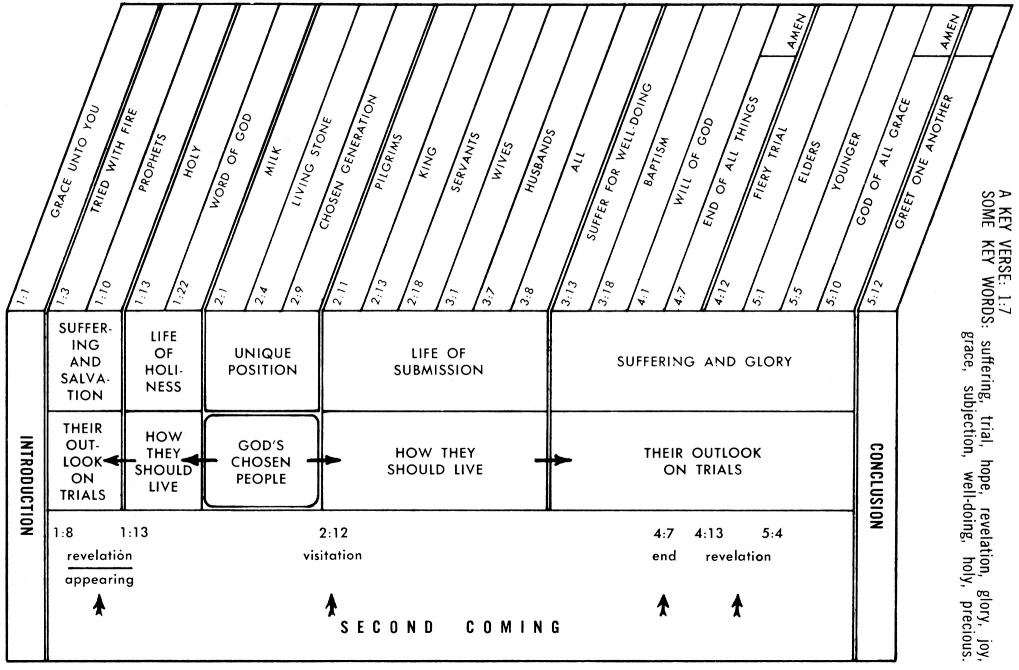
1 Peter: Trials, Holy Living & The Lord's Coming
Click chart to enlarge
Chart from Jensen's Survey of the NT - used by permission
See Another Chart from Charles Swindoll

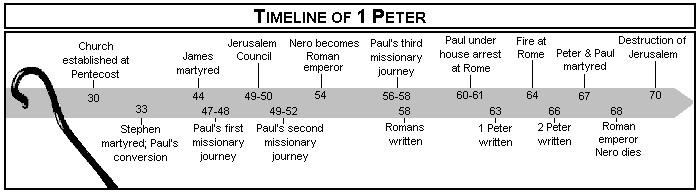
Source: Borrow Ryrie Study Bible
Click to enlarge
| Salvation of the Believer 1 Pe 1:1-2:12 |
Submission of the Believer 1 Pe 2:13-3:12 |
Suffering of the Believer 1 Pe 3:13-5:14 |
||||||||
| Salvation 1Pe 1:1-1:12 |
Sanctification 1Pe 1:13-2:12 |
Submit to Government 1Pe 2:13-17 |
Submit in Business 1Pe 2:18-25 |
Submit in Marriage 1Pe 3:1-8 |
Submit in all of life 1Pe 3:9-12 |
Conduct in Suffering 1Pe 3:13-17 |
Christ's Example of Suffering 1Pe 3:18-4:6 |
Commands in Suffering 1Pe 4:7-19 |
Minister in Suffering 1Pe 5:1-14 |
|
| Belief of Christians | Behavior of Christians | Buffeting of Christians | ||||||||
| Holiness | Harmony | Humility | ||||||||
|
Adapted from Bruce Wilkinson and Kenneth Boa's Talk Thru the Bible (borrow) |
||||||||||
1Peter 5:8 Be of sober spirit, be on the alert. Your adversary, the devil, prowls around like a roaring lion, seeking someone to devour. (NASB: Lockman)
Greek: Nepsate, (2PAAM ) gregoresate. ( 2PAAM) o antidikos humon diabolos os leon oruomenos (PMPMSN) peripatei (3SPAI) zeton (PAPMSN) [tina] katapiein; (AAN)
Amplified: Be well balanced (temperate, sober of mind), be vigilant and cautious at all times; for that enemy of yours, the devil, roams around like a lion roaring [in fierce hunger], seeking someone to seize upon and devour. (Amplified Bible - Lockman)
Barclay: Be sober; be watchful. Your adversary the devil prowls around like a roaring lion, seeking someone to devour.
NLT: Be careful! Watch out for attacks from the Devil, your great enemy. He prowls around like a roaring lion, looking for some victim to devour. (NLT - Tyndale House)
Phillips: Be self-controlled and vigilant always, for your enemy the devil is always about, prowling like a lion roaring for its prey. (New Testament in Modern English)
Wuest: Be of a sober mind, be watchful. Your adversary who is a slanderer, namely, the devil, as a lion roaring in fierce hunger, is constantly walking about, always seeking someone to be devouring. (Eerdmans Publishing)
Young's Literal: Be sober, vigilant, because your opponent the devil, as a roaring lion, doth walk about, seeking whom he may swallow up,
My Paraphrase: (Peter commands saints to) Be sober, be self controlled, be circumspect, be cool, show sound moral judgment (Do it now. It is urgent). Be alert, vigilant, wide awake (Do it now. It is urgent). Your opponent (adversary) like a lion continually roaring and howling (trying to incite fear in his victims), is continuously walking around (pacing back and forth), continuously seeking to drink (you) down and devour (you). (Note: This is my personal "paraphrase")
BE OF SOBER SPIRIT : Nepsate (2PAAM):
- 1 Peter 1:13; 4:7; Mt 24:48, 49,50; Lk 12:45,46; 21:34,36; Ro 13:11, 12, 13; 1 Th 5:6, 7, 8; 1 Ti 2:9,15; 3:2,11; Titus 1:8; 2:2,4,6,12
- "Spirit" is added by the translators
- 1 Peter 5 Resources - Multiple sermons and commentaries
- 1 Peter 5:5-14 Exhortations to the Flock - Jack Arnold
- 1 Peter 5:6-14 Growing Solid Through Suffering - Steven Cole
- 1 Peter 5:8 Fundamental Attitudes for Spiritual Maturity-Pt 2 - John MacArthur
- 1 Peter 5:8-14 Fundamental Attitudes for Spiritual Maturity-Pt 3 - John MacArthur
STANDING AGAINST SATAN:
STAY SOBER MINDED!
Satan is not a joke and is not be to ignored but as the Holman NT Commentary says...
Wake up! Pay attention! We are involved in a spiritual battle. You need to know the enemy and his characteristics. You need to understand that we are in a life-and-death battle.
Be of sober spirit...on the alert - (cp 1Th 5:6)
Bengel wrote that "Let this be your "care." (anxiety - cp 1Pe 5:7) God provides, therefore do not be anxious. The devil seeks, therefore watch.
Be sober (3525)(nepho) in the physical sense literally was used to refer to either complete abstinence or in a relative sense to refer to temperance (drinking but not to the point of intoxication). In the NT nepho is used only figuratively meaning to be free from every form of mental and spiritual "intoxication". The idea then is to be calm and collected in spirit, circumspect, self-controlled, well-balanced, clear headed. Be self-possessed under all circumstances or for believers a more accurate description would be "Spirit" possessed, for indeed there is no other way we can stay sober in our own strength. We are 100% responsible for staying sober minded but we are 100% dependent on the Spirit's enablement to exercise restraint and keep ourselves free from excess, from evil passions, from rashness, etc. Nepho conveys the idea of freedom from excitability (a contrast to the excitement of drunkenness) and thus means to be calm and collected in spirit, temperate (marked by moderation, keeping within limits, not extreme or excessive), not given to excessive indulgence in drink or any other activity, dispassionate (not influenced by strong feeling; especially not affected by personal or emotional involvement), circumspect (careful to consider all circumstances and possible consequences, prudently watchful and discreet in the face of danger or risk), with equanimity (evenness of mind especially under stress and suggests a habit of mind that is only rarely disturbed under great strain), cool (marked by steady dispassionate calmness and self-control) and unimpassioned.
Yes, we can cast the burden of our anxiety and cares on God, but we are not absolved of the duty to remain sober and watchful. God's Spirit will enable us to carry out both of these commands (jettison self-reliance, self-effort!) but we are ultimately responsible to carry them out in loving obedience. To sum up all of the commands given to us in the NT (of which there are in the range of 1000!), believers are 100% dependent and 100% responsible to obey!
The aorist tense, imperative (command) mood calls for urgent action. Peter is saying you must "Do this now. Keep your head clear!" And the next passage explains why believers need to remain watchful and vigilant, for we have a watchful, vigilant adversary!
Here are the 6 uses of nepho in Scripture (none in Lxx) (note some are discussed in more detail below)...
1 Thessalonians 5:6 (note) so then let us not sleep as others do, but let us be alert and sober....8 But since we are of the day, let us be sober, having put on the breastplate of faith and love, and as a helmet, the hope of salvation.
2 Timothy 4:5 (note) But you, be sober in all things, endure hardship, do the work of an evangelist, fulfill your ministry.
1 Peter 1:13 (note) Therefore, gird your minds for action, keep sober in spirit, fix your hope completely on the grace to be brought to you at the revelation of Jesus Christ.
1 Peter 4:7 (note) The end of all things is at hand; therefore, be of sound judgment and sober spirit for the purpose of prayer.
1 Peter 5:8 Be of sober spirit, be on the alert. Your adversary, the devil, prowls about like a roaring lion, seeking someone to devour.
Wiersbe says that "a part of this soberness includes not blaming everything on the devil. Some people see a demon behind every bush and blame Satan for their headaches, flat tires, and high rent. While it is true that Satan can inflict physical sickness and pain (Luke 13:16; and the Book of Job), we have no biblical authority for casting out “demons of headache” or “demons of backache." (Wiersbe, W: Bible Exposition Commentary. 1989. Victor)
Nepho means taking heed of what is happening and pursuing a course with calm and steady aim.
Nepho "denotes a condition free from every form of mental and spiritual loss of self-control; it is an attitude of self-discipline that avoids the extremes of the 'reckless irresponsibility of self indulgence on the one hand, and of religious ecstasy on the other.' It inculcates a calm, steady state of mind that evaluates things correctly, so that it is not thrown off balance by new and fascinating ideas. Such 'level headedness' is a constant Christian need." (Hiebert, D. First Peter. page 91. Moody, 1984, 1992)
"Christian living needs order as well as ardour." (E. P. Clowney. The Message of 1 Peter. page 63)
Nepho (and similar words in this word group) is the antithesis of all mental fuzziness. The Greek culture highly valued sober judgment in both individual and public life.
Barclay says that the Greek word nepho
like the English, can have two meanings. It can mean that they must refrain from drunkenness in the literal sense of the term; and it can also mean that they must be steady in their minds. They must become intoxicated neither with intoxicating liquor nor with intoxicating thoughts; they must preserve a balanced judgment. It is easy for the Christian to be carried away with this, that, or the next sudden enthusiasm and to become readily intoxicated with the latest fashion and the newest craze. Peter is appealing to them to maintain the essential steadiness of the man who knows what he believes...This does not mean that the Christian is to be lost in a gloomy joylessness; but it does mean that his approach to life must not be frivolous and irresponsible. To take things seriously is to be aware of their real importance and to be ever mindful of their consequences in time and in eternity. It is to approach life, not as a jest, but as a serious matter for which we are answerable. (Barclay, W: The New Daily Study Bible Westminster John Knox Press)
Sober characterizes the individual
marked by self-control; of sound moral judgment. Sober Christians deny themselves worldly pleasures (see note Titus 2:12). This allows them to be always alert, able to guard against Satan’s attacks (1Pet 5:8) and ready to receive the revelation of Christ (see note 1 Peter 1:13). (Youngblood, R. F., Bruce, F. F., Harrison, R. K., & Thomas Nelson Publishers. Nelson's New Illustrated Bible Dictionary )
Nepho speaks of a sense of coolness (arising out of abstinence from what will excite) of one who is prepared for any emergency. Part of being sober is not blaming everything on the Devil!
Nepho is the proper exercise of the mind, that state of mind in which the individual is self-controlled, and is able to see things without the distortion caused by worry, fear, and their related attitudes.
Writing to the Thessalonian saints Paul reminds them that
you are all sons of light and sons of day... not of night nor of darkness (Believers live in an entirely different sphere than those who will experience God’s wrath in the Day of the Lord);" and that because of who are they are (emphasizing that there must be an inseparable link between our new nature and new behavior) they are to "not sleep as others do (day people can still do deeds of darkness), but... be alert (continuously awake and able to rightly assess what is happening in the spiritual dimension) and sober (nepho - calm, collected, and circumspect) For those who sleep do their sleeping at night, and those who get drunk get drunk at night. But since we are of the day, let us be sober (nepho), having put on the breastplate of faith and love, and as a helmet, the hope of salvation. (see notes 1Thessalonians 5:5; 5:6; 5:7; 5:8).
Nepho points to a condition of moral alertness, the sense of being so exercised and disciplined that all fear of sleeping again is removed. Paul exhorted the Thessalonians to live consistently with their new natures. The present tense (continuous action = lifestyle = habitual action) verbs in 1Thessalonians 5:6 (sleep...be alert.. and sober) call for the Thessalonians to be continuously awake, alert, and sober. A habitually spiritually sober person exhibits self-control, lives a serious, balanced, calm, steady life, and maintains proper priorities. To be sober is to be alert; the two terms are essentially synonyms. Just as sleep and drunkenness define night people’s insensitivity to spiritual reality, so alertness and soberness describe day people’s sensitivity to it.
William Hendricksen in discussing 1Thessalonians 5:6 adds that
The sober person lives deeply. His pleasures are not primarily those of the senses, like the pleasures of the drunkard for instance, but those of the soul. He is by no means a Stoic. On the contrary, with a full measure of joyful anticipation he looks forward to the return of the Lord (see note 1 Peter 1:13-14). But he does not run away from his task! Note how both here and also in 1 Peter 5:8 the two verbs to be watchful and to be sober are used as synonyms. (Hendricksen, W. New Testament Commentary: Exposition of Thessalonians, Timothy, and Titus. Grand Rapids: Baker, 1981).
Knowing that Timothy would face spiritual opposition especially toward the pure truth of the gospel, Paul exhorted him to
be sober (nepho - present imperative = make this your continual practice) in all things, endure (aorist imperative = do this now. It is urgent) hardship, do (aorist imperative) the work of an evangelist, fulfill (aorist imperative) your ministry." (see note 2 Timothy 4:5)
Paul is encouraging his your protégé to be levelheaded, well-balanced, and in control of his faculties and by extension to be stable, unwavering, and steadfast.
MacArthur comments that
the sober preacher is like the diligent athlete, who “exercises self-control in all things,” who, like Paul himself, runs “in such a way, as not without aim,” boxes “in such a way, as not beating the air,” and buffets his body to make it his slave, lest, after having “preached to others, [he himself] should be disqualified” (1 Cor 9:25, 26, 27). In the midst of a changing world, a changing church, and even a changing gospel—which is not really the gospel but a distortion of “the gospel of Christ” (Gal 1:7; cf. 2 Cor 11:4)—he remains committed to the changeless truth of God’s Word. (MacArthur, J. 2 Timothy. page 182. Chicago, Ill.: Moody Press )
Peter used nepho two other times in his epistle, the first use calling for is tried and tested saved readers to therefore (on the basis of all the great truths in the preceding verses)
brace up your minds (pull yourselves together); be sober (circumspect, morally alert); set your hope wholly and unchangeably on the grace (divine favor) that is coming to you when Jesus Christ (the Messiah) is revealed. (Amplified Version, see 1Peter 1:13)
Hiebert says nepho in this verse is literally translated "being sober", this mindset supporting a life of hope (absolute certainty of future good). He adds that
the present tense (1Peter 1:13) calls for a continuing state or habitual temper of sobriety. (Hiebert, D. First Peter. page 91. Moody, 1984, 1992).
Constable says that Peter is saying
in effect, Now that you have focused your thinking positively you need to roll up your sleeves mentally and adopt some attitudes that will affect your activities...Sober of spirit describes a Christian who is in full control of his speech and conduct in contrast to one who allows his flesh (i.e., his sinful human nature) to govern him. (Constable, T. Expository Notes on the Bible)
In Peter's third use of nepho he reminds the suffering saints that
The end of all things is at hand (a process consummated with a resulting nearness > imminent); therefore, be of sound judgment and sober (nepho) spirit for the purpose of prayer. (1 Peter 4:7, 8, 9).
Davids has written that
proper prayer is not an ‘opiate’ or escape, but rather a function of clear vision and a seeking of even clearer vision from God. It is only through clear communication with headquarters that a soldier can effectively stand guard.
Nepho is related to the adjective, nephalios, used to describe one of the qualities that should mark overseers (1 Ti 3:2) and the wives of those who take the lead among the saints (1 Ti 3:11). Likewise older men are exhorted in a similar sense "to be temperate" (nephalios Titus 2:2 see note); it is to be observed that the Christian sobriety of mature years is the result of self-control and the study of the Scriptures in youth.
Barclay comments that saints
must be sober and watchful. The fact that we cast everything upon God does not give us the right to sit back and to do nothing. Cromwell’s advice to his troops was: “Trust in God, and keep your powder dry.” Peter knew how hard this vigilance was, for he remembered how in Gethsemane he and his fellow-disciples slept when they should have been watching with Christ (Mt 26:38, 29, 30, 31, 32, 33, 34, 35, 36, 37, 38, 39, 40, 41, 42, 43, 44, 45, 46). The Christian is the man who trusts but at the same time puts all his effort and all his vigilance into the business of living for Christ. (The New Daily Study Bible Westminster John Knox Press)
Charles Simeon writes that...
An undue attachment to the things of time and sense gives him a great advantage over us. He will not fail to assault us on our weak side (It was he who instigated Judas to treachery, and Ananias to falsehood; but he wrought by means of their covetousness, John 13:2. Acts 5:3); but a deadness to the world will in some measure disarm him. He prevailed not against our Lord, because he found no irregular affection in him (Jn 14:30); nor could he so easily overcome us if we disregarded earthly things. A contempt of life has been a principal mean whereby the saints and martyrs in all ages have triumphed over him (Re 12:11). (1 Peter 5:8, 9 The Means of Defeating Satan's Malice)
VERSE BY VERSE EXPOSITION ON EPHESIANS 6:10-18...
- Ephesians 6:10
- Ephesians 6:11
- Ephesians 6:12
- Ephesians 6:13
- Ephesians 6:14
- Ephesians 6:15
- Ephesians 6:16
- Ephesians 6:17
- Ephesians 6:18
EPHESIANS 6:10-18 BY WAYNE BARBER
- Ephesians 6:10: Spiritual Warfare, Pt 1
- Ephesians 6:11: Spiritual Warfare, Pt 2
- Ephesians 6:14: Spiritual Warfare, Pt 3
- Ephesians 6:15,16 Spiritual Warfare, Pt 4
- Ephesians 6:17: Spiritual Warfare, Pt 5
- Ephesians 6:12,13 Spiritual Warfare, Pt 6
- Ephesians 6:18: Spiritual Warfare, Pt 7
VERSE BY VERSE EXPOSITION ON THE FALLEN FLESH
VERSE BY VERSE EXPOSITION ON THE BATTLE IN OUR MIND
MISCELLANEOUS
- Cyberhymnal Hymns on Topic of Spiritual Warfare (scroll down)
- 2 Chronicles 20:1-25 Ambushing Satan with Song - John Piper
THE METAPHOR OF THE CHRISTIAN SOLDIER
- Soldier Illustrations
- Exposition of 2 Timothy 2:3-4
- Three Kinds of Soldiers - Ten Principles of Warfare
- Roman Soldier by Edward Gibbon (Decline & Fall of Roman Empire)
- The Roman Soldier - Description from Jewish Historian Josephus
- A Few Soldier Stories and Sermons
THE AMALEKITES: A PICTURE OF PERSISTENT SPIRITUAL WARFARE
BE ON THE ALERT: gregoresate (2PAAM):
- 1 Peter 5 Resources - Multiple sermons and commentaries
- 1 Peter 5:5-14 Exhortations to the Flock - Jack Arnold
- 1 Peter 5:6-14 Growing Solid Through Suffering - Steven Cole
- 1 Peter 5:8 Fundamental Attitudes for Spiritual Maturity-Pt 2 - John MacArthur
- 1 Peter 5:8-14 Fundamental Attitudes for Spiritual Maturity-Pt 3 - John MacArthur
THE IMPORTANCE OF
WATCHFULNESS
Be on the alert - Another version says "be vigilant" which means be watchful, be circumspect, be attentive to discover and avoid danger and/or provide for safety.
Be on alert (1127) (gregoreuo from egeiro = to arise, arouse) means to be watchful or to refrain from physical sleep. Later gregoreuo came to used in the moral and religious sphere and was used to call for one to be on the alert, in a constant state of readiness and vigilant (alertly watchful especially to avoid danger this word suggesting intense, unremitting, wary watchfulness; keenly alert to or heedful of trouble or danger as others are sleeping or unsuspicious). We are to be be watchful and ready to respond to external influences, focused, alert for the winds of temptation or overt attacks of evil. We are to remained alert lest we be deceived by the devil the deceiver or sin which is deceitful (Heb 3:13).
Gregoreuo -22 times in the NAS - Mt. 24:42, 43; 25:13; 26:38, 40, 41; Mk. 13:34, 35, 37; 14:34, 37, 38; Lk. 12:37; Acts 20:31; 1 Co. 16:13; Col. 4:2; 1Th 5:6, 10; 1 Pet. 5:8; Rev 3:2, 3; 16:15.
Gregoreuo is translated: alert, 10; awake, 1; keep, 1; keep watch, 4; keep watching, 1; keeping alert, 1; stay on the alert, 1; stays awake, 1; wake, 2
Gregoreuo 5x in the Septuagint - Neh 7:3; Jer 5:6; 31:28; Lam 1:14; Da 9:14.
Most of the NT uses are in reference to the Christians’ being spiritually awake and alert, as opposed to being spiritually indifferent and listless.
Gregoreuo conveys the idea of alertness. It is like a sleeping man rousing himself. It means to give strict attention to, to be active, to take heed lest through remissness and indolence some destructive calamity suddenly overtake one.
Secular Greek used gregoreuo to describe people carefully crossing a river while stepping on slippery stones. If they did not pay strict attention to their steps, they would end up in the water. So the idea of vigilance is to stay alert and cautious.
Gregoreuo, is used of mental alertness, the condition of the mind opposite to that which characterizes it in sleep.
Gregoreuo means to to take heed lest through remission and indolence some destructive calamity suddenly overtake one.
"Confidence in God must not lead to slackness; the spiritual warfare that they wage demands vigilance" (Beare)
Gregoreuo is aorist imperative, (see our need to depend on the Holy Spirit to obey) which commands every believer to "Stay awake!", obeying even with a sense of urgency. Be ready! Watch out! Be vigilant! Note that a strong trust in God's power and watch care and a confidence that we can cast our anxiety on Him does not justify carelessness on our part. In other words, in spiritual warfare we cannot take the approach to simply "Let go and let God!" It is imperative Paul says that we not become indolent and lazy and let down our guard or we will become victims of the enemy. The outside forces that come against us demand us to be alert and vigilant.
Charles Simeon writes that...
Unwatchfulness, even in a victorious army, exposes it to defeat: much more must it subject us to the power of our subtle enemy. St. Peter had experienced its baneful effects. He had been warned of Satan’s intention to assault him (Lk 22:31). He had been commanded to pray lest he should fall by the temptation (Lk 22:40); but he slept when he should have been praying (Lk 22:45, 46). He stands in this respect, like Lot’s wife (Lk 17:32, Ge 19:26), a monument to future generations; but vigilance on our part will counteract the designs of Satan. The armed Christian, watching unto prayer, must be victorious (Ep 6:18).. (1 Peter 5:8, 9 The Means of Defeating Satan's Malice)
In secular Greek gregoreuo was used to describe people carefully crossing a river while stepping on slippery stones. If they did not pay strict attention to their steps, they would end up in the water. So the idea of vigilance is to stay alert and cautious.
The enemy is very subtle, Paul recording that
Satan disguises himself as an angel of light" and "his servants also disguise themselves as servants of righteousness (2Cor 11:14,15)
Alertness is required because our enemy rarely shows himself for who he is. He almost always masks himself as a religious personality, almost always endeavoring somehow in some way to be able to approach you subtly so that you can't recognize the reality of who he is. So you need to "be on the alert"!
Most of the 22 uses of gregoreuo are in the latter part of Gospels in the context of Jesus' imminent crucifixion and departure and the exhortation to His disciples to be on the alert for His future return. Thus He declared
Therefore be on the alert (gregoreuo), for you do not know which day your Lord is coming. (Mt 24:42)
Jesus concluded the parable of the 10 virgins with the warning
Be on the alert (gregoreuo) then, for you do not know the day nor the hour. (Mt 25:13)
As Augustine wisely stated
“The last day is a secret, that every day may be watched.”
A man should live every day as if it were his last.
Gregoreuo is used three times in Mark 13 which closes with an exhortation to watchfulness and prayer in view of the Lord’s Return. Jesus' addressing His disciples, Peter and James and John and Andrew, on the Mount of Olives tells them a parable of the doorkeeper, declaring that
It is like a man, away on a journey, who upon leaving his house and putting his slaves in charge, assigning to each one his task, also commanded the doorkeeper to stay on the alert (gregoreuo). Therefore, be on the alert (gregoreuo)-- for you do not know when the master of the house is coming, whether in the evening, at midnight, at cockcrowing, or in the morning-- lest he come suddenly and find you asleep. And what I say to you I say to all, 'Be on the alert (gregoreuo)!' (Mk 13:34, 35, 36, 37)
Vincent comments on the significance of Jesus' using the illustration of an awake, alert doorkeeper in this parable writing that
"In the temple, during the night, the captain of the temple made his rounds, and the guards had to rise at his approach and salute him in a particular manner. Any guard (doorkeeper) found asleep on duty was beaten, or his garments were set on fire." (Greek Word Studies)
Jesus used gregoreuo in His exhortation to the disciples in the Garden of Gethsemane in His hour of greatest attack by the Devil. Jesus said
"My soul is deeply grieved, to the point of death; remain here and keep watch (gregoreuo) with Me." (Mt 26:38)..."And He came to the disciples and found them sleeping, and said to Peter, "So, you men could not keep watch (gregoreuo) with Me for one hour?" (Mt 26:40) and finally warning them to "Keep watching (gregoreuo) (present tense = continuously = make this your lifestyle) and praying, that you may not enter into temptation; the spirit is willing, but the flesh is weak." (Mt 26:41)
Spurgeon
remarks that there is no temptation in the world which is so bad as not being tempted at all, for to be tempted will tend to keep us awake. Whereas, being without temptation, flesh and blood are weak. Though the spirit may be willing, yet we may be found falling into slumber. Children do not run away from their father’s side when big dogs bark at them. The howlings of the devil may tend to drive us nearer to Christ, may teach us our own weakness, may keep us upon our own watch tower, and be made the means of preservation from other ills. (Spurgeon, C. H. Satan, A Defeated Foe)
Mark it down that the Christian who is not alert to Satanic attack is in for trouble. Don't misunderstand...we are not to look for a demon behind every bush. We are simply called to a continual state of spiritual alertness. It is as if we are like a sentry constantly on guard duty at the door of our mind and the gate of our eyes and ears, alert for any deceptive, seductive intruders. Keep watching and praying beloved.
John Calvin on "be sober...on the alert" writes that
"as we have war with a most fierce and most powerful enemy, we are to be strenuous in resisting him. But he uses a twofold metaphor, that they were to be sober, and that they were to exercise watchfulness. Surfeiting (intemperate or immoderate indulgence in something) produces sloth (disinclination to action or labor, spiritual apathy and inactivity) and sleep; even so they who indulge in earthly cares and pleasures, think of nothing else, being under the power of spiritual lethargy." (Commentaries)
J R Miller...
We are not at all times equally strong. There are days with all of us when we throw off temptation with almost no effort. But none of us are so every day. There are hours with the strongest of us—when we are weak. These are the times of peril for us, and our adversary is watching for them. In your weak hours keep a double guard, therefore, against temptation. Keep out of its way. Throw yourself with mighty faith on Him who was tempted in all points as we are, and knows therefore how to deliver us when we are tempted. In time of special weakness—run to Christ for shelter!
Thomas Watson...
"Take life easy; eat, drink and be merry!" Lk 12:19 A Christian must deny his ease. "Ease slays the simple." The flesh is prone to sloth and softness. It is loath to take pains for heaven. Weeds and vermin grow in untilled ground; and all vices grow in an idle, untilled heart.
How can they expect to reap a harvest of glory—who never sowed any seed? Is Satan so busy in his diocese, 1Pe 5:8, and are Christians idle? Are they like the lilies—which neither toil, nor spin? O deny your ease! We must force our way to paradise.
God puts no difference between the slothful servant and the wicked servant, "You wicked and lazy servant!" Mt 25:26.
Those slothful people in Eturia, who like drones enter into the hive and consumed the honey, were expelled from others and condemned to exile. Such as idle away the day of grace and fold their hands to sleep when they should be working out salvation—God will condemn to a perpetual exile in hell. Let us shake off sloth—as Paul did the viper!
Paul like a general keenly aware of the real spiritual war surrounding every saint, uses four Greek military terms to issue a staccato command (all in the imperative mood) to the church and all in the present tense (continuously) calling for each to be the habitual practice for the rest of our lives! (Note: "be on the alert" = gregoreuo) The saints are to be on guard all the time. They are not to give up an inch of vital territory. They are to behave with true courage.
Be on the alert
Stand firm in the faith
Act like men
Be strong
(1 Co 16:13)
Tim Schoap has a practical application of Peter's exhortations in chapter 5 to the believer's warfare in the Spirit in his section subtitled "How to be Satan’s Breakfast" and "How Not to Be Satan’s Breakfast"...
While most of us may already have this down pat, consider this list of ways to ensure that you are defeated spiritually at every turn:
1. Resent and resist authority (at home, at church, at work, in the government)
2. Be proud (view yourself as the favored of God, a pillar of society, first among equals)
3. Seek praise (per your own schedule, on your own priorities)
4. Be anxious (worry over trivial details, performance – act as though you are the critical component to all success)
5. Question God’s care for you (blame God for your life, assume no responsibility for your decisions, or the consequences that follow)
6. Be unbalanced in your thinking (doubt God’s control of life)
7. Be self-focused (spend your time on yourself, make sure your needs are met first)
This is pretty much a foolproof list of ways to ensure that you too can be Satan’s breakfast, because it is actually just Peter’s advice of how not to be Satan’s breakfast reversed.
How Not to Be Satan’s Breakfast (1 Peter 5)
1. Subject yourselves to authority (1Pet 5:5; God’s, man’s)
2. Be humble (1Pet 5:5-6 – How? By becoming obedient, as Jesus did in Philippians 2:8; humble with each other, humble under God)
3. Seek God’s praise according to God’s schedule (1Pet 5:6 – at the proper time. Who chooses the time? God alone.)
4. Don’t be anxious (1Pet 5:7) – instead,
5. Be sure of God’s care for you (1Pet 5:8).
6. Be sober-minded (1Pet 5:8, know that he is in control, no matter what appearances may be)
7. Be spiritually-alert (1Pet. 5:8 – knowing Satan is prowling around out there, looking for an easy meal).
If these things mark your life,
Peter says you won’t be Satan’s breakfast!In the end, it all comes down to who you seek to please, self or Christ? Are you driven to perform, or do you have drive? Are you depending on the Lord, or on your own strength? The need for absolute dependence on him is greatly underscored by the reality of spiritual warfare (From Chapter 11 "How Not to Be Satan's Breakfast" - see also Chapter 10 on "Spiritual Warfare" - Introduction to “The Spiritual Life - 46 page Pdf - recommended!”)
Jeremy Taylor on Christian sobriety (See Biblical Illustrator)
is all that duty that concerns ourselves in the matter of meat, and drink, and pleasures, and thoughts; and it hath within it the duties of-
1. Temperance.
2. Chastity.
3. Humility.
4. Modesty.
5. Content.
Ready for temptation - “I fell in an unguarded moment; the temptation came so suddenly.” How often such excuses are made! But why were we off our guard? Because we live in spiritual things too much like the Saxon king who earned for himself the inglorious surname of the Unready. (King’s Highway.) (Biblical Illustrator)
Our vigilance must be comprehensive - Many a city has been taken on its strongest side, which was counted so strong that no watch was kept, even as no danger was dreaded there. We think that we are not exposed to one particular form of temptation; let none be too sure of this; and in resisting one form of evil, never let us forget that there are others in the world. Fleshly sins may be watched against, and yet room be given in the heart for spiritual wickedness, pride, self-righteousness, and the like. The victories gained over the lusts of the flesh may minister to those subtler mischiefs of the spirit: and our fate may be like that of the hero in the Maccabees, who was crushed by the falling elephant himself had slain. There is a white devil of spiritual pride as well as a black devil of fleshly lusts; and if only Satan can ruin us, it is all the same to him by what engines he does it; it is all the same to him whether we go down into hell as gross and carnal sinners, or as elated self-righteous saints. Set a watch, therefore, all round your heart; not on one side only, but on all; for you can never be sure on which side temptation will assail. (Archbishop Trench.) (Biblical Illustrator)
Watch against little sins - The truly pious is never at rest in his mind but when he stands upon his guard against the most minute and unobservable encroaches of sin, as knowing them upon this account more dangerous than greater; that the enemy that is least feared is usually the soonest felt. For as in the robbing of a house it is the custom for the sturdiest thieves to put in some little boy at the window, who being once within may easily open the doors and let them in too, so the tempter, in rifling the soul, despairs for the most part to attempt his entrance by some gross sin, and therefore employs a lesser, that may slide into it insensibly; which yet, little as it is, will so unlock the bars of conscience that the most enormous abominations shall at length make their entrance and take possession of it. Let no man measure the smallness of his danger by the smallness of any sin; for the smaller the sin the greater may be the stratagem. Some have been choked by a fly, a crumb, a grape stone; such contemptible things carry in them the causes of death; and the soul may be destroyed by sinful desires, idle words, officious lies, as well as by perjuries, blasphemies, and murders. Those who consider in how many ways a soul may be ruined, will not count it scrupulosity to beware of the least and slenderest instruments of damnation. (R. South, D. D.) (Biblical Illustrator)
Watch against our old sins - The embankment is weak where it once gave way; and though the breach has been repaired, it must be diligently watched. The flames have been put out, but the ashes are still smoldering; and, if the wind rises, the fire may burst forth anew. The rebellion has been put down; but though its armies have been scattered and its prince dethroned, many traitors lurk in secret places, watching for opportunities to renew the struggle. Our old sins are conquered, but not quite killed. (Newman Hall.) (Biblical Illustrator)
1).Satan:
As Peter exhorts us in this present passage "Be of sober spirit, be on the alert (gregoreuo)." Be aware of Satan’s strategies (word study = methodeia), which are always deceptive and subtle but can basically be classified into one of three categories "the lust of the flesh and the lust of the eyes and the boastful pride of life” (1Jn 2:16).
2). Temptation:
Keep watching (What were they doing? - Mt 26:40) (gregoreuo in the present imperative -command [not a suggestion] in the present tense = continuously = make this your lifestyle) and praying (present imperative- word study = proseuchomai), that you may not enter into temptation (peirasmos) = basically means to learn the nature or character of something and in this context is an attempt to entice, make or cause one to do something evil); the spirit is willing, but the flesh is weak (asthenes = inadequate, feeble, even helpless!). (Mt 26:41)
If we are not watching (we are not looking for a demon behind every bush but we are aware that every moment of every day we are in a war -- no furloughs in this spiritual war beloved! At least not until our glorification!) and seeking the Lord’s help in prayer (don't be too proud to cry out), we often will not even notice temptation when it comes. When our spiritual eyes are shut or sleepy, we can fall more easily into sin.
3). Apathy and indifference:
The very nature of those sins makes them very difficult to notice. By definition, a person who is apathetic and indifferent is insensitive and therefore cannot be alert. Although the city of Sardis (see discussion and picture in Revelation 3:1; general article) was considered to be a natural citadel and incapable of capture, there were several times in the city’s history that the city fell because of self-confidence and consequent failure to stay alert and watchful. (cp Paul's warning command - 1Co 10:12, Pr 16:18, 28:14, Peter's pride Mt 26:33,34, cp Rev 3:17, Rev 3:18). The church at Sardis assumed that it had spiritual life because it had “a name that [it was] alive,” (Rev 3:1) but it was so indifferent to the Lord’s will that it did not realize it was “dead”!
Our Lord's warning to the church at Sardis was
Wake up (gregoreuo) (present tense = continually keeping awake) and strengthen the things that remain, which were about to die; for I have not found your deeds completed in the sight of My God. Remember therefore what you have received and heard; and keep it, and repent. If therefore you will not wake up (gregoreuo), I will come like a thief, and you will not know at what hour I will come upon you." (Rev 3:2, 3)
John MacArthur wisely warns us that...
Christians cannot disregard the Lord’s Word with impunity. To neglect Scripture is to disregard it and treat it as if it means nothing. Before long we cannot remember what we have received and heard, and the Lord’s way becomes more and more vague and indefinite. When His Word is indefinite to us we become indifferent to it, and we need to begin to “keep it, and repent.” If we do not, God will chasten us in love—at a time, and perhaps in a way, that we do not expect." (MacArthur, J: 1Corinthians. Page 472. Chicago: Moody Press)
4). False teachers:
In view of the certainty of the attack on the church from within Paul instructed the Ephesian elders
Therefore be on the alert (gregoreuo - present tense, imperative mood commands this to the overseers' continual practice), remembering that night and day for a period of three years I did not cease to admonish each one with tears. (Acts 20:31)
This is the clarion call to elders everywhere and for all times -- They are charged to be ever aware that the savage wolves (false teachers who would devour and destroy the faith of believers) are awaiting an opening to attack their flocks, they must be vigilant. Let me ask you dear elder -- First, do you teach those who are under your care (cp Titus 1:9-see note)? Secondly, do you monitor Sunday School classes and other studies (including video series) being offered to the "sheep". If you don't, you need to remember that you will still be held accountable for doing so and will be rewarded accordingly (cp 2Cor 5:9, 2Co 5:10, 1Co 3:10, 11, 12, 13, 14)
Charles Jefferson explains why overseers must be continually on the alert:
The Eastern shepherd was, first of all, a watchman. He had a watch-tower. It was his business to keep a wide-open eye, constantly searching the horizon for the possible approach of foes. He was bound to be circumspect and attentive. Vigilance was a cardinal virtue. An alert wakefulness was for him a necessity. He could not indulge in fits of drowsiness, for the foe was always near. Only by his alertness could the enemy be circumvented. There were many kinds of enemies, all of them terrible, each in a different way. At certain seasons of the year there were floods. Streams became quickly swollen and overflowed their banks. Swift action was necessary in order to escape destruction There were enemies of a more subtle kind—animals, rapacious and treacherous: lions, bears, hyenas, jackals, wolves. There were enemies in the air; huge birds of prey were always soaring aloft ready to swoop down upon a lamb or kid. And then, most dangerous of all, were the human birds and beasts of prey—robbers, bandits, men who made a business of robbing sheepfolds and murdering shepherds. That Eastern world was full of perils. It teemed with forces hostile to the shepherd and his flock. When Ezekiel, Jeremiah, Isaiah, and Habakkuk talk about shepherds, they call them watchmen set to warn and save.
Many a minister fails as a pastor because he is not vigilant. He allows his church to be torn to pieces because he is half asleep. He took it for granted that there were no wolves, no birds of prey, no robbers, and while he was drowsing the enemy arrived. False ideas, destructive interpretations, demoralizing teachings came into his group, and he never knew it. He was interested, perhaps, in literary research; he was absorbed in the discussion contained in the last theological quarterly, and did not know what his young people were reading, or what strange ideas had been lodged in the heads of a group of his leading members. There are errors which are as fierce as wolves and pitiless as hyenas; they tear faith and hope and love to pieces and leave churches, once prosperous, mangled and half dead." (Bolding added. The Minister as Shepherd, page 41, 42, 43, 44. Hong Kong: Living Books for All, 1980)
5). Listless Prayer:
Gregoreuo is used in Colossians where Paul exhorts the saints to
Devote (proskartereo; present imperative - command [not a suggestion] in the present tense = continuously = make this your lifestyle) yourselves to prayer, keeping alert (gregoreuo) in it with an attitude of thanksgiving." (Col 4:2, see note) ; cp example of Epaphras - Col 4:12, of Paul Col 1:9, 10, 11, 12, 13-see notes, the psalmist - Ps 55:16-Spurgeon's note, Ps 55:17)
Lightfoot says:
“Long continuance in prayer is apt to produce listlessness. Hence the additional charge that the heart must be awake, if the prayer is to have any value.”
Paul's use of gregoreuo here suggests that in our prayers we are to guard against anything which would weaken their effectiveness, such as listlessness, carelessness or unbelief.
6). The Lord’s return (see discussion of Second Coming).
When we take Communion we proclaim (and remember) the two great motives for faithful living - "you proclaim the Lord's death until He comes." (1Cor 11:26) We look back to His Cross and forward to His imminent Coming (cp 1Jn 3:2, 1Jn 3:3). In the context of the pouring "out of the last seven bowl of the wrath of God into the earth" (Rev 16:1), Jesus speaks this fearful "beatitude"...
Behold, I am coming like a thief. Blessed is the one who stays awake (gregoreuo) and keeps his garments, lest he walk about naked and men see his shame. (Rev 16:15 - see note)
THE SHRIKE SYSTEM - an excellent illustration of Peter's exhortation - The ancient sport of falconry used trained hawks or falcons in the pursuit of wild game. When the "educated predator" was allowed to fly, however, it often rose too high for human eyes to see it. So a hunter often carried a small caged bird called a Shrike. By watching the antics of the little bird, the man could always tell where his hawk was, for the shrike instinctively feared the predator and cocked its head to keep it in view.
The Christian desperately needs the alert perception of the shrike when it comes to detecting his spiritual enemy....We're to be always on the alert. It would be nice if God had giant sirens to warn us of an attack by the devil. But the Lord doesn't operate that way. Instead, we must read the Bible regularly, meditate on its truths, maintain a prayerful attitude throughout the day, and be filled with the Holy Spirit. Only then will we be sensitive to an imminent onslaught of the evil one, and be armed by grace to meet it. (Our Daily Bread, Copyright RBC Ministries, Grand Rapids, MI. Reprinted by permission. All rights reserved)
Is your spiritual "shrike system" working well? --(M R De Haan II)
The devil is clever, deceiving us all,
He subtly causes the strongest to fall;
But we his sly methods are sure to discern
By making God's warnings our daily concern.
--DJD
YOUR ADVERSARY THE DEVIL PROWLS AROUND: o antidikos humon diabolos os leon oruomenos (PMPMSN) peripatei (3SPAI) zeton (PAPMSN) (tina) katapiein (AAN):
- Esther 7:6; Job 1:6; 2:2; Ps 109:6; Is 50:8; Zech 3:1; Lk 22:31
- 1 Peter 5 Resources - Multiple sermons and commentaries
- 1 Peter 5:5-14 Exhortations to the Flock - Jack Arnold
- 1 Peter 5:6-14 Growing Solid Through Suffering - Steven Cole
- 1 Peter 5:8 Fundamental Attitudes for Spiritual Maturity-Pt 2 - John MacArthur
- 1 Peter 5:8-14 Fundamental Attitudes for Spiritual Maturity-Pt 3 - John MacArthur
DEVIL COMPARED TO
A ROARING LION
Cross References on Satan - Schemes of the devil = Mt 4:1, 2, 3, 4, 5, 6, 7, 8, 9, 10, 11; 13:39; His doom is sure ! - Mt 25:41, Rev 20:10-see note ; The very essence of the nature of Satan = Jn 8:44 - when did he lie and murder? Ge 3:1,2,3, 4, 5, 6; Don't open the door to the devil and invite him into your house! Eph 4:26 ; Eph 4:27; Eph 6:11; James 4:7 What is to be our heart's attitude in order to submit...resist? = James 4:6; 1Jn 3:8, 9, 10; The devil's last stand before the Throne of God = Rev 12:9, the devil's continual activity - Rev 12:10 ; Rev 20:2,10.
The Devil is a slanderer, "the accuser of our brethren" as John writes in Rev 12:10 , and he carries out his nefarious task "day and night." Not only does he accuse us before the throne of God, but he accuses us to ourselves! Paul says he is capable of shooting fiery missiles into our mind (Eph 6:16) and doubtless many of our self-defeating thoughts come from the "bow" of his demonic minions! He ever seeks to accuse us, to pile guilt upon guilt, continually prompting shame and continually coming against us with a desire to destroy us and our witness for the Lord.
Adversary (476) (antidikos from anti = against + dike = a cause or suit at law) was used first as a word for an opponent in a lawsuit and then came to mean an adversary or enemy without reference to legal affairs. It describes one who is actively and continuously hostile toward someone. An adversary is one that contends with, opposes, or resists.
Antidikos - 7x in the non-apocryphal Septuagint (LXX) -1Sa 2:10; Esther 8:11; Pr 18:17; Is 41:11; Jer. 50:34; 51:36; Ho 5:11). Below are the other 4 (of a total of 5) uses in the NAS...
Matthew 5:25 (note) "Make friends quickly with your opponent at law while you are with him on the way, in order that your opponent may not deliver you to the judge, and the judge to the officer, and you be thrown into prison.
Comment: Jesus' Sermon on the Mount repeatedly challenges us to maintain an attitude or carry out an action which is directly counter to our "natural bent", the direction our old flesh nature (inherited from Adam) continually seeks to entice us and guide us. Given such "impossible odds" it is clear that Jesus' description in the Sermon on the Mount is ultimately of a believer who has access to the enabling power of the Spirit which allows him for example to carry out the unnatural action to "make friends quickly" with one's adversary. Beloved, don't try to "live up" to the impossible standard of the Sermon on the Mount, for success is only Him-possible, i.e., only possible as we acknowledge our own inherent inability and choose to surrender to the enabling power of the Spirit of Christ. In John 15:5 Jesus made it very clear that apart from Him we can do nothing and that includes making friends with our adversaries! We need to believe Jesus' Word regarding our own spiritual weakness, and then we are ready to hear and experience Paul's word that we can do all things through Christ (His Spirit Who indwells us) Who continually strengthens us (Phil 4:13).
Luke 12:58 "For while you are going with your opponent to appear before the magistrate, on your way there make an effort to settle with him, in order that he may not drag you before the judge, and the judge turn you over to the constable, and the constable throw you into prison.
Comment: Here we clearly see the legal sense of antidikos, which is repeated in the following passage.
Luke 18:3 "And there was a widow in that city, and she kept coming to him, saying, 'Give me legal protection from my opponent.'
1 Peter 5:8 Be of sober spirit, be on the alert. Your adversary, the devil, prowls about like a roaring lion, seeking someone to devour.
The use here by Peter describing the Devil, could refer in a sense to the legal aspect of the word, since the Devil accuses men before God.
For more on your adversary's wiles read Spurgeon's sermon "Satan Considering the Saints" (click) on Job 1:6. (See also "The Snare of the Fowler" wherein we read in part "Satan is the fowler; he has been so and is so still; and if he does not now attack us as the roaring lion, roaring against us in persecution, he attacks us as the adder, creeping silently along the path, endeavoring to bite our heel with his poisoned fangs, and weaken the power of grace and ruin the life of godliness within us.)
Jesus instructed his hearers to "Make friends quickly with your opponent (antidikos) at law while you are with him on the way, in order that your opponent (antidikos) may not deliver you to the judge, and the judge to the officer, and you be thrown into prison." (Matthew 5:25-note)
The definite article modifies adversary marking one who is definite and well-known, in this case specifically identified as "the devil".
Devil (Latin diabolus) (1228) (diabolos from diá = through, between + ballo = to cast, throw) means a false accuser, slanderer (one who utters false charges or misrepresentations which defame and damage another’s reputation), backbiting (malicious comment about one not present), one given to malicious gossip or a calumniator (one who utters maliciously false statements, charges, or imputations about, this term imputes malice to the speaker and falsity to the assertions).
See also study on Satan (4567) satanas
Diabolos is used 37 times in the NAS Matt. 4:1, 5, 8, 11; 13:39; 25:41; Lk. 4:2, 3, 6, 13; 8:12; Jn. 6:70; 8:44; 13:2; Acts 10:38; 13:10; Eph. 4:27; 6:11; 1Ti 3:6, 7, 11; 2Ti 2:26; 3:3; Titus 2:3; Heb. 2:14; James. 4:7; 1Pe 5:8; 1Jn 3:8, 10; Jude 1:9; Rev. 2:10; 12:9, 12; 20:2, 10
Diabolos is the noun form of the verb diaballō which describes not only those who bring a false charge against one, but also those who disseminate the truth concerning a man, and do so maliciously, insidiously and with hostility.
Notice how the root words (diá = through + bállō = throw) picture what the devil does. He constantly throws between seeking to divide whether it be between a husband and wife, a child and parent, a church, etc. Resist his divisive, condemnatory accusations firm in your faith.
Wuest has an interesting comment that the literal meaning of "to throw through" means “to riddle one with accusations.” (Wuest Word Studies - Eerdman Publishing Company Volume 1, Volume 2, Volume 3 - used by permission)
Diabolos is applied some 34 times to Satan, the god of this world, and in each case has the definite article in the Greek ("the" = defining a specific entity) and is never in the plural (the three uses below in the pastoral epistles are all plural) as when applied to men who, by opposing the cause of God, may be said to act the part of the devil or to side with him.
Paul warns Timothy that in the last days difficult times will come and one of the characteristics is that men will be "malicious gossips (diabolos)" (see note 2 Timothy 3:3)
Paul also instructed Timothy that
Women must likewise be dignified, not malicious gossips (diabolos), but temperate, faithful in all things." (1 Ti 3:11, malicious gossips = diábolos also in Titus 2:3-4).
Diabolos thus is the term used to describe those who pick holes in others and spread criticisms and innuendos. What a telling statement about the diabolical effects of slanderous gossip or malignant misrepresentations in the church! Oh, how each of us need to set a guard over our tongue in God's house!
A T Robertson has no mercy, calling these women "she devils" (but in an effort to be "politically correct" note that in Titus 2:3 (note) they would be "he devils"!) These men and women actually do the work of the arch slanderer, the Devil himself!
Those who are unsaved are called children of the devil for as John explains
By this the children of God and the children of the devil are obvious: anyone who does not practice righteousness is not of God, nor the one who does not love his brother. (1John 3:10).
The most notorious use in this regard is Judas. Jesus, referring to Judas, declared to the 12 disciples that
one of you is a devil (diabolos) (Jn 6:70).
As Vincent writes
It is of the very essence of the devilish nature to oppose Christ.
Luke records that Satan himself "entered into Judas...Iscariot" as a prelude and preparation for his betrayal of Jesus to the chief priests and officers (Lk 22:3)
The point is that the devil clearly uses men to carry out his devilish work, and some of those men may appear to have a close relationship with Jesus! Jesus in His explanation of the parable of the tares of the field records that
the field is the world (contrary to the persistence of many interpreters maintaining that this is a reference to the church!) and as for the good seed, these are the sons of the kingdom; and the tares are the sons of the evil one and the enemy who sowed them is the devil, and the harvest is the end of the age; and the reapers are angels." (Mt 13:38-39)
Addressing those Jews who had superficially (but not "savingly") believed in Jesus, He declared
You are of your father the devil, and you want to do the desires of your father. He was a murderer from the beginning (see Genesis 3:1-15, Ge 4:8, 1John 3:12, 15) and does not stand in the truth, because there is no truth in him. Whenever he speaks a lie, he speaks from his own nature; for he is a liar (see Genesis 3:4), and the father of lies. (Jn 8:44)
And they went on to prove their relationship to the devil when shortly
they picked up stones to throw at Him. (Jn 8:59)
Barclay writes that is but
a small step from the thought of one who searches for everything thing that can be said against a man to the thought of one who deliberately and maliciously slanders man in the presence of God." (The Gospel of Mark. The Daily study Bible series, Rev. ed. Philadelphia: The Westminster Press)
Barclay also writes that diabolos
the devil, is the patron saint of all slanderers and of all slanderers he is chief. There is a sense in which slander is the most cruel of all sins. If a man’s goods are stolen, he can set to and build up his fortunes again; but if his good name is taken away, irreparable damage has been done. It is one thing to start an evil and untrue report on its malicious way; it is entirely another thing to stop it. As Shakespeare had it...
Good name in man and woman, dear my lord,
Is the immediate jewel of their souls:
Who steals my purse steals trash; ‘tis something, nothing;
“Twas mine, ‘tis his, and has been slave to thousands:
But he that filches from me my good name
Robs me of that which not enriches him
And makes me poor indeed.
Many men and women, who would never dream of stealing, think nothing—even find pleasure—in passing on a story which ruins someone else’s good name, without even trying to find out whether or not it is true. There is slander enough in many a church to make the recording angel weep as he records it." (The letters to Timothy, Titus, and Philemon. The Daily study Bible series, Rev. ed. Philadelphia: The Westminster Press)
Note that this discussion of diabolos is intended to focus primarily on the meaning of the Greek word and not the more general Biblical teaching on the devil. For more all inclusive articles on "the Devil" click one of the following resources - see study on spiritual warfare and the devil's schemes in Ephesians 6:11.
Related Resources:
- In depth study on Schemes of the devil
- Torrey's topic the Devil
- American Tract Society Devil
- Baker Evangelical Dictionary Devil
- Charles Buck Dictionary Devil Possession of the Devil
- Easton's Bible Dictionary Devil
- Fausset Bible Dictionary Devil
- Holman Bible Dictionary Devil
- Hastings' Dictionary of the Bible Devil
- Hastings' Dictionary of the NT Devil Devil
- 1911 Encyclopedia Britannica Devil
- International Standard Bible Encyclopedia Devil
- Kitto Biblical Cyclopedia Devil
- The Jewish Encyclopedia Devil
Diabolos is coupled with the word “Satan” (transliteration of Hebrew word meaning “adversary”) in the Revelation, John recording that an angel from heaven
laid hold of the dragon, the serpent of old, who is the devil and Satan, and bound him for a thousand years (Revelation 20:2)
Diabolos is used of one who makes accusations and presses charges. In Revelation 12:9-10, we read that
the great dragon was thrown down, the serpent of old who is called the devil and Satan, who deceives the whole world; he was thrown down to the earth, and his angels were thrown down with him. And I heard a loud voice in heaven, saying, "Now the salvation, and the power, and the kingdom of our God and the authority of His Christ have come, for the accuser (kategor) of our brethren has been thrown down, who accuses (kategoreo - present tense = describes the devil's continual activity) them before our God day and night.
How grateful saints can be that
There is therefore now no condemnation for those who are in Christ Jesus. (Ro 8:1)
Are you safe and protected from the devil's accusations "in Christ Jesus" dear reader? If not, cry out this very moment to the Most High God for Him to give you His grace that you might this moment experience eternal security in Christ through your exercising of personal faith in Christ's life, death, burial, resurrection and sure, soon return. God is faithful.
William Evans wrote that it is popular in some circles to day to spell the word devil with the letter "d" left off thus reducing the idea of an actual person called the devil to a mere influence called evil. The devil may be out of fashion, but he's not out of business and as Evans adds "If the devil can't mislead people that way, he would have them think of him as a horrible, monstrous-looking creature with a forked tail, dressed in a fiery red suit, and with horns protruding from his head. If the devil can get folks to think of him like that, then when he comes as an 'angel of light', he will not be recognized, and so find it easier to beguile his unsuspecting victims."
Diabolos is used 16 times in the Septuagint (LXX), the Greek translation of the Hebrew OT, several of the uses recorded below. Note that it is not surprising that 10 of the 16 uses of diabolos are in Job 1-2! Diabolos is the usual rendering of the Hebrew word Satan (accuse, accuser) in the Septuagint (LXX), suggesting that these two words are virtually interchangeable or synonymous.
The English translation of the Septuagint (Brenton's English Translation of the Septuagint) of Job 1:7 is illustrative of the 10 uses of diabolos in Job...
And the Lord said to the devil, "Whence art thou come? And the devil answered the Lord, and said, I am come from wandering about (cf prowls around) on the earth, and walking up and down in the world.
So even in the OT we see that the Devil was prowling about like a roaring lion seeking someone he might devour. He is wandering through the earth looking for victims. He tried to devour Job but was unsuccessful and in fact what that the devil meant for evil, God used for good (see Job's "revelation" in Job 42:5, 6). We need to understand that spiritual warfare is real. Our enemy is not a figment of some science fiction writers imagination. And God calls on us as His children to stand against the Adversary in the grace in which we stand and the promised Spirit which He has given us when we placed our faith in Christ Jesus our Lord.
In Zechariah we read
Then he showed me Joshua the high priest standing before the angel of the Lord (Christ), and Satan (LXX = diabolos) standing at his right hand to accuse him. (Zech 3:1)
The psalmist writes
Appoint a wicked man over him; and let an accuser (LXX = diabolos) stand at his right hand. (Psalm 109:6)
In First Chronicles we read that
Then Satan (LXX = diabolos) stood up against Israel and moved David to number Israel. (1Chr 21:1)
King David a man after God's own heart (see Acts 13:22, cf 1Sa 16:7) clearly was not immune to the temptations of the Devil. This "attack" on David was not a surprise to God for the parallel passage in 2Samuel suggests that God permitted Satan to attack (God's "permissive will")...
Now again the anger of the LORD burned against Israel, and it incited David against them to say, "Go, number Israel and Judah." (2Sa 24:1)
What "foothold" had David allowed Satan? Why did God permit Satan to tempt David to number the troops (take a census)? The following verse shows that David recognized his census taking was a sin (even a great sin - read the context for how many lost their lives because of this sin!) and it appears most likely that it was the sin of pride ("Look how big my army is"). For a moment David took his eyes off his Lord and what He had enabled him to accomplish, and gave Satan a foothold or base of operations from which to shoot fiery missiles to his mind...
Now David's heart troubled him after he had numbered the people. So David said to the LORD, "I have sinned greatly in what I have done. But now, O LORD, please take away the iniquity of Thy servant, for I have acted very foolishly. (2Sa 24:10)
Dearly beloved, stay sober and ever on the alert! We are in a very real war with real victims (70,000 lost their lives as a result of David's sin above!) and real devastation. And yet remember that we are no where told to fear the Devil nor his power, but we are told to be aware of his continuous evil schemes to destroy us.
If you are fearful or doubting, treasure the truth in your heart that
in all these things we overwhelmingly conquer through Him who loved us. For I am convinced that neither death, nor life, nor angels (including diabolos), nor principalities, nor things present, nor things to come, nor powers, nor height, nor depth, nor any other created thing, shall be able to separate us from the love of God, which is in Christ Jesus our Lord. (see notes Romans 8:37-39)
Did you notice how Romans 8 begins and ends? It begins with no condemnation and ends with no separation for those in Christ Jesus our Lord and Savior forever. Glory!
John Angell James...
What a description of your adversary! One who . . .for power is a "lion," for cruelty and rage, a "roaring lion," for activity, "walking about," for diligence, "seeking" out his prey, for destructive purposes, "seeking whom he may devour."
Satan's power, though limited and restrained, is very great. His trickery is equal to his power. His malignity is not inferior to either. The very idea that this cunning foe that may be near us at any moment, unseen, and therefore unnoticed, and may be preparing some new kind of attack, is indeed sufficient to alarm us, and to put us upon the best means of averting the danger.
"Be vigilant!" Watchfulness is an essential duty of the Christian life—none is more necessary—none is more frequently or more solemnly enjoined. Who that is asleep can defend himself against a lion? How cautiously, would we walk, if we were in a country where wild beasts are common, and saw the footprints, and actually heard the roar of a lion! Such is our situation! See to it, then, that you do walk vigilantly—looking all round, watching every object, lest it conceal the enemy! Be vigilant over . . .your trials, your comforts, your occupations, your tastes, your pleasures, your thoughts, your desires, your besetting sins, and especially, watch your hearts with all diligence! An unwatchful Christian is sure to be an unsuccessful one.
Elizabeth Barrett Browning said,
The devil's most devilish when respectable.
Samuel Chadwick, a great English preacher, said,
The one concern of the devil is to keep us from praying.
Puritan Joseph Hall added that the devil...
rocks the cradle when we sleep at our devotions.
One of the most devious devices of the devil is to convince people that he no longer exists, or to trivialize himself as an old goat in a red costume, with a forked tail. As someone has wisely quipped "God is not dead, but neither is Satan."
William Shakespeare even wrote about the devil stating that
The devil can cite Scripture for his purpose," and in another place noted that "The devil hath power to assume a pleasing shape.
John Robinson describing the schemes of the devil said that
He sometimes slanders God to men, as to Eve.... sometimes men to God, as Job.... and continually, man to man.
Of combat against the devil Martin Luther said that...
The best way to drive out the devil, if he will not yield to the texts of Scripture, is to jeer and flout him, for he cannot bear scorn.
Remembering that Jesus called the devil the "father of lies" (John 8:44), Paul Matlock framed this telling sentence:
Satan deals with confusion and lies. Put the truth in front of him and he is gone.
Prowls (4043) (peripateo from peri = around, about + pateo = tread, trample) means that diabolos literally treads all around. Not surprising, is in the present tense indicating that diabolos is continually treading about all over the earth actively seeking victims. This fact of his ceaseless activity calls for every saint to likewise be continually sober and alert.
Grant Richison warns us that...
The Devil uses stealth. He stalks every Christian. He is now on the loose. He is on the prowl looking to trap you in his devices. The Devil always seeks opportunities to undermine our Christian walk. He is constantly on the prowl. He is not omnipresent for he can only be in one place at a time. However, he has a massive infrastructure of emissaries (demons) who do his bidding. They seek to seduce every one of us. The Devil says, "I am looking for the spiritually naive. I'm patrolling the earth for simple souls who think that I am not real." The idea that the Devil walks about in a red union suit, having a forked tail and cloven hoofs and carries a pitch fork is a religious fairy tale. He camouflages himself with this idea. (Today's Word)
Related Resources:
- Holman Bible Dictionary - Satan
- American Tract Society Satan
- Bridgeway Bible Dictionary Satan
- Baker Evangelical Dictionary Satan
- Easton's Bible Dictionary Satan
- Fausset Bible Dictionary Satan
- Hastings' Dictionary of the Bible Satan
- Hastings' Dictionary of the NT Satan (2) Satan
- Watson's Theological Dictionary Satan
- Most of the following are from gotquestions.org an excellent Bibliocentric resource.
- Was Satan an angel?
- How, why, and when did Satan fall from heaven?
- Does Satan exist?
- Who is Satan? Who is the devil?
- How much power does Satan possess?
- What does it mean that Satan is the accuser?
- Why did Satan think he could defeat God?
- Is Lucifer Satan? Does the fall of Lucifer describe Satan?
- Is Satan the master of hell? Do Satan and his demons punish people in hell?
- God vs. Satan - if God is all-powerful, why does He not just kill Satan?
- Does Satan have to get God's permission before he can attack us?
- What does Satan look like? What do demons look like?
- Did God create Satan?
- What did Jesus mean when He said, “I saw Satan fall like lightning from heaven”?
- Why are both Jesus and Satan referred to as the morning star?
- Does Satan still have access to Heaven? Why does God allow Satan to enter Heaven, as recorded in the Bible?
- Is Satan in hell? Where is Satan?
- Are Jesus and Satan brothers?
- Does a believer have authority over Satan?
- Why does God allow Satan to attack us?
- Is the devil / Satan a person or a force / personification of evil?
- What does it mean that Satan is prince of the power of the air (Ephesians 2:2)?
- How is Satan god of this world (2 Corinthians 4:4)?
- Does Satan have the power to control the weather?
- Can Satan read our minds or know our thoughts?
- If God knew that Satan would rebel, why did He create him?
- What does it mean that Satan is the father of lies (John 8:44)?
- Why did God allow Satan and the demons to sin?
- Was Satan in charge of music in Heaven?
- Why is God going to release Satan after the 1000 years?
- Why were Michael and Satan disputing over the body of Moses (Jude 9)?
- Is the king of Tyre prophecy in Ezekiel 28 referring to Satan?
- Questions about Angels & Demons
- Was Satan the serpent in Genesis chapter 3?
- Why did Jesus say to Peter, “Get behind me Satan”?
- What does it mean that Satan masquerades as an angel of light?
- Did Jesus fight Satan for the keys to the kingdom?
- Is it possible to make a deal with the devil?
- What is the unholy trinity in the end times?
- What is Satanism?
- What are the various theories on the atonement?
- Did one third of the angels fall with Lucifer?
- What is Luciferianism?
- Is the war in heaven in Revelation 12 describing Satan's original fall or an end times angelic battle?
- Are demons fallen angels?
Thomas Watson ("The Christian Soldier" 1669)
We read in Scripture of Satan's snares and darts; he hurts more by his snares than by his darts!
Satan opposes us both by open violence, and secret treachery.
1. Satan opposes by open violence—so he is called the Red Dragon. He labors to storm the castle of the heart; he stirs up passion, lust and revenge. These are called "fiery darts," Ep 6:16, because they often set the soul on fire. Satan in regard to his fierceness, is called a lion, "Be self-controlled and alert. Your enemy the devil prowls around like a roaring lion looking for someone to devour!" 1Pe 5:8. Not whom he may bite—but devour!
2. Satan opposes by secret treachery—so he is called the Old Serpent. What he cannot do by force, he will endeavor to do by fraud. Satan has several subtle devices in tempting:
Satan suits his temptations to the temper of the individual. Satan studies our dispositions, and lays suitable baits. He knew Achan's covetous heart, and tempted him with a wedge of gold. He tempts the youthful man with lust.
Satan tempts to sin gradually.
He steals into into the heart by degrees. He is at first, more modest. He did not say to Eve at first, "Eat the apple!" No! but he goes more subtly to work. He puts forth a question, "Has God said? Surely Eve, you are mistaken; the bountiful God never intended to debar one of the best trees of the garden. Has God said? Surely, either God did not say it; or if He did, He never really intended it." Thus by degrees he wrought her to distrust God, and then she took of the fruit and ate. Oh, take heed of Satan's first motions to sin, which seem more modest. He is first a fox, and then a lion.
Satan tempts to evil in lawful things.
It was lawful for Noah to eat the fruit of the grape; but he took too much, and so sinned. Excess turns that which is good—into evil. Eating and drinking may turn to intemperance. Industry in one's calling, when excessive, becomes covetousness. Satan draws men to an immoderate love of the creature, and then makes them sin in that which they love—as Agrippina poisoned her husband Claudius, in that food which he loved most.
Satan puts men upon doing good, out of evil ends.
If he cannot hurt them by scandalous actions—he will by virtuous actions. Thus he tempts some to espouse religion out of ulterior motives. He tempts others to give to charity, for applause, that others may see their good works.
"Take up the shield of faith, with which you can extinguish all the flaming arrows of the evil one!" Ephesians 6:16. We must resist the devil by faith. Faith is a wise, intelligent grace. Faith can see a hook under the bait! Faith keeps the castle of the heart, so that it does not yield. Faith beats back the temptation. Faith holds the promise in one hand, and Christ in the other. The promise encourages faith, and Christ strengthens it; so faith beats the enemy out of the field!
We overcome Satan upon our knees!
A Christian by prayer fetches in auxiliary forces from Heaven. In all temptations, go to God by prayer. "Lord, teach me to use every piece of the spiritual armor—how to hold the shield, how to wear the helmet, how to use the sword of the Spirit. Lord, strengthen me in the battle; let me rather die a conqueror—than be taken prisoner, and led captive by Satan!"
Remember that Christ has given Satan his death-wound upon the cross. He has bruised the head of the old Serpent! He is a chained enemy, and a conquered enemy; therefore do not fear him. "Resist the devil, and he will flee from you!" James 4:7. "The God of peace will soon crush Satan under your feet!" Romans 16:20.
- Sinned against God -2 Peter 2:4; 1 John 3:8
- Cast out of heaven -Luke 10:18
- Cast down to hell -2 Peter 2:4; Jude 1:6
- The author of the fall -Genesis 3:1,6,14,24
- Tempted Christ -Matthew 4:3-10
- Perverts the Scripture -Matthew 4:6; Psalms 91:11,12
- Opposes God’s work -Zechariah 3:1; 1 Thessalonians 2:18
- Hinders the gospel -Matthew 13:19; 2 Corinthians 4:4
- Works lying wonders -2 Thessalonians 2:9; Revelation 16:14
- Assumes the form of an angel of light -2 Corinthians 11:14
THE WICKED
- Are the children of -Matthew 13:38; Acts 13:10; 1 John 3:10
- Turn aside after -1 Timothy 5:15
- Do the lusts of -John 8:44
- Possessed by -Luke 22:3; Acts 5:3; Ephesians 2:2
- Blinded by -2 Corinthians 4:4
- Deceived by -1 Kings 22:21,22; Revelation 20:7,8
- Ensnared by -1 Timothy 3:7; 2 Timothy 2:26
- Troubled by -1 Samuel 16:14
- Punished, together with -Matthew 25:41
SAINTS
- Afflicted by, only as God permits -Job 1:12; 2:4-7
- Tempted by -1 Chronicles 21:1; 1 Thessalonians 3:5
- Sifted by -Luke 22:31
- Should resist -James 4:7; 1 Peter 5:9
- Should be armed against -Ephesians 6:11-16
- Should be watchful against -2 Corinthians 2:11
- Overcome -1 John 2:13; Revelation 12:10,11
- Shall finally triumph over -Romans 16:20
TRIUMPH OVER, BY CHRIST
- Predicted - Genesis 3:15
- In resisting his temptations -Matthew 4:11
- In casting out the spirits of -Luke 11:20; 13:32
- In empowering his disciples to cast out -Matthew 10:1; Mark 16:17
- In destroying the works of -1 John 3:8
- Completed by his death -Colossians 2:15; Hebrews 2:14
- Illustrated -Luke 11:21,22
CHARACTER OF
- Presumptuous -Job 1:6; Matthew 4:5,6
- Proud -1 Timothy 3:6
- Powerful -Ephesians 2:2; 6:12
- Wicked -1 John 2:13
- Malignant -Job 1:9; 2:4
- Subtle -Genesis 3:1; 2 Corinthians 11:3
- Deceitful -2 Corinthians 11:14; Ephesians 6:11
- Fierce and cruel -Luke 8:29; 9:39,42; 1 Peter 5:8
- Cowardly -James 4:7
- The Apostasy is of -2 Thessalonians 2:9; 2 Timothy 4:1
- Shall be condemned at the judgment -Jude 1:6; Revelation 20:10
- Everlasting fire is prepared for -Matthew 25:41
Compared to
- A fowler -Psalms 91:3
- Fowls -Matthew 13:4
- A sower of tares - Matthew 13:25,28
- A wolf - John 10:12
- A roaring lion -1 Peter 5:8
- A serpent -Revelation 12:9; 20:2
- Abaddon -Revelation 9:11
- Accuser of our brethren -Revelation 12:10
- Adversary -1 Peter 5:8
- Angel of the bottomless pit -Revelation 9:11
- Apollyon -Revelation 9:11
- Beelzebub -Matthew 12:24
- Belial -2 Corinthians 6:15
- Crooked serpent -Isaiah 27:1
- Dragon -Isaiah 27:1; Revelation 20:2
- Enemy -Matthew 13:39
- Evil spirit -1 Samuel 16:14
- Father of lies -John 8:44
- Great red dragon -Revelation 12:3
- Leviathan -Isaiah 27:1
- Liar -John 8:44
- Lying spirit -1 Kings 22:22
- Murderer -John 8:44
- Old serpent -Revelation 12:9; 20:2
- Piercing serpent -Isaiah 27:1
- Power of darkness -Colossians 1:13
- Prince of this world -John 14:30
- Prince of the devils -Matthew 12:24
- Prince of the power of the air -Ephesians 2:2
- Ruler of the darkness of this world -Ephesians 6:12
- Satan -1 Chronicles 21:1; Job 1:6
- Serpent -Genesis 3:4,16; 2 Corinthians 11:3
- Spirit that works in the children of disobedience -Ephesians 2:2
- Tempter -Matthew 4:3; 1 Thessalonians 3:5
- The god of this world -2 Corinthians 4:4
- Unclean spirit -Matthew 12:43
- Wicked-one -Matthew 13:19,38
John Piper has a message entitled A Handbook of Enemy Strategies that is worth pondering so that we would not be ignorant of the devil's schemes...
February 12, 1984 Sunday Evening Message
A wartime mindset must include shrewd knowledge of enemy tactics. Ephesians 5:11, “Take no part in unfruitful works of darkness, but instead expose them.”
Christianity stands or falls with the reality of Satan and demons. Why? Because Jesus spent his whole ministry fighting them. If they are not real he is reduced to a comic figure.
What is Satan’s aim and his strategies?
1. He is the father of lies. (John 8:44) His nature is falsehood! He only speaks the truth in order to deceive.
2. Therefore, his chief enemy is truth—he opposes God’s word. (Genesis 3:1, 2, 3,4,5.)
3. He casts doubt on God’s goodness. (Genesis 3:1, 2, 3, 4, 5) He destroys the obedience of faith. He opposes the truth reaching and converting people.
4. He hinders missions strategy. (1 Thessalonians 2:18)
5. He distorts and prevents effective gospel message. (Acts 13:8, 99)
6. He avoids inner need by removing external trouble. (1 John 3:12)
7. He uses the fear of death to hold men in bondage. (Hebrews 2:15) It doesn’t lead them to God because it leads them to get as many kicks here as possible.
8. He causes people to stumble over bad Christian attitudes. (2 Timothy 2:24, 25, 26)
9. He blinds the minds of unbelievers. (2 Corinthians 4:4)
10. He exploits a lack of understanding. (Matthew 13:19)
11. He suggests ways that don’t involve suffering. (Matthew 16:23; Matthew 4:1–11)
12. He imitates religious roles. (2 Corinthians 11:14, 15; Matthew 13:28, 30; Revelation 2:9)
13. He misuses Scripture. (Matthew 4:6)
14. He imitates signs and wonders. (2 Thessalonians 2:9; Mark 13:22)
15. He offers exotic occult alternatives. (Revelation 2:19, 20, 21, 22, 23, 24
He attacks faith to destroy believers:
16. attacks faith. (1 Thessalonians 3:5; 2 Corinthians 11:3)
17. brings persecution. (Revelation 2:9; 1 Peter 5:8; Luke 22:31)
18. brings sickness. (Job 1:11; 2:5; Luke 13:16)
19. dissension over doctrine and causes rifts. (Romans 16:17, 18, 19, 20)
20. sexual allurements. (1 Corinthians 7:5; 1 Timothy 5:15)
21. unresolved anger. (2 Corinthians 2:11; Ephesians 4:27)
22. pride. (1 Timothy 3:6)
We began with liar and end with pride. Connection: the truth is that God is God and we are not. It is humbling. The only way to rebel against the lowliness of creaturehood is to be a liar. Humility under God is the great devil resistance (James 4:6, 7). (A Handbook of Enemy Strategies )
LIKE A ROARING LION SEEKING SOMEONE TO DEVOUR: os leon oruomenos (PMPMSN) peripatei (3SPAI) zeton (PAPMSN) (tina) katapiein (AAN)
- Jdg 14:5; Ps 104:21; Pr 19:12; 20:2; Is 5:29,30; 14:12,13; Jer 2:15; Jer 51:38; Eze19:7; Ho 11:10; Joel 3:16; Amos 1:2; 3:4,8; Zech 11:3; 2Ti 4:17; Rev 12:12
- Job 1:7; 2:2 devour: Ezek 22:25; Da 6:24; Ho 13:8
- 1 Peter 5 Resources - Multiple sermons and commentaries
- 1 Peter 5:5-14 Exhortations to the Flock - Jack Arnold
- 1 Peter 5:6-14 Growing Solid Through Suffering - Steven Cole
- 1 Peter 5:8 Fundamental Attitudes for Spiritual Maturity-Pt 2 - John MacArthur
- 1 Peter 5:8-14 Fundamental Attitudes for Spiritual Maturity-Pt 3 - John MacArthur
Like (hos) is a simile or figure of speech comparing two unlike things which are often introduced by either like or as. In this case Peter is drawing a comparison between the Devil and a lion. The Devil like a lion stalks his prey. Thus one might say that the Christian life is like a jungle war!
Remember that whenever you encounter a terms of comparison simile metaphor, pause for a moment to ponder the passage (cp Ps 46:10), asking at least one of the 5W/H questions. In so doing you are allowing your Teacher, the Holy Spirit (1Jn 2:20, 27, Jn 14:26, Jn 16:13, 1Cor 2:10-13), to illuminate the passage and you are also in a sense practicing the delightful discipline of Biblical Meditation.
Lion (3023) (leon) is used in Scripture to symbolize strength, majesty and courage on one hand (a picture of God, Christ, Israel, tribe of Judah, etc) and a menacing ferocity predator (predatory = relating to, or practicing plunder or pillage; inclined or intended to injure others for personal profit) on the other as in the present context. A "roaring lion" was used to characterize a king's wrath.
Roaring (5612) (oruomai) denotes especially the howl of a beast in fierce hunger. Oruomai is a word derived from the sound of roaring. The present tense pictures the Devil's the continual roaring like a lion.
Vincent says that oruomai "conveys somewhat of the sense by the sound. It denotes especially the howl of a beast in fierce hunger. (Vincent, M. R. Word Studies in the New Testament. Vol. 1, Page 3-669)
Grant Richison writes that "This lion produces a howling or roaring sound. The lion uses his roar to frighten his game. By his roar, he immobilizes his victims. His roar is a weapon. What the Devil cannot accomplish through allurement he tries to achieve through dread. Lions usually range near six hundred pounds, standing four feet high. They run at twenty feet per bound and at about a hundred yards in five seconds. They are totally unpredictable. They will attack for no apparent reason. They have extremely powerful voices. Fear will blunt an aggressive Christian life. A roaring lion intimidates by his roar. The Devil intimidates by fear. He casts fear into weak Christians because that will intimidate them from a life of faith. As a lion in the wild chases a herd of gazelles and runs down the weak of the herd, so the Devil usually catches weak Christians first because he freezes them in fear. Fear incapacitates us from moving ahead with our Christian walk. (Bolding added. Today's Word)
Guzik - Satan is a lion who may roar but who has been de-fanged at the cross (Ed note: see Colossians 2:15). Yet the sound of his roar - his deceptive lies - are still potent and he has the power to devour souls and rob Christians of effectiveness. (Commentary)
Now why is this lion roaring? If a lion wants to eat someone you'd think it would sneak up on them instead of roaring. In fact that's the way the devil is described in other places: he's like a snake. It's subtle. It can fasten onto your heel before you know its there. It doesn't roar. It hides and slithers. The devil is like that. He's dangerous sometimes because he is subtle and quiet and hidden. But that's not the case here. He is dangerous for other reasons. A lion is dangerous not mainly because it sneaks, but because it's so strong. Even if you know it's there, you're a goner unless you have some power more than your own -- like a rifle, or a gigantic net, or God.
Spurgeon on Satan's roarings...
1. Perhaps Peter here alluded to the roaring of persecution. How Satan roared with persecutions in Peter’s days! There were racks and gibbets; there was the sword for beheading and the stake for burning; there was dragging at the heels of the wild horse; there was smearing over with pitch and then setting the body still alive to burn in Nero’s garden. There was nothing for the Christian then but banishment and imprisonment; these were the lowest penalties.
2. But there is another kind of furious attack, the roaring of strong and vehement temptation. This some of us have felt. Do you know what it is to be caught hold of by some frightful temptation which you detest, grid yet the clutch of the hand is seconded by an arm so terrific in its strength that it drags you right on against your will.
3. Satan can roar also in the Christian’s ears With blasphemies. Oh! the terrors which Satan has sometimes caused to God’s people by saying, “Ah, you are not a child of God, or you would not have so vile a nature.” Whereas you never thought it at all. It was his suggestion, not yours; and then, having laid his sin at your door, he has turned accuser of the brethren, and has sought to cast down your faith from its excellency, by making you imagine that you had committed the unpardonable sin. Now, if he roars against you, either with persecution or with temptation, or with diabolical insinuations, take the language of our apostle here-“Whom resist steadfast in the faith,” etc. (1 Peter 58-9 Spurgeon)
Seeking (2212) (zeteo) means to go in search for, to strive to find or to try and discover. Zeteo is present tense indicating that our adversary's "search and destroy" mission is constant, that he is always looking for an opportunity to trick us, trip us up or overwhelm us. He is not playing games but has as his aim to sow discord, to break fellowship, to accuse God to men, to accuse men to God, to accuse men to each other, to undermine confidence, to silence confession and to get us to stop serving God.
The devil will continually do all he can to strike back at God by staining our lives and spoiling our witness. He is looking for any weakness which he can exploit and sometimes he attacks through an area we thought was our strength. An enemy once took Edinburgh Castle from its steepest side because the occupants assumed that no one would try to do that. All their defenses were placed on what they believed to be the weakest approach, the more gradual slope, and they were deceived and defeated. Be on the alert, for it is true that the devil can even use against us those characteristics which we believe to be our greatest assets.
Thomas Watson...
Consider Satan's diligence in tempting. He neglects no time. He who would have us idle—is always busy himself. This lion of hell is ever hunting after his prey! He compasses sea and land to make a proselyte. He prowls around—he watches where he may throw in the fireball of temptation. He is a restless spirit; if were pulse him, he will not desist—but come again with a new temptation.
Satan's diligence in tempting, is seen in the variety of temptations he uses. He does not confine himself to one kind of temptation—he has more plots than one. He has many tools to work with. If he finds one temptation does not prevail—he will utilize another.
If he cannot tempt to lust—he will tempt to pride.
If temptation to covetousness does not prevail—he will tempt to extravagance.
If he cannot make men profane—he will try to make them religious formalists.
If he cannot make them wicked—he will tempt them to be erroneous. Error damns as well as vice. Vice pistols; error poisons!
Satan has acquired long experience in the art of temptation. He has been a tempter for as long as he has been a devil. Having such experience, he knows what the temptations are, which have foiled others, and are most likely to prevail—as the fowler
As Spurgeon says "Thou wast once a servant of Satan, and no king will willingly lose his subjects. Dost thou think that Satan will let thee alone? No, he will be always at thee, for he “goeth about like a roaring lion, seeking whom he may devour.” Expect trouble, therefore, Christian, when thou lookest beneath thee. " (Morning and evening : Daily readings. May 3 AM)
Spurgeon comments that "At this very moment, he may be trying to seize us with hostile attacks. Still, this is our security: “The Lord is our shield” (Ps 28:7). Though earth and hell should blend their malice, we are safe when God protects. “Where would you hide,” someone asked Luther, “if the elector of Saxony should withdraw his protection?” Luther smiled and answered, “I put no trust in the prince of Saxony. Under the broad shield of heaven, I stand secure.” So he did, and so do we."
As F B Meyer said our Adversary, the Devil "tempted our Lord, he will tempt us. He will entice us to do wrong by every avenue of sense, and will pour his evil suggestions through eye, and ear, and touch, and mouth, and mind. If he does not attack us himself, he can set on us any one of his myriad agents who will get behind us and step softly up to us and whisperingly suggest many grievous blasphemies which we shall think have proceeded from our own mind." (Meyer, F B: from his sermon entitled "The Secret of Victory over Sin)
WAKE UP CALL - A few months after our family had moved to a rural area of central Texas, I thought all the snakes must have packed up and gone away. People living nearby said they hadn't seen a snake in a long time, and that was just fine with me. One afternoon, though, I opened the door of the tool shed and saw a poisonous copperhead coiled in the corner. I called my wife and daughter to point out our need for alertness, then I killed the snake with a hoe. That tool shed encounter with a copperhead served as a valuable wake-up call. I had become careless, mistakenly believing that an age-old threat had disappeared.
The Bible tells us to be alert to the presence of our spiritual enemy, the devil. "Be sober, be vigilant," 1 Peter 5:8 reminds us, "because your adversary the devil walks about like a roaring lion, seeking whom he may devour."
As we move through each day, we must neither pretend that Satan doesn't exist, nor should we become paralyzed by fear of his presence. Knowing his destructive potential, we must depend on God's power to "resist him, steadfast in the faith" (1Peter 5:9).
Be careful and alert! That's a wake-up call we need every morning. --D C McCasland (Our Daily Bread, Copyright RBC Ministries, Grand Rapids, MI. Reprinted by permission. All rights reserved)
The devil is subtle, deceptive, and sly;
He's clever and tricks us to swallow his lie.
But his cunning methods we're sure to discern
If we make God's warnings our daily concern. --D J DeHaan
God's truth is the best protection against Satan's lies
Devour (2666) (katapino from katá = down + pínō = to drink) means literally to drink down, and so to swallow and to swallow up completely. "Devour" means to cause something to pass through the mouth and into the stomach--to gulp down. Figuratively katapino means to cause the complete and sudden destruction of someone or something. Friberg - (1) literally drink or gulp down, swallow; (a) of the ground absorbing liquids take in (Rev 12.16); (b) of animals devour; used as part of a metaphor to denote the devil's activity against someone completely overpower, bring under control (1Pe 5.8); (2) figuratively overcome, destroy; (a) of waves of water overflowing someone drown (Heb 11.29); (b) of heavy and continual sorrow happening to someone overwhelm, prevail over, overcome (2Cor 2.7); (c) of one force putting an end to another force absorb completely, cause the end of (2Cor 5.4) (Analytical Lexicon) Classical Greek uses katapinō in the general sense of “to gulp down” or “to swallow.” The use of the word may or may not have a negative or destructive connotation, depending on the context. The Septuagint uses katapinō with its negative connotations in mind. Katapinō is used to translate the Hebrew bāla‛ and has the meaning of “to swallow up” or “to destroy.” Usually man is the object of this action because of his wickedness or disobedience (Exodus 15:12; Numbers 16:30; Jonah 2:1).
Katapino is used 7 times in the NAS (Matt. 23:24; 1 Co. 15:54; 2 Co. 2:7; 5:4; Heb. 11:29; 1 Pet. 5:8; Rev. 12:16)
Our enemy is seeking to bring us to spiritual ruin, to demoralize us so that we are on the "sidelines" so to speak, to weaken our faith and replace it with fear (See Fear, How to Handle It)
Swindoll writes that...
Apart from God’s help, we would be devoured by him (1 Pet. 5:8). In God’s strength, however, we can resist him (5:9) and “stand firm” against him (Eph. 6:11). As discussed elsewhere in this book, Satan is a defeated foe. The Lord Jesus Christ defeated him at Calvary. Proof of that is the open tomb. Christ arose triumphantly over Satan and death. The finished work of Christ is our source of victory over every snare of Satan. Therefore we need to claim victory by faith (Ed: And not just with our lips but our heart, walking in obedience which acts as a shield against the devil's deceitful slings and arrows! In other words if you "claim victory" with your lips and practice sin with your life, you will not experience victory. Faith that "works" is faith that obeys and Spirit enabled obedience will give us victory over our defeated foe.)....Never should a believer “give the devil an opportunity” (Eph. 4:27). In the immediate context of this command, anger, lying, stealing, and unwholesome talk among Christians are discussed, thereby suggesting that through these sins Satan is given opportunity to do his dirty work. (Understanding Christian theology)
Peter's point is that this "lion" doesn't just want to paw at his victims and scratch them but he wants to "chew them up" and "swallow them down", seeking to devour them completely by destroying their faith so completely that they wholly cease from walking dynamically with God. He wants to ruin their testimony.
As someone has well said,
Some of you are already lying on his dinner plate, and the sound you hear is the licking of his lips.
In the immediate context, the devil's plan for suffering Christians in Asia Minor would be to get them to deny Jesus Christ. (see Mark )
Richison notes that whereas
Jesus came seeking sinners... the Devil seeks saints. He looks for Christians with their guard down. He could not keep Christians from becoming Christians, now he wants to make them ineffective Christians. He will do everything in his diabolical power to render them ineffective. He wants an impotent Christian and an impotent church. He will slander, hinder and handicap you. He will do everything in his power to keep you from sharing Christ with a non-Christian. He lost you but now he seeks to make sure that no one around you will come to Christ. The Devil is not interested in nibbling on us, he seeks to gulp us down. He looks for those who play into his clutches. He lurks in the spiritual bushes waiting for the Christian to come along. Do you have a spiritual mine detector? If we do not stay on the path, he will have a booby trap waiting to deform us for life. (Today's Word)
Spurgeon in his sermon "The Roaring Lion" (click for full text) writes that Satan
can never be content till he sees the believer utterly devoured. He would rend him in pieces, and break his bones and utterly destroy him if he could. Do not, therefore, indulge the thought, that the main purpose of Satan is to make you miserable. He is pleased with that, but that is not his ultimate end. Sometimes he may even make you happy, for he hath dainty poisons sweet to the taste which he administers to God’s people. If he feels that our destruction can be more readily achieved by sweets than by bitters, he certainly would prefer that which would best effect his end.
Paul uses this verb to explain that "when this perishable will have put on the imperishable, and this mortal will have put on immortality, then will come about the saying that is written,
Death is swallowed up (katapino) in victory. (1Co 15:54) (see the prophecy in Isaiah 25:8 below)
In a similar use Paul declares that he could hardly wait for his glorified body writing that
while we are in this tent, we groan, being burdened, because we do not want to be unclothed, but to be clothed, in order that what is mortal may be swallowed up (katapino) by life. (2 Co 5:4)
The writer of Hebrews uses katapino literally writing that
By faith they passed through the Red Sea as though they were passing through dry land and the Egyptians, when they attempted it, were drowned (swallowed up). (Hebrews 11:29-note)
In a somewhat similar usage John writes that when the Jews flee from Satan in the time of Jacob's Trouble,
"the earth helped the woman, and the earth opened its mouth and drank up (katapino) the river which the dragon poured out of his mouth." (Revelation 12:16-note)
Evidently the earth (the physical ground) will assist the Israelites in escaping from the enraged Serpent, the Devil, who himself certainly desires to "swallow them down"! In the past the ground swallowed the Egyptians ("Thou didst stretch out Thy right hand, the earth swallowed (LXX = katapino) them." Ex 15:12) and later Korah, Dathan, and Abiram (the Septuagint [LXX] uses katapino in each of the following OT references > Nu 16:28, 29, 30, 31, 32, 33; 26:10; Deut. 11:6; Ps. 106:17).
Writing again to the Corinthians regarding a church member who had become repentant, Paul exhorted them that instead of further rebuke, now they should turn and graciously
forgive and comfort him, lest somehow such a one be overwhelmed (KJV = "swallowed up" = katapino) by excessive sorrow. (2Cor 2:7)
What a picture of the meaning of katapino - here it is used as an idiom for a person being so overcome with grief as to despair or give up completely.
The Greek verb katapino was used in Greek writings to describe engulfing waves. Thus Paul’s image in 2 Corinthians was of the disciplined person drowning in sadness. Isn't this a picture of how Satan sometimes "swallows" saints? Sadly he can work through members of a local body who want revenge more than restoration. Forgiveness should always follow the correction, lest the corrected one become so "swallowed up" by discouragement that he won’t be able to recover.
Note that it is not that you have to come into contact with the personal Devil individually to fall prey because he commands a whole realm of demonic beings and he orchestrates and controls the whole world's system for John records that
"the whole world lies in the power of the evil one." (1Jn 5:19)
Paul records that even believers
"formerly walked according to the course of this world, according to the prince of the power of the air, of the spirit that is now working in the sons of disobedience." (Ephesians 2:2 - note)
so from Satan's seat as prince of the world he orchestrates an environment which in and of itself can devour us.
John MacArthur has his usually insightful thoughts on the devil constantly prowling and seeking to devour writing that in the book of Job we see
"the Lord said to Satan...Job 1:8...Have you considered My servant Job?" You want to try to chew on him, see if he'll go down? You want to try to devour Job? "There's no one like him on earth, a blameless upright man fearing God and turning away from evil. And Satan says, Let me have him and I'll show you how strong his faith is. So God said, All right, have at it." And you know the story, no matter what happened in Job's life Satan couldn't devour him. And Job said, "Thou He slay me yet will I trust (hope in) Him. (Job 13:15) And Job said, "Naked I came from my mother's womb, and naked I shall return there. The LORD gave and the LORD has taken away. Blessed be the name of the LORD. Through all this Job did not sin nor did he blame God." (Job 1:21, 22) And the Lord took everything away from him, everything he owned, his property, took away all of his children, took away all of his wealth, all of his animals. The only thing the Lord left was his wife and I think there were some days when he would gladly have traded her for somebody else because she was always telling him to curse God and die. ("Then his wife said to him, "Do you still hold fast your integrity? Curse God and die!" 10 But he said to her, "You speak as one of the foolish women speaks. Shall we indeed accept good from God and not accept adversity?" In all this Job did not sin with his lips." Job 2:9-10) But even she as an instrument of Satan couldn't bring him to do that. But, you see, that's Satan's ploy, to move through the world to find somebody he can consume. The prowling roaring lion is a symbol of viciousness in Scripture.
I would just commend to you Psalm 22:12, that Messianic Psalm talking about how the bulls of Bashan have encircled me ("Many bulls have surrounded Me. Strong bulls of Bashan have encircled Me"), referring to Christ being encircled by those who hated Him at His cross. "They opened wide their mouth at Me like a ravening and a roaring lion." (Psalm 22:13) That's a picture of viciousness, of maliciousness. That same expression is used elsewhere in the Psalms with the same intent of one who would be vicious. Psalm 104:21, "The young lions roar after their prey." So, Satan is going after his prey. He's going out to consume. He's going out to chew someone up. That's his goal." (from Dr MacArthur's sermon entitled "Fundamental Attitudes for Spiritual Maturity" on 1Peter 5:8)
Although the verb is not used in this passage, the idea inherent in Peter's description is certainly present. Ezekiel records God's indictment of Israel's leaders (in Judah) declaring that
There is a conspiracy of her prophets in her midst, like a roaring lion tearing the prey. They have devoured lives; they have taken treasure and precious things; they have made many widows in the midst of her. (Ezekiel 22:25)
False prophets had conspired to take advantage of the people like a wild lion tears its prey. They had eaten up people’s lives and had stolen their possessions. They had even been responsible for the deaths of many men and for many women becoming widows.
In short we as believers need to understand Peter's picture in his description of the devil as one who "prowls about like a roaring lion, seeking someone to devour" Peter is painting an ugly portrait of an Adversary with malicious intent moving around wanting to rip your life to shreds. His goal is to devastate and to destroy. Although the Devil cannot take away your salvation, he can destroy your life and your testimony, wreaking havoc and devastation in your lives.
See Related Topics:
- Wayne Barber's Series on Spiritual Warfare
- Ephesians 6:10: SPIRITUAL WARFARE - 1
- Ephesians 6:11: SPIRITUAL WARFARE - 2
- Ephesians 6:14: SPIRITUAL WARFARE - 3
- Ephesians 6:15-16 SPIRITUAL WARFARE - 4
- Ephesians 6:17: SPIRITUAL WARFARE - 5
- Ephesians 6:12-13 SPIRITUAL WARFARE - 6
- Ephesians 6:18: SPIRITUAL WARFARE - 7
- Name of God - Jehovah Nissi - Role in Battling the Amalekites
Katapino is used 36 times in the Septuagint (LXX). One the early uses in Exodus depicts the confrontation of Pharaoh's magicians with Moses and Aaron, Moses recording that
each one threw down his staff and they turned into serpents. But Aaron's staff swallowed up (LXX = katapino) their staffs. (Ex 7:12)
One of God's prophets in the OT was literally gulped down for
the LORD appointed a great fish to swallow (LXX = katapino) Jonah, and Jonah was in the stomach of the fish three days and three nights. (Jonah 1:17)
So katapino can refer to an animal swallowing its victim. What a picture of what the adversary continually seeks to do to saints (figuratively speaking of course).
In one of the great prophetic promises of all of Scripture Isaiah records that God
He will swallow up (LXX = katapino) death for all time, and the Lord God will wipe tears away from all faces, and He will remove the reproach of His people from all the earth; For the LORD has spoken." (Is 25:8)
In Psalm 124 dealing with Jehovah's deliverance of Israel from danger of extinction notice how similar David's description of the danger is to that by Peter in (1Peter 5:8). David records
"Had it not been the LORD who was on our side," Let Israel now say, Had it not been the LORD who was on our side, when men rose up against us; then they would have swallowed (LXX = katapino) us alive. When their anger was kindled against us; then the waters would have engulfed us. The stream would have swept over our soul; then the raging waters would have swept over our soul." Blessed be the LORD, Who has not given us to be torn by their teeth. Our soul has escaped as a bird out of the snare of the trapper. The snare is broken and we have escaped. Our help is in the name of the LORD, Who made heaven and earth." (Ps 124 - Spurgeon's notes)
Is not Psalm 124 depicting Israel's physical battles, but a picture of a believer's spiritual battles engineered by our Adversary, the Devil? And is not the source of deliverance and ultimate victory the same in both the Old and New Testaments --"Jehovah Who made heaven and earth?" Beloved let this great truth comfort your heart in the midst of the fray, though it might look for the moment that the enemy is winning.
C H Spurgeon commenting on Ps 124 writes that our enemies
"were so eager for our destruction that they would have made only one morsel of us, and have swallowed us up alive and whole in a single instant... The cruel world would make a full end of the godly were it not that Jehovah bars the way. When the Lord appears, the consuming fire cannot destroy; it is only because the Lord liveth that his people are alive... Rising irresistibly, like the Nile, the flood of opposition would soon have rolled over our heads. We should have looked in vain for escape. The rushing torrent would have drowned our soul, our hope, our life. In the great water-floods of persecution and affliction who can help but Jehovah? We have experienced seasons in which the combined forces of earth and hell must have made an end of us had not omnipotent grace interfered for our rescue... Had not God been with us our disdainful enemies would have made nothing of us, and dashed over us as a mountain torrent sweeps down the side of a hill, driving everything before it. Not only would our goods and possessions have been carried off, but our soul, our courage, our hope would have been borne away by the impetuous assault, and buried beneath the insults of our antagonists. Let us pause here, and as we see what might have been, let us adore the guardian power which has kept us in the flood, and yet above the flood. In our hours of dire peril we must have perished had not our Preserver prevailed for our safe keeping. David compares the adversaries of Israel to wild beasts who desired to make the godly their prey. Their teeth are prepared to tear, and they regard the godly as their victims. The Lord is heartily praised for not permitting his servants to be devoured when they were between the jaws of the raging ones. It implies that none can harm us till the Lord permits: and that our loving Lord will never do....Fowlers have many methods of taking small birds, and Satan has many methods of entrapping souls. Some are decoyed by evil companions, other are enticed by the love of dainties; hunger drives many into the trap, and fright impels numbers to fly into the net. The birds see not the snare so as to avoid it, and they cannot break it so as to escape from it. Happy is the bird that hath a deliverer strong, and mighty, and ready in the moment of peril; happier still is the soul over which the Lord watches day and night to pluck its feet out of the net. What joy there is in this song, Our soul is escaped. Escaped from our natural slavery; escaped from the guilt, the degradation, the habit, the dominion of sin; escaped from the vain deceits and fascinations of Satan; escaped from all that can destroy. What a miraculous escape that we who are so easily misled should not have been permitted to die by the dread fowler’s hand. The Lord has heard the prayer which he taught us to pray, and he has delivered us from evil. The snare is broken, and we are escaped. The song is worth repeating. The snare may be false doctrine, pride, lust, or temptation or despair; what a high favor it is to have it broken before our eyes, so that it has no more power over us. We see not the mercy while we are in the snare; perhaps we are so foolish as to deplore the breaking of the Satanic charm; the gratitude comes when the escape is seen, and when we perceive what we have escaped from, and by what hand we have been set free. Then our Lord has a song from our mouths and hearts....The glorious Lord became our ally; he took our part, and entered into treaty with us. If Jehovah were not our protector where should we be? Nothing but his power and wisdom could have guarded us from the cunning and malice of our adversaries; therefore, let all his people say so, and openly give him the honor of his preserving goodness." Our help for the future, our ground of confidence in all trials present and to come. Is in the name of the Lord. Jehovah’s revealed character is our foundation of confidence; his person is our sure fountain of strength. Who made heaven and earth. Our Creator is our preserver. He is immensely great in his creating work; he has not fashioned a few little things alone, but all heaven and the whole round earth are the works of his hands. When we worship the Creator let us increase our trust in our Comforter. Did he create all that we see, and can he not preserve us from evils which we cannot see? He has rendered us help in the moment of jeopardy. He will to the end break every snare. He made heaven for us, and he will keep us for heaven; he made the earth, and he will succor us upon it until the hour comes for our departure. Every work of his hand preaches to us the duty
Rod Mattoon - The Devil is like a roaring lion that prowls for people that he can devour. Lions roar for a variety of reasons. They roar when they are about to leap upon their victims. They roar to communicate with other lions, to identify a kill, or to declare their territory and warn off any other lions that might invade it. Satan desires to control you and claim your testimony, even though you are a Christian. If he cannot lay claim to your soul, he will try to claim your life. One of the reasons a tribe of lions on an African plain will prowl or walk along the herds of animals is to keep the herds moving. When the animals are grazing and still, it is difficult to see those animals that are weak or injured. When the herds are running, it is much easier to see the lame, the sick, the loners, or the young which are prime targets for attack. Satan and his forces roam this world to see which Christians are weak and prime targets for temptation and destruction. He targets those believers that are independent of God and have isolated themselves from other Christians. As in Job's life, he may stir up circumstances in our lives with trials, trouble, or suffering to see how strong we are in our faith. Satan tries to stir us up to rob us of our peace, calm, and rest. This is usually when we are at our weakest. Realize beloved, if you are a weak, backslidden Christian, you are a target for the Devil. If you remain in that condition, you are going to fail. Peter stated that the Devil desires to devour you. This word "devour" is from the word katapino {kat-ap-ee'-no} which means "to swallow or devour." There are several thoughts I want to offer here about the word "devour."
Discernment from Devouring
1. When something is devoured or swallowed, it disappears
Satan wants your light for Christ to disappear. He does not want you to let your light shine for the Lord. He does not want you to be effective for Him. He wants you out of sight. Not only that, he wants you out of commission, out of God's will, out of fellowship with God, and out of church!
2. When something is devoured it is chewed, torn, or broken into pieces
Satan desires to tear your life to pieces, too. If he can get you to yield to temptation, you will make sinful choices that will shred your testimony. Sinful living will damage your life, leaving you with ruin, regret, and remorse.
3. When something is devoured, it becomes a part of the person who has swallowed it
When Satan devours a believer's testimony, the believer takes on the traits of Satan just as food becomes a part of the body that has swallowed it. Christians cannot be demon-possessed, but they surely can act like the Devil. Unfortunately, some of the meanest people I have ever met in my entire life are people that CLAIMED to be Christians.
4. When something is devoured, it tends to strengthen the one who has done the devouring
Beloved, when Satan devours or ruins a Christian, the cause of Christ is hurt and the cause of Satan is strengthened. May we not allow this to happen in our lives. May we remember the sad words of Paul, "For Demas hath forsaken me, having loved this present world" (2 Timothy 4:10). (Mattoon's Treasures from Luke)
Twinkle, Tinkle, Tattle - A man was repeatedly robbed by burglars who entered his house through a window while he was asleep. He finally solved his problem by using three things. He called them a twinkler, a tinkler, and a tattler. The twinkler was a candle that he kept burning in the window all night. The tinkler was a bell attached to the window. And the tattler was a small, noisy dog. Because of these, the burglars were kept away.
Every Christian lives in a house that Satan seeks to burglarize. We too need a twinkler, a tinkler, and a tattler. The twinkler is the candle of God's Word. Its truths provide light that exposes Satan's lies. Daily attention to the Word keeps the lamp bright. The tinkler is the bell of our testimony. Keep it ringing as you tell others of the Savior, and Satan will be frustrated. The tattler is the life of prayer. When the enemy comes, send up the warning that you are telling Jesus about it all. Yes, twinkle your light, tinkle your testimony, and bark the enemy away by prayer.
A godly woman, when asked the secret of her victory, replied, "Whenever the devil raps at my door, I just say, 'Jesus, You go to the door and take care of him.'"
Twinkle, tinkle, and tattle! —M. R. De Haan, M.D. (founder of RBC Ministries) (Our Daily Bread, Copyright RBC Ministries, Grand Rapids, MI. Reprinted by permission. All rights reserved)
The only way to overcome
Temptations that we face
Is to be focused on the Lord,
Who strengthens by His grace. —Sper
If you would master temptation, let Christ master you.
Climbing Higher -- Pastor Dale Kurtz laughed so hard that his sides ached. He was watching a frustrated squirrel trying to climb the metal pole supporting a bird feeder. The squirrel repeatedly got part way up, then slowly slid down the pole in a heap. In an describing this incident, Kurtz wrote, "What the squirrel didn't know was that I had greased the pole!" Kurtz then pointed out that "greasing the pole" is one of Satan's tactics to hinder Christians in their spiritual climb. The "grease" he often uses is our own pride, complacency, and self-sufficiency. How he must laugh!
In today's Bible reading (1Peter 5:5, 6, 7, 8, 9, 10, 11), Peter listed four things that will help us continue in our spiritual climb and not slide back:
1. Submitting to one another (1 Pet. 5:5).
2. Humbling ourselves before Almighty God (1Pe 5:6).
3. Casting all our care on our caring Lord (1Pe 5:7).
4. Disciplining ourselves and being watchful (1Pe 5:8).
These four actions and attitudes enable us to resist Satan's attacks (v.9) and allow God's grace to strengthen us and cause us to be established in our faith (v.10). Satan wants to keep us from making progress in our spiritual life. With the Lord's help, though, we can keep on climbing. --J E Yoder (Our Daily Bread, Copyright RBC Ministries, Grand Rapids, MI. Reprinted by permission. All rights reserved)
Onward and upward your course plan today,
Seeking new heights as you walk Jesus' way;
Heed not past failures, but strive for the prize,
Aiming for goals fit for His holy eyes. --Brandt
To avoid sin's tragedy, learn Satan's strategy.
(click for related study of Satan's schemes = methodeia)
Slapton Sands - On the southern shores of England is Slapton Sands. This beautiful beach area carries a tragic memory from its past.
On April 28, 1944, during World War II, Allied soldiers were engaged in Operation Tiger, a training exercise in amphibious beach landings in preparation for the D-Day invasion of Normandy. Suddenly, enemy gunboats appeared and killed over 700 American servicemen in a surprise attack. Today, a monument stands on Slapton Sands to commemorate the sacrifice of those young men who died while training for battle but were never able to enter the conflict.
This tragedy is a metaphor that warns the believer in Christ. We too are involved in combat with an enemy who is powerful and deceptive. That is why the apostle Peter warned: “Be sober, be vigilant; because your adversary the devil walks about like a roaring lion, seeking whom he may devour” (1Peter 5:8).
Like the soldiers on Slapton Sands, we face an enemy who desires our undoing. In the service of our King, we must be on the alert. The call to be effective in battle (2Ti 2:3, 4) challenges us to be ready for the surprise attacks of our spiritual enemy—so that we can endure to serve another day. — Bill Crowder (Our Daily Bread, Copyright RBC Ministries, Grand Rapids, MI. Reprinted by permission. All rights reserved)
The devil’s tactic is surprise
To stop you in your tracks,
So keep on guard and trust God’s Word;
Resist his strong attacks.
—Branon
Satan’s ploys are no match for the Savior’s power.
Wake Up Call - A few months after our family had moved to a rural area of central Texas, I thought all the snakes must have packed up and gone away. People living nearby said they hadn't seen a snake in a long time, and that was just fine with me.
One afternoon, though, I opened the door of the toolshed and saw a poisonous copperhead coiled in the corner. I called my wife and daughter to point out our need for alertness, then I killed the snake with a hoe.
That toolshed encounter with a copperhead served as a valuable wake-up call. I had become careless, mistakenly believing that an age-old threat had disappeared.
The Bible tells us to be alert to the presence of our spiritual enemy, the devil. "Be sober, be vigilant," 1 Peter 5:8 reminds us, "because your adversary the devil walks about like a roaring lion, seeking whom he may devour." As we move through each day, we must neither pretend that Satan doesn't exist, nor should we become paralyzed by fear of his presence. Knowing his destructive potential, we must depend on God's power to "resist him, steadfast in the faith" (v.9).
Be careful and alert! That's a wake-up call we need every morning. — David C. McCasland (Our Daily Bread, Copyright RBC Ministries, Grand Rapids, MI. Reprinted by permission. All rights reserved)
The devil is subtle, deceptive, and sly;
He's clever and tricks us to swallow his lie.
But his cunning methods we're sure to discern
If we make God's warnings our daily concern.
--DJD
God's truth is the best protection against Satan's lies.