1 Thes 1:2
1 Thes 1:3
1 Thes 1:4
1 Thes 1:5
1 Thes 1:6
1 Thes 1:7
1 Thes 1:8
1 Thes 1:9
1 Thes 1:10
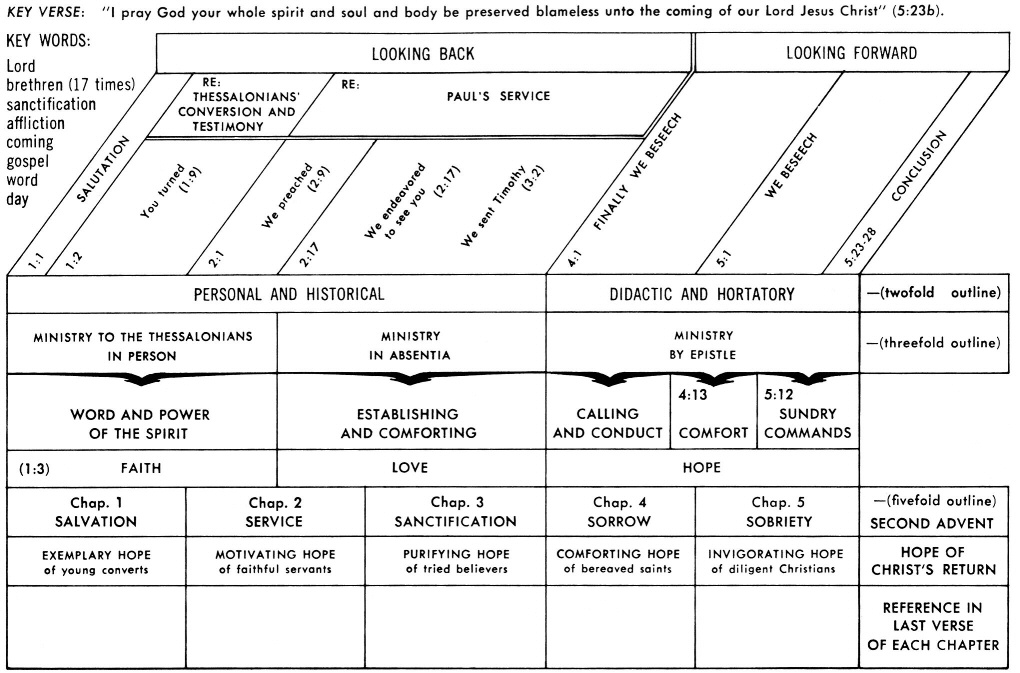
JESUS IS COMING AGAIN
Click chart to enlarge
Charts from Jensen's Survey of the NT - used by permission
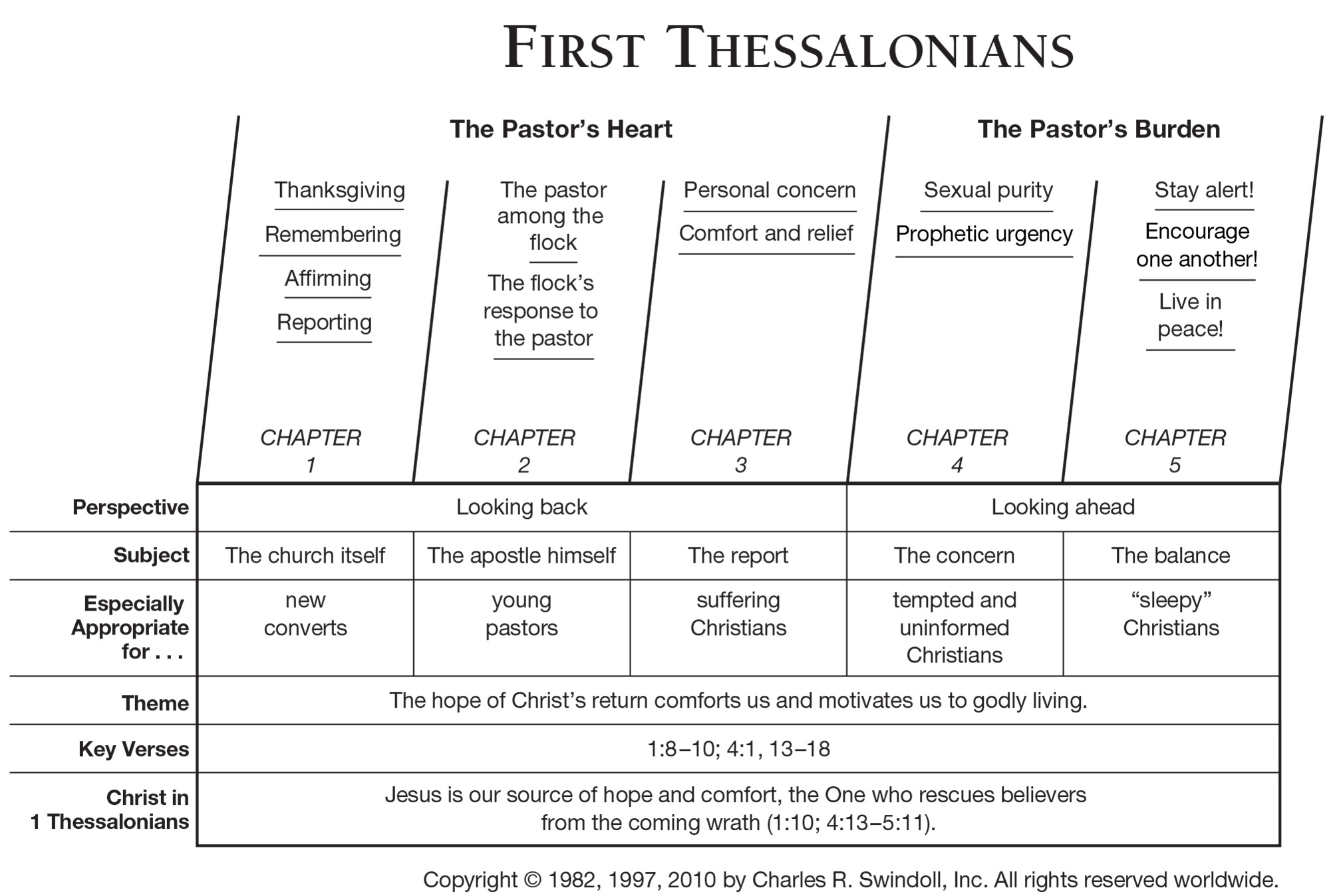
Chart by Charles Swindoll
|
1 Thessalonians |
||||||
| 1 Th 1:1-10 | 1 Th 2:1-20 | 1 Th 3:1-13 | 1 Th 4:1-18 | 1 Th 5:1-28 | ||
|
LOOKING BACK |
LOOKING FORWARD |
|||||
|
Personal Reflections |
Practical Instructions |
|||||
| Ministry In Person |
Ministry in Absentia (Thru Timothy) |
Ministry by Epistle |
||||
| Word and Power of the Spirit |
Establishing & Comforting |
Calling & Conduct | 1Th 4:13ff Comfort |
1Th 5:12ff Commands |
||
| 1 Salvation |
2 Service |
3 Sanctification |
4 Sorrow |
5 Sobriety |
||
| Paul Commends Spiritual Growth |
Paul Founds the Church |
Strengthening of the Church |
Directions for Spiritual Growth |
Holy Living in Light of Day of the Lord | ||
| Exemplary Hope of Young Converts | Motivating Hope of Faithful Servants |
Purifying Hope of Tried Believers | Comforting Hope of Bereaved Saints | Invigorating Hope of Diligent Christians | ||
|
Written from Corinth |
||||||
1 Thessalonians 1:5 for our gospel did not come (3SAPI) to you in word only, but also in power and in the Holy Spirit and with full conviction; just as you know (2PRAI) what kind of men we proved to be (1PAPI) among you for your sake (NASB: Lockman)
Greek: hoti to euaggelion hemon ouk egenethe (3SAPI) eis humas en logo monon alla kai en dunamei kai en pneumati hagio kai [en] plerophoria polle, kathos oidate (2PRAI) oioi egenethemen (1PAPI) [en] humin di' humas
BGT ὅτι τὸ εὐαγγέλιον ἡμῶν οὐκ ἐγενήθη εἰς ὑμᾶς ἐν λόγῳ μόνον ἀλλὰ καὶ ἐν δυνάμει καὶ ἐν πνεύματι ἁγίῳ καὶ [ἐν] πληροφορίᾳ πολλῇ, καθὼς οἴδατε οἷοι ἐγενήθημεν [ἐν] ὑμῖν δι᾽ ὑμᾶς.
BBE Because our good news came to you, not in word only, but in power, and in the Holy Spirit, so that you were completely certain of it; even as you saw what our behaviour to you was like from our love to you.
Amplified: For our [preaching of the] glad tidings (the Gospel) came to you not only in word, but also in [its own inherent] power and in the Holy Spirit and with great conviction and absolute certainty [on our part]. You know what kind of men we proved [ourselves] to be among you for your good. (Amplified Bible - Lockman)
CSB For our gospel did not come to you in word only, but also in power, in the Holy Spirit, and with much assurance. You know what kind of men we were among you for your benefit,
ESV because our gospel came to you not only in word, but also in power and in the Holy Spirit and with full conviction. You know what kind of men we proved to be among you for your sake.
GWN We know this because the Good News we brought came to you not only with words but also with power, with the Holy Spirit, and with complete certainty. In the same way you know what kind of people we were while we were with you and the good things we did for you.
ICB: We brought the Good News to you. But we did not use only words. We brought the Good News with power, with the Holy Spirit, and with sure knowledge that it is true. Also you know how we lived when we were with you. We lived that way to help you. (ICB: Nelson)
KJV For our gospel came not unto you in word only, but also in power, and in the Holy Ghost, and in much assurance; as ye know what manner of men we were among you for your sake.
NET in that our gospel did not come to you merely in words, but in power and in the Holy Spirit and with deep conviction (surely you recall the character we displayed when we came among you to help you).
NIV because our gospel came to you not simply with words, but also with power, with the Holy Spirit and with deep conviction. You know how we lived among you for your sake.
NKJ For our gospel did not come to you in word only, but also in power, and in the Holy Spirit and in much assurance, as you know what kind of men we were among you for your sake.
NRS because our message of the gospel came to you not in word only, but also in power and in the Holy Spirit and with full conviction; just as you know what kind of persons we proved to be among you for your sake.
NAB For our gospel did not come to you in word alone, but also in power and in the holy Spirit and (with) much conviction. You know what sort of people we were (among) you for your sake.
NJB because our gospel came to you not only in words, but also in power and in the Holy Spirit and with great effect. And you observed the sort of life we lived when we were with you, which was for your sake.
NLT (revised) For when we brought you the Good News, it was not only with words but also with power, for the Holy Spirit gave you full assurance that what we said was true. And you know of our concern for you from the way we lived when we were with you.
NLT: For when we brought you the Good News, it was not only with words but also with power, for the Holy Spirit gave you full assurance that what we said was true. And you know that the way we lived among you was further proof of the truth of our message. (NLT - Tyndale House)
Phillips: For we remember how our Gospel came to you not as mere words, but as a message with power behind it - the effectual power, in fact, of the Holy Spirit. You know how we lived among you. (New Testament in Modern English)
Wuest: inasmuch as our message of good news came to you not only in the form of discourse but also in the sphere of power and of the Holy Spirit and in much certainty and assurance, even as you know positively what sort of men we showed ourselves to be among you for your sakes.
Young's Literal: because our good news did not come to you in word only, but also in power, and in the Holy Spirit, and in much assurance, even as ye have known of what sort we became among you because of you,
FOR OUR GOSPEL DID NOT COME TO YOU IN WORD ONLY: hoti to euaggelion hemon ouk egenethe (3SAPI) eis humas en logo monon:
- In word only - Is 55:11; Ro 2:16; 2Co 4:3; Gal 1:8, 9, 10, 11, 12; 2:2; 2Th 2:14; 2Ti 2:8
- 1 Thessalonians 1 Resources - Multiple Sermons and Commentaries
OUR GOSPEL
SPOKEN TO YOU
for our gospel did not come to you in word only - Wuest - "inasmuch as our message of good news came to you not only in the form of discourse." Speak the word of the Gospel and let it do the supernatural work that only it can accomplish.
For (because) (hoti) (Always pause and ponder these terms of explanation, interrogating them with 5W/H's = E.g., ask "what does for explain?") While not every "for" in the Bible is a term of explanation, most are and since there are over 7500 uses of for (NAS), you will have ample opportunity to observe and interrogate the text. In this context for begins Paul's explanation of how he could state with such confidence and assurance that the Thessalonians were in fact "chosen" (elect) (1Th 1:4). Paul emphasizes that there is an intimate relationship between the doctrine of the choosing ("election") and the necessary proclamation of the Gospel. He elaborates in subsequent passages on the Gospel's transformative effect in the lives of these chosen saints. The elect received the preached Word and practiced the Word which served as evidence that they were of the elect. Remember, beloved, as you practice this discipline of pausing to ponder, you are establishing the context (which leads to more accurate interpretation and thus more apropos application) and you are in effect engaging in the blessed activity of Biblical Meditation (See Ps 1:2, Ps 1:3 and Joshua 1:8 for the blessed benefits of meditation). When for is used at the beginning of a passage (as here in Ro 1:16) it is usually a term of explanation.
For (1063) (gar) is a subordinating conjunction expressing cause or explanation and thus introduces an explanation. In simple terms for is a term of explanation and its occurrence should always prompt one to pause and ponder the text and context, asking what the author is explaining, how does he explain it, etc. While not every "for" in the Bible is a term of explanation, most are and since there are over 7500 uses of for (NAS), you will have ample opportunity to observe and interrogate the text.
W A Criswell comments on this "for" - The word "for" introduces a clause that explains the way in which election works. However one understands this mysterious doctrine, the text makes clear its intimate relationship to the gospel of Christ, the preached word, and the ministry of the Holy Spirit.
In Second Timothy Paul writes "I suffer hardship (because of the Gospel - 2Ti 1:8) even to imprisonment as a criminal; but (contrast - interrogate with 5W/H) the Word of God (~The Gospel) is not imprisoned. For this reason (term of conclusion) I endure all things for the sake of those who are chosen (the Elect), that they also may obtain the salvation which is in Christ Jesus and with it eternal glory." Comment: How are the elect authenticated as those who are the elect? Someone might say if they are elect, then we don't have to do anything. But clearly in the Thessalonian passage and in the Second Timothy passage, we see the importance of the "unimprisoned" Word of God and the salvation of the elect.
Gospel (2098)(euaggelion from eú = good + aggéllo = proclaim, tell) (Click in depth study of euaggelion) means good news, glad tidings, Saxon = gōd-spell = lit. "good tale, message". Euaggelion originally referred to a reward for good news and later became the good news itself. The word euaggelion was in just as common use in the first century as our words good news today. "Have you any good news for me today?" would have been a common question. In this secular use euaggelion described good news of any kind and prior to the writing of the New Testament, had no definite religious connotation in the ancient world until it was taken over by the "Cult of Caesar" which was the state religion and in which the emperor was worshipped as a god (see more discussion of this use below).
Euaggelion - 76x in 73v in the NAS = good news(1), gospel(73), gospel's(2). - Mt 4:23; 9:35; 24:14; 26:13; Mark 1:1, 14 15; 8:35; 10:29; 13:10; 14:9; 16:15; Acts 15:7; 20:24; Ro 1:1, 9, 16; 2:16; 10:16; 11:28; 15:16, 19; 16:25; 1Cor 4:15; 9:12, 14, 18, 23; 15:1; 2Cor 2:12; 4:3 4; 8:18; 9:13; 10:14; 11:4, 7; Gal 1:6f, 11; 2:2, 5, 7, 14; Ep 1:13; 3:6; 6:15, 19; Phil 1:5, 7, 12, 16, 27; 2:22; 4:3, 15; Col 1:5, 23; 1Th 1:5; 2:2, 4, 8f; 3:2; 2Th 1:8; 2:14; 1Ti 1:11; 2Ti 1:8, 10; 2:8; Philemon 1:13; 1Pe 4:17; Rev 14:6.
Gospel was adopted as a technical term for the Christian message which is succinctly stated by Paul in 1Co 15:1 2 3 4 and finds complete expression in the four Gospels and the epistle to the Romans.
In Ro 16:25, 26 Paul called it my Gospel indicating that the special emphasis he gave the gospel in his ministry. For a rewarding study, hold your pointer over 76 uses of the Gospel in the NT (see above) and make a note of the truth you observe about the gospel. Consider also reading the reference in context (which is "king" in regard to accurate Interpretation) to assure that you are accurately handling the Word of truth (2Ti 2:15). The Spirit of God will illumine your heart and mind and encourage your spirit in a special way with the Biblical truths concerning the Gospel. And you will want to share this "good news" with someone because it is so exciting and supernaturally life changing!
The writers of the New Testament adapted the term as God's message of salvation for lost sinners. Euaggelion is found in several combination phrases, each describing the gospel like a multifaceted jewel in various terms from a different viewpoint (from the NASB, 1977):
- the gospel of the kingdom (Mt 4:23)
- the gospel of Jesus Christ, the Son of God (Mk 1:1) because it centers in Christ
- the gospel of God (Mk 1:14) because it originates with God and was not invented by man
- the gospel of the kingdom of God (Lk 16:16)
- the gospel of the grace of God (Acts 20:24),
- the gospel of His Son (Ro 1:9)
- the gospel of Christ (Ro 15:19)
- the gospel of the glory of Christ (2Co 4:4)
- the gospel of your salvation (Ep 1:13)
- the gospel of peace (Ep 6:15)
- the gospel of our Lord Jesus (2Th 1:8)
- the glorious gospel of the blessed God (1Ti 1:11)
Our gospel - This refers to the fact that it was committed to their trust and they were the preachers of the "gospel of God" (1Th 2:2) and not another "gospel". The designation of their message as our gospel indicates their personal commitment to this message. There is no suggestion that the message originated with them or that it differed from that of the other Gospel preachers. Rather it was a message they had personally accepted as a trust and were now proclaiming to others. The heart of that message is the offer of God's free salvation through faith in Christ Jesus.
The word Gospel embodies the essential nature of the message as good news. Had Paul instead used the term kerugma ("proclamation"), the emphasis would have been that the message was something committed to them to be officially proclaimed or heralded to Others. Thus Paul's thought centers on the nature of the message itself rather than on the manner of its communication. Paul's emphasis on the gospel itself, not the messengers is further demonstrated when lie says "our gospel came to you," rather that "we came to you with (the gospel)." God's elective purpose was effected not so much by the messengers but by the message they brought.
F. F. Bruce adds that "the writers speak of our gospel in the sense that it has been entrusted to them to proclaim it, but its Author is God, Whose Spirit is active both in those who declare it and in those who receive it. By the accepted standards of secular wisdom the gospel had nothing to commend it to the pagans of Thessalonica and other Greek cities: the message of salvation through a crucified Savior was more likely to arouse derision than admiration. But the fact of its divine origin was demonstrated by its power to liberate those who believed it and make them new men and women.
Hiebert - God works out His electing purposes through the preaching of the gospel. The way the missionaries were enabled to present the saving gospel at Thessalonica assured Paul that the Thessalonians were the subjects of God's efficacious grace. As John Trapp quaintly remarks', "A husbandman would not send his servant with his sickle to reap thistles and nettles only." Verse 5 presents the evidence from the side of the preachers. (Hiebert, D. Edmond: 1 & 2 Thessalonians)
Did not come is more literally "became, came to be." As it was presented to the hearers, that message revealed itself as a vital operative force working through the messengers. The gospel is indeed the power of God unto salvation (rRo 1:16).
Word only - This signifies these words were not merely a declaration of men and not empty rhetoric. Such speech, however eloquent and moving, would be ineffective in evoking faith from the hearers. As Paul emphasized to the Corinthians
my message and my preaching were not in persuasive (enticing, plausible rhetoric, the kind of oratory that was adapted to captivate and charm and which Greeks much esteemed) words of wisdom, but in demonstration of the Spirit and of power (operating on me and stirring in the minds of my hearers the most holy emotions and thus persuading them), that your faith should not rest on the wisdom of men, but on the power of God. (1Cor 2:4-5)
Paul adds later in the same epistle that "the kingdom of God does not consist in words but in power." (1Co 4:20)
Hiebert - How the gospel worked through the preachers is explicitly stated, both negatively and positively As a dynamic power it "came to you not simply with words." As the adverb "simply" (monon, "only") implies, the gospel certainly was made known to the Thessalonians through the instrumentality of human words. The Christian message cannot be transmitted through mere forms or rituals. It is an intelligent message that must be made known through well‑chosen and appropriate terminology. In making known to men His saving grace, God uses men, not angels, "recipients themselves of the same grace; who can give testimony with their lives as with their lips."" But the gospel is not transformingly communicated through mere words, however brilliant, eloquent, or imposing they may be. Mere rhetorical skill apart from the spiritual dynamic of the message can never achieve such a result. (Hiebert, D. Edmond: 1 & 2 Thessalonians)
Barnes adds that it "was not merely spoken; or was not merely heard. It produced a powerful effect on the heart and life. It was not a mere empty sound that produced no other effect than to entertain or amuse.
Vincent writes that…The gospel did not appeal to them as mere eloquent and learned discourse.
BUT ALSO IN POWER AND IN THE HOLY SPIRIT AND WITH FULL CONVICTION: alla kai en dunamei kai en pneumati hagio kai (en) plerophoria polle::
- In power - Ps 10:2,3; Mk 16:20; Acts 11:21; 16:14; Ro 1:16; 15:18,19; 1Co 1:24; 1Co 2:4,5; 3:6; 2 Co 10:4,5; Ep 1:17, 18, 19, 20; 2:4,5,10; 3:20; Php 2:13; Jas 1:16, 17, 18; 1Pe 1:3
- in the Holy Spirit Jn 16:7-15; Acts 2:33; 10:44-46; 11:15-18; 1 Co 3:16; 12:7-11; 2 Co 6:6; Gal 3:2-5; 5:5,22,23; Titus 3:5,6; Heb 2:4; 1 Pe 1:12
- and with full conviction Col 2:2; Heb 2:3; 6:11,18,19; 10:22; 2Pe 1:10,19
- 1 Thessalonians 1 Resources - Multiple Sermons and Commentaries
- 1 Thessalonians 1 Resources - Multiple Sermons and Commentaries
THE POWER OF
THE GOSPEL
but also in power - "In" is the locative of sphere, which Wuest translates "in the sphere of power." Note that Paul uses a strong contrasting but (alla) to emphasize the three positive features of the preaching. Words were used, but the message they conveyed came "also in power, in the Holy Spirit and with full conviction." Each successive term is needed to give the whole picture.
Power (1411) (dunamis) (Click in depth study of dunamis) refers to inherent power or power residing in something (in this case the spoken message) by virtue of its nature. Dunamis signifies that the words that Paul, Silvanus and Timothy spoke were not merely human words but were divinely energized. Paul reminded the Romans of this same truth writing that he was not ashamed "of the gospel, for it is the power (dunamis) of God for salvation to everyone who believes, to the Jew first and also to the Greek." (Ro 1:16 ) The Amplified version renders it "but also in [its own inherent] power."
THOUGHT - This great truth should encourage you to share this divinely powerful life-giving message, knowing that the effect does not depend on your eloquence, IQ, station in life, etc, but on the inherent power of God alone.
Vincent says this describes "Power of spiritual persuasion and conviction: not power as displayed in miracles, at least not principally, although miraculous demonstrations may be included. Paul rarely alludes to his power of working miracles.
Hiebert agrees writing that "Power does not mean that it came "with miraculous manifestations," for that would require the plural form of the noun. Paul's term neither requires nor expressly excludes the presence of special miracles during the ministry at Thessalonica. Paul seldom makes reference to the miracles that did accompany his ministry. (Hiebert, D. Edmond: 1 & 2 Thessalonians)
And in the Holy Spirit and with full conviction - "In" is the locative of sphere, the "atmosphere" of the Holy Spirit.
Hiebert comments on the Holy Spirit Who is "named between the "power" and the "conviction," … (and) was the agent Who empowered the message and worked the assurance in the messengers. The messengers worked in a Spirit‑wrought conviction and certainty as to the validity of their message and had unshaken confidence in its ultimate triumph. Denney points out that "'much assurance' is the counterpart of misgiving or doubt… Doubt paralyses; God cannot work through a man in whose soul there are misgivings about the truth. (Hiebert, D. Edmond: 1 & 2 Thessalonians)
Other translations - and in much certainty and assurance (Wuest), with great conviction and absolute certainty [on our part]. (Amp)
Full conviction - Two Greek words pleophoria + pollus = much.
Conviction (assurance) (4136) (plerophoria from pleres = full+ phero = bear or carry) is literally "complete carrying" and here indicates entire confidence or full assurance, indicating that one has a stronger assurance than the sense conveyed by the word "certainty" by itself. There is not a consensus as to who the "full conviction" refers to.
Plerophoria - 4x in 4v in NAS - (not found in the Septuagint).
Colossians 2:2 that their hearts may be encouraged, having been knit together in love, and attaining to all the wealth that comes from the full assurance of understanding, resulting in a true knowledge of God's mystery, that is, Christ Himself,
1 Thessalonians 1:5 for our gospel did not come to you in word only, but also in power and in the Holy Spirit and with full conviction; just as you know what kind of men we proved to be among you for your sake.
Hebrews 6:11 And we desire that each one of you show the same diligence so as to realize the full assurance of hope until the end,
Hebrews 10:22 let us draw near with a sincere heart in full assurance of faith, having our hearts sprinkled clean from an evil conscience and our bodies washed with pure water.
The excellent expositor Hiebert favors this as a reference to the conviction (full assurance) of the speakers, stating that
Some interpreters insist the mentioned assurance must be taken to refer to the experience of the Thessalonians rather than the missionaries… No one questions that the Thessalonians had assurance concerning the Gospel they accepted; yet the context seems clearly to indicate that the primary reference is to the missionaries. Paul is speaking about the way the missionaries came to know the election (1Th 1:4) of the Thessalonians; the reference is still to the character of the message rather than to its reception. Thus viewed, verse 5 describes the preaching and verse 6 the reception of tile Gospel at Thessalonica. (Hiebert, D. Edmond: 1 & 2 Thessalonians)
F F Bruce on the other hand favors that the "full conviction" is that which the Holy Spirit produces in the receptive hearer and adds that specifically "The reference is to the Thessalonians' deep inward persuasion of the truth of the gospel, a token of the Holy Spirit's work in their hearts, more impressive and more lasting than the persuasion produced by spectacular or miraculous signs. Such signs there no doubt were in the earliest stages of their new life, as there were in other Pauline churches (cf. Gal 3:5), but it is not to them that appeal is made here.
We see this same divided consensus in the translation themselves for several versions translate it in a way that suggests that the primary reference is to the Thessalonians --NLT paraphrases it "the Holy Spirit gave you full assurance that what we said was true."
On the other hand the Amplified translates "with great conviction and absolute certainty [on our part]."
Now if full conviction refers to the missionaries, what were Paul, Silvanus and Timothy absolutely certain of? I agree with Marvin Vincent who says that there was an "assured persuasion of the preacher that the message was divine."
JUST AS YOU KNOW WHAT KIND OF MEN WE PROVED TO BE AMONG YOU FOR YOUR SAKE: kathos oidate (2PRAI) oioi egenethemen (1PAPI) (en) humin di humas:
- just as you know what kind of men we proved to be Col 2:1-11; Acts 20:18,19,33, 34, 35; 1Co 2:2, 3, 4, 5; 4:9, 10, 11, 12, 13; 10:33; 2Co 4:1,2; 2Co 6:3, 4, 5, 6, 7, 8, 9, 10; Php 4:9; 2Th 3:7, 8, 9; 1Ti 4:12, 13, 14, 15, 16; 1Pe 5:3) (1Co 9:19, 20, 21, 22, 23; 2Ti 2:10
- 1 Thessalonians 1 Resources - Multiple Sermons and Commentaries
GOSPEL AUTHENTICATED
BY LIVES OF THE PREACHERS
just as you know what kind of men we proved to be among you for your sake - Wuest = "even as you know positively what sort of men we showed ourselves to be among you for your sakes." The believers at Thessalonica were fully aware of the behavior and manner of Paul and his associates when they were among them. Their lives were a glowing testimony to the power of God for salvation (ongoing, daily, progressive sanctification) and the truth of the Gospel.
THOUGHT - Does my daily conduct at home, work, school give others an indisputable glimpse into the transforming power of the Gospel of God's grace? Don't misunderstand. There is a saying which is not true that says something like "Preach the Gospel daily with your life and if necessary, use words." Beloved, this is not the fully truth. While your godly life may open an opportunity for the presentation of the Gospel, the fact is that the Gospel absolutely must be spoken, listened to, received, and believed, if the recipient is to be saved by the Spirit.
You know (1492) (eido/oida) is in the perfect tense signifying the permanence of the Thessalonians' knowledge of the character and conduct of Paul, Silvanus and Timothy. As noted earlier the verb oida intimates that this knowledge came not by revelation, nor by intuition, but from observation. Paul gives more detail on his character and conduct in the next chapter (1Th 2:3-12)
Constable notes that "Persons in both the religious and philosophical communities of the first century felt that the only teachers worth a moment's attention were those who taught with their lives as well as with their words. (Notes)
When the gospel was brought to the Thessalonians who had never heard it before, it was vital that they see Christianity in action. Where better to witness it, then in the conduct of those who brought it? Does the conduct of your life match the testimony of your lips to those around you who need to not only hear the good news but also to see it lived out in real life?
Hiebert adds that the Thessalonians were to "recall not only the distinctive message preached to them but also the missionaries' conduct and character while among them. When the missionaries first arrived at Thessalonica there was nothing strikingly different about them to distinguish them from other teachers of the day. But their stay at Thessalonica soon made clear not only the distinctness of their message but also the basic distinctness of their conduct and character as preachers of the gospel of Christ. The missionaries well knew that "a message designed to change its hearers' lives would lack all effectiveness if the preachers' conduct was manifestly inconsistent with it." They were fully aware that the gospel message they proclaimed could not truly be separated from the character of the messengers. As Auberlen remarks, "The whole man preached."', The messengers' characters provided no occasion to cast doubt on the message they delivered (See notes on 1Thessalonians 2:3; 2:4; 2:5;2:6; 2:10). (1 & 2 Thessalonians) (Bolding added)
You are writing a Gospel,
A chapter each day,
By the deeds that you do
And the words that you say.Men read what you write,
Whether faithful or true:
Just what is the Gospel
According to you?
--- Author unknown
For your sake Their activities among the Thessalonians were carried out "for your sake." This showed the missionaries' motives they worked to give rather than to get. Their unselfish service had given the Thessalonians a worthy example. They not only preached the gospel, but lived a consistent life. The preacher's lives were consistent with what they taught in Thessalonica and thus had backed up their message. Are you a preacher or teacher of the Holy Word? If so, does you behavior genuinely "preach" the message of the gospel? The best sermon is a holy life!
MacArthur sums this verse up nicely commenting that "The quality of the message was confirmed by the character of the lives of the preachers. Paul's exemplary life served as an open book for all men to read, establishing the credibility of the power and grace of God essential to making the message of redemption believable to sinners. (The MacArthur Study Bible)
1 Thessalonians 1:5 - Our Daily Bread - The Power of God's Word- First-century believers communicated the gospel verbally while it was being put into written form. In each generation since, believers have taken the truths of the Word of God with them as they moved about, proclaiming them openly in church services and whispering them in secret. Christianity has taken root and grown strong because God's Word has brought salvation and hope to people of every station in life. The written Word of the living God was given to all mankind, and its impact on our world is immeasurable.
American clergyman and author Henry van Dyke expressed the broad influence of the Book of books in this way: "Born in the East and clothed in oriental form and imagery, the Bible walks the ways of all the world with familiar feet and enters land after land to find its own everywhere. It has learned to speak in hundreds of languages to the heart of man. It comes into the palace of the monarch to tell him that he is a servant to the Most High, and into the cottage to assure the peasant that he is a child of God."
Kings and peasants have read the Bible and believed, nations have been altered, and cultures have improved because of its message. The Bible makes a difference wherever it goes, and it makes a difference in our lives when we read it, meditate upon its truth, and apply it to our lives. The Book for everyone has a special message for each of us.—DCE
The Bible, like a bank, is most helpful when it's open.
1 Thessalonians 1:6 You also became (2PAPI) imitators of us and of the Lord, having received (AMPMPN) the word in much tribulation with the joy of the Holy Spirit (NASB: Lockman)
Greek: kai humeis mimetai hemon egenethete (2PAPI) kai tou kuriou, decamenoi (AMPMPN) ton logon en thlipsei polle meta charas pneumatos hagiou,
BGT Καὶ ὑμεῖς μιμηταὶ ἡμῶν ἐγενήθητε καὶ τοῦ κυρίου, δεξάμενοι τὸν λόγον ἐν θλίψει πολλῇ μετὰ χαρᾶς πνεύματος ἁγίου,
Amplified: And you [set yourselves to] become imitators of us and [through us] of the Lord Himself, for you welcomed our message in [spite of] much persecution, with joy [inspired] by the Holy Spirit; (Amplified Bible - Lockman)
BBE And you took us and the Lord as your example, after the word had come to you in much trouble, with joy in the Holy Spirit;
CSB and you became imitators of us and of the Lord when, in spite of severe persecution, you welcomed the message with joy from the Holy Spirit.
GWN You imitated us and the Lord. In spite of a lot of suffering, you welcomed God's word with the kind of joy that the Holy Spirit gives.
ICB: And you became like us and like the Lord. You suffered much, but still you accepted the teaching with the joy that comes from the Holy Spirit. (ICB: Nelson)
NIV You became imitators of us and of the Lord; in spite of severe suffering, you welcomed the message with the joy given by the Holy Spirit.
NKJ And you became followers of us and of the Lord, having received the word in much affliction, with joy of the Holy Spirit,
NRS And you became imitators of us and of the Lord, for in spite of persecution you received the word with joy inspired by the Holy Spirit,
NAB And you became imitators of us and of the Lord, receiving the word in great affliction, with joy from the holy Spirit,
NJB You took us and the Lord as your model, welcoming the word with the joy of the Holy Spirit in spite of great hardship.
NLT (revised) So you received the message with joy from the Holy Spirit in spite of the severe suffering it brought you. In this way, you imitated both us and the Lord.
NLT: So you received the message with joy from the Holy Spirit in spite of the severe suffering it brought you. In this way, you imitated both us and the Lord. (NLT - Tyndale House)
Phillips: You remember how you set yourselves to copy us, and through us, Christ himself. You remember how, although accepting the message meant bitter persecution, yet you experienced the joy of the Holy Spirit. (Phillips: Touchstone)
Wuest: And as for you, you became imitators of us and of the Lord, having welcomed the Word while under much pressure of affliction which [act of welcoming] was accompanied by joy that had its source in the Holy Spirit,
WBC: As for you, you became imitators of us and of the Lord, when you accepted the word amid much tribulation, with joy inspired by the Holy Spirit.
Young's Literal: and ye -- ye did become imitators of us, and of the Lord, having received the word in much tribulation, with joy of the Holy Spirit,
KJV 1 Thessalonians 1:6 And ye became followers of us, and of the Lord, having received the word in much affliction, with joy of the Holy Ghost:
ESV And you became imitators of us and of the Lord, for you received the word in much affliction, with the joy of the Holy Spirit,
NET And you became imitators of us and of the Lord, when you received the message with joy that comes from the Holy Spirit, despite great affliction.
YOU ALSO BECAME IMITATORS OF US AND OF THE LORD: Kai humeis mimetai hemon egenethete (2PAPI) kai tou kuriou:
- You also became imitators of us Col 2:14; 1Co 4:16; 11:1; 2Co 8:5; Php 3:17; 2Th 3:9
- and of the Lord Mt 16:24; Jn 8:12; 13:13, 14, 15; Ep 5:1; 1Pe 3:13; 3Jn 1:11
- 1 Thessalonians 1 Resources - Multiple Sermons and Commentaries
SAINTS IMITATE
PAUL AND JESUS
You also became imitators of us and of the Lord - They watched the Spirit enabled lives and by the same Spirit became imitators. See The Holy Spirit-Walking Like Jesus Walked!
You is emphatic (first in the Greek sentence) marking the change of subject from the writers to the readers. Paul does not begin with the readers' personal acceptance of the gospel, but with the external manifestation demonstrating that reception.
Became (1096) (ginomai) means to come into existence and the aorist tense indicates a completed action in the past, specifically at the time of their new birth into God's family. A definite, observable change became evident in the Thessalonian's lives. Their conversion had taken place at a point in time and that conversion was not a gradual process but an act (1Th 1:9, 10 where turned is also aorist tense indicating at a point in time they took a definite turn not just "for the better" but "for the best!".)
Robertson comments that…Paul uses ginomai, to become, not eimi, to be. It is a daring thing to expect people to imitate the preacher, but Paul adds and of the Lord for he only expected or desired imitation as he himself imitated the Lord Jesus, as he expressly says in 1Cor 11:1 (1Co 4:6). The peril of it all is that people so easily and so readily imitate the preacher when he does not imitate the Lord. The fact of the "election" of the Thessalonians was shown by the character of the message given them and by this sincere acceptance of it (Lightfoot).
Moulton has this note on the aorist tense writing that…The point or aorist tense "being a momentary tense" describes an event as a single whole, without regarding the time taken in its accomplishment. The present and imperfect are continuous tenses, i.e., they contemplate action as in progress, noting "the time taken in accomplishment" (J. H. Moulton, Grammar of New Testament Greek, Proleg. pp. 187, 190).
Hiebert sums this section up - The way the Thessalonians responded to the Gospel constituted the other side of the evidence that assured Paul they were God's elect. In setting forth that evidence (their transformed lives), Paul notes the external manifestation demonstrating their reception of the Gospel (1Th 1:6a), indicates the experiences accompanying that reception (1Th 1:6b), and informs the readers of the widespread result (1Th 1:7)." (Hiebert, D. Edmond: 1 & 2 Thessalonians)
Imitators (3402) (mimetes) means one who follows. Mimetes basically means to copy or imitate someone's behavior and has many related words in English - "mime" (one who acts out an imitation of another person or animal), "pantomime" (a theater production which originally was without words), "mimeograph" (a machine which makes many copies from one stencil).
Webster says that to imitate means to follow as a pattern, model, or example; to be or appear like. The 1828 Websters even says in the definition of imitate that…
We should seek the best models to imitate, and in morals and piety, it is our duty to imitate the example of our Savior.
Writing to the saints at Corinth Paul said…
I exhort you therefore, be (present imperative see our need to depend on the Holy Spirit to obey) imitators of me. (1Cor 4:16)
Be (present imperative see our need to depend on the Holy Spirit to obey) imitators of me, just as I also am of Christ. (1Cor 11:1)
Comment - See the related topic of The Holy Spirit-Walking Like Jesus Walked!
Similarly Paul commanded the predominantly Gentile believers in Ephesus to…
Be (present imperative see our need to depend on the Holy Spirit to obey) imitators of God, as beloved children (Ephesians 5:1) and walk (present imperative see our need to depend on the Holy Spirit to obey) in love, just as Christ also loved you, and gave Himself up for us, an offering and a sacrifice to God as a fragrant aroma. (Eph 5:2) (Comment: Just as God forgave us so we should forgive others Ephesians 4:32+)
The writer of Hebrews exhorted his predominantly Jewish audience…
And we desire that each one of you show the same diligence so as to realize the full assurance of hope until the end, that you may not be sluggish, but imitators of those who through faith and patience inherit the promises (Be diligent just as OT saints like Abraham were, knowing that what has been promised will be fulfilled). (Hebrews 6:11-12)
COMMENT - By the way, this verse provides ample reason for saints today to read biographies of saints of yesteryear.)
In ancient Greek mimetes referred to imitation. Aristotle used the word to describe how people imitated animals, postulating that at the beginning of civilization men learned from animals, e.g., weaving and spinning from spiders, and house-building from swallows! (This reminds me of Paul's statement in Romans 1 where
even though they knew God, they did not honor Him as God, or give thanks; but they became futile in their speculations, and their foolish heart was darkened. Professing to be wise, they became fools and exchanged the glory of the incorruptible God for an image in the form of corruptible man and of birds and four-footed animals and crawling creatures. (Ro 1:21-23)
W. Bauder writes that "Very early on (in Democritus of the pre-Socratics) the words were used to express ethical demands made on men. One should take as one's model the boldness of a hero, or one should imitate the good example of one's teacher or parents… The Rabbis were the first to speak of imitation of God in the sense of developing the image of God in men. In the Pseudepigrapha in addition to the exhortation to imitate men of outstanding character (Test. Ben. 3:1; 4:1) one can also find the thought of the imitation of God (i.e. keeping his commands, Test. Ash. 4:3) and of particular characteristics of God (Aristeas 188, 210, 280 f.). (Brown, Colin, Editor. New International Dictionary of NT Theology. 1986. Zondervan)
Teachers based their whole educational procedure on imitation, as students imitated the behavior of teachers. Slowly the idea developed that people should imitate the gods, and Plato emphasized this.
The basic meaning of mimetes is seen in a mime. An English woman went to France to study under the famous mime artist, Marcel Marceau (see picture). All day he taught his students how to make the movements of mime, and each evening they went to see him perform. Their performances were marked indelibly by the style of the master. This is an excellent picture of a Christian who imitates the Lord by exposure to Him.

A person who mimes acts a part with mimic gesture and action, usually without words. Let your actions speak louder than your words and then you will have a platform to proclaim the word of truth, the gospel. As believers in their message the Thessalonians began to pattern their lives after the example set by the missionaries. This fact rejoiced the heart of Paul as it was open evidence of the reality of the Thessalonian believers' conversion and therefore of their divine election. The Thessalonians had become third generation mimics of Christ. Christ is the first; Paul is the second; and the Thessalonians are the third. The Thessalonian believers imitated the Lord and Paul (Silvanus, Timothy) in that they responded to the gospel in spite of affliction. Note that Paul did not write what reportedly was said by one pastor "Do as I say; not as I do." Unfortunately this saying has characterized numerous preachers, many of whom have reputations as great teachers of God's Word. However, when their lives are measured by the Bible's qualifications for communication and character, such ministers come up woefully short. Make sure you mime the right model!
As an African chief once said "A good example is the tallest kind of preaching."
Jonathan Edwards was so concerned about the example which he set which others might imitate, that he framed the resolve to "never to do anything which I would be afraid to do if it were the last hour of my life.
Here is a secular quote that has more truth in it then we would like to believe (think of "spiritual children" - Children have never been very good at listening to their elders, but they have never failed to imitate them. They must, they have no other models. (James Baldwin)
Here's another quote worth pondering in this area of imitation -- We unconsciously imitate what pleases us and approximate to the characters we most admire. Christian Nestell Bovee
In his preface to the writings of Shakespeare, Samuel Johnson wrote that "Example is always more efficacious than precept.
Dr. Merrill Tenney - The best advertisement for your church is not a large notice board, but rather the example that is set when the town drunk becomes a Christian and lives a godly life.
Charles Spurgeon - A Christian should be a striking likeness of Jesus Christ… We should be pictures of Christ… Oh! My brethren, there is nothing that can so advantage you, nothing can so prosper you, so assist you, so make you walk towards heaven rapidly, so keep your head upwards towards the sky, and your eyes radiant with glory, like the imitation of Jesus Christ.
As shown in the uses of mimetes below Scripture always uses this word in a positive sense.
Richards writes that mimetes "is a call to reproduce in our own way of life (Ed: NOT by self effort but Spirit power, daily learning to yield our rights to Him, allowing Him to control us as we abide in the Vine Christ Jesus) those godly qualities that result from salvation and that we see in others. The idea is intimately linked with the thought that teachers and leaders ought to be clear, living examples of the practical implications of commitment to Jesus. (Richards, L O: Expository Dictionary of Bible Words: Regency)
Mimetes 6x imitators (KJV has "followers") 1 Co. 4:16; 1 Co. 11:1; Eph. 5:1; 1 Thess. 1:6; 1 Thess. 2:14; Heb. 6:12
For you, brethren, became imitators of the churches of God in Christ Jesus that are in Judea (the problems of the believers at Thessalonica among their fellow Gentiles were similar to those of the believers in Judea who were persecuted by Jews), for you also endured the same sufferings at the hands of your own countrymen, even as they did from the Jews (1Th 2:14)
Robert Morgan has an illustration entitled "It Stirs Me Up Much"…
Jim Elliot, who gave his life while trying to reach the Auca Indians, was largely shaped through the reading of Christian biography.
I see the value of Christian biography tonight, he wrote in his journal, 'as I have been reading Brainerd's Diary much today. It stirs me up much to pray and wonder at my nonchalance while I have not power from God. I have considered Heb 13:7 (note) just now, regarding the remembrance of certain ones who spake the word of God, 'consider the outcome of their life, and imitate their faith'.
I recall now the challenge of Goforth's Life and By My Spirit, read in the summer of 1947, the encouragement of Hudson Taylor's Spiritual Secret, and The Growth of a Soul. There are incidents which instruct me now from the reading of J. G. Paton's biography, read last winter. And now this fresh Spirit-quickened history of Brainerd. O Lord, let me be granted grace to 'imitate their faith.'
It has since been through the reading of Elliot's journals that scores of young people have given their lives to the service of the Gospel. (Morgan, R. J. Nelson's Complete Book of Stories, Illustrations, and Quotes: Thomas Nelson Publishers) (I highly recommend reading Hudson Taylor's Spiritual Secret)
Imitators is perfectly illustrated by this section of Scripture for the Thessalonians followed the apostles' example especially by gladly enduring persecution (with joy) for the Gospel's sake and also (1Th 1:8) by sounding forth the gospel with others.
Hiebert adds that "Paul's description of the converts as mimitae (from which we get our English word mimic) does not imply that their conversion was artificial or insincere. It does not have the belittling connotation of our English derivative. It was no superficial or slavish copying of merely external resemblances. As De Boer well remarks, It was an imitation in the deep and basic sense of the word; it was a bringing to expression in their own lives of what they had seen and detected outside of themselves. It was a capturing of something they had witnessed around them and making it a part of themselves. Clearly their conversion went beyond mere verbal profession. They actively began to express in their own lives the characteristics of this new life as they observed it in the lives of the missionaries. It was an imitation perfectly consistent with the development of their own selfhood within this new life. Such imitation demands moral effort (cp Ezek 36:27 where the first half speaks of the provision of divine power and the second half the necessity of personal responsibility). (Hiebert, D. Edmond: 1 & 2 Thessalonians)
The Thessalonians became imitators of us and of the Lord
Hiebert explains that "The order may at first strike us as startling, but it is the logical order. It is the natural order in the experience of converts on a new mission field. Even before the message of a missionary is fully understood or personally accepted, the hearers will observe the outworking of that message in the life of the missionary. And when the Spirit leads them to a personal acceptance of the message, the new converts naturally look to the missionary to learn how to live the Christian life. To reflect their message in their own lives is part of the work of missionaries." (Hiebert, D. Edmond: 1 & 2 Thessalonians)
MacDonald agrees with Hiebert writing - One would have expected him to say "of the Lord and of us," mentioning the Lord first. But here he is giving the order of their experience. Their first introduction to the Lord Jesus was in the life of the apostle. It is sobering to think that people are supposed to be able to see Christ in us. We should be able to say with Paul, "Imitate me, just as I also imitate Christ" (1 Cor. 11:1). (MacDonald and Farstad, A. Believer's Bible Commentary : Old and New Testaments. Nashville: Thomas Nelson)
Pulpit Commentary "Christ not only died as a Sacrifice, but lived as an Example. He is the great Example Whom we must imitate, the Pattern of the new creation, the Original of which all believers are copies. Especially we must imitate Him in His patient endurance of suffering. The cross is ever the Christian's motto."
Later explaining how the word of God was performing its work in the believers at Thessalonica wrote that
you (Thessalonian believers), brethren, became imitators of the churches of God in (intimate union with the living) Christ Jesus that are in Judea, for you also endured the same sufferings at the hands of your own countrymen, even as they did from the Jews (1Thes 2:14)
As F B Meyer once wrote "Children mostly resemble their father. There is often an unmistakable family likeness, which compels the most casual observer to exclaim, "The very image of his father." Oh that in each of us there might be that which would make men think of God! (Our Daily Homily)
HAVING RECEIVED THE WORD IN MUCH TRIBULATION: dexamenoi (AMPMPN) ton logon en thlipsei polle:
- having received the word in much tribulation Col 2:13,14; 3:2,3,4; Ho 2:14; Mk 10:29,30; Ac 17:5; 2Co 8:1,2; 2Th 1:4
- 1 Thessalonians 1 Resources - Multiple Sermons and Commentaries
when you accepted the word amid much tribulation, with joy inspired by the Holy Spirit (WBC)
having welcomed the Word while under much pressure of affliction (Wuest),
because you welcomed our message (Williams)
THEY PUT OUT THE
"WELCOME MAT"
having received the word in much tribulation - O happy day when they God opened their eyes and heart to receive the Word of Truth implanted which saved their souls from eternal death.
Having received (1209) (dechomai) means to to receive something offered or transmitted by another (Luke 2:28). To take something into one's hand and so to grasp (Luke 22:17). To be receptive to someone (Mt 10:14, 40). To take a favorable attitude toward something (Mt 11:14). Dechomai means to accept deliberately, readily and kindly. The picture is of one "putting out the welcome mat" for God's word of truth as one would a good friend or a guest, inviting entry into one's house (Luke 10:8,10; Heb 11:31). This verb indicates that the reception was a voluntary and willing act on the Thessalonians' part.
The aorist tense points to a definite act of reception on the readers' part. The middle voice is reflexive (subject initiates action and participates in effect/result) indicating that the Thessalonians took to themselves the word presented or brought by another.
Paul emphasizes their ready reception again in the next chapter writing that they had
received from (Paul, et al) the word of God's message, (they) accepted (dechomai) it not as the word of men, but for what it really is, the word of God, which also performs its work in (those) who believe. (1Th 2:13) (Note the Gospel "performs its work" = supernatural, inherent power of the Word of Truth!)
In Acts Luke writes that
when the apostles in Jerusalem heard that Samaria had received (dechomai) the word of God, they sent them Peter and John." (Acts 8:14)
In the preceding verse Luke uses the receiving of the word as virtually synonymous with salvation (cf Acts 11:1). This ready reception of the word is not however devoid of discrimination, as exemplified by the Berean's who
were more noble-minded than those in Thessalonica, for they received (dechomai) the word with great eagerness (with readiness of mind), examining (present tense = continually sifting up and down, making careful and exact research as in legal processes) the Scriptures daily, to see whether these things (spoken by Paul) were so. Many of them therefore believed… " (Acts 17:11)
Unfortunately not all exhibit this receptive attitude toward God's truth, Paul writing in his second epistle that there would be those during the reign of the man of lawlessness (Antichrist of 1Jn 2:18, abomination of desolation of Mt 24:15, the little horn of Daniel 7, the beast of Rev13) would
not receive (dechomai) the love of the truth so as to be saved. And for this reason God will send upon them a deluding influence so that they might believe what is false." (2Th 2:10-11).
Note carefully the order here -- their choice to not receive truth reaped the consequence of being given over to believe the lie.
Tribulation (2347) (thlipsis from thlibo = to crush, press, compress or squeeze, in turn from thlao = to break > Latin "tribulum" = farming instrument to thresh grain, separating wheat from chaff!) carries the idea of being squeezed or placed under pressure and thus refers to intense pressure, hard circumstances, suffering or trouble that inflicts anguish, distress, oppression and affliction.
Vincent writes that thlipsis is from "thlibo, to press or squeeze. Tribulation is perhaps as accurate a rendering as is possible, being derived from tribulum, the threshing-roller of the Romans. In both the idea of pressure is dominant, though thlipsis does not convey the idea of separation (as of corn from husk) which is implied in tribulatio. Trench cites, in illustration of thlipsis, pressure, the provision of the old English law, by which those who wilfully refused to plead had heavy weights placed on their breasts, and so were pressed and crushed to death.
Thlipsis refers not to mild discomfort but to great difficulty (and notice that it is modified by "much"!) In Scripture thlipsis is perhaps most often used of outward difficulties, but it is also used of emotional stress.
MacArthur writes that these "new believers in Thessalonica experienced severe persecution, but the genuineness of their salvation transcended that affliction so that they never lost their joy. In his second epistle Paul commends them "for (their) perseverance and faith in the midst of all (their) persecutions and afflictions (thlipsis) which (they) endured." (2Th 1:4)
Tribulation is the normal lot of Christians and is a fact taken repeatedly emphasized in the NT. Jesus' last words to His disciples before leaving the upper room were
These things I have spoken to you, that in Me you may (continually) have peace. In the world you (continually) have tribulation (thlipsis), but take courage (be undaunted, of good cheer); I have overcome the world." (John 16:33)
Paul and Barnabas forewarned the churches of Galatia that it is
through many tribulations that we must enter into the kingdom of God. (Acts 14:22)
The tribulations began almost immediately for the Thessalonians, Luke recording that Paul and Silas
came to Thessalonica, where there was a synagogue of the Jews. And according to Paul's custom, he went to them, and for three Sabbaths reasoned with them from the Scriptures, explaining and giving evidence that the Christ had to suffer and rise again from the dead, and saying, "This Jesus whom I am proclaiming to you is the Christ." And some of them were persuaded and joined Paul and Silas, along with a great multitude of the God-fearing Greeks and a number of the leading women. But the Jews, becoming jealous and taking along some wicked men from the market place, formed a mob and set the city in an uproar; and coming upon the house of Jason, they were seeking to bring them out to the people. (Acts 17:1-5)
WITH THE JOY OF THE HOLY SPIRIT: meta charas pneumatos hagiou:
- With the Joy of the Holy Spirit Jn 14:16, 17, 18; Ac 5:41; 9:31; 13:52; Ro 5:3, 4, 5; 8:16-18; Ro 15:13; Gal 5:22; Heb 10:34; 1Pe 1:6,8
- Torrey's topics Holy Spirit, the Comforter, The; Joy
- 1 Thessalonians 1 Resources - Multiple Sermons and Commentaries
Related Passage:
Romans 15:13 Now may the God of hope fill you with all joy and peace in believing, so that you will abound in hope by the power of the Holy Spirit.
With the Joy of the Holy Spirit ("accompanied by joy that had its source in the Holy Spirit" - Wuest) means the joy was energized by the Holy Spirit, one element of the fruit of the Spirit (Gal 5:22). Receiving the Word is receiving Christ, receiving Christ is receiving the Holy Spirit, and He brings joy and gladness. No other explanation for their deep joy under the circumstances was possible. A joy arising out of a spurious religious excitement will fail under such circumstances.
Writing to Rome Paul urged believers to keep their priorities in perspective…
the kingdom of God (The sphere of salvation where God is acknowledged as King and so rules in the hearts of those He has saved - this Kingdom is only entered by a small gate Mt 7:13, 14, a narrow door Lk 13:24 - but praise God it is entered by grace through faith Ep 2:8, 9) is not eating and drinking (Non-essentials and external observances are not the goal of subjects of the Kingdom of God), but righteousness (right living before God and before man - made possible only by dependence on the indwelling, enabling Holy Spirit and strengthening, transforming grace) and peace and joy in the Holy Spirit. (an abiding attitude of praise and thanksgiving regardless of circumstances, which flows from one's confidence in God's sovereignty) (Ro 14:17)
William MacDonald calls us to "Notice that they received the word with affliction and joy. This is how they had imitated the Lord and the apostles. Externally there was affliction; internally there was joy. It is an unusual combination! For the man of the world, it is impossible to experience joy and affliction simultaneously; to him, sorrow is the opposite of joy. The Christian has a joy of the Holy Spirit that is independent of circumstances; to him, the opposite of joy is sin. The affliction they endured was the persecution which followed their conversion. (Believer's Bible Commentary)
Hiebert adds that "The depth of a disciple's joy in the Lord may well be measured by the degree of his participation in the sufferings of the Lord. it is still true that those who pay a great price in suffering to remain true to Christ know a deep measure of this Spirit‑wrought joy in their lives. Perhaps our Christian lives are so lacking in this joy because our Christian profession costs us so little." (Hiebert, D. Edmond: 1 & 2 Thessalonians)
George Peters adds these words in his excellent description of a disciple explaining that…
A Christian disciple is more than a believer. A disciple is more than a learner, at least, a learner in the ordinary sense of the word. A disciple is more than a follower and imitator of Christ, more than a holy enthusiast for Christ, yea even more than living a life of full devotion to the Lord. A disciple is a believing person living a life of conscious and constant identification with the Lord in life, death, and resurrection through words, behavior, attitudes, motives, and purpose, fully realizing Christ's absolute ownership of his life, joyfully embracing the Saviorhood of Christ, delighting in the Lordship of Christ and living by the abiding, indwelling resources of Christ according to the imprinted pattern and purpose of Christ for the chief end of glorifying his Lord and Savior. There is divine fullness and content in the concept of discipleship which we must not limit. Larson, referring to a study by A. Friedrichsen, points out the fact that the expression cross-bearing was a contemporary metaphor indicating "radical social isolation and humiliation."
The call to Christian discipleship must always be interpreted to involve a call to humble fellowship, constant fellowship, sanctified openmindedness, undisputed obedience, ready submission, heroic faith, arduous labor, unselfish service, self-renunciation, patient suffering, painful sacrifice, and cross-bearing. It is the bringing of all of life under the Lordship of Christ. This is not only the purpose of salvation, but this is the fullness of salvation—redemption from self and devotion to the Lord. And to this every Christian is called.
Too often, however, Christian discipleship has been detached from the everyday life of every believer and thought of in terms of the great, the heroic, and a peculiar sense of saintliness is being attached to it, instead of being lived out daily in the ordinary affairs of life and relationships. (Peters, Greorge: The Call of God. Bibliotheca Sacra: Volume 120, Issue 480, page 328, 1963. Dallas TX: Dallas Theological Seminary)
The Joy of Waiting - Nine months can seem like forever for a mother-to-be. In the first trimester, hormonal changes sometimes cause lingering morning sickness. Emotions rise to the surface, prolonging afternoon blues. Then a changing appetite stretches out evening hours with late-night cravings for pizza, chocolate, and dill pickles.
During the next 3 months, Mom outgrows her clothes and spends long hours looking for a new wardrobe. The last trimester turns normal activity into a chore as the final watch begins.
Then, suddenly the endless waiting is over. Nine months become like yesterday's newspaper. They are gone. They become insignificant, a faint memory—overcome by joy. Ask the new mom if she regrets enduring her pregnancy. Never!
Hannah's wait began even more slowly. For years she was unable to have a child. She felt so unfulfilled, so dishonored (1 Samuel 1). But the Lord remembered her, and she conceived. Her joy was complete.
Hannah waited patiently and saw the Lord turn her sorrow into overflowing joy. Her song (2:1-10) is a reminder that disappointment and the most bitter distress can lead to fulfillment and delight. For those who wait on the Lord, long hours of enduring will one day give way to rejoicing. —Mart De Haan (Our Daily Bread, Copyright RBC Ministries, Grand Rapids, MI. Reprinted by permission. All rights reserved)
Let patience have her perfect work;
Let God refine your gold;
For in His time He'll show you why,
And blessings great unfold. —Bosch
God's gift of joy is worth the wait.
More Than Good Advice - A few years ago, I was invited to speak on the subject of guidance. In my preparation, I opened my concordance to look up the word guidance, expecting to find a long list of verses promising guidance from God. To my surprise, guidance wasn't there. Instead, I found the word guide and a number of verses promising that God Himself would be the guide of His people.
This discovery added fresh insight to my Christian pilgrimage. I was reminded that people who are blind need guide dogs, not guidance dogs! Even if dogs were capable of talking, how unsatisfactory it would be if they were mere bystanders, shouting warnings to the blind from a distance: "Careful now! You're approaching a hole. Watch out for the curb!" No, these mute but faithful creatures escort their sightless companions every step of the way, being their eyes and steering them safely along precarious pathways.
Some people want God to be like a glorified advice bureau. But when our sight is dim and our way is dark, as it often is, we need more than good advice—we need the Good Shepherd to lead us (John 10:3,11).
As we follow Christ each day, we'll have all the guidance we'll ever need.—Joanie Yoder (Our Daily Bread, Copyright RBC Ministries, Grand Rapids, MI. Reprinted by permission. All rights reserved)
Though guidance is our need each day
We need not search to find our way;
We only need a faithful Guide
And strive to stay close by His side. —D. De Haan
Looking for guidance?
Follow Christ, your Guide.
Imitators of Christ - A respected author on Christian ethics. E. Calvin Beisner, said that when he was younger he greatly admired a very intelligent and articulate theology teacher for whom he worked. He imitated the older man's "study habits, manners of speech, and writing style."
Beisner said, "And while I now recognize that some of that imitation was juvenile, I am convinced that I grew because of it."
Having a godly role model can be very helpful, especially for Christians who are young in the faith. The trouble with all human models, however, is that they have flaws and sooner or later will disappoint us. Beisner experienced this. He gradually became aware that this teacher treated his assistants shabbily and showed little appreciation for their abilities. He tended to magnify his own accomplishments, even tot he point of stretching the truth.
How can we avoid being disillusioned by the spiritual examples we admire? The secret is to imitate them but not idolize them. Paul saw himself as a copy to be followed only tot he extent that he reflected the original. Therefore he wrote,
Imitate me, just as I also imitate Christ.
It's good to follow godly examples, but our worship must be reserved for Christ alone.
What you worship determines what you become.
YOU ARE A ROLE MODEL- As we grow up, we have many role models, people who inspire us-- parents, teachers, athletes, political leaders, characters in novels and in the pages of history.
The Bible also gives us many role models. The apostle Paul, for one, is a challenging example of discipleship. In fact, he held himself up as a pattern for all Christians to follow. "Imitate me," he urged, "just as I also imitate Christ" (1 Cor. 11:1). He knew, of course, that he could serve as a godly example only if he faithfully followed his Lord.
Paul commended the Thessalonians because they followed him and the Lord (see note 1Thessalonians 1:6). They became examples to all the believers in Macedonia and Achaia, and they were well-known for their faith in God (see notes 1Thessalonians 1:7; 1:8).
As we copy Paul, who himself was copying the Savior, we in turn become models who are being copied. What is the quality of our spiritual influence? Negative or positive? Remember, it can't be neutral. No one can rightly say, "I'm not a role model." --V C Grounds (Our Daily Bread, Copyright RBC Ministries, Grand Rapids, MI. Reprinted by permission. All rights reserved)
We cannot live our lives alone,
For other lives we touch
Are either strengthened by our own
Or weakened just as much. --Anon.
The best role models model Christ.
YOU ARE A ROLE MODEL - Charles Barkley, superstar basketball player for the Phoenix Suns, said in a television ad, "I am not a role model." But, like it or not, he is. Everybody is a role model for somebody else.
As we grow up, we have many role models, people who inspire us -parents, teachers, athletes, political leaders, characters in novels and in the pages of history.
The Bible also gives us many role models. The apostle Paul, for one, is a challenging example of discipleship. In fact, he held himself up as a pattern for all Christians to follow, "Imitate me," he urged, "just as I also imitate Christ" (1 Cor. 11:1). He knew, of course, that he could serve as a godly example only if he faithfully followed his Lord.
Paul commended the Thessalonians because they followed him and the Lord (see note 1Thessalonians 1:6). They became examples to all the believers in Macedonia and Achaia, and they were well-known for their faith in God (see notes 1Thessalonians 1:7; 1:8).
As we copy Paul, who himself was copying the Savior, we in turn become models who are being copied. What is the quality of our spiritual influence? Negative or positive? Remember, it can't be neutral. No one can rightly say, "I'm not a role model."- Vernon C. Grounds (Our Daily Bread, Copyright RBC Ministries, Grand Rapids, MI. Reprinted by permission. All rights reserved)
We cannot live our lives alone,
For other lives we touch
Are either strengthened by our own
Or weakened just as much.- Anonymous
The best role models, model Christ.
This Little Light Of Mine - The Lake Michigan shoreline (a short drive from where I live) is dotted with lighthouses built to enable ship captains to navigate into safe harbors. The structures are varied in size, shape, and color, but each has unique charm and beauty. Pictures of the lighthouses are featured in books and calendars, and some people collect replicas and other lighthouse items.
But lighthouses were not built just to be admired; they were built to hold lights that guide sailors to safety. A lighthouse is most useful and appreciated when, in the darkness of night, only its light can be seen—not the structure itself.
When Jesus sent out His disciples, He called them "the light of the world" (Matthew 5:14). He also indicated that their task was not to draw attention to themselves, but to do good works that would cause people to recognize God's goodness and glorify Him.
Jesus said that just as a lamp's purpose is to give light, we also are to let our light shine (vv.15-16). We're most effective when we shine brightly in the darkness, guiding people who need to find safe harbor in Christ.
For a light to be effective, it has to be shining in a dark place. —Julie Ackerman Link (Our Daily Bread, Copyright RBC Ministries, Grand Rapids, MI. Reprinted by permission. All rights reserved)
My life was dark until the Light shone in,
That Light was Christ, who saved me from my sin;
His light that I've received I want to share
And let it shine to people everywhere. —Hess
A little light makes a big difference in the darkest night.
COPY THE MASTER - The Louvre in Paris is perhaps the most famous art museum in the world. It displays originals by such masters as Delacroix, Michelangelo, Rubens, da Vinci, Ingres, Vermeer, and many others.
Since 1793, the Louvre has encouraged aspiring artists to come and copy the masters. Some of our most famous modern artists have done that and have become better painters by copying the best the world has ever known.
An article in Smithsonian magazine tells about Amal Dagher, a 63-year-old man who has been duplicating art at the Louvre for 30 years. Dagher remains in awe of the masters and continues to learn from them. He said, "If you're too satisfied with yourself, you can't improve."
Paul instructed us to be "imitators of God" (Ephesians 5:1). In his first letter to the Thessalonians, he commended the believers because they were becoming like the Lord and setting an example for others (1 Thessalonians 1:6-10).
Like the Louvre copyists, we'll never reach perfection before we get to heaven. Even so, we must resist the temptation to be satisfied with our present imitation of Jesus. We need to keep looking to Him, learning from Him, and asking for His help. Let's copy the Master. —David C. Egner (Our Daily Bread, Copyright RBC Ministries, Grand Rapids, MI. Reprinted by permission. All rights reserved)
More like the Master I would live and grow,
More of His love to others I would show;
More self-denial, like His in Galilee,
More like the Master I long to ever be. —Gabriel
To become like Christ, we must learn from the Master.
A Daily Beauty - When you look in a mirror, what do you see? Do you see a lovely reflection? A handsome face? Or do you see a plain or unattractive countenance?
We want to give those who behold us what my friend called an aesthetic blessing. But what about the beauty of holiness? Are others blessed by the beauty that flows through us from Christ?
A distinguished Bible scholar of the 19th century, J. B. Lightfoot, was described by one of his devoted students as "startlingly ugly: a stout little man with a grotesque figure and a squint." But that same student also said that Lightfoot was "the best man I have ever encountered, and I say this deliberately after the experience of many years. In a day or two … his face appeared the most beautiful and lovable thing imaginable."
When Stephen was brought before the Jewish council for interrogation, "they were not able to resist the wisdom and the Spirit by which he spoke" (Acts 6:10). As he was being accused, they "saw his face as the face of an angel" (Acts 6:15).
By God's transforming grace, we too can have a daily beauty in our lives. As we walk prayerfully in the Spirit, our faces increasingly reflect the beauty of Jesus. —Vernon C Grounds (Our Daily Bread, Copyright RBC Ministries, Grand Rapids, MI. Reprinted by permission. All rights reserved)
Let the beauty of Jesus be seen in me,
All His wonderful passion and purity;
O Thou Spirit divine, all my nature refine
Till the beauty of Jesus is seen in me. —Orsborn
Nothing can dim the beauty that shines from within.
Likable Christians - The local newspaper reported the death of a semi-pro baseball pitcher I had admired during my teenage years. His name was Elmer "Lefty" Nyenhouse. He was a likable Christian. The article said that he had been active in his church and a respected member of his community until his death at 88.
On several occasions I saw "Lefty" pitch against a topnotch semi-pro team, the Chickie Giants. Knowing that Elmer was a devout Christian, some of his opponents tried to rattle him in tense situations (like when the bases were loaded with no outs). They would drop to their knees by their dugout and shout, "Better get on your knees and pray, Elmer!" "Lefty" took it in stride. Those who heckled him actually respected him.
As Jesus grew up, He "increased … in favor with God and men" (Luke 2:52). People were drawn to Him. Their fondness for Him, of course, alarmed the religious leaders who hated Him because of His teaching, and they "sought how they might kill Him, for they feared the people" (Luke 22:2).
Today, as always, some will hate you for being an outspoken follower of Jesus. But make sure it's not because you are unpleasant, critical, and hard to get along with. Being a likable person is to be like Jesus. —Herbert Vander Lugt (Our Daily Bread, Copyright RBC Ministries, Grand Rapids, MI. Reprinted by permission. All rights reserved)
Let the beauty of Jesus be seen in me—
All His wonderful passion and purity!
O Thou Spirit divine, all my nature refine,
Till the beauty of Jesus be seen in me. —Orsborn
Christlike people are likable people even if hated by some people.
The Greatness Of Godliness - In the eyes of most people, Jacob's brother Esau was the greater man of the two. Through the years he had accumulated immense wealth and power. He was the ruler of the land of Edom and could have met Pharaoh on his own terms. Yet Esau, with all his earthly authority, could not have blessed Pharaoh. Only Jacob had that power (Genesis 47:10).
The spiritual is greater than the natural. God can endow a humble human being with awesome moral force. Holiness has within itself the power to master all other powers.
The Greek word for power or authority (exousia) contains the preposition ex, which means "out of" or "from." This suggests that the ability to influence others flows from inside. It is rooted in what we are. "Do you wish to be great?" Augustine asked. "Then begin by being." Greatness comes from holiness and nothing more.
I have a friend who makes his way through the halls of power in Washington, DC, meeting with the most prominent women and men in the world. He speaks a word or two, prays, and then walks on, but he leaves behind the lingering and compelling influence of Christ. He has the aura of greatness that surrounds all whose lives reflect the character of Jesus. It is the greatness of godliness. —David H. Roper (Our Daily Bread, Copyright RBC Ministries, Grand Rapids, MI. Reprinted by permission. All rights reserved)
I want my heart His throne to be,
So that a watching world may see
His likeness shining forth in me;
I want to be like Jesus. —Chisholm
Even a little example can have a big influence for Christ.
Walking Sermons - The best "preaching" is often expressed in actions rather than in words. When we do right without saying anything, we can have far greater impact for good than when we tell others what they should do without doing it ourselves. Indeed, we might do better to skip the "preaching" altogether if there is no "practicing."
Many parents overlook this as they instruct their children. They talk about God, explain salvation through Jesus, and expect good works—but it all ends there because their own example fails to match the expectations they have for their children. In other Christian homes, however, mothers and fathers make sure their walk supports their talk. Their exemplary living provides clear and consistent guidelines. Wise parents do not neglect verbal instruction, but they balance it with a worthy example.
We usually think of preachers as those who speak from the pulpit, but the truth is that we all are "preaching" every day. Our conduct at home, the way we handle business matters, our response to difficulties, our reaction to temptation—everything people observe about us is "preaching." Someone said, "What you do speaks so loudly that I can't hear what you say."
The actions of the Good Samaritan spoke so loudly that people still hear them today. Without demanding or expecting anything for him-self, He showed mercy to an injured man. As he did, we must make sure that all of our actions are in harmony with God's revealed will. Whether we realize it or not, our walking does our talking. —R. W. De Haan (Our Daily Bread, Copyright RBC Ministries, Grand Rapids, MI. Reprinted by permission. All rights reserved).
Every Christian should be a walking sermon.
Brown Bag Witness - Ivan was a brilliant engineer, highly respected by his co-workers. But sometimes they called him "Deacon" or "Parson" because he had a deep religious faith and he didn't hide it. Every day at lunch, for example, Ivan would bow his head over a little brown bag and thank God for his food.
Jean Zeiler, who worked with Ivan, was intrigued by his consistent testimony. She wanted to find out what made him so different. She found her answer in a book Ivan told her about--the Bible. After buying one and reading it three times, she came to know Jesus in a personal way.
Ivan told Jean, "I used to wonder if I would ever lead anyone to Christ." But his quiet witness was not only the key to Jean's salvation, it also challenges thousands as she travels throughout the world and gives her testimony.
The apostle Paul reminded the persecuted Thessalonian believers that their "faith toward God" was touching lives in far-off places (1 Th. 1:8). This must have encouraged them to remain faithful to the Savior.
Never underestimate the impact you can have for Christ. When you live for Him in your workplace or neighborhood, you will send forth a quiet message that will be heard.
Lord, help us to be consistent witnesses for You. --D J De Haan (Our Daily Bread, Copyright RBC Ministries, Grand Rapids, MI. Reprinted by permission. All rights reserved)
Keeping in step with the Savior,
Living a life that is true,
Clearly let's sound out a witness,
Proving what God's grace can do. --HGB
A quiet testimony is more convincing than a Loud sermon.
A Mysterious Fragrance - Most of us can think of someone—perhaps a relative or a friend—who is known for a particular perfume she wears. Even without seeing her, we know when she's nearby. Wordlessly, her fragrance welcomes us into her company.
Every Christian should also be known for wearing a particular perfume—the fragrance of Christ. But it can't be bought at a cosmetic counter. It can't even be bottled and sold by the church. This mysterious perfume rises always and only out of our intimate relationship with Christ and wafts a subtle yet noticeable influence toward others.
Someone said about a Christian in his small town, "That man never crosses my pathway without my being better for it!" Another remarked of him, "You need only shake his hand to know that he is full of God." Most likely, this admired believer had given a verbal witness at some point. But without the aroma of Christ, his witness would not have been effective.
The apostle Paul asked, "Who is sufficient for these things?" (2:16). The answer is plain: Our fragrance, our entire sufficiency, is from Christ alone, not from ourselves. What fragrance will you be wearing today? — Joanie Yoder —Joanie Yoder (Our Daily Bread, Copyright RBC Ministries, Grand Rapids, MI. Reprinted by permission. All rights reserved)
When we've been alone with Jesus,
There's a difference others know;
And to them it's like a fragrance
That we leave where'er we go. —Hess
When you are walking with Christ,
others will sense that He is with you.
FOR EXAMPLE - A mother cheetah brought a live gazelle fawn to her 5-month-old cubs and released it. After the cubs made several unsuccessful attacks, the mama cheetah intervened and showed them how to "catch dinner."
I observed a similar technique used by a life insurance salesman. After he told me about the benefits of a particular policy, he shared how much coverage he had for his own family. His words took on new meaning because he demonstrated by his own example how to insure a family adequately.
If we want to teach others the art of knowing God and serving Him, we can't overemphasize the importance and the power of example. That's how Christ and His apostles communicated the same message. Their obedience to God was seen in flesh-and-blood terms that were easily understood.
Leadership by example is contagious. When Paul mentioned the Thessalonians, who had become "followers of us and of the Lord," he said that they also "became examples to all in Macedonia and Achaia" (1Thessalonians 1:6, 7).
Leadership is more than something that automatically goes with an official title like Dad, Mom, Pastor, or Teacher. Those who want to lead and help others must first of all be good examples. —Mart De Haan (Our Daily Bread, Copyright RBC Ministries, Grand Rapids, MI. Reprinted by permission. All rights reserved)
All in vain is splendid preaching
And the noble things we say;
All our talk is wasted teaching
If we do not lead the way. —Anon.
You cannot teach what you do not know, nor lead where you do not go.
1 Thessalonians 1:7 so that you became (AMN) an example to all the believers (PAPMPD) in Macedonia and in Achaia. (NASB: Lockman)
Greek: Hoste genesthai (AMN) humas tupon pasin tois pisteuousin (PAPMPD) en te Makedonia kai en te Achaia
BGT ὥστε γενέσθαι ὑμᾶς τύπον πᾶσιν τοῖς πιστεύουσιν ἐν τῇ Μακεδονίᾳ καὶ ἐν τῇ Ἀχαΐᾳ.
Amplified: So that you [thus] became a pattern to all the believers (those who adhere to, trust in, and rely on Christ Jesus) in Macedonia and Achaia (most of Greece). (Amplified Bible - Lockman)
BBE So that you became an example to all those who have faith in Christ in Macedonia and Achaia.
CSB As a result, you became an example to all the believers in Macedonia and Achaia.
ESV so that you became an example to all the believers in Macedonia and in Achaia.
GWN This way, you became a model for all the believers in the province of Macedonia and Greece.
ICB: So you became an example to all the believers in Macedonia and Southern Greece. (Nelson)
KJV So that ye were ensamples to all that believe in Macedonia and Achaia.
NET As a result you became an example to all the believers in Macedonia and in Achaia.
NIV And so you became a model to all the believers in Macedonia and Achaia.
NLT: As a result, you yourselves became an example to all the Christians in Greece. (NLT - Tyndale House)
NLT (revised) As a result, you have become an example to all the believers in Greece-- throughout both Macedonia and Achaia.
NKJ so that you became examples to all in Macedonia and Achaia who believe.
NRS so that you became an example to all the believers in Macedonia and in Achaia.
NAB so that you became a model for all the believers in Macedonia and in Achaia.
NJB And so you became an example to all believers in Macedonia and Achaia
Phillips: You thus became examples to all who believe in Macedonia and Achaia. (New Testament in Modern English)
Wuest: so that you became a pattern to all those who are believers in Macedonia and in Achaia.
Young's Literal: so that ye became patterns to all those believing in Macedonia and Achaia,
SO THAT YOU BECAME AN EXAMPLE TO ALL THE BELIEVERS IN MACEDONIA AND IN ACHAIA: hoste genesthai (AMN) humas tupon pasin tois pisteuousin (PAPMPD) en te Makedonia kai en te Achaia
- So that you became an example 1Th 4:10; 1Ti 4:12; Titus 2:7; 1Pe 5:3
- to all the believers in Macedonia and in Achaia 1Th 1:8; Acts 16:12; 1:13; 18:1; 2Cor 1:1; 9:2; 11:9,10
- Torrey's topic All Christians should be Missionaries
- 1 Thessalonians 1 Resources - Multiple Sermons and Commentaries
LIVING EPISTLES
BECAME LIVING EXAMPLES
So that - Explains purpose or result. In this case it is the result of their Spirit filled lives of joy in a situation one would not expect joy (tribulation). That can only speak of the supernatural power of God in their lives. Who wouldn't want to pattern their lives after such individuals?
You became an example to all the believers in Macedonia and in Achaia - Before they were dead in their trespasses and sins but they became saints alive in Christ and filled with His Spirit and their lives produced a glowing, winsome, attractive light to other saints.
You - The plural pronoun you points to the various individuals composing the Thessalonian church as the ones who had produced this effect. Collectively they had become an example to those in the various areas where their experience had become known.
Became (1096) (ginomai) means to come into existence and the aorist tense indicates a completed action in the past, specifically at the time of their new birth into God's family. From following the example of Paul, et al, the Thessalonians in turn became examples to other believers, both in their courageous acceptance of suffering for Christ's sake and in their fearless proclamation of the message which had brought them salvation.
You became an example - It is worth noting that the only church Paul ever called an example was the church at Thessalonica, for he felt it gave a pattern for what churches ought to be both in spiritual growth and ministry. What was their example? They had a work of faith, a labor of love and a steadfastness of hope in our Lord Jesus Christ (1Th 1:3) and manifested joy in the midst of tribulation which undoubtedly was a source of great encouragement to other believers, for often the most powerful testimony of an individual believer or church is during times of trial, pain, and persecution.
THOUGHT - How does your church compare to their example? What needs to change to emulate their example?
F F Bruce explains how the Thessalonians were an example writing "From following the example of the missionaries, the Thessalonian Christians became in turn an example to other believers, both in their courageous acceptance of suffering for Christ's sake and in their fearless proclamation of the message which had brought salvation to themselves. (1 and 2 Thessalonians. Word Biblical Commentary)
Example (5179)(tupos from túpto = strike, smite with repeated strokes) literally refers to a visible mark or impression made by a stroke or blow from an instrument or object. What is left after the stroke or blow is called a print, a figure or an impression. For example, the most famous reference to a literal mark (tupos) is when Thomas doubted Jesus' resurrection from the dead declaring "Unless I shall see in His hands the imprint (tupos) of the nails" (John 20:25). (See also ISBE Article) Stated another way tupos properly means a model, pattern or mold into which clay or wax was pressed (or molds into which molten metal for castings was poured), that it might take the figure or exact shape of the mold. Our English word type is similar and originally referred to an impression made by a die as that which is struck. Tupos also came to be used figuratively of a pattern, mold, model, or copy of the original of something, whether a physical object, such as a statute, or a principle or virtue. Thus in a technical sense tupos is the pattern in conformity to which a thing must be made.
In an ethical sense as used here in 1Thessalonians, tupos is a dissuasive (tending to dissuade) example, a pattern of warning or an example to be imitated. Paul uses tupos again in his second letter to the Thessalonians explaining how they (Paul, Silvanus and Timothy) had worked among them so as not to be a burden) had not asked for financial support writing that this was…
not because we do not have the right to this, but in order to offer ourselves as a model (tupos) for you, that you might follow our example (literally "to imitate us"). (2Th 3:9)
This same meaning of tupos is seen in Paul's charge to Timothy to…
Let no one look down on (present imperative - with a negative means to stop letting others do this) your youthfulness, but rather in speech, conduct, love, faith and purity, show (literally "a pattern become" - present imperative) yourself an example (tupos - a pattern they believers are to emulate) of those who believe. (1Ti 4:12).
Similarly Paul exhorted Titus…
In all things to show yourself to be an example (tupos) of good deeds with purity in doctrine, dignified (Comment: Titus was to live so that his life would be cast like a "spiritual die" that would impress itself on others - all believers should strive to be "spiritual dies" to those around them, but this applies especially to leaders. Titus 2:7-)
Paul to the saints at Philippi (who held a special place in his heart much like the Thessalonians - cf Acts 16) exhorted them writing…
Brethren (same word Paul used 18 times to warmly refer to the saints in Thessalonica) join (present imperative - more literally reads "become imitators together of me") in following my example (summimetes = imitator with others) and observe (present imperative - keep a watchful eye continually and notice carefully) those who walk according to the pattern (tupos) you have in us. (Phil 3:17)
Peter instructed elders as the spiritual leaders over the flock not to lord their authority over those allotted to their charge…
but proving to be examples (tupos) to the flock. (1Peter 5:3)
Hiebert adds that "It is proof of a healthy Christian life when those who begin by following the example of other Christians themselves develop into worthy and attractive examples for others. Such an achievement is not a matter of the mere length of life as a professed Christian but the outcome of a vital inner experience consistently expressed in consecrated Christian conduct. (1 & 2 Thessalonians)
Pulpit Commentary adds that "Consistent believers are living evidences of the truth of Christianity. By the purity of their conduct, by their unselfishness, by their patience in suffering, they prove that there is something real and living in Christianity" but "Inconsistent believers are obstacles in the way of the gospel (Ed: "Inconsistent believers" need to be very careful they do not fall into the trap of self-deception - thinking they are true believers when there is no evidence whatsoever in their life of genuine repentance and regeneration. cp 2Co 13:5). They confirm the worldly in their worldliness, as if Christianity were a mere pretence, and thus give occasion to the enemies of God to blaspheme. (The Pulpit Commentary: New Testament; Old Testament; Ages Software or Logos)
The Thessalonian believers became models of the Christ life for others to imitate, specifically in their example of joy in the midst of persecution and their proclamation of the gospel in the face of opposition (1Th 2:14)
Macedonia and Achaia (see map showing Macedonia and Achaia in region of modern day Greece) - Their example was observed not only in their own province of Macedonia (northern Greece) but also in the province of Achaia (central and southern Greece). Paul writing from Corinth the seat of administration of the province of Achaia, would have been in an advantageous position to assess the wide-ranging impact of the Thessalonian's example.
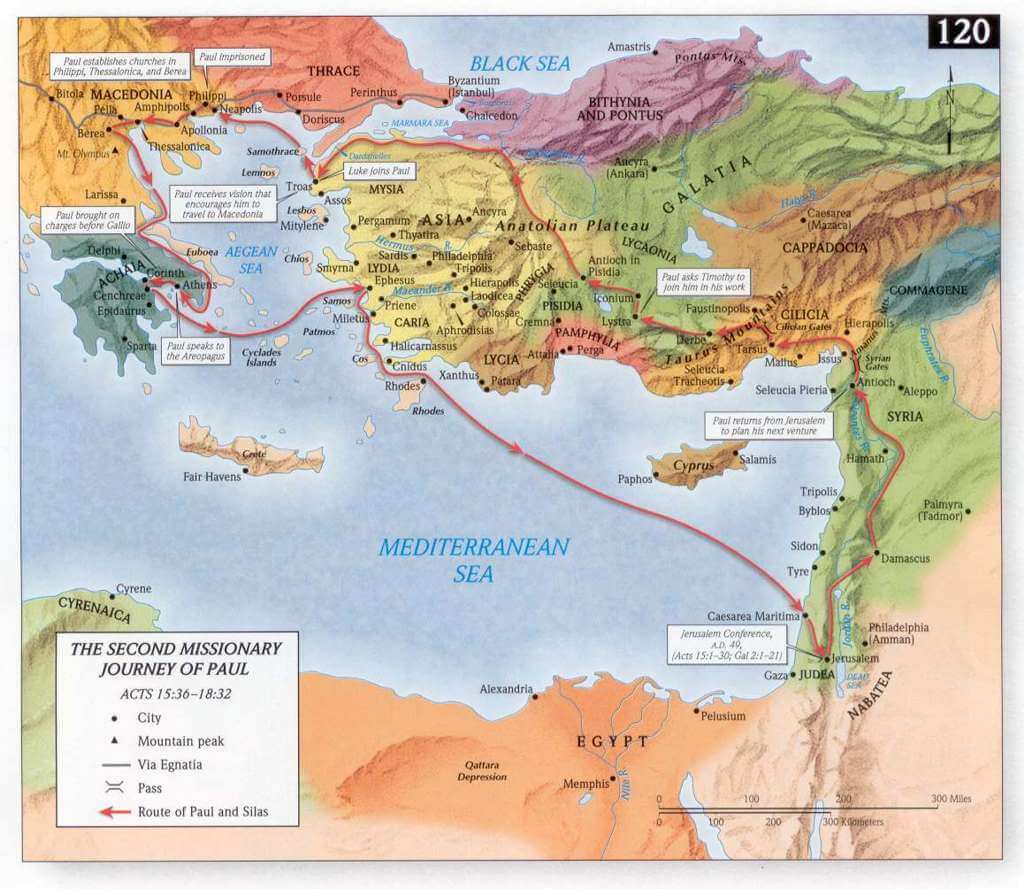
Ray Stedman notes that "The Thessalonian believers shared the good news throughout Macedonia and Achaia (1Thes 1:7). They did not do it by means of great crusades or campaigns. There were no citywide meetings in rented stadiums. We can do that today, and thank God for it, but that is not what the Thessalonians did. They simply told their neighbors and friends what God had done for them. They explained the new joy and peace that had come into their hearts. Then, when their friends began to ask questions, they invited them over and opened the Scriptures. Through the quiet, almost invisible, network of what we would call home Bible studies, they shared the good news. Silently, without fanfare, the gospel spread throughout this whole area of the Roman Empire. The entire countryside was stirred by what was taking place in people's lives. In Thessalonica the city fathers described Paul and his friends by saying, "These men who have turned the world upside down, have come here also" (Acts 17:6RSV). In this way the good news eventually filtered into all parts of the known world. (Changed Lives)
Warren Wiersbe - Christians either encourage or discourage each other. This principle applies also to churches. Paul used the churches of Macedonia as a stimulus for the Corinthian church to give to the missionary offering (2Co 8:1-8). Even though they were new believers, the Thessalonians set a good example that encouraged the surrounding assemblies. Churches must never compete with one another in a worldly manner, but they can "provoke unto love and to good works" (He 10:24). In every way, the church at Thessalonica was exemplary. The secret was found in their faith, hope, and love; for these are the spiritual motivators of the Christian life. (Wiersbe, W: Bible Exposition Commentary. 1989. Victor)
Pulpit Commentary - True piety tends to propagate itself. The Thessalonians had not long embraced Christianity. But they had learned much; they had given their hearts to God. The Macedonian Churches gave St. Paul, from the first, deep and unmingled satisfaction. Thessalonica was the metropolis of Macedonia, the seat of government, and of trade. It became a center of spiritual life. All believers throughout Macedonia and Achaia looked to the Thessalonians… The lives of good men are very precious; they are a living proof of the power of God's grace; they are facts which can be seen and tested; facts from which the reality of the forces which are working in the unseen sphere of God's spiritual agency can be inferred with as much certainty as the laws of nature from the facts of observation and experiment. (The Pulpit Commentary: 1Thessalonians 1 Exposition)
Dwight Moody regularly asked complete strangers about their spiritual life. One day he stopped a young man and asked…
"Are you a Christian?"
"It is none of your business."
"Yes it is."
"Then you must be Dwight L. Moody."
What a splendid reputation to precede any Christian! What would others say of us if what we were best known for became public knowledge? If the letters of our life would form one word to describe us, what would it be? Better still, rather than describe ourselves, with what one word would others describe us? Evangelistic was the word that characterized Moody. What do we say, or do, that as quickly identifies us?