1 Peter 1:2
1 Peter 1:3
1 Peter 1:4
1 Peter 1:5
1 Peter 1:6
1 Peter 1:7
1 Peter 1:8
1 Peter 1:9
1 Peter 1:10
1 Peter 1:11
1 Peter 1:12
1 Peter 1:13
1 Peter 1:14
1 Peter 1:15
1 Peter 1:16
1 Peter 1:17
1 Peter 1:18
1 Peter 1:19
1 Peter 1:20
1 Peter 1:21
1 Peter 1:22
1 Peter 1:23
1 Peter 1:24
1 Peter 1:25
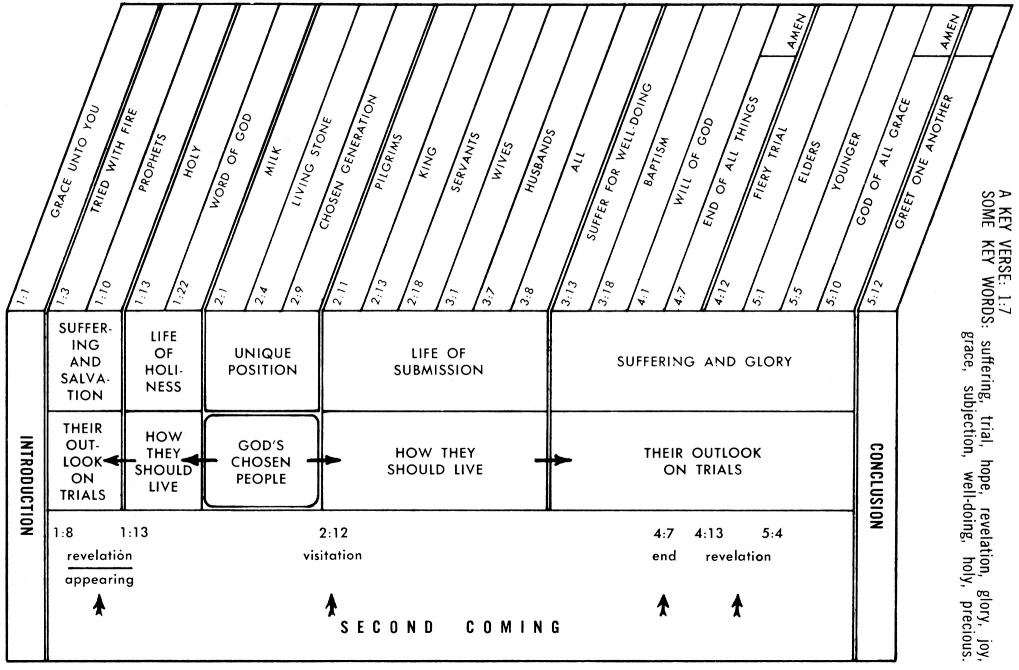
1 Peter: Trials, Holy Living & The Lord's Coming
Click chart to enlarge
Chart from Jensen's Survey of the NT - used by permission
See Another Chart from Charles Swindoll
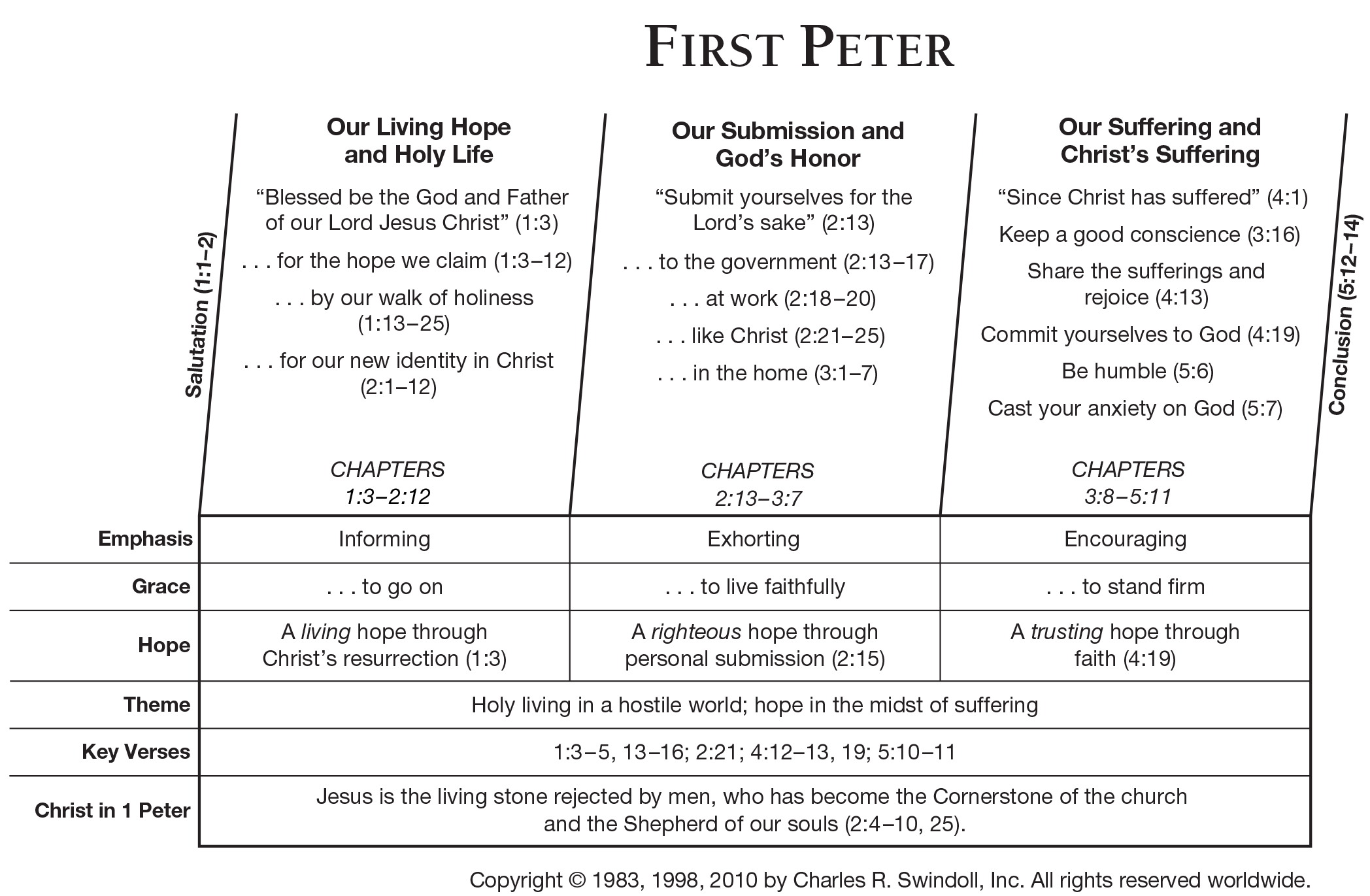
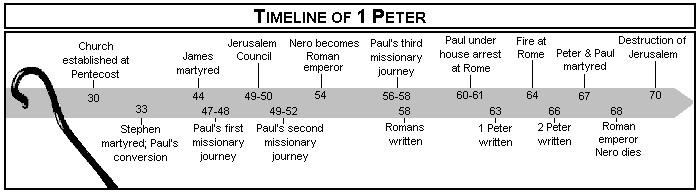
Source: Borrow Ryrie Study Bible
Click to enlarge
PART I: DOCTRINAL FOUNDATION
I. The Opening Salutation (1Pe 1:1-2)
A. The Writer (1Pe 1:1a)
B. The Readers (1Pe 1:1b-2a)
1. True character of the readers (1Pe 1:1b)
2. Geographical location of the readers (1Pe 1:1c)
3. Spiritual supports for the readers (1Pe 1:2a)
C. The Greeting (1Pe 1:2b)
II. The Thanksgiving for Our Salvation (1Pe 1:3-12)
A. The Description of Salvation (1Pe 1:3-5)
1. The author of salvation (1Pe 1:3a-b)
a. His relation to the Savior (1Pe 1:3a)
b. His act of mercy to the saved (1Pe 1:3b)
2. The nature of salvation (1Pe 1:3c-4a)
a. The living hope grounded in Christ's resurrection (1Pe 1:3c)
b. The glorious inheritance awaiting believers (1Pe 1:4a)
3. The certainty of salvation (1Pe 1:4b-5)
a. The safekeeping of the inheritance (1Pe 1:4b)
b. The preservation of the heirs (1Pe 1:5)
B. The Experiences Relating to Salvation (1Pe 1:6-9)
1. The paradoxical nature of the experiences (1Pe 1:6-7)
a. The experience of exultation (1Pe 1:6a)
b. The experience of distress (1Pe 1:66-7)
1. The nature of the distress (1Pe 1:6b)
2. The purpose behind the trials (1Pe 1:7)
a. The testing of faith (1Pe 1:7a)
b. The outcome of the testing (1Pe 1:7b)
2. The sustaining relations of believers (1Pe 1:8-9)
a. Their dual relation to Jesus Christ (1Pe 1:8)
b. Their experiential relation to their salvation (1Pe 1:9)
C. The Magnification of Salvation (1Pe 1:10-12)
1. The magnification through prophetic research (1Pe 1:10-12a)
a. Their intensive search (1Pe 1:10a)
b. Their prophetic function (1Pe 1:10b)
c. Their personal perplexity (1Pe 1:11)
1. The time and circumstances (1Pe 1:11a)
2. The sufferings and the glories (1Pe 1:11b)
d. Their restricted ministry (1Pe 1:12a)
2. The magnification through Christian proclamation (1Pe 1:12b)
3. The magnification through angelic inquiry (1Pe 1:12c)
PART 2: PRACTICAL EXHORTATION
I. Exhortations in View of Our Salvation (1Pe 1:13-2:10)
A. The Life Arising from Salvation (1Pe 1:13-2:3)
1. The Christian life in relation to God (1Pe 1:13-21)
a. A life of steadfast hope (1Pe 1:13)
1. The supports of hope (1Pe 1:13a)
2. The call to hope (1Pe 1:13b)
b. A life of personal holiness (1Pe 1:14-16)
1. The foundation for personal holiness (1Pe 1:14a)
2. The call to personal holiness (1Pe 1:14b-15)
a. The negative demand of holiness (1Pe 1:14b)
b. The positive call to holiness (1Pe 1:15)
3. The justification of the call to holiness (1Pe 1:16)
c. A life of motivated reverence (1Pe 1:17-21)
1. The basis for reverent living (1Pe 1:17a)
2. The call for reverent living (1Pe 1:17b)
3. The knowledge that motivates reverence (1Pe 1:18-21)
a. The means of our redemption (1Pe 1:18-19)
b. The nature of the Redeemer (1Pe 1:20)
c. The characteristics of the redeemed (1Pe 1:21)
2. The Christian life in relation to the brethren (1Pe 1:22-25)
a. The experience of inner purification (1Pe 1:22a)
b. The duty of mutual love (1Pe 1:22b)
c. The foundation in personal regeneration (1Pe 1:23-25)
1. The fact of their regeneration (1Pe 1:23a)
2. The nature of their regeneration (1Pe 1:23b-25a)
3. The evangelization leading to their regeneration (1Pe 1:25b)
(D Edmond Hiebert - Note the outline above is just one portion of the 6 page detailed outline from his commentary on 1 Peter [borrow] - here is another shorter outline Hiebert did in his excellent book Introduction to the New Testament which is available to borrow)
1 Peter 1:13 Therefore, gird (AMP) (prepare) your minds for action, keep sober ( PAP) in spirit, fix your hope ( AAM) completely on the grace to be brought ( PPP) to you at the revelation of Jesus Christ . (NASB: Lockman)
Greek: Dio anazosamenoi (AMPMPN ) tas osphuas tes dianoias humon nephontes (PAPMPN) teleioo elpisate ( AAM ) epi ten pheromenen (PPPFSA) humin charin en apokalupsei Iesou Christou.
Amplified: So brace up your minds; be sober (circumspect, morally alert); set your hope wholly and unchangeably on the grace (divine favor) that is coming to you when Jesus Christ (the Messiah) is revealed. (Amplified Bible - Lockman)
Grace = Unmerited favor from God w/o expectation of return. God's enabling transforming power to overcome the world, my flesh the devil. (Sanctifying grace) Not license to do as we please, but power to do as we should -holy love on the move.
BBE: So make your minds ready, and keep on the watch, hoping with all your power for the grace which is to come to you at the revelation of Jesus Christ;
NLT: So think clearly and exercise self-control. Look forward to the special blessings that will come to you at the return of Jesus Christ. (NLT - Tyndale House)
Phillips: So brace up your minds, and, as men who know what they are doing, rest the full weight of your hopes on the grace that will be yours when Jesus Christ reveals himself. (Phillips: Touchstone)
Weymouth: Therefore gird up your minds and fix your hopes calmly and unfalteringly upon the boon that is soon to be yours, at the re-appearing of Jesus Christ.
Wuest: Wherefore, having put out of the way, once for all, everything that would impede the free action of your mind, be calm and collected in spirit, and set your hope perfectly, wholly, and unchangeably, without doubt and despondency upon the grace that is being brought to you upon the occasion of the revelation of Jesus Christ;
Young's Literal: Wherefore having girded up the loins of your mind, being sober, hope perfectly upon the grace that is being brought to you in the revelation of Jesus Christ,
THEREFORE: dio:
- Therefore's in 1 Peter -1Pet 1:13; 2:1; 4:1, 7, 19; 5:1, 6
- 1 Peter 1 Resources - Multiple Sermons and Commentaries
Related Passages (uses of therefore):
1 Peter 1:13 Therefore, prepare your minds for action, keep sober in spirit, fix your hope completely on the grace to be brought to you at the revelation of Jesus Christ.
1 Peter 2:1 Therefore, putting aside all malice and all deceit and hypocrisy and envy and all slander,
1 Peter 4:1 Therefore, since Christ has suffered in the flesh, arm yourselves also with the same purpose, because he who has suffered in the flesh has ceased from sin,
1 Peter 4:7 The end of all things is near; therefore, be of sound judgment and sober spirit for the purpose of prayer.
1 Peter 4:19 Therefore, those also who suffer according to the will of God shall entrust their souls to a faithful Creator in doing what is right.
1 Peter 5:1 Therefore, I exhort the elders among you, as your fellow elder and witness of the sufferings of Christ, and a partaker also of the glory that is to be revealed,1 Peter 5:6 Therefore humble yourselves under the mighty hand of God, that He may exalt you at the proper time,

Click to Enlarge = Metaphorical Description Girding Your Mind
GET YOUR MIND READY
HE IS RETURNING...SOON!
Therefore is a term of conclusion and every encounter should prompt a pause to ponder the purpose, asking at least the question "What is it there for?" As you perform this "mini-meditation," you will allow your Teacher, the Spirit, to speak to you and provide illumination of the sacred text that a cursory reading may have missed. Or to say it another way, whenever you encounter a term of conclusion consider the "5P's" - Pause to Ponder the Passage then Practice it in the Power of the Spirit.
More literally the Greek reads "Therefore having girded up the loins of your mind, being sober, hope perfectly upon the grace that is being brought to you in the revelation of Jesus Christ."
Spurgeon - This is Peter’s practical application of the great truths of which he had been writing. “Look ahead, and expect great things. Live in the future. Project your thoughts beyond the centuries that are passing away into the ages which will never die.” Pull yourself together; be not mentally and spiritually in dishabille (state of being dressed in a casual or careless style; deliberately careless or casual manner) but, be girt ready for holy running or snored wrestling: “Gird up the loins of your mind." Be ready to depart to your inheritance. Do not let your garments flow carelessly and loosely, as though you had no journey before you, but “gird up the loins of your mind.”
Therefore (1352) (dio) for this reason, for this purpose, because of this thing: What "thing" has Peter been taking about for 12 verses? Clearly "salvation"… one that even the prophets didn't fully understand (1Pe 1:10,11) and angels long to understand (1Pe 1:12) but cannot. And so with this therefore we see a change in emphasis. Peter has been dealing with the glories of our salvation. At this point, he launches into a series of exhortations based on the foregoing firm foundation.
1 Peter 1:13 serves as a hinge (remember purpose of hinges is to help open doors!) to connect 1Pe 1:1-12 (assurance of future glory through new birth in Christ) with 1Pe 1:14-5:11 (expectation of righteous behavior in spite of unfair circumstances).
Therefore or because you now have the foundational teaching about salvation, truths so magnificent that even angels long to look into, Peter says "turn that knowledge into 'shoe leather' and live it out before the lost world". The renewing of one's mind by these incredible truths should transform our walk (Ro 12:2+). In the NT doctrine is always inseparably linked with practice. What you believe should manifest itself in how you behave. And in the later parts of this letter we see that Peter gets very specific about the behavior and actions that adorn the transformed life of a set apart one (a saint). Because you have been born again to a living hope, because you have an imperishable inheritance reserved for you in heaven, because you are protected by the power of God, because you can rejoice in suffering knowing it has a holy purpose in your life, etc… now do these things - gird your mind, keep sober and fix your hope. Note how Peter first gives instructions on grace before he asks them to live it out. Grace (God's transforming power that enables us to live a supernatural life) must be experienced before the behaviors called for can be put into practice. The alternative is to place yourself under legalistic constraints to do this or do that, and this self-effort approach cannot produce a supernatural life.
C H Spurgeon commenting on the importance of "therefore" in this section writes that
Doctrine may become dangerous if it be not reduced to practice, and all the doctrines of God’s Word may readily be turned to good and practical account if we are willing so to employ them. Those who regard doctrine simply as a subject for debate, an opportunity for displaying one’s argumentative powers, miss the mark altogether, for we are taught the truth in order that it may lead us to holiness of life. This is the object of God in giving us more light,— that, by that light, we may ourselves become more full of light, and be the means of conveying light to others. Therefore, when your mind is instructed concerning some grand truth, after you have sucked the honey and joy out of it, always say to yourself, “But what are the bearings of this doctrine upon my life? How should it influence me? What would God have me to do as the result of receiving such teaching as this?” From what Peter had already said, like a true logician, he draws a wise inference, and says, “Wherefore gird up the loins of your mind, be sober, and hope to the end for the grace that is to be brought unto you at the revelation of Jesus Christ." (Spurgeon, C H: Girded for the Work)
As an aside Peter is making it very clear that our faith (and the obedience that emanates from that faith) should be based not on our personal experiences but on the sound doctrine of the Word of God.
John Trapp - We are seldom comforted, but we have need to be exhorted. So apt are our hearts to security, and so apt is Satan to interrupt our joys with his base injections. How soon did Hezekiah fondly overshoot himself to the Babylonish ambassadors, after his sweet intercourse with God in holy duties! And how shamefully did Jonah forget himself and break out into a brawl with God, after his embassage faithfully discharged to the Ninevites, and the sweet comforts that came in to his soul thereupon! (Woe!) (1 Peter 1 - John Trapp Complete Commentary)
F B Meyer - THE "wherefore" with which this paragraph opens gathers up the premises of the preceding verses, and uses them as a massive platform of solid masonry on which to erect the battery of appeal to which the Apostle now addresses himself. Because our destiny is what it is; because Jesus Christ is what He is; because our salvation has been the theme of prophets, apostles, martyrs, angels; therefore… And the aim of his appeal is Holiness.--"Be ye yourselves also holy in all manner of living."
Joseph Parker
“Therefore,” for this reason, that your salvation was so great an object of interest to prophets and to angels, it becomes you to maintain your faith, your courage, and expectation to the end. “Therefore, girding up the loins of your mind.” The allusion is to the long loose garments worn by the Asiatics.
I. The meaning then, is, be thoroughly courageous, genuine, sincere. Make your life compact by the girdle of truth. Avoid loose, unsubstantial convictions regarding spiritual and eternal things, Remember, however little the word of revealed truth is to you, it is God’s greatest and best thought: that it is the divine record concerning yourself and His dear Son ought to make it of infinite importance to you. Therefore, “gird up the loins of your mind.” Tighten the belt. You can do better work, run a better race, or be better ready for fight. Then shall you be fitted for the best service the King demands. Settled convictions of divine truth are of great value; they give stability, contentment, and influence. The girdle compact, and everything is made available for comfort and usefulness, you are stable and helpful when others are weak and vacillating.
II. This, also, will induce sobriety, gravity, thoughtfulness. And, impressed with the magnitude aVersend sustained by the certainty of divine truth, you will “set your hope perfectly on the grace, or favour, that is to be brought unto you when Jesus shall come again,” to give eternal honour to His people. Stop, then; think, tighten your belt. Many are not ready for the sudden revelation of Jesus Christ. Are you? O, the supreme importance of being ready now, and each moment!
III. “Tell us how we shall do this girding.” Peter wrote these words in the shadow of the greatest truths: the Cross, and the possibility of your salvation. Think often of the Cross and its mystery of grace; it will fill your life with the mightiest motives. Think of the end of your faith, the salvation of your soul. Think; you are in possession of God’s revelation, His best thought, the sunlight of your present joy and your future hope. Think; you are in fellow ship with Jesus Christ. Do it by much prayer. (1 Peter 1- The Biblical Illustrator)
GIRD YOUR MINDS FOR ACTION: anazosamenoi (AMPMPN) tas osphuas (Loins = seat of strength of body) tes dianoias humon:
- Ex 12:11; 1Ki 18:46; 2Ki 4:29; Job 38:3; 40:7; Isa 11:5; Jer 1:17; Lk 12:35; Lk 17:8; Eph 6:14
- 1 Peter 1 Resources - Multiple Sermons and Commentaries
Related Passages:
Exodus 12:11 ‘Now you shall eat it in this manner: with your loins girded, your sandals on your feet, and your staff in your hand; and you shall eat it in haste–it is the LORD’S Passover.
1 Kings 18:46 Then the hand of the LORD was on Elijah, and he girded up his loins and outran Ahab to Jezreel.
2 Kings 4:29 Then he said to Gehazi, “Gird up your loins and take my staff in your hand, and go your way; if you meet any man, do not salute him, and if anyone salutes you, do not answer him; and lay my staff on the lad’s face.”
Jeremiah 1:17 “Now, gird up your loins and arise, and speak to them all which I command you. Do not be dismayed before them, or I will dismay you before them.
Other translations:
Therefore, prepare your minds for action (NIV)
Turn the robes of your mind into running shorts. Pull them up between your legs and tuck them into your belt (Piper)
So then, have your minds ready for action (TEV)
So brace up your minds (Amp)
be serious and thoughtful rather than shallow and flippant in attitude (Morris)
having tied up at the waist the clothes of your mind (ALT)
If you have never heard Dr Martyn Lloyd-Jones preach, CLICK and sit quietly for 40+ minutes as he preaches a powerful message on "Trials and Temptations", filled with numerous practical insights on what it means to "Gird your mind for action". (Highly recommended) Here are all Dr Lloyd-Jones sermons on this section...
1 Peter 1:13 No Hope For This World
1 Peter 1:13 Meeting Trials and Tribulations (SAME AS ONE ABOVE)
Jer 1:17 “Now, gird up your loins, and arise, and speak to them all which I command you. Do not be dismayed before them, lest I dismay you before them.
Luke 12:35 “Be dressed in readiness, and keep your lamps lit. (KJV = Let your loins be girded about, and your lights burning)
Ephesians 6:14 Stand firm (aorist imperative see our need to depend on the Holy Spirit to obey) therefore, HAVING GIRDED YOUR LOINS WITH TRUTH, and HAVING PUT ON THE BREASTPLATE OF RIGHTEOUSNESS,
Spurgeon comments that Peter "begins, as you notice, with girding up the loins of your mind. These are days of great looseness; everywhere I see great laxity of doctrinal belief, and gross carelessness in religious practice. Christian people are doing to-day what their forefathers would have loathed. Multitudes of professors are but very little different from worldlings. Men’s religion seems to hang loosely about them, as if it did not fit them: the wonder is that it does not drop off from them. Men are so little braced up as to conscientious conviction and vigorous resolve, that they easily go to pieces if assailed by error or temptation. The teaching necessary for to-day is this: “Gird up the loins of your mind,” brace yourselves up; pull yourselves together; be firm, compact, consistent, determined. Do not be like quicksilver, which keeps on dissolving and running into fractions; do not fritter away life upon trifles, but live to purpose, with undivided heart, and decided resolution." (Spurgeon, C H: A Seasonable Exhortation)
John Trapp explains the reason for the "therefore" this way…Gird up the loins of your mind, &c.] Gird yourselves and serve God, Luke 17:8. A loose, discinct, and diffluent mind is unfit for God’s service. Girding implies, 1. Readiness; 2. Nimbleness, handiness, and handsomeness. The main strength of the body is in the loins. Therefore some say, the strong purposes and resolutions of the mind are here meant. (1 Peter 1 - John Trapp Complete Commentary)
Gird your minds for action (328) (anazonnumi from ana = up ~ stresses lifting up of long robe + zonnumi = bind about especially with a belt) is used only here and means to bind up, gird up, and was used literally that of a robed man, tucking his skirts under the belt, so he can be free to run (literally)
Hasting's Dictionary of the Bible has a description of the Girdle which was used to gird up one's loins - 3. The Girdle . Almost as indispensable as the tunic was the girdle , which varied in material and workmanship from a simple rope ( Isaiah 3:24 RV) to the rich and elaborate waist-belt of the priests, and the ‘golden girdles’ of Revelation 1:13; Revelation 15:6 . Usually it consisted of a long strip of cloth, folded several times and wound round the waist above the tunic, with or without the ends hanging down in front. When work or a journey was in contemplation, the girdle was put on, and part of the tunic drawn up till it hung over in folds. Hence this operation of ‘girding the loins’ became a figure for energetic action. The girdle served also as a sword-belt ( 2Samuel 20:8); through it was stuck the writer’s inkhorn ( Ezekiel 9:3; Ezekiel 9:11), while its folds served as a purse ( Matthew 10:9 RV ). The special priests’ girdle, termed ’abnet (073) (Exodus 28:4, 39-40, 29:9, Lev 8:7, 13, 16:4, Isa 22:21), was a richly embroidered sash wound several times round the waist, according to Josephus, and tied in front, the ends falling to the ankles. (Dress - Hastings' Dictionary of the Bible)
The idea of girding one's loins is seen several times in the Old Testament (although the following uses do not use the verb anazonnumi, found only in Jdg 18:16, Pr 31:17 and 1Pe 1:13)…
Then the hand of the Lord was on Elijah, and he girded up his loins and outran Ahab to Jezreel." 1Ki 18:46;
Elisha "said to Gehazi, “Gird up your loins and take my staff in your hand, and go your way… " 2Ki 4:29,
Now Elisha the prophet called one of the sons of the prophets, and said to him, “Gird up your loins, and take this flask of oil in your hand, and go to Ramoth-gilead." 2Ki 9:1).
This was apparently a well known Hebrew expression indicating readiness of mind or preparedness. The Jews at Passover were supposed to eat the Passover meal in haste, "with (their) loins girded", ready to move
Now you shall eat it in this manner: with your loins girded, your sandals on your feet, and your staff in your hand; and you shall eat it in haste—it is the Lord’s Passover Ex 12:11
God commanded Jeremiah
Now, gird up your loins, and arise, and speak to them all which I commanded you. Do not be dismayed before them, lest I dismay you before them” (Jer 1:17).
Here in 1Peter 1:13 the phrase is used metaphorically to suggest needful preparation for the fierce and intense conflict to come. This figurative use of girding of the loins presents the picture of courage or resolve that would be necessary, for the task he was called to do was not a pleasant one and would bring persecution. How did Jeremiah do? Jeremiah obeyed God's command and as a result became one of the most unpopular prophets in Jewish history! Measured by human standards, his ministry was a failure, but measured by the will of God, he was a great success. Jeremiah was called to difficult tasks to stand alone, to resist the crowd, and to be out of step with the world view and values of his day, a "girding of his mind" which Jeremiah maintained for over forty years!
God challenges Job to gird up his loins
Now gird up your loins like a man; I will ask you, and you instruct Me” (Job 38:3; cf Job 40:7)
This use is figurative referring to Job's mental outlook and not to his physical clothing. The point is that all of the uses constitute preparation necessary to makes a person ready to take action and move about freely without hindrance physically or figuratively. To fail to do so is to invite trouble.
Paul using a similar metaphor tells the Ephesian church to
Stand firm (Aorist Imperative = a command to do this without delay! And in the spiritual world, frankly we can't do it unless we rely on the enabling power of the indwelling Spirit!) therefore, HAVING GIRDED (perizonnumi) YOUR LOINS WITH TRUTH" (Ep 6:14+)
So the truth is what we are gird our minds with. The Roman soldier. He would pull his tunic through his belt so his garment wouldn’t be in his way when he was in battle. Girding the loins was a mark of preparedness, and the soldier who was serious about fighting was sure to secure his tunic with his belt. Paul like Peter is telling us that we must be prepared and committed for spiritual battle.
A Jewish person preparing for to run, to fight or to apply themselves to any business requiring rapid motion, wouldn’t leave with his garments loose but would put on a belt and pull his garments through it. He was then ready to move. The same thing was true of a Roman soldier. He would pull his tunic through his belt so his garment wouldn’t be in his way when he was in battle. The apostle Peter is telling us that we must be prepared and committed for action.
The aorist tense pictures a past once-for-all completed action in preparation for a course of activity, a strenuous life of obedience. They were to have their minds in constant preparation to discharge the duties, or to endure the trials of life - like those who were prepared for labor, for a race, or for a conflict.
Middle voice indicates the action performed is for one's own benefit and conveys a reflexive sense - "Gird up for YOURSELF the loins of your mind”. The middle implies that the person does the girding in his own interest. The mind ought to be free from any hindrance (for example, fear or worry) to serve the Lord.
Jesus uses a similar figure in Luke to call His listeners to preparedness saying (KJV) "Let your loins be girded about"
NASB - Be dressed (present imperative = Command to be ready at all times. Try to do this in your natural strength! This command necessitates reliance of supernatural power - the Spirit Who indwells us) in readiness
NIV - Be ready for service (Lk 12:35NIV)
Jesus like Peter is saying let all hindrances be removed out of the way and to be active, diligent, determined and ready to do business.
Peter calls us to the mental discipline of right thinking and one of the best passages to facilitate right thinking is to
"let your mind dwell on" (present imperative = Not naturally, but only supernaturally possible!) "whatever is true, whatever is honorable, whatever is right, whatever is pure, whatever is lovely, whatever is of good repute, if there is any excellence and if anything worthy of praise". (Php 4:8)
Don't allow your thoughts to "roam about" and to harbor thoughts of lust or worldliness. Don't allow thoughts that corrode and corrupt our moral, godly fiber.
Pull your thoughts together!
Roll up your sleeves!
Obedience and a life of holiness is not produced from passivity but demands that we each individually make an active choice to cultivate the attitude and initiate right thinking (reading and meditating on the Word) and right actions that lead to holy living. This charge is similar to Paul's call to discipline ourselves for godliness (1Ti 4:7, 8-see notes 1Ti 4:7; 4:8 cf 2Pe 3:11- notes 2Pe 3:11; 12; 14; 2Cor 7:1 Titus 2:11, 12, 13, 14- notes Titus 2:11; 12; 13; 14). This is a call to bring all of one's rational and reflective powers under control by cutting off vague "loosely flowing" thoughts and speculations that lead nowhere and only hamper obedience. It is an essential preparatory action to the man who would live a life of holiness and successfully resist the dangers confronting the believer both then and now.
Gather your thoughts because "Loose thinking" will lead to "loose living". Mental slovenliness issues in moral disorder. (cp Pr 29:18). A disciplined mind is vital to a holy life.
One way to "gird your minds" is to take "every thought captive to the obedience of Christ" (2Cor 10:5). The believer is to grab hold of his mind and take charge of his thought life. Is my mind an open manhole into which anything can fall? Is it a drain that indiscriminately sucks in everything? An “open mind” can be a virtue—but a mind open to whatever a godless world has to dump into it is not a mind under the lordship of Christ.
I like Martin Luther’s famous phrase - "You can’t keep the birds from flying over your head, but you can keep them from making a nest in your hair."
This is each believer's responsibility and if we don't carry it out we are in danger of becoming "dull of hearing" (He 5:11) and forgetting that "solid food is for the mature, who because of practice have their senses trained to discern good and evil." (Heb 5:!4)
In order to "realize the full assurance of hope until the end" (He 6:11) we need to maintain "diligence" (eagerness, zeal) so "that (we) may not be sluggish, but imitators of those who through faith and patience inherit the promises." (He 6:12)
So girding up your mind involves removing anything that would hinder the free action of the mind in relationship to spiritual growth or progress.
The recipients of this letter are reminded by the apostle in 1Pe 1:1 (note) that they are strangers, those who have temporarily settled down alongside of a pagan population and later as pilgrims (1Pe 2:11). As such they should always be ready to move. As the traveler, the racer, the warrior, and the laborer, gathered in their long and loose garments, that they might be ready in their business, so Christians should do in their minds and affections. The image is one of preparing for battle or rugged travel. The believer is to grab hold of his mind and take charge of his thought life—to bring it under obedience to Christ (2Cor 10:5). It is not physical exertion that Peter has in mind here, but mental. If the purpose of girding up the clothing was to put out of the way that which would impede the physical progress of an individual, the girding up of the loins of the mind would be the putting out of the mind all that would impede the free action of the mind in connection with the onward progress of the Christian experience, things such as worry, fear, jealousy, hate, unforgiveness, impurity. These things harbored in the mind prevent the Holy Spirit from using the mental faculties of the Christian in the most efficient manner, and impede growth in the "grace and knowledge of our Lord and Savior Jesus Christ." (2Pe 3:18)
Prior to entering his public ministry Jesus had been fully prepared by laying up the Scriptures as treasures in his heart. When tempted (Mt 4:1), Jesus relied upon the authority of God’s Word to ward off Satan’s attacks (Mt 4:4,). Your ability to withstand trials and temptations also depends upon how well you appropriate the Scriptures into your life. Have you, like Jesus, “girded your minds for action” (cf Josh 1:8, Ps 119:9, 11, Job 23:12)
The mind that is girded up and redirected by the Scriptures, will begin to think in a new way. However threatening the present, the fully girded-up mind will set its hope “perfectly” on God’s grace. The redirected mind will focus on God’s priority, holiness.
Fronmuller writes that now Peter "exhorts to girding up the loins. Peter thinks doubtless of the words of Jesus, “Let your loins be girded about,” Lk 12:35KJV and with a view to avoiding all misunderstanding, adds, “the loins of your mind.” Perhaps he alludes also to the significant commandment, “With your loins girded” Ex 12:11; and in that case the explanation of the addition is more simple and evident, cf. Je 1:17; Ep 6:14.—The loins were girded by gathering the long folds of the wide undergarment in a girdle in order to supply the body with a firm stay and to remove all hindrances, when the object was to work, to set out on a journey, to run, to carry a burden, to wrestle or to go to war. So the Christian should gird the dianoia, gather up all distractedness and fickleness, and be astir and ready, that is, his thoughts and his will should be alive and concentrated when there is a call for work, for fight and for suffering. Beware of distractedness and idleness, but also of irritation, morbid excitement and exaggeration and eccentricity. Sobriety is to be the preventive of the latter. Both the girding and the sobriety are to be taken figuratively, although sobriety of the body is taken for granted. Compare the exhortation at Lk 21:34, and Ro 13:14. Elsewhere sobriety is joined with vigilance that shall ward off all sleepiness and indolence, 1Th 5:6; 1Pe 5:8; sometimes it occurs, as here, alone, 1Th 5:8; 2Ti 4:5; 1Pe 4:7. (Lange's Commentary)
Minds (1271) (dianoia from dianoéomai = to agitate in mind in turn from dia = separation + noeo = to think over) means thinking through something, meditating, reflecting. It refers to the intellect, moral understanding or the way of thinking. It is the faculty of thinking, comprehending, and reasoning. Dianoia is the seat of perception and thinking, the faculty of understanding, feeling, desiring. The idea inherent in dianoia is what goes through (dia = through) one's mind and so one's thought processes and finally the mind in general. It focuses more on one's ability to think or perceive and thus describes that function of the mind with by which one organizes perceptions. This is the word chosen in the Gospels where Jesus states the first and great commandment of the law: "Love the Lord your God with all your heart and with all your soul and with all your mind" (Mt 22:37; Mk 12:30).
Dianoia - 12x in 12v - Mt 22:37; Mk 12:30; Lk 1:51; 10:27; Ep 2:3; 4:18; Col 1:21; Heb 8:10; 10:16; 1Pe 1:13; 2Pe 3:1; 1Jn 5:20. NAS = mind(7), minds(2), thoughts(1), understanding(2).
TDNT writes that dianoia is the… common word for “thought” has such varied senses as (1) thought as a function, (2) the power of thought, the thinking consciousness, (3) the way of thought, (4) the result of thought, e.g., thought, idea, opinion, or judgment, (5) resolve of intention, and (6) the meaning of words or statements. The LXX uses it as an equivalent of kardia, and the usage is much the same in other Jewish works. (Kittel, G., Friedrich, G., & Bromiley, G. W. Theological Dictionary of the New Testament. Eerdmans)
Spurgeon's expository comments…
This is Peter’s practical application of the greet truths of which he had been writing. “Look ahead, and expect great things. Live in the future. Project your thoughts beyond the centuries that are passing away into the ages which will never die.”
Pull yourself together; be not mentally and spiritually in dishabille; but, be girt ready for holy running or snored wrestling: “Gird up the loins of your mind,”
Be not only moral, upright, truthful, and so forth; but “be ye holy.” That is a very high attainment: “Be ye holy;” and observe the reason for obedience to the command: “for I am holy.” Children should be like their fathers, there are many children who bear, in their very faces, evidence, of their sonship; you know who their fathers were by the image that the children bear. Oh, that it were always so with all the children of God: “Be ye holy; for I am holy.”
1 Peter 1:13. Wherefore gird up the loins of your mind - Be ready to depart to your inheritance. Do not let your garments flow carelessly and loosely, as though you had no journey before you, but “gird up the loins of your mind.”
1 Peter 1:13. Be sober, and hope to the end for the grace that is to be brought unto you at the revelation of Jesus Christ. - That is a very blessed subject. There is a grace that was brought to you when Christ first came. There is another grace and a higher grace that is to be brought to you when Christ shall come the second time. Until that second coming of Christ, the church on earth and in heaven cannot be perfected. The bodies of the saints wait in the grave till he comes to give them resurrection
“O long expected day, begin!
Dawn on these realms of woe and sin.”
For we wait for thy appearing, O Christ.
Well Prepared— by Cindy Hess Kasper - The idea of always being prepared makes me think of the man who lived next door to us when I was growing up. When Mr. Nienhuis came home, he never failed to back his car into the garage. That seemed unusual to me until my mother explained that Nels was a volunteer fireman. If he got a call, he had to be ready to race to the fire station. He backed in so he could leave quickly when he had to report for duty.
To be well prepared is important in so much of life. “If I had 8 hours to chop down a tree, I’d spend 6 sharpening my axe,” said Abraham Lincoln. We prepare for a career by studying. We buy insurance in case of a car accident or a house fire. We even prepare for the end of life by making a will to provide for loved ones.
The Bible tells us we must prepare ourselves spiritually as well. We do that by putting on spiritual armor to protect ourselves from spiritual attack (Eph. 6:10-20); by preparing our minds for holy living (1 Peter 1:13); by making sure we’re always prepared to answer questions about the reason for the hope we possess (3:15); and by ensuring that we are ready for the promised return of Jesus (Matt. 24:44).
How well prepared are you for what lies ahead? Unsure? Ask the Lord for His help and guidance.
When I awake at early morn
To meet the coming day,
I want to be prepared to take
Whatever comes my way.
—Simmons
Spiritual victory comes only
to those who are prepared for battle.
(Click to go to the full devotional including a related picture and a link at the bottom of the page to one of their excellent devotional booklets. Reprinted by permission from Our Daily Bread Ministries. Please do not repost the full devotional without their permission.)
The preceding devotional begs the question: Did you (I) put on your (my) armor today?
- See Ro 13:11, 12, 13, 14,
- Eph 6:10, 11, 12, 13, 14
KEEP SOBER IN SPIRIT: nephontes (PAPMPN):
- 1Peter 4:7; 5:8; Lk 21:34,35; Ro 13:13; 1Th 5:6,7
- Torrey's Topic Sobriety Hastings on Sobriety
- 1 Peter 1 Resources - Multiple Sermons and Commentaries
be self-controlled (NIV) (I like this rendering because it emphasizes that we can only practice "spiritual sobriety" by depending on the Spirit's supernatural enablement to produce self control, Gal 5:23+).
be sober (circumspect, morally alert) (Amp)
be ready for action (God's Word)
The New Testament writers put heavy emphasis on using the mind as the principal avenue to Christian growth. This is not to say you will not have experiences, but all experience needs to be filtered through the grid of the Word of Truth which the Spirit uses to renew our mind! It is tempting to emphasize the experiences rather than the Word but that is a potential formula for deception. Remember what the writer of Hebrews says
Heb 5:14+ But solid food (the Word) is for the mature (teleios), who because of practice have their senses trained ( (gumnazo) to discern good and evil.
Keep sober in spirit (3525) (nepho) literally meant free from drunkenness or the effects of intoxicants and figuratively as used by Peter means an evenness of mind especially under stress.
In the 6 uses of nepho (see below), one half are in the form of an imperative or a command to believers -- remember that all God's commands include His enablement - we can keep them only by yielding to and relying on the Holy Spirit! (Php 2:13+) If we try to keep them in our own power, we may experience a modicum of success but ultimately we will fail because we need supernatural strength. In addition, when we try to keep the commands in our own strength, we in effect place ourselves under the Law; i.e., we fall into the trap of legalism, which may appear spiritual but is fleshly and enslaving -- such efforts are of no value against fleshly indulgence. See Col 2:20, 21, 22, 23+.
Nepho - 6x in 6v - 1Th 5:6, 8; 2Ti 4:5; 1Pet 1:13; 1Pe 4:7; 5:8. NAS = keep sober(1), sober(5).
1Thess 5:6+ so then (term of conclusion - is an invitation to pause and ponder - check the context to see what Paul is concluding - read 1Th 5:5) let us (notice Paul includes himself in this exhortation) not sleep (not literal sleep, but spiritual somnolence) as others do, but let us be alert (gregoreuo in the present tense calls for a state of constant vigil and readiness to respond to spiritual danger) and sober (present tense = continually).
1Thess 5:8+ But (contrast - What is the contrast? 1Th 5:7) since we are of [the] day, let us (notice Paul again includes himself in this exhortation) be sober, (present tense = continually because of the ever present spiritual danger of the darkness) having put on (past tense - these are positional truths, but they still have to be experientially employed!) the breastplate of faith and love, and as a helmet, the hope (absolute assurance of future good, in this case "future salvation!") of salvation (this refers to future tense salvation - our future redemption when we receive our glorified bodies - Ro 8:18+, Ro 8:23+ Eph 1:14+, Eph 4:30+)
2Ti 4:5+ But you (contrast - What is the contrast? see 2Ti 4:3, 4+!) , be sober (present imperative - calls for this to be Timothy's lifestyle) in all things, endure hardship (aorist imperative = Do this now! Don't delay!) do (aorist imperative) the work of an evangelist, fulfill (aorist imperative) your ministry.
Comment: Remember these are Paul's last known words to his young disciple Timothy. He is not about to talk about who won the soccer match! These passages need to be memorized by every disciple of Jesus, so that we too might run the race with endurance (Heb 12:1) and fulfill our ministry, for the race of life is like a vapor and will soon disappear, but eternity and the rewards for running well (enabled by the Spirit of grace) will last forever!
1Pet 4:7+ The end of all things is at hand (if Peter believed this in the first century, how much more should we some 2000 years later! And remember what you believe determines how you behave); therefore (term of conclusion - this "therefore" is easy to query - what is the conclusion? why?), be of sound judgment (sophroneo - from 2 Greek words that literally mean "saved mind"! You've been saved by grace, now stand in it. It's a command! = aorist imperative) and sober [spirit] (aorist imperative - Just "Do it!") for the purpose of prayer.
1Pet 5:8+ Be of sober [spirit,] (aorist imperative) be on the alert (aorist imperative). Your adversary, the devil, prowls about like a roaring lion, seeking someone to devour.
Comment: Spiritual sobriety is necessitated by the surreptitious, seductive nature of Satan.
The idea is to “make sure you keep all your faculties fully operational”. This trait describes one who is free from every form of mental and spiritual ‘drunkenness’, from excess, passion, rashness, confusion, etc. be well-balanced, self-controlled. Peter gives us an injunction to sane appraisal of the facts, without undue emotion and panic.
Peter says that we are to continually (present tense) make the choice of our will (active voice = volitional choice) to be watchful, calm and collected in spirit, temperate, dispassionate and circumspect in this present evil age. It's the image of not being drunk when it comes to spiritual things and implies alertness and evaluating things correctly, because you see clearly, and your mind isn't numb with intoxicating influences. Such a person is able to see things without the distortion caused by worry, fear, and their related attitudes. He or she is well balanced and does not "get drunk" on the intoxicating "liquor" that the world so tantalizingly offers to the senses of our old flesh nature. Now with all that said, how is this possible? Is this an attitude we can conger up in our own strength, relying on our natural ability? I think not, so once again we see that to stay sober in this seductive world, we need to be not drunk with the world's wine, but "drunk with," filled with, controlled by the indwelling Spirit of God! (Eph 5:18; See also Pastor Ray Pritchard's sermon How Can I Be Filled With the Holy Spirit?)
Jesus issues a similar command to "Be on guard (prosecho - in the present imperative - calls for this to be our lifestyle - another opportunity to rely on the Spirit's enabling power!), that your hearts may not be weighted down (burdened, oppressed) with dissipation (kraipale = literally refers to a hangover, a headache arises from overindulgence!) and drunkenness and the worries (See study of this fascinating Greek word merimna) of life, and that day come on you suddenly like a trap (pagis = another picturesque Greek word to describe a piece of equipment used by bird catchers!), for it will come upon all those who dwell on the face of all the earth." (Luke 21:34-35)
John Calvin says that be sober refers "not merely moderation in eating and drinking, but spiritual sobriety rather, when we shut in all our senses, that they do not intoxicate themselves with the unlawful things of this world."
Why do we need to keep sober? Our old nature continually desires to rule and reign (Ro 6:12) and our adversary prowls around continually and "doth seek to work you woe" (1Pe 5:8). Without sobriety vigilance is impossible.
Sobriety includes the ideas of steadfastness, self-control, clarity of mind, and moral decisiveness. The sober Christian sets his priorities and not intoxicated by the allurements and snares of the world, like Internet, sporting events, movies, the passing pleasures of sin (He 11:25)!
Be sober, be watchful against all spiritual dangers and enemies, and be temperate in all behavior. Be sober-minded in opinion, as well as in practice, and humble in your judgment of yourselves. Be ready for the most strenuous mental endeavor. Never be content with a "flabby faith". It may be that you will have to discard some things and abstain from some others.
To be sober means to be filled with spiritual and moral earnestness, being neither overly excited on the one hand, nor indifferent on the other, but calm, steady, and sane (1Pe 4:7), doing one’s duty and fulfilling one’s ministry (2Ti 4:5).
The sober person lives deeply. Their pleasures are not primarily those of the senses, like the pleasures of the drunkard for instance, but those of the soul. They are by no means a Stoic. On the contrary, with a full measure of joyful anticipation they look forward to the return of the Lord. But the sober individual does not run away from their task!
C H Spurgeon comments that
These are equally days in which it is necessary to say “be sober.” We are always having some new fad or another brought out to infatuate the unstable. Very good but very weak-minded people are apt to make marvellous discoveries, and to cry them up as if they had found the philosopher’s stone. In my short time I have heard, “Lo here!” and I have listened; and “Lo there!” and I have listened: the call has come from a third, fourth, fifth, sixth quarter in quick succession, and after all there was nothing worth a thought. The whole world had been going to be enlightened by some new light which Peter and Paul never saw, something far superior to anything known by any of the saints or sages of the church: but the grand illumination has not yet come off. “Be sober;” keep your feet; possess your souls; do not be carried away with every wind of doctrine; do not be little babies, to believe everything that is told you, whether it be a ghost story or a fairy tale.
Be sober: quit yourselves like men that have their wits about them. A very necessary word this in times when everybody seems excited; and some are so bewildered that they do not know their head from their heels. Crowds are prepared to follow any kind of foolery, whatever it may be, as long as it is advocated by clever men, and is made to tickle their fancy. Do but shout loudly enough, and many will answer: do but set open the door and beckon, and they will rush in, whatever the entertainment may be. Brethren, “be sober,” and judge for yourselves…
The second exhortation is — “Be sober” And does not that mean, first, moderation in all things? Do not be so excited with joy as to become childish. Do not grow intoxicated and delirious with worldly gain or honor. On the other hand, do not be too much depressed with passing troubles. There are some who are so far from sobriety that, if a little goes wrong with them, they are ready to cry, “Let me die.” No, no"… To be sober means to have a calm, clear head, to judge things after the rule of right, and not according to the rule of mob. Be not influenced by those who cry loudest in the street, or by those who beat the biggest drum. Judge for yourselves as men of understanding. Judge as in the sight of God with calm deliberation.
“Be sober,” that is, be clear-headed. The man who drinks, and thus destroys the sobriety of his body, is befogged, and muddled, and has lost his way. Ceasing to be sober, he makes a fool of himself. Do not commit this sin spiritually. Be specially clear-headed and calm as to the things of God. Ask that the grace of God may so rule in your heart that you may be peaceful and serene, and not troubled with idle fear on one side or with foolish hope on the other…
You know the word translated “be sober” sometimes means “be watchful;” and indeed there is a great kinship between the two things. Live with your eyes open; do not go about the world half asleep. Many Christians are asleep. Whole congregations are asleep. The minister snores theology, and the people in the pews nod in chorus. Much sacred work is done in a sleepy style. You can have a Sunday-school, and teachers and children can be asleep. You can have a tract-distributing society, with visitors going round to the doors all asleep; you can do everything in a dreamy way if so it pleases you. But says the apostle, — be watchful, be alive; brethren, look alive; be so awakened up by these grand arguments with which we have plied you already, that you shall brace yourselves up, and throw your whole strength into the service of your Lord and Master." (Spurgeon, C H: A Seasonable Exhortation)
Gill adds that being sober entails
not only intemperance in eating and drinking, which greatly disqualifies for the above readiness and attention, but also to a being inebriated with the cares of this life, which choke the word, and make it unfruitful (Mk 4:19), and lead men into temptation, and many foolish and hurtful lusts (1Ti 6:9), and from the faith of Christ; and likewise to a being intoxicated with errors, and false doctrine, which lull men asleep, and render them incapable of serving Christ, and his church; and turn their heads from faith to fables, and are contrary to the words of truth and soberness; so that to be sober, is not only to be moderate in eating and drinking; but to be disengaged from the anxious cares of the world, and to be disentangled, recovered, or awaked from the error of the wicked."
In summary, having girded your mind: Think seriously about what you spend your time on. “Pull your thoughts together! Have a disciplined mind!” Have your mind in a constant state of preparation! Get ready to run the race of life! You cannot run if you are constantly being tripped up by what you have on. We who are the redeemed are not here to party with the world - the world hates us - we are not here to try to fit in or conform but we are here for godly action that brings glory to our Father Who is in heaven! Fulfill your purpose beloved.
FIX YOUR HOPE COMPLETELY: teleios elpisate (2PAAM):
- 1Pet 1:3-5; 3:15; Ro 15:4, 5, 6, 7, 8, 9, 10, 11, 12, 13; 1Co 13:13; 1Th 5:8; Heb 3:6; 6:19; 1Jn 3:3
- 1 Peter 1 Resources - Multiple Sermons and Commentaries
set your hope fully (NIV)
set your hope wholly and unchangeably (Amp)
hope to the end (KJV)
Uses of hope in 1 Peter - 1 Pet 1:3, 13, 21; 3:15
Fix… hope (1679) (elpizo from noun elpis [word study] = hope, absolute assurance of future good) means to look forward with confidence to that which is good and beneficial. To express desire for some good with the expectation of obtaining it.
To hope as used here by Peter signifies the expression of absolute certainty of future good. Although it is never translated be patient, elpizo by its very nature calls for patience, reminding us that the fulfillment of hope lies in the future. Many of the NT uses of elpizo express a similar intent, but a number of uses of elpizo are used with the more secular meaning of "I hope so", expressing a desire of some good with at least a slight expectation (but not an absolute assurance) of obtaining it. This latter sense includes the belief (but not absolute assurance) that what is desired or desirable is obtainable (Lk 23:8, Acts 24:26, Ro 15:24, 1Co 16:7, 2Co 1:13, 2Co 5:11, 1Ti 3:14, 2Jn 1:12 3Jn 1:14 - a number of these expresses the writer's desire to visit the recipients of the letter).
Some of the NT uses of elpizo convey the sense of "to expect" (to look forward, to consider as probable, or even as obligated) (Lk 6:34, 2Co 8:5).
In 2Cor 13:6 Paul uses elpizo in the sense of expressing belief or trust, where the test he trusts he does not fail is described in 2Co 13:5 (a good test for us all to take!) Elpizo is also synonymous with trusting in the Lord in (Mt 12:21, Ro 15:12).
The 1828 Webster's Dictionary explains that hope as used in the secular sense "differs from wish and desire in this, that it implies some expectation of obtaining the good desired, or the possibility of possessing it. Hope therefore always gives pleasure or joy; whereas wish and desire may produce or be accompanied with pain and anxiety."
Elpizo means a firm conviction based on the Jesus' resurrection, that we too can have confidence as we face the future (Ro 8:24, 25, 1Co 15:18). We can have confident expectation (He 11:1).
Remember that a believer's hope (elpis) is strengthened by the Word of God (Ro 15:4), by the Work of Jesus (1Pe 1:3, 1Pe 1:21) and by God's gift of His Spirit (Ro 5:5) so that we might "wear" this hope like a helmet (protecting our minds - 1Th 5:8), and thereby be always ready to share this blessed hope with others (1Pe 3:15) who are without God and therefore have no hope (Ep 2:12).
The Greeks had an interesting, albeit deceptively tragic understanding of hope, the TDNT recording that…
Plato says that human existence is determined not merely by acceptance of the present and recollection of the past, but also by expectation of the future, either good or bad. Hopes are subjective projections of the future (Ed: How different from the sure hope, the "Biblically objective" hope which believers have, this hope fixated on the objective truth of the certainty of the return of our Blessed Hope!)… Hope for the Greeks is a comfort in distress, but it is also deceptive and uncertain… (Kittel, G., Friedrich, G., & Bromiley, G. W. Theological Dictionary of the New Testament. Eerdmans)
Richards adds that…
In the NT, "hope" is always the expectation of something good. It is also something we must wait for. In the NT, unlike the OT, just what we hope for is carefully explained. The mystery that the OT does not solve is untangled in the NT, and we are told about the wonders God has in store for us. (The Objects of Our Hope) The NT is a revelational nova. It caps the slowly unfolding OT with a three-decade starburst of light, illuminating long-hidden aspects of God's master plan. Hope today is still rooted in a relationship with God. But we know clearly what it is we are waiting for. Resurrection is a reality. Some in Israel denied this doctrine. But with Jesus' resurrection, all doubts were settled. Acts glows with the specific hope of bodily resurrection for all (Ac 2:26; 23:6; 24:15; 26:6, 7). Because believers will be raised to be with the Lord, we do not "grieve like the rest of men who have no hope" when death invades our circle of relatives or friends (1Th 4:13). Many exciting NT doctrines are associated with this hope of resurrection: Jesus will appear in glory (Ro 5:2, Ro 5:4, 5; Titus 2:13); our bodies, and the creation itself, will be liberated from bondage to decay (Ro 8:20, Ro 8:24); we will then have the full experience of our eternal life, entering into the inheritance he guards for us in glory (Titus1:2; Titus 3:7; 1Pe 1:3; 1Jn 3:2, 1Jn 3:3). There is also progressive transformation. The NT emphasizes a present as well as a future hope, a growing experience of renewal that we can expect as we take each struggling step toward the future… Everything you and I hope for is wrapped up in Jesus…
Like the OT saints, you and I will know hurt and uncertain tomorrows. We may suffer and experience tragedy, yet we can face the future expectantly. We may have to wait a while for the full experience of the good that God intends for us, but God is fully committed to everyone who makes a faith commitment to him.
`For I know the plans I have for you,' declares the LORD, `plans to prosper you and not to harm you, plans to give you hope and a future (Jer 29:11).
As long as our hope is in God, we have hope. And a future. (Borrow Expository Dictionary of Bible Words)
Elpizo - 31x in 31v - Mt 12:21; Lk 6:34; 23:8; 24:21; Jn 5:45; Acts 24:26; 26:7; Ro 8:24, 25; 15:12, 24; 1Co 13:7; 15:19; 16:7; 2Co 1:10, 13; 5:11; 8:5; 13:6; Php 2:19, 23; 1Ti 3:14; 4:10; 5:5; 6:17; Phile 1:22; He 11:1; 1Pe 1:13; 3:5; 2Jn 1:12; 3Jn 1:14.
NAS = expect(1), expected(1), fix… hope(2), fixed… hope(2), hope(13), hoped(3), hopes(1), hoping(4), set… hope(2), trust(1).
Here are the NT uses of elpizo…
Matthew 12:21 "AND IN HIS NAME THE GENTILES WILL HOPE." (Quoting from Is 11:10, which Paul also quotes from in Ro 15:12)
Comment: Christian hope is not some abstract concept but is a Person, Christ Jesus (cp 1Ti 1:1), this OT passage being a prophecy that one day the pagan, godless, hopeless Gentiles would come to know the Messiah, our Hope.
Luke 6:34 "If you lend to those from whom you expect to receive, what credit is that to you? Even sinners lend to sinners in order to receive back the same amount.
Luke 23:8 Now Herod was very glad when he saw Jesus; for he had wanted to see Him for a long time, because he had been hearing about Him and was hoping to see some sign performed by Him.
Comment: This is not Christian hope but hope in the sense of "I hope so" but without the absolute assurance found when used in the context of Christian hope.
Luke 24:21 "But we were hoping that it was He (Messiah) who was going to redeem Israel (He was but most of Israel failed to recognize Him as their prophesied Messiah). Indeed, besides all this, it is the third day since these things happened.
John 5:45 "Do not think that I will accuse you before the Father; the one who accuses you is Moses, in whom you have set your hope.
Comment: This is not Christian hope but a false Jewish hope - a hope based on the Law by which no man could be saved but which could only accuse.
Acts 24:26 At the same time too, he was hoping that money would be given him by Paul; therefore he also used to send for him quite often and converse with him.
Comment: Again this is not Christian hope but pagan hope - the idea is "I hope so" but without the absolute assurance found with Christian hope.
Acts 26:7 the promise (the Messiah, Ge 22:18 and His final fulfillment of the Abrahamic Covenant) to which our twelve tribes hope to attain (cp Ge 49:10), as they earnestly serve God night and day. And for this hope, O King, I am being accused by Jews.
Romans 8:24 For in hope we have been saved, but hope that is seen is not hope; for who hopes for what he already sees? 25 But if we hope for what we do not see, with perseverance we wait eagerly for it.
Comment: In this description of Christian hope, faith or trust is implicit. We are hoping for what we cannot see, so we must trust that this hope has a sure foundation, which is does because of the resurrection of Christ (1Pe 1:3). The best is yet to come! In the present context Paul says that the believer does not get frustrated as he sees and experiences suffering and pain in this world. He knows (his hope = a certainty) that the temporary suffering will one day give way to eternal glory.
In other words if you had received all the fullness of your salvation in this life, what would we be hoping in? In fact, we have only received the earnest "money" or down payment of our inheritance (Ep1:13, 14). And in Romans 5:5 Paul teaches us that this hope (elpis) will not disappoint. The Holy Spirit living in us now assures us of that certainty (Ro 8:15, Ro 8:16). From the outset we have looked forward to full and final deliverance from sin, suffering, disease, and death (1Pe1:5, 1Pe 1:13). If we had already received these blessings, we wouldn't be hoping for them.
When we are “living in the future tense” (with an assurance of the certainty of the future glory, even as prescribed by Peter in 1Pe 1:13 it is more difficult for the things of this present, passing world to ensnare us and drag us down. In this section of Romans 8 Paul teaches us that when we our souls are tempted to be downcast by our suffering and dire circumstances, we need to try the "uplook".
Paul is saying that since we have a certain hope even though we don't yet see it, that this very certainty should prompt a specific attitude and behavior - such a person can persevere or bear up under whatever their circumstances are because they have a fixed confidence that knows what is coming.
The blessed "hope" of the Christian is "the glorious appearing of the great God and our Savior Jesus Christ" (Titus 2:13).
Romans 15:12 Again Isaiah (Is 11:10) says, "THERE SHALL COME THE ROOT OF JESSE (the Messiah) AND HE WHO ARISES TO RULE OVER THE GENTILES (cp Re 11:15, Re 19:16), IN HIM SHALL THE GENTILES HOPE." (cp Mt 12:21 above)
Romans 15:24 whenever I go to Spain-- for I hope to see you in passing, and to be helped on my way there by you, when I have first enjoyed your company for a while-
1 Corinthians 13:7 bears all things, believes all things, hopes (present tense) all things, endures all things.
Comment: Love continually hopes in the sense that it earnestly desires that all things work out for the best. Rather than looking at the negative side and having a critical spirit, love seeks always to be positive and hopeful. Love has a confidence in the future, not a pessimism. When hurt, it does not say, “It will be this way for ever, and even get worse.” It hopes for the best, and it hopes in God. Love is hopeful that those who have failed will not fail again rather than concluding that failure is inevitable. Love delights to entertain the best expectations. If conditions are adverse, love still hopes for the best. Even if the hope meets with repeated disappointment, love still makes the conscious decision of the will to wait with expectation and perseverance. McGee exclaims "Oh, the optimism of hope!" Amen!
1 Corinthians 15:19 If we have hoped in Christ in this life only, we are of all men most to be pitied.
Comment: This Christian hope is a sure, steadfast hope which includes a future aspect as its final fulfillment.
1 Corinthians 16:7 For I do not wish to see you now just in passing; for I hope to remain with you for some time, if the Lord permits.
2 Corinthians 1:10 who delivered (rhuomai) us from so great a peril of death, and will deliver (rhuomai) us, He on whom we have set our hope. And He will yet deliver (rhuomai) us,
Comment: Elpizo is in the perfect tense which indicates that Paul's (and the believer's) settled attitude is one of absolute assurance that He Who has rescued us from the domain of darkness, will deliver us daily in our fight of faith and finally will deliver us once and for all from the presence and pleasure of sin.
2 Corinthians 1:13 For we write nothing else to you than what you read and understand, and I hope you will understand until the end;
2 Corinthians 5:11 Therefore, knowing the fear of the Lord, we persuade men, but we are made manifest to God; and I hope that we are made manifest also in your consciences.
2 Corinthians 8:5 and this, not as we had expected, but they first gave themselves to the Lord and to us by the will of God.
2 Corinthians 13:6 But I trust that you will realize that we ourselves do not fail the test.
Philippians 2:19 But I hope in the Lord Jesus to send Timothy to you shortly, so that I also may be encouraged when I learn of your condition.
Philippians 2:23 Therefore I hope to send him immediately, as soon as I see how things go with me
1 Timothy 3:14 I am writing these things to you, hoping to come to you before long;
1 Timothy 4:10 For it is for this we labor and strive, because we have fixed our hope on the living God, who is the Savior of all men, especially of believers.
1 Timothy 5:5 Now she who is a widow indeed and who has been left alone, has fixed her hope on God and continues in entreaties and prayers night and day.
Comment: Here elpizo is in the perfect tense which indicates that her settled attitude is one of hope in God and such a hope serves to demonstrate the genuineness of the widow's faith. So once again we observe that Biblical hope is closely related to Biblical faith ("faith, hope, and love")
1 Timothy 6:17 Instruct (present imperative = command to continually "give orders" like an officer must give to his troops so that they are successful against the enemy, here "the world" and "worldliness" associated with desire for riches!) those who are rich (This adjective is first in the Greek sentence for emphasis!) in this present world (This present, passing world which stands in dramatic contrast to the forever future world promised to those have a Biblical hope!) not to be conceited or to fix their hope (elpizo conveys sense of putting one's trust in something, in this case something which is untrustworthy!) on the uncertainty of riches, but on God, Who richly supplies us with all things to enjoy.
Philemon 1:22 At the same time also prepare me a lodging, for I hope that through your prayers I will be given to you.
Hebrews 11:1 Now faith is the assurance of things hoped for, the conviction of things not seen.
1Peter 1:13 Therefore, prepare your minds for action, keep sober in spirit, fix your hope completely on the grace to be brought to you at the revelation of Jesus Christ.
1Peter 3:5 For in this way in former times the holy women also, who hoped in God, used to adorn themselves, being submissive to their own husbands;
2John 1:12 Though I have many things to write to you, I do not want to do so with paper and ink; but I hope to come to you and speak face to face, so that your joy may be made full.
3John 1:14 but I hope to see you shortly, and we will speak face to face.
Elpizo - 93x in the Septuagint (LXX) - Ge 4:26; Judg 9:26; 20:36; 2 Kgs 18:5, 24; 1 Chr 5:20; 2 Chr 13:18; Job 24:23; (Note concentration of elpizo in the Psalms, surely pointing to these Scriptures as God's "Songs of Hope" which are therefore worthy of our meditation, especially in those times when our hope fades because of people and/or circumstances!)
Ps 4:5; 5:11; 7:1; 9:10; 13:5; 16:1; 17:7; 18:2, 30; 21:7; 22:4, 5, 8; 25:20; 26:1; 27:3; 28:7; 31:1, 6, 14, 19, 24; 32:10; 33:18, 21, 22; 34:8, 22; 36:7; 37:3, 5, 40; 38:15; 40:3; 41:9; 42:5, 11; 43:5; 44:6; 52:8; 55:23; 56:3, 4, 11; 57:1; 62:8, 10; 64:10; 69:3; 71:1, 14; 78:22; 84:12; 86:2; 91:2, 4, 14; 112:7; 115:9, 10, 11; 118:9; 119:42; 130:5; 131:3; 141:8; 143:8; 144:2; 145:15; 147:11; Isa 11:10; 18:7; 25:9; 26:4, 8; 29:8; 30:12; 38:18; 42:4; 51:5; Jer 13:25; 44:14; Da 3:28; Hos 10:13; Mic 7:5.
The LXX uses of elpizo (and elpis) in general speak of an expectation of good, one that is linked with trust, yearning, anticipation, because the point of reference is the God of hope (Ro 15:13), the wholly trustworthy God (Je 17:7), Who will be faithful to complete the good work He has begun from the foundation of the world. Elpizo is also used to translate the Hebrew verb meaning to take refuge or take shelter (chasah [02620]) and the Hebrew verb meaning to hope (yachal [03176]).
Here are a few representative uses in the LXX…
2Kings 18:5 He trusted (Heb = batach [0982] = put confidence in, believed in; Lxx = elpizo) in the LORD, the God of Israel; so that after him there was none like him among all the kings of Judah, nor among those who were before him. (elpizo used in a similar sense in 1Chr 5:20, 2Chr 13:18)
Psalm 4:5 Offer the sacrifices of righteousness, and trust (Heb = batach [0982] = put confidence in, believed in; Lxx = elpizo) in the LORD.
Psalm 5:11 But let all who take refuge (Heb = chasah [02620] = seek shelter or refuge; Lxx = elpizo) in You be glad, Let them ever sing for joy; And may You shelter them, That those who love Your name may exult in You.
Comment: NET Note = "Taking shelter" in the Lord is an idiom for seeking his protection. Seeking his protection presupposes and even demonstrates the subject's loyalty to the Lord. In the psalms those who "take shelter" in the Lord are contrasted with the wicked and equated with those who love, fear and serve the Lord
Psalm 9:10 And those who know Your name (See Name of Jehovah = a Strong Tower) will put their trust in You Heb = batach = put confidence in, believed in; Lxx = elpizo), (Why should they do so? On what objective basis?) for You, O LORD, have not forsaken those who seek You.
Psalm 41:9 Even my close friend (Messianic prophecy of Jesus' betrayal by Judas, quoted in Jn 13:18), in whom I trusted (Heb = batach [0982] = putting confidence in, believing in; Lxx = elpizo), Who ate my bread, Has lifted up his heel against me.
Psalm 42:5 (Also Ps 43:5) Why are you in despair, O my soul? And why have you become disturbed within me? Hope (A command in both Hebrew and Greek. Heb = yachal [03176] = hope, wait with confident expectation, tarrying; elpizo) in God, for I shall again praise Him For the help of His presence
Isaiah 11:10 Then in that day The nations will resort to the root of Jesse, Who will stand as a signal for the peoples; And His resting place will be glorious (Messiah's "resting place" is Mt Zion, specifically the sanctuary in the temple of Jerusalem which was "the resting-place of the ark and of Jehovah" see 1Chr 6:31, 41, Ps 132:8Spurgeon's note, Ps 132:13Spurgeon's note).
Isaiah 25:9 And it will be said in that day (What day? Context helps us - It is the day when Messiah returns = Second Coming and establishes His Millennial Kingdom), 'Behold (Calls for our full attention!), this is our God for Whom we have waited (Heb = qavah [06961] = eagerly wait; Lxx = elpizo) that He might save us. This is the Lord for Whom we have waited. Let us rejoice and be glad in His salvation.” (The hope of all the redeemed [in context especially the OT saints] will have finally given away to sight. Glory! Hallelujah! Maranatha! Amen!)
Isaiah 26:8 Indeed, while following the way of Thy judgments (the righteous remnant), O LORD, We have waited for Thee eagerly (Heb = qavah [06961] = waited eagerly; Lxx = elpizo); Thy name, even Thy memory, is the desire of our souls. (Beloved may the longing of this beautiful passage reverberate deeply within our souls until we see His glorious face. Amen)
Isaiah 38:18 For Sheol cannot thank Thee, Death cannot praise Thee; Those who go down to the pit cannot hope (Heb = sabar [07663] = to expect with hope and patience; Lxx = elpizo) for Thy faithfulness.
Fix your hope is the first command following Peter's unveiling of the riches of our salvation in 1:1-12, and is in the aorist imperative which conveys the need for each believer to make this a decisive choice (and the need to rely on the Spirit for His enabling power!). It is like a command from a general to his troops engaged in deadly combat. "Hope fully!" It conveys a sense of urgency. Do it now. Do it once for all. Do it effectively but just do it! The active voice indicates that this is a voluntary choice of each person's will. The point is that God won't force us to "fix our hope" on "future grace". His word tells us much about what "future grace" and glory entail to motivate us but ultimately we must make a decision to "Do it now".
Too often we “set our hope” on some near, immediate "grace". “Lord, I’d like a new job.” “Lord, heal my illness.” “Lord, if only You’ll let us get this home of our own.” “Father, I know this marriage is just what I need to make me happy!” We may indeed get what we ask and hope for in this life. But any earthly prospect can disappoint, and every earthly possession be torn from our grasp. Only when we set our hope “fully” on the grace that will be ours when Jesus comes will we be immune to life’s losses." (Richards, L.. The 365 day devotional commentary. Wheaton, Ill.: Victor Books)
Remember we are aliens (parepidemois) in "enemy territory" so to speak and are to be good soldiers of Christ Jesus.
So the first command in this letter is an action we are to carry out with our mind (and our heart - it's not just an "intellectual" exercise but a heart attitude that is the seedbed for a heart response). Peter is commanding us to live with an experiential hope -- “Pull your mind together and have the right mental attitude in view of our Lord’s return.”
Notice that "fix your hope completely" is the main verb in this verse and is modified by the two subordinate participles (a participle ends in "ing"), the first being "you yourself having girded the loins of your mind at a definite point in time" and then "continually being sober". Then comes the main verb "Hope fully!" Which simply means that girding up the loins of our minds and being sober in our spirits are both "actions" which are means to the end hoping fully, which is the main charge that Peter is conveying.
As the great Puritan saint John Bunyan rightly concluded…
Hope is never ill, when faith is well.
John Trapp - Hope to the end] Gr. τελειως, hope perfectly or entirely; q.d. do it not by halves; let there not be any odd reckonings between God and you, but work out your salvation, Philippians 2:12. (1 Peter 1 - John Trapp Complete Commentary)
Matthew Henry - The ground of our hope is Christ in the world, but the evidence of our hope is Christ in the heart.
Gilbert Beenken Other men see only a hopeless end, but the Christian rejoices in an endless hope.
Don Bashan Our hope lies not in the man we put on the moon, but in the Man we put on the cross.
Clarke Continue to expect all that God has promised, and particularly that utmost salvation, that glorification of body and soul, which ye shall obtain at the revelation of Christ, when he shall come to judge the world.
New writes that "Hope is beyond faith. Faith reveals somewhat, then hope anticipates it. Hope expects, ponders, yearns for. “Perfectly;” equivalent to “without any admixture of doubt.” To make the blessings promised in Christ a subject of hope would make them grow before our vision, and intensify the consciousness that they are ours. It does not impress us to know that a vast multitude of stars fill the sky, but to go into the observatory and single out one star for observation, and fix our mind on that, ensures one new beauty after another gleaming out of the darkness, and where we thought was but a star, a galaxy is discerned." (The Pulpit Commentary)
Completely (5049)(teleios [word study] from télos = goal, purpose, that which has reached its end, wanting in nothing) modifies the verb hope. The root idea of teleios refers to something that is in a state of completeness or is mature. The word teleios when used of a Christian, describes him as spiritually mature.
Peter is saying fix your hope totally, utterly, perfectly, fully (as opposed to partially or in any way that is limited) on future grace, the appearing of our Blessed Hope Christ Jesus.
Wuest says that the meaning of teleios "includes the ideas of “full-growth, maturity, workability, soundness, and completeness.” In the pagan Greek mystery religions, the word referred to those devotees who were fully instructed as opposed to those who were novices. (Wuest, K. S. Wuest's Word Studies from the Greek New Testament: Eerdmans)
Thayer in his Lexicon of the Greek New Testament gives the following meanings; brought to its end, finished, wanting nothing necessary to completeness; when used of men it means full-grown, adult, of full age, mature.
Finlayson writes that "Stress is laid in this verse on the exercise of hope. There are various degrees in which it may exist. We are to aim at exercising it perfectly" or like the KJV says "hope to the end". He goes on to add that "When gathering up our energies, and sobered against the blandishments of the world, we are also sustained by hope, we are prepared for the journey of life." (The Pulpit Commentary)
Paul wanted the saints at Ephesus to intuitively know about their hope and so he prayed that
the eyes of your heart may be enlightened, so that you may know what is the hope of His calling, what are the riches of the glory of His inheritance in the saints, and what is the surpassing greatness of His power toward us who believe." (Ep 1:18, 19notes)
Barnes commenting on the KJV ("hope to the end") writes that this "translation… is the most correct. It means that they were not to become faint or weary in their trials. They were not to abandon the hopes of the gospel, but were to cherish those hopes to the end of life, whatever opposition they might meet with, and however much might be done by others to induce them to apostatize." The writer of Hebrews urges his readers with a similar thought writing "not throw away (throw away from one as worthless) your confidence, which has a great reward. For you have need of endurance (remaining under trial), so that when you have done the will of God, you may receive (implies not mere obtaining, but receiving and carrying away for use and enjoyment) what was promised." (He 10:35, 36)
Vincent says this means to set your your hope " wholly and unchangeably; without doubt or despondency."
Fix your hope steadfastly on the end of the race
Motivated by the sure goal of future grace.
Don't be partially hoping and partially doubting. Hope fully. Give way entirely to the experience of hope. Be fully carried away with hope. We won't be disappointed -- the Bible assures us!
Spurgeon commenting on fix your hope completely (KJV “Hope to the end” writes that
Certain of us have to confess that the outlook appears to us very dark and dismal. Our surroundings seem full of fear; and we are apt to grow despondent, if not almost despairing: wisely, then, doth bold Peter say to us, “Hope to the end.” You who love the truth, do not despair of its success; you who hold to the good old ways, do not dream that everybody will desert them; do not give way to distrust as to the issues of the conflict. Be so hopeful as to be “calm mid the bewildering cry, confident of victory.”(Spurgeon, C H: A Seasonable Exhortation)
Wayne Grudem writes "Such hope in great blessings when Christ returns not only encourages downcast Christians; it also prompts a reordering of priorities to God’s agenda (Mt 6:19, 20, 21, 22, 24-see notes Mt 6:19; 20;21; 6:24) and inevitably leads to ethical changes in one’s life (cf. 1 John 3:3). Since Peter is about to launch into an extended section of moral commands (beginning at v14 and continuing with only a few interruptions through the rest of the letter), this exhortation to hope appropriately forms the transition point to the rest of the letter. If Peter’s readers will first know the great truths about their salvation (1Pe 1:1-12 ) and then begin a habit of visualizing (Ed: Not of course in a new a sense but in the sense of meditating on truth and letting truth transforming their thinking and renew their mind) themselves personally on a path of life leading without fail to unimaginable heavenly reward (v13 ), they will be mentally and emotionally ready to strive for a life of holiness before God (1Pe 1:14, 15, 16 , etc.)." (Borrow The First Epistle of Peter : an introduction and commentary 76-77)
Related Resource:
- Future Hope - Holman Bible Dictionary - Excerpt - The expectation of individuals after their death and of the world when God brings present world affairs to an end. The English word “hope” can imply certainty or uncertainty as well as good or bad expectations of the future. For example, I hope it does not rain today. The Greek word for hope, elpis , carried a similar range of implications in everyday usage in a nonreligious context. The element of certainty/uncertainty is found in the few New Testament uses of elpis with a nonreligious meaning (Acts 27:20; Romans 15:24; 1 Corinthians 16:7; 2 Corinthians 1:13-14; 2 Corinthians 5:11; 2 Corinthians 10:15; Philippians 2:19; 1 Timothy 3:14-15 ).
However, when elpis is used in reference to spiritual reality, the Hebrew background of certainty comes to the foreground. Hope is certain because what is hoped for is based on the character and power of God ( Genesis 49:18; Psalm 52:9; Psalm 130:5-8; Isaiah 51:5-6 ). The element of uncertainty derived from the Greek culture disappears. This uncertainty came about in the Greek tendency to center hope on human activity and power, or on the gods who were not always dependable. New Testament hope (or trust), following instead its Old Testament roots, is grounded in the being of Almighty God who is absolutely trustworthy (Romans 15:12-13; 2 Corinthians 1:9-11; 1 Timothy 4:10; 1 Timothy 5:5; 1 Timothy 6:17 ).
Future hope focuses upon the expectancy of the consummation of the individual's salvation at the close of the age. With the ushering in of the eternal order at the return of Christ, the believer's hope becomes experienced reality rather than anticipation of future experience (Romans 8:24-25 ).
ON THE GRACE TO BE BROUGHT TO YOU AT THE REVELATION OF JESUS CHRIST: epi ten pheromenen (PPPFSA) humin charin en apokalupsei Iesou Christou:
- 1Pe 1:4, 5, 6, 7, 8, 9; Lk 17:30; 1Co 1:7; 2Th 1:7; 2Ti 4:8; Titus 2:11, 12, 13; Heb 9:28; Heb 10:35
- 1 Peter 1 Resources - Multiple Sermons and Commentaries
on the grace to be given you when Jesus Christ is revealed (NIV)
on the grace (divine favor) that is coming to you when Jesus Christ (the Messiah) is revealed (Amp)
Spurgeon commenting on the grace to be brought - That is a very blessed subject. There is a grace that was brought to you when Christ first came. There is another grace and a higher grace that is to be brought to you when Christ shall come the second time. Until that second coming of Christ, the church on earth and in heaven cannot be perfected. The bodies of the saints wait in the grave till he comes to give them resurrection.
“O long expected day, begin!
Dawn on these realms of woe and sin.”
For we wait for thy appearing, O Christ.
Grace (5485)(charis) is derived from from the verb chairo which means to rejoice and gives us our English word charity. Beggars (that us beloved!) need "charity" even as sinners (also us!) need grace, for we are all spiritual paupers outside of Christ. But as Augustine said "God gives where he finds empty hands." Imagine our hands at this grand revealing of His grace! Grace in simple terms is God's unmerited favor and supernatural enablement and empowerment for salvation and for daily sanctification. Grace is everything for nothing to those who don't deserve anything. Grace is what every man needs, what none can earn and what God Alone can and does freely give.
When Jesus comes back he is bringing grace to the people of God. Grace is on the way. Hope fully in God's grace. The best is yet to come for believers, for we are those who are (to be continually) looking for future glory which is a great motivation for present obedience (holy living cf 2Cor 7:1 1Jn 3:2, 3 cf 2Peter 3:11). On the other hand, a Christian who ignores or minimizes the imminence of the Lord’s return will likely be less motivated to live as an alien (parepidemois) and stranger in this present evil age. The contrast is illustrated in the lives of Abraham and Lot (Ge 13:9-10; Heb 11:8, 9, 10, 11, 12, 13, 14, 15, 16). Abraham had his eyes of faith on that heavenly city, so he had no interest in the world’s real estate. But Lot (cf Ge 13:10) who had tasted the pleasures of the world in Egypt, gradually (see the progression in Ps 1:1 - this attitude does not happen overnight… be careful when you begin to drift, missing your quiet times, forgetting to pray for those you promised to pray for, failing to eat the pure Word as your daily ration, etc) moved toward Sodom. Abraham's choices brought blessing to his home, but Lot's choices brought judgment. Outlook determines outcome. Lot needed to have his outlook replaced with an uplook! Sadly, there is a lot of Lot in a lot of modern day evangelical believers in America! (and Lot was a legitimate OT believer ~ righteous - see 2Pe 2:7, 8).
Were the whole realm of nature mine,
That were a present far too small;
Love so amazing, so divine,
Demands my soul, my life, my all.
—Watts
Be brought (5342) (phero) means to cause an entity (grace in this case) to move from one position (the throne of grace) to another (believers), with the focus on the presentation or effecting of something. The tense is present which pictures the process meaning that grace is continually “being brought.”
The object of hope is already on the way. Peter pictures a continuum of grace if you will… grace for today (Ro 5:2), for tomorrow and for ever (Ep 2:7).
Peter assured believers that the present supply of grace is a foretaste of the grace they will experience at the second coming of Christ. God’s plan of salvation will be finally realized, making it abundantly clear that the grace being continuously brought to the believer day by day has proved utterly sufficient at every stage of the individual Christian’s development.
Grace is coming to you with all speed. Jesus Christ is coming; He is on the way to earth: look for Him soon to appear." (Spurgeon, C H: A Seasonable Exhortation)
John Trapp - That is to be brought unto you] It must be brought unto us (such is our dulness), we will scarcely go seek it, hardly be persuaded to live happily, reign everlastingly. (John Trapp Complete Commentary)
TAKING THE
LID OFF!
Revelation (602) (apokalupsis from apó = from + kalúpto = cover, conceal, English = apocalypse) literally means cover from and so the idea is to remove that which conceals something.
Related resource:
Hiebert writes that the "anticipation of Christ's return characterized the Christian church from its very beginning. Acts makes it clear that it was an essential part of the preaching of the gospel. That Paul laid considerable emphasis upon this hope in his preaching at Thessalonica seems clear from the perverted charge against the Christians in Acts 17:7 when read in the light of the Thessalonian epistles. This eschatological hope is the keynote of these epistles. It had taken a firm hold on the Thessalonian believers. If their serving a living and true God distinguished them from the Gentiles, this expectant hope for Christ's return distinguished them from the Jews." (Borrow The Thessalonian letters: Words of comfort and messages of hope)
Apokalupsis conveys the idea of "taking the lid off" and means to remove the cover and expose to open view that which was heretofore not visible, known or disclosed. Thus revelation is the uncovering, unveiling or disclosure of Jesus Christ and in context is a reference to His Second Coming. It is fascinating that in the New Testament the Spirit inspired that approximately one in twenty verses refers directly or indirectly to the Second Coming! His desire is surely to keep us in an attitude of expectation!
Apokalupsis means to make manifest or reveal a thing previously secret or unknown. It describes removing of a veil (an unveiling) or covering thus exposing to open view what was concealed. In all its uses, revelation refers to something or someone, once hidden, becoming visible and now made fully known.
The revelation of Jesus Christ - See the related study on the Greek word parousia which means coming, referring to the future revelation of Jesus Christ.
Spurgeon once said "Remember Jesus till you feel that He is with you, till His joy gets into your soul, and your joy is full. Remember Him till you begin to forget yourself, your temptations, and your cares. Remember Him till you begin to think of the time when He will remember you and come in His glory for you. Remember Him till you begin to be like Him. (And all God's people cry "Amen!")
The saintly Presbyterian pastor Robert Murray McCheyne sometimes asked people "Do you believe that Jesus is coming today?” If they replied in the negative, he would say, “Then you had better be ready, for He is coming at an hour when you think not!”
J Vernon McGee - At the time when the Lord Jesus comes to take the church out of the world, He will bring plenty of grace with Him. By His grace, He will take out every believer. And each believer’s works are to be judged at Christ’s judgment seat (Bema Seat). At that time we will either suffer loss or receive a reward—and that certainly will be by His grace!
During the terrible Chicago fire of 1871, D. L. Moody’s house burned down. As Moody surveyed the ruins, a friend said, “I hear you lost everything” to which Moody replied “Well, you understand wrong. I have a good deal more left than I lost.” His puzzled friend asked, “What do you mean? You are not a rich man.” Mr. Moody then opened his Bible and read to him the promise that “He who overcomes shall inherit these things, and I will be His God.” (see note Revelation 21:7)
Much of modern Christendom has lost this expectant waiting for the return of Christ, much to its own impoverishment. This "blessed hope" is under attack today, even within ecclesiastical circles.
It would appear that the early Christians believed that Christ might come at any time, even in their days; the first advent, being so recent, excited within them the expectation of the immediateness of the second. Hence the doctrine of the second advent occupied a much more prominent place in the thoughts of the primitive Christians than it does in ours. It was to them a living power; believers then lived in constant expectation of the coming of the Lord; whereas the teaching of the present day has in a measure passed from it. Its uncertainty, instead of exciting us to holiness and watchfulness, is too often abused as an encouragement to sloth and security." (The Pulpit Commentary - comments on 1 Thessalonians)
Attitude determines action (see related table below) Remember when you are suffering or undergoing persecution, Peter gives 3 instructions in this verse which are essential attitudes. What we think precedes what we do, how we act or react, what we say, etc.
When the outlook is gloomy, try the uplook!
The most practical way to see the unseen is go to His Word and partake of His precious and magnificent promises (2Pe 1:4) which are all yea and amen in Christ (2Co 1:20).
The possession of present good is enjoyment,
The anticipation of future good, hope
--John Demarest
Peter had spoken of the saint’s inheritance which will be his in the last time. Here he refers to this inheritance as the grace that will be his at the revelation of the Lord Jesus. The words “that is to be brought” are from an article and a present participle in the Greek text. It is true that our reception of this grace is yet future (cp Ro 8:23). But the picture in the word used is of this grace being brought to us right now. That is, it is already on the way. It is on the divine menu.
We have our justification (past tense salvation) the moment we put our faith in the Lord Jesus. It is ours forever.
We are having our sanctification (present tense salvation) during our earthly life, namely, the work of the Holy Spirit in our hearts giving us victory over sin (Ro 8:13) and producing in us His fruit (Gal 5:22) as we are definitely subjected to Him (Ro 8:14 Gal 5:16,18).
We will have our glorification (future tense salvation when faith becomes sight, our blessed hope realized) namely, the transformation of our physical bodies at the Rapture (1Co 15:42ff 1Th 4:13; 1Pe 1:7). The first two courses on the divine menu, justification and sanctification, we are enjoying now. Peter exhorts us to set our hope perfectly, wholly, and unchangeably, without doubt and despondency upon our future glorification. It is like eating a thanksgiving dinner at grandma's house. While we enjoy the turkey and trimmings, we are not worrying whether there will be dessert or not. We know grandma always has dessert at her house and is being brought to us as soon as we are ready for it.
Expectant LOOKING
Motivates
Enlightened LIVING
Many scriptures allude to the concept of expectant looking that motivates living in light of Messiah's imminent return. Old Testament saints were living in the light of His first coming. We who are living at the end of this age are to be doing so in light of His triumphant return. Study the following passages if you need your passion for His appearance "stoked". (See also Vertical Vision Empowers Horizontal Living)
Ge 49:18 Job 14:14 Isa 8:17, 25:9, 26:8,9, 30:18, 33:2, 40:31 La 3:25,26 Ps 25:5, 40:1,3, 62:1,5, 6, 7, 119:166,119:176, 123:2, 130:5 Mic 7:7 Ho 12:6 Mt 24:42, 43, 44, 45, 46, 47, 48, 49, 50, 51 Mk 15:43 Lk 2:25, 12:36, 23:51, 24:21 Acts 24:15 Ro 8:19, 23, 24, 25 Gal 5:5 Php 3:20 1Co 1:7 2Co 5:2 Titus 2:13 2Ti 4:8 Heb 9:28, 10:36, 37 1Pe 1:13 2Pe 3:12,13,14 1Jn 2:28, 3:3 Jude 1:21 Rev 22:12
Matthew Henry writes that "this is one of the peculiarities of our holy religion, to wait for Christ's second coming, as those who believe He will come and hope He will come to our joy. The believers under the Old Testament waited for the coming of the Messiah, and believers now wait for His second coming; He is yet to come. And there is good reason to believe He will come, because God has raised Him from the dead, which is full assurance unto all men that He will come to judgment, Acts 17:31. And there is good reason to hope and wait for His coming, because He has delivered us from the wrath to come. He came to purchase salvation, and will, when He comes again, bring salvation with Him, full and final deliverance from sin, and death, and hell, from that wrath which is yet to come upon unbelievers, and which, when it has once come, will be yet to come, because it is everlasting fire prepared for the devil and his angels, Mt 25:41.
The Preacher's Commentary sounds an alarm the modern church would do well to heed…
This doctrine of the second advent is sadly neglected in many churches today and even rejected in some. Unfortunately, in yet others it is majored upon in the form of predictions. The recovery of a dynamic view of the Second Coming of Christ must be a matter of high priority for us. The technical term for this is eschatology, from the Greek word, eschaton, meaning “last” or “last things.” What is at stake in eschatology is not how to predict the end of the world, but how to understand what history is all about.
The second advent of Christ means that history is moving to a particular conclusion. That conclusion centers in the coming of Christ the King to establish eternally the kingdom of God which began with His first advent. The kingdom will be complete when, and only when, He comes again.
The inclusion of the concept of deliverance from “the wrath to come” is troublesome to those who are uncomfortable with the idea of a God of wrath. Such an idea is offensive to those who want only to stress the love of God. But the wrath of God is too prevalent throughout the Bible to be dismissed. God’s wrath is not to be regarded as the anger and ire expressed in human temper tantrums. Rather, His wrath is the other side of His love. It is the necessary corollary of His love, reminding us that our choices do indeed have significant consequences. God’s love and wrath are best seen as two sides of the same coin. (Borrow The communicator's commentary. 1, 2 Thessalonians, 1, 2 Timothy, Titus By: Demarest, Gary W)
Advent Themes
Rest your hope fully upon the grace that is to be brought to you at the revelation of Jesus Christ. —1 Peter 1:13
Today's Scripture: 1 Peter 1:3-5,13-21
I believe that all Scripture is related and all Scripture is relevant. Nevertheless, I was surprised when my November reading in the book of 1 Peter touched on all four themes of Advent—that period of time on the church calendar when many Christians prepare to celebrate the first coming of Christ while looking forward to His second coming. During Advent, we emphasize hope, peace, joy, and love, which God sent with Christ.
HOPE. We have an inheritance reserved in heaven, a living hope through the resurrection of Christ from the dead (1 Peter 1:3-5).
PEACE. We will love life and see good days if we turn from evil and do good and if we seek peace, for the Lord watches over the righteous and hears their prayers (3:10-12).
JOY. We have inexpressible joy even though we have trials because our faith is being tested and proven genuine. The end of this faith is the salvation of our souls (1:6-9).
LOVE. We can love one another with a pure heart because we have been born again through the Word of God which lives and abides forever (1:22-23).
Because Christ came the first time, we can live with hope, peace, joy, and love till He comes again. By: Julie Ackerman Link
The hope we have in Jesus Christ
Brings joy into our heart;
And when we know the love of God,
His peace He will impart.
—Sper
If you’re looking for hope, peace, joy, and love this Christmas season, look to God.
(Click to go to the full devotional including a related picture and a link at the bottom of the page to one of their excellent devotional booklets. Reprinted by permission from Our Daily Bread Ministries. Please do not repost the full devotional without their permission.)
Well Prepared
You also be ready, for the Son of Man is coming at an hour you do not expect. —Matthew 24:44
Today's Scripture: Ephesians 6:10-20
The idea of always being prepared makes me think of the man who lived next door to us when I was growing up. When Mr. Nienhuis came home, he never failed to back his car into the garage. That seemed unusual to me until my mother explained that Nels was a volunteer fireman. If he got a call, he had to be ready to race to the fire station. He backed in so he could leave quickly when he had to report for duty.
To be well prepared is important in so much of life. “If I had 8 hours to chop down a tree, I’d spend 6 sharpening my axe,” said Abraham Lincoln. We prepare for a career by studying. We buy insurance in case of a car accident or a house fire. We even prepare for the end of life by making a will to provide for loved ones.
The Bible tells us we must prepare ourselves spiritually as well. We do that by putting on spiritual armor to protect ourselves from spiritual attack (Eph. 6:10-20); by preparing our minds for holy living (1 Peter 1:13); by making sure we’re always prepared to answer questions about the reason for the hope we possess (3:15); and by ensuring that we are ready for the promised return of Jesus (Matt. 24:44).
How well prepared are you for what lies ahead? Unsure? Ask the Lord for His help and guidance. By: Cindy Hess Kasper
When I awake at early morn
To meet the coming day,
I want to be prepared to take
Whatever comes my way.
—Simmons
Spiritual victory comes only to those who are prepared for battle.
(Click to go to the full devotional including a related picture and a link at the bottom of the page to one of their excellent devotional booklets. Reprinted by permission from Our Daily Bread Ministries. Please do not repost the full devotional without their permission.)
1 Peter 1:14 As obedient children, do not be conformed to (PPP) the former lusts which were yours in your ignorance, (NASB: Lockman)
Greek os tekna hupakoes me suschematizomenoi ( PPPMPN ) tais proteron en te agnoia| humon epithumiais,
Amp: [Live] as children of obedience [to God]; do not conform yourselves to the evil desires [that governed you] in your former ignorance [when you did not know the requirements of the Gospel]. (Amplified Bible - Lockman)
GWT: Because you are children who obey God, don’t live the kind of lives you once lived. Once you lived to satisfy your desires because you didn’t know any better.
NLT: Obey God because you are His children. Don’t slip back into your old ways of doing evil; you didn’t know any better then (NLT - Tyndale House)
Phillips: Live as obedient children before God. Don't let your character be molded by the desires of your ignorant days (Phillips: Touchstone)
Wuest: as children of obedience not assuming an outward expression which would not be true of your inner life, an expression patterned after that which you formerly had in the ignorance of your passionate desires,
Young's Literal: as obedient children, not fashioning yourselves to the former desires in your ignorance,
AS OBEDIENT CHILDREN: os tekna hupakoes:
- Ep 2:2; 5:6
- See Torrey's Topic Obedience to God
- 1 Peter 1 Resources - Multiple Sermons and Commentaries
As (hos) could be rendered "inasmuch as you are" or "because" (because you are children of obedience). The point is that by virtue of the new spiritual birth the reader had experienced, they now possessed the innate ability and the inner impulse to obey the demand of God's call to live holy lives.
Note that the Greek of "obedient children" is more literally “as children of obedience” which is a "Hebraism" or Hebraic manner of portraying something and which means simply “persons whose characteristic is obedience,” like “sons of light,” "sons of day", “sons of the resurrection,” “sons of thunder”, etc. The OT phrase describes "sons of belial" (eg Jdg 19:22 literally, "sons of worthlessness"), a phrase that parallels "children of disobedience" (click). Believers are not children because we obey, but we obey because we are His children!
Beloved, are you obeying? If not why do you wonder that God feels far away? As our Abba, our Daddy, God the Father desires and demands our Spirit empowered obedience.
As Thomas Brooks said "The obedience that springs from faith is the obedience of a son, not of a slave."
Fronmuller on obedient children or children of obedience “This phraseology,” says Winer, Gram., 6th ed. p. 252, “is to be attributed to the vivid imagination of Orientals, which represents mental and moral derivation or dependence under the form of son or child. Sir. 4:11. Children of disobedience are those who are related to apeitheia as a child to a mother, those in whom disobedience has become predominant and a second nature.” (Lange's Commentary Series)
Hiebert rightly notes that "The NIV (and the NASB) and numerous modern versions eliminate the Hebraism and translate it "as obedient children." That smooths out the thought for English readers, but it changes the picture and minimizes Peter's concept. "Obedience children" refers to Christian conduct, and "children of obedience" designates the character." (Borrow Hiebert, D. Edmond: 1 Peter. Page 94. Moody)
In biblical language, to be a son or child of something is to be controlled by that something. Stated another way, "of" in the Greek is the genitive case which usually denotes possession, and in this context denotes the characteristic and ruling nature of the newly reborn readers. “Children of obedience” therefore are those who are obedient. Obedience is their character as true believers. It is the motivating principle imparted at the time of regeneration.
Children of disobedience (click) are those in whom disobedience has become their nature and their predominant disposition. The People's NT Commentary flatly states that this is "an invariable characteristic of all Christians. The divisions between God’s children and the children of this world turns on obedience to God." (Johnson, B. W. The People's New Testament)
Those who cultivate Christian hope must also cultivate personal holiness. Hope in the sure future revelation of our Lord demands conformity to His nature. The Christian life carries the obligation to personal holiness.
It was Spurgeon who wrote that "Faith and obedience are bound up in the same bundle. He that obeys God, trusts God; and he that trusts God, obeys God."
Obedient (5218) (hupakoe [word study] is from hupó = agency or means, under + akoúo = hear) literally means to "hear under" which conveys the picture of listening and submitting to that which is heard and implies a change of attitude of the hearer, in this case reversing the unsaved attitude of rebelliousness and self will.
Obedience means one listens to and follows instructions and is in the state of being in compliance. In this verse Peter introduces a simile (figure of speech comparing two unlike things that is often introduced by like or as) as in ["newborn babes" 1Pe 2:2]. Here Peter compares believers to children who obey their parents, uses the phrase "obedient children" to introduce the concept holiness, obedience and holiness being two sides of the same coin
This new nature reflected as "children of obedience" is in diametrical opposition to what they formerly were in Adam (1Cor 15:22), i.e., "sons of disobedience… (who) were by nature children of wrath, even as the rest." (Ep 2:2, 3-see notes Eph 2:2; 2:3, cp , Ep 5:6; Col. 3:6 who are consequently called children of wrath, Ep 2:3; 2Pe 2:14)
Our new birth is demonstrated to be truly genuine in that we have a new focus and desire for obedience ("that you may obey Jesus Christ" 1Peter 1:2). We are called children, not by physical birth but by adoption into the family of God (Ro 8:15).
Fronmuller notes that "Obedience comprises here, as in 1Pe 1:2. both the willing reception of the word of God and subjection to its precepts. Children of light, Ep 5:8, are such as are born out of light and into light, with the property and calling to shine as lights; so children of faith are such as are born out of faith and into the life of faith and obedience. Our heavenly Father is their begetter, 1Pe 1:3, 17, and assurance of faith coupled with obedience their mother, while on the other hand the devil is the father of unbelievers Jn 8:44; and evil concupiscence (strong desire) their mother. (Lange's Commentary)
Among the Greeks and the Romans of the first century, the practice of adopting was rather common. An adopted son enjoyed the same privileges as the natural son, even to the point of sharing the inheritance.
Ian Barclay - Obedience won’t stop the decomposition of our physical lives but it will halt the decay of our spiritual lives.
To pay the price of obedience is to escape the cost of disobedience.
-- John Blanchard
Thomas Brooks - By obeying Christ’s commands you will gain more than you can give, (for) Though no man merits assurance by his obedience, yet God usually crowns obedience with assurance.
Eric Alexander makes a very important statement (especially in view of the teaching in some evangelical circles that you can say you believe in Jesus and spend your life living like the devil and still arrive in heaven) - "The evidence of knowing God is obeying God," which is essentially what Jesus was alluding to when He said " “If you love Me, you will keep My commandments." (John 14:15) As Calvin said "No man will actually obey God (Jesus) but he who loves Him." And as someone has well said Christ’s sheep are marked in the ear and the foot; they hear His voice and they follow Him.
Dietrich Bonhoeffer - Only he who believes is obedient; only he who is obedient believes.
Jesus speaks of the blessing of obedience declaring that “If anyone is willing to do His will, he will know of the teaching, whether it is of God or whether I speak from Myself." (John 7:17) In short doing God's will is the key that unlocks ("he will know of the teaching") the door to God's truth (His Word).
The problem with disobedience is that it begets more disobedience (sin begets more sin), while the reward of obedience is that one gains a greater power to obey.
As David Watson said "To obey God’s will is to find the fulfillment of our lives."
Remember that it is only as we are empowered by God's grace and God's Spirit that God's children can obey God's law. To try to obey in one's own power only results in becoming the slave of legalism! In fact the essence of obedience as Andrew Murray said is "Giving up my will to the will of another," which of course is also a good "descriptive definition" of a bondslave (doulos) of Christ! As John Stott said "Christian obedience is unlike every other kind of obedience. It is not the obedience of slaves or soldiers, but essentially the obedience of lovers who know, love and trust the person who issues the commands." We see this truth beautifully illustrated in Deuteronomy which instructs the Israelites that "it shall come about if he (the bondslave) says to you (the master), 'I will not go out from you,' because he loves you and your household, since he fares well with you; then you shall take an awl and pierce it through his ear into the door, and he shall be your servant forever. And also you shall do likewise to your maidservant." (Dt 15:16-17)
The Lord is King! I own his power,
His right to rule each day and hour;
I own his claim on heart and will,
And his demands I would fulfil.
--Darley Terry
A W Tozer characterizes godly obedience well when he says that "The Bible recognizes no faith that does not lead to obedience, nor does it recognize any obedience that does not spring from faith. The two are opposite sides of the same coin."
Children (5043) (teknon from tikto = to bring forth, bear children) is literally born ones and so a child as viewed in relation to his parents or family. The call to holiness in this section is grounded in their very (new) nature as recipients of the new birth (1Pe 1:3)
Teknon - 99x in 91v - NAS = child(13), children(76), children's(2), son(8), sons(1).Matt 2:18; 3:9; 7:11; 9:2; 10:21; 15:26; 18:25; 19:29; 21:28; 22:24; 23:37; 27:25; Mark 2:5; 7:27; 10:24, 29f; 12:19; 13:12; Luke 1:7, 17; 2:48; 3:8; 7:35; 11:13; 13:34; 14:26; 15:31; 16:25; 18:29; 19:44; 20:31; 23:28; John 1:12; 8:39; 11:52; Acts 2:39; 7:5; 13:33; 21:5, 21; Rom 8:16f, 21; 9:7f; 1 Cor 4:14, 17; 7:14; 2 Cor 6:13; 12:14; Gal 4:19, 25, 27f, 31; Eph 2:3; 5:1, 8; 6:1, 4; Phil 2:15, 22; Col 3:20f; 1Th 2:7, 11; 1 Tim 1:2, 18; 3:4, 12; 5:4; 2 Tim 1:2; 2:1; Titus 1:4, 6; Philemon 1:10; 1 Pet 1:14; 3:6; 2 Pet 2:14; 1 John 3:1f, 10; 5:2; 2 John 1:1, 4, 13; 3 John 1:4; Rev 2:23; 12:4f.
In Peter's day obedience of minors to their parents was highly valued, and Roman and Jewish law required it. Now however as "Children of obedience", believers are not to obey legalistically but are now enabled to obey from a new heart (2Cor 5:17), working "out (their) salvation with fear and trembling for it is God who is at work in (His children), both to will and to work for His good pleasure." (Php 2:12; Php 2:13)
Children takes on special theological significance when the Bible calls believers the "children of God" (cf Jn 1:12, 11 uses of "children of God" = John 1:12; 11:52; Acts 17:29; Rom 8:16, 21; 9:8; Phil 2:15; 1John 3:1, 2, 10; 5:2). Those who are born again as children of God inherit the nature of their Father having become “partakers of (His) divine nature” (2Pe 1:4) and therefore ought to reveal that nature in godly living.
Israel as a nation was known as a son of God in the Old Testament. Hosea records God's declaration that "When Israel was a youth I loved him, and out of Egypt I called My son (Lxx = teknon, plural "sons")." (Hos 11:1) but this OT use of the phrase unlike the NT use does not necessarily convey the truth that that all Israel was genuinely saved. Genuine salvation always results in obedience (Ro 1:5-see note Romans 1:5) most of Israel repeatedly disobeyed.
DO NOT BE CONFORMED: me suschematizomenoi (PPPMPN):
- 1 Peter 4:2,3; Ro 6:4; 12:2; Ep 4:18, 19, 20, 21, 22; Col 3:5, 6, 7
- 1 Peter 1 Resources - Multiple Sermons and Commentaries
WHAT WORLDLY "JELLO" MOLD
ARE YOU BEING POURED INTO?
Note Peter's call to personal holiness is formulated first as a negative and then as a positive obligation. Holiness is salvation. Just as there is no salvation for a sick man but to give him health, so there is no salvation for a sinful man but to ensure him holiness. Holiness is the supreme purpose of religion. So now, in his own direct, glowing, practical manner the apostle voices the call of God” Be holy.”
Do not be conformed - Present tense and middle voice. Preceded by the negative (me), so the idea is to stop this process! You are already being poured into the mold (in context "lusts"). So Peter exhorts us to stop. The longer we wait, the further we move from our first love of Jesus (Rev 2:4) and the center of our Father's, will which is good and acceptable and perfect (Ro 12:2b). It may seem a small thing now (in time), but it will have an impact on our eternity (especially the doctrine of rewards - Rev 22:12) (What is the purpose of there being rewards in heaven? | GotQuestions.org; Does God reward us for being obedient to His Word? | GotQuestions.org)
Do not be conformed (4964) (suschematizo from sun = together with + schema = external form, appearance) means to form according to a pattern or mold, to fashion alike, to conform to the same pattern outwardly. The meaning is to form or mold one’s behavior in accordance with a particular pattern or set of standards. The preposition "sun" in this compound verb denotes a personal assimilation to or conformity with the pattern indicated.
Suschematizo is used only here and in (Ro 12:2+) and denotes the practice of adopting for oneself a pattern or mold (schema which gives us our English word "scheme") of life that is changeable and unstable rather than enduring.
In the present context with the negative particle (Gk = me), Peter issues a prohibition against continuing in their former evil practices. They are not to be fashioned alike or conformed to the same evil pattern outwardly. And so the child of God is not to be assuming, as an outward expression, the habits, mannerisms, dress, speech expressions (especially the off color jokes, use of Jesus' great Name as a curse word, etc), and general behavior of the godless world out of which God saved them, for this would not give a true expression of the true inner character (holy, indwelt by the Holy Spirit, possessing the mind of Christ, holy temples to the Lord, etc - Mt 5:16). In other words believers are not to "masquerade" as it were "in the costume of the world." Now let's all be brutally honest! Very few of us are not in need of this exhortation! You say you've gotten rid of cable. Great, but you've replaced it with a Tivo, which isn't exactly filled with evangelical programs! Are you in deep debt to the world system - bigger house, newer car, etc, things you cannot afford except on loan/credit? And so we all need to do a daily, monthly, yearly "conformability" check-up if you will. Where are we still conformed to the godless world system? With the Spirit's help, may we extract ourselves more and more, as we prepare for the imminent arrival of our King and His new kingdom in which righteousness dwells. As aliens, strangers and sojourners in this transient (passing) world we must each (daily) make the conscious volitional choices to refuse to let this God hating society squeeze us into its wicked corrupting mold which is futile and passing away.
Suschematizo implies that men who live in sensual lusts take up the likeness of those lusts into themselves, and are made, not as man was at first, after the likeness of God, but after the likeness of those lusts of the flesh which are not of the Father, but are of the world.
Encouraged by the assurance of the hope to come, saints were to be holy in all their behavior, not being conformed to their former lusts.
The verb "conformed" is present tense and with the negative particle ("me") conveys the idea to cease an action already in progress… stop allowing your behavior to be continually molded or conformed to the pattern you had before God caused you to be born again. In both NT uses of suschematizo the verb is passive voice, which indicates that the effect of the molding or squeezing is being exerted by an outside force (the world, the flesh and the devil)
John Lillie writes that because of their new nature, there must be "an absolute and perpetual divorce from what they most loved and practiced of old."
Paul in the other NT use of suschematizo has a similar exhortation in (Ro 12:2) where J B Phillips translates it "Don't let the world around you squeeze you into its own mold, but let God remold your minds from within."
In this passage, Paul is saying that the pattern to be rejected is that of "this world", the present evil age in its estrangement from God.
An expanded rendering of (Ro 12:2) reads "Stop being molded by the external and fleeting fashions of this age, but undergo a deep inner change [metamorphoo = transfigure, change one’s form] by the qualitative renewing [anakainósis = a renewing or a renovation which makes a person different than in the past] of your mind.”
J Vernon McGee writes that children of obedience "are to live lives which reveal that we have been transformed from the inside. We are not to walk around with an artificial smile on our face like a floorwalker at Macy’s who acts as if he is delighted to serve you when in reality his corns are killing him and he wishes you would go home and stay home. We are not to be artificial. We are to so yield to God that we will be genuinely transformed. (McGee, J V: Thru the Bible Commentary: Thomas Nelson)
A. Maclaren writes that "There was a time when self-will shaped their lives. They molded themselves according to their own desires, but all that must be at an end now. A new pattern is set before them. They are now to fashion themselves, not after the ideal framed by their own tastes or inclinations, but, as we might read the words, “according to the Holy One who hath called you." (The Pulpit Commentary)
Although we are now the children of God, the adage holds for us too, that children are very susceptible to ''peer pressure''. The world has its own lifestyle to which believers often are drawn. As obedient children we need to stop being poured into the mold of the world (Ro 12:2) on one hand and on the other to obey our Father by living set apart (holy) lives, enabled by the sanctifying work of the Spirit (2Cor 3:18, cp 2Th 2:13).
Fronmuller on obedient children or children of obedience - The exhortation to holiness is now more clearly defined by reference to their ante-Christian state. As Christians, you dare not pursue a course that is in unison with your former walk in sinful lusts. Suschematizo (from schema, the form of a thing, the fashion and mode of life, the manner in which one appears) to form or fashion one’s self after something, to conform to it, Ro. 12:2; to make oneself like to, cf. 1Th. 5:22. Lusts are not sensual impulses and wants only, but desires of what is different from what God allows, desires of evil comprehensively described by John (1Jn 2:16) as the lust of the flesh, the lust of the eye and the pride of life; cf. Gal 5:19 etc. They include, also, the proud aims of ambition, of the lust of power and of the desire of knowledge. The lusts are more clearly defined by ‘in your ignorance.’ Sin darkens the understanding by the cloud of prejudices and false notions, cf. Ro 1:21; Ep 4:18; and ignorance on the other hand, is the mother of many sins. A hint might be found in the circumstance that the Epistle is addressed to former heathens, who were devoid of all clear moral consciousness, of all definite discrimination between good and evil, between right and wrong; but the Jews also are charged with ignorance as the reason of their rejecting Christ, Acts 3:17, etc., and the degree to which their moral consciousness had been confused and clouded by the tenets of the Sanhedrim, is well known. This passage therefore is not decisive. In the case of believers, lusts belong to the past, inasmuch as their power is virtually broken and the spirit has the supremacy, although it must ever contend with the law in their members. (Lange's Commentary)
Holwick's Illustrations - In the spring of 1993, Lakewood, California, a middle-class suburb of Los Angeles, made national news. It wasn't the kind you want. News sources revealed that a number of Lakewood's most popular high-school boys had formed a group called the "Spur Posse." Members of the Posse earned a point every time they had a conquest of a girl. What disgusted observers was not merely that these young men competed with each other in this way, or that their scores ranged into the 50s and 60s, or that some of their victims were as young as ten… The worst thing was that they were proud of their exploits. And a number of their fathers defended them - ("Nothing my boy did was anything any red-blooded American boy wouldn't do at his age"). And several of their mothers blamed the victims - ("Those girls are trash"). Some Lakewood girls felt pressured into being intimate with 20 or 25 members of the posse. If you wanted to be accepted in Lakewood High School, you had to give in to it. After several of the boys had been arrested on various felony charges and then released, they returned to their high-school classes, where class members cheered them. (cp Ro 1:32)
Obeying and conforming are two different issues. People obey superiors, but conform to peers. Standards are falling all around us. The English Christian writer C. S. Lewis said we are in a time in history when "minimum decency passes for heroic virtue and utter corruption for forgivable imperfection." Christians need to buck that trend. Instead of being conformed to the world, we need to be transformed by God (cp Ro 12:2).
TO THE FORMER LUSTS WHICH WERE YOURS IN YOUR IGNORANCE: tais proteron en te agnoia humon epithumiais:
- Acts 17:30; 1Th 4:5; Titus 3:3, 4, 5
- 1 Peter 1 Resources - Multiple Sermons and Commentaries
to the evil desires [that governed you] in your former ignorance [when you did not know the requirements of the Gospel]" (Amplified)
Former (4387) (proteros from pro = before) an means prior or previous and here defines those lusts as part of the old life, not the new. Proteros means a period of time (when they were unregenerate, not born again) preceding another period of time (the "now time", now that they are regenerate, born again, new creations in Christ, 2Cor 5:17). Now that the former times have past, live like you should live as a new creation in Christ Jesus.
Proteros - 10x in 10v - John 6:62; 7:50; 9:8; 2Cor 1:15; Gal 4:13; 1Ti 1:13; Heb 4:6; 7:27; 10:32; 1Pet 1:14. NAS = before(2), first(2), first time(1), former(3), formerly(2), one(1), previously(1).
Paul uses proteros in a similar instruction to the Ephesian saints "that, in reference to your former (proteros) manner of life, you lay aside (figure taken from the putting off of garments) the old self (literally "old man" the unsaved person dominated by the totally depraved nature), which is being corrupted (continuously, the progressive condition of corruption which characterizes the old man = unsaved are subject to a continuous process of corruption which grows worse as time goes on! Woe! How great is our salvation!) in accordance with the lusts (epithumia) of deceit (apate = that spring from delusion. )." (Ep 4:22)
This process of corruption is dominated or controlled by the passionate desires of deceit, deceit being personified.
Lusts (1939) (epithumia [word study] from epí = in, upon and used to intensify the meaning + thumós = the mind) means to ha
ve a strong desire to do or secure something. It means in general a great desire, longing or craving for something and in context refers to a desire for something forbidden or inordinate (exceeding reasonable limits).
Epithumia - 38x in 37v - NAS = coveting(2), desire(4), desires(8), earnestly(1), impulses(1), long(1), lust(5), lustful(1), lusts(15).Mark 4:19; Luke 22:15; John 8:44; Rom 1:24; 6:12; 7:7f; 13:14; Gal 5:16, 24; Eph 2:3; 4:22; Phil 1:23; Col 3:5; 1 Thess 2:17; 4:5; 1 Tim 6:9; 2 Tim 2:22; 3:6; 4:3; Titus 2:12; 3:3; Jas 1:14f; 1 Pet 1:14; 2:11; 4:2f; 2 Pet 1:4; 2:10, 18; 3:3; 1 John 2:16f; Jude 1:16, 18; Rev 18:14.
Peter exhorts Christians to control their desires rather than to be controlled by them. The Christian must remain watchful lest he or she be "drawn away (exelko) with his own desire, and enticed (deleazo)” (James 1:14)
The cause of this behavior in the past was our ignorance (our sin nature) that led to indulgence. Unsaved people lack spiritual intelligence, and this causes them to give themselves to all kinds of fleshly and worldly indulgences (Acts 17:30; Ep 4:17 ). Since we were born with a fallen nature (see + Romans 5:12), it was natural for us to commit sin and so to live sinful lives (Ep 2:1, 2, 3,-ee notes Ep 2:1; 2:2; 2:3, Col 2:13). Nature determines appetite and actions. We were by nature sons of disobedience and so naturally we disobeyed God. Before we were caused to be born again we patterned our lives after the sinful desires of our old nature and we had no intrinsic power to conquer or control these destructive desires. But believers have been born to a new life and are thus called to live on a radically different plane from the majority of the world. Peter is instructing us not to be poured into the mold of our former evil desires. The evil desires still exist within our mortal bodies, but we have a new power (Ro 6:11, 12, 13-see notes Ro 6:11; 12; 13) and a new goal for our lives-holiness. We must break with the past and depend on the power of the Holy Spirit to help us overcome evil desires (Ro 8:13).
Don't let the lusts that controlled you before you met the Lord to shape your present values and practices.
Ignorance (52) (agnoia from the a = not + noéō = to perceive, understand) means literally "not knowing" and so to not have information about— want of knowledge, ignorance. But ignorance is not "bliss" for it leads to mistaken conduct.
Agnoia - 4x in 4v- Acts 3:17; 17:30; Eph 4:18; 1 Pet 1:14. NAS = all translated as ignorance.
Literally this phrase is "in the ignorance", which defines the spiritual ignorance that characterized every believer prior to their new birth. Their spiritual ignorance provided the "atmosphere" or milieu in which their unregenerate lusts operated quite effectively. In Ro 1:18-32 (notes ) Paul described the dynamics and disasters that occurred when men suppressed the truth about God in unrighteousness (reflecting a willful ignorance). The end result was moral corruption.
Peter's reference to his reader's past ignorance as not intended to minimize their dark past. Remembering one's past the penalty and power of which we have been set free from should serve as a stimulus to encourage a radical break with such practices.
Peter uses agnoia in addressing the Jews at Pentecost proclaiming that "brethren, I know that you acted in ignorance, just as your rulers did also." (Acts 3:17)
These people obviously knew what they were doing in betraying and rejecting Jesus, but they did not understand the significance of what they were doing.
Paul addressing the Athenians about their idolatry declared that "having overlooked the times of ignorance, God is now declaring to men that all everywhere should repent." (Acts 17:30)
In Romans Paul explains that "even though they knew God, they did not honor Him as God, or give thanks; but they became futile in their speculations, and their foolish heart was darkened." (Ro 1:21)
Before Jesus Christ came, God did not view people as being as guilty as He does now that Christ has come. As discussed in Romans 1 all men were guilty of failing to respond to former revelation, but now they are more guilty in view of the greater revelation that Jesus Christ brought at His incarnation.
Paul writes that before the Ephesians were born into God's family through grace by faith, they were "darkened (their minds were blinded, perfect tense speaks of the blinding by sin completed in past time having present results) in their understanding, excluded (estranged) from the life of God, because of the ignorance (agnoia = not a term merely of intellect. It denotes an ignorance of divine things, a want of knowledge that is inexcusable and involves moral blindness) that is (deep-seated) in them, because of the hardness of their heart (the insensitiveness of their moral nature)." (Ep 4:18)
Commenting on ignorance Barclay writes that "The pagan world was always haunted by the unknowability of God; at best men could but grope after his mystery. “It is hard,” said Plato, “to investigate and to find the framer and the father of the express him in terms which all could understand… Aristotle spoke of God as the supreme cause, by all men dreamed of and by no man known. The ancient world did not doubt that there was a God of gods but it believed that such gods as there were were quite unknowable and totally uninterested in men and the universe.” (Daily Study Bible)
A life of "ignorance" is characterized by futility (1Pe 1:18, Ps 78:33, Eccl 2:1ff, Jer 16:19, Ephesians 4:17). It is a life that eternally speaking is not going anywhere (except the lake of fire).
In both Greece and Rome homosexual practices were so common that they had come to be looked on as natural. The ancient ("sophisticated") world was driven and mastered by "lusts", with the aim being to find newer and wilder ways of gratifying the cravings of the old flesh nature inherited from Adam. One historian describes the excesses of the Emperor Vitellius who set his banquet table with 2000 fish and 7000 birds. Jerome tells us that in Rome there was one woman who was married to her 23rd husband, she herself being his 21st wife. Catullus writes to Lesbia pleading for the delights of love. He pleads with her to seize the moment with its fleeting joys.
Suns can rise and set again; but once our brief light is dead, there is nothing left but one long night from which we never shall awake.
As someone has said if a man was to die like a dog, why should he not live like a dog? Life was a futile business with a few brief years in the light of the sun and then an eternal nothingness (or so they ignorantly deceived themselves into believing but which will tragically be soundly, eternally rebutted in Rev 20:15!) Ancients (and moderns) felt that there was nothing for which to live and nothing for which to die. Life must always be futile when there is nothing (hopeful) on the other side of death. Let us rejoice that the Father has caused us to be born again to a "living hope" (1Peter 1:3). We are surely the most blessed of people. Recall to your mind frequently the brevity of your earthly life and the unfathomable length of eternity as a child of God. This is good "soul" food and will motivate us to live as unto the Lord.
A boy who had just listened to a long sermon walked out of church with a big frown on his face. His father had pulled his ear during the service to keep him from fidgeting. "What's the matter, Johnny?" asked one of the deacons. "You look so sad." The frustrated young fellow responded quickly, "I am. It's hard to be happy and holy at the same time."
HAPPY AND HOLY - This boy was probably expressing the feelings of many young Christians, and perhaps many adults as well. They have the idea that if they are to be good, they can't possibly be happy. The nineteenth-century South African minister Andrew Murray corrected that misconception. He said, "Holiness is essential to true happiness; happiness is essential to true holiness. If you would have joy, the fullness of joy, an abiding joy which nothing can take away, be holy as God is holy. Holiness is blessedness… If we would live lives of joy, assuring God and man and ourselves that our Lord is everything, is more than all to us, oh, let us be holy! … If you would be a holy Christian, you must be a happy Christian. Jesus was anointed by God with 'the oil of gladness,' that He might give us the 'oil of joy.' In all our efforts after holiness, the wheels will move heavily if there be not the oil of joy."
The joy of Christ should ring through our souls in our most holy moments. We're on the road to spiritual maturity when we've learned that happiness and holiness are not enemies, but friends. —D. C. Egner
The holiest man is the happiest man.