1 Peter 2:2
1 Peter 2:3
1 Peter 2:4
1 Peter 2:5
1 Peter 2:6
1 Peter 2:7
1 Peter 2:8
1 Peter 2:9
1 Peter 2:10
1 Peter 2:11
1 Peter 2:12
1 Peter 2:13
1 Peter 2:14
1 Peter 2:15
1 Peter 2:16
1 Peter 2:17
1 Peter 2:18
1 Peter 2:19
1 Peter 2:20
1 Peter 2:21
1 Peter 2:22
1 Peter 2:23
1 Peter 2:24
1 Peter 2:25
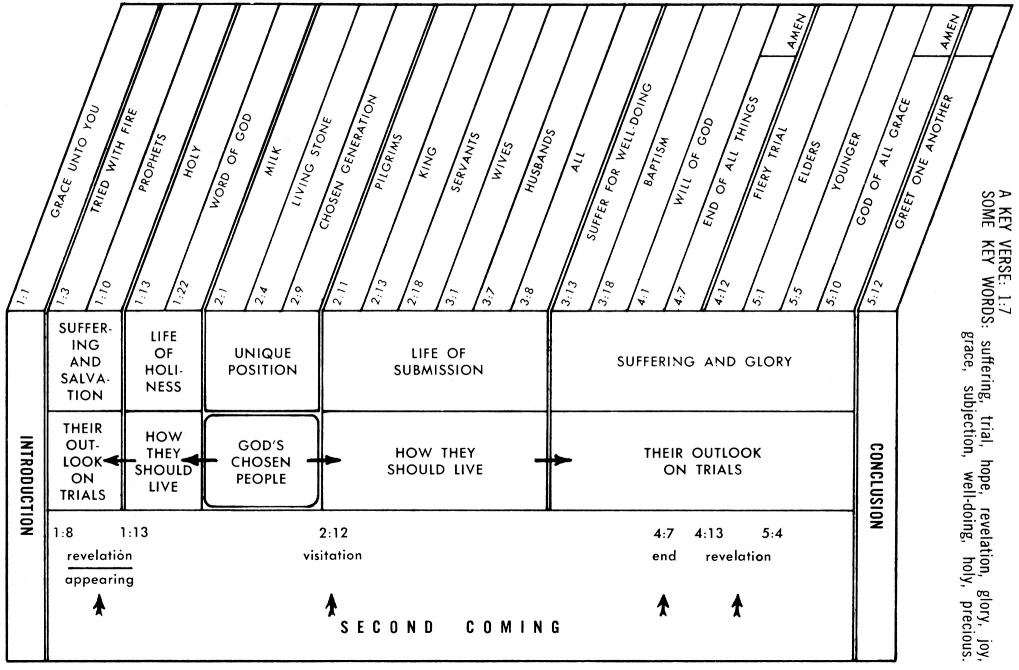
1 Peter: Trials, Holy Living & The Lord's Coming
Click chart to enlarge
Chart from Jensen's Survey of the NT - used by permission
See Another Chart from Charles Swindoll
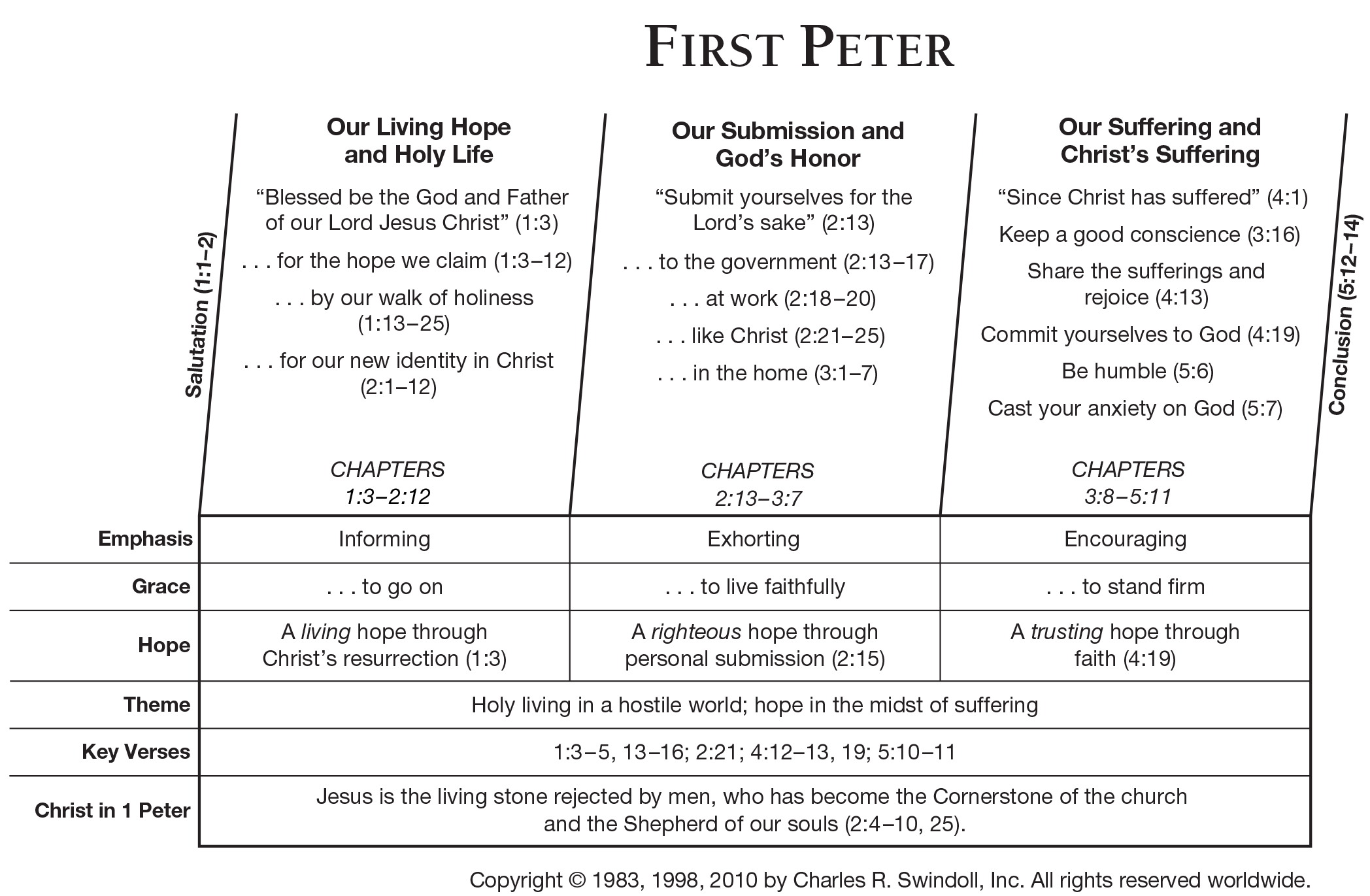
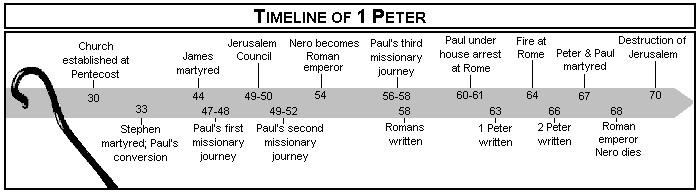
Source: Borrow Ryrie Study Bible
Click to enlarge
1 Peter 2:13 Submit yourselves for the Lord's sake to every human institution, whether to a king as the one in authority (NASB: Lockman)
Greek: Hupotagete (2PAPM) pase anthropine ktisei dia ton kurion; eite basilei os huperechonti, (PAPMSD)
Amplified: Be submissive to every human institution and authority for the sake of the Lord, whether it be to the emperor as supreme, (Amplified Bible - Lockman)
KJV: Submit yourselves to every ordinance of man for the Lord's sake: whether it be to the king, as supreme;
Phillips: Obey every man-made authority for the Lord's sake - whether it is the emperor, as the supreme ruler, (Phillips: Touchstone)
Wuest: Put yourselves in the attitude of submission to, thus giving yourselves to the implicit obedience of, every human regulation for the sake of the Lord, whether to a king as one who is super eminent
Young's Literal: Be subject, then, to every human creation, because of the Lord, whether to a king, as the highest,
SUBMIT YOURSELVES FOR THE LORD'S SAKE: hepotagete (2PAPM) pase anthropine ktisei dia ton kurion:
- Pr 17:11; 24:21; Je 29:7; Mt 22:21; Mk 12:17; Lk 20:25; Ro 13:1, 2, 3, 4, 5, 6, 7; Eph 5:21; 1Ti 2:1,2; Titus 3:1; 2Pe 2:10; Jude 8, 9, 10
- 1 Peter 2 Resources - Multiple Sermons and Commentaries
|
Section Theme |
|
|
Responsibility of |
"Repercussions" |
| Submit to human institutions 1Pe 2:13-14 (note) |
Silence ignorance of foolish men 1Pe 2:12-13 (note) |
| Servants submit to masters 1Pe 2:12-13 (note) |
Finds favor with God 1Pe 2:19-20 (note) |
| Wives submit to husbands 1Pe 3:1 (note) |
Might win unbelieving husband 1Pe 3:1 (note) |
| Husbands be understanding toward and grant wives honor 1Pe 3:7 (note) |
Prayers will not be hindered 1Pe 3:7 (note) |
| Harmonious, etc, giving blessing not returning evil 1Pe 3:8-9 (note) |
To inherit a blessing 1Pe 3:9 (note) |
Spurgeon comments…
We are to obey kings, and governors, and magistrates, even when they may not be all that we wish them to be
True Christians give no trouble in the State they are not law-breakers, but they strive to do that which is honest and upright. Where the laws are not righteous, they may cause trouble to bad law-givers and lawmakers; but when rulers ordain that which is just and righteous, they find that Christians are their best subjects.
In Peter’s day, the king was a poor creature, and something worse than that. Indeed, I might say of the bulk of the Emperors of Rome, who were the chief “kings” of that day, that they were monsters of iniquity; yet the office was to be respected even when the man who occupied it could not be much more should it be respected when the occupant is what a true “king” should be. (1 Peter 2 Commentary)
Submit yourselves for the Lord's sake - As indicated in the chart above, Peter now focuses on submission through verse 9 of chapter 3. Remember that submission in simple terms involves not seeking one's own interests but rather assuming a voluntary commitment of service to others. If one studies Paul's exhortation for believers to "be subject to one another in the fear of Christ" (see note Ephesians 5:21), it becomes apparent from the context that submission is the fruit of one who is filled with and controlled by the Holy Spirit, for Paul had just commanded the believers to…
not get drunk with wine, for that is dissipation, but be filled with the Spirit (see note Ephesians 5:18)
Submission to others be they believers or not believers (as is often the case in Peter's "every human institution") is not our natural reaction, but is the supernatural reaction of one who allows the Spirit to control their attitudes and actions.
In Peter's day there were groups of zealous Jews who recognized no king but God and paid taxes to no one but God. Believers by contrast are to be model citizens, submitting to human governments realizing that they are ordained by God. As Daniel declared when God answered his request to reveal the dream of King Nebuchadnezzar…
it is He (God in heaven) Who changes the times and the epochs; He removes kings and establishes kings. He gives wisdom to wise men, and knowledge to men of understanding. (Daniel 2:21)
Submit (5293) (hupotasso from hupó = under + tássō = arrange in orderly manner) (Click for word study on hupotasso) means literally to place under in an orderly fashion. In the active voice hupotássō means to subject, bring under firm control, subordinate as used in (Ro 8.20-note) (1Pe 3:1-note for more on "hupotasso").
Hupotássō means to submit (to yield to governance or authority), to place in subjection. It is important to note that many of the NT uses are in the passive voice with a middle sense which signifies the voluntary subjection of oneself to the will of another. Husbands and wives both need to understand the voluntary nature of the submission called for in the marital relationship lest it be misapplied. The idea is to put oneself in an attitude of submission.
Hupotássō was a military term meaning to draw up in order of battle, to form, array, marshal, both troops or ships. Hupotássō meant that troop divisions were to be arranged in a military fashion under the command of the leader. In this state of subordination they were now subject to the orders of their commander. Thus, it speaks of the subjection of one individual under or to another. Hupotássō was also used to describe the arrangement of military implements on a battlefield in order that one might carry out effective warfare!
In non-military use, hupotássō described a voluntary attitude of giving in, cooperating, assuming responsibility, or carrying a burden.
Peter commands (aorist imperative) believers to submit. As citizens in the world and under civil law and authority, God’s people are to live in a humble, submissive way in the midst of any hostile, godless, slandering society. Submission involves not seeking one's own interests but rather assuming a voluntary commitment of service to others.
The main idea of submission is that of relinquishing one’s rights to another person. How is it possible to submit or surrender one's rights to another whether they are rulers or others? Paul gives us the answer In Ephesians writing that believers should
not get drunk with wine, for that is dissipation, but be (continually) filled with (controlled by) the Spirit (see note Ephesians 5:18).
Spirit controlled husbands and wives are then called first to
be subject to (hupotássō - present tense = our habit, as our lifestyle, continually to) one another in the fear (reverential awe) of Christ (Eph 5:21 - see note)
Henry Alford says “As we are otherwise to be filled, otherwise to sing and rejoice, so also we are otherwise to behave—not blustering nor letting our voices rise in selfish vaunting, as such men do,—but subject to one another.” (Alford's Greek Testament)
Subjecting one’s self to another is the opposite of self assertion, the opposite of an independent, autocratic spirit. It is the desire to get along with one another, being satisfied with less than one’s due, a sweet reasonableness of attitude.
Lyall says that "The ultimate Christian answer to persecution, detractors and critics is that of a blameless life, conduct beyond reproach and good citizenship. In particular … submission is a supremely Christlike virtue.
Wuest renders it this way "put yourselves in the attitude of submission thus giving yourselves to the implicit obedience of"
We submit to the right of government to limit our right to choose in hundreds of areas, especially when the good of others is at stake. We understand that governments exist to limit the right to choose and we submit to that. Nothing is further from the thought of the New Testament that any kind of anarchy. Jesus clearly taught, "Render (aorist active imperative) therefore to Caesar the things that are Caesar's; and to God the things that are God's" (Mt 22:21).
FOR THE LORD'S SAKE: dia ton kurion:
- 1 Peter 2 Resources - Multiple Sermons and Commentaries
- "because of the Lord":
Lord (2962) (kurios from kúros = might, power in turn from kuróo = give authority, confirm) describes One who has absolute ownership and unfettered, sovereign power and authority. In the NT, Jesus is referred to some ten times as Savior and some 700 times as Lord. When the two titles are mentioned together, Lord always precedes Savior. Beloved, is He your kurios?
In classical Greek, kurios was used of gods and was found on inscriptions applied to different gods such as Hermes, Zeus, etc. Secular Greek also used kurios to describe the head of the family, the one who is "lord" of wife and children (although that does not give him the right to "lord" it over them!)
Though "our citizenship is in heaven, from which also we eagerly wait for a Savior, the Lord Jesus Christ" (Php 3:20-note) we still must live as an obedient citizen in this world so that God will be honored and glorified. Rebellious conduct by a Christian brings dishonor on Christ.
The most important thing this text does is put all of our social and political life into relation to God. The Bible is not a book about how to get along in the world. It is a book inspired by God about how to live to (for) God. Paul wrote that
through the Law I died to the Law, that I might live to God." (Gal 2:19)
The aim of our life should be to live to God. This means that we live with God in view and under His authority. He is our life (Col 3:4-note) As believers we are to let our
light shine before men in such a way that they may see (our) good works, and glorify (our) Father Who is in heaven. (see note Matthew 5:16)
Why does Peter introduce this subject here? Recall that he has just taught who we are and "whose" we are. We as those who have been born again are now a chosen race, a royal priesthood, a holy nation and a (KJV = peculiar) people for God's own possession and our purpose is to proclaim the excellencies of Him Who has called (us) out of darkness into His marvelous light" (1Pe 2:19-note) In 1Pe 2:10 (note) Peter calls us the people of God. In 1Pe 2:11 (note) he said that we are to live as aliens and strangers in this present world (cf those who reside as aliens in 1Pe 1:1-[note]). Given this status as "other worldly" beings, one might ask whether we even have any allegiance to the institutions of this world at all, especially considering the fact that the whole world lies in the power of the evil one (1 John 5:19)?
Peter explains in this section that a believer's submission to the institutions of this world is an act of tribute to God's authority over the institutions of the world. The idea is that can look a king or a governor (or an IRS Agent!) in the eye and say,
"I submit to you, I honor you -- but not for your sake. I honor you for God's sake. I honor you because God owns you and rules over you and has sovereignly raised you up for a limited season and given you the leadership that you have. For his sake and for his glory and because of his rightful authority over you I honor you."
So in this verse Peter subordinates all submission on earth to a higher submission to God when it says, submit for the Lord's sake. Is this practical? Sure it is. Why do we drive the speed limit? Ultimately we submit for the Lord's sake, not out of fear we might get caught. What's the result? The result is that when we have chosen to submit, even everyday tasks like driving become an act of worship to our Lord! Did you speed this morning? Tomorrow morning submit for the Lord's sake!
Barclay - Nothing is further from the thought of the New Testament than any kind of anarchy. Jesus had said, "Render therefore to Caesar the things that are Caesar's; and to God the things that are God's" (Matthew 22:21). Paul was certain that those who governed the nation were sent by God and held their responsibility from him, and were, therefore, no terror to the man who lived an honourable life (Rom 13:17). In the Pastoral Epistles the Christian is instructed to pray for kings and all in authority (1 Timothy 2:2). The instruction of the New Testament is that the Christian must be a good and useful citizen of the country in which his life is set.
It has been said that fear built the cities and that men huddled behind a wall in order to be safe. Men join themselves together and agree to live under certain laws, so that the good man may have peace to do his work and go about his business and the evil man may be restrained and kept from his evil-doing. According to the New Testament life is meant by God to be an ordered business and the state is divinely appointed to provide and to maintain that order.
The New Testament view is perfectly logical and just. It holds that a man cannot accept the privileges which the state provides without also accepting the responsibilities and the duties which it demands. He cannot in honour and decency take everything and give nothing.
How are we to translate this into modern terms? C. E. B. Cranfield has well pointed out that there is a fundamental difference between the state in New Testament times and the state as we in Britain know it. In New Testament times the state was authoritarian. The ruler was an absolute ruler; and the sole duty of the citizen was to render absolute obedience and to pay taxes (Romans 13:6-7). Under these conditions the keynote was bound to be subjection to the state. But we live in a democracy; and in a democracy something far more than unquestioning subjection becomes necessary. Government is not only government of the people; it is also for the people and by the people. The demand of the New Testament is that the Christian should fulfil his responsibility to the state. In the authoritarian state that consisted solely in submission. But what is that obligation in the very different circumstances of a democracy?
In any state there must be a certain subjection. As C. E. B. Cranfield puts it, there must be "a voluntary subordination of oneself to others, putting the interest and welfare of others above one's own, preferring to give rather than to get, to serve rather than to be served." But in a democratic state the keynote must be not subjection but cooperation, for the duty of the citizen is not only to submit to be ruled but to take a necessary share in ruling. Hence, if the Christian is to fulfil his duty to the state, he must take his part in its government. He must also take his part in local government and in the life of the trade union or association connected with his trade, craft, or profession. It is tragic that so few Christians really fulfil their obligation to the state and the society in which they live.
It remains to say that the Christian has a higher obligation than even his obligation to the state. While he must render to Caesar the things which are Caesar's, he must also render to God the things which are God's. He must on occasion make it quite clear that he must listen to God rather than to men (Acts 4:19; Acts 5:29). There may be times, therefore, when the Christian will fulfil his highest duty to the state by refusing to obey it and by insisting on obeying God. By so doing, at least he will witness to the truth, and at best he may lead the state to take the Christian way. (1 Peter 2 Commentary - William Barclay's Daily Study Bible)
TO EVERY HUMAN INSTITUTION: pase anthropine ktisei:
- 1 Peter 2 Resources - Multiple Sermons and Commentaries
to every human creation (Literal rendering of Greek)
every human regulation (Wuest)
Keep all the laws of men (BBE)
obey all human authorities (CEV)
to every ordinance of man (KJV)
every authority instituted among men (NIV)
Paul gave Titus similar instruction even considering that Crete was not a "good" place…
Remind them to be subject to rulers, to authorities, to be obedient, to be ready for every good deed (See note Titus 3:1)
In his second epistle Peter described the conduct of false teachers…
who indulge the flesh in its corrupt desires and despise (view with contempt) authority (kuriotes - can be civil power but in context angelic power and authority). Daring, self-willed, they do not tremble when they revile angelic majesties (See note 2 Peter 2:10)
Institution (2937) (ktisis from ktízo = create, form or found) means creation, creature (that which has been created) and refers primarily to the act of creating or the creative act in process something which has not existed before. In the present context it means an institution or human social structure as something which has been created or an instituted authority, with the implication that such an authority has been created or formed
As Morris explains "Since only God really creates, we must regard human ordinances as divine ordinances and submit to them as unto God, unless they contradict God's written Word (Romans 13:1). (Morris, Henry: Defenders Study Bible. World Publishing)
As Paul wrote…
Let every person be in subjection to the governing authorities. For there is no authority except from God, and those which exist are established by God. (See note Romans 13:1)
Even to "Caesar" -- Mt 22:21; Ro 13:1-7: every human creation,” denoting either everything created for mankind or every creature who is human, but context supports the former. Since only God really creates, we must regard human ordinances as divine ordinances and submit to them as unto God, unless they contradict God's written Word, which guided Peter and John before the Jewish Sanhedrin and led the apostles to proclaim…
Whether it is right in the sight of God to give heed to you rather than to God, you be the judge for we cannot stop speaking what we have seen and heard (Acts 4:19, 20)
Being an obedient Christian is increasingly becoming a social, political, legal issue in America so Peter's advice transcends time and is wise counsel for believers in post-Christian America.
WHETHER TO A KING AS THE ONE IN AUTHORITY (continually rising above): eite basilei os huperechonti (PAPMSD):
- 1 Peter 2 Resources - Multiple Sermons and Commentaries
Human governments are "created" by God (Ro 13:1-note). Rulers are God’s servants (Ro 13:4-note). Even if the rulers are not believers, they are still God’s men officially. Even if they are dictators and tyrants, their rule is better than no rule at all. The complete absence of rule is anarchy (Jdg 21:25- note), and no society can continue under anarchy (Webster's = Latin anarchia <> Greek anarchos = having no ruler <> an- + archos ruler; cp Proverbs 29:18). So any government is better than no government at all. Order is better than chaos (chaos being the confused unorganized state of primordial matter before the creation of distinct forms!)
If Peter could command the Christian community to honor the king and the governor, knowing the wickedness of Nero, then how much more must we honor our leaders even though they may endorse and promote acts which we regard as wrong.
1 Peter 2:14 or to governors as sent by him for the punishment of evildoers and the praise of those who do right (NASB: Lockman)
Greek: eite hegemosin os di' autou pempomenois (PPPMPD) eis ekdikesin kakopoion epainon de agathopoion;
Amplified: Or to governors as sent by him to bring vengeance (punishment, justice) to those who do wrong and to encourage those who do good service. (Amplified Bible - Lockman)
Phillips: or the governors whom he has appointed to punish evil-doers and reward those who do good service. (Phillips: Touchstone)
Wuest: or to governors as those sent by him to inflict punishment upon those who do evil, and to give praise to those who do good;
Young's Literal: whether to governors, as to those sent through him, for punishment, indeed, of evil-doers, and a praise of those doing good;
OR TO GOVERNORS AS SENT BY HIM: eite hegemosin os di autou pempomenois (PPPMPD):
- Romans 13:3,4
- 1 Peter 2 Resources - Multiple Sermons and Commentaries
Ryrie observes that "Christians are to be law-abiding citizens. If the law of one's government violates the revealed will of God, then, of course, the believer must obey God, though he may have to suffer the penalties of that government's laws. (The Ryrie Study Bible: New American Standard Translation: 1995. Moody Publishers)
Governor (2232) (hegemon from hegéomai = to lead, rule) is literally one who rules, with the implication of preeminent position. Hegemon was the Greek equivalent of the Latin term praefectus a person who ruled over a minor Roman province.
UBS Handbook notes that "governors translates a Greek word which generally refers to government officials below the emperor, including the pro-consuls and legates who governed the provinces of the Roman Empire, and municipal authorities. But since these officials are said to have been appointed by the Emperor (him refers to the Emperor, and not to the Lord), then the specific meaning of governors is preferred to that of the general sense. (The United Bible Societies' New Testament Handbook Series)
Strong's defines hegemon as follows…
1 a leader of any kind, a guide, ruler, prefect, president, chief, general, commander, sovereign.
1a a “legatus Caesaris”, an officer administering a province in the name and with the authority of the Roman emperor.
1a1 the governor of a province.
1b a procurator, an officer who was attached to a proconsul or a proprietor and had charge of the imperial revenues.
1b1 in causes relating to these revenues he administered justice. In the smaller provinces also, which were so to speak appendages of the greater, he discharged the functions of governor of the province; and such was the relation of the procurator of Judaea to the governor of Syria.
1c first, leading, chief.
1d of a principal town as the capital of the region
At this time the word hegemon was applied to governors of provinces whether appointed by the emperor or appointed by the senate (see note below). This is the one verse in the text that does not mention God. But He is here. When Peter tells us that the purpose of kings and governors is to punish evil and praise good he is giving God's purpose for them. We know this from Romans 13:4 where Paul says, that civil authority
"is a minister of God to you for good… [and] it is a minister of God, an avenger who brings wrath upon the one who practices evil." (see note Romans 13:4)
Sent by (3992) (pempo) means to send or dispatch and in the present context literally reads "sent through him" which means that their power to act is through the Emperor's mandate.
FOR THE PUNISHMENT OF EVILDOERS AND THE PRAISE OF THOSE WHO DO RIGHT: eis ekdikesin kakopoion epainon de agathopoion:
- 1 Peter 2 Resources - Multiple Sermons and Commentaries
Amplified Version
Or to governors as sent by him to bring vengeance (punishment, justice) to those who do wrong and to encourage those who do good service." (Ed note: ideally governors are concerned with the promotion of moral behaviour. That is to be commended and supported by Christians)
NLT paraphrases this as
For the king has sent them to punish all who do wrong and to honor those who do right.
Punishment (1557) (ekdikesis from ekdikeo = that which proceeds from justice; vindicate from ek = from + dikê = justice) means to give justice to someone who has been wronged. It means to repay harm with harm on assumption that initial harm was unjustified and that retribution is therefore called for.
Evildoers (2555) (kakopoios from kakós = evil + poiéo = to do or make) is one who behaves in a pernicious, injurious or evil way. Kakopoios is a strong expressing the idea of a very wicked person who should be punished. Such a person is worthy of severe, serious punishment. From the standpoint of ancient pagans kakopoios was a word of abuse or contempt and in fact was a word they maliciously gave to Christians! When they called them an evildoer they were abusing them verbally, showing their contempt. The pagan world commonly abused Christians verbally as those who were despised, distrusted and hated.
Praise (1868) (epainos from epí = upon + aínos = praise) refers to a commendable thing as that which is worthy of applause, commendation, praise or approbation. The praise is for those who do good.
Those who do right (17) (agathopoios from agathos = benevolent, + poiéo = to make or do) means those who do good works and thus are virtuous. Such individuals customarily do good which benefits others and thus describes not just external good works but the character of the one who performs those works.
MacDonald has an interesting comment writing that governors
are authorized by God to punish offenders and to praise those who keep the law. Actually, government officials have little time or inclination to do the latter, but that does not alter the responsibility of the Christian to obey! The historian Arnold Toynbee observed that
“as long as original sin remains an element in human nature, Caesar will always have plenty to do.”
Of course, there are exceptions. There is a time when obedience is not required. If a human government orders a believer to act contrary to the revealed will of God, then the believer must disobey the government. In that case he has a higher responsibility; he should obey God rather than men (Acts 5:29). If punishment is meted out for his disobedience, he should endure it courageously. Under no circumstances should he rebel or seek to overthrow the government. Technically, those who smuggle Bibles into closed countries are breaking the law. But they are obeying a law that has precedence over any human law —the command to go into all the world with the gospel. So they cannot be condemned on Scriptural grounds. Suppose the government orders a Christian into the armed forces. Is he obligated to obey and to bear arms? If he feels that this is in direct violation of God’s word, he should first exhaust any options that are open to him in the status of a non-combatant or a conscientious objector. If these fail, then he would have to refuse induction and bear the consequences. Many Christians do not have conscientious scruples about serving in the military forces. It is a matter in which each one should be fully convinced in his own mind, and allow liberty for others to disagree. The questions as to whether a Christian should vote or engage in politics are of a different order. The government does not demand these things, so it is not a question of obedience or disobedience. Each one must act in the light of the principles of conduct and citizenship found in the Bible. Here too we must allow liberty for differing viewpoints and not insist that others see eye to eye with us. (Believer's Bible Commentary)
The righteous punishment expressed by the verb ekdikeo is not necessarily what Nero and his provincial governors aimed to do. It expresses the ideal situation and is what God designed government for. Nero, in contrast punished the "good doers", having Paul beheaded and Peter crucified upside down according to secular reports.
The proper aim of government is to minimize evil of fallen men so that anarchy does not result. To be sure, no governments brings about salvation of one's soul, but God does use the order produced by human governments (in contrast to the chaos of anarchy) so that the gospel can can go out to the unsaved. Paul desired that the Gospel not be hindered by revolutions and rebellion, so that more people might be saved. It was in that context that he urged Timothy to pray for the human authorities writing…
first of all, then, I urge that entreaties and prayers, petitions and thanksgivings, be made on behalf of all men, for kings and all who are in authority, in order that we may lead a tranquil and quiet life in all godliness and dignity. This is good and acceptable in the sight of God our Savior, who desires all men to be saved and to come to the knowledge of the truth." (1Ti 2:1-4)
1 Peter 2:15 For such is the will of God that by doing right you may silence the ignorance of foolish men. (NASB: Lockman)
Greek: hoti outos estin (3SPAI) to thelema tou theou, agathopoiountas (PAPMPA) phimoun (PAN) ten ton aphronon anthropon agnosian
Amplified: For it is God’s will and intention that by doing right [your good and honest lives] should silence (muzzle, gag) the ignorant charges and ill-informed criticisms of foolish persons. (Amplified Bible - Lockman)
KJV: For so is the will of God, that with well doing ye may put to silence the ignorance of foolish men:
NLT: It is God's will that your good lives should silence those who make foolish accusations against you. (NLT - Tyndale House)
Phillips: It is the will of God that you may thus silence the ill-informed criticisms of the foolish. (Phillips: Touchstone)
Wuest: for so is the will of God, that by doing good you might be reducing to silence the ignorance of men who are unreflecting and unintelligent;
Young's Literal: because, so is the will of God, doing good, to put to silence the ignorance of the foolish men;
FOR SUCH IS THE WILL OF GOD THAT BY DOING RIGHT YOU MAY SILENCE THE IGNORANCE OF FOOLISH MEN: hoti outos estin (3SPAI) to thelema tou theou agathopoiountas (PAPMPA) phimoun (PAN) ten ton aphronon anthropon agnosian:
- Ep 6:6,7 1Th 4:3; 5:18) (1Pe 2:12; Job 5:16; Ps 107:42; Titus 2:8) (1Ti 1:13; 2Pe 2:12; Jude 10
- Foolish - Dt 32:6; Job 2:10; Ps 5:5; Pr 9:6; Jer 4:22; Mt 7:26; 25:2; Ro 1:21; Gal 3:1; Titus 3:3
- Illustration
- 1 Peter 2 Resources - Multiple Sermons and Commentaries
HOW TO SHUT THE MOUTH
OF THE SKEPTIC
For (hoti) - always pause to ponder this strategic term of explanation.
God's Word is like a compass and as His bondservants we are to get our bearings in a pagan culture from the will of God as Peter writes later describing those who have decided to stop sinning and "to live the rest of the time in the flesh no longer for the lusts of men, but for the will of God." (1 Peter 4:2) And remember that the best way to know God's will is to say "I will" to God!
As Albert Lee writes "Discovering God’s will is not necessarily a complicated process. He has given us many simple and clearly stated principles for life. For example, we are told, “This is the will of God, that by doing good you may put to silence the ignorance of foolish men” (1 Peter 2:15). In 1 Thessalonians 4:3 we read, “This is the will of God, your sanctification: that you should abstain from sexual immorality.” And in 1 Thessalonians 5:18 we are told, “In everything give thanks; for this is the will of God in Christ Jesus for you.” As we live by faith and do what the Bible clearly tells us to do, we can be sure the Lord will lead us through the difficult decisions when the options may not be clear. Above all else, God’s will is that we submit to Him and be willing to follow wherever He leads." (Knowing God's Will).
If you will choose to do God's will
And follow what is right,
God will confirm to you His truth
And give you greater light.
—D. De Haan
Will (2307)(thelema from thelo = to will with the "-ma" suffix indicating the result of the will = "a thing willed") generally speaks of the result of what one has decided. One sees this root word in the feminine name "Thelma." In its most basic form, thelema refers to a wish, a strong desire, and the willing of some event. (Note: See also the discussion of the preceding word boule for comments relating to thelema).
Zodhiates says that thelema is the "Will, not to be conceived as a demand, but as an expression or inclination of pleasure towards that which is liked, that which pleases and creates joy. When it denotes God's will, it signifies His gracious disposition toward something. Used to designate what God Himself does of His own good pleasure. (Zodhiates, S. The Complete Word Study Dictionary: New Testament. AMG)
Thelema has both an objective meaning (“what one wishes to happen”) and a subjective connotation (“the act of willing or desiring”). The word conveys the idea of desire, even a heart’s desire, for the word primarily expresses emotion instead of volition. Thus God’s will is not so much God’s intention, as it is His heart’s desire. Thelema then refers to the will not as a demand but an inclination of pleasure towards that which is liked, which pleases and creates joy. God’s will signifies His gracious disposition toward something, what God Himself does of His own good pleasure.
Thelema - 62x in 58v -
Mt 6:10; 7:21; 12:50; 18:14; 21:31; 26:42; Mark 3:35; Luke 12:47; 22:42; 23:25; Jn 1:13; 4:34; 5:30; 6:38, 39, 40; 7:17; 9:31; Acts 13:22; 21:14; 22:14; Ro 1:10-note; Ro 2:18-note; Ro 12:2-note; Ro 15:32-note; 1Cor 1:1; 7:37; 16:12; 2Cor 1:1; 8:5; Gal 1:4; Ep 1:1-note, Ep 1:5-note, Ep 1:9-note, Ep 1:11-note; Ep 2:3-note; Ep 5:17-note; Ep 6:6-note; Col 1:1-note, Col 1:9-note; Col 4:12-note; 1Th 4:3-note; 1Th 5:18-note; 2Ti 1:1-note; 2Ti 2:26-note; He 10:7-note, He 10:9-note, He 10:10-note, He 10:36-note; He 13:21-note; 1Pe 2:15-note; 1Pe 3:17-note; 1Pe 4:2-note, 1Pe 4:19-note; 2Pe 1:21-note; 1Jn 2:17; 5:14; Rev 4:11-note. NAS = desire(1), desires(1), will(57).
Will of God - God's Word equates with His will and tells us what is right and what is wrong. In context it is God's will that we should live so honorably and above reproach that the unconverted watching world will have no legitimate basis for accusation.
Related Resources:
- The Will Of God - Onsite discussion of this important topic
- Six Ways to Know God's Will - sermon by Rob Morgan (See also his message The Cure for "Nerves" which discusses the Six C’s of Guidance)
- Brian Bill - sermon on Knowing God’s Will
Major Ian Thomas alluded to the will of God when he said "When all that you are is available to all that God is, then all that God is is available to all that you are."
Adrian Rogers said it this way - "The will of God is not a road map. It is a relationship!"
The Belgic Confession of Faith (1561): Article 7 says " We believe that [the] Holy Scriptures fully contain the will of God, and that whatsoever man ought to believe unto salvation is sufficiently taught therein ... Neither do we consider of equal value any writings of men, however holy these men may have been."
He leadeth me, He leadeth me,
By His own hand He leadeth me;
His faithful follower I would be,
For by His hand He leadeth me.
Doing right (15) (agathopoieo from agathos = benevolent + poieo = to make or do) means to do good to others.
Silence (5392) (phimoo from phimós = a muzzle for a beast's mouth) means to close the mouth with a muzzle, to gag one's moth, or to restrain their speech.
Phimoo is used often to speak of muzzling an animal (an ox in 1 Ti 5:18) and figuratively of reducing an adversary to silence or as it were, taking the very accusation out of his mouth. The idea is to stop one's mouth so as to silence them, to make them speechless or to reduce them to silence.
Matthew uses phimoo of our Lord putting the Sadducees to silence…
But when the Pharisees heard that He had put the Sadducees to silence, they gathered themselves together. (Mt 22:34)
Mark uses phimoo of stilling the storm on the Sea of Galilee
And being aroused, He rebuked the wind and said to the sea, "Hush, be still." And the wind died down and it became perfectly calm. (Mark 4:39)
Here are the other 5 uses of phimoo (of a total of 7) in the NT…
Matthew 22:12 and he said to him, 'Friend, how did you come in here without wedding clothes?' And he was speechless.
Mark 1:25 And Jesus rebuked him, saying, "Be quiet, and come out of him!"
Luke 4:35 And Jesus rebuked him, saying, "Be quiet and come out of him!" And when the demon had thrown him down in their midst, he came out of him without doing him any harm.
KJV 1 Corinthians 9:9 For it is written in the law of Moses, Thou shalt not muzzle the mouth of the ox that treadeth out the corn. Doth God take care for oxen? (Note that NAS manuscript does not use phimoo but kemoo, from kemos = a muzzle).
1 Timothy 5:18 For the Scripture says, "You shall not muzzle the ox while he is threshing," and "The laborer is worthy of his wages." (Paul quotes the only OT use of phimoo in the Septuagint translation of Deut 25:4)
Phimoo a vigorous verb, so vigorous that it is the one Jesus chose speak to the demons! Picture the critics as being muzzled like oxen and demons! That's what doing right can do. Now aren't you more motivated to do good and right (filled with the Spirit, enabled by grace)?
Here is the purpose for our submission to authority, in order that we should avoid condemnation and win commendation that shuts the mouth of those obstinately set against the faith and who are continually looking for reasons to criticize believers.
Peter's aim for us is that we live such Spirit filled lives of goodness that the slander of Christianity will be silenced.
Ignorance (56) (agnosia from a = without + gnosis = knowledge; English = agnostic) is literally without knowledge and in secular Greek meant not being acquainted with something. It speaks of want of knowledge, not in the sense of want of acquaintance, but want of understanding.
As used in the NT agnosia describes especially a lack of knowledge of God and of spiritual discernment. It is a willful ignorance or blindness of God and spiritual matters and as such suggests culpable ignorance rather than mere lack of knowledge.
Vine writes that agnosia is
directly opposed to gnosis, which signifies “knowledge” as a result of observation and experience
Robertson refers to agnosia as "disgraceful ignorance" here and in the only other NT use
Become sober-minded as you ought, and stop sinning; for some have no knowledge (agnosia) of God. I speak this to your shame.
Vincent writes that…
In classical Greek (agnosia) is an ignorance arising from not coming into contact with the person or thing to be known.
Agnosia is the source of our English agnostic which describes an individual who holds the view that human beings cannot know the ultimate questions of the existence of God or the nature and destiny of the human soul. For the agnostic such questions must be left open and unanswered. An agnostic is not to be confused with an atheist, who completely denies the reality of God. Stated another way an agnostic is one who neither affirms belief in God (theist) nor denies the existence of God (atheist). In a sense then when believers doing right, agnostics are muzzled!
Foolish (878) (aphron from a = without + phren = understanding) describes one not employing their understanding particularly in practical matters. They are senseless, unwise, inconsiderate and foolish. Such men lack prudence or good judgment and thus often act rashly.
Spurgeon comments "Ignorance, you see, is a noisy thing. An empty drum makes a loud noise when it is beaten; and empty men, like empty vessels, often make the most sound. How then are we to silence this noisy ignorance? By argument? No, for it is not amenable to argument. Ignorance is to be silenced “by well doing.” Holy living is the best reply to infidel talking. (1 Peter 2 Commentary)
Ignorance of foolish men describes people who are willfully ignorant of God's truth, foolishly disobedient to God's Word and are criticizers or critics of Christians. Those who speak against Christianity are ignorant and foolish. They take a foolish and ignorant position and attack the truth.
Peter says believers silence them not by what they say but by what you do. Not so much by our lips as by our life -- by letting our actions of "doing right" speak louder than our words. One of the greatest evangelistic tools is how you live, especially by "doing right". It's true that they don't care how much you know until they see how much you care! Such a lifestyle will silence the critics. The effect is similar to what Peter has already written in 1 Peter 2:12…
Be careful how you live among your unbelieving neighbors. Even if they accuse you of doing wrong, they will see your honorable behavior, and they will believe and give honor to God when he comes to judge the world. (NLT, see note 1 Peter 2:12)
This principle has been put in the form of a poem…
You're writing a "gospel," a chapter each day,
By the deeds that you do, by the words that you say;
Men read what you write, whether faithless or true,
Say, what is the "gospel" according to you? —Gilbert
We live in a society today not unlike that of Peter with many people who are critical of Christians and Christianity. Peter's point is that our conduct can be our greatest weapon against critics but can also be our greatest vulnerability and point of greatest accusation. When Christians (or so-called Christians) are exposed as evildoers, this just serves to fuel the fire of the non-believing world. Witness their reaction to the exposure of the Jim and Tammy Bakers, the Jimmy Swaggarts, and an ever growing list of well known Christians who have fallen into heinous sins. Only lives of purity, godliness, virtue and righteousness will silence their critical tongues.
Commentator Robert Layton (1853) wrote that "When a Christian walks irreprovably, or free from need to be reproved, his enemies have nowhere to fasten their teeth on him, but are forced to gnaw on their own malignant tongues. As it secures the godly thus to stop the lying mouths of foolish men, so it is as painful to them to be thus stopped as muzzling is to beasts and it punishes their malice. And this is a wise Christian's way instead of impatiently fretting at the mistakes or willful miscensures of men to keep still on his calm temper of mind and upright course of life and silent innocence. This like a rock breaks the waves into foam that roar about it.
Rather than fret at the censures of secular popular criticism, believers need to calmly pursue the righteous course of life Peter's exhorts us to pursue.
Alexander Maclaren the great Scottish preacher wrote, "The world takes its notions of God most of all from the people who say that they belong to God's family. They read us a great deal more than they read the Bible. In fact, they see us, they only hear about Jesus Christ."
The bottom line then in evangelism is not what we say, it is what we do. Someone has said that
"Some of us speak so loud by what we DO
that no one can hear what we SAY."
Jesus summed up this principle of lifestyle evangelism in His sermon on the Mount, commanding us to
"Let your light shine before men in such a way that they may see your good works, and glorify your Father who is in heaven." (see note Matthew 5:16)
Peter's readers were being tested and needed motivation to carry on living the Christian life in the midst of a difficult time of trials and persecutions.
Barnes writes that "One of the best ways of meeting the accusations of our enemies is to lead a life of strict integrity. It is not easy for the wicked to reply to this argument. (Barnes' Notes on the NT)
Guzik sums this verse up writing that "Peter knows that our conduct is a way to defend the gospel. He knows that those who never read the Bible will read our lives, so it is by doing good that we put to silence the ignorance of foolish men. (Enduring Word Commentary)
John MacArthur tells the following story illustrating Peter's point… :
"I remember when Sam Ericcson was in our church before he went to Washington to be involved in the Christian Legal Society. One day Sam… prior… to the time he was a part of our church staff (he) was working for a law firm in Los Angeles… he was having lunch with a group of attorneys in the city of Los Angeles. He was very active as an elder at our church already and it was his custom… to invite men to come to the church and hear the Word of God. And he said to one attorney…
"I would like you to come to my church with me, I'd like to you be my guest."
And the man said,
"What church do you go to?"
He said,
"I go to Grace Community Church out in the San Fernando Valley."
And the man hesitated for a moment and looked a bit shocked and then said,
"I would never go to that church under any circumstances."
And Sam said to him,
"Well what makes you say that, have you been there?"
He said,
"I've never been there and I will never go."
And Sam said,
"Well how can you make that kind of judgment about the church?"
He said,
"It's very simple, the most crooked attorney I know of in this city goes to that church."
And I remember when Sam told me that how distressed I was. So the following Sunday I got in the pulpit, told the story and said,
"I don't know which one of you attorneys is that one, but I wish you'd get your act together or quit saying you belong to this church because the character of your life is making evangelism impossible."
We lay a platform of credibility… that speaks of the validity of our faith when we do what is right, when we live a righteous life. So Peter is calling us to that righteous life in a hostile environment. He calls us to that in v11-20 and then in v21-25 he gives us the perfect example of it who is Christ. In v21-25 he shows us how Christ lived a perfect life in the midst of a hostile environment. But before he gets to the example of Christ, he talks about what we are to be… And by the way we live we will either feed the fires of criticism or we will extinguish them. We will either affirm disbelief or we will confirm the validity of faith… So we are to live whether in the home, in the school, on the job, in the neighborhood in our recreational environment, wherever, in such a way that we may without a word by the behavior of our lives demonstrate the viability of the Christian gospel and put to silence the attacks of Christianity's critics.
Knowing God’s Will (Read: Ephesians 5:17-21 . . . that you may prove what is that good and acceptable and perfect will of God. —Romans 12:2
A young man facing the future and unsure of what the next year would bring, concluded, “Nobody knows what God’s will is.” Is he right? Does a lack of certainty about the future translate into not knowing God’s will?
The concept of knowing God’s will is often limited to discerning what specific situation we will be in at some future time. Although seeking God’s specific leading is part of it, another aspect that is just as vital is to follow the clearly defined elements of God’s will each and every day.
For instance, it is God’s will for us to be good citizens as a challenge to those opposed to Christ (1 Pe 2:15), to give God thanks no matter what (1 Thess. 5:18), to be sanctified sexually, avoiding immorality (1 Th. 4:3), to live under the Holy Spirit’s control (Eph. 5:18), to sing to Him (v.19), and to submit to other believers (v.21).
As we submit to God in these and other areas, we are more likely to live in what Romans 12:2 calls God’s “good and acceptable and perfect will.” Living with God’s smile of approval leads to His guidance for the future.
As we seek to know God’s will for the future, we must also act on what we already know now. by Dave Branon (Our Daily Bread, Copyright RBC Ministries, Grand Rapids, MI. — Reprinted by permission. All rights reserved)
Knowing God’s will for the future
Comes when we follow today
What He’s revealed in the Scriptures
As His commands to obey.
—Sper
Love and obey the Lord every day, and He will unfold your future.
A Platform Of Respect (Read: 1 Peter 2:9-17) This is the will of God, that by doing good you may put to silence the ignorance of foolish men. —1 Peter 2:15
A visiting pastor at my church gave a challenging sermon in which he spoke forcefully about the current state of our denomination. He said that the only solution was to have greater commitment to Jesus Christ and His Word, both individually and collectively. His comments were not critical but constructive, and they stemmed from a ministry of integrity that spanned more than four decades. Many people could have said what he did, but very few could have said it with the same credibility and impact.
After the service it occurred to me that it had taken him 41 minutes to preach the message and 41 years to build the platform of respect from which he spoke.
No matter how long we’ve been Christians, we can speak a word for Christ. But the Bible points out the value of a consistent life in constructing a credible platform for an effective witness. Peter says that our “conduct” is to be “honorable among the Gentiles, that when they speak against you as evildoers, they may, by your good works which they observe, glorify God” (1 Peter 2:12).
What we say can never be separated from who we are and what we do. If we want to speak effectively to others about Christ, there must be a platform of respect. By David C. McCasland (Our Daily Bread, Copyright RBC Ministries, Grand Rapids, MI. — Reprinted by permission. All rights reserved)
You're writing a "gospel," a chapter each day,
By the deeds that you do, by the words that you say;
Men read what you write, whether faithless or true,
Say, what is the "gospel" according to you?
—Gilbert
People will listen to you carefully if they see you living faithfully.
1 Peter 2:16 Act as free men, and do not use your freedom as a covering for evil, but use it as bondslaves of God. (NASB: Lockman)
Greek: os eleutheroi, kai me os epikalumma echontes (PAPMPN) tes kakias ten eleutherian, all' os theou douloi.
Amplified: [Live] as free people, [yet] without employing your freedom as a pretext for wickedness; but [live at all times] as servants of God. (Amplified Bible - Lockman)
KJV: As free, and not using your liberty for a cloke of maliciousness, but as the servants of God.
Phillips: As free men you should never use your freedom as an excuse for doing something that is wrong, for you are at all times the servants of God. (Phillips: Touchstone)
Wuest: doing all this as those who have their liberty, and not as those who are holding their liberty as a cloak of wickedness, but as those who are God’s bondmen.
Young's Literal: as free, and not having the freedom as the cloak of the evil, but as servants of God;
ACT AS FREE MEN: os eleutheroi:
- John 8:32, 33, 34, 35, 36; Romans 6:18,22; 1Corinthians 7:22; Galatians 5:1,13; James 1:25; 2:12; 2Peter 2:19
- 1 Peter 2 Resources - Multiple Sermons and Commentaries
BELIEVERS ARE FREE
FREE INDEED!
Jesus said “If you continue in My word, then you are truly disciples of Mine; and you will know the truth, and the truth will make you free (eleutheroo)....So if the Son makes you free, you will be free indeed (eleutheroo)." (Jn 8:31-32, -36)
In his second letter Peter specifically warns about false teachers who promise their hearers…
freedom while they themselves are slaves of corruption; for by what a man is overcome, by this he is enslaved. (see notes on 2 Peter 2:19)
Spurgeon comments "Free in yourselves, free in your conscience, free in your mind and heart. (1 Peter 2 Commentary)
Free men (1658) (eleutheros - see word studies on the cognate noun eleutheria and verb eleutheroo) means free, emancipated (as slaves would be set free), capable of movement, unfettered. True liberty is living as we should not as we please. In no NT passage does this concept refer to political freedom nor to the Stoic's fallacious idea of freedom of the flesh from emotion and desire. Freedom does not equate with license to sin as we please. In the NT, freedom does not include independence, or release from restriction. Instead, real freedom is to be found only in willingly choosing to submit to our new Master, to Christ. We are His by right of blood purchase and yet we need to make the daily choice to obey Christ, and prove what the will of God is, good, acceptable, perfect. Freedom in Christ allows us the privilege of entering into that wonderful will of His Father, that place of true rest and perfect blessing.
Eleutheros is used 23 times in the NT -
Mt. 17:26; Jn. 8:33, 36; Rom. 6:20; 7:3; 1 Co. 7:21, 22, 39; 9:1, 19; 12:13; Gal. 3:28; 4:22, 23, 26, 30, 31; Eph. 6:8; Col. 3:11; 1 Pet. 2:16; Rev. 6:15; 13:16; 19:18
How can enslavement to Christ be true freedom?
(1). Only by submitting to Jesus and living by His words are we free to experience Truth. Only then are guided away from what hurts to what is truly beneficial.
(2). Only by submitting to Jesus can we experience the immense power for true goodness that is provided for us in the Holy Spirit. What we could never do in our own strength, the Spirit can enable us to do. In a real sense, freedom is freedom to achieve exceeding abundantly more than we could ever ask or even think possible.
(3). The kind of freedom that would release us from all restraint could never free us from the consequences of our actions. The Christian knows that the consequences of his actions carry over even into eternity. Any freedom that is meaningful must release us from actions that lead to tragedy or judgment. A commitment to serve Jesus promises us holiness, and the consequences of a holy life are blessings, now and forever. The blessing that enslavement to Jesus produces helps us realize that servitude provides the most real and wonderful freedom there can be. Finally, we human beings have been shaped by God to love Him and to enjoy Him forever. Only by choosing to serve God can we become the people we were created to be. This freedom to experience our destiny is the most wonderful freedom indeed.
In Romans Paul taught the same principle as Jesus did (see quote above) writing that "having been freed (eleutheroo) from sin (WHICH WAS YOUR MASTER IN YOUR UNREGENERATE CONDITION), you became slaves of righteousness." (Ro 6:18+) As an aside, you can mark it down that every human being ever born is a slave! They are either a slave to sin or a slave to God! Rich unregenerate people may think they are slaves to no one, especially since they themselves are surrounded by "slave" (servants). But the Bible is clear - they are deceived. Sin is their Master and they are under the dominion of Satan (cf Acts 26:18+). Play Bob Dylan's "theologically accurate" song "Gotta Serve Somebody!" Dear reader, who is your master? Who do you serve?
Writing to the saints at Corinth Paul said (NLT)…
And remember, if you were a slave when the Lord called you, the Lord has now set you free (apeleutheros = a freedman, an emancipated slave) from the awful power of sin. And if you were free (eleutheros) when the Lord called you, you are now a slave of Christ. (1Cor 7:22)
To describe the ideal life in terms of freedom meant much for the ancient world because of its clear distinction between the slave and the free man. In Plato's Gorgias, the question is asked "How can a man be happy who is the servant of anything?"
Clearly Plato had no concept of the liberating truth of enslavement to Christ. The more relevant question, and the one Plato really intended, is how can any unregenerate man be happy? He is born into bondage to the power of sin and under the power of Satan, the most horrible bondage a human can experience.
Christians are free because they are slaves of Christ Jesus, a loving Master. And so our Christian freedom does not mean we are free to do as we like, but that we now are free to do as we ought.
Foretold -Isaiah 42:7; 61:1
CONFERRED
- By God -Colossians 1:13
- By Christ -Galatians 4:3, 4, 5; 5:1
- By the Holy Spirit -Romans 8:15; 2 Corinthians 3:17
- Through the gospel -John 8:32
- Confirmed by Christ -John 8:36
- Proclaimed by Christ -Isaiah 61:1; Luke 4:18
- The service of Christ is -1 Corinthians 7:22
IS FREEDOM FROM
- The law -Romans 7:6; 8:2
- The curse of the law -Galatians 3:13
- The fear of death -Hebrews 2:15
- Sin -Romans 6:7,18
- Corruption -Romans 8:21
- Bondage of man -1 Corinthians 9:19
- Jewish ordinances -Galatians 4:3; Colossians 2:20
- Called the glorious liberty of the children of God -Romans 8:21
- Saints are called to -Galatians 5:13
SAINTS SHOULD
- Praise God for -Psalms 116:16,17
- Assert -1 Corinthians 10:29
- Walk in -Psalms 119:45
- Stand fast in -Galatians 2:5; 5:1
- Not abuse -Galatians 5:13; 1 Peter 2:16
- Not offend others by -1 Corinthians 8:9; 10:29,32
- The gospel is the law of -James 1:25; 2:12
- FALSE TEACHERS
- Promise, to others -2 Peter 2:19
- Abuse -Jude 1:4
- Try to destroy -Galatians 2:4
- The wicked, devoid of -John 8:34; Romans 6:20
- Typified -Lv 25:10, 11, 12, 13, 14, 15, 16, 17; Galatians 4:22, 23, 24, 25, 26,31
AND DO NOT USE YOUR FREEDOM AS A COVERING (pretext) FOR EVIL: kai me os epikalumma echontes (PAPMPN) tes kakias ten eleutherian:
- Mt 23:14; Jn15:22; 1Th 2:5
- 1 Peter 2 Resources - Multiple Sermons and Commentaries
and not using your liberty for a cloke of maliciousness (KJV)
Spurgeon comment "You possess a freedom which others claim, but do not know. You feel that you are no man’s slave, yet you do not use your liberty for evil, or to the injury of others. For there are no others under heaven so free as God’s servants are — (1 Peter 2 Commentary)
Covering (1942) (epikaluma from epikalúpto = to conceal in turn derived from epí = over + kalúpto = cover) is literally a covering or a veil. Figuratively epikaluma is a "cloak" or pretext
idea is using Christian freedom as a mask for ungodly license (cp Jude 4).
Don't use your freedom in Christ as a pretext.
Peter warns his readers not to use their freedom as a “pretext” for doing wrong, an excuse for wickedness or a reason to justify your wrong deeds. Instead, we use our liberty in Jesus to show the kind of love and respect that Peter calls for.
Webster defines pretext as "a purpose or motive alleged or an appearance assumed in order to cloak the real intention or state of affairs" adding that this word "suggests subterfuge and the offering of false reasons or motives in excuse or explanation."
Vincent writes that epikaluma is found only here in the NT and is literally "a veil. The idea is that of using Christian freedom as a mask for ungodly license. Paul uses the kindred verb (epikalupto - to conceal, hide, cover over and figuratively to forgive. See note Romans 4:7) of the covering of sins. On the sentiment, compare Gal. 5:13.
Although the word epikaluma is not found in Jude 4, his description of the "certain persons" depicts their use of a spiritual "cloak"…
For certain persons have crept in unnoticed, those who were long beforehand marked out for this condemnation, ungodly persons who turn the grace of our God into licentiousness and deny our only Master and Lord, Jesus Christ. (Jude 1:4)
Believers are to be different. We are the Lord's freedmen. In the Greco-Roman world a freedman still owed some continuing duties to his or her former master even though they were legally free. The former master remained a patron, who would help the freedman out financially and politically. The freedman remained a client, who would also look out for the former master’s interests and reputation. Freedmen were still considered part of their former master’s household. The upshot is that yes as those redeemed by Christ's precious blood as of a lamb are free indeed, we are not free to sin. Liberty does not convey license. Our freedom does not include the right to live lawlessly. Sinful disobedience cannot and should not be justified by pseudo spiritual excuses ("covering").
As MacDonald rightly observes "The cause of Christ is never advanced by evil masquerading in religious clothes. (MacDonald, W & Farstad, A. Believer's Bible Commentary: Thomas Nelson)
In light of the truth we have been redeemed from bondage to sin, we must understand that our freedom in Christ does not give us the right to do as we please. Jesus clearly warned against such licentiousness and continuance in sin declaring…
Truly, truly (Amen, Amen - this is a firm truth) I say to you, everyone who commits (present tense) sin is the slave of sin. (John 8:34)
Barnes writes that - The apostle has reference to an abuse of freedom, which has often occurred. The pretence of those who have acted in this manner has been, that the freedom of the gospel implied deliverance from all kinds of restraint; that they were under no yoke, and bound by no laws; that, being the children of God, they had a right to all kinds of enjoyment and indulgence; that even the moral law ceased to bind them, and that they had a right to make the most of liberty in all respects. Hence they have given themselves up to all sorts of sensual indulgence, claiming exemption from the restraints of morality as well as of civil law, and sinking into the deepest abyss of vice. Not a few have done this who have professed to be Christians; and, occasionally, a fanatical sect now appears who make the freedom which they say Christianity confers a pretext for indulgence in the most base and degrading vices. The apostles saw this tendency in human nature, and in nothing are they more careful than to guard against this abuse. (Barnes' Notes on the NT)
William Barclay - Any great Christian doctrine can be perverted into an excuse for evil. The doctrine of grace can be perverted into an excuse for sinning to one's heart's content. The doctrine of the love of God can be sentimentalized into an excuse for breaking his law. The doctrine of the life to come can be perverted into an excuse for neglecting life in this world. And there is no doctrine so easy to pervert as that of Christian freedom. There are hints in the New Testament that it was frequently so perverted. Paul tells the Galatians that they have been called to liberty but they must not use that liberty as an occasion for the flesh to do as it wills (Galatians 5:13). In Second Peter we read of those who promise others liberty and are themselves the slaves of corruption (2 Peter 2:19). Even the great pagan thinkers saw quite clearly that perfect freedom is, in fact, the product of perfect obedience. Seneca said, "No one is free who is the slave of his body," and, "Liberty consists in obeying God." Cicero said, "We are the servants of the laws that we may be able to be free." Plutarch insisted that every bad man is a slave; and Epictetus declared that no bad man can ever be free. We may put it this way. Christian freedom is always conditioned by Christian responsibility. Christian responsibility is always conditioned by Christian love. Christian love is the reflection of God's love. And, therefore, Christian liberty can rightly be summed up in Augustine's memorable phrase: "Love God, and do what you like." The Christian is free because he is the slave of God. Christian freedom does not mean being free to do as we like; it means being free to do as we ought. In this matter we have to return to the great central truth which we have already seen. Christianity is community. The Christian is not an isolated unit; he is a member of a community and within that community his freedom operates. Christian freedom therefore is the freedom to serve. Only in Christ is a man so freed from self and sin that he can become as good as he ought to be. Freedom comes when a man receives Christ as king of his heart and Lord of his life. (1 Peter 2 Commentary - William Barclay's Daily Study Bible)
BUT USE IT AS BONDSLAVES OF GOD: all os theou douloi:
- Eph 6:6; Col 3:24
- 1 Peter 2 Resources - Multiple Sermons and Commentaries
BELIEVERS ARE ENSLAVED TO
RIGHTEOUSNESS AND THE RIGHTEOUS ONE
Bondslaves (1401) (doulos from deo = to bind) (Click word study on doulos) (Click additional notes on doulos) was an individual bound to another in servitude and conveys the idea of the slave's close, binding ties with his master, belonging to him, obligated to and desiring to do his will and in a permanent relation of servitude. In sum, the will of the doulos is consumed in the will of the master.
This word provides an incredible word picture of those who are bound to their Lord Jesus Christ, Who bought them with a price to be His own possession (cf 1Cor 6:20, Acts 20:28, Gal 3:13, Heb 9:12-note, 1Pe 1:18-note, Re 5:9-note, Titus 2:14-note, 1Pe 2:9- note).
A bondservant is one who surrendered wholly to another’s will and thus devoted to another to the disregard of his own interest. Paul and Timothy were not their own but had been bought with the price of the blood of Christ. They were now the property of our Lord Jesus Christ and were His slaves exclusively. No man can serve two masters (Mt 6:24-note). Paul and Timothy had been slaves of Sin (see note on "the Sin") by their birth into Adam's likeness, but now they are slaves of Christ by their new, second birth. They had no will of their own, no business of their own, no time of their own and were acting for their Master, Christ; dependent upon Him and obedient to Him.
Click the convicting poem He Had No Rights written by Mabel Williamson a missionary to China.
In the Greek culture doulos usually referred to the involuntary, permanent service of a slave, but the use in the epistles of Paul and Peter elevates the meaning of doulos to the Hebrew sense which describes a servant who willingly commits himself to serve a master he loves and respects (cp Ex 21:5, 6 Dt 15:12, 13, 14, 15, 16 ). By Roman times, slavery was so extensive that in the early Christian period one out of every two people was a slave! From at least 3000BC captives in war were the primary source of slaves.
Doulos speaks of submission to one's master The doulos had no life of his own, no will of his own, no purpose of his own and no plan of his own. All was subject to his master. The bondservant's every thought, breath, and effort was subject to the will of his master. In sum, the picture of a bondservant is one who is absolutely surrendered and totally devoted to his master.
God the Father has "delivered us from the domain (the authority and power Satan has over all unregenerate men and women) of darkness, and transferred us to the kingdom of His beloved Son" (Col 1:13, 14 - see notes 1:13; 14) so that we have passed from death to life. Now for a short time (relative to eternity) we are to be our Master's representatives, not as we were once - slaves to sin and the whims of this godless world system and its rotting institutions -- but as freedmen, as aliens and strangers who march to an eternal heavenly drumbeat, who live by holy values, righteous standards, God glorifying goals and eternal, timeless priorities. Yes, as bondslaves of God, we do submit. But we submit freely, not cowering before human authorities, but from loving obedience to our one true King now and forevermore. Amen.
Robertson comments that…
There is no such thing as absolute freedom (personal freedom), for that is anarchy. (Then he alludes to Romans 6:22…
But now having been freed from sin and enslaved to God, you derive your benefit (fruit), resulting in sanctification, and the outcome, eternal life. (see note Romans 6:22)
As Paul exhorted the saints at Colossae "Whatever you do, do your work heartily, as for the Lord rather than for men knowing that from the Lord you will receive the reward of the inheritance. It is the Lord Christ whom you serve. (Col 3:23-24-notes Colossians 3:23; 3:24)
And to the bondslaves in Ephesus Paul said "Slaves, be obedient to those who are your masters according to the flesh, with fear and trembling, in the sincerity of your heart, as to Christ not by way of eyeservice, as men-pleasers, but as slaves of Christ, doing the will of God from the heart." (See notes Ephesians 6:5; 6:6)
Our whole disposition of freedom and joy and fearlessness and radical otherness from this world is rooted in our belonging to God -- which in one sense is slavery because His authority over us is absolute but in another sense is glorious freedom because He changes our hearts so that we love doing what He gives us to do.
As Martin Luther said in his wonderful little treatise called The Freedom of a Christian = A Christian is a perfectly free lord of all, subject to none. A Christian is a perfectly dutiful servant of all, subject to all. The key to that paradox is God. Freed by God from slavery to all human institutions; and sent by God freely and submissively into those institutions -- for his sake!
Matthew Henry rightly said that "The highest honour of the greatest apostle, and most eminent ministers, is to be the servants of Jesus Christ; not the masters of the churches, but the servants of Christ.
Paradoxically a bondservant of the Most High God is one of the most privileged, noblest professions in the world. Little wonder that notable men of God in the have always been called the servants of God.
- Moses (Dt 34:5 Ps 105:26 Mal 4:4)
- Joshua (Josh 24:29)
- David (2Sa 3:18 Ps 78:70)
- Paul (Ro 1:1-note; Phil 1:1-note; Titus 1:1-note)
- Peter (2Pe 1:1-note)
- James (James 1:1-note)
- Jude (Jude 1:1 )
- Prophets (Amos 3:7; Jer 7:25).
- Ideally believers (Acts 2:18; 1Co 7:22; Ep 6:6-note; Col 4:12-note; 2Ti 2:24-note).
For or Against - We don't have to look far in our society to find things we don't like. God has a standard of right and wrong, and it contrasts greatly with the crime, sexual immorality, and declining standards of decency that seem to be everywhere.
It would be easy to do nothing but point out the wrongs in our world and spend a lifetime denouncing them. But if we did, people would tire of listening to us and eventually write us off as complainers.
A newsletter called "Communication Briefings" suggests a more positive approach: Instead of being "against" a social ill, be "for" its remedy. As an example, the newsletter suggests, "Instead of being against illiteracy, be FOR literacy -- and you will help improve literacy."
So how does this apply to us? The apostle Peter said that by doing good we will silence those who criticize us (1 Peter 2:15). For instance, instead of just speaking out against immoral programming on TV, be in favor of positive change -- and then work with local stations to make it happen. Instead of being against poverty, make a tangible contribution in the life of someone who needs help.
Let's be known as people who are for the good, not just against the bad. - J D Brannon (Our Daily Bread, Copyright RBC Ministries, Grand Rapids, MI. Reprinted by permission. All rights reserved)
While we may want to criticize
Our sick society,
We should instead do what is good
To change the bad we see.-- Sper
A little example can have a big influence.
1 Peter 2:17 Honor all people, love the brotherhood, fear God, honor the king. (NASB: Lockman)
Greek: pantas timesate, (2PAAM) ten adelphoteta agapate, (2PPAM) ton theon phobeisthe, (2PPPM) ton basilea timate. (2PPAM)
Amplified: Show respect for all men [treat them honorably]. Love the brotherhood (the Christian fraternity of which Christ is the Head). Reverence God. Honor the emperor. (Amplified Bible - Lockman)
Phillips: You should have respect for everyone, you should love our brotherhood, fear God and honor the emperor.. (Phillips: Touchstone)
Wuest: Pay honor to all, be loving the brotherhood, be fearing God, be paying honor to the king.
Young's Literal: to all give ye honour; the brotherhood love ye; God fear ye; the king honour ye.
HONOR ALL MEN; pantas timesate (2PAAM):
- 1Pe 5:5; Ex 20:12; Lev 19:32; 1Sa 15:30; Ro 12:10; 13:7; Phil 2:3; 1Ti 6:1
- 1 Peter 2 Resources - Multiple Sermons and Commentaries
Spurgeon comments on slandering believers…
Honor even the poorest of men. Remember that they are men. Even though they are sunken in vice or crime, honor the manhood that is in them, however much you may detest their crimes. “Honor all men.” (1 Peter 2 Commentary)
These four commands show us what submission looks like in practical terms. Some people are not honorable. Honor them anyway. Some people are not loveable. Love them anyway. There is no escape clause attached to this verse. These commands show us that submission is first and foremost a matter of the heart. How much honor have you really given if you obey someone but only through clenched teeth? We are to submit graciously, to obey willingly, and to honor always ("all men", all the brethren, all kings). We don’t have the right to pick and choose when we will submit to authority.
Honor (5091) (timao from time = honor, prize, value) means to attribute worth to or merit in some person or thing. Show all men the respect which is due to them according to their worth as those made in the image of God.
Timao is in the aorist imperative calling for urgent action. Believers are to consider all men to be of worth. This action refers not just to an obedient duty but an inner respect empowered by a new heart and a new Spirit.
To us this may seem hardly needing to be said; but when Peter wrote this letter it was something quite new. There were by some estimates as many as 60,000,000 slaves in the Roman Empire, every one of whom was considered by law to be, not a person, but a thing, with no rights whatsoever. In effect, Peter is saying, "Remember the rights of human personality and the dignity of every man." It is still possible to treat people as "things". An employer may treat his employees as so many human machines for producing so much work. Believers are not to behave in this manner but to esteem others.
LOVE THE BROTHERHOOD: ten adelphoteta agapate (2PPAM):
- 1Peter 1:22; John 13:35; Hebrews 13:1; Zechariah 11:14
- 1 Peter 2 Resources - Multiple Sermons and Commentaries
Earlier Peter had written…
Since you have in obedience to the truth purified your souls for a sincere love of the brethren, fervently love one another from the heart (see note 1 Peter 1:22)
In keeping with the idea of silencing foolish men Jesus spoke of the effect of brotherly love…
By this all men will know that you are My disciples, if you have love for one another. (John 13:35)
Love (25) (agapao from agape) means to love unconditionally, sacrificially like God Himself loves. This love is not sentimental or emotional (not based on impulse or feelings) but obedient as act of one's will desiring another's highest good. Since it is unconditional, it is dispensed even if it's not received or returned! Agapao means to love not based on one's affection but based on a decision of the will. It is not run with the natural inclinations of the fallen sin nature, but is love which loves the unlovely and otherwise unlovable.
Agapao is in the present imperative which calls for Spirit controlled believers to manifest His love in His power as our lifestyle. Keep on doing it.
Brotherhood (81) (adelphotes from a = denoting unity + delphús = womb and thus those born from same womb) defines a brotherly or sisterly relationship and in this case speaks OF the whole fraternity of Christians, regarded as a band of brothers and sisters. As the people of God, believers have obligations to God which involve earthly relationships. Not the least of these is to love other brothers and sisters. As with honor, showing agape (selfless, unconditional) love is a reflection of a new heart attitude of Spirit filled submission to God in all things.
FEAR GOD: ton theon phobeisthe (2PPPM):
- Ge 20:11; 22:12; 42:18; Ps 111:10; Pr 1:7; 23:17; 24:21; Eccl 8:2; Mt 22:21; Ro 13:7; 2Co 7:1; Eph 5:21
- 1 Peter 2 Resources - Multiple Sermons and Commentaries
Fear (5399) (phobeo from phobos = fear, reverence) means to revere and is in the present imperative indicating a command to make this the habit of your life.
Fear does not mean terror to the believer but conveys a sense of awe and reverence. Reverence is the combination of admiration and fear, awe and dread, wonder and terror. It's an emotion that we were made to experience. It is only when God is given his proper place in the center of our heart and spirit and mind and strength that all other things take their proper place.
Barnes writes that "The word fear, when used to express our duty to God, means that we are to reverence and honour him. Religion, in one aspect, is described as the fear of God; in another, as the love of God; in another, as submission to his will, etc. A holy veneration or fear is always an elementary principle of religion. It is the fear, not so much of punishment as of his disapprobation; not so much the dread of suffering at the dread of doing wrong. (Barnes' Notes on the NT)
William Barclay sums up this section - Here is what we might call a four-point summary of Christian duty.
(i) Honour all men. To us this may seem hardly needing to be said; but when Peter wrote this letter it was something quite new. There were 60,000,000 slaves in the Roman Empire, everyone of whom was considered in law to be, not a person, but a thing, with no rights whatever. In effect, Peter is saying, "Remember the rights of human personality and the dignity of every man." It is still possible to treat people as things. An employer may treat his employees as so many human machines for producing so much work. Even in a welfare state, where the aim is to do so much for their physical welfare, there is a very real danger that people may be regarded as numbers on a form or as cards in a filing system.
John Lawrence in his book, Hard Facts, A Christian Looks at the World, says that one of the greatest needs in the welfare state is "to see through the files and forms in triplicate to God's creatures who are at the other end of the chain of organization." The danger is that we fail to see men and women as persons. This matter comes nearer home. When we regard anyone as existing solely to minister to our comfort or to further our plans, we are in effect regarding them, not as persons, but as things. The most tragic danger of all is that we may come to regard those who are nearest and dearest to us as existing for our convenience--and that is to treat them as things.
(ii) Love the brotherhood. Within the Christian community this respect for every man turns to something warmer and closer; it turns to love. The dominant atmosphere of the Church must always be love. One of the truest definitions of the Church is that it is "the extension of the family." The Church is the larger family of God and its bond must be love. As the Psalmist had it (Psalms 133:1):
Behold, how good a thing it is,
And how becoming well,
Together such as brethren are
In unity to dwell!
(iii) Fear God. The writer of the proverbs has it: "The fear of the Lord is the beginning of knowledge" (Proverbs 1:7). It may well be that the translation should be, not that the fear of the Lord is the beginning of knowledge but that the fear of the Lord is the principal part, the very foundation of knowledge. Fear here does not mean terror; it means awe and reverence. It is the simple fact of life that we will never reverence men until we reverence God. It is only when God is given his proper place in the centre that all other things take their proper place.
(iv) Honour the king. Of the four injunctions of this verse this is the most amazing, for, if it was really Peter who wrote this letter, the king in question is none other than Nero. It is the teaching of the New Testament that the ruler is sent by God to preserve order among men and that he must be respected, even when he is a Nero. (1 Peter 2 Commentary - William Barclay's Daily Study Bible)
- God is the object of -Isaiah 8:13
- God is the author of -Jeremiah 32:39,40
- Searching the Scriptures gives the understanding of -Proverbs 2:3, 4, 5
DESCRIBED AS
- Hatred of evil -Proverbs 8:13
- Wisdom -Job 28:28; Psalms 111:10
- A treasure to saints -Proverbs 15:16; Isaiah 33:6
- A fountain of life -Proverbs 14:27
- Sanctifying -Psalms 19:9
- Filial and reverential -Hebrews 12:9,28
- Commanded -Deuteronomy 13:4; Psalms 22:23; Ecclesiastes 12:13; 1 Peter 2:17
MOTIVES TO
- The holiness of God -Revelation 15:4
- The greatness of God -Deuteronomy 10:12,17
- The goodness of God -1 Samuel 12:24
- The forgiveness of God -Psalms 130:4
- Wondrous works of God -Joshua 4:23,24
- Judgments of God -Revelation 14:7
- A characteristic of saints Malachi 3:16
- Should accompany the joy of saints -Psalms 2:11
NECESSARY TO
- The worship of God -Psalms 5:7; 89:7
- The service of God -Psalms 2:11; Hebrews 12:28
- Avoiding of sin -Exodus 20:20
- Righteous government -2 Samuel 23:3
- Impartial administration of justice -2 Chronicles 19:6-9
- Perfecting holiness -2 Corinthians 7:1
THOSE WHO HAVE
- Afford pleasure to God -Psalms 147:11
- Are pitied by God -Psalms 103:13
- Are accepted of God -Acts 10:35
- Receive mercy from God -Psalms 103:11,17; Luke 1:50
- Are blessed -Psalms 112:1; 115:13
- Confide in God -Psalms 115:11; Proverbs 14:26
- Depart from evil -Proverbs 16:6
- Converse together of holy things -Malachi 3:16
- Should not fear man -Isaiah 8:12,13; Matthew 10:28
- Desires of, fulfilled by God -Psalms 145:19
- Days of, prolonged -Proverbs 10:27
SHOULD BE
- Prayed for -Psalms 86:11
- Exhibited in our callings -Colossians 3:22
- Exhibited in giving a reason for our hope -1 Peter 3:15
- Constantly maintained -Deuteronomy 14:23; Joshua 4:24; Proverbs 23:17
- Taught to others -Psalms 34:11
- Advantages of -Proverbs 15:16; 19:23; Ecclesiastes 8:12,13
- The wicked destitute of -Psalms 36:1; Proverbs 1:29; Jeremiah 2:19; Romans 3:18
Exemplified
- Abraham -Genesis 22:12
- Joseph -Genesis 39:9; 42:18
- Obadiah -1 Kings 18:12
- Nehemiah -Nehemiah 5:15
- Job -Job 1:1,8
- Christians -Acts 9:31
- Cornelius -Acts 10:2
- Noah -Hebrews 11:7
HONOR THE KING: ton basilea timate (2PPAM):
- 1Sa 15:30; 1Chr 29:20; Pr 24:21
- 1 Peter 2 Resources - Multiple Sermons and Commentaries
Spurgeon comments…
A great deal of stress is sometimes laid upon that last precept, and I would lay just as much emphasis upon it as the Scripture does; but recollect the earlier command also: “Honor all men.”
“A man’s a man for a that.”
Whatever his condition may he, honor the manhood that is in him. Do not despise him because he is poor, or because his coat is not so fashionably cut as yours is; for, perhaps, he may be a better man than you are: “Honor all men. Love the brotherhood. Fear God. Honor the king.” (1 Peter 2 Commentary)
Honor (5091) (timao from time = honor, prize, value) means to attribute worth to or merit in some person or thing. Timao is in the is in the present imperative indicating a command to make this the habit of your life.
Of the four injunctions of this verse this is the most amazing, for, if it was really Peter who wrote this letter, the king refers primarily to the Roman sovereign who at this time is none other than incredibly evil Emperor Nero. It is the teaching of the New Testament that even a ruler like Nero is sent by God to preserve order among men and that he must be respected!
Ray Pritchard summarizes this section with some wise and practical words…
Submission is first and foremost an attitude of the heart. Submission is not blind obedience. Because it is an attitude of the heart, sometimes we will disagree and will make our disagreement known forcefully. Submission doesn’t mean we don’t work to make the situation better. And it doesn’t mean you have to stay where you are indefinitely. You’re not morally obligated to work for a foolish boss forever. If you can change jobs and improve your situation, go ahead and do it. Sometimes we must speak out against those things that we know are wrong. I do believe there are times when as a last resort, laws may have to be broken. That’s a subject for another sermon, but it helps to remember that during the Civil Rights crisis in the ’60s, the protestors who broke the “Jim Crow” laws in the South did so openly and took the punishment that was meted out. If our Christian commitment causes to us protest an unjust law, we cannot turn around and claim divine exemption from punishment. Accepting punishment is part of the attitude of humble submission to authority, even authority we disagree with.
My Rebel Heart - Let me wrap up on a personal note. As I survey my own rebel heart, I find that I don’t like submission any more than anyone else. Even after preaching this sermon, I know that deep inside, there is a part of me that says, “Forget about the rules. Do whatever you want.” I definitely haven’t arrived in this area. But I have learned several things over the years:
1) Living under authority is the greatest freedom of all. It provides protection, direction and security.
2) Rebellion leads to anarchy and destruction. This touches the point that submission is an attitude first and foremost, and so is rebellion. If we must disobey, we are still to honor the king. That means obeying when and where we can, and not disobeying just for personal gain or personal convenience. These are difficult issues because they touch the heart, not just our outward actions.
Two questions arise at this point:
1) What do you do if those over you seem to be fools or worse? Pray for them. Support them. Work for change. Obey them as much as you can. Don’t speak evil of them. Show them honor in how you treat them.
2) What if you are told to do wrong? Don’t do it! Submission is not an excuse for violating God’s commandments. But just make sure it’s God’s commandments that are being violated, not your personal preferences.
Above all, avoid a rebellious spirit. These are the warning signs to watch for:
1) Talking too much.
2) Trying to pick and choose which orders you will follow.
It’s Not About You - Our text mentions God four times in five verses. Why did he feel the need to do that? The answer is simple: It’s not about you. It’s not about you boss. It’s not about your teacher. It’s not about anyone in authority over you. It’s all about God.
Submission is about God. Until we grasp that, we will continue to struggle in this area. Here are two questions to ask yourself:
Do I believe God is in control of my life down to the tiniest details?
Do I believe God has me where he wants me to be right now?
If you can answer yes to those two questions, you can learn to submit to authority in your life. And until you can answer yes, you will struggle with this area. Here is the bottom line of all that I have said: Live for God. Show the world that true freedom comes from submitting to God. This week I read that Oswald Chambers, author of My Utmost for His Highest, often included a three-word phrase near the end of every letter he wrote. This little phrase summed up his whole life: “Be absolutely his.” And that’s really all that Peter is saying.
Be absolutely his at home. Not yours, but his.
Be absolutely his at church. Not yours, but his.
Be absolutely his on the job. Not yours, but his.
Be absolutely his in the classroom. Not yours, but his.
Be absolutely his in every relationship. Not yours, but his.
In the end submission is not about you obeying someone else, or about you following a set of rules. Submission is a spiritual issue between you and God. It touches every part of life because behind every human authority stands the Lord himself. And rebellion is like the sin of witchcraft (I Samuel 15:23 NLT). A rebellious spirit against authority is actually a form of rebellion against God. And that’s why this is the hardest doctrine to obey in the Bible. It runs counter to fallen human nature.
You may ask, “Is there anyone who ever lived this way?” Yes, there is. His name is Jesus. Peter mentions him a few verses later in I Peter 2. We are called to follow in his steps.
Though he was insulted, he did not retaliate in kind.
Though he was sinned against, he never sinned in response.
Though he was humiliated, he never threatened to get even.
Instead, he entrusted himself to his Heavenly Father. His submission led to his crucifixion, and his crucifixion brought salvation to the world.
Peter says, “Follow in his steps.”
And so we are driven back to the cross of Christ. Without the cross, this sermon makes no sense. But in the power of the cross, we can do what Jesus did. This is our Christian calling, our privilege, and our greatest challenge. Amen. (1 Peter 2:13-17 Serving God in an Unbelieving World)