1 Timothy 6:2
1 Timothy 6:3
1 Timothy 6:4
1 Timothy 6:5
1 Timothy 6:6
1 Timothy 6:7
1 Timothy 6:8
1 Timothy 6:9
1 Timothy 6:10
1 Timothy 6:11
1 Timothy 6:12
1 Timothy 6:13
1 Timothy 6:14
1 Timothy 6:15
1 Timothy 6:16
1 Timothy 6:17
1 Timothy 6:18
1 Timothy 6:19
1 Timothy 6:20
1 Timothy 6:21
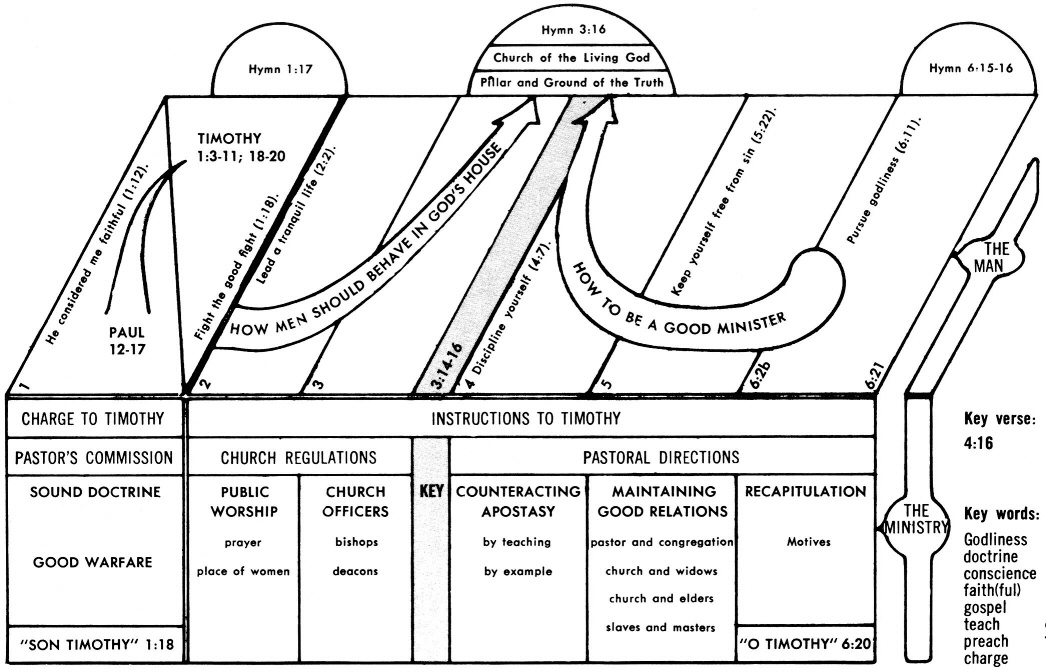
GODLINESS AND PASTORAL CARE
Click chart to enlarge
Charts from Jensen's Survey of the NT - used by permission
Another Overview Chart - 1 Timothy - Charles Swindoll
| THE PASTOR'S PRIMER: PAUL'S PRACTICAL PASTORAL INSTRUCTIONS REGARDING THE LOCAL CHURCH |
||||
| 1 Timothy 1 | 1 Timothy 2-3 | 1 Timothy 4 | 1 Timothy 5 | 1 Timothy 6 |
| TIMOTHY'S CHARGE… |
TIMOTHY'S INSTRUCTIONS… |
|||
| Concerning Sound Doctrine |
Concerning Prayer & Church |
Concerning Last Days Apostasy |
Concerning Widows & Elders |
Concerning Conflict & Contentment |
| Danger of False Doctrine |
Public Worship Church Officers |
Antidote for Apostasy |
Pastoral Duties Toward Others |
Instructions for the Man of God |
| Warning | Worship | Wisdom | Widows | Wealth |
| Written in Macedonia Circa 62-64AD |
||||
1 Timothy 6:16 Who alone possesses immortality and dwells in unapproachable light, Whom no man has seen or can see. To Him be honor and eternal dominion! Amen. (NASB: Lockman)
Greek: o monos echon (PAPMSN) athanasian, phos oikon (PAPMSN) aprositon, on eiden (3SAAI) oudeis anthropon oude idein (AAN) dunatai; (3SPPI) o time kai kratos aionion; amen.
Amplified: Who alone has immortality [in the sense of exemption from every kind of death] and lives in unapproachable light, Whom no man has ever seen or can see. Unto Him be honor and everlasting power and dominion. Amen (so be it). (Amplified Bible - Lockman)
ESV: who alone has immortality, who dwells in unapproachable light, whom no one has ever seen or can see. To him be honor and eternal dominion. Amen.
KJV: Who only hath immortality, dwelling in the light which no man can approach unto; whom no man hath seen, nor can see: to whom be honour and power everlasting. Amen.
Moffatt: who alone has immortality, who dwells in light that none can approach, whom no man has ever seen or can see. To him be honour and eternal dominion: Amen.
NET: He alone possesses immortality and lives in unapproachable light, whom no human has ever seen or is able to see. To him be honor and eternal power! Amen.
NLT: He alone can never die, and he lives in light so brilliant that no human can approach him. No human eye has ever seen him, nor ever will. All honor and power to him forever! Amen. (NLT - Tyndale House)
Phillips: the only source of immortality, the one who lives in unapproachable light, the one whom no mortal eye has ever seen or ever can see. To him be acknowledged all honour and power for ever, amen! (Phillips: Touchstone)
TLB: who alone can never die, who lives in light so terrible that no human being can approach him. No mere man has ever seen him nor ever will. Unto him be honor and everlasting power and dominion forever and ever. Amen.
Weymouth: who alone possesses immortality, dwelling in unapproachable light, and whom no man has seen or can see. To Him be eternal honour and power! Amen.
Wuest: who alone has immortality, dwelling in unapproachable light, whom not even one in the human race has seen nor even is able to see, to whom be honor and power forever. Amen.
Young's Literal: who only is having immortality, dwelling in light unapproachable, whom no one of men did see, nor is able to see, to whom is honour and might age-during! Amen.
WHO ALONE POSSESSES IMMORTALITY AND DWELLS IN UNAPPROACHABLE LIGHT, WHOM NO MAN HAS SEEN OR CAN SEE: ho monos echon (PAPMSN) athanasian, phos oikon (PAPMSN) aprositon, on eiden (3SAAI) oudeis anthropon oude idein (AAN) dunatai; (3SPPI):
- Who alone: 1Ti 1:17 Ex 3:14 Dt 32:40 Ps 90:2 Isa 57:15 Jn 8:58 Heb 13:8 Rev 1:8,17,18
- dwells: Ps 104:2 Hab 3:4 1Jn 1:5 Rev 1:16,17 21:3 22:5
- Whom: Ex 33:20 Jn 1:18 6:46 14:9 Col 1:15
GOD IS WORTHY
OF OUR WORSHIP
AT ALL TIMES
Towner sums up this last section
The affirmation of God's sovereign control over eschatological (future) events develops into a multi-tiered portrait of God rounded off by a doxology. (NICNT)
Let's summarize the divine attributes in Paul's elegant portrayal of God in 1Ti 6:15-16…
(1) Blessed
(2) Only
(3) Sovereign
(4) King of kings
(5) Lord of lords
(6) Immortality
(7) Dwells in unapproachable light
(8) Invisibility
Worship is derived from the Old English word "worthship", which in turn is from two words, worth or worthiness plus -ship denoting honor. Worship denotes the worthiness of the one receiving the special honor or devotion. For believers at the core of worship is an honoring or acknowledgment of the worth of our great God (See related study on Greek word for worship - proskuneo). Worship is an attitude of our heart which we should strive diligently to continually cultivate. Too often we restrict "worship" to Sunday "worship service", but God is worthy of our worship at all times! In the workplace, at school, jogging the trail, riding your bike, stuck in freeway traffic (yes, even there!), etc. And so it is fitting that Paul pauses once again to worship God even as he had done at the outset of this epistle…
Now to the King eternal, immortal, invisible, the only (monos) God, be honor and glory forever and ever. Amen. (1Ti 1:17+)
To quote Robert Morey "All doxologies manifest the same literary pattern and grammatical structure. They all close with an “Amen” because they are prayers of praise and, thus, acts of worship. The vocabulary used in doxologies ascribe eternal sovereignty, glory, blessing, wisdom, might, power, thanksgiving, majesty, authority, honor, and dominion to God. (Borrow The Trinity: Evidence and Issues)
Here are the New Testament Doxologies which would make great fodder for your morning prayer time: Ro 1:25, Ro 9:5, Ro 11:36, Ro 16:27 Gal 1:4-5, Eph 3:21, Phil 4:20, 1Ti 1:17, 1Ti 6:16, 2Ti 4:18, Heb 13:21,1Pe 5:11, 2Pe 3:18, Jude 1:25, Rev 1:6, Rev 7:11-12, Rev 19:4 Rev 22:20, 21.
Wallis observes that in this section (1Ti 6:15-16) God is "characterized by an accumulation of titles and ascriptions of majesty and power noteworthy even in Paul, and indeed, in the entire Scripture. The ideas are parallel to 1Ti 1:17 but are more fully expressed. Paul's thought moves from God's manifestations to men as Potentate and King through His sovereign prerogative of immortality, back to His mysterious and inscrutable being, and leads to the final ascription of honor and eternal omnipotent sway.
O Worship the King
(vocal version by Chris Tomlin)
O worship the King, all glorious above,
O gratefully sing His power and His love;
Our Shield and Defender, the Ancient of Days,
Pavilioned in splendor, and girded with praise.
O tell of His might, O sing of His grace,
Whose robe is the light, whose canopy space,
His chariots of wrath the deep thunderclouds form,
And dark is His path on the wings of the storm.
Alone - The Greek has the definite article (Greek ho = English "the") preceding monos and thus is more accurately rendered "the only". Why is this significant you ask? Notice that in Jn 5:44 Jesus uses the phrase "the only God". Vincent makes the point that the text is "Not God only, which entirely overlooks the force of the definite article; but the only God." Paul's mention of God alone possessing immortality would be a clear countering of the cult of emperor worship which taught that the emperors (who they deified) were considered immortal (despite the fact that they all died as mere men!)
Alone (3441) (monos) means only, sole or single; by themselves. To be sure both angels (good and demonic) and human beings (both saved and unsaved alike) are now immortal and will live forever in either heaven or hell. The difference of course is that the immortality of these created beings is derived from God Who alone possesses inherent immortality.
THOUGHT - Have you ever considered that your unsaved friends and relatives are "immortal?" This sobering truth ought to motivate in each of our hearts a Spirit enabled desire (and reliance on His power - Acts 1:8+) to speak forth the Gospel with our lives and with our lips! Without trying to put a "guilt trip" on you dear brother or sister in Christ, let me ask you when was the last time you shared the Good News of your salvation, the Gospel of Jesus Christ, with an unbeliever? Yes, it can be intimidating (even after walking with Jesus 25 years, speaking from my experience), and yet I know of nothing that gives me more excitement and fulfillment then when God opens the door of opportunity to share my Best Friend with another individual who will live forever!
Possesses (2192) (echo) means to have or possess and in the present tense describes this as God's continual possession. The idea is to possess in the sense of having as one’s own. Paul proceeds to list God's unique Personal possessions!
Paul now describes three things about the Father - 1.IMMORTALITY, 2.INSCRUTABILITY (inhabiting light, unapproachable), 3. INVISIBILITY.
UNBEGINNING AND
UNENDING EXISTENCE
Immortality (110) (athanasia from a [Alpha prefixed to a word negates its meaning] = without + thanatos = death) is a noun which literally means without death, "deathlessness", state of no death. It describes the state of not being subject to death, that which will never die, that which is incapable of dying.
The 1828 Webster's Dictionary says immortality is "The quality of never ceasing to live or exist; exemption from death and annihilation; life destined to endure without end; exemption from oblivion."
The only other uses in the NT are in Paul's description of the believer's glorified, resurrection body as immortal. Hallelujah! What a blessed future we have to look forward to.
1Cor 15:53-54+ For this perishable must put on the imperishable, and this mortal must put on immortality. But when this perishable will have put on the imperishable, and this mortal will have put on immortality, then will come about the saying that is written, "DEATH IS SWALLOWED UP in victory.
Vine comments: It (Athanasia) expresses more than deathlessness, it suggests the quality of the life enjoyed, as is made clear from 2Corinthians 5:4.
In 1Timothy 1:17, Paul used the adjective aphthartos for immortal, which signifies that which is not subject to decay and death. In the introductory description of the Gospel (specifically describing every man's lost state and desperate need for the Gospel), Paul accused humankind of exchanging "the glory of the incorruptible (aphthartos) God for an image in the form of corruptible man and of birds and four-footed animals and crawling creatures." (Ro 1:23-note) In the context of the resurrection body which every saint will receive, Paul wrote that this eternal "acquisition" will occur "in a moment, in the twinkling of an eye, at the last trumpet; for the trumpet will sound, and the dead will be raised imperishable (aphthartos), and we will be changed" (1Cor 15:52) and as Peter says will also "obtain an inheritance with is imperishable (aphthartos)" (1Peter 1:4-note) because we have been "born again not of seed (the Word of God, the Gospel of our salvation) which is perishable but imperishable (aphthartos), that is, through the living and enduring word of God." (1Pe 1:23-note)
God is uniquely living, exhibiting life without a beginning or an ending! As such He is the source of all life.
Psalm 36:9 For with You is the fountain (literally a source of flowing water, here figurative as the Source) of life; In Your light (cp "unapproachable light") we see light. (cp metaphor of fountain and/or water for spiritual life or that which gives spiritual life - Jer 2:13, Jn 4:14, Jn 7:37-39, Rev 21:6, Rev 22:17)
Daniel 4:34 “But at the end of that period, I, Nebuchadnezzar, raised my eyes toward heaven and my reason returned to me, and I blessed the Most High and praised and honored Him who lives forever; For His dominion is an everlasting dominion, And His kingdom endures from generation to generation.
John 5:26 “For just as the Father has life in Himself, even so He gave to the Son also to have life in Himself.
Psalm 90:2 Before the mountains were born, or Thou didst give birth to the earth and the world, even from everlasting to everlasting, Thou art God.
Comment: Only God has essential immortality as an attribute of His being (1 Tim. 6:16). Since man begins at conception and does not come from eternity, he does not have essential immortality. Only God is from eternity to eternity (Ps. 90:1, 2).
Habakkuk 1:12+ Art Thou not from everlasting, O LORD, my God, my Holy One? We will not die. Thou, O LORD, hast appointed them to judge; And Thou, O Rock, hast established them to correct.
Micah 5:2+ But as for you, Bethlehem Ephrathah, too little to be among the clans of Judah, from you One will go forth for Me (for God the Father) to be Ruler in Israel. His goings forth are from long ago, from the days of eternity.”
Comment: Did you observe the two prophecies, one fulfilled and the other unfulfilled? If not, go back are re-read the verse before you read the remainder of this comment. Note how Micah's prophecy first speaks of Jesus, the God of eternity, Who entered time as God incarnate, Jesus Christ. He did not become the Ruler of Israel in His first coming, but He will become the Ruler of Israel in His Second Coming, when He rules and reigns from Jerusalem over His Millennial Kingdom.
John Gill reminds us that…Angels are immortal, and so are the souls of men, and so will be the bodies of men after the resurrection; but then neither of these have immortality of themselves, they have it from God; who only has it, of himself, originally, essentially, and inderivatively. (1 Timothy 6 Commentary)
Jamieson comments that God's immortality is unique for it is…in His own essence, not merely at the will of another, as all other immortal beings [JUSTIN MARTYR]. As He hath immortality, so will He give it to us who believe; to be out of Him is death. It is mere heathen philosophy that attributes to the soul indestructibility in itself, which is to be attributed solely to God's gift. As He hath life in Himself, so hath He given to the Son to have life in Himself (Jn 5:26). (1 Timothy 6 Commentary)
John MacArthur applies these truths to Timothy and by extension to all believers writing that…The man of God derives comfort from the knowledge that his God is above history and beyond time. No matter what happens during his brief span of time on this earth, the deathless, eternal One is available to support him. He shares the perspective of Paul, who told the Romans, “I consider that the sufferings of this present time are not worthy to be compared with the glory that is to be revealed to us” (Ro 8:18-note; cf.. 2Cor 4:17-note). (1Timothy Moody Press)
Spurgeon makes an interesting point that the immortal One in a sense surrendered His immortality…There are certain points about Christ’s death that are very extraordinary and that are better proofs of love than those I have already mentioned. The first is this: Jesus did not ever have to die. When the Marseilles surgeon died, he only did then what he would have to do a few years afterwards. When the mother perished to save her children, she died only a few weeks, months, or years before her appointed time. Being mortal, we all must die. If we give our lives for others, we do not really give our lives. We simply pay the debt of nature a little while before it is due. However, it was altogether different in the Lord Jesus Christ’s case. Over Him, death had no power at all. It is of Him that Paul wrote, “who only hath immortality” (1Ti 6:16). Who could, without His consent, have laid a hand upon the Prince of Life, the Son of God, and said to Him, “You shall die”? No one could have done that. It was a purely voluntary act for Christ to die at all, not merely to die on the cross. Consequently, this is a telling proof of His love. (The Limitless Love of Christ)
Vine amplifies Spurgeon's thought and addresses an argument the skeptic or agnostic might raise…To God alone belongs immortality essentially, underivatively. He is neither liable to, nor capable of, death. The Son of God could become capable of death only through incarnation. The argument that, because God cannot die, and yet Christ died, therefore Christ cannot be God, is utterly invalid. Christ, who was eternally one with the Father in Godhood (see e.g., Is. 9:6; Mic. 5:2), became man in order to die (Heb 10:5-10), and in doing so did not abandon His deity (cp Col 2:9). Being both God and Man He both could and did die, and the Gospel records bear irrefutable witness to the supernatural character of His death.
AND DWELLS IN UNAPPROACHABLE LIGHT, WHOM NO MAN HAS SEEN OR CAN SEE: phos oikon (PAPMSN) aprositon, on eiden (3SAAI) oudeis anthropon oude idein (AAN) dunatai; (3SPPI):
- dwells: Ps 104:2 Hab 3:4 1Jn 1:5 Rev 1:16,17 21:3 22:5
- Whom: Ex 33:20 Jn 1:18 6:46 14:9 Col 1:15)
One of my favorite hymns by Walter C Smith (1876) sings forth the glories of His immortality and His dwelling in inaccessible light, light so radiant and splendorous that Smith rightly wrote "Thine angels adore Thee, all veiling their sight"…
Immortal, Invisible, God Only Wise
Immortal, invisible, God only wise,
In light inaccessible hid from our eyes,
Most blessèd, most glorious, the Ancient of Days,
Almighty, victorious, Thy great Name we praise.
Unresting, unhasting, and silent as light,
Nor wanting, nor wasting, Thou rulest in might;
Thy justice, like mountains, high soaring above
Thy clouds, which are fountains of goodness and love.
To all, life Thou givest, to both great and small;
In all life Thou livest, the true life of all;
We blossom and flourish as leaves on the tree,
And wither and perish—but naught changeth Thee.
Great Father of glory, pure Father of light,
Thine angels adore Thee, all veiling their sight;
But of all Thy rich graces this grace, Lord, impart
Take the veil from our faces, the vile from our heart.
All laud we would render; O help us to see
’Tis only the splendor of light hideth Thee,
And so let Thy glory, Almighty, impart,
Through Christ in His story, Thy Christ to the heart
Dwells (3611)(oikeo) means to reside in a place (to live, to dwell), to abide, to inhabit a place. Used of the Spirit dwelling in believers (1Cor 3:16). Of dwelling together or living together as husband and wife (marriage). Here in Timothy oikeo means to dwell in something (light). God is at home (present tense = continually dwells) in light which is inaccessible.
GOD
UNAPPROACHABLE
Unapproachable light - This phrase describes the glory of God's dwelling place and emphasizes the vast gulf between the holy God and sinful mankind. In the book of Exodus we see light used to symbolize God's presence among His people, as manifest by the continually burning oil lamp (Ex 27:20; 35:14; 39:23; Lev 24:2). On Mt Sinai Moses encounters the Angel of the LORD () in "a blazing fire" in the midst of a bush which was not consumed (Ex 3:2).
Jamieson aptly notes that after alluding to life (immortality), Paul now turns to light…After life comes mention of light, as in Joh 1:4. That light is unapproachable to creatures, except in so far as they are admitted by Him, and as He goes forth to them [BENGEL]. It is unapproachable on account of its exceeding brightness [THEOPHYLACT]. If one cannot gaze steadfastly at the sun, which is but a small part of creation, by reason of its exceeding heat and power, how much less can mortal man gaze at the inexpressible glory of God [THEOPHYLACT, To Autolycus] (Ps 104:2; 1Jo 1:5). (1 Timothy 6 Commentary)
In regard to God dwelling in unapproachable light, Chrysostom asks…Is He then Himself one Light, and is there another in which He dwells? is He then circumscribed by place? Think not of it. By this expression is represented the Incomprehensibleness of the Divine Nature. Thus he speaks of God, in the best way he is able. Observe, how when the tongue would utter something great, it fails in power. (Homily on 1Timothy 6:13-16: The Nicene and Post-Nicene Fathers Vol. XIII)
MacArthur comments that…In this age of casual familiarity with God, it is well to remember His utter holiness. While God is our loving, gracious Father, He nevertheless dwells in unapproachable light. He is transcendent, totally beyond us. He is, in Martin Luther’s words, Deus absconditus, the hidden God. Had he not revealed Himself and come out of His holy habitation, man could have had no knowledge of Him. ( 1 Timothy Moody Press)
John Gill…in this present, frail, and mortal state; yea, angels themselves cannot bear the luster of it, but cover their faces with their wings; for God is light itself, as well as clothes himself with light, as with a garment; and is the Father and fountain of lights to all his creatures. (1 Timothy 6 Commentary)
The Psalmist alludes to this characteristic of God dwelling in unapproachable light writing…
Bless the LORD, O my soul! O LORD my God, Thou art very great; Thou art clothed with splendor and majesty, covering Thyself with light as with a cloak, stretching out heaven like a tent curtain. (Ps 104:1, 2)
Newport J D White comments: (1Ti 6:16 presents) a grander conception than that in Psalm 104:12, 'Who coverest thyself with light as with a garment.' (In 1Ti 6:6), if one may venture to express it, the Person of God is wholly concealed by His dwelling, which is light; and this dwelling is itself unapproachable.
Spurgeon: Who coverest thyself with light as with a garment: wrapping the light about him as a monarch puts on his robe. The conception is sublime: but it makes us feel how altogether inconceivable the personal glory of the Lord must be; if light itself is but His garment and veil, what must be the blazing splendor of His own essential being! We are lost in astonishment, and dare not pry into the mystery lest we be blinded by its insufferable glory… The clearest revelation of God is still a concealment; even light is but a covering to Him. God is clothed with light as we see Him in His omniscience, His holiness, His revelation, His glory, in heaven and His grace on earth.
John Calvin: Who coverest thyself with light as with a garment. In comparing the light with which he represents God as arrayed to a garment, he intimates, that although God is invisible, yet His glory is conspicuous enough. In respect of His essence, God undoubtedly dwells in light that is inaccessible; but as He irradiates the whole world by His splendour, this is the garment in which He, Who is hidden in himself, appears in a manner visible to us. The knowledge of this truth is of the greatest importance. If men attempt to reach the infinite height to which God is exalted, although they fly above the clouds, they must fail in the midst of their course. Those who seek to see Him in His naked majesty are certainly very foolish. That we may enjoy the sight of Him, He must come forth to view with His clothing; that is to say, we must cast our eyes upon the very beautiful fabric of the world in which He wishes to be seen by us, and not be too curious and rash in searching into His secret essence. Now, since God presents Himself to us clothed with light, those who are seeking pretexts for their living without the knowledge of Him, cannot allege in excuse of their slothfulness, that He is hidden in profound darkness. When it is said that the heavens are a curtain, it is not meant that under them God hides Himself, but that by them His majesty and glory are displayed, being, as it were, His royal pavilion.
Unapproachable (676) (aprositos from a = without + pros = toward + eimi = to be) describes that which cannot be approached. Inaccessible. This is the only use of this word in Scripture. Vine writes that God is "Unapproachable in the essence of His being and the rights of His majesty, He has through the death, resurrection, and exaltation of His Son, “dedicated for us” “a new and living way” of access into His presence, “the holy place,” into which the believer may have “boldness to enter,” Hebrews 10:19, 20.
Light (5457)(phos from pháo = to shine) is defined by many lexicons as that which contrasts with darkness. Light is the medium of illumination that makes sight possible or makes things visible. In Scripture phos can refer to literal, physical light (Ge 1:3), but often is used metaphorically or symbolically, the greatest metaphorical use being used to symbolize Jesus as "the Light of the world." (Jn 8:12).
Webster's 1828 says light is "That ethereal agent or matter which makes objects perceptible to the sense of seeing, but the particles of which are separately invisible."
Nelson's New Illustrated Bible Dictionary says "The Bible also speaks of light as the symbol of God’s presence and righteous activity. Light has been associated with the presence, truth, and redemptive activity of God since creation… Misguided fascination with light caused some cultures of the ancient world to worship the sun and moon.
ISBE adds that light "is used throughout the Scriptures as the symbol and synonym of all that is luminous and radiant in the mental, moral and spiritual life of men and angels; while the eternal God, because of His holiness and moral perfection, is pictured as "dwelling in light unapproachable" (1Ti 6:16).
Habakkuk gives us an overwhelming description of God "His radiance is like the sunlight; He has rays flashing from His hand, and there is the hiding of His power. (Hab 3:4+)
John writes "And this is the message we have heard from Him and announce to you, that God is light, and in Him there is no darkness at all. (1John 1:5-note)
James describes God as "the Father of lights" (James 1:17-note) Hiebert comments: Lights in the original has the definite article, "the lights," and the primary reference is to the well-known celestial lights, the heavenly luminaries that are the sources of light for our earth. As "the Father" of these lights, God is their source of being, and they reflect the glory of their Creator (Ps 19:1; 136:7). As their Creator and Sustainer, He is not to be identified with them. These luminous celestial bodies must not be worshiped as God, but they testify to the Creator's luminous nature. Their glory and dignity declare the nature and essence of God, that "God is light" (1 John 1:5). He is also the Father of all our spiritual illumination (2Co 4:6-note). Steven Cole adds that "This is the only time that God is called, “the Father of lights.” It refers to the fact that He created light and the heavenly bodies that give off light. Light stands for that which is good, in contrast to Satan’s evil domain of darkness (Acts 26:18; Col 1:12, 13+).
God, the One Who dwells in unapproachable light chose to reveal Himself to us in "the light of the Gospel of the glory of Christ, Who is the image of God" (2Cor 4:4-note), having called us out of darkness into His marvelous light (1Pe 2:9-note) to be sons of light (Lk 16:8), children of light (Eph 5:8-note), saints who have an inheritance in light (Col 1:12-note), lights in the (spiritually) dark world (Php 2:15-note), those who come to the light (Jn 3:21), sons and daughters who are now the light of the world (Mt 5:14-note), lights that are to shine and thereby bring glory to God (Bring glory ~ give those still in spiritual darkness [unregenerate, not yet born again] a proper opinion of God by the way we live as His children of light! What "opinion" of God are others deriving from your life in their midst?) (Mt 5:16-note).
In "light" (pun intended) of these great truths, enabled by the Spirit, may we continually seek to conduct ourselves as children of Light as Paul exhorts in the following passage (Note: The following passage is intended to be used as an introductory "exercise" to inductive Bible study (IBS) . As you prayerfully work through the various suggested "components" of IBS enabled by the teaching ministry of the Holy Spirit, you will experience the joy of self discovery and be enabled to more intelligently evaluate the comments of commentaries, including the notes on this website!)…
Therefore (term of conclusion - always check the context - Eph 5:6-note) do not be partakers (present imperative - command to stop partaking) with them (Ask Who? check the context - Eph 5:6-note); for (term of explanation - interrogate with the 5W/H's) you were formerly darkness, but now (contrast) - Always ask and identity what is being contrasted? Why? How does, should this effect me?, etc) you are Light (term of comparison - metaphor) in the Lord; walk (present imperative) as (term of comparison - simile) children of Light (Eph 5:7-8-note).
Vine summarizes the uses of light in Scripture (apart from it's uses to describe natural illumination)…
(a) the glory of God’s dwelling–place, 1Ti 6:16;
(b) the nature of God, 1Jn 1:5;
(c) the impartiality of God, Jas 1:17;
(d) the favor of God, Ps. 4:6; of the King, Pr 16:15; of an influential man, Job 29:24;
(e) God, as the illuminator of His people, Isa. 60:19, 20;
(f) the Lord Jesus as the Illuminator of men, Jn 1:4, 5, 9; 3:19; 8:12; 9:5; 12:35, 36, 46; Acts 13:47;
(g) the illuminating power of the Scriptures, Ps 119:105; and of the judgments and commandments of God, Isa. 51:4; Pr 6:23, cp. Ps. 43:3;
(h) the guidance of God, Job 29:3; Ps 112:4; Isa. 58:10; and, ironically, of the guidance of man, Ro 2:19
(i) salvation, 1Pe 2:9
(j) righteousness, Ro 13:12; 2Cor. 11:14, 15; 1Jn 2:9, 10;
(k) witness for God, Mt 5:14, 16; Jn 5:35;
(l) prosperity and general well–being, Esther 8:16; Job 18:18; Isa. 58:8-10.(Vine's Expository Dictionary of New Testament Words )
Spurgeon says that God is…
Not a light, nor the light, though He is both, but that He is light. Scripture uses the term light for knowledge, for purity, for prosperity, for happiness, and for truth. (Spurgeon's Comments on 1John 1:5)
The possibility of danger implicit in human contact with God is reflected repeatedly in Scripture:
Ex 3:2, 19:21-24; 24:11; 33:20-23; Ge 32:30; Jdg 13:20-23; Isa 6:5; Acts 9:3-9; 1Ti 6:15-16; Rev 19:11-21
GOD
INVISIBLE
Which no man has seen or can see (on eiden oudeis anthropon oude idein dunatai) (cp "Invisible" in 1Ti 1:17) - More literally this Greek phrase reads "which saw no one of men but not to see is able", which of course is very awkward. Note that Paul twice uses the strongest negatives possible (absolute negatives = ou in oudeis and oude) to emphasize the fact that man has not and cannot see the essence of God. Paul has already stated God dwells is unapproachable light and now says he is invisible to men! This sounds fairly hopeless, were it not for the Lord Jesus Christ Who is the purveyor of eternal hope.
Can (1410)(dunamai) conveys the basic meaning of that which has the inherent ability to do something or accomplish some end. Thus dunamai means to be able or capable of or having the ability to see God. Human beings do not possess the capability for seeing God in unapproachable light.
George Knight explains that "When this great and majestic God brings about the appearance of Christ, Who has already brought life and immortality to light (2Ti 1:10), Christ will enable Timothy to lay hold of eternal life (1Ti 6:12) and put on its attendant immortality (1Cor 15:51–57). That appearing will display “the glory of our great God and Savior, Christ Jesus” (Titus 2:13). Our transformation, in which we shall become “like him” (1Jn. 3:2; Php 3:20, 21), shall come about “because we shall see Him as He is” (1Jn 3:2). The wonder and the glory of that appearing is that in it the transcendent God manifests Himself in Christ and by that act makes Himself available to us and bestows on us what we could never have and be apart from Christ. Thus we are to put on immortality, a characteristic that is God’s alone, and to see Him in Christ and be transformed (rather than destroyed) by that sight. (Ref)
IN SEEING THE SON
IN BEING IN THE SON
WE SHALL SEE THE FATHER!
W E Vine explains that "God is, in the essence of His being, invisible to the natural eye, Deuteronomy 4:12; 1John 4:12. He is seen by us in Christ alone, who is God revealed, the Father manifested and declared, John 1:18; 14:9; 2 Corinthians 4:4; Colossians 1:15; Hebrews 1:3. “Whosoever sins [present tense = goes on sinning, as a habit or a practice] has not seen Him, neither knows Him,” 1John 3:6. “He that doeth [present tense = a practice] evil has not seen God” (3John 11).
Spiritual vision is granted only to the truly regenerate.
And hereafter it is “the pure in heart” who shall see God, Matthew 5:8-note. Without “the sanctification, no man shall see the Lord,” Hebrews 12:14. In seeing the Son we shall see the Father. See also Psalm 17:15.
Jamieson comments that…Perhaps even in the perfect state no creature shall fully see God. Still the saints shall, in some sense, have the blessedness of seeing Him, which is denied to mere man (Mt 5:8-note; 1Co 13:12; 1Jn 3:2; Re 22:4).
Wayne Grudem asks how will we see God in heaven?
We will never be able to see or know all of God, for “his greatness is unsearchable” (Ps. 145:3; cf. John 6:46; 1Ti 1:17; 6:16; 1Jn 4:12, which were mentioned above). And we will not be able to see—at least with our physical eyes—the spiritual being of God. Nevertheless, Scripture says that we will see God himself. Jesus says, “Blessed are the pure in heart, for they shall see God” (Matt. 5:8-note). We will be able to see the human nature of Jesus, of course (Rev 1:7). But it is not clear in exactly what sense we will be able to “see” the Father and the Holy Spirit, or the divine nature of God the Son (cf. Rev 1:4; 4:2–3, 5; 5:6). Perhaps the nature of this “seeing” will not be known to us until we reach heaven.
Although what we see will not be an exhaustive vision of God, it will be a completely true and clear and real vision of God. We shall see “face to face” (1Cor 13:12) and “we shall see him as he is” (1John 3:2). The most remarkable description of the open, close fellowship with God that we shall experience is seen in the fact that in the heavenly city “the throne of God and of the Lamb shall be in it, and his servants shall worship him; they shall see His face and His name shall be on their foreheads” (Rev. 22:3, 4).
When we realize that God is the perfection of all that we long for or desire, that He is the summation of everything beautiful or desirable, then we realize that the greatest joy of the life to come will be that we “shall see His face.” This seeing of God “face to face” has been called the beatific vision meaning “the vision that makes us blessed or happy” (“beatific” is from two Latin words, beatus “blessed,” and facere “to make”). To look at God changes us and makes us like him: “We shall be like him, for we shall see him as he is” (1 John 3:2; cf. 2 Cor. 3:18). This vision of God will be the consummation of our knowing God and will give us full delight and joy for all eternity: “in your presence there is fulness of joy, in your right hand are pleasures for evermore” (Ps. 16:11). (Grudem, W: Systematic Theology: An Introduction to Biblical Doctrine. IVP; Zondervan, 1994 )
So the question that has always haunted me is will see the Father in Heaven? While I cannot be dogmatic, I think there are texts which suggests we will see Him, which seems to agree with Dr Grudem's thought above.. One passage of interest is in Revelation, where John has been transported up to heaven and records…
Immediately I was in the Spirit; and behold, a throne was standing in heaven, and One sitting on the throne. And He who was sitting was like a jasper stone and a sardius in appearance; and there was a rainbow around the throne, like an emerald in appearance. (Rev 4:2, 3)
At this point, we cannot discern Who was sitting on the throne but clearly John could see Him. However, he describes Him with comparison to "a jasper stone and a sardius". The vision however continues unbroken into chapter 5 where John sees the book (scroll) that no one is able to open, recording…
And I saw between the throne (with the four living creatures) and the elders a Lamb standing, as if slain, having seven horns and seven eyes, which are the seven Spirits of God, sent out into all the earth. (Rev 5:6)
In the context this is clearly a described of the crucified, eternally scarred Lamb of God, Jesus Christ. The seven Spirit of God is almost surely a description of the Holy Spirit. Then John records…
And He came, and He took it out of the right hand of Him who sat on the throne. (Rev 5:7)
John sees Jesus take the scroll out of the hand of the One on the throne, but he adds no detail. Although John never calls the One on the throne God the Father, this is almost certainly the Father. Note also that the One Who dwells in unapproachable light is in fact approached by Jesus the Son. John writes that "no one comes to the Father but through Me." (Jn 14:6, cp Jn 10:7,9, 1Jn 2:23). Indeed, the writer of Hebrews says that…
we have confidence to enter the holy place by the blood of Jesus, by a new and living way which He inaugurated for us through the veil, that is, His flesh (Hebrews 10:19, 20, cp Ro 5:1, 2 where "introduction" is prosagoge = access, approach, admission, Greek word meaning to bring another into the presence of a third party!)
The point of this analysis is simply that John saw One on the throne, and thus he saw the Father. I think this text at least supports the premise that one day future, believers will see the Father in some form. And as Grudem pointed out Rev 22:4 says the "bondservants… shall see His face," however this could refer to the face of Jesus. It is worth noting that Rev 22:3 describes two thrones, one of God and the other of the Lamb, which supports the premise we shall be able to see the Father. However 1Ti 6:16, Ex 33:20 and Jn 1:18 might be appealed to by someone who does not think we will ever see the Father.
Mark Hitchcock asks…
So how do we reconcile these seemingly contradictory biblical statements?
We will see God…
yet no man can see God and live.
How can that be? I believe the three verses above are telling us that man cannot look upon God and live in these earthly human bodies on this side of heaven. In his present state, in his unperfected, unglorified condition, he cannot behold the manifestation of God and survive the experience.One day soon, however, we will live and move in new, immortal, imperishable bodies fit for heaven. And with new eyes in that glorious place beyond our finite imaginations, we will be granted the inestimable privilege of seeing the localized manifestation of our heavenly Father. We will see the Father in heaven! John MacArthur supports this view: "I believe that in heaven we will see God Himself with our physical eyes… God will reveal the light of His glory, and through perfect eyes we will see the very face of God. God is spirit (John 4:24), and spirit is invisible; therefore, whenever God manifests Himself He does so in the form of light… Seeing Christ and the Father will eternally awe us." (Unfortunately Hitchcock does not give us a reference for MacArthur's quote). The fact that we will see the Father and the Son in heaven does not mean that there is more than one God. The true God is one (Deuteronomy 6:4). He is one in essence or nature, yet three in person. Another way to put it is that God is one "what" (one essence) and three "whos" (three persons—Father, Son, and Holy Spirit). We will see the manifestation of the Father in heaven as well as the face of our blessed Savior. "They will see His (Jesus') face, and His name will be on their foreheads" (Revelation 22:4; cp 1Cor 13:12). (55 Answers to Questions about Life After Death - Mark Hitchcock)
SEVERAL PASSAGES
ABOUT SEEING GOD
Exodus 33:18-23 Then Moses said, "I pray Thee, show me Thy glory!" 19 And He said, "I Myself will make all My goodness pass before you, and will proclaim the name of the LORD before you; and I will be gracious to whom I will be gracious, and will show compassion on whom I will show compassion." 20 But He said, "You cannot see My face, for no man can see Me and live!" 21 Then the LORD said, "Behold, there is a place by Me, and you shall stand there on the rock; 22 and it will come about, while My glory is passing by, that I will put you in the cleft of the rock and cover you with My hand until I have passed by. 23 "Then I will take My hand away and you shall see My back, but My face shall not be seen."
Psalm 63:1,2 (A Psalm of David, when he was in the wilderness of Judah.) O God, Thou art my God; I shall seek Thee earnestly; My soul thirsts for Thee, my flesh yearns for Thee, In a dry and weary land where there is no water. Thus I have beheld Thee in the sanctuary, To see Thy power and Thy glory.
Spurgeon: He longed not so much to see the sanctuary as to see his God; he looked through the veil of ceremonies to the invisible One. Often had his heart been gladdened by communion with God in the outward ordinances, and for this great blessing he sighs again; as well he might, for it is the weightiest of all earth's sorrows for a Christian man to lose the conscious presence of his covenant God. He remembers and mentions the two attributes which had most impressed themselves upon his mind when he had been rapt in adoration in the holy place; upon these his mind had dwelt in the preceding Psalm, and the savour of that contemplation is evidently upon his heart when in the wilderness: these he desires to behold again in the place of his banishment. It is a precious thought that the divine power and glory are not confined in their manifestation to any places or localities; they are to be heard above the roaring of the sea, seen amid the glare of the tempest, felt in the forest and the prairie, and enjoyed wherever there is a heart that longs and thirsts to behold them. Our misery is that we thirst so little for these sublime things, and so much for the mocking trifles of time and sense. We are in very truth always in a weary land, for this is not our rest; and it is marvellous that believers do not more continuously thirst after their portion far beyond the river where they shall hunger no more, neither thirst any more; but shall see the face of their God, and his name shall be in their foreheads. David did not thirst for water or any earthly thing, but only for spiritual manifestations. The sight of God was enough for him, but nothing short of that would content him. How great a friend is he, the very sight of whom is consolation. Oh, my soul, imitate the psalmist, and let all thy desires ascend towards the highest good; longing here to see God, and having no higher joy even for eternity.
John Angell James: It is, or should be, the desire of every Christian to see and enjoy more and more of the glory of God. That the accomplishment of this design is to be sought by a devout and diligent attendance upon the worship of the sanctuary. How is God's character in the sanctuary manifested to believers?
1 By the ministry of reconciliation -- by the exhibition of gospel truth.
2 Believers grow in their knowledge of the divine character in the sanctuary, by observing and feeling the application of those great doctrines to the souls of men, by the power and influence of the Holy Spirit.
3 The effects that result to the believer in his history and experience, from an increasing knowledge of the power and glory of God. The effects of this knowledge are great and manifold.
4 The believer, by fresh displays of the divine glory, is disenchanted from the fascination of the world.
5 Another effect of an increasing acquaintance with God, and of every view of the divine glory we obtain, is that the mind is disentangled from the embarrassments into which it is sometimes thrown by the aspect of providence.
6 By seeing the divine power and glory in the sanctuary, we shall have our strength renewed to go on our Christian course afresh.
7 A view of the divine glory crucifies our lusts, and puts the corruptions of our heart to death.
8 Fresh views of the divine power and glory nourish our humility.
9 These views of the divine glory in the sanctuary arm us for our conflict with the last enemy.
Psalm 27:8 (God is speaking, note carefully what He commands and David's response)
When Thou didst say, "Seek (Piel = intensive, intentional action. Imperative = A command) My face," my heart said to Thee, "Thy face, O LORD, I shall seek." (cp 2Sa 21:1, Ps 24:6, Ps 105:4)
Richard Sibbes has a wonderful explanation: God is willing to be known. He is willing to open and discover himself; God delights not to hide himself. God stands not upon state, as some emperors do that think their presence diminishes respect. God is no such God, but he may be searched into. Man, if any weakness be discovered, we can soon search into the depth of his excellency; but with God it is clean otherwise. The more we know of him, the more we shall admire him. None admire him more than the blessed angels, that see most of him, and the blessed spirits that have communion with him. Therefore he hides not himself, nay, he desires to be known; and all those that have his Spirit desire to make him known. Those that suppress the knowledge of God in his will, what he performs for men, and what he requires of them, they are enemies to God and of God's people. They suppress the opening of God, clean contrary to God's meaning; "Seek my face;" I desire to be made known, and lay open myself to you. Therefore we may observe by the way, that when we are in any dark condition, that a Christian finds not the beams of God shining on him, let him not lay the blame upon God, as if God were a God that delighted to hide himself. Oh, no! it is not his delight. He loves not strangeness to his poor creatures. It is not a point of his policy. He is too great to affect (Choose=love) such poor things. No; the fault is altogether in us. We walk not worthy of such a presence; we want humility and preparation. If there be any darkness in the creature, that he finds God doth not so shine on him as in former times, undoubtedly the cause is in himself; for God saith, "Seek my face." He desires to reveal himself.
Genesis 32:30 So Jacob named the place Peniel (face of God), for he said, "I have seen God face to face, yet my life has been preserved."
Comment: The concept of seeing the face of God is not always the same in Scripture. In Ex 33:20 God said to Moses, "You cannot see my face, for no one may see me and live," but at that time God did reveal Himself to Moses by a manifestation of His glory. When Jacob said that he had seen the LORD face to face, he simply meant that he had looked upon a divine Being, the Angel of the LORD, (see Ge 16:7) not that he had beheld God in all of His resplendent glory, which no man could look upon, even as we cannot look upon the sun without being blinded. All that these passages imply culminates in man's beholding the glory of God in the face of Jesus Christ (cp. Ps 27:8; 2Co 4:6; see Ge 12:7 and Jn 1:18).
John 4:24 God is spirit, and those who worship Him must worship in spirit and truth.
John 1:18 No man has seen God at any time; the only begotten God, Who is in the bosom of the Father, He has explained Him. (John 1:18)
Henry Morris: This passage confirms that on any of the many occasions in ancient times when God showed Himself in one way or another to man (Genesis 18:2; Job 42:5), we can be sure that each time it was a theophany in which the triune God manifested Himself through the Second Person of the Godhead, the Word of God. The Son is eternally in the Father's "bosom" and eternally proceeding as the "only begotten Son" (Greek monogenes), uniquely different from the many other sons of God (angels are also called "sons of God" as are all those men and women who have been born again through faith in Christ). Those modern translators who delete the word "begotten" here are not only wrong in translation but also in allowing dangerous heresy in the understanding of the nature of Christ. As the living Word, the Son reveals and speaks for the Father.
1Peter 2:9-note But you are A CHOSEN RACE, A royal PRIESTHOOD, A HOLY NATION, A PEOPLE FOR God's OWN POSSESSION, that you may proclaim the excellencies of Him who has called you out of darkness into His marvelous light;
Comment: The idea of proclaim is to declare abroad, make widely known, report widely, proclaim throughout, tell everywhere!!! It means to tell something not otherwise known. to tell out, to advertise: Because the world is “in darkness” people do not know the “excellencies” of God; but they can and should see them in the lives of His children. Each citizen of heaven is a living “advertisement” for the virtues of God and the blessings of the Christian life. Our lives should radiate the “marvelous light” into which God has graciously called us. How are we doing beloved?.
John 12:45 And he who beholds Me beholds the One who sent Me.
John 14:9 Jesus said to him, "Have I been so long with you, and yet you have not come to know Me, Philip? He who has seen Me has seen the Father; how do you say, 'Show us the Father'? 10 "Do you not believe that I am in the Father, and the Father is in Me? The words that I say to you I do not speak on My own initiative, but the Father abiding in Me does His works.
2Corinthians 4:4-note in whose case the god of this world has blinded the minds of the unbelieving, that they might not see the light of the gospel of the glory of Christ, who is the image of God… 2Cor 4:6 (note) For God, who said, "Light shall shine out of darkness," is the One who has shone in our hearts to give the light of the knowledge of the glory of God in the face of Christ.
Colossians 1:15-note And He (Jesus) is the image of the invisible God, the first-born of all creation
Hebrews 1:3-note And He (Jesus) is the radiance of His glory and the exact representation of His nature, and upholds all things by the word of His power. When He had made purification of sins, He sat down at the right hand of the Majesty on high;
1John 5:20 And we know that the Son of God has come, and has given us understanding, in order that we might know Him (God the Father) Who is true, and we are in Him who is true, in His Son Jesus Christ. This is the true God and eternal life.
Acts 7:55 But being full of the Holy Spirit, he (Stephen as he was being pummeled with stones) gazed intently into heaven and saw the glory of God, and Jesus standing at the right hand of God; 56 and he said, "Behold, I see the heavens opened up and the Son of Man standing at the right hand of God."
Comment: This passage strongly suggests that Stephen (who was being martyred) saw God.
QUESTION - Has anyone ever seen God?
ANSWER - The Bible tells us that no one has ever seen God (John 1:18) except the Lord Jesus Christ. In Exodus 33:20, God declares, “You cannot see my face, for no one may see me and live.” These Scriptures seem to contradict other Scriptures which describe various people “seeing” God. For example, Exodus 33:11 describes Moses speaking to God “face to face.” How could Moses speak with God “face to face” if no one can see God’s face and live? In this instance, the phrase “face to face” is a figure of speech indicating they were in very close communion. God and Moses were speaking to each other as if they were two human beings having a close conversation.
In Genesis 32:30, Jacob saw God appearing as a man; he did not truly see God. Samson’s parents were terrified when they realized they had seen God (Judges 13:22), but they had only seen Him appearing as an angel. Jesus was God in the flesh (John 1:1, 14) so when people saw Him, they were seeing God. So, yes, God can be “seen” and many people have “seen” God. At the same time, no one has ever seen God revealed in all His glory. In our fallen human condition, if God were to fully reveal Himself to us, we would be consumed and destroyed. Therefore, God veils Himself and appears in forms in which we can “see” Him. However, this is different than seeing God with all His glory and holiness displayed. People have seen visions of God, images of God, and appearances of God, but no one has ever seen God in all His fullness (Exodus 33:20).GotQuestions.org
Related Resource:
- See comments on topic has anyone ever seen God?
TO HIM BE HONOR AND ETERNAL DOMINION! AMEN: o time kai kratos aionion; amen:
- To Him: 1Ti 1:17 Ro 16:25-27 Eph 3:21 Php 4:20 Jude 1:25 Rev 1:6 4:11 7:12)
To Him be honor and eternal dominion - The verb "be" is added by translators. Paul prayerfully desires the reverence and respect that is due God Whose rule will never end.
Hendriksen says: The devout contemplation of this majestic Being, who has wonderful blessings in store for his children, leads to the climax, "to whom be honor and strength eternal. Amen." Truly, such a God is worthy of all honor, reverence, esteem, adoration. He is also worthy of eternal strength, that is, power manifested in action, to the discomfiture of his enemies and to the salvation of his people. (Borrow Exposition of the Pastoral Epistles)
Guy King says "such are His never ending prerogatives; but, even now, we believers recognise that all the power we need, for all we ought to think, and say, and do, and be, comes from Him, and therefore, that for whatever be accomplished for us, in us, or through us, all the honour should be given to Him-- just as Paul himself, in speaking of his marvellous conversion, says, "They glorified God in me."
Jude's doxology echoes that of Paul "Now to Him Who is able to keep you from stumbling, and to make you stand in the presence of His glory blameless with great joy, to the only God our Savior, through Jesus Christ our Lord, be glory, majesty, dominion and authority, before all time and now and forever. Amen. (Jude 1:24, 25+) Jude says that in spite of God's dwelling in inapproachable light in which no man is able to see Him, nevertheless, He is able to make us stand in the presence of His glory. Such a mysterious truth should evoke loud hosannas and hallelujahs from those who are His children!
Matthew Henry - God having all power and honor to Himself, it is our duty to ascribe all power and honor to Him. (1.) What an evil is sin, when committed against such a God, the blessed and only Potentate! The evil of it rises in proportion to the dignity of Him against Whom it is committed. (2.) Great is His condescension, to take notice of such mean and vile creatures as we are. What are we then, that the blessed God, the King of kings and Lord of lords, should seek after us? (3.) Blessed are those who are admitted to dwell with this great and blessed Potentate. Happy are thy men (says the queen of Sheba to king Solomon), happy are these thy servants, who stand continually before thee, 1Ki 10:8. Much more happy are those who are allowed to stand before the King of kings. (4.) Let us love, adore, and praise, the great God; for who shall not fear Thee, O Lord, and glorify Thy Name? For Thou only art holy, Rev. 15:4.
GIVE HONOR
TO GOD
The noun time is repeatedly used to give honor to God and Christ - 1Ti 1:17; Heb 2:9; 1Pe 1:7; 2Pe 1:17; Rev 4:9, 11; 5:12, 13; 7:12; 21:26
Honor (5092)(time from tio = to pay honor or respect) is the worth or value ascribed to a person or thing. That which is paid in token of worth or value. Richards writes that time "refers predominantly to "honor" that is given in recognition of one's service or rank. It can also refer to the "price" or "value" of a person or thing." The NT uses time in primarily 4 ways - (1) Honor, respect, status (2) Price, proceeds, cost; (3) Value, worth or merit of something or someone (1Co 12:23) (4) Honorarium (1Ti 5:17).
The following section summarizes the 41 uses of time into categories (See also Vines entry for similar "descriptive definition"):
Time refers to honor or respect - Jn 4:44 (honor of a prophet), Acts 28:10 (Paul, et al), Ro 2:7,10 (honor to people from God), Ro 12:10 (believers to one another), Ro 13:7 (honor to those in authority positions), (1Cor 12:23, 24- members of the body of Christ whom seem less honorable), (1Th 4:4 could refer to one's wife or own body), (Honor to God - 1Ti 1:17, 1Ti 6:16, Heb 2:9, Rev 4:9, 11, 5:12,13, 7:12, Rev 21:26) (1Ti 5:17 - of elders, possibly referring to what we today call an "honorarium"). (Honor of slaves to masters - 1Ti 6:1) (Man had honor in creation - Heb 2:7) (As builder has more honor than house - Heb 3:3 - so Jesus has more honor than Moses) (Honor allotted to a high priest - Heb 5:4) (Honor of believers or of Jesus at His revelation - 1Pe 1:7) (Husbands grant honor to wife - 1Pe 3:7)
Time refers to money or funds in (literally and figuratively) - Mt 27:6, 9 ("price of blood"), Acts 4:34, 5:2, 5:3, 7:16, 19:19, (1Cor 6:20, 7:23 - believers bought with price of Jesus' blood)
Time refers to value (in spiritual sense) - Col 2:23 (no spiritual value), 2Ti 2:20, 21 (metaphor of vessels in a house picturing honor of members in a church body, of believers who are useful to God, cp metaphorical use in Ro 9:21), (Precious value - 1Pe 2:7 - refers to Jesus) (Honor bestowed on Jesus when He was a Man - 2Pe 1:17)
Here is another way some lexicons have chosen to categorize time…
Time in the active sense means - showing of honor, reverence, respect as an action (To masters - 1Ti 6:1) (To God - 1Ti 1:17, 1Ti 6:16, Heb 2:9, Rev 4:9, 11, 5:12,13, 7:12, Rev 21:26)
Time in the passive sense means - the respect one enjoys, esteem or recognition received, honor as a possession (1Pe 2:7, Jn 4:44, Heb 3:3, Ro 13:7, 1Cor 12:24, Rev 4:9, 1Pe 3:7, 1Cor 12:23, 2Pe 1:17, Rev 4:11, 5:12)
Time can mean an honor conferred by compensation, a payment received for service (1Ti 5:17) In secular Greek it described a physician's honorarium.
Time can mean the amount at which something is valued - price, value. ("Price of blood" - Mt 27:6, 9) (Proceeds, price from sale of land - Acts 4:34, 5:2, 3) (Price of the occult books - Acts 19:19)
ALL THE NT USES OF
THE NOUN TIME = HONOR
Time - 41x in 40v in the NAS and is rendered in NAS by following words - honor(28), honorable use(1), marks of respect(1), precious value(1), price(7), proceeds(1), sum(1), value(1).
Matthew 27:6 The chief priests took the pieces of silver and said, "It is not lawful to put them into the temple treasury, since it is the price of blood."
Matthew 27:9 Then that which was spoken through Jeremiah the prophet was fulfilled: "AND THEY TOOK THE THIRTY PIECES OF SILVER, THE PRICE OF THE ONE WHOSE PRICE HAD BEEN SET by the sons of Israel;
John 4:44 For Jesus Himself testified that a prophet has no honor in his own country.
Acts 4:34 For there was not a needy person among them, for all who were owners of land or houses would sell them and bring the proceeds of the sales
Acts 5:2 and kept back some of the price for himself, with his wife's full knowledge, and bringing a portion of it, he laid it at the apostles' feet. 3 But Peter said, "Ananias, why has Satan filled your heart to lie to the Holy Spirit and to keep back some of the price of the land?
Acts 7:16 "From there they were removed to Shechem and laid in the tomb which Abraham had purchased for a sum of money from the sons of Hamor in Shechem.
Acts 19:19 And many of those who practiced magic brought their books together and began burning them in the sight of everyone; and they counted up the price of them and found it fifty thousand pieces of silver.
Acts 28:10 They also honored us with many marks of respect; and when we were setting sail, they supplied us with all we needed.
Romans 2:7-note to those who by perseverance in doing good seek for glory and honor and immortality, eternal life;
Romans 2:10-note but glory and honor and peace to everyone who does good, to the Jew first and also to the Greek.
Romans 9:21-note Or does not the potter have a right over the clay, to make from the same lump one vessel for honorable use and another for common use?
Romans 12:10-note Be devoted to one another in brotherly love; give preference to one another in honor;
Romans 13:7-note Render to all what is due them: tax to whom tax is due; custom to whom custom; fear to whom fear; honor to whom honor.
1 Corinthians 6:20-note For you have been bought with a price: therefore glorify God in your body.
1 Corinthians 7:23 You were bought with a price; do not become slaves of men.
1 Corinthians 12:23 and those members of the body which we deem less honorable, on these we bestow more abundant honor, and our less presentable members become much more presentable, 24 whereas our more presentable members have no need of it. But God has so composed the body, giving more abundant honor to that member which lacked,
Colossians 2:23-note These are matters which have, to be sure, the appearance of wisdom in self-made religion and self-abasement and severe treatment of the body, but are of no value against fleshly indulgence.
1 Thessalonians 4:4-note that each of you know how to possess his own vessel in sanctification and honor,
1 Timothy 1:17 Now to the King eternal, immortal, invisible, the only God, be honor and glory forever and ever. Amen.
1 Timothy 5:17 The elders who rule well are to be considered worthy of double honor, especially those who work hard at preaching and teaching.
1 Timothy 6:1 All who are under the yoke as slaves are to regard their own masters as worthy of all honor so that the name of God and our doctrine will not be spoken against.
1 Timothy 6:16 who alone possesses immortality and dwells in unapproachable light, whom no man has seen or can see. To Him be honor and eternal dominion! Amen.
2 Timothy 2:20-note Now in a large house there are not only gold and silver vessels, but also vessels of wood and of earthenware, and some to honor and some to dishonor.
2Timothy 2:21-note Therefore, if anyone cleanses himself from these things, he will be a vessel for honor, sanctified, useful to the Master, prepared for every good work.
Hebrews 2:7-note "YOU HAVE MADE HIM FOR A LITTLE WHILE LOWER THAN THE ANGELS; YOU HAVE CROWNED HIM WITH GLORY AND HONOR, AND HAVE APPOINTED HIM OVER THE WORKS OF YOUR HANDS;
Hebrews 2:9-note But we do see Him who was made for a little while lower than the angels, namely, Jesus, because of the suffering of death crowned with glory and honor, so that by the grace of God He might taste death for everyone.
Hebrews 3:3-note For He has been counted worthy of more glory than Moses, by just so much as the builder of the house has more honor than the house.
Hebrews 5:4-note And no one takes the honor to himself, but receives it when he is called by God, even as Aaron was.
1 Peter 1:7-note so that the proof of your faith, being more precious than gold which is perishable, even though tested by fire, may be found to result in praise and glory and honor at the revelation of Jesus Christ;
1 Peter 2:7-note This precious value, then, is for you who believe; but for those who disbelieve, "THE STONE WHICH THE BUILDERS REJECTED, THIS BECAME THE VERY CORNER stone,"
1 Peter 3:7-note You husbands in the same way, live with your wives in an understanding way, as with someone weaker, since she is a woman; and show her honor as a fellow heir of the grace of life, so that your prayers will not be hindered.
2 Peter 1:17-note For when He received honor and glory from God the Father, such an utterance as this was made to Him by the Majestic Glory, "This is My beloved Son with whom I am well-pleased "--
Revelation 4:9-note And when the living creatures give glory and honor and thanks to Him who sits on the throne, to Him who lives forever and ever,
Revelation 4:11-note "Worthy are You, our Lord and our God, to receive glory and honor and power; for You created all things, and because of Your will they existed, and were created."
Revelation 5:12-note saying with a loud voice, "Worthy is the Lamb that was slain to receive power and riches and wisdom and might and honor and glory and blessing."
Revelation 5:13-note And every created thing which is in heaven and on the earth and under the earth and on the sea, and all things in them, I heard saying, "To Him who sits on the throne, and to the Lamb, be blessing and honor and glory and dominion forever and ever."
Revelation 7:12-note saying, "Amen, blessing and glory and wisdom and thanksgiving and honor and power and might, be to our God forever and ever. Amen."
Revelation 21:26-note and they will bring the glory and the honor of the nations into it;
Time is used about 57x in the non-apocryphal Septuagint (Lxx) - Gen 20:16; 44:2; Exod 28:2, 40; 34:20; Lev 5:15, 18; 6:6; 27:2f, 5ff, 13, 15ff, 19, 23, 25, 27; Num 20:19; 2 Chr 1:16; 32:33; Esther 1:20; Job 31:39; 34:19; 37:22; 40:10; Ps 8:5; 29:1; 44:12; 45:9; 49:8, 12, 20; 62:4; 96:7; 99:4; Pr 6:26; 12:9; 22:9; 26:1; Isa 10:16; 11:10; 14:18; 35:2; 55:1; Ezek 22:25; Dan 1:9; 2:6, 37; 4:30, 36; 5:18, 20; 7:14
Eternal (166)(aionios from aion) means existing at all times, perpetual, pertaining to an unlimited duration of time (Ro 1:20 - God's power, Mt 18:8 - God's place of judgment, Ro 16:26 - God's attribute). Aionios (eternal) is the exact antithesis of proskairos (temporal).
Dominion (2904)(kratos) means strength or might, especially manifested power, the power to rule or control or dominion where our English word dominion describes the power to rule, supreme authority, sovereignty, the right to govern or rule or determine. Kratos denotes the presence and significance of force or strength rather than its exercise. It is the ability to exhibit or express resident strength. Kratos is used in doxologies in 1Pe 4:11; 5:11; Jude 1:25; Rev. 1:6; Rev 5:13. Most of the NT uses (10/12) are in references to God Almighty, and make the point that ultimate dominion belongs to God Alone.
Kratos - 12 uses - Lk. 1:51; Acts 19:20; Eph. 1:19; 6:10; Col. 1:11; 1Ti 6:16; Heb. 2:14; 1Pe 4:11; 5:11; Jude 1:25; Rev. 1:6; 5:13, translated in the NAS as dominion, 6; might, 1; mightily, 1; mighty deeds, 1; power, 1; strength, 2.
AMEN
Amen (281) (amen ) is transliterated from the Hebrew word "amen" (See study of the Hebrew use of amen) and primarily has the idea of "firm". Amen "came to be used as an adverb by which something is asserted or confirmed." (Thayer). At the beginning of a sentence amen conveys the sense of "truly" or "surely". Only Jesus uses "amen" at the beginning of a sentence.
Zodhiates writes that…Throughout the Gospel of John, the Lord uses the word amen, doubled in John 1:51, "Amen, amen, I say unto you," or "Verily, verily, I say unto you," which could be rendered, "I who am the Amen [Truth itself] tell you as a most certain and infallible truth". (Borrow The Complete Word Study Dictionary: New Testament)
The NAS renders "amen" 30x as "amen" and 99x as "truly."
Amen is a Paul's confirmatory punctuation of what has just been said about God. And all God's people (I pray) add their "Amen!"
1 Timothy 6:16 Does only God have immortality or do humans also have it? - Norman Geisler - When Critics Ask
PROBLEM: According to Paul in this passage, God “alone has immortality, dwelling in unapproachable light.” However, in other places, Paul speaks of Christians being raised in “immortal” physical bodies (1 Cor. 15:53) and partaking of “immortality” through the Gospel (2 Tim. 1:10). But if God alone has immortality, then how can anyone else have it?
SOLUTION: God is the only one who has immortality intrinsically, by virtue of His very nature. All believers get it as a gift from God, but it is not inherent to their very nature as creatures. Or, to put it another way, only God is immortal—human beings simply have immortality. Likewise, God alone is existence (cf. Ex. 3:14)—creatures only have existence (cf. Acts 17:28). Further, God’s immortality is without beginning or end. Our immortality has a beginning with no end. In summary:
- GOD’S IMMORTALITY - Intrinsic to His nature, Something God is, Possesses by His essence, Inherent, No beginning or end
- HUMAN IMMORTALITY - Not intrinsic to our nature, Something humans have, Possess by participation, Derived, A beginning but no end
1 Timothy 6:16—Does God dwell in darkness or in light? - Norman Geisler - When Critics Ask
PROBLEM: According to Paul, God “dwells in unapproachable light.” However, the Bible repeatedly says things like “the Lord said He would dwell in the dark cloud” (1 Kings 8:12) because “He made darkness His secret place (Ps. 18:11; cf. 97:2). Which is it—darkness or light?
SOLUTION: In considering this discrepancy, we must remember, first of all, that “light” and “darkness” may be figures of speech and need not be taken literally. Both describe God’s unsearchableness (cf. Rom. 11:33).
Furthermore, even if taken literally, they are not necessarily contradictory, for what is light to God can be darkness to us. For example, the dawn brings light to the robin, but darkness to the bat. Indeed, the blinding light of His transcendent deity can create darkness for our finite attempt to comprehend God. So there is no necessary conflict, even if light and darkness are understood literally
Single Focus - Pam Sneddon was taking a class in photography. For one assignment, she chose her 6-year-old daughter as her subject and asked her to sit on a serene hillside. Close by was an apple tree in full bloom. Pam just couldn't resist. She gave the tree a prominent place in the picture.
Pam was surprised when her instructor pointed out a problem with the photo. The apple tree distracted from her primary focus, the little girl.
"See how it catches the eye," the instructor said. "It competes with your subject. You need to choose one subject and leave the other out."
This observation applies to more than good photography skills. As disciples of Jesus Christ, we must center our attention only on Him. Like amateur photographers, we are often attracted to the "apple trees in full bloom." We pay more attention to our hobbies, friends, family, or work.
Christ commands our attention because He is "the King of kings and Lord of lords, who alone has immortality" (1Ti 6:15, 16). That may mean relegating something we deem to be important to the background--or cropping it out of the picture altogether.
Whatever distracts us from Jesus has to go. As the preeminent One, He must be the single focus of our lives. --D C Egner (Our Daily Bread, Copyright RBC Ministries, Grand Rapids, MI. — Reprinted by permission. All rights reserved)
In Christ alone the earth shall find its answer,
A refuge from its doubts, its fears, its strife;
This God-revealed-in-flesh, this precious Savior,
Forever is the Way, the Truth, the Life!
-Calenberg
If Christ is the center of your life,
you'll always be focused on Him.
CROWN HIM LORD OF ALL A few years ago, Jack Eckerd, founder of the Eckerd drugstore chain, committed his life to Christ. Shortly afterward as he walked through one of his stores, he noticed the magazine racks with their glossy copies of Playboy and Penthouse. Although Eckerd was retired from active management, he called the president of the company and urged him to get rid of those pornographic magazines. The president protested because substantial profits were gained from their sales. Being the largest stockholder, Eckerd himself stood to lose a lot of money by such a decision. But he remained firm in his objection, and he prevailed. The offensive magazines were removed from all 1700 drugstores. When he was asked what motivated him to take this action, Eckerd replied, "God wouldn't let me off the hook!" When the apostle Paul surrendered his life to Christ, his first response was a question that would govern his decisions for the rest of his days. He asked, "Lord, what do You want me to do?" So too, we must seek an answer to that penetrating question--whether in the home, in business, in school, in the community, or in politics.
Our Eternal God - Late one afternoon I stood at the stern of a ferry boat churning its way from New York City across the Hudson River to New Jersey. As the towering structures of Manhattan receded from sight, my mind suddenly recalled these words from a poem: “These all shall perish stone on stone, but not Thy kingdom nor Thy throne.”
A few years later the devastating terrorist attack on the World Trade Center left an ugly gap in that soaring skyline. Everything in the world around us is subject to decline. Beautiful flowers wither and die. Even California’s towering sequoias, hardy survivors for long centuries, are gradually being eaten away by the gnawing tooth of time.
As for our bodies, we grow older daily and lose the vitality of our younger years. God alone possesses immortality in Himself, which means that He abides forever (1 Timothy 6:16). The simple truth must be faced that nothing is permanent-only God is everlasting.
Yet by faith in Jesus Christ, we can receive life that will never end. He promised us, “I give them eternal life, and they shall never perish; neither shall anyone snatch them out of My hand… and no one is able to snatch them out of My Father’s hand” (John 10:28-29). by Vernon C. Grounds (Our Daily Bread, Copyright RBC Ministries, Grand Rapids, MI. — Reprinted by permission. All rights reserved)
Immortal, invisible, God only wise,
In light inaccessible hid from our eyes,
Most blessed, most glorious, the Ancient of Days,
Almighty, victorious-Thy great name we praise.
-Smith
To give your life to Christ now
is to keep it forever.