2 Peter 1:2
2 Peter 1:3
2 Peter 1:4
2 Peter 1:5
2 Peter 1:6
2 Peter 1:7
2 Peter 1:8
2 Peter 1:9
2 Peter 1:10
2 Peter 1:11
2 Peter 1:12
2 Peter 1:13
2 Peter 1:14
2 Peter 1:15
2 Peter 1:16
2 Peter 1:17
2 Peter 1:18
2 Peter 1:19
2 Peter 1:20
2 Peter 1:21
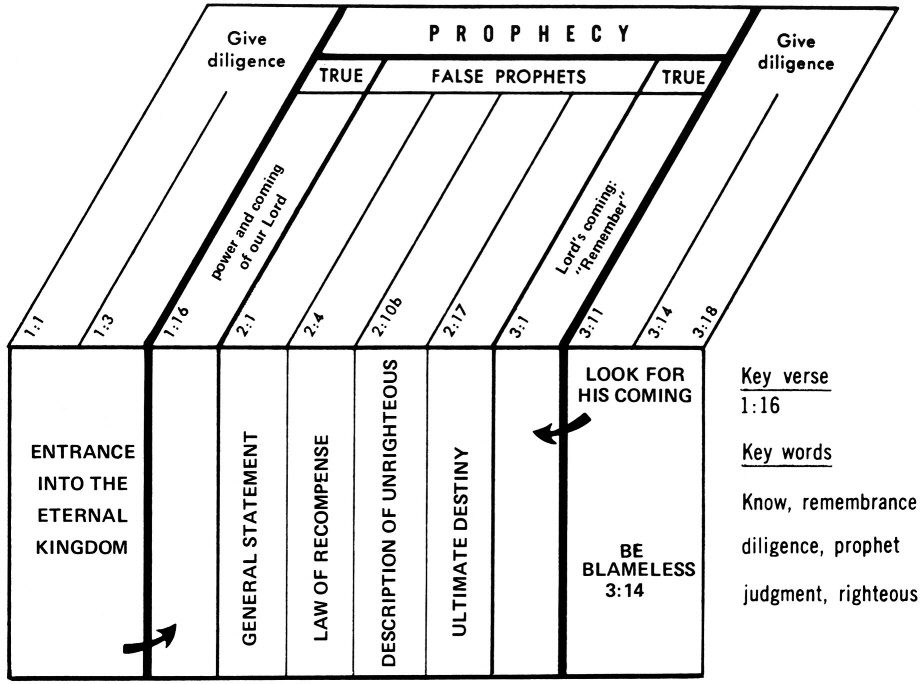
2 Peter: True and False Prophecy
Click chart to enlarge
Chart from Jensen's Survey of the NT - used by permission
|
2 PETER |
||||||||
| Cultivation of Christlike Character |
Condemnation of False Teachers |
Confidence in the Return of Christ |
||||||
| Greeting to Saints 2Pe 1:1-2 |
Growth in Christ 2Pe 1:3-14 |
Grounds |
Danger of |
Demise of |
"Decor" of |
Mockers in |
Manifest |
Maturity in light of that |
| Know Your Salvation |
Know |
Know Your Adversaries |
Know |
|||||
| True Prophecy (True Knowledge) |
False Prophets (False Teachers) |
Final Prophecy (Day of the Lord) |
||||||
| Holiness | Heresy | Hope | ||||||
| Development of Faith |
Denunciation of False Teachers |
Design of The Future |
||||||
2 Peter 1:12 Therefore, I will always be ready to remind you of these things, even though you already know them, and have been established in the truth which is presentwith you. (NASB: Lockman)
Greek: Dio melleso (1SFAI) aei humas hupomimneskein (PAN) peri touton, kaiper eidotas (RAPMPA) kai esterigmenous (RPPMPA) en te parouse (PAPFSD) aletheia.
KJV: Wherefore I will not be negligent to put you always in remembrance of these things, though ye know them, and be established in the present truth.
NLT: I plan to keep on reminding you of these things--even though you already know them and are standing firm in the truth. (NLT - Tyndale House)
Phillips: I shall not fail to remind you of things like this although you know them and are already established in the truth. (Phillips: Touchstone)
Wuest: Wherefore, I intend always to be reminding you concerning these things even though you know them and have become firmly established in the truth which is present with you.
Young's Literal: Wherefore, I will not be careless always to remind you concerning these things, though, having known them, and having been established in the present truth,
THEREFORE I SHALL ALWAYS BE READY TO REMIND YOU OF THESE THINGS: dio melleso (1SFAI) aei humas hupomimneskein (PAN) peri touton:
- I shall always - 2Pe 1:13,15, 3:1 Ro 15:14,15 Php 3:1 1Ti 4:6 2Ti 1:6 Heb 10:32 Jude 1:3,17
- 2 Peter 1 Resources - Multiple Sermons and Commentaries
Note that the KJV derived from the Greek Textus Receptus reads "Wherefore I will not be negligent to put you always in remembrance
Most textual critics feel that this represents a scribal error as it is not found in more modern Greek manuscripts.
Therefore (1352) (dio) marks a close connection with the truths Peter had just mentioned (a faith same kind as Peter's, everything necessary for life & godliness, God's precious & magnificent promises, partakers of the divine nature as manifest in 7 godly traits, escapees from the world's corruption). Peter knows that the best defense against false teaching is true living and that a church filled with saints maturing in the faith is not likely to fall prey to false teachers pushing their counterfeit brand of "Christianity". They find it easy to deceive people who do not know the Word of God and who instead are more desirous of subjective experiences. This sounds very relevant to our modern American church doesn't it? As Peter will show in the next chapter building one's spiritual house on subjective experiences alone while ignoring God's objective revelation is a surefire formula for disaster. And so for the remainder of the chapter Peter seeks to exhort and equip his readers concerning the inerrant authority of God's revealed Word.
Be ready (3195) (mello) means to be about to, to be on the point of doing something. Mello was used in classical Greek, with a sense of certainty conveying the idea "I shall be sure". The idea is that "I shall take care to remind you… ". When?
Always (104) (aei) means always or ever and thus Peter is saying that he will be perpetually, incessantly, invariably ready to remind his readers and was thus not a passing fancy nor a fad. The sense in the Greek is, “I will be intending to remind you always.”
Why? Because it was Peter's call… to feed the sheep (Jn 21:15, 17) … to strengthen the brethren (Luke 22:32). So Peter remained ready at any & every occasion to remind them of these things. Peter knew as do all God's anointed preachers & teachers that even where knowledge and establishment exist, there is always a need for motivation and exhortation and repetition!
Spurgeon writes that…He who exhorts others to be diligent must not himself be negligent, and Peter most appropriately writes, “Wherefore I will not be negligent to put you always in remembrance of these things” We are not merely to preach new truths which people do not know, but we are also to preach the old truths with which they are familiar. The doctrines in which they are well established are still to be proclaimed to them. Every wise preacher brings forth from the treasury of truth things both new and old;-new, that the hearers may learn more than they knew before; old, that they may know and practice better that which they do already know in part.
Remind (5279) (hupomimnesko from hupó = under + mimnesko = to remind) means to put another in mind of something, to cause one to remember, bring to one's mind, remind (remind suggests a jogging of one’s memory by an association or similarity).
The English word memorial refers to a structure or statue established in memory of a person or event. Hupomimnesko conveys the idea of making a memorial of what God is doing in your life and what is the hope set before you!
THOUGHT - Encourage others to make similar memorials because the way you think affects the way you behave, remembering that we are called out to be holy (wholly devoted) to Him. The sense in the Greek is, “I will be intending to remind you always.” Even where knowledge and establishment exist, there is still need for motivation and exhortation.
Of these things - The readers also would already know these things because they had received Peters first letter (First Peter) and this gave them a background for this second epistle. Many of the things discussed in 2 Peter are also found in 1 Peter. What are these things? (see 1Pe 1:3, 4, 5, 6, 7, 8, 9, 10, 11-note) The things before this verse and the things after this verse. The whole chapter is a list of things that we are never to forget. Though we already know them and are already established in them, unless we continue to exercise our minds and exercise our wills in those things, they will slip from our grasp.
Albert Barnes writes that…It was important for Peter to bring known truths to remembrance. Believers are apt to forget them, and then they do not exert the influence that they ought. Amid the cares, the business, the amusements, and the temptations of the world, the ministers of the gospel render us an essential service, even if they do nothing more than remind us of truths which are well understood, and which we have known before. A pastor need not always aim at originality; he renders an essential service to mankind when he reminds them of what they know but are prone to forget. He endeavors to impress plain and familiar truths on the heart and conscience, for these truths are most important for mankind. Though we may be very firm in our belief of the truth, yet it is appropriate that the grounds of our faith should be stated to us frequently, that they may be always in our remembrance. (Barnes NT Notes)
Peter knowing his days were numbered was committed to a "ministry of remembrance" and greatly desired for his readers to retain the truths that they already knew (you cannot remind one of something they don't already know) and so 3x in only 4 verses he expressed this desire to remind them (2Pe 1:12, 13, 15-see notes 2P 1:12, 13, 15). Later in not to mention a similar statement in (2Pe 3:1-note) we find a similar statement. Peter himself knew the tragic consequences of forgetting what you know, having deserted his Lord even though forewarned it would happen. In fact if one were to survey both the Old and New Testaments, he would find that "remembering & forgetting" are important concepts throughout Scripture. Just prior to entering into the Promised Land God warned Israel
Beware (a command in Hebrew and in the Lxx = present imperative - calling for continual vigilance. Why? Because we are a forgetful [ungrateful] people in our old flesh nature!) that you do not forget the LORD (Jehovah) your God (How does one give evidence of forgetting about God?) by not keeping His commandments and His ordinances and His statutes which I am commanding you today" for when they were satisfied and content (v14) "… then your heart will become proud and you will forget the LORD your God Who brought you out from the land of Egypt, out of the house of slavery." (Dt 8:11,14).
Have you "forgotten" Jehovah? Have you shown it by disobedience to His commands? Have you become proud in your own heart? Remember that God is opposed to the proud but gives grace to the humble (Jas 4:6-note), so that your forgetfulness is potentially placing you in "harm's way" in regard to your spiritual walk. Confess your disobedience, your forgetfulness of His past favor and your pride, and repent, so that the times of refreshing might come from the presence of the Lord (Acts 3:19).
EVEN THOUGH YOU ALREADY KNOW THEM AND HAVE BEEN ESTABLISHED IN THE TRUTH WHICH IS PRESENT WITH YOU: kaiper eidotas (RAPMPA) kai esterigmenous (RPPMPA) en te parouse (PAPFSD) aletheia:
- Even though you already know them - 1Jn 2:21 Jude 1:5
- Have been established - 2Pe 3:17 Ac 16:5 Col 2:7 Heb 13:9 1Pe 5:10,12
- 2 Peter 1 Resources - Multiple Sermons and Commentaries
Even though you already know them - Peter is not apologizing for repetition of these things. He is fully aware that we are all forgetful people. Here are two parallel passages...
1 John 2:21+ I have not written to you because you do not know the truth, but because you do know it, and because no lie is of the truth.
Jude 1:5+ Now I desire to remind you, though you know all things once for all, that the Lord, after saving a people out of the land of Egypt, subsequently destroyed those who did not believe.
Know (1492) (eido, oida - eido is used only in the perfect tense = oida) literally means perception by sight (perceive, see) as in Mt 2:2 where the wise men "saw His star". The meaning of eido is somewhat difficult to convey but in general this type of "knowing" is distinguished from ginosko (and epiginosko, epignosis), the other major NT word for knowing, because ginosko refers to knowledge obtained by experience or "experiential knowledge" whereas eido often refers to more intuitive knowledge, although the distinction is not always crystal clear. Eido carries the idea of having the "know how" , the knowledge or skill necessary to accomplish a desired goal. It means to see with the mind’s eye, and signifies a clear and primarily mental perception. In sum eido/oida describes the divinely given intuitive knowledge which Peter's readers had received when they were born again and became partakers of the divine nature (1Pe 1:18-note). Human beings simply cannot know divine truth intuitively unless they become members of God's family.
Eido (oida) then is not so much by experience as an intuitive insight that is "drilled into your heart". In spiritual terms, eido is that perception, that being aware of, that understanding, that intuitive knowledge that only the Holy Spirit of God can give. It is an absolute knowledge, a knowledge that is without a doubt. Oida describes absolute, positive, beyond a peradventure of a doubt, knowledge. Eido/Oida suggests fullness of knowledge, rather than progress in knowledge, which is expressed by ginosko, a distinction illustrated in John 8:55, (Jesus said "you have not come to know {ginosko} Him, but I know {oida} Him). Here Jesus says in essence "I know God perfectly (oida)". In John 13:7 Jesus addresses Peter (Jesus answered and said to him, "What I do you do not realize {oida} now, but you shall understand {ginosko} hereafter.")
Paul has a parallel passage that speaks of believers as being established...
Therefore as you have received Christ Jesus the Lord, so walk (present imperative see our need to depend on the Holy Spirit to obey) in Him, having been firmly rooted and now being built up in Him (CHRIST) and established in your faith, just as you were instructed, and overflowing with gratitude. (Colossians 2:6-7+)
Peter warns his readers
You therefore, beloved, knowing this beforehand, be on your guard (present imperative see our need to depend on the Holy Spirit to obey) so that you are not carried away by the error of unprincipled men and fall from your own steadfastness,(2 Pe 3:17+)
Similarly the writer of Hebrews warns
Do not be carried away (present imperative with a negative see our need to depend on the Holy Spirit to obey) by varied and strange teachings; for it is good for the heart to be strengthened by grace, not by foods, through which those who were so occupied were not benefited.(Heb 13:9+)
Have been established (4741) (sterizo) means to set up, establish (make firm or stable, put beyond doubt), to strengthen, to fix firmly in a place, to cause to be inwardly firm or committed or to (confirm = the removing of doubts by an authoritative statement or indisputable fact). strengthen. The basic idea is that of stabilizing something by providing a support or buttress (a projecting structure of masonry or wood for supporting or giving stability to a wall or building), so that it will not totter. Vine feels that sterizo is derived from stērix, a prop (something that sustains or supports
Perfect tense indicates they were established in the truth in the past (at the time of their initial salvation/regeneration/new birth) and this "establishment" continues into the present in that state. The perfect tense indicates settled state of solid grounding in the truth.
Wuest adds "These saints had become stabilized in the truth and were in a state of being set fast, placed firmly on it. Their knowledge of the Word and the cardinal doctrines of the Christian faith were set in their thinking."
Barclay writes that sterizo "means to make as solid as granite. Suffering of body and sorrow of heart do one of two things to a man. They either make him collapse or they leave him with a solidity of character which he could never have gained anywhere else. If he meets them with continuing trust in Christ, he emerges like toughened steel that has been tempered in the fire." ( Daily Study Bible)
Sterizo is used in Second Thessalonians, Paul writing that when confronted by "perverse and evil men, for not all have faith, the Lord is faithful (trustworthy, worthy of confidence, dependable, reliable) and He will strengthen (stērízō) and protect (military term - of a sentinel keeping guard, of the garrison of a city guarding it against attack from without > to guard against robbery or loss, watch over and defend, keep a person so that they remain safe) you from the evil one." (2Th 3:2, 3)
Paul teaches that we are to look away from faithless men to our never-failing God, Who will firmly establish us on the inside and guard us on the outside from the evil one (probably a reference to our "adversary, the devil… a roaring lion" and the ruler over evil men).
Sterizo is the same word used by the Lord Jesus Christ in His exhortation to Peter that
once you have turned again, strengthen (aorist imperative = Do it now! Do it effectively! Sense of urgency) your brothers. (Luke 22:32+)
Jesus warns the church at Sardis
Wake up (present imperative = command calling for continued spiritual alertness. Verb = gregoreuo as in 1Pe 5:8-note = "Continually be on high alert" - there is no time for indifference; believers are not to just "go with the flow", but as "salt and light" are called to reverse it! To be lights in the midst of a crooked generation), and strengthen (sterizo - aorist imperative - command to do this now - it is urgent - and the context explains why) the things that remain, which were about to die; for I have not found your deeds completed (pleroo) in the sight of My God (Our deeds whether good or evil are ALWAYS in the sight of God! A good reminder!)." (Rev 3:2-note)
The God of all grace will Himself make you stable, firmly fixed on the Rock of your salvation, the One Who is the Truth, and in so doing, resolutely setting your will toward your eternal home. The believer who is established will not be moved by the lion's loud roar (1Pe 5:10-note)
In the truth which is present with you - More literally = In the present truth (the truth present to you).
In a parallel passage that speaks of the value of truth, Paul like a commanding general instructs his troops to…
Stand firm (aorist imperative) - Do it now! Do it effectively! It is urgent.) therefore, HAVING GIRDED YOUR LOINS WITH TRUTH, and HAVING PUT ON THE BREASTPLATE OF RIGHTEOUSNESS, (Ep 6:14-note)
Truth (225) (aletheia from a = without + lêthô = that which is hidden or concealed, the combination meaning out in open) is the the unconcealed reality lying at the basis of and agreeing with an appearance; the manifested, the veritable essence of matter. The basic understanding of aletheia is that it is the manifestation of a hidden reality. For example, when you are a witness in a trial, the attendant says "Raise your right hand. Do you swear that you will tell the truth and nothing but the truth so help you God?" And you say, "I do" and you sit down. The question is asking "Are you willing to come into this courtroom and manifest something that is hidden to us that only you know so that you will bear evidence to that?" And when you do speak the truth, you are manifesting a hidden reality.
Truth then is the correspondence between a reality and a declaration which professes to set it forth. To say it another way, words are true when they correspond with objective reality. Persons and things are true when they correspond with their profession. Hence a truth is a declaration which has corresponding reality, or a reality which is correctly set forth. Since God is Himself the great reality, that which correctly sets forth His nature is pre-eminently the Truth. Truth is the property of being in accord with fact or reality as defined by God. Whatever God says is Truth. Truth is a person, Jesus.
TDNT explains the origin of aletheia - Etymologically aletheia means “nonconcealment.” It thus denotes what is seen, indicated, expressed, or disclosed, i.e., a thing as it really is, not as it is concealed or falsified. aletheia is “the real state of affairs,” e.g., the truth in law, or real events in history, or true being in philosophy… aletheia is “that which has certainty and force”… aletheia is “that on which one can rely”… aletheia is “the state of affairs as disclosed”… aletheia is “truth of statement” used with speaking (Lk 4:25) or teaching (Mk. 12:14)… aletheia is “true teaching or faith” (2Cor. 13:8; 4:2; Gal. 5:7; 1Pe 1:22) (Kittel, G., Friedrich, G., & Bromiley, G. W. Theological Dictionary of the New Testament. Eerdmans)
John writes that…
For the Law was given through Moses; grace and truth were realized through Jesus Christ. (John 1:17)
Jesus said to him, "I am the way, and the truth, and the life; no one comes to the Father, but through Me. (John 14:6)
Is present (3918) (pareimi from pará = near, with + eimí = to be) conveys the idea of a continually being beside another ("there were some present" - Lk 13:1-note, cp 1 Cor 5:3, 2 Cor 10:2,11, 11:9, 13:2, 10, Gal 4:18, 20). TDNT - General Meaning. 1. Presence. páreimi means “to be present” (persons or things), parousía denotes “active presence” (e.g., of representatives or troops, in person; cf. 2 Cor. 10:10). 2. Appearing. páreimi also means “to have come,” “to come,” and parousía “arrival.” (Theological Dictionary of the New Testament: Abridged in One Volume)
Pareimi is the verb used in the Septuagint of Daniel 7:13-note to describe "One like the Son of man" coming and in Rev 17:8-note "the beast" who "was and is not and will come. (cf Rev 11:7+)" Pareimi describes Judas coming to betray Jesus (Mt 26:50). In Col 1:6-note pareimi describes the word of truth, the Gospel, "which has come to" the believers in Colossae.
The present tense in 2 Peter 1:12 speaks of continual presence beside them. These believer's are firmly established in the truth, but Peter is eager to make them stronger because he knows what is coming in the next chapter (false teachers! see 2 Pe 2:1-note) and the best defense against false teaching is the pure milk of the Word, the whole Truth and nothing but the Truth! A problem in many churches today is not that believers do not know what God expects of them, but they either forget or are unwilling to live out the truth they now have.
Baker - To be nearby, present, to have come. Used in an absolute sense (John 7:6; 11:28; Acts 10:21; 17:6; 1 Cor. 5:3; 2 Cor. 10:2, 11; 13:2, 10; 2 Pet. 1:12, meaning the truth which is with you, which ye have received).
Gilbrant - In classical Greek there are two pareimi terms identical in form but different in etymology. One is from the verb of being, eimi plus the preposition para; the other is from eimi (different only in accent), which means “go,” plus para. Their meanings are basically “be present” and “march alongside,” respectively (Liddell-Scott). Only the term derived from the verb of being is relevant to understanding Biblical usage. The noun parousia, “arrival, coming,” is related to pareimi. Parousia is a technical term for the arrival of a ruler or king and was later appropriated by Christian writers and applied to Christ’s second coming. The Septuagint (Lxx) uses pareimi to translate seven Hebrew terms; however, one—bô’ (0935), “come”— clearly dominates. Bô’ is used of individuals “coming” to others (Nu 22:20) or of events “coming” to pass (1 Sa 9:6, Joel 2:1-note). Similar understandings appear in the apocryphal writings (e.g., 1 Maccabees 11:63; 2 Maccabees 3:9; 3 Maccabees 5:21). Although any theological uses of pareimi are questionable in the Septuagint, the stage is set there for the later, technical understanding of parousia... For the NT writers pareimi does not generally function in the same technical capacity as does parousia. There may be some legitimate theological nuances to some texts; however, these should not be pressed. Thus in John 7:6 Jesus explained, “My time is not yet come”; the event in focus here, though, is not Christ’s return but His glorification. Likewise, the fact that “the teacher is present” is not to be pressed into theological significance (John 11:28). Other texts that have theological nuances but which are not necessarily related to the technical use of parousia include 1 Corinthians 5:3; 2 Corinthians 13:10; Colossians 1:6; 2 Peter 1:12 (ibid.). The primary understanding of pareimi concerns those who are physically “present” (Luke 13:1; Acts 24:19). Paul especially used it in this way in reference to his physical presence among his churches (e.g., 2 Cor 11:9; 13:2,10; Gal 4:18,20; etc.). It is used of individuals being “present” before the Lord (Acts 10:33). Once it is used of the beast who will come out of the abyss (Rev 17:8). This use recalls the strange case of 2 Thessalonians 2:9 which uses the noun parousia in reference to the coming of the “lawless one.” (The Complete Biblical Library Greek-English Dictionary)
Pareimi - 23x in 22v - am present(1), been present(1), came(1), come(4), have(1), have come(1), here(1), here present(1), lacks*(1), moment(1), present(10). Matt. 26:50; Lk. 13:1; Jn. 11:28; Acts 10:21; Acts 10:33; Acts 12:20; Acts 17:6; Acts 24:19; 1 Co. 5:3; 2 Co. 10:2; 2 Co. 10:11; 2 Co. 11:9; 2 Co. 13:2; 2 Co. 13:10; Gal. 4:18; Gal. 4:20; Col. 1:6; Heb. 12:11; Heb. 13:5; 2 Pet. 1:9; 2 Pet. 1:12; Rev. 17:8
Pareimi - 59x in 58v the Septuagint - Nu 22:20; Deut. 32:35; Jdg. 19:3; 1 Sam. 9:6; 2 Sam. 5:23; 2 Sam. 13:35; 2 Sam. 15:18; 1 Chr. 14:14; Est. 9:1; Job 1:7; Job 2:2; Ps. 139:8; Prov. 1:27; Prov. 7:19; Isa. 8:1; Isa. 30:13; Isa. 52:6; Isa. 58:9; Isa. 63:4; Lam. 4:18; Dan. 7:13; Joel 2:1; Hab. 3:2
2 Peter 1:13 I consider it right, as long as I am in this earthly dwelling, to stir you up by way of reminder, (NASB: Lockman)
Greek: dikaion de hegoumai, (1SPMI) eph' oson eimi (1SPAI) en touto to skenomati, diegeirein (PAN) humas en hupomnesei,
KJV: Yea, I think it meet, as long as I am in this tabernacle, to stir you up by putting you in remembrance;
NLT: Yes, I believe I should keep on reminding you of these things as long as I live. (NLT - Tyndale House)
Phillips: I consider it my duty, as long as I live in the temporary dwelling of this body, to stimulate you by these reminders. (Phillips: Touchstone)
Wuest: Indeed, I consider it due you as long as I am in this tent, to keep on arousing you by means of a reminder,
Young's Literal: and I think right, so long as I am in this tabernacle, to stir you up in reminding you,
AND I CONSIDER IT RIGHT: dikaion de hegoumai (1SPMI):
- 2 Peter 1 Resources - Multiple Sermons and Commentaries
Consider (2233) (hegeomai) (present tense = continually) primarily signifies to lead, then, to consider (give thought to in order to reach a suitable conclusion, opinion, or decision). Hegeomai was a mathematical term conveying the idea "Think about it and come to a conclusion." Considering involves careful thought, not quick decision. Peter considers this to be his solemn duty or "right" -- “I consider it my duty” (see notes Philippians 3:1; Ephesians 6:1)
Right (1342) (dikaios from dike = right, just) defines that which is in accordance with or conforming to high standards of moral integrity or morally correct behavior. It is that which is in right relation to another and so in reference to persons defines the one who is morally and ethically righteous, upright or just.
The basic meaning of the adjective dikaios describes that which is proper, right, fitting, fair, righteous, just (acting or being in conformity with what is morally upright or good). From a legal viewpoint dikaios refers to one who is law-abiding (doing all that law or justice requires), honest and good in behavior and from a religious viewpoint one who is rightly related to God. In simple terms this trait describes being in accordance with what God requires. The righteous man does what he ought. He is the person who conforms to the standard, will or character of God. For example, Luke describes Zacharias and Elizabeth (John the Baptist's parents) as
both righteous (dikaios) in the sight of God, walking blamelessly in all the commandments and requirements of the Lord. (Lu 1:6)
They were rightly related to God and because of that right relationship, they walked accordingly. Again we see righteous character is associated with righteous conduct. That's what Paul is calling for in those men who would lead God's church.
Dikaios means keeping the commands of God, guiltless and is used to describe the person whose way of thinking, feeling, and acting is wholly conformed to the will of God. In the present context it is better thought of that which is proper and fitting.
Dikaios refers to that which is expected as duty and which is claimed as a right because of one’s conformity to the rules of God. It was Peter's duty to admonish them. It was the right, fitting and proper thing for him to do. He bore a personal responsibility as an apostle who had personally been instructed by Jesus to strengthen his brethren. (Lu 22:32)
AS LONG AS I AM IN THIS DWELLING TO STIR YOU UP: eph oson eimi (1SPAI) en touto to skonomati diegeirein (PAN) humas:
- As long as - 2Pe 1:14 2Co 5:1, 2, 3, 4,8 Heb 13:3
- To stir you up - 2Pe 3:1 Hag 1:14 2Ti 1:6
- 2 Peter 1 Resources - Multiple Sermons and Commentaries
WHILE PETER IS STILL "STIRRING"
HE WILL STIR UP THE SAINTS
I am 74 (2020) and this is my heart's desire while I am still stirring, to stir up the saints, to encourage them to focus on His eternal Word in the present and His blessed coming in the future in order to redeem the time, living not for this present passing world but for the everlasting world to come! John tells us that this "world is passing away, and also its lusts; but the one who does the will of God lives forever." (1 Jn 2:17+) Father grant us enablement by Your Spirit to do Your will well and in so doing to bring great glory to Your Name, in Jesus' Name. Amen
Spiritual leaders are called to continually stir up the waters of indifference, forgetfulness, etc, but not to stir up trouble!
Spurgeon writes "When people are as they should be, it is worth while to stir them up. You do not want to stir up dirty water, but you may stir that which is pure and sweet as much as ever you like. And a good fire sometimes becomes a better one by a little stirring up."
Dwelling (4638) (skenoma from skenóo = to pitch a tent <> from skenos = tent, tabernacle) refers to a tabernacle, booth or tent which was pitched & which conveyed the picture of a temporary, transitory dwelling.
Peter uses the related root word skene in (Mt 17:4) where he speaks of making three tents. Here Peter uses skenoma as a figurative expression for his body just as Paul used (skenos) describing his body as a "tent" in (2Cor 5:1, 4). These bondservants of Christ Jesus were fully aware of the brevity of their earthly life and both were desirous to fulfill the stewardship allotted to them (cf Moses "prayer" in Ps 90:12). All God's saints need to remind themselves that their bodies are pilgrims passing through, "tents" temporarily placed on earth for a purpose, perched on the edge of eternal bliss and should order their steps accordingly!
Stir up (1326) (diegeiro from dia = through + egeiro = awaken, raise, rouse) in the active voice means to cause to wake up or to awaken (as in Lu 8:24) and in the passive voice to become awake. Figuratively it was used of a of a calm sea become stormy or turbulent, a picture the author would have been quite familiar with. Another figurative use is in reference not to the sea but to mental activity to be roused or stirred up (as in the present verse).
Diegeiro is used 7 times in the NT in the NASB…
Matthew 1:24 And Joseph arose from his sleep, and did as the angel of the Lord commanded him, and took her as his wife,
Mark 4:37 And there arose a fierce gale of wind, and the waves were breaking over the boat so much that the boat was already filling up. 38 And He Himself was in the stern, asleep on the cushion; and they awoke Him and said to Him, "Teacher, do You not care that we are perishing?" 39 And being aroused, He rebuked the wind and said to the sea, "Hush, be still." And the wind died down and it became perfectly calm.
Luke 8:24 And they came to Him and woke Him up (diegeiro), saying, "Master, Master, we are perishing!" And being aroused (egeiro), He rebuked the wind and the surging waves, and they stopped, and it became calm.
John 6:18 And the sea began to be stirred up because a strong wind was blowing.
2 Peter 1:13 (note) And I consider it right, as long as I am in this earthly dwelling, to stir you up by way of reminder,
2 Peter 3:1 (note) This is now, beloved, the second letter I am writing to you in which I am stirring up your sincere mind by way of reminder,
Rienecker says the preposition "dia" in this compound is "perfective" conveying the idea to stir up or wake up thoroughly.
Kenneth Wuest agrees writing that "the prefixed preposition (dia) adds the idea of doing a thorough piece of work in arousing their minds".
In sum, diegeiro means to awaken out of literal sleep. Figuratively as used twice by Peter, diegeiro means to arouse or stimulate to mental action. And so it means to stimulate one's thinking or to refresh their memory.
Peter knew that our minds have a tendency to get accustomed to truth and then to take it for granted. We forget what we ought to remember and remember what we ought to forget! We are in a spiritual war, stakes are high & we face a deadly deceptive foe. Peter says it is duty (cf Luke 22:32) to continually (present tense) shake his readers out of their lethargy, to agitate them and arouse them fully out of their somnolent state. There is a similar idea in Peter's first epistle…
Therefore, gird your minds for action, keep sober in spirit, fix your hope (aorist imperative - do it now!) completely on the grace to be brought to you at the revelation of Jesus Christ. (see note 1 Peter 1:13)
Be of sober spirit (aorist imperative - do it now!) be on the alert. (aorist imperative - do it now!) Your adversary, the devil, prowls about like a roaring lion, seeking someone to devour. (see note 1 Peter 5:8)
Paul issues similar calls to stir up believers…
And this do, knowing the time, that it is already the hour for you to awaken (egeiro) from sleep; for now salvation is nearer to us than when we believed. (see note Romans 13:11).
For this reason it says, "Awake (egeiro - present imperative), sleeper, and arise (aorist imperative - do it now!) from the dead, And Christ will shine on you." (see note Ephesians 5:14)
BY WAY OF REMINDER: en hupomnesei:
- By way of reminder - 2Pe 1:12
- 2 Peter 1 Resources - Multiple Sermons and Commentaries
Reminder (5280) (hupomnesis from hupó = under + mimnesko = to remind) is the act of calling something to mind or remembering. It means to think about again (active) or be caused to think about again (passive).
Thayer says that hupomnesis refers to a remembrance prompted by another whereas a closely related word anamnesis denotes an unassisted recalling (although he goes on to state these two words are easily interchangeable in Classical Greek).
In the active sense (reminding) it represents a definite act of the person's will. In the passive sense it refers to a recollection or reminder.
The of word remember comes from the word which means to retain. The word "remind" uses the prefix "hupo" (which means "up under"). Once they were awakened, everything that they had previously learned gets up under them, continues to keep them stirred and continues to keep them stable. It's wonderful how the Holy Spirit will bring to our remembrance what God has already said to us before in His Word (Jn 14:26).
Hupomnesis is used 3 times in the NT (none in the Septuagint) and here are the other two uses…
2 Timothy 1:5 (note) For I am mindful of the sincere faith within you, which first dwelt in your grandmother Lois, and your mother Eunice, and I am sure that it is in you as well.
2 Peter 3:1 (note) This is now, beloved, the second letter I am writing to you in which I am stirring up your sincere mind by way of reminder
Wuest adds that "Peter purposed to do this (continually stir up their minds) by reminding them of the things which they had been taught. The phrase is instrumental of means (Ed note = Greek preposition "en" ~ instrumental). He would arouse their minds to action by reminding them of the truth they had learned from the Word of God. The preacher and teacher should be an intense student of the Word, bringing to his hearers fresh, new truth with the dew of heaven upon it. But there is a place for the repetition of the old truths which the saints know well. Much of it has not yet been put into practice and the fact that it is repeated gives the Holy Spirit an opportunity to make it experiential in the life of the believer."
2 Peter 1:14 knowing that thelaying aside of my earthly dwelling is imminent, as also our Lord Jesus Christ has made clear to me. (NASB: Lockman)
Greek: eidos (RAPMSN) hoti tachine estin (3SPAI) e apothesis tou skenomatos mou, kathos kai o kurios hemon Iesous Christos edelosen (3SAAI) moi;
KJV: Knowing that shortly I must put off this my tabernacle, even as our Lord Jesus Christ hath showed me.
NLT: But the Lord Jesus Christ has shown me that my days here on earth are numbered and I am soon to die. (NLT - Tyndale House)
Phillips: I know that I shall have to leave this body at very short notice, as our Lord Jesus Christ made clear to me. (Phillips: Touchstone)
Wuest: knowing that very soon there is the putting off of my tent, even as also our Lord Jesus Christ gave me to understand.
Young's Literal: having known that soon is the laying aside of my tabernacle, even as also our Lord Jesus Christ did shew to me,
KNOWING THAT THE LAYING ASIDE OF MY EARTHLY DWELLING IS IMMINENT: eidos (RAPMSN) hoti tachine estin (3SPAI) e apothesis tou skenomatos mou,
- Imminent - Dt 4:21,22, 31:14 Jos 23:14 1Ki 2:2,3 Acts 20:25 2Ti 4:6
- 2 Peter 1 Resources - Multiple Sermons and Commentaries
PETER'S SENSE OF URGENCY
STIMULATED BY A SENSE OF IMMINENCY!
Every believer should live, not with a sense of fear, but a sense of forever! By that I mean we are not here forever and therefore we need to focus our remaining time on earth on those things that lasts forever!
Spurgeon - In the last chapter of the gospel according to John, it is recorded how Christ prophesied concerning the death of Peter, that when he was old, he should stretch forth his hands, and another should gird him, and carry him whither he would not. The evangelist adds, “This spake he, signifying by what death he should glorify God.” The prospect of crucifixion was thus always before Peter’s mind; and knowing what was to happen to him, he was not alarmed, but was rather quickened to greater diligence in stirring up the saints to make their calling and election sure.Hear thou behind thee, O Christian, the chariot wheels of thy Lord; hear thou behind thee the whizzing of the arrow of death, and let this quicken thy pace! Work while it is called today, for the sun even now touches the horizon, and the night cometh when no man can work. If we knew how short a time we have to live, how much more earnest, how much more diligent should we be! Let us be up and doing. “Let us not sleep, as do others; but let us watch and be sober,” working diligently until the Lord comes, or calls us home to himself.--- The Lord had told Peter how he was to die. He had told him that he would die by crucifixion: “When thou shalt be old, thou shalt stretch forth thy hands, and another shall gird thee, and carry thee whither thou wouldest not.” He knew that the day of his martyrdom was approaching, and so, being divinely warned, he was the more earnest to preach as a dying man to dying men. I have sometimes heard, as a criticism of that expression of Baxter’s about a dying man preaching to dying men, the remark that it would be better, as living men, to preach to living men. It is quite true that we must throw all our life into our preaching; but, as a rule, living men are never more truly alive than when they are under a due sense that they are also dying men. When we realize that eternity is very near us, and we are consciously drawing near to the great judgment-seat of Christ, than all our faculties are fully aroused, and our whole being is bent on doing the Master’s work with the utmost vigor and earnestness.
Knowing (1492) (eido) is that quality of knowledge that is intuitive not gained by experience. As discussed below Jesus had given this insight to Peter initially some 40 years prior and now he knew the time was very near.
Laying aside (595) (apothesis from apo = away from, indicates separation + tithemi = put) was used of laying off old clothes, as the runners who participated in the Olympic Games. This presents a wonderful picture for us all, for when we have run our last race (cf 2Ti 4:8), we will lay aside our temporal, earthly garment in anticipation of our future glorious apparel.
MacDonald notes that "The fact that Peter knew he would die does not negate the truth of the imminent Return of Christ for His saints, as is sometimes argued. The true church has always expected that Christ may come at any moment. Only by a special revelation did Peter know that he would not be alive when the Lord returned. (MacDonald, W & Farstad, A. Believer's Bible Commentary: Thomas Nelson)
Clearly Peter is presenting the figure of death. Death is described aptly as laying aside one’s dwelling or tent (2Cor 5:1), for tents are well known to be temporary structures.
Dwelling (4638) (skenoma from skenoo= to pitch a tent [a skenos]) describes an encampment, a booth, a pitched tent or a tabernacle (used this way many times in the Septuagint eg, Ps 14:1, 25:8, 42:3, 45:5) and in context is a figurative description of the body as the dwelling place of the soul.
Skenoma - 3x in the NT…
Acts 7:46 "David found favor in God's sight, and asked that he might find a dwelling place for the God of Jacob.
2 Peter 1:13 I consider it right, as long as I am in this earthly dwelling (figuratively = remain alive), to stir you up by way of reminder,
2 Peter 1:1314 knowing that the laying aside of my earthly dwelling is imminent, as also our Lord Jesus Christ has made clear to me.
Skenoma - 68x in the Septuagint (LXX) - Deut 33:18; Josh 3:14; Judg 19:9; 20:8; 1 Sam 4:10; 13:2; 17:54; 2 Sam 7:23; 18:17; 19:9; 20:1, 22; 1 Kgs 2:28; 8:4, 66; 12:16, 24; 2 Kgs 8:21; 13:5; 14:12; 1 Chr 5:20; 2 Chr 7:10; 10:16; 11:14; 21:9; 25:22; Ps 14:1; 18:5; 25:8; 42:3; 45:5; 48:12; 51:7; 60:5; 68:26; 73:7; 77:28, 51, 55, 60, 67; 82:7; 83:2, 11; 86:2; 90:10; 105:25; 119:5; 131:3, 5, 7; Song 1:5, 8; Job 21:28; 39:6; Hos 9:6; Hab 1:6; 3:7; Zech 12:7; Mal 2:12; Jer 9:18; 28:30; Lam 2:6; Ezek 25:4
Imminent (5031) (tachinos from tachús = prompt, swift) and is used here to mean near at hand or impending. The only other NT use of tachinos is also by Peter (2Pe 2:1). The idea is that something is near at hand, impending or coming soon (in the near future). It can also convey the sense of speedy, quick or swift.
Tachinos - 3x in the Septuagint Hag 1:6…
Proverbs 1:16 For their feet run to evil And they hasten to shed blood.
Isaiah 59:7 Their feet run to evil, And they hasten to shed innocent blood; Their thoughts are thoughts of iniquity, Devastation and destruction are in their highways.
Wuest says that imminent implies "the speedy approach of death though others understand it of the quick, violent death which Christ prophesied He should die. ‘Even as our Lord Jesus Christ hath showed me.’ (Jn 21:18, 19) Compare also (Jn 13:36), and note the word "follow" in both passages. ‘Peter had now learned the full force of Christ’s sayings, and to what end the following of Jesus was to bring him.”
Related Resources:
- Imminent, Imminency - Regarding the Return of Christ
- Can the return of Christ truly be said to be imminent?
- Is Jesus coming soon?
- How are we to live our lives in light of Christ's return?
- What is the difference between the Rapture and the Second Coming?
- Is it possible to know when Jesus is coming back?
- What is the blessed hope?
AS ALSO OUR LORD JESUS CHRIST HAS MADE CLEAR TO ME: kathos kai o kurios hemon Iesous Christos edelosen (3SAAI) moi:
- 2 Peter 1 Resources - Multiple Sermons and Commentaries
As also our Lord Jesus Christ - Some of Jesus' last words to Peter were…
“Truly, truly, I say to you, when you were younger, you used to gird yourself and walk wherever you wished; but when you grow old, you will stretch out your hands and someone else will gird you, and bring you where you do not wish to go.” 19 Now this He said, signifying by what kind of death he would glorify God. And when He had spoken this, He said to him, “Follow Me!” (Jn 21:18,19)
Made clear (1213) (deloo from delos = manifest) means to make plain by words and thus to declare. It means to make some matter known that was unknown or not communicated previously. It means to show clearly, to signify, to make manifest, visible, clear, or plain and to make known. When spoken of things past it means to tell, relate or impart information (as in 1Cor 1:11; Col 1:18-note). Although deloo is used most often in reference to declarations through articulate language, it is also used often of any kind of indirect communication.
As noted above, Christ had prophesied (and thus made clear) the death Peter would die almost 40 years earlier (Jn 21:18, 19).
When spoken of things future or hidden, deloo means to reveal, show or bring to light.
Deloo is used 28 times in the Septuagint (LXX) (Exod. 6:3; 33:12; Deut. 33:10; Jos. 4:7; 1 Sam. 3:21; 1 Ki. 8:36; 2 Chr. 6:27; Est. 2:22; Ps. 25:14; 51:6; 147:20; Isa. 42:9; Jer. 16:21; Dan. 2:5f, 9, 11, 16, 23ff, 28ff, 47; 4:18; 7:16). Here are some uses in the Septuagint (LXX)
Exodus 6:3 and I appeared to Abraham, Isaac, and Jacob, as God Almighty, but by My name, LORD, I did not make Myself known (deloo) to them.
Exodus 33:12 Then Moses said to the LORD, "See, Thou dost say to me, 'Bring up this people!' But Thou Thyself hast not let me know (deloo) whom Thou wilt send with me. Moreover, Thou hast said, 'I have known you by name, and you have also found favor in My sight.'
Esther 2:22 But the plot became known (deloo) to Mordecai, and he told Queen Esther, and Esther informed the king in Mordecai's name.
Psalm 25:14 The secret of the LORD is for those who fear Him, And He will make them know (deloo) His covenant.
Psalm 51:6 Behold, Thou dost desire truth in the innermost being, And in the hidden part Thou wilt make me know (deloo) wisdom.
Psalm 147:20 He has not dealt thus with any nation and as for His ordinances, they have not known (deloo) them. Praise the LORD!
Isaiah 42:9 "Behold, the former things have come to pass, Now I declare new things; Before they spring forth I proclaim (Lxx = deloo = make them known) them to you."
Daniel 2:25 Then Arioch hurriedly brought Daniel into the king's presence and spoke to him as follows: "I have found a man among the exiles from Judah who can make the interpretation known (deloo) to the king!"
Deloo is used 7 times in the NT…
1 Corinthians 1:11 Corinthians 1:11 For I have been informed concerning you, my brethren, by Chloe's people, that there are quarrels among you.
1 Corinthians 3:13 each man's work will become evident; for the day will show it, because it is to be revealed with fire; and the fire itself will test the quality of each man's work.
Colossians 1:8 (note) and he also informed us of your love in the Spirit.
Hebrews 9:8 (note) The Holy Spirit is signifying this, that the way into the holy place has not yet been disclosed, while the outer tabernacle is still standing,
Hebrews 12:27 (note) And this expression, "Yet once more," denotes the removing of those things which can be shaken, as of created things, in order that those things which cannot be shaken may remain.
1 Peter 1:11 (note) seeking to know what person or time the Spirit of Christ within them was indicating as He predicted the sufferings of Christ and the glories to follow.
2 Peter 1:14 (note) knowing that the laying aside of my earthly dwelling is imminent, as also our Lord Jesus Christ has made clear (of something divinely communicated) to me.