2 Peter 2:2
2 Peter 2:3
2 Peter 2:4
2 Peter 2:5
2 Peter 2:6
2 Peter 2:7
2 Peter 2:8
2 Peter 2:9
2 Peter 2:10
2 Peter 2:11
2 Peter 2:12
2 Peter 2:13
2 Peter 2:14
2 Peter 2:15
2 Peter 2:16
2 Peter 2:17
2 Peter 2:18
2 Peter 2:19
2 Peter 2:20
2 Peter 2:21
2 Peter 2:22
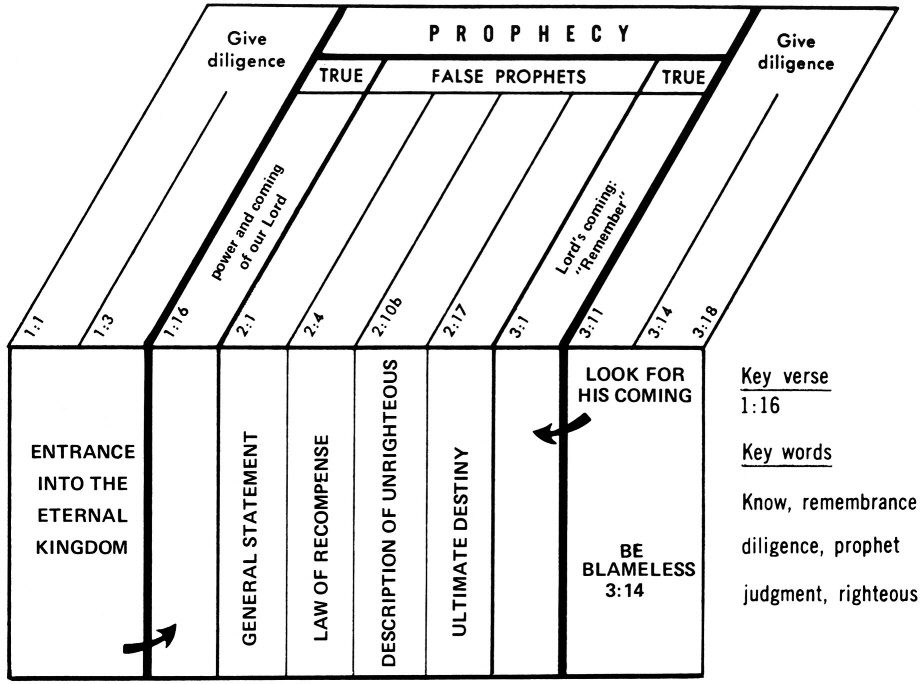
2 Peter: True and False Prophecy
Click chart to enlarge
Chart from Jensen's Survey of the NT - used by permission
|
2 PETER |
||||||||
| Cultivation of Christlike Character |
Condemnation of False Teachers |
Confidence in the Return of Christ |
||||||
| Greeting to Saints 2Pe 1:1-2 |
Growth in Christ 2Pe 1:3-14 |
Grounds |
Danger of |
Demise of |
"Decor" of |
Mockers in |
Manifest |
Maturity in light of that |
| Know Your Salvation |
Know |
Know Your Adversaries |
Know |
|||||
| True Prophecy (True Knowledge) |
False Prophets (False Teachers) |
Final Prophecy (Day of the Lord) |
||||||
| Holiness | Heresy | Hope | ||||||
| Development of Faith |
Denunciation of False Teachers |
Design of The Future |
||||||
2 Peter 2:19 promising (PAPMPN) them freedom while they themselves are (PAPMPN) slaves of corruption; for by what a man is overcome (3SRPI) by this he is enslaved (3SRPI) (NASB: Lockman)
Greek: eleutherian autois epaggellomenoi, (PAPMPN) autoi douloi huparchontes (PAPMPN) tes phthoras o gar tis hetthtai, (3SRPI) touto dedoulotai. (3SRPI)
Amplified: They promise them liberty, when they themselves are the slaves of depravity and defilement-for by whatever anyone is made inferior or worse or is overcome, to that [person or thing] he is enslaved. (Amplified Bible - Lockman)
NET: Although these false teachers promise such people freedom, they themselves are enslaved to immorality. For whatever a person succumbs to, to that he is enslaved. (NET Bible)
NJB: They may promise freedom but are themselves slaves to corruption; because if anyone lets himself be dominated by anything, then he is a slave to it; (NJB)
NLT: They promise freedom, but they themselves are slaves to sin and corruption. For you are a slave to whatever controls you. (NLT - Tyndale House)
Phillips: They promise them liberty. Liberty! - when they themselves are bound hand and foot to utter depravity. For a man is the slave of whatever masters him. (Phillips: Touchstone)
Wuest: While they are promising them liberty, they themselves are slaves of corruption. For by whom a person has been overcome with the result that he is in a state of subjugation, to this one has he been enslaved with the result that he is in a state of slavery.
Young's Literal: liberty to them promising, themselves being servants of the corruption, for by whom any one hath been overcome, to this one also he hath been brought to servitude
PROMISING THEM FREEDOM: eleutherian autois epaggellomenoi (PAPMPN):
- Gal 5:1,13
- 2 Peter 2 Resources - Multiple Sermons and Commentaries
EMPTY
PROMISES
Promising (1861) (epaggello from epi = an intensifier of the verb + aggello = to tell, declare) means to proclaim, promise, declare, announce, claim (profess).
NASB Usage: made(1), made the promise(1), making a claim(1), professed(1), promise had been made(1), promised(9), promising(1).
Vine - "to announce, proclaim," has in the NT the two meanings "to profess" and "to promise," each used in the Middle Voice; "to promise" (a) of "promises" of God, Acts 7:5 ; Romans 4:21 ; in Galatians 3:19 , Passive Voice; Titus 1:2 ; Hebrews 6:13 ; 10:23 ; 11:11 ; 12:26 ; James 1:12 ; 2:5 ; 1 John 2:25 ; (b) made by men, Mark 14:11 ; 2 Peter 2:19.
Zodhiates - To proclaim as public announcements or decrees; hence to announce a message, summons, or a promise. In the Class. Gr., used more in the sense of announcing a summons, issuing a command. In the NT, used only in the mid. voice, epaggéllomai, as a deponent verb meaning basically to announce oneself, offer oneself for a responsibility or service.
Friberg - (1) as a divine or human declaration, offering to do something (make a) promise, offer (James 1.12); (2) as what one is asserting about himself profess, lay claim to (1Ti 2.10)
BDAG (summarized) 1. to declare to do something with implication of obligation to carry out what is stated, promise, offer 2. to claim to be well-accomplished in something - profess, lay claim to, give oneself out as an expert in something (1Ti 2:10) God to give a promise (1Jn 2:25)
Thayer (summarized) 1. to announce that one is about to do or to furnish something, i. e. to promise (of one's own accord), to engage (voluntarily); to give a promise to one (Heb 10:23, Ro 4:21) 2. to profess; ti,, e. g. an art, to profess oneself skilled in it
TDNT (Classic Greek use) - a. The first sense is “to indicate,” “declare,” “declaration,” “report.” b. When the state declares something, it becomes an “order.” c. In law we find the senses “accusation” and “delivery of a judgment.” d. We then find the senses “to declare an achievement,” “to show one's mastery,” “to profess a subject.” e. Another sense is “to offer,” “to promise,” “to vow.” As regards promises, tension between word and deed is felt, so that promises are often seen as worthless. f. A special type of promise is the “promise of money,” and in this sense the idea of a “subscription” or “donation” arises (state liturgies, gifts to rulers at their accession, priests promising gifts in support of their candidature). g. In the Hellenistic period we also find a sacral use for the “proclamation” of a festival. Among all the instances, only one example has been found for the promise of a deity.
Epaggello - 15x in 15v - Mark 14:11; Acts 7:5; Rom 4:21; Gal 3:19; 1 Tim 2:10; 6:21; Titus 1:2; Heb 6:13; 10:23; 11:11; 12:26; Jas 1:12; 2:5; 2 Pet 2:19; 1 John 2:25. The only uses in the non-apocryphal Septuagint are Esther 4:7, Pr 13:12
Peter pictures these deceivers as announcing proclamations with a sense of certainty that the promise will be fulfilled. The false teachers never cease proclaiming (present tense indicates continuous action -- lie, lie, lie - that was their modus operandi!) their deceitful promise of "freedom" but as shown below their walk does not match their talk. Peter uses a bit of sarcasm here emphasizing the ridiculousness of the possibility that people who are slaves of sin themselves could ever set anybody else free!
Be careful when someone promises you freedom with "no strings attached" (e.g., freedom to live as you please), because true spiritual freedom in Christ is not the right to do as you please, but is the liberty (and the power) to do as you should. No man is right to do as he pleases unless he pleases to do right! In other words, true Christian liberty is the liberty from sin and not to sin. The glory of the Gospel brings spiritual freedom, while the disgrace of this "brand" of false teaching brings bondage to sin, self and Satan.
In his first letter Peter wrote that believers are to...
Act as free men, and do not use your freedom as a covering for evil, but use it as bondslaves of God. (See note 1Pe 2:16)
Jonathan Edwards said it this way...
True liberty consists only in the power of doing what we ought to will, and in not being constrained to do what we ought not to will.
Oswald Chambers phrased it this way...
Liberty means ability not to violate the law of God. License means personal insistence on doing what I like.
A W Tozer put it in pithy terms writing that...
The important thing about a man is not where he goes when he is compelled to go, but where he goes when he is free to go where he will...Where we go when we are free to go where we will is a near-infallible index of character.
William Barclay - Christian liberty always carries danger. Paul tells his people that they have indeed been called to liberty but that they must not use it for an occasion to the flesh (Galatians 5:13). Peter tells his people that indeed they are free but they must not use their freedom as a cloak of maliciousness (1Pe 2:16). These false teachers offered freedom, but it was freedom to sin as much as a man liked. They appealed not to the best but to the worst in a man. Peter is quite clear that they did this because they were slaves to their own lusts. Seneca said, "To be enslaved to oneself is the heaviest of all servitudes." Persius spoke to the lustful debauchees of his day of "the masters that grow up within that sickly breast of yours." These teachers were offering liberty when they themselves were slaves, and the liberty they were offering was the liberty to become slaves of lust. Their message was arrogant because it was the contradiction of the message of Christ; it was futile because he who followed it would find himself a slave. Here again in the background is the fundamental heresy which makes grace a justification for sin instead of a power and a summons to nobility. (2 Peter 2- William Barclay's Daily Study Bible)
Freedom (1657) (eleutheria from eleutheros- that which is capable of movement, freedom to go wherever one likes, unfettered; see word study on verb eleutheroo) describes the state of being free and stands in opposition to slavery or bondage.
Vine writes that it means...
“liberty” , is rendered “freedom” in Gal. 5:1, “with freedom did Christ set us free.” The combination of the noun with the verb stresses the completeness of the act, the aorist (or point) tense indicating both its momentary and comprehensive character; it was done once for all. The RV margin “for freedom” gives perhaps the preferable meaning, i.e., “not to bring us into another form of bondage did Christ liberate us from that in which we were born, but in order to make us free from bondage.”
The word is twice rendered “freedom” in the RV of Gal. 5:13 (KJV, “liberty”). The phraseology is that of manumission from slavery, which among the Greeks was effected by a legal fiction, according to which the manumitted slave was purchased by a god; as the slave could not provide the money, the master paid it into the temple treasury in the presence of the slave, a document being drawn up containing the words “for freedom.” No one could enslave him again, as he was the property of the god. Hence the word apeleutheros, No. 2. The word is also translated “freedom” in 1 Pet. 2:16, rv. In 2 Cor. 3:17 the word denotes “freedom” of access to the presence of God. See liberty. (Vine, W E: Vine's Complete Expository Dictionary of Old and New Testament Words)
Eleutheria refers to personal liberty but not license. The deceiving (and deceived - see 2Ti 3:13) false teacher promise their listeners the freedom to live as they please. To the contrary, true liberty is living as we should not as we please. Eleutheria was used especially in NT times of the freeing of slaves.
Chuck Swindoll has an excellent illustration of the meaning of the verb eleutheria....
Back in the nineteenth century our sixteenth president realized something radical must be done about slavery in our country. Unwilling to look the other way any longer, on September 22, 1862, he presented what came to be known as the Emancipation Proclamation, an official document condemning human slavery. Abraham Lincoln, realizing that slavery is completely against human dignity, officially abolished it from the United States on that day. Tragically, little changed in the daily life of our nation, even though the slaves were officially declared free. You know why; you’ve read the stories. The Civil War was still going on. The plantation owners never informed their slaves. The vast majority of the former slaves couldn’t read, so they had no idea what the news was carrying. There was no mass media then to announce those kinds of presidential pronouncements. And so for the longest time, slavery continued even though it had been officially brought to an end. The war ended in April 1865. Do you know when Lincoln’s declaration was officially enacted? When the people finally began to leave their enslaved lives and make their way toward freedom? December 18, 1865—more than three years after he first released his proclamation. Lincoln had been dead for months. The word traveled out of the streets of Washington and down into the Shenandoah Valley of Virginia, across the back roads of the Carolinas and into Georgia, then Alabama, then Mississippi, then Louisiana, then Texas, then Arkansas, announcing what had been true for more than a thousand days. Even then the word somehow either wasn’t believed or wasn’t acted upon. Those officially emancipated people, thinking slavery was the way they were condemned to exist, continued to live in bondage though they had been declared free men and women since the fall of 1862. (Embraced by the Spirit The Untold Blessings of Intimacy with God)
NIDNTT writes that in classic Greek...
The noun eleutheria is derived from the adjective eleutheros. O. Schrader derives it from the Indo-Germanic *leudh-, belonging to the people, and thus not subject. It is connected with Lat. liber (free), and Schrader links it with Old High German liut, Modern German Leute, people (Reallexikon der indogermanischen Altertumskunde, II 19292, 454 f.; but cf. Liddell-Scott, 532). In so far as a man belongs to the people, he is a free citizen as contrasted with a slave or foreigner. Eleutheria thus means freedom, independence, in the sense of being independent of others, being able to dispose. This way of speaking arose originally in contrast to the bondage of slaves. Similarly, the adjective eleutheros means free, not bound, of free birth. It also indicates someone who is his own master. Later the noun and the adj. could occasionally be used to denote the mental attitude which makes use of freedom. It could be used (as it mostly was) in the good sense of noble, being in control of oneself, magnanimous, generous. But it could also be used in the less frequent and bad sense of being reckless, or unrestrained.
In secular Gk. eleutheros has primarily a political sense. The eleutheros is the full citizen who belongs to the polis, the city state, in contrast to the slave who did not enjoy full rights as a citizen. Freedom consists in his right to participate fully in public debates over civic matters. It is the right of free speech, parrhesia openness, boldness, frankness. He can decide about his own affairs within the polis. On numerous occasions, Aristotle spoke of the Gk. polis as the community of the free. He considered freedom to be the essential good of the polis. But in order to preserve this freedom, the law (nomos) is required as the principle of order. Freedom and law are thus not contradictory opposites. They belong together and qualify each other. The constant danger is rejection of the law in the name of a misconceived freedom which is purely arbitrary, because it is willing to grant itself more freedom than it is willing to grant to others. This idea of freedom was naturally applied to relations between states which gave rise to the idea of sovereignty. (See further H. Schlier, TDNT II 487-92.)
The mystery religions had their own answer to the question of freedom. Through the cultic rites, the initiate was freed from this hopeless world and obtained a part in the destiny of the deity (Brown, Colin, Editor. New International Dictionary of NT Theology. 1986. Zondervan)
In the most basic form, this word group related to a "free man" in contrast with a slave. Such persons were usually born free, but some of them had purchased their freedom.
There are 17 uses of eleutheria in the NT...
Romans 8:21 (note) that the creation itself also will be set free from its slavery to corruption into the freedom of the glory of the children of God.
Comment: Freedom in this context refers to the time when all believers will be liberated finally and completely from the effects and temptation of fallen flesh nature and set free even from the pleasure of sin, to share eternally in God’s glory, with which He will clothe all His liberated sons and daughters.
1 Corinthians 10:29 I mean not your own conscience, but the other man's; for why is my freedom judged by another's conscience?
Comment: Freedom is presented as the supreme blessing of the new covenant of grace, which, in contrast with the Old covenant of law, is represented as including independence from religious regulations and legal restrictions (1Co 10:29; 2Co 3:17; Ga 2:4; 2Pe 2:19).
John MacArthur writes: Our own freedom should not be judged by another’s conscience. That is, we should not cause our freedom to be slandered by expressing it in ways that offend a weaker brother. We should give thanks for the food and for our liberty and then express our liberty by choosing not to eat the food that offends the brother. How can we be thankful to the Lord for something a Christian brother or sister is going to stumble over?
A T Robertson comments that: Paul deftly puts himself in the place of the strong brother at such a banquet who is expected to conform his conscience to that of the weak brother who makes the point about a particular piece of meat. It is an abridgment of one’s personal liberty in the interest of the weak brother. Two individualities clash. The only reason is love which builds up (1Co 8:2 and all of 1Cor 13:1ff). There is this eternal collision between the forces of progress and reaction. If they work together, they must consider the welfare of each other.
2 Corinthians 3:17 Now the Lord is the Spirit; and where the Spirit of the Lord is, there is liberty.
Comment: In context believers now have freedom of access to God without fear in opposition to the fear in Ex. 34:30. We need no veil and we have free access to God. The end of the dominance of the Law means liberty.
Galatians 2:4 But it was because of the false brethren who had sneaked in to spy out our liberty which we have in Christ Jesus, in order to bring us into bondage (to the law, legalism).
Comment: Here eleutheria describes the unfettered condition of the Christian soul in contrast with the Jewish condition of bondage to law. Spiritual liberty or spiritual bondage? Note the Source of the freedom is "in Christ Jesus", made effective by the Spirit of Christ who indwells believers - see 2Co 3:17. Christian freedom is not license. When we become free in Christ we lose our freedom to sin, of which we were once a slave.
Galatians 5:1 It was for freedom that Christ set us free; therefore keep standing firm and do not be subject again to a yoke of slavery.
Comment: Human freedom that in which man was originally created, is not liberty to do wrong or to indulge oneself, but in fact is liberty to obey God. As Vine says "Man is so constituted that only as he pleases God can he be happy in the higher, the spiritual, part of his nature, and efficient for the great ends for which he was created. The essence of the Fall lay in this, that man used his endowment of freedom against the Giver of it. Instead of enhancing and extending his freedom by his disobedience, however, man’s first exercise of his will apart from God brought him into bondage to a new master, sin (Ro 6:17, 18; 7:14), working through a threefold agency, the world, the flesh, and the devil (1Jn 2:16, 17; 3:8). Thus sin is not the true master of men, but a usurper, ruling with rigor, albeit the rule is disguised so that not even the wisest seems capable of recognizing it apart from the teaching of the Spirit of God."
Long my imprisoned spirit lay
Fast bound in sin and nature's night;Thine eye diffused a quickening ray,
I woke, the dungeon flamed with light;My chains fell off, my heart was free;
I rose, went forth, and followed Thee.
Galatians 5:13 For you were called to freedom, brethren; only do not turn your freedom into an opportunity for the flesh, but through love serve one another.
Comment: Paul says our liberty in Christ has limits imposed by our consideration of others.
James 1:25 (note) But one who looks intently at the perfect law, the law of liberty, and abides by it, not having become a forgetful hearer but an effectual doer, this man shall be blessed in what he does.
James 2:12 So speak and so act, as those who are to be judged by the law of liberty.
1 Peter 2:16 (note) Act as free men, and do not use your freedom as a covering for evil, but use it as bondslaves of God.
Comment: Real "freedom" is a marvelous paradox for it entails enslavement to God!
2 Peter 2:19 (note) promising them freedom while they themselves are slaves of corruption; for by what a man is overcome, by this he is enslaved.
Comment: Christian liberty is far removed from the fleshy license which these false teachers promise their foolish followers. John Bunyan (1628-88), author of Pilgrim's Progress, suffered in Bedford jail for his faith so was especially qualified to write on the subject of freedom
Wherefore, though the Christian, as a Christian, is the only man at liberty, as called thereunto of God; yet his liberty is limited to things that are good: he is not licensed thereby to indulge the flesh.
There is one use of eleutheria in the Septuagint...
Leviticus 19:20 'Now if a man lies carnally with a woman who is a slave acquired for another man, but who has in no way been redeemed, nor given her freedom, there shall be punishment; they shall not, however, be put to death, because she was not free.
Freedom is presented as a signal blessing of the economy of grace, and these false teachers are turning the grace of God into licentiousness, continually promising those “trying to escape” the struggles of life, the very freedom they themselves do not possess. For example they may teach false doctrines such as "Freedom in Christ means “doing your own thing” or “having it your way”, a devilish doctrine that is the very essence of sin and rebellion against the will of God and His holiness.
In stark contrast the freedom Jesus Christ offers is enjoying fulfillment IN the will of God. It is freedom and inherent Spirit given ability to live as one SHOULD, not as one PLEASES! Our victory in Christ is over death and the power of sin (1Cor 15:55, 56, 57) and frees the redeemed to achieve their greatest human potential to the glory of God.
The Quaker Rufus Jones, paraphrasing Aristotle, said, “The true nature of a thing is the highest that it can become.”
Jesus Christ frees us to become our very best for God in this fleeting life, and then to be like Him in the next. These false teachers brought their followers into bondage by means of the LIE, whereas our Lord Jesus Christ brings men into freedom by means of the TRUTH. teaching the basic spiritual principles that "you will know the truth, and the truth will make you free." (Jn 8:31, cp Jn 17:17) and the opposite principle that "everyone who commits (present tense = habitually, as their lifestyle) sin is the slave of sin." (Jn 8:34)
The false teachers promise freedom, but their promotion of licentiousness only brings bondage for freedom can never be found in the flesh, but only in God’s Spirit (contrast those in Jude 1:19). Unqualified freedom in any area of human life is deceptive and deadly.
As A W Tozer said "Freedom is liberty within bounds: liberty to obey holy laws, liberty to keep the commandments of Christ, to serve mankind, to develop to the full all the latent possibilities within our redeemed natures. True Christian liberty never sets us free to indulge our lusts or to follow our fallen impulses. (God Tells the Man Who Cares. 1992, page 185)
Freedom isn’t found in what Jesus can give us, but only in Jesus Himself. Those who live by God’s truth enter into more and more freedom, but those who live by lies experience more and more bondage, until
the latter end is worse with them than the beginning (see note 2 Peter 2:20)
To reiterate, the freedom offered by these teachers is a false freedom, a freedom that tragically (ironically) only leads to bondage. It is based on false promises, empty words that sound exciting but that have no divine authority behind them. It is offered by false Christians (wolves in sheep's clothing) who were involved in a false experience. From start to finish, this brand of freedom is clearly the work of our adversary, the devil (Jn 8:44).
The writer of Hebrews warns us to beware of the deceitfulness of sin (Heb 3:13).
Related Resource:
Sin always promises freedom but in the end brings bondage. It promises life but instead brings death. Sin has a way of gradually binding a person until there is no way of escape, apart from the gracious intervention of the Lord. Even the bondage that sin creates is deceitful, for the people who are bound actually think they are free! Too late they discover that they are prisoners of their own appetites and habits.
Wuest has this note...
The liberty spoken of in Gal 5:1 is liberty from the Mosaic law, not liberty to do as one pleases. The one set at liberty from the law is under a stronger and more effective compulsion, namely, divine love as ministered to the yielded saint by the Holy Spirit (Gal 5:13). These false teachers, not being saved and therefore not knowing grace, misrepresented the latter as license to sin.
John Piper has a reasoned discussion of this section noting that
false teachers were right to promise people freedom. The call to freedom is at the heart of New Testament faith. But this was not a call to give free reign to your passions. For then you are really a slave of corruption as verse 19 says. The apostolic call to freedom recognizes 1) that Christ had died to free us from the guilt and power of sin; 2) that we are free from the law in the sense that we need no longer strive to keep it in our own strength; and 3) we are given new hearts by the Holy Spirit so that freely we delight in holiness. But everywhere this gospel of freedom was preached false teachers distorted it. And 2Pe 3:16 [note] shows that the writings of the apostle Paul were a sitting duck for this distortion. It says, "There are some things in them hard to understand, which the ignorant and unstable twist to their own destruction." The false teachers take the unstable souls (cf 2Pe 2:14) and teach how to use the letters of Paul to justify their view of sexual freedom. Paul already knew that his teaching about freedom was open to this abuse and he warned against it. For example, in Gal 5:13 he says: "You were called to freedom, brethren; only do not use your freedom as an opportunity for the flesh, but through love be servants of one another." But the false teachers were doing just that, using their freedom as an opportunity to indulge their love for money and their love for praise and the love for sexual pleasure. They probably quoted Gal 5:1 with great power among the new and unstable converts: "For freedom Christ has set us free; stand fast therefore and do not submit again to a yoke of slavery!" "Away with the enslaving rules that govern the life of the body! You are not under law; you are under grace!" But they probably neglected entirely those other teachings of Paul, "If you live according to the flesh you will die, but if by the Spirit you put to death the deeds of the body you will live" (Ro 8:13). So Peter blasts the trumpet of warning: they are twisting the Scriptures to their own destruction and their promised freedom is a bondage to corruption. (Better Never to Have Known the Way)
BEWARE OF YOUR OWN LUSTS! > Consumed by Their Own Lust
Radio personality Paul Harvey tells the story of how an Eskimo kills a wolf. The account is grisly, yet it offers fresh insight into the consuming, self-destructive nature of sin.
First, the Eskimo coats his knife blade with animal blood and allows it to freeze. Then he adds another layer of blood, and another, until the blade is completely concealed by frozen blood.
Next, the hunter fixes his knife in the ground with the blade up. When a wolf follows his sensitive nose to the source of the scent and discovers the bait, he licks it, tasting the fresh frozen blood. He begins to lick faster, more and more vigorously, lapping the blade until the keen edge is bare. Feverishly now, harder and harder the wolf licks the blade in the arctic night. So great becomes his craving for blood that the wolf does not notice the razor-sharp sting of the naked blade on his own tongue, nor does he recognize the instant at which his insatiable thirst is being satisfied by his OWN warm blood. His carnivorous appetite just craves more—until the dawn finds him dead in the snow!”
Dr. George Sweeting wrote in Special Sermons For Special Days It is a fearful thing that people can be “consumed by their own lusts.” Only God’s grace keeps us from the wolf’s fate. -- Chris T. Zwingelberg
This powerful illustration from Paul Harvey—of a wolf unknowingly killing itself by licking a blood-covered knife—perfectly portrays the deceptive, destructive nature of sin. It highlights how sin, like the frozen blood, disguises itself as harmless or satisfying, yet ultimately leads to self-destruction. The wolf’s inability to recognize that it is consuming its own lifeblood mirrors how sinners become consumed by their own appetites, often without realizing their peril until it’s too late.
Below are Scriptures that beautifully complement this illustration and can be used in teaching, preaching, or devotional writing:
Scriptures That Align with This Illustration
1. James 1:14–15 But each one is tempted when he is carried away and enticed by his own lust. Then when lust has conceived, it gives birth to sin; and when sin is accomplished, it brings forth death.
Key Connection: Just as the wolf is drawn by its appetite and unknowingly seals its doom, so those who are lured by sinful desires will inevitably find that sin leads to spiritual death.
2. Romans 6:23 For the wages of sin is death, but the free gift of God is eternal life in Christ Jesus our Lord.
Key Connection: The wolf’s fatal appetite mirrors the consequence of sin—death. Only God's grace rescues us from this fate through Christ.
3. Proverbs 14:12 There is a way which seems right to a man, but its end is the way of death.
Key Connection: The wolf thinks it is feeding itself, but is destroying itself. Sin often appears satisfying, even harmless, until its deadly end is revealed.
4. Galatians 6:7–8 Do not be deceived, God is not mocked; for whatever a man sows, this he will also reap.
For the one who sows to his own flesh will from the flesh reap corruption, but the one who sows to the Spirit will from the Spirit reap eternal life.Key Connection: The wolf "sows to the flesh" and reaps corruption—death. Habitual sin is self-sabotaging.
5. 2 Peter 2:19 …by what a man is overcome, by this he is enslaved.
Key Connection: The wolf is overcome by its appetite—its own nature—just as sinners can become enslaved by their own desires until it destroys them.
6. Proverbs 5:22 His own iniquities will capture the wicked, and he will be held with the cords of his sin.
Key Connection: Sin is not something merely external—it comes from within and traps us. The wolf is literally consuming and being trapped by its own blood.
7. Jeremiah 17:9 The heart is more deceitful than all else and is desperately sick; who can understand it?
Key Connection: Like the wolf deceived by its own hunger, the human heart deceives itself into thinking sinful desires will satisfy.
8. Hebrews 3:13 But encourage one another day after day… so that none of you will be hardened by the deceitfulness of sin.
Key Connection: Sin deceives—and that deception leads to spiritual death if unchecked, just like the wolf’s fatal ignorance.
9. Isaiah 59:2 But your iniquities have made a separation between you and your God, and your sins have hidden His face from you so that He does not hear.
Key Connection: The wolf’s insatiable appetite leads to separation from life, just as sin separates us from God—unless we repent.
Illustration - Everybody longs for freedom. But for many people its pursuit leads to bondage. Beloved Bible teacher Henrietta Mears knew the secret of true freedom, and she wanted her students to know it too. With young people in mind, she said, "A bird is free in the air. Place a bird in the water and he has lost his liberty. A fish is free in the water, but leave him on the sand and he perishes. He is out of his realm. So, young people, the Christian is free when he does the will of God and is obedient to God's command. This is as natural a realm for God's child as the water is for the fish, or the air for the bird."
Wise King Solomon urged his son to understand that true freedom is possible only within the sphere of God-centered living, for which He created us. By contrast, bondage predictably and inescapably comes to anyone who ignores God's truth. Proverbs 16 describes the liberty and satisfaction that come from practicing humility, trust, careful conversation, and self-control. But it also warns about the inevitable bondage that comes into the lives of people governed by willful rebellion, pride, arrogance, strife, and malicious trouble-making.
The New Testament introduces us to Jesus—the ultimate source of our freedom. He, our Creator and Redeemer, said, "If you abide in My word, you are My disciples indeed. And you shall know the truth, and the truth shall make you free" (John 8:31, 32). —M. R. De Haan II Our Daily Bread, Copyright RBC Ministries, Grand Rapids, MI. Reprinted by permission. All rights reserved)
True freedom is not having our own way,
but yielding to God's way.
Foretold -Isaiah 42:7; 61:1
CONFERRED
- By God -Colossians 1:13
- By Christ -Galatians 4:3-5; 5:1
- By the Holy Spirit -Romans 8:15; 2Co 3:17
- Through the gospel -John 8:32
- Confirmed by Christ -John 8:36
- Proclaimed by Christ -Isaiah 61:1; Luke 4:18
- The service of Christ is -1 Corinthians 7:22
IS FREEDOM FROM
- The law -Romans 7:6; 8:2
- The curse of the law -Galatians 3:13
- The fear of death -Hebrews 2:15
- Sin -Romans 6:7,18
- Corruption -Romans 8:21
- Bondage of man -1 Corinthians 9:19
- Jewish ordinances -Galatians 4:3; Colossians 2:20
- Called the glorious liberty of the children of God -Romans 8:21
- Saints are called to -Galatians 5:13
SAINTS SHOULD
- Praise God for -Ps 116:16,17
- Assert -1Co 10:29
- Walk in -Psalms 119:45
- Stand fast in -Ga 2:5; 5:1
- Not abuse -Galatians 5:13; 1 Peter 2:16
- Not offend others by -1Corinthians 8:9; 10:29,32
- The gospel is the law of -James 1:25; 2:12
FALSE TEACHERS
- Promise, to others -2 Peter 2:19
- Abuse -Jude 1:4
- Try to destroy -Ga 2:4
- The wicked, devoid of -Jn 8:34; Ro 6:20
- Typified -Lv 25:10-17; Ga 4:22, 23, 24, 25, 26,31
WHILE THEY THEMSELVES ARE SLAVES OF CORRUPTION: autoi douloi huparchontes (PAPMPN) tes phthoras:
- Jn 8:34; Ro 6:12, 13, 14, 15, 16, 17, 18, 19, 20, 21, 22; Titus 3:3
- 2 Peter 2 Resources - Multiple Sermons and Commentaries
While - When you encounter words like this that indicate an expression of time, pause and query the word. To what time does it refer? What happens during this time?, etc
Literally "themselves being bondservants of the corruption."
These false teachers first come as a trusted guest, linger to become an appealing host, and remain to enslave their unwitting victims!
Since these false teachers have denied Jesus Christ Who purchased with His own blood enslaved sinners from the power of sin (2Pe 2:1), they have in effect denied the only Source of spiritual freedom (Jn 8:31, 32, 36, Ro 8:2, Ga 5:1). Writing to Titus Paul reiterates every man's condition who refuses God's offer of forgiveness in Christ...
For we also once were foolish ourselves, disobedient, deceived, enslaved to various lusts and pleasures, spending our life in malice and envy, hateful, hating one another. (see note Titus 3:3)
A good rule of thumb by which to judge whether a teacher is true or false is to listen to what they say about the Cross. When any teacher does not put the Cross at the center of his or her teaching, beware! Turn from that teacher. Our redemption is in the blood. Jesus bought us with His blood.
They themselves (the false teachers) are unable to deliver the freedom they promise, because they themselves are (continuously enslaved to the very corruption which their followers are also trying to escape. You cannot set someone free if you are in bondage yourself, and these false teachers were in bondage to sin. They professed to be born again but had never really been redeemed (set free) themselves as proven by their permanent condition of enslavement! A profound irony of sin is evident here: the quest for freedom from God leads only to slavery to sin and self. True freedom from sin involves joyful “slavery” to God (cf. Ro 6:18). The apostate ministers talk a lot about freedom, but they mean freedom from divine authority and freedom to sin. Actually, this is not liberty but the worst form of bondage. They themselves are slaves of corruption. Bound by the chains of evil lusts and habits, they are powerless to break free.
Are - Notice this verb is in the present tense which indicates their continual enslavement to sin, their master, a cruel master indeed!
Slaves (1401)(doulos from deo = to bind so doulos = one bound to another) is one who is in bondage or bound to another and thus describes the horrible state of being completely controlled by "sin". The men refuse to bow to the Lordship of Jesus and are mastered by their fallen flesh. Jesus made it clear that "No one can serve (douleuo) two masters; for either he will hate the one and love the other, or he will be devoted to one and despise the other. You cannot serve (douleuo) God and wealth." (Mt 6:24)
Doulos is the most abject, servile form of slavery. The "doulos" is the possession of his master (the master in context being personified by whatever specific sin it is that conquers him) and is obligated to do "sin's" will, They should have been bond servants of Jesus Christ (1Pe 2:!6, etc) but instead chose to to have "corruption" as their master.
Matthew Henry sums up their sad state - Their own lusts have gotten a complete victory over them, and they are actually in bondage to them (Ro 6:16), making provision for the flesh (Ro 13:!4) to satisfy its cravings (Ed: Which are continually waging war against our soul = 1Pe 2:11), comply with its directions, and obey its commands. Their minds and hearts are so far corrupted and depraved that they have neither power nor will to refuse the task that is imposed on them. They are conquered and captivated by their spiritual enemies, and yield their members servants of unrighteousness (Ro 6:13).
Corruption (5356) (phthora from phtheiro = to destroy by means of dissolution which in turn is brought about by internal not external decay) (3/8 NT uses in 2Peter 1:4, 2:12, 19) describes a state of ruin or destruction with the implication of disintegration, decay or rotting (like fruit or vegetables that you leave in the refrigerator crisper for months! What a picture of the hearts of these men.). In context Peter is using it to describe the "rotting" of the morals and loss of integrity that results from a slow, inexorable internal decay or as Bishop Moule phrases it men "on the way to final ruin". The resultant state represents a departure from the original or from what is pure or correct.
Hiebert points out that "corruption denotes not merely the decay which sin produces in this life; it also involves that spiritual corruption which leads to perdition."
In his opening comments Peter reminded the believers that...
by these (His own glory and excellence) He has granted (perfect tense = permanence of these divine gifts) to us His precious and magnificent promises, in order that by them you might become partakers of the divine nature, having escaped the corruption (phthora) that is in the world by lust. (see note 2 Peter 1:4)
As Matthew Henry so correctly said...
Grace does not run in the blood, but corruption does. A sinner begets a sinner, but a saint does not beget a saint.
Sin will take you further than you ever intended to stray.
It will keep you longer than you ever intended to stay.
And it will cost you more than you ever dreamed you would pay.
FOR BY WHAT A MAN IS OVERCOME: o gar tis hettetai (3SRPI):
- 2Pe 2:20; Isa 28:1; Je 23:9; 2Ti 2:26
- 2 Peter 2 Resources - Multiple Sermons and Commentaries
SIN WILL
OVERCOME YOU
For (gar) introduces an explanation. Whenever you encounter a term of explanation, always consider performing the 4P's (pause to ponder and practice the passage), which is facilitated by interrogating the text with the 5W/H'S, asking questions like "What is being explained?". As you perform the 4P's, you will find that you are in essence engaging in the discipline of Biblical Meditation which God promises to richly reward (See Ps 1:2, Ps 1:3, Joshua 1:8).
Thomas Merton - Every man becomes the image of the man he adores. He whose worship is directed to a dead thing becomes a dead thing. He who loves corruption rots. He who loves a shadow becomes, himself, a shadow.
Peter restates the same principle Paul taught in Romans --
Do you not know that when you present yourselves to someone as slaves for obedience, you are slaves of the one whom you obey, either of sin resulting in death, or of obedience resulting in righteousness? (see note Romans 6:16)
You are a slave to whatever masters you. Are you mastered by anything? by any possession? by any person? Many believe that freedom means doing anything they want. But no one is ever completely free in that sense. The freedom Christ brings is freedom from sin, not freedom to do whatever we want. Too often freedom from rules, structure, or obedience leads to an addiction or preoccupation with the new pleasures freedom offers. But these actions can quickly enslave a person. If people refuse to follow God, their only option is to follow Satan and their own sinful desires and become enslaved to what their bodies want. Only Christ promises and delivers true freedom, for only those who surrender their lives to Christ as Savior and Lord are set free from slavery to sin. True freedom from the bondage to sin is found in our enslavement to Christ, the Lord of all.
Overcome (2274) (hettao or hettaomai or hessaomai from hetton = less, inferior) first means to be less or inferior. The idea is to be put to the worse and hence to be defeated or conquered. To succumb. To be vanquished, subdued and enslaved or overcome as in a conflict or a lawsuit. To be forced to yield. The idea is of suffering a defeat that so that what conquers now has mastery over the defeated party.
Hettao means to be vanquished as in a military battle alluding to the ancient law of war in which those who were defeated were taken captive by the conquerors and became their servants.
Hettao is used in the NT only in this verse and 2Pe 2:20 (note). in Nestle-Aland, but in KJV is also used in 2Co 12:13 where hettao means to be treated as inferior to or worse than. To be made to feel less important, be treated worse.
Hettao is used 13 times in the Septuagint (LXX) - Isa. 8:9; 13:15; 19:1; 20:5; 30:31; 31:4, 9; 33:1; 51:7; 54:17; Jer. 48:1; Da 6:5, 8.
Webster has a parallel thought stating that "overcome" means get the better of by force or strategy and implies gaining mastery over the one conquered. Now don't you have a better picture of what is going on in the hearts and lives of these false teachers? They are may look very successful but they are not to be envied because they are "defeated" men!
Hettao is in the perfect tense which signifies that they had been overcome at some point of time in the past and were still still overcome. The perfect tense speaks of the permanence of their condition..
Josephus provides us with a helpful illustration of the verb hettao describing Jacob as being overcome by his love for Rebekah...
Jacob was quite overcome (hettao), not so much by their kindred, nor by that affection which might arise thence, as by his love to the damsel, and his surprise at her beauty, which was so flourishing, as few of the women of that age could vie with. He said then, "There is a relation between thee and me, elder than either thy or my birth, if thou be the daughter of Laban (The works of Josephus Ant I, xix 5)
Adam Clarke comments that the idea of overcome...
is an allusion to the ancient custom of selling for slaves those whom they had conquered and captivated in war. The ancient law was, that a man might either kill him whom he overcame in battle, or keep him for a slave. These were called servi, slaves, from the verb servare, to keep or preserve. And they were also called mancipia, from manu capiuntur, they are taken captive by the hand of their enemy. Thus the person who is overcome by his lusts is represented as being the slave of those lusts (see Ro 6:16).
BY THIS HE IS ENSLAVED: touto dedoulotai (3SRPI):
- 2 Peter 2 Resources - Multiple Sermons and Commentaries
SIN ALWAYS
ENSLAVES
By this - By his sin. Paul personifies SIN as a Master or King - see Sin "personified" as a principle
Therefore do not let SIN reign (present imperative with a negative) in your mortal body so that you obey its lusts, 13 and do not go on presenting (present imperative with a negative) the members of your body to sin as instruments of unrighteousness; but present (aorist imperative = "Just Do It!" - but see comment below - not possible in your natural strength!) yourselves to God as those alive from the dead, and your members as instruments of righteousness to God. 14 For sin shall not be master over you, for you are not under law but under (subject to) grace. (Ro 6:12-14)
Comment - See discussion of the Need for the Holy Spirit to obey NT commands (or "How to Keep All 1642 Commandments in the New Testament!")
Several thousand years earlier Solomon (in context speaking of those trapped in the sin of sexual immorality) warned that sin enslaves explaining that...
His own iniquities will capture the wicked, and he will be held with the cords of his sin. (Pr 5:22-notes)
Solomon also described sinners as those who...
lie in wait for their own blood. They ambush ("booby trap" NLT) their own lives. (Pr 1:18) (Beloved, sin no matter how alluring and pleasurable is always a deadly, deceptive trap - cp Heb 3:13, Jas 1:15)
Jesus answering the Jews who had supposedly "believed" in Him (compare Jn 8:30, 31, 32 and Jn 8:40, 43, 44, 45, 46, 59 - notice His audience never changes!) ...
Truly, truly, I say to you, everyone who commits (present tense = habitually) sin is (present tense) the slave of sin. (Jn 8:34)
Paul writing to the the saints at Rome...
Do you not know that when you present yourselves to someone as slaves for obedience, you are slaves of the one whom you obey, either of sin resulting in death, or of obedience resulting in righteousness? (Ro 6:16)
I see a different law in the members of my body, waging war against the law of my mind, and making me a prisoner of the law of sin which is in my members. (Ro 7:23)
Comment: The motif of bondage and freedom is central to the teaching of Paul, and it takes two forms: bondage to law and bondage to sin and death.
In Paul's last known written communication, explaining how the Lord's bondservant should conduct himself writes that he should do so...
with gentleness correcting those who are in opposition (eg, as surely the "disciples" of such false teachers would be), if perhaps God may grant them repentance leading to the knowledge of the truth, and they may come to their senses and escape from the snare of the devil (compare the snare these false teachers had laid for their foolish audience), having been held captive by him to do his will. (see notes 2Ti 2:25; 26)
So what defeats these men brings them into a permanent state of bondage as indicated by Peter's use of the perfect tense.
Enslaved (1402) (douloo - see study of doulos) means to bring someone into a state of absolute obedience and thus to bring into bondage, to enslave, to make someone a slave. The idea is to be held and controlled against one’s will. Figuratively (all NT uses except Acts 7:6) douloo means to gain control over someone. To become servant, to make someone a slave or to become a slave, to serve. The imagery derives directly from the ancient practice of enslaving an enemy defeated in battle as a prisoner! And so douloo describes not so much a relation of service as primarily one of dependence upon, or bondage to, something.
Vine writes that douloo...
signifies to fulfill the duties of a slave, for whom there was no choice either as to the kind or length of his service.
The TDNT has an interesting comment on the background of this Greek word group noting that...
Greeks have a strong sense of freedom. Personal dignity consists of freedom. There is thus a violent aversion to bondage. Service may be rendered to the state, but by free choice. Slavery is scorned and rejected. This explains the fierceness with which the Greeks fought for political independence. The only slavery Plato will allow is to the laws. The laws, however, represent the goal of humanity, so that slavery to law is in no way derogatory. Aristotle shows a similar scorn for slavery; for him slaves have no part in the state or true service to it. The Stoics have a broader view of service. Zeus himself summons us to it, so that, while free in relation to all people, we are unconditionally bound to all. Yet the Stoic would never call himself the doúlos theoú; he moves through the world as basileús and despótēs, the very opposite of the doúlos. This is the characteristic of the wise. Those who are not wise are slaves, no matter what the form of their bondage (cf. Epictetus, Plutarch, and Philo). This survey shows that the group has no religious significance for the Greeks. It acquires this as Near Eastern religions win new adherents and in so doing change the Greek view of God and our relationship to him. (Kittel, G., Friedrich, G., & Bromiley, G. W. Theological Dictionary of the New Testament. Eerdmans)
There are 8 uses of douloo in the NT (see below) and 2 in the Septuagint (LXX) - Ge 15:13; Pr 27:8.
Genesis 15:13 And God said to Abram, "Know for certain that your descendants will be strangers in a land that is not theirs, where they will be enslaved (Hebrew = abad = to serve; Lxx = douloo) and oppressed four hundred years.
Acts 7:6 (quoting Ge 15:13 above) "But God spoke to this effect, that his offspring would be aliens in a foreign land, and that they would be enslaved and mistreated for four hundred years.
Romans 6:18 (note) and having been freed from sin, you became slaves (to be subdued by or subjugated to) of righteousness.
Comment: Paul calls upon his readers to be freed from the slavery of sin that they might find the glorious freedom of a higher slavery. They are to be slaves to God (verse below).
Romans 6:22 (note) But now having been freed from sin and enslaved to God, you derive your benefit, resulting in sanctification, and the outcome, eternal life.
1Corinthians 7:15 (context refers to marriage) Yet if the unbelieving one leaves, let him leave; the brother or the sister is not under bondage in such cases, but God has called us to peace.
1 Corinthians 9:19 For though I am free from all men, I have made myself a slave to all, that I might win the more.
Comment: The idea is that Paul voluntarily gave up personal rights for the sake of his work for others.
Galatians 4:3 So also we, while we were children, were held in bondage (to be dependent) under the elemental things of the world.
Titus 2:3 (note) Older women likewise are to be reverent in their behavior, not malicious gossips, nor enslaved to much wine, teaching what is good,
Comment: Expositor's Greek Testament has a pithy comment writing that "It is proved by experience that the reclamation of a woman drunkard is almost impossible."
2 Peter 2:19 (note) promising them freedom while they themselves are slaves of corruption; for by what a man is overcome, by this he is enslaved.
Wiersbe rightly warns us that "The cords of sin get stronger the more we sin, yet sin deceives (Heb 3:13) us into thinking we're free and can quit sinning whenever we please. As the invisible chains of habit are forged, we discover to our horror that we don't have the strength to break them. Millions of people in our world today are in one kind of bondage or another and are seeking for deliverance, but the only One who can set them free is Jesus Christ. "Therefore if the Son makes you free, you shall be free indeed" (John 8:36, NKJV).
These deceived lying false teachers promise freedom, perhaps freedom from laws or other restraints (even conscience) of the sinful tendencies found in our flesh nature inherited from Adam. For example there is a teaching making the rounds in evangelical circles that if we are once saved we are always saved (this part of the teaching is sound) and now that we are under grace and saved forever, we can continue sinning habitually.
John would counter this "soft gospel" (really a "no gospel") warning us that
Everyone who practices (present tense = habitually, as a lifestyle) sin also practices (present tense = habitually, as a lifestyle) lawlessness; and sin is lawlessness...8 the one who practices (present tense = habitually, as a lifestyle) sin is of the devil; for the devil has sinned from the beginning. The Son of God appeared for this purpose, to destroy the works of the devil. 9 No one who is born of God practices (present tense = habitually, as a lifestyle) sin, because His seed abides in him; and he cannot sin (present tense = habitually, as a lifestyle), because he is born of God. 10 By this the children of God and the children of the devil are obvious: anyone who does not practice (present tense = habitually, as a lifestyle) righteousness is not of God, nor the one who does not love his brother." (read the entire chapter 1John 3)
Paul implies that he encountered a similar error in Corinth (read 1Cor 6:12ff).
Jesus warned that
Not everyone who says to Me, 'Lord, Lord,' will enter the kingdom of heaven, but he who does the will of My Father who is in heaven will enter. Many will say to Me on that day, 'Lord, Lord, did we not prophesy in Your name, and in Your name cast out demons, and in Your name perform many miracles?' And then I will declare to them, 'I never knew you; DEPART FROM ME, YOU WHO PRACTICE (present tense) LAWLESSNESS (see note Matthew 7:21, See also Torrey's interesting topical listing of Scriptures on "Self Delusion")
Peter says the very ones who speak of freedom are slaves. These false teachers talk of religion and freedom but they do not truly know the Son of God and are not known by Him (as the passage in Matthew 7 teaches). Jesus taught that
If you continue in My word, then you are truly disciples of Mine; 32 and you will know the truth, and the truth will make you free. (eleutheroo = verb form of word Peter used for the "freedom" the false teachers promised)" ...34..."Truly, truly, I say to you, everyone who commits (present tense = habitually, as their lifestyle) sin is the slave (doulos) of sin. (Jn 8:31-37)
Wuest - Strachan, commenting on the words, "while they promise them liberty," says: "Doubtless that Antinomianism (against law, thus lawlessness, not responsible to law) is indicated to which the doctrine of grace has ever been open. Compare Galatians 5:13. It arises from the ever-recurring confusion of liberty and license. The training of conscience is contemporaneous with the growth of Christian character. The Pauline teaching, which abrogated external legality, was open to abuse, and might easily be dangerous to recent converts from heathenism." The liberty spoken of in Galatians 5:1 is liberty from the Mosaic law, not liberty to do as one pleases. The one set at liberty from the law is under a stronger and more effective compulsion, namely, divine love as ministered to the yielded saint by the Holy Spirit (Gal. 5:13). These false teachers, not being saved and therefore not knowing grace, misrepresented the latter as license to sin. "Servants" is Doulos, "slaves." The word is a designation of the most abject, servile form of slavery. (
Bible Knowledge Commentary adds that
The techniques of false teachers are only workable with the naive, for the heretics are like a 300-pound man selling diet books— they promise . . . freedom but are themselves hopelessly enslaved by depravity (Jn 8:34, 35, 36). Their empty and boastful promises of liberty are reminiscent of Satan’s words to Eve (Ge 3:5). Slavery is not merely chattel ownership but is the mastery of one’s will by any person, idea, or substance (Ro 6:16; 1Cor 6:12b). (bolding & colors added)

THE LITTLE FOXES
In Song of Solomon we read "Catch the foxes for us, The little foxes that are ruining the vineyards, While our vineyards are in blossom." (Song 2:15).
One application equates the "little foxes" with "little" sins. This begs the question - are any sins really "little?" And "How does your garden grow?" (from nursery rhyme "Mary, Mary, Quite Contrary")
A man was walking down a hill in the woods when he stepped on a little twig. The twig rolled and he fell. As he got up and went on his way, he thought to himself "If that had been a big log, I would have seen it and climbed over. There would have been far less likelihood of my falling, for I would have been aware of the danger." The very fact that the twig was so small was what made it so dangerous.
In our daily spiritual walk, we are continually being tempted and continually in danger of being carried away and enticed by our own lusts and if we give in the result is sin (James 1:14-15). The devil is a tempter and he cleverly places little temptations (like little twigs) that so easily entangle us (cf Hebrews 12:2) and defeat us. His "little twigs" are generally more effective than "big logs" partly because they are so often unnoticed and partly because even if we do notice them, we consider them too small to really make a significant difference in our spiritual walk. In short we too often fail to heed Jesus' commands to "Keep watching and praying that you may not enter into temptation; the spirit is willing, but the flesh is weak.” (Mt 26:41)
Application - Beware of the "little foxes," those temptations that seem so trivial and minimal as to easily escape our notice. Remember that it was only a "little thing," (one bite of a forbidden fruit) through which "sin entered into the world, and death through sin, and so death spread to all men, because all sinned." (Ro 5:12)
As Puritan John Owen wisely asked "Do you mortify? (read Colossians 3:5) Do you make it your DAILY work? Be ALWAYS at it whilst you live; cease not a day from this work; be killing sin or it will be killing you." (See under point #1 - Of the Mortification of Sin)
And the good news is that we are not left to ourselves to kill sin but as Paul instructed "By the Spirit (God's provision of supernatural power) put to death (Our responsibility) the deeds of the body and you will live." (Ro 8:13). Dr Martyn Lloyd-Jones once said this was the "most important statement in regard to sanctification" in the entire New Testament. (see link to sermon below).
Vice is a monster of so frightful mien (manner)
As to be hated needs but to be seen,
Yet seen too oft, familiar with her face,
We, first endure, then pity, then embrace.
-- Alexander Pope - Essay on Man
Sins are like circles in the water when a stone is thrown into it - one produces another. When anger was in Cain's heart (Ge 4:6-7), murder was not far off (Ge 4:8).
So let us "encourage one another day after day, as long as it is still called “Today,” so that none of you will be hardened by the deceitfulness of sin." (Hebrews 3:13)
- A characteristic of the wicked -Psalms 49:18
- Prosperity frequently leads to -Psalms 30:6; Hosea 12:8; Luke 12:17-19
- Obstinate sinners often given up to -Psalms 81:11,12; Hosea 4:17; 2 Thessalonians 2:10,11
EXHIBITED IN THINKING THAT
- Our own ways are right -Proverbs 14:12
- We should adhere to established wicked practices -Jeremiah 44:17
- We are pure -Proverbs 30:12
- We are better than others -Luke 18:11
- We are rich in spiritual things -Revelation 3:17
- We may have peace while in sin -Deuteronomy 29:19
- We are above adversity -Psalms 10:6
- Gifts entitle us to heaven -Matthew 7:21,22
- Privileges entitle us to heaven -Matthew 3:9; Luke 13:25,26
- God will not punish our sins Psalms 10:11; Jeremiah 5:12
- Christ shall not come to judge 2 Peter 3:4
- Our lives shall be prolonged Isaiah 56:12; Luke 12:19; James 4:13
- Frequently preserved in, to the last Matthew 7:22; 25:11,12; Luke 13:24,25
- Fatal consequences of Matthew 7:23; 24:48-51; Luke 12:20; 1 Thessalonians 5:3
Exemplified
- Ahab 1 Kings 20:27,34
- Israelites Hosea 12:8
- Jews John 8:33,41
- Church of Laodicea Revelation 3:17
- Babylon Isaiah 47:7-11
- Is to the devil -1 Timothy 3:7; 2 Timothy 2:26
- Is to the fear of death -Hebrews 2:14,15
- Is to sin -John 8:34; Acts 8:23; Romans 6:16; 7:23; Galatians 4:3; 2 Peter 2:19
- Deliverance from, promised -Isaiah 42:6,7
- Christ delivers from -Luke 4:18,21; John 8:36; Romans 7:24,24; Ephesians 4:8
- The gospel, the instrument of deliverance from -John 8:32; Romans 8:2
- Saints are delivered from -Romans 6:18,22
- Deliverance from, illustrated -Deuteronomy 4:20
- Typified Israel in Egypt -Exodus 1:13,14