2 Peter 2:2
2 Peter 2:3
2 Peter 2:4
2 Peter 2:5
2 Peter 2:6
2 Peter 2:7
2 Peter 2:8
2 Peter 2:9
2 Peter 2:10
2 Peter 2:11
2 Peter 2:12
2 Peter 2:13
2 Peter 2:14
2 Peter 2:15
2 Peter 2:16
2 Peter 2:17
2 Peter 2:18
2 Peter 2:19
2 Peter 2:20
2 Peter 2:21
2 Peter 2:22
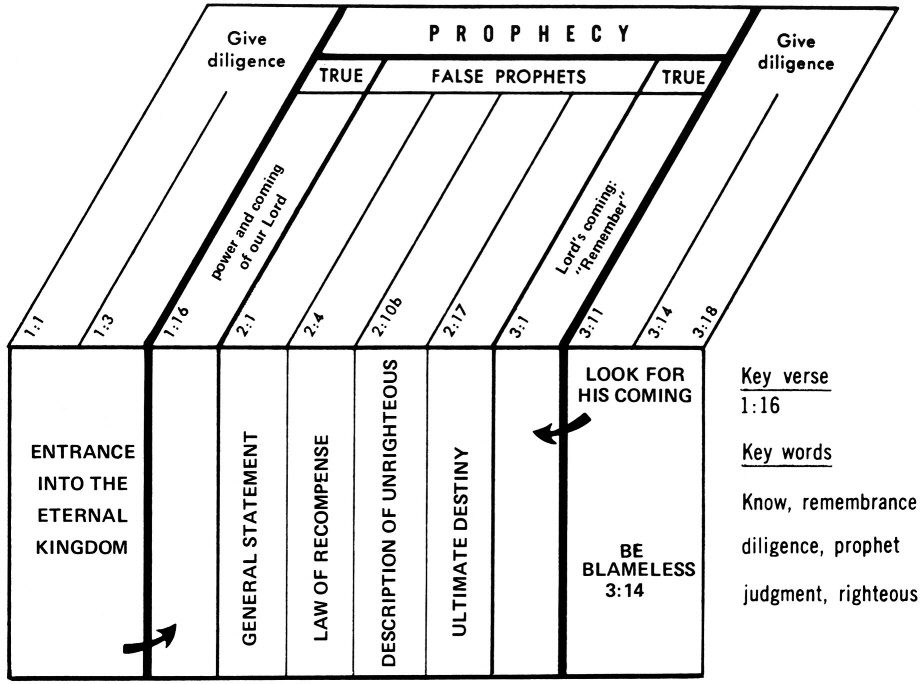
2 Peter: True and False Prophecy
Click chart to enlarge
Chart from Jensen's Survey of the NT - used by permission
|
2 PETER |
||||||||
| Cultivation of Christlike Character |
Condemnation of False Teachers |
Confidence in the Return of Christ |
||||||
| Greeting to Saints 2Pe 1:1-2 |
Growth in Christ 2Pe 1:3-14 |
Grounds |
Danger of |
Demise of |
"Decor" of |
Mockers in |
Manifest |
Maturity in light of that |
| Know Your Salvation |
Know |
Know Your Adversaries |
Know |
|||||
| True Prophecy (True Knowledge) |
False Prophets (False Teachers) |
Final Prophecy (Day of the Lord) |
||||||
| Holiness | Heresy | Hope | ||||||
| Development of Faith |
Denunciation of False Teachers |
Design of The Future |
||||||
2 Peter 2:22 It has happened (3SRAI) to them according to the true proverb, "A DOG RETURNS (AAPMSN) TO ITS OWN VOMIT," and, "A sow, after washing (AMPFSN) returns to wallowing in the mire." (NASB: Lockman)
Greek: sumbebeken (3SRAI) autois to tes alethous paroimias, Kuon epistrepsas (AAPMSN) epi to idion exerama, kai, Us lousamene (AMPFSN) eis kulismon borborou.
Amplified: There has befallen them the thing spoken of in the true proverb, The dog turns back to his own vomit, and, The sow is washed only to wallow again in the mire. (Amplified Bible - Lockman)
NET: They are illustrations of this true proverb: "A dog returns to its own vomit," and "A sow, after washing herself, wallows in the mire." (NET Bible)
NLT: They make these proverbs come true: "A dog returns to its vomit," and "A washed pig returns to the mud." (NLT - Tyndale House)
Phillips: Alas, for them, the old proverbs have come true about 'a dog returns to his own vomit', and "the sow that had been washed going back to wallow in the muck". (Phillips: Touchstone)
Wuest: But it has happened to them according to the true saying: a dog returns to his own vomit, and a sow, having been bathed, to its rolling in mire. (Eerdmans)
Young's Literal: and happened to them hath that of the true similitude; 'A dog did turn back upon his own vomit,' and, 'A sow having bathed herself -- to rolling in mire.'
IT HAS HAPPENED TO THEM ACCORDING TO THE TRUE PROVERB A DOG RETURNS TO ITS OWN VOMIT: sumbebeken (3SRAI) autois to tes alethous paroimias kuon epistrepsas (AAPMSN) epi to idion exerama:
- Pr 26:11
- 2 Peter 2 Resources - Multiple Sermons and Commentaries
Happened (4819) (sumbaino from sun = together with + baino = to walk, to go) literally means to walk together, of things that happen with one another, thus together and is used in the NT to mean to happen close together. It conveys the idea of circumstances coming together or happening together (coming to pass, befalling concomitantly) to form an event. It is like a confluence of happenings coming together in a given event. Sumbaino means to turn out or to come about, with idea of that what is occurring is doing so in connection with other events. The perfect tense treats what is certain to befall as already accomplished and as their final and permanent state! Webster on happen - to come into being or occur as an event, process, or result. The English dictionaries often quality that what happened was by chance. However we know that God is sovereign, in total control and that absolutely nothing happens by chance (in the sense that it was not in His full control and knowledge before it happened - see comments below on 1Peter 4:12, cp trials in Acts 20:19).
Sumbaino - 8x in 8v -NASB Usage: came(1), happen(1), happened(3), happening(1), taken place(1).
Mark 10:32 They were on the road going up to Jerusalem, and Jesus was walking on ahead of them; and they were amazed, and those who followed were fearful. And again He took the twelve aside and began to tell them what was going to happen to Him,
Luke 24:14 And they were talking (walking together on the Road to Emmaus) with each other about all these things which had taken place.
Comment: "All these things" refers to all the varied circumstances and events that had taken place surrounding the Crucifixion. These events all happened close together (they "walked together" so to speak), but they did not just happen by chance, but came together in the foreknowledge and providential working of God.
Acts 3:10 and they were taking note of him as being the one who used to sit at the Beautiful Gate of the temple to beg alms, and they were filled with wonder and amazement at what had happened to him.
Acts 20:19 serving the Lord with all humility and with tears and with trials which came upon me through the plots of the Jews;
Acts 21:35 When he got to the stairs, he was carried by the soldiers because of the violence of the mob; (YLT = it happened he was borne by the soldiers)
1Corinthians 10:11 Now these things happened to them as an example, and they were written for our instruction, upon whom the ends of the ages have come.
1Peter 4:12 Beloved, do not be surprised at the fiery ordeal among you, which comes upon you for your testing, as though some strange thing were happening to you;
Comment: Literally sumbaino means to walk together. Here Peter pictures the fiery ordeal (trial) as that which we should not be surprised at. Our natural tendency is to pull away rather than "walk together" with the trials in our life. The trial "walks together" with us in our journey and what happens is used by God to make us more Christlike. In short the suffering, trials and/or persecutions we will all face in varying degrees and in different seasons are not accidental but providential The "go together" with God's will for our lives.
2Peter 2:22 It has happened to them according to the true proverb, "A DOG RETURNS TO ITS OWN VOMIT," and, "A sow, after washing, returns to wallowing in the mire."
Sumbaino - 20 verses in the non-apocryphal Septuagint - Ge 41:13; 42:4, 29, 38; 44:29; Ex 1:10; 3:16; 24:14; Lev 10:19; Deut 18:22; Josh 2:23; Esther 2:11; 6:13; Job 1:22; 2:10; 42:11; Isa 3:11; 41:22; Jer 32:23; Da 2:1. Septuagint Lexicon = to happen to, to befall [someone] = Ge 42,4; it happens that, it comes to pass that = Ge 41,13; what happened to them = Ge 42,29
True proverb - Peter is stamping the proverb in 2Pe 2:22 as in accord with reality. The description of the dogs and pigs is generally true of the behavior in these animals.
True (227) (alethes from a = negates + letho [from lanthano] = to escape notice, be hid; See related word aletheia) is an adjective which literally describes that which does not escape notice. Thus alethes describes that which is manifest, that which is unconcealed, that which conforms to reality (and thus is genuine), that which is in accordance with facts, that which is real (authentic, not imaginary). Alethes is used to describe Jesus several times in the Gospels - Mt 22:16; Mk 12:14; Jn 7:18. Alethes describes that which is true, sincere, real, correct, faithful, trustworthy, genuine, veracious. Alethes can mean loving or speaking the truth (truthful) (Mt 22:16, Mk 12:14, Jn 7:18, 2Cor 6:8). God Himself is referred to as true (Jn 3:33, 8:26, Ro 3:4). Other things described as true include testimony (Jn 5:31,32, 8:13, 14, Jn 19:35, 21:24, 3Jn 1:12), grace (1Pe 5:12), proverb (2Pe 2:22), true commandment (1Jn 2:8). Alethes describes that which conforms to reality, that which is unconcealed, that which is manifest, that which is in accordance with facts, that which is characterized by reality (and thus is genuine), that which is real (authentic, not imaginary). Alethes is used to describe Jesus several times in the Gospels - Mt 22:16; Mk 12:14; Jn 7:18.
Renn - The quality of being “true” in the sense of being “endowed with integrity, honesty” describes Christ (Mt 22:16; Mk 12:14; Jn 7:18); God (Jn 8:26; Ro 3:4); and human beings (2Co. 6: 8). In a number of places, alethes denotes the quality “true” in the sense of “that which is in accord with truth” (e.g., Jn 5:31ff.; Jn 8:13ff.; Php. 4:8; Titus 1:13; 1Jn 2: 8, 27).
Vine - Alethes means "primarily, "unconcealed, manifest" (a, negative, letho, "to forget," = lanthano, "to escape notice"), hence, actual, "true to fact," is used (a) of persons, "truthful," Mt 22:16 ; Mk 12:14 ; Jn 3:33 ; 7:18 ; 8:26 ; Ro 3:4 ; 2Co 6:8 ; (b) of things, "true," conforming to reality, Jn 4:18 , "truly," lit., "true;" Jn 5:31,32 ; in the best texts, Jn 6:55 (twice), "indeed". (True, Truly, Truth - Vine's Expository Dictionary of NT Words)
Friberg - true; (1) of statements that agree with facts true (Titus 1.13); (2) of things characterized by reality genuine, true, real (Jn 6.55); substantivally true thing, fact (Jn 19.35); (3) of persons characterized by integrity trustworthy, truthful, honest (Ro 3.4), opposite pseudes (lying, false)
BDAG (summarized) - 1. Pertaining to being truthful and honest, truthful, righteous, honest of persons. 2. Pertaining to being in accordance with fact, true of things, especially that which is spoken: 3. Pertaining to being real, real, genuine, not imaginary (Pr 1:3Lxx)
Alethes - 26x in 25v -NASB Usage: real(1), true(21), truly(1), truth(1), truthful(2).
Matthew 22:16 And they sent their disciples to Him, along with the Herodians, saying, "Teacher, we know that You are truthful and teach the way of God in truth (aletheia), and defer to no one; for You are not partial to any.
Mark 12:14 They came and said to Him, "Teacher, we know that You are truthful and defer to no one; for You are not partial to any, but teach the way of God in truth. Is it lawful to pay a poll-tax to Caesar, or not?
John 3:33 "He who has received His testimony has set his seal to this, that God is true.
John 4:18 for you have had five husbands, and the one whom you now have is not your husband; this you have said truly."
John 5:31 "If I alone testify about Myself, My testimony is not true. 32 "There is another who testifies of Me, and I know that the testimony which He gives about Me is true.
John 6:55 "For My flesh is true food, and My blood is true drink.
John 7:18 "He who speaks from himself seeks his own glory; but He who is seeking the glory of the One who sent Him, He is true, and there is no unrighteousness in Him.
John 8:13 So the Pharisees said to Him, "You are testifying about Yourself; Your testimony is not true." 14 Jesus answered and said to them, "Even if I testify about Myself, My testimony is true, for I know where I came from and where I am going; but you do not know where I come from or where I am going.
John 8:17 "Even in your law it has been written that the testimony of two men is true.
John 8:26 "I have many things to speak and to judge concerning you, but He who sent Me is true; and the things which I heard from Him, these I speak to the world."
John 10:41 Many came to Him and were saying, "While John performed no sign, yet everything John said about this man was true."
John 19:35 And he who has seen has testified, and his testimony is true; and he knows that he is telling the truth, so that you also may believe.
John 21:24 This is the disciple who is testifying to these things and wrote these things, and we know that his testimony is true.
Acts 12:9 And he went out and continued to follow, and he did not know that what was being done by the angel was real, but thought he was seeing a vision.
Romans 3:4 May it never be! Rather, let God be found true, though every man be found a liar, as it is written, "THAT YOU MAY BE JUSTIFIED IN YOUR WORDS, AND PREVAIL WHEN YOU ARE JUDGED."
2 Corinthians 6:8 by glory and dishonor, by evil report and good report; regarded as deceivers and yet true;
Philippians 4:8 Finally, brethren, whatever is true, whatever is honorable, whatever is right, whatever is pure, whatever is lovely, whatever is of good repute, if there is any excellence and if anything worthy of praise, dwell on these things.
Titus 1:13 This testimony is true. For this reason reprove them severely so that they may be sound in the faith,
1 Peter 5:12 Through Silvanus, our faithful brother (for so I regard him), I have written to you briefly, exhorting and testifying that this is the true grace of God. Stand firm in it!
2 Peter 2:22 It has happened to them according to the true proverb, "A DOG RETURNS TO ITS OWN VOMIT," and, "A sow, after washing, returns to wallowing in the mire."
1 John 2:8 On the other hand, I am writing a new commandment to you, which is true in Him and in you, because the darkness is passing away and the true Light is already shining.
1 John 2:27 As for you, the anointing which you received from Him abides in you, and you have no need for anyone to teach you; but as His anointing teaches you about all things, and is true and is not a lie, and just as it has taught you, you abide in Him.
3 John 1:12 Demetrius has received a good testimony from everyone, and from the truth itself; and we add our testimony, and you know that our testimony is true.
Alethes - 13v in the non-apocryphal Septuagint - Ge 41:32; Dt 13:14; Neh 7:2; Job 5:12; 17:10; 42:7, 8; Pr 1:3; 22:21; Isa 41:26; 43:9; Da 8:26; 10:1
Proverb (3942) (paroimia from pará = by, beside + oímos = a way, a highway) is literally something "by the way", a byword which is a short saying illustrating a general principle. It describes a pithy maxim giving expression to some observed event whose content has allegorical import. It also describes a brief communication containing truths designed for initiates and as such can be a veiled saying in which especially lofty ideas are concealed (used especially this way by John)
The fact that "proverb" is singular indicates that the message conveyed by the two examples is essentially the same, namely both point out examples of repulsive actions and to the character that these actions reveal. Simply put dogs will act like dogs thus showing that they were dogs all along and the same for pigs. The false actions of the teachers reflect who they really have been all along - false teachers. Furthermore this proverb was well known among the rabbis and the actions described was well known among the pagans.
In Peter's day dogs were not pampered pets like they are today! The Jews in fact spoke of the hated Gentiles as “dogs” because a dog was nothing but a filthy scavenger who ran in packs and lived on garbage! Peter chooses a word which is the epitome of disrespect and revulsion to describe these false teachers who have known the truth but have turned away from it.
Michael Green - The dog which has got rid of the corruption inside it through vomiting it up cannot leave well enough alone; it goes sniffing around the vomit again. The pig that has got rid of the corruption outside by means of a scrubbing cannot resist rolling in the mud.
William Barclay - Peter ends with contempt. These evil men are like dogs who return to their vomit (Proverbs 26:11) or like a sow which has been scrubbed and then goes back to rolling in the mud. They have seen Christ but are so morally degraded by their own choice that they prefer to wallow in the depths of sin rather than to climb the heights of virtue. It is a dreadful warning that a man can make himself such that in the end the tentacles of sin are inextricably around him and virtue for him has lost its beauty. (2 Peter 2- William Barclay's Daily Study Bible)
Returns (1994)(epistrepho) return to a point or area where one has been before, in this case to their own regurgitated gastric contents. Woe!
Vomit (1829) (exerama) means that which is thrown out (vomited). The picture here is not just of a dog "sniffing" the vomitus, but of actually lapping up what had been disgorged. Both dogs and pigs were considered vile by the Jews. The action of the dog (and the pig) reveals its true nature. The false teachers appeared to be renewed persons, having made professions of faith, but their false teaching and persistent practice revealed that they were still lost apostates.
Matthew Henry describes them as those who "have licked up their own vomit again, returning to the same errors and impieties that they had once cast off and seemed to detest and loathe, and wallowing in that filthiness from which they appeared once to be really cleansed.
J R Lumby - Altogether become abominable: — To describe in all its horror the abysmal depth to which these false teachers have sunk, the apostle makes use of two proverbs, one of which he adapts from the Old Testament (Proverbs 26:11), while the other is one which would impress the Jewish mind with a feeling of utter abomination. The dogs of the East are the pariahs of the animal world, while everything pertaining to swine was detestable in the eyes of the Israelite. But all the loathing which attached to these outcasts of the brute creation did not suffice to portray the defilement of these teachers of lies and their apostate lives. It needed those other grosser features — the return to the disgorged meal; the greed for filth, where a temporary cleansing serves, as it were, to give a relish for fresh wallowing — these traits were needed ere the full vileness of those sinners could be expressed. (J. R. Lumby, D. D.) (The Biblical illustrator)
Vance Havner - The Bible compares us to different animals and some of the comparisons are not very complimentary. It says, "Don't be like a mule" (Ps. 32:9); a mule is usually backward about going forward! Jesus says that His sheep know Him and that sheep follow the shepherd; a sheep is not at home in a mudhole and a Christian is not satisfied to live in sin. There is an animal that feels at home in a mudhole; the Bible classifies the false teachers who return to their native habitat of sin with sows wallowing in the mire (2 Peter 2:22). We need to brush up on our Bible zoology. (2 Peter 2:22 Comment)
Thomas Reade
"A pig that is washed goes back to her wallowing in the mud." 2 Peter 2:22
The pig, though washed, was a pig still. The outward washing could not change the inward propensity of the animal. Is it not so with multitudes of baptized people? Outward reformation must never be confounded with inward regeneration!
"And when people escape from the wicked ways of the world by learning about our Lord and Savior Jesus Christ and then get tangled up with sin and become its slave again, they are worse off than before." 2 Peter 2:20
The hearts of such people were never renewed, their natures were never changed. This they proved by their return to the propensities of their natural hearts.
AND A SOW AFTER WASHING...TO WALLOWING IN THE MIRE: kai: us lousamene (AMPFSN) eis kulismon borborou:
- 2 Peter 2 Resources - Multiple Sermons and Commentaries
Washing (3068) (louo) means to bathe oneself and specifically refers to washing the whole body and not part of it. The middle voice indicates that the washing was not forcibly applied against the pig's will but that the pig the washing himself. It pictures however an outer cleansing not an internal cleansing. The clear implication is that these false teachers had been fully exposed to the genuine gospel yet internally remained "full of dead men's bones". By the way don't press the proverb too far. Peter is not alluding to washing as a picture of baptism. The picture implies an outward cleansing form "defiling conduct". But the outward cleansing was readily undone by the pig's innate natural urge to find "relief" by returning to the mire. A pig can stay clean only a short time and then must head for the nearest mud hole. We do not condemn a pig for acting like a pig because it has a pig’s nature. If we saw a sheep heading for the mire, we would be concerned!
Peter’s point is that mere religious profession or even outward change does not change a person’s heart. These “professors but not possessors” seemed to some (especially the gullible) to have experienced salvation, but in due time they drifted back to the life that was a true reflection of their inner nature. Certainly the dog feels better after emptying his stomach, but it is still a dog. “Having an experience” did not change the dog's nature. In fact it only served as further proof of his “cannine nature,” because he came back and just like a dog lapped up his own vomit. What a disgusting picture of these vile false teachers!
The principle brought out by Peter calls for us all to apply this truth to our lives and reflect on our choices. Our choices are seen to be consistent with what we are. A good tree bears good fruit, a brackish spring pours forth brackish water, and the pig returns to wallowing in the mire.
THOUGHT- What do my choices today and this past week, this past year, etc loudly proclaim about who I really am? For heaven's sake, we need to be honest with ourselves!
The dog and pig in this context picture temporary external change resulting from conformity to a false profession of faith much like a chameleon blends with its surroundings whatever they might be. True faith is fruitful faith. False "faith" is shown by absence of good fruit (see Peter's earlier comments 2Pe 1:8, 9, 2Pe 1:10). Ignorance in the spiritual realm is not bliss but leads to fleshly indulgence. Unsaved people lack spiritual intelligence (Hos 4:6), and this causes them to give themselves to all kinds of fleshly and worldly indulgences (Acts 17:30; Ep 4:17 18, 19). Since we were born with a fallen nature it is natural for us to live sinful lives. Nature determines appetites and actions. A dog and a pig behave differently because they have different natures.
Jesus also used the designations "dogs" and "swine" in speaking of those opposed to God and his Word
Do not give what is holy to dogs, and do not throw your pearls before swine, lest they trample them under their feet, and turn and tear you to pieces. (Mt 7:6)
The principle of the animal illustrations is that like these animals, these false teachers were never what they seemed to be on the outside. They had never experienced a changed heart and been made new creatures in Christ (2Cor 5:17). To the contrary, they were still old creatures in Adam! (cp 1Co 15:22) And so it should not surprise us that return to those things that reflect their true nature. These charlatans are like dirty pigs which can be washed (cp Jesus' comparison of Pharisees to white washed tombs Mt 23:27) on the outside but on the inside are still dead in their trespasses and sins (Eph 2:1) and filled with hostility toward God and His will (Col 1:21) Their hearts had never been washed clean by the blood of the Lamb and thus they were unable to behave in any way but "unclean". The irony is that the punishment for these fakers is that they incur a greater bondage to sin than before they masqueraded as teachers of the liberating truth of the Gospel! It is because of the very fact that false professors of a (pseudo) "new birth" return to their "pre-Christ" way which makes the doctrine of the perseverance of the saints so important. In other words those who persevere to the end of their life and never renounce their faith, prove by this perseverance that they are truly new creatures in Christ. This doctrine does not say that a person merits heaven by their personal perseverance in the faith but that they the fact that they do persevere proves there possess a power outside themselves which enables them to keep on keeping on.
The importance of perseverance in the faith helps us appreciate Peter’s earlier warning
Therefore, brethren, be all the more diligent to make certain about His calling and choosing you; for as long as you practice these things, you will never stumble (2Pe 1:10).
The writer of Hebrews gives a strong warning to after being exposed to the truth, turn away from the truth...
For if we go on sinning willfully after receiving the knowledge of the truth, there no longer remains a sacrifice for sins, 27 but a terrifying expectation of judgment and the fury of a fire which will consume the adversaries. 28 Anyone who has set aside the Law of Moses dies without mercy on the testimony of two or three witnesses. 29 How much severer punishment do you think he will deserve who has trampled under foot the Son of God, and has regarded as unclean the blood of the covenant by which he was sanctified, and has insulted the Spirit of grace (Note: The writer is implying that these had hard the truth, possibly even that they had professed the truth)? 30 For we know Him who said, “Vengeance is Mine, I will repay.” And again, “The Lord will judge His people.” 31 It is a terrifying thing to fall into the hands of the living God. (Heb 10:26-31)
Ray Stedman - A review of the whole chapter shows that yielding to the money-mad, sex-obsessed, materialistic and anti-authoritarian drives of modern society are indications that an individual's heart is not in touch with the lordship of Christ, but has succumbed to the delusions of the devil instead. Pride in knowledge is the point of attack. (Commentary of 2 Peter Chapter Two)
Ron Ritchie sums up the fate of these fakes "What will their payment be? Three things, Peter says. First, "For if, after they have escaped the defilements of the world by the knowledge of the Lord and Savior Jesus Christ, they are again entangled in them and are overcome, the last state has become worse for them than the first." Secondly, he says, they are like dogs which "return to their own vomit." They can't escape the shackles of their old life. Having gotten rid of their internal corruption, they find themselves returning to it again. Thirdly, he says, like pigs after washing, they "return to wallowing in the mire." They return again to the external corruption which they once had. What graphic terms Peter uses! Washing a pig does not change its heart; he still remains a pig. In the same way, a false prophet will always remain that, no matter how flattering his words, no matter how well he dresses. (What Are The Wages Of The False Teachers)
William MacDonald reminds us that "This passage should not be used to teach that true believers may fall from grace and be lost. These people never were true believers. They never received a new nature. They demonstrated by their last state that their nature was still unclean and evil. The lesson is, of course, that reformation alone is not only insufficient, but is positively dangerous, because it can lull a person into a false security. Man can receive a new nature only by being born again. He is born again through repentance toward God and faith in our Lord Jesus Christ (Ed: See comment on repentance below). (MacDonald, W & Farstad, A. Believer's Bible Commentary: Thomas Nelson)
Comment: See passages that emphasize the importance of repentance, a doctrine which a number of modern pulpits have "jettisoned"! Jonah 3:8,10 2Ki 17:13 2Chr 30:6 Pr 1:23 Isa 22:12 Jer 25:5 Ezekiel 14:6 18:30, 31, 32 33:11 Da 4:27 Hos 14:2 Joel 2:12 Mal 3:7 Ro 2:4 Rev 2:21 Mt 3:2 4:17 11:20 12:41 Mk 1:4,15 6:12 Lk 13:3, 5 15:7,10 16:30 24:47 Acts 2:38 3:19 5:31 8:22 26:20 17:30 20:21 2Co 7:9, 10 12:21 2Ti2:25 2Pe 3:9
Warren Wiersbe summarizes the characteristics of these false teachers: We may detect them by their exaltation of themselves instead of Christ; their counterfeit talk and “great swelling words”; their emphasis on making money; their great claims that they can change people; and their hidden lives of lust and sin. For the time being we cannot stop them except by teaching the Word sincerely, but one day God will expose them and judge them...It is a startling fact that there are many people in our churches who have never truly been born again, but who are convinced that they are saved and going to heaven! They have had “an experience,” and perhaps look better (like the sow) and feel better (like the dog), but they have not been made better as “partakers of the divine nature. Perhaps Peter recalled Judas, one of the Twelve, who was a tool of the devil and was never born again. Up to the very end, the other disciples did not know the truth about Judas and thought he was a spiritual man! (Wiersbe, W: Bible Exposition Commentary - New Testament. 1989. Victorh) (bolding added)
Spurgeon ("Man's Thoughts and God's Thoughts")
As for peace in the hour of death, he who is not pardoned while living is not likely to be pardoned when dying. Nine out of ten, perhaps nine hundred and ninety-nine out of every thousand of professed death-bed salvations are a delusion.
We have good facts to prove that. A certain physician collected notes of several hundred cases of people who professed conversion when they thought they were dying. These people did not die as they had expected to, but continued to live. In the case of all but one they lived just as they had lived before, though when they were thought to be dying they appeared as if they were truly converted. Do not look forward to a death-bed salvation, it is a mere snare of Satan.
Alan Carr - A person’s true nature will always come out! Just as a dog may be taught obedience and tricks, he will always be a dog and will have a dog’s nature and will eat his own vomit. A pig can be bathed, bowed and buffed to a high gloss, but it will always be a pig and will head straight for the wallow when turned loose. (Ill. Men can look good in church, but live in sin in the world. You will always do after you own nature!) This is why Christians can be assured of their security in Jesus. A new nature wants to avoid sin and please God. We are not reformed, we have been transformed – 2Co 5:17; 2 Pe1:4. (Sermons and Outlines)
Kenneth Gangel has some sound advice for all saints in these last, deceptive, difficult days "Believers today do well to heed Peter’s warning against false teachers, to learn how to discern truth for themselves, and to teach it to others. The false teachers will themselves meet destruction and others will be destroyed by them. But Christians can wage spiritual warfare more effectively if they know their spiritual enemies, the techniques that heretics use, and the end result of their deception." (bolding added) is, in itself, not similar) and we do not think and speak falsely but rightly when we describe the relationship as one of similarity. (Walvoord, J. F., Zuck, R. B., et al: The Bible Knowledge Commentary. 1985. Victor)
J Vernon McGee summarizes this section in his unique pithy style "In this chapter Peter has dealt very definitely with the apostasy that was coming into the church through false teachers who were creeping in and teaching false doctrines, teaching that which is contrary to the Word of God. Peter says that they pervert the truth of God, and they do it for their own advantage. These false teachers exalt themselves instead of exalting Christ. They do not use the Word of God except for a few little proof texts that more or less clothe their teaching with a pious halo. They use big words which are counterfeit words. They try to impress people that they are very intellectual, and they are interested in making money. They claim that they can change people. I know that I will get into trouble by saying this, but I think you ought to examine very carefully anyone who claims to have a supernatural power to heal or to perform miracles. Another thing that sometimes identifies a false teacher is that he is living secretly in lust and sin. You and I cannot fight these false teachers; I’m not attempting to fight them; I’m just trying to expose them. But one day God is going to expose them, and He is going to judge them. (McGee, J V: Thru the Bible Commentary)