2 Timothy 2:2
2 Timothy 2:3
2 Timothy 2:4
2 Timothy 2:5
2 Timothy 2:6
2 Timothy 2:7
2 Timothy 2:8
2 Timothy 2:9
2 Timothy 2:10
2 Timothy 2:11
2 Timothy 2:12
2 Timothy 2:13
2 Timothy 2:14
2 Timothy 2:15
2 Timothy 2:16
2 Timothy 2:17
2 Timothy 2:18
2 Timothy 2:19
2 Timothy 2:20
2 Timothy 2:21
2 Timothy 2:22
2 Timothy 2:23
2 Timothy 2:24
2 Timothy 2:25
2 Timothy 2:26
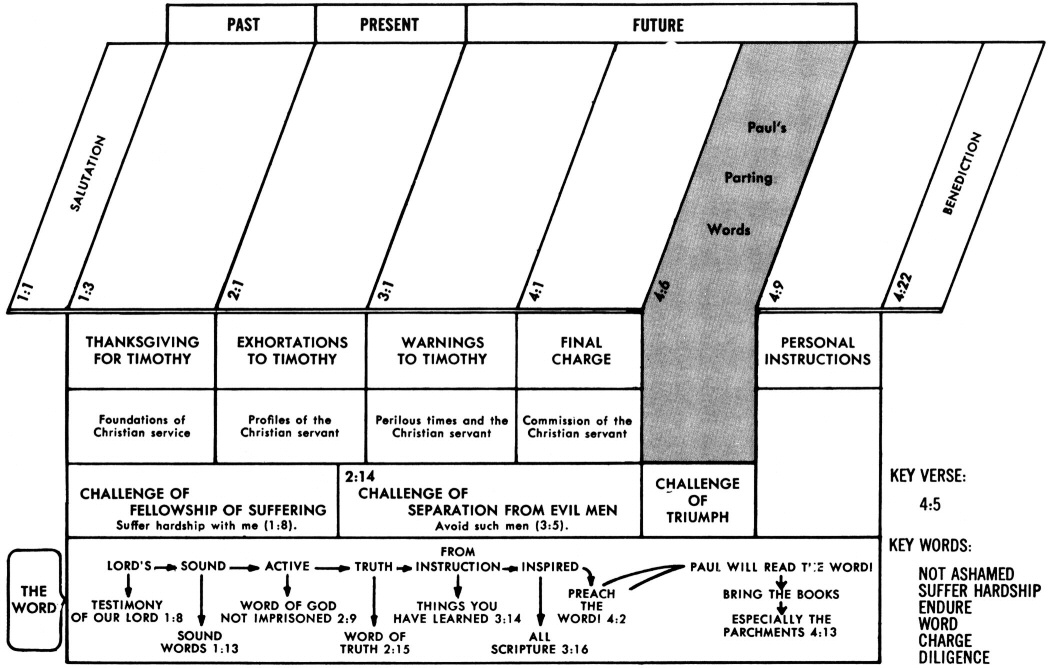
ENDURANCE AND SEPARATION IN THE MINISTRY
Click chart to enlarge
Charts from Jensen's Survey of the NT - used by permission
Second Timothy - Swindoll
| 2 TIMOTHY | |||
| 2 Timothy 1:1-18 | 2 Timothy 2:1-26 | 2 Timothy 3:1-17 | 2 Timothy 4:1-22 |
| Retain the Standard |
Rightly Divide the Word |
Difficult Times Will Come |
Preach the Word |
| PAST | PRESENT | FUTURE | |
| Foundation of Christian Service |
Pictures of Christian Servant |
Dangerous Times for Christian Servant |
Commission of Christian Servant |
| Unashamed as a Witness: Guard the Gospel |
Unashamed as a Workman: Suffer for the Gospel |
Adequate as a Workman: Continue in the Gospel |
Awarded as a Workman: Preach the Gospel |
| Power of the Gospel |
Perseverance of the Gospel Message | Protection of the Gospel |
Proclamation of the Gospel |
| Reminder | Requirements | Resistance | Requests |
| Encouragement in Ministry |
Examples in Ministry |
Exhortations in Ministry |
Exhortations to Fulfill Ministry |
| Commendation & Charge |
Commission to Fulfill |
Conflict to Face |
Course to Finish |
|
Compiled from Jensen's Survey of the NT and Wilkinson's Talk Thru the Bible |
|||
2 Timothy 2:20 Now in a large house there are (3SPAI) not only gold and silver vessels, but also vessels of wood and of earthenware, and some to honor and some to dishonor. (NASB: Lockman)
Greek: En megale de oikia ouk estin (3SPAI) monon skeue chrusa kai argura alla kai xulina kai ostrakina, kai a men eis timen a de eis atimian
Amplified: But in a great house there are not only vessels of gold and silver, but also [utensils] of wood and earthenware, and some for honorable and noble [use] and some for menial and ignoble [use]. (Amplified Bible - Lockman)
KJV: But in a great house there are not only vessels of gold and of silver, but also of wood and of earth; and some to honour, and some to dishonour.
NLT: In a wealthy home some utensils are made of gold and silver, and some are made of wood and clay. The expensive utensils are used for special occasions, and the cheap ones are for everyday use. (NLT - Tyndale House)
Phillips: In any big household there are naturally not only gold and silver vessels but wooden and earthenware ones as well. Some are used for the highest purposes and some for the lowest. (Phillips: Touchstone)
Wuest: Now, in a great house there are not only utensils of gold and of silver, but also of wood and of baked clay, also some which are highly prized and others which are treated with contempt. (Eerdmans Publishing - used by permission)
Young's Literal: And in a great house there are not only vessels of gold and of silver, but also of wood and of earth, and some to honour, and some to dishonour:
NOW IN A LARGE HOUSE THERE ARE NOT ONLY GOLD AND SILVER VESSELS BUT ALSO VESSELS OF WOOD AND OF EARTHENWARE: En megale de oikia ouk estin monon skeue chrusa kai argura alla kai xulina kai ostrakina:
- 1Cor 3:9,16,17;Eph 2:22-note; 1Ti 3:15; Heb 3:2-6-notes; 1Pe 2:5-note
- Ex 27:3; Ezra 1:6; 6:5; Lam 4:2; Da 5:2; 2Cor 4:7
- 2 Timothy 2 Resources - Multiple Sermons and Commentaries
- 2 Timothy 2:20-22 The Person God Uses - Steven Cole
- 2 Timothy 2:20-22 An Honorable Vessel, Part 1 - John MacArthur
Henry Alford introduces this important section noting that "Those who are truly the Lord’s are known to Him and depart from iniquity: but in the visible church there are many unworthy members. This is illustrated by the following similitude. (2Timothy 2 Commentary)
Now (de) could also be translated but (KJV - See Alford's comment below) although it does not appear from the context Paul is drawing out a contrast but is expanding on the firm foundation (most feel this is a description of the church) he says is laid which includes those who abstain from wickedness.
Henry Alford - "But (contrast to the preceding definition of the Lord’s people)"
Steven Cole introduces his sermon on this passage with an pithy illustration/application...
A man used to visit a tiny general store in the country. The proprietor has a clerk named Jake, who seemed to be the laziest man in the world. One day the man noticed that Jake was gone.
He asked the proprietor, “Where’s Jake?” “Oh, he retired,” was the answer. “Retired? Then what are you going to do to fill the vacancy?” The owner replied, “Jake didn’t leave no vacancy.”
That leads me to ask, “What kind of vacancy would there be in this church if you left?” It is God’s clear intention that every one of His people be used in serving the Lord Jesus Christ. He has given gifts to each one to be used as good stewards. And yet for so many that name the name of Christ, their faith is like football - an occasional Sunday spectator sport. They are not serving Christ day by day. But if you truly know Christ, you can’t be happy sitting on the bench or in the stands. You want to be in the game. Our text reveals the kind of person God uses. You may think that God uses people who have impressive abilities and gifts. While spiritual gifts play a part, they are not the main feature in being used by God. As we saw in the national news recently, a man may be a gifted Christian leader and yet bring terrible disgrace to the name of Christ. Or you may think that God uses a person who has been to seminary and has a lot of training. While seminary has its place, I know of many men who graduated from seminary, but they’re not even in the stadium, let alone in the game!
Or you may think that God uses a person who has a great knowledge of the Bible. While, as we saw last week, being careful students of the Bible is very important, it is not the main thing. You may be a renowned Bible scholar, and yet be detrimental to the cause of Jesus Christ.
The simple message of our text is that God uses cleansed people, who are defined by two characteristics:
God uses cleansed people who flee sin and pursue godliness (The Person God Uses 2 Timothy 2:20-22 - see also the study of Joshua - Portrait of the Man God Uses))
A large (great) house - NET has "Now in a wealthy home".
Phillip Towner introduces his comments on 2Ti 2:20 - With a shift of metaphor, the need to heed the warning is reinforced. First, the image of the traditional household is introduced as a way of discussing the “mixed” nature of the church (2Ti 2:20). But the view expressed in 2Ti 2:20 is hardly one of resignation, for by extending the metaphor Paul issues a second call to Timothy (and believers; cf. 2Ti 2:19d) to separate from whatever impurity exists in the church in order to dedicate himself to God (2Ti 2:21). Although the images employed in the metaphorical depiction are not particularly complex or abstract, the primary question for interpretation in 2ti 2:20 revolves around the implications of the picture and the extent to which the imagery is to be pressed. While 1 Tim 3:15 drew on the “household” concept (oikos) to depict the church as a community in which all members have responsibilities, here the image is of the building (oikia) in which the members of the household would dwell. In the present passage, the metaphor of “the foundation” (v. 19) has prepared the way for this metaphor. The adjective “large” (lit. “great”; see on 1 Tim 3:16) sets the house in this picture apart from ordinary houses, and the following reference to vessels of gold and silver certainly suggests that the house of a wealthy householder is envisaged. There is little doubt that the house stands for the church....The real reason for introducing the image of the house is to describe the “articles” within it. (New International Commentary)
Spurgeon expands on this phrase writing...
The apostle compares the church to a great house. We feel sure he is not speaking of the world; it did not occur to him to speak about the world, and it would have been altogether superfluous to tell us that in the world there are all sorts of people,-everybody knows that. The church is a great house belonging to a great personage, for the church is the house of God, according to the promise- "I will dwell in them, and walk in them." The church is the temple in which the Lord is worshipped, the palace in which he rules; it is his castle, and place of defense for his truth, the armoury out of which he supplies his people with weapons. The church is God's mansion house in which he abides- "This is my rest for ever, here will I dwell for I have desired it." There it is that he rests in his love, and in infinite condescension manifests himself as he doth not unto the world. King Solomon built for himself a house in the forest of Lebanon, and behold, the Lord hath of living stones builded for himself a far more glorious house wherein he may abide. It is a great house because it is the house of the great God. Who can be so great as he?
It is a great house because planned and designed upon a great scale. I fear that some who live in the house have no idea how great it is. They have a very faint notion of its length and breadth. The great. thoughts of God are far beyond their most elevated conception, so that he might say to them as he has said to others, "My thoughts are not your thoughts, neither are my ways your ways, saith the Lord." The palace of the King of kings is "exceeding magnifical," and for spaciousness far excelleth all the abodes of earthly princes. We read of the golden palace of Nero, that it reached from hill to hill, and enclosed lakes and stream and gardens beneath its wondrous roof; but behold, the Lord has stretched the line of his electing grace over nations and kindreds even to the ends of the earth: his house taketh in a mighty sweep of humanity. Many are the rooms in the house, and there are dwellers in one room who have never yet seen any part of the great house but the little chamber in which they were born, never walked through the marvellous corridors, or moved in the vast halls which God hath builded with cedar pillars and cedar beams, and carved work of heavenly workmanship. Some good men hardly care to see the long rows of polished columns, quarried by grace from the rough mass of nature, which now shine resplendent as monuments of divine love and wisdom. Colossal is the plan of' the Eternal, the church of God is worthy of the infinite mind. Angels and principalities delight to study the stupendous plan, and well they may: as the great Architect unrolls his drawings piece by piece to let them see the various sections of the complete design, they are struck with admiration, and exclaim, "Oh the riches of the wisdom and the knowledge of God." The church is no narrow cottage wherein a few may luxuriate in bigotry, but it is a great house, worthy of the infinite heart of Jehovah, worthy of the blood of Jesus, the incarnate God, and worthy of the power of the ever-blessed Spirit.
It is a great house because it has been erected at great cost, and with great labor. The cost of this mansion who can tell? It is a price beyond price, for God has given his only-begotten Son-he had but one, and heaven could not match him-that he might redeem unto himself a people who should be his dwelling-place for ever. Solomon's temple, now that they have laid bare a part of the foundations, even though it be in utter ruin, astonishes all beholders, as they mark the enormous size and accurate adjustment of the stones; what must it have been in its glory? What cost was lavished on that glorious house. But think of the labor and the skill, the divine art and engineering with which Jehovah has hewn out of the rock of sinful nature the stones with which he builds up his spiritual house. What energy has the Holy Spirit displayed! What resurrection power! Harder than any granite we were by nature, yet has he cut us away from the rock of which we formed a part, and fashioned and squared us, and made us to be builded together for an habitation of God, through the Spirit. Tell it to the praise of the glory of his grace, that the Lord's omnipotent power and boundless wealth of love are revealed in his church. When our eyes shall see the church of God at last in all her beauty descending out of heaven from God, having the glory of God, and her light Like unto a stone most precious, even like unto a jasper stone; when we shall see that the length and the breadth and the height of it are equal; when we shall see its deep foundations laid in the eternal purpose, and its walls upbuilt with lofty pinnacles of glory, high as the divine person of her Lord; and when we shall mark its wondrous compass, broad enough to hold the glory and honor of the nations,-then shall we shout for joy as we behold the riches and the power and the splendor of the great King of kings, who has builded for himself this great house.
It is a great house, again, because its household arrangements are conducted on a great scale. You know the country people, when there is some rich lord living in the village, speak always of his mansion as "the great house." It is the great house for which those bullocks are being fattened, and those sheep and lambs will be consumed at the great house, for there are many in the family, and none are allowed to want. Solomon kept a great house. When you read the account of the daily provision for his table you see that it was a great house indeed, a vast and truly royal establishment. Ay, but neither for quality nor quantity could Solomon's palace match with the great house of God in its plenty. Speak of fine flour-behold, he has given us angels' food: speak of royal dainties-behold, the Lord hath given us fat things full of marrow, wines on the lees well refined. What a perpetual feast doth the Lord Jesus keep up for all his followers. If any of them hunger it is not because their rations are stinted; if there be any complaining it is not because the Master's oxen and fatlings are not freely provided. Ah, no; to every man there is a good piece of flesh and a flagon of wine dealt out, even as David dealt it out in the day when he removed the ark unto the hill of Zion. Glory be to God, he hath said, "Eat, O friends; drink, yea, drink abundantly, O beloved." In this mountain shall the hand of the Lord rest, and he will make unto all nations a feast of fat things. Behold, his oxen and fatlings are killed, all things are ready. It is a great house, where great sinners are fed on great dainties, and filled with the great goodness of the Lord.
It is a great house for the number of its inhabitants. How many have lived beneath that roof-tree for ages. "Lord," say they like a great host, "thou hast been our dwelling place throughout all generations." God is the home of his people, and his church is the home of God; and what multitudes are dwelling there now. Not only the companies that we know of, with whom it is our delight to meet for solemn worship, but all over the world the Lord hath a people who dwell in the midst of his church; and, though men have disfigured their Master's house by chalking up odd signs over some of the rooms, and calling them by other names than those of the owner, yet the Lord's people are all one church, and to whatever part or party they may seem to belong, if Christ is in them they belong to him of whom the whole family in heaven and earth is named, and they make up but one spiritual house. What a swarm there is of the Lord's children, and yet not one of the family remains unfed. The church is a great house wherein thousands dwell, yea, a number that no man can number.
Once more, it is a great house, because of its importance. People speak of "the great house" in our remoter counties because to the whole neighborhood it bears a special relationship, being connected with some of its most vital interests: county politics and police, dignity and wealth find their center at "the great house." The church is a great house because it is God's hospice, where he distributes bread and wine to refresh the weary, and entertains wayfarers that else had been lost in the storm. It is God's hospital, into which he takes the sick, and there he nourishes them till they renew their youth like the eagle's. It is God's great pharos with its lantern flashing forth a directing ray so that wanderers far away may be directed to the haven of peace. "Out of Zion, the perfection of beauty, God hath shined." It is the seat of God's magistracy, for there are set thrones of judgment, the thrones of the house of David. Behold, the Lord hath set his King upon his holy hill of Zion, and thence shall the power of his scepter go forth to the ends of the earth. The great house of the church is the university for teaching all nations, the library wherein the sacred oracles are preserved, the treasury wherein the truth is deposited, and the registry of new-born heirs of heaven. It is important to heaven as well as to earth, for its topmost towers reach into glory, and there is in it a ladder the foot whereof doth rest on earth, but the top thereof doth reach to heaven, up and down which the angels come and go continually. Said I not well that the apostle had wisely chosen the figure when he called the church a great house? (2 Timothy 2:20,21 The Great House and the Vessels in It)
House (3614) (oikia from oikos = house) is literally one's residence, home or abode. Oikia is an inhabited edifice, building or dwelling. By extension, oikia describes that which one possesses (property, possession, goods) as in Mk 12:40.
Oikia describes the house where Jesus was born (Mt 2:11), the place which a lamp is to light (Mt 5:15-note), the place Peter's mother-in-law was ill (Mt 8:14), the believer's future home, our Father's house (Jn 14:2), and in short oikia described the place in which much of Jesus' ministry took place (see below and observe the uses of oikia in the Gospels).
Oikia when used as a figure of speech is used to describe the human body as the habitation of the soul and contrasts the present state of our body with the future blessed condition of our glorified body (2Co 5:1). Jesus uses oikia as a figure of speech to describe where one chooses to build their "spiritual" house, the foundation on which one places their trust or faith (Mt 7:24, 25-note, Mt 7:26; 27-note).
Oikia is used to signify a household or family (Mt 10:13, 12:25) = as a metonymy (figure of speech consisting of the use of the name of one thing for that of another of which it is an attribute or with which it is associated - e.g., as “crown” in “lands belonging to the crown” where crown stands for the "king" or ruler of the land)
Oikia in the present context is used as a figure of speech or word picture (metaphor) by which Paul describes the body of Christ, the Church, an interpretation with which most observers are in agreement.
J Goetzmann says that in Classic Greek the root word oikos "is attested as early as Mycenaean Greek and has been handed down from Homer on. It means both the dwelling place and the structure. Oikia, from Herodotus on, denotes the dwelling, the house. Originally the two words were differentiated in meaning, in that oikia denoted the dwelling place, and oikos the whole house, the premises, the family property, and even the inhabitants of the house. This original distinction was maintained in Attic law, where oikos meant the inheritance and oikia the house itself. Later, particularly after the LXX, the distinctions were not maintained and the words were used synonymously. In popular speech oikos meant any kind of house, but frequently also a particular house and even a temple. In such cases the divine name attached to oikos indicated the god to whom the temple was dedicated. But the word was also used in the metaphorical sense. It denoted the family, the property and other similar concepts connected with the house itself. (Brown, Colin, Editor. New International Dictionary of NT Theology. 1986. Zondervan)
Mounce adds that " In the legal terminology of pre-biblical Greek, oikos was distinct from oikia, the former referring to property left by a person after death and the latter referring only to a dwelling or house. By the time of the NT the terms are practically synonymous and most commonly denote a place where a person lives either literally (Mt 2:11; 7:24–27; 9:7; Mk 7:30) or figuratively in the sense of a family grouping (Mt 13:57; Mk 6:4; Jn 4:53; 1 Cor. 1:16; 2 Tim. 1:16; 4:19). (Mounce's Complete Expository Dictionary of Old & New Testament Words. Grand Rapids, MI: Zondervan)
Oikia - 93x in 84v -
Mt 2:11; Mt 5:15-note; Mt 7:24, 25-note, Mt 7:26; 27-note; Mt 8:6, 14; 9:10, 23, 28; 10:12, 13, 14; 12:25, 29; 13:1, 36, 57; 17:25; 19:29; 24:17, 43; 26:6; Mark 1:29; 2:15; 3:25, 27; 6:4, 10; 7:24; 9:33; 10:10, 29, 30; 12:40; 13:15, 34, 35; 14:3; Luke 4:38; 5:29; 6:48, 49; 7:6, 37, 44; 8:27, 51; 9:4; 10:5, 7; 15:8, 25; 17:31; 18:29; 20:47; 22:10, 11, 54; Jn 4:53; 8:35; 11:31; 12:3; 14:2; Acts 4:34; 9:11, 17; 10:6, 17, 32; 11:11; 12:12; 16:32; 17:5; 18:7; 1Co 11:22; 16:15; 2Co 5:1; Phil 4:22-note; 1Ti 5:13; 2Ti 2:20-note; 2Ti 3:6-note; 2Jn 1:10. NAS = home(6), house(75), household(5), households(1), houses(7).
The NT has other passages that picture the church as a house, dwelling or building...
1Co 3:9 — For we are God's fellow workers; you are God's field, God's building.
1Co 3:16 — Do you not know that you (plural - so he is speaking not so much of individual believers but of believers as a whole - the church) are a temple of God, and that the Spirit of God dwells in you (plural)?
Eph 2:22 (note) — in whom you also are being built together into a dwelling (katoiketerion) of God in the Spirit.
1Ti 3:15 — but in case I am delayed, I write so that you may know how one ought to conduct himself in the household of God, which is the church of the living God, the pillar and support of the truth.
1 Pe 2:5 (note) — you also, as living stones, are being built up as a spiritual house for a holy priesthood, to offer up spiritual sacrifices acceptable to God through Jesus Christ.
Gold and silver vessels...vessels of wood and of earthenware - The interpretation of these two general groups lacks a clear consensus.
(1) Some believe Paul refers to true and false believers (professors)...
The Holman NT Commentary explains "a large house" - Paul drew another word picture to illustrate the distinctions between the true believer and the false follower. He took his imagery from his readers' understanding of an ordinary house. Such a house would have a variety of utensils and wares, some of gold and silver, and others of wood and clay. Correspondingly, the gold and silver are for noble purposes, while the wood and clay are reserved for ignoble use. Basically, a person does not use china cups to feed the dog. Jesus foretold the same truth. The church is a mixed group, some true to their Lord, others impostors (Mt 13:24-30). Though God knows who belongs to Him and though true disciples demonstrate a life reflective of His holiness, scattered among them are unbelievers who deny the truth by their doctrine and their lives. These are the wood and clay within God's earthly house. Their presence should not disturb or discourage those who are faithful. (Holman New Testament Commentary)
Steven Cole agrees writing that "Paul uses the illustration of a large house that has different kinds of vessels. The gold and silver vessels are kept clean so that they may be used for honorable purposes, such as dinner parties. The wood and earthenware vessels are used for dishonorable purposes, perhaps in the kitchen or to carry out garbage or human waste. They often get broken and are cheaply replaced. It would be easy to misapply Paul’s point here. If you took his illustration to its logical conclusion, you could say that the dishonorable vessels serve a legitimate function and thus are just as necessary as the gold vessels. But that’s not his point. Rather, the large house represents the professing or visible church. Some who associate with the church are truly born again. Others, such as the false teachers Hymenaeus and Philetus, are probably not born again. They are the vessels for dishonor. Paul is saying that no one should be a vessel for dishonor. To put it another way, he is saying that God isn’t going to use a garbage pail life to serve the pure gospel to a hungry world. Can you imagine being a guest at a wealthy home, where you’re seated around a magnificent table? The kitchen door swings open and the cook comes out with a garbage pail and starts dishing the food out of the pail. Even so, God isn’t going to use dirty lives to serve the good news of Christ to the world. (The Person God Uses 2 Timothy 2:20-22))
Pulpit Commentary - The object of the figure of the various vessels in the "great house" is to show that, though every one that names the Name of the Lord ought to depart from unrighteousness, yet we must not be surprised if it is not so, and if there are found in the Church some professing Christians whose practice is quite inconsistent with their profession. Perhaps even the vilest members of the visible Church perform some useful function, howbeit they do not mean it. (2 Timothy 2 - The Pulpit Commentaries)
John Calvin - Yet there can be no doubt that Paul’s object is to shew that we ought not to think it strange, that bad men are mixed with the good, which happens chiefly in the Church. (2 Timothy 2 - John Calvin's Commentaries on the Bible)
Ellicott - In a great house, argues St. Paul—still thinking of the Church, but changing the foundation image for that of a great house—are always found two distinct kinds of vessels—the precious and enduring, and also the comparatively valueless and lasting for out a little while; the first kind are destined for honour, the second for dishonour. In St. Paul’s mind, when he wrote these words, the natural sequel to his far-reaching and suggestive comparison of the “foundation” (2 Timothy 2:19) were the words of his Master, who had once compared His Church to a drag-net of wide sweep, including in its take something of every kind out of the vast sea-world. The “net”—His Church—was together and to hold in its meshes its great take—the good and the bad, the useful and the useless—till the end of the world. So St. Paul writes how in a great house there must be these varieties of vessels—some for honour, others for dishonour. By these vessels the genuine and spurious members of the Church are represented as forming two distinct classes; and in these classes different degrees of honour and dishonour besides exist—the vessels of gold and silver, the vessels of wood and of earth. To Timothy these comparisons would at once suggest the true and false teachers in his Church at Ephesus; but the reference is a far broader one, and includes all members of the Church of Christ. The enduring nature of the metals gold and silver are contrasted with the perishable nature of the other materials, wood and earth. The former will remain a part of the Church for ever; the latter will only endure until the end of the world. (2 Timothy 2 - Ellicott's Commentary for English Readers)
Wiersbe takes it not so much as referring to the individual members of the Church but of teachers writing that Paul "is not distinguishing between kinds of Christians, but rather is making a distinction between true teachers of the Word and the false teachers he described
Wuest - Paul has been speaking of the true Church, the Mystical Body of Christ made up of believers only. In this verse he is referring to the visible organized Church on earth, made up of saved (honorable) and unsaved (dishonorable vessels). (Wuest Word Studies - Eerdman Publishing Company Volume 1, Volume 2, Volume 3 - used by permission)
Hendricksen - Timothy must not be surprised about the fact that there is such a thing as defection! He must bear in mind that it is with the visible church as it is with “a large house.” Such a large house contains all kinds of utensils; that is, furniture, vases, pots and pans, etc., in short, all those material objects which one expects to find in a mansion, the entire “household contents”; hence, not only gold and silver but also wooden and earthen vessels; not only articles to be kept and displayed, but also those which are taken to the dump or junk-yard when they have served their purpose. In passing, note that Paul must say large house, because a small house might not contain gold and silver utensils.—Similarly, the visible church, as it manifests itself on earth, contains true believers (some more faithful, comparable to gold; others less faithful, comparable to silver) and hypocrites. Cf. Mt. 13:24–30: wheat and tares. The genuine members are destined for honor (see Mt. 25:34–40); the others, for dishonor (see Mt. 25:41–45). Cf. 1Sa 2:30b; Ro 9:21. (Exposition of the Pastoral Epistles)
Lock - The object is twofold, to teach Timothy patience with varieties of character within the Church, cf. 1 Co 12:20–26, but mainly to warn him against contact with all impurity and false teaching. (2 Timothy 2 Commentary)
Marshall - Consequently (Ed: After giving a lengthy discussion of alternative interpretations), the metaphorical application of the picture to the church appears to be simply in terms of people who hold to the truth and to godliness and are therefore useful and destined for honour in contrast to those who hold to error and ungodly conduct and therefore are useless and destined for judgement. (Marshall, I. Howard; Towner, Philip H., A critical and exegetical commentary on the Pastoral Epistles, T&T Clark International, International Critical Commentary)
Litfin - In a large and varied household are all sorts of containers. Some are made of gold and silver and others of wood and clay. More importantly, some are for noble purposes and some for ignoble. Clearly the reference so far is to the faithful and the unfaithful within the church. But Paul then shifted the metaphor slightly to show how one can be an instrument for noble purposes, by cleansing himself from the ignoble vessels. The metaphor is somewhat mixed (one would usually think of cleansing from corruption, not cleansing from the corrupted vessels), but the apostle’s point is clear: Timothy was to have nothing to do with the false teachers. (The Bible Knowledge Commentary)
Spurgeon writes...
it is not such a very great wonder that there should be persons in the church who are not of the sterling metal of sincerity, nor of the gold and silver of truth, which endures the fire. You must not look at Hymenaeus and Philetus as if they were prodigies, there have been many like them and there will be many more; these ill weeds grow apace, in all ages they multiply and increase."
Where, dear brethren, beneath the skies shall we find absolute purity in any community?
The very first family had a Cain in it, and there was a wicked Ham even in the select few within the ark. In the household of the father of the faithful there was an Ishmael; Isaac, with all his quiet walk with God, must be troubled with an Esau, and ye know how in the house of Jacob there were many sons that walked not as they should. When the church of God was in the wilderness and had a barrier of desert between it and the outer world, yet ye know how Korah, Dathan, and Abirain were there, beside many other troublers in Israel; yea, even amidst the most select part of the visible church of God, in the priesthood, there were found those that dishonored it. Nadab and Abihu were slain with fire before the Lord; and Hophni and Phinehas died in battle, because they had made themselves vile, though God's anointed priests. Even when our divine Master had formed for himself
A little garden, walled around,
Chosen, and made peculiar groundin which there were but twelve choice trees, yet one of them bore evil fruit.
"I have chosen you twelve, and one of you is a devil." In the great field which Christ has sown, tares will spring up among the wheat, for the enemy takes pains to sow them; neither is it possible for us to root them up. In the king's garden briars will wow, thorns also and thistles will the most sacred soil yield to us. Even the lilies of Christ grow among thorns. You cannot keep the best of churches altogether pure, for though the Lord himself has prepared a vineyard, and make a winepress and built a wall about it, yet the foxes come and spoil the vines; and though our great Lord has an orchard which yieldeth rare fruit, yet when he cometh to visit it he finds a barren fig tree, digged about and dunged it is true, but barren still.
Look to Christ's fold on earth and behold there are wolves in sheep's clothing there; look to the net which his servants draw to shore, and there are both good and bad fish therein. Yea, lift your eyes even to the skies, and though there be myriads of stars, yet ye shall mark wandering stars among them, and meteors which are and are not, and are quenched in the blackness of darkness for ever. Until we shall come to the heaven of the Most High we must expect to find chaff mixed with the wheat, dross with the gold, goats with the sheep, and dead flies with the ointment; only let us see to it that we be not of that ill character, but be precious in the sight of the Lord. (2 Timothy 2:20,21 The Great House and the Vessels in It)
(2) Others believe that Paul is referring to two classes of believers...
Nelson's Study Bible interprets Paul's metaphor of a large house "to describe two categories of believers. Gold and silver represent believers who are faithful and useful in serving Christ. Wood and clay represent believers who fail to honor the Lord (1Co 3:12, 13, 14, 15). (Bolding added)
MacArthur says that "Articles made of gold or silver are more valuable and presentable than those of wood or earthenware. The former would be prominently displayed as decorations or used for serving important guests as a gesture of honor. The inferior articles, on the other hand, were strictly utilitarian. They were common, plain, replaceable, and some were used for garbage and human waste of the house. They were used for those duties that were never seen and were kept out of sight as much as possible. To display them before guests would be an act of unspeakable dishonor. (It should be noted that in this context the wood and clay vessels are despised from the Lord's perspective, whereas in 2 Corinthians 4:7+ Paul is glad to be an "earthen vessel," because he is there using the analogy to express his personal self-evaluation and humility.) Honor and dishonor do not refer to true and false Christians, respectively. Jesus makes clear in the parable of the wheat and tares (Matt. 13:24, 25, 26, 27, 28, 29, 30) and in His teaching about the sheep and goats judgment of the nations (Matt. 25:31-46) that the visible church on earth will contain both unbelievers and believers until He returns and orders the final separation. But Paul is not speaking about that distinction. (Ro 12:3, 6-see notes Ro12:3; 6, 1Co 12:17,18)... Honor and dishonor therefore refer to the ways in which genuine believers are found useful to the Lord in fulfilling the work to which He has called them. In this sense, all believers should be, but are not always, vessels of honor. (2 Timothy. Chicago: Moody Press)
Expositor's Greek Testament - It is to be observed that St. Paul expresses here a milder and more hopeful view of the unworthy elements in the Church than he does in the parallel passage in Romans 9:21-22. There “the vessels unto dishonour” are “vessels of wrath fitted unto destruction”. Here they are all at least in the Great House, and all for some use, even if for less honourable purposes than those served by the vessels of gold and silver; and the next verse suggests that it is perhaps possible for that which had been a “vessel unto dishonour” to become fit for honourable use in the Master’s personal service. We are reminded of the various qualities of superstructure mentioned in 1 Corinthians 3:12, “gold, silver, costly stones, wood, hay, stubble”. (2 Timothy 2 - The Expositor's Greek Testament)
Alexander Maclaren expands on and qualifies the idea of two classes of believers
"In a great house there are vessels of gold and silver.’ There they stand, ranged on some buffet, precious and sparkling, and taken care of; and away down in kitchens or sculleries there are vessels of wood, or of cheap common crockery and pottery. Now, says Paul, that is like the Church as we have to see it in the world.
What is the principle of the distinction here?
At first sight one might suppose that it refers to the obvious inequality of intellectual and spiritual and other gifts or graces bestowed upon men; that the gold and silver are the more brilliantly endowed in the Christian community, and the wood and the earth are humbler members who have less conspicuous and less useful service to perform.
But that is not so. The Bible never recognizes that distinction which the world makes so much of, between the largely and slenderly endowed, between the men who do what are supposed to be great things, and those who have to be content with humbler service. Its principle is, ‘small service is true service whilst it lasts,’ and although there are-diversities of operation, the man who has the largest share of gifts stands, in Heaven’s estimate, no whit above the man who has the smallest. All are on the one level; in God’s great army the praise and the honours do not get monopolized by the general officers, but they come down to the privates just as abundantly, if they are equally faithful.
And then another consideration which shows us that it will not do to take gold and silver on the one hand, and wood and earth on the other, as marking the cleavage between the largely and the slenderly endowed members of the Church, is the fact that the way to get out of the one class and into the other, as we shall have to see presently, is by moral purity and not by the increase of intellectual or other endowments.
The man that cleanses himself comes out of the category of ‘wood’ and ‘earth,’ and passes into that of ‘gold and silver.’ Thus the basis of the distinction, the ground of classification, lies altogether in goodness or badness, purity or impurity, worthiness or unworthiness. They who are in the highest degree pure are the ‘gold and silver.’ They who are less so, or not at all so, are the ‘wooden’ and the ‘earthen’ vessels.
The same line of demarcation is suggested in another passage which employs several of the same phrases and ideas that are found in my text. We read in it about the foundation which is laid, and about the teachers building upon it various elements. Now these elements, on the one hand ‘gold, silver, and precious stones,’ and on the other hand ‘wool, hay, and stubble,’ may be the doctrines that these teachers proclaimed, or perhaps they may be the converts that they brought in. But in any case notice the parallelism, not only in regard to the foundation, but in regard to the distinction of the component parts of the structure — ‘gold and silver,’ as here, and the less valuable list headed, as here, by ‘wood; and then, by reason of the divergence of the metaphor, ‘hay and stubble,’ in the one case, and ‘earthenware’ in the other. But the suggestion of both passages is that the Church, the visible institution, has in it, and will always have in it, those who, by their purity and consistency of Christian life, answer to the designation of the gold and the silver, and those who, by their lack of that, fail into the other class, of wooden and earthen vessels. (2 Timothy 2:20, 21 The Great House and Its Vessels)
Harry Ironside feels that this refers to two classes of Christians writing that "Christians are like those vessels. There is a sad mixed condition in Christendom today, saved and unsaved, often united in the same church-fellowship. There are those who profess to know the Lord, and those who have never confessed Him; and people wonder why there is so little power and blessing. If you want to please the Lord who has made you His own, you must separate yourself from all that is unclean. Then you will be "a vessel unto honour, sanctified, and meet for the Master's use, and prepared unto every good work."
Albert Barnes - The application here seems to be, that in the church it is to be presumed that there will be a great variety of gifts and attainments, and that we are no more to expect that all will be alike, than we are that all the vessels in a large house will be made of gold. (2 Timothy 2 - Albert Barnes' Notes on the Whole Bible)
Regardless of one's interpretation, in the following verses it is clear that God's desire for all believers is that they should be vessels of honor.
AND SOME TO HONOR SOME TO DISHONOR: Kai a men eis timen a de eis atimian:
- Ro 9:21, 22, 23-notes
- 2 Timothy 2 Resources - Multiple Sermons and Commentaries
- 2 Timothy 2:20-22 The Person God Uses - Steven Cole
- 2 Timothy 2:20-22 An Honorable Vessel, Part 1 - John MacArthur
To reiterate, there are primarily two ways one could interpret this passage. (1) There is a large house, the church, in which there are some believers who are honorable and useful and some who are dishonorable and useless to the Lord. Although this is a possibility, I favor the second possibility. (2) The distinction is not between believers but between believers and unbelievers. Both can be present in a large house. The context shows that some who had been exposed to the truth, strayed from the truth and perpetrated false teachings.
The Zondervan NIV Bible Commentary has an interesting analysis writing...
Having drawn at some length the contrast between true and false teachers (vv. 14-19), Paul now points up a second contrast--that between noble and ignoble vessels. Both will be found in the church. In a large house where a wealthy man lives, there are not only articles of gold and silver, but also of wood and clay. Those that are gold certainly receive honor by the owner. Some less eminent articles are of silver. But others are of wood (e.g., wooden bowls for holding flour) or clay (e.g., pottery). The latter two have a more mundane use.
We find the same two expressions in Ro 9:21 (note). In the verses that follow there we find that the former vessels are "objects of [God's] mercy, whom he prepared in advance for glory" (Ro 9:23-note), whereas the latter are "objects of his wrath--prepared for destruction" (Ro 9:22-note). On the basis of this, as well as the context here in 2 Timothy, some scholars feel that the articles for ignoble purposes are the false teachers in the church (2Ti 2:16, 17, 18 - see notes v16, 17, 18), who are destined for eternal destruction. In that case, "if a man cleanses himself from the latter" (v.21) means that Timothy must expel from the church the ignoble members.
Another interpretation is less drastic. It holds that in the local congregation are members who are prepared for "noble purposes" and others who are fitted for more menial tasks. Both have their place and function in the church. Verse 21 would then mean that the individual who cleanses himself from "the latter" (perhaps false teachings) will be "an instrument for noble purposes." He will be "made holy", will be "useful to the Master," and will be "prepared to do any good work."
Both of these interpretations seem valid. Since we cannot be sure which one Paul had in mind, we can make both applications.
To amplify the differences of interpretation on this passage let me quote from two well known and highly respected expositors both of which make fairly dogmatic statements!
Warren Wiersbe flatly states that Paul "He is not distinguishing between kinds of Christians, but rather is making a distinction between true teachers of the Word and the false teachers he described (2 Tim. 2:16-18). (Ibid)
John Stott - the two sets of vessels in the great house … represent not genuine and spurious members of the church but true and false teachers in the church. Paul is still, in fact, referring to the two sets of teachers he has contrasted in the previous paragraph, the authentic like Timothy and the bogus like Hymenaeus and Alexander. The only difference is that he changes the metaphor from good and bad workmen to noble and ignoble vessels.” (The message of 2 Timothy )
John MacArthur with just as much assurance writes "Honor and dishonor do not refer to true and false Christians, respectively...Honor and dishonor therefore refer to the ways in which genuine believers are found useful to the Lord in fulfilling the work to which He has called them. (Ibid)
The New Geneva Study Bible explains that verses 20-21 "provide an example from everyday life of the importance of holiness—being set apart for a noble (godly) task." (New Geneva study Bible. Nashville: Thomas Nelson)
Knight reasons "That some have gone astray from the truth (2Ti 2:18) provides the setting for referring to vessels "unto dishonor". Therefore, the large house is to be understood as the Christian community in its broadest sense, within which are false teachers.... The analogy could represent society in general (Chrysostom), but that the imagery of the house has been used of the Christian community in 1Ti 3:15 favors that understanding here (Alford, Calvin)....Therefore, gold and silver vessels are esteemed as honorable because they are used for honorable functions. Similarly, wood and earthenware vessels are regarded as dishonorable because they are used for garbage or excrement and are sometimes thrown out with their contents. The implication is that there may indeed be vessels like the false teachers in the professing Christian community, but their activity indicates that they are dishonorable. (Knight, G. W. The Pastoral Epistles : A Commentary on the Greek text Page 417. Grand Rapids, Mich.; Carlisle, England: Eerdmans)
The Preacher's Commentary cautions us to "be careful not to press this metaphor too far. The picture is of the utensils in a home of affluence. Some are used for special occasions (“honor”); some are used for menial tasks (“dishonor”). The contrast between the silver goblet used for a toast and the garbage bucket comes to mind. The context would indicate that Paul is still dealing with the contrast between true and false teachers, with Hymenaeus and Philetus still in mind. (Briscoe, D. S., & Ogilvie, L. J. The Preacher's Commentary Series. New Testament. 2003. Thomas Nelson)
2 Timothy 2:21 Therefore, if anyone cleanses (3SAAS) himself from these things, he will be (3SFMI) a vessel for honor, sanctified (RPPNSN), useful to the Master, prepared (RPPNSN) for every good work. (NASB: Lockman)
Greek: ean oun tis ekkathare (3SAAS) heauton apo touton, estai (3SFMI) skeuos eis timen, hegiasmenon, (RPPNSN) euchreston to despote, eis pan ergon agathon hetoimasmenon. (RPPNSN)
Amplified: So whoever cleanses himself [from what is ignoble and unclean, who separates himself from contact with contaminating and corrupting influences] will [then himself] be a vessel set apart and useful for honorable and noble purposes, consecrated and profitable to the Master, fit and ready for any good work. (Amplified Bible - Lockman)
KJV: If a man therefore purge himself from these, he shall be a vessel unto honour, sanctified, and meet for the master's use, and prepared unto every good work.
NLT: If you keep yourself pure, you will be a utensil God can use for his purpose. Your life will be clean, and you will be ready for the Master to use you for every good work. (NLT - Tyndale House)
Phillips: If a man keeps himself clean from the contaminations of evil he will be a vessel used for honourable purposes, clean and serviceable for the use of the master of the household, all ready, in fact, for any good purpose. (Phillips: Touchstone)
Wuest: If, therefore, a person separate himself from these [the utensils held in contempt], he shall be a utensil highly prized, in a state of permanent separation, useful to the master, for every good work equipped. (Eerdmans Publishing - used by permission)
Young's Literal: if, then, any one may cleanse himself from these, he shall be a vessel to honour, sanctified and profitable to the master -- to every good work having been prepared,
THEREFORE IF A MAN CLEANSES FROM THESE: ean oun tis ekkathare (3SAAS) heauton apo touton:
- Ps 119:9; Isa 1:25; Isa 52:11; Jer 15:19; Mal 3:3; 1Co 5:7; 2Co 7:1-note; 1Pet 1:22-note; 1Jn 3:3
- 2 Timothy 2 Resources - Multiple Sermons and Commentaries
- 2 Timothy 2:20-22 The Person God Uses - Steven Cole
- 2 Timothy 2:20-22 An Honorable Vessel, Part 1 - John MacArthur
Related Passages:
Isaiah 52:11 (THESE ARE NOT SUGGESTIONS! THEY ARE COMMANDS! THEY CALL FOR URGENT ACTION! THEY CALL FOR EACH OF US TO MAKE A DECISION OF OUR WILL - HIS WAY OR OUR WAY. THERE IS NO MIDDLE GROUND. CHOSE TODAY WHO YOU WILL SERVE! AND MARK IT WELL THAT "WHO YOU SERVE" WILL BE YOUR SLAVE MASTER! DO NOT BE DECEIVED!) Depart, depart (IN LXX THIS IS aorist imperative CALLING FOR CONTINUED dependence on the Holy Spirit to obey, for there is no other way!), go out from there, Touch nothing unclean; Go out of the midst of her, purify yourselves, You who carry the vessels of the LORD.
Jeremiah 15:19 (Jer 15:19) - [Copy][Go][to List]
(15:19) Therefore, thus says the LORD, “If you return, then I will restore you– Before Me you will stand; And if you extract the precious from the worthless, You will become My spokesman. They for their part may turn to you, But as for you, you must not turn to them.
Therefore - Paul gives his conclusion based on the previous discussion. Therefore (3767) (oun) is a term of conclusion indicating that the statement it introduces is an inference drawn from the last phrase of the previous verse. In other words, since some vessels are for honor, one should “therefore” seek to be one of them.
What or who does "these" refer to? There is a difference of opinion, the NAS adding "things" but if one reads it literally "cleanses himself from these" it would be more reasonable to interpret it as "the vessels of dishonor" which would be evil people (assuming one holds to the interpretation that different vessels represent believers and non-believers, especially false teachers) and especially those who are teaching error, as for example Hymenaeus and Philetus.
Wuest (who believes he is referring to saved and unsaved) paraphrases it "If, therefore, a person separate himself from these [the utensils held in contempt], (Eerdmans Publishing - used by permission)
Morris explains that "We should not be influenced by the vessels unto dishonour in the church. In fact, depending on the particulars in a given case, such members may need to be brought under church discipline and even excommunicated. (Morris, Henry: Defenders Study Bible. World Publishing) (By implication Morris appears to believe the vessels of honor and dishonor are both believers).
Paul gave a similar instruction to the Corinthians commanding them...
Therefore, COME OUT (aorist imperative = do it now! It is urgent!) FROM THEIR MIDST AND BE SEPARATE (present imperative = continually)," says the Lord. "AND DO NOT TOUCH (present imperative + negative = stop doing this) WHAT IS UNCLEAN ,; and I will welcome you. And I will be a father to you, And you shall be sons and daughters to Me," Says the Lord Almighty. Therefore, having these promises, beloved, let us cleanse ourselves from all defilement of flesh and spirit, perfecting holiness in the fear of God. (2Cor 6:17-7:1+)
The idea of a holy vessel is brought out in Jehovah's words to King Asa (though Hanani the seer)...
For the eyes of the LORD move to and fro throughout the earth that (PURPOSE CLAUSE) He may strongly support those whose heart is completely His. You have acted foolishly in this. Indeed, from now on you will surely have wars. (2Chr 16:9)
If you desire Jehovah's strong support
Then gladly give Him your whole heart!
In Psalm 119:9 the psalmist asks and answers his own question explaining how one can stay cleansed...
How can a young man keep his way pure? By keeping it according to Thy word. (Ps 119:9+)
Spurgeon comments - How shall he become and remain practically holy? He is but a young man, full of hot passions, and poor in knowledge and experience; how shall he get right, and keep right? Never was there a more important question for any man; never was there a fitter time for asking it than at the commencement of life. It is by no means an easy task which the prudent young man sets before him. He wishes to choose a clean way, to be himself clean in it, to cleanse it of any foulness which may arise in the future, and to end by showing a clear course from the first step to the last; but, alas, his way is already unclean by actual sin which he has already committed, and he himself has within his nature a tendency towards that which defileth. Here, then, is the difficulty, first of beginning aright, next of being always able to know and choose the right, and of continuing in the right till perfection is ultimately reached: this is hard for any man, how shall a youth accomplish it? The way, or life, of the man has to be cleansed from the sins of his youth behind him, and kept clear of the sins which temptation will place before him: this is the work, this is the difficulty.
No nobler ambition can lie before a youth, none to which he is called by so sure a calling; but none in which greater difficulties can be found. Let him not, however, shrink from the glorious enterprise of living a pure and gracious life; rather let him enquire the way by which all obstacles may be overcome. Let him not think that he knows the road to easy victory, nor dream that he can keep himself by his own wisdom; he will do well to follow the Psalmist, and become an earnest enquirer asking how he may cleanse his way. Let him become a practical disciple of the holy God, who alone can teach him how to overcome the world, the flesh, and the devil, that trinity of defilers by whom many a hopeful life has been spoiled. He is young and unaccustomed to the road, let him not be ashamed often to enquire his way of him who is so ready and so able to instruct him in it.
Our "way" is a subject which concerns us deeply, and it is far better to enquire about it than to speculate upon mysterious themes which rather puzzle than enlighten the mind. Among all the questions which a young man asks, and they are many, let this be the first and chief: "Wherewithal shall I cleanse my way?" This is a question suggested by common sense, and pressed home by daily occurrences; but it is not to be answered by unaided reason, nor, when answered, can the directions be carried out by unsupported human power. It is ours to ask the question, it is God's to give the answer and enable us to carry it out.
By taking heed thereto according to thy word. Young man, the Bible must be your chart, and you must exercise great watchfulness that your way may be according to its directions. You must take heed to your daily life as well as study your Bible, and you must study your Bible that you may take heed to your daily life. With the greatest care a man will go astray if his map misleads him; but with the most accurate map he will still lose his road if he does not take heed to it. The narrow way was never hit upon by chance, neither did any heedless man ever lead a holy life. We can sin without thought, we have only to neglect the great salvation and ruin our souls; but to obey the Lord and walk uprightly will need all our heart and soul and mind. Let the careless remember this.
Yet the "word" is absolutely necessary; for, otherwise, care will darken into morbid anxiety, and conscientiousness may become superstition. A captain may watch from his deck all night; but if he knows nothing of the coast, and has no pilot on board, he may be carefully hastening on to shipwreck. It is not enough to desire to he right; for ignorance may make us think that we are doing God service when we are provoking him, and the fact of our ignorance will not reverse the character of our action, however much it may mitigate its criminality. Should a man carefully measure out what he believes to be a dose of useful medicine, he will die if it should turn out that he has taken up the wrong vial, and has poured out a deadly poison: the fact that he did it ignorantly will not alter the result. Even so, a young man may surround himself with ten thousand ills, by carefully using an unenlightened judgment, and refusing to receive instruction from the word of God. Wilful ignorance is in itself wilful sin, and the evil which comes of it is without excuse. Let each man, whether young or old, who desires to be holy have a holy watchfulness in his heart, and keep his Holy Bible before his open eye. There he will find every turn of the road marked down, every slough and miry place pointed out, with the way to go through unsoiled; and there, too, he will find light for his darkness, comfort for his weariness, and company for his loneliness, so that by its help he shall reach the benediction of the first verse of the Psalm, which suggested the Psalmist's enquiry, and awakened his desires.
Note how the first section of eight verses has for its first verse, "Blessed are the undefiled in the way." and the second section runs parallel to it, with the question, "Wherewithal shall a young man cleanse his way?" The blessedness which is set before us in a conditional promise should be practically sought for in the way appointed. The Lord saith, "For this will I be enquired of by the house of Israel to do it for them." Spurgeon's Comments)
If (see notes on conditional clauses) indicates this is a conditional sentence, the condition (condition of the third class) that is to be fulfilled being to cleanse oneself from the defilement of fellowship with “these” (the dishonorable vessels, in context the false teachers) and the effects of their teaching and actions. Can you see the gravity and significance of what Paul is stating in this section? The bottom line is that each of us has the ability to make choices which determine whether he or she will be a vessel for for God's use. This is a most sobering thought and is amplified by the charge that follows (flee...pursue) in the next verse.
Bob Utley adds "if anyone cleanses himself" This is a third class conditional sentence which implies potential action, but with some degree of contingency as to a person's volitional actions. The term "purify" is an aorist active subjunctive possibly related to conversion or turning back from following false teachers. The compound term ek + kathairō is used only here and in I Cor. 5:7. Believers have a choice in their involvement and usefulness in the Kingdom's work.
D. L. Moody said that "God doesn't seek for golden vessels, and does not ask for silver ones, but He must have clean ones."
Steven Cole writes that...
Clearly, Paul is presenting us with a choice: Do you want to be a gold or silver vessel, used for honor, or will you be a cheap clay pot, used for dishonor? Again, you may think, “Well, both are used of God, aren’t they?” The answer is, “Yes, but you don’t want to be used as a vessel for dishonor!”...
In the context, “these things” refers to the false teachings that were being spread. It’s worth noting that false teachings are not just mental mistakes-they are sins that need to be cleansed out of our lives!
When Paul says that a person needs to cleanse himself, he is not teaching that by our own efforts we can atone for our sins. If you could do anything in and of yourself to deal with your sin problem before God, then the death of Christ was pointless. But you can and must avail yourself of the means of cleansing that God has provided in Christ. That is your responsibility.
If you come into the house dirty after a day of working in the yard, you don’t lick yourself clean like a cat does! Rather, you make use of the soap and water to cleanse yourself. The soap and water are the means of cleansing. But you make use of them by applying them to your body.
God provided the blood of Jesus as the means of cleansing us from all our sins (1 John 1:7, 9). There is a sense in which we are completely clean the moment that we trust in Christ as Savior. But we walk in the world, where we get defiled. When we confess our sins, we apply the blood of Jesus to our dirty lives. To be a vessel for honor, you must walk in the light, confessing all known sin to God. Vessels of dishonor walk in the darkness and do not cleanse themselves from sin.
So, you must choose the type of vessel you will be. Cleansing yourself to become a vessel of honor is your responsibility.
Beloved do you truly desire to be
a vessel useful to the Master?
The choice is yours!
Cleanses (1571) (ekkathairo from ek = out or giving sense of "utterly" + kathaíro = purge, clean = English “catharsis”) means to clean out thoroughly, to completely purge and rid of something unclean. This word strongly emphasizes the completeness of cleansing called for. This is not just a little dusting off but a purging from the evil (people and/or teaching). The idea is "if he separates himself from communion with..." Ekkathairo was used in the following phrases in Greek writings -- to clear out ditches; he clears this land of monsters.
Ekkathairo is used twice in the Septuagint (LXX), in Judges 7:4+ and the following verse...
And you shall say before the LORD your God, 'I have removed (ekkathairo) the sacred portion from my house, and also have given it to the Levite and the alien, the orphan and the widow, according to all Thy commandments which Thou hast commanded me; I have not transgressed or forgotten any of Thy commandments. (Dt 26:13+)
The only other NT use of ekkathairo is in 1 Corinthians 5:7 where Paul charges the Church at Corinth to...
Clean out (ekkathairo = aorist imperative = do it now! It is urgent! Take stern action against evil in continual dependence on the Holy Spirit to obey) the old leaven (Leaven represents influence. Remove every sinful influence in order to be separate from the old life, including the influence of sinful church members, especially the sin of incest in Corinth, cf immorality!), that (PURPOSE CLAUSE) you may be a new lump (experiencing real freedom from the slavery to sin), just as you are in fact unleavened (our position in Christ - Paul is calling for their practice to match their position). For Christ our Passover also has been sacrificed (Focusing on the Cross of Christ should provide protection against the power of sin still latent in believers). (1Cor 5:7+)
Comment: Believers are to remove everything from the old life that would taint and permeate the new.
In the present context both Vincent and Wuest feel the meaning of cleanse (ekkathaíro) here is to separate oneself from communion with other people. Close, intimate association with false teachers and wickedness may lead to moral and spiritual contamination (1Co 15:33) Paul is admonishing Timothy to separate himself from communion or fellowship with these false teachers and their teachings that lead to ruin of the hearers and upset the faith of others. If he "purges" himself completely from them, then God will honor him, set him apart, and equip him for service.
W E Vine explains that "We are to keep ourselves pure in both doctrine and practice, and to avoid identifying ourselves with errorists like Hymenaeus and Philetus (2Ti 2:14), as well as with those who do not walk in moral rectitude. This separation is not Pharisaical aloofness, it is a matter of loyalty to Christ. To attempt to make a union between “the Name of the Lord” and “unrighteousness” (v. 19) is to dishonor the Lord, bring discredit upon the Christian faith, and ruin our prospects of reward. (W. E. Vine. Nashville: Thomas Nelson)
The Holman Bible Commentary has the following note regarding "cleansing" - Paul emphasized that each believer bears the responsibility of service to God: If a man cleanses himself from the latter (false teachings and wickedness), he will serve noble purposes. God can use only clean or holy vessels. This parallels the Jewish tradition of cleansing vessels for temple use or for religious ceremonies and holidays. God cannot bestow his glory upon anything evil or tainted. The Christian life demands unswerving obedience and allegiance to Christ. It places responsibility upon each believer to maintain a pure, unpolluted life.
Dwight Edwards writes that in calling us to cleanse ourselves Paul is saying we must
remove ourselves" from those within the church who have chosen to become "vessels unto dishonor." This would include false teachers (Ro 16:17, 18, 19-note), believers in blatant carnality (1Co 5:11, 12, 13) and other special cases (2Th 3:14,15, Titus 3:10,11). If we allow ourselves to maintain intimate relationships with "vessels unto dishonor," then it will be only a matter of time until we ourselves become marred and tainted.
Be not deceived, (present imperative = stop being deceived, implying they were being deceived) Evil company corrupts good morals." (1Cor 15:33+)
This verse speaks volumes to any true believer who feels he should remain in his dead, unbelieving church in order to be a missionary. Though the motive for this is commendable, the method is utterly unscriptural. God's call to every believer in this situation is,
Come out (aorist imperative = do it now! Don't delay!) of her my people, lest you share in her sins and lest you receive of her plagues. (Re 18:4-note and 2Co 6:11, 12, 13, 14, 15, 16, 17, 18+)
In fact, the rest of this verse clearly indicates that we must separate in order to be significantly used of the Lord. In a day when liberal theology has snuffed out the spiritual life of countless churches around the world, it is incumbent upon all true believers to leave these ornate cemeteries of spirituality to become Christ-intoxicated congregations through which the transforming power of God is seen and dispensed."(2 Timothy - Call to Completion - scroll down page)(Bolding added)
The Lord’s exhortation to Jewish exiles in pagan Babylon to leave behind the pollutions of the land of captivity in principle applies to every believer who seeks to serve Him. Isaiah records God's instruction
Depart, depart, (double commands - this is not optional!) go out from there, touch (another command) nothing unclean. Go out (command) of the midst of her, purify (command) yourselves, you who carry the vessels of the Lord. (Isaiah 52:11)
Warning Jeremiah about associating with ungodly Israelites, God said,
If you extract the precious from the worthless, you will become My spokesman. They for their part may turn to you, but as for you, you must not turn to them (Jeremiah 15:19).
The influence should be but one way. If those unfaithful Israelites were led to repentance by Jeremiah’s preaching and example, the Lord would be pleased. But the prophet was never to allow their corruption to infect him. Do not be deceived, beloved!
Guzik reminds that "the phrase is if anyone cleanses himself: Paul is talking about a cleansing that isn’t just something God does for us as we sit passively; this is a self-cleansing for service that goes beyond a general cleansing for sin. There is a main aspect of cleansing which comes to us as we trust in Jesus and His work on our behalf; this work of cleansing is really God’s work in us, and not our work. This is the sense of 1 John 1:9: If we confess our sins, He is faithful and just to forgive us our sins and to cleanse us from all unrighteousness.But there is another aspect of cleansing which God looks for us to do with the participation of our own will and effort; not that it is our work apart from God, but it is a work that awaits our will and effort: If anyone cleanse himself. This aspect of cleansing is mostly connected with usefulness for service, and closeness to God. (2 Timothy 2 Commentary)
This principle of cleansing oneself in preparation for acceptable service is affirmed by Malachi recording that (at Messiah's second coming)
He will sit as a smelter and purifier of silver, and He will purify the sons of Levi and refine them like gold and silver, so that they may present to the Lord offerings in righteousness. (Mal 3:3+)
Refusing to associate with sinning believers is also for their own benefit. If they are not disciplined and are readily accepted into church fellowship, they will become more comfortable in their sin. Being ostracized from the church, on the other hand, may help them become ashamed and repentant.
Robert Lightner writes that...
the Bible gives specific commands to believers to separate from false teachers and false doctrine. Christians are not to “participate in the unfruitful deeds of darkness, but instead [should] expose them” (Eph 5:11). The words “participate in” carry the idea of being “a joint partner with” someone. Eadie’s comment on the meaning is to the point: “A line of broad demarcation was to separate the church from the world. Not only was there to be no participation and no connivance, but there was in addition to be rebuke.” (John Eadie, Commentary on the Epistle to the Ephesians Grand Rapids: Zondervan Publishing House, n.d., p. 382). Timothy was to recognize that those who advocate “a different doctrine” are “deprived of the truth” (1Ti6:3, 5). And he was to avoid those who had only “a form of godliness” but “denied its power” (2Ti 3:5). The imperative “avoid” is in the present tense and therefore represents a command to continue to turn away from false doctrine. All who name the name of Christ are to “abstain from wickedness” (2Ti 2:19). Paul said those who teach and promote false doctrine are like vessels of dishonor. The obedient believer who “cleanses himself from these” is “a vessel for honor, sanctified, useful to the Master” (2Ti 2:21). “Cleanses” translates ekkathairo, “to clean thoroughly.” “Timothy is to separate himself from communion with ‘these,’ the vessels of dishonor spoken of in 2Ti 2:20 …. the reference here is to the separated life a Christian should live. Here it has direct application to the obligation of a pastor to refuse to fellowship in the work of the ministry with another pastor who is a modernist.” (Kenneth Wuest, The Pastoral Epistles in the Greek New Testament Grand Rapids: Wm. B. Eerdmans Publishing Co., 1952, pp. 139-40)
Christians at Corinth were charged with the solemn responsibility to set themselves apart from idolatry and idol worshipers (2Co 6:14, 15, 16). The principle of separation from error of any kind is clear; the command was unmistakable. “Come out from their midst and be separate, says the Lord. And do not touch what is unclean” (2Co 6:17). In 2Cor 6:14, 15, 16 Paul referred to several Old Testament passages where the truth of separation from false teaching was also taught. With 2Cor 6:17 he drew practical implications from the truth stated in verse 16 that believers are the temple of the living God.
(Tasker comments that) "The older shrines were separated off from the world around them so that Christians must be spiritually and morally withdrawn from the pagan society in which they have to live. Paul’s appeal to the Corinthians to make this withdrawal is given in words originally spoken by God to His people through Isaiah when He called them out of exile. They were to leave in Babylon everything that was unclean, taking only the sacred vessels of the temple so that they might continue to be a people whom God could receive, i.e., whom He could look upon with favor (see Is 52:11)." (R. V. G. Tasker, The Second Epistle of Paul to the Corinthians. Grand Rapids: Wm. B. Eerdmans Publishing Co., 1974. pp. 99-100.) (Excerpt from Bibliotheca Sacra 142:565 Jan 85 p. 19 -- See the entire article by Robert P Lightner - A Biblical Perspective on False Doctrine)
HE WILL BE A VESSEL FOR HONOR: estai (3SFMI) skeuos eis timen:
- Vessel for honor - 2 Ti 2:20; 1Pe 1:7
- 2 Timothy 2 Resources - Multiple Sermons and Commentaries
- 2 Timothy 2:20-22 The Person God Uses - Steven Cole
- 2 Timothy 2:20-22 An Honorable Vessel, Part 1 - John MacArthur
Vessel (4632) (skeuos) refers to a hollow vessel for containing things. Skeuos was used of a wide variety of domestic implements, utensils, and furnishings, including furniture and tools. Because of the materials mentioned here of which these items were made, it seems likely that Paul had in mind serving vessels and perhaps utensils. Figuratively skeuos refers of a person as the instrument of someone. Shortly after his Damascus Road conversion, Jesus instructed Ananias to go to his aid, explaining that
he is a chosen instrument (skeuos - literally a "vessel of election") of Mine, to bear My name before the Gentiles and kings and the sons of Israel. (Acts 9:15+)
Paul frequently uses the figure of a vessel to describe Christians. The point is clear that God can use only clean vessels in holy service. For God to be able to use us as vessels, we must be empty, clean, and available. He will take us and fill us and use us for His glory. But if we are filled with sin or defiled by disobedience, He will first have to purge us (see Heb 12:5-11+) and that might not be an enjoyable experience.
Robert Murray McCheyne wrote the following to a young ministerial student "I know you will apply hard to German, but do not forget the culture of the inner man— I mean of the heart. How diligently the cavalry officer keeps his saber clean and sharp; every stain he rubs off with the greatest care. Remember you are God’s sword, His instrument—I trust, a chosen vessel unto Him to bear His name. In great measure, according to the purity and perfection of the instrument, will be the success. It is not great talents God blesses so much as likeness to Jesus. A holy minister is an awful weapon in the hand of God."
Honor (5092) (time from tío = pay honor, respect) describes the worth or merit of some object.
Wuest says this cleansed man "shall be an instrument highly prized". (Eerdmans Publishing - used by permission)
SANCTIFIED: hegiasmenon (RPPNSN):
- 1Cor 6:11
- 2 Timothy 2 Resources - Multiple Sermons and Commentaries
- 2 Timothy 2:20-22 The Person God Uses - Steven Cole
- 2 Timothy 2:20-22 An Honorable Vessel, Part 1 - John MacArthur
Sanctified (37) (hagiazo from hagios = holy) means to set apart or consecrate for sacred use, to dedicate to service of and to loyalty to deity (God). In context it means to make a person or thing (in the OT altars, days, priests, etc were set apart) the opposite of koinos, which means profane or common.
Hagiazo - 28x in 25v - hallowed(2), keep himself holy(1), sanctified(16), sanctifies(2), sanctify(7). Matt 6:9; 23:17, 19; Luke 11:2; John 10:36; 17:17, 19; Acts 20:32; 26:18; Rom 15:16; 1 Cor 1:2; 6:11; 7:14; Eph 5:26; 1 Thess 5:23; 1 Tim 4:5; 2 Tim 2:21; Heb 2:11; 9:13; 10:10, 14, 29; 13:12; 1 Pet 3:15; Rev 22:11.
Cremer says hagiazo means “to place in a relation to God answering to His holiness."
The idea is to set apart for God’s possession and use. Believers are set apart negatively from sin and positively for God and for His righteousness.
Hiebert adds that...The primary meaning of sanctify is "to set apart, to consecrate," but it also carries the thought of the resultant holiness of character in the consecrated. The note of holiness was already sounded in 1Th 3:13 and 1Th 4:3, 4, 5, 6, 7, 8. (1 & 2 Thessalonians)
Hagiazo is in the perfect tense indicating that the set apart state began at a point in time and continues in the present. The perfect tense speaks of a past action on his part of separating himself from such, and his present confirmed practice of maintaining that separation. Stated another way, hagiazo in the perfect tense describes a state of permanent separation.
Our initial experience of salvation by faith in Christ's completed work on the Cross is in itself a sanctification, representing the initial setting apart believers to God (Click the Three Tenses of Salvation). But sanctification is also the beginning of a life long process of working out our salvation daily in fear and trembling, knowing that this is only possible because it Himself at work in us give us the "want to" (because the old nature inherited from Adam is still latent within our bodies and it never "wants to" please God but only to please self) to do what pleases Him at the same time also providing us the power to do His will. (Php 2:12,13 -see notes v12, v13)
Sanctification is a reality (past tense salvation = when were justified by faith we were sanctified or set apart from the world and unto God) and a progressive experience (present tense salvation which is also by faith) looking forward to the complete redemption of our bodies one day which refers to glorification (future tense salvation)
Wuest adds that hagiazo does not mean...
merely “to set apart,” but in the case of the pagan word, “to set apart for the gods,” and in the case of the Christian word “to set apart for God.” The worshipper of the pagan god acquired the character of that pagan god and the religious ceremonies connected with its worship. The Greek temple at Corinth housed a large number of harlots who were connected with the worship of the Greek god. Thus, the set-apartness of the Greek worshipper was in character licentious, totally depraved, and sinful.
The believer in the Lord Jesus is set apart for God by the Holy Spirit, out of the First Adam with the latter’s sin and condemnation, into the Last Adam with the latter’s righteousness and life (cf 1Cor 15:22,45+). Thus, the worshipper of the God of the Bible partakes of the character of the God for Whom he is set apart. This is positional sanctification, an act of God performed at the moment a sinner puts his faith in the Lord Jesus (1Cor 1:2+). The work of the Holy Spirit in the yielded saint, in which He sets the believer apart for God in his experience, by eliminating sin from his life and producing His fruit (cf Ga 5:22,23-notes v22; 23), a process which goes on constantly throughout the believer’s life, is called progressive sanctification (1Th 5:23+). When our Lord sanctifies Himself, He sets Himself apart for God as the Sacrifice for sin (John 17:19; Heb 10:7+).
When man sanctifies God, “the word denotes that manner of treatment on the part of man which corresponds with the holiness of God, and which springs from faith, trust, and fear” (1Pe 3:15-note)”(Wuest Word Studies - Eerdman Publishing Company Volume 1, Volume 2, Volume 3 - used by permission)
Just as the vessels in the Jewish tabernacle and temple were set apart from all profane use and were consecrated and dedicated solely to Jehovah and to His service, so too believers as holy vessels are set apart for His Him to use as He wills.
As we think about our part ("fleeing youthful lusts...pursuing righteousness") in this process of sanctification, imagine using a dish in your house for transporting vile wastes and then turning around and using the same dish to serve food to an honored guest. You say "I'd never do that". But isn't that what we all do when we make the conscious choice at a particular moment (Ja 1:13, 1:14, 1:15+) to defile ourselves and fulfill the ever present "youthful lusts", whatever those lusts might mean for each of us individually? "Do not be deceived (present imperative + negative = stop letting yourself be deceived - Sin will do this, your old flesh will do this, the devil will do this!), my beloved brethren" (Ja 1:16+) An honorable vessel is to be kept pure if it is to continue to be used.
To paraphrase the great Puritan theologian John Owen we must "kill sin" lest it "kill us". How are you doing? (see John Piper's sermons including How to Kill Sin or listen to the Mp3) (See also How to Kill Sin, Part 2b = Kill Sin by the Spirit) (How Dead People do Battle with Sin) (Battling the Unbelief of Lust ) (Kill Anger Before It Kills You or Your Marriage) (The Pleasure of God in Obedience)
Don't become discouraged for
You have not yet resisted to the point of shedding blood in your striving against sin. (He 12:4+)
If you have transgressed, confess and turn from that sin in full assurance that "blessed is he whose transgression is forgiven, whose sin is covered!" (Ps 32:1- Spurgeon's note) You (nor I) have not "arrived" yet and you (and I) need to daily gird your mind for action (1Pe 1:13,14, 15, 16 , 17 -see notes 1:13-14, 1:15-16, 17) and present yourself to God as His holy vessel (Ro 12:1-note, Ro 12:2-note, Lev 11:44, Holiness by J. C. Ryle), even when you don't "feel very holy". (see also Holiness Quotes)
You must remember that your body is a temple of the Holy Spirit Who is in you, Whom you have from God, and that you are not your own for you have been bought with a price (1Cor 6:19-20+) that price being the precious blood, as of a lamb unblemished and spotless, the blood of Christ (1Pe 1:19+) and now as an alien and stranger in this present evil world system that passionately hates holiness and tragically loves wickedness (1Pe 2:11+, see Piper on 1 Peter 2:11 & How Aliens Keep The Identity of Their Homeland), your purpose is to "glorify God in your body" (1Co 6:19, 20+ Click John Piper on 1 Cor 6:20)
Steven Cole notes that sanctified...is used three ways in the Bible. There is positional sanctification. Through the death of Christ, believers have been sanctified once for all (1Co 1:30; 1Co 6:11; see note Hebrews 10:10 where sanctified = perfect tense) There is also progressive sanctification. As we grow in Christ, we are progressively conformed to His image (2Co 3:18; 2Co 7:1+; 1Th 4:3, 4, 5, 6, 7-notes 4:3; 4:4; 4:5; 4:6; 4:7). Finally, when we see Jesus, we will be like Him, which is ultimate sanctification (1 John 3:1, 2, 3+). In our text, Paul is talking about the process of progressive sanctification. We must be growing in the process of being separate from all doctrinal and moral evil, set apart as clean vessels for the Lord’s use. (The Person God Uses 2 Timothy 2:20-22) (Bolding and links added)
Is separation to the service of God -Psalms 4:3; 2 Corinthians 6:17
EFFECTED BY
- God -Ezekiel 37:28; 1 Thessalonians 5:23; Jude 1:1
- Christ -Hebrews 2:11; 13:12
- The Holy Spirit -Romans 15:16; 1 Corinthians 6:11
- In Christ -1 Corinthians 1:2
- Through the atonement of Christ -Hebrews 10:10; 13:12
- Through the word of God -John 17:17,19; Ephesians 5:26
- Christ made, of God, to us -1 Corinthians 1:30
- Saints elected to salvation through -2 Thessalonians 2:13; 1 Peter 1:2
- All saints are in a state of -Acts 20:32; 26:18; 1 Corinthians 6:11
- The Church made glorious by -Ephesians 5:26,27
SHOULD LEAD TO
- Mortification of sin -1 Thessalonians 4:3,4
- Holiness -Romans 6:22; Ephesians 5:7-9
- Offering up of saints acceptable through -Romans 15:16
- Saints fitted for the service of God by -2 Timothy 2:21
- God wills all saints to have -1 Thessalonians 4:3
MINISTERS
- Set apart to God’s service by -Jeremiah 1:5
- Should pray that their people may enjoy complete -1 Thessalonians 5:23
- Should exhort their people to walk in -1 Thessalonians 4:1,3
- None can inherit the kingdom of God without -1 Corinthians 6:9, 10, 11
- Typified -Genesis 2:3; Ex 13:2; 19:14; 40:9, 10, 11, 12, 13, 14, 15; Lv 27:14, 15, 16
USEFUL TO THE MASTER: kai euchreston to despote:
- 2 Timothy 2 Resources - Multiple Sermons and Commentaries
- 2 Timothy 2:20-22 The Person God Uses - Steven Cole
- 2 Timothy 2:20-22 An Honorable Vessel, Part 1 - John MacArthur
Useful (2173) (euchrestos from eú = well + chráomai = furnish what is needful) means easy to make use of, serviceable. Pertains to being helpful or beneficial, very profitable. This word contrasts with useless in 2Ti 2:14. (see note). Used once in Septuagint (Pr 31:13) and 3 times in the NT (2Ti 2:21; 4:11; Philemon 1:11)
In short, the Greek word euchrestos conveys the sense of that which is easy to make use of.
The apostle wanted Timothy to be useful to Jesus Christ, the Master, just as Mark proved "useful (euchrestos) to (him) for service" in his apostolic work (see note 2 Timothy 4:11).
One of the deepest desires of Paul’s own heart was to be useful to the Master as he explained in his first letter to the Corinthians writing
Do you not know that those who run in a race all run, but only one receives the prize? Run in such a way that you may win. And everyone who competes in the games exercises self-control in all things. They then do it to receive a perishable wreath, but we an imperishable. Therefore I run in such a way, as not without aim; I box in such a way, as not beating the air; but I buffet my body and make it my slave, lest possibly, after I have preached to others, I myself should be disqualified. (see notes 1Cor 9:24-27)
The thought that he should ever be disqualified as a runner ("vessel") was abhorrent to him.
A useful human vessel of honor does not get involved in the popular things of the world, even the “religious world” but instead makes choices to remain holy (not aloof or better than others), separating from everything that would defile him.
Guzik cautions us that...
We must never think that some Christians are “better” than others, or that some have passed into a place where they are “super-spiritual.” However, we must realize that some Christians are more “usable” to God than others - because they have cleansed themselves, and made themselves more usable to God. 2Timothy 2)
Master (1203) (despotes) (Click note) means one who possesses undisputed ownership and absolute, unrestricted authority, so that the Greeks refused the title to any but the gods. Despotes is one who has legal control and authority over persons, such as subjects or slaves and was used especially as the ruler over a household.
Despotes - 10x in 10v - Luke 2:29; Acts 4:24; 1 Tim 6:1f; 2 Tim 2:21; Titus 2:9; 1 Pet 2:18; 2 Pet 2:1; Jude 1:4; Rev 6:10. NAS = Lord(3), Master(3), masters(4).
Steven Cole explains that despot...
emphasizes Christ’s absolute lordship. Paul’s point here is that dirty vessels are not useful to the Master, except for purposes that you don’t want to think about. Have you ever been in a restaurant and discovered a previous customer’s dirty egg crusted on your fork or plate? You would rightly demand a clean fork or plate. The dirty one is not useful. In the same way, if our minds embrace false teaching and our lives are tainted by sin, we are not useful to our Master. (The Person God Uses 2 Timothy 2:20-22))
What an honor it is to be useful to our Master! Our Lord Jesus has has undisputed ownership and uncontrolled power over us. He
gave Himself for us, that He might redeem us from every lawless deed and purify for Himself a people for His own possession, zealous for good deeds. (see note Titus 2:14).
We are to be His bondservants, accepting that we have no rights but His rights and no will but the Master's. Obviously this is the "ideal" situation, but it should that for which we labor and strife as we "discipline (ourselves) for godliness", where discipline is in the present imperative indicating a continual need for this discipline. (1Ti 4:7, 8, 9, 10-notes 4:7; 4:8; 4:9; 10).
PREPARED FOR EVERY GOOD WORK: hetoimasmenon (RPPNSN) eis pan ergon agathon:
- Prepared Acts 9:15
- 2Ti 3:17-note; Eph 2:10-note; Titus 3:1-note, Titus 3:8-note, Titus 3:14-note
- 2 Timothy 2 Resources - Multiple Sermons and Commentaries
- 2 Timothy 2:20-22 The Person God Uses - Steven Cole
- 2 Timothy 2:20-22 An Honorable Vessel, Part 1 - John MacArthur
A CLEAN HOLY VESSEL READY FOR
THE HOLY SPIRIT TO POUR THROUGH
Prepared (2090) (hetoimazo from heteos = fitness - see study of related word hetoimasia) means to make ready, specifically to make ready beforehand for some purpose, use, or activity.
Those entities that can be made ready or put in a state of readiness include
(1) Things - The King's way, Mt 3:3, Mk 1:3, Lk 3:4, quoting Is 40:3; Lk 1:76, cp Re 16:12, a meal = Ge 43:16, Mt 22:4, Lk 17:8, [a specific special meal, the Passover = Mt 26:19, Mk 14:16, Lk 22:13, similarly used in a religious sense in 2Chr 35:4, 6, 1:4, 29:19, 31:11, 35:16 1Chr 15:1, 9:32], Jesus' burial = Lk 23:56, 24:1; lodging in this life = Philemon 1:22 and that to come = Jn 14:2, 3!; in Lxx of place for the Ark = 1Chr 15:1; "locusts" = Re 9:7; a seat by Jesus in the future = Mk 10:40.
(2) People - Soldiers = Acts 23:23; The Bride of Christ, the Church = Rev 19:7; A city, the New Jerusalem (compared to a "bride") = Rev 21:2; Seven Trumpets = Re 8:6; Four destroying angels at the sound of the 6th Trumpet = Rev 9:15; in Lxx of a people = 2Ki 7:24 and in NT John Baptist's mission to a people prepared for the Lord = Lk 1:17; in Lxx God addressing His chosen people [most interpret the angel here as the Angel of the LORD], guiding them to a place ["the Promised Land" in Canaan] = Ex 23:20 [in a similar way this same "Angel" performs a similar function for NT believers = Jn 14:2, 3!];
Our English word prepare (from pre/prae = before + parare = to procure, to make ready) includes ideas such as to fit, adapt or qualify for a particular purpose, end, use, service or state, by any means whatever (eg, men and women are prepared to be disciples by being properly discipled! Webster's 1828 = "holiness of heart is necessary to prepare men for the enjoyment of happiness with holy beings."), to put in a proper state of mind (eg, a heart prepared to hear from the Lord in one's "quiet time"), to work out the details, to plan or make ready in advance usually for a particular use or disposition (eg, prepare the roads for a King's arrival, prepare strategy for a fund raising campaign, to prepare a meal, to prepare the table for entertaining company, to prepare to go, etc), to put together (eg, prepare a prescription), to put in written form (eg, prepare a sermon or doctoral thesis), to make ready for use or consideration, make or get ready to do or deal with something (eg, prepared to preach or teach this coming Sunday), to be prepared to do something, to be willing (and able) to do something, to equip or outfit as for an expedition (cp 2Ti 2:21).
Here in 2Timonthy chapter 2 hetoimazo includes the idea of willingness and eagerness as well as of readiness. It means “prepared” in the sense of being “equipped.”
The following is a summary of hetoimazo modified from Thayer...
“to make ready, prepare”: absolutely, “to make the necessary preparations, get everything ready,” Lk 12:47; of preparing a feast, Lk 22:9,12 (Ge 43:15; 1Chr 12:39);
of preparing a lodging, Lk 9:52; a supper, Mk 14:15; Mt 26:17; Mk 14:12;
a figurative expression drawn from the oriental custom of sending on before kings on their journeys persons to level the roads and make them passable),
to prepare the minds of men to give the Messiah a fit reception and secure his blessings: Mt 3:3; Mk 1:3; Luke 3:4 (from Isa 40:3); Lk 1:76; Rev 16:12; Lk 1:17; Rev 19:7;Rev 8:6;
beautifully adorned, Rev 21:2
prepared i.e. fit for accomplishing anything, 2Ti 2:21; Rev 9:7;
prepared i.e. kept in readiness, etc., for the hour and day namely, predetermined, Rev 9:15.
In a peculiar sense God is said prepared for men, i.e. to have caused good or ill to befall them, almost equivalent to “to have ordained”; of blessings:, Lk 2:31; Rev 12:6; Mt 25:34; Mk 10:40; 1Cor 2:9; He 11:16; of punishment:, Mt 25:41.
Hetoimazo - 40x in 40v - Mt 3:3; 20:23; 22:4; 25:34, 41; 26:17, 19; Mk 1:3; 10:40; 14:12, 15f; Luke 1:17, 76; 2:31; 3:4; 9:52; 12:20, 47; 17:8; 22:8f, 12f; 23:56; 24:1; Jn 14:2f; Acts 23:23; 1Co 2:9; 2Ti 2:21; Philemon 1:22; Heb 11:16; Rev 8:6; 9:7, 15; 12:6; 16:12; 19:7; 21:2.
NAS = get ready(1), get...ready(1), made ready(1), made...ready(1), make arrangements(1), make ready(4), prepare(11), prepared(20).
Matthew 3:3 For this is the one referred to by Isaiah the prophet when he said, "THE VOICE OF ONE CRYING IN THE WILDERNESS, 'MAKE READY (aorist imperative = a command to do this now. It is urgent!) THE WAY OF THE LORD, MAKE HIS PATHS STRAIGHT!'"
Matthew 20:23 He said to them, "My cup you shall drink; but to sit on My right and on My left, this is not Mine to give, but it is for those for whom it has been prepared by My Father."
Matthew 22:4 "Again he sent out other slaves saying, 'Tell those who have been invited, "Behold, I have prepared my dinner; my oxen and my fattened livestock are all butchered and everything is ready; come to the wedding feast."'
Matthew 25:34 "Then the King will say to those on His right, 'Come, you who are blessed of My Father, inherit the kingdom prepared for you from the foundation of the world...41 "Then He will also say to those on His left, 'Depart from Me, accursed ones, into the eternal fire which has been prepared for the devil and his angels;
Matthew 26:17 Now on the first day of Unleavened Bread the disciples came to Jesus and asked, "Where do You want us to prepare for You to eat the Passover?"...19 The disciples did as Jesus had directed them; and they prepared the Passover.
Mark 1:3 THE VOICE OF ONE CRYING IN THE WILDERNESS, 'MAKE READY (aorist imperative = a command to do this now. It is urgent!) THE WAY OF THE LORD, MAKE HIS PATHS STRAIGHT.'"
Mark 10:40 "But to sit on My right or on My left, this is not Mine to give; but it is for those for whom it has been prepared."
Mark 14:12 On the first day of Unleavened Bread, when the Passover lamb was being sacrificed, His disciples said to Him, "Where do You want us to go and prepare for You to eat the Passover?"...15 "And he himself will show you a large upper room furnished and ready; prepare for us there." 16 The disciples went out and came to the city, and found it just as He had told them; and they prepared the Passover.
Luke 1:17 "It is he who will go as a forerunner before Him in the spirit and power of Elijah, TO TURN THE HEARTS OF THE FATHERS BACK TO THE CHILDREN, and the disobedient to the attitude of the righteous, so as to make ready a people prepared for the Lord."
Luke 1:76 "And you, child, will be called the prophet of the Most High; For you will go on BEFORE THE LORD TO PREPARE HIS WAYS;
Luke 2:31 Which You have prepared in the presence of all peoples,
Luke 3:4 as it is written in the book of the words of Isaiah the prophet, "THE VOICE OF ONE CRYING IN THE WILDERNESS, 'MAKE READY (aorist imperative = a command to do this now. It is urgent!) THE WAY OF THE LORD, MAKE HIS PATHS STRAIGHT.
Luke 9:52 and He sent messengers on ahead of Him, and they went and entered a village of the Samaritans to make arrangements for Him.
Luke 12:20 "But God said to him, 'You fool! This very night your soul is required of you; and now who will own what you have prepared?'...47 "And that slave who knew his master's will and did not get ready or act in accord with his will, will receive many lashes,
Luke 17:8 "But will he not say to him, 'Prepare (aorist imperative = a command to do this now.) something for me to eat, and properly clothe yourself and serve me while I eat and drink; and afterward you may eat and drink '?
Luke 22:8 And Jesus sent Peter and John, saying, "Go and prepare (aorist imperative = a command to do this now.) the Passover for us, so that we may eat it." 9 They said to Him, "Where do You want us to prepare it?"...12 "And he will show you a large, furnished upper room; prepare it there." 13 And they left and found everything just as He had told them; and they prepared the Passover.
Luke 23:56 Then they returned and prepared spices and perfumes. And on the Sabbath they rested according to the commandment.
Luke 24:1 But on the first day of the week, at early dawn, they came to the tomb bringing the spices which they had prepared.
John 14:2 "In My Father's house are many dwelling places; if it were not so, I would have told you; for I go to prepare a place for you. 3 "If I go and prepare a place for you, I will come again and receive you to Myself, that where I am, there you may be also.
Acts 23:23 And he called to him two of the centurions and said, "Get two hundred soldiers ready by the third hour of the night to proceed to Caesarea, with seventy horsemen and two hundred spearmen."
1 Corinthians 2:9 but just as it is written, "THINGS WHICH EYE HAS NOT SEEN AND EAR HAS NOT HEARD, AND which HAVE NOT ENTERED THE HEART OF MAN, ALL THAT GOD HAS PREPARED FOR THOSE WHO LOVE HIM."
2 Timothy 2:21 Therefore, if anyone cleanses himself from these things, he will be a vessel for honor, sanctified, useful to the Master, prepared for every good work.
Philemon 1:22 At the same time also prepare me a lodging, for I hope that through your prayers I will be given to you.
Hebrews 11:16 But as it is, they desire a better country, that is, a heavenly one. Therefore God is not ashamed to be called their God; for He has prepared a city for them.
Revelation 8:6 And the seven angels who had the seven trumpets prepared themselves to sound them.
Revelation 9:7 The appearance of the locusts was like horses prepared for battle; and on their heads appeared to be crowns like gold, and their faces were like the faces of men.
Revelation 9:15 And the four angels, who had been prepared for the hour and day and month and year, were released, so that they would kill a third of mankind.
Revelation 12:6 Then the woman fled into the wilderness where she had a place prepared by God, so that there she would be nourished for one thousand two hundred and sixty days.
Revelation 16:12 The sixth angel poured out his bowl on the great river, the Euphrates; and its water was dried up, so that the way would be prepared for the kings from the east.
Revelation 19:7 "Let us rejoice and be glad and give the glory to Him, for the marriage of the Lamb has come and His bride has made herself ready."
Revelation 21:2 And I saw the holy city, new Jerusalem, coming down out of heaven from God, made ready as a bride adorned for her husband.
Hetoimazo - 127x in the non-apocryphal Septuagint -
Ge 24:14, 31, 44; 43:16, 25; Ex 15:17; 16:5; 23:20; Nu 23:1, 4, 29; Josh 1:11; 9:4; 1Sa 2:3; 7:3; 13:13; 20:31; 23:22; 2Sa 5:12; 7:12, 24; 1 Kgs 2:12, 24; 5:18; 2 Kgs 12:11; 1 Chr 9:32; 12:39; 14:2; 15:1, 3, 12; 17:11; 22:3, 5, 14; 28:2; 29:2f, 16; 2Chr 1:4; 2:7, 9; 3:1; 8:16; 12:1; 26:14; 27:6; 29:19, 36; 31:11; 35:4, 6, 12, 14ff; Ezra 3:3; Esth 1:1; 5:14; 6:4, 14; 7:9f; Job 12:5; 15:28; 18:12; 27:16; 28:27; 38:25, 41; 41:10; Ps 7:12, 13; 9:7; 11:2; 21:12; 23:5; 24:2; 57:6; 65:6, 9; 68:10; 78:19, 20; 89:2, 4; 99:4; 103:19; 119:60; 132:17; 147:8; Pr 3:19; 6:8; 8:27, 35; 9:2; 16:12; 19:29; 21:31; 23:12; 24:27; 30:25; Isa 14:21; 21:5; 30:33; 40:3; 44:7; 54:11; 65:11; Jer 46:14; 51:12, 15; Ezek 4:3, 7; 20:6; 38:7f; Da 4:26; 12:11; Amos 4:12; Mic 7:3; Nah 2:5; 3:8; Hab 2:12; Zeph 1:7; 3:7; Zech 5:11.
Here are a few uses to give you a sense of how hetoimazo is used in the Septuagint (see the NIDNTT discussion for more detail)...
Exodus 23:20 "Behold, I am going to send an angel [most interpret the angel here as the Angel of the LORD] before you to guard you along the way and to bring you into the place which I have prepared.
Joshua 1:11 "Pass through the midst of the camp and command the people, saying, 'Prepare provisions for yourselves, for within three days you are to cross this Jordan, to go in to possess the land which the LORD your God is giving you, to possess it.'"
1 Samuel 13:13 Samuel said to Saul, "You have acted foolishly; you have not kept the commandment of the LORD your God, which He commanded you, for now the LORD would have established your kingdom over Israel forever.
2 Samuel 5:12 And David realized that the LORD had established him as king over Israel, and that He had exalted his kingdom for the sake of His people Israel.
2 Samuel 7:12 "When your days are complete and you lie down with your fathers, I will raise up your descendant after you, who will come forth from you, and I will establish his kingdom.
1 Kings 2:12 And Solomon sat on the throne of David his father, and his kingdom was firmly established.
2 Chronicles 3:1 Then Solomon began to build the house of the LORD in Jerusalem on Mount Moriah, where the LORD had appeared to his father David, at the place that David had prepared on the threshing floor of Ornan the Jebusite.
Psalm 7:12 If a man does not repent, He will sharpen His sword; He has bent His bow and made it ready
Psalm 9:7 But the LORD abides forever; He has established His throne for judgment,
Psalm 23:5 You prepare a table before me in the presence of my enemies; You have anointed my head with oil; My cup overflows.
Psalm 24:2 For He has founded it upon the seas And established it upon the rivers.
Psalm 57:6 They have prepared a net for my steps; My soul is bowed down; They dug a pit before me; They themselves have fallen into the midst of it. Selah.
Psalm 65:6 Who establishes the mountains by His strength, Being girded with might;
Psalm 89:2 For I have said, "Lovingkindness will be built up forever; In the heavens You will establish Your faithfulness."
Psalm 89:4 I will establish your seed (God speaking to David alluding to His unconditional covenant promise ultimately fulfilled in Messiah from the line of David) forever And build up your throne to all generations." Selah.
Psalm 103:19 The LORD has established His throne in the heavens, And His sovereignty rules over all.
Proverbs 3:19 The LORD by wisdom founded the earth, By understanding He established the heavens.
Proverbs 8:27 "When He established the heavens, I was there, When He inscribed a circle on the face of the deep,
Proverbs 21:31 The horse is prepared for the day of battle, But victory belongs to the LORD.
Isaiah 40:3 A voice is calling, "Clear the way for the LORD in the wilderness; Make smooth in the desert a highway for our God.
Zephaniah 1:7 Be silent before the Lord GOD! For the day of the LORD is near, For the LORD has prepared a sacrifice, He has consecrated His guests.
NIDNTT writes that in the Septuagint hetoimazo is used with a religious sense (see notes above) and also ...
the words are used for the all-embracing divine activity of creation, preparation, and establishing. (a) God has established the heavens (Pr 3:19; 8:27) and founded the earth (Jer. 28:15 LXX), founded the earth upon the rivers (Ps. 24:2), and established the mountains (Ps. 65:6). He prepares rain (Ps 147:8; cf. Job 38:25)...He provides food for his creatures (Ps 65:9; 78:20; Job 38:41), and concerns himself with their destiny (Ge 24:14, 44). (b) God’s creation and providence extends also to His acts of salvation in history. He has established Israel to be His people forever (2Sa 7:24), and sworn that He will bring them into a land appointed for them (Ex 23:20; Ezek 20:6). Therefore, He creates food for them (Ps 78:19, 20), and despite their recurring unbelief and all their enemies, leads them into the sanctuary that His own hands have prepared (Ex 15:17). Moreover, He sets up the kings of Israel and establishes their rule. If Saul had been obedient, the Lord would have established His kingdom forever (1Sa 13:13), whereas David, who is appointed by Him, is given the promise, “I will establish your descendants for ever” (Ps. 89:4; cf. 2Sa 7:12; 1Chr 14:2; 17:11; 1Ki 2:24). (c) God does all this because His faithfulness is established in the heavens (Ps. 89:2). There He has set up His throne from the beginning (Ps 103:19)...He has established it for judgment (Ps 9:7), and for the judgment day He has prepared a sacrifice (Zeph 1:7; cf. Isa 30:33; 14:21). 3. The all-embracing work of God in creating and providing for His people does, however, demand self-preparation and readiness on man’s part....In the prophets Israel is challenged: “Prepare to meet your God” (Amos 4:12; cf 2Chr 27:6). This involves also the preparation of the heart: Pr 23:12). (Brown, Colin, Editor. New International Dictionary of NT Theology. 1986. Zondervan or Computer version)
Prepared for every good work specifies how useful the vessel is to the Master in that it is fit for every type of service. Such a "vessel" is...
Ready, willing and able!
THOUGHT - Does that describe your daily walk with Christ? It should for otherwise how will you be prepared to even recognize those "good works" which God prepared beforehand that you should walk in them (cp Ep 2:10-note)?
Prepared in 2Timothy 2:21 is in the perfect tense which means that this man (or woman) has been made ready (at some point of time in the past) and remains in a condition of readiness. Such a person has been put in readiness (like the Minute Men militia - mostly farmers, these men were ready to engage in active combat of the enemy in a "minute's" notice! Are you one of God's prepared "Minute Men''?) This man or woman is one who will be ready at all times to be used in whatever way the Master might dictate. And remember that inherent in this readiness is the idea of willingness and eagerness, the antithesis of grumbling! Do you grumble when the Master calls you to action?
Here the use of the perfect tense could point back to our salvation at which time we received all of Jesus that we will ever receive...we were made complete in Him (Col 2:10-note) and were given the empowering presence of His Spirit (Ro 8:9-note, 1Co 12:13). It is also possible the perfect tense in this passage could point back to the moment when we made the choice to cleanse ourselves (cp similar idea in "presenting" one's body to God as a living and holy sacrifice [Ro 12:1-note], for "sacrifices" were required to be clean in order to be acceptable and pleasing to a thrice holy God!)
The word of God makes the ''vessel adequate". How? Teaching, Reproof, Correction, and Training in Righteousness (2Ti 3:16, 17-note) are all a form of "cleansing". We are set apart or sanctified by truth (the first time [past tense salvation-see Three Tenses of Salvation] and then every day for the rest of our life on earth [present tense salvation = "progressive sanctification"]). In fact this sanctification (past and present) was prayed for by our Lord in His high priestly prayer just before He went to the Cross...
Sanctify (aorist imperative = a prayer asking for this to be accomplished effectively! A prayer for disciples to be set apart from the profane and common and unto the pure and holy) them in the truth. Thy word is truth" (Jn 17:17)
Comment: Holiness (cp growth in the grace and knowledge of our Lord and Savior Jesus Christ, 2Pe 3:18-note) comes about or is effected ("energized" if you will) by the steady intake of the the "bread of life" (Mt 4:4), the Word of Truth. The corollary principle is vitally important for the modern church to recall and reclaim...If there is no (or limited ~ "One Minute Bible" type) intake of God's Truth and no accompanying Spirit enabled obedience to that Truth, there can be no growth in grace and holiness, no growth in Christ-likeness. This principle is reiterated by Peter in 1Pe 2:2-note, but do not overlook the preceding context, 1Peter 2:1-note. One has to discard Peter's "laundry list" of "dirty spiritual clothes", if one is to have a healthy appetite for the Word of Truth. The corollary is if you or someone you know says "I just don't seem to want to get into the Word anymore. It seems dull to me.", then 1Peter 2:1-note provides an excellent "check list" with which a believer can perform "personal inventory". If we have malice, etc, then it behooves us to confess our sin to God and seek His gift of repentance (cp Ro 2:4-note), so that our "appetite" for His holy Word might be restored and we might again long for it like we did when we were first saved, like a newborn baby does for pure milk! Beloved, you can "mark it down" as an immutable principle - There is simply no other way to grow in respect to salvation. No shortcuts to holiness and becoming a vessel set apart by the Master for every good work!
The parallel idea is seen in (Ep 5:26-note) where Paul describes the cleansing role of the Word on the Church:
He (Jesus) might sanctify her having cleansed (katharizo) her by the washing of water with the word.
As we behold "the glory of the Lord" in His Spirit illuminated Word of Truth and Life, we are
being transformed (present tense = speaks of a lifelong process ~ progressive sanctification) into His likeness with ever-increasing glory, which comes from the Lord, Who is the Spirit. (NIV translation 2Cor 3:18)
So the Word of God is used by the Spirit of God to set us apart and conform us to the image of our Lord Jesus Christ (Ro 8:29-note).
Beloved, now we are children of God, and it has not appeared as yet what we shall be. We know that, when He appears, we shall be like Him, because we shall see Him just as He is. And everyone who has this hope fixed on Him purifies himself, just as He is pure. (1Jn 3:2, 3:3)
Remember that what is pure and set apart for special use can easily get contaminated and be rendered unusable through contact with the corrupt and profane. Paul was concerned that Timothy, his choice disciple, keep himself in a usable condition for the Lord and separated from evil. (see 1Cor 15:33, 2Th 3:5, 6, 7, 8ff].
Good work (Click here for in depth analysis of Good Deeds) are an important theme throughout the Pastoral Epistles
Steven Cole sums up this verse writing that...
Prepared has the idea of being willing and ready. The cleansed vessel is waiting for the Master to pull it off the shelf and put it to honorable use. Dirty vessels are not ready to be used.
Have you ever been angry when suddenly you have an opportunity to bear witness for Christ? You weren’t prepared, were you? Or have you ever been grumbling about something when you encountered a brother or sister who needed a word of encouragement? You probably didn’t even notice the need, let alone respond appropriately. But if you are cleansed, you’re ready to serve the Lord in any good work that He sets before you. Thus Paul’s point (2Ti 2:20, 21) is that God uses cleansed people. (Bolding added)
Every good work - That is every "God work", every work initiated by and energized by His Spirit (then we can take no credit for the work and have no reason for pride but only reason for praise and thanks!)
Barnes writes that
A Christian should be always ready to do good as far as he is able. He should not need to be urged, or coaxed, or persuaded, but should be so ready always to do good that he will count it a privilege to have the opportunity to do it.
Matthew Henry reminds us that
Spiritual privileges do not make void or weaken, but confirm civil duties. Mere good words and good meanings are not enough without good works.
Thomas Adams
Good deeds are such things that no man is saved for them nor without them.
John Calvin rightly reminds us (for a man is tested by the praise accorded him - Pr 27:21)...
In our good works nothing is our own.
Oswald Chambers alluded to the supernatural aspect of good deeds when he exhorted us to...
Do good until it is an unconscious habit of life and you do not know you are doing it.
Martin Luther in his preface to his comments on Romans wrote...
Oh, it is a living, busy, active, mighty thing, this faith; and so it is impossible for it not to do good works incessantly. It does not ask whether there are good works to do, but before the question rises; it has already done them, and is always at the doing of them. He who does not these works is a faithless man. He gropes and looks about after faith and good works, and knows neither what faith is nor what good works are, though he talks and talks, with many words, about faith and good works.
See related study on Good Deeds.
Paul speaks frequently of good deeds...
2Ti 3:17 (note) — that the man of God may be adequate, equipped for every good work.
Ep 2:10 (note) — For we are His workmanship, created in Christ Jesus for good works, which God prepared beforehand, that we should walk in them.
Titus 3:1 (note) — Remind them to be subject to rulers, to authorities, to be obedient, to be ready for every good deed,
Titus 3:8 (note) — This is a trustworthy statement; and concerning these things I want you to speak confidently, so that those who have believed God may be careful to engage in good deeds. These things are good and profitable for men.
Titus 3:14 (note) — And let our people also learn to engage in good deeds to meet pressing needs, that they may not be unfruitful.
1Ti 5:10 — having a reputation for good works; and if she has brought up children, if she has shown hospitality to strangers, if she has washed the saints' feet, if she has assisted those in distress, and if she has devoted herself to every good work.
2Co 9:8 — (How can we do good works? The context here refers to giving money but the grace principle is applicable to all good works) And God is able to make all grace abound to you, that always having all sufficiency in everything, you may have an abundance for every good deed;
Christ, an example of -John 10:32; Acts 10:38
CALLED
- Good fruits -James 3:17
- Fruits meet for repentance -Matthew 3:8
- Fruits of righteousness -Philippians 1:11
- Works and labours of love -Hebrews 6:10
- Are by Jesus Christ to the glory and praise of God -Philippians 1:11
- They alone, who abide in Christ can perform -John 15:4,5
- Wrought by God in us -Isaiah 26:12; Philippians 2:13
- The Scripture designed to lead us to -2 Timothy 3:16,17; James 1:25
- To be performed in Christ’s name -Colossians 3:17
- Heavenly wisdom is full of -James 3:17
- Justification unattainable by -Romans 3:20; Galatians 2:16
- Salvation unattainable by -Ephesians 2:8,9; 2 Timothy 1:9; Titus 3:5
SAINTS
- Created in Christ to -Ephesians 2:10
- Exhorted to put on -Colossians 3:12, 13, 14
- Are full of -Acts 9:36
- Are zealous of -Titus 2:14
- Should be furnished to all -2 Timothy 3:17
- Should be rich in -1 Timothy 6:18
- Should be careful to maintain -Titus 3:8,14
- Should be established in -2 Thessalonians 2:17
- Should be fruitful in -Colossians 1:10
- Should be perfect in -Hebrews 13:21
- Should be prepared to all -2 Timothy 2:21
- Should abound to all -2 Corinthians 9:8
- Should be ready to all -Titus 3:1
- Should manifest, with meekness -James 3:13
- Should provoke each other -Hebrews 10:24
- Should avoid ostentation in -Matthew 6:1-18
- Bring to the light their -John 3:21
- Followed into rest by their -Revelation 14:13
- Holy women should manifest -1Timothy 2:10; 5:10
- God remembers -Nehemiah 13:14; Hebrews 6:9,10
- Shall be brought into the judgment -Ecclesiastes 12:14; 2 Corinthians 5:10
- In the judgment, will be an evidence of faith -Mt 25:34, 36, 37, 38, 39, 40; Jas 2:14, 15, 16, 17, 18, 19, 20
MINISTERS SHOULD
- Be patterns of -Titus 2:7
- Exhort to -1 Timothy 6:17,18; Titus 3:1,8,14
- God is glorified by -John 15:8
- Designed to lead others to glorify God -Matthew 5:16; 1 Peter 2:12
- A blessing attends -James 1:25
- The wicked reprobate to -Titus 1:16
- Illustrated -John 15:5