2 Timothy 4:2
2 Timothy 4:3
2 Timothy 4:4
2 Timothy 4:5
2 Timothy 4:6
2 Timothy 4:7
2 Timothy 4:8
2 Timothy 4:9
2 Timothy 4:10
2 Timothy 4:11
2 Timothy 4:12
2 Timothy 4:13
2 Timothy 4:14
2 Timothy 4:15
2 Timothy 4:16
2 Timothy 4:17
2 Timothy 4:18
2 Timothy 4:19
2 Timothy 4:20
2 Timothy 4:21
2 Timothy 4:22
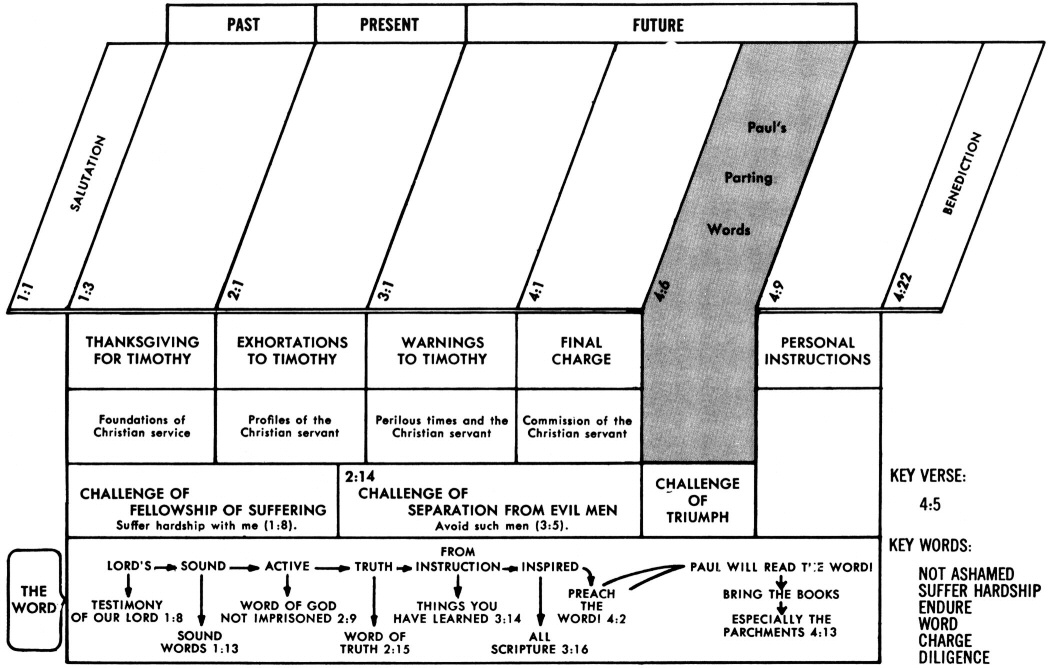
ENDURANCE AND SEPARATION IN THE MINISTRY
Click chart to enlarge
Charts from Jensen's Survey of the NT - used by permission
Second Timothy - Swindoll
| 2 TIMOTHY | |||
| 2 Timothy 1:1-18 | 2 Timothy 2:1-26 | 2 Timothy 3:1-17 | 2 Timothy 4:1-22 |
| Retain the Standard |
Rightly Divide the Word |
Difficult Times Will Come |
Preach the Word |
| PAST | PRESENT | FUTURE | |
| Foundation of Christian Service |
Pictures of Christian Servant |
Dangerous Times for Christian Servant |
Commission of Christian Servant |
| Unashamed as a Witness: Guard the Gospel |
Unashamed as a Workman: Suffer for the Gospel |
Adequate as a Workman: Continue in the Gospel |
Awarded as a Workman: Preach the Gospel |
| Power of the Gospel |
Perseverance of the Gospel Message | Protection of the Gospel |
Proclamation of the Gospel |
| Reminder | Requirements | Resistance | Requests |
| Encouragement in Ministry |
Examples in Ministry |
Exhortations in Ministry |
Exhortations to Fulfill Ministry |
| Commendation & Charge |
Commission to Fulfill |
Conflict to Face |
Course to Finish |
|
Compiled from Jensen's Survey of the NT and Wilkinson's Talk Thru the Bible |
|||
2 Timothy 4:14 Alexander the coppersmith did (3SAMI); me much harm; the Lord will repay (3SFAI) him according to his deeds.
Greek: Alexandros o chalkeus polla moi kaka enedeixato (3SAMI); apodosei (3SFAI) auto o kurios kata ta erga autou;
BBE: Alexander the copper-worker did me much wrong: the Lord will give him the reward of his works:
GWT: Alexander the metalworker did me a great deal of harm. The Lord will pay him back for what he did.
KJV: Alexander the coppersmith did me much evil: the Lord reward him according to his works:
Phillips: Alexander the coppersmith did me a great deal of harm - the Lord will reward him for what he did
Wuest: Alexander, the metal worker, showed me many instances of ill-treatment. The Lord shall pay him off in accordance with his evil works.
Young's Literal: Alexander the coppersmith did me much evil; may the Lord repay to him according to his works,
ALEXANDER THE COPPERSMITH DID ME MUCH HARM: Alexandros ho chalkeus polla moi kaka enedeixato (3SAMI):
- Acts 19:33,34; 1 Ti 1:20
- 2 Timothy 4 Resources - Multiple Sermons and Commentaries
- 2 Timothy 4:9-22 Facing Life's Winter - Steven Cole
- 2 Timothy 49-22 Friends and Foes - John MacArthur
Alexander the coppersmith - We are not sure of his identity. An Alexander is mentioned in Acts 19:33, 34 and probably another Alexander in 1Ti 1:20, a man whom Paul had "handed over to Satan" so that he would "be taught not to blaspheme."
Did (1731) (endeíknumi from en = in, to + deíknumi = make known the character or significance of something by visual, auditory, or linguistic means) means to point out, to demonstrate, to put on display, to prove, to show proof, to show forth, to show oneself, to give visible proof, to show in anything and implies an appeal to facts. The preposition (in) in the compound suggests more than the simplest demonstration. It is like laying the index finger, as it were, on the object. It means to to show something in someone.
Endeiknumi can mean to do something to someone, as in this passage where Alexander the coppersmith did Paul much harm (literally "evil"). The idea is that Alexander showed forth what was in his heart for it came out in his evil actions directed toward Paul and was specifically manifest as opposition to Paul's teaching, especially the Gospel (2Ti 4:15 - "our teaching" in the context of this letter certainly includes the vital truth of the Gospel).
In the papyri endeíknumi could have a quasi-legal sense of proving a petition or charge or of proving that a charge was wrong. Josephus used endeíknumi to describe Herod Agrippa’s display of generosity to those of other nations (Josephus, Antiquities, 19:330).
THE LORD WILL REPAY HIM ACCORDING TO HIS DEEDS: apodosei (3SFAI) auto o kurios ta erga autou:
- 1Sa 24:12; 2Sa 3:39; Ps 28:4; 109:5-20; Jer 15:15; 18:19, 20, 21, 22, 23; 2Th 1:6; 1Jn 5:16; Rev 6:10; 18:6,20
- 2 Timothy 4 Resources - Multiple Sermons and Commentaries
- 2 Timothy 4:9-22 Facing Life's Winter - Steven Cole
- 2 Timothy 49-22 Friends and Foes - John MacArthur
Young's Literal translates it "may the Lord repay to him according to his works" (as does the KJV/NKJV) which is in the form of a prayer or wish.
PAY DAY
SOME DAY
Paul had the attitude of the Psalmists in regard to revenge or retaliation, leaving it in God's hands (Ro 12:17, Ro 12:19)...
And lovingkindness is Yours, O Lord, for You recompense a man according to his work. (Ps 62:12)
Will repay (591) (apodidomi [word study] from apó = from + dídomi = give) means to pay or give back, implying a debt. It carries the idea of obligation and responsibility for something that is not optional.
Apodidomi can mean to give back or pay back (implying a debt and conveying the idea of obligation and responsibility for something that is not optional) and was a technical term for repaying a debt (Mt 18:25, 20:8, 21:41) It means to pay back, implying a debt. The papyri uses apodidomi to describe the paying of debt or restoring of a due of any kind.
Vine...
the apostle leaves the man in the hands of the Lord (see Ro 12:19), simply warning Timothy against him as an opponent of the truth.
According to his deeds - The Divine law of sowing and reaping is surely in view here...
Do not be deceived (Command to stop being deceived is the idea) God is not mocked; for whatever a man sows, this he will also reap. For the one who sows to his own flesh shall from the flesh reap corruption, but the one who sows to the Spirit shall from the Spirit reap eternal life. (Gal 6:7, Gal 6:8)
2 Timothy 4:15 Be on guard (2SPMM) against him yourself, for he vigorously opposed (3SAAI) our teaching.
Greek: on kai su phulassou, (2SPMM) lian gar anteste (3SAAI) tois hemeterois logois.
BBE: But be on the watch for him, for he was violent in his attacks on our teaching.
GWT: Watch out for him. He violently opposed what we said.
KJV: Of whom be thou ware also; for he hath greatly withstood our words.
Phillips: and I should be very careful of him if I were you. He has been an obstinate opponent of our teaching
Wuest: And you also, with reference to him, be constantly guarding yourself, for he in an extraordinary manner set himself in opposition to our words.
Young's Literal: of whom also do thou beware, for greatly hath he stood against our words
BE ON GUARD AGAINST HIM YOURSELF: on kai su phulassou (2SPMM):
- Matthew 10:16,17; Php 3:2
- 2 Timothy 4 Resources - Multiple Sermons and Commentaries
- 2 Timothy 4:9-22 Facing Life's Winter - Steven Cole
- 2 Timothy 49-22 Friends and Foes - John MacArthur
Watch out for him (GWT)
be constantly guarding yourself (Wuest)
Be on guard (5442) (phulasso [word study]) means to watch, to carry out the function as a military sentinel (Luke 2:8), keep watch, have one's eye upon lest one escape, guard a person that he might remain safe (from violence, from another person or thing, from being snatched away, from being lost). Peter for example records that God
did not spare the ancient world, but preserved Noah, a preacher of righteousness, with seven others, when He brought a flood upon the world of the ungodly. (2Pe 2:4,5 )
Phulasso can also mean to keep away from or make an effort to abstain from as in (Lk 12:15).
Phulasso is in the present imperative calling for continuous guarding and in the middle voice which gives it a reflexive meaning ("yourself"). You initiate the action of guarding and participate in the process (yourself).
Phulasso - 31x in 31v - Matt 19:20; Mark 10:20; Luke 2:8; 8:29; 11:21, 28; 12:15; 18:21; John 12:25, 47; 17:12; Acts 7:53; 12:4; 16:4; 21:24f; 22:20; 23:35; 28:16; Rom 2:26; Gal 6:13; 2 Thess 3:3; 1 Tim 5:21; 6:20; 2 Tim 1:12, 14; 4:15; 2 Pet 2:5; 3:17; 1 John 5:21; Jude 1:24. NAS = abstain(1), guard(8), guarded(1), guarding(1), guards(1), keep(5), keeping(2), keeps(1), kept(4), kept under guard(1), maintain(1), observe(2), preserved(1), protect(1), watching(1).
FOR HE VIGOROUSLY OPPOSED OUR TEACHING: lian gar anteste (3SAAI) tois hemeterois logois:
- 2 Timothy 4 Resources - Multiple Sermons and Commentaries
- 2 Timothy 4:9-22 Facing Life's Winter - Steven Cole
- 2 Timothy 49-22 Friends and Foes - John MacArthur
he was violent in his attacks (BBE)
he in an extraordinary manner set himself in opposition to our words (Wuest)
For - Explains why Timothy must continually keep his guard up around Alexander the coppersmith.
Opposed (436) (anthistemi [word study] from anti = against + histemi = to cause to stand) is literally to stand or set against. To set one's self against. To withstand. To oppose (place opposite or against), to resist by actively opposing pressure or power, to withstand (oppose with firm determination). This verb pictures not only a psychological attitude but also a corresponding behavior and was used to describe an army arranging in battle against enemy forces - what an awesome picture of the spiritual warfare between Paul and Alexander, and ultimately between God and Satan. Remember however that God is the Creator and Satan is a created being, so there is no doubt about Who is more powerful and because of the Cross, no doubt about Who is victorious. In this present evil age, God has chosen in His sovereignty to allow Satan a measure of power in spiritual matters. As believers we need to remember that from the beginning Satan's main tactics are (1) deception (Rev 12:9, et al) and (2) lying (Jn 8:44). It follows that the Christian's best weapon against this indomitable adversary (and his minions) is the Truth, God's Word. Why? Because the primary battle field is our mind and the Word of Truth fortifies us and enables us to discern good from evil (Heb 5:14). Are you daily in the Word of Truth (cp Mt 4:4, Lk 4:4, 1Pe 2:2)? If not, then don't be surprised if you find yourself vulnerable to the Adversaries weapons of deception, discouragement, and doubt (regarding the goodness of God, the truth of His Word, the certainty of His promises, the assurance of your salvation, and the list goes on!)
Anthistemi - 14x in 12v - Matt 5:39; Luke 21:15; Acts 6:10; 13:8; Rom 9:19; 13:2; Gal 2:11; Eph 6:13; 2 Tim 3:8; 4:15; Jas 4:7; 1 Pet 5:9. NAS = cope(1), oppose(1), has opposed(1), opposed(4), opposing(1), resist(5), resists(2).
Anthistemi means to arrange in battle against and so pictures a face to face confrontation - Paul faced off against Alexander = one almost gets a picture of an ancient pistol duel or a "high noon" scenario where the gunfighters are face to face waiting to draw and shoot! And thus the picture of anthistemi is to set one's self against another and so to stand firm against another's onset.
2 Timothy 4:16 At my first defense no one supported (3SAMI) me, but all deserted (3PAAI); me; may it not be counted ; (3SAPO) against them.
Greek: En te prote mou apologia| oudeis moi paregeneto, (3SAMI) alla pantes me egkatelipon (3PAAI); me autois logistheie; (3SAPO)
BBE: At my first meeting with my judges, no one took my part, but all went away from me. May it not be put to their account.
GWT: At my first hearing no one stood up in my defense. Everyone abandoned me. I pray that it won't be held against them.
KJV: At my first answer no man stood with me, but all men forsook me: I pray God that it may not be laid to their charge.
Phillips: The first time I had to defend myself no one was on my side - they all deserted me. God forgive them!
Wuest: During my self-defense at the preliminary trial, not even one person appeared in court, taking his stand at my side as a friend of mine, but all let me down. May it not be put to their account.
Young's Literal: in my first defence no one stood with me, but all forsook me, (may it not be reckoned to them!)
AT MY FIRST DEFENSE NO ONE SUPPORTED ME BUT ALL DESERTED ME: En te prote mou apologia oudeis moi paregeneto (3SAMI) alla pantes me egkatelipon (3PAAI):
- Acts 22:1; 25:16; 1Corinthians 9:3; 2Corinthians 7:11; Philippians 1:7,17; 1Peter 3:15;) (2Pe 4:10; 1:15; Ps 31:11, 12, 13; Mark 14:50; John 16:32
- 2 Timothy 4 Resources - Multiple Sermons and Commentaries
- 2 Timothy 4:9-22 Facing Life's Winter - Steven Cole
- 2 Timothy 49-22 Friends and Foes - John MacArthur
During my self-defense at the preliminary trial, not even one person appeared in court, taking his stand at my side as a friend of mine (Wuest)
Everyone abandoned me (GWT)
First (4413) (protos) refers to the former or first in a sequence.
Defense (627) (apologia from apo = from + logos = speech) literally means, “to talk one’s self off from". Apologia was a technical word used in the Greek law courts and was used of an attorney who talked his client off from a charge preferred against him. In short it refers to a speech given in defense.
Apologia - Acts 22:1; 25:16; 1 Cor 9:3; 2 Cor 7:11; Phil 1:7, 16; 2 Tim 4:16; 1 Pet 3:15. NAS = defense(7), vindication(1).
Although apologia is used in the present context in the sense of a judicial interrogation, the word can also mean an informal explanation or defense of one's position (1Cor 9:3, 2Cor 7:11).
No one (3762) (oudeis) means absolutely no one! In the human sense Paul was left to face his accusers by himself. Totally alone humanly speaking, but totally at rest in the assurance that he was not superhumanly alone! The Lord Himself was his advocate, his encouragement, his source of strength in his time of weakness.
Supported (3854) (paraginomai from para = beside + ginomai = to be, become, come into being) means to be beside or to become alongside. To become near, to place oneself by the side of, hence to be present with. No human being came to the aid of or stood by Paul in his hour of trial and need.
Paraginomai - 37x in 37v - appeared(2), arrive(2), arrived(10), came(13), come(4), come here(1), coming(1), present(1), supported(1), when...arrived(1).
Mt 2:1; 3:1, 13; Mark 14:43; Luke 7:4, 20; 8:19; 11:6; 12:51; 14:21; 19:16; 22:52; John 3:23; 8:2; Acts 5:21f, 25; 9:26, 39; 10:33; 11:23; 13:14; 14:27; 15:4; 17:10; 18:27; 20:18; 21:18; 23:16, 35; 24:17, 24; 25:7; 28:21; 1 Cor 16:3; 2 Tim 4:16; Heb 9:11.
All (3956) (pas) means all without exception.
Deserted (forsake, abandon, leave, left) (1459) (egkataleipo from en = in + kataleipo = forsake, desert) means literally to leave down in. It conveys the sense of deserting someone in a set of circumstances that are against them. The idea is to let one down, to desert, abandon, leave in the lurch, leave one helpless.
In Romans 9:39 egkataleipo means to cause to remain or to exist after a point in time.
Vine - egkataleipo denotes (a) "to leave behind, among, leave surviving," Romans 9:29; (b) "to forsake, abandon, leave in straits, or helpless," said by, or of, Christ, Matthew 27:46; Mark 15:34; Acts 2:27,31; of men, 2 Corinthians 4:9; 2 Timothy 4:10,16; by God, Hebrews 13:5; of things, by Christians (negatively), Hebrews 10:25 (Forsake - Vine's Expository Dictionary of NT Words)
Friberg (summary) - (1) of a posterity leave behind (Ro 9.29); (2) forsake, abandon, desert (Mt 27.46); (3) as allowing to remain leave (Acts 2.27); (4) of ceasing from an activity leave off, stop (Heb 10.25)
Wuest on egkataleipo in Heb 13:5 - "The meaning of the word is that of forsaking someone in a state of defeat or helplessness in the midst of hostile circumstances."
Vincent on egkataleipo - The compounded preposition en indicates a condition or circumstances in which one has been left, as the common phrase left in the lurch.
Desert (Webster, et al) - to withdraw from or leave usually without intent to return; to leave in the lurch 〈desert a friend in trouble>; to quit one’s post, allegiance, or service without leave or justification; especially : to abandon military duty without leave and without intent to return
Abandon (Webster, et al) - to withdraw from often in the face of danger or encroachment 〈abandon ship>: Abandon suggests that the thing or person left may be helpless without protection 〈abandoned children〉
Forsake (Webster, et al) - suggests an action more likely to bring impoverishment or bereavement to that which is forsaken than its exposure to physical dangers (a forsaken lover); to renounce or turn away from entirely (friends have forsaken her, forsook the theater for politics). To quit or leave entirely; to desert; to abandon; to depart from. Friends and flatterers forsake us in adversity. In the Bible the word forsake and its synonym abandon were used in two ways: in one meaning, forsake was a verb that meant to forget or discontinue performing a specific action; in the other meaning, forsake conveyed the abandonment of individuals who had no one else to care for their distresses. Both uses are important in the Bible, and when God speaks of Israel, he links the two uses. Because women were far more helpless than men, requiring legal, financial and physical protection from men, the individuals most often abandoned or forsaken in the Bible are women.
It is notable that of the ten occurrences of this verb in the NT, half are in quotes from the OT suggesting that to truly understand this word one must look at the consequently, its meaning must be understood in terms of the language of the Septuagint (LXX) uses.
The root verb kataleipo (from kata = intensifies or strengthens the meaning of leipo = to leave behind, forsake, to be wanting or deficient) literally means to leave behind or leave remaining (of a person or place - Mt 4:13, 16:4, 21:17, He 11:27). Kataleipo is often used to indicate abandoning a heritage, giving up riches, and leaving one's native land. Figuratively kataleipo was used to mean "neglect" (Acts 6:2). Kataleipo conveys a strong sense of to abandon or forsake (as forsaking true Christianity 2Pe 2:15).
Egkataleipo - 10x in 10v - NAS Usage = abandon(1), abandoned(1), deserted(2), forsake(1), forsaken(3), forsaking(1), left(1).
Matthew 27:46 About the ninth hour Jesus cried out with a loud voice, saying, "ELI, ELI, LAMA SABACHTHANI?" that is, "MY GOD, MY GOD, WHY HAVE YOU FORSAKEN ME?"
Comment: On the Cross Jesus cries out quoting Ps 22:1 [which also uses egkataleipo], a cry which expresses the completeness of His abandonment at His lowest (Ps 38:10; 71:9).
Mark 15:34 At the ninth hour Jesus cried out with a loud voice, "ELOI, ELOI, LAMA SABACHTHANI?" which is translated, "MY GOD, MY GOD, WHY HAVE YOU FORSAKEN ME?"
Acts 2:27 BECAUSE YOU WILL NOT ABANDON MY SOUL TO HADES, NOR ALLOW YOUR HOLY ONE TO UNDERGO DECAY (Quoting Ps 16:10 which also uses egkataleipo).
Comment: Peter quotes Ps 16:10, affirming that the Messiah would be abandoned in Hades (also Acts 2:31), because being abandoned by God would mean rejection (1Ki 8:57; 2Chr 15:2; Pr 4:6), an act which is unthinkable regarding His Beloved Son in Whom He was well pleased.
Acts 2:31 he looked ahead and spoke of the resurrection of the Christ, that HE WAS NEITHER ABANDONED TO HADES, NOR DID His flesh SUFFER DECAY.
Romans 9:29 And just as Isaiah foretold, "UNLESS THE LORD OF SABAOTH HAD LEFT TO US A POSTERITY, WE WOULD HAVE BECOME LIKE SODOM, AND WOULD HAVE RESEMBLED GOMORRAH."
2 Corinthians 4:9 persecuted, but not forsaken; struck down, but not destroyed;
2 Timothy 4:10 for Demas, having loved this present world, has deserted me and gone to Thessalonica; Crescens has gone to Galatia, Titus to Dalmatia.
Wuest comments that deserted: tells us that Demas had not only left Paul so far as fellowship was concerned, but he had left him in the lurch also, so far as the work of the gospel was concerned. He had been one of Paul’s dependable and trusted helpers. Paul said that he let him down. This latter expression, so often heard today, was in common use in Paul’s day. Our Lord used it while on the Cross (Matt. 27:46), and it is used in Hebrews 13:5. The Greek word is however stronger than the English words. It is made up of three words, “to leave” (leipo), “down” (kata), and “in” (en), that is, to forsake one who is in a set of circumstances that are against him. It was a cruel blow to Paul. Right to the last, his intense nature impelled him to do what he could in the service of the Lord. He was awaiting the executioner’s axe. Now, one whom he had trusted, had let him down. Paul was in prison, his freedom of action curtailed. (Wuest, K. S. Wuest's Word Studies from the Greek New Testament: Eerdmans)
MacArthur notes that egkataleipo is: a strong verb that means to utterly abandon and leave someone helpless in a dire situation. Perhaps the sacrifice of many comforts, including the probable loss of his own freedom, became too high a price for Demas. He was a fair-weather disciple, who had never considered the cost of genuine commitment to Christ. He may have been caught up emotionally with the idea of a noble cause, which he did his part to serve when the demands were not great. But when the cause became costly, he was nowhere to be found. (MacArthur, J. 2 Timothy. Chicago: Moody Press)
2 Timothy 4:16 At my first defense no one supported me, but all deserted me; may it not be counted against them.
Hebrews 10:25 not forsaking our own assembling together, as is the habit of some, but encouraging one another; and all the more as you see the day drawing near.
Comment: Some of the recipients of this letter were, under stress of persecution, absenting themselves from the Christian assemblies. They are exhorted not to egkataleipo, that is, let down in their attendance upon these meetings, or abandon them. They are, on the other hand to exhort each other to continued attendance, and in view of the fact of the approach of the time when the Lord would come. (Wuest, K. S. Wuest's Word Studies from the Greek New Testament: Eerdmans)
Hebrews 13:5 Make sure that your character is free from the love of money, being content with what you have; for He Himself has said, "I WILL NEVER DESERT (aniemi = literally to send back) YOU, NOR WILL I EVER FORSAKE (egkataleipo) YOU,"
Comment: The English "hides" the fact that the Spirit has inspired five negatives in this verse to emphasize the utter impossibility that God will ever desert us. In the Greek, the promise is very emphatic, "I will never, never, never leave thee." The promise to never leave was made to Joshua when he succeeded Moses : [Dt 1:7-8, Jos 1:5,9] and is a promise consummated in the Great Commission by Jesus [Mt 28:20, cp Acts 18:9-10 cp 1Chr 28:20]
Egkataleipo - 147x in the non-apocryphal Septuagint (LXX) -
Ge 24:27; 28:15; Lev 26:43; Num 10:31; Deut 4:31; 12:19; 28:20; 31:6, 8, 16; 32:15, 18; Josh 1:5; 22:3; 24:20; Jdg 2:12f, 20; 10:6, 10, 13; Ruth 2:20; 1Sam 8:8; 12:10; 1Kgs 8:57; 9:9; 12:8, 13; 19:10, 14; 21:21; 2Ki 2:4, 6; 4:30; 7:7; 9:8; 14:26; 17:16; 21:22; 22:17; 1Chr 14:12; 28:20; 2Chr 7:19, 22; 10:13; 11:14; 12:1, 5; 13:10f; 15:2; 21:10; 24:18, 20, 24f; 29:6; 32:31; 34:25; Ezra 8:22; 9:9f; Neh 5:10; 9:17, 19, 28, 31; 10:39; 13:11; Job 20:13; Ps 9:10; 10:14; 16:10; 22:1; 27:9f; 37:8, 25, 28, 33; 38:10, 21; 40:12; 71:9, 11, 18; 89:30; 94:14; 119:8, 87; 140:8; Pr 2:13; 4:2, 6; 24:14; 27:10; 28:4; Isa 1:4, 8f, 28; 16:8; 17:9; 24:12; 32:14; 41:9, 17; 42:16; 49:14; 58:2; 60:15; 62:12; 65:11; Jer 1:16; 2:13; 4:29; 5:7; 9:13, 19; 12:7; 14:5; 16:11; 17:11, 13; 19:4; 22:9; 25:38; 49:25; 51:9; Ezek 8:12; 9:9; 20:8; 23:8; 24:21; 36:4; Dan 9:11; 10:8; 11:30; Hos 4:10; 5:7; 11:9; Jonah 2:8; Mal 2:10f, 14ff.
Here are a few uses from the Septuagint...
Genesis 24:27 He said, “Blessed be the LORD, the God of my master Abraham, who has not forsaken (Hebrew = azab 05800 = abandon, forsake, let go of; Lxx = egkataleipo) His lovingkindness and His truth toward my master; as for me, the LORD has guided me in the way to the house of my master’s brothers.”
Genesis 28:15 "Behold, I am with you and will keep you wherever you go, and will bring you back to this land; for I will not leave (Hebrew = azab 05800 = abandon, forsake, let go of; Lxx = egkataleipo) you until I have done what I have promised you."
Deuteronomy 28:20 "The LORD will send upon you curses, confusion, and rebuke, in all you undertake to do, until you are destroyed and until you perish quickly, on account of the evil of your deeds, because you have forsaken (Hebrew = azab 05800 = abandon, forsake, let go of; Lxx = egkataleipo) Me.
Deuteronomy 31:6 "Be strong and courageous, do not be afraid or tremble at them, for the LORD your God is the one who goes with you. He will not fail you or forsake (Hebrew = azab = abandon, forsake, let go of; Lxx = egkataleipo) you." (cp similar declarations in Dt 31:8)
Deuteronomy 32:15 "But Jeshurun grew fat and kicked-- You are grown fat, thick, and sleek-- Then he forsook (Hebrew = natash; Lxx = egkataleipo) God who made him, and scorned the Rock of his salvation.
Joshua 1:5 "No man will be able to stand before you all the days of your life. Just as I have been with Moses, I will be with you; I will not fail you or forsake (Hebrew = azab 05800 = abandon, forsake, let go of; Lxx = egkataleipo) you.
Comment: Note the repetition of the negation (Dt 31:6, 8, Joshua 1:5), which reinforces the certainty of God's help. The idea is that He will never, never, never, in any circumstance whatsoever fail or forsake us! Egkataleipo used in a negative statement is a strong affirmation of the unchangeableness of His providence.
Ruth 2:20 Naomi said to her daughter-in-law, “May he be blessed of the LORD who has not withdrawn (Hebrew = azab 05800 = abandon, forsake, let go of; Lxx = egkataleipo) his kindness to the living and to the dead.” Again Naomi said to her, “The man is our relative, he is one of our closest relatives.”
Psalm 9:10 And those who know Your name will put their trust in You, For You, O LORD, have not forsaken (Hebrew = azab = abandon, forsake, let go of; Lxx = egkataleipo) those who seek You.
Comment: Ignorance is worst when it amounts to ignorance of God, and knowledge is best when it exercises itself upon the name of God. This most excellent knowledge leads to the most excellent grace of faith. O, to learn more of the attributes and character of God. Unbelief, that hooting night bird, cannot live in the light of divine knowledge, it flies before the sun of God's great and gracious name. If we read this verse literally, there is, no doubt, a glorious fulness of assurance in the names of God. We have recounted them in the "Hints for Preachers," and would direct the reader's attention to them. By knowing his name is also meant an experimental acquaintance with the attributes of God, which are every one of them anchors to hold the soul from drifting in seasons of peril. The Lord may hide his face for a season from his people, but he never has utterly, finally, really, or angrily forsaken them that seek him. Let the poor seekers draw comfort from this fact, and let the finders rejoice yet more exceedingly, for what must be the Lord's faithfulness to those who find if he is so gracious to those who seek. (Spurgeon)
Psalm 37:8 Cease from anger and forsake (Hebrew = azab = abandon, forsake, let go of; Lxx = egkataleipo) wrath; Do not fret; it leads only to evildoing.
Comment: Cease from anger and forsake wrath. Especially anger against the arrangements of Providence, and jealousies of the temporary pleasures of those who are so soon to be banished from all comfort. Anger anywhere is madness, here it is aggravate insanity. Yet since anger will try to keep us company, we must resolvedly forsake it. Fret not thyself in any wise to do evil. By no reasonings and under no circumstances be led into such a course. Fretfulness lies upon the verge of great sin. Many who have indulged a murmuring disposition have at last come to sin, in order to gain their fancied rights. Beware of carping at others, study to be yourself found in the right way; and as you would dread outward sin, tremble at inward repining. (Spurgeon)
Psalm 37:25 I have been young and now I am old, Yet I have not seen the righteous forsaken Or his descendants begging bread.
Comment: Never are the righteous forsaken; that is a rule without exception. Seldom indeed do their seed beg bread; and although it does occasionally occur, through dissipation, idleness, or some other causes on the part of their sons, yet doubtless it is so rare a thing that there are many alive who never saw it. Go into the union house and see how few are the children of godly parents; enter the gaol and see how much rarer still is the case. Poor minster's sons often become rich. I am not old, but I have seen families of the poor godly become rich, and have seen the Lord reward the faithfulness of the father in the success of the son, so that I have often thought that the best way to endow one's seed with wealth is to become poor for Christ's sake. (Spurgeon)
Psalm 37:28 For the LORD loves justice And does not forsake His godly ones; They are preserved forever, But the descendants of the wicked will be cut off.
Comment: And forsaketh not his saints. This would not be right, and, therefore, shall never be done. God is as faithful to the objects of his love as he is just towards all mankind. They are preserved for ever. By covenant engagements their security is fixed, and by suretyship fulfilments that safety is accomplished; come what may, the saints are preserved in Christ Jesus, and because he lives, they shall live also. A king will not lose his jewels, nor will Jehovah lose his people. As the manna in the golden pot, which else had melted, was preserved in the ark of the covenant beneath the mercyseat, so shall the faithful be preserved in the covenant by the power of Jesus their propitiation. (Spurgeon)
Psalm 71:9 Do not cast me off in the time of old age; Do not forsake me when my strength fails.
Comment: Forsake me not when my strength faileth. Bear with me, and endure my infirmities. To be forsaken of God is the worst of all conceivable ills, and if the believer can be but clear of that grievous fear, he is happy: no saintly heart need be under any apprehension upon this point.
Psalm 71:18 And even when I am old and gray, O God, do not forsake me, Until I declare Your strength to this generation, Your power to all who are to come.
Psalm 119:8 I shall keep Your statutes; Do not forsake me utterly! Beth.
Psalm 119:87 They almost destroyed me on earth, But as for me, I did not forsake Your precepts.
Proverbs 4:2 For I give you sound teaching; Do not abandon my instruction.
Proverbs 4:6 "Do not forsake her, and she will guard you; Love her, and she will watch over you.
Isaiah 1:4 Alas, sinful nation, People weighed down with iniquity, Offspring of evildoers, Sons who act corruptly! They have abandoned the LORD, They have despised the Holy One of Israel, They have turned away from Him.
Isaiah 1:28 But transgressors and sinners will be crushed together, And those who forsake the LORD will come to an end.
They forsook Paul in his state of "seeming defeat" and "helplessness" in midst of hostile circumstances. (cp Jn 16:33). But see (2Ti 4:21) where at least 4 persons were named who had not deserted Paul. Nothing more is known of them but their loyalty is recorded for all eternity. One cannot fully assess the long term potential ramifications of a simple act of kindness.
A Roman trial began with a preliminary examination to formulate the precise charge against the prisoner. When Paul was brought to that preliminary examination, not one of his friends stood by him. It was too dangerous to proclaim oneself the friend of a man on trial for his life.
MAY IT NOT BE COUNTED AGAINST THEM: me autois logistheie (3SAPO):
- Acts 7:60, cp Lk 23:34
- 2 Timothy 4 Resources - Multiple Sermons and Commentaries
- 2 Timothy 4:9-22 Facing Life's Winter - Steven Cole
- 2 Timothy 49-22 Friends and Foes - John MacArthur
"May it not be put to their account" (Wuest)
Praying for those who deserted him, not cursing them. His attitude was different toward Alexander (2Ti 4:14)
If to do the right means to be alone, as Joan of Arc said, "It is better to be alone with God."
May it not be counted (3049) (logizomai from lógos = reason, word, account) means to reckon, compute, calculate, to take into account, to deliberate, and to weigh. Logizomai refers to a process of careful study or reasoning which results in the arriving at a conclusion. Logizomai was a term frequently used in the business community of Paul's day and meant to impute (put to one's account) or credit to one's account. In the present context Paul seems to be asking God not to put their desertion on their spiritual ledger (as a "deficit" so to speak).
Note that logizomai is in the optative mood which expresses a wish or desire and often conveys the sense of a prayer.
Logizomai - 40x in 39v - consider(6), considered(2), counted(1), counting(1), credit(1), credited(9), credits(1), dwell(1), maintain(1), numbered(2), propose(1), reason(1), reckoned(2), regard(4), regarded(3), suppose(1), take into account(3), thinks(1).
Luke 22:37; John 11:50; Acts 19:27; Rom 2:3, 26; 3:28; 4:3ff, 8ff, 22ff; 6:11; 8:18, 36; 9:8; 14:14; 1 Cor 4:1; 13:5, 11; 2 Cor 3:5; 5:19; 10:2, 7, 11; 11:5; 12:6; Gal 3:6; Phil 3:13; 4:8; 2 Tim 4:16; Heb 11:19; Jas 2:23; 1 Pet 5:12. NAS =
Vine - such was His Christlike spirit that He prays that their defection may not be reckoned against them, with the consequences that would issue at the Judgment Seat of Christ.
Ray Stedman writes that this is "rather a sad note. When the apostle was brought up for his hearing -- we would call it the arraignment of the charges against him -- no one stood up for him; all forsook him. This was a very dangerous time in Rome. The Emperor Nero was noted for his vindictiveness. If anybody even appeared to be against him, Nero's assassins were all throughout the city, ready to take the man's life. Evidently no Christian was ready to risk his life by standing up for Paul, so he had to face this preliminary hearing all alone. But notice again Paul's lack of vindictiveness. "May it not be charged against them," he says; and he prays for those who forsook him in the hour of danger. (2 Timothy 4)
2 Timothy 4:17 But the Lord stood (3SAAI) with me and strengthened (3SAAI) me, so that through me the proclamation might be fully accomplished (3SAPS) , and that all the Gentiles might hear (3SAAS) ; and I was rescued (1SAPI) out of the lion's mouth.
Greek: o de kurios moi pareste (3SAAI) kai enedunamosen (3SAAI) me, hina di' emou to kerugma plerophorethe (3SAPS) kai akousosin (3SAAS) panta ta ethne, kai errusthen (1SAPI) ek stomatos leontos.
BBE: But the Lord was by my side and gave me strength; so that through me the news might be given out in full measure, and all the Gentiles might give ear: and I was taken out of the mouth of the lion.
GWT: However, the Lord stood by me and gave me strength so that I could finish spreading the Good News for all the nations to hear. I was snatched out of a lion's mouth.
KJV: Notwithstanding the Lord stood with me, and strengthened me; that by me the preaching might be fully known, and that all the Gentiles might hear: and I was delivered out of the mouth of the lion.
Phillips: Yet the Lord himself stood by me and gave me the strength to proclaim the message clearly and fully, so that the Gentiles could hear it, and I was rescued "from the lion's mouth".
Wuest: But the Lord took His stand at my side to render all the assistance I needed, and clothed me with strength, in order that through me the public proclamation might be heralded abroad in full measure, and that all the Gentiles might hear.
Young's Literal: and the Lord stood by me, and did strengthen me, that through me the preaching might be fully assured, and all the nations might hear, and I was freed out of the mouth of a lion,
BUT THE LORD STOOD WITH ME AND STRENGTHENED ME I N ORDER THAT THROUGH ME: o de kurios moi pareste (3SAAI kai enedunamosen (3SAAI) me hina di emou:
- Ps 37:39,40; 109:31; Jeremiah 15:20,21; 20:10,11; Matthew 10:19; Acts 18:9,10; Acts 23:11; 27:23,24) (Isaiah 41:10,14; 2 Corinthians 12:9
- 2 Timothy 4 Resources - Multiple Sermons and Commentaries
- 2 Timothy 4:9-22 Facing Life's Winter - Steven Cole
- 2 Timothy 49-22 Friends and Foes - John MacArthur
Lord (2962) (kurios from kuros = might or power) has the primary sense of a supreme one, one who is sovereign and possesses absolute authority, absolute ownership and uncontested power.
Kurios is used of the one to whom a person or thing belonged, about which he has the power of deciding, the one who is the master or disposer of a thing (Mk 7:28)
Thayer says kurios is "he to whom a person or thing belongs, about which he has the power of deciding; master, lord."
Stood (3936) (paristemi from pará = near + hístemi = place, stand) is literally place beside with the idea of yielding to the disposal of another.
Paristemi - 41x in 39v - bystanders(5), come(1), commend(1), help(1), present(11), presented(4), presenting(1), prove(1), provide(1), put at...disposal(1), stand before(2), standing(1), standing beside(1), standing nearby(2), stands(1), stands here(1), stood(2), stood before(1), stood beside(2), took their stand(1).
Matt 26:53; Mark 4:29; 14:47, 69f; 15:35, 39; Luke 1:19; 2:22; 19:24; John 18:22; 19:26; Acts 1:3, 10; 4:10, 26; 9:39, 41; 23:2, 4, 24, 33; 24:13; 27:23f; Rom 6:13, 16, 19; 12:1; 14:10; 16:2; 1 Cor 8:8; 2 Cor 4:14; 11:2; Eph 5:27; Col 1:22, 28; 2 Tim 2:15; 4:17.
Paul had earlier used this same word to exhort Timothy to...
Be diligent to present yourself approved to God as a workman who does not need to be ashamed, handling accurately the word of truth. (2Ti 2:15)
Paul testifies to the truth of the great verse in Hebrews in which...
He Himself has said, "I WILL NEVER DESERT YOU, NOR WILL I EVER FORSAKE YOU" (In the Greek, the promise is very emphatic, "I will never, never, never leave thee") so that we confidently say, "THE LORD IS MY HELPER, I WILL NOT BE AFRAID. WHAT SHALL MAN DO TO ME?" (Hebrews 13:5, 6)
Paul is saying that in light of the reality of the presence of Jesus in Him, with him and beside him two things were accomplished (1) it "gave him strength to testify" and (2) "He delivered me from the lion's mouth." And He will do the same for each of us beloved as we learn the secret of Mt 11:28, 29, 30, John 15:5, Php 4:11, 12, Php 4:13, 2Cor 12:9, 2Cor 12:10 and other NT passages that teach a similar principle of abiding in, resting in, relying on, yielding to Christ Who is now our life (Col 3:4) and as such is our sole Source of supernatural strength.
Strengthened (1743) (endunamoo from en = in + dunamoo = strengthen from dunamis = to be able or to have power = speaks of inherent power) in simple terms means "to put power in" (like a car needs gas for power) and so to make strong, vigorous, to strengthen, or to be strengthened, enabled or empowered inwardly. This word is found only in biblical and ecclesiastical Greek. The idea is to cause one to be able to function or do something. It can refer to physical strengthening as in (Heb 11:34) but more often endunamoo refers to spiritual or moral strengthening. Endunamoo is the same verb Paul used to exhort Timothy in 2Ti 2:1 where we are not surprised to find that this empowerment or strengthening is associated with grace and the "atmosphere" if you will of that grace is Christ Jesus.
Endunamoo - 7x in 7v - grew strong(1), increasing in strength(1), strengthened(2), strengthens(1), strong(2).
Acts 9:22; Rom 4:20; Eph 6:10; Phil 4:13; 1 Tim 1:12; 2 Tim 2:1; 4:17.
Dunamis refers to inherent strength residing in a thing by virtue of its nature. The best spiritual example is the "gospel" which is the inherent, omnipotent power of God operating in the salvation of a lost soul that accepts it.
What an awesome thought! God Almighty, omnipotent, omniscient, the great I Am Who needs nothing, chooses to use frail clay cracked pots to shine forth His glorious gospel truth that men might hear & receive & be regenerated. Who could get the credit for so great a salvation? To God alone be all glory & majesty & dominion & authority, now & forever. Thank You Father for using us. May we walk like Paul, in a manner worthy of You O Lord God. Amen.
THE PROCLAMATION MIGHT BE FULLY ACCOMPLISHED AND ALL THE GENTILES MIGHT HEAR: to kerugma plerophorethe (3SAPS) kai akousosin (3SAAS) panta ta ethne:
- Luke 21:15; Acts 9:15; 26:17,18; Romans 16:25,26; Ephesians 3:8; Philippians 1:12, 13, 14
- 2 Timothy 4 Resources - Multiple Sermons and Commentaries
- 2 Timothy 4:9-22 Facing Life's Winter - Steven Cole
- 2 Timothy 49-22 Friends and Foes - John MacArthur
"the public proclamation might be heralded abroad in full measure" (Wuest)
Proclamation (2782) (kerugma [word study] from kerusso = preach, discharge a herald’s office, cry out, proclaim) refers to a proclamation in context of the gospel.
Kerugma - 9x in 9v - Matt 12:41; Mark 16:8; Luke 11:32; Rom 16:25; 1 Cor 1:21; 2:4; 15:14; 2Ti 4:17; Titus 1:3. NAS = message preached(1), preaching(5), proclamation(2).
Paul obeyed his own commandment; in season and out of season (2Ti 4:2), proclaiming the truth of Jesus to men. Prison became a platform for proclamation, an opportunity, not an obstacle!. A man who is immersed in his God willed, God enabled, God pleasing task (cp Ep 2:10; Col 1:10) has conquered his fear. Paul's faith (2Ti 1:12) gave him a heavenly perspective regarding his earthly problems! Lord, may his tribe increase. Amen. (See relationship between Faith and Fear -How to Handle our Fears)
WHEN PRISONS
BECOME PULPITS!
The very occasion of imprisonment gave Paul an opportunity to fulfill his commission of proclaiming the message of Christ (cp Acts 9:15, 16, 13:2, 47, 22:21, 26:19, 20, 21, 22, 23, 28:28, Gal 2:7, 8), in the very heart of the Roman Empire before the highest earthly tribunal! (cp Jesus' promise to His disciples = Mk 13:9, 10, Mt 10:17, 18, 19, 20, 21, 22, 23, 24) It afforded an opportunity for the vast crowd of Gentiles who were attracted to the trial to hear Paul's presentation of his "apologia" (defense). He clearly set forth the content of his message or really God's message through him to those dead in their trespasses and sins. I must confess that I far too often fall short of this Pauline approach to problems for I so easily fail to remember that obstacles that the Lord allows/sends into my life are always wonderful opportunities for God to show Himself sufficient in my weakness (cp 2Cor 12:9, 2Cor 12:10)
Accomplished (4135)(plerophoreo from pleres = full + phero = to bear or bring) means literally to carry fully and so to bring to fullness or to bring to a full measure. To fill completely. To satisfy fully. To fulfill or fully accomplish as here and in (2Ti 4:5). This verb is frequently used in the papyri in the sense of finishing off a task. Paul was finishing the task for which God had set him apart (cp 2Ti 4:7)
Plerophoreo - 6x in 6v - Luke 1:1; Rom 4:21; 14:5; Col 4:12; 2Ti 4:5, 17. NAS = accomplished(1), fulfill(1), fully accomplished(1), fully assured(2), fully convinced(1).
Paul had used this same verb to issue a similar missive (written communication) to Timothy...
But you, be sober (present imperative) in all things, endure (aorist imperative) hardship, do (aorist imperative) the work of an evangelist, fulfill (plerophoreo in the aorist imperative = Do this effectively! Don't procrastinate! The need is urgent!!) your ministry. (2Ti 4:5)
It is noteworthy that Paul was exemplifying the very task he had charged Timothy to fulfill! What a demonstration of discipleship right to the very end of his life, a template every disciple maker should seek to emulate!
AND I WAS RESCUED FROM THE LION'S MOUTH: kai erusthen (1SAPI) ek stomatos leontos:
- Ps 22:21; Proverbs 20:2; 28:15; Jeremiah 2:30; Daniel 6:22,27; Hebrews 11:33; 1Peter 5:8; 2Peter 2:9
- 2 Timothy 4 Resources - Multiple Sermons and Commentaries
- 2 Timothy 4:9-22 Facing Life's Winter - Steven Cole
- 2 Timothy 49-22 Friends and Foes - John MacArthur
I was snatched out of a lion's mouth (GWT)
I was drawn to His side out of the lion’s mouth (Wuest)
Deliver (4506) (rhuomai [word study] from rhúo = to draw, drag along the ground) means to draw or snatch to oneself and invariably refers to a snatching from danger, evil or an enemy. This basic idea of rescuing from danger is pictured by the use describing a soldier’s going to a wounded comrade on the battlefield and carrying him to safety (he runs to the cry of his comrade to rescue him from the hands of the enemy).
Rhuomai - 17x in 15v - deliver(3), delivered(1), Deliverer(1), rescue(3), rescued(7), rescues(1), set...free(1).
Matt 6:13; 27:43; Luke 1:74; Rom 7:24; 11:26; 15:31; 2 Cor 1:10; Col 1:13; 1 Thess 1:10; 2 Thess 3:2; 2 Tim 3:11; 4:17f; 2 Pet 2:7, 9.
Rhuomai was used in a secular writing to describe a soldier going to a wounded comrade on the battlefield and carrying him to safety (he runs to the cry of his comrade to rescue him from the hands of the enemy) (Godet)
The lion's mouth - One cannot be absolutely certain whether this "lion" is a reference to Nero or Satan or to a literal lion in the Roman Coliseum (although Paul could not be sent to the Coliseum for his Roman citizenship provided immunity from that mode of punishment). In any event, we do know that Nero was in power at the time and that even though Nero might put him to death on earth, that would not in any way remove him from the kingdom of heaven and the opportunity to be with the Lord but in fact, it would only open the door for him.
Paul was quite certain of the ultimate rescue (Php 1:21). In time he might seem to be the victim of circumstances and a criminal condemned at the bar of Roman justice; but Paul saw beyond time (Heb 11:27) and knew that his eternal safety was assured. It is always better to be in danger for a moment and safe for eternity, than to be safe for a moment and jeopardize eternity (Mt 10:28).
Lion (3023) (leon) is used in Scripture to symbolize strength, majesty and courage on one hand (a picture of God, Christ, Israel, tribe of Judah, etc) and a menacing ferocity predator (predatory = relating to, or practicing plunder or pillage; inclined or intended to injure others for personal profit) as in the present context. A "roaring lion" was used to characterize a king's wrath.
2 Timothy 4:18 The Lord will rescue (3SFMI) me from every evil deed, and will bring me safely (3SFAI) to His heavenly kingdom; to Him be the glory forever and ever. Amen.
Greek: rhusetai (3SFMI) me o kurios apo pantos ergou ponerou kai sosei (3SFAI) eis ten basileian autou ten epouranion, o e doxa eis tous aionas ton aionon; amen.
BBE: The Lord will keep me safe from every evil work and will give me salvation in his kingdom in heaven: to whom be glory for ever and ever. So be it.
GWT: The Lord will rescue me from all harm and will take me safely to his heavenly kingdom. Glory belongs to him forever! Amen.
KJV: And the Lord shall deliver me from every evil work, and will preserve me unto his heavenly kingdom: to whom be glory for ever and ever. Amen.
Phillips: I am sure the Lord will rescue me from every evil plot, and will keep me safe until I reach his heavenly kingdom. Glory be to him for ever and ever!
Wuest: The Lord will draw me to himself away from every pernicious work actively opposed to that which is good, and will keep me safe and sound for His kingdom, the heavenly one, to whom be the glory forever and forever. Amen.
Young's Literal: and the Lord shall free me from every evil work, and shall save me -- to his heavenly kingdom; to whom is the glory to the ages of the ages! Amen.
THE LORD WILL RESCUE ME FROM EVERY EVIL DEED: rhusetai (3SFMI) me o kurios apo pantos ergou ponerou:
- Genesis 48:16; 1Samuel 25:39; 1Chronicles 4:10; Psalms 121:7; Matthew 6:13; Luke 11:4; John 17:15; 1Corinthians 10:13; 2Corinthians 1:10; 2Thessalonians 3:3
- 2 Timothy 4 Resources - Multiple Sermons and Commentaries
- 2 Timothy 4:9-22 Facing Life's Winter - Steven Cole
- 2 Timothy 49-22 Friends and Foes - John MacArthur
The Lord will draw me to himself away from every pernicious work actively opposed to that which is good (Wuest)
Deliver (4506)(rhuomai from rhúo = to draw, drag along the ground) means to draw or snatch to oneself and invariably refers to a snatching from danger, evil or an enemy. This basic idea of rescuing from danger is pictured by the use describing a soldier’s going to a wounded comrade on the battlefield and carrying him to safety (he runs to the cry of his comrade to rescue him from the hands of the enemy).
Rhuomai emphasizes greatness of peril from which deliverance is given by a mighty act of power
Rhuomai means to rescue, deliver, as when we first became believers and the Lord...
"delivered (rhuomai) us from the domain (exousia = the right and the might = executive power, jurisdiction) of darkness (skotos = spiritual darkness ruled by Satan), and transferred (removed us from. one place to another, causing a change in someone's official position) us to the kingdom (denoting sovereignty, royal power, dominion) of His beloved Son" (Click notes on Col1:13) Since rhuomai means to draw to oneself, here we see the great picture that God drew us out of Satan’s kingdom to Himself. That event was the new birth. We are not gradually, progressively delivered from Satan’s power. When we placed our faith in Christ, we were instantly delivered.
A great example is wading in a rushing river and suddenly being caught in the current utterly helpless. As you cry out someone hears you and holds out their hand as you go rushing by. As you lie their beside the river safe in the presence of the one who pulled you out, you still are in the presence of the dangerous rushing current...you can hear it...you can see it...but you've been DELIVERED FROM DANGER and you are now safe. How foolish to walk right back into that current and let it sweep you away!
Jesus when ask by his disciples how they should pray gave as part of his answer that they should ask...
'And do not lead us into temptation, but deliver (rhuomai - in the form of a command) us from evil." (Mt 6:13)
AND WILL BRING ME SAFELY TO HIS HEAVENLY KINGDOM: kai sosei (3SFAI) eis ten basileian autou ten epouranion:
- 2Ti 1:12; Ps 37:28; 73:24; 92:10; Matthew 13:43; 25:34; Luke 12:32; 22:29; John 10:28, 29, 30; 1Th 5:23; Jas 2:5; 1Peter 1:5; Jude 1:1,24
- 2 Timothy 4 Resources - Multiple Sermons and Commentaries
- 2 Timothy 4:9-22 Facing Life's Winter - Steven Cole
- 2 Timothy 49-22 Friends and Foes - John MacArthur
will keep me safe and sound (Wuest)
Will bring me safely (4982) (sozo) has the basic meaning of rescuing one from great peril. Additional nuances include to protect, keep alive, preserve life, deliver, heal, be made whole. Paul was saved (past - justification), was being saved (present - daily sanctification) and will be saved (future - glorification). AND THIS IS ALSO YOUR SALVATION STORY BELOVED! Your PAST, PRESENT AND FUTURE ARE FULLY SECURE because you are in the "ARK", in Christ, our eternal righteousness.
Heavenly kingdom - This is Paul's description of our future, glorified life, as [1Co 6:9, 10; 15:50; Lk 13:29]. The following phrases convey much the same sense -- kingdom of Christ and of God, [Ep 5:5]; kingdom of their Father, [Mt 13:43]; my Father’s kingdom, [Mt26:29]; kingdom prepared for you, [Mt 25:34]; eternal kingdom of our Lord and Savior Jesus Christ, [2Pe 1:11].
C H Spurgeon writes the following devotional on "His heavenly kingdom"...
Yonder city of the great King is a place of active service. Ransomed spirits serve him day and night in his temple. They never cease to fulfill the good pleasure of their King. They always “rest,” so far as ease and freedom from care is concerned; and never “rest,” in the sense of indolence or inactivity. Jerusalem the golden is the place of communion with all the people of God. We shall sit with Abraham, Isaac, and Jacob, in eternal fellowship. We shall hold high converse with the noble host of the elect, all reigning with him who by his love and his potent arm has brought them safely home. We shall not sing solos, but in chorus shall we praise our King. Heaven is a place of victory realized. Whenever, Christian, thou hast achieved a victory over thy lusts—whenever after hard struggling, thou hast laid a temptation dead at thy feet—thou hast in that hour a foretaste of the joy that awaits thee when the Lord shall shortly tread Satan under thy feet, and thou shalt find thyself more than conqueror through him who hath loved thee. Paradise is a place of security. When you enjoy the full assurance of faith, you have the pledge of that glorious security which shall be yours when you are a perfect citizen of the heavenly Jerusalem. O my sweet home, Jerusalem, thou happy harbour of my soul! Thanks, even now, to him whose love hath taught me to long for thee; but louder thanks in eternity, when I shall possess thee.
“My soul has tasted of the grapes,
And now it longs to go
Where my dear Lord his vineyard keeps
And all the clusters grow.“Upon the true and living vine,
My famish’d soul would feast,
And banquet on the fruit divine,
An everlasting guest.”
TO HIM BE THE GLORY FOREVER AND EVER AMEN: o e doxa eis tous aionas ton aionon, amen:
- Ro 11:36; 16:27; Gal 1:5; 1Ti 1:17; 6:16; Heb 13:21; 1Peter 5:11; Jude 1:25
- 2 Timothy 4 Resources - Multiple Sermons and Commentaries
- 2 Timothy 4:9-22 Facing Life's Winter - Steven Cole
- 2 Timothy 49-22 Friends and Foes - John MacArthur
Glory (1391)(doxa from dokeo = to think) in simple terms means to give a proper opinion or estimate of something and thus the glory of God expresses all that He is in His Being and in His nature, character, power and acts. He is glorified when He is allowed to be seen as He really is. To be where God is will be glory. To be what God intended will be glory. To do what God purposed will be glory.
Forever and ever - This phrase is frequently used by Paul [Ep 3:21, Php 4:20, 1Ti 1:17, 2Ti 4:18] but is found most often in the Revelation of Jesus Christ
Forever and ever - Used 43x in OT and NT -
Ex 15:18; 1 Chr 29:10; Neh 9:5; Ps 9:5; 10:16; 21:4; 45:6, 17; 48:14; 52:8; 104:5; 111:8; 119:44; 145:1f, 21; 148:6; Isa 34:10; Jer 7:7; 25:5; Dan 2:20; 12:3; Mic 4:5; Eph 3:21; Phil 4:20; 1 Tim 1:17; 2 Tim 4:18; Heb 1:8; 13:21; 1 Pet 4:11; 5:11; Rev 1:6; 4:9f; 5:13; 7:12; 10:6; 11:15; 14:11; 15:7; 19:3; 20:10; 22:5
Spurgeon "To whom be glory forever" (2 Ti 4:18)... should be the single desire of the Christian. I take it that he should not have twenty wishes, but only one. He may desire to see his family brought up well, but only that "to God may be glory forever." He may wish for prosperity in business, but only so far as it may help him to promote this: "to whom be glory forever." He may desire to attain more gifts and more graces, but it should only be that "to him may be glory forever." This one thing I know, Christian: You are not acting as you ought to do when you are moved by any other motive than the one motive of your Lord's glory