JONAH: GO YE INTO ALL THE WORLD

JONAH AND HIS CONTEMPORARIES
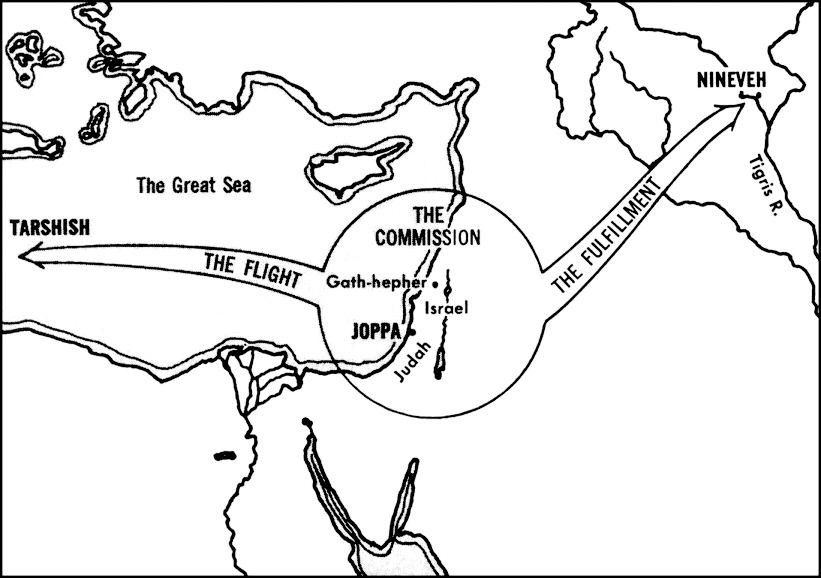
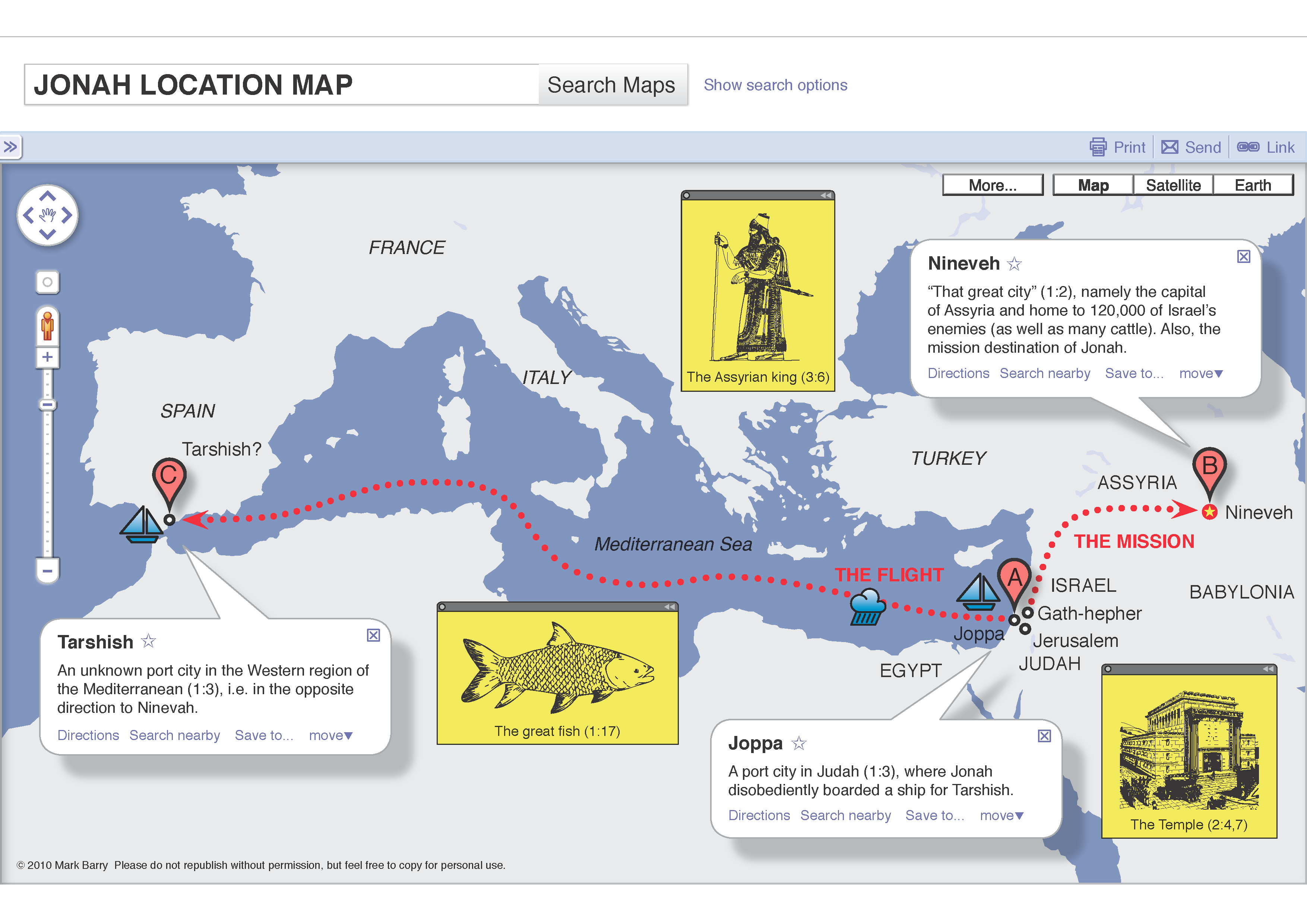
GEOGRAPHY OF JONAH
Click charts to enlarge
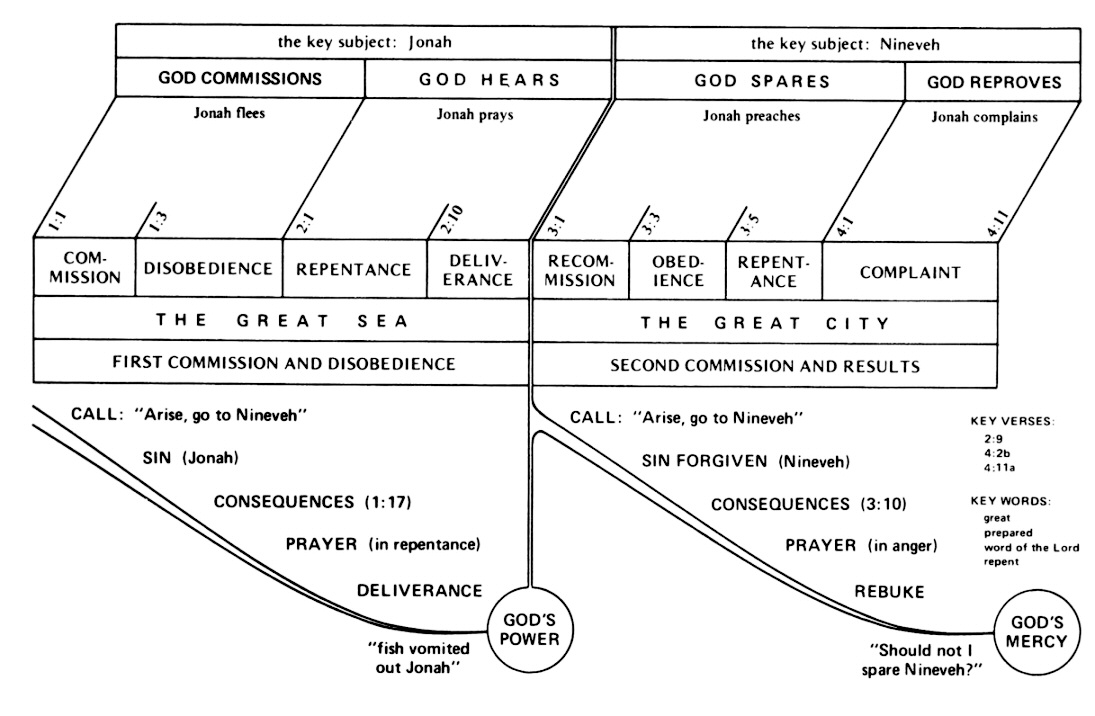
Chart from recommended resource Jensen's Survey of the OT - used by permission
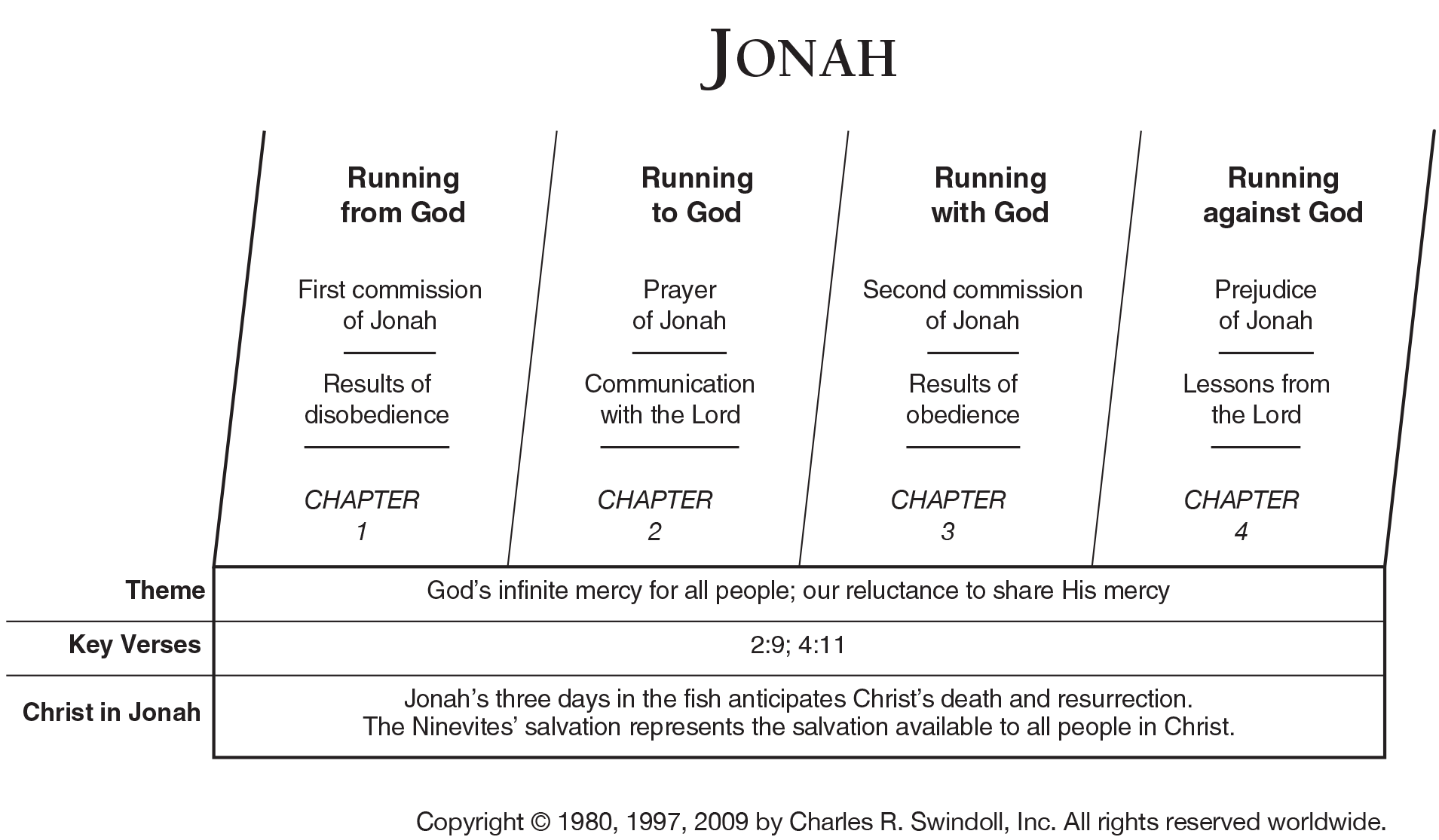
Jonah Chart from Charles Swindoll
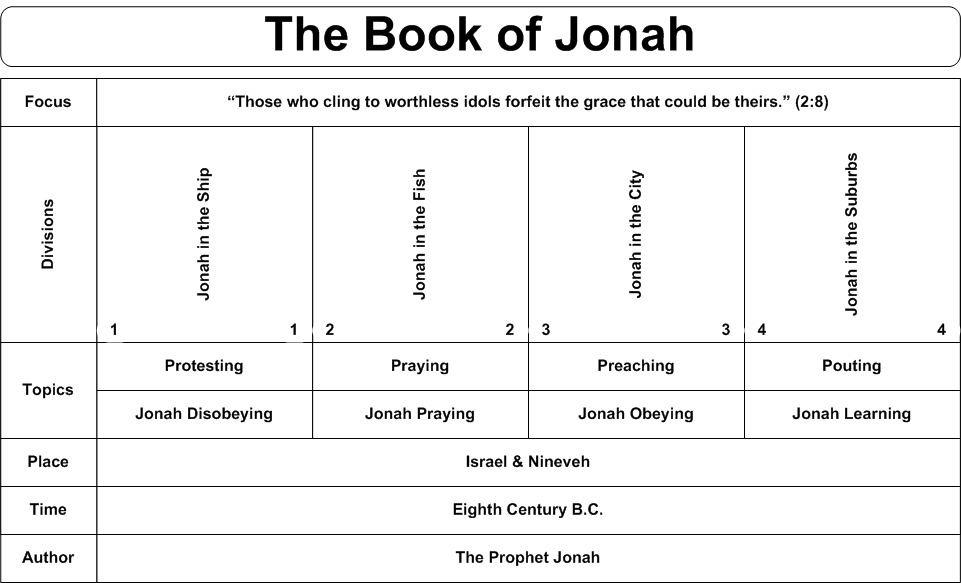
Another Jonah Chart


Source: ESV Global Study Bible
MacArthur Study Bible - Intro, Date, Setting, Themes, Interpretative Challenges, Outline
Swindoll Overview - Includes "Listen to Chuck Swindoll’s overview in his audio message" - 27 minutes
KJV Bible Commentary - Intro, Outline and Verse by Verse Commentary
The King James Study Bible Second Edition - short introduction
NKJV Study Bible: New King James Version Study Bible (loads slow) - Introduction, Historical Setting, Purpose, Timeline, Christ in the Scriptures
The Minor Prophets and their Message
- Hosea - The Lord loves Israel despite her sin. 755-15 B.C.
- Joel - Judgment precedes Israel’s future spiritual revival. 835–796* B.C.
- Amos - God is just and must judge sin. 765-50 B.C.
- Obadiah - Sure retribution must overtake merciless pride. 848* B.C.
- Jonah - Divine grace is universal in its sweep. 780-50 B.C.
- Micah - Bethlehem-born Messiah will be mankind’s Deliverer. 740-690 B.C.
- Nahum - Doom is to descend on wicked Nineveh (pictures). 630-12 B.C.
- Habakkuk - Justification by faith is God’s way of salvation. 625 B.C. or earlier
- Zephaniah - The Day of the Lord must precede kingdom blessing. 625-10 B.C.
- Haggai - The Lord’s Temple and interests deserve top priority. 520 B.C.
- Zechariah - The Lord will remember His people Israel. 520-15 B.C.; Zech 9–14 after 500 B.C.
- Malachi - Let the wicked be warned by the certainty of judgment. 433-400 B.C.
- All dates are approximate. *The text does not specifically date these prophets. As a result differences of opinion exist concerning the time of their ministries. (from The New Unger’s Bible Handbook)
- Interesting Facts About Jonah
John Hannah Outlines - Jonah
1. The disobedience of Jonah (Jonah 1:1–2:10)
1. The commission (Jonah 1:1–2)
2. The disobedience (Jonah 1:3)
3. The consequences (Jonah 1:4–17)
1. The great wind (Jonah 1:4–16)
1. The distress (Jonah 1:4–5)
2. The interrogation (Jonah 1:6)
3. The cause (Jonah 1:7)
4. The confession (Jonah 1:8–9)
5. The result (Jonah 1:10–16)
1. The concern (Jonah 1:10–14)
2. The calm (Jonah 1:15–16)
2. The great fish (Jonah 1:17)
4. The results (Jonah 2:1–10)
1. The prayer (Jonah 2:1–9)
1. The past (Jonah 2:1–5)
2. The present (Jonah 2:6–8)
3. The future (Jonah 2:9)
2. The deliverance (Jonah 2:10)
2. The obedience of Jonah (Jonah 3:1–4:11)
1. The recommission (Jonah 3:1–2)
2. The obedience (Jonah 3:3–4)
1. The trip (Jonah 3:3)
2. The message (Jonah 3:4)
3. The consequences (Jonah 3:5–10)
1. The action of the people (Jonah 3:5)
2. The action of the king (Jonah 3:6–9)
1. His repentance (Jonah 3:6)
2. His proclamation (Jonah 3:7–9)
3. The action of God (Jonah 3:10)
4. The results (Jonah 4:1–11)
1. The displeasure of Jonah (Jonah 4:1–5)
1. His anger (Jonah 4:1)
2. His prayer (Jonah 4:2–3)
3. His action (Jonah 4:4–5)
2. The explanation of the Lord (Jonah 4:6–11)
1. The illustration prepared (Jonah 4:6–8)
1. The shade plant (Jonah 4:6)
2. The worm (Jonah 4:7)
3. The wind (Jonah 4:8)
2. The explanation stated (Jonah 4:9–11)
Christ in All the Scriptures by A.M. Hodgkin
Christ in the Prophets - Jonah
Carved in rude outline on the walls of the catacombs of Rome, there is no more favorite representation than that of Jonah as a type of resurrection.
''On the horizon of the Old Testament, there has always blazed this sign of the death and resurrection of the Lord Jesus-- the sign of the prophet Jonah.'' Our Lord declared that no sign should be given to the men of His generation, [except] the sign of the prophet Jonas (Mat 12:39). And since then, ''age after age the Jew has been confronted with that sign. He killed the Messiah, and out of the grave of the Crucified has arisen a power which has changed the lives of myriads all down the ages. Our Lord gave a promise, the rising from the dead, and He has kept it. He has proved His claim to be the Son of God and the world's Saviour''[*]. ''Declared to be the Son of God with power, by the resurrection from the dead'' (Rom 1:4). [* The Biblical Guide, Rev. J. Urquhart, vol. viii, p.146.]
The Prophet.
Jonah was the son of Amittai, the prophet, a native of Gath-hepher, a Galilean village, a little to the north of Nazareth, the home of his great Anti-type. Jewish tradition says that he was the son of the widow of Zarephath, whom Elijah restored to life [1Kings 17:8-24]. But though we have no sufficient ground for this tradition, Jonah was the successor of Elijah and Elisha, and was probably acquainted with them both, and was the link between them and Hosea, Amos, and Isaiah. It is likely that he was trained in the schools of the prophets, and that he exercised his ministry during the reign of Jeroboam II, and perhaps before it.
His name signifies ''the dove,'' and his first prophetic utterance was one in keeping with his name. It was a message of comfort to Israel, that the Lord had seen the affliction of His people, and that He would save them by the hand of Jeroboam, the son of Joash, and restore to them the border lands which they had lost through the invasion of the Syrians. We are told this in 2Kings 14:25-27, a record which was probably written long before Jonah wrote his book; and it would seem that the writer [of that earlier record] took special care to do honor to God's prophet, who has been so unsparing of his own character [faults] in his faithful record.
The fact, that Jonah was a historic character, tells [ie., argues] against the idea that the book is a mere parable. The writer of a parable would not have been likely to invent an imaginary story about a real man. Jonah's candid record of his own faults is another evidence of the truth of the account, as also the fact that the Jews admitted the book to the Canon of Scripture, though it militated against their national prejudices in exhibiting God's mercy to another nation.
Why Did Jonah Disobey?
''The word of the Lord came to Jonah, Arise, go to Nineveh, that great city, and cry against it; for their wickedness is come up before Me. But Jonah rose up to flee unto Tarshish from the presence of the Lord'' (Jonah 1:1-3).
What was the reason of the prophet's deliberate disobedience? It was not cowardice, as we see from his attitude in the storm; nor was it the length of the journey, for a voyage to Tarshish, on the coast of Spain, was a far more hazardous undertaking than even the long overland journey to Nineveh; for the caravans of camels bearing merchandise plied regularly in those days to the great Assyrian capital. His reluctance was, no doubt, partly to be found in the prevalent idea of his country, that all other nations were outside the pale of God's mercy. But beyond this, Assyria was the dreaded foe of Israel, the scourge with which (Jonah perhaps knew that) God was going to punish his country (see Hosea 9:3). For generations, Assyria had been making fierce raids on the lands bordering on the Mediterranean, and the punishments which she inflicted upon her captives were cruel beyond the wonted [ie., well known] cruelties of those times, even to flaying their victims alive. ''Violence'' was specified by the men of that city themselves, in the hour of their repentance, as their peculiar sin (Jonah 3:8).
In the proclamation of God's judgment to Nineveh, Jonah saw the possibility of mercy for that city, and the sparing of his country's foe; for he had a true knowledge of God's character as a merciful and gracious God, of great kindness (Jonah 4:2). He also may have thought that the one hope for the moral restoration of his own country was the object-lesson of God's judgment on a large scale upon what was then the leading city of the world.
Jonah was God's prophet to Israel, his whole being was bound up in the salvation of his own people, and it was no doubt his intense patriotism which made him question the wisdom of God's command, and made him ready to incur His displeasure and abandon his prophetic office rather than risk the welfare of his country.
Jonah was a diligent student of the Psalms. He knew perfectly well that even if he ''took the wings of the morning and dwelt in the uttermost parts of the sea,'' he could not really flee from God's presence [Psa 139:7-10]; but, like many a servant of the Lord since, he thought that by a change of circumstances he might get away from the pressure of God's hand upon him or stifle His voice. And so he went down to Joppa. ''And he found a ship going to Tarshish: so he paid the fare thereof, and went down into it, to go with them unto Tarshish from the presence of the Lord.''
The Storm.
A graphic account of the voyage follows. ''The book of Jonah is the most beautiful story ever written in so small a compass, only 1328 English words. In writing, it is condensation that declares the master.'' The violent storm, the efforts of the mariners, the indignation of the shipmaster at finding Jonah carelessly asleep at such a juncture, when even these heathen sailors were crying ''every man to his god,''-- the whole scene lives before us. They cast lots to discover who was answerable for such an unusually severe storm. The lot, as in the case of Achan [Josh 7:13-18], directed by God, fell upon the guilty prophet, and then we can picture the mariners crowding round him and plying him with questions. ''Tell us why this evil has come!'' cries one. ''What is your occupation?'' cries another. ''Where do you come from?'' ''What is your country?'' ''Who are you?'' We are told the fear and astonishment of these simple sailors as they learn from his own lips that he serves the God who made the earth and this tempestuous sea, and yet he is fleeing from His presence. They ask his advice, but shrink from carrying it out when he tells them to cast him into the sea. But all their efforts are useless and they yield at last, earnestly beseeching the Lord not to lay this innocent blood to their charge.
The Gentile Pilate was willing to have released Jesus when the Jews cried ''Crucify Him.'' He washed his hands, saying ''I am innocent of the blood of this just Person'' [Mat 27:24].
As Jonah was cast forth into the sea, it ceased its raging, and these heathen men were turned to the Lord, and not only offered sacrifices, but made vows for their future life. In Jonah's willingness to be cast into the deep, we have a picture of Him who said of His own life, ''No man taketh it from Me, I lay it down of Myself'' [John 10:17,18].
''The Lord Prepared a Great Fish.'' Jonah 1:17; 2:1-10
There is a Hebrew word manah, to ''appoint'' or ''arrange,'' rendered ''prepare'' in the authorized version [KJV], which Jonah uses several times. He who ''sent forth a great wind into the sea,'' ''prepared a gourd,'' ''prepared a worm,'' ''prepared a vehement east wind,'' and in like manner ''prepared a great fish'' to swallow Jonah.
Those who smile over the story of Jonah and the whale would do well to remember not only that our Lord Himself referred to it, but in what connection. He used it as a most solemn sign regarding the most solemn event of His life on earth. And He has expressly told us that in the great Judgment Day, the men of Nineveh shall rise up and condemn the men of this generation, because they repented at the preaching of Jonah, and behold a Greater than Jonah is here [Mat 12:38-41]. We cannot imagine our Lord using these solemn words of a fictitious people and of a fictitious repentance.
To us who believe in the greatest miracle of all-- the incarnation and resurrection of Christ-- it is but a little thing to believe that God saved Jonah in this way to be a type of our Saviour's resurrection. We have no alternative to believing Christ's word that He did do so, but, on the other hand, God had many alternatives at His disposal by which He could make such a thing possible. Let us consider a few of them.
The word translated ''a great fish'' in the Old Testament, and a ''whale'' in the New Testament, is in both cases ''a great sea-monster,'' the term including whales, sharks, and other varieties. Many believe it to have been theCarcharias, or white shark, constantly found in the Mediterranean, often 30 feet long and more; and there are traces of a much larger race, now extinct. The voracity of the shark leads it to swallow whole all it can. Horses, sea calves the size of an ox, a reindeer without horns, have all been found at different times inside sharks. Men have also been found several times-- in one instance, it was a man in a coat of mail [ie., armor].
In 1758, a sailor fell overboard from a frigate in the Mediterranean, and was swallowed by a shark. The captain had a gun fired at it, and the creature cast the man out of his throat, and he was taken up alive and but little injured. The fish was harpooned, dried, and presented to the sailor, who went round Europe exhibiting it. It was 20 feet long.
The Spermaceti whale has a throat capacious enough to swallow substances much larger than a man, and it is its almost invariable habit to eject the contents of its stomach just before death. A case is related in theExpository Times for August 1906, of a sailor being found inside a whale as it was being cut up. This took place off the Falkland Islands in 1891. But the man, though alive, was unconscious. The miracle consisted in Jonah being preserved alive some thirty-two to thirty-four hours**, and, part of the time at least, in a state of consciousness. But the Creator of all is surely as well able so to prepare a fish as to make this possible, as our modern engineers are to prepare a submarine for the same purpose.
[** It is a Jewish saying that ''A day and a night make an Onah, and part of an Onah is as the whole.'' Even in England, a prisoner sentenced to three days' imprisonment is seldom more than forty hours in jail, and sometimes only thirty-three-- part of a day reckoning by law as a day. (Sir R. Anderson).]
The Rev. James Neil believes the ''great fish'' to have been the Arctic Right Whale (Balaena mysticetus). This whale has an enormous head and a mouth 12 feet square. To its upper jaw are attached hundreds of baleen or whalebone blades, some of them from 10 to 15 feet long, and 8 inches wide, highly elastic, with delicately fringed edges. These blades usually lie up against the palate of the mouth. The whale draws into its mouth an immense quantity of water, filled with small jelly-fish, on which it feeds. It then lets down the baleen bars in front of its wide open mouth and strains the water out through the [hairlike baleen] fringes, retaining the tiny food on which it subsists. The smallness of its throat prevents it from swallowing large fish, and would utterly prevent it [from] swallowing Jonah. This species of whale occasionally wanders into southern seas, and in a warm climate, like that of the Mediterranean, where it has been seen in recent times, is apt to turn sick and lie about on the surface of the water, and all the time it remained on the surface, there would be plenty of air in its mouth. In such a prison cell as this, with its ''bars,'' of which Jonah speaks, and ''the weeds wrapped about his head,'' as they would certainly be in the whale's mouth, it may well have been that Jonah was imprisoned. It may be objected to this that our Lord said that Jonah was in the whale's belly. But this is rather a confirmation than otherwise, for it must be remembered that He also said that the Son of Man must be ''in the heart of the earth,'' whereas His place of burial was in a cave on the very surface of the earth's crust, corresponding exactly to the mouth of a whale. In both cases, the figure of synecdoche is used, by which the part of a thing is put for the whole of it; and the same figure is used in the expression ''three days and three nights,'' where, by synecdoche, the whole is put for the part.
Jonah's prayer to God from his prison cell [ch. 2] is the breathing of one to whom the Psalms had long been familiar. He quotes short fragments from various Psalms, and adapts them to meet his own case. There are allusions, in his prayer, to the great Messianic Psalms 22, 69 and 16. Most striking of all is the application of Psalm 16:10: ''Thou wilt not leave my soul in hell; neither wilt Thou suffer Thine Holy One to see corruption.'' Jonah says: ''Out of the belly of hell cried I,'' and ''Yet hast Thou brought up my life from corruption.''
''And the Lord spake unto the fish, and it vomited out Jonah upon the dry land.''
The Commission Repeated. Jonah 3.
''And the word of the Lord came unto Jonah the second time, saying, Arise, go unto Nineveh, that great city, and preach unto it the preaching that I bid thee.'' Twice the word comes unto the prophet from the Lord, ''Arise!'' [Jonah 1:1,2; 3:1,2]. Once from the shipmaster [Jonah 1:6]. Sinners are sleeping, like Jonah, with only a plank between them and eternity, and the call to them is, ''Awake thou that sleepest, and arise from the dead, and Christ shall give thee light'' [Eph 5:14]. But here, the call to awake came to God's servant through the heathen shipmaster: [God] often chooses to send His message through a rough instrument. Let us be ready to hear it, however it comes.
Twice the Lord speaks direct to Jonah, ''Arise.'' He did not upbraid him for his disobedience; the sharp lesson he had learned was enough; and in His goodness He is still willing to use His servant, prepared now to do His bidding. ''A 'bent' Jonah was able to bend all [of] heathen Nineveh, so that revival blessing held back impending judgment. Oh that God's people might be 'bent' in like manner now; that revival blessing might be poured out upon London and the whole world!'' [Jonah, Patriot and Revivalist, p.19, Rev. W.F.S. Webster.]
The tidings of Jonah's miraculous escape must have spread far and wide. The sailors would tell the news. All Israel would know it. In the constant interchange of thought between those ancient nations, the news might well have reached Nineveh itself [ahead of the prophet]. Or it may have been left for Jonah to tell the Ninevites of it. Certain it is that they knew it somehow, for Jonah was not only a prophet to them; our Lord tells us that he was a sign, a sign which carried conviction with his preaching. [It is possible that Jonah's appearance-- skin bleached by the whale's digestive juices, flesh bruised by rough confinement-- gave credence to his story.]
Nineveh. Jonah 3 and 4.
'That great city.'' God Himself calls it great. [Jonah, the Truant Prophet, Rev. F.B. Meyer.]
Until 1841[A.D.], all that was known of Nineveh was gathered from the Bible and a few scattered fragments of Assyrian history; [therefore] some looked upon Nineveh as a myth. But since that date, the excavations have continually been proving the truth of the Bible account. The city is great in its antiquity, founded by Nimrod [Gen 10:8-11]. It was great in its size. Three chariots could drive abreast on the top of its walls. ''A city of three days' journey,'' Jonah says; and the excavations prove its walls to have enclosed a circuit of sixty miles, just about three day's journey in its circumference. It evidently enclosed a good deal of pasture land besides the actual buildings, which agrees with Jonah's words ''much cattle.'' As it contained 120,000 little children, too young to know their right hand from their left, the total population would not have been far short of a million. Nineveh was great in its palaces, its fortifications and temples, and in its marvellous works of art-- its great stone lions and bulls, with wings and human faces. It was great in its high civilization, and it was great, above all, in its wickedness.
To this city, Jonah was sent the second time, this time with ''sealed orders.'' ''Preach unto it the preaching that I bid thee.'' There was no hesitation this time. Jonah arose and went. The burden of his message was: ''Yet forty days, and Nineveh shall be overthrown.''
''The Men of Nineveh Repented.''
Jonah's own soul had been so stripped and prepared by God that his message came with the power of the Spirit. He himself was a sign. God's Spirit worked so mightily that at the end of one day's preaching, the city was stirred to its depths. The record is: ''So the people of Nineveh believed God.'' They acted immediately upon their belief, and proclaimed a fast, and put on sackcloth. This repentance evidently began among the people themselves, for Jonah 3:6 should be translated, ''And the 'matter' came unto the king,'' that is 'the whole account', and he too believed; and he rose up from his throne, and laid his robe from him, and covered himself with sackcloth, and sat in ashes. And the decree went forth from the king and his nobles that there should be a universal fast in Nineveh, extending even to the beasts of the field. Man and beast were clothed in sackcloth, and the cry of repentance-- mingled, no doubt, with the lowing of the distressed beasts-- went up from the great city into the ears of a compassionate and long-suffering God. God saw that the repentance was sincere; that it did not end with the putting on of sackcloth, but that the people turned from their evil ways. And He heard their cry and spared their city.
The question arises, Is it likely that the state would interfere in such a matter, and that a royal edict would be issued enjoining a long fast? Professor Sayce gives the answer from the monuments of Nineveh, and tells us that in the days of Ezarhaddon II, when the northern foe was gathering against the Assyrian empire, the king issued a proclamation enjoining a solemn service of humiliation for one hundred days.
Again, Is it likely that the beasts should be clothed with sackcloth? Herodotus tells us that when the Persian armies were in Greece, on the occasion of the death of one of their generals, a mourning spread through the camp. They cut off the hair from themselves and their horses and their beasts of burden. Such a custom, [therefore,] was common to a closely neighboring nation.
God's dealings with Nineveh, and His dealings with His repining prophet in the last chapter, alike show us His merciful loving-kindness. Jonah was angry that the great city, the enemy of his country, should be spared. He was angry at the destruction of the gourd [vine] which sheltered him. Concerning both, the Lord asks him with the uttermost tenderness, ''Doest thou well be be angry?'' And Jonah, still not sparing his own character in any detail, hands on the lesson to his countrymen, and hands down the lesson to us, that God's salvation is intended for the whole world. [Jonah 4:10,11; cp. Isa 49:6]
The book of Jonah is essentially a missionary book, a fore-shadowing of our Lord's great commission to go and preach the Gospel to every creature. [Mat 28:18-20]
When Christ came back from the grave, the message of His Gospel was borne to the Gentiles, and has proved [to be] the power of God unto salvation to every one that believeth, the world over. [Rom 1:16]
The Old Testament Presents... Reflections of Christ by Paul R. Van Gorder
JONAH
The book of Jonah is different from the other minor prophets, for it is the personal experience of the prophet himself. The story is presented much like that of Elijah and Elisha. Though the book contains no direct prophecy, the experience of Jonah is itself a reflection of the message of God.
Jonah, whose name means ''dove,'' was one of the earliest prophets. We know this from the book of 2Kings, where a prediction of Jonah was fulfilled in the days of Jeroboam II (2Kings 14:25).
A.C. Gaebelein has written, ''The typical-prophetic meaning of the story of Jonah is authorized by the words of the Son of God. His experience typifies the death, the burial, and the resurrection of our Lord, as well as the gospel message that goes forth to the Gentiles. Furthermore, Jonah's experience is prophetic also of the entire nation.''
The Lord Jesus Christ Himself put His seal of authentication upon the story of Jonah (Matthew 12:40). Jonah was a man, not a myth; the book is fact, not fiction; it is history, not allegory.
OUTLINE OF THE BOOK--
- Jonah Planning (ch. 1)
- Jonah Praying ( 2 )
- Jonah Preaching ( 3 )
- Jonah Pouting ( 4 )
JONAH PLANNING (chapter 1)
Jonah's name may indicate that he had a tender nature, but his tenderness was limited to his own people. He was a God-called, God-commissioned man, with a God-given message. His sphere of service was as specific as his call. He was to go to Nineveh, the capital of Assyria, located on the banks of the Tigris River about 280 miles north of Babylon. The Assyrians were the fierce enemies of Israel.
Jonah tried to resign his commission and take a cruise on the Mediterranean. ''He paid the fare,'' taking passage on a ship that was ready to sail to Tarshish (probably Spain). But the same Lord, from whom he was trying to flee, was preparing a wind to bring him to obedience. God's prophet was sleeping the sleep of self-complacency, while the heathen sailors were about to perish. They were praying to their gods, while Jonah was not even praying, just sleeping. When he was awakened, it took a series of humiliating questions to get him to confess. The conscience of those heathen men seemed to be more tender than that of the back-slidden saint.
Jonah was finally cast into the sea. There, a great fish was lying in wait. The Lord had prepared the huge creature to swallow the disobedient prophet.
JONAH PRAYING (chapter 2)
For 3 days and 3 nights, Jonah was in the belly of the fish. There he began to pray. Had he prayed instead of fleeing from God, he would not have had this harrowing experience. Nevertheless, his prayer was real. It had conviction, confession, contrition, and intercession. In his prayer, he quoted from Psalms 18; 30; 31; 42; 69; 120; 130; and 142. In spite of his prayers, pledges, and vows, he was not delivered. It was not until Jonah confessed that ''salvation is of the Lord,'' that God caused the fish to cast him upon the dry land.
JONAH PREACHING (chapter 3)
Although Jonah had gone through a traumatic experience and had re-affirmed his faith in God, he still needed to fulfill the Lord's commission to him. The Lord said again, ''Arise, go unto Nineveh, that great city, and preach unto it the preaching that I bid thee'' (3:2). Jonah did not hesitate this time. The consequence of his previous experience had made him obedient. He was now a God-called man, with a God-given message, on a God-directed mission.
Jonah delivered a message of repentance. To that city, some 20 miles long and 12 miles wide, Jonah spoke the words [that] the Lord had directed him to give. The Ninevites repented and believed God. We can well imagine what consternation this strange prophet caused as he cried, ''Yet forty days, and Nineveh shall be overthrown'' (v.4). Jonah was learning a lesson that the apostle Paul later phrased in these words: ''Is He the God of the Jews only? Is He not also of the Gentiles? Yes, of the Gentiles also'' (Romans 3:29). God turned from His fierce anger, and Nineveh was spared, even though God knew that same city would later become the rod in His hand to chasten Israel.
JONAH POUTING (chapter 4)
How strange that this man of God was exceedingly displeased and grieved by the Lord's forbearance and patience with Nineveh. Jonah, no doubt, reasoned that the Assyrians would soon persecute his own people. But his displeasure was largely selfish. His own reputation as a prophet was at stake. He would rather witness the destruction of all the Assyrians than see himself dishonored. But God used a gourd [plant] to teach that poor, foolish servant a wonderful truth. Jonah was disgraced, and was forced to commit his reputation to the keeping of Jehovah. The prophet was more concerned about his own personal comfort than he was about the repentance and salvation of the inhabitants of that great city.
It is remarkable to trace the hand of God behind the scenes of this story. It was God who sent out the wind. He prepared the fish, the gourd, the worm, and the east wind. No less remarkable is the fact that God took note of the little children of Nineveh-- more than 120,000 of them-- and even the cattle (v.11). What a contrast between the great loving heart of God and the narrow, selfish love of His reluctant and disobedient servant. The sinning saint is silenced, and God has the last word.
CHRIST IN THE BOOK--
The great messianic picture reflected in Jonah is of the death, burial, and resurrection of the Lord Jesus. We are assured of this as we read these words of our Lord:
An evil and adulterous generation seeketh after a sign, and there shall no sign be given to it, but the sign of the prophet, Jonah;
For as Jonah was three days and three nights in the belly of the great fish, so shall the Son of man be three days and three nights in the heart of the earth.'' (Mat 12:39-41)
Dr. M.R. DeHaan once said, ''The miracle of Jonah consists in the fact that God raised him from the dead as a perfect type of our crucified, buried, and risen Lord.'' How appropriate are these words of the resurrected Christ to the two disciples on the road to Emmaus: ''Ought not Christ to have suffered these things, and to enter into His glory? And beginning at Moses and all the prophets, He expounded unto them, in all the scriptures, the things concerning Himself'' (Luke 24:26,27).
The Witness of Jonah - Max Reich - The Messianic Hope of Israel
Passing over the brief prophecy of Obadiah, with its veiled reference to the Messiah in Saviours who will "go up on Mount Zion," under the leadership of the Jehovah-Saviour, for "the kingdom shall be the Lord’s" (Obadiah 1:21), we come to the book of the prophet Jonah. Perhaps no book in the Old Testament has been the target of the attacks of the enemies of revealed truth more than this. Yet its testimony to the Messiah is clear. We know how our LORD made use of Jonah's "three days and three nights" in the deep as typical of His own experience "in the heart of the earth" before resurrection. As Jonah was typically resurrection on "the third day," so our LORD in actuality. No doubt Jonah's three days in the belly of the whale are intended to remind us of the fact that Israel, the runaway prophet-nation, has been swallowed up in the sea of the Gentiles, though miraculously preserved. Israel will yet learn that the Messiah has entered into their sorrows, which they have brought on themselves, for He shared them with them in sympathetic grace.
Thus like they, He also was delivered to the Gentiles, beaten, spat upon, scourged and crucified by them, though He sank down into deeper sorrows, when He who knew no sin, was made sin for us. But He was heard from the horns of the unicorns and brought up out of the depths, where the waterfloods overflowed Him. And in His resurrection He, who in His cross was a sign spoken against:
"And Simeon blessed them, and said unto Mary his mother, Behold, this child is set for the fall and rising again of many in Israel; and for a sign which shall be spoken against" (Luke 2:34), is now GOD's great sign of salvation to penitents, as Jonah was to the Ninevites, and a sign to the Jews, because the grace they spurned, now goes out into the Gentile world:
"But he answered and said unto them, An evil and adulterous generation seeketh after a sign; and there shall no sign be given to it, but the sign of the prophet Jonas: For as Jonas was three days and three nights in the whale's belly; so shall the Son of man be three days and three nights in the heart of the earth. The men of Nineveh shall rise in judgment with this generation, and shall condemn it: because they repented at the preaching of Jonas; and, behold, a greater than Jonas is here" (Matthew 12:39-41).
Explanation - The following list includes not only commentaries but other Christian works by well known evangelical writers. Most of the resources below are newer works (written after 1970) which previously were available only for purchase in book form or in a Bible computer program. The resources are made freely available by archive.org but have several caveats - (1) they do not allow copy and paste, (2) they can only be borrowed for one hour (but can be checked out immediately when your hour expires giving you time to read or take notes on a lengthy section) and (3) they require creating an account which allows you to check out the books free of charge. To set up an account click archive.org and then click the picture of the person in right upper corner and enter email and a password. That's all you have to do. Then you can read these more modern resources free of charge! I have read or used many of these resources but not all of them so ultimately you will need to be a Berean (Acts 17:11+) as you use them. I have also selected works that are conservative and Biblically sound. If you find one that you think does not meet those criteria please send an email at https://www.preceptaustin.org/
COMMENTARIES
Bible Knowledge Commentary - Old Testament - 1608 pages. Dallas Theological Seminary Faculty
The Minor Prophets : an Expositional Commentary by Boice, James Montgomery, 292 pages
Cyril Barber - The Minor Prophets, by James Montgomery Boice is illustrative of scholarship being applied to the needs of individuals, Heralds the return to the kind of Bible commentary made famous by the Reformers. Boice deals clearly, concisely, and adequately with this sorely neglected segment of the canon. His handling of the text serves as a model of how preaching through these prophetic writings can be relevant to the times and meet people's needs. Indexed. Recommended.
James Rosscup - Boice has a catchy title for each chapter or section of the prophets. Pages are large with two columns and he provides much good material on the relevance then and now, lessons such as God’s love, repentance, sincerity (Hosea 6), etc. If a Christian took time to read these pages and dwelt on the principles over a span of weeks or months, he could grow much by applying them. Boice at times could be more definite in specifying in what framework God will bless Israel in the future, as in Hosea 14. He can be vague, as in Joel 2:1–11 where he says the invader is neither locusts nor a human army (1,107). He can be very wordy and wander on, too, as in using Joel 2:28 as a take-off into a long discussion of clericalism. He sees Joel 2:28 fulfilled at Pentecost, yet it would help if he showed some aspects were not yet fulfilled. He is more to the point on Zechariah 14.
The Minor Prophets: Feinberg, Charles Lee Published: Jan 01, 1990
Cyril Barber - Formerly published between 1948 and 1952 in a series of volumes under the title Major Messages on the Minor Prophets, these studies have served well the needs of laypeople for more than thirty years
James Rosscup - A Jewish Christian scholar in Hebrew who taught in Old Testament at Dallas Seminary and later at Talbot Seminary, where he also was Academic Dean, did this exposition of all the minor prophets. Feinberg made biblical prophecy one of his specializations and does a good survey, being aware of interpretive problems, main views, contextual factors and correlation with other Old Testament and New Testament prophetic passages in a premillennial dispensational understanding. This is a I-volume edition of what originally was issued as 5 small volumes.
Hosea, Joel, Amos, Obadiah, Jonah, Micah By: Butler, Trent C Published: Jan 01, 2005 - Holman OT Commentary Series
The Communicator's Commentary. Hosea, Joel, Amos, Obadiah, Jonah By: Ogilvie, Lloyd John Published: Jan 01, 1990 (now published as the Preacher's Commentary series)
A Commentary on the Minor Prophets By: Hailey, Homer, 1903- Published: Jan 01, 1972
James Rosscup - A non-technical work of 428 pp. for lay people, taking an amillennial stance on the kingdom issue: in his opinion there will not be a future kingdom for Israel after the Second Advent of Christ (cf. in this work pp. 126, 200, etc.; cf. also his commentary on the Book of Revelation).
Twelve Prophets By: Craigie, Peter C Published: Jan 01, 1984 - The Daily Study Bible Series - beware as he is not always literal in his interpretation
Cyril Barber - (These volumes adequately introduce the writing of each minor prophet. The exposition contains something good on each canonical book. Craigie's writings always give evidence of being well researched, and this study is no exception. Interesting sidelights are to be found on the history and culture of the times. The eschatology of these OT writers is marred, however, by the author's amillennialism
The Books of Joel, Obadiah, Jonah, and Micah By: Allen, Leslie C
Cyril Barber - New International Commentary on the Old Testament. Grand Rapids: Wm. B. Eerdmans Publishing Co., 1976. Extensive research into the historic setting coupled with interesting information on the etymology of certain words makes this book worthy of serious consideration. Other treatments of individual books are fuller and may better meet the needs of the expositor
Interpreting the Minor Prophets By: Chisholm, Robert B Published: Jan 01, 1990
James Rosscup - This well-informed survey is by a professor of Old Testament studies, Dallas Seminary, who wrote on Hosea and Joel in the Bible Knowledge Commentary. Chisholm looks broadly at each prophet’s structure, message, doctrinal themes, literary and rhetorical features. After a brief survey of overall themes—sin, judgment, salvation—he takes up each prophet from Hosea to Malachi successively. On long-range prophecy he is presumably premillennial, but in several texts where one would expect a commitment, he keeps things so vague that one finds no distinct word as to when the fulfillment will come (Hosea 3, 14; Joel 3:9ff.; Zechariah 14, etc.). He surveys each book section by section with much that helps, dealing briefly with main problems. At the end of each survey of a book he sums up points of theology. He views Joel 2:1–11 as meaning a human army but is not distinct on what army and when. The work is good but general. The reader who has the Bible Knowledge Commentary from Dallas Seminary would already have the books covered in greater premillennial specificity in many cases.
Enjoying the Minor Prophets By: MacDonald, William, 1917-2007 Published: Jan 01, 2013 - A 113 page devotional commentary - same authors as the Believer's Bible Commentary below -- recommended
Believer's Bible Commentary - OT and NT - MacDonald, William (1995) 2480 pages. Conservative. Literal. Often has very insightful comments. John MacArthur, says "Concise yet comprehensive - the most complete single-volume commentary I have seen." Warren Wiersbe adds "For the student who is serious about seeing Christ in the Word." One hour limit.
Rosscup - This work, originally issued in 1983, is conservative and premillennial, written to help teachers, preachers and people in every walk of life with different views, explanation and application. The 2-column format runs verse by verse for the most part, usually in a helpfully knowledgeable manner, and there are several special sections such as “Prayer” in Acts and “Legalism” in Galatians. The premillennial view is evident on Acts 1:6, 3:20, Romans 11:26, Galatians 6:16, Revelation 20, etc.
Wycliffe Bible Commentary - Charles Pfeiffer - 1560 pages (1962). 214 ratings Less detailed than the KJV Bible Commentary. Conservative. Notes are generally verse by verse but brief.
Rosscup - Conservative and premillennial scholars here have been experts in their fields. The work contains brief introductions and attempts to give a verse-by-verse exposition, though it does skip over some verses. The treatments vary with the authors, but as a whole it is a fine one-volume commentary for pastors and students to use or give to a layman. Outstanding sections include, for example: Whitcomb on Ezra-Nehemiah-Esther; Culver on Daniel; Ladd on Acts; Harrison on Galatians; Johnson on I Corinthians; and Ryrie on the Johannine Epistles.
The books of Joel, Obadiah, Jonah, and Micah By: Allen, Leslie C Published: Jan 01, 1976
James Rosscup - The author holds that Joel is late pre-exilic or early post exilic, Obadiah is from the early postexilic times. Jonah is a tale perhaps devised by wisdom teachers of the fifth or fourth century B. C. and not by Jonah. Micah is from ca. 701 B. C. The author was lecturer in Old Testament language and exegesis at London Bible College and now is at Fuller Theological Seminary. He has rather thorough word studies and a discussion of many issues, e. g. the relationship of Joel 2:28ff. with Acts 2 and with final times, and Joel 2:32a with Romans 10:13 (pp. 97–105). He shows good awareness of recent scholarly literature on his subjects, but many will not agree with some of his views, such as his suggestion that Jonah is simply a tale made by wisdom writers to convey a message (see p. 191).
The minor prophets By: Theo. Laetsch, D.D. Published: Jan 01, 1956
James Rosscup - This is a very good amillennial commentary on the minor prophets as a whole. Laetsch deals with the text verse-by-verse, grapples with difficult phrases and explains them, uses the Hebrew extensively, and presents illuminating word studies. The lucid presentation helps make it a very interesting commentary to read. In crucial prophetical sections, his strong amillennialism appears. His weakness here is offset by his helpfulness in exegesis generally plus his good background material.
Understanding the Old Testament by Scripture Union - All 12 minor prophets. 100 pages.
James Rosscup - This succinct effort gets directly at issues, as in giving three views on what Gomer was when Hosea married her, and views on the woman Hosea took in 3:1. He is fuzzy on what the future of Israel will be (1:10; 2:16–23 etc.) but a bit clearer on 3:5 (p. 7; cf. p. 20). Sometimes he is clear, sometimes vaguely general, as on the heavenly signs in Joel 2. He sees Amos 9:11–15 as not fulfilled literally in such aspects as agricultural prosperity, but figuratively, as if 9:13b proves his view. Reference, he feels, is to the New Jerusalem. Strangely, he also sees Zechariah 14:20–21 as in the New Jerusalem, after describing the verses before where imperfection is evident. Often, though, his work gives the lay reader a good survey without getting bogged down.
The Prophets of Israel By: Wood, Leon James Published: Jan 01, 1979 - 416 pages
James Rosscup - This quite readable work by a premillennialist covers the overall range of Old Testament prophets, various key subjects under “Prophetism” such as what “to prophesy” means, the prophets’ function, early prophets, Samuel, monarchy prophets, and writing prophets both major and minor. Wood has solid sections on Elijah and Elisha (their spiritual features, episodes, miracles). The Elisha part surveys each miracle. Some sections, as on Hosea, even discuss in some detail leading problems such as whether Gomer was tainted before marriage or became unfaithful later. But sections on the books do not delve into nearly the detail Chisholm gives. Wood does sum up the message well, has an outline on each book, and organizes much on background, character qualities and work of each prophet. He deals with each prophet in relation to the reign he fitted into. Chisholm and Freeman deal more with various problems. Cf. Hobart Freeman, Introd. to the Old Testament Prophets, available now only in some theological libraries.
Preaching the Old Testament : a lectionary commentary By: Allen, Ronald J. (Ronald James), 1949- Published: Jan 01, 2007)
James Rosscup - (THIS CRITIQUE IS NOT ABOUT THE BOOK ABOVE but gives you a sense of who Allen is as a writer.) Allen is skilled in Hebrew and interpretation and writes attractively. He is conservative and premillennial. In his view the locusts are literal in both Chapters 1 and 2, yet supernatural in the latter case. He never seems to clear up what the supernatural locusts are in the future Armageddon time but stays general and vague. They sound like angelic hosts when Allen links them with Revelation 9:11–16. Allen has good emphases about God’s grace, compassion, anger and love in 2:12–17. Apparently he sees the “northern army” of 2:20 as a human one, not identified with the locusts of 2:1–11. He has a long, helpful discussion on whether Acts 2 fulfills the outpouring of the Spirit, and sees a partial fulfillment (p. 95). In 3:9ff., he believes the blessing is in the millennium after the Second Advent, yet he identifies the fountain of verse 18 as the river in the ultimate state, the New Jerusalem (116), and is not clear on why or how he leaps from the millennium to the ultimate bliss.
Unger's Commentary on the Old Testament (Volume 2 - Isaiah - Malachi) by Unger, Merrill Frederick, 1909- (1981) 972 pages.
Unger's bible handbook : a best-selling guide to understanding the bible by Unger, Merrill F
Rosscup - A former Professor of Old testament at Dallas Seminary, evangelical writer of many scholarly books, did this in his late years. He has sections on each Bible book, archaeology, Major Prophets, Minor Prophets, between the testaments, the four gospels, epistles of Paul, how the Bible came to us, Bible statistics, outline of church history, creation stories, Ur of Abram’s day, Egypt, Assyria, the Chaldean empire, demonism, miracles, Bethlehem, Dead Sea scrolls, Corinth, Ephesus, Rome, etc. The work includes more than 20 charts and 30 maps and has color sections. Unger has good material at some points in surveying passages, dealing with certain problems, etc., and handles the long-range prophecies in a premillennial way. Often he is very cursory.
Evangelical Commentary on the Bible - editor Walter Elwell (1989) 1239 pages. User reviews.
The twelve minor prophets Published: Jan 01, 1926 Robinson, George -- note this book has no time restriction and does allow copy/paste
James Rosscup - This is a reprint of the 1926 edition (New York: Harper and Brothers). He devotes a chapter to each prophet, “Hosea the Prophet of Love,” etc. The studies are terse summaries. On Hosea he lists and comments on steps in Israel’s downfall and has five points on the message to men today. He packs a lot of information in and organizes it well. His word portrait of Jonah is choice (pp. 74–75), and he has interesting accounts of great fish swallowing men. Though brief, the book has frequent material a preacher can use.
Mastering the Old Testament [volume 20] : Hosea, Joel, Amos, Obadiah, Jonah - 460 pages - Lloyd J Ogilvie (Book by book commentary)
With the Word - Devotional Commentary - Warren Wiersbe - 428 ratings
Be Amazed - Hosea, Joel, Jonah, Habakkuk, Malachi - Warren Wiersbe
Bible Exposition Commentary - Old Testament - Warren Wiersbe - always worth checking
Wiersbe's Expository Outlines on the Old Testament by Wiersbe, Warren W 113 ratings
"Even the most difficult Scriptures come alive as Warren Wiersbe leads you book-by-book through the Old Testament and helps you to see the "big picture" of God's revelation. In this unique volume, you will find: • Introductions and/or outlines for every Old Testament book • Practical expositions of strategic chapters • Special studies on key topics, relating the Old Testament to the New Testament • Easy-to-understand expositions that are practical, preachable, and teachable If you have used Dr. Wiersbe's popular BE series, you know how simple and practical his Bible studies are, with outlines that almost teach themselves. If not, you can now discover a wonderful new resource. This work is a unique commentary on every book of the Old Testament. It contains new material not to be found in the BE series.
KJV Bible Commentary - NO RESTRICTIONS. Hindson, Edward E; Kroll, Woodrow Michael. Over 3000 pages of the entire OT/NT. Well done conservative commentary that interprets Scripture from a literal perspective. Pre-millennial.
Very well done conservative commentary that interprets Scripture from a literal perspective
The King James Version Bible Commentary is a complete verse-by-verse commentary. It is comprehensive in scope, reliable in scholarship, and easy to use. Its authors are leading evangelical theologians who provide practical truths and biblical principles. Any Bible student will gain new insights through this one-volume commentary based on the timeless King James Version of the Bible.
NKJV Study Bible: New King James Version Study Bible (formerly "The Nelson Study Bible - NKJV") NO RESTRICTIONS. - Earl D Radmacher; Ronald Barclay Allen; Wayne H House. 2345 pages. (1997, 2007). Very helpful notes. Conservative. Pre-millennial.
The King James Study Bible Second Edition 2240 pages (2013) (Thomas Nelson) General Editor - Edward Hindson with multiple contributing editors. . Pre-millennial. See introduction on How to Use this Study Bible.
The MacArthur Study Bible - John MacArthur. Brief but well done notes 1,275 ratings
ESV Study Bible - Excellent resource but not always literal in eschatology and the nation of Israel 6,004 ratings
HCSB Study Bible - conservative notes.
The Holman Illustrated Study Bible Includes the excellent Holman maps but otherwise of little help in serious study.
NIV Study Bible - (2011) 2570 pages - Use this one if available as it has more notes than edition below. This resource has been fully revised in 2020.
Life Application Study Bible : New Living Translation. Has some very helpful notes. 4,445 ratings
The Defender's Study Bible : King James Version by Morris, Henry M. Excellent notes for well known creationist.
Ryrie Study Bible Expanded Edition (1994) 2232 pages
The David Jeremiah study bible - (2013) 2208 pages. 2,272 ratings Logos.com - "Drawing on more than 40 years of study, Dr. David Jeremiah has compiled a legacy resource that will make an eternal impact on generations to come. 8,000 study notes. Hundreds of enriching word studies"50+ Essentials of the Christian Faith" articles."
The Apologetics Study Bible Understand Why You Believe by Norman Geisler
NIV Archaeological Study Bible (2005) 2360 pages 950 ratings (See also Archaeology and the Bible - OT and NT)
NIV Cultural Backgrounds Study Bible. Bringing to Life the Ancient World of Scripture Keener, Craig and Walton, John. Editors (2017)
Believer's Bible Commentary by MacDonald, William (1995) 2480 pages. One of my favorites. Often has some excellent devotional comments.
Dr. John MacArthur, Jr. - "Concise yet comprehensive - the most complete single-volume commentary I have seen."
Warren Wiersbe - "For the student who is serious about seeing Christ in the Word."
The Word in life Study Bible - interesting format. Not your routine study Bible. Worth checking the very informative notes. (e.g., here is a picture of Jesus' post-resurrection appearances.)
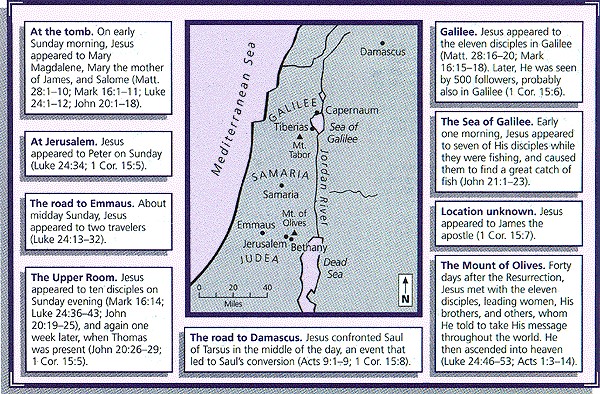
Wycliffe Bible Commentary - Charles Pfeiffer - 1560 pages (1962). 214 ratings Less detailed than the KJV Bible Commentary. Conservative. Notes are generally verse by verse but brief.
Rosscup - Conservative and premillennial scholars here have been experts in their fields. The work contains brief introductions and attempts to give a verse-by-verse exposition, though it does skip over some verses. The treatments vary with the authors, but as a whole it is a fine one-volume commentary for pastors and students to use or give to a layman. Outstanding sections include, for example: Whitcomb on Ezra-Nehemiah-Esther; Culver on Daniel; Ladd on Acts; Harrison on Galatians; Johnson on I Corinthians; and Ryrie on the Johannine Epistles.
New Bible Commentary - (1994)
The Experiencing God Study Bible : the Bible for knowing and doing the will of God - Blackaby, Henry (1996) 1968 pages - CHECK THIS ONE! Each chapter begins with several questions under the title "PREPARE TO MEET GOD." Then you will interesting symbols before many of the passages. The chapter ends with a "DID YOU NOTICE?" question. This might make a "dry chapter" jump off the page! Read some of the 48 ratings
Compact Bible commentary by Radmacher, Earl D; Allen, Ronald Barclay; House, H Wayne, et al - 954 pages. Multiple contributors to the comments which are often verse by verse. The comments are brief but meaty and can really help your study through a given book. A sleeper in my opinion.
NIV archaeological study Bible (2005) 2360 pages 950 ratings (See also Archaeology and the Bible - OT and NT)
NIV cultural backgrounds study Bible. bringing to life the ancient world of scripture Keener, Craig and Walton, John. Editors (2017)
Evangelical Commentary on the Bible - editor Walter Elwell (1989) 1239 pages.
IVP Background Commentary - OT - John Walton
Zondervan Atlas of The Bible By: Umair Mirza
Dictionary of Biblical Imagery - Outstanding Resource! free for use online with no restrictions (i.e., you do not need to borrow this book). Editors Leland Ryken, J C Wilhoit, Tremper Longman III - This is a potential treasure chest to aid your preaching and teaching as it analyzes the meaning of a host of Biblical figures of speech. Clue - use the "One-page view" which then allows you to copy and paste text. One downside is there is no index, so you need to search 3291 pages for entries which are alphabetical.
Dictionary of deities and demons in the Bible (DDD) - 950 pages (1995) Read some of the 65 ratings (4.8/5 Stars). A definitive in depth resource on this subject. Very expensive to purchase.
Unger's bible handbook : a best-selling guide to understanding the bible by Unger, Merrill F
Halley's Bible Handbook Henry H. Halley - (2000) 2720 pages (much larger than original edition in 1965 and no time limit on use). (Halley's Bible handbook : an abbreviated Bible commentary - one hour limit 1965 872 pages)
Rosscup - A much-used older evangelical handbook bringing together a brief commentary on Bible books, some key archaeological findings, historical background, maps, quotes, etc. It is helpful to a lay Bible teacher, Sunday School leader, or pastor looking for quick, pertinent information on a Bible book. This is the 72nd printing somewhat revised. Halley packed in much information. Unger’s is better overall, but that is not to say that Halley’s will not provide much help on basic information.
The Shaw Pocket Bible Handbook - Editor - Walter Elwell (1984) 408 pages.
"This hardback is small in size but packed full of content: Brief summaries of every book of the bible, cultural, archaeological and historical info, word definitions, pictures, maps and charts." Worth checking!
Eerdmans' Handbook to the Bible (1983) 688 pages
The New Unger's Bible Dictionary by Unger, Merrill Frederick, 1909-
Every prophecy of the Bible: Walvoord, John F
J.Sidlow Baxter: Explore The Book - pdf Vol. 4 Ezekiel to Malachi
Jensen's Survey of Bible (online) by Jensen, Irving 140 ratings (NT) 133 ratings (OT) This is a classic and in conjunction with the following three resources should give you an excellent background to the Bible book you are studying. Jensen has some of the best Book charts available and includes "key words." He also gives you some guidelines as to how to begin your inductive study of each book.
What the Bible is all about by Mears, Henrietta. This is a classic and is filled with "pearls" from this godly teacher of God's Word.
Talk thru the bible by Wilkinson, Bruce The Wilkinson & Boa Bible handbook : the ultimate guide to help you get more out of the Bible
Today's Handbook of Bible Times & Customs by Coleman, William L
Nelson's New Illustrated Bible Manners & Customs : How the People of the Bible Really Lived by Vos, Howard Frederic
The New Unger's Bible Dictionary by Unger, Merrill Frederick, 1909-
Nelson's Expository Dictionary of the Old Testament by Unger, Merrill. Indexed by English word and then any related Hebrew nouns or verbs. Definitions are solid and geared to the lay person.
Nelson's Expository Dictionary of the Old Testament by Unger, Merrill
Theological Wordbook of the Old Testament by Harris, R. Laird - (5/5 Stars) One of the best OT lexicons for studying Hebrew words.
Here is another link to the TWOT which has no time limit on use and does allow copy and paste. Can be downloaded as PDF.
Hebrew honey : a simple and deep word study of the Old Testament by Novak, Alfons, (332 pages) Indexed by English words. No Strong's numbers to help you determine if you are researching the correct Hebrew word. Here is a "work around" - go to page 289 and see if there is an annotation of the Scripture you are studying. E.g., say you want to see if there is anything for "heart" in Ezek 11:19. In the Scripture list find an entry for Ezek 11:19 with the English word "Heart." Now go look up "Heart" (on page 123). It does take some effort, but you might glean an insight not described in other Hebrew lexicons.
Vine's Expository Dictionary of Old Testament and New Testament Words - pdf. The old standby. You can also borrow Vine's complete expository dictionary of Old and New Testament words
Nelson's Expository Dictionary of the Old Testament by Unger, Merrill. Indexed by English word and then any related Hebrew nouns or verbs. Definitions are solid and geared to the lay person.
Expository Dictionary of Bible Words by Richards, Larry, It is does not go into great depth on the Greek or Hebrew words but does have some excellent insights.
So That's What it Means (Theological Wordbook) - Formerly titled "Theological Wordbook" edited by Charles Swindoll. It is now under this new title So That's What it Means and can be borrowed - it is more like a dictionary than a lexicon but the comments are superb! The contributors include Donald Campbell, Wendell Johnston, John Witmer, John Walvoord
Synonyms of the Old Testament-Robert Girdlestone
The Apologetics Study Bible Understand Why You Believe - Comments from over 90 leading apologists, including: Ted Cabal, Lee Strobel, Chuck Colson, Norm Geisler, Josh McDowell, Albert Mohler, J.P. Moreland, see reviews. Here is a review from The Christian Reviewer.
Baker Encyclopedia of Christian Apologetics by Geisler, Norman
Cyril Barber - This is a goldmine of valuable information! Well-indexed. Covers everything from “Absolute Truth” to “Zen Buddhism.” Extensive articles on such topics as “Agnosticism,” “Annihilationism,” “Bible, Alleged Errors in,” “Gnosticism,” “Miracles in the Bible,” “New Testament Manuscripts,” and “Objections to Resurrection,” “Big Bang Theory,” “Edward John Carnell,” “Christ, Death of,” are only a few of the insightful essays in this masterful work. Each article has been written in an understandable way, and a 28 page bibliography forms a valuable source for further research. An excellent resource.
Evidence That Demands A Verdict - Josh McDowell
The New Evidence that Demands a Verdict - Josh McDowell
More Than A Carpenter - A modern classic by Josh McDowell - Great resource for those who are skeptical that Jesus is fully God, fully Man.
Encyclopedia of Bible difficulties by Archer, Gleason L - or here with no restrictions
Hard Sayings of the Bible - Walter Kaiser
When Critics Ask - Norman Geisler
Today's Handbook of Bible Times & Customs by Coleman, William L
Nelson's New Illustrated Bible Manners & Customs : How the People of the Bible Really Lived by Vos, Howard Frederic
Manners & Customs of the Bible (The New Manners and Customs) Freeman, James M., 1827-1900 Published 1998
The New Manners and Customs of Bible Times: Gower, Ralph, 1933- Published 1987
Manners and Customs of Bible lands By: Wight, Fred Published 1983
Manners and Customs in the Bible By: Matthews, Victor Harold Published 1991
Handbook of life in Bible times By: Thompson, J. A. (John Arthur), 1913-2002 Published 1986
Illustrated dictionary of Bible manners and customs By: Deursen, A. van (Arie), 1891-1963 Published 1982
The Illustrated Guide to Bible Customs & Curiosities by Knight, George W.
Orientalisms in Bible lands, giving light from customs, habits, manners, imagery, thought and life in the East for Bible students By: Rice, Edwin Wilbur, 1831-1929 Published 1910
Bible manners and customs By: Mackie, G. M. 1854-1922 Published 1898
Teach it to your children : how kids lived in Bible days By: Vamosh, Miriam Feinberg, author
Everyday life in Bible times : work, worship, and war By: Embry, Margaret Published 1994
Everyday living : Bible life and times : fascinating, everyday customs and traditions from the people of the Bible Published 2006
The Land and the Book; or, Biblical illustrations drawn from the manners and customs, the scenes and scenery, of the Holy land By: Thomson, William M. (William McClure), 1806-1894 Published 1880
Eastern manners illustrative of the Old Testament history By: Jamieson, Robert, 1802-1880 Published 1838
Scripture manners and customs : being an account of the domestic habits, arts, etc., of Eastern nations mentioned in Holy Scripture Published 1895
- The God Who Has A Lost World On His Heart – Jonah 1-4
- Jonah: God’s Wrong Way Prophet – Jonah 1-4
- Journey through Jonah (Part 1) – You Can Run But You Can’t Hide From God – Jonah 1:1-16
- You Can Run But You Can’t Hide From God – Jonah 1:1-16
- Journey through Jonah (Part 2) – Salvation is God’s Business – Jonah 1:17 – 2:10
- Salvation is God’s Business – Jonah 1:17-2:10
- Journey through Jonah (Part 3) – The God Of The Second Chance – Jonah 3:1-10
- The God of the Second Chance – Jonah 3:1-10
- Journey through Jonah (Part 4) – Lost Persons Matter To God – Jonah 4:1-11
- Lost People Matter to God – Jonah 4:1-11
Excerpt from this recommended resource - Apple quotes from many excellent resources - here is an example from Pastor Thomas Leake of Hope Bible Church...
The Reluctant Evangelist -- The Fleeing Prophet
Text highlights the grandeur of the mercy of the God of Israel.
Chaps. 1-2 – God’s Mercy on Jonah
Chaps. 3-4 – God’s Mercy on Nineveh
Introduction:
Favorite passage for the liberals to bash; they like to make fun of the story; but they come with presuppositions that there cannot be an omnipotent miracle-working God; Story is not about the fish (never called a whale in the account); greatest miracle in the book is God’s Sovereign Mercy upon a rebellious, sinful people.
The content focuses more on the messenger than on the message – different in that respect from the other minor prophets; a running narrative; didactic history; not a prophetical oracle; you read the story and learn the lesson; don’t get bogged down in the details; from literary, artistic standpoint it is a masterpiece; a great read
Cf. some of the clever outlines of other commentators:
Chap. 1 – “I won’t go”
Chap. 2 – “OK, I’ll go”
Chap. 3 – “Here I am”
Chap. 4 – “I knew I shouldn’t have come”
I. (Jonah 1:1-3) The Opening A. (:1) Who Was Jonah?
Name means “dove”; father’s name means “truthful, loyal” Matt. 12:41 – Jonah was a real person preaching to real people; 2 Kings 14:25; ministered during reign of Jeroboam II in N. Kingdom of Israel
B. (:2) What did God want Jonah to do?
What’s the big deal in being commissioned to preach judgment to Nineveh? We need to place ourselves in his shoes and try to understand how he felt. Would have been an astonishing command to any Jew. Nineveh was a very wicked city – among many wicked cities it is singled out – something very bad; similar to Sodom and Gomorrah; but no missionaries were ever sent to Sodom and Gomorrah; God did not have mercy on them; It was not normally God’s method in OT times to send out missionaries to Gentile nations; in fact Jonah is the only prophet to have received such a call; The world was to come to Israel to worship the true God; the Great Commission reversed all of this
C. (Jonah 1:3) Jonah’s Response = refusing God’s Commission
How could a little prophet like Jonah stand up against God? Everything in this book obeys God – the wind, the sea, the fish, the heathen sailors… Did Jonah think he was going to be successful in fleeing God? He knew the doctrines of the character of God – His omnipresence, etc.; he wasn’t surprised when he got caught; He was attempting to flee from the special manifested presence of God in Jerusalem (same language used of Cain in Gen. 4:16)
Fleeing his calling; his service obligation; smooth sailing at first; no problems; looked like the coast is clear; maybe feeling relieved; God allows us our own plans; we might think that all will be well; but eventually judgment catches up to us; cf. Harvest Principle
II. (Jonah 1:4-16) The Storm
A. (Jonah 1:4-9) The Storm Hits
A great wind; we give names to storms today; delayed response by God; He did not send this storm immediately; Ps. 104
Whatever you call on in your moment of need is your god;
Sailors = Rope pullers; Phoenicians; large decked ship
They were desperate = willing to throw valuable cargo overboard;
Contrast: Christ sleeping peacefully in boat in the midst of a storm – He had every right to be at peace; Jonah’s was a false peace
Irony: you have a pagan captain instructing Jonah to call on his God; Unbelievers involved in rebuking the prophet of God
“Arise” = same command word used by God in the original commission
“lots” were often viewed as valid in the Scriptures – Acts 1:26 – little stones from ankle bones; “You can roll the dice, but God determines the outcome”
The jig is up; identified himself as a “Hebrew
B. (Jonah 1:10-14) The Storm Worsens
These experienced sailors were terrified; could not be a worse scenario; If they kept Jonah in the boat they would perish; if they threw him overboard they would be guilty of the blood of an innocent man (not convicted of any crime);
How could you do this to us?
God had nothing against these sailors;
Jonah not suicidal but making a confession that he was worthy of death and of being sacrificed to save the others; these were noble sailors – still tried to row harder to reach land and save Jonah; but the storm kept worsening;
What God decrees always comes to pass; He is in control of all history
C. (Jonah 1:15-17) The Storm Ceases – storm = life-changing encounter
1) Spiritual pilgrimage of the sailors: began with self effort; turned to their gods; then turned to God of Israel = genuine conversion experience; convinced that Jonah had died; even if they had seen the big fish, they would not have interpreted that as God’s mercy or deliverance Psalm 107:23ff; 76:11 the storm humbled these strong, self-sufficient men You can tell their repentance and confession was genuine because it was followed by vows of obedience (not some phony foxhole conversion) God was merciful in granting them repentance
2) Spiritual pilgrimage of Jonah – he had some time to think before the fish swallowed him; he was almost half-drowned by that time This is example of didactic poetry – Hebrews loved poetry = it taught history; emphasis not on rhyming but on comparisons and contrasts; restatement, enhancement; increase in intensity, etc. – Transition to Chap. 2 Conclusion: Prov. 3:5-7
The links include both audios and transcripts. Very well done and unpacked verse by verse.
- Jonah Jonah1:1-3 The Prodigal Prophet
- Jonah 1:4-17 Great Wind - Great God
- Jonah 1:17-2:10 Bouncing Back from the Bottom
- Jonah 3 Mission of Mercy
- Jonah 4 Jonah and the Worm
Conservative, Literal Interpretation
- Jonah Images
- Jonah Maps
- Jonah Art - some excellent maps for teaching (example)
- Jonah Coloring Pages
- Jonah and the Whale (note: God says "fish")
Be a Berean - Not Always Literal
His prayers are excellent
See critique
- Jonah 1 Shattered Stereotypes
- Jonah 2:1-10 The Psalm of the Prodigal Prophet
- Jonah 3 & 4 Nineveh’s Repentance and Jonah’s Wrath
Be a Berean: Not always a literal interpretation.
Note: This resource is listed because it has numerous commentary notes that relate to the OT Prophetic Books
- Israelology: Part 1 of 6 Introduction: Definition of Terms
- Israelology: Part 2 of 6 Israel Present (Note: Article begins on Page 2)
- Israelology: Part 3 of 6 Israel Present (Continued)
- Israelology: Part 4 of 6 - Israel Future (Part One)
- Israelology: Part 5 of 6 - Israel Future (Part Two)
- Israelology: Part 6 of 6 Other Relevant Topics - Illustrations of Israel (including marriage)
- Introduction
- The Highest Evidence
- Jonah 1:1-2 The Commission
- Jonah 1:3 The Disobedience
- Jonah 1:4-17 The Disobedience
- Jonah 1 - Typical Application
- Jonah 2:1-9 Jonah's Prayer
- Jonah 2:10 Jonah's Deliverance
- Jonah 2 Typical Application
- Jonah 3:1-4 The Repeated Commission and Jonah's Obedience
- Jonah 3:4-10 The Repentance and Salvation of Nineveh
- Jonah 3 Typical Application
- Jonah 4:1-3 Jonah's Discontent
- Jonah 4:4-11 Jonah's Correction
Not always literal (see example)
- Jonah 1:1-16 Jonah: Rejecting God's Call
- Jonah 1:17-2:10 Jonah--experiencing God's Salvation
- Jonah 3:1-10 Jonah--delivering God's Message
- Jonah 4:1-11 Jonah: Developing A Concern Like God's
- Jonah 1:1-16 Jonah Run
- Jonah 1:17-2:10 A Hole in the Prayer
- Jonah 3 Great to God
- Jonah 4 Angry Enough to Die
Nineveh (pictures) - Ancient historians say that Nineveh was the largest city in the world at that time. It was the large, important capital of a dominating empire—surely an intimidating place to go.
James Rosscup writes "This 1858 work supplies much help on matters of the text, word meaning, resolving some problems, etc. Some have found it one of the most contributive sources in getting at what a text means." (Commentaries for Biblical Expositors: An Annotated Bibliography of Selected Works)
Be cautious (Acts 17:11-note): Does not always interpret the Scripture literally and sometimes replaces Israel with the Church (note) (Click example of his interpretative approach which is often allegorical) (Or another example)
Interesting Resource Be a Berean - Not Always Literal
- Introduction
- Jonah 1 Critical Notes
- Jonah 1:1-2 The Great Commission — Jonah 1:3 The Disgraceful Flight — Jonah 1:4,5 The Retributive Storm — Jonah 1:5 Contrasts in the Voyage of Life — Jonah 1:6 The Sleeper Roused — Jonah 1:7 Is There Not a Cause? — Jonah 1:7 Casting Lots — Jonah 1:8 Urgent Questions — Jonah 1:9, 10 Confession of Faith and of Guilt — Jonah 1:9, 10 Aggravations of the Guilt of Backslidings — Jonah 1:11, 12 The Required Sacrifice — Jonah 1:11, 12 Labour in Vain — Jonah 1:13, 14 Pagan Prayers — Jonah 1:15 The Sacrifice and the Calm — Jonah 1:14, 16 The Converted Heathen — Jonah 1:17 The Great Miracle — Jonah 1 Illustrations to Chapter 1
- Jonah 2 Critical Notes
- Jonah 2 In the Deep — Jonah 2:1-4 Prayer and Distress — Jonah 2:4 Revived Feelings — Jonah 2:7 Remembrance of God — Jonah 2:8,9 The Moral Contrasts in Life — Jonah 2:9 Salvation of the Lord — Jonah 2:9, 10 The Great Deliverance — Jonah 2 Illustrations to Chapter 2
- Jonah 3 Critical Notes
- Jonah 3:1 Jonah a Sign to the Ninevites (Luke 11:30) — Jonah 3:1, 2 The Second Call — Jonah 3:3, 4 Jonah's Obedience — Jonah 3:4, 5 Jonah's Preaching — Jonah 3:4-8 Nineveh Warned and Nineveh Reformed — Jonah 3:5-9 Nineveh's Repentance: Its Origin and Nature — Jonah 3:9 Who Can Tell? — Jonah 3:9-10 Nineveh's Hope and Nineveh's Reprieve — Jonah 3 Illustrations to Chapter 3
- Jonah 4 Critical Notes
- Jonah 4:1-4 The Strange Displeasure — Jonah 4:2 A Gracious God — Jonah 4:4 Divine Reproof — Jonah 4:4, 9 The Folly of a Fretful Mind — Jonah 4:5 Jonah's Retirement — Jonah 4:6-10 The Divine Correction of a Fretful Man — Jonah 4:7 Withered Joy — Jonah 4:11 God's Care for Children — Jonah 4:11 God's Care for Oxen — Jonah 4 Illustrations to Chapter 4
THE UNABRIDGED VERSION IS BELOW
- Jonah 1:1-3 The Doctrine of Satanic Providence
- Jonah 1:4-16 Man Overboard, or The Doctrine of Christian Declension
- Jonah 1:17-2:10 Salvation: All of God; Damnation: All of Man
- Jonah 3:1-10 The God of Another Chance, or History’s Greatest Evangelistic Campaign
- Jonah 4 The Old-Testament Cousin of John 3:16
- Jonah 1: 1-3 Rebel with a Cause
- Jonah 1:1-10 Asleep In the Storm
- Jonah 1: 1-6 When Sin Upsets God
- Jonah 1:11-17 Calming The Storm
- Jonah 2:1-10 Praying Your Way Out of Trouble
- Jonah 2:10-3:3 The God of A Second Chance
- Jonah 3:1-10 When Revival comes
- Jonah 4:1-4 A Saint with An Attitude
- Jonah 4:1-11 Worm Theology
See caveat regarding this commentary
Note relevant maps and picture in left column
- Jonah 1:1-17 Guilty Silence and Its Reward
- Jonah 2:8 Lying Vanities
- Jonah 3:1-10 Threefold Repentance
Spurgeon: A first-class exposition of Jonah. No one who has it will need any other. It is not a small treatise, as most of the Jonah books are; but it contains 460 pages, all rich with good matter. It is out of print, and ought to be republished. What are publishers at to let such a book slip out of the market?
INTRODUCTORY
I.—JONAH 1:1.—Jonah’s Mission; its Place in Historical Development
II.—JONAH 1:1.—Relations between Jew and Gentile
PART FIRST - THE COMMISSION ISSUED—AND REFUSED
III.—JONAH 1:2.—Jonah’s Commission; its Sovereignty and Righteousness
IV.—JONAH 1:3.—Jonah’s Flight; its Meaning and Motive
V.—JONAH 1:3.—Jonah’s Flight; its Lessons
VI.—JONAH 1:4.—The Storm
VII.—JONAH 1:5.—The Prayer of Terror, and the Sleep of Sorrow, in the Storm
VIII—JONAH 1:6.—The World Rebuking the Church
IX.—JONAH 1:6.—Natural Religion; its Strength and Weakness
X.—JONAH 1:7.—Casting the Lot
XI.—JONAH 1:8, 9.—Jonah in the Ship: Achan in the Camp
XII.—JONAH 1:9, 10.—Aggravations of the Guilt of Backsliding
XIII.—JONAH 1:11–17.—The Casting of Jonah into the Sea
XIV.—JONAH 2:1–9.—Jonah’s Prayer: The Conflict of Faith and Sense
XV.—JONAH 1:17; 2:10.—New Testament Commentaries: No. I.—The Type
PART SECOND - THE COMMISSION RE-ISSUED—AND FULFILLED
XVI.—JONAH 3:1.—Jonah Restored to Office
XVII.—JONAH 3:1–4.—The Commission Re-issued—and Accepted
XVIII—JONAH 3:5, 9.—Nineveh’s Repentance:—its Origin and Nature
XIX.—JONAH 3:6–8, 10.—Nineveh’s Repentance:—its Nationality; its Expressions; its Efficacy
XX.—JONAH 3:10.—New Testament Commentaries: No. II.—The Parallel
XXI.—JONAH 1:17; 3:10.—New Testament Commentaries: No. III.—The Sign
CONCLUSION
XXII.—JONAH 4:1–11.—Jonah’s Anger—and the Gourd
J Vernon McGee's book -- Jonah Dead or Alive - Pdf 35 Pages of Pithy Commentary on Jonah
- Jonah: Introduction
- Jonah: Author
- Jonah: Churchill's Quote
- Jonah: Content
- Jonah: Outline
- Jonah: Six Subjects
- Jonah 1:1, 2 Commentary
- Jonah 1:3 Commentary
- Jonah 1:4-6 Commentary
- Jonah 1:7 Commentary
- Jonah 1:8-10 Commentary
- Jonah 1:11-17 Commentary
- Jonah 2:1 Commentary
- Jonah 2:1, 2 Commentary
- Jonah 2:2-6 Commentary
- Jonah 2:7, 8 Commentary
- Jonah 2:9, 10 Commentary
- Jonah 3:1-2 Commentary
- Jonah 3:1-2a Commentary
- Jonah 3:2 Commentary
- Jonah 3:3, 4 Commentary
- Jonah 3:5-8 Commentary
- Jonah 3:9, 10 Commentary
- Jonah 4 Commentary
- Jonah 4:1-3 Commentary
- Jonah 4:4, 5 Commentary
- Jonah 4:6 Commentary
- Jonah 4:7-11 Commentary1
- Jonah 1:3 Devotional Commentary
- Jonah 2:4 Devotional Commentary
- Jonah 3:1 Devotional Commentary
- Jonah 4:6-8 Devotional Commentary
- CLICK FOR THESE DEVOTIONALS ON ONE PAGE plus many additional devotionals, illustrations, sermons, etc
An annual $50 or monthly $5 subscription (click here) is required to view the entire article but will give you access to literally thousands of conservative articles. Click the following links to search by topic, author, or bible reference.
Sample articles…
- Reading Jonah Again for the First Time by Robert Spender
- The Prophet Jonah and His Message Part 1 by Gerald B. Stanton
- The Prophet Jonah and His Message Part 2 by Gerald B. Stanton
- The Power of Biblical Preaching- An Expository Study of Jonah 3:1-10 by Steven J. Lawson
- Jonah 1:1-3 Jonah's Commission and Disobedience
- Jonah 1:4-16 Jonah's Punishment
- Jonah 1:17 Jonah's Predicament
- Jonah 2:1-10 Jonah: Dead or Alive?
- Jonah 3:1-10 Jonah's Preaching and Nineveh's Repentance
- Jonah 4:1-11 Jonah's Reaction to Nineveh's Repentance
- Best Commentary on Jonah - Best Commentaries Reviews
- Top 5 Commentaries on the Book of Jonah by Keith Mathison
Among Christians:
- 61% knew that Jonah is a book of the Bible
- 27% said it is not,
- 12% had no idea.
Among non-Christians in the survey:
- 29% knew that the Book of Jonah could be found in the Bible
- 27% said it could not,
- 34% were not sure.
- How could Jonah survive three days in the belly of a “whale”?
- Are there biblical examples of depression and how to deal with it?
- Coloring page about Jonah and the great fish
- Miracles Recorded in the Bible
- Jonah 1-3 God’s Reluctant Missionary - recommended
When Jonah sunk beneath the wave,
He thought to rise no more;
But God prepared a fish to save,
And bear him to the shore.
DEVOTIONALS AND MORE
- CLICK FOR DEVOTIONALS ON ONE PAGE plus many illustrations, sermons, etc
- Jonah - American Tract Society Bible Dictionary
- Jonah - Nave's Topical Bible - Bible Concordance
- Jonah - Bridgeway Bible Dictionary (Map)
- Jonah - Fausset's Bible Dictionary
- Jonah - Holman Bible Dictionary
- Jonah - Hastings' Dictionary of the Bible
- Jonah - Hastings' Dictionary of the New Testament
- Jonah - Morrish Bible Dictionary
- Jonah - Watson's Biblical & Theological Dictionary
- Jonah - Kitto's Popular Cyclopedia of Biblical Literature
- Jonah - 1911 Encyclopedia Britannica
- Jonah - International Standard Bible Encyclopedia
- Jonah - Cyclopedia of Biblical, Theological and Ecclesiastical Literature
- Jonah - The 1901 Jewish Encyclopedia
- Jonah, Book of - The 1901 Jewish Encyclopedia
- Christian Answers Encyclopedia
- Six Signs We Need to Return to God, Jonah 1
- God Wants You Back, Jonah 1-2
- Confinement, Communion, and Confession, Jonah 2
- A Second Chance with God, Jonah 3
- A Heartless Prophet, Jonah 4
- Book of Jonah overview
- "Was Jonah truly swallowed by a whale?"
- "What should we learn from the life of Jonah?"
- "What is the sign of Jonah?"
- "Did Jonah die while he was in the belly of the fish (Jonah 2)?"
- "Why did Jonah try to go to Tarshish instead of Nineveh?"
- Why was Jonah angry that the Ninevites repented (Jonah 4:1-2)?
- What does Jonah 4:11 mean by people who cannot tell their right hand from their left?
- "Who were the Assyrians in the Bible?"
- Borrow Holman Christian Standard Bible Study Bible - well done study Bible notes
- Sample of the quality of the HCSB Study Bible notes -
Jonah 1:1 Jonah in Hebrew means "dove." His father's name Amittai means "faithful [is Yahweh?]."
Jonah 1:2 Nineveh on the east bank of the Tigris River became the Assyrian capital after 705 B.C., well after Jonah's day. Its ruins are found in the northern part of modern Iraq, opposite the city of Mosul 220 miles northwest of Baghdad. For Jonah, Nineveh was an arduous journey of over 500 miles to the northeast of Samaria. His probable route—first traveling north and then east—would have made the trip closer to 600 miles. God's holiness is offended by sin. He showed Himself judge of the world by holding these distant pagans accountable for their wickedness, though He also showed His mercy by commanding His prophet to warn them.
Jonah 1:3 To flee... from the LORD's presence is to attempt the impossible since God is everywhere, though people still try. (See Jonah 4:2 for why he fled.) Joppa on the Mediterranean coast just south of modern Tel Aviv was one of Israel's few natural seaports. The location of Tarshish is uncertain. Its association with ships (1Ki 10:22) suggests it was near the sea. The "ships of Tarshish" used by King Jehoshaphat on the Red Sea were probably merchant ships of design similar to those used by sailors from Tarshish on the Mediterranean Sea. Tarshish has sometimes been identified with Paul's home of Tarsus in Cilicia or the city of Tharros on the island of Sardinia west of Italy. But the most probable identification of Tarshish is the Phoenician colony of Tartessus, located on the Guadalquivir River on the southwestern coast of Spain about 2,000 miles west of Palestine. This is about as far in the opposite direction from Nineveh that Jonah could have gone.
Jonah 1:3,10 - Barach usually means flee, occurring four times with malat ("escape"; 1Sa 19:12) and once, translated escape (Jdg 9:21), with synonymous nus (160x; "flee"). Barach often portrays stealthy flight, while nus regularly depicts open flight. Barach describes slaves running away (1Ki 2:39). It suggests go home (Num 24:11) or go back (Neh 13:10) when people flee homeward. As hurry (Song 8:14), it connotes urgent speed rather than flight.
Jonah 1:5-6 Jonah's spiritual decline is depicted in parallel with the descriptions of his response to God's call. He was told to "get up" (Jonah 1:2) to go to Nineveh, but instead he "went down to Joppa" (v. 3), "went down" to the ship (Jonah 1:3) and finally went down to the lowest part of the vessel. Eventually he will be swallowed by a fish and sink down to the foundations of the mountains at the bottom of the sea (Jonah 2:6). Only then did he hit bottom and begin to go back up. His deep sleep in the midst of a storm also symbolizes his spiritual condition. It may have been a symptom of depression stemming from his willful disobedience.
Jonah 1:9 Worship (HCSB translation) is literally "fear." Fear of God in the OT is the respect that a person has for God, causing him to turn from evil and obey God's commandments (Gen 22:12; Job 1:8; 28:28; Pr 8:13). Ironically God's prophet Jonah showed no such fear by his disobedience. It is also ironic that Jonah fled to avoid preaching to Gentiles in Nineveh, but now found himself preaching to Gentiles in the ship. Yahweh means "He is [present]" and is God's personal name in the OT, ordinarily rendered in translation as Lord in small caps (as in Jonah 1:1,3,4,10,16,17). The substitution in translation of the title Lord for the personal name Yahweh goes back to postexilic Jewish reluctance to pronounce the divine name. Neither Jonah nor these sailors had any qualms about using the term Yahweh at this time.
Jonah 1:12-15 Rather than submitting to God, Jonah asked these men to kill him by throwing him overboard. Yet despite Jonah's confession of guilt, these pagan Gentiles had moral scruples about sending a man to his death and tried to row ashore instead. Only after they saw no other option and had prayed that Yahweh would not hold them accountable for taking a human life did they throw Jonah into the sea. The integrity and spiritual sensitivity of these Gentiles would have shocked Israelite readers of this book, confronting their belief that non-Hebrews were unworthy of God's mercy. Certainly this is a lesson Jonah himself needed.
Jonah 1:16 When the sea calmed, these Gentile sailors then feared the LORD in the sense of revering and worshiping Him (see note at Jonah 1:9). Jonah, who was fleeing from a mission to preach to Gentiles, had unintentionally converted an entire crew of Gentile sailors.
Jonah 1:17 The huge fish that swallowed Jonah was not necessarily a whale. Yarns of a sailor surviving Jonah-like in a whale have been widely repeated in recent centuries, but no account has ever been authenticated. Three days and three nights parallels Christ's resurrection on the third day (Mt 12:40).
There is no worse enemy, nor one more troublesome to the soul, than you are to yourself, if you are not in harmony with the Spirit.
- G Campbell Morgan's devotional/practical thoughts make good fodder for sermon preparation!
- Jonah - Living Messages
- An Introduction to the Book of Jonah
- An Argument of the Book of Jonah
- A Selected Bibliography of the Book of Jonah
Commenting on Matthew 12:42 Perowne writes "Is it possible to understand a reference like this on the nonhistoric theory of the book of Jonah? The future Judge is speaking words of solemn warning to those who shall hereafter stand convicted at his bar. Intensely real he would make the scene in anticipation to them, as it was real, as if then present, to himself. And yet we are to suppose him to say that imaginary persons who at the imaginary preaching of an imaginary prophet repented in imagination, shall rise up in that day and condemn the actual impenitence of those his actual hearers."
ADRIAN ROGERS - CLICK FOR SERMONS BELOW
- A Man on the Run—Jonah 1–4
- The Miracle of Missions—Jonah 1:1–3
- The Miracle of Missions—Jonah 1–4
- Jonah 1:1-2:10 Jonah: You Can't Get There From Here
- Jonah 3:1-4:11 Jonah: Now That I'm Here I Don't Like It!
- Jonah 1–2
- Jonah 1
- Jonah 1:1
- Jonah 1:2
- Jonah 1:3
- Jonah 1:4
- Jonah 1:7
- Jonah 1:9
- Jonah 1:17
- Jonah 2
- Jonah 2:1
- Jonah 2:2
- Jonah 2:3–6
- Jonah 2:4
- Jonah 2:6
- Jonah 2:7
- Jonah 2:8
- Jonah 2:9
- Jonah 2:10
- Jonah 3–4
- Jonah 3:3
- Jonah 3:5
- Jonah 3:6
- Jonah 3:7
- Jonah 3:8
- Jonah 3:9
- Jonah 3:10
- Jonah 4
- Jonah 4:1
- Jonah 4:2
- Jonah 4:5
- Jonah 4:6
- Jonah 4:7–8
- Jonah 4:9–11
SERMONS BY VERSE - OLDER WORKS INCLUDING SERMONS, ILLUSTRATIONS, ETC.
- JONAH 1:1–3 JONAH THE RUNAWAY
- JONAH 1:4–7 JONAH FOUND OUT
- JONAH 1:8–15 JONAH OVERBOARD
- JONAH 2:1–10 JONAH PRAYING IN HIS GRAVE
- JONAH 3:1–10 JONAH OBEDIENT
- JONAH 4:1–6 JONAH DISPLEASED
- Separate message - Jonah 2:9 We Are Saved by Hope
- Jonah 1 God's Unexpected Message
- Jonah 2 God's Unexpected Mercy
- Jonah 3 God's Unexpected Magnanimity
- Jonah 4 God's Unexpected Medicine
We may never plead providential arrangement as an excuse for doing wrong.… [Jonah] walks on the quay, and the first thing he sees is a ship going to Tarshish!… I pray you never blaspheme God by laying your sins on the back of His providence.
God is in our comforts, for He prepared a plant to shade Jonah (Jonah 4:5–6). God is in our bereavements and losses, for He prepared a worm to destroy the plant (Jonah 4:7). God is in our severest trials, for He prepared a vehement wind to make Jonah miserable (Jonah 4:8).
If God said that Jonah was swallowed by a whale, then the whale swallowed Jonah, and we do not need a scientist to measure the gullet of the whale.
Those who consider the Book of Jonah an allegory or a parable should note that 2 Kings 14:25 identifies Jonah as a real person, a Jewish prophet from Gath Hepher in Zebulun who ministered in the Northern Kingdom of Israel during the reign of Jeroboam II (793–753 B.C.). They should also note that our Lord considered Jonah a historic person and pointed to him as a type of His own death, burial, and resurrection (Matt. 12:41; Luke 11:32).
Jonah and Nahum are the only books in the Bible that end with questions, and both books have to do with the city of Nineveh. Nahum ends with a question about God’s punishment of Nineveh (Nahum 3:19), while Jonah ends with a question about God’s pity for Nineveh. This is a strange way to end such a dramatic book as the Book of Jonah. God has the first word (Jonah 1:1–2) and God has the last word (Jonah 4:11), and that’s as it should be, but we aren’t told how Jonah answered God’s final question. It’s like the ending of Frank Stockton’s famous short story “The Lady or the Tiger?” When the handsome youth opened the door, what came out: the beautiful princess or the man-eating tiger? We sincerely hope that Jonah yielded to God’s loving entreaty and followed the example of the Ninevites by repenting and seeking the face of God. The famous Scottish preacher Alexander Whyte believed that Jonah did experience a change of heart. He wrote, “But Jonah came to himself again during those five-and-twenty days or so, from the east gate of Nineveh back to Gath Hepher, his father’s house.” Spurgeon said, “Let us hope that, during the rest of his life, he so lived as to rejoice in the sparing mercy of God.” After all, hadn’t Jonah himself been spared because of God’s mercy?.....But the real issue isn’t how Jonah answered God’s question; the real issue is how you and I today are answering God’s question. Do we agree with God that people without Christ are lost? Like God, do we have compassion for those who are lost? How do we show this compassion? Do we have a concern for those in our great cities where there is so much sin and so little witness? Do we pray that the Gospel will go to people in every part of the world, and are we helping to send it there? Do we rejoice when sinners repent and trust the Savior? All of those questions and more are wrapped up in what God asked Jonah. We can’t answer for him, but we can answer for ourselves. Let’s give God the right answer.
Jonah saw God’s will as punishment. Jesus saw God’s will as nourishment (John 4:34).
It is what Jonah does that is important, not so much what he says. In chapter 1, he is a “prodigal son” who wanted to flee to the far country and avoid obeying God’s will. In chapter 2, he prays for forgiveness and restoration, and God graciously grants his requests. In chapters 3 and 4, he is an “elder brother” who grudgingly obeys and then sits outside the city hoping for judgment to fall! Yet in all this, he is a “sign” of the resurrection of Jesus Christ, the one greater than Jonah (Matt. 12:39–41).
According to Jonah chapter 1, everything cooperated with the Lord except Jonah—the wind and the sea, the great fish, and even the heathen sailors. Jonah would not try to rescue the pagan city of Nineveh from destruction, but the unconverted sailors tried to rescue Jonah. Yet Jonah was the cause of their peril!
Read Father Mapple’s sermon on Jonah in chapter 8 of Moby Dick by Herman Melville. (See also mention of Jonah in Chapter 83) (All mentions of Jonah in Moby Dick)
Jonah was sent into the whale's belly to make his sermon for Nineveh.
WORLD JEWISH BIBLE SOCIETY
MAPS COVERING ISRAEL PRE- AND POST-EXILE
These are excellent full color, modern maps with events marked on many of the maps
These are excellent maps with events marked on many of the maps
The Kingdom of David and Solomon
- David's Rise to Power
- David in Conquest of Canaan
- David's Wars of Conquest
- Kingdom of David and Solomon
- The United Monarchy under Solomon (1)
- The United Monarchy under Solomon (2)
- Solomon's Economic Enterprises
- Solomon's Building Activities
- Solomon's Temple
- Jerusalem in the Time of David and Solomon
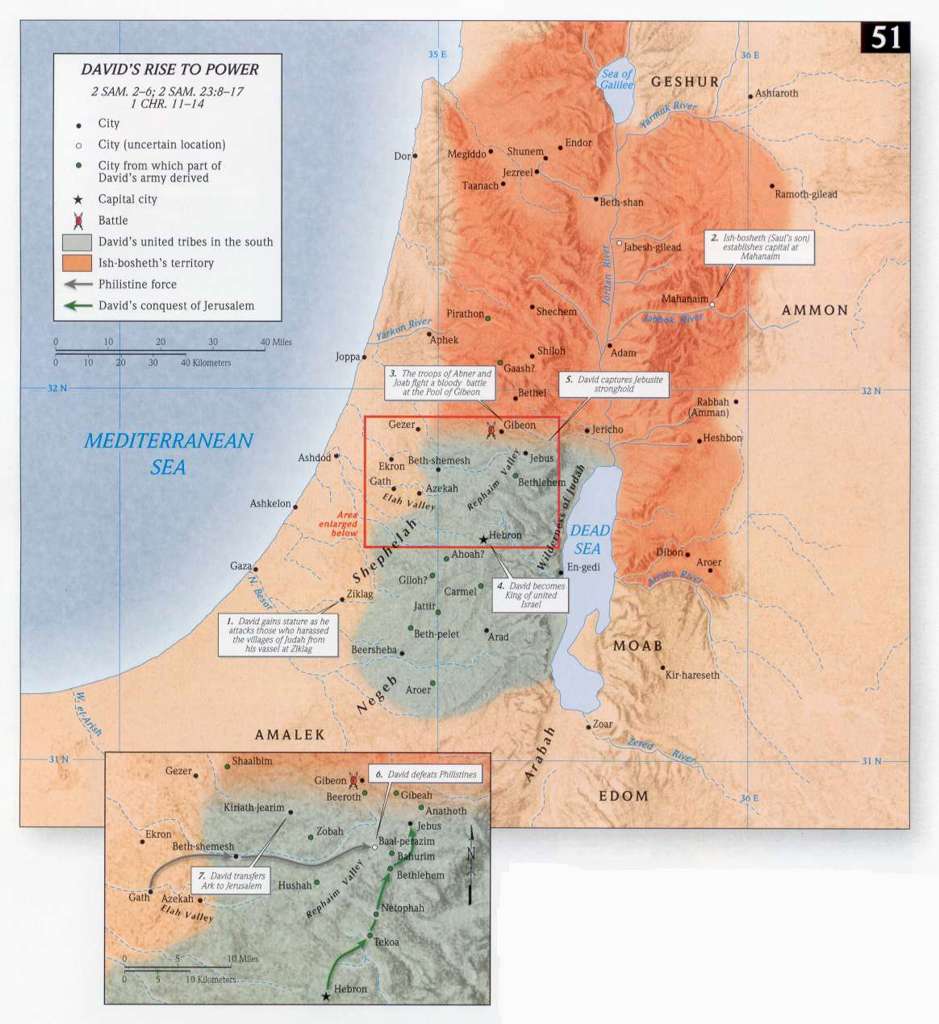
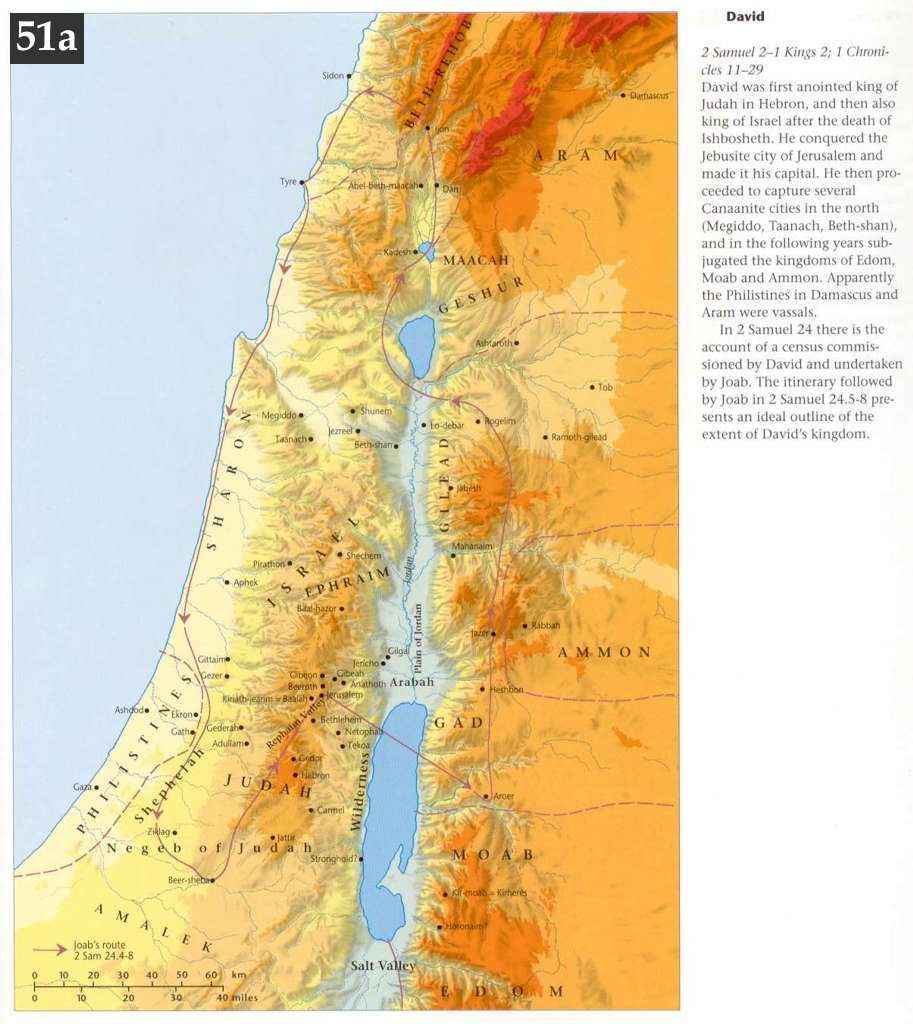
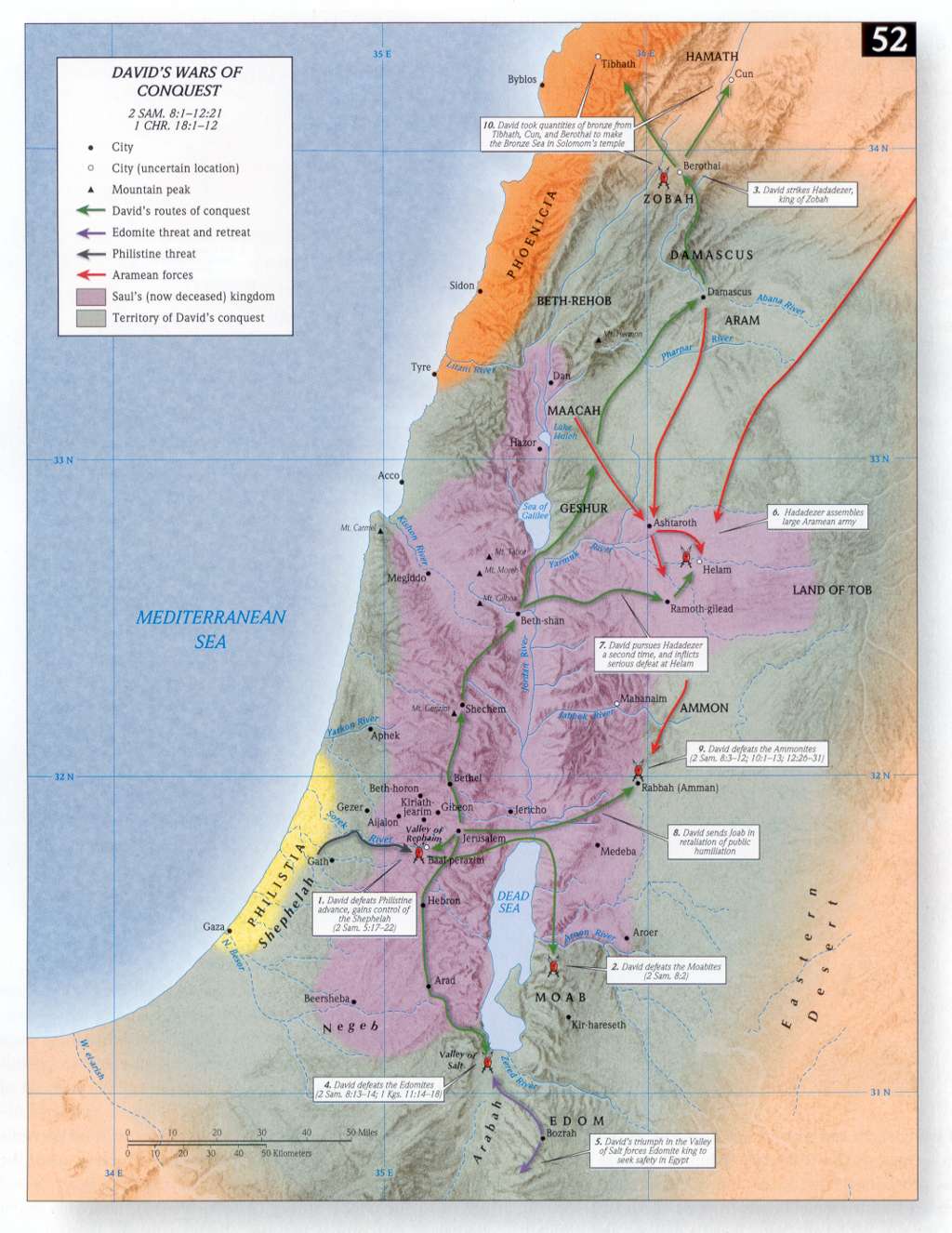
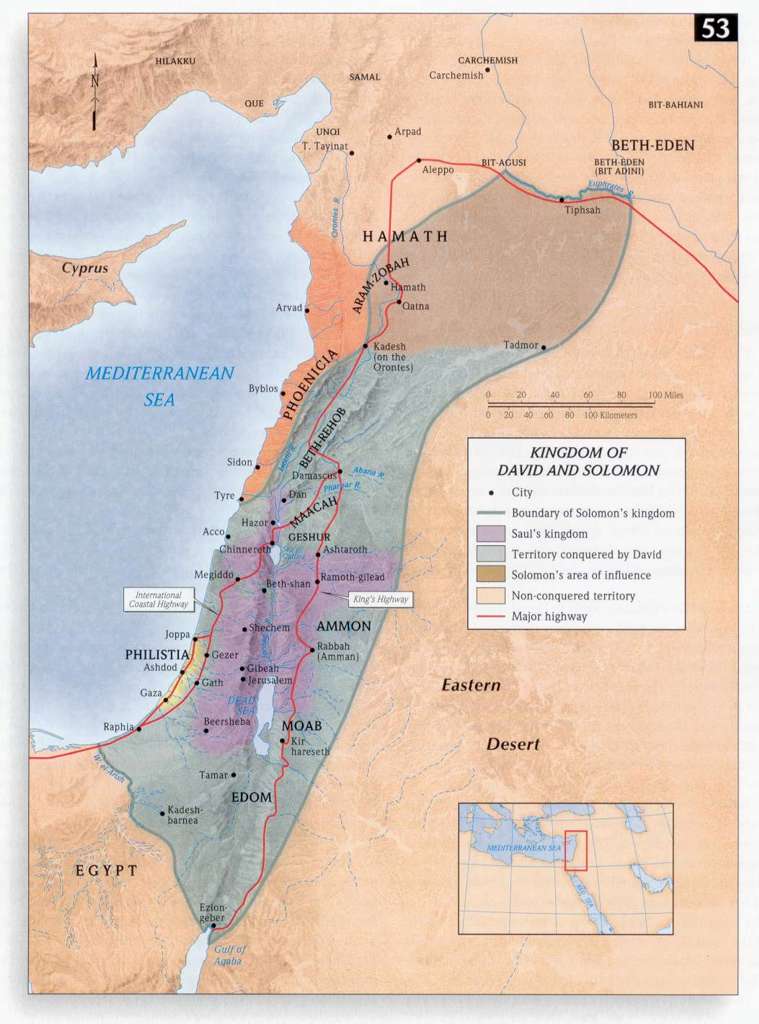
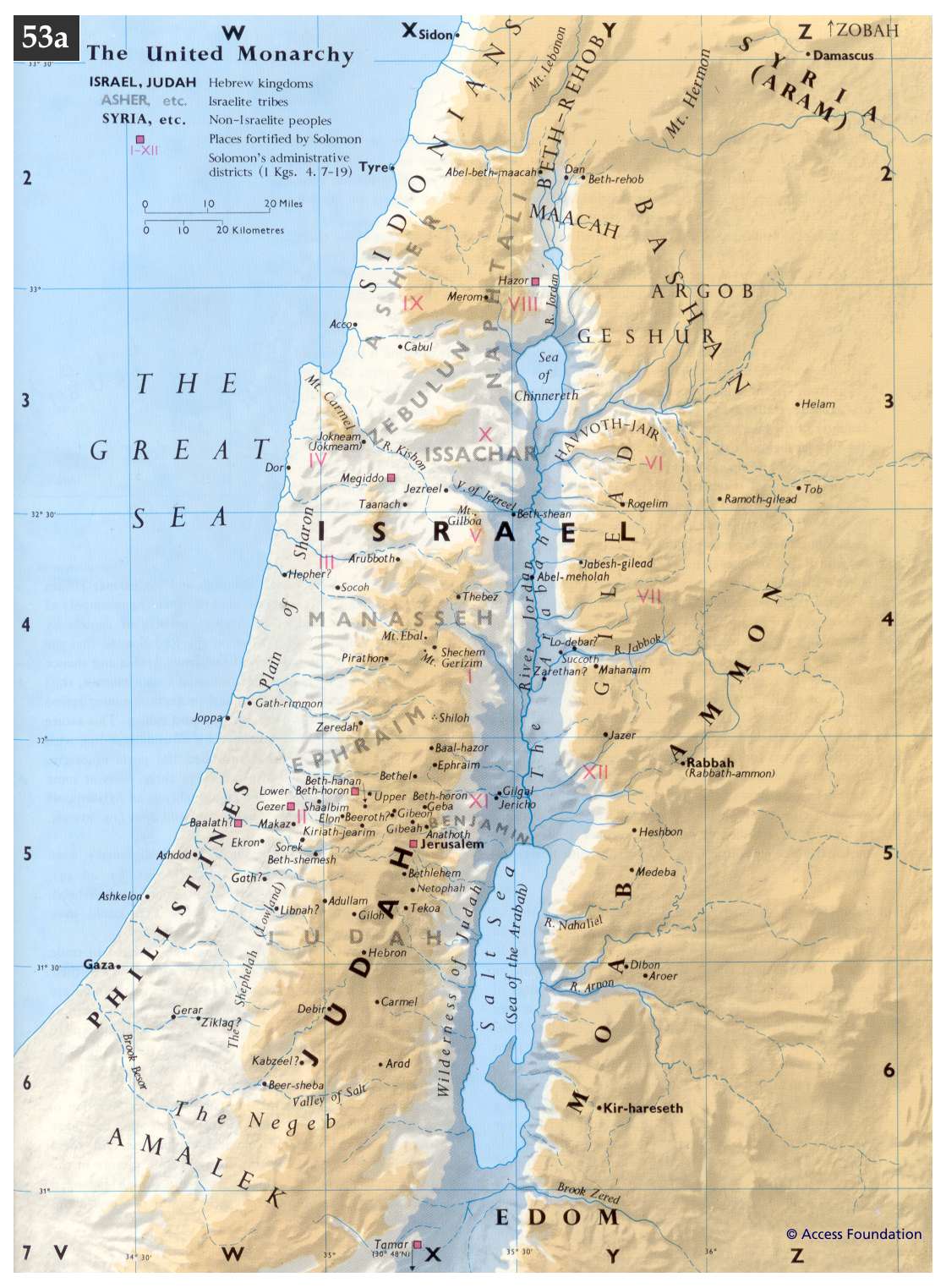
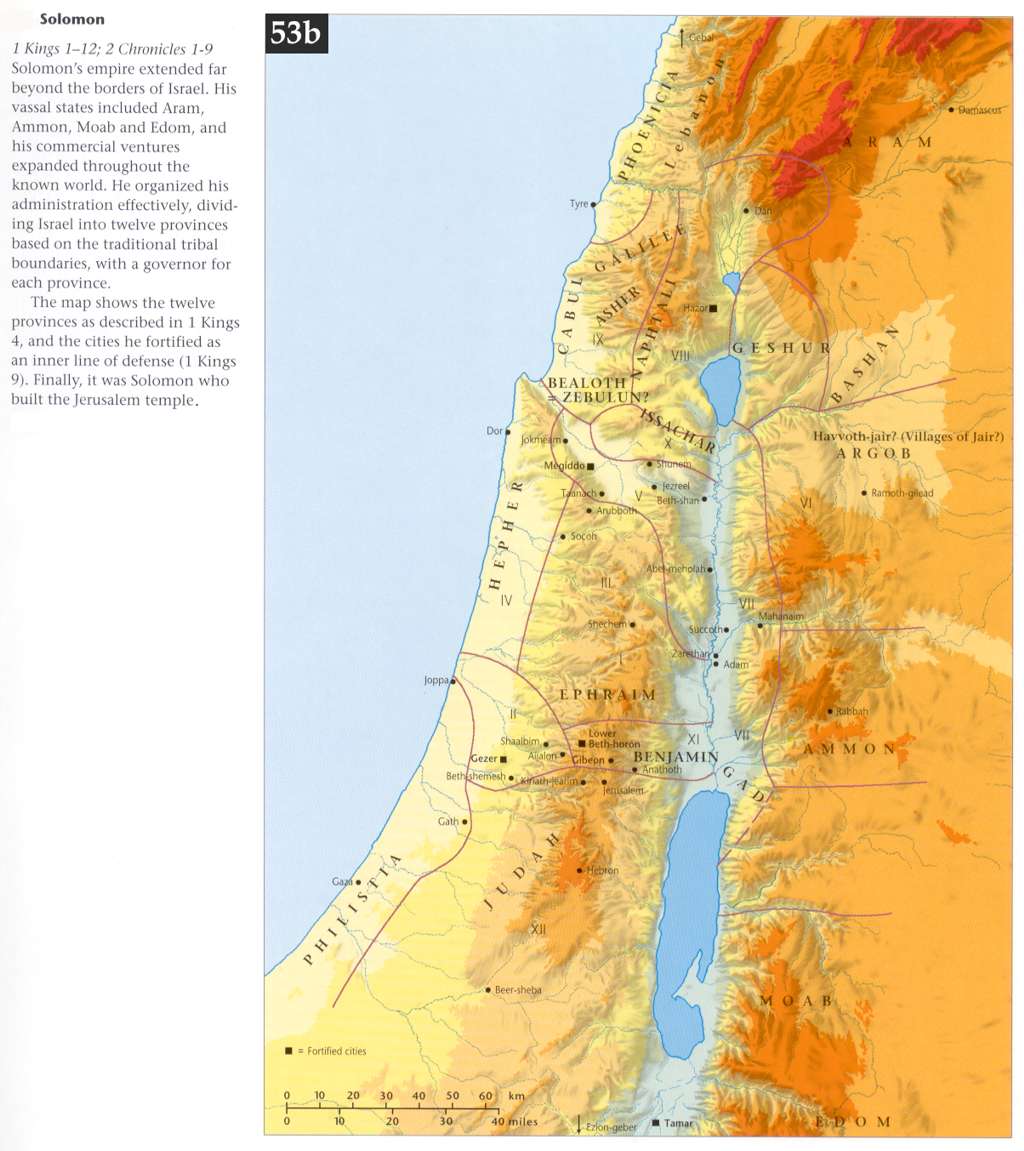
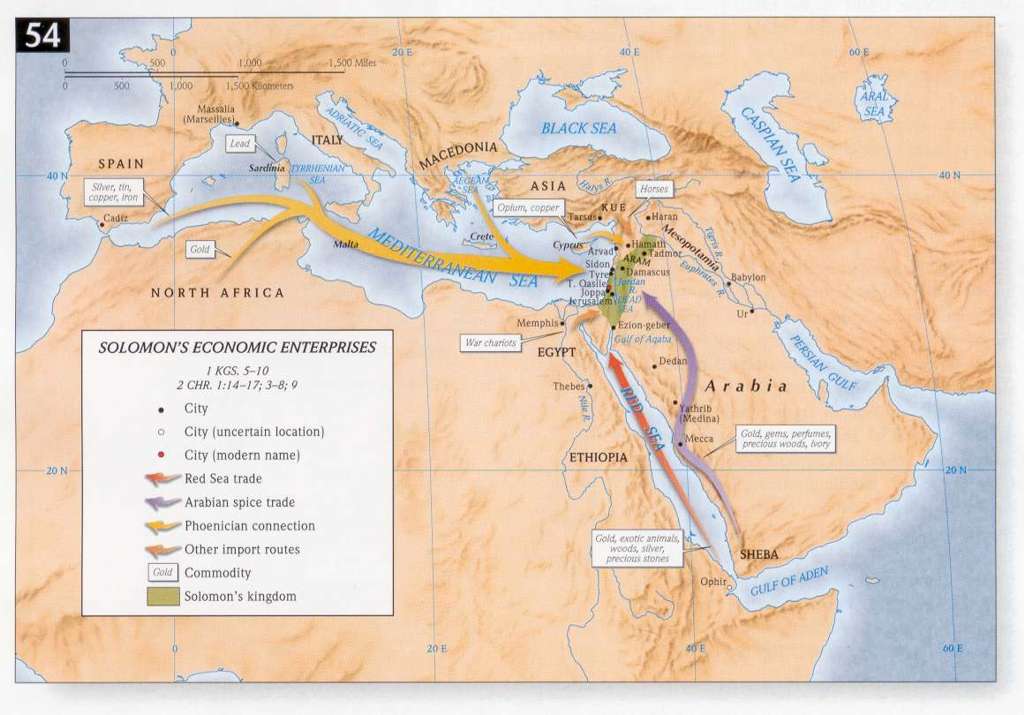
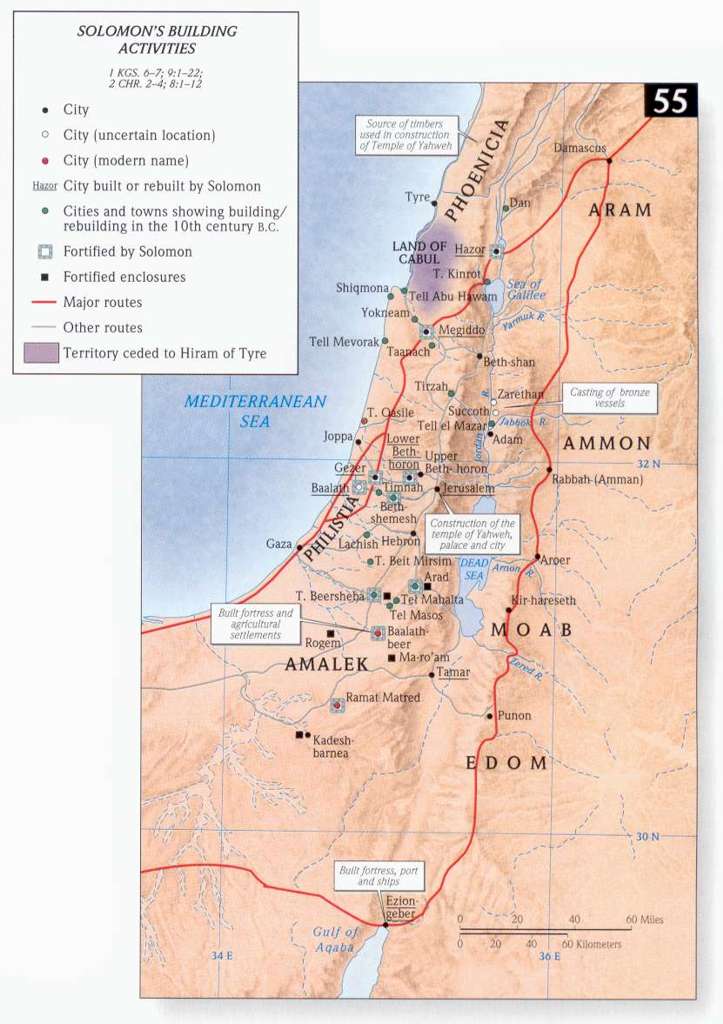
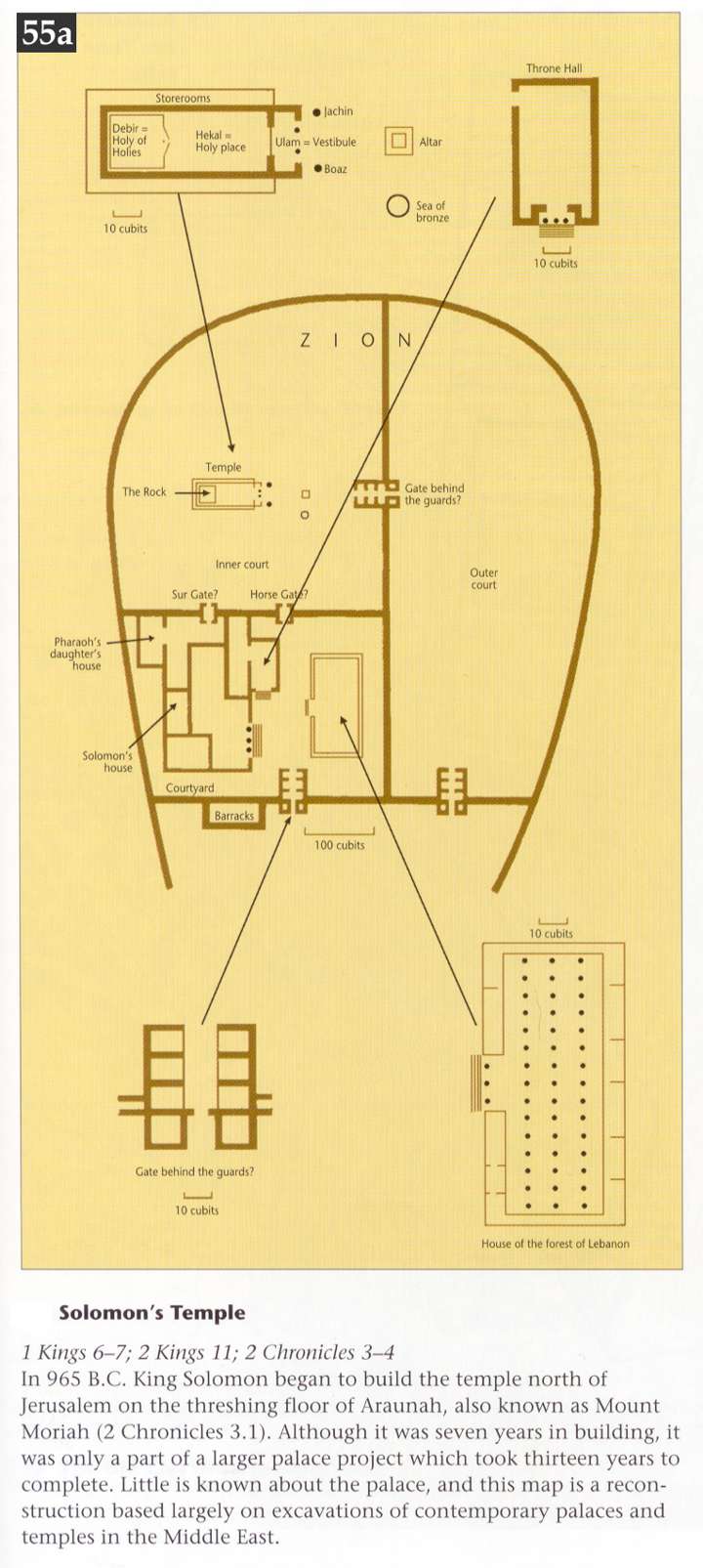
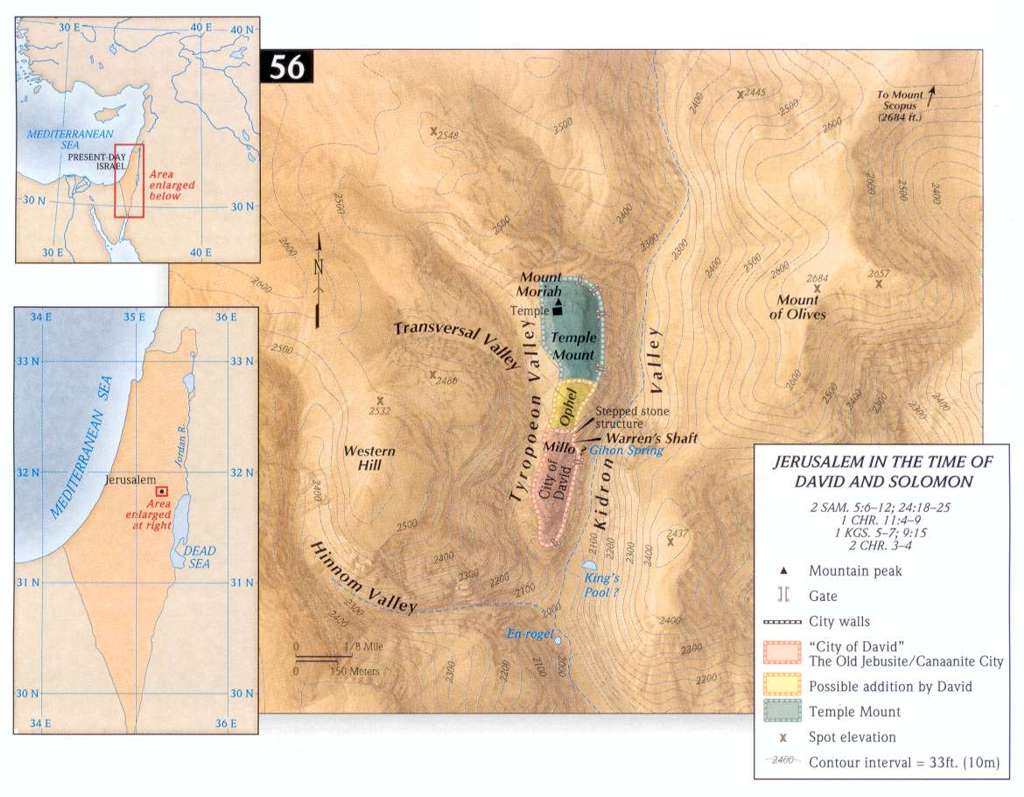
The Kingdoms of Israel and Judah
- The Kingdoms of Israel and Judah (1)
- The Kingdoms of Israel and Judah (2)
- The Kingdoms of Israel and Judah (3)
- The Campaign of Shishak
- Conflicts between Israel and Aram-Damascus
- The Omride Dynasty
- The Golden Ages of the 9th & 8th centuries BCE
- Phoenician Trade and Civilization
- Trade Routes throughout the Middle East
- Travel Routes throughout Palestine
- Elijah and Elisha
- The Revolt of Jehu
- The Rise of Assyria
- Israel & Judah in the days of Jeroboam II and Uzziah
- The Assyrian Empire under Tiglath-Pileser III
- The Syro-Ephraimite War
- Tiglath-Pileser III's Campaigns
- Fall of Samaria and Deportation of Israelites
- The Fall of the Kingdom of Israel
- Assyrian Districts after the Fall of Samaria
- Prophets of the 8th Century BCE
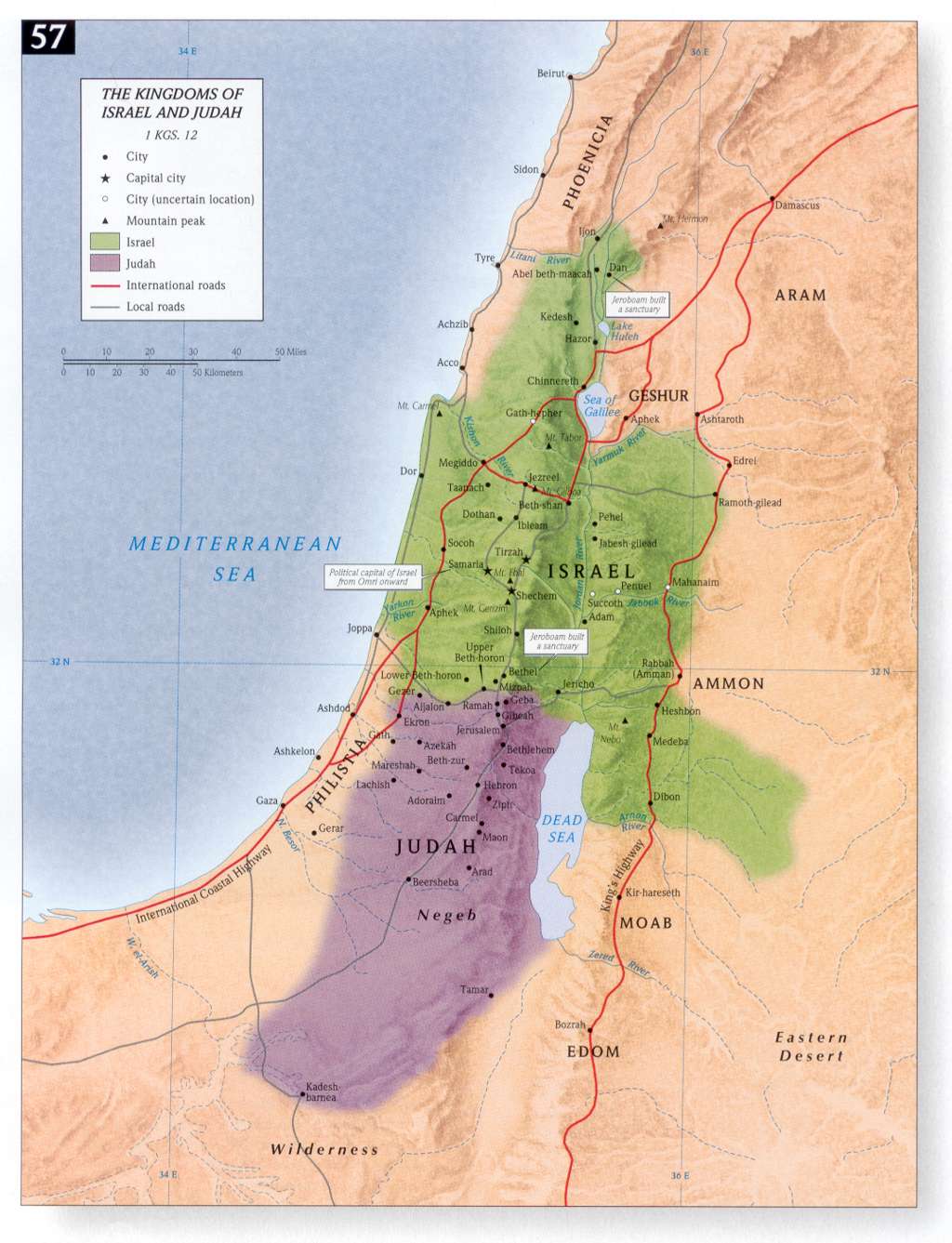

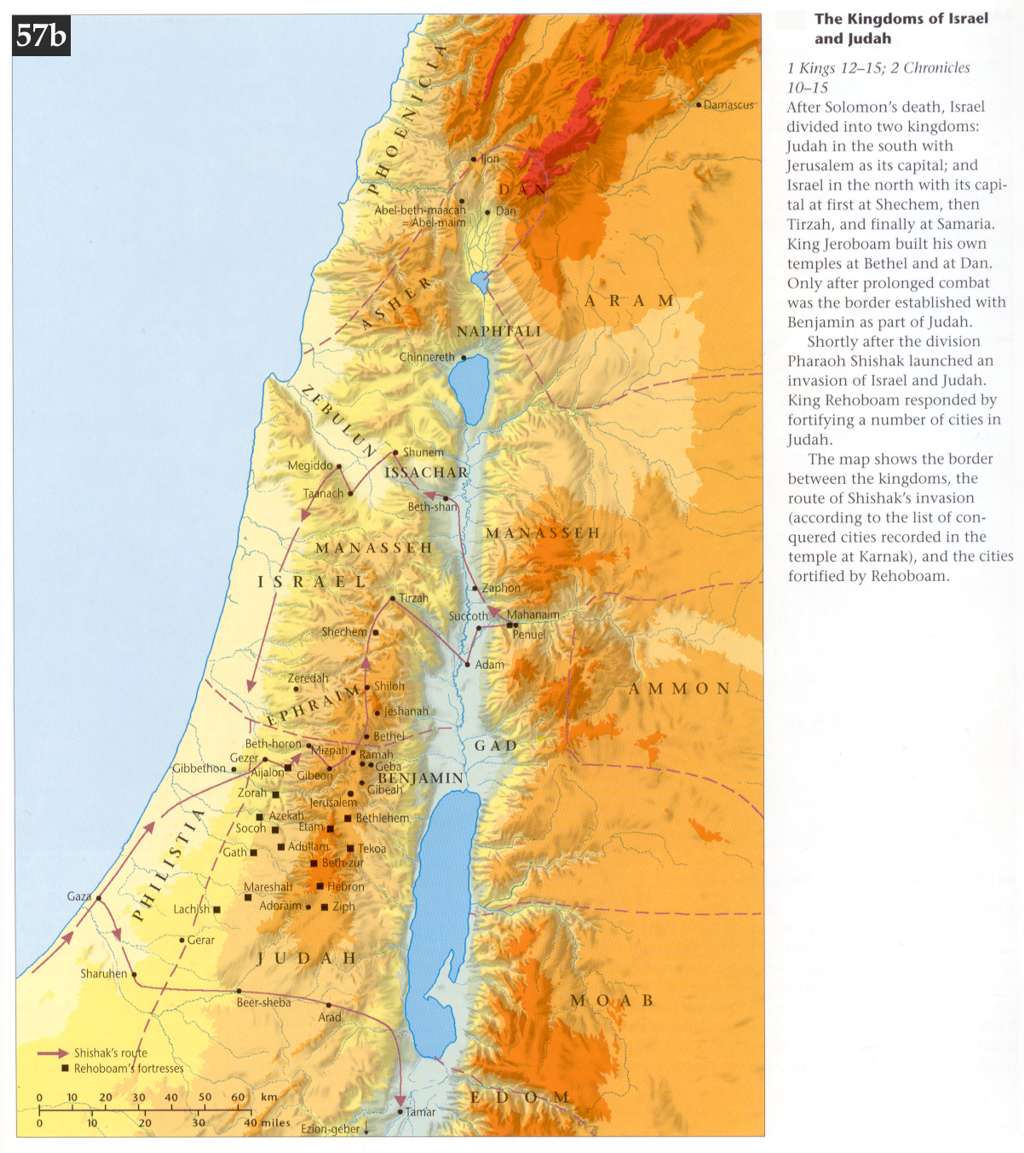
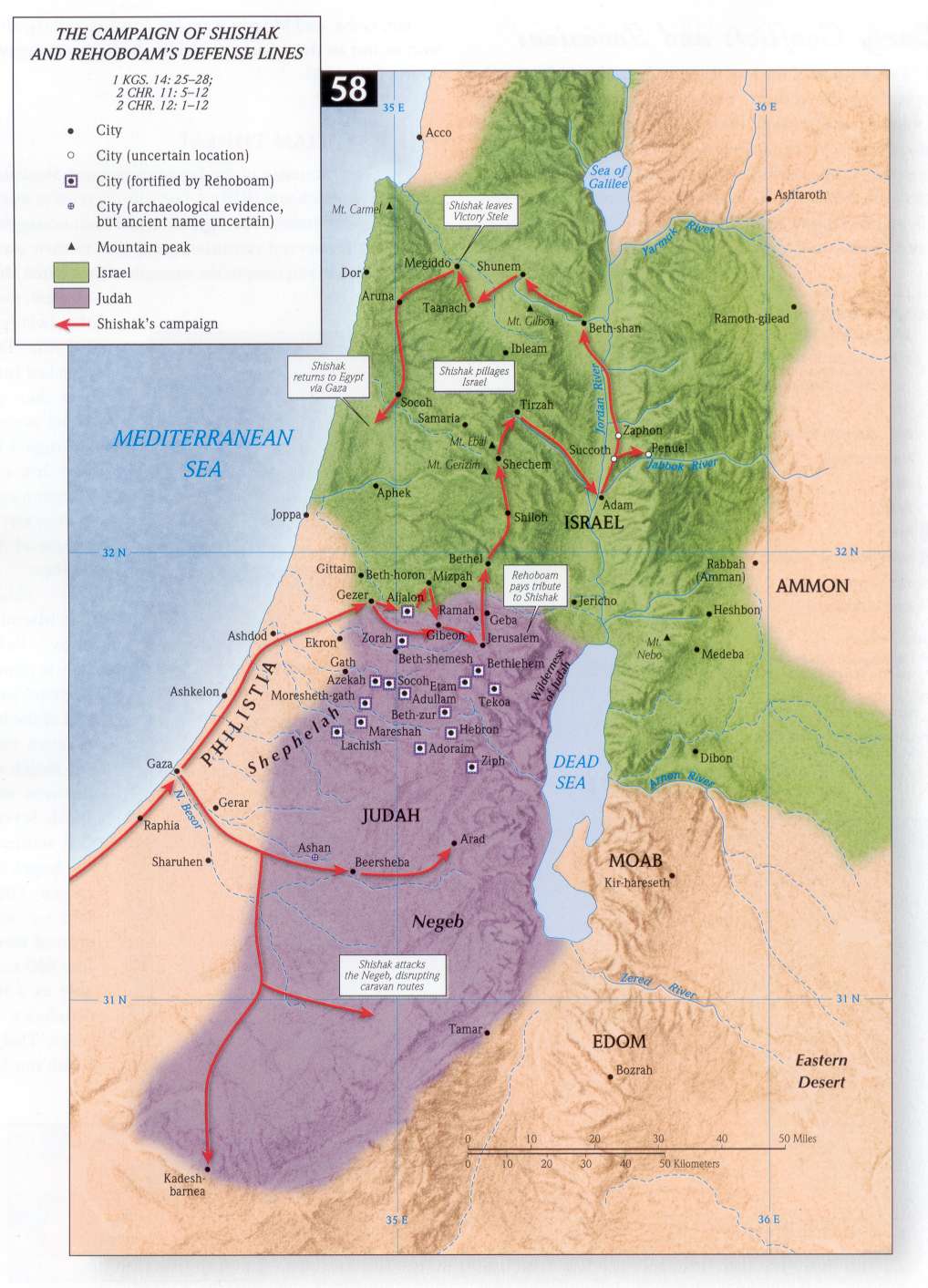
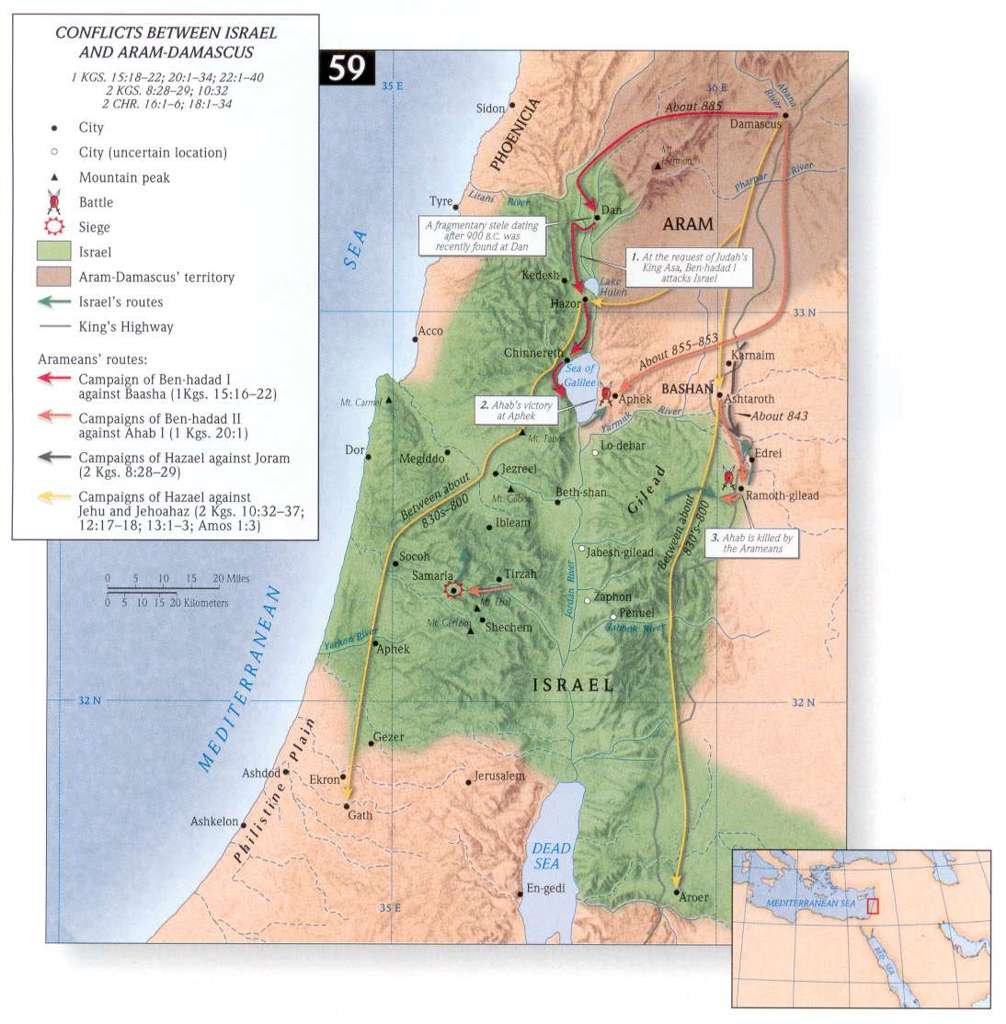
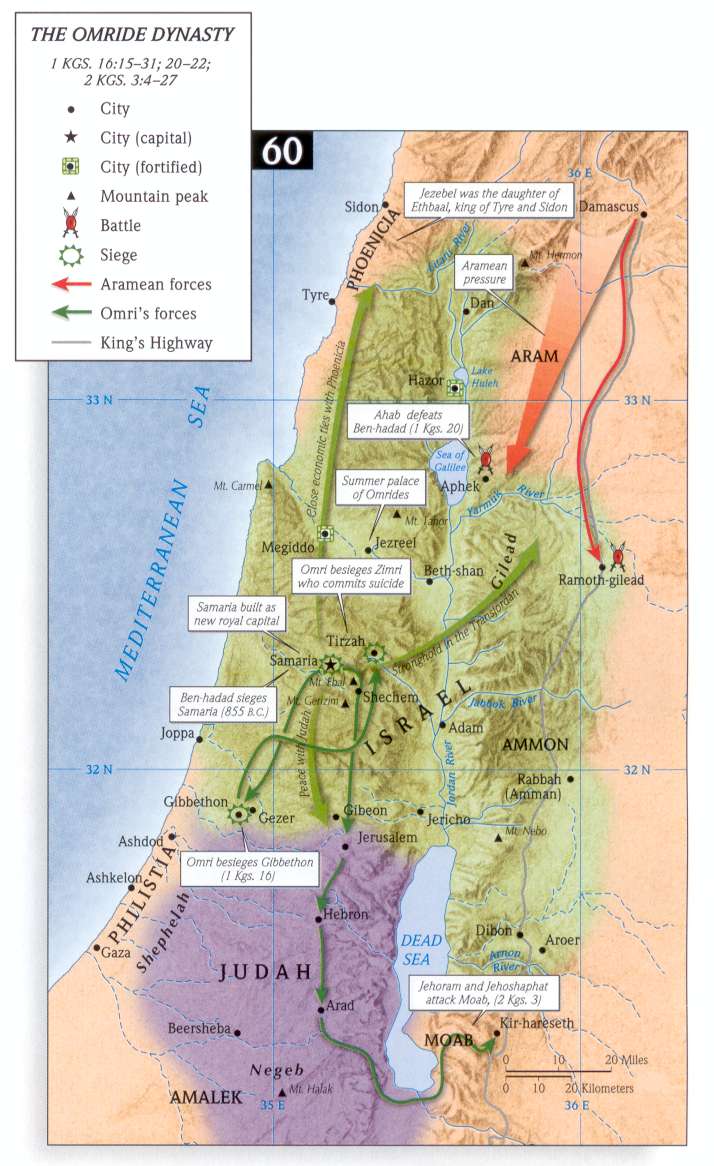
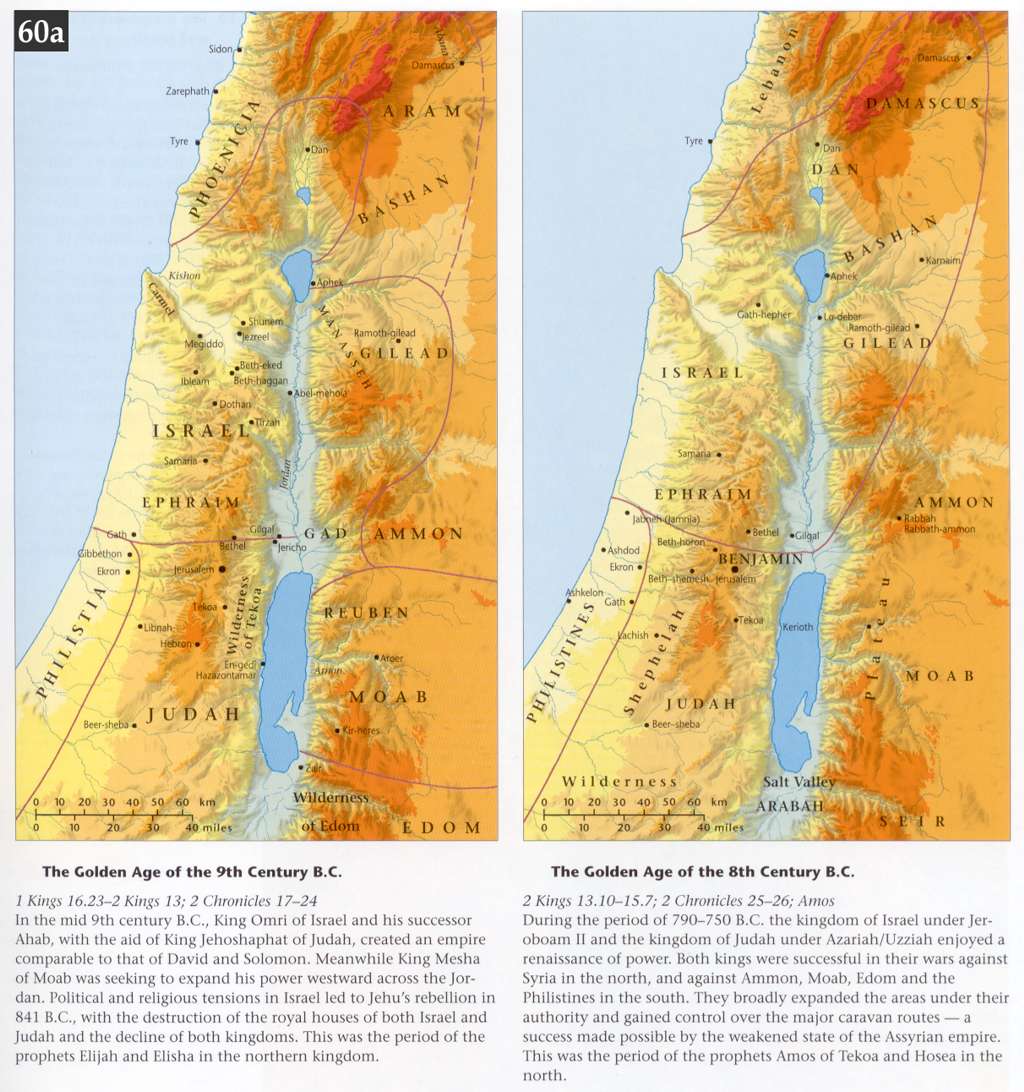
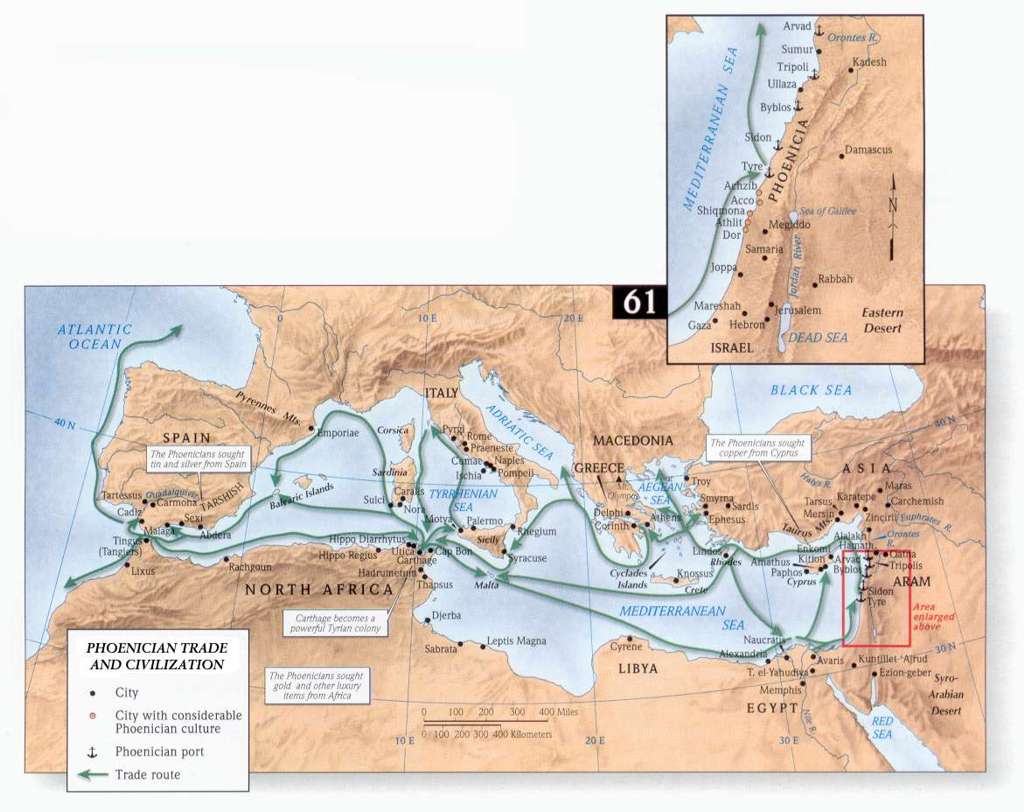
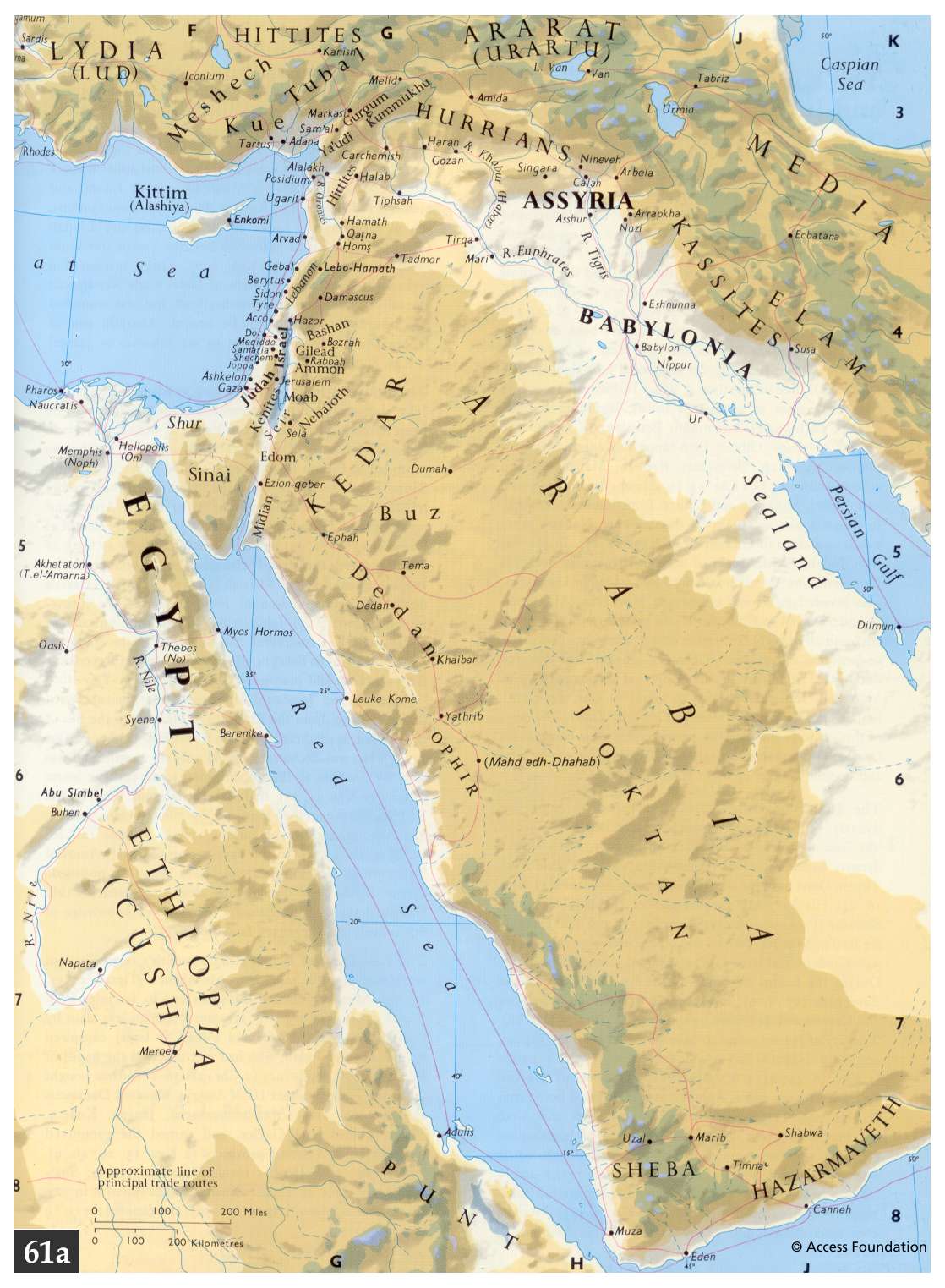
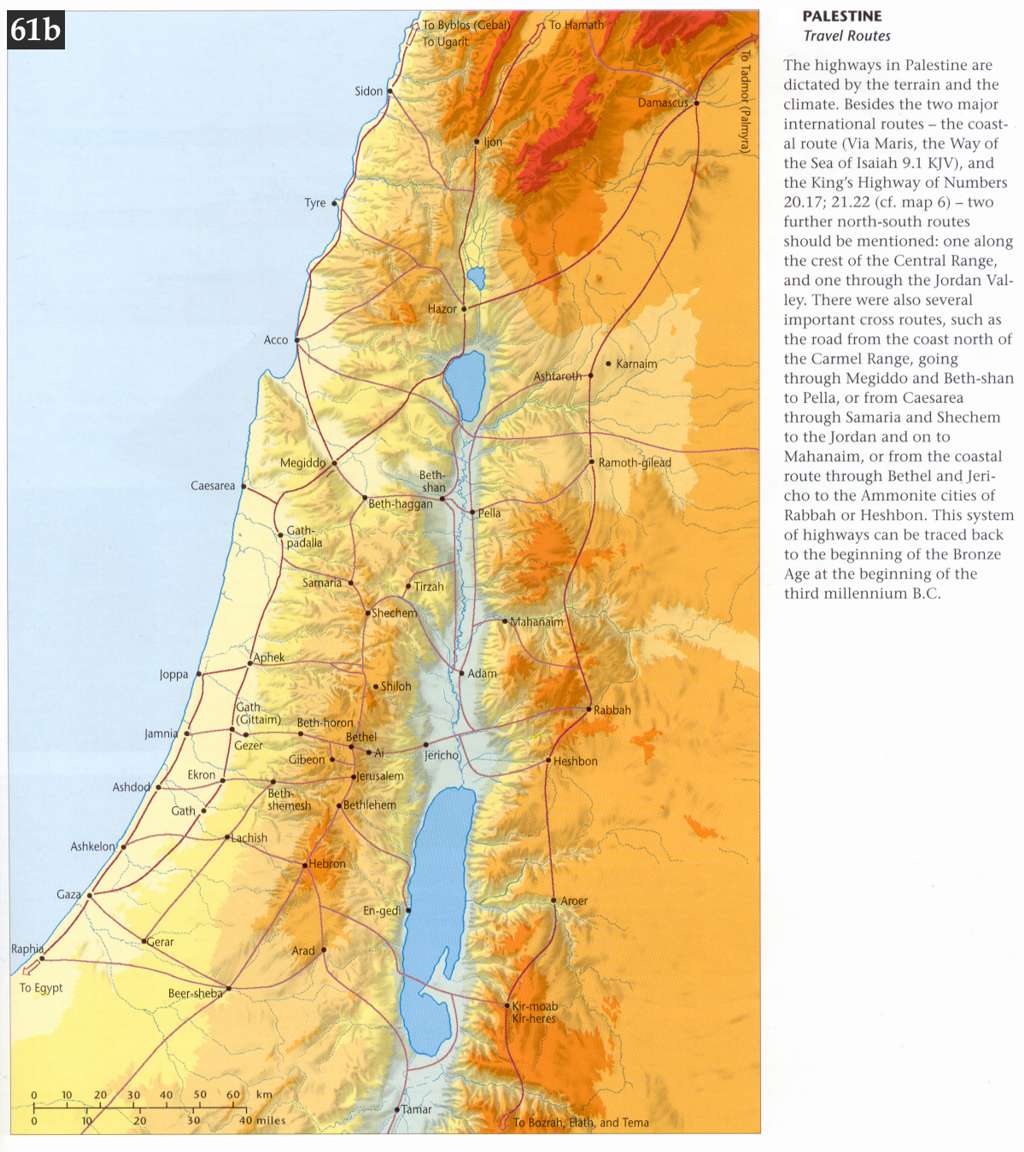
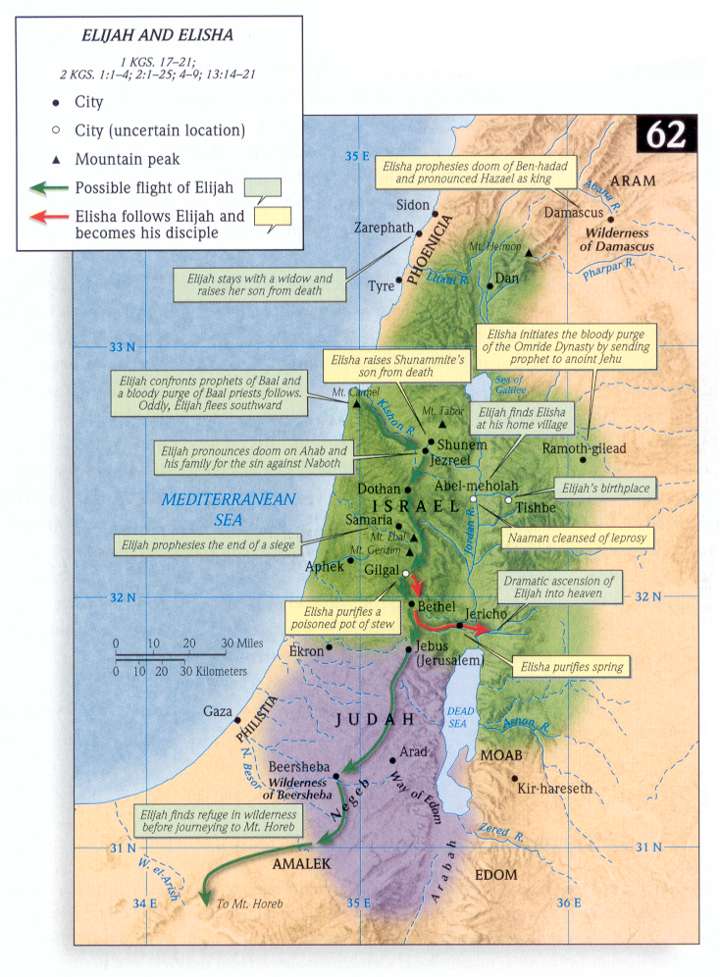
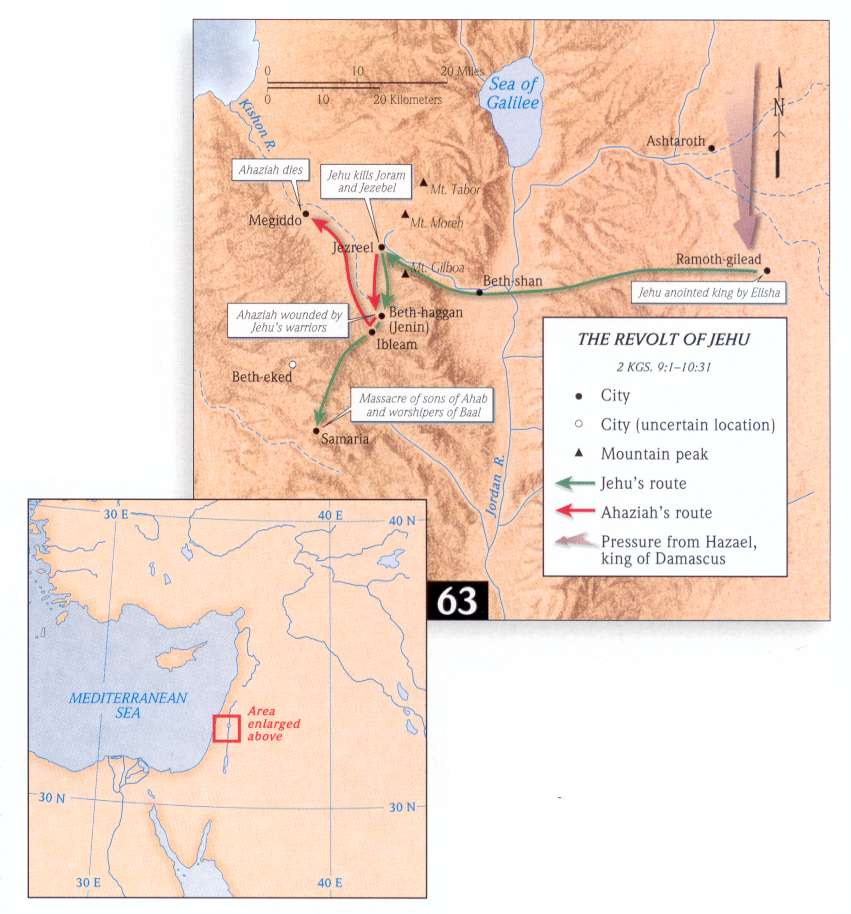
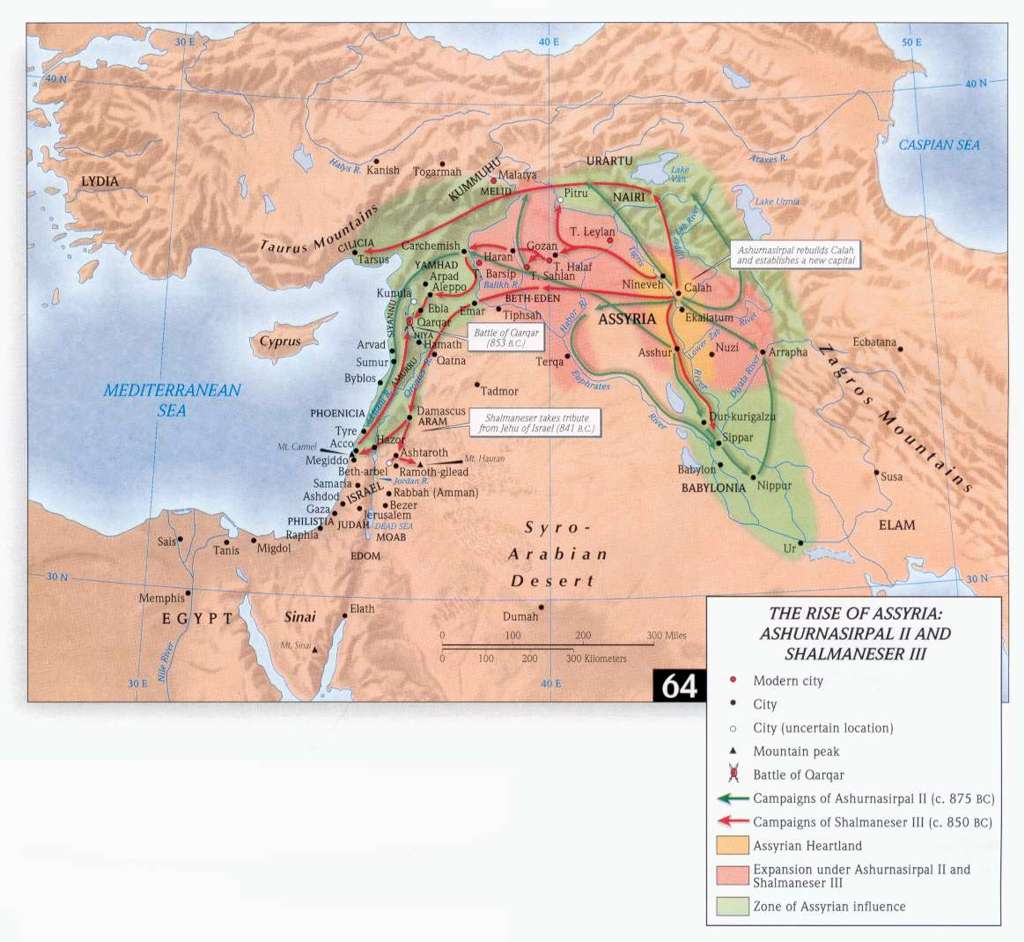
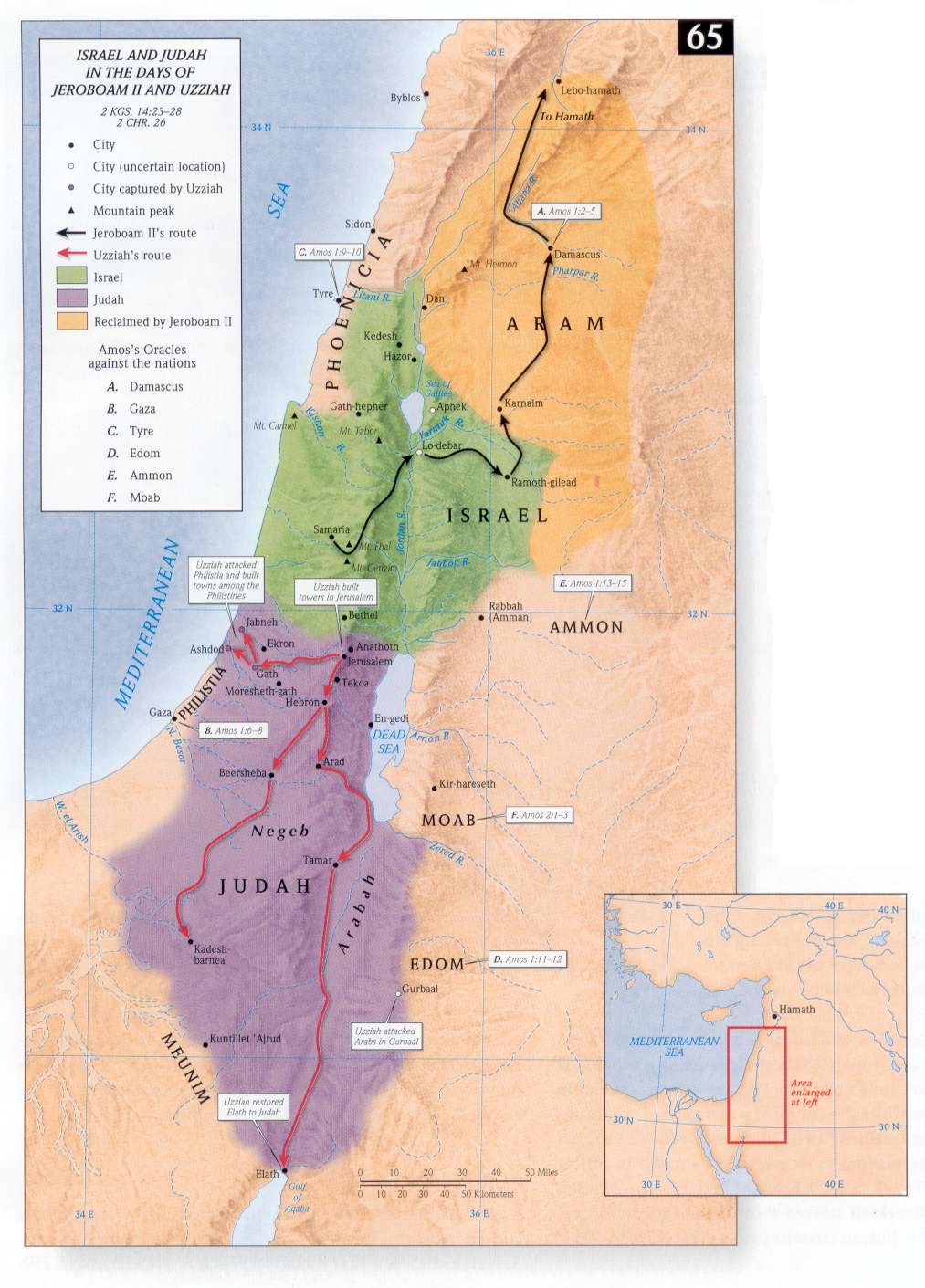
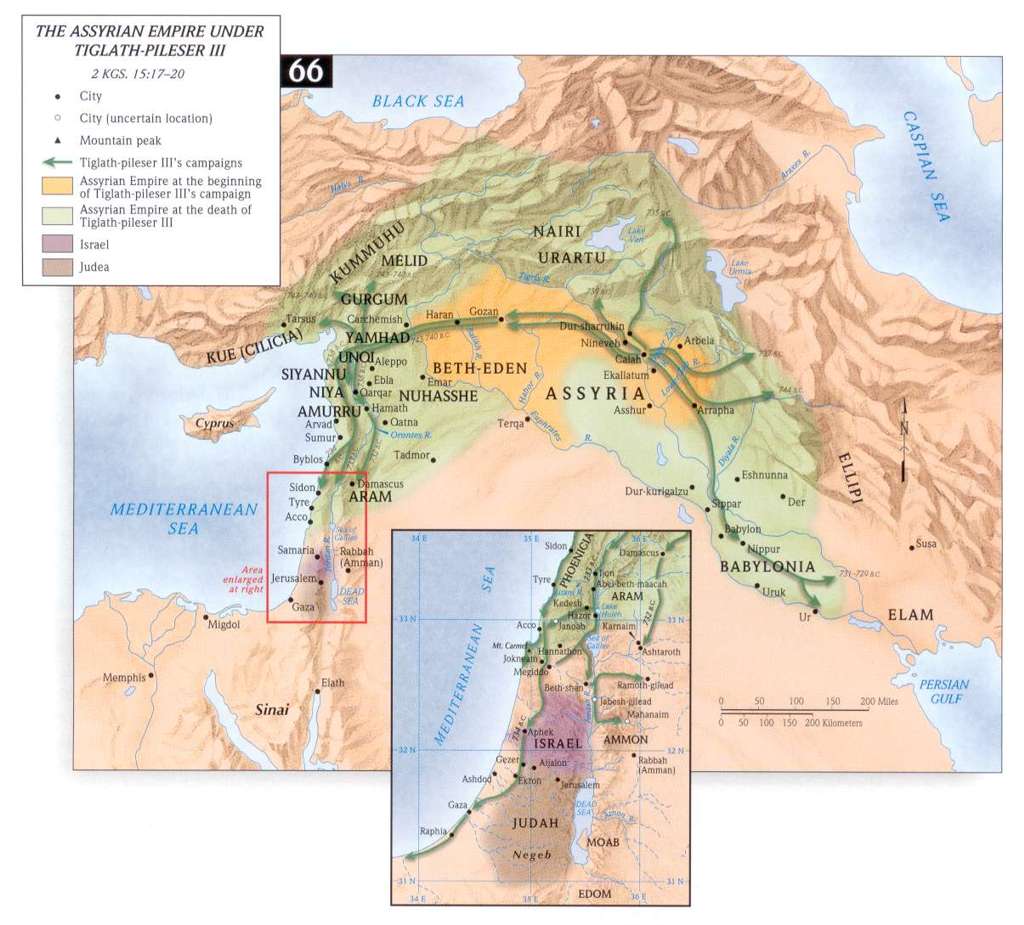
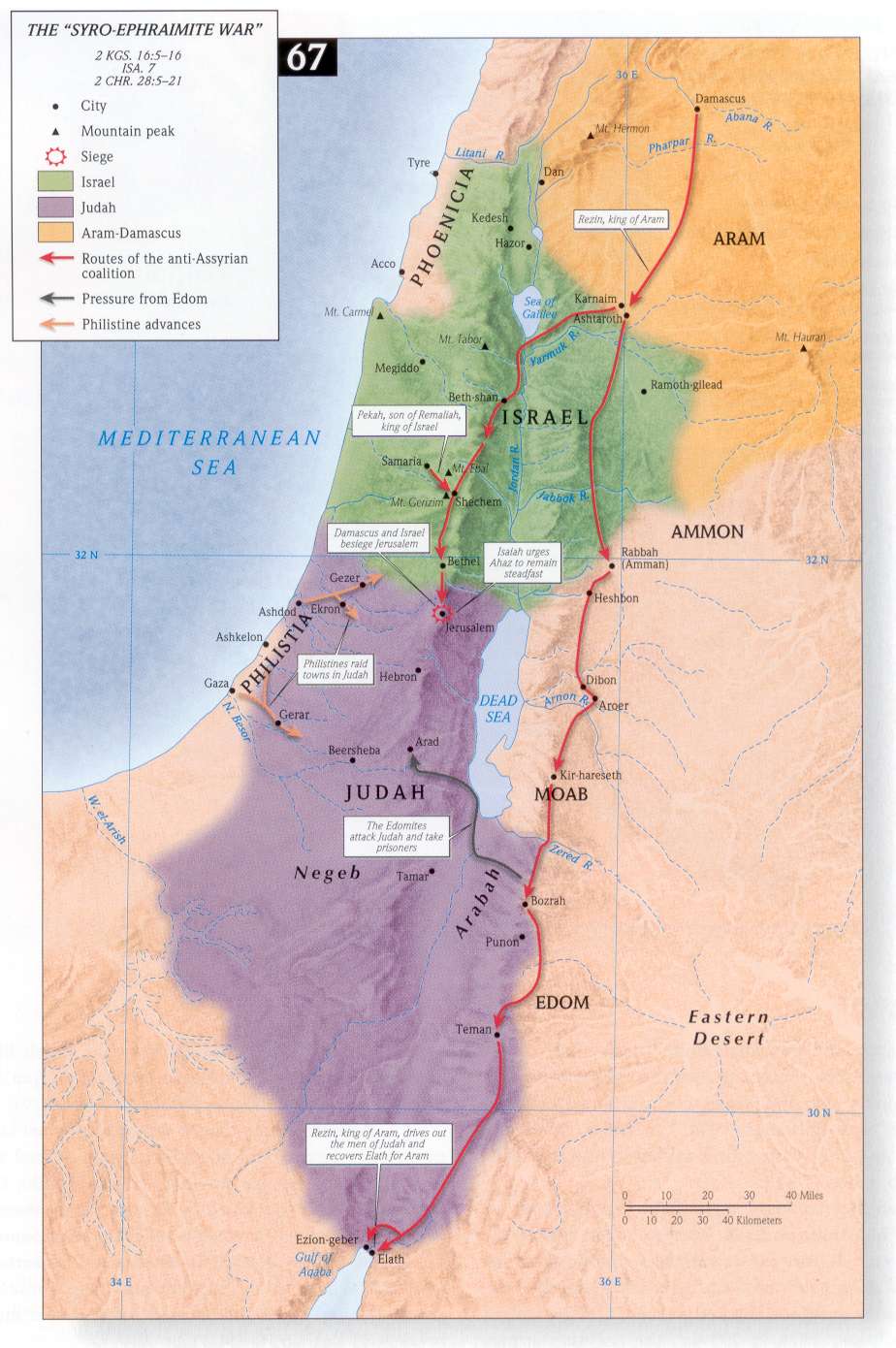
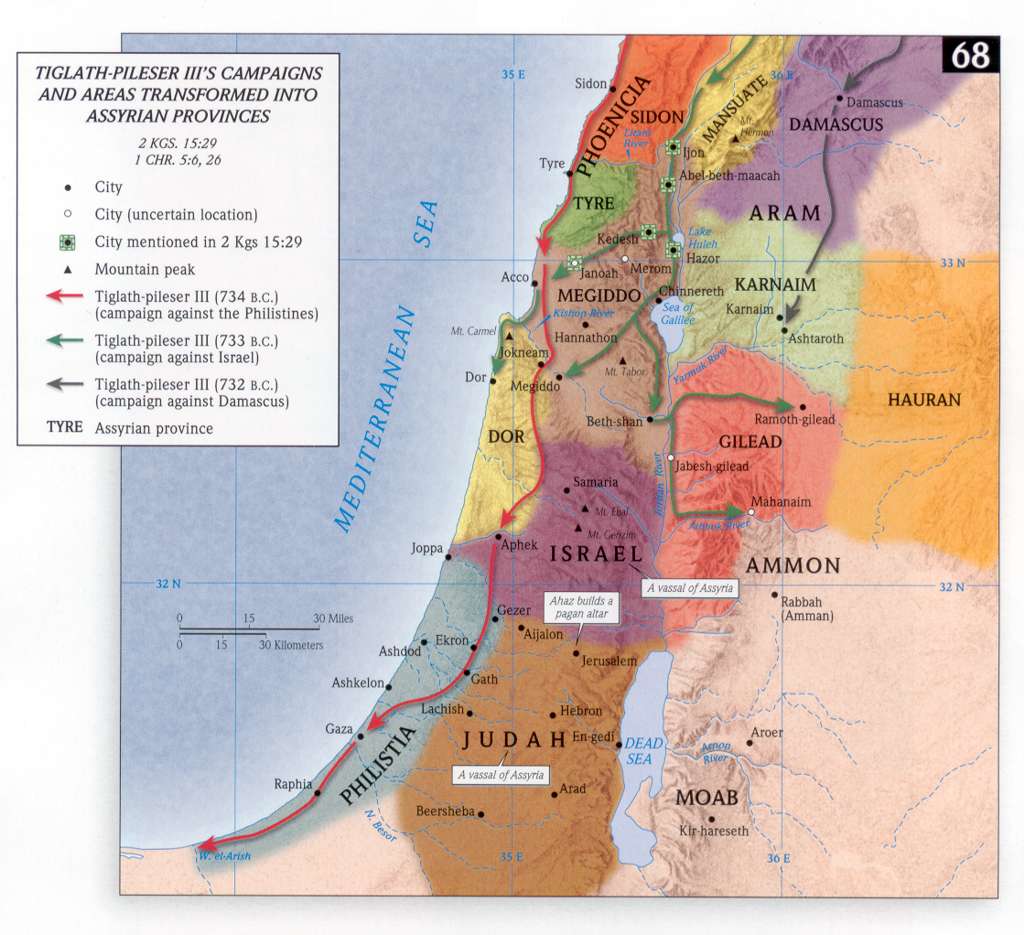
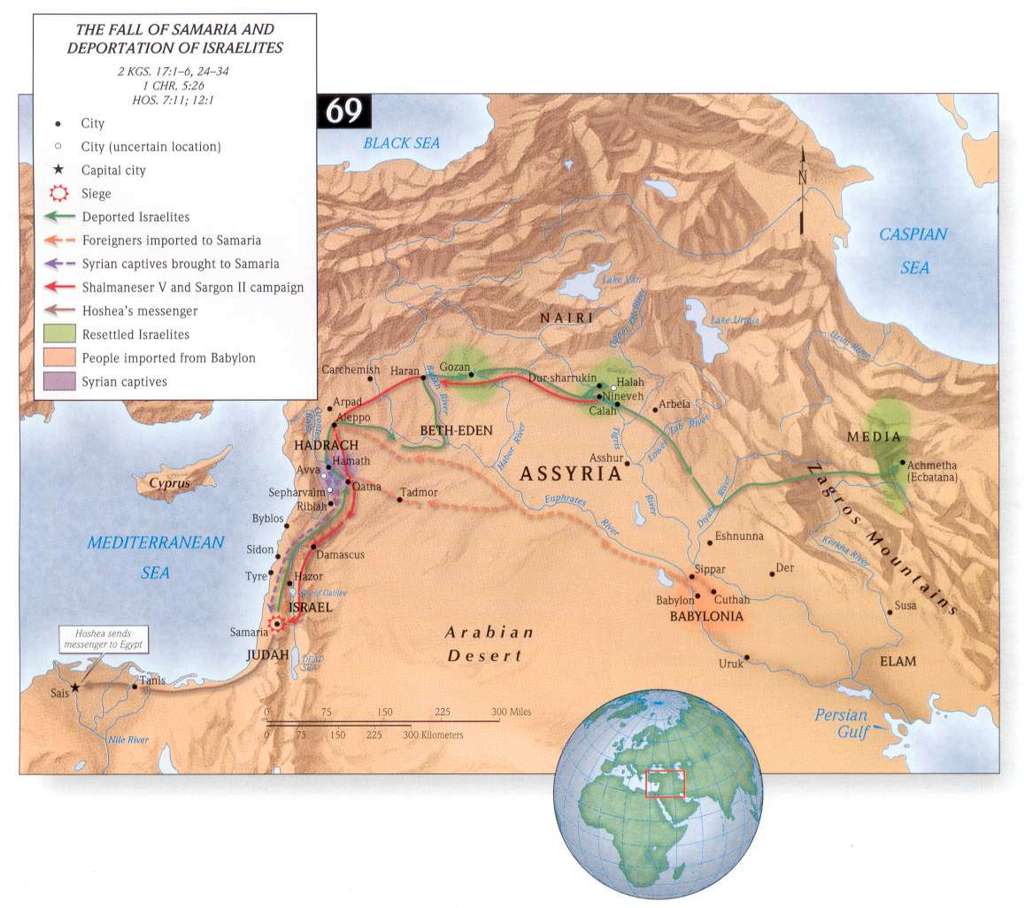
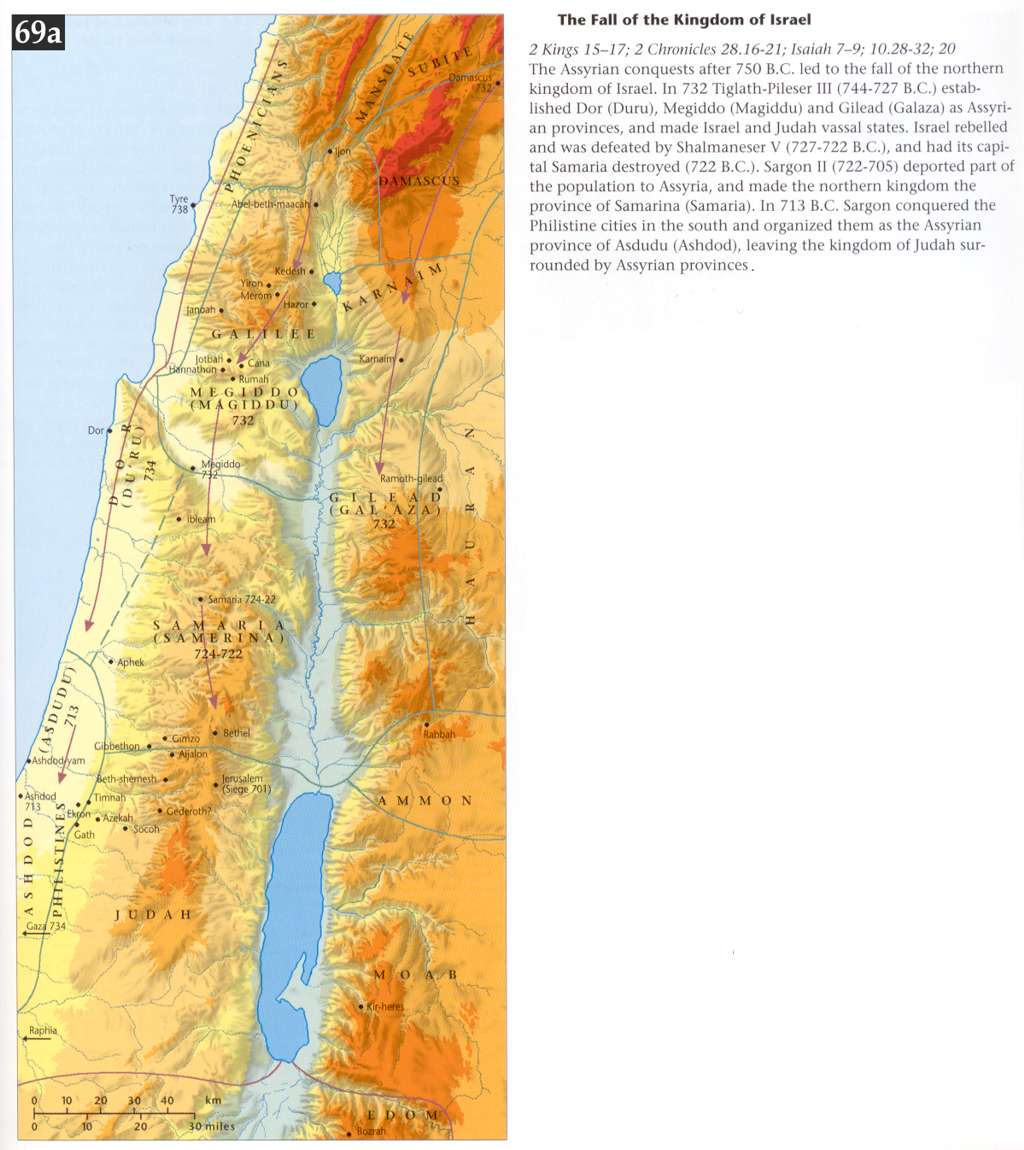
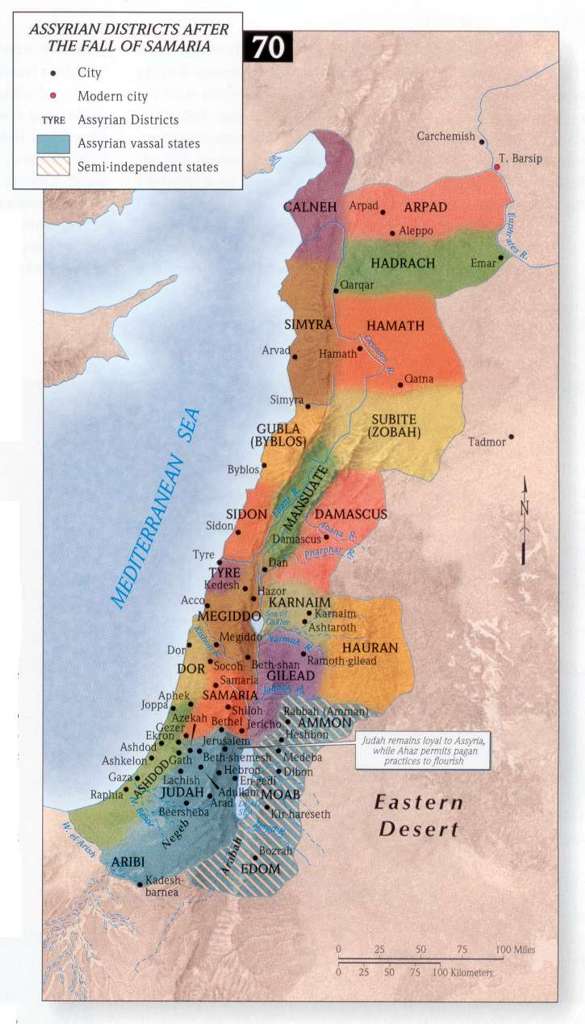
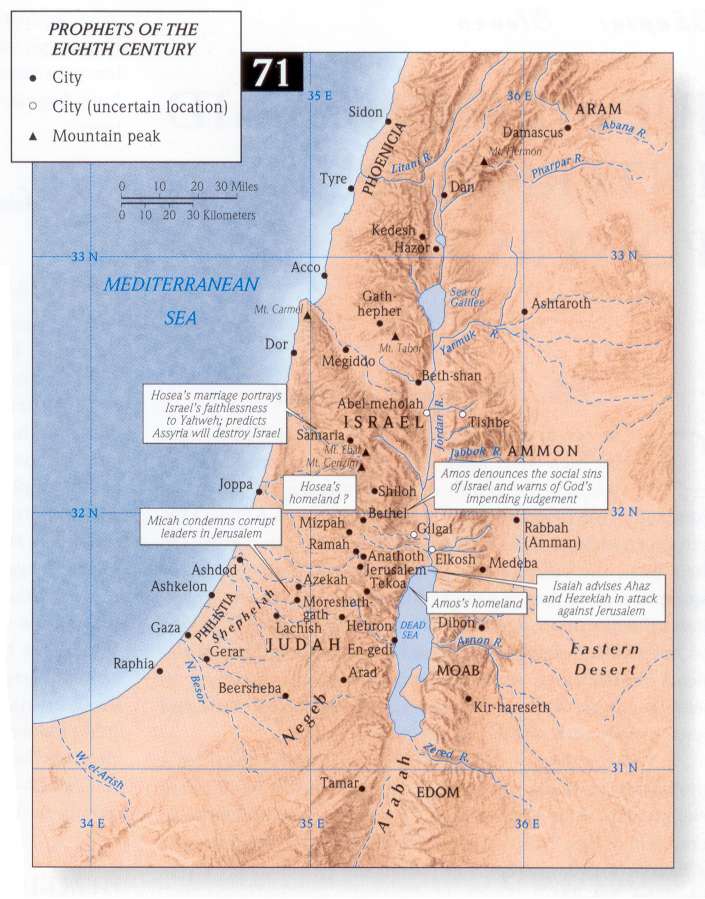
Judah Alone amid International Powers
- Hezekiah's Preparation for Revolt
- Judah under King Hezekiah
- Hezekiah's Jerusalem
- Sennacherib's Campaign against Judah
- Assyria in the 7th century BCE
- The Rise of the Neo-Babylonian Empire
- The Reign of Josiah
- The Districts of Judah under King Josiah
- The Golden Age of King Josiah
- Nebuchadnezzar's Campaigns against Judah
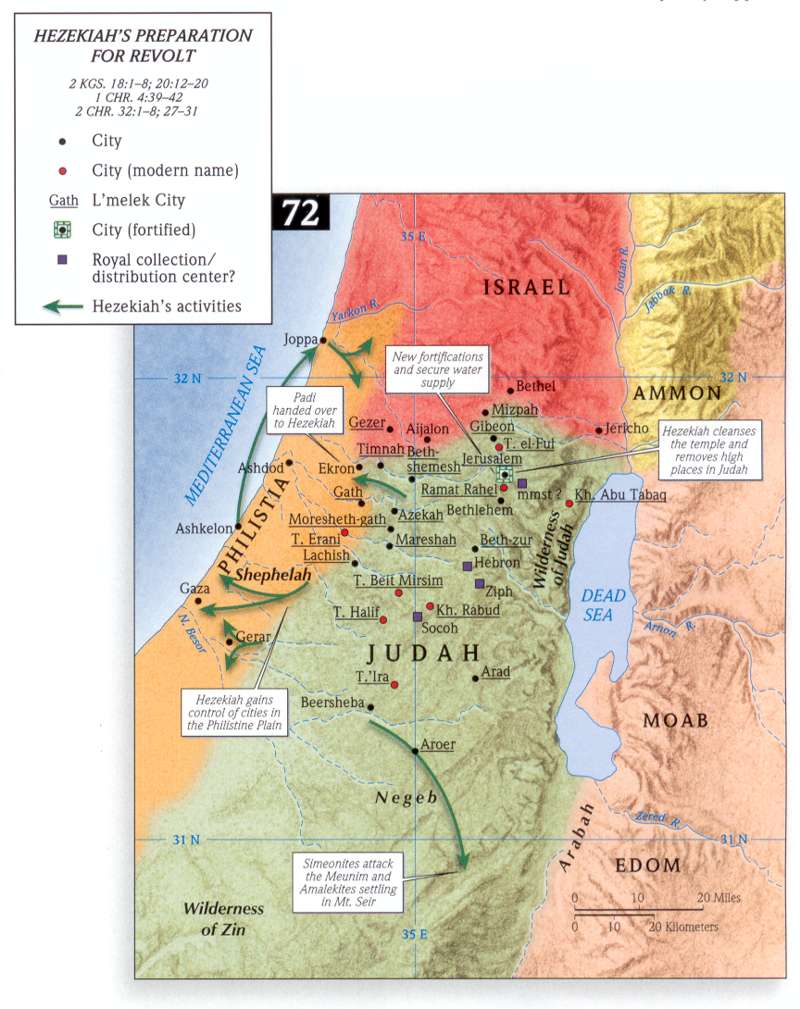
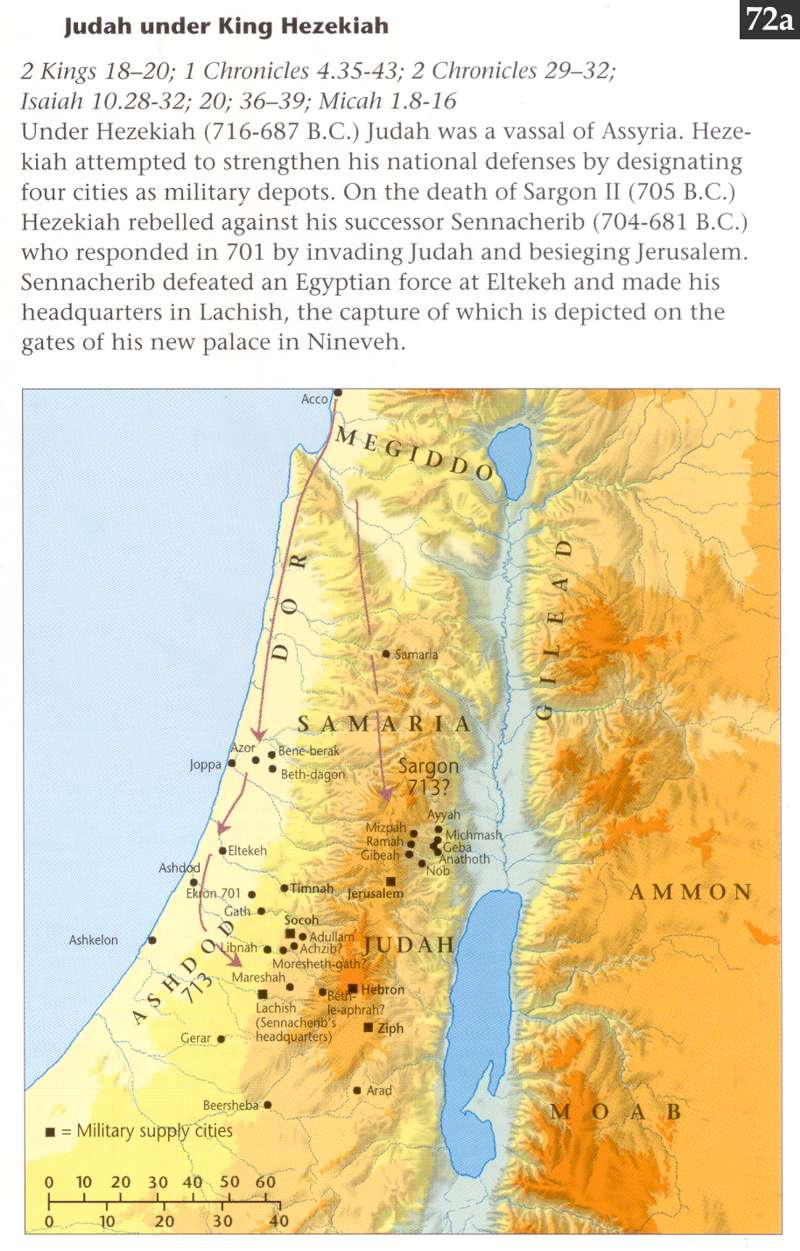
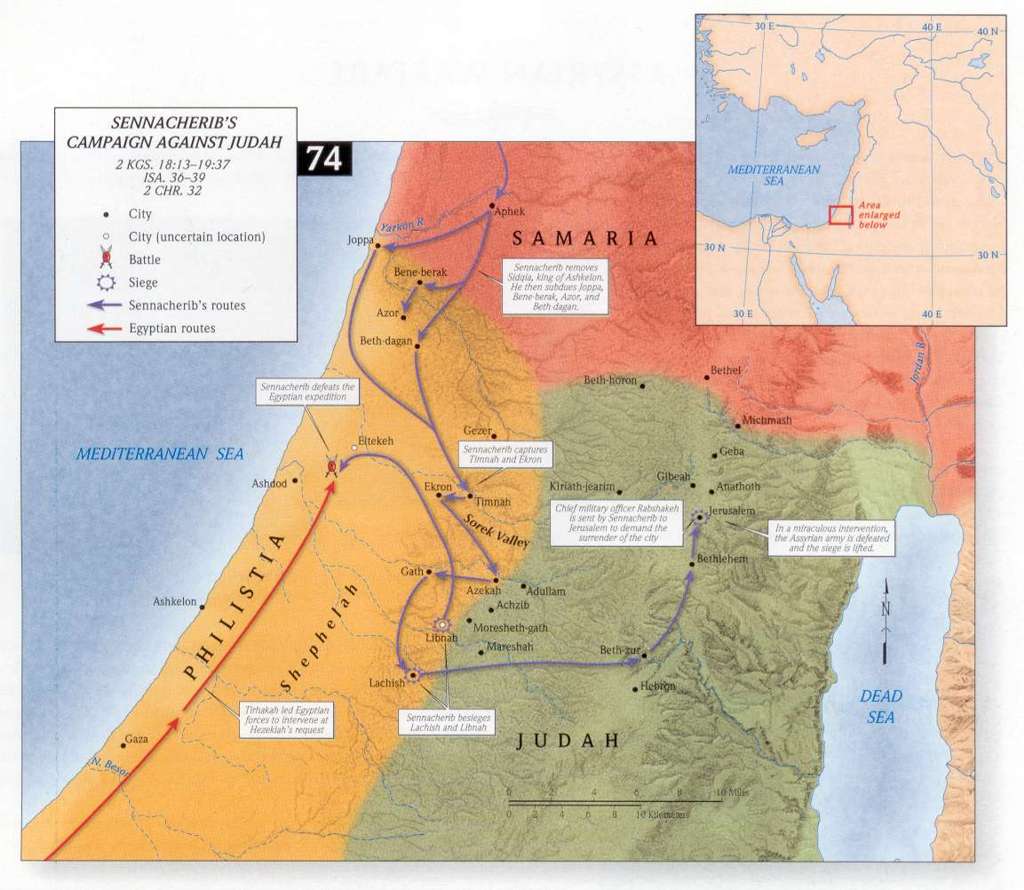
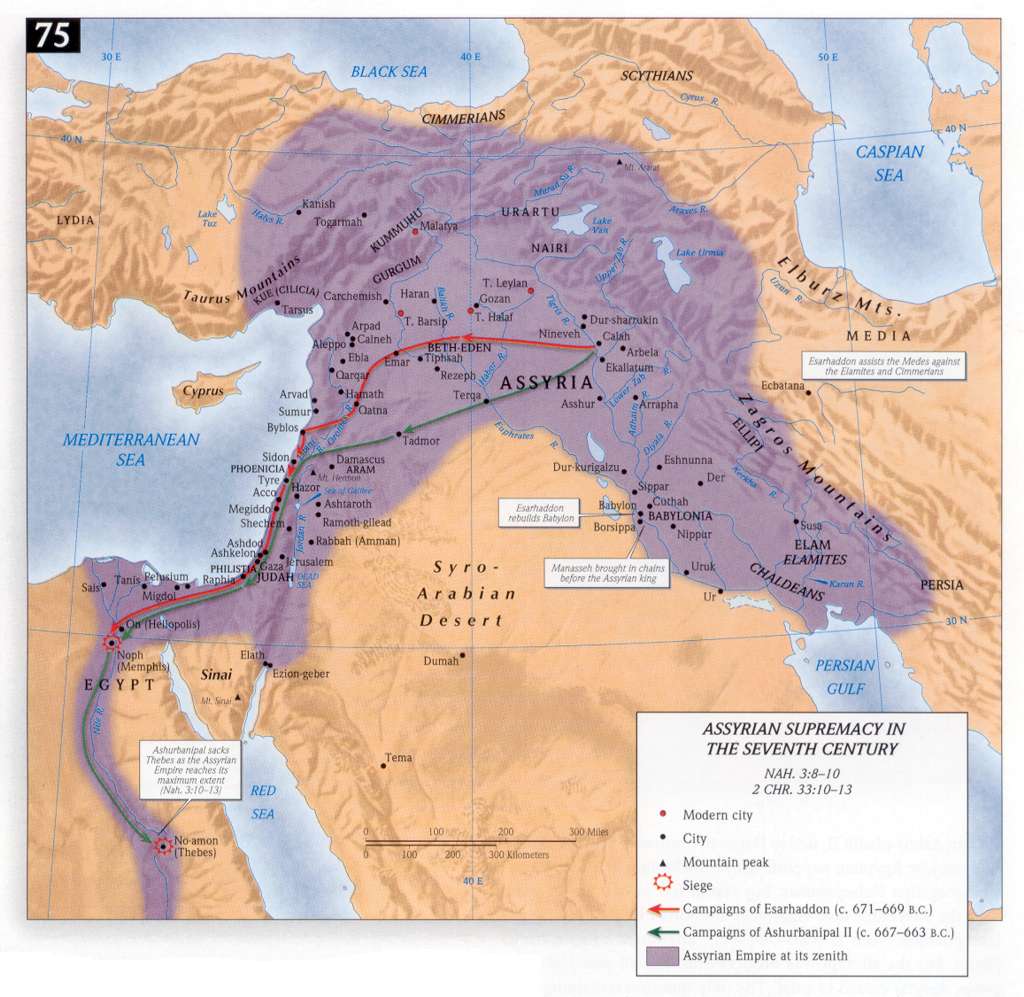
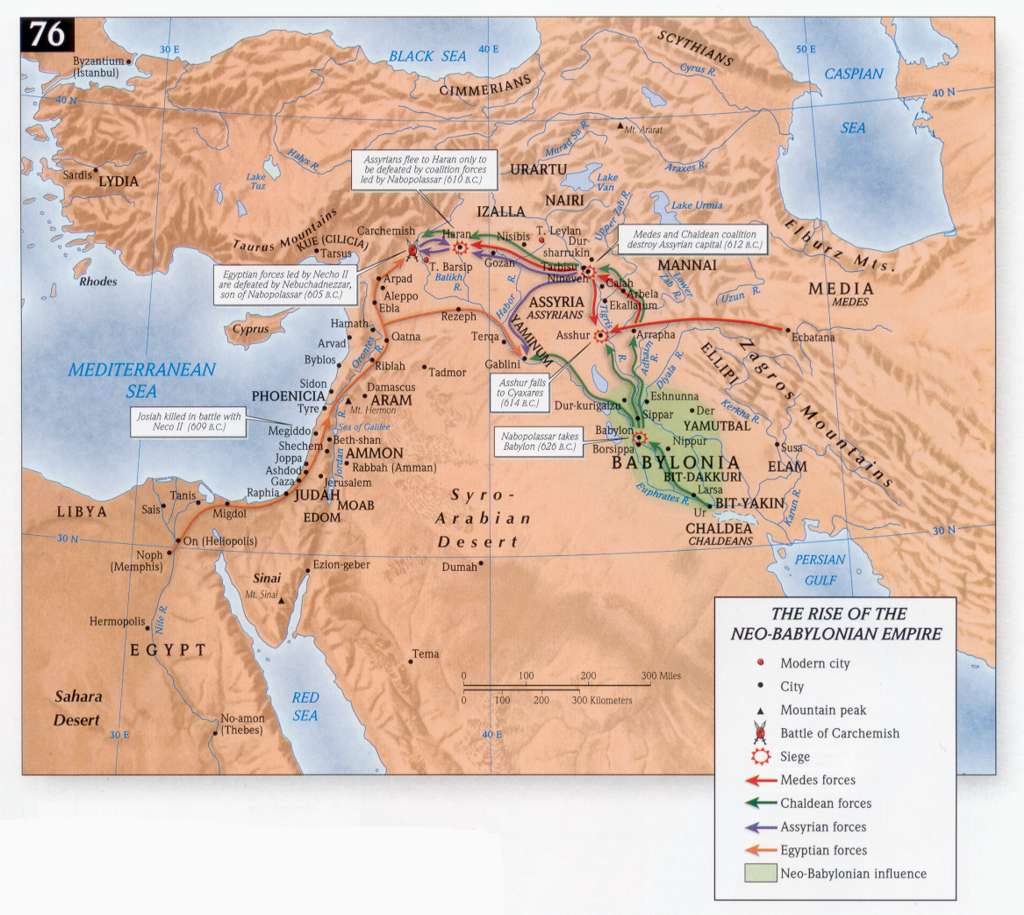
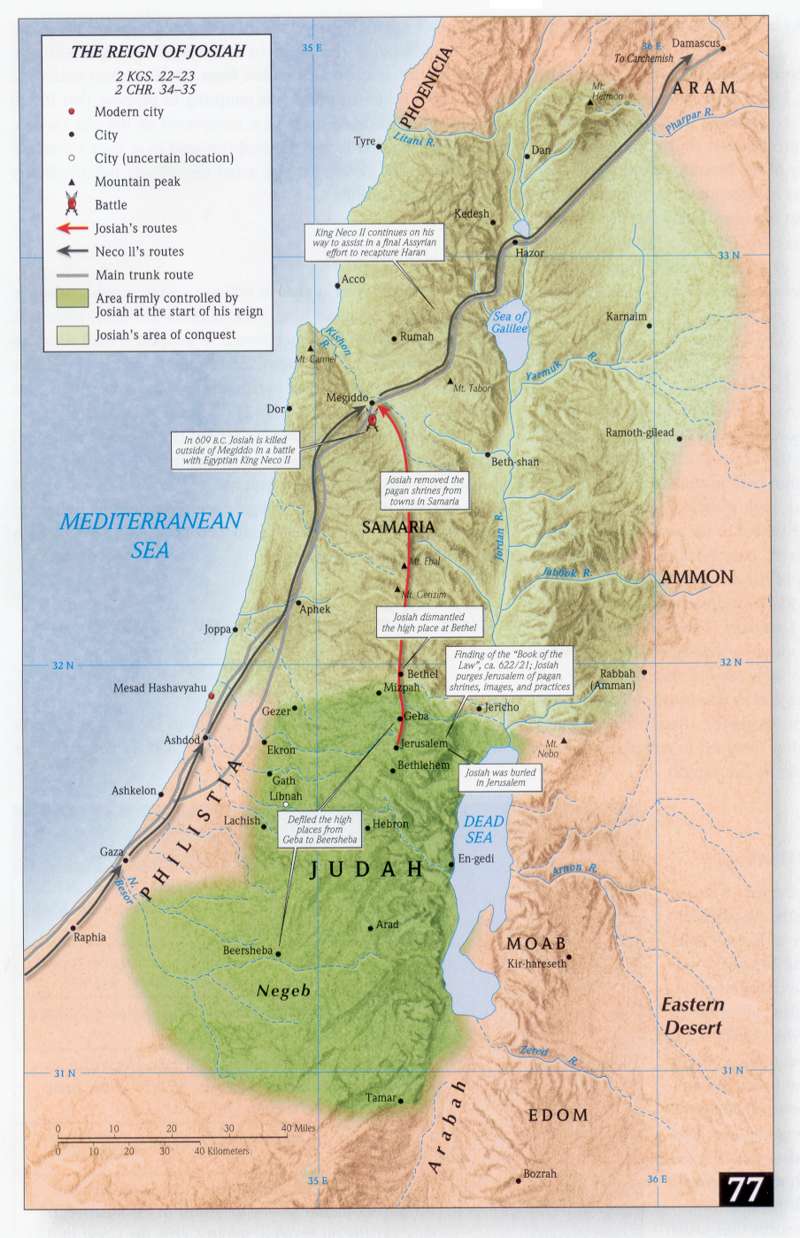
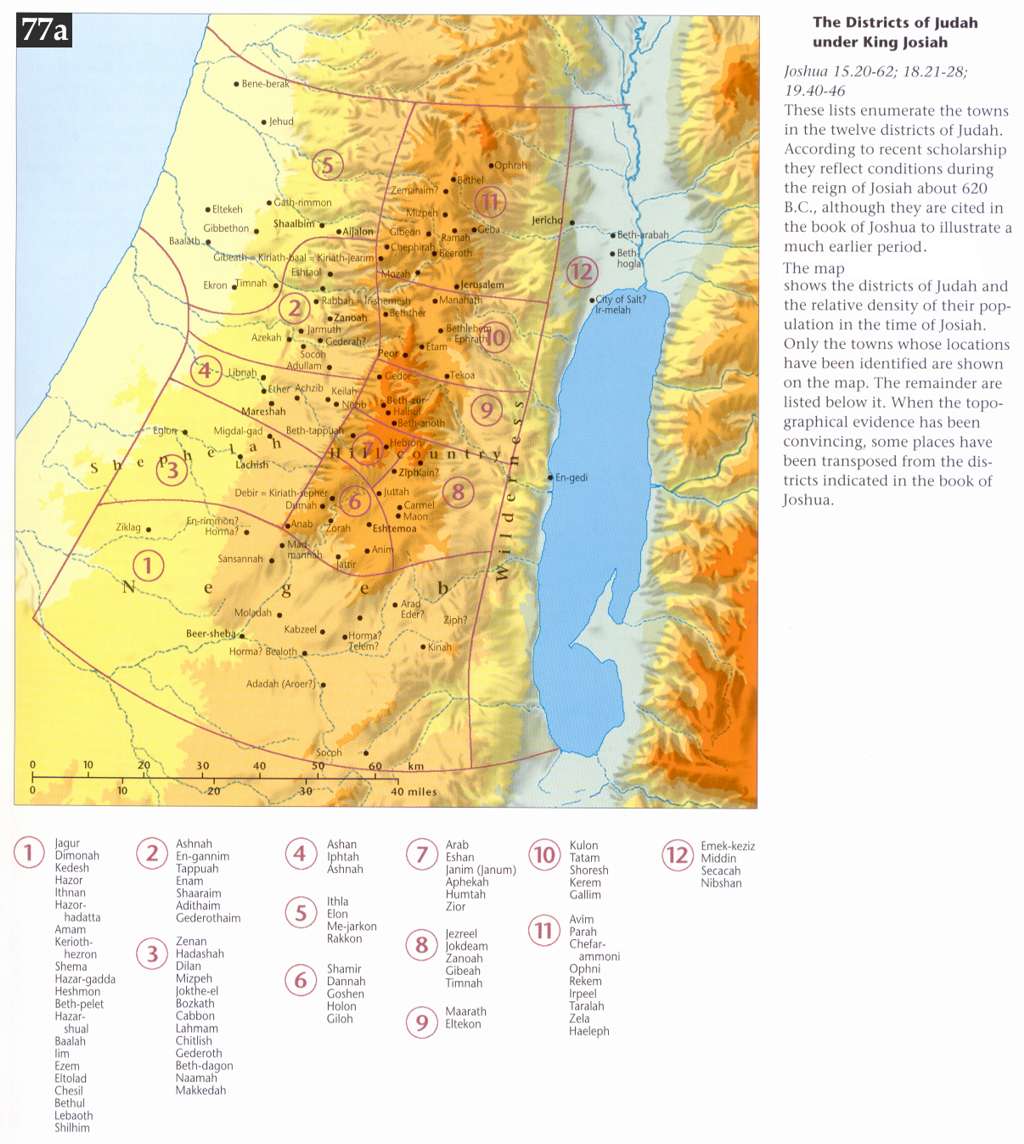
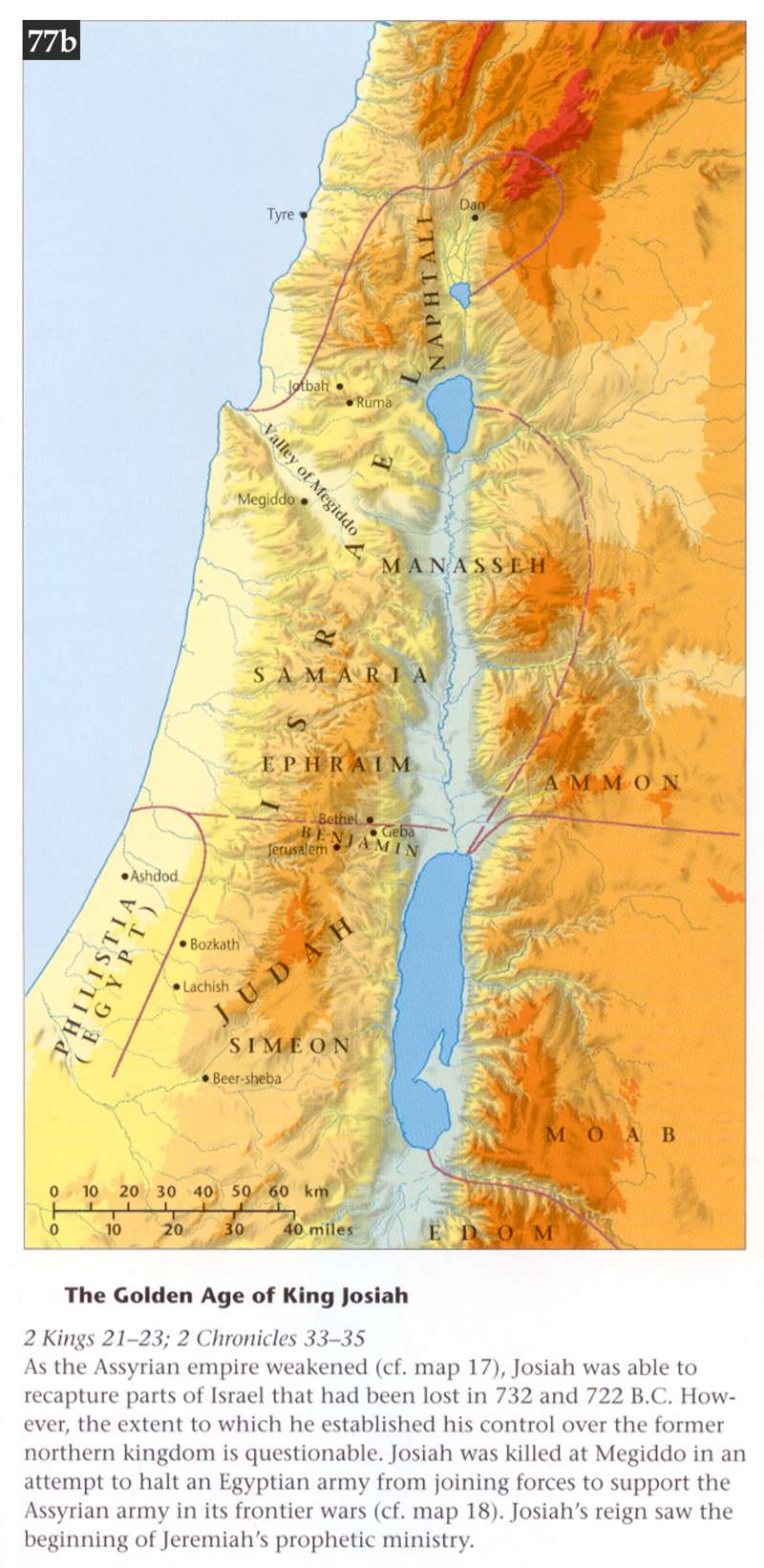
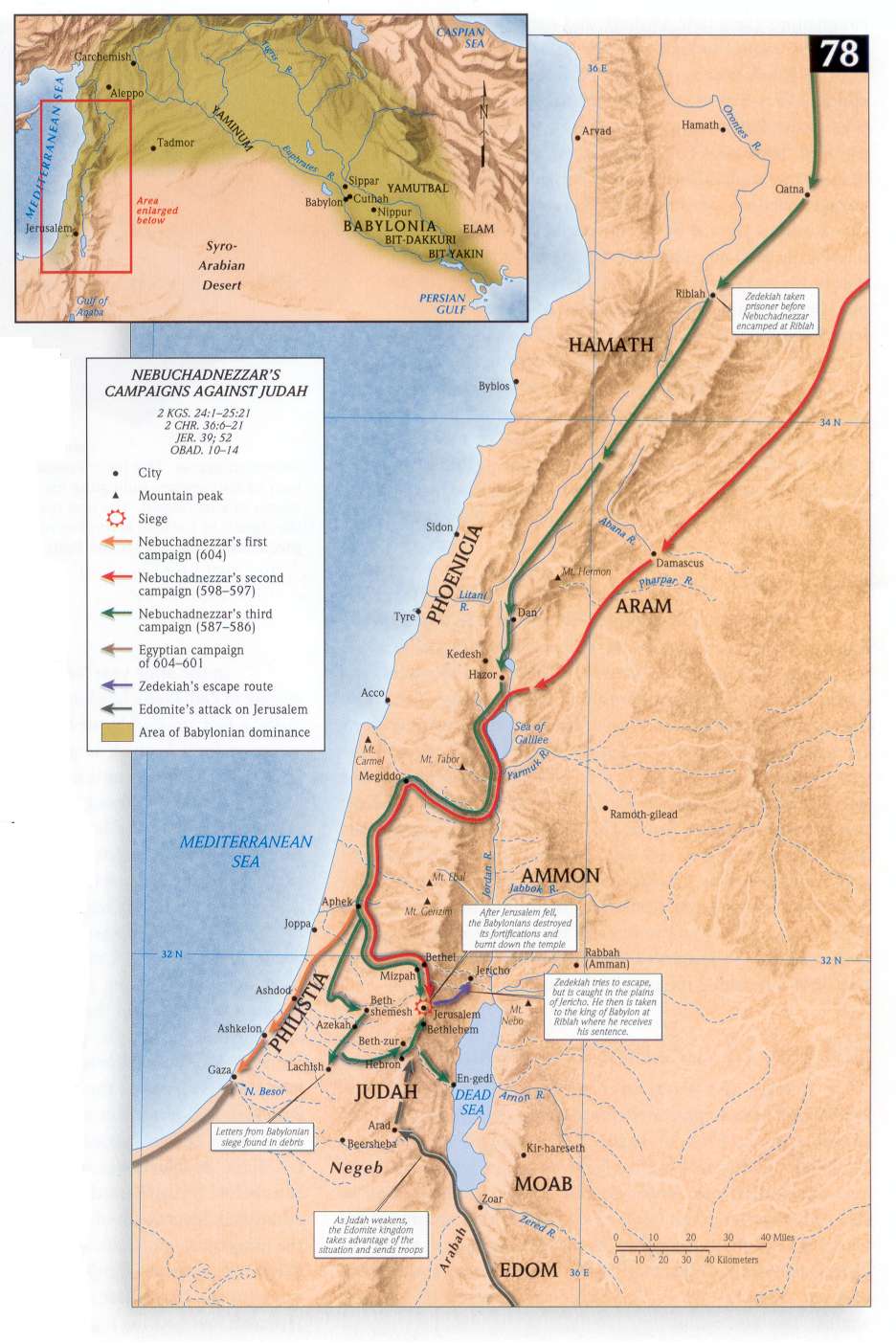
The Babylonian Exile up to the early Rome
- Judah during the Exile
- The Kingdom of Judah
- Exile; Palestine in the Post-Exilic Period
- Jewish Exiles in Babylon
- World Powers of the 6th century BCE
- The Conquests of Cyrus the Great
- The Persian Empire
- The Return of the Jewish Exiles to Judah
- Judah in the 5th century BCE
- Palestine after the Exile
- Alexander the Great's Empire
- The Division of Alexander's Empire ca. 275 BCE
- Palestine under the Ptolemies
- The Seleucid Empire and Antiochus III
- Campaigns of Antiochus IV against Egypt
- The Maccabees in 168 BCE
- Selected Events in the Maccabean Revolt
- Jewish Expansion under the Hasmonean Dynasty
- Pompey's Campaign against Jerusalem
- Early Rome
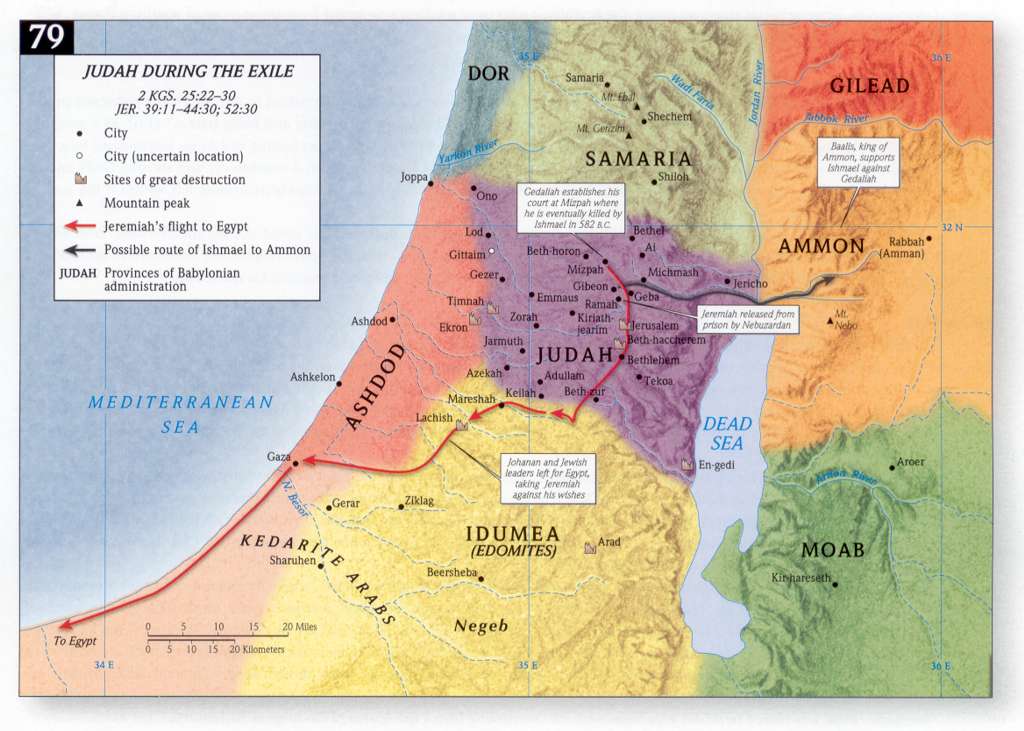
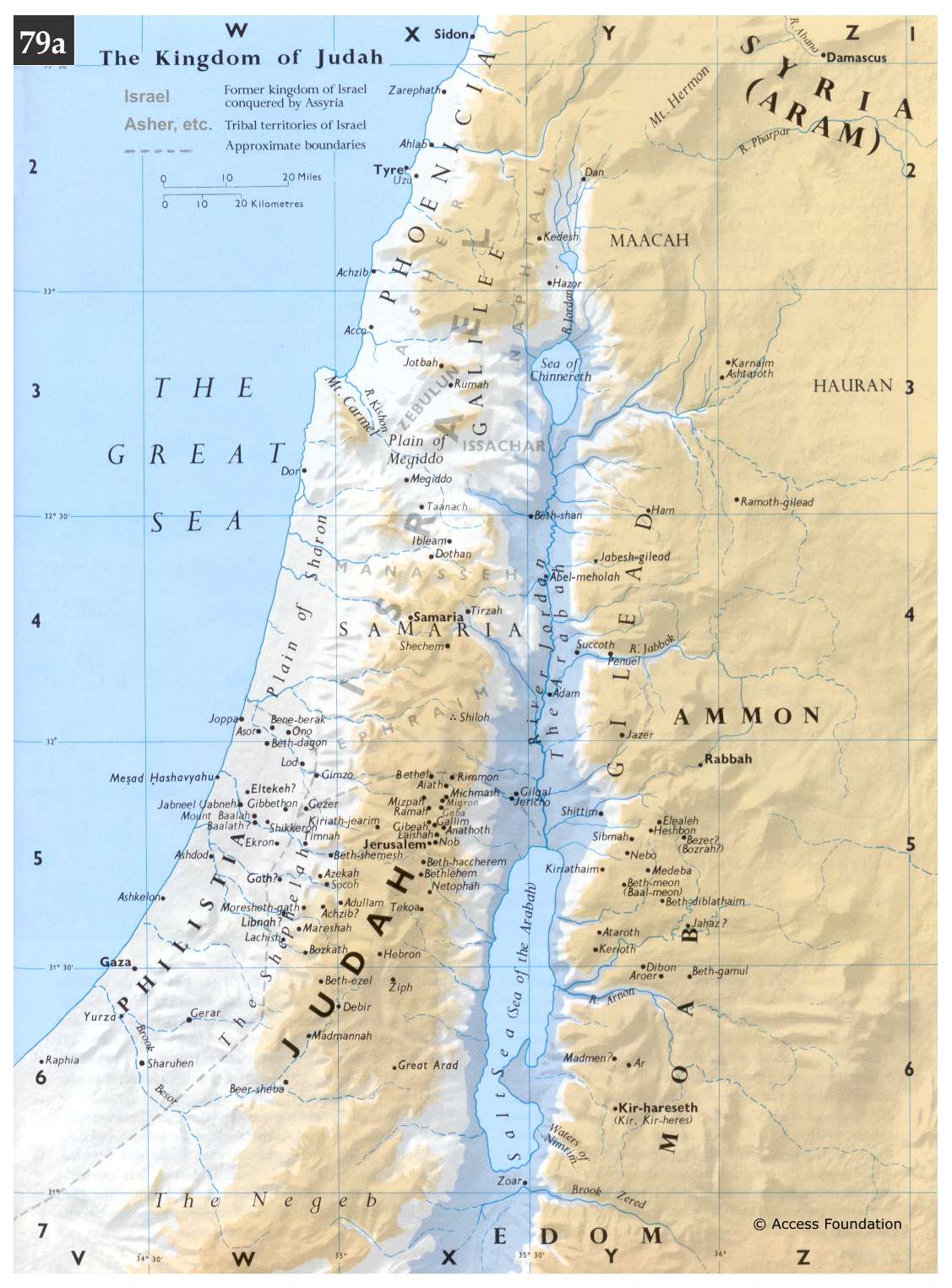
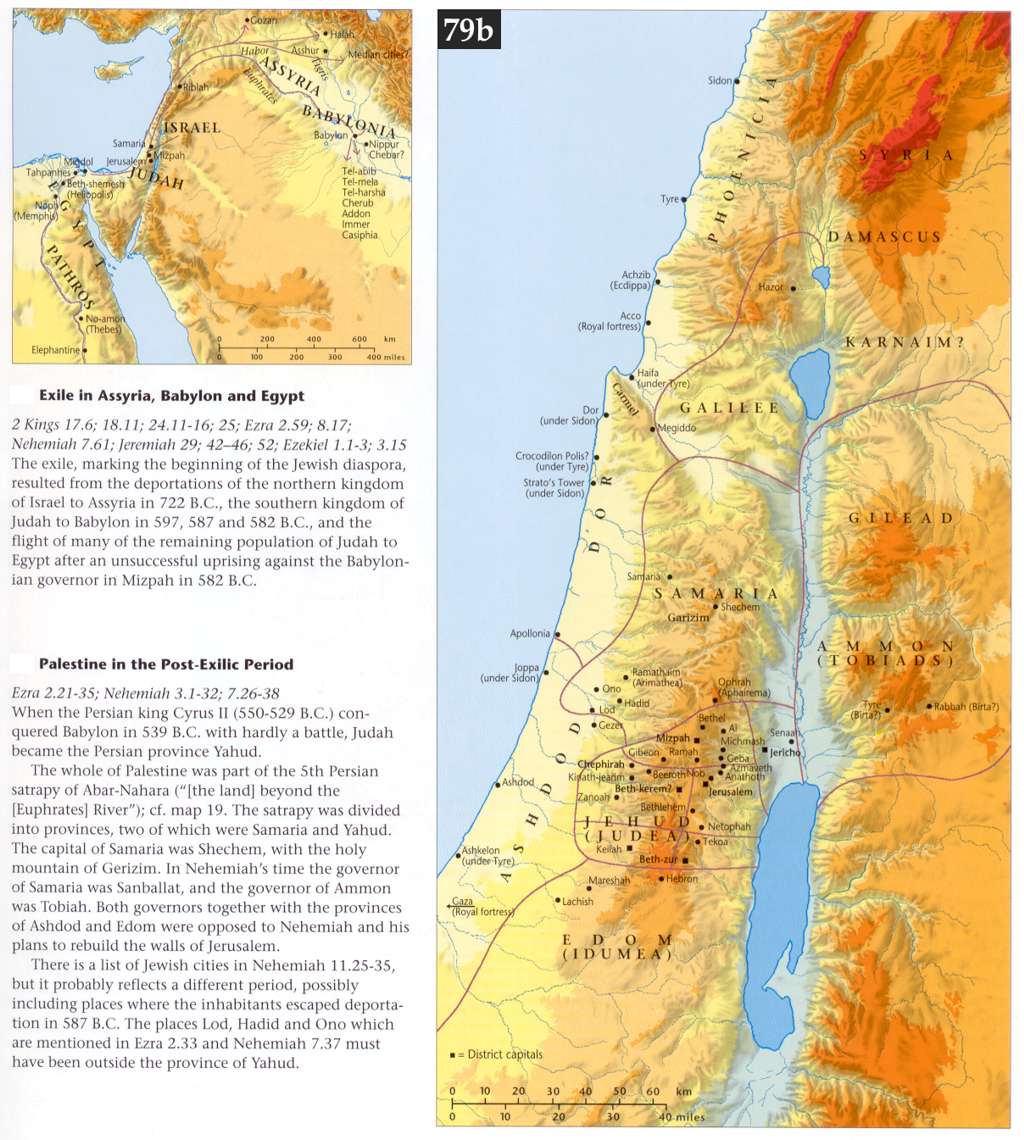
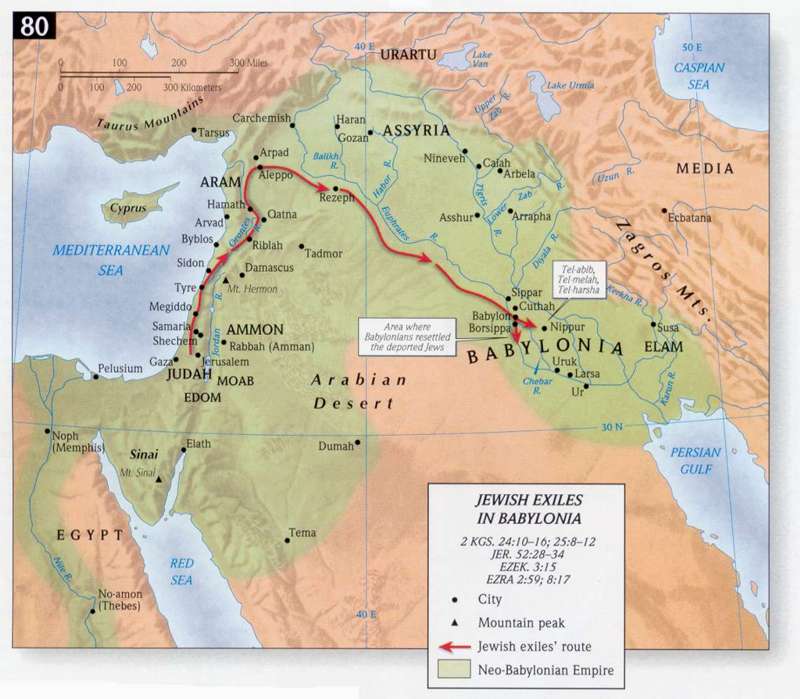
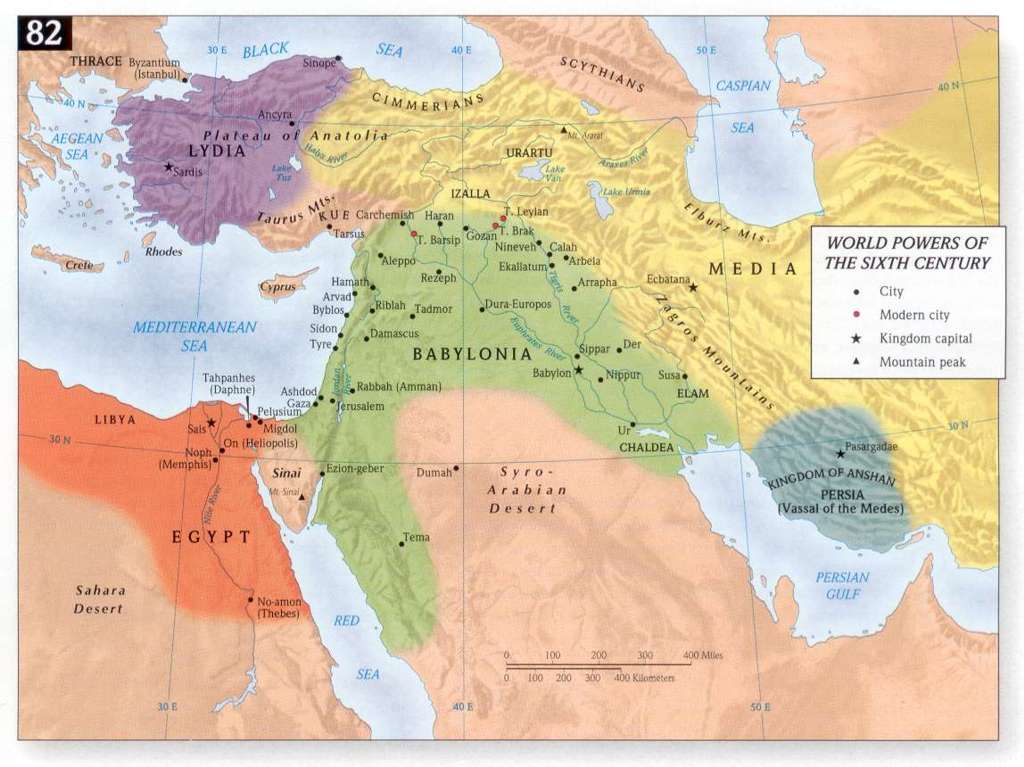
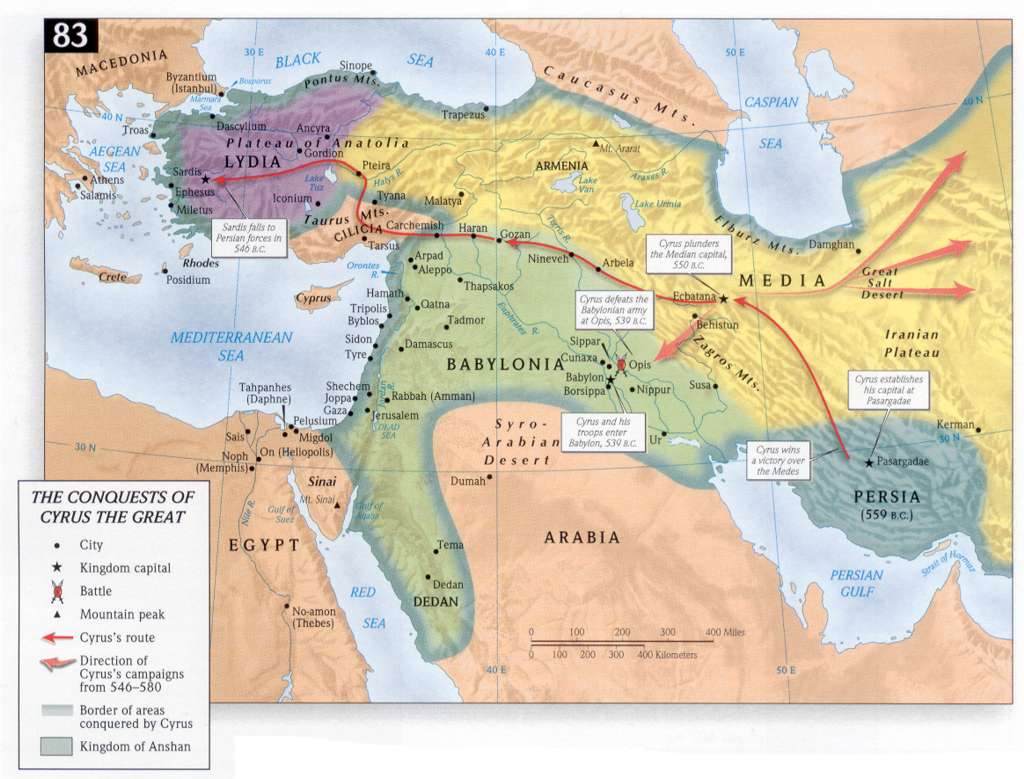
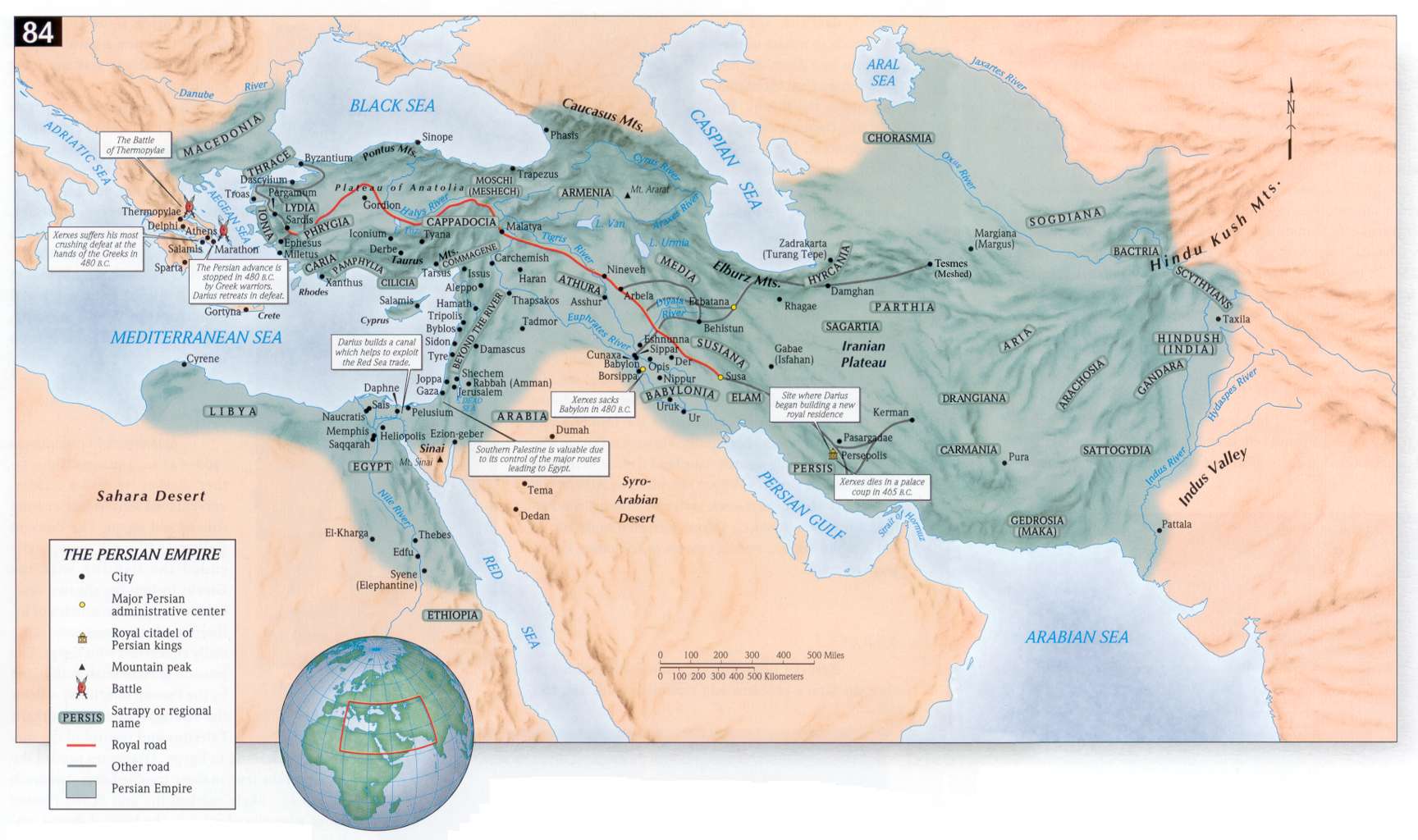
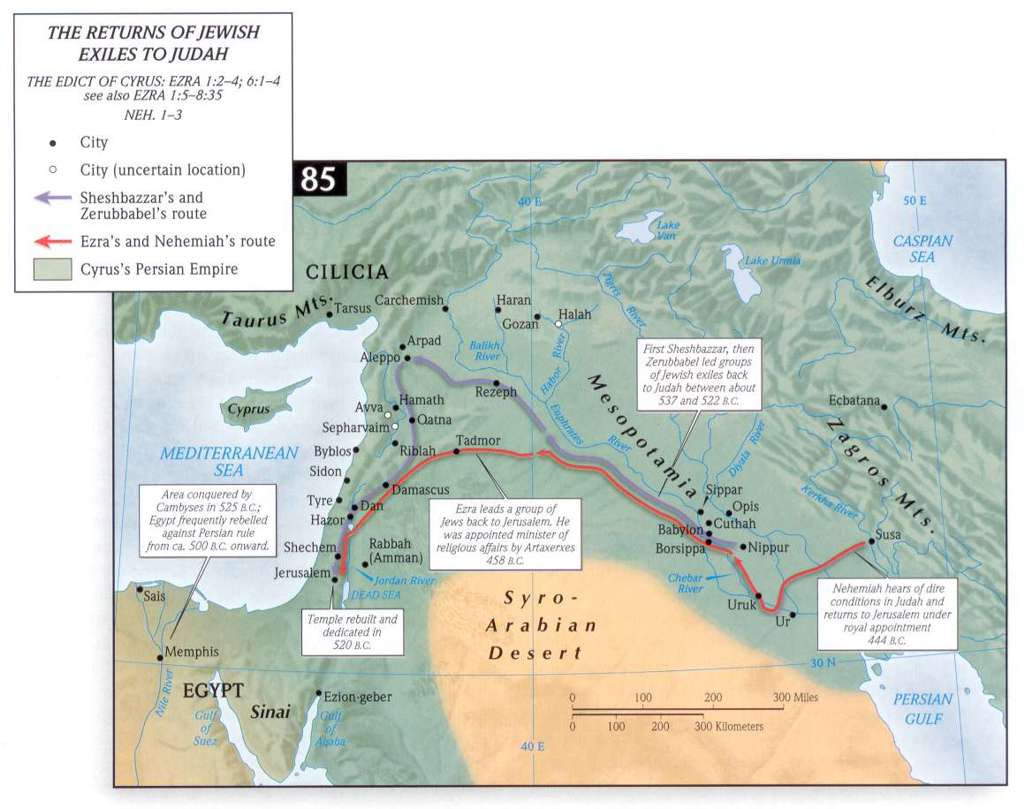
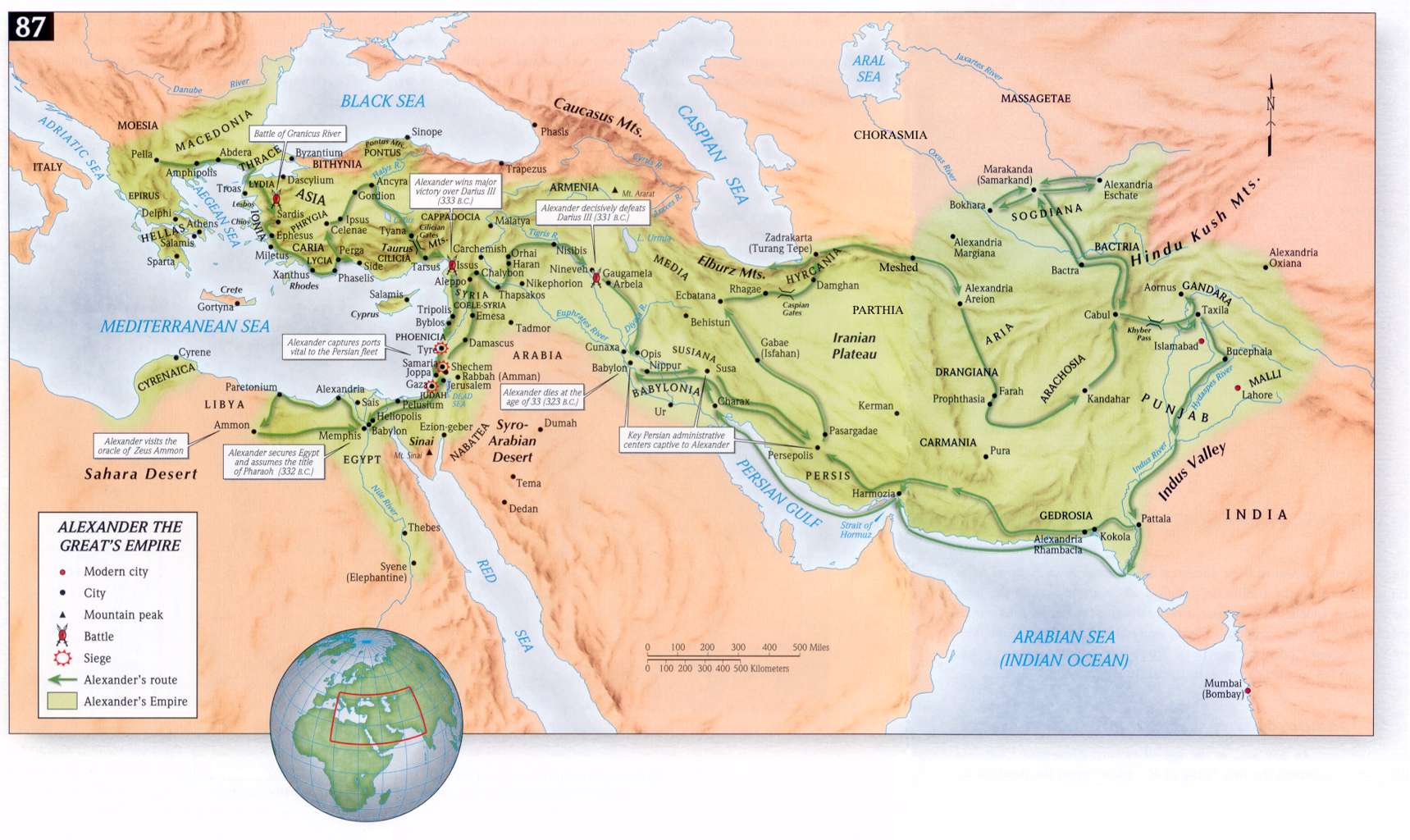
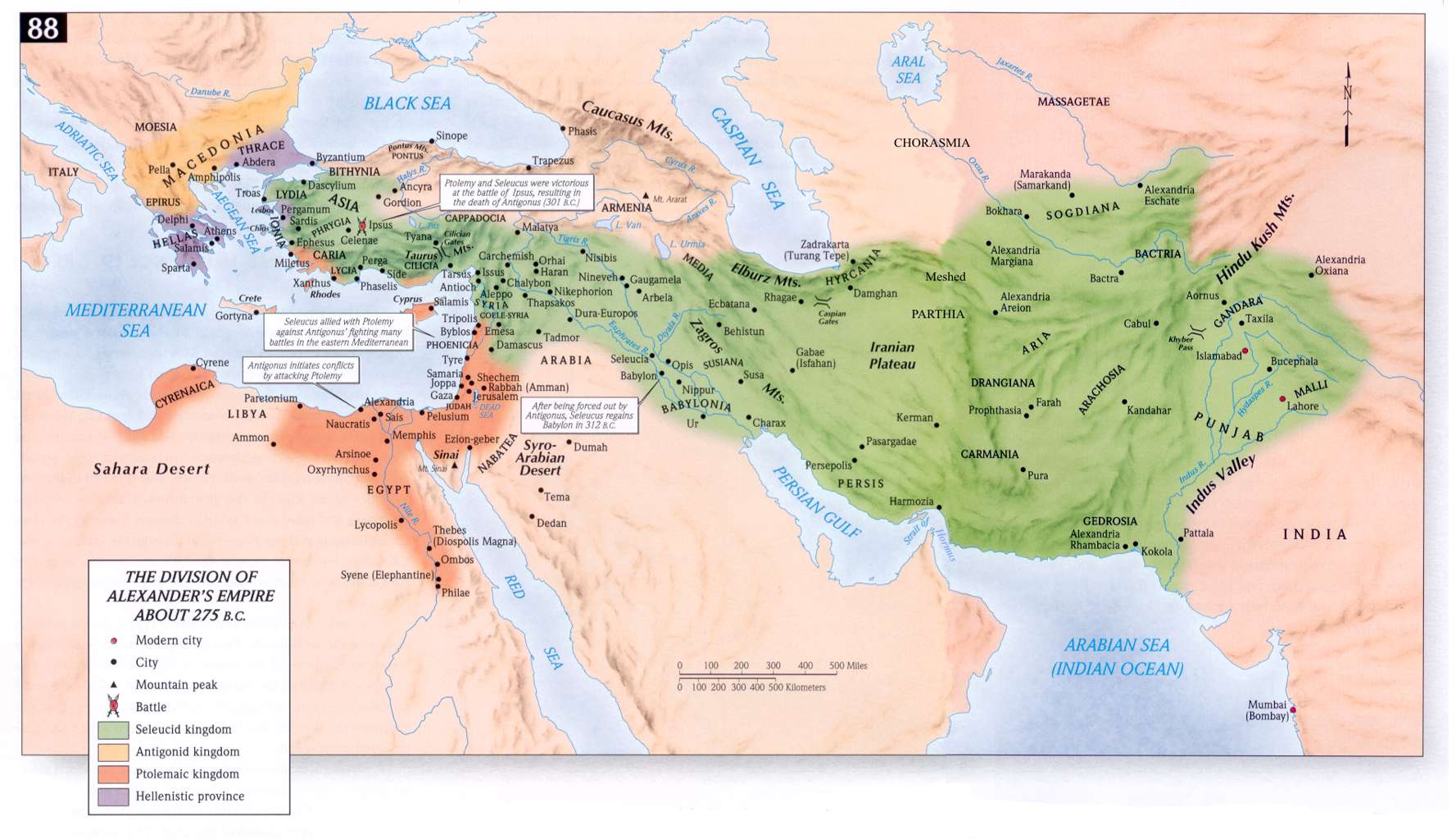
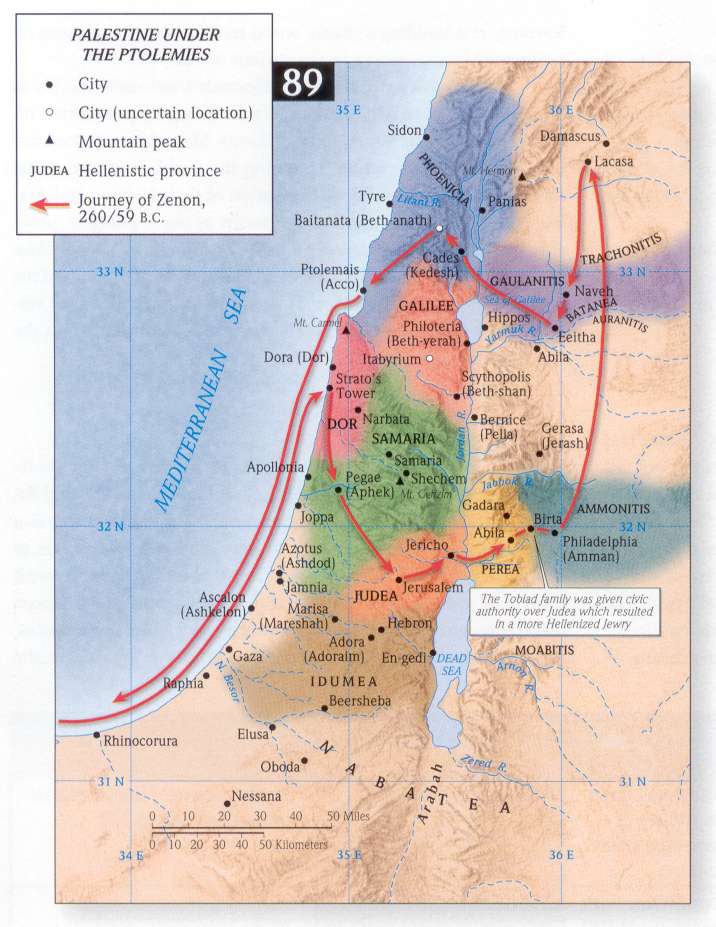
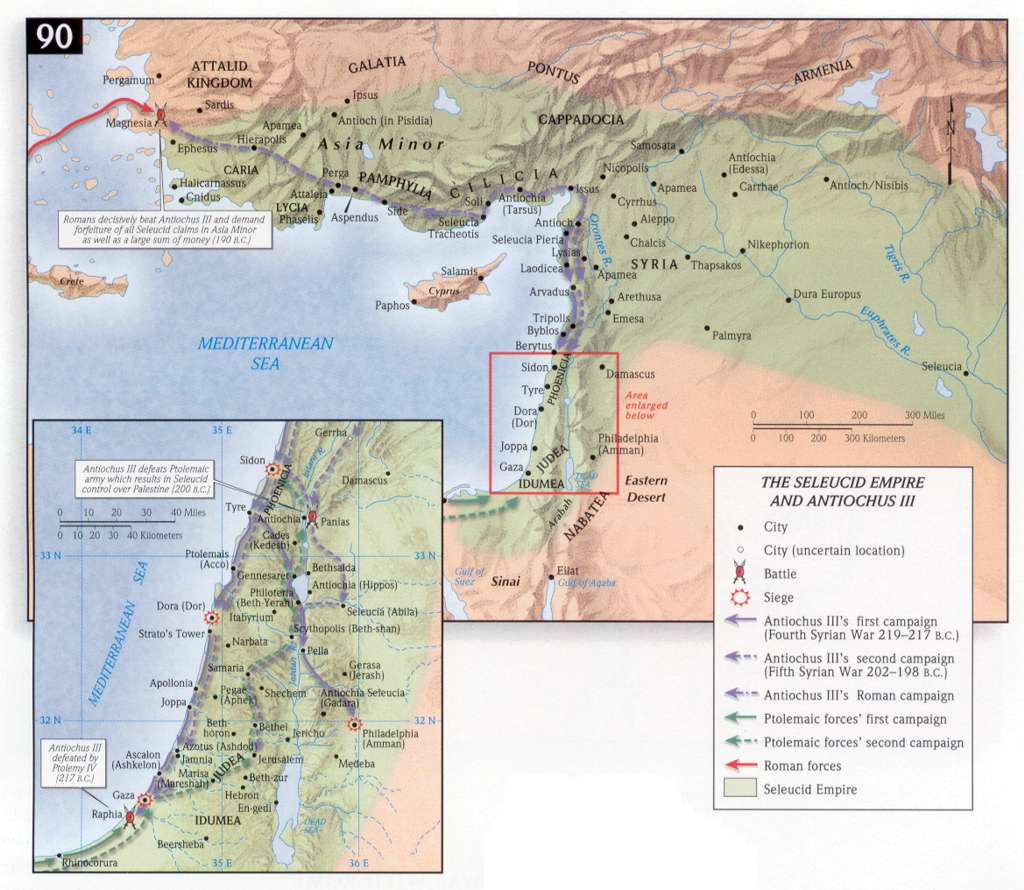
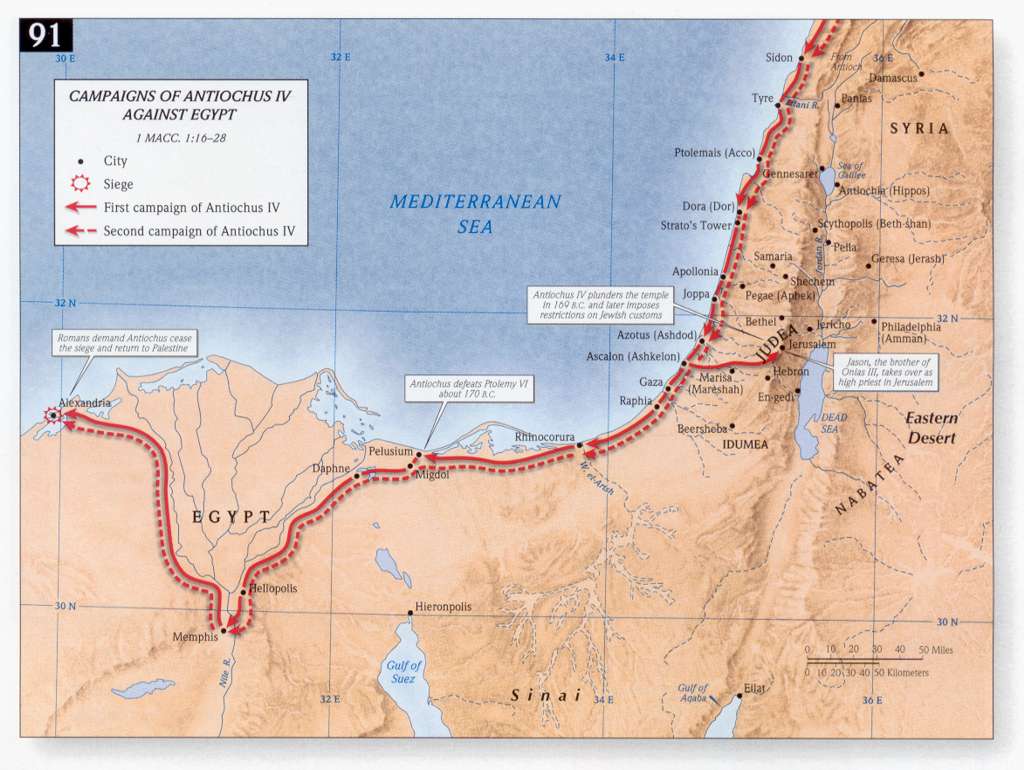
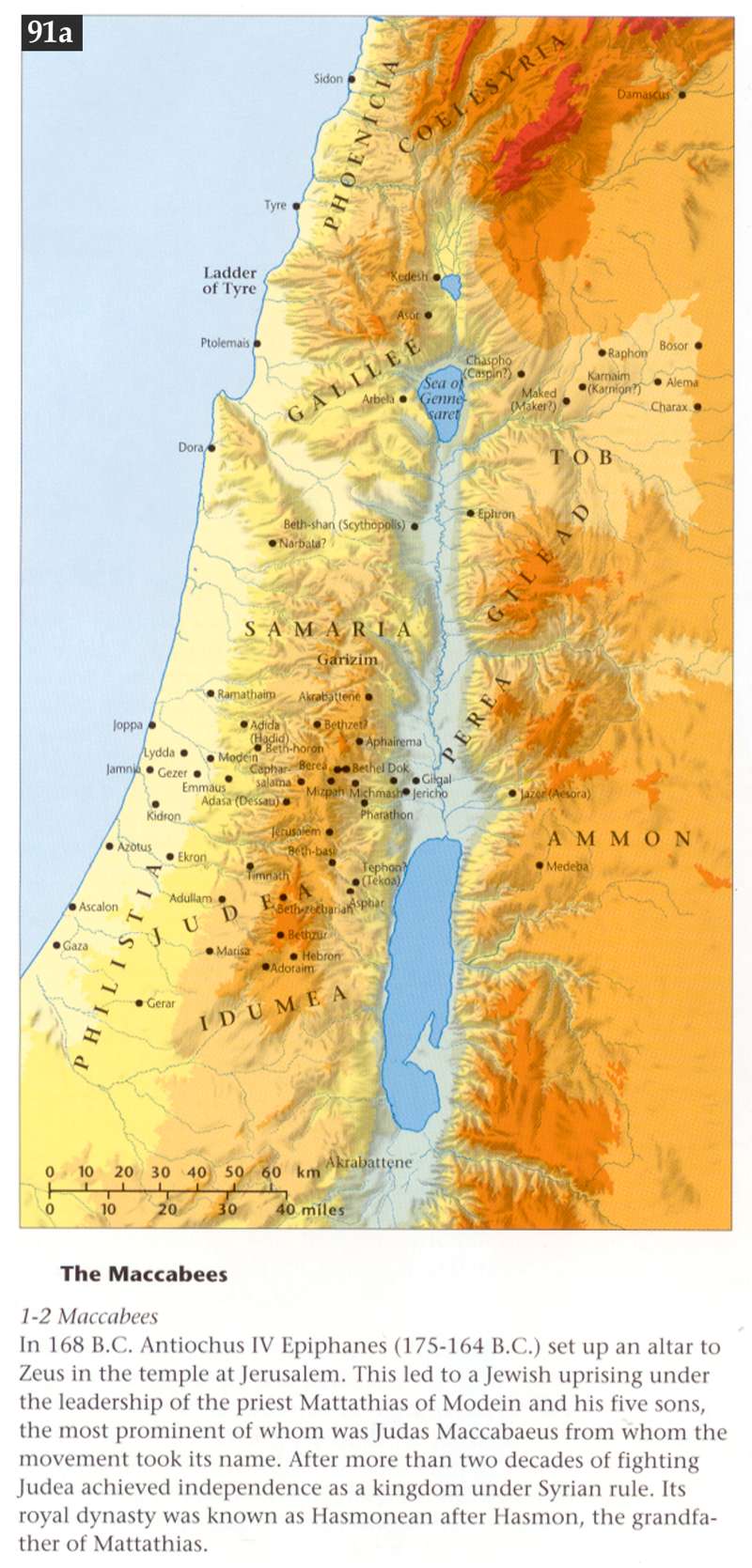
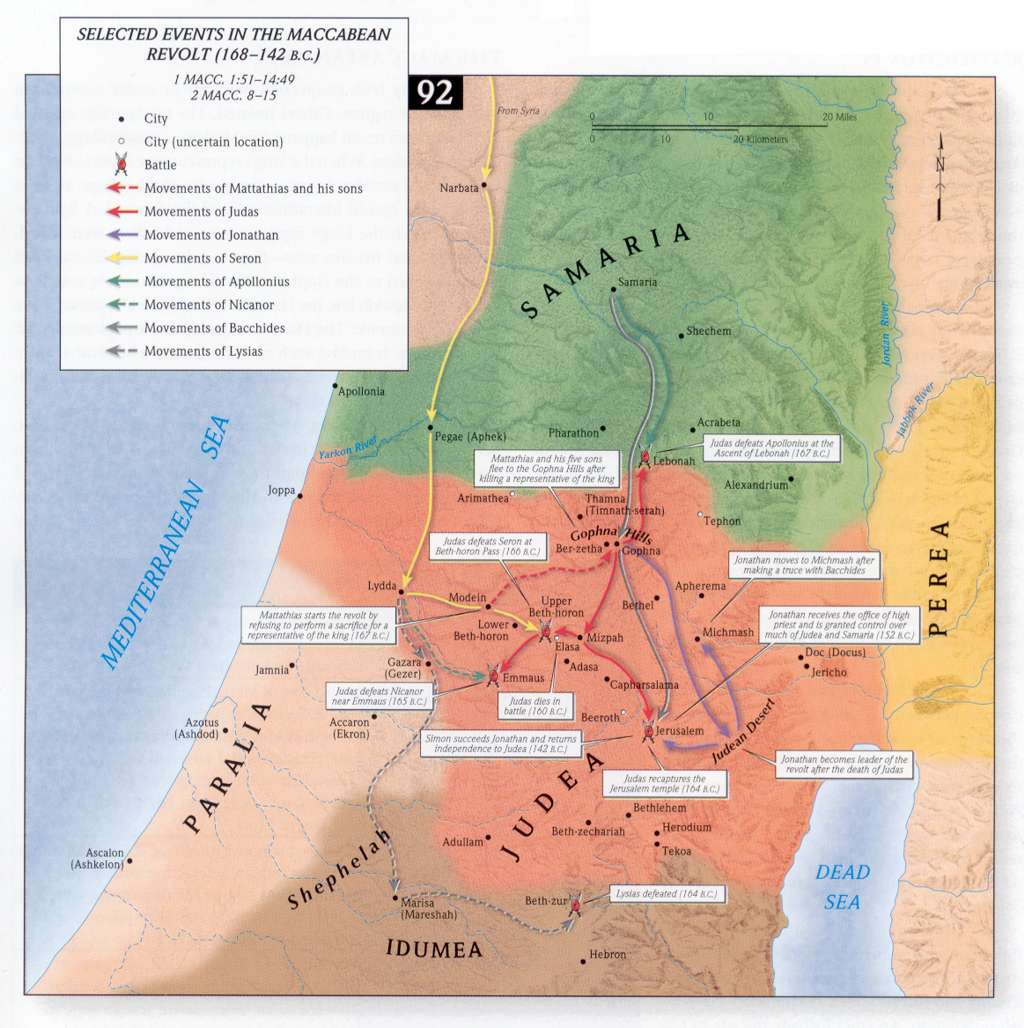
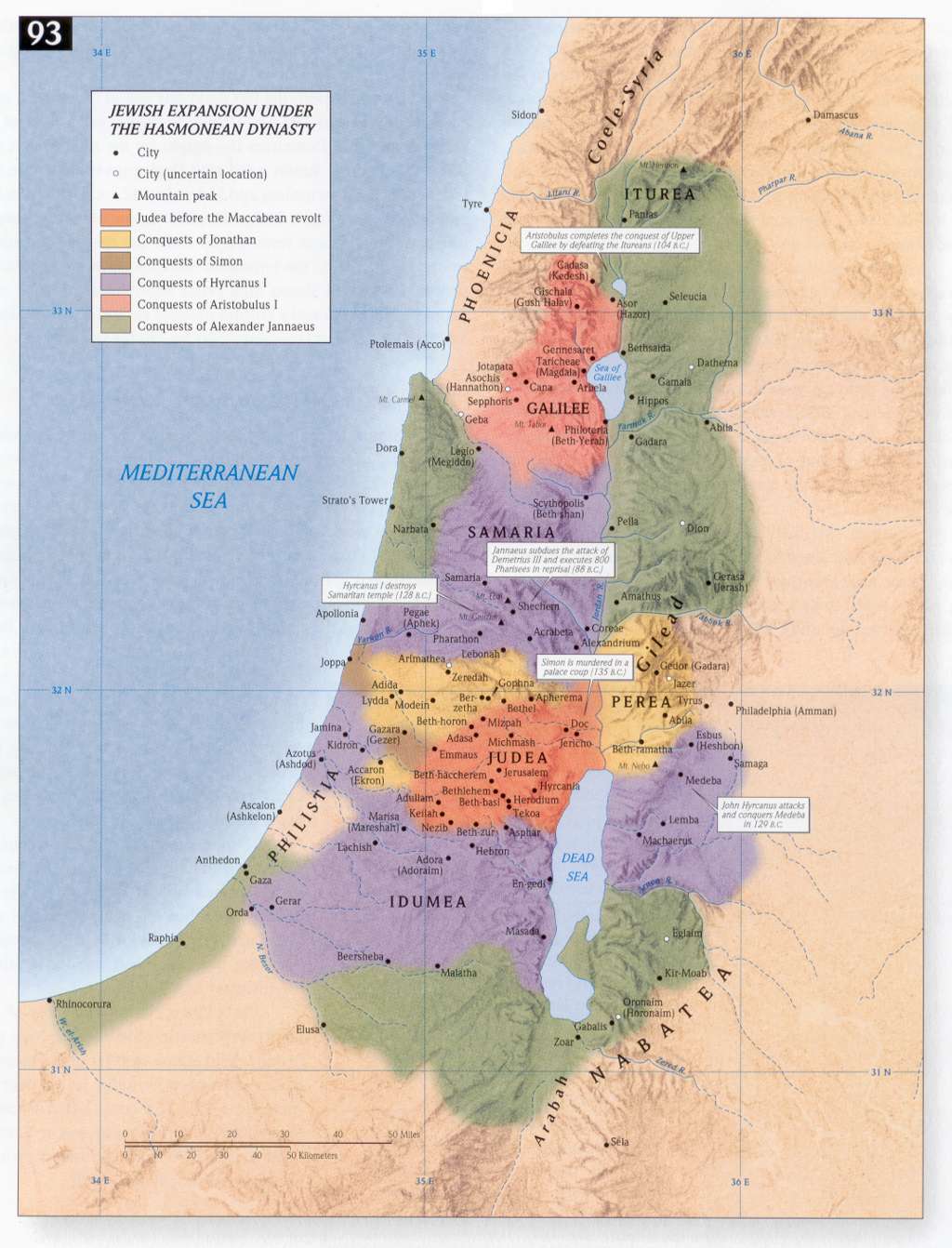
MAPS FROM ESV
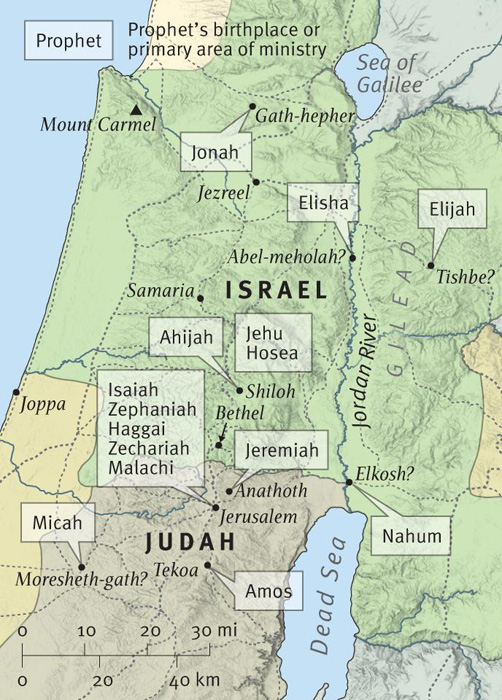
Prophets of Israel and Judah
c. 875–430 B.C.
- Extent of Solomon’s Kingdom
- Israel and Judah in 2 Kings
- Solomon’s Administrative Districts
- The Kingdom Divides
- Syria Captures Gilead
- Resurgence during Azariah, Jeroboam II
- Prophets of Israel and Judah
- Resurgence of Assyrian Influence
- Fall of Samaria, Deportation of Israelites
- Exile to Babylon
- Extent of David’s Kingdom
- Solomon’s International Ventures
- Syria and Israel Attack Judah
- Judah after the Fall of Israel
- Persian Empire at the Time of Ezra
- Persian Empire at the Time of Nehemiah
- Judea under Persian Rule
- Persian Empire at the Time of Esther
- Near East at the Time of Isaiah
- Israel and Judah at the Time of Jeremiah
- Babylonian Empire
- Babylon Attacks Judah
- Jeremiah Prophesies against Egypt
- Near East at the Time of Ezekiel
- Ezekiel’s Vision of Israel’s New Boundaries
- Introduction to Daniel: Babylonian Empire
- Empires of Daniel’s Visions: Persians
- Empires of Daniel’s Visions: Greeks
- Empires of Daniel’s Visions: Ptolemies and Seleucids (Early)
- Empires of Daniel’s Visions: Ptolemies and Seleucids (Late)
- Maccabean Kingdom
STEPHEN ARMSTRONG - Verse by Verse Ministry - audio & transcript - recommended
- Jonah - The Worst Missionary
- Jonah - Running Away from God's Will
- Jonah - The Tragedy of an Unwilling Missionary
Jonah 1:3. It is impossible to flee from God’s presence. Ps. 139:7. Give up the vain attempt to-day. Jonah “paid his fare” and never got it refunded. Sin is an expensive business. He took the wrong boat—the wrong track.
Jonah 1:4. Disobedience always leads us into troubled waters.
Jonah 1:5.The want of pardon is the only spring of a servile man’s duty. He plies his prayers as sailors do the pumps—only in a storm, or when fearful of sinking.
Jonah 1:11. Sin in the soul is like Jonah in the ship. It turns the smoothest water into a tempestuous sea.
Jonah 1:13, 14. The unavailing efforts of the Mediterranean oarsman have their counterpart,—
a. In our efforts to convert others.
b. In our efforts to convert our families.
c. In our efforts to convert ourselves.The cure is—Cry to God.
Jonah 3:2. After all the delay and discipline, Jonah had to go back to his first starting-place.
Jonah 4:7.Unbelief in the heart is like the worm in Jonah’s gourd—an unseen adversary.
- Jonah - Where Are You Going? - Do your own study so you will be able to comment on the commentaries and sermons! See Inductive Bible study
- Down, Down, Down - Lessons from Jonah
- Jonah - We're Just Like Jonah
- Jonah 1-4 God Wants You in Nineveh!
- Jonah 1:4-17 How God Pursues Prodigals - Part 1
- Jonah 1:4-17 How God Pursues Prodigals - Part 2
- Jonah 2 A Desperate Man’s Desperate Prayer
- Jonah 3 The Greatest Revival in History
- Jonah 4 Will the Real Sinner Please Stand Up?
- Jonah 4:11 "Should I Not be Concerned about that Great City?"
- Riding Out the Storms of Life
- Peace in the Midst of Your Storm - Correcting storms versus Perfecting Storms
- Dealing with Depression - 1
- Dealing with Depression - 2
- Click here for pdf sermons
JOHN KITTO
- Jonah 1:1 Commentary
- Jonah 1:2 Commentary
- Jonah 1:3 Commentary
- Jonah 1:3b Commentary
- Jonah 1:3c Commentary
- Jonah 1:3d Commentary
- Jonah 1:4 Commentary
- Jonah 1:5 Commentary
- Jonah 1:5b Commentary
- Jonah 1:5c Commentary
- Jonah 1:6 Commentary
- Jonah 1:7 Commentary
- Jonah 1:8 Commentary
- Jonah 1:9 Commentary
- Jonah 1:10 Commentary
- Jonah 1:11-16 Commentary
- All notes on Pdf
- Jonah 1:8-10 Commentary
- Jonah 1:11-12 Commentary
- Jonah 1:13-14 Commentary
- Jonah 1:15 Commentary
- Jonah 1:16 Commentary
- Jonah 1:17 Commentary
ARCHIBALD THOMAS ROBERTSON
- Jonah 2:1-9 Lessons from the Belly of the Fish, Part 1
- Jonah 2:1-9 Lessons from the Belly of the Fish, Part 2
- Jonah 2:10-3:4 Recommissioned (Audio)
- Jonah 2:1 Commentary
- Jonah 2:2 Commentary
- Jonah 2:3-4 Commentary
- Jonah 2:5-9 Commentary
- Jonah 2:10 Commentary
- All notes on Pdf
- Jonah 3:1-10 Devotional Commentary
- Jonah 3:1-4:11 Devotional Commentary
- Jonah 3:10-4:11 Devotional Commentary
- Jonah 3:1 Commentary
- Jonah 3:2 Commentary
- Jonah 3:3 Commentary
- Jonah 3:4 Commentary
- Jonah 3:4b Commentary
- Jonah 3:5 Commentary
- Jonah 3:6-9 Commentary
- Jonah 3:10 Commentary
- All notes on Pdf
- Jonah 4:1 Commentary
- Jonah 4:2 Commentary
- Jonah 4:2b Commentary
- Jonah 4:2c Commentary
- Jonah 4:2d Commentary
- Jonah 4:2e Commentary
- Jonah 4:3 Commentary
- Jonah 4:3b Commentary
- Jonah 4:4 Commentary
- Jonah 4:5 Commentary
- Jonah 4:6 Commentary
- Jonah 4:7 Commentary
- Jonah 4:8 Commentary
- Jonah 4:9 Commentary
- Jonah 4:10 Commentary
- Jonah 4:10b Commentary
- All notes on Pdf
Conservative notes from Dr Morris who approaches the text seeking it's literal meaning in the context. Millennial. Click the words or phrases after the Scripture for the Study Notes and note that they are from the KJV translation.
Jonah 1 Commentary
- Jonah 1:1 Jonah
- Jonah 1:2 Nineveh wickedness
- Jonah 1:3 Tarshish
- Jonah 1:4 great wind
- Jonah 1:6 call upon thy God
- Jonah 1:7 cast lots
- Jonah 1:9 Hebrew God of heaven
- Jonah 1:14 as it pleased thee
- Jonah 1:15 sea ceased from her raging
- Jonah 1:16 sacrifice unto the LORD
- Jonah 1:17 prepared great fish three days and three nights
Jonah 2 Commentary
- Jonah 2:2 belly of hell
- Jonah 2:5 the soul weeds
- Jonah 2:6 bottoms of the mountains corruption
- Jonah 2:9 I have vowed
- Jonah 2:10 the fish
Jonah 3 Commentary
- Jonah 3:3 exceeding great city three days’ journey
- Jonah 3:4 Nineveh
- Jonah 3:5 believed God
- Jonah 3:10 God repented
Jonah 4 Commentary
- Jonah 4:1 displeased Jonah
- Jonah 4:6 prepared a gourd
- Jonah 4:11 right hand cattle
- Jonah 1 Commentary - excerpts
Jonah 1:2 - Heb “Arise, go.” The two imperatives without an intervening vav (קוּם לֵךְ, qum lekh; “Arise, go!”), form a verbal hendiadys in which the first verb functions adverbially and the second retains its full verbal force: “Go immediately.” This construction emphasizes the urgency of the command.Jonah 1:2 Nineveh was the last capital city of ancient Assyria. Occupying about 1800 acres, it was located on the east bank of the Tigris River across from the modern city of Mosul, Iraq. The site includes two tels, Nebi Yunus and Kouyunjik, which have been excavated on several occasions.
Jonah 1:3 Heb “he arose to flee.” The phrase וַיָּקָם לִבְרֹחַ (vayyaqam livroakh, “he arose to flee”) is a wordplay on the LORD’s command (קוּם לֵךְ, qum lekh; “Arise! Go!”) in v. 2. By repeating the first verb קוּם the narrator sets up the reader to expect that Jonah was intending to obey God. But Jonah did not “arise to go” to Nineveh; he “arose to flee” to Tarshish. Jonah looks as though he was about to obey, but he does not. This unexpected turn of events creates strong irony. The narrator does not reveal Jonah’s motivation to the reader at this point. He delays this revelation for rhetorical effect until 4:2–3.
Jonah 1:3 Three times in chap. 1 (in vv. 3 and 10) Jonah’s voyage is described as an attempt to escape away from the LORD—from the LORD’s presence (and therefore his active awareness; compare v. 2). On one level, Jonah was attempting to avoid a disagreeable task, but the narrator’s description personalizes Jonah’s rejection of the task. Jonah’s issue is with the LORD himself, not just his commission. The narrator’s description is also highly ironic, as the rest of the book shows. Jonah tries to sail to Tarshish, in the opposite direction from Nineveh, as if by doing that he could escape from the LORD, when the LORD is the one who knows all about Nineveh’s wickedness and is involved in all that happens to Jonah throughout the book. Compare Jonah’s explanation when talking with the LORD (see 4:2).
Jonah 1:7 - The English word lots is a generic term. In some cultures the procedure for “casting lots” is to “draw straws” so that the person who receives the short straw is chosen. In other situations a colored stone or a designated playing card might be picked at random. In Jonah’s case, small stones were probably used. In the ancient Near East, casting lots was a custom used to try to receive a revelation from the gods about a particular situation. The Phoenician sailors here cried out to their gods and cast lots in the hope that one of their gods might reveal the identity of the person with whom he was angry. CEV has well captured the sentiment of v. 7b: “ ‘Let’s ask our gods to show us who caused all this trouble.’ It turned out to be Jonah.” Heb “the lot fell on Jonah.” From their questions posed to Jonah, it does not appear that the sailors immediately realize that Jonah was the one responsible for the storm. Instead, they seem to think that he is the one chosen by their gods to reveal to them the one responsible for their plight. It is only after he admits in vv. 9–10 that he was fleeing from the God whom he served that they realize that Jonah was in fact the cause of their trouble.
- Jonah 2 Commentary
- Jonah 3 Commentary - excerpt
Jonah 3:3 - Required three days to walk through it. Although this phrase is one of the several indications in the book of Jonah of Nineveh’s impressive size, interpreters are not precisely sure what “a three-day walk” means. In light of the existing archaeological remains, the phrase does not describe the length of time it would have taken a person to walk around the walls of the city or to walk from one end of the walled city to the other. Other suggestions are that it may indicate the time required to walk from one edge of Nineveh’s environs to the other (in other words, including outlying regions) or that it indicates the time required to arrive, do business, and leave. More information might also show that the phrase involved an idiomatic description (consider Gen 30:36; Exod 3:18; a three-day-journey would be different for families than for soldiers, for example), rather than a precise measurement of distance, for which terms were available (Ezek 45:1–6; 48:8–35). With twenty miles as quite a full day’s walk, it seems possible and simplest, however, to take the phrase as including an outlying region associated with Nineveh, about sixty miles in length.
Jonah 3:5 - The people of Nineveh believed in God.… Verse 5 provides a summary of the response in Nineveh; the people of all ranks believed and gave evidence of contrition by fasting and wearing sackcloth (2 Sam 12:16, 19–23; 1 Kgs 21:27–29; Neh 9:1–2). Then vv. 6–9 provide specific details, focusing on the king’s reaction. The Ninevites’ response parallels the response of the pagan sailors in 1:6 and 13–16.
- Jonah 4 Commentary
Jonah 4:2 - The narrator skillfully withheld Jonah’s motivations from the reader up to this point for rhetorical effect—to build suspense and to create a shocking, surprising effect. Now, for the first time, the narrator reveals why Jonah fled from the commission of God in 1:3—he had not wanted to give God the opportunity to relent from judging Nineveh! Jonah knew that if he preached in Nineveh, the people might repent and as a result, God might more than likely relent from sending judgment. Hoping to seal their fate, Jonah had originally refused to preach so that the Ninevites would not have an opportunity to repent. Apparently Jonah hoped that God would have therefore judged them without advance warning. Or perhaps he was afraid he would betray his nationalistic self-interests by functioning as the instrument through which the LORD would spare Israel’s main enemy. Jonah probably wanted God to destroy Nineveh for three reasons: (1) as a loyal nationalist, he despised non-Israelites (cf. 1:9); (2) he believed that idolaters had forfeited any opportunity to be shown mercy (cf. 2:9–10); and (3) the prophets Amos and Hosea had recently announced that God would sovereignly use the Assyrians to judge unrepentant Israel (Hos 9:3; 11:5) and take them into exile (Amos 5:27). If God destroyed Nineveh, the Assyrians would not be able to destroy Israel. The better solution would have been for Jonah to work for the repentance of Nineveh and Israel.
- When God Speaks, You Better Listen James Merritt
- Running From God Jonah J. Mike Minnix
- Running in the Wrong Direction Jonah 1:1-3 Ernest L. Easley
- Seafood Thanksgiving Jonah 2 Terry Trivette
- Backslider On A Bumpy Boat Jonah 2:1-2 Donnie L. Martin
- Ask The Ninevites Jonah 3:1-10 Franklin L. Kirksey
- The God of the Second Chance Jonah 3:1 Alan Stewart
- The Pouting Prophet Jonah 4:1-11 Mark Adams
- The Post-Revival Blues Jonah 4:1-11 Ernest L. Easley
- Jonah 1:1-3 Running from God
- Jonah 1:4-9 Found Out!
- Jonah 1:10-17 Divine Pursuit
- Jonah 2:1-9 Lessons from the Belly of the Fish, Part 1
- Jonah 2:1-9 Lessons from the Belly of the Fish, Part 2
- Jonah 2:10-3:4 Recommissioned (Audio)
- Jonah 3:5-10 The Awakening, Part 1
- Jonah 3:5-10 The Awakening, Part 2
- Jonah 4:1-4 Theology Unapplied
- Jonah 4:5-9 When God Makes His Point
CLICK HERE FOR MOST OF THESE DEVOTIONALS ON ONE PAGE - PLUS OTHER DEVOTIONALS, ILLUSTRATIONS, et al items (Spurgeon, F B Meyer, D L Moody, Norman Geisler, John Kitto)
- Jonah 1 When God Cleans House
- Jonah 1:2-3 Sign Seekers
- Jonah 1:1-10 Running from God
- Jonah 1:1-11 Headed The Wrong Way?
- Jonah 1:1-17 Swallowed Up
- Jonah 1:1-17 Once Upon A Time
- Jonah 1:1-2:2 From Peeker To Seeker
- Jonah 1:2-3 Sign-Seekers
- Jonah 1:3 A Ticket To Tarshish
- Jonah 1:1-17 He is in Control
- Jonah 1:1-17 Swallowed Up
- Jonah 2 Running from God
- Jonah 2:1 Strange Places
- Jonah 2:1 Unusual Places
- Jonah 2:1-2 In the Belly of a Fish
- Jonah 2:1-10 Valley of Vision
- Jonah 2:1-10 Whale of a Story
- Jonah 2:2 Lessons from Jonah
- Jonah 2:9 Thankful in All Things
- Jonah 3:10 Anger or Applause?
- Jonah 4 Elephants Down
- Jonah 4:4 Tactical Distractions
- Jonah 4 The Good And The Bad
- Jonah 4 Getting It Right On The Inside
- Jonah 4:1 Grieved By Grace
- Jonah 4:4 Tactical Distractions
- Jonah 4:1-10 The Trouble with Me
James Rosscup writes "This work originally appeared in 1860. The present publication is set up in two columns to the page with the text of the Authorized Version reproduced at the top. Scripture references, Hebrew words, and other citations are relegated to the bottom of the page. The work is detailed and analytical in nature. Introduction, background and explanation of the Hebrew are quite helpful. Pusey holds to the grammatical-historical type of interpretation until he gets into sections dealing with the future of Israel, and here Israel becomes the church in the amillennial vein." (Commentaries for Biblical Expositors: An Annotated Bibliography of Selected Works)
- All notes on Pdf
- Introduction
- Jonah 1:1 Commentary
- Jonah 1:2 Commentary
- Jonah 1:3 Commentary
- Jonah 1:3b Commentary
- Jonah 1:3c Commentary
- Jonah 1:3d Commentary
- Jonah 1:4 Commentary
- Jonah 1:5 Commentary
- Jonah 1:5b Commentary
- Jonah 1:5c Commentary
- Jonah 1:6 Commentary
- Jonah 1:7 Commentary
- Jonah 1:8 Commentary
- Jonah 1:9 Commentary
- Jonah 1:10 Commentary
- Jonah 1:11-16 Commentary
- Jonah 2:1 Commentary
- Jonah 2:2 Commentary
- Jonah 2:3-4 Commentary
- Jonah 2:5-9 Commentary
- Jonah 2:10 Commentary
- Jonah 3:1 Commentary
- Jonah 3:2 Commentary
- Jonah 3:3 Commentary
- Jonah 3:4 Commentary
- Jonah 3:4b Commentary
- Jonah 3:5 Commentary
- Jonah 3:6-9 Commentary
- Jonah 3:10 Commentary
- Jonah 4:1 Commentary
- Jonah 4:2 Commentary
- Jonah 4:2b Commentary
- Jonah 4:2c Commentary
- Jonah 4:2d Commentary
- Jonah 4:2e Commentary
- Jonah 4:3 Commentary
- Jonah 4:3b Commentary
- Jonah 4:4 Commentary
- Jonah 4:5 Commentary
- Jonah 4:6 Commentary
- Jonah 4:7 Commentary
- Jonah 4:8 Commentary
- Jonah 4:9 Commentary
- Jonah 4:10 Commentary
- Jonah 4:10b Commentary
- Introduction to Jonah (pdf)
- Jonah 1:3-10 (pdf)
- Jonah 1:10-16 (pdf)
- Jonah 1:17 (pdf)
- Jonah 2:1-3 (pdf)
- Jonah 2:4-10 (pdf)
- Jonah 4:1-11 (pdf)
- Booklet on Jonah - 10 messages in bookfold format (pdf)
- Jonah 1 The Pursuing Heart of God
- Jonah 2 The Prayer of Jonah
- Jonah 3 The God of the Second Chance
- Jonah 4 The Sovereignty of God
Note: click arrow to go to next sermon.
NOTE: If you are not familiar with the great saint Charles Simeon see Dr John Piper's discussion of Simeon's life - you will want to read Simeon's sermons after meeting him! - click Brothers We Must Not Mind a Little Suffering (Mp3 even better)
- Jonah 1:6 Jonah Reproved by the Mariners
- Jonah 2:6 Jonah Restored from the Belly of a Fish
- Jonah 2:6 Jonah's Reflections in the Whale's Belly
- Jonah 3:8-10 Repentance of the Ninevites
- Jonah 4:2 The Mercy of God
- Jonah 4:5-9 Jonah's Gourd
Sermon notes are in an outline format.
- Jonah 2 Then Jonah Prayed
- Jonah 2:3 Lying Vanities
- Jonah 2:7-10 When My Soul Fainted Within Me
- Jonah 2:8 Learning An Easy Lesson the Hard Way
- Jonah 2:8 The Authenticity of the Story
- Jonah 2:8 The Lying Vanities
- Jonah 2:8,9 Learning an Easy Lesson the Hard Way
- Jonah 3:4,9 Who Can Tell
- Jonah 3:5 The Men of Nineveh Believed God
Jonah Commentary
- Introduction
- Jonah 1:1-3 Commentary
- Jonah 1:4-6 Commentary
- Jonah 1:7-9 Commentary
- Jonah 1:10-13 Commentary
- Jonah 1:14-17 Commentary
- Jonah 1:6, 8, 13 Explanatory Notes
- Jonah 2:1-2 Commentary
- Jonah 2:3-6 Commentary
- Jonah 2:7-10 Commentary
- Jonah 3:1-3 Commentary
- Jonah 3:4-6 Commentary
- Jonah 3:7 Commentary
- Jonah 3:8-10 Commentary
- Jonah 3:3, 5 Explanatory Notes
- Jonah 4:1-4 Commentary
- Jonah 4:5-6 Commentary
- Jonah 4:7 Commentary
- Jonah 4:8-10 Commentary
- Jonah 4:11 Commentary
- Jonah 1:3 Runaway Jonah and the Convenient Ship
- Jonah 1:3 Traveling Expenses on the Two Great Roads
- Jonah 1:5 Sleepers Aroused
- Jonah 1:5-6 What Meanest Thou, O Sleeper?
- Jonah 1:12-13 Labour in Vain
- Jonah 2:4 Jonah's Resolve or Look Again
- Jonah 2:7 Plain Talk Upon an Encouraging Topic
- Jonah 2:7 The Fainting Soul Revived
- Jonah 2:9 Salvation of the Lord
- Jonah 3:4 Sermon Notes - The Ninevites' Repentance
- Jonah 3:9 Who Can Tell?
- Jonah 4:6-8 Jonah's Object-Lessons
Jonah 1
- Jonah's Call, Rebellion, and Repentance - Jonah 1:1-2:10
- God's Great Call: Jonah Goes Down Away from the Lord - Jonah 1:1-3
- God's Great Storm: Jonah Goes Down into the Water - Jonah 1:4-15
- God's Great Fish: Jonah Goes Down into the Fish - Jonah 1:16-17
Jonah 2
- God's Great Grace: Jonah Goes Down on His Knees in Prayer - Jonah 2:1-10
- Jonah's Prayer - Jonah 2:1-9
- God's Answer - Jonah 2:10
Jonah 3
- God's Great Call - Jonah 3:1-10
- God's Call: Jonah's Great Obedience - Jonah 3:1-4
- God's Call: Nineveh's Great Repentance - Jonah 3:5-10
Jonah 4
Click for list of all sermons with audios. The links below are to pdf transcripts.
- Jonah Introduction
- Jonah 1:1-2
- Jonah 1:3-7
- Jonah 1:8-16
- Jonah 1:17-2:10
- Jonah 3:1-10
- Jonah 4:1-3
- Jonah 4:4-11
- Jonah 1:1-17 Devotional Commentary
- Jonah 3:1-10 Devotional Commentary
- Jonah 3:1-4:11 Devotional Commentary
- Jonah 3:10-4:11 Devotional Commentary
Be discerning: Utley is Amillennial and replaces Israel with the Church. Why listed? Because he has well done grammatical (word and phrase studies) and interesting historical comments
Mp3 Audio Recommended. Click to listen or Right click and select "Save Target as" (Each audio ~ 35-40')
In regard to the OT Prophetic books such as Isaiah, Jeremiah, Daniel, and the 12 "Minor" Prophets, remember that the most accurate interpretation is derived by applying the following principles:
(1) Read the Scripture literally (unless the text is clearly figurative, e.g., Jesus said "I am the door… " Jn 10:9). If one interprets a text symbolically (allegorically, figuratively, spiritualizing) when that text makes good sense literally, one potentially opens themselves to the danger of inaccurate interpretation, for then the question arises as to who's "symbolic" interpretation is correct and how imaginative one should be in evaluating a "supposed symbol"? Many of the commentaries and sermons on the OT prophetic books unfortunately are replete with non-literal interpretations (except when it comes to Messianic Passages, which are usually interpreted literally). Therefore the watchword when reading any commentary on Old Testament prophecy is caveat emptor ("buyer beware"). Read all commentaries like the Bereans (Acts 17:11-note).
(2) Study the context which is always "king" in interpretation (don't take verses out of context.)
(3) Passages addressed to Israel should be interpreted as directed to the literal nation of Israel and should not be interpreted as addressed to the NT Church, an entity not mentioned in the Old Testament. The promises of Jehovah to the nation of Israel (e.g., see Millennial Promises) remain valid (Jer 31:35, 36, 37, Nu 23:19, Lk 21:33) and have not been passed on to the NT Church because Israel has "defaulted" (See study Israel of God). Remember that while Scripture has only one correct interpretation, there can be many legitimate applications (See Application), and therefore the OT prophetic books are extremely applicable in the lives of NT believers.
(4) Scripture is always the best commentary on Scripture. While an attempt has been made to list resources that adhere to these basic interpretative guidelines, not all the works listed in these collections have been read in detail. Therefore should you discover a resource you feel is NOT conservative and/or orthodox, please email your concerns.
Related Resources:
- Inductive Bible Study - Guidelines to Assure Accurate Interpretation
- Inductive Bible Study Interpretation of Prophetic Scripture
- Interpretative Views of the Revelation of Jesus Christ
- Allegorical Interpretation - Tony Garland
- Interpreting Symbols - Tony Garland
- Basic Considerations in Interpreting Prophecy - John Walvoord
- Millennium - Biblical descriptions of this time on earth, primarily from the OT prophets