Judges 13:2
Judges 13:3
Judges 13:4
Judges 13:5
Judges 13:6
Judges 13:7
Judges 13:8
Judges 13:9
Judges 13:10
Judges 13:11
Judges 13:12
Judges 13:13
Judges 13:14
Judges 13:15
Judges 13:16
Judges 13:17
Judges 13:18
Judges 13:19
Judges 13:20
Judges 13:21
Judges 13:22
Judges 13:23
Judges 13:24
Judges 13:25
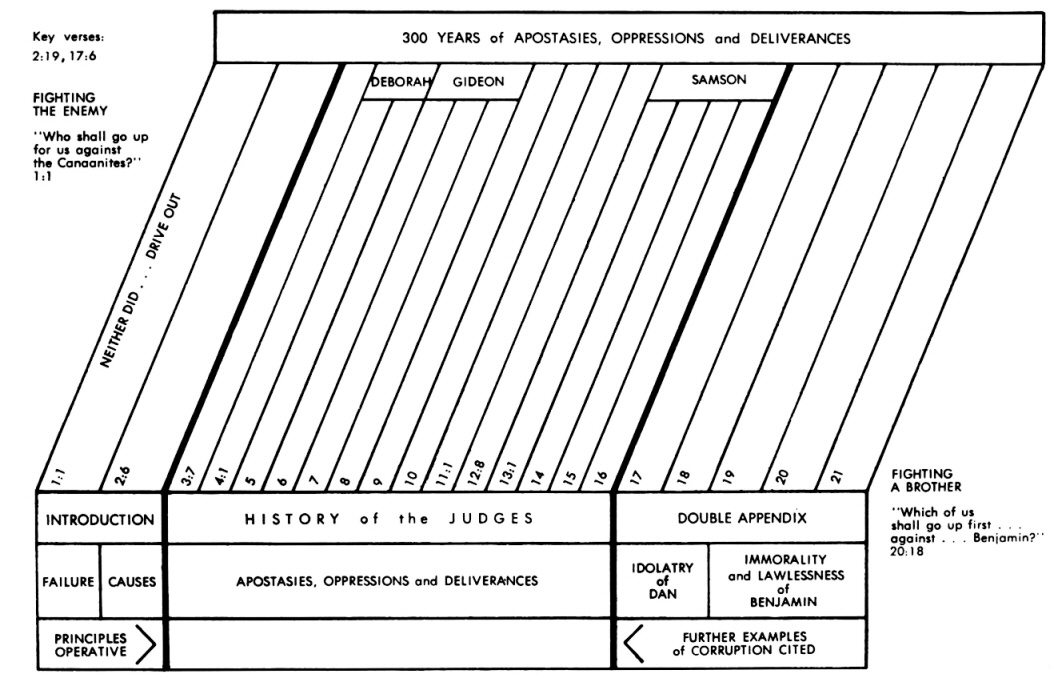
Chart from recommended resource Jensen's Survey of the OT - used by permission
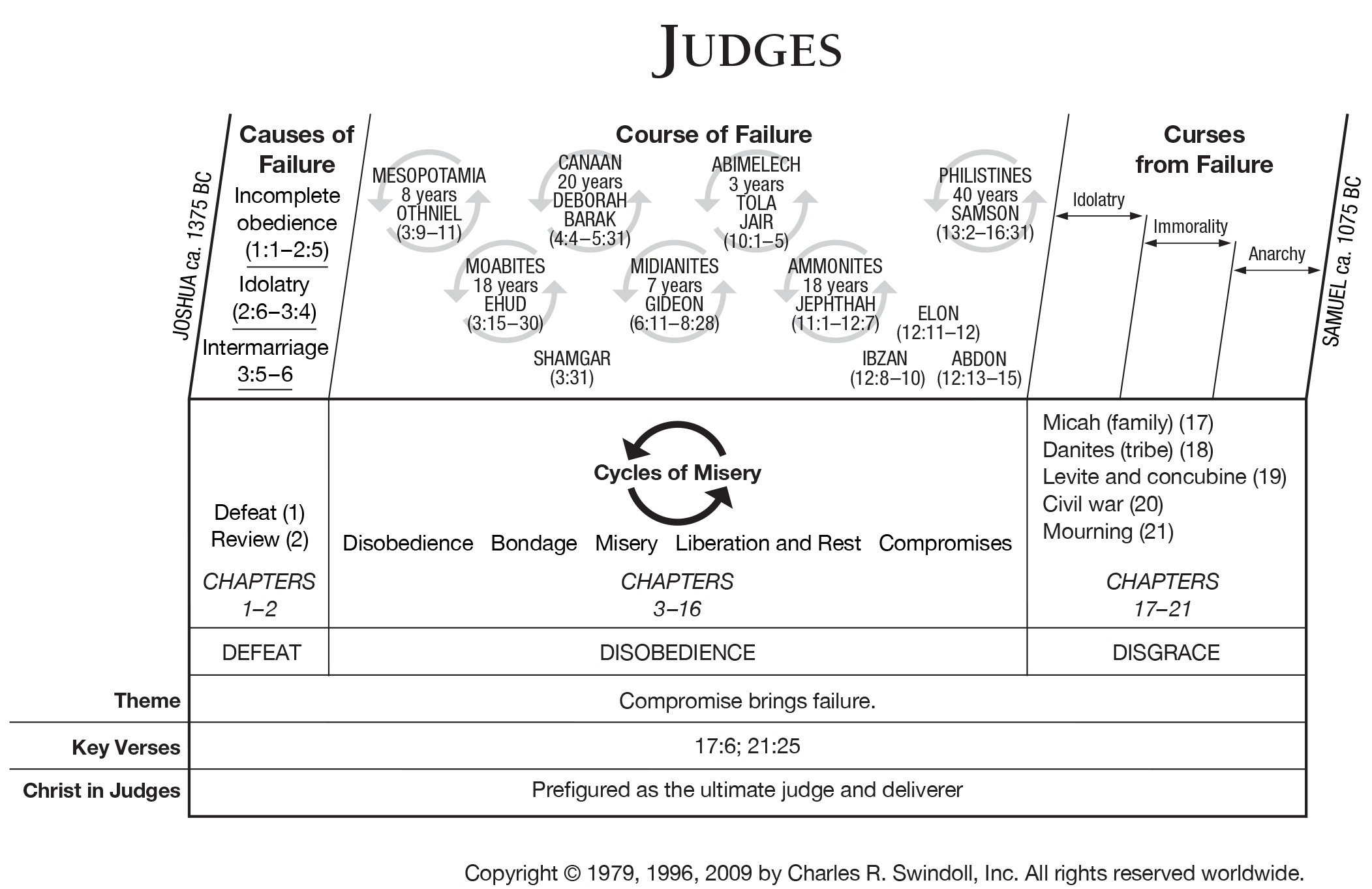
Chart on Judges - Charles Swindoll
|
RECYCLING SIN |
|||||
| Jdg 1:1-3:6 | Jdg 3:7-16:31 | Jdg 17:1-21:25 | |||
| Introduction | History of the Judges | Appendix | |||
| Causes of the Cycles THE REASON |
Curse of the Cycles THE RECORD |
Conditions in the Cycles THE RESULTS |
|||
| Failure to Complete Conquest Jdg 1:1-36 God's Judgment for Failure Jdg 2:1-3:6 |
Curse of the Cycles |
Conditions in the Cycles |
|||
| Living with Canaanites |
War with the Canaanites |
Living Like the Canaanites |
|||
| Religious Laxity |
Political Uncertainty |
Moral Anarchy |
|||
| About 350 Years of Israel's History - Almost 25%! From Compromise to Confusion! |
|||||

Another Timeline of Israel's History
Click to Enlarge
from Jensen's Survey of the OT
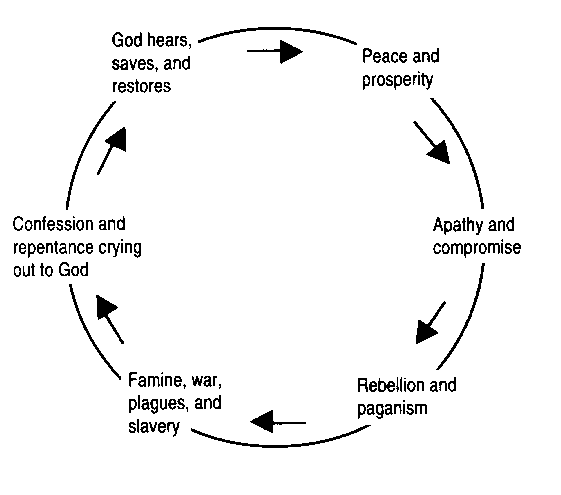
Click to Enlarge
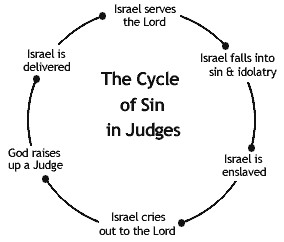
Other ways to describe Israel's cycle…
- Rest > Rebellion > Retribution > Repentance (?) > Restoration
- Sin > Suffering/Servitude > Supplication > Salvation
- Apathy > Apostasy > Affliction > Answered Prayer
- Disobedience > Desperation > Deliverance
- Disobedience > Bondage >Misery > Liberation and Rest > Compromises
John Hannah's Outline on Judges 13-16 (Hannah's Bible Outlines)
- Samson (Judges 13:1-16:31)
- Israel's sin and servitude (Judges 13:1)
- Israel's deliverance (Judges 13:2-16:31)
- The birth of Samson (Judges 13:2-25)
- The angelic promise of a son (Judges 13:2-7)
- The angelic reappearance (Judges 13:8-23)
- The separated life of the child's parents (Judges 13:8-14)
- The sacrifice to the Lord (Judges 13:15-23)
- The birth and childhood of Samson (Judges 13:24-25)
- The conflict with the Philistines (Judges 14:1-16:31)
- Because of the woman of Timnah (Judges 14:1-15:20)
- Samson's desire for her (Judges 14:1-4)
- Samson's attempt to secure her (Judges 14:5-9)
- The first journey to Timnah: the killing of the Lion (Judges 14:5-7)
- The second journey to Timnah: the honey in the Lion (Judges 14:8-9)
- Samson's marriage feast (Judges 14:10-19)
- The riddle and the reward (Judges 14:10-14)
- The riddle solved by trickery (Judges 14:15-18)
- The reward secured (Judges 14:19)
- Samson's loss of his wife (Judges 14:20-15:8)
- Her marriage to another (Judges 14:20-15:2)
- Her several revengeful acts (Judges 15:3-8)
- Samson's revengeful acts (Judges 15:3-5)
- Philistine reprisals (Judges 15:6)
- Samson's reaction (Judges 15:7-8)
- Samson's fights with the Philistine army (Judges 15:9-20)
- The Philistine attack on Judah (Judges 15:9-13)
- Samson's single-handed victory (Judges 15:14-20)
- Because of the harlot in Gaza (Judges 16:1-3)
- Samson's lust (Judges 16:1)
- Philistine's plot (Judges 16:2)
- Samson's escape (Judges 16:3)
- Because of Delilah (Judges 16:4-31)
- Samson's entanglement with Delilah (Judges 16:4)
- Delilah's trickery to secure his source of strength (Judges 16:5-20)
- The secret alluded to (Judges 16:5-14)
- The seven fresh cords (Judges 16:5-9)
- The new cords (Judges 16:10-12)
- The seven locks (Judges 16:13-14)
- The secret divulged (Judges 16:15-20)
- The secret alluded to (Judges 16:5-14)
- Samson's imprisonment (Judges 16:21-22)
- Samson's death (Judges 16:23-31)
- The gathering for a Philistine feast (Judges 16:23-27)
- The death of Samson with the Philistines (Judges 16:28-31)
- Because of the woman of Timnah (Judges 14:1-15:20)
- The birth of Samson (Judges 13:2-25)
Judges 13:1 Now the sons of Israel again did evil in the sight of the LORD, so that the LORD gave them into the hands of the Philistines forty years.
CSB The Israelites again did what was evil in the LORD's sight, so the LORD handed them over to the Philistines 40 years.
ESV And the people of Israel again did what was evil in the sight of the LORD, so the LORD gave them into the hand of the Philistines for forty years.
GWN The people of Israel again did what the LORD considered evil. So the LORD handed them over to the Philistines for 40 years.
KJV And the children of Israel did evil again in the sight of the LORD; and the LORD delivered them into the hand of the Philistines forty years.
NET The Israelites again did evil in the LORD's sight, so the LORD handed them over to the Philistines for forty years.
NAB The Israelites again offended the LORD, who therefore delivered them into the power of the Philistines for forty years.
NIV Again the Israelites did evil in the eyes of the LORD, so the LORD delivered them into the hands of the Philistines for forty years.
NLT Again the Israelites did evil in the LORD's sight, so the LORD handed them over to the Philistines, who oppressed them for forty years.
NJB Again the Israelites began doing what is evil in Yahweh's eyes, and Yahweh delivered them into the power of the Philistines for forty years.
YLT And the sons of Israel add to do the evil thing in the eyes of Jehovah, and Jehovah giveth them into the hand of the Philistines forty years.'
- Now the sons of Israel again did evil Judges 2:11 3:7 4:1 6:1 10:6 Ro 2:6
- in the sight of the LORD: Jer 13:23
- so that the LORD gave them: 1Sa 12:9
- Judges 13 Resources
Related Passage:
1Sa 12:9 “But they forgot the LORD their God, so He sold them into the hand of Sisera, captain of the army of Hazor, and into the hand of the Philistines and into the hand of the king of Moab, and they fought against them.
ISRAEL HAND DELIVERED
INTO THE HAND OF THE ADVERSARY!
G Campbell Morgan - We have one of the strangest stories of the Old Testament, the story of Samson. It is the story of a great opportunity and a disastrous failure in the case of a man who might have wrought a great deliverance but failed.”
Arthur Cundall helps us set the historical context for Judges 13-16 - The Samson narratives have as their background the earlier part of the Philistine oppression. The editor introduced the Ammonite and Philistine threats to Israel’s existence at the same point (read Jdg 10:7+); now, having dealt with the lesser threat of shorter duration (AMMONITES), he turns to the greater threat (PHILISTINES) that was to overshadow the remainder of the period of the judges and the early monarchy up to the opening years of David’s reign (2Sa 5:17-25). The Philistines had settled in large numbers on the coastal plain about a generation after the Israelites had entered the land (c. 1200 b.c.), although the possibility of earlier, smaller settlements of ethnically related groups is not excluded (Ge 21:32, 34; Ge 26:1ff.; see Jdg 1:18, 19+). When they had established themselves in their pentapolis (Gaza, Ashkelon, Ashdod, Ekron and Gath) they began to penetrate the hinterland. At some point they were momentarily repulsed by Shamgar, thus affording temporary respite to the Israelites (Jdg 3:31+). The Philistine pressure on the Amorites led to a corresponding pressure on the Israelites (Jdg 1:34-36+) and this led in turn to the migration of a portion of the Danites to the extreme north of the land (Jdg 18:1ff.+). It is likely that this took place before the time of Samson, who would then be one of the remnant of the Danites in what remained their original tribal portion. The Philistine menace was the greater because it was so insidious in some of its phases. The direct and cruel aggression of the Moabites, Canaanites, Midianites and Ammonites, etc. was missing, to be replaced by infiltration through intermarriage and trade. Their rule over the peoples they dominated does not appear at all onerous at this early stage and the men of Judah, who like the Danites were affected by these encroachments, seem to have resented the exploits of Samson and to have accepted the Philistine yoke with docility (Jdg 15:11+). There was the possibility that the Philistines might have continued this movement and eventually have taken over the whole land. (Borrow Judges & Ruth: Tyndale Old Testament Commentary)
Now the sons of Israel again did evil in the sight of the LORD - Again introduces the cycle of sin, bondage, repentance, deliverance, blessing, and sin again! The part of the cycle that causes the LORD to cause enslavement is described in this passage. Did evil - a repeated phrase in Judges and the seventh occurrence - Jdg 2:11+, Jdg 3:7+, Jdg 3:12+ (2x), Jdg 4:1+, Jdg 6:1+, Jdg 10:6+, Jdg 13:1+. This is the last mention of did evil in the sight of the LORD in Judges but sadly is hardly the end of the evil committed by Israel as Judges 17-21 vividly attest! It is also worthy noting that Jdg 13:1 is the seventh recorded apostasy in the book of Judges. The phrase did evil is common in is also common in 1 & 2 Kings (24 times), increasing in frequency in second Kings. Note that the uses begin in the book of Judges and continue through the period of monarchy. It would seem that a common thread is that there was "no Divine King in Israel!" They forgot Jehovah and forsook Jehovah (not all of course but certainly most of the nation! The writer does not give detail on the nature of the evil in this passage but in Jdg 10:6 he had recorded that "the sons of Israel again did evil in the sight of the LORD, served....the gods of the Philistines; thus they forsook the LORD and did not serve Him." So clearly Israel once again was enslaved in pagan idolatry and the abominable, immoral practices associated with this godless "worship."
Bush on did evil again (Heb yosiphu laaseth = literally "added to commit") by apostatizing from God’s pure worship and falling into idolatry. See Jdg 3:7, 6:11, 10:6.(resource)
THOUGHT - This shows what happens to a nation when it forgets God! Think about America in 2022 with liberals and secularists and the ACLU and agnostics (et al) trying to do everything they possibly can to remove every last vestige of God from America. O Lord send a revival lest we end up just like the nation of Israel! In Jesus' Name. Amen
EXAMPLE OF A POLITIFACT" COMMENT - A Facebook post says that "Dems have removed any mention of ‘God’ from their Platform." (ED: IN CONTRAST TO 16 MENTIONS OF GOD IN THE REPUBLICAN PARTY PLATFORM!) That’s not true, as the party’s 2020 platform includes a reference to "God-given potential." It also makes numerous references to faith, including a section that outlines its intent to protect religious freedom and uphold "separation of church and state enshrined in our Constitution." The Democratic Party in 2012 introduced a platform that did not mention God, only to quickly re-insert the reference. The party’s platforms in recent years have had fewer mentions of the word God than in the past. But the assertion that the Democratic Party platform doesn’t include a reference to God is wrong. We rate it False.
ED COMMENT ON THE "POLITIFACT" COMMENT - WELL "YES" AND "NO" - YES THERE IS A SINGLE -- ONE SOLITARY -- MENTION OF GOD BUT THE FACT CHECKERS ARE "CHECKERED" BECAUSE THE REFERENCES TO FAITH, ETC, ARE SIMPLY A "SMOKESCREEN!" GOD IS BEING SYSTEMATICALLY REMOVED FROM THE NATION THAT ONCE HAD THE MOTTO "IN GOD WE TRUST." SADLY GOD WILL ALLOW THIS TRAGIC EXTIRPATION OF HIS NAME, BUT HE WILL NOT REMAIN SILENT AND EVEN NOW IS JUDGING THE NATION THAT ONCE HELD HIS NAME AS HALLOWED! WOE TO AMERICA. WE WILL REAP WHAT WE SOW. WATCH THE WEATHER, THE ECONOMY, THE CRIME, THE DRUG USE, ETC OVER THE NEXT DECADE. AND THEN IMPLORE YOUR PASTOR TO LEAD YOUR CHURCH IN FERVENT PRAYERS FOR REVIVAL. GOD IS MERCIFUL AND HE WILL HEAR THE CRIES OF HIS PEOPLE JUST AS HE HEARD THE CRIES OF ISRAEL IN THE BOOK OF JUDGES WHEN HE HIMSELF DELIVERED THEM TO OPPRESSION AND AFFLICTION! )
Here are all 41 occurrences (ESV) of did what was evil in the Old Testament - Jdg. 2:11; 3:7, 12; 4:1; 6:1; 10:6; 13:1; 1Ki. 11:6; 14:22; 15:26, 34; 16:25; 22:52; 2Ki. 3:2; 8:18, 27; 13:2, 11; 14:24; 15:9, 18, 24, 28; 17:2; 21:2, 16, 20; 23:32, 37; 24:9, 19; 2Chr. 21:6; 22:4; 33:2, 22; 36:5, 9, 12; Isa 65:12; 66:4; Jer. 52:2). It is as if the closer they got to judgment, the more evil they became or the more certain the judgment had to be. Just a thought to ponder. Note it is also interesting that this phrase did evil is not found in 1 & 2 Samuel. Could it be that the reason is that the leaders were godly men like Samuel and David? Note also that the evil began with Baalim (plural - see ba'al for detailed discussion of baal and related words) but progressed to the point documented in Jdg 10:6+ where we see a list of seven idols (seven = completion/perfection)!
So that (term of purpose) the LORD gave them into the hands of the Philistines forty years - Notice the cause-effect dynamic that introduces this next section which covers Judges 13-16. The Cause = Israel did evil. The Effect = God delivers to evil! Forty years (See Bush and Fausset below) is the longest record of oppression of Israel in Judges (See chart summarizing Judges & lengths of oppression & rest!) The length of Israel's affliction surely has something to do with the fact that there is no record that Israel cried out to God for deliverance during the forty years of Philistine domination (see related another comment below)! While Samson did make a beginning, it would not be until the times of Samuel and David that Israel would ultimately be delivered from the hands of the Philistines (see discussion of this final deliverance in notes below). So forty years is the only time of oppression in Judges which did not end with a complete deliverance. Some writers therefore feel that this forty years includes the events that took place in Judges 17-21. It is also notable that there is no mention of Israel crying out for deliverance during this time but Jdg 10:10 might allude to a cry during this 40 years! Forty years being the longest period also speaks to the depths of depravity to which Israel had fallen and probably also to the strength of the Philistines.
Gave them into the hands - In the OT hands often symbolized one's power and giving one into another's "hand" was giving them over to the power of the other party (cp Ge 32:11, Ex 2:19, 3:8, 14:30, 18:9, 10, 1Sa 12:9). Thus the picture here is that of Jehovah recompensing Israel her "wages" (bondage) for her evil deeds (cp the reaping and sowing principle - Gal 6:7, 8, Ho 8:7). Remembering that God is not impartial (see study of this attribute) and shows no favoritism, the message for NT believers is to take heed, for we will be given over to the power of Sin (the "flesh") if we persist in committing evil sinful deeds. For example, we see so many Christian men today (2022) who are in bondage to the power of internet pornography. The wages of sin is always death, and for believers it is manifest by a quenching of the Holy Spirit (1Th 5:19), a loss of fellowship with the Father (1Jn 1:6-7) and a leeching of the supernatural power of Christ within our soul. This "giving over" is described by Solomon in the context of sexual sins (he should know - cp 1Ki 11:1-11 - note Solomon's "wages"!) where God's clear warning is…
His own iniquities will capture the wicked, and he will be held with the cords of his sin. (Pr 5:22 - see note, cp Pr 1:30, 31, 32, Jer 2:19, Isa 3:9)
Gave them - Jehovah repeatedly gave Israel into the hands of their enemies. Jdg 2:14, 6;1, 11:32, 13:1 (See notes Jdg 2:14; 6:1; 11:32; 13:1). This picture of God giving His people over to the power of the godless pagans is a key thought (key words and phrases are an important concept in inductive Bible study) in the book of the Judges (cf Jdg 2:14, 15, 16, 18, 23; 3:8; 4:2, 6:1, 2, 9, 13, 14; 8:22, 34; 9:17; 10:7; 13:1, 5; 15:18). It is interesting that Samson used this same phrase in what amounts to a personal prophecy, the text recording that "Thou hast given this great deliverance by the hand of Thy servant, and now shall I die of thirst and fall into the hands of the uncircumcised?" (Jdg 15:18+)
The Hebrew verb for gave is nathan is translated in the Septuagint with the Greek verb paradidomi from para = alongside, beside, to the side of, over to + didomi = to give) conveys the basic meaning of to give over from one's hand to someone or something, especially to give over to the power of another! It is the same verb used in in the Septuagint translation of Psalm 106:41 where we read "Then He gave them into (Lxx = paradidomi) the hand of the nations; And those who hated them ruled over them (His people Israel who played the harlot with the pagan nations so that God abhorred His inheritance)." It is also used in Isaiah 64:7 which says "There is no one who calls on Your name, Who arouses himself to take hold of You; For You have hidden Your face from us And have delivered {Lxx = paradidomi} us into the power of our iniquities]." Beloved if that last phrase does not put the fear to the LORD in you, I don't know what will! If you are "toying" with a pet sin, be very careful, lest God gives you over to that sin and you end up in the power of the sin.
THOUGHT - God is sovereign and while He does not cause evil, He will give us over to evil if we repeatedly refuse to obey His Word of grace! Do not be deceived (present imperative with a negative) beloved! God is not mocked (see Gal 6:7-8-note). God revealed to Daniel a prophecy regarding His people Israel that would befall them in the last days writing "And he (Antichrist = Little Horn) will speak out against the Most High and wear down the saints (Jews) of the Highest One, and he (Antichrist = the little horn) will intend to make alterations in times and in law; and they (the Jews, Israel) will be given into (Lxx = paradidomi) his (Antichrist's) hand for a time, times, and half a time (3.5 years = Great Tribulation). So in a sense these times in Judges where God repeatedly gave His people over to the enemy were just a foreshadowing of a greater and final giving over that will occur in the last days!
The words of John Owen's famous admonition resonate with those of Solomon "the choicest believers, who are assuredly freed from the condemning power of sin, ought yet to make it their business all their days to mortify the indwelling power of sin… Do you mortify; do you make it your daily work; be always at it while you live; cease not a day from this work; be killing sin or it will be killing you. Your being dead with Christ virtually (Ro 6:3+; Ro 6:11+), your being quickened with him (Ro 6:4+; Ro 6:5+; Ro 6:6+; Ro 6:7+, Ro 6:8+, Ro 6:9+, Ro 6:10+, will not excuse you from this work." (From John Owen's treatise - Of the Mortification of Sin or see the modernized version)
Using a different metaphor for giving one into another's power, the prophet Isaiah warned Israel "So now let Me tell you what I am going to do to My vineyard (Israel - Isa 5:1, 2, 3, 4): I will remove its hedge and it will be consumed. I will break down its wall and it will become trampled ground. (Isa 5:5)
The primary introduction to this cycle was in Jdg 10:6-16. Sadly each new generation seemed to have to learn the lesson of the price to be paid for sinful indulgence. There is also a sad "omission" in this text as alluded to above. Every other time they reached a time of desperation they would cry out to God for a deliverer (Jdg 3:9, 15, 4:3, 6:7, 10:10) but that did not happen in this case--even though it was the longest recorded oppression! What is the take home message? We need to CRY OUT FOR DELIVERANCE! We need to do this every single day! We need to pray " do not lead us into temptation, but deliver (in the form of a command - Do it now, Lord! Please do not delay!) us from evil." (Mt 6:13+)
Preacher's Commentary offers a thought provoking comment on Israel's failure to cry out for deliverance writing that "What is different now is that there is no record of repentance, no desperate calling on God, such as we have seen in earlier chapters. Israel’s heart has hardened that much. It is a peril that besets us all. We need often to be reminded that our relationship with God is not static. Every time we hear God’s Word, we either make ourselves more open and responsive by receiving and obeying it, or we harden our hearts in unbelief and disobedience. The danger which the writer to the Hebrews warns about in Hebrews 3:12, 13 is that of a hardened, or dried-out, heart. The unbelief which is endemic to our sinful human nature and the deceitfulness of sin (See Related Discussion: The Deceitfulness of Sin) combine to persuade us that we do not need to respond to God’s voice today. And the result is that the heart starts to dry out, as surely as apricots or raisins left in the sun. Successive acts of resistance to God make it increasingly difficult to respond positively. We can illustrate this biblically from the story of Pharaoh who hardened his heart until God confirmed that decision and there was no way out. Or we can think of Dr. Faustus, in Christopher Marlowe’s play of the same title, who is brought in the end to lament bitterly, “My heart’s so hardened I cannot repent.” “Will not” hardens into “cannot.” (See context in The Preacher's Commentary, Jackman, D., & Ogilvie, L. J. Volume 7: Judges, Ruth)
THE PHILISTINES
Philistines gives us our modern word Palestine. How interesting that the Palestinians are still in conflict with Israel! (See more resources on Philistines below) Philistines worshiped Dagon (see depictions), Ashtaroth (Astartes - see article) & Baal-zebub (Baal = "master, possessor, husband"). When the Israelites entered Canaan, they found that every piece of land had its own deity, its "owner". There were thus many "Baals" (plural = Baalim"). Yahweh was the "Master" and "Husband" of the Israelites (Jer 31:32-note), and therefore they called Him "Baal" (master, possessor, husband) in all innocence. But naturally this led to confusion of worship of Yahweh with the Baal rituals (syncretism). It appears also that the 40 year period of oppression did not end until the Battle of Mizpah (1Sa 3:20, 1Sa 7:7-13) when Samuel led Israel to victory over their Philistine foes. They were not finally defeated until the early years of David's reign (2Sa 5:17-25). The Philistine dominion began before the birth of Samson [Jdg 13:5], and was in force during Samson’s 20 years’ judgeship [Jdg 14:4; 15:20].

Duane Lindsey - When the Philistine aggression moved eastward into the land of Benjamin and Judah, the Israelites accepted that domination without resistance (cf. Jdg 14:4+; Jdg 15:11+) till the time of Samuel (cf. 1Sa 7:10-14). (See context The Bible Knowledge Commentary: Old Testament)
Philistines (sea people) = non-Semitic people, sometimes = "the uncircumcised" (Jdg 14:3; 15:18; 1Sa 14:6; 31:4; 2Sa 1:20; 1Chr 10:4) who settled in the plain and low hill country of SW Palestine, being part of the great invasion of the sea peoples referred to by Rameses III of Egypt about 1200 BC. They organized a "pentapolis" or confederation of 5 cities (Gaza [map], Ashkelon [map], and Ashdod [map] on the coastal highway, with Gath [map] and Ekron [map] on the edge of the foothills of Judea). The Jews weren’t able to occupy that territory during their conquest of the land (Jos 13:1,2). The land between Israel’s hill country and the coastal plain was called the “Shephelah,” which means “low country”; and it separated Philistia from Israel.
Their knowledge of metallurgy and access to sources of iron gave them a great advantage over other nations and enabled a comparatively small number to conquer far larger groups and to extend their sway for a time over most of Palestine. They were the leading enemy of Israel from the time of Samson to the middle of the reign of David (1Sa 13:19, 21). Eventually the Philistines gave their name to the whole land, in the form "Palestine." (Cp. Isa 14:29, 31; Ge 21:34,Jdg 10:7
The Philistines disarmed the Jews (1Sa 13:19-23) and therefore had little fear of a rebellion. Jdg 15:9-13 indicates that the Jews were apparently content with their lot and didn’t want Samson to “rock the boat.” It’s frightening how quickly we can get accustomed to bondage and learn to accept the status quo. Had the Philistines been more severe on the Jews, perhaps the Jews would have prayed to Jehovah for help. Samson would "begin to deliver Israel" (Jdg 15:5) but It would take the prayers of Samuel (1 Sa 7) and the conquests of David (2Sa 5:17-25) to finish the job that Samson started and give Israel complete victory over the Philistines.
Warren Wiersbe - The Philistines were among the “sea people” who, in the twelfth century B.C., migrated from an area of Greece to the coastal plain of Canaan. The Jews weren’t able to occupy that territory during their conquest of the land (Josh. 13:1–2). As you study your map, you’ll note that their national life focused around the five key cities of Ashdod, Gaza, Ashkelon, Gath, and Ekron (1 Sam. 6:17). The land between Israel’s hill country and the coastal plain was called the “Shephelah,” which means “low country”; and it separated Philistia from Israel. Samson was born in Zorah, a city in Dan near the Philistine border; and he often crossed that border either to serve God or satisfy his appetites. (See context Be Available - Page 105).
George Bush on forty years - The probability is, as Samson is said to have ‘judged Israel twenty years in the days of the Philistines,’ (Jdg 16:31) i.e. during the period of their ascendency, that the other twenty is to be taken out of the times of the previous judges, which will carry us up at least to the time of Elon, as suggested by Lightfoot, Jdg 12:15, for the commencement of their oppression. In order to gain a still fuller view of the chain of events here recorded we must revert back to Jdg 10:6, 7, where it is said that the Lord was angry with his people, ‘and sold them into the hands of the Philistines and into the hands of the children of Ammon.’ Of these two servitudes, the last, with the deliverance from it by Jephthah, is treated first. This occupies the two preceding chapters. Having dispatched that, the historian now returns back and takes up the history of the other oppression, and brings it down to the death of Samson. (resource)
Arthur Cundall on forty years - The forty-year oppression terminated with Samuel’s resounding victory over Ebenezer (1Sa 7), although the Philistines again dominated Israel during Samuel’s lifetime and the reign of Saul (1Sa 13; 14; 28-31). This domination was finally broken by David’s double victory at Rephaim (2Sa 5:17-25). (Borrow this resource Judges & Ruth: Tyndale Old Testament Commentary )
A R Fausset has a note (it is a bit difficult to follow) on forty years = double the number of years of the oppression under Jabin. The Philistines had already harassed Israel (Jdg 3:31)...Here at Judges 13 begins the second of the two histories (Jephthah and Samson), to which the section (Jdg 10:6–18) is the common introduction. The Philistines were harassing Israel at the time of the announcement of Samson’s birth (Jdg 13:5); therefore the “forty years” (Jdg 13:1) begin just before his birth. He judged Israel for twenty years (Jdg 16:31), which begin from his first exploits (Jdg 13:25). The forty years comprise all Samson’s life, and extend beyond his death. His judgeship must have begun some considerable time before he was twenty years old: he was probably a mere youth when his espousing a Philistine woman was the occasion of his attacking them. The end of the forty years was after Samson’s death, under Samuel (1Sa 6:1, 1Sa 7:2–13), “twenty years” after the transfer of the ark to Kirjath-Jearim, which was just after its restoration by the Philistines, who had kept it seven months from the time of its capture at Eli’s death. Therefore Eli was for a time Samson’s contemporary; and Eli’s death and the capture of the ark must have been some time after Samson first appeared as judge and deliverer] (commentary)
QUESTION - Who were the Philistines?
ANSWER - The Philistines were an aggressive, warmongering people who occupied territory southwest of Israel between the Mediterranean Sea and the Jordan River. The name “Philistine” comes from the Hebrew word Philistia, and the Greek rendering of the name, palaistinei, gives us the modern name “Palestine.” The Philistines are first recorded in Scripture in the Table of Nations, a list of the patriarchal founders of seventy nations descended from Noah (Genesis 10:14). It is thought that the Philistines originated in Caphtor, the Hebrew name for the island of Crete and the whole Aegean region (Amos 9:7; Jeremiah 47:4). For unknown reasons, they migrated from that region to the Mediterranean coast near Gaza. Because of their maritime history, the Philistines are often associated with the “Sea Peoples.” The Bible records that the Philistines had contact with both Abraham and Isaac as early as 2000 B.C. (Genesis 21:32, 34; 26:1, 8).
After Isaac’s involvement with the Philistines (Genesis 26:18), they are next mentioned in passing in the book of Exodus shortly after the Israelites crossed the Red Sea: “When Pharaoh let the people go, God did not lead them on the road through the Philistine country, though that was shorter. For God said, ‘If they face war, they might change their minds and return to Egypt’” (Exodus 13:17).
The “road through the Philistine country” refers to a route later known as the Via Maris or “the Way of the Sea,” one of three major trade routes in ancient Israel. This coastal road connected the Nile Delta with Canaan and Syria and beyond, into the Mesopotamian region of southwest Asia.
The Old Testament indicates that around the 13th century B.C., during the days of Samuel and Samson, the Philistines moved inland from the coast of Canaan. There, they built their civilization primarily in five cities: Gaza, Ashkelon, Ashdod, Gath, and Ekron (Joshua 13:3). These cities were each governed by a “king” or “lord” (from the Hebrew word seren, also rendered as “tyrant”). These kings apparently formed a coalition of equals. Each king retained autonomous control of his city, such as when Achish, king of Gath, dealt with David (1 Samuel 27:5-7), but they worked in concert in times of national emergency (Judges 16:5).
From the very beginning, the Philistines were either allies or deadly enemies of God’s people. They played a pivotal role in the lives of Samson (Judges 13:1; 14:1), Samuel (1 Samuel 4:1), Saul (1 Samuel 13:4), and David (1 Samuel 17:23).
The Philistines were known for their innovative use of iron, which was superior to the bronze used by the Israelites for weapons and implements. Even as late as the time of Saul (1050 - 1010 B.C), the Israelites were forced to rely on the Philistines to sharpen or repair their iron tools (1 Samuel 13:19-21). With their more advanced armaments and aggressive military policy, the Philistines continually thwarted Israel’s development as a nation. For nearly 200 years, the Philistines harassed and oppressed the Israelites, often invading Israel’s territory. The children of Israel simply could not deal with the Philistines’ overwhelming military might. This only came to an end when Samuel and then David, through the guidance of God, were able to defeat the Philistines (1 Samuel 7:12-14; 2 Samuel 5:22-25).
The Old Testament indicates that the Philistines worshiped three gods: Ashtoreth, Dagon, and Baal-Zebub—each of which had shrines in various cities (Judges 16:23; 1 Samuel 31:10; 2 Kings 1:2). Archaeological findings show that Philistine soldiers carried images of their gods into battle (2 Samuel 5:21). Apparently, they were also a superstitious people who respected the power of Israel’s ark of the covenant (1 Samuel 5:1-12).
The Philistines were infamous for their production and consumption of alcoholic beverages, especially beer. Ancient Philistine ruins contain numerous breweries and wineries, as well as countless beer mugs and other drinking vessels. Samson’s wedding feast, recorded in the book of Judges, illustrates the Philistine practice of holding week-long drinking parties; the Hebrew word misteh, translated “feast” in Judges 14:10, means “drinking feast.”
The Israelites frequently referred to the Philistines as “uncircumcised” (Judges 15:18; 1 Samuel 14:6; 2 Samuel 1:20), meaning, at that time, those who had no relationship with God. They were not God’s chosen people and were to be strictly avoided as a contaminating evil.
Today, the word philistine is used as an epithet to refer to an unrefined, dull person. In truth, the Philistines of history were not unsophisticated or uncultured. They were an advanced seafaring people who, for several generations, were years ahead of Israel.
With the exception of Jeremiah chapter 47, there are very few prophetic references to the Philistines. In the end, the Philistines were assimilated into Canaanite culture. They eventually disappeared from the biblical record and from history altogether, leaving behind the name “Palestine” as a testimony of their existence.GotQuestions.org
QUESTION - Why were the Philistines and the Israelites always at war?
ANSWER - It seems that, no matter where you turn in the Old Testament, Israel is fighting the Philistines. While that’s a slight exaggeration—there were fights with other nations, too—it is true that Israel and the Philistines had their share of run-ins. The Philistines were an ancient people, listed in the records of those who descended from Noah’s son Ham after the time of the flood (Genesis 10:14). Abraham and Isaac interacted with the Philistines in Canaan (Genesis 21:33–34). But it was during the time of the Exodus that the Lord promised that the land of Israel would include the territory of the Philistines (Exodus 23:31); this promise meant that some kind of conflict would have to take place for Israel to displace the Philistines.
When Joshua was old, he mentioned the land of the Philistines as one of the areas that still remained to be defeated by Israel (Joshua 13:1–3). Because the Philistines were not completely removed, Israel faced them as perennial enemies.
During the time of the judges in Israel, the Philistines were often a thorn in Israel’s side. Jephthah, Shamgar, and Samson all fought against Philistia. The battles between Israel and the Philistines continued in the days of Eli and later erupted in the conflict between David and Goliath, a battle fought within a larger Israel-Philistine conflict (1 Samuel 17). David defeated Goliath, initiating a great victory for Israel, yet the history of Israel and the Philistines was not done.
During Solomon’s reign in Israel, the Philistines were subdued, yet the later prophets note that the Philistines continued to war against Israel. The Philistines were devastated by the same Assyrian Kingdom that overtook Israel (2 Kings 18:33–35). Philistia was not completely destroyed until the time of the Babylonian and Persian Empires.
From the first Hebrew, Abraham, until the deportation of Judah to Babylon, the Philistines were a constant enemy of Israel. The conflict was over more than land; it involved divergent worldviews. Unlike the Israelites, the Philistines served human-made deities and were known as a violent, warlike people.
Seven major battles between Israel and the Philistines are recorded in the Old Testament. They include the Battle of Shephelah (2 Chronicles 28), the Battle of Aphek (1 Samuel 4), the Battle of Eben-Ezez (1 Samuel 7:13–14), the battles at Michmash (1 Samuel 14), the battle involving David and Goliath (1 Samuel 17), the battle at Mount Gilboa (1 Samuel 31), and Hezekiah’s defeat of the Philistines (2 Kings 18:5–8).
The Philistines’ eventual defeat was not due to Israel’s strength or military prowess. As Psalm 44:3 says, “It was not by their sword that they won the land, nor did their arm bring them victory; it was your right hand, your arm, and the light of your face, for you loved them.”GotQuestions.org
- American Tract Society Philistines
- Bridgeway Bible Dictionary Philistia, philistines
- Easton's Bible Dictionary Philistines
- Hitchcock Bible Names Philistines
- Hastings' Dictionary of the Bible Lords of the Philistines Philistines
- Morrish Bible Dictionary Philistines
- Hawker's Poor Man's Dictionary Philistines
- Webster Dictionary Philistine
- Holman Bible Dictionary - Philistines
- 1911 Encyclopedia Britannica Philistines
- International Standard Bible Encyclopedia Philistines; Sea of the Philistines, Lords of the Philistines
- Kitto Biblical Cyclopedia Philistines
- McClintock and Strong's Bible Encyclopedia Philistine
- The Nuttall Encyclopedia Philistines, Philistine
- The Jewish Encyclopedia Philistines
Philistine - used 287x in 243 verses in the OT...
Gen. 10:14; Gen. 21:32; Gen. 21:34; Gen. 26:1; Gen. 26:8; Gen. 26:14; Gen. 26:15; Gen. 26:18; Exod. 13:17; Exod. 23:31; Jos. 13:2; Jos. 13:3; Jdg. 3:3; Jdg. 3:31; Jdg. 10:6; Jdg. 10:7; Jdg. 10:11; Jdg. 13:1; Jdg. 13:5; Jdg. 14:1; Jdg. 14:2; Jdg. 14:3; Jdg. 14:4; Jdg. 15:3; Jdg. 15:5; Jdg. 15:6; Jdg. 15:9; Jdg. 15:11; Jdg. 15:12; Jdg. 15:14; Jdg. 15:20; Jdg. 16:5; Jdg. 16:8; Jdg. 16:9; Jdg. 16:12; Jdg. 16:14; Jdg. 16:18; Jdg. 16:20; Jdg. 16:21; Jdg. 16:23; Jdg. 16:27; Jdg. 16:28; Jdg. 16:30; 1 Sam. 4:1; 1 Sam. 4:2; 1 Sam. 4:3; 1 Sam. 4:6; 1 Sam. 4:7; 1 Sam. 4:9; 1 Sam. 4:10; 1 Sam. 4:17; 1 Sam. 5:1; 1 Sam. 5:2; 1 Sam. 5:8; 1 Sam. 5:11; 1 Sam. 6:1; 1 Sam. 6:2; 1 Sam. 6:4; 1 Sam. 6:12; 1 Sam. 6:16; 1 Sam. 6:17; 1 Sam. 6:18; 1 Sam. 6:21; 1 Sam. 7:3; 1 Sam. 7:7; 1 Sam. 7:8; 1 Sam. 7:10; 1 Sam. 7:11; 1 Sam. 7:13; 1 Sam. 7:14; 1 Sam. 9:16; 1 Sam. 10:5; 1 Sam. 12:9; 1 Sam. 13:3; 1 Sam. 13:4; 1 Sam. 13:5; 1 Sam. 13:11; 1 Sam. 13:12; 1 Sam. 13:16; 1 Sam. 13:17; 1 Sam. 13:19; 1 Sam. 13:20; 1 Sam. 13:23; 1 Sam. 14:1; 1 Sam. 14:4; 1 Sam. 14:11; 1 Sam. 14:19; 1 Sam. 14:21; 1 Sam. 14:22; 1 Sam. 14:30; 1 Sam. 14:31; 1 Sam. 14:36; 1 Sam. 14:37; 1 Sam. 14:46; 1 Sam. 14:47; 1 Sam. 14:52; 1 Sam. 17:1; 1 Sam. 17:2; 1 Sam. 17:3; 1 Sam. 17:4; 1 Sam. 17:8; 1 Sam. 17:10; 1 Sam. 17:11; 1 Sam. 17:16; 1 Sam. 17:19; 1 Sam. 17:21; 1 Sam. 17:23; 1 Sam. 17:26; 1 Sam. 17:32; 1 Sam. 17:33; 1 Sam. 17:36; 1 Sam. 17:37; 1 Sam. 17:40; 1 Sam. 17:41; 1 Sam. 17:42; 1 Sam. 17:43; 1 Sam. 17:44; 1 Sam. 17:45; 1 Sam. 17:46; 1 Sam. 17:48; 1 Sam. 17:49; 1 Sam. 17:50; 1 Sam. 17:51; 1 Sam. 17:52; 1 Sam. 17:53; 1 Sam. 17:54; 1 Sam. 17:55; 1 Sam. 17:57; 1 Sam. 18:6; 1 Sam. 18:17; 1 Sam. 18:21; 1 Sam. 18:25; 1 Sam. 18:27; 1 Sam. 18:30; 1 Sam. 19:5; 1 Sam. 19:8; 1 Sam. 21:9; 1 Sam. 22:10; 1 Sam. 23:1; 1 Sam. 23:2; 1 Sam. 23:3; 1 Sam. 23:4; 1 Sam. 23:5; 1 Sam. 23:27; 1 Sam. 23:28; 1 Sam. 24:1; 1 Sam. 27:1; 1 Sam. 27:7; 1 Sam. 27:11; 1 Sam. 28:1; 1 Sam. 28:4; 1 Sam. 28:5; 1 Sam. 28:15; 1 Sam. 28:19; 1 Sam. 29:1; 1 Sam. 29:2; 1 Sam. 29:3; 1 Sam. 29:4; 1 Sam. 29:7; 1 Sam. 29:9; 1 Sam. 29:11; 1 Sam. 30:16; 1 Sam. 31:1; 1 Sam. 31:2; 1 Sam. 31:7; 1 Sam. 31:8; 1 Sam. 31:9; 1 Sam. 31:11; 2 Sam. 1:20; 2 Sam. 3:14; 2 Sam. 3:18; 2 Sam. 5:17; 2 Sam. 5:18; 2 Sam. 5:19; 2 Sam. 5:22; 2 Sam. 5:24; 2 Sam. 5:25; 2 Sam. 8:1; 2 Sam. 8:12; 2 Sam. 19:9; 2 Sam. 21:12; 2 Sam. 21:15; 2 Sam. 21:17; 2 Sam. 21:18; 2 Sam. 21:19; 2 Sam. 23:9; 2 Sam. 23:10; 2 Sam. 23:11; 2 Sam. 23:12; 2 Sam. 23:13; 2 Sam. 23:14; 2 Sam. 23:16; 1 Ki. 4:21; 1 Ki. 15:27; 1 Ki. 16:15; 2 Ki. 8:2; 2 Ki. 8:3; 2 Ki. 18:8; 1 Chr. 1:12; 1 Chr. 10:1; 1 Chr. 10:2; 1 Chr. 10:7; 1 Chr. 10:8; 1 Chr. 10:9; 1 Chr. 10:11; 1 Chr. 11:13; 1 Chr. 11:14; 1 Chr. 11:15; 1 Chr. 11:16; 1 Chr. 11:18; 1 Chr. 12:19; 1 Chr. 14:8; 1 Chr. 14:9; 1 Chr. 14:10; 1 Chr. 14:13; 1 Chr. 14:15; 1 Chr. 14:16; 1 Chr. 18:1; 1 Chr. 18:11; 1 Chr. 20:4; 1 Chr. 20:5; 2 Chr. 9:26; 2 Chr. 17:11; 2 Chr. 21:16; 2 Chr. 26:6; 2 Chr. 26:7; 2 Chr. 28:18; Isa. 2:6; Isa. 9:12; Isa. 11:14; Jer. 25:20; Jer. 47:1; Jer. 47:4; Ezek. 16:27; Ezek. 16:57; Ezek. 25:15; Ezek. 25:16; Amos 1:8; Amos 6:2; Amos 9:7; Obad. 1:19; Zeph. 2:5; Zech. 9:6
- Descended from Casluhim -Genesis 10:13,14
- Originally dwelt in the land of Caphtor -Jeremiah 47:4; Amos 9:7
- Conquered the Avims and took from them the west coast of Canaan -Deuteronomy 2:23
CALLED
- The Caphtorims -Deuteronomy 2:23
- The Cherethites -1 Samuel 30:14; Zephaniah 2:5
COUNTRY OF
- Called Philistia -Psalms 87:4; 108:9
- Divided into five sates of lordships -Joshua 13:3; Judges 3:3; 1 Samuel 6:16
- Had many flourishing cities -1 Samuel 6:17
- Given by God to the Israelites -Joshua 13:2,3; 15:45,47
- Were a great people and governed by kings in the patriarchal Age -Genesis 21:22,34; 26:8
CHARACTER OF
- Proud -Zechariah 9:6
- Idolatrous -Judges 16:23; 1 Samuel 5:2
- Superstitious -Isaiah 2:6
- Warlike -1 Samuel 17:1; 28:1
- Men of great strength and stature amongst -1Sa 17:4, 5, 6, 7; 2Sa 21:16,18, 19, 20
- Some of, left to prove Israel -Jdg 3:1, 2, 3
- Always confederated with the enemies of Israel -Psalms 83:7; Isaiah 9:11,12
- Shamgar slew six hundred of, and delivered Israel -Judges 3:31
- Oppressed Israel after the death of Jair for eighteen years -Judges 10:7,8
- Oppressed Israel after the death of Abdon forty years -Judges 13:1
SAMSON
- Promised as a deliverer from -Judges 13:5
- Intermarried with -Judges 14:1,10
- Slew thirty, near Askelon -Judges 14:19
- Burned vineyards &c of -Judges 15:3, 4, 5
- Slew many for burning his wife -Judges 15:7,8
- Slew a thousand with the jawbone of a donkey -Judges 15:15,16
- Blinded and imprisoned by -Judges 16:21
- Pulled down the house of Dagon and destroyed immense Numbers of -Judges 16:29,30
- Defeated Israel at Ebenezer -1 Samuel 4:1,2
- Defeated Israel and took the ark -1Sa 4:3, 4, 5, 6, 7, 8, 9, 10, 11
- Put the ark into Dagon’s house -1 Samuel 5:1, 2, 3, 4
- Plagued for retaining the ark -1 Samuel 5:6, 7, 8, 9, 10, 11, 12
- Sent back the ark and were healed -1 Samuel 6:1-18
- Miraculously routed at Mizpeh -1 Samuel 7:7, 8, 9, 10, 11, 12, 13, 14
- Jonathan smote a garrison of, at Geba and provoked them -1 Samuel 13:3,4
- Invaded the land of Israel with a great army -1Sa 13:5,17, 18, 19, 20, 21, 22, 23
- Jonathan and his armour-bearer smote a garrison of, at the Passages -1Sa 14:1-14
- Miraculously discomfited -1Sa 14:15, 16, 17, 18, 19, 20, 21, 22, 23
- Saul constantly at war with -1 Samuel 14:52
- Defied Israel by their champion -1 Samuel 17:4, 5, 6, 7, 8, 9, 10
- Defeated Israel at Ephesdammim and pursued to Ekron -1 Samuel 17:1,52
DAVID
- Slew Goliath the champion of -1Sa 17:40, 41, 42, 43, 44, 45, 46, 47, 48, 49, 50
- Procured Saul’s daughter for and hundred foreskins of -1Sa 18:25, 26, 27
- Often defeated during Saul’s reign -1 Samuel 19:8; 23:1, 2, 3, 4, 5
- Fled to, for safety -1 Samuel 27:1, 2, 3,4, 5, 6, 7
- Gained the confidence of Achish king of -1 Samuel 28:2; 29:9
- Distrusted by -1 Samuel 29:2-7
- Often defeated in the course of his reign -2Sa 5:17-23; 8:1; 21:15-22; 23:8, 9, 10, 11, 12
- Had a guard composed of -2 Samuel 8:18; Ezekiel 25:16; Zephaniah 2:5
- Gathered all their armies to Aphek against Israel -1 Samuel 28:1; 29:1
- Ziklag a town of, taken and plundered by the Amalekites -1 Samuel 30:1,2,16
- Israel defeated by, and Saul slain -1Sa 31:1, 2, 3, 4, 5, 6, 7, 8, 9, 10
- Besieged in Gibbethon by Nadab -1 Kings 15:27
- Sent by God against Jehoram -2 Chronicles 21:16,17
- Defeated by Uzziah -2 Chronicles 26:6,7
- Distressed Judah under Ahaz -2 Chronicles 28:18,19
- Defeated by Hezekiah -2 Kings 18:8
- Israel condemned for imitating -Judges 10:6; Amos 6:2; 9:7
PROPHECIES RESPECTING
- Union with Syria against Israel -Isaiah 9:11,12
- Punishment with other nations -Jeremiah 25:20
- Dismay at ruin of Tyre -Zechariah 9:3,5
- Base men to be their rulers -Zechariah 9:6
- Hatred and revenge against Israel to be fully recompensed -Ezek 25:15, 16, 17; Amos 1:6, 7, 8
- Utter destruction by Pharaoh king of Egypt -Jeremiah 47:1, 2, 3, 4; Zephaniah 2:5,6
- Destruction and desolation of their cities -Jeremiah 47:5; Zephaniah 2:4
- Their country to be a future possession to Israel -Obadiah 1:19; Zephaniah 2:7
- To help in Israel’s restoration -Isaiah 11:14
Keil and Delitzsch Commentary - Judg 13:1 Birth of Samson.— The oppression of the Israelites by the Philistines, which is briefly hinted at in Judg. 10:7, is noticed again here with the standing formula, “And the children of Israel did evil again in the sight of the Lord,” etc. (cf. Judg. 10:6; 4:1; 3:12), as an introduction to the account of the life and acts of Samson, who began to deliver Israel from the hands of these enemies. Not only the birth of Samson, but the prediction of his birth, also fell, according to v. 5, within the period of the rule of the Philistines over Israel. Now, as their oppression lasted forty years, and Samson judged Israel for twenty years during that oppression (Judg. 15:20; 16:31), he must have commenced his judgeship at an early age, probably before the completion of his twentieth year; and with this the statement in Judg. 14, that his marriage with a Philistine woman furnished the occasion for his conflicts with these enemies of his people, fully agrees. The end of the forty years of the supremacy of the Philistines is not given in this book, which closes with the death of Samson. It did not terminate till the great victory which the Israelites gained over their enemies under the command of Samuel (1 Sam. 7). Twenty years before this victory the Philistines had sent back the ark which they had taken from the Israelites, after keeping it for seven months in their own land (1 Sam. 7:2, and 6:1). It was within these twenty years that most of the acts of Samson occurred. His first affair with the Philistines, however, namely on the occasion of his marriage, took place a year or two before this defeat of the Israelites, in which the sons of Eli were slain, the ark fell into the hands of the Philistines, and the high priest Eli fell from his seat and broke his neck on receiving the terrible news (1 Sam. 4:18). Consequently Eli died a short time after the first appearance of Samson.(Judges 13 - Keil & Delitzsch Commentary)
Judges 13:2 And there was a certain man of Zorah, of the family of the Danites, whose name was Manoah; and his wife was barren and had borne no children.
- And there was a certain man of Zorah: Jos 15:33 19:41
- his wife was barren: Ge 16:1 25:21 1Sa 1:2-6 Lu 1:7
- Judges 13 Resources
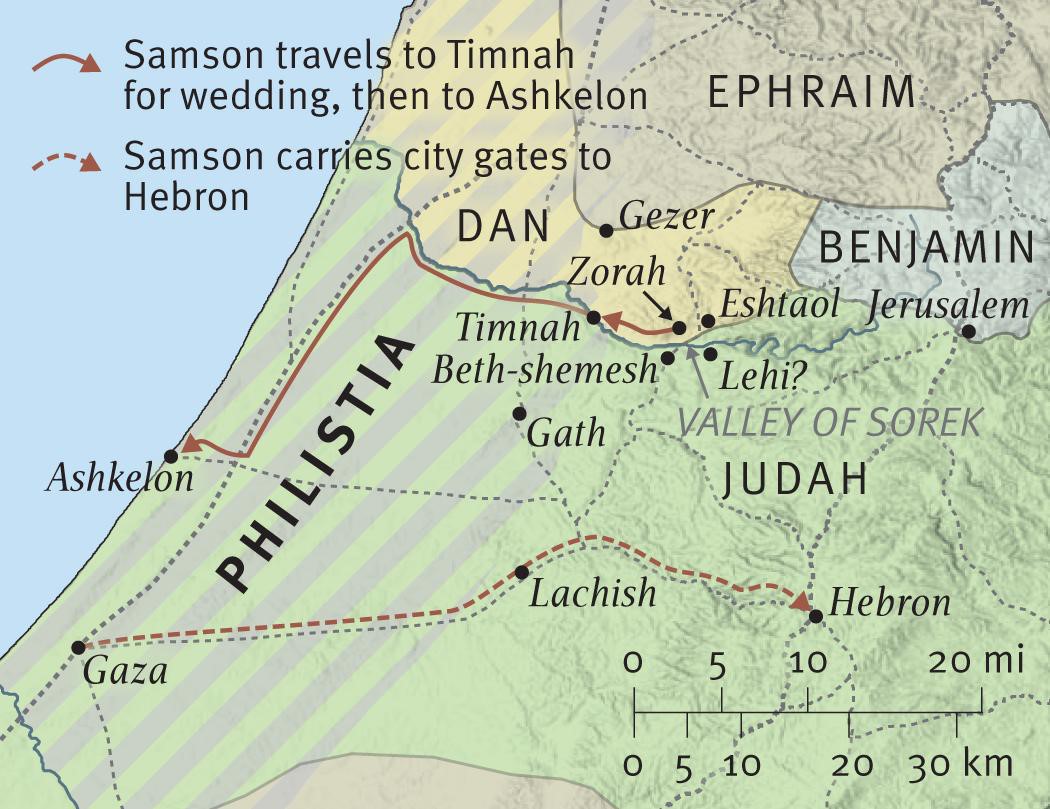
Samson's Birthplace in Zorah in territory of Dan
(on border with tribe of Judah)
(ESV Global Study Bible)
MANOAH A DANITE
WITH A BARREN WIFE
The tribe of Dan was originally assigned the land adjacent to Judah and Benjamin as shown in the map with extension to the Mediterranean Sea (Josh 19:40-48+). Since the Danites weren’t able to dislodge the coastal inhabitants, however, the tribe relocated north (Jdg 18:1ff,19), although some of their members remained in their original location.
And there was a certain man of Zorah, of the family of the Danites, whose name was Manoah; and his wife was barren ('aqar) and had borne no children - Manoah's name is from the Hebrew word nuach/nuah meaning rest. Zorah means hornet or place of wasps. Interesting as Samson proved to a "hornet" stinging many Philistines when he allowed the Spirit to empower and direct his actions!
Zorah 10x in 10v - Jos. 15:33; Jos. 19:41; Jdg. 13:2; Jdg. 13:25; Jdg. 16:31; Jdg. 18:2; Jdg. 18:8; Jdg. 18:11; 2 Chr. 11:10; Neh. 11:29
Zorah (Wikipedia) was a town first assigned to Judah (Jos 15:33), but later given to Dan (Jos 19:41). It became the point of departure for the Danite migration northward (Jdg 18:2, 8, 11). Zorah was on the border between Dan and Judah, opposite Beth-shemesh on the N side of Sorek valley, less than 15 miles from Jerusalem in the foothill country (shephelah - lowlands). The city was on the summit of a lofty hill on overlooking valley of Sorek (note). The summit itself is overhung by a lofty palm, and there are many remains of ancient tombs, cisterns, wine presses, etc., around this archeological site. From here Eshtaol (note), Beth-shemesh (note) and Timnah (note) are all visible. Nearby is the border of Philistia. Why was Danite village of Zorah located on a summit? One cannot be 100% certain but see (Jdg 1:34).
Zorah [ISBE]- zo'-ra (tsor`ah; Saraa): A city on the border of Dan, between Eshtaol and Ir-shemesh (Josh 19:41); the birthplace of Samson (Jdg 13:2,25); near here too he was buried (Jdg 16:31); from here some Danites went to spy out the land (Jdg 18:2,11). In Josh 15:33 it is, with Eshtaol, allotted to Judah, and after the captivity it was reinhabited by the "children of Judah" (Neh 11:29, the King James Version "Zareah"). It was one of the cities fortified by Rehoboam (2 Ch 11:10). It is probable that it is mentioned under the name Tsarkha along with Aialuna (Aijalon; 2 Ch 11:10) in the Tell el-Amarna Letters(No. 265, Petrie) as attacked by the Khabiri. It is the modern Sur`a, near the summit of a lofty hill on the north side of the Wady es-Surar (Vale of Sorek). The summit itself is occupied by the Mukam Nebi Samit, overhung by a lofty palm, and there are many remains of ancient tombs, cisterns, wine presses, etc., around. From here Eshu`a (Eshtaol), `Ain Shems (Beth-shemesh) and Tibnah (Timnah) are all visible. See PEF, III, 158, Sh XVII. E. W. G. Masterman
Duane Lindsey - How was it that Samson's parents, who were Danites, were still living in the Sorek Valley when much earlier the tribe of Dan had migrated north? (Judges 18:1ff) Apparently a few of the Danite clans stayed behind and did not move northward....Zorah, the highest point in the Shephelah, was on a high ridge north of the Sorek Valley and about 14 miles west of Jerusalem. Originally Zorah was a city of Judah (Josh. 15:20, 33), but later it was allotted to the tribe of Dan (Josh. 19:40–41). (See context The Bible Knowledge Commentary: Old Testament)
Warren Wiersbe - Samson was born in Zorah, a city in Dan near the Philistine border; and he often crossed that border either to serve God or satisfy his appetites. (OH MY!) (See context in The Bible Exposition Commentary)
George Bush - Of the city of Zorah; a town in the tribe of Judah, but afterwards given to Dan, being situated near the confines of each tribe. Josh. 15:33+. Of the family of the Danites. That is, of the tribe of Dan. The word is properly a collective singular for the plural. (resource)
Of the family of the Danites, whose name was Manoah; and his wife was barren ('aqar) and had borne no children: Danites (see discussion) - From Judges 13-18, the author concentrates on the tribe of Dan, which had been one of the largest and most prominent tribes during the wilderness march (Nu 2:25-31). In the period of the judges, however, Dan seemed helpless against the Amorites (Jdg 1:34+) and as noted moved northward to find new territory (Jdg 17,18).
William MacDonald - The barren womb is often a starting place in the purposes of God. He calls life out of death and uses the things that “are not” to confound the things that are (1Co 1:26-31+) (ED: AND ALL GOD'S CHILDREN SHOUT HALLELUJAH! THANK YOU JESUS!). (See context in Believer's Bible Commentary or borrow this book Believer's Bible Commentary)
Barren (Childlessness, Infertile, Sterile) - Regarded as a Misfortune or a Reproach: Ge 11:30, Ge 15:2, Ge 16:2, Ge 29:32, Ge 30:1-3, 13 Jdg 13:2 1Sa 1:2, 6 2Sa 6:23 2Ki 4:14 Isa 4:1 Lk 1:7-+, Lk 1:25+, Lk 20:29+
THOUGHT - Bishop Hall - ‘If Manoah’s wife had not been barren, the Angel had not been sent to her. Afflictions have this advantage, that they occasion God to show that mercy to us, whereof the prosperous are incapable.’
Bush - Was barren and bare not. An emphatic repetition in varied phrase, of frequent occurrence in the sacred writers. Thus Ge. 11:30, ‘Sarai was barren; she had no child.’ Jn 1:3, ‘All things were made by him, and without him was not an thing made that was made.’ Jn 1:20, (resource)
A R Fausset - And there was a certain man of Zorah [originally of Judah, in the Shephelah, or low rolling hills between the mountains and plains (Josh. 15:33; ‘valley,’ Hebr., Shephelah): subsequently assigned to Dan (Josh. 19:41) as a suitable border fortress: now Sur’ah, just below the brow of a sharp conical tell at the shoulder of the ranges which form the north side of the Wady Ghurab. Manoah possibly commanded the military post at “the camp of Dan” (i.e., the encampment of the Danite emigrants (Jdg 18:8, 11, 12) between Zorah and Eshtaol (Jdg 13:25): a check on the Philistines, who were in force three miles off at Timnath (Jdg 14:1–4, 15:6). Samson’s birthplace and the family burial-place was between Zorah and Eshtaol (Jdg 16:31). The charge to Samson not to drink wine, or eat what came of the vine, was the severer test of faith, because Zorah and the neighbourhood were famed for their choice vines (Jdg 15:5, 16:4; Gen. 49:11, Hebrew], of the family of the Danites [‘family’ is used for ‘tribe’; for all the Danites form one family, the Shuhamites (Numb. 26:42, 43). In Samson Jacob’s prophecy was to be fulfilled, “Dan shall judge his people” (Gen. 49:16)], whose name (was) Manoah; and his wife (was) barren, and bare not. (commentary)
Barren (06135) 'aqar refers to the state of not being fertile or not being able to become pregnant. The recurring theme of the barren mother is familiar in biblical history Sarah, Rebekah, Rachel, the mother of Samson, and Hannah are chief examples of this situation (Ge 11:30; 25:21; 29:31; Jdg 13:2, 3; 1Sa 2:5). God is often mentioned as the one who brought about this condition and/or the one who overcomes miraculously opening the wombs of Sarah, Rebekah, and Rachel and enabling them to give birth to sons (Isaac, Jacob, Joseph, Benjamin) who played a significant role in Israel's history. In light of the prior use of this type scene one might expect Manoah's wife's child to be important, like Isaac, whose birth was announced in a special manner (Ge 17-18).
Aqar - 11v - Gen. 11:30; Gen. 25:21; Gen. 29:31; Exod. 23:26; Deut. 7:14; Jdg. 13:2; Jdg. 13:3; 1 Sam. 2:5; Job 24:21; Ps. 113:9; Isa. 54:1
DAN, TRIBE OF [ISBE] (dan, "judge"; Dan).
1. Name: The fifth of Jacob's sons, the first borne to him by Bilhah, the maid of Rachel, to whom, as the child of her slave, he legally belonged. At his birth Rachel, whose barrenness had been a sore trial to her, exclaimed "God hath judged me .... and hath given me a son," so she called his name Dan, i.e. "judge" (Gen 30:6). He was full brother of Naphtali. In Jacob's Blessing there is an echo of Rachel's words, "Dan shall judge his people" (Gen 49:16). Of the patriarch Dan almost nothing is recorded. Of his sons at the settlement in Egypt only one, Hushim, is mentioned (Gen 46:23). The name in Nu 26:42 is Shuham.
2. The Tribe: The tribe however stands second in point of numbers on leaving Egypt, furnishing 62,700 men of war (Nu 1:39); and at the second census they were 64,400 strong (Nu 26:43). The standard of the camp of Dan in the desert march, with which were Asher and Naphtali, was on the north side of the tabernacle (Nu 2:25; 10:25; compare Josh 6:9 the King James Version margin, "gathering host"). The prince of the tribe was Ahiezer (Nu 1:12). Among the spies Dan was represented by Ammiel the son of Gemalli (Nu 13:12). Of the tribe of Dan was Oholiab (the King James Version "Aholiab") one of the wise-hearted artificers engaged in the construction of the tabernacle (Ex 31:6). One who was stoned for blasphemy was the son of a Danite woman (Lev 24:10 f). At the ceremony of blessing and cursing, Dan and Naphtali stood on Mount Ebal, while the other Rachel tribes were on Gerizim (Dt 27:13). The prince of Dan at the division of the land was Bukki the son of Jogli (Nu 34:22).
3. Territory: The portion assigned to Dan adjoined those of Ephraim, Benjamin and Judah, and lay on the western slopes of the mountain. The reference in Jdg 5:17: "And Dan, why did he remain in ships?" seems to mean that on the West, Dan had reached the sea. But the passage is one of difficulty. We are told that the Amorites forced the children of Dan into the mountain (Jdg 1:34), so they did not enjoy the richest part of their ideal portion, the fertile plain between the mountain and the sea. The strong hand of the house of Joseph kept the Amorites tributary, but did not drive them out. Later we find Dan oppressed by the Philistines, against whom the heroic exploits of Samson were performed (Jdg 14 ff). The expedition of the Danites recorded in Jdg 18 is referred to in Josh 19:47 ff.
QUESTION - What can we learn from the tribe of Dan?
ANSWER - The tribe of Dan was the group of people who descended from the fifth son of Jacob, Dan. Jacob had twelve sons who became the patriarchs of the twelve tribes of Israel.
The history of the tribe of Dan is especially instructive to us in that it contains multiple examples of the tendency of people to follow man-made religion over biblical faith in God.
This is totally contrary to the Scriptures that teach us “no one will be declared righteous in his sight by observing the law” (Romans 3:20) and “without faith it is impossible to please God” (Hebrews 11:6).
As the Israelites came into the land of Canaan, by lot certain areas of territory were assigned to each tribe. The tribe of Dan was given a tract of land that was smaller than the other land grants but was fertile and also had a boundary along the Mediterranean Sea where there was fishing and commerce available to them.
However, the tribe of Dan never fully conquered this area as a result of a lack of faith in God. This was true of the other tribes as well, as the early chapters of the book of Judges clearly teach, and led to a time during the period of Judges where it was said, “In those days there was no king in Israel; everyone did what was right in his own eyes.” Judges 18:1–31 tells the story of the people of Dan falling into idolatry. They also did not like the territory that was theirs, so they sent out spies to find a better area. In the north, some representatives of Dan learned of an area where a peaceful group of people lived. The tribe of Dan took things into their own hands and wiped out the people of that land so they could then move the entire tribe up to a region close to the sources of the Jordan River, just south of present-day Lebanon. There they established their main city and called it Dan.
Later in the history of the Hebrews, the kingdom was divided after the reign of Solomon. The kingdom split into Israel’s ten tribes in the north and Judah’s two in the south. The people of Dan were in the northern kingdom of Israel. We learn in 1 Kings 12:25–33 that King Jeroboam was afraid that those who lived in his kingdom in the north would still go down to the southern kingdom to worship at Jerusalem, since that was where the temple that God had authorized was located. So Jeroboam built two additional altars for the people of his nation to worship. He established worship in the south at Bethel and in the north at Dan. He built a golden calf at each location and instituted special days and feasts when people would meet. Sadly, this man-made worship at Dan has been one of its lasting legacies.
Today, many people follow various man-made religions and are convinced that all ways lead to God. Unfortunately, these groups follow the ways of the tribe of Dan. Proverbs 16:25 tells us that “there is a way that seems right to a man, but its end is the way of death.” Jesus taught that the way to God was specific when He said, “I am the way, the truth, and the life. No one comes to the Father except by Me” (John 14:6). John 3:36 teaches that “he who believes in the Son has everlasting life; and he who does not believe the Son shall not see life, but the wrath of God abides on him.” To learn from the mistakes of Dan would be to worship the God of the Bible alone and live for Him by faith.GotQuestions.org
Related Resources:
- Who was Dan in the Bible? | GotQuestions.org
- Why is the tribe of Dan missing from the 144,000 in Revelation chapter 7? | GotQuestions.org
- Manoah - Holman Bible Dictionary
- American Tract Society Manoah
- Easton's Bible Dictionary Manoah
- Fausset Bible Dictionary Manoah
- Hitchcock Bible Names Manoah
- Hastings' Dictionary of the Bible Manoah
- Morrish Bible Dictionary Manoah
- Hawker's Poor Man's Dictionary Manoah
- Watson's Theological Dictionary Manoah
- International Standard Bible Encyclopedia Manoah
- Kitto Biblical Cyclopedia Manoah
- McClintock and Strong's Bible Encyclopedia Manoah
- Descended from Jacob’s fifth son -Genesis 30:6
- Predictions respecting -Genesis 49:16,17; Deuteronomy 33:22
PERSONS SELECTED FROM
- To number the people -Numbers 1:12
- To spy out the land -Numbers 13:12
- To divide the land -Numbers 34:22
- Strength of, on leaving Egypt -Numbers 1:38,39
- Led the fourth and last division of Israel -Numbers 2:31; 10:25
- Encamped north of the tabernacle -Numbers 2:25
- Offering of, at dedication -Numbers 7:66, 67, 68, 69, 70, 71
- Families of -Numbers 26:42
- Strength of, entering Canaan -Numbers 26:43
- On Ebal, said amen to the curses -Deuteronomy 27:13
- Bounds of its inheritance -Joshua 19:40, 41, 42, 43, 44, 45, 46
- A commercial people -Judges 5:17; Ezekiel 27:19
- Restricted to the hills by Amorites -Judges 1:34
A PART OF
- Sent to seek new settlements -Judges 18:1,2
- Tool Laish and called it Dan -Joshua 19:47; Jdg 18:8, 9, 10, 11, 12, 13,27, 28, 29
- Plundered Michah of his idols and his ephod -Judges 18:17, 18, 19, 20, 21,27
- Set up Micah’s idols in Dan -Judges 18:30,31
- Reproved for not aiding against Sisera -Judges 5:17
- Samson was of -Judges 13:2,24,25
- Some of, at coronation of David -1 Chronicles 12:35
- Ruler appointed over, by David -1 Chronicles 27:22
COMPARISON BETWEEN SAMSON AND JOHN THE BAPTIST - It is fascinating to compare these two men...
- Barren Manoah and his wife, with the barren NT couple, Zacharias and Elizabeth,
- Both promised a son who would have "Nazirite-like" credentials.
- Both Samson and John were endued with Holy Spirit power.
- But that is where the parallel breaks down for while Samson failed to reach his potential as Israel's deliverer, John did not, instead boldly crying out as a voice in the wilderness to prepare the way of the Lord the Deliverer of all mankind!
- One final parallel is that in the end, both men were martyred!
Ray Pritchard introduces his 5 part series with the title Most Likely to Succeed
The Man Who Might Have Been - Today we begin the study of one of the strangest characters in all the Bible. His name and his exploits are well-known, but the man himself remains a mystery. Of his life it could truly be said that he had unlimited potential. No man in all the Bible started out with as much going for him; no man ended with less. Without question, he would have been voted by his classmates Most Likely to Succeed. He had it all and he let it all get away from him.
His name is Samson. His story is found in the Old Testament book of Judges. In four chapters the writer tells us about his rise and fall. It is a story rich in human drama—full of love and sex and intrigue and violence and passion and strange twists of fate.
The four chapters break down this way:
- Judges 13—His miraculous birth
- Judges 14—His untimely wedding
- Judges 15—His battlefield heroics
- Judges 16—His tragic death
As I said, almost everyone knows this story. Samson's feats are legendary—how he killed 1,000 Philistines with the jawbone of a donkey, how he set fire to the wheat fields by putting a torch in the tails of 150 pairs of foxes, how he killed 30 men to pay off a gambling debt. Surely all of us know the story of his tragic, heroic death when he destroyed the Philistine temple by pushing apart the pillars.
If his feats are legendary, so are his flaws. His greatest flaw was a weakness for women. He could never say no to a good-looking woman, a fact that repeatedly got him into trouble and eventually cost him his life. The woman who took him down—Delilah—has become a symbol for the seductive female.
What we see in Samson is a bristling bundle of contradictions:
- He was a man of faith with a weakness for women.
- He was a man of prayer given to uncontrollable fits of anger.
- He was a leader of Israel who lusted after Philistine women.
- He was a man of God who lacked common sense.
That's Samson—"a riddle wrapped in a mystery inside an enigma." He is listed in Hebrews 11 as a man of faith, yet he slept with a harlot. How do you figure it? (Excerpt from Most Likely to Succeed - you will be edified if you read the full message)
If the basic problem of Judges is that “everyone did what was right in his own eyes” (Jdg 21:25) then Samson is the supreme personal example of that ungodly attitude.
- Judges 13: Most Likely to Succeed
- Judges 14: Out of Control
- Judges 14-16 Samson and the Fine Art of Self-Control
- Judges 15: How an Angry Man Gets Even
- Judges 16:1-3 Little Steps to a Big Fall
- Judges 16:1-22: Looking for Love in All the Wrong Places
- Judges 16:23-31: The Comeback Kid
Comparing and contrasting the lives of Samson ("sunlight" or "sun-like") and Samuel ("heard of God") reveals several interesting points:
- Samuel was totally committed to God
- Samson was victorious only in his death because he was controlled by his passion
- Both were raised by godly parents,
- Both of their mothers were barren,
- Both lived in days of the moral anarchy of Judges
- Samson was probably "judging" Israel during time that Samuel was ministering to the LORD at the Tabernacle in Shiloh under the tutelage of Eli the High Priest so their lives overlapped),
- Both had a call to a separated life (Angel of LORD instructed Manoah's wife to raise him a NAZARITE to God [Jdg13:5], and Hannah vowed to give Samuel to the LORD all the days of his life and that no razor would ever come on his head which also sounds like a NAZARITE VOW although Samuel is never specifically called a Nazarite [1Sa 1:11]), Samuel ministered to the LORD (this phrase is used 3x to describe Samuel in his youth [1Sa 2:11, 2:18, 3:1) and finally heard the voice of the LORD but we have no similar record of Samson ever having intimate fellowship with the LORD; Samson received the Spirit of the LORD for strength; the LORD actually spoke with Samuel (1Sa 3:4, 6, v8, 11f) and revealed HIMSELF to him (1Sa 3:21)
- Both were Judges (Samuel also prophet) but only Samuel fulfilled the function of the judge to be a deliverer (Jdg 2:18).
- Both had the Philistines as their main ENEMY
- Samson was defeated by the Philistines & had only partial success; Samuel defeated the Philistines after 40 years of rule and brought peace to the land. (1Sa 7:10, 13, 15).
- Samson rebelled against the AUTHORITY of God and his parents; Samuel submitted to AUTHORITY, submitting to God, his parents (who had dedicated him to the LORD ALL the days of his life [1Sa 1:11]) and Eli. Samson DISOBEYED. Samuel OBEYED.
- Samuel was a PROPHET and called Israel to REPENT from their idolatry; Samson was a PRODIGAL & promoted compromise and collaboration with the uncircumcised Philistines and did not confront Israel for her idolatry.
- Samson's PRAYERS were primarily self serving (Jdg 15:18, 16:28); Samuel's were for the salvation of Israel (1Sa 7:5, 8, 9,10). God answered both of their prayers!
- Samson was a LONER; Samuel was a LEADER. Some would say Ehud was a loner also but that is not completely true as he was the LEADER of the sons of Israel in the pursuit of the Moabites (Jdg 3:12-26, 27, 28, 29, 30).
- Samson broke every NAZARITE VOW; Samuel appears to have remained dedicated to the LORD all his life thus fulfilling the vow of his mother Hannah.
- Samson manifested WEAKNESSES in the lust of his flesh, the lust of his eyes and the boastful pride of life; Samuel was a man dependent on God and there is no record of similar weakness in his life. Sadly his sons "did not walk in his ways" even his first born name Joel (1Sa 8:3, 5).
- Samson did what was right in his own eyes (the very Hebrew phrase used of his lust for the Philistine woman Jdg 14:3, 7); Samuel was dedicated to the LORD.
- Samson's life ended tragically and ignominiously without mourning by Israel; All Israel MOURNED when Samuel died (1Sa 25:1)
- Samson in many ways is a tragic picture of the entire nation of Israel —born by special divine provision, consecrated to the Lord from birth and endowed with unique power among his fellowmen. The likeness is even more remarkable in light of his foolish chasing of foreign women, some of ill repute, until he was cleverly subdued by one of them. In this he exemplified Israel, who during the period of the judges constantly prostituted herself to Canaanite gods to her own destruction.
The people having relapsed into unfaithfulness, were in subjection to enemies within — to the Philistines, who were established in Israel's territory. It was the last stage in the history of declension. The children of Israel no longer cried to Jehovah; submitting to this state of things, they did not even wish to be delivered from it (Jdg 15:11), and, for the sake of living quietly in their state of servitude, sought to get rid of their liberator. The time of total apostasy was at hand.
In the midst of this irremediable state of things, God separated a godly remnant, and addressed his communications to them. Manoah and his wife feared Jehovah, listened to His voice and spake to one another (cf. Mal. 3:16), a striking type of the remnant — of the Marys, and Elizabeths, and Annas, and Zacharias, and Simeons — that waited for the true Messiah, the Saviour of Israel; type also of the future remnant, who, passing through the tribulation, will follow the paths of righteousness, waiting for the coming of their King.
Samson, the deliverer of Israel, found at his birth, not a people that welcomed him, but this godly couple who believed in his mission. The Lord, rejected by the people from the time of His arrival on the scene, found only a few faithful souls with whom He could enter into association, those excellent of the earth mentioned in Ps 16:3 (Spurgeon's note), in whom He found His delight. Times of irremediable ruin are then the times of remnants; this, consequently, applies to the present period of the church — a period foretold by the Sovereign Prophet to His disciples, when He spoke to them of an assembly reduced to two or three gathered to the true centre, to the name of Christ, during His absence. This period is mentioned in Revelation, when — in presence of the idolatry of Thyatira, the deadness of Sardis, and the nauseating lukewarmness of Laodicea — the approbation of Him that is holy, of Him that is true, is pronounced upon the feeble separated remnant of Philadelphia.
That which characterizes a remnant at all times is Nazariteship, entire "separation unto the Lord." The angel of Jehovah appearing unto the wife of Manoah, said to her: "Behold now, thou art barren, and bearest not; but thou shalt conceive, and bear a son. Now therefore beware, I pray thee, and drink not wine nor strong drink, and eat not any unclean thing" (Jdg 13:3, 4). This woman had to take upon herself Nazariteship, because she was the vessel chosen of God to present to the people the promised deliverer. "For, lo, thou shalt conceive, and bear a son; and no razor shall come on his head; for the child shall be a Nazarite unto God from the womb; and he shall begin to deliver Israel out of the hand of the Philistines" (Jdg 13:5). The Nazariteship of Samson involved that of his mother. In order to do honour to the deliverer of Israel, it was needful for his witnesses to bear before the eyes of all, the impress of his own character. This is true at all times. If we do not manifest Christ down here in His character of entire separation to God, we are not witnesses for our Saviour. Christ having come, permanent Nazariteship should characterize the saints as it does the Lord; and the more the ruin increases, the more apparent will this become. The second epistle of Timothy, which tells us of the last days, is full of the characteristics of Nazariteship. In Judges 2:19, it is the Nazarite withdrawing from iniquity; in Judges 2:21, it is his purifying himself for God; in Judges 3:10, 11, and Judges 4:5, 6, 7, it is, as the servant of God, walking in forgetfulness of self and in absolute dependence on the Lord. Is it not the Nazarite who speaks in 2Co 4:7, 8, 9, 10, 11, 12? In Judges 6 through Jdg 7:1, of this same epistle we again find the principal traits of Nazariteship; reproach and self-forgetfulness in Jdg 13:4-10; separation from all association with the world in Jdg 13:14, 15; cleansing from all filthiness of the flesh and spirit in Judges 7:1. Quotations might be multiplied. What it is important to establish is, that there is for us, neither walk. nor testimony, nor service, without Nazariteship; that is to say, without devotedness and separation to God.
In Jdg 13:6, Manoah's wife told her husband about the angel's visit: "A man of God came unto me, and his countenance was like the countenance of an angel of God, very terrible; but I asked him not whence he was, neither told he me his name." This poor woman had but little intelligence; she knew neither whence the angel came nor who he was, nor did she ask him, proving how slight was her acquaintance with God. Far from giving her confidence, the presence of the God of promises frightened her, for she only saw the countenance of the angel to be "very terrible." Manoah himself, a man of sincere piety, had little understanding, but he desired more. He wished to know "what to do unto the child" (v. 8), then, "what shall he do" (Jdg 13:12, margin). Instead of answering his questions, the angel of Jehovah said to him: "Of all that I said unto the woman let her beware. She may not eat of anything that cometh of the vine, neither let her drink wine or strong drink, nor eat any unclean thing; all that I commanded her let her observe" (Jdg 13:13, 14). Why? Because knowledge is not the first thing that God requires. Neither it, nor even true piety, such as was found in Manoah and his wife, is sufficient to keep us in the midst of the ruin. That which was needed for them before knowledge was true personal separation to God, a separation which had as its pattern and measure the Nazariteship of him who was about to appear.
Other truths too — the portion of Christ's witnesses in a day of declension — are revealed to us here. "Manoah said unto the angel of Jehovah, What is thy name … And the angel of Jehovah said unto him, Why askest thou thus after my name, seeing it is wonderful (margin). So Manoah took a kid with a meat offering, and offered them upon a rock unto Jehovah; and the angel did wondrously; and Manoah and his wife looked on" (Jdg 13:17, 18, 19).
In reviewing the history of the different epochs of this book, we find that to each revival there are certain corresponding principles which characterize it. The times of Othniel, Ehud, Barak, Gideon and Jephthah, each furnishes us with some new principle; but God reserves the most precious truths of all for the last days of ruin, hidden until then and wonderful. How worthy of the God of love is such a way of acting! Knowing the difficulties of His own in the midst of increasing unfaithfulness and wishing to attract their hearts in the midst of this darkness, He brings to light and confides to His witnesses truths more and more glorious.
The starting point of these truths is the sacrifice. Manoah, more intelligent than Gideon (cf. Judges 6:19), took the kid with the meat offering, and offered them upon a rock unto Jehovah. The cross is the foundation of all our knowledge as children of God. Manoah was desirous of knowing many things which Jehovah could not reveal to him before the sacrifice. But this foundation once laid, the angel did wondrously, which doubtless was revealed, in a manner still obscure and symbolical, to the eyes of this poor remnant who were waiting for a Saviour. "For it came to pass, when the flame went up toward heaven from off the altar, that the angel of Jehovah ascended in the flame of the altar. And Manoah and his wife looked on" (Jdg 13:20). They found in the fire of the sacrifice a new way, not opened up hitherto, a way for the representative of Jehovah to ascend to Him; and, their gaze fixed on the angel, they saw a glorious person, whose dwelling place they knew now that he had disappeared from before their eyes. Then only, "Manoah knew that it was an angel of Jehovah" (Jdg 13:21). The heart and the interests of this poor remnant were at that moment withdrawn from this world, and followed the angel, ascending with him to heaven. These simple believers could thenceforth speak of a path which led to heaven, and of a person who was there, who had become their object while they were still here below.
In this wonderful act another thing was revealed, not for Manoah, but for us: the future character of this Nazariteship of which the angel had spoken to them. It is now heavenly, as we have above remarked. The angel in parting from them went up into heaven. The Lord Jesus, rejected by the world, said: "For their sakes I sanctify myself, that they also might be sanctified through the truth" (John 17:19). Set apart in heaven, He attracts us after, and fixes our eyes upon, Himself; in order that the heavenly character of the One whom the world has rejected may be reproduced in us here below. In presence of this revelation, so instructive for us, but of which Manoah and his wife had but a faint glimpse, they "fell on their faces to the ground" (Jdg 13:20). And shall not we, in the midst of increasing darkness, adore in fuller measure, the God who has revealed to us, not only a heavenly and glorified Christ, but our place in Him, and has given Him to us as an object that we may reflect Him more perfectly in this world? Such are the blessings given to fill our hearts with joy and gratitude. How many Christians there are, who, seeking a place in the world, walk down here with bowed heads as they see the state of things around them, and vex their souls from day to day, as just Lot did of old — but such is not our part; we are not called to be Lots, nor to act like him down here. Our portion is with Abraham, the friend of God, who was not disheartened by the ruin. As a Nazarite he kept his place on his high mountain, his eyes fixed — not on Sodom, but — on the city which hath foundations. Jesus said of him: "Abraham rejoiced to see My day; and he saw it and was glad" (John 8:56). Ah! rather than be discouraged, let us praise God, and thank Him for the heavenly treasure He has given us in Christ.
Like so many Christians of the present day, Manoah was filled with fear when he found himself in the presence of God. "He said to his wife, we shall surely die, because we have seen God" (Jdg 13:22). His companion was a true helpmeet for him. Is there any room for fear, said she, when God has accepted our offering? The love of God, proved to us at the cross. is the positive guarantee for everything else. "He that spared not His own Son, but delivered Him up for us all, how shall He not with Him also freely give us all things?" (Ro. 8:32-note)
Judges 13:3 Then the Angel of the LORD appeared to the woman, and said to her, "Behold now, you are barren and have borne no children, but you shall conceive and give birth to a son.
- Then the Angel of the LORD appeared to the woman Jdg 2:1; 6:11,12; Ge 16:7-13; Luke 1:11,28-38
- but you shall conceive and give birth to a son - Ge 17:16; 18:10; 1Sa 1:20; 2Ki 4:16; Lk 1:13,31
- Judges 13 Resources
THE GOOD TIDINGS FROM
THE MESSENGER OF YAHWEH
Then the Angel (malak) of the LORD appeared to the woman - Keep in mind the ancient world was an "androcentric" culture, so for the woman to be selected as the recipient of this great news is another reminder that God is NOT a misogynist! As one can readily discern from carefully studying the context of Judges 13, this Angel is no ordinary (created) angel, but all indicators point to the fact that this Angel is the pre-incarnate representation of the Lord Jesus Christ. Notice the greatest number of appearances of the Angel of the LORD in the book of Judges, which describe some of the darkest days in Israel's entire history. Note like a number of other women in the book of Judges, she goes unnamed.
The Angel of the LORD - (see study of this important OT phrase - Angel of the LORD). Here are all the OT uses of this phrase in the ESV - Ge 16:7, 9, 10, 11, 22:11, 15; Ex 3:2; Nu 22:22, 23, 24, 25, 26, 27, 31, 32, 34, 35, Jdg 2:1, 4; 5:23; 6:11, 12, 21, 22; 13:3, 13, 15, 16, 17, 18, 20, 21; 2Sa 24:16; 1Ki 19:7; 2Ki 1:3, 15; 19:35; 1Chr 21:12, 15, 16, 18, 30; Ps 34:7; 35:5, 6; Isa 37:36; Zec 1:11, 12; 3:1, 5, 6; 12:8.
I agree with Dave Guzik who offers the following interpretation of the Angel noting that "As seen before in the Book of Judges (Jdg 2:1, 2, 3, 4, 5 and Jdg 6:11, 12, 13-20, 21, 22, 23, 24), this is Jesus on a special mission, appearing as a man before His incarnation in Bethlehem." (Judges 13)
As Warren Wiersbe said "when God wants to do something really great in His world, He doesn’t send an army but an Angel. The Angel of the LORD visits a couple and promises to send them a baby. His great plan of salvation got underway when He called Abraham and Sarah and gave them Isaac. When He wanted to deliver Israel from Egyptian bondage, God sent baby Moses to Amram and Jochebed (Ex 6:20) and when in later years Israel desperately needed revival, God gave baby Samuel to Hannah (1Sa 1:14-20). When the fullness of time arrived (Ga 4:4), God gave Baby Jesus to Mary; and that baby grew up to die on the cross for the sins of the world....We have every reason to believe the "Angel of the LORD" who visited Manoah's wife was Jesus Christ, the Son of God (see Ge. 22:1-18; 31:11-13; Ex. 3:1-6; Judg. 6:11-24). Like Sarah (Gen. 18:9-15), Hannah (1Sa 1), and Elizabeth (Luke 1:5-25), Manoah's wife was barren and never expected to have a child. Since it would be the mother who would have the greatest influence on the child, both before and after birth, the angel solemnly charged her what to do. (See the context in The Bible Exposition Commentary)
George Bush adds that this is "The uncreated angel, the Angel Jehovah, so often spoken of in the preceding narrative, and who appeared to Moses, to Joshua, to Gideon, and others. Evidence of this will disclose itself as we proceed." (resource)
And said to her, "Behold (hinneh), now, you are barren ('aqar) and have borne no children, but (a wonderful term of contrast - change of direction!) you shall conceive and give birth to a son. - NET = "You are infertile and childless, but you will conceive and have a son." (Jdg 13:3NET) NIV = "You are sterile and childless" (Jdg 13:3NIV) The Angel bestows a blessing to a barren one that she would bear a child and not just a child but a son. Son's were highly prized in the ancient world. This would have brought great joy to the woman, but He will add some "caveats" in the following passages. It is notable that her husband Manoah is not present initially. This is much like when an angel appeared to the virgin Mary with good tidings.
The announcements of the births of Ishmael (Ge 16:11), Isaac (Ge 18:10), Immanuel (Isa 7:14), John the Baptist (Lk 1:13) and Jesus (Lk 1:31). This promise came as a great blessing to this woman burdened by childlessness. In First Samuel God gave a similar message through the priest Eli…
Then Eli answered and said (to Hannah), "Go in peace; and may the God of Israel grant your petition that you have asked of Him." 18 And she said, "Let your maidservant find favor in your sight." So the woman went her way and ate, and her face was no longer sad. 19 Then they arose early in the morning and worshiped before the LORD, and returned again to their house in Ramah. And Elkanah had relations with Hannah his wife, and the LORD remembered her. 20 And it came about in due time, after Hannah had conceived, that she gave birth to a son; and she named him Samuel, saying, "Because I have asked him of the LORD." (1Sa 1:17-20)
Behold (02009)(hinneh) is an interjection meaning behold, look, now; if. "It is used often and expresses strong feelings, surprise, hope, expectation, certainty, thus giving vividness depending on its surrounding context." (Baker) Hinneh generally directs our mind to the text, imploring the reader to give it special attention. In short, the Spirit is trying to arrest our attention!
Hinneh is translated in the Septuagint with the interjection idou (strictly speaking a command in the second person aorist imperative, middle voice) a demonstrative particle (used 1377 times in the Septuagint and NT) which is found especially in the Gospels of Matthew and Luke "and giving a peculiar vivacity to the style by bidding the reader or hearer to attend to what is said: "Behold! See! Lo!" (Thayer) The command is calling for urgent attention. Do this now! Don't delay! It could be loosely paraphrased "Pay attention!" or "Listen up!" to arouse attention and introduce a new and extraordinary fact of considerable importance.
Spurgeon reminds us that "Behold is a word of wonder; it is intended to excite admiration. Wherever you see it hung out in Scripture, it is like an ancient sign-board, signifying that there are rich wares within, or like the hands which solid readers have observed in the margin of the older Puritanic books, drawing attention to something particularly worthy of observation." I would add, behold is like a divine highlighter, a divine underlining of an especially striking or important text. It says in effect "Listen up, all ye who would be wise in the ways of Jehovah!"
Hinneh in Judges - Jdg. 1:2; Jdg. 3:24; Jdg. 3:25; Jdg. 4:22; Jdg. 6:15; Jdg. 6:28; Jdg. 6:37; Jdg. 7:13; Jdg. 7:17; Jdg. 8:15; Jdg. 9:31; Jdg. 9:33; Jdg. 9:36; Jdg. 9:37; Jdg. 11:34; Jdg. 13:3; Jdg. 13:5; Jdg. 13:7; Jdg. 13:10; Jdg. 14:5; Jdg. 14:8; Jdg. 14:16; Jdg. 16:10; Jdg. 17:2; Jdg. 18:9; Jdg. 18:12; Jdg. 19:9; Jdg. 19:16; Jdg. 19:22; Jdg. 19:24; Jdg. 19:27; Jdg. 20:7; Jdg. 20:40; Jdg. 21:8; Jdg. 21:9; Jdg. 21:19; Jdg. 21:21
Angel (Messenger) (04397) (malak) is one who bears a message (a notice, word or communication, written or verbal, sent from one person to another) or does an errand. Malak is most often translated as angel. About one half of the uses of malak refer to human messengers used to carry messages between individuals (Jacob, Esau Ge 32:3, 6, announced good news = 1Sa 6:21, threats = 1Ki 19:2, 1Sa 11:3, 4, 9; cf. 2Sa 11:19; 2Ki 5:10) or who function as the channels of diplomatic communication between national leaders (Moses, king of Edom - announced requests = Nu 20:14, cp Nu 22:5, Jdg 7:24, see also malak used for diplomatic representatives = Jdg 11:12-14, 2Sa 5:11, 1Ki 20:2). Malak is used of God’s prophets sent as His representatives to bring His word to His people Israel (2Chr 36:15-16; Jer 25:4; Hag 1:13, Isa 44:26, Mal 3:1). Malak applies to priest once (Mal 2:7, possibly Eccl 5:6). The entire nation of Israel is referred to as God's messenger (Isa 42:19). A malak could be sent to spy (Josh 6:25), to kill (1Sa 19:11, 2Ki 6:32), to summon someone (Bathsheba in 2Sa 11:4).
Stone has an interesting note on angel or messenger - Messengers in antiquity represented their senders, their masters; for the practical purpose of conveying the message, they rhetorically stood as substitutes for the sender, delivering the message in the first person as though they themselves were the sender. Commonly, more than one messenger was sent to ensure delivery of the message. A single messenger often implied a highly sensitive message, and only the most reliable agent would be dispatched alone. Thus, when David gave Uriah the orders that would result in Uriah's own death, he knew Uriah's integrity well enough to trust Uriah would not violate the privacy of the message (2Sa11:14). Thus, the prophet as messenger embodies both the closeness of the prophet's relationship with Yahweh and the high level of integrity needed for Yahweh to entrust his word to the prophet. The recipient's treatment of the messenger signaled the recipient's respect or disdain for the sender, such that to harm or abuse a messenger was a casus belli (cf. 2 Sam 10:1-8). (See context Joshua, Judges, Ruth)
Judges 13:4 "Now therefore, be careful not to drink wine or strong drink, nor eat any unclean thing.
- be careful not to drink wine or strong drink: Jdg 13:14 Nu 6:2,3 Lu 1:15
- nor eat any unclean thing: Lev 11:27,44-45 Ac 10:14
- Judges 13 Resources
Related Passages:
Leviticus 11:27; 44-45+ ‘Also whatever walks on its paws, among all the creatures that walk on all fours, are unclean to you; whoever touches their carcasses becomes unclean until evening....44 ‘For I am the LORD your God. Consecrate yourselves therefore, and be holy, for I am holy. And you shall not make yourselves unclean with any of the swarming things that swarm on the earth. 45 ‘For I am the LORD who brought you up from the land of Egypt to be your God; thus you shall be holy, for I am holy.’”
ANGELIC WARNINGS
TO THE WOMAN
Now therefore be careful (shamar; Lxx - phulasso in aorist imperative) not to drink wine or strong drink (shekar) - NET = "Now be careful!" The Angel of the LORD gives these specific instructions to Manoah's wife during Samson's intrauterine gestation. He is in essence binding her to be sure to carry out the Nazirite vow. Abstinence from wine (no grape products) or strong (intoxicating) drink were part of the restrictions given in the Nazirite vow (Nu 6:3+). Wine was often mixed with water, reducing its alcoholic content, but even this was forbidden.
Nor eat any unclean thing - These divine instructions are in preparation of Samson being a Nazarite in a sense, even while in his mother's womb. These instructions indicate that Manoah's wife (she is never specifically named) also had to share in the Nazirite vow during the time of Samson's gestation. The vow is usually voluntary but in Samson's case it was a divine decree from the Angel as seen and in that sense was "involuntary" for Samson.
Keil and Delitzsch - The Angel of the Lord announced to this woman, who was barren, “Thou wilt conceive and bear a son. And now beware, drink no wine or strong drink, and eat nothing unclean: for, behold, thou wilt conceive and bear a son, and no razor shall come upon his head; for a vowed man of God (Nazir) will the boy be from his mother’s womb,” i.e., his whole life long, “to the day of his death,” as the angel expressly affirmed, according to v. 7. The three prohibitions which the angel of the Lord imposed upon the woman were the three things which distinguished the condition of a Nazarite (see at Nu 6:1–8, and the explanation given there of the Nazarite vow). The only other thing mentioned in the Mosaic law is the warning against defilement from contact with the dead, which does not seem to have been enforced in the case of Samson. (Commentary)
George Bush - As the child, whose birth was now announced, was to be a Nazarite from the womb, the mother herself was to be subjected to the law of the Nazarites, that the sanctification of her son might commence from herself. She must, during the period of gestation and nursing, abstain from wine and every inebriating liquor, and all kinds of forbidden food. Things that would be lawful at another time, were to be refrained from now. The nourishment of her child would partake of the qualities of her own, and this future deliverer of Israel must be in the strictest manner and through every period an example of separation and consecration to God. Unclean meats were forbidden to all Israelites at all times; but especially and pre-eminently so to the Nazarite, Lev. 11:1–47. (resource)
Be careful (08104)(shamar) means to keep, watch, preserve, to guard, to be careful, to watch over, to watch carefully over, to be on one’s guard. Hedge about as with thorns - the word the Hebrews used for a shepherd’s keeping watch over a flock of sheep. Conveyed the idea of protection as in Ps 121:7-8+ (used 3 times!) In the great Aaronic blessing Nu 6:24+ The first use of shamar in Ge 2:15 is instructive as Adam was placed in the garden (a perfect environment) and was commanded to "keep" it which in the Septuagint is translated with phulasso (which is used to translate many of the OT uses of shamar) which means to guard like a military sentinel would at his post. Clearly Adam did not do a good job at "keeping" the garden safe from intruders! And because of this failure he was cast out of the garden and angels stationed to "guard (Lxx = phulasso) the way to the tree of life" so that he would not eat of it (Ge 3:24+). After Cain murdered Abel he answered God "Am I my brother’s keeper?” (Ge 4:9)
Uses of shamar in Judges - Jdg. 1:24; Jdg. 2:22; Jdg. 7:19; Jdg. 13:4; Jdg. 13:13; Jdg. 13:14;
Strong drink (07941)(shekar from shakar) refers to an intoxicating drink and is usually understood as some kind of beer. "Most likely not "liquor" for there is no evidence of distilled liquor in ancient times. It denotes not just barley beer but any alcoholic beverage prepared from either grain or fruit. (See online TWOT)
Gilbrant - Derived from the verb shākhar, "to be drunk," shfikhār occurs twenty-three times in the OT and has a number of cognates in Semitic, most denoting "beer" or a broader category of "intoxicating drink." The noun also made its way as a loanword into Greek from the Semitic world.
This noun has a broader usage than "beer," as it refers to fermented beverages produced by fruit as well. Jerome, writing in the fourth century a.d., stated that shfikhār could be made from grain, fruit or honey. Beer was a common beverage throughout the ancient Near East and was made from fermented barley. In twenty-one of its occurrences in the Hebrew Bible, the noun is paired with the noun yayin (HED #3302), "wine," and was generally used as a pairing to denote all intoxicating beverages. Thus, the noun seems to represent the totality of intoxicating beverages, exclusive of wine. This may be evidenced in the broad semantic range of this noun among cognates.
When the noun appears, it is usually in contexts in which consumption of the beverages in question is a negative act. The contrary is true among other ancient Near East cultures, as drinking was considered an integral part of human and divine society. Myths are replete with stories of the gods getting drunk, including the Ugaritic myth which concluded with a colophon passing on a divine hangover remedy for humans. An Akkadian legend, the Epic of Gilgamesh, has a character created by the gods to be a peer to Gilgamesh, by the name of Enkidu. Enkidu was a wild man, living in animal societies, until he encountered a prostitute and beer. Then he was said to have become civilized.
However, drunken imagery conveys negative circumstances throughout the Hebrew Bible. All those ritually purified for tasks before Yahweh were to be free of wine and other intoxicants. Ritual purification demanded that those coming into contact with the divine world must be in accord with that realm, in terms of physical soundness and freedom from contaminants. Wine and shfikhār were contaminants, as was evidenced by the prohibition against the priests having either when serving in the Tabernacle or Temple (Lev. 10:9). Eli castigated Hannah for approaching the Tabernacle in a condition which he assumed meant she was drunk (1 Sam. 1:15). Nazirites were forbidden to consume either wine or shfikhār while their vow was in effect (Num. 6:3; Judg. 13:4, 7, 14). Isaiah presented an image of defiled priests and prophets who were reeling with intoxicants, to the extent that the tables of the Temple were covered with vomit (Isa. 28:7f).
Rulers were to avoid shfikhār, according to the teachings of Lemuel (Prov. 31:4). The role of the king in keeping societal order, in imitation of the order of the divine world, is found throughout ancient Near Eastern literature. The office of king was another sacral office, like the priesthood. The inability of drunken individuals to make good decisions was behind the complaint of the psalmist, who lamented that his life had become the sort of thing which drunks at the gate discuss (Ps. 69:12). Addiction, or at least the mental incapacitation which accompanies drinking, is alluded to in the aphorism, "Wine is a mocker, and strong drink is raging" (Prov. 20:1).
The elite responsible for running the government and looking out for the welfare of the poor were castigated for their interest in wine and shfikhār, rather than being interested in their real function. Isaiah projected these people as rising early to pursue shfikhār and staying up late to drink wine (Isa. 5:11, 22). These same people were characterized metaphorically as shepherds who abandoned their sheep in order to get drunk (56:12). These leaders were not interested in guiding the people according to Yahweh's will, but rather preferred to silence prophetic warnings. Micah announced, "If a man walking in the spirit and falsehood do lie, saying, I will prophesy to you of wine and of strong drink; he will even be the prophet of this people" (Mic. 2:11). The incapacity of drunken people to defend themselves is underscored in the imagery of Isa. 29:9. Those resisting Yahweh would be staggering, unable to resist, but not from wine or strong drink. In that day, the frivolity of drunkenness would disappear as the earth was laid waste in judgment (24:9). Shfikhār was used legitimately in two ritual contexts. It is found in the course of presenting the daily offering in Num. 28:7. It was to accompany the lamb which was to be sacrificed. Likewise, during a time of celebration, it was to be poured out.(Complete Biblical Library)
Stone on strong drink - While most consider the Hebrew term used here, shekar (08104), a reference to some form of strong wine, Boling (1975:219) claims that it refers to brewed alcoholic drinks, i.e., beer, which had a higher alcohol content than typical wine. Recent research confirms the prevalence of barley beer in Israel. Since the Hebrew term denotes both the drink and the state of drunkenness, it seems likely that this beer had higher alcohol content than most wines (Homan 2010). The Philistines seem to have been noteworthy drinkers, judging from the frequency of carafes with integral strainers in the Philistine pottery inventory. (See context Joshua, Judges, Ruth)
Shekar - 20v- drink(2), drink of strong(1), drink or strong(1), drunkards*(1), liquor(1), strong(2), strong drink(18). Lev. 10:9; Num. 6:3; Num. 28:7; Deut. 14:26; Deut. 29:6; Jdg. 13:4; Jdg. 13:7; Jdg. 13:14; 1 Sam. 1:15; Ps. 69:12; Prov. 20:1; Prov. 31:4; Prov. 31:6; Isa. 5:11; Isa. 5:22; Isa. 24:9; Isa. 28:7; Isa. 29:9; Isa. 56:12; Mic. 2:11
Judges 13:5 "For behold, you shall conceive and give birth to a son, and no razor shall come upon his head, for the boy shall be a Nazirite to God from the womb; and he shall begin to deliver Israel from the hands of the Philistines."
NET Look, you will conceive and have a son. You must never cut his hair, for the child will be dedicated to God from birth. He will begin to deliver Israel from the power of the Philistines."
BBE For you are with child and will give birth to a son; his hair is never to be cut, for the child is to be separate to God from his birth; and he will take up the work of freeing Israel from the hands of the Philistines.
CSB for indeed, you will conceive and give birth to a son. You must never cut his hair, because the boy will be a Nazirite to God from birth, and he will begin to save Israel from the power of the Philistines."
NLT You will become pregnant and give birth to a son, and his hair must never be cut. For he will be dedicated to God as a Nazirite from birth. He will begin to rescue Israel from the Philistines."
NRS for you shall conceive and bear a son. No razor is to come on his head, for the boy shall be a nazirite to God from birth. It is he who shall begin to deliver Israel from the hand of the Philistines."
- no razor Nu 6:2-5; 1Sa 1:11
- begin: 1Sa 7:13 2Sa 8:1 1Chr 18:1
- Judges 13 Resources
Related Passages:
Numbers 6:2-5+ “Speak to the sons of Israel and say to them, ‘When a man or woman makes a special vow, the vow of a Nazirite, to dedicate himself to the LORD, 3 he shall abstain from wine and strong drink; he shall drink no vinegar, whether made from wine or strong drink, nor shall he drink any grape juice nor eat fresh or dried grapes. 4 ‘All the days of his separation he shall not eat anything that is produced by the grape vine, from the seeds even to the skin. 5 ‘All the days of his vow of separation no razor shall pass over his head. He shall be holy until the days are fulfilled for which he separated himself to the LORD; he shall let the locks of hair on his head grow long.
Hebrews 11:32+ (SAMSON'S LEGACY) And what more shall I say? For time will fail me if I tell of Gideon, Barak, Samson, Jephthah, of David and Samuel and the prophets,
A CHILD DEDICATED
TO GOD FROM BIRTH
Behold (hinneh) is used by the Angel to direct her mind to what He is about to say.
You shall conceive and give birth to a son, and no razor shall come upon his head, for the boy shall be a Nazirite (nazir) to God from the womb - NLT = "For he will be dedicated to God as a Nazirite from birth." Literally "a Nazirite of God he will be." The Angel of the LORD gives more instructions now specifically directed to the raising of their son. Nazirite was a symbol of a life devoted to God and separated from all sin, a holy life. His uncut hair was the sign of the separation, and dedication to God.
Other servants of God who were chosen before birth include Jeremiah (Jer 1:4,5) and Paul (Ga 1:15), although Ps 139:15,16 teaches that the Lord is involved in the conception of every child (Ps 127:3).
Stone on no razor shall come upon his head - Hairstyle served as one important cultural feature distinguishing the Israelites from the Philistines. The clean-shaven and barbered Philistines contrasted with the Israelite practice, which discouraged excessive trimming of the hair and beard (Bloch-Smith 2003). The Nazirite's long hair thus intensified an already obvious contrast between the Israelites and Philistines, accentuating the identity boundary so vital to this story. (See context in Joshua, Judges, Ruth)
A R Fausset on you shall conceive - Probably, at this time she was feeling sadly her childless state; God sends comfort just when His people feel their trouble most. So at the births of Isaac, Samuel, and John the Baptist (Ge. 16:1, Ge 18:10–14; 1Sa 1, 10, 11, 15, 16, 2:5, 20; Lk 1:7)]. ; but thou shalt conceive, and bear a son [so Luke 1:11–14, 26–37]. (commentary)
George Bush on a Nazarite unto God from the womb—Oriental usage at the present day affords a striking parallel to what is here recorded. ‘All who are married in the East,’ says Mr. Roberts, ‘have an intense desire for children. It is considered disgraceful, and a mark of the displeasure of the gods, to have a childless house. Under these circumstances, husbands and wives perform expensive ceremonies; and vow that should the gods favor them with a son, ‘no razor shall come upon his head’, (i. e. except upon the ‘corners,’) until he shall be ten or twelve years of age. In all schools, boys may be seen with elf-locks of ten or twelve years’ standing, giving a testimony to the solicitude, superstition, and affection of the parents, and a memorial of the favor of the gods.(resource)
THOUGHT- Samson was granted by God 20 years to overcome the enemy, but sadly in the end was himself overcome by the enemy! Do not be deceived (present imperative with a negative see our need to depend on the Holy Spirit to obey). God is not mocked. We will (ALL) reap what we sow! (Gal 6:7-10+) Samson did not discipline his body, and as a result he lost his efficacy as the instrument of the LORD to carry out His work, which reminds one of Paul's strong warning to the saints at Corinth
Do you not know that those who run in a race all run, but only one receives the prize? Run (present imperative see our need to depend on the Holy Spirit to obey) (Play Run Like Heaven and then RUN!) in such a way that you may win. 25 And everyone who competes in the games exercises self-control in ALL things. They then do it to receive a perishable wreath, but we an imperishable. 26 Therefore I run in such a way, as not without aim; I box in such a way, as not beating the air; 27 but I buffet my body and make it my slave (cf Ro 8:13+, Col 3:5+), lest possibly, after I have preached to others, I myself should be disqualified (adokimos). (1Co 9:24-27+).
Therefore let him who thinks he stands (WATCH OUT FOR PRIDE! INSTEAD...DON'T LET YOUR GUARD DOWN...) take heed (blepo - present imperative see our need to depend on the Holy Spirit to obey - every second of every day we must by the Spirit continually keep our eyes wide open - continually guarding also what they look at!!! cf Pr 4:23+) that he does not fall. (1Cor 10:12+)
ESV Study Bible has an excellent summary of the Nazirite vow - Any man or woman could take a vow to become a Nazirite, to separate himself or herself to God (see Numbers 6). It was to be voluntary (Nu 6:2), for a limited time (Num. 6:5, 8, 13, 20), and involved three provisions: (1) abstinence from wine, strong drink, or anything associated with the vine (Num. 6:3-4); (2) no cutting of the hair (Num. 6:5); and (3) no contact with the dead (Num. 6:6-8). If a person became unclean, there were elaborate cleansing rituals (Num. 6:9-21). Three things are unusual concerning Samson and this vow. First, he did not take it voluntarily; it was his lot from the womb (Jdg. 13:5, 7). Second, it was not limited in time; it was to last to the day of his death (Jdg 13:5, 7; cf. 1Sa 1:11; Luke 1:15 for similar situations). Third, he broke every one of its stipulations: his head was sheared (Jdg. 16:17, 19); he associated with the dead (Jdg 14:6-9; 15:15); and he undoubtedly drank at his wedding feast (Jdg 14:10-20; see note on 14:10). (See the context in ESV Study Bible or borrow the ESV Study Bible)
Life Application note - Although Samson often used poor judgment and sinned terribly, he accomplished much when he determined to be set apart for God. In this way he was like the nation Israel. As long as the Israelites remained set apart for God, the nation thrived. But they fell into terrible sin when they ignored God. (See Study Bible-NLT)
THOUGHT - Have you determined (made a choice of your will) to live a "set apart" life (to surrender - cf Ro 12:1+), set apart from the world, the flesh and the devil and unto the Most High God (El Elyon)? If you have, rest assured He will use you in His kingdom work and then will even graciously reward you in eternity (Rev 22:12+, Col 3:23-24+, cf Mt 6:19-21+) for your work in time. And remember your work for Him is not in your power but His, as you abide in the Vine, Christ Jesus, (Jn 15:5) and are filled with, initiated by and empowered by His Spirit (Eph 5:18+, Php 2:12+, Php 2:13+).
And he shall begin to deliver Israel from the hands of the Philistines - Note the specific description that he shall begin to deliver Israel, not that he shall deliver Israel. Samson is often seen as a failure (and with good reason), but in the perfect plan of God there is a sense in which he accomplished what he was destined to do in that he did BEGIN to bring deliverance from the Philistines. The text never says he would deliver Israel. The completion of the deliverance was continued in the time of Samuel (1Sa 7:10-14) and ultimately brought to completion under David (2Sa 5:17-25; 8:1).
Keil and Delitzsch - When the angel added still further, “And he (the Nazarite) will begin to deliver Israel out of the hand of the Philistines,” he no doubt intended to show that his power to effect this deliverance would be closely connected with his condition as a Nazarite. The promised son was to be a Nazarite all his life long, because he was to begin to deliver Israel out of the power of his foes. And in order that he might be so, his mother was to share in the renunciations of the Nazarite vow during the time of her pregnancy. Whilst the appearance of the Angel of the Lord contained the practical pledge that the Lord still acknowledged His people, though He had given them into the hands of their enemies; the message of the Angel contained this lesson and warning for Israel, that it could only obtain deliverance from its foes by seeking after a life of consecration to the Lord, such as the Nazarites pursued, so as to realize the idea of the priestly character to which Israel had been called as the people of Jehovah, by abstinence from the deliciae carnis, and everything that was unclean, as being emanations of sin, and also by a complete self-surrender to the Lord (Commentary)
George Bush - begin to deliver Israel. This intimated that Israel’s oppression should endure long; for deliverance from it was not so much as to begin, not even the first step to be taken, till this child, now unborn, should grow up to years of maturity and become capable of undertaking it. And even then he was not to complete the deliverance; he was only to begin it; for the yoke of the Philistines was not fully shaken off the neck of Israel till the time of David. Thus ‘God carries on his work gradually, and by several hands. One lays the foundation of a good work, another builds, and perhaps a third brings forth the top-stone.’ (Matthew Henry). Christ on the other hand, the great counterpart of Samson, both begins and perfects his people’s salvation; He is at once the Author and Finisher of faith. (resource)
A R Fausset suggests that in calling for the Nazirite vow and associating it with deliverance, God was "teaching Israel that deliverance could come only in connection with Nazarite-like consecration of the priestly nation to Jehovah (Ex 19:5, 6). (commentary)
F Duane Lindsey has an interesting note on the deliverance by Samson - Unless the repentance mentioned in Jdg 10:10-16 includes the western Israelites who were being oppressed by the Philistines (cf. Jdg 10:7)—which is unlikely in view of their apparent acceptance of the Philistine domination (cf. 15:11)—there is no mention of Israel's cry to God before He raised up Samson as a deliverer (contrast Jdg 3:9, 15; 4:3; 6:7; 10:10). Since Samson judged Israel 20 years (Jdg 15:20; 16:31), beginning apparently at about age 20, his entire life span must have approximated the 40-year Philistine oppression which began before his birth (cf. Jdg 13:5). He was thus a contemporary of Samuel who with God's help subdued the Philistines after Samson's death (cf. 1Sa 7:10-14). (See context in The Bible Knowledge Commentary)
THOUGHT: THE NT BELIEVER HAS A CALL ON THEIR LIFE THAT FAR SUPERSEDES THE NAZIRITE VOW...IT IS NOT VOLUNTARY BUT MANDATORY AND YET GOD WILL NOT FORCE US TO OBEY BUT ALSO WILL NOT WITHHOLD THE CONSEQUENCES OF DISOBEDIENCE (AND DISCIPLINE)....
1 Peter 1:15+ but like the Holy One who called you, be holy (aorist imperative see our need to depend on the Holy Spirit to obey) yourselves also in all your behavior;
DOWN, DOWN, DOWN... - Warren Wiersbe outlines the steps that Samson took that led to his dismal, disappointing decline and demise...ALL God's children (THIS WRITER INCLUDED) would do well to ponder Samson's pathetic pattern (1Cor 10:6,11+) and the principle that sin may be momentarily pleasurable (Heb 11:25+) BUT is ALWAYS deceptive (Heb 3:13+, Ro 7:11+, Eph 4:22+, Jas 1:14+, Jas 1:22+, cf Jer 17:9-10, Pr 28:26) and always bring death (Ro 6:23+, James 1:15+)
- He Despised His Heritage (Jdg 13:1-25)
- He Defied His Parents (Jdg 14:1-4)
- He Defiled His Body (Jdg 14:5-20)
- He Disregarded God's Warning (Jdg 15:1-20)
- He Deliberately Played with Sin (Jdg 16:1-31)
(See context in Wiersbe's Expository Outlines on the Old Testament continued here or borrow a copy of Wiersbe's expository outlines on the Old Testament)
Nazirite (05139) nazir from nazar = dedication to & separation from -- nezer = consecration, crown) - to dedicate) means one consecrated, separated, devoted and in this current context the object of consecration, separation and devotion is unto God. First used of Joseph = "one distinguished among his brothers" (Ge 49:26). In Lev 25:5,11 "untrimmed vines" the idea being that during the sabbatical year they were left to grow of themselves. Those who took a special vow of abstention as an act of devotion to God.
Stone adds that "A revealing window, however, for understanding the term "nazirite" (nazir), is its agricultural usage in Lev 25:5, 11, where it refers to unhindered, free-growing crops sprouting during sabbatical years. The idea of unrestrained, unhindered growth appears in the ban on cutting the hair of Nazirites. While natural baldness constituted no uncleanness (Lev 13:40-41), the OT forbids the shaving of the head, normally an expression of extreme grief (Isa 3:24; Ezek 7:18; Amos 8:10), except in cases of cleansing from leprosy (Lev 14:8-9) and the termination of the Nazirite vow, either successfully or due to defilement (Num 6:5, 9, 18). Priests, as special servants of God, were not permitted to shave their heads (Lev 21:5), suggesting that uncut hair in some way symbolized unhindered service to Yahweh. Thus, the Nazirites left their hair uncut to identify themselves as persons undergoing a time of extreme, extraordinary devotion to Yahweh. (See context in Joshua, Judges, Ruth)
Naziyr 16x - consecrated ones (1), Nazirite(9), Nazirites(2), one distinguished(2), untrimmed vines(2).Gen. 49:26; Lev. 25:5; Lev. 25:11; Num. 6:2; Num. 6:13; Num. 6:18; Num. 6:19; Num. 6:20; Num. 6:21; Deut. 33:16; Jdg. 13:5; Jdg. 13:7; Jdg. 16:17; Lam. 4:7; Amos 2:11; Amos 2:12
For the OT institution and regulations of a Nazarite, read Numbers 6:1-21. Numbers 6:7 reads "because his separation (nezer) to God is on his head." The root word nezer is also used to describe a royal crown (2Sa 1:10; Zec 9:16; Ps 89:39) which is interesting for in this story we see that Samson’s long hair was his “royal crown” and he lost it because of his sin. This story reminds one of Jesus' warning to the church in Philadelphia (Re 3:7-10) - “'I am coming quickly; hold fast what you have, in order that no one take your crown.” (Rev 3:11+).
QUESTION - What is the Nazirite/Nazarite vow?
ANSWER - The Nazirite/Nazarite vow is taken by individuals who have voluntarily dedicated themselves to God. The vow is a decision, action, and desire on the part of people whose desire is to yield themselves to God completely. By definition, the Hebrew word nazir, simply means “to be separated or consecrated.” The Nazirite vow, which appears in Numbers 6:1-21, has five features. It is voluntary, can be done by either men or women, has a specific time frame, has specific requirements and restrictions, and at its conclusion a sacrifice is offered.
First, the individual enters into this vow voluntarily (ED: SAMSON WAS AN EXCEPTION) The Bible says, "Speak to the Israelites and say to them: 'If a man or woman wants to make a special vow, a vow of separation to the LORD as a Nazirite’” (Numbers 6:2). This shows that it is individuals who take the initiative to consecrate themselves to the Lord. There is no divine command involved. While generally done by the individual by his own choice, two individuals in the Old Testament, and one in the New Testament, were presented to God by their parents. Samuel and Samson in the Old Testament (1 Samuel 2:8-28; Judges 13:1-5), and John the Baptist in the New Testament received the Nazirite vow from birth (Luke 1:13-17).
Second, both men and women could participate in this vow, as Numbers 6:2 indicates, “a man or woman.” The Nazirite vow was often taken by men and women alike purely for personal reasons, such as thanksgiving for recovery from illness or for the birth of a child. However, under the Mosaic law, the vow or oath of a single woman could be rescinded by her father, and that of a married woman by her husband (Numbers 30).
Third, the vow had a specific time frame, a beginning and an end as these two statements indicate: “Throughout the period of his separation he is consecrated to the LORD... Now this is the law for the Nazirite when the period of his separation is over” (Numbers 6:8, 13a). So, the Nazirite vow usually had both a beginning and an end.
Fourth, there were specific guidelines and restrictions involved with the Nazirite vow. Three guidelines are given to the Nazirite. Numbers 6:3-7 tells us that he/she was to abstain from wine or any fermented drink, nor was the Nazirite to drink grape juice or eat grapes or raisins, not even the seeds or skins. Next, the Nazirite was not to cut his hair for the length of the vow. Last, he was not to go near a dead body, because that would make him ceremonially unclean. Even if a member of his immediate family died, he was not to go near the corpse.
Numbers 6:13-20 shows the procedure to follow to complete the vow. A sacrifice was made (vv.13-17), the candidate’s hair was cut and put on the altar, and the priest did the final task of completing the sacrificial process, which ended the vow (v. 20). This section concludes with the statement, “This is the law of the Nazirite who vows his offering to the LORD in accordance with his separation, in addition to whatever else he can afford. He must fulfill the vow he has made, according to the law of the Nazirite”(6:21).
Although the Nazirite vow is an Old Testament concept, there is a New Testament parallel to the Nazirite vow. In Romans 12:1-2 Paul states, “Therefore, I urge you, brothers, in view of God’s mercy, to offer your bodies as living sacrifices, holy and pleasing to God—this is your spiritual act of worship. Do not conform any longer to the pattern of this world, but be transformed by the renewing of your mind. Then you will be able to test and approve what God’s will is—his good, pleasing and perfect will.” For Christians, the ancient Nazirite vow symbolizes the need to be separate from this world, a holy people consecrated to God (2Ti 1:9; 1Pe 1:15).GotQuestions.org
Nazarite…ISBE - - naz'-i-rit (nazir, connected with nadhar, "to vow"; nazeir, nazeiraios, as also various words indicating "holiness" or "devotion"; the King James Version, Nazarite): The root-meaning of the word in Hebrew as well as the various Greek translations indicates the Nazirite as "a consecrated one" or "a devotee." In the circumstances of an ordinary vow, men consecrated some material possession, but the Nazirite consecrated himself or herself, and took a vow of separation and self-imposed discipline for the purpose of some special service, and the fact of the vow was indicated by special signs of abstinence. The chief Old Testament passages are Jdg 13:5, 6, 7; 16:17; Nu 6; Am 2:11,12; compare Sirach 46:13 (Hebrew); 1 Macc 3:49-52.
1. Antiquity and Origin: The question has been raised as to whether the Nazirite vow was of native or foreign origin in Israel.The idea of special separation, however, seems in all ages to have appealed to men of a particular temperament, and we find something of the kind in many countries and always linked with special abstinence of some kind; and from all that is said in the Pentateuch we should infer that the custom was already ancient in Israel and that Mosaism regulated it, bringing it into line with the general system of religious observance and under the cognizance of the Aaronic priests. The critics assign the section dealing with this matter (Nu 6:1-21) to the Priestly Code (P), and give it a late date, but there cannot be the least doubt that the institution itself was early. It seems not unlikely that on the settlement in Canaan, when the Israelites, having failed to overcome the native population, began to mix freely with them, the local worship, full of tempting Dionysiac elements, brought forth this religious protest in favor of Israel's ancient and simpler way of living, and as a protection against luxury in settling nomads. It is worthy of note that among the Semites vine-growing and wine-drinking have ever been considered foreign to their traditional nomadic mode of life. It was in this same protest that the Rechabites, who were at least akin to the Nazirites, went still farther in refusing even in Canaan to abandon the nomadic state.
2. Conditions of the Vow: The Pentateuch, then, makes provision for the Nazirite vow being taken by either men or women, though the Old Testament does not record a single instance of a female Nazirite. Further, it provides only for the taking of the vow for a limited time, that is, for the case of the "Nazirite of days." No period of duration is mentioned in the Old Testament, but the Mishna, in dealing with the subject, prescribes a period of 30 days, while a double period of 60 or even a triple one of 100 days might be entered on. The conditions of Naziritism entailed: (1) the strictest abstinence from wine and from every product of the vine; (2) the keeping of the hair uncut and the beard untouched by a razor; (3) the prohibition to touch a dead body; and (4) prohibition of unclean food (Jdg 13:5-7; Nu 6).
3. Initiation: The ceremonial of initiation is not recorded, the Pentateuch treating it as well known. The Talmud tells us that it was only necessary for one to express the wish that he might be a Nazirite. A formal vow was, however, taken; and from the form of renewal of the vow, when by any means it was accidentally broken, we may judge that the head was also shorn on initiation and the hair allowed to grow during the whole period of the vow.
4. Restoration: The accidental violation of the vow just mentioned entailed upon the devotee the beginning of the whole matter anew and the serving of the whole period. This was entered on by the ceremonial of restoration, in the undergoing of which the Nazirite shaved his head, presented two turtle-doves or two young pigeons for sin and burnt offerings, and re-consecrated himself before the priest, further presenting a lamb for a trespass offering (Nu 6:9-12).
5. Completion and Release: When the period of separation was complete, the ceremonial of release had to be gone through. It consisted of the presentation of burnt, sin and peace offerings with their accompaniments as detailed in Nu 6:13-21, the shaving of the head and the burning of the hair of the head of separation, after which the Nazirite returned to ordinary life.
6. Semi-sacerdotal Character: The consecration of the Nazirite in some ways resembled that of the priests, and similar words are used of both in Lev 21:12 and Nu 6:17, the priest's vow being even designated nezer. It opened up the way for any Israelite to do special service on something like semi-sacerdotal lines. The priest, like the Nazirite, dared not come into contact with the dead (Lev 21:1), dared not touch wine during the period of service (Lev 10:9), and, further, long hair was an ancient priestly custom (Ezek 44:20).
7. Nazirites for Life: The only "Nazirites for life" that we know by name are Samson, Samuel and John the Baptist, but to these Jewish tradition adds Absalom in virtue of his long hair. We know of no one voluntarily taking the vow for life, all the cases recorded being those of parents dedicating their children. In rabbinical times, the father but not the mother might vow for the child, and an interesting case of this kind is mentioned in the dedication of Rabbi Chanena by his father in the presence of Rabban Gamaliel (Nazir, 29b).
8. Samson's Case: Samson is distinctly named a Nazirite in Jdg 13:7 and 16:17, but it has been objected that his case does not conform to the regulations in the Pentateuch. It is said that he must have partaken of wine when he made a feast for his friends, but that does not follow and would not be so understood, say, in a Moslem country today. It is further urged that in connection with his fighting he must have come into contact with many dead men, and that he took honey from the carcass of the lion. To us these objections seem hypercritical. Fighting was specially implied in his vow (Jdg 13:5), and the remains of the lion would be buy a dry skeleton and not even so defiling as the ass's jawbone, to which the critics do not object.
9. Samuel's Case: Samuel is nowhere in the Old Testament called a Nazirite, the name being first applied to him in Sirach 46:13 (Hebrew), but the restrictions of his dedication seem to imply that he was. Wellhausen denies that it is implied in 1 Sam 1:11 that he was either a Nathin ("a gift, (one) `given' unto Yahweh"; compare Nu 3:9; 18:6) or a Nazirite. In the Hebrew text the mother's vow mentions only the uncut hair, and first in Septuagint is there added that he should not drink wine or strong drink, but this is one of the cases where we should not regard silence as final evidence. Rather it is to be regarded that the visible sign only is mentioned, the whole contents of the vow being implied.
10. Token of Divine Favor: It is very likely that Nazirites became numerous in Israel in periods of great religious or political excitement, and in Jdg 5:2 we may paraphrase, `For the long-haired champions in Israel.' That they should be raised up was considered a special token of God's favor to Israel, and the tempting of them to break their vow by drinking wine was considered an aggravated sin (Am 2:11,12). At the time of the captivity they were looked upon as a vanished glory in Israel (Lam 4:7 margin), but they reappeared in later history.
11. Did Not Form Communities: So far as we can discover, there is no indication that they formed guilds or settled communities like the "Sons of the Prophets." In some sense the Essenes may have continued the tradition, and James, the Lord's brother (Euseb., HE, II, xxiii, 3, following Hegesippus), and also Banns, tutor of Josephus (Vita, 2), who is probably the same as the Buni mentioned as a disciple of Jesus in Sanhedrin 43a, were devotees of a kind resembling Nazirites. Berenice's vow was also manifestly that of the Nazirite (Josephus, B J, II, xv, 1).
12. Among Early Christians: The case of John the Baptist is quite certain, and it was probably the means of introducing the custom among the early Christians. It was clearly a Nazirite's vow which Paul took, "having shorn his head in Cenchrea" (Acts 18:18), and which he completed at Jerusalem with other Christians similarly placed (Acts 21:23). As the expenses of release were heavy for poor men, such were at times aided in this matter by their richer brethren. Thus, Agrippa, on his return from Rome, assisted many Nazirites (Josephus, Ant., XIX, vi, 1), and Paul was also at charges with others (Acts 21:23). We come across something of the same kind in many countries, and we find special abstinence always emphasized. Thus we meet with a class of "votaries" as early as the days of Hammurabi, and his code devotes quite a number of sections to them. Among other restrictions they were prohibited from even entering a wine shop (Sect, 110).
13. Parallels among Other Peoples: Then we are familiar with the hierodouloi of the Greeks, and the Vestal Virgins of the Romans. The word nezir also appears in Syriac and was applied to the maidens devoted to the service of Belthis. In the East, too, there have always been individuals and societies of ascetics who were practically Nazirites, and the modern dervish in nearly every way resembles him, while it is worthy of record in this connection that the Moslem (an abstainer by creed) while under the vow of pilgrimage neither cuts his hair nor pares his nails till the completion of his vow in Mecca. W. M. Christie
Judges 13:6 Then the woman came and told her husband, saying, "A man of God came to me and his appearance was like the appearance of the Angel of God, very awesome. And I did not ask him where he came from, nor did he tell me his name.
- A man of God Dt 33:1; Jos 14:6; 1Sa 2:27; 9:6; 1Ki 17:18,24; 2Ki 4:9,16; 1Ti 6:11
- His appearance - Mt 28:3; Lk 9:29; Acts 6:15
- Awesome - Jdg 13:22; Ge 28:16,17; Ex 3:2,6; Da 8:17; 10:5,11; Mt 28:4; Re 1:17
- His name - Jdg 13:17,18; Ge 32:29; Lk 1:19
- Judges 13 Resources
Deuteronomy 33:1 Now this is the blessing with which Moses the man of God blessed the sons of Israel before his death.
Joshua 14:6 Then the sons of Judah drew near to Joshua in Gilgal, and Caleb the son of Jephunneh the Kenizzite said to him, “You know the word which the LORD spoke to Moses the man of God concerning you and me in Kadesh-barnea.
1 Samuel 2:27 Then a man of God came to Eli and said to him, “Thus says the LORD, ‘Did I not indeed reveal Myself to the house of your father when they were in Egypt in bondage to Pharaoh’s house?
1 Samuel 9:6-10 He said to him, “Behold now, there is a man of God in this city, and the man is held in honor; all that he says surely comes true. Now let us go there, perhaps he can tell us about our journey on which we have set out.” 7 Then Saul said to his servant, “But behold, if we go, what shall we bring the man? For the bread is gone from our sack and there is no present to bring to the man of God. What do we have?” 8 The servant answered Saul again and said, “Behold, I have in my hand a fourth of a shekel of silver; I will give it to the man of God and he will tell us our way.” 9 (Formerly in Israel, when a man went to inquire of God, he used to say, “Come, and let us go to the seer”; for he who is called a prophet now was formerly called a seer.) 10 Then Saul said to his servant, “Well said; come, let us go.” So they went to the city where the man of God was.
A MAN OF GOD
LIKE GOD
Then the woman came and told her husband, saying, "A man of God came to me and his appearance was like the appearance of the Angel of God, very awesome. And I did not ask him where he came from, nor did he tell me his name - Man of God was first used of Moses (see passages above). NET translates it "He looked like God's angelic messenger– he was very awesome." Her reference to the Angel as a man of God indicates she is not yet cognizant that this is a divine Messenger, the One Who would one day because the God-Man and effect complete deliverance from all Israel's (and every believer's) enemies. She clearly noted He was not your typical man but was like the Angel of God,
The Angel of the LORD notices her affliction. God often sends comfort to his people very seasonably, when they feel their troubles most. This deliverer of Israel must be consecrated to God. Manoah's wife was clearly convinced that the messenger was of God. Awesome is the Hebrew verb yare (03372) which means to fear, to respect or to reverence. In the present context yare conveys the sense of to be awesome or to be feared. Yare is often descriptive of deity. We see such a use of yare in…
Psalm 47:2 For the LORD Most High is to be feared (yare), A great King over all the earth.
Spurgeon Commenting on this Psalm writes: For the LORD, or JEHOVAH, the self existent and only God; Most high, most great in power, lofty in dominion, eminent in wisdom, elevated in glory.
Is terrible (yare), none can resist His power or stand before His vengeance; yet as these terrors are wielded on the behalf of His subjects, they are fit reasons for rejoicing. Omnipotence, which is terrible to crush, is almighty to protect. At a grand review of the troops of a great prince, all his loyal subjects are filled with triumph, because their liege lord is so able to defend his own, and so much dreaded by his foes. He is a great King over all the earth. Not over Judea only, but even to the utmost isles His reign extends. Our God is no local deity, no petty ruler of a tribe; in infinite majesty He rules the mightiest realm as absolute arbiter of destiny, sole monarch of all lands, King of kings, and Lord of lords. Not a hamlet or an islet is excluded from His dominion. How glorious will that era be when this is seen and known of all; when in the person of Jesus all flesh shall behold the glory of the Lord!
George Bush A man of God. So called because he appeared in human form, leading her to suppose him merely a prophet sent from God. So afterwards v. 8, 10, 11. She seems, however, to have had a strong suspicion that he was something more than human.
Very terrible. Rather, perhaps, venerable, awful, full of majesty; such as at once to inspire the deepest respect and reverence; so that according to every idea she could form on the subject, his countenance very much resembled that of an angel. (recommended resource)
A R Fausset - Then the woman came and told her husband, saying, A man of God [Heb., “the man of God,” viz., the one just mentioned: answering to “the angel of Jehovah.” She regarded Him as a prophet, like Moses (Deut. 33:1; compare 1 Sam. 2:27, 9:6; 1 Kings 12:22, 13:1; 1 Tim. 6:11; 2 Tim. 3:17)] came unto me, and his countenance [Heb., ‘appearance,’ as in Dan. 10:18] (was) like the countenance of an [Heb., the] angel of God [the angel of Jehovah (ver. 3), in whom the invisible God manifests Himself (2:1, 6:11; Hag. 1:13; Mal. 2:7, 3:11; John 1:18)], very terrible: but I asked him not whence he (was), neither told he me his name. (commentary)
Man of God - 73 verses - Deut. 33:1; Jos. 14:6; Jdg. 13:6; Jdg. 13:8; 1 Sam. 2:27; 1 Sam. 9:6; 1 Sam. 9:7; 1 Sam. 9:8; 1 Sam. 9:10; 1 Ki. 12:22; 1 Ki. 13:1; 1 Ki. 13:4; 1 Ki. 13:5; 1 Ki. 13:6; 1 Ki. 13:7; 1 Ki. 13:8; 1 Ki. 13:11; 1 Ki. 13:12; 1 Ki. 13:14; 1 Ki. 13:21; 1 Ki. 13:26; 1 Ki. 13:29; 1 Ki. 13:31; 1 Ki. 17:18; 1 Ki. 17:24; 1 Ki. 20:28; 2 Ki. 1:9; 2 Ki. 1:10; 2 Ki. 1:11; 2 Ki. 1:12; 2 Ki. 1:13; 2 Ki. 4:7; 2 Ki. 4:9; 2 Ki. 4:16; 2 Ki. 4:21; 2 Ki. 4:22; 2 Ki. 4:25; 2 Ki. 4:27; 2 Ki. 4:40; 2 Ki. 4:42; 2 Ki. 5:8; 2 Ki. 5:14; 2 Ki. 5:15; 2 Ki. 5:20; 2 Ki. 6:6; 2 Ki. 6:9; 2 Ki. 6:10; 2 Ki. 6:15; 2 Ki. 7:2; 2 Ki. 7:17; 2 Ki. 7:18; 2 Ki. 7:19; 2 Ki. 8:2; 2 Ki. 8:4; 2 Ki. 8:7; 2 Ki. 8:8; 2 Ki. 8:11; 2 Ki. 13:19; 2 Ki. 23:16; 2 Ki. 23:17; 1 Chr. 23:14; 2 Chr. 8:14; 2 Chr. 11:2; 2 Chr. 25:7; 2 Chr. 25:9; 2 Chr. 30:16; Ezr. 3:2; Neh. 12:24; Neh. 12:36; Ps. 90:1; Jer. 35:4; 1 Tim. 6:11; 2 Tim. 3:17
Keil and Delitzsch - Man of God was the expression used to denote a prophet, or a man who stood in immediate intercourse with God, such as Moses and others (Dt. 33:1). “Angel of God” is equivalent to “angel of the Lord” (Jdg. 2:1; 6:11), the Angel in Whom the invisible God reveals Himself to men. The woman therefore imagined the Person Who appeared to her to have been a prophet (ED: IN A SENSE SHE WOULD NOT BE WRONG - SEE Dt 18:15), Whose majestic appearance, however, had produced the impression that he was a superior being; consequently she had not ventured to ask him either his name or where he came from. (Commentary)
Awesome (03372) yare is a verb meaning to fear, to be afraid (Ge 3:10+), to respect, to reverence, to be terrified, to be awesome, to be feared, to make afraid, to frighten. The most common translations are to be afraid, to fear, to fear God. On one had yare conveys the sense of threat to one's life, but on the other it can express the idea of reverence and deep respect (as in Ps 25:14). In the OT fear of the Lord involves a person's total response to the Lord. It is notable that more than 75% of the over 370 uses (see below) of yare are in the context of reverencing the Lord. In English our word reverence (from Latin reverentia "awe, respect," from revereri "to stand in awe of, respect, honor, fear, be afraid of; revere,") refers to a feeling of profound respect for someone or something, and with yare in the OT as noted this is most often to God.
Judges 13:7 "But he said to me, 'Behold, you shall conceive and give birth to a son, and now you shall not drink wine or strong drink nor eat any unclean thing, for the boy shall be a Nazirite to God from the womb to the day of his death.'"
MANOAH'S WIFE REPEATS
THE ANGELS PROMISES & PRECEPTS
Precept is a general rule prescribing a particular course of action and intended to regulate behavior or thought
But he said to me, 'Behold (hinneh), you shall conceive and give birth to a son, and now you shall not drink wine or strong drink nor eat any unclean thing, for the boy shall be a Nazirite to God from the womb to the day of his death She gave her husband the account, both of the promise and of the precept. Husbands and wives should tell each other their experiences of communion with God, and their improvements in acquaintance with Him, that they may help each other in the way that is holy.
Shall be a Nazirite to God from the womb to the day of his death - Samson was to be a Nazirite from the womb to the tomb! The only “Nazirites for life”,, that we know by name are Samson, Samuel and John the Baptist, but to these Jewish tradition adds Absalom in virtue of his long hair. No one voluntarily took the vow for life, all the cases recorded being those of parents dedicating their children to the Lord. In fact, the prophet Samuel is not actually called a Nazirite, but the restrictions of his dedication seem to imply that he was (1Sa 1:11, 28). John the Baptist's refusal to drink wine (Mt 11:18,19) is the indication that he was a quite likely a Nazirite and his manner of living also supports this presumption (Lk 1:15).
Judges 13:8 Then Manoah entreated the LORD and said, "O Lord, please let the man of God whom Thou hast sent come to us again that he may teach us what to do for the boy who is to be born."
GWT Then Manoah pleaded with the LORD, "Please, Lord, let the man of God you sent come back to us. Let him teach us what we must do for the boy who will be born.
NIV "Then Manoah prayed to the LORD: "O Lord, I beg you, let the man of God you sent to us come again to teach us how to bring up the boy who is to be born."
- Teach us Job 34:32; Pr 3:5,6; Acts 9:6
- Judges 13 Resources
Then Manoah entreated the LORD and said, "O Lord ('adonay; Lxx - kurios - master), please let the man of God whom Thou hast sent come to us again that he may teach us what to do for the boy who is to be born - Man of God indicates they still do not realize the divine nature of their Visitor.
THOUGHT - Manoah's entreaty is a good template for all parents. If you are a parent, you might stop for a moment and entreat the Lord God in behalf of your son or daughter. The subsequent course of events in Samson's life, sadly show that godly parents don't necessarily always raise obedient godly children. Samson's parents appear to be clearly seeking the Lord's wisdom on how to bring up Samson and yet we see Samson make choices clearly not in keeping with God's will. Some take Pr 22:6 as a "promise" and then fall under condemnation (from self and by others who "judge" them as bad parents) when the children go awry. Instead this proverb is just that, a wise saying that is generally true but which in itself is not an out and out promise to be claimed.
It is worth noting that one cannot help but be impressed with the devotion of this husband and wife to each other and to the Lord. The time of the Judges was one of apostasy and anarchy, but yet there was a godly, believing remnant in Israel who were dedicated to Yahweh and possessed confidence in prayer that God was able to answer.
Jamieson remarks Manoah entreated the LORD that "This is a remarkable instance, indicative of the connection which God has established between prayer and the fulfilment of His promises (for in the next verse God listened to the voice of Manoah; and the Angel of God came again)."
George Bush on Let the man of God—come again unto us, and teach us, &c. his request appears to have been prompted by a strong faith and a high esteem of the promised blessing, and a sincere desire to receive farther intimations of duty....When I see the strength of Manoah’s faith, I marvel not that he had a Samson to his son; he saw not the messenger, he heard not the errand, he examined not the circumstances; yet now he takes thought, not whether he should have a son, but how he shall order the son which he must have. Zacharias had the same message, and craving a sign lost the voice wherewith he craved it: Manoah seeks no sign for the promise, but counsel for himself. Happy are they that have not seen, yet believed: true faith takes all for granted, yea, for performed, that is promised.’ Bp. Hall. The petition of Manoah reminds us also that the care of children is a great concern, and that those who have the parental relation in prospect can make no more suitable prayer at the throne of grace than that of the pious Danite on this occasion. Who upon the eve of becoming parents have not need to say, as said Manoah, ‘Teach us what we shall do to the child that shall be born.’ (resource)
A R Fausset - Then Manoah entreated the LORD [JEHOVAH], and said, O my Lord [Master: ADONAI, not JEHOVAH], let the man of God which thou didst send [Manoah did not know that He was the angel of JEHOVAH] come again unto us, and teach us what we shall do unto [how we shall treat] the child which shall be born. (commentary)
Keil and Delitzsch Commentary…
Jdg. 13:8–20. Being firmly convinced of the truth of this announcement, and at the same time reflecting upon the obligation which it imposed upon the parents, Manoah prayed to the Lord that He would let the man of God whom He had sent come to them again, to teach them what they were to do to the boy that should be born, i.e., how they should treat him. הַיּוּלָד, according to the Keri הַיֻּלָּד, is a participle Pual with the ם dropped (see Ewald, § 169, b.). This prayer was heard. The angel of God appeared once more to the woman when she was sitting alone in the field without her husband.
Judg. 13:10, 11. Then she hastened to fetch her husband, who first of all inquired of the person who had appeared, “Art thou the man who said to the woman” (sc., what has been related in vv. 3–5)? And when this was answered in the affirmative, he said still further (v. 12), “Should thy word then come to pass, what will be the manner of the boy, and his doing?” The plural דְּבָרֶיךְ is construed ad sensum with the singular verb, because the words form one promise, so that the expression is not to be taken distributively, as Rosenmüller supposes. This also applies to v. 17, Mishpat, the right belonging to a boy, i.e., the proper treatment of him.(Judges 13 - Keil & Delitzsch Commentary)
- Receive their children from God -Genesis 33:5; 1 Samuel 1:27; Psalms 127:3
THEIR DUTY TO THEIR CHILDREN IS
- To love them -Titus 2:4
- To bring them to Christ -Matthew 19:13,14
- To train them up for God -Proverbs 22:6; Ephesians 6:4
- To instruct them in God’s word -Deuteronomy 4:9; 11:19; Isaiah 38:19
- To tell them of God’s judgments -Joel 1:3
- To tell them of the miraculous works of God -Exodus 10:2; Psalms 78:4
- To command them to obey God -Deuteronomy 32:46; 1 Chronicles 28:9
- To bless them -Genesis 48:15; Hebrews 11:20
- To pity them -Psalms 103:13
- To provide for them -Job 42:15; 2 Corinthians 12:14; 1 Timothy 5:8
- To rule them -1 Timothy 3:4,12
- To correct them -Proverbs 13:24; 19:18; 23:13; 29:17; Hebrews 12:7
- Not to provoke them -Ephesians 6:4; Colossians 3:21
- Not to make unholy connections for them -Genesis 24:1, 2, 3, 4; 28:1,2
- Wicked children, a cause of grief to -Proverbs 10:1; 17:25
SHOULD PRAY FOR THEIR CHILDREN
- For their spiritual welfare -Genesis 17:18; 1 Chronicles 29:19
- When in temptation -Job 1:5
- When in sickness -2 Samuel 12:16; Mark 5:23; John 4:46,49
When Faithful
- Are blessed by their children -Proverbs 31:28
- Leave a blessing to their children -Psalms 112:2; Proverbs 11:21; Isaiah 65:23
- Sins of, visited on their children -Exodus 20:5; Isaiah 14:20; Lamentations 5:7
- Negligence of, sorely punished -1 Samuel 3:13
WHEN WICKED
- Instruct their children in evil -Jeremiah 9:14; 1 Peter 1:18
- Set a bad example to their children -Ezekiel 20:18; Amos 2:4
Good - Exemplified
- Abraham -Genesis 18:19
- Jacob -Genesis 44:20,30
- Joseph -Genesis 48:13-20
- Mother of Moses -Exodus 2:2,3
- Manoah -Judges 13:8
- Hannah -1 Samuel 1:28
- David -2 Samuel 18:5,33
- Shunammite -2 Kings 4:19,20
- Job -Job 1:5
- Mother of Lemuel -Proverbs 31:1
- Nobleman -John 4:49
- Lois and Eunice -2 Timothy 1:5
Bad - Exemplified
- Mother of Micah -Judges 17:3
- Eli -1 Samuel 3:13
- Saul -1 Samuel 20:33
- Athaliah -2 Chronicles 22:3
- Manasseh -2 Chronicles 33:6
- Herodias -Mark 6:24
Judges 13:9 And God listened to the voice of Manoah; and the Angel of God came again to the woman as she was sitting in the field, but Manoah her husband was not with her.
- Listened (hearkened) - Ps 65:2; Mt 7:7-11
- Judges 13 Resources
Related Passage:
Psalm 65:2 O You who hear prayer, To You all men come.
MANOAH'S PRAYER
HEARD BY GOD
And God listened to the voice of Manoah; and the Angel of God came again to the woman as she was sitting in the field, but Manoah her husband was not with her - Bush calls our attention to the fact that the text "does not say, ‘And God hearkened to the voice of Manoah, and sent His angel,’ but ‘God hearkened to the voice of Manoah, and the angel of God came again,’ implying that it was the God who hearkened to the voice of His servant that came in the person of His Son."
Note that the Angel of God appeared to the wife not to Manoah. Bush suggests "He perhaps appeared to Manoah’s wife a second time rather than to Manoah himself, because she was more especially interested both in the blessing and the charge than he was (ED: WHILE POSSIBLE I WOULD THINK HE WAS OVERJOYED THAT HE WAS GOING TO BE A FATHER!). He may also have had other reasons unknown to us. The divine condescension in granting a repetition of the visit is too striking to be overlooked. How clearly does it prove that nothing is more acceptable to God, than a sincere desire to know our duty, and that sooner than our prayers to that effect shall go unanswered, a heavenly messenger shall be sent for our instruction. But thanks be to God, with the Bible and the Holy Spirit for our guides we have no need of angelic instructions to direct us what to do. (resource)
The Angel of God - Louis Goldberg writes that "The connection between the angel of the Lord and the preincarnate appearance of the Messiah cannot be denied. Manoah meets the angel of the Lord, and declares that he has seen God. The angel accepts worship from Manoah and his wife as no mere angel, and refers to himself as "Wonderful, " the same term applied to the coming deliverer in Isaiah 9:6 (Jdg 13:9-22). The functions of the angel of the Lord in the Old Testament prefigure the reconciling ministry of Jesus. In the New Testament, there is no mention of the angel of the Lord; the Messiah himself is this person." (Baker's Evangelical Dictionary of Biblical Theology)
Judges 13:10 So the woman ran quickly and told her husband, "Behold, the man who came the other day has appeared to me."
- Behold: Joh 1:41,42 4:28,29
- Judges 13 Resources
So the woman ran quickly and told her husband, "Behold (hinneh), the man who came the other day has appeared to me - The other day (Byyom) means "in this day," or "to-day," for the word other is not in the original, and it is probably that the angel appeared in the morning and evening of the same day.
Warren Wiersbe comments that "We can’t help but be impressed with the devotion of this husband and wife to each other and to the Lord. The time of the Judges was one of apostasy and anarchy, but there were still Jewish homes that were dedicated to the Lord and that believed in prayer; and God was still working through them." (See context in The Bible Exposition Commentary)
George Bush (recommended resource) And the woman made haste and ran, &c. Doubtless after humbly entreating the messenger to stay, and obtaining his consent. Those who have met with a refreshing visit from God cannot but instinctively exclaim, ‘Return, O God of hosts, return;’ and when the favor is granted, how ardently do they long that those who are near and dear to them may also share in the comfort and sweetness of their divine communion. What is the fellowship of husbands and wives if it extend not to a mutual communication of each other’s religious experience, of their hopes and fears, joys and sorrows?
Judges 13:11 Then Manoah arose and followed his wife, and when he came to the man he said to him, "Are you the man who spoke to the woman?" And he said, "I am."
Then Manoah arose and followed his wife, and when he came to the man he said to him, "Are you the man who spoke to the woman?" And he said, "I am."
Jamieson makes an interesting comment - Manoah’s intense desire for the repetition of the angel’s visit was prompted not by doubts or anxieties of any kind, but was the fruit of lively faith, and of his great anxiety to follow out the instructions given. Blessed was he who had not seen, yet had believed.
Judges 13:12 And Manoah said, "Now when your words come to pass, what shall be the boy's mode of life and his vocation?"
- what shall be the boy's mode of life and his vocation Ge 18:19 Pr 4:4 Pr 22:6 Eph 6:4
- Judges 13 Resources
Related Passage:
Proverbs 22:6 Train up a child in the way he should go, Even when he is old he will not depart from it.
And Manoah said, "Now when your words come to pass, what shall be the boy's mode of life and his vocation - Not "if" but "when" indicating Manoah believed the promises (of God). Manoah asks Clearly he is a man of great faith in a time of great apostasy!
THOUGHT - This should encourage us to hold fast to the written Word and the living Word no matter how dark things become in America (written January, 2017, revised May, 2022 - in past 5 years the spiritual darkness is increasing at what seems like "warp" speed!). "Therefore, my beloved brethren, be (present imperative see our need to depend on the Holy Spirit to obey) steadfast, immovable, always abounding in the work of the Lord, knowing that your toil is not in vain in (cf Jn 15:5) the Lord." (1Cor 15:58+)
What shall be the boy's mode of life - Hebrew reads "what shall be the manner of the child?"
His parents had a fear of God and tried to instill this same fear in their son. They brought offerings to God and dared to believe His wonderful promises ("When… come to pass" NOT "if"). Thus there is every indication that Samson's parents were godly and so why the checkered life? To raise a dedicated and godly child requires godly responses by both the parents and the child. When one or the other is lacking failure is often the result.
Vocation (Work) - Manoah was confused about the child's vocation because his wife had failed to tell him everything the Angel had said, specifically failing to say anything about his future military role. The
George Bush (recommended resource) Let thy words come to pass. This clause, as it reads in our translation, is simply the expression of an earnest wish, that the promise graciously made to his wife may be fulfilled. It is a kind of pious amen to the angel’s previous announcement; and this was probably his real feeling; but the Heb. may properly be rendered, ‘and now thy words shall come to pass,’ intimating his most implicit confidence in the promise ‘Lord, I lay hold upon what thou hast said, and depend upon it with the most unwavering assurance.’
How shall we order the child, and how shall we do unto him? Heb. ‘what shall be the rule, prescription, institution, (משפט mishpot,) in regard to the child, and what our doing (מעשהו maasëhu,) towards him?’ That is, what shall be his training? how shall we educate him? The former term, which is usually translated judgment or ordinance, seems to imply the divine disposition or purpose in regard to the child, and the latter the proper mode of executing or accomplishing it on their part. Though the literal rendering of מעשהו is his work, or doing, yet the import is obviously what is done to or towards him, just as in Gen. 50:4, the phrase, ‘days of his mourning,’ means the days of mourning for him. So also Job 41:9. ‘The hope of him (the leviathan) is vain,’ i. e. the hope of taking him.
A R Fausset (commentary) - And Manoah said, Now let thy words come to pass [Heb., nominative plural, with verb singular: because the words form one promise; and when they do come to pass], How shall we order [rightly treat] the child [Heb., what shall be the judgment (mishpat) or right of the child], and (how) shall we do unto him [Heb., and his work? Not, as Speaker’s Commentary explains, “his exploits:” for, in ver. 13, 14 (the angel’s answer), no mention is made of the child’s work, but of what the parents’ work should be to and for him. Also, in ver. 8, Manoah asks solely, “teach us what we shall do unto the child.” So in Job 41:9, “the hope of him,” is the hope of taking him, not his hope].
Judges 13:13 So the Angel of the LORD said to Manoah, "Let the woman pay attention to all that I said.
So the Angel of the LORD said to Manoah, "Let the woman pay attention to all that I said - The Angel did not answer Manoah's question but simply stated that Manoah's wife should recall everything he had told her. Initially He revealed the divine intent to deliver His people (Jdg 13:5), despite their failure to ask for deliverance (Jdg 13:1). But once Manoah's wife, who had not asked to be delivered from her barrenness, overlooked her son's role, God seemed to veil his intentions. He was content to work behind the scenes, delivering a people who did not seek deliverance through a deliverer who failed to see himself as such.
George Bush (recommended resource) And the angel of the Lord said, &c. It might seem at first view that the angel’s answer was not pertinent to the question. Manoah inquired what conduct they should observe in regard to the child; the angel in his reply merely reiterates the charge he had before given in respect to the mother. In explanation we may remark, that the child to be born was to be a Nazarite, set apart and consecrated to God. Until the period of his birth, therefore, and while at the breast, she was, for his sake, to abstain from all the things inhibited above. But if it was solely for the child’s sake that these commands were laid upon her, the inference would be very fair, that he also was to be taught to govern himself by the same rules, and it was the duty of his parents to see that this was the case. In fact it was this that constituted the very essence of his Nazarite state. The directions, therefore, relative to the child were really involved in those that had respect to the mother, and it would require no far-fetched construction so to understand them. The divine injunctions are not always given in the most direct form, but to a heart rightly disposed, they are always intelligible.
Keil and Delitzsch Commentary - Jdg. 13:13, 14. The angel of the Lord then repeated the instructions which he had already given to the woman in v. 4, simply adding to the prohibition of wine and strong drink the caution not to eat of anything that came from the vine, in accordance with Num. 6:3. (Judges 13 - Keil & Delitzsch Commentary)
Becoming A Parent - What a great day it is when a couple discovers they're going to be parents! It's even more exciting for those who have been unable to have children. Such was the case for Manoah and his wife, the parents-to-be of Samson.
The "Angel of the Lord" appeared to Manoah's wife and told her that she would bear a son, one who would "begin to deliver Israel out of the hand of the Philistines" (Judges 13:5). He also told her how she was to live and that her son was to be a "Nazirite to God" (Judges 13:4, 5).
When she told her husband about it, he asked the Lord to send the Angel again and give them further instructions. Manoah's question was: "What will be the boy's rule of life, and his work?" (Judges 13:12). But the Angel's answer pointed primarily to the obedience of the mother (Judges 13:13, 14).
As parents, the question we should ask ourselves is not "How can we produce a godly or successful child?" but rather "How can we be more godly parents?" The first question has to do with the end result over which we have no control; the second has to do with a process over which we do have control. Our prayer should be: "Lord, make us the kind of parents You want us to be." —David Roper (Our Daily Bread, Copyright RBC Ministries, Grand Rapids, MI. Reprinted by permission. All rights reserved)
Lord, help us to be what You want us to be
In character, actions, and will,
For You are the potter and we are the clay—
Your purposes we would fulfill. —Fitzhugh
Children's ears may be closed to advice,
but their eyes are open to example.
Judges 13:14 "She should not eat anything that comes from the vine nor drink wine or strong drink, nor eat any unclean thing; let her observe all that I commanded."
- All that I commanded - Dt 12:32; Mt 28:20; Jn 2:5; 15:14; 2Th 3:4
- Judges 13 Resources
She should not eat anything that comes from the vine nor drink wine or strong drink, nor eat any unclean thing; let her observe all that I commanded - Nu 6:4 adds the detail about avoiding any product of the grapevine, not just wine.
A R Fausset - She may not eat of any (thing) that cometh of the vine [added to his directions in ver. 4: so Numb. 6:3. Heb., here “the vine of wine,” in contrast to “an empty vine” (Hos. 10:1): and the gourd-bearing vine (2 Kings 4:39)], neither let her drink wine, nor strong drink, nor eat any unclean (thing): all that I commanded her, let her observe. (commentary)
Judges 13:15 Then Manoah said to the Angel of the LORD, "Please let us detain you so that we may prepare a kid for you."
- Let us - Jdg 6:18-19; Ge 18:3-5
- Judges 13 Resources
Related Passages:
Genesis 18:1-5 Now the LORD (YAHWEH) appeared to him by the oaks of Mamre, while he was sitting at the tent door in the heat of the day. 2 When he lifted up his eyes and looked, behold, three men were standing opposite him; and when he saw them, he ran from the tent door to meet them and bowed himself to the earth 4 and said, “My Lord, if now I have found favor in Your sight, please do not pass Your servant by. 4 “Please let a little water be brought and wash your feet, and rest yourselves under the tree; 5 and I will bring a piece of bread, that you may refresh yourselves; after that you may go on, since you have visited your servant.” And they said, “So do, as you have said.” 6 So Abraham hurried into the tent to Sarah, and said, “Quickly, prepare three measures of fine flour, knead it and make bread cakes.” 7 Abraham also ran to the herd, and took a tender and choice calf and gave it to the servant, and he hurried to prepare it. 8 He took curds and milk and the calf which he had prepared, and placed it before them; and he was standing by them under the tree as they ate.
Judges 6:17-19 So Gideon said to Him, “If now I have found favor in Your sight, then show me a sign that it is You who speak with me. 18 “Please do not depart from here, until I come back to You, and bring out my offering and lay it before You.” And He said, “I will remain until you return.” 19 Then Gideon went in and prepared a young goat and unleavened bread from an ephah of flour; he put the meat in a basket and the broth in a pot, and brought them out to him under the oak and presented them.
MANOAH'S
HOSPITALITY
Then Manoah said to the Angel of the LORD, "Please let us detain you so that we may prepare a kid for you - Literally the Hebrew reads "so we can prepare before you a young goat of the goats." The identity of the Angel is still hidden (cf Jdg 18:16). This meal was considered a special delicacy. Hospitality of this kind was common in the ancient Near East. Proper hospitality demanded that Manoah provide a meal for his guest, just as Abraham had done on a similar occasion (Ge 18:1-8). So Manoah prepared a young goat, the same kind of animal Gideon offered to his heavenly visitor (Jdg 6:17-19).
George Bush Until we shall have made ready a kid for thee. Heb. לפניך lepânëka, before thee. Not yet aware of the true character of his visitor, Manoah proposed this as an act of hospitality. (resource)
Keil and Delitzsch - As Manoah had not yet recognised in the man the angel of the Lord, as is observed by way of explanation in v. 16, he wished, like Gideon (Judg. 6:18), to give a hospitable entertainment to the man who had brought him such joyful tidings, and therefore said to him, “Let us detain thee, and prepare a kid for thee.” The construction נַעֲשֶׂה לְפָנֶיךְ is a pregnant one: “prepare and set before thee.” On the fact itself, see Jdg. 6:19.(Commentary)
A R Fausset - And Manoah said unto the angel of the LORD [JEHOVAH], I pray thee, let us detain thee, until we shall have made ready [the Hebrew ’asah is equivocal: ‘offer’ as food, or as sacrifice, so that in Manoah’s use of it, its meaning is to “make ready”: in the angel’s (ver. 16), to ‘offer.’ Probably Manoah used it purposely, as being uncertain whether the stranger was human or divine: compare Gideon (6:18, 19)], a kid for thee [Heb., “before thee,” “before thy face”].(commentary)
Judges 13:16 And the Angel of the LORD said to Manoah, "Though you detain me, I will not eat your food, but if you prepare a burnt offering, then offer it to the LORD." For Manoah did not know that he was the Angel of the LORD.
- if you prepare a burnt offering Jdg 13:23 Jdg 6:26
- Judges 13 Resources
And the Angel of the LORD said to Manoah, "Though you detain me, I will not eat your food, but if you prepare a burnt offering, then offer it to the LORD." For Manoah did not know that he was the Angel of the LORD
George Bush (recommended resource) I will not eat of thy bread. As the proffer of Manoah was to serve up for the angel a dish of kid’s flesh, the term ‘bread’ here must be taken with some latitude to signify food in general; a sense which it evidently bears, 2 Kings 6:22, 23; Matt. 6:11.
And if thou wilt offer a burnt offering. Rather, ‘but if thou wilt offer,’ &c. To us this part of the angel’s answer seems to be made, not so much to what Manoah actually said, as to what he was inwardly revolving in his own mind. If we mistake not, he had by this time begun to entertain suspicions that the personage with whom he was conversing was truly divine; and if so, he could not but be aware that a sacrificial offering was a more suitable expression of the sentiments with which he ought to regard him, than a common meal; and as the tradition of Gideon’s offering under similar circumstances at a former period, and the manner of his reception, had doubtless come down to him, he appears to have been at this time wavering in his own mind, like his renowned predecessor, as to what should be the real character of the offering that he now proposed to make. The angel perceiving this, answers him accordingly. He does not forbid him to present a burnt-offering, but he would have him do it intelligently; he would have him assured as to the true character of the object of his worship. In saying, ‘If thou wilt offer a burnt-offering, thou must offer it unto the Lord,’ he does not deny that he was himself Jehovah, or intimate that he would decline the honor which Manoah intended, any more than our Saviour would intimate that he was not good, when, being addressed by the title ‘good master,’ he replied, ‘there is none good but God.’ In both cases his answer has reference to the state of mind of the speaker, or to the light in which they regarded him. Here he merely intended to say, that though he might offer him a common meal as a man, yet it would not do to offer him a sacrifice as such, or while he was not in possession of full evidence that the being he thus proposed to honor was indeed divine. This evidence he had not yet gained, and therefore it is immediately added, ‘For Manoah knew not (had not a clear conviction) that it was an angel (rather, the angel) of the Lord;’ i. e. the Angel-Jehovah; but he was soon to be assured that he was. The whole address of the angel appears to be framed with reference to the manifestation which he was just about to make.
A R Fausset (commentary) - And the angel of the LORD [JEHOVAH] said unto Manoah, Though thou detain me, I will not eat of thy bread [food, i.e., kid. So the Antitype made the glorifying of God His meat and drink, rather than earthly food (John 4:34)]; and if thou wilt offer a burnt-offering, thou must offer it unto the LORD [JEHOVAH. The kid might be used either as food to be eaten by a man, or as a sacrifice to be accepted by JEHOVAH: I need it not as food: if you offer it as a sacrifice, offer it to Jehovah. The angel did not explicitly say, “I am Jehovah”—this He leaves to Manoah’s spiritual intelligence to discover. Manoah’s subsequent inquiry as to His ‘name,’ proves that Manoah did not understand the angel’s words as directly asserting that He is Jehovah]: for Manoah knew not that he (was) an angel of the LORD [JEHOVAH. And therefore offered Him food to eat, as if He were a man. The angel’s caution to Manoah to offer the sacrifice only to Jehovah, answers to that of the angel to John (Rev. 19:10, 22:8); and that of Peter to Cornelius (Acts 10:25, 26). Still more in point is Jesus’ answer to the rich ruler, who did not recognise Jesus’ Godhead: “Why callest thou me good? there is none good but One, that is, God” (Matt. 19:17). Jesus, jealous for the Father’s honour, declines divine attributes when given Him by those who know Him not as One with the Father].
If you prepare a burnt offering - The Angel's willingness to accept a sacrificial offering to the LORD, which is tantamount to an act of worship and provides support that this Angel is God and not a created angel. In the Revelation of Jesus Christ, John clearly teaches that God's angels shun any acts that might be taken as acts of worship, John recording…
And I fell at his feet to worship him. And he (in context an angel) said to me, "Do not do that; I am a fellow servant of yours and your brethren who hold the testimony of Jesus; worship God. For the testimony of Jesus is the spirit of prophecy." (Re 19:10-see note on discussion of angel worship)
And I, John, am the one who heard and saw these things. And when I heard and saw, I fell down to worship at the feet of the angel who showed me these things. And he said to me, "Do not do that; I am a fellow servant of yours and of your brethren the prophets and of those who heed the words of this book; worship God." (Re 22:8-note; Re 22:9-note)
Manoah did not know - Spiritual truth is spiritually discerned. Manoah at this time did not have eyes to see that this was the pre-incarnate Messiah.
Keil and Delitzsch Commentary - Jdg. 13:16. The angel of the Lord replied, “If thou wilt detain me (sc., that I may eat), I will not eat of thy food (אָכַל with בְּ, to eat thereat, i.e., thereof, as in Ex 12:43, Lev. 22:11); but if thou wilt prepare a burnt-offering for Jehovah, then offer it.” (Judges 13 - Keil & Delitzsch Commentary)
Judges 13:17 And Manoah said to the Angel of the LORD, "What is your name, so that when your words come to pass, we may honor you?"
MANOAH'S DESIRE TO
KNOW THE ANGEL'S NAME
And Manoah said to the Angel of the LORD, "What is your name, so that when your words come to pass, we may honor you?" - It is clear that Manoah and his wife still do not know Who their visitor is which is why they wanted to know His Name.
When your words come to pass - Note Manoah's trust in the words of a stranger, but not just any man Manoah believed the announcement and said “when” and not “if.” He was a MAN OF FAITH. Fulfilled prophecy was a sign of the authenticity of a prophet (Dt 18:21,22; 1Sa 9:6).
Wiersbe - Manoah would have to know the man’s name so he could locate him nine months later, but the man wouldn’t tell his name except to say it was “wonderful.” (See Ge 32:29. "Then Jacob asked him and said, “Please tell me your name.” But he said, “Why is it that you ask my name?” And he blessed him there.") This is the same word used to name the Messiah in Isaiah 9:6; it is translated “wondrously” in Judges 13:19 of KJV, (NIV says “an amazing thing”). (Ibid)
George Bush What is thy name? Heb. מי שמך mi shemëkâ, who is thy name? Name, in reference to the Supreme Being, is in Scripture style very much the same as nature; and we suppose this to be the real drift of Manoah’s question, to learn the nature, the essential character of the mysterious being whom he addressed; for that he regarded him as a superhuman personage cannot, we think, be doubted from an attentive examination of the passage. At any rate, the answer of the angel, as we shall see, was adapted to such a scope in Manoah’s interrogation. That he was prompted by somewhat of an unhallowed curiosity in making the inquiry is indeed supposed by many commentators, but we see nothing in the text to warrant it. On the other hand, we know no reason to doubt that he was really actuated by the motive assigned, a disposition to render him due honor and thanks when the promise should be fulfilled.(recommended resource)
A R Fausset- And Manoah said unto the angel of the LORD [JEHOVAH], What [rather Who; for the Hebrew Mi means Who? Mah, What?] (is) thy name, that when thy sayings come to pass, we may do thee honour? [by presents, in the case of men (Numb. 22:17, 37, 24:11; 2 Kings 5:5, 15): by sacrifices in the case of God (Isa. 43:23). Manoah does not define which, as he is uncertain as to the nature of the angel]. (commentary)
Keil and Delitzsch Commentary - Jdg. 13:17. Manoah then asked his name: מִי שִׁמְךָ, lit., “Who is thy name?” מִי inquires after the person; מָה, the nature of quality (see Ewald, § 325, a.). “For if thy word come to pass, we will do thee honour.” This was the reason why he asked after his name. כִּבֵּד, to honour by presents, so as to show one’s self grateful (see Num. 22:17, 37; 24:11). (Judges 13 - Keil & Delitzsch Commentary)
Our Mysterious God (Jdg 13:15-23, He 1:1, 2) - In today's Scripture, we read that a mysterious and awesome visitor appeared to Manoah and his wife (Samson's parents). When Manoah asked, "What is Your name?" the visitor didn't answer the question directly but instead "ascended in the flame of the altar" (Judges 13:17, 18, 19, 20). Then Manoah knew he had seen God in human form.
Who can understand such a God—the God who wrote the 3-billion-letter software code in the DNA molecule of every human cell? Who can fully comprehend the God who knows everything, even our inner thoughts? Yet many Old Testament saints knew and loved this God. They experienced the joy of His grace and forgiveness, even though they didn't completely understand how a holy God could forgive their sins.
As Christians, we too stand in awe before the majesty and mystery of an incomprehensible God. But we have a great advantage because we see Him revealed in Jesus, who said, "He who has seen Me has seen the Father" (John 14:9). And when Jesus hung on the cross, He revealed God's compassion and love, for He died there for us.
A mystery? Yes. But how wonderful that we can know the love of this incomprehensible God! — Herbert Vander Lugt (Our Daily Bread, Copyright RBC Ministries, Grand Rapids, MI. Reprinted by permission. All rights reserved)
Immortal, invisible, God only wise,
In light inaccessible hid from our eyes,
Most blessed, most glorious, the Ancient of Days,
Almighty, victorious—Thy great name we praise. —Smith
(Play Immortal Invisible God Only Wise)
To understand God is impossible—
To worship Him is imperative.
Judges 13:18 But the Angel of the LORD said to him, "Why do you ask my name, seeing it is wonderful?"
- Why do you ask Jdg 13:6; Ge 32:29
- Judges 13 Resources
Isaiah 9:6+ For a child will be born to us, a son will be given to us; And the government will rest on His shoulders; And His name will be called Wonderful (pele') Counselor, Mighty God, Eternal Father, Prince of Peace.
Genesis 32:24-30 Then Jacob was left alone, and a man wrestled with him until daybreak. 25 When he saw that he had not prevailed against him, he touched the socket of his thigh; so the socket of Jacob’s thigh was dislocated while he wrestled with him. 26 Then he said, “Let me go, for the dawn is breaking.” But he said, “I will not let you go unless you bless me.” 27 So he said to him, “What is your name?” And he said, “Jacob.” 28 He said, “Your name shall no longer be Jacob, but Israel; for you have striven with God and with men and have prevailed.” 29 Then Jacob asked him and said, “Please tell me your name.” But he said, “Why is it that you ask my name?” And he blessed him there. 30 So Jacob named the place Peniel, for he said, “I have seen God face to face, yet my life has been preserved.”
HIS WONDERFUL EXTRAORDINARY
INCOMPREHENSIBLE NAME
But the Angel of the LORD said to him, "Why do you ask my Name, seeing it is wonderful (peliy) - NET has "You should not ask me my name, because you cannot comprehend it." (Jdg 13:18NET) Wonderful is a rare (only one other use - Ps 139:6 God's "knowledge too wonderful for me") Hebrew word peliy (pali) and is related to pele' used by Isaiah (above) to describe the Name of the Messiah. The Septuagint translates pili with the adjective thaumastos (Mt 21:42, Mk 12:11+, 1Pe 2:9+, Rev 15:3+) which describes that which causes wonder and/or is worthy of amazement (marvelous, remarkable), all true of the Name above all names! (cf Php 2:9-10+). That the Angel would not divulge his name reminds one of the Angel (God) Whom Jacob encountered (Ge 32:24-30, 29), who likewise did not give His name.
NET Note - Literal Hebrew = Why do you ask for my name, for it is incomprehensible?” The Hebrew adjective פִּלְאִי (pile’iy, “wonderful, incomprehensible”) refers to what is in a category of its own and is beyond full human understanding. Note the use of this word in Ps 139:6, where God’s knowledge is described as incomprehensible and unattainable.
George Bush Why askest thou thus after my name, seeing it is secret? This has at first blush the air of a rebuke for putting such a question; but comparing it with what follows we imagine it is such in appearance only. A rebuke supposes something criminal or censurable in him who is the subject of it. But what offence could attach to a respectful and reverential question of this kind? Why was the mere secresy of the name a reason for its not being asked? Was it not in fact for this very reason that he did ask it? We admit, indeed, that if Manoah had been previously informed that the name was ineffable—that it was designed to be kept a profound secret—he would have been guilty of high presumption in demanding it. But we see no evidence of this in any part of the sacred text, and conclude therefore that the angel made use of this interrogative form of speech merely in order to introduce in the most suitable and impressive manner the declaration that follows, constituting the real point of his reply. ‘It is secret;’—or rather as in the margin, ‘It is wonderful,’ for so the original (פלאי peli,) properly implies, and so it is expressly rendered, Is. 9:6, ‘His name shall be called Wonderful (פלא pelë); i. e. his nature, his character, shall be wonderful; properly implying that kind of wonder which is the natural effect of miracles, of marvellous and superhuman works. In apparently declining, therefore, to reveal his name, he does in fact make known one of his most august and glorious titles, one which went far towards conveying an idea of the divine attributes of his nature, and one which was therefore eminently appropriate to the drift of Manoah’s question. The implication probably is, ‘You have scarcely any real occasion to inquire as to my name (nature); it is obvious from the words, promises, and actions already witnessed and yet further to be displayed, that I am, and am therefore to be called Peli, the Admirable One, the great Worker of wonders, the Master of miracles.’ The original פלאי has the form of a proper name, but the force of an appellative. Whether he fully understood its entire import, is perhaps to be doubted; but whether he did or not, the declaration is to us, considered in one point of view, immensely important; for by assuming a title which unquestionably belongs to the promised Messiah, he identifies himself with that divine personage, and consequently puts it beyond a doubt who it is that is meant by the term ‘Angel,’ or ‘Angel of the Lord,’ so frequently occurring in the Old Testament Scriptures, in connection with miraculous appearances and revelations. It is plain that it is no other than the Angel-Jehovah, so emphatically alluded to in Ex. 23:20, 21, ‘Behold I send an Angel before thee, to keep thee in the way, and to bring thee into the place which I have prepared. Beware of him, and obey his voice, provoke him not; for he will not pardon your transgressions; for my name is in him;’ i. e. my nature is in him; he possesses true and essential divinity. The exalted character, therefore, which he claimed by the assumption of this title, he proceeded to display still more fully in the incident that followed. (resource)
A R Fausset - And the angel of the LORD [JEHOVAH] said unto him, Why askest thou thus after my name, seeing it (is) secret [rather Wonderful; answering to “did wondrously,” i.e., miraculously (ver. 19; Isa. 9:6), “His name shall be called Wonderful.” ‘Name’ expresses not the proper name, but the nature: and, in the case of God, His character in so far as He has revealed Himself to us]. (commentary)
Keil and Delitzsch Commentary - Jdg. 13:18. The angel replied, “Why askest thou then after my name? truly it is wonderful.” The Kethibh פלאי is the adjectival form פִּלְאִי from פֶּלֶא, for which the Keri has פֶּלִי, the pausal form of פְּלִי (from the radical פָּלָה = פָּלָא). The word therefore is not the proper name of the angel of the Lord, but expresses the character of his name; and as the name simply denotes the nature, it expresses the peculiarity of his nature also. It is to be understood in an absolute sense—“absolutely and supremely wonderful” (Seb. Schmidt)—as a predicate belonging to God alone (compare the term “Wonderful” in Isa. 9:6), and not to be toned down as it is by Bertheau, who explains it as signifying “neither easy to utter nor easy to comprehend.” (Judges 13 - Keil & Delitzsch Commentary)
G Campbell Morgan- This answer of the heavenly Visitor to Manoah is very interesting. Whereas the answer was in itself in the form of a question, it was nevertheless a declaration. He told him that His name was Wonderful. All this opens out a line of study which may be followed with profit. The reading of this reply almost inevitably calls to mind two other passages of Scripture, far apart in the books of the Bible. The first is in Genesis 32.29, "Wherefore it is that thou dost ask after My name?" The other is in Isaiah 9.6, "His name shall be called Wonderful." The question was addressed to Jacob by one who was described as "A man"; (Ge 32.24), and concerning Whom Jacob said in the morning. "I have seen God face to face" (Ge 32.30). The prophecy was concerned with the Child, the Son upon Whose shoulder government is to rest, and Whose name is also "Mighty God." The visitor to Manoah is described as "The Angel of Jehovah," and Manoah's wife described Him as "A Man of God." A careful study of the Old Testament Scriptures will show that there is a distinction between the phrases, "an angel" and "the Angel of Jehovah." "The Man of God," Whose name was "Wonderful," was none other than the Son of God. Here then we have a Christophany, and so wherever this august title "the Angel of Jehovah" appears. I repeat: all this opens out a profitable line of study. This note is only intended to suggest it. (Borrow Life applications from every chapter of the Bible).
Wonderful (06383) (peliy from pala = to do something wonderful or extraordinary) is the Hebrew adjective meaning incomprehensible, extraordinary, surpassing, ineffable. Peliy is a masculine adjective meaning wonderful, incomprehensible (suggesting a mysterious hiddenness). The feminine form of this adjective is peliʾāyh or pilʾiyyāh. It refers to something so awesome it is beyond human capability or comprehension (see God's attribute Incomprehensible). The basic verb (pala) means to be wonderful or cause something wonderful to happen, and generally used to refer to acts of God, describing things considered beyond human capabilities (e.g., in Dt 17:8 the idea is "too difficult" or beyond your capability).
Wonderful (peliy) in this verse is translated in the Septuagint with the adjective thaumastos which pertains to being a cause of wonder or worthy of amazement, which speaks of things relating to God and beyond human comprehension wonderful, marvelous, remarkable (n wonderful, marvelous, remarkable (Mt 21:42; Mk 12:11; Jn 9:30; 1 Pt 2:9 ; Rev 15:1, 3) Thaumastos speaks of what is unexpected and worthy of notice the amazing thing (Jn 9.30)
Gilbrant - The adjective peliʾy is related to pālāʾ which means "to be extraordinary," and is translated "wondrous," "wonderful." In Jdg. 13:18, it describes the name of the Lord. The Lord's nature, his character and attributes, are incomprehensible; they are too marvelous and difficult for man to understand. The same is true with respect to the knowledge He possesses (Ps. 139:6).
In Isaiah 9:6 the closely related noun pele’ is translated “Wonderful, a title for Christ Himself…
For a child will be born to us, a son will be given to us; And the government will rest on His shoulders; And His name will be called Wonderful Counselor, Mighty God, Eternal Father, Prince of Peace. (Play the music video Indescribable)
The only other use is by the psalmist who records that…
Psalm 139:6 Such knowledge is too wonderful for me; it is high; I cannot attain it.
Spurgeon comments on this knowledge: I cannot grasp it. I can hardly endure to think of it. The theme overwhelms me. I am amazed and astounded at it. Such knowledge not only surpasses my comprehension, but even my imagination.
It is high, I cannot attain unto it. Mount as I may, this truth is too lofty for my mind. It seems to be always above me, even when I soar into the loftiest regions of spiritual thought. Is it not so with every attribute of God? Can we attain to any idea of his power, his wisdom, his holiness? Our mind has no line with which to measure the Infinite. Do we therefore question? Say, rather, that we therefore believe and adore. We are not surprised that the Most Glorious God should in his knowledge be high above all the knowledge to which we can attain: it must of necessity be so, since we are such poor limited beings; and when we stand a tip toe we cannot reach to the lowest step of the throne of the Eternal.
The idea of wonderful then is something so awesome it is beyond human capability or comprehension. The same root occurs in “wonders” in [Jdg 13:19] and in “miracles” in [Jdg 6:13].
THOUGHT: Study the Attributes of our Awesome God
- Incomprehensible;
- Good;
- Sovereign;
- Transcendent (Play the music video Indescribable)
Consider developing the habit of spending some time periodically pondering the Scriptures which describe God's "mind altering" attributes. This spiritual exercise is guaranteed to renew your mind and challenge your thinking regarding the greatness of the God we are privileged to worship and serve. In addition meditating [Primer on Biblical Meditation] on the greatness of God will encourage you to not become weary in well doing [Ga 6:9, 10] but instead to press on toward the goal for the prize of the upward call of God in Christ Jesus [Php 3:12, 13+, Php 3:14+].
Wonderful! (Isa 9:1-7) - When Jesus rode into Jerusalem on a donkey, the crowds cried out, "Hosanna to the Son of David!" (Mt. 21:9). Later that same week, however, a mob called for His crucifixion (Mt 27:22). Few people recognized Him as the one Isaiah described as Wonderful (Isa. 9:6).
If there is anyone who deserves that name, it is Jesus. He is wonderful in His deity and in His selfless love that led Him from the shining glories of heaven into the darkness of this sin-cursed world. He is wonderful in His virgin birth, wonderful in His overcoming, sinless life of service, wonderful in His teachings, wonderful in His vicarious death, wonderful in His astounding resurrection, and wonderful in His ascended glory.
Someone has observed, "In Christ we have a love that can never be fathomed, a life that can never die, a peace that can never be understood, a rest that can never be disturbed, a joy that can never be diminished, a hope that can never be disappointed, a glory that can never be clouded, a light that can never be darkened, and a spiritual resource that can never be exhausted."
Do you love the Wonderful One? If you do, your life here will be full of wonder, and the life hereafter, bliss! —Henry G. Bosch (Our Daily Bread, Copyright RBC Ministries, Grand Rapids, MI. Reprinted by permission. All rights reserved)
Wonderful, wonderful, Jesus is to me;
Counselor, Prince of Peace, Mighty God is He;
Saving me, keeping me from all sin and shame,
Wonderful is my Redeemer, praise His name. —Lillenas
© 1924 Lillenas Publishing Company
(See Multiple Hymns referring to "Wonderful")Ponder the wonder of Jesus.
Judges 13:19 So Manoah took the kid with the grain offering and offered it on the rock to the LORD, and He performed wonders while Manoah and his wife looked on.
- Took the kid - Jdg 6:19,20; 1Ki 18:30-38
- Judges 13 Resources
THE ONE WHOSE NAME IS
WONDERFUL DOES WONDERS!
So Manoah took the kid with the grain offering and offered it on the rock to the LORD, and He performed wonders (pala) while Manoah and his wife looked on - We should not be surprised that the Angel of the LORD Whose Name is wonderful (peliy) (Jdg 13:18+), would perform wonders before the parents of Samson. Wonders (pala) is translated in the Lxx with the Greek adjective thaumastos which pertains to things that cause wonder or are worthy of amazement. (cf Mt 21:42, Mk 12:11+, 1Pe 2:9+, Rev 15:3+)
George Bush (recommended resource) Manoah took a kid—and offered it, &c. He had by this time become so far satisfied as to the real character of his guest, that he no longer doubted in what manner to express his grateful and reverential feelings towards him. He determines to do this by offering the kid as a holocaust accompanied with the usual meal or flour-offering, (erroneously rendered ‘meat-offering,’) which the law prescribed. For this purpose he selects a rock, as did Gideon upon a like occasion, Jdg 6:20, 21, instead of an altar. Large masses of stone, of various forms, some of which are well adapted to such a use, frequently occur in the plains and valleys of Judea, and other hilly countries. Some of these are seen in their natural position, rising out of the ground, while others appear as detached fragments, thrown down from the rocky eminences. To such insulated masses of rock there are repeated references in the Scriptures.
And the angel did wondrously. Heb. מפליא maphlia; in correspondence with the name which he had before attributed to himself. Being wonderful, he performed wonderful things; probably causing fire to arise out of the rock, and consume the sacrifice; and we are expressly told that he afterwards ascended in the flame. The word ‘angel,’ it is true, does not occur in the original, but from the tenor of the narrative there can be no doubt who is intended.
The rock - Not just any rock but an altar as explained in the following verse.
Wiersbe - Ordinarily, Jewish worshipers had to bring their offerings to the tabernacle altar at Shiloh; but since the “man of God” commanded Manoah to offer the burnt offering, it was permissible to do it there, using a rock as the altar.
Wonders (root of "wonderful" above) has the primary meaning of being surpassing and conveys the ideas of being extraordinary or beyond one's imagination/expectations. It also conveys the idea of being too difficult (for men) or beyond one's capability, and so often refers to miraculous deeds of divine intervention that are beyond human capability. The Angel of the LORD acted according to His name. In short, He being wonderful, performed wonderful deeds.
Guzik notes that "The Angel of the Lord proved He was wonderful by doing a wondrous thing - ascending in the flame of sacrifice to heaven." (Judges 13)
A R Fausset (commentary) - So Manoah took a kid with a [the] meat-offering [the accompaniment of the burnt-offering (Numb. 15:4, &c.), an oblation (Minchah) of flour, corn, and oil, without leaven (hypocrisy, malice, the old nature, Luke 12:1; 1 Cor. 5:8): indicating the surrender to God of what was of greatest value to man, his daily sustenance, and symbolising the Word and the Spirit of God (Luke 8:11; Deut. 8:3)], and offered (it) upon a rock [as the altar (6:20, 21, 26)] unto the LORD [JEHOVAH]: and (the angel) did wondrously [as described ver. 20): causing fire, doubtless (6:21), to issue from the rock and consume the offering: then ascending in the flame]; and Manoah and his life looked on.
Wonders (difficult, miracles) (06381) pala is a verb which means to be difficult, to be hard, to be extraordinary or amazing, be surpassing or to cause a wonderful thing to happen. To be beyond one’s power to do. To do something wonderful, extraordinary or difficult = Wonders, Marvels, Marvelous works. In most of its OT occurrences, pala refers to acts that are performed by Jehovah expressing actions that are beyond the bounds of human powers or expectations, especially His deliverances of Israel (Ex 3:20, Ps 106:22, Ps 136:4). He has done things beyond the limits of human powers or expectation. God showed His people miracles when they came out of bondage in Egypt and as they were going into the freedom of the promised land - "Then Joshua said to the people, “Consecrate yourselves, for tomorrow the LORD will do wonders among you.” (Josh 3:5)
Pala - 68v - bring extraordinary(1), deal marvelously(1), difficult(5), extraordinary degree(1), fulfill a special(3), made his wonderful(1), made marvelous(1), makes a difficult(1), makes a special(1), marvelous(1), marvelously(1), miracles(5), monstrous things(1), seemed hard(1), show your power(1), things...difficult(1), things...wonderful(1), too difficult(2), wonderful(4), wonderful acts(1), wonderful deeds(3), wonderful things(2), wonderful works(2), wonders(20), wondrous deeds(3), wondrous works(3), wondrously(2), wondrously marvelous(1). Gen. 18:14; Exod. 3:20; Exod. 34:10; Lev. 22:21; Lev. 27:2; Num. 6:2; Num. 15:3; Num. 15:8; Deut. 17:8; Deut. 28:59; Deut. 30:11; Jos. 3:5; Jdg. 6:13; Jdg. 13:19; 2 Sam. 1:26; 2 Sam. 13:2; 1 Chr. 16:9; 1 Chr. 16:12; 1 Chr. 16:24; 2 Chr. 2:9; 2 Chr. 26:15; Neh. 9:17; Job 5:9; Job 9:10; Job 10:16; Job 37:5; Job 37:14; Job 42:3; Ps. 9:1; Ps. 26:7; Ps. 31:21; Ps. 40:5; Ps. 71:17; Ps. 72:18; Ps. 75:1; Ps. 78:4; Ps. 78:11; Ps. 78:32; Ps. 86:10; Ps. 96:3; Ps. 98:1; Ps. 105:2; Ps. 106:7; Ps. 106:22; Ps. 107:8; Ps. 107:15; Ps. 107:21; Ps. 107:24; Ps. 107:31; Ps. 111:4; Ps. 118:23; Ps. 119:18; Ps. 119:27; Ps. 131:1; Ps. 136:4; Ps. 139:14; Ps. 145:5; Prov. 30:18; Isa. 28:29; Isa. 29:14; Jer. 21:2; Jer. 32:17; Jer. 32:27; Dan. 8:24; Dan. 11:36; Joel 2:26; Mic. 7:15; Zech. 8:6
Keil and Delitzsch Commentary - Judg. 13:19, 20. Manoah then took the kid and the minchah, i.e., according to Num. 15:4ff., the meat-offering belonging to the burnt-offering, and offered it upon the rock, which is called an altar in v. 20, because the angel of the Lord, who is of one nature with God, had sanctified it as an altar through the miraculous acceptance of the sacrifice. מַפְלִא לַעֲשֹׂות, “and wonderfully (miraculously) did he act” (הִפְלִיא followed by the infinitive with לְ as in 2 Chron. 26:15). These words form a circumstantial clause, which is not to be attached, however, to the subject of the principal clause, but to לַיהֹוָה: “Manoah offered the sacrifice to the Lord, whereupon He acted to do wonderfully, i.e., He performed a wonder or miracle, and Manoah and his wife saw it” (see Ewald, Lehrb. § 341, b., p. 724, note). In what the miracle consisted is explained in v. 20, in the words, “when the flame went up toward heaven from off the altar;” that is to say, in the fact that a flame issued from the rock, as in the case of Gideon’s sacrifice (Judg. 6:21), and consumed the sacrifice. And the angel of the Lord ascended in this flame. When Manoah and his wife saw this, they fell upon their faces to the earth (sc., in worship), because they discovered from the miracle that it was the angel of the Lord who had appeared to them.(Judges 13 - Keil & Delitzsch Commentary)
Judges 13:20 For it came about when the flame went up from the altar toward heaven, that the Angel of the LORD ascended in the flame of the altar. When Manoah and his wife saw this, they fell on their faces to the ground.
- When the flame - 2Ki 2:11; Ps 47:5; He 1:3
- They fell on their faces - Ge 17:3; Lev 9:24 Dt 9:18, 1Chr 21:16,26 Ps 72:11, Ezek 1:26,28 Mt 17:6 Lk 5:8, 1Co 14:25, Re 1:17, 5:8)
- Judges 13 Resources
For it came about when the flame went up from the altar toward heaven, that the Angel of the LORD ascended in the flame of the altar. When Manoah and his wife saw this, they fell on their faces to the ground
The altar - The fact that they had an altar to God is another indicator of the godly character of Samson's parents. In contrast, Gideon had to build an altar to God, because the one in his father's backyard was to the pagan idol Baal (cp Jdg 6:25, 26, 27)!
We see the godly character of Samson's parents in Manoah's prayer life (Jdg 13:8), his faith in God's promise of a son (Jdg 13:12, 17) and here his willingness to offer a burnt offering (Jdg 13:16, 19).
Fell on their faces to the ground -Falling on one's face is generally tantamount to an act of worship in the Scriptures . This action is clear evidence that they were worshiping deity and supports that the Angel was God. As noted earlier in the Revelation of Jesus Christ, John clearly teaches that God's angels shun any acts that might be taken as acts of worship, John recording…
And I, John, am the one who heard and saw these things. And when I heard and saw, I fell down to worship at the feet of the angel who showed me these things. And he said to me, "Do not do that; I am a fellow servant of yours and of your brethren the prophets and of those who heed the words of this book; worship God." (Re 22:8-9+)
A R Fausset (commentary) - For it came to pass, when the flame went up toward heaven from off the altar, that the angel of the LORD [JEHOVAH] ascended in the flame of the altar: and Manoah and his wife looked on (it), and fell on their faces to the ground [Lev. 9:24].
- Designed for sacrifice-Exodus 20:24
- To be made of earth, or unhewn stone -Exodus 20:24,25; Deuteronomy 27:5,6
- Of brick, hateful to God -Isaiah 65:3
- Natural rocks sometimes used as -Judges 6:19, 20, 21; 13:19,20
- Were not to have steps up to them -Exodus 20:26
- For idolatrous worship, often erected on roofs of houses -2Ki 23:12; Je 19:13; 32:29
- Idolaters planted groves near -Judges 6:30; 1 Kings 16:32,33; 2 Kings 21:3
- The Jews not to plant groves near -Deuteronomy 16:21
- For idolatrous worship, to be destroyed -Exodus 34:13; Deuteronomy 7:5
- Probable origin of inscriptions on -Deuteronomy 27:8
MENTIONED IN SCRIPTURE
- Of Noah -Genesis 8:20
- Of Abraham -Genesis 12:7,8; 13:18; 22:9
- Of Isaac -Genesis 26:25
- Of Jacob -Genesis 33:20; 35:1,3,7
- Of Moses -Exodus 17:15; 24:4
- Of Balaam -Numbers 23:1,14,29
- Of Joshua -Joshua 8:30,31
- Of the temple of Solomon -2 Chronicles 4:1,19
- Of the second temple -Ezra 3:2,3
- Of Reubenites, &c east of Jordan -Joshua 22:10
- Of Gideon -Judges 6:26,27
- Of the people of Israel -Judges 21:4
- Of Samuel -1 Samuel 7:17
- Of David -2 Samuel 24:21,25
- Of Jeroboam at Bethel -1 Kings 12:33
- Of Ahaz -2 Kings 16:10-12
- Of the Athenians -Acts 17:23
- For burnt-offering -Exodus 27:1, 2, 3, 4, 5, 6, 7, 8
- For incense -Exodus 30:1, 2, 3, 4, 5, 6
- Protection afforded by -1Kings 1:50,51
- Afforded no protection to murderers -Ex 21:14; 1Ki 2:18, 19, 20, 21, 22, 23, 24, 25, 26, 27, 28, 29, 30, 31, 32, 33, 34
Judges 13:21 Now the Angel of the LORD appeared no more to Manoah or his wife. Then Manoah knew that he was the Angel of the LORD
- Manoah knew - Jdg 6:22; Ho 12:4,5
- Judges 13 Resources
Now the Angel of the LORD appeared no more to Manoah or his wife. Then Manoah knew that he was the Angel of the LORD
Manoah knew - Contrast the fact that Manoah did not know it was the Angel of Jehovah in Jdg 13:16. In Jdg 13:17, Manoah sought to know His name, which the Angel said was "wonderful" (Jdg 13:18), a "revelation" which prompted a response of worship (offering of a kid with grain on the rock) and which in turn brought further "revelation" (Jdg 13:19) and humble worship (Jdg 13:20)
Knew (yada') means to know by virtue of relation or by one's experience. In some context yada' speaks of the most intimate "knowing" that can occur between a man and a woman. In this passage it speaks of knowing between God and man, but emphasizes a knowing based on experience. The Septuagint translates yada' with ginosko which is the Greek verb that describes knowing by experience.
George Bush (recommended resource) Then Manoah knew that he was an angel of the Lord. Rather, ‘that he was the angel;’ the divine uncreated angel; the Angel-Jehovah. He was now fully and undoubtingly assured. This put the finishing stroke to the process of conviction which from the commencement of the interview had been going on in Manoah’s mind.
Keil and Delitzsch Commentary - Judg. 13:21–25. From that time forward the Lord did not appear to them again. But Manoah was afraid that he and his wife should die, because they had seen God (on this belief, see the remarks on Gen. 16:13 and Ex. 33:20). His wife quieted his fears, however, and said, “Jehovah cannot intend to kill us, as He has accepted our sacrifice, and has shown us all this” (the twofold miracle). “And at this time He has not let us see such things as these.” כָּעֵת, at the time in which we live, even if such things may possibly have taken place in the hoary antiquity. (Judges 13 - Keil & Delitzsch Commentary)
Judges 13:22 So Manoah said to his wife, "We shall surely die, for we have seen God."
- We shall - Ge 32:30; Ex 33:20; Deut 4:38; 5:26; Isa 6:5
- We have seen God John 1:18; 5:37
- Judges 13 Resources
Related Passages:
Genesis 32:30 (See note on page 103) So Jacob named the place Peniel, for he said, “I have seen God face to face, yet my life has been preserved.”
Exodus 33:20+ (see also note below) But He said, “You cannot see My face, for no man can see Me and live!”
Isaiah 6:1+ In the year of King Uzziah’s death I saw the Lord sitting on a throne, lofty and exalted, with the train of His robe filling the temple.
Daniel 7:9+ “I kept looking Until thrones were set up, And the Ancient of Days took His seat; His vesture was like white snow And the hair of His head like pure wool. His throne was ablaze with flames, Its wheels were a burning fire.
John 1:18+ (see also note below) No one has seen God at any time; the only begotten God Who is in the bosom of the Father, He has explained Him
1 Timothy 6:16 Who Alone possesses immortality and dwells in unapproachable light, Whom no man has seen or can see. To Him be honor and eternal dominion! Amen.
SEEING GOD!
So Manoah said to his wife, "We shall surely die, for we have seen God (see note below) This reaction of the fear of death is familiar with those who come into God’s presence. Many did die when facing God, as the OT records. It is the terror in the heart of the sinner when in the presence of holy God.
Compare the reactions of others who experienced the "wonderful" presence of Jehovah Ezekiel (Ezek 1:28), Isaiah (Isa 6:5), the twelve disciples (Mk 4:35-41), Peter (Lk 5:8), and John (Rev 1:17-18).
We have seen God - No man has ever seen God in His spiritual Being or Essence. But in His OT appearances, and especially in Jesus Christ incarnate, God has been seen of men (Ge 12:7,32:30; Ex 24:9, 10; Isa 6:1) and in Jesus men could see God (Jn 14:8,9, 1Jn 1:1,2).
This was even more spectacular than the disappearance of the angel who talked with Gideon (Jdg 6:21). Manoah's reaction to the miracle did matched Gideon’s for Manoah also thought he would die as a result of seeing God (cf. Ge 16:13, Jdg 6:22).
George Bush (recommended resource) We shall surely die, because we have seen God. Perceiving that the personage who had now appeared to him was no other than God in human shape, he conceived, according to popular belief, that both he and his wife must die. This idea was not without some foundation; for when Moses had entreated the Lord to show him his glory, he answered, ‘Thou canst not see my face; for there shall no man see me and live;’ and for this very reason God put him into a cleft of a rock, and permitted him to see, as it were, only ‘his back parts,’ a very partial display of his glory. So when Jacob had been favored with a visit from the same divine person in the shape of an angel, he expressed his astonishment, that ‘his life was preserved,’ Gen. 32:29, 30. From these passages we may learn the grounds of the prevailing impressions on the subject. But while we do not wonder at the apprehensions of Manoah, we the more admire the composure of his wife. She argued in a directly different way. She considered the mercies already vouchsafed to them as tokens for good; for why should God confer such singular honor upon them, if he intended to kill them? Why did he accept the burnt-offering at their hands? Why stoop to impart to them such information? Why give them such gracious promises? Was all this done to mock them? Indeed, if he should kill them, how could the promises be fulfilled? or for what purpose were they given? The honor of the divine veracity therefore required that they should be preserved. This was a just mode of arguing; for such mercies were both evidences and pledges of his love; and therefore were rather to be considered as earnests of future blessings, than as harbingers of ill. The woman in this showed herself not only the strongest believer, but the wisest reasoner. The incidents related may teach us, (1) That in times of dark and discouraging providences or sore temptations we should remember the past experience of God’s goodness as a ground of present support. ‘Account the long suffering of God to be salvation.’ He that hath so kindly helped us and dealt with us hitherto, means not to destroy us at last. (2) That the sinner oppressed with a sense of his deserts has no reason to despair. Let him remember what Christ has done for him by his bloody sacrifice, and read in it a sure proof, that he does not design his death.
A R Fausset (commentary) - And Manoah said unto his wife, We shall surely die, because we have seen God [note 6:22 (see Gen. 16:7–13; Exod. 33:20)].
Did they really "see God?" This fascinating question is answered with three excerpts taken from Hard Sayings (edited by Walter Kaiser, et al)
(1) Exodus 24:9–11
Did Moses and the Elders See God?
(go to page 126 in Hard Sayings)
The claim that Moses and his company “saw the God of Israel” appears to contradict the flat denials of such a possibility in texts such as Exodus 33:20. John 1:18 affirms that “no one has ever seen God, but God the One and Only [the only Son], who is at the Father’s side, has made him known.” Similarly, 1 Timothy 6:16 teaches that God is the one “who alone is immortal and who lives in unapproachable light, whom no one has seen or can see.”
What are we to believe? Did some see God who is spirit and without form, or did they not? These passages surely look as if they contradict each other.
The translators who compiled the Greek version of the Old Testament, the Septuagint, were so concerned about any wrong connotations in Exodus 24:9 that they added “in the place where he stood” to the words “they saw the God of Israel.” There is no basis for such an addition, however, except the tendency of this translation to avoid any descriptions of God in terms that are used of human beings (the so-called antianthropomorphic trend of the LXX).
Even though Ex 24:10 clearly says that the leaders “saw the God of Israel,” the text does not go on to describe him, any more than did Isaiah when he saw Adonai exalted in the (heavenly) temple (Isaiah 6). The verb used in Ex 24:10 is used of seeing with one’s eyes. Only when we get to verse 11 is there a qualification, for it uses another verb that means “to see in a vision.”
Moreover, despite the assertion that Moses and the leaders saw God, the description of what they saw is of what was at his feet, not the appearance of God himself. It could well be that the group was not given permission to lift their faces toward God, but saw only the pavement beneath his feet. Maybe that is what the Greek translators were attempting to get at when they added the above-mentioned phrase.
When Moses asked to be shown the glory of God, he was refused on the grounds that humans cannot see the face of God and live (Ex 33:18–20). In the earlier text, since no request to see God’s glory is cited, we must assume that what Moses and his companions experienced was a theophany of the presence of God.
Even what little they saw of the setting of God’s presence so humbled and awed them that they apparently flung themselves down in an act of obeisance. Hence, what they saw and reported was no higher than the level of the pavement. In spite of the uniqueness and unnaturalness of this experience, Moses and his companions were not harmed or disciplined by God; he “did not raise his hand” against them (Ex 24:11). But they did experience a special nearness to God as they partook together of a covenantal meal.
We conclude that no one has ever seen God except the Son. What Moses, Aaron, Nadab, Abihu and the seventy elders experienced was the real presence of God and the place where he stood. When God is said to have shown his “back” or his “face” to anyone, it is an anthropomorphic usage—a description of God in terms used of humans so as to point to a definite reality, but only in ways that approximate that reality. God’s “back” suggests his disapproval, and his “face” suggests his blessing and smile of approval. In no sense can these terms be used to denote any shape or form of God. God remains unseen but mightily able to manifest the reality and majesty of his presence.
(2) Exodus 33:18–23
Did Moses See God’s Back?
(go to page 128 in Hard Sayings)
Is it possible to see God? On the one hand some texts indicate that God was seen. Genesis 32:30 says, “So Jacob called the place Peniel, saying, ‘It is because I saw God face to face.’”
Exodus 24:9–10 likewise teaches that “Moses and Aaron, Nadab and Abihu, and the seventy elders of Israel … saw the God of Israel.”
Exodus 33:11 strikes another intimate note: “The LORD would speak to Moses face to face, as a man speaks with his friend.”
Judges 13:22 states that Manoah said to his wife, “We are doomed to die! … We have seen God!”
Again, in Isaiah 6:1, “In the year that King Uzziah died, I saw the Lord seated on a throne, high and exalted.”
Finally, Daniel 7:9 affirms, “As I looked, thrones were set in place, and the Ancient of Days took his seat. His clothing was as white as snow; the hair of his head was white like wool. His throne was flaming with fire.” All these texts appear to claim that at times God can be seen and was seen.
However, there are other passages that appear to argue that it is impossible to see God. Foremost among them is Exodus 33:20.
Likewise, Deuteronomy 4:15 warns, “You saw no form of any kind the day the LORD spoke to you at Horeb out of the fire.”
Even more to the point is John 1:18, “No one has ever seen God, but God the One and Only, who is at the Father’s side, has made him known.”
And again in John 5:37, “You have never heard his voice nor seen his form.”
Indeed, God is described in 1 Timothy 1:17 as “the King eternal, immortal, invisible,” the one “whom no one has seen or can see” (1 Tim 6:16).
To resolve this dilemma, note first that some of these sightings are visions, such as the cases of Isaiah and Daniel. In others the terms for sight stress the directness of access. For instance, in Exodus 24:9–11, Moses, Aaron, Nadab, Abihu and the seventy elders eat and drink in God’s presence, but they describe only his feet and what he stood on. They were apparently not permitted to look on God’s face. In another instance, Jacob’s access to God is described as being “face to face,” (See discussion of question "With Whom Did Jacob Wrestle?" on page 103 ) similar to Moses’ later friendship with God. (The difference may arise from the way the term face of God was used in various contexts. In one, it expressed familiarity beyond previous visions or divine appearances; in others, it referred to knowledge of God which exceeds our abilities and hopes.) Others, such as Manoah and his wife, experienced a christophany or a theophany, which means an appearance of Christ or God through a vision or a preincarnate appearance.
What Moses requests in Exodus 33:18, “Now show me your glory,” was more than the Lord would grant for Moses’ own good. Even so, God allowed his “goodness” to pass in front of Moses and proclaimed his “name” in Moses’ presence.
Thus, instead of showing Moses his person or describing his appearance, the Lord gave Moses a description of who he is. The “name” of God included his nature, character (Ps 20:1; Lk 24:47; Jn 1:12), doctrine (Ps 22:22; Jn 17:6, 26) and standards for living righteously (Mic 4:5). Romans 9:15 quotes Exodus 33:19 and applies it to God’s sovereignty.
After God proclaims his name and sovereignty, he promises Moses a look at certain of his divine aspects. What these aspects were is still debated—needlessly, when one considers the range of meaning for the word back or the context in which it is used.
God placed Moses in a cleft in the rock, apparently a cavelike crevice, and he then caused his glory to pass by. The glory of God refers first and foremost to the sheer weight of the reality of his presence. The presence of God would come near Moses in spatial terms.
But Moses would not be able to endure the spectacular purity, luminosity and reality of staring at the raw glory of God himself. Instead, God would protect Moses from accidental (and apparently fatal) sight of that glory. Therefore, in a striking anthropomorphism (a description of the reality of God in terms or analogies understandable to mortals), God would protect Moses from the full effects of looking directly at the glory of God by placing his hand over Moses’ face until all his glory had passed by.
That this is a figure of speech is clear from the double effect of God passing by while simultaneously protecting Moses with the divine “hand.” Only after his glory, or presence, had passed by would God remove his gracious, protecting “hand.” Then Moses would view what God had permitted.
But what was left for Moses to see? The translators say God’s “back.” But since God is spirit (Is 31:3; Jn 4:24) and formless, what would this refer to? The word back can as easily be rendered the “after effects” of the glory that had passed by.
This would fit the context as well as the range of meanings for the Hebrew word used. Moses did not see the glory of God directly, but once it had gone past, God did allow him to view the results, the afterglow, that his presence had produced.
(3) John 1:18
No One Has Ever Seen God?
(go to page 458 in Hard Sayings)
This verse is clearly saying that no one has ever seen God, but in Exodus 33:20 we read, “You cannot see my face … and live,” and in Exodus 24:11, “They saw God, and they ate and drank.” How can John claim that no one has ever seen God when the Old Testament text indicates that people did see God on at least two occasions?
First, notice that even the Old Testament indicates that no one has seen the face of God: “You cannot see my face, for no one may see me and live” (Ex 33:20). It is in this context that the two theophanies occur. In the earlier theophany it appears that what the elders see is “a pavement made of sapphire” (which will appear again in the early chapters of Ezekiel as the floor of the divine chariot). No form is seen, although they may have had some awareness of a Being above the pavement. In this sense they “saw God” but apparently did not see his “face.” In the later theophany Moses asks to see God’s “glory” (Ex 33:18). In the view of the author of Exodus, he is asking for more than what he saw along with the elders of Israel. God grants more, but not all that Moses asks for. The only experience God will allow is for Moses to be hidden while God passes by and declares his character audibly; then Moses will get to see God’s “back,” which some commentators identify with an “afterglow,” but which could mean the back side of a retreating form (in Near Eastern fashion this would be shrouded with clothing so only an outline would be visible). Even this experience is so powerful that Moses’ face glows afterward (Ex 34:29).
John is clearly contrasting Jesus with Moses (Jn 1:17; Moses’ theophany was at the giving of the law), but even later theophanies in the Old Testament do not contradict our observation. Isaiah has some awareness of a throne and a being on it, but the only things that he can describe are the hem of God’s “robe” and the seraphim who are associated with him (Is 6:1–5). Ezekiel in a vision sees a form on a throne (Ezek 1:26–28), but there is no face and no features, only burning fire in a vaguely human shape. The face of God is never seen.
Now we can understand what John is saying. The Word is with God (Jn 1:1), and the image implied in the preposition is the face-to-face position of equals. What is more, the Word is what God is (as we noted in the previous chapter). Now the Word becomes a human being (“flesh,” Jn 1:14), and he has a “glory” or character or reputation which is that of one who is exactly like his Father, full of grace and truth (which are Greek equivalents of “love and faithfulness” of Ex 34:6). So Moses brought law from God (Jn 1:17), but Jesus brought the very character of the Father to us. Thus while no one has ever seen God, Jesus makes him known with an accuracy brought about by his being in the most intimate contact with him (“at the Father’s side” in the NIV or, better, “in the bosom of the Father” [RSV]). They may have seen a form or outline in the Old Testament, but Jesus, the Word incarnate, has not only seen the Father face to face, but has also looked into his soul and contains within himself his very character.
This is an important theological point. Ever since Marcion in the second century there have been those who contrast the distant and harsh Father with the gracious and kind Son. The Father seems to be law and the Son grace. The Father seems to be difficult or impossible to relate to, apparently existing without feeling, and the Son seems to be caring and even warm and friendly. This contrast is entirely false. What John is saying is that if we want to find out what the Father is like, we only have to look at the Son. The “love and faithfulness” we see in Jesus is the “love and faithfulness” of the Father. The kindness we see in Jesus is the kindness of the Father. The healing we seen in Jesus is his doing the works of the Father (Jn 5:19). In sum, Jesus is the place where we get our best view of the face of the Father; in Jesus we can see what the Father’s heart is really like. When this truth sinks into our heart, many of us will receive a renewed vision of the Father and thus develop a new love for and intimacy with God.
QUESTION - Did Moses see God?
ANSWER - In Exodus 33:20, God tells Moses, “You cannot see my face, for no one can see me and live.” However, earlier, in Exodus 33:11, we read, “Thus the Lord used to speak to Moses face to face, as a man speaks to his friend.” So, did Moses see God, and if so, how did he live? Also, how does this agree with John 1:18, which says, “No one has ever seen God, but the one and only Son”?
In Exodus 33:18, Moses asks God, “Please show me your glory.” God responds, “‘I will cause all my goodness to pass in front of you, and I will proclaim my name, the Lord, in your presence. I will have mercy on whom I will have mercy, and I will have compassion on whom I will have compassion. But,’ he said, ‘you cannot see my face, for no one may see me and live.’ Then the Lord said, ‘There is a place near me where you may stand on a rock. When my glory passes by, I will put you in a cleft in the rock and cover you with my hand until I have passed by. Then I will remove my hand and you will see my back; but my face must not be seen.’” (Exodus 33:19–23). So, clearly, Moses never truly or fully saw God.
What, then, does Exodus 33:11 mean by saying God and Moses spoke “face to face”? Since God is spirit (John 4:24), He does not truly have a “face.” Exodus 33:11 is simply saying that God and Moses had a close relationship. They were in harmony with each other, just as close friends are. God and Moses were not literally face to face, but their relationship and communication was very much like two people who spoke to one another as close friends would.
While God can appear in human form (or in other physical form) if He wants to, He is, in His essence, not a physical being. Many people in the Bible witnessed theophanies, or appearances of God. No one, though, other than Jesus Christ (John 1:18), has seen God in all of His glory. Even the seraphim in heaven cover their eyes as they worship God (Isaiah 6:1–4). GotQuestions.org
QUESTION - Has anyone ever seen God?
ANSWER - The Bible tells us that no one has ever seen God (John 1:18) except the Lord Jesus Christ. In Exodus 33:20, God declares, “You cannot see my face, for no one may see me and live.” These Scriptures seem to contradict other Scriptures which describe various people “seeing” God. For example, Exodus 33:11 describes Moses speaking to God “face to face.” How could Moses speak with God “face to face” if no one can see God’s face and live? In this instance, the phrase “face to face” is a figure of speech indicating they were in very close communion. God and Moses were speaking to each other as if they were two human beings having a close conversation.
In Genesis 32:30, Jacob saw God appearing as a man; he did not truly see God. Samson’s parents were terrified when they realized they had seen God (Judges 13:22), but they had only seen Him appearing as an angel. Jesus was God in the flesh (John 1:1, 14) so when people saw Him, they were seeing God. So, yes, God can be “seen” and many people have “seen” God. At the same time, no one has ever seen God revealed in all His glory. In our fallen human condition, if God were to fully reveal Himself to us, we would be consumed and destroyed. Therefore, God veils Himself and appears in forms in which we can “see” Him. However, this is different than seeing God with all His glory and holiness displayed. People have seen visions of God, images of God, and appearances of God, but no one has ever seen God in all His fullness (Exodus 33:20).GotQuestions.org
Related Resources:
- If Moses met face to face with God, why, later, was he not allowed to see God’s face? | GotQuestions.org
- What does it mean that God is spirit? | GotQuestions.org
- Why was God so evident in the Bible, and seems so hidden today? | GotQuestions.org
- What is an epiphany? | GotQuestions.org
- What is a theophany? What is a Christophany? | GotQuestions.org
- Who were the three men who visited Abraham in Genesis 18? | GotQuestions.org
- Did God literally and visibly walk in the garden (Genesis 3:8)? | GotQuestions.org
Judges 13:23 But his wife said to him, "If the LORD had desired to kill us, He would not have accepted a burnt offering and a grain offering from our hands, nor would He have shown us all these things, nor would He have let us hear things like this at this time."
- But his wife said to him - Eccl 4:9,10; 1Co 12:21
- He would not have received us - Ge 4:4,5; Ps 86:17
- Nor would He have shown us all these things Ps 25:14; 27:13; Pr 3:32; John 14:20,23; 15:15
- Judges 13 Resources
But his wife said to him, "If the LORD had desired to kill us, He would not have accepted a burnt offering and a grain offering from our hands, nor would He have shown us all these things, nor would He have let us hear things like this at this tim
Burnt offering (05930)('olah from 'alah = to ascend and thus the picture of going up in smoke) refers to a whole burnt offering (one which goes up in smoke), which was voluntary, was understood as a sacrificial gift to God, resulting in a pleasing aroma acceptable to Jehovah (Lev 1:9). The presenter laid hands on the sacrifice which many feel signifies they saw the animal sacrifice as their substitute. The blood was sprinkled on the altar (Lev 1:6) When this offering was properly carried out (including a right heart attitude not just a "going through the motions," [which was not pleasing to God - Jer 6:20, Jer 7:21, 23, 24, see David - Ps 51:16-17-note] not just an external "work," but an internal submission and obedience to Jehovah), they made atonement and were acceptable before Jehovah. The total burning indicated (or should have indicated) total consecration of the presenter's heart and soul and life to Jehovah.
George Bush (recommended resource) Nor would as at this time, &c. Or, Heb. ‘at this time.’ The expression is perhaps designed to be emphatical, implying that God’s mercy was greatly enhanced by being afforded to them at this particular time, a time of general calamity, when the word of the Lord was precious, and there was no open vision. 1 Sam. 3:1.
A R Fausset (commentary) - But his wife said unto him, If the LORD [JEHOVAH] were pleased to kill us, He would not have received [accepted] a burnt-offering and a meat-offering at our hands; neither would He have showed us all these (things) [i.e., the miracle (ver. 20)], nor would, as at this time [in our days; whatever things may have possibly taken place in the days of old], have told us (such things) as these [the coming birth of the boy, the right treatment of him and his mother, and his destination to be deliverer of Israel].
The psalmist records a similar truth regarding revelation of the LORD…
The secret (intimate relation, sweet fellowship, company, secret counsel) of the LORD is for those who fear Him (clearly Manoah and his wife feared Jehovah), and He will make them know His covenant (in a similar sense Manoah progressed from not knowing - Jdg 13:16 - to knowing - Jdg 13:21).
Spurgeon comments: The secret of the Lord is with them that fear Him. Some read it "the friendship:" it signifies familiar intercourse, confidential intimacy, and select fellowship. This is a great secret. Carnal minds cannot guess what is intended by it, and even believers cannot explain it in words, for it must be felt to be known. The higher spiritual life is necessarily a path which the eagle's eye hath not known, and which the lion's whelp has not travelled; neither natural wisdom nor strength can force a door into this inner chamber. Saints have the key of heaven's hieroglyphics; they can unriddle celestial enigmas. They are initiated into the fellowship of the skies; they have heard words which it is not possible for them to repeat to their fellows. And he will shew them his covenant. Its antiquity, security, righteousness, fulness, graciousness and excellence, shall be revealed to their hearts and understandings, and above all, their own part in it shall be sealed to their souls by the witness of the Holy Spirit. The designs of love which the Lord has to his people in the covenant of grace, he has been pleased to show to believers in the Book of Inspiration, and by his Spirit he leads us into the mystery, even the hidden mystery of redemption. He who does not know the meaning of this verse, will never learn it from a commentary; let him look to the cross, for the secret lies there.
Paul conveyed a similar truth to the church at Corinth explaining to them that…
a natural man (in context one who is not regenerate or born from above by the Spirit) does not accept the things of the Spirit of God; for they are foolishness to him, and he cannot understand them (he is dead spiritually and in need of rebirth - Ep 2:1-note, Ep 2:4,5-note), because they are spiritually appraised. (1Cor 2:14)
It was the Lord who calmed Gideon’s fear of dying (Jdg 6:23), but here it is Manoah’s wife who relieves his angst. Using common sense, she reasons that Jehovah would not have taken the trouble to come down twice and promise them a child if they were to die immediately. Besides, the Lord had requested and accepted an offering from them. Husbands, let us listen to our helpmates, as God has given them spiritual discernment that we often need to hear! See Spurgeon's sermon below on Manoah's wife.
Spurgeon's devotional "The Sacrifice has Been Accepted" notes that…
THIS is a sort of promise deduced by logic. It is an inference fairly drawn from ascertained facts. It was not likely that the Lord had revealed to Manoah and his wife that a son would be born to them, and yet had it in His heart to destroy them. The wife reasoned well, and we shall do well if we follow her line of argument. The Father has accepted the great sacrifice of Calvary and has declared Himself well pleased therewith; how can He now be pleased to kill us? Why a substitute if the sinner must still perish? The accepted sacrifice of Jesus puts an end to fear.
The Lord has shown us our election, our adoption, our union to Christ, our marriage to the Well-beloved: how can He now destroy us? The promises are loaded with blessings, which necessitate our being preserved unto eternal life. It is not possible for the Lord to cast us away and yet fulfill His covenant. The past assures us, and the future reassures us. We shall not die, but live; for we have seen Jesus, and in Him we have seen the Father by the illumination of the Holy Ghost. Because of this life-giving sight we must live forever. (Faith's Checkbook)
Judges 13:23 F B Meyer Our Daily Homily
If the Lord were pleased to kill us, He would not have received an offering.
Manoah was a pessimist, given to dark foreboding, fond of anticipating misfortune. So soon as he realized that he had seen the face of God, he made sure that his wife and he would die. His wife, on the contrary, was prone to look on the bright side of things, and she must have been an admirable helpmeet. How much some of us owe to the temperament of those with whom we live! Many a time would Christian sit down to die, and succumb in the dark waters of the river, if it were not for Hopeful, who pierces the gloom, and beholds the light shining beyond the cloud.
Often enough Foreboding whispers, “We shall surely die.” It is the voice of conscience, dreading the result of sin. It is the voice of mistrust, which fails to look beyond the hills for its help. It is the voice of human frailty. At such times let us look back and recount the blessings of the past. Did not God receive our burnt-offering? Did He not conspicuously answer our prayers? Did He not give his only begotten Son? Has He not led us by his right hand and holy arm? Has He not delivered us in seven troubles? Besides, has He not pledged Himself for the future? Has He not showed us “all these things”? It is impossible to believe that He will allow us to be overwhelmed.
His love in time past forbids me to think, He’ll leave me at last in trouble to sink.
Trust Him, O suffering saints, doing his will in the teeth of opposition and hate! Fear not the faces of men; be not dismayed before their threats — He is with you to deliver you. They may fight against you, but they shall not prevail; their proudest threats shall fail of their fulfillment.
Judges 13:24 Then the woman gave birth to a son and named him Samson; and the child grew up and the LORD blessed him.
- Samson: Heb 11:32
- the child: 1Sa 3:19 Lu 1:80 2:52
- Judges 13 Resources
THE TRAGEDY OF
UNFULFILLED POTENTIAL
Then the woman gave birth to a son and named him Samson; and the child grew up and the LORD blessed (barak) him - God's promise is fulfilled. Now it would be up to a man named Samson ("sunny") to fulfill His potential! He had all the advantages - a miraculous birth, godly parents and the blessing of Yahweh. Surely such a man would achieve great things for the LORD. Good ("God") beginnings sadly do not guarantee good endings as we see in Samson's sordid story!
Arthur Cundall makes an interesting comment regarding the judgeship of Samson - It has frequently been observed that Samson was not a typical judge, although such a statement could be countered with the question, ‘What is a typical judge?’ All the judges were individualists; most of them had their flaws of character. Perhaps a ‘typical judge’ exists only in our imagination! Nevertheless it must be agreed that, in a group of unique individuals, Samson was in a category all of his own. Endowed with the Spirit of the Lord and dedicated to a lifelong Nazirite vow, his life seems to have revolved around illicit relationships with prostitutes and loose-living women. Whilst he is said to have judged Israel for twenty years (Jdg 15:20+) he effected no real deliverance from the Philistines and perished ultimately as a prisoner in their midst. It is a sad tale of a lack of discipline and true dedication, and the reader is left wondering what Samson might have achieved had his enormous potential been matched and tempered by these mental and spiritual qualities. Undoubtedly the Israelites of Samson’s age and, more especially, succeeding generations would revel in the tales of his exploits; in all probability they were told and retold until they were gathered up by the editor of our book. But the editor himself does not glorify Samson’s exploits. He recounts them without praise or blame and with the irreducible minimum of editorial comment, perhaps allowing them to speak for themselves before the final episodes bring his account to a close with their oft-repeated comment, ‘In those days there was no king in Israel; every man did what was right in his own eyes.’ In spite of the fact that the exploits of Samson read like the actions of an uncontrollable juvenile delinquent, their essential historicity, and the historicity of their perpetrator, need not be doubted and their value is unquestionable. Samson was a man of flesh and blood, linked indissolubly with a well-defined tract of country. His birth and his death are carefully documented and there is little or no correspondence with the mythical Babylonian and Greek heroes. The only thing in favour of a connection with a sun-myth is the name of Samson, derived from the word ‘sun’. Attempts to equate the exploits of Samson with the ‘twelve labours’ of Gilgamesh or Hercules are fanciful and the direct connections with Hebrew life and thought are too strong to be broken. Finally, the skill of the narrator again shows that the Israelites were incomparable story-tellers. Avoiding extravagant accretions the stories are told with vigour, an understanding of human nature and an understatement that hints rather than dictates. The stories of the Bible, even as literature, will always be read and appreciated for these virtues but, above all, they will be read because, through their infinite variety, God speaks to the human heart. (AMEN!) (Borrow Judges & Ruth: Tyndale Old Testament Commentary)
Then - Marks progress in the narrative.
The child grew up and the LORD blessed (barak) him - The verb (gadal) translated grow up is also translated in some context as "became great." Would it have been so that he had not just grown up but had also become great (some might say he did, but most would say yes he was "great," a great disappointment!) Samson was born, like Isaac, a child of promise and if only the story of Samson had ended with the description "blessed." Samson was blessed which makes the rest of his story so tragic. He wasted the LORD's supernatural blessing and ended his life enslaved by the very ones he was born to defeat.
As David Guzik observes "Into these times was born the next judge of Israel, Samson. In this sense Samson was truly a man from his times. He was a study in contrasts, a man of great strengths and great weaknesses. In this, he was a picture of Israel's history - of great highs and lows. Samson is also an important example of unfulfilled potential. Though he did great things for God, it is staggering to consider what he might have done and been for God. (Judges 13)
Warren Wiersbe - The baby was born and was named Samson, which means “sunny” or “brightness.” Certainly he brought light and joy to Manoah and his wife, who thought they would never have a family; and he also began to bring light to Israel during the dark days of Philistine oppression. While other judges were said to be clothed with God’s Spirit (Jdg 3:10; 6:34; 11:29), only of Samson is it said “the Lord blessed him” (Jdg 13:24; see Luke 1:80+ and Lk 2:52+). The hand of God was on him in a special way.....As you ponder the record of Samson’s life, you get the impression that he was a fun-loving fellow with a good sense of humor; and sometimes he didn’t take his gifts and his work seriously. A sense of humor is a good thing to have, but it must be balanced with serious devotion to the things of the Lord. “Serve the Lord with fear, and rejoice with trembling” (Ps. 2:11). Samson’s power was a weapon to fight with and a tool to build with, not a toy to play with. Notice another thing: Samson was a loner; unlike previous judges, he never “rallied the troops” and tried to unite Israel in throwing off the Philistine yoke. For twenty years he played the champion, but he failed to act the leader. Joseph Parker said that Samson was “an elephant in strength [but] a babe in weakness.” We might add that, when it came to national leadership, he was a lost sheep! (See context The Bible Exposition Commentary)
THOUGHT - Samson was born with incredible potential as is every person born into the kingdom of God. Paul describes every believer's potential "For we are His workmanship (poiema), created in Christ Jesus for good works (see word study), which God prepared beforehand, that we should walk in them. (Ep 2:10+) Paul then gives us the warning "Therefore be careful (present imperative = command calling for this be be our continual mindset in this dark, deceptive world) how you walk, not as unwise men, but as wise, making the most of (redeeming - word study) your time (opportunity - word study), because the days are evil. (Ep 5:15, 16+) See discussion of how critically important it is that we Redeem the Time.
This tragic saga of Samson's unfulfilled potential is a story each of us as "New Testament Nazirites" (in the sense of being set apart unto God in Christ Jesus) (See related NT word studies on hagios = holy; hagiasmos = holiness; hagiazo = set apart or make holy; cp Ep 1:3+ - blessed with every spiritual blessing). We would be wise to study and internalize this OT pattern as an example of evil things we should not crave, as Samson craved (1Co 10:6+). The tragic story of Samson is an example that has been written down in Judges 13-16 for our instruction, upon whom the ends of the ages have come (1Co 10:11+, cp Ro 15:4+). Therefore it behooves us as "set apart ones" in Christ to take heed if we think Samson's sad saga could never happen to us, lest, in our state of false confidence and/or pride, we too would fall into bondage to Sin with loss of spiritual power, vibrant witness and divine reward in this life and the life to come (cp 1Ti 4:7-9+)! Holy, holy, holy is the Lord God Almighty (Isaiah 6:3+, Re 4:8+) and He calls His children to be His messengers in days which are not too unlike those of the days of Judges (Jdg 21:25+, 2Ti 3:1-4+)! (cp 1Pe 1:14+, 1Pe 1:15, 16+; see also Ex 6:7+, Ex 19:6+, Lev 11:44, 45+, Lev 20:7, 26+, Dt 7:6+, Dt 14:2+- these OT passages of course are directly speaking to Israel but are applicable in principle to all NT believers!)
Samson (See notes) - Samson’s name was given by his mother, which compares with Hagar’s naming of Ishmael (Ge 16:11; cf. Isa 7:14). "Samson" means "little sun" (or sunlight or brightness) from shemesh meaning "sun". It is ironic that about 2 miles across the valley of Sorek was Beth-Shemesh where the sun god was worshiped!
George Bush Called his name Samson. Heb. טמשון Shimshon. The root is undoubtedly שמש shemesh, the sun, but what relation the name was intended to bear to this object, we are no where informed. Schmid conjectures that it was in allusion to the shining countenance of the angel when he first appeared to Manoah’s wife. Perhaps, or a still more probable supposition is, that it was in memory of the resplendent brightness in which his whole person may for a moment have been arrayed just as he departed from their sight. (resource)
A R Fausset - And the woman bare a son, and called his name Samson [derived from Shamesh, ‘the sun:’ sun-like (ch. 5:31): shining with saving light on Israel in their oppression by the Philistines. But Speaker’s Commentary derives it from Shemesh, Arabic and Syriac, to minister, viz., to God as a consecrated Nazarite]: and the child grew, and the LORD [JEHOVAH] blessed him [compare 1 Sa. 2:21]. (commentary)
Warren Wiersbe describes Samson (in chapter he entitles "The Light that Flickered!") as “a riddle wrapped up in a mystery inside an enigma.” In a speech broadcast October 1, 1939 that’s how Sir Winston Churchill described the actions of the Russians in his day. But what he said about Russian actions could be applied to Samson, the last of the judges, for his behavior is “a riddle wrapped up in a mystery inside an enigma.” Samson was unpredictable and undependable because he was double-minded, and “a double-minded man is unstable in all his ways” (James 1:8+). It has well been said that “the greatest ability is dependability,” and you could depend on Samson to be undependable. Bold before men, Samson was weak before women and couldn’t resist telling them his secrets. Empowered by the Spirit of God, he yielded his body to the appetites of the flesh. Called to declare war on the Philistines, he fraternized with the enemy and even tried to marry a Philistine woman. He fought the Lord’s battles by day and disobeyed the Lord’s commandments by night. Given the name Samson, which means “sunny,” he ended up in the darkness, blinded by the very enemy he was supposed to conquer. Four chapters in the Book of Judges are devoted to the history of Samson. In Judges 13–14, we’re introduced to “Sunny” and his parents, and we see the light flickering as Samson plays with sin. In Judges 15–16, the light goes out and Samson dies a martyr under the ruins of a heathen temple, a sad end to a promising life. (If you still have your college English literature textbook, read John Milton’s epic poem “Samson Agonistes" (read) and compare it with the biblical account. Milton presents some insights into the mind and heart of Samson that can help us better understand the impact of his life for good and for evil.) (See context in Be Available)
The child grew up (Heb 11:32 1Sa 3:19) What a difference Samson was from several other children who would be born years later also to barren women...
1 Sa 3:19 Thus Samuel grew and the LORD was with him (How? While the text does not say, this was surely by His Spirit just as with Gideon and Samson, et al in the OT) and let none of his words fail.
Luke 1:80+ And the child (John the Baptist) continued to grow and to become strong in spirit, and he lived in the deserts until the day of his public appearance to Israel.
Luke 2:52+ And Jesus kept increasing in wisdom and stature, and in favor with God and men.
Comment: The Lord was with Samson when the Spirit was on him. The difference was that Samson made personal choices. God did not create Samson to carry out evil deeds but good deeds and He gave him the power to accomplish this in the Spirit. Now think about this for a moment (and see the same logic with a third son John the Baptist below) -- Three barren mothers. Three sons empowered by God's Spirit. Three sets of good works prepared before they were born. Only two accomplished God's perfect will for their lives. As stated the difference hinges on Samson making choices of his free will to actively disobey his Nazirite vow and to actively disobey God's will for his life. Beware beloved. There is the same potential in each of us who have been redeemed and reborn as children of God. Will I achieve my God ordained and Spirit empowered potential in this short life. To do so I must die to self and live for God and in His Spirit's power. When the last chapter of our life story is written, let it be said of us not that "he did it his way," but that "he did it God's way."
Remember the divine axiom - "if anyone competes as an athlete, he does not win the prize unless he competes according to the rules." (2 Ti 2:5+)
THOUGHT - By the power of the Spirit, may the epitaph on your and my tombstone read "Do you not know that those who run in a race all run, but [only] one receives the prize? Run in such a way that you may win. Everyone who competes in the games exercises self-control in all things. They then [do it] to receive a perishable wreath, but we an imperishable. Therefore I run in such a way, as not without aim; I box in such a way, as not beating the air; but I discipline my body and make it my slave, so that, after I have preached to others, I myself will not be disqualified." (1 Cor 9:24-27+)
The LORD blessed (barak) him - Nothing was more important than securing the blessing of God in one’s life or nation and Yahweh's blessing on Samson's life was intended to result in a blessing on Israel's national life. To bless in the OT often conveys the sense of "to endue with power for success, prosperity, fecundity, longevity, etc." It is frequently contrasted with qalal "to esteem lightly, curse" (cf. Dt 30:1,19+). Bush says the idea is that God "Gave evident proofs that the child was under his peculiar protection; blessed him by qualifying him both in body and mind for something great and extraordinary." Indeed, while other judges were said to be clothed with God’s Spirit (Jdg 3:10; 6:34; 11:29), only of Samson is it said “the Lord blessed him” (Jdg 13:24; Lk 1:80, 2:52) so that the hand of God was on him in a special way. He began his ministry blessed by the Lord and closed his life mocked by a pagan crowd. To be sure, in Samson’s death he achieved his greatest victory, killing more than any time in his life, but how much better had he been a living sacrifice (Ro 12:1,2) and not a dead one.
Few men in the Bible exhibit such a contrast of strength and weakness. When we think of Samson, we ordinarily think of his strengths. He killed a lion with his bare hands (Jdg 14:6). He killed thirty Philistines single–handed (Jdg 14:19). He broke the cords with which the men of Judah had bound him, and slew 1000 Philistines with the jawbone of a donkey (Jdg 15:14, 15, 16). In escaping from a trap which the Philistines had laid for him, he walked away with the gates of Gaza (Jdg 16:3). Three times he escaped the treachery of Delilah—once by breaking the seven fresh bowstrings that bound him, once by snapping the new ropes as if they were a thread, and once by pulling out the pin that fastened the seven locks of his hair to a loom (Jdg 16:6-14). Finally, he pulled down the pillars of the house in which the Philistines were being amused by him, killing more in his death than he did in his life (Jdg 16:30). But Samson’s weaknesses were even more apparent. He had a weakness for women, and was willing to disobey God in order to get a woman who pleased him (Jdg 14:1-7). He also disobeyed his parents (Jdg 14:3). He practiced deceit (Jdg 14:9; 16:7, 11, 13b). He fraternized with 30 Philistines, the enemies of God’s people (14:11-18). He gave way to temper and vindictiveness (Jdg 14:19b; 15:4, 5). He had a cruel streak in his nature (15:4, 5). He consorted with a harlot (Jdg 16:1, 2). He dallied with evil (Jdg 16:6-14). He revealed the secret of his strength to the enemy (Jdg 16:17, 18). He was too cocky and self–confident (Jdg 16:20b). Last, but not least, he broke his Nazirite vow (Jdg 14:9).
Keil and Delitzsch - The promise of God was fulfilled. the boy whom the woman bare received the name of Samson. שִׁמְשֹׁון (LXX, Σαμψών) does not mean sun-like, hero of the sun, from שֶׁמֶשׁ (the sun), but, as Josephus explains it (Ant. v. 8, 4), ἰσχυρός, the strong or daring one, from שִׁמְשֹׁום, from the intensive from שִׁמְשֵׁם, from שָׁמֵם, in its original sense to be strong or daring, not “to devastate.” שָׁדַד is an analogous word: lit. to be powerful, then to act powerfully, to devastate. The boy grew under the blessing of God (see 1 Sam. 2:21). (Commentary)
Krell paraphrases Judges 13-16 as spoken from Samson's perspective (it makes for fascinating reading), describing the beginning of his life this way
Hello. My name is Samson.2 My name means “little sun.”3 I can tell from the looks on some of your faces that you recognize my name. I’m not surprised. After all, when I lived here on earth I was anything but “little.” I was a larger than life legend. I was not a “little sun,” I was an enormous sun. I had a bright and glorious future. I was the most famous man in the world. Everyone knew the name of Samson. And they spoke it with respect. They had to. I was the strongest man who ever lived. If I was on earth today, you’d not only admit me into your Olympics, but you’d have to set up a special category for me. Because I’m the strongest man of all time—bar none. What? You think I’m exaggerating? Overstating my case a little bit? Well, let me tell you the facts and you decide whether my claim is true or not.
Blessed (01288) barak is a verb which literally can mean to kneel (to go to one's knees - Camel in Ge 24:11, Solomon in 2Chr 6:13) as contrasted with standing position or even a bowing at the waist). And so barak can refer to an act of adoration sometimes on bended knee. To give divine blessings (Ge 1:22, 9:1-7) To esteem greatly or adore God for His blessings (Ge 24:48, Ps 103:1) To invoke blessings upon another (Ge 24:60, 27:4, 27) The Greek (Septuagint) usually translates barak with the verb eulogeo (from eú = good, well + logos = word. English = eulogize, eulogy = commendatory formal statement or set oration; high praise; to extol) means literally to a good word and so to speak a good word of , to speak well or favorably of someone
- A judge of Israel, Jdg 16:31.
- A Danite, son of Manoah; miraculous birth of; a Nazirite from his mother's womb; the mother forbidden to drink wine or strong drink, or to eat any unclean thing during gestation, Jdg 13:2-7, 24, 25.
- Desires a Philistine woman for his wife; slays a lion, Jdg 14:1-7.
- His marriage feast and the riddle propounded, Jdg 14:8-19.
- Slays thirty Philistines, Jdg 14:19.
- Wife of, estranged, Jdg 14:20; 15:1, 2.
- Is avenged for the estrangement of his wife, Jdg 15:3-8.
- His great strength, Jdg 15:7-14; Heb. 11:32.
- Slays a thousand Philistines with the jawbone of a donkey, Jdg 15:13-17;
- Miraculously supplied with water, Jdg 15:18, 19.
- Cohabits with Delilah, a harlot; her plots with the Philistines to overcome him, Jdg 16:1-20.
- Is blinded by the Philistines and confined to hard labor in prison; pulls down the pillars of the temple, meets his death and slays a multitude of his enemies, Jdg 16:21-31; Heb. 11:32.
The child grew up (He 11:32 1Sa 3:19) What a difference Samson was from several other children who would be born years later also to barren women...
1 Sa 3:19 Thus Samuel grew and the LORD was with him (How? While the text does not say, this was surely by His Spirit just as with Gideon and Samson, et al in the OT) and let none of his words fail.
Luke 1:80-note And the child (John the Baptist) continued to grow and to become strong in spirit, and he lived in the deserts until the day of his public appearance to Israel.
Luke 2:52-note And Jesus kept increasing in wisdom and stature, and in favor with God and men.
Comment: The Lord was with Samson when the Spirit was on him. The difference was that Samson made personal choices. God did not create Samson to carry out evil deeds but good deeds and He gave him the power to accomplish this in the Spirit. Now think about this for a moment (and see the same logic with a third son John the Baptist below) -- Three barren mothers. Three sons empowered by God's Spirit. Three sets of good works prepared before they were born. Only two accomplished God's perfect will for their lives. As stated the difference hinges on Samson making choices of his free will to actively disobey his Nazirite vow and to actively disobey God's will for his life. Beware beloved. There is the same potential in each of us who have been redeemed and reborn as children of God. Will I achieve my God ordained and Spirit empowered potential in this short life. To do so I must die to self and live for God and in His Spirit's power. When the last chapter of our life story is written, let it be said of us not that "he did it his way," but that "he did it God's way."
Remember the divine axiom - "if anyone competes as an athlete, he does not win the prize unless he competes according to the rules." (2 Ti 2:5-note)
THOUGHT - By the power of the Spirit, may the epitaph on your and my tombstone read "Do you not know that those who run in a race all run, but [only] one receives the prize? Run in such a way that you may win. Everyone who competes in the games exercises self-control in all things. They then [do it] to receive a perishable wreath, but we an imperishable. Therefore I run in such a way, as not without aim; I box in such a way, as not beating the air; but I discipline my body and make it my slave, so that, after I have preached to others, I myself will not be disqualified." (1 Cor 9:24 5-27-note)
Judges 13:25 And the Spirit of the LORD began to stir him in Mahaneh-dan, between Zorah and Eshtaol.
- The Spirit of the LORD began to stir him - Jdg 3:10; 6:34; 11:29; 1Sa 11:6; Mt 4:1; Jn 3:34
- between: Jdg 18:11 Jos 15:33
- Judges 13 Resources
See Zorah and Eshtaol
(ESV Global Study Bible)
STIRRING OF THE SPIRIT:
"PREVIEW" OF "POWER ENCOUNTERS"
And the Spirit of the LORD began to stir (pa'am) him in Mahaneh-dan, between Zorah and Eshtaol - Other versions say the Spirit "began to control him" (NET), "began to direct him," (CSB), "began to move him" (ERV), "began to urge him" (Emph), "began to work in him" (ICB), "began to excite him," (TLB) "began working in him." (Msg). In the OT the Spirit came upon individuals to empower them for special service and He did not permanently indwell them in contrast to the NT (Jn 14:16,17). I call Samson's encounters with the Holy Spirit "power encounters." This first mention in Jdg 13:25 of the Spirit is like a preview of his future "power encounters." There are at least Seven "power encounters" (definite or implied) - (1) Jdg 14:6, (2) Jdg 14:19, (3) Jdg 15:4-5 (power implied), (4) Jdg 15:8 (power implied), (5) Jdg 15:14-15, (6) Jdg 16:3 (power implied) and (7) Jdg 16:30 (power implied). Seven is the number of completion (just wondering!) Mahaneh-dan is the camp of Dan (Jdg 18:12) and can be located on the map above between Zorah and Eshtaol (Jdg 18:11; Joshua 15:33).
Unless we learn the difference between being empowered by the Spirit
and controlled by Spirit we will fall just like Samson did.
-- Ray Pritchard
Zeisler: The Hebrew word to stir is an interesting word. It originally meant to tap or agitate something. It could be used of the way a cowboy in a rodeo gouges his bronco with his spurs to try to make him buck harder and higher so he gets more points for riding him. This is not a word that suggests God was wooing Samson, teaching him, and persuading him. Samson was stirred into action, but not as a partner in God's plans.
George Bush -The Spirit of the Lord began to move (pa'am) him at times. - The Spirit began to stir him up to bold exploits, inspiring him, with a zeal to do something towards their deliverance. Under this supernatural impulse he was led from time to time to put forth astonishing specimens of valor and strength, such perhaps as his slaying the lion, Jdg 14:6; achievements which clearly evinced his designation of heaven for the work to which he was called and set apart. The import of the original (לפעם lepaamo) for ‘moved,’ is peculiar. As פעם paam, the radical form, signifies an anvil, the metaphor is probably drawn from the repeated and somewhat violent strokes of the workman with his hammer. It implies therefore a peculiar urgency, an impelling influence on the part of the Spirit, which made its subject invincible. (resource)
Matthew Henry - This was an evidence that the Lord blessed him. Where God gives his blessing he gives his Spirit to qualify for the blessing. Those are blessed indeed in whom the Spirit of grace begins to work betimes, in the days of their childhood. If the Spirit be poured out upon our offspring, they will spring up as willows by the water courses, Isaiah 44:3,4. The Spirit of God moved Samson in the camp of Dan, that is, in the general muster of the trained bands of that tribe, who probably had formed a camp between Zorah and Eshtaol, near the place where he lived, to oppose the incursions of the Philistines; there Samson, when a child, appeared among them, and signalized himself by some very brave actions, excelling them all in manly exercises and trials of strength: and probably he showed himself more than ordinarily zealous against the enemies of his country, and discovered more of a public spirit than could be expected in a child. The Spirit moved him at times, not at all times, but as the wind blows, when he listed, to show that what he did was not from himself, for then he could have done it at any time. Strong men think themselves greatly animated by wine (Psalms 78:65), but Samson drank no wine, and yet excelled in strength and courage, and every thing that was bold and brave, for he had the Spirit of God moving him; therefore be not drunk with wine, but be filled with the Spirit, who will come to those that are sober and temperate.
What potential Samson had!
(1) His birth announced by Christ Himself (the Angel of the Lord), (2) godly parents even in an ungodly time, (Contrasted with Jephthah, the son of a harlot who was driven out of his home, Samson had every advantage as a boy) (3) dedication to God at birth and set apart as a Nazirite for special service (cp our setting aside in Eph 2:10+; see article "Believers are God's Masterpiece, His Poiema"), (4) blessed of the LORD as he grew, and (5) finally stirred by the Holy Spirit of God. Notice that all three members of the Trinity are intimately involved in his development. BUT SPIRITUAL PRIVILEGE IS NO GUARANTEE OF SPIRITUAL SUCCESS. That's what Paul recounts in 1Co 10:1-5+ as he lists the numerous privileges of the Israelites and their repeated failures, closing with the somber warning in (1Co 10:12+). Clearly, Samson was a man who yielded frequently to the lusts of his flesh (Jas 1:14+, Jas 1:15+), but amazingly God's Spirit still classifies this man of frequent failure as a man of faith in Hebrews 11 (Heb 11:32-34+).
Keil and Delitzsch When he had grown up, the Spirit of Jehovah began to thrust (pa'am) him in the camp of Dan. פָּעַם, to thrust, denoting the operation of the Spirit of God within him, which took possession of him suddenly, and impelled him to put forth supernatural powers. Mahaneh-Dan, the camp of Dan, was the name given to the district in which the Danites who emigrated, according to Judg. 18:12, from the inheritance of their tribe, had pitched their encampment behind, i.e., to the west of, Kirjath-jearim, or according to this verse, between Zorea and Eshtaol. The situation cannot be determined precisely, as the situation of Eshtaol itself has not been discovered yet (see at Josh. 15:33). It was there that Samson lived with his parents, judging from Judg. 16:31. The meaning of this verse, which forms the introduction to the following account of the acts of Samson, is simply that Samson was there seized by the Spirit of Jehovah, and impelled to commence the conflict with the Philistines.(Judges 13 - Keil & Delitzsch Commentary)
A R Fausset - And the Spirit of the Lord [JEHOVAH] began to move [Pahan, ‘thrust’ or impel him, taking sudden possession of. So ἐκβάλλει, “thrust Him forth” (Mark 1:12), is the term used of the Spirit’s impelling the great Antitype to His first conflict with Satan] him at times in the camp of Dan [Mahaneh-dan (ch. 18:11, 12, which refers to times long preceding Samson). The district where the 600 Danite emigrants pitched their camp ‘behind,’ i.e., west of Kirjath-Jearim (now Kuriet-el-Enab in Judah)], between Zorah [Sura, seven miles south-west of Kuriet-el-Enab] and Eshtaol [in the Shephelah, or low hilly country of Judah between mountain and plain (Josh. 15:33, 19:41), now Kusteel, a conical hill, an hour’s journey south of Kuriet-el-Enab towards Jerusalem. Allotted to Dan, on the Philistine border, between Ashdod and Askelon. The standing camp of the little host (Mahaneh-dan), as being exposed to constant warfare with Philistia, was a district well calculated to train Samson for his encounters with that people]. (commentary)
To stir (NET - "to control")(06470)(pa'am) means thrust, endow, bestow, grant, push or impel. Impel = impart motion to, urge or drive forward and to give an object or benefit to someone (Jdg 13:25). Pa'am can also mean to be stirred, be troubled, be disturbed, be in mental state of distress and worry relating to a situation (Ge 41:8; Ps 77:4; Da 2:3). The idea is a troubling or agitation bothering persons, making them act (Gen. 41:8). In Jdg 13:25 the idea is that God's Spirit was stirring up Samson, motivating him to act. In Ps 77:4 the person is so stirred up that they actually cannot act!
Gilbrant - The verb pāʿam, "to be troubled," "to be agitated," appears five times in the OT. Samson was stirred by the Spirit of the Lord while still in his mother's womb (Judg. 13:25), which endowed him with the power which enabled him to carry out amazing feats throughout his life. The mind of Pharaoh was so greatly disturbed after waking from his dreams that he called for the magicians and wise men to interpret them (Gen. 41:8). In a similar manner, Nebuchadnezzar's spirit was troubled following his dream of the mighty statue, and he called for magicians, enchanters, sorcerers and astrologers to interpret them (Dan. 2:1, 3). On another occasion, the psalmist was too troubled in his spirit even to speak (Ps. 77:4). (Complete Biblical Library)
TECHNICAL NOTE - The rare verb stir (pa'am) is translated with two different Greek verbs as there are two versions of the Septuagint translation of Judges. In the classic work by Alfred Rahlfs he calls the two versions "Text Family A" and "Text Family B." When one compares the two versions in many passages they are virtually identical or differ only in the verb tenses. Other passages have entirely different Greek words and Judges 13:25 is one of those passages. Unfortunately I do not have the expertise to tell you which "Text Family" is the original or best representation. That said in this verse as stated there are two verbs used to translate "stir" (pa'am) so both will be mentioned and both are in the present tense speaking of continual action ("stirring") by the Spirit on Samson. In Text Family A the verb is sumporeuomai with means to go along with, to accompany, to be in movement together (the prefix sun- speaks of intimate association) with someone (Lk 7:11 = "going along with Him", Lk 14:25 = "crowds were going along with Him", Lk 24:15 = "traveling with them"). In "Text Family B", the verb is the closely related word sunekporeuomai which means to go out of a place with someone or to accompany them (Lxx of Jdg 11:3, Acts 3:11). Both verbs give the interesting picture of "began to stir" picturing the Holy Spirit as beginning to go out with or accompany Samson very closely. THOUGHT - Interesting, in light of the fact that in the New Covenant the Spirit intimately "accompanies" us wherever we go! Does that convict you at least a little? Think of some of the places you (I) go (with feet, thoughts or eyes)!
Pa'am 5x in the OT - anxious(1), stir(1), troubled(3). Gen. 41:8; Jdg. 13:25; Ps. 77:4; Dan. 2:1; Dan. 2:3
An Old Testament Baby Boomer
The Bible offers many examples of men who failed because they lacked this essential element of self-control. But no one sticks in my mind like Samson, the undisputed heavyweight champion of ancient Israel. His story is found in Judges 13-16—that’s in the “White Pages” section of your Bible, the part you don’t read very often. But we ought to read about Samson more often than we do, because his life is filled with lessons, examples and applications. In one sense Samson is one of the best-known heroes in all the Bible. Generations of children have marveled at the story of Samson defeating the Philistines with the jawbone of an ass. Many teenagers know about Samson’s long hair and how Delilah tricked the secret out of him. Most of us know that he had his eyes poked out and as he was dying he pushed the pillars apart and killed 3,000 Philistines. If you go to church at all, you know about that. It is a story both heroic and tragic.
Sometimes we read the stories of men like David or Moses or Abraham and we think, “I could never be like them.” They seem to be in a different category, as if we should label them “Special Cases” and the rest of us as “Regular People.” After all, Abraham was the friend of God and Moses saw God face to face and David was a man after God’s own heart. Those are great stories and we profit greatly from reading them, but those men don’t seem very much like us. Not so with Samson. He’s a lot like us. Many of us know what it’s like to come from a godly home. And many of us entered life with great expectations laid on us by other people. Most men know what it means to be tempted by women. All of us struggle at times with the desire for revenge. We’ve been there, we understand, and when we see Samson struggling and falling, we know exactly what he is going through.
Here is a man who would feel right at home in our generation. He’d have a ball “Looking Out for Number One.” Give him some Dockers, a BMW and a condo, and he would fit right in. Lindsay Lohan would find him fascinating. Donald Trump would party with him. Katie Couric would interview him. Jay Leno would make jokes about him. Kids would hang his posters on their bedroom walls. Eminem would make a rap song about his affair with Delilah. Yes, he’d feel right at home in America in 2006. Perhaps more than any other Bible character, Samson is one of us.
Samson’s Two Spiritual Flaws
In the end he stands out as a man who wasted his life on things that didn’t matter. Although he started out with every spiritual advantage, he threw it all away. How could a man who started so well end so poorly?
There are at least two answers to that question:
1. He never appreciated his spiritual heritage.
In the beginning he had godly parents and a godly family and a godly calling. He knew the will of God and he knew the Word of God. He knew exactly what God wanted him to do. An angel personally announced what he was supposed to do. Plus, he had good looks, a winning personality and enormous leadership ability. Samson inspired people. He was born for greatness. Samson had it all!!!
But because he never appreciated all that God had given him, he dillied and he dallied; he went this way and that way; he messed around with lesser things and in the process he basically frittered his life away. What happened to him can happen to any of us, especially those of us raised in the Christian faith. In fact, the “better” your background, the more likely you are to do the same thing Samson did. The more you’ve been given, the greater the punishment for neglecting it. In fact, you’re likely to find Samson a weekend Men’s Retreat. He was into that sort of thing. He just never let it change his life.
2. He couldn’t control his emotions.
This is a key point. When we read Samson’s story, we tend to think that his problem was all in the sexual area. Actually, his problem is not in the sexual area at all. His most basic problem was that he never learned how to control his emotions.
First he is filled with lust and then he is filled with anger. Then he’s full of lust again, then anger again, and then lust and anger again. He’s riding an emotional roller-coaster, from the peak to the valley and around a sharp corner, and then he does it all over again. One moment he’s worshiping God, the next he’s flirting with the Philistine women. On one occasion he leads the army of Israel to a stunning military victory by the power of the Holy Spirit. Later he sleeps with a Philistine prostitute. Not long after that he meets Delilah who tricks him into revealing the secret of his power, which leads to his imprisonment and death.
Samson never learned to control his emotions and so they controlled him completely. Proverbs 16:32 could have been written about Samson: “Better a patient man than a warrior, a man who controls his temper than one who takes a city.” In his day Samson had taken more than one city. But he never learned to control his temper. He never learned how to rule his spirit. He never knew the first thing about self-control. In the end his runaway emotions ran away with him.
Three Timely Lessons
It has been well said that we learn much more from defeat than we do from victory. Failure is a wonderful teacher if we are willing to learn. As I consider Samson’s story, three timely lessons stand out. These apply to every man who desires to develop the spiritual quality of self-control.
1. Unless we deal with our problems they will come back to haunt us again and again and again.
Many men never deal with the real problems they face– anger, bitterness, an unforgiving spirit, an undisciplined life, greed, and uncontrolled lust.
You’ve never really dealt with it. You have lifted up the carpet and you have swept it under the rug (cf Pr 28:13a) and you have said, “That hasn’t bothered me for four or five years or six years, so I’m basically okay now.” (cf Heb 3:13b+) I beg you not to say that. Some of us need to take a good look in the mirror and see the way we really are (Jas 1:23-25+). The hardest thing you’ll ever say is, “I need help, I’ve a problem I can’t handle.” But isn’t that the first step in any recovery program? Step Number One: Admit you have a problem. You’ll never get better until you are willing to say, “I really need help in this area of my life.” Unless we learn to deal with our problems now, we are going to deal with them later. Samson is Exhibit A of that principle.
2. Unless we learn the difference between being empowered by the Spirit and controlled by Spirit we will fall just like Samson did.
Does that sound odd? It shouldn’t. It is very possible for a Christian to be empowered by the Spirit of God to do certain things and yet not to have his life yielded to the full control of the Holy Spirit. How else do you explain noted Christian leaders falling into open sin? I do not doubt that they were empowered by the Spirit of God, but at the point of their fall they were not controlled by the Holy Spirit. Samson at certain points was empowered by the Spirit of God. But there was never a point in his whole life when for a long period of time he was under the control of God’s Spirit. This is a vital point because we tend to confuse outward blessing with great inner godliness, but the two don’t always go together. In the words of Romans 8:13, Samson never “put to death” the deeds of the flesh, therefore he continually made bad choices. This also explains why he “did not know the Lord had left him” (Judges 16:20).
It’s not enough just to be able to accomplish good things or win stunning battlefield victories. Unless your life is under the control of the Spirit, you’re going to fall just like Samson did. Interestingly, Hebrews 11:32 lists Samson as a man of faith. But we remember his as much for his emotional weakness as for his enormous physical strength. This paradox illustrates what happens when a man never learns the secret of self-control.
3. Unless we yield our sexual desires completely to God, we risk falling prey to the Delilahs of this world.
To say it that way makes Delilah look bad, but I don’t mean to smear her name. I suspect that she was just a woman who was hungry for a relationship. She was looking for love. She wanted somebody to spend some time with her. And who better than the handsome, powerful, famous Samson? I don’t really blame Delilah too much. She was ready, but he was willing and they were both able. Samson was the one who went down and found her. Men, unless we take that sexual area of our lives and lay it before God, we risk falling prey to the Delilahs of this world. It can happen to you, it can happen to me.
Laugh More and Worry Less
Before we wrap up this message, let’s end on a positive note by asking what self-control looks like on a daily basis. Samson shows us what happens when a man lacks this quality. But what will you look like when your life is controlled by the Holy Spirit?
You will …
- Live for God on Monday just as much as you do on Sunday
- Bend your powers toward righteousness.
- Take your intellect and put it into the service of the King of Kings.
- Transform the fire of worldly desire into passion for Jesus Christ.
- Establish some “hedges” in your relationships
- Invest your time and talent and energies to win others to Jesus Christ.
- Make your wife and children your first priority.
- Say no to temptation and yes to purity.
- Decide to be as strong morally as you are physically.
- Choose to be a giver rather than a taker.
- Do right the first time.
- Admit mistakes without making excuses.
- Keep your New Year’s resolutions.
- Allow others to rebuke you without getting angry.
- Laugh more and worry less.
Someone has said that freedom is not the right to do what you want, but the power to do what you ought.
God reserves his choicest blessings for the man who has discovered the power to do what he ought to do.
Blessed is that man for he will become all that God wants him to be. Amen.
(Read full message - Samson and the Fine Art of Self-Control)
F B Meyer JUDGES 13 THE BIRTH OF SAMSON
Samson's story is very interesting. It teaches what can be wrought by one man who is right with God, and in whom God's Spirit dwells with mighty power. Probably he was not specially remarkable in his physique; his power was the result of faith.
Judges 13:3-7 An angelic annunciation. -- This Angel was the Lord Himself, who is the Word of God, for His name is called Wonderful (Judges 13:18, marg.) and Jehovah (Judges 13:19). How careful should parents be to deny themselves of even lawful indulgences for the sake of their children, for what parents are, children are likely to become. If a mother has no other inducement to live a noble life, let her do so on behalf of her children. It is interesting to compare Judges 13:5 with Matthew 2:23, Luke 1:15, 2:23, as connecting the letter and the spirit of the Nazirite vow.
Judges 13:8-23 Manoah's prayer and its answer. -- Well would it be for father and mother often to use the words of Manoah, when he asks for guidance as to teaching the child, "What shall be the ordering of the child, and what shall be his work?" (Judges 13:12). God has a plan for every child, and parents should be fellow-workers with Him. He is not far away from any who seek Him or need His help. He does wondrously, and His nature ascends like the altar-flame (Judges 13:20).
The reasoning of Manoah's wife (Judges 13:23) was very wise, and one that would help us in many an hour of alarm. Let us not always fear that God means harm, but look back upon the past, the services which He has permitted us to render, the offerings He has received, and the things He has shown us. Would He have done all this, and then fail us? Would He have begun if he had not counted the cost, and foreseen that He was able to complete? There are no unfinished houses in the Eternal City; no incomplete busts in His workshops; no half-cut jewels in His crown. It is not God's nature to thwart yearnings that He has instilled, or to cancel hopes that He has excited. What He has told us is a guarantee of what He will yet do for us.
Judges 13:24-25 Samson's birth. -- Zorah (Samson's birthplace), and Eshtaol, a few miles distant, occupied positions of the Danite border. The plain in which they were situated was noted for its vineyards (Judges 15:5), and Samson's self-denial, as regards the produce of the vine, would early be put to the test. Here, in his own country, and in close proximity to the Philistines, he was trained for his future life-work, and from the first there were evident traces of the Divine blessing, and of the possession of the Divine Spirit (Isa. 44:3, 4). (F. B. Meyer. CHOICE NOTES ON JOSHUA THROUGH 2 KINGS)
Sermon on Manoah's Wife
“And Manoah said unto his wife, We shall surely die, because we have seen God. But his wife said unto him, If the Lord were pleased to kill us, he would not have received a burnt offering and a meat offering at our hands, neither would He have showed us all these things, nor would us at this time have told us such things as these” (Jdg 13:22, 23).
The first remark arising out the story of Manoah and his wife is this—that oftentimes we pray for blessings which will make us tremble when we receive them. Manoah had asked that he might see the angel, and he saw him: in answer to his request the wonderful One condescended to reveal himself a second time, but the consequence was that the good man was filled with astonishment and dismay, and turning to his wife, he exclaimed, “We shall surely die, because we have seen God.” Brethren, do we always know what we are asking for when we pray? We are imploring an undoubted blessing, and yet if we knew the way in which such blessing must necessarily come, we should, perhaps, hesitate before we pressed our suit. You have been entreating very much for growth in holiness. Do you know, brother, that in almost every case that means increased affliction? for we do not make much progress in the divine life except when the Lord is pleased to try us in the furnace and purge us with many fires. Do you desire the mercy on that condition? Are you willing to take it as God pleases to send it, and to say, “Lord, if spiritual growth implies trial, if it signifies a long sickness of body, if it means deep depression of soul, if it entails the loss of property, if it involves the taking away of my dearest friends, yet I make no reserve, but include in the prayer all that is needful to the good end. When I say, sanctify me wholly, spirit, soul, and body, I leave the process to thy discretion.
Suppose you really knew all that it would bring upon you, would you not pray, at any rate, with more solemn tones? I hope you would not hesitate, but, counting all the cost, would still desire to be delivered from sin; but, at any rate, you would put up your petition with deliberation, weighing every syllable, and then when the answer came you would not be so astonished at its peculiar form. Often and often the blessing which we used so eagerly to implore is the occasion of the suffering which we deplore. We do not know God’s methods.
This is the Lord’s way of answering prayer for faith and grace. He comes with rods of chastisement, and makes us smart for our follies, for thus alone can he deliver our childish spirits from them. He comes with sharp plowshares and tears up the soil, for thus only can we be made to yield him a harvest. He comes with hot irons and burns us to the heart; and when we inquire, “Why all this?” the answer comes to us, “This is what you asked for, this is the way in which the Lord answers your requests.” Perhaps, at this moment, the fainting feeling that some you are now experiencing, which makes you fear that you will surely die, may be accounted for by your own prayers. I should like you to look at your present sorrows in that light, and say, “After all, I can see that now My God has given to me exactly what I sought at his hands. I asked to see the angel, and I have seen him, and now it is that my spirit is cast down within me.”
A second remark is this—Very frequently deep prostration of spirit is the forerunner of some remarkable blessing. It was to Manoah and to his wife the highest conceivable joy of life, the climax of their ambition, that they should be the parents of a son by whom the Lord should begin to deliver Israel. Joy filled them—inexpressible joy—at the thought of it; but, at the time when the good news was first communicated, Manoah, at least, was made so heavy in spirit that he said, “We shall surely die, for we have seen an angel of the Lord.” Take it as a general rule that dull skies foretell a shower of mercy. Expect sweet favor when you experience sharp affliction. Do you not remember, concerning the apostles, that they feared as they entered into the cloud on Mount Tabor? And yet it was in that cloud that they saw their Master transfigured; and you and I have had many a fear about the cloud we were entering, although we were therein to see more of Christ and his glory than we had ever beheld before. The cloud which you fear makes the external wall of that secret chamber wherein the Lord reveals himself.
Before thou canst carry Samson in thy arms, Manoah, thou must be made to say, “We shall surely die.” Before the minister shall preach the word to thousands, he must be emptied and made to tremble under a sense of inability. Before the Sunday-school teacher shall bring her girls to Christ, she shall be led to see how weak and insufficient she is. I do believe that whenever the Lord is about to use us in his household, he takes us like a dish and wipes us right out and sets us on the shelf, and then afterwards he takes us down and puts thereon his own heavenly meat, with which to fill the souls of others. There must as a rule be an emptying, a turning upside down, and a putting on one side, before the very greatest blessing comes. Manoah felt that he must die, and yet die he could not, for he was to be the father of Samson, the deliverer of Israel and the terror of Philistia.
Let me offer a third remark, which is this—great faith is in many instances subject to fits. What great faith Manoah had! His wife was barren, yet when she was told by the angel that she should bear a child, he believed it, although no heavenly messenger had come to himself personally—so believed it that he did not want to see the man of God a second time to be told that it would be so, but only to be informed how to bring up the child: that was all. “Well,” says old Bishop Hall, “might he be the father of strong Samson, that had such a strong faith.” He had a strong faith indeed, and yet here he is saying in alarm, “We shall surely die, because we have seen God.” Do not judge a man by any solitary word or act, for if you do you will surely mistake him. Cowards are occasionally brave, and the bravest men are sometimes cowards; and there are men who would be worse cowards practically if they were a little less cowardly than they are. A man may be too much a coward to confess that he is timid. Trembling Manoah was so outspoken, honest, and sincere that he expressed his feelings, which a more politic person might have concealed. Though fully believing what had been spoken from God, yet at the same time this doubt was on him, as the result of his belief in tradition: “We shall surely die, because we have seen God.”
Once again, another remark is that it is a great mercy to have a Christian companion to go to for counsel and comfort whenever your soul is depressed. Manoah had married a capital wife. She was the better one of the two in sound judgment. She was the weaker vessel by nature, but she was the stronger believer, and probably that was why the angel was sent to her, for the angels are best pleased to speak with those who have faith, and if they have the pick of their company, and the wife has more faith than the husband, they will visit the wife sooner than her spouse, for they love to take God’s messages to those who will receive them with confidence. She was full of faith, evidently, and so when her husband tremblingly said, “We shall surely die,” she did not believe in such a mistrustful inference. Moreover, though they say that women cannot reason, yet here was a woman whose arguments were logical and overwhelming. Certain it is that women’s perceptions are generally far clearer than men’s reasonings; they look at once into a truth, while we are hunting for our spectacles. Their instincts are generally as safe as our reasonings, and therefore when they have in addition a clear logical mind they make the wisest of counselors.
Well, Manoah’s wife not only had clear perceptions, but she had capital reasoning faculties. She argued, according to the language of the text, that it was not possible that God should kill them after what they had seen and heard. Oh that every man had such a prudent, gracious wife as Manoah had! Oh that whenever a man is cast down a Christian brother or sister stands ready to cheer him with some reminder of the Lord’s past goodness, or with some gracious promise from the divine word! It may happen to be the husband who cheers the wife, and in such a case it is equally beautiful. We have known a Christian sister to be very nervous and very often depressed and troubled: what a mercy to her to have a Christian husband whose strength of faith can encourage her to smile away her griefs, by resting in the everlasting faithfulness and goodness of the Lord.
God the Holy Spirit shall help us, we will take up the argument of Manoah’s wife, and see whether it will not also comfort our hearts. She had three strings to her bow, good woman. One was—The Lord does not mean to kill us, because he has accepted our sacrifices. The second was—he does not mean to kill us, or else he would not, as at this time, have told us such things as these. So the three strings to her bow were accepted sacrifices, gracious revelations, and precious promises. Let us dwell upon each of them.
And, first, accepted sacrifices. I will suppose that I am addressing a brother who is sadly tried, and terribly cast down, and who therefore has begun to lament—
The Lord has forsaken me quite;
My God will be gracious no more.
Brother, is that possible? Has not God of old accepted on you behalf the offering of his Son Jesus Christ? You have believed in Jesus, dear friend. You do not believe in him now. Lay your hand on your heart, and put the question solemnly to yourself, “Dost thou believe on the Son of God?” You are able to say, “Yes, Lord, notwithstanding all my unhappiness, I do believe in thee, and rest the stress and weight of my soul’s interests on thy power to save.” Well, then, you have God’s own word, recorded in his own infallible Book, assuring you that Jesus Christ was accepted of God on your behalf, for He laid down his life for as many as believe in him, that they might never perish. He stood as their surety, and suffered as their substitute, is it possible that this should be unavailing, and that after all they may be cast away? The argument of Manoah’s wife was just this—“Did we not put the kid on the rock, and as we put it there was it not consumed? It was consumed instead of us; we shall not die, for the victim has been consumed. The fire will not burn us: it has spent itself upon the sacrifice. Did you not see it go up in smoke, and see the angel ascend with it? The fire is gone; it cannot fall on us to destroy us.”
This being interpreted into the Gospel is just this—Have we not seen the Lord Jesus Christ fastened to the cross? Have we not beheld him in agonies extreme? Has not the fire of God consumed him? Have we not seen him rising, as it were, from that sacred fire in the resurrection and the ascension, to go into the glory? Because the fire of Jehovah’s wrath had spent itself on him we shall not die. He has died instead of us. It cannot be that the Lord has made him suffer, the Just for the unjust, and now will make the believer suffer too. It cannot be that Christ loved His Church, and gave himself for it, and that now the Church must perish also. It cannot be that the Lord has laid on him the iniquity of us all, and now will lay our iniquity on us too. It were not consistent with justice. It would make the vicarious sacrifice of Christ to be a nullity, a superfluity of cruelty which achieved nothing. The atonement cannot be made of none effect, the very supposition would be blasphemy. O, look, my soul, look to the redeemer’s cross, and as thou seest how God accepts Christ, be thou filled with content. Hear how the “It is finished” of Jesus on earth is echoed from the throne of God himself, as he raises up His Son from the dead, and bestows glory upon him: hear this, I say, and as thou hearest, attend to the power of this argument—If the Lord had been pleased to kill us, he would not have accepted his Son for us. If he meant us to die, would he have put him to death too? How can it be? The sacrifice of Jesus must effectually prevent the destruction of those for whom he offered up himself as a sacrifice. Jesus dying for sinners, and yet the sinners denied mercy! Inconceivable and impossible! My soul, whatever thy inward feelings and the tumult of thy thoughts, the accepted sacrifice shows that God is not pleased to kill thee.
But, if you notice, in the case of Manoah, they had offered a burnt sacrifice and a meat offering too. Well, now, in addition to the great, grand sacrifice of Christ, which is our trust, we, dear brothers and sisters, have offered other sacrifices to God, and in consequence of his acceptance of such sacrifice we cannot imagine that he intends to destroy us.
First, let me conduct your thoughts back to the offering of prayer which you have presented. I will speak for myself. I recall now, running over my diary mentally, full many an instance in which I have sought the Lord in prayer and he has most graciously heard me. I am as sure that my requests have been heard as ever Manoah could have been sure that his sacrifice was consumed upon the rock. May I not infer from this that the Lord does not mean to destroy you? You know that it had been so with you, dear brother. You are down in the dumps today, you are beginning to raise many questions about divine love; but there have been times—you know there have—when you have sought the Lord and he has heard you. You can say, “This poor man cried, and the Lord heard him, and delivered him from all his fears.” Perhaps you have not jotted down the fact in a book, but your memory holds the indelible record. Your soul has made her personal boast in the Lord concerning his fidelity to his promise in helping his people in the hour of need, for you have happily proved it in your own case. Now, brother, if the Lord had been pleased to kill you, would he have heard your prayers? If he had meant to cast you out after all, would he have heard you so many times? If he had sought a quarrel against you he might have had cause for that quarrel many years ago, and have said to you, “When you make many prayers I will not hear.” But since he has listened to your cries and tears, and many a time answered your petitions, he cannot intend to kill you.
Again, you brought to him, years ago, not only your prayers but yourself. You gave yourself over to Christ, body, soul, spirit, all your goods, all your hours, all your talents, every faculty, and every possible acquirement, and you said, “Lord, I am not my own, but I am bought with a price.” Now, at that time did not the Lord accept you? You have at this very moment a lively recollection of the sweet sense of acceptance you had at that time. Though you are at this time sorely troubled, yet you would not wish to withdraw from the consecration which you then made, but on the contrary you declare,
High heaven, that heard the solemn vow,
That vow renewed shall daily hear,
Till, in life’s latest hour, I bow,
And bless in death a bond so dear.
Now, would the Lord have accepted the offering of yourself to him if he meant to destroy you? Would he have let you say, “I am thy servant and the son of thy handmaid: thou hast loosed my bond?” Would he have permitted you to declare as you can boldly assert tonight, “I bear in my body the marks of the Lord Jesus,” delighting to remember the time of your baptism into him, whereby your body washed with his pure body, was declared to be the Lord’s forever? Would he enable you to feel a joy in the very mark of your consecration, as well as in the consecration itself, if he meant to slay you? Oh, surely not! He does not let a man give himself up to him and then cast him away. That cannot be.
Some of us, dear friends, can recollect how, growing out of this last sacrifice, there have been others. The Lord has accepted our offerings at other times too, for our works, faith, and labors of love have been owned of his Spirit. There are some of you, I am leased to remember, whom God has blest to the conversion of little children whom you brought to the Savior, and there are others on earth whom you can look upon with great joy because God was pleased to make you the instrument of their conviction and their after conversion. Some of you, I perceive, are ministers of the Gospel, others of you preach at the corners of the streets, and there have been times in your lives—I am sure that you wish they were ten times as many—in which God has been pleased to succeed your efforts, so that hearts have yielded to the sway of Jesus. Now, you do not put any trust in those things, nor do you claim any merit for having served your Master, but still I think they may be thrown in as a matter of consolation, and you may say, If the Lord had meant to destroy me, would he have enabled me to preach his Gospel? Would he have helped me to weep over men’s souls? Would he have enabled me to gather those dear children like lambs to his bosom? Would he have granted me my longing desire to bear fruit in his vineyard, if he did not mean to bless me.?
Now, the second argument was that they had received gracious revelations. “If the Lord were pleased to kill us, he would not have showed us all these things.” Now, what has the Lord shown you, my dear brother? I will mention one or two things.
First, the Lord has shown you, perhaps years ago, or possibly at this moment he is showing you for the first time—your sin. What a sight that was when we first had it. Some of you never saw your sins, but yours sins are there all the same. In an old house, perhaps, there is a cellar into which nobody goes, and no light ever comes in. You live in the house comfortably enough, not knowing what is there; but one day you take a candle, and go down the steps, and open that moldy door, and when it is opened, dear me! What a damp, pestilential smell! How foul the floor is! All sorts of living creatures hop away from under your feet. There are growths on the very walls—a heap of roots in the corner, sending out those long yellow growths which look like the fingers of death. And there is a spider, and there are a hundred like him, of such a size as cannot be grown, except in such horrible places. You get out as quickly as ever you can. You do not like the look of it. Now, the candle did not make that cellar bad; the candle did not make it filthy. No, the candle only showed what there was. And when you get in the carpenter to take down that shutter which you could not open anyhow, for it had not been opened for years, and when the daylight comes in, it seems more horrible than it did by candlelight, and you wonder, indeed, however you did go across it with all those dreadful things all around you and you cannot be satisfied to live upstairs now till that cellar downstairs has been perfectly cleansed. That is just like our heart; it is full of sin, but we do not know it. It is a den of unclean birds, a menagerie of everything that is fearful, and fierce, and furious—a little hell stocked with devils. Such is our nature; such is our heart. Now, the Lord showed me mine years ago, as he did some of you and the result of sight of one’s heart is horrible. Well does Dr. Young say, “God spares all eyes but his own that fearful sight, a naked human heart.” Nobody ever did see all his heart as it really is. You have only seen a part, but when seen, it is so horrible that it is enough to drive a man out of his senses to see the evil of his nature.
Now, let us gather some honey out of this dead lion. Brother, if the Lord had meant to destroy us, he would not have shown us our sin, because we were happy enough previously, were we not? In our own poor way we were content enough, and if he did not mean to pardon us, it was not like the Lord to show us our sin, and so to torment us before our time, unless he meant to take it away. We were swine, but we were satisfied enough with the husks we ate; and why not let us remain swine? What was the good of letting us see our filthiness if he did not purpose to take it away? It never can be possible that God sets himself studiously to torture the human mind by making it conscious of its evil, if he never intends to supply a remedy. Oh no! A deep sense of sin will not save you, but it is a pledge that there is something begun in your soul which may lead to salvation; for that deep sense of sin does as good as say, “The Lord is laying bare the disease that he may cure it. He is letting you see the foulness of that underground cellar of your corruption, because he means to cleanse it for you.”
But He has shown us more than this, for he has made us see the hollowness and emptiness of the world. There are some here present, who at one time, were very gratified with the pleasures and amusements of the world. The theater was a great delight to them. The ballroom afforded them supreme satisfaction. To be able to dress just after their own fancy, and to spend money on their own whims, were the very acme of delight; but there came a time when across all these the soul perceived a mysterious handwriting, which being interpreted ran thus: “Vanity of vanities; all is vanity.” These very people went to the same amusements, but they seemed so dull and stupid that they came away saying, “We do not care a bit for them. The joys are all gone. What seemed gold turns out to be gilt; and what we thought marble was only white paint. The varnish is cracked, the tinsel is faded, the coloring has vanished. Mirth laughs like an idiot, and pleasure grins like madness.”
We have heard the words, “Vanity of vanities; all is vanity,” sounding in our hearts; and now do you think that, if the Lord had meant to kill us, he would have taught us this? Why, no; he would have said, “Let them alone, they are given unto idols. They are only going to have one world in which they can rejoice; let them enjoy it.” He would have let the swine go on with their husks if he had not meant to turn them into his children, and bring them to his own bosom.
But he has taught us something better than this—namely, the preciousness of Christ. Unless we are awfully deceived—self-deceived, I mean—we have known what it is to lose the burden of our sin at the foot of the cross. We have known what it is to see the suitability and all-sufficiency of the merit of our dear Redeemer, and we have rejoiced in him with joy unspeakable and full of glory. If he had meant to destroy us he would not have shown us Christ.
Sometimes also we have strong desires after God! What pinings after communion with him have we felt! What longings to be delivered from sin! What yearnings to be perfect! What aspirations to be with him in heaven, and what desires to be like him while we are here! Now these longings, cravings, desirings, yearnings, do you think the Lord would have put them into our hearts if he had meant to destroy us? What would be the good of it? Would it not be tormenting us as Tantalus was tormented? Would it not, indeed, be a superfluity of cruelty thus to make us wish for what we could never have, and pine after what we should never gain? O beloved, let us be comforted about these things. If he had meant to kill us, he would not have shown us such things as these.
I shall have no time to dwell upon the last source of comfort, which is what the Lord has spoken to us—many precious promises. “Nor would he have told us such things as these.” At almost any time when a child of God is depressed, if he goes to the Word of God and to prayer, and looks up, he will generally get a hold of some promise or other. I know I generally do. I could not tell you, dear brother, tonight, what promise would suit your case, but the Lord always knows how to apply the right word at the right time; and when a promise is applied with great power to the soul, and you are enabled to plead it at the mercy-seat, you may say, “If the Lord had meant to kill us, he would not have made us such a promise as this.” I have a promise that hangs up before my eyes whenever I wake every morning, and it has continued in its place for years. It is a stay to my soul. It is this: “I will not fail thee nor forsake thee.” Difficulties arise, funds run short, sickness comes; but somehow or other my text always seems to flow like a fountain—“I will not fail thee nor forsake thee.” If the Lord had meant to kill us, he would not have said that to us.
What is your promise, brother? What have you got a hold of? If you have not laid hold of any, and feel as if none belonged to you, yet there are such words as these, “This is a faithful saying and worthy of all acceptation, that Christ Jesus came not the world to save sinners,” and you are one. Ah, if he had meant to destroy you, he would not have spoken a text of such a wide character on purpose to include your case. A thousand promises go down to the lowest deep into which a heart can ever descend, and if the Lord had meant to destroy a soul in the deeps, he would not have sent a gospel promise down even to that extreme.
I should like to say these two or three words to you who are unconverted, but who are troubled in your souls. You think that God means to destroy you. Now, dear friend, I take it that if the Lord had meant to kill you, He would not have sent the Gospel to you. If there had been a purpose and a decree to destroy you, He would not have brought you here. Now you are sitting to hear that Jesus has died to save such as you are. You are sitting where you are bidden to trust Him and be saved. If the Lord had meant to slay you I do not think He would haven sent me on such a fruitless errand as to tell you of a Christ who could not save you. Some of you have had your lives spared very remarkably. You have been in accidents on land or on sea—perhaps in battle and shipwreck. You have been raised from a sickbed. If the Lord had meant to destroy you, surely He would have let you die then; but He has spared you, and you are getting on in years; surely it is time that you yielded to His mercy and gave yourself up into the hands of grace. If the Lord had meant to destroy you, surely, He would not have brought you here, for, possibly, I am addressing one who has come here, wondering why. All the time that he has been sitting here he has been saying to himself, “I do not know how I got into this place, but here I am.” God means to bless you tonight, I trust, and He will, if you breathe this prayer to heaven, “Father, forgive me! I have sinned against heaven and before thee, but for Christ’s sake forgive me! I put my trust in thy Son.” You shall find eternal life, rejoicing in the sacrifice which God has accepted. You shall one of these days rejoice in the revelations of His love, and in the promises which He gives you, and say as we say tonight, “If the Lord were pleased to kill us He would not have showed us all these things.”
AFTER a brief mention of several judges who successively bore sway in Israel, we are led to the contemplation of one, whose birth, as well as life, deserves particular consideration. To his parents a revelation was made respecting him; which revelation, together with the effects of it on their minds, will form the subject of our present discourse.
Let us notice,
I. The revelation made to them—
[The Israelites for their iniquities were brought under the power of the Philistines, who oppressed them sorely and for a long period. But God of his own grace and mercy raised up unto them a deliverer. Other deliverers had been raised up at once, and at the precise time that the deliverance was to be effected: but, in the present instance, the person who was to be God’s instrument of good to the nation, was not even conceived in the womb. He was to be born, as Isaac and Jacob had been, of a mother who was barren; in order that he might more eminently appear to be a special gift of God. “There was a man of the family of the Danites, whose name was Manoah: and his wife was barren, and bare not. And the Angel of the Lord appeared unto the woman, and told her, that she should conceive and bear a son,” who should be devoted as a Nazarite to the Lord, and should in due time become, in part at least, a saviour to his country (Jdg 13:2, 3, 4, 5). The law relating to Nazarites required a total abstinence from wine, or strong drink, or from any thing unclean (Nu 6:2, 3, 4, 5, 6, 7,8.) — — — And as his consecration to this state was to commence from his first formation in the womb, his mother was immediately to observe all that kind of abstinence which was required of the Nazarite himself, and to continue it till the child should be both born and weaned. This occurrence she mentioned to her husband, together with the charge given to herself respecting the abstinence that was required. (Jdg 13:6,7) Manoah, being strong in faith, entertained no doubt respecting the accomplishment of the Angel’s words: but being desirous that the mercy intended to the nation should not be obstructed by any error or neglect on his part, he besought the Lord, that the same person should be sent to them again, to teach them more fully whatever was necessary for them to know, or do, respecting the child. The visit was repeated, according to his desire; and the testimony was confirmed by a visible display of the divine power. Manoah, not knowing who this angel was, whether he was only a man, or an angel in human shape, or whether he was not the Angel of the Covenant, even the Son of God himself in human shape, requested permission to set before him a banquet, or an offering, as might be most suited to his character: but when he had presented an offering, fire, probably from the rock or from heaven, consumed the sacrifice; and the Angel ascended in the flame to heaven; and thereby testified the acceptance both of their persons and their sacrifice.]
Let us now notice,
II. The effect produced upon them—
Great was the faith both of Manoah and his wife: but she, being the more eminent of the two, experienced a very different effect. The revelation produced,
1. In Manoah, fear—
[He now perceived and knew, that the person who had announced these tidings to him was God, in human shape: and Therefore he conceived that both he and his wife must die. This idea was not without some foundation; for, when Moses had entreated the Lord to shew him his glory, the Lord said to him, “Thou canst not see my face; for there shall no man see me and live:” and for this very reason God put him into a clift of a rock, and permitted him to see, as it were, only “his back parts.” (Ex 33:20, 21, 22, 23) And, when Jacob had been favoured with a visit from the same divine person in the shape of an angel, he expressed his astonishment that “his life was preserved.” (Ge 32:29, 30) Indeed, when only an angel has appeared to some of the most distinguished servants of the Almighty, they have been so agitated, as scarcely to retain possession of their minds. (Jdg. 6:22-note; Rev. 19:10-note) We wonder not therefore at his apprehensions; but we the more admire the composure of his wife.]
2. In his wife, confidence—
[She argued in a very different way. She considered the mercies already vouchsafed to them as tokens for good: for why should God confer such singular honour upon them, if he intended to kill them? Why did he accept at their hands the burnt-offering? Why did he stoop to give them such information? Why give them such gracious promises? Was all this done to mock them? Indeed, if he should kill them, how could the promises be fulfilled? or for what purpose were they given? This was a just mode of arguing; for such mercies were both evidences, and pledges, of his love: and therefore were rather to be considered as earnests of future blessings, than as harbingers of ill. This was precisely the view which Paul entertained of the mercies conferred on him by God, “who,” says he, “delivered us from so great a death, and doth deliver: in whom we trust that he will yet deliver us:” (2Co 1:10) and it is the true light in which every instance of his goodness should be considered.]
Let us learn then from hence,
1. To guard against low and unworthy thoughts of God—
[It is realty no uncommon thought, even among good people, that their blessings are too great to be of any long duration. This sentiment does not arise from a view of the instability of human affairs, but from an apprehension that a continuance of their blessings is too great a thing to expect even from God himself, and that his grace, though rich, is not sufficiently extensive for such a gift. But how dishonourable is this to God! and what an unworthy return for all his goodness to us! Why should we entertain such a suspicion? why should we harbour such ungenerous thoughts? why should we so limit his glorious perfections? Let such apprehensions be checked in their very first rise; and let us remember that his disposition to give exceeds our utmost capacity to receive. (Ep 3:20-note)]
2. To make a just improvement of the mercies he bestows upon us—
[We shall do well to magnify the grace of God in our thoughts, and to inculcate upon others the same heavenly disposition. See how David argued, on a review of his past mercies; “Thou hast delivered my soul from death: wilt thou not deliver my feet from falling, that I may walk before God in the light of the living?” (Ps 56:13-note) And, when under peculiar temptation he was led to doubt the continuance of God’s goodness to him, he checked himself, by calling to mind the marvellous mercies that had already been vouchsafed unto him. (Ps. 77:7, 8, 9, 10, 11-note)
Nor is it for the comfort only of the person himself that God imparts these glorious hopes, but for the encouragement of others also: and this was the improvement which St. Paul made of his own happy experience. (2Co 1:3,4) Only let it be recollected what God has done for us, in giving up his Son to the accursed death of the cross; and can we then limit his tender mercies? can we doubt his willingness to give us any thing else? (Ro 8:32-note) Whether therefore it be for the comfort of our own minds, or for the encouragement of others, this is the thought which we should ever bear in remembrance, and enlarge our own expectations from God in proportion as he multiplies his benefits to us: we should look on all present blessings as the first-fruits that precede the harvest, or as the drop before the shower.] (Simeon, C. 1832-63. Horae Homileticae)