Colossians 3:2
Colossians 3:3
Colossians 3:4
Colossians 3:5
Colossians 3:6
Colossians 3:7
Colossians 3:8
Colossians 3:9
Colossians 3:10
Colossians 3:11
Colossians 3:12
Colossians 3:13
Colossians 3:14
Colossians 3:15
Colossians 3:16
Colossians 3:17
Colossians 3:18
Colossians 3:19
Colossians 3:20
Colossians 3:21
Colossians 3:22
Colossians 3:23
Colossians 3:24
Colossians 3:25

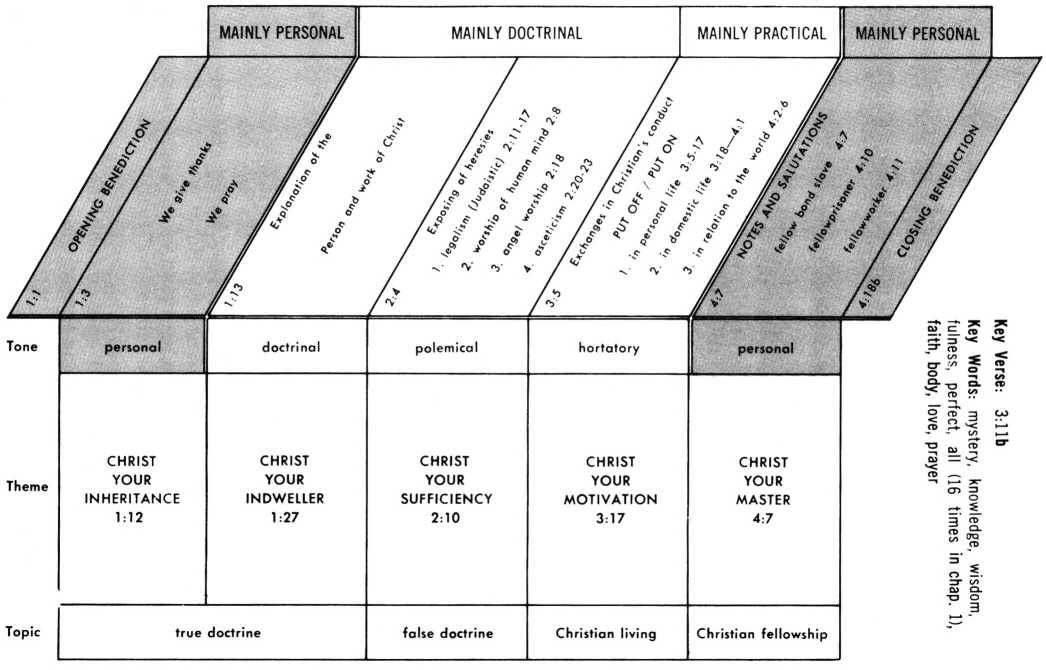
CHRIST IS ALL IN ALL
Click chart to enlarge
Charts from Jensen's Survey of the NT - used by permission
Colossians Overview - Click Chart on right side
| Christ Preeminent in All Things Supreme Lord - Sufficient Savior |
|||
| Colossians 1 | Colossians 2 | Colossians 3 | Colossians 4 |
| Supremacy of Christ |
Submission to Christ |
||
| Doctrinal and Corrective |
Practical and Reassuring |
||
| What Christ Did For Us |
What Christ Does Through Us |
||
| Christ Our Lord |
Christ Our Life |
Christ our Love |
|
| Christ the Head of the Body |
Christ the Lord of the Universe |
Christ the Head of the Home |
|
| Instruction | Warnings | Exhortations | Reminders |
| Reconciliation | Creation | Submission | Conversation |
| His Person and Word |
His Peace and Presence |
||
Colossians 3:6 For it is because of these things that the wrath of God will come (3SPMI) [upon the sons of disobedience] (NASB: Lockman)
Greek: di' a erchetai (3SPMI) e orge tou theou [epi tous huious tes apeitheias];
Amplified: It is on account of these [very sins] that the [holy] anger of God is ever coming upon the sons of disobedience (those who are obstinately opposed to the divine will), (Amplified Bible - Lockman)
Barclay: and because of these things the wrath of God comes upon those who are disobedient.
Lightfoot: Do not deceive yourselves. For all these things God’s wrath will surely come.
NLT: God’s terrible anger will come upon those who do such things. (NLT - Tyndale House)
Phillips: It is because of these very things that the holy anger of God falls upon those who refuse to obey him. (Phillips: Touchstone)
Wuest: because of which things there comes the wrath of God (Eerdmans)
Young's Literal: because of which things cometh the anger of God upon the sons of the disobedience,
FOR IT IS ON ACCOUNT OF THESE THINGS: dia:
- Colossians 3 Resources - Multiple Sermons and Commentaries
- Colossians 3:5-9 Spiritual Suicide - John MacArthur
- Colossians 3:5-11 Sanctification: A New Self - Phil Newton
For is a term of explanation. What is Paul explaining?
What things? The sins Paul has just mentioned.
Guzik adds that
The sins mentioned previously are part of the way the world lives, not the way Jesus lives. Every Christian is faced with a question: "Who will identify with, the world or Jesus?
Mt Henry adds that it is necessary to
mortify sins because, if we do not kill them, they will kill us.
Paul will now explain why we should mortify our members. “The wrath of God” is coming and will come on sin. Don't be deceived thinking you can live habitually in one of these sins and "get away with it" (see the end of the story Rev 21:8 [see note]).
Remember that in Genesis 6-8 God destroyed the antediluvian world with a flood because the wickedness of man was great on the earth, and that every intent of the thoughts of his heart was only evil continually (Genesis 6:5). And then in Genesis 18-19 God rained fire and brimstone from heaven on the cities of Sodom and Gomorrah because of their unbridled lusts and insatiable passions.
In the New Testament, God's warning of coming wrath is for all those who continually practice sins like…
envying, drunkenness, carousing, and things like these, of which I forewarn you just as I have forewarned you that those who practice (present tense = as their lifestyle) such things shall not inherit the kingdom of God. (See notes Galatians 5:21) (Comment: What they will "inherit" is God's just, holy wrath!)
Lightfoot adds that
The false doctrine of the Gnostics had failed to check sensual indulgence (Col 2:23). The true doctrine of the apostle has power to kill the whole carnal man. The substitution of a comprehensive principle for special precepts—of the heavenly life in Christ for a code of minute ordinances—at length attains the end after which the Gnostic teachers have striven, and striven in vain.
John Gill writes that…
There have been already instances of God's displeasure at sin, his indignation against it, and his judgments on account of it: Hs wrath is revealed from heaven, and it will come down from thence on disobedient and rebellious sinners, and that suddenly, and with great power, like a mighty torrent, that there will be no standing before it. This is a reason why such who have life in Christ should mortify, repress, and abstain from the above sins; for though this regards sinners, and ungodly persons, yet the effects of God's wrath on such show how much such sins are displeasing to him, and detested by him, and therefore to be avoided by the saints.
THAT THE WRATH OF GOD WILL COME: erchetai (3SPMI) hê orgê tou theou:
- Mt 3:7, Ro 1:18; Ep 5:6; Jn 3:36, Ro 2:2,5, 8,5:9,12:19,Ep 2:3, 1Th 1:10,5:9, 2Th 1:7, 8, 9, Rev 11:18, 14:10, 16:19,19:15 20:15,
- Wrath of God Eph 2:2; Isa 57:4;1Pet 1:14; 2Pet 2:14; Ro 11:30;32 Heb 4:6, 11
- Torrey's Topic Anger of God
- Colossians 3 Resources - Multiple Sermons and Commentaries
- Colossians 3:5-9 Spiritual Suicide - John MacArthur
- Colossians 3:5-11 Sanctification: A New Self - Phil Newton
The wrath of God is one of the "attributes" of God which although less popular to discuss is just as valid and sure as His love, faithfulness, etc. (see discussion of His Wrath).
In his introduction to the epistle to the Romans, Paul writes that …
The wrath of God is (present tense, passive voice = literally "is continually being) revealed from heaven against all ungodliness and unrighteousness of men, who suppress the truth in unrighteousness (Ro 1:18)
Wrath (3709) (orge [word study]) is derived from the idea of something which teems or swells until it becomes so swollen that it bursts forth which gives a perfect picture of God's holy "orge" which is His settled indignation and controlled passionate feeling against sin. Orge applies not to a petulant outburst like humans are so prone to but to an anger that proceeds from God's settled nature. Men make themselves the object of God's Orge when they sin and become a part of the destructiveness of evil. The concept of wrath includes God’s present displeasure with evil as well as the ultimate confinement and defeat of all evil in eternal hell (Mt 8:12).
Wrath is as much a part of the character of God as is love. A God who does not exercise wrath against injustice is an immoral God. A universe in which evil exists unchallenged and ultimately unvanquished is inconceivable and could not be ruled by a good God of holy love. Essential to a good God of love is His wrath against evil.
John Gill makes an excellent point regarding God's wrath writing that the reality of His wrath
is a reason why such who have life in Christ should mortify, repress, and abstain from the above sins; for though this regards sinners, and ungodly persons, yet the effects of God's wrath on such show how much such sins are displeasing to him, and detested by him, and therefore to be avoided by the saints.
NKJV and KJV add sons of disobedience but this phrase is not present in the most modern Greek texts. He uses this phrase in Ephesians where it is present in the more modern Greek texts…
And you were dead in your trespasses and sins, 2 in which you formerly walked according to the course of this world, according to the prince of the power of the air, of the spirit that is now working in the sons of disobedience. (see notes Ephesians 2:1; 2:2)
Let no one deceive you with empty words, for because of these things the wrath of God comes upon the sons of disobedience. (Ep 5:6)
Will come denotes the certainty of this future event, and his use of the present tense (instead of the future tense as one might expect) literally means " it is coming" or it is already on its way, so to speak thus picturing the wrath as already on its way.
Marvin Vincent agrees writing that
The present tense denotes the certainty of the future event, as (the verb "coming") in (Mt 17:11; Jn 4:21)
This wrath will come not only upon flagrant unbelievers, but also those in the Colossian congregation who professed to believe in Christ but who in truth were unbelievers as revealed by their evil actions. In other words, their conduct never matched their creed. Paul wrote this epistle to dissuade some who might delude themselves with alleged visions of glory through mystic encounters or self effort of any type.
Why mention the coming wrath at this point? Would not this reminder of the certainty of God's wrath motivate his hearers to obey the command to mortify their members? On one side, the certainty of God's wrath on these sins should cause one who is "unable" to stop these practices to consider "Who" they really belong to (1Co 6:19 ,1Co 6:20, Titus 2:14)? Are they children of the living God or the lying devil (1Jn 3:8, 3:9)? If they continue in these sins with no power whatsoever to cast them off, then they are surely destined for the Lake of fire (Re 21:8). On the other hand for the genuine believer who occasionally "slips into" one of these sins, a recollection and pondering on what it is that God's rich mercy and great grace has saved him from should motivate a heart attitude of gratitude that seeks to work out his salvation in fear and trembling (Php 2:12, Php 2:13) and walk in a manner worthy of and pleasing to the Lord (cp He 12:28, 29).
Wrath is coming upon those who arrogantly willfully refuse the only remedy for overcoming the power of sin: Christ's atoning sacrifice. Jesus Who was the Sacrifice, warned that…
He who believes in the Son has eternal life; but he who does not obey the Son shall not see life, but the wrath of God abides on him. (John 3:36).
As John explained…
He who has the Son has the life; he who does not have the Son of God does not have the life. (1Jn 5:12)
The wrath or orge of God is a necessary result of the holiness and the love of God Who hates that which corrupts and destroys His creatures. Rather than evolving away from the wrath of God, the unbelieving world is rapidly devolving toward its consummation. God's word predicts scoffers and mockers in the last days (2Pe 3:3), so was not surprised by the bumper sticker I saw recently that said "When the Rapture occurs can I have your car?" Judgment will come on this world because it is made up of people who do not seek God, but instead seek to gratify the desires of their fallen, evil flesh. As Jesus declared…
And this is the judgment, that the light is come into the world, and men loved the darkness rather than the light; for their deeds were evil. For everyone who does evil hates the light, and does not come to the light, lest his deeds should be exposed. (John 3:19, 20)
The wrath of God is simply the rule of the universe that a man will sow what he reaps (Gal 6:6,7) and that no one ever escapes the consequences of his sin for as Moses wrote "be sure your sin will find you out" (Nu 32:23).
God’s wrath is His eternal detestation of all unrighteousness. It is the displeasure and indignation of Divine equity against evil. It is the holiness of God stirred into activity against sin” (Arthur W. Pink, The Attributes of God, p83).
Wrath is God’s constant, invariable reaction to sin.
Although as believers we have been delivered “from the wrath to come” (1Th 1:10), "for God has not destined us for wrath, but for obtaining salvation through our Lord Jesus Christ" (1Th 5:9), Paul is not warning us that if we sin we will feel the furious wrath of God. Rather he is saying that those who are no longer their own but now belong to Christ and are in covenant union with Him and are motivated by their love for Him should certainly not wish to participate in the kinds of behavior characteristic of those who hate Him and will feel His eternal wrath. Simply put, the children of God should not want to act like the children of wrath. (Ep 2:3)
John MacArthur gives us a sobering reminder that "although believers have been delivered from God’s wrath (cf. Ro 5:9), they are subject to His chastening. He 12:5,6 (see notes) reminds us not to forget “the exhortation which is addressed to you as sons, ‘My son, do not regard lightly the discipline of the Lord, nor faint when you are reproved by Him; for those whom the Lord loves He disciplines, and He scourges every son whom He receives.’ ” God will react against sin. The unbeliever will experience His eternal wrath, and the believer His loving chastening. Either way, all who pursue sin will suffer the consequences.
Colossians 3:7 and in them you also once walked (3SPMI) , when you were living (2PIAI) in them. (NASB: Lockman)
Greek: en hois kai humeis periepatesate(3SPMI) pote hote ezete (2PIAI) en toutois.
Amplified: Among whom you also once walked, when you were living in and addicted to [such practices]. (Amplified Bible - Lockman)
Barclay: It was amongst these things that you once spent your lives, when you lived among them;
Lightfoot: In these sins you, like other Gentiles, indulged in times past, when your life was spent among them.
NLT: You used to do them when your life was still part of this world. (NLT - Tyndale House)
Phillips: And never forget that you had your part in those dreadful things when you lived that old life. (Phillips: Touchstone)
Wuest: in the sphere of which things also you ordered your behavior at one time when you lived in them. (Eerdmans)
Young's Literal: in which also ye—ye did walk once, when ye lived in them
AND IN THEM YOU ALSO ONCE WALKED: en ois kai humeis periepatesate (2PAAI) pote:
- Col 2:13; Ro 6:19,20; 7:5; 1 Co 6:11; Eph 2:2; Titus 3:3; 1Pe 4:3,4
- Colossians 3 Resources - Multiple Sermons and Commentaries
- Colossians 3:5-9 Spiritual Suicide - John MacArthur
- Colossians 3:5-11 Sanctification: A New Self - Phil Newton
When were we in them? In them describes our position as non-believers, when we were in Adam (1Cor 15:22). All their prior thoughts, words, and deeds were ensphered in an atmosphere of sin when they were in Adam. Not one of their acts ever got outside the circle of sin -- their previous manner of walking is a description of what is often termed total depravity. Now they are have redeemed and regenerated and are in Christ, a new position which calls for a new practice. Conduct should always be commensurate with creed.
Walked (4043) (peripateo [word study] from peri =around + pateo = walk) literally means to walk around and figuratively refers to one's course of life or conduct, in this context referring specifically to their conduct previous unregenerate Adamic state (in Adam, before they were in Christ - cp 1Co 15:22).
The aorist tense expresses a past completed action and sums up their whole disobedient lifestyle in the past. In other words, Paul gives a panoramic view and looks at the entire life while unsaved as nothing but sin. Contrast this picture with how born again ones are to walk now (Gal 5:25; Ro 6:12, 13, 14, Ro 6:19) Now all of what transpired in Colossians 2 regarding our circumcision removing our body of flesh and our burial and resurrection with Christ begins to become very practical.
In the figurative sense, peripateo refers to one's habitual way or direction of life, and so to their life-style. For example, in a good sense, Luke describes Zacharias and Elizabeth, the parents of John the Baptist, as being
“righteous in the sight of God, walking (peripateo) blamelessly in all the commandments and requirements of the Lord” (Lk 1:6).
In contrast, Paul refers in this verse to the lifestyle of unbelievers and later in this same letter counseled the Ephesian believers to
walk no longer just as the Gentiles (in context a description of all the unsaved) also walk, in the futility of their mind (Ep 4:17).
John declares that,
if we walk (peripateo) in the light as [God] Himself is in the light, we have fellowship with one another, and the blood of Jesus His Son cleanses us from all sin (1Jn 1:7)
Harry Ironside wrote that
"The old man is more than the old nature. It is the man I used to be before I knew Christ as Savior and Lord. In other words, the old man is all that I once was as an unsaved person. I am through with that man; he has disappeared in the cross of Christ. But if I make this profession of faith, let me be sure that I do not walk in the old man’s ways. Sometimes those who make the loudest professions of the truth of the new creation are the poorest performers of the truth; they give the lie to what they say by what they do. We could borrow the words of Ralph Waldo Emerson and say to them, “What you are thunders so that I cannot hear what you say.”
WHEN YOU WERE LIVING IN THEM: hote ezete (2PIAI) en toutois:
- Colossians 3 Resources - Multiple Sermons and Commentaries
- Colossians 3:5-9 Spiritual Suicide - John MacArthur
- Colossians 3:5-11 Sanctification: A New Self - Phil Newton
Spurgeon comments that…
This was true of the Colossians, and it was true of almost all those to whom Paul wrote, for these gross evils were scarcely regarded as sins in his time, so polluted had the nations become. I hope that, in the case of many now living, they have been preserved by Christian training from having walked even for a time in such sins.
But now you do not live in them. You are dead to them. If it should ever come to pass that you fall into any of these things, you will loathe yourself with bitterest repentance that you could find comfort, satisfaction, life in them. You are dead to them.
Living (zao) (Click for for in depth study of related noun zoe)
The fact that we formerly lived in sin is a good argument why we should now forsake it. We have walked in by-paths, therefore now let us choose to walk on the highway of holiness. Peter also exhorts his reader's to make a clean break with their past lifestyle writing
"As obedient children (adopted by God into His family by grace and proven by one's obedience to be in His family), do not be conformed to (modeled or shaped into an outward expression which does not come from one's inner being as a child of God and is not representative of it) the former lusts (passionate desires that governed you and) which were yours in your ignorance (when you did not know the requirements of the gospel or have the power to obey them), but like the Holy One who called you, be holy yourselves also in all your behavior; because it is written, "YOU SHALL BE HOLY, FOR I AM HOLY." (1Pe 1:14, 15-see note 1Pe 1:14; 1:15-16).
We at least had an excuse of sorts prior to being made children of God, but now such sins are quite presumptuous so stop doing them now. We all need an attitude like Job who said
"Teach me what I cannot see. If I have done evil, I will do so no more." (Job 34:32 Net Bible).
The transforming power of the gospel of Christ shines through Paul’s words this verse . The Colossians had walked in the pagan vices, had even lived in them, but now they were new creations in Christ and
"if any man is in Christ, he is a new creature; the old things passed away; behold, new things have come." (2Cor 5:17)
Spurgeon commenting on Romans 6:6 (notes) where Paul teaches "that henceforth we should not serve sin" asks,
"Christian, what hast thou to do with sin?
Hath it not cost thee enough already?
Burnt child, wilt thou play with the fire? What! when thou hast already been between the jaws of the lion, wilt thou step a second time into his den? Hast thou not had enough of the old serpent? Did he not poison all thy veins once, and wilt thou play upon the hole of the asp, and put thy hand upon the cockatrice’s den a second time? Oh, be not so mad! so foolish! Did sin ever yield thee real pleasure? Didst thou find solid satisfaction in it? If so, go back to thine old drudgery, and wear the chain again, if it delight thee. But inasmuch as sin did never give thee what it promised to bestow, but deluded thee with lies, be not a second time snared by the old fowler—be free, and let the remembrance of thy ancient bondage forbid thee to enter the net again! It is contrary to the designs of eternal love, which all have an eye to thy purity and holiness; therefore run not counter to the purposes of thy Lord. Another thought should restrain thee from sin.
Christians can never sin cheaply.
They pay a heavy price for iniquity.
Transgression destroys peace of mind, obscures fellowship with Jesus, hinders prayer, brings darkness over the soul; therefore be not the serf and bondman of sin. There is yet a higher argument: each time you "serve sin" you have "Crucified the Lord afresh, and put Him to an open shame." Can you bear that thought? Oh! if you have fallen into any special sin during this day, it may be my Master has sent this admonition this evening, to bring you back before you have backslidden very far. Turn thee to Jesus anew; He has not forgotten His love to thee; His grace is still the same. With weeping and repentance, come thou to His footstool, and thou shalt be once more received into His heart; thou shalt be set upon a rock again, and thy goings shall be established." (Evening by Evening)
Why would anyone who has been made rich return to the slums to live in poverty? How can a new creature act like an old one (cf. 2Co 5:17)?
“What shall we say then? Are we to continue in sin that grace might increase? May it never be! How shall we who died to sin still live in it?” (Ro 6:1-2).(note)
Colossians 3:8 But now you also, put them all aside: anger, wrath, malice, slander, and abusive speech from your mouth. (NASB: Lockman)
Greek: nuni de apothesthe (2PAMM) kai humeis ta panta, orgen, thumon, kakian, blasphemian, aischrologian ek tou stomatos humon;
Amplified: But now put away and rid yourselves [completely] of all these things: anger, rage, bad feeling toward others, curses and slander, and foulmouthed abuse and shameful utterances from your lips! (Amplified Bible - Lockman)
Barclay: but now you must divest yourselves of all these things—anger, temper, malice, slander, foul talk which issues from your mouth. Do not lie to one another.
Lightfoot: But now everything is changed. Now you also must put away not this or that desire, but all sins, whatever they are. Anger, wrath, malice, slander, filthy abuse; banish it from your lips.
NLT: But now is the time to get rid of anger, rage, malicious behavior, slander, and dirty language. (NLT - Tyndale House)
Phillips: But now, put all these things behind you. No more evil temper or furious rage: no more evil thoughts or words about others, no more evil thoughts or words about God, and no more filthy conversation. (Phillips: Touchstone)
Wuest: But now put away once for all also all these things; an habitual, revengeful anger, violent fits of anger, malignity, slander, obscene speech out of your mouth. (Eerdmans)
Young's Literal: But now put off, even ye, the whole—anger, wrath, malice, evil-speaking, filthy talking—out of your mouth.
BUT NOW: nuni de:
- Colossians 3 Resources - Multiple Sermons and Commentaries
- Colossians 3:5-9 Spiritual Suicide - John MacArthur
- Colossians 3:5-11 Sanctification: A New Self - Phil Newton
Now (nun) is one of those great ''But now's" in God's Word (click here for other occurrences).
The apostle reminded the Colossian believers that moral misconduct was part of their former demeanor: “in them you also once walked” (Col 3:7).
But now - This phrase signifies a contrast, something like you were "walking one direction" but now you are to walk another direction spiritually speaking. Truth demands a response. He has spent two chapters explaining the supremacy of Christ Who is now the source of their life. And so he says "now" let your conduct be in accord with the great truths you have learned. Put it into practice. Let your conduct give testimony of who (and Whose) you now are in Christ. And just as "clothes make the man", let your new moral/ethical "clothes" be seen by others.
Think about what Paul is saying here about putting off. Can you imagine how ridiculous you would look if when you went to buy a new suit you refused to take off the one you had on, but rather insisted that the new one should be tried on without “putting off” the old one! This is what many Christians do. They try to put the garment of a new life on over their old nature. It just doesn’t fit. We must lay aside sin first, then “put on the new man.”
Alan Carr introduces this section with the question is the old man dead and gives an illustration…
Joseph Stalin and his collapse before parliament. Some, believing him to be dead, began to shout and to rejoice, congratulating one another over the apparent death of the evil dictator. Stalin, however, was far from dead and many of those who rejoiced paid with their lives.
As I considered that, I began to realize that the Christian life is similar. When we come into this world, we are born into a sinful fleshly body. A body controlled by the world, the devil and it’s own lusts, Ep 2:1, 2, 3; Jas 1:14. Then, one day, you come to Jesus for salvation! Do you remember the glory of that moment? The joy of that incredible feeling? It felt as though all the old, sinful ways were gone forever. It felt like the world was brand new, especially for you! It felt so good, and oh, how your heart rejoiced. It wasn’t long, however, until it began to dawn on you that the old nature was still active. Perhaps you found yourself being drawn back to some of your old ways. You found that now, there was a spiritual struggle going on inside you, Gal 5:17. It was at that moment that you realized that life was going to be a struggle.
It is this struggle which Paul is writing about here. In these verses, he gives us some ammunition to fight this battle. He lays out some principles that, if followed, will help us live the right kind of life before God and the world. Paul is telling us how to gain the victory over the old man. (Col 3:1-17 Is the Old Man Dead?)
YOU ALSO PUT THEM ALL ASIDE: apothesthe (2PAMM) kai humeis ta panta:
- Col 3:5, Col 3:9; Eph 4:22; Heb 12:1; Jas 1:21; 1Pet 2:1
- Colossians 3 Resources - Multiple Sermons and Commentaries
- Colossians 3:5-9 Spiritual Suicide - John MacArthur
- Colossians 3:5-11 Sanctification: A New Self - Phil Newton
Them all - Not just the really bad ones but the ones that don't seem ostensibly so "bad"!
Dr. G. Campbell Morgan called the sins in this next section, “the sins in good standing”, to contrast them with the ostensibly more "filthy" sins listed in Col 3:5 (note).
Matthew Henry adds that we are to put these "sins of good standing" aside…
for these are contrary to the design of the gospel, as well as grosser impurities (Colossians 3:5); and, though they are more spiritual wickedness, have not less malignity in them. The gospel religion introduces a change of the higher as well as the lower powers of the soul, and supports the dominion of right reason and conscience over appetite and passion. Anger and wrath are bad, but malice is worse, because it is more rooted and deliberate; it is anger heightened and settled. And, as the corrupt principles in the heart must be cut off, so the product of them in the tongue; as blasphemy, which seems there to mean, not so much speaking ill of God as speaking ill of men, giving ill language to them, or raising ill reports of them, and injuring their good name by any evil arts
Putting them aside - During the Civil War, a Confederate soldier from Virginia became so tired of living in his lice-infested clothes that he decided to do something about it. He wrote his wife with instructions to meet him at a certain place on a certain day, bringing with her a fresh change of clothes and a jug of kerosene. The soldier met his wife at the designated spot, bathed in the kerosene to rid himself of the lice, then burned his infested clothes and returned to his unit. When Christ conquered sin on the cross, sin was drained of its ability to enslave us. Through the Holy Spirit, we have all the power we need to say no to the downward pull of the old life. It is our responsibility to use this power and turn away from sin.
Put aside (659) (apotithemi from apo = away from, marker of dissociation, implying a rupture from a former association, separation, departure, cessation, any separation of one thing from another by which the union or fellowship of the two is destroyed + tithemi = put, place) means literally to put or take something away from its normal location and put it out of the way. It was used literally of runners who participated in the Olympic games who cast off their clothes and running nearly completely naked in the stadium.
Figuratively the idea is to cease doing what one is accustomed to doing. Stop doing it. "Throw" it off. Be done with it. Six of the eight NT uses use apotithemi with the figurative meaning as shown below. Ponder (perhaps even make a list to review ever so often) what it is we are to throw off or cast aside. Notice that each of these figurative uses describes the behavior of a believer.
Apotithemi is used 8 times in the NT in the NAS
Matthew 14:3 For when Herod had John arrested, he bound him, and put him in prison on account of Herodias, the wife of his brother Philip. (Comment: Here apotithemi literally indicates Herod put John the Baptist away or aside which is similar to several of the uses in the Septuagint [cf Lev 24:12, Nu 15:34, 2 Chr 18:26])
Acts 7:58 And when they had driven him out of the city, they began stoning him, and the witnesses laid aside their robes at the feet of a young man named Saul.
Romans 13:12 (note) The night is almost gone, and the day is at hand. Let us therefore lay aside the deeds of darkness and put on the armor of light.
Ephesians 4:22 (note) that, in reference to your former manner of life, you lay aside (discard, renounce, strip off) the old self (everything you were without Christ), which is being (progressively, continually) corrupted (ruined, putrefied, marred, spoiled) in accordance with the lusts (strong desires) of deceit (deceit is personified),
Ephesians 4:25 (note) Therefore, laying aside falsehood, speak truth, each one of you, with his neighbor, for we are members of one another.
Colossians 3:8 (note) But now you also, put them all aside: anger, wrath, malice, slander, and abusive speech from your mouth.
Hebrews 12:1 (note) "Therefore (crucial transition representing an emphatic conclusion to the section beginning in Hebrews 10:19-note), since we have so great a cloud of witnesses (not a reference to spectators in heaven but to the godly examples of the real life faith of the saints in Heb11 which should inspire and encourage every Christian runner - practical application - meditate on Hebrews 11!) surrounding us, let us also lay aside every encumbrance (a bulk or mass of something not necessarily bad in itself. Athletes would strip away every piece of unnecessary clothing before competing in a race. So strip off even harmless things that hinder your progress - we might call it "stuff" that diverts our attention, saps our energy or dampens our enthusiasm for godly things!), and the sin which so easily entangles us (wraps itself around us so that we trip and stumble every time we try to read the Word, pray or otherwise move on for the Lord), and let us run with endurance (steady determination to keep going, regardless of the temptation to slow down or give up) the race (Greek agon, English "agony", gives us a clear picture that the faith-filled life is not a picnic but a demanding, grueling, albeit joyful, effort like that of an Olympic athlete) that is set before us fixing our eyes (looking away from every other object and keeping our eyes riveted) on Jesus, the Author and Perfecter of faith… "
James 1:21 (note) Therefore putting aside all filthiness (a term used of moral vice as well as dirty garments and sometimes of "ear wax" as if picturing sin that would impede one's spiritual hearing) and all that remains of wickedness, in humility receive the word implanted, which is able to save your souls.
Comment: James like Paul uses the aorist tense of apotithemi which stresses the importance of a once for all putting off of sin prior to receiving God’s Word. James says our filthy, wicked vices are likened to soiled garments which are to be set aside once for all. Using another analogy, it is as if James saw the human heart as a garden. If left to itself, the soil of our wicked hearts inherited from Adam would produce only weeds. James as a good spiritual horticulturist urges us to “pull out the weeds” and prepare the soil for the “implanted Word of God.” Beloved, how doth thy "garden" grow?
1 Peter 2:1 (note) Therefore, putting aside all malice and all guile and hypocrisy and envy and all slander"
Comment: Why put these vices aside? So that we will have our spiritual appetite restored and be "like newborn babes (who) long for the pure (unadulterated, no additives) milk of the word, that by it you may grow (we are not just to grow old as saints but to mature or grow spiritually) in respect to salvation," (see notes 1 Peter 2:2)
Apotithemi - 11 times in the non-apocryphal Septuagint (LXX) -Ex 16:33,34; Lev 16:23; 24:12; Nu 15:34; 17:7, 10; 19:9; Jos. 4:8; 2 Chr. 18:26; Joel 1:18. The majority of the uses in the Lxx speak of literal placing or laying of something in a place although several speak of putting or placing someone in jail or prison. None of the Lxx uses are exactly analogous to Paul's use of this word apotithemi in Romans, Ephesians and Colossians.
Leviticus 16:23 Then Aaron shall come into the tent of meeting, and take off the linen garments which he put on when he went into the holy place, and shall leave (Lxx = apotithemi) them there. (Comment: This is part of the regulations on the great day of atonement, "yom kippur".)
Apotithemi in Colossians 3:8 has to do with discarding, stripping off, casting away, and the like. It is the word Luke used of the Jewish leaders in Jerusalem who "began stoning (Stephen), and the witnesses laid aside (apotithemi) their robes at the feet of a young man named Saul. " (Acts 7:58). They laid aside their outer garments so they could more freely do their wicked work. The Christian lays aside the following attitudes, so he can be free to do the righteous work of the Lord.
Remember the old Scottish preacher's wise saying
Sin will keep you from the Bible
or
The Bible will keep you from sin
Our new life in Christ will stagnate unless sins are recognized, renounced (confessed) and repented. When this purging takes place, then we will manifest an insatiable craving and delight for the pure spiritual milk of God's Word, which has life, gives life and nourishes life. No intake of God's word will yield no spiritual growth. How is your appetite?
In Romans Paul exhorts his readers to put off "deeds of darkness" writing…
"The night (of man’s depravity and Satan’s dominion) is almost gone, and the day (of Christ’s return and reign) is at hand. Let us therefore lay aside the (in light of Christ’s imminent return, believers are to repent and forsake the) deeds of darkness and put on the armor of light (protection that obedience to the Word and the resultant practical righteousness provides)." (Ro13:12 notes)
Put aside is in the aorist imperative which calls for a decisive choice to effectively accomplish an action and can even convey the idea of doing so with some degree of urgency. The idea is "Do this now"! Put these habits of the old life away. Lay them aside like you would filthy, smelly, dirty clothes. You have the power of the Spirit of Christ to put to death the deeds of the flesh. Paul writes in the great chapter of Romans 8 that
you must die but if by the Spirit you are putting to death the deeds of the body, you will live. (Ro 8:13)
Practically speaking, you will encounter many situations in which you have the choice to "put aside" the "dirty clothes" or to choose not to do so. Every time you make the choice to put the filthy rags off, you are growing in conformity to Jesus. This is what Paul is saying in Romans 6 exhorting believers to "present your members as slaves to righteousness, resulting in sanctification." (Ro 6:19).
Paul says "walk away from these things". You may be in the situation where you feel you've repeated a sin so often that you feel you cannot get free from it. Not only can you get free of it, but you had better slam the door on that situation or it will ruin your usefulness for the Lord and affect your reward at the Judgment Seat of Christ.
When you put all these things aside, you put away not only the activity of them, but the things that contribute to those things (cp Ro 13:14). Put them away! You're a "living dead" man and now you've got the power in Christ (see note Colossians 3:4) to do carry out these otherwise impossible commands.
Miles Stanford writes that
"The new man was put on when we were re-created in the Lord Jesus. This new nature is the very life of the One who is the express image of God. Therefore, our growth in the knowledge of Him results in the manifestation of His life. For years we try to handle the problem of sin and self directly. On the negative side, we seek to suppress self, or crucify the old nature. On the positive side, we plead with God to change us for the better, and we try to be more Christ-like. But in it all, we never seem to emerge from Romans Seven—total defeat. Finally, we learn to meet the problem indirectly, by reckoning. We see in the Word that the old man has been effectively “put off” at the cross; and we also see that the new man has been “put on” through our resurrection in Christ. Instead of being taken up with the problem, we now set our mind and heart on God’s answer: the crucifying cross and the risen Christ." (Stanford, Miles: The Reckoning that Counts)
As a person takes off his dirty clothes at the end of the day, so should believers discard the filthy, tattered rags of their old life. The Colossians are exhorted by the apostle to lay aside as an old and useless garment the old life’s vices.
ANGER: orgen:
- If you struggle with this sin consider meditating on the Scriptures in Torrey's Topic "Anger"
- Ps 37:8; Pr 17:14; 19:19; 29:22; Mt 5:22; Ro 13:13 ; 1Co 3:3; 2 Co 12:20; Gal 5:15; Gal 5:20-note; Ga 5:26-note; Ep 4:26; Ep 4:31; Ep 4:32; 2Ti 2:23; 2Ti 2:24; Jas 1:20 ; Jas 3:14, 15, 16
- Colossians 3 Resources - Multiple Sermons and Commentaries
- Colossians 3:5-9 Spiritual Suicide - John MacArthur
- Colossians 3:5-11 Sanctification: A New Self - Phil Newton
Anger (3709) (orge) is a deep, smoldering, resentful bitterness. It is the settled heart attitude of the angry person. Provocations do not create his anger, but merely reveal that he is an angry person and give him a target for his fury. That has no place in a Christian’s life (Ep 4:26, Ep 4:31).
Someone has well said that anger is a wind which blows out the lamp of the mind. It is like an acid that can do more harm to the vessel in which it is stored than to anything on which it is poured. Add one letter to anger and see what you get!
Believers are to be
slow to anger… for the anger of man does not achieve the righteousness of God (but see notes on James 1:19 ; 20 for while my use is {presumably} a reasonable application, the actual interpretation from the original context takes on a slightly different meaning.)
Most of the uses of orge refer to God Who is perfectly justified in having a settled anger against sin.
Spurgeon has these wise words on "anger"…
Anger is not always or necessarily sinful, but it has such a tendency to run wild that whenever it displays itself, we should be quick to question its character, with this enquiry, “Doest thou well to be angry?” It may be that we can answer, “YES.” Very frequently anger is the madman’s firebrand, but sometimes it is Elijah’s fire from heaven. We do well when we are angry with sin, because of the wrong which it commits against our good and gracious God; or with ourselves because we remain so foolish after so much divine instruction; or with others when the sole cause of anger is the evil which they do. He who is not angry at transgression becomes a partaker in it. Sin is a loathsome and hateful thing, and no renewed heart can patiently endure it. God himself is angry with the wicked every day, and it is written in His Word, “Ye that love the Lord, hate evil.”
Far more frequently it is to be feared that our anger is not commendable or even justifiable, and then we must answer, “NO.” Why should we be fretful with children, passionate with servants, and wrathful with companions? Is such anger honourable to our Christian profession, or glorifying to God? Is it not the old evil heart seeking to gain dominion, and should we not resist it with all the might of our newborn nature?
Many professors give way to temper as though it were useless to attempt resistance; but let the believer remember that he must be a conqueror in every point, or else he cannot be crowned.
If we cannot control our tempers, what has grace done for us? Some one told Mr. Jay that grace was often grafted on a crab-stump. “Yes,” said he, “but the fruit will not be crabs.”
We must not make natural infirmity an excuse for sin, but we must fly to the cross and pray the Lord to crucify our tempers, and renew us in gentleness and meekness after His own image. (from Morning and Evening - AM July 13)
Anger is one of the holy feet of the soul when it goes in the right direction. -
C. H. Spurgeon
Harry Ironside adds that…
Anger, as we know from [Ep 4:26], may be righteous, but generally it is the raging of the flesh. Even where anger is warranted ([Mk 3:5] where we read that our blessed Lord looked at His opponents with anger because of the hardness of their hearts), it must not be nursed or it will degenerate into wrath. Wrath, a settled condition of ill-feeling toward an offender, is generally coupled with a desire for revenge and so malice springs from it. We have three generations of sin here: anger cherished begets wrath, and wrath if not judged begets malice. No matter how grievously I have been wronged, I am not to yield to the devil and malign or seek to harm the one against whom I may have been righteously indignant in the beginning. “Let not the sun go down upon your wrath: Neither give place to the devil” (Ep 4:26, 27-notes).
WRATH: thumon :
- Colossians 3 Resources - Multiple Sermons and Commentaries
- Colossians 3:5-9 Spiritual Suicide - John MacArthur
- Colossians 3:5-11 Sanctification: A New Self - Phil Newton
Wrath (outbursts of anger, rage, indignation) (2372) (thumos) is an intense expression of the inner self, frequently expressed as strong indignation, a state of intense displeasure or rage (violent and uncontrolled anger or a fit of violent wrath).
As noted above orge anger suggests a more settled or abiding condition of mind, frequently with a view to taking revenge.
Orge is less sudden in its rise than thumos, but more lasting in it nature.
Thumos expresses more the inward feeling, orge the more active emotion.
Thumos may issue in revenge, though it does not necessarily include it. It is characteristic that it quickly blazes up and quickly subsides, though that is not necessarily implied in each case.
Thumos refers to a burning anger which flares up and burns with the intensity of a fire. In fact the Greeks likened it to a fire in straw, which flares up briefly and is gone. That external anger. A violent temper. If you see this type of behavior continually in a person, they either are not saved or they are not living in the truth that they are complete in Christ.
When Jesus reminded the Jews that only the Gentile Naaman was healed of his leprosy
"all the people in the synagogue were filled with rage (thumos) as they heard these things" (Lk 4:28).
In a similar way the Ephesian merchants when sensing that the gospel was threatening their livelihood of "Artemis" idols
"were filled with rage (thumos), they began crying out, saying, "Great is Artemis of the Ephesians!" (Acts 19:28)
Paul wrote to the Corinthians that he was afraid that when he came he would find
angry tempers (thumos) (2Co 12:20)
Paul said that
Now the deeds of the flesh are evident, which are: idolatry, sorcery, enmities, strife, jealousy outbursts of anger (thumos) disputes, dissensions, factions (see note Galatians 5:19)
Paul instructs the Ephesians to
Let all bitterness and wrath (thumos) and anger and clamor and slander be put away from you, along with all malice. (Ep 4:31)
MacArthur adds that
Anger and wrath are closely related. The churning, boiling anger that often lies just below the surface gives rise to eruptions of wrath. And many unbelievers live with a deep-seated resentment that feeds their anger. They do not understand why they are alive and enduring the pains of life. They did not ask for their circumstances, and they do not know how to handle them. All of that stokes the fires of their anger and makes them even more prone to explosions of wrath when exacerbated.
MALICE: kakian:
- Colossians 3 Resources - Multiple Sermons and Commentaries
- Colossians 3:5-9 Spiritual Suicide - John MacArthur
- Colossians 3:5-11 Sanctification: A New Self - Phil Newton
Malice (2549) (kakia) (Click for in depth study of kakia) describes a mean-spirited or vicious attitude or disposition. It is a wickedness as an evil habit of one's mind, which includes a desire to harm other people and often hides behind apparently good actions (1Pe 2:16). This sin is not only a viciousness toward another person, but also results in a wrong attitude toward God.
In reference to behavior kakia conveys the idea of a mean-spirited or vicious attitude or disposition as indicated by words such as malice, ill-will, hatefulness, and dislike. It is an attitude of wickedness as an evil habit of one's mind. Kakia is used in NT to describe the wickedness which comes from within a person. Malice describes a vicious intention and expresses the desire to hurt another and rejoices in it!
Lightfoot defines it as
“the vicious nature which is bent on doing harm to others”
Aristotle defined malice as “taking all things in the evil part”
Trench says that kakia is
that peculiar form of evil which manifests itself in a malignant interpretation of the actions of others, an attributing of them all to the worst motive
Webster says that "malice" is a desire to cause pain, injury, or distress to another and implies a deep-seated often unexplainable desire to see another suffer or experience pain, injury, or distress!
One Greek scholar terms malice “the vicious character generally.”
Vincent writes that kakia
In NT is a special form of vice, not viciousness in general, as Cicero, Tusc. iv. 15, who explains by “vitiositas, a viciousness which includes all vices.” Calvin, on Ep 4:32 (see note), defines as
a viciousness of mind opposed to humanity and fairness, and commonly styled malignity.
The homily ascribed to Clement of Rome, describes kakia as the forerunner of our sins (x)… (Kakia) is the word denoting a malevolent disposition toward one’s neighbor. Hence it is not a general term for moral evil, but a special form of vice.
Malice is not only a moral deficiency but destroys fellowship. To varying degrees, the unsaved spend their life maliciously.
In Romans Paul describes those who have refused to acknowledge God and are given over by God to a depraved mind as
being filled with all unrighteousness, wickedness, greed, evil; full of envy, murder, strife, deceit, malice; they are gossips. (see note Romans 1:29).
SLANDER: blasphemian:
- See Torrey's Topic "Slander"
- Lev 24:11, 12, 13, 14, 15, 16; Mk 7:22; 1Ti 1:13; 1Ti 1:20 Jas 2:7; Jude 1:8; Rev 16:9
- Colossians 3 Resources - Multiple Sermons and Commentaries
- Colossians 3:5-9 Spiritual Suicide - John MacArthur
- Colossians 3:5-11 Sanctification: A New Self - Phil Newton
Slander (988) (blasphemia) (Click for in depth study of related verb blasphemeo) is speech that denigrates or defames (stresses the actual loss of or injury to one’s good name), reviling (subject to verbal abuse and implies a scurrilous, abusive attack prompted by anger or hatred), denigrate (from Latin "niger" = black and so to speak to "blacken" one's character by casting of aspersions on another), slander.
Slander is the utterance of false charges or misrepresentations which defame, belittle or damage another’s reputation and cause them to fall into disrepute or to receive a bad reputation. To try to tear down another individual. Wounding someone's reputation by evil reports, evil speaking.
Blasphemia is translated "blasphemy" when it is against God and slander when against men, although slander against men is blasphemy against God Who created men (Js 3:9)
Harry Ironside - We are also to “put off blasphemy. This dreadful sin may be directed either godward or manward. Men blaspheme against God by imputing evil to Him, or by seeking to misrepresent Him, or by perverting the truth about the Father, the Son, or the Spirit. But speaking injuriously of one another, reviling rulers or governors, circulating wicked and untruthful reports about one’s brothers, and seeking to harm God’s servants by such evil reports—all these are also included under the general term blasphemy. Sharp-tongued religious controversialists have often failed here, even at the very moment that they were endeavoring to meet the blasphemy of their opponents in regard to divine things. When one hyper-Calvinist described John Wesley as a child of the devil because of his Arminianism, the Calvinist himself had fallen into the sin of blasphemy. No wonder his son, William Hone, turned from Christianity and was an infidel for years until he was reached by divine grace. It is incongruous for bitter accusations to come from the lips of those who have been saved through mercy alone and daily need to confess their own sins and ask for divine forgiveness. “The wrath of man worketh not the righteousness of God” (Js 1:20). The holy One is not honored by our hard speeches against His saints—or even against men of the world.
ABUSIVE SPEECH: aischrologian:
- Colossians 3 Resources - Multiple Sermons and Commentaries
- Colossians 3:5-9 Spiritual Suicide - John MacArthur
- Colossians 3:5-11 Sanctification: A New Self - Phil Newton
The "new man" has (should manifest) a "new language"! =
Let no unwholesome word proceed (present imperative - With the negative = a command calling for cessation of this activity so characteristic of the "old man") from your mouth, but only such a word as is good for edification according to the need of the moment, so that it will give grace to those who hear. (Eph 4:29)
Abusive speech (1488) (aischologia is from from aischrologéo = to be foul–mouthed, which in turn is derived from aischrós = filthy or improper + légo =to say) refers to speech of a kind that is generally considered in poor taste, obscene speech, filthy or dirty speech.
Lightfoot calls it "foul mouthed abuse"! The word was used for both abusive and filthy talk. Such language should never come out of the mouth of a Christian with Christ now his very life.
Such talk is expressly forbidden in Scripture, Paul writing in fact that…
There must be no filthiness and silly talk, or coarse jesting, which are not fitting, but rather giving of thanks. (Ep 5:4)
Jesus said,
The good man brings out of his good treasure what is good; and the evil man brings out of his evil treasure what is evil. But I tell you that every careless word that people speak, they shall give an accounting for it in the day of judgment (WOE!). (Matthew12:35, 35).
Harry Ironside related that…
Once I heard someone begin a story with the remark, “As there are no ladies here, I want to tell you something I heard the other day.” Another gentleman in the group checked him with a wise answer: “Brother, though there are no ladies present, the Holy Ghost is here. Is your story fit for Him?” The first man blushed in confusion and accepted the rebuke. We did not hear the story.
In an eyewitness report of the great Welsh revival of 1904, G. Campbell Morgan wrote
The horses are terribly puzzled. A manager said to me. ‘The haulers are some of the very lowest. They have driven their horses by obscenity and kicks. Now they can hardly persuade the horses to start working, because there is no obscenity and no kicks.
Spurgeon has several comments on this section…
Put them all off, like old clothes that are never to be worn again: “Put off all these;”
It is hard work for some to pull that garment off, for it fits them so tightly. This burning coat of wrath will not readily come off; but the apostle’s command is, “Put it off! Put it off!” It does not become a Christian to be an angry man.
Christ will not live in a heart that harbors malice.
Thank God that, if we ever wore that robe, we pulled it off long ago.
Filthy communication out of your mouth. - All talking that is of a dubious character must go. Anything which savours of corruption and defilement must be put away from every Christian.
FROM YOUR MOUTH: ek tou stomatos humon:
- Colossians 3 Resources - Multiple Sermons and Commentaries
- Colossians 3:5-9 Spiritual Suicide - John MacArthur
- Colossians 3:5-11 Sanctification: A New Self - Phil Newton
Note that the last three "forbidden" things have to do with speech. The heart of the issue is what issues from the heart which recalls Jesus' words
"But the things that proceed out of the mouth come from the heart, and those defile the man. 19 "For out of the heart come evil thoughts, murders, adulteries, fornications, thefts, false witness, slanders. 20 "These are the things which defile the man; but to eat with unwashed hands does not defile the man." (Mt 15:18-20)
Comment: Little wonder that David prayed "Search me, O God, and know my heart" (Ps 139:23-24) We do well to pray that same prayer frequently!
Christian speech must be kind. All slanderous and malicious talking is forbidden. The old advice still stands which says that before we repeat anything about anyone we should ask three questions: "Is it true? Is it necessary? Is it kind?" The New Testament is unsparing in its condemnation of the gossiping tongues which poison truth. It is no wonder the psalmist prayed,
Set (qal imperative) a watch (Hebrew = shomrah = guard; Lxx = Phulake = a sentinel, one keeping watch at the guard station), O Lord, before my mouth; keep the door of my lips (Ps 141:3)
Comment: David understood the basic principle of which James [James 3:8] wrote years later "no one can tame the tongue; it is a restless evil and full of deadly poison." Thus David boldly requests of God for His assistance to place a sentinel on duty to watch his words. Oh, how we all [I speak especially of believers for nothing can spoil our witness as quick as words of wrath] need to pray this prayer, for our old flesh is quick to speak, slow to listen and slow to hear.
Spurgeon commenting on this Psalm writes…
Set a watch, O LORD, before my mouth. That mouth had been used in prayer, it would be a pity it should ever be defiled with untruth, or pride, or wrath; yet so it will become unless carefully watched, for these intruders are ever lurking about the door. David feels that with all his own watchfulness he may be surprised into sin, and so he begs the Lord Himself to keep him. When Jehovah sets the watch the city is well guarded: when the Lord becomes the guard of our mouth the whole man is well garrisoned.
Keep the door of my lips. God has made our lips the door of the mouth, but we cannot keep that door of ourselves, therefore do we entreat the Lord to take the rule of it. O that the Lord would both open and shut our lips, for we can do neither the one nor the other aright if left to ourselves. In times of persecution by ungodly men we are peculiarly liable to speak hastily, or evasively, and therefore we should be specially anxious to be preserved in that direction from every form of sin. How condescending is the Lord! We are ennobled by being door keepers for him, and yet he deigns to be a door keeper for us.
Incline not my heart to any evil thing. It is equivalent to the petition, "Lead us not into temptation." O that nothing may arise in providence which would excite our desires in a wrong direction. The Psalmist is here careful of his heart. He who holds the heart is lord of the man: but if the tongue and the heart are under God's care all is safe. Let us pray that He may never leave us to our own inclinations, or we shall soon decline from the right.
Note that Paul did not say God would put these things off for us, but that WE must put them off, by saying Yes to Jesus, yielding all of our rights to Him, surrendering our wills to our Master's voice and saying "no" to the flesh, trusting in God's sovereignty that whatever He has allowed in our life is to make us better, not bitter and that in His strength and with His Spirit's enablement we can do what He has called us to do. Then God will manifest these characteristics in your life.
Matthew Henry writes "filthy communication is all lewd and wanton discourse, which comes from a polluted mind in the speaker and propagates the same defilements in the hearers."
RESTORING GOD'S IMAGE - As a young boy, theologian Alister McGrath enjoyed experimenting with chemicals in his school's laboratory. He liked to drop a tarnished coin into a beaker of diluted nitric acid. He often used an old British penny bearing the image of Queen Victoria. Because of the accumulated grime, Her Majesty's image couldn't be seen clearly. But the acid cleansed away the grime and the Queen's image reappeared in shining glory.
We know, to be sure, that we were created in the image of God (Ge 1:26), but that image has been defaced by our sin. We are still His image-bearers, however.
Once we invite Jesus to enter our lives as Savior, He goes to work to restore the original image. He transforms us to make us like Himself (2Corinthians 3:18). This process is described as putting off some behaviors and putting on others. For example, we are to "put off all these: anger, wrath, malice, blasphemy, filthy language" (Colossians 3:8) and to "put on love" (Col 3:14).
Unless and until our sin-tarnished souls are cleansed by Jesus' forgiveness, God's image is obscured in our lives. But when we trust Jesus' sacrifice on the cross, we are forgiven and the restoration begins.—Vernon C Grounds (Our Daily Bread, Copyright RBC Ministries, Grand Rapids, MI. Reprinted by permission. All rights reserved)
Restore in me Your image, Lord,
So tarnished by my sin and shame;
And cleanse whatever may conceal
The shining glory of Your name. —D. De Haan
Drawing close to Christ produces a growing Christlikeness.
DANGER! OUT OF BOUNDS! - A RESORT in Breckenridge, Colorado, posted signs warning skiers to keep off a certain slope. The signs, large and distinct, warned, Danger! Out of Bounds! In spite of the warnings, however, several skiers went into the area. The result? A half-mile-wide avalanche buried four of the trespassers beneath tons of snow and rock. This tragedy never would have happened if the signs had been heeded.
God has posted clear warning signs in the Bible to tell us what kinds of behavior and attitudes are off limits. The Lord loves us and wants us to avoid tragedy. He warned us about lying, stealing, blasphemy, filthy language, adultery, murder, drunkenness, and a host of other sins. Yet many times we ignore His warnings and intentionally wander into a forbidden area. We convince our-selves that nothing bad will happen to us or that we can turn back if we sense danger.
But God is not kidding. Sinning guarantees His disapproval and opens the door to remorse and tragedy. People who repeatedly commit these sins may be giving evidence that they have never really been saved (1Jn 3:4, 5, 6, 7, 8, 9).
When tempted to explore a forbidden area, don't be foolish. God's warning signs are posted for good reason.—D C Egner (Our Daily Bread, Copyright RBC Ministries, Grand Rapids, MI. Reprinted by permission. All rights reserved)
NOISE POLLUTION - Profanity and crude language are becoming more common on prime-time television programs. Many writers and producers seem to be intent on pushing the limits of how much immoral and offensive speech the public will allow.
Profane and vulgar language is noise pollution of the worst kind. It dishonors God and degrades men and women. Conversation punctuated by cursing, swear words, and crude and dirty expressions obscures the beauty of noble ideas. Words that condemn others can inflame anger and destroy relationships. They can inflict lasting hurt to sensitive souls who are battered by verbal abuse.
Ungodly language creates an immoral and unspiritual atmosphere, which is hostile to clean thinking and living. Its deafening sound can all but drown out the voice of God's Spirit. That's why the Word of God spells out in clear terms the kind of language that must not come from the lips of followers of Jesus (Colossians 3:8), as well as the kind that should characterize our speech (Col 4:6).
Centuries ago the psalmist offered a prayer that we would be wise to echo: "Set a guard, O Lord, over my mouth; keep watch over the door of my lips" (Ps 141:3). That prayer is needed today more than ever. —Dennis J. De Haan (Our Daily Bread, Copyright RBC Ministries, Grand Rapids, MI. Reprinted by permission. All rights reserved)
Lord, guard our tongues so what we say
Won't hurt and carelessly offend;
Give us the gracious speech of love,
With words that soothe and heal and mend. —Sper
Profanity disgraces the user and demeans the hearer.