| RUN INTO THE STRONG TOWER OF ELOHIM YOUR CREATOR  |
|
| ELOHIM THE CREATOR |
MAN HIS CREATION |
|
Why study Spurgeon writes… What pleasure he finds in the very name of his Benefactor and Master. All through Scripture we ought to notice the titles by which God is called in each distinct place. We are so poverty-stricken in thought that we generally use but one name for God; not so the rich soul of David: throughout the Psalms you will find him appropriately ringing the changes upon Adonai, El, Elohim, Jehovah, and all the varied combinations of names which loving hearts were wont to give to the glorious LORD of hosts The names of God employed in prayer in holy Scripture are always significant. Holy men of old were not so poverty-stricken in language as always to address God under one name, nor were they so careless as to speak with him under such a title as might first come to hand; but in their approaches to the Most High they carefully regarded that attribute of the divine nature from which they expected the blessing which they desired. If they needed that their enemies should be overthrown they pleaded with the arm of his strength; if they were wrongfully entreated, they prayed to the God of righteousness; if they needed pardon for their sins, they pleaded with the God of mercy; and such names as Jehovah, Elohim, Shaddai, are not used indiscriminately in the prayers of the saints of old, but always with selection and judgment. In another place Spurgeon writes… God, the living God, the Creator of the heavens and the earth, sets forth his own name and title, that there may be no mistake as to who he is. “I am the LORD (Jehovah),” saith he, “and my glory will I not give to another, neither my praise to graven images.” (Isa 42:8) He also sets forth his name at large, for the comfort of his people. Is it not written, “They that know Thy name well put their trust in Thee” (Ps 9:10)? There is something in every name of God which may breed faith in our souls. Whether we know him as Jehovah, Elohim, Shaddai, or Lord, or by whatsoever other name he has been pleased to manifest Himself, that title becomes the ground of our confidence, and is the means of fostering faith in his people’s minds, when they come to understand its meaning. To a trembling people the Lord enlarges on His wonderful Names. I think He also does it to excite our wonder and our gratitude. He that loves us so much is Jehovah: He that can create and destroy; He that is the self-existent God; He, even He, has set His heart upon His people, and loves them and counts them precious in His sight. It is a marvellous thing. The more one thinks of it, the more shall he be overwhelmed with astonishment, that He Who is everything should love us who are less than nothing. It is the Holy One Who has deigned to choose, and to love unholy men, and to look upon them in grace, and save them from their sins. That you may bow low in loving gratitude, God lets you see Who He is. That you may see how great a stoop of condescension He has made, when He loves His unworthy people, and takes them into union with Himself, you are made to see how great and glorious is the divine Name. Where is the Ge 1:1 In the beginning God created the heavens and the earth (commentary) Most authorities agree that "Elohim" is derived from "El" meaning "mighty (one), strong (strength)." The Hebrew ending "-im" added to "El" indicates plurality. Although one cannot be dogmatic, the use of the plural "Elohim" with the 3rd person singular masculine form of the verb created suggests plurality in the Godhead. In Ge 1:1-2:4, Elohim is described as Creator 35x in 35 verses. O blest Creator of the light, How does Jn 1:1 parallel Ge 1:1? Jn 1:1 In the beginning was the Word, and the Word was with God and the Word was God. Who is John 1:14 And the Word became flesh, and dwelt (tabernacled) among us and we saw His glory, glory as of the only begotten from the Father, full of grace and truth. (Spurgeon) (cf Rev 19:14) So here we see that "the Word" Who was with God at creation (in the context of the incarnation John 1) is Jesus Christ. (cf Col 1:16, He 1:1-2; He 1:3) Behold the great Creator makes Hark, hark, the wise eternal Word, How does Genesis substantiate the idea of plurality of God? Genesis 1:2 The earth was formless and void and darkness was over the surface of the deep and the Spirit of Elohim was moving over the surface of the waters. 3 Then Elohim said, "Let there be light there was light" Although the term Trinity is not in the Bible, the creation by Elohim supports the involvement of the the "tri-unity" of God - Father, Son and Holy Spirit. (Clearly this verse does not "prove" the Trinity but only supports this doctrine. The Trinity of God is a vast, often controversial subject - the interested student is referred to the excellent articles -- Trinity [Article 1] or Trinity [Article 2]) In addition to the heavens and the earth, what else do we learn about Elohim as Creator? Psalm 139:14-16 I will give thanks to Thee, for I am fearfully and wonderfully made; Wonderful are Thy works and my soul knows it very well. 15 My frame was not hidden from Thee when I was made in secret and skillfully wrought in the depths of the earth;16 Thine eyes have seen my unformed substance; and in Thy book were all written the days that were ordained for me, when as yet there was not one of them. (Spurgeon's notes) "Fearfully and wonderfully made" might be rephrased as “I am an awesome wonder”. Note also that the psalmist describes Elohim's creation of men and women as "wonderful" (marvelous, amazing) without qualification. So this description includes YOU, His creation! "Written the days that were ordained for me" suggests the idea that the life of a person, and the structure and meaning of that person’s life, are all established from the beginning by God, with the implicit idea that every life has purpose. Spurgeon writes "An architect draws his plans, and makes out his specifications; just so did the great Maker of our frame write down all our members in the book of his purposes." In summary, your life in Elohim's "book" has purpose whether you believe it or whether you feel like it is of any value. You can be content with how you look, how big or small He made you or even whether you have a deformity - the question is are you content and will you rest in this "wonderful" truth? Spurgeon writes… Cannot He who made us thus wondrously when we were not, still carry on His work of power till He has perfected us, though we feel unable to aid in the process, and are lying in great sorrow and self loathing, as though cast into the lowest parts of the earth?… That we have eyes, and ears, and hands, and feet, is all due to the wise and gracious purpose of heaven: it was so ordered in the secret decree by which all things are as they are. God's purposes concern our limbs and faculties. Their form, and shape, and everything about them were appointed of God long before they had any existence. Wiersbe comments… "After all He made you, planned your potential and ordered your days. This is not some kind of blind fatalism that paralyzes you. It is the wise plan of a loving Father Who knows what is best for you. Accept what you are as His gift to you, and then use it wisely as your gift to Him. You are unique. God made you that way." (With the Word: Chapter-by-Chapter Bible Handbook. Nelson) How did the LORD respond to Moses when he "complained" about his "speech impediment" and that he was not eloquent? Exodus 4:10 Then Moses said to the LORD, "Please, Lord, I have never been eloquent, neither recently nor in time past, nor since Thou hast spoken to Thy servant; for I am slow of speech and slow of tongue." 11 The LORD said to him, "Who has made man's mouth? Or who makes him mute or deaf, or seeing or blind? Is it not I, the LORD ? Moses was politely saying to God - "But you overlooked the fact that I've got this speech impediment. With this impediment I surely can't fulfill your assignment and purpose for me". An excuse is the skin of a reason stuffed with a lie (Billy Sunday) But God gave Moses everything he needed for success. All he had to do was trust the great I AM. And so God said Now then go and I even I will be with your mouth… (Ex 4:12) We are all like Moses with a tendency to look at ourselves and our physical or mental shortcomings instead of looking at Elohim Who spoke the world into existence and for Whom our impediment is no obstacle. Where is your focus? Your impediment or Elohim's incomprehensible omnipotence? If we give our Elohim what we have, even if it's deformed, He can use it for His glory. Elohim Who created us can overcome every human weakness. Anyone who thinks he cannot follow the call of God because of personal problems or deficits needs to meditate on this passage (Exodus 4). But you still may be questioning - What about deformities and infirmities? Surely these cannot have a "high" purpose? (Read John 9 for context) John 9:3 Jesus answered, "It was neither that this man sinned, nor his parents; but it was so that the works of God might be displayed in him. (cf Jn 11:3, 4, Jn 21:18,19) This man was blind to fulfill the purposes of God. Jesus' point is that even in situations such as deformities, afflictions, death, etc, God can be glorified. (See Torrey's excellent topic on Afflictions Made Beneficial) Some of our sufferings, like the trials of Job, are for God’s glory, either through our resulting refinement or through a spectacular healing as in John 9:1-41. God’s purpose is not always presently known to us, but we have God’s assurance that His purpose is good (Ro 8:28; Ge 50:20) Click for challenging and encouraging story of Fanny Crosby who was blind from childhood. Look … • Look around and be distressed. • Look inside and be depressed. • Look at God's Name and be at rest So as the psalmist encourages let us with our lips and our lives to… Psalm 66:1 Shout joyfully to ELOHIM, all the earth; 2 Sing the GLORY of His NAME. Make His praise GLORIOUS. 3 Say to ELOHIM, "How awesome are Thy works! Because of the greatness of Thy power Thine enemies will give feigned obedience to Thee. 4 "All the earth will worship Thee, and will sing praises to Thee. They will sing praises to Thy NAME." Selah. 5 Come and see the works of ELOHIM, Who is awesome in His deeds toward the sons of men.
Note how David "runs" into the strong tower of the great name of our omnipotent Creator God, ELOHIM… Psalm 61:1 Hear my cry, O ELOHIM; Give heed to my prayer. 2 From the end of the earth I call to Thee when my heart is faint; Lead me to the Rock that is higher than I. 3 For Thou have been a refuge for me, a tower of strength against the enemy. 4 Let me dwell in Thy tent forever. Let me take refuge in the shelter of Thy wings. Selah. 5 For Thou hast heard my vows, O ELOHIM; Thou hast given me the inheritance of those who fear Thy NAME. 6 You will prolong the king's life. His years will be as many generations. 7 He will abide before ELOHIM forever. Appoint lovingkindness and truth that they may preserve him. 8 So I will sing praise to thy NAME forever, that I may pay my vows day by day The Creator God takes the years - the old, the new, Grace and glory and lack and loss, ELOHIM Jacob as he prepares to depart this life for the next, gives us precious insight into a lifetime of experiencing Elohim. And as someone has well said it is always wise to listen carefully to the words of a man who is at the end of his life, especially if he is a man of Elohim… Genesis 48:15 And he (Jacob) blessed Joseph, and said, "Elohim before Whom my fathers Abraham and Isaac walked, Elohim Who has been my Shepherd all my life to this day, 16 The Angel Who has redeemed me from all evil There are several significant observations in these passages: Notice how Jacob seamlessly and synonymously associates Elohim with the Angel of the LORD. We also observe the first uses in Scripture of shepherd and redeemed (see word study on goel/ga'al) both of these wonderful words associated with our Elohim. Meditate on this picture of Elohim as your Creator Who is also your Shepherd, the One Who has "re-created" (redeemed) you. Surely, such glorious and profound truths cannot but evoke loudest praises from your innermost being to your incomparable Elohim! Praise Him! Praise Him! Jesus, our blessed Redeemer! Refrain Praise Him! Praise Him! Jesus, our blessed Redeemer! Refrain Praise Him! Praise Him! Jesus, our blessed Redeemer!| Refrain |
How does knowing Elohim as Creator answer the very basic questions of life -- Who am I? Why was I born? Why am I living? From this study you have seen that your life has design and purpose. Teen suicide appears to be on the increase as of 2002 and is the second leading killer of teenagers in America. According to notes that teens leave, many have come to the tragic conclusion that life has no purpose. This is a lie of the deceiver, for from our study of Elohim, we see that nothing could be further from the truth. Mark it down -- whether you are a teenager, senior citizen or anywhere in between, YOUR LIFE HAS PURPOSE. Every person is created by Elohim by design and with distinct purpose. YOUR LIFE What does Genesis 1:26 teach us about these questions? Ge 1:26 Then God said, "Let Us make man in Our image, according to Our likeness; and let them rule over the fish of the sea and over the birds of the sky and over the cattle and over all the earth, and over every creeping thing that creeps on the earth." (See commentary) All men and women are created in the image of a personal God, which means that we have the capability to be relational, rational and responsible. We have been created to enjoy a personal relationship with our Creator, made possible because the Creator became the Redeemer (Titus 2:14) What do we need to remember about our existence? We are not a freak accident of chance but are "fearfully and wonderfully made" by God's design and His providential outworking. We must understand that every human being was created specifically by God and that we are the way we are because He created us that way – we need to accept who we are not by looking at ourselves but by gazing at the matchless wisdom and character of our Creator, Elohim. Why were you born (created)? Isaiah 43:7 Everyone who is called by My name and whom I have created for My glory, whom I have formed even whom I have made." Note the repetition - "created", "formed", "made" leaving little doubt that man is not some chance occurrence evolved from a primordial soup, but is created by a personal God with a clearly defined purpose -- God's glory. Glory can be a difficult concept to understand but Kay Arthur's definition is the most practical I've ever heard. She says that "glory" or "glorify" means to give a correct estimate or a proper opinion of. So we as Elohim's creatures are to live in such a way that we give a correct opinion to all the world of the character and excellency of Elohim. John Piper rightly says that the believer's call to glorify God (Mt 5:16)…
How does Paul amplify the truth that we are "created for God's glory" in Ephesians 2:10? How does Paul describe believers? Why does Paul say we were created? Ep 2:10 For we are His workmanship (poiema - word study), created in Christ Jesus for good works, which God prepared beforehand so that we would walk in them. (See article Believers Are God's Masterpiece, His Poiema) First Paul says those who have been saved by grace through faith (For "how can I be be saved" click part 1 and then part 2 - see Ep 2:8, 9) are created in Christ Jesus and are God's WORKMANSHIP. "Workmanship" is the Greek word poiema, which is the root word from which is derived our English word "poem", which the Collins English Dictionary defines as "anything resembling a poem in beauty, effect, etc". Believers who have been "re-created in Christ" (2Co 5:17, cf Gal 6:15; Ep 4:24, Col 3:10) are on display so to speak as "God's poetic masterpieces". As those who have been "re-created" (regenerated, born again) as new creatures in Christ we have a new purpose (and a new power or enablement - Col 1:29; Php 2:13NLT) - to carry out good works which God is working in us and through us. Also note the clear order of events in these verses (Ep 2:10) - Good ("God") works are not the root but the fruit of our "re-creation" or salvation. As John Calvin explained "It is faith alone that justifies (results in unrighteous sinners being declared righteous before a perfectly holy and righteous God) , but faith that justifies can never be alone." We are not saved by faith plus good works, but by a faith that works. We do not work in order to be saved, but because we are saved. The basic Scripture on this theme is Jas 2:14-26 (see notes beginning at Jas 2:14), where the apostle points out that saving faith always results in a changed life. It is not enough to say that we have faith but we must demonstrate this faith by our works. For more discussion of works - see notes here or here (Good Deeds). William MacDonald writes God has a blueprint for every life. Before our conversion He mapped out a spiritual career for us. Our responsibility is to find His will for us and then obey it. We do not have to work out a plan for our lives, but only accept the plan which He has drawn up for us. This delivers us from fret and frenzy, and insures that our lives will be of maximum glory to Him, of most blessing to others, and of greatest reward to ourselves. (Believer's Bible Commentary) What does Matthew 5:16 add to our understanding of our "purpose" for living? Matthew 5:16 Let your light shine (aorist imp - Not a suggestion but a command - see need to depend on the Holy Spirit to obey) before men in such a way that they may see your good works, and glorify your Father who is in heaven. Letting our light shine is not something we create or make up, but something we allow the Spirit of the Living Lord to do through us (see your "power Source" in Php 2:13NLT). It is God’s light and our choice is whether to hide it or let it shine. A godly life gives convincing testimony of the saving power of God and brings Him glory. (For more discussion of letting our light shine click here) (Click pithy devotional by Octavius Winslow of glorifying God) After describing the "power Source" for supernatural light to emanate from our lives in Php 2:13NLT, he explains how this works itself out in real life... Do (present imperative see our need to depend on the Holy Spirit to obey - before we "do" we have to "be"! Be filled with the Spirit - Eph 5:18) all things (HOW MANY?) without grumbling or disputing (OTHERS ARE WATCHING YOUR BEHAVIOR!); so that (WHAT PURPOSE?) you will prove yourselves to be blameless and innocent, children of God above reproach in the midst of a crooked and perverse generation, among whom you appear as lights in the world, (Phil 2:14-15) Peter exhorts believers to… Keep your behavior excellent among the Gentiles, so that in the thing in which they slander you as evildoers, they may because of your good deeds, as they observe them, glorify God in the day of visitation (1Pe 2:12). John MacArthur writes that… It is said of Robert Murray McCheyne, a godly Scottish minister of the last century, that his face carried such a hallowed expression that people were known to fall on their knees and accept Jesus Christ as Savior when they looked at him. Others were so attracted by the self-giving beauty and holiness of his life that they found his Master irresistible. It was also said of the French pietist Francois Fenelon that his communion with God was such that his face shined with divine radiance. A religious skeptic who was compelled to spend the night in an inn with Fenelon, hurried away the next morning, saying, “If I spend another night with that man I’ll be a Christian in spite of myself." How humbling it should be to us that Elohim has so ordained our existence that men and women, His fearful and wonderful creations, should be given the high and holy privilege of proclaiming His glory, for this too is the purpose of all creation as David tells us in Psalm 19… Psalm 19:1 The heavens are telling of the glory of ELOHIM and their expanse is declaring the work of His hands. Spurgeon comments "It is not merely glory that the heavens declare, but the glory of God, for they deliver to us such unanswerable arguments for a conscious, planning, controlling, and presiding Creator, that no unprejudiced person can remain unconvinced by them. The testimony given by the heavens is no mere hint, but a plain, unmistakable declaration; and it is a declaration of the most constant and abiding kind." May our lives be lived in such a way that we too present to all mankind "unanswerable arguments for a conscious, planning, controlling and presiding Creator (Elohim) that no unprejudiced person can remain unconvinced". The truth that God is Elohim, the Creator and Sustainer of all that exists also gives us confidence to face life's difficulties. When fully comprehended the truth about Elohim helps us overcome fear and anxiety that are daily intruders in our lives. Fanny Crosby the prolific hymn writer who was blinded as a child by a quack "medicine man" had this to say about Elohim, her Creator and Sustainer… I have not for a moment in more than eighty-five years felt a spark of resentment against Him, because I have always believed… that the good Lord… by this means consecrated me to the work that I am still permitted to do. (More on her biography) The question one must contemplate after studying Elohim our Creator is "Am I fulfilling the purpose for which Elohim created me? Does the way I live give a proper opinion of the majesty and power of my Elohim?" Have I accepted the fact that Elohim is my Creator and that He did not make a mistake in the way He created me? If we miss the truth that He is the Creator, that we are the way we are because He designed us that way is to miss the fulfillment that is ours in life. To understand this truth is to know who we are (Created by God), why we were born (To bring glory to Him) and that we are live in such a way that we in Christ accomplish His good works prepared beforehand. ELOHIM Isaiah asks… Shall the Potter be considered as equal with the clay, that what is made should say to its Maker (yatsar - literally the One Who forms and fashions us), "He did not make me". Or what is formed say to Him Who formed (KJV - "framed", yatsar) it, "He has no understanding"? (Isaiah 29:16) Woe to the one who quarrels with his Maker (yatsar - literally the One Who forms and fashions us)-- An earthenware vessel among the vessels of earth! Will the clay say to the Potter (yatsar), 'What are you doing?' Or the thing you are making say, 'He has no hands'? (Isaiah 45:9) We are the clay, and Thou our Potter (yatsar) and all of us are the work of Thy hand. (Isaiah 64:8) Note: In each of these verses from Isaiah, the words Maker, Potter and formed are the same Hebrew verb yatsar which means literally to form, to fashion, to shape, to devise. Yatsar speaks of Jehovah Elohim’s fashioning man from the dust of the ground in Ge 2:7, of God’s creative works in nature (Ps 95:5 [Spurgeon's note]; Amos 4:13) and of His forming us in the womb (Ps 139:16; Jer 1:5) Do you accept that Elohim your Potter has a purpose for your life? Do you understand that the way to bring glory to let your light so shine before men that they see your good works and give Him glory? Think about it – every word that proceeds out of our mouth this week will be an opportunity to give a correct estimate of our great God Elohim. Meditate on His name Elohim this week and think then about what you are getting ready to say and how you will act or react to the "tests" that He allows into your life. Will your thoughts, your words, and your deeds give a correct estimate to others of your Elohim? Whatever we say or whatever we do is an opportunity to bring glory to Him and give a correct estimate of Who He really is. Remember that to glorify Elohim is surely one of the most foundational reasons for which we have been formed and fashioned in the Potter's hand. May, God's Spirit strengthen each of us in our inner man to radically redeem the time we have been allotted by our Creator, for the days are evil (Ep 5:16). Ray Stedman makes an interesting observation that… it has been pointed out often that here (Ge 2:4,5, 7, 8, 9) the name of God appears in a different form than in Genesis 1. We have for the first time the great name of God that appears in so much of the rest of the Bible, Jehovah (or in the Hebrew, Yahweh) Elohim, translated in our version, LORD God. There is a special reason for this change. In Chapter 1 we are dealing with the making of things, and God is presented to us under the name of Elohim, i.e., the Creator. But when man appears on the scene God appears also in a different character. He now appears under the title of Jehovah, which means essentially the covenant-making God, the God Who keeps a promise. It is particularly significant that when God first reveals Himself to this race of ours, it is as a God who intends to keep His promises. (The Making of Man - Genesis 2:4-17) Related Resources:
|
- All the Divine Names and Titles in the Bible - excerpt from Chapter 1
The fourth word in the opening of the Bible is the first mentioned name in the Bible—GOD! (Genesis 1:1). This first verse is His signature, as if to suggest that the book holy men would write under His inspiration would be His book. Just as my name is found on the cover of this book you are reading, indicating that all within it is from my pen, so God's name stamped at the beginning declares Him to be the author. The Hebrew for this very first name is Elohim, and it fittingly describes God in the unity of His divine personality and power. It is found some 3,000 times, and in over 2,300 of these references the term is applied to God. In other places, Elohim is used in a secondary sense.
For instance, it is used of—
• Idols (Exodus 34:17).
• Men (Psalm 82:6; John 10:34, 35).
• Angels (Psalm 8:5; 97:7).
• Gods—men (Genesis 3:5).
• Judges (Exodus 22:8).
(In these instances, the idea of might and authority are contemplated. Trench, in Study of Words, gives a full coverage of these references.)
In the first two chapters of Genesis Elohim occurs 35 times in connection with God's creative power. This striking name for "God" is found most frequently in the books of Deuteronomy and the Psalms. In one psalm (68), this Hebrew word is used 26 times and practically covers all aspects of Salvation. As to its first appearance, "In the beginning God," as well as in the other references, the name is in the plural, and is a foregleam of the Trinity acting in unity. "God (plural) said, Let us (plural) make man in our image..." (Genesis 1:26) and man's creation was the concerted act of the three members of the Godhead—
• The Father (Exodus 20:11).
• The Son (Colossians 1:16).
• The Holy Spirit (Job 26:13).
Creative glory and power and Godhead fullness are associated with this initial name of the Bible. Elohim, perhaps the most comprehensive of all divine names speaks of the function of Deity in creation, judgment, deliverance, and punishment of evil-doers. Elohim, as the Creator, expresses the fiat of Almighty God which called the world into existence "by the Word," (John 1:1-3), while the Spirit brooded over all till Creation was complete (Genesis 1:2). Thus, in Elohim, God is the majestic Ruler, and under such a name we have the idea of omnipotence, or creative and governing power.
H. E. Govan in his work, Discoveries of God, says—"That the Hebrews' name for God has a plural form, Elohim, offers two suggestions—
1. That He was conceived as combining in Himself all the powers and attributes, so far as they were worthy, which the heathen distributed over their numerous deities.
2. That the One God is variously and progressively apprehended under different aspects. The sacred records show us enlargement of vision from time to time, with increase of faith and consequent development of character."
Parkhurst in his Hebrew Lexicon under Elohim defines the name as one usually given in Scripture to the ever-blessed Trinity by which they represent themselves as under the obligation of an oath to perform certain conditions. "Elohim is a plurality in unity. Accordingly Jehovah is at the beginning of Creation named Elohim, which implies that the divine Persons had sworn when they created." Some scholars object to the idea of the Trinity being found in the word Elohim. It is only fair to point out that this term, with the usual ending for all masculine nouns in the plural, is sometimes used with a singular pronoun, "I am your Elohim." Yet the word in this singular form is not full enough to set forth all that is intended. Trench reminds us that when "Elohim is employed to designate the one true and only God, it has for the most part, the usual construction of a noun in the singular number; that is, it is joined with a verb or pronoun which is also singular. The last two letters of the title im represent a plural ending."
Always rendered as God in the KJV, "Elohim" often implies "Fullness of Might"—a name full of assurance for our faith. Without doubt a great "mystery of godliness" is latent in Elohim. It is a repository of truth concerning the Persons in the Godhead in essential unity, and a mode of expressing the abundance and diversity of transcendent attributes combined in Deity. Further, this first name of God in Scripture contained and shadowed forth the visions and words of sacred writers regarding the works of the blessed Trinity. If the root of Elohim, as a word, means "to swear," then the New Testament declaration, "Because he could swear by no greater, He sware by himself (Hebrews 6:13), takes on added significance. "As Elohim, in virtue of His own nature and covenant—relationship to His creature, He can never leave it fallen as it is, till all again is very good."
Andrew Juke calls us to "mark especially that Elohim works, not only on, but with, the creative. This is indeed grace, most wondrous and abounding. For it is all of grace that Elohim should restore and save His fallen creature. It is still greater grace that in the restoration He makes that creature a fellow-worker with Himself.... The idea conveyed by Elohim is always that of 'One in covenant,' and implies One who stands in a covenant-relationship for the outworking of His purpose.... His words to Abram, Elohim's name pledges the same relationship: 'I am the Almighty God; walk before me, and be thou perfect;... and I will establish my covenant between me and thee, and thy seed after thee in all generations... to be a God to thee, and to thy seed,... and I will be their Elohim,' that is, I will be with them in covenant relationship" (Genesis 17:1-8).
What comfort for our hearts can be found in this first great name of God of which Dr. G. Campbell-Morgan says, It refers to absolute, unqualified, unlimited energy." God is ever ready to put forth His power on our behalf. Elohim signifies a covenant relationship which He is ever faithful to keep. "What a stimulus to faith and an inspiration to love, is found in this title of God," Dr. F. £. Marsh affirms, "for looking at it in the light of the New Testament, we find—
The Father in the power of His love,
The Son in the provision of His grace,
The Spirit in the potentiality of His strength."
When God lovingly reminds us, "I will be to you an Elohim," may ours be the quick reply—"My Elohim; in Him will I trust" (Psalm 91:2)
John Walvoord in Jesus Christ Our Lord (or see his related article The Preincarnate Son of God) writes...
It is easily demonstrated that Christ is identified also with the Elohim of the Old Testament. In Isaiah 40:3, Christ is spoken of as both Jehovah and Elohim (cf. Luke 3:4). In Isaiah 9:6–7 Christ is called “the mighty God [Elohim].” It is apparent that Elohim in the Old Testament is God in the New Testament (Greek, theos). Hence all passages in the New Testament referring to Christ by this title link Him with the Elohim of the Old Testament (cf. Rom. 15:6; Eph. 1:3; 5:5, 20; 2 Peter 1:1).
If Christ is the Elohim of the Old Testament, it also follows that He is the One introduced in Genesis 1:1 as the God of creation and in the hundreds of other instances of Elohim in the Old Testament. Unless the context explicitly limits the usage to the Father or the Spirit, the conclusion should be reached that the triune God, including Christ, is meant. Although Elohim also was used of heathen gods, as the general and common word for Deity in the Old Testament it implies all that is indicated in the term God in English and is another line of evidence for the deity of Jesus Christ.
In a few isolated instances in the Old Testament. Elohim is used for men as God’s representatives. Christ quoted such an instance in John 10:32–36, citing Psalm 82:6. Similar instances are found in Exodus 22:8–9 where Elohim is translated “judges.” Such occasions are rare, however. Quoting Psalm 82:6, Christ introduces in John 10:32–36 the argument from the less to the greater. If men as representatives of God can be called Elohim, how much more Christ, “whom the Father hath sanctified and sent into the world.” Obviously Christ is claiming to be more than a mere representative and is asserting that He is God in the fullest sense.
Paul Enns - BORROW The Moody Handbook of Theology see page 196- Elohim
Elohim is a Hebrew plural form used more than two thousand times in the Old Testament and usually termed a “plural of majesty” of the general name for God. It comes from the abbreviated name, El, which probably has a root meaning “to be strong” (cf. Gen. 17:1; 28:3; 35:11; Josh. 3:10) or “to be preeminent.” It is usually translated “God” in the English translations. Elohim emphasizes God’s transcendence: He is above all others who are called God. Some understand the relationship between El and Elohim in that Elohim is simply the plural form of El; the terms seem to be interchangeable (cf. Ex. 34:14; Ps. 18:31; Deut. 32:17, 21). In some passages, such as Isaiah 31:3, El draws the distinction between God and man so that El signifies the “power and strength of God and the defenselessness of human enemies” (cf. Hos. 11:9).
Marvin Rosenthal - in his article entitled ELOHIM writes the following comments about "name"...Elohim – the strong, faithful One
Elohim Is A Generic Name
This name for God is generic in nature. That is, it may be used to refer to the true and living God. But it may also be used to speak of false gods. To illustrate, “man” is a generic word. It encompasses men and women, young and old, rich and poor, wise and foolish. But identify a particular man, and it is no longer generic. Now a specific man is in view. Or again, speak of vitamin C, that is generic. Identify a special brand of vitamin C, and it is no longer generic. In precisely the same way, Elohim is used as a generic name for God. It may be used of the true and living God. It may also be used to speak of false gods.
Satan, in tempting Adam and Eve in the Garden, said, “For God [Elohim, in this instance the true God] doth know that in the day ye eat thereof, then your eyes shall be opened, and ye shall be as gods [Elohim, in this instance false gods], knowing good and evil” (Gen. 3:5). And Laban, after pursuing and catching Jacob, inquired, “. . . yet wherefore hast thou stolen my gods [Elohim, in this instance false idols]?” (Gen. 31:30). And the Prophet Daniel says this about the coming Antichrist, “And the king shall do according to his will; and he shall exalt himself, and magnify himself above every god [Elohim, false ones], and shall speak marvelous things against the God [Elohim, the true one] of gods [Elohim, the false gods]. . . Neither shall he regard. . . any god [Elohim, false gods]; for he shall magnify himself above all” (Da 11:36-37). Frequently the inspired penmen will write of “the God [Elohim] of Israel” (Num. 16:9; Jud. 6:8; 2 Chr. 15:4; Ps. 68:35) or “the God [Elohim] of Abraham, Isaac and Jacob” (Ex. 3:6,15; 2 Chr. 30:6; Mt. 22:32; Mk. 12:26), to distinguish the true God (Elohim) of Israel from false pagan gods (Elohim).
To restate then, the name God is used more than twenty-five hundred times in the Old Testament. In the overwhelming number of instances, it is used as a proper name of the true and living God (Elohim), but sometimes generically of false gods (Elohim) who do not exist.
Elohim Is A Plural Name
Once again the translators of the Authorized King James Version of the Bible put something into the translation to aid the English reader. Whenever Elohim is used of the true and living God, the translators consistently translated this name in the singular, “God.” However, when Elohim was being used for false gods, they made two changes. First, they used a lowercase “g,” for this was not speaking of the true God; and second, they normally translated Elohim by the plural, “gods” (Ge 3:5; Ge 31:30; Da 11:36-37).
Now why did these brilliant, God-honoring, spiritual men translate the Hebrew word Elohim “gods” when it referred to false, nonexistent gods, and God (Elohim) when it referred to the sovereign Creator of the universe?
The answer to the first part of the question is grammatical and quite simple. In the Hebrew language, Elohim is a plural word. In English, an “s” is usually added to a word to make a singular into a plural. In Hebrew, an “im” is often added to make a singular word plural. Thus, “cherub” is singular, “cherubim” is plural; “seraph” is singular, “seraphim” is plural. It cannot be denied that Elohim is a plural word. It would be natural, therefore, to translate Elohim “gods” when referring to nonexistent deities as gods.
Aha, you ask, if Elohim is plural, then why did they translate Elohim by the singular, God, when it referred to the true God? The answer to the second part of the question is theological and not quite so simple. Nevertheless, we dare to “rush in where angels fear to tread” with a quiet confidence that the answer given is the correct one.
If there is one dogma to which all practicing Jews (no matter on what other issues they would disagree) would ascribe, it is their “Shema,” which is taken directly from the writing of Moses. The Lawgiver wrote, “Hear, O Israel: The Lord our God is one Lord” (Dt. 6:4). It is on the bedrock of this verse, with its pronouncement that God is “one,” that Israel built her monotheistic view of God. And it was belief in the oneness of their God which perhaps contributed more than anything else to their being distinct from and morally higher than the surrounding polytheistic nations in the ancient world. It is also this belief in the oneness of God which, above all other objections, has kept Jewish people from accepting Jesus as Savior. For the Jew to see Jesus as a great man – easy; an outstanding teacher – certainly; the Messiah – possibly; as God – never. We have one God, they assert – you Christians have three: Father, Son and Holy Spirit. After all, didn’t Moses tell us that our God is one?
But a fuller examination is necessary. The Hebrew word “one” in Deuteronomy 6:4 is echad. This word is sometimes used as a uni-plural noun. That is, it can mean a oneness in plurality. For example, God said of Adam and Eve,”. . . and they [two] shall be one [echad] flesh” (Gen. 2:24). Adam and Eve were each total entities. They both possessed intellectual capability, emotional capability and volitional capability – they could think, feel and act. They existed independently of each other. And yet, as they united to become husband and wife, though two distinct beings, in the mind of God they were one (echad). Or again, when Gideon led a band of three hundred men against the Midianites, God said to His fearful, trembling general,”. . . Surely I will be with thee, and thou shalt smite the Midianites as one [echad] man” (Jdg 6:16). Three hundred men would go to war as one (Jdg 7:7). On still another occasion, the whole nation of Israel went to war to avenge a great wickedness done in the city of Gibeah, and the divine commentary on this amalgamation of soldiers is this: “So all the men of Israel were gathered against the city, knit together as one [echad] man” (Jdg 20:11) – tens of thousands of men as one (echad) man.
And this mystery of oneness in the Godhead did not go unnoticed by ancient Jewish scholars. Maimonides, one of Israel’s greatest teachers, wrote, “I believe with a perfect faith that the Creator. . . is a unity that there is no unity. . . like His, and that He alone is our God.”2 Still another Jewish seer wrote of God thusly, “One and unique in His oneness, inconceivable and infinite in His unity.”3
Since Elohim is a plural name for God, and since God is one in the sense of a unity, a plurality, a mystery of oneness, why is the name Elohim not always translated gods in the Bible? It is necessary to probe further.
Perhaps the best theological description of the Christian belief in the trinity is framed in these words: “Within the unity of the Godhead there are three persons, coeternal, coequal, the same in substance, but distinct in subsistence.” A scalpel must be carefully used to dissect this definition.
Within the unity [oneness] of the Godhead there are three persons: As Adam and Eve were one (echad), so too within the Godhead, Father, Son and Holy Spirit are one (echad) – not three gods in one person, but one God in three persons – a mystery of oneness.
Coeternal: The Father eternally existed. The Son eternally existed. The Holy Spirit eternally existed. And if it be thought that Jesus originated at His birth in Bethlehem, permit one of Israel’s great prophets to be appealed to to oppose such thinking. “But thou, Bethlehem Ephrathah, though thou be little among the thousands of Judah, yet out of thee shall he come forth unto me that is to be ruler in Israel, whose goings forth have been from of old, from everlasting” (Mic. 5:2). Jesus would be born in Bethlehem, but His “. . . goings forth have been from of old, from everlasting.” In a stable a child was born – in that same stable the eternal Son of God was given (Isa. 9:6).
Coequal: The Father is God. The Son is God. The Holy Spirit is God. The Father, Son and Holy Spirit are equal in glory. There is functional distinction among the members of the Godhead, but that does not infringe on equality within the Godhead.
The Father planned redemption (Eph. 1:4); the Son purchased redemption (Eph. 1:7); the Holy Spirit processed redemption (Eph. 1:12). Each played a part. Here was functional distinction without infringing on equality of position. It is for that reason the great Apostle Paul could write about Jesus, “Who, being in the form of God, thought it not robbery to be equal with God” (Phil. 2:6). That is, Jesus did not think equality with God was a thing to be grasped, since He was inherently equal with God. Nevertheless, He chose to empty Himself of His divine prerogatives, to become the perfect Man, to redeem lost and dying men.
The same in substance: The Son of God is made of exactly the same substance of which the Father is made. The Bible teaches that God possesses substance. A synonym for substance is essence. For life to exist, there must be substance. If God does not possess substance, He does not possess life. He must then be relegated to being a creation of man’s mind which has simply been given lifelike qualities. But God does exist – therefore, He does possess substance. Man exists – therefore, He also possesses substance. Man’s substance is physical, visible, corruptible, mortal and corporeal. Man’s substance can be touched and seen – decays and dies – is in bodily form. In contrast, God’s substance is a spirit substance. It cannot be touched or seen – does not decay and die – it is not corporeal. God’s substance is not in bodily form. But because man cannot see and touch God’s substance, and because it does not grow old, decay and die, it is no less real. God’s substance is simply a substance of a different kind, concerning which we in the flesh understand very little. God’s spirit substance is infinitely superior to man’s physical substance. The likeness of God, into which man was created, is intellectual, emotional and volitional – man can think, feel and act Godward. The image into which man was created is not a physical likeness. Man is not, in the traditional sense, a chip off the old block. As a matter of fact, the biblical prohibition on idolatry is predicated on the fact that at Mount Sinai the children of Israel heard the voice of God, but they saw no similitude (Dt. 4:12). That is, they saw no physical form, and since they did not know what God looked like, they were forbidden to make images of God (Ex. 20:4). Those verses which, on the surface, appear to suggest that God possesses physical form are called anthropomorphisms. God speaks of Himself as having human form as a vehicle to communicate truth. God’s eyes speak of His omniscience (Ps. 11:4), His arm speaks of His omnipotence (Dt. 33:27). God has substance, but it is not in corporeal (human) form. Some will struggle with this truth. God the Father, God the Son and God the Holy Spirit all possess the same spirit substance. And because “God is a Spirit. . . they that worship him must worship him in spirit and in truth” (Jn. 4:24). Nor does the fact that Jesus became a man and took on human form infringe on His spirit substance. In fact, when Paul wrote that Jesus was “in the form of God” (Phil. 2:6) before becoming man, the word “form” was being used as a synonym for substance. A proper translation could have been, “Who, being in the [substance] of God. . .” (Phil. 2:6).
Distinct in subsistence: The point is this, although the Father, Son and Holy Spirit are of the same substance, they exist independently of each other. Some conceive of God as manifesting Himself at different times in three distinct modes: sometimes as the Father, sometimes as the Son and sometimes as the Holy Spirit. This was called modalism in the early church and was rightly condemned as error. At the Jordan River on the occasion of the Lord’s baptism, He physically descended into the river. At the same time the voice of the Father out of Heaven proclaimed, “. . . This is my beloved Son, in whom I am well pleased,” and the Holy Spirit descended upon Him as a dove (Mt 3:13-17; Mk. 1:9-11; Lk. 3:21-22). Here the Father, Son and Holy Spirit manifested themselves simultaneously. This simultaneous manifestation could only occur because they are distinct in subsistence. Though a unified oneness, they exist independently of one another.
Now when the translators of the Authorized King James Version of the Bible came to the Hebrew name for God, Elohim, they properly understood that God was a compound unity – a oneness in plurality. They realized that there were three beings within that compound unity (Father, Son and Holy Spirit) and that they were coeternal, coequal, the same in substance, distinct in subsistence. Here was a mystery of oneness – a oneness in plurality – a compound unity. They chose, after what must have been considerable study, great discussion and agonizing prayer, to translate Elohim “God” when it referred to the infinite, eternal Sovereign of the universe, who is one God in three persons, and “gods,” because Elohim is plural, when it referred to deities whose existence could be found only in the minds of misguided and misinformed men.
Jewish scholars have long understood that Elohim is a plural word. They also understood that this leaves room for the Christian doctrine of the trinity. Since they could not deny the plurality of this name, they suggested that Elohim is used as a plural of “majesty” and that the plural is used simply to pay homage to kingship. To my knowledge, there is neither biblical nor historical precedent to warrant such a view in the Hebrew language.
Elohim Is An Encouraging Name
The root meaning for the word Elohim is debated. It may have its origin in the word “El.” This shortened name for God occurs about 250 times in the Old Testament and is always translated “God” (Gen. 46:3; Num. 12:13; Ps. 17:11). And its meaning is related to strength or power. The modern-day Israeli airline is named El Al and can be translated up, up. In this name the undergirding concept of power is present. It is possible the “El” is united with the word “Alah,” together forming “EIoh,” and with the plural “im” ending, resulting in the name Elohim. The word “Alah” initially meant to swear or bind oneself. The idea of faithfulness or covenanting appeared to be in view. Taken together, then, Elohim suggests strength and faithfulness. And that is clearly what is associated with this name in the Old Testament.
Elohim is the strong, faithful and, therefore, covenant-keeping God. In Genesis chapter 1, the name Elohim is used thirty-two times. Genesis 1 describes creation. Creation requires power. Thus, it is Elohim who speaks the worlds into existence, and it is Elohim who fashions man from the dust of the ground, it is Elohim who breathes into man the breath of life, and it is Elohim who will be faithful to that creation. He will not create and then abandon His creation. He will not become disinterested – turn His back and move off to some far corner of His infinite universe.
If allocation of space in the Bible is an indication of subject importance, then Abraham stands forth as one of the most important personalities in biblical history. More space is allocated to his personal life than perhaps any other man (Ge 12-25). The importance of Abraham, the spiritual father of the redeemed, arises out of the unconditional covenant which God made with him. Every spiritual blessing which the true believer in Christ possesses can trace its fountainhead back to the Abrahamic Covenant. The major ingredients of the Abrahamic Covenant included a land – Canaan; a seed – the Jew; and ultimate universal blessing through a promised Redeemer. The land would shelter, the people, and in the fullness of time the Son of God was born to provide that universal blessing.
Ah, but it was Elohim, the strong, faithful God, who made these promises to the Patriarch Abraham (Ge 17:7-9). And God had reiterated these promises to Abraham’s son Isaac (Gen. 26:1-5). But in the course of time, Isaac’s son Jacob was about to leave the land, the place of promised blessing. He had stolen his brother Esau’s birthright (Gen. 27:18-29). God had intended for Jacob to be the heir of promise, but not by deception (Ge 25:22-24), and now he was fleeing for his life. He stopped at Bethel to spend the night. The next day he would leave the land that God had promised to his fathers, Abraham and Isaac, as an everlasting possession. With stones for his pillow, he went to sleep. And in a dream he saw a ladder which reached to Heaven, and the angels of Elohim were ascending and descending (Gen. 28:12). Angels are messengers of God. The very name angel means messenger. Ascending and descending a ladder which spanned Heaven and earth meant that God was a transcending God. He could be reached – He could be known – He was a personal Elohim. He was not like lifeless heathen deities who could not see, hear or respond.
And so, God spoke to Jacob from the top of that ladder in Heaven and said, “. . . I am the Lord God [Elohim] of Abraham, thy father, the God [Elohim] of Isaac: the land whereon thou liest, to thee will I give it, and to thy seed” (Gen. 28:13). Jacob was in crisis, he needed help, he needed it badly. He had really messed things up, and now he was fleeing the land of promise. Elohim reminded Jacob that the land upon which he slept that night was his land. Elohim had promised it to Abraham and to Isaac and now to Jacob, as an everlasting inheritance, and Elohim – the strong, faithful God – would be true to His word.
Jacob was leaving the land of promise, but he would not go alone. Elohim said, “And, behold, I am with thee, and will keep thee in all places to which thou goest, and will bring thee again into this land; for I will not leave thee, until I have done that which I have spoken to thee of” (Gen. 28:15). How could He? He is Elohim, the strong, faithful covenant-keeping God. And what truly amazing assurances were given to Jacob:
the divine presence –
“l am with thee;”
the divine protection –
I “will keep thee;”
the divine promise –
I “will bring thee again;”
the divine pledge –
“I will not leave thee;”
the divine guarantee –
“Until I have done that which I have spoken to thee of.”
“And Jacob vowed a vow, saying, If God [Elohim] will be with me, and will keep me in this way that I go, and will give me bread to eat and raiment to put on, So that I come again to my father’s house in peace; then shall the Lord be my God [Elohim]” (Gen. 28:20-21). And the next day Jacob walked out of the land which God had now promised to him and his heirs as an everlasting inheritance.
Years passed – twenty of them – and Elohim kept His word. He went with Jacob and prospered him. But now it was time to return home, and so Elohim spoke once again to Jacob and said, “I am the God [Elohim] of Bethel, where thou anointedst the pillar, and where thou vowedst a vow unto me: now arise, get thee out from this land, and return unto the land of thy kindred” (Gen. 31:13). And so Jacob returned to the land which Elohim had promised. He left in poverty and returned with riches (Gen. 32:5).
And with the passing of years, significant events occurred in the land. Joseph was sold into slavery in Egypt by his jealous brethren, and Jacob was given to understand that his beloved son was slain by a wild animal. Famine visited the land, and it appeared that Egypt alone provided a possible refuge from starvation. But to go to Egypt meant to leave the land once again. And so Jacob came to Beer-sheba this time, the most southern boundary of the promised land. Should he leave or stay? Wisely, Jacob called on Elohim, his strong, faithful God, for direction. “And God [Elohim] spoke unto Israel [Jacob] in the visions of the night, and said, Jacob, Jacob. And he said, Here am I. And he said, I am God [Elohim], the God [Elohim] of thy father: fear not to go down into Egypt; for I will there make of thee a great nation. I will go down with thee into Egypt; and I will also surely bring thee up again; and Joseph shall put his hand upon thine eyes” (Gen. 46:24).
And so Jacob, in the will of his Elohim, went down to Egypt. His name had been Jacob, meaning supplanter, because he had stolen his brother’s birthright. But now he had a second name, Israel, meaning prince with God, because he had laid hold of his Elohim and would not let Him go until He blessed him (Gen. 32:24-32).
Once again years passed. Jacob was near death, but he was ready. His faith which had begun as a little sapling had grown into a mighty oak. And he spoke these words to his beloved son Joseph, “. . . God Almighty appeared unto me at Luz [Bethel] in the land of Canaan, and blessed me, And said unto me, Behold, I will make thee fruitful, and multiply thee, and I will make of thee a multitude of people; and will give this land thy seed after thee for an everlasting possession. . . And Israel said unto Joseph, Behold, I die; but God [Elohim] shall be with you, and bring you again unto the land of your fathers” (Gen. 48:3-4, 21).
And with the passing of more years, Joseph himself was ready to die. He summoned his brethren and rehearsed in their ears what his father Jacob had shared with him, “. . . I die; and God [Elohim] will surely visit you, and bring you out of this land unto the land which he swore to give to Abraham, to Isaac, and to Jacob” (Gen. 50:24). And then Joseph did a strange thing. He “. . . took an oath of the children of Israel, saying, God [Elohim] will surely visit you, and ye shall carry up my bones from here” (Gen. 50:25). Egypt was not Joseph’s home. Elohim, the strong, covenant-keeping God, had given the land of Canaan to his fathers as an everlasting inheritance. And so Joseph said, We are surely going home one day – promise you will take my bones with you. His brethren probably laughed at such talk. In Canaan they were, at best, struggling herdsmen; but now in Egypt, thanks to their brother Joseph, they were living in luxury. Canaan was the farthest thing from their minds. But then one day there arose a Pharaoh who knew not Joseph, and the children of Israel were enslaved (Ex. 1:8-11). And in captivity, they forgot their Elohim, they forgot their land, they forgot their inheritance. Down in Egypt they sank in the quicksand of slavery, poverty and degradation.
Hundreds of slow, agonizing, intolerable years passed. And then one day Elohim appeared to a man from out of a bush that burned and was not consumed. This man was the meekest of all men and a stutterer. He would do nicely as God’s representative and miracle worker. His name was Moses. And the Lord said to him, “. . . I am the God [Elohim] of thy father, the God [Elohim] of Abraham, the God [Elohim] of Isaac, and the God [Elohim] of Jacob. . . I have surely seen the affliction of my people who are in Egypt. . . And I am come down to deliver them out of the hand of the Egyptians, and to bring them up out of that land unto a large and good land, unto a land flowing with milk and honey. . . “ (Ex. 3:6-8).
It was time to go home. So Moses went down to the courts of Pharaoh in the name of Elohim to secure the release of his Jewish brethren (Ex. 5:1). But Pharaoh refused, saying he did not know the Lord, neither would he let the people go (Ex. 5:2). But it didn’t take long. After ten plagues and a devastated kingdom, Pharaoh had a pretty good idea of who Elohim, the strong, faithful God of the Israelites, was. And so, under Moses, the children of Israel started the journey home. About four hundred years had passed since Elohim had told Jacob, and Jacob had told Joseph, and Joseph had told his brethren that one day God would bring them home.
But first, there was one very important matter to be cared for. The oath had not been forgotten. “And Moses took the bones of Joseph with him; for he [Joseph] had solemnly sworn the children of Israel, saying, God will surely visit you, and ye shall carry up my bones away from here with you” (Ex. 13:19).
And so I commend to you Elohim: the Elohim of Abraham, Isaac and Jacob; the Elohim of Moses and the prophets; the Elohim of Peter, James, John and Paul; the Elohim of all men everywhere who through all of time have come to Him through the infinite sacrifice of eternal worth freely offered at Calvary.
William Shakespeare asked, “What’s in a name?
Everything, if the name is Elohim, for He alone is the strong, faithful God.
And what His mouth hath spoken, His mighty arm of power will perform.
A mighty fortress is our [Elohim], a bulwark never failing.
Elohim-God - Arnold Fruchtenbaum (Messianic Bible Study Collection)
The ninth name for the Messiah is Elohim. Just as the Greek word Theos, the Hebrew name Elohim means “God.” This name is used of Yeshua in Isaiah 9:6–7. Verse 6 states: For unto us a child is born, unto us a son is given; and the government shall be upon his shoulder: and his name shall be called Wonderful, Counsellor, Mighty God [Elohim], Everlasting Father, Prince of Peace.
That Jesus has the name Elohim can be seen from the fact that certain Old Testament passages using the term Elohim are quoted in the New Testament and applied to Yeshua. For example, the Elohim of Isaiah 40:3 is applied to Yeshua in Luke 3:4. Another example is Psalm 45:6 that is applied to Yeshua in Hebrews 1:8.
The Plural Noun Elohim
The word for “God” most commonly used in Hebrew Scripture is Elohim. It is generally agreed that Elohim is a plural noun having the masculine plural ending “im.” The very word Elohim, used of the one true God in Genesis 1:1, is also used of false gods in Exodus 20:3 and Deuteronomy 13:2.
Gen 1:1 In the beginning God created the heavens and the earth. (NASB)
Exo 20:3 “You shall have no other gods before Me. (NASB)
Deu 13:2 and the sign or the wonder comes true, concerning which he spoke to you, saying, ‘Let us go after other gods (whom you have not known) and let us serve them,’ (NASB)
While the use of the plural Elohim does not prove a triunity, it certainly opens the door to a doctrine of plurality in the Godhead since it is the same word that is used for the one true God as for the many false gods. This causes something of a problem for rabbis. In the siddur, the Sabbath prayer book compiled by Rabbi Hertz, it says concerning Genesis 1:1, “The plural is to denote the plentitude of might; God comprehends and unifies all the ends of eternity and infinity.” The fact remains, however, that although the word does not of itself prove a plurality within the Godhead, it certainly does open the door to it.
It is sometimes said that this one word had to be used in both contexts since there is no alternative in Hebrew. This is not true however; the singular form of Elohim is Eloah and is used in passages such as Deuteronomy 32:15–17 and Habbakuk 3:3.
Deu 32:15 “But Jeshurun grew fat and kicked—You are grown fat, thick, and sleek—Then he forsook God who made him, And scorned the Rock of his salvation. 16 “They made Him jealous with strange gods; With abominations they provoked Him to anger. 17 “They sacrificed to demons who were not God, To gods whom they have not known, New gods who came lately, Whom your fathers did not dread. (NASB)
Hab 3:3 God comes from Teman, And the Holy One from Mount Paran. Selah. His splendor covers the heavens, And the earth is full of His praise. (NASB)
This singular form could have been used consistently, but it is found in only 250 places, as compared to the 2,500 instances of the plural form. The far greater use of the plural form tends to turn the argument in favor of plurality in the Godhead rather than against it.
THE ENRICHMENT OF ELOHIM
Larry Richards describes the "various categories of titles by which Elohim came to be known.
God the Creator. The title Elohim is itself a Creator name. But Scripture adds to His honor by calling Him “God, who formed the earth” (Is. 45:18) and “God of heaven, who made the sea and the dry land” (Jonah 1:9).
God the Sovereign One. A number of titles emphasize God’s sovereignty. He is called “God… of all the kingdoms of the earth” (Is. 37:16), “the LORD, the God of heaven and the God of the earth” (Gen. 24:3), summed up in “God Most High” (Ps. 57:2).
God the Judge. One aspect of Elohim’s sovereignty is seen in His role as “God who judges in the earth” (Ps. 58:11) and as “God of justice” (Is. 30:18).
God as Savior. A number of titles emphasize God’s relationship to the human beings He has redeemed and called. Thus Elohim is “the God of your father Abraham” (Gen. 26:24), “the God of Abraham, the God of Isaac, and the God of Jacob” (Ex. 3:6). In fact, some 100 such titles are found in the Old Testament, including those that link God with Israel, as “God of the armies of Israel” (1 Sam. 17:45). In these titles God is represented as the Savior of His people, truly the “God of our salvation” (1 Chr. 16:35).
God of history. Other titles link God with His acts in history. Moses noted that the Israelites “heard His voice from the midst of the fire.… God speaks with man; yet He still lives” (Deut. 5:24). David declared that “God… went out before [His] people” and “marched through the wilderness” (Ps. 68:7).
God of relationships. There are also titles that convey a sense of God’s intimacy with His own people. Elohim is “a God near at hand” (Jer. 23:23) and “God in whom you trust” (2 Kin. 19:10). He is “my God of mercy” (Ps. 59:17) and “the God who has fed me all my life long to this day” (Gen. 48:15).
While our English translations frequently present such concepts as descriptions, it is clear from the Hebrew construction that they are titles. They are words and phrases that invite the faithful to look at Elohim in yet another fresh and new way, to come to know Him better, and to be captivated by the wonder of this Person who has called us to know and to worship Him.
Elohim is the first name of God we meet in Scripture. Genesis 1 immediately establishes the fact that Elohim is the Creator, the one and only true God. He is the source of and sovereign over all that exists in the material and immaterial universe. From this information we see that Elohim is one of the primary names of God. (BORROW Every Name Of God In The Bible)
Rose Publishing - Names of God
Did you know that...?
• The first name mentioned in the Bible is the fourth word, GOD! (Genesis 1:1)
• The name of God in Genesis 1:1 is Elohim.
• Elohim is found over 2,300 times in the Bible referring to God.
• In Psalm 68, Elohim is used 26 times.
• The three most basic names of God are El, Elohim, and Yahweh (Jehovah).
• In Deuteronomy 5:9, all three names are used. “I the LORD (Yahweh) thy God (Elohim) am a jealous God (El)...”
• God wants a relationship with us. See Genesis 17:1-8 and Psalm 91.
John 1:14 (see commentary) Devotional by C H Spurgeon from Morning and Evening…
Believer, you can bear your testimony that Christ is the only begotten of the Father, as well as the first begotten from the dead. You can say,
"He is divine to me, if he be human to all the world beside. He has done that for me which none but a God could do. He has subdued my stubborn will, melted a heart of adamant, opened gates of brass, and snapped bars of iron. He hath turned for me my mourning into laughter, and my desolation into joy; He hath led my captivity captive, and made my heart rejoice with joy unspeakable and full of glory. Let others think as they will of him, to me He must be the only begotten of the Father: blessed be His name. And He is full of grace. Ah! had He not been I should never have been saved. He drew me when I struggled to escape from His grace; and when at last I came all trembling like a condemned culprit to his mercy-seat He said, 'Thy sins which are many are all forgiven thee: be of good cheer.' And He is full of truth. True have His promises been, not one has failed. I bear witness that never servant had such a Master as I have; never brother such a Kinsman as he has been to me; never spouse such a Husband as Christ has been to my soul; never sinner a better Saviour; never mourner a better Comforter than Christ hath been to my spirit. I want none beside Him.
In life He is my life, and in death he shall be the death of death; in poverty Christ is my riches; in sickness He makes my bed; in darkness He is my star, and in brightness He is my sun; He is the manna of the camp in the wilderness, and He shall be the new corn of the host when they come to Canaan. Jesus is to me all grace and no wrath, all truth and no falsehood: and of truth and grace He is full, infinitely full. My soul, this night, bless with all thy might 'the only Begotten. '"
Psalm 139:14-16 Comments by C H Spurgeon…
Psalm 139:14 I will praise thee: a good resolve, and one which he was even now carrying out. Those who are praising God are the very men who will praise him. Those who wish to praise have subjects for adoration ready to hand. We too seldom remember our creation, and all the skill and kindness bestowed upon our frame: but the sweet singer of Israel was better instructed, and therefore he prepares for the chief musician a song concerning our nativity and all the fashioning which precedes it. We cannot begin too soon to bless our Maker, who began so soon to bless us: even in the act of creation he created reasons for our praising his name,
We praise Thee, O God, our Redeemer, Creator,
In grateful devotion our tribute we bring;
We lay it before Thee, we kneel and adore Thee,
We bless Thy holy Name, glad praises we sing.
(Play Hymn)
For I am fearfully and wonderfully made. Who can gaze even upon a model of our anatomy without wonder and awe? Who could dissect a portion of the human frame without marvelling at its delicacy, and trembling at its frailty? The Psalmist had scarcely peered within the veil which hides the nerves, sinews, and blood vessels from common inspection; the science of anatomy was quite unknown to him; and yet he had seen enough to arouse his admiration of the work and his reverence for the Worker.
Marvellous are thy works. These parts of my frame are all thy works; and though they be home works, close under my own eye, yet are they wonderful to the last degree. They are works within my own self, yet are they beyond my understanding, and appear to me as so many miracles of skill and power. We need not go to the ends of the earth for marvels, nor even across our own threshold; they abound in our own bodies.
And that my soul knoweth right well. He was no agnostic -- he knew; he was no doubter -- his soul knew; he was no dupe -- his soul knew right well. Those know indeed and of a truth who first know the Lord, and then know all things in him. He was made to know the marvellous nature of God's work with assurance and accuracy, for he had found by experience that the Lord is a master worker, performing inimitable wonders when accomplishing his kind designs. If we are marvellously wrought upon even before we are born, what shall we say of the Lord's dealings with us after we quit his secret workshop, and he directs our pathway through the pilgrimage of life? What shall we not say of that new birth which is even more mysterious than the first, and exhibits even more the love and wisdom of the Lord.
Thomas Adams adds…
The human frame is so admirably constructed, so delicately combined, and so much in danger of being dissolved by innumerable causes, that the more we think of it the more we tremble, and wonder at our own continued existence.
The Puritan writer Thomas Manton commenting on "I am wonderfully made" encourages us to…
Take notice of the curious frame of the body. David saith, "I am wonderfully made"; acu pictus sum, so the Vulgate rendereth it, "painted as with a needle", like a garment of needlework, of divers colours, richly embroidered with nerves and veins. What shall I speak of the eye, wherein there is such curious workmanship, that many upon the first sight of it have been driven to acknowledge God? Of the hand, made to open and shut, and to serve the labours and ministries of nature without wasting and decay for many years? If they should be of marble or iron, with such constant use they would soon wear out; and yet now they are of flesh they last so long as life lasts. Of the head? fitly placed to be the seat of the senses, to command and direct the rest of the members. Of the lungs? a frail piece of flesh, yet, though in continual action, of a long use. It were easy to enlarge upon this occasion; but I am to preach a sermon, not to read an anatomy lecture. In short, therefore, every part is so placed and framed, as if God had employed his whole wisdom about it.
But as yet we have spoken but of the casket wherein the jewel lieth. The soul, that divine spark and blast, how quick, nimble, various, and indefatigable in its motions! how comprehensive in its capacities! how it animates the body, and is like God himself, all in every part! Who can trace the flights of reason? What a value hath God set upon the soul! He made it after his image, he redeemed it with Christ's blood.
My substance was not hid from thee. The substantial part of my being was before thine all seeing eye; the bones which make my frame were put together by thine hand. The essential materials of my being before they were arranged were all within the range of thine eye. I was hidden from all human knowledge, but not from thee: thou hast ever been intimately acquainted with me.
When I was made in secret. Most chastely and beautifully is here described the formation of our being before the time of our birth. A great artist will often labour alone in his studio, and not suffer his work to be seen until it is finished; even so did the Lord fashion us where no eye beheld as, and the veil was not lifted till every member was complete. Much of the formation of our inner man still proceeds in secret: hence the more of solitude the better for us. The true church also is being fashioned in secret, so that none may cry, "Lo, here!" or "Lo, there!" as if that which is visible could ever be identical with the invisibly growing body of Christ.
And curiously wrought in the lowest parts of the earth. "Embroidered with great skill", is an accurate poetical description of the creation of veins, sinews, muscles, nerves, etc. What tapestry can equal the human fabric? This work is wrought as much in private as if it had been accomplished in the grave, or in the darkness of the abyss. The expressions are poetical, beautifully veiling, though not absolutely concealing, the real meaning. God's intimate knowledge of us from our beginning, and even before it, is here most charmingly set forth. Cannot he who made us thus wondrously when we were not, still carry on his work of power till he has perfected us, though we feel unable to aid in the process, and are lying in great sorrow and self loathing, as though cast into the lowest parts of the earth?
John Calvin wrote…
My substance was not hid from thee. Should an artisan intend commencing a work in some dark cave where there was no light to assist him, how would he set his hand to it? in what way would he proceed? and what kind of workmanship would it prove? But God makes the most perfect work of all in the dark, for he fashions man in the mother's womb. --John Calvin.
Thine eyes did see my substance, yet being unperfect. While as yet the vessel was upon the wheel the Potter saw it all. The Lord knows not only our shape, but our substance: this is substantial knowledge indeed. The Lord's observation of us is intent and intentional, -- "Thine eyes did see." Moreover, the divine mind discerns all things as clearly and certainly as men perceive by actual eye sight. His is not hearsay acquaintance, but the knowledge which comes of sight.
And in thy book all my members were written, which in continuance were fashioned, when as yet there was none of them. An architect draws his plans, and makes out his specifications; even so did the great Maker of our frame write down all our members in the book of his purposes.
That we have eyes, and ears, and hands, and feet, is all due to the wise and gracious purpose of heaven: it was so ordered in the secret decree by which all things are as they are. God's purposes concern our limbs and faculties. Their form, and shape, and everything about them were appointed of God long before they had any existence.
God saw us when we could not be seen, and he wrote about us when there was nothing of us to write about. When as yet there were none of our members in existence, all those members were before the eye of God in the sketch book of his foreknowledge and predestination.
QUESTION - What is the meaning of the word Elohim?
ANSWER - Elohim is a Hebrew word that denotes “God” or “god.” It is one of the most common names for God in the Old Testament, starting in the very first verse: “In the beginning [Elohim] created the heavens and the earth” (Genesis 1:1). The name Elohim occurs over 2,500 times in the Tanakh.
The basic meaning behind the name Elohim is one of strength or power of effect. Elohim is the infinite, all-powerful God who shows by His works that He is the creator, sustainer, and supreme judge of the world. “Bring to an end the violence of the wicked and make the righteous secure—you, the righteous [Elohim] who probes minds and hearts” (Psalm 7:9).
Sometimes the word Elohim is shortened to El and used as part of a longer name. El Shaddai, for example, means “God Almighty” (Genesis 49:24); El Elyon means “God Most High” (Deuteronomy 26:19); and El Roi means “God Who Sees” (Genesis 16:13). Personal names of people can include the name of God: Daniel (“El Is My Judge”), Nathanael (“Gift of El”), Samuel (“Heard by El”), Elijah (“El Is Yahweh”), and Ariel (“Lioness of El”) are examples. Place names, too, can contain the shortened form of Elohim: Bethel (“House of El”), Jezreel (“El Will Sow”), and, of course, Israel (“Prince of El”) are examples.
When Jesus cried out from the cross, “Eloi, Eloi, lema sabachthani?” (Mark 15:34), He addressed the Father with a form of Elohim, Eloi. Mark translates Jesus’ statement for us: “My God, my God, why have you forsaken me?”
Making Bible translation more complex is the fact that Elohim has other usages in the Old Testament besides referring to the One True God. In some contexts, elohim refers to human rulers or judges (see Psalm 82:6 and John 10:34)—the idea is that such people are to act as God’s representatives on earth, exercising authority wisely and ensuring justice. The warning of Psalm 82 is that the human elohim must answer to the Supreme Elohim some day. Elsewhere, elohim is used to refer to false gods (e.g., Deuteronomy 4:28). “They have forsaken me and worshiped Ashtoreth the [elohe] of the Sidonians, Chemosh the [elohe] of the Moabites, and Molek the [elohe] of the Ammonites” (1 Kings 11:33). Note that elohe is a form of elohim used with qualifying words or phrases and translated “god of.”
Interestingly, the word Elohim is grammatically plural rather than singular (the -im suffix in Hebrew indicates the plural form). The singular form of Elohim is probably Eloah. What are we to make of the plural? Does the plural form of Elohim imply polytheism? No, the Torah makes clear that God is one (Deuteronomy 6:4). Polytheism is expressly forbidden in the Old Testament.
What about Trinitarianism? Does the fact that Elohim is plural suggest the triune nature of God? It is best to understand the word construction as a plural of majesty; that is, writing “Elohim” is a stylistic way of emphasizing greatness, power, and prestige. With that said, and in light of the overall teaching of the Bible, the plural form of Elohim certainly allows for the further revelation of God’s triune nature; the Old Testament hints at the Trinity in order to prepare people for the Messiah who would be much more than a human prophet. When Jesus appeared, He more fully revealed mysteries hinted at in the Old Testament. At Jesus’ baptism we have all three Persons of Elohim present: Father, Son, and Holy Spirit (Matthew 3:16–17).
Our God is great and mighty. His power is on display every day and night in the universe He has made. “Ah, Sovereign LORD, you have made the heavens and the earth by your great power and outstretched arm. Nothing is too hard for you” (Jeremiah 32:17). This great power that no one can restrain is the characteristic of God basic to His name Elohim. GotQuestions.org
QUESTION - What is the majestic plural, and how is it used in the Bible?
ANSWER - The majestic plural, also called the royal plural, is the use of a plural word (such as the pronoun we or us) to refer to a single person. As a type of nosism, the majestic plural emphasizes something or honors someone in a stylistic way. Basically, when a member of royalty, referring to himself, says, “We” instead of “I,” he is using the majestic plural. For example, Queen Victoria, upon hearing a tasteless joke, is said to have replied, “We are not amused.”
The ancient Hebrews used the majestic plural, and some examples are found in the Old Testament. But the construction is not unique to Hebrew. The Latin language also had what the Romans called pluralis maiestatis (“the plural of majesty”), and, as has been noted, English sometimes uses it as well. Other modern languages using the royal plural include Punjabi, Hindustani, Telugu, and Egyptian Arabic (in which the President of Egypt is referred to as “Your Excellencies”).
The effect of the majestic plural is to indicate greatness, power, and prestige. It is normally reserved for use by nobles, kings, popes, and other persons of high rank when speaking in an official capacity or by those of lower rank when speaking of or to their betters.
In the Bible, we find four verses in which God refers to Himself using plural pronouns. The most well-known passage is Genesis 1:26: “Then God said, ‘Let us make mankind in our image, in our likeness.’” See also Genesis 3:22; Genesis 11:7; and Isaiah 6:8. The One God is speaking of Himself in plural form: us and our. This is a perfect example of the majestic plural. God’s divine greatness and transcendence are emphasized through the simple use of pronouns.
The majestic plural is also found in one of God’s most common names in the Old Testament, Elohim. The word itself is plural (the singular is Eloah), and it is sometimes translated as “gods” (when referring to a plurality of false gods). When it refers to the One True God, Elohim (plural) is correctly translated as “God” (singular).
Deuteronomy 4:35 says, “The LORD is God”—literally, “Yahweh is Elohim.” And the famous Shema says, “The LORD our God, the LORD is one.” Again, we have the singular Lord coupled with the plural Elohim, and this time in a verse that is crystal clear that there is only one God. His name’s plural form indicates His sovereign supremacy, His matchless might, and His exceeding eminence.
We carefully note that the majestic plural in the Old Testament was not meant to teach the doctrine of the Trinity. It is simply a linguistic tool that God employed to accentuate His greatness. However, the use of plural constructions to refer to God leaves open the possibility of God’s triune nature. Later, when the doctrine of the Trinity is revealed in the New Testament, the use of the majestic plural fits right in.GotQuestions.org
Related Resources:
- Elohim - Creator of Heaven and Earth - Compilation of many of the Scriptures that describe God as Creator
- Genesis 1 Commentary
- Genesis 2 Commentary
- Name of the LORD is a Strong Tower: Summary
- Name of the LORD is a Strong Tower: Why Should You Study It?
- Is the Trinity taught in the Old Testament? | GotQuestions.org
Be encouraged by Fanny Crosby's example of what Elohim our Creator can do with our deformities and disabilities if we yield them to the Master's touch:
Throughout her long career, Fanny Crosby wrote more than 8,500 gospel songs and hymns, many of which are still popular today. "To God Be The Glory," "Praise Him, Praise Him," "Tell Me The Story Of Jesus," "I Am Thine O Lord"—every song is a testimony of her love for Jesus Christ. However, this gifted poet, who described her salvation experience as a "floodtide of celestial light," could not actually see light.

See photo of Fanny Crosby and Ira Sankey
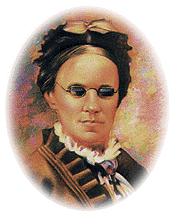
In May of 1820, when she was six weeks old, she caught a cold, and her eyes became slightly inflamed. The regular physician in Putnam County, New York, was out of town, and a man posing as a doctor gave her the wrong treatment. Within days, her eyesight was destroyed, and the man fled town in a panic. Fanny was never bitter about the stranger's intervention. She has been blind since she was six months old, but she is of a happy, contented disposition, and refuses to be pitied because of her great affliction. Indeed, when only eight years old she wrote:
O what a happy soul am I!
Although I cannot see,
I am resolved that in this world
Contented I will be;
How many blessings I enjoy
That other people don't!
To weep and sigh because I'm blind,
I cannot, and I won't
Later in life she wrote "I have not for a moment in more than eighty-five years felt a spark of resentment against Him, because I have always believed… that the good Lord… by this means consecrated me to the work that I am still permitted to do."
Early in life, she began memorizing the Bible and eventually could repeat, by rote, the entire Pentateuch, all four Gospels, many of the Psalms, all of Proverbs, as well as the entire books of Ruth and Song of Solomon. She stated at the close of her life, “The Holy Book has nurtured my entire life.”
Fanny wrote this poem about the Holy Book…
Blessed Bible, sacred treasure,
Precious book, of all the best,
There is comfort never failing,
And a calm abiding rest.
Read with reverence, and commit it,
Verse by verse, and day by day;
'Tis the word that God has spoken,
And it cannot pass away.
As a young girl Fanny learned five chapters a week!!! (Let this stimulate you to look at the related topics - Memorizing His Word)
One time a preacher sympathetically remarked, "I think it is a great pity that the Master did not give you sight when He showered so many other gifts upon you."
She replied quickly,"Do you know that if at birth I had been able to make one petition, it would have been that I should be born blind?"
"Why?" asked the surprised clergyman.
"Because when I get to heaven, the first face that shall ever gladden my sight will be that of my Savior!"
Fanny truly lived out that which she wrote about as seen so poignantly in this old favorite (note especially the underlined words of this blind poet of God)
Blessed assurance, Jesus is mine!
O what a foretaste of glory divine!
Heir of salvation, purchase of God,
Born of His Spirit, washed in His blood.
Perfect submission, perfect delight,
Visions of rapture now burst on my sight;
Angels descending bring from above,
Echoes of mercy, whispers of love.
Refrain
This is my story, this is my song,
Praising my Savior, all the day long;
This is my story, this is my song,
Praising my Savior, all the day long.
Perfect submission, all is at rest;
I in my Savior am happy and blest,
Watching and waiting, looking above,
Filled with His goodness, lost in His love.
(Play hymn)
Lord God please open the eyes of our heart to see Thee with eyes of faith, Elohim, our Creator, just as Fanny Crosby was enabled to see Thee so clearly. Amen.
Fanny died peacefully in her home in Bridgeport, Connecticut, on February 12, 1915. The crowds at her funeral were a testimony to the wide-spread influence she had for the Lord. The refrain from one of her final hymns beautifully expresses the foremost hope of her life and in so doing greatly glorifies Fanny's Elohim …
Saved by Grace
Some day the silver cord will break,
And I no more as now shall sing,
But, O, the joy when I awake
Within the palace of the King.
Refrain
And I shall see Him face to face,
And tell the story saved by grace.
Some day my earthly house will fall,
I cannot tell how soon 'twill be,
But this I know, my All in All"
Has now a place in heaven for me.
Refrain
Some day, when fades the golden sun
Beneath the rosy-tinted West,
My blessed Lord will say, "Well done!"
And I shall enter into rest.
Refrain
Some day— till then I'll watch and wait,
My lamp all trimmed and burning bright,
That when my Saviour opens the gate,
My soul to Him may take its flight.
Refrain
( Click for more on her God glorifying life )
The life of Annie Johnson Flint, well known Christian poet, is similar to Fanny Crosby in so beautifully illustrating the truths of Elohim as our Creator especially the truths expressed in Isaiah 43:7 and Ephesians 2:10. Annie's sweet songs prove that God's purpose in allowing pain is not to destroy us but to mold us and make us into the image of His Son, for as the apostle Paul testifies…
we have this treasure in earthen vessels, that the surpassing greatness of the power may be of God and not from ourselves. (2 Cor 4:7)
Excerpt from a brief biography of her life…
Picture if you can the hopelessness of Annie's position when she finally received the verdict of the doctors of the Clifton Springs Sanitarium, that henceforth she would be a helpless invalid. Her own parents had been taken from her in childhood, and her foster parents both passed away. Her one sister was very frail and struggling to meet her own situation bravely. Annie was in a condition where she was compelled to be dependent upon the care of others who could not afford to minister to her except as compensated by her. In after years she always stated that her poems were born of the need of others and not from her own need; but one knows full well that she never could have written as she did for the comfort and help of thousands of others if she had not had the background of facing those very crises in her own life.
With a pen pushed through bent fingers and held by swollen joints she wrote first without any thought that it might be an avenue of ministry, or that it would bring her returns that might help in her support. Her verses provided a solace for her in the long hours of suffering. Then she began making hand-lettered cards and gift books, and decorated some of her own verses. (Note)
Annie might have taken the approach of being bitter toward God because of the lot He had allowed her in life, but read her poem about her Elohim, a poem which gives glory to her Creator…
God takes the scent of the softening ground
Where the first green blade pricks through,
He takes the reddening maple bough
A slant against the blue,
He takes the cheer of the robin's song
And the flash of the blue-bird's wing
The joy of prisoners set free,
And of these He makes the Spring.
God takes the sheen of the waving wheat
Where the slow cloud-shadows pass,
He takes the brook's soft rippling tune
And the daisied meadow's grass,
He takes the swish of the mower's scythe
In the noontide's hot, white glare,
The joy of labor and growing things,
And makes the Summer fair.
God takes the sound of the dropping nuts,
And the scent of the wine-sweet air
In the twilight time of the year's long day,
When the spent Earth kneels in prayer
He takes a thousand varied hues
Aglow in an opal haze,
The joy of the harvest gathered in,
And makes the Autumn days.
God takes the peace of the snowy fields,
Asleep 'neath the clear, cold moon,
He takes the grace of the leafless trees
That sway to the wind's wild tune,
The frost-made lace on the window pane,
The whirl of the starry flakes,
The joy of rest when the toil is done,
And the quiet Winter makes.
God takes the years - the old, the new,
With their changing scenes and brief
The close-shut bud and the fruiting bough,
Flower and fading leaf,
Grace and glory and lack and loss,
The song, the sigh, the strife
The joy of hope and the hope fulfilled,
And makes of the years a life
God takes our lives and the sum of them,
His will and the will of man
Evil and good and dream and deed,
His purpose and our plan
The thwarted lives and the crippled lives
And the things that give them worth
The joy of life and the pain of life,
And He makes the Heavens and Earth.
(Click for more of Ms. Johnson's poems)
J B Scott - God, gods, judges, angels. (Generally, agreement is found in ASV and RSV, however in some passages where the meaning is not clear they differ from KJV: Exodus 31:6, where RSV has "God" but KJV "the judges", similarly in Exodus 22:28 [H 27] where RSV has "God" but KJV "the gods" or as a margin "judges.") This word, which is generally viewed as the plural of ʾĕlōah, is found far more frequently in Scripture than either ʾēl or ʾĕlōah for the true God. The plural ending is usually described as a plural of majesty and not intended as a true plural when used of God. This is seen in the fact that the noun ʾĕlōhîm is consistently used with singular verb forms and with adjectives and pronouns in the singular.
Albright has suggested that the use of this majestic plural comes from the tendency in the ancient near east toward a universalism: "We find in Canaanite an increasing tendency to employ the plural Ashtorôt 'Astartes', and Anatôt 'Anaths', in the clear sense of totality of manifestations of a deity'" (William F. Albright, From the Stone Age to Christianity, 2d ed., p. 213). But a better reason can be seen in Scripture itself where, in the very first chapter of Genesis, the necessity of a term conveying both the unity of the one God and yet allowing for a plurality of persons is found (Genesis 1:2, 26). This is further borne out by the fact that the form ʾĕlōhîm occurs only in Hebrew and in no other Semitic language, not even in Biblical Aramaic (Gustav F. Oehler, Theology of the Old Testament, p. 88).
The term occurs in the general sense of deity some 2570 times in Scripture. Yet as Pope has indicated, it is difficult to detect any discrepancy in use between the forms ʾēl, ʾĕlōah, and ʾĕlōhîm in Scripture (Marvin H. Pope, El in the Ugaritic Texts, p. 10).
When indicating the true God, ʾĕlōhîm functions as the subject of all divine activity revealed to man and as the object of all true reverence and fear from men. Often ʾĕlōhîm is accompanied by the personal name of God, Yahweh (Genesis 2:4-5; Exodus 34:23, Psalm 68:18 [H 19], etc.).
While the individual occurrences of the term ʾĕlōhîm for God are far too numerous to treat here, some significant appositives and descriptive phrases or clauses associated with the name are given below. These descriptive words attached to the noun ʾĕlōhîm reallyserve as titles and indicate the various titles by which God's people came to know him. The term ʾĕlōhîm is the favorite term in titles. They are usually attached by means of the construct, the relative clause or by participial phrases rendered as titles.
The first category of titles pertains to his work of creation: Isaiah 54:5, "God of All the Earth"; 1 Kings 20:28, "God of the Hills"; Jeremiah 32:27, "God of All Flesh." The God of All the Kingdoms of the Earth" (cf. Isaiah 37:16); God of Heaven (Neh. 2:4, 20); "Yahweh God of the Heaven" (Genesis 24:7; 2 Chron. 36:23); God in the Heaven (2 Chron. 20:6), "The Lord God of the Heaven and God of the Earth" (Genesis 24:3; see Deut. 4:39; Joshua 2:11); and finally "God of gods and Lord of Lords, the Great, the Mighty, and the Terrible Who Does Not Regard Favorites and Does Not Take Bribes" (Deut. 10:17). All of these titles may be subsumed under the rather brief "God Most High" (Psalm 57:2 [H 3]).
As sovereign God, ʾĕlōhîm is often described as Judge: simply "God Judge" (Psalm 50:6; Psalm 75:7 [H 8]) or "God Judge in the Earth" (Psalm 58:11 [H 12]).
By far the most frequent category of titles are those pertaining to the Savior God. Here we include numerous constructs in which God is linked to individuals whom he has called: "Their God" (Genesis 17:8); "The God of Abraham" (Genesis 26:24); "The God of Abraham . . . and the God of Isaac" (Genesis 28:13); "The God of Abraham, the God of Isaac, and the God of Jacob" (Exodus 3:6), etc. (More than one hundred such titles are found in the Old Testament.) Sometimes to these titles is added the personal name, "Yahweh" (Genesis 24:12).
Similarly, we find titles linking God by the construct grammatical form to Israel as a whole or to some part of it: "God of the Armies of Israel" (1 Samuel 17:45) or "God of Jerusalem" (2 Chron. 32:19).
All of these represent God as savior of his people as does the simple "God of Salvation" (1 Chron. 16:35; Psalm 18:46 [H 47], etc.; cf. Psalm 88:1 [H 2]).
Some titles reflect God's actions on behalf of his people in the past: "The Living God, Speaker from the Midst of the Fire" (Deut. 5:23 [H 26]; cf. 1 Kings 18:24); "God, the Bringer of Prisoners into Prosperity" (Psalm 68:7); "God . . . the Bringer out to you Water from the Flinty Rock" (Deut. 8:15); "Your God Who Separated You from the Peoples" (Leviticus 20:24).
And finally, we find titles expressing the intimacy of God with his people: "The God of Nearness" (Jeremiah 23:23); "Your God in Whom you Trust" (2 Kings 19:10); "God Your Chastener" (Deut. 8:5); The God Feeding Me My Life Long Until Now" (Genesis 48:15); "God of My Righteousness" (Psalm 4:1 [H 2]); "God of My Mercy (Psalm 59:17 [H 18]); "God of My Strength" (Psalm 43:2) and "Our God Being Merciful" (Psalm 116:5).
In reference to one particularly difficult passage from the point of view of interpretation, which therefore bears on the translation, Cyrus Gordon has said, "It is my contention that here (Exodus 22:8-9 [H 7, 8]) ʾĕlōhîm does not mean God as the LXX translates, nor judges, which is the interpretation of Peshitto and Targum Onkelos, followed by Rashi and Ibn Ezra, by several English versions and by the Lexicon" (Cyrus H. Gordon, "ʾĕlōhîm in its reputed meaning of rulers, judges," JBL 54: 140, 149). He goes on to demonstrate to his own satisfaction that from our knowledge of the Nuzi tablets we can conclude that "gods" is the better translation and that the passage refers to the "oaths of the gods" which he calls a well attested ancient oriental court procedure. He therefore sees this text as a heathen survival in the Mosaic legislation, one that was obliterated in the later Deuteronomic and priestly recensions.
This is unacceptable from the point of view of Scripture's attestation to being God's Word and its clear doctrine of the existence of only one God. The question of whether "God" or "judges" is to be used here is difficult. If "God" is correct, we understand by the passage that every man is ultimately answerable to God and stands or falls before God no matter what judgment men may make. (Online version of Theological Wordbook of the Old Testament)
Excerpt from Synonyms of the Old Testament
The general Hebrew name for God is Elohim (אלהים). Sometimes it is used with a definite article, sometimes without. Altogether it occurs 2555 times. In 2310 of these instances it is used as the name of the living and true God, but in 245 passages it appears to be adopted in lower senses.
Although plural in form, the name is generally used with a singular verb when it refers to the true God.3
This name properly represented One only Being, who revealed Himself to man as Creator, Ruler, and Lord. It was His own peculiar title, and ought to have been confined to Him. Accordingly we read, ‘in the beginning God (Elohim in the plural) created (in the singular) the heavens and the earth.’
The first hint at the possibility that the title Elohim might be shared by others besides the Creator is to be found in the serpent’s suggestion, ‘Ye shall be as Elohim, knowing good and evil’ (Gen. 3:5). The translators of the A. V. render the word ‘gods,’ but our first parents only knew of one Elohim; they heard His voice from time to time, and perhaps they saw His form; they addressed Him in the singular number; and the idea of any other being to be called Elohim but this One could not have entered their imagination until the Tempter said to them, ‘Ye shall be as God, knowing good and evil’ (see R. V.).
In after ages the worship of the Creator as Elohim began to be corrupted. The Name, indeed, was retained, but the nature of Him who bore it was well-nigh forgotten. When men were divided into different nations, and spoke various dialects and languages, they must have carried with them those notions of Elohim which they had inherited from their fathers, but the worship which was due to Him alone was in the lapse of ages transferred to the souls of the departed, to the sun, moon, and stars, and even to idols made by men’s hands.
It has been supposed that some sanction is given to the theory that the name Elohim is generic by the fact that idols are called by this name in Scripture. Some instances of this usage may therefore be cited for examination.
In Gen. 35:1, 2, 4, we read as follows: ‘And Elohim said unto Jacob, Arise, go up to Bethel and dwell there, and build there an altar, unto the El that appeared to thee when thou fleddest from before thy brother Esau. Then Jacob said to his house and to all that were with him, Put away the strange Elohim that are among you … and they gave unto Jacob all the strange Elohim that were in their hands, and their earrings which were in their ears, and Jacob hid them under the oak which was by Shechem.’ The Elohim in this case seem to have been images, perhaps charms worn on the person, similar to those which the ancient Egyptians used to wear, and which have been exhumed or manufactured by hundreds in modern days. The word nacar (נכר), here rendered strange, is used in Scripture in two opposite senses, for to know, and not to know; it here probably means foreign or alien, in which sense it is frequently applied to idolatrous worship in Scripture.
In Gen. 31:19, we read that Rachel had stolen her father’s images (teraphim), but Laban calls them his Elohim (verse 30), and Jacob, adopting the word, says, ‘with whomsoever thou findest thine Elohim, let him not live.’ Laban, then, worshipped teraphim as Elohim, though he ought to have known better, for he knew the name of Jehovah (Gen. 30:27, 31:49), and he was not ignorant of the real Elohim, whom his own father had worshipped (Gen. 31:29, 50, 53).
We also read of ‘the Elohim of Egypt’ (Exod. 12:12, A.V. gods; the margin has princes, but see Num. 33:4); of molten Elohim. (Lev. 19:4); of ‘the Elohim of the heathen’ (Exod. 23:24); also of Chemosh, Dagon, Milcom, and other idols which were designated as Elohim. When the Israelites made the molten calf out of their golden earrings (Exod. 32:3, 4), they said of it, ‘These be thy Elohim, O Israel,’ by which they practically meant ‘this is thy God,’ for they regarded the image as a representation of Jehovah (verse 5).
Jethro, the father-in-law of Moses, draws a distinction between the true and the false Elohim when he says, ‘Now know I that Jehovah is greater than all the Elohim, for in the matter wherein they dealt proudly he was above them’ (Exod. 18:11); yet this very confession is so worded as to imply not only that the priest of Midian had hitherto been in the dark on the subject, but also that he still had a lingering belief in the existence of inferior Elohim. The same ignorance and superstition was to be found amongst the children of Israel; and the primary lesson which the Lord sought to teach them during their journeyings in the wilderness was that they were to restore the name Elohim to its original and sole owner. ‘Thou shalt have no other Elohim before me.’ (Exod. 20:3). ‘Make no mention of the name of other Elohim, neither let it be heard out of thy mouth’ (Exod 23:13). ‘Jehovah he is Elohim in heaven above and upon the earth beneath; there is none else’ (Deut. 4:39). So in the Song of Moses (Deut. 32:37, 39) we read concerning the heathen, ‘Where are their Elohim, the rock on which they leaned?… I even I am he, and there is no Elohim with me.’ Once more, the utter anomaly of using the word Elohim for others than the true God is clearly indicated in the prayer of Hezekiah (2 Kings 19:18), ‘Of a truth, Jehovah, the kings of Assyria have destroyed the nations and their lands, and have cast their Elohim into the fire: for they were no Elohim but the work of men’s hands, wood and stone.’
§ 2. The Name Elohim and the Trinity
It is clear that the fact of the word Elohim being plural in form does not at all sanction polytheism; but we have now to consider whether it may fairly be taken as a testimony to the plurality of Persons in the Godhead. It is certainly marvellously consistent with this doctrine, and must remove a great stumbling-block out of the path of those who feel difficulties with regard to the acknowledgment of the Trinity in Unity. Great names are to be cited for taking a step further, and for adducing, as a proof of the Trinity, the words, ‘Elohim said, Let us make man in our image after our likeness’ (Gen. 1:26). Father Simon notes that Peter Lombard (1150) was the first to lay stress upon this point; though probably the argument was not really new in his time. Many critics, however, of unimpeachable orthodoxy, think it wiser to rest where such divines as Cajetan in the Church of Rome and Calvin among Protestants were content to stand, and to take the plural form as a plural of majesty, and as indicating the greatness, the infinity, and the incomprehensibleness of the Deity. Perhaps the idea unfolded in the plural form Elohim may be expressed more accurately by the word Godhead or Deity than by the word God; and there is certainly nothing unreasonable in the supposition that the name of the Deity was given to man in this form, so as to prepare him for the truth that in the Unity of the Godhead there are Three Persons.
As long as the passage above quoted stands on the first page of the Bible, the believer in the Trinity has a right to turn to it as a proof that Plurality in the Godhead is a very different thing from Polytheism, and as an indication that the frequent assertions of the Divine Unity are not inconsistent with the belief that the Father is God, the Son is God, and the Holy Ghost is God. It is well known that the Hebrews often expressed a word in the plural, so as to give it a special or technical meaning, as in the case of the words Blood, Water, Wisdom, Salvation, Righteousness, Life; and this is in favour of what has just been advanced. The use of the plural in the language of majesty and authority tends to the same conclusion. In these cases it is implied that the word in the singular number is not large enough to set forth all that is intended; and so in the case of the Divine Name the plural form expresses the truth that the finite word conveys an inadequate idea of the Being Whom it represents.
Other names of God will be found to be in the plural also; and it is worthy of notice that in the well-known passage in Ecclesiastes (12:1) the Hebrew runs thus, ‘Remember now thy Creators in the days of thy youth.’
§ 3. Secondary Uses of the Name Elohim
Another use of the word Elohim has now to be noticed. We read in Exod. 4:16, that God said to Moses, with reference to his brother Aaron, ‘thou shalt be to him in the place of Elohim.’ From these words it would appear that Moses was to be regarded by Aaron as standing in immediate relation to God,—not, however, as on a level with Him, for God did not say ‘thou shalt be as (ך) Elohim,’ but ‘for (ל) Elohim.’ Moses was instructed to convey the Divine message to Aaron, who, in his turn, was to announce it to Pharaoh. Similarly in chap. 7:1, the Lord says to His servant, ‘Behold I have appointed thee Elohim to Pharaoh, and Aaron shall be thy prophet.’ It is evident that the name of God was here given to His human representative, as such. The LXX has τὰ πρὸς τὸν θεόν.
The usage of the word in these passages may be illustrated by a reference to our Lord’s teaching. When accused by the Jews of making Himself God, He answered, ‘Is it not written in your law, I said, Ye are gods? If he called them gods, unto whom the word of God came,—and the Scripture cannot be broken,—say ye of him, whom the Father hath sanctified, and sent into the world, Thou blasphemes; because I said, I am the Son of God?’ (John 10:34–36.) The passage which our Lord here refers to is in Psalm 82, and begins thus: ‘Elohim taketh his stand (נצב) in the gathering of El; in the midst of Elohim he doeth judgment.’ The Psalmist proceeds to rebuke this gathering of Elohim, who were evidently judges, and who were responsible for judging in accordance with the word of the Lord: ‘How long will ye administer perverted justice, and favour wicked men? Deal justly with the poor and fatherless: acquit the afflicted and needy. Deliver the poor and needy: rescue them from the hand of wicked men.’ Yet the rebuke was unheeded. Alas! ‘They know not, neither do they perceive; they go on walking in darkness: all the foundations of the land (i.e. its judges) are moved from their course.’ Then comes the retribution following on their neglect of these august privileges and duties. ‘It is I myself that said ye are Elohim and all of you children of the Highest. Yet after all ye shall die as Adam, and as one of the princes shall ye fall’ The Psalmist concludes with the prophetic aspiration, ‘Arise, thou Elohim, administer just judgment in the land: for it is thou that hast all the nations for thine inheritance.’ Our Lord, by referring to this Psalm, evidently meant His hearers to understand that if earthly judges were called ‘gods’ in Scripture because they were to regulate their decisions by the Word of God, it could be no blasphemy in Him whom the Father hath sent into the world to call Himself God s Son. If they represented God, how much more did He.
In accordance with the words of the Psalm just referred to, we read in Exod. 22:8, 9, ‘If the thief be not found, then the master of the house shall be brought unto the judges (ha-Elohim), to decide whether he hath put his hand unto his neighbour’s goods. The cause of both parties shall come before the judges (ha-Elohim), and whom the judges (Elohim) condemn, he shall pay double to his neighbour.’ In the twenty-eighth verse, where our translators have somewhat unfortunately put ‘thou shalt not revile the gods,’ we read Elohim again, and consistently with the previous passages we should render it, ‘thou shalt not revile judges, nor speak evil of a leader among thy people.’ See R. V., margin. This passage was referred to with a latent shade of irony by St. Paul when he was called to account for speaking sharply to Ananias, who professed to judge him after the law whilst causing him to be smitten contrary to the law (Acts 23:5).
The judges are also called Elohim in Exod. 21:6, where the account is given of the master boring his servant’s ear in the presence of the magistrates. It is possible that the witch of Endor, when she said, ‘I see Elohim ascending from the earth,’ used the word in this sense, that we might render the passage, ‘I see judges ascending from the earth.’ But the noun and the participle are in the plural number in this passage. The R. V. has noted this point.
In all these passages the word Elohim indicates not beings who are to be worshipped, but a body of responsible magistrates who are called by this name because they represent the only true Elohim, who is God of gods and Lord of lords. Accordingly we read that ‘the men between whom there is a controversy shall stand before Jehovah, before the priests and the judges’ (Deut. 19:17).
§ 4. The Application of the Name Elohim to Angels
There is yet another use of the word Elohim which must not be passed over. The Samaritan Version and also the LXX have adopted the word angels to represent it in several places, and the English translators, partly guided by the teaching of the N.T., have occasionally followed their example.
Some critics have been inclined to render the words in Gen. 3:5, ‘Ye shall be as angels’; but there is no ground for such an interpretation. In Job 38:7, ‘the sons of God’ who shouted for joy are designated angels by the LXX, but this is by way of commentary rather than translation. Compare Ps. 138:1.
In Heb. 1:6, we read, ‘when he bringeth the first-begotten into the world, he saith, And let all the angels of God worship him.’ The writer here cites words which are to be found in some copies of the LXX in the Song of Moses (Deut. 32:43), but there is no Hebrew equivalent for them in our existing test. The verses which follow carry the reader on from the day of Moses to a time yet to come when God ‘will avenge the blood of his servants, and will render vengeance to his adversaries, and will be merciful to his land and to his people.’ This will be at the time of the restitution of all things which have been spoken of by all the holy prophets from old time (Acts 3:21). Whilst the writer of the Epistle to the Hebrews probably had the Song of Moses in his mind when he quoted the words of the LXX, there may be a secondary reference to Psalm 97:7, where we read, ‘worship him all ye gods (Elohim),’ but where the LXX has rendered, ‘worship him all ye his angels.’
In the 8th Psalm the A. V. runs thus, ‘What is man, that thou art mindful of him? and the son of man, that thou visitest him? For thou hast made him a little lower than the angels, and hast crowned him with glory and honour. Thou madest him to have dominion over the works of thy hands.’ Here the Hebrew has Elohim; and were it not for the sanction given to the LXX interpretation in Heb. 2:7, our translators would probably have given a literal rendering, as the R. V. has done.
Gesenius, Hengstenberg, and other critics, understood the Psalmist to mean that the Son of Man should be but little below the glory of God. So Calvin, ‘parum abesse eum jussisti a divino et coelesti statu.’ We might, perhaps, paraphrase the words, ‘thou hast bereft him for a little while of the divine glory.’ Compare Phil. 2:7. In giving this interpretation of the words, though we do not adopt the exact rendering of the LXX, we arrive at a substantial agreement with its teaching. The fact announced in the Hebrew text with regard to man generally, is fulfilled with regard to Christ in such a mode as the LXX describes, and as the writer of the Epistle to the Hebrews sanctions.
§ 5. Difficulties in Translating the Name Elohim
We have seen that the name Elohim is properly a title belonging to one Being, who is the Creator of heaven and earth, and the Sustainer of all existence. The question now returns, how is the word to be dealt with in translation? Three possible courses present themselves. The Hebrew word might be transliterated, as is sometimes done with the name JEHOVAH; or the name of some native object of worship might be substituted for it; or the original meaning of the word might be reproduced by a translation.
To deal with the last proposal first, there could be no valid objection to such a course, if no better plan presented itself. It is agreed by almost all scholars that the name Elohim signifies the putter forth of power. He is the Being to whom all power belongs. The lowest of heathen tribes are compelled to acknowledge that there is a Power in existence greater than their own, and the missionary constantly has to take this acknowledgment as a basis on which he may plant a more complete theology.
The proposal that the Hebrew name for the Divine Being should be transliterated, and used alone or in combination with those of native deities, has been received with greater favour by some missionaries. They have looked upon it as a means of avoiding the danger in which every translator is manifestly involved, of giving a seeming sanction to false religion by the adoption of a name which conveys false ideas. But, after all, whilst seeking to escape one evil, the transliterator runs into another, for he would be laying himself open to the charge that he was setting forth strange gods.
The other plan is to single out that name which is, on the whole, the best representative of a personal and powerful Being, leaving it for the general teaching of Scripture and for the oral instruction of the missionary to lift up men’s minds to higher ideas of this Being than they had before.
If all the names of God were to be rejected which had ever been used for idolatrous purposes, it is hard to know what would be left. Elohim itself was so used; the same is the case with the Arabic form Allah, with the Greek Theos, the Ethiopic Amlak (cf. Moloch), the Egyptian Nout, the Hungarian Isten, the Albanian Pernti, the Tartar Tengri, and many others, which are sanctioned in time-honoured versions. Nay, what would happen to the Georgian Ghut, the Persian Khuda, the German Gott, and the English God? Fortunately our idea of God comes not from the etymology of the word, nor from its use in the days of our heathendom, but from the truths which we have been taught about Him from our childhood. This is exactly the point to be borne in mind. The truth about God is gathered not so much from the Name as from what is taught concerning Him who bears it. The knowledge of the nature and character of God is gradually acquired through the study of the Scriptures.
The American Bishop Boone, in his contribution to the Chinese discussions, says that we should render the name of God by the highest generic word which represents an object of worship. If this theory were to be carried out, then the first verse of the Bible would practically run thus: ‘In the beginning an object of worship created the heavens and the earth.’ This, however, would be an inversion of the right order of thought. God is to be worshipped because He is Creator. His works constitute, in great measure, His claim to worship. The same writer also quotes Lactantius and Origen in favour of a generic name for God. These learned men wrote centuries after the matter had been practically settled, so far as regards the Greek language, by the usage of the LXX, and when it would have been too late, even if it had been good for any reason, to substitute Zeus for Theos. Dr. Malan, indeed, has shown, in his work on the Names of God, that Zeus and Theos were originally, in all probability, the same word. But we have a greater witness than Dr. Malan, even that of the Apostle of the Gentiles, who, after quoting two heathen hymns written in honour of Zeus, argues from them in favour of the spiritual nature of Theos, who made the world.
The passage in the Acts (chap. 17.) here referred to deserves special notice. When St. Paul reached Athens he found that it was wholly given to idolatry (κατείδωλον), an expression which falls in all too well with the Roman satirist’s remark that it was easier to find a god than a man in that city. Accordingly, the Apostle held constant discussions (διελέγετο), not only with the Jews and proselytes whom he found in the synagogue, but also with anybody whom he could meet with in the Agora. Here certain of the Epicureans, who were Atheists, and of the Stoics, who were Pantheists, fell in with him from day to day;13 and while some spoke of him with utter scorn—his Gospel being ‘foolishness’ to them—others came to the conclusion that he was setting forth certain demons (A. V. ‘gods’) which were foreign to their city. By ‘demons’ these philosophers meant very much the same as the Mahommedans mean by their genii; their ideas about them would be very vague. Sometimes they seem to have been regarded as the souls of the departed, sometimes as guardian angels, sometimes as evil influences, sometimes as what we call demi-gods.
Here, then, St. Paul found himself confronted with idolatry and demon-worship, the two substitutes for the worship of the living God which are to be found amongst almost all the nations of the earth. Even the fetish of the African rain-maker is connected with a mysterious unseen power, which is supposed to work upon a man’s life and possessions. The acknowledgment of such hidden influence harmonises all too readily with Pantheism, and is not inconsistent even with Atheism. A man may be a Positivist and yet a Spiritualist. He may, in profession at least, deny that there is a personal causa causarum, and yet may give way to a superstitious respect for certain shadowy powers, which are to him realities, and which exercise an appreciable influence on his thoughts and ways This arises from the necessity of his nature. His consciousness announces to him the reality of unseen and immaterial entities, though he does not care to proclaim the fact to the world. If he is highly civilised and scientific, he may dismiss these phantoms as creations of the imagination; but if he is a member of a barbarous and uncultivated tribe, from which the true idea of God has apparently died out, he will become the prey of the rainmaker, the conjurer, or the witch, by whose arts his superstition will be systematically developed. The fetish or object which he regards with awe, whether it be merely a bit of rag or a bundle of feathers, becomes to him an embodiment of the dark and terrible side of his spiritual feelings. As long as the sun shines and the rain descends and the fruits of the earth abound,—as long as a man has health, and strength, and prosperity,—he cares little about fetish or demon, and still less about God; but when trouble comes he will follow the example of Jonah’s mariners, who ‘cried every man unto his god,’ and will seek by magic or superstitious arts to avert the misfortunes which have befallen him, and to propitiate the evil spirit whom he has unwittingly offended. This sad story of human superstition is well known to every missionary who has laboured among rude tribes of idolaters; and it may help us to understand the state of things which Christianity has had to displace ever since its earliest promulgation.
But to return to St. Paul’s speech at Athens. ‘He seemeth,’ said the sage, ‘to be a setter forth of strange (i.e. foreign) demons.’ Accordingly, impelled by curiosity, they gather round the Apostle, and lead him out of the bustling Agora up the rock-cut steps by which we still mount to the Areopagus. There to his male and female audience, half-cynical, half-interested, the Apostle of the Gentiles delivered a model missionary address, and conferred a lustre on Athens which neither the oratory of Demosthenes, the statesmanship of Pericles, the philosophy of Plato, nor the art of Phidias can surpass. ‘Athenians!’ he seems to say, ‘ye appear to me to be far too much given to demon-fearing already; it is a mistake therefore to suppose that I have come to set forth more demons for your acceptance. My mission is a very different one; for whilst coming through your city, and inspecting the objects which you regard with reverence, I met with an altar on which was written, “TO GOD THE UNKNOWN.” Besides the demons whom you fear, then, there is evidently a being called GOD, whom you regard with reverence, even though you are ignorant about His true nature. This is the Being whom I am setting forth to you.’
Having thus awakened the attention of his hearers, he concentrated their mind on the word GOD. ‘The God who made the cosmos and all that is in it, He, being possessor and ruler of heaven and earth, cannot have His Presence confined within the minute space which human hands are able to compass round with walls (and here no doubt the speaker pointed to the buildings that lay at his feet), neither can He be ministered to (θεραπεύεται) by hands of mortal men, as if He had any necessities which they could relieve—seeing that it is He that is the giver of life in all its aspects to all men. The nations which dwell on the face of the whole earth have sprung from one source, and have been distributed through many ages, and among various countries, by His will and agency. And it is for them to seek God, if haply they may feel Him18 and find Him. And, after all, He is not far off from any single person among us, for it is through union with Him that we have life, movement, and even bare existence; as some of your own poets have said, “For we are His offspring.” Seeing, then, that there is such a relationship existing between God and man, we ought to know better than to suppose that the Deity (τό θεῖον) can be really like a cleverly carved piece of stone or metal. If these things do not represent the real life of man, how can they possibly represent Him from whom that life flows?’
St. Paul’s argument rested not on the name of God, but on the Divine operations and attributes. He knew full well that the word Theos did not convey the whole truth about the Divine Being to the mind of his hearers, and that Zeus was still further from being a fair representative of Elohim; but he confirmed what he had to say about the Theos who made the heaven and the earth by reference to two hymns dedicated to Zeus, who was also described as maker of all things. He thus worked round to the original idea of Elohim, and laid the foundations of sound Gospel teaching on one of the noblest products of natural theology.
- 2250 VERSES
- Translated - divine(1), divine being(1), exceedingly(1), God(2326), god(45), God's(14), goddess(2), godly(1), gods(204), great(2), judges(3), mighty(2), rulers(1), shrine*(1).
">Gen. 1:1; Gen. 1:2; Gen. 1:3; Gen. 1:4; Gen. 1:5; Gen. 1:6; Gen. 1:7; Gen. 1:8; Gen. 1:9; Gen. 1:10; Gen. 1:11; Gen. 1:12; Gen. 1:14; Gen. 1:16; Gen. 1:17; Gen. 1:18; Gen. 1:20; Gen. 1:21; Gen. 1:22; Gen. 1:24; Gen. 1:25; Gen. 1:26; Gen. 1:27; Gen. 1:28; Gen. 1:29; Gen. 1:31; Gen. 2:2; Gen. 2:3; Gen. 2:4; Gen. 2:5; Gen. 2:7; Gen. 2:8; Gen. 2:9; Gen. 2:15; Gen. 2:16; Gen. 2:18; Gen. 2:19; Gen. 2:21; Gen. 2:22; Gen. 3:1; Gen. 3:3; Gen. 3:5; Gen. 3:8; Gen. 3:9; Gen. 3:13; Gen. 3:14; Gen. 3:21; Gen. 3:22; Gen. 3:23; Gen. 4:25; Gen. 5:1; Gen. 5:22; Gen. 5:24; Gen. 6:2; Gen. 6:4; Gen. 6:9; Gen. 6:11; Gen. 6:12; Gen. 6:13; Gen. 6:22; Gen. 7:9; Gen. 7:16; Gen. 8:1; Gen. 8:15; Gen. 9:1; Gen. 9:6; Gen. 9:8; Gen. 9:12; Gen. 9:16; Gen. 9:17; Gen. 9:26; Gen. 9:27; Gen. 14:19; Gen. 14:20; Gen. 14:22; Gen. 17:3; Gen. 17:7; Gen. 17:8; Gen. 17:9; Gen. 17:15; Gen. 17:18; Gen. 17:19; Gen. 17:22; Gen. 17:23; Gen. 19:29; Gen. 20:3; Gen. 20:6; Gen. 20:11; Gen. 20:13; Gen. 20:17; Gen. 21:2; Gen. 21:4; Gen. 21:6; Gen. 21:12; Gen. 21:17; Gen. 21:19; Gen. 21:20; Gen. 21:22; Gen. 21:23; Gen. 22:1; Gen. 22:3; Gen. 22:8; Gen. 22:9; Gen. 22:12; Gen. 23:6; Gen. 24:3; Gen. 24:7; Gen. 24:12; Gen. 24:27; Gen. 24:42; Gen. 24:48; Gen. 25:11; Gen. 26:24; Gen. 27:20; Gen. 27:28; Gen. 28:4; Gen. 28:12; Gen. 28:13; Gen. 28:17; Gen. 28:20; Gen. 28:21; Gen. 28:22; Gen. 30:2; Gen. 30:6; Gen. 30:8; Gen. 30:17; Gen. 30:18; Gen. 30:20; Gen. 30:22; Gen. 30:23; Gen. 31:5; Gen. 31:7; Gen. 31:9; Gen. 31:11; Gen. 31:16; Gen. 31:24; Gen. 31:29; Gen. 31:30; Gen. 31:32; Gen. 31:42; Gen. 31:50; Gen. 31:53; Gen. 32:1; Gen. 32:2; Gen. 32:9; Gen. 32:28; Gen. 32:30; Gen. 33:5; Gen. 33:10; Gen. 33:11; Gen. 35:1; Gen. 35:2; Gen. 35:4; Gen. 35:5; Gen. 35:7; Gen. 35:9; Gen. 35:10; Gen. 35:11; Gen. 35:13; Gen. 35:15; Gen. 39:9; Gen. 40:8; Gen. 41:16; Gen. 41:25; Gen. 41:28; Gen. 41:32; Gen. 41:38; Gen. 41:39; Gen. 41:51; Gen. 41:52; Gen. 42:18; Gen. 42:28; Gen. 43:23; Gen. 43:29; Gen. 44:16; Gen. 45:5; Gen. 45:7; Gen. 45:8; Gen. 45:9; Gen. 46:1; Gen. 46:2; Gen. 46:3; Gen. 48:9; Gen. 48:11; Gen. 48:15; Gen. 48:20; Gen. 48:21; Gen. 50:17; Gen. 50:19; Gen. 50:20; Gen. 50:24; Gen. 50:25; Exod. 1:17; Exod. 1:20; Exod. 1:21; Exod. 2:23; Exod. 2:24; Exod. 2:25; Exod. 3:1; Exod. 3:4; Exod. 3:6; Exod. 3:11; Exod. 3:12; Exod. 3:13; Exod. 3:14; Exod. 3:15; Exod. 3:16; Exod. 3:18; Exod. 4:5; Exod. 4:16; Exod. 4:20; Exod. 4:27; Exod. 5:1; Exod. 5:3; Exod. 5:8; Exod. 6:2; Exod. 6:7; Exod. 7:1; Exod. 7:16; Exod. 8:10; Exod. 8:19; Exod. 8:25; Exod. 8:26; Exod. 8:27; Exod. 8:28; Exod. 9:1; Exod. 9:13; Exod. 9:28; Exod. 9:30; Exod. 10:3; Exod. 10:7; Exod. 10:8; Exod. 10:16; Exod. 10:17; Exod. 10:25; Exod. 10:26; Exod. 12:12; Exod. 13:17; Exod. 13:18; Exod. 13:19; Exod. 14:19; Exod. 15:2; Exod. 15:26; Exod. 16:12; Exod. 17:9; Exod. 18:1; Exod. 18:4; Exod. 18:5; Exod. 18:11; Exod. 18:12; Exod. 18:15; Exod. 18:16; Exod. 18:19; Exod. 18:21; Exod. 18:23; Exod. 19:3; Exod. 19:17; Exod. 19:19; Exod. 20:1; Exod. 20:2; Exod. 20:3; Exod. 20:5; Exod. 20:7; Exod. 20:10; Exod. 20:12; Exod. 20:19; Exod. 20:20; Exod. 20:21; Exod. 20:23; Exod. 21:6; Exod. 21:13; Exod. 22:8; Exod. 22:9; Exod. 22:20; Exod. 22:28; Exod. 23:13; Exod. 23:19; Exod. 23:24; Exod. 23:25; Exod. 23:32; Exod. 23:33; Exod. 24:10; Exod. 24:11; Exod. 24:13; Exod. 29:45; Exod. 29:46; Exod. 31:3; Exod. 31:18; Exod. 32:1; Exod. 32:4; Exod. 32:8; Exod. 32:11; Exod. 32:16; Exod. 32:23; Exod. 32:27; Exod. 32:31; Exod. 34:15; Exod. 34:16; Exod. 34:17; Exod. 34:23; Exod. 34:24; Exod. 34:26; Exod. 35:31; Lev. 2:13; Lev. 4:22; Lev. 11:44; Lev. 11:45; Lev. 18:2; Lev. 18:4; Lev. 18:21; Lev. 18:30; Lev. 19:2; Lev. 19:3; Lev. 19:4; Lev. 19:10; Lev. 19:12; Lev. 19:14; Lev. 19:25; Lev. 19:31; Lev. 19:32; Lev. 19:34; Lev. 19:36; Lev. 20:7; Lev. 20:24; Lev. 21:6; Lev. 21:7; Lev. 21:8; Lev. 21:12; Lev. 21:17; Lev. 21:21; Lev. 21:22; Lev. 22:25; Lev. 22:33; Lev. 23:14; Lev. 23:22; Lev. 23:28; Lev. 23:40; Lev. 23:43; Lev. 24:15; Lev. 24:22; Lev. 25:17; Lev. 25:36; Lev. 25:38; Lev. 25:43; Lev. 25:55; Lev. 26:1; Lev. 26:12; Lev. 26:13; Lev. 26:44; Lev. 26:45; Num. 6:7; Num. 10:9; Num. 10:10; Num. 15:40; Num. 15:41; Num. 16:9; Num. 16:22; Num. 21:5; Num. 22:9; Num. 22:10; Num. 22:12; Num. 22:18; Num. 22:20; Num. 22:22; Num. 22:38; Num. 23:4; Num. 23:21; Num. 23:27; Num. 24:2; Num. 25:2; Num. 25:13; Num. 27:16; Num. 33:4; Deut. 1:6; Deut. 1:10; Deut. 1:11; Deut. 1:17; Deut. 1:19; Deut. 1:20; Deut. 1:21; Deut. 1:25; Deut. 1:26; Deut. 1:30; Deut. 1:31; Deut. 1:32; Deut. 1:41; Deut. 2:7; Deut. 2:29; Deut. 2:30; Deut. 2:33; Deut. 2:36; Deut. 2:37; Deut. 3:3; Deut. 3:18; Deut. 3:20; Deut. 3:21; Deut. 3:22; Deut. 4:1; Deut. 4:2; Deut. 4:3; Deut. 4:4; Deut. 4:5; Deut. 4:7; Deut. 4:10; Deut. 4:19; Deut. 4:21; Deut. 4:23; Deut. 4:24; Deut. 4:25; Deut. 4:28; Deut. 4:29; Deut. 4:30; Deut. 4:31; Deut. 4:32; Deut. 4:33; Deut. 4:34; Deut. 4:35; Deut. 4:39; Deut. 4:40; Deut. 5:2; Deut. 5:6; Deut. 5:7; Deut. 5:9; Deut. 5:11; Deut. 5:12; Deut. 5:14; Deut. 5:15; Deut. 5:16; Deut. 5:24; Deut. 5:25; Deut. 5:26; Deut. 5:27; Deut. 5:32; Deut. 5:33; Deut. 6:1; Deut. 6:2; Deut. 6:3; Deut. 6:4; Deut. 6:5; Deut. 6:10; Deut. 6:13; Deut. 6:14; Deut. 6:15; Deut. 6:16; Deut. 6:17; Deut. 6:20; Deut. 6:24; Deut. 6:25; Deut. 7:1; Deut. 7:2; Deut. 7:4; Deut. 7:6; Deut. 7:9; Deut. 7:12; Deut. 7:16; Deut. 7:18; Deut. 7:19; Deut. 7:20; Deut. 7:21; Deut. 7:22; Deut. 7:23; Deut. 7:25; Deut. 8:2; Deut. 8:5; Deut. 8:6; Deut. 8:7; Deut. 8:10; Deut. 8:11; Deut. 8:14; Deut. 8:18; Deut. 8:19; Deut. 8:20; Deut. 9:3; Deut. 9:4; Deut. 9:5; Deut. 9:6; Deut. 9:7; Deut. 9:10; Deut. 9:16; Deut. 9:23; Deut. 10:9; Deut. 10:12; Deut. 10:14; Deut. 10:17; Deut. 10:20; Deut. 10:21; Deut. 10:22; Deut. 11:1; Deut. 11:2; Deut. 11:12; Deut. 11:13; Deut. 11:16; Deut. 11:22; Deut. 11:25; Deut. 11:27; Deut. 11:28; Deut. 11:29; Deut. 11:31; Deut. 12:1; Deut. 12:2; Deut. 12:3; Deut. 12:4; Deut. 12:5; Deut. 12:7; Deut. 12:9; Deut. 12:10; Deut. 12:11; Deut. 12:12; Deut. 12:15; Deut. 12:18; Deut. 12:20; Deut. 12:21; Deut. 12:27; Deut. 12:28; Deut. 12:29; Deut. 12:30; Deut. 12:31; Deut. 13:2; Deut. 13:3; Deut. 13:4; Deut. 13:5; Deut. 13:6; Deut. 13:7; Deut. 13:10; Deut. 13:12; Deut. 13:13; Deut. 13:16; Deut. 13:18; Deut. 14:1; Deut. 14:2; Deut. 14:21; Deut. 14:23; Deut. 14:24; Deut. 14:25; Deut. 14:26; Deut. 14:29; Deut. 15:4; Deut. 15:5; Deut. 15:6; Deut. 15:7; Deut. 15:10; Deut. 15:14; Deut. 15:15; Deut. 15:18; Deut. 15:19; Deut. 15:20; Deut. 15:21; Deut. 16:1; Deut. 16:2; Deut. 16:5; Deut. 16:6; Deut. 16:7; Deut. 16:8; Deut. 16:10; Deut. 16:11; Deut. 16:15; Deut. 16:16; Deut. 16:17; Deut. 16:18; Deut. 16:20; Deut. 16:21; Deut. 16:22; Deut. 17:1; Deut. 17:2; Deut. 17:3; Deut. 17:8; Deut. 17:12; Deut. 17:14; Deut. 17:15; Deut. 17:19; Deut. 18:5; Deut. 18:7; Deut. 18:9; Deut. 18:12; Deut. 18:13; Deut. 18:14; Deut. 18:15; Deut. 18:16; Deut. 18:20; Deut. 19:1; Deut. 19:2; Deut. 19:3; Deut. 19:8; Deut. 19:9; Deut. 19:10; Deut. 19:14; Deut. 20:1; Deut. 20:4; Deut. 20:13; Deut. 20:14; Deut. 20:16; Deut. 20:17; Deut. 20:18; Deut. 21:1; Deut. 21:5; Deut. 21:10; Deut. 21:23; Deut. 22:5; Deut. 23:5; Deut. 23:14; Deut. 23:18; Deut. 23:20; Deut. 23:21; Deut. 23:23; Deut. 24:4; Deut. 24:9; Deut. 24:13; Deut. 24:18; Deut. 24:19; Deut. 25:15; Deut. 25:16; Deut. 25:18; Deut. 25:19; Deut. 26:1; Deut. 26:2; Deut. 26:3; Deut. 26:4; Deut. 26:5; Deut. 26:7; Deut. 26:10; Deut. 26:11; Deut. 26:13; Deut. 26:14; Deut. 26:16; Deut. 26:17; Deut. 26:19; Deut. 27:2; Deut. 27:3; Deut. 27:5; Deut. 27:6; Deut. 27:7; Deut. 27:9; Deut. 27:10; Deut. 28:1; Deut. 28:2; Deut. 28:8; Deut. 28:9; Deut. 28:13; Deut. 28:14; Deut. 28:15; Deut. 28:36; Deut. 28:45; Deut. 28:47; Deut. 28:52; Deut. 28:53; Deut. 28:58; Deut. 28:62; Deut. 28:64; Deut. 29:6; Deut. 29:10; Deut. 29:12; Deut. 29:13; Deut. 29:15; Deut. 29:18; Deut. 29:25; Deut. 29:26; Deut. 29:29; Deut. 30:1; Deut. 30:2; Deut. 30:3; Deut. 30:4; Deut. 30:5; Deut. 30:6; Deut. 30:7; Deut. 30:9; Deut. 30:10; Deut. 30:16; Deut. 30:17; Deut. 30:20; Deut. 31:3; Deut. 31:6; Deut. 31:11; Deut. 31:12; Deut. 31:13; Deut. 31:16; Deut. 31:17; Deut. 31:18; Deut. 31:20; Deut. 31:26; Deut. 32:3; Deut. 32:17; Deut. 32:37; Deut. 32:39; Deut. 33:1; Deut. 33:27; Jos. 1:9; Jos. 1:11; Jos. 1:13; Jos. 1:15; Jos. 1:17; Jos. 2:11; Jos. 3:3; Jos. 3:9; Jos. 4:5; Jos. 4:23; Jos. 4:24; Jos. 7:13; Jos. 7:19; Jos. 7:20; Jos. 8:7; Jos. 8:30; Jos. 9:9; Jos. 9:18; Jos. 9:19; Jos. 9:23; Jos. 9:24; Jos. 10:19; Jos. 10:40; Jos. 10:42; Jos. 13:14; Jos. 13:33; Jos. 14:6; Jos. 14:8; Jos. 14:9; Jos. 14:14; Jos. 18:3; Jos. 18:6; Jos. 22:3; Jos. 22:4; Jos. 22:5; Jos. 22:16; Jos. 22:19; Jos. 22:22; Jos. 22:24; Jos. 22:29; Jos. 22:33; Jos. 22:34; Jos. 23:3; Jos. 23:5; Jos. 23:7; Jos. 23:8; Jos. 23:10; Jos. 23:11; Jos. 23:13; Jos. 23:14; Jos. 23:15; Jos. 23:16; Jos. 24:1; Jos. 24:2; Jos. 24:14; Jos. 24:15; Jos. 24:16; Jos. 24:17; Jos. 24:18; Jos. 24:19; Jos. 24:20; Jos. 24:23; Jos. 24:24; Jos. 24:26; Jos. 24:27; Jdg. 1:7; Jdg. 2:3; Jdg. 2:12; Jdg. 2:17; Jdg. 2:19; Jdg. 3:6; Jdg. 3:7; Jdg. 3:20; Jdg. 4:6; Jdg. 4:23; Jdg. 5:3; Jdg. 5:5; Jdg. 5:8; Jdg. 6:8; Jdg. 6:10; Jdg. 6:20; Jdg. 6:26; Jdg. 6:31; Jdg. 6:36; Jdg. 6:39; Jdg. 6:40; Jdg. 7:14; Jdg. 8:3; Jdg. 8:33; Jdg. 8:34; Jdg. 9:7; Jdg. 9:9; Jdg. 9:13; Jdg. 9:23; Jdg. 9:27; Jdg. 9:56; Jdg. 9:57; Jdg. 10:6; Jdg. 10:10; Jdg. 10:13; Jdg. 10:14; Jdg. 10:16; Jdg. 11:21; Jdg. 11:23; Jdg. 11:24; Jdg. 13:5; Jdg. 13:6; Jdg. 13:7; Jdg. 13:8; Jdg. 13:9; Jdg. 13:22; Jdg. 15:19; Jdg. 16:17; Jdg. 16:23; Jdg. 16:24; Jdg. 16:28; Jdg. 17:5; Jdg. 18:5; Jdg. 18:10; Jdg. 18:24; Jdg. 18:31; Jdg. 20:2; Jdg. 20:18; Jdg. 20:27; Jdg. 21:2; Jdg. 21:3; Ruth 1:15; Ruth 1:16; Ruth 2:12; 1 Sam. 1:17; 1 Sam. 2:2; 1 Sam. 2:25; 1 Sam. 2:27; 1 Sam. 2:30; 1 Sam. 3:3; 1 Sam. 3:17; 1 Sam. 4:4; 1 Sam. 4:7; 1 Sam. 4:8; 1 Sam. 4:11; 1 Sam. 4:13; 1 Sam. 4:17; 1 Sam. 4:18; 1 Sam. 4:19; 1 Sam. 4:21; 1 Sam. 4:22; 1 Sam. 5:1; 1 Sam. 5:2; 1 Sam. 5:7; 1 Sam. 5:8; 1 Sam. 5:10; 1 Sam. 5:11; 1 Sam. 6:3; 1 Sam. 6:5; 1 Sam. 6:20; 1 Sam. 7:3; 1 Sam. 7:8; 1 Sam. 8:8; 1 Sam. 9:6; 1 Sam. 9:7; 1 Sam. 9:8; 1 Sam. 9:9; 1 Sam. 9:10; 1 Sam. 9:27; 1 Sam. 10:3; 1 Sam. 10:5; 1 Sam. 10:7; 1 Sam. 10:9; 1 Sam. 10:10; 1 Sam. 10:18; 1 Sam. 10:19; 1 Sam. 10:26; 1 Sam. 11:6; 1 Sam. 12:9; 1 Sam. 12:12; 1 Sam. 12:14; 1 Sam. 12:19; 1 Sam. 13:13; 1 Sam. 14:15; 1 Sam. 14:18; 1 Sam. 14:36; 1 Sam. 14:37; 1 Sam. 14:41; 1 Sam. 14:44; 1 Sam. 14:45; 1 Sam. 15:15; 1 Sam. 15:21; 1 Sam. 15:30; 1 Sam. 16:7; 1 Sam. 16:15; 1 Sam. 16:16; 1 Sam. 16:23; 1 Sam. 17:26; 1 Sam. 17:36; 1 Sam. 17:43; 1 Sam. 17:45; 1 Sam. 17:46; 1 Sam. 18:10; 1 Sam. 19:20; 1 Sam. 19:23; 1 Sam. 20:12; 1 Sam. 22:3; 1 Sam. 22:13; 1 Sam. 22:15; 1 Sam. 23:7; 1 Sam. 23:10; 1 Sam. 23:11; 1 Sam. 23:14; 1 Sam. 23:16; 1 Sam. 25:22; 1 Sam. 25:29; 1 Sam. 25:32; 1 Sam. 25:34; 1 Sam. 26:8; 1 Sam. 26:19; 1 Sam. 28:13; 1 Sam. 28:15; 1 Sam. 29:9; 1 Sam. 30:6; 1 Sam. 30:15; 2 Sam. 2:27; 2 Sam. 3:9; 2 Sam. 3:35; 2 Sam. 5:10; 2 Sam. 6:2; 2 Sam. 6:3; 2 Sam. 6:4; 2 Sam. 6:6; 2 Sam. 6:7; 2 Sam. 6:12; 2 Sam. 7:2; 2 Sam. 7:22; 2 Sam. 7:23; 2 Sam. 7:24; 2 Sam. 7:25; 2 Sam. 7:26; 2 Sam. 7:27; 2 Sam. 7:28; 2 Sam. 9:3; 2 Sam. 10:12; 2 Sam. 12:7; 2 Sam. 12:16; 2 Sam. 14:11; 2 Sam. 14:13; 2 Sam. 14:14; 2 Sam. 14:16; 2 Sam. 14:17; 2 Sam. 14:20; 2 Sam. 15:24; 2 Sam. 15:25; 2 Sam. 15:29; 2 Sam. 15:32; 2 Sam. 16:23; 2 Sam. 18:28; 2 Sam. 19:13; 2 Sam. 19:27; 2 Sam. 21:14; 2 Sam. 22:3; 2 Sam. 22:7; 2 Sam. 22:22; 2 Sam. 22:30; 2 Sam. 22:32; 2 Sam. 22:47; 2 Sam. 23:1; 2 Sam. 23:3; 2 Sam. 24:3; 2 Sam. 24:23; 2 Sam. 24:24; 1 Ki. 1:17; 1 Ki. 1:30; 1 Ki. 1:36; 1 Ki. 1:47; 1 Ki. 1:48; 1 Ki. 2:3; 1 Ki. 2:23; 1 Ki. 3:5; 1 Ki. 3:7; 1 Ki. 3:11; 1 Ki. 3:28; 1 Ki. 4:29; 1 Ki. 5:3; 1 Ki. 5:4; 1 Ki. 5:5; 1 Ki. 8:15; 1 Ki. 8:17; 1 Ki. 8:20; 1 Ki. 8:23; 1 Ki. 8:25; 1 Ki. 8:26; 1 Ki. 8:27; 1 Ki. 8:28; 1 Ki. 8:57; 1 Ki. 8:59; 1 Ki. 8:60; 1 Ki. 8:61; 1 Ki. 8:65; 1 Ki. 9:6; 1 Ki. 9:9; 1 Ki. 10:9; 1 Ki. 10:24; 1 Ki. 11:2; 1 Ki. 11:4; 1 Ki. 11:5; 1 Ki. 11:8; 1 Ki. 11:9; 1 Ki. 11:10; 1 Ki. 11:23; 1 Ki. 11:31; 1 Ki. 11:33; 1 Ki. 12:22; 1 Ki. 12:28; 1 Ki. 13:1; 1 Ki. 13:4; 1 Ki. 13:5; 1 Ki. 13:6; 1 Ki. 13:7; 1 Ki. 13:8; 1 Ki. 13:11; 1 Ki. 13:12; 1 Ki. 13:14; 1 Ki. 13:21; 1 Ki. 13:26; 1 Ki. 13:29; 1 Ki. 13:31; 1 Ki. 14:7; 1 Ki. 14:9; 1 Ki. 14:13; 1 Ki. 15:3; 1 Ki. 15:4; 1 Ki. 15:30; 1 Ki. 16:13; 1 Ki. 16:26; 1 Ki. 16:33; 1 Ki. 17:1; 1 Ki. 17:12; 1 Ki. 17:14; 1 Ki. 17:18; 1 Ki. 17:20; 1 Ki. 17:21; 1 Ki. 17:24; 1 Ki. 18:10; 1 Ki. 18:21; 1 Ki. 18:24; 1 Ki. 18:25; 1 Ki. 18:27; 1 Ki. 18:36; 1 Ki. 18:37; 1 Ki. 18:39; 1 Ki. 19:2; 1 Ki. 19:8; 1 Ki. 19:10; 1 Ki. 19:14; 1 Ki. 20:10; 1 Ki. 20:23; 1 Ki. 20:28; 1 Ki. 21:10; 1 Ki. 21:13; 1 Ki. 22:53; 2 Ki. 1:2; 2 Ki. 1:3; 2 Ki. 1:6; 2 Ki. 1:9; 2 Ki. 1:10; 2 Ki. 1:11; 2 Ki. 1:12; 2 Ki. 1:13; 2 Ki. 1:16; 2 Ki. 2:14; 2 Ki. 4:7; 2 Ki. 4:9; 2 Ki. 4:16; 2 Ki. 4:21; 2 Ki. 4:22; 2 Ki. 4:25; 2 Ki. 4:27; 2 Ki. 4:40; 2 Ki. 4:42; 2 Ki. 5:7; 2 Ki. 5:8; 2 Ki. 5:11; 2 Ki. 5:14; 2 Ki. 5:15; 2 Ki. 5:17; 2 Ki. 5:20; 2 Ki. 6:6; 2 Ki. 6:9; 2 Ki. 6:10; 2 Ki. 6:15; 2 Ki. 6:31; 2 Ki. 7:2; 2 Ki. 7:17; 2 Ki. 7:18; 2 Ki. 7:19; 2 Ki. 8:2; 2 Ki. 8:4; 2 Ki. 8:7; 2 Ki. 8:8; 2 Ki. 8:11; 2 Ki. 9:6; 2 Ki. 10:31; 2 Ki. 13:19; 2 Ki. 14:25; 2 Ki. 16:2; 2 Ki. 17:7; 2 Ki. 17:9; 2 Ki. 17:14; 2 Ki. 17:16; 2 Ki. 17:19; 2 Ki. 17:26; 2 Ki. 17:27; 2 Ki. 17:29; 2 Ki. 17:31; 2 Ki. 17:33; 2 Ki. 17:35; 2 Ki. 17:37; 2 Ki. 17:38; 2 Ki. 17:39; 2 Ki. 18:5; 2 Ki. 18:12; 2 Ki. 18:22; 2 Ki. 18:33; 2 Ki. 18:34; 2 Ki. 18:35; 2 Ki. 19:4; 2 Ki. 19:10; 2 Ki. 19:12; 2 Ki. 19:15; 2 Ki. 19:16; 2 Ki. 19:18; 2 Ki. 19:19; 2 Ki. 19:20; 2 Ki. 19:37; 2 Ki. 20:5; 2 Ki. 21:12; 2 Ki. 21:22; 2 Ki. 22:15; 2 Ki. 22:17; 2 Ki. 22:18; 2 Ki. 23:16; 2 Ki. 23:17; 2 Ki. 23:21; 1 Chr. 4:10; 1 Chr. 5:20; 1 Chr. 5:22; 1 Chr. 5:25; 1 Chr. 5:26; 1 Chr. 6:48; 1 Chr. 6:49; 1 Chr. 9:11; 1 Chr. 9:13; 1 Chr. 9:26; 1 Chr. 9:27; 1 Chr. 10:10; 1 Chr. 11:2; 1 Chr. 11:19; 1 Chr. 12:17; 1 Chr. 12:18; 1 Chr. 12:22; 1 Chr. 13:2; 1 Chr. 13:3; 1 Chr. 13:5; 1 Chr. 13:6; 1 Chr. 13:7; 1 Chr. 13:8; 1 Chr. 13:10; 1 Chr. 13:12; 1 Chr. 13:14; 1 Chr. 14:10; 1 Chr. 14:11; 1 Chr. 14:12; 1 Chr. 14:14; 1 Chr. 14:15; 1 Chr. 14:16; 1 Chr. 15:1; 1 Chr. 15:2; 1 Chr. 15:12; 1 Chr. 15:13; 1 Chr. 15:14; 1 Chr. 15:15; 1 Chr. 15:24; 1 Chr. 15:26; 1 Chr. 16:1; 1 Chr. 16:4; 1 Chr. 16:6; 1 Chr. 16:14; 1 Chr. 16:25; 1 Chr. 16:26; 1 Chr. 16:35; 1 Chr. 16:36; 1 Chr. 16:42; 1 Chr. 17:2; 1 Chr. 17:3; 1 Chr. 17:16; 1 Chr. 17:17; 1 Chr. 17:20; 1 Chr. 17:21; 1 Chr. 17:22; 1 Chr. 17:24; 1 Chr. 17:25; 1 Chr. 17:26; 1 Chr. 19:13; 1 Chr. 21:7; 1 Chr. 21:8; 1 Chr. 21:15; 1 Chr. 21:17; 1 Chr. 21:30; 1 Chr. 22:1; 1 Chr. 22:2; 1 Chr. 22:6; 1 Chr. 22:7; 1 Chr. 22:11; 1 Chr. 22:12; 1 Chr. 22:18; 1 Chr. 22:19; 1 Chr. 23:14; 1 Chr. 23:25; 1 Chr. 23:28; 1 Chr. 24:5; 1 Chr. 24:19; 1 Chr. 25:5; 1 Chr. 25:6; 1 Chr. 26:5; 1 Chr. 26:20; 1 Chr. 26:32; 1 Chr. 28:2; 1 Chr. 28:3; 1 Chr. 28:4; 1 Chr. 28:8; 1 Chr. 28:9; 1 Chr. 28:12; 1 Chr. 28:20; 1 Chr. 28:21; 1 Chr. 29:1; 1 Chr. 29:2; 1 Chr. 29:3; 1 Chr. 29:7; 1 Chr. 29:10; 1 Chr. 29:13; 1 Chr. 29:16; 1 Chr. 29:17; 1 Chr. 29:18; 1 Chr. 29:20; 2 Chr. 1:1; 2 Chr. 1:3; 2 Chr. 1:4; 2 Chr. 1:7; 2 Chr. 1:8; 2 Chr. 1:9; 2 Chr. 1:11; 2 Chr. 2:4; 2 Chr. 2:5; 2 Chr. 2:12; 2 Chr. 3:3; 2 Chr. 4:11; 2 Chr. 4:19; 2 Chr. 5:1; 2 Chr. 5:14; 2 Chr. 6:4; 2 Chr. 6:7; 2 Chr. 6:10; 2 Chr. 6:14; 2 Chr. 6:16; 2 Chr. 6:17; 2 Chr. 6:18; 2 Chr. 6:19; 2 Chr. 6:40; 2 Chr. 6:41; 2 Chr. 6:42; 2 Chr. 7:5; 2 Chr. 7:19; 2 Chr. 7:22; 2 Chr. 8:14; 2 Chr. 9:8; 2 Chr. 9:23; 2 Chr. 10:15; 2 Chr. 11:2; 2 Chr. 11:16; 2 Chr. 13:5; 2 Chr. 13:8; 2 Chr. 13:9; 2 Chr. 13:10; 2 Chr. 13:11; 2 Chr. 13:12; 2 Chr. 13:15; 2 Chr. 13:16; 2 Chr. 13:18; 2 Chr. 14:2; 2 Chr. 14:4; 2 Chr. 14:7; 2 Chr. 14:11; 2 Chr. 15:1; 2 Chr. 15:3; 2 Chr. 15:4; 2 Chr. 15:6; 2 Chr. 15:9; 2 Chr. 15:12; 2 Chr. 15:13; 2 Chr. 15:18; 2 Chr. 16:7; 2 Chr. 17:4; 2 Chr. 18:5; 2 Chr. 18:13; 2 Chr. 18:31; 2 Chr. 19:3; 2 Chr. 19:4; 2 Chr. 19:7; 2 Chr. 20:6; 2 Chr. 20:7; 2 Chr. 20:12; 2 Chr. 20:15; 2 Chr. 20:19; 2 Chr. 20:20; 2 Chr. 20:29; 2 Chr. 20:30; 2 Chr. 20:33; 2 Chr. 21:10; 2 Chr. 21:12; 2 Chr. 22:7; 2 Chr. 22:12; 2 Chr. 23:3; 2 Chr. 23:9; 2 Chr. 24:5; 2 Chr. 24:7; 2 Chr. 24:9; 2 Chr. 24:13; 2 Chr. 24:16; 2 Chr. 24:18; 2 Chr. 24:20; 2 Chr. 24:24; 2 Chr. 24:27; 2 Chr. 25:7; 2 Chr. 25:8; 2 Chr. 25:9; 2 Chr. 25:14; 2 Chr. 25:15; 2 Chr. 25:16; 2 Chr. 25:20; 2 Chr. 25:24; 2 Chr. 26:5; 2 Chr. 26:7; 2 Chr. 26:16; 2 Chr. 26:18; 2 Chr. 27:6; 2 Chr. 28:5; 2 Chr. 28:6; 2 Chr. 28:9; 2 Chr. 28:10; 2 Chr. 28:23; 2 Chr. 28:24; 2 Chr. 28:25; 2 Chr. 29:5; 2 Chr. 29:6; 2 Chr. 29:7; 2 Chr. 29:10; 2 Chr. 29:36; 2 Chr. 30:1; 2 Chr. 30:5; 2 Chr. 30:6; 2 Chr. 30:7; 2 Chr. 30:8; 2 Chr. 30:9; 2 Chr. 30:12; 2 Chr. 30:16; 2 Chr. 30:19; 2 Chr. 30:22; 2 Chr. 31:6; 2 Chr. 31:13; 2 Chr. 31:14; 2 Chr. 31:20; 2 Chr. 31:21; 2 Chr. 32:8; 2 Chr. 32:11; 2 Chr. 32:13; 2 Chr. 32:14; 2 Chr. 32:15; 2 Chr. 32:16; 2 Chr. 32:17; 2 Chr. 32:19; 2 Chr. 32:21; 2 Chr. 32:29; 2 Chr. 32:31; 2 Chr. 33:7; 2 Chr. 33:12; 2 Chr. 33:13; 2 Chr. 33:15; 2 Chr. 33:16; 2 Chr. 33:17; 2 Chr. 33:18; 2 Chr. 34:3; 2 Chr. 34:8; 2 Chr. 34:9; 2 Chr. 34:23; 2 Chr. 34:25; 2 Chr. 34:26; 2 Chr. 34:27; 2 Chr. 34:32; 2 Chr. 34:33; 2 Chr. 35:3; 2 Chr. 35:8; 2 Chr. 35:21; 2 Chr. 35:22; 2 Chr. 36:5; 2 Chr. 36:12; 2 Chr. 36:13; 2 Chr. 36:15; 2 Chr. 36:16; 2 Chr. 36:18; 2 Chr. 36:19; 2 Chr. 36:23; Ezr. 1:2; Ezr. 1:3; Ezr. 1:4; Ezr. 1:5; Ezr. 1:7; Ezr. 2:68; Ezr. 3:2; Ezr. 3:8; Ezr. 3:9; Ezr. 4:1; Ezr. 4:2; Ezr. 4:3; Ezr. 6:21; Ezr. 6:22; Ezr. 7:6; Ezr. 7:9; Ezr. 7:27; Ezr. 7:28; Ezr. 8:17; Ezr. 8:18; Ezr. 8:21; Ezr. 8:22; Ezr. 8:23; Ezr. 8:25; Ezr. 8:28; Ezr. 8:30; Ezr. 8:31; Ezr. 8:33; Ezr. 8:35; Ezr. 8:36; Ezr. 9:4; Ezr. 9:5; Ezr. 9:6; Ezr. 9:8; Ezr. 9:9; Ezr. 9:10; Ezr. 9:13; Ezr. 9:15; Ezr. 10:1; Ezr. 10:2; Ezr. 10:3; Ezr. 10:6; Ezr. 10:9; Ezr. 10:11; Ezr. 10:14; Neh. 1:4; Neh. 1:5; Neh. 2:4; Neh. 2:8; Neh. 2:12; Neh. 2:18; Neh. 2:20; Neh. 4:4; Neh. 4:9; Neh. 4:15; Neh. 4:20; Neh. 5:9; Neh. 5:13; Neh. 5:15; Neh. 5:19; Neh. 6:10; Neh. 6:12; Neh. 6:14; Neh. 6:16; Neh. 7:2; Neh. 7:5; Neh. 8:6; Neh. 8:8; Neh. 8:9; Neh. 8:16; Neh. 8:18; Neh. 9:3; Neh. 9:4; Neh. 9:5; Neh. 9:7; Neh. 9:18; Neh. 9:32; Neh. 10:28; Neh. 10:29; Neh. 10:32; Neh. 10:33; Neh. 10:34; Neh. 10:36; Neh. 10:37; Neh. 10:38; Neh. 10:39; Neh. 11:11; Neh. 11:16; Neh. 11:22; Neh. 12:24; Neh. 12:36; Neh. 12:40; Neh. 12:43; Neh. 12:45; Neh. 12:46; Neh. 13:1; Neh. 13:2; Neh. 13:4; Neh. 13:7; Neh. 13:9; Neh. 13:11; Neh. 13:14; Neh. 13:18; Neh. 13:22; Neh. 13:25; Neh. 13:26; Neh. 13:27; Neh. 13:29; Neh. 13:31; Job 1:1; Job 1:5; Job 1:6; Job 1:8; Job 1:9; Job 1:16; Job 1:22; Job 2:1; Job 2:3; Job 2:9; Job 2:10; Job 5:8; Job 20:29; Job 28:23; Job 32:2; Job 34:9; Job 38:7; Ps. 3:2; Ps. 3:7; Ps. 4:1; Ps. 5:2; Ps. 5:10; Ps. 7:1; Ps. 7:3; Ps. 7:9; Ps. 7:10; Ps. 7:11; Ps. 8:5; Ps. 9:17; Ps. 10:4; Ps. 10:13; Ps. 13:3; Ps. 14:1; Ps. 14:2; Ps. 14:5; Ps. 18:6; Ps. 18:21; Ps. 18:28; Ps. 18:29; Ps. 18:31; Ps. 18:46; Ps. 20:1; Ps. 20:5; Ps. 20:7; Ps. 22:2; Ps. 24:5; Ps. 25:2; Ps. 25:5; Ps. 25:22; Ps. 27:9; Ps. 30:2; Ps. 30:12; Ps. 31:14; Ps. 33:12; Ps. 35:23; Ps. 35:24; Ps. 36:1; Ps. 36:7; Ps. 37:31; Ps. 38:15; Ps. 38:21; Ps. 40:3; Ps. 40:5; Ps. 40:8; Ps. 40:17; Ps. 41:13; Ps. 42:1; Ps. 42:2; Ps. 42:3; Ps. 42:4; Ps. 42:5; Ps. 42:6; Ps. 42:10; Ps. 42:11; Ps. 43:1; Ps. 43:2; Ps. 43:4; Ps. 43:5; Ps. 44:1; Ps. 44:4; Ps. 44:8; Ps. 44:20; Ps. 44:21; Ps. 45:2; Ps. 45:6; Ps. 45:7; Ps. 46:1; Ps. 46:4; Ps. 46:5; Ps. 46:7; Ps. 46:10; Ps. 46:11; Ps. 47:1; Ps. 47:5; Ps. 47:6; Ps. 47:7; Ps. 47:8; Ps. 47:9; Ps. 48:1; Ps. 48:3; Ps. 48:8; Ps. 48:9; Ps. 48:10; Ps. 48:14; Ps. 49:7; Ps. 49:15; Ps. 50:1; Ps. 50:2; Ps. 50:3; Ps. 50:6; Ps. 50:7; Ps. 50:14; Ps. 50:16; Ps. 50:23; Ps. 51:1; Ps. 51:10; Ps. 51:14; Ps. 51:17; Ps. 52:7; Ps. 52:8; Ps. 53:1; Ps. 53:2; Ps. 53:4; Ps. 53:5; Ps. 53:6; Ps. 54:1; Ps. 54:2; Ps. 54:3; Ps. 54:4; Ps. 55:1; Ps. 55:14; Ps. 55:16; Ps. 55:19; Ps. 55:23; Ps. 56:1; Ps. 56:4; Ps. 56:7; Ps. 56:9; Ps. 56:10; Ps. 56:11; Ps. 56:12; Ps. 56:13; Ps. 57:1; Ps. 57:2; Ps. 57:3; Ps. 57:5; Ps. 57:7; Ps. 57:11; Ps. 58:6; Ps. 58:11; Ps. 59:1; Ps. 59:5; Ps. 59:9; Ps. 59:10; Ps. 59:13; Ps. 59:17; Ps. 60:1; Ps. 60:6; Ps. 60:10; Ps. 60:12; Ps. 61:1; Ps. 61:5; Ps. 61:7; Ps. 62:1; Ps. 62:5; Ps. 62:7; Ps. 62:8; Ps. 62:11; Ps. 63:1; Ps. 63:11; Ps. 64:1; Ps. 64:7; Ps. 64:9; Ps. 65:1; Ps. 65:5; Ps. 65:9; Ps. 66:1; Ps. 66:3; Ps. 66:5; Ps. 66:8; Ps. 66:10; Ps. 66:16; Ps. 66:19; Ps. 66:20; Ps. 67:1; Ps. 67:3; Ps. 67:5; Ps. 67:6; Ps. 67:7; Ps. 68:1; Ps. 68:2; Ps. 68:3; Ps. 68:4; Ps. 68:5; Ps. 68:6; Ps. 68:7; Ps. 68:8; Ps. 68:9; Ps. 68:10; Ps. 68:15; Ps. 68:16; Ps. 68:17; Ps. 68:18; Ps. 68:21; Ps. 68:24; Ps. 68:26; Ps. 68:28; Ps. 68:31; Ps. 68:32; Ps. 68:34; Ps. 68:35; Ps. 69:1; Ps. 69:3; Ps. 69:5; Ps. 69:6; Ps. 69:13; Ps. 69:29; Ps. 69:30; Ps. 69:32; Ps. 69:35; Ps. 70:1; Ps. 70:4; Ps. 70:5; Ps. 71:4; Ps. 71:11; Ps. 71:12; Ps. 71:17; Ps. 71:18; Ps. 71:19; Ps. 71:22; Ps. 72:1; Ps. 72:18; Ps. 73:1; Ps. 73:26; Ps. 73:28; Ps. 74:1; Ps. 74:10; Ps. 74:12; Ps. 74:22; Ps. 75:1; Ps. 75:7; Ps. 75:9; Ps. 76:1; Ps. 76:6; Ps. 76:9; Ps. 76:11; Ps. 77:1; Ps. 77:3; Ps. 77:13; Ps. 77:16; Ps. 78:7; Ps. 78:10; Ps. 78:19; Ps. 78:22; Ps. 78:31; Ps. 78:35; Ps. 78:56; Ps. 78:59; Ps. 79:1; Ps. 79:9; Ps. 79:10; Ps. 80:3; Ps. 80:4; Ps. 80:7; Ps. 80:14; Ps. 80:19; Ps. 81:1; Ps. 81:4; Ps. 81:10; Ps. 82:1; Ps. 82:6; Ps. 82:8; Ps. 83:1; Ps. 83:12; Ps. 83:13; Ps. 84:3; Ps. 84:7; Ps. 84:8; Ps. 84:9; Ps. 84:10; Ps. 84:11; Ps. 85:4; Ps. 86:2; Ps. 86:8; Ps. 86:10; Ps. 86:12; Ps. 86:14; Ps. 87:3; Ps. 88:1; Ps. 89:8; Ps. 90:17; Ps. 91:2; Ps. 92:13; Ps. 94:7; Ps. 94:22; Ps. 94:23; Ps. 95:3; Ps. 95:7; Ps. 96:4; Ps. 96:5; Ps. 97:7; Ps. 97:9; Ps. 98:3; Ps. 99:5; Ps. 99:8; Ps. 99:9; Ps. 100:3; Ps. 104:1; Ps. 104:33; Ps. 105:7; Ps. 106:47; Ps. 106:48; Ps. 108:1; Ps. 108:5; Ps. 108:7; Ps. 108:11; Ps. 108:13; Ps. 109:1; Ps. 109:26; Ps. 113:5; Ps. 115:2; Ps. 115:3; Ps. 116:5; Ps. 118:28; Ps. 119:115; Ps. 122:9; Ps. 123:2; Ps. 135:2; Ps. 135:5; Ps. 136:2; Ps. 138:1; Ps. 143:10; Ps. 144:9; Ps. 144:15; Ps. 145:1; Ps. 146:2; Ps. 146:5; Ps. 146:10; Ps. 147:1; Ps. 147:7; Ps. 147:12; Prov. 2:5; Prov. 2:17; Prov. 3:4; Prov. 25:2; Prov. 30:9; Eccl. 1:13; Eccl. 2:24; Eccl. 2:26; Eccl. 3:10; Eccl. 3:11; Eccl. 3:13; Eccl. 3:14; Eccl. 3:15; Eccl. 3:17; Eccl. 3:18; Eccl. 5:1; Eccl. 5:2; Eccl. 5:4; Eccl. 5:6; Eccl. 5:7; Eccl. 5:18; Eccl. 5:19; Eccl. 5:20; Eccl. 6:2; Eccl. 7:13; Eccl. 7:14; Eccl. 7:18; Eccl. 7:26; Eccl. 7:29; Eccl. 8:2; Eccl. 8:12; Eccl. 8:13; Eccl. 8:15; Eccl. 8:17; Eccl. 9:1; Eccl. 9:7; Eccl. 11:5; Eccl. 11:9; Eccl. 12:7; Eccl. 12:13; Eccl. 12:14; Isa. 1:10; Isa. 2:3; Isa. 7:11; Isa. 7:13; Isa. 8:19; Isa. 8:21; Isa. 13:19; Isa. 17:6; Isa. 17:10; Isa. 21:9; Isa. 21:10; Isa. 21:17; Isa. 24:15; Isa. 25:1; Isa. 25:9; Isa. 26:13; Isa. 28:26; Isa. 29:23; Isa. 30:18; Isa. 35:2; Isa. 35:4; Isa. 36:7; Isa. 36:18; Isa. 36:19; Isa. 36:20; Isa. 37:4; Isa. 37:10; Isa. 37:12; Isa. 37:16; Isa. 37:17; Isa. 37:19; Isa. 37:20; Isa. 37:21; Isa. 37:38; Isa. 38:5; Isa. 40:1; Isa. 40:3; Isa. 40:8; Isa. 40:9; Isa. 40:27; Isa. 40:28; Isa. 41:10; Isa. 41:13; Isa. 41:17; Isa. 41:23; Isa. 42:17; Isa. 43:3; Isa. 44:6; Isa. 45:3; Isa. 45:5; Isa. 45:14; Isa. 45:15; Isa. 45:18; Isa. 45:21; Isa. 46:9; Isa. 48:1; Isa. 48:2; Isa. 48:17; Isa. 49:4; Isa. 49:5; Isa. 50:10; Isa. 51:15; Isa. 51:20; Isa. 51:22; Isa. 52:7; Isa. 52:10; Isa. 52:12; Isa. 53:4; Isa. 54:5; Isa. 54:6; Isa. 55:5; Isa. 55:7; Isa. 57:21; Isa. 58:2; Isa. 59:2; Isa. 59:13; Isa. 60:9; Isa. 60:19; Isa. 61:2; Isa. 61:6; Isa. 61:10; Isa. 62:3; Isa. 62:5; Isa. 64:4; Isa. 65:16; Isa. 66:9; Jer. 1:16; Jer. 2:11; Jer. 2:17; Jer. 2:19; Jer. 2:28; Jer. 3:13; Jer. 3:21; Jer. 3:22; Jer. 3:23; Jer. 3:25; Jer. 5:4; Jer. 5:5; Jer. 5:7; Jer. 5:14; Jer. 5:19; Jer. 5:24; Jer. 7:3; Jer. 7:6; Jer. 7:9; Jer. 7:18; Jer. 7:21; Jer. 7:23; Jer. 7:28; Jer. 8:14; Jer. 9:15; Jer. 10:10; Jer. 11:3; Jer. 11:4; Jer. 11:10; Jer. 11:12; Jer. 11:13; Jer. 13:10; Jer. 13:12; Jer. 13:16; Jer. 14:22; Jer. 15:16; Jer. 16:9; Jer. 16:10; Jer. 16:11; Jer. 16:13; Jer. 16:20; Jer. 19:3; Jer. 19:4; Jer. 19:13; Jer. 19:15; Jer. 21:4; Jer. 22:9; Jer. 23:2; Jer. 23:23; Jer. 23:36; Jer. 24:5; Jer. 24:7; Jer. 25:6; Jer. 25:15; Jer. 25:27; Jer. 26:13; Jer. 26:16; Jer. 27:4; Jer. 27:21; Jer. 28:2; Jer. 28:14; Jer. 29:4; Jer. 29:8; Jer. 29:21; Jer. 29:25; Jer. 30:2; Jer. 30:9; Jer. 30:22; Jer. 31:1; Jer. 31:6; Jer. 31:18; Jer. 31:23; Jer. 31:33; Jer. 32:14; Jer. 32:15; Jer. 32:27; Jer. 32:29; Jer. 32:36; Jer. 32:38; Jer. 33:4; Jer. 34:2; Jer. 34:13; Jer. 35:4; Jer. 35:13; Jer. 35:15; Jer. 35:17; Jer. 35:18; Jer. 35:19; Jer. 37:3; Jer. 37:7; Jer. 38:17; Jer. 39:16; Jer. 40:2; Jer. 42:2; Jer. 42:3; Jer. 42:4; Jer. 42:5; Jer. 42:6; Jer. 42:9; Jer. 42:13; Jer. 42:15; Jer. 42:18; Jer. 42:20; Jer. 42:21; Jer. 43:1; Jer. 43:2; Jer. 43:10; Jer. 43:12; Jer. 43:13; Jer. 44:2; Jer. 44:3; Jer. 44:5; Jer. 44:7; Jer. 44:8; Jer. 44:11; Jer. 44:15; Jer. 44:25; Jer. 45:2; Jer. 46:25; Jer. 48:1; Jer. 48:35; Jer. 50:4; Jer. 50:18; Jer. 50:28; Jer. 50:40; Jer. 51:5; Jer. 51:10; Jer. 51:33; Ezek. 1:1; Ezek. 8:3; Ezek. 8:4; Ezek. 9:3; Ezek. 10:19; Ezek. 10:20; Ezek. 11:20; Ezek. 11:22; Ezek. 11:24; Ezek. 14:11; Ezek. 20:5; Ezek. 20:7; Ezek. 20:19; Ezek. 20:20; Ezek. 28:2; Ezek. 28:6; Ezek. 28:9; Ezek. 28:13; Ezek. 28:14; Ezek. 28:16; Ezek. 28:26; Ezek. 31:8; Ezek. 31:9; Ezek. 34:24; Ezek. 34:30; Ezek. 34:31; Ezek. 36:28; Ezek. 37:23; Ezek. 37:27; Ezek. 39:22; Ezek. 39:28; Ezek. 40:2; Ezek. 43:2; Ezek. 44:2; Dan. 1:2; Dan. 1:9; Dan. 1:17; Dan. 9:3; Dan. 9:4; Dan. 9:9; Dan. 9:10; Dan. 9:11; Dan. 9:13; Dan. 9:14; Dan. 9:15; Dan. 9:17; Dan. 9:18; Dan. 9:19; Dan. 9:20; Dan. 10:12; Dan. 11:8; Dan. 11:32; Dan. 11:37; Hos. 1:7; Hos. 2:23; Hos. 3:1; Hos. 3:5; Hos. 4:1; Hos. 4:6; Hos. 4:12; Hos. 5:4; Hos. 6:6; Hos. 7:10; Hos. 8:2; Hos. 8:6; Hos. 9:1; Hos. 9:8; Hos. 9:17; Hos. 12:3; Hos. 12:5; Hos. 12:6; Hos. 12:9; Hos. 13:4; Hos. 13:16; Hos. 14:1; Hos. 14:3; Joel 1:13; Joel 1:14; Joel 1:16; Joel 2:13; Joel 2:14; Joel 2:17; Joel 2:23; Joel 2:26; Joel 2:27; Joel 3:17; Amos 2:8; Amos 3:13; Amos 4:11; Amos 4:12; Amos 4:13; Amos 5:14; Amos 5:15; Amos 5:16; Amos 5:26; Amos 5:27; Amos 6:8; Amos 6:14; Amos 8:14; Amos 9:15; Jon. 1:5; Jon. 1:6; Jon. 1:9; Jon. 2:1; Jon. 2:6; Jon. 3:3; Jon. 3:5; Jon. 3:8; Jon. 3:9; Jon. 3:10; Jon. 4:6; Jon. 4:7; Jon. 4:8; Jon. 4:9; Mic. 3:7; Mic. 4:2; Mic. 4:5; Mic. 5:4; Mic. 6:6; Mic. 6:8; Mic. 7:7; Mic. 7:10; Mic. 7:17; Nah. 1:14; Hab. 1:12; Hab. 3:18; Zeph. 2:7; Zeph. 2:9; Zeph. 2:11; Zeph. 3:2; Zeph. 3:17; Hag. 1:12; Hag. 1:14; Zech. 6:15; Zech. 8:8; Zech. 8:23; Zech. 9:7; Zech. 9:16; Zech. 10:6; Zech. 11:4; Zech. 12:5; Zech. 12:8; Zech. 13:9; Zech. 14:5; Mal. 2:15; Mal. 2:16; Mal. 2:17; Mal. 3:8; Mal. 3:14; Mal. 3:15; Mal. 3:18