Ephesians 1:2
Ephesians 1:3
Ephesians 1:4
Ephesians 1:5
Ephesians 1:6
Ephesians 1:7
Ephesians 1:8
Ephesians 1:9
Ephesians 1:10
Ephesians 1:11
Ephesians 1:12
Ephesians 1:13
Ephesians 1:14
Ephesians 1:15
Ephesians 1:16
Ephesians 1:17
Ephesians 1:18
Ephesians 1:19
Ephesians 1:20
Ephesians 1:21
Ephesians 1:22
Ephesians 1:23

EPHESIANS - CHRIST AND THE CHURCH
Click chart to enlarge
Charts from Jensen's Survey of the NT - used by permission
Ephesians 1:20 which He brought about in Christ, when He raised Him from the dead and seated Him at His right hand in the heavenly places, (NASB: Lockman)
Greek: en energesen (3SAAI) en to Christo egeiras (AAPMSN) auton ek nekron, kai kathisas (AAPMSN) en dexia autou en tois epouraniois
BGT Ἣν ἐνήργησεν ἐν τῷ Χριστῷ ἐγείρας αὐτὸν ἐκ νεκρῶν καὶ καθίσας ἐν δεξιᾷ αὐτοῦ ἐν τοῖς ἐπουρανίοις
Amplified: Which He exerted in Christ when He raised Him from the dead and seated Him at His [own] right hand in the heavenly [places], (Amplified Bible - Lockman)
NLT: that raised Christ from the dead and seated Him in the place of honor at God's right hand in the heavenly realms. (NLT - Tyndale House)
Hoehner - “Which power he exercised in Christ by raising him from the dead and by seating him at his right hand in the heavenly realms
Phillips: That power is the same divine power which was demonstrated in Christ when He raised Him from the dead and gave Him the place of supreme honour in Heaven (Phillips: Touchstone)
Wuest: which might was operative in the Christ when He raised Him from among the dead and seated Him at His right hand in the heavenly places, (Eerdmans Publishing - used by permission)
Young's Literal: which He wrought in the Christ, having raised Him out of the dead, and did set Him at His right hand in the heavenly places,
KJV Which he wrought in Christ, when he raised him from the dead, and set him at his own right hand in the heavenly places,
ESV that he worked in Christ when he raised him from the dead and seated him at his right hand in the heavenly places,
NET This power he exercised in Christ when he raised him from the dead and seated him at his right hand in the heavenly realms
NIV which he exerted in Christ when he raised him from the dead and seated him at his right hand in the heavenly realms,
NLT (revised) that raised Christ from the dead and seated him in the place of honor at God's right hand in the heavenly realms.
CSB He demonstrated this power in the Messiah by raising Him from the dead and seating Him at His right hand in the heavens--
NKJ which He worked in Christ when He raised Him from the dead and seated Him at His right hand in the heavenly places,
NRS God put this power to work in Christ when he raised him from the dead and seated him at his right hand in the heavenly places,
NAB which he worked in Christ, raising him from the dead and seating him at his right hand in the heavens,
NJB at work in Christ, the power which he exercised in raising him from the dead and enthroning him at his right hand, in heaven,
GWN He worked with that same power in Christ when he brought him back to life and gave him the highest position in heaven.
BBE By which he made Christ come back from the dead, and gave him a place at his right hand in heaven,
WHICH HE BROUGHT ABOUT IN CHRIST WHEN HE RAISED HIM FROM THE DEAD: en energesen (3SAAI) en to Christo egeiras (AAPMSN) auton ek nekron::
- Which He brought about in Christ - Eph 2:5,6; Romans 6:5, 6, 7, 8, 9, 10, 11; Philippians 3:10; 1Pe 1:3
- When He raised Him from the dead - Psalm 16:9-11; John 10:18,30; Acts 2:24-33; 4:10; 10:40; 26:8; Romans 1:4; Hebrews 13:20
- Ephesians 1 Resources - Multiple Sermons and Commentaries
Related Passages:
Psalms 16:9-11 Therefore my heart is glad and my glory rejoices; My flesh also will dwell securely. 10For You will not abandon my soul to Sheol; Nor will You allow Your Holy One to undergo decay. 11 You will make known to me the path of life; In Your presence is fullness of joy; In Your right hand there are pleasures forever.
John 10:18 “No one has taken it away from Me, but I lay it down on My own initiative. I have authority to lay it down, and I have authority to take it up again. This commandment I received from My Father.”
Hebrews 13:20 Now the God of peace, Who brought up from the dead the great Shepherd of the sheep through the blood of the eternal covenant, even Jesus our Lord,
EVIDENCE OF SURPASSING
RESURRECTION POWER
Hoehner introduces the last section of chapter 1 - Paul prayed that they might know God more intimately in order to comprehend three things. The first dealt with the past, where the hope was produced by the calling of his people to himself. The second dealt with the future when God will gain his inheritance at the coming of Christ. Now Paul deals with the third area, that is, the greatness of his power which God directs toward believers (for a structural layout of the prayer, see Eph 1:16b). Whereas the first and second concepts to be understood dealt with the past and future respectively, the third deals with the power of God in the present time toward believers. This may be the reason Paul spends more time on this area. (Ephesians: An Exegetical Commentary)
Note that beginning in Eph 1:20 and through Eph 1:22 the Father does 4 things for His Son
- raises him from the dead (Eph 1:20)
- gives him the seat of authority at his right hand (Eph 1:20)
- Puts everything in subjection under His feet, including demonic powers (Eph 1:21-22)
- Gives the Son universal power and headship (Him who fills all in all) over the church, His body (Eph 1:22-23)
Which He brought about in Christ, when He raised Him from the dead and seated Him at His right hand in the heavenly places - NET = "This power he exercised in Christ." The pronoun He refers to God the Father who raised Jesus from the dead. Paul's point is that the power in Eph 1:18 is a power tested and proven; able to work in us as it worked in Christ.
Which (3739) (hos) refers to the resurrection and ascension power—the divine energy that lifted Christ from the grave to the earth, and from the earth to heaven—is the power that will lift us to glory. But in context it is power for the present! Believers do not need to pray for more power. We have access to resurrection power. We need to live in that truth, walk by faith, filled with the Spirit, and experience surpassing power which will enable us to experience victory over the world, the flesh and the devil.
Harold Hoehner - God’s energetic power which resurrected and exalted Christ in the past (cf. Ro. 8:34; Eph. 2:6; Col. 3:1; Heb. 1:3; 8:1; 12:2; 1 Peter 3:22) is the same power available to believers in the present (cf. Phil. 3:10). What an amazing source of spiritual vitality, power, and strength for living the Christian life! (cf. Col. 1:11) (The Bible Knowledge Commentary)
Paxson - How much power dare we depend upon to be manifested in our case? Dare we believe it will be sufficient to conquer all our foes; to break the hold of all our old sinful habits; to give deliverance from all temptations? To live above all our handicaps in environment and circumstances? God gives the exact measurement of His power as He tells us what He wrought in Christ. The measure is foursquare and is summed up in four words: resurrection, exaltation, lordship, and headship. (The Wealth, Walk and Warfare of the Christian)
He brought (1754) (energeo related to the noun energeo just used in Ep 1:19) refers to that which is effectively working. The idea here is that this might or power was operative in Christ when God raised Him from the dead. It operated to raise Him from the dead." The aorist tense speaks of effective action in the past or past completed action.
Energeo - 19x - accomplish(1), brought about(1), effective(2), effectually worked(2), performs...work(1), work(6), working(2), works(7). Mt 14:2; Mk 6:14; Ro 7:5; 1Co 12:6, 11; 2 Cor 1:6; 4:12; Gal 2:8; 3:5; 5:6; Eph 1:11, 20; 2:2; 3:20; Phil 2:13; Col 1:29; 1Th 2:13; 2Th 2:7; Jas 5:16.
Raised (1453) (egeiro) means to waken, rouse from sleep here to wake up from death, of which sleep is the emblem or symbol. The tense is aorist (effective action - the raising) active (God volitionally performed this action) speaking of a definite event in the past.
Egeiro - only twice in Ephesians - Eph. 1:20; Eph. 5:14;
Paxson - Christ dead -- Christ raised. What a mighty chasm is bridged by the mighty working of God's power! Christ not dormant, as some say, but dead. Christ under the power of death and held by "the pains of death" (Acts 2:24); Christ buried in a tomb sealed with a stone "to make it as sure as ye can" (Matthew 27:65), and guarded by a watch lest "that deceiver should rise again, as he said he would." But God's mighty power in-worked in Christ to break the bonds of death. Christ arose (Hymn). This same power that wrought in Christ is to work in us who believe and in the same way. Having already in-worked to bring us out of death into life, its working will continue to make us walk in newness of life. Christ was raised as the representative Man who became the Head of a new race of men, each one of whom was to become like Himself. (The Wealth, Walk and Warfare of the Christian )
Dead (3498) (nekros from nekus = a corpse; Eng - necropsy, etc) refers to physical death. Jesus did not "swoon" or "fake" death. He died physically, that we might live eternally with Him. In Eph 1:20 nekros speaks of literal death. Christ really died on the Cross. There is veracity to the so-called Swoon Theory!
Uses of nekros in Ephesians - Eph. 1:20; Eph. 2:1; Eph. 2:5; Eph. 5:14
In the Old Testament, God’s power was measured by the creation (Isa 40:12–27) or by His miracle of opening the Red Sea to allow Israel to escape Egypt, Jeremiah for example recording
Therefore behold, days are coming," declares the LORD, "when it will no longer be said, 'As the LORD lives, Who brought up the sons of Israel out of the land of Egypt" (Jer. 16:14).
But today, we measure God’s power by the miracle of Christ’s resurrection. Much more was involved than merely raising Him from the dead, for Christ also ascended to heaven and sat down in the place of authority at the right hand of God. He is not only Saviour; He is also Sovereign (Acts 2:25–36). No authority or power, human or in the spirit world, is greater than that of Jesus Christ, the exalted Son of God. He is “far above all,” and no future enemy can overcome Him, because He has been exalted “far above all” powers.
Related Resources:
AND SEATED HIM AT HIS RIGHT HAND IN THE HEAVENLY PLACES: kai kathisas (AAPMSN) en dexia autou en tois epouraniois:
- Seated Him at His right hand - Eph 4:8-10; Ps 110:1; Mt 22:43-45; 26:64; 28:18; Mk 14:62; 16:19; Jn 17:1-5; Acts 2:34-36; 5:31; 7:55,56; Ro 8:34; Col 3:1; Heb 1:3; 2:9; Heb 10:12; Rev 1:17; Rev 5:11-14
- Ephesians 1 Resources - Multiple Sermons and Commentaries
Related Passages:
Psalm 110:1 A Psalm of David. The LORD says to my Lord: “Sit at My right hand Until I make Your enemies a footstool for Your feet.”
Matthew 22:43-45 He *said to them, “Then how does David in the Spirit call Him ‘Lord,’ saying, 44 ‘THE LORD SAID TO MY LORD, “SIT AT MY RIGHT HAND, UNTIL I PUT YOUR ENEMIES BENEATH YOUR FEET”’? 45 “If David then calls Him ‘Lord,’ how is He his son?”
Colossians 3:1 Therefore if you have been raised up with Christ, keep seeking the things above, where Christ is, seated at the right hand of God.
Hebrews 1:3 And He is the radiance of His glory and the exact representation of His nature, and upholds all things by the word of His power. When He had made purification of sins, He sat down at the right hand of the Majesty on high,
And seated Him at the right hand in the heavenly places - Right hand is the hand of power and authority (see more below). And guess where believers are seated? At the right hand because of Ephesians 2:6! Is this not amazing grace to those who were dead in their trespasses and sins (Eph 2:1-3)?!
Seated (2523) (kathizo from katá = down + hizo =sit) Having caused Christ to sit down. The aorist tense speaks of effective action in the past or past completed action.
Right (1188) (dexios) right as opposed to left. A person of high rank who puts someone on his right hand gives him equal honor with himself and recognizes him as of equal dignity
GotQuestions.org - The fact that Christ is "sitting" refers to the fact that His work of redemption is done and when the fullness of the Gentiles is brought in (Ro 11:25), Christ’s enemies will be made His footstool. When the end of the age comes, all prophecy will be completed, and time will be no more.
Heavenly places (2032) (epouranios) means above the sky, celestial, heavenly, high. A spiritual battle is going on in this world and in the sphere of “the heavenlies,” and you and I are a part of this battle. Knowing this makes “being strengthened standing firm” vital!"
QUESTION - What is the meaning and importance of the ascension of Jesus Christ? Watch video
ANSWER - After Jesus rose from the dead, He "presented Himself alive" (Acts 1:3) to the women near the tomb (Matthew 28:9-10), to His disciples (Luke 24:36-43), and to more than 500 others (1 Corinthians 15:6). In the days following His resurrection, Jesus taught His disciples about the kingdom of God (Acts 1:3).
Forty days after the resurrection, Jesus and His disciples went to Mount Olivet, near Jerusalem. There, Jesus promised His followers that they would soon receive the Holy Spirit, and He instructed them to remain in Jerusalem until the Spirit had come. Then Jesus blessed them, and as He gave the blessing, He began to ascend into heaven. The account of Jesus’ ascension is found in Luke 24:50-51 and Acts 1:9-11.
It is plain from Scripture that Jesus’ ascension was a literal, bodily return to heaven. He rose from the ground gradually and visibly, observed by many intent onlookers. As the disciples strained to catch a last glimpse of Jesus, a cloud hid Him from their view, and two angels appeared and promised Christ’s return "in just the same way that you have watched Him go" (Acts 1:11).
The Ascension of Jesus Christ is meaningful for several reasons:
1) It signaled the end of His earthly ministry. God the Father had lovingly sent His Son into the world at Bethlehem, and now the Son was returning to the Father. The period of human limitation was at an end.
2) It signified success in His earthly work. All that He had come to do, He had accomplished.
3) It marked the return of His heavenly glory. Jesus’ glory had been veiled during His sojourn on earth, with one brief exception at the Transfiguration (Matthew 17:1-9).
4) It symbolized His exaltation by the Father (Ephesians 1:20-23). The One with whom the Father is well pleased (Matthew 17:5) was received up in honor and given a name above all names (Philippians 2:9).
) It allowed Him to prepare a place for us (John 14:2).
6) It indicated the beginning of His new work as High Priest (Hebrews 4:14-16) and Mediator of the New Covenant (Hebrews 9:15).
7) It set the pattern for His return. When Jesus comes to set up the Kingdom, He will return just as He left-literally, bodily, and visibly in the clouds (Acts 1:11; Daniel 7:13-14; Matthew 24:30; Revelation 1:7).
Currently, the Lord Jesus is in heaven. The Scriptures frequently picture Him at the right hand of the Father-a position of honor and authority (Psalm 110:1; Ephesians 1:20; Hebrews 8:1). Christ is the Head of the Church (Colossians 1:18), the giver of spiritual gifts (Ephesians 4:7-8), and the One who fills all in all (Ephesians 4:9-10). GotQuestions.org
QUESTION - Why does Scripture emphasize the right hand of God?
ANSWER - The Scripture has several words translated "right" and the usage of the term, "right hand" ranges from a direction, to the opposite of wrong, what is just or what conforms to an established standard, and to a place of honor or authority. In the case of division or appointment in the Bible, the right hand or right side came first, as when Israel (Jacob) divided the blessings to Joseph’s sons before he died (Genesis 48:13-14).
In addition, a person of high rank who put someone on his right hand gave him equal honor with himself and recognized him as possessing equal dignity and authority. And this is what the Apostle Paul writes of Jesus Christ in Ephesians. "And what is the surpassing greatness of His power toward us, the ones believing according to the working of His mighty strength which He worked in Christ in raising Him from the dead, and He seated Him at His right hand in the heavenlies, far above all principality and authority and power and dominion, and every name being named, not only in this world, but also in the coming age" (Ephesians 1:19-21). Here we see God exalting Jesus above all others by seating Him at the right hand of the Father.
The term "God’s right hand" in prophecy refers to the Messiah to whom is given the power and authority to subdue His enemies (Psalm 110:1; Psalm 118:16). We find a quote in Matthew 22:44 from Psalm 110:1, which is a Messianic Psalm. "The Son of David" is claimed by the LORD Jesus Christ as He is the "greater son of David" or the Messiah. In this passage of Matthew 22, Jesus questions the Pharisees about who they think the "Christ" or the Messiah is. "While the Pharisees were gathered together, Jesus asked them, Saying, What think ye of Christ? Whose son is He? They say unto him, The Son of David. He saith unto them, How then doth David in spirit call him Lord, saying, The LORD said unto my Lord, Sit thou on my right hand, till I make Thine enemies thy footstool? If David then call Him Lord, how is He his son?" (Matthew 22:41-45, KJV). The position of the Messiah is at God’s right hand.
The fact that Jesus Christ is at the "right hand of God" was a sign to the disciples that Jesus had indeed gone to heaven. In John 16:7-15, Jesus told the disciples that He had to go away and He would send the Holy Spirit. So the coming of the Holy Spirit in the upper room on the day of Pentecost (Acts 2:1-13) was proof positive that Jesus was indeed in heaven seated at the right hand of God. This is confirmed in Romans 8:34 where the Apostle Paul writes that Christ is sitting at God’s right hand making intercession for us.
Therefore, what we can say is that "God’s right hand" refers to the Messiah, the LORD Jesus Christ, and He is of equal position, honor, power, and authority with God (John 1:1-5). The fact that Christ is "sitting" refers to the fact that His work of redemption is done and when the fullness of the Gentiles is brought in (Romans 11:25), Christ’s enemies will be made His footstool. When the end of the age comes, all prophecy will be completed, and time will be no more.GotQuestions.org
Why The Ascension? - God raised Jesus from the grave and exalted Him to His right hand in heaven (Ephesians 1:20). Yet for 40 days Jesus made many bodily appearances to His disciples. But the 40th day was different. With His disciples looking on, He slowly ascended into the sky until a cloud hid Him from view (Acts 1:9).
Why didn't Jesus continue His visible appearances on earth? He had told His disciples that the Holy Spirit would not begin His work until after He left (John 16:7). The time had come for His followers to trust His word instead of relying on their physical senses (John 20:25,29). Their Master's slow, visible, and final ascent was a dramatic way of saying to them that a new era was about to begin.
From heaven Jesus would send the Holy Spirit to replace His bodily presence. Christ would form the church and rule as its Head (Ephesians 1:22-23). By His Spirit, He would live within His followers and fill them with peace and power. In heaven He would intercede for them before the Father's throne (Hebrews 7:25). He would no longer be visibly present, but He would still be with them in a very real way (Matthew 28:19-20).
The same is true for every believer today. That's why we can be thankful that Jesus ascended to heaven. —HVL (Our Daily Bread, Copyright RBC Ministries, Grand Rapids, MI. Reprinted by permission. All rights reserved)
He who came to save us, He who bled and died,
Now is crowned with glory at His Father's side;
Nevermore to suffer, nevermore to die,
Jesus, King of glory, is gone up on high.
—HavergalJesus ascended to heaven
that He might continue His work on earth.
(How? In us as we depend on and draw from the power of the Spirit of Christ.
Who's power are you relying upon to live the Christ life and minister in His Name?)
Ephesians 1:21 far above all rule and authority and power and dominion, and every name that is named, not only in this age but also in the one to come. (NASB: Lockman)
Greek: huperano pases arches kai exousias kai dunameos kai kuriotetos kai pantos onomatos onomazomenou (PPPNSG) ou monon en to aioni touto alla kai en to mellonti; (PAPMSD)
BGT ὑπεράνω πάσης ἀρχῆς καὶ ἐξουσίας καὶ δυνάμεως καὶ κυριότητος καὶ παντὸς ὀνόματος ὀνομαζομένου, οὐ μόνον ἐν τῷ αἰῶνι τούτῳ ἀλλὰ καὶ ἐν τῷ μέλλοντι·
Amplified: Far above all rule and authority and power and dominion and every name that is named [above every title that can be conferred], not only in this age and in this world, but also in the age and the world which are to come. (Amplified Bible - Lockman)
NLT: Now He is far above any ruler or authority or power or leader or anything else in this world or in the world to come. (NLT - Tyndale House)
NLT (revised) Now he is far above any ruler or authority or power or leader or anything else-- not only in this world but also in the world to come.
Phillips: a place that is infinitely superior to any conceivable command, authority, power or control, and which carries with it a name far beyond any name that could ever be used in this world or the world to come. (Phillips: Touchstone)
Wuest: over and above every government and authority and power and lordship and every name that is constantly being named, not only in this age, but also in the one about to come. (Eerdmans Publishing - used by permission)
Young's Literal: far above all principality, and authority, and might, and lordship, and every name named, not only in this age, but also in the coming one;
KJV Far above all principality, and power, and might, and dominion, and every name that is named, not only in this world, but also in that which is to come:
ESV far above all rule and authority and power and dominion, and above every name that is named, not only in this age but also in the one to come.
NET far above every rule and authority and power and dominion and every name that is named, not only in this age but also in the one to come.
NIV far above all rule and authority, power and dominion, and every title that can be given, not only in the present age but also in the one to come.
CSB far above every ruler and authority, power and dominion, and every title given, not only in this age but also in the one to come.
NKJ far above all principality and power and might and dominion, and every name that is named, not only in this age but also in that which is to come.
NRS far above all rule and authority and power and dominion, and above every name that is named, not only in this age but also in the age to come.
NAB far above every principality, authority, power, and dominion, and every name that is named not only in this age but also in the one to come.
NJB far above every principality, ruling force, power or sovereignty, or any other name that can be named, not only in this age but also in the age to come.
GWN He is far above all rulers, authorities, powers, lords, and all other names that can be named, not only in this present world but also in the world to come.
BBE Far over all rule and authority and power and every name which is named, not only in the present order, but in that which is to come:
FAR ABOVE ALL RULE AND AUTHORITY AND POWER AND DOMINION: huperano pases arches kai exousias kai dunameos kai kuriotetos
- Far above - Philippians 2:9,10; Colossians 2:10; Hebrews 1:4
- All rule Eph 3:10; Eph 6:12; Daniel 7:27; Romans 8:38,39; Colossians 1:15,16; 2:15; Hebrews 4:14; 1Pe 3:22
- Ephesians 1 Resources - Multiple Sermons and Commentaries
Christ’s exaltation by His Father has resulted in His supremacy over everything...
Colossians 1:16 For by Him all things were created, both in the heavens and on earth, visible and invisible, whether thrones or dominions or rulers or authorities (exousia)-- all things have been created by Him and for Him.
Philippians 2:8-11 And being found in appearance as a man, He humbled Himself by becoming obedient to the point of death, even death on a cross. 9 Therefore also God highly exalted Him, and bestowed on Him the name which is above every name, 10 that at the name of Jesus EVERY KNEE SHOULD BOW, of those who are in heaven, and on earth, and under the earth, 11 and that every tongue should confess that Jesus Christ is Lord, to the glory of God the Father.
1 Corinthians 15:23-28 But each in his own order: Christ the first fruits, after that those who are Christ's at His coming, 24 then comes the end, when He delivers up the kingdom to the God and Father, when He has abolished all rule and all authority and power. 25 For He must reign until He has put all His enemies under His feet. 26 The last enemy that will be abolished is death. 27 For HE HAS PUT ALL THINGS IN SUBJECTION UNDER HIS FEET. But when He says, "All things are put in subjection," it is evident that He is excepted who put all things in subjection to Him. 28 And when all things are subjected to Him, then the Son Himself also will be subjected to the One who subjected all things to Him, that God may be all in all.
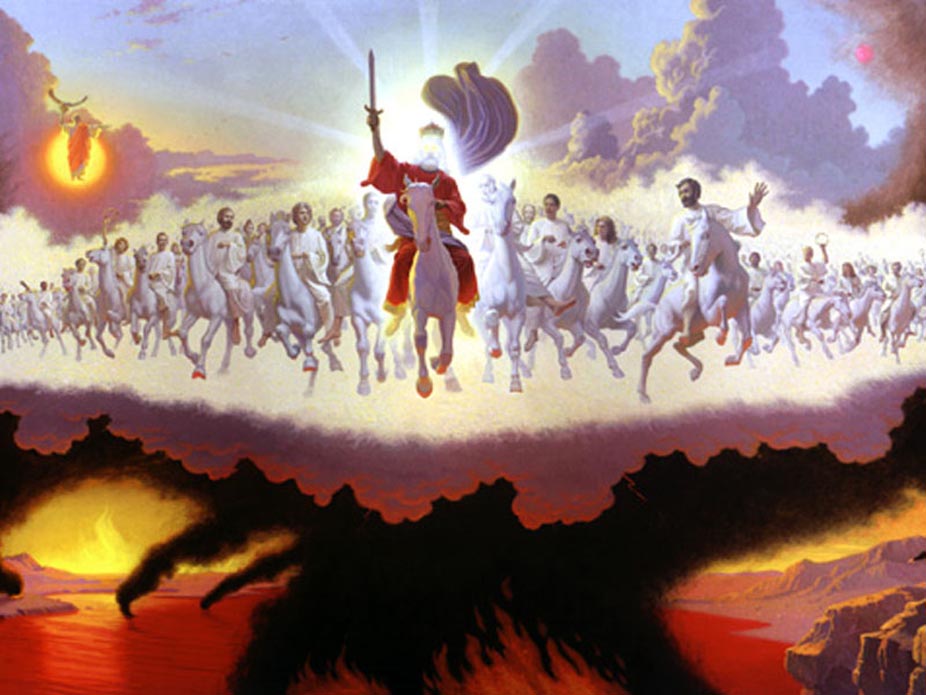
Copyright Pat Marvenko Smith
CHRIST REIGNS ABOVE
ALL SPIRITUAL FORCES
Far above all rule and authority and power and dominion, and every name that is named - The Jews believed angels controlled human destiny, but Scripture sees Jesus Christ as the Creator and Sustainer Who upholds all things by the Word of His power. Stated another way Christ has absolute unrivaled authority because He is infinity superior to any other authority, human or spiritual.
Harold Hoehner - Christ’s Ascension to the right hand of God involves His being exalted above every order of authority (cf. Col. 1:16), human and superhuman (cf. Phil. 2:8–11), whether present (in the present Age) or future (the Age to come; cf. 1 Cor. 15:23–28). The words rule and authority, power and dominion may refer primarily to angelic beings (cf. Rom. 8:38; Eph. 3:10; 6:12; Col. 1:16; 2:15; Titus 3:1).(The Bible Knowledge Commentary)
In his more detailed commentary Hoehner adds "These powers most likely are angelic and evil and wish to rob us of our spiritual benefits. The point is clear that Christ is over these authorities and they will not have the final victory. The struggle between God and these evil powers is real, and in the present day the battle rages between these angelic powers and believers, individually and corporately. The central point of this passage is that believers have the power that raised and seated Christ far above every power: We are to appropriate that power in light of the spiritual warfare that is portrayed in chapter 6 (Ephesians: An Exegetical Commentary)
So Christ is not just ABOVE but FAR ABOVE. This description also includes the idea of rank or dignity. Christ is in a class by Himself. The (created) demonic rule, authority, etc aren't even in the same ballpark as the Creator!"
Complete Biblical Library Commentary - Gnostics also conceived of angels as being intermediary beings between the so-called "unknowable God" and mankind. Paul, of course, did not agree with any type of Jewish or Gnostic angelic hierarchy ( What is Gnostic?). Much to the contrary, this verse serves as a good example of the way the apostle used the very teachings of antibiblical groups to expose the heresy inherent in them. (Complete Biblical Library - Incredible Resource)
Far above (5231) (huperano from hupér = above + ano = up) is an adverb meaning (high) above, above, far above. It functions as a preposition with the gentivie and describes location in Heb 9:15 and superior status of the location in Eph 1:21, 4:10. Gilbrant - The result is a potentially emphatic adverb, or adverbial preposition, meaning “high above” or “far above.” Sometimes, however, it means simply “above”; this meaning was common in the Septuagint."
Only 3 uses in NT - Eph 1:21, Eph 4:10, Heb 9:5.
17 uses in the Septuagint - Dt. 26:19; Dt. 28:1; Neh. 12:38; Neh. 12:39; Est. 4:17; Ps. 8:1; Ps. 74:5; Ps. 148:4; Isa. 2:2; Ezek. 8:2; Ezek. 10:19; Ezek. 11:22; Ezek. 43:15; Jon. 4:6; Mic. 4:1; Hag. 2:15; Mal. 1:5;
Background - 25 compounds with huper in the NT, 16 are found only in the Pauline Epistles - Paul is struggling to say what cannot be said. It is utterly impossible to put the fullness of divine reality in human language, to compress the infinite into what is finite. That is why one cannot receive the full impact of the meaning of the Word of God except as the Holy Spirit illuminates his mind to understand it.
All (3956) (pas) means all! No exceptions!
The terms that follow were "traditional Jewish terms to designate angelic beings of great rank might. Power of Christ applied in the believer’s behalf cannot be defeated because it far surpasses that of the hosts of Satan who design to defeat it." (Ephesians MacArthur)
Paxson - Christ was crowned Lord of all, having become victor over all human, angelic and Satanic power. He has been placed in a position of supreme authority over all created beings, which includes every rank and order of celestial hierarchy, whether good or bad. (The Wealth, Walk and Warfare of the Christian )
Life Application Study Bible - As Christians we can be confident that God has won the final victory and is in control of everything (ED: IN OTHER WORDS HE IS SOVEREIGN!). We need not fear any dictator or nation or even death or Satan himself. The contract has been signed and sealed; we are waiting just a short while for delivery. Paul says, in Romans 8:37-39, that nothing can separate us from God and his love. (Pdf)
Rule (746) (arche) means the first ones, preeminent one or leaders. Arché speaks of those first in order of rulership in a community, “the first ones” in the town. The arche is an an authority figure who initiates activity or process. In this context arche reflects a high order of demonic creatures that assist Satan in his warfare against God and His children! (See notes on spiritual warfare in Ephesians 6:12)
Arche in Ephesians and Colossians - Eph. 1:21; Eph. 3:10; Eph. 6:12; Phil. 4:15; Col. 1:16; Col. 1:18; Col. 2:10; Col. 2:15;
Authority (1849) (exousia) is derived from éxesti = it is permitted, it is lawful meaning liberty of action. Exousía refers to delegated authority and combines the idea of the "right and the might", these attributes having been granted to someone. One who has exousia has unrestricted ability to act upon his or her own discretion. This authority almost always implies power to enforce one’s will, either delegated by a higher-ranking authority or possessed in one’s own right. Exousía means the power to do something and was a technical term used in the law courts, of a legal right.
Exousia in Ephesians and Colossians - Eph. 1:21; Eph. 2:2; Eph. 3:10; Eph. 6:12; Col. 1:13; Col 1:16; Col. 2:10; Col. 2:15;
Clearly the fact that this same word exousia is used a few verses later to describe Satan (Eph 2:2) and then the spiritual forces in Eph 6:12 indicates that Paul is stating that the Risen Christ is high above all spiritual forces of evil (which He in fact even created - Col 1:16).
Power (1411) (dunamis from dunamai = to be able, to have power) refers to power, especially achieving power. It refers to intrinsic power or inherent ability, the power or ability to carry out some function, the potential for functioning in some way (power, might, strength, ability, capability), the power residing in a thing by virtue of its nature. In the present context dunamis almost certainly refers to evil spiritual forces which possess this inherent power. Dunamis is the implied ability or capacity to perform. It conveys the idea of effective, productive energy, rather than that which is raw and unbridled. Note that words derived from the stem duna— all have the basic meaning of “being able,” of “capacity” in virtue of an ability. Duna- is the root for English words like dynamic, dynamo, dynamite, etc.
Barclay writes that dunamis "can be used of any kind of extraordinary power. It can be used of the power of growth, of the powers of nature, of the power of a drug, of the power of a man’s genius. It always has the meaning of an effective power which does things and which any man can recognize. (Ref)
Dominion (2963) (kuriotes from kurios = lord, mighty one) means ruling power, dominion, lordship. BDAG says in this passage it refers to "a special class of angelic powers, bearers of the ruling power, dominions (cp. En 61:10; Slav. En 20; TestSol 8:6 D and s. ku,rioj II 2beb) Col 1:16; Eph 1:21;
Kuriotes - 4v - Eph. 1:21; Col 1:16; 2 Pet. 2:10; Jude 1:8
Victory, not defeat, should be the norm in the Christian life. God sees every believer as being in Christ, whom He raised from the dead and seated "at His right hand...far above all principality and power". Because He is the Victor and we are "in Him," we too can be victorious over sin. We can be "more than conquerors" when we yield ourselves to the all-conquering Christ.
Charles Wesley alluded to Jesus' rule from above in his famous hymn of many, Rejoice the Lord is King
Jesus, the Savior, reigns, the God of truth and love;
When He had purged our stains He took His seat above;
Lift up your heart, lift up your voice;
Rejoice, again I say, rejoice! (play)
Isaac Watts has another hymn with beautiful words...
Jesus shall reign where'er the sun
does its successive journeys run,
his kingdom stretch from shore to shore,
till moons shall wax and wane no more.
To him shall endless prayer be made,
and praises throng to crown his head.
His name like sweet perfume shall rise
with every morning sacrifice.
People and realms of every tongue
dwell on his love with sweetest song,
and infant voices shall proclaim
their early blessings on his name.
Blessings abound where'er he reigns:
the prisoners leap to lose their chains,
the weary find eternal rest,
and all who suffer want are blest.
Let every creature rise and bring
the highest honors to our King,
angels descend with songs again,
and earth repeat the loud amen.
AND EVERY NAME THAT IS NAMED NOT ONLY IN THIS AGE BUT ALSO IN THE ONE TO COME: kai pantos onomatos onomazomenou (PPPNSG) ou monon en to aioni touto alla kai en to mellonti; (PAPMSD):
- Every name that is named - Matthew 28:19; Acts 4:12; Philippians 2:9-11; Revelation 19:12,13
- In this age but also in the one to come - Matthew 25:31, 32, 33, 34, 35, 36; 28:18; John 5:25, 26, 27, 28, 29; Hebrews 2:5; Revelation 20:10, 11, 12, 13, 14, 15
- Ephesians 1 Resources - Multiple Sermons and Commentaries
NO OTHER NAME
BUT JESUS!
And every name that is named not only in this age but also in the one to come - Every name named is fairly all inclusive. There is simply no other name above. Jesus. As Peter declared "there is salvation in no one else; for there is no other name under heaven that has been given among men by which we must be saved.” (Acts 4:12)
Paul writes that
For this reason also (Php 2:7-8), God highly exalted Him, and bestowed on Him the name which is above every name, 10so that at the name of Jesus EVERY KNEE WILL BOW, of those who are in heaven and on earth and under the earth, 11 and that every tongue will confess that Jesus Christ is Lord, to the glory of God the Father. (Philippians 2:9-11)
THOUGHT- Play the song No Other Name and worship His Holy Name.
Name (3686) (onoma) name [implying authority, character] NT the name concisely sums up all that a person is. Name in the Bible means much more than in our modern culture. One's whole character was somehow implied in the name. Furthermore, in this context, name implies authority, and it was used this way as when one would come or do something in or by the name of someone (the name conveying that person's authority).
Paxson - Still further is His unique Lordship shown in the pre-eminence of His Name over the name of every created object in this age or in the age to come. How terrifying to-day are the names of even some men who seem to have an almost uncanny power which is being wielded to the hurt and death of many! How even more, the very names "Satan"; "the devil"; "the great dragon," fill us often with stultifying fear. But oh! how precious to know and to rest upon that Name that is above every name! (The Wealth, Walk and Warfare of the Christian)
Named (3687) (onomazo) means to name, call by name. Jesus is the Name above all names forever.
The most famous passage regarding the exalted nature of Jesus' Name, like the present passage, is in the context of Christ's sacrificial offering of Himself to God...
"And being found in appearance as a man, He humbled Himself by becoming obedient to the point of death, even death on a cross. Therefore also God highly exalted Him, and bestowed on Him the name which is above every name, that at the name of Jesus EVERY KNEE SHOULD BOW, of those who are in heaven, and on earth, and under the earth, and that every tongue should confess that Jesus Christ is Lord, to the glory of God the Father." (See notes Philippians 2:8; 2:9; 2:10; 2:11)
‘Let any name be uttered, whatever it is, Christ is above it; it is more exalted than that which the name uttered affirms’ (Meyer)
Only (3440) (monon) means alone.
Age (165) (aion) denotes duration of time. “age,” referring to the present sinful age, the world system now dominated by Satan. Aion is the popular culture and manner of thinking that is in rebellion against God which will try to conform us to its ungodly pattern.
The Jews of Paul's day understood the end times to be divided into two time periods, the age in which they lived and the coming age. The Messiah, called “the Coming One,” would rule in the age which is to come.
One to come (3195) (mello) means to occur at a point of time in the future which is subsequent to another event and closely related to it (see note below under "age") The present tense pictures this age to come as on its way.
This "age" would be the age Paul wrote in and is the same age believers live in today, the age most commonly known as the "church age". In a scheme which adheres to a literal interpretation of prophetic passages, the church age is followed by a seven year period commonly referred to as the "Tribulation" but more biblically correctly designated as "Daniel's Seventieth Week". This period of seven years is not actually called the "Tribulation" in Scripture, although Jesus clearly designated the last 3.5 year period as the "Great Tribulation" (Mt 24:21). Revelation 4-19 describes primarily the events that will transpire during this seven year period which will terminate with the return of Christ, Who will establish His 1000 year kingdom (the Millennium) on earth. This 1000 year period is also known as the Messianic Age, which is the time when God fulfills ALL of His promises to Israel, which is in marked contrast to what many teach because they do not interpret the Scripture literally. At the end of the Messianic Age God will have vanquished every enemy